Sotheby’s upcoming Important Judaica auction
E-cat: http://www.sothebys.com/en/auctions/2014/important-judaica-n09239.html
PDF: http://www.sothebys.com/pdf/2014/N09239/index.html
I then asked him [her father, the Rebbe] to tell me what he had seen there. My father paused for a moment and said: “When I came up there, the room was filled with dust and shemus. In the center of the room I could see the form of a man wrapped up and covered. The body was lying on its side. I was very frightened by this sight. I looked around at some of the shemus that were there and left frightened by what I had seen.
Special thanks to Rabbi Shimon Deutsch for providing me with a copy of Rebbetzin Gurary’s testimony, as reported to Rabbi Berel Junik.
In the light of the discussion in notes 30-33 — and until new evidence is forthcoming — it seems evident that the linkage between the Maharal and the Golem originated after 1780 and before 1835, almost certainly in Prague but perhaps in Posen.
The Maharsha’s Map of Yerushalayim – A Taus Sofer?
“ברכות סא: “הנפנה ביהודה
רש”י – ירושלים בארץ יהודה היא בצפונה של ארץ יהודה בגבול שבין יהודה לבנימין
By Eli Genauer
תנו רבנן, הנפנה ביהודה לא יפנה מזרח ומערב אלא צפון ודרום, ובגליל לא יפנה אלא מזרח ומערב. ורבי יוסי מתיר, שהיה רבי יוסי אומר לא אסרו אלא ברואה ובמקום שאין שם גדר ובזמן שהשכינה שורה. וחכמים אוסרים
Explanation of Rabbi Steinsaltz per Sefaria, the William Davidson edition of the Talmud
In this context, the Sages taught: One who defecates in Judea should not defecate when facing east and west, for then he is facing Jerusalem; rather he should do so facing north and south. But in the Galilee which is north of Jerusalem, one should only defecate facing east and west. Rabbi Yossi permits doing so, as Rabbi Yossi was wont to say: They only prohibited doing so when one can see the Temple, where there is no fence, and when the Divine Presence is resting there. And the Rabbis prohibit doing so.
רש״י-“הנפנה ביהודה ”
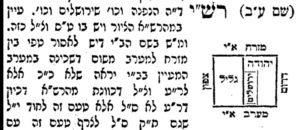
הנפנה ביהודה לא יפנה מזרח ומערב – אחוריו למזרח ופניו למערב ולא אחוריו למערב ופניו למזרח מפני שירושלים בארץ יהודה היא בצפונה של ארץ יהודה בגבול שבין יהודה לבנימין ויש מארץ יהודה הימנה [למזרח] עד סוף ארץ ישראל והימנה למערב עד סוף ארץ ישראל שארץ יהודה על פני כל אורך ארץ ישראל היא מן המזרח למערב כרצועה ארוכה וקצרה ואם יפנה מזרח ומערב יהיה פרועו לצד ירושלים או פרועו שלפניו או פרועו שלאחריו אבל צפון ודרום יפנה ובלבד שלא יפנה כנגד ירושלים ממש בדרומה של ארץ יהודה
Focusing in on the description of where Yerushalayim is located, it says “Because Yerushalayim is in Eretz Yehuda in the north of Eretz Yehuda, on the border between Yehuda and Binyamin, and there is a part of Yehudah which extends to the east until the edge of Eretz Yisroel, and extends westward until the edge of Eretz Yisroel, because Eretz Yehuda extends the entire length of Eretz Yisroel from east to west as a long and short strap.”
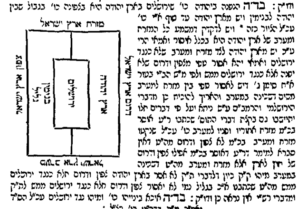
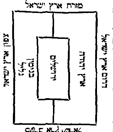
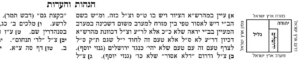
Maharsha – “הציור כזה” – Maharsha draws a map to illustrate the words of Rashi
Vilna Shas – courtesy of hebrewbooks.org

The first thing to consider is does the Maharsha mean that there was a ציור in Rashi?
It does not say “כזה” in Rashi
There was no space left open for a picture in the Bomberg edition of 1520 or the Soncino edition of 1484. This indicates there was no picture on the manuscript that served as the basis for the printed edition. Often חכמת שלמה (Prague 1582) will add a picture or diagram if it was missing from the Bomberg Shas. Here there is no indication of a missing picture in חכמת שלמה.
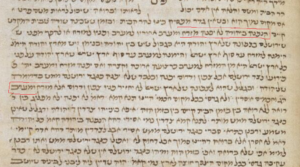
This manuscript of Rashi on Berachos also does not contain a diagram
The British Library, London, England Or. 5975

Conclusion: Maharsha is drawing a diagram of what he understands Rashi to be saying
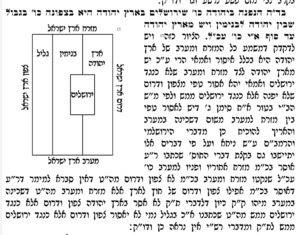
We do not have the Ksav Yad of the Maharsha on Berachot so our best knowledge of what he actually drew comes from the Defus Rishon. How was the map represented in that edition?
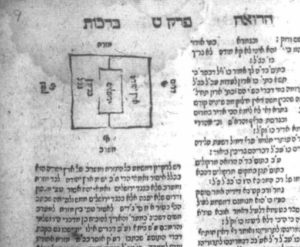
There were multiple first editions of Chidushei Halachot of Maharsha. The first few Masechtos were printed anonymously. The main one was printed in 1612. Berachos was printed in Lublin in 1621
First edition of Berachos 1621- The picture is the same as the Vilna Shas
courtesy of hebrewbooks.org


Is the map correct? Does it represent the words of Rashi?
Yerushalayim is represented as being half in Yehuda and half in an area described as Binyamin and Galil. One may argue that the map was not drawn to an exact scale but it seems clear that part of Yerushalayim extends into Binyamin:

The words of Rashi say “Yerushalyim is in Eretz Yehuda in the north of Eretz Yehuda, on the border between Yehuda and Binyamin”. (שירושלים בארץ יהודה היא בצפונה של ארץ יהודה בגבול שבין יהודה לבנימין ) This seems to mean that Yerushalyim is contained within Yehuda and does not extend into Binyamin/Galil.
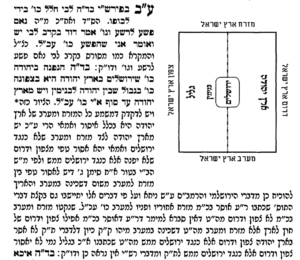
Ginzei Yosef (Bilgoraj 1932 by יוסף אלטר בן מרדכי אפשטיין) calls the map in the Vilna Shas a Taus Sofer and corrects the map to show Yerushalayim completely contained in Yehuda.
courtesy of hebrewbooks.org

There is some space on the east and west sides of Yerushalayim, meaning that Yerushalayim is between the eastern and western borders but does not extend to either border. (see the extra line drawn in on the west side of Yerushalayim). This is in line with the words of Rashi ויש מארץ יהודה הימנה [למזרח] עד סוף ארץ ישראל והימנה למערב עד סוף ארץ ישראל
This is also the opinion of Rav Tziyon Kohen Yehonatan (Djerba 1872-1931) in his Sefer Sha’arei Tziyon ( Dejerba 1932) courtesy of hebrewbooks.org

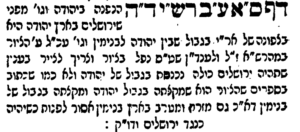
ולענד״ן שטאות סופר נפל בציור וצריך לצייר בענין שתהיה ירושלים כולה נכנסת בגבול של יהודה ולא כמו שכתוב בספרים שהציור הוא שמקצתה בגבול יהודה ומקצתה בגבול של בנימין דאם כן גם מזרח ומערב בארץ בנימין אסור לפנות כשיהיה כנגד ירושלים ודו״ק.
He adds that if Yerushalayim in fact extended any distance into Binyamin, it would require those in Binyamin to also be aware of whether they were facing Yerushalyim or not.
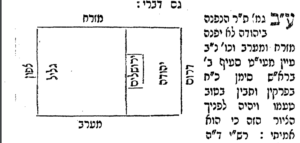
The Sefer D”vash Tamar (Warsaw 1897) by Rabbi Dovid Teitelbaum of Mezeritch draws the map in a similar manner. In this map you can clearly see space between Yerushalayim and the western and eastern borders of Yehuda:

How is the map represented in the newer editions of the Talmud?
Oz Vehadar (Mahaduras Friedman, 2006, Page 42 Maharsha section, Hagahaos V’He’aros) copies the map of Ginzei Yosef but does not have a line on the western side of Yerushalayim. It seems to indicate that Yerushalayim extends to the western border of Yehuda which is incorrect.

Vilna HaChadash (2006 page 36 in the Maharsha section) redraws the map of the Vilna Shas but still has Yerushalayim extending into Binyamin:

Vagshal (Mahaduras Neherdea, 2008 page 27, Maharsha section) is similar to Vilna HaChadash:

Conclusion: Once something is “uploaded” into the print medium, it has a tendency to remain as it was first printed. In this case, the effects of what many have termed a Taus Sofer have remained for 400 years.
Guide and Review of Online Resources – 2022 – Part I
By Ezra Brand
Ezra Brand is an independent researcher based in Tel Aviv. He has an MA from Revel Graduate School at Yeshiva University in Medieval Jewish History, where he focused his research on 13th and 14th century sefirotic Kabbalah. He is interested in using digital and computational tools in historical research. He has contributed a number of times previously to the Seforim Blog (tag), and a selection of his research can be found at his Academia.edu profile. He can be reached at ezrabrand-at-gmail.com; any and all feedback is greatly appreciated.[1]
It’s an exciting time to be a reader of scholarship, and to be engaged with the field. The dramatic shift to “remote” and “virtual” over the past two years may be on par with the shifts to writing and the codex around the 9th century) and the printing press in the 15th.[2]
Digital publishing has become more and more mainstream. As defined by Wikipedia (in entry “Electronic publishing”):
“Electronic publishing (also referred to as publishing, digital publishing, or online publishing) includes the digital publication of e-books, digital magazines, and the development of digital libraries and catalogs. It also includes the editing of books, journals and magazines to be posted on a screen (computer, e-reader, tablet, or smartphone.”
Regarding Hebrew books specifically, and for recent data, Israeli National Library annual statistics for 2020 state (Hebrew, my translation):
“In 2020, digital publishing was significantly expanded. Not all the digital books have been processed [by the library] yet, but already 799 digital books have been registered in the National Library, from publishers, research institutions, private individuals and more […]
For many in the past year, digital publication has become the primary mode of distribution, as opposed to paper. Notable in this area is the relatively small amount of children’s books (8%) compared to the high number of digital reference literature (69%).
The share of [books put out by] associations (43%) is particularly high, especially for reference books in the field of Israeli society and Jewish studies. [The share of books put out by] [p]rivate publishers (37%) include[s] many biographies, rabbinic literature and a few children’s books that have come out. Commercial publishers released most of the digital prose books.”
Specifically regarding rabbinic literature, one scholar pointed out already in 2016: “Searching for ancient original Jewish sources online, it is astonishing how diverse and numerous are the websites that are available.”[3]
At the same time as the trend towards digital publishing and distribution is occurring, there is also a movement towards “open access”. In this context, “open access” means an academic resource, whether databases, journals, or other tools, with no paywalls or subscriptions required to access content.
Over the first few decades of electronic resources, most of the resources were proprietary. They were generally available on a CD, which had to be bought. With the shift to the internet, many of these resources became available online, but required a subscription.
The movement towards freely available scholarship has continued to gain steam, making a huge amount of cutting edge scholarly publications available for free, and for all. In addition, there are a huge amount of grassroots initiatives to make available primary sources for study.
Open-access can be financially sustained in one of the following major ways:
The open-source resources in this guide are mostly supported in one of the first two ways.
Besides for full open-access, another model is called “freemium”. Freemium, as I use it in this context, means that some very basic part is provided for free, with the hope that the main product will be bought.
Some examples of freemium content that I’ve found helpful are:
Amazon listing pages for books. Amazon has bibliographical info, blurbs of reviews by scholars and media, crowd-sourced reviews and free excerpts of ebooks for Kindle, called “sample”, and the ability to add to a list.
Another example is JSTOR, with bibliographical info and first page of article.
On these resources, see more detail later in the guide.[4]
Electronic material has a lot of advantages, though there are some disadvantages.
For the intellectually curious, the relative ease of access is honestly astonishing, and it’s truly a wonderful time to be a book lover (not to mention the higher level of book typesetting).
Of course, physical books have certain advantages, tangible and intangible, that people get roused up about, especially traditionalists. And of course Orthodox Jews don’t use electronic sources on Shabbat and holidays. But electronic sources have their own massive advantages:
I personally have switched over to electronic texts wherever possible.
Of course, traditional physical seforim and internet-based resources aren’t mutually exclusive. One can have the best of both worlds. In Modern Orthodox yeshivot it’s been a common sight already for many years for people to have a laptop before them. Admittedly, the main use of the laptop is for notetaking, but it can also act as a portal to a world of supplemental seforim.
Jewish culture is stereotypically one of the book. There is understandably a huge literature on of books in Jewish history. For one example, on the material aspect of books in Jewish history, see Malachi Beit-Arié’s monumental 700-page book, Hebrew Codicology, recently finalized, and available for free online here and here. With the shift to virtual, Jewish studies haven’t been slacking.
This guide will mostly not cover resources related to the following topics:
A large part of my annotations are taken from the descriptions provided by the maintainers of the project and from Wikipedia. All translations are my own, unless noted otherwise.
My translation is sometimes loose, and I did not always fact-check. The info in this guide should definitely be double-checked if used for anything more scholarly.
In general, my main intention is to raise awareness and point readers to some of the incredible resources currently available to anyone with an internet connection.
Note: The website of the resource is hyperlinked in the name. In cases where only a part of a website is relevant to the resources under discussion, I try to link to the page on the website that best acts as a portal to the resources.
Another note: It’s quite incredible how much is now available on the internet. At the same time, projects become outdated and links become broken very rapidly. I hope to be able to update this guide every once in a while, but unfortunately the rapid changes in the layout of the internet is one of the blessings and the curses that come with this new medium (victims of the unfortunate phenomenon of “link rot”).
While researching this guide, I constantly found new resources that I was not aware of, and I’m certain (and hoping, in a good way) that this guide will rapidly become more and more outdated as more resources come online, and (negatively) as links break.
Other Guides
There are other guides, such as that of university library guides and other websites.[6] However, many of these guides are meant for students and researchers, and less for the general educated reader with an interest in these topics. In addition, many previous guides are from ten years ago or longer, and many of the links no longer work .
Outline of this Guide
Electronic vs. physical – pros and cons 2
Requires subscription or purchase 10
Requires subscription or purchase 12
Primary texts – manuscripts – scanned and transcribed 13
Requires subscription or purchase 17
Requires subscription or purchase 20
Requires subscription or purchase 22
Requires subscription or purchase 26
Bibliographic info and indexes 27
Requires subscription or purchase 28
Requires subscription or purchase 29
Articles for popular audience 31
Appendix – Halacha Brura’s Indexes 36
A huge amount of primary texts have been transcribed and scanned, and are readily available.
Digital editions in text format.[7]
Mostly searchable via OCR, and in PDF format.
[1] I’d like to thank Eliezer Brodt, Sholom Licht, and my father and brother for looking over previous drafts of this piece, and providing very helpful comments and feedback. Of course, the final product is mine, for better or for worse.
[2] On the late shift to writing, Yaakov Zussman and others have convincingly argued that Torah Sheba’al Peh was written down only in the post-talmudic era, besides for midrashim in Eretz Yisrael. For the Jewish shift to using the codex, see Malachi Beit-Arie, Hebrew Codicology (2022), pp. 39ff (the entire book is open-access on Academia.edu). For the influence of the printing press on the Jewish community, see Zeev Gries (2007), The Book in the Jewish World, 1700–1900.
[3] “Apolline Thromas, “12 Digital Resources of the Rabbinic Literature: Radical Change with a Click of the Mouse“, in: Ancient Worlds in Digital Culture (2016).
[4] It should be pointed out that many resources that are behind a paywall can be accessed for free by using easy to use “shadow libraries”. Especially for academic literature, Sci-Hub and Library Genesis (Libgen) are some of the best such libraries. Of course, every person must decide whether they consider this contravention of paywall to be halachic and/or ethical.
[5] Koppel, “Attribution and Misattribution: On Computational Linguistics, Heresy and Journalism” (July 11, 2011): “Some of this work has been applied to topics of particular interest to students of Jewish texts, such as strong evidence that the collection of responsa Torah Lishmah was written by Ben Ish Chai (although he often quoted the work as if it were written by someone else) and that all of the letters in Genizat Harson are forgeries”. Moshe Schorr, “Who Wrote the Late Volumes of Igrot Moshe?” (January 20, 2019): “Given the preponderance of evidence that the later Igrot Moshe volumes are real (and spectacular), I think we can put the various theories of alternative authorship to rest. The claims of the editors — that the latest teshuvot were dictated — explains the ‘steroid spike’, and all available evidence supports their central contention, that they didn’t change the actual content. In short: it’s legit.”
[6] Here are some guides that I found especially useful:
Guides by librarians:
Others:
For a relevant university syllabus, see Prof. Aaron Ahrend’s syllabus to his course “Research Guidance in Bibliography and Writing”, which I took many years ago in the course of my MA in Talmud at Bar-Ilan, see here. The course and course packet went over many digital tools, however the syllabus available online only gives topic headings, and bibliography of published articles.
[7] On the genre, see Kenneth M. Price, “Electronic Scholarly Editions“, in: Susan Schreibman and Ray Siemens (Eds.), A Companion to Digital Literary Studies (2008); Greta Franzini et. al., “A Catalogue of Digital Editions”, in Digital Scholarly Editing: Theories and Practices, pp.161-182; Menachem Katz et. al., “Talmud Yerushalmi Digital Critical Edition – IRCDL 2022” (2022).
[8] In the About page there: “includes Rabbi Adin Even-Israel Steinsaltz’s complete Modern Hebrew and English translations of the Talmud”.
[9] Thanks to Eliezer Brodt for bringing this new tool to my attention.
[10] See Boaz Hus, שאלת קיומה של מיסטיקה יהודית, 2016, pp. 146-147, for a discussion of these editions. (Book available in Kotar here.)
[11] See review here: Menachem Katz, Assael Shmeltzer, Hillel Gershuni, Sara Preis, “The Hachi Garsinan Project as a Critical Edition of the Talmud Bavli“, (September 2017).
[12] See full overview here: Menachem Katz et. al., “Talmud Yerushalmi Digital Critical Edition – IRCDL 2022” (2022).
Of course, this monograph is not meant to change normative practice; however, in unique circumstances poskim may find it useful.
Comments and questions of any type are particularly welcome and will be addressed quickly.
This first section includes a prologue that provides brief historical background and an introduction that presents the topic in its current context. The latter is posted below; the entire section is available here as a PDF.
Halakhic principles, logical consistency and theory notwithstanding, the vast majority of current practice follows one of these two opinions. Unquestionably, common practice adjusts the length of bein hashemashot based on latitude (and even on occasion season) when following the opinion of the geonim, while leaving the length of bein hashemashot constant when following the opinion of Rabbeinu Tam. Moreover, this is not surprising. R. Elijah of Vilna, the (Vilna) Gaon, and R. Shneur Zalman of Liadi, the first Lubavitcher Rebbe,[1] both explicitly require these adjustments in applying the approach of the geonim. They were two of the most prominent authorities that battled to reinstate the practice of the geonim against what had become the practice of an overwhelming majority of European Jewry who had adopted the opinion of Rabbeinu Tam. That majority included many if not most subsequent rishonim, both R. Yosef Caro and Rama, and most early commentators on the Shulchan Aruch. For those who followed the opinion of Rabbeinu Tam, there is no conclusive evidence[2] in either halakhic literature or practice, that Rabbeinu Tam or anyone until after the time of the Shulchan Aruch ever adjusted the start or the end of bein hashemashot based on latitude or season.[3] Like the time to walk 4 mil, it was assumed invariant.
Comporting with practice and consistent with the opinion of the major authorities whose opinion those practices appear to follow, would not normally warrant further analysis. However, as I will quickly illustrate, almost every aspect of zemanim involves a challenging mosaic of major and minor halakhic issues that have to be resolved and then applied consistent with observable astronomical facts.
Consider two other contemporary opinions on this topic, Rabbi M. Feinstein,[4] and Rabbi M. Willig.[5] R. Feinstein cites two alternatives to be followed in the New York metropolitan area: 72 minutes and approximately 50 minutes. Clearly, the OU web site’s recommended practice is rather consistent. R. Feinstein’s logic however, is radically different. First, R. Feinstein argues that latitude is commonly accepted as a determinant in the length of bein hashemashot and is thus to be applied to the opinion of Rabbeinu Tam as well. Second, R. Feinstein observes that while he waited 72 minutes in Lithuania, in accordance with Rabbeinu Tam, the sky is equivalently dark and starry in New York after only 50 minutes. Therefore, R. Feinstein adjusts Rabbeinu Tam’s opinion based on latitude and concludes that there is an adequate halakhic basis for those living in the New York area and following Rabbeinu Tam to wait only 50 minutes.[6] This opinion is similar to one given in applying Rabbeinu Tam’s opinion by Rabbi Pimential, in Minkhat Kohen.[7] R. Pimential suggested that the Jews living in the low altitude[8] of the Netherlands need only wait 48 minutes after sunset (in the spring) to end Shabbat according to Rabbeinu Tam. In reality however, the length of time from sunset to darkness (however defined) increases as one moves further away from the equator traversing the latitudes of the Middle East (~30 degrees), the Northeast United States (~40 degrees), the Netherlands (~50 degrees) and Lithuania (~55 degrees). Assuming the application of adjustments based on latitude, the end of Shabbat is later after sunset in the New York area or the Netherlands than in Israel. Problematically, R. Feinstein’s end to Shabbat is earlier in the in the New York area (similar to the Netherlands in the opinion of R. Pimential) than in either Lithuania or the Middle East. Despite the widespread acceptance and application of this opinion of R. Feinstein in many popular and scholarly[9] contexts, analysis is often muted or absent entirely.
While the OU website aligns with R. Feinstein’s psak[10] and common practice, it differs entirely as to rationale.[11] When one waits approximately 50 minutes, the OU assumes one is following the geonim, while R. Feinstein assumes that one is still following Rabbeinu Tam. Unlike R. Feinstein’s ruling, the OU web site does not adjust Rabbeinu Tam’s opinion for latitude or season. Of course, one could argue that Rabbeinu Tam’s approach applies to France and not the Middle East. This would imply that the sugyot that Rabbeinu Tam is analyzing defined zemanim for Europe and not the Middle East – hardly a plausible position. Both historical practice and Rabbeinu Tam’s likely position made no explicit latitude adjustments; one can only conjecture that Rabbeinu Tam assumed his zemanim applied uniformly to both the Middle East and France. In that regard, the OU website is consistent with both Rabbeinu Tam’s viewpoint and how it has been practiced.[12]
In his sefer Am Mordechai, R. Willig, like R. Feinstein, takes as a certainty that latitude must be a determinant in applying the approach of Rabbeinu Tam as well. But R. Willig follows that to its logical conclusion:
v The 72 minute practice in Lithuania was not, as R. Feinstein (and probably the vast majority of Orthodox Jewry) assumed, the correct practice of Rabbeinu Tam, but rather just the practice of the geonim applied at a location/latitude above 50 degrees from the equator.
In R. Willig’s approach, the logic of Rabbeinu Tam’s opinion, regardless of the practice actually followed by Rabbeinu Tam or those who adhered to his position, must be coupled with the laws of astronomy as currently understood. Thus, the time to walk four mil that Rabbeinu Tam rules as the end of Shabbat, only applies around the spring and fall equinox and only at the latitude of Israel and Babylonia (approximately 30 degrees north latitude.) Rabbeinu Tam’s locale in France, New York and Lithuania would require a significantly later end to Shabbat. In fact, R. Willig provides both a slightly shorter (for those following the geonim) and significantly longer (for those following Rabbeinu Tam) end-time to Shabbat consistent with the opinion and (private) practice of his mentor Rabbi Joseph Soloveitchik.[13] While their logic and application of basic astronomy to zemanim is impeccable, it hardly comports with practice. Interestingly, both R. Soloveitchik’s personal stringency and R. Feinstein’s ruling for the entire community follow Rabbeinu Tam. In addition, both agree that adjustments for latitude must be made. However, their conclusions are radically different. R. Feinstein ends up with a psak that comports with tradition, albeit, employing logic that is, at least to this author, puzzling. R. Soloveitchik, on the other hand, followed (and refined) a family (Brisker) practice that is almost unprecedented within tradition, coupling a precise understanding of astronomy with a halakhic formulation rooted in Rabbeinu Tam’s approach. As a result, R. Soloveitchik ended up waiting considerably longer for the end of Shabbat than either Rabbeinu Tam or the vast majority of his prior adherents.[14]
[1] In his Siddur, R. Shneur Zalman of Liadi abandons the position he took in Shulchan Aruch Harav that supports Rabbeinu Tam
[2] Minkhat Kohen provides a comprehensive review and when suggesting latitude, season and altitude based adjustments mentions no such earlier source supporting this approach to the opinion of Rabbeinu Tam.
[3] This disparity in approach, adjusting one measure and not another, has the effect of reducing the period of dispute around the end of Shabbat in the northern European counties. Thus, opinions on ending the Shabbat, while radically divergent in theory, varied less significantly in practice.
[4] Igrot Moshe – OC 4:62.
[5] Am Mordechai, Berachot chapter 2.
[6] 72 minutes is preferred by R. Feinstein, but only as a recommended stringency.
[7] Ma’amar Sheni – chapters 4 and 5, a 17th century work that was the first comprehensive sefer on zemanim.
[8] R. Pimential significantly overestimated the effect of elevation. R. Pimential was perplexed by the expected impact of latitude and explicitly questions why the twilight period in the Netherlands is not longer than 72 minutes given that the Netherlands is further from the equator than the Middle East.
[9] Both R. Willig Am Mordechai, Berachot chapter 2, in the last section and R. Dovid Heber in Shaarei Zemanim, page 90, raise this fundamental issue with R. Feinstein’s position.
[10] There are some differences as the zemanim provided on the OU website adjust for seasonality as well. R. Belsky argues that R. Feinstein would have agreed to those changes. See his approbation on the www.myzemanim.com website.
[11] As we will see on other issues, practice can on occasion be explained to comport with entirely different theoretical positions.
[12] While normally no precise latitude based adjustments were made to Rabbeinu Tam’s position, approaches like that of R. Pimential, which use the appearance of stars, regardless of the duration of time since sunset, to define the end of Shabbat, effectively do incorporate both season and latitude based adjustments.
[13] R. Soloveitchik, as we will be explained later, considered the time to walk 4 mil to be 90 minutes (the Brisker achtel, an eighth of a day, in Yiddish) as opposed to the 72 minutes used by most poskim and then adjusted 90 minutes by latitude and season. This combination caused R. Soloveitchik to maintain Shabbat at a Biblical level until almost 2 and ½ hours after sunset in Boston around the summer equinox.
[14] In a Yarzeit shiur, (Shiurim Lezecher Avi Mori, volume 1, yom v’lailah) R. Soloveitchik outlined a compelling, albeit highly non-traditional, approach that reworked Rabbeinu Tam to a position, consistent with astronomical observation. However, even this approach to Rabbeinu Tam must deal with the textual issues in reading the gemara in Shabbat that are discussed in section 7, a topic that R. Soloveitchik did not address.
Disputatious Divorces: Public Controversies over Gitten and Couple Relations
by Marvin J. Heller[1]
God said “It is not good that man be alone: I will make him a helper, a counterpart to him.
Therefore, a man shall leave his father and mother and clings to his wife, so that they become one flesh. (Genesis 2:18, 24)
As a rose among the thorns, so is my beloved among the young women.
As an apple tree among the forest trees, so is my beloved among the young men (Song of Songs 2:2,3).
A man takes a woman [into his household as his wife] and becomes her husband. She fails to please him because he finds something obnoxious about her, and he writes her a bill of divorcement (Sefer Keritut, get), hands it to her, and sends her away from his house (Deuteronomy 24:1).
The Bible makes clear that the normal relationship is for men and women to marry and have a warm conjugal relationship, stating this near the opening of Genesis, the first human relationship being formed on the sixth day of creation, the day the both man and women were created. This relationship is emphasized by King Solomon in the Song of Songs (Shir ha-Shirim) who, as noted above, describes the affection each member of a couple has, should have, for each other. Alas, unfortunately, this is not always the case. When that unfortunate occurrence occurs, the Torah mandates a procedure for terminating the relationship, hopefully with a minimum of animosity and acrimony.
In contrast to the above, several contentious divorces in the Jewish community, in the sixteenth through eighteenth centuries, had a very public countenance, this in contrast to the concept that divorce is a private affair. In all of these instances the disputations and the opinions of the prominent rabbis involved were recorded in numerous books of responsa. This article looks at several of those divorces and related publications, one in which none of the participants were Jewish. In that instance, however, halacha was a matter of interest. Background of the disputes are discussed in this article and several of the leading related publications are described. Five contentious divorces are addressed in this article in chronological order, excepting the English royal divorce addressed at the conclusion of the article.
I
1566 – Tamari-Venturozzo affair – We begin with the controversial divorce known as the Tamari-Venturozzo Affair, after its participants, Samuel (Shmuel ha-katan) ben Moses Ventura of Perugia, known as Venturozzo and Tamar, the daughter of Joseph ben Moses ha-Kohen Tamari, “the leading physician in Venice.” Shlomo Simonsohn, begins his description of the “divorce scandal” writing that in contrast to other communal disputes the Tamari-Venturozzo affair, an issue of Jewish law, “roused the Jewish public throughout Italy” and social conflict in the communities.[2]
In 1560, Samuel Venturozzo, was promised, (engaged to) Tamar (Tamari). Three months after the betrothal a dispute between Venturozzo and Tamari, the latter close to the Venetian government, occurred, the former reputedly for violating his marriage vows, customarily made at in Italy at the time of betrothal. As a result, Venturozzo left Venice, claiming that he fled the city because Tamari had reported him to the authorities. Venturozzo moved about in Italy, pursued by Tamari, who demanded a get (bill of divorce) for his daughter, as erusin (betrothal) involving the exchange of marital vows, that is, apart from and prior to nissu’in (marriage), had taken place, necessitating a get.
After four years, Tamari brought the case to the Maharam of Padua (R. Meir ben Isaac Katzenellenbogen, 1482-1565), among the leading rabbis in Italy. He ruled, on February 27, 1564 (4 Adar, 5324), that within a month Venturozzo must either consummate the marriage or divorce Tamar. After considerable difficult negotiations, Venturozzo returned to Venice and formally divorced Tamar, giving her a get. This did not, however, conclude the matter. Venturozzo subsequently reputed the divorce, claiming that he had been compelled to grant the get; Tamari charged that Venturozzo was mercenary. Furthermore, Tamari claimed that Venturozzo’s charges, after the fact, did not negate the get. Rabbinic and secular authorities were marshaled by both sides, in Venice on behalf of Tamari, the rabbinate in Mantua, and Cosimo I, Duke of Florence, on behalf of Venturozzo, who would later be librarian for the Duke’s Hebrew books. Even the Church, represented by Cardinals and the Inquisition, became involved. The dispute occupied the attention of Italian Jewry for seven years.[3]
According to Robert Bonfil the Tamari-Venturozzo controversy was one of several within the Italian-Jewish community. Each dispute involved numerous rabbis, none with sufficient authority to render a final decision. He writes that “the personal authority of the individuals involved was severely weakened by some harsh facts which came to light in the wake of these conflicts.” Furthermore, social tension between ethnic groups was aggravated. “Even in the case of the Tamari-Venturozzo divorce, the Mantua community was divided into two camps: the scholars of the Ashkenazic yeshivot on the one hand, and R. Moses Provenzali and the Italian community on the other.[4]
This dispute over the get divided the Ashkenazic and Sephardic communities of Italy, and, prior to its resolution, involved a wide spectrum of rabbinic authorities, in such locations as Venice, Florence, Ferrara, and Mantua, as well as Italian officialdom and even beyond Italy, in such diverse locations as Salonika, Constantinople and Eretz Israel. Polemic tracts and collections of responsa were issued for and by both sides.
Several works of responsa address this dispute, of those noted here, one was printed in Venice, R. Baruch Uziel ben Baruch Hazketto’s Hatzaah al Odot ha-Get, and two were published in Mantua, R. Samuel ben Moses Venturozzo’s Elleh ha-Devorim and R. Moses ben Abraham Provencal’s Be’ur Zeh Yaza Rishonah.[5]
1566, Hatzaah al Odot ha-Get
Courtesy of the National Library of Israel
Hatzaah al Odot ha-Get (Proposal on the matter of the get given by Samuel known as Venturozzo) is a collection of responsa from a number of rabbis in support of Tamari. It was published at the press of Giorgio di Cavalli (Venice, 1565) in a small format (21 cm. 77 ff.). Cavalli, a scion of an ancient Veronese family made Venetian patricians, was an active printer of Hebrew books from 1565 to 1567, issuing more than twenty Hebrew titles. His pressmark was an elephant bearing a turret.
Hatzaah al Odot ha-Get was published by the Tamari family and the rabbis of Venice who supported the family. The book was published at intervals and subsequently assembled as a complete work. R. Baruch Uziel ben Baruch Hazketto (d. 1571, Hazketto is a Hebraized form of his name: ḥazak, forte, פורטי, “strong”).[6] The title-page of Hatzaah al Odot ha-Get states that it’s subject matter is the get given by the young Samuel known as Venturozzo. It is dated 8 Tishrei השכ”ו ([5]326 = Monday, September 3, 1565) and “contains all the details, in general and in particular, from beginning to the end. . . . and in it can be found all the facts of the divorce.” The text begins with an account of the affair from the Tamari perspective. It is followed by correspondence and rulings supporting the Tamari family from rabbis who express their opposition to R. Moshe Provencal (Provencali), who led the rabbis of Mantua, and his supporters, the leading adherents of the Venturozzo position.[7]
Elleh ha- Devorim represents the Venturozzo family’s position. It was published in quarto format (40: pp. 46 ff.) with the assistance of R. Moses ben Abraham Provencal. Although the title-page states it was printed in Mantua the publisher is not known. In addition, a second, this the primary work representing the Tamari family position, was Provencal’s Be’ur Zeh Yaza Rishonah.
R. Moses ben Abraham Provencal (1503–1575), born in and rabbi of Mantua was a prominent Talmudist and among the preeminent contemporary Italian rabbis. Among the many works for which he is known, in addition to his responsa, are an approbation for the printing of the Zohar (Mantua, 1558–60), and other varied works.[8] A leading supporter of Venturozzo, Provencal (1503-1575), invalidated the get, contending it was given under duress. His position was opposed by many rabbis in Italy, as well as rabbis throughout Italy and Turkey. Provencal wrote to the Venetian rabbinate informing them that Tamar could not remarry until the matter was resolved. The Venetian rabbinate sought and gained the support of the rabbis (six) in the Ashkenaz yeshiva in Mantua, who “banned” Provencal, an activity supported by several prominent rabbis in Italy and abroad. Provencal was actually put under house arrest by the authorities in Mantua for his position.[9] Much of the Italian rabbinate supported Provencal.
1566, Elleh ha- Devorim
Courtesy of the National Library of Israel

1566, Be’ur Zeh Yaza Rishonah
Courtesy of the National Library of Israel
Provencal’s Be’ur Zeh Yaza Rishonah is a small work. It was printed in Mantua in octavo format (80: [22] pp.), the press, as noted above, unknown. The title-page describes Be’ur Zeh Yaza Rishonah as including all the laws concerning women on divorce and betrothal when discord occurs between a man and his wife and the monetary issues when they bring their case to judgment. In addition to the works described here Simonsohn notes several other related responsa, some still in manuscript.
When the matter became so heated there were riots, suppressed by the civil authorities, in Milan. Soon after, however, the public lost interest in the affair and it was quickly forgotten. At the end of the century Provencal’s grandchildren were unable to sell copies of his pamphlet still in their possession.
(TSB Editor note: For more about this controversy see Eliezer Brodt’s recent presentation available here.)
II
Divorce of Vienna, 1611 – Our second contentious divorce, a cause celebre known as the Divorce of Vienna (Get Mi-Vi’en) concerns a young man from Poland, sixteen years of age, who married a young woman from Vienna. He became severely ill. The couple did not have any children. Persuaded by his wife’s family, the husband agreed to divorce his wife, to give her a get, so that she would not have to undergo halitzah after his passing.[10] At the time of the divorce, the husband’s position was based on his being informed that if he recovered the marital relation would be resumed. He was provided with written and oral assurances that if he recovered, he could remarry his wife. The young man did recover, but his wife declined to resume the prior relationship and return to her [ex]husband. The issue came before R. Meir ben Gedaliah of Lublin (Maharam of Lublin, 1558–1616) who determined that because of the husband’s understanding of the situation and recovery the original divorce was invalidated.
Another rabbi of repute to whom the question of this divorce was also addressed was R. Mordecai Jaffe (Levush, 1530-1612). It was his position that the verse in Deuteronomy (24:1–2) that only if his wife does not please him, as in the header verse “he writes her a bill of divorcement, hands it to her, and sends her away from his house . . . And she shall go out of his house and became a wife to another man …” It was the Levush’s contention that a woman can remarry only if she did not find favor in her husband’s eyes. If, however, the divorce was due to other reasons, a “divorce of love” is Jaffe’s term, it “is not effective as an instrument empowering marriage to another.”
In contrast to the above, in a synod of the Polish and Russian rabbinate, R. Shmuel Eliezer Edels (Maharsha, 1555-1631) determined that, given the prior understanding, the divorce was valid. Similarly, R. Joshua Falk (1555-1614), author of Beit Yisrael commentary on the Arba’ah Turim as well as Sefer Meiros Enayim on the Shulkhan Arukh argued that the get was valid, as no explicit condition had been written in the get. Finally, the wife’s family did not permit the remarriage.[11]
(TSB Editor note: For more about this controversy see Eliezer Brodt’s recent presentation available here.)
III
Urbino 1727 – Our next contentious divorce, this quite different from our other separations, took place in Urbino, at one time capital of the province of Pesaro e Urbino, duchy of Urbino, but subsequently later a portion of the States of the Church. Jews may have been resident in Urbino as early as the thirteenth century, albeit in small numbers. The details of the divorce and the participants in the ensuing divorce are detailed in R. Isaac ben Samuel Lampronti’s (1679-1756) multi-volume encyclopedia entitled Pahad Yitzhak, most parts printed posthumously.
Lampronti, a physician, rabbinic scholar, and head of the yeshiva in Mantua, a Sephardic sage in Italy, began to assemble the contents of Pahad Yitzhak when a student in Mantua. It is an encyclopedic and comprehensive work on Jewish subjects, arranged alphabetically. Lampronti worked on Pahad Yitzhak his entire life, but only beginning to publish it when elderly. A thirteen-volume work, the first volume (Venice, 1750) of Pahad Yitzhak was printed at the Bragadin press. It is the only part of Pahad Yitzhak to be published in Lampronti’s lifetime; it is on the letters א and ב. The remainder of the work was published posthumously.[12] Publication of Pahad Yitzhak was completed in Berlin (1885-87), the final volumes published by the Meḳiẓe Nirdamim Society.[13]
1750, Pahad Yitzhak
Courtesy of Jewish National Library

1866, Pahad Yitzhak
Courtesy of HebrewBooks.org
The case of the Urbino divorce is addressed in Pahad Yitzhak, volume 7 (Lyck, 1866), under the heading safek (doubt). Ninety pages reproduce the various works, responsa, and related correspondence concerning this dispute. The detailed Pahad Yitzhak entry on the disputed Urbino divorce is summarized by Cecil Roth in an article on the dispute. The remainder of this article entry is a concise recapitulation of that summary.[14]
In this occurrence Consolo Moscato, a very attractive orphan girl, was resident in Urbino. She was sought after by many of the local young men, but she chose to wed her cousin Solomon Vita Castello. The match was arranged, but did not take place immediately, Consolo’s father having passed away and her mother, signora Diana, remarried. The couple lived under the same roof, in the home of an aunt. Due to difficult economic conditions the year stipulated for the wedding passed and it was three years before anything was done. At the end of June, 1727 Castello purchased attractive attire for the bride from a merchant for no less than twelve zecchins.
Soon after, however, the groom became ill and his mind was affected. Castello threw himself down a well; quickly saved he was bound hand and foot to prevent another attempt. His madness was followed by periods of lucidity “or what was convenient to consider lucidity.” Castello had relapses, at which time he called upon the Saints for assistance. When his kinsfolk stopped this speech, he responded with blasphemies. When this became known priests were sent by the church authorities to save his soul. There was concern that the church would seize Consolo to accompany Castello. She therefore fled, in terror, to her mother’s home and took steps to annul her engagement.
Subsequently, Consolo became betrothed to Moses Samuel Guglielmi on Friday, October 17, 1727, freeing her from Castello, with whom she had not undergone a formal ceremony. Soon after, however, Castello regained his health and found, to his dismay, that his bride had been estranged. Consolo was now prepared to cancel her new relationship and return to Castello. However, a local rabbi, R. Judah Vita Guglielmi, a relative of Moses Guglielmi, ruled that Consolo’s renewed relationship to Castello was illegal. Consolo and Castello secretly married. It was alleged that Guglielmi had even employed a non-Jewish sorceress to break the couples’ bond. R. Judah Vita Guglielmi, seeing his authority flouted appealed to other rabbis, as did the other side. Leading rabbinic authorities in Italy became involved. After serious contentiousness on both sides, it was agreed unanimously, in the decision of R. Solomon David del Vecchio, that Consolo must be divorced by both of her suitors, neither of whom could be considered her husband. Castello subsequently demanded repayment for his expenses refusing to grant her freedom, with the result that he was excommunicated. He finally consented, the excommunication was withdrawn, bringing the Urbino dispute to a conclusion.
IV
Cleves, 1766-67 – In 1766-67, a dispute arose over a get in Cleves (Kleve), a city in the historic duchy of Westphalia in western Germany, less than 5 miles (8 km) south of the Dutch border. Jews are mentioned in Cleves as early as 1142 and were granted a charter of privilege in 1361. They received patents allowing them freedom of movement (Geleitbriefe) in 1647–51 and 1713–20. Nevertheless, Jewish residence there was small, numbering only four families in 1661, 19 in 1739, and 22 families in 1787.[15] The small number of Jews notwithstanding, there too a dispute over a divorce, the get of Cleves, was contentious and became a wide spread dispute involving leading rabbinic authorities.
Here too the dispute concerns a husband who had intermittent mental illness. In this case the subject was the marriage Isaac (Itzik) ben Eliezer Neiberg of Mannheim to Leah bas Jacob Guenzhausen of Bonn, on Elul 8, 5526 (August 14, 1766). On the Sabbath after the wedding, Isaac (Itzik), took the dowry of 94 gold crowns and disappeared. He was subsequently found, after a widespread search, two days later, in a gentile home in Farenheim and returned home. Not long afterwards, Isaac told his wife’s family that he could no longer remain in Germany because he was in serious danger and that he had to immigrate to England. Isaac stated that he was prepared give Leah a get so that she would not be an agunah (technically still married and unable to rewed). Leah agreed and Cleves was chosen as the place where the get would be given. Afterwards, Leah returned to Manheim and Isaac preceded to England. Although he gave his wife a get the validity of the divorce was questionable; it is necessary that one giving a get be of sound mind. As a result, the validity of the get became an issue of contention between rabbinic authorities in Western Europe.[16]
The divorce was given, on 22 Elul, 5526 (August 27, 1766), under the direction of R. Israel ben Eliezer Lipschuetz, the av bet din (head of the rabbinic court) of Cleves. When Isaac’s father learned of the divorce, he suspected that the whole affair had been arranged by Leah’s relatives in order to extract the money for the dowry from Isaac. Isaac’s father then turned to R. Tevele Hess of Mannheim, who determined that the get was not valid, Isaac not having been of sound mind when he gave it to Leah. Hess sought support for his position, turning to the bet din (rabbinical court) of Frankfurt, headed by R. Abraham ben Zevi Hirsch of Lissau. Abraham ben Zevi Hirsch supported Hess’s ruling but that was not the case with other prominent rabbis such as R. Naphtali Hirsch Katzenellenbogen of Pfalz, R. Eliezer Katzenellenbogen of Hagenau, and R. Joseph Steinhardt of Fuerth. While Abraham ben Zevi Hirsch agreed and even demanded that Lipschuetz invalidate the get, agreeing that Leah was still a married woman, the others did not support him, saying the divorce was valid and Leah might remarry. Furthermore, many other prominent rabbis also validated the get.[17] The Frankfurt rabbinate, here influenced by the Frankfurt am Main dayyan (judge) R. Nathan ben Solomon Maas opposed the validity of the get, publicly burning the supportive responsa of the other rabbis, condemning their support of Lipschuetz and his position. Finally, the couple remarried, and in respect of R. Abraham of Frankfurt, did so without any of the traditional blessings at the ceremony. Instead, Isaac said “with this ring you are still married to me.”
The above events are recorded in two works, both validating the get. R. Aaron Simon ben Jacob Abraham of Copenhagen’s Or ha-Yashar are favorable responsa published in the year “as a sign for rebellious ones לאות לבני מרי (529 = 1769)” (Numbers 17:25) in Amsterdam by Gerard Johan Yanson at the press of Israel Mondavo. Aaron Simon was the secretary of the Jewish community of Cologne. He was also the author of Bekhi Neharot, on the flood in Bonn in 1784 (Amsterdam, 1784). He expresses his agreement with and support of Lipschuetz in Or ha-Yashar.[18] The title-page of that work informs that it was completed in the month that the Torah was given to Israel (Sivan) and is dated “as a sign for rebellious ones לאות לבני מרי (529 = 1769)” (Numbers 17:25). Or ha-Yashar is a 19 cm. ([7], 111, [1], ff.) work. Aaron Simon ben Jacob had followed the events and had himself played a part in the granting of the get. Or ha-Yashar records the complete episode of the Cleves divorce.[19]

1769 Or ha-Yashar
Courtesy of Hebrewbooks.org

1770, Or Yisrael
Courtesy of Hebrewbooks.org
The following year Lipschuetz published Or Yisrael in defense of his position. It is dated with the popular phrase “[Rock of Israel], arise to the aid of Israel קומה בעזרת ישראל (530 = 1770)” in defense of his position. Or Yisrael was published in Cleve at the press of the widow Sitzman as a 20 cm. (120 ff.) work. It is the only Hebrew book to have been printed in Cleve. Or Yisrael is comprised of thirty-seven responsa, primarily concerned with the Cleve divorce. Responsa 34-36, which are very critical of the Frankfurt rabbis, were omitted in their entirety, the numeric order of the printed responsa being 33, 37, while responsum 33 was printed with modifications.[20]
A negative result of this controversy was similar to that of the Tamari-Venturozzo controversy, as noted above. Here too, Mordecai Breuer suggests that in the polemic over the Cleves get “rabbis and rabbinical courts from various communities likewise fought against each other with fierce antagonism. . . . and the Cleves divorce, undoubtably had a detrimental effect on the standing of the rabbinate.”[21]
Or ha-Yashar was reprinted once, in Lvov (1902). This is the only edition of Or Yisrael.[22]
(TSB Editor note: For more about this controversy see Eliezer Brodt’s recent presentation available here.)
V
Henry VIII – We conclude with what is the most unusual of our contentious public divorces, that of Henry VIII (June 28, 1491 – January 28, 1547) king of England. Henry reigned from April 22, 1509 until his death in 1547. He is an important and influential figure in English history. Henry took England out of the Roman Catholic Church, had Parliament declare him, in 1534, supreme head of the newly founded Church of England, beginning the English Reformation. He did this because the pope would not annul his marriage to Catherine of Aragon, who had not provided him with a male heir.[23]
Henry’s first marriage – he married six times, this apart from mistresses – was to the Infanta Catherine of Aragon (1485-1536) in 1509.[24] Catherine was the daughter of King Ferdinand and Queen Isabella of Spain and the widow of Arthur, his elder brother. Arthur and Catherine did not have children; the related question of levirate marriage, the question of its application to them, will be addressed below. Henry was eighteen at the time and Catherine five years older when they wed. The marriage was a political union, as were many royal marriages at the time. Henry and Catherine did have a child, Mary, born in February 1516. Of the many pregnancies and several births that Henry would have from his many wives, Mary was the only child to survive.[25]

Henry VIII
Hans Holbein the Younger
Catherine was reportedly devoted to her “young, athletic, charming husband.” She was a committed wife and very much wanted to give her husband a male heir. Their first child was a daughter, stillborn in 1510. She was followed by a son, named Henry, born in January 1511, but he lived only 52 days. In October, 1513, Catherine miscarried; in February 1515, she had a stillborn son. “In February 1516, there was happiness as Princess Mary was born. There was joy in the sign that Catherine could bear a vital child which kept alive the hope of a son.” There was, however, sadness with this birth, Catherine having been informed two weeks earlier that her father had passed. One more child was born to the royal couple, in 1518, a stillborn daughter, the last of their children.
After eighteen years of marriage and seven pregnancies, Henry despaired of having a male son with Catherine of Aragon. Winston Churchill writes that by 1525 she was forty years old. Five years earlier, Catherine had been privately mocked by Francis I, king of France, “saying she was already ‘old and deformed.’ A typical Spanish princess, she had matured and aged rapidly; it was clear that she would bear Henry no male heir.”[26]
Henry did have an illegitimate son, daughter of a maid in the court, named Henry, who was made duke of Richmond, but was not an option as successor. Henry VIII became enamored with Anne Boleyn (ca. 1504-1536), a lady in waiting to Catherine, whom he secretly wed in Whitehall Palace. He then attempted to discredit his marriage to Catherine.[27] Henry’s marriage to Anne was also not successful. Anne Boleyn was not a submissive woman. In April 1566, three years later, Anne was accused of high treason, adultery, incest with her brother George, and plotting to kill the king, and tried before a jury. On 15 May, four days later, she was convicted and beheaded. These charges, investigated by historians, are rejected as false.[28]
Henry submitted a request to Pope Clement VII that his marriage to Catherine be dissolved. The pope, however, did not agree to Henry’s request. Cecil Roth writes that the pope would have been prepared to “grant the favor” and annul the marriage but for fear of Catherine’s nephew, Emperor Charles V, who was opposed due to the slight he felt this put upon his house.[29] Henry’s marriage to Catherine was, from a religious, Biblical perspective, questionable, marrying a sibling’s wife, even if he was deceased, being prohibited. The exception to this is where the deceased brother did not have offspring, in which case the commandment of levirate marriage becomes operative.
A complex issue, biblical interpretation and Hebrew tradition assumed importance. Jewish interpretation of scriptures was not readily accessible, as the Jews had been expelled from England by Edward I on 18 July 1290. It was to Italy, therefore, with its notable Jewish community, particularly to the Venice community, that the protagonists turned.[30] Henry sent Richard Croke, an eminent classical scholar and royal tutor, to Venice to seek adjudications on the subject.
Responses both in favor and opposed to Henry’s request are found among the rabbinic authorities in Venice. Among the people that Henry consulted was Mark Raphael, a convert to Christianity who reputedly had previously held a high rabbinic position in Venice.31 The subject of Henry’s query was of the legality, according to Jewish law, of his levirate marriage to Catharine.[32]Raphael, who arrived in London on Jan. 28, 1531, held that while Henry’s marriage to Catherine was legal, the king might nevertheless take a second wife conjointly with the first wife. This decision was not acceptable, so Raphael suggested that, as Catherine’s marriage to Arthur had born no children, and Henry had married Catherine without the intention of continuing his brother’s line, that marriage was not legitimate but rather invalid. This position was presented to Parliament, Raphael subsequently being rewarded, being given special import rights in 1532.[33]

Response of Jacob Rafael Peglione of Modena, relating to Jewish marriage law that might apply in the divorce of King Henry VIII from Catherine of Aragon. Italy, 1530.
Courtesy of British Library Board
https://www.timesofisrael.com/dont-divorce-her-rabbis-letter-to-henry-viii-at-heart-of-british-library-show/
Members of the Venetian rabbinate in general were not positive, not supportive of Henry’s position. Among those approached by Henry’s representatives was R. Jacob Raphael Jehiel Hayyim Peglione of Modena. He, however, determined in a responsum that the marriage could not be dissolved. In addition to rabbinic opposition several prominent Venetian physicians opposed Henry’s position, among them Elijah Menahem Halfon, a Talmudist, physician, and kabbalist and Jacob ben Samuel Mantino, physician and translator of philosophical works.[34]
Henry VIII’s offspring did include one son, born to Jane Seymour, a sickly boy, who ruled as Edward VI (1547 – 1553). Edward was succeeded on the throne by Henry’s daughter, Mary, from Catherine of Aragon ( 1553 – 1558), a devout Catholic, remembered today as Bloody Mary, for her attempt to restore Catholicism as the state religion with utmost severity. Henry’s last offspring to rule was the daughter of Anne Boleyn, who ruled as Elizabeth I (1558-1603, reigned from 1558). Elizabeth, was, in contrast to what one might expect from Henry’s relationships with his wives and with Anne Boleyn in particular, that being a short marriage concluding with Anne’s beheading, a popular, successful, and among England’s most preeminent and perchance most significant monarch.
Conclusion – We have addressed five public and contentious divorces. What they have in common is that they were all public and controversial, the opposite of what all parties generally attempt to avoid when marriages fail. As noted at the beginning of this article, what should be a positive and affirmative relationship, should, when it fails, be a private and hopefully not overly contentious dissolution of an unsuccessful bond. The cases described here, over three centuries, were public and unpleasant affairs. They attracted attention not because of the distinction of the subject individuals in the divorces but rather because of the rabbinic participants who were called upon to resolve the issues. The exception to all of this is the divorce of Henry VIII, not Jewish, but whose advisers called upon rabbinic authorities for support.
Again, the above notwithstanding, marriage is meant to be a joyful and positive relationship, as we find in the verses from King Solomon:
As a rose among the thorns, so is my beloved among the young women.
As an apple tree among the forest trees, so is my beloved among the young men.
[1] Once again, I would like to thank and express my appreciation to Eli Genauer for his review and helpful comments on the article.
[2] Shlomo Simonsohn, History of the Jews in the Duchy of Mantua (Jerusalem, 1977), pp. 501-04.
[3] Simonsohn, History of the Jews in the Duchy of Mantua.
[4] Robert Bonfil, Rabbis and Jewish Communities in Renaissance Italy (London, Washington, 1993), pp. 107-08. Among the other disputes noted by Bonfil are the Finzi-Norzi controversy, the dispute over the mikveh of Rovigo, and a dispute over the use of gentile wine. Concerning other disputes over gentile wine see Marvin J. Heller, “R. Nathan Nata ben Reuben David Tebele Spira and his Works: Among them Ma’amar Yayin ha-Meshummar, on the prohibition against drinking Stam Yeinam (gentile wine), and Contemporary Books on that Subject” Seforim blog, June 26, 2023, reprinted in Further Essays on the Making of the Early Hebrew Book . . .
[5] All three titles were sold by Kedem Auction House, November 23, 2021, Auction 83 part 1. Elleh ha-Devorim, lot 12: Estimate: $6,000 – $10,000 Sold for: $5,000; Be’ur Zeh Yaza Rishonah, lot 13: Estimate: $6,000 – $10,000 Sold for: $5,750; Hatzaahh al Odot HaGet, this the copy of R. Akiva Eger, Estimate: $15,000 – $20,000 Sold for: $21,250, all three sale prices include the buyer’s premium.
[6] Umberto (Moses David) Cassuto, “Forti, Baruch Uziel ben Baruch,” vol. 7 Encyclopedia Judaica, p. 133.
[7] For a detailed listing of the supporting rabbis and the contents Shmuel Glick, Kuntress Ha-teshuvot He-Hadash: A Bibliographic Thesaurus of Responsa Literature Published from ca. 1470-2000 I (Jerusalem, Ramat-Gan, 20006), p. 277 no.1120.
[8] Mordechai Margalioth, ed., Encyclopedia of Great Men in Israel IV (Tel Aviv, 1986), cols. 1143-44 [Hebrew]; Shimon Vanunu, Encyclopedia L’Chachmei Italia (Jerusalem, 2018), pp. 345-46 [Hebrew].
[9] Simonsohn, p. 502.
[10] Halizah is the biblically mandated ceremony performed by the brother of a man who dies childless and who dies not want to marry his sister-in-law (yibum). Concerning halizah see my Jewish Learning https://www.myjewishlearning.com/article/halitzah-the-ceremonial-release-from-levirate-marriage/.
[11] J. David Bleich, Contemporary Halakhic Problems, vol. 1 (New York, 2018), available at https://www.sefaria.org/Contemporary_Halakhic_Problems%2C_Vol_I%2C_Part_I%2C_CHAPTER_V_Medical_Questions.1?lang=bi&with=all&lang2=en chapter VII Part I, Chapter VII Marriage, Divorce and Personal Status. Also see https://bethdin.org/the-proper-timing-of-a-get/.
[12] Shimon Vanunu, Encyclopedia Arzei ha-Levanon. Encyclopedia le-Toldot Geonei ve-Ḥakhmei Yahadut Sefarad ve-ha-Mizraḥ III (Jerusalem, 2006), pp. 1305-07 [Hebrew]; ibid. Encyclopedia L’Chachmei Italia, pp. 282-84 [Hebrew].
[13] The Meḳiẓe Nirdamim Society (lit. “rousers of those who slumber”), founded in 1862, was the first society to publish medieval and later Hebrew literature (Israel Moses Ta-Shma, “Meḳiẓe Nirdamim,” vol. 13, Encyclopedia Judaica, p. 797).
[14] Cecil Roth, “Romance at Urbino” in Personalities and Events in Jewish History (Philadelphia, 1961), pp. 275-282.
[15] Chasia Turtel, “Cleves,” vol. 4 Encyclopedia Judaica (Jerusalem, 2007), p. 759.
[16] Shlomo Tal, “Cleves Get” vol. 4 Encyclopedia Judaica, p. 760. The following account is primarily based on that entry.
[17] Among this latter group were R. Saul ben Aryeh Leib Loewenstamm of Amsterdam, R. Jacob Emden, R. Ezekiel Landau of Prague, R. Isaac Horowitz of Hamburg, R. David of Dessau, R. Aryeh of Metz, R. Elhanan of Danzig, R. Solomon ben Moses of Chelm, and a minyan (ten) scholars of the klaus (bet-midrash) of Brody.
[18] Heinrich Haim Brody, “Aaron Simeon ben Jacob Abraham of Copenhagen,” vol. 1 Encyclopedia Judaica, p. 221.
[19] A detailed discussion based on these works in English may be found in Aaron Rathkoff, “The Divorce in Cleves, 1766” Gesher 4:1 (New York, 1969) pp. 147-69.
[20] The highly controversial omitted and modified responsa were from R. Isaac ha-Levi Horowitz, R. Aryeh Leib of Hanover, and a proclamation from the author (Glick, Kuntress Ha-teshuvot), p. 46 no. 171). Or ha-Yashar was sold at auction by Kedem Auction House on April 2, 2014, lot 334. The asking price was $400. Sale price was $500. This was the copy of R. Samson Raphael Hirsch (Kedem-Auctions.com).
[21] Mordecai Breuer and Michael Graetz, German-Jewish History in Modern Times ed. Michael A. Meyer, asst. ed. Michael Brenner, translator William Templer vol. 1 (New York, 1996), p. 259. The Hamburg amulet controversy refers to the dispute between R. Jacob Emden and R. Jonathon Eybeschutz over in which the former accused the later of having written an amulet with hidden allusions to Shabbetai Tzevi.
[22] Ch. Friedberg, Bet Eked Sefarim, (Israel n.d.), alef 1155, 1160 [Hebrew].
[23] https://www.britannica.com/biography/Henry-VIII-king-of-England.
[24] Henry’s other wives were Anne Boleyn, Jane Seymour, Anne of Cleves, Catherine Howard and Catherine Parr.
[25] https://www.history.com/news/henry-viii-wives ; https://www.encyclopedia.com/people/history/british-and-irish-history-biographies/catherine-aragon. Until her death Catherine insisted that her marriage to Arthur was never consummated.
[26] Winston Churchill, A History of the English-Speaking Peoples, vol. 2, p. 46. Although Churchill discusses Henry VIII’s divorce in some detail, he makes no mention of the involvement of rabbinic authorities, either an oversight by him or perhaps an over emphasis of their importance by Jewish sources.
[27] https://www.encyclopedia.com/ var. cit.
[28] Catherine Howard was also charged with adultery and executed on February 13, 1542 (https://www.britannica.com/question/Why-did-Henry-VIII-kill-his-wives).
[29] Cecil Roth, The Jews in the Renaissance (1959, reprint New York, 1965), pp. 158-61.
[30] Cecil Roth, The History of the Jews in Venice (Philadelphia, 1930), p. 79; ibid. The Jews in the Renaissance.
[31] Raphael is credited with the invention of an improved invisible ink, as well as a number of theological treatises in Hebrew, “still not discovered,” at the instigation of Francesco Giorgio, a kabbalist of the Franciscan Order. It was Giorgio who converted Raphael to Christianity and translated the manuscripts for the king. (https://www.encyclopedia.com/religion/encyclopedias-almanacs-transcripts-and-maps/raphael-mark).
[32] Levirate marriage, based on the verse (Deuteronomy 25:5-6) “When brothers dwell together and one of them dies, and he has no child the wife of the deceased shall not marry outside to a strange man; her brother-in-law shall come to her and take her to himself as a wife, and perform levirate marriage.” The purpose being that offspring shall bear the name of the deceased brother, thereby perpetuating his name, or memory. In the absence of that marriage a ceremony entitled halitzah is to be performed.
[33] Isidore Singer, Joseph Jacobs “Mark Raphael,” Jewish Encyclopedia, X (New York, 1901-06), p. 319.
[34] Kaufmann Kohler, Isaac Broydé, “Halfon, Elijah Menahem,” Jewish Encyclopedia, VI, p. 170, relate that Halfon was not only recognized as a Talmudic scholar, but that a responsum of his (no. 56) is included in R. Moses Isserles’ responsa; Gotthard Deutsch, Isaac Broydé, “Mantino, Jacob ben Samuel” Jewish Encyclopedia, VIII, pp. 297-98.70.