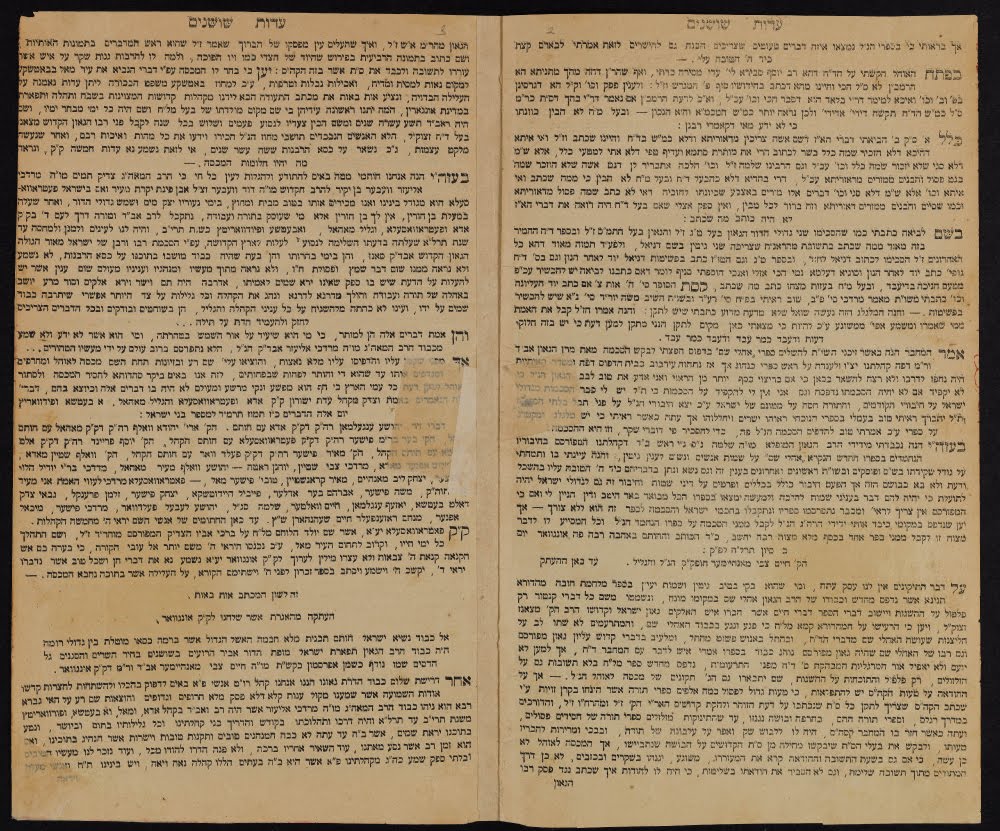
Three New Books

Three New Books

By Eliezer Brodt

In this post I would like to briefly describe three new works, which are hot off the press. For a short time, copies of these three works can be purchased through me for a special price. Part of the proceeds will be going to support the efforts of the Seforim Blog. Contact me at Eliezerbrodt@gmail.com for more information.

The first title is printed by the World Congress of Jewish Studies:

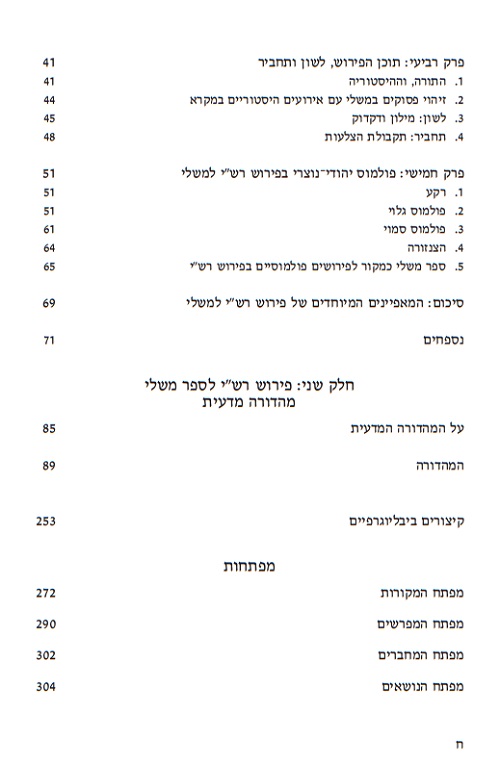
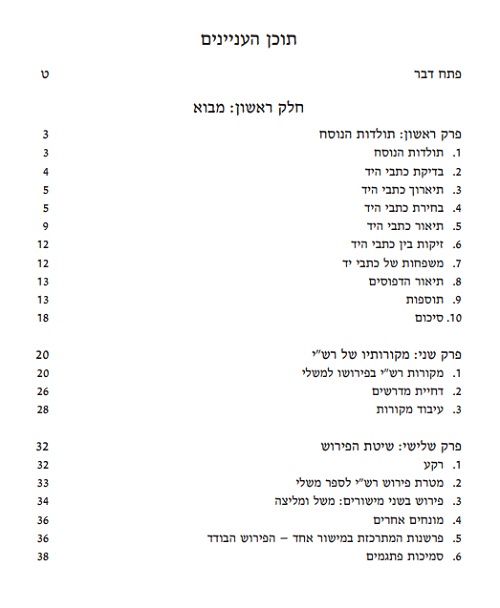
פירוש רש”י לספר משלי, ההדירה והוסיפה מבוא והערות ליסה פרדמן

Lisa Fredman’s, Rashi’s Commentary on the Book of Proverbs is a critical edition of Rashi on Mishlei based on numerous manuscripts. It includes a very extensive introduction and many valuable notes throughout the volume. Critical editions of Rashi are always welcome and very important, sadly not enough of them exist. One section in the introduction which I found interesting relates to Rashi and his responding to Christians and Christianity specifically in his work on Mishlei.

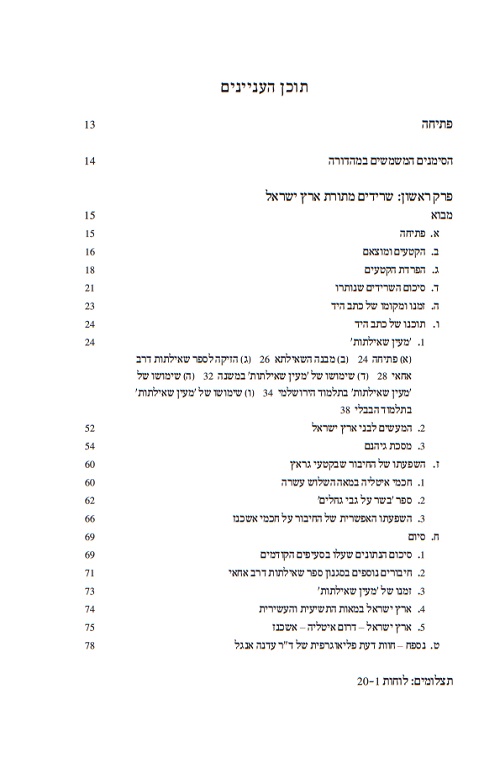
Here is the table of contents for this work:
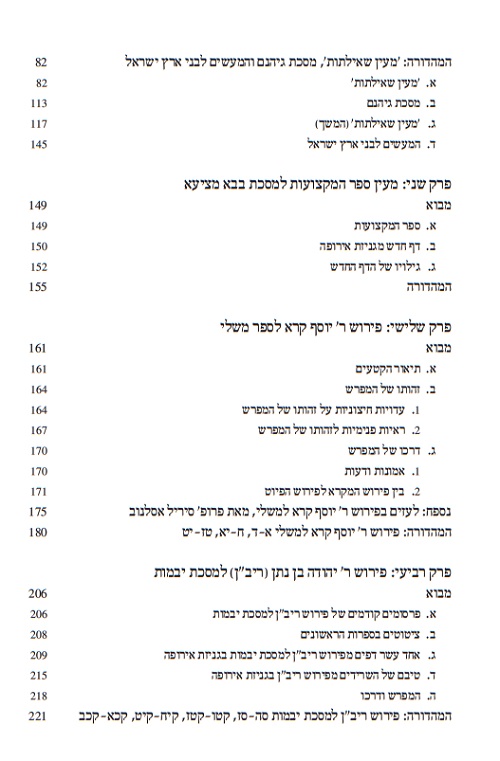
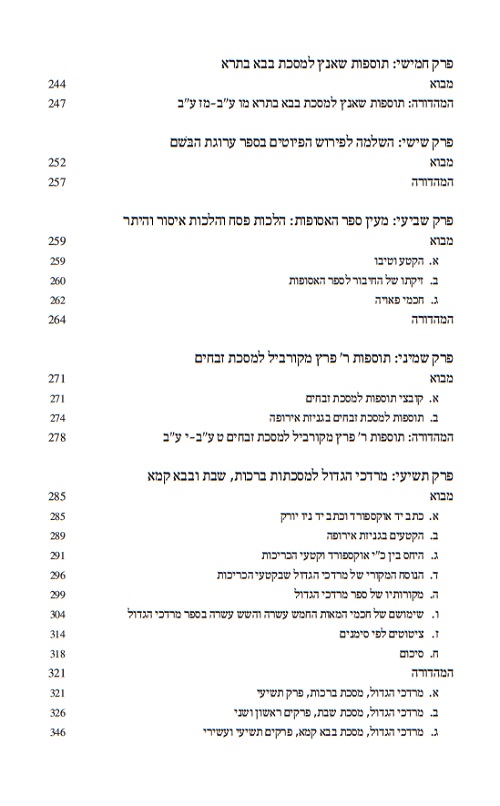
מגנזי אירופה כרך שני  ההדיר והוסיף מבואות, שמחה עמנואל, 408 עמודים

The Second volume which I am very happy to announce is the publication of an important work which I have been eagerly waiting for, Professor Simcha Emanuel of the Hebrew University’s Talmud department’s volume of texts from the “European Genizah”, volume two. This volume was just printed by Mekitzei Nirdamim and is being sold by Magnes Press. [Volume one was mentioned earlier on the blog here]. For a sample chapter e mail me at Eliezerbrodt@gmail.com.
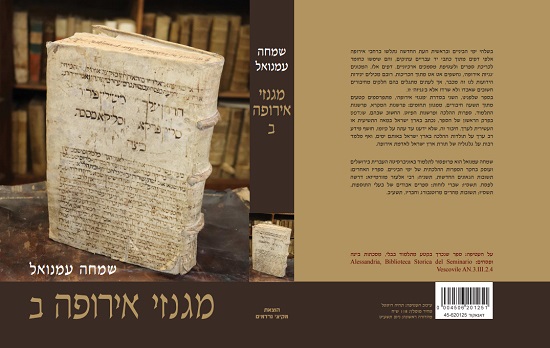
Professor Emanuel is considered one of the today’s greatest experts in Rishonic literature. He has produced numerous special works [such as this recent work, this, this and my favorite] and articles of both texts and material about them for quite some time. [Many of which are available here] All of which are of very high quality, showing an incredible breadth and depth in the material at hand. One area of specialty of his is finding long-lost works; this new volume continues this trend. It includes numerous newly discovered texts of Rishonim, with introductions and background of their importance and proof of identification. Some of the discoveries are simply put remarkable detective work, how he pieces together the various pieces of the puzzle.

The author writes in the abstract of the book as follows:

            The purpose of this volume, like its predecessor, is to uncover fragments of important Hebrew works hidden in the “European Genizah”. Thousands of pages of Hebrew manuscripts have been discovered in this “Genizah”, which is scattered in hundreds of libraries and archives throughout Europe and even beyond. In the late medieval and early modern eras, these pages were used to bind books and as folders of archival documents. In the first volume of this series, I published eleven new works from the “European Genizah”, prefacing them with a wide-ranging introduction about the nature of this “Genizah”. Nine additional works are published in the present volume.

            The works published herein are from a variety of genres: Biblical exegesis, Talmud commentary, halakhic literature, and liturgical interpretation. They appear in this volume in chronological order, from earliest to latest. The most significant of the works is also the work whose discovery required more effort than all of the others; it appears in the first chapter of the book. This work was written — I wish to argue — in ninth or tenth-century Palestine. It reveals valuable information on the history of halakhah in Palestine of that era, and also teaches a great deal about how Palestinian Traditions made their way to the European continent. This work still requires a great deal of study, and I hope that others come along to add to my words.   The fragments published here were identified in the collections of fourteen archives and libraries. These institutions, located throughout Europe, aptly reflect the dispersal of the European Geniza.

Here are the Table of Contents of this special work:


The third work is also printed by the World Congress of Jewish Studies.

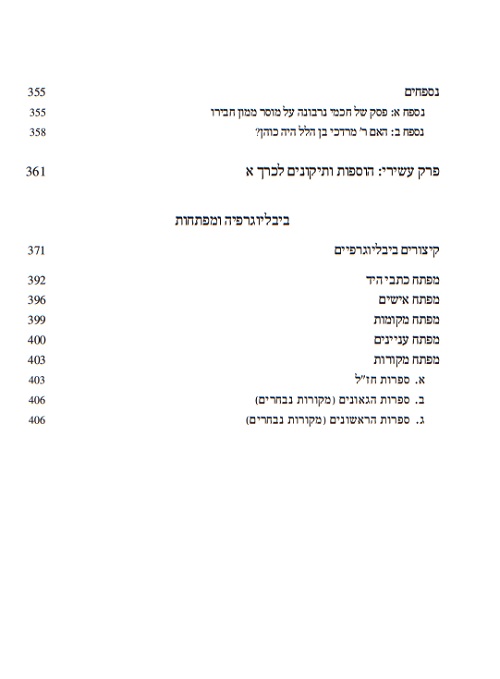
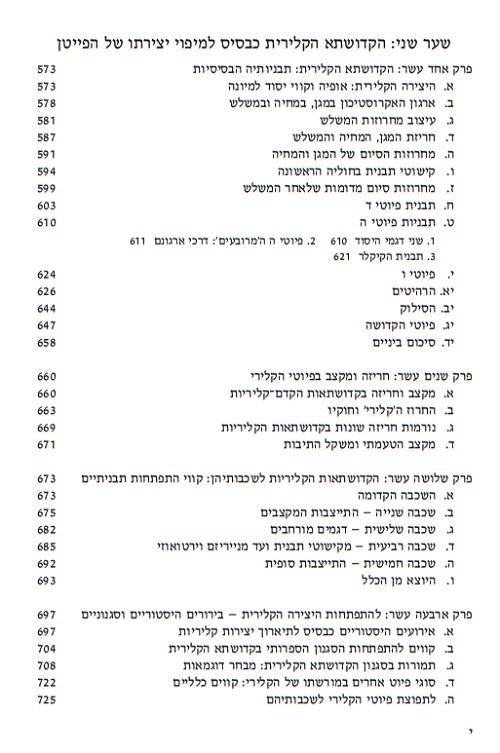
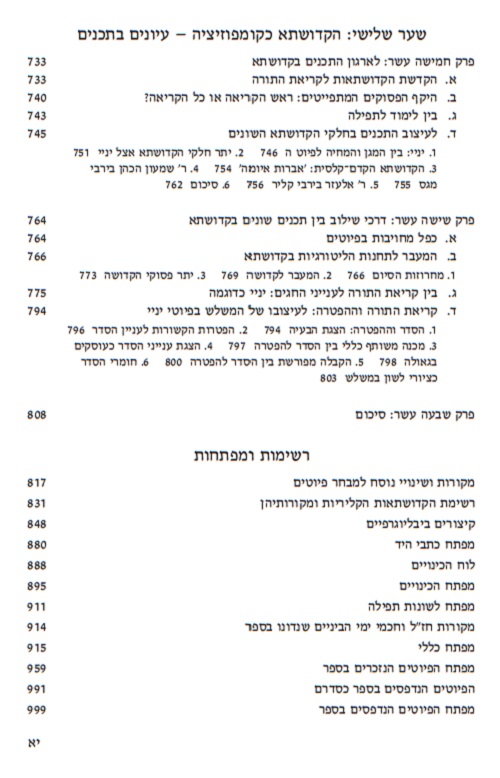
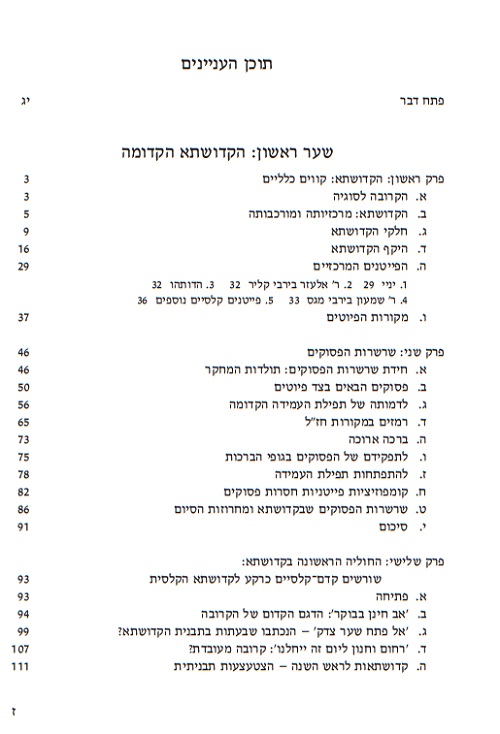
שולמית אליצור, סוד משלשי קודש: הקדושתא מראשיתה ועד ימי רבי אלעזר בירבי קליר

This work Sod Meshalleshei Qodesh is written by Professor Shulamit Elizur (see here), one of the worlds leading experts on piyut. Some have claimed this work will change the study of piyut completely. In an interview published in Ami Magazine and reprinted with updates on the Seforim Blog (here) Elizur was asked:

Which sefer do you consider your biggest accomplishment— your magnum opus?”

She replied:

“The one I’m in the middle of writing right now. It’s a sefer on the history of the kedushta, which are the piyutim composed to be recited right before Kedushah. There are many chiddushim in that sefer and also things about Rabbi Elazar Hakalir that I discovered.”

This book is now out and is over one thousand pages!.

The following is the abstract of the book translated into English for the readers of the Seforim Blog by Dr. Gabriel Wasserman (and is not found in the actual book). This will give one a good idea of what the purpose of this work is:

Sod Meshalleshei Qodesh: The Qedushta From its Origins until the Time of Rabbi El‛azar berabbi Qillir

 A qedushta is a series of piyyutim for the ‘Amida prayer, which is expanded in honor of the recitation of the Qedusha, and includes many complex components. Its origins are in the Land of Israel, in the fourth or fifth century. We first see it as a constructed composition with set, complex, rules in the work of the poet Yannai, who lived in the mid-sixth century, the teacher of Rabbi El‛azar berabbi Qillir (who is known popularly as “the Qallir”). The qedushta, as it appears in the hundreds of compositions by Yannai and his followers, conceals many secrets: mysterious strings of biblical verses accompany its first components; a fixed biblical verse concludes the third component, followed by the strange words “El Na”; then comes a fourth component, whose structure is free, and always concludes, for some reason, with the word “Qadosh”; the fifth component in Yannai’s compositions is the ‘asiriya, a poem constructed of a truncated alphabetical acrostic from only aleph to yud, followed by a prayer beginning “El Na Le‘olam Tu‘aratz” – and it is unclear why this prayer appears here; then there is a group of poems called rahitim, which are written, for some reason, in unique, stereotypical structures. These are only a fraction of the various strange features of the qedushta’ot of Yannai and the other poets. The discussions in the book are dedicated to suggesting solutions to all these questions, and to others, and involve uncovering fragments of qedushta’ot that preceded Yannai; by examining these texts, they excavate the literary remains to construct a model of the gradual development of the qedushta over time, from its origins until it reached its complex structure in the days of Yannai and Rabbi El‛azar berabbi Qillir.

The first section of the book, which is the largest, is devoted to this development of the qedushta, in all its elements, including those that follow the recitation of Qedusha. Naturally, this section deals with the piyyutim mostly from a structural point of view, for only such an analysis can enable a comprehensive look at the development of the genre. However, as a base for these structural analyses, this section contains the texts of many piyyutim, mostly pre-classical (from the period before Yannai, when the poets did not yet use rhyme). Alongside them are printed classical rhyming piyyutim, too, from the period of Yannai and his colleagues, and, in a few instances, even piyyutim from later periods.

The second section of the book focuses on one single poet: Rabbi El‛azar berabbi Qillir, the most prolific of the classical poets in the Land of Israel, whose poems reached Europe, and some of them are recited in Ashkenazic and Italian synagogues through today. The qedushta’ot of Rabbi El‛azar berabbi Qillir are varied in both their structures and their styles, much more than those of Yannai; this section is devoted to an analysis of these compositions, and an attempt to map out which ones are earlier and which later. On the basis of precise structural analysis, the section builds a higher level of analysis – stylistic; and thus we see the picture of the great poet’s literary journey. It becomes clear that when he was started out, he was heavily influenced by the work of Yannai, and slowly he created new ways for himself: at first he went in the direction of obscurity and difficulty, which he gradually made more and more obscure; but then, in a later, more mature phase, he turned to pure lyrical song, which today’s reader, too, will find sweet.

The third section leaves aside the structural analyses, and suggests directions for further research. This section is short, and contains only first steps towards new directions in piyyut analysis. It focuses primarily on content, and ways that the qedushta’ot are organized, but it moves on to questions of how the qedushta is constructed as a complete composition, and points out various difficulties that the poets needed to overcome, and analyzes at length their literary solutions to these problems. Yannai stands at the center of the discussion in this section, but there are also notes about other poets. Most of the suggested directions for further research are new, and we hope that they will lead to further productive scholarship, and make it possible to study the piyyutim from angles that have hitherto been less examined.

Throughout the book, phenomena are demonstrated by means of the texts of piyyutim. More than 250 piyyutim are printed in the book, of which about 130 are being printed for the first time. Most of these piyyutim are from the earlier periods of piyyut, and their publication in this volume reveals the full contribution of these layers of the genre to our understanding of the history of the qedushta. Even the piyyutim that have already been printed elsewhere often were published in out-of-the-way publications, some of them with no vowels or commentary. It goes without saying that for this volume, these texts were all printed anew straight from the manuscripts. When pieces from Yannai’s work are cited to exemplify some point, an attempt has been made, inasmuch as possible, to use pieces that have not been included in the existing publications of his work, and thus the volume contributes a great amount of new material to the corpus of Yannai’s piyyutim. The volume as a whole is based on examination of hundreds of manuscripts, mostly from the Cairo Geniza, and these provide a wide, firm textual basis to the analysis.

The book is intended first and foremost for scholars, but it will also enable people interested in piyyut and its history from outside the world of academia to gain exposure to a great corpus of early piyyutim, among which are several stunningly beautiful gems, which are being published here for the first time.

For the Hebrew abstract email me at eliezerbrodt@gmail.com

Here is the table of contents:


The Valmadonna Broadside Collection: a Review Essay

The Valmadonna Broadside Collection: Review essay
By Eliezer Brodt and Dan Rabinowitz

The Writing on the Wall: A catalogue of Judaica Broadsides from the Valmadonna Trust Library, edited by Sharon Liberman Mintz, Shaul Seidler-Feller and David Wachtel, London-New York: 2015, 320 pp.

Jews have been collecting books or manuscripts for centuries. A related category that is collected by fewer is ephemera, including broadsides, documents and letters of historical significance. Of late, a few annual auctions have included some of these documents among the other objects to be auctioned. Sadly, after their appearance in the auctions’ catalogs, most of the rare items disappear in to private collections and are invariably almost impossible to track down post-auction. The result is that a valuable amount of historical information is lost to the public. Moreover, to date, there is no database that tracks or records these items.[1]
First, a definition of the type of material – broadsides; they “are all around us whether we recognize them as such or not. Walking down the street… entering the lobby of a public building… we daily even hourly see flyers for event, advertising posters, public announcements and more.” Using “the most expansive conception we can say that the broadside has been with us since antiquity… The public display of information… has been ubiquitous for a very long time.” (p. 6).
In an important and excellent essay on Jewish bibliography written in 1976,[2] Professor Israel Ta-Shema remarks that because broadsides were intended and read by “thousands and potentially hundreds of thousands” they are among the “important sources for both Jewish history and the history of Hebrew printing.”

ענין לעצמו שלא זכה למיטב ידיעתי לשום טיפול עד עצם היום הזה, הוא רישומם הביבליוגרפי של ‘הדפים הבודדים’. לפי הערכות שקולות מגיע מספרם של אלה לאלפים רבים, ואולי עד כדי רבבה, וחשיבותן הן לידיעת תולדות ישראל והן לידיעת קורות הדפוס העברי גדולה ביותר. בדרך כלל קשורים דפים אלה במריבות בין חשובי הקהל ורבניהם, סכסוכי משפחות, בנים נודדים, פולמסים דתיים וכו’. דפים אלה שנתלו או הודבקו על קירות בתי הגיטו או בבתי הכנסת וכד’ אבדו ברובם המכריע, וכל מה שנשתמר מהם הוא בגדר יוצא מן הכלל. ערך ביוחד יש לסוג ספרותי זה ביחס לפולמוסים הפנים-חסידיים והמתגנגדיים. לסוג זה יש לצרף את המודעות והכרזות עד לתקופתנו אנו, כולל כרוזי המחתרות האנטי היטלריסיות בחו”ל והאנטי מנדטריות בארץ ישראל, כרוזי נטורי קרתא וכד’, שהם רבים מאוד. מלבדם נדפסו על דפים בודדים, קמיעות וסגולות, לוחות קיר, דברי פרסומת, הסכמות נפרדות ועוד, ויש ביניהם גם מעשיות עממיות קצרות על דף אחד. [מצוי ורצוי בביבליוגרפיה העברית, יד לקורא טו (תשל”ו), עמ’ 79-7 ].        

History is not the only subject to benefit from broadsides.  The prolific author, R. Eliyahu David Teomim (Aderet), published and annotated a broadside recording the customs of the Great Synagogue of the Austria, whose Rabbis had included R. Shmuel Edels (Maharsha).[3]  
Recently some of collectors of broadsides have begun printing and reproducing these priceless treasures.[4] The Valmadonna Trust Library (see here), still one of the most significant private Hebraica libraries (for an appreciation of the Valmadonna Library, penned by its librarian and published at the Seforim blog in 2009, see here), published a catalog of the broadsides in its collection, The Writing on the Wall: A catalogue of Judaica Broadsides from the Valmadonna Trust Library, edited by Sharon Liberman Mintz, Shaul Seidler-Feller and David Wachtel (see here). In conjunction with the publication of the catalog, the Trust also made available online (here) all of the documents in its collection for further study. The collection is comprised of broadsides from the sixteenth to twentieth centuries and incorporates items from Italy (the library generally focused on Italy and Italian items and broadsides are no exception, with Italian broadsides being the largest of the collection), and elsewhere in Europe, Israel, Yemen, Iraq, Constantinople, India, and even one from America.
The book consists of a few parts. It begins with five scholarly essays on specific subjects by various experts. Following are excellent full-page reproductions of thirty-six highlights from the collection, including a description explaining the significance of the specific document. A full catalog of the collection is included and is divided into six main categories; each category is chronologically ordered. The six categories are: Poems, Prayers, Documents from Within the Jewish Community, Documents from Outside the Jewish Community, Calendars and Education. Each entry includes a description of the item, the title, author place and date of printing, printer, size and language. Some entries include additional bibliographical sources; others provide a small image of the item. Additionally, the non-English broadsides included in the highlight section are translated. The volume concludes with various other useful indexes.
The first introductory essay is an excellent overview of Jewish broadsides by Adam Shear. Shear asks and answers the basic questions that come to mind, such as: “What was the purpose?”, “Who was the audience?”, “Where were they displayed?” and the like, none of which can be answered singularly.  
The second essay is by Elisheva Carlebach and focuses on the Jewish wall calendars in the collection.[5] She explores what can be learned from tracing the cultural history of one of the printers of these calendars through various calendars he printed. Some of these calendars were very sophisticated and it’s unclear who the targeted audience was. Emphasizing calendar broadsides’ unique value, she concludes that “the most ephemeral of forms, broadside calendars preserve a glimpse of the printshop as workspace, the spirit of entrepreneurship and the enduring values of the creators of these humble yet precious objects” (p. 30).
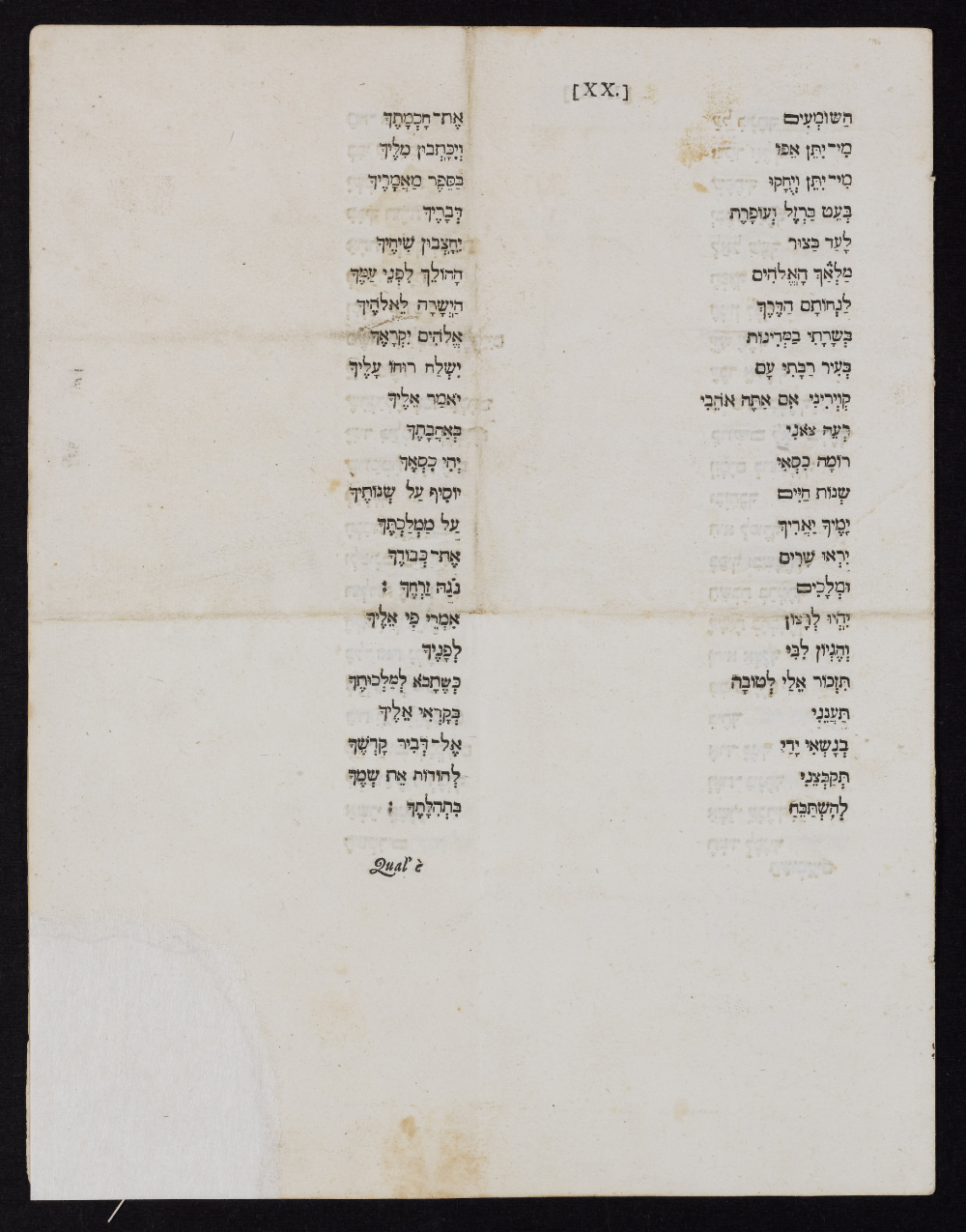
The third essay is written by Ruth Langer and focuses on the Liturgical Broadsides of the collection.  Some are prayers for current events, one of interest (printed on p.33) is for a memorial service for a building that collapsed in Mantua in 1776 where three weddings were taking place simultaneously.[6] Also discussed are the prayers for various civic events (p. 35) and for the various governing powers, a subject which still needs to be explored in depth. Some of these broadsides were clearly displayed in shuls; one includes the language of the prayers, defusing the power of bad dreams and request for substance, that are recited along with Birchat Cohanim (p.15), others include prayer that are recited during Selichot (p.14). One broadside, printed in Izmir in 1890, contains the Vidduy of Yom Kippur, printed with each entry of the Aleph Beis featuring other sins under that letter, very similar to the sheets given out in various shuls today (p.44). Not all were intended for the public display, the following broadside from Venice 1607 (Item # 153) appears to have been hanging in the house, for the owners’ personal use.
The next essay, by Dvora Bregman, focuses on the Hebrew poems in the collection (mostly from Italy). This section also highlights various pieces of historical interest. Reading through it, one is amazed how poems were written for literally every occasion – completion of Mishna, Venice, 1630 (p.55), receiving a medical degree (p.51, there are sixteen examples in the collection), in honor of R. Israel Chazan’s[7] visit to the old Greek synagogue in Corfu in 1853 (item # 134) (see below). Some of the poems were written after the deaths of prominent people such as an Italian elegy for R’ Moshe Zacuto which is reproduced in full and translated from Italian to English. Other elegies include one for R’ Yehudah Aryeh Modena (see below) and for R’ Mordechai Gerondi, the latter written by his friend Shadal (see below). There are also many “wedding riddles” in the collection – providing evidence of another rich and diverse aspect of Jewish life in Italy. 

The next section, originally written in Hebrew by Nachum Rakover and translated into English for this volume by Shaul Seidler-Feller, focuses on the Takanot broadsides found in this collection. Sumptuary edicts, limiting the size of a celebratory affair and the amount of people invited, the amount of food to be served, or the amount of money to be spent on various sorts of occasions were commonplace from the medieval until the modern period.  For example, we note that the Nodeh Beyhehudah and his beis din in Prague issued a list of such Takonot.[8] Rakover is in middle of preparing for publication a thorough study on the subject. In the volume under review, his article deals with the seventeen Italian broadsides related to sumptuary laws in the Valmadonna Collection from 1598-1794. The article is impressive in its sweeping review of the topic and the placement of these items within the larger narrative. What is apparent from the examples in the collection is that sumptuary laws have been persistent. Indeed, recently the cudgel has been taken up anew and a new round of such edicts by numerous rabbis and Hasidic leaders to limit spending has been promulgated. 
                                                  
Exploring the Collection
The introductory essays are only the beginning in what can be uncovered in a collection as rich as this one.  By providing online access, the Trust has insured that can occur.  To begin that exploration, we discuss a few choice examples.
As was recently the case with American Pharaoh, Jewish have been involved in sport, and specifically horse racing.  The collection includes two Italian broadsides discussing the horses and the Jewish sponsorship of a horse race. (Nos. 311 & 328).
One surprising and lengthy – some ninety lines – ode was composed in Hebrew (ca. 1740) and is a “poem of praise and supplication addressed to Angelo Maria Quirini (1680-1755), an Italian Cardinal.”  This item is “a single bi[-]folio excised from a larger work, most likely a pamphlet,” and is “not a true broadside.” (No. 130). No additional information is provided on this intriguing item.[9]

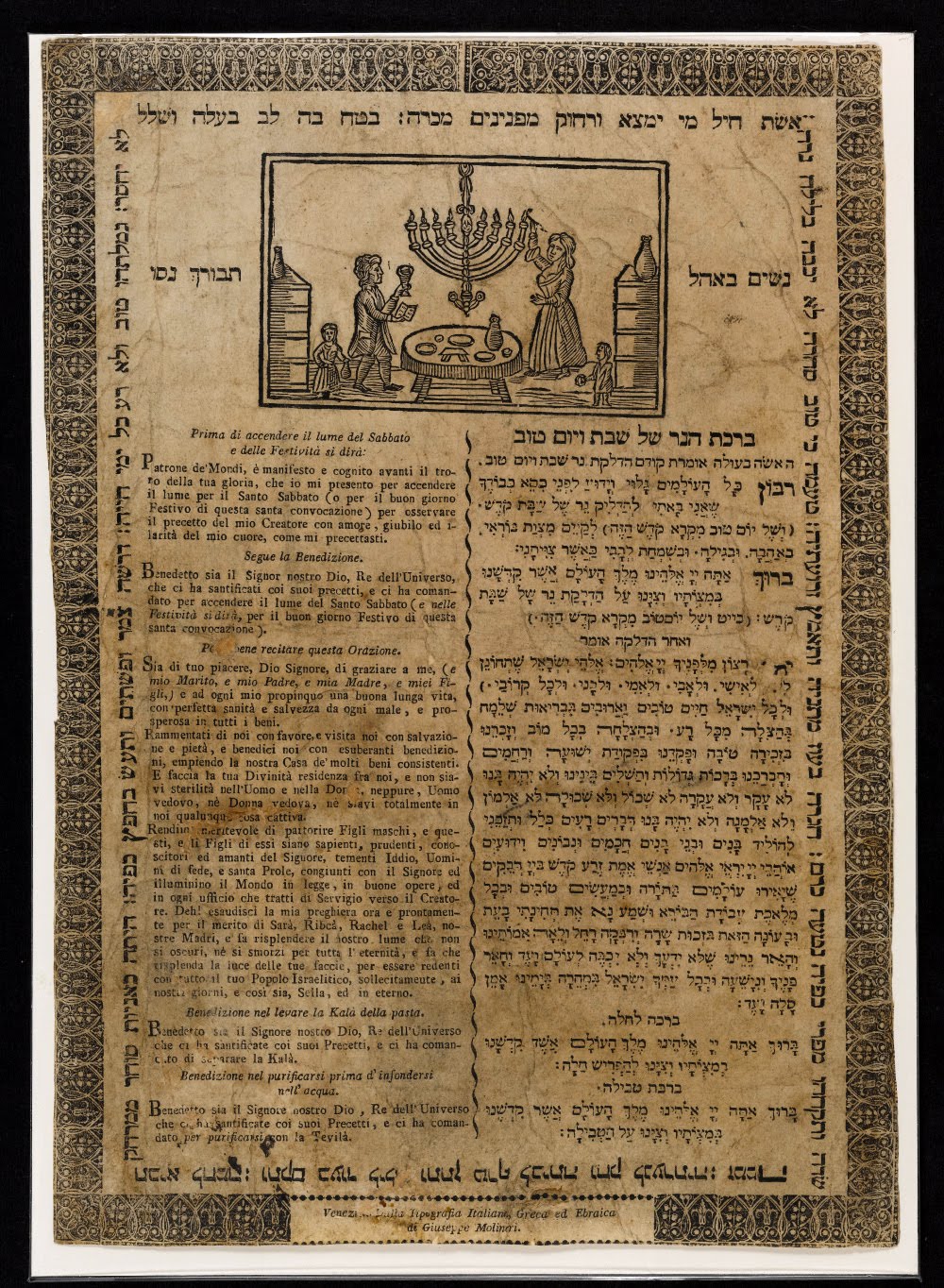
Friday Night Candle Lighting Prayers

The following broadside from Venice 1835, (reproduced on p. 17), contains the text of the prayers that were customarily recited by women on Friday evening during the candle lighting ceremony.

The illustration depicts a woman lighting eight candles. The Rishonim, including Italian sources, Shibolei Haleket (Siman 59) and Sefer Hatadir (p.196), only require and discuss two candles for Shabbos.[10] The question is when exactly did people start lighting more? The exact time when this began is unknown. However, in the “Shulchan Aruch” from R’ Yehudah Aryeh Modenah (1571-1648) he describes the Italian custom of lighting multiple candles:
והנשים חייבות להדליק בבית נר של שמן ובתוכו לכל הפחות ארבע או שש פתילית להאיר בערב עד עבור חלק גדול מהלילה [עמ’ 54].
Some continued to advance the numbers and in the 19th century, one author records the custom of lighting 31, 45, and 52 candles weekly.
מה מאוד היה מכבד שבת ויום טוב והיה מנהגו להדליק בכל שבת ל”א נרות כמנין אל כי בו שבת אל מכל מלאכתו, ובסוף ימיו מ”ה נרות, ולפני מותו היה מצווה להדליק בשנה ראשונה בחדר שהיה לומד בו נ”ב נרות כל שבת [מה שהעידו על ר’ הירץ אברהם נפתלי שייאר בהקדמת נכד המחבר לפירושו תורי זהב, (על שיר השירים), ירושלים תשס”ג, עמ’ טז].
Corporal Punishment
The following broadside poster for the instruction of children is from Italy 1846 (125):[11]


One striking part of the image is of the teacher hitting children in school. This sort of practice is recorded in a number of Jewish texts.[12]  For example:

A 17th century autobiography recounts that “the new teacher was of an irritable temper… he hit me and put me to shame…”. [Alexander Marx, Studies in Jewish History and Booklore, New York 1944, p. 193].

R’ Yaakov Emden writes in his autobiography:
בשנות הילדות… אזכיר איזה גרגרים, שלשה דברים נוראים שקרו לי בימי ילדותי הרכות. … ומלבד המכות אשר הוכיתי בית מאהבי המלמדים אשר נמסרתי בידיהם ללימוד, היו על פי רוב אכזרים, היכוני בלי חמלה… [מגלת ספר, עמ’ 84].
Saul Berlin writes in his satirical work:
ומתועלת ההכאה עוד, כי הוא צד היתר למלמדים לקבל שכר, כי על הלמוד לבד אסור לקבל שכר, משום קרדום לחתו בו, ואם כן כל מלמד המרבה להכות הרי זה משובח… ועוד רבה התועלת ע”י ההכאה אשר הילדים מכים ולוקים בבית הספר, כי ליראתם את המכות קרבת מוריהם יחפצו וירבו עליהם מוהר ומתן למען חנות אותם, ובהגיע חודש ומועד יפצירו הילדים באבותם לתת להם משאת רב, להביא אל רבם לתתם לו כופר נפשם…”. [כתב יושר, [בתוך: יהודה פרידלנדר, פרקים בסאטירה העברית בשלהי מאה הי”ח בגרמניה, תל אביב תש”ם], עמ’  98].
R’ Yosef Kara writes:
שבהיותי בצוותא חדא אם כבוד ידידי הגאון הצדיק מו”ה שמעון סופר אב”ד דק”ק קראקא… והוא אמר ז”ל כי זה רע חולי שאין חפץ לגדולי לומדי תורה להיות מקרי דרדקי, כי הוא חרפה להם ע”כ מוכרחים אבות הבנים ליתן בניהם הקטנים אל איש אשר לא ידע ספר קרוא מקרא ודקדוק אך ידע להכות הבנים ולזעוק בקול גדול… [קול אמר קרא, פ’ פנחס, עמ’ 20].
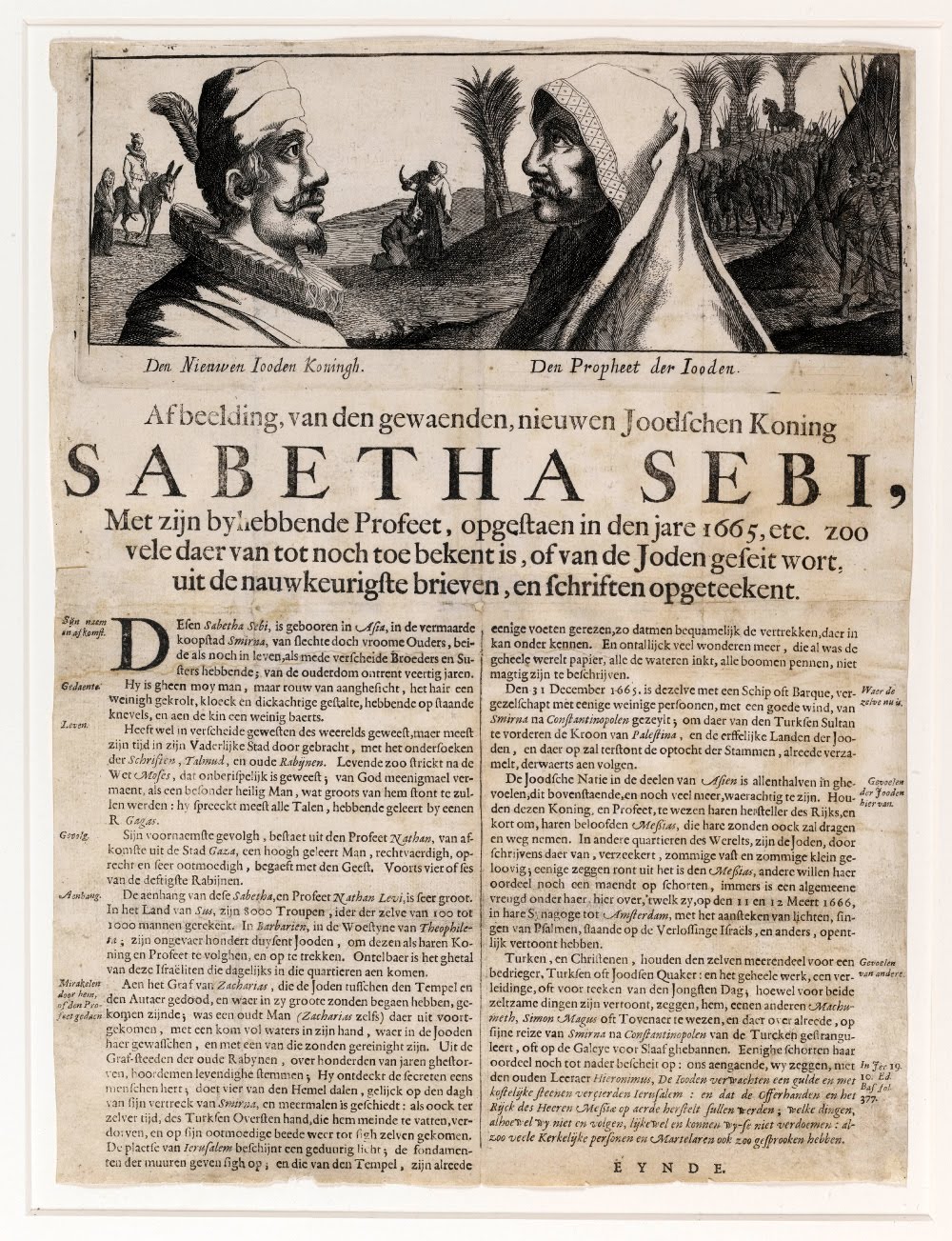
This broadside from Amsterdam 1666 is a little more famous, as it’s a supposed depiction of Shabbetai Tzvi. A complete translation for the Dutch is provided in at the appendix (pp.264-65).

Gershom Scholem writes that this portrait of Tzvi is fictitious – one of a number of imaginary portraits. (Sabbatai Sevi, pp. 190-191, 158). The only picture of Shabbetai Tzvi believed to be authentic (that is, drawn by a witness) is the one found in the beginning of Thomas Coenen’s book Ydele Verwachtinge der Joden, Amsterdam 1669.[13] There might be others as well, but King Jan Casimir ordered all pictures of him to be destroyed (id., p. 597). This one, fortunately, was published.

(This is from Scholem’s personal copy.)

Kabbalistic Tefilos for Rosh Hashanah


This broadside from Mantua 1790, reproduced in the book (p.43), is of interest for several reasons. First, the top part of the broadside has the twenty fourth chapter of Tehilim, said by many Kehilot on Rosh Hashanah as a segulah for Parnasa.[14] In a work written around 1700, recently printed from manuscript, we find the author writes:

אחר ערבית, יש לי תוכחת מגולה ומסותרת אם קצת משכילים, שהנהיגו לקרות בבית הכנסת בציבור אחר עלינו לשבח בלילי ר”ה, מזמור לה’ הארץ ומלואה, ולכוין הנקוד של השם, ככתוב בספר שערי ציון, שהוא מסוגל לפרנסה, שלא יפה הם עושים, כי לא כן צוה הרב המגיד לנו סוד זה, והצנועים נהגו לאמרו בשני הלילות שתי פעמים בכל לילה תכופים זה לזה… והקריאה על שולחנו קודם ברכת מזון… דבר הלמד מענינו, בהצנע לכת עם אלקיך. על כן אמרתי ימים ידברו, להויע ידידי הקורא שדבר בדוק ומנוסה שכל סגולה הנעשית על ידי תפלה בשום כוונה או שם, שאין לך לפרסמו ברבים. ולא לגלותו כי אם לתלמיד הגון ירא חטא ובלחישה, לבל היה מוליך רכיל מגלה סוד, שאז תהיה הפעולה חלושה… [ר’ כליפא בן מלכה, כף נקי, [לוד תשע”ד] עמ’ 167].

The second part of this broadside is also of interest, as it has the tefilos said before, during and after the shofar blowing, including some of the Kabblastic tefilos with names of angels. Of note is what is omitted here, those parts said between the various sets of Shofar blowing, which has been the subject of lots of literature[15], as it includes a very strange phrase, that seemingly evokes Jesus: ישוע שר הפנים””.
Here is an article written on this topic by R’ Shmuel Ashkenazi written in 1944 (!) under one of his pen names:

One more point related to this topic is a case of censorship. R’ Chaim Kraus writes:
 הנה בזכר יהוסף… מתיחס לזה שבדפוסים האחרונים בשו”ת תשובה מאהבה הושמט הענין הנ”ל שכתב בחריפות נגד אמירת היהי רצון שמות המלאכים… [מכלכל חיים בחסד, עמ’ סד].
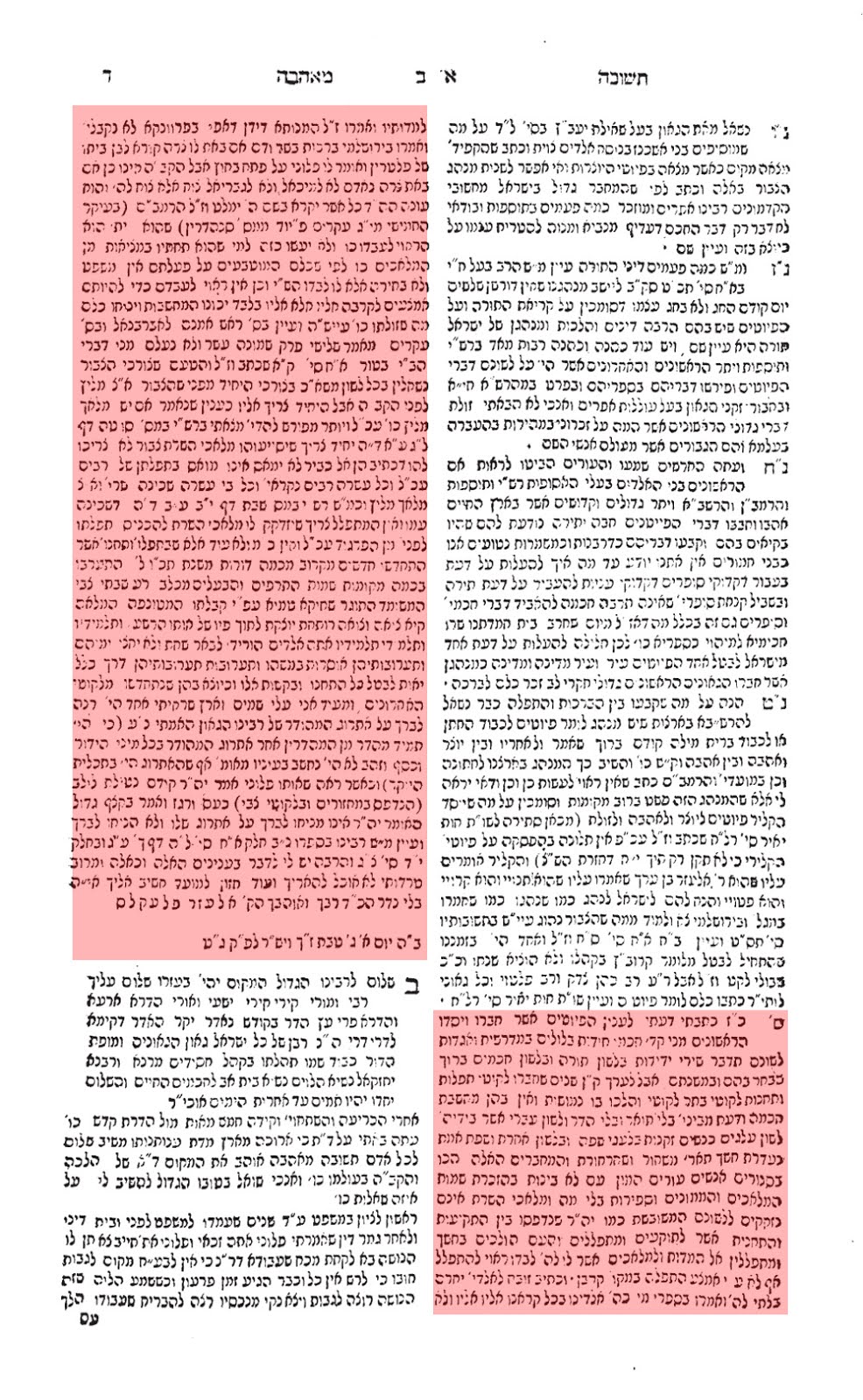
However, upon checking the sources to see when in the printing of the sefer Teshuvah M’Ahavah this censorship took place, one is hard pressed to find it, as it’s simply not there. The actual issue is a bit different; Kraus misunderstood R’ Yosef Zechariah Stern’s teshuvah.
In an extraordinary teshuvah dealing with these prayers (Zecher Yehosef, Siman 210), R’ Yosef Zechariah Stern mentions a certain case of censorship:
ובתשובה מאהבה ח”א סי’ א שהועתקה תשובתו בדבר הפיוטים ברוב המחזורים.. והמדפיסים להפיס דעת ההמון שהורגלו באמירת היהי רצון שבתקיעות השמיטו מה שהזכיר בסוף התשובה אות ס’ שמרעם בהזכרת שמות המלאכים… וכן השמיטו המדפיסים בהעתקתם מהתשובה מאהבה מה שהעיד מהנודע ביהודה שאחד היה רוצה לברך על אתרוג המהודר שלו וכשראה שאומר היהיה רצון… אמר איני מניחו לברך על אתרוג שלי…
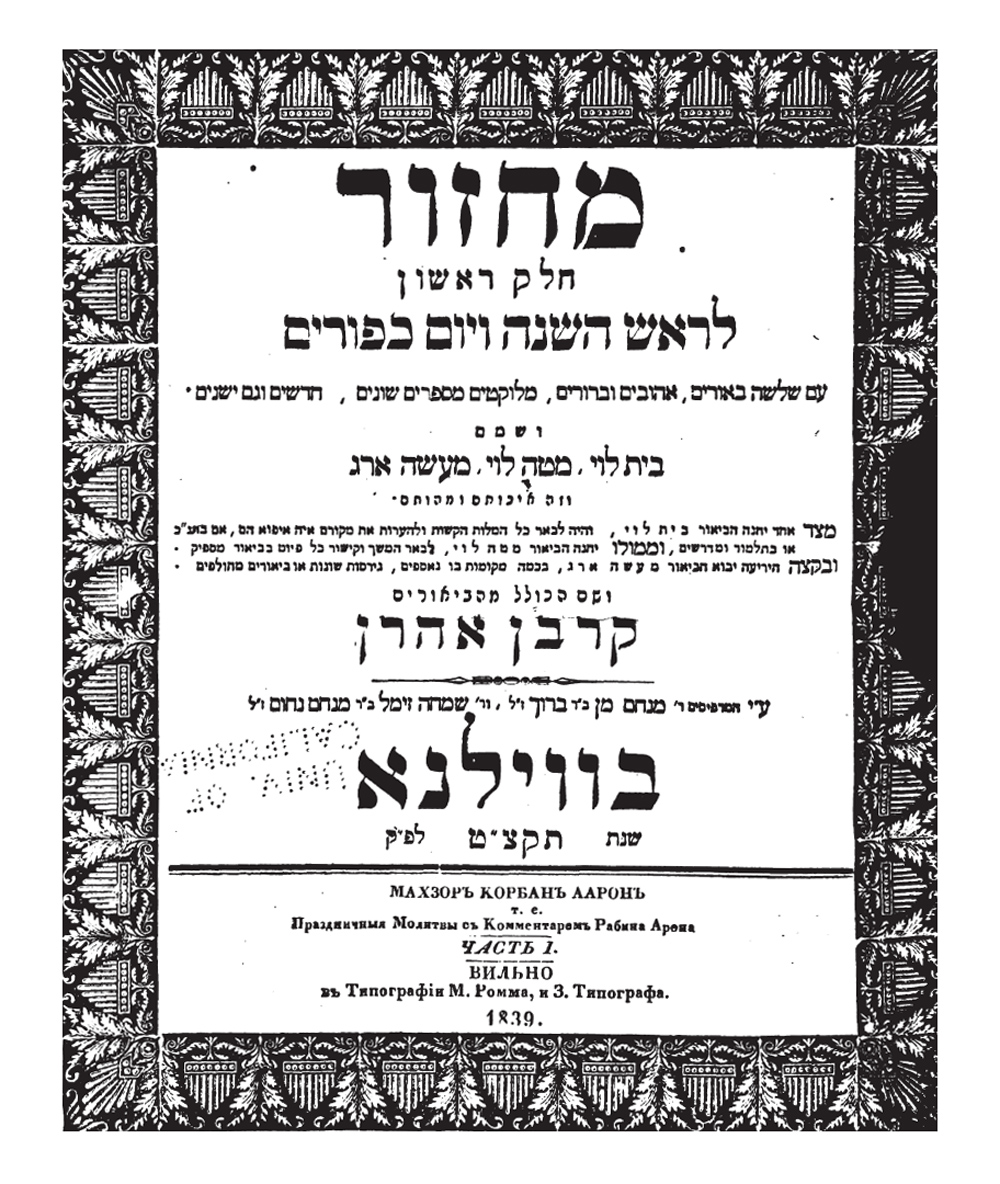
This Teshuvah was printed in various Machzorim at the time and that is where these parts of the teshuva were indeed bowdlerized. See the following images for the pages as they appear in the Korbon Aharon Machazor printed in Vilna in 1839 and compare with the first print of the teshuvah (Prague, 1809).

Amulet Broadsides


This image from Jerusalem 1870 (pp. 130-131) highlights another notable part of this collection – the Amulet section. It contains numerous broadsides against the “evil eye”, aimed at protecting the newborn mother from Lilith and the like (pp. 132-135, 141-143, 194-197). This is yet an additional set of documents which demonstrate how widespread it was for people to use amulets and the fear of the “evil eye” and the like.
There are numerous sources on regarding amulets, some mentioned here.[16] One source, that was only recently published in English, is from a fascinating memoir by Pauline Wengeroff, who writes: “for the same purpose of protecting the newborn, Jews used to affix kabbalistic prayers called shemaus over the head of the new mother, a second page on the door and a third between the cushion of the child.”[17]
Controversy against R’ Shlomo Ganzfried – Author of Kitzur Shulhan Aruch

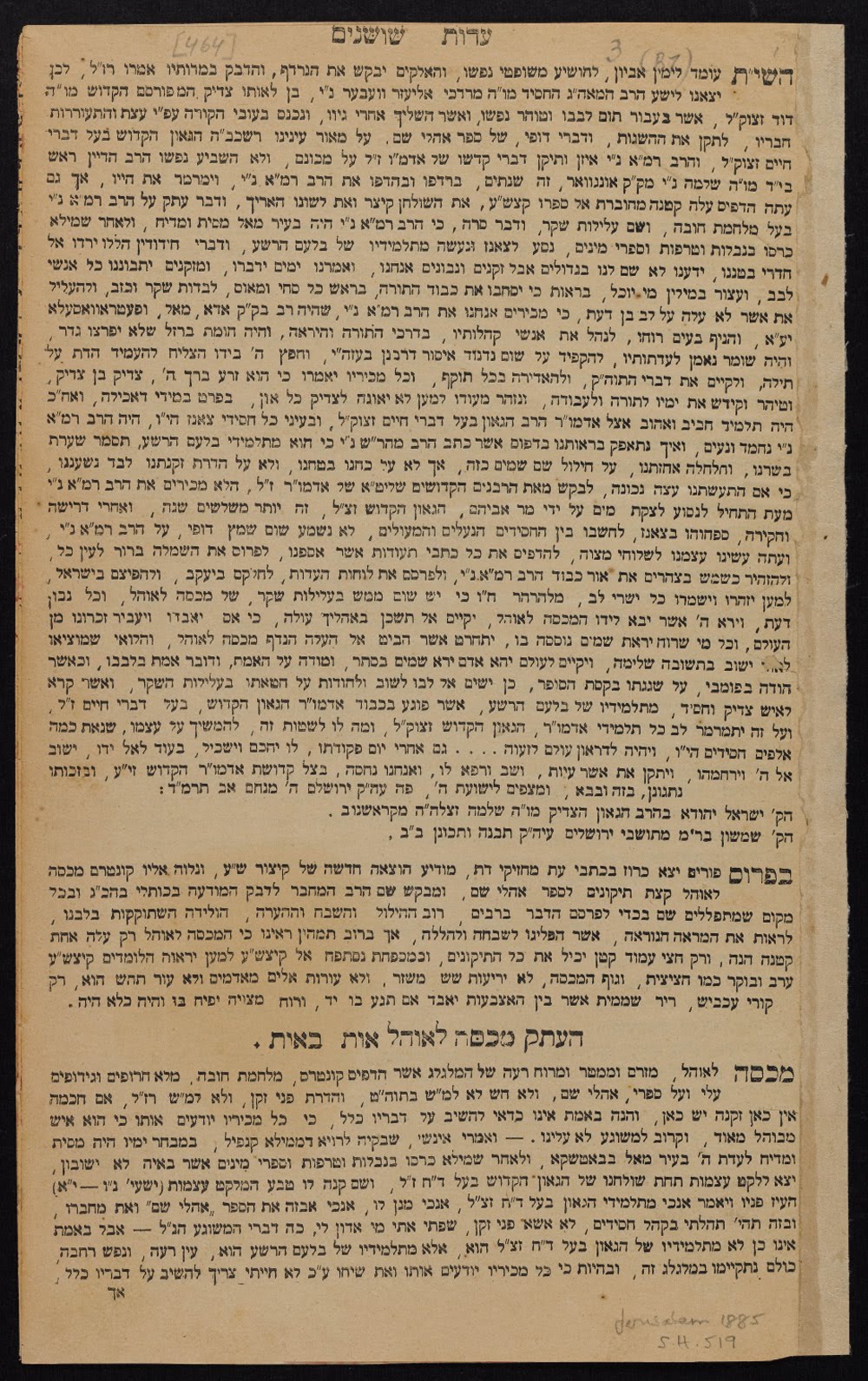
This document relates to a controversy between R’ Shlomo Ganzfried and the R’ Chaim Halberstamm, the Divrei Chaim. In his work Ohali Shem on Gittin, R’ Ganzfried took issue with some legal rulings of the Divrei Chaim. This erupted into a series of small works from R’ Weber, starting in 1882, defending the honor of the Divrei Chaim. R’ Ganzfried responded to one of them in the back of the 1884 edition of his Kitzur Shulchan Aruch.
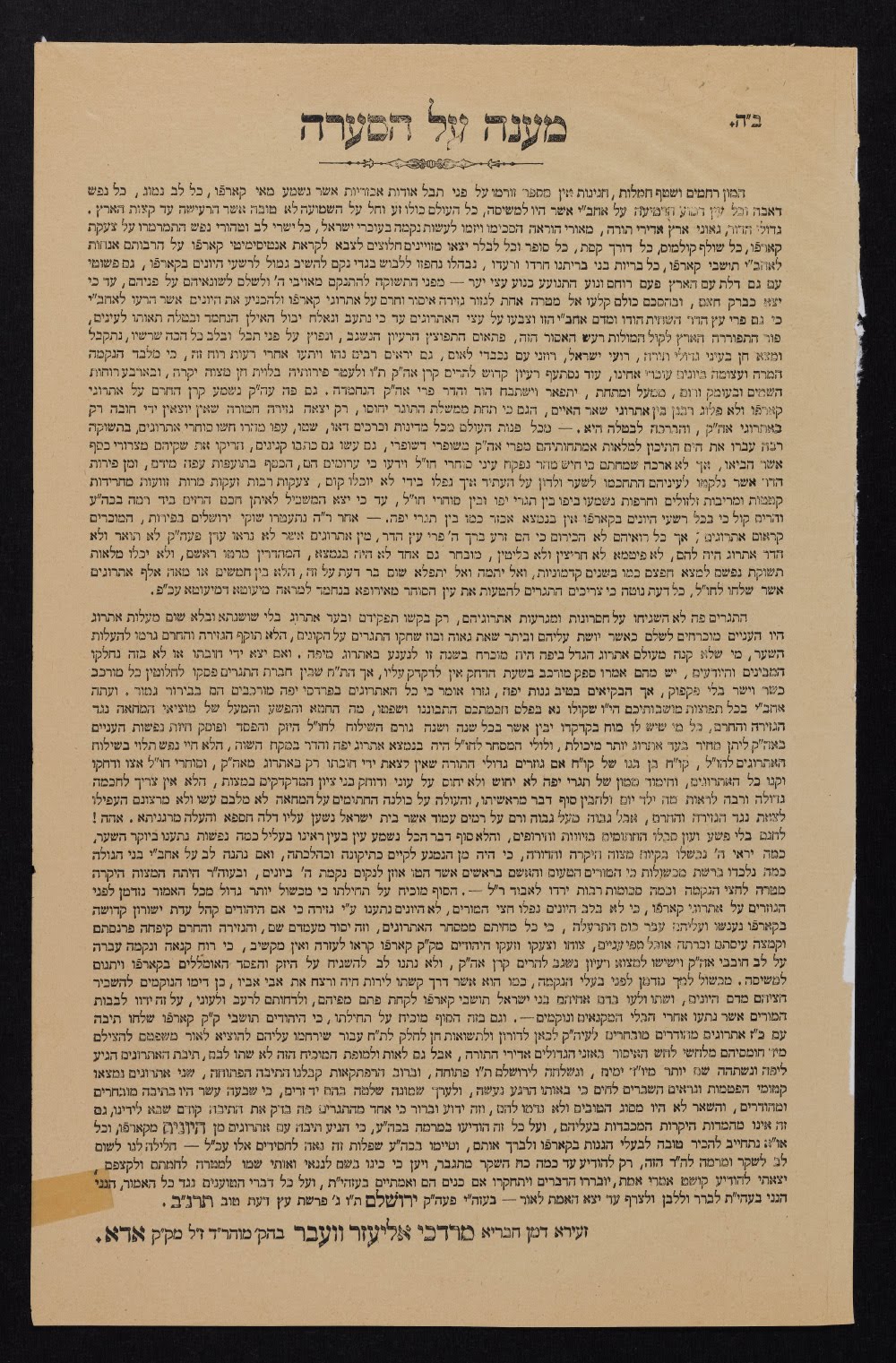
This broadside (above) from R’ Weber against R’ Ganzfried, found in the Valmadonna Collection, is very rare (p. 217 #360).[18] 
The Valmadonna Collection has another rare broadside from R’ Weber (below), related to the famous controversy of the Corfu Esrogim (p. 219 # 369).[19] This is not included in Naftali Ben Menachem’s otherwise comprehensive article regarding R’ Weber.

Regarding this broadside, it’s worth quoting the great historian[20] and native of the Old Yishuv, Eliezer Malachi:
ור’ מרדכי אליעזר וובר, הרב דאדא, זה האחרון היה אש לוהטת, ובקנאותו לא ידע גבול, עד שבשנת תרנ”א אסרו את אתרוגי קורפו לטובת אתרוגי ארץ ישראל, נלחם הוא להתיר אתרוגי קורפו ולאסור את אתרוגי ארץ ישראל שגדלים בפרדסי המושבות של חובבי ציון [מנגד תראה, עמ’ 225].
The volume is beautifully produced, the reproductions are excellent, and is available in a larger format “coffee table” size. This is a great volume, for collectors of books and history. It is available for purchase here and at the YU Seforim sale here.

[1] The Otzar Ha-Hochma database should be commended for including some auction catalogs in its archive, and even some broadsides, which will provide at least fragmentary information regarding the existence of these invaluable documents.
[2] This essay does not appear in Ta-Shema’s four volume collected writing, it is unclear why it was excluded. 
[3]  For more on this see: Eliezer Brodt, Likutei Eliezer, pp. 11-12.
[4] We discuss two broadsides related to the election of the Vilna chief rabbi between R. Hayyim Ozer and R. Y. Rubenstein (here).The Israel Musuem mounted an exhibit of broadside regarding Haredim.  See Pashkevilim, Wall Announcements and Polemic Posters in the Ultra-Orthodox Street, Israel Museum-Yad Ben Tzvi, Jerusalem: 2005 (Hebrew). This volume contains a number of introductory essays, and germane here, Menachem Friedman’s essay “The Pashqevil (Pasquinade) and Public Wall Poster/Bulletin Board Announcements in  Haredi (Ultra-Orthodox) Society” is especially important, although it is not cited in the Valmadonna volume.
[5] See the lengthier treatment of the topic in her book, Elisheva Carlebach, Jewish Calendar and Culture in Early Modern Europe (Cambridge, Mass.: Belknap Press of Harvard University Press, 2011.
[6]  See also p. 210 # 332.
[7]  On this great person, it is well worth quoting Professor Yaakov Sussman’s assessment in a footnote, in a book-length (175 pp) essay – one of the most important ones written in the past decade on the writing of Torah She-Bal Peh – where writes:

מסה מרשימה ביותר בבקיאותו, בחריפותו, בפלפולו בתקיפותו של המחבר לאורך כמאה עמודים גדושים, שבה סיכם כמעט כל מה שנאמר לפניו בנושא… בתשובה זו מתגלה המחבר כחכם בקי, תמים ובעל חושב ביקורתי כאחת, שכל רז לא אניס ליה, לא בספרות הרבני ולא במחקרי זמנו, והוא מצליח לגייס את ידיעתיו להגצת עמדתו… ואין פלא כלל שתשובה מרשימה זו כבשה במהרה את הלבבות והייתה למילה אחרונה בנושא ודעתו נתקבלה כמעט על כל החוקרים [מחקרי תלמוד, ג, עמ’ 235].
[8]  See Mofas Hador, pp. 37-40. See also Yerushaseinu 5 (2011), pp. 265-299; R’ Betzael Landau (here).
[9] We doubt that the composer was Jewish or the text was intended for a Jewish audience. Instead, similar odes – in Hebrew and the subject is Christian – appear in a number of Latin translations of Hebrew texts. See, for example, Coccejus’ Latin translation and abridgement of tractates Sanhedrin and Makkot, includes Hebrew poems in his own honor and that of his teacher. Duo Tituli Thalmudici Sanhedrin et Maccoth, ed. Joanne [Coccejus], Amsterdam, 1629, unpaginated introduction.
Another notable example of clerical citation is Cardinal Egidius de Viterbo who appears in Elijah Levita’s works.  See Solomon Buber, Tolodot Eliyahu ha-Tishby, Leipzig, 1856, nn. 15-18.
[10]  For more sources on this, see: Rabbi Oberlander, Minhag Avosenu Beyadneu, (Shonot), pp. 11-19; R’ Yechiel Goldhaber, Minhaghei Hakehilot, 1, pp. 174-175; Eliezer Brodt, Yerushaseinu 2 (2008), pp. 203-204; Rabbi Y.M. Dubovick, Minucha Sheleimah (2014), pp.26-27.
[11] The full document is translated in the appendix of the book (pp. 288-290).
[12] For additional sources on this subject, see S. Assaf, Mekorot le-Tolodot ha-Chinuch be-Yisrael, s.v. makot.
[13] Coenen’s book is a very important contemporaneous account of the messianic fervor surrounding Tzvi.  The book was translated from Dutch into Hebrew, Tzepiot Shav shel ha-Yehudim Kefi she-Hetgalu be-Demuto shel Shabbati Tzvi, Merkaz Dinur, Jerusalem, 1998. 
[14]  On this see: R’ Yechiel Goldhaber, Minhaghei Hakehilot, 2, pp. 31-33; Eliezer Brodt, Yerushaseinu 2 (2008), p. 211.
[15]  See R’ Yechiel Goldhaber, Minhaghei Hakehilot, 2, pp.61-65, where he traces how far back the custom of saying these Tefilos can be dated. See also Eliezer Brodt, Yerushaseinu 2 (2008), p. 214. The main work on this subject, collecting vast material, is R’ Chaim Kraus, MiChalkel Chaim Bechesed 2, (1982). See also R’ Zev Rabinowitz, Sharei Toras Bavel, p.12; R’ Chaim Lieberman, Ohel Rochel, 1, pp. 511-515; Y. Leibes, Mechkari Yerushalayim Bimachshevet Yisrael 6 (1986), pp. 171-195.
[16]  See also Eliezer Brodt, Likutei Eliezer, pp. 13-22, 69-72; Jewish Magic through the ages: Angels and Demons, edited by Filip Vukosvoviv, Bible land Museum, Jerusalem 2010.
[17]  Pauline Wengeroff, Memoirs of a Grandmother, 2, 2014, p. 89.
[18] On R’ Ganzfried, see R’ Y. Rubinstein, HaMayan 11:3 (1971), pp. 1-13; ibid. 11:4. pp. 61-78. See also Naftoli Ben Menachem, HaMayan 12 :1 (1972) pp. 39-42.  On this controversy, see R’ Rubenstein, ibid. pp. 10-11. On R’ Weber, see Naftoli Ben Menachem, in: Studies in Jewish bibliography, history, and literature in honor of I. Edward Kiev, Charles Berlin (editor), New York 1971, pp. 13-20. On this broadside, see Shoshanna Halevy, Sifrei Yerushlayim Ha-Rishonim, p. 188. On the other works by R’ Weber related to this issue, see ibid, pp. 156-157, 186-187, 219-220. See also Moshe Carmilly, Sefer VeSayif, pp. 264-265.
For an additional controversy between the Divrei Chaim and R’ Ganzfried see David Assaf, HeTzitz Unifgah, (2012) pp. 362-367.
About R’ Ganzfried and Chasidim, see Heichal HaBesht 3 (2003), pp. 105-117. For more on the Divrei Chaim’s methods of Pesak, see Iris Brown, Rabbi Hayyim Halberstam of Sanz: His Halakhic Ruling in view of his Intellectual world and the challenges of his time, (PHD Bar Ilan University) 2004 (heb.).
[19]  This is the subject of a future article. For now, see R’ Yosef Zechariah Stern, Zecher Yehosef, siman 232.
[20]  About Malachi, see Jacob Kabakoff, “Some Notable Bibliographers I have Known”, Judaica Librarianship, Vol.11 :1-2, (2003), p. 67-75.


The Yom Tov Lecture of R. Eliezer Hagadol

The Yom Tov Lecture of R. Eliezer
Hagadol

By Chaim Katz, Montreal
Our
Rabbis taught in a baraita: R. Eliezer was sitting and lecturing about
the laws of the festivals the entire day. A first group left and he said: these
people own pithoi (huge storage containers). 
A second group left and he said: these people own amphorae (smaller
storage containers). A third group left . .
.
 A forth group left . . .  A fifth group . . .  When a sixth group started to leave. . . He
looked towards his students and their faces turned white. He said:  “my children, I wasn’t speaking to you, but to
those who left, who abandon eternal life and busy themselves with mundane life.”
When the students were dismissed he said to them: “Go, eat delicacies, and
drink sweet drinks . . . for today is a holy day . . .”
The
baraita has: “who abandon eternal life and busy themselves with mundane
life”.   But isn’t the joy of the
festival a mitzva? Rabbi Eliezer’s opinion is that joy of the festival
is a reshut as was taught: Rabbi Eliezer says: A person on Yom Tov has
no way except to eat and drink or to sit and study [Torah].  R. Yehoshua says: divide [the time], half for
eating and drinking and half for the study hall. (Betza 15b) [1]
To
summarize:  1) R. Eliezer was critical of
those who walked out during his lecture. 2) R. Eliezer’s criticism is in
agreement with his opinion that eating on the festival is not a mitzvah. 3)
However, he believes that eating is valid on a holiday and is equivalent to study
on a holiday.  4) R. Eliezer encourages
his students to eat delicacies and drink sweet beverages after the lecture has
ended. 
Something
doesn’t seem right.
In his book on R. Eliezer ben Hyrcanus ,
Professor Yitzhak D Gilat, writes:
From R. Eliezer’s reaction to the groups
leaving the study-room, it appears that the alternative of eating and drinking
is merely a hypothetical one . . .   In
practice he disapproves of it. [2]
I think there
is another way to reconcile the different aspects of the story but first some
background:
The
definition of a derasha (the term for R. Eliezer’s lecture) is a talk
(usually related to the current Sabbath or holiday) that was delivered to the
general public. It had a standard form, and was delivered at a specific time.
[3]
An
eye-witness description of a derasha from the time of the Gaonim
exists: [4]
The
head of the yeshiva of Sura opens the lecture (with a verse) and the meturgaman
stands near to him and proclaims his words to the people. When the head of the yeshiva
lectures, he lectures with awe. He closes his eyes and wraps himself in his tallit,
even his forehead is covered. While he lectures, no one in the congregation
makes a sound or says a word.  If he senses that someone in the audience is
speaking, he opens his eyes and a dread of trembling falls upon the entire
congregation…
The derasha was delivered either at
night (the eve of yontov), or in the morning (after the Torah Reading)
or during the afternoon [5].  
R. Eliezer probably did not lecture the
entire day, [דורש
כל
היום
כולו]. He probably lectured for only part of
the day. Parallels prove this point:
1.      They said about R. Yohanan ben Zakai that
he was sitting in the shade of the Temple sanctuary lecturing the entire day.  (Pesahim 26a)
דתניא אמרו עליו על רבן יוחנן בן זכאי שהיה יושב בצילו של
היכל ודורש כל היום כולו 
R.
Yohanan b Zakai couldn’t have sat in the shade all day unless he started on the
west of the heichal and later moved himself (and the audience) to the
eastern side of the heichal. It’s likely that his derasha took
place in the afternoon, when shadows extend towards the east. [6]
2.      They
immediately sat him [Hillel] at the head and appointed him nassi over them
[the Sanhedrin]. He lectured the entire day on the laws of Passover. (Pesahim
66a)
מיד הושיבוהו בראש ומינוהו נשיא עליהם. והיה דורש כל היום
כולו בהלכות הפסח
As
the Gemarah describes, they first searched for someone who could tell
them what to do when the eve of Passover falls on the Sabbath. They found
Hillel. They interviewed him. He presented his arguments, but his reasoning was
rejected. He argued a different way and his reasoning and halakha were accepted.
They offered him the leadership of the Sanhedrin and he accepted. They gathered
the people and he gave the derasha. All that must have taken some time,
which leads to the conclusion that he also lectured during the second part of
the day.
To summarize:  
1)      The people who attended the derasha were mainly regular shul-goers –
members of the community.
2)      Although R. Eliezer’s disciples where also present, the people who left the
lecture before it ended were the regular shul-goers. [7]
3)      R. Eliezer’s lecture took up only part of the day. Based on the expressionדורש כל היום כולו , the derasha probably took place  in the latter part of the afternoon, (like
the derashot of his teacher and his teacher’s teacher).
4)     
Therefore, we can conclude that R. Eliezer expected his
congregants to eat a yomtov meal and they most probably already did so
before the derasha started. He holds that you can observe the holiday either
by eating or by learning Torah – but neither of these activities has to last the
entire day.  
The
climax of the story, the phrase “they abandon eternal life and busy themselves
with mundane life”, also needs to be explained. The sentence is used a number
of times in the Talmud, but it has a bit of a different meaning each time it’s
used. The primary sense is in Taanit 21a: Ilfa and R. Yohanan decide to leave
the beit-ha midrash in search of a more financially secure lifestyle. At
the start of their journey, an angel is heard saying, they are “abandoning
eternal life and occupying themselves with mundane.”
However, in our story
the simple straightforward meaning doesn’t fit. How
were the congregants abandoning eternal life by leaving the lecture early?  They certainly heard more Torah on this day
than they heard on a regular work day. And why were they more engaged in the
mundane today while eating a holiday meal compared to when they eat a normal week-day
meal on any other day? [8]
Which
leads to another point – we aren’t very
familiar with R. Eliezer and his halakhic opinions. We
know he had an affinity for Beit Shammai (and was maybe the last of the Beit
Shammai) and we know that the sages and most of his own disciples distanced
themselves from him and his teachings were not preserved. [9]
R.
Shaul Lieberman in his commentary to the Tosefta of Berakhot, tells us
something about R. Eliezer that I believe is the key to understanding our
story.
We
read in the Tosefta (Berakhot 4:1):
לא ישתמש אדם בפניו ידיו ורגליו אלא לכבוד קונהו שנא’
(משלי טז)
כל פעל ה’ למענהו
One
should not use his face hands or feet but in honor of his Maker as it says:
Everything G-d creates, He creates for its specific purpose.  (Proverbs 16:4)
Professor
Lieberman explains: [10]
לפי פשוטו משמעו שלא ישתמש אדם בהם להנאתו גרידא אלא לכבוד שמים ואם הוא עושה כן הרי כבוד שמים מתירן לו בהנאה.
A
person is not to act solely for his own pleasure but is to act for the honor of
heaven. When he acts this way, his intention for the sake of heaven grants him a
license to enjoy the pleasure.
R.
Lieberman continues and demonstrates that this is the position of Hillel.
However Shammai has a different approach; Shammai regards physical pleasure as
something to be accepted only grudgingly or maybe even involuntarily:
Everything
you do should be for the sake of Heaven, like Hillel.  . . . 
“Where are you going Hillel”, “I’m going to do a mitzvah.” “What mitzvah
Hillel?” “I’m going to the bath-house.” “Is that a mitzvah”, “Yes . . . ”
But
Shammai wouldn’t say that, rather he would say “let us fulfill our obligation
to this body of ours.” [11]
Prof.
Lieberman points out that R. Eliezer follows and practices the teaching of
Shammai. [12]
Returning
now to our story: R.
Eliezer however, views the yontov food like ordinary week-day food, i.e.
 שמחת יום טוב רשות,
and being an ordinary meal, the physical pleasure of the food or drink cannot be
fully enjoyed. [13]
R. Eliezer expects his community to follow
his own rulings and practices. [14]  He suspects that the groups who left before the lecture concluded
were returning home to drink wine and enjoy tasty food for the physical
pleasure of eating and drinking. They were abandoning eternal life – the life of eating purely without
thinking of the physical pleasure and were engaged in the temporal life of
self-indulgence. [15]
Yet, R. Eliezer could still be conciliatory
to his students and encourage them to eat and drink delicacies in honor of the
holiday because he knew they would eat their food in a befitting way and live
up to his teaching and principals.
I believe it’s possible to clarify the
positions of R. Eliezer based on writings of Maimonides. [16] Starting with Sefer
Ha Mitzvot
:
ואחרי עיניכם  – זו זנות שנאמר: ויאמר שמשון
אל אביו וגו’ (שופטים יד, ג (הכוונה באמרם זו זנות רדיפת התענוגות והתאות הגופניות
והעסקת המחשבה בהן תמיד.
The Sifre interprets  . . . don’t follow after your eyes (Numbers
15:39) this refers to promiscuity (zenut)  . . .   including the pursuit of pleasure and pursuit
of physical gratification as well as the constant wishful thinking about them.
[17]
In the Guide, Maimonides expands this
point. [18]
There are some – a partition separates
between them and G-d, the collection of dimwits, who suppress their faculty of
thinking about ideas, who pursue only the sensory feeling which is our greatest
disgrace – the sense of touch. They have no thought or notion except for
thoughts of eating, sex and nothing else . . .
In contrast, the ideal person whom everyone should emulate fits the
following profile [19]
[people] for whom all compulsory
materialness is humiliating and disgraceful;  a flaw  which is forced upon them, especially the
sense of touch, which is humiliating to us as Aristotle wrote, that moves us to
desire eating, drinking and sexual acts, which must be minimized as much as
possible. One must be discreet and pained when engaged in it, not make it the
subject of our speech, not talk about it freely, not sit in assemblies for
these purposes but rather control of all of these needs and reduce them to the
essential minimum as much as we can.
R. Eliezer follows this ideal. I would
argue this is not asceticism. R. Eliezer is doing the same things that everyone
else does. His feelings are different (and that affects his behavior somewhat),
but his feelings follow from his understanding of the Torah’s instruction:  לא תתורו,
and by definition, carrying out the rules
of the Torah is not called asceticism.
In the 5th chapter of the
introduction to his commentary on Abot, Maimonides speaks about dedicating
one’s actions for the sake of heaven, לשם שמיים:
[20]
Know that this level is an outstanding and
difficult accomplishment that is reached by very few, after very much practice.
If there is a man who behaves this way I don’t consider him inferior to the
prophets. Someone who uses all of his powers and directs them solely for the
sake of G-d, who doesn’t perform any big or small activity or speak a word
unless that activity or word brings one toward virtue  . . .
Maimonides’ idea of “for the sake of
heaven” is that certain activities are forbidden unless they are performed for the
sake of heaven. These activities include listening to music, studying science,
spending time on appreciating art or nature and others like them.
For “required” mundane activities like
eating, bathing and so on, the intention for the sake of heaven is also
necessary and permits two things. 1) It allows more elaborate activities (e.g.,
to eat a tasty more elaborate meal, as in Baba Kama 72a- אכילנא בשרא דתורא).
2) It also allows one to enjoy the pleasure associated with the activity
according to Hillel. As we’ve seen, R. Eliezer disagrees with the second point.
[21]
Rabbi Moshe Sokol defines Neutralism: [22] 
Pleasure in itself is neither good nor
bad. Pleasurable activities are also, in themselves, neither good nor evil.
Pleasurable activities derive their value only instrumentally, either by
considering the consequences . . .  or by
considering the intentions of the person engaging in the pleasurable activity .
. .
I believe that R. Eliezer is also a
neutralist because he is not forbidding any permitted pleasurable activity. If a
“mundane” pleasurable activity is clearly a mitzvah, (eating matzah
at the seder(?)), then I would guess the pleasure can probably be
enjoyed. If it’s not a mitzvah then the pleasure can’t be enjoyed.
I saw a midrashic source, which at first
glance seems to describe R. Eliezer’s asceticism.
The
Beit Hamidrash of R. Eliezer was shaped like a stadium. There was a special stone
there which was reserved for R. Eliezer to sit on. Once R. Yehoshua came in and
began to kiss the stone saying this stone is like Mount Sinai and the one who
sat on it is like the Ark of the Covenant. [23]
Why
did R. Eliezer sit on a stone? But this is an invalid question. Everyone in the
beithamidrash sat on the floor and this had nothing to do with
asceticism (see Yevamot 105b).  The
teacher however didn’t sit on the floor but sat a little higher, maybe on a
stone like this one [see note 24].
 The same midrash describes R. Eliezer’s
school:
One
time R. Aqiba was late in coming to the beit hamidrash. He sat
outside. A question was asked. They said the halakha is outside  . . . 
the Torah is outside  . . .  Aqiba is outside. They cleared a way and he
came and sat in front of the feet of R. Eliezer. [25]
It
sounds like the students sat (cross-legged) on the ground in concentric circles
around R. Eliezer. R. Eliezer sat (cross-legged) on his stone and R. Aqiba (the
most senior student) sat directly at R. Eliezer’s feet. [26]
If
this arrangement was also in place during R. Eliezer’s derasha, then the
first group – the group of congregants that left the earliest were probably sitting
(on the ground) on the outermost concentric circle closest to the exit so that
they could easily make their get-away. The other groups (who were also planning
on leaving early), also sat on the ground nearer to the exit. The students however,
who planned on staying until the end sat closest to their teacher R. Eliezer.
 [1]
ת”ר מעשה ברבי אליעזר שהיה יושב ודורש כל היום כולו בהלכות
יום טוב יצתה כת ראשונה אמר הללו בעלי פטסין כת שניה  אמר הללו בעלי חביות כת שלישית אמר הללו בעלי כדין כת רביעית
אמר הללו בעלי לגינין כת חמישית אמר הללו בעלי כוסות התחילו כת ששית לצאת אמר הללו
בעלי מארה נתן עיניו בתלמידים התחילו פניהם משתנין אמר להם בני לא לכם אני אומר אלא
להללו שיצאו שמניחים חיי עולם ועוסקים בחיי שעה בשעת פטירתן אמר להם לכו אכלו משמנים
ושתו ממתקים ושלחו מנות לאין נכון לו כי קדוש היום לאדונינו ואל תעצבו כי חדות ה’ היא
מעוזכם
אמר מר שמניחין חיי עולם ועוסקין בחיי שעה והא שמחת יום טוב
מצוה היא רבי אליעזר לטעמיה דאמר שמחת יום טוב רשות דתניא רבי אליעזר אומר אין לו
לאדם ביום טוב אלא או אוכל ושותה או יושב ושונה ר’ יהושע אומר חלקהו חציו לאכילה
ושתיה וחציו לבית המדרש.
[2] Yitzhak D Gilat, R. Eliezer ben
Hyrcanus A Scholar Outcast
Bar-Ilan University press 1984, p 279 (English
edition).
[3] In the Practical Talmud Dictionary by Rabbi
Yitzhak Frank, s.v. דורש this example is
quoted (Sota 40a):
R. Abbahu and R.
Hiyya b Abba happened to come to a certain town. R. Abbahu taught aggada; R.
Hiyya b Abba taught halakha.  Everyone
abandoned R. Hiyya b. Abba and went to hear R. Abbahu.
רבי אבהו דרש באגדתא רבי חייא בר אבא דרש בשמעתא שבקוה כולי
עלמא לרבי חייא בר אבא ואזול לגביה דר’ אבהו 
[4] Quoted on page 1 of the  introduction to Sheiltot
d’Rav Achai
 
ed. Rabbi Samuel K. Mirsky (Jerusalem, 1960) from Medieval Jewish
Chronicles
Seder ha-Ḥakhamim ve-Korot ha-Yamim, (Part ii, page 84)
edited by Adolf (Avrohom) Neubauer.
עד שפותח ראש ישיבת סורא והתורגמן עומד עליו ומשמיע דבריו לעם. וכשדורש דורש באימה וסותם את עיניו
ומחעטף בטליחו עד שהוא מכסה פדחחו. ולא יהיה בקהל בשעה שהוא דורש פוצה פה ומצפעף ומדבר דבר .וכשירגיש באדם שמדבר פותח את עיניו ונופל על הקהל אימה ורעדה.  וכשהוא גומר מתחיל בבעיא ואומר
[5] R. Ezra Zion Melamed in Mavo Lsifrut
Hatalmud
page 74. (However the derasha of the head of the Sura
Yeshiva on the occasion of the nomination of the exilarch (previous note) was
given before the reading the Torah.)
[6]
Mishna Midot 2:1
הר הבית היה חמש מאות אמה על חמש מאות אמה רובו מן הדרום, והשני לו מן המזרח, והשלישי לו מן הצפון,
ומיעוטו מן המערב.  מקום שהיה רוב מידתו,
שם היה רוב תשמישו.
The
temple mount was five hundred cubits by five hundred cubits. Most of the free
space was on the south; then on the east; then on the north; and the smallest
area was on the west. The larger the area the more it was used.
[7] Artscroll translated: the first group of students
left . . . the second group of students 
. . .
[8]
The same phrase also appears in Shabbat 10a and there too the plain meaning
doesn’t fit well:
Rava
saw R. Hamnuna prolonging his prayers and said: They abandon eternal life and
busy themselves with the mundane.
Aside
from the plural language, how could one describe prayer (service of the heart
(Taanit 3a)) as “mundane”?  A friend
(res) suggested that if this is the same Rav Hamnuna who was criticized by Rav
Huna for being single (Kiddushin 29b) and if he still wasn’t married by now
then Rava might be telling him that he is abandoning eternal life (marriage and
potential children), and busy with prayer , which is temporal because it
benefits only himself.  Or if it’s the
same Rav Hamnuna who in Berakot 31a taught an approach to prayer based on
Hannah’s prayer, then maybe Rava, who was a descendent of Eli the Priest (Rosh
Hashana 18a – manuscripts), like his forbearer, misunderstood this type of
prayer and considered it to be mundane.    
[9] R. Ezra Zion
Melamed, Pirkey Mavo Lsifrut Hatalmud (Jerusalem 5733), p. 64.
[10] R. Saul Lieberman
Tosefta kiPheshuto, Berakhot
, p. 56, explaining the beginning of the
4th chapter.
[11]
Solomon Schechter ed, Abot de-Rabbi Nathan, Vienna, 1887, Recession B,
chapter 30. Page 33b
שמאי לא היה אומר כך אלא יעשה חובותינו עם הגוף הזה
[12] Nedarim 20b
[13]
Mishna Betzah (5:2), reshut is a voluntary type of action that has a
certain dimension of mitvah-bility to it.
כל שחייבין עליו משום שבות, ומשום רשות, ומשום מצוה בשבת–חייבין עליו ביום טוב אלו הם משום רשות–לא דנין, ולא ולא מקדשין, ולא חולצין, ולא מייבמין
[14]
R. Eliezer also said: one may cut down trees to make charcoal for manufacturing
iron tools to perform a circumcision on the Sabbath  . . . Our Rabbis taught: In R. Eliezer’s
locality they would follow his teaching and cut down trees to make charcoal to
make iron tools to circumcise a child on the Sabbath – Shabbath 130a
[15] Rambam
Shebitat Yom Tov  6:18 writes:
The people gather early in the morning in
the synagogues and houses of study. They say the prayers, read the Torah
relevant to the day and return home to eat. They go to the houses of study,
read [Torah], recite [Mishna] until after noon. 
They say the afternoon prayers and return home to eat and drink for the
remainder of the day and night. 
R.
Kapah notes that they return home to eat (after shaharit), but return
home to eat and drink after the minha prayer. Here too, R.
Eliezer mentions the household items used mainly to store wine.
[16]
I assume that vis-à-vis these philosophical teachings, there was no “rupture
and reconstruction” to interrupt between the times of Chazal and Rambam.
[17]
Sefer HaMitzvoth, (Neg. 47) Rabbi
Kapah’s edition:
“ואחרי עיניכם”
– זו זנות שנאמר: ויאמר שמשון אל אביו וגו’ (שופטים יד, ג (הכוונה באמרם זו זנות רדיפת התענוגות והתאות הגופניות
והעסקת המחשבה בהן תמיד.
[18]
Guide section III, chapter 8, R. Kapah’s edition. (R. Kapah, in his Sefer
Hamitvot points out this parallel)
אבל האחרים שמסך מבדיל בינם לבין ה’ והם עדת הסכלים, הרי בהפך זה, ביטלו כל התבוננות ומחשבה במושכל, ועשו תכליתם אותו החוש אשר הוא חרפתנו הגדולה, כלומר: חוש המישוש, ואין להם מחשבה ולא רעיון כי אם באכילה ותשמיש לא יותר
[19]
Guide section III, chapter 8, R. Kapah’s edition.
כל הכרחי החומר אצלם חרפה וגנאי ומגרעות שההכרח מחייבם,
ובפרט חוש המישוש אשר הוא חרפה לנו כפי שאמר אריסטו אשר בו מתאווים אנו האכילה והשתייה והתשמיש, שראוי
למעט בו ככל האפשר, ולהסתתר בו ולהצטער בעשייתו. ושלא ייחד בכך שיחה ולא ירחיב בו דיבור, ולא יקהל
לדברים אלה, אלא יהיה האדם שולט על כל הצרכים הללו, וממעט בהן ככל יכולתו, ולא יקח
מהן כי אם מה שאי אפשר בלעדיו.
[20] Shemone Perakim, Chapter 5, internet
edition here.
ודע, שהמדרגה הזאת היא מדרגה עליונה מאוד וחמודה.
ולא ישיגוה אלא מעטים,
ואחר השתדלות רבה מאוד. וכשתזדמן מציאות-אדם, שזה מצבו, לא אומר, שהוא למטה מן הנביאים,
רצוני לומר: שיוציא כוחות-נפשו כולם וישים תכליתם האלוהים יתעלה לבד,
ולא יעשה מעשה קטון או גדול,
ולא יבטא מילה, אלא שאותו מעשה או אותו ביטוי יביא ל”מעלה” או ל”מה שמביא אל מעלה”.
[21]
I don’t think Maimonides discusses the pleasure associated with physical
activities performed for the sake of heaven. I noticed that in In The Sages
– Their Concepts and Beliefs
E.E. Urbach 
(Jerusalem 1978 Heb.), page 299, the author understands that according
to Shammai there is no concept of acting for the sake of heaven when it comes
to activities that fulfill bodily needs like eating, washing and so on, but I
don’t understand why the author says so.
[22]
Attitudes Toward Pleasure in Jewish Thought, Moshe Z. Sokol, in Reverence,
Righteousness and Rahamanut – Esssays in Memory of Rabbi Dr. Leo Jung
ed.
Jacob J. Schacter, page 300-304
[23]
Shir Hashirim Rabba 1:3  לריח שמניך טובים
ובית מדרשו של רבי אליעזר היה עשוי כמין ריס, ואבן אחת הייתה שם והיתה מיוחדת לו לישיבה. פעם אחת נכנס רבי יהושע התחיל ונושק אותה האבן ואמר: האבן הזאת, דומה להר סיני, וזה שישב עליה, דומה לארון הברית.
[25] Shir Hashirim Rabba 1:3 
פעם אחת שהה רבי עקיבא לבא לבית המדרש בא וישב לו מבחוץ. נשאלה שאלה: זו הלכה, אמרו: הלכה מבחוץ. חזרה ונשאלה שאלה. אמרו: תורה מבחוץ.  חזרה
ונשאלה שאלה. אמרו: עקיבא מבחוץ. פנו לו מקום. בא וישב לו לפני רגליו של רבי אליעזר.

[26]
The story in Berakhot 28a (and Yerushalmi Berakhot 4:1 (daf 32b in mechon-mamre
and snunit sites), (the question about the obligation of the evening prayer), speaks
about a beitmidrash with benches. Maybe the meeting place of the
Sanhedrin was different and they didn’t sit on the floor?


The Meaning of the Name “Maccabee”

The Meaning of the Name “Maccabee”[1]

Mitchell First

     In a previous post at the Seforim blog, Dan Rabinowitz dealt with the topic of the origin of the name “Maccabee,” and made many interesting points,[2] although he did not adequately address the issues. My intention in this essay is to offer a more thorough discussion. The name מכבי/מקבי is not found in classical Tannaitic or Amoraic literature.[3] But this is not surprising. The name was originally an additional name for Judah only and there are no references to Judah in classical Tannaitic or Amoraic literature.[4] The earliest sources that include the name in some form are works preserved by the Church: I Maccabees and II Maccabees. (These are not the original titles of these works.) I Maccabees was originally written in Hebrew,[5] but what has survived is only a Greek translation from the Hebrew (and ancient translations made from this Greek translation). II Maccabees, an entirely different work, was written in Greek. In the early Church, I and II Maccabees were considered part of the Bible.[6] I Maccabees (2:2-5) tells us that Mattathias (=Matityahu) had five sons, and that each had another name. For Joudas (=Judah), the name was Makkabaios (Gr: Μακκαβαîος.)[7] The additional names were probably given to the sons to help distinguish them from others with the same name.[8] In I Maccabees, Makkabaios is used for Judah six times. In II Maccabees, it is used for him twenty-three times.[9] To determine whether the earliest spelling of the name in Hebrew was with a כ or a ק, one must guess from the double kappa in Makkabaios what the original Hebrew letter (or letters) would have been. Fortunately, this is not hard.

Although there are exceptions, there is a general pattern in the Greek translation of the Bible of transliterating כ with chi (χ), and ק with kappa (k).[10] Usually ק is transliterated with one kappa, but sometimes two kappas are used.[11] A transliteration of כ with two kappas is very rare.[12] These same patterns hold true in I and II Maccabees. For example, if we focus on I Maccabees,[13] and look at the Greek transliteration of names, places, and months whose Hebrew spelling is known from the Bible, we find: -transliterated with χ are: כלב, זכריה, מכמש, כתים, and כסלו; -transliterated with one kappa are: יעקב, עקרבים, תקוע ,אשקלון, קדש, and קרנים; -transliterated with two kappas are: [14]עקרון and [15]הקוץ. At no time in I Maccabees is כ transliterated with kappa.[16] Thus, the spelling of Makkabaios with two kappas points strongly to a ק in the original Hebrew or Aramaic,[17] and does not mandate assuming a קק. Moreover, an original מקקב would be extremely unlikely. Hebrew and Aramaic words do not ordinarily have 4 letter roots. If we make the alternative assumption that the initial mem was not a part of the root, this does not help either. There is no root קקב in either Hebrew or Aramaic.[18] The double kappa just confirms our supposition that the original reading was ק, and not כ.[19] Based on this spelling, it seems reasonable to agree with the oft-proposed suggestion that the name is related to the Hebrew and Aramaic words מקבת and מקבא, which mean hammer.[20] As to why Judah was called by this name, one view is that the name alludes to his physical strength or military prowess.[21] But a מקבת/מקבא is not a military weapon; it is a worker’s tool.[22] Therefore, it has been suggested alternatively that the name reflects that Judah’s head or body in some way had the physical appearance of a hammer.[23] Interestingly, the Mishnah at Bekhorot 7:1 lists one of the categories of disqualifed priests as המקבן, and the term is explained in the Talmud as meaning one whose head resembles a מקבא.[24] Naming men according to physical characteristics was common in the ancient world.[25] Is it possible that Makkabaios and the other four names were Greek names?[26] The additional names for the other sons were: Gaddi (Γαδδι), Thassi (Θασσι), Auaran (Αυαραν) and Apphous (Απφους).[27] Perhaps it would have been beneficial for a Jew even as early as the age of Mattathias to have had an additional name in the Greek language. It is seen from the reference to Antigonus at M. Avot 1:3 that a “traditional” Jew circa 200 BCE could have borne a Greek name. (In the period after Judah, we know of many prominent Jews who had both a Hebrew/Aramaic name and a Greek name.[28] For example, Simon’s son John was also called Hyrcanus,[29] John’s son Judah was also called Aristobulus,[30] John’s son Yannai was also called Alexander,[31] and Yannai’s wife Shelomtziyon was also called Alexandra.[32]) But the letters μ,κ,β or μ,κ,κ,β, with any combination of vowels in between them, do not seem to correspond to any known word in ancient Greek.[33] Moreover, the two kappas also suggest that the name is not Greek. Two consecutive kappas are not typical in a Greek word.[34]

Finally, there are no non-Jewish figures from this period or any earlier period with a name like Makkabaios. This is strong evidence that the name is not a Greek one. However, our task of determining the original spelling and meaning of the additional name of Judah is not that simple. Two further issues present themselves. First, assuming that Makkabaios is a Greek representation of a Hebrew or Aramaic name, we still do not know whether the authors of I and II Maccabees knew how Judah himself, who died in approximately 160 BCE, spelled his name.

I Maccabees, which covers the period 175-134 BCE, was probably composed after the death of John Hyrcanus in 104 BCE, or at least when his reign was well advanced. This is seen from the last two sentences of the work.[35] After describing the murder of Simon and the attempted murder of Simon’s son John, the book closes with the following statement (16:23-24): As for the remainder of the history of John, his wars and his valorous deeds and his wall building and his other accomplishments, all these are recorded in the chronicle of his high priesthood, from the time he succeeded his father as high priest. [36] With regard to II Maccabees, we are told by the unknown author that it is an abridgement of an earlier work by someone named Jason of Cyrene. Cyrene is in Libya, but presumably Jason spent some time in Judea.[37] He is otherwise unknown.[38] The prevailing view is that Jason was a contemporary of Judah.[39] For example, the abridgement ends with a description of a military victory by Judah in 161 BCE, suggesting that the original work ended around this time as well. But it can be argued that the abridger ended his work before Jason did.[40] For example, the abridger writes that Jason narrated the history of Judah “and his brothers” (II Macc. 2:19). Based on this, an argument can be made that Jason’s work continued long after 161 BCE. It has also been argued that Jason wrote his work as a response to I Maccabees.[41] Even if we adopt the prevailing view that Jason was a contemporary of Judah, this does not necessarily mean that Jason knew how Judah himself spelled his name.[42]

The second issue that presents itself arises from the fact that the name is written “Machabaeus” in the Latin translation of I and II Maccabees composed by the church father Jerome (c. 400 CE).[43] There is a question whether this spelling reflects Jerome’s own spelling choice, which was perhaps made after he consulted the original Hebrew of I Maccabees,[44] or whether this was the conventional spelling of the name in the earlier Latin translations made from the Greek, which Jerome simply let stand. If this spelling was Jerome’s own and he made it after consulting with the original Hebrew of I Maccabees,[45] this would strongly suggest that the Hebrew text that he had before him spelled the name with a כ. In his translation of the Bible into Latin, Jerome almost uniformly used “ch” to represent כ.[46] Alternatively, if the “ch” spelling originated in the Latin translations before Jerome, or if it originated with Jerome, but not in consultation with the original Hebrew of I Maccabees, it would seem to be based on a Greek text which spelled the name with chi. This too would seem to reflect an original Hebrew spelling of the name with a כ. Thus, although we saw earlier that the double kappa in the Greek translation of I Maccabees suggests a ק in the original Hebrew, the evidence from Jerome’s Latin translation points in the opposite direction. Perhaps already in an early stage there were two different Hebrew spellings of the name.[47] If the Hebrew name was spelled with a כ, the meaning that suggests itself is “the extinguisher.”[48]

* * * * * * The spelling of Maccabee with a כ that is prevalent in Jewish sources today is not evidence of an original כ spelling. It is only the consequence of the spelling choice made by the author of Yosippon in the 10th century.[49] Yosippon is a historical work of anonymous authorship that was based in large part on a Latin translation of the works of Josephus.[50] Among the other sources that the author of Yosippon had before him was a Latin translation of I and II Maccabees. In the Latin translation of I and II Maccabees that was before him, Judah’s additional name was spelled “Machabaeus.” Based on this, the author of Yosippon decided to spell the name with a כ. He spelled it מכביי.[51] This spelling with a כ influenced the Rishonim thereafter. There never was a group by the name Maccabees in ancient times. How did the references to this non-existent group ever arise and how did the books get their titles? II Maccabees focuses in large part on Judah. Jonathan Goldstein, the author of I and II Maccabees in the Anchor Bible series, explains further:[52] Clement of Alexandria and Origen, the earliest of the Church Fathers to mention the books by name, call them Ta Makkabaïka, “Maccabaean Histories,” from which title persons who spoke loosely probably turned to call all the heroes in the stories “Maccabees.”[53]

The first datable occurrence of such use of “Maccabees” for the heroes is in Tertullian…ca. 195 C.E.[54] Finally, it must be pointed out that מקבי seems to be the original reading in the work now commonly referred to as Megillat Antiochus.[55] But this work is replete with errors: -It associates the name מקבי with Yochanan (John), while according to I and II Maccabees, this name is only associated with Judah. -It describes Yochanan as killing the general Nikanor in a private encounter in the area of the Temple. According to I and II Maccabees, Nikanor was killed by Judah and his forces in a battle that took place outside of Jerusalem. -It describes Judah as being killed before the Temple was retaken and describes Mattathias as stepping in to fight with the other brothers. According to I Maccabees, Mattathias died before the Temple was retaken and Judah led the brothers in battle. II Maccabees does not even mention Mattathias and describes Judah as leading the brothers in battle. -In its dating of the story of Chanukah, it erroneously assumes that the retaking of the Temple coincided with the beginning of Hasmonean rule in Palestine. In actuality, over two decades separated these events. Because of these and other errors, it is hard to treat this work as a reliable historical source on any issue.[56]

* * * * * * Some of the other, more remote, possibilities for the origin of the name are: a derivation from מקוה (hope),[57] from מחבה (one who hides),[58] or from מכאב (one who causes grief).[59] The name has also been interpreted in various ways as an acrostic.[60] Finally, on a lighter note, the suggestions of Franz Delitzsch and Filosseno Luzzatto (son of Samuel David Luzzatto) deserves mention. Delitzsch suggests that the name is a contraction of the exclamation mah ke-avi! (=who is comparable to my father!)[61] Luzzatto observes that there is a Greek term βιαιο-μάχας (biaio-machas) which means “fighting violently.”[62] If one places these words in reverse order, one gets something close to Judah’s additional name![63]

Conclusion

The two kappas in the name in the Greek translation of I Maccabees suggest that the original Hebrew from which this translation was made spelled the name with a ק. That the two kappas stem from an original כ is extremely unlikely. A ק spelling would suggest that the name is related to the Hebrew and Aramaic words מקבת and מקבא, and that the name was assigned to Judah based on either his physical strength/military prowess or based on his physical appearance. But it is also possible that neither the authors of I or II Maccabees nor Jason knew how Judah spelled his own name. Also, the fact that the name is spelled with a “ch” in Jerome’s Latin translation suggests that there may also have been a Hebrew version of I Maccabees that spelled the name with a כ.[64]

[1] I would like to thank Sam Borodach for reviewing the draft. All translations from I and II Maccabees are from the editions of Jonathan A. Goldstein (Anchor Bible, vols. 41 and 41A, 1976 and 1983). All citations to the Encyclopaedia Judaica (EJ) are to the original edition.
[2] Dan Rabinowitz, “The Name Machabee,” the Seforim blog (21 December 2008), available here.
[3] I am not considering Megillat Antiochus (“MA”) to be within “classical rabbinic literature.” I will discuss this unusual work at the end.
[4] Aside from the references in MA, the earliest reference to Judah in rabbinic literature is a reference in an 8th century work, Mishnat R. Eliezer (also known as Midrash Agur). This reference seems to be based on MA. This will be discussed below. Judah is also referred to in two of the three midrashim on Chanukkah published by Adolf Jellinek in the mid-19th century, and republished by Judah David Eisenstein in his Otzar Midrashim (1915). See Eisenstein, pp. 190 and 192. These midrashim are estimated to date to the 10th century. See EJ 11:1511.
[5] There are many factors that point to the fact that the Greek is only a translation. See, e.g., EJ 11:657, and Goldstein, I Maccabees, p. 14. For example, many Hebrew idioms are used. The church father Jerome (fourth cent.) clearly implies that the Greek version of I Maccabees is only a translation. He writes: “I have found the First Book of Maccabees in Hebrew; the Second is a Greek book as can also be proved from considerations of style alone.” Goldstein, I Maccabees, p. 16. An earlier church father Origen (third cent.) mentions an extra-biblical book used by the Jews which is a “Maccabean History which bears the title ‘sarbêthsabanaiel.’ ” Since this title is in Hebrew or Aramaic, this suggests that the book he is referring to, almost certainly I Maccabees, was composed in Hebrew or Aramaic. As to the meaning of this title, see Goldstein, I Maccabees, pp. 16-21 and J. Taanit 4:5 (68d). Jerome is the last individual to refer to the original Hebrew of I Maccabees. Neither I or II Maccabees is referred to or alluded to in either Talmud.
[6] For example, they were included in codices of the Septuagint. Judah and his brothers were seen as heroes by the early church. Centuries later, the Protestant church denied the sanctity of I and II Maccabees and of all the other books known today as the Apocrypha. But the Apocrypha are still part of the canon of the Roman Catholic and Greek Orthodox churches. The Biblical canon may have been considered closed by Jewry even before I Maccabees was composed. See Sid Z. Leiman, The Canonization of Hebrew Scripture (1976), pp. 29-30 and 131-32. Even if the canon was still open (see, e.g., Lawrence H. Schiffman, Reclaiming the Dead Sea Scrolls, 1994, pp. 162-169, and M. Yadayim 3:5 and M. Eduyyot 5:3), a strong argument can be made that I Maccabees was never a candidate for canonization since it did not claim to be a book composed before the period of prophecy ended. II Maccabees would never have been a candidate for canonization since it was composed in Greek.
[7] As is evident from the names Mattathias, Joudas, and Makkabaios, Greek often adds an “s” at the end of foreign names. That is why משה became “Moses” in the Septuagint, and why there is an “s” at the end of the name “Jesus.”
[8] Goldstein, I Maccabees, p. 230.
[9] In II Maccabees, the name is usually used alone, without the name Judah. In I Maccabees, the name is used alone one time. Although the name is spelled with two kappas each time, the “s” at the end is not there each time. In Greek, the ending of the name varies depending on the how the name is being used in the sentence.
[10] The First Book of Maccabees, tr. by Sidney Tedesche, intro. and comm. by Solomon Zeitlin (1950), p. 250, and Samuel Ives Curtiss, Jr., The Name Machabee (1876), p. 8.
[11] See, e.g., the transliteration of the name בקי at Ezra 7:4, and the transliteration of the city עקרון (many times).
[12] Curtiss, who seems to have gone through the Septuagint very carefully, can cite only one such case: תכן at I Ch. 4:32. See Curtiss, p. 9. But even here, there is another reading in which the transliteration is with two chis.
[13] In II Maccabees, the occurrence of names and places whose Hebrew spelling is known from the Bible is very limited. (Unlike I Maccabees, II Maccabees does not provide many geographic details.) In II Maccabees, transliterated with chi are כסלו and מרדכי. Transliterated with kappa are יעקב, חזקיה and קרנים.
[14] I Macc. 10:89.
[15] I Macc. 8:17: “Judah chose Eupolemus son of John of the clan of Hakkoz…” I am making the reasonable assumption that Hakkoz is the same as the priestly clan הקוץ mentioned at I Chr. 24:10. (Although the reading of the majority of Septuagint manuscripts is Ακκως, there is another reading: ακχως.)
[16] This is true in II Maccabees as well. Admittedly, in most of the instances I have listed, the authors of I and II Maccabees were not deciding on their own how to transliterate these names and places, but were following already established conventions.
[17] The name could be an Aramaic one, even assuming that I Maccabees was composed in Hebrew.
[18] Semitic languages (other than Akkadian) do not have roots with identical consonants in the first two positions. Eduard Yechezkel Kutscher, A History of the Hebrew Language (1984, 2d ed.), p. 7.
[19] The Syriac translation of I Maccabees also spells the name with a ק. The Syriac translation of the Bible was generally based on the Greek translation, but it has been argued that sometimes the translators consulted the original Hebrew and that perhaps the Hebrew original was consulted here. See Felix Perles, “The Name ΜΑΚΚΑΒΑΙΟΣ,” JQR 17 (1926-27), pp. 404-405.
[20] See, e.g., Emil Schürer, The History of the Jewish People in the Age of Jesus Christ, revised and edited by Geza Vermes, Fergus Millar, and Matthew Black, vol. 1 (1973), p. 158, Zeitlin, pp. 250-52, Nosson Dovid Rabinowich, Binu Shenot Dor va-Dor (1985), pp. 184-87, and Ernest Klein, A Comprehensive Etymological Dictionary of the Hebrew Language for Readers of English (1987), p. 377. For references to earlier scholars who argued for this approach, see Curtiss, pp. 18-20 and Ralph Marcus, “The Name ΜΑΚΚΑΒΑΙΟΣ” in The Joshua Starr Memorial Volume (1953), p. 62. מקבת is found in the Tanakh at Judges 4:21. (See also Is. 51:1.) It is also found in Tanakh in the plural מקבות, at I Kings 6:7, Jer. 10:4, and Is. 44.12. It is usually viewed as deriving from the root נקב, since it is a tool which is used to penetrate.
[21] There are various ways of understanding the metaphor. Some reasonable suggestions are: 1) he was as strong as a hammer, 2) he dashed the enemy into pieces, and 3) he penetrated the enemies’ forces. As many scholars have noted, another historical figure with such an additional name was Charles Martel, ruler of the Franks in the 8th century. Martel is French for “hammer.” He was given this additional name following his victory over the invading Muslim army at Tours in 732 CE. This victory halted northward Islamic expansion in Western Europe. Judah is described by the name Makkabaois before he battled the forces of Antiochus IV. But this is not a difficulty. According to I Macc. 2:66, he was “a mighty warrior from his youth.”
[22] See M. Kelim 29:5 and 29:7, referring to a מקבת used by stonecutters. See also M. Parah 3:11 and Tosefta Shab. 13:17 (ed. Lieberman). Marcus (p. 63, n. 3) notes that at Ber. 28b, when one of the Sages is called a “strong hammer” (patish ha-chazak), it is the word פטיש, and not מקבת, that is used.
[23] See, e.g., Schurer, vol. 1, p. 158 and Zeitlin, pp. 250-252. Exactly how to understand this is open to interpretation. Was it the shape of his skull that looked like a hammer? something about his face? something about his neck? something about his body? something about the relationship of these objects to one another? For some possible understandings, see Rashi to Bekh. 43b, and the commentaries to M. Bekhorot 7:1 of Rambam and Tiferet Yisrael. It has also been suggested that the reference to a hammer alludes to Judah’s having an occupation as a blacksmith. It has also been observed that מקבא means “nostril” in Syriac and that perhaps Judah possessed uncommon nostrils. Perles, p. 405. Bezalel Bar-Kochva, Judas Maccabaeus (1989), p. 147, attempts to support the view that the name refers to some flaw in Judah’s physical appearance by noting that I and II Maccabees nowhere laud Judah’s physical stature or beauty.
[24] Bekh. 43b. Although the printed edition of the Talmudic passage reads למקבן here (just like the word in the Mishnah), Rashi’s text read למקבא. This would seem to be the correct reading .
[25] See Zeitlin, The Rise and Fall of the Judaean State (1962), vol. 1, p. 96 for some examples. Josephus tells us (Life, para. 3) that one of his ancestors (a contemporary of John Hyrcanus) was called Simon Psellus= Simon, the stammerer.
[26] This suggestion is made at EJ 12:808.
[27] These are the additional names for John, Simon, Eleazar, and Jonathan, respectively. Of the four names above, Gaddi is the easiest to relate to a known Hebrew or Aramaic word. It can be related to the Hebrew and Aramaic word גד, “fortune.” See, e.g., Gen. 30:11. For some attempts to give meaning in Hebrew or Aramaic to the other names, see Goldstein, I Maccabees, p. 231, Rabinowich, p. 186, and Ralph Marcus, Josephus (Loeb Classical Library), vol. VII, pp. 138-39.
[28] For an extensive discussion, see Tal Ilan, “The Greek Names of the Hasmoneans,” JQR 78 (1987), pp. 1-20.
[29] Josephus, Antiquities, XIII, para. 228.
[30] Josephus, Antiquities, XX, para. 240.
[31] Josephus, Antiquities, XIII, para. 320.
[32] Ibid. Perhaps she was given this name after her marriage to Alexander. The Hebrew name of Yannai’s wife was transmitted in rabbinic sources in various forms. See Schurer, vol. 1, p. 229, n. 2 and Ilan, p. 7, n. 28. That the original Hebrew form was שלמציון has now been shown by two Dead Sea texts: 4Q331 and 4Q332. See Discoveries in the Judaean Desert XXXVI (2000), pp. 277 and 283.
[33] I make this statement based on my examination of the following work: An Intermediate Greek-English Lexicon, founded upon the seventh edition of Liddell and Scott’s Greek-English Lexicon (1889). In contrast, many Greek words related to fighting begin with “μαχ.” Also, the Greek word for knife or dagger begins with these letters. (This is mentioned by Rashi at Gen. 49:5, מכרתיהם, citing Midrash Tanchuma.) Even though the letters μ,κ,β or μ,κ,κ,β do not seem to correspond to any known word in ancient Greek, we do find Azariah de Rossi (16th cent.), in his Meor Einayim, Imrei Binah, chap. 21, adopting the suggestion of a 16th century monk that the name is a Greek one and that the meaning is the equivalent of the Italian “paladino” (=hero, champion). Also, R. David Ganz (16th cent.), Tzemach David, p. 69 (ed. Breuer), writes that מכבאי in the Greek language is a gibor and ish milchamah. Of course, it is possible that the names of Judah and of some of the other brothers were Greek and what is recorded in I Maccabees are only shortened forms of names that originally combined two Greek words. Also, if the additional names originated as affectionate nicknames, whether in Greek, or in Hebrew/Aramaic, such names are often substantially altered forms of the original proper name. (In English, note Dick for Richard, Jack for John, and Billy for William.) It has been speculated that “Chashmonai” was the additional name of Mattathias. See Goldstein, I Maccabees, pp. 18-19. (“Chashmonai” seems to have been an alternative way of referring to Mattathias. See, e.g., M. Midot 1:6. But this does not necessarily imply that it was his additional name.) “Chashmonai” sounds like a Hebrew or Aramaic name. See Josh. 15:27, Num. 33:29-30, and Psalms 68:32. (We might expect Josephus to know the origin of the term “Chashmonai,” since he was from this family. But the various statements in Josephus are not consistent. See Goldstein, I Maccabees, p. 19, n. 34.)
[34] Curtiss, pp. 8-9, theorizes that the original Greek spelling was with only one kappa. He writes that letters which are single in earlier Greek manuscripts often end up being doubled in later ones. Curtiss, p. 9, n. 1.
[35] It has been suggested that the last three chapters of I Maccabees were added later, because Josephus never uses them. But the failure of Josephus to use these chapters can be explained in other ways. See, e.g, Marcus, Josephus (Loeb Classical Library), vol. VII, pp. 334-335.
[36] Goldstein, I Maccabees, p. 62. There is another comment which perhaps suggests that the book was composed long after the events described. I Macc. 13:30 reads: “This tomb, which [Simon] erected in Modeϊn, still exists today.” The positive attitude towards the Roman Empire in the book strongly suggests that the book was composed before 63 BCE. See, e.g., I Macc. 8:1: “Judas had heard about the Romans: that they were a great power who welcomed all who wished to join them and established ties of friendship with all who approached them.”
[37] Most likely, he is called Jason “of Cyrene,” i.e., from Cyrene, because he flourished elsewhere (e.g., Judea or Egypt) after having been raised in Cyrene. But Victor Tcherikover, Hellenistic Civilization and the Jews (1959), p. 387, raises another possibility: Jason was a native of Palestine who left after the death of his hero Judah, and found a new homeland in the Jewish community of Cyrene.
[38] It has been suggested that he is to be identified with Jason son of Eleazar who is mentioned in I Macc. 8:17 as having been sent by Judah on a mission to Rome. But this identification is only conjecture.
[39] See Daniel Schwartz, Sefer Makabim ב (2004), p. 19, n. 23. Schwartz agrees with this position. He argues that it is evident from II Maccabees that Jason composed his work before the establishment of the temple of Chonyo in Egypt. This temple was established in 145 BCE at the latest.
[40] The abridger does not state that he ended his work before Jason did. But if the abridger had followed Jason to the end, the abridger would have ended with something like: “Since Jason ended his work at this point, my work, too, is done.” Goldstein, I Maccabees, p. 5. Instead the abridger ends: “Such was the outcome of the affair of Nicanor. From that time on, the city has been held by the Hebrews. Therefore, I myself shall bring my account to a stop at this very point…”
[41] Goldstein, I Maccabees, pp. 62-89 and II Maccabees, pp. 82-83. If this theory would be correct, we cannot view the similar spelling, Makkabaios, as an independent confirmation of this spelling, since perhaps the later work merely adopted the spelling of the former. It has also been theorized that I Maccabees was a response to or a rewriting of Jason’s work.
[42] I am willing to assume that the abridger followed the spelling used by Jason. (It is not known for certain that Jason composed his work in Greek, but this seems very likely. The abridgement begins with an introduction, and the abridger did not say anything here about changing the language of Jason’s work.)
[43] Curtiss, p. 7.
[44] Throughout his Latin translation of the Bible, Jerome seems to have consulted the Hebrew and corrected earlier erroneous transliterations found in the Greek translation. Curtiss, pp. 6 and 31. Jerome was more advanced in Hebrew than of any of the other church fathers.
[45] It is only speculation that Jerome consulted the original Hebrew of I Maccabees here. Even though Jerome refers to this work (see above, n. 5), he may not have had access to it and may not have remembered all of its spellings at the time he composed his Latin translation of I Maccabees. It sounds like he was referring to a work that was rare and not easily accessible.
[46] Curtiss, p. 7. Jerome transliterated ק with “c” or “cc” 188 times. There were only two occasions when Jerome transliterated ק with “ch”. (Curtiss attempts to explain what led Jerome to make exceptions in these instances. See pp. 7 and 32).
[47] Curtiss (pp. 8-9) tries to get around this scenario by postulating that the original Greek text only had one kappa, and that it was only later that the kappa was doubled. An original כ could have been transliterated with one kappa.
[48] See, e.g., Curtiss, pp. 25-29.
[49] David Flusser, Sefer Yosippon, vol. 1, p. 79, note to line 56.
[50] EJ 10:297. The author of Yosippon could not read Greek.
[51] Flusser, vol. 1, pp. 79 and 80. (Flusser writes that this is the reading in the better manuscripts of Yosippon.) This spelling is also found in another work from around this time, a Hebrew translation and adaptation of I Maccabees. This work was perhaps authored by the author of Yosippon. See Flusser, Sefer Yosippon, vol. 2, p. 132. Much later in his work, in a different context, the author of Yosippon calls the group המקווים. Flusser, vol. 1, p. 342.
[52] Goldstein, I Maccabees, pp. 3-4.
[53] A similar development seems to have occurred with the name חשמונאי. One can easily interpret all the references to חשמונאי in Tannaitic and Amoraic literature as references to Mattathias alone. (The only exception being the reference at Meg. 11a, but there are variant readings here.) It is only after the Talmudic period that references to חשמונאים begin to appear. See, e.g., Midrash Eser Galuyot, and Midrash Shocher Tov, chaps. 5 and 93. Jastrow, in his entry חשמונאי, writes that the plural form is found in some editions of BK 82b. But I suspect that the plural form is not the original reading here.
[54] Goldstein, I Maccabees, p. 4, n. 1, also suggests a possible earlier occurrence.
[55] Some manuscripts of MA read מכבי. But the Yemenite manuscripts of MA, which reflect ancient traditions, read מקבי. If we look at the three oldest manuscripts of MA (Turin 111, Huntington 399, and Paris 20, all of which date from around 1300 and none of which are Yemenite manuscripts), two read מקבי and one reads מקוי. See Menachem Tzvi Kadari, “Megillat Antiochus ha-Aramit,” Bar Ilan 1 (1963), p. 93, and Curtiss, pp. 37-41. (There are also a few manuscripts of MA in which the word is omitted.) In the manuscripts of MA, the term מקבי/מכבי is usually followed by words like תקיפין קטלא (=killer of strong men), perhaps implying that that the author of MA viewed this as its definition.
[56] I would not have phrased it in this manner, but the EJ entry “Scroll of Antiochus” (14:1046-47) includes the following statement: “[T]he author was totally ignorant of the historical circumstances at the time of the Maccabees and made no use of any reliable sources on the period.” The first source to mention MA is the Halakhot Gedolot (mid-9th cent., who calls it Megillat Beit Chashmonai) but it is possible that the work was composed as early as the 1st century CE. That it was composed in the Talmudic period or the post-Talmudic period is also possible. The work was probably composed in Palestine, even though it may have been edited in Babylonia. It was originally composed in Aramaic; the widely known Hebrew version (included, for example, in the Siddur Avodat Yisrael, the Siddur Otzar ha-Tefillot, and the Birnbaum Siddur) is only a later translation. For references to sources which refer to MA and to practices of reading it on Chanukkah, see Natan Fried, Al Minhag Kriyat Megillat Antiochus be-Chanukkah, in Daniel Sperber, Minhagey Yisrael, vol. 5, pp. 102-113, and Rabinowich, pp. 138-146. Even though the first source to mention MA is the Halakhot Gedolot (and the import of his statement is unclear), a statement in Mishnat R. Eliezer, an 8th century work, seems to be based on MA. The statement (p. 103, ed. Enelow) refers to four sons of Chashmonai after Judah, the eldest, was killed. These details match the scenario depicted in MA. One of the midrashim on Chanukkah first published by Jellinek (see above, n. 4) is clearly based on MA but the midrashim published by Jellinek are estimated to date to the 10th century. See EJ 11:1511. (The midrash that is based on MA is the one that Eisenstein refers to as Maaseh Chanukkah Nusach ‘ב.)
[57] Marcus, pp. 64-65. His suggestion is that Judah was thought of as living proof that God was Israel’s hope. Marcus makes the interesting argument that if the name was derived from the Hebrew מקבן, the Greek form could have been Μακκβάν. There would have been no reason for the Greek form to have changed the ending, since names can end with “an” in Greek. The additional name of Eleazar was Auaran (Αυαραν). The problem with Marcus’ suggestion is that the Greek letter beta usually corresponds to ב. But Marcus finds some examples of beta being used to transliterate vav. Marcus did not realize it, but he was preceded in his attempted solution by Yosippon. There is one place where the author of Yosippon calls the group המקווים. See Flusser, vol. 1, p. 342.
[58] See Curtiss, p. 13 and Jewish Encyclopedia, “The Maccabees.” Mattathias and his sons had fled and hid in the mountains during the period of persecution by Antiochus IV. But Judah seems to have had this name even before the persecution by Antiochus IV.
[59] See Curtiss, p. 13 and Ezek. 28:24.
[60] See Curtiss, pp. 14-17.
[61] Curtiss, p. 23.
[62] See, e.g., An Intermediate Greek-English Lexicon, p. 150.
[63] Curtiss, p. 14.
[64] I cannot end this study without mentioning that the word “macabre” perhaps has its origin in the name “Maccabee.” See, e.g., Klein, A Comprehensive Etymological Dictionary of the Hebrew Language for Readers of English, p. 377, מקברי.


On the Passing of Yeshayahu Vinograd, the Bibliographer and the Man

On the Passing of Yeshayahu Vinograd, the Bibliographer and the Man

Moshe Dovid Chechik

Yeshayahu Vinograd (1933–2020), the renowned scholar and bibliographer, passed away on Thursday, 7 May 2020. He authored Otzar ha-Sefer ha-‘Ivri (Thesaurus of the Hebrew Book), Otzar Sifrei ha-Gra (Thesaurus of the Books of the Vilna Gaon), and (published) Siddur Ezor Eliyahu. The following reminiscences were written by Moshe Dovid Chechik at the request of the editors of The Seforim Blog, and translated from the Hebrew by Daniel Tabak.

While most frontmatter is forgettable, one of the most amazing prefaces that I will never forget is the one composed by Reb Shaya of blessed memory for his magnum opus, Otzar ha-Sefer ha-‘Ivri (Thesaurus of the Hebrew Book). If there were an anthology of prefaces, an entire section would be dedicated to this one, as it is truly sui generis. Its heading reads “Preface and Acknowledgments,” but only the latter is accurate. Spanning nearly four folio-sized pages is a list of every institution and individual who assisted in the writing of the book. Considering that this was a labor of many years, it was only natural that a goodly number of people would make contributions, and so Reb Shaya, a bibliographer through and through, remembered each and every one of them, dedicating a line or two or three to mark their efforts.

This preface encapsulates some of Reb Shaya’s most beloved attributes. First and foremost, he was a diligent collector of all things. In this introductory frontmatter—as in his writings themselves—he amassed all of the relevant particulars, because the omission of even one would mar the final product. Naturally, this was inextricably bound up with Reb Shaya’s characteristically phenomenal memory, as well as his drive to be as precise as possible—not to over- or understate matters, but to delineate precisely what we know and what we do not. Finally, it reflects his good-heartedness, how he found joy in sharing in the success of others and in sharing of himself with others.

In the preface, Reb Shaya did not forget about himself and so provided us with a rough self-eulogy:

The National and University Library [of Israel] served as my home and as my primary source of information and bibliographical data. […] The catalogue room [today, the computer lab] served as my main office for years, and many visitors to the library considered me staff, addressing their questions and even complaints to me… [points of ellipsis in the original].

These are the wonderful qualities that made Reb Shaya who he was. He could not have been further from the stereotype of the stodgy bibliographer who lives in a world of dry facts.

Reb Shaya’s sarcastic wit was ever-present. Thirteen years ago, a few months after I moved into his neighborhood, I ran into him on his way to the Mahane Yehuda market. At the time, we didn’t know each other. I stopped him with some hesitation and asked him when the new edition of the siddur Ezor Eliyahu would be printed. In response he asked, “Are you Chechik?” I nodded, bewildered, as if I had been caught red-handed. In an undertone I remarked that I really hope he didn’t ask every passerby if they are Chechik. He gave a hearty laugh and quickly reassured me that he bore me no grudge for the critical review I had penned two years earlier on the siddur. Quite the contrary, he added, he thought the criticism was well placed. Faced with his grin and bright eyes, I couldn’t help but believe him. We were friends ever since, and recently he reminded me of our first encounter, making sure I remembered my amusing retort.

R. Shaya’s daily route to and from the market passed under my window, allowing him to grab me for a chat when he liked. And since the stop for the 7 bus to the National Library was located under the window to his office on Bezalel Street opposite Hagidem, it gave me a chance to engage him in conversation. He would beam when reporting on the progress of every edition of the siddur, which he never ceased updating and improving, and he insisted on gifting me a copy of every edition, paying no mind to my protests.

He spoke to everyone as an equal. The age gap of fifty years that separated us never surfaced in our conversations. Neither did the immense store of knowledge he carried around. I was always astounded by his insatiable curiosity for new fields or unfamiliar topics. This was no passing interest, as he always remembered to press me about whether I had looked into something or had found a balm for some burning question of his.

R. Shaya’s trademark was his constant smile. As a neighbor, I can say that I never saw him get angry at anyone.

In recent years, when R. Shaya was already in his eighties, his main efforts were expended on a work that he unfortunately never completed. This was the Otzar ha-Ziyyufim, a compendium intended to document every instance of a Hebrew press mentioning an incorrect imprint—for whatever reason—on a title page. This painstaking work demanded a detective’s perceptive hunch, a historian’s vast knowledge, a bibliophile’s intimate familiarity with countless volumes, and, of course, a taxonomist’s complex classification scheme, which he himself had to devise and define. The illness and passing of his wife brought his work to a full stop, but recently he informed me on several occasions that his work was nearing its conclusion, even if, as we had come to expect, he would find new cases for inclusion on a daily basis. His perfectionism confined his final work to a drawer.

It is difficult to capture R. Shaya’s enormous contribution to the world of Hebrew bibliography, for which we owe him a tremendous debt. Who knows how many hours and days he saved us with the meticulously written and organized Otzar ha-Sefer ha-‘Ivri. More than twenty-five years since its publication, and in spite of the impressive technological advances of recent decades, this colossal work of Reb Shaya the bibliographer has yet to be superseded. But for his colleagues, friends, and loved ones, there is none who can replace R. Shaya the man, with his wonderful personality, good humor, and wit.


The sukkah on Shemini Atzeret controversy

The sukkah on Shemini Atzeret controversy
by William Gewirtz

Introduction: Arguments about eating in the sukkah on Shemini Atzeret outside of Israel have a long and somewhat baffling history.[1] While not the only example of practice in opposition to the Shulchan Aruch, it appears to be among the most argued. The gemara, Rambam, the Tur and the Shulchan Aruch, written in many locales, all seem to be as unambiguous as possible in requiring one to eat in the sukkah. The Gaon, incensed by the spreading Chassidic custom to eat outside the sukkah, perhaps lemigdar miltah, went so far as to mandate sleeping in the sukkah on the night of shemini atzeret, in opposition to the Maharil, the Magen Avraham and normative custom. Despite consensus among all major decisors to require eating in the sukkah, an undercurrent of opposition has existed from at least the times of the early rishonim. Support for that opposition has been based on a number of apparently legitimate points. However, despite some early and consistent opposition, despite the logic and halakhic rationale of those who did not sit in the sukkah, and despite the problematic nature of the gemara (as explained below), I hope to explain the basis for the concluding and declarative statement in the gemara: “we sit but do not make a berakha.” In fact, the assumption, explicitly found[2] as far back as the times of the rishonim, that the declarative ruling was interpolated at a later point, is fundamental to explain both sides of the controversy. Some, as early as the times of the rishonim, argue that we can discount such geonic interpolations in deference to the original text which, as will be demonstrated, concludes not to sit in the sukkah. My goal is to explain why the interpolation is to be followed despite its ostensible opposition to the remainder of the text. The major thesis proposed is that one has to differentiate between a period of doubt as existed in both the yerushalmi and bavli when rosh chodesh was declared based on the observation of witnesses and a later period when rosh chodesh was determined using a fixed calendar. The geonic interpolation into the text of the gemara occurred at that later point; its rationale and inconsistency with the texts of the gemara needs to be addressed from that perspective. If I am correct, then in the period when rosh chodesh was declared based on the observation of witnesses, as in the times of Rav Yochanon and Rav,[3] sitting in the sukkah was not always required. However, when the fixed calendar was in use, the rabbis (eventually) decreed that sitting in the sukkah on Shemini Atzeret was obligatory. It may well have been more akin to a gezairah required at their time versus a continuation of historic practice. The remainder of the paper focuses on:

  • An analysis of the primary texts of the gemarot that demonstrates opposition to sitting in the sukkah on Shemini Atzeret.
  • A conjecture that the level of doubt in the times of the gemara was minor.
  • Possible objections to sitting in the sukkah on Shimini Atzeret when not required and why they were perhaps considered overriding particularly given the level of doubt. Additionally, there are critical factors that differentiate Shemini Atzeret from other cases of yom tov sheni.
  • The interpolation by the geonim, and their insistence on sitting in the sukkah despite earlier halakhic rulings.
  • The objection to the gemara’s conclusion by some early authorities and their different practices.
  • Reasons that would exempt you from sukkah in general, would certainly exempt you on Shemini Atzeret; mitztayer and kabbalat penai rabbo are analyzed as bases for not sitting in the sukkah.
  • A summary and a modest proposal.

Section 1 – An analysis of the primary text of the gemarot demonstrates opposition to sitting in the sukkah on Shemini Atzeret. The sugya in the bavli masechet sukkah beginning on 46b contains three parts:[4] A. The disagreement of Rav Yochanon and Rav. R. Judah the son of R. Samuel b. Shilath citing Rav ruled: The eighth day which may be the seventh is regarded as the seventh in respect of the sukkah and as the eighth in respect of the benediction. R. Yochanon, however, ruled: It is regarded as the eighth in respect of both. B. Two approaches to interpreting the disagreement. FIRST APPROACH: That one must dwell [in the sukkah on the eighth day] is agreed by all, they only differ on the question of the benediction. According to him who regards the day as the seventh in respect of the sukkah, we also recite the benediction [of the sukkah], while according to him who holds that it is regarded as the eighth in respect of both, we do not recite the benediction [of the sukkah]. R. Joseph observed: Hold fast to the ruling of R. Yochanan, since R. Huna b. Bizna and all the notables of his age once entered a sukkah on the eighth day which may have been the seventh, and while they sat therein, they did not recite the benediction. But is it not possible that they were of the same opinion as he who laid down that once a man has recited the benediction on the first day, he has no more need to recite it? — There was a tradition that they had just come from the fields. SECOND APPROACH: (the ikka de’amri) There are some who say that the ruling that one must not recite the benediction [of the sukkah] is agreed upon by both, and that they only differ on the question whether one must sit [inthe sukkah]. According to him who ruled that it is regarded as the seventh day in respect of the sukkah, we must indeed sit in it thereon, while according to him who ruled that it is regarded as the eighth day in respect of both, we may not even sit in it thereon. R. Joseph observed: Hold fast to the ruling of R.Yochanan. For who is the authority of the statement? R. Judah the son of R. Samuel b. Shilath [of course], and he himself sat on the eighth day which might be the seventh outside the sukkah. C. A declarative ruling that “we sit but do not make a berakha.” And the law is that we must indeed sit in the sukkah but may not recite the benediction. A. The disagreement of Rav Yochanon and Rav: Rav states that Shemini Atzeret is treated as the seventh for “this” and the eighth for “that.” Rav Yochanon states it is the considered as the eighth for “this” and “that.” The two approaches differ as to what “this” and “that” refer.[5] B. Two approaches to interpreting the disagreement: The first alternative assumes that all agree that sitting in the sukkah is obligatory; the argument concerns whether to make a berakha. In this approach Rav is asserting that one makes a berakhaleishev ba’sukkah.” The phrase “the seventh for this” refers to this obligation for a berakha on sitting in the sukkah. “The eighth for that” refers to the fact that the other prayers of Shemini Atzeretkiddush and tefillah – mention only the eighth day and make no mention of Sukkot. Rav Yochanon asserts we make no reference to Sukkot, making no berakha when sitting in the sukkah on the eighth. It is the eight for “this” refers to sitting in the sukkah without a berakha; “the eighth for that” is interpreted identically to Rav. According to both opinions, “this” refers to whether or not a berakha is made when sitting in the sukkah on Shemini Atzeret. According to both opinions, “that” refers to the mention of only Shemini Atzeret in the prayers of the eighth day. This reading is rather forced in that there does not appear to be any disagreement about what holiday ought to be referred to in the various prayers and blessings of the eighth day. While the word “this” is informative, the word “that” is not. Stating both Sukkot and Shemini Atzeret in one prayer/blessing would be contradictory; declaring a day to be both Sukkot and Shemini Atzeret was never even raised as a possibility and for good reason. The first approach then quotes practice that supports the view of Rav Yochanon, suggesting that we are to follow the opinion of Rav Yochanon. The second approach assumes not making a berakha on sitting in the sukkah is undisputed; the argument is about even sitting in the sukkah. Thus the second part of the phrase – the eighth for “that” states that common view of both Rav and Rav Yochanon omitting a berakha on sitting in the sukkah. “This” refers to the obligation to sit in the sukkah. Rav maintains for “this” it is considered the seventh and hence one is obligated to sit in the sukkah. Rav Yochanon maintains it is the eighth for “this” as well with no obligation to sit in the sukkah. Note that in this approach of the ikaa de’amri, both parts of the sentence are informative. The second approach then also quotes practice that supports the view of Rav Yochanon, suggesting that we follow the opinion of Rav Yochanon Were the sugya to end at this point, the conclusion would be clear for two reasons. Each reason itself is two-fold, resulting from both a general principle as well as a detail present in this specific case.

  • First, generally, where there are two alternative approaches, the second, the ikaa de’amri, is assumed normative.[6] As well in this specific case, as indicated, the phrase of both Rav and Rav Yochanon is more informative in the formulation of the ikka de’amri.
  • Second, when there is a dispute between Rav and Rav Yochanon, we generally follow Rav Yochanon.[7]As well, in this specific case the text in both alternatives immediately includes an example of practice that follows the opinion of Rav Yochanon.

Taken together, we would assume to follow the second alternative and the opinion of Rav Yochanon – and not sit in the sukkah on Shemini Atzeret. According to many readings, this conclusion is made even more strongly by the yerushalmi.[8] While the bavli addresses the obligation to sit in the sukkah, the yerushalmi notes that one may not sit in the sukkah while making kiddush but one may enter the sukkah afterwards if he so desires. While some rishonim quote this yerushalmi as opposing the psak of the bavli,[9] others claim[10] that the yerushalmi is addressing a region of Israel where there was no doubt about what day the courts declared rosh chodesh. Rabbi Schacter, in support of the former opinion, observed that the yerushalmi uses the expression “leilai yom tov achron;” the plural, “leilai” is only relevant if there is a yom tov sheni on the ninth. Given this interpretation, the yerushalmi is making a rather strong point of equating the nights of the eighth and ninth, dismissing any possibility of an obligation to eat in the sukkah on the eighth.[11] C. A declarative ruling that “we sit but do not make a berakha:” Despite the reading of the gemara as outlined, the bavli concludes that “we sit but do not make a berakha.” This opinion is that of both Rav in the second alternative and Rav Yochanon in the first alternative. This ruling corresponds to two of four opinions quoted; the two alternative opinions – not sitting at all or sitting and making a berakha – are only supported by one amora and only according to one alternative. Despite that, this ruling is contradicted by the normal principles of psak where we would follow Rav Yochanon’s opinion in the second alternative, as well as the yerushalmi. The language of the gemarashemini safek shevii,” and in particular the various amoraim cited, place the gemara not in the period of calculation based on a fixed calendar, but still during a period where rosh chodesh was declared based on observation. During that period, yom tov sheni was observed because of real doubt and also, at some point, as a precaution even during those years where doubt did not exist. Given the establishment of a fixed calendar in 359 CE by Hillel II, it is not entirely clear in exactly what era yom tov sheni was firmly established and, more importantly, when it was extended to include sitting in the sukkah on Shemini Atzeret. It is entirely plausible, that this declarative ruling obligating sitting in the sukkah on Shemini Atzeret followed the period debated in the gemara by multiple centuries. This resolves the apparent contradiction in the text. Why this was not stated explicitly in the gemara is only problematic if one does not assume it was obvious. Section 2 – A conjecture that the level of doubt in the times of the gemara was minor. Returning now to the period of real doubt over which day was declared rosh chodesh, the question of why was sitting in the sukkah not considered mandatory? We will deal with a number of reasons that would argue against sitting in the sukkah in the next section. However, there are two factors that would reduce the level of doubt in the times of declaration based on observation.

  • First, atmospheric conditions in the Middle East around the beginning of Tishrai are normally excellent and the ability for a new moon crescent to be observed is very high.[12]
  • Second, the beit din had flexibility to reduce any doubt around Rosh HaShana. When necessary, the beit din could delay declarations of rosh chodesh Elul to guarantee that a moon’s crescent would always be present to be observed on the evening following the 29th of Elul.[13]

These two factors lowered the level of doubt considerably. In addition,

  • the late date in the month when Shemini Atzeret occurs and
  • the effort to determine Yom Kippur

would likely reduce the level of doubt even further. After fasting only on the 10th day of Tishrai as Yom Kippur, it is entirely possible that in spite of observing yom tov sheni on the first days of sukkot, the level of doubt was minimal and insufficient to overcome the objections covered in the next section.[14] Section 3 – Possible objections to sitting in the sukkah on Shemini Atzeret when not required and why they were overriding particularly given the level of doubt. Additionally, one can differentiate Shemini Atzeret from the more usual case of yom tov sheni on multiple grounds. There are two potential issues with sitting in the sukkah on Shemini Atzeret, tarti de’sasreh, acting in a contradictory manner[15] and violating the prohibition to add to a mitzvah, by adding an additional day of sukkah observance, particularly on Shemini Atzeret where sitting in a sukkah is not part of the observance.[16] In the case of sitting in the sukkah, a potentially neutral act, neither is violated if some aspect of performance is compromised; however, the degree of compromise required may be in dispute. Regardless of which of the two reasons[17] is invoked, in a case of limited doubt, one or the other or both may have been sufficient to make sitting in the sukkah on Shemini Atzeret either not obligatory or perhaps not even permitted without some restrictions. Both the yerushalmi and various opinions in the main text of the bavli, support this conclusion. At some point after a fixed calendar was established in the fourth century, a second day of yom tov was formalized (or maintained.)[18] As Rav Soloveitchik explained, an additional level of kedushat yom tov was applied to either an ordinary day (the day after a yom tov, isru chag) or the first day of chol hamoed because of sefaikah de’yoma. This additional level of kedusha, automatically invoked obligations for kiddush, tefillah, sippur yetziat mitzraim, etc. as well as prohibitions from work. Of course, such an approach could not be applied to Shemini Atzeret; it was already a holiday and one could not add to its kedusha, only change it. This was not done; note that we do not mention Sukkot nor do we observe the mitzvah of lulav. We simply sit in the sukkah without a berakha, something that is both different from a halakhic perspective from other observances of yom tov sheni that derive from the changed status of the day, and in Rav Soloveitchik’s opinion, less than satisfactory conceptually. He said, perhaps half-seriously, that despite his unwavering adherence to normative halakha, the position of the chassidim makes more sense. In any case, sitting in the sukkah is a unique observance with textual, historical and conceptual challenges. Section 4 – The interpolation by the geonim[19], and their insistence on sitting in the sukkah despite earlier halakhic rulings. I do not know the precise history of yom tov sheni. However, both reciting berakhot during yom tov sheni against normal halakhic practice,[20] as well as the assumed halakhic interpolation by the geonim requiring sitting in the sukkah on Shemini Atzeret may both have similar origin – the need to reinforce the observance of yom tov sheni. As Dr. Haym Soloveitchik points out,[21] the case of sukkah on Shemini Atzeret proves the wisdom of insisting on a berakha; the one mitzvah of yom tov sheni for which we do not recite a berakha, resulted in widespread non-observance. It seems more than likely that this interpolation was recognized as “outside the norm” if the practice during the period of doubt did not include sitting in the sukkah on Shemini Atzeret. Like berakhot, it may have been viewed as necessary particularly following a single day observance of Yom Kippur to strengthen the observance of yom tov sheni. One can only assume that the ruling’s discontinuity from the remainder of the text of the gemara was recognized and did not need elucidation; when first written, a then contemporary reader would recognize the change in practice. Section 5 – The objection to the gemara’s conclusion by some early authorities and their different practices. Given universal acceptance of the observance of yom tov sheni in the times of the rishonim, one would not have expected any deviation from the gemara’s definitive conclusion. Rabbi Schacter and Dr. Soloveitchik highlight a number of sources that illustrate the lack of universal acceptance of the gemara’s conclusion by Rashi’s rebbe and members of his family,[22] a distinguished member of the Maharil’s community,[23] and by a member of the Kolonymous family.[24] Citing the core sugya in the bavli and the yerushalmi, while certainly relevant does not in and of itself justify deviating from a clear conclusion even if it is of geonic origin. What is universally conjectured is that the cold climate of Northern Europe motivated a change. For the geonim omitting a berakha constituted enough of a heker to obviate either objection – either a tarti de’sasreh or violating a prohibition to add to a mitzvah by adding an additional day of sukkah observance. In a temperate climate, eating outside without a berakha renders sitting in the sukkah a more balanced act – clearly not a complete fulfillment of the obligation to sit in the sukkah, but, nonetheless, still honoring the institution of yom tov sheni shel galyot. However, in the cold climate of Northern Europe, even absent a berakha, either objection would, as it did in the times of real safek, make sitting in the sukkah (at least during kiddush) problematic. Note as well that the custom of returning to the sukkah during the day is consistent with this logic. During the day:

  • the temperature is milder,
  • there is no tarti de’sasreh from the recitation of kiddush, and
  • having been absent from the sukkah at night, as Rav Soloveitchik pointed out, creates a discontinuity of performance that renders sitting in the sukkah the following day a non-violation of adding to the mitzvah.

What is perhaps most surprising is that even after the period of the Tur and Shulchan Aruch, Rav Yosef Yuzpa, the dayan in Frankfurt am Mein around the end of the 16th and beginning of the 17th century, when Rav Isaiah Horowitz, the Shelah HaKadosh, was Rav, in his sefer Yosef Ometz was still able to state that a family, descendant of Troyes, who does not sit in the sukkah, “has on what to rely.”[25] Section 6 – Reasons that would exempt you from sukkah in general, would certainly exempt you on shemini atzeret; mitztayer and kabbalat penai rabbo are analyzed as bases for not sitting in the sukkah. Mitztayer would exempt one from sitting in the sukkah not just on Shemini Atzeret but also on Sukkot proper. However, mitztayer is likely not binary. At one extreme, by living unnaturally in the sukkah one may not even fulfill one’s obligation, regardless of intent, as would be the case in extreme cold or very rainy weather. If, however, it is somewhat uncomfortable given the elements, sitting in the sukkah may no longer be obligatory, while it would still remain a fulfillment of one’s obligation. It seems logical as well to differentiate further the notion of mitztayer as it might apply to Sukkot versus Shemini Atzeret. Perhaps a yet lesser degree of mitztayer, not sufficient to allow eating outside the sukkah on Sukkot, might nonetheless, be more than sufficient to override and invalidate the level of heker made by not reciting a berakha. I have not seen any discussion of this notion by poskim, despite its apparent logic.[26] By analogy, one might not be legally drunk, but nonetheless it would be wise not to drive a car. Similarly, one might argue for eating outside the sukkah on Shemini Atzeret in conditions that do not meet the halakhic definition of mitztayer on Sukkot proper. Thus, cold temperatures that might not justify eating outside the sukkah on Sukkot could nonetheless justify, and indeed perhaps mandate, not eating in the sukkah on Shemini Atzeret. Rav Soloveitchik, in an attempt to justify Chassidic practice, noted the importance of the night of Shemini Atzeret, following the “guten kvitel” that Kabbalists associated with the day of Hoshana Rabbah. Like the exemption accorded to the celebration of sheva berachot even on Sukkot, when the sukkah does not comfortably provide adequate room, one can argue that the large celebrations by Chassidim where they are mekabeil penai rabbom, would similarly provide an exemption. I would add that here as well, a lesser degree of need might again be seen as voiding any heker provided by just omitting a berakha. Of course, while this explains why a tisch was held outside the sukkah, it does not in any way justify a general practice of avoiding the sukkah that has become widespread in many Chassidic circles.[27] Section 7 – A summary and a modest proposal. The discussion in the gemara covered a period of history where there was real doubt about the declaration of rosh chodesh, although in the case of Shemini Atzeret, that doubt was minimal. In the face of minimal doubt, the reasons not to sit in the sukkah prevailed. The geonim, perhaps in order to strengthen the notion of yom tov sheini, instituted the practice that “we sit but do not make a berakha.” It is not my intent to give halakhic advice; some might suggest that perhaps we ought to not even ask a local rabbi as much as follow family practice. In any case, for those who eat in the sukkah, I would consider situations of partial mitztayer that might arise, where eating in the sukkah may not be appropriate. On the other hand, given widespread laxity, one might argue that the stringencies of the geonim and the Gaon might again be particularly relevant. Of course, most fundamentally for those whose ancestors ate outside the sukkah in Warsaw, conditions are rather different in Miami,[28] or even in Baltimore or Boston.

[1] Shiurim by Rav Joseph B. Soloveitchik ztl on the Bergen Torah Beis Medrash website, as well as by Rabbi Dr. Jacob Schacter on 10/02/2007 and by Rabbi Yosef Adler on 9/29/2009, both on the YU Torah website, provide important background. I benefited greatly from their analysis; elements of their perspective are reflected. Many of the sources referenced were assembled by Rabbi Schacter (including important sources cited by Dr. Haym Soloveitchik, whose seminal review essay is quoted extensively by Rabbi Schacter) in his comprehensive shiur on this subject. Most of the materials referenced below that are not available in standard editions of the gemara can be downloaded in the extensive maarei mekomot provided by Rabbi Schacter available on YU Torah in conjunction with his shiur.
[2] One might argue this was also known during the geonic period but assumed to be common knowledge.
[3] Certainly Rav Yochanon and Rav, the major disputants in the bavli as well as the text of the yerushalmi preceded the established use of a fixed calendar. We assume that the entire sugyah, quoting only Rav Yochanon and Rav and their students, was framed in the period prior to the determination of a fixed the calendar; the conclusions of the sugyah may have reflected practice that was followed for an even longer period.
[4] Translation below is from the Soncino Talmud.
[5] Analysis of the text of the gemara below, benefitted extensively from “Law and Custom in Hasidism” a translation by Shmuel Himelstein of Rabbi Dr. Aaron Wertheim’s original book, Ktav Publishing House, Hoboken, NJ. 1992, pages 279 – 286.
[6] See for example, Hasogot haRaavad, Taanit 11. Both the Rosh and Ran on Avodah Zarah 7a indicate that some geonim and rishonim always follow the second opinion. Others differentiate based on Torah, Rabbinic, monetary or religious law. For example, tosofot, s.v. Beshel Torah, in Avodah Zarah 7a, quotes Rashi in a case of an ikka de’amri as deciding according to the lenient view in cases of Rabbinic law. According to that view, given that sitting in the sukkah on Shemini Atzeret in times of Rav and Rav Yochanon may be a real safek with respect to Torah law, one might follow the stricter view, the first opinion. In the times of fixed calendar, however, presumably sitting in the sukkah on Shemini Atzeret is only Rabbinic, and we might also follow the second, more lenient view.
[7] Rif Baba Metziah, Chapter 4, 29a, in the dafei haRif.
[8] Sukkah Perek 4, halakha 5, 17b.
[9] Sefer HaPardes.
[10] Minhagim of Rabbeinu Yitzkhak MiDura.
[11] An uncontested view of the yerushalmi, versus contested views in the bavli, adds additional credence to a preference for the opinion of Rav Yochanon according to the second alternative – not to sit in the sukkah on Shemini Atzeret.
[12] Note that the gemara in Beitzah 4b-5a records a singular event where witnesses were delayed in coming on the 30th of Elul to declare that day as the 1st of Tishrai. In early times they [the Sanhedrin] admitted the testimony about new moon throughout the [whole] day. Once, however, the witnesses were late in arriving and the Levites erred in the chant. Given how rare it is for the moon to be obscured by clouds throughout the night in the environs of Jerusalem, normally, one could expect witnesses to arrive earlier in the day. The Hebrew of the text of the gemara – “pa’am achat” appears to denote a rare event.
[13] Perhaps in our fixed calendar Elul always has 29 days in commemoration of prior practice.
[14] Ritva, in complete opposition to this approach, assumed that prior to a fixed calendar, one would likely be dealing with standard case of doubt with respect to a biblical commandment and sitting in the sukkah would clearly be mandatory.
[15] The Ran, in his commentary on the Rif, adds the element of zilzul of Shemini Atzeret by acting in a manner that would equate a holy day to a day of chol hamoed. Zilzul adds an additional dimension; the activity is not just conflicting, a tarti de’sasre, but demeaning of Shemini Atzeret as well. Perhaps, unlike other cases of a tarti de’sasre, absent an element of zilzul, a day might legitimately have a dual character. Furthermore, my nephew, Joshua Blumenkopf, noted that tarti d’sasri is not an independent principle; it merely means that you cannot use two contradictory kulot at the same time, something not present in this case.
[16] Were it not Shemini Atzeret it would be no different than eating matzah on the eighth day of Pesach because of sefaikah de’yoma.
[17] A reason to justify sitting outside the sukkah on Shemini Atzeret, cited by Rabbi Werthheim, based on the Midrash Tanchuma, parshat Pinkhas, that one has to pray sincerely for rain, would appear to be more a rationalization than a halakhic factor.
[18] The history and details of this complex and controversial topic are not addressed. One could assume that detailed halakhot varied across the various possible periods of history including: the original period of uncertainty when rosh chodesh was declared based on observation, a later period where rabbinic rulings mandated yom tov sheni even prior to the period of the fixed calendar, the initial period of a fixed calendar and various later periods in the fixed calendar. Aligning various sugyot to those periods could shed additional light on this topic. For example, consider the gemara in Beitzah 4b. Is the gemara referring to a period when the fixed calendar was already established or is referring to an earlier period where knowledge of sod haibur was used to reduce doubt? The latter seems to be more consistent with language that refers to knowledge of as opposed to use of the sod haibur.
[19] The interpolation is often ascribed to Rav Yehudai Gaon.
[20] Not reciting berakhot on a minhag.
[21] Haym Soloveitchik, “Olam Ke-Minhago Noheg: Review Essay,” AJS Review 23:2 (1998): 223-234.
[22] Sefer HaPardes.
[23] Maharil – Minhagim, Hilkhot lulav – 6.
[24] Yekhusai Tannaim ve Amoraim, (ed. Y. L. Maimon), pages 329-330, cited by Dr. Soloveitchik, makes (a less complete version of) the textual arguments outlined in Section 1.
[25] Yosef Ometz – 1058.
[26] The Aruch HaShulchan attempts to justify various customs for only partially observance of sitting in the sukkah as creating a yet greater heker given cold temperatures.
[27] In addition to attribution of the trend to sit outside the sukkah on Shemini Atzeret to the Chassidic celebrations of the evening following Hoshana Rabbah, see as well Rabbi Dr. Aaron Wertheim’s “Law and Custom in Hasidism,” pages 279 – 286 for attribution to other kabbalistic sources.
[28] Miami is closer to the equator than cities in the Middle East.