Teffilah Zakah: History of a Controversial Prayer

Teffilah Zakah:
History of a Controversial Prayer*

Yom Kippur has many unique prayers, many of them have been added through the centuries. For instance, R. Hayyim Yosef Dovid Azulai (Hida) has a longer viduy. Another such addition is the prayer known as Teffilah Zakah. In this prayer the person enumerates and connects their various sins with various acts and asks for forgiveness. Additionally, the person forgives any who have caused them pain or harmed them. This prayer was popularized by R. Avraham Danzig, in his Hayye Adam.

There are two reasons offered for reciting this prayer. Dr. Sperber opines (Minhagei Yisrael, vol. 2, p. 37 and esp. n.10) that the purpose of this prayer is to fulfill the opinion of the Ramban who holds that is an additional viduy on directly prior to Kol Nedrei on Erev Yom Kippur. (He offers that either Teffilah Zakah or a piyyut from R. Abraham ibn Ezra, fulfills this purpose). R. Abraham Ashkenazi (Brit Abraham, Warsaw, 1884, no. 129) offers a different reason for Teffilah Zakah. The purpose according to him, is to accept Yom Kippur early. At the end of Teffilah Zakah, one voices that they are accepting “kedushas Yom Kippurim.” In fact, R. Ashkenazi holds that for the purposes of fulfilling the opinion of the Ramban Teffilah Zakah would be insufficient as it differs significantly from the standard viduy. R. Ashkenazi, however, also holds that one should fulfill the Ramban’s opinion and thus recite the regular viduy after Teffilah Zakkah. (Surprisingly, Dr. Sperber doesn’t discuss R. Ashkenazi’s concern).

As mentioned above, Teffilah Zakah has a passage where one forgives others who may have sinned against him. This is necessary, as although Yom Kippur takes care of sins between man and God, it can’t take care of sins between man and man. Thus, it is necessary for each to receive forgiveness from their fellowman to achieve full forgiveness. Teffilah Zakah is long, and this paragraph that forgives others, appears at the end. The Chofetz Chaim attempted to alleviate this problem “and contacted the printers to change the placement of this paragraph of Teffilah Zakah . That is, to place this later paragraph earlier in prayer, to place the paragraph where one forgives others in the middle or the beginning.” According to the Chofetz Chaim’s son, R. Areyeh Leib, some siddurim did in fact shift around the prayer. (Michtevei Chofetz Chaim, p. 21-2 no. 52; quoted in Sperber, Minhagei Yisrael, vol. 4, 274).

The source to popularize this prayer is the book Hayye Adam.[1] Hayye Adam was first published in 1809, then in 1819 (the discussion regarding Teffilah Zakah only appears in this second edition – and thus, perhaps should be called a mahdurah [2]), and the third edition in 1825 – it would be this third edition that would be used for subsequent printing. [3] And, thereafter there was a flood of reprints – by 1960, Hayye Adam had been published at least 103 times (!) – a very popular book by any measure. While the book was reprinted on many occasions there were slight changes (some for the worse – there were many printing errors that crept in). As relevant to our discussion, in some editions, the portion discussing Teffilah Zakah changed as well.[4] The source that R. Danzig lists for Teffilah Zakah (klall 144), is the Sefer Hemdat Yamim. [5] In light of the fact that Hemdat Yamim is controversial in some editions of the Hayye Adam they removed words “Hemdat Yamim” so as not to have that as the source for this prayer.[6] Not all publishers dealt with the mention of Hemdat Yamim in the same manner. The full passage, as per the second edition of the Hayye Adam (see above – this is the first time this prayer appears in the Hayye Adam):

אח”ז ילך לבית הכנסת באימה ורעדה והמנהג בקהלתינו בכל בתי מדרשים להוציא ס”ת מהיכל כמש”כ בכתבי האר”י ז”ל וכבר נדפס בחמדת הימים התפילה שיסדר ואמנם לא כל אדם מבין הדברים רק מי שבא בסוד ה’ ומי שא”י הוא להם כדברי ספר החתום ולכן העתקתי בספרי’ קדמונים תפלה בלשון קל . . . וכו

In the Zolkeiv(1838) edition the words “וכבר נדפס בחמדת הימים” are missing (this makes the next clause – “but not everyone understands those words” and “those words will be like a closed book” unintelligible); while in the Vilna (1849) edition only the words

אח”ז ילך לבית הכנסת באימה ורעדה והמנהג בקהלתינו בכל בתי מדרשים להוציא ס”ת מהיכל כמש”כ בכתבי האר”י ז”ל

and the rest of the paragraph explaining why R. Danzig was required to create a new prayer in a “simple language” doesn’t appear. In the Vilna (1895) edition they have as follows:

אח”ז ילך לבית הכנסת באימה ורעדה והמנהג בקהלתינו בכל בתי מדרשים להוציא ס”ת מהיכל כמש”כ בכתבי האר”י ז”ל והעתקתי בספרים קדמונים לומר אז וידיו בלשון קל

This way they avoid the ambiguous pronoun (the problem with the Zolkeiv) and provide background for the prayer generally, of course they have still altered what R. Danzig found unremarkable.

The twin factors [7] of the use of a suspect work, Hemdat Yamim, and the creation of a new prayer, made some hesitant to adopt Teffilah Zakah. In the Tosefot Hayyim, a commentary on the Hayye Adam written by R. Meshulum Finkelstein, [8] deals with both of these issues and defends the recitation of Teffilah Zakah (klall 144 n.31). First, he alleges the prayer is not the same as that in Hemdat Yamim.[9] Second, he argues that the concern of saying a later prayer – this concern is attributed to the AriZal and is why, according to some the Yigdal prayer is not recited in some circles – is applicable to “yehidei segulah” (special people) and not to the masses. This is demonstrated by the many piyyutim we recite which are later than the cut-off date for prayers (R. Eliezer HaKalir – whenever he may have lived). Additionally, according to some, any prayer that has been accepted by the masses, this concern is not applicable.[10]

What is worthwhile mentioning is that R. Danzig is not the only talmid HaGra to use the Hemdat Yamim. He is also not the only talmid HaGra to have his work censored for such an inclusion. R. Eliach (Avi HaYeshivos, pp. 184-186) notes that the talmidei HaGra had no problem using and praising the Hemdat Yamim. Aside from R. Danzig, R. Alexander Suesskind, author of the Yesod V’Soresh HaAvodah, in his Last Will and Testament he praises the study of Hemdat Yamim. In at least one edition of R. Suesskind’s Last Will and Testament, Tzavah Yesod V’Soresh HaAvodah, Jerusalem, 1955, the reference to the Hemdat Yamim was removed. Thus, on the one hand we have a group of people who had no issues using the Hemdat Yamim, while on the other hand, there is another group of people who wish to remove any such references.

Whatever the ultimate source of this prayer, there is no doubt that today, it is a popular one.

Notes

*The fullest discussion of this prayer can be found in Mordechai Meyer’s article “On ‘Teffilah Zakah'” in Kenishta, vol. 2 pp. 119-138 including the language above of the various editions of the Hayye Adam.

[1] According to R. Barukh haLevi Epstein, (Mekor Barukh, vol. 3 p. 1260 [end of chapter 21]), R. Danzig titled the book Hayye Adam to avoid any attempt to abridge it as it would then be titled Kitzur Hayye Adam (Shortening the Life of Man). If this is true, it appears it did not help as in 1854 an abridged version was published although the title was Kitzur M’Sefer Hayye Adam (An Abridgement of the Work Hayye Adam). Interestingly, R. Y.S. Nathenson refers to the Sefer Hayye Adam as Kitzur Hayye Adam. Shu”t Shoel u’Meshiv, vol. 2 no. 14 (it is unclear whether there should be a Hey prior to Hayye Adam that would have R. Nathenson as merely listing the Sefer Hayye Adam as an abridgment and the “kitzur” part would not be part of the title.)

[2] For the use of this term “mahdurah” and when it should be applied and more specifically should this second edition of the Hayye Adam should be deemed a mahdurah m’Tukenet or mahdurah Sheneiah, see Y.S. Speigel, Amudim b’Toldot Sefer HaIvri: Kitveah v’Hatakah, Ramat Gan, 2005, 109-60.

[3] Teffilah Zakah was published separately numerous times under the title Teffilah Zakah (it was here it seems the usage of Teffilah Zakah became popular – R. Danzig never refers to it as Teffilah Zakah). The first time it was published was in Minsk, 1833 (see Meir, supra, p. 122)(there is possibly one earlier print by a year or so, in Russia also around 1830 but this is not definite) and republished as a seperate prayer on numerous occasions (by 1900 it had been published close to 50 times). It was first incorporated into the Machzor in 1882 in the Romm edition of the Machzor. (Meir, p. 124) Although the title of Teffilah Zakah was well established as late as 1856 this prayer was published under the title Teffilah HaEtkah M’Sefer Hayye Adam and not Teffilah Zakah.

[4] While the exact nusach of Teffilah Zakah does not appear in Hemdat Yamim, much of it does (see notes below for more). There are those who claim that since the teffilah is not the same, thus, Teffilah Zakah doesn’t really come from Hemdat Yamin. This is wrong. First, R. Danzig states it does – so he had no problem with it. Second, even if it is not word for word, and R. Danzig “improved” on the one in Hemdat Yamim, at the very least the basis for it, and much of it does in fact come from Hemdat Yamim. But, it is unsurprising that people would go to great lengths to void Hemdat Yamim as the source for this popular prayer.

[4] The removal of the mention of Hemdat Yamim both here and in other cases (including the discussion below regarding R. Suesskind’s work) is discussed by R. S. Divlitsky, “HaShmotot Mahdirim,” in Taggim, 1 (1969), 76-77 [Ya’ari, in Talmuot Sefer, also mentions the change to the Hayye Adam see under index under Hayye Adam]. For other examples of removal or changes to various editions of the Hayye Adam see R. A.I. Goldroth, “Al HaSefer ‘Hayye Adam’ U’Mechbro,” in Sefer Margoliyos, Jerusalem, 1973, pp. 262-67 esp. n.1. For a discussion about Teffilah Zakah, as well as the Hayye Adam see R. E. Levin & M. I. Blau, “Teffilah Zakah,” in Mishpacha, Kulmus, Tishrei, 2008, 16-19; and Blau’s earlier article, “Al Sefer Hemdat Yamim,” in Kovetz Bet Ahron v’Yisrael, Nissan, 2004 (112), pp. 161-164.

[5] In the Zolikav, 1838, Vilna, 1849; Tchernowitz, 1864; editions the words Hemdat Yamim are cut out and instead, the line reads, “in the works of the AriZal” and then has Teffilah Zakah. This is not the only mention of Hemdat Yamim in Hayye Adam. When discussing (klall 145) what happens if one has a nocturnal emission on Yom Kippur the Hayye Adam again cites to the Hemdat Yamim. In some editions the words “Hemdat Yamim” are missing, in others, it is abbreviated (“ח”ה”), so only those “in the know” will be able to understand.

[6] There is a third concern raised by the former Pupa Rebbi, who notes that as Teffilah Zakah discusses inappropriate sexual behavior, one should avoid saying it as it may lead to improper thoughts about the possible improper behavior. See R. G. Zinner, Neta Gavreil, Hilchot Yom HaKippurim, Jerusalem, 2001, p. 185 n.4. For a list of those who did not say Teffilah Zakah, see Y. Mondshein, Otzar Minhagei Chabad, [Jerusalem], 1995, pp. 200-01. Among other reasons, a similar reason to the Pupa Rebbi is offered by the wife of the Tzemach Tzedek. Additionally, a entirely new reason is given – that Teffilah Zakah is actually a deficient or inadequate prayer. As it is so bad is why, perversly, it has become so popular because, it seems, people like junk. See id. at n.1 in the name of the Sefer Areyeh Sha’ag.
See also, R. T. Ohrenreich, Katseh haMateh, in Mateh Efrahim, no. 619:17 who offers other methods to fulfill the opinions who hold one must do a viduy prior to the onset of Yom Kippur in lieu of Teffilah Zakah.

[7] It was first published in the Warsaw, 1888 edition of the Hayye Adam. R. Finkelstein wrote not only a commentary on Hayye Adam but also on the Matteh Efrahim, Elef HaMogan, first published in Mateh Efrahim HaShalem, Pitrokov, 1908. He also published a collection of commentaries on the Mishna under the title Tosefot Hakhomim, Warsaw, 1916.

[8] See note 4 above. This justification is bizarre. First, as noted above, the Hayye Adam says he is using the Hemdat Yamim – so at the very least he had no problem if it was there. Second, there are entire passages that do appear in Hemdat Yamim. For instance, the Hemdat Yamim has using kissing the sefer Torah to fix various sins (p. 291 of Tzuriel ed. – all citations are to this edition). Or there is an extensive discussion about the inability to fix something that someone stole from someone else (p. 229-36). There is another list of sins that mimic that in Teffilah Zakah (p. 252-57).

[9] This reasoning appears somewhat circular in that how did the prayer get started if one is prohibited from saying it to begin with? Even if one assumes this is merely extending the concept of “im ain neviem, beni neviem hamah,” it doesn’t excuse the R. Danzig from advocating for something that is prohibited.


The Longest Masechta is …

The Longest Masechta is …

By Ari Z. Zivotofsky

As Jews, we are often intrigued with trivia about our holy books, and the more esoteric and harder to verify, the better. An example of such trivia is the longest masechta in shas. While it is relatively easy to verify that the longest masechta in terms of pages in the Vilna Shas is Bava Batra, with 176 pages,[1] until modern times it was much more difficult to determine which is the largest masechta in terms of words or characters. Once something is difficult to measure, rumors abound, and this topic is no different. To cite just three examples. Meorot haDaf Yomi on 23 Shvat 5770 (vol. 559), stated (in Hebrew) that if not for the lengthy commentary of Rashbam, Bava Batra would have considerably fewer pages and that the Gra had said that really the longest masechta in terms of words is Berachot, although it is only 64 pages. Rabbi Yaakov Klass in the Jewish Press (20 Tammuz 5777 / July 13, 2017) wrote: “as the Vilna Gaon observes, Berachos is actually the longest tractate”. Rabbi Aaron Perry in his “The Complete Idiot’s Guide to the Talmud” (2004) states in a section “the least you need to know” (p. 57): “Brachot (Blessings) is the longest tractate in words”.

As often happens with urban legends. once an assertion is accepted as “fact”, it is then claimed to have been verified. In the journal Ohr Torah (Sivan 5766 [465], p. 719) the claim is made that a computer check was performed and it was found that the largest masechet based on words is Berachot. But alas, it ain’t so and in the next issue of Ohr Hatorah (Tammuz 5766, p. 784) the error was pointed out.

In actuality, and before presenting the results from a computer count, it is worth noting that ambiguity regarding sizes of masechtot only arose when commentaries began to be put on the same page as the text of the gemara. In other words, until the era of the printing press there was no ambiguity as to which masechta was the longest. Prof. Yaakov Shmuel Spiegel (Amudim B’toldot ha’Sefer ha’Ivri: Hagahot u’magihim [Chapters in the History of the Jewish Book: Scholars and Annotations], 2005, 105-106) credits Prof. Shlomo Zalman Havlin in his monumental “Talmud” entry in the Encyclopedia HaIvrit with the idea that the relative size of tractates can be determined based on the number of pages they occupy in the Munich manuscript. This unique manuscript, completed in 1342, was transcribed by one individual and had the entire Bavli in one 577 page volume. Simply comparing the number of pages of the various tractates provides the relative length in terms of characters/words. This ranking may be more accurate that a computer count of the words or letters as the single author may have been more consistent in terms of abbreviations and other factors that can influence the count.

Using the Munich ms, the rank ordering is similar, but not identical to that obtained from a computer count, although in all cases it is clear that Berachot is far from the largest. Using the Munich ms, the top five (with number of pages) are:

Shabbat (55.5)
Hullin (51)
Yevamot (47)
Sanhedrin (45.5)
Bava Kamma (45)

..

Berachot (36) is number 11.

A similar system can be used to estimate the size of masechtot using the monumental one-volume shas edited by Zvi Preisler (Ketuvim Publishers, Jerusalem, 1998). It is straight text of Talmud with no commentaries of Rashi or Tosafot and is a uniform font. References to biblical verses are included and thus sections with more aggadatah might appear slightly longer. The text is arranged in three columns per page. Counting pages in this volume, the longest mesechtot (and number of pages) are:

Shabbat (77⅓)
Sanhedrin (66⅓)
Hullin (58⅙)
Bava Batra (56½)
Pesachim (55⅓)
Yevamot (55⅙)

..

Berachot (47⅓ pages)

The simplest way to answer this question today is with a computer count of the number of words. Using the Bar Ilan Responsa project for this, the number of words in all of shas is about 1.865 million. And the 5 largest tractates are:

Shabbat (118k)
Sanhedrin (107k)
Hullin (90k)
Bava Batra (89k)
Bava Metzia (86.5k)

……

Berachot (73k) is in 11th place

The 5 smallest tractates are Chagigah (19k), Makot (18k), Horayoat (13k), Me’ilah 8k), and Tamid (5k). Other computerized calculations yield slightly different counts, but they do not significantly alter the rankings.

So why might one have been (mis)led to think that Berachot is the largest? It is easy to understand because Berachot does indeed win the prize in one category – words/daf. Berachot is king, with over 1115 words/daf. The next 5 are: Krisos (975), Horayot (972), Megilla (934), Sanhedrin (932 – the last perek probably plays a big role in raising this number!), Taanit (890). What might interest some daf yomi learners are the bottom 5, and those are (from bottom up): Nedarim (383), Meilah (384), Nazir (431), Baba Batra (509), Tamid (512).

The rumor is that the Gra stated that Berachot is the longest tractate, and it is hard to abandon such a tradition. A noble effort was recently made to vindicate that tradition. The book Mitzvah V’oseh (Shmuel David Hakohen Friedman, 2015, ch. 44, p. 564) quotes the famous statement that the Gra said Berachot is the longest in words, corrects this by pointing out that Shabbat is longer, and then gives a clever reinterpretation – the Gra was referring to Yerushalmi. And in the Yerushalmi, the author avers, Berachot is indeed the longest tractate by words. In a collection[1] of “trivia” that Rav Chaim Kanievsky was wont to discuss with his grandchildren, it is quoted that he said Berachot is the longest mesechta in Yerushalmi. That assertion is indeed much closer to being accurate but is still not correct.

In the Bar Ilan responsa project there are two versions of the Yerushalmi, the Vilna edition with almost 795k words and the Venice edition with almost 815k words, both considerably shorter than the Bavli.

In the Vilna edition of the Yerushalmi, the four largest tractates with their word count are:

Shabbat (47,685)
Yevamot (44,369)
Sanhedrin (40,008)
Berachot (39,478).

Using the Venice edition, the top four are:

Shabbat (49,161)
Yevamot (45,293)
Berachot (41,030)
Sanhedrin (41,004)

In the Yerushalmi too, one can use the monumental one-volume Yerushalmi edited by Zvi Preisler (Ketuvim Publishers, Jerusalem, 2006) to estimate the size of masechtot. Counting pages in this volume, the longest masechtot (and number of pages) are: Shabbat (37) and Yevamot (32 ⅔). This is followed by Brachot (30), Sanhedrin (29 7/9) and Pesachim (26 ⅔).

While these numbers are clearly influenced by many extrinsic factors such as which ms text used, abbreviations opened or closed, etc, they demonstrate that although Berachot is much closer to being the largest tractate in the Yerushalmi than it is in the Bavli, it is still behind the unquestioned largest in Bavli and Yerushalmi, Shabbat, and behind Yevamot.

Did the Gra actually make such a statement about what is the largest tractate in shas? There are no early records of it and I have not been able to find any mention of such a claim earlier than the late 20th century. Irrespective, the rumor that he stated that Berachot is the largest is fairly “common knowledge”. Yet it is clear using both counting ms pages and computer tabulated results, Berachot is far from being the largest in either the Bavli or Yerushalmi. Berachot does have one claim to fame in regard to size; it is by far the most words/pages.

[1] It is actually 175 pages; it goes up to page 176, but like all masechtot it starts on daf bet. But that would ruin the beautiful symmetry that the longest parsha in the Torah is naso with 176 pesukim and the longest chapter in Tanach is Tehillim chapter 119 with 176 verses.
[2]
In Gedalia Honigsberg, “HaSeforim”, 5777, ch. 10 is “tests” Rav Kanievsky would give and pages 199-201 is trivia for the grandchildren. On p. 200 it states that the largest mesechta in Bavli is Bava Batra followed by Shabbat. It then quotes in the name of the Gra about Berachot being largest in terms of words but that it is unlikely he said that because in reality Shabbat is larger. It then says that in the Yerushalmi the largest mesechta is Berachot.


R’ Orenstein, Author of the Yesuos Yaakov: The Controversy Over Publication of his Works

R’ Orenstein, Author of the Yesuos Yaakov: The Controversy Over Publication of his Works
by R. Yosaif M. DubovickR. Y. Dubovick has published many articles on diverse topics. He is currently working on many projects including a critical edition of the Rabbenu Hananel’s commentary on Bava Kama. Additionally, he has published a critical edition of the Mahrashal on hilchot shehita and Yoreh Deah (discussed here ) and R. Dubovick is working on some of the Mahrashal’s other works. As R. Orenstein’s yarhzeit is the 25th of Av, Tuesday, Aug. 26, R. Dubovick provides the following information on this personage and his works.
Biographical Sketch of R’ Orenstein

Perhaps the crown of pre-war Polish Jewry was the city of Lvov (Lviv, Lemberg). Settled in the dawn of our history in Poland, the city was renowned as a center of learning and piety, drawing from the elite of scholarship to its helm. The mere mention of the city’s name draws to mind those Gaonim, such as R’ Yehoshua, author of Shut Pnei Yehoshua, Sefer Maginei Shlomo (grandfather of the author of the noted Pnei Yehoshua on Shas), as well as R’ Shmuel HaLevi author of Turei Zahav on Shulchan Aruch [1](son-in-law of R’ Yoel Sirkes[2] the author of Bayis Chodosh on Tur)[3]. R’ Zvi Ashkenazi (author of Chacham Tzvi, father of R’ Yaakov Emden), R’ Shlomo of Chelm, author of Merkeves haMishnah on Rambam (as well as homilies on the haftorot and a volume of responsa[4]), and R’ Chayim Hakohen Rappoport[5] all held the position of Av Beis Din and Rav of Lvov. The subject of Toldos Anshei Shem by R’ Shlomo Buber, Lvov has had its history well written and studied. R’ Buber went so far as to personally request from the Rav of Krakow, the noted historian and author, R’ Noson Chayim Dembitzer to collate his own findings; the result, a sefer of immense value to any student of history and genealogy, Klillat Yofe.[6] These seforim list prominent men of stature and renown, leaders of the kehillot, their works and ancestors, shedding valuable light on the city’s history. From the beginning of the 5th century, (1640) Lvov’s two communities [‘inner’ Lvov, and ‘outer’ Lvov] united under the leadership of one Rav. This period of grace between the communities lasted for close to two hundred years, and ended with the passing of the famed Gaon of Lvov, R’ Yaakov Meshulem Orenstein in 5599 (1839), the focus of this article. Much has been written regarding this sage, with numerous accounts detailing his biography. Klillat Yofe details his father’s position as Rav of Lvov, R’ Mordechai Zeev, who took office after R’ Shlomo of Chelm stepped down as Rav in order to embark on a journey to Eretz Israel.[7] In 5547 (1787) R’ Mordechai Zeev was taken suddenly from this world, leaving a young twelve year old Yaakov Meshulem an orphan. The youth’s best interests in mind, whilst still in the shiva period he was betrothed to the daughter of R’ Tzvi Hirsch of Yaruslav, who was financially well off and would support his son-in-law.[8] As such, the young man developed in his studies, and gained repute as a scholar of stature. His opinion was sought in many difficult matters, and elders as well as his contemporaries flocked to his doorstep in Yaruslav to discuss various issues with him. Notably, R’ Aharon Moshe Tobias of Satnin, author of Shut Toafos Reem, would spend much time conversing with R’ Yaakov Meshulem.[9] Additionally, he was friends with R’ Yehonosan Shimon Frankel, author of Etz Pri Kodesh, Lember, 1838. See his haskmah where he referrs to him as “yidid nafshe.” He was also friendly with R’ Yaakov Tzvi Yalish, author of Melo haRoim who he refers to as “hu yedidi min’noar.”
R’ Yaakov Meshulem mentions having been Rav AB”D of Zhalkov for a period, but the exact dates aren’t clear. Later, he was appointed to take his father’s seat as Rav AB”D of Lvov, and we find witness that in 5566 (1806) was already serving Lvov as its spiritual head, a position he held for over 30 years, until his passing. The hub of religious activity in Poland, R’ Yaakov’s opinion on halachic matters was sought out by the leading sages of his time. Halachic authorities such as R’ Moshe Sofer (author of Shut Chasam Sofer), and R’ Akiva Eiger, R’ Aryeh Leibish of Stanislaw (as well as with his son and successor R’ Meshulem Yissocher, author of Shut Bar Levai), as well as R’ Yaakov’s relative, R’ Chaim Halberstam of Sanz all queried him on matters of grave importance. His opinions regarding rulings issued by R’ Shlomo Kluger of Brody versus his dissenters are collected in sefer Shivas Eynayim, along with those of his son, R’ Mordechai Zeev. While himself not a member of the Chassidic camp, R’ Yaakov showed no animosity towards Chassidim and their leaders, and is purported to have met with Rebbe Yisroel Freidman of Ruzhin, as well as Rebbe Meir of Premshlyn. As the head of the most prestigious community in the area, R’ Yaakov also held the position of Nasi or president of Eretz Israel, and was responsible for the collation and distribution of all tzedakah funds earmarked for the Holy Land’s poor.[10] In addition, being financially secure, R’ Yaakov established a personal free-loan organization, a gemach. The apple of his eye, his only son R’ Mordechai Zeev was taken from him at an early age on the 17th of MarCheshvan 5597 (Oct 28, 1836). Less than three years later, R’ Yaakov passed away on the 25th day of Av, 5599 (Aug 5, 1839), and was buried next to R’ Shmuel Halevi, author of Turei Zahav. Out of respect for their venerable leader, it was agreed upon that no longer would there be one Rav heading both communities, rather a new title called ‘Rosh Bais Din’, with less authority was implemented. In the succeeding line of leaders, Lvov called R’ Yaakov’s grandson, R’ Tzvi Hirsch to take his rightful place. In turn, R’ Tzvi Hirsch’s son-n-law, R’ Aryeh Leib Broide[11] succeeded him. R’ Orenstein’s Works & the Controversy Over Their PublicationA prolific writer, R’ Yaakov is best known for his magnum opus, Yeshuos Yaakov, novella covering all four sections of the Shulchan Aruch. Published in his lifetime, R’ Yaakov is said to have danced with a copy of a second edition, stating that he is now assured that this work is considered by heaven to be ‘prophetic’ in nature.[12] He also penned chiddushim on the Torah in the order of the parshiyos, at first printed together with the chumash entitled ‘Ein Yaakov‘, and later published as a separate volume. A new edition of these chiddushim was re-typeset in 5764 (2004), with a two page biographical sketch. Throughout Yeshuos Yaakov, R’ Yaakov cites numerous times his chiddushim on Shas, Rambam as well as his teshuvos, responsa. Seemingly, these works remained in manuscript form, and over the course of the years were lost. Recently, an attempt was made to ‘reconstruct’ those chiddushim on Shas based on chiddushim and references gleaned from sefer Yeshuos Yaakov. Chiddushei Yeshuos Yaakov al Seder haShas, 7 volumes, printed by Machon leCheker Kisvei Yad – Chochmas Shlomoh, Yerushalayim, 5757-60/1997-2000. In the last months of 5666 (1906), R’ Avraham Yosef Fisher, a well-known publisher, printed R’ Yaakov’s teshuvos from manuscript, in Peterkov. According to R’ Fisher, he was given the autograph from the then Gerrer Rebbe, R’ Avraham Mordechai Alter (author of Imrei Emes) for printing. The responsa were reordered according to the Shulchan Aruch, and in the end of the sefer, a table of contents as well as a list of errata and annotation was added. For reasons not fully explained, R’ Fisher printed the book sans approbations that he claimed to have received from various leaders. He had applied to several sages for their approval, and while waiting for their response, decided to publish without them. In deference to those letters not at hand, he chose to omit those he did have, citing his desire to publish as taking precedence. This printing of the sefer was photo-mechanically reproduced in New York some forty years ago. Several months after his sefer was printed, R’ Aryeh Leib Broide, the son-in-law of R’ Yaakov’s grandson and heir, R’ Tzvi Hirsch, issued a variant title page, and introduction. Claiming that the book had been in his personal possession to date, he alone had sent it to a printer, one Shimon Neiman for publication. Seemingly, the book changed hands, R’ Fisher took possession of the printed volumes, selling them under his name, with R’ Aryeh Leib Broide receiving a mere thirty volumes. As rightful owner, R’ Aryeh Leib decried this act, and wondered how the name of the Gerrer Rebbe had been brought in to the fray. The variant pages were then bound to these thirty volumes. Speculation as the behind the scenes reasoning would be an exercise in futility, as no word of it was mentioned by the Gerrer Rebbe himself.[13] While it is possible that R’ Aryeh Leib’s claims are accurate, R’ Fisher was a respected publisher, and would only stand to lose by stooping to theft. Further, the silence of the Gerrer Rebbe on the issue is deafening in its own right. What cause could he have had be still regarding this issue? If he did give the book along with a letter, why remain silent? On the other hand, if his name was simply being used, why did he allow himself to remain an accessory to theft, even if only a defacto one? One might postulate based upon the religious leanings of those involved. Lvov at the time was torn between the haskalah movement, and the majority of its opposition, the Chassidim. While R’ Yaakov stood strong against the waves of the enlightenment, after his passing those safeguards he passed began to lose potency. The Rabbinate in Lvov became politically controlled by those with positions of power and wealth, and sentiment among the Chassidic community in Lvov was that even R’ Tzvi Hirsch was suspect of leaning towards the maskilim.[14]> Certainly R’ Aryeh Leib was considered controversial. His son Mordechai (Marcus) studied in Polish schools, received a doctorate, and married Martin Buber’s sister, Gila. It is possible that R’ Neiman had suspicions as to the religious opinion of the book, seeing how the main buyers market were Chassidim. Should the book be published under R’ Aryeh Leib’s name, it might not sell. Moreover, it could be he suspected R’ Aryeh Leib of wanting to edit the text, based on his personal leanings. Perhaps he sent it to the Gerrer Rebbe, who in turn allowed for R’ Fisher to print it, and use his name. In the event of exposure, R’ Fisher would take the blame, while the Gerrer Rebbe would remain silent, thereby obfuscating the facts. This year, a new edition of this controversy-fraught sefer has been published. Completely re-typeset, with the annotations and corrections penned by R’ Fisher added in their rightful locations. Additionally, an index has been set up, to reference the standard ensemble of basic halachic texts; Shas Bavli and Yerushalmi, Rambam, Tur and Shulchan Aruch. Many of the responsa are those alluded to by R’ Yaakov in his Yeshuos Yaakov; some of the letters are replies to expound his thoughts in Yeshuos Yaakov. A veritable ‘who’s who’ of Galitzian Rabbis can be listed among those querying R’ Yaakov; R’ Chayim Halberstam of Sanz, R’ Aryeh Leibish of Stanislaw, and R’ Moshe Sofer, to name a few. The current publisher did not feel the edition would be complete without scouring the available literature and storehouses for those novella and letters that are not readily available. Such, an addendum was appended to the sefer, with additional responsa, derashos, chiddushim and even witticisms and anecdotes not found in the more common seforim. Of note, is a particularly interesting piece R’ Yaakov expounded upon in the main beis medrash of Lvov in honor of Kaiser Franz Joseph [Emperor Franz II], on June 29 1814 (the 11th of Tamuz 5). The spirit of the derashah is the miraculous victory the Emperor had over Napoleon Bonaparte, and how he was Divinely aided in battle. A lone copy of this sermon survived, and Dr. M. Balaban reproduced it in his volume in honor of Dr. Mordechai (Marcus) Broide. Other curios include novella that elaborate on those posed in Yeshuos Yaakov, and anecdotes from obscure works of that period. In one incident, while speaking with a local Rav of lesser standing, R’ Yaakov offered a very insightful thought. The Rav, realizing the potential use of this thought in a personal derashah, asked of R’ Yaakov to ‘present’ him with this thought and make it his “own”. Understanding the Rav’s motive, R’ Yaakov agreed under one condition: that upon using the thought as his own, he must announce that he received it as a gift from R’ Yaakov. As a final touch, the publisher added a photo of the original title page, as well as the variant pages printed by R’ Aryeh Leib. The ability to locate an extant copy of one of thirty copies ever bound testifies to the sheer effort expended in this edition.[Available at Girsa Books, Jerusalem; Biegeleisen Books, Brooklyn NY USA, and fine bookstores worldwide]

[1] Originally, the sefer was written as glosses and comments on Tur, much like the work by his father-in-law. [One might correlate the two works even more closely, and claim both emanated from marginal notes. See Prof. Y. S. Speigel, Amudim bToldot Hasefer haIvri, vol. 1, p. 297.] Later these notes were edited to form the present commentary.[2] R’ Shmuel married R’ Yoel’s widowed daughter-in-law (m. R’ Shmuel Tzvi Hertz, son of the Bach), and raised her orphan R’ Aryeh Leib, author of Shut Shagas Aryeh (w/ Kol Shachal). R’ Aryeh Leib was sent along with his brother by his stepfather to investigate the issue of Shabbtai Zvi.[3] During the outbreaks of 5424, two of his sons were massacred along with hundreds of the cities inhabitants. See D. Kahane, Sinai, 100 (Jubilee Volume), pp. 492-508.[4] Both published by Mossad HaRav Kook from manuscript.[5] Author of Shut R’ Chayim HaKohen.[6] Indexed by Jacob B. Mandelbaum.[7] Unfortunately, he never made it to E. Israel, having passed away along with his wife in the city of Salonika, Greece, and is entombed there. See A. Brick, Sinai 61, pp. 168-84.[8] Introduction to Yeshuos Yaakov.[9] Citation in Klillat Yofe and see here as well.[10] Called “the charities of R’ Meir Baal Hanes”. There is uncertainty regarding the true name of this charity. Historically, the tanna Rebbi Meir was never called “Baal HaNes” and the name is not found in neither Geonic literature or in works by the Rishonim. Furthermore, geographical guidebooks that list gravesites in E. Israel mention TWO R’ Meirs, one in Teveryah (this is the grave of the well known tanna, the student of R’ Akiva and friend of R’ Yehuda and R’ Shimon Bar Yochai) and one in Gush Chalav, the second bearing the name “Baal Hanes”. This would seem to distance the moniker from the well known R’ Meir even further despite his ability to perform miraculous accounts (see A”Z 18b. see also Petach Eynayim by R’ Chida ad loc). In his pamphlet biography of Ramban, R’ Reuven Margolis notes the above discrepancies. Based on Ramban’s final sermon in Spain, extolling the urgency to support those dwelling in the Holy Land, as well as Ramban’s personal activities in founding a house of worship along with a yeshiva in the then desolate Yerushalayim, R’ Margolis offers a novel theory. He is of the opinion that at one point, whether while heading his personal yeshiva in Yerushalyaim, or perhaps as the subsequent head of the Yeshiva of R’ Yechiel of Paris in Acco, Ramban established a central organization charged with soliciting and collecting funding from the Diaspora. As the years passed, the fund was named after its founder, Charities of Ramban. In all likelihood, at the fall of Acco to the Mamelukes, the Yeshiva was dismantled, and the funding dwindled, the name falling into disuse. At the rebirth of E. Israel settlement, perhaps in the times of R’ Chayim Abulefia in Tiveryah, the acronym forming the name RMB”N was reinstated as an antique fund, and further misinterpreted to be read R’ Meir Baal haNes.[11] Father of Dr. Marcus Broide. Out of respect for his grandfather, who opposed secular studies, Marcus did not attend university. See M. Balaban, Shalshelet haYachas shel Mispachat Orenstein-Broide, Warsaw, 1931.[12] Intro to Y”Y al hatorah[13] Rosh Gulat Ariel (A.M. Segal, Yerushalayim, 1990) page 378 citing an article in Ner Yisroel by the late R’ Tzvi Yizchok Abromovitz, rabbi of Chatzor HaGalilit.[14] Balaban.


A Half Slave, Ber Oppenheimer, the Reliability of R’ Shlomo Sofer, and Other Comments

A Half Slave, Ber Oppenheimer, the Reliability of R’ Shlomo Sofer, and Other Comments
By Brian Schwartz
When I was in my early yeshiva years studying tractate Shabbos, I came across a Rashba which I found to be most intriguing.  During its discussion of the first mishna, the gemara in Shabbos 4a makes the statement, “וכי אומרים לו לאדם חטא כדי שיזכה חבירך,” which means, “do we really say to a person, ‘sin in order that your friend should merit?’” A notion which suggests that a person should not sin in order that others can fulfill a mitzvah. Tosafos[1] has a long discussion addressing the multiple places in the Talmud which seem to contradict this concept.  One of the sources discussed, is the mishna in the fourth chapter of Gittin. The mishna states that if one owns a חצי עבד חצי בן חורין, (a half slave half free man, a phenomenon which happens when two partners own a slave and one partner frees him of his share), one must free him on the account that as a half slave he cannot fulfill the mitzvah of procreating, as a half slave cannot marry a slave or a free woman.  Tosafos also notes that freeing a slave is a transgression of the positive commandment of לעולם בהם תעבודו, as expressly stated previously in Gittin 38b.  Tosafos asks, how can a master be obligated to free his half slave so that the half slave can fulfill his mitzvah of procreating, does that not contradict the above statement in Shabbos of וכי אומרים לו לאדם חטא כדי שיזכה חבירך by violating a positive commandment? 
The Rashba[2] answers this question with the novel idea that the commandment of לעולם בהם תעבודו doesn’t apply to a half slave. Therefore, in this situation one isn’t transgressing any commandments when enabling someone else fulfill a mitzva. The problem with this approach is that there seems to be a gemara in Gittin 38a which suggests otherwise:

“ההיא אמתא דהות בפומבדיתא דהוו קא מעבדי בה אינשי איסורא אמר אביי אי לאו דאמר רב יהודה אמר שמואל דכל המשחרר עבדו עובר בעשה הוה כייפנא ליה למרה וכתיב לה גיטא דחירותא רבינא אמר כי הא מודה רב יהודה משום מילתא דאיסורא ואביי משום איסורא לא האמר רב חנינא בר רב קטינא אמר ר’ יצחק מעשה באשה אחת שחציה שפחה וחציה בת חורין וכפו את רבה ועשאה בת חורין ואמר רב נחמן בר יצחק מנהג הפקר נהגו בה .”
“There was a slave-woman in Pumpedisa, with whom men did sinful acts.  Abaye said: Were it not that Rav Yehuda has said in the name of Shmuel, that anyone who frees his slave transgresses a positive commandment, I would force her master, and he would write her a contract of freedom.  Ravina said:  In such a case Rav Yehuda would agree because of the sinful acts.  And Abaye, would not agree due to sinful acts?  Did not Rav Chanina Bar Rav Ketina say in the name of R’ Yitzchak:  There was once an incident involving a woman who was a half slave-woman and half free-woman, and they forced her master, and he made her a free woman; And Rav Nachman Bar Yitzchak said, men acted with her in a promiscuous manner.”

The gemara clearly suggests that if it wasn’t for the promiscuity of the half-slave woman, freeing her would be forbidden under the positive commandment of לעולם בהם תעבודו, clearly contradicting the Rashba.  This question bothered me very much, so I began a search through the acharonim[3] to see if anyone dealt with this problem.  While I was perusing through the yeshiva’s library, I happened upon an old torn up copy of the Chiddushei Maharam Barby by R’ Meir Barby, the Av Beis Din of Pressburg before the Chasam Sofer and R’ Meshullam Igra.  R’ Barby asks the question in the name of one of his students and attempts to give an answer[4].  At the time, I gave no specific significance to this source, other than the fact it was the earliest mention of this question that I could find.  I continued to gather sources until I found this question asked in the sefer Mei Be’er.  The Mei Be’er was authored by Ber Oppenheimer, a resident of Pressburg and a talmid chacham.  What is so interesting about this sefer is that Oppenheimer corresponds with many of the gedolim of his time.  Examples include; R’ Shmuel Landau, R’ Baruch Frankel Teomim, R’ Moshe Mintz, R’ Mordechai Banet, R’ Yaakov Orenstein, and many others[5].  All these personalities do not hold back on writing titles and honorifics to Oppenheimer that would suit any other great rabbi of their time. 
After a response to the above question from the author of the Ketzos Hachoshen[6], Oppenheimer writes that he found this question in the name of one of R’ Meir Barby’s students,  in the newly printed Chidushei Maharam Barby, and that student happened to be Oppenheimer himself.[7]  From there he proceeds with his own answer.  Here is the title page of the Mei Be’er:
While I was discussing this question with one of my rebbeim in yeshiva, I brought up the topic of the Mei Be’er and how the sefer impressed me with all the correspondence with the gedolim of the time.  To my surprise, my rebbe told me that R’ Moshe Sofer, known as the Chasam Sofer after the seforim he authored, supposedly quipped about the sefer, “מי באר לא נשתה” (a pun of the verse in Bamidbar 21:22).  This tidbit of information intrigued me to learn more about Ber Oppenheimer, and to find out if there was any truth to the hearsay of what the Chasam Sofer allegedly said. 
Ber Oppenheimer

            Ber Oppenheimer, a descendant of the famous R’ Dovid Oppenheim, was born in 1760 to his father Yitzchak in Pressburg.  Together with his brother Chaim, young Ber went to study in the Yeshiva of Fürth.  Sometime later, Oppenheimer left Fürth for Berlin so that he could fulfill his desire to learn secular knowledge.  When he completed his studies in Berlin, he returned to Pressburg where he would become one of the leaders of the community.
            In 1829, Oppenheimer published his seferMei Be’er.  Besides for the Mei Be’er, Oppenheimer published material in the Bikkurei Haitim and Kerem Chemed journals, and in 1825 he printed a prayer service in Honor of the ascension of Caroline Augusta of Bavaria to the Austrian throne[8].  Oppenheimer certainly was a maskil, though it seems he was traditional enough for all the gedolei hador he corresponded with.  The question is, what exactly did the Chasam Sofer think of him?  Did he know something the other gedolim did not, being that he lived in the same community as him?  In the Mei Be’er, there are a few teshuvos from the Chasam Sofer to Oppenheimer[9]. Devoid of of any titles and praise for Oppenheimer, the Chasam Sofer’s teshuvos to him leave off an impression of a seemingly cold relationship compared to his other correspondents; however, from this alone one can hardly gauge exactly what the Chasam Sofer really thought of Oppenheimer. 
            The start of the trail begins with the line “מי באר לא נשתה” that the Chasam Sofer allegedly said.  I found several sources which report the Chasam Sofer as the originator of the line[10], but without any context.  One source, R’ Shimon Fuerst in the preface to his Shem MiShimon,[11] does make a story out of it.  He tells of a story where once Oppenheimer came to speak to the Chasam Sofer in the latter’s house.  Sofer’s sons, R’ Shimon and R’ Avraham Shmuel Binyomin (the Ksav Sofer), noticed that their father made him wait a very long time.  They objected to their father’s treatment of Oppenheimer; protesting that it was not right to keep a talmid chacham such as Oppenheimer waiting so long.  Their father replied that every time Oppenheimer comes to speak to him in learning, it causes him bittul torah, since afterwards he must learn for a half hour in a musar sefer – since Oppenheimer’s head is full of heretical books.  Fuerst continues with another anecdote: once a talmid in his yeshiva asked a question to the Chasam Sofer, and when Sofer realized it was taken from the Mei Be’er, he then told the talmid, “מי באר לא נשתה”. 
            There are other reports of similar reactions and encounters of the Chasam Sofer with an anonymous talmid chacham from Pressburg who happened to also author a sefer.  I think we can safely assume that the intended person is Oppenheimer. 
            R’ Yitzchak Weiss of Varbó, writes to R’ Yosef Schwartz in the latter’s biographical anthology of the Chasam Sofer, Zichron L’Moshe[12], of a story he heard from his uncle, R’ Yaakov Prager.  In 1828, the Ra’vad of Pressburg, R’ Mordechai Tausk, was making a siyum hashas.  Tausk never liked making long pshetlach, so he prepared his dvar torah on just the last page of tractate Niddah.  However, the Chasam Sofer was present, and he started himself to say a large pilpul, explaining Tausk’s thesis, based on the references Tausk prepared.  Also present at the time, was a great talmid chacham who wrote a sefer, though a heretic.  In middle of his pshetle, the Chasam Sofer turbulently cried out, “ מה מועילים כל החידושים וחילוקים, העיקר הוא ליראה את השם הנככד והנורא ית״ש להיות על כל אדם מורא שמים מפחד הי״ת והדר  גאונו,” ואמר תוכחה נוראה בזה.
            
Though here Weiss chose to keep this talmid chacham anonymous, in his Alef Kasav[13] he identifies him as Oppenheimer.
            R’ Akiva Yosef Schlesinger in his Lev Ha’Ivri[14]tells of a story where the Chasam Sofer gave a eulogy. In attendance was “an important person, who was also a great talmid chacham and a great apikores.” During the eulogy, the Chasam Sofer quoted a gemara.  This talmid chacham proceeded to comment to his friends that there is no such gemara.  When someone by the name of Sender Leib happened to hear what the talmid chacham said, he quickly ran home to get a gemara.  With his gemara in hand, Sender Leib waited outside the shul for the Chasam Sofer to finish the eulogy. “When this important talmid chacham and apikores, author of the sefer…” came out, Sender Leib called out to him in public, “you said it wasn’t a gemara, here is the gemara,” and before he could even look at the gemara, Sender Leib slapped him on the face. He says that he received a public humiliation for publicly humiliating the Chasam Sofer – and he never opened up his mouth like that again.
            R’ Schlesinger was from the extreme factions of Hungarian Jewry, and was not without controversy to say the least.  Before taking this story at face value, we should certainly recall that he has been accused of fabrications in his Lev Ha’Ivri by the kehillah of Pressburg, in the polemical Ktav Yosher V’Divrei Emes[15]; written against him and his father in law R’ Hillel Lichtenstein. 
            Another anecdote can be found in R’ Shlomo Sofer’s biography of his grandfather the Chasam Sofer, Chut Hameshulash[16].  Sofer recalls his father, R’ Avraham Shmuel Binyomen Sofer (the Ksav Sofer), telling him about a wealthy talmid chacham in Pressburg, who also wrote a sefer.  This talmid chacham would frequently visit his father the Chasam Sofer. Once, the Chasam Sofer told his son, “every time that man leaves the house I immediately learn mussar, for what comes out of that man’s mouth is impure.” 
            There is no doubt that Sofer is referring to Oppenheimer.  Besides for dropping the clues about the man that he was a wealthy talmid chacham who wrote a sefer, Sofer also divulges a few more clues in his footnotes[17] with another two stories he writes about this man. 
The first story is about a student of the Chasam Sofer from Moravia.  Before travelling home to visit, the student went to the Chasam Sofer, to ask him permission to leave and for a dvar torah, so he would be able to share with the rabbi of his hometown something he heard from his rebbe.  The student also stopped by the anonymous person’s house to see if he wanted him to get regards from the rabbi, who happened to also be the person’s relative.  When the student came to the man’s house, the man asked him for a dvar torah that he heard from his rebbi the Chasam Sofer.  The student told him what he just heard.  Shlomo Sofer goes on to tell the story of how this man stole the dvar torah from the Chasam Sofer and said it over as if it was his own.[18]
            Sofer revealed in this story that this man had a relative who was a rabbi of a town in Moravia.  Oppenheimer had two relatives that served as the rabbi of Dresnitz in Moravia, Chaim his brother, and his nephew, Chaim’s son whose name was also Ber.
            Sofer recalls a second anecdote about this man that he heard from his uncle R’ Shimon Sofer.  R’ Shimon heard from his father the Chasam Sofer, that while he was still a student of R’ Nosson Adler, this man was still a bachur who was learning close to Frankfurt.  R’ Adler warned his young protégé to stay away from the bachur, as he was from the “Avi Avos Hatumah.”
            As stated before, Oppenheimer was a student of the yeshiva of Fürth in his youth.  Fürth is not too far from Frankfurt, about 70km.  All these clues, certainly point to identifying Sofer’s subject as Oppenheimer.  However, the reliability of the Chut Hameshulash has been called into question many times before, and I will return to this issue later.
            Should we assume that the Chasam Sofer’s supposed contempt for Oppenheimer was a result of the latter’s knowledge and interest in secular subjects and haskalah?  The Chasam Sofer was on cordial terms with many learned maskilim such as, Wolf Heidenheim[19], Tzvi Hirsch Chajes[20], Shlomo Yehuda Rappaport[21], and Zachariah Jolles[22].  So, what was behind this perceived animosity, and is there any truth to it? 
            The most definitive biography of Oppenheimer was written by Isaac Hirsch Weiss in his memoirs, Zichronosai.  The relevant pages were not included in the original edition, and were later printed in the compilation, Genazim (Tel-Aviv,1961).  Weiss was the son-in-law of Ber Oppenheimer, the nephew of our subject who happened to bear the same name as him.  In his memoirs, Weiss gives a detailed monograph of Oppenheimer, which includes very interesting material about his relationship with the Chasam Sofer.
            Weiss confirms the existence of the disparaging remark against Oppenheimer’s sefer, and attributes it not to the Chasam Sofer, but to people who didn’t like him; while describing it in its original form of the verse, “לא נשתה מי באר”.  However, also according to Weiss, the Chasam Sofer wasn’t exactly Oppenheimer’s best friend either. 
Weiss describes a cold relationship between the Chasam Sofer and Oppenheimer. To Oppenheimer’s face he was pleasant and cordial, but behind his back he would badmouth him.  Weiss is baffled by the Chasam Sofer’s conduct towards a talmid chacham like Oppenheimer, especially since Oppenheimer was one of the original supporters of the Chasam Sofer, and his son the Ksav Sofer after him, for the position of rabbi of Pressburg.
What was their point of contention?  Weiss heard from Oppenheimer himself that though the Chasam Sofer did not approve of his affinity towards secular subjects, the main reason the Chasam Sofer held a grudge against him was because he supported educational reforms; mainly by being involved in establishing a school in Pressburg, the Primaerschule, which taught secular subjects.  There were two attempts to establish the Primaerschule during the Chasam Sofer’s tenure in Pressburg.  The first attempt in 1811 was met with failure, however the proponents of the Primaerschule succeeded with their second attempt in 1820[23]. 
One interesting remark about Oppenheimer was made by Leopold Greenwald in correspondence with Meir Herschkowitz in Hadarom[24].  There, Greenwald writes to Herschkowitz that Oppenheimer was known as an informer.  Though Greenwald gives no basis for this accusation, what he is probably referring to is the attempt of the maskilim to shut down the Yeshiva of Pressburg.  In 1826, the Rosh Hakahal Wolf Breizach and his fellow maskilim, protested to the government authorities that the education offered by the Pressburg Yeshiva was insufficient, leaving its students uneducated and boorish.   This accusation prompted the government to ask a series of questions on the nature of the studies which took place in the yeshiva.  The Chasam Sofer gave a written reply, answering each question point by point.  The maskilim then followed up with a rebuttal to the Chasam Sofer’s answers[25].  By just reading the content of the rebuttal, one realizes how radical these maskilim really were and what the Chasam Sofer had to deal with.  The government authorities then proceeded with an ultimatum; the yeshiva was to shut down within two weeks. Ultimately, the decree was rescinded through the efforts of one of the members of the Pressburg community.    
What was Oppenheimer’s role in all of this?  Though he was involved in opening the Primaerschule, to my knowledge there is no evidence that he was also involved in the effort to close the yeshiva.  As stated before, Oppenheimer certainly was a maskil.  Nonetheless, I find it difficult to classify Oppenheimer as a radical maskil who would have had such a rabid disposition against the yeshiva as to try to close its doors, like the maskilim who almost succeeded in doing so.   One need only to point to his Mei Be’er which shows his great love for learning in the traditional sense, and the fond relationships he shared with the premier rabbis and talmudists of his time.  Another episode which reveals his true predilections, was his involvement with the selection of a replacement for R’ Moshe Mintz, the previous rabbi of Obuda, who passed away in 1831.  Two of the candidates for the position were R’ Tzvi Hirsch Chajes and R’ Aharon Moshe Taubes, author of the Karnei Re’aim[26].  
One would think that if Oppenheimer were such an ardent maskil he would support someone like Chajes, who not only was a friend of Oppenheimer[27], but was also a maskil himself.    However, in a letter to Shlomo Rosenthal, Shlomo Yehuda Rappaport writes much to his surprise and chagrin, that Oppenheimer supported Taubes[28].  Taubes was a traditionalist rabbi of the old school, and Oppenheimer’s support for his candidacy shows he was far from the radical maskilim of his day who wanted to totally remove the old guard of rabbis and replace them with new enlightened ones.
Another reason I find it hard to believe that Oppenheimer wanted to shut down the Yeshiva of Pressburg, is the fact that there is a Michtav Bracha from Oppenheimer printed in Ber Frank’s Ohr Ha’Emunah Part II, which was printed in 1845, almost 20 years later.  Ber Frank was a close confidante of the Chasam Sofer and an integral part of the Pressburg community.  Frank was the shamashsofer, and shochet, of Pressburg, and wrote sefarim on practical halacha and hashkafah in German for the masses[29].  If Oppenheimer was involved in closing the Pressburg Yeshiva, I find it very hard to believe that Frank would oblige himself with a letter from Oppenheimer in one of his sefarim
            However, the most convincing piece of evidence to me, is a teshuva from the Ksav Sofer filled with respect and praise for Oppenheimer[30].  It is unthinkable to me that the Ksav Sofer would have anything pleasant to say about someone who would have shut down the great institution which he inherited from his father[31]. 
So, what prompted Greenwald to accuse Oppenheimer of being an informer?  The main source for Greenwald in his account of the Primaerschule controversy and the attempt to close the Pressburg Yeshiva, is R’ Yechezkel Faivel Plaut’s Likutei Chever ben Chaim[32].  As stated earlier, there were two attempts to establish the Primaerschule in Pressburg; in 1811 which failed, and in 1820 which was successful, and thereafter in 1826 was the effort to close the yeshiva.  Plaut correctly dates the first attempt to 1811.  However, he mistakenly writes that the second attempt to open the Primaerschule took place in 1826, the same time as the effort to close the yeshiva. This chronological mistake, which was also repeated in Shlomo Sofer’s Chut Hameshulash[33], probably led to the conflation of the two events by Plaut and subsequently by Greenwald[34], leading Greenwald to think that the same people that were involved in establishing the Primaerschule, were also involved in the effort to close the yeshiva.  Thus, concluding that just as Oppenheimer supported the Primaerschule, he must have also supported closing the yeshiva. 
Another proof that Plaut and Sofer’s version of events is inaccurate, is apparent from their recounting of what happened to all the supporters of the Primaerschule.  Both Plaut[35] and Sofer[36] tell us that in reaction to the events of 1826, which according to them included the opening of the Primaerschule, the Chasam Sofer gave a sermon whereby he preached that sinners who lead others astray do not deserve G-d’s mercy in this world; finishing off the sermon with a prayer that all the evildoers should be destroyed[37].  The Chasam Sofer’s words made a profound impression on his audience and in heaven, as all those who were involved in the Primaerschule did not live out the year. 
We have already mentioned that Oppenheimer was a supporter of the Primaerschule, yet he certainly continued to live on, as is evident from the printing of his Mei Be’er in 1829.  In fact, Oppenheimer died in 1850 at the ripe old age of ninety, outliving the Chasam Sofer by eleven years.  Thus, we must conclude that the sermon the Chasam Sofer gave in 1826 was not a response to the Primaerschule[38], but to the attempt at shutting the doors of his yeshiva.  Indeed, Wolf Breizach died in August of 1827, within a year of the Chasam sofer’s sermon.
The reliability of R’ Shlomo Sofer

Shlomo Sofer continues the story, by telling us that one of the people that opposed the Chasam Sofer realized his mistake; as he saw how all those who antagonized the latter started dying off one by one.  In fear and remorse, this person fled to Vienna from where he sent a letter to the Chasam Sofer, begging him for forgiveness and to pray for him so he shouldn’t meet an untimely demise like the rest of his friends.  The Chasam Sofer replied, “I have you in mind when I say ולמלשינים אל תהי תקוה,” and it wasn’t long until this person died like the rest of his friends.
Isaac Hirsch Weiss[39] takes issue with this part of the story, saying that only a fool would believe that someone as righteous as the Chasam Sofer would reject so cruelly someone who was trying to do teshuva.  He goes so far as to say that even if the story were true, it would be an egregious sin to publicize it, giving him cause to lament over the character and temperament of Shlomo Sofer who wrote the biography of his grandfather.  Earlier, Weiss derides the Chut Hameshulash as being filled with silly stories that no rational person would believe. 
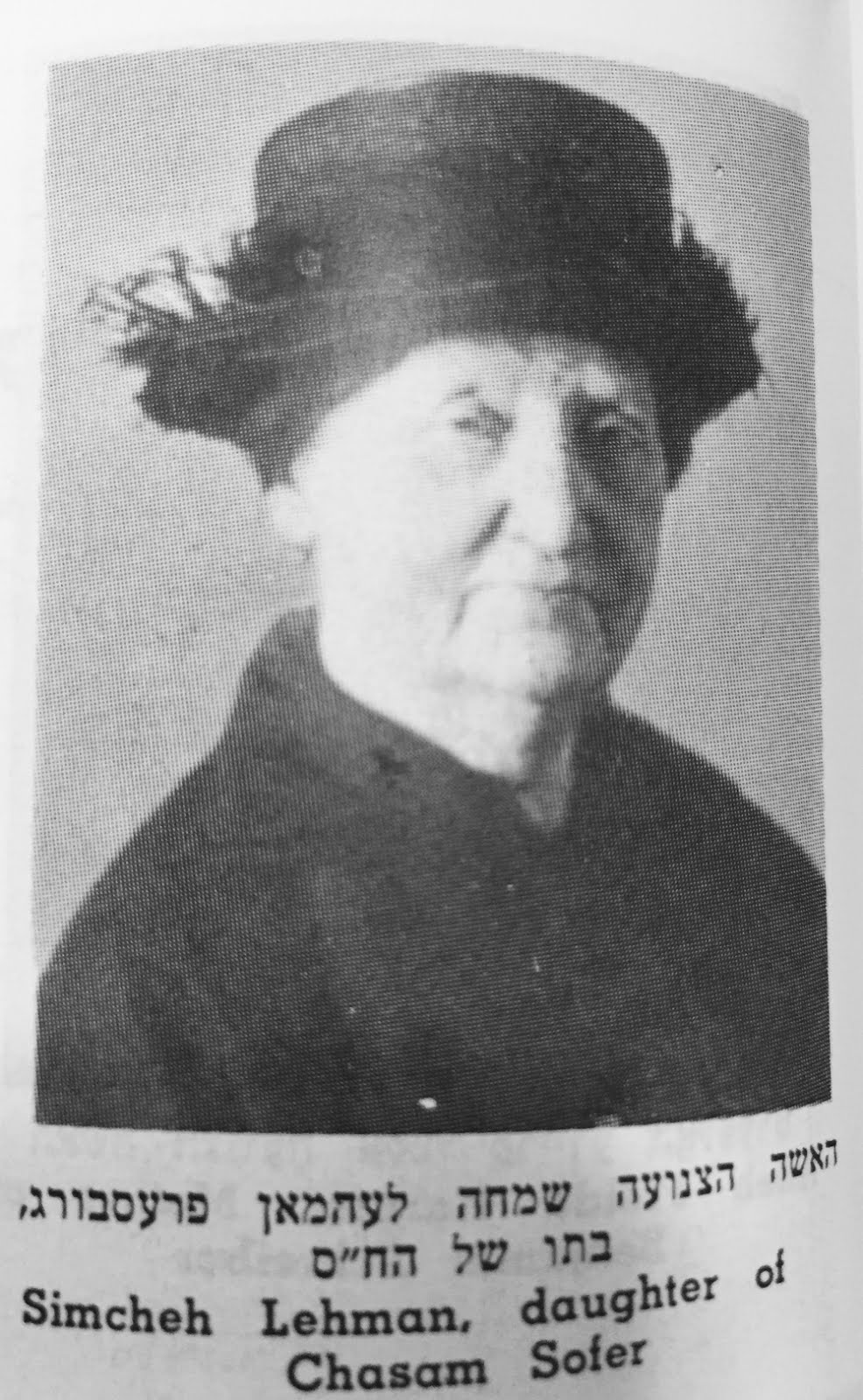
Isaac Hirsch Weiss was not the only one to criticize Shlomo Sofer and his works.  No one less than Simcha Lehman, daughter of the Chasam Sofer, was reported to have said that her nephew’s biography of her father is filled with exaggerations[40].  
R’ Shlomo Zalman Ehrenreich claims[41 ]that Sofer intentionally left out his grandfather R’ Avraham Yehuda Schwartz, author of the Kol Aryeh, from a list of students of the Chasam Sofer that Sofer made in his Iggerot Soferim[42].  Ehrenreich attributes this omission to a familial dispute between Sofer and descendants of the elder Schwartz.  Shlomo Sofer was rabbi of the town of Beregszász, where some of the Schwartz family also resided.  Apparently, they did not get along.[43]
Leopold Greenwald[44] not only accuses Sofer of deliberate omissions by the latter in his works, but also of intentional distortions, exaggerations, and fallacious story telling[45].  He specifically takes issue with Sofer’s portrayal of a strained relationship between R’ Azriel Hildesheimer and the Ksav Sofer, when not only was Hildesheimer chosen from a plethora of many other rabbis to eulogize the Ksav Sofer upon his death, the kehillah of Pressburg even postponed the Ksav Sofer’s burial for two days, awaiting Hildesheimer’s arrival[46]. Hardly something that would be done for someone supposedly in a strained relationship with the deceased[47].  Sofer makes no mention of any this when he describes his father’s funeral in his Chut Hameshulash
I couldn’t verify that the reason that Ksav Sofer’s burial was postponed was to wait for R’ Hildesheimer to arrive; however, it is true that Shlomo Sofer only specifically mentions his brother Yaakov Akiva as giving the first eulogy and leaves the rest of the eulogizers anonymous.  Nonetheless, in my opinion I don’t think the omission of Hildesheimer is so problematic.  R’ Azriel Hildesheimer himself described the levayah[48], and he reports that there were five eulogizers; R’ Feish Fishman, R’ Yaakov Akiva Sofer, R’ Shlomo Zalman Spitzer the brother-in-law of the Ksav Sofer, Hildesheimer himself, and R’ Yosef Guggenheimer.  If we were to accuse Shlomo Sofer of intentionally leaving out Hildesheimer, then we would have to say the same about him leaving out his uncle, Shlomo Spitzer who he held in high esteem.  Though I’m not sure what Shlomo Sofer thought of Feish Fishman, who was a controversial figure among the more radical Hungarian rabbis for his German-language sermons, perhaps one could speculate that Sofer only mentions the first person that gave a eulogy and not the rest, so as not to make any mention of Hildesheimer or Guggenheimer.  But again, this is entirely speculation. 
Still, Sofer specifically says that his brother Yaakov Akiva gave the first eulogy[49].  If we were to read Hildesheimer’s list of the eulogizers as happening in the specific order in which he reported them, it would seem that in actuality the first eulogy was given not by Yaakov Akiva Sofer, but by Feish Fishman.  This would not be hard to believe, as there were many in the community that wanted R’ Feish Fishman to succeed the Ksav Sofer as rabbi of Pressburg over R’ Simcha Bunim Sofer, who eventually did succeed his father.  Hildesheimer was known to be a very meticulous person, but at the end of the day, he doesn’t specifically point out if he meant the list of eulogizers to be in the order that they actually happened.
            An allegation of forgery against Sofer was made by Shimon Zusman[50], grandson of R’ Yaakov Koppel Reich who was chief rabbi of Budapest from 1889-1929.  In the Igros Soferim, there is a letter of rebuke from the Ksav Sofer to his student R’ Reich, warning him not to pander too much to secular elements in his new position as Rabbi of Verbó[51].  Indeed, R’ Reich was known to be an educated and openminded person.  Shimon Zusman reports that when the Igros Sofrim first came out, R’ Reich commented about this letter to his other grandson R’ Dovid Tzvi Zusman, “I never received this letter, and I don’t believe that my master and teacher wrote me this letter.”
            Another charge of forgery against Sofer was made by R’ Chaim Elazar Shapiro of Munkacs, in his Nimmukei Orach Chaim[52].  I won’t get into the details of Shapiro’s accusations, as they have already been debunked by extant manuscripts of the letters he claims must be forged.  It should also be noted, that Shapiro got into a dispute with Sofer over certain charity funds and their appropriation[53].  
            So, are R’ Shlomo Sofer and his works, Chut Hameshulash and Igros Soferim reliable[54]?  Though there certainly is no proof of forgery on Shlomo Sofer’s part, can we still rely on his historical accounts?  Specifically, for our purposes, how are we to take the disparaging remarks about Ber Oppenheimer he claimed to hear from his father the Ksav Sofer in the name of his grandfather the Chasam Sofer, despite there being a responsum from the Ksav Sofer to Oppenheimer conferring upon Oppenheimer praise and respectable titles?
            In my mind, there are three ways to explain the seemingly contradictory remarks of the Ksav Sofer.
            The first possible approach is to consider Shlomo Sofer’s accounts as reliable.  Therefore, we must assume that just as the Chasam Sofer did not like Oppenheimer, though he showed no overt animosity toward him, as confirmed by Isaac Hirsch Weiss, so too the Ksav Sofer also shared his father’s opinion of Oppenheimer, and dealt with him in the same manner; overtly cordial with hidden contempt.
            There are other examples in history of rabbinical correspondence contradicting what the letter writer really thought of his recipient.  And though this seemingly goes against the dictum of chazal, “אל תהי אחד [55]בפה ואחד בלב”, I assume these people felt that this was overridden by another statement of Chazal, “תעלא [56]בעידניה סגיד ליה”, given the specific circumstances in which they had to address the correspondent.
            Two such examples come to my mind.  One is the correspondence between R’ Moshe Chaim Luzzato, the Ramchal, and R’ Moshe Chagiz, where Luzzato writes to Chagiz with utmost respect[57].  Yet when Luzzato writes to his rebbi R’ Yeshaya Bassan, his opinion of Chagiz is revealed to be that of extreme contempt[58].  This is understandable, given that Luzzato was being persecuted by Chagiz, for what Chagiz felt was Neo-Sabbateanism. 
            However, the second example really sticks out to me, as it is of the Chasam Sofer himself.  There is a famous teshuva from the Chasam Sofer to R’ Moshe Teitelbaum, where the Chasam Sofer tries to alleviate some perceived strife between them which he heard of from the town of Potok, due to their differences; as Teitlebaum was a chassid and the Chasam Sofer a misnaged[59].  The Chasam Sofer is filled with praise and admiration for Teitelbaum, even as he acknowledges their differences, as you can see for yourself here:
            This letter is dated the 28th of Sivan 5578, or July 2, 1818.  The explanation to what prompted the Chasam Sofer to write to Teitelbaum, can be found in an earlier letter that he sent to the community of Potock, on the 12th of Elul of that year, or September 13th.  It can be found in the Shu”t Chasam Sofer Hachadashos, #54:
            Sometime after the Chasam Sofer wrote to Teitelbaum, on the 13th of Shevat 5579, or February 9th, 1819, he wrote another letter to two of his students who lived in Ujhely, the same town that Teitelbaum was rabbi.  In the letter, the Chasam Sofer reveals to his students what he really thought of Teitelbaum, and the true intentions behind his laudations.  The letter can be found in the Kovetz Tshuvos Chasam Sofer, #36:
            So perhaps we can suggest that the Ksav Sofer’s opinion of Oppenheimer differed from what he put in writing, just like his father before him.  However, I think that though the Chasam Sofer didn’t show any contempt for Oppenheimer in his letters to him, he was still cold, as pointed out before.  The Ksav Sofer on the other hand is overtly warm and respectful with Oppenheimer.  Consequently, I still find it hard to believe that the Ksav Sofer held Oppenheimer in contempt. 
            A second possible approach to this dilemma, is to again take Shlomo Sofer’s account at face value.  However, although the Ksav Sofer relayed to him the disparaging remarks of the Chasam Sofer against Oppenheimer, we must conclude that his opinion of Oppenheimer was different from that of his father’s contemptuous view.  Especially considering that the Ksav Sofer’s teshuva to Oppenheimer was written a few months after he was elected to succeed his father as rabbi of Pressburg.  As we earlier noted from Isaac Hirsch Weiss, Oppenheimer was a supporter of the succession of the Ksav Sofer.  Perhaps because of his support, the Ksav Sofer felt particularly grateful to him at the time. 
            The third viable approach would be to consider Shlomo Sofer’s remarks regarding Oppenheimer as unreliable, and his report in the name of his father fabricated.  What pushes me more to this approach than any other, is the combination of the teshuva of the Ksav Sofer to Oppenheimer and one other peculiarity which I found in the Chut Hameshulash
            In his biography of the Chasam Sofer, Shlomo Sofer copies for us the original Shtar Rabbanus that the Chasam Sofer received at the start of his tenure as rabbi of Pressburg.  Accordingly, at the end of the document, all the names of the signatories are present, or so it seems.  Comparing the version found in the Chut Hameshulash with the one in Likutei Teshuvos Chasam Sofer, reveals a glaring omission. Here is how Shlomo Sofer presents the Shtar:
Here it is in Likutei Teshuvos Chasam Sofer:
As you can see in the bottom of the middle column, Ber Oppenheimer was one of the signatories.  This also verifies Isaac Hirsch Weiss’s report I mentioned earlier, that Oppenheimer was a supporter of the Chasam Sofer taking the position of Rabbi of Pressburg.
            Here is a picture of the actual manuscript where you can still make out Oppenheimer’s signature:
             With a reputation for purposely omitting facts already preceding him, it does not surprise me that Sofer would also omit Oppenheimer’s name from the Shtar Rabbanus of his grandfather, given that it does not follow the narrative he wishes to portray, as evident from negative reports he gives of Oppenheimer.
            Whatever the truth may be, one thing is for sure; Ber Oppenheimer was a talmid chacham who was respected by most of the gedolei hador of his time, who had his differences with the Chasam Sofer.
Miscellaneous Ha’aros

I’d like to end off with a few divrei torah.  While I was busy with this post, Shavuos past, and like every year I read the relevant Mishna Berurah which I could never understand. Regarding the custom of eating dairy on Shavuos, the Mishna Berurah at the end of siman 494 gives a reason in the name of an anonymous gadol.  Since klal yisroel recieved the Torah on Shavuos, by default they also excepted all 613 commandments, for according to R’ Sa’adya Gaon[60] all 613 mitzvos are included in the ten commandments.  Along with that came the commandments of kosher food; shechitanikur, no blood, salting, and the need to have kosher utensils.  Thus, it was much easier at the time to forgo cooking and just eat dairy, as none of the above laws really apply.
This reason makes absolutely no sense to me.  Without getting too involved in the topic, I think that any person who’s learned through shas and chumash, even in just a cursory manner, knows that the whole torah and everything in it was not given all at once at Sinai; there is a chronology to the giving of taryag mitzvos.  I will just quote the Ramban in his hasagos to the Sefer Hamitzvos[61]:
“והנה, שתי פרשיות בתורה ובהן מצות רבות ולא נאמרו למשה בסיני, אלא לאהרן נאמרו ולא בסיני, פרשת שתויי יין ופרשת משמרות כהונה ולוייה ומתנות כהונה ולא חשש להוציאם מן החשבון הזה. ומצות רבות לא נאמרו בסיני אלא בשעת מעשה, כגון דין מקושש ובנות צלפחד ולא חששו לכך, וכו’.”
The Chazon Ish also has a discussion on the chronology of the mitzvos, in Orach Chaim #125.  So, needless to say, suggesting that bnei yisrael by matan torah were concerned with all the laws of kashrus, is simply anachronistic.  Those laws were only given afterwards. 
Also, when Sa’adya Gaon suggests that all the mitzvos are included in the ten commandments, that’s not in a literal sense, but taxonomical; all the mitzvos can be divided under ten categories under the rubric of the ten commandments.
I found another interesting tidbit in the Alfei Menashe part I, from R’ Menashe Ben Poras of Ilya, where he rails against a pshat which suggests that עם קשה עורף is a good character trait:
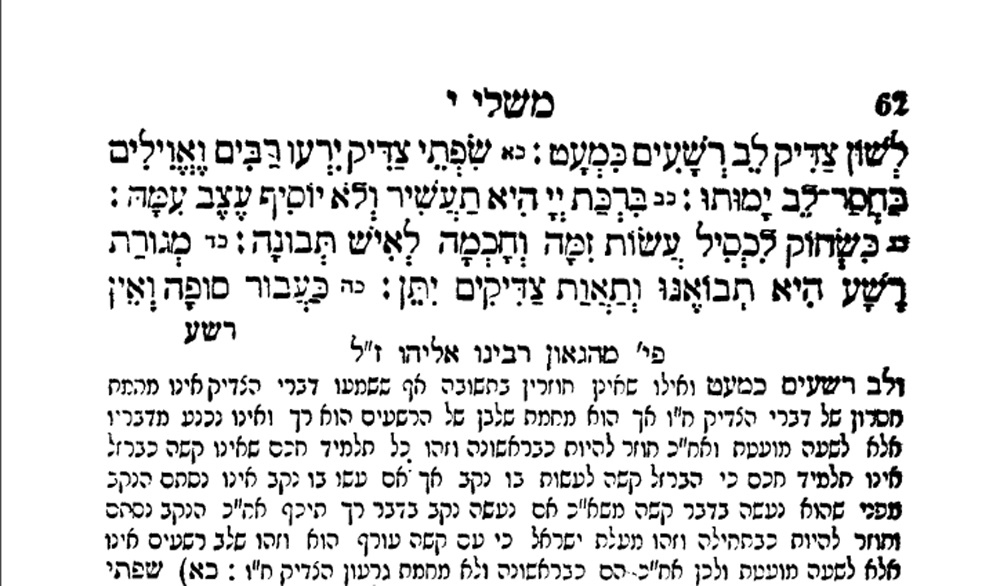
What I find most interesting is that after condemning this notion by saying it only comes from the koach hadimyoni[62], he brings himself support by quoting the Vilna Gaon who said that the koach hadimyoni is a part of the evil inclination.  However, the Vilna Gaon himself in his commentary to Mishlei 10:20, explains עם קשה עורף as a good character trait!  See here:


[1] ד”ה וכי אומרים.
[2] ד”ה הא דאמרינן וכי אומרים.
[3] Here are the sources that I found at the time:  שו”ת עטרת חכמים אה”ע סי’ ל”א, שו”ת טוב טעם ודעת מהדו”ק סי’ רכ”ו, חידושי חת”ס פה ובגיטין ל”ח ע”ב, שו”ת באר יצחק אה”ע סי’ א’ ענף ח’, שו”ת עונג יו”ט ס”ס נ”א, שיח יצחק חגיגה ב’ ע”ב, נחלת יעקב להגאון מליסא פה, שו”ת כתב סופר יו”ד סי’ קכ”ה, שו”ת בנין ציון השלם כרך ב’ סי’ קי”ט, שו”ת שואל ומשיב מהדורה תליתאה ח”ג סי’ ל”ד, שו”ת מהר”ש ענגל ח”א סי’ צ”ה, אור גדול סי’ ח’ אות ז’ ד”ה ויתישב בזה, שו”ת משיבת נפש אה”ע סי’ י”א, שו”ת ר”ש איגרת יו”ד סי’ ל”ד,שו”ת הרי בשמים מהדו”ק ח”א סי’ ל”ח, יד שאול יו”ד סי’ רס”ז ס”ק נ’, חידושי מהר”ם בנעט פה, שו”ת תירוש ויצהר סי’ ל”ב.
[4] Gittin 41b, Tosafos ד”ה כופין , here.
[5] Correspondence with Oppenheimer can also be found in Shu”t Noda Beyehuda Yoreh, De’ah Mahadura Tinyana here, #64, Shu”t Meshivas NefeshYoreh De’ah #67 here, Shu”t Yehudah Ya’aleh, Orach Chayim #147 HereShu”t Toafos Re’eim, Orach Chayim #9 here,  See also Shu”t Ein Habdolach #4 here where R’ Chaim Tzvi Manheimer gets sharp about Oppenheimer, though he still prefaces his name with Moreinu Harav.
[6] P. 8b here.
[7] P. 9b here.
[8] Hochgefühle bey der glorreichen Feyer der Krönung Ihrer Majestät, (Vienna 1825).
[9] #13, #39, and #103.
[10] See Leopold Greenwald, Otzar Nechmad, p.73 fn. 1, Arim V’Amahos B’Yisraelpart VII, p.74, Shlomo Zonnenfeld, Ha’Ish Al Hachoma, p.109, Shmuel Eliezer Stern, Sneh Bo’er B’Aish, p.66 fn.20.
[11] Vol. 2, P.18.
[12] P.96, here.
[13] P.25 #43.  Weiss also changes the year the story happened in to 1833.
[14] (Jerusalem 1924), part I, p.75b here.
[15] Printed by Efraim Deinard in Shibolim Bodidos, p.49 here.
[16] P.23a in the Munkacz edition here.  There were three editions of the Chut Hameshulash printed by Sofer, with the final edition being called Chut Hameshulash Hachadash due to the additional material not found in the previous editions.
[17] Ibid p.23b, here.
[18] Michael K. Silber, in his dissertation, Roots of the Schism in Hungarian Jewry, chapter2 p.26, writes similarly that there was tension between the Chasam Sofer and Oppenheimer, because of the latter supposedly stole from the former’s chidushim.  Though in his notes Silber references the Chut Hameshulash here, in the actual body of his text he brings proof from the language the Chasam Sofer uses in a short teshuva to Oppenheimer in the Mei Be’er #39, where he seemingly hints to this when he says, “גם אני אמרתי כן בחידושי לב”מ” .  Yet, I see no reason to believe the Chasam Sofer was suggesting anything of the sort by using this language, which is just a way of approving the other’s thoughts. See Shu”t Chasam Sofer Choshen Mishpat at the end of #118, where he uses the same language to R’ Meir Ash, here.  See also ibid. Even Haezer part I, #152 here, where R’ Akiva Eiger also says as such.
[19] See Shu”t Chasam Sofer, Orach Chayim #9, and ibid., Choshen MIshpat #79
[20] See ibid., Orach Chaim #54, 79, 140, and 208, and ibid., Yoreh De’ah, #6
[22] See Shu”t Chasam Sofer, Choshen Mishpat, #205, Kovetz Teshuvos Chasam Sofer, #44 and 64, Teshuvos Chasam Sofer Hachadashos #33
[23] For a thorough treatment of the events surrounding the Primaerschule, see Michael K. SilberRoots of the Schism in Hungarian Jewry, (Hebrew University, 1985) ch.2
[24] Hadarom, no.5-6, pp. 122-123
[25] See Leopold Greenwald, Otzar Nechmad, pp.72-77 here.
[26] See Meir Hischkowitz, Rebbi Tzvi Hirsch Chayos (Mossad Harav Kook, 2007), pp.91-92
[27] See Shu”t Moharatz #47, Here
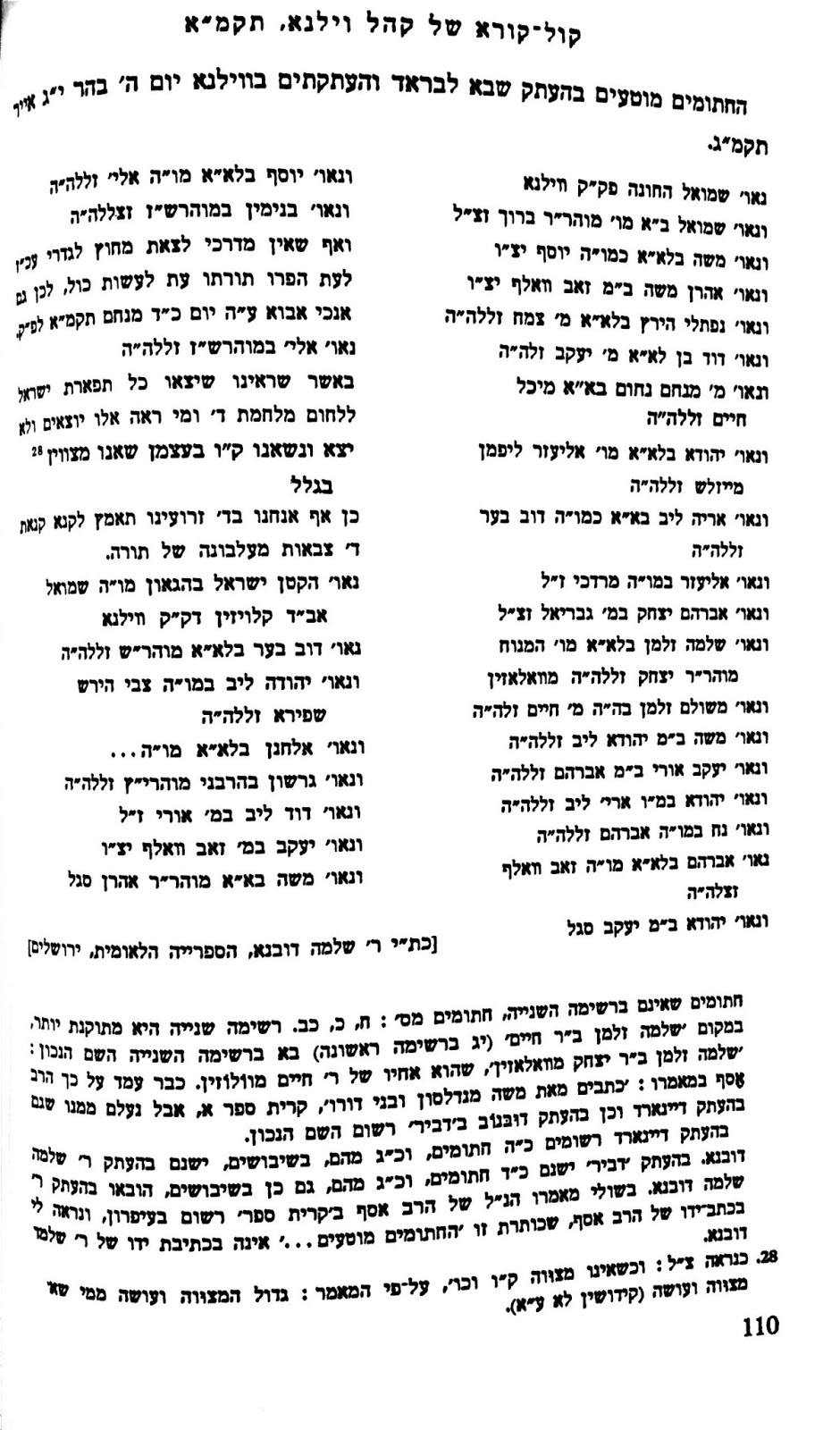
[28] Leopold Greenwald, Toldos Mishpachas Rosenthal, pp. 38-39 here.  Rappaport accuses Taubes of joining the ranks of the chasidim, and for this he can’t fathom Oppenheimer’s support of Taubes, “אכן אשר אתפלא קצת הוא כפי ששמעתי גם החכם ר’ בער אפענהיימער מפר”ב הוא מתומכי ר’ משה טויבערש ומבלי דבר על תכונת הדוב הזה, הלא מדבר זה לבד יודע דרכו, כי מה מצא הוא באיש לחשבהו ראוי לעזרו וסעדו לעלות במעלה כזאת? ” I find Rappaport’s remarks about Oppenheimer particularly interesting, given the fact that a little over a year before in 1830,  there was a rumor that Oppenheimer advocated for Rappaport to take over the recently vacated position of chief rabbi of Moravia after R’ Mordechai Banet passed away.  See the letter from R’ Yaakov Orenstein to the Chasam Sofer in Igros Sofrim, letter #50, where he asks if there was any truth to this, here.
[29] Here is his picture:
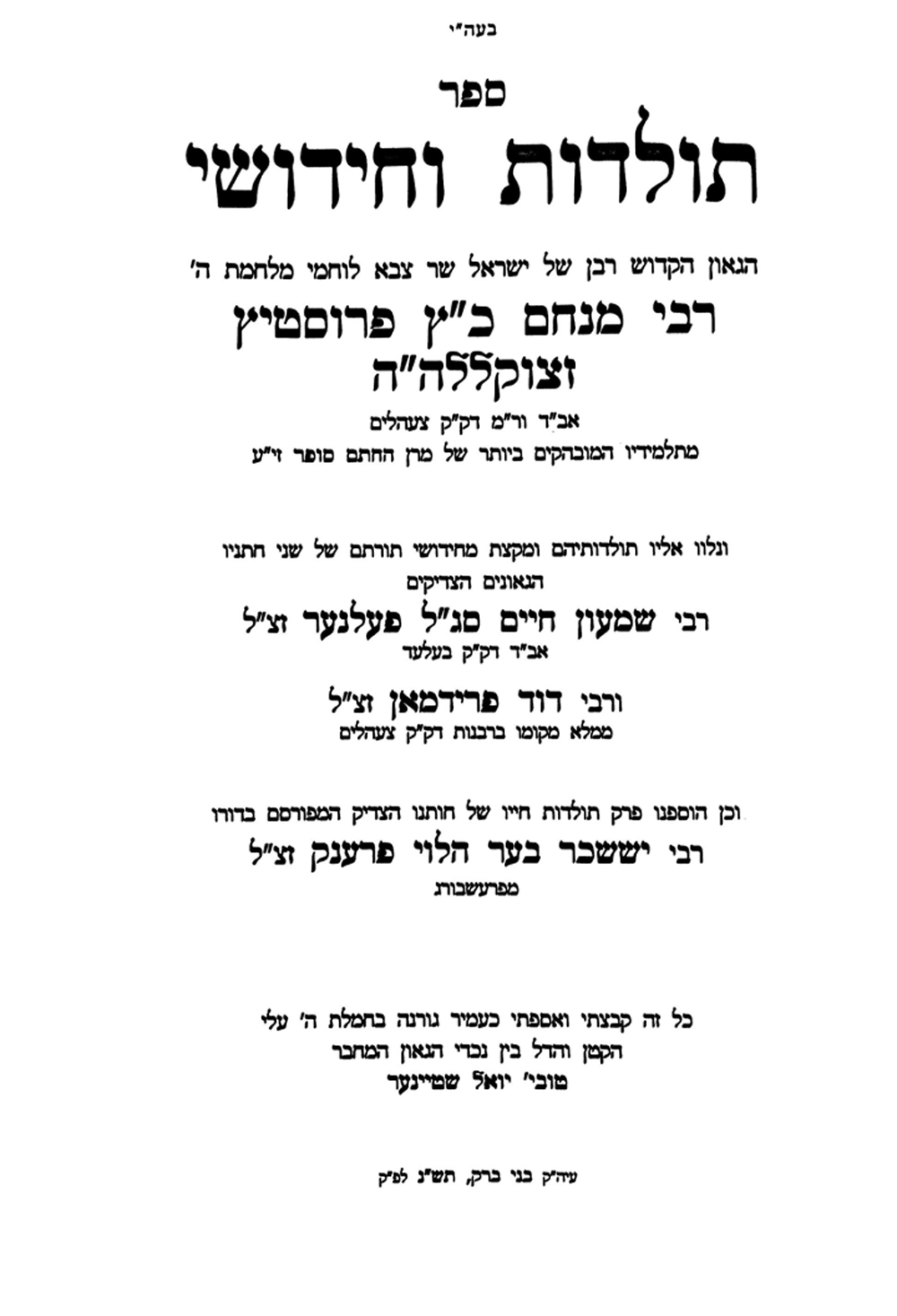
In the Toldos V’Chidushei Rebbi Menachem Katz Prostitz (Bnei Brak, 1990), there is also a biography of Ber Frank, who was the father-in-law of Prostitz.  Here is the title page:  
Not surprisingly, this picture was not printed in this sefer, probably because it does not fit the standard Bnei Brak narrative of what a Jew is supposed to look like.  And though the biographer is meticulous enough to list all of Ber Frank’s publications, whether extant or not, and to list and print the text of all the haskamos and michtivei bracha, he conveniently leaves out two; the michtav from the reformer Leib Schwab printed in Frank’s Ohr Haemunah part Ihere, and the michtav from the maskil and poet Meir Letteris, in his Ohr Haemunah part IIhere.  Frank is also famous for producing the picture of the Chasam Sofer and disseminating it to support the marriage of his daughter to Prostitz. For the story behind the picture, see Igros Sofrim pp. 27-28 here.  
[30] Shu”t Ksav SoferOrach chaim #115, Here.
[31] Hirschkowitz makes the same point, ibid. note 157.
[32] Hakdamah of Part II
[33] Pp.128-131 in the Jerusalem edition from Machon Daas Sofer
[34] In Otzar Nechmad ibid.
[35] Ibid.
[36] Ibid.
[37] See the version of this sermon presented in Drashos Chasam Sofer Part II, pp.648-652, here, and Yosef Naftali Stern’s footnote on p.650.  In his footnote, Stern asks the obvious question; how could the Chasam Sofer pray for the destruction of evildoers when this seemingly contradicts the gemara in Brachos 10a, where the gemara concludes that one should not pray for their death, rather one should pray that they should repent?  I would also add to that this contradicts the gemara in Brachos 7a, where R’ Yehoshua ben Levi concludes that it isn’t proper to curse evil people either, see Tosafos there too.  Though Stern answers this by concluding that the gemara’s dictum does not apply to those that lead others astray and cause others to sin, I’m surprised he doesn’t mention that the Chasam Sofer explicitly comes to this conclusion himself in reference to the gemara in Brachos, in an earlier sermon from 1806, found in the Drashos Chasam Sofer Part I, pp.275-276, here.  I also found that the Alshich in parshas Korach 16:28, also comes to the same conclusion.  Accordingly, this would also explain why birchas haminim which we say in shmona esrei doesn’t also contradict this gemara, as one could say that it was meant only for those minim that were חוטא ומחטיא את הרבים.  See also the Diyukim B’nuschei Hatefilah V’habrachos from the Vilna Gaon, printed in the back of the Shulchan Aruch, where he says that one should say וכל הרשעה and not עושי רשעה, as he references the gemara in Brachos.
[38] Yosef Naphtali Stern makes the same chronological mistake as Plaut in his footnote, ibid.
[39] Ibid.
[40] Olamo Shel Abba, (Jerusalem, 1983) p.67.  Here is her picture:
[41] Zichron L’Moshe P.5, here.
[42] Pp.89-95, here.
[43] See Naphtali Ben Menachem, B’Shaarei Sefer (Mossad Harav Kook) p.115.
[44] L’toldos Hareformatzian Hadatis B’Germania U’bUngaria (1948), p.73 fn.30, here.  Earlier on p.19 fn.38, he also takes issue with Shlomo Sofer writing that the Chasam Sofer allegedly said his son the Ksav Sofer knows how to learn better than himself.  Elsewhere, Sofer writes that the Ksav Sofer said that he learns how to learn from his son R’ Simcha Bunim, author of the Shevet Sofer.  Thus, one may conclude the obvious absurdity, the Shevet Sofer was a greater talmid chacham than the Chasam Sofer!
[45] Though not intentional, I found an example of Sofer telling an untrue story in his final edition (see above, fn.16), Chu”t Hameshulash Hachadash p.8a in the footnotes, or in the modern edition printed in Jerusalem, p.27.  Sofer tells a story he heard about R’ Zelmeleh of Volozhin, one of the prime students of the Vilna Gaon:  When the Vilna Gaon and hs talmidim were gathering signatures for the excommunication against the chasidim, they went to R’ Zelmeleh to ask him to sign on the document.  Much to their surprise, R’ Zelmeleh declined.  R’ Zelmeleh then proceeded to explain his refusal with a dvar torah; we find that Avraham stopped himself from slaughtering his son Isaac, when he heard the angel tell him to do so.  How could Avraham listen to the angel who said not to slaughter Isaac, when he heard directly from G-d himself that he must slaughter him?  R’ Zelmeleh concluded, “for one to not kill someone, a command from an angel suffices, but a command to go ahead and slaughter someone must be heard from G-d himself.”  R’ Zelmeleh continued, “though our master, Rabbeinu Eliyahu, is like an angel of G-d, in order to slaughter someone, we must hear it from G-d himself.”
When I first read this story, I gave a little chuckle.  Here’s why: You can clearly see on the right-hand column the signature of R’ Zelmeleh on the kol koreh of the cherem of 1781.

The main character of this story was originally told as being R’ Refoel Hamburger, not R’ Zelmeleh of Volozhin.  Even so, in the torah journal Sharei Torah, part X, kunteres 1, #5, R’ Meir Dan Plotzky, while explaining that R’ Refoel Hamburger was no lover of chasidim, says he doubts the authenticity of this story.

[46] Interestingly, Greenwald criticizes this practice of postponing the burial to wait for eulogizers, in his Kol Bo Al Aveilus p.12, here.  Greenwald writes that it pained him to read in Der Morgan Journal Dec. 2, 1941, that after the death of a famous rabbi and gaon from Brooklyn early Friday morning, the burial was postponed until Sunday so more eulogizers and people could attend.  I assume Greenwald is talking about the levayah of R’ Moshe Soloveitchik which you can read about here.  Though, I don’t know why he would read about it almost a year later (R’ Moshe died in January).  R’ Simcha Soloveitchick died a few weeks prior to that issue of Morgan Journal, on November 16.  However, R’ Simcha died on a Sunday, not a Friday.
[47] Meir Hildesheimer makes the same point in Sefer Hazikaron L’Yechiel Yaakov Weinberg, p.18 fn.72.  He also adds that the Ksav Sofer pressured R’ Azriel Hildesheimer to become rabbi of Pressburg in a joint capacity with him.
[48] Tzefunos no.6, pp.63-66, Here.
[49] Ibid. p.338.
[50] See Shmuel Weingarten, Sinai no.74, p.92 fn.17.
[51] P.51-52, here.  Another interesting example of a rabbi giving rebuke to one of his peers, is the teshuva of R’ Yosef Shaul Nathanson to the son of R’ Shmuel Waldberg of Yaroslav, in Shu”t Shoel U’Mashiv, Mahadura Telisa’ah, part I #264, here.  Nathanson as an exception responds to the generic talmudic query of Yoel Waldberg even though it is not a pressing question of halacha.  Nathanson explains that he made this exception in order to foster a love for learning in Waldberg, so that he would leave his secular ways; simultaneously criticizing his father, R’ Shmuel, for being too involved in secular studies.  Indeed, R’ Shmuel Waldberg succeeded R’ Hirsch Chajes as Rabbi of Zolkiew, a city with very modern leanings, before his tenure at Yaroslav. Unfortunatley, Waldberg’s children became mechalelei shabbos (I don’t know if that includes the above mentioned Yoel), and in his later years Waldberg was filled with regret about his secular studies, railing against them in his sermons.  Waldberg authored many seforim on a plethora of subjects.  Here is his picture:
[52] Siman 243, here.
[53] See Yehuda Spiegel, Toldos Hayehudim B’Rusia Hakarpatis, pp.86-88.
[54] See Binyomin Shlomo Hamburger, Zichronos Umesoros Al Hachasam Sofer (Bnei Brak, 2013), pp.12-26 for a defence of Shlomo Sofer’s reliability.
[55] See Pesachim 113b.
[56] Literally, “Bow to the fox in its time.” Advice from chazal to act in a subordinate manner towards a person who is in an advantageous position.  See Megillah 16b.
[57] See Igros Ramchal, #10, “לגבר חכם בעוז נודע בשערים, לו שם בגבורים, גבור חיל במלחמתה של תורה עשיר מארי חיטיא קולע ולא יחטיא השערה, בר אורין ובר אבהן יאי ויאי כבוד מורנו ורבנו הרב משה חאגיש נר”ו “.
[58] Ibid. #12, “והשוטה הזה החאגיש, כאשר איש מדנים הוא, הודיע ביום כעסו גם בלא דעת ובלא השכל “
[59] See Drashos Chasam Sofer Part II, p.745, “אך מי שהגיע לכלל תכלית החסידות והפרישות ולא כחסידי הזמן ח”ו  ” , here.
[60] This is apparent from the Azharos of Saadya Gaon, where he explains each mitzva, and under which commandment it falls.  See Rashi to Exodus 24:12 and Perushei Rabbeinu Sa’adya GaonMishpatim fn.2.
[61] Soresh Rishon
[62] lit. imaginary faculty, imagination


A nay bintl briv: Personal Reminiscences of Rabbis Baruch ha-Levi Epstein and Aaron Walkin from the Yiddish Republic of Letters

A nay bintl briv:

Personal Reminiscences of Rabbis Baruch ha-Levi Epstein and Aaron Walkin

from the Yiddish Republic of Letters

Shaul Seidler-Feller

Editor’s note: The present post is part two of a two-part essay. Part one can be found here.

Second Letter

Approximately eight and a half years after his column on the Hafets Hayyim appeared, Rabbi Aaron B. Shurin penned another essay, entitled “The Mistake of the Austrian Emperor” and about the meaning behind the observance of the Three Weeks, which was published 18 Tammuz 5756 (July 5, 1996), a day after they had begun.[1] In the first line, he quoted Rabbi Baruch ha-Levi Epstein (1860–1941/1942) as citing a story about Austrian Emperor Franz Joseph I’s (1830–1916) negative response to a group of Hungarian nationalists who wished to establish a day of mourning for the loss of their independence in 1848, using the Jews’ observance of Tish‘ah be-Av as a model.[2] This prompted Simon Paktor to write in:


SCHENECTADY 9.5.96.

זייער געערטער און חשובער
.הרב ר״ אהרון בן ציון שוּרין נ״י


עס איז מיר זייער פארדראסיג וואס כ׳האב ניט בעוויזן
צו שרייבן מאמענטאל, און זיך הארציג בעדאנקען פאר
.אייער ארטיקל ״פאָרווערטס״ דעם 5-טן יולי ה.י

ווי געוויינליך ווען די אידישע צייטונג קומט
אן צו מיר, איז עס ביי מיר ווי א גוטער פריינד
וואלט געקומען פון דער אלטער אומפארגעסליכער
..פארשניטענער היים… און מיר ריידן א[וי]ף יידיש

איך האב ממש א ציטער געטאן ווען כ׳האב
אין אייער ארטיקל וועלכן איך לייען שטענדיג מיט דעם
גרעסטן אינטערעס דערזען אין דער ערשטער שוּרה דעם
טייערן נאמען ״הרב ר׳ ברוך עפשטיין (מחבר פון
פירוש ״תורה תמימה״ אויף חומש) דערציילט אין
[3](זיין זכרונות ספר ״מקור ברוּך״ א.א.וו

איך האב געהאט די זכיה צו קענען
אט דעם ״אִיש פֶלֶא״ כבין געווען א פריינד
פון א פינסק-קארלין משפחה וועלכע האט זיך
געיחוס׳ט מיט קרובישאפט. דער פאטער פון דער
פאמיליע האט בעת א שבת׳דיגן וויזיט צוגעטראגן צו מיר
דעם ספר ״מקור ברוך״ און בעוויזן אז ר׳ ברוך

2

ווייזט אן אז אין שׁימל פון ברויט ליגט
דער פאטער אלתר סלוּצקי .PENECiLiN רְפוּאָה ווי
איז געווען א לאַווניק אין שטאט ראַט און די טאכטער האט
געארבעט אין דער יידישער אפטיילונג. אזוי ווי פינסק
האט געהאט א פנקס פון 800 יאר האט זיך זי געהאט די
א מעגליכקייט אויסגעפינען און אנטקעגן קומען ר׳ ברוך עפשטיינס
ביטעס אין די ארכיווע אויסצוזוכן. ער פלעגט זיך שטענדיג
בעדאנקען צו איר דורך שיקן א ״באָמבאניערקע״
דא הייסט עס א באַקס שאקאלאד)… איך)
.מיט טרערן אין די אייגן און מוז א וויילע איבערייסן

.ער האט מיר אויסגעלערנט אן אריטמעטיג פארמוּלע
איך דערמאן זיך ווען כ׳האב שבת נאכן דאוונען אין פינסקער
גרייסער שוּל אראבגעגאנגען צום ברעג פון אונזער
און בעמערקט ר׳ ברוך עפשטיין ז”ל PiNA שיינער טייך
זיצט אויף א באַנק כ׳בין צוגעגאנגען צו עם און געזאגט

״גוט שבת ר׳ ברוּך גום ברוך יהיה״

ער האט געענטפערט ״גם אתם״ און צובייגענדיג צו מיר
געפרעגט ״אפשר האט איר די פאָלקס צייטונג״
(א בונדיסטישע צייטונג וואס איז ארויס אין ווארשע)
(ווען איך האב עס דערציילט א היגן רָב (ניט קיין ראביי
האט ער צו מיר געזאגט יעצט זע איך

3

…אז ער איז געווען ״אם לא למעלה מזה״
איך בין יונג געווען און קיין שכל ניט געהאט און ניט פארשטאנען
צו צוהערן זיך און פאָלגן וואס אונזערע חכמים האבן
געזאגט ״והוי מתאבק בעפר רגליהם״

איך פלעג עם זייער אָפט טרעפן גייענדיג צו
(הרב הגאון ר׳ אהרון וואלקין ז״ל השם יקום דמם
הרב וואלקין האט עם ר׳ ברוך עפשטיין זייער מְקַרֵב
.געווען אין זיין עלנדקייט

איך האב געהאט דעם טרויעריגן זכות זען
אט דעם גאון ר׳ אהרון וו. הארט פארן אימה׳דיגן חורבן ווי
ער איז געזעסן אין א ווינקל פון א סטאָליאריי אַרטיעל
נאכדעם ווי די סאוויעטן האבן עם ארויסגעטריבן פון
זיין בית דין שטוב. געזעסן ארומגערינגלט מיט ספרים
…בליֵיך ווייס ווי שניי. א ״מַראה כהן״

ווייטער האב איך שוין ניט געווּסט כ׳בין געווען אין די
.לאַפּעס פון נ.ק.וו.ד

איך האב זיין ר׳ ברוּך׳ס ספר ״בָרוּך שֶאָמַר״ פירוּש
תפילות ישראל. ר׳ ברוך עפשטיין ז״ל איז געשטארבן
אין געטא אין הונגער, צער א צוּווייטאגדיגער. און מיין האַרץ
..וויינט אין מיר טאג און נאכט

4

מיין הארציגן דאנק צו אייך פאר דערמאנען
אין אייער ארטיקל (דער טעות….) אט דעם טייערן
.נאמען

כווינטש אייך געזונט און אריכת ימים ושנים
צו שרייבן אזעלכע ״צום האַרצן״ ארטיקלען אין
יידיש

מיט דאנקבארקייט און כבוד צו אייך
.לשנה טובה תכתבו ותחתמו
.שמעון פאקטאר
Schenectady NY.

Schenectady 9.5.96

To the highly esteemed and eminent Rabbi Aaron Benzion Shurin, may his light shine,

I am greatly displeased that I did not manage to write immediately to offer my sincere thanks for your column in this year’s July 5th issue of the Forverts.

As is usual when the Yiddish newspaper is delivered, I felt then as if a good friend had arrived from the unforgettable, obliterated old country… and we were having a conversation in Yiddish…

I literally shuddered when I noticed in the first line of your column – which I always read with the greatest interest – the dear name “Rabbi Baruch Epstein (author of the Torah temimah commentary on the Pentateuch) relates in his memoir Mekor barukh,” etc.

I had the good fortune to know that “amazing man.” I was friendly with a family in Pinsk-Karlin that took pride in its kinship with him. The head of the family, during a visit of mine one Sabbath, brought me the book Mekor barukh and showed me that R. Baruch

2

points out that medicine akin to penicillin can be found in moldy bread.[4] The father, Alter Slutzky, was an alderman on the city council, and his daughter worked in its Jewish division.[5] Since Pinsk had a communal register going back 800 years,[6] she had the opportunity to learn of and accommodate R. Baruch Epstein’s requests to search in the archive. He would always thank her by sending a bombonierka (here, we would call it a box of chocolates)…[7] I write this with tears in my eyes and must pause for a moment.

He taught me an arithmetic formula. I remember how one Sabbath, after services in the Great Synagogue of Pinsk,[8] I descended to the banks of our beautiful Pina River and caught sight of R. Baruch Epstein, of blessed memory, sitting on a bench.[9] I approached him and said, “Good Sabbath, R. Baruch – may you, too, be blessed [barukh].”[10] He responded, “The same to you”[11] and, leaning over to me, asked, “Maybe you have a copy of the Folkstsaytung?” (a Bundist newspaper published in Warsaw). When I recounted this story to a local rov (not some non-Orthodox rabbi),[12] he said to me, “Now I see

3

that he was ‘if not even higher than that’[13]…”[14] I was young and foolish and did not realize that I should really listen to and follow that which our Sages taught: “And sit in the dust of their feet.”[15]

I would very often meet him on his way to the ga’on Rabbi Aaron Walkin, of blessed memory (may God avenge their blood). R. Walkin drew quite close to R. Baruch Epstein in his loneliness.

I had the tragic fortune to see that ga’on, R. Aaron W., right before the horrific Holocaust, sitting in a corner of a carpentry workers’ cooperative after the Soviets had banished him from his rabbinic courtroom. He sat surrounded by books, his complexion pale white as snow, like leprosy shown to a priest…[16]

I knew nothing more of him; I was caught in the clutches of the NKVD.

I have R. Baruch’s book Barukh she-amar, a commentary on the Jewish prayers.[17] R. Baruch Epstein, of blessed memory, died in the ghetto a distressed man, starving and suffering. And my heart cries within me day and night…

4

My sincere thanks to you for mentioning in your column (“The Mistake…”) that precious name.

I wish you health and many long days and years so that you might continue writing such “heartwarming” columns in Yiddish.

With gratitude and esteem,
May you be inscribed and sealed for a good year,
Simon Paktor
Schenectady, NY

Although the author of our letter offers precious few details about himself in the body of the document, we know from other sources that he was born to Moishe and Gittel Paktor on January 18, 1913 in Pinsk (then part of Russia, now in Belarus).[18] At the time, Pinsk was one of the most Jewish (percentage-wise) of the major cities in Eastern Europe, with a Jewish population in 1914 of 28,063 out of 38,686 total residents (approximately 72.5%).[19] Presumably because Paktor was young and politically active, the NKVD (Soviet secret police) arrested him toward the beginning of World War II, when Pinsk was occupied by the Red Army, and sent him eastward to a Siberian labor camp, thereby inadvertently saving his life.[20] When he was released, he traveled to Munich where he met and married his first wife, Helen (1925–2019), and the two of them, together with their young son David Leon (b. 1949), immigrated to the United States in 1952.[21] Sometime thereafter the couple divorced, and in 1973 Simon moved to Schenectady to serve as the Ritual Director at Congregation Agudat Achim, a Conservative synagogue (located at 2117 Union Street).[22] There, in 1976, he married Anne Smuckler (1914–2014), whose own husband had passed away three years prior,[23] and continued serving the shul faithfully until his retirement in 1993.[24]

Paktor’s letter, like Dickman’s before it, transports us back in time, providing rare firsthand testimony that sheds light on several aspects of interwar Eastern European rabbinic culture. It deals primarily with the figure of R. Epstein, a brilliant Talmudist and polymath who decided not to enter the rabbinate but instead to support his family as a banker, all the while composing important Torah works in a non-professional capacity.[25] Perhaps the most eclectic of these is Sefer mekor barukh (Vilna, 1928), a multivolume compilation of his novellae and studies in various fields of Jewish scholarship, as well as personal reminiscences about members of his family. Paktor’s letter briefly discusses this book but also, en passant, and intriguingly, references Epstein’s research in the Pinsk Jewish communal archive; could he have been working there on his never-published bilingual (Hebrew and Yiddish) treatise on the history of Pinsk, written in the aftermath of World War I?[26]

Also interesting is Epstein’s request for a copy of the daily Folkstsaytung, not only on account of the paper’s strictly secular orientation – indeed, it, like the Forverts, was published on Shabbat and yom tov[27] – but also because halakhah, according to a number of interpretations, generally disapproves of reading printed matter like newspapers on Shabbat[28] (some would say during the week as well[29]). In apparently seeing nothing wrong with this practice, Epstein was following the example of his maternal uncle and eventual brother-in-law, Rabbi Naphtali Zevi Judah Berlin (Netsiv; 1816–1893), last rosh yeshivah of the famous yeshivah in Volozhin (present-day Vałožyn, Belarus), who, by Epstein’s own account, would regularly peruse a newspaper on Shabbat day.[30]

In addition, the letter opens a window onto the relationship between Epstein and Rabbi Aaron Walkin (alternatively spelled Wolkin; 1865–1941/1942).[31] By the period in question, Epstein had suffered a number of tragedies and personal setbacks: his wife Sophia (Sheyne), the daughter of Eleazar Moses ha-Levi Horowitz (Reb Leyzer Pinsker; 1817–1890), former chief rabbi of Pinsk, had passed away due to influenza in 1899 before the age of 40; the Mutual Credit Society, the large private bank at which Epstein had worked as an officer, closed at the beginning of World War I; and three of his four children were no longer in Pinsk.[32] Though his daughter Fania (Feygl) remained in the city,[33] Epstein was lonely and lived in a hotel.[34] Into this void stepped Walkin, who arrived in Pinsk circa 1923,[35] becoming its chief rabbi in 1933[36] and there growing close to Epstein. The two men had much in common: both had studied at the feet of Netsiv in Volozhin, married around the age of 18, endured great misfortune, visited America but decided to return to Europe, and sympathized (at least somewhat) with the Zionist movement.[37] As Paktor testifies, Epstein, who lived (as of 1930) at 89 Dominikańska (present-day Gor’kogo [renamed by the Soviets]) Street,[38] would often visit Walkin at his home at 71 Dominikańska, a claim confirmed by the latter’s son, Rabbi Samuel David (1900–1979),[39] who refers to Epstein on at least one occasion as yedidi ne’eman beitenu (my friend, a confidante of our household).[40]

Finally, the letter touches directly on the last years of Walkin’s and Epstein’s lives. Shortly after Soviet forces entered Pinsk on September 17, 1939, they banned Hebrew language instruction, abolished the traditional Sabbath and Jewish holidays, and converted the Great Synagogue into a theater.[41] We know from Paktor’s letter and other sources that Walkin, who had been imprisoned by the Russians previously,[42] largely escaped persecution at the hands of the Soviets and even managed to continue performing his rabbinic functions, including scholarly writing, in secret.[43] Epstein, by contrast, was evicted from the hotel in which he had been living and was forced to wander, further weakening him in his old age.[44]

With the Nazi advance into Pinsk on July 4, 1941, an already dire situation was made even more terrifying: Jews were wantonly robbed and beaten, forced to wear Stars of David, ordered to provision the German occupiers, forbidden to leave the city, and detained for labor or ransom. About a month later, on August 5–7, the first Aktion took place, in which the Nazis murdered approximately eight thousand Jewish men outside the city. The following May 1, a ghetto meant to concentrate the approximately twenty thousand remaining Jews was established in the poorest and most crowded part of town; this was later almost completely liquidated in the second Aktion of October 29–November 1, 1942.[45]

What became of Walkin and Epstein during this frightful time? Theories about each man’s demise abound. R. Samuel David refers to his father on several occasions with the acronym reserved for martyrs, H[ashem] y[ikkom] d[amo], following his name.[46] Indeed, at least two Pinsk natives have written that R. Aaron perished together with his flock (presumably in one of the two major Aktionen).[47] Others have hazarded guesses dating his passing to around Passover 1941 or to the summer of 1942.[48] Similarly, as surveyed recently in part by Shemaryah Gershuni, hypotheses regarding Epstein’s date of death range from 1940 to 1942 and, regarding the circumstances of his death, from natural to painful to violent.[49]

In his letter, Paktor himself could not say what had happened to Walkin, while with respect to Epstein, he claimed that he had died in the Pinsk ghetto (he, too, adds Hashem yikkom damam after mentioning them).[50] However, so far as I have been able to ascertain, and as already pointed out by Gershuni, the only eyewitness testimony to have come down to us – that of a nurse named Mila/Michla Ratnowska (b. 1916) who, together with her mother Zlata (1890–1962) and four others, survived the Nazi occupation of Pinsk in hiding – records that both men died (at home) due to illness in the winter of 1941–1942.[51] This timing is corroborated, if only implicitly, by the absence of Walkin and Epstein from the list of over eighteen thousand Jews living in the Pinsk ghetto, drawn up by the Germans “sometime in 1942.”[52] Until additional evidence surfaces, it would seem prudent to accept this as the most reliable version of the events leading up to the passing of these great men, about whom we can say (with a bit of poetic license) that they were “beloved and cherished in their lifetimes, and they never parted, even in death” (II Sam. 1:23).

Conclusion

Like the giants about whom they wrote, Shurin, Dickman, and Paktor have all passed on (in 2012, 2011,[53] and 2003, respectively). How fortunate we are, though, that their memories are preserved for us in this nay (new) bintl briv! Through these simple documents – penned in an age (not too long ago) when people still took the time to correspond thoughtfully with journalists after reading and reflecting on their essays – we are able to reconstruct, if only partially, the lives and deeds of some of the most prominent leaders of Eastern European Jewry in a prewar world now lost.


* I would like to thank Yehuda Geberer for respectfully commenting that he felt I had made a mistake in the first part of this essay, in which I had identified the Chaim Lieberman who assisted Shurin in landing a job at the Forverts as “the famed historian and bibliophile” who lived 1892–1991 (and who often spelled his name Haim Liberman in English). While Geberer is almost certainly correct that Shurin was actually helped by the man of the same name (1890–1963) who, according to his entry in the Leksikon fun forverts shrayber zint 1897, 42-43, worked as a teacher of Yiddish literature and Forverts Yiddish literary critic, I was influenced (apparently unduly so) in my (mis)identification by Yisroel Besser who, in his Mishpacha article (p. 30), writes as follows: “He went to meet the person he considers the greatest Orthodox writer of the century, Chaim Lieberman. Lieberman was a bibliophile, researcher, and historian, who suggested that young Shurin leave him some writings to peruse.”

I also wish to thank Yehudah Zirkind for kindly bringing to my attention another Yiddish-language memoir about the Hafets Hayyim, in which the author, a Radin native, tells a number of interesting stories about the great sage and also notes that he passed away “before reaching his ninety-fourth birthday”; see Abrashka-Kives Rogovski, “Der khofets-khayim in radin,” Oksforder yidish 3 (1995): 193-200, at col. 200.

[1] Aaron B. Shurin, “Der toes fun estraykhishn keyzer,” Forverts (July 5, 1996): 9, 20.
[2] See Baruch ha-Levi Epstein, Sefer mekor barukh, pt. 2 (Vilna: Romm, 1928), 515a-b, citing what he heard from Isaac Hirsch Weiss of Vienna (1815–1905). Epstein refers to the ruler as Franz Joseph II, but in point of fact the relevant Austrian emperor at the time was Franz Joseph I (whose official grand title, interestingly, included the style “King of Jerusalem”).
[3] The quotation of the original Yiddish here is not exact but is certainly close enough.
[4] I have so far been unable to locate the passage referred to.
[5] Jacob-Alter Slutzky was a prominent Orthodox lay leader of the Jewish community of Pinsk who was s/elected to serve on the city council at several points during the interwar period when Pinsk was under Polish rule; see Azriel Shohet, The Jews of Pinsk, 1881 to 1941, ed. Mark Jay Mirsky and Moshe Rosman, trans. Faigie Tropper and Moshe Rosman (Stanford: Stanford University Press, 2012), 469-470, 552-556, 559, 580-581. For the original Hebrew, see Wolf Zeev Rabinowitsch (ed.), Pinsk: sefer edut ve-zikkaron li-kehillat pinsk-karlin, vol. 1, pt. 2 (Tel Aviv; Haifa: Irgun Yotse’ei Pinsk-Karlin bi-Medinat Yisra’el, 1977; also available through the New York Public Library Yizkor Book online portal [accessed August 19, 2019]), using the index. See also Slutzky’s mini-bio in Nachman Tamir (Mirski) (ed.), Pinsk: sefer edut ve-zikkaron li-kehillat pinsk-karlin, vol. 2 (Tel Aviv: Irgun Yotse’ei Pinsk-Karlin bi-Medinat Yisra’el, 1966; also available through the New York Public Library Yizkor Book online portal [accessed August 19, 2019]), 538, where it is noted that Slutzky, like Epstein, was a member of Netsiv’s family (see below) and that he had two daughters, Zhenya and Eve. Based on a daf-ed filed by the former’s sister-in-law, Sonia Goberman (accessed August 19, 2019), it appears that Zhenya was the one who worked in the Jewish division. For Epstein’s endorsement of Slutzky during a campaign season, see “Eyn goldene keyt fun maysim toyvim,” Unzer pinsker lebn 3,42 (102) (October 16, 1936): 5.
[6] An old Pinsker tradition has it that the Jewish community was founded some time in the tenth century; see Benzion Hoffman (ed.), Toyznt yor pinsk (New York: Pinsker Branch 210, Workmen’s Circle, 1941), ix-x (notice the book’s title), and Tamir, Pinsk, 249, 252. Some have averred that an exact date for the start of the community cannot be established at present, given the number of times the Great Synagogue, and any historical documents it may have housed, burned down (on which, see n. 8 below); see, e.g., Saul Mendel ha-Levi Rabinowitsch, “Al pinsk-karlin ve-yosheveihen,” in Judah ha-Levi Levick and Dovberush Yeruchamsohn (eds.), Talpiyyot (me’assef-sifruti) (Berdychiv: Joseph Hayyim Zablinsky, 1895), 7-17, at p. 7. In any event, the current mainstream position holds that it began around 1506, the year in which a privilege issued by Fyodor Ivanovich Yaroslavich, Prince of Pinsk, granted local Jews land for a synagogue and cemetery in perpetuity; see Mordechai Nadav, The Jews of Pinsk, 1506 to 1880, ed. Mark Jay Mirsky and Moshe Rosman, trans. Moshe Rosman and Faigie Tropper (Stanford: Stanford University Press, 2008), 13-14.
[7] For a similar story, see Hillel Seidman, “Ha-rav r. barukh epstein – pinsk,” in Isaac Lewin (ed.), Elleh ezkerah: osef toledot kedoshei [5]700-[5]705, vol. 1 (New York: Research Institute of Religious Jewry, Inc., 1956), 142-149, at p. 145; reprinted with some variations in Seidman’s Ishim she-hikkarti: demuyyot me-avar karov be-mizrah eiropah (Jerusalem: Mossad Harav Kook, 1970), 108-116, at p. 111. Relatedly, see the Rosh Hashanah greetings sent to Epstein by the typesetters and printers of the Pinsker vort 2,40 (86) (September 30, 1932): 1, and of ibid. 3,38 (138) (September 20, 1933): 1.
[8] For some of the turbulent history of the Great Synagogue of Pinsk, which fell victim to fires on multiple occasions, see Nadav, The Jews of Pinsk, 1506 to 1880, 463-465; Shohet, The Jews of Pinsk, 1881 to 1941, 217-220, 300-301, 463, 648, 656; and Tamir, Pinsk, 249-252. For photographs of the synagogue, see here and here (accessed August 19, 2019). For a map of Pinsk from 1864 illustrating the location of the Great Synagogue, see Hoffman, Toyznt yor pinsk, 88-89 (in Yiddish), and Nadav, The Jews of Pinsk, 1506 to 1880, 498-499 (in English). For later maps of Jewish Pinsk, see Hoffman, Toyznt yor pinsk, 232-233, and Tamir, Pinskfoldout preceding p. 97.
[9] Epstein generally prayed not in the Great Synagogue but in the Pinsker Kloyz, a beit midrash with a firmly mitnaggedic orientation. Ze’ev Rabinowitsch reports that, “in years past, it was said that the walls of the Pinsker Kloyz do not give out in deference to R. Baruch Epstein…” (“Akhsanye shel toyre,” in Tamir, Pinsk, 264). See also Rabinowitsch, Pinsk, 412.
[10] See Gen. 27:33.
[11] In Yiddish, one appropriate response to a greeting like gut shabes! is gam atem!, using the plural atem even when only one person is being addressed. See Sol Steinmetz, Dictionary of Jewish Usage: A Guide to the Use of Jewish Terms (Lanham, MD: Rowman & Littlefield Publishers, Inc., 2005), 53.
[12] American Yiddish will often distinguish between Orthodox and non-Orthodox (particularly Reform) rabbis by referring to the former as rov/rabonim (singular/plural) and the latter as rabay/rabays (singular/plural). As essentially transliterations from the English, these terms for non-Orthodox rabbis are usually intended somewhat derogatorily in the mouths of frum Yiddish speakers.
[13] Oyb nisht nokh hekher or, as the phrase appears here in Hebrew, Im lo le-ma‘lah mi-zeh, is the title of a short story by the famous Yiddish and Hebrew classicist I.L. Peretz (1852–1915) about a Litvak who refuses to believe that the Nemirover Rebbe (a fictional character probably based on Rabbi Nathan Sternharz of Niemirów [1780–1845]) ascends on High during the annual period of selihot, as his Hasidim claim he does, instead of coming to the synagogue. Determined to find out where the Rebbe disappears to, he hides under the Rebbe’s bed one night and is amazed to discover that the Rebbe wakes early in the morning, dresses as a Polish peasant, and goes out to the forest to chop firewood for poor bedridden Jewish widows. He thereupon decides to join the Rebbe’s Hasidim, and from then on whenever anyone claims that the Rebbe flies up to Heaven to petition on behalf of his flock before Rosh Hashanah, this Litvak-turned-Hasid responds, “If not even higher than that.”

The story was first published in Yiddish in 1900 as “Oyb nisht nokh hekher! A khsidishe ertseylung,” Der yud 2,1 (January 11, 1900): 12-13. The following year, it appeared, in the author’s own Hebrew adaptation, as “Im lo le-ma‘lah mi-zeh,” Ha-dor 1,17 (1901): 207-211; for the Hebrew text, see here (accessed August 19, 2019). For editions using modern Yiddish orthography, see here and here (accessed August 19, 2019). For side-by-side Yiddish with English translation, see “Oyb nisht nokh hekher/And Maybe Even Higher,” in Itche Goldberg and Eli Katz (eds.), Selected Stories: Bilingual Edition, trans. Eli Katz (New York: Zhitlowsky Foundation for Jewish Culture, 1991), 270-281. For extensive discussions of the story’s subversive messages, historical sources, and inspirations, see Menashe Unger, “Mekoyrim fun peretses folkstimlekhe geshikhtn,” Yidishe kultur 7,3-4 (March–April 1945): 54-59, at pp. 56-57; Samuel Niger, Y.l. perets: zayn lebn, zayn firndike perzenlekhkeyt, zayne hebreishe un yidishe shriftn, zayn virkung (Buenos Aires: Confederacion pro Cultura Judia, 1952), 286-289; and Nicham Ross, Margalit temunah ba-hol: y.l. perets u-ma‘asiyyot hasidim (Jerusalem: Magnes Press, 2013), 17-83 (ch. 2).

In our context, the phrase is deployed by Paktor’s rabbinic interlocutor to express his realization that Epstein was even greater than he had originally thought.
[14] Paktor apparently also shared this story about Epstein and the Folkstsaytung with Mark Jay Mirsky; see the latter’s introduction to Shohet, The Jews of Pinsk, 1881 to 1941, xxix-xxx.
[15] mAvot 1:4.
[16] The Hebrew phrase deployed here is mar’eh kohen, a reference to the requirement that those afflicted with biblical tsara‘at must consult with a priest before the healing/atonement process can move forward (see Lev. 13). The expression, as used by Paktor, does double-duty by playing on the title of the well-known piyyut recited on Yom Kippur, which refers to the priest’s (radiant) appearance, not that of the biblical skin disease.
[17] Barukh she-amar was the last book Epstein printed before he passed away. It originally appeared in Pinsk in 1939 (publisher: Drukarnia Wolowełskiego), but, according to Aaron Z. Tarshish, Rabbi barukh ha-levi epstein[,] ba‘al “torah temimah” (Jerusalem: Mossad Harav Kook, 1967), 189, even though the work achieved great popularity within the city, it did not spread beyond. Epstein sent a single copy to the famous Strashun Library in Vilna, which then passed it on to YIVO, and the latter institution transferred it to its headquarters in New York (see the online catalog record for this copy here [accessed August 19, 2019]). This, then, was apparently the only exemplar of the book to survive the war, and when it was discovered at YIVO some time thereafter, it was used to print the photo-offset reproduction published in Tel Aviv in three parts: vol. 1 on the haggadah (1965), vol. 2 on Pirkei avot (1965), and vol. 3 on the siddur itself (1968). (For a slightly different account of Barukh she-amar’s original publication and rediscovery after the war, see Seidman, “Ha-rav r. barukh epstein,” 148. Based on a helpful personal communication from Lyudmila Sholokhova, Director of the YIVO Library, it would appear that Tarshish’s version of the story is the more accurate one.)

I assume that Paktor owned a copy of the Tel Aviv reprint, not the original Pinsk edition.
[18] See the obituary for Rev. Simon Paktor published in the Albany Times Union (March 2–3, 2003), available here (accessed August 19, 2019).

Franz J. Beranek, in his Das Pinsker Jiddisch und seine Stellung im gesamtjiddischen Sprachraum (Berlin: Walter de Gruyter & Co., 1958), discusses certain distinctive features of the dialect of Yiddish spoken in Pinsk. Upon examination of our letter, we find some of the markers of this litvish (Northeastern Yiddish) dialect reflected in such forms as eygn (eyes; see p. 33, §38, 1), greyser (large; see p. 25, §26), arobgegangen (descended; see p. 53, §48, 2a), em (him; see p. 21, §18, 1), etc. (I suspect that his use of the forms idishe [Jewish/Yiddish], reydn [to speak], and fardrosig/hartsig/shtendig/etc. [displeased/sincerely/always/etc.], instead of the expected yidisheredn, and fardrosik/harstik/shtendik/etc., is the result of Paktor following common journalistic orthographic conventions and is not reflective of his actual pronunciation of those words.) (For a recent look at Beranek’s relationship with some of his Yiddish scholarly contemporaries, see Kalman Weiser, “‘One of Hitler’s Professors’: Max Weinreich and Solomon Birnbaum confront Franz Beranek,” Jewish Quarterly Review 108,1 [2018]: 106-124.)
[19] See Mordechai Nadav, “Pinsk,” in Shmuel Spector (ed.), Pinkas ha-kehillot: polin, vol. 5 (Jerusalem: Yad Vashem, 1990), 276-299, at p. 276 (available in English translation here [accessed August 19, 2019]). See also Dov Levin, Tekufah be-sograyim, 1939–1941: temurot be-hayyei ha-yehudim, ba-ezorim she-suppehu li-berit-ha-mo‘atsot bi-tehillat milhemet ha-olam ha-sheniyyah (Jerusalem: Hebrew University of Jerusalem; Tel Aviv: Hakibbutz Hameuchad, 1980), 26, for a chart comparing the populations of cities in eastern Poland in 1931.
[20] See the aforementioned obituary for Paktor published in the Albany Times Union. On NKVD activity in Pinsk during the Soviet occupation, see Pesah Pakacz, “Shilton ha-soviyyetim be-pinsk,” in Tamir, Pinsk, 315-320, at pp. 317-320, and Shohet, The Jews of Pinsk, 1881 to 1941, 639-650. On NKVD activity among occupied Polish Jewry in general, see Yosef Litvak, Pelitim yehudim mi-polin bi-berit ha-mo‘atsot[,] 1939–1946 (Jerusalem: Hebrew University of Jerusalem; Tel Aviv: Ghetto Fighters’ House; Hakibbutz Hameuchad, 1988), 118-156. As noted by Eliyana R. Adler, the similar situation of Baltic Jews exiled to the east by the Soviets demonstrates that had they not suffered that fate, they most likely would have fallen victim to the Nazis when the latter invaded the Soviet Union on June 22, 1941; see her “Exile and Survival: Lithuanian Jewish Deportees in the Soviet Union,” in Michal Ben Ya’akov, Gershon Greenberg, and Sigalit Rosmarin (eds.), Ha-kayits ha-nora ha-hu…: 70 shanah le-hashmadat ha-kehillot ha-yehudiyyot be-arei ha-sadeh be-lita: historiyyah, hagut, re’aliyyah (Jerusalem: Efrata College Publications, 2013), xxvii-xlix, at pp. xlv-xlvi.
[21] See the Holocaust remembrance seminar announcement published in the Clifton Journal (October 30, 2015), p. 36 (available here [accessed August 19, 2019]; make sure to click “View Details”). The Air Passenger Manifest recording the Paktors’ arrival in New York, available to subscribers through the MyHeritage database (accessed June 20, 2019), is dated May 19, 1952; curiously, it lists Simon’s wife’s name as Sabina.
[22] According to Michael C. Duke, “Historian Is CBY Scholar In Residence, Oct. 8–10,” Jewish Herald-Voice (October 7, 2010) (accessed August 19, 2019), Paktor was trained as a rabbi. While I could find no direct corroborating evidence for this claim elsewhere, it is true that he is sometimes referred to in writing with the title “Reverend.” His work at the shul, for which he came to be well loved and respected, included serving as cantor and Torah reader, running the daily minyanim, preparing youth for their bar and bat mitzvahs, and even teaching Yiddish classes; Stephen M. Berk, Year of Crisis, Year of Hope: Russian Jewry and the Pogroms of 1881–1882 (Westport, CN; London: Greenwood Press, 1985), xv, credits Paktor with introducing him to the world of Yiddish scholarship. See also the aforementioned obituary in the Albany Times Union and the above article by Duke. I thank Robert Kasman, Stephen M. Berk, and Mendel Siegel for the information they provided me on Paktor’s life and service to the shul in personal communications.
[23] See the obituary for Anne Paktor published here (accessed August 19, 2019).
[24] Henry Skoburn, The Agudat Achim Chronicle: Commemorating 120 Years[,] 1892–2012 (Schenectady: Congregation Agudat Achim, 2012), 10, 12.
[25] The only book-length biography of Epstein is Tarshish’s (above, n. 17), though, as noted by Eitam Henkin, “Perakim be-toledot ba‘al arukh ha-shulhan: mishpahto ve-tse’etsa’av,” Yeshurun 27 (2012): 879-895, at p. 879, this work is in need of a thorough update that takes a scholarly-critical approach and considers the abundant literature on Epstein and his oeuvre that has appeared over the past fifty-plus years. For a shorter essay on Epstein’s life, see Seidman’s “Ha-rav r. barukh epstein” (above, n. 7). And for a famous photograph of Epstein in his younger years, see Hoffman, Toyznt yor pinsk, 335; reproduced (seemingly with modifications) as the frontispiece of Tarshish’s biography and in Zvi Kaplan, “Hiddushim ba-halakhah shel gedolei pinsk ve-karlin,” in Rabinowitsch, Pinsk, 367-406, at p. 393. (I find it hard to believe that the person in the portrait accompanying the Epstein mini-biography printed in Tamir, Pinsk, 489-491, is actually him but would be happy to be corrected.)
[26] See Baruch ha-Levi Epstein, Sefer mekor barukh, introduction (Vilna: Romm, 1928), 2 n. 1.
[27] The Folkstsaytung (People’s Paper) was the official organ of the General Jewish Workers Union in Poland, also known as the Bund. As such, it espoused a secularist, socialist Weltanschauung and polemicized against Communists, Zionists, and Orthodox Jews, among others. In addition to covering politics and workers’ issues, the paper devoted space to science and technology, sports, culture, and (Jewish and non-Jewish) literature. At its height in 1935, the Folkstsaytung had an approximate circulation of eighteen thousand. See Jacob Shalom Hertz, “‘Folkstsaytung’ 1918–1939,” in David Flinker, Mordechai Tsanin, Shalom Rosenfeld et al. (eds.), Di yidishe prese vos iz geven (Tel Aviv: Veltfarband fun di Yidishe Zhurnalistn, 1975), 151-169, and Boris Kotlerman, “Folks-tsaytung,” trans. I. Michael Aronson, in the digitized YIVO Encyclopedia of Jews in Eastern Europe (accessed August 19, 2019).

According to Seidman, “Ha-rav r. barukh epstein,” 144-145:

[Epstein] had an expansive [intellectual] horizon. He was interested in and familiar with all that was happening in the world. He read Russian and German newspapers. He also visited Vienna and Berlin in the ’20s, meeting with scholars and intellectuals there, and maintained an epistolary correspondence with the towering Jewish figures of the generation. When they visited Pinsk, he would host them. In 1914, Rabbi Hayyim Soloveichik visited Pinsk and stayed with Rabbi Baruch Epstein for Shabbat.

In addition to regularly reading the paper, Epstein also contributed to a number of (rabbinic and general Jewish) periodicals, including HavatseletYagdil torahHa-levanonHa-maggidHa-melits, and Ha-pardes; see Baruch ha-Levi Epstein, Sefer mekor barukh, pt. 3 (Vilna: Romm, 1928), 701b, and Shemaryah Gershuni, “Rabbi barukh epstein – ba‘al ha-torah temimah: beirur nesibbot petirato,” Yeshurun 29 (2013): 885-892, at pp. 886 n. 13, 889 n. 25. He even wrote a weekly column on the parashah for the Pinsker shtime; see Seidman, “Ha-rav r. barukh epstein,” 145, 148-149. While I have not examined issues of the Pinsker shtime, I know that Epstein’s parashah columns in a different local paper, Pinsker vort, were entitled Fun gebentshtn kval (=Mi-makor barukh); see the announcement in the February 20, 1931 edition, p. 1.
[28] For a summary of some of the halakhic literature on the topic and a defense (in most cases) of the widespread contemporary disregard of this prohibition, see Eitam Henkin, “Keri’at divrei defus be-shabbat be-yameineu le-or din shetarei hedyotot,” Melilot 3 (2010): 49-63 (the pagination in the printed version is slightly different from that of what I presume to be the prepublication copy available on Henkin’s website).
[29] Indeed, the Hafets Hayyim was particularly vociferous in his opposition to the practice of many of his contemporaries to regularly read newspapers, not only because of their often-improper content (heresy, scoffing, leshon ha-ra, licentiousness, etc.), but also due to the drain on one’s time involved in their consumption. See, e.g., Israel Meir ha-Kohen, Kunteres zekhor le-miryam (Piotrków: Hanokh Henekh Fallman, 1925), 8b; Aryeh Leib Poupko, Mikhtevei ha-rav hafets hayyim z[ekher] ts[addik] l[i-berakhah]: korot hayyav, derakhav, nimmukav ve-sihotav, 1st ed. (Warsaw: B. Liebeskind, 1937), 96-98 (second pagination; no. 42); ibid., 42-43 (third pagination; par. 82); idem, Mikhtevei ha-rav hafets hayyim z[ekher] ts[addik] l[i-berakhah], ed. S. Artsi, 2 vols. (Bnei Brak: n.p., 1986), 2:157-158. Relatedly, see also idem, Mikhtevei, 1st ed., 27-29 (second pagination; no. 9). It is clear, however, that the Hafets Hayyim was, at times, exposed to periodical literature; for a letter he sent to the Haredi paper Kol ya‘akov, responding to an earlier issue thereof, see idem, Mikhtevei, ed. S. Artsi, 1:297-298 (no. 122).
[30] See Baruch ha-Levi Epstein, Sefer mekor barukh, pt. 4 (Vilna: Romm, 1928), 895b, 897b-898a. Epstein’s report about his uncle’s behavior in this connection has aroused a good deal of controversy, as discussed by, e.g., Eliezer Brodt, “The Netziv, Reading Newspapers on Shabbos & Censorship,” Seforim Blogpt. 1 (March 5, 2014) and pt. 2 (April 29, 2015). Like Brodt, Marc B. Shapiro, “Clarifications of Previous Posts,” Seforim Blog (January 16, 2008) (accessed August 19, 2019), believes that one can rely upon this account. On the general question of the historical accuracy of Sefer mekor barukh, see, e.g., Eitam Henkin, “R. yehi’el mikhl epstein ve-ha-‘tsemah tsedek’ ba-adashat ha-sefer ‘mekor barukh’,” Alonei mamre 123 (Winter 2011): 189-215, and Moshe Maimon, “Od be-inyan ba‘al ha-torah temimah u-sefarav,” Kovets ets hayyim 12,1 (2018): 409-420 (among many others).
[31] Probably the two most authoritative biographies of Walkin to date are that appended to the beginning of the second volume of the New York, 1951 photo-offset edition of his responsa, Sefer she’elot u-teshuvot zekan aharon, composed by his son, Rabbi Samuel David (on whom, see below), and entitled “Toledot maran ha-ga’on ha-mehabber z[ekher] ts[addik] v[e-]k[adosh] l[i-berakhah]”; and Hillel Seidman, “Ha-rav r. aharon walkin – pinsk,” in Lewin, Elleh ezkerah, 64-71; reprinted with some variations in Seidman’s Ishim she-hikkarti, 20-28. Eliezer Katzman used these two sources in compiling much of his own profile of Walkin – “Ne‘imut ha-torah: ha-g[a’on] r[av] aharon walkin z[ekher] ts[addik] v[e-]k[adosh] l[i-berakhah,] a[v] b[eit] d[in] pinsk[,] ba‘al beit aharon, zekan aharon v[e-]ku[llei],” Yeshurun 11 (2002): 891-904; 12 (2003): 727-739 – but added some material not found in either. (It seems that unacknowledged verbatim use was made of Seidman’s and/or Katzman’s work in the Walkin biography printed in Daniel Bitton’s editions of Sefer beit aharon on Bava kamma [Jerusalem: Mekhon ha-Ma’or, 2003] and of Sefer hoshen aharon [Jerusalem: Mekhon ha-Ma’or, 2005].) For additional appreciations of Walkin’s Torah, see Kaplan, “Hiddushim ba-halakhah,” 399-406, an earlier version of which had appeared as “Ba‘al ha-‘battim’,” Ha-tsofeh 10159 (June 24, 1966): 5, 7; and of his religious persona, see the excerpt from Rabbi Joseph B. Soloveitchik’s letter to R. Samuel David, dated 8 Shevat [5]712 (February 4, 1952) and printed at the foot of the introduction to Aaron Walkin, Sefer beit aharon al massekhet gittin, 2nd ed. (New York: S. Walkin, 1955).

For photographs of Walkin, see Anon., “Shlukhim fun agudes yisroel shoyn do,” Yidishes tageblat (December 11, 1913): 8; Anon., “Visiting Rabbis Explain International Jewish Union,” The Pittsburg [sic] Press (January 27, 1914): 3; Anon., “Noted European Rabbis Greeted by Orthodox Jews of Greater Boston,” The Boston Post (February 7, 1914): 16; Kaplan, “Hiddushim ba-halakhah,” 399; Moshe Rosman, “Pinsk,” in the digitized YIVO Encyclopedia of Jews in Eastern Europe (accessed August 19, 2019); Marc B. Shapiro, “A Tale of Two Lost Archives,” Seforim Blog (August 12, 2008) (accessed August 19, 2019); the Jewish Pinsk memorial page here (accessed August 19, 2019) (Walkin is leading the Agudah procession); and David Zaretsky, “Rabbah ha-aharon shel pinsk: le-hofa‘ato me-hadash shel ha-sefer sh[e’elot] u-t[eshuvot] ‘zekan aharon’,” in Zikhram li-berakhah: ge’onei ha-dorot ve-ishei segullah (Israel: n.p., 2015?), 33-39.
[32] See Jacob Goldman’s obituary for Sophia Epstein, entitled “Allon bakhut,” in Ha-tsefirah 26,60 (March 24, 1899): 293. See also the report issued by Aaron Tänzer, “Von Brest-Litowsk nach Pinsk,” Allgemeine Zeitung des Judentums 80,1 (January 7, 1916): 6-10, at p. 9, in which he mentions Epstein’s widowhood and the bank closure. Of Epstein’s four children – Cecilia (Tsile), Meir, Eleazar Moses, and Fania – Tänzer makes specific reference only to the last, suggesting that the other three were no longer in Pinsk by that point. Indeed, we know that Cecilia’s husband Nathan (Nahum) Bakstansky (Bakst) arrived at Ellis Island in 1907 (see his Geni record here [accessed August 19, 2019]); that they and their children Aaron and Jacob were registered voters as of 1924 (see Anon., “List of Registered Voters for the Year 1924: Borough of Brooklyn—Sixteenth Assembly District,” The City Record [October 16, 1924]: 2); and that Cecilia is registered as the copyright holder for the New York, 1928 edition of her father’s Torah temimah (see Anon., Catalogue of Copyright Entries: Part 1, Group 1 […] for the Year 1929 [Washington: United States Government Printing Office, 1930], 1825-1826). In addition, according to family records made available to Henkin, Eleazar Moses had moved to Leningrad (present-day St. Petersburg, Russia) (see the corrections appended to the online version of his aforementioned article, “Perakim be-toledot”). And if Seidman is correct that one of Epstein’s sons wound up working as a physician in New York (see the Ishim she-hikkarti version of his article, p. 110), that may mean Meir, like Cecilia, made it to America as well. (I find the idea that Meir and Fania died in their youth, as reported on Henkin’s website, difficult to believe, considering that Tänzer makes no mention of this in 1916, based on a visit to Pinsk in November 1915; see also next note. But until additional information becomes available, this will be virtually impossible to definitively reject [or accept].) In this connection, see also Maimon, “Od be-inyan,” 418-419, for an interesting interpretation of a passage in Sefer mekor barukh, pt. 4.
[33] Fania was instrumental in founding a Jewish girls’ gymnasium in Pinsk in the fall of 1915, reportedly with her father’s approval. See Tänzer, “Von Brest-Litowsk,” 9, and Shohet, The Jews of Pinsk, 1881 to 1941, 34, 183, 350-351, 596-597; see also Tamir, Pinsk, 510-512. She apparently passed away during World War II, given that she (like her father) is listed among the martyrs of Pinsk in Tamir, Pinsk, 627. (It is unclear to me whether or not the Meir cited there was R. Baruch’s son.)
[34] As of Tänzer’s visit, it seems that Fania attended to the needs of her father’s house (“Von Brest-Litowsk,” 9). Tarshish notes, however, that at a certain point he began living in a local hotel, whose proprietors took care of him honorably and with dedication (Rabbi, 127; though cf. below, n. 38). Seidman adds that he ate his meals at a restaurant in the city while living in the hotel (“Ha-rav r. barukh epstein,” 144). Three hotels, all under Jewish ownership, are named in the “List of Subscribers of the Telephone Network of the Postal and Telegraph Directorate in Wilno in 1939” (select p. 52 from the drop-down menu) (accessed August 19, 2019). I have not been able to ascertain at which of these three Epstein lived.
[35] See Kaplan, “Hiddushim ba-halakhah,” 399; see also Ben-Mem, “Ha-ga’on r. aharon walkin z[ekher] ts[addik] l[i-berakhah],” in Tamir, Pinsk, 499-500, who notes that Walkin eulogized Rabbi Jacob Mazeh of Moscow (1859–1924) within the first year of his arrival in the city. Cf. the introduction to Aaron Walkin, Sefer beit aharon al massekhet bava kamma (Vilna: Shraga Feivel Garber, 1923), which the author signed (seemingly in 1923) while living in the Jewish community of Amtshislav (present-day Mscisłaŭ, Belarus). Cf. also Anon., “Horav r. arn wolkin vegn zayn raykher lebns-fargangenheyt,” Unzer grodner ekspres 2,79 (April 2, 1929): 1, the second part of an interview with Walkin, which claims that he emigrated from Russia in 1922; as well as Aaron B. Shurin, “Tsvey shayles utshuves sforim fun letstn pinsker rov,” Forverts (October 14, 1977): 3, 6, at p. 3, who writes that Walkin came to Pinsk in 1924. (On his way from Russia to Poland, he had an extended stopover in Danzig; see M. Lyubart, “Vegn yidishn lebn in danzig,” Pinsker vort 2,11 [57] [March 11, 1932]: 5.)
[36] See Anon., “Horav walkin oysgeveylt als rov fun pinsker kehile,” Pinsker vort 3,32 (132) (August 11, 1933): 6, and Shohet, The Jews of Pinsk, 1881 to 1941, 571. Cf. Ben-Mem, “Ha-ga’on r. aharon walkin,” 500, who gives the date as [5]688 (1927–1928). (His election to the rabbinate of neighboring Karlin had taken place over a year earlier; see Anon., “Horav walkin als karliner rov,” Pinsker vort 2,6 [52] [February 5, 1932]: 6.)

Relatedly, see Dov Rabin (ed.), Grodnah-Grodne (Jerusalem: Encyclopaedia of the Jewish Diaspora, 1973; also available through the New York Public Library Yizkor Book online portal [accessed August 19, 2019]), col. 352, on the brief period in 1929 when the Jews of Grodno – then part of Poland but now in Belarus – considered appointing Walkin as the chief rabbi of their community (an episode that deserves fuller historiographic exploration); see also Anon., “Kehile-rat geg[n] horav wolkin,” Unzer grodner ekspres 2,88 (April 12, 1929): 15.
[37] For Epstein, see Tarshish, Rabbi, 70-80 (relationship with Netsiv), 84-89 (marriage at approx. 18), 120-126 (visit to America), 134-135, 148-149 (Zionist sympathies) (all based primarily on passages in Sefer mekor barukh); Shohet, The Jews of Pinsk, 1881 to 1941, 536 (Zionist sympathies); and Gershuni, “Rabbi barukh epstein,” 890-892 (visit to America). For Walkin, see his undated introduction to Sefer beit aharon al massekhet bava kamma (visit to America); the postscript to his undated introduction to the commentary Saviv li-yere’av, vol. 1 (Pinsk: Drukarnia Wolowełskiego, 1935), and the wishes of nehamah printed in Dos naye pinsker vort 7,51 (356) (December 3, 1937): 6 (personal misfortune); his son’s “Toledot maran ha-ga’on ha-mehabber” (relationship with Netsiv, marriage at approx. 18, visit to America); and Ben-Mem, “Ha-ga’on r. aharon walkin,” 500, and Rabin, Grodnah-Grodne, col. 352 (Zionist sympathies). Relatedly, Walkin’s son Hayyim married the daughter of Rabbi Abraham Isaac ha-Kohen Kook (1865–1935); see the mazl tov wishes on the occasion of their engagement printed in Do’ar ha-yom 8,182 (April 28, 1926): 1, and in Ha-arets 9,2041 (May 2, 1926): 4.

For a lecture delivered in Yiddish during Walkin’s visit to the United States, undertaken December 1913–February 1914 in order to help establish Agudath Israel in America, see Aaron Walkin, Di printsipen un tsveke fun agudes yisroel: fortrog gehalten fir amerikaner idn (New York: Office of Agudath Israel, n.d.). (During his trip, Walkin visited the Rabbi Isaac Elchanan Theological Seminary at 156 Henry Street; for his comparison of the yeshivah with that of Volozhin [!], see Anon., “Agudes yisroel shlukhim in yeshives rabeynu yitskhok elkhonen,” Der morgen zhurnal [December 24, 1913]: 4. Cf. Anon., “Horav wolkin begaystert fun idishe anshtalten in amerika,” Der morgen zhurnal [January 13, 1914]: 4.)

Tragically, Epstein and Walkin shared another fate: each printed a sefer in 1939 in Pinsk, only one copy of which survived the war and was later used for photo-offset reprinting. On Epstein’s Barukh she-amar, see above, n. 17, and on Walkin’s Sefer beit aharon al massekhet gittin, see his son’s introduction to the 1955 edition.
[38] See the address given for Epstein on the title page of his Sefer tosefet berakhah ha-kolel he‘arot ve-he’arot le-sefer “megillat sefer” al hamesh megillot ha-kodem (Krakow: [Michael Horowicz], 1930) (the same address appears on the title pages of the five parts of Sefer gishmei berakhah that appeared at the same press in the same year). It is unclear to me at what point he moved into the hotel referred to by Tarshish (see above, n. 34), though it seems, based on the aforementioned “List of Subscribers,” that as of 1939 a fellow named Dawid Giler was living at Epstein’s former address on Dominikańska Street.
[39] For several biographical sketches of R. Samuel David, the only child of R. Aaron to survive the war, see Samuel David Walkin, Sefer ramat shemu’el al ha-torah: sefer be-reshit (Jerusalem: Walkin Family, 1982), 11-27; the unpaginated introductions to idem, Sefer shevivei or: likkutim, ed. Samuel David Walkin [the grandson], 2nd ed. (Jerusalem: n.p., 2011); and idem, Sparks of Light: Jewels of Wisdom from the Chofetz Chaim ZT”L (New York: Kol Publishers, 2012), 83-86. For descriptions of R. Samuel David’s efforts on behalf of his fellow Pinskers, see Rabinowitsch, Pinsk, 547, and Tamir, Pinsk, 598-599. Unsurprisingly, given the interconnectedness of Lithuanian rabbinic dynasties, R. Samuel David became close with both the Hafets Hayyim and R. Soloveitchik; for photographs of him with the former, see the plates at the end of Sparks of Light, and with the latter, see Marc B. Shapiro, “Assorted Matters,” Seforim Blog (February 17, 2016) (accessed August 19, 2019).
[40] See Samuel David Walkin, Sefer kitvei abba mari: hiddushim u-be’urim al tanakh u-midrashav, ed. Moishe Joel Walkin (Kew Gardens: Yeshiva Beth Aron, 1989), 345; see also pp. 73, 132, 160, 266, 497, 512. For other instances of R. Samuel David quoting Epstein, often preceded by honorifics, see idem, Sefer ramat shemu’el al ha-torah, 108-109, and idem, Sefer kitvei abba mari: hiddushim u-be’urim al massekhtot ha-shas, u-mo‘adei ha-shanah[,] ve-nosaf aleihem derashot ve-he‘arot be-inyanei de-yoma, ed. Moishe Joel Walkin (Kew Gardens: Yeshiva Beth Aron, 1982), 33, 176, 193, 277, 314. For a reproduction of a letter written by Epstein (on his own letterhead) to R. Samuel David on the occasion of the latter’s appointment to the rabbinate of Lukatsh (present-day Lokachi, Ukraine) in 1935, see Tamir, Pinsk, 490. On the relationship between Epstein and R. Aaron, see also Seidman, “Ha-rav r. barukh epstein,” 144, 149. (Seidman, “Ha-rav r. aharon walkin,” 69, notes that Walkin opened his home and heart “to anyone suffering or in pain.” See also Zaretsky, “Rabbah ha-aharon shel pinsk,” 36. For a similar description of R. Samuel David, see Aaron B. Shurin, “Horav hagoen r. shmul wolkin, vitse prezident fun agudes horabonim, iz nifter gevorn,” Forverts [August 29, 1979]: 1, 8, at p. 1.) Another home Epstein visited was that of Yankev Epstein in Minsk; see Devora Gliksman, A Tale of Two Worlds (Brooklyn: Mesorah Publications, ltd, 2009), 113-114.
[41] Shohet, The Jews of Pinsk, 1881 to 1941, 642, 648; see also Tamir, Pinsk, 319-320.
[42] Walkin himself refers to this, en passant, in the introduction to Sefer beit aharon al massekhet bava kamma, saying that he was jailed bi-shevil alilah, hattat ha-kahal hu (on account of libel; it is the sin of the community). R. Samuel David, in “Toledot maran ha-ga’on ha-mehabber,” explains that his father was one of those fighting to defend Jewish tradition against the edicts of the Bolsheviks and was therefore imprisoned for about half a year. Seidman, “Ha-rav r. aharon walkin,” 67, adds (perhaps by logical deduction) that the Yevsektsiya (Jewish section of the Communist Party) was responsible for informing on him to the authorities.
[43] For examples of Walkin’s wartime rabbinic activities, see Shohet, The Jews of Pinsk, 1881 to 1941, 649; Tamir, Pinsk, 320; and Seidman, “Ha-rav r. aharon walkin,” 69, 71. For his commitment especially to Torah study and creativity in this period, see the excerpt from the last letter R. Samuel David received from him printed in “Toledot maran ha-ga’on ha-mehabber,” as well as the excerpt from a letter by Rabbi Zalman Sorotzkin (1881–1966) reproduced in the introduction to Aaron Walkin, Sefer beit aharon al massekhet kiddushin, ed. Aaron ben Moishe Joel Walkin (Queens: Aaron Walkin, n.d.).
[44] See Tarshish, Rabbi, 127; see also p. 128 on Epstein’s avoidance of the Soviet authorities, even when it meant skipping meals. Zvi Gitelman, “Afterword: Pinsk in Wartime and from 1945 to the Present,” in Shohet, The Jews of Pinsk, 1881 to 1941, 652-659, at p. 653, notes that local leaders organized a committee to aid impoverished clergy, including Epstein, during this period.
[45] For harrowingly detailed accounts of the fate of Pinsk Jewry during the Nazi onslaught, see Nahum Boneh (Mular), “Ha-sho’ah ve-ha-meri,” in Tamir, Pinsk, 325-388 (a Yiddish translation by Leib Morgenthau appears on pp. 389-458 and an English translation by Ellen Stepak appears online here [accessed August 19, 2019]); Nadav, “Pinsk,” 294-298; Tikva Fatal-Knaani, “The Jews of Pinsk, 1939–1943, Through the Prism of New Documentation,” trans. Naftali Greenwood, Yad Vashem Studies 29 (2001): 149-182; Gitelman, “Afterword,” 652-654; and Katharina von Kellenbach, Nahum Boneh, and Ellen Stepak, “Pinsk,” in Martin Dean with Mel Hecker (eds.), The United States Holocaust Memorial Museum Encyclopedia of Camps and Ghettos, 1933–1945, vol. II, pt. B (Bloomington and Indianapolis: Indiana University Press, 2012), 1442-1444. For a map of the Pinsk ghetto, see Tamir, Pinsk, 334 (in Hebrew), and here (in English) (accessed August 19, 2019). For photographs of the memorials set up on the sites of mass murder, see here (accessed August 19, 2019).
[46] See, e.g., R. Samuel David’s introductions to Sefer she’elot u-teshuvot zekan aharon, vol. 2 (the one entitled “Hakdamat ben ha-mehabber maran ha-ga’on z[ekher] ts[addik] l[i-berakhah]”) and to Sefer beit aharon al massekhet gittin; see also the entries on R. Aaron maintained by Yad Vashem (1234) (accessed August 19, 2019). (I am aware that Hy”d is sometimes used even when a person was not literally killed by an enemy but rather died as a[n in]direct result of enemy persecution.) Strangely, Tamir, Pinsk, 636, does not list any members of the Walkin family among the martyrs of Pinsk.
[47] See Tamir, Pinsk, 500, and Zaretsky, “Rabbah ha-aharon shel pinsk,” 33, 37. For a relatively recent study of rabbinic leadership during the Holocaust, see Havi Dreifuss (Ben-Sasson), “‘Ka-tson asher ein lo ro‘eh’? rabbanim u-ma‘amadam ba-sho’ah,” in Asaf Yedidya, Nathan Cohen, and Esther Farbstein (eds.), Zikkaron ba-sefer: korot ha-sho’ah ba-mevoʼot la-sifrut ha-rabbanit (Jerusalem: Rubin Mass, 2008), 143-167.
[48] See Aaron B. Shurin, “Ha-rav aharon walkin: rabbah ha-aharon shel pinsk,” in Keshet gibborim: demuyyot ba-ofek ha-yehudi shel dor aharon, vol. 3 (Jerusalem: Mossad Harav Kook, 2004), 92-97, at p. 92 (ca. Passover 1941), and Seidman, “Ha-rav r. aharon walkin,” 71 (summer 1942).
[49] See Gershuni, “Rabbi barukh epstein,” 887-890. It seems that Tarshish’s version of the events (Rabbi, 128), according to which Epstein died in a Jewish hospital shortly after the Germans’ invasion in July 1941, has gained some traction. See, e.g., N.T. Erline’s epilogue in Baruch ha-Levi Epstein, My Uncle The Netziv, trans. Moshe Dombey, ed. N.T. Erline (Brooklyn: Mesorah Publications, 1988), 223; Prof. Meir Bar-Ilan’s family tree (accessed August 19, 2019); and Pnina Meislish, “Epstein, barukh, ben yehi’el mikhl,” Rabbanim she-nispu ba-sho’ah (accessed August 19, 2019). By contrast, Gitelman, “Afterword,” 728 n. 7, claims that “Epstein died a natural death in Pinsk in 1940,” while Ber Schwartz, Sefer artsot ha-hayyim (Brooklyn: B. Schwartz, 1992), 23, writes that Epstein was killed by the Nazis in 1942. Here again, Samuel David Walkin, Sefer ramat shemu’el al ha-torah, 108, refers to Epstein with the acronym Hy”d, suggesting martyrdom; see also the entries on Epstein maintained by Yad Vashem (123) (accessed August 19, 2019).
[50] Paktor could not have directly witnessed Epstein passing away in the ghetto, as by the time of its establishment he had long been exiled to Siberia by the Soviets. Interestingly, Aaron B. Shurin, in an article published about six years after Paktor sent this letter, also writes that Epstein died in the ghetto (“Ha-rav barukh epstein: mehabber ‘torah temimah’,” in Keshet gibborim, vol. 3, pp. 38-44, at p. 44). He adds (without citing a source) that Epstein was buried in the Karlin Jewish cemetery next to the grave of Rabbi David Friedman of Karlin (1828–1915). Unfortunately, the Karlin cemetery is no longer extant, making it difficult to verify this claim; see here (accessed November 24, 2019).
[51] Ratnowska’s account (committed to writing twenty years after the Holocaust) is cited by Boneh, “Ha-sho’ah ve-ha-meri,” 333. (Pnina Meislish, it should be noted, accepts this timing with respect to Walkin’s passing only; see “Walkin, aharon, ben yosef tsevi,” Rabbanim she-nispu ba-sho’ah [accessed August 19, 2019].) Cf. Rabinowitsch, Pinsk, 399 n. 3, where he quotes slightly conflicting testimony from Ratnowska, according to which Epstein passed away “suddenly” a few weeks before the establishment of the Pinsk ghetto (which sounds more like springtime than winter). In addition, according to her, Epstein was buried in the cemetery in Pinsk, not in the Karlin cemetery as posited by Shurin (see previous note). For Ratnowska’s description of life in hiding during the war, see Boneh, “Ha-sho’ah ve-ha-meri,” 357.

Interestingly, Irina Yelenskaya places both rabbis’ deaths more specifically in January 1942 in her article on Pinsk for the Shtetl Routes project (accessed November 4, 2019), though I do not know on which of her sources she bases this date.
[52] See the description of the Pinsk Ghetto Database available here (accessed August 19, 2019). By contrast, Rachel Walkin (1876–1942?), R. Aaron’s wife, is listed in the Database as living at 35 Polnocna (in German: Nord) Street (the present-day approximate equivalent is Leningradskaya Street). Also listed are Mila Ratnowska and Eve Slutzky (who is presumably to be identified with the daughter of alderman Jacob-Alter bearing the same name).
[53] See the May 2, 2011 funeral announcement published in the Chicago Tribune and currently available here (accessed August 19, 2019).


Organizing the Mitzvot and the Sefer Ha-Chinukh

Organizing the Mitzvot and the Sefer Ha-Chinukh
Yaakov Taubes

Yaakov Taubes is the rabbi at Mount Sinai Jewish Center in Washington Heights, New York. He also serves as an assistant director at the Rabbi Isaac Elchanan Theological Seminary at Yeshiva University, and is a PhD candidate in Medieval Jewish History at the Bernard Revel Graduate School for Jewish Studies. He can be reached at rabbi@mtsinaishul.com.

This article follows from the excellent piece by Eli Genauer about the printing and reorganization of the Sefer ha-Chinukh. To review, Genauer described how the Sefer ha-Chinukh’s original order, reflected in both manuscripts and early printed editions, listed the positive commandments followed by the negative commandments in each parasha, but later editions did away with this division and instead listed the mitzvot in strict order of the Biblical  verses. He noted further that, contrary to what is printed in Chavel’s semi-critical edition of the Sefer ha-Chinukh, the first edition to alter the organization was a Chumash with commentaries printed in Amsterdam in 1767 that included the Chinukh. In the first half of this article, I will explain the Chinukh’s original organization, as well as the reasoning behind and impact of the later editions that changed it. In the second half, I will analyze the earliest published mitzvah lists  that enumerated the mitzvot according to the Torah’s order.

Part I
Reorganizing the Chinukh

At its core, the Chinukh is a Sefer Ha-Mitzvot, an enumeration and explication of 613 mitzvot of the Torah. It primarily follows in the footsteps of the Maimonides’s Sefer Ha-Mitzvot, while also regularly citing Nahmanides when he disagrees with Maimonides. In the anonymous author’s opening missive (to which he adjured later copyists by oath to include), he noted that the work of clarifying the mitzvot and halakhot had already been accomplished by R Isaac Alfasi (Rif), Maimonides, and Nahmanides. Indeed, the Sefer Ha-Chinukh did not innovate in in terms of mitzvah enumeration, i.e. in listing what constitutes the 613 commandments, but rather loyally followed the enumeration of Maimonides, even when he found the opinions of Nahmanides more compelling.[1] Instead, the stated goal was to organize the mitzvot based on the parshiyot of the Torah, so that the youth will be inspired to study them on Sabbaths and festivals and “they will be accustomed to inquire as to how many mitzvot appear in a given parasha.”[2] The division into parshiyot was thus for pedagogical purposes (as the title Sefer ha-Chinukh, or Book of Education, implies), namely, to create a separate unit for a student to study each week.

This didactic concern is also evident from the places where the author informs us that a given parasha does not have any mitzvot. By contrast, when Rashi, for example, has nothing to say on a given verse, he does not comment that there is nothing to say on the verse. But as a work based on the parshiyot, to be studied according to the parshiyot, the Chinukh needed to inform the reader that there are no mitzvot on a given week. In addition to its noteworthy contributions to particularly topics, it was the organization that set the Chinukh aside and contributed to its great popularity.

The gemara in Makkot (23b), which serves as the primary source for the idea that there are 613 mitzvot, also notes that there are 248 positive commandments and 365 negative commandments. Maimonides, the Sefer Mitzvot Gadol of R. Moses of Coucy and most other Sifrei Mitzvot divided the mitzvot this way in their respective works, by first listing one category and then the other. The Chinukh maintained this division, but only within each Parasha, first listing all the positive commandments, followed by the negative commandments, and then starting again in the next Parasha.

This division can be found in the original manuscripts of the Chinukh and in the first published editions from the 16th century. In the 18th century, however, publishers began to print the mitzvot of Chinukh in strict order of the verses of the Torah, erasing the division between positive and negative commandments. In Genauer’s article, he noted an error in Chaim D. Chavel’s scholarly introduction to his edition of the Chinukh, where Chavel writes that the first edition to make this change was the edition printed in Frankfurt an der Oder in 1783.[3] In fact, as Genauer notes, the first published book to reorganize the work was the Chumash Tikkun Soferim, published by Yosef, Yaakov and Avraham Proops in Amsterdam in 1767, which included the Chinukh as well as other commentaries on the Torah. This edition printed the Chinukh on the page alongside the Torah text, adjacent to the Biblical verse that are the source for the commandment, and by extension, recorded the mitzvot according to the strict order of the verses, thereby abandoning the original organization. Virtually all later editions of the Chinukh followed this structure such that, apart from Chavel’s edition, the Chinukh was never again printed using the order in which it was originally written.   

This Proops edition did more than change the order of the mitzvot. The reordering also required a modification of the mitzvah list in the introduction to the Chinukh so that that the numbering there accurately reflected the placement of the mitzvot contained within the work. But, confusingly, many internal cross-references to other mitzvot were left intact. For example, at Lev. 19:9, the Chinukh records the prohibition of not leaving over part of the corner of the field (peah). This is Mitzvah 228 in the original work but appears as 217 in the reorganized (now standard) versions. The Chinukh there references what he wrote previously in “Positive Mitzvah 2” of the Parasha, a somewhat less helpful reference to locate if the mitzvot are not divided between the positive and negative commandments.

More generally, this reordering has pros and cons. Putting the mitzvot in the order of the Torah allows related positive and negative commandments to be listed adjacent to one another, which is useful as they may have many aspects in common, including what the author called their shoresh (perhaps meaning “cause”). For example, in the discussion of the holidays in Parashat Emor, the new arrangement places the positive commandment to refrain from labor on a given holiday adjacent to the related negative commandment against working on that holiday.[4] On the other hand, in a number of instances, the reorganization clearly disrupts the disrupts the flow of the work. For example, In Lev. 22:32, the Torah presents the prohibition of profaning God’s name before the obligation to sanctify it. This is how the Proops edition (and subsequent editions) list them, matching the order of the verses. In the original, however, the commandment to sanctify, a positive commandment, is listed first, and it is there that the root and essence of the mitzvot related to sanctifying and profaning God’s name are explained. In the negative commandment, i.e. the prohibition to profane God’s name, the reader is referred to what the author already wrote regarding the positive commandment, which the new editions place afterward. Similar examples can be found throughout the work and modern editions of the Chinukh, including those published by Feldheim, Machon Yerushalayim and Artscroll, will typically provide the appropriate page number or mitzvah reference in their edition. This is helpful, but the need to do so highlights the disparity the reorganization of the work created.          

When the Chinukh was next printed in Frankfurt an der Oder in 1783-4, also part of a Chumash, all of the mitzvot that come from a given book of the Chumash are printed in the back of the relevant volume, divided by parasha with a separate title page introducing them.[5] As in the earlier Proops edition, the mitzvot are listed in strict order of the verses without a division between the positive and negative ones.

The decision to print the Chinukh in strict verse order was significant, even though it had been done previously. As Genauer notes, the Proops edition editors justified their decision to reorganize the Chinukh by saying that it allowed the reader to follow the weekly Parasha more easily. Placing the verse on the page according to the verses facilitated studying the Chinukh almost like a commentary on those verses. Printing the Chinukh in the back of the Chumash on the other hand, meant that a reorganization was no longer necessary; since the Chinukh was no longer alongside the text of the Chumash, it was no longer technically bound to its order. Despite this, the editors still chose to align the Chinukh with the verses, forgoing the original order, presumably to allow easily reference between the Biblical verses and the Chinukh.

In 1783, this same Frankfurt edition of the Chinukh was published as a standalone volume, without the text of the Chumash at all.[6] Printing it as a separate volume would seem to remove any connection to the order of the text of the Torah, yet this edition still follows the strict verse order. It lacks a publisher’s introduction, but the title page includes the following subtitle:

The Sefer Ha-Chinukh with the 613 Commandments to quench the thirsts of the soul. Presented now, newly organized and built upon the order of the Parshiot as they appear written in the Torah, and to not bring the earlier one before the later one, but only in the spot where they are to be found.

As explained, this was not technically new (as Chavel thought) as it had been already been done in 1767 in the Proops/Tikkun Soferim Chumash.[7] But this edition was the first to alter the order when the form did not require it, meaning, it was the first standalone edition to alter the order.[8] As opposed to the Proops edition, where such a edit was more required to integrate the Chinukh into a Chumash, this edition included the change because it was perceived as a better, more intuitive order. That no explanation for the reorganization was provided may be because the publishers thought it was obvious. Indeed, the reorganization certainly makes mitzvot easier to find than if they were divided between positive and negative commandments within each Parasha. Thus, while the Frankfurt edition was preceded in its choice to reorganize the Chinukh, it set the standard for future editions because it was the first to do so as a standalone edition. 

There is no evidence that the publishers of the Frankfurt edition were working off the earlier Proops edition and even if they were, they may have still seen their edition to be innovative by changing the order in a standalone edition. There is, however, a change in the introduction that both editions exhibit that would seem to indicate some level of borrowing. The Chinukh’s introduction can be divided into three parts: (i) an Iggeret (epistle) about the nature, goals and influences of the work; (ii) a list and accounting of the mitzvot contained therein, listed according to the parshiot, with positive commandments listed before the negative ones (this is followed by an overview of the commandments that are applicable and no longer applicable[9]); and (iii) a  longer essay discussing key ideas in Jewish thought and faith.

The Proops/Tikkun Soferim edition maintains this sequence of the introduction but preceding the second part is a title, “Luach HaMitzvot, and then the words “The 613 commandments which were said to Moses, peace be upon him, at Sinai, in the order as they are written in the Torah and according to how they were said by the Rabbi, the author of the Chinukh.” As noted above, the printers also altered the order of the Mitzvot to accord with the verses in the Torah. These added words, “as they are written in the Torah and according to how they were said by the Rabbi, the author of the Chinukh” seems to mean that they have presented a reorganized version of the Chinukh’s enumeration.

Following the list, the publishers added a list of seven rabbinic commandments, followed by the words “the total amount of commandments is the amount of KeTeR [the numerical value of 620, that is 613 biblical commandments plus the seven rabbinic ones] and the way to remember it is KeTeR Torah (the crown of Torah).”[10] In the Frankfurt edition, the mitzvah list (section ii) is moved to the end of the introduction, after the longer essay (section iii).[11] Preceding the list are the same title and introductory lines as the Proops edition. The Frankfurt edition’s use of these words would seem to indicate that they borrowed from the earlier one and made still more changes.

In any event, by the time the Chinukh was printed next in 1799, the reorganization of the mitzvot had already become standard. The publishers, who reference the 1783 edition of the Chumash as well as the standalone edition in their introduction, make no mention that they have altered the original order.[12] The reorganization was the new organization for the Chinukh.

Part II
Early Listing of Mitzvot in the Order of the Torah

While the editions described above were the first to reorganize the Chinukh’s list, neither the Tikkun Soferim/Proops edition nor the Frankfurt edition were the first to organize the 613 mitzvot according to the order of the Torah, either as a separate work or alongside the verses in a Chumash. These particular achievements were already earned by publishers in the early sixteenth century.[13] In Venice in 1517, the famed printer Daniel Bomberg published what is commonly known as the first Rabbinic Bible, a complete Tanakh with commentaries, titled Arba’ah Ve-esrim, namely, the Twenty-Four books of the Hebrew Bible. In the back of the third volume (after the books comprising Ketuvim), the text of Maimonides’s 13 principles of faith from his commentary on Mishnah Sanhedrin are followed by a list of the 613 mitzvot divided by Parasha, but in strict order of the verses, i.e., not divided between positive and negative commandments.         

This listing was originally created by Abraham ibn Hassan HaLevi, an otherwise unknown figure who seems to have thrived in the 15th century.[14] It includes the commandments, the relevant source verse, and a cross-reference to the pertinent discussion in Maimonides’s Mishneh Torah. The version included in the 1517 Bible was a version of ibn Hassan’s that was expanded by R. Yehuda ben Sasson, who added further cross-references to the Talmud and Midrashe Halacha (Sifra and Sifrei etc.).[15]

The brief introduction included before the list explains that the mitzvot enumeration will be based on that of Maimonides but will be organized according to the parshiyot and verses, claiming that this structure is an idea that every child understands and will assist with study and understand of the Parasha. The introduction expresses surprise that such a straightforward system of organization had not been before attempted. Interestingly, he makes no mention of the Chinukh, which had already organized the mitzvot according to the parshiyot. He was either unaware of the work (which, although written in the late 13th century, was not published until 1523) or ‘disqualified’ it, since it was not organized according to strict order of the verses.   

Of the various enumerations of the 613 commandments, that of Maimonides was certainly the most famous and influential of them, and it is thus unsurprising that both the Chinukh and Ibn Hassan made use of it for their own respective works. Additionally, Maimonides’s insistence that each mitzvah be connected to a specific verse meant that reorganizing them according to Torah was a more straightforward endeavor.

Still, even utilizing Maimonides’s enumeration presented difficulties. In his Sefer HaMitzvot, Maimonides often cites multiple verses in the context of a given mitzvah, and it is not always clear which verse is the primary one or if one is to be given precedence over the other. The discussion of the relevant law in his Mishneh Torah did not necessary clarify matters.

Although he followed Maimonides’s enumeration, the Chinukh made his own judgment on the most relevant verse for each commandment. In general, the Chinukh places the commandment in conjunction with the verse where it first appears in the Torah. For example, regarding the mitzva forbidding  labor on the Sabbath, a prohibition that appears many times in the Torah, the Chinukh counts in Exod. 20:9, the first time it appears. But there are exceptions. The mitzvah of Tefillin appears in Exod. 13:9 and 13:16, but the Chinukh does not count it until its appearance in Deut. 6:8,.[[16] When it comes to negative commandments, the Chinukh usually utilizes the azhara, the verse containing the warning, rather than the verse that lays out the punishment. For example, the prohibition to curse a judge is counted at Exod. 22:27 (Mishpatim) instead of Lev. 24:16 since the former is the warning while the latter is the punishment. But again, there are some exceptions. The prohibition to eat slaughter sacrifices outside the Temple, for example, is counted at Lev. 17:3-4 (Acharei Mot) despite the azhara being derived from Deut. 12:14.[17] Ultimately, however, the Chinukh is an independent work with full entries for each mitzvah. The author was thus able explain his choice of placement as he does in the some of the above examples, while also citing any other relevant verses. The verse serves as a positional mechanism and one that structures the entire work, but it was not the complete story for any given mitzvah.

A shorthand list, on the other hand, enjoyed no such luxury, as there was not usually room for further explanation; the mitzvot in such a count follow the order of the verses and the author only provides limited, if any, elucidation. The Mitzvah List originally prepared by Ibn Hassan and printed in the 1517 Rabbinic Bible, solved these issues by basing itself on what is known as the Minyan HaKatzar found in the introduction to the Mishneh Torah. Maimonides there included a shorter enumeration of the commandments almost always listing only the commandment and an accompanying verse, assumed to be the one that most explicitly laid out the commandment. The 1517 Rabbinic Bible list used both the language and verses from this list, reorganized according to Parasha and in strict verse order. In the few places where the Minyan HaKatzar adds a few words of clarification, this language is used in the Chumash list as well.[18]

Although the Chinukh is based on Maimonides, there are discrepancies between the verses utilized by the Chinukh and those of the list based on Maimonides’s Minyan HaKatzar. For example, while the Chinukh (Mitzvah 2) and Maimonides in the Sefer HaMitzvot (P 215) cite the verse Gen. 17:7 (in Lech Lecha) as the source for the commandment of circumcision, the Minyan HaKatzar cites Lev. 12:3, where the commandment is repeated. The 1517 Rabbinic Bible Mitzvah List follows suit placing it in Tazria. Likewise, while the Chinukh places prayer (Mitzvah 433) in Eikev (Deut. 10:20), the 1517 Rabbinic Bible list puts it in Mishpatim (Ex. 23:25), again following the Minyan HaKatzar.

There is an additional (albeit more limited) difficulty with relying on Maimonides enumeration. The second of Maimonides’s 14 shorashim, or principles, used to devise his list was that any mitzvah learned from one of the thirteen exegetical principles would not be counted as part of the 613.[19] There were, however, a few exceptions. For example, Maimonides himself noted that there is no explicit verse prohibiting incest between a father and daughter, and that the Talmud derives it from both a kal vachomer (an a fortiori argument), and a gezerah shavah, two of the 13 exegetical principles by which rabbinic law is derived, about which Maimonides specifically states he will not derive commandments from. Maimonides (Neg. 336) counts the prohibition against father-daughter incest despite this, for reasons he explains at length and need not concern us now. Similarly, the Torah does not explicitly forbid an uncircumcised kohen from partaking of Terumah, but the Talmud (Keritot 5a) derives it from a gezerah shavah (referring to it as gufei torah) and Maimonides counts this as well and once again provides a justification. In the Minyan HaKatzar, when it comes to prohibitions against a father revealing the nakedness of his daughter, and an uncircumcised kohein eating terumah, he writes (following the commandments listing) “that it is not explicit in the Torah“ but insists it still Biblical. If one is placing the mitzvot according to their verse, there might be some question as to where to place these two commandments.

  Perhaps unsurprisingly, the Chinukh places the incest prohibition in Acharei Mot in the context of the other forbidden sexual relationships immediately following the prohibition against sexual relationship with a granddaughter, the source of the kal vachomer. The prohibition for an uncircumcised kohein to eat terumah (282) is placed in Emor immediately following the prohibition for a kohein who is a toshav or sachir to eat terumah, as that verse is part of the gezera shava from which the Talmud derives that prohibition. This too makes sense, although one could have placed it near the prohibition against an uncircumcised person from eating the Passover sacrifice, the other part of the gezarah shavah.

After the mitzvah list printed in the 1517 Rabbinic Bible, there appears an epilogue that provides a tally of the weekly Torah parshiot (and notes that Zot HaBracha is excluded because lacks its own Shabbat to be read on), and that 15 of those parshiot lack any mitzvah, leaving 38 that do contain mitzvot. Gematriot (mnemonics) are provided to remember the totals. The epilogue then notes how 611 commandments were said in explicit verses (followed by another gematria), leaving two which lack an explicit verse and were learned out from tradition at Mount Sinai. The two commandments are, not surprisingly, the aforementioned prohibitions on incest and the uncircumcised priest eating terumah. These can be found, the author tells us, in the Parasha of arayot (in Acharei Mot) and in Emor, the same places where the Chinukh puts them. Again, this is unsurprising as it places them adjacent to the verses from which they are derived from, even if not explicitly. Additionally, Maimonides’s Sefer HaMitzvot and the corresponding Minyan HaKatzar, while not organized according to the order of the verses, also lists them adjacent to the commandment from which they are derived from.

Interestingly, the author felt it important to point this out to the reader, even instructing the reader not to go looking for them. The issue of Maimonides’s statement that some commandments lack underlying verses has attracted attention by modern scholars, who generally find more than two such cases.[20 It would seem that the effort to reorganize Maimonides’s enumeration according to the verses highlighted this issue as well, since the editor had to decide where to place it, something he did not need to do for the other commandments. 

This edition seems to be the first time the mitzvot (of any order) were printed strictly in order of the verses, while also including the Parasha breakdown.[21] The list would prove popular and was included in many future editions. It was even translated into Latin in 1597 by  Phillip Ferdinand, a Jewish convert to Christianity![22]

 There is, however, another possible contender for the first published work to list the mitzvot in the order as they appear in the Torah: the Avodat HaLevi of Solomon b. Eliezer HaLevi.[23] This work is a listing of the commandments which provided references to where the a given commandment was discussed in the Talmud, Midrashe Halacha (Sifra, Sifrei and Mekhilta), Mishneh Torah (spelling out the book, halacha and chapter), Sefer Mitzvot Gadol, Sefer Mitzvot Koton (known as Amudei Golah), the location in the Arba’a Turim of R. Jacob b. Asher (including “column “and siman), Sefer Toldos Adam V’Chava of R. Yerucham ben Meshullam (including exact location), the Kol Bo, the Rokeach, Sefer HaAgur of R. Jacob ben Judah Landau, and the Sefer Halakhot of the Rif. As the author informs us, this list too is based on Maimonides, and the verses and order are based on that of the Minyan HaKatzar (although the language is abbreviated in a few places). This is an incredibly impressive collection of sources and is a good example of the increase of indices with the advent of print.[24] While we know this work was published in Constantinople, it is not evident in what year. The National Library of Israel’s Bibliography of the Hebrew Book catalogue lists it at around 1515, but also cites Morris Steinschneider who suggested that it was published after the end of 1516 when the Sefer Toldos Adam V’Chava (which is one of the works referenced) was printed. In his study of Hebrew printing in Constantinople, Avraham Yaari writes that it was printed between 1515 and 1520.[25] Since the Rabbinic Bible was printed in 1517, the correct year between that range would determine which was the first to list the mitzvot in order of the Torah. Both works predate the printing of the first edition of Chinukh, which was not published until 1523.

In 1547, another Chumash was printed in Venice by the Giustiniani publishing house and included targumim, commentaries, as well as a listing of the 613 commandments in the margins next to the appropriate verse, the first time a list structured this way appeared in print. The title page states that the list will include each mitzvah placed by its appropriate verse, according to the enumeration of Maimonides and according to the opinion of Nahmanides in his calculation of the accounting and listing of the commandments. The inclusion of Nahmanides on the title page would seem to be a mistake, as the Chumash’s introduction, penned by Jehiel ben Jekuthiel, who edited this edition, makes no mention of Nahmanides in his explanation of the work, nor is Nahmanides’ counting of the mitzvot incorporated into the body of the work in any apparent way.[26]

The title plage also write that the work includes a cross reference to the appropriate place in the Talmud, Maimonides, R. Moses of Coucy (in his Sefer Mitzvot Gadol) and R. Jacob, the author of the Tur, “as is explained on the next page in the editor’s introduction.” Indeed, the introduction explains this system in greater depth and then proceeds to include an example from the listing regarding the mitzvah of circumcision.[27]  Students of the Talmud will recognize the list of sources as the very same included in the Ein Mishpat and Ner Mitzvah of R. Joshua Boaz b. Shimon Baruch, which essentially footnotes the Talmud and provides cross-references for where the Talmudic ruling is codified in those works. The Ein Mishpat was incorporated onto the page of the Talmud in the 1546-51 edition of the Talmud, printed in Venice by Marco Antonio Giustiniani, the same publisher as the Chumash under discussion, and is thus not surprising that there is overlap between the referenced works.[28] The mitzvot and references themselves are included in the margins adjacent to the relevant source verse, but as there was not always sufficient space for the full listing of the relevant sources, many mitzvot are instead listed at the end of each Parasha

It is not immediately evident which enumeration Jehiel used to create this list. It certainly does not match the list from the 1517 Rabbinic Bible. While there is no explicit mention of the Chinukh, there is evidence that he relied upon its enumeration and not that of Maimonides or anyone else. In Maimonides’ Sefer HaMitzvot, the prohibition of Yayin Nesekh, wine used for idol worship, is sourced from Deut. 32:38 (in Haazinu).[29] Nahmanides (in his Hasagot to the Sefer HaMitzvot), however, writes that the source of the prohibition is really from Exod. 34:12 (in Ki Tisa). The Chinukh (Mitzvah 111) follows Nahmanides in this instance and explains that while he usually follows the path of Maimonides, he prefers the verse in Exodus due to the specific negative language used there. He also writes that one of the “great Mitzva enumerators,” probably a reference to the Sefer Mitzvot Gadol (SMaG, Neg. 148), cited this as the source verse as well.[30] The 1547 Chumash maintains this order and indeed lists the prohibition of Yayin Nesekh in Exodus instead of Deuteronomy.[31]

Clearer evidence comes from a more direct divergence from Maimonides’s enumeration in the Chinukh. The Chinukh writes in his introduction that his listing will be based on that of Maimonides, even in situations where he finds Maimonides’s inclusion of a mitzvah difficult. There are cases throughout the work where the Chinukh indicates that he finds the view of Nahmanides more compelling but follows Maimonides nonetheless, as per his introduction.[32] Indeed, the Chinukh’s enumeration is identical to that of Maimonides for 612 of the 613 commandments. The discrepancy is the inclusion of the prohibition to bring a Pesach offering on a private altar (Mitzvah 487), which is not counted by Maimonides, and the omission of the prohibition for a non-kohein to eat kodshim kalim, which is counted by Maimonides (Sefer HaMitzvot, Neg. 102). It is likely that both of these changes reflect an alternate text or version of Maimonides’s Sefer HaMitzvot that the Chinukh was utilizing.[33] In the 1547 Chumash, the enumeration of the commandments is identical to that of the Chinukh, including the addition of the prohibition of bringing the Korban Pesach on private altars (in Re’eh) and the omission of the prohibition for a non-kohein to eat kodshim kalim. While there are other Mitzvah enumerators who include the prohibition regarding the Korban Pesach, that the enumeration of Chumash matches the Chinukh identically including for most of the order would seem to belie the latter’s influence.[34]

One more indication of the Chinukh’s influence comes at the end of the Chumash. Following the last mitzvah (in Vayelech), we find the same text as in 1517 Chumash, which describes the number of parshiot and how many lack mitzvot, and the accompanying gematriot. The lines that follow note that not all mitzvot are relevant nowadays, and that among those that are, some are in the category of Mitzvot that a person may never come to be obligated in. After this, there is an accounting of the total number of mitzvot that are relevant nowadays and not situationally dependent, followed by an enumeration of the six commandments that apply at every moment (mitzvot tamidiot). This paragraph is lifted almost verbatim from the Chinukh, with the additional of mnemonics. This Chumash was especially popular and was reprinted multiple times with some minor alterations of the page format. Thus, while it would be another 200 years before the Chinukh was actually reorganized according to the strict order of the verses as described in the first half of this article, it was already influencing other Chumashim that did indeed place the mitzvot in that order.[35]

Once the Chinukh itself was reprinted and reorganized in the 18th century it would reclaim its crown as the primary order of the mitzvot, a role it plays until this day. While one can find lists of the mitzvot organized according to the strict order of the verses based on Maimonides (often printed in the back the Sefer HaMitzvot), as we indexes that reorganize the listing of other mitzvah enumerators to allow for easy reference to the Biblical verses, it is the reorganized Chinukh’s listing that remains the most widely cited and used.    

[1] See Mitzvah 138 and 153. All references to the mitzvot in the Chinukh are to the Mechon Yerushalayim edition unless otherwise specified.
[2] See the Chinukh’s Iggeret HaMechaber.
[3] This mistake is likewise repeated in the Machon Yerushalayim Edition.
[4] I.e. Mitzvot 297-298 are the positive and negative commandments related to rest on the first day of Pesach; 300-30 are the same for the Last Day of Passover; and so on for each holiday.
[5] The Chinukh’s introductions appears in the first volume. The Mossad HaRav Kook Torat Chaim edition, printed in the 20th century, also follows places the corresponding mitzvot from the Chinukh in the back of each volume. The publisher utilized Chavel’s edition for the text and thus the order follows the original division between positive and negative commandments.
[6] It is not clear to me which, if any, volumes from the Chumash, had already come out since they were published over the course of the years 1783-1784. The separate title page for the Chinukh in the Genesis volume has a different appearance than the title page for the standalone volume but the text on it is identical.
[7] It is possible that the publishers’ language here is what led Chavel to mistakenly think this was the first edition to make the change.
[8] I am not aware of any other edition of the Chinukh printed on the page of the Chumash, although the Milstein Edition Chumash with the Teachings of the Talmud printed by Artscroll includes very brief writeups for each mitzvah as they appear in the Chumash based on the Chinukh.
[9] These comments are heavily based on Maimonides’s own overview, placed at the end of the listing of the positive mitzvot in his Sefer HaMitzvot.
[10] The seven rabbinic commandments are not mentioned In original Chinukh, although later editions would enumerate and explicate them further.
[11] Other editions also moved around the different pieces of the introduction. Even the first edition of the Chinukh, published in 1523 in Venice, placed the overview of the mitzvot after section iii. Some variances can be found in a few of the manuscripts as well. See Chavel’s edition, pp. 18-24, where he notes some of the changes to the introduction in the published editions. Interestingly, in the Artscroll edition, the Mitzvah list is likewise placed at the very end of the introduction. They also place the overview paragraph before the mitzvah list instead of following it where it appears it originally appeared. A footnote points out the change and adds “Since in this edition, the list of mitzvos cover many pages, possibly leading many to overlook Chinukh’s concluding remarks, we have followed the precedent of some printed editions which place these remarks before the list of mitzvos.” While this is technically true, it is misleading, as they fail to mention that moving the entire list to the end of the introduction following the longer essay, which is arguably a much larger change.
[12] They also moved around the parts of the introductions and include the Mitzvah list title and the paragraph describing the mitzvot. See Chavel ibid.
[13] The remainder of this essay will focus on published editions of the mitzvot list only. There are several works medieval works that organize the mitzvot according to the verses of the Torah, including of course the Chinukh, but also lesser-known authors. I explore these further in a forthcoming article.
[14] The list is extant in several manuscripts which dated from this time. To be clear, there are other versions of the list of mitzvot according to Maimonides, organized in order of the verses which exist only in manuscript, but the first published one was based on Hassan’s list.
[15] The Jewish Encyclopedia “Abraham Ibn Hassan Ha-Levi” writes that Yehuda Ben Sasson translated the text from Arabic. This seems to be an error, reading ma’atik for “translator” instead of “copyist.” Ben Sasson does mention he had translated other texts, but he is not referring to the Mitzvah list, which was originally in Hebrew.
[16] Although this may be because the command is more explicit in the later source. To pick a prominent (although admittedly less representative) exception, the prohibition of eating a live animal is not counted in Noach (Gen. 9:4), despite its appearing there, and instead listed in Re’eh at Detu 12:23. See Minchat Chinukh after Mitzvah 1
[17] As before, the azhara is far from explicit which is likely the reason the Chinukh used the earlier source.
[18] For example, in the Minyan HaKatzar (N 236), Maimonides clarifies that we derive from tradition that the prohibition referenced in Deut. 23:20 is on the borrower to pay back with interest. This language appears in the Chumash as well.
[19] See Maimonides’s second shoresh in his Sefer HaMitzvot.
[20] See Marc Herman, “What is the Subject of Principle Two in Maimonides’s Book of the Commandments? Towards a New Understanding of Maimonides’s Approach to Extrascriptural Law,” Association for Jewish Studies Review 44:2 (2020), 345-367.
[21] Modern publishers would later reorganize Maimonides’s list according to the verses as well. See Dienstag Jacob I. Dienstag, “Ein ha-Mizvot: A Bio-bibliography of Scholars and Commentators on Maimonides’ Book of Commandments” (Hebrew), Talpioth, vol. 9, no. 3-4 (September 1970): 676-677, 703, 709-710, 738.
[22] This was not the first Latin version of a Sefer HaMitzvot although it seems to have been the first to organize the mitzvot according to the order of the Torah. See Siegfried Stein, “Phillipus Ferdinandus Polonus“ in Essays in honour of the Very Rev. Dr. J. H. Hertz, chief rabbi of the United Hebrew Congregations of the British Empire, on the occasion of his seventieth birthday, September 25, 1942 (5703) ed. I. Epstein, E. Levine et al. (London, 1944), 397–412.
[23]  The work is sometimes called the Moreh Tzedek. The author mentions that he was only 20 years old when he composed although the wandering has made him feel like he was 70. He also writes that he had intended to write out the halakhot as well but did not complete such a work.
[24] See Bella Hass Weinberg, “The Earliest Hebrew Citation Indexes,” Journal of the American Society for Information Science 48.4 (1997): 318–30.
[25] See Abraham Yaari, Hebrew printing at Constantinople: Its History and Bibliography, (Jerusalem, 1967).pp 82.
[26] Thus, the mitzvot which Nahmanides argues are part of the 613, e.g., the mitzvah to live in the Land of Israel, remembering Miriam etc., are not noted.
[27] The introduction mentions a mafteach, or index at the beginning of each book “according to this way.” It is not clear to me what this refers to, as the edition I examined contained no such mafteach. Perhaps it refers to this extended listing at the end of each parasha. The cover page and introduction also mention an index to be included at the end of the twenty-four books listing all the places with references to the page of the Talmud where a verse is explicated.
[28] See Weinberg, ibid., 320 who suggests that the compiler of the Ein Mishpat may have been inspired by Avodat HaLevi. The genesis of the Ein Mishpat itself and how it ended up on the page of the Talmud is beyond the scope of this article.
[29] This verse appears in the Minyan HaKatzar as well as the Mishneh Torah.
[30] It is also likely that the Chinukh diverged from Maimonides on this issue because he wished to have the final mitzvah in the Torah to be the commandment for each person to write a Sefer Torah, a far more dramatic ending. Had he followed Maimonides, Yayin Nesekh would have been the final commandment instead.
[31] It is of course possible that this Chumash was following Nahmanides in this instance or the Sefer Mitzvot Gadol which, as noted, counts the verse from here. This is unlikely, however, since, as noted above, Nachmanides’ enumeration is not incorporated into the Chumash, nor is the SMaG followed in any other instance.
[32] See, for example, Mitzvot 138 and 151.
[33] R. Daniel HaBavli questioned R. Abraham b. HaRambam as to why his father included a prohibition to bring the Korban Pesach on a private altar if the prohibition was no longer relevant once the Temple had been built and all sacrifices on private altars were permanently banned. R. Avraham responded that his father had counted no such prohibition and that R. Daniel HaBavli’s text was inaccurate. See Chavel’s edition of the Chinukh, 8n5 . The author of the Chinukh presumably had a different version or translation of the Sefer HaMitzvot and that this would accounts for the other discrepancies between the two works.
[34] The only differences between the Chinukh’s placement of the mitzvot and this edition are as follows. (1) Chinukh counts the prohibition to curse a parent in Leviticus 20:9 (Kedoshim, 260) but notes that this is really the source for the punishment, not the prohibition. He notes further that Maimonides counts it at Ex. 21:17 but the same problem is present in that verse, so he will count it here. The 1547 Chumash list the prohibition at Ex. 21:17, which means all the following commandments (until Lev. 20:9) are one mitzvah off from the count of the Chinukh (like the later additions discussed above, which reorganized the Chinukh based on the strict verse order, as opposed to the original). (2) The other discrepancy concerns the mussaf sacrifices. The Chinukh counts the mitzvot to bring a korban musaf on Passover, Rosh HaShanah, Yom Kippur, Sukkot and Shemini Atzeret respectively, in Emor (Lev. 23), as they are alluded to there (through the word olah), even though he admits that the full explication of these sacrifices is really in Pinchas (Num. 28). This diverges from Maimonides, who cites the source verses from Pinchas, but the Chinukh explains that he is counting them from their first appearance in the Torah (see Mitzvah 320). This decision forces the Chinukh to divide the commandments relating to the musaf sacrifice with the aforementioned mitzvot counted in Emor, while the Musaf of Shabbat, Rosh Chodesh and Shavuot (which are not mentioned in Emor) are counted in Pinchas. This is somewhat counterintuitive, and perhaps this is why the 1547 Chumash places them all in Pinchas. Following Pinchas, the list and numbering is identical to that of the Chinukh.
[35] In 1590–1591, a different edition of the Chumash was printed by the famed Bragadini publishing house. This edition also included marginal notes which pointed out the placement of each mitzvah near the relevant verse. The title page simply says “…the order of the laws of the TaRYaG mitzvot, each one set in its place” and does not match any of the known lists.