A Response to Yaakov Rosenes

A Response
to Yaakov Rosenes
by  Menachem Lazar
Menachem Lazar is a postdoctoral researcher at the
University of Pennsylvania, studying applied mathematics and materials science.
 He has previously served as editor of Beit Yitzchak, an annual Talmud
publication of the Rabbi Isaac Elchanan Theological Seminary.
In a recent essay at the Seforim blog,
Yaakov Rosenes provides a fascinating window into some unfortunate trends in
the world of Jewish publishing.  In particular, Rosenes highlights how
technology has impacted not only how seforim are printed today, but also what seforim
are printed — today, every Tom, Dick, and Harry can print a sefer, and
increasingly many of them choose to do so.  While much of what he writes
comes as no surprise to those who have even casually followed the printed
literature in recent years, the concrete numbers and anecdotes he provides are
certainly illuminating.  
On one of his points I
would like to suggest a “correction”.  In comparing the secular
and Torani worlds, Yaakov Rosenes focuses more on popular printing than on a
more relevant one: academic.  Like talmidei chachamim, scholars of various
fields attempt to promote their work, and to convince others of its importance;
to appropriate his words, “to open up a dialogue with a readership”.
 Likewise, “we have to concentrate more to understand what we
read” appears similarly true of much academic scholarship as it is of
Torah, much moreso than, say, of the Wall Street Journal or Time magazine.
 It might pay then to contrast that world of publication with that in the
Torah world.
I believe that two major
factors — both largely lacking in the world of Torah publishing — enable the
academic world to succeed in promoting quality of publication far beyond what
we can say for Torah printing.  First, there is a wide-spread appreciation
for the distinction between “old” and “new” material.
 Responsible journals typically aim to print new results and ideas.
 Old material is by no means unimportant, but no research journal will
print a routine review of Lagrange multipliers or differential curves, in the
way that many Torah journals might print your chavrusa’s summary of hilchose
chol hamo’ed or of the sugya of kinyan meshicha.  Of course there is a
wide range in quality in what is printed in both worlds, but the goal, at
least, of high-quality journals in the academic world is to mostly print new
ideas.  This can hardly be said for Torah journals, and by extension Torah
books.  Open a typical Torah journal and merely peruse the table of
contents: b’inyan ptur tamun b’esh, b’din get meuseh, etc.  Very general titles,
which often indicate articles that can be summarized: “Moshe learned this
sugya and here are some of his ha’arose”.  There is a reason why we
can find 90% of the same material in 90% of the printed literature.  Of
course, most readers do not have time or interest to read through hundreds of
pages to find the genuinely original pieces, and so the diamonds get lost in
the rough.  And there’s lots of rough.
This, of course, is
related to a second difference between the academic and Torah world — quality
control through peer review.  Aside from weak journals, that oftentimes
solicit and even guarantee publication (sometimes for a fee!), academic
journals typically enlist the aid of a network of people in the field to
referee submissions before they are accepted for publication.  Other
researchers, from graduate students and postdocs to Fields medalists and Nobel
laureates, will read a submission and advise the editors of the journals
regarding its suitability for publication: Is it well written?  Does it
appear to be well-researched?  Does it make a valuable contribution to the
field?  Is it readable to a non-specialist?  At the same time, the
referees also provide important feedback to the authors: “The paper’s
central point might be stated more clearly”, “The paper does not
explain the meaning of term x”, “The paper would benefit from
additional discussion of an additional related point”.  The effect of
this review process is thus two-fold.  First, low-quality articles —
those that are poorly written or otherwise bring little to the table — are
filtered out before the printing stage.  Indeed, the acceptance rate at
PRL, a representative first-tier journal from the physics community, is under
35% [1]; in contrast, during my years of editing and printing the Beit
Yitzchok, the rate was closer to 98%.  Second, the articles that are
printed are often made substantially stronger.  The net result is that
readers are not burdened with the significant challenge of extensive searches
through piles of low-quality work, and instead are treated to work befitting of
their time.  It is unfortunate that at this point, no similar
infrastructure exists in the world of Torah publishing.  True, there are
good Torah journals with talented editors, but as far as I can tell, the
editors of a given journal are typically a tiny group of people doing the job
of what can only effectively be done by one much larger.  
Some people will respond
that indeed our most serious talmidei chachamim are too busy with other
responsibilities to contribute to such a task.  To those people I will ask
the following.  Consider a typical academic employed by a typical research
institution.  Aside from their own research, teaching, administrative and
myriads of other responsibilities, he or she also makes time to referee several
articles a year.  Why do they do that?  I don’t believe that the
answer is prestige or academic promotion, as refereeing occurs by and large
anonymously, and is generally of little value to academic advancement.  Instead,
I believe that academics feel a responsibility to their field to ensure that it
is being done “right”, and that random idiots aren’t getting up there
and passing off their bunk as quality scholarship.  In a word, they feel a
responsibility to preserve the “integrity of the mesorah”.  It
seems to me that talmidei chachamim do not, generally speaking, practice this
same level of shmira when it comes to Torah.  Instead, there is a polite
gentility that goes around, under the guise of which any person’s Torah is ok
— anyone can give a shiur, any person can write a Torah article, any person
can write a sefer.  It is the same politeness that leads to haskamose that
read: “I haven’t read this sefer, but I see that this person is a very
qualified talmid chacham, and chazaka ein chaver motzi mtachas yado davar
sh’eino metukan, and yehi ratzon that he should continue to be marbitz
Torah.”  This passive approval is a polite way of avoiding serious
engagement with the Torah of others.  It is certainly not an effective
shmira even if it temporarily avoids some hurt feelings.  
Publishing a quality
journal — the kind that people are genuinely excited to receive and read — is
an admirable and feasible task, and one that would be a very worthwhile
contribution to the world of lomdei and ohavei Torah.  But I believe that
this cannot happen in the current intellectual climate, one that does not seem
to appreciate the distinction between old and new, and in which tacit wholesale
approval of scholarship is interpreted as genuine respect.  When the
climate changes, the publication of high-quality journals — and books — can
become a warmly welcomed reality.


Some Assorted Comments and a Selection from my Memoir. part 1

Some Assorted Comments and a Selection from my Memoir, part 1
By  Marc B. Shapiro
1. Fifty years ago R. Jehiel Jacob Weinberg spoke about the fraudulence that was found in the Orthodox world. Unfortunately, matters have gotten much worse since his time. I am not referring to the phony pesakim in the names of great rabbis that appear plastered all over Jerusalem, and from there to the internet. Often the damage has been done before the news comes out that the supposed pesak was not actually approved by the rav, but was instead put up by an “askan” or by a member of the rabbi’s “court”. I am also not referring to the fraudulent stories that routinely appear in the hagiographies published by Artscroll and the like, and were also a feature in the late Jewish Observer. These are pretty harmless, and it is hard to imagine anyone with sophistication being taken in. Finally, I am also not referring to the falsehoods that constantly appear in the Yated Neeman. I think everyone knows that this newspaper is full of lies and in its despicable fashion thinks nothing of attempting to destroy people’s reputations, all because their outlooks are not in accord with whatever Daas Torah Yated is pushing that week.[1]
I am referring to something much more pernicious, because the falsehoods are directed towards the intellectuals of the community, and are intended to mislead them. There was a time when in the haredi world a distinction was made between the masses, whom it was permitted to mislead with falsehoods, and the intellectuals who knew the truth and who were part of the “club” that didn’t have to bother with the censorship that is ubiquitous in haredi world.
Yet I have recently seen many examples that show that even in the world of the intellectuals, fraudulence has begun to surface. Let me note an example that was recently called to my attention by Rabbi Yitzchak Oratz, and it is most distressing precisely because it is a son who is responsible for the lie. In an issue of the popular journal Or Yisrael, R. Yehudah Heller from London mentioned that the late R. Yerucham Gorelik, a well-known student of R. Velvel of Brisk, had taught Talmud at Yeshiva University.[2] Heller used this example to show that one can teach Torah in an institution even if the students’ devotion to Torah study leaves something to be desired.
 In the latest issue of Or Yisrael (Tishrei, 5770), p. 255, Heller publishes a letter in which he corrects what he had earlier written. He was contacted by Gorelik’s son, R. Mordechai Leib Gorelik. The only thing I know about the younger Gorelik is that he appears to be quite extreme. He published an essay in Or Yisrael attacking the Artscroll Talmud and his reason was simply incredible. He claimed that anything that tries to make the study of Talmud easier is to be condemned. He also argued that Talmud study is not for the masses, but only for the elite. Obviously, the latter don’t need translations. According to Gorelik, if the masses want to study Torah, they can study halakhah or Aggadah and Mussar. If they want to study Talmud, then they must do it the way it used to be studied, with sweat, but they have no place in the beit midrash with their Artscroll crutches.[3]
Apparently it bothers Gorelik that his colleagues might think that his father actually taught Talmud at YU. So he told Heller the following, and this is what appears in Or Yisrael: R. Yerucham Gorelik never taught Talmud at YU, and on the contrary, he thought that there was a severe prohibition (issur hamur) in both studying and teaching Talmud at this institution, even on a temporary basis, and even in order “to save” the young people in attendance there. The only subject he ever taught at YU was “hashkafah”.
The Sages tell us that “people are not presumed to tell a lie which is likely to be found out” (Bekhorot 36b). I don’t think that they would have made this statement if they knew the era we currently live in.[4] Here you have a case where literally thousands of people can testify as to how R. Gorelik served as a Rosh Yeshiva at YU for forty years, where you can go back to the old issues of the YU newspapers, the yearbooks, Torah journals etc. and see the truth. Yet because of how this will look in certain extremist circles, especially with regard to people who are far removed from New York and are thus gullible in this matter, R. Gorelik’s son decides to create a fiction.
I understand that in his circle the younger Gorelik is embarrassed that his father taught Talmud at YU. I also assume that he found a good heter to lie in this case. After all, it is kavod ha-Torah and the honor of his father’s memory, because God forbid that it be known that R. Gorelik was a Rosh Yeshiva at YU. However, I would only ask, what happened to hakarat ha-tov? YU gave R. Gorelik the opportunity to teach Torah at a high level. It also offered him a parnasah. Without this he, like so many of his colleagues, would have been forced into the hashgachah business, and when this wasn’t enough, to schnorr for money, all in order to put food on the table.
This denial of any connection to YU is part of a larger pattern. In my last post I mentioned how R. Poleyeff’s association with the school was erased. Another example is how R. Soloveitchik appears on the title page of one sefer as “Av Beit Din of Boston.” And now R. Gorelik’s biography is outrageously distorted.[5] Yet in the end, it is distressing to realize that the rewriting of history might actually work. In fifty years, when there are no more eyewitnesses alive to testify to R. Gorelik’s shiurim, how many people will deny that he ever taught at YU? Any written record will be rejected as a YU-Haskalah forgery, or something that God miraculously created to test our faith, all in order to avoid the conclusion that an authentic Torah scholar taught at YU.[6] I have no doubt that the editor of Or Yisrael, coming from a world far removed from YU, is unaware of the facts and that is why he permitted this letter to appear. I am certain that he would not knowingly permit a blatant falsehood like this to sully his fine journal.
2. Since I spoke so much about R. Hayyim Soloveitchik in the last two posts, let me add the following: The anonymous Halikhot ha-Grah (Jerusalem, [1996]), p. 4, mentions the famous story recorded by R. Zevin, that in a difficult case of Agunah R. Hayyim asked R. Yitzhak Elhanan’s opinion, but all he wanted was a yes or no answer. As R. Zevin explained, quoting those who were close to R. Hayyim, if R. Yitzhak Elhanan gave his reasoning then R. Hayyim would certainly have found things with which he disagreed, but he knew that in terms of practical halakhah he could rely on R. Yitzhak Elhanan.[7] Halikhot ha-Grah rejects R. Zevin’s explanation. Yet the same story, and explanation, were repeated by R. Joseph B. Soloveitchik.[8] In addition, a similar story, this time involving R. Hayyim and R. Simcha Zelig, is found in Uvdot ve-Hangagot le-Veit Brisk, vol. 4, pp. 35-36. Thus, there is no reason to doubt what R. Zevin reports.[9] Mention of Halikhot ha-Grah would not be complete without noting that it takes a good deal of material, without acknowledgment and sometimes word for word, from R. Schachter’s Nefesh ha-Raf. Of course, this too is done in the name of kavod ha-Torah.
3. Many posts on this blog have discussed how we now have entire books on topics concerning which until recent years a few lines sufficed. Haym Soloveitchik also made this point in “Rupture and Reconstruction.” Here is another example, the book Birkat Eitan by R. Eitan Shoshan.


This is a 648 page (!) book devoted to the blessing Asher Yatzar, recited after going to the bathroom. Shoshan has an even larger book devoted to the Shema recited before going to sleep.
4. In a previous post[10] I mentioned that R. Moshe Bick’s brother was the Judaic scholar and communist Abraham Bick (Shauli). Before writing this I confirmed the information, but as we all know, oftentimes such “confirmations” are themselves incorrect. I thank R. Ezra Bick for providing me with the correct information, and the original post has been corrected.
R. Moshe and Abraham were actually somewhat distant cousins.[11] Abraham was the son of R. Shaul Bick (and hence the hebraicized last name, Shauli), who was the son of R. Yitzchak Bick, who was the chief rabbi of Providence, RI, in the early 1930’s. R. Yitzchak was the son of R. Simcha Bick, who was rav in Mohiliv, Podolia. R. Simcha Bick had a brother, R. Zvi Aryeh Bick, who was rav in Medzhibush. His son was R. Hayyim Yechiel Mikhel Bick, was also rav in Medzhibush (d. 1889). His son was also named Hayyim Yechiel Mikhel Bick (born a few months after his father’s premature death), and he was rav in Medzhibush from 1910 until 1925, when he came to America. His son was R. Moshe Bick.
R. Ezra Bick also reports that after the Second World War, when Abraham Bick was in the U.S. working as an organizer for communist front organizations, he was more or less cut off by his Orthodox cousins in Brooklyn.
R. Moshe Bick’s brother, Yeshayah (R. Ezra’s father), was a well-known Mizrachi figure. In his obituary for R. Hayyim Yechiel Mikhel Bick, R. Meir Amsel, the editor of Ha-Maor, mentioned how Yeshayah caused his father much heartache with his Zionist activities.[12] This article greatly hurt R. Moshe Bick and he insisted that Amsel never again mention him or his family in Ha-Maor. In fact, as R. Ezra Bick has pointed out to me, rather than causing his father heartache, R. Hayyim Yechiel actually encouraged Yeshayah in his Zionist activities.


R. Bick’s letter is actually quite fascinating and I give the Amsel family a lot of credit for including it in a recent volume dedicated to R. Meir Amsel. I have never seen this sort of letter included in a memorial volume, as all the material in such works is supposed to honor the subject of the volume. Yet here is a letter that blasts Amsel, and they still included it.[13] They also included a letter from R. Jehiel Jacob Weinberg in which he too criticizes Amsel for allowing personal attacks to be published in his journal. It takes a lot of strength for children to publish such letters and they have earned my admiration for doing so.
When I first mentioned R. Moshe Bick, I also noted that he was opposed to young people getting married too quickly. He therefore urged that boys and girls go out on a number of dates before deciding to get engaged. Needless to say, the haredi world was furious at this advice. R. Dovid Solomon reported to me the following anecdote: When the Klausenberger Rebbe told R. Bick how opposed he was to the latter’s advice, R. Bick responded: “That’s because you are mesader kidushin at all the marriages. But I am the one who is mesader all the gittin!”
5. In previous postings I gave three examples of errors in R. Charles B. Chavel’s notes to his edition of Nahmanides’ writings. For each of these examples my points were challenged and Chavel was defended. Here is one more example that I don’t think anyone will dispute. In Kitvei ha-Ramban, vol. 1, p. 148, Nahmanides writes:


 ובזה אין אנו מודים לספר המדע שאמר שהבורא מנבא בני אדם.
In his note Chavel explains ספר המדע to mean:
לדבר הידוע, יעללינעק מגיה פה שצ”ל: לרב הידוע.
Yet the meaning is obvious that Nahmanides is referring to Maimonides’ Sefer ha-Mada, where he explains the nature of prophecy.[14]
5. In 2008 a Torah commentary from R. Joshua Leib Diskin was published. Here is the title page.

The book even comes with a super-commentary of sorts. This is completely unnecessary but shows how greatly the editor/publisher values the work. Diskin is a legendary figure and was identified with the more extreme elements of the Jerusalem Ashkenazic community. For this reason he often did not see eye to eye with R. Samuel Salant.
Here is a page from this new commentary.

In his comment to Num. 23:22-23, Diskin quotes a book called Ha-Korem. This is a commentary on the Torah and some other books of the Bible by Naphtali Herz Homberg, a leading Maskil who worked for the Austrian government as superintendent of Jewish schools and censor of Jewish books. This is what the Encyclopedia Judaica says about him:

Homberg threatened the rabbis that if they did not adapt themselves to his principles the government would force them to do so. . . . Homberg was ruthless in denouncing to the authorities religious Jews who refused to comply with his requirements, and in applying pressure against them. In his official memoranda he blamed both the rabbis and the Talmud for preventing Jews from fulfilling their civic duties toward the Christian state. . . . Homberg recommended to the authorities that they disband most traditional educational institutions, prohibit use of the Hebrew language, and force the communal bodies to employ only modern teachers. . . In his book Homberg denied the belief in Israel as the chosen people, the Messiah, and the return to Zion, and tried to show the existence of an essential identity between Judaism and Christianity. . . . Homberg incurred the nearly universal hatred of his Jewish contemporaries.
Incredibly, it is from his commentary that Diskin quoted. The editor didn’t know what Ha-Korem was, but almost immediately after publication someone let him in on the secret. All copies in Israeli seforim stores were then recalled in order that the offending page be “corrected”. I am told that the first printing is now impossible to find in Israel. When I was informed of this story by R. Moshe Tsuriel, I contacted Biegeleisen who fortunately had just received a shipment from Israel, sent out before the books were embargoed. Presumably, my copy will one day be a collector’s item.
The one positive thing to be said about Homberg is that he wrote a very good Haskalah Hebrew. I was therefore surprised when I saw the following in David Nimmer’s otherwise fantastic article in Hakirah 8 (2009): “We begin with Herz Homberg, a minor functionary who wrote in German since his Hebrew skills were poor” (p. 73). Since German was the last language Homberg learnt, I was curious as to how Nimmer was misled. He references Wilma Abeles Iggers, The Jews of Bohemia and Moravia (Detroit, 1992), p. 14. Yet Nimmer misunderstood this source. Iggers writes as follows, in speaking of the mid-eighteenth century: “Use of Hebrew steadily decreased, even in learned discussions. Naftali Herz Homberg, for example, asked his friend Moses Mendelssohn to correspond with him in German rather than in Hebrew.” All that this means is that Homberg wanted to practice his German, and become a “cultured” member of Mendelssohn’s circle, and that is why he wanted to correspond in this language. In this he is little different than so many others like him who arrived in Berlin knowing only Hebrew and Yiddish. Each one of them had a different story as to how they learnt German. According to the Encyclopedia Judaica, in 1767, when he was nineteen years old, Homberg “began to learn German secretly.”
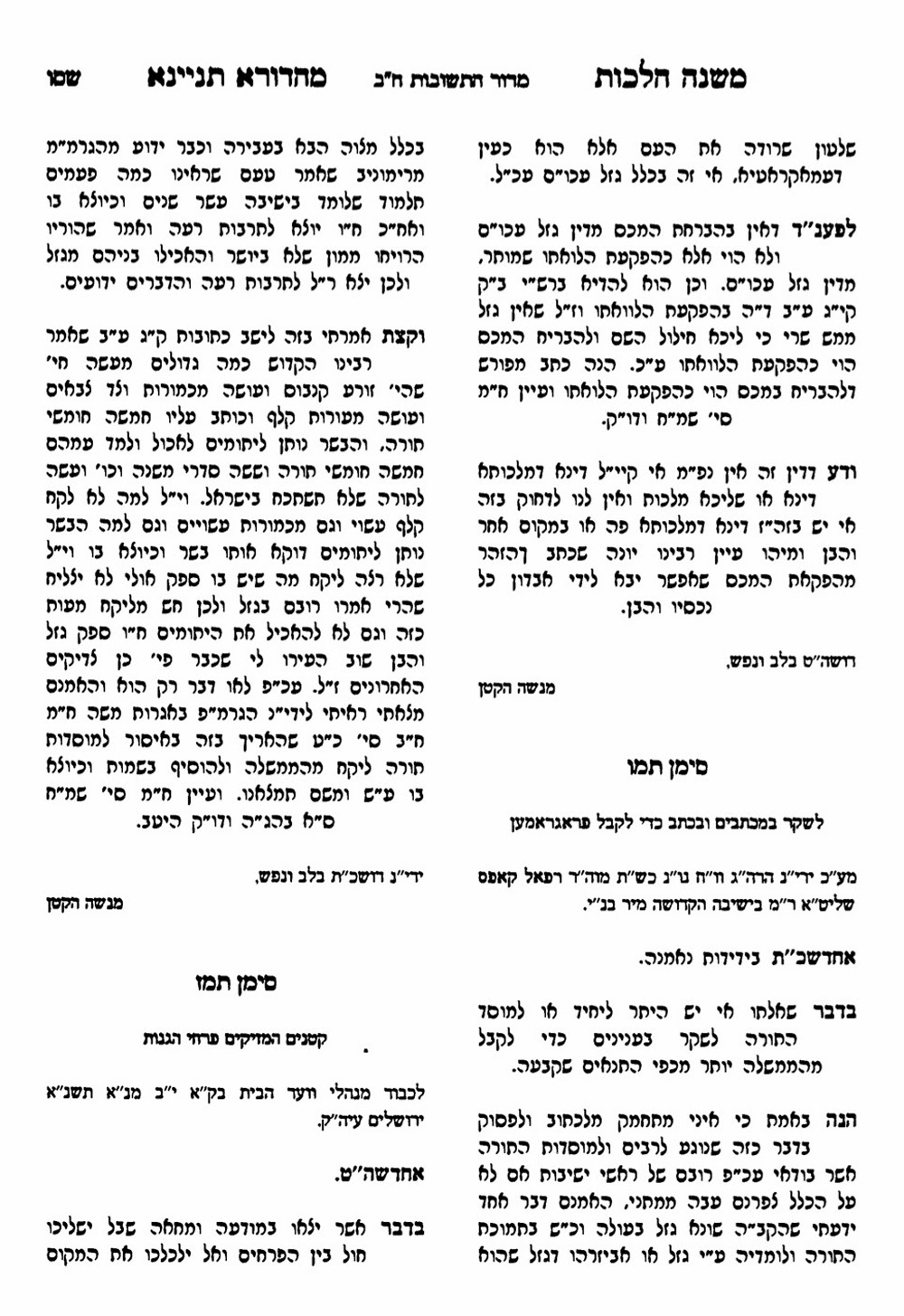
6. In a previous post I noted the yeshiva joke that R. Menasheh Klein’s books should be called Meshaneh Halakhot, instead of Mishneh Halakhot. Strangely enough, if you google “meshaneh halakhot” you will find that the books are actually referred to this way by a few different people, including, in what are apparently Freudian slips, B. Barry Levy and Daniel Sperber. In fact, Klein’s books are not the first to be referred to in this sort of way. In his polemic against Maimonides, R. Meir Abulafia writes (Kitab al Rasail [Paris, 1871), p. 13):
הוא הספר הנקרא משנה תורה, ואיני יודע אם יש אם למסורת ואם יש אם למקרא.

Abulafia is mocking Maimonides’ greatest work, and wondering if perhaps it should be called Meshaneh Torah! As for Klein, there is a good deal that can be said about his prolific writings, and they await a comprehensive analysis. When thinking about Meshaneh Halakhot, I often recall following responsum, which appears in Mishneh Halakhot, vol. 5, no. 141, and which I am too embarrassed to translate.

A well-known talmid hakham pointed out to me something very interesting. Normally we understand hillul ha-shem to mean that a non-Jew will see how Jews behave and draw the wrong conclusions of what Torah teachings are all about. However, in this responsum we see the exact opposite. The hillul ha-shem is that the non-Jew will draw the right conclusion! Yet the truth is that this understanding of hillul ha-shem is also very popular and is used by R. Moses Isserles, as we will soon see..
Here is another responsum that will blow you off your seats, from Mishneh Halakhot, New Series, vol. 12, Hoshen Mishpat no. 445.


If you want to understand why three hasidic kids are sitting in a Japanese jail, this responsum provides all you need to know. Can anyone deny that it is this mentality that explains so much of the illegal activity we have seen in recent year? Will Agudat Israel, which has publicly called for adherence to high ethical standards in such matters, condemn Klein? Will they declare a ban on R Yaakov Yeshayah Blau’s popular Pithei Hoshen, which explains all the halakhically permissible ways one can cheat non-Jews? You can’t have it both ways. You can’t declare that members of your community strive for the ethical high ground while at the same time regard Mishneh Halakhot, Pithei Hoshen, and similar books as valid texts, since these works offer justifications for all sorts of unethical monetary behavior. The average Orthodox Jew has no idea what is found in these works and how dangerous they are. Do I need to start quoting chapter and verse of contemporary halakhic texts that state explicitly that there is no prohibition to cheat on one’s taxes?[15] Pray tell, Agudah, are we supposed to regard these authors as legitimate halakhic authorities?
I have no doubt that there was a time that the approach found here was acceptable. In an era when Jews were being terribly persecuted and their money was being taken, the non-Jewish world was regarded as the enemy, and rightfully so. Yet the fact that pesakim reflecting this mindset are published today is simply incredible. Also incredible is that R. David Zvi Hoffmann’s Der Schulchan-Aruch und die Rabbinen über das Verhältniss der Juden zu Andersgläubigen, a classic text designed to show that Jewish law does not discriminate monetarily against contemporary Gentiles, has not yet been translated. Hoffmann’s approach was shared by all other poskim in Germany, who believed that any discriminatory laws were simply no longer applicable.[16] R. Jehiel Jacob Weinberg stated that we must formally declare that this is what we believe. Can Agudah in good conscience make such a declaration, and mean it?
The truth is that there is an interesting sociological divide on these matters between the Modern Orthodox and the haredi world. Here is an example that will illustrate this. If a Modern Orthodox rabbi would advocate the following halakhah, quoted by R. Moses Isserles, Hoshen Mishpat 348:2,[17] he would be fired.[18]
טעות עכו”ם כגון להטעותו בחשבון או להפקיע הלואתו מותר ובלבד שלא יודע לו דליכא חילול השם.
If I am wrong about this, please let me know, but I don’t believe that any Modern Orthodox synagogue in the country would keep a rabbi who publicly advocated this position.[19] Indeed, R. Moses Rivkes in his Be’er ha-Golah on this halakhah wants people to know that they shouldn’t follow this ruling.[20] See also Rivkes, Be’er ha-Golah, Hoshen Mishpat 266:1, 383:1, and his strong words in Hoshen Mishpat 388:12 where he states that the communal leaders would let the non-Jews know if any Jews were intent on cheating them. Today, people would call Rivkes a moser.
I believe that if people in the Modern Orthodox world were convinced that Rama’s ruling is what Jewish ethics is about, very few of them would remain in Orthodoxy. In line with what Rivkes states, this halakhah has been rejected by Modern Orthodoxy and its sages, as have similar halakhot. As mentioned, Hoffmann’s Der Schulchan-Aruch is the most important work in this area. Yet today, most people will simply cite the Meiri who takes care of all of these issues, by distinguishing between the wicked Gentiles of old and the good Gentiles among whom we live. Thus, whoever feels that he is living in a tolerant environment can adopt the Meiri’s position and confidently assert that Rama is not referring to the contemporary world.
Yet what is the position of the American haredi world? If they accept Rama’s ruling, and don’t temper it with Meiri, then in what sense can the Agudah claim that they are educating their people to behave ethically in money matters? Would they claim that Rama’s halakhah satisfies what we mean by “ethical” in the year 2009? Will they say, as they do in so many other cases, that halakhah cannot be compared to the man-made laws of society and cannot be judged by humans? If that is their position, I can understand it, but then let Aish Hatorah and Ohr Sameach try explaining this to the potential baalei teshuvah and see how many people join the fold. If this is their position, then all the gatherings and talks about how one needs to follow dina de-malchuta are meaningless, for reasons I need not elaborate on. Furthermore, isn’t all the stress on following dina de-malchuta revealing? Why can’t people simply be told to do the right thing because it is the right thing? Why does it have to be anchored in halakhah, and especially in dina de-malchuta? Once this sort of thing becomes a requirement because of halakhah, instead of arising from basic ethics, then there are 101 loopholes that people can find, and all sorts of heterim as we saw in Klein’s responsum. I would even argue that the fact that one needs to point to a halakhic text to show that it is wrong to steal is itself a sign of our society’s moral bankruptcy.[21]
7. In Studies in Maimonides and His Interpreters I stated that Maimonides nowhere explicitly denies the existence of demons, yet this denial is clearly implied throughout his writings. It was because Maimonides never explicitly denied them that so many great sages refused to accept this, and assumed that Maimonides really did believe in demons. (In my book I cited many who held this position.) I first asserted that Maimonides never explicitly denied demons in my 2000 article on Maimonides and superstition, of which the second chapter in my new book is an expanded treatment. While working on the original article I was convinced that Maimonides indeed denied demons in his Commentary to Avodah Zarah 4:7. However, I had a problem in that so many who knew this text did not see it as an explicit rejection. In fact, I was unaware of anyone actually citing this text to prove that Maimonides denied the existence of demons. (Only a couple of months ago did R. Chaim Rapoport call my attention to R. Eliezer Simhah Rabinowitz, She’elot u-Teshuvot ve-Hiddushei Rabbi Eliezer Simhah [Jerusalem, 1998], no. 11, who does cite this text as an explicit rejection of the existence of demons. I also recently found that R. Avraham Noah Klein, et. el., Daf al ha-Daf [Jerusalem, 2006), Pesahim 110a, quotes the work Nofet Tzufim as saying the same thing. Unfortunately, as far as I can tell, Klein doesn’t have a list of sources, so I don’t know who the author of this work is.)
Seeing that R. Zvi Yehudah Kook was quite adamant that Maimonides believed in demons,[22] I turned to R. Shlomo Aviner, who published R. Zvi Yehudah’s work, and asked him about Maimonides’ words in his Commentary to Avodah Zarah. Aviner convinced me that Maimonides should be understood as only denying that occult communication with demons is impossible, not the existence of demons per se. He wrote to me as follows:
הרמב”ם לא כתב שם בפירוש שאין שדים, אלא ששאלה בשדים היא הבל, וכך אנו רואים מן ההקשר שהוא מגנה שיטת שונות להשיג דברים או ידיעות, כגון “כשוף וההשבעות והמזלות הרוחניות, ודבר הכובכים והשדים והגדת עתידות ומעונן ומנחש על רוב מיניהם ושאלת המתים.”


I was still not 100 percent sure, but the fact that so many great scholars who knew the Commentary to Avodah Zarah assumed that Maimonides indeed believed in demons gave me confidence that Aviner was correct.[23] Even R. Kafih, in speaking of Maimonides denial of demons, does not cite the Commentary,[24] and this sealed the matter for me. I therefore assumed that all Maimonides was denying in his Commentary to Avodah Zarah 4:7 was the possibility of conversation with demons, and not demons per se. (R. Aviner doesn’t speak of simple conversation, but this was my assumption.)
Following publication of the article in 2000 no one contacted me to tell me that I was incorrect in my view of Maimonides and demons. So once again I was strengthened in my assumption, and repeated my assertion in Studies in Maimonides. Not too long ago I received an e-mail from Dr. Dror Fixler. Fixler is one of the people from Yeshivat Birkat Moshe in Maaleh Adumim who is working on new editions of Maimonides’ Commentary on the Mishnah. I will return to his work in a future post when I deal with the newly published translation of the Commentary. For now, suffice it to say that he knows Arabic very well, and he asserts that there is no doubt whatsoever that in the Commentary to Avodah Zarah 4:7 Maimonides is denying the existence of demons. So this brings me back to my original assumption many years ago, that Maimonides indeed is explicit in his denial. If there are any Arabists who choose to disagree, I would love to hear it.
8. I recently sent a copy of the reprint of Kitvei R. Yehiel Yaakov Weinberg (2 vols.) to a famous and outstanding Rosh Yeshiva. In my letter to him I mentioned that the books were a donation to the yeshiva library. He wrote back to me as follows:
מאשר בתודה קבלת כתבי הגאון רבי יחיאל יעקב וויינברג זצ”ל בשני כרכים. מלאים חכמה ודעת בקיאות וחריפות ישרה, ולפעמים “הליכה בין הטיפות” מתוך חכמת חיים רבה. אולם בכרך השני יש דברים שקשה לעכל אותם, כגון לימוד זכות על מתבוללים ממש (הרצל ואחה”ע [אחד העם] בגרון ועוד) למצוא בהם “ניצוצות קדושה”. ומי שיראה יחשוב כי מותר לומר לרשע צדיק אתה. לכן כרך ב’ נשאר אצלי וכרך א’ לעיון התלמידים הי”ו.


I don’t think that any Rosh Yeshiva in a Hesder yeshiva would say that we should shield the students from the words of a great Torah scholar, but maybe I am wrong. I would be curious to hear reactions. In response to his letter, I sent this Rosh Yeshiva R. Abraham Elijah Kaplan’s essay on Herzl, to show him that Weinberg’s views in this regard were not unique.
Interestingly, in his letter to me the Rosh Yeshiva also wrote:


מה מאד נפלא מ”ש בסוף עמוד ריט על שיטת הגר”ח מבריסק לעומת שיטת הגר”א. מבחינה זו אנו לומדים בישיבה בשיטת הגר”א.


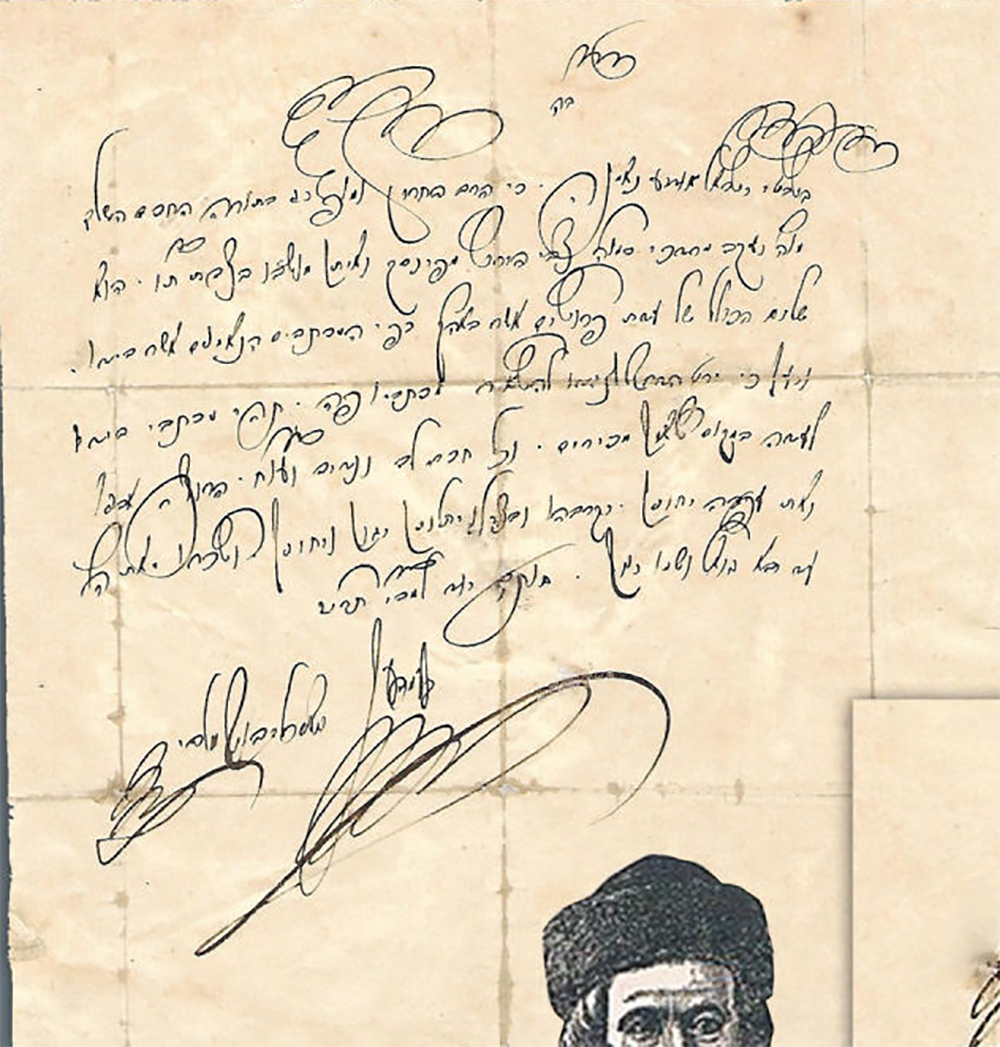
He was referring to this amazing letter from Weinberg:
קראתי את מאמרו של הגרי”ד סולובייציק על דודו הגרי”ז זצ”ל. השפה היא נהדרה ונאדרה והסגנון הוא מקסים. אבל התוכן הוא מוגזם ומופרז מאד. כך כותבים אנשים בעלי כת, כמו אנשי חב”ד ובעלי המוסר. מתוך מאמרו מתקבל הרושם כאלו התורה לא נתנה ע”י מרע”ה חלילה כי אם ע”י ר’ חיים מבריסק זצ”ל. אמת הדברים כי ר’ חיים הזרים זרם חדש של פלפול ע”ד ההגיון לישיבות. בהגיון יש לכל אדם חלק, ולפיכך יכולים כל בני הישיבה לחדש חידושים בסגנון זה, משא”כ בדרך הש”ך ורעק”א צריך להיות בקי גדול בשביל להיות קצת חריף ולכן משכל אנשי הישיבות מתאוים להיות “מחדשים” הם מעדיפים את ר’ חיים על כל הגאונים שקדמו לו. שאלתי פעם אחת את הגרי”ד בהיותו בברלין: מי גדול ממי: הגר”א מווילנא או ר’ חיים מבריסק? והוא ענני: כי בנוגע להבנה ר’ חיים גדול אף מהגר”א. אבל לא כן הדבר. הגר”א מבקש את האמת הפשוטה לאמתתה, ולא כן ר’ חיים. הגיונו וסברותי’ אינם משתלבים לא בלשון הגמ’ ולא בלשון הרמב”ם. ר’ חיים הי’ לכשלעצמו רמב”ם חדש אבל לא מפרש הרמב”ם. כך אמרתי להגאון ר’ משה ז”ל אבי’ של הגר”יד שליט”א.


9. My last two posts focused on R. Hayyim Dov Ber Gulevsky. With that in mind, I want to call everyone’s attention to a lecture by R. Aharon Rakefet in which he tells a great story that he himself witnessed, of how students in the Lakewood yeshiva were so angry at Gulevsky that they actually planned to cut his beard off. It is found here  [25] beginning at 65 minutes. The clip has an added treat as we get to hear the Indefatigable One, who mentions travelling to Brooklyn together with a certain “Maylech” in order to visit Gulevsky.
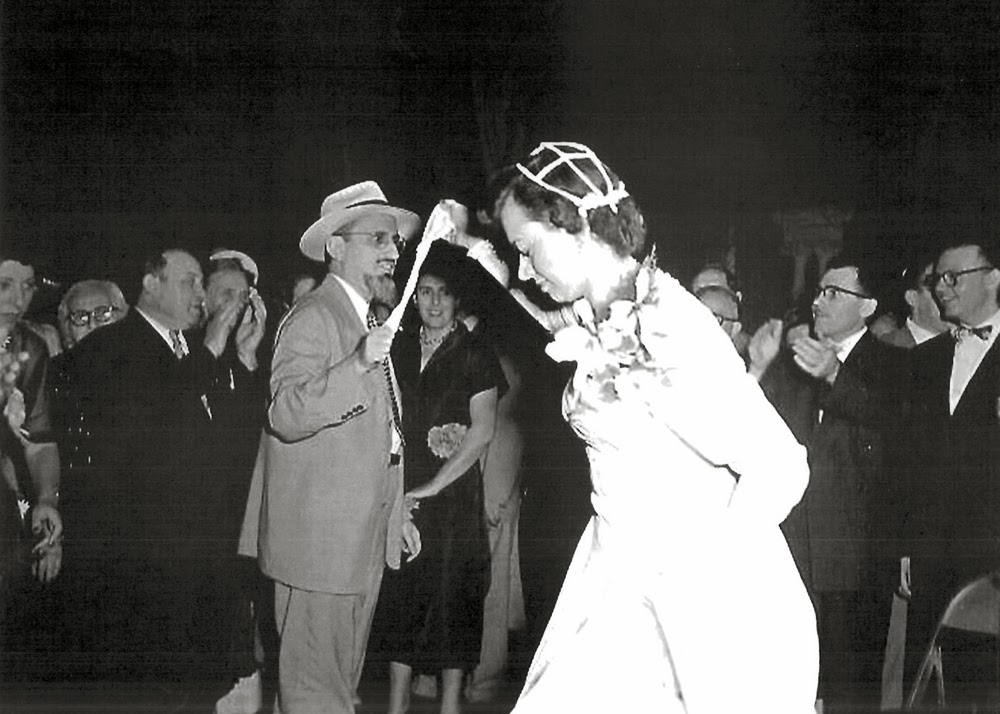
10. And finally, apropos of nothing, here is a picture that I think everyone will get a kick out of. The bride is Gladys Reiss. It shows the Rav in his hasidic side. (Thanks to David Eisen and R. Aharon Rakefet for providing the picture.)

[1] Some of the lies of this paper have been dealt with by R. Moshe Alharar, Li-Khvodah shel Torah (Jerusalem, 1988). Here are two condemnations of Yated printed in Alharar’s book.


For examples of the paper’s most recent outrages, take a look at two articles from the issue that appeared during the Ten Days of Penitence (!). The articles are available here and here.


The first is a vicious attack on the Shas MK R. Hayyim Amsellem for his authorship of a halakhic study arguing that those non-Jews who serve in the Israeli army should be converted using a less strict approach than is currently in practice. Amsellem, who is a student of R. Meir Mazuz and an outstanding talmid hakham, wrote this piece and sent it to some leading poskim to get their opinions. Amselem also discussed his approach in an interview.


What did Yated do? It attacked the “nonsensical, heretical remarks” of Amsellem, knowing full well that his article was not a practical halakhic ruling, but a work of Torah scholarship sent out for comment. And why is what he wrote “nonsensical” and “heretical”? Because it contradicts the viewpoint of “Maranan ve-Rabbanan Gedolei Yisrael,” the papacy that Yated has created.  As with every papacy, no one is permitted to have a different viewpoint. We see that clearly in the next article I linked to. Here the paper deals with the great sages who have permitted brain death. Obviously, Yated has started to believe its own papal rhetoric, since rather than offer any substantive comments, all it can do is refer to R. Elyashiv and unnamed former and current gedolei Yisrael. From Yated’s papal perspective, this is supposed to silence all debate, as if Judaism is a religious dictatorship. Yet it is not, and although Yated will never admit it, there are also former and current gedolei Yisrael who do accept brain death.
[2] “Be-Inyan ha-Gemarot ha-Mevuarot ha-Hadashim,” Or Yisrael 50 (Tevet, 5768), p. 42.
[3] “Be-Inyan Hadpasat ha-Gemara im Targumim u-Ferushim Hadashim,” Or Yisrael 50 (Tevet, 5768), pp. 39-40. Gorelik even claims that the only reason the Hafetz Hayyim agreed to support the Daf Yomi program was as a defense against the Haskalah and Reform. R. Chaim Rapoport responded to Gorelik, ibid., pp. 57ff.
[4] For the Lubavitcher Rebbe’s take on this, see here beginning at 8 minutes (called to my attention by a friend who wishes to remain anonymous). The Rebbe’s words are very strong: Since we know that “people” do not tell a lie that is likely to be found out, it must be that the liars are not in the category of “people” i.e., human beings!
[5] The phenomenon of children distorting their father’s legacy is also something that deserves a post of its own. One thinks of the efforts of the children and grandchildren of R. Gedaliah Nadel and R. Eliezer Waldenberg in opposition to the publication of Be-Torato shel R. Gedaliah and the reprinting of Hilkhot ha-Medinah. R. Nadel’s children were even successful in having Be-Torato removed from Hebrewbooks.org. There are many other such examples, some of which relate to the Rabbinical Seminary of Berlin, which like Yeshiva University was sometimes a place to be forgotten after one left the world of German Orthodoxy. For example, see R. Shmuel Munk’s biographical introduction to the work of his father, R. Shaul Munk, Bigdei Shesh (Jerusalem, 1973). There is no mention that R. Shaul studied at the Rabbinical Seminary. If that wasn’t enough, R. Shmuel, in the introduction, p 19, even attacks the German Orthodox practice of reading German poetry, going so far as to say that no one [!] has permitted this. As with the Yated, “no one” means “no one we regard as significant.” For an earlier post that deals with a posthumous removal of the Rabbinical Seminary from one graduate’s biography, see here.


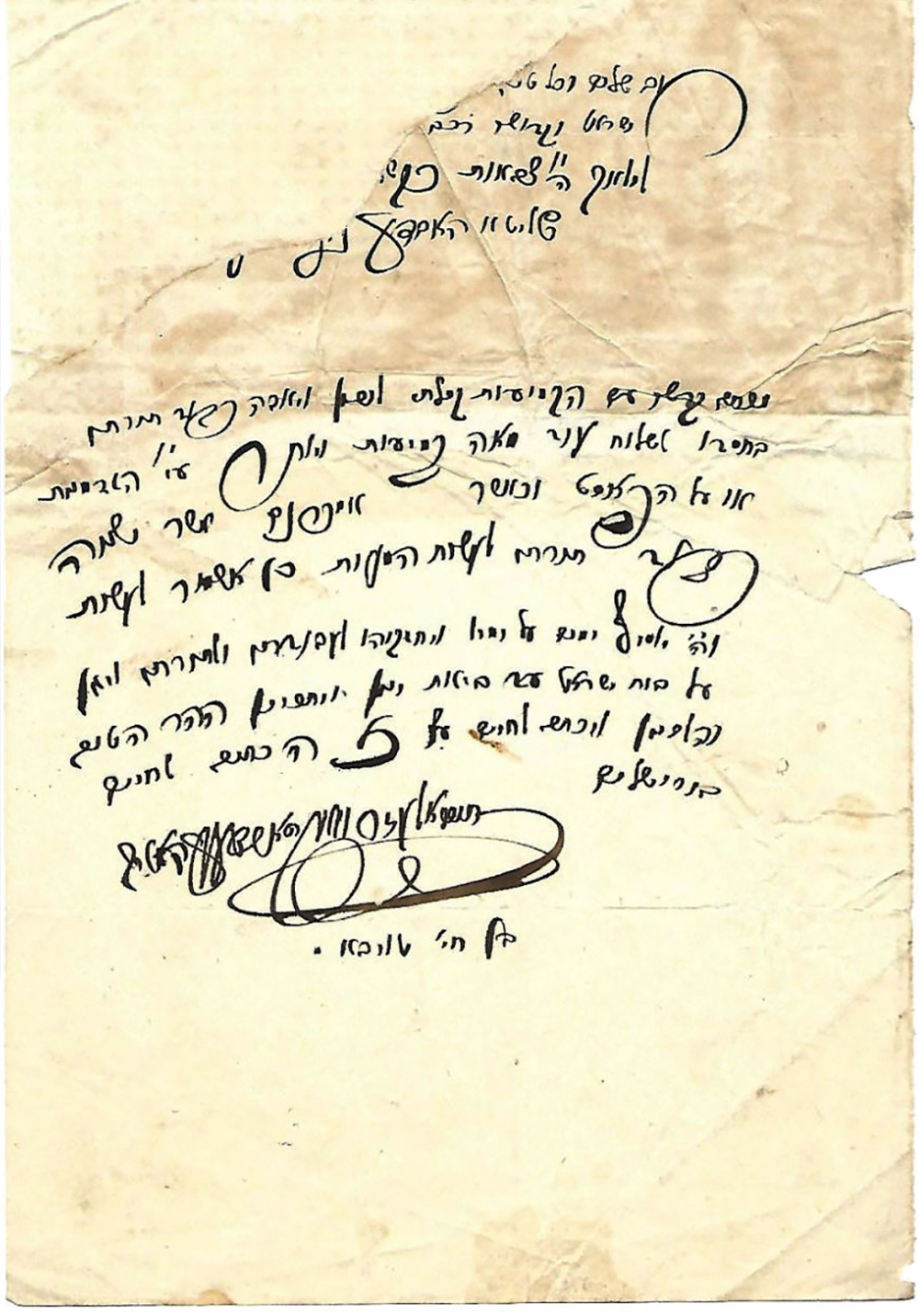
None of the obituaries of R. Shlomo Wolbe mentioned that he studied at the Rabbinical Seminary of Berlin for a short while, but in this case I assume that the writers were unaware of this. The entry on Wolbe in Wikipedia does mention it, and I was the source for this information. My source is Weinberg’s letter to Samuel Atlas, dated June 10, 1965:


כך סיפר בן אחיו של וולפסון, מר אביעזר וולפסון, תלמיד מונטרה לפנים, ואח”כ תלמיד ישיבת באר יעקב, שבה משמש המנהל רוחני מר וולבה, יליד ברלין, בנו של סופר חילוני וכופר גמור. למד בכתות הנמוכות של בית מדרשנו, ואח”כ הלך לישיבת מיר ונעשה לחניכו של ר’ ירוחם ז”ל, המשפיע המוסרי הגדול.


The point mentioned by Weinberg, that Wolbe was raised in a non-Orthodox home, was never a secret. Some additional details of his turn to Orthodoxy were related by Anne Ruth Cohn, Dayan Grunfeld’s daughter. See here


Yet, as we have come to expect, the Yated cannot be honest with its readers. Thus, in its obituary here. It writes: “Shlomo Wolbe was born in Berlin to R’ Moshe in Tammuz 5674,” making it seem that he was from an Orthodox home. The obituary continues with more falsehoods: “As a child he studied in his home city and at a young age was sent to Yeshivas Frankfurt.” Needless to say, there is also no mention of Wolbe’s university studies.


Another example worth mentioning is the following: Those who read Making of a Godol will recall the description of R. Aaron Kotler’s irreligious sister who tried to convince him to leave the world of the yeshiva. Yet in Yitzchok Dershowitz’ hagiography of R. Aaron, The Legacy of Maran Rav Aharon Kotler (Lakewood, 2005), p. 63, this communist sister is described as “religious, but ‘secular education’ oriented.” See Zev Lev, “Al ‘Gidulo shel Gadol,’” Ha-Ma’ayan 50 (Tishrei, 5770), p. 104.


The absolute best example of this phenomenon relates to the Lubavitcher Rebbe’s brother, Yisrael Aryeh Leib. He was completely irreligious. There are people alive today who can testify to his public Sabbath violation. He even kept his store open on Shabbat. See Shaul Shimon Deutsch, Larger than Life (New York, 1997), vol. 2, ch. 7. Deutsch was even able to speak to his widow. Yisrael Aryeh Leib also has a daughter who presumably would be willing to describe what her father’s attitude towards religion was, if anyone is really interested in knowing the truth. I think it is very nice that Chabad in England commemorates his yahrzeit, see here, and this is very much in line with Chabad’s ideology that every Jew is precious. Yet what is one to make of this “institute”?


Here Yisrael Aryeh Leib, “the youngest brother of the Rebbe, Melech HaMoshiach, who lives forever,” is turned into a rabbi and devoted chasid. I actually contacted the person who runs the “institute” and asked him how he can so blatantly distort the historical record. Communicating with him was one of the most depressing experiences I have had in a long time. It is one thing for a person to believe foolish things, but here was a guy who had drunk an extra dose of the Kool Aid, and with whom normal modes of conversation were impossible. This is actually a good limud zekhut for him: unlike many other cases where the people distorting the historical record are intentionally creating falsehoods, in this case the distorter really believes what he is saying.
[6] R. Mark Urkowitz, who was a student of R. Gorelik, told me that at the end of his life Gorelik commented to him that he was very happy he taught at YU, since this was the only yeshiva whose graduates were bringing Torah to all corners of the United States. When Urkowitz later told this story to another of Gorelik’s son, he denied that his father could ever have said this. Urkowitz and one other person recalled to me how at Gorelik’s funeral YU was never mentioned in any of the eulogies. It was as if the major part of Gorelik’s life for forty years had never existed.
[7] Ishim ve-Shitot (Tel Aviv, 1952), pp. 58-59.
[8] Aaron Rakeffet-Rothkoff, The Rav, vol. 1, p. 227.
[9] This is Zevin’s preface to the story (translation in Louis Jacobs, A Tree of Life [London, 2000], pp. 54-55, n. 49):


Why did R. Hayyim refuse to write responsa? Some think that his remoteness from the area of practical decisions stemmed from the fact that he belonged to the ranks of “those who fear to render decision,” being afraid of the responsibility that it entails. But this is not so. The real reason was a different one. R. Hayyim was aware that he was incapable of simply following convention and that he would be obliged, consequently, to render decisions contrary to the norm and the traditionally accepted whenever his clear intellect and fine mind would show him that the law was really otherwise than as formulated by the great codifiers. The pure conscience of a truthful man would not allow him to ignore his own opinions and submit, but he would have felt himself bound to override their decisions and this he could not bring himself to do.
[10] See here.
[11] For more on Abraham Bick the communist, and his relationship with R. Moshe Bick, see here for the following report:


אברהם ביק הכרתי בפעם הראשונה כהרה”ר של רוסי’ בא לבקר לארה”ב בשנת תשכ”ח ביזמת הרב טייץ מאליזאבעט נוא דזשערזי. וכבוד גדול עשו לו וכל גדולי ארצינו באו לבקר אותו ולחלוק לו כבוד — הוא למד בסלאבאדקא והי’ ממלא מקומו של הרב שלייפער, וניהל בחכמה ובתבונה את רבנתו ועמד על משמרתו הוא בא ביחד עם החזושל לענינגראד -השומר- בבארא-פארק עשו פאראד גדול וכל הישיבות והבית-יעקב יצאו לרחובה של עיר לחוק כבוד להעומד על משמרת היהדות ברוסי’ משם נסעו לישיבת תורה-ודעת שכל הגדולים דברו וחיזקו את הרב לעווין .משם נסעו לאליזאבעט מקום הרב טייץ — שחלקו רב בענייני יהדות רוסי’ —  וגם שם הי’ פאראד גדול. והרב לעווין הי’ מאוד מרוגש .ודמעות נזלו מעיניו. נחזור לביק-הוא הי’ קאמאניסט. והי’ מכונה הרב של הקאמאניסטים. הוא כתב מאמרים בשבועון שלהם ותמיד המליץ טוב על הקאמאניסטים שהם לא רודפים את הדת. וכשהרב לעווין הי’ כאן הוא הי’ מראשי המחותנים שם. ואז דברתי איתו בפעם הראשונה. אח”כ הוא עלה לארה”ק ועבד במוסד הרב קוק ומצאתיו שם אך לא רציתי להכאיבו ולא דברנו על העבר. אז נתן לי שני ספרים א] זהרי-חמה הגהות על הזוה”ק מהיעב”ץ. ועוד ספר למוסרו לש”ב הרה”ג רמצ”א זצ”ל ביק — הוא פשוט רצה להתפייס איתו כי הם לא היו שוה בשוה-וכשהבאתי את הספרים להרב ביק דברתי איתו על אברהם ביק ואביו הרה”ג שהי’ חתן המשמרת שלום מקאדינאוו, והי’ בעל הוראה מובהק. בקיצור לאחר זמן חזר לארה”ב בגין אישתו וביתו שלא היו בקו הבריאות — הוא הי’ דמות טראגית — אביו שלחו מארה”ב ללמוד לארה”ק. אך הי’ תמיד שומר תורה ומצוות הי’ אידאליסט ולא הי’ בן יחיד במחשבתו שהקאמאניזום יציל את האנושות והיהדות .הוא לא עשה זאת מטעם כסף .הוא לא הי’ מאטראליסט. והשם הטוב יכפר בעדו.


[12] Ha-Maor, Tamuz 5726, p. 18.
[13] Ha-Gaon ha-Rav Meir Amsel (Monsey, 2008), p. 262.
[14] See R. Yaakov Hayyim Sofer in Moriah, Nisan 5769, p. 150.
[15] R. Chaim Rapoport provides some of these sources in his article in Or Yisrael, Tishrei 5770.
[16] For R. Abraham Elijah Kaplan’s view, see his Mivhar Ketavim (Jerusalem, 2006), pp. 287-288.
[17] After quoting this halakhah, Rama cites an opposing view, but this is cited as יש אומרים, meaning that the first ruling is the one Rama accepts. Even this view is not something that would go over well in the Modern Orthodox world: וי”א דאסור להטעותו אלא אם טעה מעצמו שרי
[18] Although he might not be fired, any Modern Orthodox rabbi who stated as follows would also be in hot water, as the congregation would be outraged: “One is not allowed to admire gentiles or praise them.” The writer of these words goes on to say that collecting baseball cards is also forbidden. “While it may be that some people trade them only for financial gain, the reason for collecting the cards is more likely because of an appreciation and admiration for the personalities depicted on them. This is forbidden.” Quite apart from the terrible lack of judgment in putting the first sentence (“One is not allowed to admire gentiles or praise them”) into an English language book (for obvious reasons), should we be surprised that a halakhist who thinks baseball cards are forbidden is one of the poskim of the formerly Modern Orthodox OU? See R. Yisrael Belsky, Shulchan Halevi (Kiryat Sefer, 2008), pp. 132, 133. (For another ruling against baseball cards, see R. Yitzhak Abadi, Or Yitzhak, Yoreh Deah no. 26.) In discussing the issue of praising Gentiles and the prohibition of le tehanem, Meiri writes as follows, in words that have become basic to the Modern Orthodox ethos (Beit ha-Behirah: Avodah Zarah 20a):


כל שהוא מן האומות הגדורות בדרכי הדתות ושמודות בא-להות אין ספק שאף בשאין מכירו מותר וראוי.


[19] Samuel Cohon discusses Rama’s ruling in Faithfully Yours (Jersey City, 2008), pp. 87-88.
[20] See similarly R. Shneur Zalman of Lyady, Shulhan Arukh, Hilkhot Ona’ah, no. 11.
[21] Along these lines, see here for a recent article by R Binyamin Lau dealing with a husband who wanted to know if he was halakhically permitted to hit his wife.
[22] Sihot ha-Rav Tzvi Yehudah: Bereishit, ed. Aviner (Jerusalem, 1993), pp. 295-297, 310-312.
[23] In Studies in Maimonides I cite numerous examples. Here is one more to add to the list. R. Tzefanyah Arusi, “’Lo ba-Shamayim Hi’ be-Mishnat ha-Rambam,” Mesorah le-Yosef 6 (2009), p. 396:


מה שהשיג הגר”א בעניין השדים והכשפים, יש להשיב על כל דבריו: וכי מניין לו שלדברי רבנו אין מציאות לשדים ולמכשפים וכיו”ב.


[24] See his Ketavim (Jerusalem, 1989),  vol. 2, pp. 600-601.
[25] “The Bracha for Kidush Ha-Shem,” Sep. 21, 2008.


Rare Letters, Controversial & Valuable Hasidic Books – Genazym Auction

Genazym Auction is holding an auction on March 21st that includes many important letters and manuscripts and a small number of books (download a pdf of the catalog here).  Many of the books are Hasidic or owned by well-known Hasidic figures.  For example, the rare first edition of the No’am Elimelekh, 1788, by R. Elimelekh of Lyzhensk (lot 13).  That book, like other early Hasidic books are both fundamental to the Hasidic philosophy and theology and were controversial among those opposed to the new movement.  Indeed, according to Rabbi David of Makov, the book should be “eradicated from our homes.” (R. David of Makov, Shever Poshim, in Morecai Wilensky, Hasidim U-Mitnaggedim, vol. II (Jerusalem:  Mossad Bialik, 1970).  Similarly, the  Tolodot Ya’akov Yosef, was published in Lvov, 1788, is among the most prized Hasidic books.  The book was controversial when it was printed (likely without official approval of the censor) and some copies were destroyed in Brody. According to the legend recorded in Shivhei Ha-Besht the matter of the books was so important it was discussed in the heavenly court at the highest levels. Joseph Perl, in his satire, Megaleh Temirin, locates that bibliocide at “the home of R. Mikhel of Zlotchuv, in compliance with the order of the [Brody] court and the community there.” (See Jonathan’ Meir’s recent critical edition of the Megalah Temirim that provides additional evidence of the book burning.  Sefer Megale Temirin, ed. Jonathan Meir (Jerusalem: Bialik Institute, 2013) 29n10). Ownership of the No’am Elimelekh is also valued as a segulah.  There are other books that are prized not only for their content but also for such secondary reasons, for example, the Homat Eish, (R. Eliezer from Kalktshuv, Bresslau 1799), as the title implies is designed to protect from fire. (See also Avraham Ya’ari, Mehkerei Sefer (Jerusalem:  Yehuda, 1958) 47-54)
Another important Hasidic work is R. Hayyim of Chernowitz’s, Siduro shel Shabbat (lot 14), which is well-known as the source for the Leshem Yihud.  That prayer is among the more controversial prayers, which we have discussed previously here and towards the end of this post. (See also Moshe Halamish, Kabalah: Be-Tefilah be-Halakha ube-Minhag (Ramat Gan:  Bar Ilan University Press, 2000) 45-70 and Daniel Sperber, Minhagei Yisrael (Jerusalem:  Mossad HaRav Kook, 2007) index “leshem yihud”).

Similarly, the Sh”ut Mayyim Hayyim (lot 18) by R. Hayyim Rapoport we have discussed at length here.  The work establishes the existence Ba’al Shem Tov and is an indication of his scholarship. Our post discusses other bibliographical and historic items related to the work. 

   
There are numerous historical and intellectually valuable letters among them the telegram sent from Kobe, Japan, just before Yom Kippur 1941 to the rabbis in Israel requesting clarification, because of the ambiguity of the location of the dateline, as to which day to fast on Yom Kippur. (Lot 48).  A number of opinions are collected in Shitat Kav ha-Tarikh be-Kador ha-Arets, ed. Yehudah Areyeh Blum, (Jerusalem:  [], 1990).  Another book is (admittedly tangentially) related to the geography of the earth, and specifically Jewish astronomical calculations.  An illustration at the top of the title page of Sefer Ebronot (Offenbach, 1772) provides a heliocentric view of the earth.  The same illustrations appear in R. Yehuda Leib Oppenheim’s, Matteh Yehuda (Offenbach, 1722) and with the date displayed Ha-Moshiah ben David.  
R. Eliayhu Guttmacher was a reknown “Ba’al Mofes.”  But he was eventually overwhelmed with petitions for his assistance that he was forced to publish an advertisement in the Ha-Maggid newspaper begging people to stop sending him letters. R. Eliyahu Guttmacher, Mehtav me-Eliayhu (Jerusalem:  Yisrael Bak, 1974) 89-91;  see also Bromberg, Me-Gedolei ha-Torah veha-Hasidut, vol. 24 (Jerusalem:  HaMakhon LeHssidut) 143-52, which prints some of R. Guttmacher’s letters regarding the same; and Glenn Dyner, “Brief Kvetches: Notes to a 19th century Miracle Worker, Jewish Review of Books (Summer, 2014), 33-35. 
An important letter to R. Guttmacher is included in the auction(lot 43):
ויש הכרח ממני לכתוב כאן בקיצור, שבל יאמר מי: הלא נשמע כמה מעשיות אשר נעשים על ידך בעזה”י להציל מצרות רבות, אין זאת רק על ידי קבלת מעשית. וכאשר הגעתי אגרת ממרחק מחכם גדול… בהיותי שאני בקי בקבלה מעשיות ארחם לעשות בבזה שנתייאש מכל הרופאים. בקראי זאת נפלה עלי להיות חשוד בכך… קודם כל אודיע כי בכל התאמצות דחיתי מעלי כל הבא, אבל ראיתי סיבות נפלאות שכן היה רצון ה’. באשר שגדולי ישראל הסיעו הנדכאים עלי. ומה היה לי לעשות אם באו אב ואם ואחד מקרוביהם והביאו לי בנם, בוכים וצועקים לרחם. ישבתי ללמוד עם בחורים בבית המדרש והובא נער מן י”א שנה בכתף אביו וצעק לרחם עליו… והנער לא היה יכול לדבר מאומה… וקולו פעמים בנביחה ככלב ופמעים כעגל…וגם כל העוברים דרך העיר בשמעם עניניו לביתו לראות הנפלאות. ואני ידעתי שאין לי מאומה במה לרפאותו. בכל זאת חשבתי הלא ד’ ברוך הוא שולחו… ולקחתי ספר תהילים ובמקום שנפל אמרתי, והבאתי לכל תיבה כוונה לענין שלפני. וכוונתי היטב בשורש האותיות, ובמיוחד בהזכרת השם הקודש… פתאום הוציא הנער קול אשר נבהלו כולם, והראה באצבע למקום אחד. ואמרתי מהר לפתוח החלון, וכן היה ודיבר הנער ואמר יצאה אחת מן המכשפות ממנו ופתחתי לראות בבטנו כי אמר עוד שלש מכשפות בו… ואמרתי כיון שיש עת רצון אתפלל עוד. וכאשר אמרתי שוב בערך ד’ מינוטין שוב צעק בקול אשר בכל השכונה ברחוב ההוא נבהלו והחלון היה פתוח ושוב אמר הנה כולם יצאו… והיה כזה עוד בכמה אשר יש לכתוב כמעט ספר מכל הענינים, והכל היה בעל כרחי שהפיל עלי בכח. ורק על ידי תפלות ובקשות ולפעמים גם סגולות השכיחות… (עי”ש עוד דברים חשובים בזה, צפנת פענח, מאמר ט).

There are many other interesting items as well, such as R. Shlomo Kluger’s passport (lot 39):

A letter from the Malbim (lot 40) and much more:


The Perils of Ignoring Precedent: Alterations in the Kaddish Prayer

The Perils of Ignoring Precedent:
Alterations in the Kaddish Prayer
by Dan Rabinowitz

Recently there has been a renewal in interest in the structure and make up of the liturgy or siddur. While there have previously been critical editions of the siddur or articles on topics related to the siddur,[1] today’s renaissance of the siddur has been precipitated by a different series of events. Specifically, this has been fostered by the publication and republication of some important source material on the topic; these include, among others R. Shabbetai Sofer of Przmysl’s Siddur Rav Shabbetai Sofer and R. Jacob Emden’s Luach Eresh.[2] The Siddur Rav Shabbetai is key in the development of the siddur, in so far that this edition was considered by many to be considered the edition par excellence of the siddur.[3]

While there has been a flurry of source material, at the same time there has been movement in the opposite direction – a movement which tends to ignore this rich legacy and instead has decided issues of the siddur not based upon critical investigation but rather on reliance on sources that my not be trustworthy. The results have been less than salutary.

One example of both of these trends – the new evidence as well as a seemingly blindness to this evidence – can be found regarding the punctuation of the kaddish prayer.

The Early Evidence Regarding Kaddish

There is a dispute how to punctuate the first two words in kaddish – yisgadel v’yiskadesh (as well as other words in the kaddish, as will become apparent). The controversy is whether they have a patach or a tzeirei under the letter dalet.

The historical evidence is absolute – all the early siddurim punctuate these words with a patach.[4] For example, starting from the 1475 (?) Selichot,[5] the 1486, Soncino Machzor,[6] 1519, Prague Teffilot m’Kol HaShana,[7] 1536, Ausberg Machzor k’seder HaAshkenazim, [8] 1541 Bolonga Machzor k’fei Minhagi k’k Roma, [9] and the 1616 Hanau Seder Teffilot k’Minhag Ashkenaz u’Polin [10] all punctuate the first two words of the kaddish with a patach.[11]

The first to raise and discuss the issue of the punctuation was R. Shabbetai Sofer.[12] In his monumental introduction he discusses the proper pronunciation of the kaddish.[13] He cites the two possibilities mentioned above – a patach or a tzeirei. He explains that the evidence from the Bible seems to point to both. Specifically, he points to contradictory verses in the Book of Daniel. One verse has the word yisgadal with a tzeirei while the other has it with a komatz. R. Sofer explains that the latter must have been punctuated with a patach. The reason is this word appears at the end of the verse. When words appear at a stopping point with a komatz, their regular form can only be with either a segol or a patach. In this case it would be a patach. Thus, we have two verses which seem to lend credence to both readings.

R. Sofer, continues and explains that although one may argue that since the verse has the word yisgadal with a tzeirei that would be the more correct pronunciation, this is not the case. He rejects this due to other grammatical considerations. R. Sofer explains that at least one word in the kaddish passage must be punctuated with a patach and thus, “to keep the words the same (l’zaveg et ha’melot) all should be punctuated with a patach.”[14]

Thus, R. Sofer was the first to entertain the notion the word should be punctuated with a tzeirei and he rejected this reading. Additionally, based upon the proof texts R. Sofer marshals from numerous biblical verses, it is clear that he made no distinction between whether the words are Hebrew or Aramaic. In fact, it seems R. Sofer was treating the bulk of kaddish as Hebrew. He discusses other words in kaddish and their counterparts in the Bible.[15]

Perhaps, aside from the grammatical considerations, R. Sofer also wanted to justify the long standing practice regarding the pronunciation. If this is the case, he does not mention precedent. But, one can not rule this out as a possible subconscious motive.[16]

The First Change to Kaddish

For the first to actually advocate for the alteration of the pronunciation to a tzeirei, we need to wait until the early 18th century.[17] In the early 18th century, R. Shlomo Zalman Hanau (Katz) published a work on Hebrew grammar entitled, Binyan Shlomo.[18] He published this at the relatively young age of 21.[19] In this work he advanced that the correct pronunciation of the kaddish is with a tzeirei.[20] But, it is not only the first two words. Instead, based upon the rules of grammar all similarly constructed words in kaddish should also have a tzeirei. Thus, yisbrach, yispaer, and v’yisromam all have a tzeirei.[21]

While at first R. Hanau only wrote a grammar work, he eventually incorporated his alterations into both his work on the siddur – Sha’ari Teffilah[22] – as well as his edition of the siddur – Bet Teffilah.[23] In this instance, this alteration to the kaddish only appears in his siddur.[24] In his siddur, he punctuates the kaddish with a tzeirei throughout.[25] Thus, he has a tzeirei for yisbrach, yispaer, and v’yisromam in the kaddish. Additionally, he is thoroughly consistent in his siddur, any other instance of either the same formulation or the same word, R. Hanau always uses the tzeirei. For example, the same opening words of kaddish appear in the prayer after the removal of the Torah. There R. Hanau has a tzeirei for ‘al ha-kol yisgadel v’yiskadesh.[26] In the Shemoneh Esreh where a similar formulation appears – v’al kulam yisbrach v’yisromam again R. Hanau has a tzeirei.[27] As we shall see, most who followed him were not nearly as careful in their punctuation even when they adopted R. Hanau’s understanding of the kaddish punctuation.

Before we leave R. Hanau, we must first understand how his contemporaries viewed his alterations. When he published his Binyan Shlomo aside from the change in kaddish he also took issue with many of his predecessors understanding of Hebrew grammar. It seems that he did so in a less than respectful fashion. In light of this, he was threatened with a ban on his book unless he would print a retraction of his harsh comments. Needless to say, R. Hanau complied. At the end of his Binyan Shlomo he inserted a page (somewhat smaller than the rest of the book) asking forgiveness from those he may have offended.[28]

Not only was his Binyan Shlomo controversial, but his works on the siddur were as well. R. Jacob Emden’s Luach Eresh is a rebuttal of many of R. Hanau’s changes.[29] R. Emden whose was well known for his acerbic remarks spared none for R. Hanau. He accused Hanua of even forging an approbation Hanau received from R. Emden’s father- R. Tzvi Ashkenazi (Hakham Tzvi).[30]

Thus, it seems far from clear whether R. Hanau’s alteration regarding kaddish would in fact be accepted.[31] In fact, based upon his reputation and the historical precedent this alteration would not be accepted. But, due to two unrelated events, his change has gained more and more credence as time has passed.

The Siddurim Which Followed R. Hanau

While R. Hanau was a singular individual whose own edition of the siddur was printed once, he still had a tremendous impact on the development of the siddur. His influence was felt through the inclusion of some of his changes in two important editions of the siddur. The first is Wolf Heidenheim’s and the second is Seligmann Baer. Both of these siddurim included many[32] of Hanau’s changes.[33]

But, for this change to kaddish these siddurim which did not have qualms about incorporating other changes did not for this. Instead, the prevalence of this change is due to two entirely different events. In fact, Seligmann Baer in another of his works, defends the use of the patach.[34]

The Two Events Which Precipitated the Inclusion of R. Hanau’s Change

The first event[35] which promoted R. Hanau’s alteration was the inclusion of it in R. Yosef Teomim’s Peri Megadim. In his comments on the kaddish, R. Teomim includes R. Hanau’s alteration of a patach to a tzeirei.[36]

While at first glance this may appear strange, incorporating a change of questionable accuracy from a questionable source, a closer look at both R. Teomim’s life as well as his own comments, clarifies why he did so. Originally of Eastern European stock, R. Teomim spent two years in Berlin. During this time he studied in the Beit Medrash of Daniel Yaffo. At the time, this Beit Medrash was populated by the leading maskilim of Berlin. It seems that R. Teomim studied with them and may have been exposed to some of the literature. At the very least, R. Teomim appears to have studied one on one with R. Yitzhak Satnow, a leading maskil and a propend of numerous alterations to the siddur.[37]

R. Teomim absorbed the some of the general ideas which were flourishing in Berlin at the time. R. Teomim advocates for a sweeping reform of the education system. He advocates for a more structured system which includes an emphasis on Bible and proper Hebrew.[38] This is reminiscent of some of the later changes advocated by R. Naftali Hertz Wessley another of the leading Berlin maskilim. It is one of these suggestions which returns us to R. Hanau.

R. Teomim provides a list of books he recommends one teach their child. One of these is one of the works of R. Hanau. Specifically, R. Teomim lists R. Hanau’s work on grammar, Tzohar L’Tevah,[39] as one of these texts.[40] Therefore, far from rejecting the innovations of R. Hanau, R. Teomim embraced him and his works. Thus, his citation to R. Hanau in the kaddish is not an anomaly but instead perfectly in line with R. Teomim’s general view of R. Hanau and these sorts of innovations.

While R. Teomim’s citation to Hanau should not be viewed as an anomaly, a later citation should be. R. Yisrael Meir Ha-Kohen (Kagan), otherwise known as the Hafetz Hayyim, in his Mishneh Berurah discusses the proper pronunciation of the kaddish. In doing so, he cites the comments of R. Teomim that the words yisgadel v’yiskadish should be pronounced with a tzeirei.[41] The Hafetz Hayyim did not display the same view towards the haskalah or to innovation as R. Teomim did. Thus, his comment which, when properly traced to its source, should be viewed as nothing less than shocking. One can not say, as was the case with R. Teomim, that the Hafetz Hayyim agreed with or advocated for any of the books or application of R. Hanau. One imagines had the Hafetz Hayyim been aware of the true nature of this comment, he would not have followed it.[42]

Furthermore, one assumes that had the Hafetz Hayyim known of the clear and unambiguous tradition regarding the pronunciation of the kaddish he would not have offered this alternative reading. But, rather ironically, due to the import and the popularity the Hafetz Hayyim’s Mishneh Berurah enjoys today, R. Hanau’s alternation has become the norm in some circles.

We have now discussed the first strange use of R. Hanau’s position on the kaddish. The second to advocate for this pronunciation was allegedly the Vilna Gaon or the Gra. In the posthumous collection of his customs, Ma’aseh Rav, the Gra is recorded as saying the first two words of kaddish with a tzeirei. The rational offered is that these words are in Hebrew as opposed to the rest of kaddish which is in Aramaic.

As an initial matter, it bears mentioning, that although today many have blindly accepted anything mentioned in this collection of customs, Ma’aseh Rav, as in fact the practice of the Gra, this is far from a certainty. When this book was first printed R. Hayyim of Volozhin, in his approbation,[43] already noted at least two possible errors. It is unclear whether the two he mentions explicitly are the only ones or there are others as well.[44]

Putting aside, however, the problems with the Ma’aseh Rav generally, in this specific instance it is far from clear the comment attributed to the Gra is actually correct. According to the Masseh Rav the rational for the change in the punctuation is the classification of the words as Hebrew and not Aramaic. Yet, we have seen already that R. Sofer makes no such distinction. In fact, he assumes they are in fact Hebrew, but still one should pronounce them with a patach. Thus, the fact that these words may or may not be Hebrew is a distinction without difference. It does not immediately follow that once one has decided the words are Hebrew they must be pronounced using a tzeirei.

The Strange Repercussions of the Alteration of the First Two Words of the Kaddish Elsewhere in the Siddur.

Even assuming the custom as recorded in Masseh Rav is correct, the change in punctuation of those two words raises additional problems. As mentioned before there are other words which are either similar to the grammatical structure of the first two words in kaddish and in at least one case in the siddur the very same words appear – all of which are in Hebrew. Thus, these words should get the same treatment as the kaddish words, i.e. be punctuated with a tzeirei. But, in siddurim which claim to follow either the position of the Gra[45] or that of the Chofetz Hayyim, only the kaddish has been altered and the rest retain a patach.

As here has been a renewed interest in the Gra and his customs and those who follow him, there is no lack of siddurim which this point has been borne out. In the first siddur based upon the Gra – Ishe Yisrael – kaddish (the first two words) get a tzeirei while the other instances throughout the siddur all get a patach. In the more recent Siddur Vilna although the change appears in kaddish in the Shemoneh Esreh where the similar formulation appears there is no change.[46] The Siddur Aliyot Eliyahu which was “edited and reset from anew . . . with great care . . . based upon the text of . . . the Gra” changes the first two words of kaddish. Yet, when it comes to both the Shemoneh Esreh and the very same words – yisgadel v’yiskadesh after the removal of the Torah – it employs a patach.[47]

In the recently printed Yom Kippur Machzor which includes the commentary and customs of R. Joseph B. Soloveitchik the same result occurs. This Machzor which also includes a list of R. Soloveitchik’s relevant customs, includes that of R. Soloveitchik’s views on kaddish. One these customs “based on the tradition of the Vilna Gaon that the opening two words of Kaddish” should be pronounced with a tzeirei. This is so because those “two words are Hebrew words . . . and the proper Hebrew pronunciation of each of those words is with a tzeirei.”[48] The editors are not satisfied with the mention of this custom at the beginning of the book, instead, each and every time kaddish appears they make mention of this custom. While they are punctiliousness regarding kaddish they make no mention by either the shemoneh esreh nor by the very same words after the Torah is removed.[49]

To be fair at least one siddur which is based upon the Gra has been partially[50] consistent. In the Siddur Ezor Elyiahu, when the actual words yisgadal v’yiskadah appear during the removal of the Torah, the editor changes those as well to a tzeirei. He notes explicitly that this change is an extension of the Gra’s custom regarding the kaddish.[51]

The problem of altering the kaddish text but retaining the other examples in the siddur was already noted in the late 18th century! R. Isaac Satanow in decries the “haughty simpletons (am aratzim)” who change the kaddish to a tzeirei but fail to note the others. These who “speak in contradictions,” Satanow applies the verse in Proverbs (18:2) “a fool does not delight in understanding.”[52] The expression “better leave well enough alone” is extremely apt.[53]

In conclusion, it would seem that perhaps what may be viewed as a minor change has much broader implications. These implications include the propriety of the change itself as well as the consequences of the change. It seems that many were unaware of these outcomes and both made the change without full awareness of the history. Further, they were also oblivious to the necessity to alter other portions of the text as well. As one scholar has put it “the critical study of Jewish liturgy is in any case too important to be left exclusively to the ‘daveners’!”[54] In the end, unfortunately, these words have proven to be extremely prescient.

Notes:
[1] For critical edition of the siddur see, e.g., Seligmann Baer, Avodat Yisrael (Rödelheim, 1868); Wolf Heidenheim’s series on siddurim and machzorim published in the 19th century; Machzor l’Yamin Noraim, ed. Daniel Goldschmit (Jerusalem, 1970); Shlomo Tal, Rinat Yisrael (Jerusalem, 1972).
There has also been a significant amount written on the siddur, both its development as well as the text itself. See, e.g., Leopold Zunz, Die Ritus des Synagogalen Gottesdienstes (Berlin, 1859); Abraham Berliner, Ketavim Nivcharim (Jerusalem, 1969); Ismar Elbogen, Jewish Liturgy: A Comprehensive History (Philadelphia, 1993), trans. of the original 1913 German edition; B.S. Jacobson, Netiv Binah (Tel Aviv, 1964); Daniel Goldschmidt, Mehqerei Tefillah u’Piyyut (Jerusalem, 1978); Naftali Wieder, Hitgabshut Nusach HaTefillah ba-Mizrach uva-Ma’ariv (Jerusalem, 1998); Stefan Reif, Judaism and Hebrew Prayer: New Perspectives on Jewish Liturgical History (Cambridge, 1995).
[2] D. Yitzhaki ed., Luach Eresh, Otzoranu (Toronto, 2001). This edition includes other works related to R. Emden’s work as well. While both of these speak to the Ashkenaz Rite (more correctly the Ashkenaz-Polish Rite) there has also been a renewed interest in the Nusach Sefard Rite (the Hassidic not to be confused with those who originated in the Eastern countries) as well. Some of these early prayer books have been republished including Y. Koppel, Kol Ya’akov (Jerusalem, 2005-2006); Siddur Admor HaZakan, Kehot (Brooklyn, 2005). There has also been a critical edition of the Siddur haAriZal published as well, Siddur ha-Ari, ed. Daniel Rimmer (Betar, 2004).
[3] On the import of this edition see S. Reif, Shabbetai Sofer and his Prayer-book (Cambridge University Press, 1979); Siddur Rav Shabbetai Sofer, ed. Yitzhak Satz, vol. 1 (Baltimore, 1987): 7-10 (all citations to the Siddur R. Shabbetai are to this edition).
[4] There is one exception – the Lisbon 1490 (?) Teffilot m’Kol HaShana. In this edition these two words have a komatz. This appears to be in error. This error is based upon the use of the verse in Daniel 11 which has the word yisgadal with a komatz. But, the only reason for the komatz there is due to its placement in that verse, at the end. Shabbetai Sofer records that this error continued to his day. He says “one should not pronounce the word with a komatz like I heard one incorrect hazzan do, perhaps [this hazzan] did so due to the verse in Daniel, but the hazzan was unaware that the reason it was punctuated with a komatz was because it was at the end of the verse.” Siddur R. Shabbetai Sofer, vol. 1, no. 17, p. 83.
[5] Non-paginated, appearing on the Hebrew University copy (which I have used for the other citations and all are available online) at page 10 (all page citations are to the “page” the relevant quote appears in the online version).
[6] Non-paginated Hebrew University copy at page 10. Only the second word – v’yisgadash is punctuated (with a patach) in this edition. Yet, there is no reason to assume the first word would be punctuated in a different manner.
[7] Non-paginated Hebrew University copy at page 196.
[8] Non-paginated Hebrew University copy at page 2.
[9] Non-paginated Hebrew University copy at page 13.
[10] Non-paginated Hebrew University copy at page 55.
[11] Additionally the following twenty-four machzorim or siddurim use the patach: 1490 Napoli, Seder Teffilot; 1503 Fano, Machzor; 1526, Venice Machzor k’Minhag Roma; 1527, Venice, Machzor k’Minhag Aram Soba, 1527 Prague; 1527 Pissarro; 1528 Constantinople, Seder k’Nusach Romania, 1530 Prague; 1532 Constantinople, Machzor l’Rosh HaShana v’Yom Kippur k’Minhag Sefardim; 1551 Lublin; 1562 Mantua, Teffilot m’Kol HaShana; 1566 Lublin; 1567 Lublin; 1584 Venice Machzor; 1585 Cracow Machzor l’Sholosh Regalim; 1598 Venice, Machzor; 1601, Venice, Seder Teffilot k’Minhag K’K Sefard; 1608, Hanau, Machzor l’Sholosh Regalim; 1623, Hanau; 1647, Amsterdam, Teffilot; 1661, Amsterdam, Seder Teffilot Sefardim; 1699/1700, Venice, Machzor Hadrat Kodesh; 1713, Berlin, Teffilah Derekh Si’ah ha-Sadeh; 1727, Amsterdam, Siddur HaShelah. As is apparent, the use of the patach is not dependent upon custom – sefard versus ashkenaz – or geographic location.
[12] R. Sofer lived from c. 1565-1637. His death date reflects the find in the Jewish Theological Seminary library of a manuscript of R. Sofer’s defense of R. David Kimhi’s Sefer HaShorashim which R. Sofer notes was completed in 1637. Reif, in his work on R. Sofer had dated R. Sofer’s death as 1635. R. Sofer’s siddur was first published in 1617 in Prague although nothing remains of this edition. The current edition was published from a manuscript.
[13] Siddur R. Shabbetai Sofer, vol. 1, no. 17, p. 83.
[14] Idem.
[15] See Rief, op. cit., at p. 29-38 discussing considerations in punctuating the siddur.
[16] R. Sofer’s student, R. Hayim Bokhner also defends the use of a patach even though he also considers the first two words of kaddish to be in Hebrew. See R. Hayim Bokhner, Or Hadash (Amsterdam, 1671): 46b. Specifically, R. Bokhner cites to the verse in Psalms 104:1 as a similar conjugation which contains a patach. On R. Bokhner see Yitzhak Yudolov, “HaGa’on Rebi Hayim Bukhner Z’tl Mehaber Sefer Or Hadash,” in Birkat HaMazon l’Mh”r Shabbetai Sofer (2002): 274-276.
[17] This was noted by Hayim A. Cohen, “Yitgadal v’Yitkadash (Iyun b’Zemichat shel Mesorot HeGiyah Hadasha),” Mesorot 8 (1994): 59-69. While Cohen’s article contains some of the history of this change, he neglects some of the historical evidence and does not note what perverse consequences the changes have had on modern-day siddurim.
[18] Binyan Shlomo (Frankfort a. Main, 1708).
[19] He was born in 1687.
[20] Binyan Shlomo (Frankfort a. Main, 1708): 79b-80a. Hanau does not deal with R. Sofer. The reason for this omission is that in all likelihood he was unaware of R. Sofer’s comments. Instead, R. Hanau address the comments of R. Yitzhak b. Shmuel of Posen in his Siach Yitzhak. There, R. Yitzhak makes the claim the words in kaddish should be punctuated with a patach.
[21] See id.
[22] First published (Jessnitz, 1725).
[23] Also published in Jessnitz that same year.
[24] This is contrary to the incorrect assertion in the Makhon Yerushalayim edition of the Shulhan Arukh. They erroneously claim this comment appears in his Sha’ari Teffilah. This appears no where in the Sha’ari Teffilah. Instead, it seems the editor of this edition was unaware of R. Hanau’s siddur and thus was forced to locate any place they could attach as a source for R. Hanau.
[25] Bet Teffilah p. 29a.
[26] Idem., p. 40a.
[27] Idem.,at 21b.
[28] See non-paginated page which follows page 108 in his Binyan Shlomo.
[29] See David Yitzhaki’s Introduction to the Luach Eresh p. 26-66. While Yitzhaki is incorrect in some of his assertions – he is correct in that Hanau’s changes were viewed with distain by some. For more on this issue, see Jacob J. Schacter, Rabbi Jacob Emden: Life and Major Works (unpublished PhD dissertation, Harvard University, 1988), chapter four, passim.
[30] This was later proved to be incorrect. The actual approbation was located and it appears that in fact R. Hanau did receive it. See Dukkes, Hakmei AH”V (1908): 55. This source appears to have escaped the notice of Jacob J. Schacter; see his introduction to the new edition of Luach Eresh (24), where he credits Yekutiel Yehudah Greenwald’s 1954 biography with this find. Additionally, see Jordan Penkower, “Minhag and Massorah: On the Recent Ashkenazic Custom of Double Vocalization of Zekher Amalek,” in Iyuni Mikra U’Parshanut 4 (1997): 127-128 [Hebrew], where he provides other examples of R. Emden’s over zealousness and questionable tactics in this debate. Yitzhaki, supra n. 29, appears to either have been unaware of Penkower’s article or chose to ignore it. Many of Penkower’s findings contradict Yitzhaki’s assertions.
[31] Prior to the discussion below, there is but one siddur which incorportates R. Hanau’s change. In the Altona 1826 edition of the Machzor edited by R. Meir Ganz, he changes kaddish as well as the other permutations to a tzeirei. R. Ganz in his introduction says he was careful with the grammar of the Machzor, however, he does not provide a source for this or any of his alterations.
[32] These include, inter alia, the change in the yehi ratzon following birkat ha-sachar from yashlet to tashlet.
[33] These siddurim also included some of the changes of R. Isaac Satanow, who will be discussed in more detail below. The inclusion of these changes has disturbed some. This is so, as these siddurim were considered the “gold standard” and the lack of deference towards precedent many found difficult to reconcile. Additionally, Heidenheim’s edition received the blessing of one of the great opponents toward change, R. Moshe Sofer (Hatam Sofer). In the Haredi press there has been some discussion on how to reconcile these seemingly incongruous events.
[34] See Seligmann Baer, Tosa’ot Hayyim, reprinted in R. Jacob Emden, Luach Eresh (2001), Kitzerat haOmer, pp. 497-500.
[35] It is noteworthy that Heidenhiem did not include this change in any of his editions of the siddur. While Heidenhiem did include other such alterations this one was apparently went too far.
[36] Misbetsot Zahav, no. 55. Although it is unclear why, R. Teomim only applies R. Hanau’s proposition for the first two words in the kaddish and not the complete kaddish as R. Hanau actually has it.
[37] See Satnow’s comments in his edition of the Kuzari (Berlin, 1795) p. 2, where he claims to have studied with R. Teomim. Additionally, many of Satanow’s books contain approbations from R. Teomim. While some of these are undoubtedly forgeries, there is no reason to assume they all are. On Satnow see Zinberg, A History of Jewish Literature vol. 5, chap. 7, p.112 et. seq.; Fuenn, Kennest Yisrael, Vilna 1886, s.v. Yitzhak Satanow. For biographical information on R. Teomim see R. Tzvi Yehezkel Michelson, Toledot Yosef, in R. Teomim’s Sefer Notrikin (Bilguria, 1910 [Jerusalem, 1964; photomechanical reproduction]), non-paginated introduction.
[38] See his introduction to his commentary on the Shulhan Arukh especially Iggeret Shnei no. 6. R. Teomim provides to lists of recommended reading/teaching materials in his letters. The recommendation for R. Hanau’s book only appears in the second listing.
[39] First printed (Berlin, 1733). It seems the famed town of Volozhin had as their single book of Hebrew grammar present in the Beit Medrash, this work of R. Hanau. See Gershon David Hundert, “The Library of the Study Hall in Volozhin, 1762: Some Notes on the Basis of a Newly Discovered Manuscript,” Jewish History 14 (2000): 237.
[40] Id.
[41] See Mishna Berurah, 56:2; Sha’ar haTzion, id.
[42] It is unclear whether R. Teomim would have either followed this in practice. The siddur Hegyon Lev, ed. Eliezer Landshuth (Königsberg, 1845) which is based upon the comments of R. Teomim, does not alter the punctuation of the kaddish. While it is possible that Landshuth was either unaware or ignored the comments of R. Teomim, it is at least worthwhile to point out this incongruence.
[43] Perhaps it was to avoid his criticism that his approbation was removed from the 1857 and the 1858 editions. See Vinograd, Thesaurus of the Books of the Vilna Gaon (Jerusalem, 2003), #812, 814 (while Vinograd notes the missing approbation in the 1857 edition he neglects to mention it was missing in the 1858 edition as well).
[44] See Penkower, op. cit., at 85-87 discussing problems with the Ma’aseh Rav.
[45] The Gra never wrote or published his own edition of the siddur. Instead, the siddurim which purport to be that of the Gra are only attempting to reconstruct what they view what the Gra would have done had he in fact edited a siddur.
[46] Siddur Vilna (Jerusalem, 1994): 55 (kaddish), 107 (Shemoneh Esreh passage).
[47] Siddur Aliyot Eliyahu (Jerusalem, 1999): 45 (kaddish where the editor notes his change is based upon the Chofetz Hayyim and the Gra), p. 79 (shemoneh esreh), p. 297 (yisgadel v’yiskadesh with a patach).
[48] Yom Kippur Machzor with Commentary Adapted from the Teachings of Rabbi Joseph B. Soloveitchik, (New York, 2006): xxxv. The formulation of this custom is in and of itself problematic. One assumes that R. Soloveitchik did not alter kaddish due to the Maaseh Rav, but instead he followed the custom of his own father and grandfather.
[49] See, e.g., p. 18 (shemoneh esreh) and p. 464 (v’al ha’kol yisgadal v’yiskadah with a patach).
[50] There is no change to the Shemoneh Esereh or the other words in kaddish which contain the same grammatical structure.
[51] Ezor Eliyahu ‘al pe Nusach HaGra (Jerusalem, 1998): 216. Additionally, it bears noting that ArtScroll retains the correct punctuation utilizing a patach for kaddish.
[52] Isaac Satanow, Iggeret l’Bet Teffilah (Berlin, 1769): 21a,b. Satanow himself in his later work, Va’Yetar Yitshak (Vienna, 1815): 47- 48, advocates change to a tzeirei of the kaddish. He claims, contrary to R. Sofer, that there are three verses which illuminate this question of punctuation. While one, Daniel 11:36 points to the patach the other two, Daniel 11:37 and Isaiah 10:15 point to a tzeirei and therefore “two defeat one.” Id. Satanow, however, is consistent and changes the other formulations as well. See id. at 44 on tisromam.
[53] What is rather ironic is that the Siddur Aliyot Eliyah, contains a diatribe against Satanow and his alterations. It would seem that the same criticism could be applied to the itself.
[55] Reif, Judaism and Hebrew Prayer, op. cit. at 10.
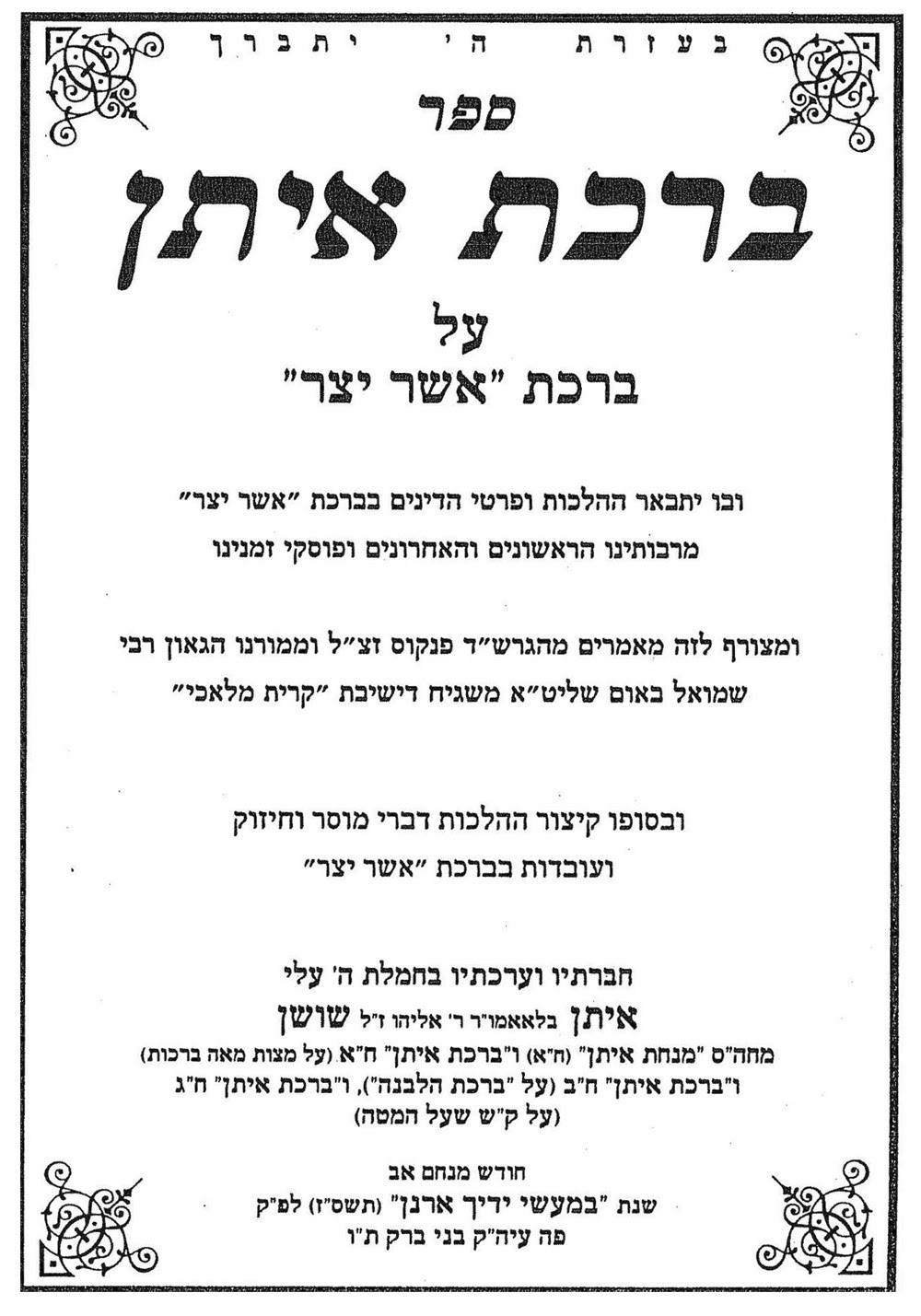

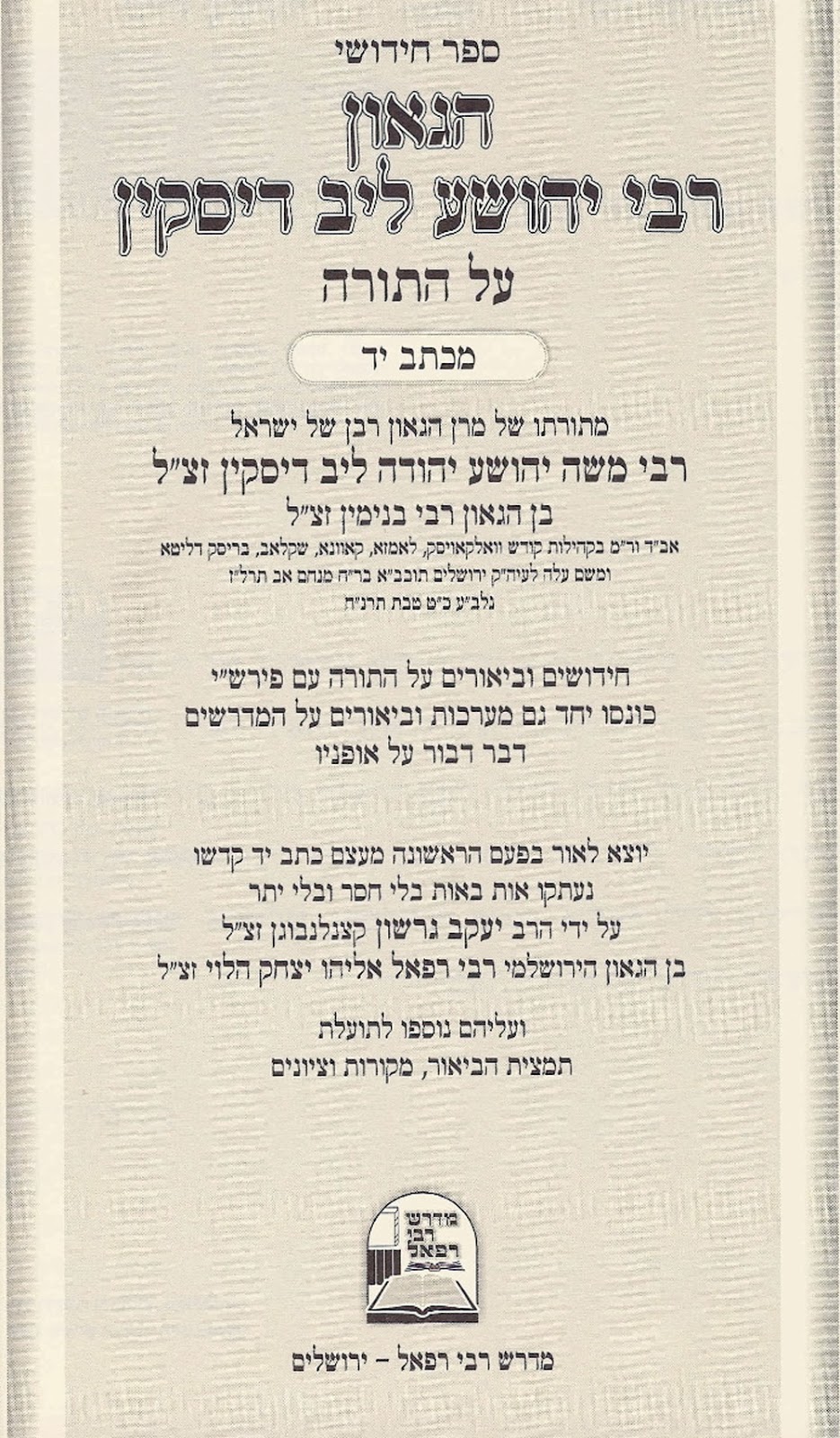

TU BISHVAT: TREE AND THOU

TU BISHVAT: TREE AND THOU
by Alan Zelenetz

Rabbi Alan Zelenetz, M.Phil. has been professionally involved in Jewish education, academia, and independent scholarship for more than twenty-five years, including leadership positions as principal of Torah and General Studies of Yeshivah of Flatbush Middle Division and Director of Curriculum Development of Teachers College Innovations, Columbia University.

DYNAMIC GREEN
From their cosmic vantage point in outer space, NASA satellites orbiting our planet beam down real-time streaming video of Earth’s surface. They reveal that 75% of our world is “a relatively unchanging ocean of blue,” the remaining 25% “a dynamic green” terra
firma
, confirming the dominance of vegetation and the fecundity of plant life on dry land. It’s not difficult for us to re-imagine NASA’s spectacular photographs as screenshots capturing the magnificence of the third day of Creation described in Sefer Bereishit, the Book of Genesis – a gathering of waters followed by growing grass and the flourishing of flowers and trees.
NASA’s cutting edge science and technology provide a God’s-eye view of the plant world unique to our modern day and age, but the variety and beauty of Earth’s species of flora has been the subject of literary poets for millennia. From Ovid of Ancient Rome, who sings of elms and oaks and laurel trees transformed, to the 18th century Scottish lyricist Robert Burns, whose “O my Love’s like a red, red rose” remains, perhaps, the best known simile in verse, the botanical side of nature has forever held fascination for us humans who share our globe and gardens with the kingdom of plants. In his fantasy epic, Lord of the Rings, J.R.R. Tolkien goes so far as to envision the Ents, a noble race of
walking, talking trees, while contemporary American poet Louise Glück personifies a real flower, “The Red Poppy,” which speaks to us in a floral first person, “I have / a lord in heaven/ called the sun, and open / for him, showing him / the fire of my own heart…” Though talking trees are nothing if not a prime example of poetic license, there are many scientists today who embrace the metaphor in their practice. In a recent New Yorker essay, “The Intelligent Plant,” journalist Michael Pollan reports the latest research in plant biology. He describes attempts to prove (not without controversy and critics) that plants are capable of cognition and communication, and he includes as an example a leaf’s ability “to signal other leaves to mount a defense” against impending infestation by insects. Astonishing as is the scientific hypothesis of “thinking” plants, emotionally stirring as is the imagery of poets, they ought to be comfortably familiar to us as Jews, who have been sensitive to our seed-bearing cohabitants on earth literally since the beginning of traditional Jewish time.
FIRST PLANT YOUR SAPLING
Had there been an ancient Green Party, the Torah would have been its platform. The very first pages of the Jewish Bible introduce humankind at its origin, woman and man implanted with divine purpose in the Garden of Eden. Commenting on this edenic scene, Rabbi Samson Raphael Hirsch intuits God’s purpose: the destiny of humankind and the earth is Paradise. By working the earth, human beings raise “its purely physical nature into playing a part in the…moral purposes of the world…we are shown what we should be, how we should live, how this world of ours would form a paradise…”
Several Books later, Sefer Devarim offers one of the most celebrated examples of the Written Law’s ethical and ecological sensitivity, “Lo tashchit…do not destroy [fruit-bearing] trees by wielding an ax against them, for from them you will eat, do not cut them down.” Based on this proscription, Judaism derives an overriding moral principle known as bal tashchit, prohibiting any random destruction or wanton waste in all walks of life.
An Aggadic passage in the Oral Law carries Judaism’s recognition of the sanctity of plant life on Earth to an extraordinary extreme: Rabbi Yochanan used to say, “If you are about to plant a sapling and a cry goes out, ‘Come, hurry, the Moshiach is here!’, be certain first to plant your sapling, then go and greet the Messiah.”
Yes, our Jewish love affair with fruit, flower, and foliage has, indeed, been an eternal one. We can already discern the strains of a love song in Talmudic times when the Sages teach us how to bless the trees “who” share our lives, “Tree, O tree, with what should I bless you? Your fruit is already sweet…Your shade is plentiful… May it be G‑d’s will that all the trees planted from your seeds should be like you . . .” And it continues in our own day and age, when Yossi Klein Halevi reminds us – in describing a young Israeli kibbutznik’s attempt to preserve a tactile encounter with the fruit he harvests by machine –  “If you don’t say good morning to the tree, he had learned from the old-timers, the tree won’t say happy new year to you.”
WE HAVE TO TALK ABOUT TU BISHVAT
To speak of plant life and Judaism is to speak, of course, of Tu Bishvat, the day marked in the Mishnah and on the Jewish calendar as our New Year of Trees. This designation carries specific halachic obligations regarding agricultural tithes, both in the ancient and contemporary lands of Israel. But, true to our theme, we keep here to the celebratory and symbolic aspects of the holiday
In his Ziv ha’Minhagim, Rabbi Yehudah Dov Zinger paints a scene of  ”the bare fruit tree in the dead of winter showing little sign of vitality; nonetheless, as its New Year of 15 Shevat approaches, life begins to course through its roots once again, it revives with the flowing sap.” And Eliyahu Kitov, in Sefer ha’Toda’ah, explains why the fifteenth of Shevat is considered a rosh ha’Shanah and celebrated, “…because [Tu Bishvat] has an aspect of praise of the land, as this is the time that the soil renews its vigor and the fruits are full and praiseworthy, which is what the land is known for…Thus, the day the land renews itself is, indeed, a day of great joy for all of Israel.”
To reiterate, in Jewish thought and practice a tree is no simple metaphor. The trees of Tu Bishvat are at the essence of our understanding the interrelatedness of God’s world. The Torah, in fact makes the comparison over and over. In both Tehillim and in the Talmud we find fruit trees and cedars breaking into songful praise of God. And the prophet Isaiah declares explicitly, “For as the days of a tree shall be the days of my people.”
Indeed, Rabbi Menachem Mendel Schneerson, the last Lubavitcher Rebbe, pointedly asks us to “reflect on the lessons we can derive from our affinity with our botanical analogue.” The Rebbe goes on to suggest that, just as a tree’s primary components are its roots, trunk, branches, leaves, and fruit, so, too, people’s spiritual lives consist of the same: “The roots represent faith, our source of nurture and perseverance. The trunk, branches and leaves are the body of our spiritual lives – our intellectual, emotional and practical achievements. The fruit is our power of spiritual procreation – the power to influence others, to plant a seed in a fellow human being and see it sprout, grow and bear fruit.”
A WALK WITH RAV KOOK
This identification of human being and tree is the foundation of the moral dimension of Tu Bishvat. It is the living Torah teaching us Chesed, to feel compassion for all living things, and it is embodied in a living example recounted in the memoirs of Reb Aryeh Levin, who recalls an early afternoon stroll with Rav Kook in the fields of Jaffa: “On the way, I plucked some branch or flower. Our great master was taken aback; and then he told me gently, ‘Believe me: In all my days I have taken care never to pluck a blade of grass or a flower needlessly, when it had the ability to grow or blossom. You know the teaching of the Sages that there is not a single blade of grass below, here on Earth, which does not have a heavenly force (or angel) above telling it, Grow! Every sprout and leaf of grass says something, conveys some meaning… Every creature utters its song…’ ”
In I And Thou, philosopher Martin Buber explores how, as human beings, we come to understand the world by interacting with the others, the objects, and the creatures all around us. Buber posits a higher level of human existence that depends upon a series of  “I/Thou” relationships, the most exalted of which is with the Divine, “One who truly meets the world goes out also to God.”
Not surprisingly, Buber turns to a tree to help define his idea of an “I/Thou” relationship, asserting that “…as I contemplate the tree I am drawn into a relation, and the tree ceases to be an It…Whatever belongs to the tree is included…its conversation with the elements and its conversation with the stars…I encounter…the tree itself.”
A TREE’S EMBRACE
In her book Celebrate!, author Lesli Koppelman Ross catalogues many Jewish holiday practices and customs throughout history and from around the globe. Kabbalists early on created a Tu Bishvat seder that has been perpetuated in many fruits and many forms, ranging from the mystic to the ecological to the feminist, down to our own day. In some Mediterranean Jewish communities on Tu Bishvat “women would embrace trees at night, praying for fertility and many children. In Salonica, it was believed that the trees themselves embrace on Tu Bishvat, and anyone seeing them do so would have his/her wish fulfilled.” And so we seem to circle back, within a Jewish frame of reference now, to Tolkien’s Ents and Ovid’s trees and transformations.
The French linguist Émile Benveniste made the observation that “ ‘personal pronouns’ are never missing from among the signs of a language, no matter what its type, epoch, or region may be. A language without expression of person cannot be imagined.” Poet Maureen N. McClane offers her own riff on Benveniste’s thought, “To command you, to address you, I must think you. ’I’ must think ‘you. And yet even as I think you I interfuse you with my own nature…”
On Tu Bishvat, “I” must think “Tree,” “Tree” must think “Thou.” We may even, in homage to Benveniste, pun on the “Tu” in Tu Bishvat and think of it as “tu,” the French second person pronoun of affection and familiarity, reminding us that You, the trees of Shevat, and we, the people of this planet, share earthly and earthy roots from which we draw succor of body, mind, and spirit. In our oneness we join voices in celebration of our Creator.


Book Review: Yosie Levine, Hakham Tsevi Ashkenazi and the Battlegrounds of the Early Modern Rabbinate

BOOK REVIEW

Yosie Levine. Hakham Tsevi Ashkenazi and the Battlegrounds of the Early Modern Rabbinate. London: Littman Library, 2024. xiv, 266.

Reviewed by Bezalel Naor

Yosie Levine has tackled the enigmatic figure of Hakham Tsevi Ashkenazi (1658-1718), a man whose title alone beggars the imagination. At first blush, the terms “Hakham” and “Ashkenazi” present an oxymoron. The term “Hakham” is generally reserved for Sephardic sages. (An outlier would be Hakham Isaac Bernays of Hamburg [1792-1849], but that is a discussion for another paper.) Hakham Tsevi went so far as to add to his signature the letters samekh teth, in typical Sephardic fashion. (Levine grapples with the significance of the suffix on pages 206-207.)[1]

Reared in Budin (today Budapest),[2] then under Ottoman rule, our protagonist lived at various times in the Balkans (Adrianople, Belgrade, Constantinople, Salonika and Sarajevo), Central Europe (Altona, Hamburg, Wandsbek) and Western Europe (Amsterdam and London). This straddling of Ashkenazic and Sephardic communities produced a hybrid: Hakham Tsevi Ashkenazi.

In the final chapter of the book, entitled “Afterlife: The Response of Modern-Day Posekim to Hakham Tsevi’s Early Modern Responsa,” the author demonstrates how certain positions of Hakham Tsevi which seemed outlandish and even revolutionary at the time, have come home to roost in the twenty-first century.

First, there is the Hakham’s responsum discussing whether an artificial man, a golem, can be counted in a minyan or prayer quorum of ten.[3] The Talmud (Sanhedrin 65b) recounted how Rava created a man by employing Sefer Yetsirah. The Hakham’s own ancestor, Elijah Ba‘al Shem of Chelm, created such a humanoid. (The Hakham’s son, Rabbi Jacob Emden, would later address this very issue in his responsa.)[4] In our own age of robotics and Artificial Intelligence, one anticipates a robust halakhic literature on the subject of the golem. (The golem of the Gemara was bereft of the power of speech, so in that respect, present-day robots are certainly superior.) An area of Halakhah that immediately comes to mind is Nezikin, torts or damages.

An outspoken responsum of the Hakham directed Diaspora Jews visiting the Land of Israel to observe but a single day of Yom Tov in conformity with local custom.[5] A the time it was written, Hakham Tsevi’s decision flew in the face of the accepted practice, whereby Diaspora Jews observed two days of the festival during their sojourn in the Land, in conformity to their place of origin. Writing from Safed in the sixteenth century, Rabbi Joseph Karo attested that pilgrims to the Land would assemble their own minyan, in which they recited the prayers for the second day of Yom Tov in exile, a practice sanctioned by the gedolim of old.[6]

Hakham Tsevi’s own son, Rabbi Jacob Emden, respectfully disagreed with his father’s opinion. In a lengthy responsum, he militated for the two-day observance.[7]

According to Levine, the 1903 decision of Rabbi Elijah David Rabinowitz-Te’omim (Aderet) in Jerusalem, invoking and inveighing with Hakham Tsevi’s responsum, was a first.[8] In Levine’s words: “This ruling represented a radical break with established norms and constituted a watershed in the reception history of Hakham Tsevi’s responsum” (page 197).[9]

Earlier, Levine writes that Rabbi Shneur Zalman of Liady (1745-1812) was “sympathetic to Hakham Tsevi’s ruling in principle” (p. 195). The footnote refers us to Rabbi Shneur Zalman’s Shulhan ‘Arukh 496:11. This reference requires some unpacking. While Rabbi Shneur Zalman’s ruling just happened to coincide with that of Hakham Tsevi, it was certainly not the basis of his ruling. Rather, he based his decision on a rishon, the medieval authority Rabbi Eliezer ben Nathan (Ra’avan) of Mayence. Ra’avan, in turn, followed in the footsteps of Rabbenu Hananel ben Hushiel of Kairouan.[10]

(An aside: Rabbi Abraham David Lavut of Nikolayev [1814-1890], a disciple of Rabbi Menahem Mendel Schneersohn of Lubavitch [Tsemah Tsedek], brought to the discussion a mystical element, whereby the “illumination” [he’arah] of the Festival takes a day longer to reach the Diaspora.[11] The late Rabbi Baruch Na’eh, of blessed memory, impressed upon this writer in no uncertain terms that the Alter Rebbe’s pesak was derived from Rabbenu Hananel—which is to say Ra’avan—and not from these mystical considerations.)[12]

Aderet’s contemporary, Rabbi Hayyim Soloveichik of Brisk, also maintained that visitors to Erets Yisrael should observe but a single day of Yom Tov, but unlike Aderet, he did not see the need to invoke the authority of Hakham Tsevi. Neither did he seek support in the work of the rishon, Rabbi Eliezer ben Nathan (as did Rabbi Shneur Zalman). As it is often quipped, “Reb Hayyim was a rishon!”[13]

In more recent times, Rabbi Tsevi Pesah Frank was open to the thinking of the Hakham Tsevi (though he countered that the law might devolve upon the individual, “a-karkafta de-gavra”).[14] On the other hand, Rabbi Shelomo Zalman Auerbach rejected the ruling of the Hakham Tsevi.[15]

This issue remains a heated debate to this day. Some Diaspora Jews keep two days in Erets Yisrael, while others observe but one day.

*

Perhaps the most infamous, and certainly the most traumatic of Hakham Tsevi’s controversies, was his confrontation with crypto-Sabbatian Nehemiah Hiyya Hayyon in Amsterdam in 1713. Hayyon, a man of dubious character, arrived in town from the East (he claimed to be from Safed), intent on publishing his literary oeuvre. Hakham Tsevi served at that time as Rabbi of the Ashkenazic community of Amsterdam. Upon perusal of Hayyon’s book ‘Oz le-Elohim, printed in Berlin earlier that year, Hakham Tsevi discovered that the work contained arch-heresy. (For a long time, it was thought that this was the theology of Shabbetai Tsevi. Today, the scholarly consensus is that ‘Oz le-Elohim is in fact an offshoot of the theology of Abraham Miguel Cardozo [1627-1706].)[16]

Hakham Tsevi proceeded to issue a broadside banning the book. (Levine provides a facsimile on page 168.) One would imagine that the preeminent sage would have easily prevailed over the rascal. Actually, the outcome was the exact opposite. Hayyon remained in Amsterdam and Hakham Tsevi was routed, beating a retreat to London. (Elisheva Carlebach treated this sorry chapter in Jewish history in her biography of Hakham Tsevi’s ally in the affair, Rabbi Moses Hagiz, The Pursuit of Heresy.) It turned out that the Sephardic Hakham of Amsterdam, Solomon Ayllon, was himself a crypto-Sabbatian. Presented with the political clout of the powerful Spanish-Portuguese Mahamad (or Ma‘amad), and ultimately, the Dutch authorities, Hakham Tsevi was forced to flee.

One finds it of interest that Hakham Tsevi’s broadside skirts the issue of the mistaken belief in the pseudo-Messiah Shabbetai Tsevi. (You might call that “the elephant in the room.”) Instead, it focuses on how scandalous is this strange notion that Levine felicitously refers to as Hayyon’s “belief in a First Cause that was decoupled from the revealed God of Israel” (page 167).

Since Levine has discussed the afterlife of Hakham Tsevi’s literary legacy, I should like to take this opportunity to explore the afterlife of Hayyon’s—or more precisely, Cardozo’s theology.

Today one puzzles over vestiges of the opposition of the Sibah Rishonah (First Cause) and Elohei Yisrael (God of Israel) that survive in the reputable works of Rabbi Baruch of Kosov (Yesod ha-Emunah)[17] and Rabbi Israel Hapstein, the Maggid of Kozienice (‘Avodat Yisrael).[18] Should we suspect these authors of being closet Sabbatians?

We need to disentangle theology from sociology. Espousal of this kind of theology does not necessarily connect one to the Sabbatian movement.

It is plausible (though unlikely) that even the way Cardozo himself came to his theology was coincidental to his attraction to the Sabbatian movement. Prima facie, what one observes in Cardozan theology is the convergence of two worlds: that of the philosopher and that of the kabbalist. The Marrano physician, educated at Salamanca in general philosophy, encountered, upon reentry to the Jewish fold, an opposed worldview of a particularistic Judaic nature. The valorization of Elohei Yisrael over the Sibah Rishonah is a celebration of Cardozo’s conversion (or re-conversion) to Judaism. The “decoupling,” or to use the Hebrew term, the pirud that so scandalized Hakham Tsevi, is an outgrowth of the maelstrom, and perhaps unresolved tension, within Cardozo’s soul.

Hakham Tsevi was outraged by the proposition of a First Cause without will (ratson) and intention (kavanah). Similarly irksome was the notion that on the ultimate level of divinity, chosenness disappears. The first proposition is articulated by Rav Kook.[19] The second, by Rabbi Dov Baer Shneuri of Lubavitch (Mitteler Rebbe).[20] Would Hakham Tsevi consider these writings beyond the pale? Perhaps not.

As long as unity (yihud)—for lack of a better term, monotheism—is maintained, one remains within the mainstream of Jewish belief. It was precisely the “decoupling” of these two elements—the universalist and the particularist—that provoked the defender of the faith. The Hakham recognized shtei reshuyot (dualism)[21] when he saw it. No amount of sophistry could camouflage an incipient idolatry.

Again, we need to distinguish between Cardozo’s Messianism and his theology. And even then, there is required a refinement before that theology can mainstream. (Just as Rav Kook entertained the thought that by a process of purification or tseruf, Spinoza’s pantheism might one day be rehabilitated. No longer would Spinoza be referred to as Maledictus but Benedictus.)[22]

Notes

  1. Hakham Tsevi’s son, Jacob Emden, continued the practice, signing responsa “Ya‘abets Samekh Teth.” Ya‘abets is the initials of Ya‘akov ben Tsevi.
  2. Also referred to in German as Ofen.
  3. She’elot u-Teshuvot Hakham Tsevi, no. 93.
  4. She’elat Ya‘abets II, no. 82.
  5. She’elot u-Teshuvot Hakham Tsevi, no. 167. He reasoned that should one observe an additional day in Erets Yisrael, one would thereby be in violation of Bal Tosif (Thou shalt not add). See Rosh Hashanah 28b, regarding one who sleeps in the sukkah on Shemini ‘Atseret.
  6. See Rabbi Joseph Karo, She’elot u-Teshuvot Avkat Rokhel, no. 26
  7. She’elat Ya‘abets, Part One, no. 168.
  8. See Rabbi Elijah David Rabinowitz-Te’omim, Kuntress Shevah ha-Arets, in Be-Shemen Ra‘anan, vol. 2, ed. Ben Zion Shapira (Jerusalem, 1991), p. 209, par. 35. The reference to Hakham Tsevi’s responsum should read no. 167 (not no. 147).
  9. Rabbi Elijah David Rabinowitz-Te’omim (known by the acronym Aderet) served as the assistant to Rabbi Samuel Salant, Rabbi of Jerusalem. Aderet was the father-in-law of Rav Kook, who would go on to become Ashkenazic Chief Rabbi of Erets Israel. Evidently, Rav Kook—unlike Aderet—did not accept the ruling of Hakham Tsevi. See Rabbi Avraham Yitzhak Hakohen Kook, Orah Mishpat, no. 125.
  10. See the commentaries of Ra’avan and Rabbenu Hananel to Pesahim 51b-52a. Rabbenu Hananel’s reading differs from our own. In our version, Rav Safra travels from Erets Yisrael to Bavel. In Rabbenu Hananel’s version, Rav Safra travels from Bavel to Erets Yisrael. The conclusion is that in places of habitation (yishuv), one must conform to local custom (and observe a single day of Yom Tov); in the desert (midbar), one maintains one’s original custom of two-day observance. See the letter of Rabbi Meir Don Plotzki published in Rabbi Shelomo Zalman Ehrenreich’s edition of Ra’avan. Unfortunately, Rabbi Ehrenreich terribly misunderstood the reference to Ra’avan in Rabbi Shneur Zalman of Liady’s Shulhan ‘Arukh. This misreading persisted in Rabbi Yitzhak Flakser’s Sha‘arei Yitzhak.
    See Rabbi Eliezer ben Nathan of Mayence, Even ha-‘Ezer/Sefer Ra’avan, ed. Shelomo Zalman Ehrenreich (Simleul, 1926), Pesahim, 162b (text of Ra’avan), 161d-162c (supercommentary of Even Shelemah); Rabbi Yitzhak Flakser, Sha‘arei Yitzhak, vol. 1 (Jerusalem, 1999), Hilkhot Yom Tov Sheni, chap. 3.
    In a stroke of originality, Rabbi Moshe Sternbuch suggested that this variant of Rabbenu Hananel might have been the source of Maimonides’ startling ruling (Hilkhot Kiddush ha-Hodesh 5:12) that in the desert of Erets Yisrael one observes two days of Yom Tov. See Rabbi Moshe Sternbuch, Mo‘adim u-Zemanim, Part III (Pesahim) (Jerusalem, n.d.), chap. 121 (62a).
    First published in Prague in 1610, Ra’avan was available to Rabbi Shneur Zalman of Liady. Rabbenu Hananel’s commentary to Pesahim, on the other hand, did not become available until 1868, when it was published in Paris (from a Munich manuscript) by Rabbi Yosef Halevi Stern.
  11. Rabbi A.D. Lavut, Sha‘ar ha-Kollel (Brooklyn, 2005), 1:2 (1b-2a).
  12. Rabbi Baruch Na’eh in private conversation with the writer (BN) before Pesah of 1987. He was the son of the famed Habad halakhist Rabbi Abraham Hayyim Na’eh, author of Ketsot ha-Shulhan (on Shulhan ‘Arukh Harav). Rabbi Barukh Na’eh authored two volumes of Gemara Shelemah Pesahim.
    Inter alia, see the reaction of Rabbi Meir Mazuz when presented with the Sha‘ar ha-Kollel. Recorded in She’elot u-Teshuvot Ish Matsli’ah, vol. 1, 2nd edition (B’nei Berak, 1989), Orah Hayyim, no. 40 (116b). Rabbi Matsli’ah Mazuz’s posture as a posek–similar to that of the Hakham Tsevi (Part One, no. 36)—was that the Kabbalistic perspective must never result in a bouleversement of the Halakhah. See Levine, pp. 84-86. Also, Rabbi Jacob Emden’s lengthy responsum in She’elat Ya‘abets, Part One, no. 47.
  13. See Rabbi Tsevi Yosef Reichman, Reshimot Shi‘urim, Sukkah (New York, 1990), p. 227; Rabbi Tsevi Schachter, Nefesh Harav (Jerusalem, 1994), p. 84; Levine, Hakham Tsevi, p. 198.
    Another Lithuanian posek who inclined to the one-day observance was Rabbi David Friedman of Karlin. See She’elat David (Piotrkow, 1913), Kuntress ha-Minhagim, 11b, footnote. One should not be surprised that he did not mention Hakham Tsevi. Reb Dovid Karliner was famous for his eschewal of Aharonim (later-day authorities)!
  14. Har Tsevi, Orah Hayyim, vol. 2 (Jerusalem, 1973), no. 78 (126b).
  15. See the letter of Rabbi S.Z. Auerbach to Rabbi Yitzhak Flakser in Sha‘arei Yitzhak, vol. 1 (Jerusalem, 1999), Hilkhot Yom Tov Sheni, chapter 17.
  16. See Yehudah Liebes, On Sabbateanism and Its Kabbalah (Hebrew) (Jerusalem, 1995), pp. 35-36.
    For a cornucopia of Cardozo’s literary output, see David J. Halperin, Abraham Miguel Cardozo: Selected Writings (Mahwah, New Jersey, 2001).
    Rabbi Yahya Kafah of San‘a, Yemen, mistook ‘Oz le-Elohim for a work of mainstream Kabbalah. Rav Kook set him straight that this is in fact a heretical work. See Rabbi Yahya Kafah, Milhamot Hashem (Jerusalem, 1931); RAYH Kook, Ma’amrei ha-Rayah, vol. 2 (Jerusalem, 1984), p. 520; idem, Haskamot ha-Rayah (Jerusalem, 1988), no. 41, p. 46; idem, letter and pesak din in front matter of anonymous Emunat Hashem (Jerusalem, 1937).
  17. See Rabbi Baruch of Kosov, ‘Ammud ha-‘Avodah (Chernowitz, 1863), Kuntresim le-Hokhmat ha-Emet, 128d. In the newer edition, Yesod ha-Emunah, ed. Ya‘akov Aharon Ilowich (Monsey, NY, 2007), Kuntresim le-Hokhmat ha-Emet, par. 206 (p. 488). And see Esther Liebes, Ahavah vi-yetsirah be-haguto shel R. Baruch mi-Kosov (Ph.D. dissertation, Hebrew University, 1997), pp. 279-280.
  18. In the Pe’er mi-Kedoshim edition of ‘Avodat Yisrael (B’nei Berak, 2013), 290b. The context is a kavanah for Rosh Hashanah.
    See the lengthy discussion in Bezalel Naor, Navigating Worlds: Collected Essays (New York, 2021), pp. 529-530.
  19. Siddur ‘Olat Re’iyah, vol. 1, p. 23, s.v. Le-shem yihud; p. 111, s.v. Atah hu ‘ad she-lo nivra ha-‘olam.
  20. Rabbi Dov Baer of Lubavitch, Imrei Binah (Brooklyn, 2018), Sha‘ar Keri’at Shema‘, par. 94 (120c); quoted in Bezalel Naor, The Project of Hasidism (New York, 2025), p. 108.
  21. Mutatis mutandis, we find in the Mishnaic era the heretic Elisha ben Abuyah (Aher) constructing a duality of the Unmoved One (“no sitting or standing”) and Metatron, the advocate of Israel (“sitting and writing the merits of Israel”). See Hagigah 15a; and the reading of Maimonides, Commentary to the Mishnah, Introduction to Perek Helek (Sanhedrin chap. 10), the third fundamental (Kafah edition, p. 141).
  22. Rav Avraham Yitzhak Hakohen Kook, Pinkas Rishon le-Yaffo, par. 117, in Kevatsim mi-Ketav Yad Kodsho, ed. Boaz Ofen (Jerusalem, 2006), p. 146.
    It seems such a purification of Cardozan theology was uppermost in the mind of Rabbi Pinhas Elijah Hurwitz of Vilna. See his Sefer ha-Berit (Brünn, 1797), Part One, ma’amar 20, chap. 15 (109a-111a). After presenting the opposition of the First Cause and the God of Israel (the hallmark of Cardozo’s theology), Hurwitz quotes the Italian kabbalist Rabbi Joseph Ergas (author of Shomer Emunim) in his polemic work, Tokhahat Megullah & Ha-Tsad Nahash (London, 1715) against Hayyon and Abraham Cardozo. The upshot is the integration of the two aspects of the divinity within an acceptable orthodox framework. Concerning Ergas’ anti-Sabbatian polemic, see Bezalel Naor, Post-Sabbatian Sabbatianism (Spring Valley, NY, 1999), pp. 145-149.Hurwitz has misquoted Tokhahat Megullah f.12. For “Hu mitparesh bi-fe‘ulotav ve-ne‘elam be-‘atsmuto,” read: Hu mitparsem bi-fe‘ulotav ve-ne‘elam be-‘atsmuto.