Book Announcement: The Lost Library by Dan Rabinowitz

Book Announcement: The Lost Library by Dan Rabinowitz

By Eliezer Brodt

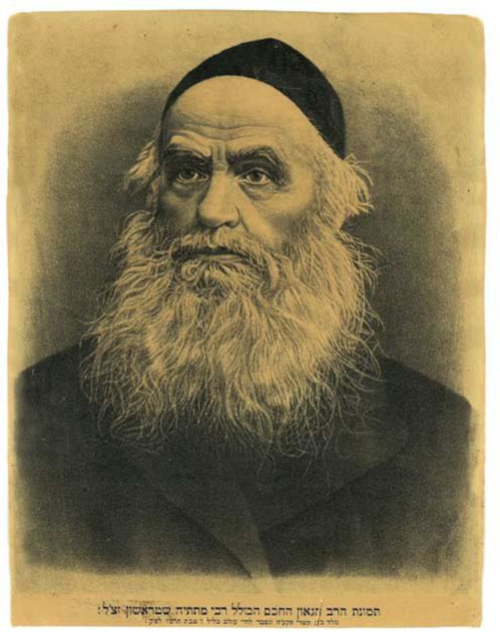
Its with great pleasure that I announce the recent publication of an important work, that I am certain will be of great interest to readers of the Seforim Blog – The Lost Library by Dan Rabinowitz, founder and editor-in-chief of the Seforim Blog. This book is devoted to the legacy of the personal and expanded public library of Rabbi Mattityahu Strashun.

From the back cover:

The Strashun Library was among the most important Jewish public institutions in Vilna, and indeed in Eastern Europe, prior to its destruction during World War II. Mattityahu Strashun, descended from a long and distinguished line of rabbis, bequeathed his extensive personal library of 5,753 volumes to the Vilna Jewish community on his death in 1885, with instructions that it remain open to all.

In the summer of 1941, the Nazis came to Vilna, plundered the library, and shipped many of its books to Germany for deposition at a future Institute for Research Into the Jewish Question. When the war ended, the recovery effort began. Against all odds, a number of the greatest treasures of the library could be traced. However, owing to its diverse holdings and its many prewar patrons, a custody battle erupted over the remaining holdings. Who should be heir to the Strashun Library?

This book tells the story of the Strashun Library from its creation through the contentious battle for ownership following the war until present day. Pursuant to a settlement in 1958, the remnants of the greatest prewar library in Europe were split between two major institutions: the secular YIVO in the United States and the rabbinic library of Hechal Shlomo in Israel, a compromise that struck at the heart of the library’s original unifying mission.

In 2005 Dan Rabinowitz founded the Seforim Blog and I started corresponding with him almost immediately. One of the people we discussed often was R’ Strashun as both Dan and I were fascinated by him. Dan’s interest extended to the library and what happened to it after R’ Strashun’s death and especially what happened to it after World War Two. Eventually, in November 2015 Dan authored a lengthy post on the Seforim Blog dealing with different aspects of R’ Strashun and his library. This post eventually turned into this full-length book on the subject.

The Lost Library is written in Dan’s extremely clear, lucid and captivating manner as familiar to readers of the Seforim Blog (having read hundreds of his articles and at times not realizing he is the author of them because most do not include his name – in essence, stamm seforim blog post dan rabinowitz, at least the scholarly ones). The book begins with an exciting personal introduction (A PDF is available upon request) giving background to the development of one of Dan’s favorite pastimes collecting books. However, similar to the subject of this book R’ Strashun, Dan’s interest extends to not just owning the book but to developing a personal relationship with the book contents. This becomes evident as one reads The Lost Library, especially the vast number of sources in multiple languages housed in numerous collections and libraries all over the world including his personal library. The Lost Library meticulously documents each of his claims from these extensive sources collected over intense research conducted over a few years.

The book begins with an overview of that ‘ir ve’em be-yisrael, the famous city of Vilna, giving the reader excellent background to the environment and city (including current descriptions as the author visited Vilna while working on this volume). The author discusses what made Vilna famous, sidetracking into very relevant topics such as R’ Mattityahu father, the Rashash and others affiliated with the Vilna Gaon, Vilna’s most famous resident. Dan then turns to deal with the hero of the book, R’ Mattityahu and provides the reader with a comprehensive biography that discusses his unique style of learning and how that influenced his book collecting habits. The next chapter is the opening of the public library after Mattityahu’s death and the impact it had on the community and eastern European Jewry at large. The book then goes onto detailing the library’s life during the Holocaust and especially afterword as different parties claimed ownership when most of it was discovered to have survived.

Marc Shapiro wrote:

Taking us on a journey from nineteenth-century Vilna until almost the present day, Rabinowitz not only documents the vicissitudes of this important institution, but helps us understand the intellectual culture of one of the centers of Judaism in modern times.”—Marc B. Shapiro, Weinberg Chair in Judaic Studies, University of Scranton

And others praised the work as well.

“Rabinowitz has done a brilliant job in his moving and important book…. Through the story of the Strashun Library, he gives us insight into the richness and vibrancy of Jewish life in Vilna. He vividly portrays the restoration of the books of the Strashun Library, a testimony to the indomitable Jewish spirit.”
—Ambassador Stuart E. Eizenstat, chief White House domestic policy adviser to President Carter

“Rabinowitz’s meticulously researched study is an outstanding expression of the wealth of knowledge provided by a thorough exploration of Jewish material culture…In his detailed reconstruction of the Strashun library’s fate after the German invasion, he detects a breathtaking history of loss and mourning, of illegal claims and desires, of appropriation and incorporation that expresses the rupture of the Holocaust and the contested visions of Jewish life after catastrophe.”—Elisabeth Gallas, Leibniz Institute for Jewish History and Culture –Simon Dubnow

This book is of particular personal great interest. The first time I recall hearing something from R’ M. Strashun was when I was in tenth grade. R’ Hershel Schachter had just begun giving a shiur once a week in Flatbush for Balei Battim on Mesechtas Kidushin. I attended a few of them, during one of the shiurim he mentioned R’ M. Strashun’s comments in Bava Basra praising him (I do not recall his exact discussion, but it was about the word Achron). I had been familiar with the Strashun name for a while through R’ Mattityahu father, the Rashash via my father. The Rashash symbolized an emphasis on peshat, from then on I was very curious about R’ Mattityahu. Fast forward a few years when I began learning in the Mir in EY I was talking to a friend somehow it came up about R’ M. and the friend mentioned he loves him and that the great Gaon R’ Yakov Chaim Sofer always quotes him with great respect. He then showed me a sefer of Mattiyahu printed by Mossad Harav Kook (Mivchar Kesavim). The sefer was out of print and hard to find, but the Sitrah Achrah helped me find it a little while later. I immediately began learning through the work. Since then I have found the work many times in used shops and have found these copies, proper owners, to appreciate them. One time while learning the sefer an Israeli chavrusha saw what I was learning and said how you could learn a sefer of a maskil! I argued it was good enough for me that R’ Yitchack Elchanan Spektor who, in his old age, came to Vilna to eulogize R’ Mattityahu. My chavrusha dismissed this anecdote and replied that means nothing! Of course, I could not convince him that there was nothing wrong with him. However, his complaint sparked the exact opposite – and spurred me to research and read more of R’ Mattityahu’s writings which only enhanced my reverence for him. My chavrusha’s position notwithstanding, other very frum Israelis friends expressed their appreciation and fascination with R’ Mattityahu. Most of his writings appeared in newspapers and journals and are not readily available or even known. However, in a few months, I will god willingly print some of them. Eventually, I wrote my first academic article in English about him (available in PDF upon request or from here).

One final point about R’M that particularly resonated with me. R’M did not merely collect seforim he used them, and this is apparent from hundreds of citations throughout his works. A later resident of Vilna, and one too who was indeed very well-read was R’ Chaim Ozer. He did not need an extensive personal library as he had unfettered access to the Strashun Library – indeed was unique in that he was one of the few given borrowing privileges. Here is a book request from R’ Chaim Ozer, addressed to the Strashun Library’s head librarian Chaim Chaikel Lunski. Thanks to R’ Dovid Kamenetsky for making it available:

One of my favorite stories about the library as told by R’ Moshe Shmukler in his fascinating book, Moshe Shmuel ve-Doro, combines the idea of the voracious reader and a comprehensive library:

ר’ חיים עוזר… מלבד בקיאותו הגדולה בתלמוד ובראשונים, הצטיין בבקיאות עצומה בשאלות ותשובות האחרנים… פעם החלטתי לנסותו עד כמה כוחו גדול באחרונים, סרתי לספריה של שטראשון ועברתי על פני הקאטאלוג במקרה נתקבל מבטי על הספר מאמר מרדכי להגאון ר’ מרדכי זאב אוטינגר מלמברג ספר שלא נודע לי עד אז וחשבתיו ליקר המציאות. דפדפתי בספר ומצאתי איזה הערה נפלא על דברי בעל הלכות גדולות המובא ברא”ש סוף פ”ב דיבמות. חשבתי האח, מצאתי את מה שאוותה נפשי. במוצאי שבת באתי לר’ חיים עוזר, כי הערב ההוא היה מוקש ללות אתו בחידוש תורה. בשעת השיחה העילתי כלאחר יד את הקושיא על הבה”ג. ומה השתוממתי לשמוע מפי תיכף, כי זוהי קושיתו של בעל מאמר מרדכי… [ר’ משה שמואל ודורו, עמ’ 176].

The book can be purchased from the publisher here, Amazon or Book Depository.

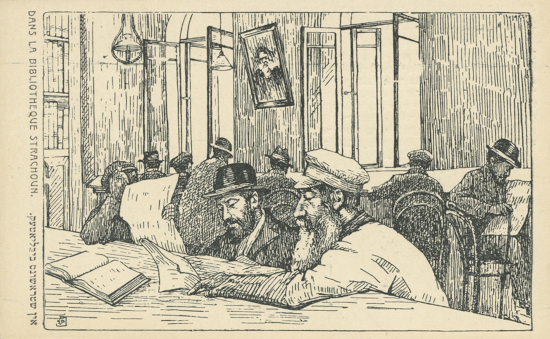
Here is a portrait of R’ Mattityahu followed by a scene depicting the Strashun Library in Vilna in its heyday:


Plagiarism, Citation, and Redemption

Plagiarism, Citation, and Redemption
 By Jeremy Brown
Jeremy Brown is
the author of New Heavens and a New
Earth; the Jewish Reception of Copernican Thought
. He
writes on science, medicine and the Talmud at Talmudology.com
Plagiarism, it
seems, has never been so widespread. Remember How Opal Mehta Got Kissed, Got
Wild and Got a Life
, the 2006 debut novel from Harvard
undergraduate Kaavya Viswanathan? The author had plagiarized several
passages from others (including Salman Rushdie) and the publisher Little
Brown recalled
and destroyed all its unsold copies. It’s not just authors;
politicians plagiarize too. In 2013 the German minister for education
resigned amid allegations
she had plagiarized
her PhD. thesis, and last year Senator Jon
Walsh of Montana had his Master’s Degree revoked by the US Army
War College, which determined that it
had been plagiarized
. (Walsh dropped
out
of the Senate race as a result of the scandal.)  
Plagiarism is
not just for politicians; academics do it to. Retraction Watch has reported at least
268 academic papers that were plagiarized. In fact plagiarism has become
so pervasive in academia (and the need to report it has become so
important) that a recent
paper
paper in Ethics & Behavior gives advice for academics
considering becoming plagiarism whisleblowers. 
This seems
to be a very good time in which to remind ourselves that the full and proper
attribution of the work of others is a core Jewish value.  When authors of
ideas are properly acknowledged, the Talmud (Yevamot 97a) states that “their
lips move in the grave.” Life is briefly restored to the author when his
teachings are recalled.
Sadly, Jewish
literature has a many examples of plagiarism, improper attribution, and other
infractions of publication etiquette. So widespread is the plagiarism of
Jewish texts that it might even be considered a separate genre of Hebrew
literature. Some examples have already been examined in the virtual pages of
this Seforim Blog, but we will focus on
three. They are each different, and their ethical breaches are not to be
equated, but they are reminders of the responsibility of those who publish to
check, double check, and attribute. 
1. PARTIAL
OR INACCURATE CITATION
Inaccurate
citation is a relatively lightweight problem, but it’s a problem
nevertheless. The English language Schottenstein Talmud, published by
ArtScroll, chose a censored text of the Talmud as the basis for its
translation project. (Full disclosure: I enjoy the Schottenstein
Talmud, and study from it each day, God bless it).  As I’ve
pointed out before on
this blog,
this was a sad choice, and a missed opportunity to return the
text to its more pristine (and more challenging) state. 
One example of
ArtScroll’s decision is found very early on in Berachot
(3a). There, the original uncensored text records a statement said in the
name of Rav:
 אוי
לי שהחרבתי את ביתי ושרפתי את היכלי והגליתים לבין אומות העולם
Woe is me
[God], for I destroyed my home [the Temple], burned my Sanctuary,
 and sent [the Jewish People] into exile among the nations of the
world. 
However, the
editors of the English ArtScroll Talmud chose to use a censored text in which
an additional phrase was slipped in by the censor:
Woe to my
children who sinned, [and hence made me, God] destroy my home
[the Temple], burn my Sanctuary, and send them into exile among
the nations of the world. 
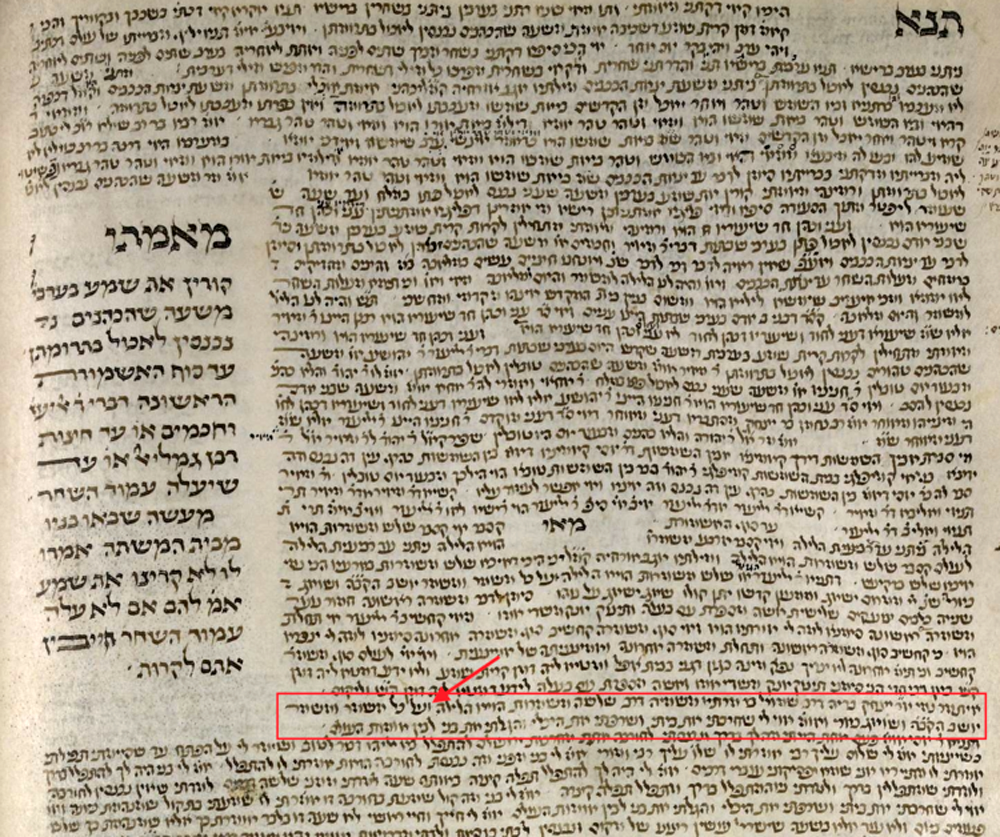
Here is
a version of the uncensored text- the one that ArtScroll could have
used.  As you can see, the censor’s additional text is not there:
Then, to
compound the error, the ArtScroll Talmud adds a footnote explaining the
metaphorical meaning of this erroneous text!

To be clear:
ArtScroll did not plagiarize anything, but they should have done a better
job of quoting the text accurately. After all, isn’t that what Rabbi Yochanan
taught us to do? Had they done so, the lips of the great sage Rav, whose
teachings were improperly amended by the censor, would again
“move in his grave”.
Now on to
more egregious issues – hard-core plagiarism.
2.  PLAGIARISM
IN PART

Copying a chunk
of text or some choice word phrases without proper attribution is also
plagiarism. One example of this is found in the 500 year-long debate over
whether Jews could believe in the Copernican model of the solar system in which
the sun was stationary.  In the late nineteenth century Reuven Landau (c.
1800-1883) took a conservative position against this model. He found it to be
existentially threatening, and argued that because humanity was the center of
the spiritual universe, it must live in the very center of the physical one.
But rather than outline his claims in his own words, he stole from the very
-widely read Sefer Haberit, an encyclopedic work that had been published
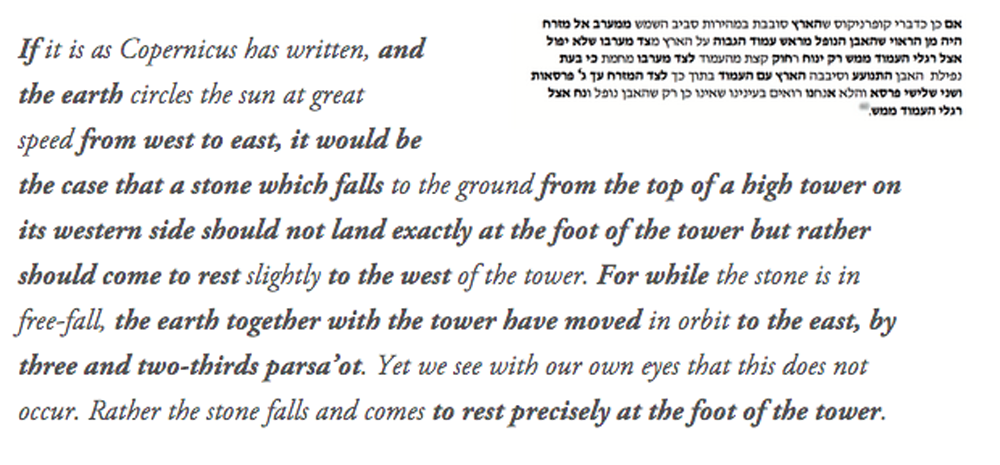
some one hundred years earlier. Here is an excerpt from Landau’s text, in which
he raises what he believes to be scientific objections to the Copernican model.
The bold text shows where the text is identical to Sefer Haberit,
first published in 1798. 
Quite simply
put, Landau stole from Sefer Haberit. A simple attribution was all that
was needed. And it was not there. (You can read more about this plagarism here,
and more about Sefer Haberit in my
book
, and in this
recently published work
from David Ruderman.)


Finally, let’s
look at an example of full, unadulterated plagiarism: the stealing, word for
word, of paragraphs – and then an entire book.
 3.
PLAGIARISM IN FULL: STEALING AN ENTIRE CHAPTER, WORD FOR (ALMOST) WORD
In 1788 in
Berlin, Barukh Linda (not to be confused with the plagiarist Reuven Landau)
published a small encyclopedia for children called Reshit Limmudim. In
it, Linda carefully explained the heliocentric model of Copernicus and how the
planets moved around the sun. This book became, in the words
of the historian Shmuel Feiner the “most famous, up-to-date book on the
Hebrew bookshelf at the end of the eighteenth century,” And then, a year
after it was published a Rabbi Shimon Oppenheimer, living in Prague, stole from
it.
Oppenheimer
(1753-1851) objected to the claim that the earth revolved around the sun, and
in 1789 in Prague he published Amud Hashachar in which he detailed his
opposition. But rather than use his own words, he stole, word for word,
the descriptions of the solar system from the pro-Copernican Reshit Limmudim,
carefully leaving out the bits that supported Copernicus. In a move that pushes
hutzpah to a new level, Oppenheimer even published a moving dedicatory
poem as if it had been written to him, though he changed a few awkward phrases
here and there, since the original poem mentioned Linda by name. However, the
poem plagiarized from one written as a dedication to the real author Linda –
from the great man of letters Naphtali Herz Wessely. 
When it came to
plagiarism, this Rabbi Oppenheimer was a repeat offender.  Because in 1831
he published Nezer Hakodesh,
a book on religious ethics (I’ll say that again in case you missed it – it’s
a book on religious ethics
)…which he plagiarized from the 1556 work Ma’alot
Hamidot
!  Here’s an example so you can see the scale of the
plagiarism.
There is a
fascinating end to the story. The famous Rabbi Yechezkel Landau (that’s
the third Landua/Linda in this little post –sorry), head of the Bet Din in
Prague, banned Oppenheimer from printing further copies of Amud Hashachar,
but not because it was plagarized.  Rather, Chief Rabbi Landau
objected to the book’s frontispiece, in which Oppenheimer described himself as
“The great Gaon, sharp and famous, the outstanding investigator Shimon”.
Read it for yourself:


First edition of השחר עמוד, Prague 1789. From
the Jewish National and University Library, Jerusalem

Remarkably, in
his rebuke, the head of the Bet Din made no mention of the fact that sections
of the book were plagiarized, even though this information was widely known.
Oppenheimer proceeded undeterred, and published a second edition of his
plagiarized and anti-Copernican work – although he was “honest” enough to
remove the stolen poem praising his book – the poem that had originally been
written by Naphtali Herz Wessely in praise of Lindau’s Reshit Limmudim.
In his recently
published autobiography
, the British comedian John Cleese (of Monty
Python
and Fawlty Towers fame) recalls how he reacted the very
first time that he was recognized after a stage performance. As he walked home,
a family who had been in the audience pointed at him and waived. It was by all
accounts a small gesture, but Cleese recalled its effects in
detail even fifty years later:
I can still
remember the sudden feeling of warmth around my heart that swelled and swelled
and lifted my spirits. It is as though I had been accepted into a new family,
and acknowledged as having brought them something special that they really
appreciated. It was only a moment but  it was wonderful, and they didn’t
even know my name…in today’s celebrity culture it must be hard to imagine
that a tiny moment of recognition like that could feel so uncomplicated and
positive…
The need for
recognition is not a vice or a character flaw, but a profound human need.
To ignore it is not just an oversight but an act of neglect.  The rabbis
of the Mishnah and the Talmud understood the corollary: that to attribute
is to nourish. To acknowledge the creative act of another person is a kind
of blessing, like those required before eating, or on seeing a beautiful vista.
 Blessings and citations acknowledge the creative impulse in others, and
so make the world a little bit better. They are redemptive. As we approach
Pesach, the festival of our redemption, we should remember one final text about
the power of correct citation. It was, after all, a citation that saved the
Jewish people:
“Whoever cites
something in the name of the person who originally said it, brings redemption
to the world. As the prooftext states – “And Esther told the King in the name of Mordechai…”  (Pirkei Avot 6:6)


“Ha’Rotzeh Lichanek, Hitaleh B’Ilan Gadol”: Notes on some Literary forgeries of Jewish works in the the Late Modern Period (1756-1965)

Ha’Rotzeh Lichanek, Hitaleh B’Ilan Gadol”: Notes on some Literary forgeries of Jewish works in the the Late Modern Period (1756-1965)

By Ezra Brand

Ezra Brand is an independent researcher based in Tel Aviv. He has an MA from Revel Graduate School at Yeshiva University in Medieval Jewish History, where he focused his research on 13th and 14th century sefirotic Kabbalah. He is interested in using digital and computational tools in historical research. He has contributed a number of times previously to the Seforim Blog (tag), and a selection of his research can be found at his Academia.edu profile. He can be reached at ezrabrand-at-gmail.com; any and all feedback is greatly appreciated.

Introduction

Jewish literary forgeries are a topic often discussed on the Seforim Blog, especially in the postings of Dr. Marc Shapiro (see the tag “Literary Forgery” for some of the relevant posts).[1] A “literary forgery” refers to a writing which claims to have been written by a certain, usually respected, figure, while in fact written by a later, usually much lesser known, writer.

A recent collection of articles on forgeries states: “There has been a growth in the number of publications dedicated to fakes and forgeries for around thirty years now, many of which have focused on books and literary works.”[2]

The classic source regarding literary forgeries in Jewish writing is that of the Talmud Bavli, Pesachim 112a:

חמשה דברים צוה ר”ע את רבי שמעון בן יוחי כשהיה חבוש בבית האסורין […] אמר לו אם בקשת ליחנק היתלה באילן גדול.

Translation by Koren-Steinzaltz, as appears in Sefaria website (bold in the original translation):

Rabbi Akiva commanded Rabbi Shimon ben Yoḥai to do five matters when Rabbi Akiva was imprisoned […] if you wish to strangle yourself, hang yourself on a tall tree.

Koren-Steinzaltz translation adds the explanation:

“This proverb means that if one wants others to accept what he has to say, he should attribute his statement to a great man.”

This interpretation is based on Rashi’s explanation:

אם בקשת ליחנק – לומר דבר שיהיה נשמע לבריות ויקבלו ממך. היתלה באילן גדול – אמור בשם אדם גדול.”

According to Rashi’s interpretation, this source permits fabricating a quote from an authority in order to be believed.[3] 

Based on this interpretation, the term often used in rabbinic writing for “forging” in someone else’s name is “תלה ב”, literally “hung on X”, meaning “ascribed (falsely) to X”.

The great scholar of Mishpat Ivri, Nahum Rakover, devotes a portion of his book on intellectual property in halacha, to a discussion of the sources that permit fabricating a quote from an authority in order to be believed.[4]

Some recent historians seem to imply that the 19th century saw a relative uptick in Jewish literary forgeries. Golda Akhiezer, in a 2018 article on Jewish historical forgeries in the 19th century, writes:[5]

One of the paradoxes of European cultural life of the nineteenth century, especially in the Russian Empire, was a combination of two parallel yet apparently conflicting processes: the emergence and increasing importance of modern science and the rise of multifarious forgeries of historical documents.”[6]

It should be pointed out that this isn’t truly paradoxical. Anthony Grafton famously noted the deep relationship between critical scholarship and forgeries.[7]

Ira Robinson also implies an uptick in Jewish literary forgeries in the 19th century, and gives a somewhat different theory as to why this time period gave rise to so many forgeries:

By the end of the nineteenth and the beginning of the twentieth centuries, the highly charged ideological atmosphere, as well as an ever-growing demand for Jewish books, engendered a situation in which there was great temptation to manufacture documents.[8]

However, it is remains speculative whether in fact there were a relatively larger number of Jewish literary forgeries in the 19th century. This question awaits a more quantitative study of the topic.[9]

Table of Notable Forgeries

It’s important to note that this list is not to be comprehensive. Rather, it’s a collection of especially notable forgeries, and some notes on them. I hope to update this list at a later date, and of course happy to hear suggestions.

Title Editor Earliest date (terminus post quem) Previous posts and bibliography
Divrei Gad Ha’Chozeh Leopold Immanuel Jacob van Dort 1756 10
Mishle Asaf (haskamot) Isaac Satanov 1783-1791 11
Besamim Rosh Saul Berlin 1793 12
Ramschak Chronicle Marcus Fischer 1828 13
Zekher Tzaddikim Mordecai Sultansky 1841 14
Sefer Avnei Zikaron Abraham Firkovich 1845-1872 15
The Roads of Jerusalem Eliakim Carmoly 1847 16
Sefer Ha’Eshkol R’ Zvi Binyamin Auerbach 1863 17
Baraita de-Ma’aseh Bereshit Lazarus Goldschmidt 1894 18
The Protocols of the Elders of Zion series of articles in Russian newspaper 1903
Goral HaAsiriyot (1904); Seder Hagada Le’Maharal (1905); Nifla’ot Maharal (1909); Refa’el HaMalach (1911); Tiferet Maharal MiShpoli (1912); Hoshen Mishpat (1913); Divrei HaYamim Asher LiShelomo HaMelech (1914); and more R’ Yehudah Yudel Rosenberg 1904-1914 19
Yerushalmi on Kodshim Solomon Judah Friedlander 1907–1909 20
Genizat Kherson 1922 21
Der Prager Golem (1917); Kovetz Michtavim Mekori’im MiHaBesht VeTalmidav (1923); Heichal LeDivrei Chazal (1948); Sefer Dovev Siftei Yeshenim (1959-1965) Chaim Bloch 1917-1965 22
Kol Hator R’ Shlomo Zalman Rivlin 1939 23

Forgers

There are two works whose genre can be described as “halachic”: Saul Berlin’s Besamim Rosh (1793) and R’ Zvi Binyamin Auerbach’s Sefer Ha’Eshkol (1863).

It is quite noticeable that perpetrators of literary forgery of Jewish texts were especially prominent outside of mainstream Orthodox Judaism, and created their forgeries for polemical reasons: Karaites (forgeries of Sultan and Firkovich), Maskilim, and anti-Semites (Protocols of the Elders of Zion).

Forgery of tendentious works relating to history are especially common:[24]

  1. Forged tombstone inscriptions and manuscript colophons (Firkovich)
  2. Forged chronicles (Sultanski ; Ramschak Chronicle)
  3. Forged travelogue (The Roads of Jerusalem of R’ Isaac Hilu)
  4. Forged protocols of meetings (Protocols of Elders of Zion)
  5. Forged letters (Genizat Kherson ; Bloch’s Kovetz Michtavim and more)[25]
  6. Fake stories (Rosenberg ; Bloch)

Bloch and Rosenberg, who create forgeries for popular entertainment purposes, are closer to the end of the date range, and both made prominent forgeries about the golem of the Maharal: Bloch’s The Letter of the Maharal on the Creation of the Golem (1923) and Rosenberg’s Nifla’ot Maharal. For Bloch, the polemical motivation of anti-Zionism played a role in other forgeries.

Isaac Satanow is the most playful, self-aware forger of them all. He even added fake “haskamot” to his Zohar Chibura Tinyana from well-known late 18th-century rabbinic figures (R’ Yosef Teomim and R’ Chaim Halberstam of Sanz), having the haskamot point out the possibility that Satanov himself wrote the works, but giving halachic justification for the permissibility of forgery.[26]

Rakover, in his book Zekhuyot Yotzrim (cited above), was misled by Satanow. In his discussion of permissibility in halacha of false quotation and literary forgery,[27] Rakover quotes the “haskamot” to Satanov’s as showing that forging is halachically permitted. It appears that Rakover wasn’t aware that the haskamot themselves are most likely forged.

Two of the first forgers discussed here, Saul Berlin and Isaac Satanow, had similar ideologies, and. Satanow may have assisted in fabricating Besamim Rosh.[28]

Conclusion

The issue of Jewish literary forgeries has received further prominence recently in the scholarship of R’ Moshe Hillel. R’ Hillel has written a number of works exposing forgeries. His most famous work is on Divrei Gad HaHozeh, a work purporting to be from the times of King David, published from an 18th century manuscript by Professor Meir Bar-Ilan in 2015. R’ Hillel argues that it is in fact an 18th century forgery.[29]

Hillel also wrote a book earlier this year called Hazon Tavrimon devoted to R’ Yakov Moshe Toledano (1880-1960), dealing with various historical documents that Toledano “discovered”, demonstrating that they are fake.[30]

Computer algorithms have also played a role in detecting forgeries, or refuting allegations of forgery, most prominently in the work of Professor Moshe Koppel. Some of this work has been featured in the Seforim Blog.[31] Hopefully, this software will be further refined to shed light on additional works that have been accused of being forged, to supplement the traditional tools used for proving authenticity on the one hand, and uncovering forgeries on the other.

[1] Thanks to Eliezer Brodt for reviewing and providing very helpful comments on this piece. I’d also like to thank my father for looking over a previous version of this blog post.

[2] Cécile Michel, Michael Friedrich (eds.), Fakes and Forgeries of Written Artefacts from Ancient Mesopotamia to Modern China (De Gruyter 2020), p. 1. See further bibliography in footnote there.

[3] However, Rashbam there gives a different explanation of the passage. He interprets that it’s not saying anything about deception. Rather, it’s simply giving advice that if you want people to listen to what you have to say, you should study from a master, so that you can then (correctly) quote him. The term “choke” is used simply because the term “high tree” is used.

For a wide-ranging discussion of sources discussing the interpretation of this passage, see Marc Shapiro, Changing the Immutable, pp. 259-261.

[4] See נחום רקובר, זכות היוצרים במקורות היהודיים, תשנ”א, עמ’ 25-36.

See also Shapiro, Changing the Immutable, and bibliography there.

[5] “Historical Research and Forgeries in the Age of Nationalism: The Case of the Russian Empire Between Jews and Russians”, East European Jewish Affairs 48. 2 (2018): 101 – 102.

For a general article on Jewish forgeries, see Cecil Roth, “Forgeries”, Encyclopedia Judaica, 1st edition (1972), pp. 125-126.

[6] In general, Ahiezer ibid. states on p. 110: “Due to the vastness of the topic, it is impossible to provide an exhaustive treatment of Jewish ahistorical writing and forgeries in this article.”

[7] Grafton, Forgers and Critics: Creativity and Duplicity in Western Scholarship, 2019 (2nd edition).

[8] Robinson, “Literary Forgery and Hasidic Judaism: The Case of Rabbi Yudel Rosenberg”, Judaism, 40 (1991), pp. 61-62.

[9] I’d like to thank Eliezer Brodt for raising this point in private communication.
[10] See Hillel, משה הלל, מגילות קוצין: בין דברי גד החוזהלאגרת רבן יוחנן בן זכאי“, על עמנואל יעקב ואן דורט וחיבוריו הבדויים (תשע”ח).
[11] See משה פלאי, “יצחק סאטאנוב ושאלת הזיוף בספרות“, קרית ספר נד תש”ם, עמ’ 817-824 ; בנימין ש’ המבורגר, “האם ניתן לסמוך על יצחק סאטאנוב?“, המעין, גליון טבת תשס”ט, עמ’ 86-91. here
[12] Previous Seforim Blog posts: 2006 ; Rabinowitz and Brodt 2010 ; Shaprio 2007 ; Brodt 2019 ; Maimon 2020. See bibliographies here נריה גוטל, ‏יחסו של הראיה קוק לספר בשמים ראש” “, JSIJ‏ 5, 2006, הערה 4 ; ר’ אליעזר יהודה בראדט, “ציונים ומילואים למדור נטעי סופרים“, ישורון כד (ניסן תשע”א), עמ’ תכה, והערה 5 (עמ’ תכה-תכז).

To those bibliographies can be added: Talya Fishman, “Forging Jewish Memory: Besamim Rosh and the Invention of Pre-Emancipation Jewish Culture,” in Jewish History and Jewish Memory, ed. by Elisheva Carlebach et. al (1998), pp. 70-88; Emile G. L. Schrijver, “Saul Of Berlin’s “Besamim Rosh” : The Maskilic Appreciation Of Medieval Knowledge”, Sepharad in Ashkenaz, Ed. by Resianne Fontaine et. al (2007), pp. 249-259.
[13]  Meir Lamed, “Fischer”, Encyclopedia Judaica, 2nd edition (2007); Meir Lamed, “Lieben, Salomon Hugo”, Encyclopedia Judaica, 2nd edition (2007); Iveta Cermanová, “The Ramschak Chronicle: New Findings about the Genesis, Reception and Impacts of the Forgery”, Judaica Bohemiae 52/2 (2017), pp. 33-67 ; Ahiezer (2018), p. 111 ; E. Randol Schoenberg, Who was the first Ramschak? | Schoenblog.com (February 5, 2021).
[14] Golda Akhiezer, Encyclopedia Judaica, 2nd ed. (2007), “Sultansky, Mordecai Ben Joseph”; גולדה אחיעזר, “מרדכי סולטנסקיקווים לדמותו וכתיבתו ההיסטורית“, קראי מזרח אירופה בדורות האחרונים: ד’ שפירא, ד’ לסקר (עורכים), מכון בן-צבי, ירושלים 2011, עמ’ 170–196; Akhiezer (2018), p. 105.
[15] See the many articles by Dan Shapira, most recently Michael Nosonovsky, Dan Shapira, and Daria Vasyutinsky-Shapira, “Not by Firkowicz’s Fault: Daniel Chwolson’s Comic Blunders in Research of Hebrew Epigraphy of the Crimea and Caucasus, and their Impact on Jewish Studies in Russia,” Acta Orientalia Hung., vol. 73, no. 4 (2020): 633-668, footnote 1, and his two-part popular article in Tablet Magazine in June 2021: “Inventing the Karaites” and “Forging History”. See also: Roth (1972); Haggai Ben-Shammai, “Abraham Firkovich”, Encyclopedia Judaica 2nd ed. (2007); Artem Fedorchuk, “New findings relating to hebrew epigraphic sources from the Crimea,with an appendix on the readings in king Joseph’s letter”, The World of the Khazars: New Perspectives (2007) pp. 109-122; Ahiezer (2018), p. 110 and footnote 40; Malachi Beit-Arié, Supplement: The Forgery of Colophons and Ownership of Hebrew Codices and Scrolls by Abraham Firkowicz, Fakes and Forgeries of Written Artefacts from Ancient Mesopotamia to Modern China (2020), pp.195-206; Yosef Ofer, “Two dedicatory inscriptions in manuscripts of Scripture and the question of their authenticity”, Journal of Jewish Studies (2020).
[16] See here, גרשם שלום, “סשבילי דירושלם המיוחס לריצחק חילומזוייף“, ציון ט, תרצ”ד, עמ’ לט–נג; מיכאל איש-שלום, “על שבילי דירושליםלריצחק בריוסף חילו“, תרביץ כרך ו’, טבת תרצ”ה, עמ’ 197–209; Roth 1972.
[17] Previous Seforim Blog posts: Shapiro 2007a ; Shapiro 2007b ; Shapiro 2008 ; Shapiro 2010. Roth 1972.
[18] Roth 1972; מאיר בר-אילן, “נפלאות ריהודה יודיל רוזנברג“, עלי ספר, יט, תשס”א, עמ’ 178-176, הערה 20.
[19] Previous Seforim Blog posts: 2006 ; Leiman 2010 ; Shapiro 2012 ; Brodt 2013 ; Shapiro 2022. Ira Robinson, “Literary Forgery and Hasidic Judaism: The Case of Rabbi Yudel Rosenberg”, Judaism, 40 (1991), pp. 61-78; Shnayer Leiman, “The Adventure of the Maharal Of Prague in London: R. Yudl Rosenberg and the Golem Of Prague” in Tradition 36:1 (2002), pp. 26-58; א. בנדיקט , “הגדת מהר”ל או אגדת מהר”ל”, מוריה, יד, גליון ג-ד, תשמ”ה, עמ’ קב-קיג; הרב שלמה פישר, “אל תשכן באלהיך עולה“, צפונות ג ניסן תשמ”ד, עמ’ סט; מאיר בר-אילן, “נפלאות ריהודה יודיל רוזנברג“, עלי ספר, יט, תשס”א, עמ’ 178-176; “זיופים וזייפנים” (2013) – פורום אוצר החכמה. ere
[20] Previous Seforim Blog post: 2007 . See bibliography here, ר’ אליעזר יהודה בראדט, “ציונים ומילואים למדור ‘נטעי סופרים’ “, ישורון כד (ניסן תשעא), עמ’ תנד-תנה. See especially R’ Boruch Oberlander’s series of articles in the journal Or Yisra’el . And see also this 2016 article on an unpublished manuscript of Yerushalmi Menahot that should be ascribed to Friedlander, אביעד ברטוב, “ליקוטים מאוחרים לירושלמימסדר קדשים“, נטועים כ (תשע”ו), עמ’ 221. here
[21] Previous Seforim blog posts: Leiman 2010 ; Koppel 2011. Ahiezer (2018), p. 110 and footnote 5.
[22] Previous Seforim Blog posts: Shapiro 2007b ; Leiman 2010 ; Shapiro 2010. See גרשם שלום, “קובץ מכתבים מקוריים”, קרית ספר א, i (1924-5), pp. 104-106; הרב יוסף תבורי, “שפוך חמתך: משמעותו וניסיונות לשנותו”, כרמי של, בעריכת נחם אילן ועוד, (2012), עמ’ 213-221; “שפוך אהבתך על הגויים‘… – זיוף משונה“, פורום אוצר החכמה (2012); “משמת הגרדצ הילמן זצל בטלו אשכולות“, פורום אוצר החכמה (2011) ; Alan Brill, Pour out thy Love Upon the Nations and Miriam at the Seder-Updated”, The Book of Doctrines and Opinions (March 23, 2010); “Fifty Shades of Greatness: The Archive of Rabbi Chaim Bloch (1881-1973) and his colorful personality”, Musings of a Jewish Bookseller (October 17, 2018); R’ David Golinkin, “Dressing as Elijah & Pouring Out Love”, My Jewish Learning.
[23] עמונאל אטקס, “הגאון מווילנה ותלמידיו כציונים הראשונים‘ – גלגוליו של מיתוס“, ציון פ,א (תשע”ה), ע’ 69-114; הנ”ל, הציונות המשיחית של הגאון מווילנה: המצאתה של מסורת (תשע”ט); יוסף אביב”י, “קול התור – דור אחר דור”, מכילתא א (תש”פ), עמ’ 159–336.

Summary at Avivi’s blog קול התור דור אחר דור.

See also the lengthy and detailed thread on Avivi’s article in Otzar HaChochma forum, עליית תלמידי הגרא גירסת רשז ריבלין עמוד 42 – פורום אוצר החכמה: and המאמר על קול התור תשובות והוספות פורום אוצר החכמה.

And see Allan Nadler’s review of Etkes’s and Avivi’s work, “Like Dreamers”, in Jewish Review of Books, Winter 2021, pp. 15-18 (thanks to Eliezer Brodt for pointing out this article).

[25] Compare also Yosef Perl’s famous Megaleh Temirin. This a collection letters ostensibly written by Hasidim, and which is clearly a satire. Wikipedia describes it as follows: “Megalleh Temirin is an anti-Hasidic satirical composition written by Yosef Perl in 1819 as a parodic novel of letters between Hasidim, which became a symbol of the battles of the Jewish Enlightenment movement against the Hasidic movement.” This work was put out in a scientific edition by Jonathan Meir, available on Kotar, with additional volumes of appendices and studies.

[26] Moshe Pelli (משה פלאי, “יצחק סאטאנוב ושאלת הזיוף בספרות“, קרית ספר נד תש”ם, עמ’ 817-824) p. 822, footnote 31 who agrees with Zinberg that the haskamot themselves are most likely written by Satanow. Haskamot being forged by Satanov is also mentioned by Hamburger in his article on Satanow (בנימין ש’ המבורגר, “האם ניתן לסמוך על יצחק סאטאנוב?“, המעין, גליון טבת תשס”ט, עמ’ 86-91), p. 87 footnote 11, citing Encyclopedia Hebraica.

[27] Rakover, pp. 29-31.

[28] Pelli, p. 817 footnote 2.

[29]  ר’ משה הלל, מגילות קוצין.

See also Otzar Hahochma forum (July 2021 and on), חדש מאת רמ הלל מגילות קוצין | גד החוזה או פלוני ההוזה? – עמוד 2 – פורום אוצר החכמה.

See there the attached PDF of Bar-Ilan’s response (March 2022), with a discussion.

[30] ר‘ משה הלל, חזון טברימון: תעודות מזויפות מבית היוצר של האחים טולידאנו מטבריה (תשפ”ב).

See Eliezer Brodt’s Seforim Blog post (March 2, 2022): Book Announcements: Five recent works – the Seforim Blog.

[31] For example, see Moshe Schorr, Who Wrote the Late Volumes of Igrot Moshe? – The Seforim Blog (January 20, 2019).See also his work on Genizat Herson (cited in Koppel’s Seforim Blog blogpost, footnote 7):

מ. קופל, “זיהוי מחברים בשיטות ממוחשבות: “גניזת חרסון””, ישורון כג (אלול ה’תש”ע), תקנט-תקסו.

Koppel’s program has also been used to indicate that Ben Ish Hai is the author of Shu”t Torah LiShmah, see Brodt here, item #33.

Not directly related, but see the announcement of exciting progress on Dicta, a suite of digital tools for traditional Hebrew texts spearheaded by Koppel, reported recently in the Jerusalem Post (August 4, 2022) : New AI technology hopes to change everything we know about Jewish texts – The Jerusalem Post


A Short Note Regarding an Illustrated Title Page and A Possible Unicum

A Short Note Regarding an Illustrated Title Page and A Possible Unicum


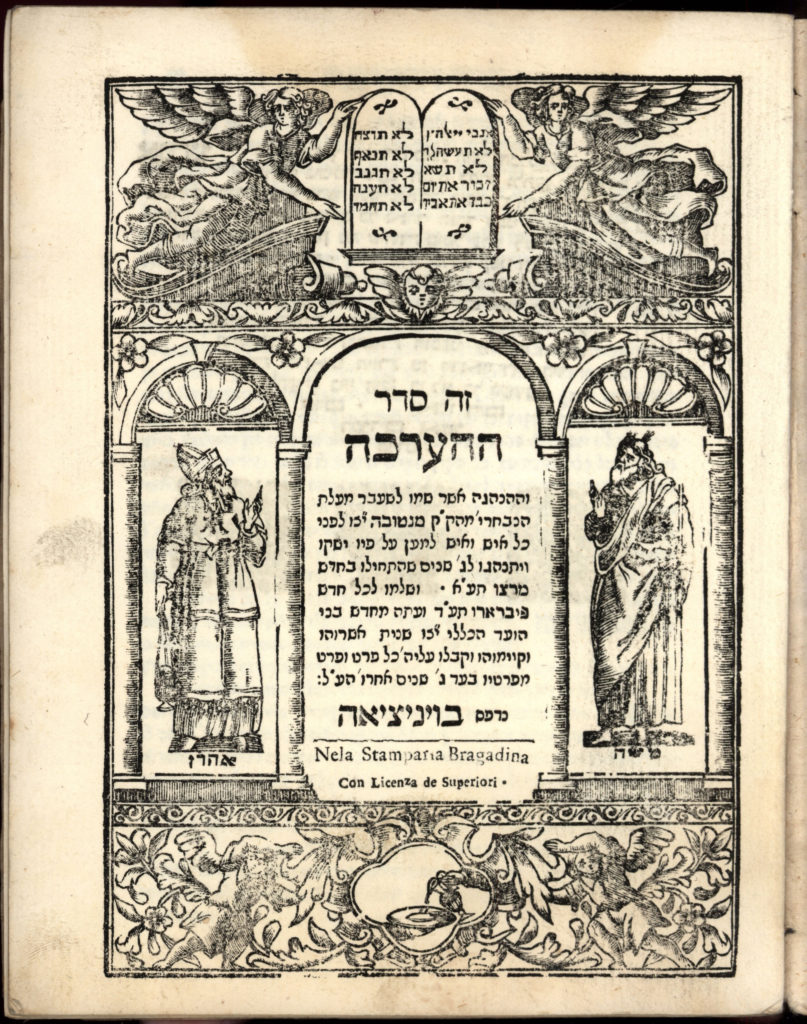
There are a series of books, Seder ha-haʻarakhah ve-haHanhagah, that record the tax law and taxes paid by the Mantuan community and were published in Mantua. [1] The taxes were calculated by communally elected assessment formulators.  The taxes were used to support the entire communal infrastructure, including the administration of communal organizations and funds for the poor.  As today, each person would provide an accounting of their funds reducing their taxable income based upon recognized deductions and certain exempted property. The formulators were wholly responsible for the determination of the specific levied taxes and could reject suspect ax filings and impose fines.

The first edition was published in 1651 and each edition covers three years, of which the National Library has 17 editions. The British Library holds 12, seven that are not in the National Library’s collection. Vinograd lists 22 editions, six in neither library. [2] (A full bibliography appears below)

There is, however, at least one edition in the series that was not published in Mantua, the most logical location, but in Venice by Bragadin in 1711.  The likely reason for the change in venue is that from 1707-1712, there were no books printed in Mantua. [3] Nonetheless, these records were so important that the community went to Venice to publish the records.


Steinschneider, based upon Wolf’s bibliography, does identify this edition of the work. [4] But the book is not extant in the Bodleian Library.[5]  Nonetheless, no modern bibliography, e.g. Vinograd or Friedberg, records the Venice edition nor does the National Library or any other library I can identify (based on a search of WorldCat) own a copy of the book.  There is one copy, however, in the Gross Family Collection in Tel Aviv, and is possibly a unicum – the only extant copy.  Although as Judge Meyer Sulzberger, himself an avid book collector, noted that caution is necessary when identifying a unica, because “that the great weakness about a unicum is that presently one or two other people are found to have the book, and instead of contently agreeing that each of them has a unicum, each feels the value of his possession has been materially impaired.”  To this we can add that without concrete evidence of the book’s singularity, there may be private collections or public ones whose holdings are insufficiently cataloged to make a confident identification regarding the rarity of any book.  Indeed, Sulzberger provides many examples of books thought to unica, only to be identified as “merely” rare.[6]

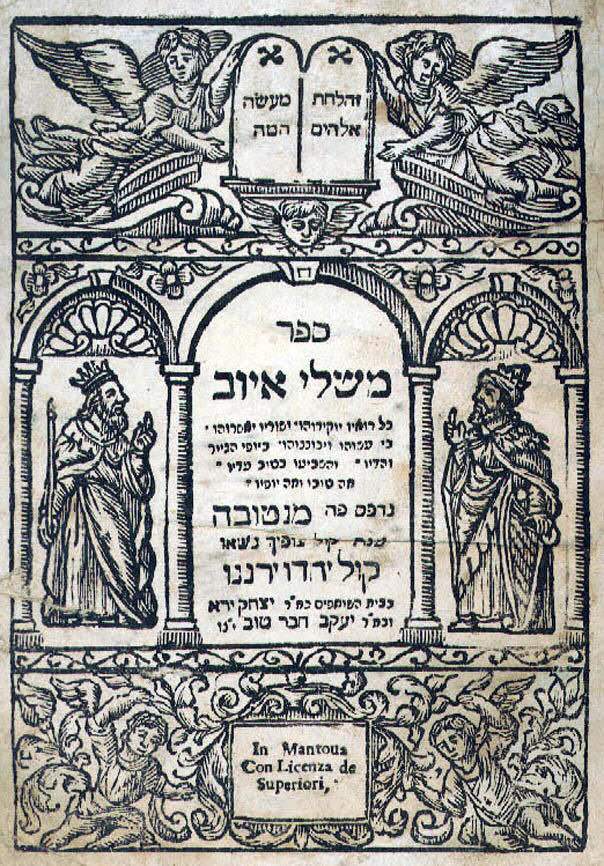
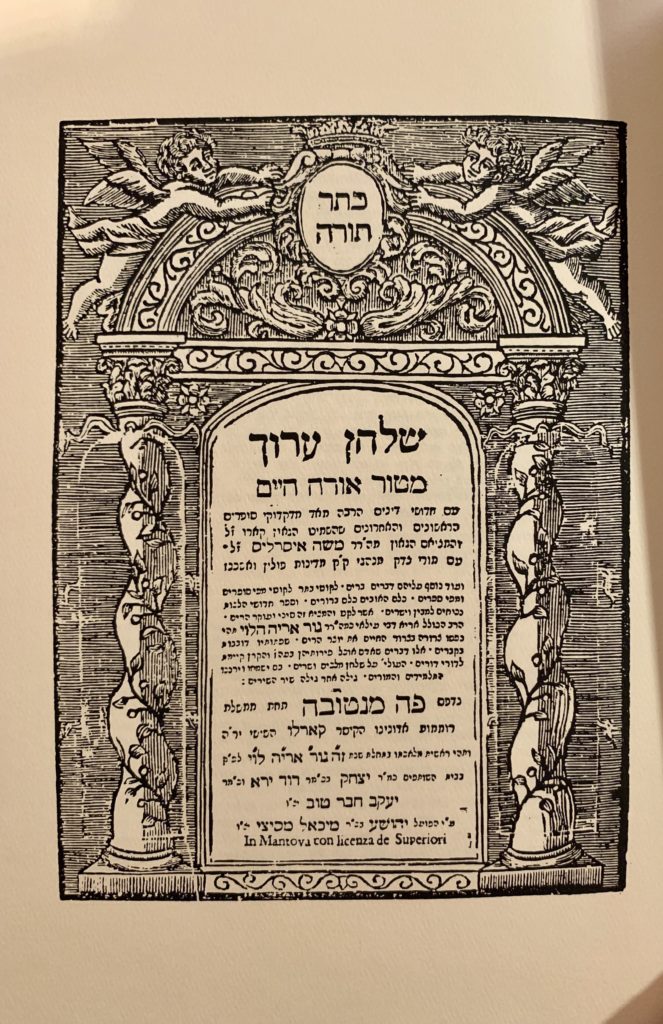
I should also note that the Venice copy has a nice title page with Moses and Aaron. (For a discussion of depictions of Moses and Aaron on Hebrew title pages see our earlier post here.)   A very similar title page appears on a later book printed in Mantua, 1720, Mishlei ve-Eiov, although in this instance it is David and Solomon who flank the title.

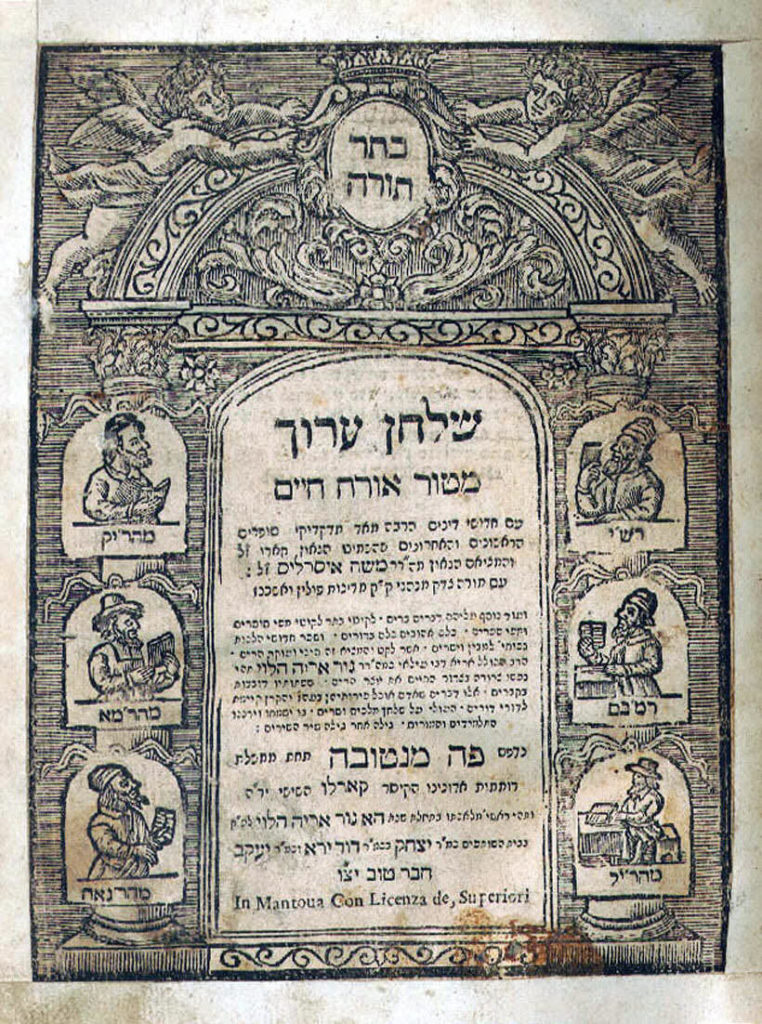
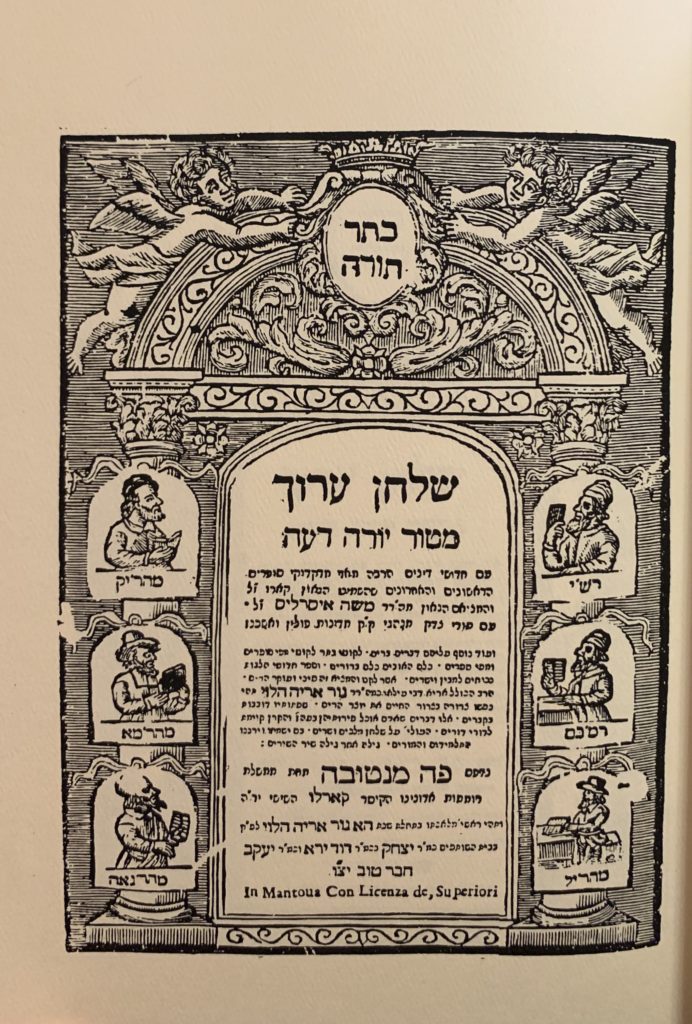
Additionally, the depiction of the Moses, Aaron, Solomon and David are similar to the ones that appear – Rambam, Rashi, R Yosef Karo, Rama, and the author – on the Gur Areyeh, a commentary on Shulkhan Orakh, Mantua, 1722.

There are two editions of this book printed within a year of one another.  The second printing lacks the images entirely and the first they only appear in Orakh Hayyim, and, although not noted in bibliographies or articles regarding the book, in at least one example the title pictorial title pages also appears in Yoreh Deah.

The remaining three (or two) volumes do not contain the images.  This led some to speculate that the images were deliberately removed, and that page was ripped out at the behest of the Mantua rabbinate and a variety of theories are offered, ranging from concern over reproducing human image to the inclusion of the author among such a distinguished group was egotistical, that the Rambam lack ed peyot, or that the portraits are just not flattering. [7]


But, both the claim of censorship and the rationale are unsupported.  Most extant copies include that page and there are many earlier examples of books containing human images including of biblical figures, many without peyot, or not dressed in flattering clothing.  There is no independent evidence to suggest anything other than a benign reason, perhaps the woodcuts wore out.  This aligns with the fact that the printer was known for crude lettering so much so that it nearly lost its ability to print at all and only survived because another party stepped in. Thus it is unlikely the lack of the portraits in the later volumes is an instance of censorship.[8]


* The identification of the Gross edition as a unicum is only preliminary and still a work in progress.  The author encourages anyone with additional information regarding this edition to comment or send an email to seforimblog@gmail.com

[1] See Shlomo Simonshon, Tolodot ha-Yehudim be-Duhosot Mantua, vol. 1 (Jerusalem, 1963), 274-86; see also Marvin J. Heller, The Seventeenth Century Hebrew Book: An Abridged Thesaurus, vol. 2 (Leiden: Brill, 2011), 957.

[2] For the NLI listing see here;   Diana Rowland Smith, Second Supplementary Catalog of Hebrew Books in the British Library 1893-1960, vol. 2 (London:  British Library, 1994), 599; Joseph Zedner, Catloglouge of the Hebrew Books in the Library of the British Museum (London, 1867), 510 recording Mantua 1759; Yeshayahu Vinograd, Otsar ha-Sefer ha-Ivri (Jerusalem:  Machon Lebibliograhia Memuhshevet, 1994).

[3] See Ch. B. Freidberg, Tolodot ha-Defus ha-Ivri be-Italia:  Be-Midenot Italiah, Aspnyah-Portugal, ve-Turgemah she-Melfenim (Tel Aviv:  Bar-Yeda, 1956), 20.  Friedberg does not explain the cause of the stoppage.

[4] Moritz Steinschneider, Catalogus Librorum Hebraeorum in Bibliotheca Bodleiana (Berollini:  Ad. Friedlander, 1852-1860) columns 625-66; Johann Christoph Wolf, Bibliothecae Hebraeae, vol. 3 (Hamburg:  Christoph Felgineri Viduam, 1827), 1207-08 (Steinschneider’s citation to Wolf should be corrected to read vol. 3 and not vol. 2).

[5] See A.E. Cowley, A Concise Catalogue of the Hebrew Printed Books in the Bodleian Library (Oxford:  Clarendon Press, 1929), 410 (listing only Mantua).

[6] Meyer Sulzberger, “Books and Bookmen,” Menorah XXXVI (Jan. 1904), 38-40. For other Hebrew unica see Marvin J. Heller, “Unicum, Fragments, and Other Hebrew Book Rarities,” Judaica Librarianship 18 (2014), 130-53.

[7] See Shmuel Weiner, Daat Kedoshim:  Pesak Herem:  Mazkeret Rabanei Italiah (Petroberg: Berman Press, 1897), 38**; Aviad Cohen, “Diuknot Hakhamim:  Bein Halkha le-Maashe,” Mahnayim 10 (1995). See Mifal ha-Bibliographia ha-Ivrei entry Gur Areyeh .

One scholar viewed the selection of personages to grace the title page as an indication of their imporatance.  Specifically the inclusion of the Mahril was used to demonstrate his unique contribution to the formation of the Shulchan Orakh.  See Yisrael Peles, Mevo ve-Hosafot le-Sefer Mahril (Jerusalem:  Machon Yerushalim, 2016), 258. (Thanks to Eliezer Brodt for providing this source).

[8] Friedberg, Tolodot ha-Defus ha-Ivri, 20-21. For another example of spurious reasons for a change to the title page, see Dan Rabinowitz, “Sheti ha-Girsot shel Shu”t ha-Bakh, Mahadurot Frankfort TN”Z:  Totsot shel Shikul Tsniut, Sha’arim be Shut ha-Bach,” Alei Sefer  21(2010), 99-112.


Bibliography of Seder ha-Ha’arakhah


Mantua, 1651(BL)

Mantua, 1656 (NLI)

Mantua, 1670 (V)

Mantua, 1675 (BL)

Mantua, 1679 (NLI)

Mantua, 1682 (V)

Mantua, 1685 (V)

Venice, 1711 (Gross)

Venice, 1714 (Wolf)

Venice, 1717 (Wolf)

Mantua, 1722 (BL)

Mantua, 1722 (BL) (& a variant)

Mantua, 1726 (NLI)

Mantua, 1729 (V)

Mantua, 1732 (NLI)

Mantua, 1735 (NLI)

Mantua 1737 (BL)

Mantua, 1739 (NLI)

Mantua, 1743 (BL)

Mantua, 1747 (NLI)

Mantua, 1750 (NLI)

Mantua, 1753 (NLI)

Mantua, 1756 (NLI)

Mantua, 1759 (NLI)

Mantua, 1773 (BL)

Mantua, 1777 (NLI)

Mantua, 1780 (NLI)
Mantua, 1783 (V)

Mantua, 1786 (NLI)

Mantua, 1789 (NLI)

Mantua, 1793 (V)

Mantua, 1795 (NLI)

Mantua, 1798 (NLI)


Review of Jay R. Berkovitz’s The Pinkas of Metz

Review of Jay R. Berkovitz’s The Pinkas of Metz

By Eliezer Brodt & Dan Rabinowitz

Jay R. Berkovitz, Protocols of Justice: The Pinkas of Metz Rabbinic Court 1771-1789, (2 vol., 222 pp. +1084 pp.), Brill 2014

Jay R. Berkovitz, Law’s Dominion, Jewish Community, Religion and Family in Early Modern Metz,(404 pp.) Brill 2022

A decade ago, Professor Jay Berkovitz, a Professor and Chair of Judaic and Near Eastern Studies at the University of Massachusetts, Amherst, published the Pinkas (record book or register) of the Rabbinic Court in Metz. Jews began living in Metz, a town in Northeast France near the Moselle River, in the 16th century. These records require a reassessment of the Jewish legal process and procedure, especially concerning the secular legal system. In 2022, Berkovitz published a self-standing monograph, Law’s Dominion, to fully describe and explicate the impact of the Pinkas. Both works mark significant advancements in modern Jewish history and the theory of the Jewish legal system. Yet, they have not received the proper attention they deserve in the Hebrew book world. The lack of recognition can partially be attributed to the publisher, the distinguished publishing house of Brill. Brill’s publications are not generally available for sale in local Seforim stores, and many are priced outside the reach of laymen (or even scholars). Nonetheless, both are worth seeking out, and we intend to bring these vital works to the attention of Seforimblog readers and describe their significance.

The Pinkas of the Metz Rabbinic Court covers just 18 years, 1771-1789, yet it is a massive amount of material. Berkovitz’s transcription (albeit with notes) is over one thousand pages. This is truly what one would call a labor of love. Not only did he publish a huge manuscript (over one thousand pages) with valuable indices, but he also mined the work extensively. In 2014, he wrote a volume (222 pp.), in English, dealing with many aspects of the Pinkas (as I will elaborate on below), demonstrating his command of everything possibly imaginable related to this work.

A few years later, in 2022, Berkowitz revisited the Pinkas and published another book, Law’s Dominion, Jewish Community, Religion and Family in Early Modern Metz, updating his previous book with a few more hundred pages.[1]

Berkowitz describes his project as follows:

Though certainly never intended to become a complete history of the Jews of Metz, Protocols of Justice grew to become much larger in size and complexity than originally expected. Despite its expanding into a self-standing monograph, I am very much aware that work on this project is still in its early stages. I present these volumes as an invitation to scholars to continue what has commenced here (p. 25).

Introduction: Pinkasim and their Historic Value

By way of introduction, many people seek out new niches where they can contribute valuable studies about otherwise unknown topics. One such untapped area is the world of Pinkasim. Over the years, numerous kinds of Pinkasim have been published, some in extensive critical editions. But there remains plenty of work in this “field.”

What is a Pinkas?

These records, typically in the form of a notebook or book, transcribe the materials of a particular group, society, or entity. They can be marriage or divorce records, Synagogue protocols, or numerous “Chevrah books.” Even though many have been lost or destroyed, numerous volumes have survived in libraries worldwide. In recent years, some have even ended up in private collections. (After the Holocaust, “Pinkas” is also used to describe a different form of communal books. Survivors from towns in Europe published “memorial books” to document their history and memorialize the murdered Jews. Many of those use Pinkas in the title, for example, Pinkas Zetel, Pinkas Galicia. Although collectively, the genre is referred to as “Yizkor books. New York Public Library collected these, and they are available on its site: Yizkor Book Collection.)

Historians have long recognized the value of Pinkasim generally. When reading the works of various prominent historians before World War Two, they often cite something like this: “In the Pinkasim of the town or city, I found…” One of the more well-known examples of a Pinkas is the Pinkas of the Vilna Gaon Kloyz. This manuscript is currently in New York and has a fascinating story regarding its survival (See David Fishman, The Book Smugglers, 52-55 for more details). R. Shlomo Zalman Hevlin published of the text of this Pinkas in the journal Yeshurun. Shlomo Zalman Hevlin, “The Pinkas of the Gaon’s Kloyz,” Yeshurun 16 (2005), 746-60; “The Kloyz of the Gaon of Vilna Zts”L, Ketayim me-Pinkas ha-Kloyz,” Yeshurun 6 (1999), 678-85.[2]

This Pinkas provides invaluable information regarding ownership of one of the homes where the Vilna Gaon resided. After his death, his children claimed it was part of the estate, while his students argued that it belonged to the community. After some machinations, including changing the board composition that held the property in trust, the court ruled in favor of the children. Some scholars view this property dispute as an attempt to resolve a larger issue of whether Gaon’s children or his students would control his intellectual legacy. After this decision, the children determined which Gaon’s manuscripts would be published rather than the students. (See Dan Rabinowitz, The Lost Library, Brandeis University Press, Massachusetts, 2019, 55-58.)

The Significance of the Bet Din Pinkas.

A subset of Pinkasim are those of Be’tai Din, taking the form of a register of the various disputes and decisions. These, too, are of critical importance. These documents shed light on individuals’ relationships to communal takanot, the power and authority of the Bet Din, and many other areas.

Yet, today, many of the Pinksim no long survive. Sometimes this was deliberate as in the case in the 1600’s of the Frankfurt Bet Din.

כתוב ביש נוחלין… וזה לשונו, קבלה ישנה מאבותי ז”ל שלא להשליך שום חשבון ישן אף על פי שנחשב הכל, כי אולי תבוא עת להוכיח דבר מה מאותו. עד כאן ולדידי הכותב הוה עובדא בזה כמה פעמים שבא לי לאחר ההשלכה לכלל היזק, כי כמעט הייתי מוכרח בכל פסח לשרוף כתבים ופתקאות, לפי שריבויים מפסקי דינים והשלישות וכיוצא ישתרגו עלו על צוארי, שלא היה המועט מחזיק את המרובה. וגם מפני שלא יהיה לי הטורח גדול ביותר בחפשי בחפש מחופש אחר כתב אחד, כאשר גם עתה אחר כל שריפת הכתבים נלאיתי עד כמה שעות בחפשי אחר איזה כתב [יוסף אומץ סי’ שע, עמ’ קח]

Rabbinic scholars eventually recognized the significance of pinkasim.[3] For example, the Nodeh BeYehudah uses one to determine the spelling of names in a get:

הנה אהוביי להיות שאין הגדול מעיד בגדלו על מה שראה בקטנו כ”א דברים ידועים שחשבו רז”ל ולכן אין אני יכול להעיד. אבל אעפ”כ אני אומר לכם נהירנא כד הוינא טליא כבר תשע או כבר עשר ראיתי אצל אא הרב זל פנקסאות של הגליל קראקא וראיתי פנקסאות משנים קדמוניות היו חתומים בו גאוני עולם זקני הגאון רשכב”ה מוהר”ר העשיל זצ”ל ואחריו דודי זקני הגאון המפורסם מוהרר”ל וגם ראיתי חתימת הגאון בעל תוספות י”ט שמה וכמדומה שבכל מקום שנרשם שם השומא חדשה שעשו שמאים באסיפת הגליל היה נכתב פילטץ עם טי”ת, ואף שאין אני יכול להעיד בבירור כי טליא הוינא וגם מלתא דלא רמיא וכו’ אבל תדעו שהפנקסאות הנ”ל דומה אני שהיה אח”כ ביד המאוה”ג מוהר”ר שלמה ז”ל אב”ד דק”ק פינטשוב שהיה סופר הגליל דרשו שם בק”ק הנ”ל ותמצאו אבל עכ”פ המפורסמות א”צ ראיה וזה דבר ידוע ששם העיר בכל מדינת פולין קורין פילטץ עם טי”ת וכן כותבים בכל האגרות והרי הוחזק שם העיר בלשון היהודים עם טי”ת. [נודע ביהודה, קמא, אבן העזר, סי’ פז].

Basically, one man’s junk became another’s treasure.

At first glance, a Pinkas of the Bet Din might appear to be dry material only of interest to specialists and technicians. But in reality, these contain information that can elucidate and enrich larger Jewish history. Nonetheless, little work has been done with the Pinkasim of rabbinical courts. Recently, however, some have begun publishing and analyzing these records to great effect. Edward Fram’s book, A Window on Their World: The Court Diaries of Rabbi Hayyim Gundersheim Frankfurt Am Main 1773-1794 (2012), inaugurated this approach.

A more focused usage of a Bet Din Pinkas is an article by Moaz Kahana. He identified a short and somewhat cryptic entry in the Pinkas of the Bet Din of Prague regarding a fine levied on two people. From that citation Kahana provides a sweeping exposition on Jewish coffee culture in Prague in the 18th century. Among other details, in 1765 (during the period that R. Yehzkel Landau was the Chief Rabbi), there were at least six coffee houses in the Jewish quarter, owned by Jews, open on Shabbos, that Jews frequented and sanctioned by the Rabbinate. (Moaz Kahana, “Shabbos be-Beyes ha-Kaffe shel Kehilah Kedosha Prague,” in Zion, 2013 (78), 5-50).

A few years ago, in the prominent journal Yeshurun (24 (2011), pp. 235-297), R’ Dovid Kamenetzky published material from the Pinkas of Frankfurt from the Haflah.[ Avalaibel here and here] R’ Zalman Nechemiah Goldberg commented to the volume editors that he was so excited to read this material. In the course of this post, we hope to explain what his excitement was about. It is safe to imagine that had he seen this material from the Pinkas of Metz, he would have been beyond excited.

What can we learn from this Pinkas?

This Pinkas of the Bet Din of Metz is of especial importance. Berkowitz cites Anthony Grafton that “…courtroom and the lawyer’s study have turned out to be historical alembics where the methods of social and intellectual historians can be mingled in new forms, producing results of unsuspected richness.” that “In the last quarter-century, especially, the courts have been identified as a dynamic arena of social change and as a valuable source for understanding economic history and the changing function of law in society.” Recognizing this value, many scholars have used medieval Jewish records to elucidate those periods’ history. Yet there is a lacuna when it comes to the early modern era. Consequently, the potential of beit din records remains largely untapped (p.3).[4]

Berkowitz acknowledges that, in part, the lack of use of bet din records is due to the many technical challenges, including “proficiency in Hebrew paleography and expertise in the largely unfamiliar territory of Jewish civil and family law. As a result, we know virtually nothing about the kinds of cases that came before rabbinic courts and even less concerning jurisprudence and dispute resolution methods employed there. This is rather ironic in light of the heightened interest in law shown by historians working on late medieval and early modern Europe.” (p. 3)

As mentioned, Berkowitz did two important things: he transcribed this massive work carefully and studied it as a historian of Halacha; he “mined” this work very carefully.

The transcription alone is not a small feat; we are talking about a volume that, in print form, is almost 1000 pages of Hebrew text! The Pinkas also includes obscure words in French and Yiddish, which Berkowitz also deciphers, provides a useful glossary of foreign terms.

An important feature of Berkowitz’s edition of the Pinkas is the extensive indices based on topics, names, and places.

Berkowitz writes:

The economic data contained in the proceedings of the Metz Beit Din will doubtless prove invaluable in gauging the range and intensity of Jewish commercial activity in the pre-revolutionary era… (p. 30)

Then Berkowitz elaborates on this, listing out what exactly one can learn from this Pinkas:

The Metz court records are also filled with resources for investigating the economic complexities of marriage, family, and kinship relations. A profusion of details concerning the social and economic importance of betrothal agreements, dowries, marital property division, and inheritance arrangements represent a treasure trove of historical data. Particularly fascinating are cases that reveal the degree to which law, family, property, and business interests were tightly interwoven. On occasion, the human story comes into view with unusual poignancy, especially in cases of abandoned wives, young widows, and tales of deprivation… Legal mechanisms that came into play in response to evolving social and economic trends in the eighteenth century produced a measure of equality between husbands and wives that is apparent in quite a number of cases that came before the Beit Din. Accordingly, the picture that emerges… to the work women performed beyond their domestic responsibilities. There is abundant evidence suggesting that wives borrowed and extended loans, occasionally without their husbands’ authorization, to help support their families… (pp. 30-31)

Sources for the Law

What do we Know about the Jewish Community of Metz at the time?

Berkowitz writes:

Metz was the western-most outpost of Yiddish-speaking Ashkenazic Jewry in the early modern era (p. 7) With a population of over 46,000, Metz was the tenth largest city in France. During the seventeenth century the Jewish population in Metz increased dramatically and by the end … it numbered nearly 3000 individuals. Slightly less than seven percent of the city’s total population, it constituted the largest Jewish community in France prior to the Revolution (p.8).

In general, there is also great significance to Metz in the world of Halacha at this time, as Berkowitz writes:[5]

The major halakhic works that were produced in Metz or in nearby communities in the eighteenth century and were significant from a regional standpoint include Yaʾir Ḥayyim Bacharach, Resp. Ḥavvot Yaʾir (Frankfurt, 1699); Jacob Reischer, Resp. Shevut Yaakov, pts. 1–3 (Halle, 1710), pt. 2 (Offenbach, 1719), and (Metz, 1789); Joseph Steinhardt, Resp. Zikhron Yosef (Fürth, 1773)[6]; Gershon Coblentz, Resp. Kiryat Ḥannah (Metz, 1789); and Aaron Worms, Meʾorei Or (Metz, 1790–1793) (p. 25)[7]

Why was this Pinkas written in the first place?

Berkowitz explains:

Precious little is known about the production of the Metz Beit Din records. We cannot state with certainty under whose direction these records were produced, for whom they were intended, and toward what end they were preserved in written form. Nevertheless, there was nothing novel or uncommon about providing litigants with written copies of its rulings. Documents issued by the court were intended to confirm an admission of debt, the withdrawal of a claim, the exoneration of an individual from unsubstantiated accusations, or the severance of a widow from her husband’s estate, to name only several of the more common types of validation provided by the Beit Din. In some instances, the court was asked to issue a maʾaseh beit din (a formal judgment) that confirmed ownership over property or established the legality of a particular transaction. Written rulings of this sort were frequently produced as evidence in cases that continued over the course of months or even years. Although the communal register does not contain an explicit directive concerning the actual preservation of judicial records, article 109 of the 1769 community bylaws stated that “every ruling of the Beit Din must be written and signed… It was stipulated, further, that “it is prohibited for either of the litigants to pay the other even a perutah until they have seen the written and signed judgment. (p. 39)

While there is little doubt about the value of the Pinkasim, especially as they relate to the Jewish legal system, they do not offer a complete record of the judicial process. Despite containing hundreds of legal decisions predicated on Jewish law, the Pinkasim do not provide the underlying rationale of those decisions. The decisions distinguish between those based on Jewish law, internal takanas, and custom. But the specifics of the which sources and rationales are compelling are left unsaid. This, however, is unsurprising as most Bet Din decisions, whether recorded in Pinkasim or other sources, seemingly rely upon Rema’s statement that “there is no need to write the rationales and proofs, we only write for them [i.e., for the litigants] the claims and the ruling.”

Who transcribed the Pinkas?

Precisely what role scribes played in determining the content, form, and language of the cases they recorded is unclear. Variations in handwriting, in addition to the assorted signatures affixed at the ends of collations of cases, reveal that several different court stenographers were commissioned to record the judicial proceedings during the eighteen years chronicled in the Pinkas. The largest number of entries appears to be in the hand of a single scribe, Juspa Katz, whose name is recorded in seven cases that span fifteen years (pp. 43-44).

Elaborating on this, Berkowitz adds:

In each of these instances, the document was approved by the av beit din, by the judges, or in some instances by the presiding syndic (parnas ha-ḥodesh). Overall, the stylized prose used in recording the proceedings, which are punctuated by the inclusion of biblical phrases and technical expressions drawn from talmudic and halakhic literature, suggest that the text of the Pinkas was the product of meticulous preparation by erudite scholars and well-trained scribes.

The function of the Beis Din

Berkowitz describes: “As a communal institution, the Metz Beit Din filled three principal functions. First and foremost, it was a judicial body that represented the primary, though certainly not the exclusive, public venue for the resolution of disputes among residents of the greater Metz community. Litigants regularly came from the towns and villages of the Moselle countryside as well, and in some instances from more distant localities when business dealings brought them into contact with Moselle residents. Second, as in the case of the French lower courts, the Beit Din performed bureaucratic functions that included the confirmation of legal documents and contracts, the execution of wills, and the appointment of guardians. Third, it enjoyed certain institutional powers related to social control and supervision. Although this range of functions may have resembled the merging of judicial, legislative, and executive tasks in early modern French courts, the Beit Din acted more as an arm of the Kahal executive and coordinated itself with the general policy guidelines set forth by the community’s governing body. Furthermore, on a much smaller scale, the centralized authority of the Kahal was more pronounced than that of the state and, as a result, the independence of the rabbinic court could be expected to be more narrowly circumscribed (pp. 65-66).

Who were the Dayanim on this Beis Din?

One of the critical insights of this volume is the identification of the dayanim of the Beis Din. These are generally not recorded elsewhere. Berkowitz identifies:

Rabbis Moses Narol Cohen, Gershon Ashkenazi, Jacob Reischer, Abraham Broda, Joshua Jacob Falk, Jonathan Eibeschütz, Shmuel Hilmann, and Aryeh Loeb Günzberg. Günzberg… best known as a renowned Talmudist and author of the celebrated Shaʾagat Aryeh (p. 14)

The Shagas Aryeh is well-known as a posek, but this identifies in a lesser-known role, Av Beis Din. (See Oriel Touitou, The Methods of Rabbi Pinhas Ha-Levy of Horwitz and Rabbi Aryeh Leib in Talmud Study and Halachic Decisions, (PhD) Bar Ilan University 2012; R. Peretz Risenberg, Yeshurun 30 (2014) pp. 772-824; Eliezer Brodt, Yeshurun 24 (2011), p. 463.

How many cases did this Beis din Deal with?

Berkowitz writes:

Serving as the primary communal forum where legal disputes were adjudicated, the Beit Din typically met two or three times a week and averaged roughly sixty cases per year. In accordance with standard procedure in Jewish law, three judges (dayyanim) heard each case; in virtually every instance the tribunal consisted of the av beit din (Günzberg) together with two adjunct dayyanim. In the course of the eighteen years that are chronicled in the Pinkas, fifteen rabbinic judges rotated on the Beit Din alongside the chief justice. Of these sixteen judges, four sat on the bench for the entire period and several others performed their duties for most of those years (p. 15).

Methods of the Beis Din

They did not just give verdicts. They personally investigated the facts.

Concerning a dispute over the suitability of the living space in which an orphan resided together with his uncle, the Beit Din decided to pay a visit to investigate whether the physical conditions in the home were as required. It also hired a nurse to provide a medical perspective, and two more to corroborate the opinion of the first. After taking these steps the Beit Din was persuaded that the orphan was not mistreated and there were no grounds for legal action against the guardians (p. 70)

What do we know about the “reach of this Beis din”?

Berkowitz writes:

These are strong indications of the stability and continuity that characterized the work of the court during nearly two decades of service to the community. Equally impressive is the long geographical reach of the Metz Beit Din. Litigants came from near and far, from Augny located just 8 kilometers southwest of Metz and as far as Frankfurt, which was a distance of 260 kilometers. To accommodate individuals who were unable to travel to Metz from distant communities in the Moselle, the rabbinic court occasionally made special arrangements… In order to reduce expenses, the local cantor was deputized by the Metz Beit Din to administer the widow’s oath… in the presence of one witness. Altogether, more than one hundred villages throughout the Moselle countryside and beyond are mentioned in the court proceedings. These distances reveal much about the far-flung commercial and financial dealings of Metz residents and the centralization of authority in the Moselle region and in areas of Lorraine (pp. 15-16).

The Metz Beis Din and Secular Law

Berkowitz writes:

Without surrendering its own authority, the Beit Din regularly acknowledged the interdependence of cases brought before the rabbinic judges and those taken to the French civil court system. But on numerous occasions the Beit Din made it clear that it would need to await the judgment of the French court before it could issue its own ruling. In a case concerning the division of living space, it declared that its decision was valid “so long as the gentile courts do not object.” It is striking that even in matters that were presumably of minimal interest to the authorities, the Beit Din was hampered by contingencies of this sort… the Metz Beit Din enjoyed substantial independence from state interference and control. Whether they were considering contractual matters, offenses against the public order, or the civil consequences of strictly religious affairs, municipal and royal courts firmly imposed their jurisdiction and exercised the right to overturn the decisions of the ecclesiastical courts when there was evidence of a procedural irregularity. Moreover, the powers of ecclesiastical courts were limited to canonical penalties. The Beit Din, with the full support of the Kehillah leadership, was granted greater latitude by the state to resolve internal differences on the basis of Jewish legal traditions that extended primarily to civil matters. Nevertheless, neither the Kehillah nor the Beit Din was able to ignore pressures to coordinate with and adapt to general law…. How the Metz Beit Din functioned alongside the French civil courts may be the crucial question, but, as will become apparent, it is exceedingly difficult to answer. Complicating the issue is the fact that recourse to French civil courts appears to have accelerated as the eighteenth century wore on. Individuals who took their disputes to gentile courts, known in rabbinic and halakhic literature as ʿarkhaʾot shel goyim, were consistently denounced by medieval and early modern rabbinic authorities (pp. 107-108)

Berkowitz continues:

The present study addresses a different set of questions: How did jurists within the rabbinic court system respond to the challenges to Jewish law that were posed by non-Jewish legal systems? Is there any evidence that judicial procedure in the Beit Din, or the interpretation of the law itself, was influenced by French law or by the possibility of recourse to French civil courts? How did the phenomenon of legal pluralism influence the methods of adjudication and jurisprudence employed in the Metz rabbinic court? The impact of legal pluralism may be discerned in the court’s adoption and adaptation of legal perspectives and mechanisms from general jurisprudence, both in the realm of procedure and in substantive areas of law such as the division of marital property. Invariably, the Beit Din’s method of adjudication reveals tensions between its role as guardian of communal autonomy and the political demands imposed by legal centralism—tensions between its role as arbiter of Jewish law and agent of the Kahal, on the one hand, and its awareness of the contingent nature of the relationship between Jewish law and general law, on the other (pp. 109-110).[8]

Power of the Jewish courts in Early Modern France:

The proceedings of the Metz Beit Din provide elaborate details concerning Jewish civil autonomy. Under the aegis of the governing authority of the Kehillah, the Beit Din was authorized by the state to resolve differences among members of the community on the basis of Jewish customs and legal traditions. In this respect the Beit Din enjoyed a level of authority that far exceeded that granted to the ecclesiastical courts… Overall, the Metz proceedings contain little evidence, either direct or indirect, of resistance to its juridical authority (p.53)

Related to this, a case in the Pinkas is worth citing. As Berkowitz summarizes:

In Metz, as in other communities, the authority exercised by the Beit Din and the scope of its jurisdiction were a reflection of the latitude extended to it by royal and municipal authorities. Owing to limitations on the power of the Kehillah to enforce judicial rulings, the Beit Din found it necessary on certain occasions to caution recalcitrant litigants that failure to respond to a summons carried severe consequences. In the case of Gershon Coblentz, who refused to appear before the Beit Din to settle a dispute with Yozel Cahen, the Beit Din threatened to serve him with a contempt of court order (pequdat ḥerem) and to employ “other forms of coercion.” How effective these threats could have been without the backing of the state is questionable. Coblentz remained adamant in his “rebellion and refusal, holding up the words of the rabbis to ridicule,” whereupon Yozel proceeded to seek authorization from the Beit Din to bring his claim to the French court. The Beit Din informed Gershon that it had approved the transfer of the case to the civil court, and following their response that they did not object, the rabbinic court authorized Yozel to take hold of the written documentation, in French, so that he could sue in the civil court (p. 54).

Who represented the people for the Beis Din?

In more than a third of the cases that were brought to the Metz Beit Din, litigants were represented by their own attorneys. This is likely to have been a (sic) commonplace in rabbinic courts in other communities as well. The scope of legal representation in rabbinic courts had widened considerably in the sixteenth to the eighteenth centuries (p. 60)

Implications for Jewish History from the Pinkas

Knowledge of French

Berkowitz writes:

Although the foregoing examples suggest that French literacy was more prevalent among Metz Jews than has been generally assumed, there is little doubt that facility in French was far less extensive in the countryside than among the urban elite. Even fifty years after the Revolution there were still Jews in the small towns and villages of Alsace and Lorraine who could not speak French. The records of the Beit Din suggest that although the scribes who had been assigned the task of recording the case summaries were familiar with a wide range of technical French vocabulary pertaining to judicial procedure and financial instruments, their fluency may have been limited to oral proficiency. (pp. 93-94)

In addition to gleaning information regarding the legal and judicial practices, the Pinkas also provide information regarding the day-to-day life of the Jews in Metz and beyond. Some of these lead to the important conclusion that “confirm[s] that even prior to the Revolution, cultural influences transcended social barriers, and this appears to have been true for a larger segment of the Jewish population than is commonly assumed.” (p. 95). Others, however, point to more prosaic elements of the lives of the Jews. Nonetheless, the Pinkas is a primary source for assessing their lifestyle and everyday trials and tribulations, and is essential to paint objective picture of their lives.

Some Interesting cases which show life was rather colorful:

On one occasion, when informed that a woman who was engaged to be married had become pregnant, the Beit Din summoned her and her fiancé in order to ascertain whether he was the father and, assuming he was, to ensure compliance with Jewish law if the couple intended to marry. According to Talmudic law, a man is forbidden to marry a woman who was either pregnant by another man or who is nursing another man’s child until the child is twenty-four months old. In response to a husband’s claim that his wife’s pregnancy was not his doing, the Beit Din proceeded to investigate the matter thoroughly. Based on the wife’s acknowledgment of her extra-marital affair, as well as the testimony of witnesses confirming the utter lack of affection between husband and wife, the Beit Din absolved the husband of all financial responsibility for the child and ordered him to divorce his wife; she, in turn, was required to accept the get, even against her will, on account of her confession. Because marriage and sexuality were matters of vital interest to the public, the Beit Din acted swiftly, in some instances before litigants came forward (pp. 68-69)[9]

Another colorful case discussed by Berkowitz regarded:

Reichle Cahen… approached the Kahal in its meeting room and openly accused Hirtz Oulif of fathering her child; she demanded that he marry her and provide birth expenses and child support. Initially heard by the Kahal, the case caused something of a furor because of the public nature of the young woman’s accusation and owing to her family’s elevated status within the community. The Beit Din was invited to join the Kahal in its effort to stave off the worrisome trend, and the head of the rabbinic court, R. Günzberg, was asked to lead the new initiative. Although ill-health prevented Günzberg’s participation, members of the Beit Din proceeded, together with several syndics, to examine the arguments and testimony presented by Reichle and Hirtz… the Beit Din demanded that Reichle and Hirtz address each other directly, without legal representation. Hirtz proceeded to deny each of Reichle’s claims as utterly false. Aiming “to uphold the bylaws of the community,” the Beit Din responded by imposing the ḥerem on both the young woman and the young man, undoubtedly to convey the message that promiscuous behavior would not be tolerated under any circumstances. But when it came out that there were witnesses willing to testify that the young man was heard boasting of his exploits, the Kahal and the Beit Din altered their approach. They recorded the statements in writing, assembled additional oral testimony attesting to the accuracy of the earlier statements, and subsequently set about to erect “a fence and barrier against the promiscuity of the generation and so that daughters will not act wantonly or be treated as such.” At this point the Beit Din imposed the ban directly on Hirtz until such time as he had appeased Reichle by agreeing either to marry her or present her with monetary compensation. It further required him to deposit 1200 livres with the Kahal until the birth, at which point it would be determined whether Reichle’s paternity claim was plausible. If it was, then the money would be turned over to Reichle; if not, the money would be returned to him. In any event, the Beit Din required him to pay a fine of three hundred lives that would be distributed to the poor…(pp. 147-148)[10]

Seats in Shul

In one instance, the Beit Din authorized a widow to sell two synagogue seats and to collect the total value of her ketubah, even though a lien had been placed on the property of the orphans, earmarking it as a charitable bequest. Selling the seats enabled the widow to remove the lien on her ketubah and tosefta, in accordance with both Jewish and general law. (p. 71)[11]

Looking at the index will show that the Beis Din had to deal with many issues with seats in shul.

Gorel: Lotteries

Numerous cases were resolved via lotteries, as listed in the index. These provide additional materials related to lotteries in Jewish culture. See Yechiel Lash, The Attitudes of Halachic Decisors to the Casting of Lots Within a Decision-Making Process and Their Implications, (Ph.D. Bar Ilan Talmud Department 2012); Shraga Bar-On, Lot Casting, God and Man in Jewish Literature: From the Bible to the Renaissance (heb.), Ramat Gan 2020; Eliezer Brodt, Likutei Eliezer, pp. 56-58; Fram, pp. 47-49.

We learn about the Beis Din’s involvement in helping people experiencing poverty:

… details of charitable giving, including laws regulating confraternities and poor relief, particularly when complications demanded the court’s legal expertise. In nearly a dozen cases, the Beit Din was approached concerning the practice of supplying the itinerant poor with billets, known in Yiddish as pletten. Each Metz householder, in proportion to his wealth, was required by communal law to deposit pletten, inscribed with their names, in a chest. Poor travelers would then draw tickets in order to secure meals and a night’s lodging offered at the homes of community members. Questions ranged from the basis upon which the pletten obligations were to be determined for each resident to how to contend with individuals who refused to share the responsibility… (p. 72)

Another interesting case:

In a parallel dispute concerning the administration of a charitable gift bequeathed by an estate, the Beit Din was asked to decide whether the Kahal had the right to exercise control against the wishes of the heirs. Ẓadok Grumbach objected to the Kahal’s insistence that one of twelve rooms in the beit midrash established with funds donated by his grandfather, Abraham Grumbach, ought to be designated for elementary instructional purposes. His attorney argued that this would violate the will of the deceased and contradict prior judgments of the court. It had been understood that the rooms in the upper level were intended for lomdim (scholars) who had been appointed through the generosity of the benefactor and in whose merit they dedicated their efforts; the noise caused by younger students would arguably create a disturbance for the lomdim. Grumbach therefore sued the Kahal for breach of contract.

The attorney for the Kahal responded that the placement of a teacher and students in the room in question would be preferable to leaving it empty, and that in so doing the Kahal would remain in compliance with previous agreements and legal rulings. As a matter of policy, he argued further on the basis of talmudic law that the seven tovei haʾir (the talmudic term used to refer to the lay communal executive council) had the authority to alter a communal ordinance if the intent was to increase learning and expand Torah instruction. The Beit Din upheld the position of the Kahal, arguing that the placement of a teacher and five students in a room on the first level was consistent with the original intent of the testator. It maintained that it was fair to assume that Abraham would have wished the room to be used for instructional purposes rather than to remain empty and that such use would be in the merit of the soul of the deceased… (pp.76-77)

Sins and daily life:

Berkowitz writes:

As traditional barriers separating Jews and non-Jews began to fall after midcentury, communal leaders responded with new attempts to slow the pace of acculturation. Their efforts, though perhaps not religiously motivated, recognized the dangers implicit in excessive exposure to French culture. Games of leisure and chance had become so popular that any person found engaged in these pastimes without the authorization of the community council could be barred from attending synagogue for three years. Paternity suits and extramarital pregnancies were routinely recorded in the communal register and in the protocols of the Beit Din, and the repeated condemnation of extravagance over the course of the eighteenth century suggests that these trends were on the rise. (p.13)

Card Playing & Gambling

There are numerous sources of this kind in various documents throughout Jewish history. One of the most well-known personal accounts appears in R. Yehudah Areyeh Modena’s autobiography. (See generally, Yitzhak Rivkin, Der kamf kegn azartshpiln bay Yidn, (YIVO, 1940).

In the Pinkas we find:

שאמת הוא שהי׳ עובר חרם ע״י שחוק רק שאין כוונתו כמו עוברי חרמים המשחקי׳ בקובי׳ וקארטין רק שהי׳ משחק שחוק אחר שקורין לאדי אצל חתן אחד ושחוק זה ג״כ חרם וב״ח הנ״ל השיב שאין חוששין ללעז ורבי׳ הי׳ אומרי׳ לו שרגיל בעיני המון עם לשחוק [שחוק 192 ] זה אצל חתנים [עמ’ 514]

Other kind of cases which demonstrate a bit about daily life:

In the same vein, the numerous disputes brought before the Beit Din that pertained to building construction and repairs, water damage, and privacy concerns bring to light otherwise hidden aspects of everyday life in the eighteenth century. In a case that concerned the management of public space, residents of a building were fined by the civil court for failing to keep the rear of the property free of litter; the court instructed them to hire a non-Jewish gardener to keep the property clean in accordance with the requirements of the law.

A dispute regarding the relocation of an outhouse, specifically concerning the claim that the work was not performed correctly, was brought to the police-court and was subsequently resolved to the satisfaction of the residents. In a similar case, the placement of an outhouse adjacent to a separation wall between two properties became a contested matter; in this instance it was the Beit Din that was asked to settle the question of the potential physical harm that might result. Disputes pertaining to construction, plumbing, and shared space reveal that it was quite common for Jews to hire non-Jewish workers and to seek the opinion of non-Jewish experts. Such patterns ought to be viewed as a natural consequence of the dependence of the Jewish community on the larger French population to help meet its ordinary, everyday needs… (p. 96)

Jewish Financing of the Military.

Another interesting tidbit found in the Pinkas described by Berkowitz is typical of other Rich Jews:

A probate inventory detailing the property left by Rabbi David Hertzfeld in 1776 lists among those who owed money to the deceased seven heads of military regiments: Orléans, Poitou, La Couronne, Royal Roussillon, Touraine, Auvergne, and Navarre. Although the total amount still owed was modest—approximately 12,000 livres—the lending network had a long reach and its success no doubt demanded extraordinary efforts in earning and maintaining the trust of this specialized clientele (p. 103).

Commercial enterprises at the time in Metz:

In the Pinkas, we find:

For sources in the Beit Din records on commercial enterprise, see the following: Horse trade… sheep trade… cows… Forage… partnership for forage, straw, and oats… Wax… Brokerage… Gems…Cheese: Vol. 1, pt. 2, 30b, no. 122; in Vol. 2, 46b, no. 149, the sale of cheese beneath a shop prompted the storeowner to complain that the pungent smell was harming his business; he asked the Beit Din for a restraining order on the cheese maker. For partnerships with non-Jews, see Vol. 2, 28b, no. 194 (p.11)…

Material Culture & Contemporary style in Metz

Fabrics, clothing, jewelry and valuable gems, as listed in various types of registers, particularly collateral and probate inventories, provide strong indications of the affinity of Metz Jews with French culture. An impressive variety of fabrics is recorded in the Pinkas; these include drap d’or (cloth woven with gold) and drap d’argent (cloth woven with silver); drap d’Elbeuf (fabric produced in Elbeuf, a town in Normandy specializing in weaving wool); drap de Sicile (a silk fabric produced in Sicily); gros de Tours

And Berkowitz’s list goes on for a while (p. 94)

Berkowitz then adds an essential point to the significance of all this:

The numerous references to luxurious fabrics, ornate clothing, housewares, and precious stones that punctuate cases throughout the Pinkas reveal a strong attraction to contemporary styles. Jewish merchants who imported fine fabrics to Metz from various producers in northern and central France were responsible, at least in part, for the sophisticated taste in the Jewish community, as were pawnbrokers who accumulated and sometimes sold silver and gold tableware received in pledges. These examples confirm that even prior to the Revolution, cultural influences transcended social barriers, and this appears to have been true for a larger segment of the Jewish population than is commonly assumed. The allure of fine fabrics, clothing, dinnerware, and jewelry is recorded in extraordinary detail throughout the Pinkas. Taken together in its totality, the fascination with luxury assists in sketching the portrait of an acculturated minority… (p. 95)

As mentioned, the Pinkas has material related to the related to the Shages Aryeh. It even provides a list of the seforim he owned. (p. 270).

רשימה מהספרים שהמה למשכון ביד פו״מ הקצין כ׳ שמואל לוי מהרבנות של אדמ״ו הגאון אב״ד דקהילתינו מיץ יע״א זצ״ל
ספר רב אלפס ד׳ אמשטרדם פ״ד ליוור
יוד זוהר סמך ליוור
מדרש רבה ד׳ אמשטרדם י״ב ליוור
טורים ד׳ ווילמרשטארף ך״ד ליוור
טורי׳ ד׳ וויניציאה ח״י ליוור
יוד פרי חדש על א״ח י״ב ליוור
רמב״ם ד׳ אמשטרדם עם הלחם משנה סמך ליוור
אשלי רברבי ח״י ליוור
פני יהושע על סדר נשים ד׳ אמשטרדם טית ליוור
מכלל יופי

הספרים אלו כפי הרשימה הנ״ל המה למשכון ביד פו״מ הנ״ל מהרבנות הנ״ל. וכפי מאמרו מגיע לו מן הרבנות הנ״ל סך שלשה מאות שלשים וחמשה ליוור י״ד סוא ו״ד. ונישום המשכון הנ״ל עפ״י בקיאין בעד סך שלשה מאות ליוור. ועפ״י הבירור שנתברר ע״י עדים כשרים שהזוהר ופרי חדש שנתנה הרבנות הנ״ל לפו״מ הנ״ל שייכי׳ לחתנה מו״ה ליב כאשר כבר יצא מפי ב״ד מקדמת שפו״מ הנ״ל מחויב להחזיר לאשת מו״ה ליב הזוהר ופרי חדש

It should not be strange to see the Zohar listed among his books. Although not as well known, he was also an expert in Kabbalah.

Elsewhere we find about his seforim (p. 911):

לפ״פ דמיין ומשם לקיניגשבערג. ומספר הספרים שבתוך ארגזי׳ הנ״ל המה קכ״ה שו״ת שאגת ארי׳ וארבעה מאות ועשרים טורי אבן שחבר המנו׳ זצ״ל. ושני מאות ושמני׳ ספרי רשב״א על נדה שנדפסו פה. נמצא לאחר נכוי מדמי מכירה הנ״ל שעולה שבעה אלפים וששה מאות ותשעים וששה ליוור ד״י סוא כנ״ל את מה שהחזיק מו״ה יצחק

Today it is commonplace for everyone to acquire their own esrog. Yet, historically, it was very difficult and expensive to obtain an esrog. In the Pinkas, we find:

… גם לא באתרוג… וע״ד דמי האתרוג השיב כ׳ מאיר באשר שהי׳ מתיירא שידחו אותו חוצה ולא יתנו לו חלק באתרוג של הקהל הי׳ מוכרח לקנות לו לעצמו אתרוג מיוחד בכן אינו מחויב ליתן כלום לדמי אתרוג של הקהל… ((pp.471-472

In the Pinkas of Cracow, we find the same:

הסופר בפקודתם כל ההכנסות מכל בתי כנסיות ומן כל החברות דפה… גם החשבונות מכל ההוצאות שהוציאו מקופת הצדקה… וכן לקנות אתרוגים לחלקם לכל בתי כנסיות…” [כלילת יופי, ב’ דף סז ע”א]

R’ Dovid Nieto in his Kuzari Hasheni (p.25), writes related to this:

“בחג הסוכות אמר הכתוב ולקחתם… פרי עץ הדר… ואפשר שהכוונה היא על רמון נאה… אבל הם ז”ל פירשו שהוא אתרוג דווקא ופסלו כל מה שאינו אתרוג ממש כפי הסימנים אשר מסרונו אף על פי שיהיה מאותו המין, וזה גורם הוצאה רבה ועגמת נפש גדולה ליושבי ארצות ואקלים הקרים לפי שצריך שיביאו להם אתרוג מארץ הרחוקים לחוג בו את חג הסכות בהוצאה רבה. ולא עלתה תלונותי כי אין ציבור עני, אלא שלפעמים יש להם ההוצאה אבל לא השבח של המצוה כגון כשלא הגיע לידם אלא בתוך ימי החג או אחריו התאמין אדוני המלך שאנשים חכמים ונובנים בדו כל זה מלבם טעם ויסוד אחר אלא להתשרר על הצבור”.

A Possible Alternative Use of the Pinkas: Testing Rabbinical Candidates

As mentioned above, while the Pinkas is an invaluable source of Beis Din decisions, the rationale of those decisions is left unstated.

Fram writes:

Even in communities where such records do exist, such as Metz, whose rabbinic court records have recently been published in a monumental volume by Jay Berkovitz, there are over a thousand rulings but no rationales for judgments. This is not surprising. Ashkenazic tradition did not require rabbinic courts to rationalize their decisions. As Rabbi Moses Isserles expressed it in Shulhan `Arukh, basing himself on an earlier source: “There is no need to write the rationales and proofs, we only write for them [i.e., for the litigants] the claims and the ruling.”

Berkowitz writes:

The Beit Din was guided in its rulings by several types of law of Jewish and general provenance. Jewish law comprised talmudic principles… Traditional Jewish law, based on the Talmud and medieval / early modern codes, is the legal foundation of the Pinkas. However, no texts of the Jewish legal tradition are ever referenced by name in the rabbinic court proceedings, and even oblique references to the views of poseqim or to rabbinic responsa are extremely rare. Nevertheless, the occasional use of a talmudic phrase or of a halakhic argument that presumably guided judges in their decisions offers unmistakable clues as to the sources upon which the Beit Din relied (p. 57)

Earlier Berkowitz writes:

To appreciate the interaction of Metz Jews with French law and society will require a careful examination of the legal discourse that is submerged deeply in the rabbinic court records. That goal is not readily within reach, however, owing to the Beit Din’s routine omission of the sources upon which it relied and because of its failure to indicate the reasoning that informed its decisions. This was standard practice in cases reported by rabbinic courts in almost every locality. In sharp contrast with rabbinic responsa, no effort was made by rabbinic courts to document their engagement of earlier and contemporary sources or to define the technical-legal issues under review… (p.33)

The lack of rationale provides for a creative usage of these Pinkasim for pesak. They can be used as a “Jeopardy-type” test for future Dayanim, and similar to a modern law school exam where one is only presented a fact pattern but is required to elucidate the rationale and law behind those. Examiners could provide the Pinkas ruling and require students to articulate the reasoning. Let them read the case, etc., and the conclusions and try to document, as a test of their knowledge, the possible sources that they would suggest could be the rational for the Dayanim’s pesak.

Indeed, there are historical antecedents to this form of examination. For example, R’ Efrayim Zalman Margolis describes in his youth what his father did with him:

זכורני כשהייתי תינוק שהגיע לעונת הפעוטות לקחני אבי מורי הגאון ז”ל וחינך אותי לשעות… וכשהייתי כבן תשע היו עמי שעשועי… אשמורת הבוקר יעיר לו משנתי ולפניו שניתי כמה סדרים עד שהיו בפי שנונים ושגורים ובידי סדורים והגעתי ליותר מחצי הש”ס בזמן קצר וכמעט לאומרם בע”פ ממני לא יבצר ובכל זמן ועידן עמי היו מתעדן לטייל עמי בהלכות ושמעי לאזני חדושים באגדות ומדרשים… היה עורך דין דאיתא בשאלה בספרי שות ודרש ידרוש מעמי אם אשמע לפתור על אתר… [בית אפרים, על הלכות טריפות הריאה, בסוף הקדמה שניה].


There are also a number of seforim that are composed of riddles to sharpen the student’s mind.

In 1545 R’ Yakov Landau published one in the back of his Sefer HaAgur called Sefer Chazan. R’ Efrayim Heksher published another one called Divrei Chachamim VeChedusim in 1743. Another one worth mentioning is in the excellent work Kerem Shlomo published in 1840. One last one to mention is R’ Yosef Zechariah Stern in Shut Zecher Yosef, Orach Chaim 2, at the end has two pages with an introduction of earlier sources for this. This is part of his much larger work on the subject, which was not published. Most recently, they published R’ Chaim Kanievsky’s Tests that he gave on Shas; the questions are also like riddles [See, for example, Kovetz Eitz Chaim 37 (2022), pp. 393-433]. These riddles are very unique in their approach. Of course, similar to the Metz Pinkas, R. Kanievsky provided little in the way of the underlying rationale his pesakim. (See also Yakov Shmuel Spiegel, “Academies in Italy and the Permission to hold Academia on Shabbos Day: The Responsa of R. Isaac Ben Asher Pacifico,” in Mekhilta, 3, 79-124).

In conclusion, Berkowitz’s work is a tour de force. The transcription, notes, and excurses provide a unique window into the judicial process and have implications beyond the law. While the contents are not a complete record of Metz, it is a sufficiently large data set that provides a wealth of avenues for exploration. All of these volumes are worth reviewing in-depth and, no doubt, will considerably enrich Jewish scholarship on Jewish courts and related subjects.

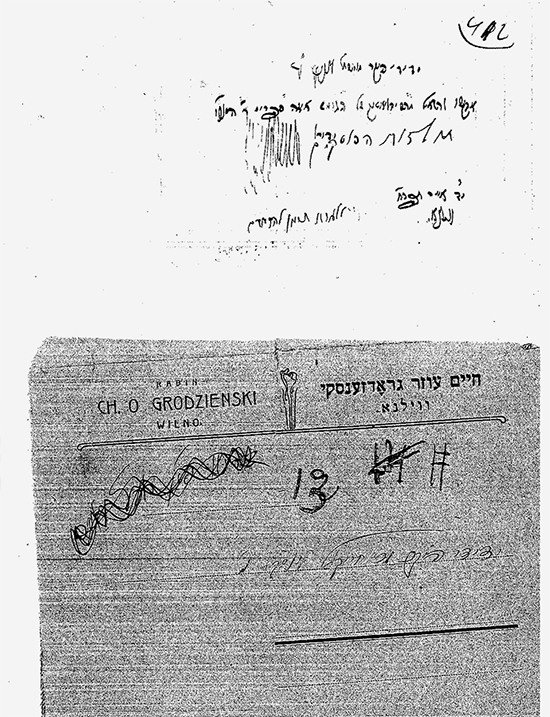
[1] Berkowitz also devoted numerous articles to this work many of which are available here.
[2] See also R. Dovid Kamentsky Toras Hagra, pp.134-137, 183-199.
[3] See Refael Kroizer, The Literature of “Shemot Gittin”: Formation, Meaning and Implication, M.A. TAU University (2019), pp.6-20.
[4] On Beis Din in Germany in the Middle Ages see: Moshe Frank, KeHilot Ashkenaz Ubatei Dinahen, Tel Aviv 1938: For a General overview of the Topic of Beis din See the Classic work of Louis Finkelstein, Jewish Self Goverment in the Middle Ages, (1964). See R’ Chaim Benish, השיפוט היהודי בראי ההיסטוריה מבית שני ועד ימינו. On Going to Non-Jewish courts see R. Uri Teiger, Kuntres Mishapat Aseh; R’ Chaim Benish, Arkot BeHalacha.
[5] Another collection of Metz rabbinic discussions, including those of the Sha’gas Areyeh was published in 2013. See Sefer Toras Chachmei Metz, (Jerusalem, 2013).
[6] For an excellent collection of material regarding Steinhardt, see Binyamim Hamburger, HaYeshiva ha-Ramah vi-Fyorda: ‘ir Torah vi-derom Germanyah u-Ge’oneha, vol. 2, (Bene Berak, 2010), 127-238).
[7] On this fascinating person, see earlier studies by Berkowitz (here) and Yakov Shmuel Speigel, “`Al ha-Yehus le-Chiburav shel R’ Ahron Vorms,” in Yerushaseinu 3 (2009), 269-309.
[8] See also, pp. 123-134 for Berkowitz’s careful documented discussion.
[9] See also p.119 for another similar such case. See Fram, p. 43 for similar kind of cases.
[10] These kind of “issues” can be found in numerous Teshuvah literature for example see R. Joseph Steinhardt, Zichron Yosef which was published in 1773:

א. נשאל נשאלתי על איש אחד רך בשנים מבלי בנים פה במדינות עלזוס סמוך לנהר רינוס שכבר נודע ונתפרסם שזינתה אשתו עם בחור אחד ואח”כ המירו שניהם ונשאו זה לזו היוכל בעלה הראשון לקחת אשה אחר’ עלי’ בלתי זיכוי גט לאשתו הראשונ’ שהמירה יען כי כבד עליו הדבר לעשותו לזכות לה גט מכמה טעמים ידועים והעיקר מפאת דאגתו כי יהי’ מוכרח לפיזר ולהוציא הון רב אחרי עשותו כן לזכות לה גט: נער אחד שהתקשר לישא נערה אחת שהי’ מצוי ורגיל עמה תמיד שנתעברה היא אמרה ממנו והוא כפר מתחלה ולבסוף הודה האם רשאי רשאי לקחתה תוך ימי ההנקה: [סי’ א]

ב. שאלה נער אחד הי’ רגיל ומצוי תמיד אצל בתולה אחת ולבסוף נעשה קישור תנאים ביניהם ואח”כ בא עליה נער החתן בזנות ונתעברה ממנו וכאשר הגידה לו פסולה הנ”ל שהיא מעוברת הבטיחה כי ח”ו לא יבגוד בה רק ישאנה כדמו”י. אכן אחרי בואו לאחיו ובית אביו סיפר להם איך כי כלתו לפ”ד מעוברת מן איש אחר בלעדו ושהוא לא בא עליה מעולם [סי’ ב]

ג. שאלה נער אחד בשמו ראובן העיד לפני הב”ד על פלונית א”א בפני’ ובפני בעלה איך שביקש’ ממנו לבוא לביתה בליל שלמחרתה הוכנס לברית בן זכר שנולד לאחיו וכן עשה ובבואו לביתה ונתיחד עמה הרגילתו ממש ותובעתו לבוא עלי’ וכן עשה שבא עלי’ אמנם האשה הכחישתו ואמרה מעולם לא נגעת בי ואפי’ באצב’ קטנה. ואח”כ בא הנער שמעון והעיד גם הוא איך שפעם אחת ביקשה ממנו האשה שיבוא לביתה בליל שבועות וישכוב שם ובאשר שבעלה איננו בביתו ורק אצל הח”ק ישכוב עמה והוא שמע אלי’ ובא ושכב עמה והאשה הכחישה גם אותו בפנינו ואמרה מעולם לא נגעת בי ועוד עברו ביניהם שם במעמד הב”ד דברים מכוערים רבים כהנה ויען כי לפ”ד אין נפקותא בהם לענין דינא לא העתקתים… [סי’ ז]

[11] See also Fram p. 47.


The Root of the Word מבול: A Flood of Possibilities

                      The Root of the Word מבול: A Flood of Possibilities
By Mitchell First[1]  (MFirstatty@aol.com)
                                                                                   
            A common assumption is that the word מבול means “flood.” This is how the word is translated in ArtScroll’s Stone Chumash, in the
Hertz Pentateuch, and in the Koren Tanakh. But in order to truly understand the meaning of a word, we must determine its three letter root.
           The word מבול has four letters, the first of which is a mem. Usually, a mem at the beginning of a noun is not a part of the root. It is what is added to turn a verb into a   noun. Thus, an initial thought might be that the root of מבול is בול.[2]
           But there is no evidence for a verb בול in Biblical Hebrew. Therefore, the vav is probably not a root letter here and one of the three original root letters probably dropped out. The dagesh in the bet of מבול also implies that a root letter dropped out. Our task is to determine what that letter was.
           One possibility is that the original root was בלל and that the dropped letter was a  lamed.[3] In this view, the original noun was perhaps מבלול. If the original root was בלל, the fundamental meaning of the word מבול would be “mixture/intermingling/confusion.”
          The fact that the story of migdal Bavel follows shortly after the story of the מבול gives some credence to this approach. The root בלל is a main theme of the migdal Bavel  story (see Genesis 11:7 and 11:9). But the dagesh in the bet of מבול implies that the dropped letter was the first letter of the root.[4]
           Therefore, a more likely possibility for the root of מבול is נבל.[5] The verb נבל has the meaning of “fall, decay, destroy.”[6] The root letter nun often drops as the first letter of the root. In this approach, the original noun was מנבול.
            The problem with claiming that the root נבל underlies the word מבול is that נבל is typically used in the context of a gradual destruction, such as in the context of leaves and flowers.[7] See, e.g., Is. 28:1: ve-tziz novel, Is. 34:4: ki-nevol aleh mi-gefen, and Is. 40:7: naval tzitz. It seems to mean “wither” and “decay,” rather than “destroy.” There is one instance in the Tanakh where the root נבל is applied to the world. See Is. 24:4: navlah ha-aretz…navlah tevel. But even here the implication may be one of gradual decay.[8]
             Radak agrees that the root of מבול is נבל, but takes a different approach.[9] In his approach, the fundamental meaning of the root נבל is “fall.”[10] But the word is not being used to describe the effects of the flood (earthly items falling and being destroyed). The word is being used to describe something that is itself falling from the heavens. In Radak’s view, anything that falls from the heavens (e.g., snow, hail and fire) can be called a מבול.[11]
             A third approach to the root of מבול is that it is יבל.[12] This seems to be the most likely approach. In this approach, the original noun was מיבול, but the yod dropped.[13]
            Throughout Tanakh, יבל is a root relating to movement and flow.[14] See, e.g., Ps. 60:11: mi yovileini ir matzor (who will lead me into the fortified city?), Is. 53:7: ka-se la-tevach yuval (as a lamb is led to the slaughter), and Is. 55:12: u-ve-shalom tuvalun (and you will be led out with peace).
             Another example of the root יבל relating to movement is in the context of the jubilee year. At Lev. 25:10, we are told: yovel he tiheyeh lachem ve-shavtem ish el achuzato… יובל means “ram” in several places in Tanakh.[15] Based on the statement in Lev. 25:9 that the shofar is blown to proclaim the jubilee year, Rashi believes that yovel must mean ram at Lev. 25:10, and that the reference is to the blowing of the horn of the ram. But the plain sense accords with the view of the Ramban that the meaning of yovel at Lev. 25:10 is “being brought back,” i.e., a time of being brought back to one’s land.[16]
           Also, the root יבל is connected to water in several verses. See Is. 30:25 and 44:4: מים יבלי (streams of water) and Jer. 17:8: יובל. See also Dan 8:2 (אובל).
                                         
           Hayyim Tawil’s An Akkadian Lexical Companion for Biblical Hebrew contributes to our understanding and supports our suggestion that the root of מבול in Biblical Hebrew is יבל. Tawil points out that there is a word in Akkadian bubbulu, which means something like a flood of water.[17] Most probably, this word is related to the Hebrew word mabbul, since Hebrew and Akkadian are related languages, and m and b often interchange. Since bubbulu is used in the context of water, this suggests that the root of מבול is יבל, and not נבל or בלל.                                                      
      
           The issue of the root of the word מבול is not just an etymological one. Philosophically, what we are asking is: was the מבול a force meant to cause intermingling/ confusion? a force meant to cause things to fall/decay/be destroyed?[18] or more neutrally, a force of flowing water? Most likely, the root is יבל and the last is correct.[19]
          Interestingly, Rashi conducts practically the same analysis of the word מבול that we did. In his explanation of the word at Gen. 6:17, he writes:
            she-bilah et ha-kol, she-bilbel et ha-kol, she-hovil et ha-kol min ha-gavoha la-namukh…
 
בלה means “destroy and wear down,” similar to נבל.  בלבל means “mix,” the equivalent of בלל. הוביל means “move” and is from the root יבל.[20] But Rashi seems to believe that the word מבול was purposely chosen to convey all three connotations.
                                                    Additional Notes
        1. Outside of the 12 times the word מבול appears (in various forms) in parshat Noach, the only other time the word appears in Tanakh is at Psalms 29:10: Hashem la-mabbul yashav. Many assume that the meaning here is something like “God sat enthroned at the Flood,”[21] but the prefix la- is difficult in this approach.
           An interesting interpretation is provided by Tawil. He cites a scholar who claims, based on a parallel in Akkadian, that למבול here means “before the Flood,” i.e., “from time immemorial.” The phrase Hashem la-mabbul yashav would then parallel the subsequent phrase va-yeshev Hashem melekh le-olam.[22]
          Many other interpretations of la-mabbul yashav have been suggested.[23] Most creative is the suggestion of Naphtali Herz Tur-Sinai that the reference is to God having dried up the waters of the mabbul and that ישב here is just a methathesized form of יבש![24]
        2. An analysis similar to the one we have conducted on the word מבול can also be conducted on בול, the pre-exilic name for the month of Marchesvan.[25] Is בול named for some activity in the month relating to mixing (בלל)? relating to withering (נבל)? or relating to moving/gathering produce (יבל)? All have been suggested.[26] Because בול may have typically been a rainy month, a derivation from the word מבול has also been suggested. See, e.g., Radak to I Kings 6:38.
              Interestingly, a statement at Midrash Tanchuma, Noach, sec. 11, explains the word מבול as based on the fact that the Flood spanned 40 (מ) days in the month of בול![27]
        3. I focused above on determining the root of  מבולin Biblical Hebrew. If we rephrase the question and ask what the root of the word was in proto-Semitic, the answer changes slightly. The answer would be vav-bet-lamed. The prevailing scholarly view is that most Hebrew roots with an initial yod derive from earlier Semitic roots with an initial vav.[28]


[1] I would like to thank Rabbi Avrohom Lieberman and Sam Borodach for reviewing the draft.
[2] Also, no Hebrew root begins with the two letters mem and bet. See Eduard Yechezkel Kutscher, A History of the Hebrew Language (Jerusalem: Magnes Press, 1984 ), p. 7: It is also instructive that [in a Semitic language] in the first two positions, not only are
 identical consonants excluded (the patterning AAB being non-existent except in Akkadian) but even  homorganic consonants (produced by the same organ) do not occur in this position.  Mem and bet are homorganic consonants. (Kutscher admits that there are some exceptions to the rule he stated.)
[3] See, e.g., R. Abraham Ibn Ezra to Gen. 6:17, who makes this suggestion. He also suggests נבל as the root.
[4] Of course, all the dagesh really shows is that whoever inserted this dagesh believed that a letter was dropped. But most likely, the vocalization was based on the pronounciation at the time, which presumably reflected a tradition that the word was pronounced mabbul,
and not mavul. This suggests that there was once a root letter preceding it.
[5] See, e.g., Ibn Ezra, Seforno, and S.D. Luzzatto, on Gen. 6:17. Those who take this approach can point to the fact that the word  מבוע (Ecc. 12:6), also with a dagesh in the bet, undoubtedly comes from the root נבע.
[6] Seforno writes that נבל means mapalah ve-hefsed and Luzzatto writes that נבל means nefilah ve-hashchatah. Seforno points to the use of the word משחיתם (=destroy them) at Gen. 6:13 as evidence that mabul probably has this meaning as well. Very likely, the roots נבל and נפל are related.
[7] R. Samson Raphael Hirsch argues that this is precisely the point. By using the term מבול, the Torah was implying that on some level the event was only of a mild character. I do not find this argument convincing. Although Noah and his family remained in the Ark for one year and ten days (see Gen. 6:11 and 7:14), the implication of verse 7:23 (va-yimach et kol ha-yekum…) is that every living thing was destroyed decisively in the first 40 days.
[8] See, e.g., the translation in the Soncino edition. The Hebrew root בלה also connotes gradual decay. See, e.g., Deut. 8:4 (clothes), 29:4 (shoes), and Gen. 18:12 (Sarah). It may be related to the root נבל. In Akkadian, the root nabulu may have more of a connotation of destruction than the Hebrew root נבל.  See, e.g., the concordance of S. Mandelkern, entry מבול, and Ernest Klein, A Comprehensive Etymological Dictionary of the Hebrew Language for Readers of English (New York: MacMillan, 1987), p. 311. This would give more of a basis to interpret מבול as deriving from נבל.
[9] In addition to his comm. to Gen. 6:17, see his Sefer ha-Shoreshim, entry נבל.
[10] In rabbinic Hebrew, a נובלת is an unripe fruit that falls off of the tree.
[11] Both San. 108b and Zev. 116a refer to a mabbul shel esh.  Radak also points to the phrase nivlei shamayim at Job 38:37, where the context indicates that the phrase refers to falling rain. But it seems more likely that  נבלי  there means “vessels,” i.e., the clouds that hold the rain.
    It has been suggested that מבול is related to the “vessel” meaning of נבל. In this view, the meaning of מבול is “a receptacle that holds water.” See, e.g., Hayim ben Yosef  Tawil, An Akkadian Lexical Companion for Biblical Hebrew  (Jersey City: Ktav, 2009) p. 196, who mentions such a suggestion. Probably, the origin of the “vessel” meaning of נבל is that vessels were often made from the skin of a fallen animal (=a נבלה.)
    נבל also has the meaning “disgusting,” probably because withering and falling things become disgusting. But it seems farfetched to connect מבול with this meaning of נבל.
[12] See, e.g., Moses David Cassuto, Peirush al Sefer Bereshit (Jerusalem: Magnes, 1953), vol. 2, p. 45, Daat Mikra (comm. to Gen. 6:17), Menachem Tzvi Kadari, Millon ha-Ivrit ha-Mikrait (Ramat Gan: Bar Ilan Univ., 2006), p. 575, and Tawil, p. 196. The Daat Mikra commentary to Genesis 6:17 (p. 177, n. 52) points out that all three sons of Lemekh have a name derived from the root יבל: Yaval, Yuval, and
Tuval Kayin. See Gen. 4:20-22.
[13] Some other examples of words whose initial yods dropped are: מצע (Is. 28:10, from יצע) and מסד (I Kings 7:9, from יסד). See Daat Mikra to Gen. 6:17.  There is a dagesh in the middle letter of both of these words.
[14] The word also has the related meaning of “carry.” See, e.g., Psalms 76:12: yovilu shai (carry presents). In the Shema, the word יבולה is used to mean the produce of the land. Most likely, it has this meaning because produce must be carried in from the land. (See similarly, the word תבואה, which also means produce, and comes from the root בוא. See Klein, p. 689.) Alternatively, the word יבולה means produce because produce flows from the land.
[15] Yovel means ram at Ex. 19:13 and throughout the sixth chapter of the book of Joshua. (That yovel means ram at Ex. 19:13 is evident from Josh. 6:5. It is also suggested by Ex. 19:16.)
[16] Ramban defines yovel as הבאה. R. Hirsch also takes this approach to this verse. See also the commentaries of R. Saadiah Gaon, Ibn Ezra,
and Hizzekuni. R. Hirsch also makes the suggestion that when yovel is used in the context of a sound being made, we can translate yovel as “home-calling signal,” based on the verb יבל. Despite the brilliance of this suggestion, a comparison of Ex. 19:13 with Josh. 6:5 suggests that, in the sound contexts, yovel is merely short for keren ha-yovel (=the horn of the ram). Is there a connection between the “movement/bringing” meaning of yovel and the “ram” meaning?  R. Hirsch makes the following interesting suggestion:
[T]he  ram, is the leader of the flock, the one who “brings” them to their pasturage, perhaps quite specially, who goes in front, and the flock following him, “brings them home.” See similarly Klein, entry יובל (p. 256): “leader of the flock, bellwether.”
[17] Tawil, p. 196. The standard word in Akkadian for flood is abūbu.
[18] Or, according to Radak, a force of falling water.
[19] It is interesting to note that in the Septuagint the word מבול was translated as κατακλυσμός = down-cleansing. (The ArtScroll Tehillim commentary to Psalms 29:10, p. 354, refers to the mabul as a “cataclysmic” upheaval. Surely, this is just coincidence!) But the Greek-speaking Egyptian Jews had a very limited understanding of the structure of Hebrew words. Surely, they did not see the root יבל in the word.
[20] For further elaboration, see the Siftei Chakhamim and ArtScroll’s Sapirstein edition of Rashi. The three-pronged interpretation expressed in this Rashi seems to be his own.
[21] See, e.g., the ArtScroll Siddur. See also Rambam, Moreh Nevukhim, part I, chap. 11.
[22] See Tawil, p. 196.
[23] For example, the Daat Mikra commentary to Psalms 29:10 cites a suggestion that מבול here means “throne,” based on a resemblance to a word in Arabic. The suggestion is made by Jacob Nahum Epstein in “Mabbul,” Tarbitz 12 (1940), p. 82. But the Arabic word that Epstein bases his suggestion on is pronounced מנבר; Epstein must assume that there was a switch of resh and lamed. (The Daat Mikra comm. to Gen. 6:17 states that the relevant word is in Akkadian, but this is an error.)
    The Anchor Bible translates: “has sat enthroned from the flood” (=from the time of the flood) and argues that the reference is not to the מבול of the time of Noach, but to some other water-related Divine victory.
[24] See his Peshuto shel Mikra, vol. 4, part 1 (Jerusalem: Kiryat Sefer, 1967), p. 56.
[25] See I Kings 6:38.
[26] See, e.g., J. Talmud Rosh ha-Shanah 1:2, Daat Mikra to I Kings 6:38, and Ludwig Koehler and Walter Baumgartner, The Hebrew and Aramaic Lexicon of the Old Testament (Leiden-New York-Köln: Brill, 1994), vol. 1, entry בול. (The connection to בלל seems least likely.)
     Of course, because the word בול lacks a mem at the outset, there is less reason to suspect that an initial root letter such as nun or yod was dropped. But the בול of Job 40:20 surely comes from יבול.
[27] See Gen. 7:11-12.
[28] Support for this in our case is that there is a word in Arabic, wabala, to bring down rain. See Cassuto, vol. 2, p. 45. See also Tawil’s reference (p. 196) to the Akkadian word (w)abālu.
   Of course, it is possible that מבול is a non-Semitic word that happened to make its way into the Tanakh and we are completely misguided in our search for its origin and meaning in Biblical Hebrew and the other Semitic languages. But it is a noun that begins with mem and this is a typical Biblical Hebrew form. Moreover, the parallels in the other Semitic languages support our conclusion that the origin of the word   is a Semitic one and that its root is vav-bet-lamed/yod-bet-lamed.