R. Yaakov Lipshitz and Heter Mechirah

R. Yaakov Lipshitz and Heter Mechirah
by R. Eliezer Brodt

As per Sheuy R’s request a short post on shemitah:

It is virtually impossible to write up a review of the literature out there on shemitah seforim as the seforim keep on coming out. For some odd reason people out there feel this is their place to contribute to our vast torah literature. As of last shemitah in the middle of the year I inquired at a local seforim store how many books did he get on the topic of shemitah. He said over seventy five! By now that number has certainly doubled. My personal recommendation is if someone is working on a sefer on shemitah, unless it is incredible, do not waste your time printing it.

I will list just one recent very important reprint, the sefer Torat Yonasan (originally printed in Vilna, 1888) written by R. Yonasan Abelmann (1854-1903). This sefer was not without critics. R. Abelmann , however, responded in his teshuvot, Zikhron Yonason, Vilna, 1904, Kuntres Devar HaShmita (see pages 158b-187b). He discusses, among others, the opinion of the Bet HaLevi.

Interestingly enough with all the reprints and new stuff coming, out the Madanei Eretz of R. Shlomo Zalman on Mesechtat Shmitta has yet to be reprinted. The sefer, as everything this godal Hador (not that he needs my recommendation) wrote is excellent and very important to many issues of Shemitah but being that it deals with R. Kook so chas vesholom they could not reprint it.

The main point of this post is to share with you an incredible story relating to shemitah that I read a while back. This story is found in one of the best and most honest books (at least in my humble opinion) written about many gedolim from Yakov Mark. Dan has posted on this book a while back. There is much to add to what he wrote, perhaps I will return to it another time. For now just the story. Yakov Mark records a story (Gedolim fun Unzer Tzeit, New York, 1927, pp. 117-18 and translated into Hebrew, B’Mechtizah shel Gedolim, Jerusalem, 1958, p. 104) of a meeting he had with R Yakov Lipshitz, the famous secretary of R Yitchack Elchonon Spector (and for purposes of the story below, it is important to note that R. Lipshitz was an anti-Zionist):

פעם אחת היתה לי שיחה מענינת עמו בענין שאלת השמיטה. הדבר היה בשנת השמיטה של שנת תרמט, והוא גילה לי סוד, שלו חלק גדול בהיתר שהוציא ר’ יצחק אלחן מפני שהוא הפציר בו שיתן היתר ואם תאמר: איך זה מתיישב שיענקל ליפשיץ ישתדל עבור הציונים? מפזם לו ליפשיץ בניגון של גמרא, הענין הוא:שהציונים עשו נזק לעצמם בזה שחיפשו היתר יותר משהיה יכול להזיקם כל מתנגד שהוא. שער בנפשך, אלו היה הסטודנטים מכרכוב חוזרים ומקיימים את מצות השביעית אחרי אלף ושמונה מאות שנה, והרי מסורת היא שבעון שמיטה חרב הבית דומה שהיו מטילים על יענקל ליפשיץ כל האבנים הנמצאות ברחוב קובנה, כיצד הוא העיז לדבר על צדיקים כאלו? ומלבד זאת איזו פרסומת טובה היתה יוצאת מזה: כל העולם החרדי היה נושאם על הידים והיו ממש טובעים בזהבר, אבל יצרם הרע דחפם לבוץ ואני סייעתי בו


A review of some Recent Torah Journals

A review of some Recent Torah Journals

By: Eliezer Brodt


In this post I would like to focus on some recent Torah Journals that have come out in the past few weeks. In the future I hope to return to this topic of these Journals with a more in-depth look at their goals and the history of early Journals in general in relationship to this.

As many of these journals have only been distributed this week I am just offering some quick remarks on them. In general different people like different journals depending on tastes, interests and what they are expecting from them. If one wants to see some heated and sometimes comical discussions in Hebrew on these journals, one should visit the Otzar Hachochma forums.

1) מקבציאל גליון לז – ישיבת אהבת שלום

Mechon Ahavat Sholom began putting out this journal many years ago. Originally the volumes were very thin and did not come out frequently; over time they started getting thicker and thicker and coming out more often. This volume is the first (as far as I recall) to being printed in hardcover. This Journal focuses on many different areas related to Halacha. A section found in this journal not found in others is devoted to Kabbalah. They usually have a few pieces related to manuscripts that they are working on. However, the time from when they print these sample pieces to the time that the seforim are actually printed takes a long time. Usually the manuscripts and seforim they print are related to Sefaradim. There have been a few exceptions of this of late, namely manuscripts of the Litvish Goan the Aderes. To date they have printed eight volumes of his seforim. (I hope to return to these seforim in a future post). This new Journal has many letters between the Aderes and the famous Maskil R. Yaakov Reifman. Another very interesting section usually found in this journal are a few articles devoted to History. In this volume they have a fascinating manuscript from R. Betzalel Askenazi, famed for his Shita Mikubetzes related to the topic of learning pilpul. This is based on manuscripts (79 pages) on the topic never printed before with a sharp correspondence on the topic with R. Moshe Galante. The letters are preceded with a nice historical overview of the topic.

2) קובץ עץ חיים באבוב- חלק יד, שסה עמודים.

This journal usually focuses on a wide range of topics ranging from manuscripts, to halacha, minhag and even a some history. In general one interested in articles on these topics will not be disappointed, although I must say that some volumes are much better than others. In the past we have pointed out censorships from the editors. The previous issue had a nice piece from R. Goldhaber on the topic of whether there were two people with the name Jesus. However a careful reading of the footnotes will show comical censorships. Besides for this piece, the last volume was rather disappointing compared to their previous volumes. But this recent volume was a bit better. In general it’s a matter of taste what one expects in a journal; I am just expressing my feelings which many could argue on.

3) היכל הבעש”ט גליון לא, רכ”ד עמודים.

This Journal is devoted to Chassidus. Originally it came out four times a year, but now it’s down to two issues a year. There are pieces from manuscripts (of Torah and letters), minhaghim, history and in-depth pieces of Chassidic Torah. Anyone interested in Chassidus will find valuable material in every issue. On page 223 my recent work Likutei Eliezer was quoted – but the author misquotes me on the topic.

4) אור ישראל גליון סב, שנב עמודים.

This Journal has been getting thicker and thicker as time goes on. Originally it came out quarterly, but now it’s down to two issues a year. The main focus is on Minhag and Halacha but there are often some pieces related to seforim or history. There is often a nice piece on a particular Minhag related either to Shabbos or Yom Tov from R. Oberlander; unfortunately this issues does not have such a piece. Some interesting pieces in this issue that I enjoyed were the overview of the controversy in regard to the Turbot Fish, including new manuscripts (this topic has been dealt with in Kovetz Eitz Chaim volume eleven). Another piece of interest was from R. Y. Spitz on the topic of which cheeses one has to wait between eating them and meat. There is a piece on the same topic, though not nearly as thorough, in the current issue of Eitz Chaim. Another piece I enjoyed was from R. Dandorovitz on הא לחמא עניא. This piece has a point of bibliographic information in regard to Yakov Reifman. Reifman had written about the Hagaddah which was collected and reprinted in 1969 by Naftoli Ben Menachem and again in 2001 by S. Sprecher. However neither of them were aware of an additional piece of his printed after his death in Lunz’s periodical Yerushalayim. Another piece worth mentioning was from R. A Meisels on sources of over one hundred pisgamim. It’s unfortunate that he was not aware of R. S. Askenazi’s work on these topics. Another piece worth mentioning is a collection of sources about the famous gemarah of כל מה שיאמר לך בעל הבית עשה חוץ מצא. In the recently printed work of R. S. Askenazi one can find some more information on this topic. Another piece worth mentioning is the sharp piece against Nobel Laureate Professor Yisroel Robert Aumann’s article printed in Moriah a few years ago explaining a gemarah in Kesuvot based on Game Theory. There have been other discussions about this article of Professor Aumann’s in different journals such as Beis Aron Veyisroel and Hamaayan.

5) מוריה שנה שלושים ואחת, ניסן תשע”א (שס”ד-שס”ו), רעא עמודים.

This journal from Mechon Yerushlayim has been coming out for years and it has had its ups and downs. This recent issue has many nice pieces, including a long one from a manuscript of a Talmid of the Rosh on Hilchos Pesach (22 pages). This was published by Professor Yakov Spiegel. There are few other pieces from manuscript and many on Halacha and minhag. When reading this journal one finds news of future works to be released. In this volume we are treated to another section of R. Kinarti’s forthcoming critical edition of the Yosef Ometz. There is a nice piece about the fast of the Bechorim on Erev Peasch (a topic I hope to deal with at length in a forthcoming article). We also learn that after years of waiting Mechon Yerushlayim is about to print their Minchas Chinuch with notes (much more voluminous than the current editions). Amongst other titles they plan on releasing shortly is another volume of the Shu”t Tashbatz, תשב”ץ קטן and a sefer כללי הרש”ש which sounds interesting.

6) המעין, כרך נא גליון ג.

This Journal, although smaller in size than many of the other journals, is always full of excellent content on wide-ranging subjects. The issues usually go up on the web for free download shortly after publication. This issue has a letter on Eretz Yisroel from the Chazon Ish with a part previously unpublished. Another letter printed here for the first time is from R. Aryeh Levine to his future brother-in-law. One can get a glimpse of this special Tzadik from this letter. There is a nice short article from R. Peles on illustrations found in old Haggadas, particularly one than has become famous in recent years of the husband pointing to the wife when he says מרור זה. Another nice piece is from Professor Zohar Amar and Aryeh Cohen on the making of the Lechem Hapanim. Some other pieces of interest to me were the short articles with more information on the great Gaon from Tavrik R. Avraham Aharon Burstein, and the short review on the new edition of Shmirat Shabbat Kehilchata. A very interesting debate can be found in here about a very critical review of the recent edition of Sefer Haterumah printed by Mechon Yerushlayim. The first review was printed in the previous issue. In this issue someone attempts to defend the new edition, but in my opinion does not do a good job. One of my favorite parts of this journal is the last part. In this section, the editor R. Yoel Catane reviews recent Torah works, and he always has interesting points to make.

7) ירושתנו ספר חמישי תשע”א, תמח עמודים , מכון מורשת אשכנז.

This volume, like the previous volumes, has not let us down. The long wait so for it was very worthwhile. As in previous volumes its main focus is on Ashkenaz including sections on manuscripts, Halacha, Minhag history and book reviews. It also has a calendar for all year around of Minhag Ashkenaz. Amongst the pieces of manuscripts there are notes of R. Yeruchem Fischel Perlow on the Shu”t Chasam Sofer and notes of R. Dovid Tzvi Hoffman to Massches Nazir. Some of the pieces are on a much higher level than others. There is a very nice piece on saying Nishmas during the week from R. Y. Stal. Another good piece was from R. E. Blumenthal with new information about the Sefer Haterumah. Some other good pieces worth highlighting is one on Sefer Hatagin, on the Maharam Mi-rutenberg in jail, the Choir and Chazan of R. Hirsch and the early years of London’s Askenazi Community (this last piece is in English). Another piece of great interest is from R. Y. Prager on the topic of the Takkanot against מותרות in Frankfurt. This is a critical edition of the Takkanot printed by Schudt in 1716 with pictures. In the bibliography R. Prager mentions a soon to be printed work on this topic from Professor Rakover.

Another piece worth mentioning is R. Y. Meir on the pilpul method of learning called “Regensburg.” This is R. Meir second article on the topic of pilpul. The first appeared in his father-in-law R. B.S. Hamburger’s book Ha-Yeshiva ha-Rama be-Fuerth and focused on the Nuerenberg method. Both pieces were very good, but they would have benefited from using the academic literature on the topic. One very important but non-academic source on the topic which he also did not use is R. Nachman Shlomo Greenspan’s excellent work Melekhet Machshevet. A great job on this topic can be found in P. Meth, From Pilpul to Lomdut: A chapter in the Development of Derekh Halimmud, Yeshiva University 2008.

One piece which in my opinion is simply incredible was from R. Goldhaver. The gemarah relates that Hillel obligated all poor people to learn – after reading this R. Goldhaver’s piece I think that he will obligate all people who work on researching minhagim to new levels. The topic of the article was about the well known minhag to cover the Shofar during the berachos. I also have a piece in this volume about various things people did to help their memories, including an updated version of what I have written here about Baladhur (link).

8) ישורון כד תשע”א, תתקעד עמודים.

This volume continues in the path set of previous volumes giving readers of all kinds of interests first rate material on a wide range of topics from manuscripts of Rishonim and Achronim, Halacha pieces of famous gedolim of previous generations, pieces of Torah from our times and articles on historical and bibliographical topics. Usually the volumes focus on a few themes. This volume continues with that and focuses on a few topics among them the Haflaah and R. Nosson Adler. There are many new pieces of the Haflaah’s works on Torah never before printed. Besides for this there is an excellent (and long) piece from R. Dovid Kamentsky on the Pinkas of Frankfurt, which includes a lot of new halachah and history material which relates to both the Haflaah and R. Nosson Adler.

Another section of great interest to me is on R. R.N.N. Rabinowich, author of Dikdukei Soferim. This section continues with the project started in the previous volume of Yeshurun. Two more letters of his were printed, including a rare work of his on the gedolim of Cracow. There are two articles in this section from me so I cannot comment on their quality! One article is about the acceptance of the Dikdukei Sofrim. I also deal with other works of R. Rabinowich and his incredible collection of seforim. A second article is comments on the previous volume of Yeshurun where the notes of the Dikdukei Sofrim on the Hida’s Shem Hgedolim were printed.

Other sections deal with R. Eliyahu Weintraub and R. Baruch Solomon. There is a great section devoted to R. Dovid Tzvi Hillman (hopefully in future volumes more material from him will be printed). Besides for all this there are many great articles on random topics. Originally when the journal Yeshurun began they were planning to come out three times a year. But that plan never materialized and instead they came out twice yearly. But over time they went down to one issue a year; this year they printed two issues, just like in the early years. At one point people were saying that they would not be able to continue with being able to put out such top quality and quantity articles. However the past two volumes show that they are still at the top of their game and can still produce top quality volumes. One hopes that they are able to continue with this level in the future.

Table of contents of some of the journals are available upon request. Email me at eliezerbrodt@gmail.com.


The Medical Training and Yet Another (Previously Unknown) Legacy of Rabbi Dr. Abraham J. Twerski, zt”l

The Medical Training and
Yet Another (Previously Unknown) Legacy
of Rabbi Dr. Abraham J. Twerski, zt”l

by Edward Reichman and Menachem Butler

Rabbi Dr. Edward Reichman is a Professor of Emergency Medicine and Professor in the Division of Education and Bioethics at the Albert Einstein College of Medicine. He writes and lectures widely in the field of Jewish medical ethics.

Mr. Menachem Butler is Program Fellow for Jewish Legal Studies at The Julis-Rabinowitz Program on Jewish and Israeli Law at Harvard Law School. He is an Editor at Tablet Magazine and a Co-Editor at the Seforim Blog.

On erev Shabbat Shira last week, in the course of a typically wide-ranging conversation between the authors of this article, Menachem mentioned that unfortunately Rabbi Dr. Abraham J. Twerski was critically ill. As hashgachah would have it, Menachem had happened upon a little-known precious work from 1997, entitled Sefer Ye’omar le-Yaakov u-le-Yisrael, compiled by Rabbi Dr. Abraham J. Twerski and comprised of letters written to him by Rabbi Yaakov Yisrael Kanievsky, zt”l (1899-1985), known as the Steipler Gaon and author of the multi-volume work Kehillot Yaakov.[1]

Scion of prominent Hasidic dynasties and related to the current Rebbes of Bobov, Karlin, Klausenberg, Talner, and Skver, Abraham J. Twerski was born in Milwaukee in 1930 to Rabbi Yaakov Yisrael Twerski and his wife Devorah Leah (née Halberstam), where he attended public school as a child.[2] After he received his rabbinic ordination from the Hebrew Theological College in Chicago, he began to serve as an assistant rabbi in his father’s congregation in Milwaukee in the 1950s, as Aaron Katz described in his 2015 profile of Rabbi Dr. Abraham J. Twerski (“The Wisdom of Peanuts”) at Tablet Magazine. He married Goldie (née Flusberg) in March 1952; and starting that summer, directed the Hebrew School at his father’s congregation Beth Jehudah, as well as officiated religious lifecycle events in his father’s community in Milwaukee. However, as he would later reflect in an interview “after I had practiced as a rabbi for a number of years, I felt I was not fulfilled in my work and — after consultation with the Steipler Gaon — I went to medical school to become a psychiatrist.”

Abraham J. Twerski wrote to the Steipler Gaon and expressed concerns about the propriety of attending medical school as an Orthodox Jew. He would regularly visit Rav Kanievsky at his home in Bnei Brak and corresponded with him by mail, maintaining an ongoing relationship with him until the Steipler’s passing in 1985. That year, a volume of collection of letters entitled Karyana de-Igarta was published, and included, for the first time, two letters that the Steipler Gaon had sent some thirty years earlier to a young Abraham J. Twerski in Milwaukee, who was then seeking his advice regarding his career choice.

The first letter was written at the end of the Summer of 1955 by a twenty-four-year-old Abraham J. Twerski and in this letter the Steipler Gaon addresses the value of making one’s livelihood through a non-rabbinic profession. As to the specific profession, he adds that medicine may be a preferred choice, as it is a mitzvah to learn, and additionally, excluded from the ban on secular knowledge of the Rashba.[3] However, this is on the proviso that the education is provided by proper teachers and in an environment conducive to Torah observance. As this is clearly not the case in a modern university, he offers some general guidelines, culled from the seforim hakedoshim, if not to guarantee, at least to enhance the chances of success: 1) kove’a itim – learn in-depth at least two hours daily; 2) recite all tefillos with a minyan; 3) regular mikva immersion; 4) meticulous Shabbat observance; and 5) a daily musar seder.[4]

The second question Abraham J. Twerski posed, the following year, was more specific to his situation. He inquired whether it was preferrable for him to be a rabbi in a largely non-observant community (he was serving as an assistant rabbi to his father in Milwaukee at that time), which would involve immersion in an irreligious environment with potential negative impact on the Jewish education of his children; or should he choose a medical career, which would allow him to remain in an environment of Torah observance.

Suffice it say, the Steipler Gaon’s tone in this letter is less than supportive of a career in medicine than its predecessor. His written response is unequivocal, “the rabbinate is much preferred” (adifa yoter viyoter). He lists no less than five reasons not to become a physician, relating to the challenges in maintaining Torah observance and modesty, as well as the time commitment, which would preclude Torah study. He adds on a personal note that given his estimation of the exceptional talents of the young Rabbi Twerski, the latter would likely become a highly successful and sought-after physician. As such, he would find no rest from those constantly “knocking on his door” and seeking his consultation. He was particularly concerned about what would happen to his Torah learning and observance in such a case.[5]

Notwithstanding the serious concerns expressed by the Steipler Gaon, and perhaps now better informed of the potential pitfalls, Abraham J. Twerski proceeded to pursue his medical education, as he wrote, “I went to medical school with the Steipler’s blessing and continued an ongoing relationship with him for years.”[6] Their fathers both grew up as friends in Hornsteipel, “and spent their boyhood years together and were on first name terms,” reminisced Rabbi Dr. Abraham J. Twerski many years later in a biographical memoir of his Hasidic ancestors.[7]

However, several years into his studies at Marquette University’s medical school, Abraham J. Twerski could no longer afford the tuition.[8] His assistance would come from a most unlikely source, as he would later describe in an interview with the Pittsburgh Quarterly:[9]

By that time, I had several children, so my dad and some members of the congregation helped me to pay for school. I applied for a scholarship through a foundation, but it didn’t come through, so in my third year, I fell two trimesters behind on tuition. One day, I called my wife at lunch as always, and she asked, “What would you do if you had $4,000?” I said, “I’m too busy to talk about fantasies.” She said, “But you really do have $4,000!” I said, “From where?” She said, “From Danny Thomas.” “Who’s Danny Thomas?” She said, “The TV star.” Then she read me an article from The Chicago Sun. Local officials had told Mr. Thomas about a young rabbi who was struggling to get through medical school. Thomas asked, “How much does your rabbi need?” They said, “Four thousand dollars.” He said, “Tell your rabbi he’s got it.”[10] So, I did my internship in general medicine, went to the University of Pittsburgh Psychiatric Institute for three years, and then worked two more years for a state hospital.

While the Steipler Gaon’s assessment of the success of Rabbi Dr. Abraham J. Twerski’s medical career was prophetic, his concerns about Torah observance and learning, at least for Dr. Twerski, would turn out to be unfounded. Upon his graduation from medical school several years later, Time Magazine (June 15, 1959) published a brief article about him entitled “Rabbi in White.” It is worth reprinting in its entirety:

Abraham Joshua Twerski, 28, graduated from medical school this week. It was no mean feat, for Twerski is a Jewish rabbi like his father, two uncles, father-in-law, two older brothers and (when they finish their studies) two younger twin brothers. And to keep the Torah as an Orthodox Jew for six years of studies in Milwaukee’s Roman Catholic Marquette University was something like running a sack race, an egg race and an army obstacle course at the same time.

First there was the problem of keeping his religion from growing rusty: he rose each day at 5:30am, put in an hour’s study of the Talmud before early service at Milwaukee’s Beth Jehuda Synagogue, where he is assistant rabbi. Medical school classes began at 8am, and here real complications set in. His full black beard was a sanitary problem in surgery, requiring special snood-like surgical masks. His tallith katan, a small prayer shawl worn by many Orthodox Jews under their shirts, had to be made of cotton instead of wool – which might set off a static spark and ignite the anesthetic in an operating room.

Lectures on Saturday.[11] Religious holidays sometimes required months of advance planning. The nine-day Feast of Tabernacles, for instance, with four days when work is forbidden, fell during a series of lectures before a make-or-break exam in pathology. Abe, as students and professors call him, met the situation by studying by himself all the preceding summer, put himself so far ahead of his class that he could afford to miss the lectures. “I hated like heck to miss them,” he explains, “but I creamed that exam.”

When lectures came on Saturdays – during which Orthodox Jews are forbidden to work, ride in a vehicle or talk on the phone – Abe would have a friend put a sheet of carbon paper under his lecture notes and hope he remembered to use a ballpoint pen. Sabbath restrictions begin on Friday night, just before sundown, and on occasion Fridays only a lucky break in the traffic has saved him from having to abandon his 1952 De Soto and walk the rest of the way home. On Saturdays Abe was not on duty, but sometimes, to follow up on one of the cases he had been observing, he would leave his car in the garage and walk five miles to the hospital and back.

Work on Tishah Be’ab. Abe brought his own kosher food to school every day and ate it in the student lounge, where he also said his midday prayers in a corner, surrounded by chattering fellow students. Hospital duty during the 24-hour fast without food and water at Tishah Be’ab (commemorating the destruction of the Second Temple in 70 A.D.) Dr. Twerski describes as “murder,” and the last six years have left him hollow-eyed and slightly sallow.[12] But he is eagerly looking forward to the next stage: a year of internship in Milwaukee’s Mount Sinai Hospital, followed by a three-year residency in psychiatry.

“Psychiatric training was the motivation for my going into medicine,” he says. “I felt I could be a better adviser to my people and more help to them with their problems.”

The Time Magazine profile of Abraham J. Twerski included just one photograph (wearing “a snood for surgery” over his yarmulke), but members of the Twerski family have shared in recent years nearly a dozen of the other photographs that were taken by George P. Koshollek Jr., a local photographer with The Milwaukee Journal, and later deposited in the LIFE Photo Archive. The following are two photographs of newly-minted physician Abraham J. Twerski, together with his philanthropic patron who supported his medical school studies, the comedian Danny Thomas:

Upon his 1959 graduation from Marquette University Medical School, Rabbi Dr. Abraham J. Twerski left his pulpit in Milwaukee and moved with his family to Pittsburgh, where he completed his psychiatric training at the University of Pittsburgh’s Western Psychiatric Institute four years later, and was then named clinical director of the Department of Psychiatry at St. Francis General Hospital in Pittsburgh, supervised by Sisters of the Third Order of St. Francis, where he advanced his expertise for treating addiction. In 1972, Rabbi Dr. Abraham J. Twerski founded the Gateway Rehabilitation Center with the Sisters of St. Francis.[13]

Returning to our pre-Shabbat conversation, Menachem suggested that perhaps it might be appropriate for us to study through the 1997 volume of Rabbi Dr. Abraham J. Twerski, Sefer Ye’omar le-Yaakov u-le-Yisrael – one of his only Hebrew-language books of more than his eighty-authored volumes published over the past half-century – as a merit for Rabbi Dr. Abraham J. Twerski’s complete recovery. Menachem further asked if I would perhaps identify any medically related material that might be significant or previously unknown. Before Shabbat, I identified one particular letter, the final one in the book, which was of medical relevance, and I printed it out for learning, with Rabbi Twerski in mind. The topic: the obligation to prolong the life of a critically ill patient.

Just two days after our conversation, we read of the tragic passing of Rabbi Dr. Abraham J. Twerski, whose passing took place on Sunday, Chai Shvat 5781 (January 31, 2021). The nature of the letter from the Steipler Gaon to Rabbi Dr. Abraham J. Twerski, and its heretofore unknown origins, compels us to write this brief note l’zecher nishmato (in honor of his memory) and to add yet an additional item to his legacy.

Rabbi Dr. Abraham J. Twerski’s astonishing accomplishments, known to the Jewish community worldwide, are primarily in the fields of mental health, self-esteem, and addiction medicine.[14] We will leave it those with expertise in these areas to recall and recount his manifold contributions, including his voluminous literary output.[15] Here we note a contribution, which though indirect, may be on par with respect to its Jewish communal impact as those more widely known.

The Letter

In the introduction to this 230-page-work, Sefer Ye’omar le-Yaakov u-le-Yisrael, published in 1997 by the Kollel Bais Yitzchok on Bartlett Street in Pittsburgh (and with an effusive approbation from Rav Chaim Kanievsky, son of the Steipler Gaon), Rabbi Dr. Abraham J. Twerski recounts his unique connection to Rav Yaakov Yisrael Kanievsky, the Steipler Gaon. It stemmed back to the city in present-day Ukraine called Hornsteipel, to which they both trace their roots.[16] Rav Kanievsky had lived there in his youth and the appellation “the Steipler” is derived from the name of the town. Rabbi Dr. Abraham J. Twerski, though born in Milwaukee, Wisconsin is a direct descendant of Rebbe Yaakov Yisrael Twerski of Cherkas, the founder of the Hornsteipel Hasidic dynasty, which originated in that city.[17] His father was named Rabbi Yaakov Yisrael Twerski and was known both as the Hornsteipler Rebbe, and as the Milwaukee Rebbe.[18]

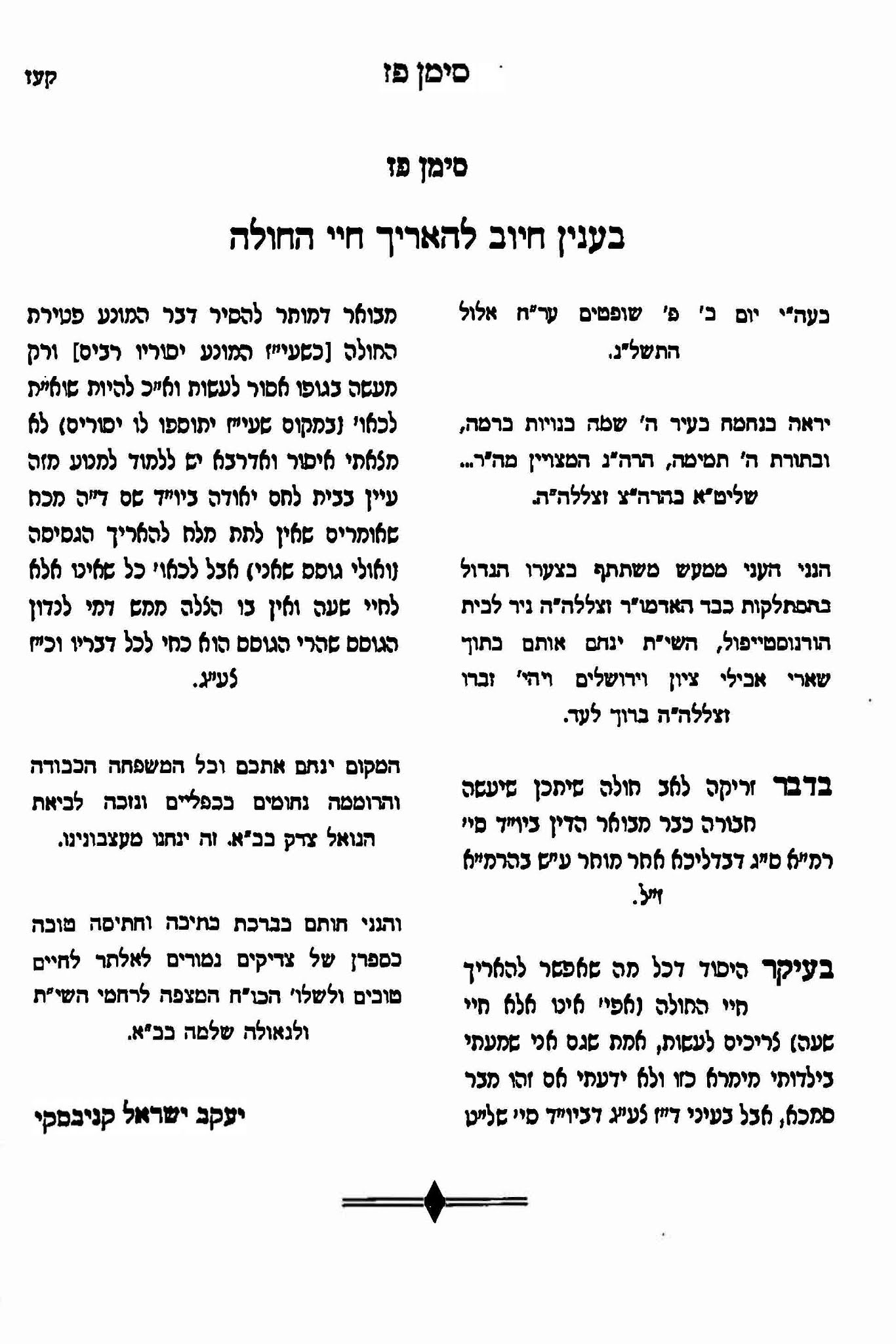
The last letter of this volume presents a medical halakhic query Rabbi Dr. Abraham J. Twerski posed to the Steipler Gaon in the Summer of 1973 about his ailing father. “May a son administer an injection to his ill father?” Despite the fact that Rabbi Dr. Abraham J. Twerski was a physician, and injections were part of his clinical scope of practice, he was acutely aware of the potential halakhic ramification of something as simple as an injection. An injection may cause bodily injury, and it is Biblically prohibited for a son to cause a wound to his father.[19] Rav Kanievsky answered that it would be permitted as long as there are no other options: “On the matter of delivering an injection to one’s father, as it may cause a wound, the law is found in Yoreh De’ah #241:3, that when no one else is available, it is permitted … .”[20]

It appears however that between the sending of the query and the completion of the response, Rabbi Dr. Abraham J. Twerski’s father passed away, as Rav Kanievsky offers condolences: “Behold, I who am bereft of good deeds [an allusion to the introduction to the High Holiday Musaf prayer recited by the chazzan] join in your great sorrow upon the passing of the honorable, great rabbi of the Hornsteipel dynasty. May God comfort you among the mourners of Zion and Jerusalem, and may his memory be a blessing for eternity.”[21]

It is the following paragraph, which includes a general comment about end-of-life issues, to which we draw your attention:

“Regarding the principle that one should do everything possible to prolong the life of the ill patient [even if he is in a terminal state (chayei sha’ah)]. In truth I also heard such a notion in my youth, and I do not know if this derives from a ‘bar samcha’ (authoritative source). In my opinion, this requires serious analysis…”

As I [ER] read these words, they were familiar to me. This letter appears in the Steipler Gaon’s collection of letters entitled Karyana de-Igarta,[22] though the questioner is not identified. It is only from this work of their correspondences that we learn that Rabbi Dr. Abraham J. Twerski is the author of the query!

It is not a lengthy halakhic analysis. In fact, the Steipler Gaon goes on to cite only two sources. The citations relate to the passage in Shulhan Arukh, Yoreh De’ah #339 regarding the treatment of a ‘gosses’, one whose death is imminent. Yet this pronouncement of Rav Kanievsky’s on the approach to the patient at the end of life may possibly be his most cited reference on any medical halakhic topic. Moreover, it is one of the more frequently cited sources in contemporary halakhic discussions on the end of life.

In the Modern era, with the likes of respirators and antibiotics, we now have the ability to prolong life to an extent not imaginable in the past. Must we utilize the entire armamentarium of medicine to prolong life in every circumstance, despite any associated suffering? There are some, such as Rav Eliezer Waldenberg, zt”l, who would answer in the affirmative.[23] Others, like Rav Moshe Feinstein, zt”l, allow for circumstances to refrain from aggressive care.[24] This debate has been the substance of halakhic discussions on end-of-life care in our generation.[25]

For someone of the stature of Rav Kanievsky’s to write that the notion to prolong life in all circumstances and at all costs may not derive from a “bar samcha” (authoritative source) is nothing short of revelational. This statement has guided many a rabbinic authority in their general approach to the treatment of the patient at the end-of-life and has certainly been part of the thought process of countless practical halakhic decisions.

It appears that this noteworthy contribution of Rabbi Dr. Abraham J. Twerski, zt”l to medical halakhic discourse, albeit indirect, has gone largely unnoticed. He is not only to be credited for his legendary contributions to broadening the possibilities of mental health in the Jewish community and beyond,[26] but he is also responsible for eliciting this letter of Rav Yaakov Yisrael Kanievsky, which has informed and guided halakhic-decision-making at the ‘end-of-life’ in the Modern era.

Sadly, we now invoke the same sentiment that the Steipler Gaon expressed above about the loss of another great rabbinic leader and member of the Hornsteipler dynasty:

May his memory be a blessing for eternity.

Notes:

[1] See Marc B. Shapiro, “The Tamim: Rabbi Yaakov Yisrael Kanievsky (‘The Steipler’),” in Benjamin Brown and Nissim Leon, eds., The Gedolim: Leaders Who Shaped the Israeli Haredi Jewry (Jerusalem: Magnes, 2017), 663-674 (Hebrew). A full biographical treatise on The Steipler Gaon along the lines of the magisterial scholarly work of The Hazon Ish, in Benjamin Brown, The Hazon Ish: Halakhist, Believer and Leader of the Haredi Revolution (Jerusalem: Magnes, 2011; Hebrew) remains a scholarly desideratum.
[2] In a December 25, 2020 email to Menachem Butler, Rabbi Dr. Abraham J. Twerski clarified some important details of an anecdote from when he participated in the Christmas play at his Milwaukee public school in his childhood. He wrote here:

That’s not quite the way it was. The week after the play, my mother called the teacher, to meet her. The teacher said, ‘I knew that Mrs. Twerski would reprimand me for putting Abraham in the Xmas play. But all she wanted to know was whether Abraham was self-conscious because he was shorter than the other children.’ I said, ‘I thought you were going to reprimand me for putting Abraham in the Xmas play.’ Mrs. Twerski said ‘If what we have given him at home is not enough to prevent an effect of a Xmas play, then we have failed completely.’

[3] For an overview of the controversy, see David Berger, “Judaism and General Culture in Medieval and Early Modern Times,” in Cultures in Collision and Conversation: Essays in the Intellectual History of the Jews (Boston: Academic Studies Press, 2011), 21-116, esp. 70-78. See also Joseph Shatzmiller, “Between Abba Mari and Rashba: The Negotiations That Preceded the Ban of Barcelona (1303-1305),” Studies in the History of the Jewish People and the Land of Israel, vol. 3 (1973): 121-137 (Hebrew); David Horwitz, “The Role of Philosophy and Kabbalah in the Works of Rashba,” (unpublished MA thesis, Yeshiva University, 1986); David Horwitz, “Rashba’s Attitude Towards Science and Its Limits,” Torah u-Madda Journal, vol. 3 (1991-1992): 52-81; and Marc Saperstein, “The Conflict over the Ban on Philosophical Study, 1305: A Political Perspective,” in Leadership and Conflict: Tensions in Medieval and Early Modern Jewish History and Culture (Oxford: Littman Library, 2014), 94-112.
[4] Avraham Yeshaya Kanievsky, Karyana de-Igarta: Letters of Rabbi Yaakov Yisrael Kanievsky, vol. 1 (Bnei Brak: privately published, 1985), 101-103, no. 86 (Hebrew), dated August 31, 1955.
[5] Avraham Yeshaya Kanievsky, Karyana de-Igarta: Letters of Rabbi Yaakov Yisrael Kanievsky, vol. 1 (Bnei Brak: privately published, 1985), 72-74, no. 66 (Hebrew), dated April 5, 1956.
[6] Rabbi Dr. Abraham J. Twerski, “Who is Honored? He Who Honors Others” (Pirkei Avos 4:1) at TorahWeb.org.
[7] See Abraham J. Twerski, The Zeide Reb Motele: The Life of the Tzaddik Reb Mordechai Dov of Hornosteipel (Brooklyn: Mesorah Publications, 2002), 11.

In 1965, Rabbi Dr. Abraham J. Twerski visited Bnei Brak and requested that he be permitted to take a photograph of Rav Kanievsky. After sharing a story about how Rav Meir Shapiro of Lublin convinced Rav Joseph Rosen, the Rogatchover Gaon, to allow him to take a photograph so that future generations would know what “a true Jew should look like,” the Steipler consented to a photograph to be taken.
[8] Financial difficulties for Jewish medical students are certainly not a new phenomenon. Indeed precisely four hundred years before Rabbi Twerski’s financial woes, in 1658, Chayim Palacco, another rabbi training as a physician in the University of Padua Medical School petitioned the Jewish community of Padua for assistance in paying his medical school tuition. The request, the only one of its kind in the archival records, was granted. See Daniel Carpi, “II Rabbino Chayim Polacco, Alias Vital Felix Montalto da Lublino, Dottore in Filosofia e Medicina a Padova (1658),” Quaderni per la Storia dell’ Universita di Padova, vol. 34 (2001): 351-352.

[9] Jeff Sewald, “Abraham J. Twerski, Psychiatrist and Rabbi: The Psychiatrist and Rabbi in His Own Words,” Pittsburgh Quarterly (Winter 2008), available here.

[10] For further details, see “Catholic Danny Thomas to Help Rabbi Become Doctor,” The Wisconsin Jewish Chronicle (27 June 1958): 1 and 3.

[11] The medical student Judah Gonzago, who trained in Rome in the early 1700s, recounts how one of his final (oral) exams was on Rosh Hashana. He recalls how he left the synagogue after the shacharit (morning) service and returned in time to hear the blowing of the shofar. His other trials and tribulations are reminiscent of those of Rabbi Dr. Twerski, though reflect a different historical reality. Though not a rabbi, Gonzago taught Torah in the local Jewish school. See Abraham Berliner, “Memoirs of a Roman Ghetto Youth,” Jahrbuch für Jüdische Geschichte und Literatur, vol. 7 (1904): 110-132 (German), of which excerpts are summarized and translated in Harry Friedenwald, “The Jews and the Old Universities,” in Harry Friedenwald, ed., The Jews and Medicine: Essays, vol. 1 (Baltimore: John Hopkins University, 1944), 221-240.
[12] How Rabbi Dr. Abraham J. Twerski navigated medical school while simultaneously maintaining meticulous religious observance, not to mention finding time for Torah learning, is truly exceptional. It reflects the challenges that every religious Jew faces in pursuing a medical education. These challenges have existed throughout history, though they have evolved over time. See Edward Reichman, “From Maimonides the Physician to the Physician at Maimonides Medical Center: The Training of the Jewish Medical Student throughout the Ages,” Verapo Yerape: The Journal of Torah and Medicine of the Albert Einstein College of Medicine, vol. 3 (2011): 1-25; Edward Reichman, “The Yeshiva Medical School: The Evolution of Educational Programs Combining Jewish Studies and Medical Training,” Tradition: A Journal of Orthodox Jewish Thought, vol. 51, no. 3 (Summer 2019): 41-56. See also Edward Reichman, “The History of the Jewish Medical Student Dissertation: An Evolving Jewish Tradition,” in Jerry Karp and Matthew Schaikewitz, eds., Sacred Training: A Halakhic Guidebook for Medical Students and Residents (New York: Amud Press, 2018), xvii-xxxvii.
[13] See Abraham J. Twerski, The Rabbi & the Nuns: The Inside Story of a Rabbi’s Therapeutic Work With the Sisters of St. Francis (Brooklyn: Mekor Press, 2013).

On his appointment to this position in August 1965, Sister Mary Adele announced: “The addition of Dr. Twerski to our staff is another important move toward our goal of making complete, comprehensive mental health care and treatment available to all the people of the community.” The following month, both Sister Mary Adele and Rabbi Dr. Abraham J. Twerski rejected the suggestion that his appointment embodies any aspect of the ecumenical movement, and she told The Pittsburgh Press: “The appointment came at an opportune time to fit into the spirit… but it was accidental.” See “St. Francis Ecumenical Movement? Rabbi, Catholic Hospital Team Up In Psychiatry: Mental Ward on the Move,” The Pittsburgh Press (26 September 1965): 11
[14] Rabbi Dr. Abraham J. Twerski’s contributions also extend to the sphere of music. A noted composer of Hasidic melodies (and also of musical grammen that he composed to be delivered at celebratory occasions, such as weddings and sheva brachot), one of his best-known (although often unattributed) compositions is “Hoshia Es Amecha,” which he composed more than six decades ago on the occasion of his brother’s wedding, and set to the words from Tehillim 28:9. The song is often chanted on Simchat Torah following each of the hakkafot in the synagogue, and has become a helpful tune to count the minyan-members ahead of starting prayer services. His story of the song’s composition is recorded here. At his request, there were no eulogies delivered at his funeral. Instead, he requested that his family sing “Hoshia Es Amecha,” which he had once described as his “ticket to Gan Eden…because people dance with it.” See the video of the funeral march here.
[15] For example, see Andrew R. Heinze, “The Americanization of Mussar: Abraham Twerski’s Twelve Steps,” Judaism: A Journal of Jewish Life & Thought, vol. 48, no. 4 (Fall 1999): 450-469.
[16] For the geographic map of the Hasidic dynasties that emerged from Hornsteipel, see Marcin Wodziński, Historical Atlas of Hasidism (Princeton: Princeton University Press, 2018), 159,162.
[17] See his book-length tribute to Reb Motele, the father of Rebbe Yaakov Yisrael Twerski of Cherkas ancestor, see Abraham J. Twerski, The Zeide Reb Motele: The Life of the Tzaddik Reb Mordechai Dov of Hornosteipel (Brooklyn: Mesorah Publications, 2002).
[18] See Israel Shenker, “The Twerski Tradition: 10 Generations of Rabbis in the Family,” The New York Times (23 July 1978): 38, which includes a photo of Rabbi Yaakov Yisrael and Devorah Leah Twerski, with their children and their spouses at a family wedding in 1958.

Peter Leo, “He Defies Melting Pot Tradition,” Pittsburgh Post-Gazette (4 September 1978): 15:

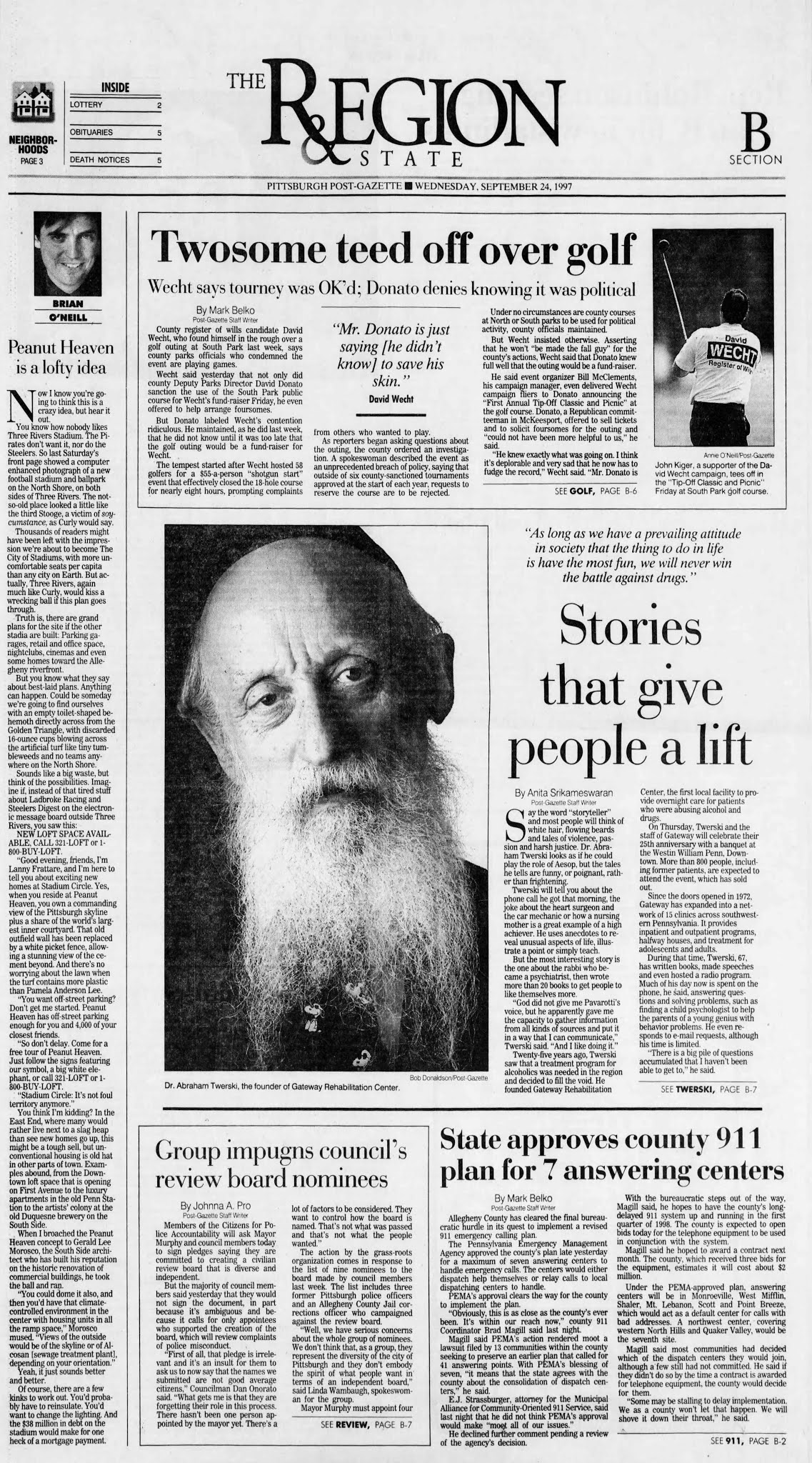
Anita Srikameswaran, “Stories That Give People A Lift,” Pittsburgh Post-Gazette (24 September 1997): B2,B7

[19] For treatise on the topic of providing medical care to one’s parent, see Avraham Yaakov Goldmintz, Chen Moshe (Jerusalem: privately published, 2002; Hebrew), available here.
[20] Abraham J. Twerski, Sefer Ye’omar le-Yaakov u-le-Yisrael (Pittsburgh: Kollel Bais Yitzchok, 1997), 177 (no. 86) (Hebrew), dated August 27, 1973.
[21] Grand Rebbe Yaakov Yisrael Twerski passed away on August 7, 1973.
[22] Avraham Yeshaya Kanievsky, Karyana de-Igarta: Letters of Rabbi Yaakov Yisrael Kanievsky, vol. 1 (Bnei Brak: privately published, 1985), 201, no. 190 (Hebrew)
[23] Alan Jotkowitz, “The Intersection of Halakhah and Science in Medical Ethics: The Approach of Rabbi Eliezer Waldenberg,” Hakirah, vol. 19 (2015): 91-115.
[24] See Moshe Dovid Tendler, Responsa of Rav Moshe Feinstein, vol. 1: Care of the Critically Ill (Hoboken, NJ: Ktav Publishing House, 1996). See also Daniel Sinclair, “Autonomy in Matters of Life and Death and the Withdrawel of Life-Support in the Responsa of Rabbi Moses Feinstein,” Jewish Law Association, vol. 23 (2012): 231-245; and Alan Jotkowitz, “Death as Implacable Enemy – Or Welcome Friend in the Theology and Halakhic Decision Making of Rabbis Moshe Feinstein, Eliezer Waldenberg, and Haim David Halevy,” in Kenneth Collins, Edward Reichman, and Avraham Steinberg, eds., In the Pathway of Maimonides: Festschrift on the Eightieth Birthday of Dr. Fred Rosner (Haifa: Maimonides Research Institute, 2016), 73-99.
[25] For a comprehensive review of the halakhic issues at the end of life – well beyond the scope of this brief essay – see, most recently, Avraham Steinberg, Ha-Refuah ka-Halakhah, vol. 6: The Laws of the Sick, the Physician, and Medicine (Jerusalem: privately published, 2017), 338-388 (section 10) (Hebrew).
[26] See, for example, his books in Abraham J. Twerski, Let Us Make Man: Self Esteem Through Jewishness (Brooklyn: Traditional Press, 1987); Abraham J. Twerski, The Shame Borne in Silence: Spouse Abuse in the Jewish Community (Pittsburgh: Mirkov Publications, 1996); Abraham J. Twerski, Addictive Thinking: Understanding Self-Deception (Center City, MN: Hazelden, 1997); Yisrael N. Levitz and Abraham J. Twerski, eds., A Practical Guide to Rabbinic Counseling (Jerusalem: Feldheim, 2005), and his dozens of other works published over the past half-century, including more than fifty works at the catalog of ArtScroll/Mesorah Publications.


Another Obvious Mistake, More Grammatical Points, Bubbe Mayseh, Apostates and the Zohar

Another Obvious Mistake, More Grammatical Points, Bubbe Mayse, Apostates and the Zohar
 
Marc B. Shapiro
1. In my last post here I gave an example of an obvious error in a recent book focusing on the letters of R. Kook. I found another example of an obvious error in R. Dov Eliach’s new book, Be-Sod Siah.

This is quite an interesting volume as it contains interviews with a number of leading haredi rabbis. I could have an entire post on the material in this book, but let me just call attention to a couple of things related to R. Jehiel Jacob Weinberg before dealing with the error. One of the rabbis interviewed is the late R. Moshe Shapiro. In discussing R. Weinberg, he states (pp. 126-127):
דוגמא לתלמיד שהסבא הרבה להשקיע בו לפי טיבו וכישרונותיו – הגר יחיאל יעקב ויינברג בעל השרידי אש“. עלוי וכוח גדולשהיה מה שנקרא אאוטסיידר” – חריג ויוצא דופן באופיושבקלות היה יכול להחליק ולמצוא עצמו בין המשכילים“. ובזכות חכמתו ויגיעתו של הסבא הוא נשאר בבחינת שלומי אמוני ישראל“.
R. Shapiro tells us that R. Weinberg was an “outsider” and that he could have easily gone the way of Haskalah. It is fascinating that a haredi figure says this, because this is precisely the sort of comment that I think might have angered R. Weinberg’s now deceased right-wing students. Yet I have to say that R. Shapiro is exactly correct in his description. I don’t know if his knowledge of R. Weinberg’s life comes from my book or from R. Nathan Kamenetsky’s Making of a Godol – I only spoke to R. Shapiro once, and it was not about R. Weinberg – but he obviously knew something about the ups and downs of R. Weinberg’s life.
Here is p. 273 in the book, which includes a picture of R. Weinberg.
  
Not noted by Eliach is that this picture comes from my post herewhere I published it for the first time (and thanked the person who gave it to me). I realize that once the picture is on the internet it is there for anyone to use it, but it would still be nice if people would acknowledge where it came from.
Eliach also includes a lengthy interview with R. Bezalel Rakow of Gateshead which understandably has a good deal about R. Weinberg. (I have previously discussed R. Rakow here and here.) What I find fascinating is how people like Eliach simply can’t get a handle on R. Weinberg. On the one hand, they know that he was a great scholar and posek. On the other hand, they know that his views were not in line with the haredi world. Eliach asks R. Rakow the following (p. 274):
בשורה התחתונה – שאלתי את הרב ראקוב – האם הרב ויינברג מוגדר על ידכם כמנהיג תורני חרדי?
Eliach wants to know if R. Rakow regards R. Weinberg as a haredi Torah leader. R. Rakow responds very diplomatically:
בודאיהגאון הרב ויינברג היה ירא וחרד לדבר ה‘. איש ההלכה הצרופה שחרד על כל סעיף בשלחן ערוך!
R. Rakow knew perfectly well that he was dodging the question, and if the definition of haredi is one who is completely halakhically observant, then R. Soloveitchik and R. Lichtenstein (and endless others) should also be regarded as haredi leaders. Only in the continuation of the interview does R. Rakow acknowledge that R. Weinberg’s views were not all in line with the haredi approach (p. 276):
ועדיין ניתן לומרשאי אלה ממחשבותיו לא עלו בקנה אחד עם הדרך המקובלת לנו מרבותינו.
Now for the obvious mistake in Eliach’s book. Here is pp. 66-67.


He begins by mentioning that in his book on the Vilna Gaon he told a story that before World War II, R. Aaron Kotler was not sure where he should go, Eretz Yisrael or the United States. He therefore performed the goral ha-Gra and Exodus 4:27 came up: “And the Lord said to Aaron: ‘Go into the wilderness to meet Moses.’” He understood this to refer to R. Moses Feinstein, who at the time was living in the spiritual wilderness of New York.
Eliach states that it has been established that this story is not correct, and he cites the grandsons of R. Kotler who told him that their grandfather was never in doubt about where he was to go. They also pointed out that there is no way that the name “Moses” could have been seen as a reference to R. Moses Feinstein who was not well-known at that time.
So far so good (and these points are so obvious that one wonders how Eliach fell for a typical yeshiva bubbe mayse[1]). However, Eliach continues, and it must be that he is citing something that he was told by one of the current Kotlers, but he has completely mangled it. He writes:
אם היה מקום לסיפורהרי שהפוסק היותר ידוע בימים ההם באמריקההיה הגר יוסף רוזיןנשיא אגודת הרבנים דארצות הברית וקנדה“, ומחבר ספרי “נזר הקודש“.
Eliach tells us that if the story is true, it would have been with reference to R. Joseph Rosen, who was the most well-known posek in America at the time, the honorary president of Agudat ha-Rabbonim, and the author of the books entitled Nezer ha-Kodesh.
The first thing to ask is how could the goral ha-Gra performed by R. Kotler have anything to do with R. Joseph Rosen when the verse that came up mentioned “Moses”? How Eliach did not see this is beyond me. Furthermore, R. Joseph Rosen not only was not a well-known posek, he was not even a little-known posek. He was also not the president of Agudat ha-Rabbonim, and he never wrote a book called Nezer ha-Kodesh. The only thing of interest, and accurate, in Eliach’s discussion is that he somehow got a copy of the document appointing Rosen rabbi of Passaic, New Jersey, and he includes a picture of this in the book.
Here is what happened: Eliach was told that if the story of R. Aaron Kotler performing goral ha-Gra had any truth to it, the “Moses” referred to would have been R. Moses Rosen, who indeed was a great rav, author of Nezer ha-Kodesh, and served for a time as president of Agudat ha-Rabbonim.[2] R. Rosen is most famous for being the rabbi of Chweidan, Lithuania, where the Hazon Ish’s wife was from and where the Hazon Ish lived after getting married. R. Rosen and the Hazon Ish became close, and supposedly it was R. Rosen who first told R. Hayyim Ozer Grodzinski about the unknown genius, R. Abraham Isaiah Karelitz.[3] The Hazon Ish also proofread the volume of Nezer ha-Kodesh on Zevahim. This was published in Vilna in 1929 when R. Rosen was already living in the United States.[4] While R. Rosen is famous for his connection to the Hazon Ish, not so well known is that he was also a Zionist.[5]
3. My last post here gave examples of grammatical mistakes in the ArtScroll and Koren siddurim, which are the most popular in the English-speaking world. I received a lot of feedback about this, and I did not realize that so many people are interested in the often arcane points of grammar. (While I myself am quite interested in this, I am hardly an expert.) Here are a couple of more examples (and interested readers should consult the comments to the last post for additional instances).
In Ashrei we read עיני כל אליך, which comes from Psalms 145:15. The correct way to read עיני is with the accent on the ע, not on the נ. This word is commonly mispronounced, and neither ArtScroll nor Koren place the accent where it should be.[5a]
I found another mistake in the ArtScroll Machzor for Rosh ha-Shanah and Yom Kippur. In the prayer of the chazzan before Musaf, he says הפך [נאלנו ולכל ישראל. Some versions have the first word as הפוך. In both cases, since this is an imperative there needs to be a hataf patah under the ה. Yet in the ArtScroll Machzor there is a patah under the ה and the accent in הפך is mistakenly put on the first syllable, the ה. [After writing this I checked the second edition of the Machzor and was happy to see that it has been corrected. This shows that any errors we point out are valuable, as ArtScroll is prepared to correct them in future editions.]

Btzalel Shandelman wrote to me about ArtScroll’s comment on Genesis 39:8, which explains why there is a pesik following the word וימאן

The adverb adamantly is suggested by the staccato and emphatic Masoretic cantillation of this word: the shalsheles, followed by a psik [disjunction], both of which set off the word and enhance the absoluteness of its implication. It indicates that Joseph’s refusal was constant, categorical, and definite. He repulsed her with absolute firmness. Haamek Davar notes that the Torah gives no reason for his rejection; his sense of right and wrong was so clear that he did not even consider her pleadings. To her, however, he gave an explanation, trying to convince her to stop pestering him.

Shandelman correctly points out that this explanation is based on a mistake, as the vertical line found in the Torah after word וימאן is not a real pesik, as a pesik can never follow a shalshelet in the Torah (or the other sixteen biblical books that use the Torah’s system of cantillation). The reason for this is that a pesik is only found after conjunctive te’amim, and in the Torah shalshelet is always disjunctive. So why is there a vertical line after shalshelet if it is not a pesik? Joshua R. Jacobson explains:

In the te’amim of the three books (ספרי אמת), the shalshelet sign can serve as both a conjunctive and a disjunctive accent. To distinguish one from the other, a vertical line was added after the disjunctive shalshelet. Even though in the twenty-one books the shalshelet sign has only one use – as a disjunctive accent – nevertheless, the Masoretes retained the vertical line. . . . The vertical line after the shalshelet word is not a pasek: it does not indicate an extra pause.[6]

Another way to put this is that in the Torah the vertical line that always follows the shalshelet is not a separate symbol, but rather part of the shalshelet.
Nevertheless, pre-modern Hebrew texts that deal with masoretic matters seem to have no other way to refer to the vertical line, so it is called a pesik even by those who recognize that it does not function as a pesik. Thus, in the Masorah Gedolah to Lev. 8:23 it states:
ז‘ מלין בטעמא מרעימין ומפסיקין
מרעים is another word for shalshelet.
Returning to the example noted by Shandelman, I replied to him that the mistake is not that of ArtScroll. Although it is not clear in the excerpt printed above, the comment about a pesik following the shalshelet has its origin in R. Naphtali Zvi Judah Berlin’s Ha’amek Davar.[7] This is actually a common mistake, as the rules of trop are not well known. Unless someone has studied these rules, he will have no reason to assume that a vertical line is not a real pesik. The next step is to offer explanations of verses based on this assumption that the vertical line represents a real pesik after the shalshelet.
I don’t think that any of the following explanations are based on the mere appearance of the vertical line. Rather, the authors assume that it is a real pesik and one can therefore base interpretations on it.
R. Tuviah ben Eliezer (12th century) writes:[8]
וימאן מיאון אחר מיאון הרבה פעמים דכתיב בפסיק ובשלשלת
Solomon Buber, the editor of the text, explains R. Tuviah’s words:
דורש הטעמיםכי על וימאן הוא שלשלת ואחכ הוא בפסיק
R. Yeruham Levovitz stated as follows:[9]
ועל כן תיכף לוימאן” יש פסיקכי הופסק אצלו כל הענין אף טרם ניתח העולה על הרוחאף טרם נתן כל טעם וביאור על המיאוןכי טרם כל וכל הוא ממאן על הדבר וחסלוהטעמים והביאורים יתן אחרי כןוזהו אמרו אחרי הפסיקואומר אל אשת אדוניו וגו‘.
R. Samuel Borenstein writes:[10]
וימאן מוטעם בשלשלת ופסיקכדי להפרידו בפעוהיינו שהמיאון לא הי‘ מחמת הטעם אלא מצד עצם הנפש למעלה מהטעם.
R. Shlomo Zvi Schueck leaves no question that in his mind the vertical line is a real pesik.[11]
ואמרתי שחכזל דרשו זאת מן הטעם שלשלת העומדת על תיבת וימאן אם רצו להודיע בטעם שלשלת להפסיק שם בדיבור למה בחרו בניגון זה דוקאהא כמה טעמים מפסיקין הםועוד הא אחר תיבת וימאן הוא עומד הקו פסיקולמה לן תרי מפסיקין כאן?
R. Shlomo Amar writes:[12]
תיבת וימאן” הכתובה בפסוק מוטעמת בטעם שלשלתומיד לאחריה מופיע טעם פסקונראה דזה בא ללמדשיוסף הצדיק מיאן במיאון אדיר וחזקוגם מיאונו היה פסוק וחתוך.
I would only add that it is very difficult to say about so many great sages, ועפר אני תחת רגליהם, that they are wrong about the function of the pesik following a shalshelet. What I have written is based on the standard works on the topic. However, if anyone knows of an authentic tradition in which there is a pesik after shalshelet, please let me know. 

Finally, as I am writing this post not long after Hanukkah, here is an example of a translation where ArtScroll gets it right and pretty much everyone else I have checked gets it wrong (though we can understand why they intentionally get it wrong). In Maoz Tzur we read:
לעת תכין מטבח מצר המנבח
אז אגמור בשיר מזמור חנכת המזבח
ArtScroll translates:
When you will have prepared the slaughter for the blaspheming[13] foe,
Then I shall complete with a song of hymn the dedication of the Altar.[14]
Here is Koren’s translation of the first line:

When you silence the loud-mouthed foe.

This a much more comfortable rendering, and if you examine other siddurim you will find similar “softer” translations. Given the choice between “slaughter” and “silence,” most people will pick the latter. Yet unfortunately for them, the text does not say “silence.” It says “slaughter,” and the words תכין מטבח are based on Isaiah 14:21: הכינו לבניו מטבח, “Prepare ye slaughter for his children.” Koren’s translation is thus a politically correct distortion of the text’s meaning.
This is not a matter that started with Koren. For a long time now, translators have been afraid that if people knew what the text actually said that they would not want to sing the song. Yet how can you have Hanukkah without Maoz Tzur? It is even recited publicly at the White House Hanukkah party. (It is amazing to me that no one has yet made an issue of publicly singing these politically incorrect words.) So, a little bit of creative “translating” was thought necessary. Isn’t it interesting that ArtScroll – which has shown us many times that it has no difficulty censoring and distorting texts it finds problematic – has the courage to give us the correct, uncensored translation?
Interestingly, R. Joseph Hertz in his siddur, p. 950 in the note, tells us what the words mean. Yet was uncomfortable with this, and therefore instead of תכין מטבח he changed it to תשבית מטבח. This is not a version attested to in any old text. It was simply made up by Hertz or perhaps suggested by an unnamed collaborator on his siddur commentary. Hertz writes: “By a slight change, this is now ‘when Thou shalt cause all slaughter to cease, and the blaspheming foe, I will complete, etc.’”[15]
4. Since I have been discussing the ArtScroll and Koren siddurim, it is only right for me to mention that there is a new siddur on the market. The new RCA siddur, called Siddur Avodat Halev, has just appeared. For decades, Modern Orthodox synagogues had to make do with the RCA ArtScroll siddur. However, other than including the prayer for the State of Israel, there was nothing in that siddur that made it a good fit with Modern Orthodox synagogues.
The new RCA siddur, which will come to be the standard at hundreds of synagogues for decades to come (especially as the RCA ArtScroll siddur is no longer being sold), is a siddur that the Modern Orthodox community can embrace. The commentary and essays – including essays by R. Jehiel Jacob Weinberg, R. Joseph B. Soloveitchik, R. Aharon Lichtenstein, and R. Yehudah Amital – include both traditional learning and historical scholarship, something that is not found in any siddur on the market. There is also an attention to the role of women that is welcome.[16] Relevant to my last post, this siddur tells women to say מודה אני with a kamatz under the ד. The siddur also offers the option of women forming a mezuman and reciting חברותי נברך. Of particular importance is the inclusion of prayers for Yom Ha-Atzmaut and Yom Yerushalayim. In the instructions before Tahanun, we are informed that Tahanun is omitted on these two days. For Hallel, readers are given the option of reciting with a berakhah or without. I will return to discuss this siddur in a future post, as there is something in it that will be of particular interest to Seforim Blog readers.
Excursus
Earlier in this post I used the expression bubbe mayse. The origin of these words is not “grandmother’s tale,” although that is what is commonly thought. Bubbe mayse is a later corruption of what was originally Bove mayse. I can do no better than quote from the Wikepedia entry here.
The Bovo-Bukh (“Bovo book”; also known as Baba Buch, etc.; Yiddish: בָּבָאבּוּךבּוֹבוֹבּוּך ‬), written in 1507–1508 by Elia Levita, was the most popular chivalric romance in Yiddish. It was first printed in 1541, being the first non-religious book to be printed in Yiddish. For five centuries, it endured at least 40 editions. It is written in ottava rima and, according to Sol Liptzin, is “generally regarded as the most outstanding poetic work in Old Yiddish”. [Liptzin, 1972, 5, 7]
The theme derives from the Anglo-Norman romance of Bevis of Hampton, by way of an Italian poem that had modified the name Bevis of Hampton to Buovo d’Antona and had, itself, been through at least thirty editions at the time of translation and adaptation into Yiddish. The central theme is the love of Bovo and Druziane. [Liptzin, 1972, 6], [Gottheil] The story “had no basis in Jewish reality”, but compared to other chivalric romances it “tone[s] down the Christian symbols of his original” and “substitute[s] Jewish customs, Jewish values and Jewish traits of character here and there…” [Liptzin, 1972, 8]
The character was also popular in Russian folk culture as “Prince Bova”.
The Bovo-Bukh later became known in the late 18th century as Bove-mayse “Bove’s tale”. This name was corrupted into bube mayse “grandmother’s tale”, meaning “old wives’ tale”. [Liptzin, 1972, 7]
Here is the title page of the Bovo Bukh.

R. Elijah Levita (1469-1549), who thought it worth his time to produce Yiddish romances – in addition to the Bovo Bukh he published Paris and Vienna – is also the well-known author of, among other works, the Tishbi, the Hebrew dictionary that is still used today.[17] It was recently reprinted by Yeshivat Kise Rahamim together with comments by later authors including R. Meir Mazuz. Here is the title page.
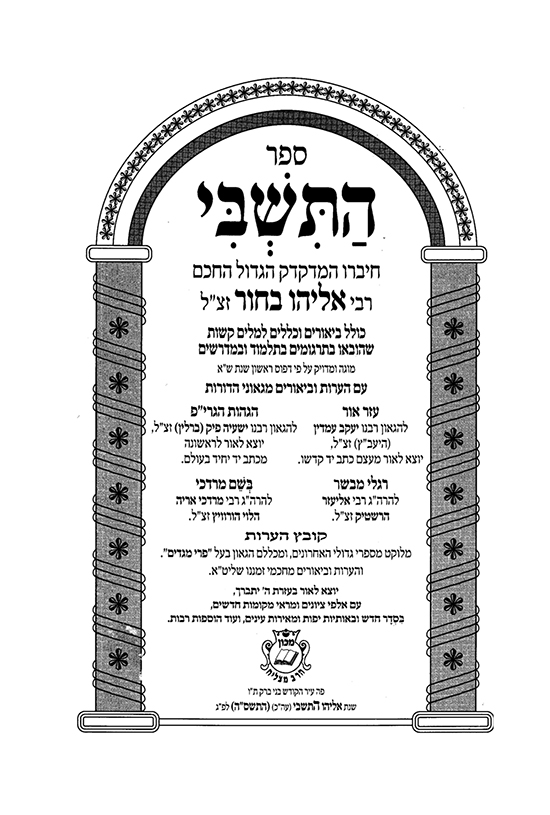
At the end of the volume, there is a collection of critical comments on the Tishbi by R. Solomon Zvi Schueck, and responses to R. Schueck by R. Aryeh Mazuz. Interestingly, there were two printings of the Kise Rahamim edition of the Tishbi. The one intended for sale in certain haredi neighborhoods did not include the comments of R. Schueck, as he is persona non grata among extremist haredim. Regarding the two editions, see Dan Rabinowitz’s earlier Seforim Blog post here.
For more on Levita, who even has a street named after him in Tel Aviv, see the Seforim Blog post by Dan Yardeni here. It is also worth noting that former British Prime Minister David Cameron is descended from Levita. See here.
I would be remiss in not mentioning that two grandsons of Levita also played a role in Jewish history. One was named Vittorio Eliano (which means “from the house of Elijah”), and the other was his brother Giovanni Battista. They were both apostates. Eliano became a priest as did Battista, who was actually a Jesuit.[18] Battista testified before the Inquisition in Venice and stated that “the Talmud teaches them [Jews] that it is legitimate to orally swear false oaths, even if they do not come from the heart, along with hundreds of thousands of other things which are injurious to Christianity.”[19]
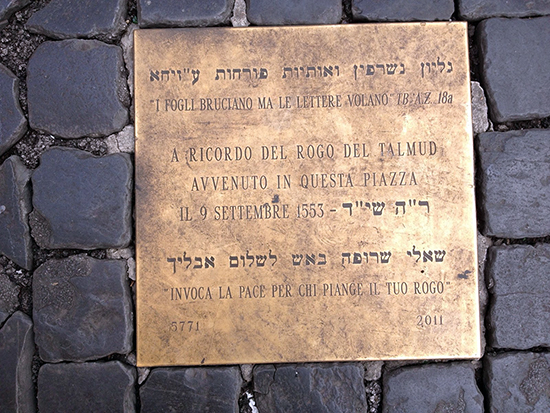
During the great sixteenth-century dispute in Venice between two Christian printers of Hebrew books – a dispute that also involved R. Meir Katzenellenbogen and R. Moses Isserles – both Christian sides denounced the other to Rome “for producing works which contained matter offensive to the Holy Catholic Faith.”[20] Eliano and Battista ended up giving testimony about supposedly blasphemous material in the Talmud, which in turn led to the Talmud being burned in Rome, in the Campo de Fiori, on September 9, 1553. Soon after that the Talmud was burned in Venice and in other places in Italy, and the work itself became an illegal text.[21]
In 2011 the following plaque was placed on the ground in the Campo de Fiori in commemoration of the burning of the Talmud.
Although the Talmud was illegal, the Zohar was not. It was none other than the apostate Eliano who had a central role in the second printing of the Zohar in Cremona in 1559-1560, as he was a proof reader.[22] (The first printing was in Mantua in 1558-1560.) This edition “was the preferred of the two editions by eastern European kabbalists.”[23] Contrary to what appears in many books, the Cremona Zohar was published by Jews (although the actual printing was done by a non-Jew, which was standard practice in Italy).[24]
Here is the title page of the Cremona Zohar. You can see at the bottom the statement that the publication was approved by the Inquisition.

Here is the last page of the Cremona Zohar. You can see that Eliano is mentioned as one of the two people who prepared the text for publication.


הבחור כמר ויטוריי אליאנו נכדו של ראש המדקדקים החר אליהו המדקדק סגל זצל
You can also see the actual Latin approval from the Inquisition.
Seeing how Eliano made sure that he was referred to as הבחור כמר, one who did not know better would assume that he was Jewish. Meir Benayahu chalks this up to one of the paradoxes of Jewish Italy:[25]
משומד שמשתבח במלאכת קודש זו ומזכיר שמו בנוסח רבני ועולה על כך שייקרא בתואר כמר” (בקולופון הזוהר), הוא מן הנפלאות שרק הפאראדוכסים המצויים אצל יהודי איטליה יכולים להסבירם.
Graetz,[26] followed by others, states that Eliano wrote the following Hebrew introduction to the Cremona Zohar.
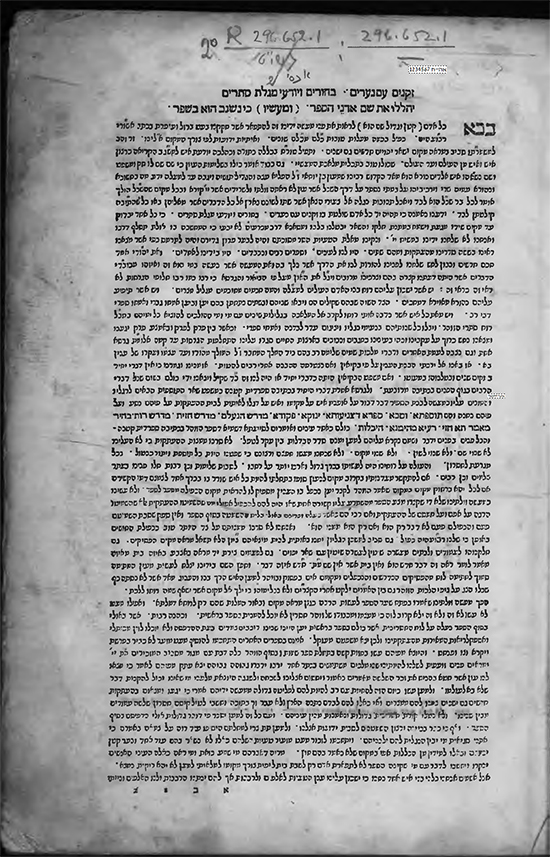
Graetz does not tell us how he knows that Eliano wrote the introduction, and I find it difficult to believe that this is the case. As we can see from the last page of the Cremona edition (printed above), a Jew was also involved with preparing the text for publication. So why not assume, with Isaiah Tishby,[27] that the Jew wrote the introduction, which is a typical pious introduction that one would expect for the Zohar?
In fact, there is evidence that Eliano did not write it. Avraham Yaari called attention to the fact that in the introduction it subtly tells us that there are printing errors because the book was also prepared for publication on Shabbat, a time when Jewish proofreaders would not be able to examine it.[28]
וחסרון חלוף או השמטת אות יוכל להמנות על היות דבר הדפוס נחוץ לכל שומרי שבת כהלכתה ודל.
The word נחוץ here means something along the lines of “harried”. (See I. Sam. 21:9, for the use of the word in the Bible, which has a different meaning than in modern Hebrew.) He is saying that the reason there are mistakes in the text is due to the problems confronted by shomer Shabbat proofreaders (who do not work on Shabbat). In other words, the mistakes in the text are due to the one who did work on Shabbat. Such a line, criticizing the proofreader who worked on Shabbat, could not have been written by the apostate Eliano. On the contrary, it must be seen as directed against Eliano. This is an important point which I have not seen anyone make. There is another point which no one has made, and that is that on the second line of the introduction the author left an allusion to Eliano:
ואותיות ידועות לפי צורך המקום אלינו
Another book Eliano was involved with was Hizkuni,[29] printed in Cremona in 1559.[30] Here is the last page of the book which states:
הוגה ברוב העיון עי הבחור ויטוריו אליאנו נכד ראש המדקדקים החר אליהו בחור אשכנזי סגל זצל

While on the topic of apostates and the Zohar, here is another interesting point. The Soncino Press of London published a translation of the Zohar. For some of this translation they had the assistance of Paul Levertoff. Here is the title page of one of the volumes.

What makes this so significant is that Levertoff, who began life as a Habad Hasid and later studied in Volozhin, was an apostate.[31] If you search on the internet you will find that Levertoff continues to have a real influence among Messianic Jews.
I find it astounding that the Soncino Press, which was identified with British Orthodoxy, chose to collaborate on the Zohar translation with an apostate, especially an apostate who was a “true believer,” not simply an opportunist like Daniel Chwolson. Supposedly, late in life Chwolson was asked what he came to believe that led him to adopt Christianity. He replied: “I believed that it was better to be a professor in St. Petersburg than a melamed in Anatevka [insert whatever shtetl name you wish].” He also famously said about himself, punning on the words from the Yom Kippur liturgy,[32] “Ve-Akhshav she-Notzarti [= converted to Christianity] ke-Ilu lo Notzarti.”[33]

________________
[1] See Excursus.
[2] See Ha-Pardes (January 1953), p. 52.
[3] Shlomo Kohen, Pe’er ha-Dor, vol. 1, p. 191. As far I as I know, the report in Asher Rand, Toldot Anshei Shem (New York, 1950), p. 62, that R. Rosen and the Hazon Ish established a yeshiva together, is without foundation.
[4] Orhot Rabbenu (2014 edition), vol. 5, p. 138. This source does not mention which volume of Nezer ha-Kodesh it was, but the volume on Zevahim was the only one printed in Vilna. Since R. Rosen was living in the United States, this explains why it would have been much more convenient for for the Hazon Ish to do the proofreading. According to Cohen, Pe’er ha-Dor, vol. 1, p. 270, some of the material in the book in brackets is from the Hazon Ish. Cohen also states regarding these comments:

רובן פותחות במיהו” ולפעמים צויין בראשיתיבות שור (שוב ראיתי). כששאלו אותואיך זה תואם את האמתהשיב החזוןאיש באירוניהלא שוב ראיתי“, כי אם שוב וראה“.
For מיהו see pp. 69, 82, 88. For שו”ר see pp. 84, 86.
[5] See Entzyklopedia shel ha-Tziyonut ha-Datit, vol. 5, cols. 597-598.
[5a] It could be that עיני is not to be read with full stress on the ע, but only a partial stress, with the real accent on the connected word כל (in the Aleppo Codex עיני is joined to כל with a makef). Yet there certainly is no accent on the נ of עיני. See R. Yedidyah Solomon Norzi, Ma’amar ha-Ma’arikh in Norzi, Ha-Nosafot le-Minhat Shai, ed. Zvi Betser (Jerusalem, 1997), pp. 97ff.
[6] Chanting the Hebrew Bible: The Art of Cantillation (Philadelphia, 2002), p. 105 n. 14, 107. See also ibid., p. 233 n. 2, and Mordechai Breuer, Ṭaʻamei ha-Miḳra be-Khaf-Alef Sefarim u-ve-Sifrei Alef-Mem-Taṿ (Jerusalem, 1982), p. 19.
[7] See the Jerusalem, 2005 edition, p. 534. 

ומשום הכי איתא פסיקכדי שלא נפרש דמשום הכי מיאן בשביל ויאמר וגו‘”, אבל הפסיק מלמד שהמיאון היה בפני עצמו.

This comment was not part of the original commentary but was added later by the Netziv. In this edition, the editors have inserted the comment in the text of Ha’amek Davar, but inside brackets that look like this {} to show that it is a later addition.

[8] Lekah Tov, ed. Buber, p. 198.

[9] Da’at Torah: Bereshit (Jerusalem, n.d.), p. 230.
[10] Shem mi-Shemuel (Jerusalem, 1992), parashat Va-Yeshev, p. 69.
[11] Torah Shelemah (Satmar, 1909), vol. 1, p. 179a.
[12] Birkat Eliyahu (Jerusalem, 2007), vol. 1, p. 260.
[13] The word נבח, which literally means “bark” (see Isaiah 56:10, Eruvin 86a), had an anti-Christian connotation in medieval Hebrew. See Eli Yassif, ed. Sefer ha-Zikhronot (Tel Aviv, 2001), p. 404 n. 87; Daniel Goldschmidt and Avraham Frankel, eds., Leket Piyutei Selihot me-et Paytanei Ashkenaz ve-Tzarfat (Jerusalem, 1993), vol. 1, p. 398. Thus, in Maoz Tzur the “blaspheming foe” refers to the Christians.
R. Shlomo Fisher, Derashot Beit Yishai (Jerusalem, 2004), p. 234 writes:
ויבואר עפ כל זהדברי הפייטן בזמר לחנוכהתכון בית לתפלתי ושם תודה נזבחלעת תכין מטבח מצר המנבחדהיינו טביחת היצהר
This would make a very nice derashah on Hanukkah, and had Hertz known of it, he could have offered this perspective in his commentary and kept the original version of the song. Yet in its historical context, this is hardly what the author is referring to. Similarly, R. Raymond Apple is not correct when he writes that the words refer to “the defeat of Gog and Magog who will attempt to overcome Israel before the coming of the Messiah.” See here. When Maoz Tzur speaks of the destruction of the “barking [i.e., blaspheming] foe,” it is referring to a real flesh and blood enemy of the Jewish people, which in the medieval Ashkenazic context means the Christian world. The word “barking” is used in this song as throughout pre-modern Jewish literature dogs were portrayed in a negative way. See also here.
[14] I do not know why ArtScroll capitalizes “Altar”.
R. Meir Mazuz recently commented that while Maoz Tzur is a wonderful song, “it contains small [grammatical] errors, as is the practice with the Ashkenazim who do not know Hebrew well.” Bayit Ne’eman, no. 139 (30 Kislev 5779), p. 1 n. 1. One example he gives is לעת תכין מטבח מצר המנבח. It should say לצר המנבח. He adds:
מאיפה אני לומד את זהמפסוק בישעיה הכינו לבניו מטבח בעוון אבותם” (יד כא), לא מבניו אלא לבניו.
Regarding Hanukkah, I recently found that R. Naphtali Zvi Judah Berlin suggests the possibility that when the Maccabees entered the Temple they did not light the menorah, as we are accustomed to think, but rather only lit one candle. See Ha’amek She’alah, Va-Yishlah, no. 24, p. 173:
ולכאורה הי‘ אפשר לומר שלא היו מדליקים אז במנורה כלל . . . ואכ הי‘ מקום לומר שלא השתמשו באותם שמונה ימים במנורה כלל משום שלא הי‘ להםוהדליקו באותו פך הטהוראו בכלי גללים וכלי אבנים וכלי אדמהואכ לא הי‘ אלא נר א‘ כדי לקיים להעלות נר תמיד

Also of interest is R. Joseph Messas, Otzar ha-Mikhtavim, vol. 2, no. 1305, who cites midrashic sources that there will not be a menorah in the future Temple.

 
I have vocalized the title of the Netziv’s book as Ha’amek She’alah, which is how scholars have been accustomed to write it, based on Isaiah 7:11 where these words appear.
However, Gil S. Perl argues that the correct pronunciation is Ha’amek She’elah. As he puts it, if the pronunciation in Isaiah was intended, “the title would mean ‘sink to the depths,’ the ‘depths’ (from the word she’ol) being a reference to the netherworld or Hell—a rather strange title for a work of halakhic commentary.” Perl therefore suggest that the Netziv “intended his title as a play on those words from Isaiah pronounced Ha’amek She’alah, meaning ‘delve into the question’ or perhaps ‘delve into the She’ilta.’” See Perl, The Pillar of Volozhin (Boston, 2012), pp. 17-18, n. 37.
[15] Regarding how Maoz Tzur appears in British siddurim, see John D. Rayner, “Liturgical Emendation: The Case of the Ma’oz Tzur,” available here.
[16] For more on the new RCA siddur and women, see the anonymous post here.
[17] The Tishbi was first printed in Isny, Germany in 1541. It is one of the first Jewish books to cite biblical passages by chapter. As most people know, the chapters are a Christian innovation. According to Abraham Berliner, the first Jewish scholar to publish a book using the chapter divisions was R. Isaac Nathan, who published a biblical concordance between 1437 and 1448. See Berliner, Ketavim Nivharim (Jerusalem, 1969), vol. 2, p. 134. On this page Berliner also writes:

החלוקה לפרקים של כל ספרי המקרא נתקבלה ונתפשטה רק עם הדפסת המהדורה השניה של המקראות הגדולות (ויניציא רפד).
Yet the first edition of the Mikraot Gedolot, published in Venice, 1518, is on Otzar ha-Hokhmah, and you can see that it too has the chapter divisions.
[18] See Heinrich Graetz, Geschichte der Juden (Leipzig, 1907), vol. 9, p. 320; Encyclopaedia Judaica, vol. 6, col. 615; Meir Benayahu, Ha-Defus ha-Ivri bi-Kremona (Jerusalem, 1971), pp. 95ff.. For sections of an autobiography written by Battista, in which he describes his apostasy, see Isaiah Sonne, Mi-Paʾulo ha-Reviʻi ad Piyus ha-Hamishi (Jerusalem, 1954), pp. 150-155.
[19] See Amnon Roz-Krakotzkin, The Censor, the Editor, and the Text: The Catholic Church and the Shaping of the Jewish Canon in the Sixteenth Century, trans. Jackie Feldman (Philadelphia, 1007), pp. 42-43.
[20] Cecil Roth, The History of the Jews of Italy (Philadelphia, 1946), p. 291.
[21] See Roth, The History of the Jews of Italy, p. 292. For detailed discussion of this matter, which shows all the other factors that were present, see Kenneth Stow, “The Burning of the Talmud in 1553, in the Light of Sixteenth Century Catholic Attitudes Toward the Talmud,” Bibliothèque d’Humanisme et Renaissance 34 (1972), pp. 435-459.
[22] Regarding Allessandro Franceschi, another sixteenth-century Italian apostate who supported the printing of the Zohar, see Yaakob Dweck, The Scandal of Kabbalah (Princeton, 2011), pp. 166-167.
[23]  Marvin J. Heller, The Sixteenth Century Hebrew Book (Leiden and Boston, 2004), vol. 1, p. 503.
[24] See Yitzhak Yudelov, “Al Sefarim, Madpisim, u-Mo”lim,” in Yosef Eliyahu Movshovitz, ed., Ha-Sefer (Jerusalem, 2008), vol. 2, p. 557 n. 22.
[25] Ha-Defus bi-Kremona, p. 97.
[26] Geschichte, vol. 9, p. 345.
[27] “Ha-Pulmus al Sefer ha-Zohar,” Perakim 1 (1967-1968), p. 147 n. 54.
[28] Mehkerei Sefer (Jerusalem, 1958), pp. 170-171. Yaari also mentions other Hebrew books that were printed on Shabbat.
[29] Regarding how חזקוני is to be pronounced, see my post here.
[30] For other examples of Hebrew books whose printing Eliano was involved with, see the index of both Roz-Krakotzkin, The Censor, the Editor, and the Text and Benayahu, Ha-Defus ha-Ivri bi-Kremona.
[31] See Elliot R. Wolfson, “Paul Philip Levertoff and the Popularization of Kabbalah as a Missionizing Tactic,” Kabbalah 27 (2012), pp. 269-320. On p. 272, Wolfson states that Levertoff received semikhah from R. Naphtali Zvi Judah Berlin. He provides no evidence for this assertion so I cannot judge its accuracy. As far as I have been able to determine, Levertoff never received semikhah.
[32] The passage originates in the Talmud, Berakhot 17a, where it is attributed to Rava, and Yoma 87b, where it is attributed to R. Hamnuna.
[33] See Zvi Hirsch Masliansky, Memoirs, trans. Isaac Schwartz and Zviah Nardi (Jerusalem, 2009), p. 138.


Rav Gorelick, the Rav, and Revision by Omission

Rav Gorelick, the Rav, and Revision by Omission

By: Yaacov Sasson

Many readers of the Seforim Blog no doubt remember Dr. Shapiro’s post from 2009, in which he documented a back-and-forth from the pages of the journal Or Yisrael, regarding whether Rav Yerucham Gorelick zt”l taught Gemara at Yeshiva University.[1] As a refresher, Or Yisrael (Num. 50, Tevet 5768, p. 39) published a summary of a shiur given by Rav Mordechai Leib Gorelick (son of Rav Yerucham), regarding the publication of the Talmud with translation and elucidation (presumably referring to Artscroll). Rav Gorelick argued that such translations are inappropriate, as they make learning Gemara too easy, and learning Gemara requires hard work and toil (ameilus). Furthermore, Talmud study had always been reserved for the elite, not the masses, who studied other topics like Mishnayos and Ein Yaakov; daf yomi study for the masses was only approved reluctantly by the Chafetz Chaim. But it is inappropriate to print these crutches to enable the masses to study the Talmud, which they are incapable of studying on their own.[2]

In a follow up in that same issue of Or Yisrael (p. 42), Rav Yehuda Heller of London raised some doubt about whether Rav Leib Gorelick really said what was attributed to him in Or Yisrael. In the course of attempting to show that Rav Leib never made these claims against English translations and daf yomi, Rav Heller mentioned that Rav Leib’s father, Rav Yerucham, taught Gemara in YU for many years, even though the students there did not meet the very rigorous conditions that Rav Leib required to qualify for learning Gemara. From this, Rav Heller attempted to demonstrate that Rav Leib did not actually say what was attributed to him.[3]

Rav Heller wrote a further follow-up in a later volume of Or Yisrael (Num. 57, Tishrei 5770, p. 255), in which he said that Rav Leib Gorelick told him that his father did not teach Gemara in YU, and he only taught hashkafa there.[4] This statement understandably prompted quite a response, as Dr. Shapiro criticized Rav Leib and these revisionist comments rather harshly. A number of other websites also made note of this episode and added their own criticisms.[5] A follow-up letter written by a former student of Rav Yerucham was also published in Or Yisrael (Num. 58, Tevet 5770, p. 248), titled איך החי יכול להכחיש את החי , in which the writer states that he studied Gemara, Rishonim and Acharonim with Rav Yerucham, as did thousands of other students.

The claim that Rav Yerucham never taught Gemara at YU/RIETS is clearly false. Yet, it would appear that no one followed up with Rav Leib to clarify his statement, or to confirm that he actually made the seemingly impossible statement that had been attributed to him. In a conversation I had with Rav Leib Gorelick this past summer, I took the opportunity to ask him about this claim that his father never taught Gemara there, and only taught hashkafa. Rav Leib immediately informed me that he was misquoted, and his father certainly taught Gemara at YU/RIETS. What he said was that his father’s goal in teaching Gemara at YU was not to teach Gemara per se, but was to impart hashkafa, mussar, and emuna to the talmidim; in Rav Leib’s own words, “He wasn’t teaching them daf yomi.” Recall that the original context of these statements was regarding the propriety of Artscroll English translations enabling the masses to study daf yomi. It was in this context that Rabbi Heller brought Rav Yerucham’s position in YU as a proof, and Rav Leib was responding to this argument, all in the context of English translations and daf yomi. Regarding this point, he was arguing that his father’s position at YU is not relevant to teaching daf yomi to the masses, because his father was using the Gemara as a vehicle to impart mussar and hashkafa.

Interestingly, Rav Hershel Schachter has expressed similar sentiments, but from the perspective of a student (academic year 1957-1958) of Rav Yerucham Gorelick[6]:

Rabbi Gorelick used to give a shiur in the yeshiva, a regular shiur in Gemara, and he used to pepper his shiur with a lot of hashkafa, and a lot of mussar, emunah, he would say over a lot from the Nefesh Hachaim…The year that I was in Rabbi Gorelick’s shiur we learned Sanhedrin, I don’t remember anything that Rabbi Gorelick said about Sanhedrin, but I do remember all the Nefesh Hachaim’s that he said in the course of the year…I remember vertlach that he said from Rav Velvele on chumash…That’s what I remember from the year of learning by him. What he said on Gemara Sanhedrin I don’t remember. I remember what Rav Soloveitchik said, I don’t remember what Rabbi Gorelick said. But I remember all the Nefesh Hachaim’s that he said, and all the vertlach from Rav Velvele on the hagada, and all the vertlach on chumash that he said, and the stories that he told about Rav Velvele, that I remember, he used to tell over stories…”

If we could generalize from Rav Schachter’s experience, it would appear that Rav Yerucham Gorelick’s lasting impact on talmidim was mostly in line with how Rav Leib presented Rav Yerucham’s goals in teaching Gemara in YU.

There have been instances, however, in which Rav Gorelick’s association with YU has been omitted or glossed over. As an example, see the journal U’lYishrei Lev, volume 11, published in honor of the marriage of a son of Rav Shmuel Yeshaya Keller (son of the late Rav Chaim Dov Keller), to a granddaughter of Rav Chaim Ozer Gorelick, a great-granddaughter of Rav Yerucham.[7] This journal contains two letters from Rav Gorelick, which originally appeared in YU/RIETS Torah journals. One of them, shown below, בענין חש בתרומה וריחא מילתא , was originally printed in Beis Yitzchak volume 25 p. 241, and was discovered and arranged for publication by the late Rabbi Joshua (posthumously known as The Hoffer) Hoffman.[8]

There is no mention in U’lYishrei Lev that this letter was found and published in Beis Yitzchak. Similarly, the other letter in U’lYishrei Lev, במצות הפרשת תרומות ומעשרות, was originally published in Kol Zvi volume 2 page 107. It is noteworthy that, in addition to the more recent family connection by marriage, Rav Yerucham Gorelick was Rav Chaim Dov Keller’s rebbe in YU. It was Rav Gorelick who encouraged Rav Keller to go to Telz, and arranged for Rav Keller to learn b’chavrusa with Rav Mordechai Gifter.[9]

The aforementioned letter בענין חש בתרומה וריחא מילתא also appears in Mishor’s 5768 printing of חידושי הגרח על השס on page 32, surprisingly with the disclosure that the piece is taken from Beis Yitzchak.[10] I say surprisingly, because this volume does engage in revision by omission in other cases, specifically those having to do with the Rav, Rav Yosef Dov Soloveitchik. Here is a piece from that volume (page 302) on the topic of אין שליח לדבר עבירה, which is attributed to the very nebulous “Reshimos Talmidim”, but is copied word-for-word from Igros Ha-Grid Halevi, page 9, דה אכן, shown below.

Similarly, the piece in the Mishor volume (page 97) on מצות תקיעת שופר is once again attributed to the nebulous “Kisvei Talmidim”, yet is taken from Igros Ha-Grid Halevi, this time an amalgam of the pieces on page 33-34 and page 91, shown below. Most of the verbiage is taken from pages 33-34, while the phrases “אינו חל לגביה“ and “בכלל מתעסק“ are taken from page 91.

Another recent example of revision by omission as relates to Rav Soloveitchik appears in Yishurun, volume 41 (Elul 5779), in a biographical article on Rav Elya Baruch Finkel, on p. 388. There we are told of Rav Elya Baruch’s safek regarding Erev Shabbos Chanuka. The halacha (Rambam Chanuka 4:12) is that someone who does not have candles must even sell his garment in order to purchase Ner Chanuka. Rav Elya Baruch understood that there is no such requirement for Ner Shabbos according to the Rambam (see Yishurun volume 18 p. 675.[11] The article in Yishurun volume 18 also appears in Mishulchan Rabi Eliyahu Baruch- Moadim, volume 2, p. 283, where a note mentions that it was prepared for print by Rav Elya Baruch’s son.) The halacha (Rambam Chanuka 4:14) also states that someone with one candle on Erev Shabbos Chanuka should use it for Ner Shabbos, as Ner Shabbos takes precedence to Ner Chanuka. In the event that someone has no candles or money on Erev Shabbos Chanuka, he is obligated to sell his garment to buy a Ner Chanuka, but once he has the candle, he is supposed to give precedence to Ner Shabbos over Ner Chanuka, even though he is not obligated to sell his garment for Ner Shabbos. Rav Elya Baruch raised the question – should he use the candle for Ner Chanuka or for Ner Shabbos?

We are told in Yishurun that Rav Elya Baruch presented this question to גאון אחד who was נודע בכשרונותיו העילויים. This Gaon stated that there are three logical possibilities, and these possibilities are laid out in Yishurun volume 18 p. 677.[12] 1) He need not sell his garment, because even if he does he will be unable to fulfill Ner Chanuka, and it is as if he knows that if he buys the Ner Chanuka a lion will eat it, in which case he certainly need not sell his garment. 2) He should sell his garment and use the candle for Ner Chanuka 3) He should sell his garment and buy a candle for Ner Chanuka, but then use it for Ner Shabbos. This Gaon rejected the third possibility out of hand, and he was unsure how to decide between the first two possibilities.

This anonymous Gaon is none other than Rav Soloveitchik. I know this because the same story appears in the name of Rav Elya Baruch Finkel in the book “Read and Remember” by Rabbi Yirmiyahu Cohen, and there it names Rav Soloveitchik as the Gaon who laid out the three possibilities and rejected the third possibility.[13]

Ironically, “Read and Remember” has itself been the object of revision by omission. On p. 161, Rabbi Cohen relates that Rav Nochum Partzovitz was asked if a resident of chutz laaretz who is in Israel for the second night of Pesach could fulfill his mitzva by telling the story of Yetzias Mitzrayim to a resident of Israel, for whom it is not the seder night.

It seems to me that this piece from “Read and Remember” is obliquely referenced in Kuntres B’lev Yam Siman 41 number 2, page 629[14], by the current-day Rav Yaacov Moshe Shurkin, which is appended to the Shiurei Rabi Yaacov Moshe Shurkin of his grandfather (the magid shiur from Chaim Berlin); although this question is attributed to אחד מספרי מחברי זמנינו, with no more precise reference.

In this case, I imagine the omission of a specific reference is not due to hashkafic concerns, nor to the author cited being too modern, as R. Cohen is quite a kanai who is affiliated with Satmar and Natruna, and has written several books espousing anti-Zionism. I think it’s more likely in this case that the reference is obscured because it doesn’t “pas” to quote halachic material in a sefer from an English book.

Another example of revision by omission as relates to Rav Soloveitchik appears in R. Shimon Yosef Meller’s Harav MiBrisk volume 4, p. 17. The story about the Brisker Rav refusing to speak to a Rav who had helped Solomon Freehof is clearly taken without attribution from Rav Schachter’s Mipninei Harav, and Echad Mibnei Mishpachas Maran is obviously the Rav.

Rav Schachter’s omission of this particular Rav’s name is a different kind of omission, as that omission is because the story is rather critical of him. Rav Schachter often omits the names of Rabbanim towards whom Rav Soloveitchik expressed criticism. (This is in contrast to the prior examples of omission, where the omission is meant to prevent someone else from looking bad due to their association with the person or institution whose name is omitted, or because it doesn’t “pas” to cite that person or give him publicity.) I will follow suit and not mention the name of the Rav who helped Freehof, although his identity was first pointed out to me by my good friend Rabbi Dovid Bashevkin, and should be known to those who have thoroughly read through Dr. Shapiro’s “Saul Lieberman and the Orthodox.”

In R. Meller’s new biography of Rav Chaim Soloveitchik, Raban Shel Kol B’nei HaGolah (volumes 1 and 2), he appears to have reversed course somewhat, and does cite many times from Rav Schachter’s Nefesh Harav series, as well as from Ish Hahalacha, and other sources from Rav Soloveitchik. However, some sources still appear be out of bounds for citation. For example, the material from the government archive cited in Raban Shel Kol B’nei HaGolah volume 1 p. 396-399 appears to be taken without attribution from the updated version of Dr. Shaul Stampfer’s Hayeshiva Ha-Litait Be-Hithavuta. The Yesh HaSvurim mentioned on p. 400 who attribute the closing of Volozhin to the government’s concern about the chaos and machlokes in the yeshiva, rather than the government’s desire for secular education, would appear to be referring to Dr. Stampfer.

Another recent example of omission was brought to my attention by my father-in-law, R. Dovid Grosser, and is found in a recent appreciation of Rav Moshe Bick that appeared in Hamodia on September 9, 2020. “Immediately upon his arrival in New York, the young Rav Moshe spent his days in the “Poilishe shtiebel,” learning diligently. Eventually, he joined a suitable yeshivah, led by outstanding Gedolei haTorah… At that time, the renowned Gaon, Harav Shimon Shkop, zt”l, Rosh Yeshivah of Grodno, was in America for a fundraising visit and briefly served as a Rosh Yeshivah there… Subsequently, Harav Moshe Halevi Soloveitchik, zt”l, son of Harav Chaim of Brisk, zt”l, served as Rosh Yeshivah.”

I admit that I am perplexed by the purpose of this omission, as the references to Rav Shimon Shkop and Rav Moshe Soloveitchik make clear that this is referring to Yeshivas Rabeinu Yitzchak Elchanan. I don’t know what is gained by not mentioning the name, when it is clear which yeshiva Rav Bick attended. More misleading, however, is an Editor’s note about Rav Bick that appeared in the Jewish Observer (January 1991).

While it may be true that Rav Bick initially enrolled in Yeshivas Rabeinu Yitzchak Elchanan on the Lower East side before there was a college program, he certainly continued to learn there in Washington Heights, after the college was already operating. The move uptown occurred in January 1929, and Yeshiva College was founded in March of 1928, and graduated its first class in June of 1932.[15] Rav Moshe Soloveitchik only departed from Europe for America on September 18, 1929.[16] For Rav Bick to have learned under Rav Moshe, as the Jewish Observer mentions, he had to have been learning in RIETS in the uptown campus, and after the establishment of the college program. (I am not claiming that Rav Bick himself attended the college program, only that he learned in RIETS after the establishment of the college program, contra to the implication of the Jewish Observer.)

Returning to Rav Soloveitchik, one of the more well-known examples of revision by omission as relates to Rav Soloveitchik is Rav Chaim Dov Altusky’s Chiddushei Basra Al Chiddushei HaMasbir. As is well known, the “Masbir” refers to Rav Soloveitchik. (This has been documented previously on the Seforim Blog by Rav Nosson Kamenetsky.[17] See also Rav Shlomo Pick’s “The Rav: Biography and Bibliography” fn. 6, in BDD volume 6, where Rav Pick sharply criticizes Rav Altusky’s behavior.) As mentioned earlier in this post, Rav Schachter says he does not remember anything that Rav Gorelick said about Sanhedrin from his time in Rav Gorelick’s shiur. However, he did preserve many interesting haaros from Rav Gorelick at the time in his notes, and these have been published in the footnotes of my Shiurei Harav on Sanhedrin. Rav Schachter told me that Rav Gorelick would often ask him what the Rav said about a certain topic, and would then comment on what the Rav said, and these are the comments that Rav Schachter recorded at that time. Some of these comments are also reproduced in Rav Altusky’s Chiddushei Basra Al Chiddushei HaMasbir on Sanhedrin, which is based on Rav Schachter’s notes from the Rav’s shiur, without attribution to either. Rav Altusky, however, misunderstood some of Rav Schachter’s citations of Rav Gorelick. For example, on Sanhedrin 3a (p. 11), he cites an explanation in the name of “Rabeinu Yerucham”, but this is actually Rav Yerucham Gorelick’s explanation.

Rav Schachter attributed the explanation to רירוחם in his notes, and Rav Altusky misunderstood the reference.[18] By Sanhedrin 5b (p. 18), Rav Altusky apparently realized that these references were to Rav Gorelick, and he cites דודי הרהג רירוחם זל. (Rav Altusky’s mother was Rav Gorelick’s sister.)

For more on Rav Gorelick and his family, Rav Simcha Elberg wrote a beautiful appreciation of Rav Gorelick in his Einei Ha-eida. On p. 119, Rav Elberg writes that Rav Gorelick’s home was not an apartment with rooms; his home was a beis medrash. And the crowning achievement of Rav Gorelick’s life’s work was his home, in which he raised all of his sons to be Gedolei Torah Ve-yirah, as well as great marbitzei torah.

I would add that the aforementioned Rav Leib Gorelick is a great talmid chacham and lamdan. In my interactions with him, I have been astonished at his wide-ranging knowledge of even obscure rishonim and other seforim, as well as his analytic abilities. Listen here at approximately 1:35:15 to 1:38:13 where Rav Schachter cites a lomdish explanation from Rav Leib to explain the Rama in 472:4 who says that only women rely on the opinion of the Ravyah that heseiba is no longer required.[19] (Rav Leib has been suffering from some health problems lately and readers are asked to daven for Mordechai Leib ben Chana.[20])

Besides for Rav Leib, another son, Rav Tzvi Abba Gorelick was a Rosh Yeshiva at the Yeshiva Gedolah Zichron Moshe in South Fallsburg. Another son, Rav Chaim Ozer Gorelick, is author of sefer Otzar Chaim, and is currently Rosh Yeshiva of Yeshiva Gedolah of Spring Valley. I think the blog readers will find interesting this excerpt about Rav Chaim Ozer Gorelick, and the continuation about Rav Aharon Lichtenstein, from Alt un Nay in Yisrael, by Nissan Gordon, in 1964.

I will translate the excerpt for those readers who don’t read Yiddish:

The young bochurim and yungeleit who learn by Rav Berel, as Rav Velvel’s bechor is called in the Yerushalmi yeshiva world, sit and learn b’kvius in the Achva neighborhood shul, and to shiur they come to the Rosh Yeshiva’s house. And indeed here, in the illuy’ish chabura, who learn by Rav Soloveitchik, a cousin of our American Rav Soloveitchik from Boston and New York, I found a bochur’l from the Bronx, on whom the Yerushalmi lomdim testified, that he is among the best, if not the very best, student in the Brisker chabura. The bochur’l is called Chaim Ozer Gorelick, a name after the great Rav of Vilna, and a son of Rav Yerucham Gorelick from the Bronx, a Rosh Yeshiva in Yeshivas Rabeinu Yitzchak Elchanan and himself one of the b’nei aliyah in the world of lomdus and actions for Torah in America.”

It seems the original “best bochur in Brisk” was Rav Chaim Ozer Gorelick, who indeed became a great talmid chacham. The following is a translation of the ensuing conversation with Rav Berel about Rav Aharon Lichtenstein:

Do you correspond with your famous cousin in America?”, I asked a quick question to Rav Soloveitchik of Yerushalayim.

In Brisk we don’t write letters[21]”, came a fast answer with an addition, that he did meet with his cousin’s son-in-law, Rav Dr. Aharon Lichtenstein, when the young Rosh Yeshiva and scholar was on a visit in Israel. “We spoke in learning and he is a great lamdan”, did the Yerushalmi Soloveitchik notice about his cousin’s son-in-law, who is an assistant Rosh Yeshiva to his father-in-law in Yeshivas Rabeinu Yitzchak Elchanan, and a professor in Stern College.

Meaning that there is room for both, for Torah and worldly knowledge”, I tried asking Rav Berel, knowing the strong speaking out of the house of Brisk in Yerushalayim against learning anything other than Torah.

Sometimes succeeds…an exception…and from an exception we don’t bring a raya”, he didn’t leave me to wait long for his answer.

One final recent example of revision by omission that I want to call attention to, is from the journal Hamaor (Nissan-Iyar 5779, p.5). A piece from Rav Chaim Soloveitchik’s chiddushim is published there, which was written down in 1932 by his nephew Rav Yisrael Soloveitchik. The piece is an alternate version of the piece that was eventually published in Rav Chaim’s sefer, on Hilchos Chametz U’Matza Perek 6 about greira. We are told that Rav Yisrael attached the divrei torah to a letter from Erev Pesach 1932, and that he wrote to the recipient that it would be an Oneg Yom Tov for him to read.

What we are not told, however, is that this letter and accompanying divrei torah were sent to Rav Herzog, and are found in Rav Herzog’s archive.[22] (I had not yet come across this letter when I wrote my Seforim Blog posts on Rav Herzog’s archive.) Here is the first page of the letter, addressed to Rav Herzog, with the mention of the divrei torah from Rav Chaim, and then the first page of the divrei torah.

Additionally, the transcription in Hamaor contains numerous errors. I plan to publish an accurate transcription in my forthcoming sefer שש אנכי.

These are some examples of revision by omission that I have come across recently. I am certain that there are many more waiting to be discovered.

Regarding Rav Herzog, here are a few photos that the blog readers will enjoy, of Rav Herzog being mesader kiddushin at the wedding of a young Shlomo Gorenczik. The entire photo album is available in Rav Goren’s archive.[23] It is also noteworthy that the wedding seudah was separate seating.

Appendix: The Rav and Professor Saul Lieberman on the Langer Case

Related to Rav Goren’s archive, I know that the blog readers are especially interested in the Rav and Professor Saul Lieberman, so I thought I would make note of their positions on the Langer case, which to the best of my knowledge have not been noted yet.

The Rav addressed the Langer case in his well-known speech in 1975 on the topic of the Rabbi Rackman’s aguna plan.[24]

However, if you think that the solution lies in the reformist philosophy, or in an extraneous interpretation of the Halacha, you are badly mistaken. It is self-evident; many problems are unsolvable, you can’t help it. For instance, the problem of these two mamzerim in Eretz Yisrael – you can’t help it. All we have is the institution of mamzer. No one can abandon it – neither the Rav HaRoshi, nor the Rosh HaGola. It cannot be abandoned. It is a pasuk in Chumash: “לא יבא ממזר בקהל ה‘”. It is very tragic; the midrash already spoke about it, “והנה דמעת העשוקים“, but it’s a reality, it’s a religious reality. If we say to our opponents or to the dissident Jews, “That is our stand” – they will dislike us, they will say that we are inflexible, we are ruthless, we are cruel, but they will respect us. But however, if you try to cooperate with them or even if certain halachic schemes are introduced from within, I don’t know, you would not command love, you would not get their love, and you will certainly lose their respect. That is exactly what happened in Eretz Yisrael! What can we do? This is Toras Moshe and this is surrender. This is קבלת עול מלכות שמים. We surrender.[25]

The Rav is clearly referring to the Langer case, and he considered Rav Goren’s heter to be illegitimate. He refers to the Langers as two mamzerim, and he uses the Langer case as an example of something “unsolvable” and that “you can’t help it.” He seems to be using Rav Goren’s heter as an example of “an extraneous interpretation of the Halacha.” And according to the Rav, the more appropriate response would have been to surrender to halacha; that the attempted heter was a futile attempt to coax love out of dissident Jews. I have not seen this speech of the Rav mentioned in the context of the Langer case and I thought it appropriate to mention here.

It appears that Professor Lieberman felt differently. This is a heretofore unknown, and very fascinating letter that he wrote to Rav Goren supporting the heter, found in Rav Goren’s archive, with my transcription below.[26] (Rav Goren’s response to this letter is printed in “Saul Lieberman and the Orthodox, Hebrew section p. 9.) Lieberman’s cynicism in this letter is biting, and he seems to be rather hurt and bitter. The advice and observations that he shares with Rav Goren are obviously informed by his own experiences. I would ask if any readers (or Dr. Shapiro) have any idea which Gedolei Torah asked Lieberman to review Rav Goren’s psak. I am also not entirely clear on Lieberman’s explanation at the beginning of the letter as to why he is not offering a bracha. I think it is related to what he writes in his postscript from his wife, and that he viewed Rav Goren’s appointment with ambivalence because of the difficulty in the position, but any further suggestions from readers would be appreciated.

בעהי אור ליום גפרוישלח תשלג

לידינ הגאון הגדול וכווכומוהרר שלמה נרו

לא כתבתי לך ברכה מפני שלא היה לבי שלם אתי, אבל התפללתי בלב שלם שהיצליח את דרכך. היום קראו לי מרדיו ירושלים ובקשו ממני לחוות את דעתי על הפסק שלך ולמרות הלחץ עמדתי בשלי ואמרתי שלא חקרתי את הדבר ואין לי מה לומר. אבל לך אכתוב את האמת: יברך אותך הויישר כוחך. אני מכיר גם את תורתך ואת יראת שמים שלך, ובטוח אני שצדקת. לא אמרתי להם כן, מפני שחששתי שאגרום לך רעה. יאמרו הקנאים נמצא עוד רב קונסרבטיבי שמסכים להרב הראש—[27], מצא מין את מינו.

בהיותי בקיץ בירושלים לחצו עלי גדולי תורה מן הרבנים שאקרא את תשובתך בענין, וסרבתי בהחלט. אמרתי: אין לי פנאי. הבינותי את כוונתם. דע לך שבמקום שיש קנאה ושנאה שום דבר אינו מועיל. אף פעם לא תפייס את הקנאים, ובעיקר את המקנאים. אם תכנע להם תאבד את עולמך. אני מכיר יפה מה שעשית בצבא, ולוא נוצרת רק לשם זה כבר קנית את עולמך. אדם ירא שמים אמיתי יחשוב עשר פעמים לצאת נגדך אפילו אם יהיבטוח שלא כיוונת לאמת. עליך להחזיק בידידים שלך יפה, יפה, מפני שקל מאד לאבד ידיד (בפרט אם הוא איננו גדול בתורה ואינו בר דעת), ושונא מקנא לעולם לא תהפוך לידיד, וכל מה שתעשה בשבילו אינו אלא לשעה קלה. יבטל את תורתך ויכפור ביראתך. לך והצלח וישמור שומר ישראל עליך.

בכבוד ובאהבה,

שאול ליברמן

הגבשלי מבקשת למסור דרש להרבנית שתחי‘. רצתה גם היא לכתוב אלא שעדיין אינה מרגישה את עצמה בטוב. היא באמת שמחה על בחירתך, שהרי היא אינה יודעת מהו להיות רב בירושלים.

[1] https://seforimblog.com/2009/10/some-assorted-comments-and-selection-2/
[2] https://www.hebrewbooks.org/pdfpager.aspx?req=50519&st=&pgnum=39
[3] https://www.hebrewbooks.org/pdfpager.aspx?req=50519&st=&pgnum=42
[4] https://www.hebrewbooks.org/pdfpager.aspx?req=50521&st=&pgnum=255
[5] See R. Gil Student’s criticism here: https://www.torahmusings.com/2009/10/reb-yerucham-and-yu/. See also: http://theantitzemach.blogspot.com/2008/01/blog-post_13.html and https://machshavos.wordpress.com/2013/01/02/r-yerucham-gorelick-and-talmud-vs-hashkafa/.
[6] https://www.yutorah.org/lectures/lecture.cfm/741763/rabbi-hershel-schachter/remembering-rav-yeruchim-gorelik/ at approximately 5:08, 11:57 and 18:09
[7] https://matzav.com/engagement-of-grandchildren-of-rav-chaim-dov-keller-and-rav-yitzchok-sorotzkin/
[8] For a full collection of Rabbi Hoffman’s own divrei torah, see http://yeshivasbrisk.freeservers.com/netvort.html. For Rabbi Hoffman’s thesis on Rav Gavriel Zev Margolis, see http://repository.yu.edu/handle/20.500.12202/4899
[9] See Yated Ne’eman (English), August 21,2020, page 46-47
[10] My thanks to Rabbi Menashe Mazurek and Rabbi Avi Harari for bringing this reference to my attention
[11] https://hebrewbooks.org/pdfpager.aspx?req=46424&st=&pgnum=672
[12] https://hebrewbooks.org/pdfpager.aspx?req=46424&st=&pgnum=674. Here, the three possibilities, as well as the rejection of the third possibility, are attributed to “Gedolei Torah”.
[13] My thanks to my good friend Rabbi Nosson Rich for providing the scans from “Read and Remember”.
[14] https://www.hebrewbooks.org/pdfpager.aspx?req=50479&st=&pgnum=629
[15] https://www.yu.edu/about/history
[16] The Rav, volume 1, p. 9
[17] https://seforimblog.com/2012/12/a-letter-from-r-nathan-kamenetsky/
[18] Another error is on 7b (p.30), where Rav Altusky has a discussion about whether דינו לבקר משפט applies to ”אומות העולם”. This entire section is mistaken, because the Rav spoke about “איסור והיתר”, not ”אומות העולם”. Rav Schachter had written אוה in his notes and Rav Altusky opened the abbreviation incorrectly.
[19] See here.
[20] https://www.thelakewoodscoop.com/news/2020/12/tehllim-reb-leib-gorelick-to-undergo-emergency-surgery.html
[21] I assume he was referring specifically to social correspondence that they don’t write in Brisk, not torah correspondence.[22] https://www.archives.gov.il/archives/Archive/0b07170680024756/File/0b071706806d9fc7 on p. 49-53.[23] https://www.archives.gov.il/archives/Archive/0b07170684e17c68/File/0b07170687520f3c
[24] https://www.yutorah.org/sidebar/lecture.cfm/767722/rabbi-joseph-b-soloveitchik/gerus-mesorah-part-1/ at approximately 39:00 to 40:53.
[25] Transcription from https://www.torahweb.org/torah/special/2019/ryds_rietsalumni.html
[26] https://www.archives.gov.il/archives/Archive/0b07170684e17c68/File/0b07170685459764 on p. 281.
[27] I was expecting this word to be הראשי but there appear to be two hyphens at the end. Does it say הראשיי with two yud’s? I don’t believe that is a common spelling. I would be indebted to any reader who can explain what this means.


Carmi Horowitz: A Critique of Two New Reprints

A Critique of Two New Reprints
by Carmi Horowitz *

Two new works have recently appeared on the market: a new edition of Midrash Lekah Tov and a new edition of the Perush on Sefer Yezirah of R. Yehudah b. Barzilai Barceloni. The following is based on an initial perusal of the two works. I have not read through the entire volumes.

I.

The new edition of Lekah Tov consists of three volumes published by Zikhron Aharon Jerusalem with a forward by Yonatan Blier. The first volume is on Bereshit and Shemot, the second on Vayikra, Bemidbar and Devarim and the third the five Megillot. All three volumes are newly typeset, clearly and beautifully printed with the Biblical verses commented on printed in clear bold type on very good quality paper, and handsomely bound. The volumes are aesthetically attractive and elegant.

The first volume contains R. Salomon Buber’s edition of Lekah Tov on Bereshit and Shemot, with his introduction and comments. The only addition that has been added beyond the original Buber edition are the scattered comments of R. Yeruham Perlow (author of the encyclopedic commentary on R. Saadia Gaon’s Sefer Hamitzvot). If collected, the comments would make up not more than two or three pages at the most. Buber’s introduction was moved to the end of the third volume. The typesetters of the new volume obviously did not have Greek on their computers. Thus Buber’s Greek references in the introductory essay were simply skipped. The Greek references in the footnotes to the text were literally (physically) cut and pasted from a printed edition. Thus beyond the aesthetics there is almost nothing new in this volume.

The second volume of Lekah Tov contains Vayikra, Bemidbar and Devarim with the commentary of R. Aharon Moshe Padwe of Karlin, all reset from the original Vilna 5681-4 edition. In addition this volume contains newly printed the commentary by R. Avraham Palaggi, the son of R. Hayyim Pallagi (author of Kaf Hahayyim et al). The commentary itself has very little to do with the Lekah Tov. It is a series of derashot or pilpulim based mainly on the works of the Ketav Sofer and adds very little to the understanding of the work. This volume also has scattered comments of Rabbi Perlow.

The only volume that is really useful is the third volume which contains the Lekah Tov to all the five Megillot with whatever comments the original editors added. To the best of my knowledge the Lekah Tov to the Megillot has not been collected until now, and thus only in this volume is there some real added value beyond the new typesetting.

II.

The Perush Sefer Yezirah of R. Yehuda b. Barzilai Barceloni was published once before by Shlomo Zalman Hayyim Halberstam in Berlin in 1885 with a detailed introduction. The present edition was published in 5767 (2007) by Aharon Barzani and Son, Tel Aviv with an introduction by Amnon Gross. The book is clearly printed and well bound; the text is divided into sentences and paragraphs, which was not done in the original edition. The division into sentences and paragraphs is the main contribution of this edition. The original edition did not contain any footnotes or sources. It contained an introduction by Halberstam which was partially reprinted in this volume. The editor Amnon Gross eliminated form the introduction the list of R. Yehuda Barceloni’s sources saying that they are now noted in the new text and hence it is unnecessary to include them in the introduction (!!). Indeed Gross inserted source references in the text, but they are inserted on a haphazard and inconsistent basis.

The original edition of the commentary on Sefer Yezirah contained important appendixes of Halberstam, David Kaufmann and Jacob Reifman. Those appendixes were not reprinted in this volume although only some of the corrections in these appendixes were incorporated into the text, again on an inconsistent basis.

I did not check the integrity of the text itself to see whether Gross accurately reproduced Halberstam’s text; in light of all the other inconsistencies in the editing – hashdehu.

In summary both publications are disappointing. The first has very little that is new, and the second is edited in such a careless fashion as to make one prefer the original printing.

*Professor Carmi Horowitz received his semikhah at the Rabbi Isaac Elchanan Theological Seminary (RIETS), an affiliate of Yeshiva University, where he studied with R. Joseph B. Soloveitchik. He received his doctorate from Harvard University (1979) where he wrotes his dissertation was on “A Literary-Historical Analysis of the Sermons of R. Joshua Ibn Shu’eib,” under the direction of Prof. Isadore Twersky. He has published on that topic as well as on the Rashba, the Mabit and on the Derashah literature. After teaching at Ben Gurion University he headed Touro’s Graduate School of Jewish Studies in Jerusalem and is now Rector of Machon Lander in Jerusalem (an independent academic institution). This is his first contribution to the Seforim blog.