Jacob’s Dream: Reproducing a Talismanic Illustrated Title Page

Jacob’s Dream: Reproducing a Talismanic Illustrated Title Page

(Illustrations are from the following sources: the Edut Be Yosef, Rabot, Shivim Tekunei Zohar, and Yefeh Anaf are from the Gross Family Collection.  The Minhat Shai is from Dan Rabinowitz’s personal collection, and the rest are courtesy of the internet.)

One of the earliest examples of Jewish art are the biblical paintings at the Dura Europos Synagogue, completed in 244-5 C.E. Among those images is that of Jacob’s dream. The importance of the Dura Europos iconography in the development of Jewish art is hard to overestimate. “The iconographic formulas, seen for the first time in the Dura synagogue would recur both in Jewish art and Christian art, in widely differing media – manuscripts, murals, mosaics, ivories and silver utensils – frequently without modification, or with only the modifications necessitated by different materials or techniques, or the need to emphasize a new theological perspective.”[1]

By the time of its discovery in the 1920s, only a fragment of Jacob’s dream scene remained visible. Nonetheless it is possible to discern the subtly of the artist. In the fragment, Jacob is depicted as a figure wearing Greek costume – the then contemporary dress – leaning on his elbow, in the posture of Palmyrene funerary reliefs. Only the body is preserved, the head and upper body are lost. Near the figure is planted an inclined ladder, which one or perhaps two (it is unclear) personages in Persian dress are ascending. This custom, consisting of a short-belted tunic adorned with braid at the throat and hem, and wide trousers gathered into short supple boots, represents in the language of the Dura painter the garb of kings and princes, and court temple  personnel.[2] 

Scholars have voiced a number of opinions to explain the Persian court dress. According to one scholar the artist was referencing a midrash that appears in Pirkei de-Reb Eliezer. The angels, rather than merely serving as Jacob’s protection, also allude to “the four kingdoms that would conquer and subjugate the Jews, each as represented by its prince.”[3]One of the kingdoms is Persia. Thus, the artist’s choice of iconography was deliberate.

Jewish Title Pages

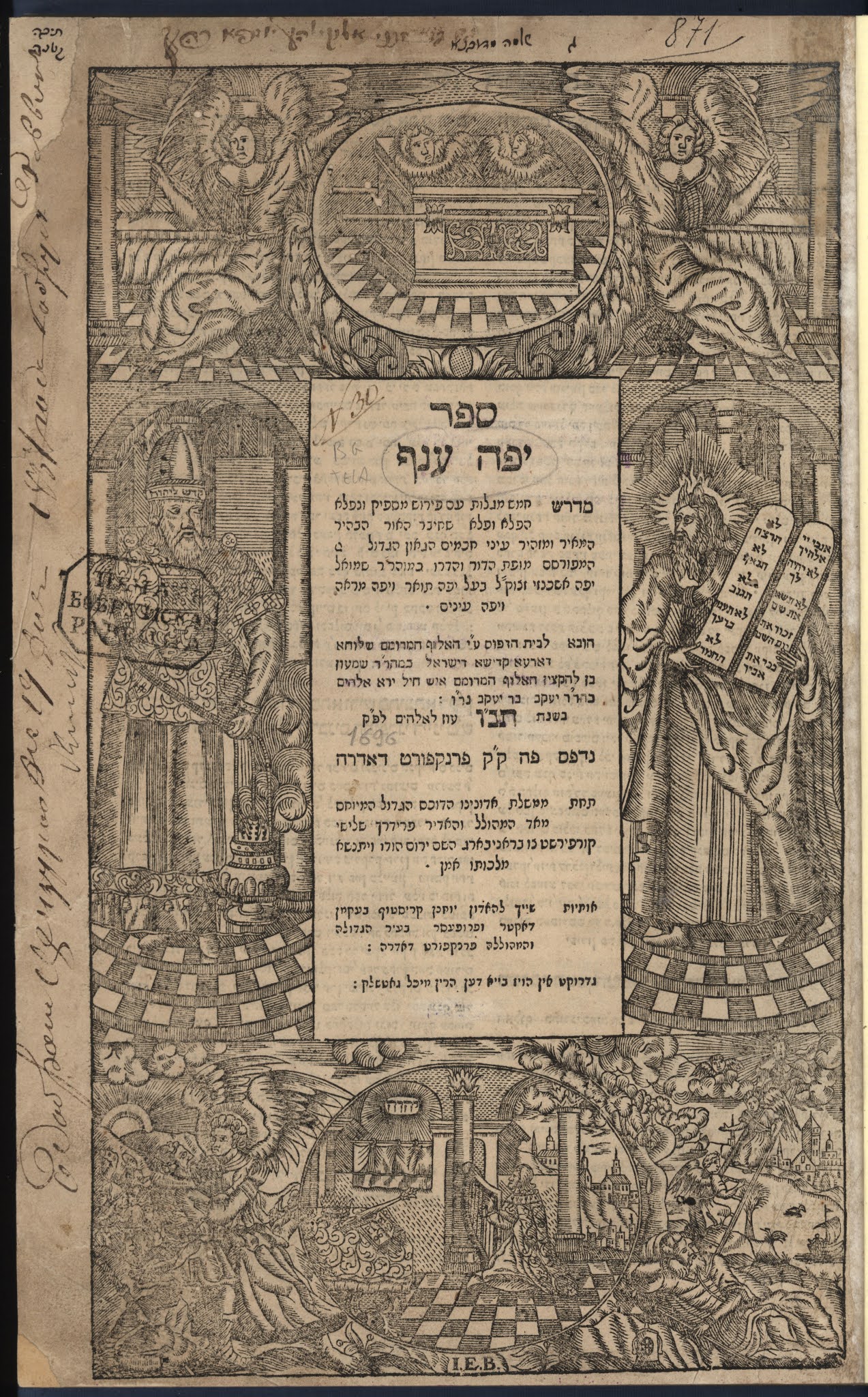
The first illustrated Jewish title pages appeared in the early seventeenth century. In 1693, the first depiction of Jacob’s dream graced a Jewish title page. That book, Sefer Rabbot, Midrash Rabba, with the commentary of R. Yisachar ben Naftali Katz, printed in Frankfurt on the Oder by Michael Gottschalk.


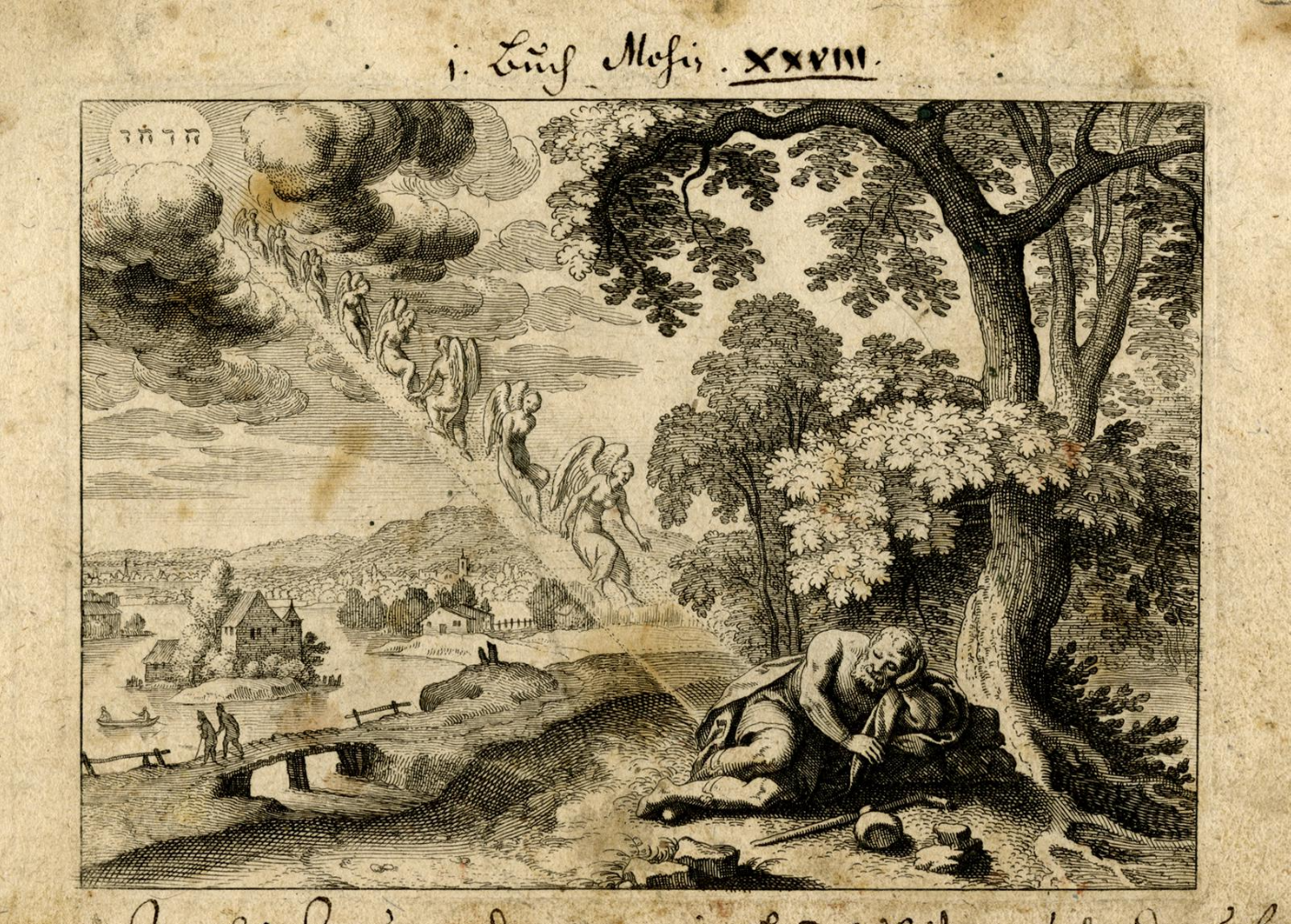
He was a local bookbinder and bookdealer who took over the management of Johann Christoph Beckman’s printing press in Frankfort d.O. in 1693, and led the press for almost forty years.[4]  Sefer Rabbot’s title page includes Moses and Aaron (who first appear in the 1610 edition of the She’a lot u-Teshuvot Mahril, printed in Hanau (see “Aaron the Jewish Bishop”), at the top, angels around the ark, and at the bottom, three biblical scenes, Jacob wrestling with the angel, David praying, and Jacob’s dream. It is obvious that these images are modeled after Matthaeus Merian’s engravings of biblical scenes that accompanied his Icones Biblicae printed between 1625-1630. All three of these images can be traced to Merian based upon a number of similarities and artist conventions.

The image of Jacob’s dream depicts, in both instances, Jacob laying next to a tree, boats and houses appear in the background, and angels’ hands are outstretched to greet Jacob. There is one significant puzzling difference. In Merian’s depiction, he substitutes the letters (reversed) of tetragram for God. In the Jewish book, God is depicted as an old man with a beard wearing a crown. This, despite Judaism’s strong prohibition on depicting God in a human form.

(This is not the only instance of a Jewish book containing a human image for God. The title-page of the first edition of R. Yedidia Shlomo of Norzi’s commentary on the biblical mesorah, Minhat Shai, Mantua, 1742-44, includes a depiction of God with a human face.   The images on the title page are various biblical vignettes and in the one for the resurrection of the “dry bones” that appears in Yehkezkel, God is shown as an old man with a white beard.)

Here is that image in detail:

Michael Gottschalk reused the Rabot title page at least five times; in 1695, for R. Shmuel Yaffe, Yafe Anaf, in 1696, Mattityahu ben Asher Lemle Liebermann, Mattat Yah, in 1698 in R. Benjamin Ze’ev Wolf ben Samuel Romaner’s Ir Binyamin,  in 1699 in Ohel Yaakov, and in 1602 in Yisrael b. Aaron Yaffa, Or Yisrael.


These title pages are just a few of Gottchalk’s illustrated title pages. Gottshalk artistic sensibilities are on full display in his 1697-99 edition of the Talmud, a work for which the Frankfurt press is best known to this day. It contains arguably the most magnificent Talmudic title page ever printed.

In 1695, the first illustrated copperplate Haggadah was published in Amsterdam. All the images are modeled based upon Merian. The title page too contains a number of biblical scenes in circular medallions. One of which is Jacob’s dream.

The next title page that depicts Jacob’s dream appears in Tzvi Hirsch ben Rachmiel Chotsh’s, Shiv’im Tikunei ha-Zohar, Hemdat Tzvi, Amsterdam, Moshe ben Avraham Mendes Coutinho, 1706.[5] Like the Gottchalk’s image that includes heretical iconography, those of Shiv’im Tikunei ha-Zohar would prove equally problematic.[6]

Despite Hemdat Tzvi’s impressive approbations, R. Jacob Emden accused Chotsh, and specifically this book, of holding and expressing Sabbatian beliefs.[7] It has been conclusively demonstrated that indeed Chotsh’s book contains Sabbatian ideas.[8] Evidence of Chotsh’s embrace of Sabbateanism is identifiable amongst the title page images. Indeed, Chotsh calls attention to the larger meaning of the title page’s images. At the bottom of the title page Chotsh provides that “whosoever wishes to know the secret of the above frontispiece, should see the introduction to the Tikkunim at the beginning of the first article.” An inspection of that section yields likely Sabbatian passages. Thus, Chotsh is indicating that like the introduction, the title page also contains allusions to Sabbateanism.

The title page depicts a variety of biblical figures and Jacob’s dream appears at the top center of the page. Above that are two deer holding a crown with the verse from Isaiah 28:5, “On that day will the Lord of the hosts be for a crown of glory, and for a diadem of beauty.” The “crown of glory” or in Hebrew “Ateret tzvi” has a double meaning here, “glory” and “deer” and, of course, is alluding to Sabbatia Tzvi, who, “on that day” will be presumably wearing the crown.[9]

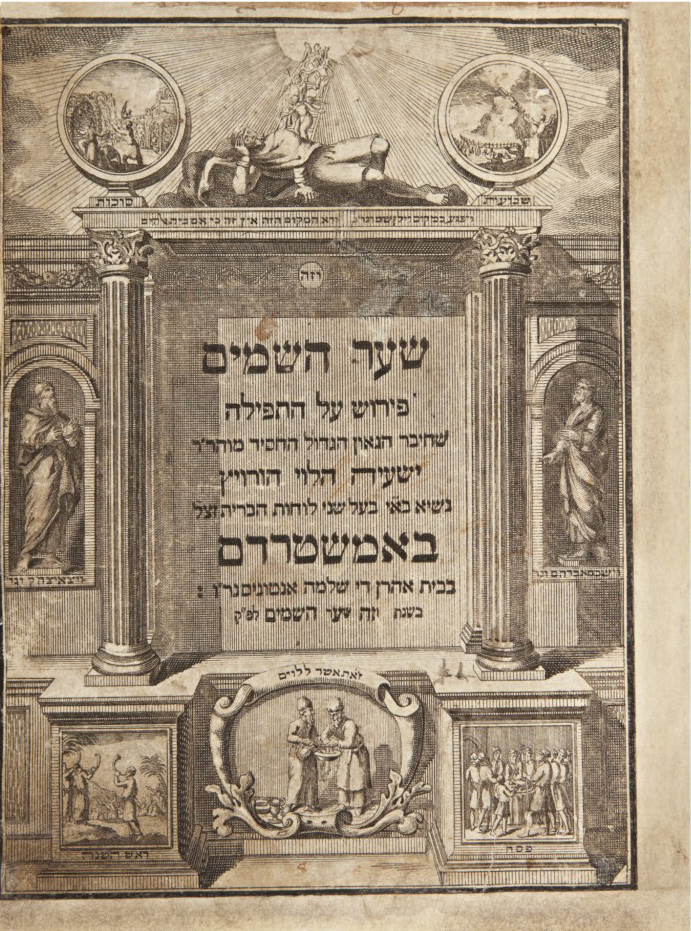
The most long-lasting depiction of Jacob’s dream is that which appeared in Siddur Shaarei Shamyim from R. Isaiah ha-Levi Horowitz (Shelah), Amsterdam, 1717.[10]

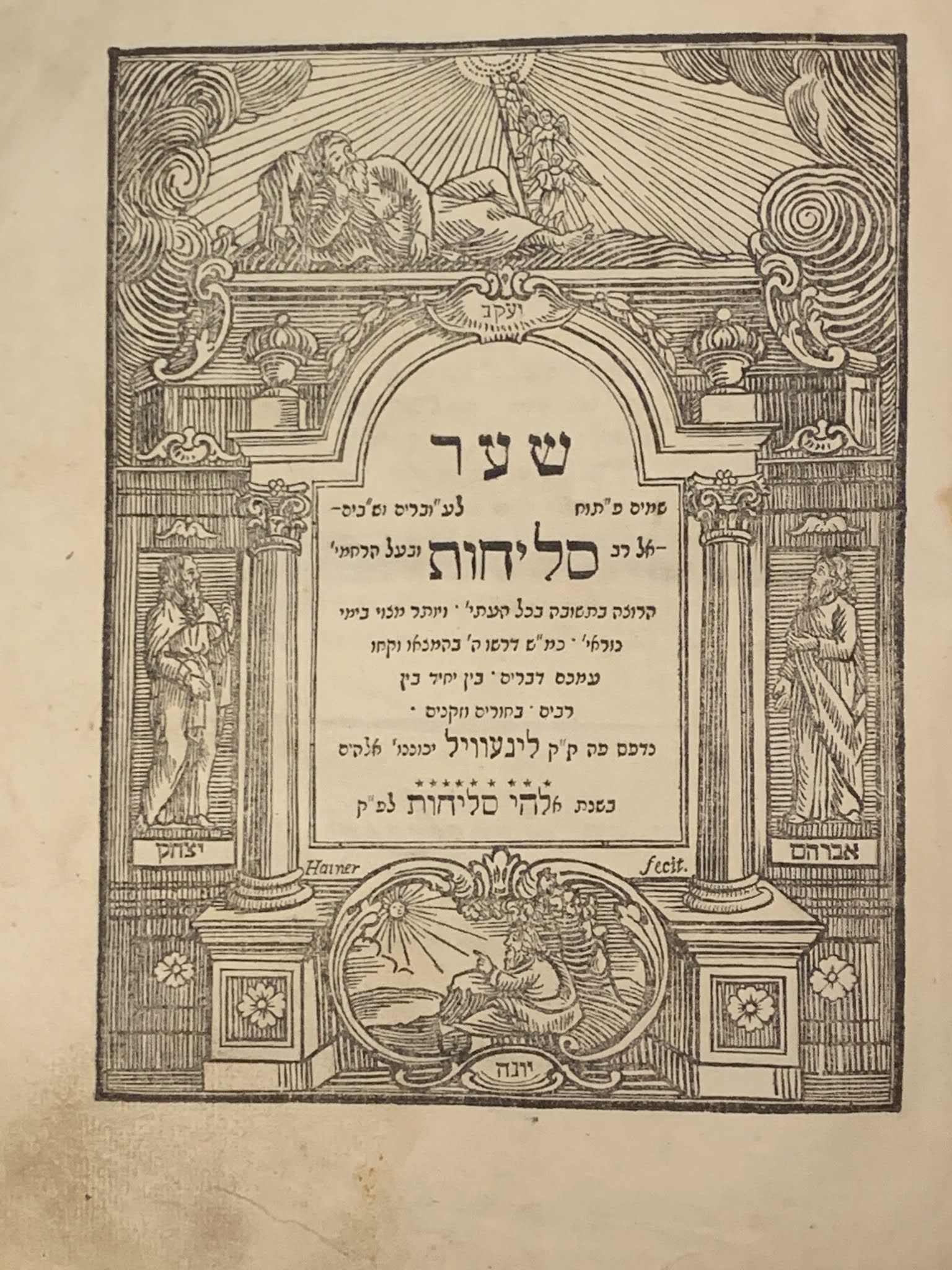
This title page is notable in that the accompanying images that align with the book which was not always the case. This is a complete machzor and as such four holidays, Sukkot, Pesach, Shavout, and Rosh Hashana, are represented on the top encased in circles, and underneath the columns. On one side of the bottom of the pillars. On either side is a niche, on the right with Abraham with the legend and on the left, Isaac, underneath each is a verse corresponding to prayer. Displayed prominently at top center, depicting his dream, with the verse from which the book’s title is derived. Underneath the title is a depiction of the Levites pouring water over the priest’s hands with the legend above, Ze hasher la-leviim. This is a reference to R. Horowitz’s lineage. All of the biblical images correspond with Merian’s depictions.

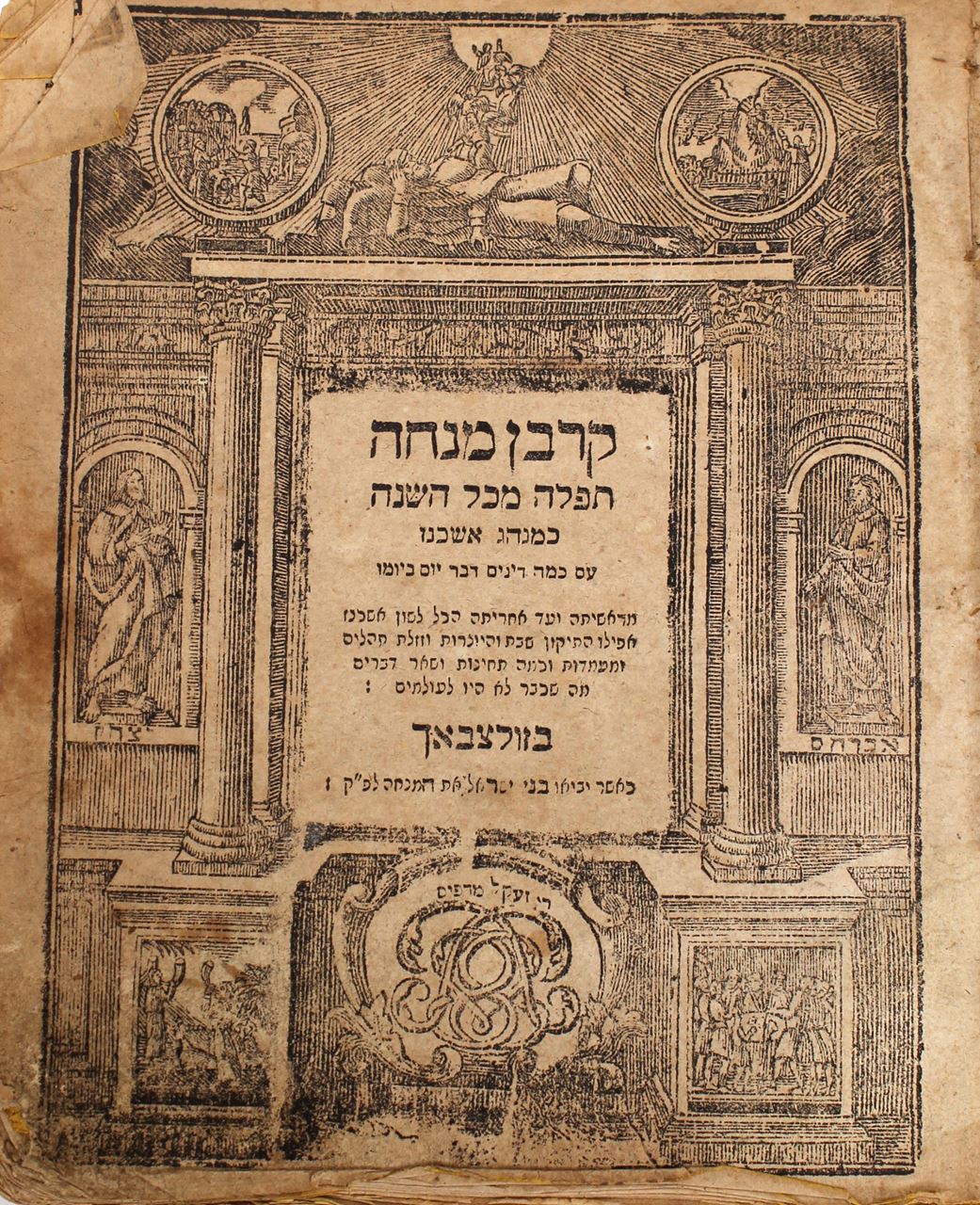
This title page, with small modifications, was repeatedly copied and is found in books from across Europe. One explanation for the ubiquity of this title page is that the Siddur ha-Shelah was imbued with talismanic effect. R. Yoel Sirkes in his approbation assures that whoever prays from this book their prayers would be answered. As evidence of the talismanic effect of the book one only needs to look to recent auctions where the book is regularly sold for tens of thousands of dollars. Perhaps printers looking to capitalize on the aura surrounding the Siddur ha-Shelah incorporated the images in their books.

For example, the title page appears in Edut be-Yaakov, Sulzbach, 1741,[11] in 1765, Furth, Siddur Korban Minha, and in 1797, in the north west of France in Luneville, Sha’ar Selihot ve-Tahanunim. In the latter, the Levite is substituted for Jonah as that is more aligned with the High Holiday themes of the book, and the four depictions of the holidays are removed because they conflict with the singular nature of the book.

Illustrated Hebrew title pages are perhaps the most ubiquitous, and certainly the most accessible form of Jewish art. Yet, the study of the art of the Hebrew title page has not attracted commensurate scholarly interest. Our example, tracing the depiction of Jacob’s dream, is but one instance that illustrated Hebrew title pages fit within the larger history of Jewish art. Here, the Hebrew title pages seventeenth- and eighteenth-century Hebrew books harken back to the iconography identified at Dura Europos that continued to appear in Jewish artistic forms, in this instance books.

[1] Gabrielle Sed-Rajna, Jewish Art (New York: Harry N. Abrams, Inc., 1997), 127.

[2] Gabrielle Sed-Rajna, Jewish Art (New York: Harry N. Abrams, Inc., 1997), 559.

[3] E.L. Sukenik, Bet-haKeneset shel Dura-Europa ve-Tserayav (Jerusalem: Mossad Bialik 1947), 112-3.

[4] B. Friedberg, History of Hebrew Typography in Central Europe (Antwerp, 1935), 35-49.

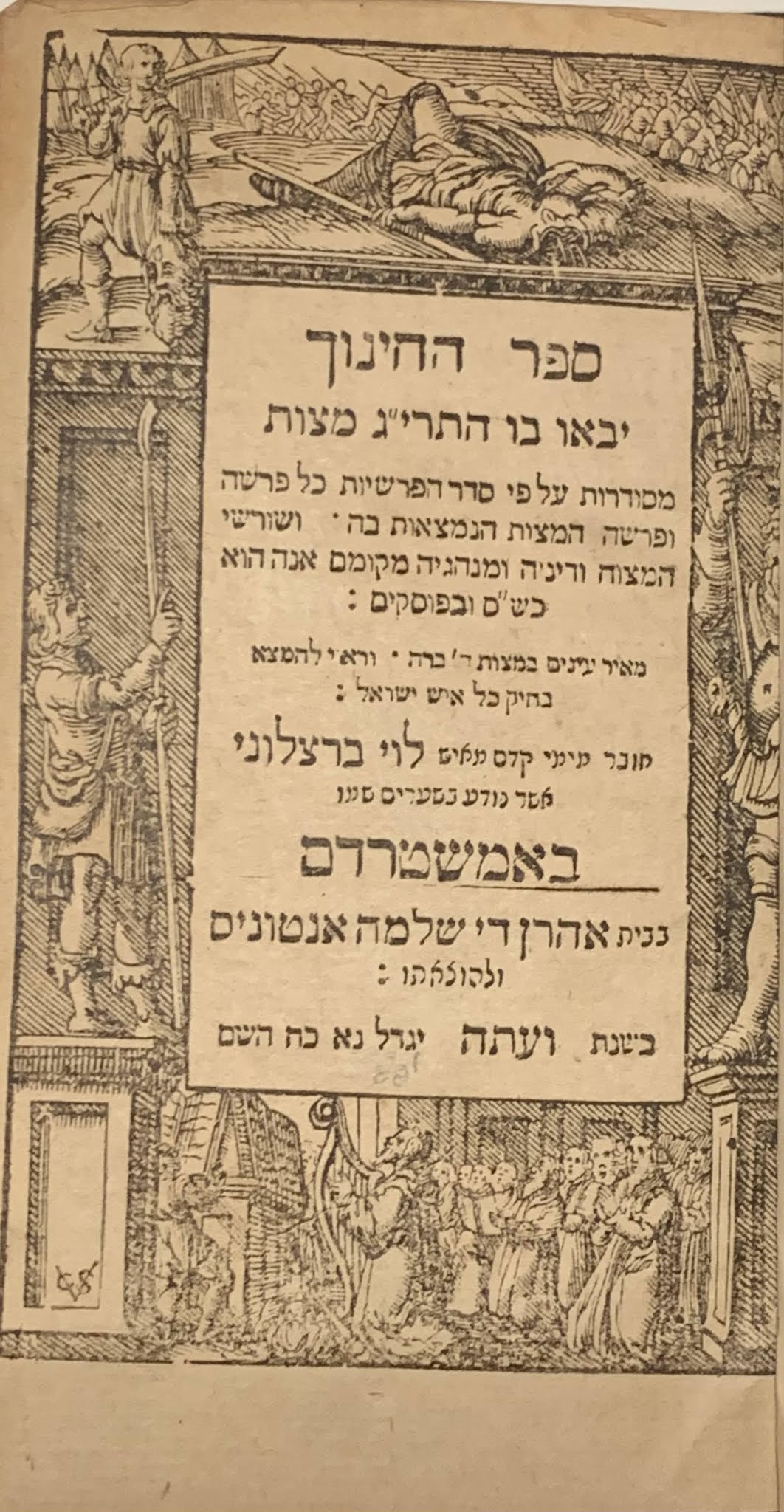
[5] Like Gottschalk, Coutinho also produced a number of other illustrated title pages with biblical images.In 1696, the year before he published the siddur, he published at least two books with illustrated title pages, Sefer Hinukh and the Mishna. This title page was reused in Coutinho’s 1698 edition of R. Hayim Moshe Karinal, Yemin Moshe.   

[6] Bezalel Naor, Post-Sabbatian Sabbatianism, (Spring Valley, NY: Orot, 1999),79-82.

[7] See Shnayer Leiman, “Sefarim ha-Hashudim be-Shabbta’ot: Rishimat shel ha-Gaon Yavet”z Tzal,” in Sefer ha-Zikhron le-Rebi Moshe Lifschitz, (New York, 1996), 890

[8] See Naor, Post-Sabbatian, 80-81 and the sources cited therein.

[9] Of course, Shabbatai Tzvi is not the only “Tzvi,” Chotsh’s first name is Tzvi. Perhaps the image is an allusion to his name – a somewhat common theme in Hebrew title page illustrations. Recently, however, one scholar noted that the deers are not the only Sabbatian reference. According to his theory, the layout of the biblical figures aligns with kabbalistic representations of the sefirot.  See Naor, 81.

[10] Horowitz’s other book, Sheni Luhot ha-Brit, Amsterdam, 1698, also contains a beautifully illustrated title page.

[11] The title page was reused for decades in the Sulzbach presses. As late as 1794, there are examples of the title page. See, e.g. Tsenah u-Renah, Sulzbach, 1794.


Haftaros of Vayetze and Vayishlach – A Mistake Rectified

Haftaros of Vayetze and Vayishlach – A Mistake Rectified[1]

By Eli Duker

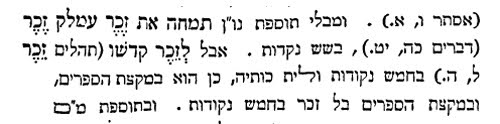
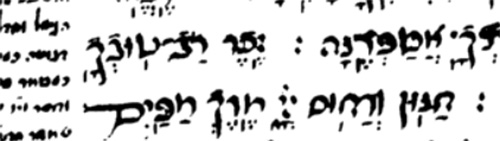
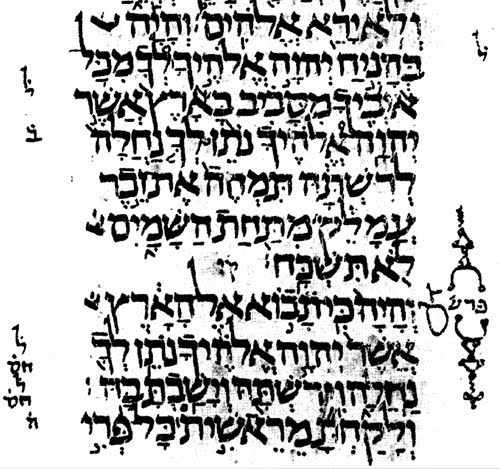
There had been one practice throughout the Jewish world concerning the Haftara of Vayishlach until the print revolution. The book of Ovadia is the Haftara listed in every Haftara list, including the one in the Rambam’s Seder HaTefillos in the Mishneh Torah, MS Ginsburg Moscow of the Machzor Vitry,[2] Etz Chaim (written in London on the eve of the Edict of Expulsion),[3] Abudarham,[4] and the list of Rabbi Shmuel Hanagid, cited in the Sefer HaEshkol.[5] It is also the Haftara in the “Emes” piyyut written by Rabbi Shmuel Hashelishi[6] and the “Zulas” piyyut written by Rabbi Yehuda B’Rabi Binyamin.[7] This is also the Haftara listed in all chumashim in manuscript[8] and in all Cairo Geniza fragments9 that I have seen.

This was also the practice of those who followed the triennial cycle in Eretz Yisrael,[10] the Haftara for the sidra of Vayishlach Yaakov was from the book of Ovadia. The reason for the Haftara is clearly due to it being a prophecy about Edom, and Edom is discussed in depth in the parasha.

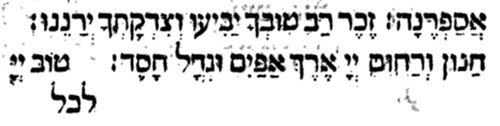
The universal practice in all communities was to read from the book of Hoshea for the Haftara of Vayetze, but not everyone read the same verses. In all Geniza fragments[11] the Haftara begins at 11:7, “Ve’ami seluim.” In the fragments with a clear end to the Haftara I have found 3 that end at 12:14,[12] which is similar to what appears in the list of in the Rambam’s Seder HaTefillos, making it a classic Haftara of exactly twenty-one pesukim. One source has it end at 13:4,[13] which is the “Zulas” piyyut written by Rabbi Yehuda B’Rabi Binyamin for this parasha,[14] as well as in the Sefer HaShulchan, written by a student of the Rashba. The reason for the Haftara is due to the verse “Vayivrach Yaakov ,” which is clearly related to the events of the parsha, as well as, possibly, the mention of “Bes El” in 12:5

There were two different Ashkenazi practices in the pre-printing era. One was to begin at 12:13, “Vayivrach Yaakov ,” and to read until the end of the book. This is the Haftara found in MS Ginsburg Moscow of the Machzor Vitry,[15] Etz Chaim,[16] and in 12 of the 16 Ashkenazi chumashim in manuscripts I checked. Outside of Ashkenaz this was the practice among the Romaniots. It is also found in the “Zulas” piyyut of Rabbi Shmuel Hashlishi,[17] who lived in Eretz Yisrael in the 10-11 centuries and belonged to a community that read the Torah according to the annual cycle (although the Haftara ends there at 13:4, making it a Haftara of just seven verses!). It was also the Haftara for the sedra of “Vayetze Yaakov” in the triennial cycle of Eretz Yisrael.[18]

The secondary practice in Ashkenaz, which I found in three chumashim in manuscript, was to read starting from 11:7. One manuscript has the Haftara ending at 12:14,[19] and the other two end at 13:5.[20] The latter is the practice of the Ashkenazi community of Amsterdam.[21]

The first printed chumash with Ashkenazi Haftaros was the Soncino, printed in Brescia in 1492. It had the Haftara beginning at 12:13, following most other Ashkenazi sources. The 1517 Bomberg chumash, printed in Venice, has printed Haftaros according to both the Ashkenazi and Sephardi practices, and has the Haftara for Vayetze beginning at 11:7. After 13:5, the word “כאן” in written, followed by something that was erased (in the microfilmed copy of the Israel National Library) followed by “ההפטרה לספרדים,” that this is where the Haftara ends according to the Sefardi practice, which is quite normative. But before 12:13, at the front of the page, the words “הפטרת וישלח לאשכנזים” appear. The Haftara of Vayishlach in that chumash is from Ovadia, without any instructions, indicating a discrepancy between the two practices. It is clear that a mistake was made here, as Hoshea 12:13 is an Ashkenazi Haftara for Vayetze, not Vayishlach.

The 1517 chumash did not sell well among Jews, likely because its editor, Felix Pratensis, was a Jewish convert to Christianity.[22] In 1524 Daniel Bomberg published another chumash, this time with Yaakov ben Chayim ibn Adoniya as his editor, and this edition was much more popular among Jews. It is essential an entirely different book, as this editor did not rely on the first edition, yet, the Haftaros were, by and large, copied from the first edition, with only minor changes. Concerning our topic, the Haftara for Vayetze is 11:7, without any indication that there are other practices. Right before 12:13 it is written “כאן מתחילין הפטרת וישלח האשכנזים” with no indication where Sephardim finish the Haftara. Here too, Ovadia is listed as the Haftara for Vayishlach, without any instructions indicating that there is a discrepancy between communities.

The popularity of the chumash (already called “Mikraos Gedolos”) created a situation where a new reality was created. The Ichenhausen chumash, published in 1544, merely copied the Haftaros and their instructions from the second Bomberg chumash.

By contrast, another Venetian publisher, Marco Antonio Giustiani, also in 1544, went even further, and wrote in his chumash concerning the Haftara from Ovadia as “הפטרת וישלח כמנהג בני ספרד”. The instructions in this chumash created three changes:

  • It shortened the Sephardi Haftara for Vayetze and ended it at 12:12, a verse that that discusses the Israelites performing pagan sacrifices and the ramifications of this, an extremely inappropriate way to complete a Haftara.
  • It ignored the widespread Ashkenazi practice to begin the Haftara of Vayetze from 12:13. Instead, it has them all starting at 11:7 (as well as completing the Haftara at 12:12, which was unheard of).
  • It created a new Ashknenazi Haftara for Vayishlach, from Hoshea, which has nothing to do with the parsha at all, and did away with the reading from Ovadia, which had been a universal practice until that time.

Not all chumashim “ruled” in such a manner. In the Lublin chumash of 1517, the original Ashkenazi Haftaros of Hoshea 12:13 for Vayetze and Ovadia for Vayishlach were listed. Likewise, the Levush, published in 1590, listed these Haftaros as well.

Soon after, we begin to see many chumashim following the new practice. For example: Manitoba – 1589, Frankfurt am Main – 1662, Venice – 1684, as well Haftara books published in Frankfurt Oder in 1685 and in 1708. Yet, I found chumashim from this period with the original Ashkenazi Haftaros, but they were both printed in Prague, which is known to have kept the original practice, as will be discussed below.

The first to point out the error of the new chumashim was Rabbi Avraham Gombiner, in his commentary, Magen Avraham, on Orach Chayim of Shulchan Aruch in siman 428:[23]

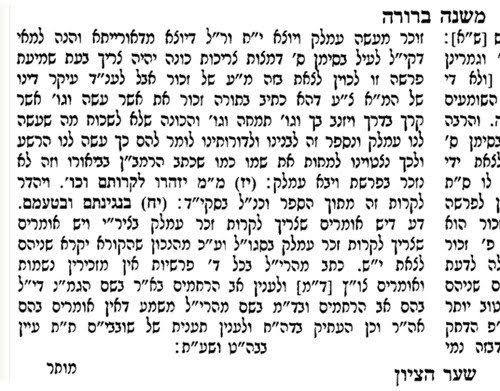
מה שכתב בחומשי’ ויברח יעקב לפ’ וישלח ט”ס הוא ושייכ’ לפ’ ויצא (לבוש)

Magen Avraham was first published in 1692, after the author’s passing. He does not explicitly mention what the Haftara for Vayishlach is, but as he cites the Levush, it is clear that he meant it is from Ovadia, as with the exception of the new practice of reading Hoshea 12:13 for Vayishlach, which the Magen Avraham clearly rejects, Ovadia was the only known Haftara for Vayishlach. Nevertheless, chumashim printed after the publication of the Magen Avraham continued to list Hoshea 12:13 as the Ashkenazi Haftara for Vayishlach.[24] Even the chumash published by R’ Shabs ai Bass, author of the Sifsei Chachamim and publisher of Magen Avraham, had this as well.

In 1718 the book “Noheg Katzon Yosef” by Rabbi Yosef Yozefa Segal was published, a work on the practices of German communities in general and Frankfurt am Main in particular. He wrote the following concerning parashas Vayetze:[25]

כתב בלבוש החור ס’ תרס”ט שהפטרה של סדר זו הוא ויברח יעקב, והפטרת וישלח הוא ועמי תלואים, עיין שם. והנה באמת במקומות שמחלקים שתי פרשיות אלו מהושע לאמרם לשתי הפטרות משתי שבתות אלו היה הדין עם הלבוש להקדים המאוחר ולאחר המוקדם. דכד נעיין ביה שפיר נראה שכתיב ויברח יעקב “ובאשה שמר” שהוא מלשון ואביו שמר את הדבר, כלומר המתין עד שתנא ראויה לביאה, או ששמר את הצאן בעד האשה, שהוא מעין פרשת ויצא. ובעמי תלואים כתיב וישר אל המלאך ויוכל , שהוא על שם הכתוב כי שרית עם אלקים ועם אנשים ותוכל הכתוב בוישלח. א”כ למה לנו ליתן את של זה בזה ושל זה בזה? ואפשר שיצא משבשתא זו מפני ששתי הפטרות אלו הם סמוכים בקרא, ועמי תלואים מוקדם במקרא, לפיכך שמו המוקדם במקרא לפרשת ויצא המוקדמת, והמאוחר לפרשת וישלח המאוחרת. והמנהג בק”ק פ”פ שמפטירין בויצא מן ועמי תלואים עד סוף הנביא, דהיינו שתי הפטרות אלו ביחד, שמספר מה אירע ליעקב. ועיין מה שכתבתי בפרשת וישלח

It is written in the Levush Hachur siman 769 that the Haftara for this seder is “Vayivrach Yaakov ,” and the Haftara for Vayishlach is “Ve’ami seluim.” In reality, places that divide the Haftara from Hoshea in order to read it as two Haftaros over two Sabbaths should follow this Levush and read the latter part first and the earlier later, as when one looks examines the matter one see it says in “Vayivrach Yaakov ” (the words) “he guarded his wife,”[26] which is similar to, “and his father kept the matter in mind,”[27] meaning [Yaakov] waited until she was fit for marriage, or it means he guarded the sheep in order to marry the woman, which is similar to parshas Vayetze. And in “Ve’ami seluim” it is written “he strove with an angel and prevailed,” which is based on the verse “for you have striven with beings divine and human and prevailed,” which is written in Vayishlach. Therefore, why should we read them in the opposite order? It is possible that this mistake occurred because these Haftaros are adjacent to each other, and “Ve’ami seluim” appears first. Therefore, they put the first Haftara for Vayetze, which is the earlier parsha, and the latter one for the later Vayishlach. But the practice in Frankfurt is to read “Ve’ami seluim” until the end of the book, meaning to read both Haftaros together.

This piece is rather difficult to comprehend.

  • First, the Levush says nothing of the sort. The author proceeds to try to explain the mistake that developed due to the Levush, who did not write what is ascribed to him.
  • He recommends reversing the orders of the Hoshea Haftaras, rather than recommending that Ovadia be read, which he cites later as the practice in Frankfurt.[28]
  • He claims that the Frankfurt practice is to read from 11:7 until the end of Hoshea for Vayetze. All other sources claim that the practice there was to read from 12:13 for Vayetze and to read Ovadia for Vayishlach, and there is no other source for this “double Haftara” anywhere.

The Rav of Frankfurt, Rabbi Yaakov, author of the Shav Yaakov, wrote an approbation for the book “Noheg Katzon Yosef,” but after he found many errors he asked Rabbi Yehuda Miller, the author’s father-in-law, to fix the errors.[29] Some later printings of the book included these corrections in a booklet called “Tzon Nachalos,” where he wrote that the author was indeed mistaken with regard to the practice in Frankfurt.[30]

In 1729, eleven years after the publication of Noheg Katzon Yosef, Rabbi Yitzchak Aizik Mis wrote a commentary on the Haftaros known as Be’er Yitzchak, which was published in Offenbach, a town quite close to Frankfurt. He listed there various halachos and practices connected to Haftaros. He wrote there:[31]

בכל החומשים נפל טעות שציינו להפטורת ויצא ועמי תלואים ולפ’ וישלח ויברח יעקב וצריך להיות לפ’ ויצא ויברח יעקב לפי שבו כתיב ובאשה שמר שהוא מעניינא דפרשה ששמר את הצאן בעד האשה ולפ’ ושילח ועמי תלאים לפי שבו כתיב וישר אל מלאך ויוכל וגו’ שהוא מעניינא דפ’ כי שרית עם א-הים ועם אנשים ותוכל ובק”ק פרנקפורט דמיין אומרים לפ’ ויצא ועמי תלואים וגם ויברח יעקב ולפ’ וישלח חזון עובדיה

All of the chumashim have a mistake, as they cite the Haftara of Veyetze as “Ve’ami seluim” and that of Vayishlach as “Vayivrach Yaakov ,” while the Haftara for Vayetze should be “ Vayivrach Yaakov ,” as is written there “he guarded a wife” which is the matter of the parsha where (Yaakov) guarded the sheep for the wife’s sake, and that of Vayishlach should be “Ve’ami seluim,” as it is written there he strove with an angel and prevailed, which is the matter of “for you have striven with beings divine and human and prevailed.” In Frankfurt am Main they say “Ve’ami seluim” and “Vayivrach Yaakov ” for Vayetze, and “Chazon Ovadia” for Vayishlach.

It is clear that he did not just copy this out of the Noheg Katzon Yosef, as he views what is printed in chumashim as a mistake, while the Noheg Katzon Yosef mistakenly attributed it to the Levush. But it seems likely that his (erroneous) statement concerning the Frankfurtian practice does come from there.[32]

The famous printing press in Amsterdam, Proops, published a chumash in 1712 with similar Haftaros for these parshiyos to the Venice chumashim, but in another chumash, the 1734 edition, in the Haftara for Vayetze before 12:14 it is written כאן מתחילין האשכנזים פרשת ויצא while for Vayishlach, Ovadia is listed as the Haftara for Sephardim, with no mention of the Ashkenazi practice at all. It is likely that the publisher, who published a Shulchan Aruch with Magen Avraham,[33] was aware of the comment there concerning the mistake in the chumashim about the Haftara of Vayetze, but someone along the line did not realize the ramifications of this and just left Ovadia as the Haftara for Sephardim alone.

The 1754 Proops chumash cited the Venteian Haftaros, possibly as the best method to correct the error of the earlier chumash omitting an Ashekenzi Haftara for Vayishlach. But in the chumash they published in 1762, the following appears before the Haftara for Vayetze, Hoshea 11:7:

והמנהג הנכון לאשכנזים להפטרת ויצא ויברח יעקב וכן כתוב באחרונים

Before Hoshea 12:14 the following appears:

כאן מתחילים האשכנזים הפטרת וישלח, והמנהג הנכון לאשכנזי’ זהו הפטר’ ויצא ועמי תלואים שייך להפטר’ וישלח

It seems that the so-called “achraronim” mentioned here are the Be’er Yitzchak and the Noheg Katzon Yosef.

These Haftaros appear in later Proops chumashim in 1767 and 1797, as well as in another Amsterdam chumash, published in 1817 by a doctor named Yochanan Levi.

Other chumashim of the period continue to cite the Haftaros as they were listed in the Venice chumashim.[34]

Rabbi Shlomo Ashkenazi Rappaport of Chelm, in his Shulchan Atzei Shitim, wrote that the Haftara for Vayetze is Hoshea 12:14, and the Haftara for Vayishlach is from Ovadia, and in his Zer Zahav commentary he wrote:[35]

ויברח יעקב – ודלא כמו שנרשם בחומשים בטעות ויברח יעקב לפרשת וישלח דשייך לפ’ ויצא (ס’ תכ”ח)

This is clearly based on Magen Avraham.[36] It seems that his opinion concerning the Hafatros was not accepted in his day.[37]

Eighteenth-century Amsterdam was major center of Hebrew printing, and Proops was quite famous in terms of print quality, and in particular for using new methods for marketing their books.[38] Books from there were shipped to Danzig, from where they made their way into Eastern Europe. [39] Proops’ books were very popular there, which enabled them to raise the necessary funds to print a new edition of the Talmud Bavli[40] Rabbi Avraham Danziger, having grown up in the city, would have likely been exposed to the many sefarim published by Proops, and it is likely that he had their chumashim. The first edition of his Chayei Adam was published anonymously in 1810, and the matter of these Haftaros is not raised there, but in the second edition, published in the author’s lifetime in 1819, is it written:

מה שכ’ בחמשים הפטרת וישלח ויברח יעקב הוא טעות אלא בויצא מפטירין מן ויברח עד ויכשלו בם ובוישלח מפטירין מן ועמי תלואים וגם מקצת ויברח יעקב עד ומושיע אין בלתי (תכ”ח):

What was the source for this statement of the Chayei Adam? It does not seem likely that it is Noheg Katson Yosef, as that book had been published only once, a century earlier.[41] It is also not likely to be the Be’er Yitzchok, which was published in faraway Offenbach. It seems reasonable that he was exposed both to the Proops chumashim (or others with those Haftaros), as well as other chumashim with the Venetian Haftaros, which he saw as mistaken, and when he referred to “what is written in the chumashim,” he did not mean all of them.

The publishers of this of this edition, Menachem Mann and Zimmel, published a chumash for Ashkenazim in 1820 with Hoshea 14:12 as the Haftara for Vayetze and 11:7 for Vayishlach, likely following what was the ruling of the Chayei Adam at the time.

The next edition of the Chayei Adam was published in 1825, several years after the author’s death. As it had the same publisher, it seems unlikely that any changes were made by anyone but him. It is written there:

מה שכ’ בחומשים הפטרת וישלח ויברח יעקב הוא טעות אלא בויצא מפטירין מן ויברח עד סוף הושע (ואח”כ פסוקים מיואל ואכלתם אכול וכו’ וידעתם וכו’ ג”כ מטעם לסיים בטוב( ובוישלח מפטירין מן ועמי תלואים וגם מקצת ויברח יעקב עד ומושיע אין בלתי ועפ”י הגר”א נוהגין להפטיר בפ’ וישלח וישלח חזון עובדי’ (תכ”ח)

We see two changes here.

  • That two verses from Yoel should be added in to the Haftara for Vayetze (which he already pointed out in the previous edition is Hoshea 12:14) which otherwise ends with the mention of sinners stumbling.[42] Evidently, earlier authorities did not think it necessary to avoid such an ending. This is cited by the Mishna Berura,[43] but is not written in any chumashim published before the Holocaust.
  • He mentions that the Vilna Gaon ruled that we read Ovadia as the Haftara for Vayishlach, and those who follow him do so. The author of the Chayei Adam was related to the Vilna Gaon by marriage, and prayed with him in the Vilna Gaon’s Kloyz.

These additions were printed in later editions of the book.[44]

During the same year, 1819, Rabbi Efraim Margolies published the Sha’arei Efraim,45 which sounded similar to what was written in the Chayei Adam published in that same year:[46]

מה שנרשם במקצת חומשים הפטורת ויברח יעקב לפ’ וישלח הוא ט”ס, כי הוא שייך לפ’ ויצא, והפטורת וישלח בהושע ועמי תלואים למשובתי

It is unlikely that he saw the edition of the Chayei Adam that had been published just a few months beforehand. The fact that he writes that reading Hoshea 12:14 as the Haftara for Vayishlach is a mistake that appears in some chumashim indicates that he saw other chumashim with the Haftaros in what he considered the correct order, and is likely agreeing with them.

In the first edition of Shulchan Hakriah and Misgeres Hachulchan by R’ Dov Reifman, published in 1864, the opinion of the Sha’arei Efraim is cited,[47]  but in the second edition[48] it is not.

Later, the above-mentioned publisher of the Chayei Adam, Menachem Mann, changed his name to Romm and began publishing many books in Vilna, including the famous Shas Bavli. The chumashim published there had Hoshea 14:12 as the Haftara for Vayetze, and soon other publishing houses followed suit. Romm themselves continued to follow this approach,[49] even though luchos for Vilna printed in 1826[50] and 1839[51] had Ovadia as the Haftara for Vayishlach. It seems likely that in Vilna itself the publication of the Vilna Gaon’s practice in the Chayei Adam had an immediate effect.[52] Romm published the Toras Elokim chumash in 1874,[53] continuing to list Hoshea 11:7 as the Ashkenazi Haftara for Vayishlach, yet the following note was inserted before the Haftara:

הפטרה זו וגם הפטרת ויברח יעקב היא הפטרת ויצא לספרדים מפני שהם בנביא אחד אבל האשכנזים מפטירין בויצא רק ויברח יעקב ובוישלח חזון עובדיה כמבואר ברמב”ם ובלבוש

It is not clear what it means that both Haftaros are read by Sephardim for Vayetze, and it is rather strange that Hoshea 11:7 is listed for the Ashkenazi Haftara for Vayishlach with instructions that Ashkenazim actually read from Ovadia. Before the Haftara from Ovadia the following appears:

הגם שנמצא בחומשים כתוב שהיא הפטרה רק לספרדים אך מבואר ברמב”ם ובלבוש שהיא הפטרת וישלח בין לספרדים בין לאשכנזים

These instructions appeared in the Mikraos Gedolos chumash they published in 1880, and others used these rather strange instructions as well.[54]

The Mikraos Gedolos chumash published by Kadishson in Piotrkow had the Haftara from Hoshea 11:7 without any instructions, but wrote the following before the Haftara from Ovadia:

“כ”ה דעת הלבוש וראה עוד לזה ג”כ בסי’ תרפ”ד… הפטרת שבת א’ של חנוכה …

The Levush here explains that the reason why Zecharia is the Haftara on the first Sabbath of Chanuka while the fashioning of the menoras in Melachim in read on Chanuka only in the event that there is a second Sabbath is that that a Haftara discussing the future redemption is preferred, and the editor here felt the same applies to preferring Ovadia over Hoshea for parashas Vayishlach. The same instructions appear in the Romm Mikraos Gedolos printed in 1904.

Another Romm Chumash from 1898 had Ovadia as the Haftara for Sephardim only and Hoshea 11:7 for Ashkenazim. This chumash was reprinted in 1938, but that chumash was just a copy of one that was printed in Zhitomer in 1867, which is to this day viewed as the standard “shul chumash.”

The Chayei Adam as printed in 1825 edition onward is cited by the Mishna Berura.[55] It seems that by then many communities were reading Ovadia for Vayishlach.

The practice of returning to the original Ashkenazi Haftara was not limited to Vilna and its environs. Shortly after the publication of Sha’arei Efraim, we find many communities in what became the Austro-Hungarian empire (where Rabbi Efraim was from) who read Ovadia for Vayishlach. This includes Vienna,[56] Tarnow,[57] Pressburg[58] Erlau,[59] and Eperjes.[60] But the practice in Gálszécs[61] was to read Hoshea 11:7 for Vayishlach. This was the practice in Warsaw in Russian Poland as well, according to the luach from there in 1889. By contrast, in Przeworsk[62] they still maintained the Haftaros, based on the Venice chumashim, Hoshea 11:7 for Vayetze and 12:13 for Vayishlach.

Cities that retained the original Ashkenazi practice throughout

It is impossible to know the effect of printed chumashim in various eras on every local practice, but it is clear that there were communities that simply ignored them and continued the old practice from before the era of printing. We have already seen that that was the case in Frankfurt. This was the practice in Worms as well, as seen in “Minhagei K”K Vermeiza” by Rabbi Yosefa Shamash, circa 1648.[63]

Concerning Mainz, in “Minhagei K”K BeSeder HaTefilla Unuschoseha” in the Sefas Emes siddur printed in 1862,[64] Hoshea 12:14 is the Haftara for Vayetze. Although this is a late source, it seems to reflect a very early practice and only Haftaros that are not universal in Ashkenaz[65] are written there, which is why it does not mention the Haftara for Vayishlach, which by then was standard in Ashkenaz.

Concerning Prague (Bohemia), as mentioned earlier, chumashim there retained the original Haftaros of Hosea 13:12 for Vayetze and Ovadia for Vayishlach after they ceased to be printed as the Haftaros elsewhere. One chumash printed there 1697 does not, but it states explicitly that the Hafatros are as they are printed in Amsterdam. In Mendelsohn’s Biur, printed in 1836, the following is written:

‘מנהג פראג ויברח יעקב – והיא הפטרת וישלח כמנהג האשכנזים, ויש מתחילים אותה בהושע י”א פסוק ז

The verses between Hoshea 11:7-12:13 are printed in small letters, indicating they are generally not meant to be read by the intended audience. In a chumash printed in 1893, Ovadia and Hoshea 11:7 appear as Haftaros for Vayishlach, with these instructions before the former:

כמנהג האשכנזים רק בפראג ובמדינת בעהמען מפטירין חזון עובדיה

Before the Haftara from Ovadia the following appears:

כמנהג הספרדים פראג ומדינת בעהמען

In a chumash printed in Budapest in 1898 it is mentioned as a practice of Prague; not as one of all of Bohemia.

Just like there are different sources whether the original Haftaros were maintained in Prague alone or in all of Bohemia, there is a similar matter with regard to Frankfurt. In the chumash printed in Roedelheim in 1818 the Haftara for Vayetze is Hoshea 11:7. The note there states:

בק”ק פפד”מ ורוב אשכנז מפטירין בפ’ ויצא ויברח יעקב ואינם אומרים כלל ועמי תלואים

And for Vayishlach, where the Ashkenazi Haftara is listed as Hoshea 12:14, it is written:

כאן מתחילין האשכנזים הפטרת וישלח אבל בק”ק פפד”ם ורוב אשכנז מפטירין בפ’ וישלח חזון עובדיה דלקמן

The same appears in the 1854 chumash published there, as well as all subsequent printings, including the edition this chumash published in Basel in 1964.[66] The same notes appear in a chumash printed in Konigsberg[67] in 1851 and Vienna in 1864. A chumash printed in Furth in 1901 had Hoshea 11:7 as the Ashkenazi Haftara for Vayishlach, but mentioned that the practice in Frankfurt was to read from Ovadia.

Here there is evidence that the retaining of the original Haftaros spread beyond Frankfurt, as it was the practice in the old communities of Mainz and Worms.

Another community that appeared to have retained the old practice throughout is Posen, from which there is a Pinkas[68] with unique practices and carefully retained customs.

The original practice returned, as it was mentioned in sources and chumashim in the 19th century. It was in the luchos in the Austrio-Hungarian empire mentioned before and it was the practice in Chernowitz as of 1868. Later it was mentioned in the all of the luchos in Eretz Yisrael69] and in that of Ezras Torah in the United States, causing (or reflecting) that the old/new Haftaros became the standard practice for Ashkenazim.

The reacceptance of the two original Haftaros was and is not universal. The Beis Medrash Hayashan in Berlin read Hoshea 11:7 for Vayishlach until its bitter end,[70] while the practice of Kehal Adas Yisrael there was to read Ovadia.[71] The United Synagogue communities in the United Kingdom[72] (and some synagogues in some other Commonwealth countries) still read Hoshea, as it is listed as the Ashkenazi Haftara in the Hertz Chumash.[73] The Chabad[74] practice is similar to the Sephardi practice, and Amsterdam Ashkenazim read Hoshea 11:7 for Vayetze.

Adding verses from Yoel

The Chayei Adam cited this idea, which is then cited by the Mishna Berura. Two other options are mentioned in order to finish with a positive matter. One is to finish the Haftara earlier, at 14:7, and another is to add from Micha 7:18-20.[75]

Luach Eretz Yisrael of Rav Yechiel Michel Tucazinsky cites the practice of adding the two verses from Yoel. Lately, this practice has been cited by the Ezras Torah Luach in the United States.[76] Nonetheless, out of all of the chumashim that list the Haftara from Hoshea 12:13 for either Vayetze or Vayishlach, none mentioned this practice until the Koren Chumash of 1963, which cited that there are those who add the verses, and so is written in subsequent editions until today. By contrast, there are other Israeli chumashim that do not cite this practice.

The first edition of the popular English Stone Chumash, published by ArtScroll in 1993, did not cite this practice, but from the second edition onward the verses from Yoel are there, along with instructions in English that there are those who add them.

Summary

In the pre-printing era most Ashkenazi communities read Hoshea 12:14 for Vayetze and everyone read Ovadia for Vayishlach. This changed due to a mistake in the Venice chumash of 1517, after which most chumashim listed Hoshea 12:14 as the Ashkenazi Haftara for Vayishlach and Hoshea 11:7 for Vayetze. Magen Avraham noted this error, but mentioned only the correct Haftara for Vayetze, leading Noheg Katzon Yosef, Amsterdam chumashim, and after them the Chayei Adam and Sha’arei Efraim, to claim that Hoshea 11:7 is the Ashkenazi Haftara for Vayishlach. As time passed, and possibly due to the influence of the Vilna Gaon, the practice reverted to what it originally had been, to read Ovadia for the Haftara of Vayishlach.

[1] The topic of this article is the development of the Ashkenazic practices regarding these Haftaros. Any mention of other practices is just an aside. I would like to thank R’ Avraham Grossman for editing the original Hebrew and my brother R’ Yehoshua Duker for editing the English translation. I would also like to thank Dr. Gabriel Wasserman, R’ Dr. Eliezer Brodt, R’ Elli Fischer, R’ Mordechai Weintraub, my uncle Dr. Joel Fishman, and the staff of the National Library of Israel for their assistance and input.
[2] Goldshmidt Ed. Vo. 2. Krios Vahaftaros, p. 589
[3] Hilchos Krias Hatorah Ch. 4. P. 53.
[4] Keren Re’em edition, Vol. 3 29:23 (p. 29).
[5] Albeck edition, Hilchos Krias Hatorah p. 181.
[6] The Yotserot of R. Samuel the Third, Vo. 1 227-229
[7] Piyutei R Yehuda BiRabbi Binyamin (Elitzur ed.) pp. 113-114.
[8] See Fried, “Haftarot Alternativiot Befiyuttei Yanai Ush’ar Paytanim Kedumim” Sinai 2. He states one of my main claims there; i.e., that the change of the Haftara began at the onset of the printing era, but he does not mention specifics.
[9] Cambridge T-S A-S10241, B14.22, B14.88, B14.95, B15.5, B16.21, B20.2 B20.4 20.14 Cambridge Lewis-Gibson MISC 25.53.16.
[10] See list by Y. Ofer https://faculty.biu.ac.il/~ofery/papers/haftarot3.pdf
[11] T-S AS19.241, B20.2, 4,14, B14.62c, 125, B15.5
[12]  T-S B15.2, B20.2, 4.
[13] T-S B16.21
[14] Pp. 107-108
[15]  ibid.
[16] ibid.
[17] pp.214-215
[18] See Ofer
[19] Ms. Par. 2168.
[20] Ms. Lon Bl Add. 9408, Kennecott 3 (the last 3 verses are not vowelized),
[21] Hahogas Beis Haknesses DK”K Amsterdam, Proops ed. p. 519 , and Machon Yerushalayim ed. p. 221. It is not clear whether or not the Ashkenazim, who established their community there in 1632, adopted the practice of the Sephardim who had arrived in the city a half century earlier, or whether they had another Ashkenazi source. Concerning Ashkenazi Amsterdam practices in general, see the introduction to the Machon Yerushalayim edition pp 41-42.
[22] Concerning Pratensis and the publication of the chumash in general, see, Penkower, J.  “Mahadurat HaTanach Harishona Bomberg Laor V’Reishit Beit Defuso,” Kiryat Sefer, 1983 pp. 586-604.
[23] Meginei Eretz edition, Dyhernfurth (today Brzeg Dolny), Shabtai Meshorer pub.
[24]  This is the case in the chumashim published by Levy, H. in 1735, Atias J. in 1700, and Antonis A. in 1719, all in Amsterdam, as well as the di Foc. Florence, 1755.
[25] 179:2 pp. 239-240 Machon Shlomo Auman ed.,
[26] שמר in the original.
[27] שמר in the original.
[28]  p. 240
[29] Concerning the errors in the book see the introduction to this edition pp. 17-19, as well as Shorshei Minhag Ashknenaz, Hamburger R.B. vol. 2, pp. 250-251.
[30] Printed in same edition of Noheg Katzon Yosef, p. 441. Besides the chumashim (discussed later on) that discuss the Frankfurt practices, similar to what is cited in the Tzon Nachalos, this practice is also mentioned in Frankfurt by Divrei Kehillos, Geiger, R SZ, p. 369, but this source is later, as it is from 1864.
[31] Halacha 16.
[32] The book has Hoshea 12:13 as its Haftara for Vayetze. He lists Hoshea 11:7 as the Haftara for Vayishlach, followed by Ovadia under the headline “יש מפטרין הפטרה זו”. In a Haftara book with Mendelssohn’s bi’ur published by Shmidt A., in Vienna in 1818, all of the halachos mentioned in the Be’er Yitzhak were quoted, with the exception of the one with regard to Vayetze-Vayishlach. It is possible that the publisher was aware of the error here and did not want to insert it. Moreover, in the luach published by Shmidt for Vienna in 1805, he listed Hoshea 12:13 as the Haftara for Vayetze and Ovadia for the Haftara of Vayishlach, and it could be that he did not want to give the impression that the dominant practice is different from what he wrote there. The guidelines from Be’er Yitzchok, with the omission of this one, were also printed in chumashim published in Feurth by Tzendarf, D. in 1801, and another in Livorno by Prizek, A. in 1809.
[33] Published in 1720.
[34] Salzbach (1802, 1820), Livorno, 1795. Paris 1809.
[35] Siman 6:6:1.
[36] Magen Avraham was added as the source in the Krauss edition of 2013.
[37] See introduction to Krauss edit. p. 6.
[38] See “Hebrew Printing” by Fuks, L. Translated from Dutch in “European Judaism” 5:2 (summer 1971).
[39] See “Hebrew Book Trade in Amsterdam” Fuks-Mansfeld R. G. in Le Magasin de l’univers: the Dutch Republic as the centre of the European book trade: papers presented at the international colloquium, held at Wassenaar, 5-7 July 1990 / edited by C. Berkvens-Stevelinck [et al.].
[40] See Fuchs ibid.
[41] See Auman edition. Intro. p. 16.
[42] This matter is discussed at length in Zera Yaakov, Zaleznik, R.S.Z. S. 138
[43] 28:22
[44] Menachem Mann and Ziml ed. Vilna, 1829, and 1839. Huffer ed. Zhovkva 1837, Wachs Jósefów, 1839. Menachem Mann and Ziml ed. Vilna, 1839. Shklover ed. Warsaw, 1840.
[45] Published in Dubno.
[46] 9:18.
[47] S. 25 at the end
[48] Berlin, 1882.
[49] This is the case in the Mendelssohn Biur they published between 1848-1853, Tikkun Soferim in 1860, and again in 1864.
[50] Publisher unknown.
[51] Published by Menachem and Simcha Zisl, sons of R’ Boruch.
[52] Later luchos from Vilna listed Ovadia as the Haftara for Vayishlach. I was unable to read what it said for Vayetze on the 1880 copy I saw. No Haftara was listed in the 1890 edition, as only Haftaros that had alternative practices were mentioned, and Hoshea 12:13 for Vayetze had become quite widespread among Ashkenazim by them, leaving no need to mention it.
[53] There was an earlier version in 1872 but I have not been able to locate it.
[54] This includes chumashim published in Vilna by Rosenkrantz in 1893 and Metz in 1913, and a chumash published in New York by the Jewish Morning Journal (דער מארגען זשורנאל) in 1914.
[55] Ibid.
[56]  Luach in 1879
[57]  Found in luchos printed there annually through 1887-1890, as well as in 1894 in Vienna by Sturm, D. Luchos are the source for the other practices listed here as well.
[58] Now Bratislava from 1870, 1892, 1893, and 1894. Printed in Vienna by Elinger, M.
[59] Eger in Hungarian  1889.  Printed in Vienna by Engalder.
[60] Today Presov  1887. Printed in Vienna by Ster, D.
[61] Pronounced “Gossach”, the ancestral home of my wife’s family. Today it is called Sečovce. 1888. Printed in Vienna.
[62]  1888. This appears to be the last time there is a record of the Haftaros being read that resulted from the misprinting in the Venice chumashim.
[63]  Machon Yerushayaim ed. Vol II. p. 195.
[64] p. 12
[65] Ashkenaz here refers to western Germany.
[66]  These instructions are found in Haphtoroth / translated & explained by Mendel Hirsch, rendered into English by Isaac Levy. London, 1966. I believe this is the last time they were given.
[67] Now Kaliningrad
[68] See Pinkas Beis Hakneses DK”K Posna, Mirsky S.K. in Brocho l’Menachem: essays contributed in honor of Menachem H. Eichenstein, rabbi of the Vaad Hoeir, United Orthodox Jewish community, St. Louis, Missouri  published by the Vaad Hoeir, United Orthodox Jewish community, 1956. What is written there, that the Haftara for Vayetze is “VVayivrach Yaakov” from S. 11 is clearly a mistake in the numbering.
[69] 1947 onward.
[70] Minhagei Beis Medrash Hayashan DK”k Berlin, 1937.
[71] Minhagei Beis Hakanesses D’Khal Adas Yisrael, Berlin 1938.
[72] Heard orally from Henry Ehreich of London, as well as on the website of the Muswill Hill Synagogue. https://u.pcloud.link/publink/show?code=kZzoTE7ZiRKq7OeCnFVtgCP2qaUuqJtpwP27

A chumash was published by Valentine in the U.K. in 1868 with an English translation that had Ovadia as the main Haftara for Vayishlach, qualifying that some communities read Hoshea 11:7.
[73] First Edition, published in 1929 in both London and New York.
[74] p. XIII, Sefer Haftaros Lifi Minhag Chabad, Kehot, New York.
[75] In “Luach Halalachos Vihamingim LChu”L Lishnas 5779 (Weingarten edition) these practices were cited from Luach Vilna. In R. Tucazinsky’s luach he recommends that those communities that read the Haftara from a scroll that has the entire text of “Trei Asar” refrain from reading from Micha, as it is a violation of the principle not to skip to somewhere when it takes more to time to roll the scroll then for a translator to complete translating the previous verse.
[76] Nothing about this appears in the luach for 1995 and this does appears in 2000 onward.  I was unable to obtain the luchos in the interim. In 2005 it is written “כתוב בחיי אדם” and nothing else, most likely a printer’s error.


Tarnopol: A short-lived early 19th century Hebrew press

Tarnopol: A short-lived early 19th century Hebrew press
by Marvin J. Heller[1]

The blossoms have appeared in the land, The time of your song has arrived,
and the voice of the turtledove Is heard in our land.
The green figs form on the fig tree. The vines in blossom give off fragrance.
Arise, my darling; My fair one, come away!
“O my dove, in the cranny of the rocks. Hidden by the cliff.
Let me see your face, Let me hear your voice; For your voice is sweet And your face is comely.”
Catch us the foxes, The little foxes
That ruin the vineyards— For our vineyard is in blossom. (Song of Songs 2:12-15).

Tarnopol (Ternopol), a city with an established Jewish community, dates its founding to the mid-sixteenth century. The community had many positive aspects (blossoms have appeared in the land, The time of your song has arrived), and was home to a Hebrew printing press (The green figs form on the fig tree. The vines in blossom give off fragrance) for a brief time only in the early nineteenth century. Due, however, to the contentious relationship between conflicting segments of the community, that press, after publishing a variety of valuable works, was short lived and closed prematurely (The little foxes that ruin the vineyards).

Tarnopol is in Galicia, in the western Ukraine, approximately 227 miles (365 km.) from Kiev (Kyiv) and 73 miles (117 km,) from Lvov. Although there had been earlier residences in the area, credit for founding the city as a private town in 1540 is given to the Polish hetman, Jan Amor Tarnowski. Tarnowski permitted Jewish settlement almost immediately afterwards in what was his personal domain. The city charter permitted Jews to reside throughout the city, excluding the market place. Initially, the Jewish population was small, comprised of only a few dozen Jews, this based on the head tax paid, the revenues from it being, in 1564, 20 zlotys, rising to 23 the following year. Jews quickly became a majority of the population, with as many as 300 families resident there in the sixteenth and seventeenth centuries.[2] By 1765, the Jewish population of Tarnopol had increased to 1,246 Jews.[3]

In 1548, Tarnopol was granted the privilege of the Magdeburgian Laws, regulations concerning internal autonomy within cities and villages granted by the local ruler, developed by Otto I, Holy Roman Emperor (936–973). In 1566, Tarnopol received the Emporium Right, the duty of storing the merchandise of the merchants passing through the town, and the privilege of the residents of the town to be the first to purchase the merchandise. Tarnopol was fortified and strengthened during the Tartar invasions in 1575 and 1589. In 1621, it became the property of Chancellor Tomash Zamoiski.[4]

A fire in 1623 caused significant damage to the homes in the city, but Zamoiski allowed the Jews to rebuild their homes as well as a new synagogue, this constructed in citadel style, to replace the one destroyed in the fire. Jews could buy and sell goods, excepting some leather merchandise, this to protect the monopoly of Christian shoemakers. Jews could be butchers, but had to provide the owners of the city annually with ten milk stones.

Tarnopol suffered, as did Jewish communities throughout Eastern Europe, from the Chmielnicki massacres of 1648-49 (tah ve-tat) and again in 1653 from the Tartar invasions. Until the ravages of the former occurred, the Jewish community was prosperous. At that time, however, most Jews fled, those remaining being massacred. Jews participated in the defense of the city in the Cossack and Swedish wars. The city, now the property of Alexander Konyetspolski, was reconstructed, but suffered yet again in 1672 when the town’s castles and citadels were bombarded by the Turks. Towards the end of the century the community began to revive, Jewish merchants being dominant in the grain and cattle trades.[5] In 1690, Tarnopol became the private property of the Polish royal family, Subiesky, and subsequently was transferred to the noble Polish family, Pototski, remaining in their possession until 1841 when private ownership of cities was abolished.

An early rabbi in Tarnopol was R. Gershom Nahum R. Meir ben Isaac Tarnopoler, who stated that “Our community is the capital (i.e it was important).” The rabbis active in Tarnopol in the eighteenth century included R. Joshua Heschel Babad, followed by R. Jacob Isaac ben Isaac Landau. Joshua Heschel Babad’s (Babad is an acronym of Benei Av Bet Din, “children of the av bet din,” 1754-1838) itapprobations appear in several of the titles described in this article and served as rabbi of Budzanow and, from 1801, of Tarnopol. He opposed the growing circle of maskilim in Tarnopol and polemicized against their patron, Joseph Perl (below), and, in 1813, of the teaching system in the school founded by Perl where secular studies were taught.[6]

Tarnopol suffered from an outbreak of the Black Plague in 1770, suffering many deaths. Finally, in 1772, Tarnopol was annexed to Austria and from 1809 to1815 was in the possession of the Russians, returning to Austrian rule until it became part of the Western Ukrainian Republic. Its status changed yet again at the end of 1918 when it became part of independent Poland.

In the early eighteenth century Tarnopol was largely Hassidic. Nevertheless, among the significant figures in Tarnopol was Joseph Perl, a prominent Maskil, active in that movement and an opponent of Hassidus.

A Hebrew press was established in Tarnopol in 1812. At that time Nahman Pineles and Jacob Auerbach, accomplished printers, obtained permission from the Russian authorities to establish a Hebrew press, this with the condition that the books to be printed would be approved by the censor. They acquired typographical equipment from the printer Benjamin ben Avigdor and employed two workers, Mordecai ben Zevi Hirsch and Aryeh Leib ben David. Ch. Friedberg informs that this was not an auspicious time to establish a press due to the Napoleonic wars. Nevertheless, it was established with the support of Joseph Perl, who not only provided financial assistance, but also space in his school for the press. He did so in the belief that the books published by the press would be in support of the Haskalah.[7]

The Thesaurus of the Hebrew Book records twenty-two entries, from 1812-13 through 1817.[8] These works are varied. We will describe a portion of them, several in some detail, others in passing, giving a sense of the press’ output.

I

Yeshu’ot Meshiho – Printing is reported to have begun with Don Isaac ben Judah Abrabanel’s (1437-1508) Yeshu’ot Meshiho (the Salvation of His Anointed) in 1812-13.[9] Abrabanel, a noted statesman, biblical exegete, and philosopher, traced his lineage to King David. He was the grandson of Samuel and the son of Judah Abrabanel, the former an advisor to three Kings of Castile, the latter to the King of Portugal. Don Isaac Abrabanel received a thorough Jewish education, studying Talmud under R. Joseph Hayyun (d. 1497), as well as instruction in philosophy, classics, and even Christian theology, this last useful in his defense of Judaism. Abrabanel succeeded his father as treasurer to King Alfonso V of Portugal, during which time he was instrumental in redeeming Jewish captives brought to Portugal. Upon the death of Alfonso in 1481, João II (1481-95) became king of Portugal. In 1483, João accused Abrabanel of participating in a conspiracy. Forewarned, Abrabanel fled to Spain, where he served as an official in the court of Ferdinand and Isabella. In 1492, they offered him the opportunity to remain in Spain as a Jew, but he chose to go into exile and left with other Jews.[10]

A prolific author Abrabanel wrote extensive and highly regarded commentaries on books of the Bible, philosophical works, and a three-part trilogy of consolation on resurrection and redemption. Yeshu’ot Meshiho is the third part of the trilogy. The first parts are Ma’yenei ha-Yeshu’ah (Wells of Salvation), first printed in Ferrara (1551) on the book of Daniel, followed by Mashmi’a ha-Yeshu’ah (Announcing Salvation), first edition published in Salonika (1526); the trilogy is completed with Yeshu’ot Meshiho. The text addresses redemption, the Messiah, and the end of days.[11] This is recorded as the first edition of Yeshu’ot Meshiho in bibliographies, but is extremely rare and was not seen by this writer. It is recorded as an octavo.

Rosh Amanah – Our second work by the Abrabanel, also printed in 1813, is Rosh Amanah, on the principles of faith. First published in Constantinople (1505) this edition was printed in the year “[From Lebanon, my bride, with me!] Trip [look] down from Amana’s peak תשורי מראש אמנה (573 = 1813)” (Song of Songs 4:8), a reference to the principles of faith (Emunah). It was printed in quarto format (40: 30 ff.). Abrabanel completed Rosh Amanah “in Naples at the end of Marheshvan, in the year, ‘The voice of rejoicing רנה (255=November, 1494) and salvation’” (Psalms 118:15), that is, two years after the expulsion of the Jews from Spain. The verso of the title-page has an approbation from R. Joshua Heschel Babad, av bet din of Tarnopol, immediately below it is verses from Judah Abrabanel, the author’s son, and below that a statement that wherever the phrases akum or goi appears it refers to ancient idol worshippers, not to contemporary non-Jews who are upright people.

1813, Rosh Amanah

Next is Abrabanel’s introduction, in which he explains that his purpose in writing the book is twofold, to clarify the confusion resulting from the many lists on the principles of faith and to defend Maimonides from his critics, most importantly R. Hasdai Crescas (c. 1340–c. 1410–11, Or HaShem), and Joseph Albo (15th century, Ikkarim). Stylistically, Rosh Amanah follows the same format as Abrabanel’s other works, that is, he poses a series of questions which he then resolves.

There are twenty-four chapters. In the first twenty-two Abrabanel enumerates twenty-eight objections to Maimonides thirteen principles of faith, twenty taken from Crescas and Albo. Abrabanel subsequently resolves these objections, defending Maimonides from his critics, although he too, in chapter twenty-three, rejects Maimonides’ formulation of a dogma for Judaism. Rosh Amanah begins with a discussion of the thirteen principles, followed (ch. 2-5) with Crescas and Albo’s objections; then nine necessary propositions for the ensuing discussion (6-11); the refutation of the objections (12-21); criticism of Crescas’ and Albo’s formulation (22); Abrabanel’s contention that Judaism has no dogmas (23); and lastly, a discussion of the Mishnah in Sanhedrin (90a), “All Israel has a share in the world to come,” which might seem to posit a dogma for Judaism.[12]

Despite Abrabanel’s contention that Judaism has no dogmas he writes (ch 22) that if he were to, “choose principles to posit for the divine Torah I would lay down one only, the creation of the world. It is the root and foundation . . . and includes the creation at the beginning, the narratives about the Patriarchs, and the miracles and wonders which cannot be believed without belief in creation.”

Rosh Amanah has been published at least nine times to the present, excluding a questionable 1547 Sabbioneta edition, and translated into Latin by Guilielmum Vorstium (Liber de capite fidei, Amsterdam, 1638 and 1684), French by B. Mossé (Le princips de la foi, Avignon, 1884), and English twice, that is, the first five chapters by Isaac Mayer Wise (The Book on the Cardinal Points of Religion), serialized in The Israelite (Cincinnati, 1862), and more recently in its entirety as by M. Kellner (Principles of Faith, Rutherford, 1982).

Hamishah Homshei Torah – Among the other works published at this time were a Hamishah Homshei Torah, that is, a small rabbinic Bible (Mikra’ot Gedolot) with commentaries. Four volumes were published in 1813 and one volume, Bamidbar (Numbers) was published in 1814. The text of Hamishah Homshei Torah, on facing pages, is comprised of the biblical text in square vocalized letters on the right page, and below it in rabbinic letters, R. Aaron of Pesaro’s (d. 1563) Toledot Aharon, a concordance, brief citations to the places where each word or phrase in the Biblical text appear; the commentaries of Rashi; and Siftei Ḥakhamim (R. Shabbetai ben Joseph Bass, 1641-1718), a super-commentary on Rashi. On the facing page is Onkelos in square vocalized letters, the Ba’al ha-Turim (R. Jacob ben Asher, c. 1270-1340) and the continuation of Rashi and Siftei Ḥakhamim, all in rabbinic letters.

Likkuttei Shoshanah – Another very different work, published in 1813/14 is R. Samson Ostropoler of Polonnoye’s (Volhynia, (d. 1648) Likkuttei Shoshanah. Ostropoler, a kabbalist of repute, died on July 22, 1648, at the head of his community in the Chmielnicki massacres. At that time, Ostropoler assembled 300 members of his community into the synagogue and, dressed in shrouds and prayer-shawls, said selihot and prayers until they were slaughtered. R. Nathan Hannover, in Yeven Metsulah on the Chmielnicki massacres, informs that a magid (heavenly teacher) who frequently instructed Ostropoler in the secrets of the Kabbalah, warned him of the impending catastrophe, advising Ostropoler to call the community to repent, which he did but to no avail.[13] Likkuttei Shoshanah, a kabbalistic work, was published in a small format, 20 cm. (8 ff.).

II

Pa’ne’ah RazaR. Isaac ben Judah ha-Levi’s commentary on the Torah, Pa’ne’ah Raza, built upon literal interpretations (peshaṭ) intermingled with gematriot and notarikon (numerical and abbreviated letters of words) is also an 1813 publication. Isaac ben Judah ha-Levi (13th cent.) was one of the Tosafot of Sens, and a student of R. Hayyim (Paltiel) of Falaise. Printed previously in Prague (1607), this edition was published as an octavo (80: 142, [2] ff.).

1813, Pa’ne’ah Raza

The title-page informs that the contents include, in addition to Isaac ben Judah ha-Levi’s commentary the insights of many other rishonim (early sages) who are then noted, and that Pa’ne’ah Raza, is novellae on Hamishah Homshei Torah and Megillah in veiled ways. Among the many virtues that the title-page lists are insightful forms of elucidation, all desirable, sharp, sweet peshat (literal interpretations), queries and responses, and much more. Also included are words of the sages through gematriot, as given at Sinai with sound and flame.

The title-page is followed by R. Joshua Heschel Babad’s approbation and then Isaac ben Judah’s introduction. He begins that “I am the youth of my mother’s house and of my people, ‘a worm and a maggot’ (Avot 3”1), I know my place . . . ‘I am but dust and ashes’ (Genesis 18:27).” The title alludes to his name Pa’ne’ah פענח and Raza רזא, both have a numerical value of 208, the numerical value of his name, Isaac יצחק (208). He has included what he has heard from his teachers, among them Ran, R. [Joseph] of Orleans, R. Joseph Bekhor-Shor, and some sayings of R. Judah he-Hasid, in gematriot and peshat. He also names R. Eliezer of Worms and others, stating that he has noted the name of every contributor where possible; for he does not, heaven forbid, wish to take someone else’s adornment. Where he does not know the name, it is left unspecified.

R. Hayyim Joseph David Azulai (Hida, 1724-1806), notes the wonder (miracle) and foreknowledge in the heart of the author, that Pa’ne’ah Raza, the name given so many years before, standing for Isaac twice, represents both the author and, after many centuries, the editor.[14]

Although Pa’ne’ah Raza is noted for its gematriot and notarikon much of the text is literal explanations. An example is the following, from Exodus 40:35:

“And Moses was not able to enter [into the Tent of Meeting, because the cloud abode on it]. Rashi explains, “the cloud was removed and he entered and He spoke with him.” A difficulty, how if so did He speak with him. For all the days of their encampment the cloud was over it? Furthermore, if so, Aaron and his sons could not enter, in which case, how did they burn the incense, light the menorah, and arrange the lehem ha-Panim? It is possible to say that this was one (another) cloud and during the days of their encampment they were able to enter . . . and R. Eliezer of Worms explains that for one hour the cloud was on it and afterwards removed so that they could enter.

As noted above, Pa’ne’ah Raza was first published in Amsterdam in 1607. This is the third edition, followed, according to the Bet Eked Sefarim, by two additional editions, the last being Warsaw (1928). The National Library of Israel records more recent printings, the latest being Ann Arbor, Michigan (1974) and Jerusalem (2019) editions.[15]

Torat ha-Adam – A work, undated and lacking the place of printing attributed to Tarnopol, although that is uncertain, is R. Samuel ben Shalom’s Torat ha-Adam, an ethical work with kabbalistic content. It was published in c. 1813; measures 23 cm. and comprised of 28 ff.[16] At the top of the title-page is the statement, “Happy is the man who has not forgotten you, and the son of man who finds his strength in You.” The text of the title-page states that it was written by the holy man of God. All who will look into it with open eyes will see how a person has to serve the Lord with a complete and perfect service in order to acquire true completion, for this is why man was created in this world. It further informs that the author, R. Samuel ben Shalom, is a grandson of R. Moses of Ostrog, author of Arugat ha-Bosum on the Song of Songs. The title page is followed by R. Samuel’s introduction, where he writes that he entitled the book Torat ha-Adam because it is how a person should conduct himself all the days of his life in this world. Much of the text is taken from or influenced by the Mishnat Hasidim of R. Emanuel Hai Ricci.[17]

Imrei Binyamin R. Benjamin ben Meir ha-Levi of Brody’s Imrei Binyamin, discourses on the weekly Torah readings, was printed in the year “Of Benjamin he said: Beloved of the LORD, He rests securely beside Him ולבנימין[אמר] ידיד ה ישכן לבטח(574 = 1814)” (Deuteronomy 33:12). Imrei Binyamin was published as an octavo (80: [3], 92 ff.). Although the title-page describes Imrei Binyamin as being on all the weekly Torah readings the text is actually only from the beginning of Bereshit (Genesis) through be-Hukkotai (Leviticus). The title-page informs that these discourses were delivered on Shabbat by Benjamin when he was the maggid mesharim in Berdichev for seventeen years and afterwards in Brody. Imrei Binyamin was brought to press by R. Meir Eliezer ben Pinhas, the author’s grandson. He sadly begins the introduction, “I am the builder of the house of Benjamin, the father of my father.” Benjamin ben Meir had one son only, who predeceased him. In several instances, inserted between the columns of R. Benjamin’s commentary are annotations of Meir Eliezer. He hoped to publish other parts of this work but that, unfortunately, did not happen.[18]

III

Mishlei Shelomo – In 1814, the press published Menahem Mendel Lefin’s (Levin, 1749-1826) Mishlei Shelomo, a bi-lingual octavo format (80: [2], 91 ff.) Hebrew-Yiddish commentary on Proverbs. Lefin, born in Satonov, Podolia, was therefore known as Satonover, and was also referred to as Mikolayev, as he also resided in Mikolayev for an extensive amount of time; spending his last years in Brody and Tarnopol. Lefin received a traditional Jewish education, studying Talmud and rabbinic codes, but early in his life, reportedly by accident, came across and was influenced by Joseph Solomon Delmedigo’s (1591–1655) Elim, dealing with mathematics and physics, motivating him to study those subjects. Lefin subsequently went to Berlin for medical treatment where he was also influence by Moses Mendelssohn (1729–1786), becoming a strong advocate of the Haskalah.

Lefin was a prolific author, his titles including a Hebrew translation of Dr. Samuel-Auguste Tissot’s popular book on medicine; and encouraged by a friendship with Prince Czartoryski, Essai d’un plan de reforme, avant pour objet déclairerhis la Nation Juive en Pologne et de la rdresser par s4es moeurs (An essay upon a Plan of Reform with the Object to Enlighten the Jewish Nation in Poland and to Improve it in Accordance with its Customs); . Lefin’s Hebrew works include Iggrot ha-Hokkmah, Refuot ha-Am, Heshbon ha-Nefesh, which, among other ethical topics, also elaborates on Benjamin Franklin’s Poor Richard’s Almanac, which R. Israel Salanter (1810-83), founder of the Mussar movement, considered an excellent handbook for moral development and had reprinted; a new translation of Maimonides’ More Nevuchim, this in Mishnaic Hebrew, and Alon More, Lefin’s only original work, this an introduction to the philosophy of Maimonides, and Mishlei Shelomo, all in “a delightful prose”.[19]

The brief text of the title-page of Mishlei Shelomo states that it includes a concise new commentary in Ashkenaz (Yiddish) for the benefit of our brothers Beit Yisrael in the lands of Poland. Below that is that it was printed with the permission of the censors. There are two approbations, the first from R. Joshua Heschel Babad, the second from R. Mordecai ben Eliezer Sender Margolious, av bet din, Satonov. Below the approbations is Lefin’s introduction, in which he notes that so Torah should not be forgotten from Israel, he has included commentators and transcribed books of the Bible into different languages. He notes that in later generations with the movements of Jews and forgetfulness, older commentaries are not always understood, particularly in the lands of Ashenaz. Therefore, he has undertaken to bring out a concise commentary for our brothers in those lands, beginning with Proverbs (Mishlei).

1814, Mishlei Shelomo

The text follows, comprised, on facing pages, of the text of Proverbs in vocalized square letters, below it Lefin’s commentary in rabbinic letters, on the recto page. On the verso is Lewin’s translation in square vocalized letters and below it the continuation of the commentary. Zinberg writes that Lefin disregarded the distinction between the spoken and written language, and that Ecclesiastes and Proverbs should not be translated “in the language that the market-Jewess speaks to her customer in the street.” Zinberg describes Lefin’s purpose in the translation, putting an end to the standard style of the translations of the Bible that had been dominant for hundreds of years and according to which the children in the schools had the Biblical text taught and translated to them. He wishes to give ordinary Jews , worn out with toil, the “holy books” without embroidered covers, but in the simple, weekday garment of the colloquial language, with its homely concepts and images, including its Slavisms, as it is spoken at home and in the market place. . . .Mendel Levin-Satanow did not print his translation of Proverbs in the special “women’s type” customary for Judeo-German books, but in square Hebrew letters and with vowels. Levin’s spelling is also characteristic of his translation: he writes the words mainly according to their phonetic sound. Thus we find in his work rufikh, not ruf ikh: nemtzakh, instead of nemt es aykh . . .[20]

Mishlei Shelomo was part of Lefin’s translation of the Bible into Yiddish, of which only the volumes on Proverbs and Ecclesiastes were published. He was able to publish Mishlei Shelomo with the financial aid of Joseph Perl. As noted above, Mishlei Shelomo has approbation from two av bet din. It is rare, indeed unusual, for rabbis to give approbations to books by Maskilim, especially in this case where a sponsor was Joseph Perl, who was opposed to the orthodox establishment.

Waxman observes that Lefin’s translation into the Yiddish vernacular raised the objection, “a hue and cry” among Maskilim who regarded Yiddish as a jargon and wished to reduce its use as much as possible. Tobias Gutman, another maskil, even wrote a pamphlet against Lefin, branding him a traitor to the cause of Hebrew. Leaders of the Galician Maskilim intervened and the pamphlet was not published during Lefin or Gutman’s lifetime. All of this notwithstanding, Lefin’s books were generally popular.

IV

Luach (Calendar) – Three calendars are recorded for the Tarnopol press, that is, 1813,1814, and 1815, all credited to Joseph Perl. Each calendar is octavo in format, the 1814 calendar, our subject calendar, is (80: [9], [4], 1, 11, [1] ff).

Joseph Perl (1773–1839), already noted several times in passing, was a person of import in the Haskalah. He was born in Tarnopol to Todros. a wealthy wine merchant and for a time holder of the communal concession for the tax on meat. As a young man, Perl was attracted to Hassidism, but while a partner in his father’s business he travelled to various locations where he met Maskilim, among them, in Brody, Menahem Mendel Lefin, who inspired Perl. He was deeply involved throughout his life in education, founding a moderate Haskalah school in Tarnopol, one that continued to exist until World War II. Perl served as principal of the school, which initially gave lessons in Perl’s mansion taught in German, boys learning for eight years, girls for five. An opponent of the educational system established by Perl was Joshua Heschel Babad, av bet din of Tarnopol.

1814, Luach (Calendar)

Among his activities in Tarnopol, from 1813 to 1815, was the publication of these calendars, which cited rabbinic sources and popular science. Perl became an opponent of Hassidis, which he felt had left the path of tradition, authoring several anti-Hasidic satires, beginning with Über das Wesen der sekte Chassidim (On the Essence of the Hasidic Sect), written between 1814 and 1816. Next was a Hebrew-Yiddish parody of R. Naḥman of Bratslav, entitled “The Story of the Loss of the Prince,” which mocked Hasidism. His most important work was Megaleh temirin (The Revealer of Secrets; 1819), published under the pseudonym Ovadyah ben Petaḥyah, “harshly critical of Hasidic society, its leaders, and its customs its leaders, and its customs.” Perl wrote yet additional works in the same vein.[21] The activities of Perl and his fellow Maskilim resulted in a ban on the Maskilim by the admorim R. Jacob Orenshtein of Lvov in 1816 and by R. Zevi Hirsch Eichenstein in 1822, and R. T. Israel from Rejin, nicknaming “Joseph Perl ‘the second son of Miriam’” referring to the founder of Christianity.[22]

The cover of the calendar succinctly states that it is a calendar for the year 1814 and on the verso lists the contents, that is, the calendars and other material included within the publication. This is followed by a more detailed title-page that states that it is from the year five thousand תקע”ד ([5] 574 = 1814) from the creation of the world according to the accounting of the people of Israel, followed by its contents, which include the Roman (secular) calendar, other calendars as well as other virtues such as the eastern calendar, sunset, the days (history) of the Roman state, locations where places of justice are closed, concluding that added is a luah ha-lev (heart rest) in which all who read it will find calm for his soul, and, de rigeur, with the permission of the censor.

The verso of the title-page has a list of pertinent contractions for the year 1814 and below the order of Hoshanas (prayers said on Hoshana Rabbah, the seventh day of Sukkot). This is followed by several charts for the molad (appearance of the new moon), chronology of historical events, additional calendars, customs, and customs pertaining to the year 1814, and then luah ha-lev which encompasses such subjects as hospitality, loving thy neighbor, loving Torah and wisdom, charity, honoring one’s parents, and much more. Next is a section entitled examining nature, with subheadings, encompassing such subjects as five things are said about a mad dog (Yoma 88), and concerning products such as grapes and olives. At the end are ethical parables and eleven riddles, for example. who is it that is born a few days after his mother; what is the easiest of all things to do, concluding that the answers will be given in the next calendar.

Shevah Tefillot – Another prayer book, attributed by some to Joseph Perl. It is a small work (15 cm., [40\] pp.), designed for the use of students. The title-page informs that it is “Shevah Tefillot: for the seven days of the week, as the young boys pray daily immediately when they come to learn in the Beit ha-Sefer (yeshivah) which exists to educate the Benei Yisrael (Jewish children) of Tarnopol). Immediately below it is like text in Yiddish. The following page has the verse “He who turns a deaf ear to instruction. His prayer is an abomination” (Proverbs 28:29). The text is comprised of facing pages of prayers for each of the seven days of the week in square vocalized Hebrew letters and in Yiddish in square unvocalized Hebrew. The National Library of Israel (NLI) attributes Shevah Tefillot to the Beit Sefer ha-Hinukh Na’arei Benei Yisrael (Tarnopol), that is the school faculty. The Thesaurus attributes Shevah Tefillot to both the Beit Sefer and Joseph Perl, in contrast to the NLI description which states that the author compiler is unknow. However, given Perl’s involvement with education in Tarnopol the attribution to Perl appears reasonable.

V

Sha’arei Ziyyon – A very different type of work, in contrast to the works of Maskilim, is R. Nathan Nata ben Moses Hannover’s (d. 1683) Sha’arei Ziyyon, a collection of Lurianic kabbalistic prayers, particularly for Tikkun Hazot (midnight prayers in remembrance of the destruction of the Temple and for the restoration to the Land of Israel). Hannover’s birthplace and early background are uncertain. His residence in Zaslav, Volhynia, was apparently peaceful and untroubled, but came to an end with the Chmielnicki massacres of 1648-49 (tah ve-tat), witnessed and recorded by him in Yeven Mezulah. He is reported to have learned Kabbalah with R. Samson Ostropoler of Polonnoye (Volhynia) who died in those massacres (above). In 1683, Hannover, then dayyan in Ungarisch Brod, was murdered while at prayers by a stray bullet fired by raiding Turkish troops.[23]

Hannover was the author of several other important works, among them Yeven Mezulah, which chronicles the experiences of Polish Jewry during the Chmielnicki massacres, based on first person accounts, first edition published in Venice (1653) and Safah Berurah, a popular four language, Hebrew-German-Latin-Italian,, glossary for conversation and as a guidebook for travelers consisting of 2,000 words (Prague, 1660). Another work, Ta’amei Sukkah (Amsterdam, 1652) is a discourse on the festival of Sukkot. Based on a sermon delivered in Cracow in 1646; the work is incomplete. Lack of funds prevented Hannover from publishing the entire work; therefore, he writes, he is publishing one discourse only. No other parts were ever published.[24]

Turning to Sha’arei Ziyyon, it was published in 1815 in a small format, as a 14 cm. sextodecimo (160: 132 ff.). The title is from “The Lord loves the gates of Zion (sha’arei Ziyyon) more than all the dwellings of Jacob” (Psalms 87:2). The title-page informs that Hannover relied on the works of R. Hayyim Vital (1542–1620), the foremost student or R. Isaac Luria (ha-Ari ha-Kodesh, 1534–1572), whose teachings were based on R. Shimon bar Yohai (mid-second century C.E.). The title-page is followed by a description of the seven sha’arim (seven gates) comprising Sha’arei Ziyyon. They are Tikkun Hazot based on Etz ha-Hayyim; Tikkun ha-Nefesh, to be said after Tikkun Hazot with Yedid Nefesh; Tikkun ha-Tefillah according to Kabbalah; Tikkun Kriat ha-Torah; Tikkun Kriat Shema with the appropriate kavvanot; Tikkun shel Erev Rosh Hodesh; and Tikkun Malkhut on Rosh Ha-Shanah and Yom ha-Kippurim. Omitted are the approbations and Hannover’s introduction that appeared in the first edition (Prague, 1682).

Text is generally in a single column in square vocalized letters, occasionally accompanied by commentary in rabbinic letters. This too is in contrast to the first edition which was in a single column in rabbinic type with occasional headers, and some limited text in square letters. Sha’arei Ziyyon is primarily a compilation of existing prayers assembled into one work. Prayers currently recited on special festival days, such as Ribbono shel Olam, said prior to the removal of the Torah from the Ark and the Yehi Ratzon after the priestly blessing are taken from Sha’arei Ziyyon

1815, Sha’arei Ziyyon

Gershom Scholem, in describing the influence of Kabbalah on Jewish life, writes that one of the areas in which it had the greatest influence was prayer. Sha’arei Ziyyon is among the most influential books in this sphere, expressing Lurianic doctrines “of man’s mission on earth, his connections with the power of the upper worlds, the transmigrations of his soul, and his striving to achieve tikkun were woven into prayers that could be appreciated and understood by everyone, or that at least could arouse everyone’s imagination and emotion.”[25] Sylvie-Anne Goldberg describes as Sha’arei Ziyyon “one of the most widely read books in the Jewish world.”[26] The Bet Eked Sefarim enumerates fifty-four editions through 1917.[27] The National Library of Israel records an additional twelve editions through 2019.

Likkutei Zevi – Another liturgical work is R . Zevi Hirsch ben Hayyim Wilhermsdorfer’s Likkutei Zevi, a varied prayer book. Published in 1815 it too is a 14 cm. sextodecimo (160: 102 ff.). Zevi Hirsch was a scholar and printer in Wilhemsdorf, active there for almost three decades, beginning to print in 1712 at the age of twenty-nine. He was the was the author of annotations to a Selihot (1714), Darkei No’am (1724) and Likkutei Zevi (1738) published by him in Wilhemsdorf, as well as Likkutei Naftali (Fuerth, 1769).[28]

The title-page notes that Likkutei Zevi has been printed numerous times and has added prayers for the shelosh regalim, on teshuvah. Likkutei Zevi begins with prayers in large square vocalized letters, followed by prayers in smaller square unvocalized Hebrew and includes material in rabbinic letters. The text is comprised of selections form Psalms, to be said on different occasions and times of the year, such as Hodesh Elul (hafares Nedarim), Rosh HaShanah, and Yom Kippur, Mishnayot for tractates Yoma and Sukkah with the commentary of R. Obadiah Bertinoro, brief halakhot for Sukkah, material on Pesah, Iggerot Teshuvah and Rabbenah Yonah’s Yesod ha-Teshuuvah. Likkutei Zevi has proved to be a popular work, Friedberg records this as the twenty-sixth edition of fifty-eight entries for that work in the Bet Eked Sepharim through 1875, and notes further editions with supplementary material.[29]

VI

We began by noting that the Tarnopol press of Naḥman Pineles and Jacob Auerbach published a variety of valuable works “blossoms have appeared in the land, The time of your song has arrived, and the voice of the turtledove, is heard in our land. The green figs form on the fig tree. The vines in blossom give off fragrance,” this despite being “short lived and closed prematurely.” The examples of the titles issued by the press encompass philosophic, Hassidic (Kabbalistic), and Maskilic works, many clearly designed to be of communal value, such as prayer books, calendars, Hamishah Homshei Torah, and Mishlei Shelomo, others reflecting the diverse composition of the community. The varied works include books by Don Isaac ben Judah Abrabanel, Samson Ostropoler of Polonnoye, Nathan Hannover, and Menahem Mendel Lefin, and Joseph Perl.

Pineles and Auerbach were partners in the press until 1814. After that Friedberg informs that Pineles was the sole printer. He suggests that as Tarnopol was part of the Russian domain the press omitted the place of printing from some title-pages in order to mislead the Austrian censor, citing Yeshu’ot Meshiho, Hamishah Homshei Torah, Imrei Binyamin, Torat ha-Adam, Pa’ne’ah Raza, and others as examples. With the exception of Torat ha-Adam and Likkuttei Shoshanah (below) all of the titles seen and reproduced here give Tarnopol as the place of printing, which supports Friedberg that Pineles printed copies with variant title-pages for different markets. The only problem with Friedberg’s examples is that Friedberg stated that he did not see the title-page of Yeshu’ot Meshiho but included it as an example of work with variant title-pages.[30]


The press ceased printing in Tarnopol in 1817 due to a boycott of the press publications by the Orthodox community for supporting the Haskalah.[31] Prior to that, according to Friedberg, on July 6, (1 Sivan) 1816, after Tarnopol had returned to Austrian rule the press published Mekor Haim (1816) as well as educational works in German. The National Library of Israel lists a small a small number of later works, such as Ibacharta Bachaim (komentarz do Szulchana Arucha) by Hayyim ben Pinchas Schachter (1838) and Ma’aseh Ninveh (Prophezeiung Obadia’s, 1848), the latter also listed by the Thesaurus. The short-lived life of the Tarnopol press and the controversy over the nature of several of its works notwithstanding, in retrospect it can be said that the Tarnopol did press publish a variety of valuable works. Given the brief life of the press and its unfortunate end we might conclude “The little foxes. that ruin the vineyards— For our vineyard is in blossom.”

1813/14 Likkuttei Shoshanah

[1] Once again, I would like to express my appreciation and gratitude to Eli Genauer for reading this article and for his general editorial suggestions. All images in this article are courtesy of the National Library of Israel excepting Likkuttei Shoshanah, which is courtesy of the Library of Agudas Chassidei Chabad Ohel Yosef Yitzhak.

[2] Nathan Michael Gelber and Aharon Weiss. “Tarnopol,” Encyclopaedia Judaica, vol. 19, pp. 516-518; Joseph Jacobs, Schulim Ochser, Jewish Encyclopaedia, vol. 12 pp. 63-64

[3] Jonathon Meir, “”Ternopil,” YIVO Encyclopedia of Jews in Eastern Europe 2 (New Haven & London, 2008), 855-56.

[4] Francine Shapiro,  Project Coordinator, “Tarnopol,” Encyclopedia of Jewish Communities in Poland, Volume II (Ternopil, Ukraine), Translation of “Tarnopol” chapter from Pinkas Hakehillot Polin by translated by Shlomo Sneh with the assistance of Francine Shapiro, pp. 234-51, published by Yad Vashem, Jerusalem. https://www.jewishgen.org/yizkor/pinkas_poland/pol2_00234.html. The following description of Tarnopol is based on this Pinkas.

[5] “Tarnopol,” The Encyclopedia of Jewish life Before and During the Holocaust, editor in chief, Shmuel Spector; consulting editor, Geoffrey Wigoder; foreword by Elie Wiesel II (New York, 2001), III pp. 1291-93.

[6] Joshua Heschel Babad subsequently served briefly in Lublin (1828), but was compelled to leave the city because of his dispute with the Mitnaggedim there. He returned to Tarnopol serving there for almost forty years, until 1837. In 1830, Babad became ill and, in 1838, was replaced as rabbi, by the Maskil Shelomoh Yehudah Rapoport (Shir). Babad’s responsa, Sefer Yehoshu’a (Zolkiew, 1829), on Shulḥan Arukh, was considered a basic halakhic work. (Josef Horovitz, “Babad,” Encyclopedia Judaica, vol. III: vol. 3: pp. 14-15; Haim Gertner, “Babad Family,”; Yivo Encyclopedia, vol. I: pp. 102-03

[7] Ch. Friedberg: History of Hebrew Typography in Poland from its beginning in the year1534 and its development to the present. . . . Second Edition Enlarged, improved and revised from the sources (Tel Aviv, 1950), 148-49 [Hebrew].

[8] Yeshayahu Vinograd, Thesaurus of the Hebrew Book. Listing of Books Printed in Hebrew Letters Since the Beginning of Printing circa 1469 through 1863 II.(Jerusalem, 1993–95), 340-41 {Hebrew].

[9] Friedberg, History of Hebrew Typography, reports that the copy he saw lacked a title-page. He attributes this to the conditions described above.

[10] Benzion, Netanyahu, Don Isaac Abravanel: Statesman & Philosopher, (Philadelphia, 1972), var. cit.

[11] Ch. B. Friedberg, Bet Eked Sepharim, (Israel, n.d.), yod 1061 [Hebrew].

[12] M. Gaster, “Abravanel’s Literary Work,” in Isaac Abravanel. Six Lectures, ed. J. B. Trend and H. Loewe (Cambridge, 1937), pp. 48-49; and Menachem Marc Kellner, ed. and tr. Principles of Faith (Rosh Amanah) (Rutherford, 1982), pp. 11-50.

[13] Ada Rapoport-Albert, “Shimshon ben Pesaḥ of Ostropolye,” YIVO Encyclopedia 2: 1710.

[14] Hayyim Joseph David Azulai, Shem ha-Gedolim haShalem with additions by Menachem Mendel Krengel II (Jerusalem, 1979), p. 134 pe no. 123 [Hebrew].

[15] Ch. Friedberg, Bet Eked Sefarim, (Israel n.d.), pe 575 [Hebrew].

[16] National Library of Israel; Vinograd, Thesaurus of the Hebrew Book, II, 340: 7. In contrast to the two previous citations Friedberg, Bet Eked Sefarim tav records Torat ha-Adam as Tarnopol, 1812

[17] Courtesy of Virtual Judaica.

[18] Bidspirit, Winners lot 102 (January 18, 2021). Imrei Binyamin had an estimated auction price of $300-500, price realized $130. Another copy, Moreshet lot 032 (August 26, 2020), was placed on auction, estimate $350. Not sold. Virtual Judaica (September 19, 2017), estimate $200-500, price realized $100.

[19] Meyer Waxman, A History of Jewish Literature (Cranbury, 1960), vol. III pp. 142-44; Israel Zinberg, A History of Jewish Literature translated by Bernard Martin, VI (Cleveland, 1972-78), pp. 275-280

[20] Zinberg, vol. IX, p.216.

[21] Jonatan Meir, “Perl, Yosef,” YIVO Encyclopedia, vol. 1342-44.

[22] Francine Shapiro, Project Coordinator, “Tarnopol,” Encyclopedia of Jewish Communities in Poland, p.5.

[23] Concerning Hannover see Marvin J. Heller, “R. Nathan Nata ben Moses Hannover: The Life and Works of an Illustrious and Tragic Figure,” Seforim.blogspot.com, December 28, 2018, reprinted in Essays on the Making of the Early Hebrew Book, (Brill, Leiden/Boston, 2021) pp. 256-72.

[24] Concerning other such small books published as a prospective for larger unpublished see Marvin J. Heller, “Books not Printed, Dreams not Realized,” in Further Studies in the Making of the Early Hebrew Book (Brill, Leiden/Boston, 2013), pp. 285-303.

[25] Gershom Scholem, Kabbalah (NewYork, 1973), p. 193.

[26] Sylvie-Anne Goldberg, Crossing the Jabbok: Illness and death in Ashkenazi Judaism in Sixteenth through Ninteenth-Century Prague (Berkeley, 1996), p. 88.

[27] Friedberg, Bet Eked Sefarim, shin 2148. Given all of those editions it should be noted that the Bet Eked Sefarim does not include the Tarnopol edition, which, if it did, would be the thirty-ninth printing or Sha’arei Ziyyon.

[28] Concerning Zevi Hirsch ben Hayyim and his press in Wilhermsdorf see Marvin J. Heller, Printing the Talmud: A History of the Individual Treatises Printed from 1700 to 1750 (Brill, Leiden, 1999), pp. 118-52; Moshe N. Rosenfeld, Jewish Printing in Wilhermsdorf. A Concise Bibliography of Hebrew and Yiddish Publications, Printed in Wilhermsdorf between 1670 and 1739, Showing Aspects of Jewish Life Also seen Mittelfranken Three Centuries Ago Based on Public and Private Collections and Genizah Discoveries. With an Appendix ‘Archival Notes’ by Ralf Rossmeissl (London, 1995), var. cit.

[29] Friedberg, Bet Eked Sefarim, lamed 645.

[30] Friedberg, History of Hebrew Typography, op. cit.

[31] Gelber and Weiss, EJ, op. cit.


An Example of Three “Mahadurot” of Rashi

Rashi on Shemot 28:6 and 40:38
אִם בָּאתִי לְפָרֵשׁ” or “לְפִי שֶפֵרַשְתִי
An Example of Three “Mahadurot” of Rashi

Eli Genauer

Shemot 40:38 Shemot 28:6

One of the most informative and endearing comments in Rashi can be found in Parshat Tetzaveh. In trying to explain to us the various בגדי כהונה, Rashi makes a preemptive move and describes all of them together so that his readers will be able to make more sense of the total package. He introduces this long explanation with the following words:

אִם בָּאתִי לְפָרֵשׁ מַעֲשֵׂה הָאֵפוֹד וְהַחֹשֶׁן עַל סֵדֶר הַמִּקְרָאוֹת, הֲרֵי פֵּרוּשָׁן פְּרָקִים, וְיִשְׁגֶה הַקּוֹרֵא בְּצֵרוּפָן, לְכָךְ אֲנִי כוֹתֵבמַעֲשֵׂיהֶם כְּמוֹת שֶׁהוּא, לְמַעַן יָרוּץ הַקּוֹרֵא בוֹ, וְאַחַר כָּךְ אֲפָרֵשׁ עַל סֵדֶר הַמִּקְרָאוֹת

If I would come to explain the manufacture of the Ephod and the Choshen in the order of the Pesukim, their explanation would be broken into fragments and the reader would make a mistake in combining them. Therefore, I am writing first of their manufacture as it is, so the reader will be able to run through it quickly and afterwards, I will explain everything according to the order of the Pesukim.

:אִם בָּאתִי לְפָרֵשׁ Rashi is clearly writing this before he explains the Pesukim in order, as he says

.In a standard Chumash it looks like this (Chumash Ateret Rashi available on hebrewbooks.org)

However, for many hundreds of years, whether in manuscript form or printed book, this important explanation of Rashi was situated in different places in the text. Instead of being in Parshas Tetzaveh as above, sometimes it was placed only at the end of Sefer Shemot (with a bit of a difference in the Nusach). Other times it was located both in Parshat Tetzaveh and also at the end of Parshat Pekudei. And finally, sometimes it did not appear at all

Here are various examples of printed books which treat this subject differently

 The first printed edition of Rashi was Rome 1470 (It is undated but thought to be 1470) has Rashi’s explanation in Tetzaveh, Shemot 28:6

:and also, at the end of Pekudei, Shemot 40:38


:The introductory comment of Rashi here indicates that it was placed at the end of Pekudei with full knowledge that all the Pesukim had already been explained according to their order

לפי שפרשתי מעשה האפוד והחושן פרקים פרקים

.Since I have already explained the construction of the Choshen and Ephod broken into fragments

This is a Chumash printed in Lisbon in 1491. It too has Rashi’s summary of the בגדי כהונה in Tetzaveh and at the end of Shemot.

This is in Parshat Tetzaveh, Shemot 28:6

This is at the end of Pekudei, Shemot 40:38. As you can see, it is displayed prominently on the page

…Bologna 1482 has it in Tetzaveh

…..but not at the end of Pekudei

Bomberg’s Venice edition of 1518, Sabionetta’s edition of 1557, and Amsterdam’s edition of 1680 (First edition of Siftei Chachamim) have it in both places.

Beginning in the 1700’s, the comment at the end of Pekudei started to disappear. I found this to be true in Amsterdam, Attias 1700, and Amsterdam, Proops 1755. In the 1800’s, the two most copied editions of Mikraot Gedolot, Vienna Netter 1859 and Warsaw 1860, had the comment only in Tetzaveh and that is the way it is presented today.

How did Rashi himself write this comment? A look at some early manuscripts gives us some insight into this question.

The manuscript known as Leipzig 1 is considered to be one of the most reliable Rashi manuscripts. It was copied over by R’ Makhir in the early 14th century who testified that he copied it from a manuscript written by Rav Shemayah, who was Rashi’s secretary

In this manuscript, Rashi’s comment of “אִם בָּאתִי לְפָרֵשׁ” appears in Shemot 28:6 but it has a notation on the side.

The website Al HaTorah.com transcribes the comment which Rabbeinu Makhir wrote in the margin. He states that Rav Shemayah (Rashi’s secretary) did not write down Rashi’s comment on the order of the Ephod until the end of Sefer Shemot, after Parshat Pekudei.

בגיליון כ״י לייפציג 1 כתוב כאן: ״בפירוש שכתב רבנו שמע׳ לא כתב סדר איפוד עד סוף הספר אחר פקודי וכאן דילג עד פי׳ זהב תכלת וגו׳ ואינו ממש מפורש כזה״

How was it recorded in other manuscripts? It was recorded four different ways:

1. It did not appear at all
2. It appeared only at the end of Parshat Pekudei
3. It appeared only in Parshat Tetzaveh
4. It appeared in both places

There are some manuscripts which do not contain the comment in either section (version #1)

This is Hamburg 37(Steinschneider/Hamburg 32). It is missing in Tetzaveh and at the end of Pekudei.

Tetzaveh 28:6

Pekudei 40:38

There are some manuscripts which only have the comment after Parshat Pekudei. (Version #2)

As shown above, Rav Shemayah’s manuscript only had it at the end of Pekudei[2]

There is also Oxford Oppenheim 34 which does not have the comment in Tetzaveh….

and only has it at the end of Pekudei

There are some manuscripts which have it only in Tetzaveh (version #3)

Parma 3081 has it in Tetzaveh…

but not at the end of Shemot…

Paris 157 has it in Tetzaveh

And also at the end of Pekudei:

In my scorecard below, I did not weigh which manuscripts carried more weight than others. It is clear though that since Leipzig 1 was copied over from a manuscript written by Rav Shemayah, and as such is an עד נאמן, gives credence to the fact that a tradition existed which had Rashi’s comment only at the end of Sefer Shemot.

In total, I looked at 65 manuscripts and incunabula. The scorecard was as follows:

Missing completely – Version #1 (Total 15)

Sassoon Ms.369
Hamburg 37 (Steinschneider)/Hamburg 3
Cincinnati 1 (HUC JCF 1) – There is a picture of the Choshen at the end of Shemot
Parma 3204
Berlin 1221
Parma 2868
Berlin 1222
Vatican ebr.608
Berlin 121
British Library Harley 5709 (Margoliouth 170)
British Library Harley 5708 (Margoliouth 171)
Vienna Cod. Hebr. 3 (Schwarz 24)
Vatican ebr. 480
Paris 55
Breslau 11 ( Saraval 5)

[3]After Pekudei only – Version #2 (Total 7)

Munich
Leiden 1
Parma 2708
Oxford Oppenheim 34
Rav Shemayah’s own copy
British Library Harley 1861 (Margoliouth 169)
Paris 48

In Tetzaveh only– Version #3 (Total 22)

Oxford 165
Hamburg 13
Weimar 651
Florence Plut. III. 03
Vatican ebr. 46
Paris 155
Vatican ebr.4
Parma 3081
Vatican ebr. 55
Parma 3256
Vatican ebr. 33
Vatican Urbinati 8
Paris 156
Vatican ebr. 18
Rostock 31
Vienna Cod. Hebr. 220 (Schwarz 23)
Harley MS 5655
Frankfurt 152
Paris 158
Bologna 1482
Soncino 1487
Ixar 1490

In both places – Version #4 (21 total)

London 26917
Berlin Qu 514
Vatican Urbanati 1
Parma 2989
Paris 157
Parma 3115
Vatican ebr. 94 (Different handwriting for Pekudei)
Paris 159
London 19653
Parma 2979
Frankfurt 19
Breslau 102 (Saraval 12)
Parma 2707
Casanatense 2921
Jerusalem Ms. Heb. 2009-38
Rome 1470
Reggio di Calabria 1475
Alkabetz/Guadalajara 1476
Zamora 1487/92
Lisbon 1491
Napoli 1492

Conclusion:

One gets the impression that there were different “traditions” in how this Rashi was recorded. Professor Yosef Ofer writes that initially the passage of “אִם בָּאתִי לְפָרֵשׁ” was not included in Rashi’s commentary.[4] Rashi then decided to include it as a review at the end of Pekudai. Finally, he placed it in Parshat Tetzaveh with some changes in the wording.[5][6] The manuscripts which had it in both places most likely were copied from multiple manuscripts.

[1] Please see https://alhatorah.org/Commentators:Rashi_Leipzig_1/1/en
[2] In my scorecard below, I did not weigh which manuscripts carried more weight than others. It is clear though that since Leipzig 1 was copied over from a manuscript written by Rav Shemayah, and as such is an עד נאמן, gives credence to the fact that a tradition existed which had Rashi’s comment only at the end of Sefer Shemot.
[3] See footnote 2.
[4] The website Al HaTorah directs you to an article written by professor Yosef Ofer in a publication called Megadim ועיינו בהרחבה במאמרו של יעופר, “שינויים וחזרות של רשי בפירושו לתורה“, מגדים כ‘ (תשנג): 83–86.
[5] Professor Ofer writes:


[6]  The Artscroll Elucidated Rashi on Chumash, Shemos, Volume II, Sifsei Yesheinim p. 558, (Rahway, NJ 2025) reaches a similar conclusion.


Summary of Jordan Penkower on reading Zekher or Zeikher Amalek

Summary of Jordan Penkower on reading Zekher or Zeikher Amalek

This post originally appeared here. It is a summary of Prof. Jordan Penkower’s Minhag u-Mesorah: ‘Z-kh-r Amalek’ be-hamesh o be-shesh nekudot by his student Yosef Peretz. It appears here with permission, with some additions by the Seforim Blog editor.

It is common practice in most Ashkenazi congregations to read the words z-kh-r Amalek, in Deut. 25:19, twice: once with a tzere under the zayin (zeikher) and once with a segol (zekher). Sephardic congregations, however, who do not distinguish between the pronunciation of these two vowels, read it only once, and they point it with a tzere. What is the origin of this practice, when did it begin, and is this double reading necessary to fulfill the command of reading these verses of Parshat Zakhor, the special reading on the Sabbath before Purim? These questions are discussed in several articles by R. Mordechai Breuer and Dr. J. Penkower,[1] two of the most eminent among contemporary scholars of the masorah and Biblical text. In their opinion, zeikher with a tzere is beyond a shadow of doubt the original and correct pointing of the text; and that is how the verse should be read in Parshat Zakhor. It must be stressed that the custom itself of a double reading is quite surprising and completely unique in Torah reading, for it was customary to decide in favor of one reading or another whenever there was a conflict between variant readings, pointing of vowels, or assignment of cantillation marks (as in cases of kri and ktiv, where a word is written one way but read another). R. David Kimhi, in his Sefer ha-Shorashim (in the manuscript versions), was the first to note the discrepancies regarding the pointing of these vowels in Sephardic biblical manuscripts. Under the root z-kh-r he says: “‘blot out the memory (zekher) of Amalek’ (Deut. 25:19), with six dots (i.e., segol twice), but ‘praise [in remembrance of (le-zekher)] His holy name’ (Ps. 30:5), with five dots (i.e., a tzere and a segol), and this occurs nowhere else; thus it appears in some books [i.e. manuscripts of the bible containing the Masorah]. But in others, z-kh-r is always pointed with five dots.” In other words, Radak noted that in some books he found z-kh-r pointed with segol and in others, with tzere. In printed editions of Sefer ha-Shorashim, however, beginning with the Venice edition and carrying through the 19th century, Radak’s remark concludes with the words “and this occurs nowhere else.” In other words, he found zekher in Parshat Zakhor always pointed with double segol.[2]
Here is a typical example in a manuscript (from 1481):
And here is the Venice edition:Here is the manuscript text restored in Biesenthal and Lebrecht’s Berlin 1847 edition:
Various prayer books and Pentateuchs published in the 16th, 17th and early 18th centuries were redacted according to Radak’s remark as it appears in these printed editions; for example, the siddur of R. Shabtai Sofer (in the word zekher in the Ashrei prayer and in the prayers on the eve of the New Year), and Meor Einayim, the Pentateuch published by R. Wolf Heidenheim.*
The Basel 1579 Seder Tefillot Mi-kol Ha-shanah (Ashkenaz):
The manuscript of R. Shabtai’s siddur:
In 1832, about fifteen years after publication of Heidenheim’s edition, a book by R. Issachar Baer appeared, entitled Ma`aseh Rav, containing a description of the practices of the Vilna Gaon. The author mentions that the Gaon’s disciples disagreed over the way their teacher used to read the word zekher in Parshat Zakhor. The author attested as follows: “When he would read Parshat Zakhor, he would say zekher, with a segol under the letter zayin. R. Hayyim of Volozhin, however, whose endorsement is on the book, wrote there, `As for his writing that in Parshat Zakhor one should read [z-kh-r] with six dots, I heard from the saintly person [i.e., the Gaon of Vilna] that he read with five dots (=zeikher).’ I do not know whether those hearing him were mistaken, and thought they heard segol twice, or whether he changed his practice in his later years.”
Here is the text, with the footnote referring to R. Hayyim of Volozhin’s testimony:

Here is R. Hayyim’s testimony in his approbation at the beginning of this work:

Approximately eighty years later, R. Israel Meir Ha-Cohen, otherwise known as the Hafetz Hayyim, came out with his Mishnah Berurah on the Shulhan Arukh. Since the special reading of Parshat Zakhor is a command from the Torah, and there was some doubt as to the correct reading, he ruled that the words z-kh-r Amalek should be read twice. In his own words, “Some people say it should be read as zeekher Amalek (Deut. 25:19) with a tzere, and others say that it should be read as zekher Amalek with a segol; therefore the correct practice is to read both ways, to satisfy them both” (Mishnah Berurah 685.18). Later, a variety of customs emerged in this regard. Some readers only repeat the two words, z-kh-r Amalek, while others repeat the entire phrase, timhe et z-kh-r Amalek, and still others repeat the entire verse.[3]
Here is the Mishnah Berurah:
As mentioned above, Rabbi Breuer and Dr. Penkower note that the correct pointing of z-kh-r is with a tzere and the custom of double reading is unfounded. This follows from the arguments they cite from the masorah, from the ancient and highly precise Tiberian manuscripts and teachings of the Masoretes. R. Jedidiah Solomon Norzi, a seventeenth century masoretic scholar, held to be the final arbiter on the text of the Bible,[4] wrote a work entitled Minhat Shai, in which he remarks on inaccuracies that entered all the books of the Bible in the 1547-1548 Venice edition of Mikraot Gedolot and other editions published around then.[5] He says nothing about zekher ,which is pointed with a tzere followed by segol, from which it follows that he agreed with this pointing and had no doubts about it being correct.[6]
Minhat Shai from the first edition (Mantua 1742-4):

The most conclusive proof is found in ancient manuscripts, dating to the time of the masorah, and held to be very precise in their pointing and cantillation marks: the Leningrad manuscript (known as B19),[7] the Sassoon 1053 manuscript and others. All point z-kh-r with a tzere under the zayin.[8]
Leningrad manuscript:
Today we have in our hands a famous ancient manuscript, the Keter Aram-Tzova,[9] the most ancient and best authorized text of the entire Bible. The pointing and masoretic annotation of this manuscript were done in Israel over one thousand years ago by Aharon Ben-Asher, considered the greatest Masorete of all generations. Due to Ben-Asher’s precision and reputation, Maimonides chose to base his Hilkhot Sefer Torah on Ben-Asher’s work.[10] In the 15th century, at the latest, the Keter manuscript was transferred to Aleppo, Syria, where it was stored in the Sephardic synagogue until the riots against the Jews of Aleppo (Aram Tzova) that broke out in 1948, during which the manuscript was damaged, most the entire Pentateuch being lost, including Parshat Zakhor. Because the Keter manuscript was so special, the Jews of Aleppo did not allow others to photograph the manuscript or to examine it. Whoever wished to clarify a question of variants in the text had to write down the query and the person in charge would relay the version found in the Keter. The most famous of those addressing queries was R. Jacob Saphir, who submitted over five hundred questions, seeking to find out what variant appeared in the Keter. Fortunately, one of his questions pertained to the pointing of z-kh-r in Parshat Zakhor. The question and response were as follows: “(Deuteronomy) 25:19 z-kh-r h”n [question]. Yes [response].” In other words, is the word z-kh-r pointed in the Keter with five dots [h”n = hamesh nekudot, five dots,i.e., tzere followed by segol]? The answer provided by the keeper of the manuscript, R. Menashe Sitton, was” yes”.[11]
The entry in the published version of this manuscript (Rafael Zer Meorot Natan Le-rabbi Ya’akov Saphir, Leshonenu 50:3,4 Nisan-Tamuz 5746):

Dr. Penkower examined the pointing of z-kh-r in dozens of medieval manuscripts and found that in those manuscripts reputed to be more precise (some of the Sephardic ones) it was pointed with a tzere, and in those reputed to be less precise (some of the Sephardic ones and most of the Ashkenazi ones) it was pointed with a segol. These findings led him to note, “If we were to start taking into account the pointing in manuscripts far removed from the precise Tiberian ones, and were to begin reading doubly all instances of variation between them and the precise manuscripts, the Torah reading each week would last an inordinately long time.”[12] All editions of the Bible today point z-kh-r with tzere followed by segol, leaving no vestige of the double segol variant. One cannot but agree with R. Breuer and Dr. Penkower that there is no need for Ashkenazim to read zekher, for zeikher will suffice. To sum up: * R. David Kimhi mentions two methods of pointing which he observed in Sephardic manuscripts: zekher and zeikher. * The disciples of the Vilna Gaon disagreed about how their Rabbi used to read this word in Parshat Zakhor, whether with a tzere or a segol. * Because of uncertainty as to which was correct, the Mishnah Berurah ruled that z-kh-r Amalek should be read twice, once with tzere and once with segol. * The findings presented by R. Breuer and Dr. Penkower prove conclusively that the correct and original pointing of this word is zeikher (with a tzere). Therefore, in their opinion, one should return to the ancient practice, and all Jewish communities ought to read the word only once, as zeikher. [1] M. Breuer, “Mikraot she-yesh lahem hekhre`a,” Megadim 10 (1990), pp. 97-112; J. S. Penkower, “Minhag u-Mesorah: ‘Z-kh-r Amalek’ be-hamesh o be-shes nekudot” (with appendices, in R. Kasher, M. Tzippor and Y. Tzefati, eds., Iyyunei Mikra u-Farshanut, 4, Bar Ilan University Press, Ramat Gan 1997, pp. 71-127. [2] Penkower (loc. cit., p. 80 ff.) discusses at length the differences between manuscript and printed versions of Sefer ha-Shorashim. [3] On other practices, see Penkower, loc. sit., p. 71, n. 1. [4] Y. Yevin, Mavo la-Masorah ha-Tverianit, Jerusalem 1976, p. 101 ff. [5] J. S. Penkower, Ya`akov Ben Hayyim u-Tzmihat Mahadurat ha-Mikraot ha-Gedolot I-II (Dissertation), Jerusalem 1982. [6] R. Jedidiah Solomon Norzi was preceded by another important masoretic scholar, R. Menahem de Lonzano, author of Or Torah. In his book, he remarks on the same editions of Mikraot Gedolot on the system of vowel pointing and cantillation marks, but also says nothing about z-kh-r being pointed with a tzere followed by segol. [7] The printed Bible published for the IDF, prepared by Prof. A. Dothan, is based on this manuscript.[8]For further detail, see R. Breuer’s article (cited in n. 1), p. 110, and Penkower’s article (cited in n. 2), p. 101. [9] This manuscript is also known as the Aleppo Keter, or simply the Keter for short. [10] Several printed Bibles based on the Keter are available today. The most important of these is undoubtedly the Mikraot Gedolot- ha-Keter, redacted and edited by Prof. Menahem Cohen, Bar Ilan University Press, Ramat Gan 1992 and following years. Thus far five volumes have been published, covering the following six books of the Bible: Joshua-Judges (including a general introduction to the edition), Samuel I and II, Kings I and II, Isaiah, and Genesis vol. 1. [11] The manuscript containing these questions and responsa is known as Meorot Natan. See here.
[12] At the Project on Bible and Masorah at Bar- Ilan University, headed by Prof. M. Cohen, dozens of medieval manuscripts of the Bible were examined, and the findings of these studies reinforce Penkower’s conclusions regarding variant pointings in the manuscripts.
* Seforim Blog editor note: the issue is discussed in the En Hakore commentary included by Heidenheim in Humash Meor Einayim, only in the parashah of Amalek in Exodus 17, not in Deuteronomy. En Hakore is a masoretic commentary by R. Yekutiel (or Zalman) Ha-nakdan who lived in Prague in the 13th century. Here is how it appears in Heidenheim’s Humash Meor Einayim. However, it appears to be a misstatement to say that Heidenheim was among those whose work was “redacted according to Radak’s remark,” for while there is no example of Zekher from Psalms to compare with in his Humash Meor Einayim, Zekher is also pointed with tzere , rather than segol, in the Ashrei prayer included in Humash Moda Le-vina. This would seem to indicate that he did not follow the Radak. He merely published En Hakore, which dealt with the issue raised by Radak.


Mayim Hayyim, the Baal Shem Tov, and R. Meir the son of R. Jacob Emden

Sources contemporary to the Baal Shem Tov that attest to his deeds, or that even discuss him at all, are sparse. Although some secular sources, including tax records and other documents, have recently been unearthed by academic researchers, there is a paucity of Jewish texts. Most of the “historical” record regarding the Baal Shem Tov comes from a collection of stories, Shivhei Ha-Besht.[1] That work, however, was collected much later and is less reliable than others when assessing the Baal Shem Tov. [2] One important text regarding the Baal Shem Tov, however, appears in the Teshuvot Mayim Hayyim.

Mayim Hayyim was published in Zhitomer by Shapira press. The Shapira press is well-known for publishing hassidic works, and the press was originally in Slavita. As a result of dubious circumstances, the press moved to Zhitomer and in 1857 the Mayim Hayyim was published.[2a] While the publication of that book took place long after the Baal Shem Tov’s death in 1760, Mayim Hayyim consists of responsa both from the time of the Baal Shem Tov and later. Mayim Hayyim mainly consists of the responsa of R. Hayyim HaKohen Rapoport (1772-1839), was published by R. Hayyim’s son, R. Yaakov HaKohen Rapoport. R. Yaakov HaKohen Rapoport included material from other relatives as well (i.e., aside from his father, R. Hayyim). One such responsum is from R. Meir, son of R. Jacob Emden, who we shall return to later.

This undated responsum begins with a technical question regarding a lesion found in the lungs of an animal after shechitah. The slaughterer could not remove the lesion and took it to the local rabbi in Medzhybizh, a Rabbi Falk, who appeared to be unsure of the status of the animal. Based upon the remainder of the responsum, however, R. Falk eventually permitted the animal. It appears that some disagreed with the decision of R. Falk and thus sent the question to R. Meir to see if the local rabbi got it right. In an effort to ensure that R. Meir would get the whole story, it was recorded and signed by R. Mordechai, the ne’eman (literally, the trustee; but in this context, probably the secretary); the following appears after the question:

In our presence, the court signed below, our teacher, the aforementioned Mordecai, related all that is written above as testimony and then wrote all of this in his own handwriting and signed it with his very own signature. Therefore we have confirmed it and substantiated it as proper
Signed Israel BA”Sh [Ba’al Shem] of Tluste [this was the city the Baal Shem Tov lived prior to moving to Medzhybizh]
Signed Moshe Joseph Maggid Mesharim of Medzhybizh [3]

Thus, one of the three signatories was R. Israel Baal Shem Tov. The questioners then continue to flesh out their question as to whether or not Rabbi Falk paskened correctly. As Moshe Rosman notes, this question places the Baal Shem Tov as an important figure within Medzhybizh. That is, the Baal Shem Tov involved himself in this controversy, a controversy that may have resulted in the dismissal of their local rabbi. Furthermore, this episode illustrates how the Baal Shem Tov was important enough to be one of the three persons picked to sign on this letter. As Rosman states: “this incident presents a dimension of the Besht not usually emphasized by the interpreters of the hagiographic stories about him in Shivhei Ha-Beshet. It makes it difficult to portray him – as has often been done – as an unalloyed populist figure, alienated from the rabbinic or political establishment” (118).

Aside from the above value of the letter, there is the additional importance of how R. Meir treated the Baal Shem Tov, thus providing a contemporary account on how others viewed the Baal Shem Tov. Although the letter was from three people, R. Mordechai, R. Moshe Joseph and the Baal Shem Tov, R. Meir in his response only addresses himself to the Baal Shem Tov. Moreover, the honorifics R. Meir uses demonstrates that he surely held the Baal Shem Tov in the highest regard. R. Meir addressed the Baal Shem Tov as:

Champion in Yehuda and Israel! He who succeeds there at the small and the great. He provides balm and medicament to the persons without strength. He is great in Bavel and famous in Teveriah and has prevailed in all things. The great sage, the eminent rabbi, famous for his good name, our teacher Israel, may God protect and bless him. And all of his colleagues, all of them beloved rabbis, the great and eminent sage, our teacher Gershon, may God protect and bless him; and those who I don’t know [by name] I greet; may they all be granted the highest blessing.

As is apparent from the titles provided, “champion in Yehuda and Israel” and with the use of the terms “the great sage, the eminent rabbi” that R. Meir held the Baal Shem Tov in very high regard. Additionally, from both the Baal Shem Tov’s own use of “Baal Shem” to describe himself and R. Meir’s mention that the Baal Shem Tov “provides balm and medicament to persons without strength,” the term “Baal Shem” as used here refers to a medicine man. That is, aside from whatever else the Baal Shem Tov was known for, he was known for being a healer – thus Baal Shem means healer. This understanding is confirmed by tax records that refer to the Baal Shem Tov as a “Doctor.” From all this is should be apparent that the Baal Shem Tov was respected by his peers and was known outside of Medzhybizh while he was there.[4]Teshuvot Mayim Hayyim
There is a question, however, regarding when the foregoing letter was written. Most place it sometime around 1744, but, at the latest, 1747. They do so based on the mention of “our teacher Gershon.” They understand that the Gershon referenced here is Avraham Gershon of Kutower, the Baal Shem Tov’s brother-in-law. As R. Gershon moved to Israel in 1747, and the letter mentions R. Gershon, it must have been while he was still in Medzhybizh.[5] Personally, I think that that conclusion assumes that R. Meir was intimately familiar with R. Gershon’s whereabouts. While there is no doubt that R. Meir heard of R. Gershon, it does not automatically follow that he was informed regarding when R. Gershon moved to Israel. It could very well be the letter was written after R. Gershon left for Israel and R. Meir then merely assumed that R. Gershon was still living in Medzhybizh – it is not as if there was an announcement in the Międzybórz Times or at OnlySimchas.com that R. Gershon had made Aliyah! Either way, this letter was written while the Baal Shem Tov was alive, and provides a virtually unimpeachable source for his participation in the community-at-large and about how others viewed him. I don’t think Rosman is exaggerating when he says that “[t]his responsum, then, would seem to be an excellent starting point for attempting to gauge the Besht’s position in his community and his relationship to the political and religious establishment” (119).

Aside from the above points that can be gleaned from this responsum, R. Shlomo Yosef Zevin, in an article that originally appeared in Sinai and has now been reprinted in the nice, new edition of his le-Ohr Halakhah uses this responsum for a different purpose. R. Zevin wants to disprove the notion that “the Hassidim and their Rebbes don’t care about studying the revealed Torah and thus they did not spend much time on studying talmud and poskim.” R. Zevin notes, as well, that this attitude towards Hassidim was prevalent right from the start of the Hassidic movement. That is, “even today, those who are not hassidim allege that the founder of the Hassidic movement, the Baal Shem Tov, was not a ben torah, heaven forbid.” R. Zevin totally rejects this notion as “false and incorrect.” As proof the Baal Shem Tov was indeed learned R. Zevin cites to the above responsum. R. Zevin explains:

In the Shu”t Mayim Hayyim from R. Hayyim Kohen Rapoport from Austria, printed there is a responsum from Medzhybizh regarding a lesion in the lung, from the Baal Shem Tov to the gaon R. Meir, the son of R. Jacob Emden, who was the chief rabbi in Constantine, and the response from the goan [R. Meir] to him [the Baal Shem Tov]. As is common knowledge, the Baal Shem Tov was not the Rabbi of Medzhybizh, even so the Baal Shem Tov is one of the signatories to the letter, singing it “Yisrael Baal Shem of Tluste” – “and the Maggid Mesharim of Medzhybizh.” [6] The response of R. Meir is a long one. R. Meir was not a hassid. It is important to note the honorifics R. Meir uses at the beginning of his response: “Champion in Yehuda and Israel! He who succeeds there at the small and the great. He provides balm and medicament to the persons without strength. He is great in Bavel and famous in Teveriah and has prevailed in all thins. The great sage, the eminent rabbi, famous for his good name, our teacher Israel, may God protect and bless him. And all of his colleagues, all of them beloved rabbis . . .” And would a goan [R. Meir] who is not a hassid uses such language on someone who is not a godal b’torah?

Therefore, R. Zevin, with this responsum, demonstrates that the notion that the Baal Shem Tov was not learned and not respected is utterly false.

Until now, we have been focusing on the Baal Shem Tov, but there is another important person in this responsum, the author – R. Meir (1717-1795)[7], the first born son of R. Jacob Emden.[8] R. Meir was the rabbi in Constantine in the Ukraine. R. Meir was highly respected in the area, as is demonstrated by this responsum. This is so, as you will recall, in that the purpose of the responsum was to settle a controversy in the town of Medzhybizh – a controversy between the local rabbi and some of the persons in the town. This was a serious controversy — indeed the petitioners describe it as “a fire burning in the community” — and, especially in light of R. Meir’s response, where he notes that the rabbi was wrong and if the rabbi refuses to admit that he is wrong, he is to be dealt with as a zakan maamrei as the rabbi, according to R. Meir, is denying a portion of the torah. This was no small matter. As the three persons picked R. Meir to adjudicate the matter, they must have respected him and thought that his answer, what ever it would be, would settle the issue.

Unfortunately, until now, we only had a tiny amount of written material from R. Meir, the bulk of which appears in Mayim Hayyim. Specifically, of the six extant responsa from R. Meir, four can be found in Mayim Hayyim. Now the reason they are included in Mayim Hayyim is because R. Meir is related to R. Hayyim HaKohen Rapoport.[9] What is shocking is that in his introduction to the Mayim Hayyim, R. Yaakov HaKohen Rapoport, publisher of the Mayim Hayyim, uses his relationship to R. Meir as the sole reason for publishing R. Meir’s responsa. That is, although the Mayim Hayyim was published by the Shapira hassidic publishing house in Zhitomer, and done so in the mid-19th century, R. Yaakov HaKohen Rapoport never mentions that he includes a responsum — the only one of its kind — from the Baal Shem Tov. Instead, the reason for the inclusion of the responsum is R. Meir.

As mentioned previously, today, Shmuel Dovid Friedman has attempted to fill the void of R. Meir’s works in publishing the first volume of R. Meir’s hiddushim. These hiddushim are on Mishnayot Seder Nashim and on the Rambam’s Mishneh Torah. The title of the book is taken from the above responsum. As R. Meir was referred to as “HaMeor HaGodol” thus the title of this new work is HaMeor HaGodol. See Meir Konstantine, HaMeor HaGodol, ed. R. Shmuel Dovid Friedman (Brooklyn, NY, 2007), [30], 352. [6]

While the publication of the Hiddushei Torah of R. Meir is indeed welcome, this particular work is plagued with numerous deficiencies. Firstand foremost is the problem with the manuscript itself. It does not appear that the Meor HaGodol was published from R. Meir’s actual manuscript. Instead, R. Meir’s manuscripts were copied over time by the Bick family and it is from these copies that the Meor HaGodol is comprised. Thus, there is no independent method of verifying that this material actually came from R. Meir. Aside from the manuscript, the introduction is rather bizarre. The introduction includes various stories about R. Meir, most of which focus on his relationship to hassidim. The bulk of the stories are then shown to be false, but only in the footnotes. So, the body of the text are the stories and then a careful reader will see that most of the stories likely never occurred. For instance, there is a story that R. Meir’s daughter — when R. Meir was sick and unbeknownst to him– sent a request to the Baal Shem Tov to ask him to heal R. Meir. The editors of Meor HaGodol, in note 49, then say it is hard to reconcile the story with the facts known about R. Meir. Or, another example is that the introduction includes a story that after R. Meir became a hassid — there is no evidence that he ever did so, but the story assumes so — his father, R. Jacob Emden, disowned R. Meir. Again, the editors, in note 59, state that “there are many difficulties with this story” and then proceed to enumerate them. Why a story for which there is no support would be included to begin with is left unexplained. Perhaps the reason is that the editors are unduly interested in demonstrating that R. Meir was a full hassid (indeed, the main chapter in the introduction is entitled “[R. Meir’s] Connection with the Baal Shem Tov”). It is particularly ironic that they present such shaky evidence in light of the fact the responsum in Mayim Hayyim from R. Meir is the only objective contemporaneous evidence of the Ba’al Shem from a Jewish source.

Moreover, the introduction seems to have missed and, in fact purposely left out, some material. Specifically, in note 3, the editors of HaMeor HaGodol note that R. Jacob Emden at some point added the name Yisrael. In the introduction they then attempt to understand what precipitated this change. They cite the following from R. Jacob Emden’s Hitavkut, (p. 112,a)

מבטן אמי קראני יעקב, אליו פי קראתי ורומם תחת לשוני, והוא יתברך שלחני בשמי קראני, וכעת הראני לקרוא שמי ישראל וכו’, ע”כ


“from birth I was called Yaakov, this is what I was called and my name elevated, and then God sent [a message] to me that I should be called in God’s name, and thus I will now be called Yisrael.”

Although we can see from that quote that R. Emden added his name, the introduction does not tell us exactly why. What is astounding is that the editors ought to know why R. Emden added his name. The reason is because the above quote from Sefer Hitavkut continues beyond the portion quoted and explains that the name Yisrael was added because it was a testament that R. Jacob Emden was correct in his battle with R. Jonathan Eybeschütz. Instead, the editors cut off the quote right before R. Emden explains precisely that. Therefore, I assume that the omission is because they would rather not bring up that R. Emden had a fight with R. Eybeschütz, or that R. Emden viewed himself as having been correct. It is worth noting that the Sefer Hitavkut is not the only place R. Emden offers his victory as the reason for the name change. Rabbi Dr. Jacob J. Schacter, on page 754 (n.11) of his dissertation about Rabbi Jacob Emden (Harvard, 1988), refers to a passage in Mitpachat Sefarim (p. 118 in the Lemberg, 1871 ed. and p. 171 in the most recent 1995 ed. – provided below) where R. Emden says “that after he battled with IS”H [R. J. Eybeschütz] a name was added” — a play on the verse in Genesis 32:24, 28. So it is incorrect to assert, as the editors of HaMeor HaGodol do, that “why and when R. Emden’s name was changed is unclear.” Rabbi Schacter also notes that Emden’s earliest reference “to himself as ‘Yaakov Yisrael’ is in a responsum SY [She’elat Yaavetz] II:24) dated February 22, 1765. In another responsum dated just six days later (SY II:144), Emden was addressed as ‘Yaakov Yisrael.’ For other references to this name, see SY II:25, 71, 72, 73, 112, [and] 146” (p. 754, n.11 – special thanks to Rabbi Schacter for his discussions with Menachem Butler about this aspect about Rabbi Jacob Emden).

Thus, in the editors’ effort to highlight the connection of R. Meir to hassidim, they downplay any opposition R. Meir’s father, R. Jacob Emden, had to hassidism (see n.59). They apparently were unaware (?) that an additional important statement from R. Jacob Emden has recently been published. (see here )

One final note. It is particularly disappointing today to find a sefer that does not contain an index. With technology as it is today, publishers easily should be able to provide a decent index to a book; it is quite surprising, then, that Meor HaGodol, does not contain an index.

Notes
[1] There are other sources as well, including letters. Many of the letters are highly controversial as to their authenticity. See Moshe Rosman, Founder of Hasidism: A Quest for the Historical Ba’al Shem Tov (University of California Press, 1996), 99-113, 119-126; Nahum Karlinsky, Historia SheKeneged (Jerusalem, 1998); and Immanuel Etkes, The Besht: Magician, Mystic and Leader (UPNE/Brandeis University Press, 2005), chapter six, “The Historicity of Shivhei Habesht,” 203-248, among many other sources.
[2] See Rosman, Founder of Hasidism, 143-155 and 162-8 (lending credence to some of the stories in Shivhei Ha-Besht based on governmental records), as well as his earlier article, “The History of a Historical Source: On the Editing of Shivhei Ha-Besht,” Zion 58 (1993): 175-214, and in his recently published monograph, Stories That Changed History: The Unique Career of Shivhei Ha-Besht (=The B.G. Rudolph Lectures in Judaic Studies, new series, 5) (Syracuse University Press, 2007), Rosman notes how through this text of some two hundred stories, one can “explore such themes as the Besht’s miraculous birth and childhood, his initiation into the mystical secrets, his revelations, his prayers, his dreams, his travels, his encounters with noblemen and priests, his contests with doctors, his attraction of various associates, and, most of all, the miracles, large and small, that he performs” (1). Rosman notes, as well, that over the past sixty years alone, “there have been five new Hebrew editions, some printed more than once; one Yiddish and two Hebrew reworkings; a German translation and critical edition, and an English translation printed four times. All this was in addition to various adaptations in fiction and in educational materials used by all types of Jewish schools, from Israeli secular to American Reform and Brooklyn Ultra-Orthodox” (24), and Rosman notes quite humorously how “Shivhei Ha-Besht has been analyzed as inspirational literature, political tract, holy writ, silly stories, historical source, and theological doctrine. It has entertained, inspired, embarrassed, inspired repentance, and formed the basis for doctoral dissertations. For nearly two hundred years it has been read with passion and diligence by people of many approaches and predilections. In search for the wellsprings of modern Jewish culture, it surely represents a unique source” (20).
[2a] For a discussion of the Shapira press see Ch. B. Friedberg, History of Hebrew Typography in Poland (Tel Aviv, 1950), 104-09 (discussing the Slavita period) and 135 (discussing the Shapira press in Zhitomer). For what precipitated the move, see Saul Moiseyevich Ginsburg, The Drama of Slavuta, trans. by Ephraim H. Prombaum (Lanham, Maryland, 1991).
[3] I have essentially used Rosman’s translation of this responsum.
[4] See Rosman, Founder of Hasidism, at 168.
[5] Dinur, B’Mifaneh HaDorot, vol. 1, pp. 205-6, cited in Rosman, Founder of Hasidism, 119 n.29.
[6] This is actually incorrect. The Baal Shem Tov does not sign himself as the Maggid of Medzhybizh, rather the final signatory, R. Moshe Yosef signs himself as the Maggid.
[7] 1795 is the death date given in HaMeor HaGadol, (there are no page numbers provided in the introduction thus I will use the footnote numbers to attempt to give a rough citation) at n.60. The source given is “a letter from R. Mordechai Blechman z”l the chief rabbi of Constantine to R. Hayyim Bick the chief rabbi of Medzhybizh.” The editors of HaMeor HaGodol, however, fail to provide where this source is located, i.e. is it in their possession, is it in some library or perhaps somewhere else. Moreover, they do not provide the context of the letter – was R. Meir’s death date mentioned in passing or was that the focus of the letter. Nor do they mention how R. Blechman knows this date. Did he pull it off of R. Meir’s tombstone or was it simply a legend? This sort of lack of information plagues the entire introduction of the Meor HaGodol.
This same death date, however, is given by Abraham Bick, Rebi Yaakov Emden (Jerusalem, 1974), 17, 182. Bick doesn’t either provide a source for this date. See also id. at 17-8, citing to where R. Jacob Emden and others quote R. Meir. About Bick’s 1974 biography, Schacter writes in his dissertation, that this work “is uncritical, incomplete and simply sloppy. it is barely more useful than an earlier historical novel in yiddish about emden by the general author with the same title published in New York, 1946. In general, all of Bick’s work is shoddy and irresponsible and cannot be taken seriously.” See Jacob J. Schacter, “Rabbi Jacob Emden: Life and Works,” (PhD dissertation, Harvard, 1988), 17.
The editors of HaMeor HaGodol explain that most of the biographical information on R. Meir comes from Kitvei HaGeonim (Pietrokov, 1928), 127-30, n.3. Additionally, R. Meir is mentioned a few times in his father’s autobiography, Megilat Sefer, Kahana ed., (Warsaw, 1896), 104 and 110. R. Jacob Emden mentions that he was unable to attend R. Meir’s wedding in 1732 even as his wife attended, though as Schacter notes in his dissertation, R. Emden had “travel[ed] to Amsterdam during this period” (152, n. 126).
[8] R. Meir was related to R. Rapoport through the marriage of R. Meir’s daughter to R. Hayyim HaKohen Rapoport’s grandson, Dov Bear. See R. Jonathan Eybeschütz, Luchot Edut (Altona, 1755), 62a. Additionally, R. Meir was the brother-in-law of R. Shlomo Chelm, author of the Merkevet HaMishna. One of the responsum in Mayim Hayyim, no. 28, from R. Meir is to R. Shlomo.
[9] In fact, this is the only reason why the responsum that includes the mention of the Ba’al Shem Tov appears in Mayim Hayyim. As mentioned above, when the Mayim Hayyim was published, it was done so not by R. Hayyim HaKohen Rapoport, the author of the bulk of the teshuvot, but instead by his son R. Yaakov. R. Hayyim had died prior to publishing his own works. Thus, R. Yaakov decided to include not only his father’s responsa but those from other relatives, as well. Thus, the Mayim Hayyim contains two title pages. After the first title page, the approbations that R. Hayyim received for his responsa are included (one additional later approbation is included but the main are addressed to R. Hayyim). R. Yaakov then included a second title page after which two additional approbations are included. These approbations were collected by R. Yaakov and mention not only R. Hayyim’s responsa but the inclusion of other luminaries including R. Meir. The second title page is used a division between the two types of approbations, those directed at R. Hayyim and those at the book Mayim Hayyim. It is worthwhile noting that in the electronic editions they have removed the second title page. For instance, www.hebrewbooks.org only includes the first. This is but one example of the need to actually obtain a hard copy of a book and not solely rely on such databases. See Anthony Grafton, “Future Reading, Digitization and its Discontents,” The New Yorker (Nov. 5, 2007) and his New Yorker web-supplement, “Adventures in Wonderland,” for other limitations of digitization.