Two Books by R. Bezalel Naor, R. Meir Simhah of Dvinsk, Michael Lerner, and More

Two Books by R. Bezalel Naor, R. Meir Simhah of Dvinsk, Michael Lerner, and More

by Marc B. Shapiro

1. R. Bezalel Naor is well known for his enormous contributions to what we can call “Rav Kook Studies”. His outstanding translations and analysis have cemented his reputation as one of the leading interpreters of Rav Kook, as well as the most prolific writer on Rav Kook in English. I personally owe a great debt to Naor, as can seen in my forthcoming book on Rav Kook (though I suspect he will reject some of my readings).

Yet many are unaware of Naor’s numerous writings that are not focused on Rav Kook and that go back decades. (Unfortunately, they are not all available on Otzar Hachochma.) In fact, my first exposure to Naor was as a graduate student when I came across his 1984 edition and commentary on Rabad’s hasagot to Mishneh TorahSefer Ha-Madda and Sefer Ahavah. As with all of Naor’s writings, he discusses a variety of matters that arise from the text he is commenting on. (In Naor’s Ma’amar al Yishmael, he published the letter sent to him by Prof. Isadore Twersky upon receiving Naor’s edition of Rabad’s hasagot.)

In this post, I would like to focus on two books from Naor that deal with Maimonides’ Mishneh Torah. The first is Shod Melakhim,[1] published in 2018, and the second is Ya’akov mi-le-Var Moshe mi-le-Gav,[2] published in 2024. These and other books written by Naor can be purchased here.

Shod Melakhim contains studies of Naor on aspects of the Mishneh Torah, such as the mitzvah of knowing God, Maimonides and Sefer Yetzirah (including Naor’s suggestion that a halakhah in the Mishneh Torah was influenced by Sefer Yetzirah[3]), and analysis of R. Hayyim Soloveitchik’s commentary on various halakhot of the Mishneh Torah. He also brings into his discussions works by R. Abraham Abulafia, R. Isaac Arama, R. Moses Hayyim Luzzatto, Solomon Maimon (including a work still in manuscript), Rav Kook, R. Joseph B. Soloveitchik, and so many others. The book also contains a piece by the late R. Joshua Hoffman, reworked by Naor, together with a short memorial to this scholar who unfortunately was taken too soon from us.

Shod Melakhim is so rich, and its learning so profound, that it would require a very lengthy review, if not an actual book, to satisfactorily treat all the important issues Naor raises. In the interests of space, let me offer a few points that came to mind as I went through the book.

Pp. 50ff. Naor cites examples where earlier authorities mention that Maimonides derives halakhot from the Torah,[4] and he notes the dispute about whether medieval Ashkenazic sages independently came up with derashot to derive halakhot. In a recent issue of Ha-Ma’yan, R. Yisrael Reisher published an interesting article in which he discusses when and why post-talmudic sages stopped using independent derashot to derive halakhot.[5] Let me give an example of what I originally thought was a derashah by R. David Abudarham. He lived in the fourteenth century, so it would be significant if someone this late was still independently coming up with derashot. Last summer I brought a group to Spain on my Torah in Motion tour, and one of the places we visited was Seville.[6] That gave me the opportunity to speak about Abudarham as he too was from Seville.

Abudarham, Seder Tefilot ha-Ta’aniyot, says that if the fast of the Tenth of Tevet falls out on Shabbat, that we fast. Now it is true that according to our calendar this can never happen, but if we were proclaiming the new moon with witnesses it could fall out on Shabbat, and Abudarham says that we would fast, something we do not do even with Tisha be-Av. In fact, there are times, like this year, when the Tenth of Tevet falls out on Friday. (With our calendar, Tisha be-Av cannot fall out on Friday.[7]) When we fast on Friday-Tenth of Tevet, the fast is only over at darkness on Friday night. In other words, the fast continues into Shabbat.

R. Meir Mazuz explains Abudarham’s position that we fast when the Tenth of Tevet falls out on Shabbat by saying that he derived it from a derashah.[8] Here is the passage from Abudarham:

ואפילו[9] היה חל בשבת לא היו יכולים לדחותו ליום אחר, מפני שנאמר בו (יחזקאל כד, ב) בעצם היום הזה, כמו ביום הכפורים

Regarding the Tenth of Tevet, Ezekiel 24:1-2 states: “And the word of the Lord came unto me in the ninth year, in the tenth month, in the tenth day of the month, saying: ‘Son of man, write thee the name of the day, even of this selfsame day; this selfsame (בעצם) day the king of Babylon hath invested Jerusalem.” When the Torah speaks of Yom Kippur in Lev. 23:28 it also uses the expression בעצם היום הזה. R. Mazuz thinks that Abudarham made his own derashah, that just as these words are used regarding Yom Kippur and we fast on Shabbat Yom Kippur, so too the same applies to the Tenth of Tevet. However, if you look at the new, heavily annotated, 2015 Kerem Re’em edition of Abudarham, vol. 2, p. 357, you find that there were others before Abudarham who had the same position. Thus, I think it is obvious that rather than coming up with his own derashah, from which the halakhah was derived, Abudarham is simply trying to offer an ex-post facto explanation for the practice of fasting on the Tenth of Tevet that falls on Shabbat. He presumably saw this as a long-standing tradition and was offering a possible explanation for why earlier generations, including perhaps the talmudic sages, adopted this viewpoint.

P. 73 n. 95. Naor points to two views of Nahmanides in his commentary on the Torah that Naor identifies as having their origin in Ibn Ezra. In the second example, dealing with how Jacob married two sisters and Amram married his aunt, Nahmanides does not mention Ibn Ezra, and in the first example, although he cites Ibn Ezra, one could equally well argue that the citation does not mean that this is his source, but rather an opinion he cites that agrees with him. In general, I would like Naor to elaborate on how one is to know in cases like this that we are dealing with real influence from one thinker on another. (See also pp. 97ff. where he identifies clearer evidence of geonic influence on Maimonides.)

P. 125 note, p. 129 note, Naor refers to R. Meir Simhah of Dvinsk’s Torah commentary asמש”ך חכמה. Yet this is a mistake. The first word does not have a double apostrophe and is simply written asמשך, as seen on the title page of the first edition of the work. The title is derived from Job 28:18: “the price of wisdom”, and the letters of the word משך obviously allude to the name Meir Simhah. Incidentally, R. Meir Simhah is known both as the “Meshekh Hokhmah” and the “Or Sameah”. Other than R. Israel Meir ha-Kohen, who is known as the “Mishnah Berurah” and the “Hafetz Hayyim”, are there any others who are also known by two separate book titles?

Pp. 129ff. Naor probes how the king has the power to kill people even if there is no halakhic testimony or they have not been warned. He refers to Maimonides, Mishneh Torah, Hilkhot Rotzeah u-Shmirat ha-Nefesh 2:4:

When a Jewish king desires to slay any of these murderers and the like – who are not liable for execution by the court – by virtue of his regal authority, in order to perfect society, he has the license. Similarly, if the court desires to execute them as a hora’at sha’ah, because this was required at the time, they have the license to do as they see fit.

We see from this that in order to improve society the king is not bound by normal halakhic restrictions when it comes to punishing evildoers. Naor also refers to Mishneh Torah, Hilkhot Melakhim 3:10, which has the same message:

A murderer against whom the evidence is not totally conclusive, or who was not warned before he slew his victim, or even one who was observed by only one witness, and similarly, an enemy who inadvertently killed one of his foes – the king is granted license to execute them and to improve society according to the needs of the time. He may execute many on one day, hang them, and leave them hanging for many days in order to cast fear into the hearts and destroy the power of the wicked of the earth.

Finally, Naor refers to Guide of the Perplexed 3:40, where Maimonides writes: “Even if a court does not execute him [the murderer], the ruler can, since he can execute on circumstantial evidence.”[10]

Following this, Naor cites R. Meir Simhah of Dvinsk who compares the Law of the King with Noahide laws, as both of them have the same goal, namely, establishing a functioning society. As such, when it comes to judicial matters, the Law of the King is equal to that of the power given to non-Jewish courts. Since non-Jewish courts can kill a criminal based on a single witness, so too the king can do so.

Naor then expands on this and makes a fascinating suggestion, that the law of ben sorer u-moreh is an example of an emergency measure where the beit din functions by using the Noahide laws. As with Noahide law, the ben sorer u-moreh does not need to be warned about his action. Naor connects this to Yerushalmi Peah 1:1 that with non-Jews: מחשבה רעה הקב”ה מצרפה למעשה. This would explain why a ben sorer u-moreh is punished for something that will happen in the future, as punishment in the Noahide code can be decreed even for just having an intention.

Pp. 157ff. Naor deals with this passage of Maimonides in the Guide 3:45:

He [Abraham] specified due west as the direction to face in prayer, the Holy of Holies lying to the west. That is what the Sages mean by saying, “God’s Shekhinah is to the west” [Bava Batra 25a]. They explain in tractate Yoma that in prayer, we face the Holy of Holies, the direction that Father Abraham[11] set.

The problem is where in Yoma do we find that Abraham set the direction of prayer? This is an old problem and Naor offers a new solution which strikes me as far-fetched, and he himself refers to it as a חידוש נורא. He suggests that Maimonides is referring to Yoma 28b which in our text states: קיים אברהם אבינו אפילו עירובי תבשילין. Naor suggests that Maimonides’ text had עירוב תפילה (or maybe the abbreviation ע”ת) instead of עירובי תבשלין, and elaborates on how that could be understood to mean “west”. Even with all of Naor’s great learning, his solution is still not satisfying to me.

Let me now turn to Ya’akov mi-le-Var. The first part of it contains newly published comments on Maimonides’ Mishneh Torah by the 17th-18th century Jerusalem sage, R. Jacob Molho. Naor adds his own explanations and elaborations to these comments. The second part of the book is Naor’s Torah insights on a range of matters with his typical originality and breadth.

Pp. 69ff., Naor discusses R. Nissim of Gerona’s famous idea of Torah law and Law of the King. R. Nissim acknowledges that other systems of law work more efficiently in society than certain aspects of Torah law (e.g., how difficult it is to convict criminals according to Torah law). R. Nissim does not see this as a problem as the king will legislate in these areas. For R. Nissim, this is not an ad hoc approach to make the system run smoothly, but this is part of the Torah system given at Sinai, that there is both Torah law and also the Law of the King that work in tandem. Naor suggests that R. Nissim might have been influenced by Nahmanides’ famous notion of a scoundrel with the permission of the Torah, which is how he interprets the verse Kedoshim Tihyu (Lev. 19:1). Just like there is an individual who can be a scoundrel and the general laws of the Torah do not protect against him, thus we need a special law of Kedoshim Tihyu, so too when the written laws of the Torah do not suffice, according to R. Nissim we need the Law of the King.

Naor goes even further and connects R. Nissim’s idea with R. Mordechai Joseph Leiner of Izhbitz[12] and other Polish hasidic figures who have a conception not of Torah law and Law of the King, but of the law of God and the will of God, which are not always in tandem. In this section, Naor shows his great learning in hasidic literature.

P. 141. Naor cites R. Jacob Emden in his note toNiddah22b that not everyone assumes that one needs to receive a gezerah shavah by tradition, meaning that one can create his own gezerah shavah. Naor notes that this is a שיטה יחידאה. Does the notion that one need to receive a gezerah shavah by tradition mean that it must go back to the beit din ha-gadol, as Naor quotes one source as saying? I think not, and to give one example, R. Gedaliah Nadel writes that it is enough for a gezerah shavah to have come to us by tradition, and if previous generations of great scholars, who understood the nuances of Hebrew, accepted a gezerah shavah, we can rely on them.[13] In terms of scholarly studies on the gezerah shavah, to the sources cited by Naor I would also add Michael Chernick, Midat “Gezerah Shaṿah”: Tzuroteha ba-Midrashim u-va-Talmudim (Lod, 1994) and Yitzhak Gilat, Perakim be-Hishtalshelut ha-Halakhah (Ramat Gan, 1992), pp. 365ff.

2. As I mentioned R. Meir Simhah of Dvinsk earlier in this post, let me add a few more points relevant to him.

I find it of interest that in 1925 R. Jehiel Jacob Weinberg stated that R. Meir Simhah was “truly the gadol ha-dor”.[14]

As to why the kiruv yeshiva was named Or Somayach,[15] Yonoson Rosenbloom writes:

The immediate impetus for the change in name was a powerful shmuess given in the beis midrash by Rabbi Shlomo Freifeld. Rabbi Freifeld quoted the hesped given for Rabbi Meir Simcha by the Rogachover Gaon, his contemporary Torah giant in Dvinsk. The Rogatchover said of Rav Meir Simcha that he learned with the intensity of one who felt flames raging all around and that only his learning could extinguish them.[16]

In 1919 there was a false report that R. Meir Simhah had been murdered in a pogrom. This event was covered by newspapers around the world.[17] Here is a poster that was hung up after the false information arrived in Eretz Yisrael. (The information that appears at the bottom indicating that this poster is from 1926 is incorrect. 1926 was the year of his actual death.)[18]

In response to the false report, there were a number of eulogies given. R. Yisrael Abba Citron, rav of Petah Tikvah, delivered a hesped which was later published.[19]

Are there any other examples of giving a hesped for a great rabbi who was not actually dead?

Speaking of the death of R. Meir Simhah, we are fortunate that he was not killed on another occasion. Yoel Hirsch called my attention to something that is not mentioned in all the discussions of R. Meir Simhah. As is well known, R. Meir Simhah only had one daughter, and she was mentally ill. According to R. Israel Dusowitz in Ha-Mesilah 1:5-6 (Sivan-Tamuz 5696), p. 6, R. Meir Simhah’s daughter tried to kill her father, stabbing him in the neck. Miraculously, he survived.

3. Earlier in this post I mentioned how Naor cites R. Meir Simhah’s notion that a king can execute certain people even though this would not be permitted under Torah law, since his power functions in accord with Noahide law which has a much wider range of possibility to punish than Torah law. R. Meir Simhah was referring to executing people based on lesser standards of evidence, not killing innocent people. Yet I would like to make a few comments about the latter point, as it is precisely with regard to the power of a king to kill innocent people that we see a change in how the generations have regarded certain moral issues.

Contemporary moral judgments are sometimes far removed from those of previous generations, even when dealing with great sages. For instance, R. Levi Ben Gershom recommends that if you are holding a prisoner who has been a constant enemy of the Jewish people, he should be executed.[20] R. Zvi Hirsch Chajes claims that a king has the right to kill the innocent children of someone who rebels, because of tikun olam,[21] and the Hatam Sofer, in a letter to Chajes, find this a reasonable position.[22] The purpose of this killing would be to put fear into others, who while they may be willing to risk their own lives in rebellion, would be deterred if their children were to be wiped out. This is certainly not what pretty much anyone today would regard as “Jewish values.” But I find it fascinating that in previous years, among some great Torah scholars, this was regarded as acceptable, even if only in a theoretical discussion. Naor, p. 136, provides additional sources for this matter, and I would add that R. Kook was also inclined to think that in extreme circumstances it would be permissible to execute innocent people such as children of an evil doer.[23] Let me stress again that all the discussions mentioned in this paragraph were theoretical, no different than so many other theoretical discussions found in rabbinic literature, and I wonder if they could have ever decided this way in a real-life case.

Regarding the power of the king, R. Jacob Kamenetsky has an unusual passage in his Emet le-Yaakov, 1 Kings 3:28. He says that in the story of Solomon and the two harlots, where Solomon said to cut the baby in half, if the real mother had not spoken up, they would have actually cut the baby in half, as the king has the authority to order this.[24]

ונראה לומר, דהנה מה היה קורה אם האמא האמיתית היתה מסכימה שיחתכו את הולד לשנים, בבחינת “תמות נפשי עם פלשתים”. הרי בפשטות מבינים ששלמה המלך היה חוזר בו מיד ואומר, “לא התכוונתי ברצינות שיהרגו את הילד”. אבל זה אינו, כי ביד המלך סמכות מסויימת על חיי נתיניו, כמו שיכול לשלוח אותם למלחמה אף על פי שנהרגים שם, אף כאן מאחר שציוה לחתוך, כאילו שיש כאן דין של ממון המוטל בספק חולקים, היו חותכים משום כבוד המלכות, שהרי אצל מלך אין חרטה

I don’t know why R. Kamenetsky finds the common understanding, that Solomon never really intended his words to be implemented in practice, to be mistaken. Certainly, killing an innocent child does not bring any honor to the king. Even if R. Kamenetsky is correct with regard to Solomon, speaking from our 21st-century perspective, the Jewish people, with their current moral sense, would never accept something like this, and I feel confident that a future Sanhedrin would never countenance it.

It must also be noted that Sforno, Netziv, and Meshekh Hokhmah, in their commentaries to Deut. 24:16 (“Children shall not be put to death for the fathers”), specifically reject the possibility that the king could kill the children of one who rebels, with Sforno noting how this was a typical Gentile practice that the Torah is legislating against.[25] In areas of controversy such as this, I think we should follow the guidance of R. Jehiel Jacob Weinberg who believed that if there is a dispute among halakhic authorities, the poskim must reject the view that will bring the Torah into disrepute in people’s eyes:[26]

ואגלה להדר”ג [הגרא”י אונטרמן] מה שבלבי: שמקום שיש מחלוקת הראשונים צריכים הרבנים להכריע נגד אותה הדעה, שהיא רחוקה מדעת הבריות וגורמת לזלזול וללעג נגד תוה”ק

R. Shlomo Aviner has the same approach. He notes that conceptions of morality change over time and not every decision of a posek is an eternal decision. Today, when we have different standards of morality than in previous years, if there is a dispute among the authorities, we should adopt the position that we regard as more moral.[27]

וברור שבהלכה פנים לכאן ולכאן. לכן כיוון שנתיבים אלה הם נתיבים מוסריים יותר, עלינו להכריע על פיהם. לפעמים ההלכה מוכרעת, בגלל שעת הדחק, ולפעמים ההלכה מוכרעת כי כך המנהג. אם כן, בימינו ‘המנהג’ הוא להיות מוסרי . . . יש גם מושגים מוסריים המשתנים על פי המציאות. אב הסוטר לבנו הקטן, אינו דומה לאב הסוטר לבנו בן השמונה עשרה. האם סטירת לחי לבנו היא מעשה מוסרי או לא מוסרי? תלוי בנסיבות. לא כל הכרעות הפוסקים הן הכרעות נצחיות . . . במצבנו כיום ישנם שיקולים מוסריים שמצטרפים להכרעותינו ההלכתיות

R. Yuval Sherlo acknowledges moral advancement and concludes: “Despite all the hypocrisy and cynicism there is moral progress in the area of human rights. True religious people believe that this is the will of God.”[28]

3. Michael Lerner recently passed away. I mention this because I recently found a letter from Lerner’s mother, Bea Lerner, who served as chairwoman of the New Jersey Democratic Party.[29] The letter is undated, but was obviously written in 1970 at the time that Lerner was on trial as part of the “Seattle Seven”, charged with having incited a riot. I found the letter in the Heschel archives[30] which I assume means that Mrs. Lerner had sent it to Heschel—who knew Michael Lerner from the Jewish Theological Seminary—and others as part of a request that they submit letters to the court testifying to Lerner’s non-violent nature. I had intended to send the letter to Lerner, but alas, this was not to be. I think the letter, which will be valuable to Lerner’s future biographer, is a wonderful example of parents’ unconditional love for their son, even if he chooses a path that they do not understand or agree with.

Since I just mentioned Heschel, and in honor of Rabbi Dr. Yechiel Leiter, Scranton native and new ambassador from Israel to the United States, let me also include this letter from Leiter’s grandfather, R. Moshe Leiter, to Heschel.[31]

R. Moshe Leiter authored a number of seforim, and in the letter above he is offering condolences about the passing of Heschel’s brother in London, R. Jacob Heshel. Interestingly enough, he is not entirely sure if people had informed Heschel of his brother’s passing, and we know that in the past people did withhold such news. R. Jacob Heshel was the rabbi of the Edgeware Adath Yisroel Congregation, and this is a picture of him with his family that I found here.

4. In my post here I presented some liberal views of euthanasia, views that for some reason are not part of the discourse in Orthodox circles. I forgot to include the following letter from R. Joseph Elijah Henkin which is found in the memorial volume Ner Shaul, p. 502.

See nos. 2, 3, 5, 8. While R. Henkin does not offer any firm rulings, you can see that he does not reject the liberal perspective and might even be inclined to it. No. 4 is also fascinating, for if we accept his suggestion it would mean that even if we assume that brain death is not halakhic death, it would still be permitted to remove a heart from a brain-dead person to save another’s life (as it appears reasonable to assume that a brain-dead person is a goses).

5. In my last post here I raised the question of whether Neturei Karta allies of Hamas can be counted in a minyan, whether their businesses should be boycotted, etc. Someone commented to me that however evil their actions, the Neturei Karta are still Jewish and Torah observant and thus they need to be treated as part of kelal Yisrael. This is a specious argument. Even a cursory familiarity with Jewish history shows that by means of the herem religiously observant people were removed from the community for all sorts of reasons. Because the herem was so successful, these removals only needed to be temporary as the excommunicated people inevitably felt compelled to ask the community leaders for forgiveness.

Yet I want to focus on the point that the Neturei Karta are still Jewish with the implication that since this is their birthright, it cannot be removed from them. (Despite what some people have claimed, from everything I have seen they are indeed halakhically observant and have not violated Shabbat by speaking on microphones, carrying signs where there is no eruv, etc.)

R. Moses Sofer, in his comment to Shulhan Arukh, Orah Hayyim no. 39, has a fascinating idea that has been discussed by many.

ועיין בתוספות יום טוב משנה ד’ פרק ז’ דנדה דתמה על כותים אי גירי אמת הן איך עשאום כנכרים לטהר נדות ואהלות שלהם. ונראה לפענ”ד שיש כח בכלל ישראל להוציא המורדים מכלל האומה ויחזרו לגוים גמורים אף להקל . . . והם נמנו וגמרו להוציאם מברית ישראל לגמרי

According to the Hatam Sofer, “Kelal Yisrael”, which I assume is represented by the rabbinic leaders, has the ability to remove someone from the Jewish people and turn him into a complete non-Jew. This would mean that you can lend money to him on interest, if he marries a woman it does not take effect, and even if he is already married the woman would not need a get. So we can leave it to the gedolim if they wish to go this route with the Neturei Karta.

As mentioned, the Hatam Sofer’s novel position—R. Asher Weiss[32] terms it a חידוש עצום—is discussed by many. However, while everyone tries to understand the basis of the Hatam Sofer’s view and its implications, there is one exception, namely, R. Moshe Feinstein.[33] R. Feinstein comes at the matter from a completely different perspective. Finding the Hatam Sofer’s words incomprehensible, he writes:

וברור ופשוט שא”א דבר כזה בעולם . . . וברור שאין זה מדברי החת”ס

R. Feinstein denies that the Hatam Sofer could have written what is found in his commentary. In a number of previous posts I have discussed this tendency of R. Feinstein to reject the authenticity of texts that he sees as completely mistaken. At certain times I think R. Feinstein really means what he says, that the text is not authentic. Yet on other occasions, and the example of the Hatam Sofer’s commentary would be such a case, I agree with R. Betzalel Deblitsky[34] that when R. Feinstein said that the text is not authentic, he did not mean it literally. Rather, this was his way of respectfully registering his strong disagreement. R. Deblitsky compares this to the rabbinic expressionכי ניים ושכיב אמרה, “When he was sleepy and lying down [to rest] he said this halakhah.” Everyone knows that this is just a figure of speech, and it would make no sense for one to reply that on the contrary, when the rabbi issued the ruling he had just finished his coffee and was completely sharp. In fact, R. Samuel Ibn Tibbon even uses this expression about the man he idolized most, Maimonides.[35]

6. My forthcoming book on Rav Kook is now available for purchase on Amazon (although it won’t appear for another couple of months). Once the book reaches America, I will be doing an event at Mizrahi Book Store so stay tuned for that.

* * * * * * * * *

[1] The title is taken from Isaiah 60:16.
[2] For the meaning of this kabbalistic expression, see Yosef Kalner, Milon ha-Re’iyah, vol. 2, p. 199.
[3] See also p. 21 n. 22 where Naor mentions his discussion in this regard with Prof. Abraham Joshua Heschel.
[4] In Kol Torah, Av-Elul 5728, p. 20, R. Nahum Drazin mentions what he heard from R. Moshe Soloveitchik, how R. Hayyim explained a position of Maimonides as arising directly from the verses in the Torah. As this appears to be completely unknown, here is the page.

[5] “Al Perek ‘Ein Dorshin’”, Ha-Ma’yan, Nisan 5784, pp. 93-104. Regarding derashot to establish, or at least support, minhagim, see e.g., Tur, Orah Hayyim 493, regarding women not working after sunset during the period of the Omer:

ונהגו הנשים שלא לעשות מלאכה משתשקע החמה . . . וכתיב שבע שבתות תמימות תהיינה, מלשון שבות ולשון שמיטה שבע שבתות . . . מה שנת השמיטה אסור במלאכה אף זמן ספירת העומר דהיינו לאחר שקיעת החמה אסור במלאכה

R. Eliyahu Zini, Etz Erez, vol. 2, p. 224,  is troubled by this derashah:

ויש לשאול: ממתי רבותינו הראשונים דורשים פסוקי תורה להוציא מהן הלכות, יהיו אלה אפילו מנהגים בלבד

[6] For my 2025 summer Torah in Motion tours, see here.
[7] Mishnah, Ta’anit 4:7 deals with a case where Tisha be-Av falls out on Friday.
[8] Bayit Ne’eman, 16 Tevet 5777, p. 1.
[9] The word אפילו is supposed to be recited with the accent on the final syllable. But does anyone, even Sephardim, pronounce it this way?
[10] The English is taken from the brand-new translation of the Guide by Lenn E. Goodman and Phillip I. Lieberman. This work is a wonderful achievement. It should give Goodman and Lieberman great pride to know that, from this point on, anyone who studies Maimonides will have to turn to their translation, which by the way also contains valuable notes. As a companion volume to the translation of the Guide, Goodman has also just published A Guide to the Guide to the Perplexed.
[11] The translation is from the Goodman and Lieberman edition. Pines has “Abraham our Father” which I think people will be more comfortable with, as “Father Abraham” sounds Catholic.
[12] Again, I do not know why Naor records the name of R. Leiner’s book as מ”י השילוח. The title is מי השלוח without any apostrophes.
[13] Mi-Torato shel R. Gedalyah, p. 25. Regarding gezerah shavah, see the brand new book by Moshe Sokolow, Pursuing Peshat: Takakh, Parshanut, and Talmud Torah, pp. 85-86, where he calls attention to R. Meir Simhah of Dvinsk, Meshekh Hokhmah, Num. 30:10, where he creates his own gezerah shavah. In justification of this step, R. Meir Simhah cites the Jerusalem Talmud, Pesahim 6:1: “A man may initiate his own gezerah shavah in order to sustain his study.” R. Yehudah Copperman, in his edition of the Meshekh Hokhmah, notes the originality of R. Meir Simhah in this example:

הפירוש המקובל לאמרה זו (וכך אמנם משתמע מסוגית הירושלמי) היא לפי בעל קרבן העדה: לקיים תלמודו שקיבל מרבו, דאין הפסד בדבר, שהרי בלאו הכי הדין כן, ואין גזירה שוה זו אלא לסמוך בעלמא (עכ”ל). לעומת זאת מושך רבינו את הכלל אף להלכה שלא קיבל מרבו אלא שחידש הוא בבית מדרשו! ועיין בהרחבה בפרקי מבוא פרק יד, כי זה חידוש גדול בבית מדרשו

[14] Kitvei ha-Gaon Rabbi Jehiel Jacob Weinberg, vol. 2, p. 235.
[15] Regarding the word שמח, I transliterated Sameah, but the official name of the yeshiva is Ohr Somayach. So which pronunciation is correct? It turns out that both are correct, as some grammarians claim that before the furtive patah in שמח there is an aleph sound, and others think that there is a yod sound. The same thing would be with the word ריח, which can be pronounced either as רֵיאַח or רֵייַח, or the word פענח which can be pronounced פענֵאַח or פענֵיַח. See R. Benzion Cohen, Sefat Emet, pp. 59-60; R. Adir Amrutzi, Dikdukei Abiah, p. 19.
[16] Rosenbloom, Rav Noach Weinberg: Torah Revolutionary (Jerusalem, 2020), p. 72 n. 1.
[17] See details here.
[18] The poster is taken from here.
[19] See Zev Aryeh Rabiner, Maran Rabbenu Meir Simhah Kohen (Tel Aviv, 1967), pp. 232-233. For another published eulogy, by R. Ben Zion Cuenca, see Mekabtze’el 39 (2013), pp. 739ff.
[20] Commentary to 1 Kings, ch. 22, Toelet 34.
[21] Torat ha-Nevi’im, ch. 7.
[22] She’elot u-Teshuvot Hatam Sofer, Orah Hayyim no. 108 (end).
[23] See Da’at Kohen, no. 193.
[24] Regarding the Solomon story, a real-life version of this is reported to have occurred in the early twentieth century. A woman who was nursing the baby boy of the rabbi mistakenly slept on the boy, killing him. Fearful of what would happen, she gave her own son to the rabbi’s wife, and this boy was then raised as the child of the rabbi. The matter was only discovered years later. When the woman’s husband died, the dead husband appeared a number of times in the rabbi’s son’s dreams asking why he was not saying kaddish for him. Here is R. Eliezer Deutsch’s description of the case in Va-Yelaket Yosef, vol. 10:20 (1908), no. 194.

The story is also told in R. Zvi Hirsch Friedling, Hayyim ha-Nitzhiyim, p. 54, as an illustration of the importance of kaddish.
[25] See Encyclopedia Talmudit, vol. 33, s.v. לא יומתו אבות על בנים, col. 947; R. Shimon Krasner, “Ishiyuto u-Feulotav shel Shaul ha-Melekh,” Yeshurun 11 (2002), pp. 779-780.
[26] Kitvei ha-Gaon Rabbi Jehiel Jacob Weinberg, vol. 1, p. 60.
[27] Am ve-Artzo, vol. 2, pp. 436-437.
[28] Reshut ha-Rabim, p. 102.
[29] See David Horowitz, Radical Son (New York, 1997), p. 175.
[30] Heschel Archives, Duke University, Box 8, Folder 1.
[31] Heschel Archives, Duke University, Box 17, Correspondence 1970-1971.
[32] See R. Asher Weiss’ weekly shiur, Toldot 5785, p. 11, called to my attention by Baruch from Monsey.
[33] Iggerot Moshe, vol. 9, p. 162 (Yoreh Deah 5:41)
[34] Beit Aharon ve-Yisrael 122 (Kislev-Tevet 5766), p. 170.
[35] See Carlos Frankel, Min ha-Rambam li-Shmuel Ibn Tibbon (Jerusalem, 2008), p. 300:

כי ניים ושכיב רבינו ז”ל אמר זה הדבר


R. Shlomo Yosef Zevin and Yeshiva Students being Drafted to the Army, views of women, and more

Shlomo Yosef Zevin and Yeshiva Students being Drafted to the Army, Views of Women, and More

Marc B. Shapiro

1. In an earlier post I wrote about R. Shlomo Yosef Zevin and the famous essay about how yeshiva students need to serve in the army, an essay which is widely attributed to him. See here. In the post I cited important information uncovered by David Eisen that complicates the issue (as we see the Zevin family itself is of two minds on the matter), and we were left with no absolute proof that R. Zevin wrote the essay. I encourage all readers interested in the topic to read the six emails from Eisen quoted in my post, as they became the primary source material for all who wish to explore this matter.

One of the points that Eisen’s sources disagree about is when the essay was attributed to R. Zevin. R. Nachum Zevin, R. Zevin’s grandson, claims that it was only attributed to him after R. Zevin’s passing in 1978, but R. Menachem Hacohen states that already in the early 1970s he had seen the essay and it was believed that R. Zevin wrote it. As Eisen reports, one of the chief librarians at the National Library told him that he believes that already in the 1960s the essay was attributed to R. Zevin.

I am now able to put the matter to rest and establish beyond any doubt that R. Zevin is indeed the author of the essay. One of R. Zevin’s close friends was the author R. Zvi Harkavy, who served as an army chaplain. Harkavy regarded R. Zevin as his teacher, referring to him as מו”ר. In 1959 it was announced that Harkavy would publish a bibliography of all of R. Zevin’s writings, which were estimated to be over 1000 items, including material written under a pseudonym.[1] As far as I can tell, this never appeared. In Harkavy’s Ma’amrei Tzvi, p. 26, he includes a 1969 letter he received from R. Zevin is which Harkavy is addressed as ידידי הדגול. I mention all this only to show that when Harkavy speaks about R. Zevin you rely on what he says.

It has often been said that the identification of R. Zevin with the essay on yeshiva students and the army was only made years after its 1948 appearance, and this casts doubt on it having been being written by R. Zevin. I can now say that this is incorrect. In 1951 (Iyar 5711) Harkavy published an article in the Jerusalem Torah periodical Ha-Hed, which was a journal that R. Zevin himself often published in. (Unfortunately, very few issues from this periodical can be found on Otzar haChochma.) In Harkavy’s article he identifies R. Zevin as the author of the essay. Not only was Harkavy, because of his close friendship with R. Zevin, in a position to know that he wrote it, but R. Zevin never denied authorship in subsequent issues of Ha-Hed.

This shows without any doubt that R. Zevin is the author of the essay, and from this point on no one—including members of the family—should deny his authorship. Here is Harkavy’s article.

R. Nochum Shmaryohu Zajac called my attention to the recently published memorial volume for R. Yehoshua Mondshine,Sefer, Sofer, ve-Sipur. On p. 327 R. Mondshine wonders why R. Zevin—whom he seems to believe was indeed the author of the essay—would have felt it necessary to keep his authorship secret. R. David Zvi Hillman suggests that R. Zevin felt that if it was known that he wrote it, he would not have been welcome at the Brisker Rav’s home. He adds that it could have also created problems with the Habad synagogue he attended, as well as with his good friend R. Yehezkel Abramsky.

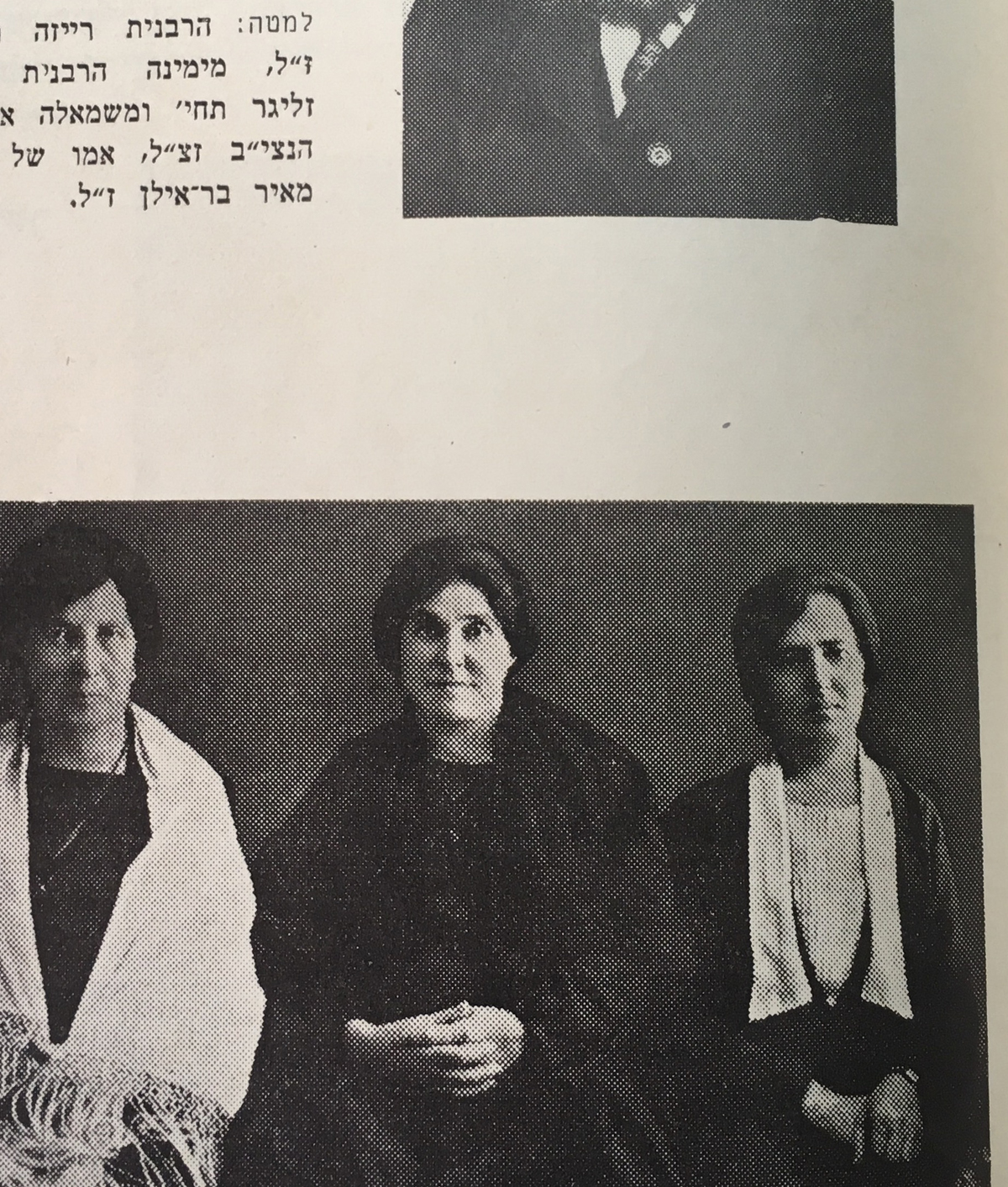
In going through the various issues of Ha-Hed, I discovered a picture of great interest in the Shevat 5711 issue.

On the right is Leah Seliger. She was a learned woman who edited the collected writings of her late husband, R. Joseph Seliger, 

Kitvei Ha-Rav Dr. Yosef Seliger (Jerusalem, 1930). The woman in the middle is R. Kook’s wife, Raize Rivka. Until recently I knew of only one other published picture of her, and this appears at the beginning of Pinchas Grayevski, Benot Tziyon vi-Yerushalayim, vol. 7 (Jerusalem, 1929; I think Dr. Yehudah Mirsky called my attention to this picture). The woman on the left is Miriam Berlin, the widow of R. Naftali Zvi Judah Berlin. I do not know of any other published pictures of her.

Shimon Steinmetz called my attention to this additional picture of R. Kook’s wife that can be found here.

2. In my post here I discussed these words from Exodus 15:16:

בִּגְדֹל זְרוֹעֲךָ יִדְּמוּ כָּאָבֶן

However, I neglected to mention one additional point. How come there is a dagesh in the כ when according to the grammatical rules it should not be there? R. Aaron of Lunel in his Orhot Hayyim offers an explanation. He states that if there was a dagesh people would read the last two words as יִדְּמוּךׇ אָבֶן, “stones are similar to you,” which is not a respectful thing to say to God.[2]

3. In my last post here I discussed the Hazon Ish’s opinion on the dispute between Maimonides and Rabad about an unwitting heretic, and the Hazon Ish’s assumption that Maimonides actually agreed with Rabad in this matter. It must be clarified that the Hazon Ish is not certain about his suggestion that there was no disagreement between Maimonides and Rabad when it came to someone who was completely “innocent” in his heresy. The Hazon Ish4. A couple of years ago in my post here I mentioned that in part two of the post I would have an excursus on the nature of women. For some reason I forgot to include this excursus in all the subsequent posts, so here it is.[4]

On the matter of the creation of women, and whether they are created “better” or “worse” than men, Shaul Regev calls attention to a strange comment by R. Jacob Matalon, Toldot Yaakov (Salonika, 1597), p. 7d (printed together with his She’erit Yaakov).[5] There are many comments in rabbinic texts that have a negative view of women, and most of these comments are based on a belief that women are inherently inferior to men. Yet not many texts are as explicit as R. Matalon in regarding women as almost a different species, standing between apes and men.

ובין החי למדבר הקוף ובין הקוף םמדבר [צ”ל למדבר] ומשכיל הם הנשים והאנדרוגינוס

Women obviously speak, so מדבר must mean speak with intelligence.

A passage similar to what R. Matalon says, but without mention of an ape, is found in Gersonides’ comment to Genesis ch. 3 (p. 110 in the Ma’aliyot edition).

והנה קראה האדם שם אשתו ‘חוה’, כאשר השיג בחולשת שכלה, רוצה לומר שלא עלתה מדרגתה על שאר הבעלי חיים עילוי רב, ואם היא בעלת שכל, כי רוב השתמשותה אמנם הוכן לה בדברים הגופיים, לחולשת שכלה ולהיותה לעבודת האדם. ולזה הוא רחוק שיגיע לה שלמות השכל, אלא שעל כל פנים היא יותר נכבדת מהם, וכולם הם לעבודתה

Gersonides is known for his negative view of women, and this reputation comes from passages like this. Here Gersonides states that women are on a higher level than animals, but not by much. Furthermore, just like the animals are at the service of women, so women’s role is to serve men. In discussing this passage, Menachem Kellner writes: “Gersonides apparently found Darwin’s missing link: woman!”[6]

For another explanation which Modern Orthodox women will probably regard as insulting, but more traditional women will probably see as a compliment, see R. Meir Mazuz, Bayit Ne’eman, no. 52 (parashat Terumah 5777), p. 1, who quotes R. Nissim Gaon as follows: The verse in Proverbs 1:8 states: אל תטוש תורת אמך – “Forsake not the teaching of thy mother”. Yet since women don’t have Torah knowledge, תורת אמך cannot mean this. Rather, it means the special holiday foods that the mother makes.

Readers can correct me if I’m wrong, but I do not believe that R. Mazuz’s understanding is correct, and I think R. Mazuz was citing R. Nissim from memory. That is, R. Nissim’s comment has nothing to do with women lacking Torah knowledge and identifying their cooking as תורת אמך. Rather, he cites the verse simply as a general statement about the importance of tradition. Here is the passage of R. Nissim Gaon as cited by R. Maimon the father of Maimonides.[7]

וכתב רבינו נסים במגילת סתרים כי כל מנהגי האומה באלו המנהגות כמו זה. והראש בראש השנה, החלב בפורים ובמוצאי פסח, והפולים ביום הושענא רבה. ואותם המנהגות אין לנו לבזותם ומי שהנהיגם זריז ומשתדל הוא כי הם מעיקרים נעשים ולא יבוזו במנהגי האומה וכבר אמר הנביא ע”ה ואל תטוש תורת אמך, דת אומתך אל תעזוב

Regarding the role and responsibilities of women, R. Mazuz has another interesting comment.[8] As part of his argument that women are not obligated in hearing parashat Zakhor, he says that this commandment is connected to the commandment of destroying Amalek, and women are not able to do this. How do we know that women cannot destroy Amalek and therefore are not commanded in it? “Because if she sees blood and even if she sees a mouse she becomes afraid, so how could she kill Amalek?” While many will not appreciate what they see as R. Mazuz’s flippant tone (which is obviously a joke, as he is well aware that there are women soldiers and doctors), do even feminists wish to claim that killing comes as easy to women as to men? Do they really want to be “equal” with men in this matter? I, for one, have always assumed that if women were running the world, there would be many fewer wars, as only someone who is blind to reality cannot see that men are naturally more inclined to violence than women.

Here is another interesting point relevant to the subject of women: Rashi, Menahot 43b s.v. היינו, in explaining the talmudic passage dealing with the blessings that a man recites in the morning, states that a woman is to regarded as a maidservant to her husband (i.e., to do his wishes), much like a slave is to his master: דאשה נמי שפחה לבעלה כעבד לרבו

Rashi’s comment is not surprising and has often been quoted. Indeed, although it will trouble modern readers, lots of similar comments can be found in rishonim and aharonim.[9] Furthermore, in at least three places the Talmud refers to a wife with the term shifhah.[10] Yet for a reason I can’t explain, R. Moshe Feinstein was very troubled by this comment of Rashi, and this led him to write something quite problematic.[11] See Dibrot Moshe, Gittin p. 511 (also in Iggerot Moshe, vol. 9, Orah Hayyim no. 2):

ולולי דמסתפינא הייתי אומר שצריך למחקו דח”ו לרש”י לומר דברי הבל כזה, דמן התורה הא ליכא שום שעבוד על האשה לבעלה חוץ מתשמיש ולענין תשמיש הוא משועבד לה יותר דהא עליו איכא גם איסור לאו . . . ואינה מחוייבת לעשות רק עניני הבית ולא עבודת שדה ומעט עשיה בצמר שהיא מלאכה קלה ממלאכות שדרכן של בנות העיר בזה

R. Moshe states that in no way can a woman be generally regarded as under her husband’s authority as only in a few areas does she have obligations to him (much like he has to her). He continues to expound on the way a husband is obligated to treat his wife in order to show that she is far removed from being a maidservant.[12] This is all true, and it would be easy to quote authorities who write similarly. Yet they did not see this as in any way contradicting Rashi’s statement. Understandably, some have expressed great surprise upon seeing how R. Moshe refers Rashi’s comment as הבל (as they do not accept R. Moshe’s point that Rashi could never have said דאשה נמי שפחה לבעלה כעבד לרבו).

R. Shlomo Aharon Gans goes so far as to say that if thegadol ha-dorhad not been the one to say this, it would be forbidden to write such a thing. He adds the following, bringing support for the notion expressed in Rashi that a wife is like a maidservant (not that she is a maidservant, but she is like one)[13]:

ולא הבנתי דהא הויא קנין כספו, ועי’ תורא”ש קידושין ה’ דהוא מושל עליה ומשעובדת לו וכדכתיב והוא ימשל בך, וא”כ מאי קשיא ליה כ”כ בדברי רש”י אלו

This conception, that a wife is like a maidservant, was actually criticized by R. Hayyim Hirschensohn who called attention to the “barbaric” way Jews treated their wives in the small towns of Galicia, where the wives did not even eat at the same table with their husbands.[14]

וה’ יסלח לו כי ההרגל הרע של בני מדינתו להתגאה על נשותיהן אשר לוקחים אותן רק לרקחות וטבחות ואין מסיבות בשלחן עם בעליהן וחושבים אותם כחמת כו’ [מ”ש: ראה שבת קנב ע”א] ואלמלי עלמא צריכי להו היו בעי רחמי דלבטלי מן העולם ח”ו, ההרגל הפראי הזה אשר בעירות הקטנות בגאליציא ובקצת ערי פולין גרם להרב הנז’ לבלי להרגיש את העלבון אשר עלב לבנות האבות והאמהות אשר קמו גם הן לאם לבנות את בית ישראל

As a curiosity, it is worth noting the opinion of R. Menasheh Klein that a husband should not help his wife with household tasks such as cleaning the dishes, as that is “women’s work”, while the husband works outside the home. (And what about when the wife also works outside the home?) Instead, the husband should use that time for learning Torah and other spiritual pursuits.[15]

כי לכן נתן לו הקב”ה אשה לאדם שיהי’ לו לעזר שתעשה לו צרכי הבית והוא יהיה פנוי בזמן שיש לו ללמוד תורה ולעבודת השם ולא לכבס ולהדיח הכלים אחרי האכילה ולסדר את המטות החיוב על הבעל לפרנס את אשתו ובניו ושאר הזמן כל רגע ורגע ינצל ללימוד התורה ולעבודת השי”ת שמו. ובעונ”ה נשתנה הוסת שהבעלי בתים הצעירים נעשים בעלת בתים מבשלים ומדיחים הכלים והולכים לחניות לקנות צרכי הבית איינקויפען בלע”ז בקיצור עושים כל מלאכת הנשים והנשים עושים מלאכת האנשים

I can only imagine what the reaction of a newlywed wife would be if her husband would tell her that no, he has no plans to help clean the table and do the dishes because that is women’s work.

Related to this is the following story told by R. Yosef Wineberg, the grandson of the Slonimer Rebbe. It is obviously designed to make the “Litvish” look bad.[16]

A newly married Litvishe couple was once sitting together. The wife asked her husband to please make her a cup of tea. He immediately jumps up, puts on his hat and jacket and walks out the door. About an hour later, the husband returns home, removes his hat and jacket and makes her a cup of tea. Puzzled by his strange behavior, she asks for an explanation.

He explains: when you first asked me to make you a cup of tea, I was upset. I am a Talmid Chacham, a scholar, and you are meant to “serve” me, not the opposite. Not wishing to get into an argument, I went to my Rav to ask him what I should do.

The Rav explained to me that “ishto k’gufo”, that the Halacha considers us like one person. Therefore, making tea for you is identical to making tea for me. As I feel no compunctions with serving myself, I returned home to fulfill your request.

In order to show that the husband is the boss of the household, R. David Kimhi states that while the husband calls his wife by her name, the wife does not call her husband by his name, but by some title which shows his superior status.[17]

כי האיש הוא הקורא לאשתו בשמה ולא האשה לאישה, אלא דרך כבוד בלשון אדנות קוראה לו ולא בשמו, כי כל מי שיש לו מעלה אל אחר אין ראוי לאשר למטה ממנו לקרוא אותו בשמו, כמו אביו או רבו או אדניו . . . וכן האשה לבעלה כי אדניה הוא כמו שאמר: והוא ימשוך בך

One of the proofs he offers for this idea is that in Genesis 17:17 Abraham refers to Sarah by her name, but in Genesis 18:13 Sarah refers to Abraham as “my lord” (אדני). Another proof he mentions is that when God changes the names of Abraham and Sarah he says to Abraham (Gen. 17:15): “Thou shalt not call her name Sarai.” From this we see that Abraham called his wife by her name. However, when Abraham’s name was changed the Torah states (Gen. 17:5): “Neither shall thy name any more be called Abram.” Sarah was not told this, Radak states, as she didn’t refer to her husband by his name. This was rather a general statement, that among those people who call Abraham by his name, they no longer would do so.

Although Radak states that a husband calls his wife by her name, we know that this was not always the case. Thus, we are told that R. Jacob Moellin in speaking to his wife would not call her by her name. When he referred to her in conversation with others, he would call her mein hausfrau (my housewife).[18] The text that records this information notes that already in the Talmud, Shabbat 118b, we find that R. Yose referred to his wife as “my house,” and I think most assume that this was done as a term of respect.[19] The text further notes that the general practice was that both husband and wife did not refer to each other by their first name. Such a practice was also found in the Sephardic world.[20] What this shows us is that contrary to what Radak records, the practice need not have anything to do with the husband being regarded as “superior” to his wife.

With all the discussions in rabbinic literature that show the essential differences between men and woman, let me mention another curiosity that, if you want to be cute, you can say that in one place the Talmud actually refers to women as men. I have in mind Zevahim 67b which, in discussing the burnt offerings brought by two women after childbirth, states:

חטאת לזו ועולה לזו עשה שתיהן למעלה . . . אימור דא”ר יהושע בחד גברא בתרי גברי מי אמר

In this passage, the word גברי, which means “men”, refers to the case of the two women (although the principle enunciated applies to all people).[21]

While on the male-female topic, let me mention something else that is relevant. We all know that the name Avi (short for Avraham) is quite popular. Yet how many know that this is already a biblical name, but used for a woman (2 Kings 18:2)?

I want to return to the notion already mentioned in this note, and found in a number of earlier works, that an ape stands between animals and humans. The Sefat Emet, Genesis 18:1, expands on this as follows:

ובין חי למדבר קוף. ואנו נאמר כי אחר מדבר אדם, שעל זה נאמר “אדם” אתם קרוין אדם ולא האומות. וישמעאל הוא הממוצע לכן נקרא פרא אדם, ולכן יד כל בו וידו בכל, כי על ידו יש התקשרות בין מדריגות מדבר למדריגת אדם

When he writes כי אחר מדבר אדם it means that after the level of מדבר, which means “humanity”, there is the level of אדם, which is the level of the Jewish people. He then adds that the Arabs stand between מדבר and אדם which is why they are called פרא אדם. Often פרא אדם is used to show that the Arabs are on a lower level than other nations. However, here we see that the Arabs are on a higher level, and closer to the Jews than the other nations, as among the nations of the world only the Arabs are also called אדם—no doubt because of their monotheism, see Yevamot 61a—even if this word is placed together with the negative term פרא.

The Sefat Emet’s comment is derived from the Zohar,[22] which explains פרא אדם as meaning one who possesses the “beginnings of אדם”. The Zohar also places the descendants of Ishmael on a higher level than the other nations because they are circumcised. Circumcision was widely practiced even in pagan Arabia, so the reference to circumcision alone would not be enough to date this passage of the Zohar to the post-Islamic period.

R. Jacob Emden, however, cites a different passage in the Zohar that assumes the existence of the Islamic world, meaning that it could not have been written by R. Shimon ben Yohai.[23] He writes:

הנה לפניך שבימי בעל ספר הזוהר כבר היתה אמונת מחמד הישמעאלי בעולם (שנתחדשה בימי אמוראים האחרונים על”ב) כי קודם זמן זה היו כל הישמעאלים עובדי אלילים גמורים, ככל יתר גוי הארצות.

R. Emden also cites another Zoharic passage that assumes Islamic rule in the Land of Israel. He comments:[24]

הרי כי בימי בעל ספר הזוהר היתה אומת ישמעאל שולטת בארץ הקדושה, ודבר ידוע הוא ומפורסם, שלא הגיעו הישמעאלים לממשלה כללית עד שנת שע”ד לאלף החמישי . . . נמצא עכ”פ יותר מחמש מאות שנה אחר רשב”י חובר ספר הזוהר, ואולי מאוחר עוד הרבה מזה, ואיך אפשר להסכים זה עם שמות האומרים אותם הדברים, והמה חבריו או תלמידיו של רשב”י, לפי המובן בלשונו של בעל ספר הזוהר, הלא זה כדבר שאין לו שחר

He cites a third such example and writes:[25]

מלכות ישמעאל לא נתפרסמה ולא נתפשטה בימי תנאים ואמוראים. כי היו אז ממלכה שפלה קטנה וירודה

Returning to the matter of how women have been viewed, R. Joseph Solomon Delmedigo mentions that jokers—ליצני הדור—come up with all sorts of gematrias. When it comes to women not all of them are negative. For example, the gematria of אשה is דבש, and אשה יפה = שמחה גדולה. However he also cites a gematria which is not very complimentary to women. זכר=ברכה and נקיבה=בקללה. R. Delmedigo sees this as a big joke, but it is actually mentioned by R. Hayyim the brother of the Maharal in his Iggeret ha-Tiyul, section ז, and it is also found in Ba’al ha-Turim, Gen. 1:27 (with some differences as to which letters are actually included in the gematria).

In 1807 R. Jacob Samson Shabbetai Senigallia[26] published his talmudic commentary Shabbat shel Mi. Here is the title page of the Livorno first edition. (It has been reprinted a number of times).

Here is what appears in the book on p. 89b. He is trying to explain why chapters 5 and 6 in tractate Shabbat are next to each other. Chapter 5 begins במה בהמה and chapter 6 begins במה אשה, and according to R. Senigallia this is because “birds of a feather flock together.”

If he was trying to make a joke, I can understand what he wrote. But who ever heard of making a joke in the middle of a talmudic commentary? Presumably, he was being serious, which leaves us with a very offensive comment.

There is, to be sure, humor in the Talmud, but I don’t know of any examples in talmudic commentaries. Yeshayahu Leibowitz quipped that the Sages must have had a good sense of humor, since they included the following text in the Talmud [27]: תלמידי חכמים מרבים שלום בעולם. In all seriousness, however, there are indeed humorous passages in the Talmud, as pointed out by R. Moses Salmon.[28] Here is one example he gives (Bava Batra 14a):

The Rabbis said to R. Hamnuna: R. Ammi wrote four hundred scrolls of the Law. He said to them: Perhaps he copied out the verse תורה צוה לנו משה

R. Salmon claims that anyone with a bit of sense can see that R. Hamnuna’s reply is a wisecrack made in response to the obvious exaggeration about R. Ammi.

Nehemiah Samuel Libowitz states that even in the Zohar we have passages that show a humorous side.[29] One of the many examples he points to is Zohar, Bereshit, p. 27a:

וימררו את חייהם בעבודה קשה בקושיא. בחומר קל וחומר. ובלבנים בלבון הלכתא. ובכל עבודה בשדה דא ברייתא. את כל עבודתם וגו’ דא משנה

I have no idea what to make of the following comment from R. Oury Cherki, dealing with humor, which does not sound like something that would be said by a leading kiruv figure (De’ah Tzelula: Olam ve-Adam be-Mishnat ha-Rav Kook [Jerusalem, 2015], p. 246). Rather, it sounds like something one of the maskilim of old would say.

התורה שבעל-פה אינה מובנה ללא שותפות רוח האומה. לכן כשלומדים הלכה רצוי להצטייד בחוש הומור, שכן לפעמים הדברים נראים משונים למדי. למשל, הכנת כוס תה בשבת. התלמוד אומר שאסור לשפוך מים קרים לתוך החמים אבל מים חמים לתוך הקרים מותר, כי יש כלל ש”תתאה גבר”, התחתון גובר. כששופכים מים חמים לתוך הקרים המים הקרים מתחממים ומתבשלים מה שאין כן ההפך – המים החמים מתקררים. יש כאן בהחלט סוג של הומור

I also found the following interesting comment by Moshe Meisels, the editor of Ha-Doar, in a letter to Chaim Bloch.[30] He suggests that the talmudic prohibition against a non-Jew observing the Sabbath is an example of rabbinic wit, and is not to be understood literally.

ואגב, לא אהא בבחינת מורה הלכה לפני רבו אם אינני מתאפק מלהביא מעין חידוש שנתחדש לי הקטן באחד המאמרים התמוהים בתלמוד מן הסוג הנ”ל, והוא אמרם: עכו”ם ששבת חייב מיתה, שנאמר יום ולילה לא ישבותו וכו’. ואין צורך להרבות דברים על הזרות שבדבר: מה איכפת למי אם שבת או לא שבת, ומה היא הראיה מאותו פסוק, המוסב על קיץ וחורף וכו’, ומה ענינו לכאן ולעכו”ם דוקא? ונראה לי שכל המאמר בא בדרך חידוד, וזה מובנו: עכו”ם ששבת מן הדין שיהא חייב מיתה בדיניהם. מדוע? ישראל שלא שבת חייב מיתה, משום שעל א-לוהיו נאמר וישבות ביום השביעי וכו’, אבל עובד כוכבים ומזלות, שעליהם נאמר יום ולילה לא ישבותו, מן הדין שעובדיהם יהיו חייבים מיתה אם שינו מדרך אלהיהם ושבתו

On the matter of non-Jews observing the Sabbath, R. Yaakov Koppel Schwartz makes a fascinating suggestion, which he acknowledges has no support in the rishonim and therefore he has doubts whether it is correct.[31] The prohibition against labor on the Sabbath is in remembrance of the fact that we were slaves and God redeemed us. Therefore, it is understandable why non-Jews are forbidden to commemorate the Sabbath by abstaining from work, as this has no connection to them. However, there is another reason given for the Sabbath and that is so that we remember the creation of the world. Non-Jews are also supposed to acknowledge this and therefore there should be nothing wrong with non-Jews having some sort of celebration in honor of the Sabbath.

אבל הכיבוד והקידוש של יום השבת, שהוא משום אמונת חידוש העולם, שייך שגם הגויים יהיו בהם ואינם מנועים מלכבד ולענג את השבת

If we follow R. Schwartz’s approach, this is something that could be suggested for Noahides whose “religion” is lacking any rituals, which for most people is an essential component of their religion.

* * * * * * * *

[1] Ha-Tzofeh, June 16, 1959, p. 2.

[2] Orhot Hayyim, Or Etzion ed. (Merkaz Shapira, 2017), p. 106, quoted by R. Joseph Karo, Beit Yosef, Orah Hayyim 51 (end). Regarding negative expressions directed against God, there is an interesting passage in R. Yedidiah Solomon Raphael Norzi, Minhat Shai, Deut. 8:3. To understand it one must know that the old French word “fi” expressed disdain or disgust. See here. The issue Norzi discusses is that the verse reads:

‘כִּי עַל-כָּל-מוֹצָא פִי-ה

Norzi cites a view that in this case there should be a dagesh in the word פי even though that is not in accord with the general rule, because without the dagesh, reading it as “fi” would be disrespectful to God:

כי לשון גנאי הוא בלשון צרפת וחלילה לשם יתברך

Norzi completely rejects this and states that the rules of biblical grammar are not to be changed because of how words sound in languages other than Hebrew (and there are indeed examples where biblical Hebrew words sound like profanity in other languages).

ואין לנו לחוש ללשון צרפת שאין מבטלין דרכי לשון הקדש מפני שאר לשונות

See also Samuel David Luzzatto, Prolegomena to a Grammar of the Hebrew Language, trans. Aaron D. Rubin (Piscataway, N.J., 2005), pp. 133-134.

Regarding the pronunciation of פ, R. Meir Mazuz points out that the Vilna Gaon, Commentary to Tikunei Zohar, section 19, p. 38d (p. 166 in R. Zuriel’s edition), mistakenly believed that Sephardim pronounce פ with and without a dagesh the same way (just as they pronounce ת with and without a dagesh the same way). R. Mazuz notes that the Vilna Gaon’s point is repeated by R. Baruch Epstein, Mekor Barukh, vol. 1, p. 397b (without mentioning the Gaon). See Mazuz, Bayit Ne’eman (Humash), vol. 1, p. 13 (first pagination).

[3] Hazon Ish, Yoreh Deah 62:21.

[4] In my earlier post I cited R. Samson Raphael Hirsch as adopting the notion that women are created on a higher spiritual level than men. I neglected to note that Shaye J. D. Cohen earlier discussed Hirsch’s approach. See Cohen, Why Aren’t Jewish Women Circumcised (Berkeley, 2005), pp. 165ff.

[5] “Eshet Hayil: Kavim li-Demutah u-le-Ma’amadah shel ha-Ishah be-Hagut ha-Yehudit ha-Shesh Esreh,” in Ephraim Hazan and Shmuel Refael, eds. Mahbarot li-Yehudit (Ramat-Gan, 2012), p. 286.

[6] Torah in The Observatory (Boston, 2010), p. 287. I earlier discussed Ralbag here.

[7] See R. Yaakov Moshe Toledano, Sarid u-Falit (Tel Aviv, [1945]), p. 8.

[8] Bayit Ne’eman no. 153 (parashat Vayikra 5779), p. 2.

[9] See e.g., R. Israel Ibn Al Nakawa, Menorat ha-Maor, ed. Enelow, vol. 4, pp. 32-33, who instructs a wife as follows (using the word שפחה that so troubled R. Moshe):

ועושה צרכיו בעצמה ולא על ידי אחרים. ואפי’ היו לה כמה עבדים וכמה שפחות, תעמוד היא ותשרתנו, ותקראנו אדוני . . .ויהיו עיניה תלויין לו, כעיני שפחה אל יד גבירתה

For a translation of this passage, see here. Maimonides, Mishneh Torah, Hilkhot Ishut 15:20, says that a wife should regard her husband כמו שר או מלך.

Radak, Gen. 3:16, writes:

והוא ימשול בך: לצוות עליך מה שירצה כאדון על עבד

Ramban, Gen. 3:16, explains that as a result of Eve’s sin, the relationship of man and woman was changed. From that point on:

 והוא יחזיק בה כשפחה ואין המנהג להיות העבד משתוקק לקנות אדון לעצמו אבל יברח ממנו ברצונו

R. Bahya ben Asher, Gen. 3:16, writes:

ואל אישך תשוקתך: שאע”פ שהאשה משועבדת ברשות הבעל ומנהג העבד לברוח מן האדון כדי שלא ישתעבד, גזר בזאת שתהיה משתוקקת לבעל ושתרצה להשתעבד לו בהפך מן המנהג

See also R. Chaim Rapoport’s letter in my Iggerot Malkhei Rabbanan, p. 172.

R. Avraham Blumenkrantz, Gefen Poriah, p. 352, quotes approvingly another rabbi who states as follows (emphasis added):

Her tears are ever ready to flow at the most miniscule suggestion of being dealt with as a maidservant. She will concede you the service of והוא ימשל בך. She will consent to call you בעלי, but don’t accent the דגש in the בית too heavily. She must constantly be reassured that there is honor and dignity in her subservience. Honor her more than you honor yourself. She must be compensated for her subjugation, and be made to feel that she has a genuine share in the dignity of the throne.

Do haredi women really feel that they are subservient or subjugated? Do haredi men feel this way about their wives? Hasn’t haredi society accepted the notion of separate but equal when it comes to men and women?

[10] Sanhedrin 39a, Yevamot 113a, Nedarim 38b.

[11] As is well known, and I have written about previously, R. Moshe often rejected the authenticity of texts that he found problematic. Another example of this with regard to Rashi on the Talmud is found in Iggerot Moshe, Even ha-Ezer, vol. 4, no. 64:1. Here R. Moshe says to delete words in Rashi even though, as he notes, these words are found in “Rashi” on the Rif and in R. Nissim. See the strong responses to R. Moshe quoted in R. Yonason Rosman, Petihat ha-Iggerot, pp. 605-606. One of these responses is from R. Menasheh Klein in his notes to R. Eyal Shraga, Minhat Ish, vol. 1, pp. 302-303. R. Klein writes:

וח”ו ואטו עד כמה נילך ונמחוק בדברי רבותינו ז”ל שנאמרו ברוה”ק, ולולי דמספינא הייתי אומר דאיזה תלמיד טועה כתבו, אבל פשוט דדברי רש”י נכונים וליכא כאן טעות כלל

When R. Klein suggests—לולי דמספינא—that a “mistaken student” is responsible for the problematic passage in Iggerot Moshe, he does not mean it seriously. This is just his respectful way of saying that R. Moshe’s position is completely without basis. He uses the same language in Mishneh Halakhot, vol. 12, Yoreh Deah no. 214. There he responds to R. Moshe’s statement that he doesn’t know who R. Menahem Tziyoni is, but since he quotes a heretical—in R. Moshe’s opinion—passage from R. Judah he-Hasid’s commentary on the Torah, therefore R. Tziyoni’s work must be banned together with R. Judah he-Hasid’s commentary.

[12] R. Moshe also famously states that women do not have any less holiness than men. See Iggerot MosheOrah Hayyim vol. 4, no. 49 (p. 81). See also the new Mesorat Moshe, vol. 4, p. 476. This position is at odds with many earlier writers who saw men as holier because they are commanded in more mitzvot. This is also Maimonides’ position in his commentary to Horayot 3:7. See R. Chaim Rapoport’s discussion in Kovetz Hearot u-Veurim, no. 908 (2006), pp. 138ff. Yet see R. Dov Halbertal, Erekh ha-Hayyim be-Halakhah (Jerusalem, 2004), vol. 2, p. 399, who has a different approach and makes the point that just because a Kohen and Levi are to be saved before an Israel, no one would say that the Kohen and Levi have more holiness. See also R. Yitzhak Barda, Yitzhak Yeranen, vol. 11, p. 249, that women are holier than men. He offers an original explanation of this notion.

שהאשה שהקב”ה הפריש ממנו, מהצלע שלו, הוא מופרש, וממילא כל מופרש קדוש, ואז האשה יותר קדושה מהאיש. ובזה מובן למה האיש מקדש את האשה, לא אומר לה הרי את אשתי, או כל סממן לשון של נישואין, חברה או שותפה וכו’, זולתי: הרי את מקודשת לי! לפי שהקב”ה קבע כל מופרש קדוש

[13] Kinyan Shlomo, Yevamot, p. 89. See also R. Natan Einfeld, Minhat Natan: Kiddushin, pp. 139-140, who cites other sources in rejecting R. Moshe’s point.

[14] Malki ba-Kodesh, vol. 4, p. 50a. See R. Menasheh Klein, Mishneh Halakhot, vol. 12, no. 351, for a defense of the practice of husbands and wives eating separately.

[15] Mishneh Halakhot, vol. 7 no. 155 (called to my attention by R. Aviad Stollman).

[16] The story is recorded by R. Chaim Dalfin, Faces and Places Boro Park (Brooklyn, 2017), p. 149.

[17] Commentary to Gen. 17:15. See the rejection of Radak’s opinion in R. Betzalel Stern, Be-Tzel ha-Hokhmah, vol. 1, no. 70.

[18] Maharil, Likutim (p. 610 in the Makhon Yerushalayim edition).

[19] On the other hand, R. Meir Schiff (Maharam Schiff), Gittin 52a, explains that R. Yose referred to his wife this way because she was a bad wife: אשה רעה. Yet the proof he brings for this is actually from a different R. Yose. See R. Judah Leib Maimon, ed., Sefer ha-Gra, vol. 1, p. 110 in the note. Regarding “bad wives”, R. Elazar of Worms is quoted as follows in R. Alexander Suslin, Sefer ha-Agudah, ed. Brizel, Yevamot, no. 78 (p. 41):

מי שיש לו אשה רעה יסבול יקבל ברצון ויקבל בשמחה ולא יראה פני גהינם

What does R. Elazar mean that if you suffer under a bad wife you will not see gehinnom? R. Moses Guedemann explains that with a bad wife you already saw gehinnom in your lifetime, so there is no need to see if after death. See Ha-Torah ve-ha-Hayyim, trans. Friedberg (Warsaw, 1897), vol. 1, p. 194:

כי פני הגיהנם כבר ראה בחייו

Regarding “good wives” see R. Shlomo Hoss, Kerem Shlomo, no. 43, who writes:

אין לך כשרה בנשים אלא אשה שעושה רצון בעלה: אהע”ז ס”ס ס”ט (אך אשת חיל כזאת מי ימצא)

R. Solomon Zvi Schueck was shocked at R. Hoss’ final comment, that one cannot find a wife who does the wishes of her husband. R. Schueck writes that based on this passage he assumed that R. Hoss must not have had a good wife.

נראה לי שהי’ לו אשה רעה, וממנה דן על כל הנשים שבישראל

See She’elot u-Teshuvot Rashban, Even ha-Ezer, no. 99 (p. 88b). He further tells us that he asked one of R. Hoss’ students who confirmed that this was indeed the case.

[20] See Tuvia Preschel, Ma’amrei Tuvyah, vol. 5, p. 142.

[21] See Or Torah, Shevat 5780, p. 460.

[22] Exodus 86a, 87a.

[23] Mitpahat Sefarim, ch. 4 (at the beginning; p. 20 in the Jerusalem 1995 edition). In R. Reuven Rapoport’s edition of Mitpahat Sefarim, with his commentary Itur Soferim, p. 13, R. Rapoport sees it as obvious that this passage in the Zohar is a later interpolation much like there are Savoraic additions in the Talmud.

[24] Mitpahat Sefarim, ch. 4 (p. 27 in the Jerusalem 1995 edition).

[25] Mitpahat Sefarim, ch. 4 (p. 54 in the Jerusalem 1995 edition). Regarding the larger issue that R. Emden points to, see Ronald C. Kiener, “The Image of Islam in the Zohar,” Jerusalem Studies in Jewish Thought 8 (1989), pp. 43-65.

[26] See the recent discussion of R. Senigallia by R. Moshe Maimon in the Seforim Blog here.

[27] Sihot al Pirkei Ta’amei ha-Mitzvot (Jerusalem, 2003), p. 289.

[28] Netiv Moshe (Vienna, 1897), pp. 45-46.

[29] “Halatzot ve-Divrei Bikoret be-Sefer ha-Zohar,” Ha-Tzofeh le-Hokhmat Yisrael 11 (1927), pp. 33-45. For more on humor in the Talmud, see Yehoshua Ovsay, Ma’amarim u-Reshimot (New York, 1946), ch. 1; Meyer Heller, “Humor in the Talmud” (unpublished masters dissertation, Hebrew Union College, 1950), available here; R. Mordechai Hacohen, “Humor, Satirah, u-Vedihah be-Fi Hazal,” Mahanayim 67 (5722), pp. 8-19; and Ezra Brand’s post here. From Brand I learned that David Lifshitz wrote an entire doctorate on the subject. See also my posts here and here where I discuss Siftei Hakhamim’s comment that Moses thought God was joking with him, and how this has been censored in a recent edition. See also J. Chotzner, Hebrew Humor and Other Essays (London, 1905); Nehemiah Samuel Libowitz, Ha-Shomea Yitzhak (New York, 1907).

[30] See here (Chaim Bloch Collection, Leo Baeck Institute, 7155-7156, 1/13).

[31] Likutei Diburim, vol. 4, pp. 24-25.


Ha-Osek be-Mitzvah Patur min ha-Mitzvah: The Case of Prayer and Torah Study

Daniel Sperber has just published a new book, On the Relationship of Mitzvot Between Man and His Neighbor and Man and His Maker. The Seforim Blog is happy to present chapter 4 from the book. 
Ha-Osek be-Mitzvah Patur min ha-Mitzvah: The Case of Prayer and Torah Study
Daniel Sperber
We find in Sefer ha-Rokeah, section 369 ad fin., that a person who is sitting in the synagogue, wrapped in his talit and with his tefillin on his head and is reciting liturgical songs, must, nonetheless, rise up before his teacher, since he can carry out both actions and he will receive fine rewards in both worlds. Now there are early authorities who hold that the principle that one who is engaged in one mitzvah is exempt from another is also the case when both could be carried out. (See Shulhan Aruch Orah Hayyim 38:8, and in the Beur Halachah, ibid., and also R. Yaakov Hayyim Sofer, Brit Yaakov [Jerusalem: 1985], section 2, 36; R. Ovadiah Yosef, Hazon Ovadiah: Sukkot [Jerusalem: 2005, 167].) The author of the Rokeah, R. Elazar of Germaiza, was a disciple of R. Yehudah (b. R. Shmuel) he-Hasid, the author of Sefer Hasidim. And it is the view of R. Yehudah he-Hasid that even if one can carry out both mitzvot, one is exempt from doing so, if one is engaged in a prior mitzvah; and this, indeed, is the view of R. Elazar Rokeah himself (Rokeah, Hilchot Sukkah, section 299; see Sofer). Why then should one who is engaged in praising the Lord in the synagogue, have to rise up before his teacher? Surely he is already engaged in a mitzvah, and therefore exempt from others! The answer, I suggest, is because ritual synagogue worship is directed towards God, but respect for one’s teacher is a mitzvah between man and his fellow, and he is therefore not exempt from it. So too the Hida, R. Hayyim Yosef David Azulai, rules, that even in the hour of prayer one rises before a Torah scholar, (Birkei Yosef Orah Hayyim, section 244:1; and see Sofer, note 8 on page 37; and see most recently the discussion of R. Yitzchak Eliyahu Stessman, Kimah ve-Hidur [Jerusalem: 2011, 88–91], with additional references).
Indeed, the severity of not rising before one’s teacher is expressed by R. Eleazar in very extreme terms in BT Kiddushin 33b:
Any scholar who does not rise before his teacher is called a wicked person (רשע), and will not live long and will forget his learning.
(See also R. Yaakov Hezkiyahu Fisch, in his Ve-Haarachta Yamim, ed. Y.M. Sofer, [Jerusalem: 2010, 71–72].)
To this we may add what we are told of the Arizal, by his disciple R. Hayyim Vital, that he was very particular in paying his workers exactly on time and without delay. And if he did not have the money with which to pay these wages, he would delay his afternoon prayer (minhah) until close to sunset in order to search out a loan with which to make the payment. Only afterwards would he hurriedly daven minhah. He would explain himself by saying: “How can I pray to the Lord, may He be blessed . . . , when such an important mitzvah is incumbent upon me, and I have not carried it out?” (See R. Hayyim Vital, Shemonah Shearim: Shaar ha-Mitzvot [Jerusalem: 1872], Parshat Tetzeh; Avraham Tobolsky, Hizaharu be-Memon Haverchem, vol. 2, [Bnei Brak: 1981, 211–212].)
In a somewhat different vein, but with much the same principle as its basis, we read in Niflaot Beit Levi, by A. Kleiman (Pietrokov: 1911, 32, [Yiddish]), cited in Louis I. Newman and Samuel Spitz, The Hasidic Anthology: Tales and Teachings of the Hasidim (New York: 1944, 178:2, 480) as follows:
A teamster (=wagon driver) sought the Berditchover’s (Reb Levi Yitchak of Berditchov’s) advice as to whether he should give up his occupation because it interfered with regular attendance at the synagogue. “Do you carry poor travellers free of charge?” asked the Rabbi. “Yes,” answered the teamster. “Then you serve the Lord in your occupation just as faithfully as you would be frequenting the synagogue.”
(However, see A.Y. Pfoifer, Ishei Yisrael [Jerusalem: 1998, 104, section 11, and notes ad loc].)
And indeed, the Rambam in Hilchot Talmud Torah 3:4, followed by the Shulhan Aruch, Yoreh Deah 246:8, rules:
If there came before him [the choice of performing] a mitzvah and (i.e., or continuing) learning Torah, if that mitzvah could be carried out by another, he should not interrupt his learning; but if not, he should carry out that mitzvah and then return to his study. And when it comes to giving charity, one should always give charity first.[1]
This indeed is the conclusion to be drawn from the sugya in Yerushalmi Pesahim 3:7 (and parallel to JT Hagigah 1:7). There we read that R. Abahu, who lived in Caesarea, sent his son R. Haninah to study in Tiberias, in the Yeshiva of R. Yohanan.
They came and informed him that [his son] was engaged in charitable activities (i.e., in the burial of dead). He sent him a message, saying to him: “Are there no graves in Caesarea that I sent you to Tiberias?” (i.e., for such activities you could have stayed at home).
The Talmud continues that it was already decided at Beit Nitzeh in Lod that “study is greater for it leads to deeds,” (see below). However, the rabbis of Caesarea qualified this by saying:
This is the case when there is someone else to carry out the deeds. But if there is not anyone else to carry them out, the deed comes before [the study], (i.e., has precedence).
We then are told a tale:
R. Hiyya, R. Yosi [and] R. Ami were late coming to R. Eleazar [for their lesson with him]. He asked them, “Where were you?” They replied, “We were involved in charitable activity” (meaning in the burial of someone). “Was there no one else [who could do this?]” he asked of them. They replied, “He was a neighbor [according to the Pnei Moshe, or a proselyte – according to the Korban ha-Edah,” i.e., and there was no one else to deal with his burial.]
Incidentally, we may add here that the interpretation of the Pnei Moshe is supported by a passage in Sefer Haredim, (by R. Eleazar Azikri, [Safed: 1533–1600]), Mitzvot Aseh . . . ha-Teluyot be-Lev 22, which states that:
A person is obligated to act charitably towards his neighbors and his relations more than to other people, as is clearly stated in the Bavli and the Yerushalmi.
(See S. Lieberman, HaYerushalmi Kiphshuto [Jerusalem: 1934, 426] and his other comments.) And the parallel text in JT Hagigah 1:7., begins with an additional passage, namely:
R. Yehudah, when he would see a dead person (i.e., a burial) or a bride (i.e., a marriage procession), [and people] praising them (i.e., honoring them in the processions), he would turn to his students (נותן עיניו בתלמידים), and say: “The [dealing with] the dead precedes the study of Torah (תלמוד).”
And a somewhat similar notion, but expressed in a Hassidic vein, may be found in a story related in Yehezkel Shraga Fraenkel’s Rabbenu ha-Kaddosh mi-Shinyeve (Ramat Gan: 1992, 256–257). He relates that once the Rabbi of Warsaw came to visit the Divrei Hayyim, R. Hayyim of Sanz. The Sanzer Rebbe asked him, “Do you learn?” “Yes,” the Warsaw Rabbi replied. The Rebbe repeated, “Do you always learn?” The reply was, “When someone who is embittered and needs help comes to me, I close my gemara and deal with him, to help and encourage him.” “This is what I wanted to hear,” said the Sanzer, “whether you have the good sense to close your gemara when someone needs your help,[2] both in word and in deed, and in any case to encourage him and bolster his spirit.”[3]
Here we must make something of a digression, which is not really a digression, as this touches upon a very important point. For the Mishnah in Peah 1:1 states that: “the study of Torah is equal to all of them,” i.e., even to those mitzvot listed in the Mishnah which are social ones, such as honoring one’s parents, doing charitable deeds, bringing peace between rival individuals, etc. The question we ask ourselves is: is the study of Torah (תלמוד תורה) a ritual or a social mitzvah? Into which category does it fall? For if the former, according to our suggestion how can it be superior to those other social mitzvot?
To clarify this issue we must go back to a very ancient discussion that took place in the attic at Beit Nitzeh in Lod, between R. Tarfon and the Elders. For this question was put before them: which is greater, or more important תלמוד או מעשה, learning or deeds? R. Tarfon answered: Deeds are greater. While R. Akiva said study is greater. And they all replied: Study is greater for it leads to deeds (BT Kiddushin 40b).[4] That is to say the importance of study is in that it constitutes the key to the proper execution of the mitzvot. This is also the meaning of R. Shimon the son of Rabban Gamliel’s statement in Avot 1:17: Not the expounding of the law (midrash) is the chief thing, but the doing [of it] (maaseh). And this is amplified by Rabbenu Bachya in his commentary ad loc.: that the aim of man’s labor in Torah is not that he should just learn a lot, but that [his learning] should lead to deeds, as we have learned from the verse [in Deuteronomy 5:1], ‘and ye may learn them [i.e., the statutes and judgments], and keep and do them.’ And this is further amplified in Shulhan Aruch ha-Rav, by R. Shneur Zalman Mi-Ladi, in his Hilchot Talmud Torah 4:2, by telling us that “it is impossible to fulfill all the mitzvot in all their details without intensive study and knowledge of them. And for this reason it is equal to all of them,” i.e., not intrinsically, but as a means to their proper application.[5]
This issue has been analyzed recently by R. Yitzchak Shapiro, in his article in Hakirah 9, (2010), 221–243, entitled “To know the Forbidden and the Permitted: An Analysis of Rambam’s View of the Purpose and Goals of Talmud Study.” He shows that the Rambam’s view, as expressed in his letter to his disciple R. Yosef,[6] is that “learning Torah is a utilitarian endeavor, with extracting halachic conclusions its functional objective” (227).[7] He goes on to show that “the simplicity and obviousness [of this position] might go unnoticed if not for its staggering ramification and total incompatibility with contemporary realities in derech halimud ” (227–228). For as he earlier showed (223–224): “the Aharonim do identify an aspect of Torah study, unrelated to fulfillment of the other mitzvot, based on the verse והגית בו יומם ולילה – ‘but thou shalt meditate therein day and night’ (Joshua 1:8, cf. BT Menachot 99b). This mitzvah of ‘limud ha-Torah’ is distinct from the mitzvah of ‘yediat ha-Torah,’ and can be fulfilled regardless of the subject matter that is learned, whereas the mitzvah of yediat ha-Torah requires a curriculum that is limited to ‘halachah’ (or at least the sharpening of one’s mental acuity, which is necessary for accurate application of halachah). However, one may fulfill both facets of the mitzvah simultaneously only by learning halachic subject matter.”[8]
This is the view of the Meiri, as formulated in his commentary to BT Berachot 7b:
The knowledge of how the Torah actually expresses itself indeed requires serving or observing Torah scholars. While intellectual learning is the cause of wisdom, observing the Sages is the cause of knowing how the Torah manifests itself. This is both true for monetary matters as well as that which is prohibited and permitted.
Hence, we may well understand the statement of Rav in BT Megillah 3b, that Talmud Torah is greater than the sacrifice of the daily offerings (­temidin).
Here we may also call attention to R. Meir Triebitz’s insightful analysis (in his introduction to R. Daniel Eidensohn’s Daas Torah: A Jewish Sourcebook [Jerusalem: 2005, 31–35]). He begins by noting that God commands us twice to study Torah: once in Deuteronomy 11:19, and again in Deuteronomy 4:9–11. He analyzes the differences between these two formulations in all their details – e.g., one in the plural and the other in the singular; one talks of teaching, the other telling; one focuses on parents to children, while the other lists three generations. He concludes that “the two verses which obligate us to learn the Torah actually refer to two types of study. One refers to the study of the legal part of Torah, and the other to the study of Torah’s theology. Each form of study is deemed a separate scholarly enterprise.” He characterizes these two forms of study as “legal” (i.e., halachic) study, and “faith” study, which he states “deals primarily with Aggadic parts of the Torah.” But for our purposes it is important to emphasize that both verses, that is to say both classes of study, require the student also to be a teacher, and to pass on his learning to future generations. Hence, Torah study has a social aspect too.
This is a very broad subject that requires a study in its own right, and we cannot enlarge on it here. But what emerges very clearly is that the mitzvah of Torah study is in a very special category, for without it one would not know how to carry out ritual or social mitzvot correctly. Nonetheless, the Or Zarua and the Rav
Baal ha-Tanya agree that one interrupts learning Torah to fulfill other mitzvot, if both cannot be carried out at the same time, and one is not exempt because one is already involved in a prior mitzvah.[9]
This is clear from the baraita in BT Ketubot 17a (BT Megillah 3b, 29a) that we interrupt our study of Torah (מבטלין תלמוד תורה) not merely for a met mitzvah and to accompany the dead (הוצאת המת), but also for wedding ceremonies (הכנסת כלה) – all supreme social mitzvot.[10] And in this way, we may better understand the passage in Avot de-R. Natan, chapter 41, (ed. Schechter, Vienna: 1887, 133):
It once happened that R. Tarfon was sitting and teaching his disciples, and a bride went past him. He ordered that she be brought into his house, and told his mother and his wife that they should bathe her, anoint her, and decorate her with jewelry, and dance before her until she goes to her husband’s house.
Apparently, he interrupted his teaching in order to carry out the mitzvah of hachnasat kallah.[11] And indeed we read in the letters of the Hafetz Hayyim (Michtevei ha-Hafetz Hayyim he-Hadash, vol. 2, Bnei Brak: 1986) II, 86:
You occasionally see a Jew who [in a praiseworthy way] learns Torah [as much as possible] and values his time [not wasting a minute]. But if he does not set aside part of the day to do deeds of kindness, what a lack of intelligence!
And interestingly enough, this also becomes evidence from the commentary of R. David ha-Nagid, the Rambam’s grandson, to Avot 1:15. There Shammai is cited as saying: “Make thy [study of the] Torah a fixed
habit (קבע); . . . . And receive all men as its cheerful countenance.” And this is explained by the Nagid to mean that even when you are engaged in your fixed period of Torah study, you should not desist from receiving people cheerfully, thinking that in doing so you are “wasting” Torah-study time.[12] So apparently he regarded proper interpersonal relationship of such importance as even to override one’s involvement in Torah learning. And this presumably goes under the category of kevod ha-beriyot, respect for the individual. (Cf. below, sections 15 and 19.)
We are reminded of the statement of Reb Yisrael of Rizhyn (died 1850), who expounded the verse in Psalms 115:16, “the heavens are the heavens of the Lord; but the earth hath He given to the children of men.”
There are two kinds of tzaddikim. Those of the one sort learn and pray the livelong day and hold themselves far from lowly matters in order to attain holiness. While the others do not think of themselves, but only of delivering the holy sparks which are buried in all things back to God, and they make all lowly things their concern. The former, who are always preparing for Heaven, the verse calls “the heavens,” and they have set themselves apart for the Lord. But the others are the earth given to the children of men.
(Martin Buber, Tales of the Hasidim: The Later Masters, New York: 1948, 53–54)
Here, he is contrasting the Lithuanian mitnagdim’s way, (in a double-edged complementary fashion), with that of the Hasidim, while we well know with which way he personally sided.
At the same time we should recollect how Yehudah ha-Levi in his ­Kuzari, begins his definition of the religious man according to Jewish tradition with the negative statement that “in Jewish opinion, the religious man is not to be defined as one who cuts himself off from the world” (Book III, sect. I, ed. Hirschfeld, Leipzig: 1882, 140–141). Perhaps he was combating predominant contemporary Sufi views on extreme asceticism. (See Franz Rosenthal, “A Judaeo-Arabic Work under Sufic Influence,” HUCA XV 1940,
440, and cf. page 465 for an extreme view of this form of asceticism, and note 104.)

[1] See Le-Hair Hilchot Tzedakah be-Or Yekarot (Jerusalem: 2010, 6–7). And see below sect. 16 on the overriding importance of charity, and Appendix.
[2] See, for example, the practice of the Brisker Rav, Reb Hayyim Soloveitchik, as described in Aharon Sorasky, Marbitzei Torah u-Musar bi-Yeshivot Nusah Lita mi-Tekufat Volozin ve-ad Yameinu, vol. 1 (Jerusalem: 1976, 110).
[3] Cf. BT Shabbat 127a: Said R. Yohanan: Great is the hosting of guests as are those rising up early to the House of Study [of Torah], as we have learned: to make room for guests [to avoid] hindrance in the House of Study. But Rav Dimi of Nehardea said: It is greater than rising up early to the House of Study. For we learned: “for guests,” and only afterwards “to avoid hindrance in the House of Study.” And see below sects. 11 and 12 on hosting guests.
[4] On this text see Benedict Thomas Viviano, Study as Worship: Aboth and the New Testament (Leiden: 1978, 105–109). Directly related to this is the text in JT Pesahim 3:7, and JT Hagigah 1:7, cited above, from which the Rabbis learned that if others can carry out these charitable activities, a person should not interrupt his Torah studies. And this seems to be the dominant view among the poskim. See further BT Moed Katan 9a; Shulhan Aruch Yoreh Deah 246:18; Meiri to BT Shabbat 9a and Moed Katan ibid.; Rabbenu Yeruham 22a in the name of the Ravad, etc. See R. Asi ha-Levi Even Yuli, Shulhan Aruch ha-Middot, vol. 2, Halachah u-Musar (Jerusalem: 2009, 243–244).
[5] See R. Mordechai Shmuel Ashkenazi’s magnificent commentary to Hilchot Talmud Torah Mi-Shulhan Aruch Admor ha-Zaken, vol. 5 [= ha-Rav] (Kefar Habad: 2000, 86).
[6] Ed. Y. Shilat, Iggrot ha-Rambam, vol. 1 (Jerusalem: 1987, 254–259); and see editor’s note on 257–258 to line 4).
 [7] At the simplest level, there is, in the Rambam’s view, an obligation upon one who has learned Torah,
also to teach it to others. See Hilchot Talmud Torah 1:2, and so too in the listing of the positive commandments at the beginning of his Mishneh Torah, no. 11. (This list is also that of the Rambam, as attested by the author of the Magid Mishneh in his introduction to Hilchot Eruvin, and the Kesef Mishneh in Hilchot Hannukah 3:6; Responsa Noda bi-Yehudah Kama, Orah Hayyim, sect. 29; Petah ha-Dvir, vol. 2, sect. 194, subsect. A. See R. Yaakov Hayyim Sofer, Drupteki de-Oraita, vol. 1 [Jerusalem: 1987, 45]. And see further his remarks, 68–69, on the need to teach others.) Of related interest is the article of Sarah Pessin, “Maimonides and the Sacred Art of Teaching,” apud Adaptations and Innovations: Studies in the Interaction between Jewish and Islamic Thought and Literature from the Early Middle Ages to the Late Twentieth Century, Dedicated to Professor Joel Kraemer, ed. Y. Tzvi Langermann (Paris & Louvin: 2007, 285–298). See also, most recently, the remarks of R. Aharon Lichtenstein, in H. Sabato and A. Lichtenstein, Mevakshei Panecha (Tel Aviv: 2011, 212–215).
[8] See the material R. Yitzchak Shapiro brings from the letters of R. Yisrael Salanter (no. 27), in this regard. See also Kuntres Aharon shel Shulhan Aruch ha-Rav, Talmud Torah 3:1, ed. Y.A. Lev (Ashdod: 1989, 39 et seq.). And see R. Aharon Lichtenstein’s very comprehensive study entitled “Does Involvement in Torah Study Exempt One from Mitzvot?”, which appeared in Alei Etzion 16 (5769 [2009]), 71–107, which examines this issue in depth, dealing with questions of delaying procreation, Megillah reading, prayer, all mitzvot, etc., and seeks to explain Rambam’s position that “ha-osek be-mitzvah patur min ha-mitzvah” theoretically applies to Torah study too, when “it is studied with the purpose of performing” (91); and cf. ibid., 105, for his suggestive interpretation of the view of the Maharach Or Zarua. His study of this very complex issue is extremely rich and requires intense study. See also Moshe Zvi Polin, Sefer ha-Mitzpeh al ha-Rambam, vol. 1, (on Hilchot Talmud Torah) (Jerusalem: 2005, 11–26), that studying (lilmod ) and teaching (lelamed ) are two interconnected mitzvot. See Ramban Hilchot Talmud Torah 1:1; Hilchot Hagigah 3:1: that anyone who is obligated to study is obligated to teach, and cf. ibid., 1:4. I think this is the meaning of the statement in Seder Eliyahu Rabba, ed. Friedman, p. 63 =Tanna Debe Eliyahu, transl. W.G. Braude & I.J. Kapstein (JPS, 1981, 183) that “one who toils in Torah is like a lamp which provides light for the eyes of many.” And in this connection, it is also worth reading Benjamin Blech’s article “Personal Growth or Communal Responsibility: A Question of Priorities,” The Torah U-Madda Journal 2 (1990), 134–142. However, to give a slightly different point of view, see Hatam Sofer to Nedarim 81a; R. Hayyim Volozin’s Nefesh ha-Hayyim, Shaar Dalet, sect. 3; Ruah Hayyim to Avot 6:1, and the introduction to Eglei Tal.
A very extreme expression of this view is to be found in R. David Baharan’s “Hanhagot u-Piskei Halachah,” in Otzrot Yerushalayim, vol. 13 (Jerusalem: [2010?]), 40, where he insists one must learn halachah every day, and it is not sufficient to learn merely Gemara. He goes on to say that one must learn Shulhan Aruch Orah Hayyim or Hayyei Adam, and he who does not do so will surely have no part in the World to Come. (See also ibid., 41–42.)
See further R.S.Z. Auerbach, Halichot Shlomo . . . al Moadei ha-Shanah, ed. Y. Terner and A. Auerbach (Jerusalem: 2007), 537–539, who also is of the opinion that there are two aspects to Torah study: the one being to study in order to learn how to act properly, and the other as an independent positive commandment which is not just in order to know how to act, but the actual practice of learning as an end in its own right. He expands on this position bringing biblical and rabbinic sources to bear out this point of
view. However, here too he agrees that ultimately this is in order “to purify his body through the light of Torah, in order to cleave to God . . . who orders the world (àùø äìéëåú òåìí ìå), and without which the world cannot subsist (åáìà ÷éåîí – àéï î÷åí ÷éåí ìòåìí)” so that in the final reckoning this non-action-orientated
study is nonetheless direct to úé÷åï òåìí, the betterment of our world, (see ibid., 536).
[9] See Kuntres Aharon ibid., in the editor’s Midrashei ha-Kuntres, 36; and also Kuntres Aharon, Talmud Torah 4:3, that one interrupts
learning for persuading others to give charity, where others are less
persuasive, or helping in burying the dead, etc. See R. Mordechai Shmuel
Ashkenazi, ibid., 87 et seq.
See
further R. Ovadiah Yosef, Hazon Ovadiah: Sukkot
(Jerusalem: 2005, 168), on the special status of Talmud
Torah, because it is mandated at all times (îöåä
úîéãéú), and, hence, cannot exempt from other mitzvot, as this
would free us from all other mitzvot (citing the Birkei
Yosef of the Hida 38:7).
This
subject has most recently been examined in considerable detail, with a wealth
of sources, by R. Asi ha-Levi Even Yuli, in his Shulhan
Aruch ha-Middot, vol. 2, Halachah ve-Musar
(Jerusalem: 2009, 243–247). He shows that there are two opposing views. For the
Yosef Omez, by R. Yosef Juspa Kahn Neurelingen (c.
1639), (Frankfurt am Main: 1908, [reprint, Jerusalem: 1965] 316), writes that
the Rabbis said: Anyone who is involved in Torah learning and not in gemilut hasadim, acts of charity, is as one who has no
God. And therefore he wrote that a Torah scholar should make sure that every
day he should carry out one act of charity. And the Seder
ha-Yom (by R. Moshe ibn Machir [Venice: 1599], and numerous editions)
wrote that one must not interrupt the learning of Torah for any mitzvah which
can be carried out by another, with the exception of acts of charity. And
therefore the enthusiastic should take this to heart and pursue acts of charity
as one pursues life itself. (And see the continuation of this passage.) Even
Yuli further refers us to Responsa Aderet Tiferet
(by R. Avraham Dori, vol. 4, sect. 44), who following on the words of the Seder ha-Yom seeks to find additional support for this
view in the Rambam, citing the gemarot in BT Megillah 3b, 29a; BT Ketubot
17a as further proof, in that one interrupts Torah learning to accompany the
dead to his final resting place. (See below on this subject.) He then refers us
to the Sdei Hemed to which we referred earlier on.
However, this runs counter to the prevailing majority view found in a multitude
of rabbinic sources, to which he referred on 243–244, and therefore very
convincingly he rejects and refutes this argument on 246–247. See there in
detail. However, the above just underscores what we have tried to point out,
namely the complex ambiguity of the status of Torah study.
[10] See Rema, Even ha-Ezer 65:1; Ba”h
ibid., that even the leading Torah authority, Gedol
ha-Dor, does so. And even public learning is so interrupted, (Pnei Yehoshua to BT Ketubot
ibid., on the basis of Tosafot Megillah ibid.). However, see D. Friedman, Piskei Halachot, vol. 3 (Warsaw: 1901, 35), argues that
nowadays, that we are not intimately acquainted with the laws and our studies are directed to their correct understanding, therefore,
we do not interrupt Torah learning for wedding ceremonies. See, in detail, on
all the rules related to this subject, B. Adler, Ha-Nisuim
ke-Hilchatam, 2nd ed., vol. 2 (Jerusalem: 1985, 394–395).
Clearly
hachnasat kallah is related to the mitzvah of procreation,
which is one of the paramount duties of a man, in Jewish halachic thought. See
my Netivot Pesikah (Jerusalem: 2008, 162–163, n.
251). (And cf. below, sect. 30.)
Here
we may add that a communal positive mitzvah always takes precedence and outweighs
a private individual’s positive mitzvah. A teacher sitting shiva is forbidden to learn and teach Torah. However, he
is permitted to do so if the community needs him (Shulhan
Aruch Yoreh Deah 384:1). See Tzvi Marx, Halakha
and Handicap (Jerusalem: 1992–1993, 228).
[11] See Schechter’s note
in his edition of Avot de-R. Natan, n. 24, and p.
131, n. 10.
[12] Midrash
R. David ha-Nagid to Avot, ed. BenTziyyon
Kipnis (Jerusalem: 1944). The Arabic original appeared in Na Amon 1901. However, there are some doubts as to the
attribution of authorship. See Milhamot Ha-Shem by
R. Avraham ben ha-Rambam, ed. M. Margaliot (Jerusalem: 1953, 38, n. 8); A.
Katz, JQR 48
(1957), 140–160; Midrash R. David ha-Nagid to
Genesis, ed. A. Katz (Jerusalem: 1964, 16–18). On R. David ha-Nagid himself,
see A. Strauss (Ashtor), Toldot ha-Yehudim be-Mitzrayim
ve-Suriah tahat Shilton ha-Mamelukim, vol. 1 (Jerusalem: 1944, 117–128).


Towards a Bibliography About Realia and Chumash, specifically relating to the Mishkan and Bigdei Kehunah

 Towards a Bibliography About Realia and Chumash, specifically relating to the Mishkan and Bigdei Kehunah 
By Eliezer Brodt
Learning Chumash and Nach is extremely important for many reasons. Over time it became a neglected subject (why is the subject of a different post IY”H) and in many circles is still true today. Sadly, many people remain with the images of the various stories from Tanach the way they heard it in their youth without a genuine understanding of the events. I strongly believe that learning Tanach properly (by both students in school and adults) could help with some of the issues we face today. In recent years there have been attempts to fix this problem but there is still much work to be done.[1] There are many works out there to help one deepen their understanding of Tanach, each focusing on different aspects.
In this post I will limit myself to mentioning some of the recent, general works on the topic that I feel can help. However, the main focus of the post will be a listing and description of works to help one learn Parshiyos Terumah through Pekudei, with emphasis on works that focus on the Realia. I will also quote some general sources of the significance of understanding the Realia. Eventually I will return to add more works and Parshiyos to this list. I will also deal with other aspects of learning Tanach. Just to mention one area to help one understand Chumash which I dealt with a bit in the past – that is Via learning Targum Onkelos properly, see here and here.
General works
 
אמנון בזה, עד היום הזה, שאלות יסוד בלימוד תנ”ך, ידיעות ספרים, 470 עמודים.
היא שיחתי, על דרך לימוד התנ”ך, בעריכת ר’ יהושע רייס, מכללת הרצוג תשע”ג, 264 עמודים
בעיני אלוהים ואדם, האדם המאמין ומחקר המקרא, בעריכת יהודה ברנדס, טובה גנזל חיותה דויטש, בית מורשה ירושלים תשע”ה, 487 עמודים
Moshe Sokolow, Tanakh, An Owner’s Manual, Authorship, Canonization, Masoretic Text, Exegesis, Modern Scholarship and Pedagogy, Urim 2015, 219 pp.
David Stern, The Jewish Bible, A Material History, Washington Press 2017, 303 pp. [Beautifully produced]
Yitzchak Etshalom, Between the lines of the Bible, Genesis, Recapturing the Full meaning of the Biblical Text (revised and Expanded), Urim/OU Press, NY 2015, 271 pp.
Yitzchak Etshalom, Between the lines of the Bible: Exodus: A study from the new school of Orthodox Torah Commentary, Urim/OU Press, NY 2012, 220 pp. [On this work see here]
See also the incredible site ALHatorah.org which is extremely useful.
Also, worth mentioning is the new series which I am enjoying so far:
יואל בן נון, שאול ברוכי, מקראות עיון, רב תחומי בתורה, יתרו,  278 עמודים
יואל בן נון, שאול ברוכי, מקראות עיון, רב תחומי בתורה, 608 עמודים
See their Website for more information here.
Many years ago, when I was in fourth Grade, my Rebbe, Rabbi Zacks (who loved seforim) taught us the Parshiyos of Terumah etc. While learning it he would take out this fancy and expensive book with color pictures of the various Kelim in the Mishkan and of the Bigdei Kehunah to help us better understand what we were learning. He was using visual aids of pictures to help the students understand Chumash. I recall that when it was Friday of Parshas Terumah there was non-stop knocking on the classroom door, because Rabbeyim from different classes sent students to borrow the sefer so that they too could show their classes the pictures while learning Parshas Hashavuah. A few years later I recall someone bringing and setting up a real model of the Mishkan and Kelim to our school. All this helped us understand the Chumash a bit better.
A few years ago I heard a shiur in Jerusalem from the prolific Rabbi Yechiel Stern on Visual aids for learning, as he had written many such seforim to help students. He described that at first there was much opposition to what he was doing but eventually it became more and more accepted.
At the time I realized that this was something that the academic world was busy with for well over hundred years and wrote on this numerous works. However, that obviously would not help the case to get mainstream Yeshivos to use these works even when the authors were frum and the like. (See further on).
However, the truth is that there were many Gedolim who had realized the significance of using Visual aids while teaching and of understanding the Realia while learning Chumash.
Just to list some sources.
R’ Sofer writes about the Chasam Sofer:
לתכלית גדול הזה לברר הלכה לאמיתו ולהעמיד כל ענין על בוריו הי’ לו לכל שיעורי תורה כלים מיוחדים מדודים מאתו בדקדוק הדק היטב להראות לתלמידיו וכן הי’ לו בארגז מיוחד שני צורות תבנית זכר ונקבה מעשה אומן מופלא והיו נעשים פרקים פרקים וכל חלקי הפנימים מעשה חדש נפלא ללמוד וללמד חכמת הניתוח ולא הראה זה רק לתלמידים מובהקים אשר יראת ה’ אוצרם בעת למדו אתם הלכות נדה וכדומה.[2]
Regarding the Minsker Godol after he got his first position, he sat with the head Dayan to see exactly how to Pasken. His reason for this was:
 “מעולם לא ראיתי הדברים האלה במציאות, וכל ידיעותי אינן רק מהעיון והלימוד בספרים…”.[3]
In a Haskamah of the Aderet he writes as follows:
בואו ונחזיק טובה להרב המובהק הנ’… אשר המציא להשכיל להטיב לצעירי התלמידים להקל מעליהם למוד ההוראות במקצוע הל’ שחיטה וטריפות בהמציאו ציורים ותמונת מכל אבר ואבר לכל פרטי מוצאיו ומובאיו על פי מקורים נאמנים… התענגתי מאד לראות חיבורו סי’ אהל יוסף נחמד למראה וטוב למעשה לא לבד לצעירי התלמידים אשר לא ראו ניתוח בעלי חיים מעודם, כי אם גם למוריהם, כי יקל הלימוד לתלמידיהם להורותם הלכה למעשה על כל פרט ופרט לאמר בזה ראה וקדש”.[4]
In the extremely interesting autobiography of Eliezer Friedman he writes:
מצאתי אצל אחד… ספר רבני ובו לוח הריאה וציורים. אנכי הייתי אז בקיא מאוד ביורה דעה. ראיתי כי באמת נחוץ לחניכי הרבנים לומדי היו”ד, לוח הריאה אבל לא כזה שמצאתי שאינו אומר כלום… צירתי עלי גליון גדול, צורת הריאה, אונותיה ואומותיה וכל סוגי השאלות אשר אפשר להוליד בהלכות ריאה. הכל מצויר בצבעים שונים, צבעים טבעיים כפי הלקוי והמחלה אשר ידובר עליהן בש”ס ופוסקים. על כל לקוי, הצגתי אות מספרי ובצד הציור כתבתי בקצור נמרץ שם הלקוי, תמצית דעות הפוסקים והחלט הדין להטריף או להכשיר, את הציור אזה הראיתי לגאונים ר’ נפתלי צבי יהודה מוולואזין ור’ שלמה הכהן מווילנא. הם סמכו ידעם על הציור להשתמש בו הלכה למעשה, ואמכור אותו למדפיסים ראם בווילנה. גם סמיכה להורות ולדון נתנו לי (ספר הזכרונות, עמ’ 136).
See also the important introduction related to this in Rabbi Moshe Leib Shachor, Bigdei Kehuna (pp.10-11).
Turning to these Parshos in Chumash in Particular.
In 1612, R’ Abraham Portaleone (1542-1612), a Talmid Chochom and medical doctor, printed in Mantua his encyclopedic masterpiece Shiltay HaGiborim. This work deals in great depth with every aspect of the Mishkan and Mikdash, with a tremendous focus on Realia. For example, when dealing with the Kitores, he methodologically investigates every aspect of it (pages upon pages) drawing upon his expert knowledge in sciences and command of ten languages. Similarly, when discussing the stones of the Choshen, he tries to identify the stones, using these same tools, while covering other aspects related to them. When dealing with the music and the instruments used in the Beis Hamikdosh, he again devotes many pages to the subject, explaining it via knowledge of the Realia. This last section on Music was the Subject of a PhD dissertation in 1980 written in Tel Aviv by Daniel Sandler.
In a lecture about this work, Prof. Zohar Amar said as follows (one can see it here or read it here):
רבנו אברהם הצליח להקיף ולהתמודד בחיבורו עם נושאים שונים ומגוונים הקשורים למקדש, כמו תוכנית מבנה המקדש וכליו, הקרבנות הראויים לעלות למזבח, בגדי כהונה, אבני החושן, סממני הקטורת, עצי המערכה, תפקידי הלויים, ובהם שירה וזימרה, שמירה, וכן סדר התפילות והקריאה בתורה ועוד נושאים רבים. בכל אחד מהנושאים שעסק, הוא הפגין ידע ובקיאות מעוררת השתאות, בתחומי הזואולוגיה, הבוטניקה, מנרולוגיה, מוסיקה, רפואה, טכנולוגיה ועוד ועוד. בעצם לפנינו חיבור אנציקלופדי רחב היקף,  האנציקלופדיה הראשונה שנכתבה על המקדש.
 
אז מה הופך את רבנו לחוקר ? ראשית, רבנו אברהם היה בעל ידע נרחב בכל הספרות היהודית לדורותיה, ובהקדמתו הוא מנה כמאה מקורות בהם השתמש, החל מספרות חז”ל, הגאונים, הראשונים וחכמים בני תקופתו. אולם מקורות הידע שלו לא הצטמצמו לארון הספרים היהודי, אלא הוא היה בקיא גם בכל מכמניה של הספרות הקלאסית, היוונית, הרומית והערבית, וספרות המדע שהתפתחה בתקופתו. רבנו אברהם ניחן באחד מכלי המחקר החשובים ביותר והיא ידיעת שפות. על פי עדותו בהקדמה הוא השתמש בחיבורו בעשר שפות: איטלקית, ארמית, גרמנית, צ’יכית, יוונית, לטינית, ספרדית, ערבית, פרסית וצרפתית.
In 2010 Mechon Yerushalyim and Mechon Shlomo Uman put out a beautiful, annotated edition of this special work (47+709 pp). At the end of the thorough introduction they are very open and quote  Prof. Amar as follows:
אולם פרופ’ זהר עמר העיר בצדק שלצורך הוצאת מהדורה מדעית מלאה של הספר נדרשת עוד עבודה רבה מאוד. מדובר בספר מסובך עם מאות רבות של מונחים בשפות לועזיות שונות, והוא דורש התמודדת עם הספרות הקלאסית היוונית והלטינית (כמו אריסטו, תיאופרסטוס, פליניוס, דיוסקורידס וסטארבו) מחד, וספרות ימיו של רבנו המחבר (כמו חיבוריהם של פרוספר אלפין ואחרים) מאידך, ויש צורך להשוות את כל הציטוטים עם המקורות עצמם על רקע העובדה שהמחבר הוא הראשון שמביא את תרגומם בעברית. מעבר לכך חייבים לזהות באופן שיטתי את כל הצמחים, בעלי החיים והמינרלים שבספר, ולהתחקות אחרי תהליכי ייצור וטכנולוגיה המוזכרים בו (למשל ייצור סבון). כל זה דורש מחקרים נוספים בעזרת מומחים לתחומים השונים, והרבה הרבה זמן (יתכן שכדאי יהיה להוציא בעתיד נספח מדעי למהדורה זו.
Although what Amar writes is very true, what they did do is extremely useful.
Just to add one more source about R’ Abraham Portaleone: See the two excellent chapters devoted to him by Andrew D. Berns, in his recent book The Bible and Natural Philosophy in Renaissance Italy, Cambridge 2015, pp. 153-230. One chapter focuses on his correspondence with his Gentile colleagues found in an unpublished manuscript of his. The other chapter deals with R’ Abraham Portaleone’s sections devoted to the Kitores.
Over the centuries other works were written devoted to explaining the Realia of the Mishkan and Mikdash (hopefully one day I will compile a detailed list). In 1891 a work called Mikdash Aron was printed’ a bit later the same author printed another work also devoted to this subject called Parshegen.
Rav Kasher writes about this work as follows:
וראיתי להעיר כאן על ספר זה, שמוקדש לביאור מעשה המשכן וכל כליו, הלוחות וספר תורה ולחם הפנים. המחבר עשה מלאכה גדולה, שערך הכל בקצור נמרץ והכניס הרבה, חומר על כל אלה ,ענינים בעשרים דפים (40 עמוד) ונראה, מתוך ספרו שהשקיע בו הרבה זמן ויגיעה גדולה. אמנם הסדר שלו הוא מוזר. מחבר זה סדר לו פנים וביאור. הפנים נכתב באופן סתמי ומוחלט שהקורא חושב שהוא מועתק מאיזה, מקור והביאור נותן המקורות, וכל מעיין משתומם לראות אין שבכל ענין וענין כותב לו בפנים דברים שהם השערות גרידא מהרהורי לבו שאין להם שום מקור ויסוד ,והרבה פעמים מציין מקורות אבל לא הבין הדברים כראוי, וכותב להיפך מהמבואר בראשונים כי דרכו הוא בלשון מדברת גדולות ולכן אין לסמוך על דבריו רק צריכים לבדוק המקורוות ותמה אני על א׳ מהגדולים המסכים על ספרו בהערות להוצאה שניה, מהספר מביא שכמה מהגדולים בזמנו פלפלו עמו וכנראה, שלא נפנו לקרוא בעיון בהספר, לכן לא העירו להמחבר על עיקר גישתו שאינה נכונה [תורה שלמה, כב, מילואים, עמ’ 23].
 Rav Kasher writes he does not understand how one of the Gedolim who gave a Haskamah did not comment. This appears to be a strange story and requires further investigation of the various editions of the work. The author has various letters from Gedolim and brings various comments he received from them about the work. One of the Gedolim who he was in correspondence about his works was the Netziv. Interestingly, the Netziv writes in one of these letters:
תבנית הארון והלוחות כבר שלחתי להגרש”מ כמבוקשו…
[Some of the letters were reprinted in Igrot Netziv, pp. 39-41 but not all of them. I have no explanation for this].
Of interest is what the author writes describing how he came to writing this work and his meeting with R’ Meir Simcha
Besides for publishing works on the Mishkan others built models. R’ Tuviah Preshel collected a bunch of accounts of people who actually built such models of the Mishkan to help people understand it  (See Ma’amarei Tuvia, 1, pp. 412-419 available here).
One work in particular which still has not been outdated is the Living Torah from Rabbi Aryeh Kaplan. Although his translation on the whole torah is very important, the sections on these Parshiyos are extremely special and useful.
Turning to specific “ingredients” we find mentioned in these parshiyos time and time again. There are a few works of Zohar Amar relevant, all of which investigate the particular topic from the early sources until recent developments. See for example:
זהר עמר, בעקבות תולעת השני הארץ ישראלית, תשס”ז, 106 עמודים
זהר עמר, ספר הקטורת, תל אביב תשס”ב, 197 עמודים
זהר עמר, הארגמן, פורפורה וארג’ואן במקורות ישראלועוד בירורים בענייני התכלת, תשע”ד, 281 עמודים
In it he writes:
במסגרת המחקר פיצחתי כ-11000 קונכיות של ארגמונים לצורך מיצוי צבע מהם (עמ’ 13).
See also
ר’ ישראל ראזענבערג, קונטרס מרכבו ארגמן, והוא בירור מהות צבע ארגמן מדברי חז”ל עד האחרונים וביאור המסורה בזה [וגם יתבאר בו מהות תולעת שני], נד עמודים.
I am specifically avoiding listing material on תכלת as there has been a recent explosion on the topic (especially of note are the booklets coming out of Lakewood). Someone needs to put out a proper bibliography of all the works on this hot topic. Just to mention three recent discussions related to the topic.
I, See Dovid Henshke’s recent article in Assif 5 (2018)
פתיל תכלת וגידלי ציצית בירורים בקיום מצות תכלת בציצית
Available here
II,
ר’ יהושע ענבל, קוציו של ארגמון, האוצר יא (תשע”ח), עמ’ רעא-שיב.
A PDF is Available upon request.
Three Listen to this Shiur – specifically the Part from Rabbi J. D. Bleich.
The Aron
 
A special article devoted to literary all aspects of the Aron is from R’ Menachem Silber, published in Sefer HaZicron LeRebbe Moshe Lipshitz (1996), pp. 229- 272. The Article is titled ארון העדות ולוחות הברית: צורתם ותבניתם. The article is written very concise, in an encyclopedic style, includes hundreds of footnotes and  is well worth ones time to go through.
An interesting point related to this article is in a publication of Encyclopedia Talmudit where they discuss various issues related to their publication:
ערך לוחות הברית, לאורך זמן רב פקפקנו אם יש לו מקום באנצ”ת. הנושא אינו הלכתי ממש, ניתן לראותו יותר כרקע להלכה, שיש להניחם בארון שבקדש הקדשים, ולדעת הרמב”ן יש מצוה מיוחדת לעשות ארון לצורך הלוחות, כגון אם נמצא אותם בלי ארון. אכן ענין זה כבר נידון כללית בערך ארון. והנה סמוך לסוף הכרך קבלנו מאחד מלומדי האנצ”ת עבודה יפה שהוא ערך בנושא, ובקשנו לראות אם היא מתאימה לנו. במבט ראשון אכן נראתה דומה לערך באנציקלופדיה, וכאן המקום להודות לו מקרב לב. זה עורר אותנו לשיקול מחדש, ובסופו של דבר הערך נכתב, ולמעשה השתנה מהמסד עד הטפחות, והלומד ימצא בו ריכוז של סוגיות שונות בתלמוד בבלי וירושלמי, סביב צורתם של הלוחות.
I assume they got a copy of Rabbi Silber’s article and this helped them change their minds. See the entry in Encyclopedia Talmudit, 37, pp. 143-150. In Footnote # 21 they quote the article (I think they should write out the authors name).
See also
ר’ עזריאל לעמל כ”ץ, קונטרס מנוחת השכינה, מראי מקומות וביאורים בענין הארון, ביאור מקיף בענין מנוחת השכינה על הארון, נצחון ישראל, נגד האויבים ע”י נשיאת הארון למלחמה, ושמות של הקב”ה שהיו מונחים בארון, ועוד, תשע”ו, צח עמודים
Lechem Hapanim
 
For information about all aspects of the of Lechem Hapanim: See the excellent entry in one of the most recent volumes of Encyclopedia Talmudit, 37, pp. 483-591
About making of Lechem Hapanim see:
זהר עמר, חמשת מיני דגן, תשע”א, עמ’ 129-172
 
On the Menorah throughout the ages: 
 
See Daniel Sperber, “The History of the Menorah”, Journal of Jewish Studies 16:3-4 (1965) pp. 135-59, and in his Minhaghei Yisroel, 5, pp. 171-204. Daniel Sperber in Daniel Sperber Articles, Reviews and Stories 1960-2010, Jerusalem 2010, p. 11.
See also the very interesting new work on the subject from Steven Fine, The Menorah, From the Bible to Modern Israel, Harvard University Press 2016, 279 pp.  [For a review on this work see here]. Related to this and a recent display he arranged see here.
Baraita De-Melekhet Ha-Mishkan
 
A much earlier “neglected” work important to use when learning these parshiyos is Baraita De-Melekhet Ha-Mishkan.
For Meir Ish Shalom’s edition see here. R’ Chaim Kanievsky commentary on this work is available here. A recent critical edition of this work was done by Robert Kirschner, Baraita De-Melekhet Ha-Mishkan: A Critical Edition with Introduction and Translation, 1992, 320 pp. For a review of this edition see Chaim Milikowsky, “On Editing Rabbinic Texts: A Review-Essay of Baraita de-Melekhet ha-Mishkan: A Critical Edition with Introduction and Translation by R. Kirschner”, JQR 86 (1996), pp. 409-417 (here). For a recent commentary on this work see:
ר’ חיים דיס, דברים אחדים, אנטווערפען תשע”א, על ברייתא דמלאכת המשכן, בגדי כהונה ועוד, תקנו עמודים
This work is available free in PDF here.
Two other random works I will mention here are:
רבינו שמעיה השושני, סוד מעשה המשכן, כ”י, [מדורו של רש”י], מהדיר: ר’ גור אריה הרציג, 2013, 20 עמודים.
יעקב שפיגל, לשון הזהב (חישוב הזהב הנדרש לכלי המשכן והמקדש) לר’ יצחק בן שלמה אלאחדב, בד”ד 12 (תשס”א), 5-34
Bigdei Kehunah
 
An important work that had tremendous impact on many of those related to Wissenschaft as well as those who identified with the Haskalah movement was R’ Azariah de Rossi’s Meor Einayim. This work, first printed in Mantua in 1573, was really a few hundred years ahead of its time. However, for a long period of time it remained underaappreciated and, in some circles, even banned. De Rossi’s book was an attempt to deal with the chronological and intellectual history of Judaism during the Second Temple and early Rabbinic periods. The author devoted a considerable amount of space towards understanding Chazal and Aggadah. De Rossi employed critical methods, including philology, going back to translating early original documents from their source languages. Many of these methods eventually became the trademark of Wissenschaft.[5] Zunz wrote the first definitive study on the history and usage of this work, emphasizing its importance.[6] The work also influenced people affiliated with the “GRA school”, such as RaShaSh and Netziv (who quotes it in relation to the Bigdei Kehuna).[7] One lengthy section of this work is devoted to the Bigdei Kehuna (See his Imrei Bina, Ch. 46-50) where he has a lengthy discussion based on Rishonim and other sources such, as Yosifon and Philo. While I am not sure if R’ Abraham Portaleone in his Shiltei HaGiborim, also printed in Mantua a bit later, made use of the Meor Einayim‘s discussion, it’s worth mentioning that he also deals extensively with the Bigdei Kehuna.
One outstanding work on the topic of the Bigdei Kehuna is Rabbi Moshe Leib Shachor, Bigdei Kehunah (1971) 447 pp.
For a review on this book see Daniel Sperber, Daniel Sperber Articles, Reviews and Stories 1960-2010, Jerusalem 2010, p.51 who writes about it:

It is the work of a true Talmid Chacham with a tremendous Bekiyut… applying the traditional methods… to a relatively unexplored field… The depth and detail of treatment is sometimes most astounding… His sharpness and his critical abilities glimmer through the printed words… This book has a wealth of information on a little-known subject. It is clearly written, well organized….

An older work on Bigdei Kehunah is available here.  For a recent book on this subject see:
ר’ זאב לופיאן, לשרת בקודש, ירושלים תשע”ו, בעניני בגדי כהונה, תפו עמודים
See also
ר’ ישראל גארדאן, קונטרס לב ישראל, בעניני האפוד והחושן, ללוס אנג’לס תשע”ג, 123 עמודים
See also
זאב ספראי, משנת ארץ ישראל, יומא, עמ’ 249-269
The stones of the Choshen
 
Recently much has been written on the Stones of the Choshen.
See
     .זהר עמר, החן שבאבן, אבני החושן ואבנים טובות בעולם הקדום, תשע”ז, 350 עמודים
See also the important article on the topic from Rabbi Yankelowitz:
זיהוי אבן החושן על פי תרגום השבעים והתרגומים הארמיים, חצי גיבורים י (תשע”ז), עמ’ תעח-תקמא.
A pdf is available upon request.
See also the chapter of Andrew D. Berns, in his recent book The Bible and Natural Philosophy in Renaissance Italy, Cambridge 2015, pp. 109-152, “The Grandeur of the Science of God” David De Pomi and the stones of the High Priests Breastplate. The Chapter is specifically devoted to understanding David De Pomi of the Tarshish stone in his Tzemach Dovid[8] where he identifies it as the diacinto and mentions the Segulos of this stone.
Appendix:
It appears that even though some will use visual aids and Realia for teaching Chumash,  many are nervous about introducing Realia when learning Talmud. See here, here and here for some recent discussions on the subject. [For Earlier posts related to this see here and here] Although I personally am not sure how one can say its not important or relevant (but I am biased and tainted from Academia already). I suspect that part of the issue is that the fear is at times the outcomes might clash with Halacha. This itself has many ramifications and is an explosive topic which I hope to return to someday.
To cite just one example, over ten years ago I wrote:

One of the greatest poskim of the past century, R. Shlomo Zalman Auerbach, was famous for how he consulted experts and tried to understand the exact facts before issuing a pesak. This is evident in all his writings on all of the modern-day issues. One example: In recent years there has been much written on the bottle cap opening of shabbat — it even has its own huge sefer (as virtually everything else does these days) on the topic! One of the rabbanim who has been involved with this topic for years is R. Moshe Yadler, author of Meor Hashabbat, where he has written on this topic and spent many hours speaking to many gedolim about it. When he was researching the topic he made sure to track down every type of bottle, he visited factories to see how bottles are made so that he would be able to understand exactly how it is made so he would be able to pasken properly. When he gives a shiur about this topic he comes with a bag full of all types of caps to demonstrate to the crowd the exact way it is made, etc. He told me once that he spoke to R. Shlomo Zalman Auerbach about this many times. At one point he requested R. Shlomo Zalman Auerbach to put in writing all his pesakim on the subject to which the latter did. R. Shlomo Zalman Auerbach’s son told R. Yadler that his father sat for three days with a soda bottle in front of him the whole time he was writing the teshuvah and he kept on taking it on and off.

Yet elsewhere we find R’ Shlomo Zalman writes in regards to some of the discoveries of Yehudah Felix:
קיבלתי יקרת מכתבו מעולם לא אמרתי לשנות מהמסורת והשו”ע וכמו שאין שומעין לפרופ’ פליקס (שהוא שומר מצוות) ששבולת שועל הוא לא מה שקוראים העולם, ואין שומעין לו ומברכין מזונות, וכן הוכיח באותות שתמכי הנקרא חריין לא היה כלל בזמן חז”ל ואין יוצאין בזה מרור, ואעפ”כ אין שומעין לו נגד המסורות. וכ”ש בענין זה שמפורש בשו”ע וכידוע (ר’ צבי גולדברג, מסורתנו, ירושלים תשס”ג, עמ’ 6).
For another article against Felix see R’ Yonah Merzbach, Aleh LeYonah (2102), pp. 535-539. About Y. Felix see Zohar Amar article in Jerusalem and Eretz Yisroel 4-5(2007), pp. 7-10. Available here.

[1]  In the next version of this article I will cite sources about this, IYH.

[2]  חוט המשולש, כט ע”א.

[3] הגדול ממינסק, ירושלים תשנ”ד, עמ’ 51.

[4] שו”ת אהל יוסף, ניו יורק תרס”ג, בהקדמה.

[5] On this work there is extensive literature. See for example Bezalel Safran: Azariah de Rossi’s Meor Eynaim, PhD, Harvard 1979 (Thanks to Menachem Butler for this source); Robert Bonfil: Azariah De’ Rossi Selected chapters from Sefer Meor Einayim, Jerusalem 1991; Lester Segal: Historical Consciousness and Religious Tradition in Azariah de’ Rossi’s Meor Einayim, New York 1989.

[6] Toledot Rabi Azariah min ha-Adumim, Kerem Hemed 5 (1841) pp. 131-58; Tosefot le-Toledot R’ Azariah min ha-Adumim, Kerem Hemed 7 (1843) pp. 119-24.

[7] Gil Perl, The Pillar of Volozhin:  Rabbi Naftali Zvi Yehuda Berlin and the World of Nineteenth-Century Lithuanian Scholarship, Boston: Academic studies Press 2013, pp.105-126. This is the subject of a future article.

[8] On the Tzemach Dovid see Shimon Brisman, History and Guide to Judaic Dictionaries and Concordances, Ktav 2000, p. 61, 290.


The Identity and Meaning of Chashmonai

The Identity and Meaning of Chashmonai [1]
By Mitchell  First
(MFirstatty@aol.com)
        The name Chashmonai appears many times in the Babylonian Talmud, but usually the references are vague. The references are either to beit Chashmonai, malkhut Chashmonai, malkhut beit Chashmonai, malkhei beit Chashmonai, or beit dino shel Chashmonai.[2]  One time (at Megillah 11a) the reference is to an individual named Chashmonai, but neither his father nor his sons are named.
           The term Chashmonai (with the spelling חשמוניי) appears two times in the Jerusalem Talmud, once in the second chapter of Taanit and the other in a parallel passage in the first chapter of Megillah.[3] Both times the reference is to the story of Judah defeating the Syrian military commander Nicanor,[4] although Judah is not mentioned by name. In the passage in Taanit, the reference is to echad mi-shel beit Chashmonai.[5] In the passage in Megillah, the reference is to echad mi-shel Chashmonai. Almost certainly, the passage in Taanit preserves the original reading.[6] If so, the reference is again vague.
 
           Critically, the name Chashmonai is not found in any form in I or II Maccabees, our main sources for the historical background of the events of Chanukkah.[7] But fortunately the name does appear in two sources in Tannaitic literature.[8] It is only through one of these two sources that we can get a handle on the identity of Chashmonai.
————
       Already in the late first century, the identity of Chashmonai seems to have been a mystery to Josephus. (Josephus must have heard of the name from his extensive Pharisaic education, and from being from the family.) In his Jewish War, he identifies Chashmonai as the father of Mattathias.[9] Later, at XII, 265 of his Antiquities, he identifies Chashmonai as the great-grandfather of Mattathias.[10] Probably, his approach here is the result of his knowing from I Maccabees 2:1 that Mattathias was the son of a John who was the son of a Simon, and deciding to integrate the name Chashmonai with this data by making him the father of Simon.[11] It is very likely that Josephus had no actual knowledge of the identity of Chashmonai and was just speculating here. It is too coincidental that he places Chashmonai as the father of Simon, where there is room for him. If Josephus truly had a tradition from his family about the specific identity of Chashmonai, it would already have been included in his Jewish War.
   The standard printed text at Megillah 11a implies that Chashmonai is not Mattathias: she-he-emadeti lahem Shimon ha-Tzaddik ve-Chashmonai u-vanav u-Matityah kohen gadol…This is also the implication of the standard printed text at Soferim 20:8, when it sets forth the Palestinian version of the Amidah insertion for Chanukkah; the text includes the phrase: Matityahu ben Yochanan kohen gadol ve-Chashmonai u-vanav…[12] There are also midrashim on Chanukkah that refer to a Chashmonai who was a separate person from Mattathias and who was instrumental in the revolt.[13]
        But the fact that I Maccabees does not mention any separate individual named Chashmonai involved in the revolt strongly suggests that there was no such individual. Moreover, there are alternative readings at both Megillah 11a and Soferim 20:8.[14] Also, the midrashim on Chanukkah that refer to a Chashmonai who was a separate person from Mattathias are late midrashim.[15] In the prevalent version of Al ha-Nissim today, Chashmonai has no vav preceding it.[16]
        If there was no separate person named Chashmonai at the time of the revolt, and if the statement of Josephus that Chashmonai was the great-grandfather of Mattathias is only a conjecture, who was Chashmonai?
           Let us look at our two earliest sources for Chashmonai.  One of these is M. Middot 1:6.[17]
                        …המוקד בבית היו לשכות ארבע  [18]…ייון מלכי ששיקצום המזבח אבני את חשמוניי בני גנזו בה צפונית מזרחית
From here, it seems that Chashmonai is just another name for Mattathias. This is also the implication of Chashmonai in many of the later passages.[19]
             The other Tannaitic source for Chashmonai is Seder Olam, chap. 30. Here the language is: malkhut beit Chashmonai meah ve-shalosh =the dynasty of  the House of Chashmonai, 103 [years].[20] Although one does not have to interpret Chashmonai here as a reference to Mattathias,  this interpretation does fit this passage.
          Thus a reasonable approach based on these two early sources is to interpret Chashmonai as another way of referring to Mattathias.[21] But we still do not know why these sources would refer to him in this way. Of course, one possibility is that it was his additional name.[22] Just like each of his five sons had an additional name,[23] perhaps Chashmonai was the additional name of Mattathias.[24] But I Maccabees, which stated that each of Mattathias’ sons had an additional name, did not make any such statement in the case of Mattathias himself.
         Perhaps we should not deduce much from this omission. Nothing required the author of I Maccabees to mention that Mattathias had an additional name. But one scholar has suggested an interesting reason for the omission.  It is very likely that a main purpose of I Maccabees was the glorification of Mattathias in order to legitimize the rule of his descendants.[25] Their rule needed legitimization because the family was not from the priestly watch of Yedayah. Traditionally, the high priest came from this watch.[26] I Maccabees achieves its purpose by portraying a zealous Mattathias and creating parallels between Mattathias and the Biblical Pinchas, who was rewarded with the priesthood for his zealousness.[27] Perhaps, it has been suggested, the author of I Maccabees left out the additional name for Mattathias because it would remind readers of the obscure origin of the dynasty.[28] (We will discuss why this might have been the case when we discuss the meaning of the name in the next section.)
—–
             We have seen that a reasonable approach, based on the two earliest rabbinic sources, is to interpret Chashmonai as another way of referring to Mattathias.
        The next question is the meaning of the name. The name could be based on the name of some earlier ancestor of Mattathias. But we have no clear knowledge of any ancestor of Mattathias with this name.[29] Moreover, this only begs the question of where the earlier ancestor would have obtained this name.[30] The most widely held view is that the name Chashmonai   derives from a place that some ancestor of Mattathias hailed from a few generations earlier. (Mattathias and his immediate ancestors hailed from Modin.[31]) For example, Joshua 15:27 refers to a place called Cheshmon in the area of the tribe of Judah.[32] Alternatively, a location Chashmonah is mentioned at Numbers 33:29-30 as one of the places that the Israelites encamped in the desert.[33] In either of these interpretations, the name may have reminded others of the obscure origin of Mattathias’ ancestors and hence the author of I Maccabees might have refrained from using it.
        It has also been observed that the word חשמנים  (Chashmanim) occurs at Psalms 68:32:
                     .לאלקים מני מצרים; כוש תריץ ידיו חַשְׁמַנִּים יאתיו
      Chashmanim will come out of Egypt;  Kush shall hasten her hands to God.
(The context is that the nations of the world are bringing gifts and singing to God.[34])
             It has been suggested that the name Chashmonai is related to חשמנים here.[35] Unfortunately, this is the only time the word חשמנים appears in Tanakh, so its meaning is unclear.[36] The Septuagint translates it as πρέσβεις (=ambassadors).[37] The Talmud seems to imply that it means “gifts.”[38] Based on a similar word in Egyptian, the meanings “bronze,” “natron” (a mixture used for many purposes including as a dye), and “amethyst” (a quartz of blue or purplish color) can be suggested.[39] Ugaritic and Akkadian have a similar word with the meaning of a color, or colored stone, or a coloring of dyed wool or leather; the color being perhaps red-purple, blue, or green.[40] Based on this, meanings such as red cloth or blue cloth have been suggested.[41] Based on similar words in Arabic, “oil” and “horses and chariots” have been proposed.[42] A connection to another hapax legomenon, אשמנים,[43] has also been suggested. אשמנים perhaps means darkness,[44] in which case חשמנים, if related, may mean dark-skinned people.[45] Finally, it has been suggested that חשמנים derives from the word שמן  (oil), and that it refers to important people, i.e., nobles, because the original meaning is “one who gives off light.” (This is akin to “illustrious” in English).[46]
      But the simplest interpretation is that it refers to a people by the name חשמנים.[47] An argument in favor of this is that חשמנים seems to be parallel to Kush, another people, in this verse. Also, יאתיו is an active form; it means “will come,” and not “will be brought.”[48]
        Whatever the meaning of the word חשמנים, I would like to raise the possibility that an ancestor of Mattathias lived in Egypt for a period and that people began to call him something like Chashmonai upon his return, based on this verse.
                                             Conclusions
       Even though Josephus identifies Chashmonai as the great-grandfather of Mattathias, this was probably just speculation. It is too coincidental that he places Chashmonai as the father of Simon, precisely where there is room for him.
        The most reasonable approach, based on the earliest rabbinic sources, is to interpret Chashmonai as another way of referring to Mattathias, either because it was his additional name or for some other reason. A main purpose of I Maccabees was the glorification of Mattathias in order to legitimize the rule of his descendants. This may have led the author of I Maccabees to leave the name out; the author would not have wanted to remind readers of the obscure origin of the dynasty.
       Most probably, the name Chashmonai derives from a place that some ancestor of the family hailed from.
—–
       A few other points:
            º Most probably, the name חשמונאי did not originally include an aleph. The two earliest Mishnah manuscripts, Kaufmann and Parma (De Rossi 138), spell the name חשמוניי.[49] This is also how the name is spelled in the two passages in the Jerusalem Talmud.[50] As is the case with many other names that end with אי (such as שמאי), the aleph is probably a later addition that reflects the spelling practice in Babylonia.[51]
            º The plural חשמונאים is not found in the rabbinic literature of the Tannaitic or Amoraic periods,[52] and seems to be a later development.[53] (An alternative plural that also arose is חשמונים; this plural probably arose earlier than the former.[54]) This raises the issue of whether the name was ever used in the plural in the Second Temple period.
       The first recorded use of the name in the plural is by Josephus, writing in Greek in the decades after the destruction of the Temple.[55] It is possible that the name was never used as a group name or family name in Temple times and that we have been misled by the use of the plural by Josephus.[56] On the other hand, it is possible that by the time of Josephus the plural had already come into use and Josephus was merely following prevailing usage. In this approach, how early the plural came into use remains a question.
      Since there is no evidence that the name was used as a family or group name at the time of Mattathias himself, the common translation in Al ha-Nissim: “the Hasmonean” (see, e.g., the Complete ArtScroll Siddur, p. 115) is misleading. It implies that he was one of a group or family using this name at this time. A better translation would be “Chashmonai,” implying that it was a description/additional name of Mattathias alone.
  °  The last issue that needs to be addressed is the date of Al ha-Nissim.
    According to most scholars, the daily Amidah was not instituted until the time of R. Gamliel, and even then the precise text was not fixed.[57] Probably, there was no Amidah at all for most of the Second Temple period.[58] The only Amidot that perhaps came into existence in some form in the late Second Temple period were those for the Sabbath and Biblical festivals.[59] Based on all of the above, it is extremely unlikely that any part of our text of Al ha-Nissim dates to the Hasmonean period.
    The concept of  an insertion in the Amidah for Chanukkah is found already at Tosefta Berakhot 3:14. See also, in the Jerusalem Talmud, Berakhot 4:1 and 7:4, and in the Babylonian Talmud, Shabbat 24a, and perhaps Shabbat 21b.[60] But exactly what was being recited in the Tannaitic and Amoraic periods remains unknown. The version recited today largely parallels what is found in the sources from Geonic Babylonia. The version recited in Palestine in the parallel period was much shorter. See Soferim 20:8 (20:6, ed. Higger).[61] The fact that the Babylonian and Palestinian versions differ so greatly suggests that the main text that we recite today for Al ha-Nissim is not Tannaitic in origin. On the other hand, both versions do include a line that begins biymei Matityah(u), so perhaps this line is a core line and could date as early as the late first century or the second century C.E.[62]
    In any event, the prevalent version of Al ha-Nissim today, Matityahu … kohen gadol Chashmonai u-vanav, can easily be understood as utilizing Chashmonai as an additional name for Mattathias. But this may just be coincidence. It is possible that the author knew of both names, did not understand the difference between them, and merely placed them next to one another.[63]
        On the other hand, we have seen the reading ve-Chashmonai in both Al ha-Nissim and Tractate Soferim. Perhaps this was the original reading, similar to the reading in many manuscripts of Megillah 11a. Perhaps all of these texts were originally composed with the assumption that Mattathias and Chashmonai were separate individuals. But there is also a strong possibility that these vavs arose later based on a failure to understand that the reference to Chashmonai was also a reference to Mattathias.
——
      Postscript: Anyone who is not satisfied with my explanations for Chashmonai can adopt the explanation intuited by my friend David Gertler when he was a child. His teacher was talking to the class about Mattityahu-Chashmonai and his five sons, without providing any explanation of the name Chashmonai. David reasoned: it must be that he is called חשמני because he had five sons (i.e., חמשי metathesized into חשמי/חשמני)![64]


[1] I would like to thank Rabbi Avrohom Lieberman, Rabbi Ezra Frazer, and Sam Borodach for reviewing the draft.  I will spell the name Chashmonai throughout, as is the modern convention, even though the vav has a shuruk in the Kaufmann manuscript of the Mishnah and Chashmunai may be the original pronunciation
[2]  The references to beit dino shel Chashmonai are at Sanhedrin 82a and Avodah Zarah 36b.    The balance of the references are at: Shabbat 21b,  Menachot 28b  and 64b, Kiddushin 70b, Sotah 49b, Yoma 16a, Rosh ha-Shanah 18b and 24b, Taanit 18b, Megillah 6a, Avodah Zarah 9a, 43a, and 52b, Bava Kamma 82b, and  Bava Batra 3b. For passages in classical midrashic literature that include the name Chashmonai, see, e.g., Bereshit Rabbah 99:2, Bereshit Rabbah 97 (ed. Theodor-Albeck, p. 1225), Tanchuma Vayechi 14, Tanchuma Vayechi, ed. Buber, p. 219, Tanchuma Shofetim 7,  Pesikta de-Rav Kahana, p. 107 (ed. Mandelbaum), and Pesikta Rabbati 5a and 23a (ed. Ish Shalom). See also Midrash ha-Gadol to Genesis 49:28 (p. 866). The name is also found in the Targum to I Sam. 2:4 and Song of Songs 6:7.
     The name is also found in sources such as Al ha-Nissim, the scholion to Megillat Taanit, Tractate Soferim, Seder Olam Zuta, and Midrash Tehillim. These will be discussed further below.
     The name is also found in Megillat Antiochus. This work, originally composed in Aramaic, seems to refer to bnei Chashmunai and/or beit Chashmunai. See Menachem Tzvi Kadari, “Megillat Antiochus ha-Aramit,” Bar Ilan 1 (1963), p. 100 (verse 61 and notes) and p. 101 (verse 64 and notes). There is also perhaps a reference to the individual. See the added paragraph at p. 101 (bottom). This work is generally viewed as very unreliable. See, e.g., EJ 14:1046-47.
Most likely, it was composed in Babylonia in the Geonic period.  See Aryeh Kasher, “Ha-Reka ha-Historiy le-Chiburah shel Megillat Antiochus,” in Bezalel Bar-Kochva, ed., Ha-Tekufah ha-Selukit be-Eretz Yisrael (1980), pp. 85-102,  and Zeev Safrai, “The Scroll of Antiochus and the Scroll of Fasts,” in The Literature of the Sages, vol. 2, eds. Shmuel Safrai, Zeev Safrai, Joshua Schwartz, and Peter J. Tomson (2006). A Hebrew translation of Megillat Antiochus was included in sources such as the Siddur Otzar ha-Tefillot and in the Birnbaum Siddur.
[3] Taanit 2:8 (66a) and Megillah 1:3 (70c). In the Piotrkow edition, the passages are at Taanit 2:12 and Megillah 1:4.
[4] This took place in 161 B.C.E. On this event, see I Macc. 7:26-49, II Macc. 15:1-36, and Josephus, Antiquities XII, 402-412.  The story is also found at Taanit 18b, where  the name of the victor
is given more generally as  malkhut beit Chashmonai.
[5] Mi-shel and beit are combined and written as one word in the Leiden manuscript. Also, there is a chirik under the nun. See Yaakov Zusman’s 2001 edition of the Leiden manuscript, p. 717.
[6] The phrase echad mi-shel Chashmonai  is awkward and unusual; it seems fairly obvious that a word such as beit is missing. Vered Noam, in her discussion of the passages in the Jerusalem Talmud about Judah defeating Nicanor, adopts the reading in Taanit and never even mentions the reading in Megillah. See her Megillat Taanit (2003), p. 300.
   There are no manuscripts of the passage in Megillah other than the Leiden manuscript. There is another manuscript of the passage in Taanit. It is from the Genizah and probably dates earlier than the Leiden manuscript (copied in 1289). It reads echad mi-shel-beit Chashmonai. See Levi (Louis) Ginzberg, Seridei ha-Yerushalmi (1909), p. 180.
   Mi-shel and Chashmonai are combined and written as one word in the Leiden manuscript of the passage in Megillah and there is no vocalization under the nun of Chashmonai here.
[7]  I Maccabees was probably composed after the death of John Hyrcanus in 104 B.C.E., or at least when his reign was well-advanced. See I Macc. 16:23-24.  II Maccabees is largely an abridgment of the work of someone named Jason of Cyrene. This Jason is otherwise unknown. Many scholars believe that he was a contemporary of Judah. Mattathias is not mentioned  in II Macc. The main plot of  the Chanukkah story (=the persecution of the Jews by Antiochus IV and the Jewish rededication of the Temple) took place over the years 167-164 B.C.E.
[8] M. Middot 1:6 (benei Chashmonai) and Seder Olam, chap. 30 (malkhut beit Chashmonai).
[9] I, 36. This view is also found in Seder Olam Zuta, chap. 8.
   Earlier, at I, 19, he wrote that Antiochus Epiphanes was expelled by ’Ασαμωναίου παίδων (“the sons of”  Chashmonai; see the Loeb edition, p. 13, note a. ). This perhaps implies an equation of Chashmonai and Mattathias, But παίδων probably means “descendants of” here.
[10] XII, 265. Jonathan Goldstein in his I Maccabees
(Anchor Bible, 1976),  p. 19,  prefers a different translation of the Greek here. He claims that, in this passage, Josephus identifies Chashmonai with Simon. But Goldstein’s translation of this passage is not the one adopted by most scholars.
   There are also passages in Antiquities that could imply that Chashmonai is to be identified with Mattathias. See XX, 190, 238, and 249. But παίδων probably has the meaning of  “descendants of ” (and not “sons of”) in these passages, and there is no such identification implied.
   The ancient table of contents that prefaces book XII of Antiquities identifies Chashmonai as the father of Mattathias. See Antiquities, XII,  pp. 706-07, Loeb edition. (This edition publishes these tables of contents at the end of each book.) But these tables of contents may not have been composed by Josephus but by his assistants. Alternatively, they may have been composed centuries later.
In his autobiographical work Life (paras. 2 and 4), Josephus mentions Chashmonai as his ancestor. But the statements are too vague to determine his identity. This work was composed a few years after Antiquities.
[11] Goldstein suggests (pp. 60-61) that Josephus did not
have I Macc. in front of him when writing his Jewish War, even though Goldstein believes that Josephus had read it and was utilizing his recollection of it as a source. Another view is that Josephus drew his sketch of Hasmonean history in his Jewish War mainly from the gentile historian Nicolaus of Damascus.
    Most likely, even when writing Antiquities, Josephus did not have II Macc. or the work of Jason of Cyrene. See, e.g., Daniel Schwartz, Sefer Makabim ב (2008), pp. 30 and 58-59, Isaiah M. Gafni, “Josephus and I Maccabees,” in Josephus, the Bible, and history, eds. Louis H. Feldman and Gohei Hata (1989), p. 130, n. 39, and Menachem Stern, “Moto shel Chonyo ha-Shelishi,” Tziyyon 25
(1960), p. 11.
[12] I am not referring to the Palestinian version as Al ha-Nissim, since it lacks this phrase. The text of Al ha-Nissim in the Seder R. Amram (ed. Goldschmidt, p. 97) is the same (except that it reads Matityah). See also R. Abraham Ha-Yarchi (12th cent.), Ha-Manhig (ed. Raphael), vol. 2, p. 528, which refers to Matityah kohen gadol ve-Chashmonai u-vanav, and seems to be quoting here from an earlier midrashic source. Finally, see Midrash Tehillim, chap. 30:6 which refers to Chashmonai u-vanav and then to beney Matityahu. The passages clearly imply that these are different groups.
[13] See the midrashim on Chanukkah first published by
Adolf Jellinek in the mid-19th century, later republished by Judah
David Eisenstein in his Otzar Midrashim (1915). Mattathias and Chashmonai are clearly two separate individuals in the texts which Einsenstein calls Midrash Maaseh Chanukkah and Maaseh Chanukkah, Nusach ‘ב. See also
Rashi to Deut. 33:11 (referring to twelve sons of  Chashmonai).
[14] As  I write this, Lieberman-institute.com records four manuscripts that have Chashmonai with the initial vav like the Vilna edition, two manuscripts that have Chashmonai without the initial vav (Goettingen 3, and Oxford Opp. Add. fol. 23), and one manuscript (Munich 95) that does not have the name at all. (Another manuscript does not have the name but it is too fragmentary.) There are three more manuscripts of Megillah 11a, aside from what is presently recorded on Lieberman-institute.com. See Yaakov Zusman, Otzar Kivei ha-Yad ha-Talmudiyyim (2012), vol. 3,  p. 211. I have not checked these.
    With regard to the passage in Soferim 20:8, there is at least one manuscript that reads חשמונאי (without the initial vav). See Michael Higger, ed., Massekhet Soferim (1937), p. 346, line 35 (text). (It seems that Higger printed the reading of  ms.ב  in the text here.)
[15] These midrashim are estimated to have been compiled in the 10th century. EJ 11:1511.
[16] The prevalent version is based on the Siddur Rav Saadiah Gaon (p. 255): Matityah ben Yochanan kohen gadol Chashmonai u-vanav. This version too can be read as reflecting the idea that Chashmonai was a separate person.
[17] Middot is a tractate that perhaps reached close to
complete form earlier than most of the other tractates. See Abraham Goldberg, “The Mishna- A Study Book of Halakha,” in The Literature of the Sages, vol. 1, ed. Shmuel Safrai (1987).
[18] The above is the text in the Kaufmann Mishnah manuscript. Regarding the word beney, this is the reading in both the Kaufmann and Parma (De Rossi 138) manuscripts. Admittedly, other manuscripts of Mishnah Middot 1:6, such as the one included in the Munich manuscript of the Talmud, read ganzu beit Chashmonai.
But the Kaufmann and Parma (De Rossi 138) manuscripts are generally viewed as the most reliable ones. Moreover, the beit reading does not fit the context. Since the references to Chashmonai in the Babylonian Talmud are often prefixed by the word beit and are never prefixed by the word beney, we can understand how an erroneous reading of beit could have crept into the Mishnah here.
      The Mishnah in Middot is quoted at Yoma 16a and Avodah Zarah 52b. At Yoma 16a, Lieberman-institute.com presently records five manuscripts or early printed editions with beit, and none with bnei. At Avodah Zarah 52b, it records three with beit and one with beney. (The Vilna edition has beit in both places.) Regarding the spelling חשמוניי in the Mishnah, most likely, this was the original spelling of the name. See the discussion below.
[19] See, e.g., Bereshit Rabbah 99:2: חשמונאי  בני ביד  נופלת  יון מלכות  מי ביד,  Bereshit Rabbah 97 (ed. Theodor-Albeck, p. 1225): לוי של משבטו היו חשמוניי שבני,  Pesikta Rabbati 5a, Tanchuma Vayechi 14, Tanchuma Vayechi, ed. Buber, p. 219, Pesikta de-Rav Kahana, p. 107, and Midrash ha-Gadol to Genesis 49:28. See also the midrash published by Jacob Mann and Isaiah Sonne in The Bible as Read and Preached in the Old Synagogue, vol. 2 (1966), p. עב.
      I also must mention the scholion to Megillat
Taanit
. (I am not talking about Megillat Taanit itself. There are no references to Chashmonai there.) As Vered Noam has shown in her critical edition of Megillat Taanit, the two most important manuscripts to the scholion are the Parma manuscript and the Oxford manuscript.
      If we look at the Parma manuscript to the scholion to 25 Kislev, it uses the phrase nikhnesu beney Chashmonai le-har ha-bayit, implying that the author of this passage viewed Chashmonai as Mattathias.
        On 14 Sivan, the Oxford manuscript of the scholion tells us that חשמונאי יד וכשגברה, the city of קסרי was conquered. Probably, the author of this passage is referring to the acquisition of Caesarea by Alexander Yannai, and the author is using Chashmonai loosely. Probably the author meant beit Chashmonai or malkhut beit Chashmonai. (One of these may even have been the original text.)
       On 15-16 Sivan, the Parma manuscript of the scholion tells us about the military victory of  חשמונאי בני over Beit Shean. We know from Josephus (Antiquities XIII, 275-83 and Jewish War I,  64-66) that this was a victory that occurred in the time of John Hyrcanus and that his the sons were the leaders in the battle. But it would be a leap to deduce that the author of this passage believed that John was חשמונאי. Probably, the author was using חשמונאי בני loosely and meant beit Chashmonai or malkhut beit Chashmonai. Not surprisingly, the Oxford manuscript has beit Chashmonai here.
       In the balance of the passages in the scholion, if we look only at the Parma and Oxford manuscripts, references to beit Chashmonai or malkhut beit Chashmonai  are found at 23 Iyyar, 27 Iyyar, 24 Av, 3 Tishrei, 23 Marchesvan, 3 Kislev, 25 Kislev, and 13 Adar.
[20] This passage is quoted at Avodah Zarah 9a. In the
Vilna edition, the passage reads malkhut Chashmonai. The three
manuscripts presently recorded at Lieberman-Institute.com all include the beit preceding חשמונאי. The other source recorded there is the Pesaro printed edition of 1515. This source reads  חשמוניי מלכות.
[21] One can also make this argument based on the passage
in the first chapter of Megillah in the Jerusalem Talmud: משלחשמוניי אחד ויצא. This passage tells a story about Judah (without mentioning him by name). But the parallel passage in the
second chapter of Taanit reads:  חשמוניי בית משל אחד אליו ויצא. As pointed out earlier, almost certainly this is the original reading. Moreover, if a passage intended to refer to a son of Chashmonai, the reading we would expect would be: חשמוניי מבני אחד ויצא.
[22] Goldstein, p. 19, n. 34, writes that the Byzantine
chronicler Georgius Syncellus (c. 800) wrote that Asamόnaios was
Mattathias’ additional name. Surely, this was just a conjecture by the chronicler or whatever source was before him.
[23] The additional names for the sons were: Makkabaios
(Μακκαβαîος),  Gaddi (Γαδδι), Thassi (Θασσι), Auaran (Αυαραν) and Apphous (Απφους). These were the names for Judah, John, Simon, Eleazar and Jonathan, respectively. See I Macc. 2:2-4.
[24] See, e.g., Goldstein, pp. 18-19.  Goldstein also writes (p. 19): Our pattern of given name(s) plus surname did not exist among ancient Jews, who bore only a given name. The names of Mattathias and his sons were extremely common in Jewish priestly families. Where many persons in a society bear the same name, there must be some way to distinguish one from another. Often the way is to add to the over-common given name other names or epithets. These additional appellations may describe the person or his feats or his ancestry or his place of origin; they may even be taunt-epithets. The names Mattityah and Mattiyahu do occur in Tanakh, at I Ch. 9:31, 15:18, 15:21, 16:5, 25:3, 25:21, Ezra 10:43, and Nehemiah 8:4. But to say that these names were common prior to the valorous deeds of Mattathias and his sons is still conjectural. (Admittedly, the names did become common thereafter.)
[25]  See, e.g.,
Daniel R. Schwartz, “The other in 1 and 2 Maccabees,” in Tolerance and Intolerance in Early Judaism and Christianity, eds. Graham N. Stanton and Guy G. Stroumsa (1998), p. 30, Gafni, pp. 119 and 131 n. 49,  and Goldstein,  pp. 7 and 12. See particularly I Macc. 5:62. As mentioned earlier, I Maccabees was probably composed after the death of John Hyrcanus in 104 BCE, or at least when his reign was well-advanced. See I Macc. 16:23-24.
[26] According to I Macc. 2:1, Mattathias was from the priestly watch of Yehoyariv. Of course, even if he would have been from the watch of Yedayah, the rule of his descendants would have needed legitimization because they were priests and not from the tribe of Judah or the Davidic line.
[27] See, e.g., Goldstein, pp. 5-7 and I Macc. 2:26 and 2:54. Of course, the parallel to Pinchas is not perfect. As a result of his zealousness, Pinchas became a priest; he did not become the high priest.
[28]
Goldstein, pp. 17-19. Josephus, writing after the destruction of the Temple and not attempting to legitimize the dynasty, would not have had this concern. (I am hesitant to agree with Goldstein on anything, as his editions of I and II Maccabees are filled with far-reaching speculations. Nevertheless, I am willing to take his suggestion seriously here.)
[29] As mentioned earlier, the identification by Josephus of
Chashmonai as the great-grandfather of Mattathias is probably just speculation.
[30] It has been suggested that it was the name of an
ancestor. See, e.g., H. St. J. Thackeray, ed., Josephus: Life
(Loeb Classical Library, 1926), p. 3, who theorizes that the Hasmoneans were named after “an eponymous hero Hashmon.” Julius Wellhausen theorized that, at I Macc. 2:1, the original reading was “son of Hashmon,” and not “son of Simon.”
See Emil Schürer, The History of the Jewish People in the Age of Jesus Christ, revised and edited by Geza Vermes, Fergus Millar, and Matthew Black, vol. 1 (1973),  p. 194, n. 14.
[31] See I Macc. 2:70, 9:19, and  13:25.
[32]  See, e.g., Isaac Baer, Avodat Yisrael (1868), p. 101, EJ  7:1455, and Chanukah (ArtScroll Mesorah Series, 1981), p. 68.
[33] See, e.g., EJ 7:1455.  Another less likely alternative is to link the name with Chushim of the tribe of Benjamin, mentioned at I Ch. 8:11.
[34] The probable implication of the second part of verse
32 is that the people of Kush will hasten to spread their hands in prayer, or hasten to bring gifts with their hands. See Daat Mikra to 68:32.
[35] This is raised as a possibility by many scholars. Some of the rabbinic commentaries that suggest this include R. Abraham Ibn Ezra and Radak. See their commentaries on Ps. 68:32. See also Radak, Sefer ha-Shoreshim,חשמן , and R. Yosef Caro, Beit Yosef, OH 682. The unknown author of Maoz Tzur also seems to adopt this approach (perhaps only because he was trying to rhyme with השמנים).
[36] Some scholars are willing to emend the text. See, for example, the suggested emendations at Encyclopedia Mikrait 3:317,  entry חשמנים (such as משמנים = from the oil.) The Brown-Driver-Briggs Hebrew and English Lexicon (1906) writes that there is “doubtless” a textual error here.
[37] So too, Origen (third century). Some Rishonim interpret the termחשמנים  here as rulers or people of importance. See, e.g., the commentaries on Psalms 68:32 of Ibn Ezra (סגנים) and Radak. See also Radak, Sefer ha-Shoreshim, חשמן
,
and  R. Yosef Caro, Beit Yosef, OH 682. What motivates this interpretation is the use of the term in connection with Mattathias. But we do not know the meaning of the term in connection with Mattathias.
   [38] See Pes. 118b (דורון). Perhaps supporting this is verse 68:30 (lekha yovilu melakhim shai).  See Rashbam to Pes. 118b. Also, the interpretation מנות דורונות is found at Midrash Tehillim (ed. Buber, p. 320). It also seems to be the view of Rashi.
[39] On the Egyptian word ḥsmn as bronze or natron,
and reading one of these into this verse, see William F. Albright, “A Catalogue of Early Hebrew Lyric Poems,” Hebrew Union College Annual 23 (1950-51), pp. 33-34. Jeremy Black, “Amethysts,” Iraq 63 (2001), pp. 183-186, explains that ḥsmn also has the meaning amethyst in Egyptian. But he does not read this into Ps. 68:32. (He reads it into the Biblical  חשמל.)
[40] See, e.g., Black, ibid., and Itamar Singer, “Purple-Dyers
in Lazpa,” kubaba.univ-paris1.fr/recherche/antiquite/atlanta.pdf.
[41] Ludwig Koehler and Walter Baumgartner, The Hebrew
and Aramaic Lexicon of the Old Testament
(1994),  vol. 1, p. 362, interpret “bronze articles or red cloths.” Mitchell Dahood, Psalms II:51-100 (Anchor Bible, 1968) interprets “blue cloth.”
    Based on the Akkadian, George Wolf suggests that חשמנים refers to nobles and high officials because they wore purple clothing. See his Studies in the Hebrew Bible and Early Rabbinic Judaism (1994), p. 94
[42] For “oil,” see Encyclopedia Mikrait 3:317,
entry חשמנים (one of the many possible interpretations mentioned there).  For “horses and chariots,” see Daat Mikra to 68:32 (citing the scholar Arnold Ehrlich and the reference to the coming of
horses and chariots at Is. 66:20).
[43] See Is. 59:10  באשמנים (in the ashmanim).
[44] Ernest Klein,  A
Comprehensive Etymological Dictionary of the Hebrew Language for Readers of English
(1987), p. 58, writes that it usually translated as “darkness.” Some Rishonim who adopt this interpretation are Menachem ben Saruk (quoted in Rashi) and Ibn Janach. Note also the parallel to Psalms 143:3. On the other hand, the parallel to בצהרים at Is. 59:10 suggests that the meaning of  באשמנים is “in the light,” as argued by
Solomon Mandelkern in his concordance Heikhal ha-Kodesh (1896), p. 158.
[45] See Midrash Tehillim (ed. Buber, p. 320):  שחורים
אנשים.  This is the fourth interpretation suggested there. Buber puts the second, third, and fourth interpretations in parenthesis, as he believes they were not in the original text. The first interpretation is  מנות דורונות. The second and third interpretations are farfetched plays on words.
     Also, the original reading in the Targum Pseudo-Jonathan translation of חשמנים seems to be אוכמנא or אוכמנאי,    meaning “dark people.” See David M. Stec, The Targum of Psalms (2004) p. 133. The standard printed editions have a different reading (based on an early printed edition) and imply that חשמנים was the name of a particular Egyptian tribe.
[46] See Mandelkern, p. 433, who cites this view even though he disagrees with it.
[47] A modern scholar who takes this approach is Menachem
Tzvi Kadari. See his Millon ha-Ivrit ha-Mikrait (2006). This also seems to be the approach taken in the standard printed edition of the Targum Pseudo-Jonathan, even though this does not seem to be the original reading. See also Rashi to Ps. 68:32, citing Menachem ben Saruk who claims that they are the residents of  Chashmonah. See also Radak, Sefer ha-Shoreshim, חשמן (second suggestion) and Mandelkern, p. 433.
     Gen. 10:14 mentions כסלחים as one of
the sons of Mitzrayim. Interestingly, one of the three early texts of
the Septuagint (codex Alexandrinus, fifth cent.) reads Χασμωνιειμ
(=Chasmonieim) here. If this were the original reading, this would suggest that there were a people called Hashmanim (or something similar) in second century B.C.E. Egypt. But the Sinaiticus and Vaticanus codices (which are earlier than the Alexandrinus codex) do not have this reading; they have something closer to the Hebrew. Most likely, the reading in the Alexandrinus codex is just a later textual corruption. See John William Wevers, Notes on the Greek Text of Genesis (1993), p. 136.
[48] See similarly Deut. 33:21, Proverbs 1:27, Isaiah 41:5
and 41:25, and Job 3:25, 16:22, 30:14, and 37:22.
[49] The Kaufmann manuscript dates to the tenth or eleventh century. The Parma (De Rossi 138) manuscript dates to the eleventh century. The vocalization in both was inserted later. In the Kaufmann manuscript, there is a patach under the nun and a chirik under the first yod. Also, the vav is dotted with a shuruk. (The Parma manuscript does not have vocalization in tractate Middot; the manuscript is not vocalized throughout.).
     The Leiden manuscript of the Jerusalem Talmud includes a chirik under the nun in the passage in Taanit (66a). See Zusman’s 2001 edition of the Leiden manuscript, p. 717. There is no vocalization under the nun in the passage in Megillah (70c).
[50] חשמונאי is the spelling in all but one of the manuscripts and early printed editions of Seder Olam. One manuscript spells the name חשמוני. See  Chaim Joseph Milikowsky, Seder Olam: A Rabbinic Chronography (1981), p. 440.
     Also, חשמוניי  is the spelling in the text of Pesikta de-Rav Kahana that was published by Bernard Mandelbaum in his critical edition of this work (p. 107). (But see the notes for the variant readings.) Also, חשמוניי  is the spelling in the text of the Theodor-Albeck edition of Bereshit Rabbah, at section 97 (p. 1225). (But see the notes for the variant readings.). See also ibid., p. 1274, note to line 6 (חשמניי).
     Also, Lieberman-institute.com cites one manuscript of Menachot 64b with the spelling  חשמוניי. This is also the spelling used by R. Eleazar Kallir (early seventh century). See his piyyut for Chanukkah לצלעי נכון איד (to be published by Ophir Münz-Manor).
[51] I would like to thank Prof. Richard Steiner for pointing this out to me.
[52] Jastrow, entry חשמונאי, cites the plural as appearing in some editions of Bava Kama 82b (but not in the Vilna edition.) Lieberman-institute.com presently records five manuscripts of Bava Kama 82b. All have the word in the singular here. The EJ (7:1454) has an entry “Hasmonean Bet Din.” The entry has a Hebrew title as well: חשמונאים של דין בית. The entry cites to Sanhedrin 82a and Avodah Zarah 36b, and refers to “the court of the Hasmoneans.” (In the new edition of the EJ, the same entry is republished.) Yet none of the manuscripts presently recorded at Lieberman-institute.com on these two passages have the plural.
(Lieberman-institute.com presently records two manuscripts of Sanhedrin 82a and three manuscripts of Avodah Zarah 36b. According to Zusman, Otzar Kivei Ha-Yad Ha-Talmudiyyim, vol. 3, p. 233 and 235, there are three more manuscripts of Sanhedrin 82a extant. I have not checked these.)
     Probably, the reason for the use of the plural in the EJ entry is that scholars began to use the plural for this mysterious bet din, despite the two references in Talmud being in the singular. See, e.g., Zacharias Frankel, Darkhei ha-Mishnah (1859), p. 43.  Other erroneous citations to a supposed word חשמונאים are found at Chanukah (ArtScroll Mesorah Series), p. 68, n. 6.
[53] The earliest references to this plural that I am are
aware of are at Midrash Tehillim  5:11
(ובניו  חשמונאים),  and 93:1 (חשמונאים בני). But it is possible that
חשמונאים may not be the original reading in either of these
passages. The reference at 5:11 is obviously problematic. Also, the line may be a later addition to the work. See Midrash Tehillim, ed. Buber, p. 56, n. 66. (This work also refers to חשמונאי בית  and ובניו חשמונאי. See 22:9, 30:6, and 36:6.) The next earliest use of this plural that I am aware of is at Bereshit Rabbati, section Vayechi, p. 253 (ed. Albeck): חשמונאים בני. This work is generally viewed as an adaptation of an earlier (lost) work by R. Moshe ha-Darshan (11th cent.)
[54] חשמונים is found in the piyyut שמנה כל אעדיף   by R. Eleazar
Kallir (early seventh century) and in the works of several eighth century paytannim as well. Perhaps even earlier are the references in Seder Olam Zuta. See, e.g., the text of this work published by Adolf Neubauer in his Seder ha-Chakhamim ve-Korot ha-Yamim, vol. 2 (1895), pp. 71, 74 and 75. See also the Theodor-Albeck edition of Bereshit Rabbah, section 97, p. 1225, notes to line 2, recording a variant with the reading חשמונים. Also, Yosippon always refers to the חשמונים when referring to the group in the plural. (In the singular, his references are to חשמונאי and חשמוניי.) Also, Lieberman-institute.com
cites one manuscript of Megillah 6a (Columbia X 893 T 141) with the reading חשמונים.
[55] See his Jewish War, II, 344, and V, 139, and Antiquities
XV,403 (Loeb edition, p. 194, but see n. 1).
[56] It is interesting that a similar development occurred
in connection with the name “Maccabee.” The name was originally an additional name of Judah only. Centuries later, all of the brothers came to be referred to by the early church fathers as “Maccabees.” See Goldstein, pp. 3-4.
[57] See, e.g., Allen Friedman, “The Amida’s Biblical and Historical Roots: Some New Perspectives,” Tradition 45:3 (2012), pp.  21-34, and the many references there. Friedman writes (pp. 26-27): The first two points to be noted concerning the Amida’s history are that: (1) R. Gamliel and his colleagues in late first-century CE Yavneh created the institution of the Amida, its nineteen particular subjects, and the order of those subjects, though not their fully-fixed text, and (2) this creation was a critical part of the Rabbinic response to the great theological challenge posed by the Second Temple’s destruction and the ensuing exile…See also Berakhot 28b.
[58] Admittedly, this view disagrees with Megillah 17b which attributes the Shemoneh Esreh of eighteen blessings to an ancient group of 120 elders that included some prophets (probably an equivalent term for the Men of the Great Assembly.) But note that according to Megillah 18a, the eighteen blessings were initially instituted by the 120 elders, but were forgotten and later restored in the time of R. Gamliel and Yavneh. See also Berakhot 33a, which attributes the enactment of  תפילות to the Men
of the Great Assembly.
[59] See, e.g., the discussion by Joseph Tabory in
“Prayers and Berakhot,” in The Literature of the Sages, vol. 2, pp.
295-96 and 315-316. Tabory points to disagreements recorded between the House of Hillel and the House of Shammai regarding the number of blessings in the Amidot for Yom Tov and Rosh ha-Shanah when these fall on the Sabbath. See Tosefta Rosh ha-Shanah 2:16 and Tosefta Berakhot 3:13. Disagreements between the House of Hillel and the House of Shammai typically (but not exclusively) date to the last decades of the Temple period. See EJ 4:738. The reference to Choni ha-Katan in the story at Tosefta Rosh ha-Shanah also perhaps supports the antiquity of the disagreement. (This individual is not mentioned elsewhere in
Tannaitic or Amoraic literature.)
[60] With regard to Birkat ha-Mazon, the practice
of reciting Al ha-Nissim here seems to only have commenced in the Amoraic period. See Shabbat 24a.
[61] The first two words of the Palestinian version, פלאיך וכניסי, are also referred to in שמנה כל אעדיף, a Chanukkah piyyut by R. Eleazar Kallir (early seventh century).
[62] Early authorship of Al ha-Nissim is suggested
by the fact that some of its language resembles language in I and II Macc. See particularly I Macc. 1:49, 3:17-20, 4:24, 4:43, 4:55, and II Macc. 1:17 and 10:7. See also perhaps I Macc. 4:59. The original Hebrew version of I Macc. was still in existence at the time of Jerome (4th century). See  Goldstein,
p. 16.
[63] It has already been pointed out that Josephus, having I Maccabees 2:1 in front of him (=Mattathias was the son of  John who was the son of  Simon), was faced with a similar problem. The
solution of Josephus was to conjecture that Chashmonai was the father of
Simon.
[64] I Macc. 2:2-4 states explicitly that Mattathias had
five sons: John, Simon, Judah, Eleazar and Jonathan. Another brother, Ιωσηπον (=Joseph), is mentioned at II Macc. 8:22.But it has been suggested that the original reading here was Ιωαννης (=John), or that Joseph was only a
half-brother, sharing only a mother.


What is wrong with Artscroll?

What is wrong with Artscroll?
by Eliezer Miller
A better question would be is what is right?
The latest work produced by Artscroll in the Milstein Series is Isaiah[1]. Written by Rabbi Nosson Scherman, the general editor of Artsrtscroll himself, it is the inaugural volume of the interpretation of the Later Prophets.
Firstly, one must praise Artscroll for a completely new typesetting of the Rashi, Radak, Metzuadas David and Metzudas Zion. But to what purpose?  If was to give us a clear text, has not a clearly superior work of this kind has been done by Keter? They, at least, addition, edited these works using ancient manuscripts.  If, then, they are printed in this series is to help us with the translation and commentary – is that not the very purpose of Artscroll’s English translation and commentary? Perhaps, then, they are included to keep the tradition of Mikraos Gedolos?  If so why are many other parts of Mikraos Gedolos commentators like Gr’a and Toldos Aharon missing?  The space taken by these commentaries could have surely been used for a lengthier, more comprehensive, English commentary.
Secondly, one can understand why the editors ignored the extensive archeological work that has been done in the past few years. Archeology in the City of David and Samaria shed much light on the realia that is part of the prophecy[2].
The discovery of the Dead Sea scrolls has changed the whole of the study of Isaiah.  The Isaiah scrolls are the only complete text of a sefer in Tanach from that time. They have revealed multiple variants and commentaries.
However, to include these studies in the sefer would have negated the principles on which “Mesorah” publication stands, that of strict adherence to the received tradition.
Similarly, the incredible amount that has been learnt from etymological studies by Semitic language scholars is hard to ignore. Because non-traditional scholars do this work, they are ignored by Rabbi Scherman – to his, and to his readers, loss.
Thirdly, one could also understand the “bowlderisation”[3] involved in the translation.  The great poetic masterpiece that was achieved by the Revised Authorized Version has inspired myriads of readers; the majestic language gave, at least faint echoes of Isaiah’s monumental use of his imagery and metaphors.  That translation surely has Christological inferences and counter-Halachic tendencies.[4] Their exclusion is understandable.
On the other hand, Artscroll’s awkward phraseology, mistranslations, and incorrect insertions make one, literally, cringe.  Their translation has managed to change one the worlds greatest literary work into a children’s eighth-grade reader, unworthy of the text.
Lastly, one must feel that Rabbi Scherman is forced to ignore the obvious parallels to the rebuilding of Zion in our days. The Return to Israel, the re-establishment of the State of Israel and the foretold “footsteps of the Messiah” are apparent to any reader of the prophecy. This omission is so enormous, that it is difficult for the modern reader to swallow.  Has the orthodox world been so influenced by the rejectionist in the Satmar- Neture Karta – Brisk axis, that they have accepted the absurd notion that that the State of Israel has no theological significance?
Given all the above critiques, and understanding the reasons, the real problem is internal. The real problem of this work is that it contradicts the very basis of the credo of Mesorah Publications.
There are a number of examples as how Mesorah publications has disregarded their mandate.
1) The Prophecy of Isaiah was a focal point in the Talmud and Midrash.  There is hardly a Pasuk that is not quoted and explicated in the classical sources.  One would venture to say, that percentage wise, in the Talmud and Medrash, many more pasukim from Isaiah are mentioned than pasukim from Chumash[5].  Indeed works that cite these sources are widely available.[6] Yet these citations are few and far between in the commentary[7].  When they are cited, the accompanying commentaries by the Rishonim are rarely mentioned.
This lacuna is distressing.  Did Rabbi Scherman not make an effort to use them, or was he oblivious to their existence?
A few random examples:
I) 42:5 ….Who gives a soul to the people upon it, and a spirit to those who walk upon it Artscroll pg.323: He gives a soul equally to all the people on earth (Radak) A spirit of sanctity (or prophecy- Abarbanel) to those who walk in his ways.
Yet: Yerushalmi[8]: Rashbal in the name of Bar Kapra:  The land on which I placed life first, will be the first for the coming of the Messiah.  What is the reason “He gives a soul to the people upon it.   Thus the Rabbis of Babylon have lost.  Rabbi Simai said:  The Almighty makes the land slippery in front of them and thus they slide like bottles.  When they reach the land of Israel their souls are with them….
ii) 27:13 ….It shall be on that day a great shofar will be blown… Artscroll pg. 209: On that great day of ingathering, all the exiles will be gathered together (as if –Radak) by the blast of a great shofar Abarbanel, R’ Hirsch
Yet: Talmud[9]:  The ten tribes have no place in the world to come… these are the words of Rabbi Akiva.  …Rabbi Simon said: if their actions are (still) like today, they will not return.  If not, they will return.  Rebbi said: They will come to the world to come as it said “On that day a great shofar will be sounded”.
(One feels that these random examples, among many, are teaching fundamentals of Jewish thought. Why were they not mentioned?  In their place Artscroll quotes two Chassidic Vortlach!)
2) There are comparatively few extant works by the Rishonim on Isaiah.  One would suppose that the Christian censors either cut them severely[10] or discouraged their publication. However, a few such works have been found and published.[11]  In these sefarim are important ideas that have not found their way into Artscroll, once again to its, and our loss.
A few random examples;
I) On that day (people) will sing about (Israel), “A vineyard of fine wine”. I am Hashem who guards it: I water it frequently, lest it be held account against it, night and day I will guard it.
Artscroll pg.203: From the cup of punishment I shall pour on them only a little at a time, because if I were to deliver the full of retribution all at once, they would not survive it. (Rashi)
Yet: Ibn Ganach:  It comes to tell us that Israel will not be included in the punishment, that is to say; I will revisit their sins on the nations, but I will not revisit (Israel’s) sin
ii) 52:2 Formerly he grew like a sapling ….
Artscroll (pg. 401): Before the redemption raises Israel to its new eminence, the nations will regard it with contempt…
Yet: Rambam: The quality of the ascent (of the Messiah) is that not that we will know at all before his ascent whether he is or not the Messiah, even if it is said of him that he is the son of so-and-so from so-and-so’s family.   Rather an unknown man shall rise before his identity is revealed, with signs and miracles, which we will see that it is he that performs them.  This will prove the truth of his claims and the truth of his patrimony.
(Again One feels that these are basic to our beliefs, and are puzzled by their omission)
3) The truth that even a casual reader will note that there are at least two different styles of commentaries of Isaiah in this work.  The first 40 or so chapters were written in one style, and the last chapters by a different commentator.  (Perhaps the same author wrote them at different times of his life.)
The first Chapters are basically a summary of the classical commentators.  These summaries are widely available[12], albeit in Hebrew[13]. If he wished to improve on these works, one wonders why Rabbi Scherman ignored Rav Eliezer MiBalgantzi, Rabbi Yishaya Mitrani, Ibn Kaspi and Ayin Hamesorah (published from manuscripts in Keter).
Remarkably, the style of commentaries in the second part of the Sefer are completely different.  No longer only the classical commentaries are mentioned. Mari K’ra, Orchos Chaim, Shem Shmuel, Artscroll’s own edition of Rav Schwab, and many other commentaries suddenly make an appearance.  Rabinowitz masterful Daas Sofrim[14] and Hirsch’s Essays are mentioned.
One, however, wonders how Rabbi Scherman chose whom to exclude.  Rav Schwab’s, somewhat idiocentric ideas are often quoted while Sorotzkin’s Rinat Yitchak[15], Rav Dovid Cohen’s many works [16]are ignored.  One understands (but does not condone) the omission of Mossad Harav Kook’s Daas Mikra[17] because of its “modern” leaning, but what could be wrong with Hatorah Hatemimah[18]? Emek Hanetziv is Kosher (pg. 385) but the G’ra does not make the cut[19]!  Additionally there are many commentaries of the Haftorahs, which are similarly ignored
A few random examples:
I) 41:2 Who inspired (the one) from the East, at whose  (every) footstep righteousness attended….
Artscroll pg.311: This is a reference to Abraham, who came from Aram, which is east of Eretz Israel…
Yet: Rinat Yitzchak[20] explains this verse as the dispute between Rashi and the Gr’a.  In Shabbat 156a uses this verse to prove that there is no Mazal (Astrology) for Israel. Rashi explains that prayer and repentance can change the mazal.  The G’ra explains that Mazal only applies to the nations, whereas Israel is above the stars and independent of Mazal.
ii) 28:7 …the kohen and the (false) prophet have erred because of liquor and corrupted by wine, they have strayed because of liquor, erred in vision.
Artscroll pg. 211: Rather than refer to the drunkenness and hedonism of the people, Isaiah refers to the drunkenness and the hedonism of the leadership, the Kohen and the prophet.
Yet: Rabinowiz[21]: To claim that this refers to the kohanim in the beis hamikdash and to the prophets, contradicts all accepted opinions.
…. Nowhere does Isaiah mention false prophets, for no one would dare to call himself a prophet in the days of Isaiah…. It is unlikely that Isaiah would refer to the priests of Baal as Kohanim.  It is certain that Isaiah was referring to himself.  He was not able to communicate with people that were immersed in wealth and success, indulging in feasts and parties.  It is unlikely that he speaks of gross drunkenness.
4) Perhaps the most important criticism is that, as in many of Artscrolls biblical works, there is the tendency to trivialize Judaism.  In the Schottensten Talmud, (especially the Jerusalem Talmud) Artscroll has shown that they are able to do extensive research, and to explicate almost all fundamentals[22]. Not so in the Artscroll Tanach series. There is little attempt to explain the fundamental concepts of Judaism.
Instead we are fed homilies, “Vortlach”, Hassidic Meiselach and childish moralisms.  We miss the scholarly discussions, the Machlokes and textual variations that are so beautifully presented in the Schottenstein Talmud.
Yishayahu speaks to the generations.  To portray him as a medieval sermonizer is, to sat the least, disrespectful and trite.  The Milstein Series could, and must, do a better job.  They owe this to modern reader.
Artscroll’s job is to sell books.  Apparently, in their eyes, the public is not interested in serious scholarship, nor keen to hear Isaiah’s biting criticism of the hypocrisies of institutions. They perhaps feel that to try to sell a sefer that practically tells the buyer that Hashem does not support these institutions would make no sense.  One hopes that this is not true.
But at least let Rabbi Sherman fulfill his mandate by presenting us with a traditional comprehensive commentary equal to the Schottensten scholarly commentaries on the Talmuds.


[1]
The Later Prophets: Isaiah, Mesorah Publications 2013
[2]
We can see the upper pool and the lower pool, etc.
[3]
To modify by abridging, simplifying, or distorting in style or content
[4]
“Unto us a child is given.”Etc.
[5]
In an unscientific count in Ayn Hamesorah, about 30% of Chumash pasukim are cited compared to 98% of Isaiah’s pasukim.
[6]
Stern, Menachem: Torah SheB’al Peh, Jerusalem 2001. Neusner, Jacob: Isaiah in The Babylonian Talmud and Medrash, , NY 2007.
[7]
A cursory reading counts only a few dozen citations.
[8]
Kesubos 12:3
[9]
San: 110b
[10]
See Neubauer’s edition of the  ‘hine yaskil avdi”
[11]
Kovetz Perushim Lesefer Yishayahu, Jerusalem 5731.  Tafsir Saadia Gaon, S. Ratzabi Bnei Brak 2004
Laniado Shlomo: Keli Paz, , 1637, Reprinted Jerusalem 5731
[13]
An adequate work by Rosenberg, A. J.: Mikraos Gedolos, The Judaica Press, 1992 has long been available
[14]
Rabinowitz, Chaim Dov, Daas Sofrim, Jerusalem 1980
[15]
Rinat Yitzchak, Yitzchak Sorotzkin, Wikliff 1998
[16]
Cohen, David: Ohel David,  1998 –
[17]
Chacham, Amos: Daat Mikra, Jerusalem 1988
[18]
Stern, Yechiel Michal: Hatorah Hatemimah, Jerusalem 5732
[19]
Katzenelenbogen, S.:Biur Hagr’a Neviim, Jerusalem 2002
[20]
ibid pg. 144
[21]
Ibid
[22]
See however: Our Torah, your Torah and their Torah: An evaluation of the Artscroll phenomenon by B. Barry Levy and Tradition 19(1)(Spring 1981): 89-95 and an exchange of letters in Tradition 1982;20:370-375.