“Rabbi David Hoffmann, ZL” by Eliezer M. Lipschuetz – A Translation

Rabbi David Hoffmann, ZL
By Eliezer M. Lipschuetz
Introduction, Translation, and Notes by David S. Zinberg
David S. Zinberg blogs at Realia Judaica.

Introduction

Rabbi Dr. David Zvi Hoffmann was a unique figure in the history of both German Jewish Orthodoxy and academic Jewish Studies.[1] He was widely regarded by contemporaries as an unequaled master of Halakha and Wissenschaft, and as a major leader in both communities. The biographical essay below by Eliezer Meir Lipschuetz, translated from Hebrew, was attached to the Hebrew translation (by Eliezer Barishansky) of Re’ayot Makhri’ot Neged Velhoizen, Hoffmann’s critique of the Documentary Hypothesis (Jerusalem, 1928 and available on HebrewBooks.org). Hoffmann’s original version, Die Wichtigsten Instanzen gegen die Graf-Wellhausensche Hypothese, was published in Berlin in 1904 (available on archive.org). Carla Sulzbach’s English translation, an MA thesis titled David Zvi Hoffmann’s . . . main arguments against the Graf-Wellhausen hypothesis, can be downloaded here.

Lipschuetz’s brief but rich portrait is notable for its first-hand account of Hoffmann, as a scholar, teacher, writer, and as a pious Jew. While clearly enamored of his subject, Lipschuetz expresses some gentle criticism of Hoffmann. He laments the fact that Hoffmann wrote in German rather than Hebrew, and harshly criticizes the general neglect of Hebrew by both Wissenschaft and German Orthodox writers. Lipschuetz also faults Hoffman for not proposing an alternative theory to the Documentary Hypothesis to reconcile inconsistencies in the Torah, even if Hoffmann successfully – in Lipschuetz’s estimation – negated the theory by demolishing its assumptions. Following the latter critique, Lipschuetz offers a somewhat tentative defense of Hoffmann.
For a brief biography of Lipschuetz, see the entry here in David Tidhar’s Entziklopedia Le-Halutze Ha-Yishuv U-Vonav.

The translation is non-literal, but I have tried to preserve the tone and style of the original. Where Lipschuetz’s Hebrew terminology adds value to the translation, I include it in square brackets. Common dates have been added alongside, or substituted for, Hebrew dates. In the notes, I include links to online versions of works cited.
__________

The story of his life – the properly developed life of a Torah scholar – was not eventful. His birthplace, Jewish Hungary, was unique; she experienced a late spiritual awakening, and for generations lacked any great Torah scholar or spiritual leader. But from the very moment her Torah began to shine, she was granted a short-lived daybreak full of light and vitality. She influenced much of the Diaspora, in many fields of study, both within and beyond the Jewish domain. He was born in the community of Verbó (Nitra province) in Hungary,[2] on 1 Kislev 5604 (November 24, 1843). His father was a local religious arbitrator [dayan]. He received the standard cheder education, though it included personal attention and supervision. From the time of Rabbi Moses Sofer, Hungary was blessed with yeshivot whose curricula differed from those of Lithuanian yeshivot. Even as a young man, he earned a reputation as a Talmudic prodigy [ilui]. He studied at the yeshivot of Verbó and Pupa[3] and later at the yeshiva of that generation’s most prominent rabbi [gadol ha-dor], Rabbi Moses Schick, in Sankta Georgen[4] near Pressburg,[5] where he was his teacher’s absolute favorite.

Around this time, a notable event took place in Hungary: Rabbi Esriel Hildesheimer, a German Torah scholar who served as rabbi of Eisenstadt, founded a yeshiva for both Torah and secular studies during a period of extremist agitation. The two opposing camps had separated angrily, and the Jewish community was split in two. At this inopportune time, the life of this yeshiva was cut short, as was the residence of its founder in Eisenstadt, due to the shrill protests of the ultra-conservative camp. It was feared that an extremist war would be waged against Rabbi Hildesheimer or, even worse, that he would mount a counter-offensive against the Torah leadership. Purity and Torah were in danger of becoming apostasy; alas, such is the power of communal dissension. He escaped the place of expected misfortune and returned to his native Germany where he became a rabbi and innovative leader of the Orthodox community.

Rabbi Hoffmann was Rabbi Hildesheimer’s student at his yeshiva in Eisenstadt and when his teacher departed, he did as well, arriving at the Pressburg Yeshiva, the central yeshiva in Hungary. Later, he studied at the University of Vienna and from there moved to Germany where he taught at the preparatory school of the Jewish Teachers Institute at Höchberg, near Würzburg. There, he was a colleague of Rabbi Seligman Baer Bamberger, another German Orthodox rabbi, whose goal was to safeguard the light of Torah within daily life. Rabbi Bamberger was a old-school scholar; he was mild mannered in ideological controversies and viewed the Jewish community as single entity which should not easily be split.

In 1875 [sic], Rabbi Hoffmann composed a dissertation, A Biography of Mar Shmuel,[6] and received a doctorate from the University of Tübingen.[7] He then married a woman from a prominent family, who survived him, and was invited by Rabbi Samson Raphael Hirsch to teach at the high school he had founded. This was the first modern school for Orthodox students. Rabbi Hirsch fought the battle for Torah with the weapons of modern Enlightenment. He strove to consciously combine Enlightenment and Jewish ideology, but he viewed himself as a wartime general, and was inclined to separate and confine the Orthodox community. Rabbi Hoffmann served for a number of years as a teacher in Rabbi Hirsch’s school, and was close to him. After only a short time, Rabbi Hoffmann became closely connected with three of the spiritual leaders of the new Orthodox movement in Germany. At that time, Orthodox Judaism was aroused to defend itself, to establish relations with the new culture, and to create a Torah lifestyle within a foreign society. These three great leaders, though they had different personalities and goals, stood at the vanguard of the movement, to organize and dig in the troops. Rabbi Seligman Baer Bamberger continued to support earlier developments, disapproved of separatism, and strove to preserve an ideal of perfection untarnished by current fads. Rabbi Samson Raphael Hirsch understood the full extent of the battle; he felt obligated to pursue total, uncompromising Enlightenment, and a Judaism that included full intellectual awareness. He established an ideological basis for Judaism, founded on intellect, and created a rationalist system based on principles of faith. He considered his age one of creating boundaries and he preferred separatism. Rabbi Esriel Hildesheimer believed that his mission was to advance the scientific understanding of Judaism and to preserve its image in the eyes of science. He desired that Torah should never be forgotten in Israel, and although he too believed at the time in the need for separation, he maintained his sense of responsibility towards the wider community. The leadership of German Orthodoxy succeeded, then and forever, to create the type of Jew who combines within himself involvement in daily life [derekh eretz] and the fear of God, and to create a modern Orthodox lifestyle, including an Orthodox literature and science, though not on a large scale. These were transitional years, and immersion in transitional conflicts did not cause Rabbi Hoffmann mental anguish or psychological trauma; “he came and he left in peace.”[8] He was close with all three leaders at a formative period of his life; he was influenced by all three, but his approach was primarily that of his original teacher, Rabbi Esriel Hildesheimer. Together, they set themselves a goal, and worked towards it jointly throughout their entire lives.

When Rabbi Hildesheimer founded the Rabbinical Seminary in Berlin, as a center of Torah and Science in our time, he called on his student to teach Talmud. Rabbi Hoffmann taught Talmud and halakhic works [posekim] at that institution for forty-eight years. After the founder’s passing, he was appointed Rector of the Rabbinical Seminary (1899). The government and the University granted him the title of Professor (1918) and through old age he never left the Beit Midrash; he taught Talmud and posekim to the students and held a class on Talmud for lay members of the community.

Those who knew him while he was still alive know that his personality was as great as his Torah. One would have to return to the medieval period to witness such a persona among the German or French Hasidim. He was a man with no sense of his own greatness. He exuded humility and everything about him was simplicity. His words, in writing and in speech, were always to the point; he never spoke extravagantly, or used ornate speech, or showed off his knowledge. Truth was the expression of his personality. A measure of spirituality, piety, and modesty resided within his diminutive, silent frame, which was crowned by a brilliant mind. This is exactly how he appeared to me just weeks before his passing. He had attained a sort of calm, an equanimity, contentment, and clarity, which bestowed on him a peaceful beauty. He was always willing to serve even the most minor student; he was never indignant and no one could insult him. This man, who was as diligent in religious observance as one of the ancient righteous [tzadikim ha-rishonim], was shy by nature and humble before God and man. His integrity guided his relationships, without making him bitter or prickly. He had a sense of humor, was pleasant with everyone he met, and could even poke fun occasionally without ever hurting a soul. While his teacher Rabbi Hildesheimer was an activist, he was a “dweller in tents,” inclined to quiet research and study.

As much as he rarely left the “four cubits of Halakha,” he was not removed from daily life. He was well versed in the ways of the world and sensitive to life’s problems. There was no human or Jewish issue with which he was unfamiliar. Although not a political person, he participated in the movements of our people, joined in Orthodox undertakings, and had an appreciation for activism and political movements. In spirit, he was close to Mizrahi, but was an executive member of Agudath Israel, a member of the Aguda’s Council of Torah Sages, and a president of the Orthodox rabbinic association.[9] (The latter group was ideologically close to the Berlin Rabbinical Seminary and was not radically secessionist. There is another rabbinical association based in Frankfurt[10] which is completely secessionist, and yet another general union[11] for rabbis of all camps). He valued equally the undertakings of all those loyal to Torah, and did not exclude even those Jews who rejected separatism. In general, it was not his nature to stand apart, create divisions, or engage in weeding out opponents. He was a true pursuer of peace [rodef shalom]; he endeavored to abstain from conflict and was not combative in matters of Torah. He debated, but would not attack or behave triumphantly. The very essence of his being was peace [hotamo hayya ha-shalom].

His German style is clear and simple, without excessive use of flowery expressions. It is the fine language of a scientist, suitable for scientific material; there is gentleness in such simplicity. His Hebrew style is rabbinic, and it too is not weighed down by flowery expression (though occasionally it does show the influence of Haskalah writing). But his Hebrew style is plodding, apparently unable to express modern ideas. Hebrew’s major effort in recent times has been the adaptation of the language to modern concepts, the expansion of word usages, and the substitution of archaic usages with modern ones. He never acquired this level of Hebrew (though we should not think that he opposed the recent effort towards linguistic adaptation). He did not write much in Hebrew. For the most part, he wrote in Hebrew only when he composed halakhic responsa, notes, and a handful of commentaries. For the sake of being recognized by Gentile scholars, Wissenschaft Des Judentums sacrificed Hebrew on the altar of foreign language. German Orthodoxy committed a comparable sin by abandoning Hebrew in order to level the playing field between Orthodox Judaism and Liberal Judaism. It is a pity that Rabbi Hoffmann’s works were written in a foreign tongue, and were thus destined to have limited influence or value.[12] In any language, his ideas are properly organized and clearly stated, the ordering and contents are lucid and plain, and there is no strain or drag in his writing. His method is to offer a theory, accompanied by evidence, in a convincing and logical manner.

Rabbi Hoffmann had an extensive, multi-faceted grasp of European learning. He knew classical languages thoroughly, studied Semitic languages, and mastered several European languages. His knowledge spanned the entire range of Enlightenment learning and science.

He was also a great Torah scholar [gadol ba-Torah], without equal in Germany. We tend to measure a gadol by both erudition and intellect. Rabbi Hoffmann was great in both senses, in the sense of the term as used by elite Torah scholars [lamdanim]. His erudition covered all areas of Torah learning. Unlike those modern scholars who consider the Talmud a subject for antiquarian study, he studied the early and late Talmud commentaries. Talmud was not only fit for historical research; it was a living subject that had never died, whose past could only be explained by its continuity through the ages. He would clarify and simplify, and remove later embellishments. During the course of his teaching and his analysis, complexities became clear. He disliked artificial Talmudic sophistry [pilpul shel hidud],[13] but valued Talmudic analysis based on true notions [pilpul shel emet], which he practiced his entire life. He taught Torah publicly throughout his life; his teaching style was plain and clear. He would explain the topic under discussion in the simplest manner, and those who understood him realized that there was a thesis underlying this simplicity that could resolve halakhic disputes, determine the correct interpretation, and might even refute the opinion of an early or late Talmudic authority. Most scholars who teach Talmud disregard fundamental, introductory principles, relying on previously acquired knowledge; Rabbi Hoffmann did not. He would explain fundamental ideas that could be easily understood. These included synthetic words, popular expressions, halakhic issues, archeology, Talmudic methodology, the structure of Talmudic passages, and their textual context. He would explain all of these matters logically and lucidly.

His responsa[14] were published posthumously; others edited them for publication. He never intended to publicize them[15] and most were products of their time [le-tzorekh sha’a]. For decades, critical issues and complex questions from every corner of Germany were sent to him, by laymen as well as rabbis, who considered themselves his disciples and relied completely on his wisdom. Sometimes, a village rabbi would be confounded by a halakhic question and would travel that day to Berlin to consult with his teacher, or else send a telegram, or write a letter with his halakhic query. He was like the Great Sanhedrin for all German Jewry. Most questions were on contemporary matters that remain of practical interest. Essentially, these were questions on the Jew’s relationship to daily phenomena and technology: Issues related to manufacturing and commerce; social and communal matters; prayer and synagogue practices; questions on electricity and the telephone pertaining to Sabbath law; attending non-Jewish schools on the Sabbath; business arrangements with non-Jewish partners with regard to the Sabbath; laws pertaining to medication on Passover; the question of an Orthodox rabbi presiding over a Liberal congregation; the law on taking an oath bare-headed; shaving for medical reasons; Torah education for girls (he permitted it); women’s suffrage. In his responsa, he determined the halakha in a straightforward manner, by reference to the early and late authorities; he categorized their positions, and arrived at a halakhic decision. There were times when he utilized modern science or critical methods to clarify Talmudic issues. He may cite the writings of natural scientists, quote the opinion of medical experts, refer to scientific works, and then reply with his halakhic ruling. He only rarely engaged in the lengthy give-and-take of halakhic argumentation. For the most part, he simply cited his sources and outlined his halakhic ruling. He did not hesitate to reference halakhic abridgements, which most great Torah scholars normally ignore. In this transitional period, circumstances required setting patterns of daily life and social norms for Judaism within the modern world which, willy nilly, impacted the Jew. An important creation of German Orthodoxy was this model of modern life within which the Orthodox Jew could live without conflict. Rabbi Hoffmann was involved in all of these questions. He helped establish Halakha’s attitude to modern life and set parameters for permitted and prohibited behavior. Some of the questions he was asked by laymen display a real integrity that bring honor to the questioner.

The secular courts regularly consulted with him to clarify points of Jewish Law. He was often called as an expert witness in court at infamous trials, i.e., trials of anti-Semites. These events affected him deeply. When the survival of the German Empire hung in the balance,[16] I heard him say that this was divine punishment, measure for measure, for the monarchy’s lack of intervention in the trial of Fritsch,[17] who blasphemed against Heaven. As he said this, his voice shook with emotion. As a result of such trials, he composed his work on the Shulhan Arukh (first edition, 1885; second edition, 1895),[18] in which he outlined the role of posekim in our tradition – even though Rabbi Joseph Karo [ha-Mehaber] is the normative posek – and he clarified many details of the laws pertaining to Gentiles. Based on first editions of printed works, he explained the halakhic distinctions between Christians and other Gentiles. This work contains much detailed knowledge and explanations derived from his deep understanding.

The Wissenschaft establishment considered him one of its architects. Wissenschaft is primarily concerned with reconstituting the past from literary remnants, employing an historical-philological method, and embracing all aspects of Judaism. It is conservative by nature. Its originators held traditional beliefs but, over time, it became fundamentally antagonistic to Orthodox Judaism. The Orthodox were distressed over the inability of this heritage to strengthen tradition. The goal of Rabbi Hoffman and his teacher Rabbi Hildesheimer was to fortify the borders of Wissenschaft so that it could not harm tradition, and so that traditional ideology would not be harmed by Wissenschaft scholarship. They were determined to analyze the sources using the scientific method, and were confident that the Torah could not be damaged by true science. He demanded extreme caution, both from himself and from others. Whenever he discovered a conflict between scholarship and Torah he suspected that the conflict stemmed from a lack of precision, from flawed science or from superficial disregard of the sources. He was not narrowly constrained within his field; all of Jewish scholarship and all fields of Torah study were within his purview. Aside from the books he wrote, he published numerous articles. He stood constant guard, responding to every scientific discovery in his fields from the standpoint of both scientific criticism and traditional ideology. The truth of tradition was part of his consciousness. There was no boundary between his Talmudic analyses and his scientific research. He did not employ two methodologies, even if he was a master of two methodologies. He might clarify a halakha using textual variants or historical considerations, and he would employ all the tools of a Torah scholar to confirm details of critical study. For the benefit of critical scholarship, he made available a vast quantity of Talmudic and rabbinic material previously inaccessible to scholars.

In his book The First Mishna (1882, and translated into Hebrew by Dr. Samuel Greenberg),[19] he cast new light on the history of the Oral Law, and laid a foundation for the new field of Mishna criticism. Previously, most scholars believed that prior to our Holy Teacher, Rabbi Judah the Prince, there were only scattered, disorganized, and disjointed halakhot, until Rabbi Judah compiled them. It was considered groundbreaking when someone tried to show that compilations of halakhot were available in the Beit Midrash in Rabbi Akiva’s day. Had this issue come up earlier, many scholars may have hesitated to address it; but the question with its full implications had not yet arisen. Rabbi Hoffmann came forward and proved – with proofs withstanding critical evaluation – that at the time of the elders of the Shamai and Hillel schools there existed a First Mishna, fully complied and having a fixed text. Major mishnayot and basic halakhot in our Mishna derive from the First Mishna, and the very expression mishna rishona found in the sources is not only meant in contrast to a late Mishna on a particular halakha, but that this was the title of a compilation of halakhot used in the Beit Midrash during this period. He adduced proofs from mishnayot which, he showed, were from the Second Temple period; from common terminology; from the internal arrangement of the halakhot; and, primarily, from Tannaitic disputes. He believed that for the most part, these disputes were based on disagreements about the original wording and interpretation of the First Mishna, and that the relationship of the later Tannaim to the First Mishna was like that of the Amoraim to the Mishna as a whole. From the time the First Mishna was compiled, it was subject to much editing and came out in several revisions, comprising layer upon layer, until it was finalized in Rabbi Judah’s time. He then attempted to determine, by precise criticism, the makeup of the First Mishna, using internal signs as well as statements of Amoraim who were familiar with the Tannaitic world (though he did not employ enough of the latter method).
As examples he used Tractate Avot, in which he identified three revisions, and chapters in Pesahim and Yoma in which he identified multiple layers. He believed that mishnayot containing halakhic midrash were the oldest. He was of the opinion that prior to the compilation of the Mishna, the Soferim and the Tannaim studied the Oral Law in the format of halakhic midrash, accompanying Scripture. Associated with each verse they transmitted any relevant halakha, accepted interpretation, popular custom, and contemporary statute. These were attached to the biblical words and verses. The Soferim and early Tannaim proceeded from one verse to the next, interpreting each word, and associating halakhot with each and every letter. Mishnayot surviving from this early midrash are embedded in our Mishna, a clear sign that they derive from the First Mishna. Rabbi Yitzhak Isaac Halevy[20] succeeded him and followed his method (without mentioning his name[21]), though he disagreed with some of the details of Rabbi Hoffmann’s thesis. Rabbi Halevy dated the compilation of the First Mishna (which he termed the “Foundational Mishna” [yesod ha-mishna]) earlier, to the period of the late Soferim, the last members of the Great Assembly. This theory is reasonable, but must be considered speculative, while Rabbi Hoffmann’s dating is supported by evidence and can withstand serious critical appraisal. Still, one should not dismiss Rabbi Halevy’s opinion as mere reasonable speculation. One may criticize Rabbi Hoffmann for underemphasizing the notion of gradual, anonymous, literary evolution, which could account for the Mishna’s creation from an historical perspective. Rabbi Halevy also disagreed with Rabbi Hoffmann’s view – a view shared by Rabbi Zechariah Frankel – that halakhic midrash preceded the Mishna. Rabbi Halevy took the opposite position, that the apodictic Mishnayot preceded halakhic midrash, and that the latter defined and restricted the apodictic halakhot. I believe that Rabbi Halevy was unsuccessful in shaking the foundations of Rabbi Hoffmann’s thesis. I believe one must distinguish between the midrash of the Soferim – which derives Halakha from Scripture, and for each new question applies exegesis to Scripture as an halakhic source – and the midrash of the Tannaim, which attempts to support and define previously compiled halakhot.[22] In one fell swoop, Rabbi Hoffmann illuminated the entire process of the Mishna’s creation, explicated the Tannaitic period, and laid the foundation for the field of scientific criticism of the Mishna, a field whose future is bright. This discipline does not damage traditional belief. On the contrary, it pushes back the date of the Oral Law’s compilation, and thus bolsters the antiquity of tradition.

There is obvious scientific value to his book An Introduction to Halakhic Midrashim (Berlin, 1887),[23] in which he defined the evolutionary pathways of halakhic midrash. He discovered two trends or styles within halakhic midrash: One of the school of Rabbi Akiva and the other of Rabbi Ishmael. He identified the signs by which one may distinguish between these two schools: Variations in exegetical style; differences in the names of Tannaim cited; differences in linguistic expression and exegetical structure. He demonstrated that there were once two parallel sets of halakhic midrashim on four books of the Pentateuch, written according to each method. His thesis was validated when it helped discover remnants of Tannaitic midrash. He published these in edited and annotated versions:

1. “On a Mekhilta to Deuteronomy,” in Shai la-Moreh (Berlin, 1890)[24]
2. Likutei Batar Likute mi-Mekhilta le-Sefer Devarim (Berlin, 1897)[25]
3. Midrash Tannaim al Sefer Devarim (Berlin, 1908)[26]
4. Mekhilta de-Rabbi Shimon al Sefer Shemot (Frankfurt, 1905)[27]
5. Midrash ha-Gadol al Sefer Shemot, two volumes (Berlin, 1913-1921)[28]

Two of these books[29] were published by the author in complete form; their conclusions are straightforward and they are clear and well-organized. When I discussed these two books with him, he admitted that with respect to his ideas, he was preceded by Rabbi Israel Lewy of Breslau, in the latter’s books The Mishna of Abba Shaul[30] and Mekhilta De-Rabbi Shimon.[31] However, it must be noted that Rabbi Lewy – an unequaled scholar – wrote obliquely, whereas Rabbi Hoffmann constructed fully developed systems. Rabbi Hoffmann also translated and wrote a commentary on Mishna Nezikin and began work on Taharot. [32] He calmly expressed doubt about completing the commentary on Taharot in his lifetime. Although the translation was intended mainly for laypeople, the commentary includes notes and explanations of lasting value, especially on Taharot.

Scattered among his articles and responsa are studies on Talmudic philology and Jewish History. He was among the first to use the Samaritan Aramaic translation of the Bible for linguistic study of the Mishna and Talmud. He made emendations to the Talmud; interpreted obscure passages; attempted to reconcile conflicting chronologies; researched the history of the Sanhedrin; resolved difficulties in the writings of Josephus; utilized Jewish Hellenistic literature to explain Talmudic passages; analyzed etymologies of loanwords from Greek and Latin; tried his hand at comparing Hebrew and Aramaic to other Semitic languages; interpreted difficult chapters in Tractate Midot; elucidated Talmudic archeology; wrote commentaries on liturgy and piyyutim; and, he founded a scholarly journal which he edited for several years (1876-1893), the Magazin für die Wissenschaft des Judentums.[33] He achieved his self-imposed goal: To study Judaism by the scientific-critical method, and to bring respectability to scholarship that is loyal to tradition. His spoke with equanimity and conducted himself with humility. No opponent could act presumptuously toward him, and no one could cast doubt on his commitment to scientific scholarship.

In the end, he crossed over the boundary he had originally set for himself, and engaged in biblical studies. At most rabbinical seminaries in the West, there was no study of the Written Law except for some instruction on medieval commentaries. Wissenschaft scholars did not study Bible out of fear of taking a stand on fundamental principles concerning the Torah. They did not have the courage to challenge the prevailing opinions of Gentile scholars. Chumash was studied at two Berlin seminaries – at Maybaum’s Liberal seminary,[34] and also at the Orthodox seminary founded by Rabbi Hildesheimer – since both academies recognized the challenges posed by modern biblical studies, and each had its own unique approach to Torah study. Teaching Chumash at the seminary led him to study exegesis and to analyze the conclusions of biblical criticism. He then wrote his book against Wellhausen, the most prominent biblical critic, The Principle Arguments Against Wellhausen [Re’ayot Makhr’iot Neged Velhoizen],[35] published in 1904, in which he sanctified God’s name by his critique of criticism. He critically assessed the proofs employed by criticism, and highlighted the flaws in its arguments. In this way he attempted to destroy Wellhausen’s structure, removing each level, brick by brick. He especially fought the Documentary Hypothesis, refuting its assumption of multiple textual layers. He revealed its artificiality and its lack of foundation, as well as its internal inconsistencies, using proofs based on the methods and principles of the critics themselves. He refuted their proofs for the existence of separate biblical source-documents, based on the notion of distinctive terminology, by listing parallels between expressions used in the Prophets and in the Torah, thus negating the belief that the Prophets were unaware of sections of the Torah. He cited ironclad evidence regarding internal connections between the sources, showing how they were indeed parallel according to the critics’ own methodology.

After this fundamental work, he devoted himself to publishing his commentaries on Leviticus[36] and Deuteronomy.[37] Here he battled the destructive criticism on behalf of Scripture, using every available scientific and deductive weapon. At the same time, by citing a vast quantity of Talmudic and rabbinic material, he demonstrated the contribution of the Oral Law to understanding the simple meaning of Scripture. From one chapter to the next, he pursued critical theory, contradicted each of its conclusions, and made sense of the verses.

He also made an effort, in which he was preceded by several Jewish scholars (Rabbis Naftali H. Wesseley, Meir L. Malbim, J. Z. Mecklenberg), to demonstrate the unity of the Written and Oral Laws, both in the long introduction to Leviticus and within the commentary. He investigated the division and ordering of biblical paragraphs [parshiyot], and even addressed matters of philosophy and the rational justification of the commandments [ta’ame ha-mitzvot]. One might consider his commentary the “Orthodox version” of scientific exegesis. Before his time, Orthodox Judaism was resigned not to respond to criticism, choosing silence instead. He blazed a new path which, however, is not suited for the general public. It is a pity that he did not write his commentaries in Hebrew, but we can rejoice at the fact that his fundamental work against Wellhausen has now been translated.

One might fault him for responding to biblical criticism by negation only; for demonstrating the emptiness of the critics’ proofs but not offering a positive resolution to the problems they raise; for not confronting speculation with certitude; for not proposing a positive theory to resolve inconsistencies in the Torah. It is possible that he intended only to negate, and left the positive response to faith and tradition.[38]

Six years ago today, on 19 Marheshvan 5682 (November 20, 1921), he passed away at the age of 78. At the time, we all felt that he had no replacement, and that the generation had been orphaned. He was accorded much honor by his students and by all of German Orthodoxy; an honor that cultured people confer on their teachers; an honor that brings honor to those who give it.

There is no replacement for a giant, but there is comfort in his teaching.

May his soul be bound in the bond of life.

19 Marheshvan 5688 (November 14, 1927)
[1] For an introductory bibliography on Hoffmann, see the note here on a Seforim Blog post by Dr. Shnayer Leiman. The following sources can be found online on archive.org: Marx, Essays in Jewish Biography; Ginzberg, Students, Scholars and Saints.
[2] Today: Vrbové, Slovakia
[3] Today: Pápa, Hungary
[4] Today: Svätý Jur, Slovakia
[5] Today: Bratislava, Slovakia
[6] Mar Samuel, Rector der jüdischen Akademie zu Nehardea in Babylonien (Leipzig, 1873); available on Google Books.
[7] The dating of Hoffmann’s doctorate to 1875 is either a mistake or a typographical error, as the date on the published version of Mar Samuel (see previous note) is 1873. In Essays in Jewish Biography, p. 204 (see note 1), Alexander Marx dates Hoffman’s doctoral diploma to December 17, 1870.
[8] A reference to Rabbi Akiva’s return from the pardes (“orchard”) of secret mystical learning, free of physical, psychological, or religious injury; cf. Hagiga 13a. Hayyim Tchernowitz (Rav Tzair) uses the same expression with regard to Hoffmann in his biographical essay; cf. “R. David Zvi Hoffmann: Le-Partzufo Haruhani,Ha-Tekufah, v. 13 (1922), p. 479.
[9] Vereinigung Traditionell-Gezetzestreuer Rabbiner
[10] Verband Orthodoxer Rabbiner. Thanks go to Dr. Marc B. Shapiro for this identification.
[11] Allgemeiner Rabbiner Verband in Deutschland. On the history of these organizations, see Matthias Morgenstern, From Frankfurt to Jerusalem: Isaac Breuer and the History of the Secession Dispute in Modern Jewish Orthodoxy (Leiden, 2002) pp. 38ff.
[12] Lipschuetz echoes Hoffmann’s own fear about the legacy of his German writings (see his introduction to Melamed Le-Ho’il and see note 15). Nearly a century later, we can state that Hoffmann’s major German works have had and will continue to have lasting influence, as nearly all of his published monographs have appeared in Hebrew translation. His commentary on Exodus was recently published in Hebrew from a German manuscript (trans. Asher Wasserteil, Jerusalem, 2010).
[13] Hoffmann appears to have changed his attitude to this type of pipul in his later years. In his introduction to Melamed Le-Ho’il (p. 2), he states that pilpul designed to sharpen the minds of students, even if it disregards logic, is more desirable in Germany than it once was. Since Torah scholarship and appreciation for Torah scholars has waned, pilpul shel harifut may help endear Torah learning to students. Hoffmann makes this point to justify the inclusion of his own pipul-style writings in Melamed Le-Ho’il.
[14] Melamed Le-Ho’il (Frankfurt, 1926); available on HebrewBooks.org.
[15] Melamed Le-Ho’il was edited by Hoffmann’s son Moses and published posthumously in 1926. But there is evidence to suggest that Hoffmann wished to publish the manuscript in some form; see Moses Hoffmann’s testimony here in his introduction to the printed version: וידוע למקורביו כי היה בדעתו בימי זקנותו להוציאם לאור הדפוס. In his own introduction to the manuscript, the senior Hoffmann expresses the hope that his children and his students benefit from its contents. He also states clearly his desire that Melamed Le-Ho’il becomes part of his permanent legacy – ויהיה לי לזכרון לדור אחרון – compared to his German writings which, he says, may soon be forgotten.
[16] Presumably near or at the conclusion of World War I.
[17] Theodor Fritsch (1852-1933), German anti-Semitic writer and publisher. See Richard S. Levy, Antisemitism: A Historical Encyclopedia of Prejudice and Persecution, v. 1 (Santa Barbara, 2005), pp. 249ff; link here.
[18] Der Schulchan-Aruch und die Rabbinen über das Verhältniss der Juden zu Andersgläubigen (Berlin, 1885); available on Google Books.
[19] Die erste Mischna und die Controversen der Tannaim (Berlin, 1882); Hebrew translation, Ha-Mishna Ha-Rishona U-Felugta De-Tanna’ei (trans. Samuel Greenberg, Berlin, 1914); available on HebrewBooks.org.
[20] Yitzhak Isaac Halevy Rabinowitz (1847-1914), author of Dorot Ha-Rishonim (Frankfurt, 1906ff.); available on HebrewBooks.org.
[21] Tchernowitz (p. 485) makes the same accusation against Halevy.
[22] I.e., Hoffmann was correct in saying that the earliest midrash, of the Soferim, was written as an interpretive layer attached directly to Scripture, and that it preceded the compilation of the First Mishna. However, Tannaitic midrash was indeed written as a subsequent elaboration of the First Mishna.
[23] Zur Einleitung in die halachischen Midraschim
[24]Uber eine Mekhilta zu Deuteronomium,” in Jubelschrift zum Siebzigsten Geburgstag des Dr. Israel Hildesheimer (Shai la-Moreh) p. 83ff.; available on Google Books.
[25] Available on archive.org.
[26] Available on HebrewBooks.org.
[27] Available on HebrewBooks.org.
[28] Available on HebrewBooks.org, here (v. 1) and here (v. 2).
[29] Presumably nos. 3 and 4.
[30] Uber Einige Fragmente aus der Mischna des Abba Saul (Berlin, 1876).
[31] Ein Wort über die Mechilta des R. Simon(Breslau, 1889); available on Google Books.
[32] Mishnayot : Shishah Sidre Mishnah Be-Nikud Ha-Otiyot Uve-Haʻataḳah Ashkenazit (Berlin, 1893-1897).
[33] Began publication in 1874 as Magazin für Jüdische Geschichte und Literatur, edited by Abraham Berliner. From 1876, was renamed and published under the joint editorship of Berliner and Hoffmann.
[34] Siegmund Maybaum (1844-1919), lecturer at the Hochschule für die Wissenschaft des Judentums.
[35] Original version, Die Wichtigsten Instanzen Gegen die Graf-Wellhausensche Hypothese (Berlin, 1904); available on archive.org. Hebrew translation by Eliezer Barishansky (Jerusalem, 1928); available on HebrewBooks.org.
[36] Original version, Das Buch Leviticus (Berlin, 1905-1906); available on Google Books, here (v. 1) and here (v. 2). Hebrew version, Sefer Vayikra (trans. Zvi Har-Sheffer and Aharon Lieberman, Jerusalem, 1976).
[37] Original version, Das Buch Deuteronomium (Berlin, 1913-1922). Hebrew version, Sefer Devarim (trans. Zvi Har-Sheffer, Tel Aviv, 1961); available on the Daat website. Hoffmann’s commentary on Genesis, Sefer Bereshit, was published in Hebrew from a German manuscript (trans. Asher Wasserteil, Bnei Brak, 1969) and is available on Daat.
[38] Tchernowitz (pp. 489ff.) makes the same observation regarding Hoffmann’s sole focus on negating Wellhausen and offers a similar, though more vigorous, defense of Hoffmann. He says that “negating the negation” [shelilat ha-shelila] was sufficient for his purpose, since the burden of proof lies on one who questions the traditional view of the Torah. He adds that many had tried, but failed, in their attempt to prove the traditional view. Thus, the negative approach was preferable, by which Hoffmann could show that science does not contradict tradition. Moreover, Tchernowitz says, Hoffmann’s main objective was to show that the Documentary Hypothesis, though widespread, was merely a belief – and an unsupportable one at that – lacking scientific merit.
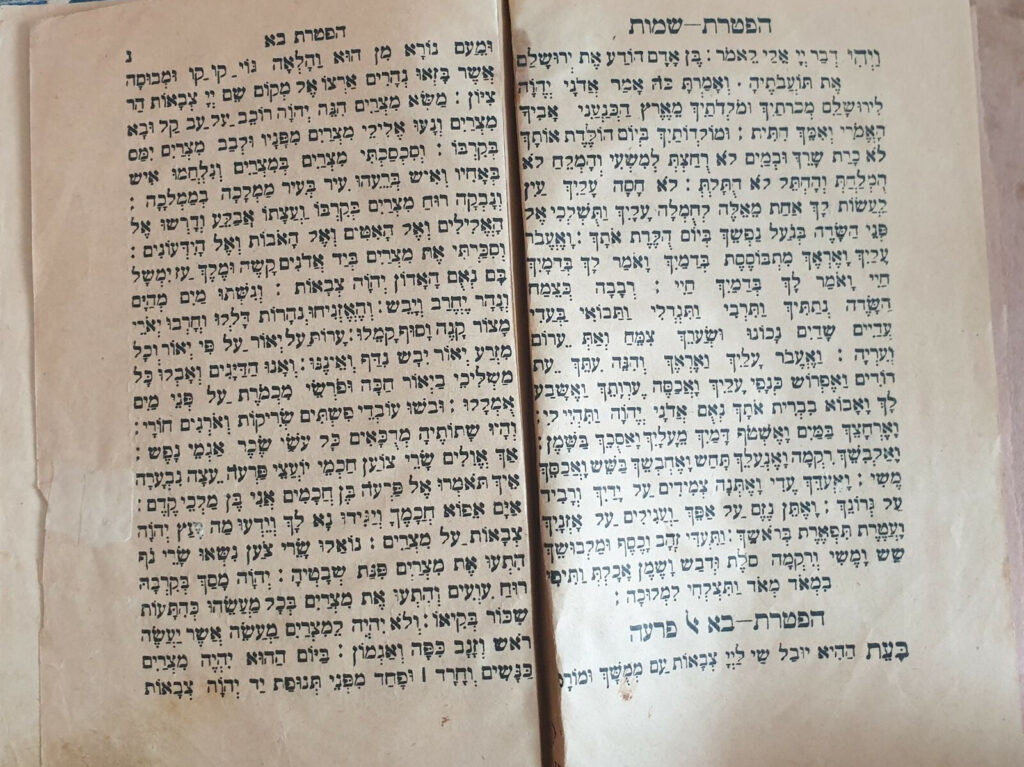


The Haftarah of Parashat Shemot

The Haftarah of Parashat Shemot[1]

By Eli Duker

The Babylonian haftarah for Parashat Shemot was from Ezekiel 16: “Hoda’ et yerushalayim.

The haftarah appears in at least six fragments from the Cairo Geniza,[2] is the haftarah used in the “Emet” piyyut of R’ Shemuel Hashelishi[3] and in the “Zulat” piyyut of R’ Yehuda Beirabbi Binyamin,[4] and is listed in the Seder Hatefillot in Rambam’s Yad Hahazakah as well as in the Siddur of R Shlomo Beirabbi Natan.[5]

This haftarah, an extremely graphic and difficult prophecy, was chosen because it begins by describing the Egypian enslavement and the Exodus. In all of the fragments that describe where the haftarah ends, the last verse is verse 16:15, likely so as not to continue with the difficult words of rebuke that follow that do not have anything to do with the parasha. The Baylonian custom allowed for haftarot that were less than twenty one verses even if the subject is left uncompleted because they still had the practice to read Jonathan’s Targum along with the haftarah, and thus were exempted from the twenty-one verse minimal requirement, as per the ruling of R’ Tahlifa bar Shemuel (Megilla 23b).[6]

This choice of haftarah seems to be problematic in light of the Mishna (Megilla 4:10):

מעשה ראובן נקרא ולא מתרגם מעשה תמר נקרא ומתרגם מעשה עגל הראשון נקרא ומתרגם והשני נקרא ולא מתרגם ברכת כהנים מעשה דוד ואמנון נקראין ולא מתרגמין אין מפטירין במרכבה ורבי יהודה מתיר ר’ אליעזר אומר אין מפטירין (יחזקאל טז, ב) בהודע את ירושלם.

The Mishna brings, without dissent, the opinion of Rabbi Eliezer, which forbids this haftarah. However, the Tosefta as it appears in MS Vienna National Library Heb. 20 seems to allow this haftarah, while Rabbi Eliezer’s view is brought as a dissent:[7]

הודע את ירושלם נקרא ומתרגם ומעשה באחד שהיה קורא לפני ר’ ליעזר הודע את ירושלם אמ’ לו צא והודע תועבותיה של אמך.

However, according to that same Tosefta as it appears in MS Berlin Staatsbiliothek Or. Fol. 1220, the Tanna Kamma merely permits haftarot with general rebuke directed at Jerusalem (תוכחת ירושלים), while Rabbi Eliezer objected to the particular choice of Ezekiel 16:

תוכחת ירושלים נקרא ומתרגם ומעשה באחד שהיה קורא לפני ר’ ליעזר הודע את ירושלים ואמ’ לו צא והודע תועבותיה של אמך.[8]

Like the Mishna above, the Talmud Yerushalmi brings Rabbi Eliezer’s prohibitive opinion regarding this haftarah, and presents no other view:

ר’ אליעזר אומר אין מפטירין בהודע את ירושלם את תועבותיה מעשה באחד שהפטיר בהודע את ירושלם את תועבותיה אמר לו ר”א ילך אותו האיש וידע בתועבותיה של אמו ובדקו אחריו ונמצאו ממזר.[9]

The following appears in both printed versions of the Talmud Bavli [10] as well as in three manuscripts of the Bavli:

הודע את ירושלם את תועבותיה נקרא ומתרגם פשיטא לאפוקי מדרבי אליעזר דתניא מעשה באדם אחד שהיה קורא למעלה מרבי אליעזר הודע את ירושלם את תועבותיה אמר לו עד שאתה בודק בתועבות ירושלים צא ובדוק בתועבות אמך בדקו אחריו ומצאו בו שמץ פסול .

This is very difficult to understand. How can the Gemara assume (פשיטא) that this haftarah can be read if the Mishnah already brought Rabbi Eliezer’s unchallenged opinion forbidding it?

Accordingly, two other manuscripts do not have the word פשיטא.

For example, MS. Columbia 294-295 has the following:

הודע את ירושלם את (..)[ת]ועבותיה נקרא ומיתרגם ומעשה באחד שקרא לפני ר’ אליעזר הודע את ירוש’ את תועב’ אמ’ לו צא והודע תועיבות שלאימך עד שאתה בודק בתועבות ירושלם צא ובדוק בתועבות אמו בדקו אחריו ומצאו בו שמץ פיסול.

Here, the story with Rabbi Eliezer is brought within the context of the view of the Tanna Kamma that it is permissible to read this haftarah. Rabbi Eliezer clearly does not reject this view outright, but still deemed this haftarah a poor choice and an inappropriate one at least under the circumstances.[11]

All of the other manuscripts besides this one feature an explicit disagreement between the Tanna Kamma, who permits this haftarah, and Rabbi Eliezer, who forbids it. The Gemara rejects Rabbi Eliezer’s opinion.

Communities that followed the triennial cycle of the Torah reading never read the beginning of Ezekiel 16 as a haftarah. However for the sidra of V’atta Tetzaveh, they did begin the haftarah from Ezekiel 16:10.[12] It could very well be that this haftarah was deemed permissible despite the Yerushalmi’s ban on the preceding prophecy due to the fact that they held a view later cited by the Levush[13] that the problem with Ezekiel 16 is not the severity of the rebuke but but merely verse 16:3, “Your father was an Amorite and your mother a Hittitess,” which was referenced in Rabbi Eliezer’s retort, seemingly because it casts aspersions of the kind with which no one would be comfortable.

In Europe there were two alternative haftarot for Parashat Shemot: Jeremiah 1:1 and Isaiah 27:6. It seems that many communities either did not want to read Ezekiel 16 even though it was allowed by Halacha because of the weight of Rabbi Eliezer’s rejection, or because they had versions of the Talmudic sources which unanimously presented the haftarah as permissible but undesirable.

In the Iberian peninsula, there were communities that retained the haftarah of Ezekiel 16. It is brought as the haftarah for Parashat Shemot by the Sefer Hashulhan, which was authored by Rabbeinu Hiya ben Shlomo ibn Habib, a student of the Rashba. However, R’ Shemuel Hanagid’s list of haftarot in Sefer HaEshkol lists Jeremiah 1 as the haftarah of Parashat Shemot. The same can be found in Sephardic haftarah books in manuscript[14] and in Sephardic lists of haftarot found in the Cairo Geniza.[15] The reason for this choice of haftarah is the parallel between Jeremiah’s first prophecy and that of Moses. Abudarham lists both of these practices, although it is unclear whether he meant that they were both read in Sepharad or whether he had other locales in mind.

In an early printed humash that is assumed to be Spanish and from around the year 1480, the haftarah for Parashat Shemot is Jeremiah 1:1, while the Hijar Humash from 1487-90 (the only dated humash with haftarot printed before the Expulsion) has Ezekiel 16 as the haftarah.[16] It would be at least over two hundred years later before any other humash was again printed with this as the haftarah.

The Italians adopted Jeremiah 1 as the haftarah for Parashat Shemot as well[17] which is quite surprising, as they preserved more Babylonian haftarot than any other community.[18]

In Ashkenaz, France-England, and Provence the practice was to read Isaiah 27:6 as the haftarah for Parashat Shemot. The same was used as the haftarah for the sidra of V’Eila Shemot in the triennial cycle of Eretz Yisrael.[19] This haftarah was chosen due to its literary rather than thematic associations with the Torah reading, as was generally the case with the rest of the haftarot read according to the triennial cycle. (The haftarot favored in the annual cycle were chosen for their thematic content.)

The first verse of the haftarah,הבאים ישרש יעקב יציץ ופרח ישראל parallels the first verse in the sidra: ואלה שמות בני ישראל הבאים מצרימה את יעקב איש וביתו באו. Three of the haftarah’s first six words are in the first verse of the sidra.[20] We also find that the Romaniote community, which often adopted haftarot from the triennial cycle, adopted Isaiah 27:6 as the haftarah for Parashat Shemot.[21]

This haftarah is also attested to in the Ginzburg manuscript of Mahzor Vitry, in Sefer Etz Haim, in the Sefer HaEshkol’s glosses on the Nagid’s list (where it begins at 27:5, one verse earlier), and in all Ashkenazic humashim and sifrei haftarot in manuscript (although three of them also begin the haftarah one verse earlier).[22]

This haftarah was read in some Morrocan communities.[23]

There were different practices regarding the end of this haftarah. In some manuscripts the final verse is 28:13 making it a “classic” haftarah of exactly twenty one verses, especially appropriate as it was never read with its translation by any community using the annual cycle. Some, in order to end on a clearly positive note, would skip from 28:13 to 29:22 and read two more verses. This is how it appears in all printed humashim with Ashkenazic haftarot. In other manuscripts, we find an alternate practice of extending the reading to verse 28:16, instead of skipping to a later point.

The ensuing printed humashim with Sephardic haftarot post-Expulsion all listed Jeremiah 1 as the Sephardic haftarah for Parashat Shemot

In spite of its absence from the printed humashim, Ezekiel 16 was still retained by many communities as the haftarah for Parashat Shemot. This created a bit of difficulty for those communities. In the recently published Kaf Naki, R. Khalifa Malka, who was active in Agadir, Morocco, between c. 1720-1760,[24] wrote:[25]

The early Magreb practice, as well as our practice, is to read for Parashat Shemot the haftarah of “Hoda’,” based on the Rambam at the end of Sefer Ahava. It is proper to act this way, as he is the rabbi of the Sephardim and the Magrebim. Also concerning this haftarah,[26] I requested of the printer, R’ Shlomo Proofs, to print it together with the haftarah of Hoda’…and he did this to please me in the humashim that he published later on, which had not been done in the days of the publishers who preceded me.[27]

I have not been able to locate any such humashim.[29] The first printed post-expulsion humash I was able to find with this haftarah was printed in Jerusalem by Zuckerman in 1866.

Besides Agadir, this haftarah was (dare I say, miraculously,) retained in many places in various Medditerian and Middle Eastern communities including Algiers,[29] Tafilalt,[30] Fez,[31] Libya,[32] Djerba,[33] Persia/Bukhara,[34] Yemen, and Baghdad.[35] In order to deal with the fact that it did not appear in printed humashim, the practice in Baghdad was to print this haftarah along with the haftarah from Isaiah they would read for Parashat Bo (that was not commonly featured in many printed humashim[36]) in special “Nokh” booklets which had lists of verses and selections from the Mishna that would be recited at home on Shabbatot.[37]


Nokh booklet with the haftarot for Shemot and Bo according to the Bavli custom. (Baghdad, 1930)

[1] I would like to thank Rabbi Avi Grossman for editing this.

[2] Cambridge T-S A-R A13, T-S A-S 19.241, T-S B14.54, T-S B14.62f, T-S B15.5, T-S B20.4

[3] The Yotserot of R. Samuel the Third, Yahalom and Kastuma ed., Vol. 1, pg. 294-295.

[4] Piyyutei R’ Yehuda Beirabbi Binyamin, Elitzur ed., P. 136.

[5] Siddur Rabbeinu Shemuel Beirabbi Natan Hagi ed. Pg. 200.

[6] See Teshuvot Hageonim, Sha’arei Teshuva 84, in the name of R Hai.

[7] Megilla 3:34

[8] See Tosefta Kifshuta, Part V, pg. 1216

[9] Megilla 4:12, This is the version in MS Leiden and all printings of the Yerushalmi.

[10] Vilna, Venice 1520-3, and Pesaro 1509-17.

[11] See Hiddushei HaRan there for an explanation as to why he objected in spite of its permissibility.

[12] See Ofer’s list at https://faculty.biu.ac.il/~ofery/papers/haftarot3.pdf

[13] Levush Hahur 478. See also Duker, Hahaftarot Lefarashiyot Aharei Mot UKdoshim L’fi Minhag Ashkenaz in Hitzei Gibborim Vol. 11, pg. 387-498.

[14] PARM 2054 and Angelica Rome 55.

[15] Cambridge T-S B20.2 and T-S B20.14

[16] Based on this and the Sefer Hashulchan, it could be that the retention of that haftarah was an Aragonian practice

[17] MS Parm 2169.

[18] Besides from retaining the original haftarot for Bo, Behar, and Behukkotai, the Italians only read the special haftarot of Destruction and Consolation during the month of Av, but not in Tammuz or Elul, thus retaining the Babylonian haftarot for the parashiyot of Matot, Masei, Shoftim, Ki Tetzei, Ki Tavo, and Nitzavim. The fact that, unlike as in other communities, the Italians did not read Jeremiah 1 on the Sabbath following the Seventeenth of Tammuz, may indicate that the practice of reading Jeremiah 1 as the haftarah for Shemot originated in Italy, but this is just conjecture at this point.

[19] Ibid. Ofer’s list.

[20] Heard orally from Prof. Yosef Ofer.

[21] See Fried list in the back of Encyclopedia Talmudit Vol. 10

[22] The haftarah appears as such in Geniza Fragment Cambridge T-S B16.19b as well. It is also the haftarah in the “Emet” piyyut of R’ Shelomo Suleiman al-Sinjari, but he vacillates between using haftarot from the Babylonian custom and the haftarot from the triennial cycle. See The Yoserot of Rabbi Selomo Suleiman al-Sinjari for the Annual Cycle of Torah Reading. Hacohen, ed. Pg. 368-370.

[23] Naziri, Otzar HaMinhagim VeHamesorot LiKhillot Tafilalt V’Sijilmasa pg. 84 footnote 128, and Danino, Miminhagei Yahadut Morocco. Avaialble at http://www.daat.ac.il/daat/toshba/minhagim/mar-tfi.htm. Avitan, Minhagei Halacha Lefi Kehillot Morocco., link. The fact that Isaiah 27:6 was read as the haftarah for Parashat Shemot in Morocco opens up the possibility that this may have been the practice somewhere in Spain prior to the Expulsion. Moroccan communities retained all three of the haftarot that we have for Parashat Shemot, as Jeremiah 1 was read in Sefrou (Naziri, ibid.) and is still read today in at least some communities that follow Morrocan practices. Others read Ezekiel 16, as discussed below.

[24] Published 2012, Orot Yehudei HaMagreb, Halamish M. ed.

[25] I would like to thank Rabbi Yehoshua Duker for translating this.

[26] Referring to Isaiah 19 as the haftarah for Parashat Bo.

[27] He proceeds to claim that it had not been printed due to the influence of the Levush which, (in his opinion,) was influential because of the dearth of other works on the Shulhan Aruch back then. I think it is merely because the haftarah was not printed in the Venetian humashim published by Bromberg (in particular, the 1524 edition), which had a heavy influence on the selection of haftarot in later humashim. I will address this in an article on the haftarot of Vayetze and Vayishlach that I hope to publish soon.

[28] He clearly saw the humash with these haftarot as he wrote about how the last verse of the haftarah for Shemot was left out.

[29] Zeh Hashulhan, Minhagei K”K Algier p. 245

[30] Naziri, pg. 84

[31] Ibid. footnote 128 quoting Sefer Ahavat HaKadmonim pg. 6a. It is also written there that this was the practice in Izmir and Turkey.

[32] Biton, Nahalat Avot, p. 65

[33] HaCohen, Brit Kehuna, pg. 16.

[34] Zuckerman Humash

[35] Sitbon, Alei Hadas, pg. 360.

[36] It was only printed in humashim with Italian haftarot (before the late 20th century) such as the following: Manitoba 1589, Amsterdam 1712 (Proofs), 1729 (Binyamin ben Uri Katz), and Venice 1820.This list not exhaustive.

[37] Simanei Pesukei Nokh, 1920. A complete listing of the various printings (seven in all) can be found in Ben Yaakov, Minhagei B’nei Bavel B’Dorot HaAharonim.


R. Moshe Zuriel, the Aderet, Sonya Diskin, and ChatGPT

 R. Moshe Zuriel, the Aderet, Sonya Diskin, and ChatGPT

Marc B. Shapiro

1. It is hard to believe that more than a year and a half has passed since R. Moshe Zuriel was taken from us. At the time of his passing, I intended to write a lengthy appreciation of him, but I was never able to get around to it. Still, I feel compelled to say something about R. Zuriel, if only to express my hakarat ha-tov for all that I learned from him. Although we never met, we exchanged numerous emails. It reached the point where, whenever I had a question about a passage in R. Kook, I would turn to him. I was also happy to arrange for three of his posts to appear on the Seforim Blog—see here.

Although R. Zuriel was my senior both in age and certainly in wisdom, he honored me by treating me like an old friend. Here is just one sample from an email he sent to me.

Your reference to Rabbi Hirsch’s praises for Schiller’s writings is a Godsend for me. I am elated at his words.

I myself was born in Frankfort am-Main, and consider myself an avid follower of his teachings, which strike a chord in my heart. The expressions in this Memorial Speech are something fabulous. Thank you again for bringing this to my attention. Rav Kook too speaks many a time about Universal Values, which are evident here and there in the Gentile Communities. We must have a link to our fellow humans.

Before we started communicating by email, we sent old fashioned letters. Here is one letter from December 2003. R. Zuriel followed Rav Kook’s approach—discussed by me in The Old Will be Renewed, the New Will be Sanctified—that the Sanhedrin will be able to actualize new moral and religious insights that have become apparent. These moral and religious insights should be viewed as Torah truths that were revealed gradually over time, meaning that we have advanced from the morality at the time of the giving of the Torah. The Sanhedrin will have the final say as to when we are dealing with authentic Torah values vs. non-Jewish values that people are trying to insert into Jewish life.


Here are two other letters from R. Zuriel where you can see his strong religious spirit.

Here is the final part of another letter he wrote me.

I first heard of R. Zuriel when I was a student at Beit Midrash le-Torah (BMT) in 1984–1985. I happened to find his sefer, Beit Yehezkel: Hilkhot Deot, on the shelf. I knew nothing about the author but found the book interesting and began to go through it. I never told R. Zuriel that this was the first sefer I ever went through. In school, we studied Chumash and Gemara, but I had never before picked up an independent sefer and tried to work through it on my own.

One day, while I was learning the sefer, someone noticed and mentioned that there was something controversial in it—namely, that R. Zuriel praises kippot serugot. Even then, I was interested in controversial texts, and I carefully combed through the book, unsuccessfully trying to find the page where he offered this praise. I later heard this story on other occasions as well, so I assumed that the volume I had been using had been censored and that the provocative passage had been removed. That was undoubtedly my first experience with what I thought was a censored text. Maybe that moment planted the seeds that would only come to fruition decades later in Changing the Immutable.

It was only many years later that I learned R. Zuriel had published two books under the title Beit Yehezkel, and lo and behold, I eventually found the passage about kippot serugot on p. 194 of the first edition.

Incidentally, I think many will be surprised to learn that R. Zvi Yehudah Kook—whose yeshiva and followers became such an important force in the kippah serugah world—actually preferred a black kippah over a kippah serugah, not just for himself but for everyone. It is true that he did not make a big deal about it, but we need to be honest about his opinion. Even when presented with two students, one wearing a small black kippah and the other a large kippah serugah, he expressed his preference for the black kippah.[1]

In fact, R. Zvi Yehudah would have even preferred that students at Merkaz ha-Rav wear a hat and jacket, though he never made an issue of it. He did, however, tell at least some of his students who became rabbis that they should wear rabbinic garb—which today generally means a black suit and hat. He wasn’t entirely consistent in this regard, and I suppose that explains the varied styles of dress among his rabbinic students: some look no different than haredi rabbis, others wear a kippah serugah along with a hat, and still others wear a kippah serugah without a hat.[2]

For those who want to learn more about R. Zuriel, his website can be found here. It is truly remarkable to see the vast array of books he published, covering so many different areas of Torah.[3] You will also find there the three volumes of writings by Naftali Hirz Wessely, including material from manuscript, which R. Zuriel published. Interestingly, his name does not appear in these volumes as the one who prepared them for publication. Instead, he used pseudonyms—likely to avoid becoming embroiled in controversy. Yet it is worth noting that, in the years before his death, he began writing about Wessely under his own name and openly defended his decision to publish Wessely’s works. See here.

Missing from his website is his first edition of Wessely’s Sefer ha-Midot, which was published in 2002. The site only includes the later edition, which incorporates previously unpublished material. Yet the first edition is extremely valuable and deserves to be uploaded as well. This is because it contains a lengthy introduction that establishes the religious acceptability of Wessely, citing numerous great rabbis who referenced him positively. (For examples of censorship involving Wessely in the reprinted works of R. Moses Schick and R. Samson Raphael Hirsch, see my post here.) This introduction is significantly different from the one that appears in the second edition. While most of it is also found in the introduction to R. Zuriel’s edition of Wessely’s Yein Levanon (written under the pseudonym Yaakov Segal), for some reason, the version of Yein ha-Levanon on the website omits this entire introduction. Also missing is R. Hayyim Druckman’s haskamah and a letter from Wessely that originally appeared in the first publication of Yein Levanon (Berlin, 1775).

What is particularly noteworthy is that the first edition of Sefer ha-Midot includes a haskamah from R. Zuriel himself, in which he seeks to establish the legitimacy of Wessely. I don’t know—and unfortunately never asked R. Zuriel—why, if he was willing to write a haskamah for Wessely’s book, he wasn’t also willing to identify himself as the editor. The haskamah is formally addressed to “Rabbi Hayyim Lifshitz,” the supposed editor of the book—but Lifshitz is a fictional figure, and the lengthy introduction attributed to him was, in fact, written by R. Zuriel.

When it comes to an author providing a haskamah to his own work published anonymously or under a pseudonym, we do have precedent. R. EliyahuDavid Rabinowitz-Teomim (the Aderet) did this with the only two, of his over 120 works, that were published in his lifetime. In 1889 he published Zekher la-Mikdash (on Hakhel). Here is the title page from the first printing (later printings include the Aderet’s name). In his autobiography, the Aderet mentions writing the book.[4]

On the title page, instead of an author’s name, it states: חובר מאת פלאי. This is clearly intended to evoke Judges 13:18, where the angel says to Manoah, “Wherefore askest thou after my name, seeing it is hidden (פלאי)?” What’s puzzling is that the title page spells it as פלאי—with an apostrophe between the last two letters—rather than the more straightforward פלאי. It has been suggested that the final three letters allude to the author’s name, “Elijah” (אלי), and that the פ stands for Pinhas, since Pinhas is traditionally identified with Elijah.[5] But to me, this interpretation feels far-fetched.

Here is the haskamah which is followed by the Aderet’s many notes to the book, as if he is commenting on someone else’s sefer.

In 1893 the Aderet anonymously published Aharit ha-Shanim (on the law of Vidui Ma’aser). Here is the title page of the first printing (subsequent printings include the Aderet’s name).

This book is also mentioned in the Aderet’s autobiography.[6] Unlike in Zekher la-Mikdash, in Aharit ha-Shanim there is a hint in the Aderet’s introduction to his authorship (emphasis added):

עכ העלמתי שמי והליטותי פני באדרתי לבל ישאו פני

Furthermore, anyone who looks up the biblical verse which is the origin of the expression והליטותי פני באדרתי will find that it is in 1 Kings 19:13 and describes Elijah wrapping his face in his mantle. The Aderet’s first name is Elijah, so this is obviously also an allusion to the author’s identity.

Here is the Aderet’s haskamah to this book. As with Zekher la-Mikdash, the haskamah is followed by many pages of notes to the book, under the heading Devar Eliyahu.

I assume the Aderet must have felt somewhat awkward referring to himself as ha-ma’or ha-gadol (המאוהג), yet everyone understands that such honorifics are expected in haskamot. In fact, had he not used this kind of language, he might well have been accused of failing to show proper respect for the author—since people did not know that he himself was the author.

In 2005, Aharit ha-Shanim was reprinted by Ahavat Shalom, and they were fortunate to have access to the Aderet’s own copy, which contains many additional marginal notes. These were included in the new edition.

I found another case where the author wrote a haskamah to his own book, but as you can see, the haskamah is not a typical haskamah.

Here is the title page of R. Yaakov Goldman’s Peret ve-Olelot (Jerusalem, 1930).

Here is the haskamah.

Speaking of the Aderet and haskamot, here is a chance to deal with a report that has assumed legendary status in the Merkaz ha-Rav world. R. Zvi Yehudah Kook claimed that the lengthy haskamah of the Aderet for the Chafetz Chaim’s Likutei Halakhot was actually written by R. Kook.

Here is the haskamah:


The story told by R. Zvi Yehudah and recorded by R. Moshe Zvi Neriah in Sihot ha-Re’iyah, pp. 123-124, is as follows: R. Kook visited his former father-in-law, the Aderet, while the Aderet was serving as the rav of the city of Mir. During this visit, a letter arrived from the Chafetz Chaim requesting a haskamah for his new book, Likutei Halakhot. He wished to have the haskamah sent as soon as possible, even on the very day his letter arrived, and included some portions of the book. The Aderet was very impressed and showed R. Kook what the Chafetz Chaim had sent. Due to his busy schedule, the Aderet was unable to write the haskamah that day, so he asked R. Kook to write it. R. Kook wrote the impressive haskamah that was later printed.

After R. Kook wrote the haskamah, the Aderet read it over and was ready to sign it. However, he stated that he could not take credit for a Torah explanation suggested by R. Kook, so he altered the text of the haskamah, attributing the explanation to R. Kook, the rav of Bausk. This haskamah is the very first one in Haskamot ha-Re’iyah (Jerusalem, 2017).

It is a very nice story, but is it true? Let me present a source that seems to contradict what R. Zvi Yehudah reported. In the Aderet’s autobiography, Seder Eliyahu, p. 100, the Aderet recounts how, due to a dispute in his city, the Chafetz Chaim came there to try to make peace. The Aderet then writes that a couple of weeks later he wrote the haskamah for Likutei Halakhot.

אז נתתי הסכמתי על ס‘ לקוטי הלכות להגהצ בעל חח שליטא

Presumably, it was when the Chafetz Chaim visited the city that he gave the Aderet his work. If R. Kook had written the haskamah, wouldn’t the Aderet have mentioned it in his memoir? Furthermore, in R. Kook’s Eder ha-Yekar, p. 47, he says the following about his father-in-law:

כל הספרים הרבים שנתן עליהם הסכמתועבר עליהם מראשית עד אחרית וברוב העיר עליהם הערות

According to R. Kook, the Aderet would not give a haskamah unless he had read the entire book. However, the story as told by R. Zvi Yehudah suggests that the Aderet gave a haskamah without having gone through the book.

Based on the two points I have mentioned, I think it is legitimate to raise questions about the story told by R. Zvi Yehudah. It would make more sense to assume that the Aderet wrote the haskamah while R. Kook was in Mir and that the Aderet discussed the haskamah with R. Kook (which would explain the mention of R. Kook in the haskamah). But it is hard to reconcile R. Zvi Yehudah’s story with the Aderet’s own testimony in his memoir or with R. Kook’s description of how the Aderet would study a book before giving his haskamah.

A completely different version of the story involving the Aderet, R. Kook, and the haskamah was told by R. Kook’s nephew, R. Refael Kook. In his version, the haskamah was written by R. Kook for another book by the Chafetz Chaim, Nidhei Yisrael. Here is the story as found in Simcha Raz’s An Angel Among Men.[7]

When the Chafetz Chayim zt”l finished writing Nidchei Yisrael, he came to the Aderet (R. Eliyahu David Rabinowitz-Te’omim) to receive a letter of approbation for the book.

The Aderet kept the book’s proof sheets in order to look through them before writing his approbation. Unfortunately, however, he came down with pneumonia and was quite ill for several weeks. During that time, the Chafetz Chaim came back to receive the approbation he so anxiously waited for. The Aderet’s doctor, however, forbade him to exert himself in any way; so he was unable to write the letter.

The Chafetz Chayim was very disappointed, having made the trip just for the approbation. Don’t worry,” said the Aderet. “I just married off my daughter to R. Avraham Yitzchak HaKohen Kook, who is greater than me in many areas. He will write the letter, and I will sign it.”

And so it was: The Rav wrote an approbation for Nidchei Yisrael and the Aderet signed it, thus forging a strong bond of friendship between the Chafetz Chayim and Rav Kook.

In this version, the Aderet says that R. Kook had just married his daughter. This is obviously incorrect as the Aderet’s haskamah to Nidhei Yisrael is dated 1894. Yet R. Kook married his daughter in 1886 and she passed away in 1889. In 1894 R. Kook was married to the niece of the Aderet, the daughter of his twin brother, R. Zvi Yehudah Rabinowitz-Teomim.

Here is the haskamah to Nidhei Yisrael.

In the Torah journal Me-Avnei ha-Makom 15 (2003), pp. 15-17, a section from the Aderet’s still unpublished 1878 work Oznei David appears. The Aderet notes that the Chafetz Chaim spent Shabbat with him and records some of their Torah conversations. One of the points he mentions is that the Chafetz Chaim asked him how one could eat at various Jewish inns, which were places where Jews would stay while traveling. The issue for the Chafetz Chaim wasn’t kashrut. In those days, people trusted other religious Jews, and the notion that an outside hashgachah was required in such circumstances had not yet been introduced.

What concerned the Chafetz Chaim was that most of the owners of these inns did not tovel their utensils. How then could people eat there? The Aderet explained—and he sees this as a novel view—that it is only forbidden for the owner to use utensils that have not been toveled. Yet there is no problem for others to make use of these utensils. What is of particular historical interest here is that we see that laxity regarding the toveling of utensils is not a recent phenomenon, but was even seen among religious Jews in nineteenth-century Lithuania.

Regarding the Chafetz Chaim and the Aderet, the tradition is that when the Chafetz Chaim writes, והעירני א‘ מחכמי הזמן, in his discussion about Birkat Kohanim in the Diaspora[8], the unnamed scholar he refers to the Aderet.[9] With one exception, the Chafetz Chaim never mentions contemporary scholars by name in the Mishnah Berurah. In Orah Hayyim 585, in Beur Halakhah s.v ve-tov, he refers to R. Meir Simhah of Dvinsk. The story here is that they had a dispute at a rabbinic conference and the Chafetz Chaim thought that his language was perhaps too sharp.[10] As an apology of sorts, he broke with his convention and mentioned R. Meir Simhah by name.

It is widely reported how the Chafetz Chaim admired Rav Kook and refused to allow anyone to speak negatively about him.[11] Among the various sources cited in all the discussions I have seen, no one has referred to R. Yosef Zussman, Mi-Behirei Tzadikaya, pp. 168, 176, that when R. Zvi Yehudah Kook was together with the Chafetz Chaim he was afraid to mention who his father was, out of fear that the Chafetz Chaim would express some criticism of Rav Kook. In the end, his fear was unfounded, and the Chafetz Chaim, upon finding out who he was, told R. Zvi Yehudah that R. Kook was a good friend of his.[12] This anecdote was included in two separate letters from R. Zussman to R. Moshe Zvi Neriah. While R. Neriah used other information from these letters in his own writings, he did not include the detail of R. Zvi Yehudah being worried that the Chafetz Chaim would criticize his father.

I know that it is difficult for opponents of R. Kook to deal with the fact that the Chafetz Chaim had such positive feelings for him. I wonder if they would adopt the approach of the Brisker Rav, R. Isaac Zev Soloveitchik. When asked why the Chafetz Chaim showed respect for a certain Zionist rabbi (not R. Kook), the Brisker Rav replied with the following critical comment: “This is what happens when you don’t listen to lashon hara!”[13] In other words, sometimes it is important to be aware of negative reports about certain individuals so you know how to properly relate to them.[14]

2. I recently played around with ChatGPT and found some incredible things. First, its translation ability is at a very high level. I put in some sentences from nineteenth-century Haskalah literature and the translations that came back are excellent. There are times that ChatGPT gets it wrong, and you always need to carefully review its translations. Yet it seems that we have entered a new era when it comes to translations. Going forward, should translators just insert Hebrew texts into ChatGPT and then check for accuracy and edit the translation? Perhaps this is already being done, which would be a major development.

I also became aware that you can put an article, even a PDF, into ChatGPT and it will give you a summary. Look what happened when I put Haym Soloveitchik’s “Rupture and Reconstruction” in and asked for a summary.

Summary of “Rupture and Reconstruction” by Haym Soloveitchik

Thesis & Central Argument:

Soloveitchik examines the transformation of Orthodox Jewish life in the modern era, particularly the shift from a mimetic (lived, experiential) tradition to a text-based halakhic culture. This shift, he argues, resulted from the sociocultural disruptions caused by the Holocaust and modernization.

I. The Loss of Mimetic Tradition

Traditionally, Jewish practice was absorbed through daily life rather than studied in texts. Children learned religious conduct by watching their parents and community rather than through legalistic study. However, this mimetic tradition began to break down due to several historical forces:

Modernity and Migration:

Jews who emigrated from Eastern Europe to America and Israel found themselves in new environments where religious life was no longer reinforced by communal structures.

In America, the pressures of assimilation and middle-class life further eroded informal religious transmission.

The Holocaust’s Impact:

The Holocaust annihilated the communities and individuals who had embodied and passed down the mimetic tradition.

The post-Holocaust Orthodox world was largely composed of religious survivors and their children, who lacked an organic religious upbringing.

As a result, Jews turned increasingly to written texts to reconstruct religious life, rather than continuing a naturally transmitted tradition.

II. The Rise of Text-Based Religious Life

With the breakdown of mimetic tradition, Orthodox Jews sought religious guidance in texts rather than communal precedent. Several key shifts occurred:

Stringency (Chumra) and “Maximum Position Compliance”:

Halakhic observance became more rigid, as Orthodox Jews increasingly sought the “most correct” way to perform rituals based on written sources rather than communal norms.

Practices that had previously been instinctual or lenient were now analyzed and subject to stricter interpretations.

Proliferation of Halakhic Literature:

The 20th century saw an explosion of halakhic texts, guiding every aspect of Jewish observance in meticulous detail.

Religious practice became more standardized and universalized across communities, rather than based on local custom.

The “Ritualization” of Daily Life:

Previously intuitive religious behaviors, like eating matzah at the Passover seder, were now measured and standardized (e.g., precise “shiurim” for halakhic measurements).

This shift emphasized precision and rule-following over natural, community-based observance.

III. Broader Sociological Implications

Soloveitchik argues that this shift reflects a broader pattern in Jewish history:

A Response to Cultural Erosion:

The disappearance of traditional Jewish life and the rise of middle-class acculturation created a need for stricter religious boundaries.

As Jewish life became more indistinguishable from non-Jewish life, Orthodoxy sought to reinforce distinctiveness through increased textual rigor.

The Influence of the Holocaust on Jewish Memory:

The Holocaust left Orthodox Jews without direct cultural transmission from past generations.

In response, they “reconstructed” an idealized version of pre-Holocaust Jewish life, one that was more rigidly text-based and uniform than the reality of Eastern European Judaism.

The Decline of Jewish Asceticism:

Historically, Jewish tradition included a strong ascetic streak, which emphasized self-denial and wariness of physical pleasures.

However, as Orthodox Jews became more integrated into middle-class life, this asceticism waned, replaced by an emphasis on ritual precision rather than self-denial.

Conclusion:

Soloveitchik describes a fundamental transformation in contemporary Orthodox Judaism: the replacement of an organic, mimetic tradition with a text-driven, rule-oriented religious culture. This shift has led to increased religious stringency, a focus on halakhic literature, and a reconstruction of Jewish memory that aligns with contemporary Orthodox practice rather than historical reality.

* * * * * * *

[1] R. Zvi Yehudah Kook, Piskei Rabbenu, ed. Aviner, Orah Hayyim, p. 31. R. Shlomo Aviner recently published a book titled Pesikah ke-Halakhah. It consists of “strange pesakim” by unnamed rabbis, and R. Aviner’s response. On p. 169 the “strange pesak” he records is that someone who goes to movies should do so in another city, not where he lives, and replace his black kippah with a kippah serugah. This “pesak” is obviously based on Moed Katan 17a: “If a person sees that his evil inclination is gaining control over him, then he should go to a place where he is not known. He should wear black, wrap his head in black, and do as his heart desires [in private] and not desecrate the name of Heaven in public.”

There are those, such as R. Chaim Kanievsky, who have ruled that it is preferable to pray by oneself with a jacket and hat, than pray with a minyan without these items. (E.g., if you are in a situation where if you run home to get your jacket and hat you won’t be able to pray with a minyan.) See R. Yair Yanai, Nekiut ve-Kavod bi-Tefillah, p. 208. Yet see ibid., p. 98, that R. Shlomo Zalman Auerbach and R. Yosef Shalom Elyashiv ruled that prayer with a minyan is more important than wearing a jacket and hat. See similarly R. Meir Mazuz, Makor Ne’eman, vol. 3, no. 151 and R. Yitzhak Ratzaby, Olat Yitzhak, vol. 3, Orah Hayyim, no. 36. See also here at minute 18 where R. Reuven Feinstein strongly rejects the idea that it is better to pray by oneself with a hat than pray with a minyan without a hat. The entire video is noteworthy. Following the exchange about praying with a hat, R. Reuven is asked at what age should a boy be taught to wear his tzitzit out. He responds, “at no age”, and elaborates on why there is no reason to wear tzitzit out. See also at 34:55 where the questioner wants to know what to do about students who are brought up with an ideology that leads them to want to join the IDF. R. Reuven replies that if they want to join that is fine, and the army will probably turn them into a mensch.
[2] See R. Zvi Yehudah Kook, Piskei Rabbenu, ed. Aviner, Orah Hayyim, pp. 31-32.
[3] I remember how surprised I was when R. Zuriel published his Masoret Seyag la-Torah. My surprise was due to how R. Zuriel chose to deny that Jacob ben Hayyim Ibn Adonijah, the masoretic scholar and editor of the first Mikraot Gedolot, later apostatized. See my Limits of Orthodox Theology, p. 93 n. 14, where I write that it is remarkable that a book could be published in modern times referring to Jacob ben Hayyim as one of the great scholars of Israel. For R. Mordechai Breuer’s harsh review of the R. Zuriel’s book, see Megadim 20 (Tamuz 5753), pp. 91-96, available here.
[4] Seder Eliyahu (Jerusalem, 1983), p. 82. On p. 106 he mentions it among the books he wrote. Moshe Reines on his own figured out that the Aderet was the author. See his Mivhar Ketavim, ed. Eliezer Brodt (Ramat Beit Shemesh, 2018), pp. 31, 605. I thank R. Eliezer Brodt for calling this to my attention. He also pointed out that R. Yisrael Dandrovitz discusses the Aderet’s haskamot in his book Hayu Devarim Me-Olam, vol. 2, ch. 22. The chapter is titled: מחברי ספרים שהסתתרו כמסכימים
[5] Akivah ben Ezra, Minhagei Hagim (Tel Aviv, 1963), p. 314 n. 7, cited in R. Yehudah Zoldan, Malkhut Yehudah ve-Yisrael, p. 451 n. 17. I write “Akivah” because the author spelled his name עקיבה. The standard way of spelling the name is עקיבא, yet Maimonides always spelled it עקיבה.
[6] Seder Eliyahu, pp. 102, 106 (including it among the books he wrote).
[7] Trans. Moshe D. Lichtman (Jerusalem, 2003), pp. 368-369.
[8] Mishnah BerurahSha’ar ha-TziyunOrah Hayyim 128 (following no. 136).
[9] See e.g., here.
[10] One version of the story is found in R. Elazar Shakh, Shimushah shel Torah, p. 159. In a future post I will discuss this incident.
[11] See e.g., here. Here is a letter from the Chafetz Chaim’s son-in-law, R. Aaron Cohen, which appears in Iggerot la-Re’iyah, pp. 565-566.

[12] More than thirty years ago I spent Shabbat at the home of the late R. Zev Neuman, who was a very close student of R. Zvi Yehudah and involved in the publication of writings of R. Kook and R. Zvi Yehudah. (See here for various articles about Neuman.) At one of the Shabbat meals, Neuman took out a manuscript of one of R. Zvi Yehudah’s talks and read it to us. R. Zvi Yehudah described how he stayed at the Chafetz Chaim’s home and the Chafetz Chaim personally set up the bed for him. This passage, which made such an impression on me that I still remember it vividly so many years later, has unfortunately not yet appeared in print.
[13] Zvi Yavrov, Ma’aseh Ish, vol. 2, p. 85. See R. Michel Zalman Shurkin, Meged Givot Olam, vol. 2, p. 78, who quotes his father that near Radin lived a great talmid hakham who was a member of Mizrachi. The Chafetz Chaim stood up for this rabbi even though he also spoke very strongly against Mizrachi. The city of Radin is close to Lida, so I wonder if the unnamed Mizrachi rabbi was R. Isaac Jacob Reines, who actually founded Mizrachi.

It is of interest that the Chafetz Chaim’s son, R. Aryeh Leib, who assisted him in writing the Mishnah Berurah and later became the rav of Radin, publicly supported the Mizrachi. This fact is never mentioned by Haredi writers. Yet it is also noteworthy that although R. Aryeh Leib was a member of the secret Hovevei Tziyon society in Volozhin, his public identification with Mizrachi only occurred after the death of the Chafetz Chaim. It seems clear that, out of respect for his father, he refrained from publicly identifying with Mizrachi during his father’s lifetime. See Entzyklopedia shel ha-Tziyonut ha-Datit, vol. 4, cols. 273ff.

See R. Michel Zalman Shurkin,, Meged Givot Olam, vol. 1, pp. 48-49, that R. Mendel Zaks, the son-in-law of the Chafetz Chaim, preferred the biography of the Chafetz Chaim written by R. Meir Moshe Yosher over the volume written by R. Zaks brother-in-law, R. Aryeh Leib. He explained that Yosher’s volume just gives the facts, while R. Aryeh Leib also gives reasons for various actions and practices of the Chafetz Chaim, “and we do not have permission to give reasons for the actions of gedolei Yisrael.”
[14] See also Yavrov, Ma’aseh Ish, vol. 7, p. 94, that the Chafetz Chaim wrote that there is no enjoyment from telling lashon hara, and the Hazon Ish commented that apparently the Chafetz Chaim never told lashon hara, or he would have seen that one can indeed get pleasure from this.

Regarding lashon hara, see also Yavrov, Ma’aseh Ish, vol. 5, p. 31, where the Hazon Ish is quoted as saying that it is not lashon hara to say that someone does not know how to learn, as we need to know who is learned and who is not. Since there is a purpose in knowing who is a gadol be-Torah, therefore it is permitted to say that someone is not a gadol. This approach explains how it is not uncommon to hear people saying about various rabbis that they are “not so great in learning”. But I assume that the Hazon Ish was referring to rabbis making these judgments about other rabbis, not that laypeople would offer such comments. See also ibid, vol. 7, p. 94, where it records that on Kol Nidrei night the Hazon Ish told the students that we will now speak “kosher lashon hara.” He proceeded to speak about a rabbi who imagined that the Hebrew University was the Third Temple. He then turned to heaven and declared:

נורבונו של עולםמספיק בשבילו מה שכבר קלקל עד כאן!

This can only refer to R. Kook, but as is well known, the notion that R. Kook compared the Hebrew University to the Temple, or that he applied to it the biblical verse, כי מציון תצא תורה, are complete fabrications by the enemies of R. Kook which misled even many great Torah scholars. See Moshe Alharar, Likhvodah shel Torah (Jerusalem, 1988), which is devoted to the slander directed against R. Kook.


Chaim Rapoport – From Ma’adanei Eretz to Kitvei Ma’adanei Eretz (5704-5767)

From Ma’adanei Eretz to Kitvei Ma’adanei Eretz (5704-5767)
Rabbi Chaim Rapoport
(London, England)

As Rabbi Eliezer Brodt has recently noted in a post at the Seforim blog the advent of the sabbatical year has been blessed with a plethora of new books and pamphlets related to the laws of shemitah.

Prominent amongst these is a publication entitled Kitvei Ma’adanei Eretz on Masechet Shevi’it, from the writings of the world renowned halachic authority, Rabbi Shlomo Zalman Auerbach (1910-1995), published by Zehav haAretz on the “eve of the shemitah year, 5768”.

The sefer (341 pages) is divided into two parts. The first part is arranged according to the order of Masechet Shevi’it and presented as a commentary on it. The second half is comprised of a series of chapters on a broad variety of halachic topics related to shemitah.

In the preface we are told that the editors received much support and encouragement from Rabbi Shlomo Zalman’s sons, including Rabbi Shmuel Auerbach shlit”a. We also learn that much of the material in the sefer was never intended for publication by Rabbi Shlomo Zalman. [It was often written in note-form for his own perusal etc.] Nevertheless, given the enormous interest in the writings of Rabbi Auerbach, it was decided that these chiddushim should be edited and published. This feat was accomplished to the delight of the publishers and their intended audience.[1]

For the sake of producing a comprehensive work the publishers inform us that they have included segments of the author’s previously published works that relate to the Masechet Shevi’it and its halachot.

Indeed, the second half of the sefer, which consits of chiddushim on Rambam and halachic discussions pertaining to shemittah, appears to have been gleaned almost entirely from Rabbi Shlomo Zalman’s earlier works, most particularly his Ma’adanei Eretz on the laws of shevi’it.

However the publication of this sefer raises two related bibliographical questions: (a) Rabbi Auerbach’s classic on Shevi’it, namely his celebrated Ma’adanei Eretz, published originally by the author himself in anticipation of the shemitah year 5704,[2] and republished with the blessing of the author in anticipation of the shemitah year 5733, has been out of print and unavailable for many years.[3] Why has this book not yet been re-published? (b) Why has only some, but not all of the material in the original Ma’adanei Eretz been reproduced in Kitvei Ma’adanei Eretz?

I cannot offer a definitive answer to these questions. Yet it is possible that two features of the original work are the cause for these ‘omissions’.

Firstly, the original Ma’adanei Eretz dedicates much discussion to the ‘heter mechirah’ and its dynamics. Although Rabbi Auerbach clearly expresses a preference for the observance of shemitah without recourse to the heter mechirah, he does recognise the plausibility of the ‘heter mechirah’ and seeks to buttress this mechanism with halachic argumentation. Moreover, (as is evident from his introduction), Rabbi Auerbach’s defense of the ‘heter mechirah’ – which he considered to have been endorsed by ‘minhag yisroel’ – was one of the primary purposes of his work.[4]

In times bygone, this apect of Ma’adanei Eretz apparently presented no cause for concern, even amongst the most chareidi Jews. Rabbi Zelig Reuven Bengis (1864-1953), then Rosh Beth Din of the ultra-Orthodox Edah Chareidit in Jerusalem, was aware of Rabbi Auerbach’s ‘agenda’ (towards which he was not particularly sympathetic), yet this did not prevent him from writing a complimentary letter of approbation in honour of the author and the book.[5] The same is true for Rabbi Isser Zalman Meltzer, (1870-1953), then rosh yeshiva of the Etz Chaim yeshivah in Jeruslaem. Yet nowadays this is no longer the case. Some of Rabbi Auerbach’s biological and/or ‘spiritual’ heirs who completely deny the validity of the heter mechirah and/or its application in the contemporary social and economic climate, may be deeply embarrassed by the original Ma’adanei Eretz.

Secondly, Rabbi Auerbach refers with the most reverential terms to the late Rabbi Avraham Yitzchak haKohen Kook (1865-1935), and attributes much weight to his halakhic opinions.[6] In contradistinction to many other illustrious authorities to whom Rabbi Auerbach refers to as “ha-gaon . . . of blessed memory’ his appellation for Rav Kook includes the honorific “maran [ha-gaon ha-Rav Kook of blessed memory].”[7]

In today’s ultra-orthodox climate, in which Rav Kook has almost been written out of existence[8] [or worse still, ‘demonised’], it should come as no great surprise that some would like to disassociate the prestigious Rabbi Auerbach from one of his primary mentors.[9] Accordingly, it is only natural that they would endeavour to orchestrate matters in such a way that the original Ma’adanei Eretz (with its ‘offensive’ contents) fades into oblivion.[10]

An examination of the ‘privileged’ segments of the original Ma’adanei Eretz that have been ‘preserved’ in the Kitvei Ma’adanei Eretz supports my thesis. Rav Kook, whose views and vision clearly inspired Rabbi Auerbach, has been wiped off the face of the map. Likewise the heter mechirah, a central feature of the original work, has, for all practical intents and purposes, become a non-issue in the new work.[11]

In a world in which honesty means little and history means even less, Kitvei Ma’adanei Eretz has performed a successful face-saving tactic, for ‘what the eye does not see, the heart does not grieve’! [12]

Notes:
[1] The publication of this sefer seems to be in partial overlap with “Minchat Shlomo – Chiddusim uViurim al HaShas” on Masechet Shevi’it which was published by Rabbi Auerbach’s sons in Jerusalem, 5761.

[2] נוסח דף השער של הספר הוא: ‘ספר מעדני ארץ כולל חדושים וביאורים וחקרי הלכות בעניני שביעית, ונלוה אליו קונטרס לאפרושי מאיסורא בענין הפרשת תרומות ומעשרות’ חובר בס”ד מאת שלמה זלמן אויערבאך מישיבת עץ חיים בהרב הגאון המפורסם מוהר”ר חיים יהודה ליב שליט”א, יצא לאור על ידי ישיבת מדרש בני ציון בסיוע מוסד הרב קוק שעל יד המזרחי העולמי – ירושלים תש”ד – ערב שנת השמיטה

[3] A number of years ago I was fortunate enough to be able to find and purchase a somewhat worse for wear copy of Ma’adanei Eretz in a second hand seforim store in New York.

[4]בהקדמתו ל’מעדני ארץ’ כתב הגרשז”א: “לתועלת המעיינים אקדים סקירה קצרה לתולדות היתר ההפקעה משביעית שהותר לראשונה ע”י גדולי ישראל מגאוני הגולה ז”ל ושוכלל אח”כ ע”י רבותינו הגאונים מארי דארעא דישראל”. לאחרי ה’סקירה הקצרה’ הוסיף הגרשז”א, וז”ל: “אחרי כל האמור הנני מוצא לנכון להעיר לבל יתקבל ח”ו שום רושם כאילו הכנסתי ראשי בין הרים גדולים ורמים גדולי הדורות אשר מימיהם אנו שותים ומפיהם אנו חיים ואף גם את שמותיהם אזכיר במורא ופחד אלא מכיון שההיתר הזה שיסודותיו בהררי קודש נתקבל ונהוג למעשה בכל אה”ק [מלבד יחידי סגולה גבורי כח עושי דברו ששומרים שביעית כדת וכהלכה ד’ יגן עליהם ותחזקנה ידיהם קודש וכל העוזרים והמסייעים להם אשרי חלקם] לכן הרשיתי לעצמי לבאר ולברר יסודותיו עד כמה שידי יד כהה מגעת ולהציע לגדולי תורה היושבים על מדין את אשר נלענ”ד לנכון להעיר”.
בפתיחה ל’מעדני ארץ’ סימן ט כתב הגרשז”א: “כידוע היו רבים מגאוני הדור הקודם שהתנגדו להיתר המכירה, וגם היו ביניהם כאלה שאמרו שאופן המכר הנעשה על ידינו אין לו שום ערך וחשיבות . . . אע”פ שבכמה מקומות מוכח יותר כדברי המחמירים עם כל זאת מנהג ישראל תורה, וכללא הוא דכל הלכה שהיא רופפת בידך צא וראה איך המנהג, והמנהג הוא מקדמת דנא לקולא . . . ואם היינו באים להחמיר הי’ נראה הדבר כגזירה חדשה, וגם הלכה כבתראי שהכריעו רובם ככולם שההלכה מסכמת גם להמנהג . . . רק נתתי אל לבי לברר בפרק זה את יסודי הדברים של המתירים”.
וראה בהסכמת הגרא”ז מלצר, בעל ‘אבן האזל’, הנדפס בתחלת ספר ‘מעדני ארץ’ שכתב בתו”ד: ” עיינתי בכמה סימנים בספרו ונהניתי מאד מדבריו הנאמרים בהרחבה גדולה בכל פרטי ההלכות ובסברא נכונה וישרה, ואם אמנם לא אוכל להצטרף בקביעות דבריו להלכה משני טעמים, אחד בשביל שלא עסקתי הרבה במסכת זו בדברי הראשונים והאחרונים בהלכות אלו, עוד זאת בשביל שרוב דבריו הם לברר פרטי הדינים היוצאים לפי היתר המכירה שהנהיגו גאוני ארה”ק, ומכיון שיש בעיקר ההיתר מחלוקת גדולה בין גאוני הדור בדור שלפנינו לא אחפוץ להכניס ראשי בין ההרים גדולים”.

[5] ראה בהסכמת הגרר”ז בענגיס, בעל ‘לפלגות ראובן’, הנדפס בתחלת ספר ‘מעדני ארץ’ שכתב בתו”ד: “ויהי’ דברי אלה ליקר סהדותא על גודל ערך הספר ועל יקרת הגאון המחבר שליט”א. אבל חס לי להצטרף למסקנותיו גם להחמיר וכ”ש שלא להקל ובכונה רצוי’ סלקתי א”ע מלחוות דעה באלה הלכות למעשה”.

[6] גם בהקדמתו מסתייע הגרשז”א מזה שהרב אברהם יצחק הכהן קוק “נלחם מאד לחזוק ההיתר נגד הקמים עליו לבטלו, בחששו שבביטולו יחרב כל הישוב ח”ו וגם משום הוצאת לעז על הגאונים שהתירו שכבר פשטה ההלכה והמנהג כמותם”.

[7] ראה ‘מעדני ארץ’ סימן א אות ו: “ועיין גם בס’ משפט כהן למרן הגאון מוהרא”י הכהן קוק ז”ל שכתב בתשובה להגאון הרידב”ז ז”ל”; שם אות ז: “אולם בשנת תר”עיין סידר מרן הגרא”י הכהן קוק ז”ל את תיקון המכירה . . . “; שם אות טו: “ומשמטה רביעית היא שנת תר”עיין סודרו כל שטרי מכר ע”פ נוסחו של מרן הגאון מוהרא”י הכהן קוק ז”ל”.

[8] Thus, for example, the Sefer HaMafteiach in the Frankel edition of the Rambam does not include any references to the chiddushim of Rav Kook on the Mishneh Torah. Present day works on shemitah rarely include the contributions of Rav Kook (even with regard to matters unrelated to the heter mechirah). Needles to say, Rabbi Chaim Kanievski’s Derech Emunah on Rambam’s Sefer Zeraim (inc. Shemitah veYovel) does not refer to Shabbat HaAretz etc.
Rav Kook’s haskamah that was, in his heyday, often the crown of glory on many seforim is now viewed with derision by many, and has even been ‘removed’ from later editions of the same works (sometimes, apparently, by the author himself!).

[9] Recent explorations into Rav Kook’s (heretofore) esoteric thought may add to the evident anxiety that exists in certain circles regarding the relationship between Rav Kook and Rav Auerbach. [See Avinoam Rosenak, “Hidden Diaries and New Discoveries: the Life and Thought of Rabbi A.I. Kook,” Shofar: An Interdisciplinary Journal of Jewish Studies 25:3 (Spring 2007): 111-147. See also his review article, “Who’s Afraid of Secret Writings? Eight Files from the Manuscripts of Rabbi Kook,” Tarbiz 9:2 (2000): 257–291]. Most recently, see Yehudah Mirsky, “An Intellectual and Spiritual Biography of Rabbi Avraham Yitzhaq Ha-Cohen Kook from 1865 to 1904,” (PhD dissertation, Harvard University, 2007), esp. 450-485.

[10] In the course of time we may yet witness the birth of reports to the effect that Rabbi Auerbach (and/or: the Rabbis who gave their glowing haskamot) regretted ever having published (written approbations for) his Ma’adanei Eretz. Clearly Rabbi Auerbach’s regret will have to have been expressed ‘be-sof yamav’, since in 1972/5732 he was evidently still enthusiastic about the project.

[11] לדוגמא בעלמא: סימן ט בספר ‘מעדני ארץ’ נערך מחדש “ע”י בן רבינו הגאון רבי אברהם דוב אויערבאך שליט”א רב ואב”ד טבריה”, ונדפס בתוך ‘כתבי מעדני ארץ’ (בחלקו השני) סימן כג. בצורתו החדשה חסרים כמה דברים ובעיקר דברי הפתיחה לסימן זה ע”ד תוקף היתר המכירה (ראה מה שהעתקתי לעיל בהערה 4). גם לסימן יו”ד בספר ‘מעדני ארץ’ באו פנים חדשות בגלגולו החדש ב’כתבי מעדני ארץ’ סימן כ”ד [ונשמט מ”ש ב’מעדני ארץ’ שם אות א ע”ד היתר המכירה]. ואם כי לא זכיתי להבין את טעמי כל ההשמטות והשינויים שעשו העורכים בסימנים אלו, מ”מ נראה ברור שהטעם לחלקם הוא בגלל יחסם החיובי (או הקשרם) להיתר המכירה הנהוג למעשה.
להווכח מה היתה כוונת העורכים מחדש די להביט על השינויים שעשו בכותרות לשני הסימנים האלה:
בכותרת ל’מעדני ארץ’ סימן ט כתב הגרשז”א: “יסודי ההיתר של תיקון המכירה כדי להפקיע את הפירות מקדושת שביעית, ובירור דעת הסוברים דאף שאין קנין לנכרי להפקיע ממעשר ושביעית, מ”מ כל זמן שהקרקע היא ברשות העכו”ם הרי היא מופקעת שפיר ממעשר ומשביעית”, ואילו בכותרת לסימן כ”ג ב’כתבי מעדני ארץ’ נדפס: “ביאור שיטת הכסף משנה בדין קנין הנכרי בארץ ישראל” [כאילו דברי הגרשז”א נכתבו במקורן מבלי כל קשר להיתר המכירה הנהוג למעשה].
בכותרת לסימן יו”ד ב’מעדני ארץ’ כתב הגרשז”א: “המשך לסימן הקודם בבירור יסודי תיקון המכירה, עם עוד טעמים אחרים המועילים רק להפקעת דיני שביעית מגידולי שדות נכרים ולא לענין היתר עבודה, ובענין איסור האכלת פירות שביעית לנכרים, ודין פירות שביעית לאחרי הביאור”, ואילו בכותרת ל’כתבי מעדני ארץ’ סימן כ”ד כתבו העורכים: “עוד בשיטת הכסף משנה בהא דאין נוהג קדושת שביעית בפירות נכרים”, והוציאו את הדברים מהקשרן הראשון.

[12] The purpose of this article was to explore one example of a particular trend in contemporary rabbinic censorship. It was not written in order to express a view on, or assess the virtues of, the heter mechirah or its proponents. [Whilst this is totally irrelevant (at least to the subject matter at hand), I will attempt to save the time of many potential speculators by putting on record that I personally do not rely on the heter mechirah. The Lubavitcher Rebbe zy”a, whose rulings I attempt to follow, was far from enthusiastic about the heter mechirah and encouraged all Jews to observe the shemitah without recourse to the heter mechirah].


A Young Man Holding a Torah Scroll and a Young Woman Holding a Book: The Life and Afterlife of Two Illustrations

A Young Man Holding a Torah Scroll and a Young Woman Holding a Book:
The Life and Afterlife of Two Illustrations

By Rachel Manekin

Rachel Manekin is Professor Emerita of Jewish Studies at the University of Maryland. Her area of specialization is the social, political, and cultural history of Galician Jewry. She is the author of The Jews of Galicia and the Austrian Constitution: The Beginning of Modern Jewish Politics (Zalman Shazar Center for Jewish History, 2015, Hebrew), and most recently, The Rebellion of the Daughters: Jewish Women Runaways in Habsburg Galicia (Jerusalem: Magnes Press, 2024; Hebrew). Her previous essay at The Seforim Blog was in Rachel Manekin and Charles (Bezalel) Manekin, “The Ḥafetz Ḥayyim’s Statement on Teaching Torah to Girls in Likutei Halakhot: Literary and Historical Context,” The Seforim Blog (27 May 2020), available here.

The 1922 illustration below of a young man holding a Torah scroll has gained a new life within the context of recent Bais Yaakov scholarship and a partial image of it appears on the main page of the Bais Yaakov Project website.[1]

This article calls into question this use of the illustration and shows that it has no connection to the Bais Yaakov movement, or Orthodox women, at least in interwar Poland. The article first traces the origin of the illustration and the context in which it was used after its first publication, and then examines the campaign proposed in 1933 to mobilize Bais Yaakov students in Poland to support financially the writing of a Torah scroll. Finally, the article presents an interwar illustration of a young woman holding a book with a tall Hanukkah menorah in the background. The latter was used as a symbol of Bais Yaakov in Viennese publications in the German language, but never appeared in Polish Yiddish publications of the Bais Yaakov movement. The article suggests a possible reason for that.

The illustration of the young man holding the Torah scroll appeared first on a postcard, one in a set of ten “art postcards” drawn by Uriel Birnbaum, the son of the general secretary of Agudath Yisrael, Nathan Birnbaum. The postcards were produced by the Viennese Tseirei Agudath Yisrael organization (Agudas Jisroel Jugendgruppe) and sold for fundraising purposes. The price of each set was 500 krone. Indeed, in May 1922 the Austrian Orthodox weekly Jüdische Presse published advertisements for this set.[2]

In 1924 the Viennese Menorah Journal published two of the postcards in a long article dedicated to Uriel Birnbaum.[3]

Each postcard had a black and white illustration of a Biblical theme with a Biblical verse under it. One can see the original envelope and some of the postcards (including the youth with the Torah scroll) in an advertisement published on February 28, 2023, on the website of Kedem Auction House:[4]

The postcard with the illustration of the youth holding a Torah scroll as if rescuing it from the whirlwind in the background (perhaps symbolizing the First World War) appears with the verse from Jeremiah 1:7, “Do not say I am a youth, for to whomsoever I shall send thee thou shalt go and whatsoever I shall command you thee thou shalt speak” (אַל תֹּאמַר נַעַר אָנֹכִי כִּי עַל כָּל אֲשֶׁר אֶשְׁלָחֲךָ תֵּלֵךְ וְאֵת כָּל אֲשֶׁר אֲצַוְּךָ תְּדַבֵּר). The import in this context is that one should not excuse himself from obeying God’s commandment, interpreted here as spreading Torah study, by claiming to be a youth.

The youth is wearing a long kapota reaching his feet, as did many at the time, and his head, especially the back of it, is all colored in black and so one cannot see the skullcap. Still, it is obvious that this is a young male, not only because of the Biblical verse under it, but also because it is absolutely inconceivable that a female carrying a Torah scroll would appear in an Agudath Yisrael sponsored postcard in the 1920s (or, for that matter, today).

After its original publication as a postcard, the illustration was used always in the context of male Torah study. To the best of my knowledge, it first was featured in the 1925 booklet of Keren ha-Torah (חוברת של קרן התורה) which included several other of Uriel Birnbaum’s postcard illustrations.[5] The illustration appears at the top of a rabbinical appeal (קול קורא) that was published in the wake of the First Assembly of Agudath Yisrael (1923) to support Keren ha-Torah. It stretches over several pages and is signed by major Agudah rabbinical figures of the time, with the afetz ayim and the leaders of the Czortków and Ger Hasidic dynasties appearing first. The illustration was edited to include only the image and not the Biblical verse. Keren ha-Torah was established during the First Assembly in the purpose of supporting yeshivas, many of which collapsed during the First World War.

It should be noted that contrary to claims in recent scholarship on Bais Yaakov, there is no evidence that the First Assembly of Agudath Yisrael in 1923 mentioned the Bais Yaakov schools, and the published reports of the assembly included nothing about the support of religious education for girls.[6] During the 1924 meeting of the Central Council of Agudath Yisrael in Kraków, several delegates called for actual steps to be taken by Keren ha-Torah to support Bais Yaakov schools. Indeed, after major rabbinical figures supported this idea, the participants at a special meeting in the winter of 1925 drew up a plan to financially support the establishment of a teachers’ seminary and improve professionally the Bais Yaakov school system, all under the leadership of R. Dr. Shmuel Leo Deutschländer, the director of Keren ha-Torah. It was only during the Second Assembly of Agudath Yisrael (1929) that Bais Yaakov was mentioned.[7]

Birnbaum’s illustration of the youth with a Torah scroll later appeared in Luach Blätter der Agudas-Jisroel Jugendgruppe-Wien, the periodical of the Viennese Tseirei Agudath Yisrael, for the year 1931, this time with the Biblical verse.

A 1937 publication of Keren ha-Torah also included this illustration, albeit without the Biblical verse. It appeared on the title page of the first chapter which was dedicated to the discussions on male Torah education in the Second Assembly of Agudath Yisrael (1929).[8]

The same 1937 publication included a chapter with supplements the largest of which discussed in detail the Bais Yaakov schools. The heading of this chapter had an illustration of a young woman holding a book to which we will return below.

First, however, I wish to discuss the aforementioned campaign for writing a Torah scroll which was introduced in a Bais Yaakov Journal article in the Hebrew month of Iyar, 1933, titled: “The ‘Yehudis’ Camp’s Own Torah Scroll Will Be Written Through the Students of the Bais Yaakov Schools in Poland.”[9]

The article describes the plan for purchasing letters by Bais Yaakov students for a Torah scroll to be written for the Yehudis summer camp.[10] Camp Yehudis, according to articles published in the 1933 journal, was the first permanent summer camp built for Orthodox children, boys and girls. The journal includes two photographs of children in the camp, one of boys and another of girls.

Clearly, this summer camp was not intended exclusively for Bais Yaakov girls as can be seen also in a photograph kept in the YIVO archives of boys in the camp playing chess.[11]

The plan to have Bais Yaakov students raise money for writing a Torah scroll was proposed by Yoel Unger, a Warsaw Agudah activist and the director of one of the Bais Yaakov schools in the city. Unger was in charge of the Yehudis association,[12] and it was he who came up with the initiative to build a summer camp. Indeed, the camp was built in 1931 in the village of Długosiodło, 73 km north-east of Warsaw.[13] In the years prior to that, the Yehudis association rented camp facilities for the summer, first in 1929 in Marązy and then in 1930 in Otwock. The aim of the summer camp was to provide children, many of whom came from impoverished families, with an opportunity to enjoy fresh air and water as well as physical exercises in a country setting. In doing that, it followed what was already a norm for non-Orthodox Jewish organizations in interwar Poland. In later years the summer camp added a sanatorium for children who were at risk of tuberculosis.[14]

The number of girls in the new camp exceeded the number of boys,[15] perhaps because boys went to cheder also in the summer months.

Why was obtaining a Torah scroll necessary for a summer camp for children that apparently did not even have its own synagogue?[16] The girl campers, according to Esther Goldshtof, prayed on Friday night and on Sabbath morning in the forest surrounding the camp while sitting on benches.[17] It is not clear from the articles in the Bais Yaakov Journal whether the boys – all younger than 13 – did the same or whether they prayed in the town’s synagogue. Of course, one could place a Torah scroll in one of the rooms and have the boys pray and hear the Torah reading there. But it is more likely that Unger intended to use the money raised also for the camp itself, which struggled with a deficit because of the high expenses of running it.[18] Only a small number of children paid the full tuition, while the rest received a discount or went there for free.[19] The camp did receive financial support from the Viennese Keren ha-Torah, the Warsaw Jewish community, German Jewish organizations, the American Joint, as well as some large donations from rich Jews. Small donations from individuals also helped as those apparently accumulated to large sums.[20] In addition, Bais Yaakov raised money from their students to support the camp, mostly with the help of teachers in the three Bais Yaakov schools in Warsaw and some from Bais Yaakov schools in Rzeszów, Sosnowiec, Częstochowa, Wolbrom, Szydłowiec, Bychawa, Płock, Bełchatów, and Pińczów. Those were small sums amounting to 10-60 zlotys.[21]

This was the context of Unger’s somewhat ambitious plan to recruit Bais Yaakov teachers to raise money for writing a Torah scroll, as explained in the 1933 Bais Yaakov Journal article.

Reaching Bais Yaakov teachers would be relatively easy since one could use advertisements in the Bais Yaakov journal to which all teachers were required to subscribe, or contact Bais Yaakov schools directly, the addresses of which were kept in the central Bais Yaakov office in Kraków. There was no parallel journal or a central office with the addresses of all cheders and Talmud Torahs. The 1933 Bais Yaakov Journal article explained that “the mitzvah of writing a Torah scroll, which only individuals are able to fulfill, will be done now through the Bais Yaakov students with their own efforts.” Unger refers here to the positive commandment obligating every individual Jew to write a Torah scroll for himself or hire a scribe to do it for him. Since this is an expensive endeavor, it is allowed to pay for it in partnership with others.[22] At the same time, the article added, the money collected would also support Bais Yaakov students who cannot afford the camp tuition. Clearly, Unger himself explained that the money raised was meant not only for writing the Torah scroll.

Unger proposed that the Yehudis association would send to all Bais Yaakov schools signature forms with a picture of a Torah scroll. The price of purchasing a letter to be written in the scroll would be 25 groshen (pennies), and the names of all those who purchased a letter would be inscribed in a special book. However, each Bais Yaakov student would need to purchase a letter and sell at least one additional letter. A student who sold at least ten letters would receive gratis an additional letter in her name. The teachers responsible for selling 200 letters would have their names etched forever on a special board, and in addition they would be able to have a whole word in the Torah scroll on their name with a great discount.

But Unger proposed even more than this. The day that the writing would commence would be declared a holiday (יום טוב) in all Bais Yaakov schools. On this day the teachers would deliver lectures about the mitzvah of writing a Torah scroll,[23] and organize celebrations and special programs. When the writing of the Torah scroll would be completed – scheduled for 15th of the Hebrew month of Av – a three-day Siyum celebration would take place in Długosiodło with the participation of all Bais Yaakov teachers, students’ delegations, the central administrations of Yehudis and the Bais Yaakov schools in Warsaw, Kraków, and Łódź. Unger also proposed that at the time of the Siyum celebration a special conference for Bais Yaakov teachers and operatives (‘askanim) would take place in Długosiodło to discuss all the problems of the movement. It is to be expected, he wrote, that the Bais Yaakov teachers would understand the important significance of this campaign, which would for sure be a wellspring of joy and enthusiasm for Bais Yaakov children and would unite them into one family that owned its own Torah scroll. It would also help the camp financially and enable it to develop so it could accept more children in need. “That is why our teachers,” Unger envisioned, “will work for the campaign with energy and dedication.” Unger added that in the following days the Yehudis association would send out the first circular with instructions regarding this important campaign.

But this ambitious and elaborate plan never came to pass, as is clear from two articles published in the Agudah newspaper, Dos Yudishe Togblat, a month after the death of Sarah Schenirer, which provided an opportunity to relaunch the project.[24] The first article, written by Abraham Mordechai Rogovy, who was involved in many aspects of Bais Yaakov, reports that the Education Center (מרכז החינוך) of Agudath Yisrael has now proclaimed for Benos and Bais Yaakov girls a campaign of writing a Torah scroll for the summer camp to memorialize Sarah Schenirer. The initiator was Yoel Unger, who had already made a name for himself as an expert fundraiser. Rogovy does not mention purchasing letters or fulfilling the mitzvah of writing a Torah scroll (the word “mitzvah” does not appear at all), but rather that there is not a more beautiful monument for Schenirer “than a Torah scroll written in partnership (בשותפות) with tens of thousands of Jewish religious girls.” The life-ideal of Schenirer, he continues, was always to connect Jewish girls to the Torah, so that their entire being and every thread of their gentle souls would feel the connection of Israel and the Torah (ישראל ואורייתא). He also writes that “there is no better manifestation of the wish to remain loyal to the teachings of Sarah Schenirer a”h than to join a common Torah campaign that should include all the Benos and the Bais Yaakov students,” or that the “Torah campaign will be transformed into a great manifestation of the Benos and Bais Yaakov idea.” Interestingly, there is no mention of the role of Bais Yaakov teachers; rather Rogovy calls on the (male) ‘askanim of Bais Yaakov and the (female) activists of Benos “to throw themselves with energy in the collection.” According to Rogovy, the writing of the Torah scroll is expected to start on 33 of the ‘Omer )May 21) and be completed on the 15th of Av (August 14). Like Unger’s original plan, Rogovy also talks about a “grandiose” Siyum celebration after which everyone will travel to Schenirer’s tombstone in Kraków, where they will announce that a Torah scroll in her memory was completed.

The second article presents an undated letter that Schenirer wrote to Bais Yaakov girls, presumably following Unger’s 1933 article in the Bais Yaakov Journal, encouraging them to buy letters for the Torah scroll. The article explains that although the project was not carried out then “for various reasons” it has now been renewed by the initiators. “‘Keren ha-Torah’ with Agudath Yisrael are about to write a Torah scroll named after Sarah Schenirer, may she rest in peace.”

Schenirer’s letter, which has hitherto been unnoticed, reveals an important point not indicated in any of the articles cited above, namely, the audience for the Torah scroll. Ascribing to the Warsaw ‘askanim the establishment of the Yehudis summer camp, Schenirer explains that they thought that the boys who benefit from the camp should have a Torah scroll of their own so they would not have to use a Torah scroll that was already donated to some “bais midrash” [in the area]. By buying letters, Schenirer writes, the girls would not only be “fulfilling the mitzvah of writing a Torah scroll,” but also be participating in writing a Torah in which it is written עֵץ חַיִּים הִיא לַמַּחֲזִיקִים בָּהּ וְתֹמְכֶיהָ מְאֻשָּׁר. In short, Schenirer saw the goal of the project to provide a sefer Torah for the boys in the camp, and to involve girls in the mitzvah of its production by buying letters.

While the article does not explain why the first campaign never got off the ground, one may speculate that the sum collected just was not enough for the project. (Schenirer writes in the beginning of her letter that she knows that more than one will complain about being asked again for money, especially at such difficult time.) Perhaps the initial project was frowned upon by some parents or rabbis. After all, the idea that Bais Yaakov girls would be fulfilling the mitzvah of writing a Torah scroll made little sense since according to most religious legal opinions, women are exempt from this mitzvah, not to mention that most girls were minors.[25] Indeed, Unger’s 1933 article does not mention rabbinical support for his proposal. The second initiative avoided, as we have seen, mentioning buying letters or referring to it as the mitzvah of writing a Torah scroll, and instead talked simply about a “collection.”

Apparently, the second initiative did not materialize either; had a Torah scroll in memory of Schenirer been written, it would have surely been reported in the Bais Yaakov journal or in Dos Yudishe Togblat.

We now come to the illustration mentioned above of the young woman holding a large book with a tall Hanukkah menorah in the background that is found in the 1937 Keren ha-Torah publication.[26]

In fact, this illustration had appeared already in 1935 on the title page of a Keren ha-Torah booklet containing a report written by Deutschländer on the activities of the central office of the Bais Yaakov schools.[27]

Although the publications where this illustration appeared do not have the name of the artist, the style of the illustration suggests that it might also have been Uriel Birnbaum.

The unusually large book that the young woman is holding and the tall menorah in the background are not explained. We may speculate that the young woman in the illustration portrays a Bais Yaakov teacher as a modern “Judith”, a heroine who saves the Jewish people. Whereas the classical Judith held in her arms the head of the decapitated enemy general, Holofernes, this Judith holds a book (ספר, בית ספר). European artists have painted the scene of Judith carrying the head of Holophernes for centuries.

Connecting the illustration to Judith would explain the Hanukkah menorah in the background, for in the Jewish medieval tradition, Judith was associated with Hanukkah.[28] Moreover, Sarah Schenirer, who established the first Bais Yaakov school, records in her 1933 published memoir that she was inspired by the sermon delivered by R. Moshe David Flesch in Vienna on the Sabbath of Hanukkah which described the greatness of Judith and called contemporary Jewish women to take as an example the historical Jewish women heroines.[29] Schenirer subsequently wrote a dramatization of the story of Judith for girls.[30]

Starting on December 13, 1920, after Schenirer and her students staged the play in the Orthodox Warsaw avazelet high school during a visit there, the published version was advertised on the front page of the Warsaw daily newspaper of Agudath Yisrael, Der Yud, for several weeks (first as the most beautiful present for “children” and later as a present for “girls”).

However, the above illustration of the young woman did not appear in the Bais Yaakov Journal or in any other Polish Agudath Yisrael publication. The illustrator for the Viennese publication was apparently unaware of the modesty requirements in the Polish Bais Yaakov movement, especially the style of the dress and the length of the sleeves. In illustrations of women and girls appearing in textbooks for school age Bais Yaakov students, the women were portrayed with long sleeves reaching the wrist.[31]

* * *

To sum up: we began by mentioning that Birnbaum’s illustration of the young man holding the Torah scroll appears prominently in recent academic forums where Bais Yaakov is discussed.[32] We have claimed that this illustration was neither appropriated nor used by the Bais Yaakov movement in any of its publications. In fact, it is inconceivable that it would do so. But it is understandable why some today would like the illustration to have been of a woman, or at least be relevant to women. Such an interpretation accords nicely with the narrative in recent scholarship that Bais Yaakov provided Orthodox women in Poland, for the first time, the opportunity to have a strong connection with Torah study. The same is true of the aforementioned proposed campaign to write the Torah scroll. That interpretation bolsters the contemporary reading of the Bais Yaakov movement in interwar Poland as a movement that brought Torah to women by involving them in the mitzvah of writing a Torah scroll and by teaching them classical texts and commentaries (albeit not of the Talmud) in the Kraków seminary. In various writings I have shown this reading to be mistaken.[33]

In fact, the Bais Yaakov movement was from its inception a deeply conservative movement of religious revival aimed at Polish Orthodox girls and young women, in an age when various ideologies (Zionism, Socialism, Bund, etc.) competed for their attention. Through mostly supplementary education and youth activities, the movement promoted a model of a Jewish woman that emphasized piety and modesty in dress, and that educated girls to accept with pride and joy their traditional roles as Orthodox women. This is why it enjoyed and benefited from broad rabbinic support from the outset.[34] The small number of zealous Hasidic leaders who opposed the Bais Yaakov schools did so only after Agudath Yisrael, their ideological foe, took it under its auspices. It also explains why of all the Polish and Lithuanian innovations in Orthodox Jewish female education during and after the First World War (e.g., the Warsaw avazelet high school or the girls’ Yavneh high school in Telz), Sarah Schenirer’s afternoon school in Kraków, which taught young girls prayer, strict Orthodox observance, and Biblical stories, was adopted by the Polish Agudath Yisrael as the model for the development of the Bais Yaakov school network. The Bais Yaakov teachers’ seminary provided the teachers for these schools. Schenirer, a pious woman with a burning zeal for bringing Jewish women back to Orthodoxy, played a major role as the public face of the movement, primarily as its chief promoter in the towns and Polish countryside, and as the “spiritual mother” of the movement.[35] But the portrait of her as instituting women Torah study for its own sake, or of encouraging life-long study of Torah, a portrait that accords with modern progressive sensibilities, does not stand up to sober historical inquiry.[36]

Notes

[1] The illustration appears as a frontispiece of a chapter in Naomi Seidman, Sarah Schenirer and the Bais Yaakov Movement: A Revolution in the Name of Tradition (Liverpool: Littman Library, 2019), 226.
[2] Jüdische Presse, May 12, 113; Jüdische Presse, May 19, 120.
[3] Menorah: jüdisches Familienblatt für Wissenschaft, Kunst und Literatur, May 1924, 17. See also Der Israelit: Ein Centralorgan für das orthodoxe Judentum, October 6, 1930, 22.
[4] See the auction site here.
[5] Shabtai Scheinfeld (ed.), Ḥoveret shel Keren Ha- Torah, Vienna 1925, 24. For a digitized copy see https://hebrewbooks.org/43310.
[6] For a detailed discussion on this issue see Rachel Manekin, “Torah Education for Girls in the Interwar Bais Yaakov School System: A Re-Examination,” Zion, vol. 88, no. 2 (2023): 219-262, esp. 238-244, 238n71 (Hebrew). In 1929 Leo Deutschländer recounted that “just a few months” after the First Assembly, Keren ha-Torah took up its task “according to five main directions,” the fifth of which was to establish and expand the Bais Yaakov organization of schools for girls. If that is the case, then the decision of Keren Ha-Torah to support the Bais Yaakov schools was taken at its first founding meeting on December 25, 2023. But no practical steps were taken until the September 1924 meeting of the Central Council of Agudath Yisrael in Kraków.
[7] Der Israelit: Ein Centralorgan für das orthodoxe Judentum, Blätter, September 19, 1929, 2, §2c.
[8] Programm und Leistung: Keren Hathorah und Beth Jakob 1929-1937: Bericht an die dritte Kenessio Gedaulo, London/Vienna 1937, 5.
[9] See Naomi Seidman’s blog post, “When Bais Yaakov Girls Commissioned a Sefer Torah,” available here. The illustration of the youth with the sefer Torah (including the Biblical verse) accompanies the blog post giving the impression that it is part of the original 1933 article on the campaign. The following corrects inaccuracies in the blog post and adds details concerning the proposed campaign that did not come to fruition. Cf. Seidman, Sarah Schenirer and the Bais Yaakov Movement, 166.
[10] “An-eigene sefer-torah far der kolonye ‘yehudis’ vert gishribn durch di shilerins fun di beis yakov shuln in Poyln” (The ‘Yehudis’ camp’s own sefer Torah will be written through the students of the Bais Yaakov schools in Poland), Bais Yaakov 104 (1933), 15-16.

[11] YIVO Archives, ID: RG 120 / yarg120po705.01, “Description: Dlugosiodlo, 1920s-1930s. Boys playing chess at the Yehudia summer camp for religious children. Photographed by Leo Forbert.” The description erroneously calls the camp “Yehudia”.
[12] The Yehudis association was founded in 1928 for the purpose of religious education of girls. Among its aims it listed also the establishment of summer camps for girls from religious schools and ensuring that poor children attend school. Its organizing committee included Alexander Zusha Friedman, Yoel Unger, Yehudah Leib Orlean, and others. See “Oyfruf funem ferband far relig. yudishe techter ertsihung in varsha ‘yehudis’” (call of the association for a religious education for girls in Warsaw “Yehudis”), Der Yud, April 2, 1928, 4.
[13] “Gilaygt a yesod… fun der gruntshtayn chagigah in dlugashadle” (placing a foundation… about the cornerstone celebration in Długosiodło), Bais Yaakov 69 (1931), 2-3. Gershon Eliezer Friedenson, who wrote the article, says that when he visited the socialist Medem sanatorium five years earlier he was ashamed and jealous for not having a truly-Jewish similar institution. See also “Fayerleche grunt-shtayn leygn fun der ershter ortodoksisher zumer-kolonye ‘yehudis’ in dlugat-shadle” (the festive cornerstone placing of the first orthodox summer camp ‘Yehudis’ in Długosiodło), ibid., 14; “Der fayerliche chanukat-habayis fun der ershter ortodoksisher zumer-kolonye ‘Yehudis’” (The festive opening celebration of the first Orthodox summer-camp ‘Yehudis’), Dos Vort, June 26, 1931, 4.
[14] See the article in a Yiddish newspaper on a visit of journalists organized by the camp, “A bezuch in der chasidisher… ‘medem-sanatarye’ in dlugashadle” (A visit in the chasidic ‘Medem-sanatorium’ in Długosiodło), Unzer Białystoker Expres, January 13, 1939, 14. ‘Medem’ was the famous Tsysho sanatorium for children named after the Bundist leader Vladimir Medem. The article, which praises the camp and includes two photographs, also mentions the physical exercises as well as the play and the songs performed by the girls for the journalists. See also the photographs published in the art section supplement, Forverts, March 26, 1939.

[15] A[lexander] Z[usha] Friedman, “Di arbit far der zumer kolonye ‘Yehudis” in licht fun tsifern” (the work for the summer camp ‘Yehudis’ in light of numbers), Bais Yaakov 104 (1933), 9-11.
[16] An article by Unger written after the camp was built lists the rooms in the building in the following manner: six rooms for sleeping, a dining hall, an office, a lounge for the [female] teachers, an isolation room [for the sick], two washrooms, pantry, kitchen with separate facilities for milk and meat dishes, wardrobe room, porches, “etc.” Had there been a synagogue in the building it would have certainly been listed. see Yoel Unger, “Fir yohr ‘yehudis’ arbit” (four years of the ‘Yehudis” work), Bais Yaakov 104 (1933), 5-6, especially 6.
[17] Esther Goldshtof, “Dos leben oyf unzere kolonye” (the life in our camp), Bais Yaakov 104 (1933), 8.
[18] The deficit in the summer of 1933 amounted to 8,000 zloty, and in addition the camp needed to complete things like running water and electricity, see A[lexander] Z[usha] Friedman, “Di arbit far der zumer kolonye ‘yehudis” in licht fun tsifern” (the work for the summer camp ‘Yehudis’ in light of numbers), Bais Yaakov 104 (1933), 11.
[19] Twenty-five children paid full tuition in 1931 and 100 in 1932. 310 children received a discount in 1931 and 180 in 1932 while 55 children went for free in 1931 and 75 in 1932, ibid., 9-10.
[20] “Der fayerlicher chanukat-habayit fun der ershter ortodoksisher zumer-kolonye ‘yehudis’” (the festive dedication celebration of the first Orthodox summer camp ‘Yehudis’), Dos Yudishe Togblat, June 22, 1931, 5.
[21] “Reshimeh fun menadvim letovas der ‘yehudis’ kolonye in dlugashadle”, (a list of contributors for the benefit of ‘Yehudis’ camp in Długosiodło), Bais Yaakov 104 (1933), 15-16.
[22] For the mitzvah obligating individuals to write a sefer Torah and the question whether it applies also to women see the article by R. Eliezer Melamed, available here; and the sources presented by Barry Gelman, here.
[23] This mitzvah is not about the laws of the Torah scribe or about the mechanisms of inscribing a Torah, but rather about the mitzvah that applies to each individual Jew.
[24] A[braham] M[ordechai] Rogovy, “Di heyntige hatcholah (tsu di shloyshim fun froy scheniere a”h) (Todays beginning: at the shloshim of Mrs. Schenirer, may she rest in peace), Dos Yudishe Togblat 169, April 2, 1935, 3; “A brief fun Sarah Schenirer a”h tsu di Bais Yaakov kinder vegen koyfn otiyos in der sefer-Torah far der ‘yehudis’ kolonye (A letter from Sarah Schenirer, may she rest in peace, to the Bais Yaakov children regarding buying letters in the Torah scroll for the Yehudis camp), Ibid., 6. The issue number is different on every page, but the correct date and issue number is as written on the front page.
[25] According to the “Sha’agat Aryeh” there is no reason to exempt women, see Aryeh Leib Gintsburg, Sha’agat Aryeh, 69-70 (https://hebrewbooks.org/14616), but his is a minority opinion.
[26] Programm und Leistung: Keren Hathorah und Beth Jakob 1929-1937: Bericht an die dritte Kenessio Gedaulo, London/Vienna 1937, 295.
[27] L[eo] Deutschländer, Tätigkeitsbericht der Beth Jacob Zentrale, Vienna 1935.
[28] On Judith, see Kevin R. Brine at al. (eds.) The Sword of Judith: Judith Studies across the Disciplines, open access, 2010, especially chapter 2, “The Jewish Textual Traditions” by Deborah Levin Gera.
[29] Sarah Schenirer, Gezamelte Shriftn, New York 1955, 9. This is the American edition (with some corrections to the original Polish 1933 edition) available online, see https://hebrewbooks.org/41613.
[30] The image below comes from the Moreshet auction house, which can be accessed here.
[31] See Eliezer Gershon Friedenson at al., Yiddish loshn: ilustrirte alef-bais un layen-buch far ershtn shul-yor, Lodz 1933.
[32] Cf. the website of the 2023 international conference on Bais Yaakov held at the University of Toronto, available here. The illustration also adorns the cover of the conference program, available here.
[33] See, for example, Manekin, “Torah Education for Girls.”
[34] The claim that Bais Yaakov was “controversial among the Orthodox at the outset,” and that Schenirer herself aroused orthodox opposition initially, is made among others by Seidman, Sarah Schenirer and the Bais Yaakov Movement, 5; its basis is the author’s interpretation of a story circulating in Bais Yaakov when she was a student there: “When she [Schenirer] would walk around the towns of Poland in her efforts to found Bais Yaakov schools, Jewish boys would throw stones at her. She would bend down, pick up the stones, and say to her assailants, ‘From these stones will I build my school.’”

According to Seidman’s interpretation of the story, Schenirer “was seen by some in the Orthodox community as a dangerous innovator, and had thus faced opposition (stones), which she turned into support (schools).” Seidman cites for this E. G. Friedenson’s 1936 children’s anthology about Schenirer, Di mamis tsavoah: Zaml-buch far kinder un yugnt (The Mother’s Last Will: An Anthology for Children and Youth), 35-36. However, the story in Friedenson, which appears in the chapter on “Stories and Bon Mots” (mayselach un gute verter) and not in the chapter on “Life and Deeds,” differs significantly: “Mrs. Schenirer once visited a shtetl accompanied by its teacher. At that time, the idea of Bais Yaakov was not yet well known and fully developed as today, and its leaders and teachers were mocked at. When Sarah Schenirer had arrived in the city, a few young rascals (לאבוזיס; the Yiddish term comes from the Polish łobuz, ‘rogue’. See also Alexander Harkavy’s Yiddish dictionary for לאבוסעס) threw stones into [the classroom] (איר ארנגיווארפן) and one stone hit the teacher who, because of this, felt upset. We will have not just one stone – Schenirer said with a smile – they will throw stones and we will build with the stones our Bais Yaakov.” For a Hebrew translation see Em be-Yisrael, vol. 2, Yechezkel Rotenberg (ed.), Bnei Berak 1960, 41-42.

The story, apparently the first time to appear in print, and which may or may not have any basis in fact, refers to one incident in which ignorant rascals threw stones into somewhere, presumably, the school, and struck a teacher – providing Schenirer in the story with an occasion for a bon mot. Decades later, the story appears to have morphed into a tale of “violent opponents” throwing stones at Sarah Schenirer herself. See Chava Weinberg Pincus, “An American in Cracow,” in Daughters of Destiny: Women who Revolutionized Jewish Life and Torah Education, compiled by Devora Rubin, Brooklyn 1988, 189-208, esp. 200: “It was her courage and idealism that made her pick up the rocks thrown at her by violent opponents to Bais Yaakov. Rocks in hand, she would turn to her talmidos saying, ‘We will take these rocks and turn them into bricks with which we will build Bais Yaakow’.” See Shoshanah Bechhofer, “Identity and Educational Mission of Bais Yaakov Schools: The Structuration of an Organizational Field as the Unfolding of Discursive Logics,” Ph.D. Dissertation, Northwestern University, 2005, 121-122.

Clearly, לאבוזיס are not simply “Jewish boys,” nor can they represent Orthodox opposition to Schenirer as a “dangerous innovator,” since such opposition to her did not exist, even among the zealots who opposed Bais Yaakov as an Agudah project.
[35] Schenirer’s travel to towns throughout Poland was aimed to convince local Agudah askanim to spend the money needed to open an afternoon Bais Yaakov school (housing and salary for the teacher, an appropriate space for the school, school expenses, etc.), as well as to convince parents to send their daughters to the school. As described in Yehudah Leib Orlean’s eulogy after Schenirer’s death, convincing ‘askanim was not always easy, although the people felt for her and the gedolei yisroel understood her, both placing their greatest trust in her. See Bais Yaakov journal 125 (1935), 6, and in Hebrew translation Em be-Yisrael, vol. 3, 49-50. According to Schenirer, many parents did not understand the importance of the Bais Yaakov education or were satisfied with sending their daughters to the school for one year, just enough for them to learn to pray and write in Yiddish. Even then, girls were occasionally late or missed school with all kinds of excuses. Other parents thought it was too difficult to attend two schools. See Sarah Schenirer, Tsu vos darf men Bais Yaakov shulen? Populare agitatsye-broshur far’n Bais-Yaakov-gedank )’Why Does One Need Bais Yaakov Schools? A Popular Agitation Brochure for the Bais Yaakov idea’), Warsaw 1933, 25-31. The brochure includes a proclamation by Agudath ha-Rabbanim signed by many rabbis (among them Ḥayim Ozer Grodzinski, Zalman Sorotzkin, and Aharon Walkin) calling parents not to send their daughters to Jewish secular schools, which were “akin to Molekh” (e.g., the Tarbut schools), but rather to Bais Yaakov. Clearly, such an endorsement was needed not to support Schenirer herself, but rather to convince parents of the importance of sending their daughters to Bais Yaakov. It should be noted that annual statistics of Bais Yaakov students do not take into account the number of years they attended the school.
[36] See Manekin, “Torah Education for Girls.” The memorial issue of the Bais Yaakov journal published after Schenirer’s death which includes about three dozen articles about her written by different personalities and students, praised her dedication, idealism, enthusiasm, piety, warmth, charity, modesty, and teaching yidishkeit rather than her learning or teaching Torah, something that was not even mentioned. One of the articles emphasized her simplicity (פשטות), explaining that “when she decided to devote her efforts to the education of girls, she did not make herself important as dealing with the problems of the education of daughters, did not aggrandize her mission, did not try to win personalities for her plan; in general, she avoided any advertisement or propaganda noise, but rather simply sat down to learn yidishkeit with children with seriousness and honesty, so her path did not only not arouse opposition (because of the fear of teaching girls Torah etc.), but on the contrary, it only aroused great satisfaction and approval of all circles.” See A. Y. Lipmanovitch, “Der Koyech fun Pashtus” (the power of simplicity), Bais Yaakov 125 (Iyar/Sivan 1935), 18.


Marc B. Shapiro – Forgery and the Halakhic Process

Forgery and the Halakhic Process
by Marc B. Shapiro


What is the role of academic learning in the determination of halakhah? In particular, I am referring to knowledge which is not available to the posek and which would affect his halakhic decision. This is, of course, a wide-ranging issue of which I will only discuss one aspect here, that relating to forgery. However, since the issue of the Mosaic text and R. Moshe Feinstein is relevant here, and I mentioned both of them in my last posting, let me make a few brief preliminary comments on this.


In The Limits of Orthodox Theology I quoted the following comment of R. Bezalel Naor, who was quoting his teacher, the Gaon R. Shlomo Fisher of Jerusalem: “The truth, known to Torah scholars, is that Maimonides’ formulation of the tenets of Jewish belief is far from universally accepted.” For those who don’t know, R. Fisher is one of the gedolim of our time, and you can see many of his shiurim on yeshiva.org.il. Many of these shiurim focus on Talmud (and he has published the great rabbinic work, Beit Yishai), but R. Fisher is also the only one of our gedolim who is an expert in Jewish philosophy. This explains why his Derashot Beit Yishai are very different than other collections of derashot. Professor Zev Harvey told me that from R. Fisher’s edition of Crescas’ Or ha-Shem, it is clear that he used Wolfson’s Hebrew text found in Crescas’ Critique of Aristotle.[1]

Someone I know currently attends R. Fisher’s weekly shiur on Avnei Miluim, the last half-hour of which is devoted to issues of hashkafah. Interestingly enough, he reported to me that a few weeks ago R. Fisher declared that he believes the Rambam abandoned his system of 13 Principles, the proof being that they are never mentioned as a unit in the Mishneh Torah.[2] In my book, I noted that R. Shlomo Goren held the same view. R. Goren also makes another interesting point, that while in the Commentary on the Mishnah Maimonides requires one to actually believe in certain principles, in the Mishneh Torah he only requires you not to deny any principles. One who has never heard of a principle obviously does not believe in it, which makes him a heretic according to the Commentary on the Mishnah. But according to the Mishneh Torah, since this person does not actually deny the principle, he is not regarded as a heretic.


Getting back to R. Moshe, as is well known, he ruled that the Commentary of R. Yehudah he-Hasid was a forgery, as he could not imagine that a rishon would acknowledge that there were some post-Mosaic passages in the Torah.[3] Only after my book appeared did Rabbi Naor tell me that the comment I quoted above in the name of R. Fisher was stated precisely with reference to R. Moshe’s positon on this issue. After R. Moshe banned R. Yehudah he-Hasid’s Commentary, R. Fisher commented that R. Moshe assumes that R. Yehudah he-Hasid has to accept the Rambam’s Principles, but in truth there were many disagreements with the Rambam, and R. Yehudah he-Hasid’s position on Mosaic authorship is one of them.

Along these lines, I read a recent shiur by R. Moshe Zuriel, a well-known baal machashavah in which he affirmed that all must accept the Thirteen Principles. I wrote to him asking what he would say about those who accepted the views of sages who disagreed with the Rambam, and I specifically referred to Ibn Ezra’s (exoteric) position that the last twelve verses were written by Joshua, which is a rejection of Maimonides’ insistence in the Eighth Principle that the entire Torah is Mosaic. He replied (emphasis added):

ודאי אני מודה שהסומך על ראב”ע (או אברבנאל וכיו”ב) ביחס לפסוקים הנוספים, איננו
נחשב לכופר, והוא נחשב ישראל . . . וכן כל דבר שיש מחלוקת ראשונים
In fact, in addition to the sources I cited in my book, Ralbag also says something interesting in this regard. Joshua 24:6 states:
ויכתב יהושע את הדברים האלה בספר תורת א-להים
Regarding this verse, the Talmud records a view that the reference is to the last eight verses of the Torah. But Ralbag explains it as referring to different verses:

ויכרת יהושע ברית לעם: על זה להיותם עובדים את ה’ ולהשאיר זכר לזה המעשה למען יבושו ישראל אם יסורו מאחרי ה’ כתב יהושע את הדברים האלה בספר תורת הא-להים

Another relevant source, which I also recently found, is R. Solomon David Sassoon, who wrote as follows (Natan Hokhmah li-Shelomo, p. 106; emphasis in original):

הדגש הוא על מה שאומר כי משה אמר זה מפי עצמו, אבל אם יאמר פסוקים אלה נביא אחר כתב אותם מפי הגבורה ומודה שקטע זה הוא מן השמים ומפי הגבורה, אדם שאומר כך אינו נקרא אפיקורוס, מה שהגדיר אותו כאפיקורוס אינו זה שאמר שלא משה כתב את הקטע אלא בזה שהוא אומר שדבר שזה מדעתו ומפי עצמו אמרו ושאין זה מן השמים

According to R. Sassoon, one who believes that parts of the Torah were written by a post-Mosaic prophet is not a heretic. (In another post I might speak more about the great R. Sassoon and his unique family.)

One of the strange passages in R. Yehudah he-Hasid’s Commentary is his assertion that the Hallel ha-Gadol (Psalm 136) was originally part of the Pentateuch and was later removed by David and placed in the Book of Psalms. In my book I note that this idea is also found in both R. Avigdor Katz (a rishon) and R. Menahem Zioni. I wrote: “Apparently, there was some tradition regarding this verse, the source and nature of which is unknown.” After my book appeared, R. Yaakov Hayyim Sofer published his Hadar Yaakov, vol. 1. On page 39, he notes that in two works of R. Eleazer ben Judah of Worms (the Rokeah), he mentions that Hallel ha-Gadol was recited by the Israelites at the Red Sea, a notion that is not found in extant rabbinic literature. (In Pesahim 117a it states that they recited the regular Hallel.) In R. Eleazar’s Siddur, p. 214, he cites Seder Olam as the source for this tradition. The editors refer the reader to Seder Olam Rabbah, yet nothing relevant appears there. Either R. Eleazar had a different version or he was referring to another book with this title. What is important for our purposes is that this tradition ties in with what is quoted by R. Yehudah he-Hasid and R. Avigdor Katz, even though the Rokeah doesn’t mention anything about this section being removed by David. Hopefully, more research into the writings of Ashkenazic rishonim will further illuminate matters.

Let me now speak of another issue, not of falsely ascribing forgery where there is none, but accepting as authentic that which is actually a forgery. The classic example is, of course, Besamim Rosh. There is no doubt that the volume is a forgery. There are those who have believed that at least some of the responsa are authentic, but it is more likely that the non-controversial material is a smokescreen for the controversial responsa. I plan to write an article about Besamim Rosh so I will not now reveal an internal proof, arrived at by use of a computer, that the book is a forgery. In an earlier article, I called attention to the fact that the Besamim Rosh assumes that a suicide has no share in the world to come, which is a popular 18th century conception, but not found among Ashkenazic or Sephardic rishonim.[4]

There is a talmid hakham, Rabbi Reuven Amar, who republished the Besamim Rosh and argues in his introduction that Saul Berlin was one of the gedolim. For all of his talmudic learning, Amar is very ignorant in this matter. He knows nothing about the history of Berlin and his haskalah ties. If he did, he would not have wanted to defend him. Yet Amar did know that many halakhic authorities quoted the Besamim Rosh, and he therefore wanted to turn it into a kosher book.

The problem Amar was faced with is what concerns me. What is one supposed to do with pesakim that rely on the Besamim Rosh? Fortunately, there can’t be many. In fact, offhand, I don’t know of any responsum in which a decision is based entirely, or even heavily, on Besamim Rosh, so that if you took this work away the decision would fall.

However, this is not the case with another forgery, as here the forgery is cited by all halakhic authorities of the last 140 years. I am referring to the Sefer ha-Eshkol, attributed to Rabbi Abraham ben Isaac. It was published by Rabbi Zvi Benjamin Auerbach (1808-1878), one of the leading German rabbis of his time. He was also the most prominent member of the famous Auerbach rabbinic family, which together with the Bamberger and Carlebach families (the ABCs, as they were known) were the most prominent rabbinic families in Germany.

According to Auerbach, his Sefer ha-Eshkol came from a Spanish manuscript. The work quickly became popular among scholars and was adorned with Auerbach’s commentary Nahal Eshkol, which is a mine of rabbinic knowledge. It came as quite a shock when in 1909, many years after Auerbach had died, the great scholar R. Shalom Albeck accused him of having invented the story of the Spanish manuscript in order to enable him to forge the work. This accusation aroused a great storm and four of the leading Orthodox scholars – David Zvi Hoffmann, Abraham Berliner, Jacob Schor, and Hanokh Ehrentreau – rushed to defend Auerbach, publishing the booklet Tzidkat ha-Tzadik (Berlin, 1910).

It is obvious that Auerbach’s defenders never gave Albeck’s charge any serious consideration. In their eyes, the fact that Auerbach was universally regarded as a tzadik, as well as one of the gedolim of Germany, rendered the accusation invalid from the start. There was no way they could impartially consider the evidence. In their mind they knew that for a pious Jew, some things are just impossible. Albeck responded to Tzidkat ha-Tzadik with the booklet Kofer ha-Eshkol (Warsaw, 1911), which explains how Albeck knew that the work is a forgery. In discussing the dispute between the four scholars on one side, and Albeck on the other, R. Shlomo Yosef Zevin[5] showed which side he was on.


אחד מול ארבעה – וההרגשה היא, שהנצחון לצדו של האחד

As far as I know, every academic scholar who has examined the evidence has concluded that Albeck is correct, and Auerbach’s Sefer ha-Eshkol is a forgery. This is so despite the defense of Auerbach by Issachar Dov (Bernard) Bergman in his essay in the Joshua Finkel Festschrift (New York, 1974;[6] it also appears in Sefer ha-Eshkol, vol. 4 [Jerusalem, 1986]).[7]

Needless to say, the supposed Spanish manuscript has never been found. In the words of Prof. Haym Soloveitchik, “Auerbach’s Eshkol appears as a clear forgery, incorporating arguments found in sixteenth, seventeenth, and even eightennth-century writings. . . . [The work] should not be used for historical purposes.[8] For this reason, I criticized Avi Sagi and Zvi Zohar for citing Auerbach’s Eshkol in their Giyur u-Zehut Yehudit.[9] R. Bezalel Naor writes:
I was told the following anecdote by Rabbi Aharon Lichtenstein. Licthenstein’s father-in-law, Rabbi Joseph Baer Soloveitchik (of Boston) expressed to Rabbi [Hayyim] Heller his amazement that the same obscure opinion of Mordecai in Niddah was to be found in the Eshkol, to which his mentor Hayyim Heller responded: “That is all?! You can find in Auerbach’s Eshkol a peckel Peri Megadims.” (Yiddish, a pack of Peri Megadim). . . . Prof. S.Z. Leiman informs me he found other irregularities in Auerbach’s historical works.”[10]
The late Prof. Israel M. Ta-Shma assumed that Auerbach’s Eshkol is a fourteenth-century forgery that he innocently published.[11] In discussing the issue, Ta-Shma makes the following incredible statement:

לדעתי עשה זאת משה די ליאון, וכך שמעתי גם מפי חברי פרופ’ י. זוסמן

De Leon is commonly said to have died in 1305, so unless the forgery was done at the very end of his life, we would be dealing with a 13th century forgery. In his Ha-Nigleh she-ba-Nistar, p. 144 n. 203, Ta Shma indeed writes

ויש רגליים לדבר כי זיופו, במגמה לקרבו לספר הזהר ותכניו, נעשה כבר במאה הי”ג

Yet Ta-Shma’s assumption doesn’t take into account that Auerbach’s Eshkol almost certainly contains material from later centuries. Furthermore, Ta-Shma ignored the well-founded assumption Auerbach forged other documents. According to Moshe Samet, some of Auerbach’s forgeries were actually designed to further a Neo-Orthodox agenda.[12] (It is well known that people who forge rarely do so once. Rather, seeing that they got away with it, they continue in this path, getting some sort of perverse pleasure from fooling the world.)

In Mordechai Breuer’s Modernity Within Tradition, p. 202, in discussing Orthodox scholarship and how it was often not rated highly by others because of its binding preconceptions, he writes:

One such example was the attempt of some scholars, especially R. Kirchheim in Frankfurt and Schalom Albeck in Poland, to expose the chief scholarly work of the late Rabbi B.H. Auerbach of Halberstadt (Ha-Eshkol, with commentary and notes, Nahal Eshkol, Halberstadt, 1861), as a plagiarism and a forgery. In spite of certain discrepancies in Auerbach’s work, this attempt failed after his defenders could prove that the attacks had not been free of prejudice.

In Between The Yeshiva World and Modern Orthodoxy, p. 77 n. 8, I responded to this as follows:

Breuer seems to be mistaken in pointing to the dispute over the authenticity of B. H. Auerbach’s edition of the Eshkol as an example of this phenomenon [i.e., Orthodox scholarship being looked down on]. To begin with, the main assault on Auerbach was led by Shalom Albeck (1858-1920), himself an Orthodox Jew. Secondly, this dispute had nothing to do with dogma interfering with scholarship, but was simply a question of whether Auerbach had forged the text. Finally, it is not so clear that Albeck’s attempt failed, as Breuer would have it. On the contrary, the authenticity of Auerbach’s edition is still highly questionable.
When I wrote this paragraph I didn’t want to appear disrespectful to Prof. Breuer, which is why I used soft language. In truth, as far as scholars of medieval halakhic literature are concerned, Albeck was entirely successful. As I note above, the attack of Albeck on Auerbach had nothing to do with the sort of “Orthodox scholarship” Breuer was referrring to, and which was subject to criticism by non-Orthodox scholars. Albeck wasn’t attacking Auerbach because of his supposed Orthodox close-mindedness.

Yet the point Breuer makes actually has relevance to another aspect of this dispute, and here I refer to the defense of Auerbach by the four scholars. Here we do find dogma of a sort, since they make it clear in their defense that the whole accusation is ipso facto invalid, and they even cite the Rambam, Commentary to Avot 1:6, that if you see a tzaddik do something that looks like a sin, you must assume that there is a reasonable explanation, even if it is very far-fetched.

Albeck’s response to this is that the Rambam is referring to a tzaddik who commits a sin between him and God, but not someone who


מתעה את לבות גדולי ישראל מורי ההלכה ודורשי החכמה, ודאי מצוה וחובה על כל איש המכיר בו, להוציא את בלעו מפיו, למען יהיה לאות לבני מרי, ולא יוסיפו לחלל ש”ש ולזייף את התורה

The issue mentioned by Albeck, that of the poskim being misled by a forgery, is what I would now like to raise. What is one to do if one sees that a posek has decided a halakhah based on the forged Eshkol? Is this person obligated to reject the pesak, or can he rely on the authority of the posek, even though the posek himself was misled. This obviously has implications for the use of the Zohar in pesak as well, as the poskim regard it as a tannaitic work. Yet I think everyone outside of the haredi community who has studied the issue assumes that it is a medieval work.

Rabbi Jehiel Jacob Weinberg raised a similar concern with regard to the Shulhan Arukh. There are certain halakhot which are based on false readings. He wondered if in a case like this we have to establish a new halakhah, or since we have accepted the Shulhan Arukh’s ruling we don’t change the halakhah but rather find a different justification for it.

Some might also see some connection with another position of R. Weinberg. As I noted in my book. R. Tam’s states that sex with a Gentile does not cause a woman to become forbidden to her husband. R. Weinberg had ethical problems with the reason R. Tam gives, and I don’t think it goes too far to say that he thought that, from our modern perspective, R. Tam’s justification is to be regarded as immoral.[13] Yet I also note that in seeking to find a heter for a woman who committed adultery with a non-Jew to return to her husband he is prepared to make use of R. Tam’s position.[14] I don’t think this raises any problems, since at the end of the day, R. Tam’s position is part of the halakhic tradition. If it can be used to to reach a lenient decision, then it serves a purpose, even if the contemporary posek doesn’t agree with the underlying assumptions of R. Tam’s pesak (Parallel to this is the widely accepted view that there is nothing wrong with using information derived from Nazi experiments on humans if it can help people. Obviously, everyone agrees that the experiments should never have been carried out, but once they were, the information can be used) As I said, I don’t see this as problematic, but I mention it since some might see it as an inconsistency in R. Weinberg.

An example which is more directly relevant is the following. In June of this year Prof. David Berger gave a presentation at Yeshivat Chovevei Torah on Jewish views of Christianity (as well as how to relate to Chabad). In his discussion of Christianity he explained the concept of shittuf, first mentioned by the Tosafists, and how in its original meaning it did not mean that non-Jews are permitted to believe in one God divided into different parts. Those who want the details on this can see Katz’ discussion in Exclusiveness and Tolerance. Katz was the first academic scholar to point to what he regarded as the common misinterpretation of the Tosafot. In addition, a number of poskim have concluded similarly, most notably the son of the Noda bi-Yehudah, whose responsum was published in his father’s work.

In my response to Berger I asked the following question (addressing myself to him):

You are certain that the common understanding of Tosafot is mistaken. Yet this understanding became the standard for poskim in Western Europe. It is also shared by the Rama. Do you feel that there is anything wrong with someone who agrees with you as to the historical truth nevertheless relying on those poskim who misinterpreted the Tosafot? In other words, do the decisions of the poskim based on Tosafot have independent validity even if their interpretation of Tosafot is incorrect?[15a]
Prof. Berger replied that he did not regard as illegitimate to rely on a pesak even if from the standpoint of historical scholarship, the pesak is incorrect. In the case we were discussing, one could legitimately rely on heterim which are based on the notion that according to Tosafot Gentiles are not obligated in shittuf, even though from a historical, i.e., factual perspective, Tosafot never said this. Historical truth and halakhic pesak thus occupy different realms.

While I understand Berger’s point, I think some reading this might be very uncomfortable with such a notion, namely, that one can have a historical truth and a halakhic truth, with the two being at odds with each other; or to put it another way, that a halakhic truth can be based on a historical error and yet still have validity. This brings us dangerously close to the old Latin Averroist notion of “double truth.” [15b]


Returning to Auerbach’s Eshkol, I am aware of only one posek who has refused to grant it any validity, and I daresay that the overwhelming majority of poskim are not even aware that it has been subject to controversy. The posek I am referring to is Rabbi Yitzhak Ratsaby. For those who don’t know, R. Ratsaby is one of the leading – if not the leadiing – Yemenite posek in Israel. He is an incredible scholar whose many works are particularly valuable as he records a variety of Yemenite practices and quotes from relatively unknown Yemenite writings, including from manuscript. He comes from the Kabbalah-friendly Yemenites, as uses the appellation of אחר in referring to R. Joseph Kafih. [16] Reflecting the typical haredi outlook, when he needs to refer to R. Kook, he writes “הרא”ק.” Doing so denies R. Kook the rabbinic titles given other great rabbis, and also spares haredi eyes from even seeing the name “Kook” in print.[17] Most haredi readers won’t even recognize who he is referring to. This is particularly unfortunate as it was R. Kook who stood together with many of the great Yemenite rabbis in opposing R. Yihye Kafih’s anti-Kabbalah stand. In Emunat ha-Shem, the volume published against R. Yihye Kafih, R. Kook’s two letters appear at the beginning. R. Kook is referred to as

רבנו הכהן הגדול נר ישראל וקדושו גדול הדור ונזרו מרן

R. Ratsaby is an example of how Ashkenazic haredi extremism and close-mindedness has also influenced those who do not come from this tradition.

Despite this flaw, there are many very interesting things in his works. Because my last post dealt with issues of dogma, let me refer to what R. Ratsaby states in Olat Yitzhak vol. 2 no. 259. He refers to the list of 24 heretics with no share in the world to come, enumerated by Rambam in Hilkhot Teshuvah, ch. 3. Among those are people who say there is no God, or there is more than one god – in other words, classic heretics. But according to R. Ratsaby, even though these people are heretics with no share in the world to come, that doesn’t mean that they can’t fulfill someone else’s religious obligation. As R. Ratsaby puts it

אפילו אותן עשרים וארבעה והנוספים עליהם שברור ומוסכם שאין להן חלק לעוה”ב, לא שמענו שאינן מוציאין אחרים ידי חובתן בברכות וכיוצא בזה, דסוף סוף הוא מחוייב בדבר וכל המחוייב מוציא יד”ח

R. Ratsaby is not referring to allowing such a person to daven for the amud, for which someone must be a proper Jew. Rather, he is speaking of the halakhah per se, i.e., if a heretic can be motzi someone else. I think the instinctive response of people would be that, of course, someone who is a heretic cannot be motzi someone else, and R. Moshe Feinstein states so explicitly. R. Ratsaby removes the issue from one of belief, and instead focuses on the obligation.which all Jews share.

In this same teshuvah, R. Ratsaby also points out something else quite interesting. Following the list of the twenty four who have no share in the world to come, Rambam gives a list of another group who, if they persist in certain evil actions (e.g., embarrassing someone in public, shaming scholars, etc.) also have no share in the world to come. He quotes R. Avraham ben ha-Rambam (hiddushim at the beginning of Ma’aseh Rakah) who cites his father as explaining that the way this works is that someone who is accustomed to do such bad things things will, almost of necessity, not be inclined to do what needs to be done to achieve immortality. In fact, it is much more likely that he will be led to those sins that really do deprive you of the world to come. But one should not take what Rambam writes literally, namely, that these sins by themselves cause one to lose his share in the world to come.


Returning to the Eshkol, many years ago I was studying R. Ratsaby’s Olat Yitzhak, vol. 1, and on page 410 I came across the following:

לענ”ד אין לחוש לדברים מחודשים שבספר זה שהוא בחשש גדול של זיוף, ואין להכחיש מה שהלב מרגיש

I found this quite amazing, since I knew of no other posek that recognized what modern scholars had determined. I was curious if he came to this on his own or had read Albeck’s pamphlet. He replied to me on 13 Iyar 5750


חשד הזיוף אצלי הוא מתוך העיון בדברים החדשים שם בקרב הראשונים ולקוחים מדברי אחרים (מה שראיתי דר”כ [=דרך כלל] היה לקוח מהבית יוסף) וגם הסגנון, שחנני השי”ת להכיר כזאת בטביעות-עין והלואי שאני טועה, אבל רחוק בעיניי מלצרפו עכ”פ לענין הלכה. ספר כופר האשכול לא בא לידי


I wrote back to him asking why, if he regards Auerbach as a forger, does he cite the Nahal Eshkol. He replied

נחל אשכול שאני מביא על אף החשד שלי נגד ספר האשכול גופו משום שאין לפסול גוף הדברים אם הם ניתנים להאמר מצד עצמם, רק לא לסמוך על ספר האשכול כמשקל בהכרעה בהלכה

R. Ovadiah Yosef offers the same justification in his haskamah to Amar’s 1983 edition of Besamim Rosh

חרף הביקורת שנמתחה על הספר “בשמים ראש”, במילי מעלייתא דאית ביה דרשינן

The last words come from Sanhedrin 100b, where R. Joseph says about the book of Ben Sira, “we may expound the good things it contains.” It would seem that using this logic, there can be no objection to studying the talmudic commentaries and halakhic writings of non-Orthodox rabbis, since one might find there a good argument or explanation of the sources. After all, Saul Berlin, the forger of Besamim Rosh, was a subversive, trying to destroy traditional Judaism from within. This makes him much worse than the typical Reform rabbi who has nothing to do with the Orthodox.


The summer is fast coming to an end, and with it, my free time to write things like this. But I have a number of other examples of forgery which I might post here, if people are interested (I am saving my examples of censorship for the book which I am hard at work on). Many people have told me that they like my “derekh agavs,” so I threw a lot of them in here, and I apologize to those who don’t like the many tangents.


Appendix


Since I don’t know when I will have a chance to write a new introduction to my book, and it is once again in the news with Rabbi Leff’s review, let me quote the following passages from R. Kook’s Shemonah Kevatzim 1:30-31 (I hope that R. Kook is still an acceptable authority for Jewish Action). Two important things stand out. First, while not condoning orthopraxy, R. Kook states that one who is observant, despite the fact that he denies ikkarim, is to be regarded as an erring Jew, not as a heretic. R. Kook’s position is a complete rejection of the idea that people who are shomrei Torah u-mitzvot can be read out of the fold and be regarded as heretics because of their incorrect beliefs. The second important point is that he rejects the Rambam’s entire theological conception of Principles of Faith and alligns himself with the Ra’avad, showing once again that the Rambam’s position has not attained unanimity.

אף על פי שהטעות בדברים האלהיים הוא דבר מזיק עד מאוד, מכל מקום אין עיקר ההיזק הנמשך מהמושגים המשובשים יוצא אל הפועל, עד כדי להמית את בעליו מיתת נשמה, רק כשהוא מתגלם במעשים, או לפחות כשהוא יורד לתוך דעות ורגשות כאלה שסופן מוכרח להתגלות במעשים. אבל כל זמן שהדבר עומד בצורתו המופשטת, אין כאן עקירה עקרית
ובזה הננו קרובים לסברת הראב”ד, שהשיג על הרמב”ם במה שקרא למי שמאמין ההגשמה באלהות מין. ונוכל להסכים, שכל זמן שאותו המגשם לא יעשה לו פסל ותמונה, הרי לא גמר את מחשבתו, ונשארה היא עדיין בחוג הרוח שלא תוכל להיות נכללת בשם עקירה ויציאה מן הדת

In a wide-ranging article which deals among other things with R. Kook’s view of heresy, the important scholar R Yoel Bin Nun[19] explains why R. Kook rejected the Rambam’s approach to heresy. R. Bin Nun also states that if you take what the Rambam says seriously, the Rambam himself, if he were alive today and saw how Aristotelian science has been overthrown, would not regard people who disagreed with his principles as heretics. In R. Bin Nun’s words (emphasis added):[19]

שיטת הרמב”ם ברורה: יסוד שתלוי באמונה, ואין בו הוכחה שכלית, וכל החכמים מתווכים עליו, אי אפשר להגדיר את מי שאינו מאמין בו כ”כופר” או כ”מין”. עצם העובדה שהדבר נתון בוויכוח שכלי בין החכמים מאפשר ומחייב לבנות על עולם האמונה, אך אינו מאפשר לשפוט ולדון את הכופרים. רק ודאות שכלית מוחלטת מאפשרת לדון אדם כמזיד בשאלות של אמונה וידיעה

In other words, according to R. Bin Nun there is no justification today for calling people heretics because they reject one (or more) of the Thirteen Principles.[20] (when he refers to hakhamim disputing matters, he is not referring to Torah scholars, but the general scientific-intellectual world). Whether R. Bin Nun is correct in his analysis of Rambam is not my purpose at present; I only wish to show that this outstanding rabbinic figure has a very tolerant view, one which rejects the Thriteen Principles as determining who is a heretic.

Notes:
A future post will deal with other issues of this controversy, and at that time S. Z. Havlin’s article on the issue in Yeshurun vol. 13 will be discussed.

[1] Professor Isadore Twersky once mentioned in class that although this book’s title should have mentioned Maimonides, in 1929 Harvard University Press would not publish a book with such a title. In this regard, he also called attention to the title of Sarah Heller Wilensky’s doctoral dissertation, “The Teaching of Issac Arama in the Framework of Philonic Philosophy.” This, too, is a false title, and the subject of the dissertation is seen more clearly by the title of the Hebrew book: R. Yitzhak Arama u-Mishnato. As Twersky explained, Harvard’s Department of Near Eastern Languages and Civilizations did not want a dissertation on a Spanish Jewish thinker unless it was given a more universal theme, hence the “Philonic Philosophy,” an allusion to Wolfson’s theory of philosophy, but this was put in just for show. Incidentally, Fisher’s edition of Or ha-Shem is responsible for my taking credit as being the only student ever to have made Prof. Twersky laugh in class. It was the 1990-1991 year and we were studying Crescas in his seminar. Twersky would often ask me to read, during the course of which he would often correct my pronounciation. When Fisher’s edition of Crescas appeared I immediately bought it and brought it to class. When Twersky called upon me to read, I replied that this time he wa not going to be able to correct my pronounciation. He asked, “why not?” to which I replied, holding up my new book, that I just purchased a new edition of Or ha-Shem, and it is “menikid.” This was too much for even the eternally staid Twersky, and he too was brought to a chuckle. (From inyana de-yoma, someone asked me if Noah Feldman studied with Prof. Twersky. He was not in any of Twersky’s seminars that year. He was, however, in Prof. Septimus’ seminar as well as that of Prof. Leiman, who was at Harvard in fall 1989 as a visiting scholar. In those years, long before he became famous [now, notorious] I would often tell people that one of my fellow students, an undergraduate taking graduate classes, was perhaps the most brilliant person I knew – a much better head than mine – and I have known many intellectual heavyweights. Yet I have read some people, who certainly don’t know him, describing Feldman as an expert in Shas and poskim. This is laughable. He has a great mind, and can grasp a Tosafot quicker than almost anyone, but he never spent any serious time in limudei kodesh after high school. I think my father best summed matters up after reading his article. He said: “Feldman may be very smart, but he isn’t very wise.”).

[2] R. Fisher has also expressed his support for the position of those rishonim – in opposition to the Rambam and R. Chaim Soloveitchik – who believe that one who, through no fault of his own, holds a heretical view is not to be regarded as a heretic.

[3] R. Moshe also detected a forgery in that R. Yehudah he-Hasid asks why homosexuality is forbidden, and then explains that the prohibition is to ensure that men procreate. According to R. Moshe, even asking such a question, and offering such a weak explanation, is a sign that the passage was not written by R. Yehudah he-Hasid but by a gay-friendly subversive. Yet as R. Chaim Rapoport points out, R. Yehudah he-Hasid is also quoted saying the same thing in the medieval Moshav Zekeinim al ha-Torah. Furthermore, the explanation he offers is also found in Ramban, Sefer ha-Hinnukh and Radbaz. See Rapoport, Judaism and Homosexuality: An Authentic Orthodox View (London, 2004), pp. 155-156.

[4] See my “Suicide and the World to Come,” AJS Review 18.2 (1993): 257 n. 54. Perhaps Prof. Shlomo Zalman Havlin will also use a computer to prove the forgery, much like he used a computer to show that R. Joseph Hayyim also wrote the book Torah li-Shma (link).

[5] Soferim u-Sefarim (Tel Aviv, 1959), p. 107.

[6] See also D. Simonsen, “Ueber die Vorlage des Sefer ha-Eshkol,” in Studies in Jewish Bibliography and Related Subjects in Memory of Abraham Solomon Freidus (New York, 1929), pp. 290-291.

[7] Israel M. Ta-Shma writes, concerning this defense (falsely attributing it to the editors of Sefer ha-Eshkol, vol. 4, rather than Bergman):

אולם לא מפיהם אנו חיים, ואילו זקוק היה הרב אויערבך להגנתם זו היה לוקה בכפלים

See Rabbi Zerahyah ha-Levi Ba’al ha-Meor u-Venei Hugo (Jerusalem, 1992), p. 40 n. 27.

[8] Haym Soloveitchik, “Review of Olam ke-Minhago Noheg, by Yishaq (Eric) Zimmer,” AJS Review 23.2 (1998): 227-228.

[9] See my “Review of Circles of Jewish Identity: A Study in Halakhic Literature by Avi Sagi and Zvi Zohar,” AJS Review 27.1 (2003): 120-122.

[10] Post-Sabbatian Sabbatianism (Spring Valley, 1999), p. 209.

[11] Rabbi Zerahyah ha-Levi Ba’al ha-Meor u-Venei Hugo, pp. 40-41.

[12] He-Hadash Asur min ha-Torah (Jersualem, 2005), pp. 69-70, 152 n. 255.

[13] Regarding judging positions of rishonim as immoral, R. Shlomo Aviner writes (Am ve-Arzto (Jerusalem, 2002), vol. 2 pp. 436-437):

וברור שבהלכה פנים לכאן ולכאן. לכן כיוון שנתיבים אלה הם נתיבים מוסריים יותר, עלינו להכריע על פיהם. לפעמים ההלכה מוכרעת, בגלל שעת הדחק, ולפעמים ההלכה מוכרעת כי כך המנהג. אם כן, בימינו ‘המנהג’ הוא להיות מוסרי . . . שאלה: האם ראשונים אחרים, שלא סוברים כרש”י הם מוסריים פחות? תשובה: כולם מוסריים בתכלית המוסריות, אך יש גם מושגים מוסריים המשתנים על פי המציאות. אב הסוטר לבנו הקטן, אינו דומה לאב הסוטר לבנו בן השמונה עשרה. האם סטירת לחי לבנו היא מעשה מוסרי או לא מוסרי? תלוי בנסיבות. לא כל הכרעות הפוסקים הן הכרעות נצחיות. לכן מזכירים במשנה גם דעת יחיד כדי לסמוך עליה בעתיד (עדויות א, ה). במצבנו כיום ישנם שיקולים מוסריים שמצטרפים להכרעותינו ההלכתיות דוד המלך היה מודד אנשים בחבל, ובוודאי הוא ראה כורח מוסרי לנהוג כן. מרן הרב קוק מסביר, שלא היתה אז דרך אחרת להרתיע את הרשעים (איגרות א, ק). יתכן שבנסיבות שלנו, דוד לא היה נוהג כן

[14] Kitvei R. Weinberg, vol. 1, p. 58.

[15a] One should not assume that this is a verbatim transcription of my remarks, as they were not written out at the time.

[15b] Prof. Berger recently noted to Menachem Butler the following point: “At the same time, those realms [i.e., history and halakhah] are not so distinct that someone weighing the question of which position to adopt must, or even should, ignore his judgment about historical truth. Thus, I personally do not regard the pesak that Christianity is not avodah zarah for Gentiles as one I should adopt, even though it has desirable consequences. I do, however, grant legitimacy to an opinion affirmed by major authorities and do not quarrel with those who rely on it.”

[16] Olat Yitzhak, vol. 2, p. 51.

[17] See ibid., p. 440.

[18] See his biography at http://www.ykd.co.il/hebrew/hebrew.htm.

[19] “’Kahal Shogeg’ Hiloniyim ve-Hiloniyut be-Halakhah,” Akdamut 10 (2000), p. 263.

[20] For those who don’t have access to the article, I should note that when he refers to hakhamim disputing matters, he is not referring to Torah scholars, but the general scientific-intellectual world.