New Sefer Announcement

New Sefer Announcement

By Eliezer Brodt

.מודעא לבית ישראל, ביטול מודעה, מודעה רבה, תשובות גדולי ישראל בנדון מצות מכונה בפסח, קיא + שיא עמודים, עי, רמרדכי קנאפפלער וישראל טרעס

I am very happy to announce the republication of the original seforim published at the beginning of the Machine Matzah Controversy in Galicia in 1859.  

One sefer, Modah Le’beis Yisroel is a collection of Teshuvot of those who were against Machine Matzah and the other one, Bitul Modah contains the Teshuvot defending Machine Matzah.

This volume was edited and produced by Rabbi Mordechai Knopfler and Sruly Tress.

This edition also includes many of the Teshuvos written over the years by various Gedolim on this subject, including from manuscripts.

Included in this volume is a fascinating article (65 pp.) by R’ Yechiel Goldhaber on the continuation of this Controversy that took place in Yerushalayim (including never before published documents).

In addition, this volume includes a useful introduction by Eliezer Brodt (43 pp.) about the Background regarding the original Controversy in 1859 and the History of the main Gedolim involved. This introduction is an expanded version of a presentation about the Machine Matzah Controversy given a few years ago, for All Daf available here and here.

For some sample pages and the introduction Email me at EliezerBrodt@gmail.com

Copies are available for purchase at the following locations:

In the US:

In Flatbush/ Marine Park at Mizrahi Bookstore (bluebirds15@yahoo.com)

In Boro Park at Biegeleisen.

In Lakewood at Numerous Locations.

For more Information

Contact me at EliezerBrodt@gmail.com

In Eretz Yisroel 

Contact EliezerBrodt@gmail.com


Regarding Haftarah on Simchat Torah and the daily obligation to recite 100 blessings

Regarding Haftarah on Simchat Torah and the daily obligation to recite 100 blessings
Chaim
Sunitsky
It is well known that
Simchat Torah is not mentioned anywhere in the two Talmuds or Midrashim[1]. In
fact we have no proof that in the times of Talmud they used to finish the Torah
cycle reading on Simchat Torah. The prevalent minhag in the land of Israel was
to read the Torah not in one year but approximately in three[2]. In
fact it seems that every synagogue read at its own speed[3]
without any established cycle, so speaking of the specific “day” when they
would finish the reading is meaningless[4].
However in Babylon
where they read Torah in one year, it is important to establish when did they
finish? One would assume that reading in one year meant finishing on Shabbat
before Rosh Hashanah[5] or
Shabbat before Yom Kippur (since the 10 days between Rosh Hashanah and Yom
Kippur while technically being already in the next year are also related to the
previous year[6].)
Indeed R. Rueben Margolis[7]
claims that the original custom was to finish reading the Torah cycle on
Shabbat before Yom Kippur[8]. One
of his proofs is the statement in the Talmud[9] that
R. Bibi bar Abaye wanted to finish reading all parshiyot on the eve of
Yom Kippur, and when he was told this day should be reserved for eating, he
decided to read earlier. Had they finished the cycle after Yom Kippur, why
didn’t R. Bibi bar Abaye instead postpone it for later[10]?
This idea also explains the tradition that there are altogether 53 parshiyot
in the Torah[11],
and therefore Nitzavim and Veyelech[12]
should be counted as one. According to this all 53 parshiyot were always
read on Shabbat and there never was a special parsha that is read only
on Yom Tov[13].
Even though the Talmud
(Megilah 31a) mentions that on Simchat Torah, “Vezot Habracha” is read,
there is absolutely no proof that they read the entire parsha till the
end of Torah. What is more likely is that this parsha was chosen for
this particular day of Yom Tov, just as all other parshiyot chosen for
various holidays in the same sugia. Maybe the reason is that they wanted
to finish Sukkot with the general blessing of all the Jewish tribes[14].
This also explains the
Haftorah for this day. According to the Talmud (ibid) it is from the prayer of
Shlomo (Melachim 1:8:22) right before the Haftorah of the previous day
(1:8:54). The prayers and blessings of Shlomo fit perfectly with the prayers
and blessings of Moshe[15].
However our custom is to say the Haftorah from the beginning of Yehoshua.
Indeed the Tosafot (Megilah 31a) ask why our custom this contradicts the Talmud[16]?
However according to the assumption that only during Gaonic times did we start
reading the entire last parsha of the Torah on the second day of Shmini
Atzeret[17], it
makes sense that this caused the change in Haftorah, as the beginning of Sefer
Yehoshua is a natural continuation of the Torah and it starts with the death of
Moshe.
The second topic of
this post is regarding the obligation[18] to
make 100 blessings every day. This is codified as halacha in the
Shulchan Aruch[19].
However the common practice seems to be not to count[20] the
number of blessings and make sure to say 100 every day. Indeed on the holiest
day of our year – Yom Kippur[21] it’s
virtually impossible to make so many blessings. Indeed the Brisker Rav – R.
Yitzchak Zev Soloveitchik is quoted as counting the blessings he made every day
except on Yom Kippur since making 100 blessings on Yom Kippur is impossible
anyway, he did not even try to make as many as he could[22].
Another problem is that
most women who don’t pray 3 times a day almost never pronounce 100 blessings per
day. This led some poskim to write that women are not obligated in this
mitzvah[23].
All of this led some Rishonim
to look for alternative ways one can be considered to have made 100 blessings.
One of approaches it to count some of the blessings one hears as if he made
them[24].
Another approach is to count the prayer “Ein Kelokenu” as a number of
blessings[25].
This approach obviously seems somewhat farfetched[26].
In this short article
we will try to see if the is a different reason why the practice of 100
blessings was not originally followed by the majority of Jews. It is known that
not all halachik obligations are treated equally[27].
There are various reasons for this[28] but
at least one has to do with traditionally following what our ancestors did. If
the Jews originally resided in areas where the majority of grain was “yashan[29]” and
later moved to northern countries where the crop is planted after Passover and
all the grain of that crop is “chadash”, they continued ignoring the
prohibition against it[30].
Similarly the Brisker Rav said the reason very few people ever ask a rabbi
questions regarding trumot and maaserot is because they never saw
their parents who lived outside the Land of Israel do so[31].
At times however it
seems that the Jewish people originally followed an alternative opinion in halacha
and later when the Shulchan Aruch paskened according to a different
opinion the old custom did not change[32]. In
my humble opinion it seems the custom of making 100 blessings a day was also
originally not obligatory[33], and
even when the Rambam and the Shulchan Aruch effectively made it so, the people
continued not to “count their blessings”.
The wording of the
Talmud (Menachot 43b) is as follows:
תניא
היה רבי מאיר אומר חייב אדם לברך מאה ברכות בכל יום שנאמר ועתה ישראל מה ה’ אלקיך שואל
מעמך רב חייא בריה דרב אויא בשבתא וביומי טבי טרח וממלי להו באיספרמקי ומגדי

It was taught[34]: R.
Meir used to say, a man is bound to say one hundred blessings daily, as it is
written, “And now, Israel, what doth the L-rd thy G-d require of thee[35]”? On
Sabbaths and on Festivals R. Hiyya the son of R. Awia endeavored to make up
this number by the use of spices and delicacies.

The obvious question is
why does the Talmud mention only R. Hiyya ben Awia as making a special endeavor
to compensate the missing blessings[36]?
What did everyone else do? It would seem logical that if there was a legal obligation
for everyone to make 100 blessings, the Talmud should have asked: and how do we
make up for missing blessings on Shabbat and Yom Tov[37]? It
would seem that R. Meir does not actually require to count the blessings one
makes during the day and make sure there are 100, and only one sage went out of
his way to always make 100 blessings. We similarly find other laws of the
Talmud that are stated as actual prohibitions but are possibly only
stringencies. These examples may include the prohibition of entering a business
partnership with an idolater or the prohibition of lending money without
witnesses[38].
Similarly the Rashba[39]
considers the prohibition against drinking bear with idolaters to be just “the
custom of holy ones (minhag kedoshim)”.
Even more compelling is
the version of the statement of R. Meir in Tosefta and Yerushalmi (end of Berachot)
implies that one would just normally end up[40]
making 100 blessings on regular weekdays:
תני
בשם רבי מאיר אין לך אחד מישראל שאינו עושה מאה מצות בכל יום. קורא את שמע ומברך לפניה
ולאחריה ואוכל את פתו ומברך לפניה ולאחריה ומתפלל שלשה פעמים של שמונה עשרה וחוזר ועושה
שאר מצות ומברך עליהן

We learned in the name
of R. Meir that every Jew does [at least] 100 mitzvot [by making 100 blessings]
every [week]day. He reads Shma with blessings before and after[41],
eats bread with blessings before and after[42], and
prays 3 times 18 blessings[43] and
does other mitzvot[44] and
makes blessings on them.

I found the same proofs
in the Metivta edition of the Talmud in the name of R. Yerucham Fishel Perlow[45]. He
also brings that R. Meir’s statement in our Talmud Bavli is according to some versions:
 מאה ברכות חייב
אדם לברך בכל יום[46] and he suggests it can be translated as “100 obligatory
blessings does one make per [week]day” rather than “100 blessings is one
obligated to make per day”. He also brings some Gaonim and Rishonim
who understood that the mitzvah of making 100 blessings a day is not a full
obligation[47].
In conclusion I’d like
to mentions that obvious: this article was only meant to explain why many are
not as careful about the law of making 100 blessings per day as they are
regarding other laws contained in the Shulchan Aruch right next to this law
(i.e. the laws of morning blessings). This short essay is definitely not meant
as a halachic guide. We certainly should try to fulfil the letter of the law by
either listening carefully on Shabbat and Yom Tov to the blessings on the Torah
and Haftorah as well as the repetition of Shmone Esre[48], or
eat a few snacks which contain foods that require different blessings[49].


[1] It is however
mentioned in the Zohar 3:256b.
[2] Megilah 29. It
was already linked to their general dividing many of the sentences into much
smaller verses (Kidushin 30a).We may actually have this preserved in Devarim
Rabbah where each new chapter starts with: Halacha, Adam MeYisrael and we have
21 such beginnings instead of 10 or 11 for parshiyot of Sefer Devarim. 
[3] See Hiluke
Minhagim between Eretz Yisrael and Babel.
[4] Although they
would presumably make the “siyum” and celebrate when they did indeed finish the
Torah (see Kohelet Rabbah 1:1).
[5] See Levush, 669
who gives a somewhat strange explanation that the reason we don’t finish the
cycle of Torah reading by Rosh Hashanah is to “deceive the Satan”.
[6] GR”A to Sifra
Detzniuta, see also a similar idea in TB Rosh Hashanah 8b.
[7] Shaare Zohar,
Megilah 30b, Nitzutze Zohar 1:104b, 3rd note.
[8] He seems to
claim this for Eretz Yisrael but it seems more reasonable to say this is true
regarding Babel.
[9] Berachot 8b.
[10] Indeed for us
the halacha is that someone who didn’t read the parsha on time, should finish it
before Simchat Torah.
[11] See for example
Tikune Zohar, 13th Tikun, GR”A there.
[12] Indeed at the
end of these two parshiyot we have one Masoretic note that counts all their
verses together – 70, rather than 30 verses for Nitzavim and 40 for Vayelech as
is usual for other parshiyot that are sometimes joined. Regarding their
splitting see also Tosafot, Megilah, 31b and Magen Avraham, 228.
[13] According to
this on certain years, when there was no Shabbat between Yom Kippur and Sukkot,
two other parshas were joined.
[14] See Sefer
Hamanhig, Sukka.
[15] See also Rashi,
Megilah 31a that Shlomo sent away the people on the eight day and this is why
the Haftorah for Shmini Atzeret was taken from this chapter.
[16] See also Rosh
and Tur that claim our custom is based on Yerushlami, but this is found not in
our Yerushalmi.
[17] Note that one
can’t bring any proof for this from the fact that the Talmud (Megilah 30a) does
not mention that on Simchat Torah 3 Sifrey Torah are taken out as it mentions
regarding Hanukkah that falls on Shabbat and Rosh Chodesh, and regarding Rosh
Chodesh Adar that falls on Shabbat. Aside from being an argument from silence,
the custom to read a passage regarding the mussaf sacrifice from Parshat
Pinchas is not of Talmudic, but of Gaonic origin (see Bet Yosef, 488). So we
would at most expect there to be two Torah Scrolls on the second day of Shmini
Atzeret, but if our argument is correct, they read only from one scroll.
[18] Talmud,
Menachot 43b. There are some sources that seem to attribute this law to King
David (Bemidbar Rabbah 18:21).
[19] Orach Chaim
46:4.
[20] On a typical
weekday one pronounces 100 brachot anyway due to large number of blessings in 3
Shmone Esre prayers (3*19=-57). However on Shabbat and Yom Tov the 4 Amidahs
with 7 blessings each make only 28 blessings, and the only way to make 100
blessings is by eating fruits and snacks and smelling fragrances throughout the
day.
[21] Even though we
pray five Amidahs on Yom Kipur, each has only 7 blessings and since there are
no meals throughout the day we can only compensate the missing brachot by
smelling various fragrances and making blessings on them.
[22] See Tshuvot
Vehanhagot 4:153.  Others say one should
still try to maximize the number of blessings even if you can’t reach 100 (R.
Haim Kanevsky quoted in Dirshu edition on Mishna Berura, 46).
[23] Shevet Halevi
5:23, Tshuvot Vehanhagot 2:129. However R. Ovadia Yosef (Halichot Olam,
Vayeshev) obligates women in making 100 blessings.
[24] See Orach Chaim
284:3.
[25] See Machzor
Vitri,1; Sidur Rashi,1; Rokach; Kol Bo, 37.
[26] See Sefer
Hamanhig, Dinei Tefillah (page 31) ולפי דעתי אין שורש וענף
לזה המנהג.
[27] The GR”A explains
that the statement in the Talmud (Shabbat 155b): “there is no one poorer than a
dog or richer than a pig” hints to two prohibitions: eating pork and speaking
lashon hara (evil speech). While every Jew is careful about the former (this
mitzvah is “rich”), very few people fully keep the latter (and this mitzvah is “poor”).
[28] Some mitzvot
are just very difficult to keep, like the obligation for every man to write his
own Sefer Torah.
[29] The five main
grains that took root after Passover are forbidden to be eaten until the day
after next Pesach and are called “chadash” – new [crop]. The grain from the
old, permitted crop is called “yashan” – old. Some poskim hold that the
prohibition does not apply outside the land of Israel, but the GR”A thought
these laws are applicable everywhere.
[30] See the GR”A
Yore Deah 293:2 אלא שנמשך ההיתר שהיו זורעין קורם הפסח.
[31] Similarly the
Chofetz Chaim says the reason most people ignore the prohibition against evil
speech is also because their parents did not stop them from speaking Lashon
Hara from childhood (Haga in the end of his 9th chapter of Chofetz
Chaim).
[32] I brought an
example of this in an article about mezuza, where it seems there used to be an
opinion followed that a house with more than one entrance only requires one mezuza.
[33] It is
interesting that according to the Manhig (quoted above) ונראין
הדברי’ שאחר שיסדן משה רבינו ע”ה שכחום וחזר דוד ויסדם לפי שהיו מתי’ ק’ בכל יום Moshe first instituted this law and it was
later “forgotten” and reinstituted by David. I am not sure how it’s possible
that this law would ever be “forgotten”.
[34] I am quoting
Soncino’s translation.
[35] There are a few
different interpretations regarding how this verse hints to 100 blessings, see
Rashi and Tosafot.
[36] See Hida,
Machazik Beracha to Orach Chaim 290.
[37] See similar
logic in Tosafot Baba Metzia 23b that we don’t pasken like Rav that meat that
was not watched becomes forbidden since the Gemora asks: “how does Rav ever eat
meat” and does not ask: “how do we eat meat”. See also Rosh, Pesachim 2:26 that
only one sage was careful to start the “Shmira” of matza so early, and
therefore the halacha for us does not follow him (Yabia Omer 8:22:24).
[38] See for example
Ritva, Megillah 28a, see also Ran on the Rif, end of first perek of Avoda Zara.
[39] See Bet Yosef,
Yore Deah 114 in the name of Torat Habayit.
[40] It’s also
possible R. Meir’s statement is in realm of agada rather than halacha.
[41] That’s 7
blessings.
[42] If he eats 2
meals a day and makes Birkat Hamazon with a cup of wine, he will make 2+4+2
blessings during each meal, i.e. 16 blessings a day.
[43] 57 blessings.
[44] The blessings
on tefillin and tzitzit make 2 or 3 blessings, blessing on the washing hands
and two or three blessing on the Torah add another 5-7 blessings. Altogether we
get 7+16+57+5/7=85/87 blessings. If we add all the morning blessings we will
get more than 100.
[45] Commentary to
R. Saadia’s Sefer Hamitzvot (Aseh 2).
[46] This is the
Girsa of Tur and some other Rishonim.
[47] See R. Perlow
on Sefer Hamitzvot quoted above.
[48] At any rate one
should listen carefully and if there is a small minyan, when people don’t pay
attention to the blessings on the Torah or to the repetition of Shmone Esre,
they cause a “bracha levatala”.
[49] For example an
apple, some watermelon, a piece of chocolate and some cake will add 4 blessings
before and 2 after.


The Future of Israeli Haredi Society: Can The Written Word Offer Some Insight? (And Assorted Other Comments)

The Future of Israeli Haredi Society: Can The Written Word Offer Some Insight? (And Assorted Other Comments)
by Marc B. Shapiro

 1. Months ago I was asked to write about the situation in Beit Shemesh that everyone was then focused on (and which will probably heat up again in the future). At the present, I don’t have anything to add to the discussion, and if I did it would be with reference to Jewish books, as this is, after all, a site devoted to seforim. While I have in the past given my views on various issues, it was in the context of Jewish books, and this case would be no different. This point was actually sorely missing in discussions of the Beit Shemesh situation and the haredi world in general. While what happens in real life does not always correspond to what appears in the books, knowledge of the latter is a great help in understanding what is going on in the community, at least with regard to the rabbinic elite. For example, if I were going to write something about the Neturei Karta faction that cozies up to Iran and Hamas, I would deal with how these people have tried to justify their actions from talmudic sources. They have even attempted to justify the sending of congratulations to Hamas after the latter succeeded in blowing up Jews in a terrorist attack.

I have also been asked a number of times to write about the more basic issue of haredi ideology and democracy, which is on many people’s minds. They are wondering if the Israeli haredi community really believes in democracy and allowing everyone the freedom to live as they see fit. More than one has asked me straight out if a haredi majority would mean the end of a democratic Israel.[1] I can’t speak about the haredi man on the street, but examination of the writings of the haredi leadership – and in the haredi world that is what really matters – shows that time and again they have expressed opposition to democratic values as well as democracy as a governmental system.

From the haredi leadership’s perspective, while at the present time the haredi world is forced to take part in the democratic process, they assume that if haredim ever became a majority they would dismantle Israel’s democracy and institute a Torah state (i.e., a theocracy led by the haredi gedolim).[2] Since that is their goal, stated explicitly, we have to wonder what such a society would look like. To begin with, if haredim were ever the majority, funding for non-Orthodox (and perhaps even Religious Zionist/Modern Orthodox) schools would be halted. There would be massive decreases of funding for universities, with the humanities taking the biggest cuts, and money for the arts, culture, and institutions connected to Zionism would dry up. Freedom of the press would be abolished, artistic freedoms would be curbed, and organ transplants would almost entirely vanish. Public Shabbat observance and separate-sex public transportation would likely be required. There would also be restrictions on what forms of public entertainment and media are permissible and on public roles for women. Of course, women’s sporting events would no longer be televised and men would not be permitted to attend them. From the haredi perspective, these steps are all halakhic requirements, and no one who reads haredi literature can have any doubt that these sorts of things are intended when haredi writers refer to the time when it will be possible להעמיד הדת על תלה. How many non-haredim will be affected by this is questionable, because as soon as the haredi numbers come close to a majority, the non-religious and non-haredi Orthodox emigration will begin (followed no doubt by the yeridah of some haredim as well). No one who has lived in a Western style democracy will want to live in a society where cherished freedoms are taken away.

Everything I am saying now could change. It is indeed possible that the haredi leadership could do a complete turn-around and decide that it is not helpful to take the country in a direction which while more “pious” would end up destroying it at the same time. But this would take some incredible acts of courage by the haredi leadership. They would have to break with a message that has been advocated for the last thirty years or so.

Here is what R. Shakh wrote about democracy (Mikhtavim u-Ma’amarim, vol. 5, p. 124):

בל נחשוב, שהשיטה הנקראת “דמוקרטיה” היא דבר חיובי . . . האמת היא שהיא אסון לעולם. היא נותנת הרגשה מדומה של “חופש” בו בזמן שלאמיתו של דבר היא רק הפקר, ותו לא . . . הדמוקרטיה היא דבר טרף, וכל כוונתם לעקור דרכה של עם ישראל ולהרסו

On p. 127 he writes:

ואנו תפילה להרבונו של עולם, אנא פטור אותנו מקללת הדמוקרטיה החדשה שנשלחה לעולם, שהיא ממש כמו מחלת הסרטן שנשלחה לעולם. כי רק התורה הקדושה היא הדמוקרטיה האמיתית.

If the “curse” and “cancer” of democracy is so bad, what would take its place in a haredi dominated society? The answer is obvious, namely, a theocratic state with a religously sanctioned parliament along the models of Iran. Reading the history of Iran in the years prior to and immediately following the revolution provides great insight into how religious figures learned to make use of the mechanisms of power which they had never before had access to. Just like in Iran the theocracy is for the people’s “own good”, so too will be the case in a haredi theocracy. Here is R. Shakh again, offering the paternalistic explanation as to why people should be denied democratic freedoms, freedoms that are the only guarantee that different types of Orthodoxy can flourish (forgetting for a moment about the non-Orthodox[3]; p. 126):

 האדם חייב לחיות בתוך מגבלות, לצורך אושרו וטובתו. ודוקא הדמוקרטיה ההורסת את המגבלות היא המחריבה את האנושות

Do any American haredi leaders agree with these sentiments, that it is democracy that is destroying humanity? I highly doubt it. But by the same token, I don’t think there can be any doubt that the Israeli haredi political parties, if they ever achieved electoral success, would put R. Shakh’s vision into practice by dismantling Israeli society’s democratic protections. So yes, the non-haredi segment of Israel has plenty of reason to be worried about the growth of the haredi electorate, especially when they hear the haredi triumphalist assertions that the future will be theirs. If the comments one sees on Voz is Neias and elsewhere are any indication, there are also many in the haredi world who recognize that the haredi ideology is really only suited for a minority community, and that troubles begin when people attempt to impose this ideology on others, or insist that no matter how large the haredi community is, its young men should never have to go to the army or receive any vocational training.[4] It didn’t have to be this way, as there are plenty of precedents even in haredi writers for a different perspective. But those alternative views are entirely forgotten today.

If anyone still has doubts that the future growth of the haredi parties will present a serious threat to Israeli democracy, here is a passage, from R. Yissachar Meir, that appeared in an official Degel ha-Torah publication, Ve-Zarah ha-Shemesh (Bnei Brak, 1990), p. 630 (emphasis added; many other similar passages could be cited). What will take the place of democracy in the haredi state is spelled out right here:

טעות אחת טעו מנהיגיה הראשונים של המדינה, הם חוקקו חוק הנקרא “דמוקרטיה”. כל אחד יודע דמוקרטיה זו מהי, על פי השיכורים הנמצאים במדינה – שלוש מאות אלף מסוממים חיים במדינה – ועל פי זקנים מסוידים וכו’ נקבע השלטון. כמו כן בכל מיני שוחד, ודרכי כפיה, נקבע ע”י מה שנקרא “בחירות”, איך תנהג המדינה בכל הנושאים העולים על הפרק. על פי דרך התורה, גדולי התורה הם הקובעים את המנהיגות.

Meir could have used a little lesson in history, because just like the Islamic world never had a theocracy until the Iranian revolution, Jewish history also does not know of theocracies (and the closest example we had, with High Priests involved in rulership, did not bring good results).[5]

The truth of the matter is that we get no honesty from haredi spokesmen in these matters. They go on about how the non-religious have such a negative view of them. Well, what about the reverse, namely, what the haredim think of the non-religious? One of the leaders of the extremist haredim is R. Moshe Sternbuch. Here is the first page of a responsum he wrote (Teshuvot ve-Hanhagot, vol. 1, no. 816) in which he states that if a non-religious store owner makes a monetary mistake (e.g., gives you too much money) there is no obligation to point out the error.

He even quotes a 19th-20th century authority (and one who has a fairly moderate reputation) that there is no obligation to save his life! If this is what a well known haredi posek is teaching his followers, by what right can one criticize the non-religious for what they think of the extremist haredim? Let me pose this question to Avi Shafran and the rest of the apologists: How exactly should the non-religious feel about the extremist haredim when the latter are being taught that they don’t have to deal with the non-religious in an honest fashion, and that their lives are not important?

(Quite apart from his religious views, Sternbuch’s political views are perhaps even more distasteful. At the recent protest against haredim serving in the army, he said that “the Zionists expelled the Arabs from the Land of Israel.” See here).

Here is another responsum, by R. Israel David Harfenes, Nishmat Shabbat, vol. 5 no. 500:4.

I know that people wouldn’t believe me without seeing with their own eyes. The author is asked if you can violate Shabbat to save the lives of irreligious Jews who came from the former Communist countries, that is, Jews who never had the benefit of a Jewish education. His answer is absolutely not, and he questions whether it is even permitted to save their lives during the week! Incredibly, he puts the Reform and Conservative in a better position than the secular Russian Jews, seeing the former as brainwashed by a false ideology. There is thus a possible limud zekhut regarding them.

None of this makes any sense, as people can be under the influence of a secular or anti-religious ideology much like they are under the influence of a Reform or Conservative ideology. If you can apply the logic of tinok she-nishbah to one, there is no coherent reason not to apply it to the other. For good measure, Harfenes also throws in that one who doesn’t believe in the Rambam’s Thirteen Principles is among those who should be killed. Taking a line from the Inquisition, he adds that killing these people is actually good for their souls, not to mention a benefit to the community at large.

In a previous responsum, 400:1, he discusses the same question with regard to the typical secular Jew and concludes likewise that one cannot save them on Shabbat. The only heter he can find is that if the haredi doctors don’t save them, then the secular doctors will refuse to save haredi patients. But unbelievably, rather than seeing this as a natural reaction of the secular Jews upon learning how people like Harfenes don’t value their lives, and are even are prepared to let them die, Harfenes sees this as an example of anti-Orthodox hatred! You can’t make this stuff up.

שאם יתפרסם שרופאים חרדיים אינן מטפלין בשבת עם החולים החילוניים אז הרופאים החילוניים ינקמו נקם ולא ירצו גם הם לטפל להציל חולים מסוכנים מן יהודים חרדיים  (כידוע תוקף שנאת הדת הארצינו הקדושה ירחם ה’).

Some might assume that this extremist Satmar outlook [6] is not to be found in the non-hasidic yeshiva world. However, this is not the case. I can cite parallels to what we have just seen in non-hasidic authors as well. I will mention just one such text, as it happens to be among the most depressing, and extreme, of the books to appear in recent years.[7] I refer to R. Menahem Adler’s Binah ve-Daat. Here is the title page.

This book engages in the most crude incitement of hatred for the non-religious that I have ever seen in a sefer, all packaged as a typical halakhic text. Are the views expressed in this book taught in any heders or yeshivot or held by any but the most extreme in Israel? Perhaps the fact that the standard haskamot from figures such as R. Elyashiv, R. Wosner, R. Scheinberg and others are missing is a sign that they didn’t agree with the author. It would take a complete post to cover this book properly (some aspects of the book were already discussed on Hyde Park here).

I will call attention to only some of the points Adler puts forth as halakhah. When I read things like this I wonder, how big can the Orthodox tent really be? When are the various communities in Orthodoxy so much at odds with each other that we must speak of two entirely different communities, much like the Protestants are divided into various sects?

One of the main points of the book is to argue that contemporary non-Orthodox Jews are not to be regarded as tinok she-nishbah, and thus they are subject to all the disabilities of brazen Sabbath violators. This means that they do not need to be treated with any respect or dignity. Those who know the relevant halakhot know what I am referring to, but let me cite some examples that you might not have thought of and which are results of his position. These come from chapter 31 and are stated with reference to most contemporary non-religious Jews (since only very few of them qualify as a tinok she-nishbah). How should the non-religious respond when they hear that this is what a rabbi is saying about them:

אין להקדים שלום לאדם רשע . . . אסור לראות פני הרשע . . . ונראה דהוא הדין תנוק שנשבה
In other words, although he denies that contemporary non-religious are tinok she-nishbah, even if you want to argue that they are, you still can’t look at them.

אין נוהג בו איסור אונאת דברים . . . נראה דאין כלפיו איסור “לא תחמוד”
And talking about humrot, how about this one?
יש מחמירים ליטול ידים אחר שנגעו בהם

When I saw this I thought of the following wonderful story recorded in R. Asher Anshel Yehudah Miller, Olamo Shel Abba, p. 415:

פעם ביקר אצל הרבי יהודי חילוני מגולח ובכ”ז הושיט לו הצדיק [ר’ ישראל האגער] את ידו וקבל אותו בסבר פנים יפות, כדרכו בקודש. ישב שם אחד מחסידי צאנז, שהיה מוכר כמתנגד לבית-וויז’ניץ. לחש החסיד באזני הרבי ושאל “מדוע פושט הרבי ידו לפושעי-ישראל זה?” אמר לו הצדיק: “עד שאתה מתפלא עלי, תתפלא על הקב”ה, שגם הוא דרכו בכך, כמו שנאמר ‘אתה נותן יד לפושעים וימינך פשוטה לקבל שבים


On p. 408 Adler writes:
המחלל שבת בפרהסיא (גם אם מחלל לתיאבון) יוצא לענין דינים שונים מכלל “אחיך” עמיתך” “רעך” ומכיון שיצא מכלל עמיתך, אין כלפיו את המצוות הנוהגות “בין אדם לחבירו” וכן אין נוהגים כלפיו את האיסורים, כגון הכלמה ולשון הרע.

Is there anyone in the kiruv world who believes this? Would anyone ever become religious if he even had an inkling that there are rabbis who advocate this position about the future baal teshuvah’s parents?[8] Aren’t the many haredi hesed organizations that don’t distinguish between Jews’ levels of religiosity a good sign that the mainstream haredi world rejects the viewpoints of Adler and Sternbuch?

On p. 470 he says that it is forbidden to belong to an organization that has non-Orthodox members, and this even includes charitable organization. The reason given for this position is as follows:

כיון שהישיבה עמהם גורמת קירור בעבודת השי”ת, ומלבד זאת, אופן החשיבה וקבלת ההחלטות אינם לפי דעת תורה.

So we see that it is problematic for an Orthodox Jew to have any dealings with the non-Orthodox. Although the author cites R. Samson Raphael Hirsch to justify this extreme position, this is a complete distortion. Hirsch opposed membership in organizations that were led by the non-Orthodox or even had organizational ties with non-Orthodox groups. He never said that individual non-Orthodox Jews would not be welcome to join with the Orthodox for the betterment of the Jewish community.

On p. 406 Adler tells us that one cannot sell or rent an apartment in a religious neighborhood to a non-religious person. Will the author then complain when the non-religious don’t want to sell or rent to haredim (especially if they think that these haredim might hold the same views as Adler)? If it is OK for haredim not to want to live together with secular Jews because of  the “atmosphere” the latter bring, why have the haredi Knesset members cried racism when secular residents don’t want an influx of haredim for exactly the same reason? In a democracy one can’t have it both ways.[9]

Adler is part of a growing trend in haredi writings not to see the secularists as tinok she-nishbah, with all the halakhic implications this entails. While Adler acknowledges the existence of tinok she-nishbah as a category, note what he puts in brackets which pretty much empties the category of any meaning (p. 31):

ולענין הלכה, מכיון שאין בנו כח להכריע, במחלוקות אלו, וגם אין כל הענינים שוים, מתי נקרא בשם “תנוק שנשבה” ומתי לא, ובפרט קשה ההכרעה המציאותית של “שיעור ידיעת כל אחד ואחד” בזמנינו, לכן, בכל הנוגע לדיני תורה, יש להחמיר ולנהוג כלפי מחלל שבת בפרהסיא [שלא ידוע ככופר] ככל דיני “אחיך”, כגון לענין דיני גמילות חסד, לבקרו בחוליו, לתת לו צדקה, להלוות לו, להשיא לו עצה טובה. וכן יש להצילו ולהחיותו.

But when it comes to Shabbat, Adler states that it is absolutely forbidden to violate the Sabbath to save a non-religious person, even if he is a tinok she-nishbah! (p. 556).

I realize that, with only some exceptions, Adler hasn’t made up any of the material in his book, and even the most extreme rulings can be found in earlier traditional sources. So what does it say about so much of contemporary Orthodoxy, be it haredi, Habad, or Modern Orthodox, that its adherents would never dream of relating to the non-Orthodox the way Adler prescribes?[10] The reason they wouldn’t dream of relating to the non-Orthodox this way is not because they can point to other halakhic sources that disagree with the ones Adler cites (although the scholars among them can indeed point to these sources). There is something much more basic at work, namely, the moral intuition of people which even when it comes into conflict with what appears in halakhic texts does not agree to simply be pushed aside. Most Orthodox Jews of all stripes refuse to believe that what Adler is advocating is what God wants. It is impossible for them to accept that the Judaism they know and cherish, which has been taught to them by great figures, would have such a negative outlook, and all the halakhic texts in the world won’t be able to change their minds.

Since we are dealing with Adler, let me also note that he gives us advice on how to create anti-Semitism in the world and reinforce the stereotype of the “cheap Jew” (p. 415):

אין לתת לגוי מתנת חינם [כגון “טיפ” (-תוספת) הנהוג לשלם למלצר או נהג מונית]

On p. 417 he writes (emphasis added):

אין איסור לייעץ לגוי עצה שאינה הוגנת ולא זו בלבד אלא שאסור להשיא לו עצה הוגנת

As the source for the underlined halakhah he cites Sefer ha-Hinukh no. 232. To begin with, there is the methodological problem of recording something as halakhah because it is found in the Sefer ha-Hinukh when it is not found in the Shulhan Arukh or any of the classic responsa volumes. This is what I call cherry picking halakhot, and is quite common today. People write books on the most arcane topics and in order to fill the pages they cite opinions from any book ever written, and record all the opinions they find as if they are halakhah. In this case, however, the halakhah cited here does not explicitly appear in the Sefer ha-Hinukh. All the Sefer ha-Hinukh states is that there is a biblical prohibition to give bad advice to a fellow Jew. But who says that this means that it is permitted when dealing with a non-Jew? It could still be forbidden for a variety of other reasons (perhaps even rabbinic), just not from this particular verse. Even if the Sefer ha-Hinukh does mean what Adler says (and the Minhat Hinukh also assumes that this is the meaning), only in the note does Adler reveal that the Minhat Hinukh explicitly holds an opposing position. This is the general trend in the book. He puts extreme positions in the text itself, which are on some occasions based on his own understanding, while only in the notes does he reveal the authorities who disagree.

(R. Chaim Pinchas Scheinberg defends the Minhat Hinnukh‘s position in his Mishmeret Hayyim, vol. 1, pp. 125-126. But it still makes for uncomfortable reading as he writes:

כיון דבעלות דגוי אינו חשוב כל-כך אין לאו דגזל שייך גבי גוי, וכן באיסור רציחה דהאיסור הוא דנוטל נשמתו וגבי גוי דלא חשוב נשמתו כל-כך לא שייך לאו זה

It would be pretty hard to be an Or la-Goyim while at the same time following Adler’s prescriptions. In a previous post I already mentioned that there is no Modern Orthodox synagogue in the country that would hire someone who had his perspective, and this shows a real cultural divide between at least some haredim and the Modern Orthodox. (I say “some haredim” because I believe that in this matter many, and perhaps most, haredim share the Modern Orthodox perspective.)[11]

At the end of the section in which Adler records what I quoted from him about tipping waiters or cab drivers, he adds:

מפני דרכי שלום מותר

I would like someone to explain to me how it could ever not be darkhei shalom?[12] Adler is speaking to people who wear black suits and hats, the sort that everyone recognizes as Jewish. So by definition if you stiff the cab driver or the waiter it is an immediate hillul ha-shem? Therefore, what sense does it make to even quote the halakhah mentioned above? Isn’t it irresponsible to allow yeshiva students on their own to determine when their actions will cause a hillul ha-shem and when not?

Since this post has dealt with how to relate to the non-religious and non-Jews, let me now turn once again to something relevant in Artscroll. Originally I thought that the example I will now point to was an intentional falsehood, because the Hebrew Artscroll gets it right. However, based upon the note to the passage that we will see, I am now no longer sure. It is one thing to translate a censored passage in the name of good relations, but it is hard to imagine that people who know the truth would go so far as to insert a false note. As thousands of people doing daf yomi have been misled as to the meaning of the talmudic passage we will see, if the distortion is intentional this would seem to be a classic case of ziyuf ha-Torah. When authors added a note at the beginning of their books stating that all references to non-Jews referred to those pagans in China and India, everyone knew it wasn’t to be taken seriously, so there was no ziyuf ha-Torah. Yet people who reads the Artscroll translation and note assume that they are getting the Torah truth. As such, I am more inclined to think that what we will now see is a simple error, rather than a “tactical” mistake.

Avodah Zarah 26a-b reads:

העובדי כוכבים ורועי בהמה דקה לא מעלין ולא מורידין אבל המינין והמסורות והמומרים היו מורידין ולא מעלין

Artscroll translates: “Idol worshipers and shepherds of small animals, the law is that we neither raise them up from a pit nor lower them into a pit. But as for the minin, the informers and the renegades, they would lower them into pits and not raise them up.”

This is, indeed, a proper translation of what appears in the Talmud. Yet in every edition of the Talmud before the Vilna Shas of 1883 the text states אבל המינין והמסורות והמומרים מורידין ולא מעלין  . That is, the word היו, which makes the passage past tense (and thus no longer relevant), is not authentic but was added to avoid problems with the censor. The Oz ve-Hadar edition of the Talmud points out that the word היו was only recently added. Soncino and Steinsaltz also recognize this. What is particularly noteworthy is that the Hebrew Artscroll also knows this, and tells the reader that the word היו is not authentic.

In its note on the passage in both the Hebrew and English editions, Artscroll quotes the Hazon Ish, Yoreh Deah 2:16, that the type of actions referred to in the Talmud are no longer applicable. Why then didn’t Artscroll mention in the English edition that the word היו is not authentic? Furthermore, Artscroll’s citation of the Hazon Ish is mistaken, although as mentioned, I am not sure whether it is an intentional falsification. Contrary to what Artscroll states, the Hazon Ish’s comment was only made with reference to heretics. His “liberal” judgment was never stated with regard to informers.

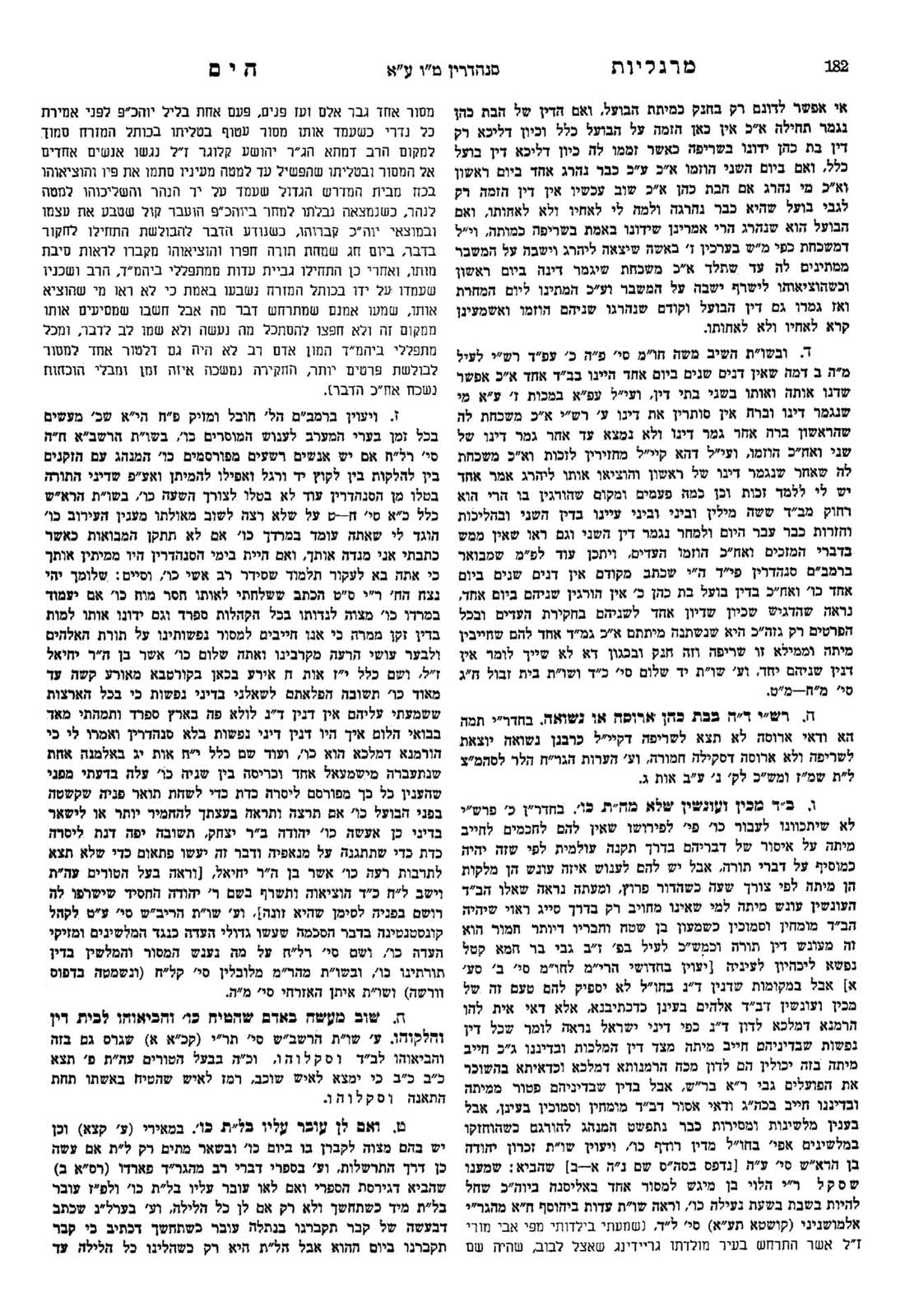
In its note, Artscroll states: “It goes without saying that the law never applied in places where government regulations would prohibit such an act.” Once again, I am not sure whether Artscroll really believes that this is true. As a historical statement it is false. Here is a page from R. Reuven Margaliyot’s Margaliyot ha-Yam, vol 1, p. 91b (to Sanhedrin 46a), that shows how even in the not-so-distant past an informer could be killed.

2. In this post I mentioned the outrageous accusation, based on nothing at all, that the telegram from Kobe was actually sent by the Chief Rabbinate in order to be able to pressure other rabbis to accept the Chief Rabbinate’s position on the dateline issue. Dr. Dov Zakheim sent me the following valuable email:

I noted in your recent blog you point out that some chareidim are asserting there was never a telegram from Kobe. There was. My father zt”l sent it. He had been the legal counsel of the Jewish community of Vilna (as well as a musmach of Ramailes) and also Reb Chaim Ozer ztl’s personal assistant and legal advisor (see his introduction to his sefer Zvi ha-Sanhedrin). He escaped from Vilna in 1941 and managed the Mirer Yeshiva’s legal affairs (where my uncle zt”l was a talmid) when they left Vilna, on the trans-Siberian, in Kobe and then in Shanghai.

Also in the post I referred to the letter published by R. Kasher in which lots of great rabbis refer to the State of Israel as the beginning of the redemption. I noted how Zvi Weinman has shown that this is a religious Zionist forgery, as at least some of the rabbis never signed such a letter. I mentioned that we don’t know if Kasher was responsible for the forgery (as Weinman appears to think) or someone else. Sholom Licht was kind enough to call my attention to this source from where we see that the letter Kasher published already appeared in Ha-Tzofeh many years prior, so Kasher clearly had nothing to do with the forgery.

3. In the last few posts I have dealt with Artscroll a good deal, as is only proper since Artscroll is the most significant Jewish publishing phenomenon of our time. I still have a lot more to say, but let me now turn to R. Jonathan Sacks’ siddur, and give an example where Sacks gets it wrong while Artscroll gets it right.

The blessing to be recited upon lightning and Birkat ha-Hamah is עושה מעשה בראשית This goes back to Mishnah Berakhot 9:2. Although the standard version of the Mishnah omits the word מעשה, it is recorded in various medieval texts and this is how the blessing has come down to us.

What does עושה מעשה בראשית mean? The first thing we must do is figure out if there is a segol or a tzeirei under the shin in עושה. Looking at the siddurim in my house that have English translations, I found that Sacks, Birnbaum, Sim Shalom, and Artscroll, have a segol.[13] This is also what appears in the Kaufmann Mishnah. See here. However, the Metsudah siddur and the Blackman Mishnayot have a tzeirei.

What is the difference between the vocalizations? If there is a segol than the words עושה מעשה בראשית should be translated in the English present, as עושה is a verb. If there is a tzeirei then עושה  is a noun, as in the words of Hallel (from Ps.115:15): עושה שמים וארץ, which means “Maker of heaven and earth.” Let us see if the translations follow this rule. Artscroll, which has a segol, translates: “Who makes the work of Creation.” This translation is correct, although I don’t know why the C in creation is capitalized. This translation implies the continuing work of creation, as reflected in the words of the prayer: המחדש בטובו בכל יום תמיד מעשה בראשית

Birnbaum translates עושה מעשה בראשית as: “Who didst create the universe.” This is incorrect, as the passage is not in the past tense. Sacks, who also has a segol, translates: “Author of creation.” This too is incorrect, as עושה with a segol is a verb, not a noun. Sim Shalom, also with a segol, translates: “Source of Creation.” This too is incorrect.

Now for the texts that have a tzeirei: Blackman translates: “the author of the work of the creation”, which is a correct rendering. Metsudah, on the other hand, translates: “Who makes the work of Creation.” Leaving aside the capital “C”, this is a mistaken translation. While Metsudah has עושה with a tzeirei under the shin, it translates as if there was a segol.[14]

Artscroll, while being correct when it comes to this blessing, does not get a pass when it comes to the word עושה. In the Artscroll siddur, pesukei de-zimra, p. 70, we find the words עושה שמים וארץ. This comes from Psalm 146:6. There is a segol under the shin which means that it is a participle and should be translated here with the English present tense, as are all the other verbs in this Psalm. Yet Artscroll translates עושה שמים וארץ as “Maker of heaven and earth”, which is incorrect. Sacks follows many other translations by rendering the words: “who made heaven and earth”. Yet this too is not correct and doesn’t follow the model of the Psalm, which has a series of participles that are to be translated as the present tense:
עושה שמים וארץ
השומר אמת לעולם
עושה משפט לעשוקים
נותן לחם לרעבים
מתיר אסורים
פוקח עורים
זוקף כפופים
אוהב צדיקים
שומר את הגרים

What about the word בונה in the blessing בונה ירושלים? There is a tzeirei under the nun in בונה which means that it is not a verb. Artscroll correctly translates the phrase as “Builder of Jerusalem”. Birnbaum and Metsudah also get it right. However Sacks (and also De Sola Pool and Sim Shalom) are mistaken in their translation. Sacks renders בונה ירושלים as if the nun had a segol: “Who builds Jerusalem.”

Since בונה ישראל must be translated as “Builder of Jerusalem”, and all translations are in agreement that גואל ישראל means “Redeemer of Israel”, does this mean that the conclusion of all the blessings of the Amidah should follow this model? What about חונן הדעת? Artscroll translates : “Giver of wisdom”, seeing חונן as a noun. Birnbaum and Metsudah do likewise. However, Sacks assumes חונן is a verb and translates: “who graciously grants knowledge.” This rendering (which I thinnk is in error) is also found in De Sola Pool and Sim Shalom.

How about מחיה המתים? Is the word מחיה a verb? Artscroll assumes yes and translates: “Who resuscitates the dead.” Sacks agrees with this, but Metsudah, striving for consistency, translates: “Resurrector of the dead.” Metsudah is, in fact, the only siddur that as a rule translates the concluding blessings of the Amidah along this model, while the other translations alternate between verb and noun. Here are some of Metsudah’s translations:

רופא חולי עמו ישראל – Healer of the sick of His people Israel
מברך השנים – Blesser of the years
מקבץ נדחי עמו ישראל – Gatherer of the dispersed of His people Israel
שובר אויבים ומכניע זדים – Crusher of enemies and subduer of the insolent

Although Metsudah follows this rule, for every rule there are exceptions, and even Metsudah translates שומע תפלה as “Who hears prayers”. Yet perhaps this is not an exception, and even here Metsudah intended “The hearer of prayers”, but since this doesn’t sound so good in English they came up with a more felicitous wording. It is true that the underlined words of the blessings המחזיר שכינתו לציון and המברך את עמו ישראל בשלום  have to be seen as verbs, and Metsudah translates them as such. But I think that these are a different type of blessings than the ones in the middle of the Amidah.

The question to be asked is must we assume that there is a consistency of form in a prayer like the Amidah? If the answer is yes, then Metsudah is the only translation to get it right, and they must be recognized as having picked up on something that eluded all their predecessors and successors.

Finally, let me return to the blessing מחיה המתים. I asked if the word מחיה is a verb, and noted that Artscroll and Sacks indeed translated it this way. However, they are both incorrect for the simple reason that in their siddurim there is a tzeirei under the yud of מחיה. There are siddurim, such as Tehilat ha-Shem, that have a segol under the yud. In such a case,  the word should be translated as a verb. However, when there is a tzeirei it must be translated as a noun. Metsudah once again gets it right, translating “Resurrector of the dead.” [15] Right before this, we find the words מלך ממית ומחיה. Here there is a segol under the yud, meaning that it is a verb and is to be translated as “Who causes death and restores life”.

Artscroll and Sacks also err in their translation of מחיה מתים במאמרו in Magen Avot in the Friday night service. There is a tzeirei under the yud meaning that it must be translated as “Resurrector of the dead with His utterance.” Artscroll mistakenly renders: “Who resuscitates the dead with His utterance,” using the same translation from the Amidah for the words  מחיה המתים.

I can’t figure out Sacks’ method here. In the Amidah he translates מחיה מתים as: “who revives the dead”, but in Magen Avot he translates: “By his promise, He will revive the dead.” This is incorrect, as it turns the sentence into the future tense, which it is not. Furthermore, if it was to be translated as such, why not do so in the Amidah as well, as the words are identical? Indeed, Magen Avot is nothing but an abridged version of the Amidah, so by definition the translation must be the same.[16] Translating במאמרו as “By His promise”, which I assume means “in accordance with His promise,”[17] is also incorrect, as the passage refers to God’s word, or better yet, the power of God’s word, not any promise.[18]
3. I want to briefly call attention to three books that have recently appeared and which I hope to discuss in future posts. The first is Gil Perl’s The Pillar of Volozhin: Rabbi Naftali Zvi Judah Berlin and the World of 19th Century Lithuanian Torah Scholarship. The second is Eugene Korn and Alon Goshen-Gottstein, ed., Jewish Theology and World Religions. The third is Ben Zion Katz, A Journey Through Torah: A Critique of the Documentary Hypothesis. I know that there are many Seforim Blog readers who will find these books worth reading.

4. Those who want to post (or read) comments, please access the Seforim Blog site by going to http://seforim.blogspot.com/ncr  Only by doing this will you be taken to the main site (and not have a country code in the URL). We have recently learnt that readers outside the United States do not have access to the comments posted and in the U.S. We don’t know why this is, or how to fix it, but the above instruction fixes the matter.

[1] As a result of these discussions, which led to investigations of haredi literature and discussions with haredi friends, another point became ever more obvious to me. It appears – and I welcome being corrected – that once someone has been crowned a gadol in the haredi world, it is almost impossible for him to lose this status, no matter what he says (and we have seen examples of this time after time). If, for instance, a recognized gadol expresses racist or misanthropic sentiments, or declares that a known and continuing sexual abuser or wife abuser must not be turned over to the authorities, even that would not be sufficient to “defrock” him. In other words, the “immunity” given to haredi (and hardal) gedolim is much more far-reaching than anything that could be imagined in the Modern Orthodox world.
[2] A January 2012 Avi Chai poll found that 7 percent of the Israeli population defines itself as haredi, 15 percent as dati, and 32 percent as traditional. Only 3 percent defines themselves as secular anti-religious. However, approximately 20 percent of primary school students are haredi, which shows the direction the future is going.
[3] It was actually the Religious Zionists who were responsible for creating the undemocratic situation in which Israel is perhaps the only country in the world in which Jews are not free to be married by the rabbi of their choice. I would like someone to show me where, in the entire history of halakhic literature, it is stated that people who are not observant must be forced, or even encouraged, to have a halakhic marriage. The current situation means that when secular Israelis leave Israel and then get divorced, being that they are secular most will simply get a secular divorce. Thus, any future marriage will be halakhically adulterous and the children will be mamzerim. Outside of Israel this is almost never an issue since non-Orthodox people generally don’t get married by Orthodox rabbis, which means that in the event of a divorce we can assume that the first marriage was not halakhically binding. But in Israel, where everyone gets married halakhically, it opens the doors to mamzerut on a massive scale. This was actually recognized by R. Eliyahu Bakshi Doron when he was chief rabbi. He created a big controversy when he revealed that it is a practice among some rabbis that when they perform weddings for the non-religious, they make sure that the marriage is not halakhically binding, precisely in order to prevent future mamzerut. Just this week R. Yaakov Yosef publicly advocated this position. See here.

[4] R. Eliyahu Pinchasi writes as follows in his Dibrot Eliyahu, vol. 1, p. 19:
החכמה נמצאת בגוי אבל היא רחוקה מאוד מלהיות דוגמת התורה. שהרי הוגי דעות נודעים בנו לעצמם פילוסופיה מתוחכמת הממלאים ספרים עבי כרס להצדיק את ההפקרות שנקראת בלשונם דמוקרטיה חופש הבטוי, רעיונות זדוניות מחרבי העולם.
The sheer ignorance of what democracy means is beyond comprehension. Do people like Pinchasi have so little knowledge of basic history that they do not know that it is only democracy that ensures protections for Jews around the world? Does he want the world to go back to the era of dictators when Jews suffered so terribly? Presumably yes, as he feels democracy is destroying the world.. I can easily provide parallels to the language used by Pinchasi in the writings of communists and fascists, especially from Weimar Germany. I was also shocked to read what R. Elhanan Wasserman writes in his Ikveta di-Meshiha, par. 2, published on the eve of the Holocaust.
“ראו כי אני אני הוא”. הגיע כבר העת שתבינו, כי בלעדי אין מושיע. אבל העם מסרבים להבין. עוד נאחזים בשולי הדמוקרטיה הגוססת. אף היא לא תועיל, בדומה לעבודות הזרות הקודמות.
I can’t for the life of me understand how he could regard democracy as avodah zarah, and why he sees democracy as being in opposition to proper faith in God, as if we are dealing with a zero-sum game. Instead of democracy, what political system did R. Elhanan want the Jews to support?
[5] I have many other sources regarding democracy, including traditional sources very much in favor of it (especially in pre-messianic times). I hope to provide them on a future occasion. Reading the haredi attacks on democracy, I can’t help but be reminded of Pius IX’s 1864 Syllabus of Errors and the later silencing of John Courtney Murray. The Church identified certain doctrines as false, yet now recognizes that its position in these matters was mistaken. I mention these examples because I am convinced that the American haredi world also rejects the anti-democratic sentiments that I have quoted, seeing them as out of step with where their world is. 
It is worth contrasting the anti-democratic sentiments of haredi leaders with the response of the Church, which fortunately was able to examine its own long history of anti-democratic abuses and come to the conclusion (much later than it should have) that in modern times democracy is the only viable system. As Pope Benedict put it (see here), democracy “alone can guarantee equality and rights to everyone.” He continues with the following valuable words:

Indeed, there is a sort of reciprocal dependence between democracy and justice that impels everyone to work responsibly to safeguard each person’s rights, especially those of the weak and marginalized. This being said, it should not be forgotten that the search for truth is at the same time the condition for the possibility of a real and not only apparent democracy:  “As history demonstrates, a democracy without values easily turns into open or thinly disguised totalitarianism”  (Centesimus Annusn. 46).

[6] R. Asher Anshel Yehudah Miller, Olamo shel Abba (Jerusalem, 1984), p. 308, reports that the Satmar Rav, R Yoel Teitelbaum, once declared that there were 50,000 Jews in the world. When asked how he could give such a figure when there were many millions of Jews, he replied:
בעיני, יהודים הם רק יהודים שששומרים תורה ומצוות כמוני . . . [שאר היהודים] או שיחזרו בתשובה, או שצריך להוציא אותם מכלל ישראל

[7] I will deal with Torat ha-Melekh in a future post.
[8] Alan Brill, Judaism and Other Religions: Models of Understanding (New York, 2010), p. 255 n. 43, has recently noted that since many laws stated with reference to non-Jews apply equally to heretical Jews: “the main problem is the fundamental use of a double ethic as described by Max Weber in his description of an ethnic economy.”
[9] Interestingly, R. Avraham Yosef has recently spoken of the spiritual advantages of living together with the non-religious. See here.

For Israeli haredim, there is now a mindset that they can only live among other haredim, and this is why they create exclusively haredi neighborhoods and towns. Such a concept is entirely new, and not only did it not exist in Europe but didn’t even exist in Israel in the first decades of the State. Many readers probably recall the time when hasidic rebbes lived in Tel Aviv.

[10] I have to admit, however, that one sometimes does find even moderate haredim who seem to have sympathy with Adler’s approach. R. Moshe Eisemann, who used to have a great deal of influence in the moderate haredi camp, wrote as follows with reference to the Jerusalem fanatics who throw stones at passing cars (not knowing, of course, if the drivers are Jewish or Arab): “If it is true that he who hurls a stone were well-advised to be pretty sure that he is doing the right thing, I believe that the one who feels no urge to do so, must engage in even deeper soul-searching.” Tradition 26 (Winter 1992), p. 34. Maybe I was absent that day in yeshiva, but I was never taught that it is normal to have an urge to throw a stone at a fellow Jew (which of course could kill him, as we have seen with the Palestinian stone-throwers). On the contrary, I was taught that I should have an urge to show the non-religious Jew about the beauty of Shabbat, which an invitation to a Shabbat table will accomplish much better than a rock in his windshield. 
[11] What is one to make of R. Shmuel Baruch Genot, Va-Yomer Shmuel (Elad, 2008), no. 84, that it is forbidden for Jews to oppose the death penalty in places where Jews are not affected (unless done for reasons of darkhei shalom): דאסור להציל גוף נכרי. This is the sort of pesak (and I can cite many similar examples) that in the Modern Orthodox world is regarded not simply as wrong, but as deeply immoral (especially since during the Holocaust so many non-Jews adopted Genot’s position vis-à-vis the Jews!).
While at least since Jacob Katz’s Exclusiveness and Tolerance scholars are now no longer deterred from studying the medieval Jewish view of “the other”, there is still great reluctance to examine contemporary views, for fear of how this might play into the hands of anti-Semites. I am curious to hear what readers think about this. How long can we keep all of this “under the carpet,” and should we even be attempting to do that?
Ruth Langer has discussed the medieval tradition in her new book Cursing the Christians? A History of the Birkat HaMinim (Oxford, 2012), p. 12:
For Jews engaged in dialogue, it has been much easier to identify the problems within Christianity than to turn that scrutiny back on our own heritage. Jews, after all, were very much the victims, not just of the Holocaust, but also of centuries of Christian anti-Jewish venom and oppression. Consequently, traditions developed among those studying Judaism in the wissenschaftflich mode to obscure embarrassing elements of the tradition rather than to confront them. . .  Christian anti-Judaism in its many expressions led to Jewish responses and attitudes that were equally vicious; the power relationships between the two communities prevented Jews from expressing this with physical violence, but Jews still lacked respect for their neighbors. . . . In our time, Jewish publishers are restoring uncensored versions of many texts, reclaiming a difficult heritage. While from an academic perspective, this has merit, there has been all too little discussion about its impact on the Jewish community.
I would, however, dispute the use of the expression “equally vicious.” Once Langer assumes that it was Christian anti-Judaism (and I would add “anti-Semitism”) that led to the Jewish responses and attitudes, then I don’t think it is correct to portray them as “equally vicious.” The one who is responding to widespread murder of his coreligionists, and responding only through the pen, cannot be regarded as “equally vicious.” Furthermore, considering the oppression that Jews suffered in medieval times, all the anti-Gentile sentiments found in texts from this period are completely understandable.
[12] I have often heard people pronounce דרכי as darkei. This is incorrect. There is no dagesh in the kaf.
[13] The Artscroll Talmud also has a segol but the Artscroll Mishnah has a tzeirei.
[14] There are times in the Bible where the word עושה with a tzeirei is to be translated as if it has a segol, but these are exceptions. When it comes to vocalizing a text, one should certainly not insert a tzeirei if one is going to translate the word as a verb. The exceptions, where we find a tzeirei under the shin, are Ex. 15:11: עושה פלא, which appears to mean “doing wonders”, although,  as R. Mazuz pointed out to me, it could also be translated as “doer of wonders”= עושה-הפלאים. Amos 5:8: עושה כימה וכסיל, and Ps. 14:1, 3, 53:2, 4: עושה טוב, could perhaps also be read in this way. However, in Jer. 51:15: עושה ארץ בכחו, the word appears to be a verb.
[15] See R. Mazuz’s comment in R. Yosef Hayyim Mizrahi, Yosef Hayyim (Jerusalem, 1993), p. 123, Or Torah, Adar 5772, p. 568.
[16] See Abudarham ha-Shalem (Jerusalem, 1963), p. 148:
וכיצד היא ברכה זו מעין שבע, מגן אבות בדברו כנגד מגן אברהם. מחיה מתים במאמרו כנגד מחיה מתים. הא-ל הקדוש שאין כמוהו כנגד הא-ל הקדוש . . .
[17] See Daniel 12:2.
[18] See Abudarham ha-Shalem, p. 148: מחיה מתים במאמרו על שם (יחזקאל לז) כה אמר ה’ הנני פותח את קברותיכם


Who can discern his errors? Misdates, Errors, Deceptions, and other Variations in and about Hebrew Books, Intentional and Otherwise: Revisited

Who can discern his errors?
Misdates, Errors, Deceptions, and other Variations in and about Hebrew Books, Intentional and
Otherwise: Revisited[1]
by Marvin J. Heller

Marvin J. Heller is the award winning author of books and articles on early Hebrew printing and bibliography. Among
his books are the Printing the Talmud series, The Sixteenth and Seventeenth Century Hebrew Book(s): An Abridged Thesaurus, and collections of articles.

R. Eleazar once entered a privy, and a Persian [Roman] came and thrust him away. R. Eleazar got up and went out, and a serpent came and tore out the other’s gut. R. Eleazar applied to him the verse, “Therefore will I give a man (אָדָם adam) for thee (Isaiah 43:4).” Read not adam [a man] but אֱדֹם edom [an Edomite = a Roman] corrected by the censor to “but a Persian.” (Berakhot 62b)
 “R. Eleazar said: Any man who has no wife is no proper man; for it is said, Male and female created He them and called their
name Adam” corrected by the censor to “any Jew who is unmarried” (Yevamot 63a).[2]
Sensitivity to the contents of Jewish texts by non-Jews, and apostates in their employ, was a feature of Jewish life at various periods, one particularly notable and noxious time being in the sixteenth century when, during the counter-Reformation, the Church undertook to censor and correct those Hebrew books that were not placed on the index and banned in their entirety. In the first example, the understanding based on the reading of adam אָדָם as edom אֱדֹם (Rome) is completely lost by the substitution of Persian for Edom. In the second example “Any man who has no wife is no proper man” was deeply offensive to a Church that required an unmarried and celibate clergy. In both instances the text was altered to adhere to the Church’s sensibilities despite the fact that not only was the original intent lost but that, particularly in the first case, it ceased to be meaningful.
            Books, and even more so Hebrew books, often underwent modifications, textual changes, due to the vicissitudes and complexities of the Jewish condition, frequently involuntary. The subject of “Misdates, Errors, Deceptions, and other Variations in and about Hebrew Books, Intentional and Otherwise,” addresses textual changes, as well as other errors, intentional and unintentional, that may be found in Hebrew books. Addressed previously in Hakirah, this is a companion article, providing additional examples of book errors, variations, and discrepancies. As noted previously, errors “come in many shapes and forms. Some are significant, others are of little consequence; most are unintentional, others are purposeful. When found, errors may be corrected, left unchanged, or found in both corrected and uncorrected forms. . . . Other errors are not to be found in the book per se but rather in our understanding of the book. This article is concerned with errors in and about Hebrew books only. It is not intended to be and certainly is not comprehensive, but rather explores the variety of errors, some of consequence, most less so, providing several interesting examples for the reader’s edification and perhaps enjoyment.”[3]
Among the errors discussed in this article are 1) those dealing with the expurgation of the Talmud; 2) expurgation of other Hebrew works; 3) internal censorship, that is, of Hebrew books by Jews; 4) accusations of plagiarism and forgery; 5) misidentification of the place of printing; 6) confusion due to mispronunciations.
I
            Returning to the beginning of the article, the Talmud, initially banned in 1553 and placed on the Index librorum prohibitorum in 1559, was subsequently permitted by the Council of Trent in 1564, but only under restrictive and onerous conditions. Reprinted in greatly censored form, the introductory quote refers to modifications in the Basle Talmud (1578-81). A condition of the Basle Talmud was that the name “Talmud” be prohibited. Heinrich Graetz explains the Pope’s and Council’s considerations in forbidding the name.
the Council only approved the list of forbidden books previously made out in the
papal office, the opinion of the pope and those who surrounded him served as
a  guide in the treatment of Jewish writings. The decision of this point was left to the pope, who afterwards issued
a bull to the effect that the Talmud was indeed accursed – like Reuchlin’s ‘Augenspiegel
and Kabbalistic writings’ – but that it would be allowed to appear if the name
Talmud were omitted, and if before its publication the passages inimical to
Christianity were excised, that is to say, if it were submitted to censorship
(March 24th, 1564). Strange, indeed, that the pope should have allowed the
thing, and forbidden its name! He was afraid of public opinion, which would
have considered the contradiction too great between one pope, who had sought
out and burnt the Talmud, and the next, who was allowing it to go untouched. At
all events there was now a prospect that this written memorial, so
indispensable to all Jews, would once more be permitted to see the light,
although in a maimed condition.[4]
            Among the most egregious examples of censorship of the Talmud is Bava Kamma 38a. That amud (page) of the Talmud, dealing with financial relations between Jews and non-Jews, was expurgated, almost in its entirety. Prior to the much censored Basle Talmud (1578-1581) the text was completely printed, for example, in the 1519/20-23 Venice edition of the Talmud published by Daniel Bomberg. After the censored Basle Talmud was published, initially, rather than contract the text, large blank spaces were left, clearly indicating that text had been expurgated.
            Abraham Karp notes that in some editions of the Talmud “many expurgated passages are restored, and where deletions are retained, blank spaces are left to indicate the omission to the reader and, no doubt, to permit him to fill in by pen what they dared not to print.”[5] An example of the blank spaces can be seen from the Frankfurt an der Oder Talmud 1697-99, printed by Michael Gottschalk. Such omissions are to be found in almost all seventeenth and early eighteenth editions of the Talmud, a notable exception being the Benveniste edition (Amsterdam, 1644-47).[[6]  Rabbinovitch too notes that blank spaces were left for expurgated text, those omissions being consistent with the Basle Talmud. He adds, however, that this policy was followed until the 1835 Vilna Talmud. At that time government officials prohibited the practice so that the omissions would not be so obvious.[7]  In fact, text was consolidated much earlier, as evidenced, by the illustrations of Bava Kama 38a from the 1734‑39 Frankfurt an der Oder Talmud. This expurgated material is restored in current editions of the Talmud.
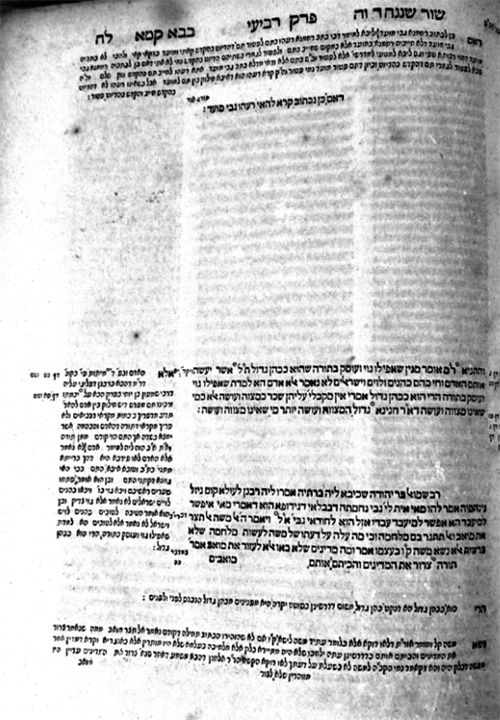
Frankfurt an der Oder – 1697-99
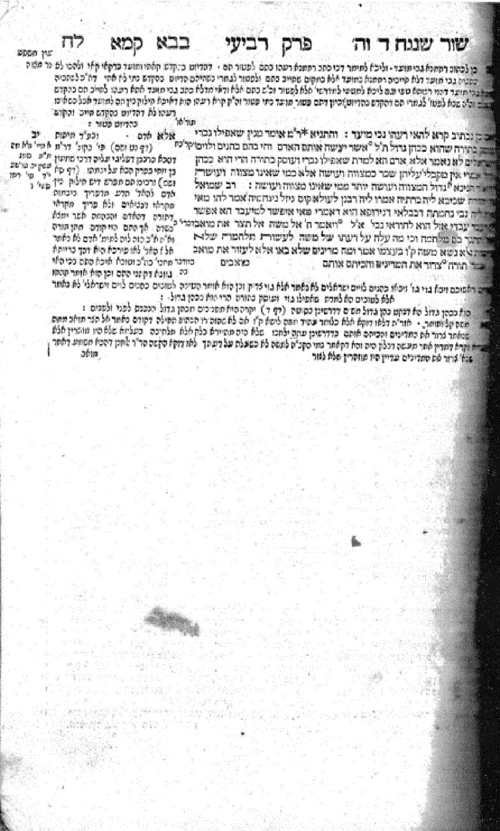
Frankfurt an der Oder – 1734-39

Another example of interest, one that has not fared as well, the text not yet restored in most editions of the Talmud, is to be found in Shabbat 104b and Sanhedrin 67a. The reference there is to Ben Satda, beginning, in the latter tractate “and so they did to Ben Satda
in Lod, and hung him on erev Pesah. Ben Satda? He was the son (ben) of Padera . . .”[8] Popper notes that Gershom Soncino, when publishing “a few of the Talmudic tracts at Soncino during the last decade of the fifteenth century, he took care not to restore any of the objectionable words in the MSS. from which he printed.”[9] Here too the text is complete in the Bomberg Talmud. Two subsequent exceptions in later editions of Sanhedrin where the Ben Satda entries do appear are in the Talmud printed by Immanuel Benveniste and in the edition of Sanhedrin printed in Sulzbach in or about 1696.

Sanhedrin 67a, Benveniste Talmud
However, in two complete editions of the Talmud (1755-63, 1766-70) printed in Sulzbach, the Ben Satda entries are omitted, as is the case of most modern editions of the Talmud.[10]
II
            The Talmud isn’t the only work to have been censored. Amnon Raz-Krakotzkin provides several examples of text in books
that were modified due to the censor’s ministrations. Among them is R. Abraham ben Jacob Saba’s (d. c. 1508) Zeror ha-Mor, a commentary on the Pentateuch based on kabbalistic and midrashic sources.[11] On the passage “They would slaughter to demons without power, gods whom they knew not, newcomers recently arrived, whom your ancestors did not dread” (Deuteronomy 32:17), referring to “Christians in general and priests in particular as ‘demons’ (shadim): ‘For as the nations of the world, all their abominations and vanities come from the power of demons, hence, the monks would shave the hair of their heads  and leave some at the top of the head as a stain.’” This passage continues, referring to bishops and popes, concluding that their entire heads are shaved like a marble with only a bit of hair about their ears, so that they have the appearance of demons, hairless, and like demons, provide no blessings, are like a fruitless tree, and “thus, it is fitting that they bear no sons of daughters.” Raz-Krakotzkin informs that this passage appeared in the first two editions of Zeror ha-Mor printed by Bomberg, and the Giustiniani edition (1545) but was already expurgated by the Cavalli edition (1566), a blank space in place of the text. That space subsequently disappeared and, although a Cracow edition based on the Bomberg Zeror ha-Mor restored the text it remains missing from most later editions.[12] Raz-Krakotzkin continues, citing additional examples.
            Early halakhic works were also subject to the ministrations of the censor.[13] Among them are such works as R. Samson ben Zadok’s (thirteenth century) Sefer Tashbez (Cremona, 1556). Samson was a student of R. Meir of Rothenburg (Maharam, c. 1220-1293). When the latter was imprisoned in the tower of Ensisheim, Samson visited him regularly, serving as his attendant and carefully recording in Tashbez Maharam’s teachings, customs, and daily rituals, as well as what he heard and observed, from the time Meir rose in the morning until he retired at night, on weekdays, Sabbaths, and festivals. Although a relatively small work (80: [6], 55 leaves), it consists of 590 entries beginning with Sabbath night (1-17), Sabbath day (18-98), followed by festivals, Sefer Torah, priestly benedictions, prayer, slumber, talis and tefillin, benedictions, issur ve-heter (dietary laws), redemption of the first born, hallah, vows, marriage and divorce, monetary laws, and piety. Expurgation by the censor of Tashbez was done sloppily, for terms such as meshumad and goy, normally excised, remain, but with a disclaimer near the end that they refer to idol worshipers only.[14]
III
Not all errors are due to the ministrations of the censor. Jews, too, at times, have taken their turns at modifying the text of books.
            A recent and perhaps quite surprising example of internal censorship is to be found in R. Solomon Ganzfried’s (1804–1886) Kizzur Shulḥan Arukh. First printed in 1864, that work an abridgement of the Shulhan Arukh for the average person, went through fourteen editions in the author’s lifetime, and numerous editions since then, as well as translations into many languages and has been the subject of glosses.[15] Marc B. Shapiro informs that in the Lublin (1904) edition of the Kizzur Shulḥan Arukh and several other editions the entry (201:4) that “apostates, informers, and heretics –for all these the rules of an onan and of mourners should not be observed. Their brothers and other next of kin should dress in white, eat, drink, and rejoice that enemies of the Almighty have perished,” the words “apostates, informers, and heretics” have been removed. In the Vilna edition (1915) the entire paragraph is removed and the sections renumbered from seven to six. In the Mossad Harav Kook vocalized edition a new halakhah was substituted, but that has since been corrected to reflect the original text. The reason, according to Shapiro, is that with the expansion of Jewish education to include girls, it was felt that schoolchildren, with assimilated relatives, would see this as referring to family members.[16] Several recent editions of the Kizzur Shulḥan Arukh that were examined, in both Hebrew and English, have the original text.
            R. Abraham Isaac Kook (1865–1935), chief rabbi of Jerusalem and first Ashkenazic chief rabbi in Israel (then Palestine),
was a profound, influential, and mystical thinker. Highly regarded by his contemporaries, his strongly Zionist views also resulted in some opposition, but even most of his contemporaries who disagreed with him held him in high regard. Shapiro notes that with time, Kook’s reputation changed. Despite the fact that such pre-eminent rabbis as R. Solomon Zalman Auerbach (1910-95) and R. Joseph Shalom Elyashiv (1910-2012) were unwavering in their high regard of Kook, strong anti-Kook sentiment developed later in religious anti-Zionist circles. Shapiro notes that “Kook has been the victim of more censorship and simple omission of fact for the sake of haredi ideology than any other figure. When books are reprinted by haredi and anti-Zionist publishers Kook’s approbations (hascomas) are routinely omitted.” One of several examples of this modified opinion Shapiro cites is a lengthy eulogy delivered by R. Isaac Kossowsky (1877-1951) praising Kook. When the eulogy was reprinted in She’elot Yitzhak, a collection of Kossowsky’s writings, the name of the subject of the eulogy, Rav Kook, was omitted. In the reprint of She’elot Yitzhak the eulogy is deleted in its entirety.[17]
            Shapiro’s observation about Rav Kook’s approbations is confirmed in several books. R. Eliezer Mansour Settehon’s (Sutton, 1860-1937) Notzar Adam: Hosafah Notzar Adam (Tiberius, 1930), discourses on spiritual development, has approbations from R. Abraham Abukzer, R. Moses Kliers, and R. Jacob Hai Zerihan, and R. Abraham Isaac ha-Kohen Kook. In a description of Notzar Adam in in Aleppo, City of Scholars (Brooklyn, 2005), Kook’s name, Kook’s name is omitted from a list of the book’s approbations.[18]

In a variation of this, two internet sites that reproduce the full text of Hebrew books both include Rav Isaac
Hutner’s (1906-80) Torat ha-Nazir (Kovno, 1932). This, the first edition, has three approbations; a full page hascoma from R. Hayyim Ozer Grodzinski (1863–1940), and the following page two approbations, side by side, from R. Abraham Duber Kahana (1870–1943) and Rav Kook. The first internet site, with more than 53,000 books for free download, follows R. Grodzinski’s approbation with a blank page and then the text. The second, a subscription site with more than 76,000 scanned books, goes directly from R. Grodzinski’s hascoma to the text, dispensing with the blank page, also not reproducing the second page of approbations. It is not clear whether the copies scanned were faulty, the scanning incomplete, or the omission intentional. Nevertheless, to conclude this section on a positive note, surprisingly, given the omission of Rav Kook’s approbation in both scans of Torat ha-Nazir, both sites list and provide an extensive number of Rav Kook’s works.
IV
Accusations of plagiarism accompany the publication of two works by and/or attributed to R. Nathan Nata ben Samson Spira (Shapira, d. 1577). Spira, born to a distinguished family that was, according to the Ba’al Shem Tov, one of the three pure families throughout the generations in Israel (the others being Margulies and Horowitz), served as rabbi in Grodno (Horodno) until 1572, when he accepted a position in Posnan. His grandson was R. Nathan Nata ben Solomon Spira (Megalleh Amukkot, c. 1585-1633). Among Nathan Nata Spira’s works is Imrei Shefer (20: [1], 260 ff.), a super-commentary on Rashi and R. Elijah Mizrahi (c. 1450–1526). The book was brought to press by Spira’s son R. Isaac Spira (d. 1623), Rosh Yeshiva in Kovno and afterwards in Cracow. Work on Imrei Shefer began in Cracow in 1591 but before printing was finished Isaac Spira accepted a position in Lublin where publication was completed at the press of Kalonymus ben Mordecai Jaffe (1597).[19]
The title-pages states that Spira, “gives goodly words (Imrei Shefer)’ (Genesis 49:21) and he gives, ‘seed to the sower, and bread לזורע ולחם (357=1597) to the eater’ (Isaiah 55:10) of Torah.” In the introduction, Isaac informs that the work is entitled Imrei Shefer from the verse, “he gives goodly words” (and the word “he gives הנתן” in the Torah is without a vav), implying the name of the author [Nathan נתן] and Shefer שפר is language of Spira שפירא the family name of the author. Isaac then addresses the existence of an unauthorized and fraudulent edition ascribed to his father, printed in Venice (Be’urim, 1593),
found and brought out by men who lack the yoke of the kingdom of heaven. A work discovered, who knows the identity of the author, perhaps a boy wrote it and wanted to credit it to an authoritative source אילן גדול), [my father my lord]. God forbid that his holy mouth should bring forth words that have no substance, vain, worthless, and empty, a forgery, “[And, behold], it was all grown over with thorns, and nettles had covered it over” (Proverbs 24:31).
Isaac Spira took his complaint to the Va’ad Arba’ah Artzot (Council of the Four Lands), requesting they prohibit the distribution of the Be’urim in Poland. The response of the Va’ad is printed at the end of the introduction,
It has been declared, by consent of the rabbis, and the [communal] leaders of these lands,
that these books shall neither be sold nor introduced into [any Jewish] home in
any of these lands. Those who have [already] purchased them shall receive their
money back and not keep [such] an evil thing in their home.
What was and who wrote the Be’urim, the reputedly plagiarized copy of R. Nathan Nata ben Samson Spira’s Imrei Shefer? The title-page of the Be’urim (40: 180 ff.), printed in Venice in 1593 “for Bragadin Giustiniani by the partners Matteo Zanetti and Komin Parezino at the press of Matteo Zanetti,” states that it was written by ha-Rav, the renowned, the gaon, R. Nathan from Grodno in the year, “For you shall go out with joy בשמחה (353=1593), and be led forth with peace” (Isaiah 55:12). Be’urim does not have an introduction nor a colophon that provides any additional information.
Isaac Spira’s accusation that the Be’urim is a forgery, not to be ascribed to his father, but rather was written by an unknown young man who then attributed it to Spira, is confirmed by R. Issachar Baer Eylenburg (1550-1623), who writes in his responsa, Be’er Sheva (Venice, 1614) and also in his commentary on Rashi, Zeidah La-Derekh (Prague, 1623) that it is obvious that the Be’urim were not the work of the holy Spira, but rather of an erring student “who hung (attributed it) to himself, hanging it on a large tree” (cf. Pesahim 112a).[20]
Among the distinguished sages of medieval Sepharad is Rabbenu Bahya ben Asher ben Hlava (c. 1255-1340). Best known for his popular, multi-faceted, and much reprinted Torah commentary, written in 1291 and first published in Naples (1491),  Rabbenu Bahya was also the author of Kad ha-Kemaḥ (Constantinople, 1515) and Shulḥan shel Arba (Mantua, 1514). The former, Kad ha-Kemaḥ, is comprised of sixty discourses on varied subjects, among them festivals, prayer, faith, and charity, all infused with ethical content. Among the numerous editions of Kad ha-Kemaḥ is a scholarly edition entitled Kitvei Rabbenu Baḥya (Jerusalem, 1970) edited and with annotations by R. Hayyim Dov Chavel (1906–1982).
Among the essays in Kad ha-Kemaḥ is one entitled Kippurim, on Yom Kippur. Part of that discourse includes a commentary on the book of Jonah, read on Yom Kippur. Chavel, in the introduction to his annotations on Rabbenu Bahya’s commentary on Jonah, suggests that Rabbenu Bahya took his commentary from R. Abraham ben Ḥayya’s (d. c. 1136) Hegyon ha-Nefesh, first published by E. Freimann (Leipzig,
1860). Abraham ben Ḥayya, a resident of Barcelona, was a philosopher, mathematician, and astronomer, reflected in his several works, including translations from the Arabic. Hegyon ha-Nefesh “deals with creation, repentance, good and evil, and the saintly life. The emphasis is ethical, the approach is generally homiletical – based on the exposition of biblical passages – and it may have been designed for reading during the Ten Days of Penitence.”[21] Kitvei Rabbenu Baḥya and Hegyon ha-Nefesh are sufficiently alike to support Chavel’s contention that
Rabbenu utilized the Sefer Hegyon ha-Nefesh (or Sefer ha-Mussar) of the earlier sage R. Abraham ben Ḥayya ha-Nasi, known as ṣāḥib-al-shurṭa . . . In it is found this commentary on the book of Jonah. This was already noted by the author of Zaphat ha-Shemen – the usage by Rabbenu of this book is comparable to his use of other works: according to his needs. The reason that he does not mention it in his commentary is, perhaps, because the books of R. Abraham ha-Nasi were well known, and the leading sages, such as the Rambam, Ramban and other leading rabbis utilized it, comparable to “Joshua was sitting and delivering his discourse without mentioning names, and all knew that it was the Torah of Moses” (Yevamot 96b).[22].
We leave accusations of plagiarism and turn to forgery, a well-known case involving a person of repute, Saul Hirsch (Hirschel)
Berlin’s (1740-94) Besamim Rosh.[23] Berlin was a person of great promise; the son of R. Hirschel Levin (Ẓevi Hirsch, 1721–1800), chief rabbi of Berlin, ordained at the age of twenty and in 1768 av bet din in Frankfurt an der Oder. At some point Berlin became disillusioned with what he believed to be antiquated rabbinical authority. He gave up his official rabbinic position in Frankfurt, removing to Berlin. There Berlin was an associate of Moses Mendelssohn (1729–1786), providing, in 1778, an approbation for Mendelssohn’s Be’ur (Berlin, 1783) and was a supporter of the enlightenment figure Naphtali Herz Wessely (1725–1805), writing an anonymous pamphlet in defense of  Wessely’s
Divrei Shalom ve-Emet (Berlin, 1782) entitled Ketav Yosher (1794).[24]
An earlier forgery of Berlin, described by Dan Rabinowitz, this under the pseudonym of Ovadiah bar Barukh Ish Polanya, was Berlin’s Mitzpeh Yokteil (1789), a vicious attack on R. Raphael Kohen, rabbi of the three communities, Altona-Hamburg-Wansbeck, who had opposed Mendelssohn’s Be’ur, and on Kohen’s Torat Yekuteil (Amsterdam, 1772) on Yoreh Deah. The Communities’ beit din placed Ovadiah, the presumed author, under a ban. The ban’s proponents approached R. Tzevi Hirsch, the chief rabbi of Berlin and Saul Berlin’s father, seeking his signature on the ban.[25] It appears that Tzvi Hirsch initially concurred with the ban, but, as he was close to deciding in favor of signing the ban, someone whispered in his ear the verse “woe is me, my master, it is borrowed שאול” (II Kings 6:5), – which he understood to be a play on שאול (borrowed), referring to his son, Saul, the true author of Mitzpeh Yokteil.[26]
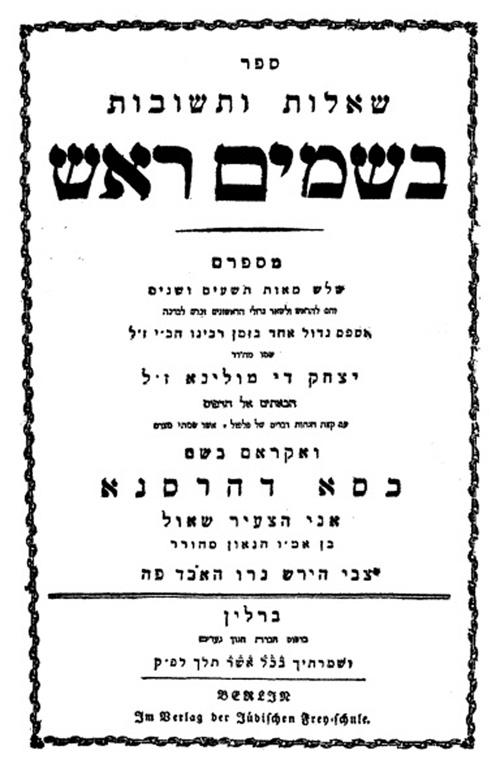
 

Turning to Besamim Rosh Saul Berlin’s infamous forgery, it claims to be the responsa of R. Asher ben Jehiel (Rosh, c. 1250–1327), among the most preeminent of medieval sages of European Jewry. The title-page describes it as the responsa Besamim Rosh, 392 responsa from books from the Rosh and other rishonim (early rabbinic sages) compiled by R. Isaac di Molina and with annotations Kasa de-Harshana by the young Saul ben R. Ẓevi Hirsch, av bet din, here (Berlin).[27] It is dated “and will keep you in all places where you goושמרתיך בכל אשר תלך   553 = 1793)” (Genesis 28:15), note Asher אשר in the date. In Besamim Rosh Berlin, having become an adherent of the haskalah, presents ideas inconsistent with and at variance with traditional halakhic positions. Among the novel responsa are removing the prohibition on suicide due to the difficult conditions of Jewish life; permitting shaving on Hol ha-Mo’ed; requiring a shohet to test the sharpness of his knife on his tongue; saying a blessing over non-kosher food; disregarding commandments that are upsetting; not taking Megillat Esther seriously; and that Jews beliefs can change. An example of the responsa, albeit a brief one and without Berlin’s Kasa de-Harshana, is the much quoted responsum concerning “legumes, rice, and millet which some Ashkenazic rabbis prohibit and is the practice in some communities. . .” (105b: no. 138): The responsum states:

This is very strange, for the Talmud permits it and no bet din is known to have made such an enactment. It is not for us to inquire why such an enactment was made and why it was followed by some. Possibly because of the exiles and the confused גירושים והבלבוחים, weighed down in poverty . . . and also due to the small community of Karaites in their midst who were also exiled. . . . unable to distinguish between bread and bread and all leavening from which it is possible to make flour and bread. But, God forbid, that we freely prohibit that which is permitted, and all the more because of the poor and needy, who lack sufficient meat and bread all the days of the festival. . . . “who eat [but] a litra of vegetables for at a meal” (Sanhedrin 94b). Also “a leap year is not intercalated in the year following a Sabbatical year for this reason.” All the more (kal ve-homer) to prohibit most types of food to the poor and needy on festivals and the overly strict (mahmerin) will have to answer on the day of judgement.
            How has Besamim Rosh been received? Soon after its publication R. Wolf Landsberg, in Ze’ev Yitrof (Frankfurt an der Oder, 1793), stated that Besamim Rosh was a forgery, and R. Mordecai Benet (1753-1829) wrote to Berlin’s father, that Besamim Rosh was “from head to foot only wounds and grievous abscesses from sinful, vile men.”[28] R. Hayyim Joseph David Azulai (Hida, 1724–1806) in his Shem ha-Gedolim, one of several works in which he mentions Besamim Rosh, states “I have heard ‘a voice of a great rushing’ (Ezekiel 3:12) that there are in this book strange things. . . . Therefore the reader should not rely on it.”[29] The Hatam Sofer (R. Moses Sofer, 1762–1839), based on the responsum on suicide, also concluded that Besamim Rosh was a forgery.[30] Among the varied modern authorities who quote Besamim Rosh, albeit critically, are R. Solomon Joseph Zevin (1885–1978) and R. Ovadia Yosef (1920-13) the latter writing an approbation for the 1984 edition of Besamim Rosh.[31]
How influential was Besamim Rosh? Fishman writes that “Besamim Rosh is of itself cast as a work of rabbinic literature, a Trojan horse of sorts, capable of injecting reformist viewpoints directly into the camp of halakhic discourse. Indeed, the sheer frequency with which Besamim Rosh has been cited in subsequent halakhic writings [documented by Samet] raises the question of whether the work may not have been effective in introducing unconventional perspectives into rabbinic thought.”[32] Similarly, Shmuel Feiner notes that “Some scholars
regard Besamim Rosh as the beginning of the reform of Judaism.”[33] Finally, knowledge that Besamim Rosh was a forgery was so widespread, that it is even so described in a book dealers catalogue, that of Jakob Ginzburg, in Listing of Rare and Valuable Books (Minsk, 1914), stating “565 Besamin Rosh attributed to the Rosh, poor condition Berlin, 1792, 50 1.”
V
Of less consequence is a common error, if it may be so described, that is, the misleading identification of the place of printing on the title-pages of late seventeenth through the early nineteenth century books. Amsterdam, from the early seventeenth century, was the foremost center of Hebrew printing in Europe. Its reputation was such that printers in other lands, often with the only the most tenuous, if any, connections with Amsterdam, attempted to associate their imprints with that city. In a wide variety of locations the actual place of printing is minimized; what is enlarged is that the letters are באותיות אמשטרדם Amsterdam letters. Mozes Heiman Gans describes this practice,
Amsterdam may have had an embarrassing lack of rabbinical training facilities, but thanks to the Hebrew printing works it nevertheless had a great name in the world of Jewish scholarship. Moreover, the haskamot (certificate of fitness) was also sought by Jewish printers abroad, and so highly-prized were books ‘printed in Amsterdam’ or ‘be-Amsterdam’ that cunning rivals invented the phrase ‘printed ke-Amsterdam’, i.e. in the manner of Amsterdam, hoping to deceive the readers by relying on the similarity of the Hebrew k and b.[34]
            An early example of this practice is in Dessau, where the court Jew, Moses Benjamin Wulff, established a Hebrew press in Anhalt-Dessau.[35] Approval for the press was given on December 14, 1695 by Princess Henriette Catherine of Orange, Prince Leopold I’s mother, acting as regent in her son’s frequent absences in the service of the Prussian army. The first books were published in 1696, among them R. Jacob ben Joseph Reischer’s (Jacob Backofen, c. 1670–1733) Hok Ya’akov and Solet le-Minhah ve-Shemen le-Minhah, and the following year R. Shabbetai ben Meir ha-Kohen’s (Shakh, 1621–1662) Gevurat Anashim, each with a title-page, with a pillared frame topped by an obelisk and the statement,
Printed here [in the holy congregation of] Dessau with AMSTERDAM letters
Under the rule of her ladyship, the praiseworthy and pious Duchess, of distinguished birth HENRIETTE CATHERINE [May her majesty be exalted]
Another notable instance are the title-pages of R. Judah Leib ben Enoch Zundel’s (1645–1705) Hinnukh Beit Yehudah (Frankfurt am Main, 1708), a collection of one hundred forty-five responsa, among them several by the author. Zundel (1645–1705), who succeeded his father as rabbi of the district of Swabia in 1675, subsequently relocated to Pfersee, where he remained until his death. Judah Leib was also the author of Reshit Bikkurim (Frankfurt, 1708), homilies by Judah Leib and his father. The sermons in that work are on festivals and Sabbaths based upon R. Joseph Albo and includes excerpts from a commentary on the Bible which Judah Leib had intended publishing.[36]

 The publisher of these books was Johann Koelner, the distinguished Frankfurt am Main printer (1708-27), credited with publishing half of the Hebrew books printed in Frankfurt up to the middle of the nineteenth century as well as a fine edition of the Babylonian Talmud.[37] Koelner began printing with Hinnukh Beit Yehudah; it is unusual in that there are two title-pages for the book, one noting that it was printed in Frankfurt am Main, the other stating that Hinnukh Beit Yehudah was printed, in an enlarged font with, Amsterdam, in a smaller font, letters, and the place of printing, Frankfurt am Main, also set in a smaller font.[38]
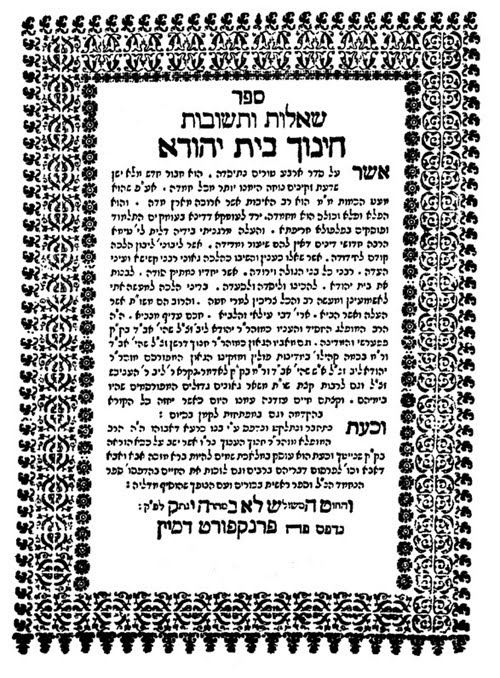
Another way of emphasizing Amsterdam fonts rather than the city in which a book was printed is evident from R. Jacob Uri Shraga Feival’s ben Menahem Nachum’s Bet Ya’akov Esh (Frankfurt an der Oder, 1765) on Job. Here, somewhat unusually, even the reference to the source of the fonts is highlighted, saying with Amsterdam letters. The place of printing is given below in abbreviation in a slightly smaller font as printed here פ”פ דאדר (Frankfurt an der Oder).
In addition to several locations in Germany, such as Hamburg and Jessnitz, we also find this practice in such varied locations as in Zolkiew, for example, R. Aaron Moses ben Zevi Hirsch of Lvov (Lemberg) Ohel Moshe (1765) on grammar; in Lvov, on the title-page of R. Jacob ben Baruch of Tyczyn’s (c. 1640-1725) Birkat Yosef (1784) on Shulhan Arukh Hoshen Mishpat; and with a mahzor that states, in large red letters, that it was printed in Slavuta and, in a small font in German only, that is, it was printed (gedrukt) in Lemberg. We also find this done, somewhat far afield, in Livorno; the title-page of Seder Nezikin of the Jerusalem Talmud (1770), printed with a frame that is like but not exact of the Amsterdam edition of Seder Nashim (1754), by Carlo Giorgi, stating “printed here, Livorno, with Amsterdam letters.
            And then there are inadvertent errors, such as misreading a colophon. Popular books, frequently reprinted, go through numerous editions. At times it is difficult to identify early editions and, as might be expected, books are occasionally misidentified, attributed to the wrong press, misdated, and there are instances when editions are recorded that never existed. All of these errors can be found in R. Leon Modena’s (Judah Aryeh, 1571-1648) Sur me-Ra.[39]
Sur me-Ra, a popular and much reprinted tract opposing the snares and consequences of gambling, was written by Modena when, according to his autobiography, he was only twelve or thirteen years old. Paradoxically, Modena would later become a compulsive gambler, even gambling away his daughters’ dowries. Translated into Latin, German, Yiddish, French, and English, Sur me-Ra is not a straightforward denunciation of gambling but rather a dialogue between two friends, one opposed to games of chance, the other a proponent of such games, both positions well argued, accounting for its popularity. It was first published in Venice in the year בשמחה (with joy, [5]355 = 1594/95) by the Venetian press of Giovanni di Gara as an anonymous tract on the evils of gambling, Modena initially choosing to be anonymous. Sur me-Ra was republished, not long afterwards, twice, according to several bibliographic sources, in 1615. One edition, attributed to a Venice press, appears to be dubious, it not being recorded in any library collection and the sources that list it do so without descriptive details.[40]
The two 1615 Prague editions are recorded in a library listing, one published at the press of Moses ben Bezalel Katz, octavo in format, here consisting of ten unfoliated leaves. The second Prague edition, a bi-lingual Hebrew-Latin edition, is not so much dubious as mislabeled, having been printed several decades later and elsewhere. The Katz edition has an introduction from R. Jacob ben Mattias Treves which concludes “And it came to pass, because the midwives feared God, that he made them houses” (Exodus 1:21) at a goodly בשע”ה (375 = 1615) time, “a time to cast להשלי”ך (75 = 1615) away stones” (cf. Ecclesiastes 3:5).
A bi-lingual Hebrew-Latin edition of Sur me-Ra was purportedly printed in Wittenburg in 1665 by Johannis Haken. This edition is physically small, octavo in format, measuring 18 cm.; otherwise it is an expanded edition of Sur me-Ra, being comprised of [134] pp. and ending on quire Q3 followed by several index pages. There is a Latin title-page with a Hebrew heading, giving the place of printing, printer’s name, and date, followed by considerable preliminary matter in Latin. There is a second Hebrew-Latin title page, lacking all of these particulars about the edition and with a somewhat dissimilar briefer Latin text.
This Wittenburg edition of Sur me-Ra has been incorrectly recorded in at least one major library as a second 1615 Prague Hebrew-Latin edition of that work. The reason for the error appears to be twofold. First, the library copy lacks the first descriptive title-page and the second title page, as noted, lacks identifying information. Moreover, the introduction to the Prague edition is included, with its reference to Prague at the beginning and, at the end, two highlighted dates, although the first “at a goodly בשע”ה (375 = 1615) time” is not highlighted here and a close reading indicates that the second date was set improperly, that is, the Prague edition which concludes with the date “a time to cast להשלי”ך (375 = 1615)” here, reading להשלי”ך, the final khaf being emphasized as if to be included in the enumeration of the letters, which likely misled a reader looking at it too casually, as it results in a figure (395) too large for the Prague edition and too small for the Wittenburg edition.[41]
Another edition of Sur me-Ra was printed in Leiden by Johannes Gorgius Nisselius. An orientalist, Nisselius, poor and unable to obtain a post as a teacher, became a printer. The title-page is misdated תנ”ו (456 = 1696) instead of 1656, attributed by L. Fuks and R. G. Fuks‑Mansfeld to Nisselius’ unfamiliarity with Hebrew chronology, and causing Moritz Steinschneider to describe it as an “edition negligenitissime curate (a very slipshod edition).[42]
Three reported bi-lingual editions of Sur me-Ra, Hebrew with Latin translation, quarto format, are recorded in bibliographic sources. The dates given are 1698, 1702, and 1767. These editions are listed, without further details, in Julius Fürst’s Bibliotheca Judaica, Benjacob’s Otzar ha-Sefarim, and Vinograd’s Thesaurus of the Hebrew Book, each likely repeating the entries in the previous earlier work.[43] That three editions of Sur me-Ra were printed in Oxford within this time frame seems highly unlikely, given that from the first Hebrew book reported for Oxford, Maimonides’ commentary on Mishnayot, with Latin, printed in 1655, concluding with a Bible in 1790, only sixteen titles with Hebrew text are reported. One printing of Sur me-Ra seems reasonable, two less so, three unlikely.
VI
            Mispronunciations and misunderstandings are the source of numerous errors, a problem that persists from biblical times, as in the following passage from Judges (12:36)
And the Gileadites took the passages of Jordan before the Ephraimites; and it was so that when those Ephraimites who had escaped said, Let me cross over; that the men of Gilead said to him, Are you an Ephraimite? If he said, No; Then said they to him, Say now Shibboleth; and he said Sibboleth; for he could not pronounce it right. Then they took him, and slew him at the passages of Jordan; and there fell at that time of the Ephraimites forty two thousand.
R. David Cohen observes that not all typesetting errors can be attributed to the compositor selecting the wrong letters. In Kuntres ha-Akov le-Mishor: le-Taken ta’uyot ha-Defus shel ha-Shas Hotsa’at Vilna he observes that there are mistakes that can only be attributed to hearing. Many printers realized that it was possible to save hours of labor by having type set by a pair of workers, one reading to the setter, who either did not hear correctly or misunderstood due to different dialects. Cohen provides several examples from the 1880-86 Vilna Talmud, for example, פסח in place of פתח, and comments that much ink has been has been spent resolving apparent difficulties that are in reality nothing more than printers’ errors. Among the numerous examples are:[44]
Rosh HaShanah 14a: Rashi בקוביא (dice-playing) – a piece of עצם (bone) . . . other reading עצים (wood).
Megillah 14a: Many prophets arose for Israel מי-הוה, (it should say מיהוי) [double the number of [the Israelites]
who came out of Egypt].
Zevahim 48a: Rashi Midrasha – (Leviticus 4) . . . Should say 6.
           
Similarly, R. Menahem Mendel Brachfeld (Brakhfeld, 1917-84), in his two volume work, Yosef Halel, based on the Reggio di Calabria (1475) and other early editions, provides a lengthy listing of emendations to current texts of Rashi. He informs that numerous errors in more recent editions of Rashi are due to errors in transmission, frequently compounded by editors, printers, and the unkind modifications of censors. Indeed, R. Solomon Alkabetz, the grandfather of the eponymous author of Lekhah Dodi, in his edition of Rashi’s Torah commentary (Guadalajara, 1476), admittedly corrected it according to his own reasoning. Furthermore, explanations of Rashi are often based on these faulty editions.[45] At the beginning of each volume are the detailed emendations and at the end a brief summary of the changes, for example:
Leviticus 10: 16) The goat of the sin-offering, the goat of the additional service of the month and the three goats of sin-offering sacrificed on that day, the he-goat, the goat of Nahshon, and the goat of [Rosh Hodesh], etc. According to this version it is not clear what Rashi is suggesting by the he-goat. In the first edition (Reggio di Calabria) and the Alkabetz edition, the text is three goats of sin-offering sacrificed on that day, take a he-goat and the goat of Nahshon, etc. and with this Rashi alludes to the verse at the beginning of the parasha that speaks about the obligatory offerings of the day, writing take “a he-goat.”[46]
Leviticus 26: 21) Sevenfold according to your sins, seven other punishments, etc. Seven שבע is in the feminine,
and others ואחרים is male. In the first edition and in the Alkabetz edition the text is seven other punishments, as the number of your sins חטאתיכם.[47]
Our text
16) the he-goat, the goat of Nahshon,  and
the goat of [Rosh Hodesh].
21) Sevenfold according to your sins, seven other punishments,
Text first edition
16) take a he-goat and the goat (RH) of Nahshon, the goat of Rosh Hodesh.
21) seven other punishments as the number of your sins.[48]

            Another, quite different, inadvertent, error is of interest. In the late seventeenth- early eighteenth century a small number of printers of Hebrew books employed monograms, formed from the Latin initials of the Hebrew printer’s name, as their devices. Several were mirror-image monograms, which can be read directly and in reverse (mirror) image, resulting in more attractive and certainly more complex pressmarks than the simple interlacing of letters; perhaps graphic palindromes.[49] They are, however, often difficult to interpret; the undiscerning reader is often unaware that the mark is a signet rather than an ornamental device.
 

Gottschalk device correct usage – Frankfort am Main
 Gottschalk device inverted – Zolkiew


The first usage of a monogram in a Hebrew book is that of the Frankfurt-am-Oder printer, Michael Gottschalk, noted above. Over several decades his mirror-image monogram appears in  all of his Talmud editions, in three forms, all consisting of Gottschalk’s initials interwoven in straight and mirror images (MG), that is, it can be read in straight and reverse images. The last of his mirror-image monograms, employed on the title-pages of the Berlin and Frankfurt an der Oder Talmud editions (1715‑22, 1734‑39) is an elongated form of his initials. Gottschalk’s place in Frankfurt was taken by Professor F. Grillo, who, in association with the Berlin printer Aaron ben Moses Rofe of Lissa, completed the third Talmud. The printer’s device on the title pages of this edition is the elongated Gottschalk Mirror-monogram.  It is correctly placed on most tractates but inverted on tractate Niddah.  The error was quickly corrected, for on the title page of Seder Tohorot, printed immediately after and bound with Niddah, the monogram is right side up. We also find the elongated Gottschalk monogram, inverted, employed in Zolkiew on the title-page of  the responsa of R. Saul ben Moses of Lonzo’s Givat Shaul (1774) by David ben Menahem, who, in this instance, likely did not realize that it was comprised of Gottschalk’s initials.[50]
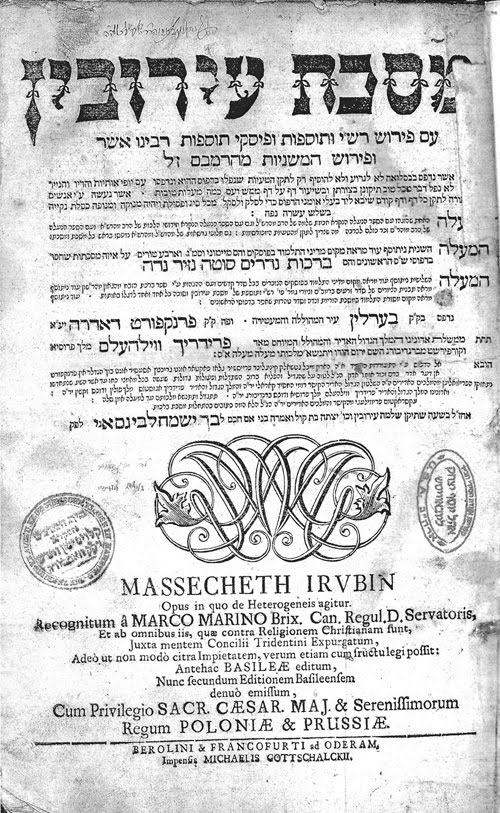
            At the beginning of the article it was stated that “this article is concerned with errors in and about Hebrew books only.” While the following example might tend to belie that statement, that is so only if the reader does not accept that the Bible is a Hebrew book, even if in translation. With that caveat, we bring an interesting and, from the printer’s perspective, an especially unfortunate error. For centuries the King James Bible was the authoritative English translation of the Bible by and for English speaking non-Jews. First published in 1611 by Robert Barker, it was reissued in 1631 by Barker, together with Martin Lucas, then the royal printers in London. This edition of the King James Bible is now best known as the Wicked Bible, but is also referred to as the Adulterous Bible or Sinners’ Bible. The error is in the Ten Commandments, in which the prohibition against adultery (Exodus 20:14; Heb. Bible 20:13) reads “Thou shalt commit adultery,” the “not” having been omitted, thus accounting for this edition of the King James Bible being referred to as the wicked Bible.
King Charles I was made acquainted with the error and the printers were called before the Star Chamber, where, upon the facts being proved, the printers were fined £3,000 about 34,000 pounds today). Subsequently, Barker and Lucas lost their printer’s licenses. The Archbishop of Canterbury, angered by the mistakes in this edition of the Bible, stated:
I knew the tyme
when great care was had about printing, the Bibles especially, good compositors
and the best correctors were gotten being grave and learned men, the paper and
the letter rare, and faire every way of the beste, but now the paper is nought,
the composers boyes, and the correctors unlearned.[51]
Printed in a press run of 1,000 copies, the wicked Bible was subsequently ordered destroyed; a handful of copies only are extant today.[52]
This article began with censorship, primarily of the Talmud and other Hebrew books, followed by internal censorship of Hebrew books, plagiarism and forgery, errors intentional (misleading) and unintentional, of varying levels of consequence. As noted in the previous article, “what they have in common is the consequence of inadvertently or deliberately misleading the reader. This is a subject that fascinates and certainly deserves further study. Nevertheless, even this overview should caution the reader that not everything in print, no matter how innocuous or well received, is necessarily so, for,”
Who can discern his errors? Clean me from hidden faults. Keep back Your servant also from presumptuous sins; let
them not have dominion over me; then shall I be blameless, and innocent of great transgression (Psalms 19:13-14).[53]


[1] I would like to express my appreciation to Eli
Genauer for reading the article and for his many corrections, my son-in-law, R.
Moshe Tepfer at the National Library of Israel, Israel Mizrahi of Mizrahi Book
Store, and R. Yitzhak Wilhelm and R. Zalman Levine, reading room librarians,
Chabad-Lubavitch Library for providing me with facsimiles of the rare books
described in this article.
[2] William
Popper, The Censorship of Hebrew Books (New York, 1899, reprint New
York, 1968), pp. 59, 60.
[3] “Who can
discern his errors? Misdates, Errors, and Deceptions, in and about Hebrew
Books, Intentional and Otherwise” Hakirah: The Flatbush Journal of Jewish
Law and Thought
12 (2011), pp. 269-91, reprinted in Further Studies in the Making of
the Early Hebrew Book
(Brill, Leiden/Boston, 2013), pp. 395-420.
[4] Heinrich
Graetz, History of the Jews IV (Philadelphia, 1956), p. 589.
[5] Abraham J. Karp, From
the Ends of the Earth. Judaic Treasures of the Library of Congress
(Washington,
1991), p. 47.
[6] Despite having a more accurate text than later seventeenth
and eighteenth editions, the Benveniste Talmud is, with exceptions, not always
highly regarded due to its small size. An
interesting early example of this relates to the handsome Lublin Talmud
(1617-39), from the perspective of the seventeenth century. In correspondence
between a representative of Duke Augustus the Young of Braunschweig [1635-66], founder
of the Ducal Library in Wolfenbuettel and R. Jacob ben Abraham Fidanque, author
of a super-commentary on the Abarbanel’s commentary on Nevi’im Rishonim and a dealer,
Fidanque writes “My lord’s letter arrived today, Wednesday, Erev Rosh Hodesh
Tevet, concerning the Lublin edition of the Talmud. I have one to sell, and it
is very fine in its beauty and its paper, in sixteen volumes and new. If my
lord wishes to give me 40R, that is, forty R. I will send it to him immediately
upon receipt of his response. I will sell it for less, but if my lord wants to
purchase an Amsterdam edition I will sell it for 14R. . . .” (K.
Wilkelm, “The Duke and the Talmud” Kiryat Sefer, XII (1936), p. 494
[Hebrew).
[7] Rabbinovicz, p.
100.
[8] Ben Satda, a
surname of Jesus of Nasereth, is, according to Marcus Jastrow, A Dictionary
of the Targumim, the Talmud Babli and Yerushalmi, and the Midrashic Literature

(Brooklyn, N.Y., n. d.), p. 972, probably of Greek origin. The section on Ben
Satda (Sanhedrin 67a) begins “and so they did to Ben Satda in Lod, and
hung him on erev Pesah. Ben Satda? He was the son (ben) of Padera . . .,
Padera being a name given to both the mother and father of Jesus.” As noted
above, neither this or comparable entries appear in many current editions of
the Talmud.
[9] Popper, p. 21.
[10] A somewhat inconsistent exception is
the Soncino translation of the Talmud. In the edition of Sanhedrin
published by the Traditional press (New York, n. d.) the Ben Satda entry is
omitted from both the Hebrew and English text. However, in the Judaic
and Soncino Classic Library (Judaica Press, Brooklyn, NY) edition, translator
David Kantrowitz, the Ben Satda entry is
available in Hebrew but not in English. However, in the Rebecca Bennet
Publications (1959) Soncino edition of Shabbat and the Judaic and
Soncino Classic Library edition of that tractate the Ben Satda text appears in both the Hebrew and in the English
translation, as well as in the Art Scroll Schottenstein edition of Shabbat.
That entry, however, is incomplete, and the Hebrew portion of the Judaic
and Soncino Classic Library edition notes that the censor has removed part of
the text.
[11] Abraham
Saba rewrote Zeror ha-Mor in Portugal from memory, having lost his writings
after the expulsionof the Jews from Spain.. Saba was imprisoned in Portugal for
refusing to accept baptism. Eventually released, he resettled in Morocco. Less
well known is what occurred afterwards. R. Hayyim Joseph David Azulai (Hida,
1724–1806) informs that Saba, after residing in Fez for ten years, traveled to
Verona, Italy. En route, a storm arose. The captain, in despair, requested Saba
pray for the ship’s safety. He agreed, but on the condition that, if he were to
die at sea, the captain should not bury him at sea, but rather take him to a
Jewish community for proper burial. The captain agreed, Abraham Saba’s prayed
and the storm abated. Two days later, on the eve of Yom Kippur, Saba died. The
captain took his body to Verona, where the Jewish community buried him with
great honor. (Hayyim Joseph David Azulai, Shem ha-gedolim ha-shalem with additions by Menachem Mendel Krengel
I (Jerusalem, 1979), pp. 13-14 [Hebrew].
[12] Amnon
Raz-Krakotzkin, The Censor, the Editor, and the Text: the Catholic
Church and the Shaping of the Jewish Canon in the Sixteenth Century
,
translated by Jackie Feldman (Philadelphia: University of Pennsylvania
Press, 2007), pp. 142. My edition of Zeror ha-Mor,
published by Heichel ha-Sefer (Benei Brak,1990) includes this passage.
[13] Among other censored halakhic works are R. Menahem ben Aaron ibn
Zerah’s (c. 1310-1385) Zeidah la-Derekh (Ferrara, 1554). The entry in Zeidah
la-Derekh
on malshinim (slanderers, informers), comprising almost an
entire leaf, was removed and the enumeration of the prayers comprising the Amidah
was correspondingly adjusted when the second edition (Sabbioneta, 1567) was
printed. The expurgated material has not been restored in subsequent editions. Another
contemporary halakhic work that was also censored is R. Isaac ben Joseph
of Corbeil (d. 1280) of the Ba’alei Tosafot’s Amudei Golah (Cremona,
1556), in which objectionable terms, and occasionally entire paragraphs, were
either substituted or suppressed. Concerning Zeidah la-Derekh and Amudei
Golah
see my “Concise and Succinct: Sixteenth Century Editions of Medieval
Halakhic Compendiums,” Hakirah: The Flatbush Journal of Jewish Law and
Thought
15 (2013), pp. 122-24 and 114-16 respectively.
[14] Isaiah
Sonne, “Expurgation of Hebrew Books,” in Hebrew Printng and Bibliography, Editor
Charles Berlin (New York, 1976), p. 231.
[15] Jacob S. Levinger, “Ganzfried, Solomon ben Joseph,” Encyclopaedia
Judaica
. Ed. Michael Berenbaum and Fred Skolnik, 7 (Detroit, 2007),
379-380.
[16] Marc B.
Shapiro, Changing the Immutable: How Orthodox Judaism Rewrites its History
(Oxford, Portland, 2015), p. 85-89.
[17] Shapiro, pp. 142 ff.
[18] David Sutton, Aleppo, City of Scholars
(Brooklyn, 2005), p. 334 no. 539.
[19] 1575, Birkat
ha-Mazon
, Lublin – Birkat ha-Mazon, facsimile reproduction
(Brooklyn, 2000), with introductions by Dovberush Weber and Eliezer Katzman,
pp. 6-23, 1-10 [Hebrew].
[20] Katzman, facsimile, p. 3; Meijer Marcus Roest, Catalogue
der Hebraica und Judaica Rosenthalishen
Bibliotek. Bearbetet von M. Roest,
with Anhang by Leeser Rosenthal (Amsterdam, 1875, reprint Amsterdam,
1966), II p. 42 n. 243  [Hebrew].
[21] Geoffrey Wigoder, “Abraham Bar Ḥiyya,” EJ 1, pp. 292-294.
[22] Hayyim Dov Chavel, “Kitvei Rabbenu Baḥya (Jerusalem, 1970), pp. 213-14 [Hebrew]. These remarks
are preceded by Chavel in the introduction to Kitvei Rabbenu Baḥya (p.
13), where he writes similarly that “the entire commentary on Jonah (in the
essay on Kippurim) is from this author (R. Abraham
ben Ḥayya). It is not clear to me why he concealed his name. Perhaps the reason
is that his books were very well known. . . .”
[23] Besamim
Rosh
was briefly referred to in “Who can discern his errors? . . .” in
footnote (25). It is addressed here in greater detail. Besamim Rosh has
been the subject of considerable interest. A sample biography includes the
following: Raymond Apple, “Saul Berlin (1740-1794) – Heretical Rabbi,”
Proceedings of the Australian Jewish Forum held at Mandelbaum House, University
of Sydney, 8-9 February 2004, Mandelbaum Studies in Judaica 12,
published by Mandelbaum House,
here; Samuel
Joseph Fuenn, Kiryah Ne’emanah (Vilna, 1860). pp. 295-98 [Hebrew];
Reuben Margaliot, “R. Saul Levin Forger of the book ‘Besamim Rosh’,” Areshet,
ed. Isaac Raphael, (1944) pp. 411-418 [Hebrew]; Moses Pelli, The age of
Haskalah, (Lanhan, 2010) pp. 171-89; idem., “Intimations of Religious
Reform in the German Hebrew Haskalah Literature” Jewish Social Studies 32:1
“(Jan. 1970), pp. 3-13); “No Besamim in this Rosh,” On the Main Line May
12, 2007, here; Dan
Rabinowitz, “Besamim Rosh,” The Seforim Blog, October 21, 2005, here;
Moshe Samet, “The Beginnings of Orthodoxy,” Modern Judaism, 8: 3
(1988), pp. 249-269;
[24] Abraham
David, “Berlin, Saul ben Ẓevi Hirsch Levin,” EJ 3, 459-460.
[25] The ban called for Mitzpeh Yokteil to be
burned  and destroyed with “great shame,”
and, in Berlin, it was so burned in the old synagogue courtyard (Israel
Zinberg, A History of Jewish Literature VIII (New York, 1975),
translated by Bernard Martin, p. 195.
[26] Dan
Rabinowitz, “Benefits
of the Internet: Besamim Rosh and its History
,” The Seforim Blog,
April 26, 2010, here.
[27] Talya
Fishman suggests that Berlin selected di Molina because little was known about
him and “it is probably of significance that this halakhist was ridiculed by
the Shulhan arukh’s (sic) author as one who failed to understand
the teachings of his predecessors and who said things of his own opinion, as if
‘prophetically, with no basis in Gemara or poskim [i.e. decisors]’.
Halakhically erudite readers of Besamim Rosh who learned that it was discovered
and compiled by R. Isaac di Molina might not have suspected the volume’s
dubious provenance, but they might well have been negatively prejudiced in
their assessment of its reliability as a legal source.” (Talya Fishman,
“Forging Jewish Memory, Besamim Rosh: and the Invention of
Pre-Emancipation Jewish Culture” in Jewish History and Jewish Memory: Essays
in Honor of Yosef Hayyim Yerushalmi
, ed. Elishiva
Carlebach
, John
M. Efron
, David
N. Myers
, pp. 78). Zinberg (p. 197) suggests that this
di Molina is a fabricated person, noting that the gematria
(numerical value) of di Molina equals di Satanow,
(137), a maskilic collaborator of Berlin.
[28] Zinberg, p. 197.
[29] Azulai, Shem
ha-Gedolim
II, p. 34 no. 127.
[30] Dan Rabinowitz, “Benefits
of the Internet.”
[31] Fishman, p. 75.
[32] Fishman, p. 81.
[33] Shmuel Feiner, The
Jewish Enlightenment
, tr. Chaya Naor (Philadelphia, 2011), p. 336.
[34] Mozes
Heiman Gans, Memorbook. History of Dutch Jewry from the Renaissance to 1940
with 1100 illustrations and text
(Baarn, Netherlands, 1977), p. 140.
[35] Concerning
Moses Benjamin Wulff see Marvin J. Heller, “Moses Benjamin Wulff – Court Jew in
Anhalt-Dessau,” European Judaism 33:2 (London, 2000), pp. 61-71,
reprinted in Studies in
the Making of the Early Hebrew Book
(hereafter Studies, Brill, Leiden/Boston,
2008), pp. 206-17.
[36]  Yehoshua Horowitz, “Judah Leib ben Enoch Zundel,” EJ 11.

[37] Richard Gottheil,
A. Freimann, Joseph Jacobs, M. Seligsohn,
“Frankfort-on-the-Main,” JE.

[38] The left
image is courtesy of Israel Mizrahi, Mizrahi Book Store.
[39] For a more detailed discussion of Leon (Judah Aryeh) Modena and Sur
me-Ra
see my “Sur me-Ra: Leone (Judah Aryeh) Modena’s Popular and
Much Reprinted Treatise Against Gambling” (Gutenberg-Jahrbuch, Mainz,
2015), pp. 105-22).
[40] Isaac Benjacob,
Otzar
ha-Sefarim: Sefer Arukh li-Tekhunat Sifre Yiśraʼel Nidpasim ṿe-Khitve Yad
(Vilna, 1880), p. 419, samekh 314 [Hebrew];
Ch. B. Friedberg, Bet Eked Sefarim, (Israel, n.d.), samekh
331 [Hebrew]; Yeshayahu Vinograd, Thesaurus of the Hebrew Book. Listing of
Books Printed in Hebrew Letters Since the Beginning of Printing circa 1469
through 1863
II (Jerusalem, 1993-95), p. 266 no. 1084 [Hebrew].
[41] The library in question was contacted and has since
modified their catalogue.
[42] L. Fuks
and R. G. Fuks‑Mansfeld, Hebrew Typography in the Northern Netherlands 1585
– 1815
(Leiden, 1984-87), I pp. 47-48 no. 53; Moritz Steinschneider, Catalogus Liborium Hebraeorum in Bibliotheca
Bodleiana
(CB, Berlin, 1852-60), no. 5745 col. 1351:24.
[43] Isaac Benjacob,
Otzar ha-Sefarim, p. 419, samekh
317 [Hebrew]; Julius Fürst, Bibliotheca Judaica: Bibliographisches Handbuch
der Gesammten Jüdischen Literatur . .
.II (1849-63, reprint Hildesheim,
1960), p. 384; Vinograd, Thesaurus of the Hebrew Book. II pp. 14-15 nos.
6, 8, 15.
[44] David
Cohen, Kuntres ha-Akov le-Mishor: le-Taken ta’uyot ha-Defus shel
ha-Shas Hotsa’at Vilna
(Brooklyn, 1983), pp. 4, 18, 22, 40.
[45] Menahem Mendel Brachfeld, Yosef Halel I (Brooklyn,
1987), pp. 8-9.
[46] Brachfeld, II p. 36. An accompanying footnote notes
that this is also the order in the Rome, Soncino, and Zamora editions, as well
as in many manuscripts on parchment.
[47] Brachfeld, II p. 102. The accompanying footnotes
states that this is also the text in the Rome and Zamora editions.
[48] Brachfeld, II, pp. 13, 33.
[49] A
palindrome is a word, line, verse, number, sentence, etc., reading the same backward as forward, for example, Madam, I’m Adam; able was I ere I saw Elba; and mom.
[50] Concerning
the usage mirror-image monograms see Marvin
J. Heller, “Mirror-image Monograms as Printers’ Devices on the Title
Pages of Hebrew Books Printed in the Seventeenth and Eighteenth Centuries,” Printing
History
40 (Rochester, N. Y., 2000), pp. 2-11, reprinted in Studies, pp. 33-43. The
title-page of Givat Shaul, as does other of works printed in various
locations, as noted above, states that it was printed, in Zolkiew, in small
letters, with fonts, again small letters, and then Amsterdam, in a very large
font.
[51] Louis Edward Ingelbart, Press
Freedoms: a Descriptive Calendar of Concepts, Interpretations, Events, and
Courts Actions, from 4000 B.C. to the Present
, (Greenwood Publishing,
1987), p. 40.
[52] A copy was
recently offered for sale for $99,500. here.
Among other errors in early editions of the Bible are the “Cannibal Bible,”
printed at Amsterdam in 1682, with the sentence “If the latter husband ate her
[for hate her], her former husband may not take her again” (Deuteronomy
24:3); a 1702 edition has the Psalmist complaining that “printers [princes]
have persecuted me without a cause” (Psalm 119:161); and  an edition published in Charles I’s reign,
reads “The fool hath said in his heart there is a God” (Psalm 14:1) here.
[53] Having pointed out the errors of others, I thought, in
all fairness, to note some errors in my own work, both those of consequence and
those less so. Those errors, however, in both categories, being too numerous,
might, given the length of this article, prove excessive and tedious for the
reader. They need, therefore, to be saved for a later day, for a possible
future article.
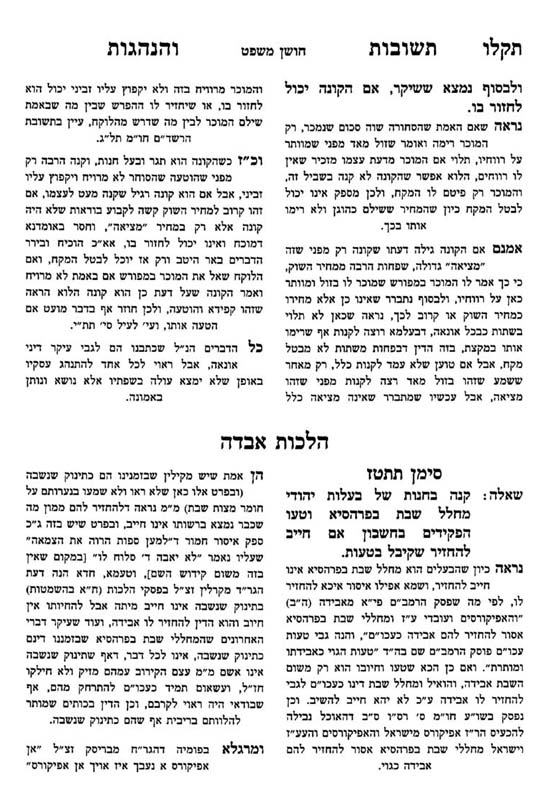
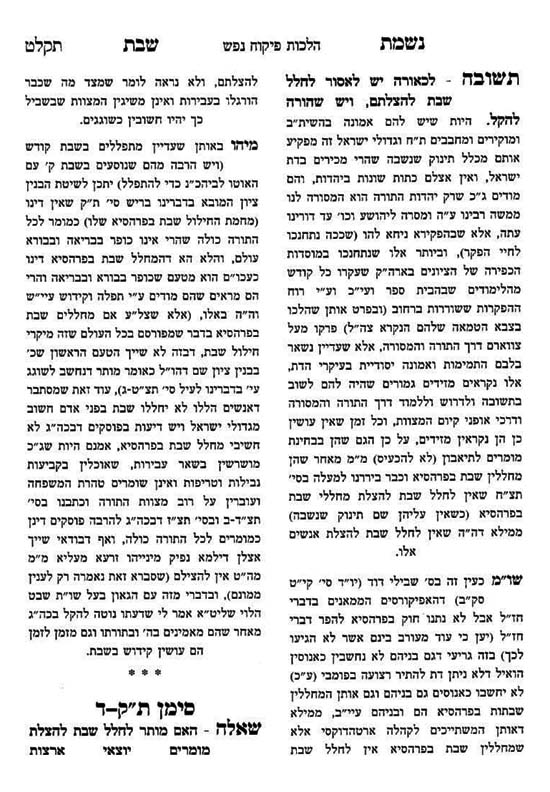
Engaged Couples, צעירים, and More

Engaged Couples, צעירים, and More
Marc B.Shapiro
Continued from here
1. Regarding engaged couples having physical contact, this is actually the subject of a section of the book Penei Yitzhak by R. Hezekiah Mordechai Bassan. Here is the title page.
This book was published in Mantua in 1744 by Menahem Navarra who was a descendant of R. Bassan. Navarra, who was at this time a doctor, not a rabbi, was nevertheless very learned in Torah matters. (He would later be appointed rabbi of Verona.[1]) Navarra included three essays of his own in the volume, the second of which is called Issur Kedushah. In this work he criticizes members of the Jewish community for allowing engaged couples to have physical contact before marriage. Here are the first two pages of the work.
Navarra and the others I have referred to are only dealing with an engaged couple touching before marriage, but not with actual sexual relations. Yet this too is mentioned many centuries before Navarra. Ezra 2:43 and Nehemiah 7:46 refer to בני טבעות. A commentary attributed to R. Saadiah Gaon[2] explains this as follows:

בני טבעות: שקלקלו אבותם גם [צ”ל עם] ארוסותיהם קודם שיכניסו אותם לחופה והיו סומכין על קדושי טבעות ומקלקלין עם ארוסותיהן.
What this means is that after kiddushin, which was effected by aטבעת  (ring), but before actual marriage (the two used to be separated, sometimes for many months), the engaged couple would have sexual relations. The children who resulted from this were referred to negatively as בני טבעות. As S. H. Kook points out,[3] R. Saadiah’s explanation is also mentioned by R. Hai Gaon.[4]
R. Hayyim Benveniste, in seventeeth century Turkey, also speaks about how engaged couples would have physical contact. This shows again that there was a divergence between what the halakhah requires and what the people were actually doing (much like you find in a large section of Modern Orthodox society today). Here are R. Benveniste’s words:[5]
להתייחד שניהם כמו שנוהגים פה תירייא ואיזמיר, שאחר השדוכין אחר עבור קצת ימים מתייחדין החתן והכלה ומכניסים אותה לחדר וסוגרין אותן הסגר מוחלט כמו שמסגרין הנשואה אחר ז’ ברכות, מנהג כזה רע ומר הוא, ואיכא איסורא מכמה פנים . . . ועוד שנכשלים באיסור נדה, וברוב הפעמים תצא כלה לחופתה וכריסה בין שיניה, וכמה מהם הודו ולא בושו שבאים עליה שלא כדרכה. אלא א-להים הוא יודע שטרחתי הרבה לבטל מנהג זה פה תיריא ועלה בידי, ועשיתי הסכמה בחרמות ונדויים על זה, ולסבת בעלי זרוע בעלי אגרופין אשר אין פחד א-להים לנגד עיניהם חזר המנהג לסורו רע.
There are a few different points that are of interest in what R. Benveniste writes. The first is that he says that in the majority of cases the bride arrives at the huppah וכריסה בין שיניה. This means that she is pregnant. Even if there is some exaggeration here, R. Benveniste is telling us that many Jewish women were getting pregnant before marriage. Readers might recall my post here where I mentioned R. Ovadiah Bertinoro’s assertion that most Jewish brides in Palermo were pregnant at the time of their wedding.
R. Benveniste mentions how he was able to improve matters by using the power of the herem to keep people in line, but that his success was short-lived as powerful members of the community were able to undermine his authority. This shows us, just as we saw in the text I quoted from R. Eleazar Kalir, that parents were often happy when their children had physical contact before marriage, and they opposed what they regarded as the overly puritanical approach of the rabbis. When R. Benveniste refers to those who באים עליה שלא כדרכה, this means that some of the couples had a sexual relationship, but wanted the woman to be a virgin at the wedding.
R. Jonah Landsofer (Bohemia, died 1712) also testified to the problem we have been discussing:[6]
בבית ישראל ראיתי שערוריה איכה נהיית’ כזאת שאין איש שם לבו להוכיח בשער בת רבים על התקלה וקלקלת שוטי’ שקלקלו והרגלו הרגל דבר עד שנעשה טבע קיים לבלתי הרגיש ברעה אשר ימצאם באחרית הימים והוא אשר נעשה בכל יום ערוך השלחן וצפה הצפית מיום שגומרין שידוכין בין בחור ובתולה מושבים אותם יחד ומוסרי’ הבתולה לזנות בית אביה בחיבוקים ונשוקים ומעשה חידודי’ וכל הקרואים והמסובי’ מחזיקי’ בידו.
Because the masses had no interest in what the rabbis had to say about this matter, R. Landsofer concludes that one need not even rebuke them, as they won’t listen anyway. Not long ago I heard a rabbi going on about the holy communities of Europe of a few hundred years ago, about their support of Torah, the respect they gave to the rabbis, and their commitment to halakhah. All of this is true, but if you look a little closer you find that these communities were actually very much like contemporary Modern Orthodox communities, in that together with a commitment to halakhah, many people also felt that they could determine which halakhot could be ignored. Or perhaps they didn’t even think they were violating halakhah. Maybe they assumed that the rabbis were making their lives difficult with extreme humrot. Either way you look at it, it is very obvious that there were many in traditional Jewish societies who created their own standards of practice which did not always correspond to what the rabbis insisted on, and they had no interest in changing their ways because of what the rabbis were saying.[7]
While the standard rabbinic view has always been that bride and groom are not to have any physical contact until after the wedding ceremony, the rabbis in Germany were a little more lenient. Sefer Maharil records that the practice was for the bride and groom to touch before marriage, but only on the morning of the wedding, a time that also included celebration.[8]
בעלות השחר ביום הששי היה קורא השמש לבא לבה”כ . . . ומביאים הכלה וחברותיה. וכאשר תבא עד פתח חצר בה”כ הלך הרב והחשובים והיו מוליכין את החתן לקראת הכלה. והחתן תופש אותה בידו ובחיבורן יחד זורקין כל העם על גבי ראשן חטין ואומרים פרו ורבו ג”פ. והולכין יחד עד אצל פתח בה”כ ויושבין שם מעט ומוליכין הכלה לביתה.
This detail, that the groom held the bride’s hand prior to the wedding, is found in a number of other German sources.[9] I don’t know how this practice of holding the bride’s hand before the wedding ceremony can be reconciled with what appears in Tractate Kallah, ch. 1:
כלה בלא ברכה אסורה לבעלה כנדה.
The word כלה here means a woman who is betrothed but not yet married.
R. Hayyim Joseph David Azulai, Kisei Rahamim, Kallah, ch. 1, comments on this passage:
כלה בלא ברכה אסורה כלומר אפי’ לחבק או ליגע בה כנדה.
I also find it noteworthy, and strange from our perspective, that Sefer Maharil tells us that for the wedding ceremony the rabbi would bring the bride to the groom, holding her by her robe:[10]
והרב היה תופס אותה בבגדיה והוליכה והעמידה לימין החתן.
R. Israel David Margulies (19th century) cites this text from Sefer Maharil and correctly notes that in medieval times the brides were much younger than in his day. He assumes that the typical bride was under 12 and a half years old, and therefore there was no problem of impure thoughts with such brides.[11]
ואיזה הירהור יהי’ בכלה קטנה או נערה כזאת, ולכן לקח אותה הרב בעצמו אצל מפתן הבית מן יד הנשים, והביאה אל החתן ושארי הנשים נשארו ולא היה להם שום עסק בבהכ”נ ולא היה חשש הרהור במקום קדשו.
2. Recently I heard a shiur where the rabbi said that if there is a Torah or rabbinic commandment to do something, only the talmudic sages can, as an emergency measure, forbid the action. The classic example is the Sages telling us not to blow the shofar if Rosh ha-Shanah falls out on Shabbat. There is nothing controversial in what the rabbi said, and I think most would agree, even if there some exceptions to this general rule. The rabbi further noted that post-talmudic authorities cannot make gezerot as this power is also reserved for the talmudic sages. This viewpoint is shared by many, yet there are important authorities who disagree, and perhaps more significantly there is evidence of post-talmudic gezerot.
I mention this now, after Passover [this post was written a few weeks ago], since those who reviewed the laws of Pesach would have seen Shulhan Arukh 453:5 which states:
האידנא אסור ללתות בין חטים בין שעורים.
“Nowadays, it is forbidden to moisten either wheat or barley [for grinding].”
If you look at the Mishnah Berurah he explains that while the Sages forbid moistening barley because it will easily leaven, according to the Talmud it is permitted to moisten wheat. In fact, according to the Talmud, Pesahim 40a, Rava held that it is an obligation to wash the grains of wheat: מצוה ללתות.
The Mishnah Berurah explains that it is the geonim who forbid moistening wheat since we are not expert at doing it properly, and it might come to be leavened, or we might delay removing the wheat after the moistening (before grinding) and this might lead to leavening. If the geonim forbid something that the Talmud permitted (or even required), isn’t this to be regarded as a gezerah?
3. Let me now mention something relating to Sukkot, which I had hoped to post closer to the holiday, but as the rabbinic saying goes, מה שהלב חושק הזמן עושק.
Shulhan Arukh, Orah Hayyim 649:4 states:
גנות הצעירים של עובדי כוכבים וכיוצא בהם מבתי שמשיהם מותר ליטול משם לולב או שאר מינים למצוה.
[Regarding what has grown in] the gardens of the צעירים of idolators and similar [gardens] of the houses [or: buildings] of their attendants, one is permitted to take from there a lulav or the other minim for the mitzvah.
Who are the צעירים of the idolators? The Taz states that he does not know:
איני יודע פירושו, אבל הוא ענין ממשרתי עבודת אלילים.
It is not just the Taz who doesn’t know, as none of the traditional commentaries have a clue. The Feldheim English translation of the Shulhan Arukh with Mishnah Berurah (which I make use of when I provide translations) doesn’t translate the word הצעירים, and instead simply transliterates it.[12]
In fact, I  am sure that R. Joseph Karo, living in the Muslim world, did not know what the צעירים are either. You might find this a strange assertion. After all, if R. Karo recorded the halakhah, how could he not know what he was writing? However, in this case R. Karo was just recording what appears in R. Aaron Hakohen of Lunel’s Orhot Hayyim (Florence, 1750), Hilkhot Lulav, no. 8, in the name of the Ritva:
כתב הר’ יום טוב אשבילי ז”ל בשם רבו ז”ל הוי יודע שגנות הצעירים והדורסים וכיוצא בהם מבתי הכומרים אינם משמשי ע”ז ולא נויי ע”ז ופירותיהם וכל אשר בהן מותרין בהנאה ומותר ליטול משם לולב או שאר מינין למצוה עכ”ל.
From a halakhic standpoint the importance of the halakhah is that it tells us that one can take a lulav and other other minim from the garden of an idolator, and it is not important exactly what type of idolator the צעירים are.
As mentioned, the halakhah in the Shulhan Arukh is taken from the Orhot Hayyim. It is first quoted in the Beit Yosef, Orah Hayyim 649, where it cited more exactly from the Orhot Hayyim than what appears in the Shulhan Arukh:
כתוב בארחות חיים ]הל’ לולב סי’ ח[ נגות הצעירים והדורסים וכיוצא בהם מבתי הכומרים מותר ליטול משם לולב או שאר מינים למצוה.
In the Beit Yosef (and also in Orhot Hayyim) it says הצעירים והדורסים. Furthermore, instead of מבתי שמשיהם that appears in the Shulhan Arukh, we have מבתי הכומרים, which means the houses (or buildings) of the priests. I have no doubt that the the word שמשיהם is a censor’s replacement of the original הכומרים. In the first printing of the Beit Yosef, Venice 1550, the sentence quoted above appears in its entirety. Yet when the Beit Yosef was next printed, Venice 1564, the entire sentence was deleted, obviously a requirement of the censor. The Shulhan Arukh was first printed in Venice, also in 1564. It thus makes sense that the deletion of the word הכומרים is due to censorship, and it could be that it was this alteration that prevented the entire halakhah from being deleted.
Before we get to הצעירים, what is the meaning of הדורסים that appears in Orhot Hayyim and is copied in the Beit Yosef? If you look at the Ritva that the Orhot Hayyim is citing, he states:[13]
והוי יודע שגנות השעירים והדוכסים וכיוצא בהם מבתי הכומרים, אינם משמשי ע”ז ולא נויי ע”ז, ופירותיהם וכל אשר בהם מותרים בהנאה, ומותר ליטול משם לולב או שאר מינין למצוה וכן קבלנו מרבותינו ז”ל הלכה למעשה.
The first thing to notice is that instead of הצעירים we have the word השעירים. This is a clear mistake, and the editor notes that the word הצעירים appears when the passage is cited in Orhot Hayyim. Unfortunately, the editor doesn’t note that are also least two other places where in speaking about benefit from avodah zarah the Ritva refers to גנת הצעירים.[14]The text from Ritva quoted above also has, instead of הדורסים which appears in Orhot Hayyim, another strange word, הדוכסים. This means “dukes” (or noblemen, princes, rulers, etc.) and makes no sense here since the context is avodah zarah which has nothing to do with a duke’s garden.

So we now have to explain not just what צעירים means but also דורסים or דוכסים. R. Hayyim Joseph David Azulai[15] suggests that צעירים is derived from Zechariah 13:7: והשבתי ידי על הצוערים, “And I will turn my hand upon the little ones.” It is hard to see how telling us that צוערים is related to צעירים helps us to understand the point of the Shulhan Arukh. R. Azulai also refers the reader to Rashi’s commentary on Zech. 13:7:
על הצוערים: על השלטונים הצעירים מן המלכים.
Perhaps I am missing something, but I don’t see what this passage adds other than showing us thatצוערים  and צעירים mean the same thing. Why does R. Azulai have to tell us this? The wordצעיר  is found elsewhere in the Bible, so we already know what it means.
R. Azulai’s short note also refers the reader to Abarbanel’s comment to Zech. 13:7. It is Abarbanel who will help us to understand what is going on with the word צעירים. (As R. Azulai was commenting on the Shulhan Arukh, he did not attempt to explain דורסים/דוכסים which is only found in the Beit Yosef. We shall return to this word soon.)
Abarbanel writes:
והשיבותי ידי על הצוערים שראוי שיפורש כפי זה הדרך על כומרי אדום הדורשים להם אמונתם וכזביהם והם עצמם נקראים אצלם צעירים להורות על ענוותנותם ושפלותם כי בעבור שאלה חטאו והחטיאו את אחרים בלמודם ודרושותיהם [!] אמר השם שישיב ידו ומכותם עליהם.
While this passage has nothing to do with the Shulhan Arukh, R. Azulai saw the relevance of it as Abarbanel makes the connection between צוערים and צעירים as we saw already with Rashi. Abarbanel also specifically connects this to Catholic priests, telling us that these priests would call themselves צעירים as a sign of modesty.
From this we can understand that when the Shulhan Arukh refers to gardens of the צעירים he means gardens belonging to Catholic priests. But who in particular are the צעירים? To answer this question let’s return to the Beit Yosef which referred to both צעירים and דורסים/דוכסים. As already noted, this entire passage is taken from the Orhot Hayyim.
In 1902 R. Moses Schlesinger published the second volume of the Orhot Hayyim. In the introduction he included a helpful list of all the times that the Beit Yosef cites the Orhot Hayyim. When he comes to our example, p. xv, he has a note in which he cites the great Abraham Berliner[16] that the proper reading is גנות הצעירים והדורשים. In other words, instead of דורסים/דוכסים, which appears in the Ritva and the Orhot Hayyim, it should say דורשים. When he wrote the Beit Yosef, R. Joseph Karo probably just copied the word דורסים that was in his copy of the Orhot Hayyim without knowing exactly what it meant (as its exact meaning, while of interest to historians and Seforim Blog readers, is not relevant to the underlying halakhah).[17]
So what does הצעירים והדורשים mean? Berliner explains this as well (and it was actually earlier explained by Leopold Zunz[18]). The two most important medieval Catholic orders were the Franciscans and the Dominicans. The actual name of the Franciscans is the “Order of Friars Minor.” They were often called “Little Brothers” or “Minorites.” Thus, when the Ritva and Orhot Hayyim refer to the צעירים this is just the Hebrew translation of “Minorites”, i.e., the Franciscans. As Abarbanel correctly pointed out, this term was adopted as a sign of humility.[19]As for the דורשים, the meaning of this is obvious (after Berliner and Zunz have enlightened us). The actual name of the Dominicans is the “Order of Preachers,” so דורשים (preachers)=Dominicans. What the Ritva and Orhot Hayyim are telling us is that when it comes to the mitzvah of lulav, one can use that which grows in the gardens of the Franciscans and the Dominicans (and the same halakhah would apply to other Catholic orders. The monasteries would often have gardens and Jews would be able to purchase things from there.)

In Nahmanides’ Disputation[20] he too refers to theצעירים  and the דורשים.
והיו שם ההגמון וכל הגלחים וחכמי הצעירים והדורשים.
In his note, R. Hayyim Dov Chavel identifies the צעירים as the Franciscans. However, he doesn’t know that the דורשים are the Dominicans, and he therefore explains that the word means הנואמים. In his English translation, Chavel writes, “Among them were the bishop [of Barcelona] and all the priests, Franciscan scholars, and preachers.”[21]
It is noteworthy that the fifteenth-century R. Solomon ben Simeon Duran, who lived in North Africa, was apparently also unaware of the meaning of צעירים, and therefore applied it to all young Catholic religious figures, not merely Franciscans. )At least, that is what I think he means, as opposed to understanding his use ofצעיריהם  to refer to young men as a whole.) After contrasting the sexual purity of the Jews with what occurs in surrounding society, he writes, in very strong words:[22]
וצעיריהם הם כולם מטונפים בעריות מנאפים עם נשי רעיהם ובאים על הזכור והטוב שבהם מוציא שכבת זרע לבטלה בידו וזה מפורסם אצלם.
4. Since in a prior post I discussed Jacob’s love of Rachel and Leah, let me share a strange interpretation I recently found, involving love and Jacob’s brother, Esau. The general understanding is that Esau loved Isaac. Indeed, it is very difficult to read the Torah and conclude differently. Therefore, I was quite surprised to find that the medieval R. Abraham Bedersi is of the opinion that, after Isaac gave Jacob the blessing intended for Esau, not only did Esau not love Isaac, but he was ready to cause his death! This would be accomplished by killing Jacob, since Isaac’s great sorrow would bring on his end. To arrive at this interpretation, Bedersi offers a novel understanding of Gen. 27:41: יקרבו ימי אבל אבי ואהרגה את יעקב אחי. The standard understanding of these words is that when the days of mourning for his father arrive, then Esau will kill Jacob. As he didn’t want to cause his father pain, he decided to wait until he was dead to kill Jacob. However, Bedersi understands ואהרגה to mean, “when I will kill Jacob” this will cause my father to die.
Here are his words from his Hotem Tokhnit:[23]
ועשו הרשע ידוע שלא היה אוהב יצחק אביו כמו שתראה שאמר יקרבו ימי אבל אבי ואהרגה את יעקב אחי וביאור נכון בו אהרגה את יעקב אחי ובאמת יקרבו ימי אבל אבי שהוא יצטער על בנו וימות.
As mentioned, this is a strange interpretation so I Iooked around to see if I could find a similar approach. I didn’t see anything in Torah Shelemah. I looked in the ArtScroll extended commentary to Genesis (not the Stone Chumash) and it does not bring any interpretations that suggest that Esau intended to cause Isaac’s death. However, the commentary states as follows:
Ralbag interprets similarly:[24] Even if it accelerates my father’s death [lit. brings near the days of mourning for my father] I nevertheless will kill my brother Jacob (cited by Tur).
I don’t know where they got this from, as Ralbag does not say what is attributed to him. All Ralbag says is that Esau wished to kill Jacob after Isaac’s death. The Tur, who was a contemporary of Ralbag, does not cite him.
R. Abraham Bedersi’s Hotem Tokhnit focuses on Hebrew synonyms and in an era before concordances and computers would have required an enormous amount of work. It found on hebrewbooks.org, but it is not on Otzar ha-Hokhmah.

Among the many interesting things you will find in Hotem Tokhnit is that he says that unlike the word יהודי, the word עברי is only used in the Bible in the context of slavery, and he provides examples of this (p. 152). With this in mind, I can see why some people would prefer the term Mishpat Yehudi instead of Mishpat Ivri.

On p. 202  he quotes an otherwise unknown comment of Ibn Ezra that the meaning of the word סלה is “truth”.
כי ענין סלה אמת ונכונה ועל זה אמר אשרי יושבי ביתך עוד יהללוך סלה (תהלים פ”ד ה’) באמת וביושר.
Beginning on p. 1 in the second section, there is a long letter from Samuel David Luzzatto. He refers to an unnamed scholar who could not accept that Rabad, in his comment to Hilkhot Teshuvah 3:7, would say that people greater than Maimonides thought that God had a physical form. He therefore suggested changing גדולים וטובים ממנו to גדולים וטובים מעמֵנו (tzeirei under the mem).
Luzzatto completely rejects this point, arguing that גדולים וטובים מעמנו means people greater than our nation, i.e., non-Jews. Furthermore, he adds, where do we find Rabad, Rashi, etc. using the word עמנו to refer to the Jewish people.
On p. 2 Luzzatto records the following lines from one of Bedersi’s poems, in which one word summarizes each of Maimonides’ Thirteen Principles:
נמצא כיִחודו והֶבדלו                    קדמות עבודתו נבואתו
משה ותורתו אֲנצחַ                       ידע גמול גואל בהחיותו
Luzzatto also publishes a long poem from Bedersi together with Luzzatto’s commentary, without which it would be very difficult to understand much of what Bedersi was saying. One of my favorite lines is found on p. 13:
ולא תבין שפת כל-עם בשירים        לבד טרחם, כפז על גב בעירי
What this means is that poems are difficult for the masses, of every nation and language, to understand. They regard them as a burden, much like an animal, if you place gold on its back, won’t appreciate what it is carrying. It will only feel the burden of the weight.
5. Since I mentioned Mendelssohn in the last post, let me note the following. I recently saw that Eliezer Segal, in his wonderful book, Introducing Judaism (London and New York, 2009), p. 110, uses a picture of Mendelssohn. You can see it here. (Copyright prevents me from posting the picture.) We are told that the image is from the 18th century, yet there is no doubt that this is not a picture of Mendelssohn. You can look at authentic pictures of Mendelssohn here and they look nothing like this image. Incidentally, in a student’s description of Mendelssohn’s 1777 meeting with Kant, he is described as  having a goatee.[25]
6. In a comment to my last post, Maimon wrote: “On the subject of R. Bachrach’s responsum – it bears noting that the pre-reform homogeneous [should be: heterogeneous] Jewish society (especially in Germany) contained people of varying levels of observance from across the spectrum and as such many behavioral patterns that would be unthinkable in contemporary Orthodox society are detailed in the Halakhic writings from that era.” Maimon is correct, and it is not only in recent centuries or in Germany that one finds communities with people of different levels of religious observance. This is how Jewish societies have always been, in every era and place, at least until the second half of the twentieth century and the creation of haredi societies. I have already cited numerous examples that justify this statement, but let offer one more that shows how even in medieval times young men and women would socialize in a way that Maimon might say “would be unthinkable in contemporary Orthodox society.” I would only add that instead of “contemporary Orthodox society,” I prefer to say “contemporary haredi society,” since as mentioned already, Modern Orthodox society still has significant variations in level of observance. (When I speak of variations in level of observance, I have in mind bein adam la-Makom halakhot. I am not referring to halakhot having to do with monetary issues and dina de-malchuta dina, regarding which I believe the Modern Orthodox community is superior to what we find in the haredi world.)
R. Meir of Rothenburg was asked about young Jewish men and women who were drinking together. As a joke, one of the young women asked one of the men if he would betroth her. He took a ring and threw it to her, and recited the text of kiddushin. (At a future time I can discuss the halakhic arguments that R. Meir used to free the woman from having to receive a get.) One cannot overlook the fact that the way the young men and women were socializing together, much like you would find among kids at Modern Orthodox high schools, shows that there was no strict separation between the sexes. Here is the question, as it appears in Irving Agus, ed., Teshuvot Ba’alei ha-Tosafot, no. 85.

R. Meir of Rothenburg’s answer is found in She’elot u-Teshuvot Maharam mi-Rothenburg, Prague ed., no. 993.7. Two people have asked me to comment on Rabbis Yitzchok Adlerstein’s and Michael Broyde’s article here arguing that hasidic schools shouldn’t be forced to offer secular education. While the Seforim Blog is not the place for commenting on these sorts of matters, after reading the article I felt I had to make one point. Adlerstein and Broyde cite the famous Supreme Court case which allowed the Amish to opt out of secular education and they apply this logic to the hasidic communities. While it is true that if it went to court the hasidic communities would probably prevail, there is a big difference between the Amish and the hasidic communities. The Amish do not take welfare, food stamps, and other forms of government assistance. Thus, they make choices and live with the consequences. However, the hasidic communities refuse to provide their children with the basic skills needed to function in the modern economy, and as a result rely heavily on the welfare state. No one who believes in limited government and is opposed to the welfare state can support a situation where kids are allowed to grow up almost guaranteed to be in need of public assistance.[26]


[1] Regarding Navarra, see Cecil Roth, “Rabbi Menahem Navarra: His Life and Times. 1717-1777,” Jewish Quarterly Review 15 (1925), pp. 427-466.
[2] Perush al Ezra ve-Nehemiah (Oxford, 1882), p. 30.
[3] Iyunim u-Mehkarim (Jerusalem, 1959), vol. 1, p. 259.
[4] Ginzei Kedem 4 (1930), p. 52. While there is no historical evidence for this explanation, it does show that the practice of using a ring for kiddushin existed already in the geonic period. For other sources from this era, see Mordechai Margaliot, ed., Ha-Hilukim bein Anshei Mizrah u-Venei Eretz Yisrael (Jerusalem, 1938), no. 25. For a very detailed discussion of use of a ring for kiddushin, see Pardes Eliezer: Erusin ve-Nisuin (Brooklyn, 2010), vol. 4, ch. 30.
Only in Yemen did the practice of using a ring not become widely accepted (though even there it was used in some places). See R. Yitzhak Ratsaby, Shulhan Arukh ha-Mekutzar, vol. 7, pp. 27-28. There is no mention of using a ring for kiddushin in the Talmud. It does, however, appear in Tikunei Zohar, nos. 5, 10 (as pointed out by R. Moses Isserles, Shulhan Arukh Even ha-Ezer 27:1), but Tikunei Zohar does not date from the tannaitic or amoraic period. The Sefer ha-Hinukh, no. 539, says that the reason we use a ring for kiddushin is so that every time the woman looks at her hand she remembers the following things (which apply to all means of kiddushin, but wearing a ring allows her to remember them).
שהיא קנויה לאותו האיש ולא תזנה תחתיו ולא תמרוד בו ותתן לו יקר והוד לעולם כעבד לאדוניו.
Regarding what I have underlined, even if today some men like being treated like that, going into a contemporary marriage expecting to get this sort of treatment is a recipe for marital disaster.
The ring for kiddushin has nothing to do with the engagement ring. I always wondered why the practice of giving a diamond engagement ring was not condemned as hukkot ha-goyim, especially by those who have an expansive understanding of this halakhah. Even if it is not halakhically forbidden, it is clearly a practice that came from non-Jewish society. How is it that people who refuse to have anything to do with things like Mother’s Day or Thanksgiving have no problem giving a diamond ring as an engagement present? R. Chaim Rapoport pointed out to me that R. Zvi Hersh Ferber of London (d. 1966) condemned the giving of engagement rings as hukkot ha-goyim. See Kerem Tzvi: Bereishit, vol. 1, p. 132.
As for wedding rings for men, R. Meir Mazuz states that there is absolutely no problem with a man wearing a ring. See Asaf ha-Mazkir, p. 194, Bayit Ne’eman, pp. 441ff. He calls attention to Shabbat 62a, וחילופיהן באיש, from which we see that this was not regarded as a problem. He also quotes Kaf ha-Hayyim 161:31 who writes (summarizing an earlier source):
דת”ח שתורתם אומנתם וכן בעלי בתים שעוסקים במו”מ ואין להם מלאכה גרועה א”צ להסיר הטבעות בשעת נט”י אע”ג דמהדקי טובא.
R. Mazuz states that on his wedding day his father, the great R. Matzliach Mazuz, gave him a ring to wear, and that in Tunisia this was the general practice, that a groom received a ring and wore it for the rest of his life. However, upon coming to Israel R. Mazuz saw that it is not accepted for talmidei hakhamim and “fearers of heaven” to wear a ring so he stopped wearing it. (This is his language in Asaf ha-Mazkir. In Bayit Ne’eman he writes that the haredim do not wear rings.) R. Mazuz adds that he does wear the ring on the night of Passover to commemorate the words of Genesis 15:14: “Afterward shall they come out with great substance.” (“Great substance” includes jewelry.)
R. Mazuz notes that in a picture of the Moroccan sage, R. Isaac Bengualid (1777-1870), author of the responsa work Va-Yomer Yitzhak, he is wearing a ring. Here is the picture.

He also mentions a picture of R. Elijah Hazan (1848-1908) of Alexandria, author of the responsa work Ta’alumot Lev, where he is wearing a ring. I have not been able to find this picture. See also here where S. has a picture of R. Bernard Illowy wearing a ring as well as a picture of R. Samson Wertheimer’s wedding ring.
R. Hayyim Amselem, here (from May 5, 2105), writes very strongly against those who oppose wedding rings on religious grounds, using the opportunity to once again blast the Ashkenazic haredim.
איפה ההגיון הבריא?
הבוקר בעתון ישראל היום ובערוץ 7 מפרסמים בהבלטה ובהתפעלות פסק הלכה “חדש” המתיר ואפילו ממליץ בעידן המודרני לגברים נשואין לענוד טבעת נישואין, בעולם הדתי והחרדי, שוללים זאת כי זה “מנהג גוים”, לדעתם וכו’ וכו’ .
מה שהם אינם יודעים שאין כאן כל חדש ובעדות הספרדים היה זה מנהג פשוט שרבים מאוד מהגברים ענדו על ידם טבעת נשואין, או טבעת בכלל ולא היה פוצה פה ומצפצף, ידועות כמה תמונות של גדולי תורה והלכה שבאצבעם טבעת כגון תמונתו של הגאון רבי יצחק בן וואליד רב ודיין בעיר תיטואן במרוקו, וכן עוד רבנים, שכך עשו מעשה, עיין בספר אסף המזכיר עמוד קצ”ד.
מה הבעיה? הבעיה היא שהרבנים האשכנזים ובעיקר החרדים, מה שהם חושבים בדעתם שזה אסור, ובמיוחד אם זה דומה להנהגה לא “חרדית” אז זה כבר אסור וחילול השם וכו’ והם לא מסוגלים להכיל בסובלנות דעה אחרת, מה גם שהם בטוחים לגמרי שהתורה היא רק שלהם ואין לאחרים זולתם כלום, וכמובן ההמון הפשוט שומע ונוהה אחריהם בעינים עוורות.
גם אם תוכיח להם שאפילו בתלמוד כך משמע [עיין מסכת שבת (דף ס”ב ע”א)] לא יעזור כלום, ואם תעיז גם להביע את דעתך, אוי ואבוי אתה חולק על גדולי ישראל? אתה נגד “ההשקופע” החרדית, דמך בראשך.
איי איי איי איפה היהדות השפויה והמתונה נעלמה?
[5] Keneset ha-Gedolah, Even ha-Ezer 66, Tur no. 1.
[6] Meil Tzedakah, no. 19.
[7] In the prior post I gave examples of takanot forbidding an engaged man to enter the house of his fiancée. For another example from 1594 in Italy, see R. Solomon ha-Levi, Divrei Shlomo (Venice, 1594), p. 299a. R. Hayyim Palache mentions that in nineteenth-century Izmir they also proclaimed such a takanah. See Hayyim ve-Shalom, vol. 2, no. 89, Masa Hayyim, ma’arekhet shin, no. 124 (p. 27a). R. Elijah ha-Levi (16th century) of Constantinople, Zekan Aharon, no. 117, discusses the matter as well. He states that in his community there is no “evil practice” of having the engaged couple spend time together at her home, which leads to all the problems that have been mentioned.However, he notes that this was an old practice in some places in the Ottoman Empire, and therefore in order to prevent serious sins the rabbis instituted that at the engagement the wedding blessings were recited and the woman would also go to the mikveh at this time.
Regarding the engaged couple before the wedding, it is also worth noting that among some hasidic groups from the Chernobyl line, there is a festive meal, called a חתן מאהל, the evening before the wedding. At this time, the future bride and groom dance together using a long handkerchief or gartel. At the wedding itself, the practice in a number of hasidic groups (and not only among the Hasidim) is that the bride and groom dance together actually holding hands. See Pardes Eliezer: Erusin ve-Nisuin, vol. 5, p. 538; Ohel Moshe 7 (Kislev 5750), p. 67. Here are two examples of this from Youtube.

Regarding dancing while holding hands, I found something quite interesting in R. Joseph Hahn (d. 1637), Yosif Ometz (Frankfurt, 1928), p. 344:
המספר מעות לאשה כדי להסתכל בה אף על פי שמלא תורה ומעשים לא ינקה מדינה של גיהנם וכל שכן הנוגע בידה ממש, ובמחול של מצוה המדקדקים כורכים סביבות ידיהם בגד שקורין וטשינלן, ואם יודע בעצמו בודאות שלא יבא לידי הרהור שרי.
R. Hahn tells us that during a Mitzvah dance, when there are men and women dancing together, those who are careful about halakhah would wear a type of glove. This means that even if they held hands with a woman they would not touch her skin. R. Hahn says that one who knows that he will not be driven to sexual thoughts is permitted to do this.
R. Ezekiel Feivel, Toldot Adam (Jerusalem, 1987), ch. 15 (p. 215), says that R. Shlomo Zalman of Vilna (the brother of R. Hayyim of Volozhin) used to dance with brides holding their hand. A handkerchief or something other covering ensured that he didn’t touch their skin::
אחז ביד החתן ודבר עמו דברי תורה אשר זורו במזור האמת והאמונה . . . אחר כן רקד עם הכלה אחוזי יד על ידי מטפחת בנועם לב ופנים מאירות ובסדר מתוקן ונעים מאד.
R. Abraham Hayyim Schorr, Torat Hayyim: Avodah Zarah 17a, was very opposed to this practice of holding the bride’s hand, even if separated by something like a handkerchief, which he says was done by some talmidei hakhamim. (He means actually holding hands with the handkerchief ensuring that skin does not touch. He is not referring to when the man and woman each hold a different end of the handkerchief. See R. Yosef Rapoport’s letter in Or Yisrael 24 [Tamuz 5761], p. 245.)
ונר’ דאסו’ ללכת במחול עם הכלה בשבעת ימי המשתה אפי’ אינו אוחז בידה ממש אלא בהפסק מטפחת כדרך שנוהגין מקצת ת”ח שבדור הזה אפ”ה לאו שפיר עבדי.
I will deal with the larger issue of mixed dancing, and the rabbinic responses, in a future post.Regarding R. Shlomo Zalman covering his hands, we are told that he never touched the pages of a sefer with his bare hands. He always turned the pages while wearing gloves or with a handkerchief. One time he didn’t have either with him, and he turned the pages with his lips. See Toldot Adam, p. 214.

We are also told that when he slept he wore gloves in order that his bare hands not touch his body. This way when he woke up he could start studying Torah immediately without washing his hands, so careful was he not to waste even a moment away from Torah study. See Toldot Adam, p. 218. This approach of R. Shlomo Zalman ignores the main reason offered for washing in the morning, namely, that it is to remove the ruah ra’ah. Therefore, R. Hayyim Eleazar Shapira could not believe that the story of R. Shlomo Zalman wearing gloves was true. See Nimukei Orah Hayyim, 4:1


על כן אין להאמין על אותו צדיק טעות ומעשה כזה

.
See also R. Ovadiah Yosef, Yabia Omer, vol. 4, Orah Hayyim no. 2:8-9; and R. Moshe Yehudah Leib Rabinovich’s letter at the beginning of R. Zev Zicherman, Otzar Pelaot ha-Torah, vol. 1 (Brooklyn, 2014)..

[8] Ed. Spitzer (Jerusalem, 1989), p. 464.
[9] See Yaakov Yisrael Stall’s note in R. Judah he-Hasid, Sefer ha-Gematriot (Jerusalem, 2005), p. 309 n. 71. (R. Judah he-Hasid states that the groom would lift up his future bride.)
[10] Sefer Maharil, p. 465.
[11] Har Tavor (Pressburg, 1861), p. 33b. Regarding the age of Jewish brides in medieval times, See Avraham Grossman, Hasidot u-Mordot (Jerusalem, 2001), ch. 2. He makes the following interesting point (Pious and Rebellious, trans. Jonathan Chipman [Waltham, 2004], pp. 47-48):
The phenomenon of beating wives may also have been exacerbated by marriage of girls at an early age. The fact that at times the wife was extremely young led the husband to relate to her as he would to his own daughter. This was particularly true in those places where young girls were married to husbands significantly older than themselves, which was, as we have seen, a common phenomenon in Jewish society, and particularly in Muslim countries. Moreover, it may well be that the beating of the wife, which was a part of the life of the young couple, also continued thereafter.
[12] R. Yihye Moses Abudi, Magen Ba’adi (Jerusalem, 1904), vol. 2, p. 30b, also doesn’t know what the word means. What he thinks is the obvious meaning is, as we will soon see, mistaken.
ול”נ פשוט כיון שהם קורין לה גנות הגדולים אנו מכנים להם שם לגנאי לקרות להם גנות הצעירים.
[13] Hiddushei ha-Ritva: Sukkah 29b, Mossad ha-Rav Kook ed., cols. 278-279.
[14] Hiddushei ha-Ritva: Avodah Zarah 51b, Mossad ha-Rav Kook ed., col. 259; Hiddushei ha-Ritva: Rosh ha-Shanah 28a, Mossad ha-Rav Kook ed., col. 264.
[15] Birkei Yosef, Orah Hayyim 649:3. R. Moses Sofer also refers to Zech. 13:7. See the Makhon Yerushalayim ed. of Shulhan Arukh, ad loc.
[16] Abraham Berliner was an outstanding representative of German Orthodoxy. He was a member of R. Azriel Hildesheimer’s separatist Orthodox community, and he taught for many years at the Rabbinical Seminary of Berlin. Nevertheless, the annual Yerushatenu, which is devoted to the study of all aspects of German rabbinic history, prayers, customs, etc., saw fit to publish a letter which attacks Berliner and places him in what the letter-writer regards as the “anti-Torah” camp. See Yerushatenu 3 (2009), p. 396. This was an unfortunate lapse in judgment by the editors of what is otherwise a fabulous publication. The editors intended to show their open-mindedness by publishing even the nonsense of an extremist, but the job of the editors is to ensure the high quality of their publication, and this means that they have to reject that which is unsuitable.
[17] Unfortunately, the Makhon Yerushalayim edition of the Beit Yosef simply points out that instead of דורסים the text should perhaps read דוכסים. In other words, the editors were unaware that דורשים is the correct reading. Hopefully, in the next printing they will correct this matter. If they do so, based on this post, it will be my second “contribution” to this magnificent edition. Here is the Makhon Yerushalayim TurEven ha-Ezer 173, p. 539.

In note 3 at the bottom of the page it refers to a קושיא גדולה printed in the journal Or Torah in 1992 (Heshvan 5753, no. 23). This was a question I asked R. Meir Mazuz and he replied that instead of ונשא בתו the text should apparently read ונשא בת אשתו .
[18] Zur Geschichte und Literatur (Berlin, 1845), p. 181.
[19] In his defense of R. Moses Hayyim Luzzatto and his circle, R. Jacob Hazak uses the phrase גנות הצעירים to make a nice melitzah. See Iggerot Ramhal u-Venei Doro, ed., Shriki (Jerusalem, 2008), p. 357:
ואל יחשבו אותנו כמורדים וכפושעים ח”ו, וכל מי שתורת אלקיו בקרבו, ואהבתו ית’ גברה בו, ילבש בגדי קנאה ולא ישמע גנ”ות הצעירים.
[20] Kitvei Rabbenu Moshe ben Nahman, ed. Chavel, vol. 1, p. 308.
[21] Ramban: Writings and Discourses (New York, 1978), vol. 2, p. 668.
[22] Milhemet Mitzvah (Leipzig, 1855), p. 14.
[23] (Amsterdam, 1865), p. 16.
[24] The word “similarly” makes no sense here, as the commentary does not previously cite an interpretation similar to the one given by “Ralbag.”
[25] See Paul Mendes-Flohr and Jehuda Reinharz, eds., The Jew in the Modern World (Oxford, 1995), p. 61.
[26] According to the last census, Kiryas Joel has a higher percentage of residents receiving food stamps than any other city or town in the entire country. See here. The taxpayer should never be required to subsidize communities when the poverty is self-imposed.


Initial Bibliography of Important Haggadah Literature

Initial Bibliography of Important Haggadah Literature
by Eliezer Brodt

All are aware of the proliferation of Haggadahs. Every year more and more are published thus making it difficult to know which versions are worthwhile. Thus, in this post I intend to focus on a listing a small bibliographical list of seforim relating to the Haggadah that are, in my mind, some of the most important ones.

In light of the fact I am going to select a few Haggadahs from the many, a caveat of sorts is in order. When discussing the “best” books it is good to keep in mind the comments of R. Eliyahu ben Avrohom Shlomo HaKohen (d. 1729) in his Shevet Mussar (ch. 28) who writes the following regarding affinities towards particular seforim:

ותראה בני אדם שלומדים ענין אחד מדרוש או ממוסר בספר אחד ואין טועמים ממנו ואין נרשם הדבר בשכלם. והענין או דברי המוסר בעצמו לומדים אותו בספר אחר הבא בשינו לשון ובמלות שונות וטועמים ממנו ונרשם הענין בדעתם ומגדלים ומשבחים אותו ענין. ובהפך אם אחד למד ענין בספר שלמד זה וטעם הוא אינו טועם כטעם הספר שלא טעם חבירו. טעמו של דבר שכל הטועם מענין הספר שלמד יש לו איזה שורש לנשמתו בנשמת מחבר הספר כיון שהם משורש אחד לכן טועם לשונו ונרשמים הדברים בליבו. לא כן מספר שלמד ולא טעם אף על פי שהענין אחד משום שאין לנשמתו שום קורבה ואחיזה בנשמת המחבר אותו ספר.

Basically, according each persons taste of a sefer could be different and the reason has to do with some sort of connection with the author of the sefer. Further, when it comes to the Haggadah and specifically the importance of the Haggadah the comments of the Sefer Hamaskil are instructive (p. 70):

מה טוב ומה נעים לעיין תמיד דבר בעתו בכל שבוע ושבוע בפירוש חומש ומחזיר וסליחות… ואגדת פסח

His basic point being that one should try to prepare before each occasion the tefilos we specific to that occasion – and for Pesach that is the Haggadah. (For more information regarding the Sefer Hamaskil see the excellent article from Rabbi M. Honig in Yerushcanu vol. 1).

One final point regarding the study of the Haggadah. The seder is at most two nights and thus some complain that they have no time to discuss or learn all the torah written about the seder in such a limited time. Many years ago I came across a interesting Netziv who writes that one should discuss Yetzis Mitzrim all Pesach not just the seder night [Hemaek Davar shimos 13:8]. Therefore, according the the Netziv, there is plenty of time to delve into the Haggadah and the seder.

As I have written before there is no other sefer which has more written on it than the Haggadah Shel Pesach. This year, on top of all the Haggadahs printed, Chaim Rosenberg has just added to his website of hebrew books 1000 more Haggadahs ! Moreover, the JNUL also has many rare Haggadahs online as well. Below are some of my recommendations of some good works on the Haggadah with some small points about them. I really should have a individual post about each one of these seforim but due to lack of time this should suffice for now.

Haggadahs discussing the historical development of the Haggadah & the Seder:

Many volumes have been written and will continue to be written about the Haggadah and its development. In 1954, R. Menachem M. Kasher had R. Shmuel Askenazi put together a Haggadah, Haggadah Shelama. [Virtually all of the work was done by R. Ashkenazi not by R. Kasher.] This Haggadah has an excellent introduction of forty chapters comprising 224 pages that discuss all aspects relating to the seder including much about the development of the Haggadah as we have it. As is the case with all R. Ashkenazi’s works, this work is very well written and organized. It’s based on a very wide range of sources including manuscripts and genizah fragments. These introductory chapters have formed the bases for virtually all good Haggadahs printed since then. The second half of the Haggadah has an excellent collection of pirishim from many of the classic commentaries. This work has been reprinted many times, and is currently in print.

Another important Haggadah was edition by Professor D. Goldschmidt. This is a critical edition of the Haggadah [this is a updated version of previous editions that he had written] it also has much useful information on the development of the Haggadah and is a bit more scientific than Haggadah Shelama. But it is not nearly extensive as the Haggadah Shelama in what topics and information that it covers.

Another interesting work on the Haggada is called Haggadah and History by Professor Yosef Yerushalmi. This work contains 494 pages printed beautifully, describing five centuries of the Haggadah through facsimilie plates. Yerushalmi deals with many points of the particular Haggadahs. He also shows how the Haggadah is a mirror of Jewish history in general.

Another important volume was printed in 1998 by professors [father & son] Shemuel & Zev Safrai, Haggadah’s Chazal. This Haggadah is excellent. In the past fifty years, since the printing of Haggadah Shelama, many more manuscripts and genizah fragments have come to light. The Safrai Haggadah makes prodigious use of this new information. It is well written and very user friendly. The Safrais deal with each part of the seder discussing at length the development of the Haggadah from times of Beis Hamikdash onwards. They also go through the entire text discussing various readings, sources, etc. In all, it is more scientific Haggadah then the Haggadah Shelama but less comprehensive. In the U.S. it is available here.

Another excellent work on the seder is Pessach Doros by R. Yosef Tabory published by Kibitz Hameuchad. This work focuses on many aspects of the seder and Haggadah. But this work does not only focus on the Pesach seder instead it discusses and provides sources for everything remotely touching on the seder – including, among others, the development of kiddish, lechem mishna, nitlas yadm on vegetables, and drinking wine in general this work to has a wealth of information on all these topics.

Turning now to non-scientific works on the seder. The first such work is Vayaged Moshe by R. M. Katz. This sefer is full of valuable information and is one of the first collections of all the halachah aspects of the seder. But since its printing there have been many more and better works written.

One such work written a few years back is R. Weingarten’s three volume Seder Ha-aruch. The first volume is all about the halachaic aspects relating to the seder. The second volume discusses the aggadic parts relating to the seder. And the third volume is an excelent edition of the Haggadah. This third volume is based on many of the Haggdahs and includes all kinds of torah. It focuses on peshat based on rishonim and includes many other styles of learning as well including chassidius and kabalah. It is very easy to use and if one is leading a seder and has no time to prepare he will certainly find what to say. In general, this work it is very well researched and organized. It basically became a classic. A few works have come out since than I have not seen one done as well.

Another work on the seder is R. Ovadiah Yosef’s Chazon Ovadiah. Many years back he printed two volumes under the same title but that was merely a bunch of articles on random topics. More recently, he printed a new edition of the Chazon Ovadiah where he goes through all the halachas of peasach in his encyclopedic style.

A Few Works on the Haggadah:

A few years back Mossad Harav Kook printed a beautiful edition of the Haggadah, Toras Chaim. This Haggadah contains 12 different prisushim of rishonim on the Haggadah based on manuscripts and contains many excellent notes on the texts. It is well worth one’s time to study these commentaries which provide the Haggadahs simple peshat. It does, however, take much time and patience (and is confusing) to go through them all at the same time. Instead, it may be easier to divide it up pick one or two commentaries each year. These peshatim are very important as these are the main rishonim and how they understand each part of the Haggdah. They deal with many of the questions one has on the Haggadah but they are not full of sharp crowd catching stuff if one is trying to get the whole seder table into it. That is, when one learns the Haggadah there are many questions he will have as he has when learning any chazal these rishonim deal with many of those problems but they stick straight to peshat not dealing with fancy things or mussar points that people enjoy saying over to the crowd but they are extremely important to learn and in helping one understand the whole Haggadah.

Two minor complaints I have with this edition. Although the print is beautiful the layout is not. I find it a little annoying to use as when one is reading a particular pirish he has to keep on turning pages which is understandable but they are not all in the same place on each page which makes it kind of confusing. For example, some times the Ritvah you are in middle of you have to turn two pages etc. The best would have been to divide the sefer in half and make six pirushim per section making it much easier to use and easier to follow the notes. Another complaint is they should have printed a separate section of the halachos of the seder of these rishonim. This would make an excellent idea for a future work on Pesach and to include all the halchaic works of the rishonim on Pesach already printed by R. S. Stern.

The next Haggdah well worth ones time is the Abarbnel’s Zevach Pesach. This Haggadah was the first printed in 1505 and is the first Haggadah printed with a commentary. Since then this Haggadah has been printed well over hundred times including in English. Last year Mossad Rav Kook printed a beautiful edition of this Haggadah.

This Haggadah provides excellent peshat in the well-known Abarbenel style. He begins by asking 100 questions on the Haggadah and than proceeds to answer each one in his clear manner. This Haggadah was and still is one of the most famous and most quoted in the various seforim. The Me’am Loaz Haggadah is heavily based on this Haggadah.

As far as other works of rishonim on the Haggadah, in the past few years, many have been printed by Professor Yakov Speigel. Speigel’s editions are based on manuscripts and providedin critical editions. Recently Rabbi David Holzer printed a collection of rishonim from manuscript some of which had been printed by Professor Speigel and some never printed before.

Another work of rishonim printed is called Haggadahs Balei haTosfos also based on manuscripts of the Balei haTosofos on the Haggadah. This year a critical edition based on manuscripts was R. Yosef Gikatilla’s Haggadah including many parts never printed before.

This year Mechon Yerushalim issued a new Haggadah, Otzar Mefrshi Haggadah. This collection is beautiful, well done and well organized. It has loads of information on the Haggadah. The style is the same as their Otzar Mifarshei Hatalmud. The editors write in the introduction that they intend to focus on peshat which they do a great job of it. They write they do not intend to bring down everything good as that would fill volumes but they are trying to put together what they could in a usable fashion. They use many hagdas of rishonim and achronim and they are not embarrassed to quote who they use – many times they quote from Seder Haruch etc. Although I think they did a great job and it is worth the money but I think if not for their time dead line the yarzheit of R. Buxbaum. It could have even been better (this is my opinon one can argue of course). For more on this see here.