R. Yehuda Hachasid & Natural Phenomenon: A Review of Amaros Tehoros

R. Yehuda Hachasid & Natural Phenomenon: A Review of Amaros Tehoros
by: Eliezer Brodt

In Kovetz al Yad (new series), volume 12, Professor Y. Ta-Shma published, for the first time from manuscript, a small kuntres of R. Yehuda Hachasid, that he titled Zecher Asa Lenifleosav. More recently, this article was reprinted and included in Ta-Shema’s collected writings, Kenesset Mekharim, (vol. 1, chap. 14). Two years ago, R. Yaakov Stal decided to turn this small pamphlet in to a beautifully edited book. He turned the work into a 517 page sefer!

Professor Ta-Shma, for the most part, printed the text almost as is, and did not add citations for the statements of R. Yehuda Hachasid. Furthermore, Ta-Shema included only a brief introduction to this work (which in general is not like him, as I will elaborate in an upcoming post). R. Stal, however, in his work on Chasedei Ashkenaz in general and more specifically R. Yehudah Hachasid, decided to reissue this work in a proper critical edition.

First, R. Stal shows that the name of the sefer is really Amaros Tehoros Chizionis U’Pnemeis. Additionally, R. Stal went out of his way to research all the statements in this work and show parallels to other works of Chasidei Ashkenaz. He includes very lengthy notes to all the statements in this work. Moreover, R. Stal shows that there were many inaccurate readings of the actual words in the text by Ta-Shma. The end result is an excellent scientific edition of this sefer by R. Yehuda Hachasid.

This sefer is heavily influenced by R. Sa’adia Gaon’s haEmunah V’Deos. It is worth pointing out that R’ Yehuda Hachasid and the other Chasidei Ashkenaz had a different translation of this work than the standard ibn Tibbon translation of haEmunah V’Deos. This alternative translation has only recently been found by R.C. Kiener that he published in his PhD dissertation, The Hebrew Paraphrase of Saadia Gaon’s Kitab Al-amanat Wa’l-Ictiqadat (Penn. 1984) [according to Kiener’s website, he is working on a critical edition of haEmunah V’Deos]. [1] R. Stal highlights R. Sa’adia’s influence throughout the sefer and note the important distinctions between the two translations of the haEmunah v’Deos and its effect on R. Yehuda Hachasid’s work.

Turning now to the content of Amaros Tehoros. The main theme of the sefer is to explain difficult philosophical concepts and to do so the sefer uses items appearing naturally to explain the supernatural. Consequently, the sefer is full of topics relating to nature, how the world works, and animals. There is much about the topic of nevuah, and many topics relating to and about malachim. For example, R. Y. Hachasid writes everyone knows that Hashem is everywhere, but that’s incomprehensible. To help understand it, he gives the example of a magnet. A magnet has a force that we can’t see but everyone knows that hat force is there. This can help us understand a bit the concept that Hashem is everywhere even though we can’t see Him (pp. 6-7).

Another example of utilizing everyday occurrences to explain otherwise incomprehensible topics is a discussion of how Hashem knows the future. R. Yehuda Hachasid says that we can understand this from the fact that people sometimes see the future in their dreams (p. 33).

Or, the question of how the world was able to be created in six days, when a pregnancy takes nine months so the creation should have taken much longer. R. Yehuda Hachasid points to the fact that there are certain things are able to grow overnight, for example, certain mushrooms so the power exists to create fast and god has that power (pp. 36-37).

This work is the first mention of the compass in Jewish sources, again this mundane phenomena is used to show more complex notions. Specifically, R. Y. Hachasid writes:

ועוד רב החובל בים מנסה בה לאן ספינתו הולכת מביא אבל בספל מצד אחד, והמחט מצד אחד, ואיש אומר לחבירו: אנה נחפוץ שתלך הספינה? אם יאמר למזרח, והספינה פונה למעריב תלך המחט סביב לאבן דרך עקלתון, ותכנס המחט כמעט כולו באבן, ואם פונה למזרח תלך המחט דרך ישר

Aside from the focus on explaining philosophical questions, the work contains other interesting points as well. For instance, R. Yehuda Hachasid says some interesting things about a pregnancy of triplets (pp. 50 -51):

ואם תאמר הלא המעשה משתנה לפעמים? כגון… ואשה ג’ ילדים… ויש לומר כל אלו השנויים רומזים על בעליהם אשה שילדה ג’ ילדים לפי שגזר השם על בעל להעמיד תולדות הרבה ופשע בגופו בחטאו, וכדי לקיים גזירתו בתולדותיו, מיהר והרבה לו ביחד ג’ או ד’ בנים כדי להמיתו מהרה”..

On this topic R. Stal brings a wide range of sources about twins and triplets and whether or not such a pregnancy is a good or bad sign (pp. 371-388).

R. Y. Hachasid mentions the using of a sword to protect one from Demons by going around the bed with it. Here R. Stal includes many sources for this which was done especially by the bed of a woman who just gave birth (pp. 176- 178).

R. Y. Hachasid discusses and rejects the notion that a person can think two different thoughts simultaneously. (p.11). R. Stal, however, provides an excellent collection of sources that document many gedolim who were able to think two thoughts at the same time ( pp.304-312).

As R. Yehuda Hachasid mentions many unique ideas, R. Stal includes a 200 page section with lengthy articles about many of these topics. For example, R. Yehuda Hachasid discusses how many colors exist. R. Stal includes a chapter discussing the differences of opinion from early Jewish sources about the number of colors. R. Y. Hachasid has a discussion about magnets so R. Stal has a whole article on the topic of magnet from many sources – how it works, what the point is, etc. As mentioned above, this work is the first Jewish reference to a compass, so R. Stal includes a chapter from early Jewish sources about the compass and how it works, even getting into a discussion of the Bermuda triangle. R. Y. Hachasid mentions the famous Even Takumah, again, R. Stal includes a chapter on this to. R. Stal includes an excellent chapter on the topic of lengthy pregnancies – more than nine months and some as long as fourteen and fifteen months such as Yitzchak and Yissacar.

In sum, this work is great for anyone interested in philosophy, nature or a plain old real interesting read from a great rishon.

In the U.S. the book is available at Beigeleisen Books.

Note
[1] See also Kiener’s article, “The Hebrew Paraphrase of Sa’adia Gaon’s Kitab al-Amanat Wa’l-I’tiqadat,” AJS Review, Vol. 11, No. 1, (Spring, 1986), pp. 1-25.


More About Rashbam on Genesis Chapter 1 and Further Comments about ArtScroll

More About Rashbam on Genesis Chapter 1 and Further Comments about ArtScroll
By Marc B. Shapiro
I had thought that I was done with ArtScroll’s censorship of Rashbam to Genesis chapter 1, but a number of people wanted some explanation about the manuscript of Rashbam’s commentary. This will also give me the opportunity to add some more comments about this distressing episode.[1]
In my prior post on the topic, available here, I referred to Rabbenu Tam’s strong words against those who “corrected” the talmudic text based on their understanding. ArtScroll is guilty of violating Rabbenu Tam’s “command”, as he would certainly also apply his words to later generations tampering with the writings of rishonim. I think everyone can understand that if people were simply allowed to emend or delete texts based on their own understanding, not a single talmudic tractate or medieval work would emerge unscathed. As such, the only honest thing for an editor to do is to point out in a note how he feels the text should read, or if he thinks that a passage should be deleted. Unfortunately, ArtScroll did not choose this to follow this honest, and common sense, approach.
It is not just Rabbenu Tam who dealt with this matter. Nahmanides, in commentary to Bava Batra 134a, blasts those “sinners” those who emend texts based on their own understanding.
וזו עבירה גמורה ולייטי עלה רבנן כל מאן דמגיה ספרים מדעתא דנפשיה
R. Abraham ben David (Rabad) also leaves no doubt as to his position, stating that one who deletes a text based on his understanding, “his hand should be cut off, since one who deletes [sections of] books is like those who burn the Torah.”[2]
ויד המוחקת תיקצץ שמוחק הספרים כשורפי התורה
Following my posts R. Yitzchak Zilber published two pieces in Hebrew.

With regard to ArtScroll, the two pieces don’t really contain anything not mentioned already on this blog, but for those who don’t read English they are valuable. It is also good to see a noted talmid hakham express his feelings about what he terms ArtScroll’s “stupid act”. (I understand why documents like the ones published by Zilber, which are directed towards a certain population, cannot cite the Seforim Blog. Yet it is noteworthy that Uriel Simon’s book אזן מלין תבחן is cited, even if the author’s name is not mentioned). One significant point made by Zilber is his claim that ArtScroll knows the truth, namely, that the passages it chose to censor are not heretical insertions, but it chose to censor them anyway.
I have received emails that make the same point, that the censorship is all about “business”. In other words, the haredi world today does not want to see Rashbam’s peshat understanding of when the day begins, so the censorship is necessary in order for ArtScroll’s mikraot gedolot Chumash to sell. Based on what I have been told by people supposedly in the know, I am inclined to believe this. This is also an appealing explanation as it is much easier to accept than that anyone at ArtScroll really believes in the justification for its censorship that was sent out and which I discussed in the earlier post.
In my post I referred to additional authorities, other than Rashbam, who understood that according to the peshat the first chapter of Genesis teaches that the day begins in the morning.[3] I also mentioned those who believe that this was how things were before the giving of the Torah. R. Moshe Maimon called my attention to the fact that R. Saadiah Gaon also apparently held this view.[4] Here is R. Kafih’s edition of R. Saadiah, Perushei Rabbenu Sa’adiah Gaon al ha-Torah, p. 71. Look at chapter 10, note 4.

R. Ovadiah Yosef cites a number of additional sources that mention the notion that before the giving of the Torah night came after day.[5] One of these is R. Moses Sofer,[6] who not surprisingly quotes his teacher, R. Pinhas Horowitz, whose view on this matter I referred to in the prior post.[7] R. Meir Mazuz[8] notes that R. Reuven Margaliyot says the same thing.[9]
A number of people commented on how ironic it is that Ibn Ezra is being used as a source to determine what is heretical, being that his views on Mosaic authorship are themselves regarded by heretical by ArtScroll.[10] Furthermore, Ibn Ezra has no reticence in citing Karaite interpreters, yet as we know, ArtScroll only cites “accepted” authorities, and won’t even mention the Soncino commentary by name. Incidentally, there are some times when ArtScroll errs in this matter. For example, in its commentary to Jonah, p. 111, it cites “Yefes ben Ali” (who is quoted by Ibn Ezra). Presumably, the ArtScroll editor assumed that he was a rishon.[11] In truth, he was a Karaite, and his inclusion in the Jonah commentary is diametrically opposed to the standard set up by ArtScroll with regard to which commentators they will cite, a standard that opposes the Ibn Ezra-Maimonides approach (adopted by Soncino) of “accept the truth from whomever said it”.[12]
When it comes to Karaite influence on Ibn Ezra, R. Joseph Delmedigo goes so far as to say that most[!] of Ibn Ezra’s explanations come from the Karaites. Reflecting the fact that Ibn Ezra does sometimes strongly reject the Karaite interpretations, Delmedigo states that Ibn Ezra is like a baby who nurses from his mother [i.e., the Karaites] but sometimes also bites her breast.[13]
ודע כי בספרי הקראים תמצא באור לדברי הר”א”ב”ע[!] כי רוב באוריו מקדמוניהם כגון הר”ר ישועה והר”ר יפת והר”ר יהודה הפרסי דולה מושך גם כי לפעמים כיונק שדי אמו נושך
Philip Birnbaum writes:
Ibn Ezra cites Yefet more frequently than any other exegete. In his commentary on the Minor Prophets, Ibn Ezra quotes Yefet forty-four times whereas he mentions Sa’adyah Gaon only five times. . . . Ibn Ezra borrows from Yefet much more than he acknowledges.[14]
This connection of Ibn Ezra to Yefet even led to the creation of a false legend that Ibn Ezra was a student of Yefet.[15]
While Ibn Ezra often adopts the interpretations of Karaite commentators, he also blasts them when necessary. One such example is in his commentary to Deuteronomy 12:17 where he writes: “The heretics [Karaites] say that there are two sorts of first-born. One is the first to break out of its mother’s womb. The second is the first-born of the flock. There is no need to respond to their nonsense.”[16] It is noteworthy that the “nonsense” interpretation that Ibn Ezra refers to is indeed found in a few rishonim including Hizkuni and R. Jacob of Vienna.[17]
Let us now turn to the manuscript of Rashbam. The first thing to mention is that there is only one surviving manuscript page for Rashbam’s commentary to the beginning of Genesis. There used to be another manuscript that contained his commentary to the rest of the Torah but was missing the commentary to Genesis chapters 1-17. Unfortunately, this manuscript was lost during World War II. For such a great figure as Rashbam, it is definitely noteworthy that so few physical specimens of his Torah commentary survived until modern times.[18] What this tells us is that not many scribes were interested in copying the commentary, and I do not know why this was the case. In fact, it is not merely his commentary on the Torah that suffered this fate. While we have Rashbam’s commentaries to most of Bava Batra and the tenth chapter of Pesahim, we know that he also wrote commentaries to most of the other tractates, yet these are lost.[19] Is there any way to explain this?
Here is the manuscript of Rashbam to the beginning of Genesis.


It is found in the Bavarian Staatsbibliothek (Munich) and is referred to as Hebrew Manuscript no. 5 (2). Here is the link.
You can examine the entire manuscript here.
This manuscript of Rashbam is bound together with another manuscript from 1233 that contains the earliest example we have of Rashi’s commentary on the Torah. It is also the first illuminated Ashkenazic manuscript (with the illumination by a non-Jewish artist).[20] The copyist of the Rashi manuscript was not some anonymous person, but R. Solomon ben Samuel of Würzberg. R. Solomon was an outstanding student of R. Samuel he-Hasid and a colleague of R. Judah he-Hasid. He was also a student of R. Yehiel of Paris, and R. Solomon’s son was one of the participants in the 1240 Paris Disputation together with R. Yehiel. R. Solomon wrote Torah works of his own and he may be identical with R. Solomon ben Samuel, the author of the piyyut ישמיענו סלחתי that is recited in Yom Kippur Neilah.[21] ArtScroll, in its Yom Kippur Machzor, p. 746, tells us that ישמיענו סלחתי was written by “R’ Shlomo ben Shmuel of the thirteenth-century.”[22]
It is significant that in this early copy of Rashi’s commentary, whose copyist was himself a Torah great, Rashi’s comment to Genesis 18:22 appears in its entirety.[23] In this comment, Rashi refers to one of the tikun soferim and states that the Sages “reversed” the passage. What this means is that Rashi understood tikun soferim literally. Some have claimed that Rashi could never have said this, and it must be a heretical insertion. (There is always someone who says this about texts that depart from the conventional view.) In line with this approach, ArtScroll deleted this comment of Rashi.[24] As we have seen with the passages of Rashbam that were censored, in this case as well ArtScroll would also no doubt claim that it accepts the view of those who do not regard the deleted comment as authentic. Yet how can such a claim be taken seriously when the earliest manuscript of Rashi’s commentary, dating from the early thirteenth century and copied by R. Solomon ben Samuel, contains the passage?
Returning to Rashbam, I have the following question. Just like there is only one manuscript for his commentary to Genesis chapter 1, for the rest of the commentary on the Torah there was also only one manuscript and we don’t know anything about the copyist. Why don’t ArtScroll and the other censors start deleting the many other “problematic” passages in Rashbam, with the excuse that they are heretical insertions? Why only focus on the commentary to Genesis chapter 1?
I must also note that Rashbam himself, in his introductory words to parashat Mishpatim, refers to his commentary at the beginning of Genesis. Rashbam explains that the point of his commentary is not to explain the halakhah but rather the peshat, “as I have explained in Bereishit.” Where does he explain this in his commentary to Genesis? As Rosin points out in his note, Rashbam discusses this matter at the beginning of his commentary to parashat Va-Yeshev, and also at the beginning of his commentary to parashat Bereshit (which is from the supposedly questionable manuscript).
In my opinion, there is no doubt that in parashat Mishpatim Rashbam had the commentary to parashat Bereishit in mind. You can see this by comparing his words. In his commentary to parashat Mishpatim he writes:
ידעו ויבינו יודעי שכל כי לא באתי לפרש הלכות אע”פ שהם עיקר כמו שפירשתי בבראשית כי מיתור המקראות נשמעין ההגדות וההלכות.
At the beginning of parashat Bereishit he writes:
ועיקר ההלכות והדרשות יוצאין מיתור המקראות
Please look at what I have underlined and compare it to the passage I cited from the commentary to parashat Bereshit.
There are a number of other parallels between what Rashbam states in his commentary to Genesis chapter 1 and what appears elsewhere in his Torah commentary, meaning that it is impossible for one to argue that the commentary on the first chapter of Genesis is of uncertain authorship.[25]
I must also mention that Hizkuni, in his commentary to Genesis chapter 1, incorporates a number of Rashbam’s comments (without mentioning him by name). A list of these was compiled by  אריסמנדי on the Otzar ha-Hokhmah forum. [26] He concludes:
יש לנו להצטער ולמחות על כי שלטו ידי זרים בחיבורי הראשונים, ולתבוע מההוצאות השונות שידפיסו את פירוש רשב”ם בשלמות האפשרית, ואל יהינו לשלוח יד בו. וכשם שלא יעלה על דעת מאן דהוא לצנזר מפירוש ראב”ע את הקטעים שיצאו עליהם מתנגדים, וכיו”ב במשנה תורה להרמב”ם ושאר חיבורי רבותינו ז”ל. הכי לצנזורים הערלים והמשומדים יאמרו להידמות?
In all the correspondence I have had about this matter, which includes people in various haredi communities, no one has disagreed with this last paragraph. In other words, no one has expressed any support for ArtScroll’s censorship of Rashbam, and the reason is obvious. This is not a matter of ideological or scholarly disagreement. It has nothing to do with haredi vs. Religious Zionist. It is about basic scholarly integrity as well as respect for Rashbam and his readers. This is something scholars of all persuasions can agree on.
One final point regarding Rashbam: In my post here I referred to Rashbam’s famous words in his commentary to Gen. 37:2 that he heard from his grandfather that if he had time he would write new commentaries focused on the peshat. Later in his commentary to this verse, he cites an explanation which appears in Rashi (without mentioning him by name) and refers to this explanation as הבל הוא. In a recent article,[27] R. Meir Mazuz refers to this comment and notes that it is not merely Rashbam who, when it came to Torah matters, was not afraid to strongly reject his grandfather’s position. Rashbam’s brother, Rabbenu Tam, also had this approach.
הלא זה האיש שפסל כל התפלין של חכמי דורו (ובכללם של מר זקנו זצ”ל רבן של ישראל) ועשה אותם כקרקפתא דלא מנח תפלין ח”ו . . . וכן פסק ר”ת שכל המאכיל אונה סרוכה באומא מאכיל טריפות לישראל (תוס’ חולין דף מ”ז ע”א) בניגוד לדעת רש”י שמתיר (שם דף מ”ו סע”ב). וכן חידש לברך על תש”ר על מצות תפלין, בניגוד לרש”י והרי”ף והרמב”ם.
This will be my last post dealing with ArtScroll and Rashbam unless new information comes to light. I have made my position very clear and there is no need to go over this matter again and again. The important thing is that people not forget that ArtScroll’s new mikraot gedolot Chumash is a censored work.
By now no one is surprised that ArtScroll engages in censorship. This has been their modus operandi from the beginning. But is there more, that is, does ArtScroll also publish things that it knows are incorrect? This is a more difficult question to answer. In Changing the Immutable, p. 41, I cite an example where I am pretty sure that this is the case, since the alternative would be to assume ignorance of a pretty basic fact of which I am certain the learned folks at ArtScroll are well aware. Yet aside from a few such cases, which relate to Jewish-Gentile relations, I don’t know of any evidence that ArtScroll intentionally misinterprets sources. Contrary to what some others think, I assume that if there is a misinterpretation it is simply an error, which all people are liable to make. I admit, however, that I am not sure what to make of the following example (called to my attention by R. Yonason Rosman).
The following is ArtScroll’s commentary to Deut. 29:9, in which it quotes Or ha-Hayyim:
Moses divided the people into categories to suggest that everyone is responsible according to how many others he or she can influence. Leaders may be able to affect masses of people; women, their immediate families and neighbors; children, only a few friends and classmates; common laborers, hardly anyone. God does not demand more than is possible, but He is not satisfied with less (Or HaChaim).
This is a very nice thought, but does Or ha-Hayyim actually say this? Here is Or ha-Hayyim on the verse.
As you can see, Or ha-Hayyim does not say that everyone is responsible according to how many he or she can influence. He specifically states that children are not responsible for others since אינם בני דעה. He then adds that women are like children in this respect (i.e., not responsible for others; he is not including them as אינם בני דעה).[28] Thus, ArtScroll’s presentation of Or ha-Hayyim’s view with regard to children and women is actually the exact opposite of what he really says. Was this an intentional distortion in the name of political correctness or a simple misunderstanding? Does ArtScroll view itself, in darshanut-like fashion, as able to elaborate on and alter the message of the commentaries it quotes, so that when it indicates that an interpretation comes from Or ha-Hayyim (or any other source) it could also mean “based on Or ha-Hayyim”? If the latter is true, one must wonder why there is no indication of this in the preface to the Stone Chumash.
To be continued
* * * *
By now many people have read my new book and I have received lots of comments and additional sources. I will discuss some of them in future posts.Although I read the book over a number of times before publication and sat shiv’ah neki’im over every sentence, I knew that there would be some errors that got through. I have learnt that absolute perfection is simply unattainable. However, we are fortunate today that errors can be quickly corrected and the corrections publicized very widely through this blog. Those who have the book can simply insert the corrections. When the book is reprinted the corrections will be added as well.

P. 17. I refer to R. Eliezer David Gruenwald. This should be R. Judah Gruenwald (1845-1920). Thanks to Yisroel Rottenberg for catching this mistake.
P. 21. I discuss the concept of halakhah ve-ein morin ken. Shortly before the book went to press, I added a comment to note 74 in which I stated that Mishnah Berakhot 1:1 contains an example where the Sages did not reveal the true halakhah in order to keep people from transgression. This is a mistake and I thank R. Yonason Rosman for the correction. The Sages made a decree to keep people from transgression. Once this was done we are dealing with a actual rabbinic law so it has no connection to halakhah ve-ein morin ken. Furthermore, since it was a rabbinic decree binding on all there is no reason to think that the Sages were concerned that the masses not know that the biblical law allowed for more flexibility. (We do find such a concern in more recent rabbinic literature, as I discuss in the book.)
P. 55. I refer to an article by Jacob J. Schacter on the 93 Beth Jacob girls. I know this article well and I can’t explain how it is that I recorded the co-author of the article as Norma Baumel Joseph. The co-author is actually Judith Tydor Baumel.P. 205 n. 71. I refer to Teherani, Amudei Mishpat, vol. 1, pp. 147ff. This is the second pagination in the volume.

P. 225. I wrote that R. Naftali Zvi Judah Berlin stated that R. Shneur Zalman of Lyady’s arguments were only intended to intimidate the scholarly reader. R. Yonason Rosman pointed out that my language here is not precise. What the Netziv says is not that R. Shneur Zalman’s arguments were intended to intimidate the scholarly reader, but rather his statement that he has many arguments was for intimidation.
P. 259 n. 100 refers to volume 14 of R. Wosner’s Shevet ha-Levi. This should be volume 11.And while we are talking about typos, this is a good opportunity to correct an unfortunate error that appeared in the first printing of Studies in Maimonides and His Interpreters, p. 152, right at the end. The first word from the verse from Hosea that I quote is מחמד, not מחמר. If this mistake is found in your copy of the book, please correct it.

_______________

[1] In my post here I mentioned that the Lubavitcher Rebbe referred to Rashbam’s peshat interpretation that the day begins in the morning, the interpretation that was censored by ArtScroll. My reference was to a talk the Rebbe gave, and R. Avrohom Bergstein and others called my attention to the fact that in a letter the Rebbe also referred to this peshat interpretation of Rashbam. See Iggerot Kodesh, vol. 24, no. 934, also found in Likutei Sihot, vol. 15, p. 493.
[2] This passage is quoted from the manuscript by R. Menahem Lonzano. See Jordan S. Penkower, Masorah and Text Criticism in the Early Modern Mediterranean (Jerusalem, 2014), p. 118. Lonzano also refers to Nahmanides’ comment that I quoted.
[3] In this listing I included R. Ezekiel Landau. A Lakewood scholar properly corrected me as R. Landau is only referring to the fact that when it comes to kodashim night goes after day.
[4] R. Moshe Maimon also called my attention to the following: In my post here I discussed R. Dovid Cohen’s book, Ha-Emunah ha-Ne’emanah (Brooklyn, 2012). Among other things, I wrote:
One more point about R. Cohen’s book is that it is obvious that at times he is responding to what I wrote in The Limits of Orthodox Theology (and he also makes use of many of the sources I cite). While I am not mentioned by name (no surprise there) I am apparently included among the משמאילים referred to on p. 5 (see Limits, pp. 7-8).
R. Cohen has recently published the seventh volume of his book of questions, Ve-Im Tomar. Look at page 14, no. 216.


Now look at the source for this question provided by R. Cohen.
The question R. Cohen refers to comes from Limits, p. 7 (although I ask why Maimonides does not mention anything about teaching a prospective convert the Thirteen Principles. I don’t ask this question about talmudic sages.). Although I was not mentioned by name in Ha-Emunah ha-Ne’emanah, I am certainly honored to be cited in Ve-Im Tomar.

Since I mention R. Cohen, here is a page from his Ohel David, vol. 3, p. 36.

In his commentary to 1 Kings 7:23 he quotes the verse as follows:

ויעש את הים מוצק עשר באמה משפתו על שפתו
The words I have underlined caught my eye because the verse actually states משפתו עד שפתו. I assume that what appears in R. Cohen’s book is a typo as I haven’t seen any editions of Tanach that contain this error. However, this verse is also part of the Sephardic Haftarah for parashat Va-Yakhel, and believe it or not there are chumashim that do make this mistake. Here, for example, is a page from a popular tikkun kor’im. Look at the last words on the page and you will see the mistaken text.

[5] See She’elot u-Teshuvot Hazon Ovadiah, vol. 1, p. 5.
[6] See Torat Moshe, vol. 3, p. 18b and Derashot Hatam Sofer, vol. 2, p. 231b.
[7] It has already been pointed out that while the yeshiva pronuncation of R. Horowitz’s book המקנה is Ha-Makneh, from Jeremiah ch. 32 we see that it should really be pronounced Ha-Miknah. R. Horowitz’s most famous work is הפלאה. This is an abbreviation of הקטן פינחס הלוי איש הורויץ. The spelling I have given of R. Horowitz’s last name is how he himself spelled it. Here is the title page of his Sefer Ketubah, the first part of his Hafla’ah, published in 1787.

[8] Or Torah, Sivan 5775, p. 945.
[9] Nitzotzei Or, Berakhot 4a.
[10] It is also ironic that in R. Moshe Feinstein’s condemnation of the publication of the commentary of R. Judah he-Hasid, he cites Ibn Ezra’s attack on Yitzhaki for the latter’s own “biblical criticism.” See Iggerot Moshe, Yoreh Deah, vol. 3, no. 114.
[11] This example was earlier noted by B. Barry Levy, “Our Torah, Your Torah and Their Torah: An Evaluation of the Artscroll Phenomenon,” in Howard Joseph, et al., eds., Truth and Compassion: Essays in Judaism and religion in Memory of Rabbi Dr. Solomon Frank (Waterloo, Canada, 1983),  p. 147.
[12] I was quite surprised to find that R. Moses Teitelbaum, Yismah Moshe: Shemot, p. 177b, comes off sounding just like Soncino rather than ArtScroll, in defending citation of Karaite interpreters.
הנה אנכי שולח מלאך ע’ באברבנאל שכתב בשם חכמי הקראים כי זה נאמר על יהושע, והנה האומר דבר חכמה אף באוה”ע חכם נקרא, ובאמת שהם גרועים כי הם מינים ואפיקרוסים, מ”מ את הטוב נקבל כי כמה מפרשים הלכו בדרך הזה שהנביא נקרא מלאך
Regarding the Karaites, even though they are to be viewed as heretics, and a Sefer Torah written by a min is to be burnt, R. David Ibn Zimra stated that if one of the Karaites writes a Sefer Torah it is not to be burnt.  Rather, it is to be placed in genizah. The reason for this is that the Karaites believe in the written Torah. See She’elot u-Teshuvot ha-Radbaz, vol. 2, no. 774.
R. Ishtori ha-Parchi, Kaftor va-Ferah, ch. 5 (pp. 76-77 in the Beit ha-Midrash le-Halakhah be-Hityashvut edition) thinks that such a Sefer Torah does not need to be put away, even though one cannot publicly read from it since the letters of God’s name were not written with the proper intention and other rabbinic requirements were not fulfilled. But the Sefer Torah is not pasul simply because of who wrote it. He also mentions the beautiful Bibles produced by Karaites in the Land of Israel. (When he says “Sadducee” he means Karaite.)
מזה נראה שהצדוקי אם כתב ספר תורה שלא יהיה פסול ואע”פ שיקרא מין אינו ממין זה המין שעובד ע”ז . . . והנה תמצא עמנו היום בארץ הצבי הרבה צדוקים סופרים והרבה ספרים נאים מכתיבתם בתורה נביאים וכתובים. ועל ספר תורה מסתברא שבמה שאינו ניכר שאין ראוי לסמוך עליהם כבעבוד לשמה וכתיבת אזכרות לשמן ותפירת היריעות בגידי טהורה.
See R. Yitzhak Ratsaby, ed., Shemot Kodesh ve-Hol (Bnei Brak, 1987), pp. 5-6. See also the important comments of R. David Zvi Rotstein, “Sefer Torah Menukad,” in Ohel Sarah-Leah (Jerusalem, 1999), pp. 673ff. (Rotstein thinks that when Masekhet Soferim refers to “Sadducees” it too means Karaites.)
R. Naftali Zvi Judah Berlin, Meshiv Davar, vol. 2, no. 77, states that it is permissible to write a Sefer Torah for Karaites if they will treat it with respect. For more discussion regarding this matter, see R. Hayyim Hezekiah Medini, Sedei Hemed, vol. 9, Divrei Hakhamim no. 135.
[13] See his letter published in Abraham Geiger, Melo Chofnajim (Berlin, 1840), p. 20 (Hebrew section). See also שפ”ר in Ha-Magid, Sep. 7, 1864, p. 279, arguing that this letter was not written by Delmedigo.
[14]  The Arabic Commentary of Yefet Ben ‘Ali the Karaite on the Book of Hosea (Philadelphia, 1942), pp. xliii-xliv. See Michael Wechsler, The Arabic Translation and Commentary of Yefet ben Eli the Karaite on the Book of Esther (Leiden, 2008), p. 72, who characterizes Ibn Ezra as “the greatest single mediator of Yefet’s exegesis (and hence of Karaite exegesis generally) among the Rabbanites.”
[15] See Avraham Lipshitz, Pirkei Iyun be-Mishnat ha-Rav Avraham Ibn Ezra (Jerusalem, 1982), p. 192.
[16] I have used the translation of H. Norman Strickman and Arthur M. Silver.
[17] See R. Kasher, Torah Shelemah, vol. 12, pp. 192-193. R. Kasher writes:
ויש להתפלא איך שיטה זו נכנסה גם לפירושי הראשונים ולא ידעו שיסודה ממקור זר
At first I wondered why R. Kasher thought that the origin of this interpretation is with the Karaites. Why not posit that a Rabbanite peshat interpeter could independently arrive at the same conclusion as that offered by the Karaites? I later found that R. Kasher himself, Torah Shelemah vol. 17, p. 311, offers this exact same approach:
 וצ”ל שכתבו כן בדרך פירוש בפשטא דקרא
Daniel Sperber, Minhagei Yisrael, vol. 1, p. 151 n. 8, assumes that the interpretation indeed originates with the Karaites. Regarding the Karaite understanding, see Torah Shelemah, vol. 27, p. 210. See also my post here where I refer to R. Moshe Feinstein’s attack on a “heretical” interpretation that is also found in a number of rishonim.
[18] Additional pieces from Rashbam were published by Moshe Sokolow, “Ha-Peshatot ha-Mithadshim”: Ketaim Hadashim mi-Perush ha-Torah le-Rashbam – Ketav Yad,” Alei Sefer 11 (1984), pp. 73-80  Jonathan Jacobs argues that these are not part of Rashbam’s Torah commentary but from a polemical letter Rashbam sent to a student. See “Rashbam’s Major Principles of Interpretation as Deduced from a Manuscript Fragment Discovered in 1984” REJ 170 (2011), pp. 443-463. For more comments of Rashbam found in another manuscript, see Elazar Touitou, “Ha-Peshatot ha-Mithadshim be-Khol Yom: Iyunim be-Ferusho shel ha-Rashbam la-Torah (Ramat Gan, 2003), pp. 189ff.
[19] See Israel Moshe Ta-Shma, Ha-Sifrut ha-Parshanit la-Talmud be-Eiropah u-vi-Tzefon Afrikah (Jerusalem, 1999), vol. 1, p. 58.
[20] See Eva Frojimovic, “Jewish Scribes and Christian Illuminators: Interstitial Encounters and Cultural Negotiation,” in Katrin Kogman-Appel and Mati Meyer, eds. Between Judaism and Christianity: Art Historical Essays in Honor of Elisheva (Elisabeth) Revel Neher (Leiden, 2009),  pp. 281-305; Hanna Liss, Creating Fictional Worlds: Peshat Exegesis and Narrativity in Rashbam’s Commentary on the Torah (Leiden, 2011), p. 45 n. 32; Colette Sirat, Hebrew Manuscripts of the Middle Ages, ed. and trans. Nicholas De Lange (Cambridge, 2002), p. 170. Sirat gives the date of the manuscript as 1232. In truth, we can’t be sure if it is 1232 or 1233 as the colophon only gives the Hebrew date 4993, but convention in such cases to give the later date. See the transcription in Frojimovic ,“Jewish Scribes,” p. 301.
[21] See R. Moshe David Chechik, “Inyanei Aseret ha-Dibrot ve-Ta’amei Rut le-Rabbenu Shlomo mi-Würzberg,” Mi-Shulhan ha-Melakhim 4 (2006), p. 5. R. Yaakov Yisrael Stal hopes to soon publish one of R. Solomon’s works. See Sodei Humash u-She’ar mi-Talmidei Rabbenu Yehudah he-Hasid, ed. Stal (Jerusalem, 1999), p. 17 n. 115.
[22] Leopold Zunz, Literaturgeschichte des synagogalen Poesie (Berlin, 1865). p. 287, does not think that the two R. Solomon ben Samuels are identical. He assumes that the author of the piyyut pre-dates the 13th century R. Solomon ben Samuel we are discussing.
[23] See here.
[24] See Changing the Immutable, p. 44.
[25] See the post of מה שנכון נכון here.
[26] See here.
[27] Or Torah, Elul 5774, pp. 1199-1200.
[28] See R. Yaakov Hayyim Sofer, Edut be-Yaakov (Jerusalem, 2011), vol. 2, p. 164.


Young Rabbis and All About Olives

Young Rabbis and All About Olives

Marc B. Shapiro
I am currently working on a book focused on the thought of R. Kook, in particular his newly released publications. A book recently appeared titled Siah ha-Re’iyah, by R. David Gavrieli and R. Menahem Weitzman. It discusses a number of important letters of R. Kook. In addition to the analysis of the letters, each of the letters is printed with explanatory words that make them easier to understand. We are also given biographical details about the recipients of R. Kook’s letters. Here is the title page.
In reading the book, I once again found myself asking the question, how can intelligent people sometimes say nonsensical things? On p. 252 the book states that R. Menahem Mendel Cohen studied in yeshivot in Tiberias and Safed, and was appointed as chief rabbi of the Ashkenazic community of Cairo in 1896 when he was only ten years old!
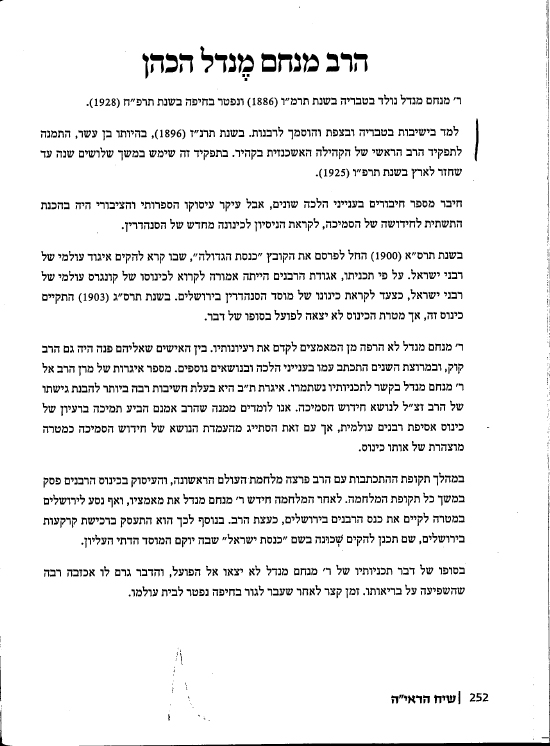
How is it possible for anyone to write such a sentence, that a ten-year-old was appointed as a communal rabbi? Let me explain what happened here, but first, I must note that the name of the man we are referring to is not R. Menahem Mendel Cohen, but R. Aaron Mendel Cohen. Here is his picture, which comes from a very nice Hebrew Wikipedia article on him.
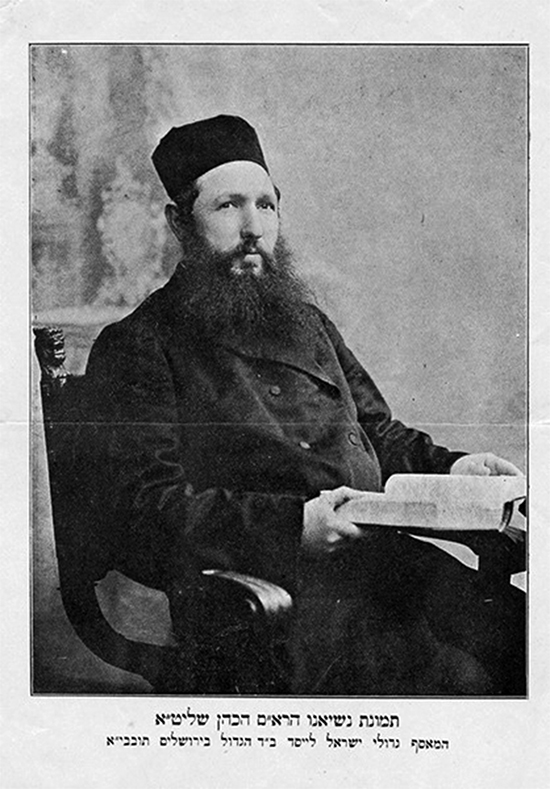
As for R. Cohen being appointed rabbi at age ten, whoever prepared the biographical introduction must have had a source which mistakenly stated that R. Cohen was born in 1886. Since this source also said that he became rabbi in Cairo in 1896, this means that he was ten years old was he was appointed rabbi. Yet we can only wonder how the authors did not see the obvious impossibility of a ten-year-old being appointed rabbi of Cairo, which should have led them to investigate a little further. Simply by googling R. Cohen’s name in Hebrew, the Wikipedia article will come up, and it tells us that R. Cohen was born not in 1886 but in 1866. Thus, instead of a ten-year-old rabbi he is now thirty years old.

With regard to young rabbis, let me repeat, with some slight edits, something I wrote in an earlier post here.

In terms of young achievers in the Lithuanian Torah world, I wonder how many have ever heard of R. Meir Shafit. He lived in the nineteenth century and wrote Sefer Nir, a commentary on the Jerusalem Talmud, when not many were studying it. Here is the title page of one of the volumes, where it tells us that he became rav of a community at the age of fifteen.

The Hazon Ish once remarked that the young Rabbi Shafit would mischievously throw pillows at his gabbaim![1]

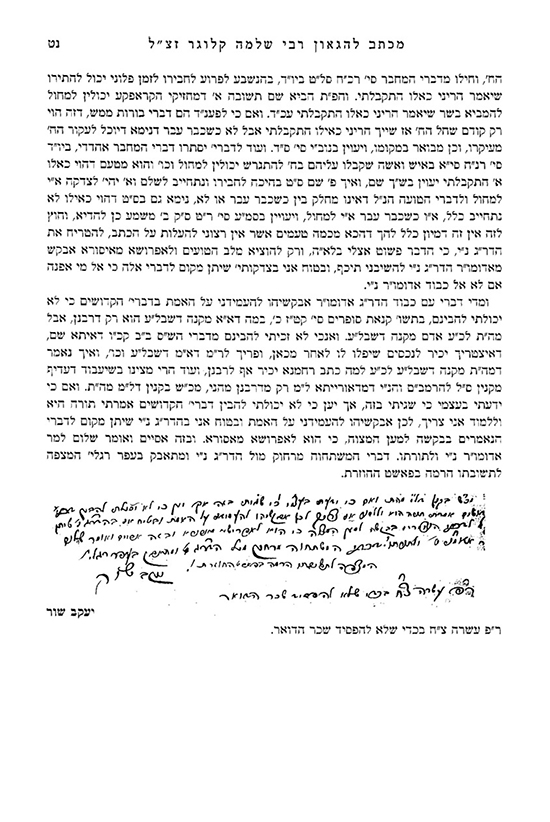
Regarding R. Jacob Schorr [mentioned earlier in the original post] being a childhood genius, this letter from him to R. Shlomo Kluger appeared in Moriah, Av 5767.
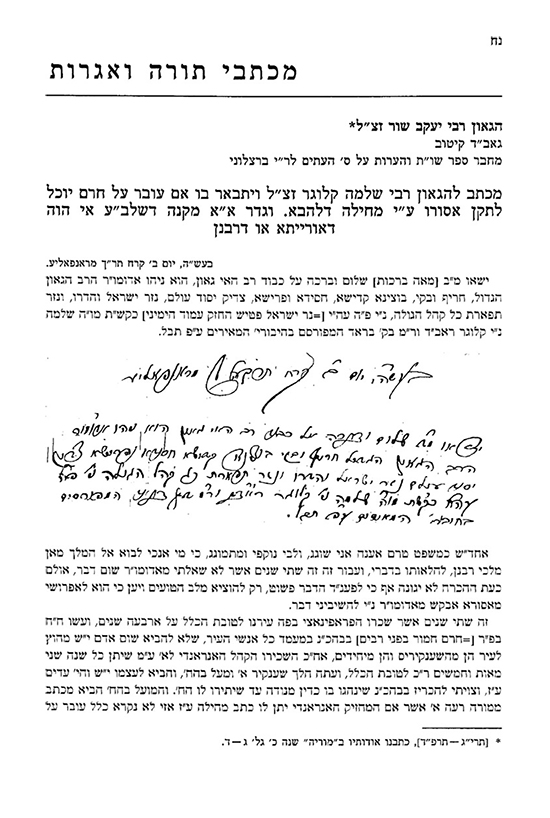
As you can see, the letter was written in 1860 (although I can’t make out what the handwriting says after תר”ך). We are informed, correctly, that R. Schorr was born in 1853, which would mean that he was seven years old when he wrote the letter. This, I believe, would make him the greatest child genius in Jewish history, as I don’t think the Vilna Gaon could even write like this at age seven. Furthermore, if you read the letter you see that two years prior to this R. Schorr had also written to R. Kluger. Are there any other examples of a five-year-old writing Torah letters to one of the gedolei ha-dor? From the letter we also see that the seven-year-old Schorr was also the rav of the town of Mariampol! (The Mariampol in Galicia, not Lithuania.) I would have thought that this merited some mention by the person publishing this letter. After all, R. Schorr would be the only seven-year-old communal rav in history, and this letter would be the only evidence that he ever served as rav in this town. Unfortunately, the man who published this document and the editor of the journal are entirely oblivious to what, on the face of things, must be one of the most fascinating letters in all of Jewish history.

Yet all that I have written assumes that the letter was actually written by R. Schorr. Once again, we must thank R. Yaakov Hayyim Sofer for setting the record straight. In his recently published Shuvi ha-Shulamit (Jerusalem, 2009), vol. 7, p. 101, he calls attention to the error and points out, citing Wunder, Meorei Galicia, that the rav of Mariampol, Galicia was another man entirely, who was also named Jacob Schorr.

This is what I wrote in the prior post. Let me now add some additional information about R. Shafit, the fifteen-year-old communal rav. The first thing I want to point out relates to the city in which R. Shafit became rav at age fifteen. If you look at the title page you can see that its name is מיצד. This is actually an alternate way of spelling the city which is better known as מייצ’ט. Anyone who knows their Lithuanian rabbinic history will recognize this city as Meitchet (Molchad in English), made famous by the great R. Solomon Polachek, known as the Meitcheter Iluy. (R. Polachek was not actually born in Meitchet, but in a small town nearby.) There is so much to say about R. Polachek, but it will have to wait for a future post.

Returning to R. Shafit, although he is hardly a household name, in his day he was actually quite a well-known rabbi. He contributed to R. Israel Salanter’s journal Tevunah,[2] and those who study the Jerusalem Talmud know that his commentary is a very important work.[3] R. Adin Steinsaltz, who is from R. Shafit’s family, even took time away from his own work on the Talmud to publish from manuscript a commentary of R. Shafit on the Jerusalem Talmud. Here is the volume that appeared in 1979.
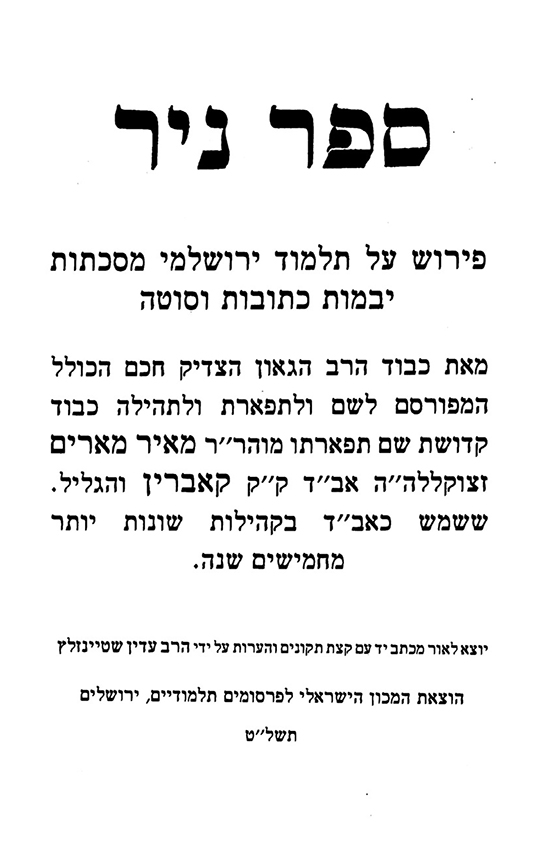
 

In the preface, R. Steinsaltz writes:

כל החכמים הלומדים בירושלמי בכל השיטות, למן חכמי בית המדרש נוסח ליטא העתיקה עד לאנשי המדע המובהקים, כולם כאחד הודו שפירוש “הניר” הוא מחשובי הפירושים שנכתבו אי פעם על התלמוד הירושלמי
I do not need go into more detail on R. Shafit since in 2014 Hillel Rotenberg published an entire book on him.[4] And while it is true that, as mentioned already, R. Shafit is not a household name, there are today people who celebrate his hillula. See here. In case you are wondering what a Lithuanian rabbi is doing with a hillula, R. Shafit was actually a Slonimer Hasid.

In response to my earlier comments about the young R. Shafit, Seforim Blog contributor R. Ovadiah Hoffman sent me another example of a young rabbi: Avigdor Aptowitzer. Aptowitzer, who was one of the twentieth-century’s leading academic scholars of rabbinic literature, is best known as the editor of R. Eliezer ben Joel Halevi’s halakhic work Ra’avyah, concerning which he published another important volume as an introduction to the Ra’avyah, and a book called Hosafot ve-Tikunim le-Sefer Ra’avyah (Jerusalem, 1936). 

According to Abraham Meir Habermann, when Aptowitzer was around seven years old his father, the rabbi of Tarnopol, became ill. Young Avigdor took the place of his father as rabbi. During the week he taught students and on Shabbat people carried him to the synagogue so that he could deliver the derashah.[5] As far as I know, this makes Aptowitzer the youngest person ever to serve as a communal rabbi, even though he was never officially appointed to the position.

It is also reported that R. Shimon Sofer, the son of R. Abraham Samuel Sofer (the Ketav Sofer), was so learned as a child that he received the title חבר from R. Judah Aszod when he was only nine years old.[6]

In speaking about young rabbis, it is also important to mention a passage in R. David Abudarham’s[7] commentary on the Haggadah, s.v. אמר רבי אלעזר הרי אני כבן שבעים שנה. Abudarham cites the Jerusalem Talmud, Berakhot 4:1, that R. Elazar ben Azariah was appointed nasi of the Sanhedrin at age 13. Our version of the Jerusalem Talmud has “age 16”, but the version cited by Abudarham appears in other early sources.[8]

Regarding age 16, R. Solomon Ibn Gabirol wrote his azharot for Shavuot when he was that old. At the beginning of the azharot he wrote (with great self-confidence, I might add):[9]

והנני בשש עשרה שנותי ובי שכל כמו בן השמונים
Avodah Zarah 56b tells about a child who learned Tractate Avodah Zarah when he was six years old. The Talmud describes how he was asked halakhic questions on the tractate, and his replies apparently signify that he was deciding halakhic matters at the age of six.

He was asked, ‘May [an Israelite] tread grapes together with a heathen in a press?’ He replied, ‘It is lawful to tread grapes together with a heathen in a press.’ [To the objection] ‘But he renders it yein nesekh [10] by [the touch of] his hands!’ [he answered], ‘We tie his hands up.’ [To the further objection] ‘But he renders it yein nesekh by [the touch of] his feet!’ [he answered], ‘Wine touched by the feet is not called nesekh.’  

Although not an example of a child rabbi, I think it is worthwhile to mention R. Jacob Berab’s statement that when he was only eighteen years old, and did not yet have a beard, he was the rabbi and halakhic authority for a community of 5000 families in Fez.[11]

Returning to Aptowitzer, R. Meir Mazuz directs a comment at him in a recent issue of his weekly Bayit Ne’eman.[12] In discussing the proper size of a kezayit, R. Mazuz notes that the Ashkenazic rishonim did not have any personal knowledge of olives, and thus did not know how big they were.[13] He cites R. Eliezer ben Joel Halevi, the Ra’avyah, who writes as follows:[14]

וכל היכא שצריך כזית צריך שיהיה מאכל בהרווחה, לפי שאין אנו בקיאין בשיעור זית כדי, שלא תהיה ברכה לבטלה
You cannot get any clearer than this that R. Eliezer, who lived throughout Germany, had no idea how big an olive was.[15] Yet in Aptowitzer’s note to the words לפי שאין אנו בקיאין בשיעור זית, he writes:

כלו’ אלא ע”י מדידה וחשבון, וכאן שבברכה אחרונה אנו עסוקין וכבר אכל ואי אפשר לחשוב ולמדוד, לכן יזהר שיאכל מתחילה שיעור גדול שאין להסתפק בו שהוא כזית
He explains the Ra’avyah to be saying that we do not know how large our portion of food is without measuring it. Since we are dealing with the final blessing and the food is already eaten and thus can no longer be measured, people should eat enough so that there is no doubt that they ate an olive’s worth and thus no problem with a berakhah le-vatalah.

It is hard to understand how Aptowitzer could have written something so obviously incorrect, as there is no doubt as to the passage’s meaning. R. Mazuz writes:

איזה “חכם”, שנכון שאחרי שכבר אכל את הזית לא יכול למדוד, אבל לפני שאכל הוא רואה את הגודל אז למה צריך לאכול בהרווחה?! אלא לא היו מכירים את הזיתים
Here is something else relevant to Aptowitzer. Nahmanides, Commentary to Genesis 31:35, writes (Chavel translation):

The correct interpretation appears to me to be that in ancient days menstruants kept very isolated for they were ever referred to as niddoth on account of their isolation since they did not approach people and did not speak to them. For the ancients in their wisdom knew that their breath is harmful, their gaze is detrimental and makes a bad impression, as the philosophers have explained. I will yet mention their experiences in this matter. And the menstruants dwelled isolated in tents where no one entered, just as our Rabbis have mentioned in the Beraitha of Tractate Niddah: “A learned man is forbidden to greet a menstruant. Rabbi Nechemyah says, ‘even the utterance of her mouth is unclean.’ Said Rabbi Yochanan: ‘One is forbidden to walk after a menstruant and tread upon her footsteps, which are as unclean as a corpse; so is the dust upon which the menstruant stepped unclean, and it is forbidden to derive any benefit from her work.’”

Baraita de-Masekhet Niddah is a strange work, with all sorts of extreme statements not found in mainstream rabbinic literature. This is not the place to review in any detail the various scholarly views about the text’s origin.[16] Suffice it to say that Saul Lieberman thought that the author was a sectarian, but not a Karaite.[17] Aptowitzer, however, took issue with Lieberman and argued that Baraita de-Masekhet Niddah is a Karaite forgery designed to insert Karaite views into the Rabbanite community, and also to make the Sages look like fools. As an example of the latter, Aptowitzer quoted the “halakhah” recorded in Baraita de-Masekhet Niddah that a kohen whose family member – by which it means one he lives with – is a niddah cannot offer a sacrifice or perform birkat kohanim.[18] Aptowitzer concluded that it is “very unfortunate” that some rishonim were misled by this forgery, thinking it an authentic work.[19]

Aptowitzer’s work, Mehkarim be-Sifrut ha-Geonim, in which he expressed this judgment, was published by Mossad ha-Rav Kook. R. Hayyim Dov Chavel also published his commentary on Nahmanides with Mossad ha-Rav Kook, and on the just-mentioned passage of Nahmanides to Genesis 31:35, R. Chavel quotes Aptowitzer’s view.

It is easy to see why, from a traditional perspective, what Aptowitzer said is problematic. After all, he posits that Nahmanides, one of the greatest of the medieval sages, was taken in by a heretic’s forgery. His apology, as it were, that Nahmanides and other medieval sages were not critical scholars, and thus it is not a cause for wonder that they were fooled in this matter, is not the sort of thing that will be seen as respectful in traditional circles. It is one thing to write about more recent sages being fooled by Besamim Rosh and the Yerushalmi on Kodashim, but when dealing with a figure like Nahmanides such a position is bound to be more controversial.

This is exactly what happened, and R. Chavel must have been subjected to criticism for citing Aptowitzer in this matter. In the second edition of his commentary, vol. 1, p. 554, R. Chavel backtracks from what he wrote. Had he been able to reset the type and delete the entire note from the text of the commentary I am sure he would have done so. However, he had to settle for a comment in the hashmatot u-miluim, which most people never bother to look at. He writes as follows:

על דעת בקורתית זו יש להוסיף: אף כי חכם גדול היה ר’ אביגדור אפטוביצר, ונאמן רוח לתורה ולחכמה, נתפס כאן לסברה בעלמא, שלא שזפה עינו החדה כי הברייתא הזאת (ברייתא דמסכת נידה) היא עדות מוכחת עד כמה גידרו קדמונינו עצמם להתרחק מטומאת הנדה. כטומאת הנדה היתה דרכם לפני (יחזקאל לו, יח). ואף שלא היו הדורות נוהגים למעשה בכל החומרות הנזכרות בברייתא זו, הלא כבר כתב ה”חתם סופר” [או”ח  סי’ כג] שאולי נשתנו הטבעים והמקומות, או כיון שדשו בה רבים שומר פתאים ה
As readers can see, R. Chavel’s point is completely dogmatic without any scholarly argument. 

Returning to Nahmanides’ comment to Genesis 31:35, he tells us that he will have more to say on this matter. This is found in his commentary to Leviticus 18:19, where he writes that the blood of menstruation “is deadly poisonous, capable of causing the death of any creature that drinks or eats it.” He further states:

If a menstruant woman at the beginning of her issue were to concentrate her gaze for some time upon a polished iron mirror, there would appear in the mirror red spots resembling drops of blood, for the bad part therein [i.e., in the issue] that is by its nature harmful, causes a certain odium, and the unhealthy condition of the air attaches to the mirror, just as a viper kills with its gaze.

I find it noteworthy that such a great figure as Nahmanides, who was also a doctor, was able to be taken in by these fairy tales. He certainly had never seen any red spots showing up on a mirror so why did he believe such a story without attempting to confirm its accuracy himself? I realize that in medieval times people were much more credulous, and repeated all sorts of far-fetched things that they heard.[20] Nahmanides himself repeats that people in Germany would make use of demons, and he had no reason to doubt this report.[21]

שמעתי בבירור שמנהג אלמניי”ו לעסוק בדברי השדים ומשביעים אותם, ומשלחים אותם ומשתמשים בהם בכמה ענינים
He also believed a report that travelers to the east had discovered the Garden of Eden, but were then killed by the flaming sword that guards the Garden.[22]

 ובספרי הרפואות היונים הקדמונים, וכן בספר אסף היהודי סיפרו כי אספלקינוס חכם מקדוני וארבעים איש מן החרטומים מלומדי הספרים הלכו הלוך בארץ ועברו מעבר להודו קדמת עדן למצוא קצת עלי הרפואות ועץ החיים למען תגדל תפארתם על כל חכמי הארץ, ובבואם אל המקום ההוא ויברק עליהם להט החרב המתהפכת, ויתלהטו כלם בשביבי הברק, ולא נמלט מהם איש
However, when dealing with red spots on a mirror this was something that Nahmanides could have easily confirmed, and yet instead he relied on what he heard, or perhaps read. In seeking to understand how Nahmanides could have been misled in this matter, it helps to be reminded of Bertrand Russell’s famous comment made with reference to Aristotle’s assertion that men have more teeth than women.

To modern educated people, it seems obvious that matters of fact are to be ascertained by observation, not by consulting ancient authorities. But this is an entirely modern conception, which hardly existed before the seventeenth century. Aristotle maintained that women have fewer teeth than men; although he was twice married, it never occurred to him to verify this statement by examining his wives’ mouths.[23]

Returning to the matter of olives, it is noteworthy that the halakhic authorities, including those in the twentieth and twenty-first centuries, who argued that olives have shrunk since the days of the Sages did not actually seek to prove this with historical evidence. Had they done so they would have found that the size of olives has not changed. However, concerning another measurement we find that the Steipler was indeed interested in what the historical record revealed. R. Avrohom Marmorstein and Jacob Djmal both called my attention to a letter of the Steipler that was recently up for auction. Here is the item from Kedem’s January 2018 auction catalog (catalog no. 59), pp. 269-270 (item no. 298).

This letter already appeared in Aleh Yonah (Jerusalem-Bnei Brak, 1989), p. 134.
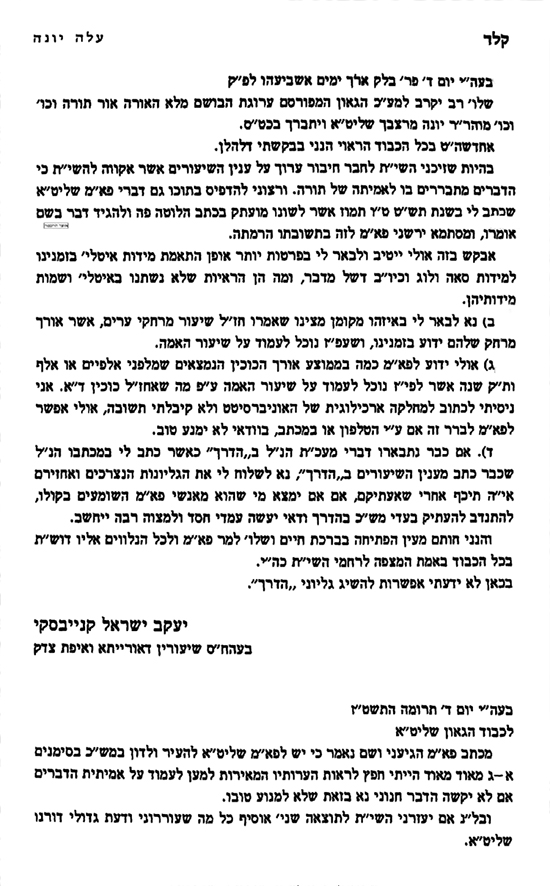
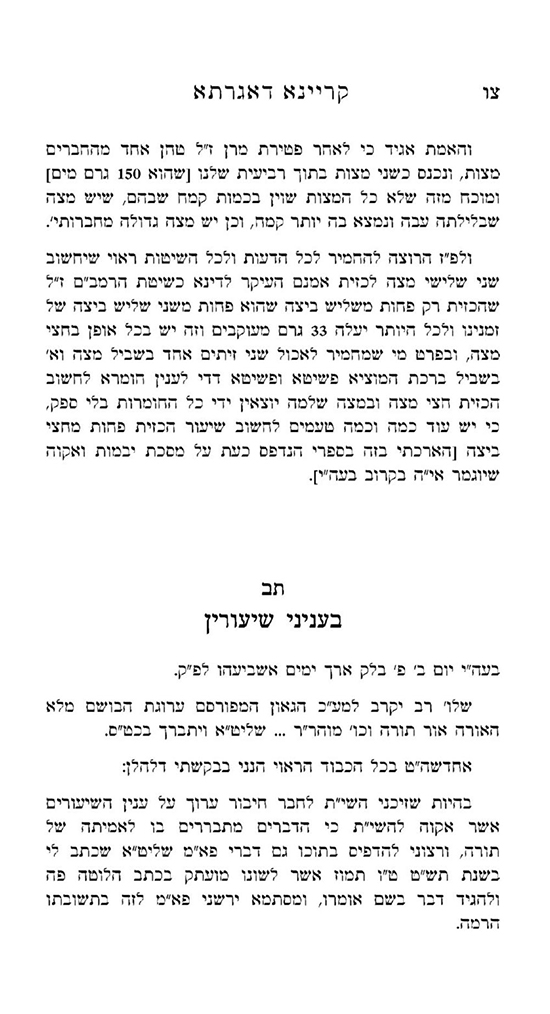
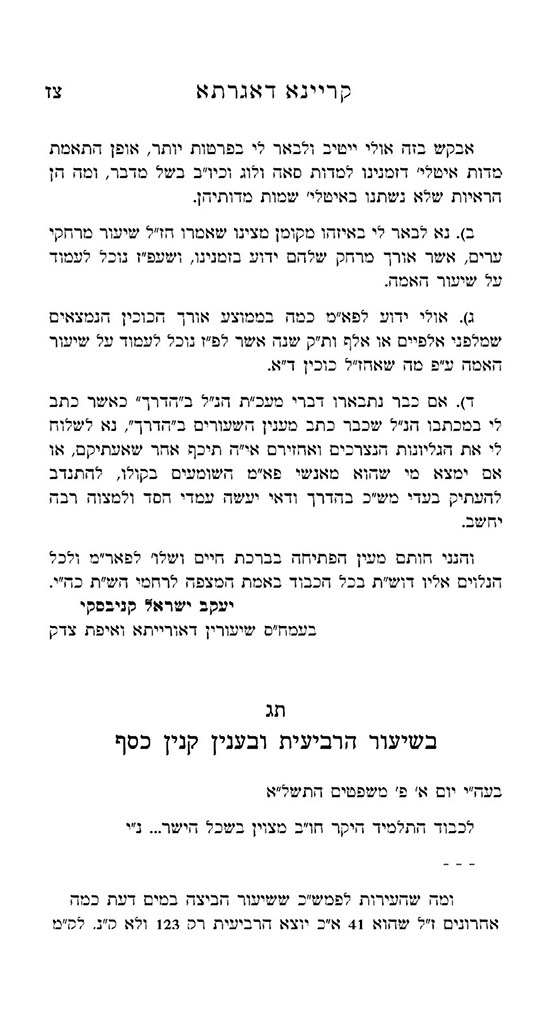
We see that in trying to determine the size of a cubit, the Steipler actually wrote to the archaeology department at “the university” (i.e., Hebrew University). This sort of effort is exactly what is required when trying to investigate a matter such as this. Yet look what happened when this letter was published in the Steipler’s Karyana de-Igarta, vol. 2, no. 402. The section showing that the Steipler reached out to the academic world was simply deleted, with no indication given that anything has been removed from the letter.
Finally, it is worth mentioning the Hazon Ish’s position that although the various measurements go back to Sinai, the actual size of the measurements required in order to fulfill an obligation was established by the Sages. In other words, while the measurement of a kezayit is mi-deoraita, how big this olive is – as there are different size olives – was given to the Sages to be determined.[24]

וכשנאמרו שיעורין בסיני נאמרו על האומד ומה שנראה לו לאדם זהו שיעורו, ואמנם הדבר מסור לחכמים לקבוע גדרי השיעור לכל ישראל וכמו שאמרו חכמים כזית שנאמרו זה אגורי כשעורה זו מדברית כעדשה זו מצרית לא שנאמרה למשה כך אלא נאמרה סתם והיא הבינונית אלא חכמים עיינו בדבר וקבעו לכל ישראל שכזית אגורי ושעורה מדברית ועדשה מצרית הם הבינונים, וכשם שמסור לדעתו של רואה להכריע על הבינוני של הפרי בין חביריו הגדולים והקטנים כן מסור לחכמים לקבוע את המדידה שיש להגיד עליה שפירותיה הם הבינונים בהגלילים והארצות השונות
Regarding the kezayit measurement, there is one other point worth mentioning. Everyone knows that one is required to eat a kezayit of maror at the Seder. Nevertheless, the practice of the Ropshitz hasidim used to be precisely the opposite, as they were careful not to eat a kezayit of maror. This strange practice goes back to the founder of the Ropshitz dynasty, R. Naphtali Zvi Horowitz (1760-1827). (I don’t know if the practice continues today.) Not only is the lack of a kezayit problematic, but there is the other issue regarding whether one can even say a blessing on the maror with less than a kezayit

R. Aryeh Zvi Frommer deals with Ropshitz practice, and also mentions that he heard that R. Shalom of Belz and R. Ezekiel of Shinova also told people to eat less than a kezayit of maror and to make the blessing on it.[25] R. Frommer attempts to justify this practice halakhically, and he states explicitly that he is doing so in order that the actions of these hasidic masters not be in contradiction to the Mishnah, Pesahim 2:6, the meaning of which appears to be that a kezayit is the minimum amount required for maror.[26] He also notes that he wants to justify the practice of “most of Israel” who use horseradish for maror and also do not eat a kezayit. His justification is only of eating less than a kezayit of horseradish, so it does not seem that this will be of any help with regard to the view of the Ropshitzer, as his avoidance of a kezayit of maror apparently applied to all types of maror, even lettuce. 

Many people probably remember their grandparents telling them that in Europe they used horseradish for maror, but that unlike today there was no concept of being careful to eat a kezayit. If you had any doubts about what your grandparents reported, R. Frommer tells us the exact same thing. Are we to say that most Jews in Europe did not fulfill the mitzvah of maror? This is a conclusion that no rabbi wants to reach, and that is why R. Frommer is motivated to find some justification for the practice.

כנלע”ד ליישב דברי הצדיקים ז”ל שלא יסתרו למשנה מפורשת הנ”ל וליישב מנהג רוב ישראל שאוכלין למרור חריין פחות מכזית ומברכין עליו על אכילת מרור
R. Frommer was obviously concerned that what he wrote would be regarded as too radical. Thus, on the very last page of the book, where one finds the corrections, he stressed that his words were only a limud zekhut because most people do not eat a kezayit, but le-khathilah one cannot rule this way.

כ”ז כתבתי רק דרך למוד זכות מחמת שרוב ההמון ונשים נוהגין כן אבל לכתחלה אין להורות כן וכ”מ באבני נזר סי’ שפ”ג

R. Frommer has another relevant comment on this matter:[27]

ביום ג’ שמות חלם לי, שהגידו לי בשם הרה”צ ר’ פינשע ז”ל מפילץ דאף מי שמגיע לו יסורים ר”ל, סגי ביסורים כ”ש [כל שהוא], דלא עדיף ממרור דלא בעי כזית, ומה”ת סגי במשהו כמ”ש הרא”ש פ”י דפסחים סי’ כ”ה, כמו בזה סגי במשהו
There is no need for me to go into this matter in any detail, as it has been comprehensively analyzed in a wonderful article by Levi Cooper.[28] I would just like to call attention to some sources not mentioned by Cooper. 

1. R. Mordechai Shabetai Eisenberger, Berurei Halakhot (Netanya, 2006), no. 51, offers a halakhic justification for the Ropshitzer, and claims that it is only applicable to horseradish.

2. The following story, quoting R. Aaron Rokeach, the Belzer Rebbe, appears in Aharon Pollak, ed., Beito Na’avah Kodesh (2007), vol. 2, p. 482:

פ”א, בליל הסדר שנת תש”ט, נכח דודי הר”ר יוסף צבי וועבער ז”ל (לאחר שניצל מגיא ההריגה במלחמה  באירופה, וזכה לעלות ארצה אחר החורבן שם), והנה כ”ק מרן זי”ע נתן לו בידו מעט מאוד מה”מרור”. אחד מן הנוכחים שם, הרהיב עוז והעיר למרן זי”ע, ש”זה רק כל שהוא”. נענה מרן זי”ע והתבטא בלשונו “ער האט  שוין געהאט גענוג מרירות”! – (בשם בעל העובדא
3. The following story, that R. Joel Teitelbaum of Satmar refused to follow his father-in-law’s practice of eating less than a kezayit of maror, appears in Aharon Perlow, Otzroteihem shel Tzadikim al ha-Torah ve-ha-Moadim (2006 edition), p. 323, quoting Moshian shel Yisrael, vol. 4, p. 17:

בליל התקדש חג הפסח בעריכת הסדר היה המנהג בבית דזיקוב לברך על אכילת מרור בשיעור פחות מכזית, וכן נהגו גם בפלאנטש. אולם רבינו (כ”ק מרן אדמו”ר מסאטמאר) ז”ל נהג כפשטות לשון הפוסקים וכנהוג בבית אבותיו הק’ לאכול שיעור מרור כזית כדאיפסקא הילכתא. וכשהיה רבינו ז”ל סמוך על שולחן חותנו (מזיוו”ר – הרה”ק רבי אברהם חיים הורביץ מפלאנטש זצוק”ל) לא נתנו לו שיעור מרור כראוי. ורק פחות מכזית – כמנהגם – ולא רצו שרבינו ז”ל יתנהג אחרת ממנהגם. אבל רבינו ז”ל השכיל להכין ולהצניע מראש מקדם בכיס הגלימא שלו שיעור כזית לאכילת מרור, ובעת עריכת הסדר כשהגיע לקיים מצות אכילת מרור אכל רבינו כשיעור
  
4. Matityahu Gutman, Belz (Tel Aviv, 1912), p. 31, states:

רבי יהושע מבלז אמר: אבי היה פוסק, והוא אמר שאין צריך לאכול כזית מרור, ובתשובות הנדפסות בסו”ס אמרי נועם למועדים כותב שמקובל כך מזקנו הק’ מרופשיץ וכן היו נוהגין כל בני ביתו, מחמת אי בריאות

The words I have underlined are how later generations mistakenly attempted to reconcile the practice of the Ropshitzer and his descendants with the halakhah.

Excursus

Another proof that the medieval German sages never actually saw olives is provided by R. Hayyim Benish – the expert in all matters of halakhic measurements and times – in what is still probably the best discussion of the history and halakhah of the kezayit measurement (and he did not need an entire book to make his points). See Benish, “Shiur Kezayit: Berur Da’at ha-Rishonim ve-ha-Aharonim,” Beit Aharon ve-Yisrael 50 (Kislev-Tevet, 5754), pp. 107-116. 

R. Benish calls attention to a medieval Ashkenazic series of halakhic rulings published by Shlomo Spitzer in Moriah 8 (Sivan 5738). On p. 4, in discussing the size of an olive and the problem created by the medieval Ashkenazic assumption that two olives equal one egg, the unknown author writes:

ולי הכותב אינו קשה כי ראיתי זיתים בא”י ובירושלים אפילו ששה אינם גדולים כביצה
From this we see that the medieval Ashkenazic sages did not know what an olive looked like, and because of this they were mistaken in their assumption that two olives equal one egg. The author himself, who had journeyed to Eretz Yisrael and had seen actual olives, was able to correct his Ashkenazic contemporaries. Yet his statement that an olive is not even one sixth the size of an egg is not in line with the Rashba, Torat ha-BayitMishmeret ha-Bayit, Mossad ha-Rav Kook ed., vol. 2, col. 52 (bayit revi’i, sha’ar rishon), who had olives at his disposal and describes them as less than one fourth the size of an olive. (See R. Benish, p. 109, for the common view that according to Maimonides an olive is one third of an egg.) See also R. Jacob Moelin, Sefer Maharil, ed. Spitzer (Jerusalem, 1989), Likutim, no. 55, that whereas two olives equal one egg, three dried figs also equal an egg. In other words, he believed that a fig is smaller than an olive, which could only be said by someone who never saw an olive. Perhaps he never saw a fig either, but the measurement of three figs equaling one egg is held by the geonim and Maimonides. See R. Eliyahu Zini, Etz Erez, vol. 3, pp. 201-202.
There are, of course, different types of olives, and R. Benish, p. 114, has a chart with the different measurements. Regarding the anonymous medieval Ashkenazic author, who stated that an olive is not even a sixth the size of an egg, it is possible that when he returned to Germany he forgot the exact size, and recalled them as being smaller than they actually were.
The editor of Torat ha-Bayit, R. Moshe Brun, finds the Rashba’s statement that an olive is not even a quarter of an egg so significant that he remarks:

חדוש גדול חידש לנו רבינו בהלכות שיעורין, דיותר מד’ זיתים בכביצה
R. Benish concludes that the size of a kezayit is 7.5 square centimeters. Recognizing that this is a good deal smaller than what people are told today, he concludes with the following important words which explain why a kezayit by definition must be a really small size.[29] What he says would appear to be basic to all of the Sages’ measurements, but for some reason I was never taught this in yeshiva:

רבים יתמהו ודאי, האם בשיעור זעיר כל כך מקיימים מצוות אכילה הכתובה בתורה. תמיה זו יסודה בחוסר הבנה במושג שיעורי תורה בכלל, ובשיעור אכילה בפרט. בסיס השיעורים בכל מקום ומקום הוא השיעור המזערי ביותר שעליו ניתן לומר שיש לו מהות. וכמו שיעור רוחב אגודל במדות האורך – מדה מחייבת בענינים התלויים במדות אורך (כמו לאו דהשגת גבול. ראה רמב”ם הל’ גנבה פ”ז הי”א), ושיעור פרוטה, שיעור מתחייב בממון, למרות שהוא שיעור זעיר ביותר . . , ואם יקדש אשה בשיעורי ממון זה – מקודשת. וכן הוא ה”כזית” – שיעור אכילה: השיעור המיזערי ביותר שיצא מכלל פירור ויש בו חשיבות אוכל . . . ואין תנאי במצות אכילה שיהיה בו שיעור מיתבא דעתא או שביעה
See also Beit Aharon ve-Yisrael 53 (Sivan-Tamuz 5754), pp. 91ff., where R. Benish responds to criticisms of his article. On p. 96 he mentions that one person criticized him by saying that the information he wrote about should not be made public!

והנה אמר לי חכם אחד: לא חידשת במאמרך מאומה, הדברים הינם ידועים, אלא שנאמרו, אפילו ע”י גדולי הפוסקים, מפה לאוזן, ואתה הוצאת זאת שלא כדין ושלא לצורך לרשות הרבים
Finally, no mention of the size of an olive would be complete without referring to R. Natan Slifkin’s essay on the topic available here.
One complicating factor in any discussion of the kezayit is that R. Joseph Karo, Shulhan ArukhOrah Hayyim 586:1, writes:

שיעור כזית יש אומרים דהוי כחצי ביצה
R. Karo knew what an olive looked like, so why in his codification of the Passover laws would he record the view that it is the size of half an egg? Furthermore, why does he ignore the views of R. Isaac Alfasi, Maimonides, and R. Asher who held that a kezayit is less than this? And finally, how come in Orah Hayyim 210 when he discusses the kezayit he does not define it as half an egg? 

These points are all raised by R. Hadar Yehudah Margolin in support of R. Benish’s position that when, in the laws of Passover, R. Karo mentions the view that a kezayit is half an egg, this is only to be regarded as a humra. However, R. Karo himself holds that the basic law is that a kezayit is really the actual size of an olive (which is certainly smaller than half an egg). See Beit Aharon ve-Yisrael 51 (Shevat-Adar 5754), p. 119.

In the recently published De-Haziteih le-Rabbi Meir (Jerusalem, 2018), vol. 1, p. 399, we see that R. Meir Soloveitchik did not like the suggestion that medieval Ashkenazic sages did not know how big an olive was.

אמר על כך הגר”מ שהרי ההגהות מיימוניות (פרק א’ ממאכלות אסורות אות מ’) מביאים שרבינו תם נתקשה בסימני עוף טהור, ואז עף אל שולחנו עוף טהור, ועל ידי זה ידע את הסימנים. ומזה רואים כמה סייעתא דשמיא היה להם שלא יטעו לומר דבר שאינו נכון, וא”כ איך אפשר לומר שכיון שלא ראו זיתים לכן לא ידעו מה שיעור כזית
* * * *

My Torah in Motion 2019 summer trips will be to Morocco, Central Europe, and Greece. Information about them will soon be up on the Torah in Motion website.

Notes

[1] A. Horowitz, Orhot Rabbenu (Bnei Brak, 1991), vol. 1, p. 364. Horowitz adds that he asked the Steipler how they could appoint a fifteen-year-old rabbi when it says in Shulhan Arukh, Hoshen Mishpat that a dayan has to be eighteen-years-old. The Steipler replied that a rabbi is not a dayan, as he only decides halakhic questions and is not on a beit din. Horowitz also asked the Steipler about what appears in the Beit Yosef, that semikhah should not be given to anyone under eighteen. The Steipler replied that this is only a general rule, but there are exceptions.

Regarding eighteen as the minimum age of a dayan, contrary to what Horowitz states, this is actually not recorded as halakhah in the Shulhan Arukh. R. Karo writes as follows inHoshen Mishpat 7:3:

יש אומרים שאינו ראוי לדון אלא מבן י”ח ומעלה והביא שתי שערות. וי”א דמבן י”ג ומעלה כשר ואפילו לא הביא שתי שערות
This is actually a case of יש אומרים ויש אומרים, and according to R. Yitzhak Yosef the general rule in such a case is that the second opinion is the one we accept. See Ein Yitzhak, vol. 3, pp. 438ff. (Kelalim be-Da’at ha-Shulhan Arukh, no. 28).

Sefer Meirat Einayim explains the position that allows a thirteen-year-old dayan as due to the fact that being a dayan is only dependent on חריפותו ובקיאותו .
R. Kook refused to give semikhah to a young man as he believed that semikhah should only be given to one who was knowledgeable in the entire Torah (!). See his responsum published in Peri ha-Aretz 5 (1982), pp. 6-9.
[2] Tevunah (1861), nos. 39, 40.
[3] Sections of this commentary that have not yet appeared in print were recently offered for sale at an auction. See here.
[4] Ha-Gaon ha-Hasid Rabbi Meir Marim Shafit. See also the very nice story about R. Shafit recorded here.
[5] Habermann, Anshei Sefer ve-Anshei Ma’aseh (Jerusalem, 1974), p. 139.
[6] R. Asher Anshel Yehudah Miller, Olamo shel Abba (Jerusalem, 1984), p. 181.
[7] The common pronunciation of his name as “Abudraham” is a mistake. See here.
[8] See R. Menahem Kasher, Haggadah Shelemah, p. 17 n. 141.
[9] Israel Davidson, Otzar ha-Shirah ve-ha-Piyut (New York, 1924), vol. 1, p. 303. As Davidson notes, this is the correct version of the text.
[10] This is how the words are pronounced, not yayin nesekh.
[11] See R. Levi Ibn Habib, Teshuvot, no. 147 (Kuntres ha-Semikhah, no. 4), s.v. ומתחלה. R. Baruch Rabinovich, about whom I have written a good deal in recent posts (and more is to come) was appointed גאב”ד of Munkatch immediately upon his marriage, when he was only eighteen years old. See R. Nathan David Rabinowich, ed., Hashav Nevonim (N.Y.-Jerusalem, 2016), p. 9.

This post deals with young rabbis, not precocious children. However, regarding children wise beyond their years, I just came across the following from R. Hayyim ben Bezalel, Be’er Mayim Hayim (London, 1964), vol. 1, p. 165:

ואני בעודי נער כמו בן ז’ שנים פעם אחת בליל שבת של פרשה זו הסיבו יחד זקנים בעלי הוראה ונתנו ונשאו בזאת הקושיא והייתי מקשיב לקולם לאחר דבריהם אמרתי לחוות דעי גם אני ברשותם . . . והודי לי רבותיי והנהתי להם מאד

[11] No. 99 (18 Shevat 5778), p. 6 n. 35. Regarding R. Mazuz, I think readers will enjoy the song devoted to him that recently appeared.


Here are other songs devoted to him


Here is Lipa Schmeltzer on Sukkot 2018 singing before R. Mazuz and R. Shlomo Amar. The first song he sings is a poem that R. Mazuz wrote about Maimonides.

[13] R. Mazuz also shows that the medieval French sages never saw a date, and this explains why they describe it incorrectly. See Bayit Ne’eman, Orah Hayyim, no. 25 (pp. 135, 137-138).

[14] Berakhot no. 107.
[15] See Excursus.
[16] Interested readers can consult the numerous sources listed by R. Eliezer Brodt, Likutei Eliezer, pp. 38ff.
[17] Sheki’in (Jerusalem, 1939), p. 22.
[18] See R. Moses Sofer, She’elot u-Teshuvot Hatam Sofer, Orah Hayyim, no. 23, who discusses the matter of birkat kohanim, as it is also quoted by Rabad in his commentary to Tamid 33b from Sefer ha-Mikzto’ot. R. Efraim Zalman Margulies, Beit Efrayim, Orah Hayyim no. 6, explains the Ashkenazic practice of not reciting birkat kohanim every day as due to the concern that there might be a niddah in a kohen’s house. With reference to the notion that a kohen does not recite birkat kohanim if there is a niddah in his house, which as just noted is quoted by Rabad from Sefer ha-Miktzo’ot, R. Joseph Kafih writes (commentary to Moreh Nevukhim 3:47, n. 31):

והדעות הללו חדרו גם לשכבות מסוימות של היהדות והחלו להתנהג במנהגותיהם, ראה לדוגמא פירוש הראב”ד למסכת תמיד הפרק האחרון בשם ספר המקצעות
In other words, R. Kafih is in agreement with Aptowitzer that this is an example of sectarian ideas finding their way into the writings of rishonim

The late Yaakov Elman even saw Zoroastrian influence in a practice that would become part of the Niddah laws. He wrote the following here:

As to the non-elitist Babylonian Jews, we have a report regarding the ordinary Babylonian Jewish women. Rabbi Zera reports that the “daughters of Israel had undertaken to be so strict with themselves as to wait for seven [clean] days [after the appearance] of a drop of blood the size of a mustard seed [although biblically they are required only to separate for seven days from the onset of menstruation]” (Berakhot, fol. 31a; Megillah, fol. 28b; Niddah, fol. 66a). It is clear from Niddah (fol. 66a) that this stringency was a popular practice and not a rabbinic prohibition, probably in response to a “holier than thou” attitude perceived by the populace as emanating from their Persian neighbors. It seems that Babylonian Jewish women had internalized their Zoroastrian neighbors’ critique of Rabbinic Judaism’s relatively “easy-going” ways in this regard.
[19] Mehkarim be-Sifrut ha-Geonim (Jerusalem, 1941), pp. 166-168.
[20] Of course, in modern times people can also be quite credulous. Since we are discussing menstruation, here is another myth repeated by R. Hayyim David Halevi, Mekor Hayyim, vol. 5, p. 70:

וכבר הוכח שאחיזת יד האשה הנדה בפרחים ממהרת נבילתם
[21] Kitvei Ramban, ed. Chavel, vol. 1, p. 381. See also ibid., p. 149, that he believed it is possible for necromancers to raise the spirits of the dead.
[22] Kitvei Ramban, vol. 2, p. 296. Nahmanides wrote this in the thirteenth century when all sorts of tall tales were believed. Yet I still recall how surprised I was when told by a high school rebbe in the 1980s that he believed that the Ten Tribes were hidden somewhere on earth, waiting to be discovered. Perhaps relevant to this, R. Aharon Leib Steinman writes that the reason we cannot find the Sambatyon river is because of hester panim. See Ayelet ha-Shahar, Devarim, p. 190.
In general, it never ceases to amaze me how even very great figures have been taken in by phony stories. For one example (and I could provide a very long list of similar examples), here is a story about the power of the evil eye that R. Joseph Zechariah Stern records inZekher Yehosef, vol. 4, Tahalukhot ha-Agaddot, p. 13a. It actually upset me when I saw this, as I am a big admirer of R. Stern and was disappointed that he, too, readily accepted a phony story as fact.

ובענין עין הרע שנמצא באגדות הנה גם אנשים שאין להם חלק בתלמוד מחכמיהם ענו אמן על התאמתם וכנודע ע”פ מ”ע [מכתבי עת] כי הרופאים בע”מ פ”ב [בעיר מלוכה פטרבורג] עשו נסיון מבחינה שעשו שהניחו ככר לחם לפני אחד מחייבי מיתות ושהרעיבו אותו שלש ימים מקודם, ואותו חלק מהלחם שהניחו לפניו מבלי ליתן אותו לנגוע בו רק במבטי עיניו נהפך אח”כ לסם המות
This source, and the one from R. Steinman mentioned earlier in this note, are referred to in the recently published Otzar Hemdah (n.p., 2018), pp. 81, 150. See also ibid., p. 219, which cites R. Elijah David Rabinowitz-Teomim, Over Orah (Jerusalem, 2003), p. 237:

כבר נודע שבעת פריחת הגפנים אז גם היין שכבר הוא מכמה שנים במרתפים תוסס, (וכן אנו רואים בעת פריחת התבואות אז העיסה תוססת), ודבר זה נעלם מחכמי הטבע, אבל הכל רואים דבר זה בחוש, וא”כ ודאי שגם מה שכשאומרים דבר שמועה בשמו גורם ששפתותיו דובבות בקבר אין להתפלא כלל, אף שאין אנו מבינים דבר
How is it that R. Rabinowitz-Teomim can write that everyone sees the phenomenon with grapes and wheat he describes when the entire description is completely without basis? Otzar Hemdah, p. 219, cites a similar passage from R. Hayyim Joseph David Azulai,Homat Anakh (Jerusalem, 1986), parashat Matot (p. 67a):

הלא תראה היין שהוא במרתף ומונח בחבית סתומה בעת שדורכים הענבים אף שהוא רחוק מאד היין שבחבית מתנועע והוא פלא
Again, we have to ask, how is it that so many people believed that they saw something which never occurred?
[23] The Impact of Science on Society (London and New York, 2016), p. 6.
[24] Hazon Ish, Hilkhot Shabbat 39:1 (Kuntres ha-Shiurim).
[25] Eretz Tzvi, vol. 1, no. 85.
[26] I say the meaning “appears to be,” as there is a famous comment of R. Asher ben Jehiel, Pesahim, ch. 10, no. 25, which some understand to be suggesting a different approach to maror and the obligation of kezayit. See R. Aryeh Leib Gunzberg, Sha’agat Aryeh, no. 100; R. Mordechai Shabbetai Eisenberger, Berurei Halakhot (Netanya, 2006), no. 51; R. Samuel Pardes, Avnei Shmuel (Jerusalem, 1993), no. 13; R. Asher Weiss, Minhat Asher: Haggadah shel Pesah (Jerusalem, 2004), pp. 203ff.
[27]  Eretz Tzvi, vol. 2, p. 401.
[28] “Bitter Herbs in Hasidic Galicia,” Jewish Studies Internet Journal 12 (2013), pp. 1-40.
[29] See also R. Naphtali Zvi Judah Berlin, Meromei Sadeh, Pesahim 39a, who states that a kezayit is very small:
וזה ברור דשיעור כזית המבואר בשו”ע הוא שיעור קטן מאד


The Ze’enah –Re’enah and its Author

The
Ze’enah –Re’enah
and its Author
Morris
M. Faierstein, Ph.D.
It has traditionally assumed that Rabbi Jacob ben Isaac of Yanova was the author of the Ze’enah U-Re’enah. Every edition of the Ze’enah U-Re’enah lists him as the author on the title page. Recently, this assumption has been questioned and the suggestion made that there may have been another author of this seminal work in addition to Rabbi Jacob ben Isaac. This article will consider two aspects of the Ze’enah U-Re’enah and its author. First, the two-author theory and its evidence. Second, who was the author of a section of the Ze’enah U-Re’enah entitled “Hurban ha Bayit [Destruction of the Temple]”, which is found immediately following the commentary on Lamentations?
1. The two-author theory.
The second volume of the earliest extant edition of the Ze’enah U-Re’enah (Basel/Hanau, 1622) begins with the following statement:
“The five Megillot and the Haftarot. In addition, Hurban ha-Bayit [Destruction of the Temple] in Yiddish which was weighed and researched by the noble and pious Rabbi Jacob, the son of Rabbi Isaac, of blessed memory, from the family of Rabbino, who erected his tent and dwells in the holy community of Janova. He is the man who has already authored the five books of the Torah in Yiddish with nice midrashim and innovative interpretations.”
The same or similar statement can be found in all subsequent editions of the Ze’enah U-Re’enah. Rabbi Jacob ben Isaac was also the author of several other books, published both during his lifetime and posthumously by family members. A statement of his authorship of the Ze’enah U-Re’enah is also found in these books.[1] The first one to question the authorship of the whole Ze’enah U-Re’enah by Rabbi Jacob ben Isaac, was Simon Neuberg in his book, Pragmatische Aspekte der jiddischen Sprachgeschichte am Beispiel der Zenerene.[2] More recently, Jacob Elbaum and Chava Turniansky have reiterated
Neuberg’s argument and supported it.[3] The Elbaum/Turniansky article provides a clear summary of Neuberg’s argument. It would be helpful to begin with this summary:
In a meticulously systematic analysis of the language of the Tsene-rene Simon Neuberg has demonstrated that the vocabulary of each of the three sections (Torah, Megillot, haftarot)  differs clearly from that of the of the two, a phenomenon that becomes particularly prominent in the section khurbn in loshn ashkenaz, which, together with Ruth, differs in its linguistic features most conspicuously from that of the other four Megillot in the Tsene-rene.[4] The conclusions of the linguistic analysis seem to indicate clearly that Rabbi Jacob, the author of the first volume of the Tsene-rene (on the Torah), was not the author of the various components of the second volume of this book (Megillot and Haftarot).
The discussion of the questions about the integration of the two volumes into one opus is beyond the framework  of this article.[5] It is, however, relevant that an earlier printed Yiddish booklet on the destruction of the Temple has been inserted directly after the Yiddish translation and explanation of Lamentations. The difference between the Tsene-rene’s treatment of Lamentations and that of the other four Megillot leads to the
conclusion that whoever included the booklet in the second volume of the Tsene-rene wished to differentiate Lamentations from the other Megillot. Since the khurbn booklet consisted of midrashim, the preceding rendition of Lamentations required no more than a Yiddish translation and explanation of the text, as has been done in
the section of the Haftarot. Indeed, there is a great similarity between the manner of rendition of the haftarot and the methods used in the rendition of Lamentations.[6]
Neuberg bases his conclusions on the basis of his study of the vocabulary of the various sections of the Ze’enah U-Re’enah and the variations that he has found. This mode of philological analysis is ancient, going back to Alexandrian studies of Homer and revived in the study of the Biblical text in the Early Modern and Modern periods. The starting point of this mode of analysis is the concept that a certain text is considered to be a unitary product of one author, whether Homer or Moses, and the scholar endeavors to show that in fact there is more than one hand discernable in the production of the final product. The most famous example of this type of analysis is the “Documentary Hypothesis” relating to the Five Books of Moses. The fatal flaw in Neuberg’s analysis is that he assumes this unitary authorship, that Rabbi Jacob ben Isaac was the author in the way one thinks of someone being the author of a novel or a monograph, the intellectual product of one mind and one style. In fact, the Ze’enah U-Re’enah is a very different sort of work, one composed of passages from a wide variety of texts of different periods and styles that were collected, reworked, paraphrased and abbreviated by Rabbi Jacob to form a bricolage, an anthological commentary based on a diversity of sources.
As an integral part of my English translation of the Ze’enah U-Re’enah[7] I have endeavored to document the sources that Rabbi Jacob utilized and show how he built his commentary.[8] My conclusion is that Rabbi Jacob built his text from the whole panoply of Talmudic, Midrashic, and medieval and early modern Biblical commentaries. He even cites the Torah commentary Keli Yakar (Lublin, 1602) of Rabbi Ephraim Lunshits of Prague, which was most likely published while he was at
work on the Ze’enah U-Re’enah.
Rabbi Jacob had no specific model that he followed, but rather was guided by the commentaries that were available for a particular text. To
take the most obvious example, the number and type of commentaries
available for the Humash
is dramatically greater than what is available for the Megillot,
which is greater than what is available for the Haftarot.
As a result, the Humash
commentary is richer, has greater depth and is more extensive than
the other sections. Even within the Humash
commentaries, it is a well-known phenomenon that the quantity of
comments on Genesis and Exodus is much greater than those on
Leviticus, Numbers and Exodus. This pattern follows through from
Midrash and through all post Talmudic commentaries, from the earliest
medieval commentaries to those being written in the present. This is
also reflected in the allocation of space in the Ze’enah
U-Re’enah
. For example, the number of
pages devoted to Genesis is double the number of pages devoted to
Deuteronomy. It is a reflection of the available resources and not a
deliberate decision by Rabbi Jacob to privilege one part of the Torah
over another.
The
differing level of resources is much greater when one goes from the
Torah to the Prophets and Writings. In the Jewish tradition in
contrast to the Christian tradition, the Torah (Humash)
has been the center of study and interest, while the rest of the
Bible plays a secondary role. This is particularly true in the
Ashkenazi tradition and is evidenced by the paucity of commentaries
on the Prophets and Writings. The great exception is Rashi, whose
commentary encompasses the whole Bible and much of the Talmud. Thus,
we find that Rabbi Jacob has more than a dozen commentaries that he
regularly quotes and cites, not to mention the whole of Midrashic
literature that is largely focused on the Humash
and in the case of Midrash Rabbah,
also includes the Megillot.
The Talmud is also a rich source of comments and stories that are
interspersed in the Torah commentary. In contrast, when one comes to
the Haftarot,
the only commentaries that he relies on regularly are Rashi and Rabbi
David Kimchi.[9] Rabbi Jacob tries to leaven the commentary on the Haftarot
by adding to the end of most of the Haftarot,
a group of three stories taken from the medieval anthology, Yalkut
Shimoni
. It is noteworthy that this
group of stories is quoted in the same sequence that they are found
in the Yalkut Shimoni.
Rabbi
Jacob does not have a fixed form or pattern in his commentary. Each
verse or part of a verse is approached on its own merits. He appears
to have examined the universe of comments on that passage and then he
chooses those things that appeal to him. The range can be anything
from one sentence to several paragraphs, from one commentator to a
medley of several comments that expand on each other or they might
offer conflicting perspectives. Sometimes he ends a commentary with
the phrase, “from here we can learn”, which is a sign that he is
adding his own insights. In addition to the commentaries, or
occasionally in place of a commentary, he might cite a Talmudic or
midrashic passage. Not only do his sources vary widely, but his mode
of citation also varies. Sometimes he translates the Hebrew original,
more or less precisely. Other times, he might paraphrase a text or
summarize an argument from a source. It is also worth noting that he
does not comment on every verse. This too follows the pattern of the
commentaries that he relies upon, in that they also do not feel the
need to comment on every verse. The same applies to the Megillot
and Haftarot,
with the proviso that the universe of sources is smaller and
therefore the variations in form and style will not be as dramatic.
In
summary, any literary analysis of the Ze’enah
U-Re’enah
must take into account the
nature of the sources that underlie the text, how the author utilizes
the sources and the methods of composition. Without a thorough
knowledge of rabbinic literature in the broadest sense and the
ability to deal with these texts, both in the Hebrew/Aramaic original
languages and a solid ability to understand the Yiddish text of the
Ze’enah U-Re’enah, it
would be impossible to make any judgments about this work that have
merit and should be taken seriously.
Another
argument raised by Neuberg is the fact that the Basel/Hanau, 1622
edition of the Ze’enah U-Re’enah was
published in two volumes, with the Torah in one volume and Megillot
and Haftarot
in the second volume. He ascribes great significance to this fact but
does not provide any evidence to support his argument that there is
significance to this fact beyond the things that have already been
discussed. Since this was the first extant edition, we cannot learn
anything from the three preceding editions that have not survived. We
can only look at subsequent editions and see if this pattern is
repeated. The next edition of the Ze’enah
U-Re’enah
was published in Amsterdam,
1648. Rabbi Jacob’s son wrote in the Introduction of his edition of
his father’s small book Sefer Shoresh
Yaakov
that he was publishing this book
to raise funds to enable the publication of a new edition of his
father’s Ze’enah U-Re’enah.[10] The Amsterdam edition retained the same
format as the 1622 edition. That is, the Torah came first, followed
by the Megillot,
and ending with the Haftarot.
The one important change was that the work was published in one
volume and in a folio format. The first edition to break this pattern
was the Amsterdam, 1711 edition, which placed the Haftarot
for the Torah portions immediately behind the respective Torah
portion, in the same way that one would find it in a printed Hebrew
Humash.
This was probably the reason for the change and nothing more
significant. All subsequent editions followed the model of the 1711
edition. In addition, all editions of the Ze’enah
U-Re’enah
beginning with the
Amsterdam, 1648 were published in one volume.[11] The Basel/Hanau, 1622 edition is the only one that was published in
two volumes. It is most likely that the two volumes had simple
internal reasons related to practical aspects of the printing
process. Without additional evidence it would be inappropriate to
make assumptions about this fact.
2.
The authorship of Hurban ha-Bayit.
 
Immediately after the commentary on
Lamentations in the Ze’enah U-Re’enah
there is a separate section entitled, “Hurban
ha-Bayit
[Destruction of the Temple].” An examination of this section shows
that it is a Yiddish translation/paraphrase of a famous passage from
the Talmud about the causes of the destruction of the Second Temple,
found in tractate B. Gittin
55b-58a. After the passage from Gittin
until the end of this text there is a combination of passages taken
from Yalkut Shimoni,
Lamentations, Remez
995 and 996, and selections from Lamentations
Rabbah,
Petihtah
24.
In
1979, Sara Zfatman published an article about a pamphlet by an
anonymous author that was published in Cracow, before 1595.[12] The text of this pamphlet is identical to the “Hurban
ha-Bayit
[Destruction of the Temple]” material in the Ze’enah
U-Re’enah.
[13] Two pamphlets containing this material were reprinted in the
nineteenth and twentieth century[14] and it was even translated into German.[15] It is likely that they were extracts from the Ze’enah
U-Re’enah
, and not from the Cracow
pamphlet.

The
question that concerns us is the authorship of this pamphlet and the
section in the Ze’enah U-Re’enah.
The similarity of both versions of the text is strong evidence that
one person is the author of both. The title page of the second volume
of the Basel/Hanau, 1622 begins with the following statement. “The
five Megillot
and the Haftarot.
In addition, the destruction of Jerusalem in Yiddish which was
weighed and researched by the noble and pious Rabbi Jacob, the son of
Rabbi Isaac, of blessed memory.” Having argued that there is one
author of the whole Ze’enah U-Re’enah,
Rabbi Jacob ben Isaac, it naturally follows Rabbi Jacob ben Isaac is
also the author of this pamphlet and the text in the Ze’enah
U-Re’enah.
 
It
is not hard to understand why Rabbi Jacob might have felt the need to
create a supplement for Lamentations, where there is no similar need
or the other Megillot.
Tisha B’Av
when Lamentations is read in the synagogue became the date to
commemorate and mourn a variety of destruction and catastrophes in
Jewish history. The text of Lamentations is so specific to the
situation of the First Temple that over the centuries a whole
literature developed to supplement the Book of Lamentations and
better express the emotions engendered by later events being
commemorated and mourned. I would suggest that Rabbi Jacob first
wrote this pamphlet as an additional text for Tisha
B’Av
observances and later
incorporated it into the Ze’enah
U-Re’enah.
The sparse nature of his
commentary on Lamentations points to this. There is virtually no
effort to add commentary. Aside from a few references to Rashi, the
commentary on Lamentations is no more than translations or
paraphrases of the Biblical text.
[1]
Melitz Yosher
(Lublin, 1622; Amsterdam, 1688); Sefer
ha-Magid
(Lublin,
1623-1627); Sefer
Shoresh Ya’akov
(Cracow, 1640). The relationship of Rabbi Jacob ben Isaac to Sefer
ha-Magid
is
complicated. See, R. Hayyim Lieberman, “Concerning the Sefer
ha-Magid
and its
Author [Yiddish].” In idem. Ohel
RH”L.
3 vols.
(n.p.: Brooklyn, 1984), 2: 231-248. A Hebrew version of the article
is found in idem. 3: 365-382. The article was originally published
in Yidishe Shprakh,
vol. 26 (1966): 33-38.
[2]
Neuberg,
Simon. Pragmatische
Aspekte der jiddischen Sprachgeschichte am Beispiel der Zenerene.

Buske: Hamburg, 1999, 109-115.
[3]
Elbaum,
Jacob. and Turniansky, Chava. “The Destruction of the Temple: A
Yiddish Booklet for the Ninth of Av.” In Midrash
Unbound, Transformations and Innovations
.
Ed. Michael
Fishbane and Joanna Weinberg. Oxford: Littman Library, 2013,
424-427.
[4]
See Neuberg,
Pragmatische
Aspekte
,
109-115.
[5]
At this point there is a lengthy footnote about the significance of
the title pages of the two volumes and the fact that there are two
volumes. I will address the issues raised here in my response.
[6] Elbaum
and Turniansky, “The Destruction of the Temple,” 425.
[7] Faierstein, Morris M. Ed. Ze’enah
U-Re’enah: A Critical Translation into English
.
2 Vols. Berlin: De Gruyter, 2017 (Studia Judaica, 96).
[8] The Index of Sources in my translation is a vivid example of the
wide variety of sources found in the Ze’enah
U-Re’enah
.
[9] Rabbi David Kimchi was a member of the medieval Spanish school of
Biblical commentary that emphasized grammar and logic rather than
the more midrashic and mystical approach of many of the Ashkenazi
commentaries. It is noteworthy that neither Kimchi nor the other
great Spanish commentator Rabbi Abraham Ibn Ezra are mentioned in
the Torah commentary. It is only in the Prophets where Kimchi is
consulted, because the number of commentaries is limited.
[10] Sefer Shoresh
Yaakov
, Cracow,
1640, Introduction.
[11] A complete bibliography of Ze’enah
U-Re’enah

editions can be found in Morris
M. Faierstein, “The
Ze’enah U-Re’enah
:
A Preliminary Bibliography”, Revue
des etudes juives
,
172, 3-4 (2013), 397-427.
[12] On this pamphlet and its history see, Sara Zfatman, “The
Destruction of the Temple, Cracow, before 1595 – An Additional
Yiddish Text from the Sixteenth Century [Hebrew],” Kiryat
Sefer
54 (1979):
201-202.
[13] Zfatman, “The Destruction of the Temple,” 201 n. 5.
[14] The nineteenth century edition was published in Johnnisburg
(Prussia), 1862. See,
Faierstein, “The
Ze’enah U-Re’enah
:
A Preliminary Bibliography,” 411 no. 121. The twentieth century
edition was Brooklyn, 2007. See, idem. 422, no. 240.
[15] The German translation is, Die
Zerstörung Jerusalems: aus dem Buche Zeena u’reena. Deutsch von
Alexander Eliasberg

(Berlin: F. Gurlitt, 1921). See, Faierstein, “The
Ze’enah U-Re’enah
:
A Preliminary Bibliography,” 424 no. 264.


Rav Shmuel ben Hofni Gaon

Rav Shmuel ben Hofni Gaon
by Rabbi Yosaif Mordechai Dubovick
The 25th of Av of this year marks 1000 years since the passing of Rav Shmuel ben Hofni, Gaon Sura in Baghdad. R. Avraham Ibn Daud writes of him: “he too composed many books”.[1] It is thus fitting that the Seforim Blog dedicated a page presenting a brief biographical sketch in his memory.[2]
Rav Shmuel ben Hofni HaKohen, was born into an aristocratic family among the hierarchy of the Pumbadithan Yeshiva in Baghdad. His grandfather, Rav Kohen Zedek ben Yosef was appointed Gaon of Pumbaditha by the Resh Galuta, David b. Zakkai in 926. Rav Sherira, in his
renowned epistle to Rav Yaakov b. Nissim of Kairouan states: “there was a disagreement between the Yeshiva’s Rabbis and Rav Mevasser HaKohen ben Rav Kimoi Gaon was appointed Gaon, with David Nasi appointing Rav Kohen Zedek b. Rav Yosef HaKohen. This split lasted until Elul 921, at which point a peace was brokered between David Nasi and Rav Mevasser Gaon, [with the elite students remaining with Rav Mevasser, while Rav Kohen Zedek had his own students. In Kislev 924 Rav Mevasser passed away] with his students joining Rav Kohen
[Zedek], who in turn passed away in 934”.[3]
Despite Rav Sherira’s report that the elite students remained with Rav Mevasser, we are informed that Rav Saadiah arrived in Baghdad at the time of the split, and joined Rav Kohen Zedek’s yeshivah, attaining the honorific ‘Alluf’.[4] Hence, Rav Sherira’s words should be taken within the context of the author’s views.
Upon Rav Mevasser’s passing in 942, the two yeshivot were reunited under Rav Shmuel’s grandfather, Rav Kohen Zedek. However, the peace was not a lasting one; in 943, with the passing of Rav Hananiah ben Yehudah Gaon (father of Rav Sherira), Rav Aharon Sarjado appointed himself Gaon of the yeshiva, causing yet another split. Rav Shmuel’s uncle, Rav Nehemiah, rejected Sarjado’s appointment, and formed a break-away yeshiva, himself serving as Gaon and his brother, Rav Hofni (Rav Shmuel’s father) serving as Av Beit Din. We have very scanty information regarding Rav Shmuel’s father, only his appointment as Av Beit Din as well as a list of works he authored: commentary on Devarim, Commentary on Bamidbar, as well as a work of the Laws of Testimony.[5] In 960, upon Rav Aharon Sarjado’s passing, Rav Nehemiah was installed as Gaon of the newly reunited yeshiva. However, upon his passing in 968, with the installation of Rav Sherira as Gaon (taking his father’s place), Rav Nehemiah’s faction again broke away, forming a concurrent yeshiva, with Rav Shmuel assuming a position as its head.
In a effort to broker a peace between the factions within Pumbaditha, sometime after 987 it was decided to re-open the Suran Yeshiva, which had closed with Rav Saadiah’s passing in 944.[6] The first Rosh Yeshiva of the newly reopened Sura was Rav Zemah Zedek ben Yitzchak. Rav Zemah Zedek’s son, Rav Paltoi passed away during his father’s lifetime, leaving him no heir to the Gaonate. Presumably, Rav Shmuel held the position of Av Beit Din, and upon Rav Zemah Zedek’s passing sometime before the turn of the century, Rav Shmuel was appointed Gaon of Sura. Along with the reopening of Sura, a further effort to broker peace between Rav Shmuel’s faction and Rav Sherira’s was advanced; a political marriage between one of Rav Shmuel’s daughters and Rav Sherira’s son, Rav Hayya. However, despite all these efforts, the two Gaonim were engaged in lively dispute over the donations sent by the Diaspora. This is witnessed by the letters both sent to the Diaspora, informing them of each Yeshiva’s superiority over the other, and entreating them to send their queries as well as support to their respective Yeshiva.
Rav Shmuel passed away on Monday, the 25th of Av, 1013.[7] Upon his passing the Gaonate of Sura passed to Rav Dosa, Rav Saadiah’s son, and upon his passing to Rav Shmuel’s son, Rav Yisrael.[8]
As mentioned, Rav Shmuel was noted for his literary oeuvre. Through several booklists of his writings preserved in the Genizah, we can estimate his literary output at close to sixty five works.[9] However, despite this prolific volume of accomplishment, almost none of his works have survived outside the Genizah.[10] The most likely explanation for this is the language he wrote in, Judeo-Arabic, which, while having been the lingua-franca of the Mediterranean, was unknown in European lands. This lack of translation most likely prevented his many halachic and exegetic works from being disseminated in European lands.[11] With the discovery of the Genizah, many Torah Scholars as well as researchers expended great effort to restore Rav Shmuel’s former glory to the bookshelves, and were successful in locating many
fragments of his works and publishing them. The great many of these articles were collected in one volume,[12] and recently of his several works have been published as critical editions.[13]
1) Sefer HaBagrut, ed. T. Meacham, Yerushalayim 1999[14]
2) Sefer HaGerushin, ed. Z.Y. Shtampfer, Yerushalayim 2009[15]
Additionally, G. Libson published a second article containing further chapters of Sefer HaMitzranut: ‘Additional Chapters from Sefer HaMitzranut (Kitab al-Shuf`a) by Rav Shmuel ben Hofni Gaon’ (Hebrew), Kabetz al Yad 13 (1996), pp. 43-89.[16]
It bears noting that a new edition of Rav Shmuel’s Introduction to the Study of the Mishnah and Talmud is currently in preparation.[17]
Scholars of the Geonim era are aware of Rav Shmuel’s rationalistic approach to Torah and Mitzvot. With the publication of D.E. Sklare’s groundbreaking volume on Rav Shmuel,[18] his cultural background in M`utazilite Kalaam (Philosophy), has become more readily understood. Rav Shmuel’s approach was already noted by his son in law, Rav Hayya in a teshuvah,[19] who takes his father in-law to task for delving too deeply into Arabic Philosophy.[20] Perhaps the most well known comment by Rav Shmuel expressing his rationalistic viewpoint is his commentary to the ‘witch of `Ein Dor’ episode (1 Sam. 28:3-25). His view is cited by Radak ad loc as well as in the fragmentary
commentary of R. Yehudah ibn Bala’am, and in a responsa preserved in a Genizah fragment.[21] In short, King Shaul seeks out a witch to raise the spirit of Shmuel HaNavi, who in turn informs him that he will perish tomorrow in battle.
As a rationalist, Rav Shmuel does not accept that there are evil forces in the world (Ruach HaTumah) and as such, sorcery can not conjure up the dead, but rather is nothing more than slight of hand. While Rav Saadiah and Rav Haaya are in agreement with this basic premise, they see the episode as factually having occurred, declaring that HaShem created a miraculous event whereby allowing the witch to raise Shmuel HaNavi’s spirit, and allow for Shaul to converse with him. Thus, while Chazal view the entire episode as factual, based upon their acceptance of evil forces as a reality, and so expounded upon the event, Rav Saadiah and Rav Hayya accept only part of the event as fact, and so accept only part of the midrashim, while rejecting those which are based upon evil forces existing.
In contrast, Rav Shmuel rejects the entire episode, and explains that the witch had concealed someone to speak on ‘behalf’ of the spirit, while she merely acted as if she saw a ‘ghost’. When Shaul arrived, she recognized him as the King, but only pretended not to, so as to strengthen the effect of the ‘spirit’s’ visit. She discerned from his demeanor that he was apprehensive of the upcoming battle, a battle which the nation was already aware would take place in the morning, and she knew of his guilt for executing the Kohanim of Nov, as well as his transgression in not eradicating Amalek along with his punishment for this, and had her accomplice use this knowledge to speak in the name of Shmuel.
Rav Shmuel proposes this explanation because, in his words: ‘the rational mind rejects any other explanation’. In other words, a complex explanation with little textual grounding trumps the literal reading of the text, because in Rav Shmuel’s belief system, evil forces, or even a miracle to raise the dead, is untenable. It is interesting to note the ‘reversal’ of roles in the following issue. Regarding Balaam’s ass, the commentaries[22] cite Rav Saadiah as rejecting the ass as having possessed actual speech, but rather an angel was created and tasked with speaking in the proximity of the ass so as to mislead Balaam.[23] The commentaries inform us that Rav Shmuel opposed Rav Saadiah’s view and accepted the text at face value.[24]
It is our hopes that this biographic sketch, as well as this additional vignette of Rav Shmuel’s Torah commentary[25] serves to promote further discussion both in Rav Shmuel’s works and views, and in the cultural world of the Geonim as well.
[1] Abraham Ibn Daud, Sefer Ha-Qabbalah, ed. G.D. Cohen, Philadelphia 1967, p. 60.
[2] The above is based primarily upon the recent work in this field by D.E. Sklare, Samuel ben Hofni Gaon and His Cultural World; Texts and Studies, Leiden 1996 (herein: Sklare, RSbH); M. Gil, In the Kingdom of Yishmael During the Geonic Era (Hebrew), Tel Aviv 1997 (herein: Gil, Kingdom).
[3] Ed. B.M. Lewin, Haifa 1921, p. 119.
[4] Sklare, RSbH, p. 3.
[5] Gil, Kingdom, p. 355, 357. See idem for the possibility that Rav Shmuel’s mother was of the royal Davidic lineage.
[6] The date 987 is based upon Rav Sherira’s Epistle, where he states (p. 118) that: ‘and there is still no Yeshiva in Mehasia (Sura)’, the letter itself dated as written in 987. It should be noted that this comment is cited as proof-text to the originality of the ‘French’ version of the Epistle, while the ‘Spanish’ version contains ‘corrections’ to ‘update’ the later text. See J.N. Epstein, Prolegomena to the Amoraitic Literature (Hebrew), Yerushalayim 1962, p. 612. See further M. Ber, The Sages of the Mishnah and the Talmud (Hebrew), Ramat Gan 2011, pp. 172-187; N.D. Rabinowich, The Iggeres of Rav Sherira Gaon, [Brooklyn,N.Y.] 1988. Contra D. Metzger, Iggeres Rav Sherira Gaon, [Yerushalayim 1997], pp. 7-9
[7] This date is arrived upon by combining the data in two sources; a manuscript published by A. Neubauer, Mediaeval Jewish Chronicles, Oxford 1887 (2nd ed. Jerusalem 1967), p. 189: ‘Our Master Shmuel passed away in the month of Av, 324 Sel. (= 1013)’, and a Genizah fragment T-S 6K2 2r: ‘Our Teacher Shmuel [passed away] Monday the 25th of A[v]. While the 25th of Av, fell out on a Tuesday that year, Rav Shmuel most likely passed away Monday night, thus we read ‘Monday, the 25th by night’. This proposal remains true to the manuscripts cited, contra Gil, Kingdom, p. 358 who proposes emending the Neubauer text to ‘Elul 323 (1012)’, as 25 Elul 2012 was indeed a Monday.
[8] It is possible that the succeeding Gaon, Rav Ezariah, was the son of Rav Yisrael. See Gil, Kingdom, p. 372 and p. 403. We note here that Rav Yisrael composed a siddur tefillah, the fragments of which are currently being edited for publication. See now Sklare, RSbH, p. 25 note 107.
[9] Sklare, RSbH, pp. 11-36.
[10] It seems that three works, 1) Shaarei Shechitah ve-Bedikah ve-Shaarei Treifot 2) Shaarei Berachot and 3) Shaarei Eidut were translations of works originally written in Arabic. At some point they were translated in to Hebrew and were thus known by Rishonim outside the Mediterranean basin. See Sklare, RSbH, pp. 24-26. Sklare, ibid, p. 25 note 107 mentions the possibility that the Shaarei Berachot is really a part of Rav Yirsrael’s suddur (above, note 8). R. Brody, however, sees no reason for this. See R. Brody, The Geonim of Babylonia and the Shaping Medieval Jewish Culture, New Haven and London 1998, p, 261 note 48.
[11] Compare the works of his son in law Rav Hayya. While Sefer HaMekach and Mispatei Shavuot were translated and remained extant in manuscript, and were even printed, other works by Rav Hayya, such as ‘Ethics of Jurisprudence (Mussar HaDayanim)’ and Kitab Al-Hawaya (Compendium), were lost to the annals of time, until their partial reconstruction from Genizah Fragments. Sefer HaMekach was translated 39 years after Rav Hayya’s passing, in 1078 by R. Yitzchak b. Reuven of Barcelona. See S. Assaf, ‘Rav Hayya Gaon’s Halachic Works (Hebrew), in: Toratan Shel Geonim (herein: TSG), vol. 5, Yerushalayim 1992, pp. 2-11. See also S. Abramson, ibid, pp. 12-99. Regarding Mishpatei Shavuot, see D. Domb (ed.), Mishpatei Shavuot, Bnei Brak 2002; S. Abramson (ed.), Mishpatei Shavuot, Yerushalayim 2012. [see the review by YB Soloveitchik, HaMaayan 53 (2013), pp. 78-85 (http://www.shaalvim.co.il/uploads/files/13-C-11%2078-85.pdf)].
[12] TSG, vol. 4, ed. S.Z.
Havlin and Y. Yudlov, Yerushalayim 1992. While the value of this compilation for any library or scholar of the period can not be exaggerated, not every article published prior to 1992 was included. We hope that the scholarly editors will prevail upon the publishing house to resume their worthy undertaking and publish supplementary volumes of those articles which were not published, as well as new material published after 1992.
[13] The list here isintended to update the list published by Sklare, ibid.
[14] See Sklare, RSbH, p. 19 note 69.
[15] See Sklare, RSbH, p. 20 note 74.
[16] See Sklare, RSbH, p. 22 note 84.
[17] See Sklare, RSbH, p. 16-19.
[18] Above, note 2.
[19] Published lately by Y.M. Dubovick, “Rav Hayya Gaon’s Response Regarding Four Who Entered ‘The Orchard'”, Yeshurun 25 (2011), pp. 15-23.
[20] This, contra to A. Greenbaum, The Biblical Commentary of Rav Samuel Ben Hofni Gaon (Hebrew), Yerushalayim 1978, p. 316 note 34, who understood Rav Hayya’s comment to refer to Rav Shmuel’s use of the Peshitta.
[21] Genizah Studies in Memory of Dr. Solomon Schechter, vol. 1, New York 1928, pp. 298-309. See also Gil, Kingdom, pp. 360-361.
[22] See the sources cited by HaRav Y. Kafih, Rabbeinu Saadiah Gaon’s Torah Commentary (Hebrew), Yerushalayim 1963, p. 126 note 8. I might note that in his translation, Rav Saadiah does not say the ass spoke, rather ‘HaShem opened her mouth and she spoke’. However, this might merely reflect the standards of translation, and not an implied intent that the ass did not actually speak.
[23] It would seem that this would also be Rav Saadiah’s explanation of the Mishnah in Avot 5:6, as opposed to him rejecting the Mishnah’s authenticity.
[24] Rav Hayya as well authored a responsa dealing with this and cites the words of the pasuk as proof-text of the factuality of the episode. See S. Assaf, Gaonica, Rabbinic Texts and Documents, Yerushalayim 1933, pp. 152-159.
[25] This note is not mentioned in Greenbaum’s edition. The above sources are mentioned in part by R Brody, The Geonim of Babylonia and the Shaping Medieval Jewish Culture, New Haven and London 1998, p. 297. Brody does not mention Rav Shmuel’s opinion regarding Balaam’s ass, rather the similarity of opinion between Rav Saadiah regarding the ass and Rav Shmuel regarding the witch.


Two Editions of R. Chaim Berlin’s Responsa: An Egregious Example of Censorship

Two Editions of R. Chaim Berlin‘s Responsa: An Egregious Example of Censorship
by Eliezer Brodt

R. Chaim Berlin, Sefer Nishmat Hayyim, She’elot u-Teshuvot, R. Ya’akov Kosovsky-Shachor ed., Beni-Brak, 2002, 412 pp.

R. Chaim Berlin, Sefer Nishmat Hayyim, Mamorim u’Mechtavim, R. Ya’akov Kosovsky-Shachor ed., Beni-Brak, 2003, 424 pp.

R. Chaim Berlin, Otzar Reb Hayyim BerlinShu”t Nishmat Hayyim, Jerusalem, 2008, 4 vol., 446, 462, 449, 298 pp.

R. Chaim Berlin (1832-1912), the son of the R. Naftali Tzvi Yehuda Berlin (author of the Netziv), although well known until recently none of R. Chaim’s extensive torah has been published. To be sure, some of R. Chaim’s torah can be found scattered throughout the seforim of his time, but never in a book of its own. In 2002, R. Kosovsky-Shachor (“R. KS”) published a collection of R. Chaim’s responsa entitled Nishmat Hayyim. These responsa were collected from various manuscripts in many collections as well as correspondences which R. KS found in the Rabbinic literature from R. Chaim’s era. A year later R. KS printed a second volume of letters, derashot, articles and approbations of R. Chaim Berlin also entilted Nishmat Hayyim. In the back of the volume of responsa, R. KS includes a nice historical write up of R. Chaim Berlin’s life (corrections and additions to the biography appear in the back of the second volume).

A few months ago another collection of R. Chaim Berlin’s respona were published by Yeshivat ve-Hegaditah le-Vinkha entitled Otzar Reb Hayyim Berlin. This version was published in four massive volumes on all areas Shulchan Orach, Shas and more. In this post I will discuss a bit about the two versions, some of the interesting teshuovs found in them and many instances of censorship in the later edition. Regarding these examples of censorship, I can only assume that there are many more examples as I haven’t compared every line of the four volumes with the original. But, as will be apparent, the examples provided below are fairly egregious. Additionally, these works touch on the important topic of the reason behind the closing of Volozhin Yeshiva.

For purposes of this post, I will refer to the Nishmat Hayyim as the older edition and the Otzar Reb Hayyim Berlin as the new edition. The earlier edition contains about 200 responsa while the new version has well over 800 responsa. In the earlier edition they printed a volume of letters and haskamos which the new version did not do yet include but promises to print shortly. The newer version has an excellent index based on the order of shas and topics. Just a quick glance shows the tremendous wealth of topics discussed. They also included a list of all the people R. Chaim corresponded a veritable “who’s who” of the gedolim from that time period.

Some Highlights

Amongst the many interesting teshuvos there is one about riding on a train on Shabbas (1:171-172), creating something via the Sefer Yetzira on Shabbas (1:418), asking an agent to give a Get via a phonograph (4:39), throwing grass when one leaves the cemetery (2:359) and burning dead bodies as opposed to burial (2:353-355).

In the new edition there is a lengthy discussion (1:70-77) about answering Amen when one is in middle of davening. In the midst of this responsa (1:73) R. Berlin notes a very interesting thing :

נראה לענ”ד שאף במקום שמותר להפסיק בפשיטות ואין שם בית מיחוש כלל להחמיר כמו להפסיק מפסוקי דזמרה לקדושה, אין זה אלא רשות שמותר להפסיק אבל לא חיוב, וטעמא דידי, משום דקי”ל העוסק במצוה פטור מן המצוה….

Another interesting statement found in a correspondence between him and R. Sholomo Hakohen where R. Shlomo writes (#67 in the old edition and # 191 in the new edition):

כן שמעתי מפי אביו הצדיק זצ”ל (הכוונה להנצי”ב) שאמר בשם חמיו זקנו הצדיק מו”ה חיים מוואלזין זצ”ל שיש לומר פירוש בלשון הרמב”ם והשו”ע אם הוא עולה ע”פ ההלכה אף שבודאי לא כוונו לזה משום שרוח הקודש נזרקה על לשונם, וכן מצאתי כעין זה ממש בס’ בית אלוקים להגאון המבי”ט זצ”ל בסוף פ’ ס”ד ע”ש”

While discussing the topic of gramophones, R. Chaim Berlin (#1 in old edition) writes that they had these already in the time of Chazal:

ובזה נראה לי לפרש לשון הש”ס בפ’ ראוהו ב”ד רה”ש כ”ח ב’ דמשני הש”ס על הא דתנן הי’ עובר אחורי בית הכנסת ושמע קול שופר או קול מגילה, אם כיון לבו יצא ואם לאו לא יצא מאי לאו אם כיון לבו לצאת, ושמע מינה מצות צריכות כונה, ומשני לא לשמוע, והא שמעי, סבור חמור בעלמא הוא, ופירש רבינו חננאל בש”ס החדשים דפוס ווילנא אם כיון לבו לשמוע ולהבחין אם הוא תקיעת בן אדם או צהלת סוס, ותמוה דהא ניחא בקול שופר שיש לטעות שהוא צהלת סוס, אבל בקול מגילה דלא שייך לטעות שהוא צהלת סוס, מאי איכא למימר, ותפשוט מינה דמצות צריכות כונה, וכבר תמהו בזה הטורי אבן במקומו, והפרי חדש או”ח (סי’ תר”צ סעי’ י”ג). ונראה דבימי הש”ס הי’ כלי זו של הגרמפון עשויה כצורת חמור והליצנים היו משתמשין בו, וזהו חמרא דאכפא דאמר ר’ אבהו בפ’ במה אשה שבת ס”ו ב’ ופירש”י חמור הנישא בכתפים והליצנים עושים אותו ובמקומנו נקרא ארדפיסא, ותרגם בש”ס החדשים דפוס ווילנא שזה קומנדינט או פארשטעלונג, וביותר היו עושין כן בפורים לבדח ולשמח את ההמון, והיה הדבר מצוי לשמוע מהחמור הזה גם קול מגילה, ומבואר דאם הוא קול החמור הזה, אינו יוצא ידי חובתו, כנלע”ד, וה’ יודע האמת

Another nice point is found while dealing with the issue of reciting the tefilah of Birkat Rosh Chodesh in light of the general prohibition against praying for one’s livelihood on Shabbos. R. Chaim Berlin writes (#23 old version):

ע”ד אשר שאל, היאך מצלינן בשבת שמברכין החודש על חיים של פרנסה, לפלא שלא שאל גם על נוסח מי שברך שאומרים בכל שבת אחר יקום פורקן, דמצלינן וישלח ברכה והצלחה בכל מעשי ידיהם, וגם על נוסח בריך שמי’ שאומרי’ בהוצאת ס”ת דמצלינן יהא רעוא קדמך דתוריך לן חיין בטיבותא. אבל כבר כתבו האחרונים ליישב מנהג ישראל, שלא אסרו לתבוע צרכיו בשבת, אלא ביחיד העושה לעצמו תפלה מיוחדת על איזה מקרה, הנחוצה לו באותה שעה לפרנסה או לרפואה וכדומה, אבל נוסח תפלה הקבוע לכולם בשוה בנוסחא אחת, אין קפידא בזה, וגם זה נכלל בלשון הירושלמי טופס ברכות כך הוא

Another nice piece (# 52 old version) I found is in regard to the famous discussion for those who observe gebrucks how can they make kneidel on Chol Hamoed Pesach?

והנה, קרבו ימי המועד לבוא, אשר לא אאחוז עט בידי לכבודו משך שמונת ימים, ע”כ אמרתי להודיעו מה שעוררתי את בני עדתי בדרשת שבת הגדול העבר, ע”ד האנשים הנזהרים ממצה שרוי’ כל ימי הפסח לבד מיום האחרון, ויש גם נשים הנזהרות בזה. ואותן הנשים שנזהרות בזה ואין להם משרתת בבתיהם ואופות ומבשלות בעצמן, הנכון שיזהרו בשביעי של פסח מלהכין תבשילי מצה שרויה על יום המחרת, מאחר שאין התבשילין הללו ראויין להן ביו”ט, ואפי’ אם יקלעו להם אז אורחים ביו”ט שביעי של פסח, ג”כ לא יתנו להם מצה שרוי’, הרי לא מהני עירוב תבשילין בזה, כמש”כ הרמ”א בסי’ תקכ”ז סעי’ כ’ לענין מי שמתענה ביו”ט ועי’ מגן אברהם שם

It is also apparent from this teshuvah that R. Chaim did not even write Torah on Chol Hamoed.

Another very interesting Teshuvah (new edition 3:1-3) is where he deals with the Tzavas R. Yehudah Hachassid, as he was asked about marrying someone where it would be against one of the statements in the Tzavah. To which he replied:

.מכאן נלמוד לכל האזהרות שהזהיר רבינו החסיד ז”ל בעניני זיווגים, שאם אין בדבר זה שום מצוה, אלא שחפץ בה לשם ממון או לשם נוי, ודאי יש ליזהר בכל אזהרותיו, אבל מי שעושה מעשיו לשם שמים, ומכוין למצוה, עליו לא הזהיר החסיד כלל

Another interesting piece found (#24) is about a piece of the Netziv in the journal of Rav Kook, Iytur Seforim where the Netziv wrote that it is permissible to read newspapers on Shabbas. Regarding this point R. Chaim Berlin wrote:

ועל דבר לעיין בשבת בהרהורא בעלמא בלי קריאה בפה באגרות רשות ובמכתבי העתים לא הי’ כלל דעת מר אבא הגאון שליט”א, לקבוע מסמרים בהלכה זו ככל דבריו שבעטור סופרים, ולא בא אלא ליישב מנהג העולם שקוראים במכתבי העתים בשבת שסומכים בזה על משמעות תלמודא דידן עפ”י דעתם, שמפרשים דתלמודא דידן פליג בזה על תלמוד ירושלמי, אבל להלכה גם הוא יודה דקיי”ל כהירושלמי, וכה”ג מצינו בהרבה מקומות שכתבו הפוסקים ליישב מנהג העולם, שסומכים על דעה יחידית אף שלא כהלכה

The Netizv defends his opinion in the Shut Bikurei Shlomo (1:2). Interestingly enough there is testimony to the contrary from R. Baruch Halevei Epstein who writes how on Shabbas his uncle the Netziv used to read the Hebrew newspaper, Hamagid (Mekor Baruch 4:1794). R. Meir Bar-Ilan echoes R. Baruch Halevi’s testimony about his father the Netziv that he would read newspapers on Shabbas (Me-Volzhin LeYerushalim 1:138).

Much has been written about how the responsa literature can aid in reconstructing the history of the period, this sefer also shows us this. Just to cite one example in volume one (p. 88) of the newer version (which shockingly was not edited out) someone wrote to R. Chaim:

גלוי וידוע לכבודו עד כמה פשתה הנגע בארצינו וביתר שאת בארצות אוירפפה ושדה תיכלה כמעט בכל בנות ישראל שוע ודל אשר גם בעליהן ואבותיהן המה משלומי אמוני היהודים המחזקים בדתינו הקדוש והמה גם הנה אינן ח”ו מפורקי עול בדרך כלל, ובכל זאת עברו ושנו ונעשה להן כהתיר לילך בגליות שער ראשיהן אחת המרבה ואחת המטמעטת, עיר ועיר ומדינה ומדינה כמנהגה וכפי חוקות המאדע שלה. ולא ישמרו את נפשותיהן מזה לילך כן גם בבתי כנסיות ובבתי מדרשות ובמסיבות אנשים שרים סביב לשלחן בעת סעודות נשואין שבת ויום טוב

We see from this that the well known phenomena of woman not covering their hair in previous generations. The question which was posed to R. Chaim was what one should do about saying berokhot or Shema in front of such a woman. To which R. C. Berlin replied:

לענין קריאת שמע גופא יש מקילין בזמן הזה שכבר נהגו לגלות ראשן ודומה לשער שמחוץ לצמתן… ומעתה למעשה בזמן הזה, מי שאינו מחפש למצוא לו יתד על מה לסמוך, ומקלו יגיד לו, יוכל לסמוך על המקילין. ומי שהוא ירא חטא, ורוצה לצאת ידי שמים גם בסתר כבגלוי, ודאין אין לו לסמוך על המקילין

This is similar to the famous controversial pesak of the Aruch Hashulchan (O.C. 75:7):

עתה בואו ונצווח על פרצות דורינו בעוונותינו הרבים שזה שנים רבות שנפרצו בנות ישראל בעון זה והולכות בגילוי הראש וכל מה שצעקו על זה הוא לא לעזר ולא להועיל ועתה פשתה המספחת שהנשואות הולכות בשערותן כמו הבתולות אוי לנו שעלתה בימינו כך מיהו עכ”פ לדינא נראה שמותר לנו להתפלל ולברך נגד ראשיהן המגולות כיון שעתה רובן הולכות כך והוה כמקומות המגולים בגופה… וכיון שאצלינו גם הנשואות כן ממילא דליכא הרהור

Censorship in the New Edition

Of course this post would not be complete without mentioning some censorship in the new edition. Although I mentioned that the later edition has much more material than the first edition it seems a few teshuvos got “lost” in the later edition. [The family involved with the printing of this sefer is the same one mentioned by Dr. Gil S. Perl, in his Emek ha-Neziv, A Window into the Intellectual Universe of Rabbi Naftali Zvi Yehudah Berlin (PhD, Harvard, 2006), on pages 49-50, in light of Dr. Perl’s comments, it is of no surprise that they edited out these particular teshvot].

In the first edition (# 135, see volume 3:5 of the new edition) there is a discussion about shaking woman hands which has been a very controversial topic [See the recent Bina Ve-das p. 117]. Perhaps shockingly to many R. Chaim Berlin replied:

ואשר שאל על דבר נתינת ידו לרשעים או לנכרית, הנה ליתן יד לפושעים אין שום איסור בזה אם אין בזה הודאה וחיזוק להנהגותיהם בשרירות לבם. ולתת יד לאשה לשון הש”ס הוא ברכות ס”א א’ המרצה מעות לאשה מידו לידה כדי להסתכל בה, מבואר דאם אינו מכוין לשום דבר וכש”כ שאינו עושה כדי להסתכל בה כמו מעלתו שכל מעשיו לשם שמים אין איסור בזה לרצות מעות מידו לידה. ודאי אם יוכל להזהר בזה מה טוב, אבל אם אי אפשר לו להנצל מזה כגון אם הנכרית הקדימה והושיט לו את ידה ואין דעתו לשום הרהור ח”ו אין להחמיר בזה, ודרכיה דרכי נועם, ואהבת את ה’ אלקיך אמרו חכמים יומא פ”ו א’ שיהא שם שמים מתאהב על ידך, ולא יאמרו על יראי ה’ שהם משוגעים ואינם בעלי דרך ארץ

Two other pieces edited out from that same teshuvah in the new edition I am not sure as to why, are:

ועל דבר כסוי ראש האשה במטפחת אחת, אם אין שערה נראין אין בזה שום איסור, ועדיף טובא מפיאה נכרית, ואין צריך כלל שני כסויין, ואם אך אין השער נראה בחוץ די בכסוי אחד אף ברשות הרבים, ורשאי גם לקרות ק”ש כנגדה, ואין להחמיר עוד בזמן הזה

ולדבר עם אשה בשוק לא נאסר אלא לתלמיד חכם ולא למי שאינו מוחזק בתלמיד חכם, וכשם שתלמיד חכם המדבר עם אשה בשוק גורם בזה חלול השם כן מי שאינו מוחזק לתלמיד חכם הנזהר בזה שלא לדבר עם אשתו לעיני הבריות הוא מיחזי כיוהרא, ויש בזה גם כן חלול השם

Another very interesting statement which was edited out of the second edition is about Chasidim (# 7 in the old edition) where he writes:

ולהתפלל בבית הכנסת של החסידים אין שום חשש בזה, וגזירת רבינו הגר”א ז”ל לא הי’ אלא בזמנו שהקילו אז בכבוד תלמידי חכמים לומדי תורה, ולא כן בימינו שהחסידים חולקים כבוד לכל לומדי תורה והם יראי ה’ ושומרים תורה ומצוה. אך על דבר שינוי נוסחת התפלה, אסור לשנות בפרהסיא ממנהגיהם ומנוסחאותיהם ובנוסח הקדושה יאמר קדושת כתר בשביל שנאמרת בקול רם ויש בזה איסור לא תתגודדו, וגם שלא לעורר מחלוקת ח”ו, אבל בתפלה בלחש לא ישנה כבודו ממנהג אבותיו וממנהגו מעולם, ויתפלל שמונה עשרה בלחש כנוסח אשכנז

Another piece which was censored out although I am not sure what is so bad with it (#200 in the old edition) where he writes that there were additions to Mishnayos after Rabenu Hakadosh edited it:

שביארתי מאמרם ז”ל התמוה מאד בשלהי מס’ סוטה מ”ט ב’ על משנתינו משמת רבי בטלה ענוה ויראת חטא א”ל ר”י לתנא לא תיתני ענוה דאיכא אנא א”ל ר”נ לתנא לא תיתני יראת חטא דאיכא אנא. והתמיה מפורסמת איך אמוראים קדושים כאלה ישבחו עצמם בענוה ויראת חטא, והמלך החכם אמר יהללך זר ולא פיך. וביארתי בס”ד על פי מש”כ הרע”ב ז”ל על האי בבא משמת רבי בטלה ענוה שתלמידיו של רבי הוסיפו וכתבו זה במשנה, וכ”כ בתוס’ רע”ק בשם הרמב”ן בחי’ ע”ז ל”ז א’ שהוא תוספת שהוסיף בר קפרא או לוי במשנה, והמה היו תנאים אחרונים תלמידי רבי. ואמרתי שהוא הוא התנא שדברו עמו רב יוסף ורב נחמן, שרב יוסף א”ל לזה התנא שהוסיף במשנה משמת רבי בטלה ענוה א”ל לא תיתני ענוה שאתה מסתיר מדותיך הטובים ושונה במשנה משמת רבי בטלה ענוה ואנא ידענא שגם אתה ענוותן כרבי ועדיין לא בטלה ענוה משמת רבי, וכן א”ל רב נחמן לזה התנא שהוסיף במשנה משמת רבי בטלה יראת חטא א”ל לתנא לא תיתני יראת חטא שאתה מסתיר מדותיך הטובים ושונה במשנה משמת רבי בטלה יראת חטא ואנא ידענא שגם אתה ירא חטא כרבי, ועדיין לא בטלה יראת חטא משמת רבי, כן ביארתי זה המאמר לפי חומר הנושא

This censorship or editing goes the other way as well. In the first edition there is a piece (#120 old edition) about being a vegetarian but the whole question is not included for some odd reason but in the new version (#222) the whole question is printed out in full. R. Chaim Berlin was asked by R. Menashe Grossburg:

אם ראוי לישראל להיות מהחברה צער בעל החיים, ואם מותר לאכול בבית מרזח שלהם, שאין אוכלים אפילו חלב ובצים. לדעתי נראה לי בחפזי לפי מה שכתב הט”ז כמה פעמים דמה שמפורש התיר בתורה אין כח לשום אדם לאסור ובתורה מפורש התיר לאכול בשר מזמן נח. והם אומרים שכשם שאסור רציחה באדם גם כן אסור בבהמה אפילו בשחיטה, וזה נגד דעת תורתנו. ועוד ששמחת יום טוב מצות עשה גם בזמן הזה בבשר

To which R. Chaim Berlin answered:

נראה דעד כאן לא אמר הט”ז אלא דאין כח ביד חז”ל לגזור איסור לכל ישראל על דבר שפירשה התורה בפירוש להיתר, אבל מי שירצה לאסור על עצמו אכילת בשר, אין זה בכלל דברי הט”ז, והרי הוא ככל הנדרים שכתבה תורה בפירוש איש כי ידר נדר או השבע לאסר אסר על נפשו לא יחל דברו, אלא שחובה להתרחק מן הנדרים, והנודר כאלו בנה במה, ונקרא רשע כדתנן בפ”ק דנדרים ט’ א’ כנדרי רשעים, וביו”ד סי’ ר”ג

This teshuvah was a list of questions from R. Menashe Grossburg to R. Chaim Berlin which the old edition broke up and put it in the different places and never even included the name of R. Menashe Grossburg [at one time the editor makes it as if someone else asked the question (see p. 104)].

Some Final Points

When talking about the Malbim in a hesped (printed in volume two of R. KS Nishmat Chaim p. 14) R. Chaim Berlin said:

לחזק תורה שבעל פה כהגאון המלבי”ם ז”ל, ובענין זה לא הניח כמותו, ממלא מקומו, כי הניח כל החריפות והפלפולים שמילדותו והקדיש כל כחותיו להראות איך התורה שבעל פה מבוארת בבאר היטב בתורה שבכתב, אשר הענין הזה נחוץ ביותר בזמנינו

In another teshuvah we see how much he respected the Marsham as he (#19 old version) writes:

ואני אין רצוני להיות מדייני גזירות, אם לא שיבוא האיסור גם מרבנים זולתי כמו מהגאון ר’ שלום מרדכי הכהן מברעזאן וזולתו, אז יוכל לצרף להם גם את שמי ולא באופן אחר

His very close friend the Adres also felt the same way about the Marsham as the Adres even asked him to be his Rebbe in Halacha after R. Yitzchak Elchanan died (see Rabbosenu she-begoleh 1:13-125 and R. E. Katzman in his introduction to Chidushei Hagoan Hadres pp. 25-26).

I write that the Adres was very close to him based on two things. One, besides for the Netziv and other family members the most correspondences are with the Adres. Two, in his Tzevah he writes:

מקום קבורתי, קניתי בחיי, על יד קבר אהובי הרב ר’ אלי’ דוד ראבינאוויץ תאומים ז”ל

[On the friendship between Adres and R. Chaim Berlin see also the letter printed in the most recent volume of Shnos Dor Vedor (3:355-356).]

In a letter from the Adres (new edition 1:382) to R. Chaim Berlin the Adres describes to him when he first met the Netziv. The Netziv got up and made a Shecheaynu! [The Adres also records this incident in his now rare, autobiography Seder Eliyhu p. 85]. [On the friendship between Adres and Netziv besides for what Adres writes there in his autobiography (ibid) see the letter printed in the most recent volume of Shnos Dor Vedor (3:485-486).]

In a letter to a friend written when he first got to Yerushalim R. Chaim Berlin writes:

והנני מברך בכל יום בשמחה רבה שלא עשני עב”ד (אב”ד)

He also writes this statement in a short history of himself which he sent to R. Eisenstadt for his Doros Achronim (1:71-72). [This short history is included in the new edition of Nishmat Chaim p. 8 without providing their source.] [On this “Beracha” see R. S. Askenazi in his Alpha Beta Kadmita Deshmuel Zeria p. 469 where he shows five places where R. Yakov Emden said this.]

In the newer edition of R. Chaim Berlin they write that they did not include a biography of R. Chaim Berlin in light of R. Chaim’s opposition to such biographies or histories:

The Closing of Volozhin

But they did include one historical thing which they felt was very important to be printed, the statement of R. Chaim Berlin about the closing of the Volozhin Yeshiva (based on a copy of the manuscript) where he writes:

מה שהזהירני וצוה עלי מר אבא הגאון זצלל”ה הכ”מ קודם פטירתו. על דבר שמסר נפשו על ענין ישיבה דוואלוזי’ין, שלא להכניס לתוכה שום לימוד חול ולסיבה זו נסגרה הישיבה ומזה נחלה בחוליו אשר לא עמד ממנה. וצוה לי באזהרה שלא להסכים לענין זה בלא שום הוראת היתר בעולם. ואמר שהקב”ה רמז כל זה בתורה. שאמר להבדיל בין הקודש ובין החול היינו שכל עניני חול המתערבים בקודש בלי הבדל. לא די שאין עניני למודי חול מקבלים קדושה אלא אף זה שעניני למודי קדש מתקלקלים מהם. ע”כ לא ירע לך בני מה שהענין זה גרם לי לצאת מן העולם כי כדאי הוא הענין הגדול הזה למסור נפשו עליו. כל זה דיבר אלי ביום ג’ כ”ו מנחם אב תרנג בוורשא עכ”ל

This piece has been printed before in many places (at times even an exact picture of it see S. Roz in his Tzadik Yesod Olam pg 142 and from there R. Eliach in Hagoan pg 629; see also Yeshurun 7:675). The letter was called into question as to its authenticity see R. Ben Zion Yadler in his Betov Yerushlaim pg 388-389. [These sources escaped Professor Stampfer’s notice see his book Hayeshiva Halitais Behishavetah pg 224].

The topic of the closing of Volozhin has been the subject of much discussion especially the often quoted article of Jacob J. Schacter, “Haskalah, Secular Studies and the Close of the Yeshiva in Volozhin in 1892,” Torah u-Madda Journal 2 (1990). See even more recently the interesting discussion by R. N. Kamenetsky in his Making of a Godol (1: 442-455). Although we have this statement of R. Chaim Berlin about the closing of the Yeshiva but based on historical facts it can not be true. While it was very true that the government and maskilim had been making terrible trouble for years about learn2ing secular studies in the Yeshiva and for the most part were unsuccessful. We do have clear documentation that Secular studies were taught in Volozhin on some scale a few years before its closing. ]See Hayeshiva Halitais Behishavetah p. 223.] The various theories discussed in these articles attribute the close of the Volozhin Yeshiva to the fight of R. Chaim Berlin taking over his father’s position as the Rosh Hayeshiva. R. M. Shapiro in R. Moshe Shmeul Vedoro (an eyewitness to the closing) also writes that one factor in the closing of the Yeshiva was the rebellion against R. Chaim Berlin (p.76) [This excellent book was not used by R. KS in his writing up about R. Chaim Berlin.] Most recently all this has been reexamined by two people especially based on new evidence – documents that have been discovered after the Iron Curtain fell.

What I find interesting is how two people can see the same documents and came to completely different conclusions. A few years back R. Frank printed a book on yeshivas Volozhin called Toldos Beis Haskem Bevolozhin. This book deals with the history of the Yeshiva from the beginning until the end including a brief history of all the Roshei Hayeshiva. Although the book is weak on quoting sources it has many important discussions about the topic of Volozhin. One of the real new important things printed here is government documents dealing with the closing of the Yeshiva (pp. 274-96). Although he edits out many parts due to respect for R. Chaim Berlin and R. Chaim Solovetick he prints parts and concludes that the maskilim and a few renegade bochrim influenced by the maskilim caused the government to close down the Yeshiva and it revolved learning secular studies in the Yeshiva. A few years later Professor Saul Stampfer reissued his excellent book Hayeshiva Halitais Behishavetah with many important additions and corrections amongst the additions were these same documents but unedited. The picture one gets from these documents (as he shows pp. 245-66) is something else entirely. Specifically, the cause for the government closing down the Yeshiva was not because of learning secular studies, instead the closure was because of the whole terrible and disgusting controversy about the succession of R. Chaim Berlin for his father the Netziv to be the Rosh haYeshiva of the Yeshiva. The bochurim got the government involved and they were very unhappy how the whole thing was dealt with so they shut down the Yeshiva.

One of the things the Bochrim did was interrupt the shiur of R. Chaim Berlin constantly bombarding him with many questions. According to some, they used many seforim borrowed from R. Chaim’s vast library to stump him. This terrible act was done a few times before in Volozhin. Once when R. Alexander Moshe Lapides visited the Yeshiva the bochrim did the same thing to prove a point (see Yeshivos Lita, Pirkei Zicronos pp. 75-77). [This account is not included in the otherwise excellent edition of R. Alexander Moshe Lapides writings called Torah Hagoan R. Alexander Moshe.] When R. Yitzhkach Elchanan Spektor visited the yeshiva at a different time they tried the same thing but were unsuccessful in stumping him (see Toldos Yitchack p. 61 see also Harishon Leshalshles Beis Brisk pp. 128-32).

As an aside in researching this topic I was (and still am) horrified about this whole controversy how the bochurim (even if it was not the majority of the Yeshiva) could do all the terrible things they did during the whole fight. Ultimately causing the close of the Yeshiva and the premature death of the Netziv!

In the Derech Etz Chaim, Y. Meltzer (pp. 51-52) prints a letter of someone (he edits out the name) (see also Nishamt Chaim old edition 2:122) who asked mechilah from R. Chaim Berlin for making him trouble when he was supposed to take over Volozhin and R. Chaim Berlin writes back:

אנכי עפר ואפר ואין אני כדאי לפני המקום יתברך שמו, כי יענש חס ושלום שום אדם בסיבתי. ובר מן דין, כבר באותם הימים שצערוני אמרתי בכל לילה כמר זוטרא מגילה כח א’ שרי ליה לכל דצערן לי ואין לו לחוש כלל לדרוש ממנו מחילה כי מצדי כבר מחלתי. אמנם מאי דשקליה למטרפסי ונענש מן השמים זה בשביל שני דברים: אחד בשביל חילול ה’ הגדול שגרם… ב. בשביל צערו של רבו המובהק, מר אבא הגאון מאור הגולה זצוקל”ה, שגרם לו אז כמובן… ובפרט שיכול להיות שמהצער הגדול הזה שגרם לו היה התחלה למחלתו האחרונה, שנפטר על ידה מן העולם

Another famous piece printed in Nishmat Chaim (volume two of the old edition pp. 380-83) is the dream he had after his very close friend R. Yitchack Blazaer died and R. Chaim Berlin gave a hesped although he requested that there be no hespedim. R. Chaim Berlin described the dream as follows:

נשמע אליו בזה שלא לספר בשבחו כלל, אולם על שלא נבכה על ההעדר לא צוה כלל… בא המונח אצלי בחלום ואמר לי יישר כח על שלא הגדתי שבח. ושאלתי ממנו מה נעשה בדינו בעולם ההוא, ואמר לי שדין של מעלה הוא חמור מאד שאי אפשר לשום אדם בעולם הזה לשער כלל, וביחוד מקפידים מאד על דבורים האסורים שנדברו שלא כהוגן

Another thing which R. Chaim Berlin was very famous for was his massive library which consisted of thousands of volumes. [See R. KS in Nishmat Chaim p. 376, vol 2 pp. 398, 352]. There are even some nice letters of his to his (and his fathers) friend E. Harkavy thanking him for some recent volumes from the Mikitze Nerdamim society with some comments on the seforim. This letter was printed in the first volume of Shnos Dor Vedor (p. 199) and than again in the second volume of the Nishmat Chaim of R. Kosovsky-Shachor. In the recent version of Nishmat Chaim (4: p. 45 part two) only part of the letter was printed. In the edited out piece R. C. Berlin wrote:

זה שנתים ימים, אשר הריצותי כסף שלומים, בעד שנת מקיצי הנרדמים חמשה רו”כ שלמה ליד בחיר החכמים, ידידנו הגאון ר”מ שטראשון ז”ל, ויענני במכתב, כי הריץ את הכסף לידדנו הרב הד”ר א’ ברלינר הי”ו בברלין

I am not sure why it’s a problem to acknowledge that R. Chaim Berlin liked R. Strashun but it’s not a problem in regard to R. Harkevey. As an aside we see R. Chaim Berlin wrote respectfully about A. Berliner contrary to the recent complaint voiced by someone in the recent Yerushenu (3:396).

This library also consisted of manuscripts one of which was the Seder Hadoros with the comments of the Radal. [There is a teshuvah (new edition 1:96) of his to the Radal someone who his father was also very close with] When R. Chaim Kahana was working on the Seder Hadoros R. Chaim Berlin gave him this sefer. R. Kahana included these notes which are very valuable to the topic in his Kochvei Or (available here ).

The bulk of this library passed on to R. Isser Zalman Meltzer. In Derech Etz Chaim, Y. Meltzer brings a few stories of how R. Isser Zalman Meltzer made use with it (pp. 451-52) and even had the editors of Otzar Haposkim use it (p. 328). Although Y. Meltzer writes that in the Tzevah of R. Berlin it said that if a Talmid Chaham moves into my apartment after my death he should get it (p. 50) but in the version of the Tzevah printed in Nishmat Chaim (vol. 2 pp. 403-05) it does not say any such thing. [See Nishmat Chaim volume one (old edition p. 376).]

R. KS brings a story (2:377) to show his incredible yedios which I find hard to believe. Someone asked R. Chaim Berlin where is the first time that the name Chaim is mentioned in our literature as its not found in Talmud, Medrash or the era of the Geonim. R. Chaim Berlin replied the first time the name is found is in Tosfos and than he started listing the rest of the people with that name. The reason I find it hard to believe this story is we do find this name in the era of the Geonim. As R. Sherirah Gaon and Ravad in Sefer haKabalah [Cohen ed. p. 41] bring that Rav Zemach Goan father was Chaim. A look at the index of Moshe Gil’s Bemalchut Yishmael Betekufos Hageonim (volume 4 p. 853) shows that the name Chaim was fairly common in the era of the Geonim [thanks to M.M. Honig for this source]. R. Chaim Palgai (Kol Hachaim 8:15) cites a Medrash in Bamedbar (14) that shows an Amorah had the name Chaim. But it seems to be a printing mistake as in our edition it says Chiyah [see also Kesser Shem Tov vol 1 pg 300].

I mentioned that R. KS collected the Haskomos of R. Chaim Berlin reaching over 140 but at least one is missing a haskamah to a reissue of Seder Hadoros that R. Yeruchem Leiner brother of the Radziner Rebbe started working on with many additions.

One weakness both editions have which E. Katzman in his introduction to Chidushei Hagoan Hadres (p. 42) already complains about, is that the older edition left out all the sources for the pieces. The second edition at times does quote the sources from where they found the pieces but more often than not they do not quote their sources.

In conclusion, to obtain the full version of R. Chaim Berlin’s responsa, both edition are necessary, and definitely worth owning.