Tracing the history of eating milchigs on Shavuos

Tracing the history of eating milchigs on Shavuos

by Eliezer Brodt
In this post I would like to deal with tracing the early sources for the minhag of eating milchigs on Shavuos. A version of this article was printed last year in the Ami Magazine (# 119). This post contains a few corrections and additions to that version. A much more expanded version of this article will appear in Hebrew shortly (IY”H). Eating the vast array of customary dairy delicacies on Shavuos including, of course, cheesecake, is a minhag that very few people find very difficult. But what is the source of this minhag? This minhag goes back at least to the times of the Rishonim, and varied explanations for it also do.[1] That the minhag of milchigs on Shavuos was observed widely in recent history is very clear. For example, in an informative nineteenth-century Lithuanian memoir, the author describes the milk-based Yom Tov atmosphere:

“And at home there was again roasting and baking namely, many butter cakes! On this Holiday you especially ate all milk and butter dishes. The traditional cheese blintzes with sour cream, a kind of flinsed, were essential… On the second day of Shavuos… a happy mood prevailed; we drank fine aromatic coffee and ate butter cakes and blintshikes.”[2]

In Yeshivas Volozhin, after staying up the whole night, the whole yeshiva would take part in a milchig kiddush at the Netziv’s house.[3] We find the same thing in the Lomza Yeshiva; they had a kiddush after davening with cheesecakes and the like. [4] The question is, where did this minhag of eating milchigs on Shavuos come from? The Rambam, Tur, and Shulchan Aruch do not make any mention of it. In this article, I will trace some of the earliest known sources that we have for this minhag and discuss some of the reasons that are given. This is not an attempt to cover all aspects of this rich minhag, I hope to return this in the future. [5]One of the earliest mentions of this minhag can be found in a Pesach drasha from the Rokeach (1165-1240), which was printed from a manuscript for the first time just a few years ago. [6] Another one of the earliest sources is found in the very interesting work Malmed Hatalmidim from Rav Yaakov Antoli. Rav Antoli was born around 1194 in Provence, in southern France. He married the daughter of Rav Shmuel Ibn Tibon, the famous translator of the Moreh Nevuchim into Hebrew. The Malmed Hatalmidim was only first printed in 1866, with the haskamos of many gedolim, but the manuscript form had been used before that by many Rishonim, most notably the Avudraham.Rav Antoli writes that the custom is to eat milk and honey on Shavuos. He explains that this is because Torah is compared to milk and honey. Since milk is a very important food, so too, the mitzvos of the Torah are food for the soul, he says.[7]
Another early source for eating milchigs is found in the work Even Bochen from Rav Kalonymos ben Kalonymos (1286-1328)[8], where he describes milchig breads made with honey and formed into the shape of a ladder. (We’ll return to the ladder-shaped breads shortly).
Yet another early source can be found in the works of Rav Aharon Hacohen Miluneil (died around 1330) in his early work Kol Bo and in his later work Orchos Chaim. He writes, like the Malmed Hatalmidim, that on Shavuos people have the custom to eat milk and honey because Torah is compared to milk and honey. Women also bake challos with four heads, he says, as a zecher to the lechem hapanim. He says that others dip matzahs left over from Pesach into the spice known as zefrin since it causes happiness.[9] Rav Avigdor Hatzorfoti (died 1275) brings a remez (hint) from the Torah for the minhag. The passuk about Shavuos says, “Ubyom habikurim bihakriyvchem mincha chadasha lashem beshivuaschem.” The beginning letters of the last three words spell out chalav, milk.[10] This minhag is also found in the following early sefarim: the minhagim of the Maharam Merutenberg (written by a talmid of his)[11], Terumas Hadeshen[12], Maharil[13], Rav Isaac Tirina (born around 1380)[14], Meshivas Nefesh from Rabbi Yochanon Luria (1382)[15], Rama[16], Seder Hayom (printed in 1599)[17], Yosef Ometz (1570-1637)[18], and the Shelah Hakodesh (1570-1635).[19]
Aside from the reasons already mentioned, many additional reasons for this minhag have been given over the years. Recently, close to 150 reasons were collected by Rabbi Moshe Dinin in a small work called Kuntres Matamei Moshe. Here are a few reasons and some interesting points related to them. Rav Elyakyim Horowitz says that we eat milchigs because Dovid Hamelech died on Shavuos. The halacha is that when a king dies, all of the Jews have the status of an onen and are not permitted to eat meat.[20] This same reason can also be found in the work of Rabbi Shimon Falk.[21] Rav Avrohom Hershovitz brings the Mishna at the end of Avos, which says that one of the 48 ways the Torah is acquired is through not indulging oneself. Since meat is considered an indulgence, we eat milk products during the chag of Matan Torah as a reminder that this is the way to acquire Torah.[22] Rav Mordechai Leib Zaks points out that in the parsha of Bikurim it says that Hashem gave us the land of milk and honey. Therefore he suggests that the custom is to eat milchigs on the Yom Habikkurim to give thanks to Hashem for giving us the land of milk and honey and as a reminder of the mitzvah of bikkurim, which only included the fruits of Eretz Yisrael, the land of milk and honey.[23] Rabbi Yeshuyah Singer in Zichron B’sefer (printed in 1900) writes an interesting reason which he had heard. The Torah was given on Shabbos. The meat they had prepared before learning the halachos of shechita was assur to eat. It is not permitted to shecht on Shabbos. Therefore Bnei Yisrael had to eat milchigs, as they could not eat the food that they had prepared beforehand.[24]
The Mishna Berurah mentions a similar reason that he heard in the name of “gadol echad.” Immediately after Bnei Yisrael accepted the Torah, they were unable to eat anything but milchigs. The reason for that is because the preparation of kosher meat is very involved. A kosher knife and kosher utensils are necessary. Since this takes a long time, they just cooked milchigs.[25] Who is the “gadol echad” mentioned here? Rabbi Nachum Greenwald located this idea in the work Toldos Yitzchak, first printed in 1868. This idea is mentioned in the name of Rabbi Levi Yitzchak from Berditchev. It is interesting that the Chofetz Chaim did not say the name of the person he heard this idea from.[26] A similar idea can be found in the work Geulas Yisroel first printed in 1821. Rabbi Kapach says that the Jews in Yemen expressed wonder at those who ate just milchigs on Shavuos. They did not like the reason given (as we mentioned before) that the meat slaughtered prior to Matan Torah would be neveilah afterwards, because they argued that only the Erev Rav were unable to shecht before Matan Torah. The rest of the Jews, they claimed, were shechting before Matan Torah, just as we know that the Gemara says that Avraham Avinu kept all the mitzvos of the Torah before they were given.[27] However this statement is not so simple, because even if they were shechting and doing mitzvos before it is heavily debated what that would be considered, since their status as Jews may have changed during Matan Torah. According to many it would follow that after Matan Torah they would need to kasher the utensils and shecht new animals.[28]
Rav Yissachar Teichtal deals with a related issue. He asks that since the Torah was given on Shabbos and they couldn’t shecht and their prior shechita was not kosher, how did they fulfill the obligation of eating meat on Shabbos?[29] Rav Teichtal first mentions the answer of the Zichron Basefer quoted above, which is that they didn’t eat meat that Shabbos. However, Rav Teichtel disagrees. He has an interesting answer to explain how they did indeed have meat on this Shabbos. Basing himself on various sources, he says that they had meat created through the Sefer Yetzirah. The Gemara relates that there were those who were able to create an animal via the Sefer Yetzirah; Rav Teichtal says that that was done here.[30] The Toldos Yitzchak, quoted above, from Reb Levi Yitzchak Berditichever, gives another answer. There is a concept in halacha called Hoiel v’ishtrei ishtrei, which means that if something was permitted at one time, it remains muttar. It follows that they were permitted to eat anything they had prepared beforehand and did not have to throw out their dishes. Then he says that even though it was permitted, the Yidden were stringent and didn’t eat the meat. Since they were accepting the Torah that day, they wanted to be machmir.
A similar idea is found when Moshe Rabbeinu, as a baby, didn’t nurse from a non-Jew even though it was permissible. It appears that this idea is based on a concept found in numerous sources, called chinuch shanei. It means that the first time we do something, we do it in the best way possible, even if other ways are permitted. Moshe Rabbeinu could have been nursed from a non-Jew, but since he was the one who was going to get the Torah, he was kept from doing it. So too, here, the Yidden were machmir by not eating what was entirely permissible.[31]

Speaking of Moshe Rabbeinu, an original reason for this minhag is given by Rabbi Yitzchak Weiss, who says that Moshe Rabbeinu was found by the daughter of Pharaoh on Shavuos. Since they tried to give him milk from a non-Jew and he refused, we eat dairy to remind us of that.[32]

Cheesecake on the clock

Rav Dunner, in a recent article on the topic, lists many gedolim who ate the milchig seudah at night, including the Chazon Ish, Rav Aharon Kotler, Rav Yechezkel Abramsky, and others.[33] It is questionable whether or not there is an obligation to eat meat at night on Yom Tov.[34] In other sources, we see the opposite. There were people who specifically ate milchigs during the day—for example, the Volozhin and Lomza yeshivas, which I mentioned earlier, where there was a kiddush with cheesecake after davening.[35] This is also what the Darchei Teshuvah suggests one should do to avoid many different halachic issues.[36]
There is much discussion in the poskim whether it is permitted to eat milchigs first during the day, and then wait and eat meat. There’s also discussion about how long to wait. Some wait an hour before eating meat. Other poskim deal with the question of whether there is an obligation to bentch after the milchig kiddush.[37] For example, the Knesses Hagedolah (1603-1673) writes that he ate milchigs and honey, then he benched, and after he waited an hour, he ate fleishigs.[38]
However it’s pretty clear that the Magen Avrohom argues when he writes:
ועבי”ד סי’ פ”ט דא”צ להפסיק בב”ה [בברכת המזון] אם אינו אוכל גבינה קשה (סי’ תצד:ו).[39]
What’s interesting is that certain mekubalim did not eat milk the same day they ate meat products. Rabbi Eliyahu de Vidas, author of the Reishes Chochma (d. 1579), in his work Tosos Chaim writes that one should wait 24 hours(!) after eating meat before eating milk. According to this, it wouldn’t be possible to eat milk after meat on Shavuos![40] The Yosef Ometz quotes the Shelah, who says that he would wait 24 hours after meat to eat milk.[41] But later on (in siman 854), he says that people were lenient about this on Shavuos.
Interestingly enough, the Tzror Hamor even says that one should not eat meat within 24 hours of eating milk, and vice versa.
לפי קבלת קדמונינו בא לאסור בשר בחלב. ואמר לא תבשל. ולא אמר לא תאכל. לרמוז לנו כפי חכמי האמת כי אסור לאכול בשר ואחר כך חלב. וכן אסור לאכול חלב ואחר כך בשר. ואעפ”י שנתנו חכמים שיעורים בזה. כבר כתב רשב”י ז”ל כי כמו שאסור חלב אחר בשר. כך אסור לאכול בשר אחר חלב. ודינם שוה לענין השיעור שהוא עד שיתעכל המזון שבמיעיו. שהם כמו שש שעות שהוא זמן מסעודה לסעודה. כי הבישול האמור כאן על בישול האצטומכא הוא. בענין שלא יתבשלו הבשר והחלב באצטומכא בזמן אחד. ולפי שיש אצטומכא מאחרת העיכול. ליראי ה’ ולחושבי שמו אין לאכול גבינה ובשר ביום אחד. וכל שכן בשר וגבינה. וכן נוהגים המדקדקים במצות ואנשי מעשה. והטעם בזה לפי שאין ראוי לערב הכוחות אלו באלו. כח הדין בכח הרחמים. וכח הרחמים בכח הדין. כי הבשר הוא מדת הדין בסוד קץ כל בשר. כי מנפש ועד בשר יכלה הצר. והחלב הוא סוד הרחמים הגמורים המלבינים עונותיהם של ישראל. כאומרו כשלג ילבינו. והחטא הוא אדום בסוד הלעיטני נא מן האדום האדום הזה. ולכן יש להפרידם זה מזה כל אחד על כנו. ואת כל עורב למינו (צרור המור, משפטים, כג:יט).
According to this there would be appear to be no way to eat both milk and meat on Shavuos. The Toras Chaim is also very concerned with this issue of eating meat after milk; he says not to eat milchigs on Shavuos.[42] However, other rabbanim were to the other extreme. The Rokeach writes that his great uncle used to eat cheese, then wash his mouth out and immediately eat meat.[43] There is also a talmid of the Terumas Hadeshen who writes in his work Leket Yosher that his rebbi did the same[44]

From honey to milk

    It would appear that this minhag of eating milchigs ties in with another minhag of Shavuos and perhaps is derived from there.[45] When the talmid of the Maharam Merutenberg brings among the minhagim of the Maharam the minhag to eat milchigs on Shavuos, he brings it right after he brings another minhag: “Special cakes with pesukim on them are made for children as they begin to learn on Shavuos these are made to help them have an open heart [for learning].” There are numerous sources in Rishonim (such as Rokeach and Machzor Vitri) that on Shavuos when a boy begins to learn an elaborate ceremony is performed in which they eat from specially prepared cakes and dip their fingers in honey while saying certain pesukim.[46] This is done to help the boy’s mind open up and is a special segulah to help him remember what he learns. (Some sources do not mention that this was done on Shavuos; most do.)
    This ceremony was done on Shavuos because it is the day we received the Torah. Interestingly, we find sources for a few hundred years in the Rishonim that this minhag continued, at least in German circles. But it appears to have eventually been forgotten. The Shach cites the Rokeach as having mentioned the minhag but says that now it is not done.[47] Rabbi Dovid Ginsburg writes that he only found out about this minhag later on in life and had he known about it earlier he would have definitely done it for his children.[48]
    Rav Yaakov Emden writes that the reason that in earlier times the children excelled in their Jewish education as opposed to in his times was due to that they stopped doing this ceremony quoted in the Rishonim![48] Recently this minhag has been revived as part of the upsherin ceremony. Be that as it may, it is possible that this minhag of eating honey and sweets on Shavuos actually led to the minhag of eating of milchigs, because honey has always been associated with milchigs. As mentioned earlier, some made special milchig breads in the shapes of ladders. In the work Even Bochen from Rav Kalonymos ben Kalonymos we find an explanation, that the gematria of sulam (ladder) is Sinai. The Yosef Ometz and others bring different reasons connecting a ladder and Shavuos.[49]
     Professor Daniel Sperber suggested that the reason why the bread is shaped in the form of a ladder is that it ties in to the ceremonies for children who begin learning. To get the children to ask what is going on we make the breads in an interesting shape, similar to our methods of getting them to ask at the Pesach seder.[50]


  • [1] There are many collections of material on this issue see for example Rabbi Pinchas Schwartz, Minchas Chadasah, pp. 38-44; Rabbi S. Deblitski, Kuntres Hamoyadim, pp. 37-40; Kovet Eitz Chaim (Bobov) 6 (2008) pp. 239-242; an excellent collection of material in Pardes Eliezer, pp. 227-316; Rabbi Freund, Moadyim Lisimcha 6, pp. 490-505 ; Rabbi Yitzchack Tessler, Pininei Minhag, pp. 292-319; Rabbi Oberlander, Kovetz Or Yisroel, 32:104-120 and later updated in his Minhag Avosenu Beyadneu. See also YehudahAvidah in his work on Yiddish foods, Yiddishe Macholim, pp. 43-44; M.Kosover,Yiddishe Macholim, p. 75, 77, 98.
  • [2] Pauline Wengeroff, Memoirs of a Grandmother, 2010, p.150.
  • [3]Reshumot 1, p. 340.
  • [4] See Pirkei Zichronos, (2004) p. 359
  • [5] I hope to return to many other aspects of the minhag in the near future.
  • [6] Drasha Lepesach, ed. Simcha Emanuel (2006), p. 39, 110. See the important comment on this from my friend M. M. Honig in Pininei Minhag, p. 292.
  • [7] Malmed Hatalmdim, p. 121b. I hope to return to this work in a future article; for now see my article in Yeshurun, 24 (2011), p. 457.
  • [8] Even Bochen, p. 34. Mahratz Chiyos in his Kol Sifrei (p. 236) quotes this as an early source for eating milchigs. Both Matai Moshe (siman 692) and Mekor Chaim quote this work when talking about eating milchigs on Shavuos. On Rav Kalonymus ben Kalonymus much has been written already see: Y. Zinberg, Toldos Safrus Yisroel, vol. 1, pp. 411-427; Uberto Cassuto in the intro of the facsimile edition of Mesechtas Purim printed by A. Haberman in 1978; A. Haberman, Toldos Hapiyut Ve-hashira, vol. 2, pp. 142-149; A. Haberman IyunimBshira Ubpyuit, pg 162-179; C. Shirman, Toldos Ha-shira Haivirit Be-sefard, pp. 514-541.
  • [9] Orchos Chaim, p. 78a, Kol Bo, siman 52. Most are not aware that this work was authored by the same person. There were actually those that thought the Kol Bo was authored by a woman; see my Bein Kesseh L’essur (2010) p. 143.
  • [10] See Rav Avigdor Hatzorfoti, p. 478 See his Pirush Rav Avigdor Cohen Tzedek printed in the Toras Chaim edition of Megillas Rus, 2011, p. 53. On Rav Avigdor Hatzorfoti see Simcha Emanuel, Shivrei Luchos, pp. 173-181; E. Kanarfogel, Peering through the Lattices, pp. 107-109.
  • [11] Minhaghim of Maharham, p. 30.
  • [12] Leket Yosher, p. 103
  • [13] Minhaghim p. 85
  • [14] Sefer Minhaghim, Reb Isaac Tirina (2000) p. 67-68. To be more exact this minhag is in the section which is called Hagahos haminhagim. It is unclear exactly who the author is of that section but it assumed to have been written rather early on. On all of this, see S. Spitzer in his introduction to this edition pp. 17-18.
  • [15] Meshivas Nefesh, p. 185. On the dating of this work see Rabbi Yakov Stahl, Deutsche 84, (2010) p. 6.
  • [16] See Igros Moshe OC 1:160. On this topic see this excellent article by my friend Rabbi Yehudah Spitz here.
  • [17] Seder Hayom Shavuos p.78
  • [18] Siman 854
  • [19] Shelah, Mesechtas Shavuos, p. 30a.
  • [20] Zichron Yerushlayim, p. 153. In Reshumot 1, p. 350 we find that some made a special seudah because of this and finished Sefer Tehillim.
  • [21] Shut Shem Mishomon, OC, 2:4, p.15.
  • [22] R. Avraham Eliezer Hershkowitz, Otzar Kol Minhaghei Yeshrun (St. Louis, 1918),p. 201
  • [23]Zemanim, (1951) p. 53 See also his Mili Demordechai, p. 125. For another connection between bikkurim and eating milchigs see Rabbi Shlomo Schick, Seder Minhaghim 1 (1880)pp. 83b-84a.
  • [24] Zichron Besefer, p. 122. See Emes Leyakov (Shulchan Aruch) p. 215 where Rav Yaakov suggests this reason himself and adds some points.
  • [25] Mishna Berurah 494:12. See also Rav Tzvi Farber, Sefer Moadyim, p. 26 (and see there for some other reasons). See also Rabbi Aron Misnik, Minchas Ahron, pp. 102-106; Pardes Eliezer, pp. 279-282.
  • [26] The Chofetz Chaim did not have a problem quoting chassidic sources; he quotes the Shulchan Aruch Harav numerous times. On the Chofetz Chaim and chassidus see what I wrote in the article “Censorship in the Sefer Chofetz Chaim,” here.
  • [27] Halichos Teiman, p. 31. See also Keser Shem Tov, 4 p. 16 who has a similar issue.
  • [28] The status of the Yidden before Matan Torah and the mitzvos performed then has been discussed in numerous works I hope to return to this topic at a later date. See also Rabbi Oberlander (above, note 1) p. 632- 633.
  • [29] Shut Mishnat Sachir, siman 136.
  • [30] Much has been written on how one creates something based on the Sefer Yetzirah and if one can use what has been created through such a method for a mitzvah or the like. I hope to return to this topic at a future date.
  • [31] A subject I hope to return to in the future.
  • [32] Elef Kesav, 1, p. 64.
  • [33] Kovet Eitz Chaim (Bobov) 6 (2008) p. 240
  • [34] See Eitz Chaim Ibid. See Darchei Tesuvah, 89:19.
  • [35] See Pirkei Zicronos, (2004) p. 359.
  • [36] Darchei Tesuvah, 89:19.
  • [37] See Darchei Tesuvah, 89:14; Dershot Mishnat Sachir, 2, pp. 347-348.
  • [38] Shiurei Kness hagedolah, 494. See Shut Sich Yitzchack, 234. On this topic see this excellent article by my friend Rabbi Yehudah Spitz here.
  • [39] I will deal with this Magen Avrhom at great length in the near future B”n.
  • [40] See Tosas Chaim, 2008 p. 79. In the back of this edition there is a lengthy Peirush Ir Hachaim, pp. 245- 249 and for in-depth discussion of this topic see the Pardes Eliezer pp. 233- 238. I will deal with this at greater length in the near future B”n.
  • [41] See Yosef Ometz, siman 137.
  • [42] Toras Chaim, Chullin 83a. However it is worth pointing out that the Toras Chaim in Bava Metzia 86b, says that the reason for eating milchigs on Shavuos is to show the malachim that we are careful about basar b’cholov and that when we eat milk we are careful to do everything halacha says to do before we eat meat.
  • [43] See Drasha of the Rokeach, p. 39
  • [44] Leket Yosher, p. 103
  • [45] This idea was suggested by my friend M.M. Honig. Rabbi Oberlander (above, note 1) also suggests this point. D. Sperber in his Minhagei Yisroel 3, p. 139 also connects the two.
  • [46] See my article on this in Yerushacheinu, 5 (2011) pp. 337-360 especially pp. 344-347.
  • [47] Shach, 245:8.
  • [48] See my article in Yerushacheinu (ibid), p. 347 note 65.
  • [49] Migdol Oz, p. 32.
  • [50] Others have different shapes and reasons; see Rav Yehoshua Falk, Choshevi Machsvos p. 152. See also M. Gidman , Hatorah Vehachaim 3, 108; H. Pollack, Jewish Folkways in Germanic Lands (1648-1806), p. 102, 277
  • [51] Minhagei Yisroel 3, p. 139.


Benefits of the Internet: Besamim Rosh and its History

Benefits of the Internet: Besamim Rosh and its History
By: Dan Rabinowitz & Eliezer Brodt
    In a new series we wanted to highlight how much important material is now available online.  This, first post, illustrates the proliferation of online materials with regard to the controversy surrounding the work Besamim Rosh (“BR”). 

[We must note at the outset that recently a program has been designed by Moshe Koppel which enables one, via various mathematical algorithims, to identify documents authored by the same author. We hope, using this program, to provide a future update that will show what this program can demonstrate regarding the authorship of the BR and if indeed the Rosh authored these responsa.]

Background

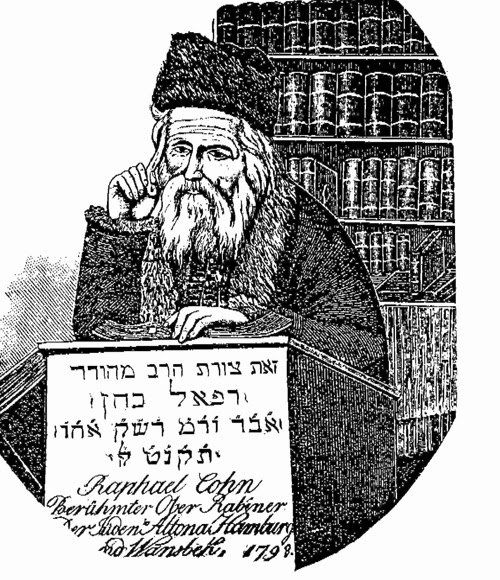
    Before turning to the BR and discussing its history we need to first discuss another work.  R. Raphael Cohen the chief rabbi of triple community, Altona-Hamburg-Wansbeck (“AH”W”), [1] published a book, Torat Yekuseil, Amsterdam, 1772 regarding the laws of Yoreh DeahTorat Yekuseil is a standard commentary and is unremarkable when compared to other works of this genre.  While the book is unremarkable in and of itself, what followed is rather remarkable. 

    Some years later, in 1789, a work with the putative author listed listed as Ovadiah bar Barukh and titled Mitzpeh Yokteil [2] was published to counter R. Raphael Cohen’s Torat Yekuseil (“TY”)Mitzpeh Yokteil (“MY”), was a vicious attack both against the work TY as well as its author, R. Raphael Cohen.  R. Raphael Cohen was a well-known and well-respected Rabbi. In fact, he was the Chief Rabbi of the triple community of AH”W.  The attack against him and his work did not go unanswered.  Indeed, the beit din of Altona-Wansbeck placed the putative author, Ovadiah, and his work, under a ban.

    The Altona-Wansbeck beit din could not limit the ban to just Altona-Wansbeck as the attack in the MY was intended to embarrass R. Raphael Cohen across Europe.  Indeed, the end of the introduction to MY indicates that copies were sent to a list of thirteen prominent rabbis across Europe.  Specifically, copies were sent to the Chief Rabbis of Prague, Amsterdam, Frankfort A.M., Hanover, Bresslau, Gloga, Lissa, etc., “as well as The Universally Know Goan haHassid  R. Eliyahu from Vilna.”  Thus, the intent of the book was to diminish R. Raphael Cohen’s standing amongst his peers. 

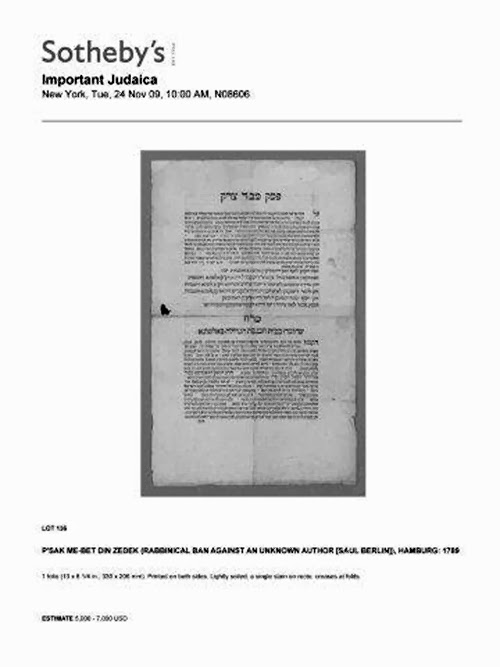
    The Altona-Wansbeck beit din, recognizing the intent of the book, appealed to other cities courts to similarly ban the author and book MY – the ban, entitled, Pesak mi-Beit Din Tzedek, the only known extant copy was recently sold at Sotheby’s (Important Judaica, Nov. 24, 2009, lot 136).[3]


These concerns lead the ban’s proponents to the Chief Rabbi of Berlin, R. Tzvi Hirsch Berlin, and to solicit him to join the ban. Initially, it appeared that R. Tzvi Hirsch would go along with the ban.  But, as he was nearing deciding in favor of signing the ban, someone whispered in his ear the verse in Kings 2, 6:5, אהה אדני והוא שאול – which R. Tzvi Hirsch understood to be a play on the word “שאול” in the context of the verse meaning borrow, but, in this case, to be a reference to his son, Saul. That is, the real author of MY was Saul Berlin, Tzvi Hirsch’s son.  Needless to say, R. Tzvi Hirsch did not sign the ban. [4]

    Not only did he not sign the ban, he also came to his son’s defense.  Aside from the various bans that were issued, a small pamphlet of ten pages, lacking a title page, was printed against MY and Saul. [5]  Saul decided that he must respond to these attacks.  He published Teshuvot ha-Rav. . . Saul le-haRav [] Moshe  Yetz,[6] which also includes a responsum from R. Tzvi Hirsch, Saul’s father.  Saul defends himself arguing that rabbinic disagreement, in very strong terms, has a long history.  Thus, a ban is wholly inappropriate in the present case. 

    R. Tzvi Hirsch explained that while MY disagreed with R. Cohen, there is nothing wrong with doing so.  The author of MY, as a rabbi – Saul was, at the time, Chief Rabbi of Frankfort – Saul is entitled to disagree with other rabbis.  Of course, Saul’s name is never explicitly mentioned. Moreover, in the course of R. Tzvi Hirsch’s defense he solicits the opinions of other rabbis, including R. Ezekiel Landau.  R. Landau, as well as others, noted that aside from the propriety of disagreement within Judaism, the power of any one particular beit din is limited by geography.  Thus, the Altona-Wansbeck’s beit din‘s power is limited to placing residents of Hamburg under a ban but not residents of Berlin, including R. Saul Berlin, the author of MY.[7]

    The controversy surrounding the MY was not limited to Jewish audiences. The theater critic, H.W. Seyfried, published in his German newspaper, Chronik von Berlin, translations of the relevant documents and provided updates on the controversy.  Seyfried agitated on behalf of the maskilim and editorlized that the Danish government should take actions against R. Cohen. It appears, however, that Seyfried’s pleas were not acted upon.[8] 

The Publication of Besamim Rosh


    With this background in mind, we can now turn to the Besamim Rosh.  Prior to publishing the full BR, in 1792, Saul Berlin published examples of the responsa and commentary found in the BR – a prospectus, Arugat ha-Bosem.  This small work whose purpose was to solicit subscribers for the ultimate publication of BR. It appears that while Saul may have been trying for significant rabbinic support, the majority of his sponsors were householders. 

    In 1793, the BR was published.  The BR contains 392 responsa (besamim equals 392) from either R. Asher b. Yeheil (Rosh) (1259-1327) or his contemporaries.  This manuscript belonged to R. Yitzhak di Molina who lived during the same time period as R. Yosef Karo, the author of Shulchan Orakh.  Additionally, Saul appended a commentary of his own to these responsa, Kasa de-Harshana

    The BR contains two approbations, one from R. Tzvi Hirsch Berlin and the other from R. Yehezkel Landau.  R. Landau’s approbation first explains that Rosh’s responsa need no approbation.  With regard to R. Saul Berlin’s commentary, he too doesn’t need an approbation according to R. Landau.  This is so because R. Saul’s reputation is well-known.  R. Landau’s rationale, R. Saul’s fame, appears a bit odd in light of the fact that among some (many?) R. Saul’s reputation was very poor due to the MY. 

    R. Tzvi Hirsch’s approbation also contains an interesting assertion. Saul’s father explains that this book should put to rest any lingering question regarding his son.    

    In addition to the approbations there are two introductions, one from di Molina and the other from Saul. Di Molina explained the tortured journey of the manuscript. He explains that, while in Alexandria, he saw a pile of manuscripts that contained many responsa from Rosh that had never before been published. He culled the unpublished ones and copied and collected them in this collection.  What is worthy of noting is that throughout the introduction di Molina repeatedly asks “how does the reader know these responsa are genuinely from Rosh.” 

    R. Saul, in his introduction, first notes that the concept of including introductions is an invention long after Rosh, and is not found amongst any of the Rishonim. 

    As mentioned previously, the BR is a collection of 392 responsa mostly from Rosh or his contemporaries.  Additionally, R. Saul wrote his own commentary on these responsa, Kasa diHarshena. [9]  This commentary would contain the first problem for Saul and the BR.  In responsum 40, Rosh discusses the position of Rabbenu Tam with regard to shaving during the intermediate days (ho ha-moad).  While Rosh ultimately concludes that one is prohibited from shaving on hol ha-moad, R. Saul, in his commentary, however, concludes that shaving on hol ha-moad is permissible.  In so holding, R. Saul recognized that this position disagreed with that of his father.  Almost immediately after publication, R. Saul printed a retraction regarding this position allowing for shaving on hol ha-mo’ad.  This retraction, Mo’dah Rabba, explains that Saul failed to apprise his father of this position and, as Saul’s father still stands behind his negative position, Saul therefore retracts his lenient position. [Historically, this is not the only time a father and son disagreed about shaving on hol ha-moad.  R. Yitzhak Shmuel Reggio (YaSHaR)and his father, Abraham, disagreed on the topic as well.  As was the case with Saul and his father, the son, YaSHaR took the lenient position and his father the stringent.  Not only did they disagree, after YaSHaR published his book explaining his theory, his father attacked him in an anonymous response.  For more on this controversy see Meir Benayahu, Shaving on the Intermediary Days of the Festival, Jerusalem, 1995.] 

    This retraction, while may be interperated as evidence of Saul humbleness in his willingness to admit error and not stand on ceremony, others used this retraction against him.  The first work published that questioned the legitimacy of BR is Ze’ev Yetrof, Frankfort d’Oder, 1793, by R. Ze’ev Wolf son of Shlomo Zalman.  (This book is very rare and, to my knowledge, is not online.  Although not online, a copy is available in microfiche as part of the collection of books from the JTS Library, and on Otzar Hachomah see below)  The author explains that eight responsa in BR are problematic because they reach conclusion that appear to run counter to accepted halahik norms. In addition, the author states in his introduction, “that already we see that there is something fishy as it is known that the author [Saul Berlin] has retracted his position regarding shaving.” It should be noted that no where does R. Ze’ev Wolf challenge the authenticity of the manuscript for internal reasons – it is incorrectly dated, incorrectly attributed etc.  Apparently, Ze’ev Yetrof, was not well-known as it is not cited by other contemporaries who too doubted the authenticity of BR.  Samat theorizes that either wasn’t printed until later or, was destroyed.[10]  

    The second person to question the legitimacy of BR was R. Rafael Hamburg’s mechutan, R. Ya’akov Katzenellenbogen.  In particular, he wrote to R. Cohen’s student, R. Mordechai Benat. As was the case with Wolf, R. Katzenellenbogen located 13 responsa where he disagreed with the conclusions.  R. Katzenellenbogen indicated that R. Benet shold review the BR himself and apprise R. Katzenellenbogen regarding R. Benet’s conclusions. 

    R. Katzenellenbogen also wrote to Saul’s father, Tzvi Hirsch, and Tzvi Hirsch eventually responded in a small pamphlet.  R. Tzvi Hirsch first deals with the predicate question, is the manuscript legitimate. That is, prior to discussing the conclusions of particular responsum, regarding the manuscript, R. Tzvi Hirsch testifies that he is intimately familiar with this manuscript. He explains that for 11 years, the manuscript was in his house.  In fact, R. Tzvi Hirsch created the index that appears in BR from this manuscript.  Additionally, he had his other son Hirschel (eventual Chief Rabbi of London) copy the manuscript for publication.  Thus, R. Tzvi Hirsch argues that should put to rest any doubt regarding the authenticity of the manuscript.

    R. Tzvi Hirsch then turns to the issue regarding conclusions of some of the responsa. He first notes, that at most, there are a but a small number of questionable responsa.  Indeed, it is at most approximately 5% of the total responsa in BR.  That is, no one questions 95% of the responsa (at least not then).  Second, with regard to the conclusions themselves, that some conclusions are different than the halahik norms, that can be found in numerous books, none of which anyone questions their authenticity.  Thus, conclusions prove nothing.

Leaving the history and turning to the content of BR.  One of the more controversial responsa is the one discussing suicide.  In particular, according to the responsum attributed to Rosh, the historic practices that were applied to a suicide – lack of Jewish burial, no mourning customs – are not applicable any longer.  This is so, because suicides can be attributed to the poor conditions of the Jews and not philosophical reasons.  Thus, we can attribute the motivations of a suicide to depression and remove the restrictions that applied to suicides. 

    This responsum was what lead some, including R. Moshe Sofer (Hatam Sofer), to conclude that the entire BR was a forgery.  Indeed, this responsum was one of the two that were removed in the second edition.  Others, however, point out this responsum and its conclusions are not in any conflict with any accepted halakhic norms.  And, instead, while providing new insight into the current motivations of a suicide, the ultimate conclusion can be reconciled with all relevant laws.  [11]  

This particular example illustrates the problematic nature of merely relying upon a particular conclusion to demonstrate the authenticity or lack thereof of a work. Although R. Sofer was certain this responsum ran counter to a statement of the Talmud, others were easily able to reconcile the Talmudic statement with the conclusion of the responsum.

    Another controversial responsa deals with someone who is stuck on the highway as the Shabbat is fast approaching.  The traveler is thus faced with the following dilemma, stop in a city where he will require the charity of strangers or continue on and get home.  The BR rules that the traveller can continue and is not required to resort to charity.  This, like the responum above, was similarly removed from the second edition. These are the only two responsa removed from the second edition.  Of course, this removal isn’t noted anywhere except that the numbers skip over those two.  In fact, the index retains the listing for the two responsa. 

    Other controversial responsa include one dealing with belief in the afterlife and messianic era, kitnoyot – BR would abolish the custom, and issues relating to mikvah. 

Today, common practice regarding suicide appears, for the most part, to conform with the position of BR.

Status Today

    After its publication in 1793, it would be almost one hundred years before the BR would be reprinted.  In 1881, the BR was reprinted in Cracow.  This edition was published by “the well-known Rabbi Yosef Lazer from Tarnow'” R. Lazer’s was part of a well-known Hassidic family.  His grandfather, R. Menachem Mendel Lazer was the author of Sova Semochot, Zolkiov, 1845.[12] It appears that the BR was the only controversial book that R. Yosef Lazer published.  Although he published approximately 30 books, the are mainly run-of-the mill works, Machzorim, haggadot, as well as some standard rabbinic works. It is unclear what prompted R. Lazer to republish the BR.  Lazer provides no explanation.  Although Lazer’s publishing activities are difficult to reconcile with his publication of the BR, the printers, Yosef Fischer and Saul Deutscher, other publications indicate that they were more open to printing all types of books. For example, the same year they published BR, they published a translation of Kant, Me-Ko’ach ha-Nefesh, Cracow, 1881.  In all events, it appears that Lazer (or perhaps the printers) was aware of the controversy surrounding the BR as he removed Saul Berlin’s introduction as well as two of the more controversial responsa, one discussing suicide and the other allowing one to continue to travel home after sunset on Friday to avoid having to rely upon the charity of strangers.  In addition, one responsa was accidentally placed at the end of the volume, not in its proper order.[13]  Although the two responsa were removed in the text, they still appear in the index. A photo-mechanical reproduction of this edition was published in New York in 1970, and a copy is available on Hebrewbooks. 

    In 1984, the BR was reprinted for only the third time.  This edition, edited by R. Reuven Amar and includes an extensive introduction, Kuntres Yafe le-Besamim, about BR.  Additionally, commentary on the BR by various rabbis is included.  The text of this edition is a photo-mechanical reproduction of the first edition.  This edition contains two approbations, one from R. Ovadiah Yosef, who in his responsa accepts that BR is a product of R. Saul Berlin, but R. Yosef holds that doesn’t diminish the BR’s value.  The second approbation is from R. Benyamin Silber.  But, R. Silber provides notes in the back of this edition and explains that he holds the BR is a forgery and that he remains unconvinced of Amar’s arguments to the contrary.

    In his introduction, Amar attempts to rehabilitate the BR.  Initially, it should be noted that Amar relies heavily upon Samet’s articles on BR, but never once cites him.  Samet had complied a bibliography of works about BR as well as where the BR is cited, Amar also provides the latter in a sixty four page Kuntres, ריח בשבמים, in the back of his edition. In his introduction Amar relates the history of the BR and attempts to demonstrate that many accepted the BR and those that did not, Amar argues that many really did accept BR.  This introduction contains some very basic errors, many of which have been pointed out by Shmuel Ashkenazi in his notes that appear after the introduction.  

Difficulties in Authentication   

    Today, various theories have been put forth to demonstrate that the BR is a forgery.  Specifically, some have pointed to “hints” or “clues” that R. Saul left for the careful reader which would indicate that BR is a carefully created forgery.  For example, some note that the number of responsa, 392, the Hebrew representation of that number is שצ”ב which can be read to be an abbreviation of Saul’s name – Saul ben Tzvi.  Others take this one step further and point to the was R. Asher (Rosh) is referenced – רא”ש – which again can be read R. Saul.  Obviously, these clues are by no means conclusive.  In the academic world, the BR is written off as a “trojan horse” intended to surreptitiously get R. Saul’s masklik positions out in the masses or something similar.  All of these positions, however, rely upon a handful of responsa at best and no one has been able to conclusively demonstrate that the entirety of BR is a forgery. At best, we are still left with the original criticisms – that a few of the responsa’s conclusions espouse positions that appear to be more 18th century in nature than 13th century. [14]   

 R. Yeruchum Fischel Perlow aptly sums up much of what has been written regarding the question of authenticity of BR:

Just about all who have examined [the question of the authenticity of BR] walk around like the blind in the dark, and even after all their long-winded essays, they are left with only their personal feelings about the BR without ever adducing any substantive proofs in support of their position. And, on the rare occasions that they actual do provide proofs for their positions, it only takes a cursory examination to determine that their is nothing behind those proofs. [R. Yeruchum Fischel Perlow, “Regarding the book ‘Besamim Rosh,'” Noam 2 (1959), p. 317. For some reason this article is lacking in some editions of Noam]

    Assuming that one discounts the testimony of Saul and his father regarding the manuscript, it is not easy to determine if the BR is authentic or not.  For example, responsum 192, according to R. Moshe Hazan, one of the defenders of BR, this responsum “is clear to anyone who is familiar with the language and style of the Rishonim, from the Rishonim.” Responsum 192, is attributed to R. Shlomo ben Aderet (Rashba), and discusses the opinion of Rosh that allowed for capital punishment for pregnancy out of wedlock.  Thus, according to R. Hazan, 192 is conclusive proof that BR is authentic. 

    Simcha Assaf, however, has shown that responsum 192 is a forgery – or there is a misattribution.  Assaf explains that if one looks at the date of this incident, responsum 192 could not have been written by Rashba.  Rashba died 10 years prior to this event.  Simcha Assaf, Ha-Onshim Ahrei Hatemat ha-Talmud, Jerusalem, 1928, pp. 69-70.  Thus, the very same responsum whose “language and style” demonstrated that it was from the times of the rishonim has attribution problems.  To be sure, Assaf isn’t saying this responsum isn’t necessarily from the rishonim period, however, it surely isn’t from Rashba.[15]

    Or, to take another example. Talya Fishman argues that “[halakhic literature of the seventeenth and eighteenth centuries . . . climbed to new (and fantastic) heights of theoretical speculation, creating, in effect, a body of non applied law.”  Talya Fishman, “Forging Jewish Memory: BR and the Invention of Pre-emancipation Jewish Culture,” in Jewish History and Jewish Memory, ed. Carlbach et al., Hanover and London: 1998, pp. 70-88.  Based on this understanding of seventeenth and eighteenth century literature, as contrasted with literature from the period of Rosh, she turns to the BR and finds such speculative responsa.  This, according to Fishman, implicitly demonstrates that BR is a product of the seventeenth or eighteenth century. Indeed, Fishman concludes “[i]n short, [BR], has an unusually high concentration of eyebrow-raising cases.”  Id. at 76. 

    But, if one subjects Fishman’s argument to even a minimal amount of scrutiny, her argument, as presented, is unconvincing.  First, in support of Fishman’s “high concentration” of odd responsa, Fishman provides three examples.  That is, Fishman points to three out of 392 responsa that contain “eyebrow-raising cases” and concludes this represents “an unusually high concentration.”  I think that most would agree that less than 1% does not represents an unusually high concentration.  Second, of the three examples Fishman does provide, one is from Kasa deHarshena, which everyone agrees is a product of the eighteenth century.  Third, one of the examples, no. 100, it appears that Fishman misread the responsa.  Fishman provides that responsa 100 is a “bizarre question about whether a one-armed man should don tefilin shel yad on his forehead alongside tefilin shel rosh.”  Id. at 76.  Indeed,  responsa 100 is about a one-armed man and whether because he cannot fulfill the arm portion of tefilin if that absolves him of the head portion.  Nowhere, however, not in BR or Kasa de-harshena, does it mention the possibility of putting the tefilin shel yad on one’s forehead.  Thus, if we discount these two responsa, Fishman is left with a single responsum to prove her generalization about BR.[16]   

    Regarding the manuscript, that too is an unsolved mystery.  We know that a manuscript that may have been the copy which R. Hirschel made is extant but the manuscript from di Molena is unknown.  Additionally, although we know that the Leningrad/St. Petersberg library had Tzvi Hirsch’s copy with his annotations, the current location of that book is unknown. See Benjamin Richler’s post regarding the manuscript here.

    The BR’s most lasting effect may be in that this was to be the first of many newly discovered manuscripts to be accused of forgery because of the conclusions reached.  Subsequent to the BR, responsa or works in other areas of Jewish literature were tarred with cry of forgery because of their conclusions. [See Yaakov Shmuel Spiegel, Chapters in the History of the Jewish Book, Writing and Transmission, Ramat-Gan, 2005, 244-75, (“until the publication of BR, there were no questions raised regarding the authenticity of a book”) Spiegel also demonstrates that we now know that in many instances that the charge of forgery was wholly without basis and today there is no question that some of the books that are alleged forgeries are legitimate.]

Other Works by Saul Berlin

    One final point.  While we discussed Saul’s work prior to BR, there was another book that he wrote, that was published posthumously.  This work, Ketav Yosher, defended Naftail Wessley and his changes to the Jewish educational system.  Indeed, Ketav Yosher, is a scathing attack on many traditional sacred cows. [17]  Ketav Yosher, like MY, was published without Saul’s name, but again, we have testimony that Saul was in fact the author.  In light of the position Ketav Yosher takes, it is no surprise that this book doesn’t help Saul’s standing among traditionalists.  

    Saul may have written additional works as well, however, like the BR itself, there is some controversy surrounding those additional works.  R. Saul’s son, R. Areyeh Leib records an additional 11 works that Saul left behind after he died.  The problem is these very same works – although all remaining in manuscript – have been attributed to someone else.  But, before one jumps to conclusions, it should be pointed out that this story gets even more complicated.  The book which attributes these works to another is itself problematic.  Indeed, whether this list attributing the books to another even exists is a matter debate.  And, while that sounds implausible, that, indeed is the case.  Ben Yaakov, Otzar ha-Seforim (p. 599 entry 994) says there is a 1779 Frankfort Order edition of Sha’ar ha-Yihud/Hovot ha-Levovot that includes an introduction (and other material) that lists various manuscripts which the editor, according to Ben Ya’akov, was a grandson of Yitzhak Yosef Toemim, ascribes to his grandfather – and not Saul. Weiner, in his bibliography, Kohelet Moshe, (p. 478, no. 3922) says that Ben Ya’akov is wrong – not about the edition, Weiner agrees there was a 1779 Frankfort Oder edition, just Weiner says there is no introduction and Toemim wasn’t the editor (and other material is missing). Vinograd, Otzar Sefer ha-Ivri lists such a book – 1779 Frankfort Oder, Hovot ha-Levovot/Sha’ar ha-Yichud, but there is no such edition listed in any catalog that we have seen including JNUL, JTS, Harvard, British Library etc. It appears that Samat couldn’t locate a copy either as although he records the dispute between Weiner and Ben Yaakov, he doesn’t offer anything more.  Thus, Saul’s other writings, for now, remains an enigma.

    It is worthwhile to conclude with the words of R. Matisyahu Strashun regarding Saul and the BR:

“After all these analyses, even if we were able to prove that the entire BR from the begininning to end is the product of R. Saul, one cannot brush the work aside . . . as the work is full of Torah like a pomegranate, and the smell of besamim is apparent, it is a work full of insight and displays great breadth, the author delves into the intricacies of the Talmud and the Rishonim, the author is one of the greats of his generation.”  Shmuel Yosef Finn, Kiryah Ne’amanah, notes of R. Strashun, p. 93.

The Internet


    As hopefully should be apparent, most of the books discussed above or referenced below are available online.  These include the rare retraction that R. Saul published regarding his position on shaving on hol ha-ma’od, Ketav Yosher, the prospectus for BR, as well as the BR itself.  Indeed, not only is the BR online but both editions are online. And, the BR exemplifies why one should be aware of multiple internet sources.  Hebrewbooks has a copy of BR which they indicate is the first edition “Berlin, 1793,” however, in reality it is the later, 1881 Warsaw edition of the BR.  As noted above, that edition, however, is lacking two responsa.  This highlights an issue with Hebrewbooks, the bibliographical data is not necessarily correct.  The JNUL, has the first edition. Indeed, in the case of the JNUL, the bibliographical information is much more reliable than Hebrewbooks. Thus, one needs to use both the JNUL as well as Hebrewbooks if one wants to get a full picture of the BR. Or, another example.  Both the JNUL site as well as Hebrewbooks has MY online; but, the JNUL version was bound with two rare letters at the end and those appear online as well.  Additionally, when it comes to Hebrewbooks, one must be aware that they have removed books that someone presumably finds objectionable so although MY and KY are there now, there is no guarantee it will be in the future.  Similarly, although not online, and unlike the MY the JNUL has, Otzar haChomah has the Ze’ev Yitrof with additional material bound in the back. Besides for all these rare seforim mentioned, many of the other seforim quoted in this post, as is apparent from the links, can now be found on the web in a matter of seconds instead of what just a few short years ago would have taken a nice long trip to an excellent library.

Saul’s Epithet, he was buried in the Alderney Road Cemetery in London, next to his brother, Hirschel, Chief Rabbi 
Notes

[1] For more on R. Raphael Cohen see the amazingly comprehensive and insightful bibliography by the bibliophile R. Eliezer Katzman, “A Book’s Luck,” Yeshurun 1 (1996), p. 469-471 n.2. See also R. Moshe Shaprio, R Moshe Shmuel ve-Doro pp.103-110 especially on the BR see 108-09. C. Dembinzer, Klielas Yoffee, 1:134b, 2:78b writes that the work on TY caused R. Saul to lose his position as Chief-Rabbi of Frankfort and his wife divorced him because of it. See also, S. Agnon, Sefer Sofer Vesipur, p.337. On R. Raphael Cohen and his connection with the Gra and Chasidus see D. Kamenetsky, Yeshurun, 21, p. 840-56. As an aside this article generated much controversy for example see the recent issue of Heichal Habesht, 29, p.202-216 and here.
[2] Regarding the correct pronunciation of this title see Moshe Pelli, “The Religious Reforms of ‘Traditionalist’ Rabbi Saul Berlin,” HUCA (1971) p. 11.  See also R. Shmuel Ashkenzi’s notes in the BR, Jerusalem, 1983 ed., introduction, n.p., “Notes of R. Shmuel Ashkenzi on Kuntres Yefe le-Besamim, note 6.  
Additionally, MY was not Saul’s first literary production, nor was it his first that was critical of another’s book.  Instead, while he was in Italy in 1784, he authored a kunteres of criticisms of R. Hayyim Yosef David Azulai’s Birkei Yosef.  See R. R. Margolis, Arshet pp. 411-417; Moshe Samat, “Saul Berlin and his Works,” Kiryat Sefer 43 (1968) 429-441, esp. pp. 429-30, 438 n.62.  On Chida’s opinion of the BR see for example Shem Hagedolim:

עתה מקרוב נדפס ספר זה בברלין… ועוד יש הגהות כסא דהרסנא. ואשמע אחרי קול רעש כי יש בספר זה קצת דברים זרים ואמרו שהמעתיק הראשון בארץ תורגמה מכ”י הרב יצחק די מולינא ז”ל יש לחוש שהוסיף וגרע. ולכן הקורא בסי’ זה לא יסמוך עליו דאפשר דתלי בוקי סריקי בגדולים עד אשר יחקור ויברר הדברים ודברי אמת ניכירים ודי בזה… (שם הגדולים, ערך בשמים ראש, וראה שם, ערך מר רב אברהם גאון)

See also the important comments of R.Yakov Chaim Sofer, Menuchas Sholom, 8, pp. 227-230 about the Chida.
[3]  Eliezer Landshut, Toldot Anshei Shem u-Puolotum be-Adat Berlin, Berlin: 1884, 89-90 for the text of the ban as well as its history.  Additionally, for the proclamation read in the main synagogue of Altona see id. at 90-1. This proclomation has been described as “one of the harshest condemnations” of the time.  See Shmuel Feiner, The Jewish Enlightenment in the Eighteenth-Century, Jerusalem: 2002, p. 310. 
[4]  Id. at 91. Samat, however, notes that neither Saul nor his father ever admitted Saul’s authorship of MY.  Samat, “Saul Berlin and his Works,” p. 432, 4.  
[5] According to A. Berliner, the author of this pamphlet is R. Eliezer Heilbot. See Samat, id. Saul and MY were not the only ones attacked. The publisher of MY, Hinukh Ne’arim, was also attacked and, not only MY but all the books they published were prohibited by some. The publishers, however, defended their decision to publish MY.  They argued that the whole point of MY was to ascertain if R. Raphael Cohen’s book was riddled with errors or, the author of MY was mistaken.  The publishers pointed to the above mentioned introduction to MY wherein the MY’s author explains that he has sent copies of the book to leading rabbis to determine the question regarding R. Cohen’s book. Thus, MY is either right or wrong, but there can be nothing wrong with merely publishing it.  See id. at 92-3.
Additionally, it should be noted that according to some, Saul authored a second attack on R. Raphael.  R. Raphael published Marpeh Lashon, Altona, 1790, and was soon after attacked in the journal Ha-Meassef by someone writing under the pen-name EM”T.  Many posit that this is none other than Saul.  Katzman, Yeshurun 1, 471 n.3, disagrees and points to internal evidence that it is unlikly that Saul is the author of this critique. 
According to Feiner, these attacks were not one-sided.  Feiner argues that R. Cohen criticizes Saul, albeit in a veiled manner, in Marpeh Lashon.  See Feiner, Jewish Enlightenment, op. cit., 314-15.  
[6] Landshuth, id., suggests that Moshe is a non-existent figure like MY’s putative author Ovadiah. See also, Samet, “Saul Berlin and his Works,” 432 n.4 who similarly questions the existence of Moshe.  Carmilly-Weinberg makes the incredible statement that his Moshe is none other than Moses Mendelssohn.  Carmilly-Weinberg, Sefer ve-Seiyif,  New York, 1967, p. 215, (Carmilly-Weinberg’s discussion about both MY and BR are riddled with errors).  As Pelli notes this is impossible as the letter is signed 1789, the same year MY was printed, and Mendelssohn died three years prior. Pelli resurrects Moshe and links him with a known person from Amsterdam, Saul brother-in-law. See Pelli, HUCA (1971) p. 13 n.75.  Ultimately, however, Pelli rejects this and demonstrates that Moshe is indeed a pseudonym but a well-selected one.  See id.  
[7]  See Landshuth, 93-9; Pelli, 13-15.  See also R. Alexander Sender Margolioth, Shu”t ha-RA”M, Lemberg, 1897, no. 9.    
[8] See Feiner, The Jewish Enlightenment, op. cit., 312-13.  This newspaper is online here, and Feiner provides the relevant issues which are 1789 pp. 484-88, 520-24, 574-81, 680-82, 768-74, 791-802, 867-92, 932-72.   
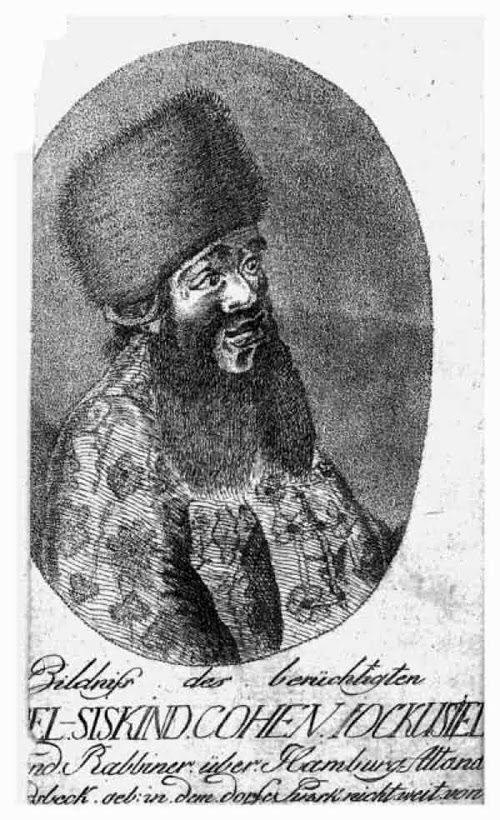
One of which includes this portrait of R. Cohen.
Which is a very different portrait, both in time and look, to the one appearing in E. Duckesz, Ivoh le-Moshav, Cracow, 1903.

[9] For the deeper meaning of the title Kasa de-Harshena, see Moshe Pelli, The Age of Haskalah, University Press of America, 2006, 183 n.51.
[10] See Samat, who discusses the exact progression of the ban.

[11] See Yechezkel Shrage Lichtenstein, Suicide: Halakhic, Historical, and Theological Aspects, Tel-Aviv, 2008, pp. 438-44. See also,Yeshurun 13:570-587 especially pp.578-581; Marc B. Shapiro, “Suicide and the World-To-Come,” AJS Review, 18/2 (1993), 245-63. 
On the issue of suicide there are others who similarly reach the same holding as the BR see Strashun in his מתת-יה pp. 72a-72b (this source is not quoted by Samet or Amar).
[12] Biographical information on R. Yosef Lazer is scant.  For information on his father and grandfather, see Meir Wunder, Me’orei Galicia, Israel, 1986, vol. III, pp. 456, 462-3. See also T.I. Abramsky, “‘Besamim Rosh’ in the Hassidic Milieu,” Taggim, (3-4), 56-58.   
[13] Samat only notes the removal of one responsum, he fails to note that exclusion of the second.  He does, however, note the misplaced responsum.  Additionally, Kuntres ha-Teshuvot ha-Hadash, fails to record that any are missing or that one responsum was moved to the end. 
[14] See Pelli, Age of Haskalah, pp. 185-89, comparing a few responsa with 18th century haskalah literature.
[15] Assaf was not the first to use this responsa and note its historical anacronisms.  Leopold Zunz, also highlights the issues with this responsum (as well as others).  Leopold Zunz, Die Ritus des Synagogalen Gottesdienstes, Geschichtlich Entwickelt, Berlin: 1859, 226-28.  Zunz’s critique is quoted, almost in its entirety by Schrijver, but Schrijver appears to be unaware of Assaf’s additional criticisms of the responsum (and others).
Assaf provides one other example where he shows through internal data that there is a misattribution.  Assaf concludes that he has other examples of historical anacronisms in BR but doesn’t provide them here or, to our knowledge, anywhere else.
[16] For another critique of Fishman’s position see Emile G.L. Schrijver, “Saul Berlin’s Besamim Rosh: The Maskilic Appreciation of Medieval Knowledge,” in Sepharad in Ashkenaz, Netherlands: 2007, pp. 249-259, esp. pp. 253-54. 
[17] Regarding Ketav Yoshor see Pelli, Age, 176-79. See also here and here.

Additional Bibliography:
M. Samet has two articles on the topic, R. Saul Berlin and his Writings, Kiryat Sefer, 43 (1969) 429-41; “Besamim Rosh” of Saul Berlin, Kiryat Sefer 48 (1973) 509-23, neither of which are included in the recent book of Samet’s articles.

To add to Samet’s and Amar’s very comprehensive lists of Achronim who quote BR: (I am sure searches on the various search engines will show even more): Malbim in Artzos Hachaim, 9:41 (in Hameir Learetz); Shut Zecher Yosef,1:32b; Keter Kehunah p. 30; Matzav Hayashar 1:2a; Pischei Olam 2:218,228; Birchat Yitchcak (Eiskson), pp. 6,14,24; Maznei Tzedek, p.26,45,254; R.Yakov Shor, Birchat Yakov, pp.212  Sefer Segulos Yisroel pp.116b; R. Rabinowitz, Afekei Yam 2:14; R. Leiter, Zion Lenefesh Chayah# 43; Shut Sefas Hayam, OC siman 14; R Meir Soleiveitck, Hameir Laretz 45a, 45b, 54b, 55a; Emrei Chaim p.26; R. Sholom Zalman Auerbach, Meorei Eish p. 108 b

In general on BR see: R.Yakov Shor,Eytaim Lebinah (on Sefer Haeytim) p. 256; Pardes Yosef, Vayikrah 220b Pardes Yosef, Shelach p. 517; R.Yakov Chaim Sofer, Menuchas Sholom, 8, pp. 222- 230; Shar Reven p. 54; A. Freimann, HaRosh ; Y. Rafel, Rishonim Veachronim, pp. 123-130; B. Lau, MeMaran Ad Maran, pp.133; S. Agnon, Sefer Sofer Vesipur, pp.337-339.

R. Pinhas Eliyahu Horowitz writes:

ולפעמים תולים דבריהם באילן גדול וכותבים מה שרוצים בשם איזה קדמון אשר לא עלה על לבו… כספר בשמים ראש שחיבר בעל כסא דהרנסא לא הרא”ש וזקני ישראל תופסי התורה יעלו על ראשם… (ספר הברית, עמ’ 232).

The Steipler was of the opinion in regard to the BR that:
שבאמת ניכר מהרבה תשובות שהם מהרא”ש ז”ל רק כנראה שיש שם הרבה תשובות מזויפות שהמעתיק הכניס מעצמו כי ישנם שם דברים מאד מזורים ואיומים  (ארחות רבנו, א, עמ’ רפה)

R Zevin writes in Sofrim Veseforim (Chabad) p.354 :
אלא שבתשובות בשמים ראש המיחוס להרא”ש ושכידוע נמנו וגמרו שמזוייף הוא

R. Yakov Kamenetsky said: “Do you think Just we (he meant people of his own caliber) were fooled? Even R. Akiva Eiger was fooled.” (Making of a Godol, pp.183-184)

About Rav Kook and the BR see: http://www.biu.ac.il/JS/JSIJ/5-2006/Gutel.pdf

R. Avigdor Nebensal writes:

כשמביאם את הבשמים ראש ראוי להזכיר שיש מסתייגים חריפות מהספר הזה (השתנות הטבעים, עמ’ 16).
R Zalman Nechemiah Goldberg writes:
אכן בעיקר הענין אם להביא דברי בשמים ראש בודאי צדק הג”א נבנצל שליט”א שיש להביאו בהסתייגות, ובפרט בענינים אלו שהוחזק למזייף ולמביא עקומות וכוזבות (השתנות הטבעים, עמ’ רסד).


Rabbi Eliezer Brodt on Haggadah shel Pesach: Reflections on the Past and Present

Haggadah shel Pesach:
Reflections on the Past and Present
by Eliezer Brodt

Perhaps the topic which has engendered the most commentary in Jewish literature is the Haggadah shel Pesach. There are all kinds, in all languages, and with all types of commentary, pictures, etc. Whatever style one can think of, not one, but many Haggadahs have been written. So, whether it’s derush, kabbalah, halakha, mussar or chassidus there are plenty of Haggadahs out there. Then, there are people who specialize in collecting haggadahs although they do not regularly collect seforim. In almost every Jewish house today one can find many kinds of Haggadahs. In 1901 Shmuel Wiener, in A Bibliography of the Passover Haggadah, started to list all the different printings of the Haggadah. Later in 1960, Abraham Yaari, in his work titled A Bibliography of the Passover Haggadah, restarted the listing and reached the number 2700. After that, many bibliographers added ones which Yaari omitted. In 1997, Yitzchak Yudlov printed his bibliography on the Haggadah, entitled The Haggadah Thesaurus. This thesaurus contains a beautiful bibliography of the Pesach Haggadahs from the beginning of printing until 1960. The final number in his bibliography listing is 4715. Of course ever since 1960 there has been many more printed. Every year people print new ones; even people who had never written on the Haggadah have had a Haggadah published under their name, based on culling their other writings and collecting material on the Haggadah. When one goes to the seforim store before Pesach it has become the custom to buy at least one new Haggadah; of course one finds themselves overwhelmed not knowing which to pick!

Every year, besides for the new Haggadahs being printed, old ones are reprinted, some in photo off-set editions, others with completely retype set. One such Haggdah that has been reprinted and retype-set is the Haggadah Marbeh Lesaper. The author is R. Yididiah Tiyah Weil the son of R. Nesanel Weil, the author of the well-known commentary on the Ro”SH – the Korbon Nessanel. This Haggadah was first printed in 1791 and until 2002 it was never reprinted. See Yudolov, The Haggadah Thesaurus pg. 32 #355). Others point out an interesting bibliographical note, specifically that there is no mention of the author on the title page. There is, however, a haskamah (letter of approbation) from Reb Yididiah Weil to the sefer. However, we know that aside from giving a haskamah, he is also the author. R. Eliezer Fleckeles in his sefer Teshuva MeAhavah (vol. 2 siman 239) writes that Reb Yididiah Weil is the author. R. Fleckeles points out that in the Haggadah, the author cites from his father the Korbon Nessanel. Additionally, today we can be certain that R. Yididiah is the author as we have the original manuscript of this work in R. Yedidyah’s handwriting is sitting at the Jewish National and University Library on the Givat Ram campus of the Hebrew University of Jerusalem (Ms. Heb. 8°2744).

A bit of biographical information about R. Yedidiah. He was born in 1722 and died in 1806 at the age of 84. He was a student of both his father the Korban Nesanel, and R. Yonason Eibyshutz, and served as the Rav of Karlsruh, and as the Rosh Yeshiva. He wrote much, however, aside for this Haggadah nothing else of his was printed until 1977.[1] And, although some has been published, much of his work remains in manuscript as is apparent here.

The style of this Haggadah is not limited to peshat, rather he includes much in the style of derush and remez. It has many original and interesting explanations on the Haggadah. He also quotes a few things from his father the Korbon Nessanel. Additionally he cites to “old manuscripts” which he found as well.

I would like to give a few samples of the many interesting points I found throughout this Haggadah not specifically related to Pesach. He brings that he heard Jews have one more tooth then non-Jews, 16 on top and 16 on bottom (pg. 33). While discussing if there was the plague of lice afflicted even the Jews, as it appears from the well known Midrash that Yaakov did not want to be buried in Egypt as he didn’t want his body affected by the lice plague. R. Weil wants to suggest that in fact the lice did enter even Goshen, however, this was limited to the animals and did not affect the people themselves. (pg 58). He has an interesting explanation regarding the Midrash that says Yishai, the father of Dovid haMelech, had planned a relationship with his handmaid which supposedly should have resulted in Dovid haMelech’s birth; Dovid’s mother having switched places with the handmaid resulted in Dovid haMelech being a suspect mamzer in his father’s eyes. [2] (pg 100) He brings from an “old manuscript” that the author of Nishmas was ר’ שמעון בן כיפא . (pg 114).[3] Another point which he cites to an “old manuscript” is that Shlomo Hamelech wrote ישתבח.(pg 121).[4] He writes that on Yom tov there is a נשמה יתירה although we do not make a מיני בשמים after Yom Tov (pg 115). He also says there are two types of נשמה יתירה on shabbos, although not everyone gets them (pg 115). He brings an interesting discussion from his uncle R. Avraham Brodie about the possibility that Sarah’s pregnancy with Yitzchak lasted 12 months (pg 124- 125).[5] He says that he heard the פיוטים חד גדיא ואחד מי יודע were found on a manuscript from the Beis Medrash of the R. Elazar Rokeach (pg 140 and pg 151).[6] He writes that many do not like to say הרחמן הוא יקים לנו סוכת דוד הנופלת on Shabbos and Yom tov because the Beit Hamikdash can not be built on shabbat and Yom Tov. However he writes they are mistaken because Rashi and Tosafot both write (see Rosh Hashanah 30a) that the third Beit Hamikdash will be built by Hashem Himself, which could be even on shabbat and Yom Tov (pg 138). He poses an interesting question in regard to the minhag brought down in the Shulhan Arukh. On Pesach the custom is to use fancy flatware as well as other fancy utensils. The rest of the year, however, we refrain from doing so due to zecher le-churban. Why then, on Pesach can we ignore the concept of zecher l’churbon. He answers from his father that this is the hidden meaning behind חד גדיא, that we remember the churban of both batei mikdash. He then goes on to explain exactly how it is hidden (pg 148).

Feldheim Publishers is to be commended for their choice in investing to reprint this valuable Haggadah, and making it accessible to the Torah community. I heard the sefer has recently gone out of print; my hopes are that Feldheim will see to make the sefer available once again.

Sources:
[1] See the Introduction to R. Weil’s Hiddushe Rabbi Yedidiah Weil: Masekhet Niddah (Machon Ahvat Shalom, 2003).
[2] Yalkut Mechiri 118:28. See also Birkei Yosef O”Ch 240:4, Siddur HaYaavetz; Siddur HaShL”H to Hallel, and Pesach Einayim to Sotah 10b and Shivli hamaneuh pg 61; Sefer Kushiyot pg 115 and the notes there and Alpha Bet Kadmitah D’Shumuel Zeira from R. Shmuel Ashkenazi pg 239 and onwards.
[3] See also Elbogen, Ha-Tefillah b’Yisrael, pg 86- 87; M. Bar Ilan, Sisrei Tefilah pg 84 and onwards; Mo’adim l’Simcha volume 5 pg 206 – 209 and the Mispacha, Kulmos, issue 34.
[4] See also the Siddur Rokeach pg 233; Siddur R. Shlomo M’Germazia pg 75 and Abudraham (with pairush Tehilah l’Dovid) pg 153 who say the same thing. See the Sha’ar HaKollel (chap. 6, no. 13) and Siddur Tzlusa d’Avraham (vol 1 pg 238) who bring others that argue. However I found that R. Yitzchak Sagi Nohar (the blind) who was the son of the Raavad writes in his pamphlet titled Sod HaDlakas Neros Chanukah at the end (printed in Sefer Zicharon to Rav Yitzchak Hunter and reprinted in back of the Shvut Yitzchak on Chanukah) that Avraham Avinu was the author. See also Ha-Tefillah b’Yisrael pg. 67 and Mo’adim l’Simcha volume 5 pg 210.
[5] see also the lengthy discussion in the recently printed Sefer Amaros Tohros Chitzonis U’Pnimis from R. Yehuda Ha’Chasid in the miluim at the end of the sefer from R. Stal, #6, pg 328-332.
[6] see also R. Yosef Zechariah Stern in his Haggadah Zecher Yosef (pg 30) who writes that he did not find this piut printed before the Sefer maseo Hashem. See also the Haggadah Shelaimah ad. loc.; Assufot, vol 2 pg 201-226; Mo’adim l’Simcha volume 5 chapter 11; Y. Tabory, Pesach Doros, pg. 341-342 and the note on pg 379.


The Jewish Reaction to the Livorno Earthquake of January 27, 1742

The Jewish Reaction to the Livorno Earthquake of January 27, 1742
by Ovadya Hoffman
On January 27, 1742 (כב’ שבט תק”ב) an earthquake shook Livorno, Italy to its core. All through the preceding months rumbling shuddered throughout the city. Pasqual R. Pedini, a recognized cleric at the time, elucidated in a letter beginning with the incipient rumblings of Jan. 16 carrying on until 27th a vivid depiction of the earthquake’s manifestation and impact (The Philosophical Transactions of the Royal Society of London, London 1809; VIII p. 568, “An Account of the Earthquakes Felt in Leghorn”). Today with minimal research anyone can gain insight into the occurrence, both in secular historiography or seismological analyses of its nature, so I won’t elaborate on it. Here my sole intention is to produce some rare and, more importantly, non-reproduced Jewish material (here is a brief chronicle of Italian seismic history referenced in Jewish sources).
Of note is the sefer Shivchei Todah (Livorno 5504)[1] from R. Malachi HaCohen, author of the famed Yad Malachi[2]. In his introduction, the author tells us that he composed the piyutim (prayers and hymns) in the wake of the miracles that occurred during the earthquake(s). The rabbis of the community instructed the people to fast and recite different prayers, at the same time offering words of inspiration in the
different synagogues to get the public to focus on self introspection. In many quarters, especially in the communal synagogues and schools, Torah study groups of different levels of study were being held. Those tefilot were established as part of an annual memorial service marking the miracles, and included in the same sefer were other tefilot that were instituted to recite in times of distress. This is essentially how the “Purim Sheni” in Livorno was born[3]. Here Eliezer Landshut gives an itemized list of the piyutim appearing in ST[4].  A more detailed report of the nature of the earthquakes was depicted by the well known R. Rafael Meldola, father of R. Avraham who headed the prominent publishing house, in his sefer Shever BaMitzarim (Livorno 5502) which was printed later that year of the earthquake. He too, as the aforementioned cleric did, begins his recount with the tremors that lead up to “the big bang”. Some have noted that aside for ST, R. Malachi authored a second sefer resembling the former’s framework entitled Kol Tefilah, although I wonder if this is accurate. For one, I haven’t been able to locate it. But what’s more puzzling is why would he have written the same tefilot and print them under two different titles? And if they contain different tefilot, why not include them in one sefer to avoid future confusion or possible opposition between kehilot in respect to the age-old “Who has the right mesorah” dilemma? Another sefer ascribed to R. Malachi is Arucha U’marpeh. In the relatively new Maaseh Rokeach from R. Massoud C. Rokach (Jer. 5772; pirkei mavo ve’toldot ha’mechaber §6) they claim that R. Malachi is “בעל הקונטרס
‘ארוכה ומרפא’ תפילות ובקשות שונות על העיר ליוורנו מקומו.”. One problem with this is that the introduction to this sefer clearly says that the pieces are taken from ST. The other issue is that on his tombstone, as is brought in the journal Ohr Olam (1;92), it gives the year of his passing as 5532 whereas the Arucha U’marpeh was only first printed in 5565, with no indication at all of this pamphlet being produced from R. Malachi’s manuscripts.
Once mentioning the Maaseh Rokeach (which was actually first printed the year of the earthquake[5]) it is also worth noting that one of his great students, R. Avraham Khalfon of Tripoli, also known by the acronym HaAvrech, copied in his sefer Maseh Zadikkim (pg. 522) large sections of the Shever BaMitzarim making it far more accessible than it was till then.
A similar sefer comprised of different tefilot for epidemics etc., not related directly to the earthquake in Livorno, was printed a year later in
Venice entitled Matzil Nefashot. It contains ‘Tefilat HaDerech of the Ramban’, ‘Tefilat Yachid from R. Elazar HaKalir’ and other tefilot and bakashot. I wonder if the inspiration for this collection came from the events that occurred over in Livorno then followed by the printing of Shever BaMetzarim, or not.
Returning to the Shivchei Todah, though most of the content is legible[6] and printed in the classic neat Italian lettering, sadly the rich and brilliant introduction, printed in Rashi lettering, is not and so it is presented here (excluding the piece where he thanks the publishers which is not all that me’inyana d’yoma):


[1]  Some give an additional printing date of
1743 but I’m not certain why. All editions that I’ve seen have the same year “ובחמלתו הוא”
printed on the cover page.
[2]  With this opportunity, I’d like to clarify a
confusion I’ve seen by some, referring to the Yad Malachi as “R. Malachi
Montepescali”. If one looks at the author’s introduction to his Yad Malachi it
is obvious that he did not go by this surname, rather, it was his forefather
who did. Furthermore, I haven’t seen anyone identify the hometown of his
ancestor(s), no less even see his name neither translated nor transliterated in
English, and so the above given town is my own estimation.
[3]  The Chida, in addressing a community who
wanted to recite Hallel with a berachah for a different miracle
(Chaim Sha’al 2;11), at the end of his responsa commends the rabbis of Livorno
for instructing their community to recite Hallel because of the
earthquake but to say it without a berachah. (Rav Y. Y. Weiss echoes
this ruling, though in a more overt strict tone, regarding the attempt some
made to recite Hallel commemorating the “miraculous” liberation from
WWII (Minchat Yitzchak 10;10). For a complete discussion in general on reciting
Hallel in such instances, see the famous responsa of R. Ovadia Yosef, zecher
zaddik le’vracha
, in Yabia Omer (vol. 6 OC §41).
[4]   Here
is an article by N. Sakalov in his HaAsif on the prolific Landshut.
[5] At the around the same
time and place, the Ohr HaChaim was being printed (Venice 5502), however
printing didn’t go as smooth as you can see from these two different cover
pages: one & two. While these as well as others
were being printed in Venice, we do find other reputable seforim that
were printed in Livorno that same year. More so, R. Malachi HaCohen aided
greatly in the production of the responsa of R. Shlomo Zemach (Rashbash) ben R.
Shimon (Rashbatz – two years later, R. Malachi wrote a haskamah upon the
printing of the Rashbatz’s Yavin Shmua) and the organizing, together with a
magnificent poetic biography, of the responsa of R. Yosef Irgas (Divrei Yosef).
[6]  Two short notes on R. Malachi’s text: On pg.
2 of the seder ha’tefilot, it seems that in the piece of ‘Elokai
Neshama’ R. Malachi followed the more uncommon rite and added “ומושל בכל הבריות” not
like most Sefardim or even Italians, which he was himself. See also Yaffeh
LaLev (kunteres acharon, OC §46:1). Some indeed had the custom to add
it, see for example R. Sadia HaLevi in Neveh Zedek (hil. Berachos 1:5),
but what’s interesting is that most Italians did not. Another noticeable
difference is the word “נהודך” in ‘Baruch She’amar’.


Ghosts, Demons, Golems and their Halachik Status

One explicit mention of a ghost appears in the Talmud Ketubot 103a. The Talmud records that every week Rebbi used to return to his house after he died. The Talmud, however, does not record what Rebbi used to do when he came back. The Sefer Hassidim states that Rebbi was different than other dead people in that he was considered almost fully alive. Rebbi, according to the Sefer Hassidim, would make Kiddush for his family.[1]

A much later instance of an interaction with a ghost is found in R. Pinchas Katzenellenbogen’s (1691-1765/1767) Yesh M’Nechalin. R. Katzenellenbogen happened across a man who had the last two of his fingers bent back and connected to his palm. R. Katzenellenbogen inquired whether the man was born that way. The man explained that he was not and instead this happened when he had attended a fair. There were hundreds of people in a large room preparing for the next day’s events. Suddenly, the door of the room opened on its own. Standing at the doorway was a women dressed in tachrichim (death clothes). One person, screamed that it was his dead mother. Someone got up and slammed the door shut only to have the door open by itself again with the woman standing there. This man then went and pushed the “ghost” and from that day on his fingers were permanently connected to his palm.

Continuing on the theme of dead or other beings which interact with those still alive, we come to a rather strange question which has occupied the minds of many people for the last 800 years. The question is what is the status of someone who has intercourse with a demon? The first to mention this question is R. Isaac of Vienna (1200-1270) in his work Or Zarua. He states that intercourse with a demon is halackically meaningless. He cites a midrash which has a hassid (pious one) who was seduced by a demoness on Yom Kippur. Afterwards he felt very bad about this, but Elijah the Prophet visited him and asked him why he was sad. After the hassid explained what happened Elijah said don’t worry it was only a demon. The Or Zarua therefore says as Elijah appeared to him and he told him it was ok, intercourse with a demon is not a problem.

Now, the Or Zarua was not addressed at an actual question, however, R. Meir of Lublin (1558-1616) was asked about an “actual” case where a woman had intercourse with a demon and thus could she remain married to her husband. Although R. Meir was unaware of the Or Zarua he independentally came to the same conclusion – she was still permitted to remain married as intercourse with a demon has no effect. Least one say this is all in the realm of theory or not followed, the Beit Shmuel the classic commentary on Shulhan Orach Even haEzer quotes this law of R. Meir of Lublin (Even haEzer 6:17).

The question of intercourse with a demon seems to have come up without respect to the local or time period. R. Hayyim Yosef David Azulai (Hida) discusses “groups of women who go out to the forest” and conduct rituals with music and it seems they were visited or engaged in intercourse with demons. The Hida follows the ruling of R. Meir of Lublin and permits these women.

In Hungary in the 19th century there was a celebrated case where a woman became pregnant while her husband was away and she claimed the “father” was a demon. It appears the child was not deemed a mamzer (bastard) and the woman was allowed to remain married.

Now, there were some who questioned this whole line of reasoning and said that if one engages in intercourse with what appears to be human even if they are a demon it is of no moment. Thus, a married woman would be prohibited to remain married. The first to come to this conclusion was R. Yitzhak Binyamin Lipman (17th century) in his Nahlat Binyamim. Additionally, R. Yosef Zechariah Stern says if one follows the above rulings, what is stopping anyone who commits adultery to just claim it was a demon.

Moving on from demons, we now go to beings created via the Sefer Yetzirah. The Sefer Yetzirah (Book of Creation) is a work which allows via manipulation of various names of God to create things. Many have dealt with the halakhic status of such creations. For instance, R. Meir Leibush (1809-1879) in his work the Malbim says the reason Abraham was able to give the angels milk and meat together was Abraham did not give them meat from a born cow. Rather, the Malbim points to the verse which says “the calf which he [Abraham] made.” Malbim explains the words “he made” are literal, i.e. Abraham created the calf via the Sefer Yetzirah and thus was able to feed them both this meat and milk at the same time.

R. Isaiah Horowitz in his work Sheni Luchot HaBrit (Shelah) similarly understands the controversy between the brothers and Joseph. Specifically, Joseph, according to some Midrashic sources three negative things about the brothers – they at ever min ha-hai, they engaged in intercourse with Canaanite females and they embarrassed the children of the servants. The Shelah explains all three were based upon the Sefer Yetzirah. He explains that the Sefer Yetzirah was written by Abraham and passed on to Isaac and then to Jacob. The brothers, however, felt the sons of the servants were not worthy of such an important work (thus speaking ill or embarrassing them). Additionally, the brothers acted on the book and created animals which they ate from before killing them as there was no need being they were created via the Sefer Yetzirah. Further “it is possible that the tribes [the brothers] had created a woman” and it was these things Joseph saw and misunderstood to be regular beings. Again, according to the Shelah, intercourse or otherwise with beings from other worlds pose no halakhic issues. It is not surprising the Shelah took this position as the Shelah’s teacher was R. Meir of Lublin the one who permitted the woman who had intercourse with a demon to remain married.[2]

Perhaps the brothers were not the only ones to make women for this purpose, it is recorded (albeit much later) that R. Solomon Ibn Gabriol (1021-1058) created a woman to “serve” him. But, when the authorities found out he was forced to show it was merely wood and not a person.[3]

At the end of the forgery Niflot HaMaharal (the most comprehensive source for the false legend the Maharal of Prague created a golem) there is a discussion of various aspects of a golem. For instance, whether a golem would create impurity after it was “killed” (it would not) and the like. In regards to intercourse they state that “a golem can not reproduce nor does it have desires for the opposite sex.” It would seem that in the Paul Wegner 1920 silent movie classic “Der Golem” he disagreed with that premise. Part of the plot line is the Golem falling in love with the Maharal’s daughter; the nobleman’s son also does and she in fact runs off with him only to have the Golem rescue her. (It seems the Simpsons also follows with a similar plot line.)

As a final note, it is worthwhile mentioning that going the route of trying to connect with the other world does have it perils. R. Yaakov Ettlinger, in his Binyan Tzion describes a case where a woman met a man who told her he was Elijah the prophet and through their union the Messiah would be produced. The woman believed him, only to find out after the fact the person was con man. R. Ettlinger deals with whether in such a case she can remain married to her husband. So, ultimately one should make certain they verify the credentials of any demon, golem or ghost prior to engaging in any questionable acts.

Sources: Yesh M’Nechalin, 267-68; Hannah Sprecher, “Diabolus Ex-Machina: An Unusual Case of Yuhasin” in Jewish Law Association Studies VIII: The Jerusalem Conference Volume, 183-204; J.H. Chajes, Between Worlds: Dybbuks, Exorcists, and Early Modern Judaism (who although discusses the topic of intercourse with a demon appears to have been unaware of Sprecher’s article which contains many more sources than Chajes cites or discusses); Moshe Idel, Golem, esp. pp. 213-241 (which was reprinted almost in its entirety in a Torah u-Madda Journal 9 (2000) article by Dr. John Loike available here (PDF); R. Yudel Rosenberg, Niflot HaMahral (Pitrokav, 1909), pp. 71-74; R. Yaakov Ettlinger, Binyan Tzion, no. 164; Shnayer Z. Leiman, “The Adventure of the Maharal of Prague in London; R. Yudl Rosenberg and the Golem of Prague,” Tradition 36:1 (2002): 26-58; see also the account in Kav Ha-Yashar from R. Moshe Koidonover, translated by Zinberg, A History of Jewish Literature, vol. 6, pp. 161-63.

[1] See the discussion in the R. Reuven Margulies edition how he could have been motzei them if he was dead. Sefer Hassidim, no. 1129.

[2] Interestingly, Idel in his book Golem, appears to have been unaware of the connection between the Shelah and R. Meir of Lublin.

[3] In the halakhic realm, most are already familiar with the well-known question first posed by R. Tzvi Ashkenazi and elaborated on by his son R. Ya’akov Emden, whether a golem could be counted for a minyan (quorum).


R. Nathan Nata ben Reuben David Tebele Spira and his Works: Among them Ma’amar Yayin ha-Meshummar, on the Prohibition against Drinking Stam Yeinam (gentile wine), and Contemporary Books on that Subject

R. Nathan Nata ben Reuben David Tebele Spira and his Works:
Among them Ma’amar Yayin ha-Meshummar, on the Prohibition against Drinking Stam Yeinam (gentile wine), and Contemporary Books on that Subject[1]

By Marvin J. Heller

Wine gladdens the hearts of men,
to make the face shine from oil,
and bread that sustains man’s life (Psalms 104:15).

The life and works of the seventeenth century rabbinic figure, R. Nathan Nata ben Reuben David Tebele Spira (Shapira), his books, among them Ma’amar Yayin ha-Meshummar, on the prohibition of stam (setam) yeinam (gentile wine), and other contemporary works by rabbis on that controversy are the subject of this multi-part article. Concerning the dispute over stam yeinam it should be noted, emphasized, that this article is not a halakhic study nor does it, in any way, intend to provide decisions in Jewish law. It is an overview, from the perspective of Hebrew bibliography, Jewish literature, and history, of an issue that does involve those subjects, but, again, from a literary and historical perspective, and that only.

I

R. Nathan Nata ben Reuben David Tebele Spira (d. 1666) was born in Cracow, where his father served as a dayyan. His grandfather, R. Nathan Nata ben Solomon Spira (Shapira, c. 1585-1633) after whom he is named, was the renowned kabbalist and author of Megalleh Amukkot (Cracow, 1637), two hundred fifty-two explanations of Moses’ prayer, at the beginning of parashat Va-Ethannan, to cross the Jordan and see Eretz Israel (Deuteronomy 3:23 ff.). Our Nathan Nata Spira served as rabbi in several cities in Poland, subsequently going up to Eretz Israel when already elderly. He became, in Jerusalem, the rabbi of the Ashkenaz community.

The Chmielnicki massacres of 1648-49 (tah-ve-tat) in Europe and the ensuing devastation resulted in a severe reduction in the financial aid provided by the Jews of Eastern Europe to the Jewish community of Jerusalem.[2] This necessitated Spira traveling to Europe as a communal representative to seek increased support for the needy Jews of Jerusalem.[3] His journey, begun in 1655, took him to Italy, Holland, and Germany. Among the communities Spira visited was Amsterdam, where his influence caused Menasseh Ben Israel to bring the plight of Polish Jewry to the attention of Oliver Cromwell. Although Spira returned to Jerusalem, the needs of his community necessitated his returning to Europe, where he passed away in Reggio, Italy in 1666. Parenthetically, two of his son-in-laws subsequently served in that city’s rabbinate.[4]

It was in Italy that Spira published his books, all at the Vendramin press.[5] That press, established by Giovanni Vendramin in 1630, broke the monopoly enjoyed until then by Alvise Bragadin. For the first ten years the press operated under the name of its founder, but after his death it became known by the names Commissaria Vendramina and Stamparia Vendramina. The press eventually joined with that of Bragadin, and the combined presses continued to operate well into the eighteenth century.[6] Spira had formed a close relationship with R. Moses Zacuto (c. 1620–1697), among the foremost contemporary exponents of Lurianic kabbalah in Italy, who encouraged and was instrumental in assisting Spira in both his agency and in printing his books. Spira also edited the writings of such kabbalists as R. Chaim Vital (1542-1620), the foremost disciple of R. Isaac Luria (ha-Ari ha-Kadosh, 1534-72), R. Moses Cordevero (Ramak, 1522-70), and R. Abraham Azulai, 1570-1643).

II

The first of Spira’s titles is Tuv ha-Aretz (Venice, 1655), a relatively small kabbalistic work (80: [4] 76 ff.), on the holiness of the land of Israel. The title page of Tuv ha-Aretz has an architectural frame and is dated “the holy הקדושה (415 = 1655) land” It describes the contents which include praise of Eretz Israel, segulot (formulaic remedies), Tikkun Hazot (midnight prayers recited in memory of the destruction of the Temple), tikkun for the night of Shavu’ot, and tikkun for Hoshana Rabbah. These tikkunim are according to the rite of the kabbalists in Eretz Israel. There is also a kinah (dirge) on the exile of the Shekhinah (Devine presence).

Zacuto, who encouraged Spira to print this work, wrote a versified preface, the initial letters of lines forming an acrostic of his name. This is followed by introductions from the author and from Zacuto, who was the editor, and who also added prefatory remarks to some of the tikkunim. Spira, in his introduction, writes that Tuv ha-Aretz is based on the writings of R. Isaac Luria (ha-Ari), R. Hayyim Vital (including the tikkun from his Etz Hayyim, with glosses from the author), R. Moses Cordovero (Remak), and R. Abraham Azulai, concerning the holiness of the land, the need to sustain its inhabitants, and rebuking those whose criticism results in reduced support. He concludes that those who hearken, “shall eat the good of the land (tuv ha-Aretz)” (Isaiah 1:19).


1655, Tuv ha-Aretz
Courtesy of the Library of Agudas Chassidei Chabad Ohel Yosef Yitzhak

Tuv ha-Aretz is recorded in Shabbetai Bass’ (1641-1718) Siftei Yeshenim (Amsterdam, 1680), the first bibliography of Hebrew books by a Jewish author. His description of Tuv ha-Aretz states that it is “in praise of Eretz Israel and explains its ten levels of holiness. It also includes tikkun hatzot and tikkun for the night of Shavu’ot according to Kabbalah.”[7]

Tuv ha-Aretz has been republished several times. The first reported reprint is Constantinople (1706).[8]

In 1660, two additional works by Spira, Mazzat Shemurim and Ma’amar Yayin ha-Meshummar. were published. Mazzat Shemurim was published by Antonio Rezzin, Vendramin in quarto format (40: 8, [4], 9-12, 21-84 ff.). Its name notwithstanding, Mazzat Shemurim מצת שמורים, despite the allusion to Pesah (Passover) and mazzah in its’ title, the word mazzat מצת does not, as its name implies, have anything to do with the festival, but rather is a kabbalistic work on the laws of mezuzah מ, zizit צ, and tefillin ת, the initial letters spelling Mazzat מצת.


1660, Mazzat Shemurim
Courtesy of the National Library of Israel

The text of the title page, which has an outer frame of florets and an inner border; comprised of verses on all four sides, primarily related to the subject matter, the bottom verse including the publication date, “You shall be blessed above all other peoples ברוך תהיה מכל העמים” ([5]420 = 1660)” (Deuteronomy 7:14). The text of the title-page states that it is:

Mazzah, “a commandment of men learned by rote” (Isaiah 29:13), kept with all honor, according to the arcanum of mezuzah, zizit, and tefillin. Also, the morning benedictions according to the order of service, most precious to all “men of stature” (Isaiah 45:14) and to “all delightful craftsmanship” (Isaiah 2:16). . . .

Be-mizvat ha-Sar ha-Gadol Morisini

in the year, “And this is the Torah of the sacrifice of peace offerings השלמים ([5]420 = 1660)” (Leviticus 7:11) from the creation.

There is a brief introduction, and below it prefatory remarks, of which each line begins with an acrostic from Vintorin ben David. The text follows, in two columns in rabbinic type, excepting headers and initial words, which are in square letters. It begins with Sha’ar ha-Berakhot, set in a decorative frame, the initial words being minhagei ha-Ari. Hilkhot Tefillin has illustrations as to the proper order of placing tefillin according to Spira. Mazzat Shemurim is also recorded by Bass, who writes “on the deep meanings of of mezuzah, zizit, and tefillin and the order of their writing, letter by letter, and all their rules, according to Kabbalah.[9]

Mazzat Shemurim was reprinted in Amsterdam (1776) and Zolkiew (1865).[10]

III

Our next Spira title is Ma’amar Yayin ha-Meshummar, on the prohibition against drinking Stam Yeinam (gentile wine). Before discussing Ma’amar Yayin ha-Meshummar an introduction to the issue of prohibitedwine and the dispute that occurred concerning that wine is necessary. Stam Yanim is defined by OU Kosher as:

Stam yainum refers to wine which might have been poured for an idolatrous service, but we did not see it happen. In the days of the Mishnah, there was a pagan ritual to pour off some wine from every bottle in honor of an idol. Because of the uncertainty, the rabbis decreed that wine that was produced by a nachri [non-Jew], or even kosher wine which was left unattended with a nachri, is forbidden for drinking and benefit because it may have been poured for idolatry. After the rabbinic decree was enacted we treat stam yainum as if we saw it being poured (Tur Y.D. 123).

Even if the nachri who touched the wine was a monotheist, and he would therefore certainly not serve an idol, the rabbis still forbade the wine, for another reason—because sharing wine can lead to intermarriage. However, in this case, it is only forbidden to drink the wine, but one may benefit from this wine in other ways (e.g., it may be bought and sold). (See Shulchan Aruch Y.D. 123:26 and Shach 123:51.)[11]

The Talmud and Shulhan Arukh address stam yeinam as follows:

R. Asi says in the name of R. Yoḥanan who says in the name of R. Yehuda ben Beseira: There are three kinds of prohibited wines: yein nesekh (libation wine) from which it is prohibited to derive any benefit from the wine and which imparts severe ritual impurity when it has the volume of an olive-bulk.

stam yeinam, the ordinary wine of a gentile which is prohibited for benefit which imparts the ritual impurity of liquids when it has the volume of one-quarter of a log.

With regard to the wine of one who deposits his wine with a gentile, one is prohibited from drinking it, but one is permitted to derive benefit from it.

And thirdly, if one deposits his wine with an idolater, for safekeeping it is prohibited from drinking, but permitted for benefit. (Avodah Zarah 30b-31a)

stam yeinam of gentiles, idol worshippers, is prohibited from benefit and similarly, our wine which is touched by them is prohibited. Hagah (Notations of Rema) Because of the decree of wine poured out as a libation for idols. In contemporary times we do not find that wine is poured out for a libation. There are those who say that wine touched by a gentile is not prohibited from benefit and therefore it is permissible to take gentile wine to fulfil an obligation (repayment of a debt) as it is saving (from a loss). That is also the case for other instances in which there would be a loss, for example, if one transgresses and purchases or sells. However, initially it is prohibited to acquire or to sell in order to profit (Shulhan Orah Y. D. 123:1)

Given the above, an unlikely dispute arose roiling Jewish communities in the late sixteenth and early seventeenth centuries. It involved rabbinic participants from Eretz Israel through Italy to Poland, and concerned stam yeinam, wine prohibited for consumption from Talmudic times. Among those who were lenient on the prohibition of stam yeinam was R. Samuel Judah Katzenellenbogen (1521-97). The son of R. Meïr of Padua (Maharam of Padua, 1482-1565), Samuel Katzenellenbogen served as rabbi in Venice and was highly regarded. His responsa are included in the responsa of several rabbis. According to Avraham Yaari, it was well known that Katzenellenbogen was lenient on the prohibition, as it concerned drinking with non-Jews which could lead to intermarriage. However, to acquire wine and drink it where weddings are not a concern, what does it matter?[12]

Also, as noted above, no less an authority than R. Moses Isserles (Rema, c. 1530-1572) the halakhic decisor for Ashkenazim, was apparently lenient on the prohibition of stam yeinam. He expressed a somewhat lenient view in his responsa, (no. 124) (Cracow, 1640), permitting Jews to do business with non-Jewish wine, vital to them to make a living. Rema noted that there was not a concern that it had been used for idolatrous purposes. Nevertheless, “what he has proposed is not in accord with settled halakhah and should not be relied upon.”

In that responsa, Rema permitted non-Jewish wine to be consumed by someone who was ill, not dangerously so, “and even those who while in perfect health drink such wine—as many did in the sixteenth century in France and as is now commonly done in nearly all countries—are not to be considered as neglecting any ritual requirement, and consequently are not to be suspected in regard to other commandments or are not to be considered as neglecting any ritual requirement, and consequently are not to be suspected in regard to other commandments or invalidated as witnesses.”[13]

Marc B. Shapiro informs that this was “quite shocking to later halakhists” who feared that this would weaken to consumption of such wine. Shapiro writes that as a result “it was too dangerous for publication. It was then censored out of the Amsterdam 1711 edition of Isserles’ responsa . . .” Shapiro relates that in contrast, R. Judah Loew of Prague (Maharal, 1525-1609) writes that in Moravia the masses and even rabbis did drink such wine. Maharal adopted a different and more severe approach, instituting “a special prayer (mi sheberakh) for those who abstained from such wine.” Lastly, Shapiro reports that more recently, R Sheftel Weiss of Nagysimonyi, Hungary (1866-1944) held that given a choice of eating pork or drinking non-Jewish wine, the former would be preferable.[14]

IV

We turn now to Ma’amar Yayin ha-Meshummar, Spiras’s work on the prohibition against drinking gentile wine (stam yeinam) as well as addressing the issue of shaving one’s beard. It too was published by the Vendramin press, this in quarto format (40: [8], 38 ff.). Spira’s approach is kabbalistic, as is that of many of the other contributors to Ma’amar Yayin ha-Meshummar.


1660, Ma’amar Yayin ha-Meshummar, Venice
Courtesy of the Library of Agudas Chassidei Chabad Ohel Yosef Yitzhak

The title page has an attractive frame comprised of an outer border of florets belonging to the Vendramin press, although that printer’s name does not appear in the book. The inner frame is comprised of four lines of biblical verses between them on all four sides – all associated with wine, all from song of Songs:

“He brought me to the banquet room (lit. house of wine) and his banner of love was over me (Song of Songs 1:4)
“Oh, give me of the kisses of your mouth, for your love is more delightful than wine” (1:2)
“How much more delightful your love than wine, Your ointments more fragrant than any spice!” (Song of Songs 4:10).
“The king has brought me to his chambers . . . Savoring it more than wine” (Song of Songs 1:4).

The text of the title-pages states that it is a comprehensive work on the grave prohibition of drinking stam yeinam (gentile wine) or destroying “the corner of their beard” (Leviticus 21:5), and that it was printed be-seder ve-zot Hukat ha-Torah in the year “the holy הקדושה (420 = 1660) land.”

R. Spira’s lengthy introduction follows, in which he recounts how “Fear of God” (Genesis 20:11, Nehemiah 5:15) has caused him to leave his place and go out as an emissary, traveling through many places, where they have changed their ways and drink in a manner not in accordance with halakhah, a situation he bemoans in strong language. He includes the “reproofs of instruction” (Proverbs 6:23) of other rabbis, some deceased נוחי עדן, who over a period of time have inveighed against these serious iniquities, some previously printed, others not, and included here.

The text is set in two columns in rabbinic type, excepting headers, introductory text, and initial words. Eminent rabbis whose works on these subjects are printed here for the first time from Salonika are R. Samuel de Medina (Maharashdam, 1506–1589), R. Jacob Taitazak, R. Solomon le-Bet ha-Levi (1532-1600), R. Solomon ha-Kohen, R. David ben Nahmias, R. Moses Garshon, R. David ibn Sasson, R. Hiyya de Boton; from Constantinople are R. Meir ben Shango, R. Hananiah ben Yakar, R. Shem Tov Atiah, R. Hayyim Bassan, R. Eliezer Nahmias, R. Samuel Jaffe, and R. Isaac Ashkenazi. A comparable number of rabbis whose writings were published previously are also included in Ma’amar Yayin ha-Meshummar.

Two brief examples of Spira’s approach, exemplified by his multi-faceted concern with wine, is the attribution (f. 5a) of the sin of Adam ha-Rishon and Eve (Genesis 3:6), where Spira writes that “the sin was that Eve squeezed grapes and gave it to him [Adam].” He continues attributing Leah taking the crown of Rachel with wine, relating that the numerical value of grapes ענבים (172) is equal to effect עקב (172), concluding that “The effect of humility is fear of the LORD” (Psalms 22:4), and that wine in grapes is the judgement resulting from this.

Further on (6b), he continues with the attribution of the prohibition on wine touched by a non-Jew to Adam and Eve, writing that Eve ate from the tree of knowledge for she added to the original command “thou shalt not touch it’ (Genesis 3:3) causing [the demonic angel) Samael to come and touch the tree and make it yayin nesekh (libation wine). Therefore, the sages enacted that the touch of a gentile makes it nesekh and prohibit benefit from it.

Contemporary Italian Jewry was considered lax in their observance of these mitzvot, stam yeinam, a rabbinic decree based on the Talmud, noted in detail above, the latter, a biblical decree, also codified in the Shulhan Arukh. Ma’amar Yayin ha-Meshummar has been reprinted several times.[15]

In addition to the above works, Spira also wrote Torat Natan, published posthumously (Lemberg, 1884). Torat Natan is an elucidation of passages in the Zohar, and Me’orot Natan, a large work in three parts on kavvanot in prayer and the order of festivals with glosses by Zacuto, R. Samuel David Ottelenghi, and others, still in manuscript.[16]

V

The prohibition of stam yeinam has been addressed in numerous rabbinic works in addition to Spira’s Ma’amar Yayin ha-Meshummar. It was not only Spira and those rabbis included in Ma’amar Yayin ha-Meshummar who expressed concern and disapproval over the slackness in observance of these mitzvot. Most of the sixteenth and seventeenth century volumes concerned with the subject of gentile wine did so as part of a considerably larger subject matter, including it as one of numerous topics in responsa. Ten works from that period addressing the proscription have been identified.[17] The majority are not primarily concerned with stam yeinam.

Several examples of those works, one primarily concerned with our subject, others noting stam yeinam as just one of numerous issues, are described below in a relatively concise manner. The subject of gentile wine, as noted above, is included in works comprised of a very wide and varied subject matter, as evident from the following works. The sole book described here that directly address the issue of stam yeinam is our first work, that is, Dimyon Aryeh.

Dimyon AryehR. Judah Leib ben David Pisk (Pisek) of Nikolsburg’s (d. c. 1644) Dimyon Aryeh (1616, Prague) is a collection of responsa on the issue of leniency on setam yeinam (gentile wine). A small work, it was printed at the press of Moses ben Joseph Bezalel Katz in quarto format (40: [18] ff.).

Pisk’s censure of stam yeinam, the drinking of gentile wine, is such that he compares it to a Torah prohibition on yein nesekh (libation), even criticizing early prominent sages for not being sufficiently emphatic on the prohibition.


1616,
Dimyon Aryeh, Judah Leib ben David Pisk, Prague
Courtesy of the Valmadonna Trust Library

At the end of the book is an approbation from R. Moses ben David Levi and then the editor’s introduction, who writes that this book, small in size but of great value, came to hand. When he saw Pisk’s great erudition and sharpness in Talmud and poskim, he entitled it

Dimyon Aryeh, from the verse, “He is like a lion (dimyon aryeh) that is greedy [for its prey]” (Psalms 17:12), for as his name so he too is like a lion in the Torah, for his heart is as the heart of a lion. His intent is not to instruct in practical halakhah but rather his intent, which is pure, is to compare one case to another מילתא למילתא, one side to another, until at the end “selecting the food from the waste” (cf. Shabbat 74a) bringing to light the correct way, as the one who sees can see. . . .

Below the introduction is verse in praise of the author, in two columns, the initial letters in both columns forming an acrostic of Joseph Prague. The verso of that page lists the contents, consisting of eleven responsa, all erudite, none immediately evident that they are on the book’s subject matter. The responsa are from leading contemporary rabbis, among them R. Ephraim Luntshits, R. Isaiah Horowitz, and R. Yom Tov Lipmann Heller. Dimyon Aryeh concludes with three brief responsa on the subject from R. Mordecai Lipshitz, R. Phineas Horowitz, and R. Lippman Segal.

For example: 5) on the obligation to spend money in order to not transgress a negative or positive precept from the Torah and what that entails: 7) explaining for which transgressions one should die rather than violate [a commandment] and on which transgressions one should violate and not transgress. This last responsum deals with the sotah (errant wife), and, with great erudition, quoting several Talmudic tractates, it is connected to the prohibition on stam yeinam. Below the approbation of R. Moses ben David Levi ([17b]) is a crowned, two-tailed lion, passant, the symbol of Bohemia.[18]

Dimyon Aryeh has been reprinted once only (Monsey, NY, 2006).

Gevurot ha-Shem
– An example of the former is the Maharal’s Gevurot ha-Shem (1581-82, Cracow); Maharal was among the preeminent rabbinic sages of the late sixteenth and early seventeenth centuries; his position on stam yeinam was noted above. Gevurot ha-Shem is on the Exodus, the Haggadah, Divine providence, exile and redemption, and consists of seventy-two chapters, fifty-one to sixty-five a commentary on the Haggadah. The volume concludes, with kizzur hilkhot Pesah and hilkhot yein nesekh ve-issuro, that is, the prohibition on gentile wine. At the beginning of that section Maharal refers to the prohibition due to socializing, noting that by drinking four cups of wine from yayin nesekh at the Passover seder sin one is adding to sin and is performing a mitzvah through a transgression. They are “The people who provoke My anger, continually, to My very face” (Isaiah 65:3).

Sefer ha-Zikhronot – Another example is R. Samuel ben Abraham Aboab’s (1610–94) Sefer ha-Zikhronot (1631-51, Prague). Born in Hamburg, Aboab was sent by his father at the age of thirteen to study with R. David Franco, whose daughter he married after the latter’s death. He initially served as rabbi in Verona, but in 1650 became rabbi in Venice, where he headed a yeshivah and rabbinic court. Aboab, who was known for his erudition, piety, and humility, fasted frequently.


c. 1631-51, Sefer ha-Zikhronot
Courtesy of Virtual Judaica

Despite his reputation for halakhic stringencies, Aboab was widely turned to, receiving numerous inquiries on matters of Jewish law. Published as an anonymous work, the title page not giving the author’s name, date or place of publication, it is attributed to Aboab and placed by bibliographic sources between 1631-51 in Prague.

Sefer ha-Zikhronot is a halakhic work explicating enactments, customs, and laws on contemporary issues. Sefer ha-Zikhronot is divided into ten zikhronot which are further sub-divided into chapters. The zikhronot are ethical principles arranged according to positive and negative precepts, dealing with those commandments, the observance of which individuals are lax in or fail to observe properly. The third of the zikhronot, comprised of three chapters, is on the prohibition of stam yeinam.

She’elot u’Teshuvot – Again, stam yeinam is addressed but is not the subject of R. Moses ben Joseph di Trani’s (Mabit, 1500-1580) She’elot u’Teshuvot (1629, (Venice). This collection of responsa consists of eight hundred and six entries. There is an index; Examples of the headings include laws of festivals (10 entries), laws pertaining to women (7) with such subheadings as betrothal (19), divorce (21), yibbum (levirate marriage) and halizah (4) ketubbot (21), dowries (7), stipulations in the ketubbot (3), support (3), and rebellious wives (3). The heading issur ve-heter has ten subheadings, among them food that is not kosher and prohibited wine, usury, Sefer Torah and parapet (ma’akeh), excommunication, vows and nazirite oaths, dedicated things, sabbatical year, prozbul, and mourning.

Masat Binyamin – The subject of stam yeinam is also addressed in R. Benjamin Aaron ben Abraham Slonik’s Masat Binyamin (1632-33, Cracow). The author was rabbi in Silesia and Podhajce. Masat Binyamin, authoritative responsa and brief halakhic novellae was published by Slonik’s grandson, R. Israel Isaac ben Hayyim Menahem Man. The title is from “Benjamin’s portion” (masat Binyamin, Genesis 43:34).

The title page is followed by Israel Isaac’s introduction, comprised of six paragraphs, each beginning Benjamin. He remarks that he has so carefully edited the work that errata are unnecessary. Next is a summary index by subject of the 112 responsa, on such subjects as gittin and halizah (12 responsa); ketubbah and dowry (7); kiddushin (5); agunah (10); business issues (8); mourning (11); other (2); zizit, prayer, and synagogue (6); Sefer Torah and its reading (6); Shabbat and eruvin (3); hamez (5); shofar, lulav, Purim, and fast days (6); forbidden foods (19); yein nesekh and usury (4); hallah, firstling of animals, and charity (3); and niddah and ritual immersion (2).


1632-33, Masat Binyamin, Benjamin Aaron ben Abraham Slonik, Cracow
Courtesy of Virtual Judaica

One responsa suggests a close relationship between Jews and their Christian neighbors. May a Jew loan clothing and jewelry to a non-Jew to wear to church on their holidays (86)? Slonik permits it as the clothes are worn for pleasure and prestige, not for religious purposes. On the sanctity of a printed Bible as opposed to a codex Bible, he rules that they have equal sanctity (99). May the margin of a Bible, trimmed when the printer binds the volume, be discarded (100)? Slonik writes that since all books are so bound it is as if the original intent was to do so and no sanctity adheres to the trimmings.

In an extensive responsa (29) Slonik deals with yein nesekh (gentile wine) where a Jew, Moses, entrusted sealed barrels of new wine to be delivered by non-Jewish waggoners under the supervision of Jews traveling on the wagon. The latter left the wagon, leaving the wine unsupervised. Moses found the wagon with the seals unbroken. Slonik writes that normally two seals are required as the seller will not see his wine again, not the case here. He permits the wine where great loss will occur with the caveat that if the wine bubbles through the tar sealing the barrel, as often happens with new wine, it is forbidden.

Davar she-bi-Kedushah – A popular kabbalistic work to arouse repentance is R. Abraham Reuben ben Hoeshke Katz (d. 1673) Davar she-bi-Kedushah. Katz is best known as the author of Yalkut Re’uveni and Oneg Shabbat. Davar she-bi-Kedushah was printed in Sulzbach (1684), at the press of Moses ben Uri Shraga Bloch. A small work, Davar she-bi-Kedushah was printed in octavo format (40: 12 ff.).


1684, Davar she-bi-Kedushah
Courtesy of the Library of Agudas Chassidei Chabad Ohel Yosef Yitzhak

There is an introduction by Abraham Reuben, in which he informs that the work is entitled Davar she-bi-Kedushah because there are ten ma’amorot for each het (sin), which is a davar shel kedushah; the initial and final letters of the title spell derasha; and for “those who seek (dorshei) the Lord shall not lack any good thing” (Psalms 34:11). It concludes with a list of twenty-two categories of sins in alphabetic order expressed as the viddui (confession of sins) on Yom Kippur, that is, the al het (for the sins that we have sinned before you). These are sins people customarily transgress and should be confessed daily.

Each sin begins with a heading of the sin, repeated as the viddui, for example, א eating and drinking, “for the sin that we have sinned before you through eating and drinking,” and then ten paragraphs from a wide selection of kabbalistic, Midrashic, and aggadic sources on that entry, the subject matter including: ב birkat ha-mazon; ג pride; ד vows and oaths: ה thoughts; י wine and yein nesekh; כ honor of sages; לevil talk and slander; מ tithes and charity; נ netilat yadayim (hand washing); צ zizit, tefillin, and mezuzot; and ת Torat Moshe. Examples from wine (3, 7) are:

3. Also these erred with wine for in that they drank wine they “fashioned a calf” (Exodus 32:4) and said “These are your gods” (Exodus 32:4, 8) and these also erred with wine. (Tanhuma)

7. The wine that Isaac gave to Jacob to drink Michael brought from Gan Eden and one does not find such wine as this for blessing except by Abraham and Melchizedek. (Midrash)

VI

R. Nathan Nata ben Reuben David Tebele Spira was, in his time, a rabbi of repute, but like many other prominent individuals is not well remembered today. His works, albeit highly regarded, are not well recalled today. While that is the case for many early rabbis of import, in Spira’s case that might be attributed to the specialized and esoteric nature of his works, as well as their kabbalistic content. Moreover, what might be considered his most important work, Ma’amar Yayin ha-Meshummar, on the prohibition against drinking Stam Yeinam (gentile wine), is on a subject that is not as prominent, or sensitive today.

The subject of stam yeinam (gentile wine) was, as noted above, a topic of some discussion in Spira’s time. There were rabbis who permitted the consumption of gentile wine that was not designated for ritual use (libations), while others were adamant that there were no leniencies where stam yeinam was concerned. Spira was clearly on the stricter side of that dispute, as expressed in Yayin ha-Meshummar. That the dispute over the admissibility of such wine was widespread and of concern is clearly demonstrated by the number of works that address the issue.

Today, stam yeinam is no longer an issue, being clearly forbidden in strictly religious circles, and no longer a matter of concern among more liberal Jews. R. Nathan Nata Spira clearly expressed the strict negative opinion on the subject.

Again, his other works, which are not controversial, are most certainly of value. R. Nathan Nata ben Reuben David Tebele Spira was, in his time, a prominent rabbi who wrote significant kabbalistic works. In addition to Ma’amar Yayin ha-Meshummar, Tuv ha-Aretz on the holiness of the land of Israel and Mazzat Shemurim on the laws of mezuzah and tefillin are valuable works that deserve to be better remembered today.

[1] I would like to express my appreciation to Eli Genauer for his several comments and emendations.
[2] The most well-known chronicle of the tribulations of tah-ve-tat is R. Nathan Nata ben Moses Hannover’s Yeven Metsulah. Concerning that work and Hannover’s other titles see Marvin J. Heller, “R. Nathan Nata ben Moses Hannover: The Life and Works of an Illustrious and Tragic Figure,” Seforim.blogspot.com, December 28, 2018, reprinted in Essays on the Making of the Early Hebrew Book (Brill, Leiden/Boston, 2021), pp. 256-72.
[3] Aryeh Leib Frumkin (Toldot Hakhme Yerushalayim II (Jerusalem, 1927-30, reprint Jerusalem, 2002), p. 40 [Hebrew]) quotes Divrei Yimei Shemu’el informing that of seven hundred widows and indigent who dwelled in Jerusalem four hundred died of famine.
[4] Hersh Goldwurm, ed. The Early Acharonim (Brooklyn, 1989), pp. 173-74; Frumkin, pp. 38-40; Mordechai Margalioth, ed., Encyclopedia of Great Men in Israel IV (Tel Aviv, 1986), cols. 1184-85 [Hebrew]; Avraham Yaari, Sheluhei Eretz Yisrael (Jerusalem, 1951, reprint Jerusalem, 1997), I p. 153 [Hebrew].
[5] The narrative of the following books is from Marvin J. Heller, The Seventeenth Century Hebrew Book: An Abridged Thesaurus, ( Leiden/Boston, 2011), var. cit.
[6] David Amram, The Makers of Hebrew Books in Italy (Philadelphia, 1909, reprint London, 1963), p. 372; Joshua Bloch, “Venetian Printers of Hebrew Books,” in Hebrew Printing and Bibliography (New York, 1976), p. 86).
[7] Shabbetai Bass, Siftei Yeshenim, (Amsterdam, 1680), p.26, tet 2. Concerning Shabbetai Bass see Marvin J. ller, “Bass, Shabbetai ben Joseph Meshorer,” The YIVO Encyclopedia of Jews in Eastern Europe, Gershon David Hundert, ed. I (New Haven & London, 2008), pp. 129-30.
[8] Yeshayahu Vinograd, Thesaurus of the Hebrew Book. Part II Places of print sorted by Hebrew names of places where printed including author, subject, place, and year printed, name of printer, number of pages and format, with annotations and bibliographical references (Jerusalem, 1993), pp. 611 no.366.
[9] Bass, p, 48, mem 293.
[10] Menahem Mendel Slatkine, Shemot ha-Sefarim ha-Ivri’im: Lefi Sugeihem ha-Shonim, Tikhunatam u-Te’udatam (Neuchâtel-Tel Aviv, 1950-54), p. 143 [Hebrew].
[11] https://oukosher.org/halacha-yomis/yayin-nesech-stam-yainum-difference/
[12] Avraham Yaari, “An unknown document pertaining to the dispute in Rovigo,” in Studies in Hebrew Booklore (Jerusalem, 1958), p. 424 [Hebrew].
[13]
 Wilhelm Bacher  Jacob Zallel Lauterbach, “Nesek,” Jewish Encyclopedia, IX (1901-06), pp. 227.
[14] Marc B. Shapiro, Changing the Immutable: How Orthodox Judaism Rewrites Its History (Oxford: Portland, Oregon, 2015), pp.81-2, 95-98. For a more detailed discussion of the controversy over setam yeinam see Gershon Kohen, “On the History of the Controversy over Stam Yayin in Italy and its Sources,” Sinai 77 (Jerusalem, 1975), pp. 64-88.
[15] Ch. B. Friedberg, Bet Eked Sepharim, (Israel, n.d), yod 542 records three additional editions after the above printing, Levon 1867, and Munkatch 1887 and 1902 records [Hebrew].
[16] Mordecai Samuel Ghirondi and Hananel Neppi, Toledot Gedolei Yisrael u-Ge’onei Italyah ve-Hagahot al Sefer Zekher Tzadikim li-Berakhah (Trieste, 1853, reprint Brooklyn, 1993), p. 276 [Hebrew].
[17] Among the works noted for this period and the list is not necessarily comprehensive, are, in chronolofical order, R. Judah ben Bezalel Loew (Maharal), Gevurot ha-Shem (1581-82, Cracow); R. Mordecai ben Gershom ha-Kohen, She’ilot u-Teshuvot ha-Geonim (1590, Prague); R. Solomon ben Abraham ibn Adret (Rashba), Avodat ha-Kodesh (1601-02, Venice); R. Judah ben Moses Saltero of Fano: Mikveh Yisrael // Palgei Mayim Moses ben Jehiel ha-Kohen Porto-Rafa (Rapaport) Judah ben Moses Saltero of Fano: (1607-08, Venice); R. Judah Leib ben David Pisk, Dimyon Aryeh (1616, Prague); R. Moses ben Joseph di Trani (Mabit), She’elot u’Teshuvot (1629, Venice); R. Samuel ben Abraham Aboab, Sefer ha-Zikhronot (1631-51, Prague); R. Benjamin Aaron ben Abraham Slonik, Masat Binyamin (1632-33, Cracow); R. Abraham Reuben ben Hoeshke Katz Davar she-bi-Kedushah (1684, Sulzbach); and R. Yom Tov ben Moses Zahalon, She’elot u’Teshuvot Yom Tov Zahalon (1694, Venice). Concerning these titles see Marvin J. Heller Marvin J. Heller, The Sixteenth Century Hebrew Book: An Abridged Thesaurus (Leiden, 2004; and ibid. The Sixteenth Century Hebrew Book: An Abridged Thesaurus. Brill, Leiden, 2004, The Seventeenth Century Hebrew Book. op. cit. var. cit.
[18] Concerning the widespread use of the lion image as a pressmark with Hebrew books see Marvin J. Heller “The Lion Motif on Early Hebrew Title-Pages and Pressmarks” Printing History, NS 22 (Syracuse, 2017), pp. 53-71, reprinted in Essays on the Making of the Early Hebrew Book. Brill, Leiden/Boston, 2021, pp. 30-61.