‘And How Can One Behold a Sefer Torah in Distress?’ On the Relationship between Rabbi Chaim Heller and Rabbi Joseph B. Soloveitchik

‘And How Can One Behold a Sefer Torah in Distress?’

On the Relationship between Rabbi Chaim Heller and Rabbi Joseph B. Soloveitchik

by Aviad Hacohen and Menachem Butler
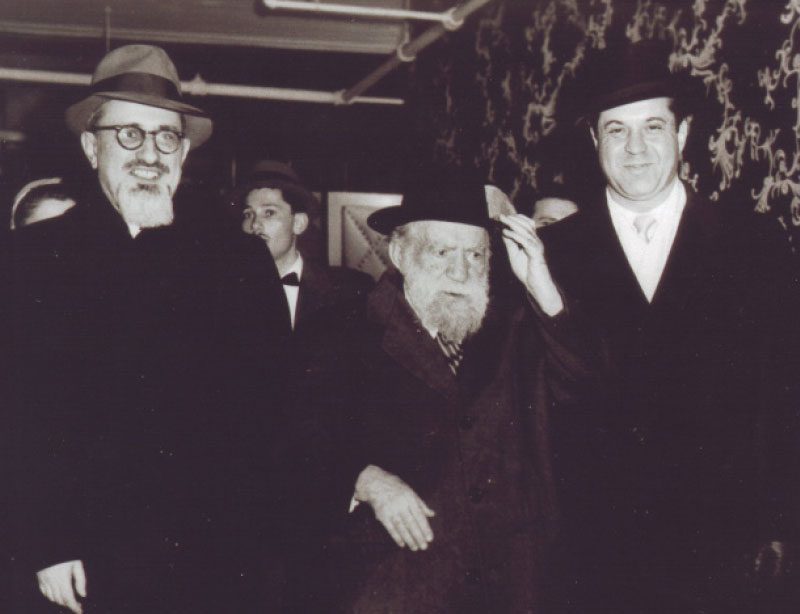
 

This article, published on the occasion of the anniversaries of the passing of Rabbi Chaim Heller (14 Nisan 5720) and Rabbi Joseph B. Soloveitchik (18 Nisan 5753), may their memories be a blessing, reexamines their relationship through a newly published body of correspondence, situating their bond within the intellectual and material conditions of mid-twentieth-century American Orthodoxy.[1] The letters document both a relationship of unusual personal and scholarly closeness and the economic precarity and institutional instability that affected even leading Torah scholars of the period.

One such document, written by R. Soloveitchik in 1942 at a moment of acute crisis, reads as follows:
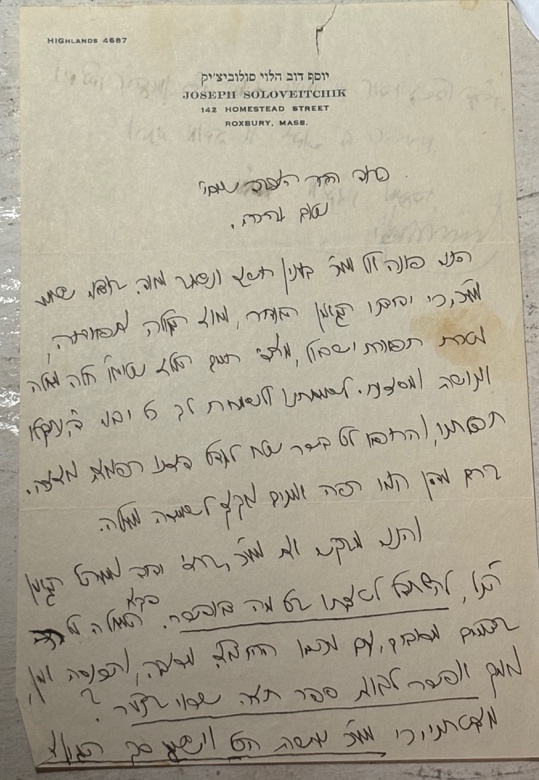
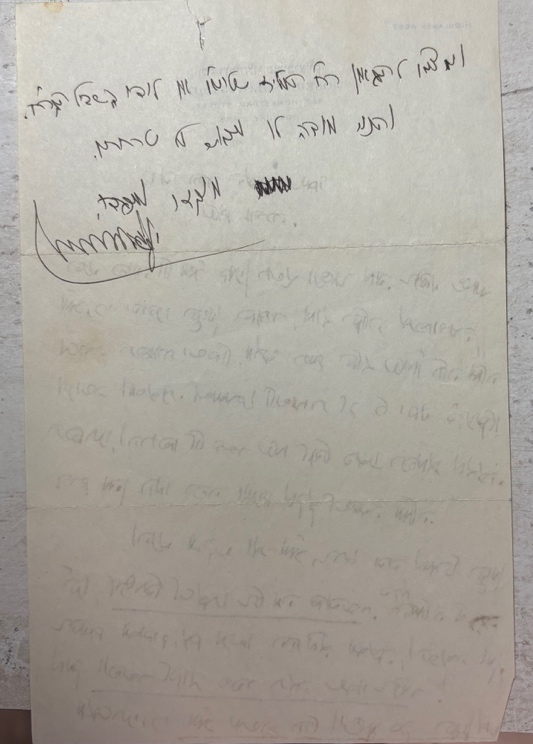
“Your esteemed honor has surely heard that our friend, the great and mighty gaon, luminary of the Diaspora and its glory, the crown of Israel’s splendor, our teacher and master Rabbi Chaim Heller, may he live long, has fallen gravely and dangerously ill. To our joy, and to the joy of all who fear God, our prayers have been accepted, and the Healer of all flesh has sent recovery and healing to the great one of our generation. Yet he remains weak and requires exceptional care. I therefore request of your esteemed honor, as a friend of the aforementioned gaon, to exert yourself on his behalf in every possible way. The supervision of the illness has entailed great expense, and even now the outlay is considerable while there is no income – and how can one behold a Sefer Torah in distress? I am confident that your esteemed honor will do all that is necessary, secure a fitting sum, and deliver it to the gaon R. H. Heller, may he live long, or to the fund ‘For R. H.’ I thank him in advance for his efforts. Your admirer and one who honors you.”[2]

In this letter, Soloveitchik addressed his friend Rabbi Simon (Abraham Yeshayahu) Dolgin,[3] then rabbi of Congregation Beth Jacob in the Beverly Hills neighborhood of Los Angeles, where he would serve for more than three decades and build one of the most significant Orthodox communities on the American West Coast. Upon receiving the appeal, Dolgin promptly sent a contribution; it appears, however, that its amount did not meet Soloveitchik’s expectations.

In a subsequent letter of appeal sent to Rabbi Dolgin approximately one month later [=14 July 1942], R. Soloveitchik again wrote:
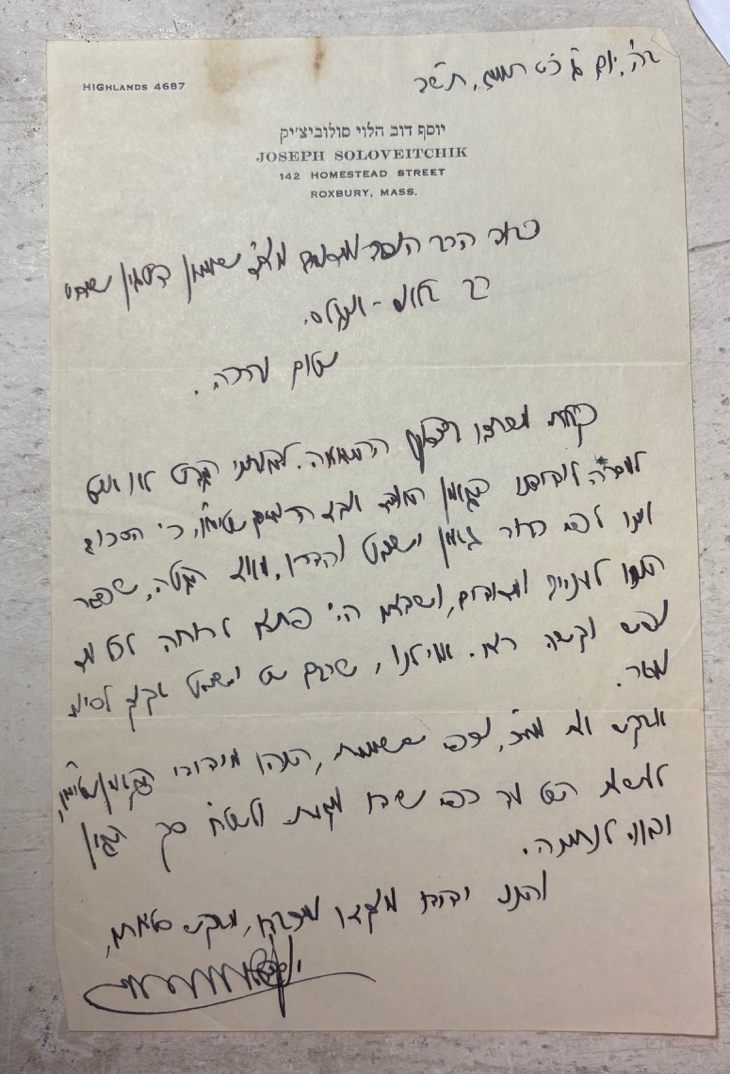
“I received your letter together with the check. To my great regret I cannot deliver it to our friend, the great gaon, the mighty shepherd, may he live long, for the sum is not commensurate with the honor and majesty of a gaon of Israel, a luminary of the Diaspora, who dispersed his wealth to the poor and destitute, and whose home was open wide to all who were embittered and broken in spirit. Woe unto us, that the rabbi of Israel stands in need of aid and assistance. I request of your esteemed honor – who, as I have heard, is among the friends of the aforementioned gaon – to do all that lies within your power and to send a proper and worthy sum.”

The letters published here for the first time provide a rare window into the distinctive relationship, a bond of unusual personal and intellectual intimacy, and the enduring ties that prevailed for decades between two of the leading Torah scholars in the United States in the twentieth century. At the same time, they illuminate the manifold hardships, including acute financial privation, humiliation, and disappointment, that rabbis of that period were compelled to endure as they sought even minimal means of livelihood with which to sustain their households. This fate did not spare even one of the foremost sages of the generation, R. Chaim Heller, who, in order to support his family, was compelled to piece together sporadic and temporary sources of income until he eventually attained, albeit only in relative terms, a measure of stability and a settled position that afforded him and his family a degree of economic security.[4]

Beyond their intrinsic interest, these letters are of particular importance by virtue of the period in which they were written. They date to the years of the Second World War, from which very little of Rabbi Joseph B. Soloveitchik’s correspondence has survived.

Already in these early letters, the literary Hebrew of R. Joseph B. Soloveitchik and his distinctive stylistic register stand out prominently.[5] They attest both to the profound bond between the two scholars and to R. Soloveitchik’s sustained concern for the welfare of his colleague and intimate friend, R. Chaim Heller. Their connection began years earlier in Berlin.

R. Chaim Heller (1879-1960) was among the leading Torah scholars of the early twentieth century. Alongside his greatness in Torah, he was deeply engaged in the scholarly study of Talmudic literature and biblical translation.[6] His work was characterized by a distinctive methodological orientation that sought to challenge the prevailing assumptions of modern biblical criticism through philological rigor grounded in the resources of the rabbinic tradition. In his introduction to On the Jerusalem Targum to the Torah (New York, 1921), R. Heller sharply criticized what he termed the “mechanical method” of comparing ancient translations in order to posit divergent textual recensions. Against this approach, he argued that the multitude of so-called “variants” in translations such as the Peshitta, the Septuagint, and the Samaritan Pentateuch do not reflect alternative Hebrew originals, but rather systematic exegetical practices. In his view, the translators did not render the biblical text literally, but interpreted and expanded it in light of traditions preserved in Hazal. This thesis enabled him simultaneously to undermine the conclusions of contemporary critics and to reaffirm the centrality and antiquity of the Oral Torah as an interpretive matrix for Scripture.[7]

This distinctive synthesis of traditional learning and critical scholarship was already prefigured in the formative trajectory of his early life. Born in Białystok and raised in Warsaw, he was already in his youth known as “the prodigy of Warsaw.” From the age of ten he ceased studying with melammedim; he never attended a yeshiva and acquired his entire Talmudic learning independently, as an autodidact. He married the daughter of a wealthy member of the Łódź community, and in the home of his uncle in Warsaw encountered the leading sages of the generation, engaging them in rigorous dialectical discussion. Among them were R. Yosef Dov Soloveitchik, author of Beit ha-Levi; R. Isaac Elchanan Spektor of Kovno; and the Netziv of Volozhin. During these years he also formed especially close ties with R. Chaim Soloveitchik, his relative by marriage R. Eliyahu Feinstein of Pruzhany, and R. Eliyahu Chaim Meisel of Łódź. In later years, he received a doctoral degree from the University of Würzburg.

Following the death of Rabbi Malkiel Tzvi Tannenbaum, the community of Łomża was left without a rabbi, and its leaders resolved to appoint Rabbi Heller, already known as a sharp and penetrating scholar and a man of broad learning who held a doctoral degree. By that time he had published studies on the Septuagint and on Maimonides, which drew the respect of both rabbinic and academic circles. Yet after only a few months he resigned his post. Various explanations have been offered for his departure: some point to his reluctance to devote extensive time to communal responsibilities, which he regarded as bittul Torah, while R. Joseph B. Soloveitchik recounted that Rabbi Heller himself expressed concern that members of the congregation might pressure him to act against his convictions.

R. Heller soon left for Berlin, where, in 1922 he established the Beit Midrash ha-Elyon, an advanced institution for rabbinic training that drew a small but serious circle of students. Berlin at the time was a meeting ground of worlds, traditional learning and modern scholarship, and Heller moved between them with unusual authority. In R. Heller’s case, this was not merely a sociological juxtaposition but a fully integrated intellectual stance, in which Wissenschaft methods were appropriated and redirected in defense of the integrity of the Masoretic text and the authority of the Oral Torah.[8] It was there that the young R. Soloveitchik spent several formative years. He was not formally enrolled in the institution, but he attended Heller’s lectures and was deeply influenced by them. What impressed him was not only R. Heller’s mastery of Torah and scholarship, but the range of his mind – the sense that he inhabited both disciplines fully, without strain or concession.

In 1929, R. Chaim Heller was appointed as a Visiting Professor of Bible at RIETS,[9] and “for close to ten years Heller taught in New York while occasionally traveling to Berlin and elsewhere before settling in the United States.” More than a decade later, his name was even floated by Rabbi Dr. Leo Jung as a potential successor as Rosh Yeshiva of RIETS following the death of R. Moshe Soloveichik in 1941.[10] A contemporaneous portrait of Heller’s intellectual profile appears in a 1930 article by R. Yerahmiel Elimelekh (Max J.) Wohlgelernter in the ha-Pardes journal, in which R. Heller is presented not merely as a scholar of unusual range, but as a figure who entered directly into confrontation with modern biblical criticism on its own terms, armed with philological expertise yet grounded in the authority of the rabbinic tradition. Against what R. Wohlgelernter characterizes as the “mechanical” methods of contemporary critics, R. Heller is depicted as demonstrating that the multiplicity of textual variants in ancient translations reflects interpretive practice rather than divergent textual recensions, thereby reasserting the integrity of the Masoretic text and the centrality of the Oral Torah as its interpretive matrix.[11]

In 1937, several years after the rise of the Nazis to power and the intensification of anti-democratic measures directed especially against the Jews, R. Chaim Heller emigrated to the United States and settled in New York. That same year, R. Moshe Feinstein likewise arrived in New York. During this period, R. Heller renewed his connection with R. Joseph B. Soloveitchik, who had come to the United States some five years earlier at the urging of his father, R. Moshe, then Rosh Yeshiva of the Rabbi Isaac Elchanan Theological Seminary. In Boston, R. Joseph B. Soloveitchik led his community with distinction and, alongside his teaching, increasingly assumed a position of broader intellectual and religious leadership, establishing himself as a central figure for a growing circle of students and adherents.[12]

Despite this recognition of his intellectual stature, the conditions that Heller encountered upon his arrival in the United States were markedly different. Like many rabbis who fled Germany on the eve of the Second World War and arrived in the United States as refugees,[13] R. Chaim Heller entered a professional landscape that was structurally inhospitable. The lingering effects of the Great Depression continued to constrain both the rabbinic and academic labor markets.[14] Congregational positions, even in smaller and more remote communities, were typically occupied by long-established incumbents, while the few available posts offered only modest remuneration. Universities, for their part, were in a period of contraction, with limited hiring and little institutional appetite for figures whose scholarly profile did not align neatly with existing departmental frameworks. For a scholar of Heller’s unusually wide and interdisciplinary range, no obvious institutional niche presented itself.

In response, Heller adopted a peripatetic mode of intellectual livelihood. Lacking a stable appointment, he supported himself through public lectures, assembling an income that remained precarious and contingent. This required sustained mobility, persistence, and a readiness to engage even relatively small audiences. At one stage, this itinerant circuit took him as far as Los Angeles, a journey that, under the conditions of the time, entailed considerable logistical and physical demands, where he delivered a series of lectures in his areas of expertise. It was likely in the course of this visit that he first encountered Rabbi Dolgin.
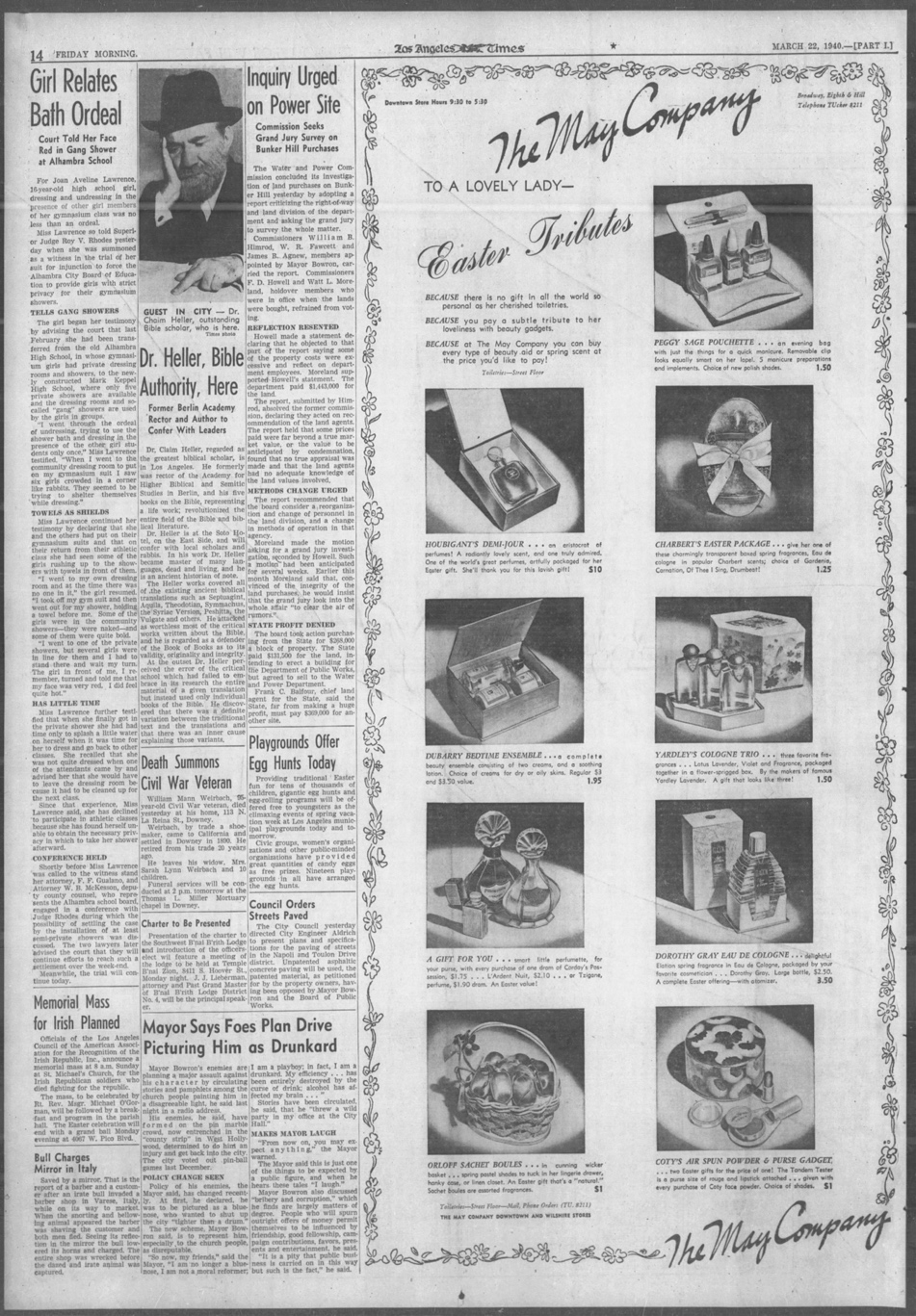
The notice of R. Chaim Heller’s arrival in Los Angeles appeared in the Los Angeles Times, March 22, 1940.

It may be assumed that, in the wake of this visit, the relationship between the two was further strengthened. Expression of this is found in three letters written during those years by R. Chaim Heller to R. Dolgin, which are published here for the first time.
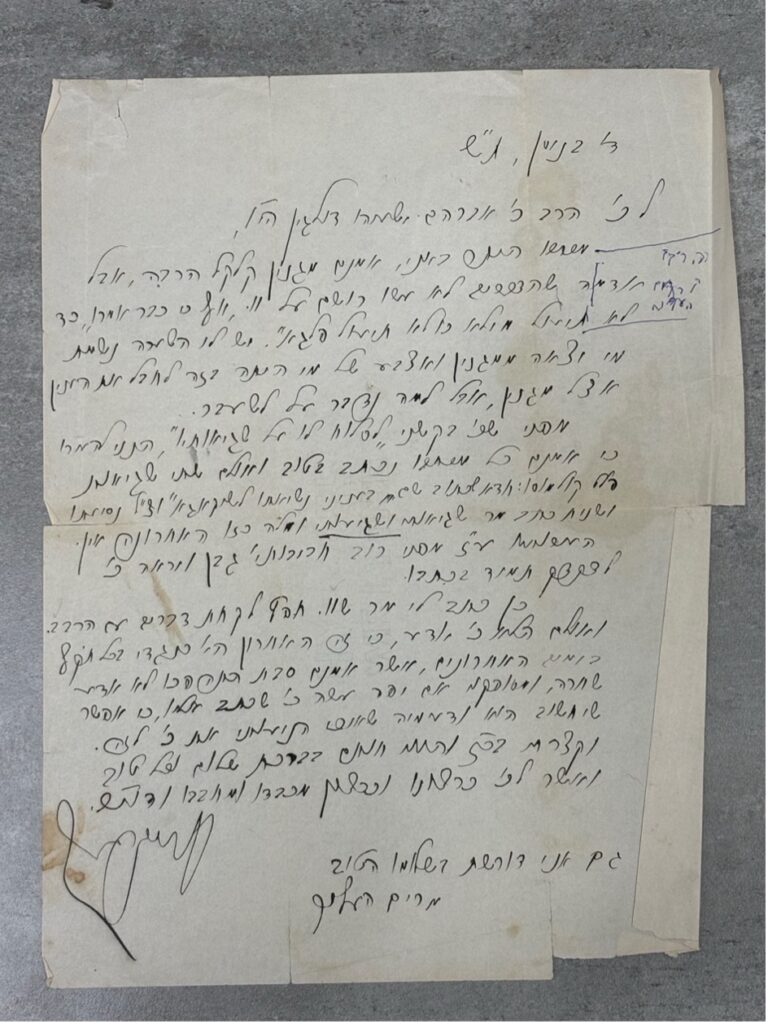
 

The first letter is dated 4 Nisan 5700 [= 12 April 1940], a short time, approximately three weeks, after R. Chaim Heller’s arrival in Los Angeles. It reads as follows:

“To the honorable Rabbi Abraham Isaiah Dolgin, may he live long: Your esteemed letter has reached me. Although Magnin[15] caused considerable damage, it seems to me that his words made no impression upon ploni, notwithstanding the saying, ‘When a word cannot enter in its entirety, it enters in part.’[16]

I have a conjecture as to whose soul spoke through Magnin, and whose finger was involved in undermining the matter there, but why should we speak of what has passed.

Since Your Honor requested of me “to forgive him for his errors,” I hereby note that, indeed, your entire letter was written well; however, two errors slipped from your pen: first, that you wrote also “concerning the matters of his נשיאתו (nesi’ato, ‘his presidency/bearing’) to Chicago,” whereas it should read נסיעתו (nesi‘ato, ‘his travel’); and second, that you wrote שגיאותי ושגיעותי (shegiyotai, ‘my errors’), and such a latter form does not exist.

I have drawn his attention to this out of my great affection for him,[17] and your honor should take care to be precise in his writing. You also wrote to me that Mr. Sh. desires to discuss matters with Rabbi B. [Bernard Revel[18]]; however, your honor knows that the latter has recently opposed me with full force, though I do not know the cause of his reversal,[19] and I am uncertain whether your honor acted wisely in writing to him, for he and those associated with him may think that I prompted your honor to do so. I have been brief in all this, and I conclude with blessings of peace and all good to your honor, according to your will and the will of one who esteems and cherishes you, and who inquires after your welfare.

Chaim Heller”

In the margin of the letter, his wife added a brief greeting of her own: “I too inquire after his welfare. Miriam Heller.”

The second letter was written approximately two months later, on the eve of the festival of Shavuot, in which R. Chaim Heller gives expression to his frustration that promises made to him, apparently concerning the provision of a stable source of livelihood, had not been fulfilled. It reads as follows:
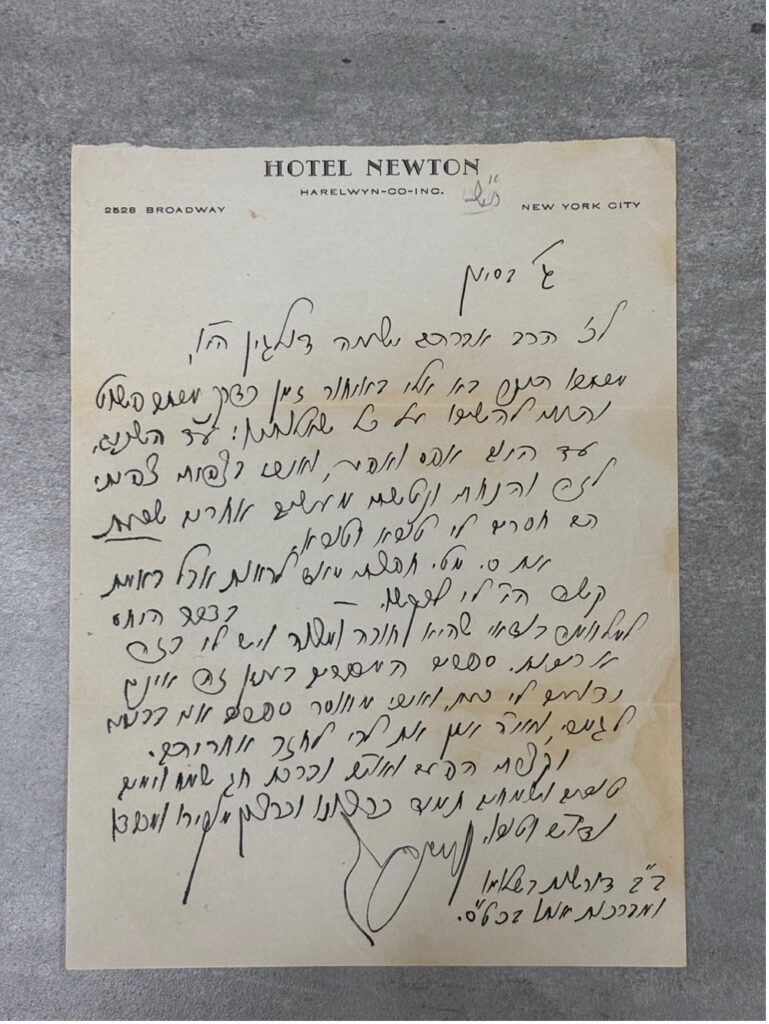
3 Sivan [5700] [9 June 1940]

To the honorable Rabbi Abraham Isaiah Dolgin, may God preserve and sustain him,

Your esteemed letter reached me with delay, as is the way of ordinary post, and I shall respond to all your inquiries: regarding the matter of the years [?], up to this day there is nothing whatsoever, and I had indeed waited and hoped for this, and accordingly set aside and abandoned other undertakings which I now lack greatly – very greatly.

I very much wished to meet with […], but in truth it was difficult for me to request this.

Concerning the attitude toward the war,[20] it is certainly an obligation and a commandment, and I have much to elaborate on this matter. Books addressing this subject are not presently known to me, for I am entirely without books in my home; with God’s help, I shall set my mind to seeking them out.

I shall be brief this time. With blessings for long life, a joyous festival, and days of gladness always, in accordance with your will and the will of one who esteems and honors you, who inquires after your welfare and goodness.

Chaim Heller

[p.s.] My wife and daughters inquire after your welfare, and bless you with every good, selah.

The third letter was written approximately a year later, on the eve of Passover 5701. At that time, reports in the press in the Land of Israel[21] indicated that R. Heller was about to receive a teaching appointment at Yeshiva University alongside his colleague R. Joseph B. Soloveitchik. Having grown accustomed to disappointment, R. Heller feared that this announcement amounted to no more than a “trial balloon” lacking any concrete foundation. This apprehension, together with his distress at both the substance and the tone of the report, found expression in a letter he addressed to R. Dolgin:
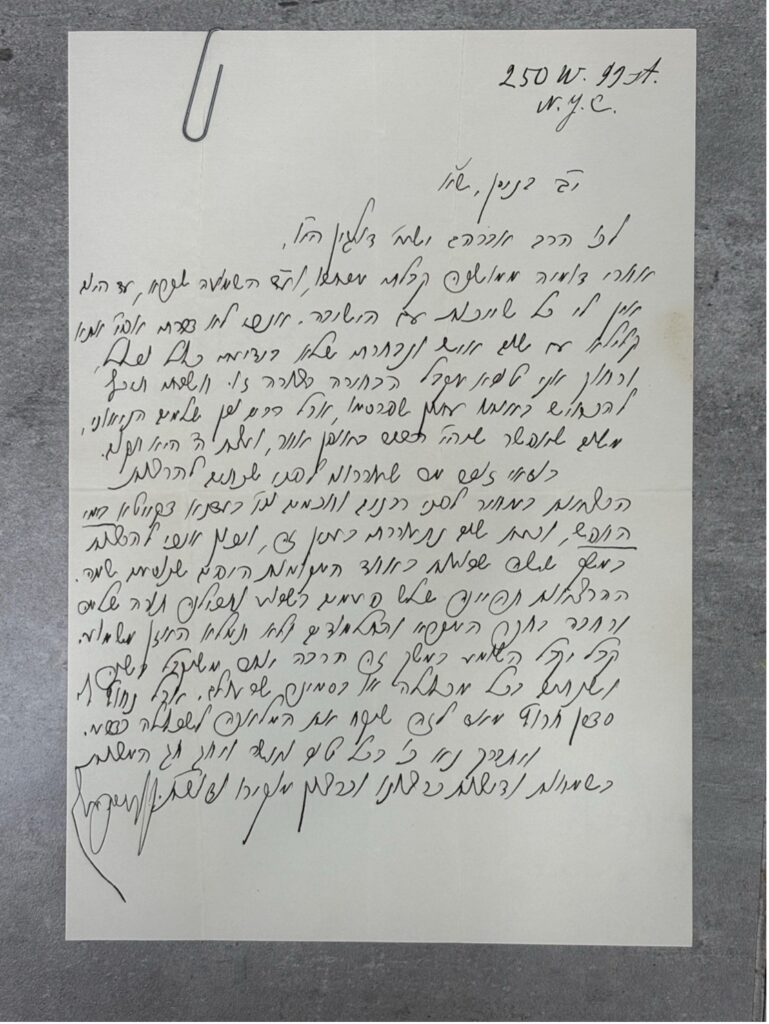
 

“12 Nisan 5701 [9 April 1941]

To the honorable Rabbi Abraham Isaiah Dolgin, may God preserve and sustain him,

After a long period of silence while confined to bed, I received your letter. Concerning the report that you read: to this day I have no connection whatsoever with the yeshiva.[22] I have not spoken even a word – however slight[23] – with any person, and I was selected entirely without my knowledge; indeed, I am far removed from accepting an appointment in such a manner. I immediately considered issuing a denial in the very newspaper that published the report, but many worthy individuals dissuaded me, on the grounds that matters might yet develop otherwise, and that the counsel of the Lord shall prevail.”

In this connection, he related to his friend his deliberations regarding an additional source of livelihood – delivering lectures to vacationers in the Catskill Mountains during the summer months:

“You surely recall that two years ago I was approached to deliver lectures, for remuneration, before rabbis and scholars, etc., during the summer season (be-idna de-qayta), in the vacation period; and now this matter has again been raised, and I am prepared to lecture for six weeks in one of the pleasant locales to which people travel.

The lectures would be held three times a week and would encompass a comprehensive and wide-ranging treatment of biblical scholarship and the Talmuds, such that ‘the ear would not be sated with hearing’.[24] Over this period, the listener would gain far more than he would in a year or two at any college or seminary in the world. However, I require a highly energetic organizer who will undertake to arrange this enterprise properly. May your honor be blessed with all good and prosperity, and may you celebrate the Festival of Unleavened Bread with joy and delight.”

After several years in the United States, during which he lacked a stable source of livelihood, R. Chaim Heller secured a position on the teaching staff of Yeshiva University and served alongside his colleague R. Samuel Belkin, R. Joseph B. Soloveitchik, and R. Moshe Shatzkes on the RIETS Ordination Board.[25]
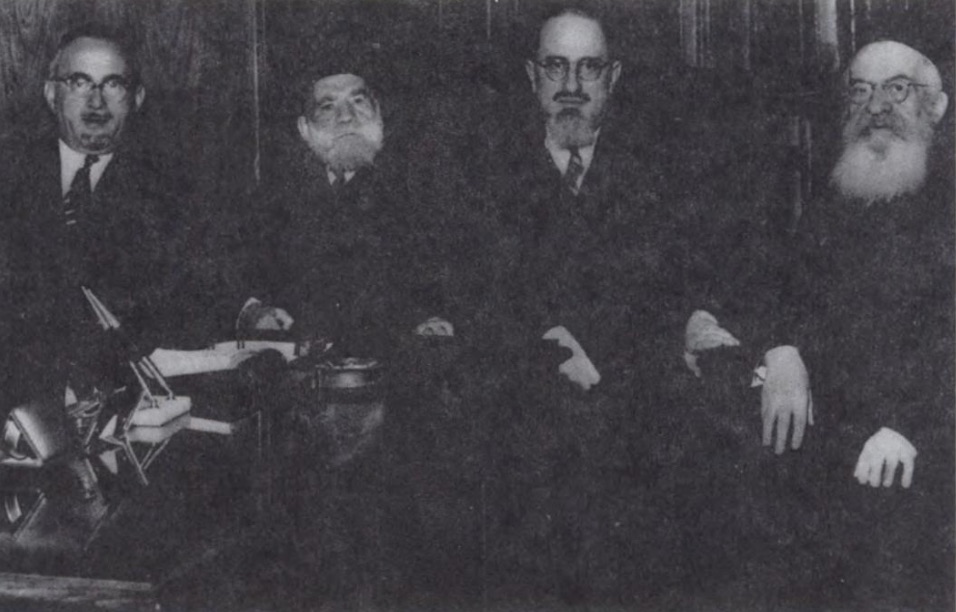
Screenshot

Yet, as emerges from a letter cited below, his salary conditions remained far from favorable. Efforts were made to improve them and, over time, met with a measure of success. The literary oeuvre of R. Chaim Heller is vast in scope. Yet, as R. Joseph B. Soloveitchik would later describe in his eulogy, what was published only represents only a minute fraction, “mere remnants of remnants,” of the breadth of his orally transmitted Torah. It should also be borne in mind that the overwhelming majority of his writings were composed prior to his arrival in the United States.

Among his works in the field of biblical scholarship, particular note should be taken of his studies on the textual tradition of the Bible and its various translations: his work on the Jerusalem Targum to the Torah (New York, 5681 [1921]); on the Samaritan Pentateuch (Berlin, 5684 [1924]); on the Septuagint in the Concordance Heikhal ha-Qodesh, with appended notes, commentaries, and investigations in biblical studies (New York, 5704 [1944]); and on the Peshitta, the Syriac translation of the Bible (transcribed into Hebrew script, with notes, glosses, and commentaries by Chaim Heller: Genesis, Berlin, 5687 [1927]; Exodus, Berlin, 5689 [1929]). He prepared a revised edition of the Peshitta to Exodus for publication but did not succeed in completing its printing prior to his death. Among his halakhic works, his annotated edition of Maimonides’ Sefer ha-Mitzvot (first edition, Piotrków, 5674 [1914]) is well known. A subsequent edition of this work was published by Mossad HaRav Kook in Jerusalem (5706 [1946]) – and has since appeared in numerous further editions – and for this work he was awarded the Rav Kook Prize in 5707 [1947]. His writings also include Hiqrei Halakhot, analytical investigations of legal rulings and issues in the section Hoshen Mishpat (vol. I, Berlin, 5684 [1924]; vol. II, Piotrków, 5692 [1932]); as well as studies on various topics in Maimonides and the halakhic decisors concerning the laws of lending and borrowing and their ancillary matters (Chicago, 5706 [1946]). In addition, he published, in jubilee and memorial volumes, several qontrasim that functioned as a kind of Masoret ha-Shas for the Jerusalem Talmud.[26]

Even after R. Chaim Heller had joined the faculty of Yeshiva University, R. Joseph B. Soloveitchik continued to seek ways to assist him, inter alia by working to secure an increase in his salary. Expression of this may be found in a brief letter that he wrote to R. Chaim Heller on 23 Sivan 5713 (5 June 1953), which is likewise published here for the first time:
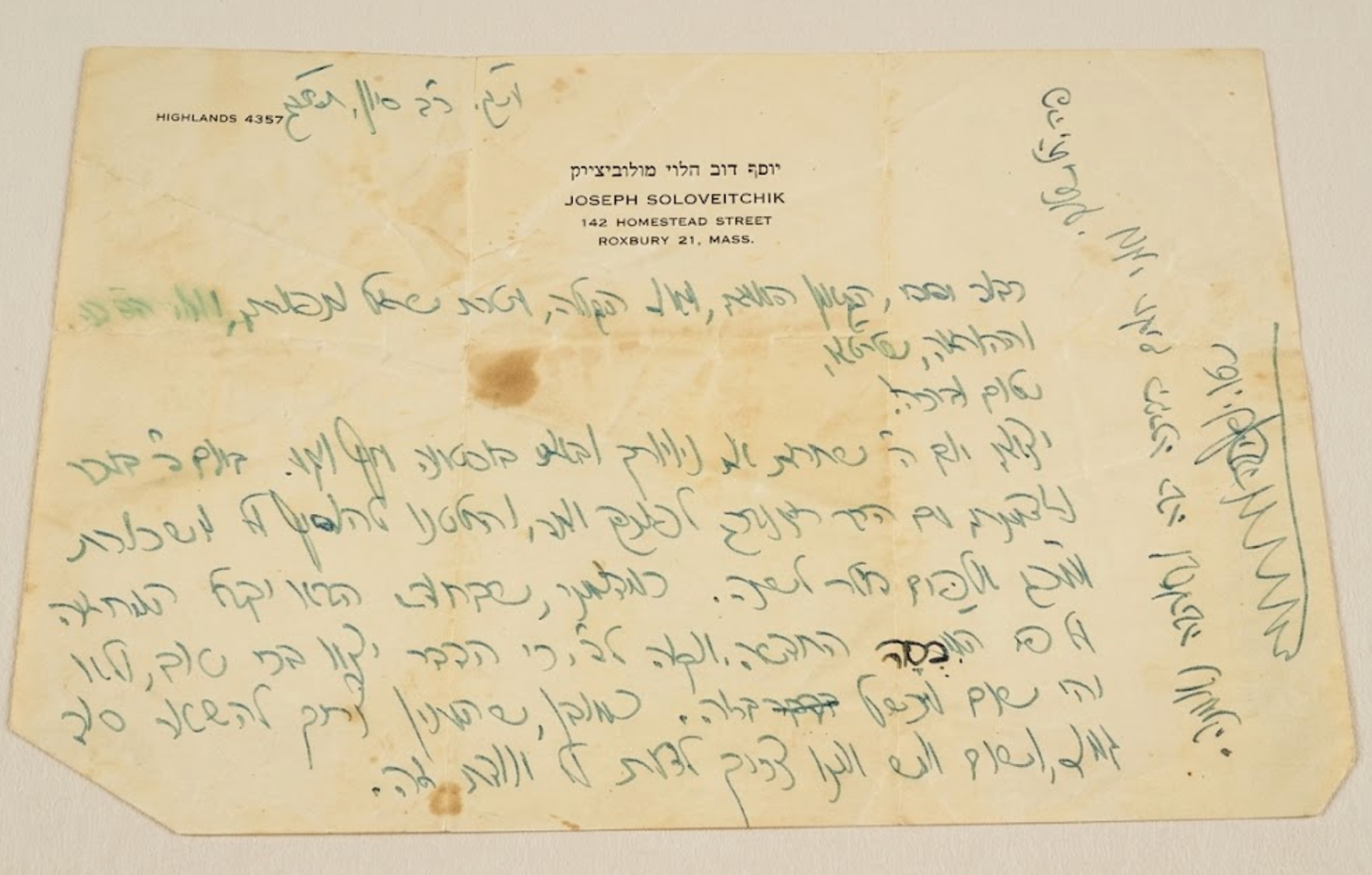
Erev Shabbat, 22 Sivan 5713 [5 June 1953]

To my honored friend, the true gaon, luminary of the Diaspora, crown of Israel and its glory, pillar of halakhah and instruction, may he live long,

Greetings and blessings!

I departed New York on Thursday morning and arrived in Boston utterly exhausted. On the preceding Wednesday I met with Rabbi Rosenberg at a certain inn, and we resolved to add two thousand dollars annually[27] to your honor’s salary. It seems to me that next month you will receive a check in accordance with the new scale. We trust in God that the matter will be brought to a good conclusion and that no obstacle will arise in connection with it. Naturally, the matter must remain in absolute confidence, and no one need be informed of it.

I conclude with abundant blessing and faithful affection,

Joseph Dov HaLevi Soloveitchik[28]

This quiet intervention on Heller’s behalf was not an isolated act, but part of a sustained pattern of concern. In this connection, it is instructive to recall R. Aharon Lichtenstein’s characterization of R. Joseph B. Soloveitchik, in his eulogy. Reflecting on his father-in-law’s own self-understanding, he writes:

“The personal self-conception that characterized the Rav, of blessed memory, with respect to his own functioning was bound up with educational–pedagogical activity, and this across multiple spheres. He would often remark that when he arrived in the World of Truth, and were he to be asked to specify by virtue of what he merited a share in the World to Come, he would indicate three points: (a) that he studied Torah with his children; (b) that he founded the Maimonides School in Boston; (c) that he was concerned, over an extended period, for the honor and welfare of a certain talmid hakham.”[29]

This final point refers to R. Soloveitchik’s sustained and well-documented efforts on behalf of R. Chaim Heller. The depth of this personal concern was not confined to the private sphere, but found parallel expression in a sustained intellectual and institutional collaboration between the two. A further expression of their bond and cooperation is found in their joint letter of response to Israeli Prime Minister David Ben-Gurion, who in 1958 approached them, among other “Sages of Israel,” to solicit their opinion on the question “Who is a Jew?” Although the inquiry was addressed to each of them separately, the two resolved to compose a joint reply. Thus they wrote, inter alia:

“We are indeed perplexed that the State of Israel now seeks to hew down our traditional branches and thereby smear the ancient glory of Israel which has long been sanctified through the spilt blood and sufferings of preceding generations. It is only because of these roots that we preserve our uniqueness as a holy people and that we are inextricably bound to the Holy Land. … Will the present State of Israel be built up by (maintaining a threat of) destruction to its very sanctity?”[30]

The same bond found further expression in another brief letter issued by R. Joseph B. Soloveitchik some two years later, likewise published here for the first time. The occasion for its dispatch was the forthcoming wedding of R. Joseph B. Soloveitchik’s daughter, Tova, to Rabbi Dr. Aharon Lichtenstein, his most distinguished student.

In September 1959, a small notice appeared in the “Announcements” column of The Commentator, the student newspaper of Yeshiva University, reporting the engagement of Dr. Aharon Lichtenstein, a member of the class of 1953, to Tova Soloveitchik. It appeared alongside advertisements for driving instruction and for Barton’s confectionery (under OU supervision).[31]

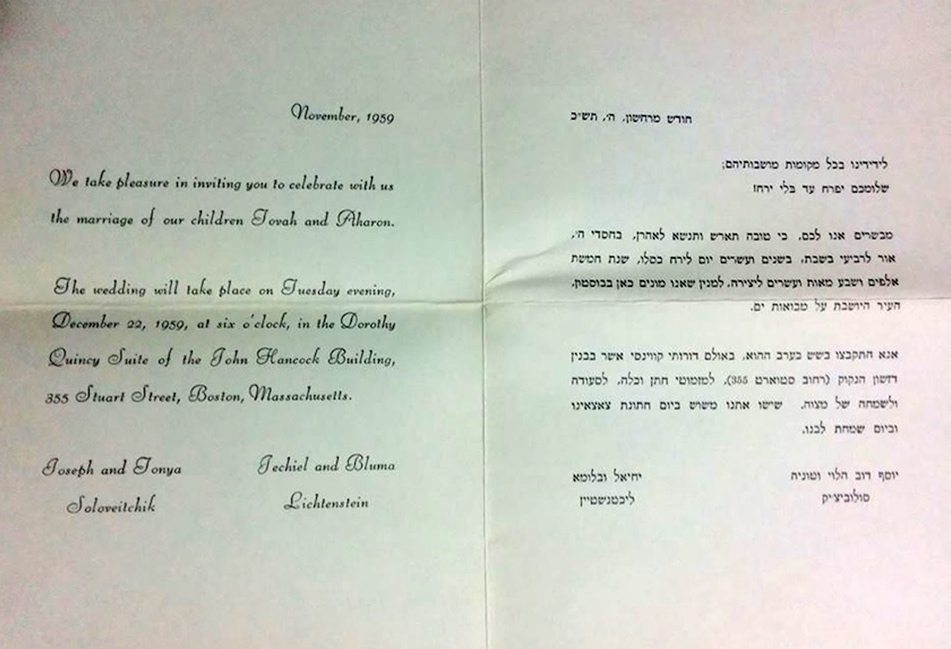
Approximately a month and a half later, in November 1959, the parents of the couple sent a formal invitation to family members and acquaintances. The Hebrew text was ornate, replete with distinctive idioms, and clearly bore the imprint of R. Joseph B. Soloveitchik’s unique stylistic signature:

“To our friends in all their places of residence – may your peace flourish without end! We hereby inform you that Tova shall be betrothed and married to Aharon, with the grace of God, on the evening preceding the fourth day of the week, on the twenty-second day of the month of Kislev, in the year five thousand seven hundred and twenty from Creation, according to the reckoning we follow here in Boston, the city situated at the approaches of the sea. Pray assemble at six o’clock on that evening in the Dorothy Quincy Hall, in the John Hancock Building (355 Stuart Street), for the celebration of bride and groom, for the festive meal, and for the joy of a commandment. Rejoice with us in the joy of our offspring’s wedding day and in the gladness of our hearts. Joseph Dov HaLevi and Tonya Soloveitchik; Yechiel and Bluma Lichtenstein.”

By contrast, the English version was brief, formulated in a more formal and utilitarian manner. The period during which the invitations were sent was one of particular intensity in the Soloveitchik household. At that time, R. Soloveitchik received an informal invitation to put forward his candidacy for the position of Chief Rabbi of Israel[32]; concurrently, he was engaged in intensive preparation for the major eulogy for his uncle, the Griz, R. Yitzhak Ze’ev Soloveitchik, later known as the discourse “Mah Dodekh mi-Dod.”[33]
תמונה שמכילה טקסט, נייר, מכתב, ספר תוכן בינה מלאכותית גנרטיבית עשוי להיות שגוי.

On account of the mention of his name as a candidate for the office of Chief Rabbi, an extensive journalistic interview with R. Soloveitchik was conducted in Yedioth Ahronoth.[34] The interviewer, Elie Wiesel (later a Nobel laureate), reported that, following the Rav’s annual Teshuvah Derashah several months earlier, the Israeli consul general in New York had sent a telegram to Jerusalem declaring: “Here is the best candidate to replace Rabbi Herzog.”[35] Wiesel asked R. Soloveitchik whether he would agree to assume the position if it were offered to him. R. Soloveitchik replied that no such offer had yet been made, but added in principle: “One does not decline an invitation that comes from the Land of Israel… When I receive it, if indeed it is sent, I shall consider it with utmost seriousness. I shall ask myself whether I am worthy of so exalted an office.” When Wiesel further inquired whether it was true that his uncle, R. Yitzhak Ze’ev Soloveitchik, had instructed him not to accept the position, R. Soloveitchik dismissed the report: “It is difficult to believe such rumors. In our family there is a tradition not to compose wills… perhaps because we fear death and its reality.”[36]

In the course of the interview, R. Soloveitchik spoke with evident pride of the religious and spiritual revival among youth and young adults in America, yet added that talk of their immigration to the Land of Israel was, at most, “a beautiful dream.” He attributed the gap between the intensification of Jewish and religious consciousness and the reluctance to immigrate, inter alia, to Prime Minister David Ben-Gurion, who, in his view, failed to appreciate the potential inherent in religion to draw youth to Israel and to demand sacrifice on its behalf. “In my view,” said the Rav, “Ben-Gurion is a religious Jew, though it is possible that he himself does not know this.” These remarks, whose precise formulation was itself questioned in contemporaneous discussion, elicited sharp criticism from several prominent figures within American Jewry. Among them was Moshe Meisels, editor of ha-Doar, who, in a pointed “open letter,” challenged both the claim that Israel had lost its ‘messianic’ hold on the Jewish imagination and the attribution of this development to deficiencies in the religious posture of the Israeli state.[37] Questioning the very premise of R. Soloveitchik’s formulation, Meisels asked rhetorically whether it could truly be maintained that “the concept of Israel has lost its messianic content,” and whether the responsibility for such a development could plausibly be laid at the feet of the state. The Rav sought to respond, but was exceedingly occupied with the final polishing of the eulogy for his uncle, R. Yitzhak Ze’ev Soloveitchik, which he was to deliver within a matter of days.[38]

Indeed, as the Yiddish adage has it, a mentsh trakht un Got lakht – man plans, and God laughs. Only a few days after the wedding invitations for his daughter and R. Aharon Lichtenstein had been dispatched, R. Joseph B. Soloveitchik was diagnosed with colon cancer and was required to travel urgently to Boston to undergo life-saving surgery. R. Soloveitchik informed his family, including the bride and groom, on the night that he delivered the eulogy for his uncle. On the following day, he departed for Boston. The couple, of course, immediately announced the postponement of the wedding, and all prayed for the Rav’s recovery.

R. Soloveitchik himself, only fifty-seven years old at the time, confided to those close to him: “I suddenly ceased to be immortal; I became a mortal being.” In the nights preceding the operation, he undertook a profound reckoning of his life. In later years, he described something of his experience during those turbulent days:

“My existential awareness was an absolute one. Non-being did not enter into it. I would not sustain my gaze upon nihility. Whenever I started to think of death, my thoughts were dashed back and they returned to their ordinary objective, to life. When I looked upon my grandson, I always tried to think of him as if he were my contemporary. I believed that we would always do things and play together. Then sickness initiated me into the secret of non-being. I suddenly ceased to be immortal; I became a mortal being.

The night preceding my operation I prayed to God and beseeched him to spare me. I did not ask for too much. All I wanted was that he should make it possible for me to attend my daughter’s wedding, which was postponed on account of my illness – a very modest wish in comparison with my insane claims to life prior to my sickness. The fantastic flights of human foolishness and egocentrism were distant from me that night.

However, this ‘fall’ from the heights of an illusory immortality into the valley of finitude was the greatest achievement of the long hours of anxiety and uncertainty. Fundamentally, this change was not an act of falling but one of rising toward a new existential awareness which embraces both man’s tragedy and his glory, in all its ambivalence and paradoxality. I stopped perceiving myself in categories of eternity. When I recite my prayers, I ask God to grant me life in very modest terms.”[39]

Further testimony to R. Soloveitchik’s state of mind during this period is found in a letter he sent to R. Reuven Katz, Chief Rabbi of Petah Tikvah. At its outset, the Rav explains that he had fallen gravely ill and been confined to bed, describing the experience in stark terms:

“Dark days, filled with anxiety, suffering, and silent loneliness, passed over me. My world was suddenly overturned. Yet the merit of my forefathers stood by me in the hour of wrath, and the Holy One, blessed be He, in His abundant mercy redeemed my soul in peace and did not allow me to die… Even now, as I begin to recover, I have not yet shaken off the physical weakness and the psychological dread that overcame me during those bitter and difficult hours of illness and suffering.”[40]

He then turns to the question of the Chief Rabbinate, noting both the changed circumstances and his own unsuitability for the role:

“However, the recent developments concerning the Chief Rabbinate… have cast a new light upon the situation, and I doubt whether I would be able to engage in Torah study with peace of mind… There is compelling reason to assume that I would become entangled in all the convolutions of politics, a matter that is neither to my spirit nor to my desire… Therefore I am compelled to acknowledge that, under the present circumstances, I am not fit for this office. I am a teacher, and I have in my world nothing but the four cubits of halakhah. I do not wish to depart from them, even were I to be offered an entire kingdom.”

These remarks make clear that R. Soloveitchik’s refusal to consider candidacy for the position of Chief Rabbi was shaped both by the lingering effects of illness and by a principled resistance to political entanglement, together with a self-conception rooted in the life of Torah within “the four cubits of halakhah.”[41]

As a result of his illness, R. Soloveitchik remained in Boston for approximately three months, during which he gradually recovered. In the course of this period, he merited to bring his daughter Tova and his son-in-law, R. Aharon Lichtenstein, under the wedding canopy. In consultation with the family, it was decided to postpone the wedding by only one month following the operation, and it was ultimately held on 26 Tevet 5720 (26 January 1960).[42]

A week before the rescheduled wedding, still confined to his bed and not yet recovered from surgery, R. Soloveitchik insisted on writing to his close friend R. Chaim Heller. The letter, published here for the first time, was not written in his own hand. The script shows that he dictated it, most likely to his wife, and, in his weakened state, managed only to sign his name.
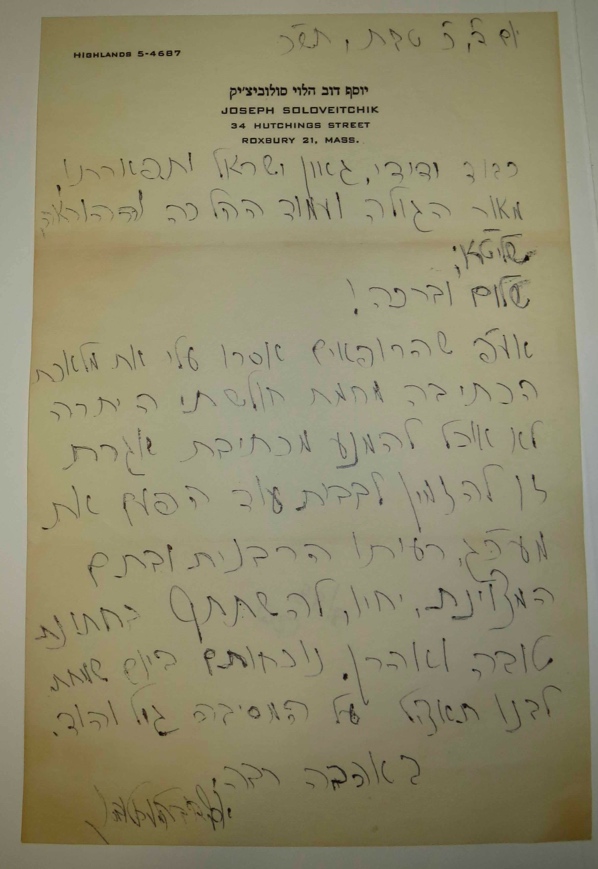
“To my honored friend, the gaon of Israel and its glory, luminary of the Diaspora and pillar of halakhah and instruction, may he live long; greetings and blessings! Although the physicians have forbidden me to engage in writing on account of my extreme weakness, I cannot refrain from writing this letter in order once again to extend a heartfelt invitation to your esteemed honor, to your esteemed wife, and to your distinguished daughter, may they live, to participate in the wedding of Tova and Aharon. Their presence on the day of our heart’s rejoicing will lend joy and splendor to the celebration. With great affection, Joseph Dov HaLevi Soloveitchik.”

His wife, Dr. Tonya Soloveitchik, appended a moving appeal of her own in Yiddish:[43]
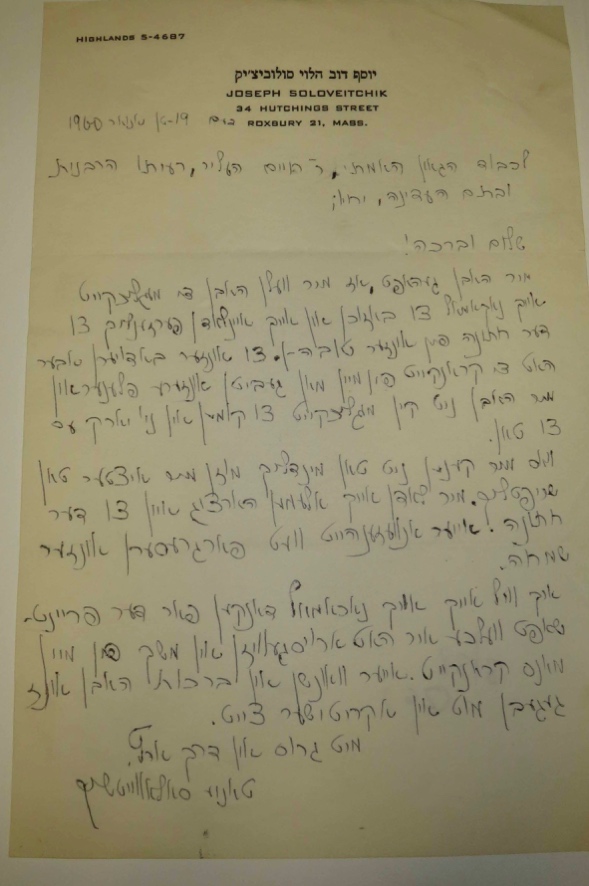
January 19, 1960

To the honorable and true gaon, R. Chaim Heller, to his esteemed wife, the rebbetzin, and to their refined daughter, may they live – greetings and blessings!

We had hoped that we would have the opportunity to visit you once more and to invite you personally to the wedding of our Tova. To our regret, however, my husband’s illness has altered our plans, and we have no possibility of coming to New York to do so.

What we are unable to do orally, we must now do in writing: we warmly invite you all to the wedding! Your presence will greatly enhance our joy.

I also wish once again to thank you for the friendship you have shown during my husband’s illness. Your good wishes and blessings gave us strength at a critical time.

With regards and respect,

Tonya Soloveitchik

In the end, R. Chaim Heller did not attend the wedding, apparently due to his frail health and the difficulty of traveling from New York to Boston. Within a few months, on the Fourteenth of Nisan 5720 (10 April 1960), the Eve of Passover, he returned his soul to his Creator.[44] Although the constraints of time and the approaching festival precluded extended eulogies, R. Joseph B. Soloveitchik flew from Boston to New York to attend the funeral, delivered brief words of farewell, recited kaddish at the funeral,[45] and returned to Boston before the onset of Passover. The rabbinic journal ha-Pardes would later note that “his close friend and trusted associate, Rabbi Joseph Dov Soloveitchik of Boston, eulogized him in moving words.”[46] Although these remarks were long thought to have been lost, a partial and mediated record preserved in the Yiddish press makes it possible to recover something of their content:

“A visit to Rabbi Chaim Heller was in the nature of a pilgrimage… When I would arrive at the elevator of the building at 210 West 99th Street… I would experience a sensation as though a curtain had descended, separating between the sacred and the profane. The Temple comprised three divisions: the Holy of Holies, the Sanctuary, and the Courtyard. Rabbi Chaim embodied all three. He conducted himself within the Holy of Holies… his occupation was solely with Torah… The entirety of the Torah lay before him as an open book… Yet he also partook of the character of the Courtyard, engaged with the community of Israel as a whole… From him radiated both the light of immense knowledge and the simplicity of humanity.”[47]

Even in this compressed form, the structure of the eulogy is already fully present: Heller is cast simultaneously as a figure of absolute immersion in Torah, of intellectual breadth, and of human accessibility, an integration that would find fuller expression in Soloveitchik’s later memorial address. Several weeks later, he returned to the task in a more formal setting, delivering a powerful and deeply moving eulogy at a memorial gathering at Yeshiva University.

As is well known, and in keeping with the characteristic reserve of the Lithuanian Torah greats, R. Joseph B. Soloveitchik was generally sparing in his expressions of affection, esteem, and praise for fellow scholars, and rarely employed language of overt admiration. In the case of R. Chaim Heller, however, he departed from this pattern and bestowed upon him an exceptional and uncommon measure of appreciation, the like of which he appears to have granted to few, if any, other Torah scholars.

This finds expression in the great and moving eulogy that R. Soloveitchik delivered for R. Chaim Heller nine weeks after his passing, at a public gathering at Yeshiva University on June 13, 1960, which also included eulogies by the institution’s president, Dr. Samuel Belkin. R. Soloveitchik’s eulogy was published the following year on the occasion of the first yahrzeit under the title “Rabbi Chaim Heller: The ‘Shmuel ha-Katan’ of Our Generation,” and opened with the following words:

“Who was this man who departed from us in silence and with gracious humility? What was his stature, and what were his deeds? Who was R. Chaim, who held no public office and had no need for conventional titles – whose entire greatness was encapsulated in two simple words: ‘R. Chaim,’ greater than ‘Rabban’ was his name? Some years ago… when the president of this institution, Rabbi Samuel Belkin, introduced R. Chaim… he employed the following formulation: ‘R. Chaim belongs to that small company of men of virtue for whom we pray each day in the Amidah: for the righteous, for the pious, for the elders of Your people the House of Israel, and for the remnant of their scribes. R. Chaim,’ the rabbi continued, ‘is of the remnant of Israel’s scribes.’ In this utterance he encapsulated all that was singular and wondrous in the man. At the time, I was seated on the platform beside R. Chaim, and as I beheld him – entirely withdrawn, enclosed and self-contained, as though scorched by the gaze of the audience fixed upon him – his lips murmuring, ‘What does he want of me?,’ and the pained embarrassment of a solitary individual, thrust against his will into a bustling and clamorous crowd, spread across his face…”[48]
תמונה שמכילה בחוץ, לבוש, אדם, מכונית תוכן בינה מלאכותית גנרטיבית עשוי להיות שגוי.

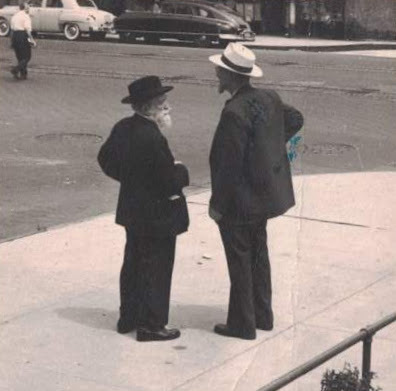
R. Chaim Heller and R. Joseph B. Soloveitchik in New York, in the vicinity of Yeshiva University.

Notes

    1. A shorter, and non-annotated, version of this article appeared in Hebrew as Aviad Hacohen and Menachem Butler, “‘A Sefer Torah in Distress’,” Makor Rishon, Pesach Supplement, no. 1495 (1 April 2026): 10-11, 16 (Hebrew), available here.We are grateful to our friend Aaron R. Katz and to the Dolgin family for granting us access to letters sent by Rabbi Joseph B. Soloveitchik and Rabbi Chaim Heller to the family patriarch, Rabbi Simon (Abraham Isaiah) Dolgin, of blessed memory. We thank Shulamith Z. Berger of the Yeshiva University Archives for providing photographs of Rabbi Joseph B. Soloveitchik and Rabbi Chaim Heller. We are also grateful to Rabbi Moshe Dembitzer, author of several landmark biographical studies of Rabbi Chaim Heller, for sharing with us a forthcoming, as yet unpublished essay on Rabbi Soloveitchik’s graveside eulogy for Rabbi Heller.
    2. The letter bears no date; however, the postmark on the envelope indicates that it was sent from Boston to Los Angeles on June 9, 1942.
    3. On Rabbi Simon (Abraham Isaiah) Dolgin (1915-2004) and his extensive activities, see Jubilee Volume Minḥah Le-Ish: Presented to HaRav Simon A. Dolgin on the Occasion of His 75th Birthday, ed. Itamar Warhaftig (Jerusalem: Ariel, 1990). Ordained at the Hebrew Theological College in Skokie, Illinois, Dolgin assumed the rabbinate of Congregation Beth Jacob (later in Beverly Hills) in 1938 and served there for approximately thirty-two years, during which he transformed it into a prominent Orthodox community and developed a broad educational infrastructure, including the Harkham Hillel Hebrew Academy. In 1971 he immigrated to Israel, where he served as rabbi of the Ramat Eshkol neighborhood and later as Director-General of the Ministry of Religious Affairs. On his correspondence with David Ben-Gurion, see On the Character of the State of Israel: Correspondence between Prime Minister David Ben-Gurion and Rabbi Simon (Abraham Isaiah) Dolgin, ed. Yitzhak Goldshlag (Jerusalem, 1973; Hebrew).
    4. By way of comparison with the present, this phenomenon still finds occasional resonance in the lives of rabbis today.
    5. On this point, see the remark of Rabbi Aharon Lichtenstein, at the conclusion of his discussion of “The Rav as Eulogist” (forthcoming):“It is difficult for me to conclude without saying a word about the literary dimension of these eulogies. For all my admiration of the Rav’s Torah greatness, and of the content of these eulogies – which is, of course, primary – it is hard not to be left in astonishment at his literary and linguistic ability. We are speaking of a person who was not educated in the Hebrew language, and whose knowledge in this area was drawn from reading Haskalah literature. Let us recall: the Rav did not live in a Hebrew-speaking environment, nor did he speak Hebrew fluently. Yet the richness of his language is truly astounding. Were one to read these texts for this purpose alone, I have no doubt that he would be amply rewarded.”
    6. On the most recent biography and intellectual profile of R. Chaim Heller, see the now substantial body of recent scholarship, which has significantly advanced our understanding of his life and work, see Moshe Dembitzer, “The Letters of Rav Chaim Heller,” Hitzei Giborim, vol. 9 (2016): 923-952 (Hebrew), which assembles and analyzes a wide corpus of correspondence and reconstructs key aspects of his personal and scholarly networks; Uriel Banner, “Towards a Profile of Rabbi Chaim Heller,” Asif, vol. 8 (2023): 720-766 (Hebrew), offering a synthetic biographical portrait grounded in both contemporary testimony and archival material; and Moshe Dembitzer, “‘To Show My People a New Type’: The Academic Chapter in the Life of Rabbi Chaim Heller,” Mekhilta, vol. 5 (February 2024): 365-382 (Hebrew), which reconstructs in detail his academic formation and intellectual program, particularly his engagement with philology and the Wissenschaft des Judentums milieu.
    7. For earlier biographical and bibliographical information on Heller, see Jacob I. Dienstag, “Ein ha-Mitzvot: Bio-Bibliographical Lexicon of the Scholarship on Maimonides’ Sefer ha-Mitzvot,” Talpiyot, vol. 9, no. 3-4 [=Rabbi Chaim Heller Memorial Volume] (September 1970): 663-759, esp. 697-702 [#20] (Hebrew), available here, which underscores both his expertise in biblical translation and linguistics and his programmatic effort to defend the integrity of the Masoretic text. For a critical assessment of R. Heller’s methodology, see Marc B. Shapiro, Between the Yeshiva World and Modern Orthodoxy: The Life and Works of Rabbi Jehiel Jacob Weinberg, 1884-1966 (Oxford: Littman Library, 1999), 169-171, who characterizes R. Heller’s work as driven by a dogmatic commitment to the integrity of the Masoretic text and questions the scholarly validity of his attempts to account for all textual variants within that framework. On the polemical reception of Heller’s work among contemporaries, especially R. Yehiel Jacob Weinberg and Paul Kahle, see ibid. On the reception of Heller’s halakhic method within the American-yeshiva world, see Mordechai Gifter, “Halakhic Studies in [Rav Chaim Heller’s] ‘Le-Hikrei Halakhot’,” Talpiyot, vol. 9, no. 3-4 [=Rabbi Chaim Heller Memorial Volume] (September 1970): 913-921 (Hebrew). Rabbi Mordechai Gifter, at the time Rosh Yeshiva of the Telshe Yeshiva in Cleveland and a former student of R. Chaim Heller at Yeshiva College/RIETS in the early 1930s (prior to his subsequent entry to the world of Telshe in Lithuania), presents the work as a sustained program of conceptual halakhic analysis, marked by rigorous coordination of the Rishonim. In contrast to the reading of both Professor Jacob I. Dienstag and Professor Marc B. Shapiro, it is in Rabbi Mordechai Gifter’s reading of R. Chaim Heller that there is a reflection of the work’s reception within advanced yeshiva circles as an instance of high-level lomdus rather than as an idiosyncratic or marginal enterprise.
    8. See Moshe Dembitzer, “‘To Show My People a New Type’: The Academic Chapter in the Life of Rabbi Chaim Heller,” Mekhilta, vol. 5 (February 2024): 365-382 (Hebrew).
    9. “To Join Yeshiva Faculty: Dr. Chaim Heller of Berlin Will Be Professor of Bible,” The New York Times (18 September 1929): 24.
    10. Jeffrey S. Gurock, The Men and Women of Yeshiva: Higher Education, Orthodoxy, and American Judaism (New York: Columbia University Press, 1988), 130-131, 275n21. See also “Rabbi Chaim Heller, Yeshiva U. Professor, Dead at 81,” Yeshiva University News (5 April 1960), 6-7; and Gilbert Klaperman, The Story of Yeshiva University: The First Jewish University in America (New York and London: Macmillan, 1969), 152
    11. See Yerahmiel Elimelekh (Max J.) Wohlgelernter, “Rabbi Chaim Heller: Prince of the Torah and Ruler over the Treasures of Knowledge,” ha-Pardes, vol. 4, no. 2 (May 1930): 26-30 (Hebrew); and for a later popular portrayal in the American context, see Aaron Rosmarin, “Reb Chaim Heller – One in Generations,” The Jewish Criterion, vol. 20, no. 104 (15 September 1944): 175-178. Special thanks to Shimon Steinmetz for pointing us to this article by Dr. Aaron Rosmarin.
    12. See Seth Farber, “Reproach, Recognition and Respect: Rabbi Joseph B. Soloveitchik and Orthodoxy’s Mid-Century Attitude Toward Non-Orthodox Denominations,” American Jewish History, vol. 89, no. 2 (June 2001): 193-214; Seth Farber, “Immigrant Orthodoxy’s Last Stand: The Rise of Rabbi Soloveitchik to Rosh Yeshiva,” in Immanuel Etkes, ed., Yeshivot u-Batei Midrashot: Mordechai Breuer Jubilee Volume (Jerusalem: Shazar, 2006), 417-430 (Hebrew); Seth Farber, “Immigrant Orthodoxy’s Last Stand: The Appointment of Rabbi Joseph B. Soloveitchik as Rosh Yeshivah at RIETS and the Coming-of-Age of American Orthodoxy,” in Bentsi Cohen, ed., As a Perennial Spring: A Festschrift Honoring Rabbi Dr. Norman Lamm (New York, 2013), 173-187; and earlier in Seth Farber, An American Orthodox Dreamer: Rabbi Joseph B. Soloveitchik and Boston’s Maimonides School (Hanover, NH: Brandeis University Press, 2004).
    13. See, for example, Michael A. Meyer, “The Refugee Scholars Project of the Hebrew Union College,” in Bertram W. Korn, ed., A Bicentennial Festschrift for Jacob Rader Marcus (Waltham, MA: American Jewish Historical Society, 1976), 359-375; Michoel Zylberman, “Yeshiva’s Response to World War II and Revel’s Rescue of European Refugees,” The Commentator, vol. 69, no. 4 (16 November 2004): 22-23; and most recently, Cornelia Wilhelm, The Last Generation of the German Rabbinate: German Refugee Rabbis in the United States, 1933-2010 (Bloomington: Indiana University Press, 2024).
    14. On the difficulties faced by immigrant rabbis in securing stable positions in the United States during the interwar and Depression years, including the need to obtain congregational contracts as a condition of entry and the scarcity of viable pulpits, see Jonathan D. Sarna and Zev Eleff, “The Immigration Clause that Transformed Orthodox Judaism in the United States,” American Jewish History, vol. 99, no. 3 (July 2017): 357-376.
    15. Rabbi Edgar F. Magnin (1890-1984) was a prominent American Reform rabbi who served for decades as the spiritual leader of Wilshire Boulevard Temple in Los Angeles, one of the most influential Reform congregations in the United States.
    16. Bereshit Rabbah 56:4; that is, a statement containing lashon hara – if it does not enter in its entirety [into the heart of its recipient], at least part of it enters.
    17. “Out of the abundance of my affection for him”; a common idiom found in the sources of Mishpat Ivri.
    18. Yeshiva’s founding president Rabbi Bernard Revel passed away a few months later, on December 2, 1940, in the prime of his life, at the age of fifty-five (!). For a biography from more than a half-century ago, see Aaron Rakeffet-Rothkoff, Bernard Revel: Builder of American Jewish Orthodoxy (Philadelphia: The Jewish Publication Society of America, 1972). See also Sidney B. Hoenig, “Rabbinics and Research: The Scholarship of Dr. Bernard Revel,” in Leon D. Stitskin, ed., Studies in Judaica in Honor of Dr. Samuel Belkin as Scholar and Educator (New York: Yeshiva University Press, 1972), 401-467; Harvey Horowitz and William M. Kramer, “Stamp of Approval: Oklahoma Oilman and Rosh Ha-Yeshiva Bernard Revel,” Western States Jewish History, vol. 18, no. 3 (April 1986): 256-261; Jeffrey S. Gurock, “An Orthodox Conspiracy Theory: The Travis Family, Bernard Revel, and the Jewish Theological Seminary,” Modern Judaism, vol. 19, no. 3 (October 1999): 241-253; and Moses Mescheloff, “As I Knew Him: Memories of Rabbi Dr. Bernard Revel,” in Menachem Butler and Zev Nagel, eds., My Yeshiva College: 75 Years of Memories (New York: Yashar Book, 2006), 76-80; and William L. Lee, “President Bernard Revel’s Triple Program: Inventing Jewish and Semitic Studies for the Original 1928-1929 Yeshiva College Curriculum,” in Hayyim Angel and Yitzchak Blau, eds., Rav Shalom Banayikh: Essays Presented to Rabbi Shalom Carmy by Friends and Students in Celebration of Forty Years of Teaching (Jersey City, NJ: Ktav Publishing House, 2012), 201-224.
    19. This remark (dated 12 April 1940) may plausibly be connected to the negotiations then underway between Rabbi Joseph B. Soloveitchik and Dr. Bernard Revel concerning the proposed affiliation of Heikhal Rabbeinu Haym ha-Levi, the Boston graduate-level yeshiva founded by Rabbi Soloveitchik in 1939, with RIETS and Yeshiva College. Following a period of negotiation, a formal memorandum of agreement was drafted in May 1940, envisioning the Heikhal as a New England branch of the New York institution, with coordinated academic governance and shared institutional interests. In this context, R. Chaim Heller’s reference to Dr. Revel’s sudden opposition might reflect tensions surrounding these negotiations and suggests that Heller was attempting to advocate on Rabbi Soloveitchik’s behalf before Dr. Revel. See Rabbi Joseph B. Soloveitchik, Community, Covenant, and Commitment: Selected Letters and Communications, ed. Nathaniel Helfgot (Jersey City: Ktav Publishing House, 2005), 168-169 (no. 7, “Memorandum of Agreement Between RIETS, Yeshiva College and the Graduate-Level Yeshiva in Boston Opened by Rabbi Soloveitchik”); and Samuel Pardes, “Observations on Sukkot in Boston on the Occasion of Ha-Pardes’ Jubilee,” ha-Pardes, vol. 14, no. 8 (November 1940): 27-29 (Hebrew), who describes the rapid consolidation of Orthodox communal life in Boston under Soloveitchik’s leadership, including the central role of the Heikhal, thereby providing contemporaneous evidence for the institutional significance of the Boston enterprise. See also Menachem Genack, “Rabbi Nota Greenblatt, zt”l,” Jewish Action, vol. 83, no. 2 (Winter 2022): 67-68, who notes that during the six months in which Rabbi Greenblatt studied at Heikhal Rabbeinu Haym ha-Levi, Rabbi Soloveitchik “sat opposite the sole portrait in the room – that of ‘the Zeide, Reb Chaim’.” Although the proposed affiliation with RIETS and Yeshiva College ultimately did not materialize, Rabbi Soloveitchik’s Boston enterprise continued to consolidate locally.As Maimonides School historian Seth Farber notes, on December 31, 1940, the Maimonides Educational Institute merged with Yeshivat Torat Israel and Heikhal Rabbeinu Haym ha-Levi, forming a unified institution soon relocated to a centrally situated campus serving the Orthodox communities of Dorchester, Roxbury, and Mattapan. In 1962, reflecting shifting demographic patterns in Greater Boston, the Maimonides School relocated to Brookline under the leadership of Rabbi Soloveitchik and his wife, Dr. Tonya Soloveitchik, chair of the School Committee. See Seth Farber, An American Orthodox Dreamer: Rabbi Joseph B. Soloveitchik and Boston’s Maimonides School (Hanover, NH: Brandeis University Press, 2004), 56. See also Seth Farber, “Reproach, Recognition and Respect: Rabbi Joseph B. Soloveitchik and Orthodoxy’s Mid-Century Attitude Toward Non-Orthodox Denominations,” American Jewish History, vol. 89, no. 2 (June 2001): 193-214; Seth Farber, “Immigrant Orthodoxy’s Last Stand: The Rise of Rabbi Soloveitchik to Rosh Yeshiva,” in Immanuel Etkes, ed., Yeshivot u-Batei Midrashot: Mordechai Breuer Jubilee Volume (Jerusalem: Shazar, 2006), 417-430 (Hebrew); Seth Farber, “Immigrant Orthodoxy’s Last Stand: The Appointment of Rabbi Joseph B. Soloveitchik as Rosh Yeshivah at RIETS and the Coming-of-Age of American Orthodoxy,” in Bentsi Cohen, ed., As a Perennial Spring: A Festschrift Honoring Rabbi Dr. Norman Lamm (New York, 2013), 173-187; and Tovah Lichtenstein, “Mrs. Soloveitchik: A Biographical Sketch,” Tradition: A Journal of Orthodox Jewish Thought, vol. 55, no. 2 (Spring 2023): 95-112.
    20. The letter was written in the midst of the Second World War.
    21. “Leading Torah Sages Appointed Heads of Yeshivat Rabbeinu Yitzchak Elchanan in New York: Rabbis Dr. Chaim Heller, Rabbi Yitzhak Rubinstein of Vilna, and Rabbi Joseph B. Soloveitchik,” ha-Tsofeh (4 April 1941): 1 (Hebrew).
    22. This is a reference to the Rabbi Isaac Elchanan Theological Seminary.
    23. An expression from Kabbalistic and Hasidic literature, in its fuller form: “ata qalila de-leit beih meshasha,” meaning a slight utterance devoid of substance.
    24. See Ecclesiastes 1:8.
    25. This photo appears in Aaron Rakeffet-Rothkoff, The Rav: The World of Rabbi Joseph B. Soloveitchik, vol. 2 (Jersey City, NJ: Ktav Publishing House, 1999), 216. 
    26. At the time, a rumor circulated that these booklets were composed as part of a commentary on the entire Jerusalem Talmud; if such a work existed, it has not come down to us.
    27. $2,000 in June 1953 is equivalent to approximately $24,386.94 in present-day value, adjusted for inflation based on the U.S. Consumer Price Index.
    28. This letter was made available to us, through the courtesy of the family of R. Chaim Heller, in August 2012.
    29. See Aharon Lichtenstein, “Eulogy for Rabbi Joseph B. Soloveitchik,” Mesorah Journal, vol. 9 (1994): 8-33, esp. 24 (Hebrew).
    30. The letter was printed in English translation in Joseph B. Soloveitchik and Chaim Heller, Jewish Identity: Who Is A Jew?, ed. Baruch Litvin and Sidney B. Hoenig (New York: Feldheim, 1965), 116-117, and reprinted in a slightly different translation in Rabbi Joseph B. Soloveitchik, Community, Covenant, and Commitment: Selected Letters and Communications, ed. Nathaniel Helfgot (Jersey City: Ktav Publishing House, 2005), 168-169 (#27. “On the ‘Who is a Jew?’ Question [a]”).
    31. The Commentator, vol. 50, no. 1 (24 September 1959): 4. See also Jesse Sodden, “A Jewish Ideal Realized on the American Scene (Interview with Stephen Klein),” The Jewish Forum, vol. 34, no. 6 (June 1951): 105-108; and Morris Freedman, “Orthodox Sweets for Heterodox New York: The Story of Barton’s,” Commentary Magazine, vol. 13, no. 5 (May 1952): 472-480.
    32. On this episode, see Jeffrey Saks, “Rabbi Joseph B. Soloveitchik and the Israeli Chief Rabbinate: Biographical Notes (1959–1960),” Bekhol Derakheha DeAhu (BaDaD), no. 17 (September 2006): 45-67. For a detailed account of an earlier, unsuccessful candidacy and its broader implications, see Aviad Hacohen, “‘You May View the Land from a Distance, but You Shall Not Enter It’: Rabbi Joseph B. Soloveitchik’s Candidacy for the Tel Aviv Chief Rabbinate and the Riddle of His Subsequent Refraining from Visiting Israel,” in Dov Schwartz, ed., Religious Zionism: History, Thought, Society, vol. 9 (Ramat Gan: Bar-Ilan University Press, 2023), 153-222 (Hebrew).
    33. See Gerald J. Blidstein, “Rabbi Dr. Soloveitchik Eulogizes Famed Uncle, The Brisker Rav,” The Commentator, vol. 50, no. 5 (17 December 1959): 1,3. The eulogy was later published as Joseph B. Soloveitchik, “Mah Dodekh mi-Dod,” ha-Doar, vol. 43, no. 39 (27 September 1963): 752-759 (Hebrew), and reprinted in Joseph B. Soloveitchik, Besod Hayahid Vehayahad, ed. Pinchas Peli (Jerusalem: Orot, 1976), 191-253 (Hebrew).
    34. Elie Wiesel, “‘The Immigration of Jewish Youth from the United States Is in the Nature of a Beautiful Dream’…: said Rabbi Joseph B. Soloveitchik, who has been mentioned as a candidate for the position of Chief Rabbi of Israel, in a conversation,” Yedioth Ahronoth Sabbath Supplement (13 November 1959): 7 (Hebrew).
    35. See Jeffrey Saks, “Rabbi Joseph B. Soloveitchik and the Israeli Chief Rabbinate: Biographical Notes (1959-1960),” Bekhol Derakheha DeAhu (BaDaD), no. 17 (September 2006): 45-67, esp. 50.
    36. Elie Wiesel, “‘The Immigration of Jewish Youth from the United States Is in the Nature of a Beautiful Dream’…: said Rabbi Joseph B. Soloveitchik, who has been mentioned as a candidate for the position of Chief Rabbi of Israel, in a conversation,” Yedioth Ahronoth Sabbath Supplement (13 November 1959): 7 (Hebrew).
    37. See Moshe Meisels, “The State of Israel and the Land of Israel: A Sort of Open Letter to Rabbi Joseph B. Soloveitchik,” ha-Doar, vol. 40, no. 5 (4 December 1959): 71 (Hebrew).
    38. Gerald J. Blidstein, “Rabbi Dr. Soloveitchik Eulogizes Famed Uncle, The Brisker Rav,” The Commentator, vol. 50, no. 5 (17 December 1959): 1,3.
    39. These reflections were published only decades later, in Joseph B. Soloveitchik, Out of the Whirlwind: Essays on Mourning, Suffering and the Human Condition, eds. David Shatz, Joel B. Wolowelsky, and Reuven Ziegler (Hoboken, N.J: Ktav, 2003), 131-132. On this, see Dov Schwartz, “Finitude and Suffering: ‘Out of the Whirlwind’,” in From Phenomenology to Existentialism: The Philosophy of Rabbi Joseph B. Soloveitchik, vol. 2 (Leiden: Brill, 2013), 227-289.
    40. Published in full in Marc B. Shapiro, “Letters from the Rav,” Hakirah: The Flatbush Journal of Jewish Law and Thought, vol. 32 (2022): 135-168, at 165-166 (Hebrew). An abridged version appeared in “Rabbi Dr. Joseph B. Soloveitchik Refuses to Stand for the Office of Chief Rabbi of Israel [Letters to MK Haim-Moshe Shapira and Rabbi Reuven Katz],” ha-Doar, vo. 40, no. 19 (11 March 1960): 330 (Hebrew), and a partial English translation is found in Rabbi Joseph B. Soloveitchik, Community, Covenant, and Commitment: Selected Letters and Communications, ed. Nathaniel Helfgot (Jersey City: Ktav, 2005), 173-176 (no. 29, “Declining the Offer to Submit His Candidacy for the Position of Chief Rabbi of the State of Israel [a]”).
    41. See also Menashe Unger, “What Disappointed Rabbi Soloveitchik in the Chief Rabbinate?” Tog-Morgen Journal (11 March 1960): 5 (Yiddish); Menashe Unger, “Rabbi Soloveitchik Reflects upon the Great Responsibilities of the Rabbinate,” Tog-Morgen Journal (14 March 1960): 5 (Yiddish); and Menashe Unger, “Conversation with Rabbi Joseph B. Soloveitchik, ‘The Rabbinate and that of the State Are Two Separate Domains’,” ha-Tsofeh Literary Supplement (18 March 1960): 3-4 (Hebrew). An edited translation appears in Rabbi Joseph B. Soloveitchik, Community, Covenant, and Commitment: Selected Letters and Communications, ed. Nathaniel Helfgot (Jersey City: Ktav Publishing House, 2005), 179-185 (no. 31, “On the Chief Rabbinate of Israel [c]”);
    42. For the literary gift from Rabbi Jehiel Jacob Weinberg to the newlyweds, see Shaul Seidler-Feller, “‘Amru Lo HaKadosh Barukh Hu … Yodea Ani Kavanato shel Aharon Heikh Hayetah Le-Tovah’: On a Short Wedding Wish to the Lichtensteins from the Pen of Rabbi Jehiel Jacob Weinberg,” The Seforim Blog (18 June 2015), available here.
    43. Our thanks are extended to Dr. Vicki Shifris and Dr. Nathan Shifris for their assistance in translating the letter.
    44. R. Chaim Heller passed away at the Hospital for Joint Diseases in Manhattan (now NYU Langone Orthopedic Hospital). See “Rabbi Chaim Heller, Yeshiva U. Professor, Dead at 81,” Yeshiva University News (5 April 1960): 6-7.
    45. See Aharon Benzion Shurin, “The Gaon Rabbi Chaim Heller Who Passed Away on the Eve of Passover,” Forverts (15 April 1960): 6 (Yiddish); and the testimony regarding the recitation of Kaddish attributed to Aharon Benzion Shurin’s brother, Rabbi Israel Shurin, in Hershel Schachter, Mi-Peninei ha-Rav (Jerusalem: Flatbush Beth Hamedrosh, 2005), 266 (Hebrew).
    46. Samuel Pardes, “The Gaon Rabbi Chaim Heller,” ha-Pardes, vol. 34, no. 8 (May 1960): 40 (Hebrew).
    47. We thank Rabbi Moshe Dembitzer for sharing an unpublished forthcoming essay on Rabbi Soloveitchik’s eulogy at Rabbi Heller’s graveside. The present English translation is based on a Hebrew rendering of the text in a forthcoming study by Moshe Dembitzer, “Words of Farewell at the Bier of Rabbi Chaim Heller,” and has been checked against the Yiddish original published by Hillel Seidman, “Rabbi Chaim Heller: His Genius in Torah and in Hokhmat Yisrael,” Tog-Morgen Journal (20 April 1960): 5 (Yiddish). See also Hillel Seidman, “The Combatant for the True Meaning of the Torah: After the Passing of Rabbi Chaim Heller,” ha-Doar, vol. 40, no. 23 (29 April 1960): 443 (Hebrew); and Hillel Seidman, “The Gaon Rabbi Chaim Heller: In His Halakhic Rulings and His Practices,” ha-Doar, vol. 40, no. 24 (6 May 1960): 460-461 (Hebrew).
    48. Joseph B. Soloveitchik, “Rabbi Chaim Heller: The ‘Shmuel ha-Katan’ of Our Generation,” ha-Doar, vol. 41, no. 23 (21 April 1961): 400-405 (Hebrew), reprinted in Ohr ha-Mizrach, vol. 9. 1-2 (September 1961): 1-11 (Hebrew); and then republished under a new title in Joseph B. Soloveitchik, “Rabbi Chaim Heller,” Panim El Panim, no. 514-515 (2 April 1969): 20-25 (Hebrew); and Joseph B. Soloveitchik, “Profile of Rabbi Chaim Heller (On the Tenth Anniversary of his Passing — Eve of Passover, 5720),” Shana be-Shana (1970): 197-221 (Hebrew). It was later reprinted under the title “Peletat Sofreihem” (lit. “The Surviving Remnant of Their Scribes”) in Joseph B. Soloveitchik, Besod Hayahid Vehayahad, ed. Pinchas Peli (Jerusalem: Orot, 1976), 254-294 (Hebrew); and Joseph B. Soloveitchik, Divrei Hagut ve-Ha’arakha, ed. Moshe Krone (Jerusalem: World Zionist Organization, 1982), 137-162 (Hebrew). A translation of this essay appears in Joseph B. Soloveitchik, “A Eulogy for R. Hayyim Heller” (trans. Shalom Carmy),” in Joseph Epstein, ed., Shiurei ha-Rav: A Conspectus of the Public Lectures of Rabbi Joseph B. Soloveitchik (Hoboken, NJ: Ktav Publishing House, 1974), 46-65.


Review: Macsanyuh Shel Torah

Review: Me'achsanya Shel ha-Torahby Eliezer Brodt Me'achsanya Shel ha-Torah, Rabbi Moshe Hubner, ed., New York, 2008, 297 pp.   As mentioned in the past, there is an austounding amount of seforim being published.  One genre, that is bursting at the seams, is sefarim on Chumash. There are seforim printed from famous people; some are still with us, while others have been gone for many years. These seforim focus on all kinds of topics: mussar, machashavah, pshat, kabbalah, d'rush, and halachah. In truth, it is virtually impossible to keep up with what is printed. I would, however, like to mention just one such sefer printed this year: Me'achsanya Shel ha-Torah. This sefer is composed of three generations of Torah from the Hubner family. Most notably, Rabbi Shmuel Hubner, z"l, who was a big Rav for many years; ybl"ch, his son, Rabbi Y. Hubner; and his grandson, Rabbi Moshe Hubner, a young author who is frequently featured in the Hamodia Magazine Torah section. This sefer contains many interesting pieces on Chumash, some short and many long, representing unique and interesting topics and styles in learning. Aside from the many interesting chiddushim presented, it is worthwhile to note the mention of many rare and exotic sefarim quoted as sources throughout the work. As in almost any sefer, a variety of interesting content can be found apart from the actual body of the work. I would like to mention just a few of the interesting discussions I found in this sefer.  The sefer begins with a very nice but straight to the point biography of Rabbi Shmuel Hubner, written by his son, Rabbi Y. Hubner. This biography was based on stories heard from Rabbi Shmuel Hubner throughout his lifetime (1891-1983). Rabbi S. Hubner  made his rounds in Europe, meeting many different gedolim (almost like a Forrest Gump). (One gets the impression that there are many more nice stories that should have been printed here.) Just to mention some of the facts mentioned: Rabbi S. Hubner attended the levayah of Harav Yosef Engel, zt"l, and heard the famous hesped of Harav Meir Arik, zt"l, who said on Rav Engel that he was a baki in all areas of Torah, Bavli Yerushalmi, Tosefta, etc., to which Rav Steinberg, the Brode Rav, asked him if he wasn't perhaps exaggerating a bit. Rav Arik replied that it was one hundred percent true, and there was no exaggeration involved.  Rav Hubner studied at the Berlin Seminary and heard shiurim from Harav Chaim Heller, zt"l. He was in Vienna when the Rogatchver Gaon, zt"l, passed away and he visited with him a bit before he died. He heard the Rogatchver expound on some topics in the parashah based on his well-known and unique methods of thought and assessment. Rabbi Hubner was the rebbi of the well-known scholar and writer, ybl"ch, Rabbi Tuviah Preschel.   After the war, Rabbi S. Hubner was a Rav in Brooklyn. Over the years he printed many pieces on all kinds of topics in the various Torah journals. Eventually, he collected many of them that related to practical halachah and printed them in a sefer entitled Sh"ut Nimukei Shmuel. This sefer received very warm haskamos from Harav Moshe Feinstein, zt"l, and Harav Shlomo Zalman Auerbach, zt"l. Some of the pieces have been reprinted in Me'achsanya Shel ha-Torah, along with many new pieces found in Rabbi Hubner's many personal journals, which have never before been printed. This leads to a now-famous discussion regarding divrei Torah left behind after a person's petirah. In particular, if the mechaber did not leave instructions as to whether his writings should be printed, is his family permitted to do so? Another issue is, do these pieces carry weight in halachah, since the writer might have changed his mind before he passed away. An additional questioned is, if the mechaber specified not to print his writings, must his family adhere to his wishes? Much has been written on these topics, but Rabbi M. Hubner found information in his grandfather's notes addressing this very issue, which he included in Me'achsanya Shel HaTorah. Being that Rabbi S. Hubner's answer was very original, I am quoting it here in its entirety (intro pg. 9-10):   קראתי את תשובתו שבה כת"ה שקיל וטרי באריכות בנידון השאלה אם יש לשמוע להמחבר שציוה שלא לפרסם את כתביו הכוללים חידושים ותשובות. ואחרי שכת"ה מביא צדדי היתר וצדדי איסור הוא מגיע למסקנת שאין לשמוע לצוואת המחבר ויש להדפיס את כתביו. לע"ד נראה שיש לחקור ולמצוא טעמו ונימוקו של המחבר מפני מה הוא ציוה שלא להדפיס את כתביו ופסק הדין בשאלה זו תלוי בנימוקו של המחבר. דעתי זו מיוסדת על דברי הח"ס באו"ח סי' ר"ח שכתב וז"ל : כל המחבר ספר ומתערב במחשבתו לגדל שמו רבצה בו האלה האמורה במילי דאבות : נגיד שמא אבד שמא (פרקי אבות פ"א מי"ג) ולא תעשינה ידיו תושיה להוציא מחשבתו לפועל, כי יבוא מבקרי מומין ויחפשו וימצאו, מלבד שהוא עובר איסור דאורייתא דברים שבעל פה אי אתה רשאי לכותבן, ולא הותר אלא משום עת לעשות לה', (גיטין ס א) ואם איננו עושה לה' הרי איסורו במקומו עומד. לעומת זה מי שיודע בעצמו כי כל מגמתו לשם הית"ב, להגדיל תורה ולהדירה ורק מונע בר מפני חשש מבקרי מומין ומלעיגים ומלעיבים במלאכי ה' עבירה היא בידו, וכשם שיקבל עונש על הדרישה הנ"ל [אם אינה לשם שמים], כן ייענש זה על הפרישה, עכ"ל. בדברי החתם סופר הללו נמצאת התשובה על השאלה דמר. אם הציווי של המחבר שלא לפרסם את כתביו נבע מן החשש הראשון הנזכר בדברי הח"ס אז לדעתי מצוה לקיים דברי המת ולא להדפיסם, כי לב יודע מרת נפשו, ואין היורשים רשאים לעבור על צוואתו, כי ע"י הדפסת הספר יעשו רעה להמחבר, ואילו היה חי היה מורה בכל תוכף נגד ההדפסה, ועכשיו שאינו יכול למחות פסק הדין צריך למנוע מעשות לו עול. ואם ישאלני איך אפשר עכשיו לידע מה היה הנימוק שבגללו אסר את הפירסום ? אשיבנו שזה אפשר להכיר מתוך תשובותיו. אם דברי הח"ס מובאים בתשובותיו ובחידושיו, אז קרוב לודאי שגם תשובה זו היתה ידועה לו והיא היא שהניעה והביאה אותו לידי כך שיאסור לפרסם את כתביו. ברם אף אם דברי הח"ס אינם מובאים בתשובותיו אפשר ואפשר שתשובות הח"ס ובתוכן גם התשובה הנ"ל היו ידועות לו, שכן לא יצוייר שמחבר תשובות לא ישתמש בתשובות הח"ס. בהתחשבות עם זה לבי מהסס להתיר הפרסום. הדבר שונה אם הנימוק העיקרי לצוואתו לא היה החשש הנ"ל אלא מטעם אחר כגון מפני חשש המבקרים או מפני שהיה מיראי הוראה, אז רשאי או יותר נכון מצוה להדפיס את כתביו כמפורש בדברי הח"ס שהבאתי לעיל. והנני להביא עוד ראיות לכך : בספר חסידים סי' תתקל כתב מי שגילה לו ה' דבר ואינו כותבו הוא גוזל את הרבים כדכתב סוד ה' ליראיו ובריתו להודיעם. ובשבט סופר (פ' כב) דעתיד אדם ליתן דין וחשבון על זה שאינו כותב חידושיו. ובספר מור וקציעה סי' רכג כתב דמי שגומר ספר בכתיבה וכל שכן בהדפסה יש לו לברך ברכת שהחיינו שכן עושין שמחה לגמרה של תורה, שאין שום קנין ובניו שיש בו שמחה יותר מזה. וכן מצינו ביבמות (צו ב) שדוד המלך התפלל אגורה באהלך עולמים (תהל' סא) וכי אפשר לאדם בשני עולמים ? אלא דוד אמר לפני הקב"ה רבונו של עולםל יהי רצון שיאמרו דבר שמועה מפי בעוה"ז. וכמו שאמר רשב"י כל ת"ח שאומרים דבר שמועה מפיו בעולם הזה שפתותיו דובבות בקבר. העיקר בנידון זה, לידע מאיזה טעם המחבר ציווה שלא לפרסם את כתביו.     Another very interesting discussion found in this sefer (pp. 264-66) is a piece about the authorship of Lecha Dodi. Being that I have never seen or heard a discussion of anyone denying that Harav Shlomo Alkebetz, zt"l, authored the tefilah, I feel it is worthwhile to quote this piece in part. Rabbi S. Hubner knew an interesting person named Reb Meir Sokel, who suggested to him as follows:    רק שני החרוזים הראשונים נכתבו ע"י שלמה אלקבץ, שבהם הוא שר על קדושת שבת. אבל שאר החרוזים, שבהם שוב אין זכר לשבת, ואין להם כל קשר לחרוזים הראשונים, הם מעשה ידי מזייף והם מכוונים לאיזה "איש הנערץ והנקדש", אישיות מהוללה ומפוארה, שאליה מדבר המזייף בלשון נקבה – כלומר המזייף מטיף בהם לנצרות באורח מוסווה… מאיר סוקל מסיק שהשיר "לכה דודי" לא יוכל להיכלל בשירי ישראל, ורק מתוך אי-ידיעה ואי-הבחנה הוכנס השיר לסדר התפילה ויש להימנע, לדעתו, מלאמרו. To which Rabbi S. Hubner replied to him at length:  א- השיר "לכה דודי", כמו שהוא לפנינו נדפס בפעם הראשונה בפראג בספר "ארחות חיים" בשנת שע"ב כשלושים שנה אחר פטירת המשורר. ולא יתכן כי בזמן שבני דורו של המשורר היו עוד בחיים יהיה איש לזייף באופן גס כזה, ישאיר רק שני חרוזים מקוריים ואת החרוזים האחרים ימיר בחרוזיו "החשודים", והזיוף לא הוכר ואיש לא מחה כנגדו. ב- דבר ידוע הוא שהאר"י [האשכנזי – ר' יצחק לוריא] שהמשורר הסתופף בצלו, בחר בשירי אלקבץ מפני שנכתבו על דרך האמת. והלא בזמן שנדפס השיר שהוא לפנינו היה ר' חיים ויטאל, איש סודו ותלמידו הגדול של האר"י עוד בחיים. אם כן איך אפשר הדבר, שר' חיים ויטאל לא הדגיש בזיוף ובשינוי שאיש בליעל ביצע בשירו של אלקבץ, שהאר"י בחר בו, וציין אותו כשיר שנכתב על דרך האמת, והשינוי נתקבל ? ג- מאיר סוקל קובע שהחרוזים האחרונים של השיר לא יצאו מתחת ידו של אלקבץ, שהרי אין להם שום קשר לחרוזים הראשונים. מסקנתו של מ. ס. בנויה על הנחות בלתי נכונות. לאמיתו של דבר אין כאן סטיה מן הענין, החרוזים האחרונים מחוברים וקשורים אל הראשונים. עובדה היסטורית היא שאלקבץ, אחר בואו מאדריאנופול לצפת, הצטרף לחבורה הקדושה שהתקבצה מסביב להאר"י. בין אלה היו גיסו של אלקבץ, המקובל ר' משה קורדובירו, ר' יוסף קארו [בעל השולחן ערוך], ר' משה אלשיך, ר' אליהו די וידאש [בעל ראשית חכמה] ועוד. ערגה עזה להופעתו של הגואל היתה ממלאה את לב כל אלה וכל מאוויי נפשם היו להחיש את הגאולה. חד לכוסף הגאולה, אנו מוצאים בחרוזים האחרונים של "לכה דודי". אחרי שהמשורר שר בשני החרוזים הראשונים על קדושת השבת, הוא נותן ביטוי בחרוזים האחרונים לתקוות הגאולה, שנפשו של המשורר ערגה לה כל כך. הוא פונה אל ירושלים הנקראת "מקדש מלך" (עמוס ז יג) ומנחם אותה שגאולת ה' קרובה לבוא, אחרי שבני ישראל קבלו את השבת – וזה על יסוד מאמרו של ר' שמעון בן יוחאי "אלמלי משמרין ישראל שתי שבתות כהלכתן מיד נגאלים".  כל הנימוקים האלה שהזכרתי מספיקים כבר להפריד את השערתו של מ. ס., אבל הוספתי עוד נימוק מענין והוא : הלא הרדר, מסופרי המופת בספרות הגרמנית, תרגם את השיר "לכה דודי" לגרמנית מפני חשיבותו של השיר ולא מצא בו שום דופי. גם המשורר בחסד עליון, היינריך היינה, נזדקק לשיר זה לתרגמו ולא פסל אותו בשל חוסר אחידות. והנה מ. ס. פסל תוך גישתו השכלתנית שיר שנתקדש אצל בני ישראל במשך דורות. את כל זה כתבתי לו, אבל איני יודע אם נימוקי שיכנעו אותו או עמד על דעתו.    Another discussion of interest, in a more bibliographical sense, is a chapter (pp. 271-75) written by Rabbi Tuviah Preschel. It concerns a translation of the Talmud that Rabbi Shmuel Hubner wrote while hidden away in Belgium during World War II. What is unique about this translation is that it was done in Yiddish. By 1944 (when Belgium was liberated), Masechtos Brachos, Baba Metziah and part of Bava Kama had been completed. By 1948, a few more masechtos were completed. As late as 1965, some of these volumes were already being reprinted. Due to technical reasons, the printing of these masechtos was never completed. What is interesting is that Rabbi Hubner's translation seems to have escaped the otherwise rather excellent article of  Rabbi Adam Mintz, "The Talmud in Translation" in Printing the Talmud, an updated version of his article in Torah Umadah.

Aside from these valuable pieces, there are many more to be found in Me'achsanya Shel ha-Torah. Just to note some, there is a very interesting discussion on the halachic aspects of adopting children (pp. 213-26); why the children "steal" the Afikomon on Pesach night (pp. 140-43); what reward can/does one get for learning via listening to a taped recording (p. 173)? (This question is found in the middle of a long discussion on the meaning of "שלא ברכו בתורה תחילה"); whether Hashem's shvuah to Noach not to destroy the world was only as pertains to a flood or any other means as well (pp. 31- 34); Zimri's understanding of the avodah zarah of baal pe'or (pp. 156-59); and an incredible lengthy discussion showing the historical background and logic behind the many the takonos of Ezra Hanavi (pp. 206-13).
For information regarding the sefer, Rabbi Moshe Hubner may be contacted at hubners@gmail.com


The Identity of an unknown Yiddish Prayer Book (From Zürich to Zürich)

The Identity of an unknown Yiddish Prayer Book
(From Zürich to Zürich)

Dr Moshe Nathan Rosenfeld, London

Moshe Rosenfeld has published books on Jewish printing in Augsburg, Wilhermsdorf and Karlsruhe as well as articles on Fuerth and Sulzbach prints. His most recent publication is the biography ‘The Rav of Fuerth’, highlighting Rav Dovid Kahana Spiro szl (1901-1970).

His contact information is mnrosenfeld@gmail.com

Yiddish printed books are the stepchildren of Hebrew bibliography.

We have systematic bibliographies of Hebrew books from nearly 500 years ago, amongst the authors are non-Jews like Gessner[1a], Bartolocci [1b] and Wolf [2]. To single out Yiddish prints for a separate bibliography did not happen until Moritz Steinschneider [3], presented a listing in 1848-9.

C. Shmeruk [4] offered in 1981 a list of Yiddish imprints from Poland until the year 1649, followed in 1982 by a similar list of Italian Yiddish prints [5]. The Poland bibliography lists 68 items, of which a staggering 40% are listed as unique copies and 23% are only known from earlier references. The Italy list of 35 Yiddish works contains 35% unique and 31% unlocated items.

The scarcity of early Yiddish prints has two main reasons. Firstly, the Yiddish text was not accredited with the same holy status as Hebrew texts. Since the contents was often of a secular nature, the book did not command the same respect. Additionally, the heavy perusal by common folk led to disproportional wear and tear. This was certainly true for prayer books and biblical works and so much more for profane texts.

In 1985 I examined the origins of Yiddish printing, covering the first 25 years and including items published in Prague and Germany [6]. I have since compiled a yet unpublished database, which to date lists close to 1000 Yiddish works until the year 1700.

Some years ago, I was sent copies of a few pages from a Sidur, a Jewish book of daily prayers, printed completely in Yiddish. The earliest all-Yiddish prayerbook known to us was printed in 1544 by Chaim Schachor in the small Bavarian town Ichenhausen, of which a single copy survives today in Munich (Bayerische Staatsbibliothek). It is likely that earlier Yiddish translations of the common prayer book existed, and we find such a manuscript, dated 17 Tevet 5296 = 12 December 1535, in the Bodleian Library, Oxford [7].

A Venice 1552 unlocated edition is mentioned in the Mantua censorship list, 1595, Nr. 176, quoted by Shmeruk, Italy Nr. 9 [5]. This imprint might have been a mixed Hebrew/Yiddish edition. Otherwise, only a Prague s.a. edition (translation by Avigdor Sofer of Eisenstadt) is quoted by Wolf II, p.1457 [2]. With the Amsterdam 1650 quarto imprint, these count amongst early all-Yiddish prayer books for all year round. (All-Yiddish Festival Prayers, also called Krovetz, are not part of this discussion).

The unknown Prayer book – an early Yiddish Sidur

It became clear to me that the copies sent to me did not match any of the known editions and as beginning and end was missing, other clues were needed in order to identify this imprint.

Since I had no access to the original, my efforts were quite limited. The typeface clearly belonged to the 16th century and had Southern Germany features. This excluded locations like Prague and Krakow. I drafted an initial list of potential printing places (printing activity in brackets):

1. Augsburg (1533-1544). Chaim Schachor apparently did not print here anything in Yiddish. There are, however, three all-Yiddish prints published by the apostate Paulus Aemilius. These are the Melochim Buch (1543), the Shmuel Buch (1544), and the folio Pentateuch, Megillot and Haphtaroth in two versions (1544). Whilst Aemilius only mentions his name in the Pentateuch (reverse of title and end of introduction) destined for the Gentile market, it has now been proven, that the Melochim and Shmuel editions were also published by him [8]. Till today we have no knowledge who actually translated these Biblical texts into Yiddish.

2. Basel (1557-1600). Basel started printing Yiddish books from 1557 onwards. Prijs [9] records titles like Sefer Daniel (Nr 97), Die Megilla s.a. (Nr. 101), (unique copy in Basel UB), a Yiddish alphabet, 1561 (Nr. 108a) and a Pentateuch 1583 (Nr. 137). The Basel printer Froben relocated to Freiburg i. Breisgau for two years, where some Yiddish was printed, but all this activity takes us past the date we can safely assume for the unknow prayer book. We should however note, that through the activity of the Basel printer Waldkirch, starting towards the end of the 16th century, appeared an amazing output of Yiddish prints.

3. Heddernheim (1546). We know of two books produced by Chaim Schachor in 1546, but no Yiddish prints.

4. Ichenhausen (1544-45). Chaim Schachor published here two books, one is the first all-Yiddish prayer book (1544), the second is a Hebrew Pentateuch (1544-1545).

5. Isny (1541-42). Elia Levita published here the famous Buovo Buch (1541) in the printshop of Paulus Fagius. The same Yiddish type was also used in the small dictionary, Shemot Devarim (1542). The equally famous and rare Yiddish Sefer Midot appeared here in 1542, though no printer is mentioned.

6. Konstanz (1543-44), Paulus Fagius moved from Isny to Konstanz in 1543, and 3 out of 4 known products from this press have Yiddish texts: a) Compendiaria Isagoge in Linguam Hebraeam (e.g. folios E2a, E3 ,T2; 1543); b) Prima Qvatvor Capita Genesos Hebraice, cvm Versione Germanica e regione Hebracis (extensive Yiddish, with Grammar, possibly taken from Merkevet Hamishne/ Sefer R. Anshel, Kraków 1535; 1543); c) Pentateuch, Megillot and Haftaroth (First all-Yiddish edition, 1544). The translation is credited to Michael Adam, an apostate, whose name is also mentioned at the end of the Yiddish edition of Jossipon, Zürich 1546.

7. Tiengen (1560) is located in southwestern Baden-Württemberg, close to the Swiss border. Printing activity was limited to the year 1560 and none of its known 6 books carries any Yiddish text.

8. Zürich (1546-1558). We know of an all-Yiddish Josippon and Sefer Hayira (both 1546), as well as a Yiddish Psalms issued by R. Eliezer Treves in 1558.

I felt it safe to exclude Heddernheim and Tiengen from this list, where no Yiddish was ever printed.

Comparison of Typeface and fonts:

Augsburg

Taking samples of the last page of the Shmuel Buch and Melochim Buch and comparing it with a text sample from the unknown Sidur, we find:

Melochim Buch, Augsburg 1543, part of last page, Courtesy British Library

Shmuel Buch, Augsburg 1544, last page, Courtesy British Library

Unknown Sidur, quire D3

The fonts are distinctly different, especially the letters ע, ש, ק, ם, ט

In addition, the numbering system of the quires includes both Gothic and Hebrew fonts, whereas the Sidur shows only the German font.

Quire numbering, Shmuel Buch, Augsburg 1543

Based on this information, Augsburg can be excluded.

Basel

The earliest known Basel Yiddish print, the Biblical Daniel Buch, appeared in 1557. It is listed by Prijs [9] Nr. 97.

The square type seems identical. But Yiddish letters, like א,צ,ק are quite different and the quire numbering is only in Hebrew, as is the pagination.

Prijs also describes another all-Yiddish book, Die Megilla (Nr. 101), a Yiddish paraphrase of the Book Esther (unique copy at UB Basel). The square type again appears to be identical, and I did not find any significant changes with regards to the Yiddish fonts. The same vignette was used in Zürich with the Yiddish Psalms, 1558, as well as in Tiengen, both publications of the known Rabbi Eliezer Treves of Frankfurt.

Die Megilla (Universitätsbibliothek Basel)

Psalms, Zürich 1558 (British Library) Shir HaYichud, Tiengen 1560

The quires for both Die Megilla and Psalms 1558, show the same Yiddish font. The book is complete but does not present us with a location or date. Sidorko p.169-174 [10] suggests, it might be a Tiengen imprint based on the vignettes used. There are two reasons to disagree with this possibility. Firstly, as mentioned, there are no Yiddish fonts used with any of the 6 known Tiengen publications, all from the year 1560. Secondly, the watermark is an oxhead, totally different from the Tiengen imprints, which show a crowned snake (except for Begidat Hazman and Malkiel, for which I did not find any watermarks). I would rather assign Die Megilla to Zürich, ca. 1558-9, a product of the Treves activity, while still present in that city. We know that at a meeting of the Eidgenossenschaft in Baden, the Catholic representatives of Luzern, accused their Zürich colleagues of allowing the sale of anti-Christian pamphlets in the streets of Zürich. Undoubtedly this put pressure on the fledgling Zürich print activity of Rabbi Treves. The missing place and date of printing could be due to the producer Eliezer Treves wanting to finish this small booklet without getting the printshop of Froschauer into trouble. By the end of 1559 Treves re-located to Tiengen with the permission of the Count of Sulz, but clearly had to leave the Yiddish types behind. By summer 1560, the threats of the Swiss from across the border, also brought the Tiengen activities to an end.

Further Yiddish printing occurred in Basel only in 1583 (Pentateuch, Prijs Nr. 137). There followed Sefer Hayirah (not mentioned by Prijs), Chaye Olam (Nr. 138), Mishle Shualim (Nr. 140), (a copy of which has since been located by Erika Timm in the Alliance Israélite Universelle, Paris) and Targum Chamesh Megilot (Nr. 143), all published by the Basel printer Ambrosius Froben in Freiburg i. Breisgau, 1583-1584. Here we have a fair match of Yiddish fonts, yet the square type is completely different. The quires show Hebrew and German letters, which does not match the unknown Sidur.

The later Basel Yiddish imprints by Waldkirch (Prjis Nr. 153 and onwards) seem to have inherited some of Froben’s typographical material.

Whilst none of the Basel publications are perfect matches to the unknown Sidur, Basel cannot be completely excluded as a potential printing location.

Ichenhausen

As mentioned, the first known Yiddish Sidur was published here in 1544. A comparison of pages, showing identical text, will exclude Ichenhausen as a potential candidate.

Unknown Sidur, last existing page Sidur Ichenhausen, 1544, page [148b], Courtesy BStB Munich

Again, there are distinct differences between the letters א, ש, ט etc. and most markedly the completely different style of the capital letters. Whilst Ichenhausen used a fair amount of punctuation, this is completely missing with the unknown Sidur. It is however possible, that the text, which only shows mild alterations, was copied from one to the other.

Isny

The famous Buovo Buch was printed in Isny אייזנה in 1541 by Elia Levita. This edition has come down to us as a unique copy, preserved in the Zentralbibliothek Zürich. The book is completely in Yiddish, but for a few Hebrew words in the title and the final leaves. The Yiddish type differs from the prayer book, especially the letters ט, ל, ע, צ, ק, ש, ך. The square Hebrew font is totally different, and the quires are numbered with Yiddish letters, there is no pagination. The printer Paulus Fagius is not mentioned.

Sefer Midot is the forerunner to the ever-popular Orchot Zadiim. It was printed in Isny אייזנא in the year 1542 and the all-Yiddish text has only square Hebrew type on the title and at the beginning of chapters. Till today, a mystery surrounds this edition, as no printer or publisher is named. The types used throughout match with the Buovo Buch. The quires are marked with bold square font and Latin letters. The pagination utilizes Yiddish letters. No printer is mentioned.

Shemot Devarim is a multilingual dictionary compiled by Elia Levita and published by Paulus Fagius in Isny, 1542. The fonts match the Buovo Buch, there is no pagination, and the quires are printed in Latin characters.

The above examples exclude Isny as a possible printing place for the unknown Sidur.

Konstanz

The Pentateuch, Megillot and Haftarot, printed by Paulus Fagius in 1544 represents its first known Yiddish translation, which was followed two months later by the Augsburg edition, published by Paulus Aemilius. Whilst the Yiddish font shows certain similarities, there are small differences with letters like ט, ע, פ, ק, ם etc.

Unlike the unknown Sidur, this Pentateuch has Hebrew page numbers. The quire numbering seems to be a close match, the square Hebrew font is however the ‘Chaim Schachor – Augsburg’ style. One also needs to consider, that a Yiddish prayer book would not fit into the portfolio of Fagius, whose Yiddish prints served mainly to assist non-Jews in their studies.

Pentateuch, Konstanz, 1544

Comparison of quire signatures:

Jossipon, Zürich

Pentateuch, Konstanz

unknown prayer book

Zürich

Even knowledgeable bibliophiles barely know of the existence of the all-Yiddish Josippon edition, which appeared here in 1546. The existence of the Yiddish Sefer Hayirah, also printed in 1546, has escaped all but a few bibliographers. The most comprehensive work by Manfred Vischer: Bibliographie der Zürcher Druckschriften des 15. und 16. Jahrhunderts, erarbeitet in der Zentralbibliothek Zürich, 1990, failed to list another all-Yiddish Zürich book, namely Psalms 1558.

Initially, I had some doubts, if Zürich was a possibility, until I noticed the following entry in the helpful booklet by Karl J. Lüthi, Hebräisch in der Schweiz, Bern 1926. He quotes some addenda on p.32:

Lüthi 1926

The first entry caught my eye: Adamus Michael, Liber Precum etc., ‘Liber Precum’ (‘Gebetbuch’ or book of Prayers) with Hebrew Germanic types, Quarto, without date, Froschauer (the printer). I assumed, Lüthi had seen a copy, but my search in Swiss libraries was without a positive result and I realized, that Lüthi (p.30) probably quoted from Julius Fuerst, Bibliotheca Judaica, Leipzig 1849 and 1863, or earlier sources. Indeed, the same entry is found in E. Camillo Rudolphi, Die Buchdrucker Familie Froschauer in Zürich, Zürich 1869, quoting a Yiddish book (Hebraeo Germanico) Liber Precum, by Michael Adam, printed without date in quarto.

Rudolphi, Buchdruckerfamilie Froschauer in Zürich, 1869

It is unlikely that Rudolphi saw this book and some further research led me to Johann Heinrich Zedler, Grosses vollständiges Lexicon aller Wissenschaften, Leipzig 1751. He quotes on p.426 (referring to Hottinger and Leus) :

Adam (Michael), a born Jew, later of Lutheran faith, citizen of Zürich. He was still alive in 1550 and published etc., Librum Precum, Yiddish characters in Zürich, quarto”.

It is likely that Zedler got his information from Johan Scheuchzer’s Bibliotheca Helvetica, Tiguri (=Zürich 1733). He lists the activities of Michael Adam, ‘previously a Jew and authorized by the emperor to settle in Zürich; still alive in 1550’. Scheuchzer features the Yiddish Josippon (Libris de Bellis Jud.), the Konstanz Pentateuch (wrongly dated 1545) and our Liber Precum, Zürich, Froschauer, in quarto.

Scheuchzer, Bibliotheca Helvetica

It appears, that Scheuchzer did not see these books, but refers to Hottinger (Hottinger, Johann Heinrich the Elder), presumably his Schola Tigurinorum Carolina: id est, demonstratio historica, ostendens … Reipub . Tigurinæ Scholam a Carolo Magno deducendam … Accedunt. I. Bibliotheca Tigurina, sive Catalogus librorum … a Tigurinis scriptorum. II. Observationes de Collegii Carolini origine … III. Judicia quædam exterorum de schola Tigurinorum reformata. Tiguri 1654.

There on p.65 we read: ‘Adamus Michael, ex Judaeo, … quanquan oblervo imperatori quodam privilegio aliquot retro seculis … Tiguriono permissum Suisse, ut certum etiam iudaeorum numerum civitatis jure dnatem. Sex libros de belle judaicis capitibus 97. Distictos germanice vertit & editit, sed characteribus hebraeo germanicis. Ita & pentateuchum & libros VT historicos. Excusos Constantiae 1545. Vixit adhuc 1550.

(Adamus Michael, a Jew, … the emperor had given a certain privilege some centuries ago … allowed Zürich to assign a certain number of Jews to the city by law. He translated and published the six books belle judaicis in 97 chapters (i.e. Josippon), translated and published in distinguished (?) German, but in Germanic Hebrew characters. As well as the Pentateuch and the historical books of the Old Testament. He left Konstanz in 1545. He was still alive in 1550).

Hottinger does not mention our Liber Precum and it is therefore possible that a copy of the Zürich Yiddish prayer book was only seen somewhere or noted between 1654 and 1733.

Michael Adam

Not much is known about this apostate, but important information can be gleaned from Konrad Pellikan’s Chronikon (ed. Bernhard Riggenbach, Basel 1877). He left the Jewish faith around 1537/38 whilst in Strasbourg, where he probably met Hebraists like Capito, Bucer and Calvin. It is also fair to assume, that he met there Paul Fagius and his brother-in-law Jacob Froschesser (Ranivore), which later laid the basis for their joint venture, the Konstanz 1544 Yiddish Pentateuch. Seeing no future in Strasbourg, Adam moved on to Zürich. Here he found employment at the important printing house Christoph Froschauer, who employed him to assist with the German Bible editions. There Konrad Pellikan befriended Adam and provided lodging for him for many months (Leeman-Van Elck, Paul, Die Offizin Froschauer, Zürich, [1940], p. 136). In 1539 he married the widow Stapfer and spent time travelling on behalf of Heinrich Bullinger. After taking part in the first all-Yiddish Pentateuch edition in Konstanz, Fagius moved to Strasbourg and Michael Adam returned to Zürich. In 1546, he prepared the Josippon (Pseudo-Iosephus Flavius book) and the Sefer Hayirah (which does not feature Adam by name) both exclusively in Yiddish. After this activity he seemed to have fallen again on hard times and financial and family issues made him return to Strasbourg. He borrowed and lost money, was arrested in Basel (1549) and the famous Hebraist Sebastian Münster refused his request to post bail for him [11] (Note 13). As mentioned, he was still alive in 1550, but no further traces of him are found in the literature.

It is amazing that the Liber Precum, a Prayer book printed with Hebrew German characters in the Zürich printshop of Chr. Froschauer, through the efforts of Michael Adam, although mentioned in a variety of publications, escaped the attention of bibliographers. Its identity with the unknown Yiddish Prayer book in hand cannot be doubted. The final confirmation comes by comparison with the known Yiddish imprints, Josippon and Sefer Hayirah. Both show a perfect identity of the Yiddish font, the square Hebrew letters and the numbering system of the quires.

Recently I traced today’s owner, the known bibliophile David Jeselsohn of Zürich.

The book had returned home.

Yiddish Sidur

Dr Jeselsohn shared with me a digital copy of this book, which is lacking beginning and end. By comparison to the layout of the Ichenhausen prayer book, we can estimate its actual pagination.

Pagination: A-Z4 (no letter U), a-h4. Quires A1-4 missing, R1-4 missing, last quire h3 (totalling so far 127 pages). Page 127 equals to Ichenhausen p.148 . Hence, by interpolation, the unknown Sidur had 144 pages, A-Z4, a-m4. It is missing the first 4 pages, and 17 pages at the end. The size is 18 x 14 cm. [Zürich, Chr. Froschauer, ca. 1546]. It appears to be a close reprint of the Ichenhausen 1544 edition.

Addenda: Hebrew in Zürich

For Hebrew bibliographers, Zürich is only on record for the Josippon, Sefer Hayirah (both 1546) and the Psalms, 1558. It should however be noted that occasionally Hebrew text appeared in other Zürich books from the 16th century and deserve to be mentioned. Here is a tentative list:

  1. Zwingli, Ulrich, Complanationis Isaiae prophetae foetura prima cum apologia qur (sic) quidque sic versum sit, Tiguri: Christophorus Froschouer, 1529 (some odd Hebrew words).

  2. Bibliander, Theodor Institvtionvm Grammaticarvm de Lingva Hebraea liber unus, Zürich: Froschauer, Christoph d.Ä., 1535, (p.193v large Hebrew ABC, odd Hebrew words throughout. (for a detailed description of this book see [11], repro on p.133)

  3. Zwingli, Ulrich: Operum Huldrychi Zuinglii. Tomus Tertius, Ea, Quae In Genesim, Exodum, Esaiam & Ieremiam prophetas, partim ex ore illius excepta, partim ab illo conscripta sunt, una cum Psalterio Latinitate donato, co[n]tinens, Tiguri: Froschauer 1544

  4. Bibliander, Theodor, De ratione communi omnium linguarum et literarum commentaries, Zürich 1548

  5. Bibliander, Theodor, Christanismus sempiternus, verus, certus et immutabilis, Zürich 1556

  6. Stucki, Johann Wilhelm, Antiquitatvm Convivialivm Libri III, Tiguri: Excudebat Christophorvs Froschovervs, 1582


Chr. Froschauer Stucki, Antiquitatum, Zürich 1582 p.27

Froschauer often used a signet with the text “Ein yeglicher guter Boum etc.”, which sometimes shows Latin, Greek and Hebrew translations. Elck notes on p. 166, that Hebrew Letters were in use already in 1526, (found in Oekolampad, Johannes, Apologetica. De dignatato eucharistiae sermones 2, Zürich 1526). A similar signet is found at the end of Zwingli, Ulrich, Svbsidivm Sive Coronis De Evcharistia Huldrycho, Zürich 1525, without Hebrew text.

Printer’s mark, Apologetica Zürich 1526, (Courtesy OeNB)

It is remarkable that Michael Neander (Sanctae linguae Hebraeae Erotemata: … Accesserunt ad finem dicta ueterum Rabinorum, Basel 1556, p.240) quotes a German Bible with Hebrew characters, prepared by Michael Adam the Jew, for the Jews, printed in Zürich. It is more likely, that he refers to the known Josippon, published by Michael Adam in Yiddish, printed in Zürich 1546, but lists this book as ‘Bible’. Or did he mean the Konstanz 1544 Pentateuch, by Michael Adam?

Michael Neander (Sanctae linguae Hebraeae Erotemata)

Notes:

[1a] Conrad Gesner,: Bibliotheca Universalis, Zürich 1545 (pages 38a-42b).
[1b] Giulio Bartolocci, , Bibliotheca magna rabbinica de scriptoribus, & scriptis Hebraicis, ordine alphabetico Hebraicè, & Latinè digestis, Rome 1675.
[2] J.Ch. Wolf, Bibliotheca hebraea, sive, notitia tum auctorum hebr. cujuscunque aetatis, vol. 1-4, Hamburgi, [1715-1733].
[3] Moritz Steinschneider, Serapeum, Jüdisch Deutsche Literatur, Leipzig, 1848-9.
[4] C. Shmeruk, Yiddish Literature in Poland, Jerusalem 1981.
[5] C. Shmeruk, (Yiddish prints in Italy), ITALIA, Studi e ricerche sulla cultura e sulla letteratutra degli ebrei d’italia, Vol. III, Jerusalem 1982.
[6] Moshe N. Rosenfeld , The Origins of Yiddish Printing, in Origins of the Yiddish Language, Winter Studies in Yiddish Volume 1, ed. Dovid Katz, Oxford, 1987,111–126).
[7] compare M. Steinschneider, Jüdisch Deursche Literatur, Serapeum, Leipzig 1848-9, No. 338-340, suppl. 361; MS Opp. 656, Neubauer 1214; Yiddishe Prachtdrucken, Yivo Bleter, N.Y. 1949, 16, 45-58.
[8] Hans Striedl, Paulus Aemilius an JA. Widmanstetter, in: Ars Jocundissima, Festschrift für Kurt Dorfmüller, Tutzing 1984.
[9] Joseph Prijs, Die Basler hebräischen Drucke (1492-1866), Olten 1964.
[10] Clemens P. Sidorko, Basel und der jiddische Buchdruck, Basel 2014.
[11] Clemens P. Sidorko, Zürich und der hebräische Buchdruck in der Frühen Neuzeit, Judaica, Heft 2, June 2013.

©2024/5 mnrosenfeld@gmail.com


Lag Ba-Omer and Upsherins in Recent Jewish literature: Revisionist History and Borrowing and Plagiarism

Lag Ba-Omer and Upsherins in Recent Jewish literature:
Revisionist History and Borrowing and Plagiarism
By Eliezer Brodt

In this post I would like to touch upon some of the topics relating to Lag Ba-Omer through a discussion of the latest volume of R. Tuviah Freund’s Moadim le-Simcha.

By way of introduction, in the past few years, the field minhaghim, specifically the research and investigation of sources and reasons for custom has expanded exponentially. To be sure, from early rishonim and onwards we have many books discussing minhag. But, only more only more recently, did the systematic study and collecting of sources as they relate to minhag really start. The basic idea underlying this particular area of research involves digging up as many sources as one could related to a particular minhag and then to try and put together a comprehensive picture of the development of the specific minhag. This is a time consuming process. To begin with, one has to carefully track down early sources, figure out who is earliest source, and then try to understand the reasons given for the custom on the whole. Additionally, one has to be mindful of who influenced whom, separate the development from the original unadulterated custom, as customs, being the product of human development tend to themselves to develop over time. The older a minhag is, the more difficult a challenge as the possible source texts multiply and patience is required to put together the whole puzzle.

The recent interest in the field has produced many articles and books. Although many of these articles rely on one another, proper attribution varies widely. Some authors always give credit, while others just “borrow” sources and still others take entire text portions without any attribution. At times, to obscure this misappropriation, the order of the original article is changed although the text remains the same.

Bar-Ilan University professor Daniel Sperber, in the introduction to his eighth and final volume of his Minhagei Yisrael, catalogues and comments on many recent works minhag. In an earlier volume he published a bibliography on minhagim by Prof. Yosef Tabory.

The Moadim le-Simcha Series

In this genre, one of the more recent and popular books is Moadim le-Simcha, by R. Tuviah Freund. The sixth volume of this series has just been published. The volumes follow the yearly holiday cycle and this latest volume covers the holidays appearing in the months of Iyyar and Sivan.

R. Freund first publishes portions of the books in the newsweekly Hamodia (Hebrew). Then, he updates them and collects and arranges them according to the months. Overall, the material found in this collection is excellent. R. Freund uses a wide range of sources and it is obvious that he works hard to put out a good product. Moreover, just collecting this disparate material in one place is admirable.

But, aside from doing his own research – a task that is obviously quite time consuming – R. Freund employs two other methods that ultimately allow him to produce these books. As I have elaborated on in the past, Machon Otzar ha-Poskim has a card catalogue comprising thousands of topics with a phenomenal amount of sources related to those topics. R. Freund, as other contemporary authors, uses these cards to get a head start (alternatively, sometimes the cards provide everything) on the articles in Moadim le-Simcha. R. Freund freely acknowledges, at the beginning of each volume, that he relies on these cards.

As we have previously noted, another source of R. Freund’s materials, however, goes unacknowledged. On many topics, not necessarily all, he locates a key article of a talmid hakham or academic scholar, and then R. Freund proceeds to use their material. At times he mentions the original source in a random footnote while on other occasions he makes no mention at all.

Of course, there is no problem using someone else material so long as the source is clearly noted at the outset of the chapter that you used it and you are adding on your own finds. To be sure R. Freund is not the only who fails to properly note all of his sources; many authors do this today both in the traditional rabbinic and academic communities, and this is not a new phenomenon. Indeed, below, we will see another such example.

Setting aside this methodological issue, Moadim le-Simcha also suffers from lack of proper organization. Chapters do not flow into one another like they should, content is not put in chronological order and many times sources are not given. One other issue is one can always find more material touching on the topics covered in Moadim le-Simcha. Although this is not a criticism of R. Freund but is an issue anytime someone attempts to collect material on minhagim. Overall, however, Moadim le-Simcha is well worth one’s money as it does have a wealth of information some of which will not be found else where on many interesting topics relating to the months of the year.

Moadim le-Simcha, volume 6 – The Customs relating to the Months of Iyyar & Sivan

As mentioned above, the latest volume of this series covers Iyar and Sivan. The first article is a lengthy one covering the issues of becoming bar-mitvah during the sefirah period. This one section is over ninety pages. The next topic is Pesach Sheni. The next eight articles cover topic that are connected with Lag Ba-Omer. The final section covers Shavous topics.

It is the Lag Ba-Omer section, however, that will be the focus of our discussion. Topics covered include the recent minhag called ח”י רוטל (pp. 146- 148), bows and arrows on Lag Ba-Omer (pp. 155-58),[1] and the origins of bonfires on Lag Ba-Omer and burning clothing. There is then a detour to discuss the more general custom of lighting candles at graves year-round. Then we return to Lag Ba-Omer with a discussion of Upsherin and a section on peyos, after which he discusses the custom of learning at the kever of the Rabbi Shimon bar Yochai (“Rashbi”), followed by a chapter on the halakhic discussions relating to Kupas (charity) of Rashbi. On the topic of Rashbi, R. Freund turns to the controversial topic of authorship of the Zohar, as well as some general aspects of studying Kabbalah. Then we have another detour to discuss visiting graves of Tzadkim in general. He concludes this section with a discussion of the minhag to go to the kever of Shmauel ha-Navi on the forty-third day of Sefirat ha-Omer.

We now turn to the content of these chapters and Lag Ba-Omer generally.

Traditionally, the sefirah period is considered a time of mourning. The most well-known reason given – offered by the rishonim – is the mourning is due to the death of students of R. Akiva who died during this time of the year. Because this is deemed a mourning period, we refrain from shaving, taking haircuts, dancing, listening to music and making weddings, etc. Interestingly, some seem to think that there is an additional minhag during this time of abstaining from purchasing new clothes in order to avoid making a shehecheyanu; however, this is wrong. Many poskim write that people erroneously confuse the sefirah period restrictions with those customarily applied during the three weeks. Indeed, during the three weeks, one should refrain from buying new clothes to avoid a shehecheyanu, but during sefirah no such halakha applies. For example, the Mishnah Berurah writes that if during sefirah [493:2]:

מ”מ אם נזדמן לו איזה ענין שצריך לברך עליו שהחיינו יברך

The source for this ruling is the Ma’mar Mordechai who writes:

לא מצאתיו בשום ספר ראשון או אחרון ואין ספק שנשתרבב זה המנהג ממה שכתוב בשלחן ערוך לקמן סי’ תקנא דטוב ליזהר מלומר שהחיינו בין המצרים על פרי או על מלבוש

While this is the halakha, today we do know that in fact there is some bases for refraining from shehecheyanu during sefirah. As many manuscripts have come to light, one of these manuscripts reflects this customs. In fact, this topic was comprehensively covered by R. Gedaliah Oberlander in his journal Ohr Yisroel, and later reprinted in his collection on minhaghim called Minhag Avosenu be-Yadenu (Merkaz Halakhah, 2005). There is much to add on this topic and I hope to return to it in a future post at the Seforim blog. While on this topic of shehecheyanu during sefirah, it is worth noting that one of the earliest sources reflecting this custom is the Leket Yosher. R. Zilber, quoted by R. Ben David, in his article in Tzohar, uses this example to question the authenticity of the Leket Yosher. Basically, they argue the Leket Yosher must be a forgery as this custom is only attested to in recent times. But, as I mentioned R. Oberlander demonstrates that there are many sources for the shehecheyanu restriction aside from the Leket Yosher. (Also, R. Ben David, in a later issue of Tzohar admitted that the fact the Leket Yosher may confirm what was believed to be a later custom is meaningless and disavowed his reliance on R. Zilber.)

Prof. Daniel Sperber (Minhagei Yisrael 1:101-117) posits that the mourning customs during sefirah are mainly due to the crusades, as many of the most horrific events of the crusades took place during the sefirah period. As evidence, Sperber notes that in Ashkenaz there was a custom to refrain from cutting one’s nails – a terrific extension of symbolic mourning. Moreover, in Sefer Assufot [printed in a few places- see Meoros ha-Rishonim p. 89] it says:

ועוד נראה לי מה שאין נושאין נשים בין פסח לעצרת, מפני צער הקהלות בכל המלכות, ומתענין עליהם ומזכירין נשמות באותן השבתות ומצטערין ודואגין עליהן באותו הפרק

In Spanish sources, however, we find that they were much more lenient some going so far to permit marriage during the sefirah period. (For one example of this leniency, see the manuscript published by Meir Benayahu,Yosef Bechiri [Jerusalem, 1991], 518-20).

Now for some reason or reasons all these prohibitions are lifted on Lag Ba-Omer. Additionally, there is a custom to celebrate on Lag Ba-Omer, while to a more limited degree in many places, but especially in Meron at the Kever of Rashbi. In Meron there are great celebrations with music and dancing and the like on Lag Ba-Omer. The obvious question, however, is why?

Now I will not even attempt to provide all the answers offered, but in a moment I will point the interest reader to additional sources. There are many early sources for simcha on Lag Ba-Omer, also that tachanun is omitted, marriages are allowed and so is shaving. In some rishonim the reason given is because the students of Rabbi Akiva stopped dying on Lag Ba-Omer. This reason, however, provides no insight into the connection between Meron and specifically Rashbi and Lag Ba-Omer.

One of the most famous reasons explaining the connection between Rashbi and Lag Ba-Omer – if you ask anyone this will probably be their reply – is because the Rashbi died on Lag Ba-Omer. Assuming for a moment this is factually correct, it is quite strange that we celebrate Rashbi’s death. We don’t find any other yahrzeit that we celebrate it in such a way and we had many other great people die besides for Rashbi, Avraham, Moshe, David HaMelech, etc. – none of whose death we celebrate with bonfires. Another problem is that neither chazal nor any of the rishonim mention Rashbi dying on Lag Ba-Omer. These questions and others were addressed by the Hatam Sofer in his teshuvot. In fact, because of these problems, he was very skeptical – to put it very mildly – of this celebration that takes place at Meron.

As an aside, an unknown sources about this whole topic is a statement found in some versions of Toledot Ha-Arizal (Sefer ha-Ari, 219) it is also found in a manuscript of the Chida which says:

בימי מרן (ר’ יסוף קארו) הסכימו שלא יעשו ישראל הערביים מחול בל”ג בעומר על ציון רשב”י. ונראה למרן וב”ד שהוא זלזול שאוכלים ומרקדים, ונכתבה ולא נחתמה. בלילה חלם מרן עם הרשב”י וא”ל שתבא מגפה גדולה בעבור זו ההסכמה, כי רצונו שישמחו בהללולא, ולמחר קרע את ההסכמה

With this introduction regarding Lag Ba-Omer, we can now turn to the Moadim le-Simcha’s discussion of Lag Ba-Omer customs.

He starts the topic of Lag Ba-Omer with a nice list of issues regarding Lag Ba-Omer giving the impression that this list indicates the progression of the articles. The reader is quickly disabused of this notion as R. Freund jumps from topic to topic at times returning to earlier topics with no discernable order. After carefully reading the Lag Ba-Omer section, I decided to compare R. Freund’s work with that of R. Betzalel Landau’s [author of ha-Goan mi-Vilna] on Lag Ba-Omer called מסע מירון. R. Landau’s sefer is a collection of articles printed in 1966 and as is the case with R. Freund, R. Landau’s articles also first appeared in the Hebrew weekly Hamodia. R. Landau’s work is printed along with the Maseh Meron of R. Mendel Rabin. R. Landau’s articles deal with everything connected to Lag Ba-Omer, from the visiting of Meron and the accompanying celebration to Upsherin and much more. It is written beautifully, well organized and has excellent sources including manuscripts and many rare seforim.

After comparing the material, I noticed that R. Tuviah Freund basically lifted all the material from R. Betzalel Landau with one big difference: where R. Landau presents the material in very organized fashion, R. Freund does not. To be sure, Freund adds much material to the topics discussed by Landau and Freund covers areas not covered by Landau. On the other hand, Freund omits many interesting topics and sources relating to this day that he should have dealt with such as discussion of the song Bar-Yochai.[2] The point is not that Freund used the sources collected by Landau but rather at the outset of the articles Freund should note his debt to Landau and reference the reader to Landau’s work for its additional materials. In fact, in passing on at least two occasions Freund mentions “Mase Meron” indicating that indeed he was aware of and used Landau’s work. To make this even more bizarre, the only times Freund cites Landau, in truth, Landau was merely quoting from Avraham Yaari, Iggerot Eretz Yisrael (Tel Aviv, 1943), a work that Freund uses directly in other places (379-384). In other words, the times he does mention Landau’s work it was almost unnecessary while where Freund should mention it he does not. Is it to say that only here he used Landau work and the rest he found himself? I find it hard to believe and quite silly – there is no problem to use someone else’s material as long as you give them proper credit.

A Revisionist History of Lag Ba-Omer and Another Example of Plagiarism.

Before returning to the rest of R. Tuviah Freund’s Moadim le-Simcha, we need to examine another recent article that appeared in the journal Yeshurun (no. 15) authored by R. Moshe Blau. R. Blau’s article is devoted to Lag Ba-Omer and is well organized and clearly written – a model for R. Freund to learn from. While these facts distinguish R. Blau’s article from Freund’s, Blau actually has something in common with Freund – Blau too plagiarized.

Again, Blau uses information that appears elsewhere without mentioning the sources. Specifically, Blau plagiarized from Avraham Yaari, Meir Benayahu, Betzalel Landau, and possibly even R. Yaakov Hillel, as I will demonstrate below.

As I mentioned earlier many traditionally many claim the yarzheit of Rashbi is on Lag Ba-Omer. While this claim is well-known the source of this tradition is more difficult to locate. Avraham Yaari and Meir Benayahu show that the earliest source to mention Lag Ba-Omer as the yarzheit of Rashbi is none other than the Hemdat Ha-Yamim. (R. Yaakov Hillel also confirms this on page 13 in his Aid ha-Gal ha-Zeh.)

There were some, however, who attributed the Lag Ba-Omer death date of Rashbi not to Hemdat Ha-Yamim but to R. Hayyim Vital, whose source was the Arizal. In truth, it is a mistake to give R. Vital credit for this. The source of this mistake was based on a simple printing mistake in one version of the Prei Etz Chaim which was first printed in 1782 – available here. (For more on this edition see R. Yosef Avivi, Binyan Ariel, pp. 68-71.) That edition reads:

והטעם שמת רשב”י ביום ל”ג בעומר כי הוא מתלמידי רבי עקיבא הנ”ל שמתו בספירת העומר

The Chida already writes that this is a mistake and instead of שמת, one letter is missing and the correct reading is שמחת רשב”י. So it is not a reference to Rashbi’s death day at all. Avraham Yaari demonstrates that other sources aside from the Prei Etz Chaim confirm this reading of שמחת. Meir Benayahu also concludes this is the correct reading using manuscripts. Finally, R. Yakov Hillel also writes that it is clear from viewing many manuscripts of the Prei Etz Chaim that it is a mistake. [3]

Turning to the origins of going to Meron, again, Avraham Yaari, in an article in Tarbiz 22 (1951) has a very detailed piece showing how the custom of going to Meron was taken from an earlier custom of going on Pesach Shnei to the kevarim of Hillel and Shamai in Meron. Soon after Yaari published this article, Meir Benayahu penned a strong rebuttal (Sefunot 6 pp. 11-40), and is again summarized in Sefer Vilnai 2:326-330). According to Benayahu, the custom of going to Meron was begun by the “Mekubeli Sefat.” Irrespective of whose side one falls, both articles are full of interesting facts about the development of this Lag Ba-Omer. In my opinion, Benayahu appears to have the upper hand. More recently, Tel Aviv University professor Elchanan Reiner revisited this topic in his incredible dissertation, “Pilgrims and Pilgrimage to Eretz Yisrael (1099-1517),” (PhD dissertation, Hebrew University of Jerusalem, 1988), 295-320. (Hopefully, Dr. Reiner will publish this in book form.)

Returning to Freund’s article on Lag Ba-Omer, there is no doubt he used both Landau and Benayahu, as he quotes them in his notes. At the end of his article, Freund raises the older, although less known, custom of going to the grave of Shmuel ha-Navi (again close to Lag Ba-Omer) (p. 384). In doing so Freund quotes an early source for this custom, a source that is only in manuscript. But, Freund provides no citation where this source can be found. In fact this comes from Yaari (neither Landau or Benayahu mention it) who notes that this was originally published in Jacob Moses Toledano, “Teudot mikkitvey-yad,” Hebrew Union College Annual 4 (1927): 449-466, quote at 458. So either Freund was perusing random old copies of HUCA or more likely, he found Yaari’s article on Lag Ba-Omer and neglected to mention that.

Coming back to Blau’s article, the general idea of Blau in his article is after dealing with all the sources of why Lag Ba-Omer is different than the rest of Sefirat ha-Omer. His new ideas which he brings to the table are that 1) the earliest source for Lag Ba-Omer being the death of Rashbi is from Hemdat ha-Yamim. This point was already made by both Yaari and Benayahu. 2) The printings of Prei Etz Chaim contains a printing error (Blau shows this to be the case from various manuscripts he checked). Again, not a new point, while it is nice that he prints in the article copies of the various manuscripts but this also was already shown to be the case by Benayahu much earlier. 3) Finally, at the end of his article he brings from a manuscript that R. Yosef Karo wanted to stop the going to Meron but did not. Blau, however, concludes that this fact is not mentioned by the Chida because the Chida did not believe this manuscript was legitimate. This whole major manuscript is brought by Yaari and Benayahu. The text itself is printed in Benayahu’s Sefer HaChida. Additionally, R. Landau also discusses this point. None of this is noted by Blau. All in all this leads to the conclusion that much of Blau’s article is premised, without attribution, on Yaari’s, Benayahu’s, and Landau’s works on the topic.

As an aside both R. Yaakov Hillel and R. Ovadiah Yosef (Yabia Omer 5:35 and Hazon Ovadiah, p. 274) do not encourage going to Meron on Lag Ba-Omer due to the situation of pritzus there. R. Hillel is also against going on these types of hilulas throughout the year.

In actuality, while it is difficult to connect with the death of Rashi, there is another important person who perhaps did die on Lag be-Omer, Yehoshua ben Nun. (See R. Hamberger, Shoreshei Minhag Ashkenaz 3:262). In Meglias Ta’anis, the last section, there is a part titled Meglias Ta’anis Batra. In many versions of this text, it places Yehoshua ben Nun’s death on Lag be-Omer. Professor Shulamis Elitzur, in her excellent book, Lamu Tzamnu, deal with the death date of Yehoshua ben Nun at length. She cites to many early piyutuim that mirror this reading found in Meglias Ta’anis. (See Lamu Tzamnu pp. 18, 26, 34, 39, 66, 120, 126, 172.) Generally, Lamu Tzamnu is a scientific edition of Megilas Tannit Batra. For further on this, see also her Piyyutei R. Pinchas ha-Kohen, pp. 240 & 693. See also, Landau, p. 71, who errs in this regard based on a faulty manuscript; S. Leiman, “The Scroll of Fasts: The Ninth of Tevet” in J.Q.R., vol. 74, pp. 174-95, esp. pp. 174-79; Reiner, op. cit., pp. 289-90.

Moadim le-Simcha on Upsherin and Peyos

Now that we have covered the two latest discussions of Lag Ba-Omer and their similar faults, we return to the rest of Moadim le-Simcha. Freund’s next major topic is that of Upsherin. The problem with this article is that it is not objective.

The source for the Upsherin custom is highly problematic. R. Benyamin Shlomo Hamberger, Shorshei Minhag Ashkenaz 3:251-267, attacks it for the following reasons: there is no mention of this custom in any of the rishonim. Now do not say they did not bother to write it down as we have very detailed discussions from the rishonim about this time period in a Jewish boy’s life how to take him to cheder etc. (discussed by R. Hamburger at great length in volume two of his Shorshei Minhag Ashkenaz 2:502-532) but there is no mention of the Upsherin custom.[4] Furthermore, he shows from many places in the times of the rishonim they cut their hair long before three years old. Another big question dealt with by Yaari and later on in more detail by Hamberger is the attributing the custom of Upsherin on Lag Ba-Omer to the Arizal. This attribution is problematic as it is documented that the Arizal did not cut hair the entire sefirah – including Lag Ba-Omer. This particular issue M. Benayahu does not find to be such a problem as it could be what he did to his son and what he himself did were two different things. Another issue R. Hamberger raises is even if there is such a minhag what does it have to do with Rashbi and where do we find such a thing to give a haircut in a grave yard? Further more he brings sources [amongst them a National Geographic Magazine!] which claim that it come from outside – Arabic influences. R. Hamburger does defend it a little that it still makes sense to keep if it comes from outside sources. However after seeing all this documentation of R Hamburger notes that it makes sense why we can not find sources in litvishe or Hungarian sources – as there are no early sources in rishonim!

Professor Sperber [Minhagei Yisrael 8: 13-30] takes Hamberger’s discussion much further documenting how this comes from many completely outside ancient sources. R. Yechiel Goldhaber (author of the Minhagei ha-Kehillos) told me that he just saw a manuscript of a letter of R. Akiva Yosef Schlesinger who writes very sharply that this whole custom is taken form outside sources. Generally, Freund has no problem mentioning R Hamburger as he quotes this very same volume in another chapter of his in this sefer – saying Tikun on shavuos night. But when it comes to using Hamberger to question or examine Upsherin, Freund seems unable to do so.

After this chapter Freund has a section all about the customs of peyos including different opinions about wearing it behind ones ears. A careful reading of this chapter shows he stole much [and he could of stolen even more] from Yitzchak (Eric) Zimmer’s chapter in his Olam Keminhago Noheg (Mercaz Zalman Shazar, 1996) devoted to these topics.

Freund continues with a chapter on the development of the tomb over Rashbi’s kever and its history. He has a lot of important information on it. I would add to it the last section of M Benayhu previously mentioned article (which I think for sure Freund was well aware of on this topic of Meron in general).

The Zohar and its History

In connection with Rashbi, Freund examines the Zohar, its authorship and other topics related to the learning of the Zohar. This topic really deserves its own series of posts but for now I will just point out three issues. He does not mention that there was any opposition to the authorship of the Zohar. Now I understand perfectly well why he does not mention Yehudah Aryeh (Leon) Modena and others but there is one work which definitely deserves mention and that is the Mitpachat Seforim from R. Yaakov (Jacob) Emden. This work is not an attempt to undermine Kabbalah at all but rather it shows that there was some tampering done to the Zohar by different people. To be sure this work was considered very important by many as the Hatam Sofer writes in a teshuvah [Choshen Mishpat Likutim, 59] to someone:

הנה נמצא בשכונתך ס’ מטפחת ספרים למהריעב”ץ תמצא שם כי דבר גדול דבר הנביא ז”ל בענין זה הלא ישתוממו רואיו וד”ל

Interestingly enough a few years back this sefer was printed by someone than it was put in cherem by the badatz! The printer was cursed by sefardi mekubalim and he died within the year! This edition of the sefer is now considered very rare. Indeed, included in the introduction to this edition, are other sources attesting to the importance of the Mitpachat Seforim. Additionally, R. Eliezer Waldenberg, in his Tzizt Eliezer cites the Mitpachat Seforim. (Tzitz Eliezer 9:51 and 21:5).

Another issue I have with this chapter is he does not even mention the famous discussion of the poskim regarding contradictions between Kabbalah and halakha; much has been written on this I will not even bother to cite sources.

One other issue with this chapter is at the end he lists commentaries on the Zohar although he does not claim to make a comprehensive list there are some strange omissions. One is the work of R. Reuven Margoliyot on the Zohar it is extremely important with all his comments as he draws parallels from all over chazal another thing he does is he references many halakhic discussions from the Zohar. Besides for this R. Margoliyot deals with all the questions which R Emden raises in his Mitpachat Seforim. R. Shlomo Zevin, Soferim ve-Seforim, has a beautiful review of R. Margoliyot’s work. One other important work that is not listed is Tiferet Zvi from R. Spielman. Thus far it is only six volumes, going up until chumash Vayikra. This work is literally an encyclopedia on the Zohar dealing with the hundreds of halakha and kabbalistic topics relating to the Zohar [see the comment of Professor Yisrael M. Ta-Shma, ha-Niglah she-b’Nistar, 109 n. 13]. It is very ironic that during R. Spielman lifetime he had to peddle his seforim going door to door begging people to buy them and now it is a very hard to find to purchase.

Finally, Freund discusses visiting kevarim in general – he includes a special section about Kohanim. Here Freund writes openly at the outset that he used an earlier work but he should have been aware there is a much more through and important work on the topic from R Spielman called Zion Lenefesh Chayah.

General sources:
All about Lag Ba-Omer (much of the material overlaps) see R. Shlomo J. Zevin, Moadim Bahalcha pp. 359-64; S Ashkenazi in Avnei Chain pp. 103-11; Pardes Eliezer.

For personal accounts of Lag Ba-Omer see Chanina Mizrachi Yehudei Paras (Tel Aviv, 1959), 29-34. For a Christian traveler account from 1838 see Maseh ha-Notzrim, 496 see id., 517-18 for another account.

Others used to go to Kever of Shimon Hazadik see: Nachlas Yosef [2: 42]; Eiyur Hakodesh ve-Yoshveha p. 43. See a Christian traveler account from 1838 in Maseh ha-Notzrim p. 448 – he mentions that they cut the hair there.

On going to Meron in general see: Kivrei Avos pp. 179-81; The excellent collection from Z Vilani in his Mazavos be-Eretz ha-Kodesh pp. 117-150.

On Shmuel ha-Navi and visiting his grave, see Lamu Tzamu pp. 177-180; Reiner op. cit. pp. 306-320

Notes:
[1] On using bow and arrows on Lag Ba-Omer: see the sources listed by Landau, ibid pp. 124-26 [At this point I am unable to find the source for the riddle of the Malbim that Landau brings.] Moadim le-Simcha pp. 155-59; Pardes Eliezer pp. 229-49; ha-Koton ve-Halachosov chapter 24 p. 59 n. 22; Kundes p. 49 [see here on this work]; Zikhronot Av u-Beno p. 231; Zikhronot me-Rav Litai p. 245 [on this work see here]; A.S. Sachs, Worlds that Passed (Philadelphia, 1928), 112.

[2] About the song Bar-Yochai (which he choose not to talk about it at all), see Landau piece in Maseh Meron; the excellent study by Professor Moshe Hallamish, in Hakabblah, 507-531. See also Hallamish’s Hanageios Kabbalios be-Shabbat pp. 300-03. On general songs composed for Rashbi see Hallamish in Hakabblah pp. 259-83.

[3] R. Yaakov Hillel deals with all this in his sefer Aid ha-Gal ha-Zeh printed two years ago. This is a nice sefer all about Lag Ba-Omer and the Zohar. He has many interesting chapters including the origins of the Zohar the importance of learning Zohar and how to learn it. Another chapter he has is on the topic of contradictions between Kabbalah and halakha. He also has a chapter on Torah Lav Min hashamaayim and its relation to pesak halakha. He also deals with this topic in a few other places in his notes on Moreh Betzbah of the Chidah. It is worth seeing the latest edition, page 159 and onwards, as it is updated from the 1980 edition. He also dealt with this in his journal Mekabtzeal (25: 45-59). R. Hillel definitely saw what Benayahu writes on the topic but he does not credit him at all.

[4] For more on this see Ivan Marcus in Rituals of Childhood (Yale, 1996) and in his Jewish Lifecycle (Washington, 2004).


Ofeq Institute and the New (English) Version of the Messilat Yesharim

Ofeq Institute and the New (English) Version of the Messilat Yesharim
by Eliezer Brodt

The Messilat Yesharim, by R. Moshe Chaim Luzzato (Ramchal), is one of the foundational works of mussar. [1] The Gra, among others, praise the Messilat Yesharim.[2] As such, any addition to its oeuvre is important in its own right. The Ofeq Institute* has recently published an English translation of an alternative version of the Messilat Yesharim. This version is fundamentally different than the standard edition of Messilat Yesharim. The standard edition is divided into chapters based upon various character traits. The second, this new version, eschews the chapter divisions and instead is arranged in a conversation or dialogue format. Specifically, a dialogue between a “wise man” and a “pious person” is the format of this version. This second version comes from a manuscript in the Baron Ginzburg collection in the St. Petersberg Library. The manuscript is in the Ramchal’s own hand and is substantially larger than the other version. Although the Hebrew edition of the dialogue version has been available for a bit (also from Ofeq),[3] this version has now been published in an English edition and this edition will be the focus of this post.

First a word about the Ofeq Institute. Over the past twenty years Mechon Ofeq has released many editions of the works of the geonim, rishonim and achronim covering all genres of Jewish literature. All these works are critical editions with extensive notes and introductions. Almost all their editions include extensive footnotes. (One of the only complaints some have is that there’s simply too much information in the footnotes). Much like the novel version of Ofeq’s Messilat Yesharim, many of the works are based on manuscripts from the Ginzburg collection, a collection that was only recently released to the public.

To highlight but a few of their other titles. A work on Iyov from the bet midrash of Rashi and a commentary on Yecheskel from R. Yosef Heyun. They begun to publish a critical edition of the rishonim on Torat Kohanim as well as a commentary on Tosefta. They have printed works from geonim like R. Natronai Goan. Many works of rishonim on shas, most well-known being the Tosafas HaRosh on Pesachim and Haggigah, and Tosafos Yeshanim on Yevomos. A facsimile edition of Rambam on Madda and Ahava in the Rambam’s own hand. They have printed hagadahs from rishonim an excellent critical edition of the Seder Hakabalah of the Meriei. Another work of note is Meah Shaearim a two volume edition on hilchos kibud av v’em.

Ofeq, run by R. Avraham Shoshana and based in Cleavland Ohio utilizes not only Torah scholars (read products of Yeshiva education) but experts who are academics as well. For their editon of the R. Natronai Goan they used Professor Brody a leading expert of the geonim period. For other works of rishonim they have used Professors Emanuel, Hevlin and Speigel all experts in their respective fields. Or, in the case of the Messilat Yesharim, Professor Septimus was involved. That is, Ofeq ensures that the works they put out are of a high caliber. To some, this is an anathema. They view the inclusion of non-Torah scholars to be unconscionable. Most recently objections of this nature were expressed by R. Yehuda Liba ben Dovid in Bes HaVaad (see post here ). As I pointed out, however, R. ben Dovid’s position is in the minority.

Aside from Ofeq’s Hebrew publications they also have published some books in English. The Messilat Yesharim, however, is their most ambitious English translation to-date.

This English translation includes an introduction discussing the Messilat Yesharim, the two versions, and the English translation employed. The translation does not skimp in the sense that it is annotated with English notes – something that does not appear in all English translation. Instead, many English translations provide the footnotes in Hebrew. While this seems counter-intuitive as if the person wants to read the work in English, they would like to read the whole work including the footnotes. This edition does not suffer from that and instead, almost everything is in English. Additionally, although Ofeq has published the “dialogue” edition, they also include the original version in translation as well. There are, however, two parts that remain in Hebrew. The first are citations to verses, talmudic passages and the like, the second is the final work included which compares the dialogue version with the standard chapter version. This last section, titled Bein HaMesilot, is in Hebrew.

When it comes to English translations, there are typically two options. The first are academic presses which are typically expensive and not aimed at a popular audience. The second, are the traditional Orthodox presses, while these are typically more readable, they (although not always) don’t provide some of the scholarly detail. Ofeq’s translation of the Messilat Yesharim
strikes a nice balance between these two – they have produced a highly readable yet include the scholarly detail as well.

As mentioned above, what is unique about this copy of the Mesilat Yesharim is that is is written in a completely different style than the current Mesilat Yesharim. This new version is written in a debate form. The Ramchal wrote other works in debate form as well. For example, his work on defending kabbala. For whatever reason, he chose to print the other, standard, version and the debate version remained in manuscript. It’s unclear, however, why the Ramchal chose to do so. Many feel that a debate version is much better for 2 reasons: One, it keeps the reader much more interested and two, it brings out the various points much better as is always in a debate form.

For many years, the sefer Messilat Yesharim was learned as a mussar sefer, becoming one of the classics. Many people used to take it into a dark room and learn it in special tunes saying the words again and again until they penetrated. However, many people have a fear of mussar, having bad memories from yeshiva, forcing themselves to read mussar sefarim during mussar seder that they felt did not talk to them. I would like to suggest a new way to read this sefer. Read it as a regular sefer. Concentrate on the ideas discussed in it, not only focused on the mussar, but rather on the pshatim, aggada and statements throughout the sefer. Just to list a few of these lesser appreciate portions of the Messilat Yesharim:
והנה ודאי שיעזרהו לזה רוב התמדה והעיון במזמורי דוד המלך והתבונוות בם במאמריהם וענינים כי בהיותם כולם מלאים אהבה ויראה וכל מיני חסידות. הבנה בהתבוננו בם. לא ימנע מהתעורר בו התעוררות גדול לצאת בעקבותיו וללכתב בדרכיו. (פרק כא)
Or highlighting the value of reading gedolim books or at least the aggadic section of the gemarah
וכן תועיל הקריאה בסיפור מעשה החסידים באגדות אשר באו שם. כי כל אלה מעוררים את השכל להתיעץ ולעשות כמעשיהם הנחמדים… (פרק כא) In this passage, the Ramchal takes a positive view vis-a-vis working at least if learning remains a main focus
כי הנה העסק מוכרח הוא לאדם לצרוך פרנסתו, אך ריבו העסק אינו מוכרח שיהיה כל כך גדול עד שלא יניח לו מקום אל עבודותו. על כן נצטוינו לקבוע עתים לתורה. (פרק ה וראה פרק כא) And, on keeping chumros he has an intresting point
הוא להחמיר בהם תמיד לחוש אפילו לדברי יחיד במחלקות אם טעמו נראה אפילו שאין הלכה כמותו(פרק יד) Elsewhere he expands on this thought a bit more
באשר כבר יחשבו שהחסידות תלוי בדברי הבל או דברים נגד השכל והדיעה הנכונה. ויאמינו היות כל החסידות תלוי רק באמירת בקשות רבות ווידוים גדולים ובכיות והשתחויות גדולות ובסיגופים הזרים שימית בהם אדם את עצמו כטיבלת הקרא והשלג וכיוצא בדברים אלה… אך מציאות החסידות עצמו הוא דבר עמוק… כי הנה המצות המוטלת על כל ישראל כבר ידועות הן וחובתן ידועה עד היכן היא מגעת. אמנם מי שאוהב את הבוראית”ש אהבה אמתית לא ישתדל ויכון לפטור עצמו במה שכבר מפורסם מן החובה אשר על כל ישראל בכלל… אלא אדרבא… יהיה לי לעינים להרבות בזה הענין ולהרחיב אותו בכל הצדדין שאוכל לדון שרצונו יתברך חפץ בו… נמצא כלל החסידות הרחבת קיום כל המצות בכל הצדדין והתנאים שראוי ושאפשר… (פרק יח)
In the introduction the Ramchal has a puzzling remark, that many have taken issue with, but, in reality, the Ramchal was following in the path of Chovos haLevovvos
היתכן שיגע ויעמול שכלנו בחקירות אשר לא נתחייבו בם, בפלפולים אשר לא יצא לנו שום פרי מהם, ודינים אשר אינם שייכם לנו.
Here R Shoshanah has a nice comment (p. 18) of sources discussing this point.
When he wrote this work the Ramchal wrote a puzzling remark in the beginning showing his humility he writes

אמר המחבר החיבור הזה לא חיברתיו ללמוד לבני אדם את אשר לא ידעו אלא להזכירם את הידוע להם כבר ומפורסם אצלם פרסום גדול

R. Sarna writes in his notes on Messilat Yesharim that this statement is the most puzzling statement in the entire sefer to him.

One more nice piece from Messilat Yesharim is:

והפרישות… הוא התבודדות וההבדל מן החברה המדינית לפנות לבו אל העבודה והתבוננות בה כראוי ובתנאי שלא יטה גם בזה אל הקצה האחר שכבר אמר ז”ל לעולם תהא דעתו של אדם מעורב עם הבריות… (פרק יד)

Turning back to the Ofeq edition in particular, it is important to highlight the footnotes included. While much has been written on the Messilat Yesharim before this edition, especially worthy of mention is the edition of R Sarna. This edition that includes notes by R. Shoshana has included that aside from explaining the text and the concepts therein and providing sources that the Ramchal’s comments are based on in Hazel and the rishonim (as R. Shoshana notes that he has spent many years learning this sefer very carefully) also offers historical info such as on page 6 when dealing with learning pilpul or on page 127 about a custom in those days in Italy where there were large plays and comics played before Jewish audiences.

The end section, Bein HaMessilot, is a great section discussing at length a few topics of the Messilat Yesharim and comparing and contrasting how the two different versions with them. This shows, that at times, the debate version is much lengthier than the current version we have. Another thing that was done in this edition is that they fixed up the original version of Messilat Yesharim from all the mistakes that crept in since its printing. This sefer, which the author was subject to much opposition in his lifetime by many great gedolim, as is documented in the Iggeres Ramchal, was zoche that one of his works became a classic until today.

The only criticism I can think of on this edition is that they should have included all their appendices and introductions that they printed in the Hebrew edition previously printed by them. But, with this new edition it should be much easier to learn And I am sure one will enjoy this all time classic even today.

As Ofeq has extensively utilized manuscripts in both this edition of the Messilat Yesharim as well as in the rest of their publications. We should highlight another book, published by Ofeq, that is on the topic of Hebrew manuscripts. Benjamin Richler’s book, Hebrew Manuscripts: a Treasured Legacy, (this is available to readers of the Seforim blog for a special price of $24.95 including postage – please contact Ofeq their information is provided below) is a great introduction to the world of manuscripts for anyone. The book contains a lot of information and pictures of all types of handwriting. The book traces and describes briefly many manuscript collections, both private and public including the Ginzburg collection – the collection where the dialogue version of MessilatYesharim as well as other important manuscripts were found. It even lists the numbers that some of these seforim have in the very big collections. Besides for this, the book contains some nice descriptions with pictures of many manuscripts. Of interest is on page 50, a picture of a manuscript of a machzor from 1290 that has pictures of malachim with faces of dogs. The book also includes a bit of a history of the various catalogs of manuscripts that have been written until today. Interestingly enough, Richler writes that the JTS and Hebrew University collections are not completely cataloged. (maybe by now, they are – for an update on the JNUL collection see Richler’s post here). He has a chapter discussing the importance of manuscripts besides for ones not printed, which there are many. It also is to check the accuracy of previous editions. This book was written before the Ginzburg collection was released (p. 110). In addition, there’s a excellent chapter on the Cairo Geniza from one of the biggest experts on the geonic era, Professor Robert Brody. Here too, Brody discusses many of the basic questions one has about this topic, such as why all this is in the geniza in the first place. He also discusses where all the documents are location today and the progress of the study of these documents.

NOTES
[1] In an earlier post discussing the content and censorship of the sefer Menuchah u-Kedushah, and I note that according to the author of Menucah u-Kedushah, the Messilat Yesharim was written with ruach ha-kodesh.

[2] For a discussion about the Gra and his views towards R. Moshe Hayyim Luzzato and the Messilat Yesharim, see Y. Eliach, HaGra, vol. 1 pp. 240-45, where Eliach devotes a chapter to this issue. There is even a statement attributed to the Gra that there are no extra words in the sefer Messilat Yesharim, until chapter 11. This statement sparked a discussion as to exactly which word in chapter 11 is the extra one that the Gra was referring to. Additionally, it seems that the Gra even had some of the Ramchal’s works in manuscript.

[3] The Hebrew edition includes an extensive introduction enumerating all the differences between the versions by R. Yosef Avivi, an expert on kaballah and especially the Ramchal’s writings.
*As Ofeq’s website is a bit dated, those wishing to obtain a catalogue of Ofeq’s publications should contact them at: Ofeq Institute, 27801 Euclid Ave., Suite 430, Euclid, OH 44132, fax (216) 731-5567; email ofeqinst@core.comTheir contact information in Israel is 02-653-5920, or e-mail: ofeq@013.net


The Animals

“A man enters synagogue on Yom Kippur with his dog and tells the gabbai this is a very smart dog, he can talk. “If he will talk for you,” says the man, “will you let him sit next to me?” The gabbai says “let’s hear him.” Man turns to dog and says what is on top of this building which keeps the rain out? the dog says ruf ruf. The guy says see he said it was a roof. But if you are not satisfied with that, I will have him answer another question. He says to the dog, who was the most famous baseball player of all time? Dog says ruf ruf. Man says see he said Babe Ruth. The gabbai throws man and dog out. Dog looks up at the man and says, “Should I have said Willie Mays?”
— Jewish Joke

I thought it may be instructive to examine what Judaism says about animals. In the course, I hope to highlight some lesser known bibliographical items. The Torah appears to place significant obligation on people vis-à-vis animals. For instance, we are commanded to remove an overburdened animal (Deut. 22:4), we are told to feed one’s animals prior to one eating themselves (TB, Berachot, 40a), and finally there is a general injunction against mistreating animals. It is from this final prohibition – tzar ba’alei hayyim – that we continue with the remainder of our discussion.

Although we are commanded to treat animals well, Jews are also not prohibited from eating animals. The combination of these two ideas were for some rishonim an understanding of how and why shehita is the obligatory process for eating meat. They explain that purpose of shehita is to minimize pain to the animal even when we do kill it.[1] They point to law of a smooth knife as well as cutting specifically on the neck as trying to minimize pain. The issue of animal pain, was raised on numerous occasions for some to argue that shehita should be prohibited. In the defense of shehita the idea that it is the least painful method of killing was usually marshaled. In at least one instance, at the turn of the 20th century, this defense “caused even non-Jews to only use Jewish shehita and the Society for [the prevention] of Cruelty to Animals in America attempted to obligate this in all places.”[2]

In America as well there was a question of the legitimacy of shehita as a humane method. A book was published, originally in Hebrew and subsequently to English, which bore the title Tub Taam, or Vindication of the Israelitisch Way of Killing Animals by R. Aaron Zev Friedman (downloadable here). According to a family legend, this book convinced Ulysses S. Grant to eat only kosher meat.[3]

While all the above is true, there appears to be an opposite view of animals, one which places less respect to the animal world. R. Moshe Isserles, in his commentary on Shulhan Arukh, states “Anything that is necessary for health, or for anything else there is no prohibition against inflicting pain on animals; therefore, it is permissible to pluck quills from live duck and there is no consideration of causing pain to the animal. But, it is best to avoid all this as it is heartless.”[4] Thus, according to Rama, whenever there is any need, there is no prohibition of causing pain. According to this understanding, one need not understand the commandment of shehita to have anything to do with minimizing pain, as there is no need to minimize pain as the meat will be used.[5]

The view of Rama was applied by R. Yaakov Reischer when he asked [in an undated responsum] whether it is permissible to use an animal to test the efficacy of a drug.[6] He responded that based upon this Rama, animal testing is permitted. He explained that the caveat of Rama, that “it is heartless” and therefore should be avoided, is inapplicable to this case; as in the case of animal testing, the animal may not feel pain immediately, and as a result, according to R. Reischer, poses less of an issue of tzar ba’alei hayyim.

R. Ezekiel Landau, in his Noda BeYehudah[7] similarly applies Rama to a different question. He was asked whether it is permissible for a Jew to hunt animals. R. Landau says based upon Rama, there is no issue of tzar ba’alei hayyim. While he counsels against this practice for other reasons[8] these reasons are not out of concern for animals. R. Naftali Tzvi Yehuda Berlin, in Haamek Davar, places Noah as the first to own pets. R. Berlin explains that the raven and dove were Noah’s own pets and not part of the animals he collected into the ark. R. Berlin alleges that the dove was actually trained similarly to a homing pigeon. (Haamek Davar, vol. 1, 8:7)

In discussing animals and Judaism there is a related discussion concerning the propriety of dog ownership and dogs in particular in Jewish thought. R. Jacob Emden rails against dog ownership.[9] He decries dog ownership solely for pleasure or as a companion and goes so far to claim that dog owners are suspect of engaging in bestiality.[10]

On the other hand, historically, the dog specifically, has actually been used as a positive icon. For instance, in the Hamburg Miscellany, there is a depiction of a wedding scene with a dog at the feet of the groom.[11] Similarly, the Washington Haggadah contains a depiction of a dog (see here).

The Sefer Hasidim claims that all animals can teach humans positive traits.[12] He singles out the dog for teaching loyalty, which is easily what the depiction in the Hamburg Miscellany could be depicting in the wedding scene – a scene which describes what is essentially a loyalty ceremony.

While the positive aspect of a dog can be found in some illustrations, the negative view of animals and specifically dogs can also be found in illustrations. In the Prague 1526 haggadah we find a depiction of a hare hunt being used for the mnemonic YaKNeHaZ (the order the blessing are recited when Pesach night falls on a Saturday night). The usage of the hare hunt is in German, the term for hare hunt or Jagen-has sounds like YakNeHaZ. In Augsburg, 1534 haggadah, Yosef Hayim Yerushalmi notes it not only shows a hare hunt, but the hare escaping.[13] He says the hare is representative of the Jewish people and the dogs their enemies and therefore, “it is plausible to conclude that hate two successive representation of the Jagen-has are not only an innovation in themselves, but together comprise an allegory of the persecution and salvation of the Jewish people.”[14] In this depiction the dogs are actually the enemies of the Jews conforming with the prior negative views of dogs.

Finally, in the apocryphal work Tobit, in many versions there is a positive mention of a dog. In some editions, however, the dog is missing. One scholar posits the removal was deliberate in that, according to him — and as we have seen above this is not universal — Jews (and other Eastern cultures) do not depict dogs positively.[15] Thus, the dog had to go. Again, this follows the negative view of dogs.

In conclusion, there appears to be two schools of thought regarding animals and specifically dogs. Some view them and animals positively and is borne out in practice, while there is another tradition inapposite.

Notes:
I wanted to thank Eliezer Brodt and Menachem Butler for their additional insights and sources which added significantly to this post.

[1] See Sefer haHinuch, commandment 451; see also Eshkoli, Tzaar Baalei Hayyim, [], 2002, 79-80 (collecting sources).
[2] See Greenwald, ha-Shohet ve-haShehita be-Safrut ha-Rabbunut (New York, 1955), p. 19.
[3] For the source and a description of this book in general see Yosef Goldman, Hebrew Printing in America (New York, 2006), 2:1092. See also, Shnayer Z. Leiman, “Montague Lawrence Marks: In a Jewish Bookstore,” Tradition 25:1 (Fall, 1989): 66, 69, nn.12-13.
For more on the German attempt to ban shehita and R. Y.Y. Weinberg’s response, see Hirsh Jakob Zimmels, The Echo of the Nazi Holocaust in Rabbinic Literature (New York, 1977), 181-193 and Marc B. Shapiro, Between the Yeshiva World and Modern Orthodoxy (Littman Library, 1999), 117-129; and regarding the highly controversial nature of R. Weinberg’s responsum, Chief Rabbi Isaac Herzog hesitated to allow it in print at all, see p. 192. Shapiro also cites a letter where it is suggested that “Herzog later agreed that publishing the responsum would not create difficulties” (ibid., n.86).
[4] Rama, Even haEzer, 5:14; see generally Eshkoli, supra n.1, chapter 12.
[5] R. Yosef Toemim, in his introduction to Pri Megadim discussing shehita cautions against applying rationales generally for commandments, and specifically for shehita. Pri Megadim, Peshiha Kollelet l’Hilchot Shehita.
[6] R. Yaakov Reischer, Shevut Ya’akov, vol. 3, no. 71.
[7] R. Ezekiel Landau, Noda b’Yehuda, Mahdurah Tinyana, Yoreh Deah, no. 10.
[8] He offers that Biblically, the only hunters were Esau and Nimrod thus hunting is not a “Jewish pastime.” Further, he argues that one is prohibited from putting himself in danger. He goes so far to claim that the simple reading of Esau’s statement “I am going to die” as an expression that Esau was aware that he was involved in a dangerous profession.
David Katz recently noted that R. Ezekiel Landau “laughingly applied” to R. Jacob Emden the Talmudic dictum (BT, Yoma, 30b) concerning mad dogs: “They bark and bark but no one hears!” David Katz, “A Case Study in the Formation of a Super-Rabbi: The Early Years of Rabbi Ezekiel Landau, 1713-1754” (University of Maryland, 2004), 17, 420-421.
[9] R. Jacob Emden, She’elat Ya’avetz, vol. 1 no. 17; Eshkoli, supra n.1, pp. 221-224; id. 225-28 (discussing cats).
[10] There is a related discussion about the Antisemitic use of the dog to depict Jews. See Ruth Mellinkoff, Antisemitic Hate Signs in Hebrew Illuminated Manuscripts from Medieval Germany (Jerusalem, 1999), pp. 38-9; now, see generally, Kenneth Stow, Jewish Dogs: An Image and Its Interpreters (Stanford, California, 2006), 28-32 and passim. Additionally, it is worth noting that there is actually a Jewish explanation as to why non-Jews have called Jews dogs. See R. Y.Y. Stahl, ed., Sefer Kushiyot (Jerusalem, 2007), no. 128 p. 100 (finding scriptural basis for the dog epithet!).
[11] Bezalel Narkiss, Hebrew Illuminated Manuscripts (Israel, 1984) plate 59 p. 185; this illumination also appears in Encyclopaedia Judaica (Jerusalem, 1967), vol. 16, opp. col. 616. Sperber notes other instances of dogs in Jewish items but attributes it to Christian ideology. See Daniel Sperber, Minhagei Yisrael, vol. 4 pp. 84-5, n.12. But, as is shown above from the Sefer Hasidim, the use of a dog to display loyalty has Jewish roots as well.
[12] Margoliyot ed., no. 47, p. 106. See also, Sefer Hasidim (Sefer HaMaskil) p. 12 “at all times one should have in their home animals or birds, at the very least a rooster or duck. One should then feed the animal first to fulfill the obligation to feed animals prior to one eating themselves.” For a discussion regarding this Sefer Hasidim vis-a-vis the Sefer HaMaskil, see R. M.M. Honig, in “al Mahduroso haHadasha shel Sefer HaMaskil (Sefer Hasidim) l’R’ Moshe Bar Eliezer HaKohen,” Yerushashanu, vol. 1 (2007): 196-240.
[13] Both of these are available in their entirety from the JNUL site.
[14] Yosef Hayim Yerushalmi, Haggadah and History (Jewish Publication Society 1997), plate 15. For a fuller discussion of this imagery, see Elliott Horowitz, “Odd Couples: The Eagle and the Hare, the Lion and the Unicorn,” Jewish Studies Quarterly 11:3 (August 2004): 243-258, and idem., “The People of the Image,” The New Republic 223:13 (September 25, 2000): 41-49.
[15] Israel Abrahams, “Tobit’s Dog,” Jewish Quarterly Review (old series), I, 3 (1888/1889): 288.