The Illusory Portrait of R. Yom Tov Lipmann Heller: Deceptive Art and Jewish Images in Vienna

The Illusory Portrait of R. Yom Tov Lipmann Heller: Deceptive Art and Jewish Images in Vienna

By: Dan Rabinowitz

For if I am deceived, I am.
for he who is not, cannot be deceived;
and if I am deceived,
by this same token I am.

Wolfgang Kemp after St Augustine of Hippo
(Epigraph to Rembrandt Hoogstraten: Colour and Illusion)

On October 8, 2024, Vienna’s Museum of Fine Arts, the Kunsthistorisches Museum, opened the exhibit “Rembrandt – Hoogstraten Colour and Illusion.” The museum’s permanent collection features remarkable works by Rembrandt, including a self-portrait and a now-confirmed portrait of his son, Titus van Rijn. This exhibit showcased many more items from its collection and loans from other museums. The term “illusion” in the exhibition’s title primarily refers to Samuel van Hoogstraten, a student of Rembrandt, and his exceptional use of the trompe-l’oeil technique. Trompe-l’oeil, from French, “fools the eye,” is an art that typically uses architectural elements, light, and perspective to trick the viewer into seeing a three-dimensional image, even when rendered on a single plane. Hoogstraten was one of the most skilled practitioners of this technique. It remains among the canonical approaches to art. Most recently, the Metropolitan Museum of Art recently held an exhibition, “Cubism and the Trompe-l’oeil Tradition,” featuring works by Picasso and his contemporaries.

In the lead-up to the Vienna museum’s exhibit, the city’s Morris columns were adorned with posters, and large billboards were scattered throughout the city announcing the exhibit. There were three variations of these advertisements: one featuring a Rembrandt self-portrait and two “illusory” portraits, Rembrandt’s “Girl in the Window” and Hoogstraten’s “Old Man at a Window.” In Rembrandt’s painting, the girl gazes directly at the viewer, gripping the exterior window frame, with her fingers extending beyond it. Combined with Rembrandt’s unparalleled usage of light and color, the image is unsettlingly realistic, even when reproduced in books.

Hoogstraten’s painting, “Old Man at a Window,” depicts an old, wizened, bearded man, crowned with a round fur hat, seemingly poking his head out of the window like a gargoyle protruding from the building. While the exhibit’s advertisements are silent about the man’s identity, many Orthodox Jews might recognize him as R. Yom Tov Lipman Heller, the author of, among other works, the Tosefos Yom Tov commentary on the Mishna. Heller is associated with Vienna, having served as its Chief Rabbi in the early 17th century; however, art historians and Jewish scholars have conclusively shown the impossibility of this being an authentic representation of Heller. Nonetheless, much like the trompe l’oeil technique, the Old Man at a Window continues to deceive, and many still believe it is Heller.

Figure 1 Samuel Von Hoogstraten, Old Man at a Window, Kunsthistorisches Museum, Vienna

Rabbi Heller’s Chronicle of Imprisonment & Redemption

Rabbi Yom Tov Lipman Heller was born in 1578 in Wallerstein, a small village in Southern Germany, home to around twenty Jewish families (Davis 21). As a teenager, he married into a prominent family in Prague. His perspicacity and deep knowledge were quickly recognized, and at 19, he was appointed to serve on the Prague Beis Din, overseeing the largest Jewish community in Christian Europe (Davis 25-33). A year later, he published his first book, a somewhat unusual choice for a traditional rabbinic scholar, a commentary on the philosophical work Behinas Olam. He subsequently authored dozens of books across varied genres, completing his magnum opus, Tosefos Yom Tov in Heshvan 1616 (Davis 225-231). His identity quickly became bound up with this work, and even on the epitaph of his daughters’ headstone from 1639, he is referred to by the book and not his given name (Muneles 321). (The book’s original title is Tosefes Yom Tov, and later Tosefos Yom Tov. While some posit that this change was first documented in 1653, it already appears on the epitaph. (cf. Haberman 125n1)). He also “left ample records of himself… books, letters, archival documents, responsa, poems, prayers, sermons, commentaries, and even a memoir” (Davis 1). Nevertheless, there are no surviving portraits or other images.

Rabbi Heller spent time in Vienna on two occasions. The first, in 1625, he was induced to leave Prague for Vienna’s chief rabbi position. Despite his short tenure of only two years, he scored a significant victory for the Viennese Jewish community. Until then, it was dispersed throughout the city, and Heller secured the right for the community to reside in a single area and strengthen its ties. That cohesion was shattered in 1670 when Emperor Leopold I expelled them (one of the many expulsions Viennese Jews suffered), and the area was renamed after its extirpator, Leopoldstadt. Prague, however, drew him back, and in 1627, he took on the role of chief rabbi there.

Just two years later, some of the city’s Jewish community bristled at his involvement in tax collection, accusing him of determining tax rates unfairly. In June 1629, they denounced him to the government, which resulted in his arrest and summons to Vienna. He recounts the events in his autobiographical work, Megilas Eivah—an allusion to the first letters of the first four words of Megilas Eicha, written between 1644 and 1648. Initially placed under house arrest, he was imprisoned on the 17th of Tammuz and confined in a common jail with prisoners awaiting execution. He was denied visitors and remained isolated, “no one could speak with him, even via the window.” Two days later, following appeals from the Jewish community, he was transferred to a special prison and granted visitation rights. After forty days, the community agreed to pay a substantial fine, and he was released, almost immediately departing for Prague, never to return to Vienna. By 1643, he arrived in Krakow, where he served as chief Rabbi until his death in 1654. 

Megilas Eivah circulated in various manuscripts but was published only in 1836 (Davis 228 n31). While its authenticity is beyond doubt, the additional section that first appeared in the Hebrew 1880 edition is considered a forgery. Allegedly written by Heller’s son Samuel, it “has a quality reminiscent of Dumas and The Three Musketeers: [Heller] saves a young woman from a bull, and her husband, the French ambassador, intercedes on behalf of Rabbi Yom-Tov.” In 1905, “Moritz Steinschneider identified the source as based on a short story written by Ludwig Philippson (1811‒89), a rabbi and journalist, and the author of a series of Jewish historical novelettes and stories for young readers” (Davis 146 n36).

Samuel van Hoogstraten, Master of Illusion

Samuel van Hoogstraten was born in Dordrecht, one of the oldest cities in the Netherlands, on August 2, 1627. He was the eldest child of the artist Dirk van Hoogstraten and Maeiken de Coninck. Samuel started his art studies with his father, continuing until his father passed away in 1640. Around 1642, Samuel moved to Amsterdam and began studying under Rembrandt. He rapidly proved himself to be a standout student, leading classes, reviewing his classmates’ work, and so effectively absorbing his teachers’ lessons, that some of his works were mistakenly attributed to Rembrandt (Brusati 16-31). As part of the preparation for the current exhibit, “Young Woman at an Open Half-Door” (1645) has been reassigned to Hoogstraten (Illes; Van Sloten 125).

In 1651, Samuel traveled to Vienna, the epicenter of power and prestige within the Hapsburg Empire, seeking to enhance his reputation and standing among elite society. He succeeded almost immediately. Samuel’s student, Arnold Houbraken, recounted how, on August 6, 1651, Samuel presented three of his paintings to the emperor. The first two were well received, but “the third piece,” in the trompe l’oeil style, was a still life that captivated the Emperor, who appeared to be completely taken by it. He looked at it for a long time and, finding himself still deceived, said, ‘This is the first painter who has deceived me.’ And he went on to say that he would not get the picture back as a punishment for that deception, for the Emperor wished to keep it forever.” (Houbraken 2:157-58). However, Samuel did not leave empty-handed. The Emperor awarded him an imperial medallion and a gold chain, which he took immense pride in; this would become a standard element in his subsequent self-portraits and among the items he viewed as symbolic of successful artists (Hoogstraten 371-72; Brusati 54).

Hoogstraten broadly characterized art as a form of deception. In his magnum opus on the theory of painting and color, Inleyding tot de hooge schoole der schilderkonst: anders de zichtbaere werelt (Introduction to the Academy of Painting; or, The Visible World), he describes what he considers the “perfect painting.” It “is like a mirror of nature; it makes things that are not there appear to exist and deceives in a permissible, pleasurable, and praiseworthy way” (Hoogstraten 79). One way to achieve this effect is by combining architectural elements such as open doors or windows and adding “some figures” to the composition, “by which many have been artfully deceived” (Hoogstraten 304). He takes pride in having accomplished this with his paintings completed in Vienna. One is “Old Man at a Window,” painted in 1653. (Brusati 65).

The Religious Conversion and Reversion of the Old Man at a Window 

The earliest catalogs describing the painting Old Man at a Window do not mention the man’s religious affiliation. It was not until the 19th century that two scholars suggested a Jewish connection, and even then, there was no mention of Heller. Nonetheless, this association never gained traction, and the painting continued to be described without any reference to Jews. We must wait until the 1950s for Heller’s connection to emerge. However, that link lacked any supporting evidence, leaving us in the dark about what prompted the change from an Old Man to Heller. Even that association was quickly dismissed due to the significant gap between when Heller was imprisoned and when Hoogstraten painted Old Man at a Window.

The 1653 painting is one of the first works by Hoogstraten that Emperor Charles II acquired for his castle in Prague, possibly commissioned specifically for him. The painting is described in detail in an early catalog:

No. 4. By Samuel van Hoogstraten. A lifelike, grey-bearded old man looks out of a window. His fur hat, the furrows on his face from his age, and his grey beard are so well painted that one believes one can see nature itself in each one. Hoogstraten, who did not only paint as a mere colorist, showed his deep insight into the subject and reflected light in the chiaroscuro and the deep and penetrating shadows. Just look at the head . . ., and you will find that in it, the master’s hand, which . . . expresses itself quite magnificently. The lead on the round window pane, the wooden frame, that is the glass frame, is also very well painted, but the window’s stone frame makes you believe entirely that it is the work of a mason, almost as if you can see the mason’s hand on it. The straw stalk lying on the window stone, the feather, and the bottle standing there are no less well-painted and serve to prove the excellence of the whole. This picture is painted on canvas, 3 feet 6 inches high, 2 feet and 9 inches wide. The head is life-size. The artist has engraved his monogram and the year 1653 on the window stone of this painting” (Rigler 163-164).

During the 17th century, two inventories were created for the collection. In both, the painting is described as “a man sticking his head out of the window through the shutter,” without any reference to the man’s religious affiliation or any connection to Rabbi Heller (Köpl clvnn330; Brusati 361n76). Hoogstraten’s Old Man at a Window was relocated to Vienna after the Habsburgs acquired the Belvedere Palace in the 1730s. The Palace is perhaps best known today for Gustav Klimt’s “The Kiss” and other notable Viennese Expressionists. In one of the earliest catalogs of the Belvedere by Christian van Mechel from 1783, the subject is referred to simply as a “grey-bearded man with a round fur hat on his head, looking out curiously from a window” (Mechel 84n4). That is how the description remained, unadorned with any religious identity until the 19th century.

In the 19th century, two descriptions of the Old Man at a Window added his religion: he was a Jew. In 1839, German art historian Georg Rathgeber, in his study of Netherlandish art, asserts that “this picture’s title is “Böhmischen Juden,” “Bohemian Jew.’” Rathgeber disputes the identification not for its lack of historicity but because “the character of the facial features does not seem to correspond very well to” his antisemitic views on Jewish physiognomy (Rathgeber 147). Similarly, in 1861, French art critic Charles Blanc, in his encyclopedic work Histoire des Peintres de Toutes les Écoles, asserts that the Belvedere catalog now refers to the painting as “Un vieux juif (dit le Catalogue)” or “an old Jew (as it appears in the Catalog)” (Blanc 4). This portrait impressed Blanc and is among the few he reproduced in his discussion of Hoogstraten (Blanc 1). However, Blanc is notorious for identifying Jews in Rembrandt’s and his school’s works without any supporting evidence (Knotter and Schwartz 7-9). Contrary to the “catalog’s identification,” Blanc, like Rathgeber, asserts that the face “is not Israelite” (Blanc 2). Neither Blanc nor Rathgeber mentions Rabbi Heller.


Figure 2 Charles Blanc, Histoire des Peintres de Toutes les Écoles

Blanc’s and Rathgeber’s Jewish association did not take hold. For example, G.H. Veth, in his 1889 article discussing artists from Dordrecht, including Hoogstraten, cites Blanc and notes his reproduction of Old Man. However, Veth describes it without mentioning any Jewish connections (Veth 145). Similarly, a 1903 tour guidebook of Vienna confirms that at the Belvedere, the painting’s title remains unchanged as “Old Man at a Window” (Baedeker 73; cf. Gerson, 282).

Despite the absence of objective evidence and the dismissal of Blanc’s and Rathgeber’s 19th-century Semitic connection, one scholar in the 1950s cryptically associated Rabbi Heller with Hoogstraten’s painting. Margarethe Poch-Kalous, the head of the Academy of Fine Arts in Vienna (Akademie der bildenden Künste in Wien), in her 1959 survey of Dutch art in Vienna, refers to the figure as “ein bärtiger alter Mann (Rabbi Heller),” “a bearded old man (Rabbi Heller)” (Poch-Kalous 198). The basis for her identification is opaque. Poch-Kalous’ two citations offer no support; neither mentions Heller nor suggests that the figure is even Jewish, nor does she reference Blanc or Rathgeber (Poch-Kalous 198 citing Engerth 207n928 and Köpl clvnn330).

Oddly, unlike other personalities, artists, and subjects discussed in her article, which consistently include personal names and birth and death dates, Poch-Kalous provides nothing beyond “Rabbi Heller.” This is especially puzzling for an article in the Jahrbuch der Kunsthistorische Sammlungen, whose readership is unlikely to be sufficiently familiar with the history of 17th-century Bohemian rabbis to provide the missing details.

Whatever the basis for Poch-Kalous’s connection between Hoogstraten’s painting and Heller, it was swiftly dismissed. In 1972, Klaus Demus, the art historian and curator at the Kunsthistorisches Museum, demonstrated that it was impossible for Heller to be the model. He explains that Heller was imprisoned in 1629, and by 1644, he was serving as a rabbi in Krakow, where he remained until his death in 1654. Hoogstraten, who was only two years old when Heller was imprisoned in Vienna, painted Old Man at a Window in 1653, long after Heller had left Vienna (Demus 47-48). Today, the Kunsthistorisches Museum’s website alludes to Poch-Kalous’ attribution and rejection: “According to a tradition that is now presumed to be mistaken, the man is Rabbi Yom Tov Lipmann Heller.” Hoogstraten’s “deception” and “illusion” did not extend to rendering persons he never saw.

Illustrious Jews and Illusionary Jewish Sources

Jewish sources similarly are not more persuasive in linking Heller to Hoogstraten’s painting. Generally, rabbinic portraits prior to the 19th century lack authenticity (Cohen), and Heller is no exception. Most of the few early verifiable images exist as frontispieces in books rather than as paintings, and none depict Eastern European rabbis. Heller’s image first appears in Jewish sources in the early twentieth century. It depicts an old man, yet he is completely different from Hoogstraten’s version. The first instance of Heller masquerading as the Old Man at a Window is over a decade after Demus debunks that theory!

Figure 3 Bader, Drasig Doyres, 175

The first Jewish source of an alleged portrait of Rabbi Heller appears in a Yiddish collection of stories and hagiographies of rabbis in Gerson Bader’s Drasig Doyres Yiden in Poylen, published in 1927 (Bader 175). Bader’s depiction of Rabbi Heller does not resemble the individual shown in Hoogstraten. Bader claims that his source is an “old drawing,” yet he does not provide any further details, such as where or when it was published.

Bader’s book features other alleged rabbinic images from “old drawings” that are demonstratably false. For example, Bader’s portrait of R. Aaron Shmuel Kaidanover, author of the Birkas ha-Zevach on Kodshim, is of the Karaite and forger Avraham Firkovich (1787-1875) (Bader 185). It is undoubtedly Firkovich, as it appears in his Avnei Zikaron, published in 1872, during his lifetime. Similarly, Bader misattributes Joseph Delmedigo’s (1591-1655) portrait from the frontispiece of his Sefer Elim (Amsterdam, 1629), and the photo of R. Shmuel Salant by Zadok Bassan, assigning them to alternative rabbinic figures (Bader 204, 321). Nonetheless, Bader’s depiction of Heller was often reproduced, to the extent that in a 2000 biography of Heller, it is referred to as “iyur amimi nafuts shel ha-Tosefos Yom Tov,” “the widespread folk image of the Tosefos Yom Tov” (Herskovics 32).

Figure 4 Bader, Drasig Doyres Yiden in Poylen, 175.

Figure 5 Firkovich, Avnei Zikhron, From the Gross Family Collection, The Center for Jewish Art

It was only in 1984 that a Jewish source connected the Hoogstraten painting to Rabbi Heller. The cover of the book The Feast and the Fast: The Dramatic Personal Story of Yom Tov Lipman Heller, a translation of Megilas Eivah, depicts Rabbi Heller in prison and is modeled on the figure in the Hoogstraten painting. To eliminate any doubt about the source of the cover art, the back of the book features reproductions of title pages from Heller’s works and his gravestone, along with a photo “of the drawing in the Kunsthistorisches Museum in Vienna, Austria, entitled ‘Man at the Window’ (1653) by Samuel Van Hoogstraten (1627-1678)” (Lipschitz and Rosenstein). A similar image was used for the cover illustration of another translation of Megilas Eivah published in 1991 (Heller). The English section of the 2000 biography of Heller reproduces the cover of The Feast and the Fast, describing it as “featuring a picture of the Tosefot Yom Tov” (Herskovics 101). However, it does not attempt to reconcile this image with the clearly different “widespread folk image” presented in the Hebrew section of the biography. Although not mentioned in any of these sources, they were presumably misled by the bars on the window. However, those are not prison bars; rather, as was common in that era, the windows were supported by these architectural elements (Hermans 249).

Figure 6 Cover, Feast and the Fast, 1984

By 1999, however, Jewish sources also recognized the impossibility of associating Heller with the painting. R Ya’akov Yeruchum Wreschner republished Megilas Eivah based on four editions and two manuscripts and includes a comprehensive introduction regarding Heller. In two footnotes within the introduction, Wreschner briefly addresses Heller’s connection, or lack thereof, to Old Man at a Window. Like Demas, Wreschner contends that the nearly twenty-five-year gap between Heller’s departure from Vienna and Hoogstraten’s painting of Old Man renders it impossible for Heller to have been the model. Wreschner asks rhetorically, how could Hoogstraten “paint Rabbenu [Heller] when he never set eyes on him?” (Wreschner Megilas 48n3). Wreschner also contacted the Kunsthistorisches Museum and received a response confirming that “not only is it not the Rabbi, but it is not even a Jew” (Wreschner Megilas 17n4). As a result, Wreschner refused to reproduce that portrait in his book. Similarly, despite being titled Portrait of a Seventeenth-Century Rabbi, the most recent academic biography of Heller by Joseph Davis includes neither the Hoogstraten portrait nor any other image of Heller (Davis).

In 2024, Wreschner published a significantly revised and retitled edition of his book. Despite discrediting Heller’s connection to the painting over twenty years ago, various Jewish books, newspapers, and other ephemera continue to publish Old Man at a Window and link it to Heller (e.g., Alfasi 137; Stern 184-86; Berman). Wreschner was, therefore, compelled to revisit the painting, presenting additional arguments and greater detail regarding his discussions with the Kunsthistorisches Museum.

Wreschner, in 1999, first spoke telephonically with the Director of the Kunsthistorisches Museum, Dr. Karl Schütz, who confirmed that the painting was not connected to Heller. Schütz followed up with a letter detailing the sources for his rejection. Schütz stated that, with one exception, from the earliest catalogs to contemporary analyses of the painting, it was never associated with any specific individual, Jewish or otherwise. This is consistent with Hoogstraten’s intent, showcasing the trompe l’oeil technique rather than portraiture. The only time it appears – in Demus’s “detailed catalog of Dutch painters from 1972”—is solely to repudiate Poch-Kalous’s chronologically impossible and otherwise undocumented connection to Heller. Schütz also discredited the claim that following the Anschluss, the painting was categorized as Jewish art and consigned to the museum’s basement. On the contrary, a coterminous catalog lists the painting among those on display.

Despite Wreschner’s certitude about Schütz’s rejection, for unclear reasons, Wreschner attributes an otherwise unrecorded episode to Schütz. This alleged event appears to offer some support for linking Heller to the painting, but it is completely absent from the letter. According to Wreschner, the letter references an event in 1972 when an unidentified Jew approached the museum and claimed there was “a tradition that it was Tosefos Yom Tov” (Wreschner 2024, 24-26). The museum expressed skepticism about that tradition but did not completely dismiss it. In Wreschner’s retelling, it suggested the possibility that “a Jew conjured up Heller’s image and Hoogstraten copied it.” The actual text of the letter directly contradicts Wreschner’s account. Schütz references 1972 not as the date of an important meeting that supports the “legend” but as the first substantial discussion – by Demus – and his definitive rebuttal without mentioning a meeting with the Jew.

Beyond Schütz’s letter, Wreschner adds internal reasons why the painting cannot depict Heller in jail. The window is large enough for the man to stick his head out and features high-quality glass, an uncommon design for a prison. Furthermore, the expensive fur hat worn by the Man at a Window is an unlikely accessory in a prison housing hardened criminals sentenced to death and an incongruous headpiece for the July heat when Heller was imprisoned. Wreschner could have included another element in the painting that contrasts with a prison – the wall behind the Old Man has patterned wallpaper.

Following his earlier edition, Wreschner learned of an earlier source linking Heller to the painting, which is summarily dismissed. R. Shimon Fuerst, who lived in Vienna before 1940, in his book, Shem mi-Shimon, published in 1967, recalls visiting the museum where he saw firsthand “the painting made during the imprisonment” (Fuerst 426). Wreschner is unmoved by Fuerst’s identification. First, Fuerst was not an expert on Heller. Fuerst writes that Heller left Vienna to assume the Chief Rabbi position in Krakow, which is false. After his release, Heller returned to Prague, only leaving for Krakow fifteen years later. Aside from this obvious mistake, Fuerst’s opinion is irrelevant. Wreschner does not dispute Fuerst’s rabbinic bona fides, yet he is not an art historian. When faced with questions of rabbinic law, we defer to rabbis, but, according to Wreschner, “when it comes to questions of attribution of art, we look to experts in that field” (Wreschner 2024, 26). Regardless of the reliability of Fuerst’s claim, the mystery of Poche-Kalous’ source remains unsolved as her work predates Fuerst’s by four years.

Going Once, Twice, Three Times – Sold!

The identification of Heller with the Old Man at a Window is not the first, nor likely the last portrait erroneously attributed to a well-known Jew. One such example is the “traditional” portrait of the founder of the Hassidic movement, R Yisrael Ba’al Shem Tov. This portrait depicts a Ba’al Shem, a Wonderworker, but not Yisrael; rather, it is of Ya’akov Falk of London (Oron). He was an alchemist and an eccentric, and according to R Ya’akov Emden, a crypto-Sabbatian. However, evidence does not always prevail. Books and numerous sukkah decorations continue to utilize this portrait.

There is even another Hoogstraten portrait that falls into this category. A 1670 Hoogstraten portrait now in the Jewish Museum in New York was previously associated with Baruch (Bento, Benedictus) Spinoza. This is just one of many alleged portraits of Spinoza. Yet, most, if not all, lack independent verification or directly contradict the existing evidence (Ekkart). Indeed, “It is the same with the portraits as with so many other aspects of Spinoza’s life: little can be said with any certainty” (qtd. in Ekkart 25). This portrait was first linked to Spinoza in 1929, partly based on “a slip of paper on the back bearing the scholar’s name” (Ekkart 5). It is unclear who made that determination or even when the paper was inserted into the back of the painting. Consequently, the Jewish Museum now describes the painting as “Portrait of a Man (previously thought to be Baruch Spinoza).”

Similarly, despite art historians and Jewish sources resoundingly rejecting Heller’s connection to the Old Man at a Window, it seems unlikely that the idea of Hoogstraten depicting Heller will be dislodged in the collective Jewish consciousness. The attribution is so deeply ingrained that someone spent a staggering $120,000 before fees on a late 19th-century reproduction of Hoogstraten’s painting.

Figure 7 Lot 318, Kestenbaum Auctions, March 12, 2014

In 2014, the American Judaica auction house Kestenbaum & Company listed an 1887 painting described as “Yom Tov Lipman Heller, Portrait: Imprisoned in Vienna,” with a $12,000-$18,000 estimate. The portrait also served as the front cover image of the catalog. It is described as “the celebrated portrait of the Tosefos Yom Tov” and claims that Hoogstraten “painted Rabbi Heller in 1653 and entitled it ‘Old Man in the Window.’” The catalog warns that “it is not known if van Hoogstraten ever met or saw [Heller]; however, it is likely that he was aware of the Rembrandt (School) painting of 1643 entitled ‘Portrait of an Old Jew’ (today in the National Gallery of Denmark) – where a similar, bearded Jewish man, with head cocked, looks emotively at the viewer.” Scholars acknowledge that elements of Man at a Window and other Hoogstraten paintings evoke “the face studies of costumed figures routinely produced in Rembrandt’s studio,” but this does not transform the man into a Jew, let alone Rabbi Heller. The Jewish identification of the painting in the National Gallery of Denmark is also of questionable relevance. Some aspects of that painting, most notably the chain around the man’s neck, make it highly unlikely that it depicts a Jew (Alexander-Knotter 80-81). The catalog’s only citation for attributing the subject to Heller is the 1984 book, The Fast and the Feast, mentioned earlier. It does not reference Demus’ or Wreschner’s discussions that challenge that attribution. 

The significance assigned to the artistic rendition of the original is also debatable. The 1887 reproduction bears the signature of the artist “Paul Krüger.” However, Krüger was not a recognized artist; instead, it was a commercial reproduction company in Vienna that commonly attached its labels to the works. Its full name is “Paul Krüger Atelier für Porträtmalerei in Wien” (Paul Krüger Studio for Portrait Painting in Vienna). The studio functioned in the late 19th century and reproduced numerous paintings from the Kunsthistorisches Museum. Today, for those wanting to display a similar commercial reproduction of the painting on their wall, it is available through many websites that specialize in creating highly accurate copies of famous artworks. One such site offers a hand-painted version, almost the exact size of the original, with a similar frame, for about $1,400.


If the buyer had waited a year, they could have acquired an earlier reproduction by a recognized and significant artist. On May 18, 2015, Ferdinand Waldmüller’s (1793-1865) painting “Old Man at the Window,” modeled after Hoogstraten and executed in 1819, was auctioned with an estimate of €22,400 to €28,000. Unlike Krüger’s shop, which served as a commercial entity, Waldmüller is regarded as one of “the most important Austrian painters of the Biedermeier period.” Nevertheless, the lot remained unsold.

The Krüger copy may not be the best reproduction, but the auction catalog description proved worthwhile for reproduction. Rabbi Moshe Bamberger is the author of a series of books on “Great Jewish” items published by Artscroll. One book focuses on letters, another on important Jewish books, and another titled Great Jewish Treasures, is “A Collection of Precious Judaica, Associated with Torah Leaders.” This work contains a chapter dedicated to “Artwork” that discusses some well-known examples of rabbinic images. He ably covers several of these topics and discusses the traditional portrayal of Yisrael Ba’al Shem Tov, accurately aligning it with London’s Ba’al Shem, Jacob Falk.

Bamberger also includes a section focused on the “famous depiction of Rabbi Yom Tov Lipmann Heller (1579-1654) peering through the window of his prison cell” and reproduces a version of the Hoogstraten painting. Bamberger tries to reconcile the inconsistency between the dates of imprisonment and the time when Hoogstraten painted Old Man. Bamberger’s source is the auction catalog, yet he seems to disagree with one item: which of Rembrandt’s “Jews” Hoogstraten supposedly used as a model for Heller. Rather than the 1643 “Portrait of an Old Jew” attributed to Rembrandt’s school and currently housed in the National Gallery of Denmark; according to Bamberger, the model was the subject of a painting by Rembrandt, also titled “Portrait of an Old Jew,” now held in the Hermitage Museum in Leningrad. Bamberger does not provide a rationale for selecting the Hermitage painting over the one in the National Gallery. Nevertheless, the Hermitage painting is equally unlikely to depict a Jew and is now referred to generically as “Man in an Armchair.” (Schwartz 371-373). Ironically, Bamberger’s use of the Hermitage painting only reinforces the unlikelihood that Heller served as a model for Hoogstraten. The Hermitage Rembrandt originates from 1654, one year after “Old Man in a Window.” Hoogstraten certainly did not use a nonexistent painting to model his artistic expression.

Whether we will ever fully explicate to our satisfaction the enigmatic history of Hoogstraten’s 1653 painting Old Man at a Window, Hoogstraten’s masterful execution of the Trompe l’oeil technique makes the painting worth seeking out on its own. The exhibition closed in Vienna on January 12, 2025, but relocated to Rembrandt House in Amsterdam, “The Illusionist. Samuel van Hoogstraten,” from February 1 to May 4, 2025. The Amsterdam exhibition is entirely dedicated to Hoogstraten. To accompany the Vienna exhibit, the Kunsthistorisches Museum published a collection of articles titled Rembrandt Hoogstraten: Colour and Illusion, edited by Dr. Sabine Pénot, the Curator of Netherlandish and Dutch Paintings at the museum. This book is of excellent quality, beautifully reproducing many of the exhibit’s paintings and etchings. One article is a detailed study of Hoogstraten’s process and technique in Old Man at a Window (Hermens). While it employs various infrared and other technologies to uncover what lies beneath the surface, no rabbi is lurking behind the layers of paint.

* I want to thank Dr. Shnayer Leiman for bringing to my attention Gershom Bader as the earliest source of Heller’s representation within Jewish sources. I also wish to thank Professor Marc Michael Epstein, Professor Marc Shapiro, Dr. Lara Lempertienė, and Menachem Butler for their thorough review of the draft and invaluable feedback, Dr. Sabine Pénot for scouring the Kunsthistorisches Museum’s collection for information regarding Heller’s link to the painting, and Shaul Seidler-Feller for his expertise in translating Yiddish. Additionally, I am grateful to Rabbi Yaakov Yeruchum Wreschner for sharing his correspondence with the Kunsthistorisches Museum, and, as always, Eliezer Brodt, whose enviable encyclopedic knowledge, which he freely shares, ensured I did not overlook crucial materials.

Sources:

Alexander-Knotter, Mirjam, et al. The ‘Jewish’ Rembrandt, The Myth Unraveled. Waanders Publishers/Jewish Historical Museum, [2006].

Bader, Gershom. Drasyig Doyres Yiden in Poylen. Oriom Press, 1927.

Bamberger, Moshe. Great Jewish Treasures. Artscroll, 2015.

Blanc, Charles. Histoire des Peintres de Toutes les Écoles, vol. 2, “Samuel van Hoogstraten”. Paris, 1861.

Brusati, Celeste. Artifice and Illusion: The Art and Writing of Samuel Van Hoogstraten. University of Chicago Press, 1995.

Cohen, Richard I. Jewish Icons: Art and Society in Modern Europe. California UP, 1998.

Davis, Joseph M. Yom-Tov Lipmann Heller: Portrait of a Seventeenth-Century Rabbi. Littman Library of Civilization, 2004.

Demus, Klaus. Friderike. Katalog der Gemäldegalerie: Holländische Meister des 15., 16., und 17. Jahrhunderts. Kunsthistorisches Museum, 1972.

Ekkart, Rudi. Spinoza in Beeld: Het onbekende gezicht/Spinoza in Portrait: The Unknown Face. Amsterdam Vereniging het Spinozahuis, 1999.

Engerth, Eduard van. Gemälde Beschreibendes Verzeirchness, vol. 2. 1884.

Gerson, Horst. Ausbreitung und Nachwirkung der holländischen Malerei des 17. Jahrhunderts. De erven F. Bohn n. v, 1942.

Haberman, A.M. “Piyutav ve-shirav shel R. Yom Tov Lipman Heller.” Le-Kovod Yom Tov, edited by Judah Leib Maimon. Mosad HaRav Kook, 1956, pp. 125-145.

Heller, Yom Tov Lipmann. A Chronicle of Hardship and Hope. Translated by Avraham Yaakov Finkel, C.I.S. Publishers, 1991.

Hermens, Erma, et al. “Samuel van Hoogstraten’s Illusionistic Paintings for Emperor Ferdinand III – Two Case Studies.” Rembrandt Hoogstraten: Colour and Illusion, edited by Sabine Pénot. Hannibal, 2025, pp. 232-51.

Herskovics, Mayer. Two Guardians of the Faith: The History and Distinguished Lineage of Rabbi Yom Tov Lipman Heller and Rabbi Areyeh Leib Heller. Graphit Press, 2000.

Hoogstraten, Samuel Van. Introduction to the Academy of Painting; or, The Visible World. Edited by Celeste Brusati and Translation by Jaap Jacobs. Getty Research Institute, 2021.

Illes, Angelina. “List of Works.” Rembrandt Hoogstraten: Colour and Illusion, edited by Sabine Pénot. Hannibal, 2025, 258.

Knotter, Mirjam, and Gary Schwartz, editors. Rembrandt Seen Through Jewish Eyes: The Artist’s Meaning to Jews from His Time to Ours. Amsterdam UP, 2024.

Lipschitz Chaim Uri, and Neil Rosenstein, The Feast and the Fast: The Dramatic Personal Story of Yom Tov Lipman Heller. Moriah, 1984.

Mechel, Christian van. Verzeichniß der Gemälde der Kaiserlich Königlichen Bilder-Gallerie in Wien, Vienna, 1783.

Oron, Michal. Rabbi, Mystic, or Imposter. Translated by Edward Levin. Littman Library of Jewish Civilization, 2020.

Poch-Kalous, Margarethe. “Das Legat Wolfgang van Wurzbach-Tannenberg an die Gemäldegalerie der Akademie der bildenden Künste in Wien,” in Jahrbuch der kunsthistorischen Sammlungen in Wien vol. 55, 1959.

Rathgerber, Georg. Annalen der Niederländischen Malerei und Kupferstecherkunst: Van Rubens Abreise nach Italien bis auf Rembrandt’s Tod. Gotha, 1839.

Rigler, Hieronumus. “Beschreibung und Beurtheilung verschiedener Gemälde der S.S. Bildergalerie in Belvedere van Hieronymus Rigler aus dessen 1783 herausgegebenen, ausser Wien wenig bekannten und bereits geendigten mächentlichen Anzeigen van Künstlern und Kunstsachen,” in Miscellaneen artistischen Innhalts, 21, 1784, pp. 158-177.

Schwartz, Gary. The Rembrandt Book. Abrams, 2006.

Stern, Yechiel Michel. Gedoli Ha-Doros. Minchas Yisrael, 1996.

Van Sloten, Leonore and David de Witt. “Challenged by Rembrandt,” in Samuel van Hoogstraten, The Illusionist. Edited by Nathalie Maciesza and Epco Runia. WBOOKS, 2025.

Wreschner, J. Megilat Eivah le-Ba’al Ha-TY”T.  [], Jerusalem, 1999.

Wreschner, J. Ha-Tosefos Yom Tov u-Megilaso. [], Beni Brak, 2024.

Appendix:

Hoogstraten’s painting was copied and reinterpreted multiple times, with variations in style and even gender. (See Brusati 361, which discusses two copies in royal collections.)

A few more examples:

A more compact version with a whiter and shaped bear is attributed to a Dutch painter of Hoogstraten’s school and possibly one of the versions mentioned by Brusati.

Described as 18th Century Flemish School, without identification of a specific artist, sold for CHF 800.

Two versions: a man that is a crude likeness of Old Man in a Window and a woman wearing a linen cap sold for $2,000.

An alternative version of a woman was painted by Josef Hauzinger, (1726-1787), currently at the Pushkin Museum in Moscow. A later version of this rendering appeared at auction in 2022.
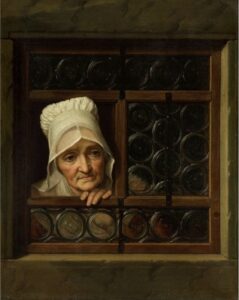
Old Woman in a Window

Another example of a woman at the window is a 1936 Picasso painting.


The 1908 Student Strike at Rabbi Isaac Elchanan Theological Seminary: A Newly Discovered Document

The 1908 Student Strike at Rabbi Isaac Elchanan Theological
Seminary: A Newly Discovered Document
By Eli Genauer

I would like to thank Dr Zev Eleff for his invaluable assistance in helping me frame this article. I would also like to thank Sharon Horowitz of the Library of Congress for providing research assistance.

The Rabbi Isaac Elchanan Theological Seminary (RIETS), present day Yeshiva University, was officially founded on March 20, 1897. RIETS was the first unequivocally Orthodox Jewish seminary on American soil.  Initially, its mission was entirely religious, limited “to promote the study of the Talmud and to assist in educating and preparing students of the Hebrew faith for the Hebrew Orthodox Ministry.”[1] RIETS’ first years were difficult ones.  It did not move into a building of its own until 1904.[2] Additionally, RIETS faced difficulty meeting its financial obligations.  including a student stipend. As a result, in 1906, RIET’s was beset by a major student strike. Among the student’s demands was that RIETS expand its mission beyond religious education and they demanded that they be instructed in secular subjects, including learning English.[3] While that strike was settled, another student strike and a lockout occurred over similar issues in May 1908. The strike was ended when changes were promised by the board of directors.  Yet, that settlement proved fleeting.
By August 1908, the students were striking again. The students’ strike received notice from the national press, when on August 19th,
the New York Times reported:[4]
the Talmuds are lying idle on the shelves of the Rabbi Isaac
Elchanan Theological Seminary at 156 Henry Street, and the drone of the voices
of the students as they walked back and forth reading aloud from the Hebrew
text is heard no more. For the last few weeks the students have not received
the $3.50 a week which they are paid while they are learning to become Rabbis.
Consequently, they have gone out on strike. Boruch Shapiro, Louis Mahler and
Samuel Broida, the leaders of the demonstration, stationed themselves at the
door of the school yesterday and effectively blockaded the entrance of all the
smaller boys. Nathan Lamport of the Lamport Manufacturing Supply Company, at
278 Canal Street, president of the school, and David Abramowitz of 47 Forsyth
Street, the Secretary, do not know what to do.[5]
On August 20th, citing financial reasons, the board locked out the students and
closed the school.[6] As a result of the closure of the school by the board of directors, some of the students and some Rabbinic leaders tried to form a new school called Yeshiva le-’Rabbanim which was designed to address some of the deficiencies of RIETS.[7]
Although the closure of the RIETS has been documented, the August 1908 student strike that led to the closure is not reflected in any published histories discussing the unilateral closing of the school and lockout of the students by the board ofdirectors on August 20th.[8]
One of the difficulties in piecing together exactly what happened during that August 1908 strike, lockout and its immediate aftermath is the dearth of contemporary records. This lacuna is in part attributable to a general lack of documntation of REITS’ early years.  And, “there are no records extant of the Seminary from its inception in 1897 to its merger with Yeshivat Etz Chaim in 1915. Only the Certificate of Incorporation, scattered newspaper accounts, one or two contemporary citations, and passing references in the memoir literature of the time remain as silent witnesses to the great vision and determination of a few men who…created the first Orthodox rabbinical seminary in America.”[9] As an example, in reporting on the August 1908 closure of the school by the board of directors and its aftermath, one scholar quotes mainly from newspaper accounts of the day.[10] There was an important memoir of that period written by Hayim Reuben Rabinowitz, who was an 18 year old student at the time, but Rabinowitz published his account 60 years later.[11]
Recently, however, a contemporaneous account of the events of 1908 has come to light.  This account was discovered as a result of construction at Congregation Bikur Cholim Machzikay Hadath in Seattle, Washington, when workers came upon a box of papers labeled, “Rabbi B. Shapiro Papers, 1920s-1960’s.” Rabbi Boruch Shapiro (1883-1970) was born in Szmorgon, Lithuania and was recognized as a Talmudic genius (Iluy) at an early age.[12] He was a student of, and received ordination from, Rabbi Meir Simcha of Dvinsk, (Or Sameakh), one of the outstanding rabbinic leaders of his time.[13] While in Dvinsk, R. Shapiro also received ordination from Rabbi Joseph Rozin, known as the “Rogatchover Gaon”.[14]  R. Shapiro immigrated to America in the early 1900’s and visited Seattle in 1913 on a fundraising trip. His visit became permanent when he ended up marrying a local woman, Hinda Gershonowitz and remained in Seattle until his passing in 1970. Rabbi Shapiro is perhaps best remembered as the Rav of Congregation Machzikay Hadath in Seattle, a position he held for forty years.
Before arriving in Seattle and shortly after arriving in America, Rabbi Shapiro studied at RIETS. Because he already possessed rabbinic ordination, he was considered in a special class of students, receiving a higher weekly stipend than most others who studied there. [15] He was sent by the school to give lectures at a synagogue in Brooklyn during the Sukkot holiday of 1905 as an example of the quality of students that were studying in the yeshiva.[16]
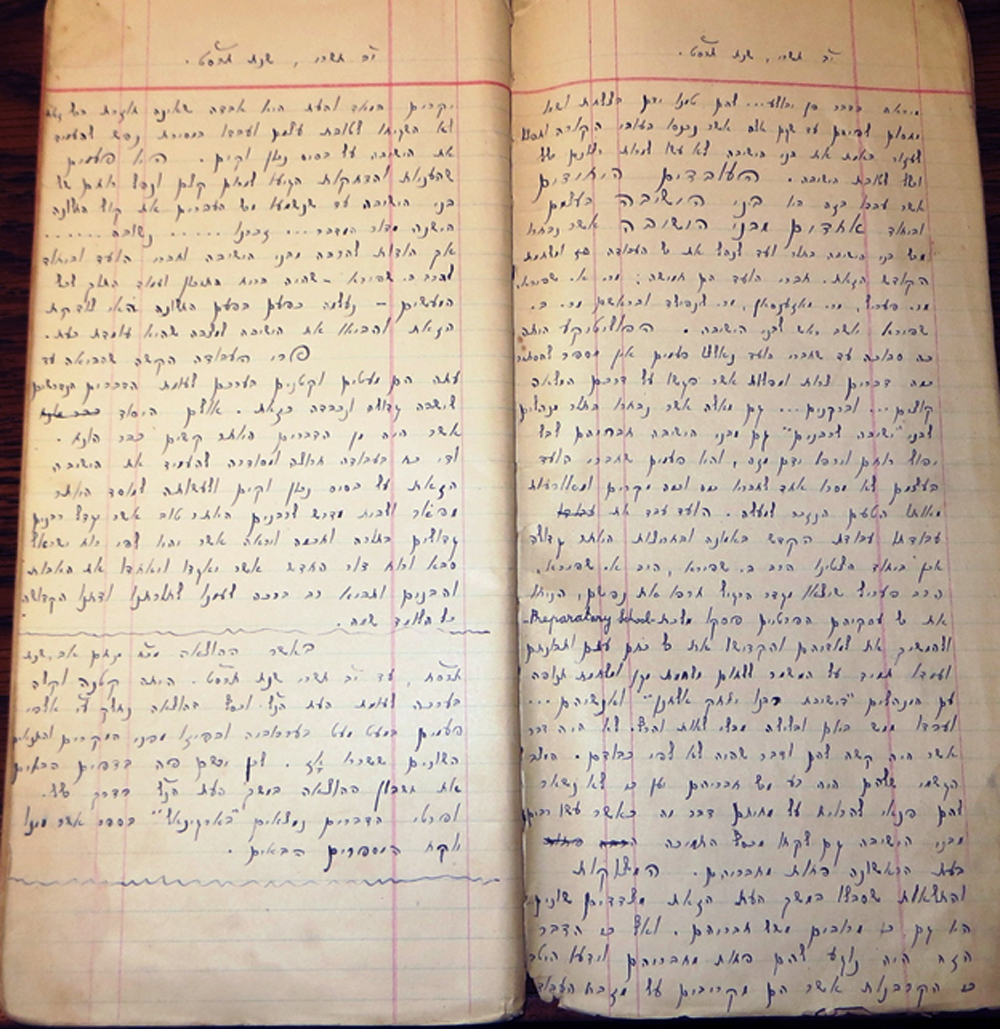
The box of papers discovered contains Rabbi Shapiro’s account of the events surrounding the student strike in August 1908, and the subsequent founding of the Yeshiva Le’Rabbanim. The account was written on October 7th, 1908 and covers the period from August 20 until that time. Because Rabbi Shapiro was one of the three student leaders of the strike, his account is particularly relevant to filling in the picture of the details of the August 1908 RIETS student strike.[17] Rabbi Shapiro’s writings, it should be noted, reflect that he and his fellow students had been involved in a struggle with, in his view, a dysfunctional and stubborn board of directors for over two years.[18]
Rabbi Shapiro records that:
On Thursday night, 24 Av 5668(20 August 1908), the Rabbi Isaac
Elchanan Yeshiva was closed in a very unseemly fashion. Mr. [Jonathan] Shepp,
the treasurer of the Yeshiva called the police several times to evict the
yeshiva students from the building in which they learned.[19]
But despite all his efforts, the police declined to do harm to the students.
They remained there despite his displeasure until midnight and at that time
they left for their residences.”[20]
After the students of the Yeshiva had concluded that there was no
hope to improve both the physical and spiritual conditions of the Yeshiva due
to the obduracy of the leaders whose concern was only for themselves, the
students decided to separate from the above named Yeshiva and move to “Adas Bnei
Yisroel” at 213 East Broadway, which welcomed them with open arms.[21] On
28Av (25 August-1908), the students of the Yeshiva moved their place of Torah
study to the above mentioned address in the company of well-known rabbis, such
as Rabbi [Shalom Elchanan] Jaffee[22],
Rabbi [Chaim Sholom] Shoher[23],Rabbi
[Aaron] Gordon [24],
and others, who had gathered there to guide them. After much discussion, it was
decided that the yeshiva students would study temporarily in Adas Bnei Yisroel,
and that they would acquire a charter. So that the leaders of Yeshiva Rabbeinu
Yitzchak Elchanan would not collect money in their name, they decided that this
yeshiva would be called “Yeshiva L’Rabanim”. Similarly, they decided to send
out boxes to collect members and to try to establish this yeshiva on a proper
foundation.
From 28 Av 5668 until 12 Tishrei 5669, three meetings of well-known
rabbis and prominent lay leaders were held. At the second meeting, an interim
leadership team for Yeshiva L’Rabanim was chosen: Rabbi Jaffe, chairman; Rabbi
Shoher vice chairman and treasurer; Rabbi [Joseph Judah Leib] Sossnitz,
administrator;[25]
Rabbi Dr. Rabinowitz from Brooklyn, administrator; Rabbi [Judah Leib] Lazeroff,
administrator,[26]
and others. The job of developing a “program” both in religious and secular
studies for this yeshiva was also assigned to the above leaders.
Even before the closure of the Yeshiva Rabbi Isaac Elchanan, the
physical situation of the students was very bad because for seven weeks prior
to the closure, all they received was a half a kilogram of bread per week.
However, the situation since they left the Yeshiva until now was much worse,
and the poverty and embarrassment they suffered is difficult to describe. Many
of them could have found other means of support, but because of their love of
Torah, they accepted their lot and did not abandon Torah study with which they
had been engaged their entire lives.
Many Rabbis, in writing, speech and action, promised to help. From
all the promises very little materialized, aside from Rabbi Lazaroff, who had
spoken up a few times in his synagogue on behalf of the Yeshiva. He assembled a
worthy number of members from whom he collected funds. The prominent Mr.
[Abraham J.] Goldstein and his brother-in-law, Mr. [P.] Feinberg from Jersey
City came to the assistance of the Yeshiva in the beginning. [27]With
the help of other prominent members of their congregation who worked alongside
their honored Rabbi [Shlomo David] Posner, that synagogue supported the yeshiva
a bit.[28]
To describe in detail all the problems faced by this new endeavor
and the stumbling blocks that were placed in front of this new Yeshiva from the
beginning until now would amount to an entire book. The task was difficult and
the conflict with the administration of the Yeshiva Rabbi Isaac Elchanan
weighed heavily on us. Many did not want to support the students of the Yeshiva
since they saw that the “Morgen Journal” had “sold out” to those above
mentioned administrators to do their bidding. They also felt that the “Tageblatt”
was leaning in the direction of those administrators, and not on the side of
the Yeshiva L’Rabanim. Many rabbis knew and admitted that the yeshiva students
were right, but kept silent due to fear. So much so, even those who had joined
the new Yeshiva were not really able to help it.
The primary laborers on behalf of the new Yeshiva were the students
themselves and especially a student council that was chosen from among them to
lead the struggle. The five members of this council were Mr. A.[vraham]
Shapira, Mr.[Ben Zion] Perl, Mr. [Chaim Yechezkel] Mosesohn, Mr. [H.S.] Linfeld
and Mr. B.[aruch] Shapira who was the leader.[29]
The politics were so intense that oftentimes those in the Yeshiva did not
confide in their fellow students for fear that they were supporting the other
side. The council worked diligently with the three main activists, Rabbi B.
Shapira, Rabbi A. Shapira, and Rabbi Perl who were most instrumental.  They abandoned all their other pursuits such
as attending “Preparatory School,” working day and night to battle with the
administration of Yeshiva Rabbeinu Isaac Elchanan.  Nothing was too difficult for them or beneath
their dignity. Their physical situation was worse than the conditions of other
students, as they had no other means of sustenance and they also received a
more meager stipend compared to what they had been entitled to. They suffered
immensely during this time. They knew that they were making great sacrifices
and losing precious time. Nevertheless, they did not consider their own
personal situations so that they could help establish this new Yeshiva on a
proper foundation. There were times that matters grew so bad that many of the
yeshiva students echoed the complaints of the Jews in the desert: they wanted
to return to their previous Yeshiva, but thanks to many of the yeshiva students
and the student council, especially Rabbi B. Shapira, these complaints were set
aside and it allowed the Yeshiva to attain the status it claims today. The
result of what has been done so far is small compared to what needs to be
completed. Nevertheless, laying the foundation, which was the most difficult to
accomplish, has been done. More effort is required to establish this Yeshiva on
a firm foundation and to transform it into an excellent school that will train
great rabbis in Torah, wisdom, fear of Heaven; who will work within the spirit
of ancient Israel and the spirit of this new generation; and who will unite
both old and young, thereby bring blessing to our people, our Torah and our
holy faith.”
In the end, Yeshiva Le-Rabbanim did not exist for very long because it never had substantial financial backing and support from the general community.[30] The attempt to form an alternative yeshiva apparently did not deter some of the student dissidents to return to RIETS. In 1917, in a RIETS publication, Rabbi Baruch Shapiro and his brother Rabbi Abraham Shapiro along with Rabbi Ben Zion Perl are listed among those ordained by RIETS now serving as rabbis in America.[31] Even more curious, the strike leader Rabbi Baruch Shapiro went on a fundraising tour in 1917 to raise money for the Rabbinical College of America, one of whose components was RIETS.[32]
The strike’s impact, however, on one of the most important future leaders of RIETS and Yeshiva University was profound.  Chaim Rabinowitz wrote “The strikes stimulated the mind of a young Rabbi who had recently arrived in America. This young Rav was Rabbi Dov Revel.” Rabinowitz cites a letter that Dr. Revel wrote to Rabbi Zvi Masliansky in the spring of 1908, where he grieves about the turmoil in RIETS that Rabbi Masliansky had told him about and hopes for better days for the Yeshiva. Rabinowitz concludes “the dream of Rabbi Revel came to fruition in 1915 when he became the Rosh Hayeshiva…and instituted great changes in the order of studies.”[33]
Here is a sample page of the document:


[1]
“Rabbi Isaac Elchanan Theological Seminary Association Certificate of
Incorporation,” March 20, 1897, (quoted in Gilbert Klaperman, “Yeshiva
University:  Seventy-Five Years in
Retrospect,” American Jewish Historical Quarterly 54,1 (September,
1964), 6). William Helmreich, however, states that teaching “the language of
the land” and Talmud was articulated in the RIETS charter, and, as such, “the
first such mention of combining secular and religious studies in one
institution.”  William B. Helmreich, “Old
Wine in New Bottles:  Advanced Yeshivot
in the United States,” American Jewish History, 69, 2 (December 1979),
235.  But, the 1897 certificate does not
mention “language of the land,” and Helmreich’s assertion is without
citation.
[2]
Gilbert Klaperman, The Story of Yeshiva University: The First Jewish
University in America
(New York: Macmillan, 1969) 71-72.
[3]Alexander
Dushkin, Jewish Education in New York City (New York: Bureau of Jewish
Education, 1918), 77-78.
[4]
“Boys Go On Strike,” New York Times, August 19, 1908.
[5] The Times
report may have been the result of the RIETS’ students, who, to gain
sympathy to their cause alerted it to the unrest. See Klaperman, Story,
95
[6] The
most complete report on the student unrest from 1906-1908 can be found in Klaperman,
Story, 94-112.
According
to Rabbi Klaperman, the closure and lockout on August 20th was
reported by the Jewish Morning Journal on Friday August 21st,
1908 and the Judisches Tageblatt on Sunday August 23, 1908. Idem.
217n8.
[7] Gurock,
Men and Women, 40; Rabinowitz, “60 Shana,” 553; and Klaperman, Story,
118.
[8] There
are three discussions regarding the closure of RIETS on Thursday, August 20th,
1908
See Klaperman, Story, 111-12. There is no mention of a
strike immediately preceding the board’s action. Rabbi Klaperman does not cite
the Times article in any of his footnotes. Additionally, in footnote 21,
p.218, he writes that there was no clear picture of presidential succession of
RIETS between February 1906 and fall of 1908, despite an indication in the NY
Times article that Nathan Lamport was the president of the school in August of
1908.
The
second is Hayim R Rabinowitz’s recollections that appeared in Hadoar in
1968. Hayim R. Rabinowitz, “60 Shana le-Shvitot be-Yeshivat Rabbeinu Yitzchok Elchanan,”
Hadoar, June 14, 1968, 552-554. In 1908, Rabinowitz was an
eighteen-year-old student at RIETS, and writes at length regarding the
situation leading up to the closing of the school on August 20th,
with the resultant lockout of the students from the building at 156 Henry
Street, but does not mention that the students had been on strike immediately
preceding this event. Although Rabinowitz was a contemporaneous observer, his
reminiscences were only published sixty years after the events in question.
The third discussion is by Jeffrey Gurock.  Jeffrey Gurock, The Men and Women of
Yeshiva: Higher Education, Orthodoxy, and America Judaism
(New York:  Columbia University Press, 1988) 39-40. Citing
Rabinowitz, p.553, he writes “Frustrated, feeling that a double cross was in
the making, RIETS students were once again talking strike in the late spring
and early summer of 1908.” Gurock, however, does not mention that a strike and
blockade of the building took place in August as indicated by the headline of
the New York Times and in the subsequent article.
[9] Klaperman,
Story, 48.
[10] Idem, 217-19.
[11]
Rabinowitz, “60 Shana,” 552-554, quoted extensively in Gurock, Men and Women,39-41.
[12] The
Jewish American Family Magazine and Gazette (Amerikaner Familian Magazin un
Gazetten)
, vol. XXXIX, no. 47, September 19, 1941, 2.
[13]
Rabbi Meir Simcha was the author of “Ohr Sameach”, an important commentary on
Maimonides’ “Mishna Torah”, and of “Meshech Chochmah”, a commentary on the
Torah. Rabbi Meier Simcha wrote of Rabbi Boruch Shapiro “he has the ability to
formulate outstanding novella acceptable to all”. The Jewish American Family,
2.
[14]
Prior to coming to America, Rabbi Shapiro obtained letters of support from two
other leading rabbinic figures in eastern Europe, Rabbi David Hirsch Eisenstein
and Rabbi Shlomo Vilner. The Jewish American,2. Rabbi Vilner wrote that
he never gives ordination to one so young, but in the case of Rabbi Shapiro, he
was willing to make an exception.
[15]
Rabinowitz, “60 Shana,” 553.  Rabinowitz
also refers to Rabbi Shapiro as a “Gadol B’Torah”
[16] Klaperman,
Story, 62.
[17] The
New York Times article identifies him as one of the three student strike
leaders. See also, Rabinowitz, p.553 As early as 1906, R. Shapiro held a
leadership role.   He was among the four
students chosen to represent the students’ views before RIETS’ board of directors.  Rabinowitz, “60 Shana,” 553; The Jewish American,
2, which states that Rabbi Shapiro was chosen as a representative by the
students in dealing with the board.
[18] Regarding
the student’s relationship with the board of directors, Klaperman describes an interaction
between the students and the directors as follows: “The student’s
dissatisfaction and the obduracy of the directors brought about continuous
agitation in the school and highlighted the confusion of aims in the
curriculum” Klaperman, Story, 86.
[19] Klaperman,
Story,99 writes that in 1906, Jonathan Shepp was elected as the new
treasurer, and that Jonathan Shepp was part of the finance committee appointed
on August 31, 1908 to assist in reopening the school after it was closed on
August 20. Klaperman, Story, 99, 113.
[20] Gurock
indicates that the treasurer threatened to call the police, but that in fact
the police were never called.  Gurock, Men
and Women
, 40 (citing Rabinowitz, “60 Shana,” 553).
[21]
Regarding the address of the building to which the students moved, Rabbi
Shapiro was physically at this new address so it is reasonable to assume that
he recorded it correctly. Additionally, on June 3, 2015, there was an auction
of documents associated with the newly founded Yeshiva La-Rabbanim (Kedem
Auction No.8, Lot 301). One of the documents evidences a stamp which says 213
East Broadway. Rabbi Klaperman lists the address
as 123 East Broadway.  Klaperman, Story,
116, 219n38.
[22] Rabbi
Shalom Elchanan Jaffe (1858-1923) was an important early American Orthodox
Rabbi. He received Semicha from both Rabbi Naftali Zvi Yehuda Berlin and Rabbi
Yitzchak Elchanan Spektor. He arrived in America in 1890 and served as a Rav in
St Louis and in Brooklyn before becoming the Rabbi in 1901 of the prestigious
Beth Midrash Hagadol synagogue on the Lower East Side of New York. He was one
of the most influential of Rabbis at the time, especially when it came to the
supervision of kosher meat. Jaffe’s motivations for his involvement with this breakaway
school, may have less to do with issues than his personality.  According to Klaperman, Jaffe was not one
wedded to the idea of secular education, one of the central demands of the
students. “On the other hand, Rabbi Jaffe was the stormy petrel on the rabbinic
scene, known as an impetuous non conformist who rushed in without fear when his
mind was made up.” Klaperman, Story, 117.
[23] Rabbi
Chaim Sholom Shochar (Rabbi H.S. Shoher) came to Boston in 1882 to be the Rabbi
of Bais Avraham synagogue and subsequently served as the Rabbi of Hadrath
Israel and Mishkan Tefillah among other synagogues in Boston. In 1905, he moved
to New York City to become the Rabbi of the prestigious Shaare Zedek synagogue
located at 38-40 Henry Street. In 1910, he is listed as living at 215 East
Broadway, next door to the location of Yeshiva Le-Rabbanim. He authored a
pro-Zionist book Shalom Yerushalyim in 1909 and passed away in 1918.
[24] Rabbi
Aaron Gordon (1845- 1922) known as the Miadziol (Myadel) Iluy, emigrated to
America in 1890 and was the chief Rabbi of Rochester, New York until 1900 when
he moved to New York City. He was one of the founders of the Agudath Harabanim
and served as head of a Bet Din on the lower east side. He served as the Rabbi
of Congregation Talmud Torah Tiphereth Jerusalem at 147 East Broadway. He was a
prolific writer, authoring many books on Halacha, among them Even Meir
(Pietrokov 1909), Teshuvat Meleat Even (Pietrokov 1912), Minchat Aharon
(Jerusalem, 1920) and Sha’arei Da’at (Jerusalem, 1921).
[25]
Rabbi Joseph Judah Leib Sossnitz (1837-1910) was born in Birzhi, district of
Kovno. He has been described as a Talmudic scholar, mathematician and
scientific author. He settled in New York in 1891 and in 1893, founded a Talmud
Torah on 104th street in Manhattan. In 1899, he was appointed a
lecturer in Jewish ethics at the Educational Alliance at 197 East Broadway.
[26]
Rabbi Judah Leib Lazarov (1875-1939), studied inTelz, Mir, Volozhin and Radin
before immigrating to America in 1898.He was hired as a preacher at Beth
Midrash Hayei Adam at 89 Henry Street in 1903 and succeeded Rabbi S.E. Jaffee
as Rabbi of Beth Midrash Hagadol in 1910. He authored a multi volume work Divrei
Yehudah
(New York, 1906-1910).
Except for Rabbi Dr Rabinowitz who was from Brooklyn, all the above
named rabbinic leaders were from the Lower East Side near both Rabbi Isaac
Elchanan Yeshiva on Henry Street and Yeshiva La’Rabanim on east Broadway. They
most likely would have been aware of the struggles of the students with the
board of the Yeshiva and had possibly allowed them to speak in their synagogues
during the May strike. See Klaperman, Story, 104. It is also possible
they were consulted by the students on an ongoing basis even before they tried
to start a new school.
[27] Abraham
J. Goldstein emigrated to America in 1884 and immediately settled in Jersey
City. One book, Distinguished Jews of America, (New York, 1917), describes
him as “a strict Orthodox Jew in every sense”, “one of the richest and most
prominent citizens of Jersey City”, and “a member of almost every Jewish
organization in Jersey City”. He owned a grocery wholesale business, was
president of the Erie Building and Loan Association, and was one of the largest
real estate owners in Jersey City.
[28] Rabbi
Shlomo David Posner (Rabbi S.D Posner) was a Rabbi in Jersey City, New Jersey,
for many decades. He signed his letters “Rav V’Av Beit Din” of Jersey
City.  He authored a book of homilies Eshed
Hanahar
(New York, 1932). In the introduction, he writes candidly about
being a Rabbi in America over many years. He was involved on a national level
in many Rabbinic organizations and he helped raise money for the Jewish
community in Palestine
[29] It
is interesting to note that Rabbi Shapiro refers to this group as Mr. but later,
refers to three of the group as Rabbi. The two Shapiro brothers and Ben Zion
Perl are referred to by Rabinowitz as having Rabbinic ordination already at
that time. Rabinowitz, “60 Shana,” 553.
The four referred to by Rabbi Shapiro aside from himself are:
(1) Rabbi Abraham Shapiro was the brother of Rabbi Boruch Shapiro.
Like his brother, Abraham already possessed Semicha from Eastern Europe at this
time. He later served as a Rabbi in Canton, Ohio and in Utica, New York. He was
considered to be a prominent Musmach of RIETS in later years.
(2) Rabbi Ben Zion Pearl served as a Rabbi in Harlem. He was the
director of the Uptown Talmud Torah Association which had 2,400 students in
1919. In 1925, he was involved in raising money for the building fund of Rabbi
Isaac Elchanan Yeshiva. He passed away in 1929.
(3) Rabbi Chaim Yechezkel Moseson came
from Lodz Poland, learned in the Yeshiva in Lomza Poland and received Smicha
from Rabbi Yechial Michal Epstein, author of the Oruch Hashulchon. He was the
principal of Yeshiva Torah Vadath, Mesivta Tiferes Yerushlayim, and other
Yeshivot. He wrote many articles for Dos Yiddishe Licht, a newspaper
financed by Cantor Yossele Rosenblatt.
(4) Harry Sebee Linfield
(1889-1978), was a rabbi and statistician. His Jewish Statistical Bureau
conducted research on Jews in America and published numerous reports and other
publications on their findings, specifically the Statistics of Jews. He was born in
Lithuania and came to the United States in 1905. He was awarded a PhD by the
University of Chicago in Semitic language in 1916, and the following year was
ordained a rabbi by the Hebrew Union College in Cincinnati
[30] Klaperman,
Story, 118.
[31] Idem.
262
[32] The
Reform Advocate
, December 29, 1917, p.501
[33]
Rabinowitz, “60 Shana,” 553-554.


Emek ha-Netziv : The Manuscript

Emek ha-Netziv : The Manuscript
by Gil S. Perl

Rabbi Dr. Gil S. Perl is dean of the Margolin Hebrew Academy/Feinstone Yeshiva of the South in Memphis. The following selection comes from his new book, The Pillar of Volozhin: Rabbi Naftali Zvi Yehuda Berlin and the World of Nineteenth-Century Lithuanian Torah Scholarship.


The manuscript of ‘Emek ha-Netziv remains in the possession of the Shapira family and there are no additional extant copies. The family are prominent members of a staunchly traditionalist Ḥaredi community in the Geulah neighborhood of Jerusalem. Members of this community generally oppose sustained contact with Western culture and its representative institutions, including universities of any type. The Shapira family seems to harbor additional skepticism toward those researching Netziv , due to the fact that his relative openness to certain aspects of non-traditional culture has made him a controversial figure in some ultra-Orthodox communities.[1]These facts, combined with the sheer value of their manuscript collection,[2] make the family understandably guarded about allowing access to thematerials they possess. However, with the assistance of Rabbi Zevulun Charlop, Dean of the Rabbi Isaac Elchanan Theological Seminary in New York City and a cousin of the Shapira family,[3] I was able to secure brief and accompanied access to the manuscript from which ‘Emek ha-Netziv was taken.[4]

The manuscript is handwritten in three volumes, corresponding to the three volumes of the printed text. The first two volumes were bound, but the binding has completely deteriorated and sections of each volume easily separate from one another. The third volume seems never to have been bound. The pages of all three volumes are severely frayed at the edges.

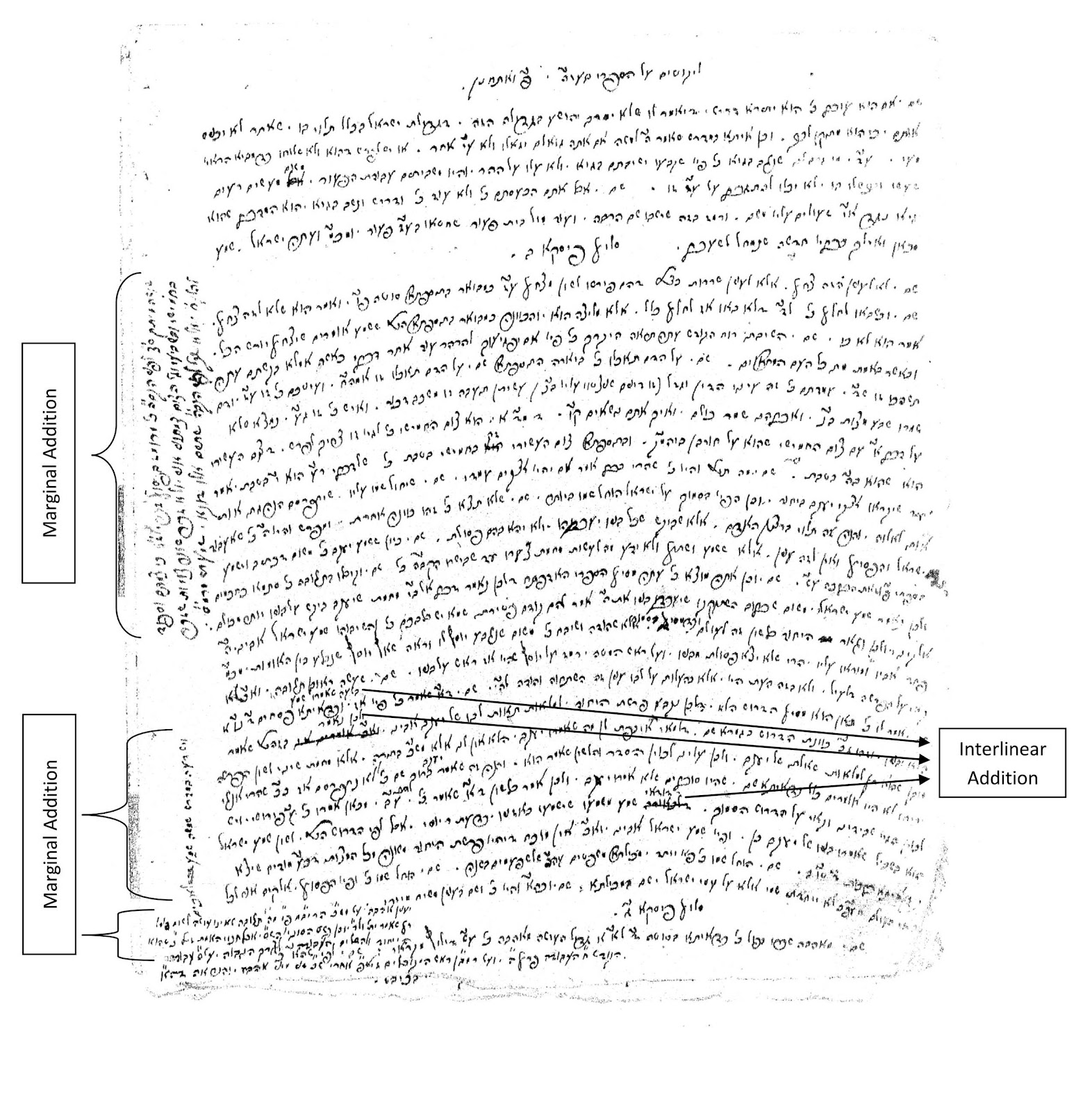
As suspected, the manuscript contains a core text with countless interlinear and marginal additions as well as words and entire lines that have been crossed out:


.

It is important to note that the brackets and parenthesis which appear throughout the printed text do not correspond to these additions. Rather, they correspond to places in which Netziv placed parenthesis or brackets around his own words both in the core text and in the additions. The additions and the notes he appended to the end of the manuscript (referred to by the Netziv as hashmatot )[5] were incorporated without indication into the printed text.


The script of the core text through the first two volumes and half of the third is a fairly consistent narrowly-spaced brown cursive[6] written with a fairly wide-tipped pen. In the second half of the third volume the script of the core text changes to a blacker, wider-spaced cursive seemingly done with a thinner-tipped pen. The script of the later marginal additions varies.

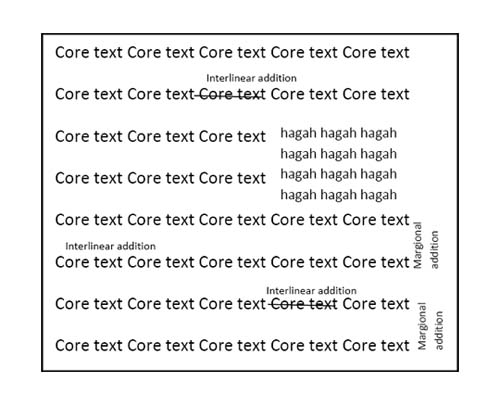
The notes which appear scattered throughout the printed text (referred to by the Netziv as hagahot) were written at the same time as the core text,[7] as evidenced by the identical script used and the intentional indentations left in the text of the core commentary in order to create space for the hagahot. The hagahotalso contain marginal additions. A typical page in the manuscript containing hagahot, then, is represented in the following diagram:

The reference to the newly printed book ‛Emek Halakhah mentioned above appears as an interlinear addition to the core text, thus implying that for that particular section of the commentary on Naso, the core text was written prior to 1845 and the addition was included after 1845. The references to Reb ‘Iẓele are also found in the core text with the word “she-yiḥyeh,” which dates those passages of the core text to the years prior to 1849 as well.[8]

The orderly progression of chapters in the core text, which begin at varying places on the physical page of the manuscript, indicates that Netziv wrote down his comments in this manuscript in proper sequence, following the order of Sifre. [9]That is, one can safely assume that in this particular copy of the manuscript, the core text of Netziv’s comments on Parashat Bamidbar were committed to writing before those of Parashat Naso, and his comments on pesikta’ aleph were committed to writing prior to those of pesikta’ bet.[10] If the core text of the manuscript was written sequentially, and the core text of EH Naso 49 (I:181) was necessarily written prior to the publication of Zev Wolf ben Yehudah Ha-Levi’s 1845 publication of ‘Emek Halakhah, one can deduce that, at the very least, the entire core text until that point was also committed to writing prior to 1845. Likewise, from the appearance of the word “she-yiḥyeh” in the core text of Be-ha‛alotekha andShelaḥ[11] one can assume that the text up to that point was written prior to Reb ’Iẓele’s death in 1849. If we then add that the handwriting remains rather constant in the core text until the second half of the third volume, we have reason to believe that all of the core text until that shift in appearance was committed to writing prior to 1849.

Thus, one can safely conclude that a good portion of the printed edition of‘Emek ha-Netziv was indeed written while Netziv was a young man in his twenties and thirties. As such, the general character and main attributes of the work must be seen as a product of the cultural and intellectual atmosphere of Lithuanian Jewish society in the 1830s and 1840s. At the same time, given the large number of later additions and the lack of any demarcation in the printed text, one can not firmly ascribe a date to any specific passage found in it, with the exception of those which contain explicit or implicit references to the time of composition.

Censorship

The process of preparing ‘Emek ha-Netziv  for publication was painstakingly performed by the Shapira family over the course of many years, and thus the printed text seems to be relatively free of printing errors. However, there are two hints in the printed text which suggest the possibility of editorial censorship.

As noted above, Netziv’s relative openness to sources of information beyond the pale of the current traditionalist canon is a character trait which is at odds with the values of the contemporary ultra-Orthodox community. As we will describe at length in the pages that follow, Emek ha-Netziv  is filled with citations and references to such sources of information. On two such occasions the reference found in the printed text appears to be intentionally altered so as to prevent proper identification of the source. In his comments on ‘Ekev, Netziv writes that for further study one should consult the book called “thirty-two Middot of [sic] in Vilna.”[12] In all probability Netziv is referring to the book published in 1822 called Netivot Olam: Beraita de-32 Middot with the commentary of Ẓvi Hirsch Katzenellenbogen. Katzenellenbogen is known to have been a member of Vilna’s more “enlightened” circles.[13] As such, the possibility exists that the publisher intentionally left out Katzenellenbogen’s name. This prospect is bolstered by the fact that the manuscript contains a name in the standard acronymic form where the printed edition has a blank space. When I asked to look at this reference in the manuscript, it was reviewed by two members of the Shapira family and I was denied permission to look at it. Nonetheless, I did manage to see what seemed like a legible acronym ending in the letter qof.[14] Although it is possible that the editor could not discern the letters of the acronym, if such had been the case one would expect a bracketed editorial note, such as those which appear on several occasions in the printed text where the manuscript is illegible due to stains or frayed edges.[15]

The second possible instance of editorial censorship concerns a passage in Netziv’s commentary on Shoftim which refers the reader to “hakdamat ḥumash besau[16] ve-‘tav’’alef’.[17] The most common referent for the initials tav”alef in the context of Torah commentary is Targum Onkelos, the ancient Aramaic translation of the Bible. However, if the bet of the word “besau” is replaced with adaled so as to read “desau” we might suggest that the tav”alef stands for targum Ashkenaz, German translation, rather than Targum Onkelos. As such, the citation would be of the well-known introduction to Moses Mendelssohn’s Torah commentary, which was printed in Dessau and contains a German translation of the biblical text. The fact that the subject matter under discussion in this passage of Netziv’s commentary correlates to subject matter discussed by Mendelssohn in the introduction to his Bible commentary supports the latter suggestion.

We might raise the question, then, as to whether the printed text was intentionally manipulated so as to prevent easy identification of Mendelssohn’s work or whether the daled of Dessau was simply mistaken as a bet by the printsetter.[18]The fact that this particular citation was underlined in pink pencil in the manuscript bolsters the suspicion that the publishers of ‘Emek ha-Netziv were sensitive to the potential controversy the citation of Mendelssohn might have caused in the ultra-Orthodox community and that they therefore intentionally altered the printed text.[19]

Both of the above instances of possible censorship beg the question as to why the references were included altogether if the printers wished them to remain unidentified. Furthermore, as will be discussed below, the printed text of ‘Emek ha-Netziv contains references to numerous other works that lie well beyond the traditional contemporary ultra-Orthodox canon which were not censored. As such, the evidence for editorial censorship cannot be considered conclusive. Nonetheless, these two passages do raise the possibility that other parts of the text were more cleverly censored or that other citations were completely deleted.
The End of ‘Emek ha-Netziv
The end of Netziv’s commentary on Sifre, as it appears in the printed edition of ‘Emek ha-Netziv , is also an issue of concern to the critical reader. The commentary in both the printed edition and the manuscript comes to an abrupt halt halfway through the parashah of Ki Teẓeh[20] and well before the end of the text of Sifre itself. One is therefore led to question whether Netziv truly ended his commentary there, or whether there was more to the commentary that does not appear in the printed text.

Several factors indicate that Netziv’s commentary did, in fact, extend beyondpiska’ 27 of Parashat Ki Teẓeh.[21] To begin, Netziv starts his commentary at the beginning of Sifre with an introductory double couplet, and thus one would expect a similar poetic composition at the end of the work, but none appears in the printed text or in the manuscript. Furthermore, a statement of completion marks the close of each parashah throughout the text, but none appears at the end of Parashat Ki Teẓeh. Likewise, the completion of the Book of Numbers is marked by two rhyming stanzas of nine lines each,[22] while Deuteronomy, and the commentary as a whole, has no formal conclusion at all.

One must entertain the possibility that the abrupt ending of the work suggests not that the final portion of the commentary is missing from the printed text but that Netziv never completed the commentary. This theory might be supported by the fact that the statements of conclusion which follow everyparashah are in poetic form in the first two volumes, whereas in the third volume, which consists of the Book of Deuteronomy, the statements consist of nothing more than “Piska’ 8 is complete and [so too] the entire portion of ve-’Etḥ anan.”[23] One might interpret this phenomenon as suggesting that the final touches, such as the transformation of abrupt closing statements into clever couplets, were never applied to the third volume of the work.

Such a conclusion seems unlikely, however, when one considers the numerous revisions and recensions to which Netziv subjected the rest of the commentary. One generally does not spend the time editing, expanding, and re-copying a work that one has yet to complete. Furthermore, in his introduction toHa‘amek She’elah Netziv regrets that he has not yet brought his commentary onSifre to press, but he makes no mention of not having completed writing the text. Similarly, in a comment found in his Harḥev Davar, published along with his Ha‛amek Davar in 1878, Netziv writes that while he has not elaborated on a particular point in this work, he will do so at length when God grants him the merit of “publishing the commentary on Sifre.[24] Here too, Netziv does not ask for God’s help in finishing the work, but in bringing it to press. Likewise, Avraham Yiẓḥak Kook, one of the outstanding students of Netziv , publically called upon his teacher to publish his Sifrecommentary in a footnote to a biographical article on Netziv published in 1888.[25]He too seems to suggest that the work was complete.

The physical form of the third volume of the manuscript makes the possibility of missing material rather plausible as well. The printed text contains commentary to every piska’ in Sifre up until piska’ 27 of Parashat Ki Teẓeh.[26] There is no commentary on piska’ot 27-54, but the text resumes with brief comments on piska’54[27] and then ends completely. In the manuscript, piska’ 27 ends at the bottom of a page, which raises the possibility that further commentary followed on subsequent pages which are now lost. The brief comments to piska’ 54 appear on the reverse side of comments labeled as hashmatot; therefore, they may well represent hashmatot to a core commentary, now lost, on the end of Deuteronomy.[28] When one considers the fact that, unlike the first two volumes, the third volume of the manuscript is not bound and does not appear to ever have been bound, the notion that pages from the end of the commentary were lost must be seriously considered.[29]
Conclusions
The conclusion one must draw from the above investigation of the text of‘Emek ha-Netziv is that a historical analysis of the content found in the printed text must be made with caution. The possibility of the text being incomplete must always be considered both in regard to possible editorial censorship and in regard to the possibility that the text originally contained additional chapters that are currently lost. Whereas the core text of the commentary prior to Shelaḥ [30] can be rather definitively dated prior to 1849, the printed text makes no distinction between the core text and later additions. As such, with the exception of a few passages which include embedded historical evidence, no single passage in the printed text can conclusively be dated to the 1830s or 1840s. Nonetheless, there is sufficient evidence, both in Netziv’s own testimony with which this chapter began and in the clues offered by the text and corroborated by the manuscript, to conclude that the bulk of the commentary does indeed reflect a project with which Netziv was engrossed in his early years. Thus, trends which can be identified throughout the printed text and which comprise its general character must indeed be seen as reflective of the intellectual currents of Lithuanian Jewish culture in the 1830s and 1840s.
[1] In recent years, certain circles in the ultra-Orthodox community recommended that Moshe Dombey and N.T. Erline’s adaptation of Barukh Ha-Levi Epstein’s Mekor Barukh, entitled My Uncle the Neẓiv (Brooklyn, N.Y.: Mesorah Publications, 1988), not be read due to its portrayal of Neẓiv as one who did not share all of the values of the contemporary ultra-Orthodox community. See Jacob J. Schacter, “Haskalah, Secular Studies, and the Close of the Yeshiva in Volozhin in 1892,” Torah u-Madda Journal 1 (1989): 76-133; Don Seeman, “The Silence of Rayna Batya: Torah, Suffering, and Rabbi Barukh Epstein’s Wisdom of Women’,” Torah u-Madda Journal 6 (1995-1996): 91-128; Don Seeman and Rebecca Kobrin, “’Like One of the Whole Men’: Learning, Gender and Autobiography in R. Barukh Epstein’s Mekor Barukh,”Nashim 2 (1999): 52-94; Brenda Bacon, “Reflections on the Suffering of Rayna Batya and the Success of the Daughters of Zelophehad,” Nashim 3 (2000): 249-256; Dan Rabinowitz, “Rayna Batya and Other Learned Women: A Reevaluation of Rabbi Barukh Halevi Epstein’s Sources,” Tradition 35: 1 (Summer 2001): 55-69. This position toward Neẓiv, however, was already espoused a century earlier when a series of articles appeared in the Galician newspaper Maḥzike Ha-Da’at (volumes 16, 17, and 18) warning traditionalist Jews to stay away from Netziv’s Bible commentary,Ha‛amek Davar, due to its modern stance toward the authority of the Talmudic Sages. A similar sentiment is reflected in the fact that many ultra-Orthodox houses of study have refused, and continue to refuse, to include Ha‛amek Davar in their libraries.
[2] A value which stands in stark contrast to the overwhelming poverty of most of Geulah’s inhabitants.
[3] See Neil Rosenstein, The Unbroken Chain. (New York: CIS Publishers, 1990) 433-440.
[4] My examination of the manuscript took place in July of 2004 with the assistance of a Summer Travel Grant awarded by the Center for Jewish Studies at Harvard University.
[5] The hashmatot probably represent additions to the text which Neẓiv could not fit in the margins of the page of the core text due to lack of space.
[6] The letters are in cursive form, but Neẓiv generally did not attach his letters to each other. The brown color was probably black when originally applied but has lost its vibrance with the passage of time.
[7] The hagahot seem to have been intended as tangential footnotes to the main commentary in a manner similar to the way in which Netziv’s Harḥev Davar was intended to supplement his Ha‛amek Davar on the Bible. This format was typical of Lithuanian Torah commentary, for reasons which will be explained in Chapter Three below.
[8] I had hoped to demarcate the beginning and end of each addition in my own printed text along with a description of the script used in each addition. The Shapira family, however, was not willing to grant me the sustained access to the manuscript required for such an endeavor.
[9] If it had not been written in order, one would expect to find empty spaces on the bottom of a page where a particular chapter or section ended and new sections beginning on the top of new pages. Instead the end of each section in the manuscript is followed immediately by the beginning of the next section, indicating that they were written sequentially.
[10] There is reason to believe that this manuscript itself is a later recension of an earlier edition. The family showed me what they said were the few extant leaves of an earlier version of the commentary written by Neẓiv which predates the manuscript used for the printed text, but I was not allowed to study them at length. As such, the above analysis does not suggest that Neẓiv actually composed his commentary according to the sequence of the Sifre text, but simply that the transcription of the core text of the commentary into the manuscript at hand was done in sequential order.
[11] See note 14 above.
[12] EH ‘Ekev 4 (III: 52).
[13] See Chapter Two below.
[14] My access to the manuscript was always limited to sitting next to a member of the Shapira family, who would turn to the page I wished to check and look at the specific textual anomaly before deciding whether to let me look as well. In this case I was able to peer over his shoulder and attempt to decipher the acronym. The exact answer this member of the Shapira family gave me was, “Suffice it to say, it is not a siman in Shulḥan Arukh.”
[15] E.g., EH Naso 42 (I: 162); EH Naso 44 (I: 173); EH Matot 1 (II: 279); EHMatot ‛Ekev (III: 45); EH Re’eh 9 (III: 92).
[16] Bet-ayyin-sameh-vav.
[17] EH Shoftim 16 (III: 189).
[18] In cursive Hebrew writing the bet and daled look quite similar.
[19] A glaring example of this type of censorship recently appeared in a photo-offset of the 1926 Frankfurt edition of David Ẓvi Hoffmann’s responsa, Melamed le-Ho‛il, published by the Lebovitz-Kest foundation. In Responsa #56 in the original printing (II: 50), Hoffmann gives his approval, in exigent cases, for an Orthodox Jew to swear before a civil court without a head covering. In the context of his piece, Hoffmann also attests to the fact that Samson Raphael Hirsch instructed the students in the Frankfurt Orthodox school which he founded to cover their heads only for Judaic studies and allowed them to remain bare-headed for their secular studies. The recent photo-offset contains an introduction by a grandson of Hoffmann, David Ẓvi ben Natan Naftali Hoffmann, which gives the reader the impression that the grandson belongs to the ultra-Orthodox community of Jerusalem. Responsa #56, however, permits a practice clearly anathema to that community. Hence, when one turns to page fifty in the off-set, in place of what was earlier Responsa #56, one finds a blank space. I thank Rabbi Moshe Schapiro, librarian at the Mendel Gottesman Library of Yeshiva University, for bringing this example to my attention.
[20] EH Teẓeh (III: 296).
[21] Note that the piska‘ot of Neẓiv do not correspond to those of the Sifre text with which the commentary is printed. In the text of Sifre the last piska’ for which there is continuous commentary is 43, and it then resumes in 54. See Chapter 5.
[22] EH Mas‛ai (II: 334).
[23] EH Ve-’Etḥanan (III: 43).
[24] HrD Num. 6: 19.
[25] Avraham Yizhak Kook, “Rosh Yeshivat Eẓ Ḥayyim,” Kenesset Yisrael, ed. S.J Finn (Warsaw, 1888), 138-147. Also in Ma’amarei HaRe’iyah (Jerusalem, 1984), 123-126.
[26] EH Teẓeh (III: 296). Piska’ot here are according to Netziv’s division. For more on Netziv’s method of dividing piska’ot see Chapter Three below.
[27] EH Teẓeh (III: 299). In the absence of Netziv’s commentary, piska’ot here refer to the division found in the standard Sulzbach edition.
[28] When I asked the Shapira family about the strange ending of work, they too suggested that there might have been more that was lost. When I asked them who had possession of the manuscript prior to them, they declined to give me any names and replied instead, “Suffice it say, it has been handed down, son after son.”
[29] The existence of commentary on the latter parts of Deuteronomy could have been conclusively proven had Neẓiv included a reference to it in his other writings. I have found no such reference, but no conclusions can be drawn from silence.
[30] EH Shelaḥ 1 (II: 10)


Review of Reckless Rites

While it is a bit out of season, I wanted to review Elliott Horowitz’s new book Reckless Rites. In this book, subtitled “Purim and the Legacy of Jewish Violence,” everything is viewed through the prism of the violence inflicted by the Jews upon their enemies at the end of Esther.

While arguably, the violence at the end is only a minor part of the story for some that aspect has clouded everything about the Book of Esther and Purim. First Horowitz looks at how the Book was viewed by non-Jews. Some had a very negative view due to the Jewish revenge. They considered that motif, un-biblical (read non-Christian). Horowitz goes through each of the characters and how first non-Jews interpreted their actions. For instance, Mordechi was treated rather harshly by many of these commentators as was Esther due to her passivity. What is especially fascinating is how these non-Jewish understandings, at times, crept into Jewish thought as well. Thus, Horowitz documents Jews parroting these rather un-Jewish, at it were, interpretations.

Horowitz then tackles the overarching theme of Amalek and how this has been understood throughout history. Some hold there is no obligation of destroying Amalek today while others are willing to label any perceived enemy of Jews as deserving of the harsh consequences of Amalek. Some of these examples are rather disturbing.

After dealing with the Book of Esther specifically, Horowitz turns his focus to Jewish practice on Purim. Specifically, he deals with Jewish violence or violent acts on Purim directed at non-Jews. He provides a discussion of the stereotype of the “mild” (read the wimp) Jew including its origins and whether it is borne out by history. He then discusses numerous, diverse examples spanning from the 5th century until today of Jewish violence. Some is not physical violence, instead it is host desecration or general enmity of non-Jewish symbols while other, most recently Barukh Goldstein is physical violence in its worst form.

In an effort to play down some of these incidents, we have Jewish historians who decided to avoid discussion of such matters, or at times downplay their significance. However, in light of the many examples here, it is very difficult to ignore such examples. Horowitz is very convincing in the scope of this idea and how prevalent this is. It is especially telling when tracing and seeing how systematically Jews have decided to sweep under the rug these examples, it demonstrates that censorship is not limited to any one group and even amongst supposedly dispassionate scholars, they too can fall prey to their own biases.

The detail and research is amazing , Horowitz leaves no stone unturned. All in all, this book sheds new light of the story of Purim, the Book of Esther and Jewish history. It provides a new way of viewing the story of Esther and Jewish ideas towards violence.


Manasseh of Ilya and Y. Barzilay

I recently finished reading Yitzhak Barzilay’s book on R. Manasseh of Ilya. R. Manasseh was a fascinating character. He was a student of the Vilna Goan, but wrote a pamphlet arguing for reconciliation between Hassidim and non-Hassidim. He wrote another work discussing the trop or cantilation marks and yet another, his mangum opus, on the Talmud. It is the later work that he is most well known for, although not necessarily in a positive way. The Tefferet Yisrael (R. Yisrael Lifshitz) on the Mishna quotes a brief passage from this commentary. R. Menasseh’s comments appear on the first Mishna in Perek Alu Mitzhut. (Baba Metziah 1:1). He understands the Mishna in a different fashion than the Talmud, thus provoking some to argue such a position is heritical.

R. Manasseh was a controversial figure. His book on the reconciliation, Pesher Davar, was publicly burnt. His work on Talmud, Alphei Menashe, after either the publisher or some outsider (depending on the source, there are a couple versions of the story), destroyed it right before it was completed. R. Manasseh was forced to reproduce the entire work from memory and find a different printer.

Additionally, although he had a close relationship with the Vilna Goan, the Vilna Goan severed that relationship after learning R. Manasseh had been in contact with R. Shneur Zalman of Lida (Ba’al haTanya).

All this being said, he is ripe for an excellent biography. Unfortunately, Barzilay does not deviate from his norm, and put out another poor work. Although Barzilay has written on many other interesting figures of Jewish history, almost always he fails to do anything substantive or worthwhile with the subjects.

This work is full of gross supposition that are never supported by any facts. For instance we have sentences like this “It may be assumed that in a talented person like Manasseh, his critical faculties must have awakened rather early, and already in his youth he may have arrived at some of his nonconformist views with regard to the Halakhah and its historical development.” (p. 24). Therefore, Barzilay wants to then claim and project back on Manasseh’s early years and label him as a radical even then based only upon “his critical faculties.” While that may be the case, there are also a million other possibilities. For instance, Manasseh was influenced later in life by someone else or he came to his “nonconformist views” based upon years of study and when he was 17 (according to Barzilay, again a guess) he did not hold these views.

Another example, where Barzilay is discussing Manasseh’s frequent trips to his wealthy relatives house who had a terrific library, Barzilay makes the following statement: “The role of this library in Manasseh’s life and intellectual growth cannot be overestimated . . . It may be further assumed, with a high degree of probability, that there also were to be found there the recent works of the Berlin maskilim, as well as those of the enlightened orthodox Jews from both Eastern Europe and the Germanies.” Barzilay then goes on to cite to the many subscribers of various haskalah literature as “proof” this library contained these books. There a basic problem with this argument. Since Barzilay is able to point to where these books went to as the subscriber list, lists both person and place, why then isn’t this rich relatives name ever listed if he was a collector of such works? Instead, Barzilay is satisfied to assume that the books were there as there were many haskalah books that “found [their] way among the Jews of Eastern Europe.”

These are but two examples from a book that is rife with such sloppy work. The only redeeming fact of the book is the extensive quotation from R. Manasseh’s works. As mentioned above, this is not the first book Barzilay wrote that fails miserably. He also did another biography on R. Shlomo Yehudah Rapoport (Shir), the son-in-law of the Ketzot HaChoshen and one of the leading figures of 19th century Eastern European Haskalah. This book is also disappointing.

unfortunate, the only other biography, Ben Porat Yosef, is no gem either. It was written by Mordechai Plungian an editor at the famed Romm press. This is more of an anecdotal than scholarly work. However, this work got Plungian in trouble as some claimed he attempted to make R. Manasseh into a maskil.

What is particularly strange is that a book review of Plungin’s book appeared in HaMagid. At the JNUL site, which contains old Hebrew newspapers, the version they have appears to have that portion blacked out. The review in question appeared in HaMagid on March 8, 1858.

The full citation for Barzilay’s book is Manasseh of Ilya: Precurser of Modernity Among the Jews of Eastern Europe (Manges Press, 1999).


When Rabbi Meir Kahane’s Father Translated the Torah

When Rabbi Meir Kahane’s Father Translated the Torah

By Yosef Lindell

Yosef Lindell is a lawyer, writer, and lecturer living in Silver Spring, MD. He has a JD from NYU Law and an MA in Jewish history from Yeshiva University. He is one of the editors of the Lehrhaus and has published more than 30 articles on Jewish history and thought in a variety of venues. His website is yoseflindell.wordpress.com.

In 1962, the Jewish Publication Society published a new translation of the Torah. The product of nearly a decade of work, the new edition was the first major English translation to cast off the shackles of the 1611 King James Bible. Dr. Harry Orlinsky, the primary force behind the new translation and a professor of Bible at the merged Reform Hebrew Union College and Jewish Institute of Religion, explained that even JPS’ celebrated 1917 translation was merely a King James lookalike, a modest revision of the Revised Standard Version that “did not exceed more than a very few percent of the whole.”[1] This new edition was different. As the editors wrote in the preface, the King James not only “had an archaic flavor,” but it rendered the Hebrew “word for word rather than idiomatically,” resulting in “quaintness or awkwardness and not infrequently in obscurity.”[2] Now, for the first time, the editors translated wholly anew, jettisoning literalism for maximum intelligibility. More than sixty years later, JPS’ work remains one of the definitive English translations of the Torah.

The new JPS may have left the King James behind, but it didn’t satisfy everyone. In addition to making the Torah more intelligible, the editors incorporated the insights of modern biblical scholarship, both from “biblical archeology and in the recovery of the languages and civilizations of the peoples among whom the Israelites lived and whose modes of living and thinking they largely shared.”[3] So when asked by Rabbi Theodore Adams, the president of the Rabbinical Council of America, whether the RCA could accept an invitation from Dr. Solomon Grayzel, JPS’ publisher, to participate in the new translation, Rabbi Joseph B. Soloveitchik demurred. He wrote in a 1953 letter to Adams, “I am afraid that the purpose of this undertaking is not to infuse the spirit of Torah she-be-al peh into the new English version but, on the contrary, … to satisfy the so-called modern ‘scientific’ demands for a more exact rendition in accordance with the latest archeological and philological discoveries.”[4]

Just one year after JPS released its volume, in 1963, R. Soloveitchik’s wish for a more “Torah-true” translation was answered, but likely not in the way he expected. The two-volume Torah Yesharah published by Rabbi Charles Kahane (1905-1978) relies heavily on traditional Jewish commentary in its translation.[5] But as we’ll explore, because of its lack of fidelity to the Hebrew text, it can hardly be called a translation at all.

Here is the title page (courtesy of the Internet Archive):

The strategically placed dots on the title page indicate that Yesharah is an acronym for the author’s Hebrew name—Yechezkel Shraga Hakohen. R. Charles Kahane was born in Safed and received semichah from the Pressburg Yeshiva in Hungary. After immigrating to the United States in 1925 and receiving a second semichah from Yeshiva University’s Rabbi Isaac Elchanan Theological Seminary, he served as rabbi of Congregation Shaarei Tefiloh in Brooklyn for most of his professional career, a shul which drew over 2,000 worshippers for the High Holidays.[6] He was a founding member of the Vaad Harabbanim of Flatbush and helped Rabbi Avraham Kalmanowitz re-establish the Mir Yeshiva in Brooklyn. Today, however, he is known as the father of Meir Kahane, the radical and controversial Jewish power activist and politician who needs no further introduction. The father does not seem to have been directly involved in his son’s activities, but he took pride in Meir’s accomplishments and was a staunch supporter of the Irgun in Palestine, Ze’ev Jabotinsky’s Revisionist Zionist movement, and Jabotinsky’s youth group, Betar.[7]

R. Kahane told the New York Times that Torah Yesharah was inspired by Bible classes he gave to his adult congregants where many people did not understand the text even in translation.[8] (Recall that the new JPS translation was not yet available, and other English translations relied on the archaic King James.) He wanted to rectify this problem; indeed, the title page states that the work is a “traditional interpretive translation,” suggesting that it was intended to be more user-friendly. But calling it user-friendly does not do justice to what Kahane did. Here is most of Bereishit 22—the passage of Akedat Yitzchak:

Most translators try to approximate the meaning of the Hebrew. Not so R. Kahane. Nearly every single English verse here contains significant additions not found in the original. The first verse, for example, which states that the Akedah was meant to punish Avraham for making a treaty with Avimelech, follows the opinion of the medieval commentator Rashbam, who, notes that the words “and it was after these things” connect the Akedah to the previous episode—the treaty with Avimelech (Rashbam, Bereishit 22:1). But it’s hard to imagine that Rashbam, famous for his devotion to peshat—plain meaning—would have been comfortable with his explanation being substituted for the translation itself. Many other verses on this page provide additions from Rashi and other commentators. 

Pretty much every page of R. Kahane’s translation looks similar: Hebrew on one side and an expansive interpretive translation drawn from the classical commentators on the other. Kahane makes no effort to distinguish between the literal meaning of the Hebrew and his interpretive gloss.[9] Dr. Philip Birnbaum, the famed siddur and machzor translator, criticizes this aspect of the work in his (Hebrew) review, noting that Kahane’s interpretations are written “as if they are an inseparable part of the Hebrew source, and the simple reader who doesn’t know the Holy Tongue will end up mistakenly thinking that everything written in ‘Torah Yesharah’ is written in ‘Torat Moshe.’”[10]

To be fair, R. Kahane cites sources for his interpretations, but only at the back of each book of the Torah and only in Hebrew shorthand:

Thus, a reader not already fluent in Hebrew and the traditional commentaries would have little idea where Kahane was drawing his “translation” from and might not grasp how much the translation departed from the Hebrew original.[11]

Yet perhaps this was the point. R. Kahane considered literal translation to be illegitimate. In the preface to Torah Yesharah, Kahane contrasts Targum Onkelos, which is celebrated by the Sages, with the Septuagint translation of the Torah into Greek, which the Sages mourned. Kahane suggests that a Targum, which is an interpretation or commentary, is superior to a direct translation. Targum Onkelos, he writes, was composed under the guidance of the Sages and based on the Oral Law, and therefore it was “sanctified.” According to Kahane, “The Torah cannot and must never be translated literally, without following the Oral interpretation as given to Moses on Sinai. … It is in this spirit that the present translation-interpretation has been written.”[12]

Kahane was not the only Orthodox rabbi of his time to criticize translation unfaithful to rabbinic interpretation. We’ve already noted R. Soloveitchik’s concerns about the new JPS.[13] Similarly, the encyclopedist Rabbi Judah David Eisenstein reported that in 1913, when JPS was preparing its initial translation, Rabbi Chaim Hirschenson of Hoboken, NJ, convinced the Agudath Harabbanim to protest JPS’ efforts so the new work should not become the “official” translation of English-speaking Jewry the way the King James had become the official translation of the Church of England. The Agudath Harabbanim noted the Sages’ disapproval of the Septuagint and explained that only Targum Onkelos and traditional commentators that based themselves on the Talmud were officially sanctioned.[14]

R. Kahane’s approach also harks back to a series of articles in Jewish Forum composed in 1928 by Rabbi Samuel Gerstenfeld, a rosh yeshiva at RIETS (a young Rabbi Gerstenfeld is pictured below), attacking the original 1917 JPS translation. Gerstenfeld labeled the JPS translation Conservative and sought to demonstrate its departure from Orthodoxy by comprehensively cataloging all the places where the translation departed from the halakhic understanding of the verse. So, for example, he criticizes JPS for translating the tachash skins used in the construction of the Mishkan as “seal skins,” because according to halachic authorities, non-kosher animal hides cannot be used for a sacred purpose.[15] He believed that the word tachash should be transliterated, but not translated.[16] Gerstenfeld concludes that the JPS translators “missed a Moses—a Rabbi well versed in Talmud and Posekim, who would have been vigilant against violence to the Oral Law.”[17]

Still, R. Kahane’s interpretive translation with additions goes far beyond what R. Gerstenfeld was suggesting. To give one example: Gerstenfeld quibbles with JPS’ translation of the words ve-yarka befanav in the chalitzah ceremony (Devarim 25:9). The 1917 JPS translates that the woman should “spit in his face” (referring to the man who refuses to perform yibbum). Gerstenfeld notes that rabbinic tradition unanimously holds that the woman spits on the ground. He suggests that “and spit in his presence” would be a better translation.[18] Gerstenfeld’s suggestion is reasonably elegant—it gives space for the rabbinic reading without negating the meaning of the Hebrew. Kahane makes no such attempt to be literal, instead translating that she will “spit on the ground in front of his face.”[19] As we’ve seen, Kahane had no compunctions about adding words.

Thus, there is no English-language precedent for Torah Yesharah of which I am aware. As the preface suggests, R. Kahane was inspired by the Aramaic targumim, but it would seem more by Targum Yonatan Ben Uziel than Targum Onkelos. Onkelos translates word-for-word in most circumstances, typically departing from the Hebrew’s literal meaning to address theological concerns, such as a discomfort with anthropomorphism. Targum Yonatan, on the other hand, seamlessly weaves many midrashic additions into its translation and looks more like Torah Yesharah. For example, at the beginning of the Akedah passage, Targum Yonatan goes on a lengthy excursus suggesting that God’s command to sacrifice Yitzchak was in response to a debate between Yitzchak and Yishmael where Yitzchak boasted that he would be willing to offer himself to God. This digression is akin to Kahane’s addition of the Rashbam into his translation. If anything, Targum Yonatan is more expansive than Torah Yesharah.

Torah Yesharah received a fair amount of press upon its publication. It was even reviewed by the New York Times, which called it “[a] new and unusual translation” that was intended to make the Torah “more meaningful to Americans.” The article quoted Rabbi Dr. Immanuel Jakobovits, then the rabbi of the Fifth Avenue Synagogue in Manhattan (before he became Chief Rabbi of the United Kingdom), as calling it “an original enterprise” and “a most specifically Jewish rendering of the Torah.” While the Times was noncommittal about the work, a critical review in the Detroit Jewish News found Kahane’s language confusing and inferior to the new JPS translation published the prior year.[20] As for Dr. Birnbaum, he praised Torah Yesharah’s reliance on traditional Jewish interpretations and lamented the fact that most other biblical translations “were borrowed from the Christians from the time of Shakespeare,” but criticized the format (as noted above) and some of Kahane’s more tendentious translations.[21]

Despite the interest Torah Yesharah generated, its unique approach was not replicated. One might see echoes of R. Kahane in a better known translation—ArtScroll’s 1993 Stone Edition Chumash. As its editors explained in its preface, the “volume attempts to render the text as our Sages understood it.”[22] To this end, ArtScroll famously follows Rashi when translating “because the study of Chumash has been synonymous with Chumash-Rashi for nine centuries,”[23] even when Rashi is at variance with more straightforward readings of the text. Thus, for example, ArtScroll translates az huchal likro be-shem hashem (Genesis 4:26) based on Rashi as, “Then to call in the name of Hashem became profaned”—a reference to the beginnings of idol worship.[24] However, a more literal translation would run, “Then people began to call in the name of God,” which sounds like a reference to sincere prayer—the opposite of idolatry. It’s also well-known that ArtScroll declines to translate Shir Ha-Shirim literally, adapting Rashi’s allegorical commentary in place of translation.

On the other hand, ArtScroll’s overall approach is different than Torah Yesharah’s. ArtScroll is typically quite literal, translating word-for-word even when the syntax of the verse suffers as a result. An example from the Akedah is again relevant: va-yar ve-hinei ayil achar ne’echaz ba-sevach be-karnav (Genesis 22:13). ArtScroll’s translation, that Abraham “saw—behold, a ram!—afterwards, caught in the thicket,”[25] is awkward, but it preserves the word achar in the precise location that it appears in the Hebrew. When ArtScroll wants to highlight more traditional interpretations of the text in line with Chazal and others, it does so in the commentary, not in the translation itself.[26]

Two recent works—the Koren Steinsaltz Humash (2018) and the Chabad Kehot Chumash (2015)—are much closer to Torah Yesharah in that they insert commentary directly into the English translation. But they still differ in an important respect. Both the Steinsaltz—which is a translation of a Hebrew Humash based on the classes of Rabbi Adin Steinsaltz—and the Kehot “interpolate” a good deal of commentary into the translation (the former is more peshat based and the latter leans more on Rashi and Midrash). Nevertheless, they distinguish between what’s literal and what’s added by using bold font for the literal translation. This approach still has its downsides, as it can still be hard to read the English cleanly without the added gloss getting in the way of the literal meaning.[27] But it’s preferable to Torah Yesharah, where R. Kahane did not provide the reader any means of distinguishing between the text and his additions.

Today, Torah Yesharah is but a historical curiosity. Yet its existence highlights the fact that some mid-20th century Orthodox Jews felt a real need for a translation that followed in the footsteps of Chazal and other traditional commentators. To them, JPS’ translation did not embrace an authentic Torah approach. Before ArtScroll came on the scene, Torah Yesharah filled that niche for a time, but its unusual format blurred the line between the Word of God and the words of His interpreters.

Yosef Lindell is a lawyer, writer, and lecturer living in Silver Spring, MD. He has a JD from NYU Law and an MA in Jewish history from Yeshiva University. He is one of the editors of the Lehrhaus and has published more than 30 articles on Jewish history and thought in a variety of venues. His website is yoseflindell.wordpress.com.

[1] Harry M. Orlinsky, “The New Jewish Version of the Torah: Toward a New Philosophy of Bible Translation,” Journal of Biblical Literature 82:3 (1963): 251.
[2] The Torah: The Five Books of Moses (The Jewish Publication Society, 1962), Preface.
[3] Ibid.
[4]
Joseph B. Soloveitchik, Community, Covenant, and Commitment: Selected Letters and Communications (Nathaniel Helfgot, ed., KTAV, 2005), 110.
[5] Charles Kahane, ed., Torah Yesharah (Torah Yesharah Publication: Solomon Rabinowitz Book Concern, NY, 1963).
[6]
To the New York Times, Kahane described the shul as “progressive Orthodox,” and it likely lacked a mechitzah. See Robert I. Friedman, The False Prophet: Rabbi Meir Kahane (Lawrence Hill Books, 1990), 20. That, however, was not unusual for those times.
[7] The biographical information in this paragraph is drawn from Friedman (see previous note) and Libby Kahane, Rabbi Meir Kahane: His Life and Thought (Institute for the Publication of the Writings of Rabbi Meir Kahane, 2008).
[8] Richard F. Shepard, “Rabbi Publishes New Bible Study; Works on Early Scholars Are Reinterpreted,” New York Times (June 21, 1964), 88.
[9] Here is another example of a large interpretive insertion concerning God’s decision that Moshe and Aharon would not lead the people into Israel because of their sin regarding the rock (Bamidbar 20:12):

That’s quite a few more words than are found in the Hebrew!
[10] Paltiel Birnbaum, “Targum Angli be-Ruah ha-Masoret,” in Pleitat Sofrim: Iyyunim ve-Ha’arakhot be-Hakhmat Yisrael ve-Safrutah (Mossad Harav Kook, 1971), 75.
[11] Of note, Kahane’s translation is available on Sefaria, but with modifications that obscure its radicalness. For one, the format is different: the Hebrew and English are not juxtaposed in the same way. Second, the sources for each verse are cited directly below the translation in parentheses. This is not the way Kahane presented his sources in the original.
[12] Torah Yesharah, xviii-ix.
[13] Among the most intriguing critics of the new JPS was Avram Davidson, who wrote in Jewish Life in 1957 that because the translation was being prepared by non-Orthodox scholars who intended to depart occasionally from the Masoretic text in light of new archaeological discoveries, it was not “being prepared on the Torah’s terms” and was unacceptable. A.A. Davidson, “A ‘Modern’ Bible Translation,” Orthodox Jewish Life 24:5 (1957): 7-11. Davidson later became a science fiction writer of some renown but by the end of his life had become enamored with a modern Japanese religion called Tenrikyo.
[14] J.D. Eisenstein, ed., Otzar Yisrael vol. 10 (New York, 1913), 309. See also the criticism of the 1962 JPS translation and the discussion of Eisenstein and R. Gerstenfeld’s article in Sidney B. Hoenig, “Notes on the New Translation of the Torah – A Preliminary Inquiry,” Tradition 5:2 (1963): 172-205.
[15] Samuel Gerstenfeld, “The Conservative Halacha,” The Jewish Forum 11:10 (Oct. 1928): 533.
[16] Indeed, ArtScroll’s Stone Chumash leaves tachash untranslated. Interestingly, R. Kahane just translates “sealskins” like JPS.
[17] Samuel Gerstenfeld, “The Conservative Halacha,” The Jewish Forum 11:11 (Nov. 1928): 576.
[18] Ibid., 575-76.
[19] Torah Yesharah, 331.
[20] Philip Slomovitz, “Purely Commentary,” Detroit Jewish News (Aug. 21, 1964), 2.
[21] Birnbaum, 76. It’s interesting that Birnbaum was far more critical of non-literal translations of the siddur. When the RCA incorporated the poetic translations of the British novelist Israel Zangwill into its 1960 siddur edited by Rabbi Dr. David de Sola Pool, Birnbaum wrote a scathing review in Hadoar, accusing Zangwill’s efforts as being “free imitations,” not translations, and of having Christian influence. Paltiel Birnbaum, “Siddur Chadash Ba le-Medinah,” Hadoar 40:6 (Dec. 9, 1960): 85. Birnbaum may have been jealous of the RCA’s siddur, which was a direct competitor to his 1949 edition. Also, he was unimpressed with Zangwill in particular, who had married a non-Jew and was not halakhically observant. For more about this, see my article in Lehrhaus here.
[22] Nosson Scherman, ed., The Stone Edition Chumash (Mesorah Publications, 1993), xvi.
[23] Ibid.
[24] Ibid., 23.
[25] Ibid., 103.
[26] Rabbi Aryeh Kaplan’s 1981 Living Torah translation also bears some resemblance to Torah Yesharah in its tendency to follow Chazal, but it too, despite its exceedingly colloquial approach to translation, does not insert large interpretive glosses into the text.
[27] R. Steinsaltz calls the commentary “transparent” and “one whose explanations should go almost unnoticed and serve only to give the reader and student the sense that there is no barrier between him or her and the text,” but I am not sure I agree. See The Steinsaltz Humash (Koren Publishers, 2015), ix.