Chapter from Y. S. Spiegel’s Amudim be-Toldot ha-Sefer ha-Ivri (Volume Three)

Yaakov Shmuel Spiegel’s
new book has just appeared, as announced here. It is titled Amudim be-Toldot ha-Sefer
ha-Ivri: Be-Sha’arei ha-Defus. The Seforim Blog is happy to present this selection from pages 84-90.
Those interested in purchasing a copy of the book should contact Eliezer Brodt
at eliezerbrodt@gmail.com
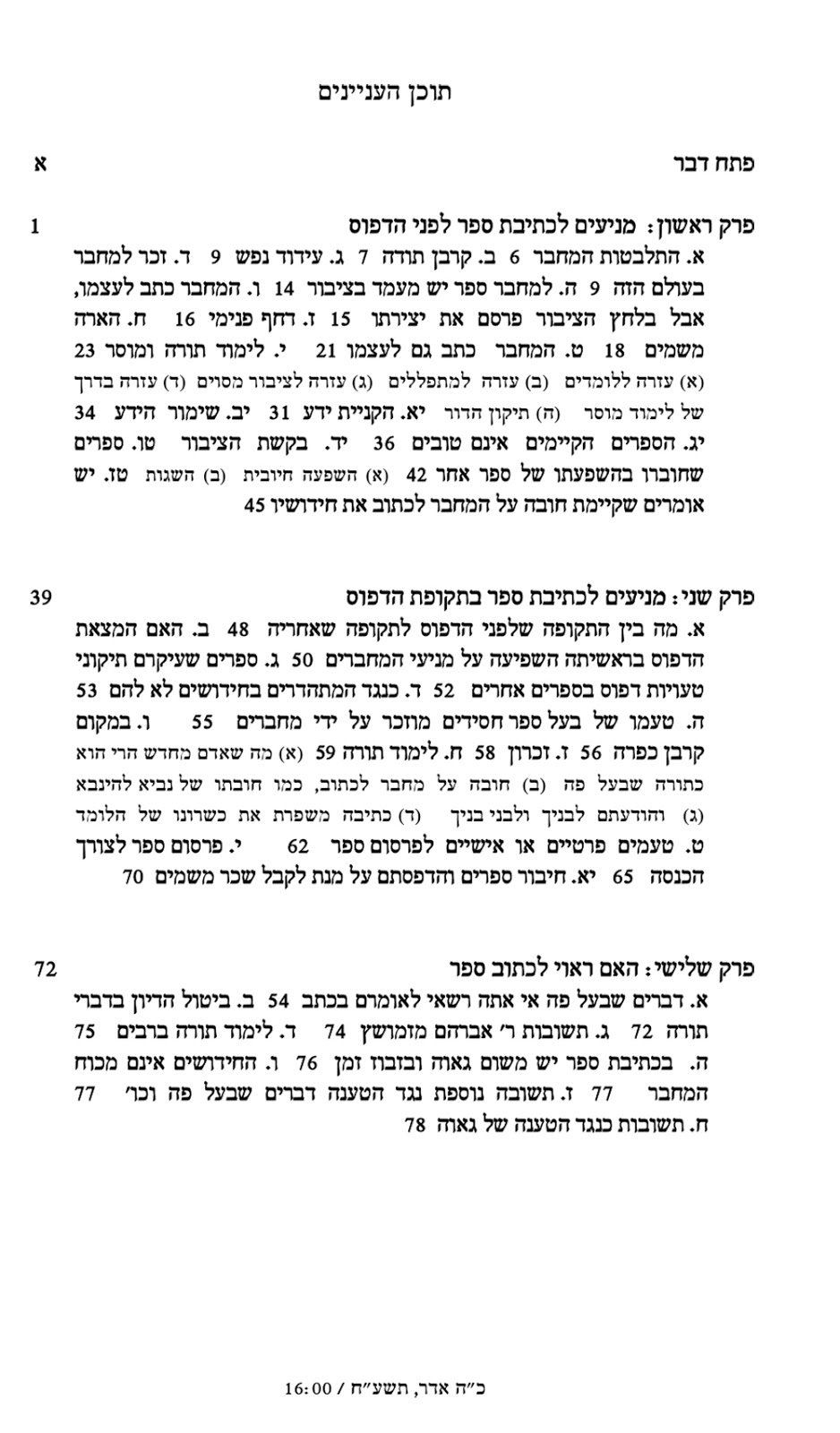
י. חכמים מעודדים כתיבה ופרסום דברי
תורה של צעירים
מן
הראוי לדעת כי היו חכמים שעודדו כתיבה תורנית של תלמידי חכמים צעירים, וראו בכך מנוף
להכשרתם לעתיד. ר’ יונה נבון רבו של החיד”א נהג כן ביחס לתלמידו, ומן הסתם כך
נהגו חכמי ירושלים באותה העת, אף שאין לנו ידיעה מפורטת על כך.[1]
מאוחר
יותר שמענו על נוהג מעין זה גם בג’רבה. ר’ כלפון משה הכהן כתב באחת מתשובותיו את
סדר הלימוד הרצוי כדי לגדל דור של תלמידי חכמים. הוא עמד גם על הדרך שבה ילמד
המורה את תלמידו לכתוב תשובות להלכה, וכך כתב:[2]
ויזרזם
לעיין בדבר ולערוך עלי גליון בכתב ידם נוסח תשובה על זה כפי מה שתקיף ידיעתם מאותם
המקורות, ולהביא איש איש מה שכתב בזה לפניו, ויקח בידו את כל הכתוב מהם, וישאל לכל
אחד מסקנתו בזה טעמו ונימוקו. וכל אחד ישיב לפניו הנראה לו בעל פה. ואח”כ
יראה אם מה שכתוב ממנו מתאים אל מה שאמר בעל פה…
גם
ממקורות נוספים אנו למדים כי בתוניס[3]
ובין חכמי הספרדים בירושלים, היה נהוג שיש ללמד את התלמידים כיצד יש לכתוב תשובות
הלכתיות. אמנם כתיבות אלו היו כתיבות פנימיות, שעברו את הביקורת של הרב. אם הרב
עבר עליהן ומצאן שהן כהלכה, יש להניח שיש אפשרות לפרסמן ברבים.[4]
דברים
בזכות הדפסת חדושי תורה של חכם צעיר שמענו מפי ר’ חיים אלעזר שפירא:[5]
שמעתי בשם גאון מובהק
וצדיק אחד ז”ל, שהיה כמה פעמים נותן הסכמות לתלמיד חכם חריף ובקי צעירי ימים
על חיבוריהם ואמר, אם כי אין החיבור נחוץ להעולם להדפיסו, אך עכ”פ ע”י
זה מלהיב ומרהיב לבבם לשבת ולעסוק בתורה בעיון לחבר החיבורים, כי בדבר שרוצים
לפרסם ולהדפיס לעיני העולם מדקדקים הרבה למצוא דרך סלולה, שלא ישיגו עליו על
חידושיו, וע”י זה מיגעים ומתמידים בתורה ביותר.
נמצא
שההסכמה אינה מאשרת בהכרח שהחידושים ראויים להדפסה. מטרתה העיקרית היא לעודד את התלמידים
שיעסקו בתורה, והמסכים סומך על התלמיד שדבריו ראויים.
על
ר’ אליהו בומבך מסופר כי דרשת הבר מצוה שלו הפליאה מאוד את השומעים, ולכן:[6]
הבחור
אליהו העלה את דרשתו על ספר, ולבקשת רבים חפץ להדפיסו ולהפיצו בישראל להנות בהם בני
אדם, ואסכים מריה על ידיה הוא אביו הגדול שהתייעץ בדבר עם אביו הה”ג[7]
מיאברוב, ונמנו וגמרו להדפיסו כליל בהדרו, למען הלהיב לבבו להוסיף אומץ בשקידה על
דלתי התורה, וגם משום קנאת סופרים תרבה חכמה, להרבות התמדה אצל בני גילו.
יא. יסוד ההיתר לפירסום ספר בגיל צעיר
ראינו אפוא שהיו חכמים שהתנגדו לפרסום ספר בגיל צעיר.
אבל יש הסבורים אחרת, והתירו לעשות זאת כפי שיבואר עתה.
במסכת עבודה זרה דף יט ע”ב נאמר:
אמר
רבי אבא אמר רב הונא אמר רב, מאי דכתיב כי רבים חללים הפילה (משלי ז, כו), זה
תלמיד שלא הגיע להוראה ומורה. ועצומים כל הרוגיה (שם), זה תלמיד שהגיע להוראה
ואינו מורה. ועד כמה, עד מ’ שנין. והא רבא אורי, התם בשוין.
האמור
בסוגיה זו שימש יסוד לקביעת גיל התמנות תלמידים לדיינים, נושא שהיה בו ויכוח גדול
בין מרן ר’ יוסף קארו לבין ר’ משה מטראני (מבי”ט), ונזקקו לו גם חכמי הדור
בתשובותיהם.[8] עמדתו של
ר”י קארו היא:[9]
וכתב
הר”ש בר צמח בסי’ קנ”ח[10]
וכן מנהג פשוט בכל קהלות תוגרמא להעמיד ת”ח בחורים שהגיעו להוראה לדין
ולהורות במקום שיש גדולים מהם בחכמה והם זקנים יותר מארבעים שנה ולא נשמע מעולם
פוצה פה ומצפצף, וכן ראיתי מורי הר”י בירב היה ממנה במקומו פה צפת תוב”ב
דיינים שלא הגיעו למ’ שנה… למדנו כי כל מי שהגיע להוראה בחכמתו אעפ”י שאינו
אלא בן י”ח שנים יורה יורה ידין ידין, וכל המעכב על ידו מעכב אותו מלעשות
מצות עשה מן התורה לדון את חבירו דכתיב בצדק תשפוט עמיתך (ויקרא יט, טו).
לאמור,
ניתן למנות דיינים גם לפני שהגיעו לגיל ארבעים.
הרדב”ז
היה בין אלה שנזקקו לויכוח, ובין שאר דבריו כתב:[11]
אבל
האידנא שכבר יש כמה הלכות פסוקות וכמה ספרים וכמה שאלות לגאונים ז”ל אם הגיע
להוראה יכול שפיר להורות מתוך הספרים אפילו בפחות ממ’, שהרי יכול לעמוד על מה
שכתוב בספרים. וגדולה [מזו] כתוב בהגהה [הגהות מיימוניות הל’ תלמוד תורה פ”ה ה”ב]
שכל פסק שאדם רואה בפירוש בספר מספרי הגאונים יכול להורות אפילו בימי רבו ואפילו
תלמיד גמור, רק לא יורה דבר מלבו ולא יסמוך על ראיותיו ולא ידמה מילתא למילתא
מדברי עצמו ע”כ… ומעשים בכל יום שהבחורים מורים הוראות ואין פוצה פה ומצפצף.
ומיום בואי פה באו אלי כמה קונדרסים מצפת תוב”ב מורים והם בחורים, ומהטעם
שכתבתי.
לאמור,
יש הבדל בין זמן התלמוד שבו הלימוד היה בעל פה, לבין זמן הגאונים ואילך שבו הדברים
נכתבים בספר. כדבריו כתב גם הרשד”ם, שאף הוא נזקק לויכוח. אלו דבריו:[12]
אמנם נראה בעיני דבר ברור, דבזמננו הרשות נתונה על כל פנים
לכל תלמיד חכם שהגיע להוראה אפילו שלא הגיע לשנים, כל עוד שלא יהיה בפני רבו מובהק,
דבזה איני רוצה לסמוך על הטעם הנזכר, כיון דחמיר כל כך דיש בו מיתה, אבל אשארא
סמכינן להורות, כיון שהחבורים הם המורים. וכל זה בתנאי שזה התלמיד בדוק ומנוסה
למעיין ומבין בתלמוד ובספרי הפוסקים והמחברים ז”ל. זה אני אומר כפי האמת ממה
שהורוני מן השמים כפי הדין החתוך, אבל אין ספק שראוי לגדור גדר בזמננו זה כי רבו
בקיעי הזמן, השועלים קטנים מחבלים כרם ה’ צבאות, היו עבדים ליצרם כל ימיהם, ובלא
דעת ותבונה ביד רמה יושבים על כסא ההוראה, ושרים לפי ערכם בחכמת התורה, ושלא היה
להם עסק אחר כל ימיהם הולכים לרגליהם כעבדים. על זאת ישתומם כל חסיד, כי אין ספק
כי בזה יצא משפט מעוקל, ושופט כל הארץ מלכנו יושיענו ויקיים מקרא שכתוב ואשיבה
שופטיך כבראשונה (ישעיהו א, כו) גו’.
לאמור,
רדב”ז ורשד”ם הסכימו אף הם שמותר להורות גם לפני גיל ארבעים אבל נימוקם
שונה מנימוקו של ר’ יוסף קארו, ויש בו חידוש. לאמור, כיום אין האדם מורה הוראה,
אלא הספרים הנמצאים בינינו הם הם המורים. לאמור, המורה מגלה לציבור את הכתוב בספר,
ותו לא. זאת כמובן בתנאי שהוא מבין את הכתוב בספר, וכמו שהדגיש זאת רשד”ם.
ר’
עובדיה הדאיה דן בנושא זה באורך רב, וכדי שלא להאריך אביא מדבריו רק מה שנוגע
לענייני ספרים:[13]
ודע
דמכל האמור תשובה מוצאת למה ששמעתי… ומעיד בגודלו שראה לכמה גאונים שקדמוהו,
שהיו מדקדקים שלא ליתן הסכמתם על ספר שו”ת אם מחברו פחות מארבעים שנה.
באופן
דהנך רואה דאין מקום לכל דברי המפקפקים הנ”ל, והוא הדבר גם על המפקפקים בענין
ההסכמות[14]
ומכל שכן לדברי מהרשד”ם והרדב”ז ודעמייהו דבזה הזמן דרבו ספרי הפוסקים והתשובות
אין התלמיד חכם המורה אלא הספר, דודאי דאין מקום חשש פקפוק בזה. דהרי כל מה שהעלה
על ספר הוא ממה ששאב מדברי הפוסקים ראשונים ואחרונים. וא”כ לא הוא המורה, אלא
הספרים שמהם שאב. וא”כ כל שניכר מספרו שהוא מעיין ומבין בתלמוד ובספרי הפוסקים
והמחברים ובעל סברה, ודאי דיכולים להסכים על ספרו בלי שום פקפוק.
מדבריו
עולה כי מותר להסכים על ספר שו”ת, שמחברו לא הגיע לגיל ארבעים. ההסבר לכך הוא
כפי שכבר ראינו לעיל. לאמור, לא החכם הוא המורה, אלא הספרים הם המורים. כמובן כל
זאת בתנאי שאנו רואים כי המחבר אכן מבין את אשר לפניו.
אלא
שבהמשך התשובה (אות כד) הרב הדאיה מסתייג קצת:
הן
אמת דכבר ראיתי להרב פנים במשפט (למר בריה דהרב פתח הדביר) בסי’ יו”ד שכתב
פקפוק זה בענין ההסכמות מגאוני אשכנז שהביא דברי הגאון מרדכי בכהמר”ר צבי
הירש ז”ל שכתב בהקדמתו לספר עמודי עולם…[15]
האמנם נראה ברור כי כל הגאונים הנ”ל תפסו במושלם להלכה כדעת מור”ם
ז”ל ביו”ד סי’ רמ”ב סל”א שפסק להדיא דאין לאדם להורות עד מ’
שנה אם יש גדול ממנו בעיר אף על פי שאינו רבו, יעו”ש. אמנם אנן בדידן שקבלנו
הוראות מרן ז”ל, ועינינו הרואות דהשמיט דין זה בשלחנו הטהור כאשר עשה
הרמז”ל בחיבורו. וגם ראינו לכל גדולי הפוסקים הנ”ל, ששתו בחלקות בין זמן
התלמוד לזמן הזה, ודאי דאין לנו לחוש לזה. ומכל שכן דיש לומר בשופי, דגם
מור”ם לא דיבר אלא בהוראה שבע”פ ומשום כבוד רב העיר דקשיש מיניה. אך אם
ההוראה היתה בכתב בדרך שו”ת ועינינו הרואות דהיא הוראה נכונה, מה מקום לחשוש
שלא להסכים עליה, ובפרט דספר שו”ת נמסר לרבנים והם כבר יכולים להכריע בדעתם
הרחבה ובבינתם אם לקרב אם לרחק, ואין שום חשש תקלה ח”ו. וכן אתה תחזה להרב
פנים במשפט שם שסיים וז”ל, מיהו חזינן לגאוני רבני ספרד דלא חשו לכך ולא
נמנעו לתת הסכמה לספר פסקים שחיבר אחד שהוא פחות ממ’ שנה. ונראה טעמם שהמרביץ תורה
לא יסמוך לגמרי על ספר אותו הפוסק, אם לא ישא ויתן בענין בכל ספרי הפוסקים והמוסכם
לדעתו מפי סופרים ומפי ספרים יורה ידין עכ”ל. ומכל שכן לפי מה שבא בנותן טעם
הרב ריח שדה ז”ל, שיש מקום לחוש לזה לרפיון התורה, בראותם כי אינם מתחשבים
הרבנים הגדולים לדבריהם, דבודאי דאדרבא דחיובא רמיא על רב העיר לחזק את ידיהם ביתר
שאת, להוסיף אומץ וחוזק בלימודם להגדיל תורה ולהאדירה, ואיתיה בזכייה, שעל ידו
מלאה הארץ דיעה, והתורה רבה בישראל, ומה’ יפיק רצון, ועליו תבא ברכת טוב, אמן.
שומע
אתה מדבריו, כי נכון הוא שהיו רבנים אשכנזיים שמיאנו לתת הסכמה על ספר שמחברו לא
הגיע לגיל ארבעים, וזאת בהסתמך על דברי הרמ”א. אבל חכמי הספרדים אינם פוסקים
כמותו, אלא כמרן בשולחן ערוך שלא הזכיר את המגבלה של גיל ארבעים, ולכן חכמי
הספרדים הסכימו על ספרים שמחברם צעיר.
ברם,
הרב הדאיה מחדש שאפשר שגם הרמ”א יסכים לכך, כיון שהאיסור של גיל ארבעים חל רק על הוראה בעל פה. מה עוד שיש חשיבות לעודד
מחברים צעירים, כדי להגדיל תורה.
בדומה
לכך כתב גם ר’ עובדיה יוסף:[16]
ולפ”ז
כיון שאין לנו הגבלה של ארבעים שנה לענין הוראה, כל שהגיע להוראה, וכדתנן אל תסתכל
בקנקן אלא במה שיש בו [אבות ד, כ]. מעתה גם בחיבורים ופסקים אין לנו להגביל הזמן
שלא להדפיס עד מ’ שנה. ואף על פי שיש לחלק בין הוראה לשעתה ובמקומה, לחיבורים
המתפרסמים בכל תפוצות ישראל להבין ולהורות לשעה ולדורות, מ”מ אין לנו שום
יסוד מוסד לאסור בזה, מאחר שהמחבר הגיע להוראה ע”פ עדות גדולי הדור אשר יתנו
עדיהם ויצדקו. ואף על פי שהרמ”א ביו”ד (סי’ רמב סל”א) כ’ שאין לאדם
להורות עד ארבעים שנה. ע”ש. [וע”ע בתשובת המבי”ט סי’ רפ[17]].
אנן בדידן בתר הוראות מרן אזלינן. ובפרט שהעיד בגדלו שכן המנהג פשוט וברור, ומעשה
רב של רבו הגאון מהר”י בי רב. וכנ”ל. ואף להרמ”א י”ל דשאני
דין מחבר ספר בהלכה להפיצו ברבים, דיהיב דעתיה טפי לעיין היטב בספרי הפוסקים לבל
ימצא שם בדק, ואינו דומה למורה הוראה ומשיב לשואלו דבר בדרך הוראת שעה, שיש מקום
לחוש פן לא יעיין היטב בהלכה וידמה מילתא למילתא, בעוד שרב המרחק ביניהם, ויהי בכזיב
בלדתה אותו.[18]
לאמור,
לדעת חכמי הספרדים, אם ניתן למנות דיין שלא הגיע לגיל ארבעים ודאי שניתן גם לחבר
ספר לפני גיל ארבעים.[19]
אמנם לדעת חכמי האשכנזים, שיש הגבלה של גיל ארבעים למינוי דיינים, יש מקום לטעון
שאולי אין לחבר ספר לפי גיל ארבעים. ברם לדעת ר”ע יוסף, אדם המחבר ספר הרי
חזקה עליו שהוא בודק בעומק את דבריו טרם שיפרסמם. בזה הוא עדיף ממורה הוראה, שצריך
להשיב כמעט באופן מיידי. עדיפות זו של מחבר ספר היא הנותנת לו היתר לפרסם ספר גם
לפני גיל ארבעים.
אלא
שבהמשך הדברים סייג ר”ע יוסף מעט את דבריו:
וא”כ
גם לענין חיבורים ופסקים יש להקל להדפיסם ולהגדיל תורה ולהאדירה, ועל צד היותר טוב
יודיע המחבר בהקדמתו שלא יסמכו על חיבורו לפסוק ממנו למעשה כי אם אחר העיון היטב.
אבל להמנע מלהדפיס מכל וכל, היא חומרא המביאה לידי קולא, שכמה הפליגו חז”ל
בעונש מי שמונע בר (סנהדרין צא סע”ב).
ר”ע
יוסף לא הדגיש בדבריו עד עתה באיזה ספר מדובר, והדעת נותנת שכוונתו היתה לכל ספר
תורני. אכן ביחס לספר הלכתי נוספה עתה הסתייגות מסויימת. לעומתו, ר”ע הדאיה
ציין בדבריו במפורש שהוא מדבר על ספר שו”ת, ואפשר שרק לגביו התיר פרסום בגיל
צעיר. מכל מקום הצעתו של ר”ע יוסף שיש להודיע כי אין לסמוך על החיבור לפסק
הלכה, דומה שהשפיעה על מחברים רבים כפי שנראה בהמשך.
גם
ביחס לאשכנזים הביע ר”ע יוסף בהמשך תשובתו הסתייגות מסויימת:
ומעתה
נראה דעכ”פ לחבר ולהדפיס חיבורים בהלכה בדיני ממונות אף להרמ”א ודעימיה
יש להקל גם בפחות מארבעים שנה. ואף על פי שעדיין יד הדוחה נטויה לומר שבהדפס
חיבורים בהלכה גרע טפי, כי הדבר נשאר לדורות עולם, ויורו המורים שאינם בקיאים
לעמוד על שרש הדברים ועיקרם, ועי”ז רבה המכשלה, מכל מקום כיון שלא כל חכם
מצוי לפסוק דיני ממונות רק הבקיאים בש”ס ופוסקים, וברוח מבינתם יעמדו על דברי
המחבר היכונו דבריו אם לא, ומה גם שכל זה לאחר קבלת ההסכמות מגדולי הדור שיודעים
ומכירים המחבר בחכמתו ויראתו, לכן אין לחוש לזה כלל. ומצוה קעביד להגדיל תורה
ולהאדירה.
בין
חכמי האשכנזים[20] מצאתי
התייחסות לנושא בדברי ר’ יוסף ליברמן, ואביא את מסקנתו:[21]
להדפיס
דברים הנוגעים להלכה יש להמנע עד היותו בגיל מ’ שנה, ואם כתב לפני כן ורוצה
להדפיסם אחרי כן בהיותו כבר בן מ’, צריך לעבור עליהם עוד פעם, דאם לא כן מאי אהני
שמדפיס אח”כ, אדרבא עוד גרע דמטעה הבריות שאינם יודעים שמשנות ילדותו הם. וצעיר
הרוצה להדפיס צריך ת”ח מבוגר בן מ’ לעבור עליהם בעיון. אבל כל זה רק במי
שמעצמו מברר ופוסק הלכה מראיות וסברות שלו, ואין בכלל זה מחברי ליקוטי הלכות מדברי
פוסקים קודמים, כגון ספרי “כהלכתו” של דורינו שאינם אלא מאספים דברי
קודמיהם, באלה אם רבני גאוני הזמן יסכימו שהמחבר הולך ישר וראוי לכך הרי הם מזכי
הרבים.
ר’
נתן גשטטנר סבור אחרת. אלו דבריו:[22]
הרי
חזינן עד כמה חרדו גדולי עולם אלו זכר צדיקים לברכה שלא לפרסם פירות בוסר הנוגעים
להלכה, ומכל שכן ספרי לקוטים של הלכות פסוקות אשר יד הכל ממשמשים בהם ואינם
מיועדים דוקא לתלמידי תכמים היודעים להבחין בין תכלת לקלא אילן, הרי ודאי שאינו
ראוי לעסוק בכאלה אלא לתלמיד חכם מופלג שהורגל לעיון והתעמקות שנים רבות, ואף
שתקנת גאוני פראג[23] נראה שלא
נתפשטה, דהא עינינו הרואות שהרבה גדולים הבאים אחריהם הדפיסו ספריהם בהלכה טרם
שמלאו להם ארבעים לבינה, ואף הגאונים הללו לא תקנו זאת אלא בקהלתם וכמבואר בלשון
הכרוז “ראינו לתקן תיקון בקהלתינו”. אבל עכ”פ ניתן ללמוד מדבריהם
הקדושים כי לאו כל הרוצה ליטול את השם יבוא ויטול, ואין ראוי לעסוק בפרסום הלכות
הנוגעות למעשה אלא לתלמידי חכמים בעלי עיון שדעתם נתיישבה עליהם.
גם
נראה דעיקר הקפידא היתה שלא להדפיס קודם שנת הארבעים בירורים הלכה למעשה, אבל
לענין הדפסת ספר של ביאורי סוגיות ופלפולא דאורייתא, שאינו בא להסיק ולפסוק הלכה,
הנה בזמן הזה של עוקבתא דמשיחא שנתקיים בנו אמרם (סוטה מט:) חכמת סופרים תסרח
ויראי חטא ימאסו והאמת תהא נעדרת… ודאי שחיוב גמור על השרידים אשר ה’ קורא,
תלמידי חכמים צעירים העוסקים בתורת ה’, להפיץ מעייני חכמתם חוצה, ויש בכל ספר
שמחברו הוא ירא שמים ישר הולך משום קידוש שם שמים ברבים, להראות לעיני עם הארץ כי
לא פסקה אהבת התורה מישראל… ואדרבה חשיבות גדולה היא לעורר ולעודד את צעירי הצאן
לחדש חידושין דאורייתא ולכתבם עלי גליון וגם לפרסמם בדפוס, אבל בתנאי שהדברים הם
פרי עיון והעמקה ויגיעה בגופי תורה.
העתקתי
חלק ניכר מדבריו, כדי שהמעיין יראה מה בינו לבין ר”י ליברמן.

[1]       ראה על
כך מ’ בניהו, רבי חיים (לעיל הערה 35), עמ’ יא-יב.
[2]       שו”ת
שואל ונשאל, ח”ה, יו”ד סי’ קיט. הוא חזר על כך במקומות נוספים. ראה
בספרו ברית כהונה, ג’רבה, תש”א, או”ח מערכת ל, אותיות טו (שם גם ציין
למקומות נוספים שבהם חזר על דבריו), טז.
[3]       ראה ר’
מאיר מאזוז (נאמ”ן), דרכי העיון, בני ברק, תשע”ב2, דפים
קנח-קס, ואף שמדובר שם בג’רבא, שלא היה לה כל כך קשר לתוניס, בכל זאת המחבר כתב
בראשית דבריו כי הוא מדגים את דרך “העיון התוניסאי”, וראה גם דבריו בדף
קנח ע”ב ד”ה נעבור.
[4]       הנה
החיד”א בשו”ת חיים שאל ח”א סי’ סג הדפיס תשובה של רבו, ואחריה סי’
סד הדפיס את תשובתו שבה דן בדברי רבו, ולפי מ’ בניהו, רבי חיים (לעיל הערה 35),
עמ’ יא, הערה 24, החיד”א היה אז בן חמש עשרה-עשרים שנה.
[5]       דברי
תורה, ירושלים, תש”מ, ח”ו, אות מה.
[6]       ראה
לעיל הערה 118, בתולדות המחבר (אין ציוני דפים).
[7]       הרב
הגאון, הרב הגדול.
[8]       על
הויכוח ראה מ’ בניהו, ‘האסכולות של המבי”ט ושל מרן רבי יוסף קארו וההתכתשות
ביניהן’, אסופות, ג (תשמ”ט), עמ’ טז-כד, ובספרות שם, וחזר על כך בספרו יוסף
בחירי, ירושלים, תשנ”א, עמ’ מח-נג. באור ישראל סד (תשע”ב), עמ’ לד-לו,
נדפסה תשובתו של ר’ מרדכי הענא מכתב יד בעניין זה.
[9]       שו”ת
אבקת רוכל סי’ רא. תשובה זו אנונימית, אבל כבר קבעו כי היא של ר”י קארו, שהרי
הוא מזכיר בה את ספרו בית יוסף.
[10]     לפנינו
נמצא כן בתשב”ץ, ח”א, סי’ קנט.
[11]     שו”ת
רדב”ז, ח”ו, סי’ ב אלפים קמז.
[12]     שו”ת
רשד”ם, חו”מ, סי’ א, מהד’ ר”ד אביטן, ירושלים, תשס”ח, דף ח
ע”א.
[13]     שו”ת
ישכיל עבדי, ח”ב, חו”מ, סי’ א, אותיות כב, כג.
[14]     כדאי
לציין: הרב הדאיה סבור שההסכמות בדורנו אין להן כל תוקף, כיון שברור שהמסכים לא
עבר על כל הספר אלא המסכימים “סומכים על חזקה על חבר שלא יוציא מתחת ידו דבר
שאינו מתוקן, וגם סומכים על המעיין שבדעתו הרחבה יכול להכריע אם לצדק אם לשבט ולכן
אין שום צורך בהסכמות, ולא נצרכה אלא לברכה”. כך כתב בהסכמתו לספרו של
ר”מ מימון, הלכה למשה, ירושלים, תשי”ח.
[15]     הבאנו את
הדברים לעיל, ראש סעיף ו.
[16]     שו”ת
יביע אומר, ח”ד, חו”מ, סי’ א.
[17]     שורה זו
במקור.
[18]     מליצה על
פי בראשית לח, ה: והיה בכזיב בלדתה אותו. כלומר, המורה הוראה יכול לטעות.
[19]     ר’ אברהם
יקותיאל אוהב ציון, שו”ת יעלת חן, ח”א, ירושלים, תשס”ט, בהקדמה
שערי ח”ן, דף א ע”ב, כתב שאם חיבר את התשובות בהתיעצות עם חבריו, ניתן
לפרסם אותן לפני שהמחבר הגיע לגיל ארבעים.
[20]     על פי מה
שכתב ר’ צבי יברוב, מעשה איש, בני ברק, תשנ”ט, ח”ב, עמ’ ע-עא, עולה כי
החזון איש תמך בהדפסת ספר בגיל צעיר ואילו רז”ר בענגיס התנגד לכך.
[21]     משנת
יוסף, שבעים דרשות ומאמרים, ח”א, ירושלים, תשנ”ח, מאמר ז, עמ’ פז.
[22]     שו”ת
להורות נתן, חי”א, סי’ צג, אותיות ז-ח.
[23]     על תקנה
זו נעמוד לקמן בסעיף יב.


Review of a new edition of the Sefer Chasidim

Review of a new edition of the Sefer Chasidimby R. Eliezer Brodt
As recently mentioned on this blog this generation is privileged to have many seforim especially rishonim being reprinted in critical editions based on manuscripts etc. One of the publishing houses which has been involved in publishing such works is Mechon Otzar haPoskim. A few years ago they released a few volumes of a critical edition of the Mahzhor Vitri which to date its still not complete. And now, a few weeks ago they published two volumes (of eventually four volumes) of the Sefer Hassidim. In this post I would like give some background on Mechon Otzar haPoskim, the Sefer Chassidim in general and this recent version in particular. Mechon Otzar haPoskim was founded in the 1950’s by two great gedolim R. Isser Zalman Meltzer and R. Yitzchak Isaac Herzog. R. Herzog explained (introduction to Otzar haPoskim compendium on Even haEzer) the reason for founding of the organization was due to the almost limitless nature of Halacha and thus at times poskim find themselves having to deal with very difficult topics and do not have access to most of the seforim of the many great Gedolim of the past that would help them deal with these difficult topics. Attempts to deal with the vast amount of halacha literature had been previously attempted by the Peschei Teshuva and Darkei Teshuvah. But, today, both of these works are limited as the body of literature has expanded significantly since these earlier works came out. R. Herzog thus had the idea to create a modern compendium using what he had available. He then heard that R. Isser Zalman had the same thoughts so they decided to work together and gather a group of Gedolim to systematically go thru the teshuvot literature, abridge it, and place it in the parallel place in the order of the Shulchan Orach. R. Isser Zalman had an additional reason why he wanted to start this organization. He felt that many talmdei chachamim needed parnasah so this was a great way to help them by employing them to go thru all the seforim (Derech Etz Chaim vol. 2 p. 327).
With the help of Dr. L. Magnes, R. Herzog was able to raise funds to start this organization. Card catalogs were made and the seforim were cataloged according to topics forming the now-famous Otzar haPoskim catalogs. These catalogs are the notes culled from thousands of seforim. A look in the index of earlier volumes of the Otzar haPoskim will show that they in the fifties were going thru more volumes of seforim than the Frankel edition of the Rambam did in their recent, final volume! Interestingly, R. Isser Zalman inherited an excellent library from R. Chaim Berlin which contained thousands of rare seforim which were unknown to most people. R. Isser Zalman made sure these seforim were used and quoted in the Otzar haPoskim (Derech Etz Chaim vol. 2 p. 328). R. Isser Zalman also the one who made the decision which works would make it into Otzar haPoskim and which would not. To date this catalog has helped many seforim such as the many volumes of Mo’adim l’Simcha. Otzar haPoskim’s main work has been the Otzar haPoskim on Even haEzer. Anyone needing sources on topics relating to Even haEzer; this has a tremendous amount of sources. One interesting point about this work is that one finds all kinds of Rabbonim getting along – quoted side by side. A few years ago they mentioned that the volumes of Otzar haPoskim on Orach Chaim are in preparation one only hopes that they will come thru to create such an important necessary work on Orach chaim [This is actually available on the Morgenstern, Otzrot haTorah, hard drive as well as on the Otzar haPoskim on Hoshen Mishpat.] Recently they have expanded their repertoire to include the publication of Rishonim such as the Machzor Vitri and, now, the Sefer Chasidim. The Sefer Chasidim has been reprinted many times ever since it was first printed in Bologna in 1538. R. Saadia Helvona in his introduction to his commentary on the Sefer Chasidim, Mishnat Chasidim, notes that the Sefer Chasidim is encyclopedic in nature as it includes both halacha and aggadah. The Sefer Chasidim is extremely popular and it is quoted by many rishonim and achronim for all kinds of things. Aside from quotations, there seems to be a certain awe about it which is hard to explain especially when it comes to the tzavah (the ethical will) which was printed in many of the editions (first printed in Yesod haTeshuva, Cracow, 1585).
The tzavah itself is the subject of many teshuvot and even some entire seforim. Without going into the whole history of this topic (which R Gutman promises us will be one of the forthcoming volumes) its worth mentioning aside from the well-known teshuva in the Nodah beYehudah (Even haEzer Tinyanah no. 79), where he writes that there are many things in the tzavah which conflict with Chazal and those statements do not need to be followed. There is an additional, lesser known statement from the Noda BeYehudah about the tzavah. R Eleazer Fleckels (most well know for his Teshuvah m’Ahahva), in his Olat haChodesh (vol. 1 p.15) records that the Nodah beYehudah would respond when asked if there is a problem marrying someone if that will cause the future father-in- law and future son-in-law will share the same name (which the tzavah states is a problem) “before you ask me about following the tzavah of R. Yehudah haChasid ask me about the tzavah (or statement) of Chazal which decries marrying the daughter of a am ha’aretz! [This sentiment, however, is disputed in the Teshuvos Matzav haYashar (volume 2 pg 44) where he writes “in his old age that whenever he saw people going against various statements in the tzavah nothing good ever came from it!] The true authorship of the Sefer Chasidim is unclear. Some attribute it to R. Yehudah haChasid (Chida and others) but R Avrohm ben haGra records that his father, the Gra, held R. Eleazer Rokeach wrote it (Yeshurun, vol. 4 p. 250). R Frumkin also records this statement from the Gra– R. Frumkin’s source is a manuscript of R. Yisrael of Shklov’s Pas haShulchan (Toldos Chachmei Yerushalim, vol. 2 p. 102 the end of note 1; see also Chaim Michal, Or haChaim p. 456). Abraham Epstein writes that the Sefer Chasidim doesn’t have a single author but instead it is from three different people – R Shmuel haChassid, his son R Yehudah haChasid, and R. Eleazer Rokeach (Kitvei R. Avrohom Epstein, vol. 1 pp. 258-261). R. Gutman in the introduction to his new edition of the Sefer Chasidim brings many other different sources in regard to the authorship of this sefer. Recently Professor Haym Soloveitchik shows in a beautiful article based on Yakov Reifman that not only are is the work of different authors but there are completely different styles and what one writes completely contradicts what the other does. (JQR XCII no. 3-4 pp. 455-493). Many manuscripts exist of the Sefer Chasidim , however, from the 1538 until 1891 there was basically one version printed based on only one of the manuscripts. In 1891, Yehudah Wistinetzki printed a new edited from another manuscript – the Parma manuscript – published by Chevra Mekitsei Nerdamim.
This Parma manuscript contains a almost double the material of the original edition. Aside from just adding material, the Parma edition is also important for the different versions of the previously published pieces. This edition was recently reprinted by Moznaim publishing house but without the important introduction of Y. Frieman. However, the Kest Leibowitz publishers also recently reprinted this edition and they reprinted the whole sefer including the introduction. Interestingly although the footnotes which appear in this edition are not that extensive as some of the prior editions, there are important notes on this edition albeit they don’t appear in the actual work. Instead, Wistinetzki, prior to printing this edition sent about fifty questions to R. Yosef Zechariah Stern in an attempt to locate sources for different statements of the Sefer Chasidim and the answers are included in R. Stern’s Zecher Yehosef (vol. 1 no. 78).
In 1955, Rabbi Avrahom Price from Toronto with the permission of Mekitsei Nerdamim reprinted the Parma edition in three massive volumes with extensive footnotes. But, one thing which R. Price stays clear from – which he admits in his introduction – is the kabalah aspects of the Sefer Chasidim as he was not familiar with this part of torah. These three volumes are available for free download at seforim online at Hebrewbooks.org.. In 1924, R. Reuven Margolis first published in Lemberg, what would become the most popular version of the Sefer Chasidim, in a critical edition . Subsequently, this was corrected and updated and eventually published by Mossad HaRav Kook. This edition to date is the best job done on the Sefer Chasidim. He has excellent notes, as many are familiar with from his many seforim – he writes straight to the point referencing all kinds of sources from everywhere – showing the sources which form the basis of the Sefer Chasidim. He also shows, with his unbelievable bikyus, whether the various authorities – rishonim and achronim – agree with the statements of the Sefer Chasidim. Besides for all this he has many excellent and original comments on the Sefer Chasidim which he is famous for in all of his works. He also includes notes from nine different people on the Sefer Chasidim. Until now, there was one other worthwhile addition to the Sefer Chasidim. In 1984, R. Moshe Herschler printed in his Kovetz Genuzot (vol. one) some thirty more pieces of the Sefer Chasidim which he found in a different manuscript. We now come to this most recent version published by Otzar HaPoskim and edited by R. Gutman. As mentioned above, thus far, two volumes have been issued of what is supposed to be four volumes of the Sefer Chasidim. The first impression one has when one picks it up is this is a beautiful job as the print is very clear and the layout it very organized. This is keeping with the famous statement of R Akiva Eiger where he writes to his sons in the introduction of his teshuvot that “one should print his sefer on nice paper and ink because one learns much better from such a sefer”. Although this statement is attributed to R. Eiger, in fact, this idea is found much earlier in the famous introduction to the Maeseh Efod (p. 13) of where he writes this concept at great length it’s quoted by R Yakov Emden in his work Migdal Oz (p.50 ) in short. Prior editions of the Sefer Chasidim included the perush of the Chida, Bris Olam, but it seems that many pieces were missing. R Gutman corrects these omissions. In addition to those corrections to that commentary, another common commentary Pirish Kadmon by R. Dovid Greinheit also suffered from lack of completeness and R. Gutman has correct that as well. Besides for all this R. Gutman includes a collection of comments of R Eliezer Papua from his Yalkut Chasidim that relate to the Sefer Chasidim and the Perush Mishnat Chasidim from R Sadiah Chalonah (it is only on the first seven simanim in the sefer).
Rabbi Guttman includes many notes (totaling twenty-nine) from different gedolim on the Sefer Chasidim many of them which he obtained from unpublished manuscripts amongst them from the Adres and R. Y. Palagai. In the back of volume two he includes a sixty page kuntres of notes from R. Chaim Sofer who is famous for his incredible bikyus. In addition to all this he has many lengthy comments on the whole sefer from a wide rang of sources to explain the Sefer Chasidim. He also has a section on each page where he brings down various readings from the different manuscripts on the particular pieces. All the above are the positive things about this reprint, unfortunately, there are notable points of criticism. It is true its is always easier to criticize than to the actual work oneself but here are some points I feel worthy of mentioning. To begin with the entire history and literature of the Chasidei Ashkenaz in general have been the subject of many articles and books. However, even today after all that has been published there is much left unclear. Just to list a few of the people who were and are involved in the study of the Chasidei Ashkenaz, Moritz Gudemann (haTorah v’Hahayim, vol. 1, pp. 119-156), A. Epstein (vol. 1 pp. 245-269), Y Y Frieman (introduction to Sefer Chasidim Meketzei Nerdamim ed.), Gershom Scholem, Y Baer, Ivan Marcus (all in Da’as v’Chevrah b’Mishnat Chasidei Ashkenaz), E. E. Aurbach (Balei haTosfos, vol. 1, pp. 345- 447 and volume four of his edition of Arugot haBosem), Yisroel Ta Shema (Keneses Mechkarim, vol. 1 pp. 181-317), E. Kanarfogel (Peering thru the Lattices), Yosef Dan (in his recent book on R. Yehudah haChasid published by Zalman Shazar), Eric Zimmer, Simcha Emanuel (in his introduction to the recently published Drasha of Rokeach) and Haym Soloveitchik (AJS Review vol. 1 (1976) pp. 311- 357).
Some of what has been found in these manuscripts has been the subject of great controversy causing great people to claim these manuscripts must be forgeries (see Kovetz Minchas haKayitz vol. 6 pp. 251-252). But besides for this there has been a great many manuscripts found in the past twenty-five years and printed such as the Rokeach al haTorah and Megilos or the Rokeach’s work on siddur and many other of his works, R. Efraim al haTorah. Other works by the Chasidei Ashkenaz have been put out in critical editions such as the Sefer Gematriyos of R. Yehudah haChasid and the Amaoros Tehoros (which I hope to return to in later posts) all containing many important explanations about all sorts of topics from the Chasidei Ashkenaz.
To date there is no way to many unknowns (for me at least) to even paint a brief picture of this group of rishonim but one hopes with the help of the recent seforim printed and what will be printed in the future we will be able to get a clearer understanding of these great rishonim. Being aware of the explosion in this genre of literature, any version of the Sefer Chasidim should keep this companion literature in mind and should take it in account as much of the printed torah of the Chasidei Ashkenaz as it relates to this most famous work, Sefer Chasidim, of this school.
Now R. Gutman seemed to be aware of this and he does use some of these new seforim. For example, he quotes the Sefer Gematriyos many times however the rest of this no mention to the many other recent seforim of Chasidei Ashkenaz. [For a comparison see the recent edition of the Sefer Gematriyos where the footnotes are full of such cross-references (although he might of done to much).] The purpose of referencing the other literature of the Chasidei Ashkenaz is many times they can help understand certain comments if one can see all the ways similar ideas are brought down by the different talmdim. In learning Gemara with rishonim this is very important to help one understand the particular shitos and so to here.
For example, the Sefer Chasidim (siman 548) writes if one wants to see if he will live the year light a candle during assert yemih teshuvah if it remains lit you will live the year if not, not. On this R. Gutman references nothing. Where as without going much into this topic I will just give a reference to the Sefer Hashem of the Rokeach (recently printed from manuscript for the first time) where he talks about this (p.140) which complements the statement found in the Sefer Chasidim.
I feel this is a very important part to anyone writing on the Sefer Chasidim and R. Gutman should have put in more work in regard to this part. If he could not do it himself because he is not trained in this sort of work he should of gotten people who are familiar with such this field. R. Reuven Margolis who did know how to do this in general unfortunately could not do this as most of these seforim of Chasidei Ashkenaz were not available in his lifetime. Another point that I would like to highlight is the many times R. Gutman cites to the Sefer Gematriyos he almost never references the exact page (see, e.g, pp. 23, 35, 39) in the Sefer Gematriyos making it very hard to find the piece he is quoting as it’s a massive two volume work. The same failing is apparent when R. Gutman quotes from the Sefer Amoros Tehoros (p. 23) or when R. Gutman cites the Sefer Hashem of the Rokeach (p. 429).
A more glaring omission is when Sefer Chasidim (p. 424) discusses the weird creature called שטריאה R. Gutman references the Sefer Gematriyos again not quoting the page and then R. Gutman writes ובסוף המאמר נשים הליליות ברושאם הנ”ל כתב which is an unintelligible citation. What R. Gutman means to say is that R. Stal in the back of his edition to the Sefer Gematriyos has a whole chapter devoted to this topic, however, this is totally unclear to the reader. Aside from the cryptic citation R. Gutman should have mentioned this is a comprehensive article on the topic. Another point I would like to criticize is the use or lack thereof of R. Reuven Margolis edition. As I have mentioned earlier the Margolis edition is the best work to date on the Sefer Chasidim. It’s quite interesting that there is not a single mention of R. Margolis’s name in the introduction mentioning that R. Gutman used this work. However, it is obvious from hundreds of places throughout this Gutman’s edition that in fact he did use this edition.
What is perhaps even stranger is the many times that R. Gutman says nothing on a very important point and R. Margolis has already discussed it in depth. Some examples are on page 180 -181 where the Sefer Chasidim (siman 158) writes against tefilah בקול רם and the Margolis edition references the famous collection on this topic called Yanenu B’kol there is no reason why R. Gutman could not mention this. Another example is on page 172 where the Sefer Chasidim (siman 155) has a long discussion about stealing torah from someone so R Gutman has a lengthy note of sources about this but once he is on the topic one should quote the Sefer Shem Olem of R. Margolis where he discusses this topic at great length. This omission is even more bizarre as later on R. Gutman does cite this work (p. 744).
One more example is on page 274 the Sefer Chasidim (siman 258) ויום כיפור קרוי כמו כן ראשית דכתיב ביחזקאל בעשרים וחמש שנה לגלותינו בראש השנה בעשור לחדש אלמא בעשור קרוי ראש השנה on this R Margolis references a comment of his from other places (see his Toldos haMahrsha p. 51 and the notes therein and his Nitzozei Or p. 158) proving that sometimes it says Rosh Hashanah and it refers to Yom Kippur affirming the statement in the Sefer Chasidim –again no mention at all on this by R. Gutman. Another such example is where the Sefer Chasidim (siman 822) talks about wiping ones feet off before entering a shul in the R. Margolis edition there are many sources on this topic. But, again R. Gutman mentions nothing about this custom.
Another example is where the Sefer Chasidim (Siman 858) talks about saving seforim from a fire on Shabbos again R. Gutman does not quote the excellent reference of R. Margolis citing in turn the Adres who says that if one has manuscripts of his own that he worked hard on he may save them from the fire first because it’s like pikuach nefesh! Throughout R. Gutman’s edition there are many such examples. Perhaps R. Gutman assumed what whomever purchases his edition already has R. Reuven Margolis edition and R. Gutman was merely adding to that. Even so, he should mention it in the introduction. Another deficiency in this edition is R. Gutman, in the section he includes comments collecting sources etc., his style is difficult as much of what he has could have been done shorter and more to the point. Unfortunately, this is a common weakness that many authors have today as I have previously mentioned on this blog. Besides for that I feel there are many more sources that he could have added to this part making it a true encyclopedic work that it should be.
Just to list a few examples of sources that he missed and on this there for sure is an element of lo alechu hamlacha ligmor. One where R. Gutman talks about the cherem to live in Spain (p. 394) he misses much on the topic amongst the omissions is the famous discussion of the Teruos Melech in Rosh Hashanah (siman 13 sec. 2) (for more on this see the great article of Marc B. Shapiro in Sefarad 49:2(1989) pp. 381-394).
Another such example is both times where the Sefer Chasidim talks about stealing torah from someone (pp. 172 and 774) he could have added the piece of R. Efraim Zalman Margolis in his introduction to the edition of the Maseh Rokeach which he printed. Another such example is where the Sefer Chasidim (siman 822) talks about wiping ones feet off before entering a shul so besides for not mentioning R. Margolis’s comments at all he could of referenced to the excellent discussion in the Minhaghei haKehelos of R. Golhaber (vol 1 pp. 3-8).
Another example is where the Sefer Chasidim (siman 158) writes against tefilah בקול רם he missed the very original discussion of the Matzevh Hayashar (volume 2 pg 28 and onwards). One last example is where the Sefer Chasidim (siman 461) discusses the topic of if something bad happens three times it is a bad sign he could of added the teshuvah of the Avnei Chefetz from R. A. Levine (siman 64). Many more examples could be given but this is not the place. Some minor bibliography points one on page R. Gutman records a statement from the Shach al haTorah which he attributes the Shach (p. 173). But, it is obvious he did not check into this source because the Shach did not write this sefer rather a talmid of talmid of the Ari”zal did which R. Gutman himself quotes correctly later on page 774. Another point is in the introduction R. Gutman speculates that based on the pieces he has included it seems that the Adres wrote an entire work on the Sefer Chasidim called Mishnat Chasidim. There is no need for speculation – this is correct – as the Adres in his autobiography (pg 33) writes “I bought a Sefer Chasidim with wide columns and I learnt it twice and I wrote a biur on it with sources … and I called it the Mishnat Chasidim.” Unfortunately, later in his autobiography the Adres writes (pg 56) that it was burned in a fire that destroyed most of his writings!
Another minor point on page 181-182 where he talks about a story brought down from various sources including the Kav haYashar he should of included the comments of R. Shmuel Askenazi appended to the Kav haYashar (end of volume 2 pg 8). Another example is where the Sefer Chasidim speaks (Siman 768) against singing tunes of non-Jewish origin, R. Gutman (pg 645) includes a number of nice sources on this topic at the end he mentions R. Yisroel Najara that he was a nizutz of Dovid haMelech. He should have at least referenced the Sefer Chizyonos of R. Chaim Vital against R. Najara (and this was actually the person the Shtei Yodos was writing against who R. Gutman quoted earlier in that same piece!) – which was discussed at greater length in an earlier post. In conclusion I feel that although there are some areas which this edition is weak in but there are a great many pluses to owning it the including the many sources that R. Gutman does add and especially the notes of 29 different gedolim. However there is definitely a need for an expert on the Chasidei Ashkenaz to put out a critical edition quoting all the relevant sources from Chasidei Ashkenaz.


Marc B. Shapiro – Clarifications of Previous Posts

Clarifications of Previous Posts

by Marc B. Shapiro
[The footnote numbers reflects the fact this is a continuation of this earlier post.]

1. I was asked to expand a bit on how I know that R. Barukh Epstein’s story with Rayna Batya is contrived. In this story we see her great love of Torah study and her difficulty in accepting a woman’s role in Judaism. Certainly, she must have been a very special woman, and I assume that she was, for a woman, quite learned. When Mekor Barukh was published there were still plenty of people alive who had known her and it would have been impossible to entirely fabricate her personality. The same can be said about Epstein’s report of the Netziv reading newspapers on Shabbat. This is not the sort of thing that could be made up. Let’s not forget that the Netziv’s widow, son (R. Meir Bar-Ilan) and many other family members and close students were alive, and Epstein knew that they would not have permitted any improper portrayal. It is when recording private conversations that one must always be wary of what Epstein reports.

A good deal has been written about the Rayna Batya story, and Dr. Don Seeman has referred to it as “the only record which has been preserved of a woman’s daily interactions with her male interlocutor over several months.”[15] When challenged about the historical accuracy of Epstein’s recollections, Seeman replied “that there is no evidence to indicate that R. Epstein invented these episodes out of whole cloth.”[16]

I will therefore explain how I concluded that the story is fictional. Let’s begin with the well-attested fact that Epstein was a plagiarizer. My assumption is that when dealing with someone who is not a reputable scholar, one must be very suspicious of what he or she writes when there is no outside evidence to back it up. In fact, when the Torah Temimah first appeared, the editor of this work published a booklet, Sihah Temimah, accusing Epstein of fraudulent behavior.[17] Here are the first few pages of this booklet.
A central feature of his dialogue with Rayna Batya is her producing the book Ma’ayan Ganim by R. Samuel Archivolti. Here it states that mature women who have a desire to study Torah are to be encouraged (Mekor Barukh, p. 1962). Epstein, a young teenager, then attempts to refute her by arguing that the passage from Ma’ayan Ganim is not halakhic, but rather divrei melitzah. The whole dialogue, and in particular the part about her discovering the winning passage in Archivolti, is contrived and designed to lead the reader to sympathize with the fate of the poor woman.

In his Torah Temimah (Deut. ch. 11 n. 68) he cites the passage from Ma’ayan Ganim that as a teenager he supposedly argued against. Anyone reading Torah Temimah would assume that Ma’ayan Ganim is a regular halakhic work, as Epstein refers to it as She’elot u-Teshuvot.[18]

Although at the end of the passage he says that he doesn’t know who the author is, and that Tosafot Yom Tov calls him a grammarian, I believe that this is all part of the literary game he is playing. In other words, he wants to publicize Archivolti’s view, and then to “cover” himself cites Tosafot Yom Tov. In Mekor Barukh, after telling his story, he points out that Archivolti was also a great talmudist and that the only reason the Tosafot Yom Tov refers to him as a medakdek was because he was referring to him in his youth.[19]

Dan Rabinowitz, in his discussion of the issue, writes:

The entire famous Rayna Batya incident must now be called into serious question. Was Rayna Batya so ignorant as to confuse Ma’ayan Gannim with a legitimate book of halakha? How, then, do we reconcile this with her supposed profound learning? It cannot be that R. Epstein was unable to recognize the Ma’ayan Gannim for what it was, for he himself writes that he told his aunt of the true nature of Ma’ayan Gannim. But if he did know what it was, how is it that in his Torah Temima he refers to Ma’ayan Gannim as responsa—and yet in the same paragraph in the Torah Temima he seems to backtrack and wonder how it is that the Ma’ayan Gannim could innovate “new laws about women with reason alone?” The entire Rayna Batya episode is a highly problematic one, raising one perplexing question after another.[20]

As far as the first few questions are concerned, I can only say that the entire report of Rayna Batya discovering the relevant text in Ma’ayan Ganim was made up by Epstein. This book, which was published in Venice in 1553, is an extremely rare volume. There would have only been a few copies of this book in all of Lithuania. (In Torah Temimah Epstein also says that it is a rare book.) It is therefore impossible to imagine that the rebbetzin, sitting in Volozhin, would just so happen to come across this volume on her husband’s bookshelf. Of this, there can be no doubt, and I assumed that Epstein, who was a great bibliophile, later in life came across the book and in his desire to publicize its contents, created the dialogue with Rayna Batya.

Yet thanks to R. Yehoshua Mondshine’s recent article,[21] I see that I was mistaken in my assumption. The truth is that Epstein never even saw the book and thus did not know the true nature of Ma’ayan Ganim. He learnt of the relevant passage, which he places in Rayna Batya’s mouth, from an article that appeared in Ha-Tzefirah, 7 Tishrei, 5656. We see this from the fact that the Ha-Tzefirah quotation mistakenly omits some words, and the same words are omitted in Mekor Barukh. This shows that his knowledge of this book came in 1894 and that he never discussed it with Rayna Batya, who died many years prior to this.

Now that we know where Epstein copied the text from, we can see another element of the literary game he played. He cites Ma’ayan Ganim as follows:
ומאמר חכמינו כל המלמד את בתו תורה כאלו מלמדה תפלות אולי נאמר כשהאב מלמדה בקטנותה.
Yet in Ha-Tzefirah it states:
מאמר רבותינו ז”ל כל המלמד בתו תורה כאלו מלמדה תפלות אינה צריכה לפנים דאיתתא חזינא ותיובתא לא חזינא כי אפשר לחלק שחכמים ז”ל לא דברו אלא כשהאב מלמדה בקטנותה.
Leaving aside the words Epstein omits, he has substituted אולי for אפשר לחלק. In doing so he softened Archivolti’s point. Whereas Archivolti was stating that one can distinguish between teaching a grown woman and a small girl, Epstein has Archivolti prefacing this idea with “perhaps”. I think this is part of Epstein’s confusing game. He wants to bring this view to the public’s attention, but he doesn’t want to come off as too radical. In fact, this אולי, which is his own creation, assumes a life of its own. Thus, in his letter to R. Hayyim Hirschensohn (Malki ba-Kodesh, vol. 6, p. 47), criticizing the latter’s view of teaching women Torah, Epstein writes:

צר לי כי לא אוכל להסכים עמו בזה הן הוא (הרש”ק בעל המכתב הידוע) אינו בטוח בעצמו בדבריו אלה, כנראה מלשונו שכתב “ומאמר חכמינו כל המלמד את בתו תורה וכו’ ‘אולי’ נאמר כשהאב מלמדה בקטנותה” וכו’ ועתה הגע עצמך האם בסברא “פן ואולי” אפשר להתיר מה שנאמר בגמרא מפורש לאיסור. כך דעתי בזה.

In other words, Epstein invents the word אולי and inserts it into Archivolti’s letter, and then he uses this to criticize Hirschensohn! The chutzpah on Epstein’s part is astonishing, but as I see it this is all part of his game.

No one who has discussed Epstein and Rayna Batya was aware of his letter to Hirschensohn, so they could not point out the following obvious fact: When one looks at Mekor Barukh, which was published after his letter to Hirschensohn, one finds him telling Rayna Batya the exact same thing. It is obvious that he uses the language in his letter to Hirschensohn to create the following reply to Rayna Batya, that supposedly occurred some fifty years prior.
והן המחבר בעצמו כמו ‘מודה במקצת’ בזה, באמרו: ‘ומאמר חכמינו’ כל המלמד את בתו תורה כאלו מלמדה תפלות ‘אולי נאמר כשמלמדה בקטנותה’; הרי שבעצמו אינו בטוח בדבריו, וכהוראת הלשון ‘אולי’ ולא ב”אולי” ולא ב”פן” מתירים מה שנאמר מפורש בתלמוד.
(It is possible that I am wrong in assuming that it was his positive view towards women studying Torah which explains why he created the story and cited Ma’ayan Ganim. Perhaps he was simply attempting to create a good story, or even some controversy, and that explains why he seems to be on both sides of the issue, as Dan Rabinowitz points out in the passage cited above.)

Here are the relevant pages in Ma’ayan Ganim, Ha-Tzefirah, Mekor Barukh, and Torah Temimah.
I know that there are people who are very upset at me, believing that I have given ammunition to those who chose to censor and withdraw My Uncle the Netziv. I make no apologies. We must combat falsehoods and plagiarism no matter where they emanate from. If, in the process, some of our own sacred cows are slaughtered, that is the price we must pay.

Returning to Mondshine, he is most concerned with the supposed dialogue between Epstein’s father, R. Yehiel Michel (the author of the Arukh ha-Shulhan), and the Tzemach Tzedek, R. Menachem Mendel Schneersohn. He sees it as an opportunity for Epstein to put all sorts of ideas, including criticisms of Hasidism, into the mouth of the great hasidic leader, something that if he did on his own would have brought down storms of criticism upon him. For example, he has the Tzemach Tzedek say that the hasidim have to be grateful for the opposition of the Vilna Gaon. Had it not been for the great dispute about Hasidism, and the Gaon’s strident opposition, the new movement might have led its followers out of the ranks of halakhic Judaism. (p. 1237). This idea was expressed by R. Kook (Ma’amrei ha-Re’iyah, p. 7) and was probably a common non-hasidic notion. But it is impossible to think that the Tzemach Tzedek would have ever expressed himself this way.

At the time that R. Yehiel Michel is said to have had his conversations with the Tzemach Tzedek, he was the rav of the Habad town Novozypkov.[22] In later years R. Abraham Chen and R. Shlomo Yosef Zevin served as rabbis of the town.[23] I know about this place because my grandmother’s second husband (who was like a grandfather to me) was from there. In fact, during World War One word came to the town that a certain group of Jews was being moved and would be passing through, and that among them was an outstanding young scholar named Shlomo Yosef Zevin. The townspeople came up with the necessary money to remove him from the group. He was chosen as the town’s rabbi and lived in my step-grandfather’s house for about six months. I read somewhere that the townspeople were followers of Kopys/Bobruisk, rather than Lubavitch. As R. Zevin was himself a Bobruisker, this would make sense. R. Yehiel Michel was himself born in Bobruisk, as was his son R. Baruch.

I always tell this story to Habad people in order to impress them with my yichus, that the great R. Zevin lived in my family’s house. Yet on two separate occasions after I told the story to young Habad shluchim, they replied, “Who is Rav Zevin?” It is also very rare to find a young Habadnik who has even heard of Kopust/Bobruisk. Yet without knowing about this it is impossible to understand how R. Zevin could have been a Zionist when the Lubavitcher rebbes were all anti-Zionist. After all, who ever heard of a hasid not following his Rebbe? The answer is that all Lubavitchers were Habad, but not all adherents of Habad were Lubavitch. The ignorance among some in Habad of their own movement probably shouldn’t surprise me, as I have met many hasidim who don’t have a clue about the history of the hasidic movement. And of course, how many Modern Orthodox know the first thing about Hirsch and Hildesheimer?

Mondshine assumes that one of the purposes of Epstein’s stories about his father and the Tzemach Tzedek is to build up his father’s halakhic reputation. His pesakim were subject to attack as being too liberal, and certainly in the hasidic world he was not accepted. In the Lithuanian world he was a much more important posek, and R. Joseph Elijah Henkin stated that in a dispute between the Mishneh Berurah and the Arukh ha-Shulhan, the Arukh ha-Shulhan is to be preferred.[24]

Yet many did not share R. Henkin’s viewpoint. A number of years ago I saw in one of R. Yitzhak Ratsaby’s books that he heard from some gedolim that one should not rely on the Arukh ha-Shulhan. I wrote to him objecting to this lack of respect for the Arukh ha-Shulhan, and also expressing my near certainty that the gedolim he referred to must have been Hungarian, for the Hungarian poskim never accepted the Arukh ha-Shulhan as an authoritative work. On Nov. 22, 1990, Ratsaby wrote to me:
בענין הגאון בעל ערוך השולחן, דוקא הדברים נובעים מליטא, והנני מפרש, הגר”י כהנמן זצ”ל מפוניביז’ (כמדומני שלמד בעצמו יחד עם הערוה”ש) והגר”ח גרינמן שליט”א בן אחותו של החזו”א. זכורני אמנם באגרות משה במקום אחד כתב על ערוה”ש כבר הורה זקן, ובמקום אחר דוחה דבריו. נראה לענ”ד אמנם שבעל ערוה”ש מחדש הרבה סברות ובזה כחו גדול, מאידך בעל משנ”ב מעמיק בעיון היטב הדק. והאמת ניתנה להיאמר שבהרבה מקומות בערוה”ש ראיתי דברים מתמיהים והיפך כוונת הדברים, וכבר הערתי עליו בדרך כלל במקומות שעסקתי בהם בחבורי הנדפסים. ופוק חזי שבישיבות לומדים בקביעות ההלכה מספר משנ”ב, וגם כמעט אין בית היום אשר אין שם משנ”ב. והחזו”א אעפ”י שחולק בהרבה מקומות על המשנ”ב, מ”מ החשיב אותו כהוראה מפי הסנהדרין ומנה אותו בנשימה אחת עם מרן הב”י והמג”א.
(Ratsaby’s recollection is correct. In Iggerot Moshe, Orah Hayyim vol. 1 no. 39, which is his famous responsum on the proper height of a mehitzah, R. Moshe quotes the Arukh ha-Shulhan and uses the expression כבר הורה זקן. Regarding R. Joseph Kahaneman, he actually received semikhah from R. Yehiel Michel.)

The reputation of the Arukh ha-Shulhan has today fallen to such an extent that in a recent publication of the work the rulings of the Mishneh Berurah are included as well. The message of this is that while the Arukh ha-Shulhan is a Torah volume that should be studied, in terms of practical pesak it is the Mishnah Berurah that must be followed. See here for an earlier discussion at the Seforim blog of the recent reprint of the Arukh ha-Shulhan.

2. I was asked if there are any medieval poems in which there is explicit homosexuality. I am unaware of any, and it is precisely because they are ambiguous that there has been controversy about their meanings. This poem by Moses Ibn Ezra is as explicit as I could find
תאות לבבי ומחמד עיני

עופר לצדי וכוס בימיני

רבו מריבי ולא אשמעם

בוא הצבי, ואני אכניעם

וזמן יכלם ומות ירעם

בוא, הצבי, קום והבריאני

מצוף שפתך והשביעני

למה יניאון לבבי, למה

אם בעבור חטא ובגלל אשמה

אשגה ביפיך אד-ני שמה

אל יט לבבך בניב מענני

איש מעקשים, ובוא נסני

נפתה, וקמנו אלי בית אמו

ויט לעול סבלי את שכמו

לילה ויומם אני רק עמו

אפשט בגדיו ויפשיטני

אינק שפתיו וייניקני

כאשר לבבי בעיניו נפקד

גם עול פשעי בידו נשקד

דרש תנואות ואפו פקד

צעק באף, רב לך, עזבני

אל תהדפני ואל תתעני

אל תנף בי, צבי, עד כלה

הפלא רצונך, ידידי, הפלא

ונשק ידידך וחפצו מלא

אם יש בנפשך חיות, חיני

או חפצך להרג, הרגני

Desire of my heart and delight of my eyes –

A fawn beside me and a cup in my hand!

Many admonish me, but I do not heed;

Come, O gazelle, and I will subdue them. Time will destroy them and death shepherd them. Come, O gazelle, rise and feed me With the honey of your lips, and satisfy me.
Why do they hold back my heart, why? If because of sin and guilt, I will be ravished by your beauty – God is there! Pay no attention to the words of my oppressor, A perverse man – come and try me!
He was enticed and we went up to his mother’s house, And he gave his shoulder to my burden. Night and day I was only with him. I undressed him, and he undressed me; I sucked his lips and he sucked mine.
When I left my heart as a pledge in his eyes, The burden of my guilt was also weighted in his hand. He sought enmity, and inflicted his anger, And angrily cried, “Enough; leave me! Do not force me, and do not entice me.”
Do not be angry with me, gazelle, to destruction – Extraordinary is your will, my dear, extraordinary! Kiss your beloved and fulfill his desire. If it is in your soul to give life, revive me – Or if your desire is to kill, kill me![25]

3. When dealing with problematic texts of recent times, the preferred approach is simply to censor them. But with the medievals, there is a simpler method: Say that the text was written by a mistaken student, or even worse, by someone interested in undermining Judaism. In a previous post I mentioned that R. Joseph Zvi Duenner even stated so with regard to the Talmud itself.[26]

Since in modern times we don’t generally have students copying their master’s handwritten texts, the first approach doesn’t make much sense. Yet in a previous post at the Seforim blog,[27] I noted that R. Menasheh Klein used this very argument with regard to R. Moshe Feinstein, even though he was dealing with a responsum published in R. Moshe’s own lifetime. I found another example where Klein uses this exact same approach. He saw something in one of the Steipler’s books, but since it didn’t make sense to him, Klein wrote to the Steipler as follows (Mishneh Halakhot, vol. 7, p. 142a):
היות כי אני מכיר את מעכ”ק וצדקתו נגמר בדעתי שבודאי לא יצאו דברים מפי כ”ק או שיש שם איזה טעות בדפוס מהבחור הזעצער וטעה מעתיק ולא שם על לב כ”ק.
However, here I don’t think Klein should be taken literally. I believe this was just his respectful way of saying that the Steipler was wrong. This is not the case with regard to R. Ovadiah Yosef when he writes that one cannot rely on the responsa in R. Ben Zion Abba Shaul’s Or le-Tziyon, vol. 2.[28] Even though R. Ben Zion was alive, R. Ovadiah claimed that he was powerless to stop his students from taking liberties with the book: הוסיפו וגרעו כפי שעלה בדעתם, וסברו שכן דעת רבם. Not surprisingly, one of R. Ben Zion’s students responded very strongly to this statement.[29]

Prof. Yaakov Spiegel, in his book Amudim be-Toldot ha-Sefer ha-Ivri: Ketivah ve-Ha’atakah, pp. 244ff., discusses the phenomenon of denying the authenticity of responsa. Sometimes the strategy used to reject a responsum is to attribute it to an “erring student.” While on occasion there are scholarly reasons for this assumption, it is almost always the case that the author simply cannot accept that an earlier authority said something. Usually this has to do with halakhah, but there are plenty of examples in theology. For example, R. Issachar Baer Eylenburg assumes that while resurrection is a principle of faith, one is not obligated to believe that this doctrine is found in the Torah. As he puts it (Be’er Sheva to Sanhedrin 90a).
מי שמודה ומאמין על פי הקבלה בתחית המתים אע”פ שהוא אומר דלא רמיזא באורייתא אין ראוי לקראו כופר חלילה ויש לו חלק לעוה”ב.
Although the Mishnah, Sanhedrin 10:1, includes the point that one must believe that resurrection is found in the Torah, Eylenburg assumes that this is a textual error, and indeed, Rambam never mentions this. However, Rashi had this text and explains:
שכופר במדרשים דדרשינן בגמרא לקמן מנין לתחיית המתים מן התורה ואפילו יהא מודה ומאמין שיחיו המתים אלא דלא רמיזא באורייתא כופר הוא הואיל ועוקר שיש תחיית המתים מן התורה מה לנו ולאמונתו וכי מהיכן הוא יודע שכן הוא הלכך כופר גמור הוא.
Eylenberg didn’t like what Rashi said, i.e., it didn’t make sense to him, so he concluded:
לפי דעתי לא יצאו דברים אלו מפה קדוש רש”י אלא איזה תלמיד טועה פירש כן בגליון ונכתב בפנים.
Eylenberg would have been happy to learn what we now know, namely, that the commentary to Perek Helek is, in large measure, not really by Rashi.

I found another example of this in a book that just appeared, R. Menasheh Matloub Sutton’s Mateh Menasheh. (Sutton, who died in 1876, was the rav of Safed.) The second part of the book is a reprint of Sutton’s earlier published Kenesiah le-Shem Shamayim. This work is devoted to a superstitious practice whereby women would burn incense to demons and this was thought to be a help to people who were in various states of distress (e.g., sick, barren, etc.) He includes letters from many great rabbis who agree with him that this is a form of avodah zarah. The problem he has, which he confronts in ch. 2, is that one of the rishonim, R. Isaiah ben Elijah of Trani, is quoted by R. Hayyim Benveniste as follows:
ונראה בעיני המתוק שעושים הנשים מדבש וחלב לרפואה, וכן העישון שמעשנים מותר, שלא חייבה תורה בבעל אוב אע”פ שמקטר לשד אלא מפני שמעלה המת, וכן מעשה כשפים לא נאסרו אלא כשעושים מעשה או כשאוחזים את העיניים כמ”ש, אבל בעישון ומתוק אין בהם כל אלה, וגם אין בהם משום חובר חבר שאינם מתכונים לחבר השדים אלא לרצותם על רפואת החולה ושלא יזיקוהו.
Now it is certainly possible for Sutton to reject R. Isaiah, but it becomes very hard to label the practice as nothing less than idolatry when an outstanding rishon justified it and this rishon is also quoted by Benveniste and the Shiltei Giborim. What to do in such a case? Sutton adopts the tried and true method of declaring that since the position is (in his mind) so objectionable, R. Isaiah could never have said such a thing. It must originate with the “mistaken student” who often makes his appearance when a strange opinion is confronted.
אמינא בקושטא דמלתא כד ניים ושכיב רב אמרה להא שמעתא ועל הרוב שלא יצאו דברים הללו מתחת ידו וקולמוסו אלא שאיזה תלמיד טועה כתבם בגליון קונטריסו והרב שלטי הגבורים אגב ריהטא העתיקם בשמו ובחושבו דתורה דיליה היא מוצאת מעמו ולא פנה לעיין בעיקר הדין נמוקו וטעמו.
Sutton’s book was put out by one of his descendants, Rabbi Harold Sutton, who was a student in the late and much lamented Beit Midrash le-Torah (BMT) together with me. He later went on to become a student of R. Ovadiah Yosef, whose haskamah (together with that of R. Meir Mazuz) adorns the book.

Harold Sutton should not be confused with another young Syrian rabbi, David Sutton. The latter is the author of the ArtScroll book Aleppo: City of Scholars (and from the introduction I learned that he is a son-in-law of R. Nosson Scherman). Zvi Zohar has recently written a very sharp critique of this book. See here.

David Sutton is also the one who delivered the much-talked about lecture “We Believe in Midrashim.” This lecture is the subject of a very harsh attack by Roni Choueka in Hakirah 4 (2007). Choueka sees Sutton’s lecture as a bizayon ha-Torah of the worst sort. When listening to it I didn’t know whether to laugh or to cry. How else is one to respond when one hears a rabbi claim that the fossils are remnants of the giant pets that belonged to Og, who was 800 feet tall and lifted up a stone the size of Manhattan, or that the polar bears came to Egypt complete with their blocks of snow in order to devour the Egyptian children?

Incidentally, in speaking of the Aggadah which describes the great height of Og, the Rashba (commentary to Berakhot 54b) notes that although there is a deep meaning conveyed in this Aggadah, the form in which it is expressed also had a very practical application:
לעתים היו החכמים דורשים ברבים ומאריכים בדברי תועלת והיו העם ישנים, וכדי לעוררם היו אומרים להם דברים זרים לבהלם ושיתעוררו משנתם.
In other words, in order to prevent people from dozing off, the Aggadist would convey his message with outlandish statements. R. Zvi Hirsch Chajes elaborates on this in his Introduction to the Talmud, ch. 26.

4. I have to thank those who have written to me calling my attention to things I did not know. I hope to acknowledge all of you at the proper time. However, many people who send me things have misinterpreted the sources (or the sources they send have been in error).

In the forward of H. Norman Strickman and Arthur M. Silver’s translation of Ibn Ezra to Deuteronomy, p. xiv, the following appears:

It should also be noted that I.E. [Ibn Ezra] was not the only medieval rabbi who believed that there are some glosses or slight changes in the text of the Torah. Thus Rabbi David Kimchi (c. 1160-1235) notes that the word Dan in Gen. 14:14 is post-Mosaic. He argues that the original reading of Gen. 14:14 was “and pursued as far as Leshem.” Rabbi Kimchi maintains that after the tribe of Dan conquered the city of Leshem and changed its name to Dan (Josh. 19:47), the reading of Gen. 14:14 was changed to read “and pursued as far as Dan” as in our texts of Scripture (Radak on Gen. 14:14).

The mention of “Dan” in Gen. 14:14 is used by all critical biblical scholars to prove that the verse must be post-Mosaic. The reason is that since the city would only be conquered in the days of Joshua, and only then be given the name Dan, how could the Torah refer to it this way? Even M. H. Segal, the strong defender of Mosaic authorship, acknowledges the problem. Unlike other scholars he assumes that the verse as a whole is Mosaic. But he also believes that the name “Dan” is a “modernized substitute for the antiquated names Laish or Leshem (Jud. viii, 29, Jos. xix, 47) which stood in the original.”[30]

Yet I was skeptical of what Strickman and Silver wrote as I was aware of Radak’s introduction to his Torah commentary where he is emphatic that the entire Torah is of Mosaic authorship.[31] I looked up Radak to Gen. 14:14 and saw that my skepticism was warranted. Here are Radak’s words:
וירדף עד דן: על שם סופו, כי כשכתב משה רבינו זה לא נקרא עדיין כן, אלא לשם היה נקרא וכשכבשוהו בני דן קראו לו דן בשם דן אביהם.
All Radak says is that the Torah refers to the place as Dan in anticipation of what it will be called in the future. Radak says nothing about the original reading of the Torah being “Leshem” and nothing about the text being changed after Leshem was conquered. As such, Radak cannot be added to the list of those who believe that there are post-Mosaic additions in the Torah.

5. In response to my earlier post at the Seforim blog discussing the meaning of ס”ט, Rabbi Yitzhak Oratz called my attention to Kitvei Ha-Arukh ha-Shulhan, pp. 50-51. In an 1892 letter from R. Yehiel Michel Epstein to R. Hayyim Hezekiah Medini, the author of the Sedei Hemed, we see that R. Yehiel Michel doesn’t know what the acronym stands for, as he writes חכם חיים חזקיאו [!] ס”ט הי”ו. Since the last two acronyms basically mean the same thing one would not put them next to each other, and he must have assumed that the first one meant sefaradi tahor. Yet by 1896 he had learned what it meant and he addresses the Sedei Hemed as מוהר”ר חכם חיים חזקיאו מודיני סופ”י טב טבא הוא וטבא ליהוי.

This is a rare example of an Ashkenazi who knows what the acronym means. For those who have not yet been convinced there is not much more I can say other than that there is a living tradition among the Sephardic scholars for hundreds of years now as to the proper meaning. This is certainly authoritative. Let me also call attention to the end of the introduction of the Peri Hadash on Yoreh Deah (found in the new Machon Yerushalayim edition). He signs his name as follows: חזקיה בן לא”א איש צדיק תמים היה בדורותיו דוד די סילוה נ”ע סופיה טב טבא הוא וטבא להוי אמן.
Also, see R. Yehudah ben Attar’s haskamah to R. Hayyim Ben Attar’s Hefetz Hashem (Amsterdam, 1732). R. Yehudah signs his own name סיל”ט. It is obvious that this is an alteration of ס”ט and means סופיה יהא לטב. 6. Some want to know if any of the letters Chaim Bloch published in Dovev Siftei Yeshenim are authentic. I haven’t carefully investigated every letter, so it is possible that a couple of them are also found in other books. If that is the case, then Bloch included them simply to give the work as a whole a sense of authenticity. There is, however, no doubt that everything that appears for the first time in the work is, in its entirety, a creation of Bloch. Interestingly, when Bloch sent the first volume to the Lubavitcher Rebbe, the Rebbe immediately recognized that the letters from the Rogochover were forged. He wrote to Bloch (Iggerot Kodesh, vol. 19, p. 69):
כן מאשר הנני קבלת הס’ “דובב שפתי ישנים”. ולאחרי בקשת סליחתו נצטערתי על שצויין על כמה מכ’ שהם להגאון הרגצובי – וכל הרגיל בסגנונו יראה תיכף שאינו . . .
The three dots are from the publisher, and I would be very interested to know what was taken out.

Bloch wrote to the Rebbe to defend his publication and the Rebbe responded very strongly. He tells Bloch that originally he thought that it was an innocent error or perhaps someone had misled Bloch as to the Rogochover’s letters. It now surprises him that Bloch continues to earnestly defend their authenticity. The Rebbe is so convinced that they are forgeries that he writes (Iggerot Kodesh, vol. 19, p. 159):

שבאם היתה מציאות, שיבוא הרגצובי ויעיד שהוא כתב המכתבים לא יאמינו לו ולא ישמעו לקולו

I assume that the Rebbe didn’t know that Bloch forged the letters himself, or that the rest of the collection was also forged. If he did know this, then I don’t think he would have been so polite to Bloch. He either wouldn’t have engaged in correspondence with him, or he would have told him that he is a liar and a scoundrel. Instead, after explaining why the Rogochover couldn’t have written the letters, the Rebbe concludes:
ואתו הסליחה על ביטוים אלו, שאולי אינם דיפלומטים ביותר.
One certainly doesn’t need to speak “diplomatically” to frauds, so I would assume that the Rebbe wasn’t aware of the extent of Bloch’s deception.

While on the topic of Bloch (who was previously mentioned at the Seforim blog [32]) I should note that his last Hebrew publication was Ve-Hayah Mahanekha Kadosh (New York 1965), which is directed against R. Moshe Feinstein’s permission for a married woman to be artificially inseminated from a non-Jewish donor. Bloch also wrote to R. Moshe about this, harshly rebuking him for this ruling. R. Moshe’s response (Iggerot Moshe, Even ha-Ezer vol. 2 no. 11) includes the following, which became one of the most famous passages in the Iggerot Moshe:
הנה קבלתי מכתבו הארוך מאד המלא דברי תוכחה על כל גדותיו על מה שלפי דעתו נדמה לו שתשובותי סימן י’ וסימן ע”א מספרי אגרות משה על אה”ע יגרמו איזה פרצה בטהרת וקדושת יחוס כלל ישראל. וניכר ממכתב כתר”ה שהיה סבור שיהיה לי קפידא על דברי התוכחה שלו, ואני אדרבה אני נרגש מזה שאני רואה שנמצאים אנשים בעלי רוח שאינם יראים ולא מתביישים מלומר תוכחה. אבל האמת שאין בדברים שכתבתי ושהוריתי שום דבר שיגרום ח”ו איזה חלול בטהרת וקדושת ישראל אלא תורת אמת מדברי רבותינו הראשונים, והערעור של כתר”ה על זה בא מהשקפות שבאים מידיעת דעות חיצוניות שמבלי משים משפיעים אף על גדולים בחכמה להבין מצות השי”ת בתוה”ק לפי אותן הדעות הנכזבות אשר מזה מתהפכים ח”ו האסור למותר והמותר לאסור וכמגלה פנים בתורה שלא כהלכה הוא, שיש בזה קפידא גדולה אף בדברים שהוא להחמיר כידוע מהדברים שהצדוקים מחמירים שעשו כמה תקנות להוציא מלבן. ואני ב”ה שאיני לא מהם ולא מהמונם וכל השקפתי הוא רק מידיעת התורה בלי שום תערובות מידיעות חיצוניות, שמשפטיה אמת בין שהוא להחמיר בין שהוא להקל. ואין הטעמים מהשקפות חיצוניות וסברות בדויות מהלב כלום אף אם להחמיר ולדמיון שהוא ליותר טהרה וקדושה.
7. Since I mentioned some stories from Halakhic Man that show that the Rav did not have a Modern Orthodox ethos, I will also say something about the following story, which some have wondered about.

Once my father entered the synagogue on Rosh Ha-Shanah, late in the afternoon, after the regular prayers were over, and found me reciting Psalms with the congregation. He took away my Psalm book and handed me a copy of the tractate Rosh Ha-Shanah. “If you wish to serve the Creator at this moment, better study the laws pertaining to the Festival.”

I understand that some people are very troubled by this story, as it bespeaks a real intellectual elitism. Yet, to use an expression popular among the younger generation, I can only say “get over it” (or become an adherent of one of the non-intellectual branches of Hasidism). For better or worse, traditional Judaism has always been a fundamentally elitist religion, dividing the haves (i.e., those who have knowledge) from the have-nots. (Although today we are accustomed to think in terms of bringing Torah study to all, in a future post at the Seforim blog I hope to mention some sources that speak of the danger of allowing the ignorant access to Torah knowledge.) Precisely because we have a notion of ein am ha-aretz hasid we can understand why, in contrast to Christianity, we don’t have women “saints” in our history. Since women have (until recent times) been kept ignorant of Talmud and halakhah, there was no way they could achieve any renown in the area of saintliness.

Regarding the passage from Halakhic Man quoted above, the Rav himself makes reference to R. Chaim of Volozhin’s Nefesh ha-Hayyim, and the ideology of that book is the basis for the Soloveitchik approach. In Nefesh ha-Hayyim 4:2 R. Chaim writes
הרי שהעסק בהלכות הש”ס בעיון ויגיעה הוא ענין יותר נעלה ואהוב לפניו יתברך מאמירת תהלים.
Yet I must also note that one needn’t be a Litvak to have this approach. Here is what R. Eliezer Papo writes (Pele Yoetz, s. v. yediah):
וכבר כתבו הפוסקים שמי שיוכל לפלפל בחכמה ולקנות ידיעה חדשה ומוציא הזמן בלימוד תהלים וזוהר וכדומה לגבי דידיה חשיב בטול תורה.
8. Many people have written to me about Ibn Ezra and post-Mosaic verses, a subject I dealt with in The Limits of Orthodox Theology. Let me therefore point out something in this regard that appears in One People, Two Worlds by Yosef Reinman and Ammiel Hirsch. As I am sure everyone recalls, this was the joint work by the Orthodox Reinman and the Reform Hirsch. What made this so significant is that Reinman is from Lakewood and never before had anyone from that community engaged in such a religious dialogue. The response was fast and furious, and here are the first three pages and the last page of an anonymous attack on him that appeared in Lakewood. In fact, One People, Two Worlds is much worse – or much better, depending on your outlook – than anything done in this area by the Modern Orthodox. The Modern Orthodox who were part of organizations like the Synagogue Council of America and the N.Y. Board of Rabbis never engaged in interdenominational theological dialogue on an equal footing the way Reinman does. Furthermore, it is shocking that a haredi would have co-authored this book for another reason: What will happen if someone reads the book and is more convinced by the Reform rabbi? One would think that this would make the book a possible stumbling block.

I have not read the book cover-to-cover, yet the word on the street is that the debate is pretty one-sided as the Reform rabbi is out of his league. But in glancing through the book I found that in one area it is actually the Reform rabbi who is correct. On p. 16 Hirsch refers to Ibn Ezra’s commentary to Gen. 12:6 and states that Ibn Ezra’s “secret” is a hint to his belief that the verse is post-Mosaic. On pp. 23-24 Reinman writes:

I do not understand how you can represent Ibn Ezra, the illustrious Orthodox commentator, as a closet Reformer. I personally have no idea of the nature of Ibn Ezra’s secret; he has successfully concealed it from me. But be that as it may, how can you ascribe non-Orthodox beliefs to Ibn Ezra? What about all the thousands of pages of solid Orthodox commentary he wrote? Don’t they stand for anything? You obviously need to connect to the time-hallowed texts, but you are grasping at the wind.

They go over this issue a couple of more times and Reinman’s responses are similarly dogmatic. Had Hirsch read my article on the Thirteen Principles (my book hadn’t yet appeared) he could have pointed out that plenty of “Orthodox” commentators and scholars have read Ibn Ezra exactly as Hirsch explained. In other words, it was incorrect for Reinman to respond as if Hirsch was asserting an outrageous canard against an “illustrious Orthodox commentator.”

When I saw this I asked a friend, who studied in Lakewood for many years, if is it possible that Reinman, who has been learning Torah for many decades, is completely ignorant about something that every YU student who takes Intro. to Bible learns in the first few weeks. His reply was that this is exactly the case, and that until he started reading works outside of the typical yeshiva curriculum he too never heard about an issue with Ibn Ezra and post-Mosaic additions. In fact, I would assume that R. Moshe Feinstein also never heard of it, and in his attack on the commentary of R. Yehudah he-Hasid he ironically cites Ibn Ezra condemnation of Yitzchaki’s biblical criticism. (Why Ibn Ezra would condemn Yitzchaki for suggesting that some verses are post-Mosaic, when he does that himself, is explained by R. Joseph Bonfils in his Tzafnat Paneah: Ibn Ezra was willing to accept individual verses as being post-Mosaic but not entire sections, which is what Yitzchaki is referring to. Thus, there is no Documentary Hypothesis in Ibn Ezra’s writings.)

This phenomenon, of great scholars not being aware of things that most people reading the Seforim blog learned years ago, should not surprise us. The traditional yeshiva curriculum is very narrow, and you can spend your life in a yeshiva and unless motivated to expand your horizons, will have no knowledge of entire areas of Jewish thought and history. A good example[33] is seen in this announcement by Agudas ha-Rabbonim, which appeared in Ha-Pardes, November 1975. Yet the beautiful saying which the learned rabbis assume was stated by Hazal was actually stated by Ahad ha-Am, and is perhaps his most famous saying (although the concept can be found in traditional sources, see Taz, Orah Hayyim 267:1)[34] However, for one whose only Jewish knowledge comes from the yeshiva, this information would be unknown, and it is easy to see how such a statement (“more than the Jews have kept the Sabbath the Sabbath has kept the Jews”) could “infiltrate” this closed world and become just another ma’amar hazal.[35] It reminds me of how when I was a kid and my friends and I went to Boro Park for Shabbatons we would have been able to hum niggunim which came from popular songs and commercials, and our hosts wouldn’t have known a thing. At the Rutgers Chabad house in the 1980’s they even had a niggun to the tune of the theme song for Bumble Bee tuna. For those too young to remember it, see it here.

Of course, Ahad ha-Am’s statement is sound Jewish doctrine, as should be expected from one who had a hasidic upbringing (he was born in Skvira). I don’t even think that the saying was original to him. Rather, he was repeating a hasidic idea that he heard in his youth. I say this because Rabbi Uri Topolosky – who is currently rebuilding Orthodox life in New Orleans[36] – called my attention to the following passage in the Sefat Emet to parashat Ki Tisa (from 1873; p. 198 in the standard edition):
ואך את שבתותי כו’ פי’ שלא להיות רצון ותשוקה לדבר אחר בעולם, רק להשי”ת שהוא שורש חיות האדם שתתדבק בו בשבת קודש . . . גם מה שמירה שייך לשבת אדרבה שבת שומר אותנו.
NOTES:
[15] “The Silence of Rayna Batya: Torah, Suffering, and Rabbi Barukh Epstein’s ‘Wisdom of Women.'” Torah u-Madda Journal 6 (1996): 127, n. 62.
[16] Torah u-Madda Journal 7 (1997): 197. Since I mention the fine scholar Don Seeman, let me also call attention to his article “Ethnographers, Rabbis, and Jewish Epistemology: The Case of the Ethiopian Jews,” Tradition 25 (1991): 13-29. In this article he deals with the issue I touched on in two earlier posts, namely, does “halakhic truth” need to correspond to what academics regard as “scholarly truth.”
[17] I thank Eliezer Brodt for calling it to my attention (it is not mentioned in Beit Eked Sefarim). Subsequently, I saw that it is mentioned by Yaakov Bazak, “Al Derekh Ketivat ‘Torah Temimah,’” Sinai 66 (1969): 97.
[18] Thus, R. Moshe Meiselman could write: “In the volume of responsa, Maayan Ganim, the author not only permits motivated women to study the Torah but praises them and urges his audience to encourage them in their work.” See Jewish Woman in Jewsh Law (New York, 1978), 38.
[19] R. Menahem Kirschbaum, Tziyun li-Menahem (New York, 1968), 263, points out that contrary to what Epstein states, Tosafot Tom Tov referred to him as a grammarian when Archivolti was quite old.
[20] Rayna Batya and other Learned Women: A Reevaluation of Rabbi Barukh Halevi Epstein’s Sources,” Tradition 35 (2001): 61.
[21] See here
[22] See Kitvei ha-Arukh ha-Shulhan, part 2, p. 142, where he addresses someone as נכד איש אלקים גדול בעל התניא זי”ע ועל כל ישראל אמן. [23] See ibid., p. 154, for R Yehiel Michel’s 1906 letter of recommendation for R. Zevin. [24] See R. Yehudah Herzl Henkin, Beni Vanim, vol. 2, no. 8. In the introduction to Kitvei ha-Arukh ha-Shulhan one finds the following:
על מעמדו של הערוך השולחן כרבן של ישראל ופוסק הדור [שיש הסוברים שהוא הראשון במעלה ואחרון בזמן והלכה כמותו בכל מקום. עי’ בני בנים] אין כאן המקום להרחיב. What kind of reference is this? Most readers won’t even know what Bnei Vanim is. Why is the author, the volume, and page number not given? Why is R. Joseph Elijah Henkin’s name not mentioned? Furthermore, R. Henkin never said that the halakhah is always in accord with the Arukh ha-Shulhan. (Let’s not forget, the Arukh ha-Shulhan thought you could use electricity on Yom Tov.). His comment dealt only with the Arukh ha-Shulhan vs. the Mishneh Berurah.

For Eliezer Brodt’s review of this work, see here.

I have only skimmed part 2 of this important volume, but since it will probably be reprinted, let me make a few corrections and one addition.The transcription of R. Yehiel Michel’s handwriting on the first page is incorrect.

P. 79 s. v. והנה: The word הארוך should be האריך.

P. 146 s.v. גי”ק. The sentence reads: ורבות נצטערתי והמו מעי לו שירדפו גאון מובהק כמו”ב.

The abbreviation should be כמי”ב – כמותו ירבו בישראל. See p. 152, top line.

P. 173 no. 137: R. Aryeh Jacob Katznelson was the son-in-law of R. Yehiel Michel’s brother-in-law.

P. 193 n. 17: The quotation does not appear in no. 39.

According to Glick, Kuntres ha-Teshuvot he-Hadash, vol. 1 (Jerusalem and Ramat Gan, 2007), 582 (no. 2186), material from R. Yehiel Michel appears in R. Moses Spivak, Mateh Moshe (Warsaw, 1935).
[25] Hayyim Schirmann, Ha-Shirah ha-Ivrit bi-Sefarad u-ve-Provence (Jerusalem, 1954), vol. 1, no. 143; translation in Norman Roth, “‘Deal Gently with the Young Man’: Love of Boys in Medieval Hebrew Poetry of Spain,” Speculum 57:1 (1982): 45.
[26] See here.
[27] see my “Obituary: Professor Mordechai Breuer zt”l,” the Seforim blog (Monday, 11 June 2007), available here.
[28] See Yabia Omer, vol. 9, Orah Hayyim no. 108 (p. 269).
[29] See Shmuel Glick, Kuntres ha-Teshuvot he-Hadash, vol. 1 (Jerusalem and Ramat Gan, 2006), 57.
[30] The Pentateuch: Its Composition and Its Authorship (Jerusalem, 1967), 33.

[31] ואומר בתחלה כי משה רבינו כתב כל התורה כלה מפי הגבורה, מ”בראשית” עד “לעיני כל ישראל” . . . וכן צריך להאמין, כי הכל נאמר ברוח הקודש ומפי הנבואה למשה רבינו עליו השלום

[32] See here.
[33] See Avraham Korman, Ha-Tahor ve-ha-Mutar (Tel Aviv, 2000), 99.
[34] See Al Parashat ha-Derakhim, ch. 51, available here. The actual quote is

יותר משישראל שמרו את השבת שמרה השבת אותם.

[35] R. Herzog was well aware of whose saying he was adapting when, in an article on Taharat ha-Mishpahah published in Ha-Pardes (September 1947, p. 15), he wrote:

לצערנו העמוק והמחריד נפרצו בימינו פרצות גדולות, ואף בארץ הקודש, בחומה זו של טהרת המשפחה, שאפשר להגיד עליה, שיותר ממה ששמרו ישראל עליה שמרה היא על ישראל

[36] See here.


R. Chaim Vital and his Unknown Work Sefer ha-Pe'ulot

R. Chaim Vital and his Unknown Work Sefer ha-Pe’ulot:
A Work on Science, Medicine, Alchemy and Practical Magic.
by: Eliezer Brodt

ספר הפעולות רבי חיים ויטאל, תש”ע, תלט עמודים כולל מבוא ומפתחות

A few years back, in a post at the Seforim blog discussing the history of plant known as baladur, I mentioned a sefer, Refuah Ma’asiyot le-Rav Chaim Vital. At the time, I only briefly touched upon this work. What follows is a more detailed discussion of the recently published edition as well as the history and substance of the work. The author is R. Chaim Vital, the most famous student of the Arizal. This work was virtually unknown, and is a collection of science, medicine, alchemy and kabbalah ma’asiyot (practical magic). In 2007, Professors Amar and Buchman published a part of this manuscript, entitled Refuah Ma’asios L’Rav Chaim Vital. A few months ago, someone printed the whole manuscript and provided a different title, Sefer ha-Pe’ulot.

As mentioned above, the author is R. Chaim Vital (1543- 1620). R. Vital is most well-known in the realm of kabbalah, and, specifically, as being the primary student of the Arizal entrusted with disseminating the Arizal’s works. R. Vital’s reputation, however, wasn’t confined to the Arizal’s teachings and kabbalah. R. Vital was well-represented in the niglah (revealed Torah) arena. R. Vital studied niglah with R. Moshe Alschich and R. Vital received (real) semikha during the time when such semikha was being given in Sefat.[1] Unfortunately, we do not have much of his writings in niglah with the few exception where his son quotes R. Vital in his son’s various works. For example, five responsa of R. Vital appear in Shu”t Baer Mayim Chaim (82-86) and the various pesakim scattered in his son’s works Chochmas Nashim, Chaim Shnayim Yeshalayim, and some of R. Vital’s other statements appear in Tosetos Chaim on Rashi. [2].

In Sefer ha-Chezyonot, R. Vital records R. Karo’s admonition to R. Alschich regarding R. Vital’s study in niglah:צוה מהר”ר יוסף קארו ז”ל למורי הר’ משה אלשיך בשם המלאך המגיד הדובר בו שיזהר מאוד ללמדני בכל יכלתו, כי אני הוא העתיד לישאר אחריו בדור ההוא ממלא מקומו של מהרי”ק (חזינות א:ג).

M. Benayhu in his work Toldos ha-Ari quotes R. Chaim Hakohen, a student of R. Vital, regarding R. Vital:וגם היה מקפיד מאוד שלא לכתוב קמיעות גם בתפילה לא הי’ מאריך כל כך רק אמר מלה במלה. והי’ אומר שאני רוצה ללמוד בשעה שאני זו שאני מאריך, וגם לא כאותן שמתפללין כל היום. והי’ לומד כל היום וכל הלילה (ספר תולדות האר”י, עמ’ 243)

For all the Kabbalah aspects related to R. Vital see Y. Avivi work’s Binyan Ariel, which caused great controversy, and his more recent three volume masterpiece Kabbalat ha-Ari. See also Lawrence Fine, Physicians of the Soul, Healers of the Cosmos.

Much has been written about Vital’s famous autobiography, Sefer ha-Chezyonot, (see here and here) G. Scholem sums up some of the history of the work:
ספר החזיונות יצא לאור מתוך כתב יד המחבר על ידי אהרן זאב אשכולי. ירושלים מוסד הרב קוק ג’ שלום כתב: אחרי הופעת הספר מיחו כמה רבנים בפני מוסד הרב קוק על שלא גנזו ספר זה וגרמו בזיון לתורה, וביניהם ראובן מרגליות מת”א שכתב להם שכתב היד בוודאי מזוויף מן האחרונים! (ספריית גרשום שלום בתורת הסוד היהודית, א, #4331)

Returning to the Sefer ha-Pe’ulot, it was first mentioned in brief by Gershon Scholem in Alchemie und Kabbala [recently translated into English by Klaus Ottman]. The alchemy section of this book was discussed by Raphael Patai in his book, Jewish Alchemists. Meir Benayahu discusses it in various places in his writings (amongst them in his book on the Ari and in two articles in Korot (9:3-17,9:91-111). Gerrit Boss, wrote an extensive article on this book called “Hayyim Vital’s Practical kabbalah and Alchemy; a 17th Century book of secretsin the Journal of Jewish Thought and Philosophy, Volume 4, pp. 54-112. In this article Boss reorders the book, as the book, as it is appears in the manuscript isn’t a model of clarity, doing an excellent job of putting each remedy into its proper categories. [Boss also criticizes the discussion of Patai on the topic of alchemy in relation to this work.]. Yosef Avivi briefly discusses in his catalog of the Musayif collection (Ohel Shem, pp.191-93) as that it where this manuscript came from. The whereabouts of the actual manuscript today are a mystery, rumors are that it is sold page by page for a segulah, and each page fetches a large sum of money.
More recently, Prof. Zohar Amar and Yael Buchman in published two articles in Sinai (121:231-38 and 125:202-215) they focus upon the various halachic aspects discussed in this work. Buchman also wrote her doctorate on this work of R. Vital, Aspects of Material Culture, Realia and Medicine in the works of Rabbi Hayyim Vital (1543-1620), Bar Ilan Univ., (Heb). Buchman’s main focus is not the kabbalah parts but rather the science and medical aspects of this work. She demonstrates, at length, that this is an excellent document to give us a picture of the medical world during that time period. She also has an additional article about this work based on her doctorate in Katedra (99:48-64). In 2007, Buchman and Amar printed part of this book, Refuah Ma’asiyot le-Rav Chaim Vital. But, they printed only the medical portion. This edition, however, is very useful in understanding the medical aspects of the sefer. They note that a volume on the realia part is being prepared.
What makes Sefer ha-Pe’olot especially interesting is that we see R’ Chaim Vital in a different light than previously known. In the first part of this work we see him as a doctor of sorts. He provides remedies to people for all kinds of illnesses, in all areas of health, asthma, infertility, headaches, toothaches and much more. Much of the advice was based on Segulos or the like. In this work he shows a familiarity with real medical procedures from that time period. He quotes various pieces of medical advice that he had had read in various medical works.
We already were aware of Vital’s interest in science as he wrote a work called Sefer ha-Techuna related to astronomy. But, in Sefer ha-Pe’olot aside from showing him to be very involved in medicine we also see him interested in other things. For example, Vital provides in-depth descriptions of how to make wine, various milk products and the making of honey. He has a lengthy discussions of how to remove stains from clothes, how to dye garments, how to make ink and reeds for writing. These discussions are a gold mind of information for those studying realia of various time periods of Eretz Yisroel. Realia is a prime topic of interest for Professor Amar and Bochman and they deal with that in their excellent introduction to Refuah Ma’asiyot le-Rav Chaim Vital. This is also the main focus of Bochman’s previously mentioned doctorate. As Bochman writes in her doctorate ”this manuscript… is the sole Hebrew source originating in 16th century EY still known today, which discusses directly and in detail different aspects of material culture, realia and medicine. He thus provides a rare insight into the daily routine of the Jewish community in EY during this period, of the problems it faced and the ways in which those problems were solved.” Gerit Bos in his above cited article (pp. 59-62) also touches a bit on this aspect of realia. Bochman suggest an interesting reason for R. Vital interest in writing about all these practical things such as wine making dyeing, cheese making etc. ”R. Chaim Vital’s purpose in writing about everyday issues is in fact a reflection of his Halachic world view. A study of his Halachic and practical teachings confirms that R. Vital preferred to make the goods he needed himself rather than buying them from gentiles. In order to do so he had to find ways of simplifying the manufacturing process of many products. He succeeded, and thus avoided the Halachic problems raised as a result form purchasing from foreign sources.”

Other Ideas Discussed in Sefer ha-Pe’olot
Another large section of this work is segulos and kabbalah masiyot. This section contains many parts, many of which R. Vital writes he tested and used successfully, other recipes he tested and they did not work and yet others which he heard from reliable sources that they worked but he had not independently tested. All these sections, however, are not in any order. He returns to the same topic than goes to another and comes back to it again and again. Bos in his previously mentioned article does a nice job of organizing some of it into topics. There are methods for all kinds of things just to list a few: methods preventing Ayin Hara, bones stuck in a throat, finding out which woman one will marry, talking to dead people, how to deal with plagues, ways to track down thieves, dealing with enemies and help having children. I will discuss a few of these ‘recipes ‘and a little about them in other sources.

She’elot Chalom – Asking Questions via DreamsHe includes many methods to find out information via dreams (pp. 11-12, 193, 250-51, 265, 276). We find many methods and instances for performing a dream question and answer from the Geonic period into the Middle Ages the process is generally referred to as שאלת חלום. One of the most famous works which was written utilizing this method is the Shu”t Min ha-Shamyim. Much has been written on this topic in general, as the use of such a procedure appears to run afoul of Rabbinic rule that Torah is not in heaven (Torah lav ba-shamayim). A nice collection of material on this topic has been collected by A. Heschel in a classic article printed in the Sefer Hayovel Lekovod Alexander Marx (see especially pp. 183-186, 195-208). R. Reven Margolis in his edition of Shu”t Min ha-Shamayim also does a great job of putting together the material on the topic. One should also read the introduction of R. Aron Marcus to his edition of Shut Min Ha-shmayim. Recently this topic has been dealt with in a doctorate by M. Goldstein called Histayos Begormim Min Hasmayim Be Hachras Halacha. See also the forthcoming article on this topic from Professor Kanarfogel called ”’For its not in heaven’: Dreams as a Determinant of Jewish Law and Practice in Northern Europe During the High Middle Ages”. See also Hagar Kahana-Smilansky, “Aristotle on Sleep and Wakefulness: A Medieval Hebrew Adaptation of an Unknown Latin Treatise,” Aleph 10:1 (2010): 67-118; (especially at the end of the piece); A. Kuyt, Hasidut Askenaz on the Angel of Dreams, in Creation and Re-creation in Jewish Thought. Yuval Harrari, “‘The Opening of the Heart’: Magical Practices for Gaining Knowledge, Understanding and Good Memory in Judaism of Late Antiquity and Early Middle Ages,” in Shefa Tal: Studies in Jewish Thought and Culture presented to Bracha Sack, eds., Z. Gries, H. Kreisel, and B. Huss (Beer Sheva, 2004), 336-344. See also. M. Idel, Mekubulim Shel Leiylah. See also the manuscript of a sefer Segulot from Italy available here p. 8,12,14,19,21,24 (of the PDF).Shadal writes about his father:ומה תאמר אם אגיד לך כי גם אדוני אבי זצ”ל היה עושה לעת הצורך שאלת חלום על פי חכמת קבלה מתות מה שלמד בס’ הברית, והשיג לפעמים חלומות צודקים כוללים הגדת עתידות שנתקיימו (ויכוח על חכמת הקבלה, עמ’ 125 [על אביו וספר הברית ראה: פרקי חיים (שולוואס) עמ’19 ]).
Interestingly to note while looking for early sources that mention the Beshet, G. Scholem (The Latest Phase, (Heb.), p. 119) found one from the Shages Aryeh where he said:
ואמר כל מה שהבעל שם טוב ידע היה הכל על ידי שאלת חלום בכל לילה.And one quoted from manuscript by S. Dubnov:
זכרתי בהיות הרב המפורסם הבקי בחכמת אלקות מוה’ ישראל בעל שם זצ”ל עשה שאלת חלום והראו לו שנשמת אבי מורי ז”ל נשמת רב אלפס, ובעבור שלא חבור הרב אלפסי בסדר קדשים בא אדמ”ו לתקן זה (תולדות החסידות, עמ’ 484).Just for bibliographical purposes G. Scholem got the exact sources wrong it was the Gra who said it and not the Shages Aryeh – he misread the source. It says:
גם אמר שהגאון אמר על השאגת אריה שהוא מרבה אחר הפלפול והשאגת אריה אמר על הגאון זצ”ל שהוא מרבה בפשטות. ועוד אמר שהבעל שם טוב מה שידע הי’ על ידי שאלות חלום בכל לילהThis is from a list of statements that R. Chaim Volzhiner told a student of his printed in the Tosfos Maseh Rav (p.18b, #113). Scholem understood that the whole statement was from the Shages Aryeh, as R. Chaim Volzhiner also studied with him. But, the statement following the period is really a new piece and is going back to the Gra which is what most of the sefer is material R. Chaim heard from the Gra. Today we have other manuscripts which contain this statement and confirm that this statement was made by the Gra and not by the Shages Aryeh, see Keser Rosh, (last chapter #13); Eliach, Kol Hakosev Lechaim, p. 239. Be that as it may it is clear the Gra held that the Beshet used this method often. But, R. A. Kemlar in his work Dor De’ah (p. 29) writes that Beshet was very anti using such methods. The source for R. Kemlar was probably R. Aron Marcus who makes this claim in his Keses Hasofer on Shut Min Ha-shmayim (p.8) and he used his works extensively.
There is another possible source of the Besht using dreams and that is regards to eating Chadash:וסיפר שהבעל שם טוב שאל בחלומו על חדש בזמן הזה איך הדין. וענו לו שלאחר פטירת הב”ח צ”ל ציינו את הגהינם ארבעים יום מחמת שהיה צריך זה לכבוד הב”ח. ובבוקר עמד הבעל שם טוב זצ”ל ושלח להביא שכר מחדש ושתהו. ואמר כדאי הב”ח שמתיר לסמוך עליו (זכרון טוב, פיעטרקוב תרנב, דף יב ע”א אות יא).This story is very famous and has been dealt with at length by Y. Mondshine here. I will quote two sources from Mondshine’s article as this leads us into this next topic. He shows that how the story developed and to when this piece of the Besht and a dream was added to it. See also Pardes Yosef, Vayikra, p. 274; R. G. Oberlander, Minhag Avosenu Beyadnu, 2, pp. 512-24.Even if The Besht did not use dreams he used other methods such as השבעת עליית הנשמה as it is clear from the famous document אגרת עליית הנשמה. For the sources on this see Y. Mondshine, Shivhei ha-Besht, pp. 233-39; Shivhei ha-Besht (Rubenstein ed.), pp. 92-3; M. Rosman in Founder of Hasidism: A Quest for the Historical Ba’al Shem Tov pp. 99-113; E. Etkes, Baal Shem, (heb.), pp. 292-301.[Completely off topic but in light of tumult of two hundred and fiftieth Yarzheit of Beshet, Scholem in the earlier quoted lecture missed another early source about the Besht- in the Shem Hagedolim the Chida writes:אור החיים… ושמענו כי עתה בפולוניא הם מחשבים אותו הרבה ונדפס עוד שני פעמים ונתעורר זה על ידי שהרב החסיד קדוש מהרר”י הגיד גדלות נשמת מהר”ח הנזכר (שם הגדולים, ערך אור החיים).How To: Exorcisms
R. Vital brings methods to remove dybukim, shedim and/or reuach rah that may attach themselves to people (pp. 176, 208, 222, 258-59). For recent discussion, on this topic see: J.H. Chajes, Between Worlds Dybbuks, Exorcists and Early Modern Judaism. See also J.H. Chajes, Jewish Exorcism: Early Modern Traditions and Transformations, pp.386-398, in Judaism in Practice, Ed. L. Fine; D. Ruderman, Kabbalah, Magic and Science, pp. 55-58; G. Nagel, Sipurei Dybuk Besafrus Yisroel; Dybbuk and Maggid: Two Cultural Patterned of Altered Consciousness in Judaism, AJS Review, 21:2(1996):341-366; Nishmat Chaim, 3:10; Ish ha-Emunah, p.45; C. Hamberger, Three Worlds, (heb.), 3:69-70. There is even a story of the Gra and a Dybbuk, see Ha-goan, pp. 499-502. For an additional story with a Dybuk in Lita, see Y. Kotick, What I saw,(Heb.), ed. D. Assaf (end of chapter eight); Etkes, Baal Shem, (heb.), p. 290; See also Emet le-Ya’akov, p.264. On the Chasam Sofer and a Dybuk see Chut ha-Mishulash, pp. 38a-38b. See also this great article from Y. Mondshine here.
Some other well-known sources on dybukim:וכבר שמענו בזמננו זה מפי מגידי אמת הגדה מפורסמת שיקרה לאנשים נופלים נרדמים בבטול חושיהם ומפיהם יצא עתק לדבר ולהשיב ושפותותיהם בלתי נעות וקול דברים יוצא מגרונם שואלים ומשיבים כענין. וכן ראיתי כתב בא מצפת תוב”ב בשנה הזאת שנת ש”ס לפ”ק לענין אשה שהיתה נופלת כן (מעשי ה’ מעשה בראשית פרק ב, עמ’ יב .).The Simchas Hanefesh writes:

ואני הכרתי בק”ק טשאכטשב ילד בן שלש שניים שהיה דובר סודות התורה גדולים, והוא עצמו לא ידע מאי קאמר. גם בק”ק ליסא היתה בתולה אחת שהיתה מגדת סודות התורה ואחר כך הוברר הדבר שהיה זה קליפה… ובהיותי מתגורר במדינות פולין אירע שם מעשה כזה, באשה cאחת שדבק השד ימים כלילות ולבסוף הרג את ילדיה (שמחת הנפש, עמ’ נב-נג).
Earlier I cited a story of the Ba’al Shem and his dream in relationship to the Bach and eating Chadash. I quoted that Y. Mondshine has demonstrated that this is not the exact story and as tends to happen stories they get additions and undergo changes over time. The Chida in Shem Hagedolim writes:
ראיתי להרב מהר”ר רפאל בספרו תוס’ שבת… בהקדמתו… דרוח אחד נתגלה באיש אחד והרוח בתוך דבריו היה מסיח לפי תומו דכאשר עלה לשמים הרב ב”ח כרוזא קרי בחיל פנו מקום לר’ יואל מקרקא (שם הגדולים, ערך הרב הגאון גדול בדורו מהר”ר יואל סירקי”ס).

Rav A. Landau brings:

וקבלתי מישישים בשם צדיקים קדושים זי”ע דהמעשה שהביא בשם הגדולים… מהכבוד הנעשה לרבינו הב”ח… היה בשביל היתר החדש שהמציא הוא ז”ל (צלותא דאברהם, ב, עמ’ תריט).
Segulot for Better Memory-Petihat Lev

Another group of ideas mentioned in this work are methods related to helping ones memory (pp. 270, 299). Some of which are for Petihat Lev (pp. 270, 329, 348). One of the methods he mentions is eating baladur (p. 348, 343) which has been the subject of its own post:
פתיחת לב לחכמי צרפת וכך היו נוהגים לעשות לבניהם וכך היו נותנין להם בכל בוקר… ונקרא בלאדור קטן… (עמ’ שמח)The subject of Petihat Lev has been discussed much in recent literature. This concept of Petihat Lev is found in many different sources where people used to do all kinds of things to help with memory and understanding Torah enabling one to understand and recall the Torah effortlessly. One example something done for Petihat Lev of this are the customs relating to the educational initiation ceremony of young boys still done today in many circles.Professor Y. Ta Shema printed a piece from manuscript (included in his Kneset Mechkarim 1:154) from a work written in 1294 called Sefer Hamaskil which gives us a little insight into this Petihat Lev it says: ומאותו היום שאכלו אדם הראשון ניתנו לו חדרדים בלבו לקבל כוח רוח עץ הדעת, שהוא רוח מעורבב מטוב ורע, ויש לו לאדם כמה חדרים בליבו, כל חדר ממונה על ממשלת חכמה אחת, חדר זה ממונה על מלאכת החרש… ובאמצעית הלב יש חדר גדול המקבל רוח שכל עץ הדעת ושותין ממנו שאר חדרים כולו. נסתם חדר אחר או שנים נסתמים ממונים עליהם, כאשר אתה רואה קצת בני אדם שהם סכלים בחכמות העולם והם חכמים גדולים בחכמת המלאכים. ובזמן שהחדר האמצעי כולו סתום, ואין הרוח יכול להתפשט מתמלא המוח עשן ומשתטה”.Some general sources on Petihat Lev can be found in: Ephraim Kanarfogel, in his Peering through the Lattices, Mystical, Magical and Pietistic Dimensions in the Tosafist Period (pp. 140-41,156, 237), Ivan G. Marcus, Rituals of Childhood, Jewish Acculturation in Medieval Europe (p. 28), and in the excellent article by Yuval Harrari, “‘The Opening of the Heart’: Magical Practices for Gaining Knowledge, Understanding and Good Memory in Judaism of Late Antiquity and Early Middle Ages,” in Shefa Tal: Studies in Jewish Thought and Culture presented to Bracha Sack, eds., Z. Gries, H. Kreisel, and B. Huss (Beer Sheva, 2004), 303–347 (available here). See also in his recent book Ha-Kishuf ha-Yehudi ha-Kodom picture 20 (at the end of the book) and the very recent Yeruschatanu 4:48. See also the manuscript of a sefer Segulot from Italy available here pp. 7,20, 30 (of the PDF).
Remedies Against Lilith Another batch of remedies discussed by R. Vital are ways to prevent Lilith (p. 203, 140, 216). R. Vital writes that he used one particular procedure over two thousand times:בענין לילות… הנה פעמים רבות לאין קץ יותר מאלפים פעמים כתבתי אותם…”During the sixteenth century, many were concerned about Lilith. For example, R. Eliyahu Bocher [Elias Levita] (1469-1549) writes in his classic work Sefer Ha-Tishbi, in his entry for Lilith:לילת… נמצא כתוב, שאותן מאה ושלושים שנה שהיה אדם פרוש מחוה באו שדים ונתחממו ממנו והוליד שדין ורוחין ומזיקין. ובמקום אחר מצאתי ארבע נשים הם אמות השדים, לילית ונעמה ואוגרת ומחלת… ובספר בן סירה בשאלה הששית ששאל נבוכדנצאר אותו, וזה לשונו מפני מה הבנים מתים כשהם בני שמונה ימים? אמר לו, מפני שלילית הורגת אותם, והאריך שם הרבה, וקצתי לכותבם כי אינני מאמין בהם, אך מנהג פשוט בינינו האשכנזים שעושין עגול סביב כותלי החדר ששוכבת בה היולדת עם נתר או גחלים וכותבין בכל כותל אדם חוה חוץ לילית, ובפתח החדר מפנים כותבין שמות שלשה מלאכים אלו… כמו שהמסרה להם לילית בעצמה בשעה שרצו המלאכים האלו להטביע אותה בים, כל זה מבואר היטב בספר בן סירה, יעיין שם מי שמאמין בו. (ספר התשבי, ערך לילית).A little later R. Chaim Me-Friedberg (c. 1520-88), the Maharal’s brother, writes: “וכן המנהג לעגל את החיות בעת לידתם אחר שם שכובים על המטה, כדי שלא ישלוט בהם רוחין ולילין, וכל כן כותבים לילית חוץ בהזכרת שלשה שמות של המלאכים (ספר החיים, ספר חיים טובים פרק ח). R. Zev Rabinowitz offers a very different perspective on this custom, after quoting the words of the Tishbi, R. Rabinowitz writes:”ועוד בזמננו מצוי בינינו קמיע זה נדפס על נייר ותולין אותו למעלה מכל דלת שבבית היולדת. והמנהג למהר לתלותו תיכף אחר הלידה מפני חשש סכנה לדעת ההמון וגדוליו. וב”ה כי בטלתי קמיע זה (אשר לא ממקור טהור נובע) מביתי… והיולדת ובניה היו שלמים ובריאים, כי שומר ישראל ישמור מכל רע את כל הבוטח בו בלי שום כלי סגולה, תמיה תהיה עם ה’ (שערי תורת בבל, עמ’ 498)There are many articles devoted to the topic of Lilith see for example R. Reven Margolis in his Malechei Elyon. Additionally, Gershom Scholem wrote a few essays in which he collected a lot of the material on the topic and for recent updated versions of these essays see his work Shedim Ruchos and Neshmos edited by E. Leibes pp. 61-102 [also printed in his Mechkrei Kabalah, pp. 201-24] Although Scholem quotes many excellent sources including many from manuscript and he was aware of the manuscript Sefer ha-Pe’olot (as mentioned earlier) of R. Vital he does not quote with regard to Lilith. He also does not quote the source from Sefer ha-Chaim. See Mivchar Kitvei Mordechai Gimpel Shnaver, pp.4-6; Y. Stal notes to his edition of R. Y. Hachassid’s Amaros Tehoros. pp. 176-77; N. Rubin, Reshis ha-Chaim, pp. 56-59. See also D. Sperber, The Jewish Life Cycle, pp. 26-31; C. Hamberger, Three Worlds, (heb.), 3:7-9; Y. Dan, Toldot Torat ha-Sod ha-Ivrit, 2:532-37. See also this recent work which is devoted to the topic available here.
Bibliomancy Another interesting method found in this sefer is the method of gorel using a Chumash to find out what to do:
ואני הצעיר הכותב קבלתי שצריך לעשות הגורל הנז’ בחומש מכתיבת יד שאין בו כי אם חמשה חומשי תורה ואפילו לא הפטרות. והשלך שבעה שביעיות שהם מט, ומן שער החמישים יוצא כזה השלך ז’ עלין… (עמ’ קפט)This concept has been used by many and is more recently the subject of two books, Gorel Hagra and Hegyon ha-Gorel from E. Martzbach. See also Bromberg’s book, Me-Gedolei ha-Torah veha-Chasidut on the Marsham, pp. 129,144; Eliach in his book Ha-Goan, pp. 1110-1127; Alei Tamar, Shabbat, pp.83-4; R. Reuven Margolis, Mekor Chesed, p.214.

How To: Kefisot ha-Derech
R. Vital provides a method for ‘Kefisios haderech’ (p.278), or traveling at hight speed (before the advent of the Concorde). Additional methods for kefisiot ha-derekh can be found in many different early documents. In the collection Teshuvos ha-Geonim ha-Chadoshot we find a teshuva to Rav Hai Goan about this topic which says:

ודבר ברור ומפורסם לאנשי ספרד ומסורת בידם מאבותיהם כי מר נטרונאי גאון ז”ל בקפיצת הדרך בא אליהם מבבל ורבץ תורה וחזר וכי לא הלך בשיירא ולא נראה בדרך. וכמה ספרים מצויין אצלינו כתוב בהם מהשמות וכמה שמות מלאכים וצורת חותמות ואומ’ הרוצה לעשות כך והרוצה להגיע לכך יכתוב כך וכך כמו זה על כך וכך ויעשה כך ויתקיים לו המעשה (תשובות הגאונים החדשות, מהד’ עמנואל סי’ קטו, עמ’ 125).This Teshuva has been printed earlier in a few places amongst them in Perush le-Sefer Yetzirah Li-Ha-Ri Barcelona (p.103). It is worth reading the most complete version of this teshuva in S. Emanuel edition as it is the most comprehensive discussion of magic etc. in a Rabbinic source from that time period. Especially, as always it is worth reading, Emanuel’s excellent notes there (pp.121-46). See also R. Brody, The Geonim of Babylonia and the Shaping of Medieval Jewish Culture, Yale University Press 1998, pp.142-147 and Tzemichat ha-Kehillah ha-Yihudit be-Artzot ha-Islam 275-78; Yuval Harrari, Ha-Kishuf ha-Yehudi ha-Kodom, pp. 258-61; J.Tractenberg, Jewish Magic And Superstition: A Study In Folk Religion, p. 88; Louis Jacobs, Theology in The Responsa, pp. 18-21; Y. Dan, Toldos Torat ha-Sod he-Ivrit, 3:154-72. Another early source where we find kefisiot ha-derekh mentioned is in Megilat Achimatz (pp. 20-21). A later source for kefisiot ha-derekh can be found in R. Katzenelenbogen’s Yeish me-Nechlin, p. 65, 96. See also the manuscript of a sefer Segulot from Italy available here p. 13 (of the PDF). See also R. Margolis in the back of his edition of Sefer Chasidim pp. 586-89 and G. Nigal, Magic Mysticism and Hasidism, Heb. ,pp. 33-42,170-77. The Chida even brings in Shem Hagedolim (entry on R. Vital) a story of R. Vital himself doing kefisiot ha-derekh.For an amusing yet unsuccessful account of an attempt to do ‘Kefisios haderech’ see A. Ber Gotliber, Zikhronot u-Maseot, p. 120:אני וחברי אמרנו ננסה הפעם אחת מנפלאותינו הנה נא ידענו לעשות קמיע על קפיצת הדרך מה לנו לשבת בעגלה רתומה לסוסים נלכה ברגלנו והקמיע על צווארנו, ונראה מה יהיה, ונעש כן… ויהי העם רצים בסוסים אחרי מרכבת הרב, ואנחנו, אני ויעקב יוסף, רודפים אחריהם ברגל, כגיבור ששנו לרוץ אורח ברגלינו, לא הלכנו עוד כל ימי חיינ… ימים רבים הייתי כלוא אחר כך בביתי ולא יכולתי צאת ובוא כי רגלי בצקו, והכאב גדול מאוד, כי לא נוסיתי באלה,
R. Yakov Emden writes about kefisiot ha-derekh:

מן המקרא נראה שאפילו הנביאים לא היו משתמשים בשם ללכת בקפיצה שהרי אליהו הנביא הגדול שבנביאים אחרי משה רבינו הלך נבוך במדבר ארבעים יום… (הגהות על עירובין דף מג ע”א).
Automatic Writing
R. Vital brings a method for ‘automatic writing’ which basically via using a Shem so that the pen writes itself (p.175).
The Chida writes in his travels that the Shach was able to perform this feat:עוד סיפור שהש”ך היה יודע שם הכותב והוא היה מדבר והקולמוס כותב מאליו ומשו”ה כתב כמה ספרים (מעל טוב השלם, עמ’ 144)
R. Luria writes about his uncle the Radal (printed in the introduction of many editions of the Radal’s Pirkei De R’Eliezer) who writes:כח מהירת הכתיבה אשר חחנו הש”י הי’ מפליא עיני כל רואי עד שהיה כמפורסם לכל שזכה להשבעת הקולמוס, ובפרט כי היה נמצא בכתב יד במגלת סתרים שלו סדר השבעת הקולמוס.
On automatic writing see also, M. Benayhu, Ha-Chida pp. 292, 563-68, and the important comments of Y. Tishbi, in Mishichut be-Dor Gerush Sefard u-Purtchagal, pp.55-56.
There is even a story with the Chida and ‘automatic writing’ see Sefer Ha-Chida p.191 where he was in Paris and he saved the King’s son from drowning and as the story goes the queen asked him what he wanted as a reward:
שתבקשי מהמלך שיתן לי רשות כדי שנוכל ליכנס ולראות הספריה של פאריס המפורסמת בכל העולם. אשת המלך עשתה רצונו מפני הטובה שקדם ועשה לה התחיה את בנה, ביקשה מבעלה ונתן לו רשות לזמן קצר, דהיינו שלושה ימים, כל יום שתי שעות, מפני שהדבר קשה עליו בפרט לאיש יהודי. לפיכך הוצרך החיד”א להשתמש בשבעות הקולמוס, כלומר שהיה משביע את הקולמוס בשמות הקדוש שיכתוב מאליו כל מה שירצה בקלות מרובה ובזמן מועט. בשלושה ימים אלה בלבד הספיק כמעט להעתיק כל מה שרצה בקיצור, ואחר כך התחיל ללמוד ולהתבונן בהם כראוי והוציא מהם כמה דברים חדשים ויקרים שהאיר את העולם בהם.Evil Eye
This work is full of methods to remove the evil eye see pp. 175, 194, 241, 298-99.Torat Chaim writes

שענין עין הרע הוא ניצוץ ושפע רע ומזיק היוצא מן העין ומגיע דבר הנראה אליו ונדבק בו… (תורת חיים, ב”מ, דף פד ד”ה מה דגים).

C. Hamberger, Three Worlds, (2:145) in his excellent chapter on the Torat Chesed writes regarding the Torat Chaim:

הרב חשש מאוד לעין הרע,, לבד שלא אמר הח”י פרק משנה בפני כל איש, עוד כשבא אליו איש שלא נתיישר בעיניו, כשהלך האיש, אמר הרב פלוני הביט עלי עין הרע, ונכנס למטבח והקיא, לפיכך בכל לילה כשהלכו כל האנשים הוצרכו שנים ממכיריו לאמר לפניו את הלחש לעין הרע של החיד”א בשמו… (שלשה עולמות, ב, עמ’ קמה)
Chazon Ish writes:
מסודות הבריאה כי האדם במחשבתו הוא מניע גורמים נסתרים בעולם המעשה ומחשבתו הקלה תוכל לשמש גורם להרבה ולחרבן של גשמים מוצקים, וכדאמר פסחים נ’ ב’ כיון דנפיש אפחזייהו שלטא בהו עינא… ובשעה שבני אדם מתפעלים על מציאות מוצלחה, מעמידים את מציאות זו בסכנה, ומ”מ הכל בידי שמים וכל שלא נגזר עלי’ בדין שמים לאבדן הדבר ניצל, אבל שכנגזר הדבר לאבד, מתגלגל הדבר לפעמים על ידי שמת עין תמהון על הדבר ועל ידי זה הוא כלה… (חזון איש, הערות מסכות ב”ב סי’ כא, עמ’ רנה ע”א)

R. Gedalih Nadel writes:

שיש מציאות של עין הרע- זה דבר ברור. זה לא מעשה שדים וכשפים, אלא זהו רגש של קנאה, ומסירת דין לשמים… (בתורתו של ר’ גדליה, עמ’ קס-קסא).

R. Y. Kamentsky writes

ענין עין הרע שיכול להזיק, הוא מציאות גמורה, וכמו שמצינו כן בדברי חז”ל, ומכל מקום מזיק רק למי שחושש לעין הרע, ולמי שאינו חושש אינו מזיק… (במחיצת רבנו, עמ’ רכט-רל).

For some additional sources on evil eye. See: Nishmat Chaim, 3:27; R. David de Silva, Pri Megadim p.50; R. Yosef Zecariah Stern, Maymar Talchoet ha-Aggadot, p.13; R. Eliyahu Gutmacher, Sukkat Sholom, pp.84-85; Seder Eliyahu, p. 21; Shu”t Kol Mevaser, 2:7; S. Ashkenazi, Avnei Chain, pp. 221-253; C. Hamberger, Three Worlds, 3:7-10; Ish HaEmunah, p. 81. See also Yuval Harrari, Ha- Kishuf ha-Yehudi ha-Kodom, pp. 298-302 and his piece in The Literature of the Sages (pp. 534-36).
It is worth quoting about this from the satirical work Ketav Yosher:

ויש לי ידיעות גם כן בחכמת הרפוא… ולא יאמין אדוני שלמדית חלילה חכמה הזאת בספרי הגוי’ ובכנסיה שלהם, שמו שיעשו פריצי בני עמונו חלילה! האם אין ספרי רפואות הרבה מאוד כמו מפעלות אלדים ושער אפרים מלאים סגולות ורפואות שאין בכל חכמי הגוים השגה לדעת דבר מהם לפי שהם למעלה מן הטבע, ואנכי ידעתי להסיר עין הרע בלחש… וכיוצא באלה (כתב יושר, דף ח ע”א).
On this work see M. Pelli, ‘Saul Berlin’s Ktav Yosher: The Beginning of Satire in Modern Hebrew Literature of the Haskalah in Germany,’’ in Leo Baeck Institute Year Book, XX (1975), pp. 109-127 see also this recent post [strangley enough KY is not listed in the classic work Parody in Jewish Literature].

Segulah of the Afikomon
Many people have the custom to save a piece of the afikomon after Pesach for various reasons R. Vital writes: לשתוק הים מזעפו כזית מצה שמורה מן האפקומין תשליך לד’ רוחות הספינה… (עמ’ רמא).This custom of saving the afikomon has been dealt with by many, most recently by Bentcy Eichorn in his Simchat Zion (73 pps.). The earliest source he found at the time mentioning this segulah was from the Tur Brekes a talmid of R. Chaim Vital. In this work we have R. Vital himself recording this custom. One famous personality who actually used this segulah was Sir Moses Montefiore. See Cecil Roth, Personalities and Events in Jewish History, p. 85. See also Abigail Green, Moses Montefiore: Jewish Liberator, Imperial Hero (Cambridge, Mass.: Harvard University Press, 2010, pp. 83 and 447 n.104. [Thanks to Menachem Butler for this last source]. See also Gamliel Ben Pedahzur, The Book of Religion, Ceremonies and Prayers of the Jews, London 1738, p. 78 where he says it is used to prevent Evil Eye. [On this work see Cecil Roth, Personalities and Events in Jewish History, p.87-90, David B Ruderman, Jewish Enlightenment in an English Key, pp. 242-49]. See also See also D. Sperber, The Jewish Life Cycle, p. 585. Another source (not cited by B. Eichorn) is found in the rare book from R. Dovid Askenazi called Beis Dovid (available here) p. 46b. This work is quoted often by H. Pollack in his Jewish Folkways in Germanic Lands (1648-1806).

Miscellaneous How Tos
Another method which R. Vital brings in this collection is how to have a angel visit you to teach you Torah (p. 299). The most famous person to have had this experience was R. Yosef Karo. For the most extensive discussion on this see J.Z. Werblowsky, Joseph Karo: Lawyer and Mystic. I hope to return to this topic shortly. For an earlier source of somone who had a angel visit him see R. Aron Marcus in his Ha-chasidut (p.242).

Another rather strange method found in this work is how to kill one’s enemy (p. 209) but later on he says:

ודע כי אין זה מותר אלא להורג שונא גוי אבל לשונא ישראל אסור אם משום לא תקלל חרש ואם מפני ששופך דמו והורגו… (עמ’ רסח).
R. Vital brings the known Segulah of saying Eliyhua Hanavi on Motzei Shabbat:
להרוויח פרנסתו בלי צער ויגיעה. בכל מוצאי שבת כשאומר ההבדלה יאמר שבעים פעמים אליהו הנביא לא פחות ולא יותר ואחר כך יכווין בלבו שם… (עמ’ רעו).
Interestingly enough when mentioning a segulah for שאלת חלום on Motzei Shabbas he also mixes in Eliyhua Hanavi.
שאלת חלום במוצאי שבת כשירצה ליישון ירחץ פניו וידיו ויאמר אליהו הנביא אליהו הנביא… (עמ’ שנג).
לדוד מזמור לה’… יאמר מזמור זה בליל ראשונה של ראש השנה ובליל יום הכיפורים קודם קדיש בתרא… ולא יחסרו לו כל ממזונותיו כל השנה ההיא… (עמ’ שכה).

On this topic see: R. Yosef Toemim (Pri Megadim) in Noam Megadim, 14b; the sources in Y. Goldhaver, Minhaghei Kehilot, 2:31; A. Brover, Zicronot Av u-Beno, p. 353, and my article in Yeruschnu 2:211.

This work has a few methods for one to use to determine the gender of a fetus (p. 214, 349, 357). R. Vital’s apparent permissive view on learning the gender of a fetus may provide support for the position which allows for one, today, to ask their doctor what one is having – as I had heard some people felt it is problematic.

R. Vital explains that reciting Parshas ha-Akieda helps for many things:להנצל מגנבים או לכל צרה תאמר כל פרשת העקידה בכונה שלימה (עמ’ קעו)

Elsewhere in this work R. Vital writes a method to help one stay up:
להקיץ בלילה ולא יאנוס אותך השינה אומר… (עמ’ רלז)Bos already points out that this probably has to do with the custom of Tikun Chatzos and staying up afterwords. See also Elliott Horowitz, “Coffee, Coffeehouses, and the Nocturnal Rituals of Early Modern Jewry,” AJS Review 14:1 (Spring 1989): 17-46.
Eating olives
About eating olives R. Vital writes:ראיתי במופת כי הרגיל לאכול זיתים הרבה… מביא שכחה גדולה לאדם ההוא (עמ’ כא).
R. David de Silva (son of the Pri Chodosh) writes in his work Pri Megadim:הזית עצמו עם היות שאמרו רז”ל בגנותו שהוא מטמטם את הלב, עכ”ז האוכל מעט מהם עם מזון בתוך הסעודה מחזק האיצטומכא וגורם תאות המאכל (פרי מגדים, עמ’ 123).

On eating olives see: Zecher Aseh, pp. 406-09 and Shmirat Ha-guf Ve-Hanefesh pp. 38-41. On olives in general see Z. Amar, Agriculture Produce in the Land of Israel in the Middle Ages, (heb.), pp.136-64.

About raising doves R. Vital writes:
יונים… המגדלים בתוך ביתו הוא בהכרח שימותו אחד או שנים מאנשי הבית בשנה ההיא. גם שאר היונים שמעתי שאינן סימן טוב לגדלם בבית לא לסבת הבנים ולא לסבת מיעוט ההצלחה בממון. ולכן טוב להתרחק גם מלגדל תורים… (עמ’ שיח) There is a nice comment from the Netziv on this topic: יש להתבונן למה שלח שני עופות הללו דווקא ערב ויונה. והלא יש הרבה עופות שפורחים טוב יותר מהם. ותו מאין היה רשות לנח להוציאם מן התבה לפני הזמן היציאה לכולם על כן היה נראה לפי הפשט דעורב ויונה הללו לא היו מן הזוגות שנכנסו להחיות זרע בדבר ה’. אלא בשביל שהיה נח לפני מי המבול כאחד מן השרים שמנהגם הי’ גם אז לגדל עורבים ויונים. כדאיתא בפ’ מפנין ונכנסו גם המה בכלל וכל ביתך כמ”ש לעיל והי’ מנהג העורב הגדל בבית שלא לשלחו במרחקים משא”כ יונה היא מלומדת לכך לשאת מכתבים למרחוק ולהביא דבר בפיה… (העמק דבר, נח, ח:ז).On this topic in general see: Tzar Balei Hachaim p. 237-40; R. Lerner in Shmirat Ha-guf Ve-Hanefesh pp. 709-11; Kovetz Eitz Chaim, 5:334-349.
R.Vital quotes about being a sandek at a Bris Milah:
גם מי שהוא סנדקוס לנימול אחד לא יהיה פעם אחרת סנדקות בשנה ההיא כי ח”ו א’ משני הנמולים ימות בשנה ההיא. אבל צוואת רבינו יהודה החסיד ז”ל היא שלא יהיה אדם א’ סנדקות לשני ילדים אחים בני איש אחד (עמ’ קמד).We see in this piece he was aware of the famous Tzavah of R. Yehudah Hachassid yet he disagreed with it.Sources of this work
As mentioned much of the material from this book is collected from many different sources one such source is R. Yeuhdah Aryeh Modena work Sod Yesharim first published in 1595. This work of Modena as described by Howard E. Adelman in “Success and Failure in the Seventeenth-Century Ghetto of Venice: The Life and Thought of Leon Modena, 1571-1648,” (PhD dissertation, Brandeis University, 1985), (p. 334) as a collection of “cures remedies and magic… was collected from Galen, a second century Greek Physician, Italian folklore and popular Italian books . . . These show no relation to Talmudic or medical rabbinic traditions.” What is a bit interesting regarding R. Vital use of this source is aside from much of Modena’s work being sourced from non-Jewish works, Modena was very anti-Kabbalah and even against the teachings of the Arizal and still R. Chaim Vital quotes a large part of this work. See also Z. Gries, Safrut Ha-Hanhagot, p.95.
Rashi and Kabbalah
R. Chaim Vital brings a method from Rashi saying certain shemot (p. 223). This would be an addition source to show that Rashi was familiar with kabbalah. For more on this see my Bein Kesseh Leassur, p.177. For additional sources on this see: Chasdei Dovid, Sotah 159a; A. Berliner, Ketavim Nevcharim, vol. 2, p. 212; Zunz, Toldot Rashi, p. 25b; M. Idel, Kabblah, New perspectives, p. 238; Shadal, Vechuach Hakabalah, p.8; Maznei Zedek, p.239. See also R. Yitchack Dimin Akko who writes:ואילו היה רש”י ז”ל מקובל בסודות התורה לא היה שותק מלומר דברי כוונת רז”ל במאמר זה ובמקומות רבים ששתק, ואע”פ שהאיר עיני הגולה בתורה שבכתב ותורה שבעל פה וכל רז ממנו לא נעלם זכרו לחיי עולם (מאירת עינים, פרשת בהר, עמ’ רכט).
Maharam Me-Rutenberg and Kabbalah
Another person R. Chaim Vital brings a method from is Maharam Me-Rutenberg saying certain shemot (p. 222). M. Gudeman in Ha-Torah ve-Hachaim (1:135) writes that the Maharam had nothing to do with kabbalah. But, R. Aron Marcus in his Ha-chasidut (p.242) demonstrates that Gudeman was wrong. More recently, Ephraim Kanarfogel, in his Peering through the Lattices, Mystical, Magical and Pietistic Dimensions in the Tosafist Period (pp. 115-24) demonstrates quite conclusively that Maharam had plenty to do with Kabbalah.
Another person R Chaim Vital brings (p.96) a method for someone having difficulty giving birth, is from the Marash Serlov. Marash Serlov was famous from his work on Mishnayois printed in many editions of Yachen Uboez called Melakhet Shlomo. But until now we did not have any sources connecting him to these kind of things.[Bos already point this out in his article (p.84)]
What Rashi and Arizal were learning when they died
A rather interesting historical statement found in this work is:
גם כל רב ישיבה שלומד בישיבתו אחד מג’ מסכתות אלו והם יבמות ונדה ובבא בתרא הוא מסוכן שימות טרם ישלים אותה לקרותה. ורש”י ז”ל נפטר במסכת בתרא ומורי זלה”ה נפטר בהיותו קורא מסכת יבמות דרך בקיאות עם תלמידיו (עמ’ קמד).There are a few points of interest here one, he lists only these three volumes, Yevamot, Niddah, and Babba Batra are dangerous omitting the ones that other earlier sources list as being dangerous like Chulin and Moed Koton. Two, he brings the well-known legend that Rashi died while writing on Bava Basra. Three, he records something which had been unknown until now that the Arizal died while teaching Yevomos. Fourth, why is it considered dangerous to learn because they died during these Mesectos other great Gedolim died while learning other ones so are they dangerous to learn to?
On Rashi dying while writing on Bava Basra Koreh Hadores brings the famous question that many ask (he brings it from R. Shlomo Algazi): if Rashi died in middle of writing his work on Baba Batra, how is it that others say he died while working on Makot? R. Conforte’s seemingly obvious answer is that Rashi must have been working on both at the same time (p.56).Another point about Rashi dying while working on Baba Batra is made by the Sredei Eish:במסכת בברא בתרא בפרק חזקת הבתים כתוב כאן מת רש”י ואחר כך מתחיל פירוש רשב”ם, והנה, אנשי המדע עמלו ולא גילו עד היום את הקבר של רש”י, הם לא מצאו אותו, האם זה בטרויש או בוורמש, החוקרים אינם יודעים אבל הלומדים יודעים! במסכת בבא בתרא נפטר, הוא מת בתוך הגמרא. וכך נאמר על משה רבינו ולא ידע איש את קבורתו אבל הוא מת בתוך התורה. הקב”ה כתב לו במצבה ולא קם עוד בישראל כמשה, ואת הזכות הזו היתה גם לרש”י, הוא מת במסכת בבא בתרא, לא צריך לחפש קברו פה הוא חי ופה הוא מת, זהו האידיאל של תלמיד חכם אמיתי”. (לפרקים, עמ’ תר).A different version of the story is:

, כאשר התחילו ללמוד מסכת בבא בתרא: בדף כט ע”א באמצע העמוד נפסק פירוש רש”י ובמקומו בא עד סוף המסכת פירוש נכדו הרשב”ם, כשלאחר סיום דברי רש”י מופיע משפט בשתי גירסאות א’ עד כאן פירוש רש”י זצ”ל וב’ כאן מת רש”י. ואמר הגר”י זצ”ל בתקיפתו, שרק הגירסא הראשונה נכונה: “רש”י לא מת הוא עדיין חי ויוסיף לחיות בתוכנו, כי אנחנו עוסקים במשנתו ובפרשנותו ומתפללים בדבריו ומתייגעים בכל עת ובכל שעה! (לפרקים, עמ’ 58)
For more on this topic of Rashi and when he died see: A. Berliner, Le-Toldos Pirushei Rashi, pp.194-195 who deals with if Rashi literally died here while writing. See also Y. Epstein, Tarbitz, 4:183,185; E. E. Auerbach, Bal’e Hatosfos, p. 39, 50; A. Grossman, The Early Sages of France, (Heb.), p.217; R. Y. Sofer, Menuchot Sholom, 4:104-105.

About this piece missing in the Pesaro edition printed by Soncino See R. N. Rabinovitz, Mamar Al ha-Dfasot ha-Talmud, p. 21; Marvin Heller, Printing the Talmud, p.119.
Influence of this work on Chida
This work clearly had an influence on the Chida as one can see in his travels, Magel Tov he writes:
ולזה הוצרכתי להזכר שם קודש משמירת הדרך… (עמ’ 47).Elsewhere in the Magel Tov he writes:ובתוכם ראיתי ספר מופלא מכ”י מהרח”ו זצ”ל בקבלה מעשית וחכמת הצירוף וענינים אחרים… (עמ’ 59).We find him using Kabblah Maasios in his travels (p. 91), performing pidyonis (p.75,87) gorel (p.70) and שאלת חלום (p.116). We have a whole collection of his שאלת חלומות printed in Ha- Chida (pp. 556-563) For more on the Chida and Kabblah Maasios see Ha-Chida pp. 134-140. It is unclear why the editor of this new edition does not assume, as many others do, that the Chida had the Sefer ha-Pe’ulot. A possible proof (but not a strong one) to the opinion of the editor of this new Sefer ha-Pe’ulot could be is that in his travels the Chida brings a segulah to prevent someone from going off the derech (p.121, p. 76). But, although Vital, in Sefer ha-Peulot, (p. 188), records one segulah for this problem, the Chida’s is different from, Chida’s is from the Rema Mepano. Now it could very well be because he knew this one worked and not because he was not aware of the one in the Sefer ha-Pe’ulot.

Alchemy
Alchemy in Jewish Sources
A large part of this work is about alchemy (pp. 98-132). For a general background on this topic See Richard Kieckhefer, Magic in the Middle Ages, pp.133-39. Steinschneider argued [as quoted by Tractenberg (Jewish Magic And Superstition: A Study In Folk Religion, University of Pennsylvania Press 2004; p.356] that alchemy is really a non-Jewish topic and only much after its inception did Jews pick it up. However, after reading Gershon Scholem study on the topic Alchemie und Kabbala, which was recently translated into English by Klaus Ottman, I would disagree with Steinschneider. [Thanks to Menachem Butler to alerting me to this translation]. More recently R. Patai has written a complete work on the topic called The Jewish Alchemist, this book is composed of most of the material on the topic in print and in manuscript form. Just to mention a few sources on the topic. See also Gershon Scholem, Shedim Ruchos and Neshmos edited by E. Leibes pp. 183-85.

For other sources on Jewish alchemists some of which are cited in the works of Scholem and Patai some not.The Kuzari writes:כבר ראינו חרפת כל מי שהשתדל בדבר מהדרכים האלה מבעלי הכמי”א ובעלי הרוחניות. ואל תשיבני ממה שיכולים עליו האנשים מבריאת בעלי חיים בעשות הדבורים מבשר הבקר, והיתושים מהיין, כי זה איננו משעורם וחכמתם, אבל הוא מנסיונות שמצאום, כאשר מצאו המשגל יהיה ממנו הולד, ואין לאדם בה יותר מהנחת הזרע באדמה, שהיא מזומנת לקבולו ולהצלחתו בה ושעור הערכים שראויה להם הצורה האנושית איננו כי אם ליוצרה יתברך. וכן שעור האומה החיה הראויה לחול הענין האלהי בינה, איננו כי אם לאלהים לבדו, וצריך לשמוע אותו השעור והערך ממנו, ואל יתחכם אדם על דברו, כמו שאמר: אין חכמה ואין תבונה ואין עצה לנגד ה’. ואיך אתה רואה התחבולה שנתדמה לאבותינו ללכת אחריהם ולא נתחכם אנחנו בתורה (כוזרי, מאמר ג אות כג)…. כמו זה טעו בעלי הכמי”א והרוחניים. הכמיים חשבו שישערו האש הטבעית במשקליהם עד שיהיה להם מה שירצו, ותהפך להם העצמים, כאשר תעשה אש החום הטבעי בחיים אשר יהפך המזון לדם ובשר ועצם ושאר האיברים, וטורחים למצוא כאש הזאת. והתעו אותם נסיונות שמצאו אותם במקרה לא משעורם (שם, אות נג).In the Cheshek Shlomo on the Kuzari (recently printed from manuscript) he writes that this passage is referring to alchemy and he then goes on describe the process (p. 312-313). See also the Kol Yehudah in both places in his work on the Kuzari. Another early source on the topic is the Ibn Ezra:מי זהב. כן שמו. והגאון אמר צורף זהב. ואחרים אמרו רמז לעושים זהב מנחושת ואלה דברי רוח (אבן עזרא, וישלח, לו:לט).Elsewhere he writes: כי יש דבר שיושם באש עם הזהב, ומיד ישרף ויהיה שחור, ולעולם לא ישוב זהב. וזה דבר מנוסה ואמת הוא (אבן עזרא, כי תשא, לב:כ)The Tzfnos Paneiach and Ohel Yosef (both commentaries on Ibn Ezra) understand these places to be refering to alchemy (see also the Michokei Yehudah). Mendelson in his Biur Nesivot Sholom writes (Shemot):וכן עמדו בעל החימ”יא הדור האחרון על הנסיון הזה, ואמרו שכשתערב מלח טר”טרי עם גפרית תוכל לפרר את הזהב באש עד אשר דק כעפר.
In the Middle Ages there was a manuscript that was supposedly authored by the Rambam containing methods to do alchemy. Scholem, in his work on alchemy (p. 18) and in his famous article on the Rambam becoming a Mekubal (Mechkarei Kabalah, p. 195) explains that it is incorrect to associate the Rambam with this manuscript. See also Y. Shilat, Igres HaRambam 2:693. But, Vital, in Sefer ha-Pe’olot (p. 345) references a method for alchemy that he attributes to the Rambam.
R. Yosef Kaspi writes:כי אין ספר שמלאכת אלכימיאה היא מלאכה אמתית, עד שהיודעה הנה תחת הנחשת יביא זהב (משנה כסף, עמ’ 18) R. Eliezer Ashkenazi in his Maasei Hashem writes (Thanks to my friend Zev Schonbrun for this source):
הצעה שביעית. שכל הידיעות נכללו תחת שני סוגים עליונים, אחת ידיעת הטבעיות, ושנית, ידיעת האלהיות אשר המה למעלה מן הטבעיות. ואמנם הידיעה באלהיות כאשר תושג על אמתותה היא אין בה רק טוב, כמ”ש (תהלים ה, ה) לא יגורך רע, אבל הידיעה בטבעיות אפילו שתשיג אותה על אמתותה בין שתדע מצד החכמה הטבעית להחריב עיר אחת או שתדע לבנותה ולהעמידה הכל יקרא ידיעה, וכן כאשר תדע לעשות באלכימיי”א מהנחשת זהב או מהזהב נחשת עם היותו רע תקראנה ידיעה בטבעיות (מעשה ה’, מעשה בראשית, פרק טז, עמ’ 49).

One of the more famous people involved with alchemy was R. Yehudah Aryeh Modena as he writes in his autobiography. See The Autobiography of a Seventeenth Century Venetian Rabbi, Leon Modena’s Life of Judah at p. 102. Modena describes how he got involved with alchemy and spent much money on it. Additionally, in his Midbar Yehuda Modena writes:

חושבי מחשבות לעשות בזהב ובכסף, יודעים כי הטביע ה’ בטבע המתחכות בפרט, יסוד דק אשר בכח אש אולאנביקו יוציאוהו מהם, ונשאר המעט מחזק את המרבה ומתקיים זמן רב בלי הפסד (מדבר יהודה, דרשה טז).
See also his Arei Noam, p. 30 And His Iggerot, p. 98. For more about Modena on this topic see Howard E. Adelman in “Success and Failure in the Seventeenth-Century Ghetto of Venice: The Life and Thought of Leon Modena, 1571-1648,” (PhD dissertation, Brandeis University, 1985), (pp. 231-32, 328-29).R. Delmedigo writes:ומשבח אני אמציאים איזו מלאכה לתעולת הרבים, ועסקי בעלי מהפכת המתכות חכמי פילוסופי הארלקימיאה המארים לעין אמתות התפלספותם (מצרף לחכמה, פרק ז).R. Emden on Alchemy
R. Yakov Emden discusses alchemy in a few places in his writings:גם מדוע החריש ממלאכת האלקימיא הנכבדת, אשר יש בה ברכה, גם למי שלא עמד בסודה התכליתי, תועלתה רב בחלק הנגלה ממנה, ממנה תוצאות רפואות הרבה, חיים ומות בקרבה, ואוהביה יאכל פריה (מטפחת ספרים, פרק ט, עמ’ קה).Elsewhere he writes:
על החלק העלם שבחכמת הטבע הנקרא אלקומיא שהיא חלק המעשי שבה להכיר ולידע הפרדת היסודות… שמא היינו מודים שהיא ססעיף ממעשה בראשית (מגדל עוז, אוצר הטוב, מוסר ד, אות י, דף כה ע”א)Additonally he writes:הרואה חכמי או”ה… ראוי לברך ברכה זו…ואפילו הגיעו למדרגה שיוכלו לשנות העצמים ממיני המתכות, כמו שאומרים בעלי האלקימיאה, מכל מקום היא מלאכה, ויוכל אדם לקבלה במסורת מבלי עיון. אמנם אשר השיג אותה על פי עיון ולימוד, שהעמיק להתחכם באותו מלאכה… כדומה שיתכן להקרא חכם (מור וקציעה, סי’ רכ”ד).In another place he writes:דוגמת זה מה שהפליגו בעלי האלקימיא לספר בשבח עוצם מעלת רפואה תעלת כללית. שאם אמת נכון הדבר בפיהם לדעתי היא באה מספר רפואות של שלמה המלך… ונראים הדברים שרבותינו חכמי המשנה והתלמוד היו בקיאין באותו חכמה וממנה נתעשרו כל העושר העצום המפולג ראב”ח… ראב”ע, ור”ע ורבי נכדו… וכיוצא בהם רבים שזכו לעושר שיעור שלא יאומן כי יספור על מלכי ארץ (אגרת בקורות, דף כו ע”א).See also his Shu”t Sheliot Yavetz (1:41, at the end). I was rather surprised to find no real discussion of this topic in Jacob J. Schacter, “Rabbi Jacob Emden: Life and Major Works,” (PhD dissertation, Harvard University, 1988). In R. Patai, The Jewish Alchemist he has a chapter on R. Emden but it is missing most of the above quoted sources.Sefer ha-Brit writes:לכן… שאסור להשתמש בקבלה מעשיית כי הקליפות מתדבקים מאד באדם העוסק… ולכן מפתין אותו ומטין אותו לדרכים לא טובים ומגלים לו ממשלת שדים ועניני הבל עולם הזה במלאכת האלכימיה… (ספר הברית, חלק ב, מאמר יא פרק א)
R. Dov Ber Torish writes:אך הכה המחקר באלפיו והסכלות ברבבותיה, ועד היום לחט חרב הסכלות מתהפכת בעולם ועצומים הרוגיה (גנזי המלך, עמ’ 79).Another intresting person who was involved in alchemy was Mordechai Levison as he helped A. Nordeskjold translate his work A Plain System of Alchemy into English. See D. Ruderman in Jewish Thought and Scientific Discovery in Early Modern Europe, pp.345-357 esp. p. 348. See also this work Mivchar Kisvei Mordechai Gimpel Shnaver put out by S. Sprecher p. 7. See also, Moshe Pelli, Mordechai Gumpel Schnaber, “The First Religious Reform Theoretician of the Hebrew Haskalah in Germany,” JQR, New Series, Vol.64, No.4, (Apr.1974), pp.289-313; Moshe Graupe Heinz, “Mordechai Gumpel Shnaber-Levison The Life, Works and Thought of a Haskalah Outsider,” Leo Baeck Institute Year Book, 41 (1996) 3-20. Thanks to on the main line for these last two sources. See also here.
R. Samuel Falk, aka “The Ba’al Shem of London,” who was a very colorful character was also a student of alchemy (his portait apears on the cover of Patai’s book-it is him and not the founder of Hassidut as been errouneously attributed). The Chida writes about him:

וסיפרו על בעל שם מלונדריס שמואל פולאק בן הרב יהושע פלאק נפלאות ולובש בגד זהב ואותיות חקוקות בו מעשה ידיו ויש לו חרב שפורחת, וכל עסקו ביערים ובשפת הים בהתבודדות והוא היה אומר שמתעסק לטובת העולם והוא משבט יהודה ומעשיו לא נתעסק אדם זה ת’ שנה והוא מלך על ארץ תבל שהלך הוא בשבילי הים… וכיוצא בזה שאר שטיות שהולך ביער שהוא מששת ימי בראשית, והנגלה הוא שיש לו ממון הרבה (מעגל טוב, עמ’ 155). [3]
Recently an entire book came out on the subject of gold from R. Yisroel Dandorovitz called Ha-Nechmadim me-Zahav. This book is twenty three chapters of different aspects related to gold. He uses many seforim, including many obscure sources, and puts together many nice original ideas. Chapter eleven is devoted to the subject of alchemy. [This chapter first appeared in the Eitz Chaim Journal (Vol. 8, 288-309)]. He brings many sources on the subject. Just to point out a few small minor points with this chapter. When discussing both Modena and R. Emden although he brings some of the sources I mentioned he does not bring all of them. When disucssing Ibn Ezra he brings the Pirish Nisvos Olam not realizing that this is Mendelssohn as he is quoting this from a secondary source. He also was not aware of neither Scholem or Patai’s work on the subject. A few additional sources worth noting that Dandorovitz didn’t include: Mekor Baruch (3:1224) where R. Epstein has a amusing story about the subject. According to the story he was going to go into partnership with someone to make gold based on a recipe he found in an old sefer. See also Pardes Yosef (2:331); Shliti Giborim, p. 399; Meor ha-Chaim, (Drashos of the Or Hachaim Hakodosh), p. 82.
Scholem already notes (ibid. p.49) that this piece is lacking in the Eshkoli edition of the Sefer ha-Chizyonot. But, it is unclear why this statement was removed. While it is clear that R. Vital engaged in the study of alchemy and that due to the Arizal’s negative views towards the topic abandoned it, it is unclear if Vital picked alchemy back up after the Arizal’s death. This newly published work, which was penned after the Arizal’s death suggests that Vital still showed an interest in alchemy even after the Arizal died. But, the editor of the Sefer ha-Pe’ulot suggests (p.1) that while R. Vital may have remained interested in the subject after the Arizal told him to stop he never returned to actually practicing it.
Kabbalah Masiyot
I would just like to point out one last very important issue about kabbalah masiyot (practical kabbalah) in general. Some feel that this sefer, Sefer ha-Pe’olot, is full of silly stuff – all kinds of weird and wacky segulos and it is even an embarrassment to R. Chaim Vital to print this work. The truth is this is not so at all and it is not an embarrassment to him at all. Furthermore, as I will demonstrate the printing of this sefer is very important. I will elaborate why and in the process give some insight into this kind of genre of seforim.
In the late 1600’s – early 1700’s we find an explosion of segulah type seforim being printed. Some of these works appeared in over seven or eight editions demonstrating great popularity. Titles of these works include: Sefer Shem Tov Koton, Amtacat Binyomin, Sefer Zechirah, Mifolot Elohyim and Tolodot Adam. These books were the subject of an excellent docotrate by C. Martus, Sefer Segulotum ve-Refuot be-Ivrit, Tachnetam u-Mekorotum, Heb, (hopefully it will be in book form shortly). Zev Gries also deals with this books in his excellent work Safrut Ha-Hanhagot. Even more recently worth mentioning is the sefer Segulot Yisroel this work is a collection full of segulot from many seforim and it is full of many nice haskomot first printed in 1905 and since than has been printed many times.
All of these seforim are full of segulot for all kinds of things, many of which were based on using methods of Kabblah Maasiot. Kabblah Maasiot is done through various methods some with saying certain shemios others using kemyios.
R. Eliyahu Bahur writes in his definition of kemyiot:
קמיע… ונראה לי שהוא לשון קימעה בדברי רבותינו.. שפירשו מעט, ולפי שמשימין בקמיע פתקין קטנים עם כתיבה מעוטה בראשי תיבות וגימטריאות של שמות קדושים והשבעות לפכיך נקרא קמיע (ספר תשבי, ערך קמיע). [4]
Many of these people were called Balei Shem as R. Dembinzer writes:
ולאלה אנשי מופת אשר קמו בתוך בני ישראל מן השרידים אשר רוח ה’ נוססה בם לפעול ישועות בקרב הארץ ע”י תפלתם או על פי קבלת מעשיות, היו רגילים לתת להם כנוי בעל נס או בעל שם (כלילת יופי, א, דף עח ע”ב).
R. Tamar writes:
והנה היו בעלי שם בדורות שלפנינו כמו רבי אליהו בעל שם, זקנו של החכם צבי שיצר גולם בכח שמות הקדושה… וכמו המהר”ל מפראג… ואחרים בדורות שלפנינו שכולם פעלו ישעות ורפואת בכח שמות הקדושים ומפני כן קראו להם בעל שם (עלי תמר, אלון שבות תשנב, א, יומא, עמ’ שנב בסוף) [5]
Now, to be sure, all these works have impressive haskamot and, as I noted above, these works were printed many times. The problem is that of what is contained in these works appear to run counter to the Mishna in Avot (1:13) which says:

“ודישתמש בתגא, חלף”The source for this is a Mishna in Avot de Rebbe Nosson which says

ודאשתמש בתגא אבד ואזיל ליה כיצד שכל המשמתש בשם המפורש אין לו חלק לעולם הבא (סוף פ’ יג) [6]

The Semak brings from R. Yehudah Hachassid

וראיה מרבינו יהודה חסיד שהזהיר לתלמידיו שלא לילך לחופה מפני לסטים שבדרך והלכו ובטחו במה שידעו להזכיר את השם הלכו והזכירו ונצולו בחזרה אמר להם אבדתם העולם הבא אם לא תשובו בלא שום הזכרת השם ותמסרו נפשכם להריג’ והלכו ונהרגו (סמ”ק, מצוה ג).
R. Yosef Gitilah writes
ואם באמת היה ביד החכמים הראשונים שמות הקדושים מקובלים מפי הנבאים…והיו יכולים לחדש בהם אותות ומופתים בעולם. לא היו משתמשים בהם לצרכם רק בעת הגזירה לפי שעה או על צד קידוש השם (שערי אורה, שער א, דף א ע”א).
In order to understand this issue, it is worth quoting the words of R. Chaim Vital

“וזהו סוד ענין קבלה מעשית… ולכן אסור להשתמש בה, כי בהכרח יתדבק גם ברע המתדבק בטוב וחושב לטהר נפשו ומטנפה בסבת הרע ההוא. וגם אפילו שישיג, הוא אמת בתערובת שקר… וטומאת הקלפות מתדבקות באדם המתקרב להשיג על ידי קבלה מעשית, ולכן שומר נפשו ירחק מהם… וקח ראיה מרבי יוסף דילא ריינ”י ורבי שלמה מולכו שנשתמשו בקבלה מעשית ונאבדו מן העולם וכל זה לסבה הנזכר כי אין טוב בלתי רע. ולא עוד אלא שמכריחים אותן בעל כרחן על ידי השבעות ואז מפתים אותן ומטין אותן לדרכים לא טובים עד שמאבדים נפשם, וגדולה מזו כי כל דרכי ההשבעות האלו העלימום הראשונים ואין אנו בקיאים היטב בדרכיהן וראוי להתרחק מהם בתכלית” (שערי קדושה, ירושלים תשמה, חלק ג שער ו, עמ’ צו ).R.Yakov Emden writes pretty much the same thing:
“טפשים מתעתעי’ כבן כוזביא… ר’ שלמה מולכו ורא”ל וזולתם המשתמשי’ בהשבעות וקבלה מעשית. פתאום עברו ונענשו אף על פי שהיתה כוונה לטובה (מגדל עוז, זיטאמיר תרלד, בית מדות, עליית הטבע, אות ז, עמ’ 242).

See also J.J. Schacter, “Rabbi Jacob Emden’s Iggeret Purim,” in Studies in Medieval Jewish History,2, p. 444. A very interesting bibliographic; piece was printed by S. Sprecher from Mordechai Levison (here) (for more on him see above):
בהיותי בעיר אלטונא בשנת תקטו לפ”ק כתבתי אגרת שלומים להרב מהור”ר יעקב חונה פה בעיר עמדין על דבר הקמיעות שכתב הרב מהור”ר יהונתן… אתם הרעשתם את הארץ על דבר הקמיעות כאילו שוא שקר ותפל, אמת הרמב”ם זצ”ל הכחיש השמות כולם באמרו הפתאים ראשונים בארו שקרים ובוא הספרים שחברו לידי אנשים רכי לבב… נזכר בש”ס… רק שכחו ובימים בא אחד ליסדו…
R. Eliyahu Gutmacher writes
אבל להיות עוסק במעשה בקבלה מעשית ודאי לא. אם לא אותן אשר הגיעו ידיעה על ידי גילו אליהו או זולת זה ממופתים ברורים שכן הוא רצון ה’ ברוך הוא שיעסקו, שבאו בשביל זה לעולם, ונשמתן מסוגל לזה. ומזה היה התנאים והאמוראים ואחרי זה בדורות שעסקו כך. אבל זולת זה לא לבד שיתרחק ממעשה, לענ”ד גם ממעשה, לענ”ד גם בדרישת הידיעה איך נעשה אין לכנס, כי קשה המעצר בעת הצורך מלחפש היתר (צפנת פענח, מאמר ט).
R. Chaim Vital explains why in the times of the Tanaim and Amoraim Kabblah Maasiot was allowed and used:
“וזהו סוד שמוש פרקי היכלות שנשתמשו בו רבי נחוניא ורבי עקיבא ורבי ישמעאל ואנשי-כנסת-הגדולה, ואחר-כך נשכחו גם דרכי השמושים ההם. ועוד אחרת, כי נאבד טהרת אפר פרה בזמן האמוראים עד זמן אביי ורבא, כנזכר בתלמוד, ולכן לא נשתמשו מאז ואילך בעלית הפרדס…” (שערי קדושה, שם, עמ’ צו).
I elaborated on this point in my sefer Bein Kesseh Leassur (pp. 97-111) and here.
But the issue we must deal with is how did all these people write methods of kabblah maasiot to use we do not have the efer Parah Adumah today and even more problematic it is against the Mishna in Avot? A partial answer for this can be found in the introduction of Mifolot Eloyhim where R. Yoel Bal Shem writes:
שיש שמות הקדושים מאד מאד שאין צריכם טררה כלל ע”ד הלא כה דברי כאש והפעולות שהם מגדר הזה אם הם אמתיות בלי טעות מותר לפועל בהם בזמן הזה בלי אפר פרה ועי”ז יש קידוש השם שרואים בחוש נפלאות השם יתברך והבקיאים בקבלה מעשיות יודעים זאת” (מפעלות אלקים, [בתוך: ספרים קדושים מחכמי ספרד], ברוקלין תשמ”ה, דף ג ע”ב- ד ע”א).
But even with this fact it still does not explain how this works out with the Mishna in Avot which provides a blanket prohibition against any use of kabbalah maasiot.

Furthermore there is a great danger in using kabbalah maasiot. Sefer Chassdim writes,

R. Vital brings some one who used it who got hurt (p. 188) See also Sefer Chasdim # 211; R. Katzenelenbogen, Yeish Manchlin, pp. 88-90; Ephraim Kanarfogel, Peering through the Lattices, Mystical, Magical and Pietistic Dimensions in the Tosafist Period, p. 209
כי כל דרכי השבעות העלימו הראשונים ואין אנו בקיאין בהם וכל מה שנמצא כתוב בספרים מן הקבלה המעשיות והשבעות ופעולות יהיה בכתב או בדפוס רובם ככלם משובשים הכל הבל ואין בם מועיל… ונאמנה תדע שכל ההשבעות ופעולות אשר תמצא כתוב בכתב יד או בדפוס ומתיחסים בשם המקובלים הראשונים המפורסמים רובם ככולם מזוייפים ומשובשים כמה מהם נשתבשו על ידי העתקות באורך הזמן וכמה מהם הראשונים בעצמם שבשו אותם בכוונה כדי שלא ישתמשו בהם כמו ספר ברית מנוחה וספר רזיאל וכדומה (ספר הברית, חלק ב, מאמרי יא, פרק א-ב).
Matzav ha-Yosher:
Based on all these sources and others, R. Yakov Hillel comes out very strongly against using kabbalah maasiot. One of his main concerns is as mentioned even if one can use kabbalah maasiot it is very possible the texts of the various Shemios are wrong. But, R. Hillel needs to then account for these collection of very popular seforim mentioned above, all of which are full of kabbalah Maasiot. But, even more problematic is this sefer, Sefer ha-Pe’olot, of R. Vital especially as mentioned above R. Vital is against using kabbalah maasiot. For this R. Hillel answers that R. Vital collected this for himself and never intended to print it (p.271). R. Yakov Hiller deals with this topic in his Shu”t va-Yeshev ha-Yam (1:13) and in his very famous and popular work Tomim Teheyeh. This sefer received numerous important haskomos and is devoted to discourage people from going to people who claim to do all kinds of miracles. The editor of the Sefer ha-Pe’ulot echos R. Hillel’s justification (intro, p.18) although he apparently was unaware of R. Hillel’s discussion regarding Sefer ha-Pe’olot. R. Hillel claims based on his reading of the diary of the Chida that the Chida saw Sefer ha-Pe’olot but then he immediately returned it (p. 59). I believe this is an incorrect reading of the diary as eventually a few years later he did go through the sefer and keep it as is clear from that very same page in the diary. But even more importantly I am not sure R. Hillel is correct in his over all picture that he is presenting as I will explain.
It is true that there are many sources against using kabbalah maasiot as I listed some of them. Now I do not have a proper explanation for this at this time. However, I would like to point out that through out our history we find many people that did all kinds of things with kabbalah maasiot. From Chazal throught Geonim [7] Rishonim until late Achronim.[8] As Y.Harari writes: “In recent decades nothing short of a revolution has taken place in the way we understand ancient Jewish magic and its place within the broad spectrum of Jewish culture in Palestine and Babylonia, in the mishna and Talmud period.”
In order to see this one just has to read through the works of: R. Thompson, Semitic-Magic its origins and Development; J. Trachtenberg, Jewish Magic And Superstition: A Study In Folk Religion, University Of Pennsylvania Press 2004; regardingthe use of magic during the times of Chazal see: S. Lieberman, Greek in Jewish Palestine, pp. 97-114; J. Naveh, S. Shaked, Magic Spells and Formulae; E. E. Auerbach, Chazal, pp. 82-88, 103-114; Y. Gafni, Yehudi Bavel Be-Tkufos Hatalmud, p. 167-176; Y. Dan, Toldot Torat ha-Sod ha-Ivrit, 2:474-505; E. Kanarfogel, Peering through the Lattices, Wayne State University, 2000; G. Bohak, Ancient Jewish Magic A History, Cambridge University, 2008 and H.J. Zimmels, Magicians Theologians Doctors, New York 1952 p.35, 194. See also the recent excellent study of Yuval Harrari, Ha-Kishuf Ha-yehudi Ha-kodom available for purchase here. See also the articles of Yuval Harrari (p.521-564) and Michael D. Swartz (p.393-420) in The Literature of the Sages. See also the bibliography in D. Ruderman in Jewish Thought and Scientific Discovery in Early Modern Europe, pp. 380-82. See also the many articles of Meir Bar Ilan some of which are avialable here see also D. Ruderman, Kabbalah, Magic and Science, pp. 102-120. See also this excellent bibliography from Scott Noegel.
There is a very nice exhibit of this currently at the Bible Lands Museum in Jerusalem (see here) “Angels & Demons, Jewish Magic Through The Ages,” which shows the acceptance of all this in to Jewish life. They even printed a very nice edition of this display with articles from the top academics of the field called Angels and Demons.
Now it is true that there were frauds amongst them [9] but many of them were great people. As I already mentioned there were many works full of kabbalah maasiot printed. These books were very popular as we know form the many times they each were printed. Some of them were written by big Mekubalim and many of these works have impressive haskomot.
Recent years has seen an explosion of studies related to the Baal Shem Tov and who he was. A while ago Professor Etkes wrote a excellent article in which he documents the phenomena of Balei Shem who were active in Europe before the Baal Shem Tov. [This article was than printed as the first chapter in his book on the Beshet.] This theory was expanded upon much more by Professor Rosman in the first chapter of his excellent work Founder of Hasidism: A Quest for the Historical Ba’al Shem Tov. The Baal Shem was continuing with this accepted path, except that he was much more successful and famous than of all the previous Balei Shem. In this article he shows that these people were known as great people and that we have reliable accounts of them. There methods were based for a large part on kabbalah maasiot and seemed to have been accepted. All this seems to show that the use of kabbalah maasiot was common practice. This article of Etkes has been accepted and used by most who have written on the topic. [10] Just to give one example of this to put the significance of this in perspective. Today there is an accepted custom to recite Ledovid during the month of Elul and Tishrei. Many groups were skeptical of this custom saying the earliest source for this custom was the Chemdat Yomim-a highly controversial work. However research has shown pretty conclusively that the first sources for this custom predates the Chemdat Yomim by a while as it is found in some of these segulah Seforim. More so based on a fascinating autobiography recently printed from Manuscript from a very learned Rav at that time period we see he writes good things about the author of the earliest source – R. Binyomin Ba’al Shem. All this shows that this minhag was started by a very special person – R. Binyomin Ba’al Shem.
Now the printing of this work of R. Chaim Vital just gives us one more work to add to such lists. The importance of this is that R. Vital was a great mekubal and a godol Hador in his time, much more famous and important than all the other authors known to have written on this subject to date. Even more so is that he obviously did not have a problem with using kabbalah maasiot. This sefer is full of examples of kabbalah maasiot many of which he says he himself tried and used one of which I quote earlier he used over two thousand times!
הנה פעמים רבות לאין קץ יותר מאלפים פעמים כתבתי אותם.
Now it is quite strange that R Chaim Vital was doing this as I previously mentioned that he was very against the use of kabbalah maasiot for a few reasons so why was he himself using it? It is even stranger because as I brought earlier R Chaim Vital’s oppsition to Shlomo Molcho because he practiced kabblah maasiot. [See M. Idel, “Shlomo Molcho as a Magician,” Sefunot, 1985, pp. 83-119]. But, according to Sefer ha-Pe’olot R. Vital himself also engaged in kabbalah masiyot! [As an aside in the otherwise excellent work of R. Hamberger Mishchei Sheker Umisnagdheim he blacklists R. Molcho because of the above statement of R. Chaim Vital. In so doing, Hamberger ignores all the rest of the positive opinions of great people about him in light of this work it is even stranger to do so. I hope to return to this issue in a full article in the near future]. So according to all this even if R. Hillel is correct that the book was not meant to be published but the issue at hand is did he practice kabbalah maasiot and the answer is from this book we see he definitely did!

Some say that he wrote this work before he met the Arizal but that is not true simply because he quotes the Arizal a few times in this work always in context of him being dead already (pp.144, 148, 265) and as I quoted earlier he even mentions when the Arizal died what he was learning (p.144). Be that as it may it is clear that his opinion on this topic needs clarification. [Amar and Buchman also address this problem in their work Refuah Maasiot le-Rav Chaim Vital, pp. 59-60].

Just a few words on this recent edition. The editor chose rather wisely not to bother putting in almost any footnotes. Rather he focused on trying to print an accurate and legible version of the complete text. On the Hyde Park forum there as a rather vicious fight about this new edition. Someone claimed that it was full of mistakes and that he did not transcribe the text of the manuscript properly. This is rather ironic as in the beginning of this new sefer the editor accuses Amar and Bochman for not transcribing the manuscript accurately (unfortunately typical of charedei work to criticize academics). The editor defended himself rather well (in my opinion) showing that the copy of the manuscript he was working with was very hard to read. After finding a clearer copy the editor went back and fixed many words he was unsure of there proper reading. These corrections are available from the editor. My personal opinion after carefully reading the whole fight was that the person who was criticizing this new version had an agenada which was because he himself was working on printing the sefer (see here). A copy of the manuscript is available on Otzar Hachochma.
The reason I say it is wise that the editor did not even attempt to put in notes is because it would have taken him years to decipher the basic sources for all the information mentioned in this work. This work is huge and is full of material in all areas as I mentioned. It would require consulting with experts in many different fields. A few years back in the journal Mekabtziel from Mechon Ahvat Sholom printed a few pages from this work. It appeared that they planned on printing the whole work with notes but it is unclear if they will publish the complete work. Although I am not sure what exactly motivated the editor of this new edition to to print this work, I thank him for it as I am sure many others do. Another thing of note is that he did make sure to consult Yosef Avivi the noted expert on Kabbalah especially of R Vital. He included a nice introduction and indexes. In truth the index could have been better but it is still very helpful. He has indexes for names of people of various shemios and of the plants brought down and the like brought in this work I do not necessarily agree with all that he writes in the introduction. For example, he claims this is not the work the Chida used I disagree (see above). He also writes the Arizal is only mentioned once this also is not true he is quoted a few times just see the index of this work which lists five times.

One rather interesting thing he writes in the beginning of the work is

מודעה ואזהרה ספר זה נועד לעיון בלבד ולא לשימוש מעשי, והעושה מפעולותיו על דעתו ובאחריותו הוא עושה. שומר נפשו וגופו ירחק מלעשותן, והיה שלום
Refuah Maasios L’Rav Chaim Vital Amar and Buchman also write this:
לשימת לב הקוראים ספר זה מסכם מידע רפואי, היסטורי ומסורתי ואין להשתמש בתרופות או בטיפולים המוזכרים בו מבלי להיוועץ ברופא. המחברים אינם אחראים לכל נזק שעלול להיגרם מהשימוש במידע הכלול בספר זה ודוחים מראש כל תביעה בנושא זה.
If one is interested in purchasing a copy of this work contact Bieleisein or the editor at hapeulot@gmail.com. It is not being sold in stores and was printed in a limited edition. If you already purchased a copy of the sefer you can get a few pages of corrections from the editor at the same e mail address.

[1] The document that attests to R. Vital’s semikha was puplished by M. Benayahu in his article on semikha in Sefer Hayovel Leyitzchak Baer, p. 266.
[2] See my Bein Kesseh Leassur, pp. 43-47. Additionally biographical information regarding R. Vital can be found in Koreh ha-Dorot, p. 149; D. Tamar, Eshkolot Tamar, pp. 81-115; M. Benayahu, Tolodt ha-Ari, index under R. Hayyim Vital; A. David, Aliyah ve-Hityashivot be-Eretz Yisrael be-Me’ah ha-T”Z, 167-69. Regarding R. Moshe Alshich see David, id. at 195; M. Benayahu, Yosef Beherei, 233-55; M. Idel, Messianic Mystics, pp. 165-69. See also the new edition of Eitz Hadas Tov of R. Chaim Vital where they printed an extensive biography on him. For a bibliography of his works see; N. Ben Menachen, Timron, 2, 265-334.
[3] Much has been written about him first by Hermann Adler, “The Baal Shem of London,” Transactions of the Jewish Historical Society of England 5 (1908): 148-173, and idem, “The Baal-Shem of London,” in A. Freimann and M. Hildesheimer, eds., Festschrift zum siebzigsten Geburtstage a. Berliner’s: Gewidmet von Freunden und Schülern (Frankfurt: J. Kaufmann, 1903), 1-9ץ Than Cecil Roth in his article, “The King and the Cabalist,” Essays and Portraits in Anglo-Jewish History (Philadelphia: Jewish Publication Society, 1962), 139-162 this was based on lectures he gave on the radio. Roth had some autobiographical material about him from Falk’s personal attendant’s diary which is what he based his article on. More recently Falks own autobiography has been discovered and a Hebrew critical edition has been printed by Mosad Bialik called ‘Me-Bal Shed Le-bal Shem’, edited by Michal Oron. An English translation of this work by the Littman Library is forthcoming.

R. Yakov Emden accused him of being a secret Sabbatian. However Oren writes based on what we have from Falk he can not find conclusive proof of this. See his Michal Oron, “Dr. Samuel Falk and the Eibeschuetz-Emden Controversy,” in Karl Erich Grozinger and Joseph Dan, eds., Mysticism, Magic and Kabbalah in Ashkenazi Judaism: International Symposium Held in Frankfurt a.M. 1991 (Berlin & New York, Walter de Gruyter, 1995), 243-256. See also on this point Marsha K. Schuchard, “Dr. Samuel Jacob Falk: A Sabbatian Adventurer in the Masonic Underground,” in Matt D. Goldish & Richard H. Popkin, eds., Millenarianism and Messianism in Early Modern European Culture: Jewish Messianism in the Early Modern World (Dordrecht: Kluwer Academic Publishers, 2001), 203-226; idem, “Yeats and the ‘Unknown Superiors’: Swedenborg, Falk, and Cagliostro,” in Marie Mulvey Roberts & Hugh Ormsby-Lennon, eds., Secret Texts: The Literature of Secret Societies (New York: AMS Press, 1995), 114-168. See also David B. Ruderman, Jewish Enlightenment in an English Key, pp.161-169 and R. Patai, The Jewish Alchemist, p. 455-462. See also R. Hamberger Mishchei Sheker Umisnagdheim, p. 694. I would like to thank Menachem Butler with his help for some of these sources. See also here and here.

One last side point related to the Baal Shem of London the famous Picture of the Baal Shem is not of him but is rather a picture of the Baal Shem of London see Richard I. Cohen, “The Rabbi as Icon,” Jewish Icons: Art and Society in Modern Europe (Berkeley and Los Angeles: University of California Press, 1998), 125-126 (figure 68) and 287n26-27. See also G. Scholem (The Latest Phase,(heb.), p. 147, 388. See also here.

[4] על קמיע: ראה י’ הררי, הכישוף היהודי, ירושלים תשע, עמ’ 167-179; שמואל וזאב ספראי, משנת ארץ ישראל, מסכת שבת, א, ירושלים תשסט, עמ’ 222-224.
[5] וראה: ח’ ליברמן, אהל רח”ל, א, ניו יורק תש”מ, עמ’ 5; ז’ גריס, ספרות הנהגות, עמ’ 50; ג’ נגאל, מאגיה, מיסטיקה וחסידות, ישראל תשנ”ב, עמ’ 13-32 וראה הערות עמ’ ו153-170; ר’ משה דוד צ’צ’יק, ישורון (שם, עמ’ תרסה הערה 6).

[6] ראה בפירושו של רבינו בחיי, בתוך: ר’ מרדכי קצנלנבוגן, (מהדיר) משנת ראובן, ירושלים תשס”ה, עמ’ קפד, ובפירוש לר’ יעקב ב”ר שמשון, שם. וראה ש’ עמנואל (מהדיר), תשובות הגאונים החדשות, ירושלים תשנ”ה, עמ’ 133. וראה בפירוש של ר’ עובדיה מברטנורא שהביא דברי האבות דר’ נתן בשם ‘שמעתי’. וראה סיכום חשוב בכל זה בדברי ר’ יעקב הלל, שו”ת וישב הים, ירושלים תשנ”ד, א, סי’ יג; ובספרו תמים תהיה, ירושלים תשנו; ור’ ראובן מרגליות בהערותיו לשו”ת מן השמים, ירושלים תשמ”ח, עמ’ נד-נו.


[[7 ראה פירש ספר יצירה לר’ יהודה ברצלוני, (מהדיר: ש’ הלברשטאם), ירושלים תשל”א, עמ’ 103: “שאלה לרבינו האי ז”ל… כי ראוי פלוני אדם ידוע מבעלי השם…”. וראה ש’ עמנואל (מהדיר), תשובות הגאונים החדשות, ירושלים תשנ”ה, עמ’ 124. וראה: ב’ קלאר, מגילת אחימעץ, ירושלים תשל”ד, עמ’ 22: “והזכיר הרב השם בכח היד…”. וראה מ’ בן-ששון, צמיחת הקהילה היהודית בארצות האסלאם קירואן, 800-1057, ירושלים תשנ”ז, עמ’ 275-278; R. Brody, The Geonim of Babylonia and the Shaping of Medieval Jewish Culture, Yale University Press 1998,
p.142-147.

[8] כמו הבעל שם טוב, [עליו ובפרט על נקודה זה ראה: ע’ אטקס, בעל השם, ירושלים תשסב; מ’ רוסמן, הבעש”ט מחדש החסידות, ירושלים תש”ס]; והבעל שם ממיכלשטאט, [עליו ראה בעל שם ממיכלשטאט, ירושלים תשמ”ג].
See also The Master of An Evil Name: Hillel Ba’al Shem and his Sefer Ha- Heshek, Yohanan Petrovsky-Shtern,AJS Review 28:2 (2004),217-248;Moshe Idel, ‘Jewish Magic from the Renaissance period to early Hasidim, Religion Science and Magic in Concert and Conflict, Ed. J. Neusner, E. Freichs, P. Flesher pp. 82-117.

Another interesting source of a great person who knew Kabblah Maasios was R. Avrhom Simcha, the nephew of R. Chaim Volzhiner. The Netziv writes in his Hesped on R. Avrhom:אבל בפטירת הגאון מוהרא”ש זצ”ל אשר היה משיירי תלמידי הגאון אביר הרועים מוהר”ח זצ”ל והי’ מקובל ממנו כמה ענינים וסודות, וגם קבלה מעשית אשר היה מועיל הרבה בזה, רחוק שיעמיד אחר במקומו, באשר כי אין בדורות אלו ממי ללמוד ומי יבוא לעסוק באלו… (דרשות הנצי”ב, דרוש יח).To make this even more interesting recently a letter of the Netziv was printed about a amulet for a woman giving birth in the letter the Netziv writes:ודבר קמיע זו קלה וקצרה כאשר הנני שולחה לך, ומסודרת היא מפי הצדיק ר’ אברהם שמחה צ”ל אמנם אמר לי שאינו יודע אם תועיל ממני, באשר אין כל הנשמות מסגולות לכאלה, והיינו אתמחי גברא כמובן. ותאמין לי מחמדי כי עוד היום איני יודע אם היא לתועלת כאשר היתה באמנה מיד חותני זצ”ל או מיד הצדיק הנ”ל. הן אמת שהנשים המילדות אומרות שמועיל בכל זה איני מאמין כל כך. ומכל מקום הנני נותנה כדי לחזק בזה לב היולדת באשר חזוק הלב הוא דבר גדול… (ספר זכרון תפארת רפאל, עמ’ פו-פז).
In the Matzav Hayashar he brings while discussing writing segulos:וכן שמעתי אומרים על הר”ר יצחק אבד”ק וואלאזין כידוע ומפורסם עוד היום מכמה מיני מעשיות אלא שאין דרכי להעלות בכתב סיפורי מעשיות והיינו שכוונתו היתה בזה שזכותו וזכות אביו הרב הצדיק ז”ל יגן על מותו האדם (מצב הישר, ב, דף ט ע”ב ).

As an aside for an interesting piece about R. Chaim Volzhiner and his knowledge in Kabbalah See what R. Eliyhu Rugler writes – printed by E. E. Auerbach, Meckarim Bmadyaei Hayehadus, 1, p. 415.

R. Eliyahu Gutmacher writes:ויש הכרח ממני לכתוב כאן בקיצור, שבל יאמר מי: הלא נשמע כמה מעשיות אשר נעשים על ידך בעזה”י להציל מצרות רבות, אין זאת רק על ידי קבלת מעשית. וכאשר הגעתי אגרת ממרחק מחכם גדול… בהיותי שאני בקי בקבלה מעשיות ארחם לעשות בבזה שנתייאש מכל הרופאים. בקראי זאת נפלה עלי להיות חשוד בכך… קודם כל אודיע כי בכל התאמצות דחיתי מעלי כל הבא, אבל ראיתי סיבות נפלאות שכן היה רצון ה’. באשר שגדולי ישראל הסיעו הנדכאים עלי. ומה היה לי לעשות אם באו אב ואם ואחד מקרוביהם והביאו לי בנם, בוכים וצועקים לרחם. ישבתי ללמוד עם בחורים בבית המדרש והובא נער מן י”א שנה בכתף אביו וצעק לרחם עליו… והנער לא היה יכול לדבר מאומה… וקולו פעמים בנביחה ככלב ופמעים כעגל…וגם כל העוברים דרך העיר בשמעם עניניו לביתו לראות הנפלאות. ואני ידעתי שאין לי מאומה במה לרפאותו. בכל זאת חשבתי הלא ד’ ברוך הוא שולחו… ולקחתי ספר תהילים ובמקום שנפל אמרתי, והבאתי לכל תיבה כוונה לענין שלפני. וכוונתי היטב בשורש האותיות, ובמיוחד בהזכרת השם הקודש… פתאום הוציא הנער קול אשר נבהלו כולם, והראה באצבע למקום אחד. ואמרתי מהר לפתוח החלון, וכן היה ודיבר הנער ואמר יצאה אחת מן המכשפות ממנו ופתחתי לראות בבטנו כי אמר עוד שלש מכשפות בו… ואמרתי כיון שיש עת רצון אתפלל עוד. וכאשר אמרתי שוב בערך ד’ מינוטין שוב צעק בקול אשר בכל השכונה ברחוב ההוא נבהלו והחלון היה פתוח ושוב אמר הנה כולם יצאו… והיה כזה עוד בכמה אשר יש לכתוב כמעט ספר מכל הענינים, והכל היה בעל כרחי שהפיל עלי בכח. ורק על ידי תפלות ובקשות ולפעמים גם סגולות השכיחות… (עי”ש עוד דברים חשובים בזה, צפנת פענח, מאמר ט).
R. Eliyahu Gutmacher became a famous Baal Mofos. Eventually he published an ad in the Ha-maggid to beg people to stop coming and sending him letters for help. See Mechitav me-Eliyahu, pp. 89-91; See also Bromberg’s book, Megedolei ha-Torah veha-Chasidut on R. Gutmacher, pp. 143-152 where he prints some letters from manuscripts of R. Gutmacher about this.

[9] ר’ משה חגיז במשנת חכמים, ירושלים תשלד, דף לה ע”א, סוף אות ר”מ כתב: “כי נשבע אני שראיתי ודברתי עם כמה וכמה אנשים שהיו מחזיקין אותם ההמון למקובלים בעל קבלה ובעלי שם ולא היו יודעין דין דק”ש ונטילת ידים… והיהו כותבין על עצמן הרב הגדול החסיד”. ר’ יעקב עמדין במור וקציעה סי’ רכד כתב: “והמודיעים חדושים בטבע על ידי קבלה מעשית… אבל כבר אבדה חכמה זו מבנים. והמתפארים בה בדור זה בארצות האלה כפי שידענו מזויפים הם רמאים, אוחזי עינים לפתאים, כמו שנתברר בימינו הרבה”.
It is worth quoting here the words of the Ketav Yashar which I brought earlier:
ויש לי ידיעות גם כן בחכמת הרפואה שהתירה התורה, ולא יאמין אדוני שלמדית חלילה חכמה הזאת בספרי הגוי’ ובכנסיה שלהם, שמו שיעשו פריצי בני עמונו חלילה! האם אין ספרי רפואות הרבה מאוד כמו מפעלות אלדים ושער אפרים מלאים סגולות ורפואות שאין בכל חכמי הגוים השגה לדעת דבר מהם לפי שהם למעלה מן הטבע, ואנכי ידעתי להסיר עין הרע בלחש… וכיוצא באלה (כתב יושר, דף ח ע”א).
[10] To show further evidence to Etkes’s theory my friend M. Checick showed me the following source:
בשו”ת גאוני בתראי (סימן סג) ישנה תשובה מאת ר’ שמשון מייזליש אב”ד זאלקווא והגליל (חתן ר’ אביגדור הורוויץ מקאמינקא חתן ר’ צבי הירש מייזליש) בענין אשה שהודתה שזינתה תחת בעלה. סיבת הודאתה היא מגפה שפקדה את העיר, ואיימו על הקהל שיביאו בעל שם שיגלה בשל מי הסער הזה, ומתוך חששה – הודתה. וכך מספר ר’ שמשון: “אירע בימות הקיץ שעבר, בהיות בעו”ה מדת הדין ר”ל מתוח על העיר הזאת במיתות הילדים ר”ל. ועל רעיונו סליקא לשלוח לק”ק ראזדיל לכבוד הרב המאור הגדול המפורסם אב”ד נ”י אשר מוחזק בהמון ישראל שלפעמים מגלה מצפונים של בני אדם, ואולי יתוודע החטא אשר כאש בערה, ומה עשה ה’ ככה ומה חרי האף הגדול הזה. ושמעה אשה אחת זאת, ואמרה לבעלה ולפני בית חמיה: אל ישלחו חנם – מאיתי יצא הרע, שבהיותי פעם אחת ישינה בבית גיסי ובא עלי גיסי…”.

ראה: ע’ אטקס, בעל השם, ירושלים תשסב, עמ’ 15-53 [=’מקומם של המאגיה ובעלי השם בחברה האשכנזית במפנה המאות הי”ז-הי”ח’, ציון, ס, תשנה, עמ’ 69-104]; 04]; מ’ רוסמן, הבעש”ט מחדש החסידות, ירושלים תש”ס, עמ’ 23-40; מ’ אורון, מ’בעל שד’ לבעל שם, תל אביב תשסג, 13-27;ח’ פדיה,הדגם החברתי דתי כלכלי בחסידות בתוך: צדק ועדה, עורך: ד’ אסף, ירושלים תשס”א, עמ’ 363-367

See also G. D. Hundret, Jews in Poland- Lithuania In The Eighteenth Century, University of California Press 2004, pp. 142-153; G. Dynner, Men of Silk, pp. 137-147.

וראה: ג’ שלום השלב האחרון עמ’ 100 ועמ’ 110;ז’ גריס, ספרות ההנהגות, ירושלים תש”נ, עמ’ יט ועמ’ 97; הנ”ל, הספר כסוכן תרבות, תל אביב תשס”ב, עמ’ 41מ’ פייקאז’ בימי צמיחת החסידות, עמ’ 136 -137 [וראה על זה א’ רובינשטין, עלי ספר, יד עמ’ 184-186

על כל ספרים אלו והשפע על ההמון ראה: ח’ מטרס, ספרי סגולתם ורפואות בעברית תכנים ומקורות, עובדה לשם קבלת תואר דוקטר, האוניברסיטה העברית, ירושלים תשנ”ז. והנ”ל, ‘מבריאת אדם- להבראתו: עיונים בספרי סגולת ורפואות’, עמ’ 147-164, בתוך ספר היובל לכבוד י’ דן,
Creation and Re-creation in Jewish Thought, Mohor Siebeck 2005.
H. Pollack in Jewish Folkway in Germanic lands pp.113-145
See also Nimrod Zinger, ‘Natural’ And ‘Unnatural’ Causes For Illness In The Writings Of Ba’alei Shem, Doctors And Patients Among German Jews In The Eighteenth Century,” in Giuseppe Veltri and Maria Diemling, eds., The Jewish Body: Corporeality, Society, and Identity in the Renaissance and Early Modern Period (Leiden: EJ Brill, 2008), 127-55; Nimrod Zinger, “Our hearts and spirits were broken: The medical world from the perspective of German-Jewish patients in the seventeenth and eighteenth centuries,” Leo Baeck Institute Yearbook 54:1 (2009): 59-9; Nimrod Zinger, “The Baal Shem and the Doctor: Medicine in the Daily Life of German Jews, 1648-1770,” (PhD dissertation, Ben-Gurion University, 2010; Hebrew). Thanks to Menachem Butler for the last three sources.

Where’s Shai Agnon Revisited

You may recall that in a prior post we noted that in the Reinetz edition of the Pirush Ba’al HaTurim al HaTorah is a victim of censorship. Specifically, Reinetz quotes a story about how quickly the Tur wrote his commentary on the Torah. In the early edition of Reinetz’s work, Shai Agnon is cited as the source while in later editions Agnon is removed.

In the comments, however, some took issue with the need to cite to Agnon as Agnon was ultimately citing to another work, Kol Dodi, and thus, according to some commentators, so long as Reinetz cites to the Kol Dodi it is ok. These commentators’ opinion is premised on the notion that Kol Dodi is another work. As was noted in the comments there is no such published work. Although there is no published work with that name that contains this story, there is still some abiguity as it could be Agnon was cited to an earlier work in manuscript. Now, however, we can put that all to rest and conclusively show that the only source is Agnon.

As mentioned previously, we hope to provide comprehensive reviews of Y.S. Spiegel’s Tolodot Sefer HaIvri, in that vein, we came across the following footnote (vol. 1, p. 29 n.8) where Spiegel discusses Agnon’s Kol Dodi:

יש לציין לדברי ש”י עגנון בספרו ספר סופר וסיפור, ירושלים, תשל”ח, עמ’ ק, בשם ספר קול דודי:”בשעה שהיו ישראל עולין לרגל היו מביאין עמהם ספרי תורה שלהם והיו מגיהין אותם מספר עזרא הסופר שהיה מונח בעזרה.” פירוש מעניין שלא מצאתיו במפרשים. אמנם כפי שכתבה לי בטובה בתו גב’ אמונה ירון, ותודתי נתונה לה בזה, כינה אביה בשם קול דודי את חידושיו עצמו (וראה שם ברשימת המקורות, עמ’ תנט, שנאמר על ספר קול דודי שהוא כת”י המחבר.) וכן אמר עגנון עצמו לדוד כנעני, כפי שכתב האחרון בספרו ש”י עגנון בעל פה, תל אביב, תשל”ב, עמ’ 34-35

I wish to cite to Shai Agnon’s statement in his work Sefer Sofer v’Sippur where he cites in the name of the work Kol Dodi . . . this statement in the name of Kol Dodi is very nice, however I have not found it in any other commentaries. But, according to what Emunah Yaron, Agnon’s daughter told me, her father used the title Kol Dodi for stories of his [Agnon’s] own creation . . . Furthermore, Agnon himself told David Kenanin as much . . . .

Thus, there is no doubt that in fact the only source for this story regarding the Ba’al HaTurim is Agnon and Reinetz cannot be absolved removing Agnon’s name and citing to Kol Dodi, a fictitious work.

Update:

In the comments to this post Professor Lawrence Kaplan kindly brought to our attention a great article by G. Scholem that appeared in Commentary Magazine titled ‘Reflections On S.Y. Agnon’ (Commentary Dec. 1967 44:6) where Scholem reviews Agnon the person and his works.

Scholem refers to Agnon’s famous anthology, Yamim Noraim and writes “With his caustic sense of humor he [Agnon] included a number of highly imaginative (and imaginary) passages, cullled from his own vineyard, a nonexistent book, Kol Dodi (‘The Voice of my Beloved’), innocently mentioned in the bibliography as ‘a manuscript in possession of the author.”’

Professor Kaplan then adds: It also follows that one cannot excuse Agnon for this (in my view rather innocent) deception on the grounds that he only referred to Kol Dodi in Sefer, Sofer, ve-Sippur, which he did not prepare for publication.

The truth is that Scholem made a mistake as in the bibliography of both Sefer, Sofer, ve-Sippur and Yamim Noraim, Kol Dodi is listed and described as “כת”י המחבר” meaning a manuscript of the author – himself not as Scholem translates it “a manuscript in possession of the author.” Scholem’s description of Kol Dodi is based on the English version translation! Addtionally, in the three places which Agnon quotes from this work in his Sefer, Sofer, ve-Sippur it appears to be a collection of stuff he heard from people on topics similar to the Sefer, Sofer, ve-Sippur. But it do not appear that Agnon was trying to fool anyone to a nonexistent book


New Book Announcement: Some New Works by Professor Yaakov Shmuel Spiegel

New Book Announcement: Some New Works by Professor Yaakov Shmuel Spiegel
By Eliezer Brodt
עמודים בתולדות הספר העברי, הדר המחבר, 521 עמודים וישמע קולי, 385 עמודים
I am very happy to announce the recent publication of an important work, which will be of great interest to readers of the Seforim blog. The forth volume of, Amudim be-Toldot ha-Sefer ha-Ivri by Professor Yaakov Shmuel Spiegel, of Bar-Ilan University’s Talmud department.
As I have written in the past, Professor Spiegel is one of the most prolific writers in the Jewish academic scene, authoring of over 160 articles and 18 books (16 of those are publications for the first time of works which remained in manuscript).  Many suspect that he possesses Hashbot Hakulmos (automatic writing) (about which see here).
His articles cover an incredibly wide range of subjects related to many areas of Jewish Studies, including history of Rishonim, piyutim authored by Rishonim, bibliography and minhaghim, to name but a few. His uniqueness lies not only in the topics but also that his work has appeared in all types of publications running the gamut from academic journals such as Kiryat SeferTarbizSidraAlei Sefer, Assufot, TeudahKovetz Al Yad and also in many prominent Charedi rabbinic journals such a YeshurunYerushasenuMoriah, Sinai and Or Yisroel. It is hard to define his area of expertise, as in every area he writes about he appears to be an expert!
He has edited and printed from manuscript many works of Rishonim and Achronim on Massekhes Avos and the Haggadah Shel Pesach. He is of the opinion, contrary to that of some other academics, that there is nothing non-academic about printing critical editions of important manuscript texts. Although there is a known “belief” in the academic world, “publish or perish,” which some claim is the cause of weak articles and books, at times, Spiegel’s prolific output does nothing to damper the quality of his works. Another point unique to Speigel’s writings, besides his familiarity with all the academic sources, he shows great familiarity with all the classic sources from Chazal, Geonim, Rishonim and Achronim, to even the most recent discussions in Charedi literature – this bekius (breadth) was apparent well before the advent of search engines of Hebrew books and Otzar Ha-hochmah. Alongside all this is his penetrating analysis and ability to raise interesting points.
Some of these articles were collected into a volume called Pischei Tefilah u-Mo’ad, which was reviewed a few years back here on the seforim blog. This volume is currently out of print.
One of Professor Spiegel’s main areas of interest has been the History of the Jewish Book. He has written numerous articles on the subject and even published two books on this topic in a series called Amudim be-Toldot ha-Sefer ha-Ivri.  Volume one was first printed in 1996 and is called Amudim be-Toldot ha-Sefer ha-IvriHaghot u-Maghim. It was reprinted with numerous additions in 2005 (copies are still available). It was reviewed by Dan Rabinowitz and me, a few years back here on the Seforim Blog.
The second volume is called Amudim be-Toldot ha-Sefer ha-Ivri; Kesivah Vehatakah. This volume is currently out of print and will hopeful be the subject of a book review by Dan Rabinowitz and myself in the near future.
The third volume is called Amudim be-Toldot ha-Sefer ha-Ivri;Bisharei Hadefus
I think that anyone who has an interest in the Jewish Book will enjoy this work immensely.
In the near future I hope to review this work in depth.
I am selling copies of this work. Copies are also available at Biegeleisen. For more information about purchasing this work, or for some sample pages, feel free to contact me at Eliezerbrodt@gmail.com
To get a sense of what exactly this new book is about, I am posting the Table of Contents here:


Also, worth mentioning is about ten months ago Professor Spiegel printed a book from manuscript called וישמע קולי.
Here is the description and Table of contents of the book.


For more information about purchasing this work, or for sample pages of the introduction to this work contact me at Eliezerbrodt@gmail.com