Elliott Horowitz – “”Most of all you’ve got to hide it from the kids…’ Reading Esther before Bed”

Elliott Horowitz teaches at Bar Ilan University and is co-editor of Jewish Quarterly Review.
This is his fourth contribution to the Seforim blog. We hope that you enjoy.
“”Most of all you’ve got to hide it from the kids…’:
Reading Esther before Bed”

Elliott Horowitz
“The problem of selecting Bible stories for the early grades is an especially difficult one,” wrote Emanuel Gamoran in his introduction to the first volume of Lenore Cohen’s Bible Tales for Very Young Children (2 vols, 1934-36), of which he was the editor. “Not all stories of the Bible are suited to the needs of little children,” continued Gamoran, who was an American Reform rabbi, and a disciple of the pioneer Jewish educator Samson Benderly,[1] “nor should all those children be told them in their entirety. In some instances certain details should be omitted.” In comes as little surprise, then, that in the second volume of Cohen’s Bible Tales the book of Esther contains only a single casualty – the evil Haman, who by the king’s order is hanged on the gallows he had prepared for Mordecai. No mention is made of the death by hanging of Haman’s ten sons, or of the more than 75,000 non-Jews killed, with the king’s permission, by Mordecai’s coreligionists. This was clearly one of those instances in which, according to Rabbi Gamoran, “certain details should be omitted.”
The identical omissions had been made three years earlier in a biblical anthology for children (The Children’s Bible: Selections from the Old and New Testaments) whose contents were “translated and arranged” by two distinguished non-Jews: Henry Sherman, who headed the “department of religious literature” at Charles Scribner’s Sons, which published the book, and Charles Foster Kent, who, as indicated on the frontispiece, was “Woolsey Professor of Biblical Literature in Yale University.”[2] The same editorial policy had earlier been followed by the American children’s writer Frances Jenkins Olcott (1873-1967) in her delightful Bible Stories to Read and Tell, published by Blue Ribbon Books in 1916.
Cohen and Gamoran, then, followed a venerable tradition in saving their “very young” readers from any knowledge of the sad fate of Haman’s sons. Yet they could arguably have followed the model of their British coreligionist Mrs. Philip Cohen in her two-volume Bible Readings with My Children (2nd ed., 1899). In her retelling of the book of Esther she acknowledged that not only Haman, but also his “ten sons were hanged on the gallows which their father had set up for Mordecai.”[3] Moreover, unlike Frances Olcott, who omitted mention of the permission given the Jews by Ahasuerus to defend themselves, and Messrs. Sherman and Kent, who included “the king’s “command that the Jews who were in every city should gather together and protect their lives,” but said nothing about the consequences thereof, Mrs. Cohen felt that it was safe to tell children that “the Jews, in defending themselves, killed numbers of their enemies.”
Mrs. Cohen’s justly popular anthology went through several editions, the fourth of which appeared in London in 1923. In that same year the future (but now lamented) Bible scholar Nahum Sarna was born in London. Not surprisingly, it was from that anthology that he acquired his earliest knowledge of Scripture. Reminiscing decades later about how he came to devote his life “to the study and teaching of the Hebrew Bible,” Sarna, then recently retired from Brandeis University, recalled that among his “earliest and most agreeable recollections is my father reading to me every Shabbat, with unfailing regularity from a little two-volumed work entitled Bible Readings with my Children by a Mrs. Philip Cohen. I am not certain, but I believe I was about three years old when the regimen began.”[4]
II
Bible Readings with my Children was not the first such anthology produced for Jewish children in Victorian England. Already in 1877 Ellis Davidson had published The Bible Reader under the explicit “sanction” of Britain’s Chief Rabbi Nathan Marcus Adler.[5] It was intended, as its subtitle indicated for the Use of Jewish Schools and Families, With the Addition of Questions on the Text, and Moral Reflections on Each Chapter. Davidson’s Bible Reader contained material from the popular book of Esther, but not much from the book’s brutal ending. Thus, anticipating Sherman and Kent’s Children’s Bible of 1930 readers were informed of the permission granted the Jews by Ahasuerus “to destroy, to slay, and to annihilate any armed force…that might attack them, with their children and their women,” but learned nothing of the consequences of that permission. Davidson did find a way to include the deaths of Haman’s sons, which both the Children’s Bible and Frances Olcott’s earlier Bible Stories later chose to omit, but he did so at the cost of changing the biblical story. They “were slain in battle,” and only afterwards hanged, wrote Davidson, “to show the people how utterly the whole house of Haman was degraded, and in order that future assaults might be prevented.”[6]
During the 1890’s two graduates of Oxford, each of whom had been at Balliol College when it was headed by the legendary Benjamin Jowett (1817-93), brought out their own biblical anthologies intended – at least in part – for young readers. The first of these to appear was John William Mackail’s Biblia Innocentium: Being the Story of God’s Chosen People Before the Coming of Our Lord…upon Earth, Written Anew for Children (1892). Mackail (1859-1945), who was born on the Isle of Bute and whose father was a minister of the Scottish Free Church, had overlapped as an undergraduate at Balliol with Claude Montefiore (1858-1938), who was a great nephew of the renowned Sir Moses. It is likely that they knew each other, since neither – unlike the bulk of their classmates – was an Anglican product of a posh “public school.” Both were also among the college’s most distinguished students; achieving “firsts” in the demanding course of study known as Greats (Literae Humaniores) in which their classmate George Nathaniel Curzon (a former Etonian and future viceroy of India) received only a “second.”[7]
In 1896 Montefiore, who was presumably familiar with Mackail’s Biblia Innocentium (which had appeared in a second edition in 1893) brought his Bible for Home Reading (1896), a two-volume anthology “with comments and reflections for the use of Jewish parents and their children. ” In certain respects Montefiore’s anthology followed the limitations that both his coreligionist Davidson and his former classmate Mackail had imposed upon themselves. No mention was made, for example, of the rape of Dinah in Genesis 34 or the subsequent massacre perpetrated by her brothers in Shechem. Yet with regard to the book of Esther Montefiore took a diametrically different approach. Whereas both previous Victorian anthologies, the one Jewish and the other Christian, had informed their readers of the permission granted the Jews to defend themselves but not of the bloody consequences thereof, Montefiore decided to include all the chpaters of Esther in their entirety despite what he acknowledged as the “religious and moral deficiencies.” These, he claimed, had been “ignored or explained away” by some, but also “exaggerated and falsely labelled” by others.” The best solution, he believed was to let readers, young and old, judge for themselves.
There were other ways of dealing with the book’s “religious and moral deficiencies” when presenting its contents to young readers. In his Story of the Bible: first published in 1904, Jesse Lyman Hurlbut (1843-1930), a Methodist Episcopal clergyman, reported not only that “Haman died upon the gallows that he made for Mordecai, but also that his sons “were put to death for their father’s evildoing.” He added, however, that this had been done “according to the cruel usage of those times.”[8] In contrast to Ellis Davidson’s clumsy attempt, in 1877, to make the hanging of Haman’s sons more palatable to his younger readers, Hurlbut, a native of New York, showed that it was possible to add without detracting.
Notes:
[1] On both Gamoran and Benderly, see Penny Schine Gold, Making the Bible Modern: Children’s Bibles and Jewish Education in Twentieth-Century America (Ithaca, 2004).
[2] H. A. Sherman and and C. F. Kent, The Children’s Bible (New York, 1933), 223-25.
[3] Mrs. Philip Cohen, Bible Readings with my Children, two volumes (rev. ed. London, 1899), II, 336.
[4] Nahum Sarna, “Ruminations of a Jewish Bible Scholar,” Bible Review 4:3 (June 1988). See also the obituary by Tom Long in the Boston Globe (25 June 2005).
[5] On Davidson, see Geoffrey Cantor, “‘From nature to nature’s God’: Ellis A. Davidson—mid-Victorian educator, moralist, and consummate Designer,” Jewish History 23:4 (December 2009): 263-388.
[6] On Davidson’s work and its treatment of the book of Esther, see Elliott Horowitz, Reckless Rites: Purim and the Legacy of Jewish Violence (2nd ed., Princeton, 2008), 24.
[7] On Montefiore at Balliol and the impact on the college of Jowett, see Horowitz, Reckless Rites, 25, and the sources cited there.
[8] Hurlbut, Story of the Bible: For Young and Old (Philadelphia, 1952).


A Conversation With Professor Marcin Wodziński on Hasidism

A Conversation With Professor Marcin Wodziński on Hasidism
By Rabbi Yitzchok Frankfurter

This article appeared in Ami Magazine July 11, 2018/ 28 Tamuz 5778 and is reprinted here with permission.

This is not my first conversation with the Polish scholar Marcin Wodzinski. In 2013, following the release of his book on chasidism and politics, he visited my office together with the well-known askan Reb Duvid Singer. Today as then, my conversation with him elicits paradoxical emotions. His knowledge of chasidism, particularly its roots and subsequent development, is shockingly broad. In fact, many chasidim turn to him for information about their origins, and Professor Wodzinski’s research has saved for posterity much of that history.
Of course, the mere fact that chasidism, a vibrant Jewish movement that once thrived in Eastern Europe and Russia, has been reduced to a scholarly discipline for a Polish academician is saddening. Poland was once the center of chasidic and Jewish life in general, but it now has very few Jews living there. And it goes without saying that Poland is devoid of any vibrant Jewish culture.
“That loss,” he tells me, “is very acutely felt in Poland on many levels. One significant expression of this is the Museum of the History of Polish Jews in Warsaw. I was its head historian for some time, as well as the chief designer of the gallery that depicts the 19th century. Three years after its opening, it is now the most successful museum in Poland.”
Unfortunately, it hurts to hear that, because that is precisely what Hitler was trying to accomplish. The Nazis wanted to reduce Jews and Judaism to relics and artifacts found only in a museum, and I tell the sympathetic professor as much.
“That’s true, but I would say that Poland as a country can’t do anything about it because there are so few Jews living there. But in terms of recognizing the tragedy and the loss and as an expression of pain, this museum is extremely important. And there are many other examples of how the non-Jewish community is trying to integrate an understanding of Jewish culture into what it means to be Polish today. There are at least four centers of academic Jewish studies in the country, which is the same number that exists in Israel. Each center has many scholars who are doing valuable research and earning PhDs in the subject. These schools attract people who want to study Jewish history and culture. Many of them write important articles and books that are read by a lot of Poles.
“The Jews are not an extinct race,” he says with fervor, “and this notion among Poles is even stronger today than it was 50 and 100 years ago, when Polish culture was very antagonistic towards Jews and sought to exclude them. Today, an increasing number of people realize that you can’t understand Poland without understanding the Jews.”
Field of Study
Marcin hails from a town in Poland that is 50 kilometers away from Breslau, or Wrocław as it is known in Polish, which before the Holocaust was the epicenter of the haskalah, rather than chasidism. Yet ironically, it was the chasidic movement that drew his interest.
“Of course. There weren’t any chasidim here. The city of Wrocław is best-known for the Beit Midrash l’Rabbanim, which was part of the so-called Conservative movement. Abraham Geiger, who one of the leaders of the Reform movement, was also quite active in Wrocław for over two decades. And the Jewish historian Heinrich Groetz spent his entire academic Marcin Wodzinski accompanying chasidim at a kever. Seen in the background is Reb Duvid Singer. life at its university,” he tells me when I confide in him that given his place of birth and alma mater (he also attended the University of Wrocław), I find his interest in chasidism rather peculiar. “But there were also some important chasidic books that were published in Wrocław, such as the first edition of Kol Simchah, which is the collected teachings of Rav Simchah Bunim of Peshischa.”
“So you’re a goy,” I tease him, “born in the birthplace of the maskilim, but chasidism became your field of interest.”
“That’s right!” he replies good-naturedly. “I’m trying to bridge ideas and interests. My interest in Jewish history and culture began with Jewish cemeteries, which was very typical at the time because it was the most visible presence of both the Jewish presence and absence in Poland in the 1980s. I learned Hebrew so I could write down the inscriptions, and I was fascinated by seeing the rebirth of chasidic pilgrimages to the gravesites of tzaddikim in Lizhensk, Peshischa, Lublin and other places. Then I started researching chasidic life, which is what I’ve been involved in for the past three decades.
“Two weeks ago I published a book called An Historical Atlas of Hasidism, which is going to be very important for chasidic studies. It contains 280 pages of full-color maps and images from the inception of chasidism until today. The maps present an entirely new way of understanding the movement, and there are a lot of previously unknown historical images. The book was published by the prestigious Princeton University Press.
“I also recently published a book entitled Hasidism: Key Questions. That one was printed by Oxford University Press. That is the volume of which I am the most proud, as it summarizes my entire investigation into chasidism. It has seven chapters, each of which addresses a different central question: the definition of chasidus, women in chasidism, chasidic leadership and the role of a tzaddik, the demographics of chasidim historically and today, the geography of where they lived, the economics of chasidic life, and finally, the end of chasidus in Eastern Europe and how it moved to the United States and Israel. I put forth the argument that this shift was not only because of World War II but actually started during the First World War. The book has around 350 pages.”
“What do you think you’ve added to the understanding of chasidus?” I ask.
“There are several things that are unique about my work. First of all, I am equally interested in the lives of the rank-and-file chasidim as I am in the lives of the tzaddikim. To me, a tzaddik isn’t a leader if he doesn’t have followers. That is why I believe that much of the research so far has been misguided by omitting the tzaddik’s thousands of followers from the picture. I think it’s critically important to understand not only the teachings of the great chasidic minds but also—and perhaps more so—to understand how they reached the simple folk and affected their lives. Another innovation in my work is that I don’t just delve into intellectual topics. I also look at the social, economic and other aspects of history, which are aspects that have only been properly addressed by very few scholars. This results in an entirely different perspective.
“But perhaps most importantly, the vast majority of scholarship on chasidism has focused on its early years. We know quite a lot about the Baal Shem Tov and Rav Dovber of Mezritch, and we know some things about their disciples, but we know very little about chasidism in the 19th and early-20th centuries before the Holocaust. We know about some leaders, but very little about the lives of the chasidic communities. Both of these two recent books expand the scope of interest. I call the 19th century the ‘golden age’ of chasidism, because that’s when the number of people who considered themselves chasidim reached its peak. There were many regions of central Poland, Galicia and Volhynia [the region where Ukraine, Poland and Belarus meet] where chasidim constituted the majority of Jews, and it’s critically important to understand what their lives were like then.”
“How much of the actual Torah of the tzaddikim do you study? Is it something you consider necessary for your research, or do you completely ignore it?”
“Obviously, there are many people who are bigger experts on that than I am. I’m not even an am haaretz; I’m a goy!” he says unapologetically, “so it’s not really something for me to study.”
“So you don’t think it’s important or that you’re missing something in your research?”
“It’s obviously important, and that’s why many people study it. But I can’t do everything. I do need to understand the chasidic concepts, but I don’t study them myself; I read what other scholars have written. That’s the best I can do. I can’t be a specialist on everything. What I’m trying to do is to show that beyond Torah, there is a huge area of chasidic life that hasn’t been properly looked into, such as the relative power of individual groups. These are things that everyone would love to know. It also gives you an understanding of the spiritual leadership of various tzaddikim, because if one tzaddik has 100,000 followers, his relationship with his followers is very different from that of a tzaddik with 50 followers.
“We can also see how far the shtieblach were located from the court. For Chabad, the average distance between the court and the shtiebel was 400 kilometers, which means that the vast majority of chasidim only visited the Rebbe once or twice in their lives. For Vizhnitz, which was very strong in Hungary, the average distance was less than 100 kilometers, which means that most of the chasidim came to see the Rebbe several times a year because it was relatively easy to get there. This means that the relationship of the typical Vizhnitzer chasid and his Rebbe was very different from that of the typical Lubavitcher chasid and his Rebbe.
“Then there were courts that were even closer to their shtieblach. For example, Kretchnif’s average distance was 30 kilometers, which means that they could go to their Rebbe every Shabbos and he knew his chasidim personally. The Gerrer Rebbe had 100,000 chasidim, which means that he didn’t know all of them by face and name, with the result that the spiritual inspiration they received was different from that received by chasidim of a smaller chasidus. So while this kind of information isn’t part of the teachings of any particular group, it’s still very important to understand.
“It’s hard to summarize everything I believe I bring to the field. But as I said, I try to capture the totality of chasidic life, not just its spiritual aspects but also its economic, social and cultural ones.”
“Has your work brought you emotionally closer to the Jewish community, or is it just a field of research to you?”
“Whenever anyone chooses a field of research he feels some sort of connection. The most difficult thing for anyone to do is to decipher himself.”
“You speak Hebrew and English fluently, but in which language do you write?”
“Lately, I’ve been writing more and more in English instead of Polish because my books are addressed primarily to international audiences. But I still write articles in Polish, so I’m pretty much bilingual in my academic life.”
“Is the objective of your research to understand Poland or to understand Jews?” I ask next.
“I might be exceptional in some sense because I focus on Jewish history; I don’t research so-called Polish-Jewish relations. I’m interested in chasidism, the haskalah and Jewish cemeteries and that’s it. But I would say that the majority of scholars in Poland who are interested in Jews study the relationship between Poles and Jews.”
“As a non-Jew, are you welcomed by Jewish researchers of chasidism, or do you feel like an outsider?”
“There isn’t any bias against non-Jewish scholars in academia, or at least I’ve never experienced it. As a whole, the scholars studying chasidism are extremely openminded people. I’m very happy to be part of this community and I feel very welcome and supported both intellectually and emotionally. The research I do is very broad, so I often have to rely on support from other people, which is always forthcoming.
“I would also say that over time I have established increasingly good relations with the chasidic community and with many individual chasidim who seem to appreciate my research. A big part of the atlas in my book maps out contemporary chasidism. In order to do it I had to ask a critical question—how many chasidim are there today?—because without the answer it’s impossible to continue any further. Are the numbers bigger or smaller than before the war? Where do they live? Which is the biggest chasidic court today? Celebrating at a Belz wedding To obtain the answer, I decided to turn to the chasidic phone directories and counted the number of households. Based on the 42 directories I received I arrived at a total of 130,000, which I believe covers almost all of the chasidic households in existence today. This allowed me to estimate the demographic and geographic distribution of chasidim and many other issues, and it was only possible thanks to the goodwill of the chasidic communities that appreciated my research and shared their directories with me. I am extremely pleased to have gotten support not only from my fellow scholars but also from chasidic people.”
“Which is the largest chasidus today?”
“You know the answer to that: Satmar, with 26,000 households split between the two groups.”
 “Which is second?”
“Chabad, with 16,000, followed by Ger, with 12,000. Belz has 7,500 households. The most difficult to calculate is Breslov because they use different categories for inclusion, but I estimate them at 7,000. Sanz has 4,000; Bobov has 3,000; and another 1,500 for Bobov-45. I am very proud to have done this research.”
Bustling Centers of Chasidic Life
“Where was the center of chasidic activity in the 19th century, Poland or Ukraine?”
“That’s a very good question. I have a set of maps in my atlas depicting where the tzaddikim lived and how this changed over time. I also have a map showing 70% of all the existing chasidic shtieblach at the beginning of the 20th century. This was an enormous undertaking. I managed to locate 2,854 shtieblach, which, as I said, represents some 70% of the total during that time period. It is very clear that the cradle of chasidism was Podolia and Volhynia, which are Ukrainian territories. At the end of the 18th century it moved north to Belarus and west to Galicia. In the 19th century, the epicenter was Galicia and the southern part of central Poland. Then it moved south again into Hungary and Romania.”
“Where does Czechoslovakia, where my own parents hail from, come into play?”
“Slovakia is part of Greater Hungary, because up until 1918 it was part of the Austro-Hungarian Empire, so when I say ‘Hungary’ I am including Slovakia. By contrast, the area that is now the Czech Republic isn’t significant to us because there were very few chasidim there if at all. In fact, only the eastern part of Slovakia, which later became TransCarpathian Ruthenia and was incorporated into Hungary, Romania and now Ukraine, is relevant to this topic, but it was never a center of chasidic life. As for the Hungarian territories, it was mostly Maramures and Transylvania that were heavily chasidic.”
“According to your calculations, would you say that the majority of the Jews at that time were religious, and a majority of the religious Jews were chasidim?”
“Up until the interwar period in the 1920s and ’30s, the majority of the population was religious, although not all were chasidim; it depended on the area. In Lithuania the majority were Litvish—either misnagdim or ambivalent towards chasidim—while only a minority were chasidim. But in Galicia, especially Eastern and Central Galicia, the majority were chasidim. Many communities were dominated by chasidim. Poland was also divided: Eastern Poland was mostly chasidic, but in Western Poland the numbers were much smaller.
“In general, the vast majority of Eastern European Jews in the 19th century were Orthodox, but this changed radically in the interwar period. In the Soviet Union, the number of religious people dropped dramatically because of the Communists’ anti-religious stance, and the chasidim were heavily persecuted and their leaders sent to Siberia. For example, the Machnovka Rebbe was only allowed to leave his exile in the 1960s. In Poland there wasn’t any religious persecution between the wars, but because of the trend towards modernization and the influence of secularism and politics, the number of people who were still religious dropped to one-third of the Jewish population. Of those who were religious, I’d say that the majority were chasidim. This loss was acutely felt by the chasidic community.
“If you look at the activities of the Piaseczno, Aleksander Rebbe and Gerrer Rebbes, much of their activity was inspired by the crisis of many members of the younger generation leaving the community and becoming communists or Zionists. They understood that they had to reinvent the structure of the traditional chasidic community, particularly during the First World War and immediately afterwards.”
“They say that history is written by the victors. There were many large chasidic courts before the Holocaust but they are no longer remembered, and other chasidic groups are far more dominant now. This makes people believe that they were dominant before the war as well, but it’s not necessarily true.”
“My atlas corrects this misconception. As I told you, I found 2,854 shtieblach in the early part of the last century. By comparing the number of shtieblach of different courts, I was able to establish their relative power, and the numbers are very precise. In Central Poland, 22% of shtieblach were Ger; 13% were Aleksander; 6% were Kotzk and its offspring, followed by Amshinov, Otvotzk (Vorka), and other smaller groups. Perhaps the biggest one that’s completely unknown today is Olik, which may have been the third largest in Volhynia during the interwar period.
“Which was the biggest in Ukraine?”
“Between the wars, the biggest court in Ukraine was Trisk, with 16%. The second largest was Sadigura, which was really in Bukovina, outside Ukraine, with 8%. The third was Olik, followed by Karlin-Stolin, Makarov, Tolne, Chernobyl, Stepan, Lubavitch, Skver, Brzezan, Hornosteipel and others.”
“Where was Lubavitch the most dominant?”
“Lubavitch was the dominant group in Lithuania and Belarus, where they had 32% of all the shtieblach. Every third shtiebel was Lubavitch, and there were other shtieblach belonging to other Chabad courts. Four percent belonged to Kapust; 3% to Liadi, and 3% to Strashelye. If you count all of them together, almost half of the shtieblach were Chabad. The next largest one in Belarus and Lithuania was Karlin-Stolin with 10%, followed by Slonim, Kobrin, Koidanov and several others.”
“Do you see a common denominator between all of these groups despite their differences?”
“Yes, and one of them is their common origin. The understanding that they all come from the Baal Shem Tov informs every single chasidic community. It also affects the relationships between groups, because it is much easier to move from one chasidic group to another than it is to move from chasidism to non-chasidism or vice versa. There are also elements that are shared by every group. The role of the tzaddik is one such element. Even to the groups like the ‘toite chasidim,’ as the Breslovers were once called since they don’t have a live Rebbe, there is still an understanding of the Rebbe as an essential spiritual experience for every chasid.
“Perhaps this is something that distinguishes me from many other scholars of chasidism. Whereas most of them concentrate on the theology and books, my approach is more in line with the statement of Rav Zusha of Anipoli. When he was in the court of Rav Dovber of Mezritch, he said that he learned more Torah from the way his Rebbe tied his shoelaces than he would ever learn from his lectures. To me, the interaction with the Rebbe is what defines the life of the community. My research brings this aspect to light, whereas other scholars tend to overlook it.”
Economic Life and Political Power
“How do you make a distinction in your research between religious Jews and chasidic Jews in terms of their economic, social and cultural lives? They were probably almost the same.”
“That’s true as far as economics is concerned,” he admits. “It’s very difficult to differentiate between chasidim and non-chasidim, and finding sources was extremely difficult. But I managed to locate the complete lists of several communities in Poland and Belarus, and I also came into possession of complete lists of taxpayers and their professions. By comparing the two lists, I could see how chasidim fit into the picture of the general Jewish economic activity.
“There’s a popular stereotype both in the secular world and among chasidic writers that the early chasidim were poor, even in the 19th century. One of the things I wanted to know was whether chasidim on average were richer or poorer than the average nonchasid. I also wanted to know if there was any specific profile for chasidic economic activity. Where did the money they used to sustain their families come from?
“Thanks to the comparison between the lists of chasidim and the lists of other Jews in central Poland and Belarus, I came to the conclusion— which was quite surprising to me—that chasidic communities were on average wealthier than nonchasidic ones. Even more interesting, the chasidim preferred to engage in trade and weren’t so involved in artisanship and crafts. Also, there were very few chasidim who were unskilled workers, although there was a lot overrepresentation when it came to the communal professions such as rabbi, gabbai, shames, mohel and shochet. So when you compare chasidim to other religious groups with similar profiles, you understand why their communal structure was as I described.”
“In what sense?”
“In the sense of emunah and bitachon supporting the economic activity. In the 19th century, the average boy starting an enterprise would get money from his family or in-laws and establish a business. Some of them would succeed, while others would go bankrupt. Many people needed to go bankrupt several times before starting to make money. In the traditional non-chasidic world, a person might start a business once or twice with his family’s support, but if he didn’t succeed he simply went bankrupt.
“Then there was another tier of support in the chasidic world: If a person failed using the money from his family, he could still count on assistance from his community. There is much documentation of chasidic solidarity being very important for internal economic support. If there was a wealthy person in a small chasidic town and he knew that another person had failed at his enterprise, he was willing to help him. This meant that people were given another chance.
“Also, chasidim preferred to be in trade rather than crafts, which usually generates a higher income. Being a chasid actually supported engaging in trade, because a non-chasid’s economic relations extended to his immediate business partners and family, but for a chasid this network was wider since he had to visit the court of the tzaddik several times a year, where he was able to build very strong relationships with people from other towns. This meant that he had access to business partners in a very large geographical region. It was therefore much easier for him to have a successful enterprise because he had a much larger pool of potential partners.
“Another important factor is the role of the tzaddik as arbitrator, not only in spiritual or familial matters but also economically. This is one more level that wasn’t available to a non-chasidic community, and it was enough to put chasidim in a relatively better financial situation.”
“Tell me about the political power chasidim wielded in their various countries of residence in Eastern Europe, which is the subject of the book you released in 2013.”
“It’s very interesting to see that some of the tzaddikim—most prominently Rav Yitzchak of Vurka and later the Chidushei HaRim—functioned as shtadlanim, representatives of the Jewish community to the non-Jewish authorities. It is also very instructive to see that behind their activity there were what I would call legal advisers, people who were very knowledgeable and skillful in navigating the law of the country. These were generally big entrepreneurs who had major financial influence and dealt with the authorities on a day-to-day basis. Those people weren’t visible, however; they lent their expertise to the tzaddik, who was the face of the political power. But it was really a wider enterprise undertaken by the entire community and not just the tzaddikim themselves.”
“Who do you think was the most politically astute and active among the Rebbes?
“In the 19th century, it is clear to me that the biggest innovation in the understanding of politics among tzaddikim came from Rav Yitzchak of Vurka. Around the same time the Tzemach Tzedek, Rav Menachem Mendel Schneersohn, was also very influential in political matters in Russia. You can see the structure of support from very wealthy Jews in St. Petersburg and Moscow, who brought their expertise into the service of the chasidic community. Those two should be listed as the most skillful political leaders of that period. In a sense they established the path for other segments of the Orthodox Jewish community. In the next century you have the founders of Agudat Yisrael in Poland, but that was a very different concept because by then it was mostly electoral politics predicated on parties.”
“Was the political power held only by the Rebbes or the chasidim as well?”
“I would say that any political activity required a very developed cooperation of many levels of political involvement. The tzaddik would never act alone, and it is obvious that without support he wouldn’t have been able to accomplish what he did. At the same time, without him others would be unable to have power. They were entirely interdependent, so it’s impossible to say which was the more important. The beauty is that they managed to invent new ways of being politically active, because traditional Jewish politics had been based on shtadlanim.
“The way it worked up until then was that the Jewish community would hire a political activist who would go to the Polish court or nobleman and try to obtain certain political privileges. This changed in the late-18th century because there was no longer a Polish court, so the entire legal system changed. Under the new system, the Jewish community was deprived of political power, not because of antiSemitism—which of course existed—but because the authorities claimed that the Jews weren’t a community but only individual citizens. Every citizen could represent his own interests, but no one could speak in the name of a group. Jews were permitted to organize for religious purposes, but they were forbidden to organize politically. This meant having to reinvent how to represent themselves to the government, but somehow the tzaddikim managed to present themselves as the representatives of the entire Jewish population.”
“What’s fascinating is that all of this developed in antiSemitic environments. Would you agree with that statement?”
“The political elite were certainly more or less antiSemitic, but they were trying to present themselves as neutral. Those who were skillful used this supposed ambivalence to their advantage. Rav Yitzchak of Vurka, for example, was as successful as he was because he was able to neutralize the anti-Semitic bias of many politicians. He forced them to act against their will by citing legal precedents in support of his arguments that they couldn’t reject. One such case involved the right of rabbanim to control the kashrut of meat in Poland. Absurdly, the right to sell kosher meat and levy the special tax on it had been given over to a Christian enterprise, which was obviously a major problem. Rav Yitzchak of Vurka managed to present this as destructive to the state budget and contrary to its revenue laws. By using this argument, he managed to help the Jewish community regain control. The political bias and anti-Semitism of many of the politicians was rendered ineffective, because they had to follow the legal procedures established by the law of the land. One of the most important factors in the politics of the 19th century was that even the most oppressive countries were trying to establish themselves as places that operated under the rule of law.”
“Tell me about the Tzemach Tzedek’s successes. What was his style of political activity?”
“He was active in Russia in a different context. When he passed away in 1866 there was a visible break in the political representation in Russia, mainly because his succession was unclear; his sons established other courts in other towns, and his youngest son, Rav Shmuel, remained in Lubavitch. This was only slowly regained by his grandson, Rav Shalom Dovber, but his was a time of lesser political success. Concurrently, the Chidushei HaRim established himself as an extremely successful political leader in central Poland. He was succeeded by the Sfas Emes, who was also very successful, as was his son, the Imrei Emes, who was very involved in the creation of Agudat Yisrael. By then the political climate in central Poland was under Russian control, but because it was ethnically different, it maintained a separate legal system that encouraged political activity far more than Russia. So I would say that after 1866 and the passing of the Tzemach Tzedek, there was no longer a real parallel of politics in Russia and Poland.”
“By ‘political activism’ you mean efforts to benefit Jewish life in the places they lived.”
“I am referring to those actions that were undertaken by chasidic leaders with the support of their constituencies to guarantee certain privileges or rights for the Jewish community at large, not just the chasidic community. Aside from the right to have control over the supply of kosher meat, this would include the ability of Jewish prisoners to have kosher food or the right to establish eiruvin in Jewish districts. This was a very important change from the earlier chasidic involvement in politics like that of Rav Meir of Apta, who was mostly active in defending the rights of chasidim to establish their own shtieblach, or to prevent the persecution of the chasidic community.”
“Every Jewish leader really fought for the rights of the Jewish community, so how were the chasidic leaders different in that regard?”
“True, many of their efforts weren’t very different from those of non-chasidic rabbanim, but the whole structure of chasidism empowered its leaders far more than other rabbanim. Let’s say that there was a rabbi of a town—even a very important posek in a big city. Who was behind him? He had only his personal charisma and his community. The Gerrer Rebbe, however, had 50,000 followers all over Poland. This gave him the ability to engineer a campaign to support his political actions in a very broad way. This structure of support that wasn’t confined to specific territories and could cover large areas of Eastern Europe gave additional power to chasidic representation.”
“Did you get the feeling that the growth of a particular court was dependent on the political skills of its leader?”
“That’s something that’s very hard to establish, because no direct testimonies would say such a thing, that this tzaddik was more powerful because he was politically skilled. But if you observe the correlation between political involvement and the number of followers, it’s very significant that those tzaddikim who became more politically involved eventually gained wider followings and vice versa; by having wider followings they were able to be more effective politicians. So these two phenomena were interdependent both ways.
“This is also very true of the interwar period. The tzaddikim who were engaged in the reinvention of chasidism after the First World War, establishing new school systems and other activities of that kind, eventually turned out to be more effective than others. For example, before WWI the Tchortkover and Belzer Rebbes were equally as powerful. But after the war the Tchortkover Rebbe’s power shrank dramatically, and the same holds true of many other Rebbes in central Poland. Another example would be the Gerrer Rebbe, whose political involvement and institution of new infrastructures in the yeshivos and Bais Yankevs [sic] gave him a very strong boost. He had 100,000 followers in the interwar period, which was unparalleled. So a connection exists between politics and the internal relative power of certain Rebbes.”
Concerns and Lessons
The country of Poland is currently going through difficult political times. Last week, the government effectively forced more than two dozen justices out of their jobs. The purged judges refused to recognize their dismissal, while the government officials insisted that they would no longer be allowed to hear cases. Surrounded by cheering supporters, the top Supreme Court justice took a defiant stand on the courthouse steps, and vowed to keep fighting to protect the Polish constitution and the independence of that nation’s courts. The confrontation was followed by dueling news conferences, fiery speeches and more street protests. I ask Marcin if he thinks Poland is moving towards a more dictatorial type of government.
“Poland has been losing its democratic institutions with increasing rapidity over the last three years since the ruling party took power,” he admits. “I can already see a lot of manifestations of an authoritarian state. While the Supreme Court is currently in the news it’s really only the tip of the iceberg, because we see many such things on a daily basis, such as the use of police against the political enemies of the present government, which is typically authoritarian. Then there’s the use of the media as a propaganda tool for the current government. Using public money in support of one political option totally demolishes the constitutional structure. I am very afraid that if the ruling party wins again next year, that will be the last free election in Poland.”
“Do you think that the Jews who live in Poland and the Jewish community at large should be concerned about this?” I want to know. “The ruling party is right-wing, and in Europe right-wing parties are very closely associated with anti-Semitic ideologies, but they are very wary of being labeled antiSemitic. For this reason, the ruling party won’t openly attack the Jewish community in the foreseeable future. But just by looking at the Holocaust law that was passed in January you can see that even without the direct intention of the regime there’s been a rise of anti-Semitic sentiment, which is fueled by the current political climate. This might be a concern in the long run, and is something that has been expressed by many representatives of the Jewish community over the last year.”
“Are you concerned as an academic about the freedom to do your research?”
“Yes. My understanding of the Holocaust law, which was somewhat rescinded, was that the objective wasn’t to persecute people who discussed the involvement of Poles in the killing of Jews during the Holocaust; it was more about creating a general feeling of fear and auto-censorship of what can be said in public these days.”
My final question to the professor is whether he thinks that what his research reveals about chasidic life contains lessons for the world at large.
“That’s a difficult question for me because I’m an academic; my work isn’t so much about finding moral lessons. But it is very clear to me that chasidism holds a huge cultural and spiritual attraction to the world. If you look at its impact on cultural imagery, the image of the traditional Jewish world to many non-Jews is identical to chasidism. This is a huge success, which is due to the spiritual attractiveness of chasidism. But I’m much more interested in analyzing it as a religious phenomenon that shows the interrelationship between religion and other aspects of daily life. I’m not saying that chasidism isn’t a religious movement; of course it is. But being a chasid is something so comprehensive that it affects cultural expressions, economic life and many other areas of activity.
“My research articulates the totality of the experience and helps people understand chasidism as a vibrant movement that isn’t black and white, which is the way it is often portrayed. It has very rich and complicated structures, which have a very big influence not only on the Jewish community but on the larger, non-Jewish societies in which chasidim live. It is also very deeply embedded in geographical location. My Historical Atlas of Hasidism shows how much the spirituality of chasidism is conditioned by the geographical context in which it developed, which is yet another aspect.
“What I would love to achieve with my publications,” he finally allows, “is to promote the understanding that because chasidism is so unique, it allows us to understand much of the world around us, and not just chasidism itself.”

Review of Dr. Michael Stanislawski, “A Murder in Lemberg: Politics, Religion, and Violence in Modern Jewish History”

Some have already pointed out that Columbia University Professor Michael Stanislawski has a new book/thriller.[1] This book describes the murder of R. Abraham Kohn and the events leading up to it and its aftermath.

Prof. Stanislawski attempts to discern whether, in fact, R. Kohn was murdered — Stanislawski thinks so — and in doing so, provides a wonderful description of Lvov (Lemberg) during the mid-nineteenth century. The basic background is that R. Kohn was a Reform Rabbi who became the main Rabbi in Lemberg. This allowed him to enact various rules, some such as the abolition of the various Jewish taxes which were collected by Orthodox Jews and thus they profited from it at the expense of the poor could be viewed as postive. But, as he was Reform, even the poor who benifited from this, still complained about such changes. As Stanislawski shows, much of R. Kohn’s actual reforms to Jewish practice were to be found in his articles (and his prior pulpit) rather than his public speeches or proclamations in Lemberg. While the book is interesting and Stanislawski does a good job on the whole, there are several points which I think need to be addressed.

The first is his conclusion. Although he does allow there may be room to doubt whether Kohn was murdered, anyone reading the book comes away with the impression that Stanislawski thinks Kohn was murdered. Stanislawski chides prior authors who don’t conclude Kohn was murdered. The problem with this, is Stanislawski provides the entire legal history after Kohn’s death, which seriously questions whether Kohn was murdered. That is, after Kohn died one person stood trial for his murder and was convicted. However, on appeal this was overturned. After the verdict was overturned, it was again reviewed by the highest court and the appellate court’s judgment was upheld.

While there are some issues with both of these appellate decisions, I don’t see how, after 150 years, and the fact that he admits he doesn’t have all the documentation, Stanislawski could then chide these other authors for relying upon these contemporaneous decisions! If Stanislawski unearthed some document which pointed to the perpetrator that would be one thing, but that is not the case here.

Additionally, Stanislawski intimates that as the accused was Orthodox, later Orthodox writers and publishers attempted to cover up the whole incident and label it as a death. He singles out the publishing house Mossad HaRav Kook and lays claim they also deliberately got it wrong. [2] Setting aside the possiblity that these Orthodox publications decided to rely upon the decision of the abovementioned courts, it is disingenuous to accuse Mossad HaRav Kook when in fact, another one of their publications — one that they have reprinted just a few weeks ago — includes the story as Stanislawski wants to believe it happened. Included in Prof. Meir Hershkovics’ biography on R. Tzvi Hirsch Chajes (Maharetz Chajes) published by Mossad HaRav Kook, it is noted that Kohn and his child were murdered by Orthodox Jews.[3]

While, a conspiracy theory makes for more exciting reading, the facts don’t seem to support it.

Notes:
[1] Michael Stanislawski, A Murder in Lemberg: Politics, Religion, and Violence in Modern Jewish History (Princeton University Press, 2007)
[2] See esp. id. p. 77
[3] See Meir Hershkovics, Maharetz Chayot: Toledot Rabbi Tzvi Hirsh Chayot u-Mishnato (Mossad HaRav Kook, 2007), p. 103-05.


An Incident of “Pilegesh B’Givah” in 19th Century Germany

AN INCIDENT OF “PILEGESH B’GIVAH” IN 19TH CENTURY GERMANY
by Eli Genauer
I recently purchased an antique Hebrew book for less than the price of a dinner at a moderately priced restaurant. This particular edition is what some would call a “common” — meaning it is the 36th edition (the fourth edition of a revised version) of this book and it was printed in the mid-19th century. Generally, the market does not assign a high price for books like these, but they can be a treasure trove of knowledge and information.
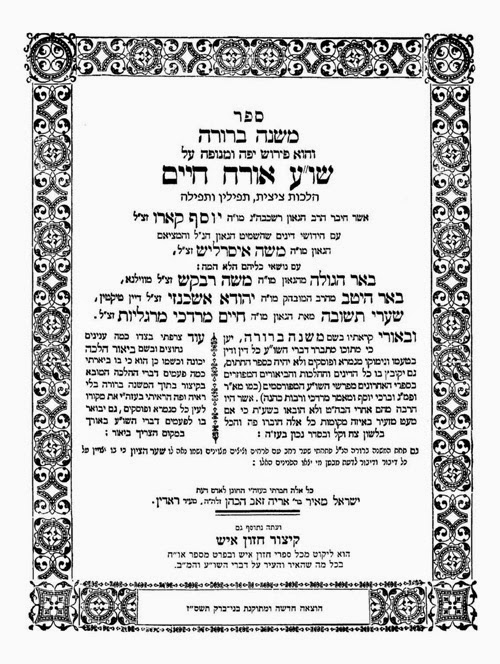
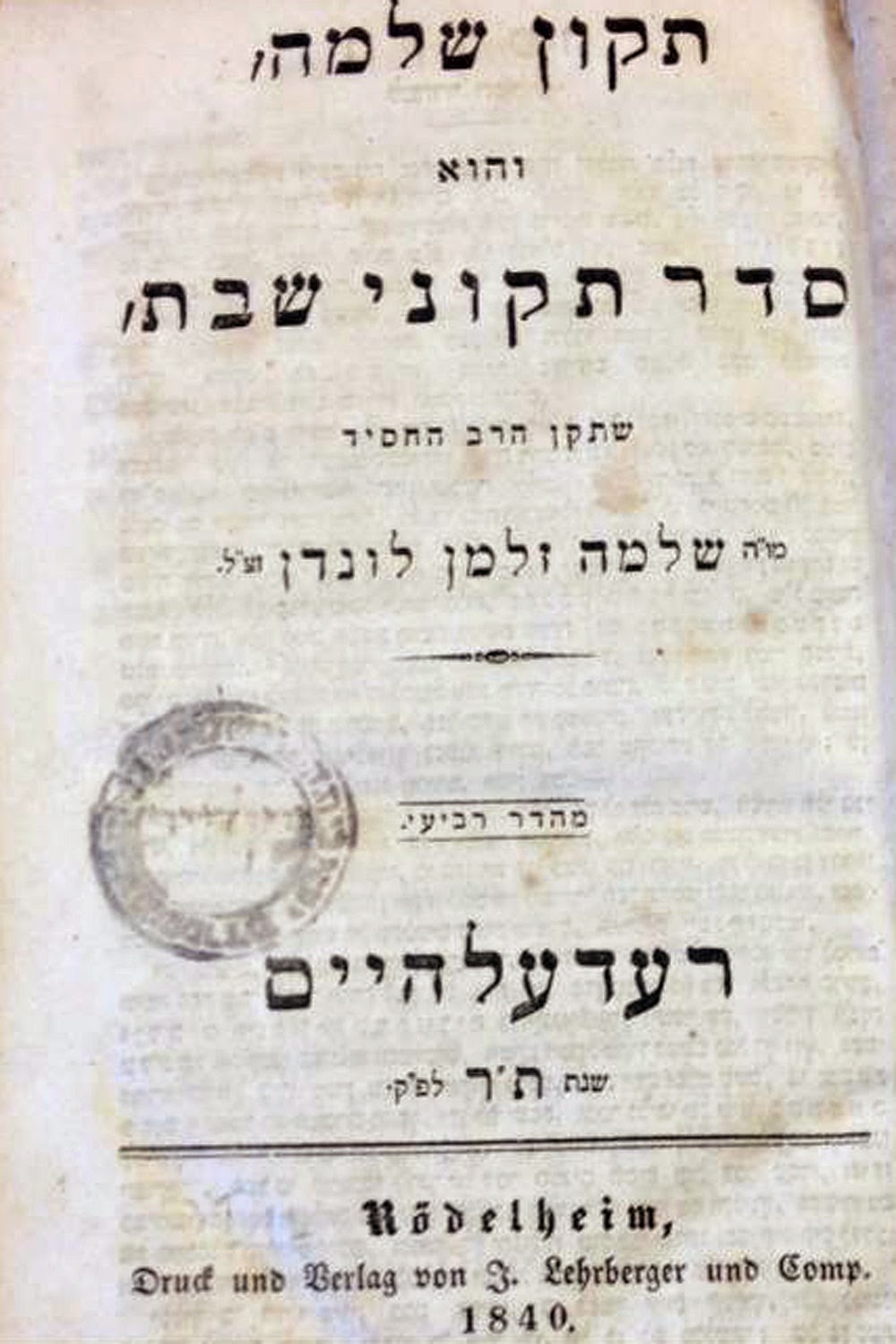
The work is Tikkun Shlomo and is primarily focused on the Shabbos liturgy.  I reproduced the title page:
Many will no doubt recognize the name of the compiler, Shlomo Zalman London (1661-1748) who wrote the book “קהלת שלמה”and that it was reprinted thirty times in the next 200 years.  
Tikkun Shlomo was first published in Amsterdam by Dr. Naftali Hertz HaLevi in 1733.  Dr. Levi published many a storied book, including the first edition of Mesilat Yesharim and the edition of the Shu”t HaTashbetz that is alleged (erroneously) to have been cosigned to flames.  According to Friedberg, when Dr. Levi published the Tikun Shlomo, not much else was being published in Amsterdam due to the effect of the Thirty-Year War.[1]  The Tikkun Shlomo was very popular, going through almost 40 editions by the late 19th century. Heidenheim expanded this work in 1835, and the edition I purchased was the fourth Heidenheim edition (two of the three were published in Roedelheim and the other in Lemberg).  
Things get off to a wonderful start in this book with the Hakdamah which is indicated to come from the third edition. In it, the unnamed editor pays tribute to his mentor Wolf Heidenheim Z”L and maintains that he has followed in his footsteps in all matters because “anyone who follows him will not err”. The editor only refers to himself at the end of the Hakdamah as “HaTzair”, but he leaves us an unmistakable hint as to his identity. Before we get to that, let us see what else he includes in this “Hakdamah”
ויהי מימים,ויקם עוד בּישׂראל פּורץ גדר,וישׁחת דברים נעימים, ויוסף עוד להרוס חומת שׂפת עבר ולדבּר תועה אשר לא כּדת. כּי פּרץ מצפון בא בא, ותפתח הרעה, וידפיס אישׁ אחד את המחזורים ב׳האננאפער׳, ויעבור חק, ויהפוך וישׁנה מדעתו את דברי התפילות ופיוטים, ויעקש ויעקל מאוד כמעט בכל דף ודף, ותהי זמירת ישׂראל בידו מעין משחת ומקור נרפשׁ, אשה יפה וסרת טעם, כּי שנה את טעמה ויתעמר בה וימכרה בּכּסף, וכן לא יעשׂה.
He takes great offense to a certain Machzor printed by “one man”. The Machzor to which he referring to is known as “Ordnung der Oeffentlichen Andacht für die Sabbath und Festtage des Ganzen Jahres, nach dem Gebrauche des Neuen Tempel-Vereins”, otherwise known as “Seder ha-‘Abodah, Minhag Ḳehal Bayit Ḥadash” printed in Hamburg (not Hanover) in 1819. Two editors are listed:  Seckel Isaac Fraenkel and Meyer Israel Bresslau. It was the new prayer book of the Hamburg Reform Temple dedicated in 1818.  To paraphrase what he writes about this effort: “ a great evil has descended from the north, one that has been perpetrated by a man who published Machzorim in the city of Hanover ( Hamburg ). In his hands, the prayers, which are like a beautiful  woman , are now left with no personality. His purpose was to destroy the Hebrew language, the prayers as we know them, and Judaism itself.”


He continues by writing that he has authored a work Zichron Livnei Yisroel ( Altona 1819) in which he lays out his war against these Machzorim.[2] The title incorporates this explanation:
זה ימים יצא בדפוס קונטרס מיוחד לתפילת ערבית ושחרית לשבת, ומעתיקי תפלה הזאת עברו גבול אשר גבלו הראשונים, גרעו והוסיפו כחפץ לבבם … חלילה … לשנות מסדר תפלתינו / … דברי … עקיבא בר”א ברעסלויא, ראב”ד פה ק”ק אלטונא
This was Rabbi Akiva Wertheimer (1778-1835), the Rav of Altona, Germany, today part of the city of Hamburg. He wrote “Zichron Livnei Yisroel” and was the editor of our edition of “Tikun Shlomo”. His opposition to the new Reform prayer service is noted in a book called “Shnos Dor V’Dor” printed in Jerusalem by Artscroll/Mesorah in 2004. It records the following that occurred in 1819 which coincides with the printing of his book “Zichron Livnei Yisroel”:
בשנת תקע״ט, עוד קודם להתמנורנו, בקום המחדשים ״אנשי ההיכל״
הרפורמי דהמבורג לשנות את סדרי התפילה היה הוא הראשון אשר יצא כנגדם והזהיר את כל הקהילות סביבות אלטונא מפניהם.
Continuing in the Hakdamah to Tikun Shlomo, we find that Rav Wertheimer has launched a campaign against the reformers by adding that he has sent this out broadside everywhere to warn others of this assault on tradition. He does this brilliantly by paraphrasing a Pasuk in Tanach ( Shoftim 20:6) which deals with the tragic story of “Pilegesh B’Givah” an incident which almost tore the Jewish people apart.
The Pasuk reads:  וָאֹחֵז בְּפִילַגְשִׁי, וָאֲנַתְּחֶהָ, וָאֲשַׁלְּחֶהָ, בְּכָל-שְׂדֵה נַחֲלַת יִשְׂרָאֵל:  כִּי עָשׂוּ זִמָּה וּנְבָלָה, בְּיִשְׂרָאֵל.
His paraphrase reads:
ואוחז בפּילגשׁו ואנתחה ואשׁלחה בכל גבול ישׂראל, למען יראו זקני עם וקציניו, והסירו גם את המכשלה הזאת מקרבּם
The full text of the broadside was published in Dukes, AW”H leMoshav, Cracow: 1903, 104-05.  Additionally, the National Library of Israel has a copy (perhaps that of Israel Mehlman, see his catalog Ginzei Yisrael, no. 1743).  The broadside is signed, Akiva br”a Bresslau without additional identifiers, i.e. the son of Avigdor Wertheimer.  As Dukes notes, Graetz mistakenly attributed this work to a different Akiva, Akiva Eiger.  But he was not the only one to publish against the Hamburg Temple and its prayer book in Altona that year.  The work, Eleh Divrei ha-Brit, was also published in Altona in 1819 and it contains, among others, the position of the Hatam Sofer.  
The battle was waged by both sides, and Meyer Israel Bresslau, one of the editors of the Hamburg prayer book, that same year responded with Herev Nokmat (available online here).  The other editor, Fraenkel, in the prayerbook includes a defense of the changes[3].  
As with many editors of Siddurim, Rav Wertheimer extols the exactness of his edition, claiming that he has fixed many of the errors that have crept into previous Siddurim. Specifically, he addresses the text of Mishnayos Shabbos which appeared in many Siddurim and which he has carefully edited especially when it comes to the “Nekudos”.
He continues and states that when it comes to words of foreign origin, such as in Greek, Latin or Arabic, he has also made sure that the “Nekudos” are correct reflecting the proper pronunciation in those languages.
Unfortunately this is not a simple task and this example will illustrate the difficulty in doing so.
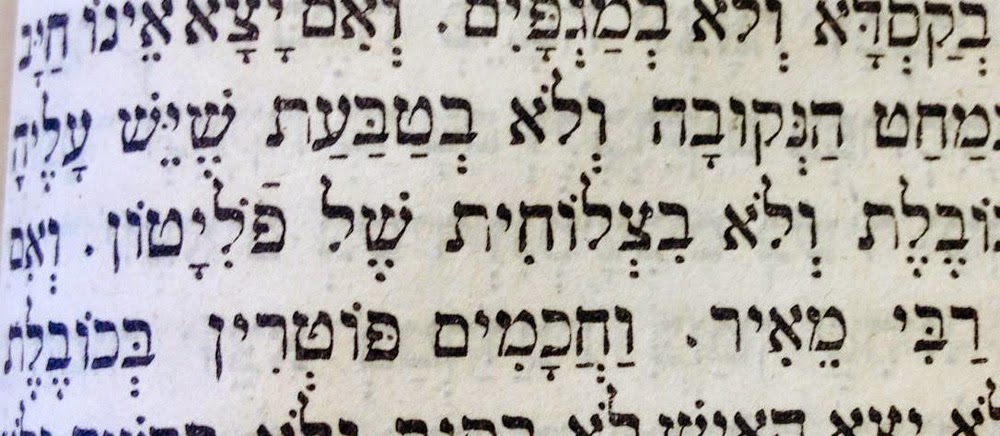
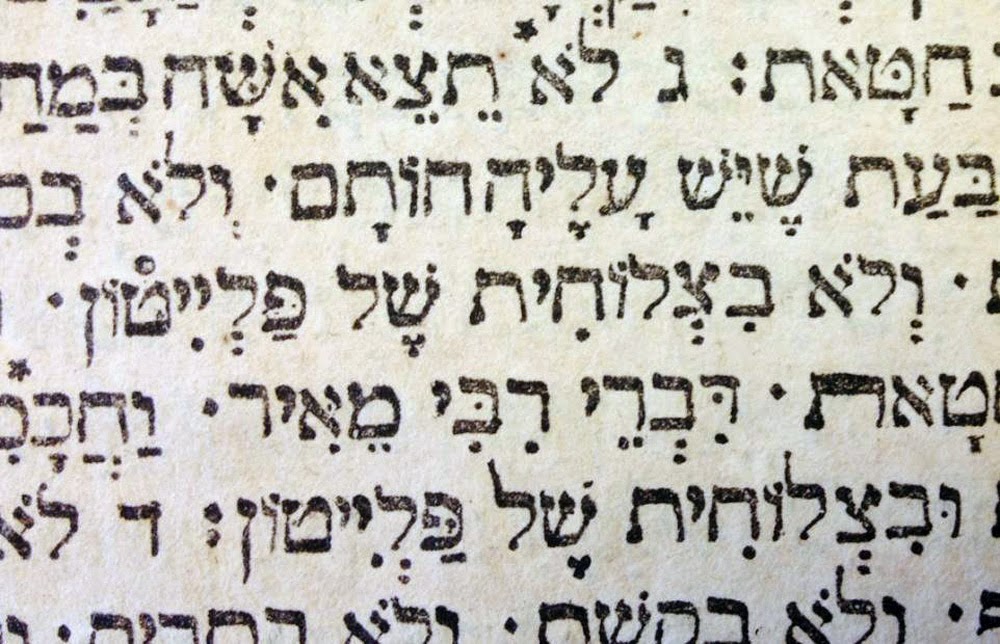
The laws of what a woman may or may not carry outside on Shabbos are discussed in Shabbos 6:3. Among the items prohibited is something called a “Tzlochis Shel Palyiton”, a flask of “Palyiton.” Jastrow defines this word as “an ointment or oil prepared from the leaves of spikenard”. He adds that its origin is the Latin word “foliatum”. The Latin Lexicon website spells this word foliātum and gives the exact same definition. So how should this Latin word be spelled in Hebrew?
Rav Wertheimer indicates that it should be pronounced something like “Folia’tone”which is pretty close to the Latin word except for there being an “n” sound at the end of the word instead of the “m” sound.
I have a Mishnayos printed in Pisa during the same time period (1797) which makes it look more like “Pal’yi’tone”:
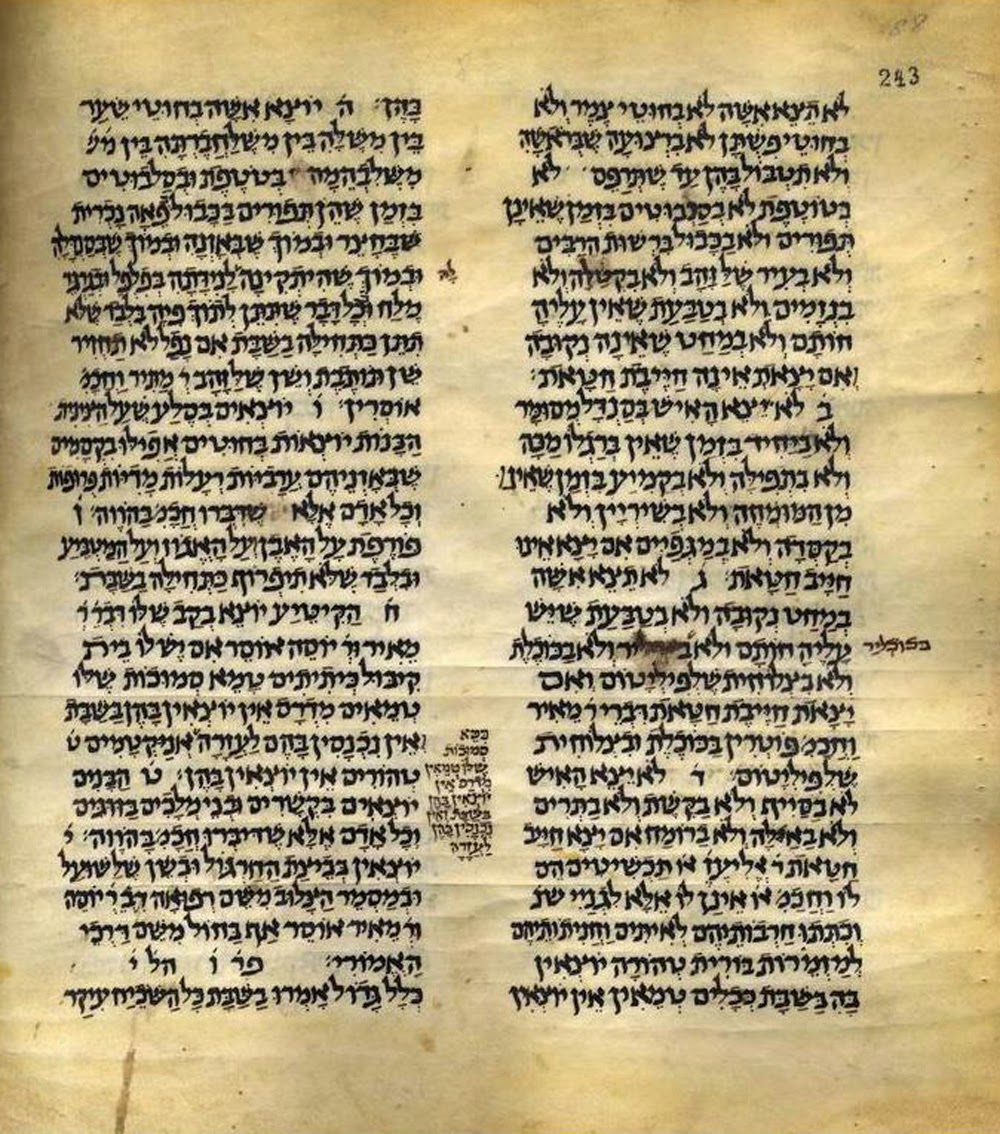
Two very old manuscripts of the Mishneh shed some light on how the word was originally spelled. One of the most famous is known as Codex Kaufmann ( MS Kaufmann A 50) which was written in 10th or 11th century Palestine. There we find the word looking more like “Pil’Ya’Tome”, with an “m” sound at the end:
The Parma manuscript referred to as MS Parma, De Rossi 138 written in 1073 has it the same as Kaufmann.
In recently printed Mishnayos such as from Feldheim, Artscroll, Steinsaltz, and Blackman, the word is spelled “פלייטון” with either a Patach ,Chirik, or “Shva”  under the “Peh”, or “פולייטון”, which looks more like Rav Wertheiner’s rendering.
One thing is clear- it is sometimes very difficult to write a foreign word with Hebrew letters and vowels, and it is also difficult to ascertain which version is “correct”.
Another wonderful aspect to the book that I bought was learning about the man whose name is embossed on the front cover. He is listed as יוסף אשר בן כ״ה (כבוד הרב) משה פאלאק   
We know a bit about Yosef Asher Pollock from some of the other books and manuscripts he owned. The following two citations are from the online catalogue of the Israel National Library:
1. A manuscript written in the 19th century by Chaim ben Yaakov Abolofia.
תקנות קהלת איזמיר. ‬
Los Angeles – University of California 960 bx. 1.9
ותו הספר: “מספרי יוסף אשר פאלאק ז”ל” משנת תרפ”ה. ‬
From this record we know that he had passed away before 1925 and that the manuscript is now in Los Angeles.


2. A manuscript written in the 18th century
(ספר הכונות (חלק שבת ומועדים. 
Amsterdam – Universiteitsbibliotheek MS Rosenthal 567
בראשו תו ספר של הבעלים “יוסף אשר פאלאק
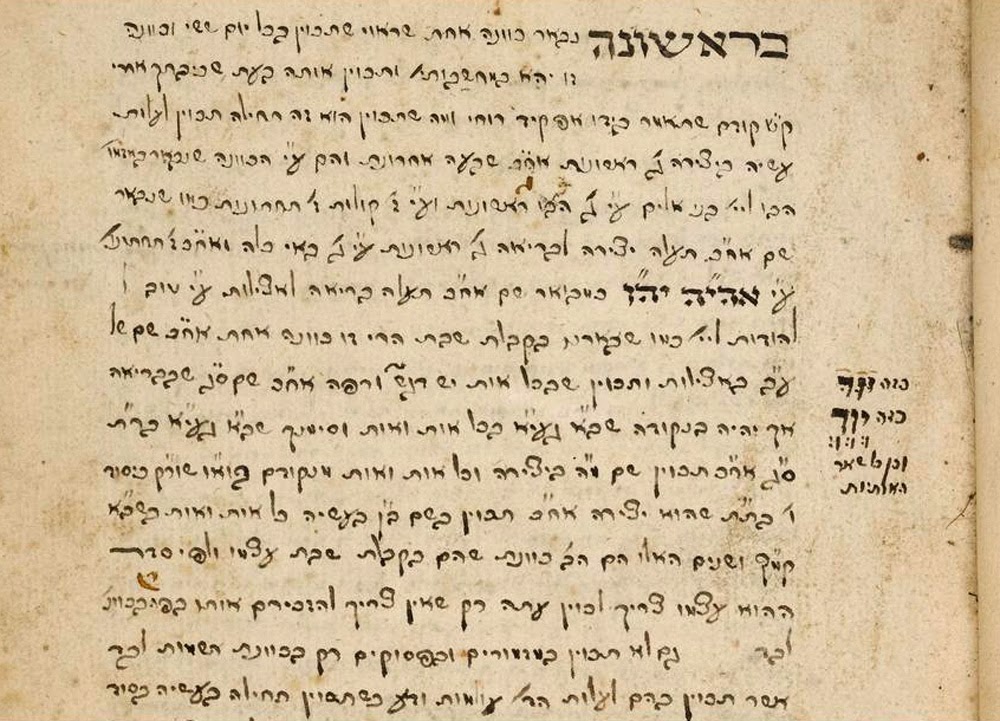
This rare manuscript has been scanned and is available online. The first page looks like this:
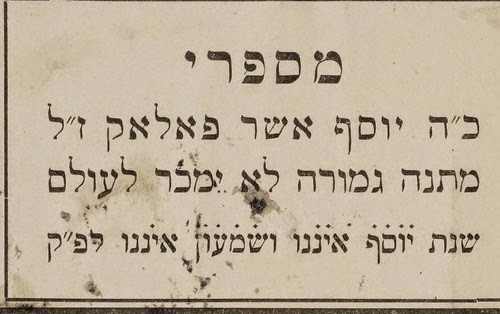
From this one we also learn quite a bit more about Yosef Asher Pollock because it contains this bookplate on the inside front cover

We surmise from here that this was not the only book he had that was donated, as someone went to a lot of trouble composing and printing such a heartfelt donation plate. (“ Yosef is not here, nor is Shimon”) The year the bookplate was printed was 5693(1933). There is also a stern warning that since this is a gift, it may never be sold by the recipient.   

The history of the Bibliotheca Rosenthaliana in Amsterdam is also interesting, especially how the collection of Judaica survived the Nazi occupation. The library’s website notes the following:
“The Germans closed the Bibliotheca Rosenthaliana in the summer of 1941 and transported part of the collection to Germany, where it was earmarked for Rosenberg’s ‘Institut zur Erforschung der Judenfrage’.
Happily, these plans were thwarted with the German capitulation. Most of the boxes of books were in storage in Hungen, near Frankfurt am Main, where they were found and shipped back to Amsterdam. But the curator and his assistant together with their families had also been deported-for them there was no return”
Finally, it seems clear to me that my book was also a gift never to be sold. I surmise this from the fact that the name of Yosef Asher Pollack is beautifully embossed on the front cover of the Siddur, making it unnecessary to have an ownership bookplate inside the Siddur.
Nevertheless, on the inside front cover there is a rectangular remnant of a bookplate which has been torn off.  
Coincidentally, its size exactly matches the bookplate of the manuscript donated to the Bibliotheca Rosenthaliana, which contained the admonition of not selling the book. Tearing off this “warning label” enabled the book to be sold, something that most likely happened over time to many books that were donated to libraries.
___________________________________________________
[1] Friedberg, History of Hebrew Typography, Antwerp: 1937, 49.  Although Dr. Levi’s production may have slowed, the bases for Freidberg’s assertion that Amsterdam publishing was affected by the Thrity-Year War is uncertain.  During the 18th century, production of Hebrew books in Amsterdam ranges from 82 to a high of 246 per decade.  The 1730s, the period that Tikkun Shlomo was published, is in the mid-range of those two extremes, with 145 books published between  1730-39.
[2] This work is a single sheet broadside and begins with Moda’ah raba . . . Zikhron Le-veni Yisrael.  
[3] For a summary of his arguments, see Petuchowski, Prayerbook Reform in Europe, New York, NY: 1968, 53-54.


Fixing a Typesetting Error in Order to Understand The View of the Mishnah Berurah on Women Wearing Tefillin

Fixing a Typesetting Error in Order to Understand
The View of the Mishnah Berurah on Women Wearing Tefillin
by Michael J. Broyde
mbroyde@emory.edu

Please note that this piece isn’t meant to be construed one way or another as the view of the Seforim Blog.
While there has been considerable recent discussion regarding women wearing tefillin, I will not review here the general topic but rather focus specifically only the view of the Mishnah Berurah.  I believe the view of the Mishnah Berurah has been widely misunderstood due to two identical typesetting errors in the text, one in the Mishnah Berurah itself and one in the Biur Halacha.  It is not my intent to address the normative halacha in this article.
Background Sources

Rabbi Karo (OC 38:3) states simply:
נשים ועבדים פטורים מתפילין, מפני שהוא מצות עשה שהזמן גרמא.
Women and slaves are exempt from the mitzvah of tefillin since it is a positive time bound commandment.
Rema adds to his exemption, noting:
 הגה: ואם הנשים רוצין להחמיר על עצמן, מוחין בידם.
If women wish to be strict for themselves, we protest.
is adopting the view of Tosafot and the Pesikta Rabati that we ought to protest such conduct, essentially prohibiting it.
But this blanket statement of the Rema does not sit well with some commentators.  The Olat Tamid[1] (38:4) writes:
ואם הנשים רוצין וכו׳: הטעם כתב בכלבו משום שאינו יודעת לשמור את עצמן בנקיות עכ”ל ואני תמה אם כן למאי הצריכו בגמרא פרק מי שמיתו לפרש מפני שהוא מצות עשה שהזמן גרמא הנשים פוטרות מן התפילין ת”ל דאפילו אס רוצים להחמיר אסורין להניח תפילין, שהרי אינן ידעת לשמרם בטהרה! אלא ודאי דליתא להאי טעמא לפי סוגיות הגמרא וכן אמרינן בר”פ המוצא תפילין דמיכל בת כושי היתה מנחת תפילין ולא מיחו בה חכמים אע”ג דבפסיקתא א’ להיפך דמיחו בה חכמים מ”מ אנן אגמרא דידן סמכינן. מיהו יש  לדחות, הא דלא מפרש גמרא הטעם זה משום שרוצה ליתן טעם גם לעבדים דפטורות ואי משום טעם זה לבד היה נראה דעבדים חייבים שהרי בודאי הם יודעים לשמרם בטהרה ולפיכך מפרש מפני שהוא מצות עשה שהזמן גרמא • דמש”ה גם עבדים פטורים מיהא מהא דאמרנן דלא מיחו בה חכמים משמע דאם האשה זקנה וידעינן בה שיודעת לשמור את עצמה דאין למחות בה ובה”ג מיירי התם:
The Kolbo writes that the reason is because women do not know how to guard themselves with cleanliness.  I was amazed at this, as if that is the case, why does the Talmud in chapter me shemeto need to explain that women are exempt from tefillin because it is a time bound positive commandment?  Wouldn’t it be true [according to Kolbo] that [whether they are exempt or not and] even if they wish to be strict on themselves, it is prohibited from them to don tefillin since they do not know how to watch themselves with purity!  Rather, it must be that this reason [i.e., that women may not wear tefillin due to cleanliness issues] is not correct according to the Talmudic text.  So too, it says in the beginning of the chapter Hamotzee tefillin that Michal Bat Shaul donned tefillin and the Rabbis did not rebuke her; even though one Pesikta says the opposite, that they did rebuke her, nonetheless, we follow our Talmudic source.  However, one could rebut the [previous] proof, [because perhaps] our Talmud [in me shemeto] does not give this explanation [cleanliness] since it wants to offer a reason why slaves are also exempt.  And if it were for this reason [cleanliness] alone, it would appear that slaves are obligated in donning tefillin, since they certainly know to keep themselves clean.  Therefore the Talmud explains [that women are exempt from tefillin] because of the principle of time bound positive commandments, since it is for this reason that slaves are also exempt. Nevertheless, the source that says the Rabbis did not rebuke Michal does imply that if a woman is elderly [i.e., post-menopausal] and we know that she is capable of watching herself [to stay clean], one should not rebuke her.  And it is such a case that the Talmud has in mind there [i.e. in me shemeto, where women are said to be exempt from wearing tefillin, not categorically forbidden from doing so]. 
The Magen Avraham does not agree with this Olat Tamid.  Magen Avraham (38:3) states:
מוחין כו’ – מפני שצריכין גוף נקי ונשים אינם זריזות להזהר אבל אם היו חייבים לא היו פטורין מה”ט דהוי רמי אנפשייהו ומזדהרי כנ”ל דלא כע”ת:
We protest: Since they need a clean body and women are not particularly careful with cleanliness; but if they were obligated, they would not be exempt for this reason since they would accept the mitzvah upon themselves and they would thus be conscientious.  Such appears to me to be the rule, and not like the Olat Tamid.
The whole thrust of the Magen Avraham is to reject the approach of the Olat Tamid) who permits women to wear tefillin when they are clean). Magen Avraham accepts that once one is not obligated to wear tefillin, one is not careful to be clean and only those obligated are careful, whereas Olat Tamid thinks cleanliness is unrelated to obligation. [2]
Now consider whether one ought to rebuke a [male] slave who wishes to wear tefillin.  Like a woman, he is not obligated in the mitzvah of tefillin, but yet he seems to have no practical issue with guf naki factually. If he were to don tefillin (which he is not obligated to at all) should we rebuke him?  One could claim that the Rama (and the Taz for that matter) both implicitly agrees that a slave is not rebuked since only women (and not slaves) are mentioned as subject to rebuke. Pre Megadim (Mishbatzot 38:2) [3] disagrees and states:
מוחין. עיין ט”ז. ומ”א [ס”ק] ג’. ומשמע עבדים אין מוחין שיכולין להזהר. וזה אינו, דגם כן אין זהירים דפטורים, וגם גריעי תו מנשים דעד א’ נאמן באיסורים וספרה לה [ויקרא טו, כח]. ועבדים בסתמן לא [נאמנים] עיין ש”ך יו”ד סימן א’ [ס”ק ב]. גם על כרחך פשיטא אין מניחין שלא יעלו אותו ליוחסין וכדומה:

We Object:  See Taz.  See Magen Avraham 3. And this implies that when a slave dons tefillin one does not object, since they can be careful [about cleanliness].  This is wrong, because they are not careful since they are exempt.  Furthermore, slaves are worse than women [in this mitzvah] since “one witness is believed regarding ritual matters” (as it says in Lev 15:28) “she counts” but slaves are not believed; see Shach YD 1:2.  One must also adopt the obvious position that slaves do not wear tefillin [even though they can keep clean] so that we should not mistake them as full Jews.
Pre Megadim makes a few claims here.  While inferring that Rama and Taz hold slaves are not rebuked and may wear tefillin if they wish, Pre Megadim himself holds this is incorrect for several reasons: (1) all those exempt are rebuked according to the Pesikta, since one who is exempt is not as careful to be clean; (2) slaves are deemed less reliable than women in many Jewish law matters; (3) permitting a slave to wear tefillin might mistakenly lead people to believe he is fully Jewish.
Thus, whether we should deem all exempt individuals as being always insufficiently careful about cleanliness, and therefore object to them wearing tefillin, is a dispute between Magen Avraham and Pre Megadim versus Olat Tamid.
The Typographical Error in Mishnah Berurah 38:12
Now, to the heart of this short note: Mishnah Berurah is uncertain about how to resolve the question of whether a slave who dons tefillin ought to be rebuked.  Since this matter is not one that normative halacha needs to resolve (as slaves no longer existed within Jewish life in the time of the Mishnah Berurah) he simply states (38:12):
הנשים – עיין בפמ”ג שה”ה לענין עבדים ועיין בספר תוספות שבת שכתב בהדיא להיפך ועיין בספר תוספות ירושלים:
Women: See Pre Megadim who states the same rule for slaves.  See also Tosafot Shabbat who writes explicitly the opposite and see the work Tosafot Yerushalayim.[4]
Several difficulties present themselves in this simple Mishnah Berurah, but I want to focus on only one: Who is this Tosafot Shabbat that the Mishnah Berurah is quoting and what does he say?  Hebrewbooks.org and Otzar HaChachma data bases list a few books with that title, but none of them seem to deal at all with tefillin. While the Mishnah Berurah does in several other places quote a work by this title, the work that he quotes is always the famous work “Tosafot Shabbat” which deals with Hilchot Shabbat only or (less frequently) the similarly named work which discusses when does Shabbat begin or end?  Furthermore, no discussion of tefillin or slaves is found in those works at all, as far as I can tell.  None of the other works with this title are relevant either, as far as I could tell: none of them had a section dealing tefillin law.
Luckily, someone pointed out to me that his version of the Mishnah Berurah has a footnote by the editors noting that the word תוספות is a mistake in the typesetting of the Mishnah Berurah.  A similar correction is also noted by other new editions of the Mishnah Berurah as well — I found it in Hotzah Chadashah uMetukenet Benai Brak (5767).  These editions argue that this note (12) in the Mishnah Berurah is supposed to read:
הנשים – עיין בפמ”ג שה”ה לענין עבדים ועיין בספר עולת שבת שכתב בהדיא להיפך ועיין בספר תוספות ירושלים:

Women: See Pre Megadim who states the same rule for slaves.  See also Olat Shabbat who writes explicitly the opposite and see the work Tosafot Yerushalayim.
This makes perfect sense and completely solves the mystery.  The typesetter made a mistake that is easy to understand.  Since on the same line of text already contained the words “tosafot” and the work Tosafot Shabbat was widely cited in the previous volume which was printed (volume 3) whoever was typesetting the work made an error and typeset the wrong word.
Olat Shabbat is another name for the work Olat Tamid (quoted above), who quite clearly, as the Mishnah Berurah notes, permits slaves to wear tefillin, since they are observant of the rules of guf naki.  Olat Tamid was the name used for those sections of the book addressing daily halacha (up to chapter 240 in the Shulchan Aruch) and Olat Shabbat is the name of the same work for those remaining sections that deal with Shabbat and Festival law.  Furthermore, the Mishnah Berurah uses both names at various times without following the exact correspondence to whether he is quoting from the part of the work named Olat Tamid or Olat Shabbat.  For example, in Shar Hatziyun 42:23 he quotes the Olat Tamid on a matter related to tefillin law and he calls him the Olat Shabbat.  The work went by two names.
To summarize:  While the Mishnah Berurah in 38:12 quotes a work call Tosafot Shabbat as discussing whether a slave may don tefillin, as far as can be told, no such work exits.  A work named Olat Shabbat does exist which comments on Siman 38 of the Shulchan Aruch and permits a slave to don tefillin.  All of this makes a case so compelling that several new and critical editions of the Mishnah Berurah have noted this must be a typesetting error in the Mishnah Berurah and so have corrected the text accordingly.[5]
What the Mishnah Berurah does not note at all, but is completely clear once you look at the Olat Tamid inside – by now an obscure book that is hard to find, but which is on Hebrewbooks.org and is quoted above – is that for the same reasons that Olat Tamid contends we do not object to a slave wearing tefillin, Olat Tamid also permits a woman who is careful with guf naki (because she is post-menopausal) to wear tefillin.
Furthermore, Mishnah Berurah is fully consistent with the reading of the halacha found in the Olat Tamid when he explains the Rema’s objection to women donning tefillin in his next note, stating simply and directly (38:13) that:
מוחים בידן – מפני שצריכין גוף נקי ונשים אין זריזות להזהר:
We protest: since they need a clean body and women are not particular to be conscientious about being careful [to be clean].
The Mishnah Berurah thus explains why women do not don tefillin by quoting only the rationale that is consistent with the Olat Tamid’s understanding of the Rama, namely: this halacha is fundamentally about cleanliness, and not necessarily obligation (which categorically excludes all women and all slaves, no matter how clean).  Thus, in contrast to Pre Megadim and Magen Avraham, the Mishnah Berurah leaves out the idea that “אבל אם היו חייבים לא היו פטורין מה”ט דהוי רמי אנפשייהו ומזדהרי” (“but if they were obligated, they would not be exempt for reasons of cleanliness”) since that is not consistent with the Olat Tamid, and the Mishnah Berurah holds the Olat Tamid is correct about even a slave.[6] In other words, slaves should be rebuked because they are not meticulously careful to be clean independent of their lack of obligation to put on tefillin.
The Typographical Error in Biur Halacha 39:3

Chapter Thirty Nine of the Shulchan Aruch addresses who can write tefillin, which is a different question than who can don them, although somewhat related.  This is made clear by the comments of the Mishnah Berurah writing in the Biur Halacha in 39:3 which even more forcefully adopts the view of the Olat Shabbat.  The Shulchan Aruch notes that a convert may write tefillin and the Mishnah Berurah continues in the Biur Halacha 39:3 by stating directly:
כשר לכתוב תפילין – כ”ז איירי בגר צדק. ולענין גר תושב הסכימו הפמ”ג ול”ש ומחה”ש [ועוד הרבה] דפסול מטעם דהא אינו בקשירה והשע”ת[7] המציא דבר חדש דאיירי הד”מ דמכשיר בגר תושב דקיבל עליו כל המצות חוץ מאיסור נבילה וא”כ הלא ישנו בקשירה ובאמת נלענ”ד שגם זה אינו דהלא עכ”פ אינו מוזהר על הקשירה ותדע דאטו אם אשה ועבד יקבלו עליהן מצות תפילין יהיו כשרים לכתיבת תפילין ואם תדחה משום דמוחין לנשים על הנחת תפילין וכדלעיל בסימן ל”ח ז”א דכל זה רק מחמת חומרא בעלמא שחוששין להפסיקתא אבל ש”ס דילן סובר דאין מוחין ע”ז וכדאיתא שם בב”י ועוד עבדים יוכיחו דאין מוחין בהן וכמו שכתבתי לעיל במ”ב בשם התו”ש:
A convert may write tefillin: All this is discussing a proper convert, but as to a ger toshav, the Pre Megadim Levushai Serad, and Machatzit Hashekel [as well as many others] all agree may not write tefillin since they are not obligated to don tefillin.  Sharai Teshuva finds another novel matter here when he notes that the Darchai Moshe permits a ger toshav [to write tefillin] since he accepted all the mitzvot other than eating not kosher meat, since he is permitted to don tefillin.  In truth in my opinion even this is not correct, since such a person is also not obligated in donning tefillin.  And you should know that concerning even a woman and a slave who accept upon themselves to the mitzvah to don tefillin could they write tefillin?[8]  And if you push this off, since we rebuke women on donning tefillin as noted in chapter 38, that is wrong, since this pushing off is only a mere stricture grounded in being fearful of the Pesikta, but our Talmud rules that one does not rebuke on this as is noted by the Bet Yosef, and even further, we do not rebuke slaves as I noted in the Mishnah Berurah there in the name of the Tosafot Shabbat.
And of course, as the standard new editions of the Mishnah Berurah now note, there is a typographical error — the last words in the Mishnah Berurah should read Olat Shabbat here also, changing the ת to an ע, making it clear that the Mishnah Berurah has a consistent preference for the approach of the Olat Shabbat-Olat Tamid over the approach of the Magen Avraham and the Pre Megadim, as a better explanation of the Rama.  (The Mishnah Berurah then continues to explain why women and slaves – who can put on tefillin as a matter of tefillin law – still cannot write them.[9])
According to the Mishnah Berurah, the Rama directs rebuke of women in 38:3 for donning tefillin not as a matter of the minimal technical halacha, but only as a chumra bealma since he is of the view that the Pesikta’s formulation is inconsistent with the Bavli and thus not the formal mandatory rule of halacha ever (just like the Olat Tamid notes).[10] Furthermore, the Mishnah Berurah makes it clear here that he is ruling against the Pre Megadim on the matter of rebuking slaves who don tefillin which he left as an open dispute in 38:12.
A Test Case: The Cheresh

Consider a test case: Should we rebuke a cheresh (fully mentally incapacitated man) who wishes to wear tefillin, if he is competent to maintain cleanliness?  This is an excellent test case.  He is Jewish (like a women is), but exempt from all mitzvot, including tefillin, and he lacks the basic credibility that even a Jewish woman has to label food items as prohibited or permissible, so two of the three reasons of the Pre Megadim apply to him, mandating rebuke.  For our present purposes, his “risk profile” vis-à-vis wearing tefillin thus falls in between a slave and a woman: he is riskier than a (post-menopausal) clean woman and less risky than a slave.
Olat Tamid states (37:1) that since a cheresh can maintain cleanliness, he should not be rebuked for donning tefillin.  The Mishnah Berurah (37:12) rules that way and he cites as precedent for this the classical work Baer Hatev, who in turn cites the classical work Olat Tamid![11]
חרש המדבר ואינו שומע או שומע ואינו מדבר חייב להניח תפילין אבל אין שומע ואין מדבר אין מוחין בידו מלהניחם אם רוצה [בה”ט]:
cheresh who speak but cannot hear, or hear but cannot speak is obligated in tefillin, but one who can neither listen nor speak one does not rebuke them when they don tefillin if they wish. [Baer Hatev]
Thus, from the Mishnah Berurah’s ruling regarding a cheresh, we see that he clearly rejects the view that “one is not obligated may not don tefillin since such a person will not be particularly careful to be clean.” Rather, Mishnah Berurah only cites the Pre Megadim’s view about slaves apparently in deference to the Pre Megadim’s other concern: since slaves are not full Jews, permitting them to wear tefillin might confuse others about their personal status as full-fledged Jews.[12]  Otherwise, Mishnah Berurah adopts the Olat Tamid’s explanation of the Rama in this halachic area – i.e. focusing on cleanliness, and not automatically deeming exempt individuals as incapable of maintaining proper cleanliness.
Conclusion

The Mishnah Berurah does not address the question of whether a carefully clean woman who wants to don tefillin may do so. Such a radical break with tradition would never be raised or considered in a completely hypothetical vacuum by the Mishnah Berurah.  The Mishnah Berurah simply never discusses the matter and he is silent.  How should we understand his silence?  Did he think we ought to rebuke such a woman as a matter of tefillin law[13]?
With all of this data in hand – most importantly, the proper text of the Mishnah Berurah – it is reasonable to conclude that the best way of interpreting the Mishnah Berurah is that he does not think that a woman who is sufficiently careful about guf naki[14] needs be rebuked – as a matter of tefillin law – if she does don tefillin.  Proof to this can be found from: (1) his citation of the Olat Tamid in the case of a cheresh and a slave and (2) the Mishnah Berurah’s referral to the view of the Pesikta as a חומרא בעלמא, a mere stricture, [15] and (3) his focus on cleanliness as the reason for rebuke of women, like the Taz and the Olat Tamid.
Further proof of this is the unstated view of the Mishnah Berurah can be found from: (4) the Mishnah Berurah’s rejection of the formulation of the Magen Avraham that all those who are exempt are prohibited as a matter of tefillin law and (5) the Mishnah Berurah’s sub-silento rejection of the Gra’s view that the Pesikta and the normative Bavli both agree that women ought to be rebuked and (6) the Mishnah Berurah’s implicit rejection of the view of the Levush (and others) that while Michal bat Shaul could put on tefillin because she was unique, no one else can.[16]
There is no other viable theory left other than to accept that — to the Mishnah Berurah — the proper way to understand the Rama’s rule that one should rebuke a tefillin donning woman is limited to one who either is not clean, which is the base line view of the Talmud Bavli or, as chumra be’alma, to rebuke any woman who is “not particular to be conscientious about being careful [to be clean]” as he states in 38:13.

Thus, the purpose of this article is to make an intellectually honest point which hopes to contributes to reasoned discussion: those who have acknowledged the view of the Olat Tamid as permitting slaves, clean women and chereshim to don tefillin, and yet dismiss that view as supposedly rejected by all normative poskim, are mistaken, once the correct text of the Mishnah Berurah is established.
To what extent this has any practical halachic application is for a different discussion.  For example, there might very well be other excellent rationales outside of technical tefillin law prohibiting such conduct,[17] or one could look to the view of the Magen Avraham and Pre Megadim and object to women wearing tefillin due simply to their lack of obligation or one could note that even without the rebuke obligation, tefillin are still no better than tzitzit and our rule is that women do not wear them either as a matter of very old custom. None of this practical halacha is the focus of this paper. [18]
The attached six pages are copies of the front matter and relevant pages from two modern editions of the Mishnah Berurah which note the typographical errors mentioned and correct them.

[1] There are a number of works entitled Olat Tamid in the rabbinic library and this Olat Tamid is the one that the Magen Avraham had which is by Rabbi Shmuel ben Yosef Orgler found at http://hebrewbooks.org/21386 at page 28.
[2] Pre Megadim reinforces this as the correct read of the Magen Avraham in Ashel Avraham 3 where he emphasizes that one who is exempt is not careful.
[3] The Pre Megadim is commenting on the Taz – as he understands the Taz to agree with the Olat Tamid here and to focus only on cleanliness and not level of exemption – and/or is inferring from Rema’s note that we object to women who wish to wear tefillin that Rema would not object to a male slave wearing tefillin.
[4] Tosafot Yerushalayim cited by the Mishnah Berurah is not in chapter 38 of his work (where you would expect it) but in OC Chapter 17.  Tosafot Yerushalayim adopts the reasonable view that only slaves like Tevi of Rabbi Gamliel can don tefillin, as a correspondence to the exceptional case of Michal bat Shaul.  His view is that among people who are not obligated in tefillin, only exceptional individuals are sufficiently careful about cleanliness ought to don.  Tosafot Yerushalyim is itself a fascinating work which attempted to incorporate the view of the Jerusalem Talmud into the normative halacha.
[5] A copy of the page from the Mishnah Berurah Hotzah Chadasha uMetukenet Benai Brak 5767 can be found at the end of this paper with the correction noted on the Hagaot veTekunim 5
[6] See the next section for an explanation,
[7] The corrected text of the Mishnah Berurah notes that this is the Yad Efraim.
[8] Although one could read this as a statement and not a rhetorical question, that would be a mistake as it could create a dispute between this statement and the text of the Shulchan Aruch in OC 39:1.  It would also be inconsistent with other parts of the same Biur Halacha not quoted here.
[9] Who can write tefillin (as opposed to who can don them) is not a topic we focus on now.
[10] This Biur Halacha was pointed out to me by Rabbi Shlomo Brody while he was reviewing a prior draft of this article.
[11] A reader suggested to me that maybe the Mishnah Berurah ruled one should not rebuke a cheresh only because he was aware of the fact that some of his contemporaries considered an intelligent cheresh to be fully obligated in the mitzvah.  I think that is mistaken as the Mishnah Berurah is directly quoting the Baer Hatev who is directly citing the Olat Tamid, who was from the 1600’s and was not speaking about the modern “smart” cheresh. The Mishnah Berurah and Baer Hatev’s source – the Olat Tamid – clearly based this ruling on his view that one who is exempt but clean can wear tefillin.  Moreover, if the Mishnah Berurah were merely showing deference here to the view that a (modern) cheresh is obligated to wear tefillin, then surely he would have strongly urged the cheresh to don tefilin – and not just written that we acquiesce to one who chooses to do so. (Note that Aruch Hashulchan argues in OC 37:4 and objects to a cheresh wearing tefillin, but only because he cannot image such a person being meticulously clean.)
[12] And even that fear is ultimately rejected by the Mishnah Berurah in the Biur Halacha 39:3, as noted above.
[13] What I mean by “tefillin law” is just the halacha of mochen and the like, and not the more general halachic conversation concerning change or minhag or authority, all of which are important, but not part of this article and could form independent grounds for prohibiting (or permitting) this conduct.
[14] Because she is post-menopausal according to the Olat Tamid.
[15] I am uncertain how exactly to translate the term chumra bealma.  In their recent article, Rabbis Dov and Aryeh Frimer translate it as “mere, often unbased, stringency (humra be-alma)” which they note is one of the cases where nachat ruach lenashim does allow such sometimes to be ignored.  See Women, Kri’at haTorah and Aliyyot,” Aryeh A. Frimer and Dov I. Frimer, Tradition, 46:4 (Winter 2013), 67-238 at pages 115 to 117 and particularly note 358.

[16] Reasons five and six are important to digest, in that who the Mishnah Berurah quotes or does not quote is a very telling mark of what he thinks is reasonable.  Here he does not quote Gra’s approach in 38:3 precisely because he has rejected Gra’s approach of harmonizing the Pesikta and the Bavli in 39:3 by calling the Peseikta a chumra be’alma.  So too, he rejects the approach of the Levush and Aruch HaShulchan of limiting the Bavli to the rare and special Michal bat Shaul since the Mishnah Berurah adopts the view of the Olat Tamid and resolves the conflict by insisting that the Pesikta is not the normative halacha.  The view of the Aruch Hashulchan needs its own analysis, which I hope is forthcoming.  For a more general understanding of the Mishnah Berurah, see my forthcoming work (with Rabbi Ira Bedzow) “The Codification of Jewish Law and an Introduction to the Jurisprudence of the Mishna Berura” (Academic Studies Press, 2014).

[17] See for example the modern work Piskai Teshuva 38:3 who gives one such reason and the recent teshuva by Rabbi Hershel Schachter on this matter who gives many such reasons.
[18] Besides these rationales which explain why the Mishnah Berurah simply does not discuss this issue, allow me to speculate in a footnote that perhaps the Mishnah Berurah does not cite the Olat Tamid on the topic of women donning tefillin at all because he rejects in the view of the Olat Tamid that menstruation is a valid concern for guf naki matters and that was the central to the holding of the Olat Tamid.


From Print to Pixel: Digital Editions of the Talmud Bavli

From Print to Pixel: Digital Editions of the Talmud Bavli

Ezra Brand

Ezra Brand is an independent researcher who resides in Tel Aviv. He has an MA from Revel Graduate School at Yeshiva University in Medieval Jewish History, and has studied in the Talmud Department of Bar-Ilan University. He has contributed a number of times previously to the Seforim Blog (tag), and a selection of his research can be found at his Substack blog. His most recent major work is a “Guide to Online Resources for Scholarly Jewish Study and Research”. He is currently working on an overview of names and naming in early Jewish literature. He can be reached at ezrabrand@gmail.com; any and all feedback is greatly appreciated.

Intro – the tzurat hadaf[1]

It is a surprising fact that despite incredible advancements in technology, the layout of the Talmud has remained the same for centuries. The Bomberg edition from the 16th century, a groundbreaking achievement, still sets the standard. Yoel Finkelman writes in his recent, impressive overview of the layout of the printed Talmudic page:[2] “What is remarkable about the Gemara’s mise-en-page (the term for tzurat ha-daf in the academy) is not its invention, but its staying power as the normative way to produce texts of the Talmud.”[3] Finkelman then delves into the “history of the tzurat ha-daf of the Gemara.”

For an illustration of the lengths to which traditional publishers have gone to preserve the traditional tzurat hadaf, even in the 21st century, see Elli Fischer and Shai Secunda’s 2012 review article of the then-just-released “Artscroll Digital Library Schottenstein Talmud (English) App”, for the iPad:[4]

Since this elucidation is significantly longer than (and, in fact, already includes the actual text of) the Hebrew/Aramaic original, each Vilna page ends up being reproduced two to five times for every English page (a grey bar shows the reader which segment of the Vilna corresponds to the facing elucidation). This decision, both brilliant and perverse, added well over 10,000 pages, bringing the entire series to 73 volumes. The perversity of adding 10,000 apparently superfluous pages is obvious, but the brilliance of the decision was that it always kept the “original” page before the reader.

The digital daf

At the outset, Finkelman (in the above-mentioned article) highlights that the material manifestation of the written word can be broadly attributed to three factors: 1) The technological and material resources that are utilized to create and disseminate texts, 2) The economic and market forces that influence the demand for knowledge and education, and 3) The cultural perceptions of the role and function of language.[5] The ongoing decline in printing costs during the 20th and 21st centuries, coupled with the increasing accessibility of education, have led to significant advancements in all these factors.[6]

The advent of the internet has opened up entirely new avenues for publishing and designing the daf. Furthermore, for the very first time, readers have the opportunity to customize their reading experience, tailoring it to their unique preferences.

One popular author writes:[7]

“After more than a thousand years as the world’s most important form of written record, the book as we know it faces an unknown future. Just as paper superseded parchment, movable type put scribes out of a job, and the codex, or paged book, overtook the papyrus scroll, so computers and electronic books threaten the very existence of the physical book.”

However, one could plausibly say that the claim of the death of books has been greatly exaggerated. Physical books continue to be highly popular, and their sale has only continued to grow. And Orthodox Jews have yet an additional incentive to continue to buy physical books, as they can’t use ebooks on Shabbat and Chag. Regardless, there’s no question that we are in the middle of a decades-long revolution in how we have the ability to consume text, if one so chooses.

Despite the vast technological advancements that have revolutionized publishing, the digital daf is a peculiar return to pre-printing press methods in at least one regard: nowadays, the Talmud can be studied in isolation, without the surrounding commentaries. Most of the layouts that will be examined below diverge from the traditional tzurat hadaf that has been preserved for more than four centuries. In this way, they resemble the medieval Talmudic manuscripts, which include only the Talmud itself (sometimes accompanied by Rashi’s commentary).[8]

Let’s turn our attention to another aspect that Finkelman highlights: the groundbreaking nature of implementing a universal pagination system. Bomberg himself astutely utilized pagination and indexing as a key selling point.[9] Similarly, one of the numerous revolutionary features of digital editions such as Sefaria and Al-HaTorah is the capacity to reference not only the daf and amud, but also the section number. (I’ll explain the specific details of this later in this piece.) One can cite using section number, and hyperlink directly to that section. Every amud has around 10-15 sections, so this narrowing down is considerable. Even without reference to a specific section, checking a reference is far easier in a digital edition: with a simple “control + f”, one can search for a word from the quote. Gone are the frustrating days of scanning a giant wall of text in an amud to find a quote.

What will be discussed in this review

My focus here will be on modern editions that are available open-access digitally, online.[10] Therefore, I won’t review modern print editions.[11] I will also not review digital editions that, in my opinion, are inferior in every way to the editions discussed here.[12] And I won’t discuss editions targeted towards beginner students.[13]

As one of the resources exclusively pertains to Kiddushin (Katz’s Mahberot Menahmiyot), my sample will be from Tractate Kiddushin, specifically Kid. 2b, which solely features the Gemara without the Mishnah. Images will only be of Gemara, Rashi, and Tosafot, meaning that, I will exclude the surrounding glosses (Mesoret HaShas, etc). I will not be discussing supplementary texts and commentaries, and hyperlinks to outside sources that each has.[14] I will be discussing different customization and viewing options.

Another caveat: This piece is focused on layout, and so it will not discuss the textual accuracy of the editions.[15]

An interesting element of modern editions is the typography; specifically the choices of font. However, this will not be discussed here.[16]

Outline

Intro – the tzurat hadaf 1
The digital daf 2
What will be discussed in this review 4
Outline 5
Tzurat hadaf AND customizable 6
Mercava 6
Shitufta 7
Static PDF 9
Mahberot Menahmiyot (=MM) 9
Gemara Sedura HaMeir 10
Talmud HaIgud – Society for the Interpretation of the Talmud (האיגוד לפרשנות התלמוד) 12
Digital, not customizable 14
Wikisource 14
Pirkei Talmud Me’utzavim – R’ Dan Be’eri 15
Talmud Or Meir 18
Dicta 19
Digital and customizable 20
Sefaria 20
Al-Hatorah 22
Speculation on the future 24
Concluding Thought 27

Tzurat hadaf AND customizable

Mercava

At present, Mercava contains only Tractate Berachot. It includes a menu option that enables users to toggle punctuation and nikud. It is also worth noting that Mercava is presently in beta version, as stated explicitly by the page header. Many of the menu options are grayed out or non-functional, resulting in a suboptimal user experience. Often, it seems that two features cannot be employed simultaneously, without any discernible explanation.

Shitufta

Quite basic. It has section splits, which are the same as those of Sefaria and Al-Hatorah.[17] Like them, it enables linking to a specific section. However, it diverges from the section numbering in Sefaria and Al-Hatorah by commencing from 0 instead of 1, resulting in all section numbers in Shitufta being one less from those of Sefaria and Al-Hatorah.

Static PDF

Mahberot Menahmiyot (=MM)[18]

By Prof. Menachem Katz.

Image of Talmud text, from p. 3, line # 7:

MM is a static PDF. It divides every sentence into a separate line, as opposed to splitting into larger blocks of sections. The lines are numbered. It offers complete punctuation, without nikud.[19] MM displays citations for biblical verses, Mishnah, and Tosefta, as well as additional features discussed in the introduction.

Gemara Sedura HaMeir [20]

With punctuation, and split by line.

Talmud HaIgud – Society for the Interpretation of the Talmud (האיגוד לפרשנות התלמוד) [21]

The text is split into lines and numbered, similar to MM. Due to the nature of the work, the primary purpose of the Talmudic text in the Talmud HaIgud is not for its own sake, but to serve as a basis for subsequent commentary.

Digital, not customizable

Wikisource[22]

The crowd-sourced Wikisource is a sister-project of Wikipedia. It is replete with hyperlinks to primary sources, and to external secondary sources. Like MM, the text contains punctuation but not nikud. Instead of using numbered sections (like Sefaria and Al-Hatorah) or lines (like MM), the text is divided into unnumbered paragraphs. Moreover, these paragraphs are longer than those found in Sefaria and Al-Hatorah.

Pirkei Talmud Me’utzavim – R’ Dan Be’eri[23] [24]

Available as downloaded Word docs, from the Da’at website, for a few chapters. I consider this to be not customizable.[25] Has nikud, punctuation, and is split into numbered lines.

Talmud Or Meir

Has nikud, punctuation, and is split into numbered lines. While there are technically some customization options available, they are limited in scope.[26]

Dicta

Dicta has a suite of powerful tools, which combined could make for an incredible studying experience. These include automated tools for nikud and for Biblical sources.[27] Unfortunately, at this time it appears that the only way to view a passage of Talmud is via search results. There, a link is offered to the page in Sefaria. There is a section called Library, with powerful tools for reading rabbinic works, but only 300 works are currently offered there.[28]

Here’s a screenshot, of what appears after searching the first words of Kidushin 2b (“אי נמי שדות בכסף יקנו”), opening the first result, and scrolling to 2b:

Digital and customizable

Sefaria[29]

Image of customization options:

Splits into numbered sections. In our example, there are 15 sections. The default Hebrew doesn’t split these into paragraphs, but there is an option to split into paragraphs. Many tractates have nikud, some have punctuation. Our example page doesn’t have punctuation, even though it shows that option. Sefaria gives the option to remove nikud. As mentioned, as with Shitufta and Al-Hatorah, one can hyperlink to a specific section.

Al-Hatorah[30]

The section numbers in circles on the right side of the page are hyperlinked, which is a convenient feature. In the example page we are looking at, there is no nikud, unlike Sefaria. However, there is a period after each section, which provides a slight advantage over Sefaria‘s lack of punctuation, as it helps to break up the passages when viewing with no section breaks.

While Al-Hatorah also includes hyperlinked sections, it does not explicitly label which section is which, unlike Sefaria. Therefore, finding a specific section requires trial and error. As with Shitufta and Sefaria, it is possible to hyperlink to a particular section in Al-Hatorah.

One notable difference is that Al-Hatorah does not expand acronyms, as Sefaria does. For instance, מט is not expanded to מאי טעמא, and אבא is not expanded to איבעית אימא.

Speculation on the future

Secunda and Fischer, in the faraway land of 2012 (cited at the beginning of this piece), envision a future Talmud app:

“First of all, it would be a virtually borderless intertextual web. Talmudic passages that shed light upon one another would be linked in intricate overlapping networks. Passages citing earlier texts—biblical verses, the Mishnah, other rabbinic texts, the apocrypha—would be hyperlinked to the collection in which the cited text originally appears. Passages would also link to later commentaries, super-commentaries, relevant excerpts from legal codes and responsa, manuscript variants, monographs, homiletic interpretations, and, indeed, translations and elucidations. Discussions of Akkadian medicine would call forth images of Babylonian tablets. People, places, historical events, concepts, practices, and all sorts of other realia mentioned in the text would link to relevant explanatory pages, pictures, recordings, and video clips. […] [T]wo new Jewish text websites, themercava.com and sefaria.org, offer promising platforms for crowd-sourced translation, commentary, and discussion of the Bavli and other Jewish texts. […]”[31]

While some aspects of this idealistic vision have been realized, many others have not, at least not yet. Moreover, it remains unclear whether a more crowdsourced and social-media-oriented approach, (suggested in an un-cited part of Secunda and Fischer’s article), would even be desirable. In retrospect, the year 2012 was marked by somewhat utopian thinking, with Wikipedia and Facebook having recently achieved great success in spreading knowledge and connecting people worldwide. It seemed only natural to aspire to something similar in the realm of literature. However, today, with greater awareness of the unpredictable dynamics of such systems (such as misinformation), it is far from clear that such a goal is attainable or even desirable.

In my view, Sefaria, Al-Hatorah, and Dicta are the most promising candidates for realizing the immersive and highly hyperlinked experience envisioned by Fischer and Secunda. Once this is achieved, the resulting research tools are likely to be extremely powerful as well. However, the idea of leveraging comparative sources, as described by the authors, still seems quite far off, particularly with the current set of available tools.

Regarding the social and chavruta aspect discussed by Fischer and Secunda, a new possibility has emerged that was not even envisioned a year ago: an artificial intelligence-powered chavruta. I recently experimented with ChatGPT by providing it with the first paragraph of Kidushin 2b.[32]

As usual, ChatGPT demonstrated impressive coherence and confidence. However, it provided laughably incorrect interpretations. In fact, in some cases, it provided interpretations that were the exact opposite of the correct one.

I conducted a comparable test by inputting a paragraph of Ramban’s commentary on that sugya, requesting an explanation from ChatGPT. To my surprise, ChatGPT provided a reasonably good rephrasing in English. Although some of it was correct and some of it was incorrect, even the incorrect part was not entirely off. However, ChatGPT still requires further yeshiva study before being able to serve as a teacher.[33]

Given the rapid advancements in artificial intelligence and large language models, it appears highly likely that AI will continue to improve its ability to interpret the Talmud, along with all other sources, including digitized manuscripts. It may not be long before we turn to AI to obtain the ultimate p’shat in the Talmud.[34] Furthermore, there is a possibility that AI could eventually bring comparative sources to bear, as previously mentioned.

To update the speculative future envisioned by Fischer and Secunda, my ideal Talmud study experience would be an app with a GPT plug-in acting as a virtual chavruta/Rebbe, to interpret text and answer questions. In fact, something like this is already being tested by Khan Academy.[35]

With current tools, it will even be possible to create a virtual shiur.[36] In the future, it could even be live and interactive, happening in real time.

Another interesting idea that is ripe to be explored is visualization of the Talmudic text. This was put to the test by Yael Jaffe, in a 2015 Columbia dissertation.[37] Jaffe writes in her abstract (bolding is mine):

“This study investigates the effect of access to a visual outline of the text structure of a Talmudic passage on comprehension of that passage. A system for defining the text structure of Talmudic passages was designed by merging and simplifying earlier text structure systems described for Talmudic passages, following principles taken from research on text structure. Comprehension of two passages were compared for students who did traditional reading of a Talmudic passage (the passages had punctuation added, and a list of difficult words and their meanings was appended) (the control condition), and students who read the passage with these same materials as well as with an outline of the text structure of that passage (the experimental condition) […]

The results provide evidence that awareness of the text structure of a Talmudic passage helps readers when the passage is concrete and somewhat well organized. ”[38]

It is interesting to note that Jaffe’s control group had punctuation added. There is, in fact, no good reason why the punctuation should not be added to all the standard Vilna-Romm editions. This is something that I did as a matter of course in my gemaras in my yeshiva days, and I presume that I was not the only one.[39]

Concluding Thought

Will there ever be a single Talmud application to rule them all, similar to how the Bomberg layout remained the standard for 500 years, and continues to do so? Such a scenario is improbable and perhaps even unwanted in today’s rapidly changing and complex digital landscape. It would suggest a lack of progress. We may have to wait for the arrival of the Messiah or, at the very least, the AI singularity to provide the ultimate Talmud super-app.

[1] This piece was written as part of preparation for the workshop “Editions of Classical Jewish Literature in the Digital Era”, to be held at University of Haifa, June 18-20, 2023, at which I’ll be presenting. I want to express my gratitude to Menachem Katz for his efforts in organizing that workshop, and for inviting me to speak there. I’d also like to thank Eliezer Brodt for his helpful comments on an earlier draft of this piece. I would also like to thank my father, my brother, and S. Licht for reviewing, making suggestions, and helping clarify in conversation some of the ideas discussed.
[2] 
Finkelman, ”From Bomberg to the Beit Midrash: A Cultural and Material History of Talmudic Page Layout”, Tradition (Winter 2023), Issue 55.1, p. 14. I’d like to thank Eliezer Brodt for bringing this article to my attention.
[3] Immediately before, he writes (my bolding): “[T]he famous and ubiquitous tzurat ha-daf (page layout) of the Gemara was never exclusively by Talmudists for Talmudists. It was a common practice for producing non-Jewish European glossed texts in manuscript and later print from the high middle-ages though the sixteenth century. Some copyists and later printers of the Gemara—whether those printers were Jews or not—adopted it from contemporary Christian textual production.” This point is also made by Michele Chesner, in her interview on the Seforim Chatter podcast: “With Michelle Chesner discussing old books, Seforim, and more” (April 29, 2020).
[4] “Brave New Bavli: Talmud in the Age of the iPad”, Jewish Review of Books (Fall 2012). Archived here.
[5] Finkelman, pp. 16-17.
[6] Relatedly, I have heard the theory a few times from Prof. Meir Bar-Ilan that the writing down of the Talmud may have occurred due to the spread of the Chinese invention of paper to the West in the early medieval period. For some work on when the Mishnah and Talmud were first written, with previous scholarship cited, see: Yaakov Elman, “Orality and the Redaction of the Babylonian Talmud”, Oral Tradition, 14/1 (1999): 52-99 ; Shamma Friedman, “The Transmission of the Talmud and the Computer Age”, in Sharon Liberman Mintz and Gabriel M. Goldstein, eds., Printing the Talmud: From Bomberg to Schottenstein (2005), pp. 143-154 (esp. pp. 146-148) ;

יעקב זוסמן, “‘תורה שבעל פהפשוטה כמשמעה: כוחו של קוצו של יוד“, מחקרי תלמוד ג, א (תשסה), עמ‘ 209-384 (נדפס שוב כספר ב– 2019) ; נחמן דנציג, “מתלמוד על פה לתלמוד בכתב: על דרך מסירת התלמוד הבבלי ולימודו בימי הביניים“, בראילן ללא (תשסו), עמ‘ 49-112.

[7] Keith Houston, The Book: A Cover-to-Cover Exploration of the Most Powerful Object of Our Time (2016), introduction (available via Amazon Kindle sample). He adds in a footnote: “It is worth introducing “codex” as a technical term: it means specifically a paged book, as opposed to a papyrus scroll, clay tablet, or any of the myriad other forms the book has taken over the millennia.”
[8]
Recently pointed out by Ari Zivotofsky in a Seforim Blog post (“The Longest Masechta is …”, March 31, 2023): “[I]t is worth noting that ambiguity regarding sizes of masechtot only arose when commentaries began to be put on the same page as the text of the gemara. In other words, until the era of the printing press there was no ambiguity as to which masechta was the longest.” See also Finkelman, pp. 18-19 ; Friedman, “Printing”, p. 148. The early Soncino editions also only contained the Gemara and Rashi, see Finkelman, pp. 22-24. And see the recent statement of Yehuda Galinsky (bolding is mine): “The end of the thirteenth century witnessed a discernable growth in the composition of glossed works in Ashkenaz. It was from this time onwards that authors penned influential talmudic and halakhic works from France and Germany with the intention that they be accompanied by a supplementary gloss, which was to be copied alongside the text […] Instead, we find stand-alone commentaries that were copied separately from the text it was interpreting. In contrast to the well-known layout of the printed Talmud page, the writings of Rashi and Tosafot were written and usually copied as stand-alone commentaries and not as actual glosses to be copied on the same page.” (Judah Galinsky, “The Original Layout of the Semak”, Diné Israel, Volume 37 (2023), pp. 1*-26*, pp. 1-2.) A commenter to Zivotofsky’s blogpost pointed out that there is a print edition that contains only the Talmud (with supplementary indexes). It was printed 25 years ago. Here’s bibliographic info according to the National Library of Israel catalog entry:

תלמוד בבלי: כולל כל המשנה והמסכתות הקטנות : נערכו, סודרו והודפסו מחדש בכרך אחד, עם חלוקה לפסקאות, איזכורים מהמקרא, מלווים בשבעה מפתחות בסגנון אנציקלופדי, כולל מפתח ערכים אלפבתי, בעריכת צבי הפרייזלר הרב שמואל הבלין הרב חנוך הבלין (1998).

As an aside, Finkelman states (p. 18) that “The earliest [Talmudic manuscripts] are Geniza fragments from the ninth century”. However, see Friedman, pp. 147-148, that the earliest Talmudic manuscript is a scroll that can be dated to the 7th century.
[9] Finkelman, pp. 25-28. See also the interesting point by Finkelman, p. 41 (based on Jordan Penkower), that Bomberg was also the one to establish the standard method of citation for Tanach in the Jewish world: “In his first Mikraot Gedolot, Bomberg made a significant addition by adding chapter numbers and (in the second edition) verse numbers, features with little Jewish precedent which were based on thirteenth-century Catholic developments.”
[10] See my recent “Guide to Online Resources for Scholarly Jewish Study and Research – 2022”, where I discuss many of the resources discussed in this piece with more breadth. There I also discuss many of the resources excluded from this review for the reasons enumerated further. Bar-Ilan Responsa Project’s Talmud is online, but is not open-access. Bar-Ilan Responsa Project’s Talmud is linked from Yeshiva.org.il’s Talmud pages, top right of page. (See on Yeshiva.org.il in a later footnote.) That version of Bar-Ilan Responsa Project’s Talmud has punctuation, but no nikud, and is not split into sections/paragraphs, and is inferior in every way than the editions discussed here.

For the same reason (not open-access), I have not reviewed any editions on Otzar HaHochma, or other digital libraries which require a subscription.
[11]
Such as Vagshal, Oz VeHadar, Shas Vilna HeChadash, Gemara Sedura. See image here of layout of Gemara Sedura. (See Shimon Steinmetz’s interesting piece here on self-censorship in the Vagshal edition: “Vagshal’s revision of the history of the Vilna Talmud, or, One of the most egregious examples of censorship I have ever seen”.) The best completely static tzurat hadaf edition that I could find available online as open-access is the Moznaim edition, available at Daf-yomi and HebrewBooks. It is a PDF, simply re-typeset. There are also printed editions with punctuation, such as Steinsaltz-Koren; Oz VeHadar; and Tuvia’s. See these news articles from 2016 on Oz VeHadar’s (ongoing?) Talmud edition with nikud and punctuation: here and here. And see the National Library of Israel (=NLI) catalog entry here. See also the NLI catalog entry on Yosef Amar’s 1980 Talmud edition (17 vols.) with nikud based on Yemenite pronunciation, here. And see NLI catalog entries of Koren’s (ongoing?) Talmud edition with nikud and punctuation: Sanhedrin (2014) ; Bava Metzia (2015) ; Sukkah (2016) ; Bava Batra (2017) ; Kidushin (2018).
[12] So I won’t discuss the following: Kodesh.snunit ; Mechon Mamre ; Daf-yomi.com > “Text”. Daf-yomi.com’s “Chavruta commentary” and “tzurat hadaf” are indeed worthwhile. See previous note on Daf-yomi.com’s Moznaim tzurat hadaf edition. The Friedberg Project website Hachi Garsinan technically has a few digital editions of Talmud on their website, but they are all for the purpose of presenting the manuscript variants. So I won’t be reviewing that, since this piece is focused on layout and UX/UI, and in that regard, the edition is sub-par. (Again, this is not necessarily a critique, as this isn’t the point of those editions.) As I say further, in this piece I will not discuss the editions’ textual accuracy. For this reason, I also won’t discuss The Academy of the Hebrew Language’s Ma’agarim edition. Tashma.jewishoffice.co.ils Talmud shows promise, but for now seems to be inferior in every way than the editions discussed here. The website Yeshiva.org.il (פרשני ויקישיבה) has the Chavruta commentary of the Talmud. However, as mentioned, the original PDFs of Chavruta commentary are available on the Daf-yomi.com website, so in my opinion it’s clearly best to use that. There’s no advantage to the text version (except for the ability to copy-paste). Yeshiva.org.il’s Chavruta is fully editable, wiki-style. But I see that as a negative, as you don’t know what you’ll be getting.
[13] Such as Gemara Brura and The People’s Talmud. See more at R’ Josh Waxman’s blogpost, “Some excellent Talmud projects out there” (March 5, 2020).
[14] For example, Sefaria and Al-Hatorah have the Steinsaltz translation and commentary, and Wikisource has extensive links to other resources.
[15] Many of the textual elements of the Vilna-Romm edition have been superseded by better editions (though many are still incomplete). Some examples:

תלמוד: דקדוקי סופרים (השלם); הכי גרסינן

רשי: מהדורות פרופאהרן אהרנד

תוספות ; תוספות ישנים; רבינו חננאל : מהדורות רב קוק

עין משפט: עינים למשפט של ריצחק אריאלי (כל שבעה כרכים זמינים בהיברובוקס, לדוגמא, כאן)

מסורת השס: דקדוקי סופרים השלם; תלמוד האיגוד

ריף: מהדורת שבט

[16] For now, see Yakov Mayer in his recent ground-breaking book on the first edition of Talmud Yerushalmi (which was also printed by Bomberg’s press), who cites previous studies on typefaces used by Bomberg: Yakov Z. Mayer, Editio Princeps: The 1523 Venice Edition of the Palestinian Talmud and the Beginning of Hebrew Printing (2022, Hebrew).

See also the recent book by Simon Garfield, Just My Type: A Book About Fonts (2011 ) for a fascinating, well-written, popular overview of typesetting and fonts. On medieval handwriting styles of Hebrew, see the monumental 3-volume series, under Malachi Beit-Aryeh’s editorship (each area is a different volume):

מפעל הפליאוגראפיה העברית, אסופות כתבים עבריים מימיהביניים (1987-2017)

On second temple era styles, see the various works by Ada Yardeni, especially:

עדה ירדניספר הכתב העברי: תולדות, יסודות, סגנונות, עיצוב (1991).

[17] It is unclear to me who first made these section splits. It’s a question I’d be quite interested in knowing the answer to.
[18] Links to all of parts of MM:

  1. אקדמות למהדורה של התלמוד הבבלימסכת קידושיןמחברות מנחמיות

  2. מסכת קידושין ב עא יד עב

  3. מסכת קידושין יד עבכה עב

  4. מסכת קידושין כה עבכט עא

  5. מסכת קידושין כט עאמא עא

  6. מסכת קידושין מא עאנח עב

  7. מסכת קידושין נח עבסט עא

  8. מסכת קידושין סט עא פב עב

Compare Katz’s similar work on Yerushalmi (which also includes textual variant apparatus, and short commentary, unlike his work on Bavli), available at his Academia.edu site: “פסחן ומצתן של נשים Women on Passover and Matzah”.
[19]
 I personally prefer this style (punctuation, without nikud). See my discussion later.
[20] Tractate Sukka, p. 2 (ב). Not to be confused with Gemara Sedura (no HaMeir). Currently available online: Tractate Sukka (2013, here) and Tractate Avoda Zara (2015, here). See more on the project here.
[21] From the latest volume available online:

נתנאל בעדני, סנהדרין פרק חמישי (תשעב), עמ‘ 4.

See more on the project here.
[22]
See more on the project here.
[23] See also some of R’ Be’eri’s other editions, available on Da’at website, here and here. On R’ Be’eri, see the Hebrew Wikipedia entry on him: דן באריויקיפדיה
[24] Screenshot of downloaded Word document.
[25] To explain: Even though everything in the Word doc can be customized, this isn’t built into the website. Any of the editions in this “Digital” section can be pasted into a Word document and customized.
[26] Notably, the text itself is actually an image, which makes copying it impossible.
[27] Dicta was started by Prof. Moshe Koppel of Bar-Ilan University. He has contributed to Seforim Blog.
[28] As of 15-Apr-23.
[29] See more on the project here.
[30] See more on the project here.
[31] Compare also, at length, Friedman, “Printing”, pp. 150-154 ; Shai Secunda, “Resources for the Critical Study of Rabbinic Literature in the Twenty-First Century” in Compendia Rerum Iudaicarum ad Novum Testamentum (CRINT) 16, Christine Hayes (ed.), (2022), pp. 621-632.
[32] On 15-Apr-23, at https://chat.openai.com/.
[33] I should point out that I did not have access to GPT-4, which is the latest version of GPT. So I could not test whether GPT-4 is more capable at interpreting Talmud. For a discussion of some sources of the Yeshivish dialect of English possibly used as datasets for training ChatGPT-4, see my “From the Shtetl to the Chatbot: Some contemporary sources of Yeshivish content, in light of ChatGPT-4”.
[34] For some preliminary algorithmic research on the Talmud, see, for example, Satlow M., Sperling M. (2017). “Naming Rabbis: A Digital List”; Satlow M., Sperling M. (2020), “The Rabbinic Citation Network”; Satlow M., Sperling M. (2020). “The Rabbinic citation network”, AJS Review ; Zhitomirsky-Geffet M., Prebor G. (2019), “SageBook: toward a cross-generational social network for the Jewish sages’ prosopography”, Digital Scholarship in the Humanities, 34(3), pp. 676–695 ; “A graph database of scholastic relationships in the Babylonian Talmud”, Digital Scholarship in the Humanities, Volume 36, Issue Supplement_2, October 2021, Pages ii277–ii289, https://doi.org/10.1093/llc/fqab015, Published: 22 February 2021. See also Shira Shmidman, “Self-Evident Questions and Their Role in Talmudic Dialectic”, AJS Review (2023), p. 128: “Recently, I analyzed talmudic questions (that open with the phrase baʿei or beʿah minei) and discovered that by charting the questions by the generation in which they were asked, one can identify chronological trends of question asking in the Babylonian Talmud.”
[35] See Sal Khan, “Harnessing GPT-4 so that all students benefit. A nonprofit approach for equal access”, Khan Academy Blog (March 14, 2023). See especially this description: “Khanmigo [=the AI tool] engages students in back-and-forth conversation peppered with questions. It’s like a virtual Socrates, guiding students through their educational journey. Like any great tutor, Khanmigo encourages productive struggle in a supportive and engaging way.” For fun, I asked ChatGPT for a clever name for an AI chavruta/Rebbe. It gave me ten options. One of them is a great one (ChavrutAI), while three of them were hilarious ( AIvrumi; AIsh Torah; RoboRabbi). RoboRabbi could provide many of the intellectual aspects of being a rabbi: psak, eitza, questions in learning, and divrei torah.
[36] With tools like ChatGPT (content), ElevenAI (voice), D-ID (video), one can create any style of shiur. See my “Heimish High-Tech: Video in Yeshivish dialect using Generative artificial intelligence”. For training sources for the Yeshivish dialect, see my article: “From the Shtetl to the Chatbot: Some contemporary sources of Yeshivish content, in light of ChatGPT-4”.
[37] Jaffe, The Relevance of Text Structure Strategy Instruction for Talmud Study: The Effects of Reading a Talmudic Passage with a Road-Map of its Text Structure (2015). See especially ibid. Appendix E (pp. 103-104).
[38] On visualizations, see also this article, and the bibliography cited there:

יעקב אמיד, “עיצוב ייצוגים גרפיים של דיון תלמודי: תחום דעת מתחדש בהכשרת מורים להוראת תלמוד

See also the lengthy intro of Menachem Katz to his Mahberot Menahmiyot (discussed earlier), with relevant bibliography. One good existing resource for outlines and charts for Talmud is Daf Yomi Advancement Forum – Kollel Iyun HaDaf. See Josh Waxman, “Some excellent Talmud projects out there” (cited earlier), #2. A fascinating related project is that of R’ Dr. Michael Avraham on mapping out the logic of the Talmudic sugya, using the tools and notation of modern logic. See his massive series Studies in Talmudic Logic, currently at 15 volumes. Note the surprising claim made in the abstract of vol. 14 of the series (Andrew Schumann, ed., Philosophy and History of Talmudic Logic, bolding is mine): “The Talmud introduces a specific logical hermeneutics, completely different from the Ancient Greek logic. This hermeneutics first appeared within the Babylonian legal tradition established by the Sumerians and Akkadians to interpret the first legal codes in the world and to deduce trial decisions from the codes by logical inference rules. The purpose of this book is (i) to examine the Talmudic hermeneutics from the point of view of its meaning for contemporary philosophy and logic as well as (ii) to evaluate the genesis of Talmudic hermeneutics which began with the Sumerian/Akkadian legal tradition. The logical hermeneutics of the Talmud is a part of the Oral Torah that was well expressed by the Tannaim, the first Judaic commentators of the Bible, for inferring Judaic laws from the Holy Book.”
[39]
My suggestion for breaking the tzurat hadaf into sections: the pilcrow (¶). On the pilcrow, see the entertaining popular book, Shady Characters: The Secret Life of Punctuation, Symbols, and Other Typographical Marks (2013) by Keith Houston, chapter 1. (Available from Amazon for free as a Kindle sample.)

It should be pointed out that trop is an early medieval Hebrew form of punctuating the Biblical text. A few alternatives of punctuating the Torah arose in Geonic times.

On early nikud of Mishnah and Talmud, especially nikud bavli (we use nikud tavrani), see Yeivin:

ישראל ייבין, מסורת הלשון העברית המשתקפת בניקוד הבבלי (תשמה), פרקים בו.

I will point out the following: Tuvia’s edition adds nikud. But once one is past the beginner stage, nikud does little to enhance the reading experience, and in fact many readers find it a distraction. Modern Hebrew rarely uses nikud. Exceptions are for literature geared towards children and beginners (as noted), as well as instances where decoding is especially difficult, such as poetry, transliterated foreign words, and ambiguous words. In contrast, punctuation is a huge boost to faster comprehension, as Jaffe notes. Modern Hebrew texts use standard punctuation, like all modern languages.