Eliezer Kallir – Updated

Eliezer Kallir, is considered one of the greatest paytanim. He authored some of the most well known piyyutim including those said for geshem and tal, as well as many others (although most of his piyyutim that were included in the Rosh haShana and Yom Kippur prayers are no longer said by most). While his literary output is well-known, “[b]iographical facts about Kallir are shrouded in mystery.” E.J. (new ed.) vol. 11, p. 743. There are many theories about who R. Kallir was and I would like to touch on some of these in this post. (Also see below for a bibliography on R. Eliezer Kallir – provided by a kind reader of the blog.)

R. Shmuel David Luzzato (Shadal) in his Mevo l’Machzor Beni Roma, discusses Kallir and the history of piyyutim at length.[1] “If you will ask who authored the first piyyut and who followed them, I will answer that the first is Yanni or Yinai, and the second is R. Eliezer Berebi Kalir. The product of both is apparent to all in the Haggadah as the piyyut “Az Rov Nissim” is from Yanni . . . and the piyyut “Ometz Gevoroteha” is from R. Eliezer berbi Kallir . . .” Interestingly, “regarding Yanni a nasty rumor has been spread (Zunz found it in a manuscript commentary to the Mahzor), however, anyone who hears it will laugh, . . . [and the rumor is] that Yanni became jealous of his student R. Eliezer and [Yanni] put a scorpion in [Eliezer Kallir’s] shoe and the scorpion killed Kallir.” Shadal, however, dismisses this rumor in light of the fact that Yanni’s piyyutim are still said, especially the one mentioned above during Pesach. Shadal argues that if Yanni was a murderer then there is no way Yanni’s piyyutim would be so popular. Additionally, Rabbenu Gershom mentions Yanni and uses honorific terms, something Rabbenu Gershom would not have done if the rumor is true.

Shadal then turns to the details of R. Eliezer Kallir’s biography. “In many places R. Eliezer signs his name as ‘R. Eliezer beribi Kallir from Kiryat Sefer.’ Many of the early ones believed that this indicated Kallir was from the biblical town of Kiryat Sefer, and many thought that Kallir was a tanna, either R. Eliezer the son of Simon … or R. Eliezer ben Arakh, both of these opinions are recorded in the Sefer HaYuchsin.” Shadal, however shows that it is highly unlikely that R. Eliezer Kallir was a tanna or that he was from the biblical town of Kiryat Sefer. Instead, Shadal quotes the opinion of R. Moshe Landau (grandson of the Noda Be-Yehuda) in his commentary to the Arukh, Maarkhe Lashon. [2]According to Landau Kallir is a reference to the Sardinian city Cagliari. Shadal disagrees with Landau. In the end, after citing other opinions, including identifying Kallir with an Italian city, Pumadisa in Babylon, and Sippara also in Babylon, and to those it should be added, Bari, Ostia, “Civitas Portas, the former port of Rome (Derenbourg); Constantinople; Civita di Penna in the Abruzzi; . . . Normandy, Speyer in Germany . . . Lettere in Souther Italy, . . . Antioch and Hama in Syria . . . Kallirrhoe in Palestine . .. [and finally] Tiberias.” E.J. p. 744. As should be apparent, there is no consensus on where Kallir was from.

Turning to his name – Kallir – the starting place is R. Nathan and his Arukh. He explains that Kallir, means cake (indeed in Greek kalura means cake). And, Kallir was called “cake” because “he ate a cake that had written on a kemiah (amulet) and, as a result, he became smart.” Arukh erekh klr. The idea to feed children cake with inscriptions is a well documented one. R. Eliezer from Worms, the author of the Rokekh records the custom to feed children cakes with the verses from Isaiah 50:4, id.50:5, and Ezekiel 3:3. The children would eat these when they were indoctrinated into Torah study on Shavout. [3]Of course, as noted above, some view the name Kallir as an indication of where Kallir was from. Indeed, many, including Shadal did not swallow (if I may) the Arukh’s interpretation of Kallir.

Again, as we have seen there is a bit of debate when it comes to Kallir, one of the more interesting debates regards which piyyutim can be attributed to him. While in many Kallir provides his name in an acrostic, according to R. Shelomo Yehuda Rapoport (Shir) one can also attribute those piyyutim that there is a gematria that equals some permutation of Kallir’s name. That is, Kallir sometimes signed his name Eliezer haKallir, Eliezer beribi Kallir, Eliezer Kallir me-Kiryat Sefer, and a combination of any of these. Thus, according to Shir, if in the first line equaled any of these Kallir was the author.

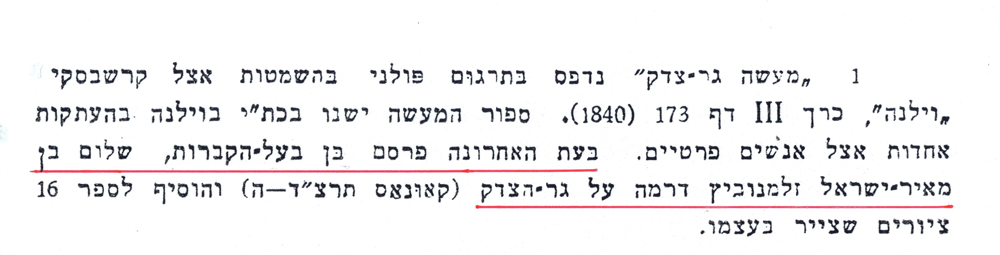
R. Efraim Mehlsack, however, took issue with Shir’s use of gematria. Specifically, Mehlsack wrote Sefer ha-Ravyah, Ofen, 1837, against Shir. Mehlsack was a prolific author, he supposedly authored some 72 seforim, but the only published sefer was this one. But before we get into the details regarding Mehlsack we need to discuss his critique of Shir. Mehlsack went to town on Shir and showed that using the gematria for the first line of a book, Mehlsack could make Kallir the author of just about every important Jewish book. Mehlsack goes through Tanakh and uses the first verse of each book to equal some form of Kallir’s name. For example, the first verse in Berashit equals 913 which equals “meni ha-katan Eliezer Kallir.” The first verse in Joshua equals 1041 which equals “ha-katon Eliezer beribi Kallir.” Mehlsack doesn’t stop with Tanakh, he then moves to Mishna noting that the first mishna in Berkhot is 2362 which equals “ani Eliezer berbi Ya’akov ha-Kallir mi-Kiryat Sefer yezkeh be-tov amen.” As a final shot at Shir, Mehlsack has the gematria of I am Shelmo Yehuda Rapoport = 1164 to Eliezer beRebi Yaakov Kallir =1164. Indeed, Mehlsack was not content to provide some 40 odd examples, he had even more and as a result of already printing the pages, the Sefer Ravyah is an interesting bibliographical oddity in that these gematrias appear on page 18 and then continue. Well Mehlsack includes an alternative page 18 in the back which has more examples of these gematrias. Thus, the book goes until page 32 and then there is another page 18. Both versions appear below.

Turning now to Mehlsack. As I mentioned Mehlsack supposedly authored 72 books. We know of 34 titles from that list.[4] Although most of those works have been lost, there are a few, around five, that are available in manuscript. In Boaz Hass’s recent book on the history of the Zohar, he mentions Mehlsack’s translation of the Zohar (Scholem also discusses this work). One of the works lost, is a work permitting one to travel via train on Shabbat. The introduction of this work has been published (in part) and appears below. Additionally, Sefer Ravyah was not Mehlsack’s only attack on Rapoport, Mehlsack attacked Rapoport in a few of his works, and some of his critiques were published in Bikkurei Ha-Ittim.

Returning to Kallir, it goes without saying that Kallir’s piyyutim were controversial. Most famously, the Ibn Ezra complained about them and offered that one should refrain from saying Kallir’s piyyutim. Ibn Ezra’s critique is discussed by R. Eliezer Fleckels, who defends Kallir, and Heidenheim thought it important enough to include this lengthy responsum in Heidenheim’s edition of the Machzor.[For more on the Ibn Ezra see צבי מלאכי “אברהם אבן-עזרא נגד אלעזר הקליר – ביקורת בראי הדורות” פלס (תשם) 273-296)

Bibliography on R. Eliezer Kallir (provided by a kind reader of the blog.)אלבוגן, התפלה בישראל בהתפתחותה ההסטורית, 233 – 239יוסף זליגר, “לתולדות הפיוט והפיטנים (ר’ אלעזר קליר)”, כתבי הרב דר יוסף זליגר, לאה זליגר מו”ל, ירושלים תרצ, צז – קבשלמה דוד לוצאטו, אגרות שדל א, 464 ואילך—, הליכות קדם, גבריאל פאלק, אמסטרדם תרז, מחלקה שניה, 56 – 64.צבי מלאכי, “הפייטן אלעזר הקליר – לחקר שמו ומקומו”, באורח מדע: פרקים בתרבות ישראל מוגים לאהרן מירסקי במלאות לו שבעים שנה, צבי מלאכי, מכון הברמן למחקרי ספרות, לוד תשמו, 539 – 543אהרן מרקוס, ברזילי: מסה בתולדות הלשון העברית, ירושלים: מוסד הרב קוק תשמג, 346עזרא פליישר, תרביץ נ, 282 – 302 —, “לפתרון שאלת זמנו ומקום פעילותו של ר’ אלעזר בירבי קיליר”, תרביץ נד ג, ניסן – סיון תשמה, 383 – 427שלמה יהודה ראפאפארט, תולדות גדולי ישראל, 24 – 55יעקב שור, ספר העתים, 364 – 365 בנועם שיח: פרקים מתולדות ספרותנו, מכון הברמן למחקרי ספרות, לוד תשמג, 114 – 156 המעין טז א, תשרי תשלו, 3 – 14. המשך: ב, טבת תשלו, 32 – 52.

[1] Mevo leMachzor Beni Roma, Habermann ed. Jerusalem[2] For more on this commentary see S. Brisman, History & Guide to Judaic Dictionaries & Concordances, KTAV Publishing House, Inc. 2000, pp. 19-20.[3] For more on this custom see Assaf, Mekorot le-Tolodot ha-Hinukh be-Yisrael, Jerusalem 2002, pp. 80-1 n.9 and the sources cited therein. See also, E. Kanarfogel, Peering through the Lattices, Wayne State University Press, Detroit, 2000 pp. 140-41 and the notes therein (discussing the ceremony generally); id.p. 237 n.47 (discussing some of the halakhik issues with this custom including the “issue” of “excret[ing] these verses”)[4] See G. Kressel, “Kitvei Mehlsack,” Kiryat Sefer 17, pp. 87-96.

A Printing Mistake and the Mysterious Origins of Rashbi’s Yahrzeit*

A Printing Mistake and the Mysterious Origins of Rashbi’s Yahrzeit*
by Eliezer Brodt
In this post I would like to deal with tracing the early sources for the great celebrations that take place worldwide on Lag Ba-Omer, specifically at the Kever of Rashbi (R. Shimon b. Yochai) in Meron.[1] A few years back on the Seforim Blog I dealt with some of these issues (link). More recently in Ami Magazine (# 22) I returned to some of the topics. This post contains new information and corrections that I have found which were not included in those earlier articles.
The period of Sefirat ha-Omer is traditionally considered a time of great mourning. The most well-known reason given for the mourning – offered by the Geonim and Rishonim – is due to the death of twenty-four thousand students of R. Akiva who, according to the Gemara in Yevamot 62b, died during this time of the year for not having accorded respect to each other. Because this is deemed a mourning period, we refrain from shaving, taking haircuts, dancing, listening to music, and making weddings.[2] Sefer Ha- Tadir[3] writes:
ומנהג בין פסח לעצרת לומר מסכת אבות בכל שבת ושבת קודם המנחה משום מעשה תלמידי ר”ע… י”ב אלפים זוגות תלמידים היו לו לר”ע… שלא נהגו כבוד זה לזה… (ספר התדיר, עמ’ רכב).
However, the prohibitions associated with sefirah are suspended on Lag Ba-Omer, and many early sources offer reasons for additional levels of simcha on Lag Ba-Omer, which includes omitting tachnun on that day. Additionally, there is a custom to celebrate Lag Ba-Omer at the kever of Rashbi in Meron, amidst great celebration, complete with music, dancing, and bonfires. The remainder of this post at the Seforim Blog will offer some reasons for this practice.
R. Yehoshuah Ibn Shu’eib, a student of the Rashba and a great Mekubal, was unsure of the reason for the custom in his day of taking a break from mourning on Lag Ba-Omer, until he heard some say that it is because the students of R. Akiva stopped dying on that day.[4] He writes:
ולכן נהגו לגדל שפם עד עצרת, ואין כונסין נשים בזה הפרק, ואף על פי שיש טעם אחר במדרש על אותן שנים עשר אלף זוגות תלמידי דר’ עקיבא שמתו מן הפסח עד העצרת. ומה שנהגו רוב העם להגדיל שפם עד ל”ג לעומר לא מצינו בו ענין, ובתוספות פי’ כי מה שאמר ל”ג אינו כמו שנוהגין, אלא ל”ג יום כשתסיר שבעת ימי הפסח ושבעה שבתות ושני ימי ראש חדש שהן ששה עשר יום שאין אבלות נוהג בהם, נשארו מן הארבעים ותשעה ימים ל”ג, וזהו מאמרם ל”ג יום לעומר. שמעתי שיש במדרש עד פרס העצרת והוא חמשה עשר יום העצרת באמרם פרס הפסח פרס החג שהם חמשה עשר יום בניסן ובתשרי, וכשתסיר חמשה עשר יום מארבעים ותשעה יום נשארו שלשים וארבעה, והנה הם שלשים ושלשה שלימים ומגלחין ביום שלשים וארבעה בבקר כי מקצת היום ככולו. (דרשה לפסח יום ראשון)
Some other Rishonim, including the Manhig and Meiri, also give this reason, while others say that the students only stopped dying on the thirty-fourth day of the Omer, the day after Lag Ba-Omer. Thus, according to them, there would be no reason for festive celebrations on Lag Ba-Omer.[5] See, for example, the Tashbetz who writes:
וכן אירע לר’ עקיבא שהעמיד ארבעה ועשרים אלף תלמידים וכולם מתו מן הפסח ועד פרס העצרת אחר עבור ל”ג לעומר, כי פרס הוא חצי חדש שהם חמשה עשר ימים, כמו שנזכר בפרק מעשר בהמה בבכורות [נח א]. וכן בתוספתא [שקלים פ”ב מ”א] אמרו, איזהו פרס, אין פחות מט”ו. וט”ו ימים קודם עצרת, הוא יום ל”ד לעומר. ולזה נהגו להתאבל באותם ימים שהם מהפסח עד ל”ג לעומר ולא נהגו איסור ביום ל”ד לפי שמקצת היום ככולו. וכולם מתו מפני שהיתה עינם צרה זה לזה (מגן אבות, אבות, א:א).
If one looks in the Tur, the Shulhan Arukh as well as the various early commentaries, one will not find any other reason as to why there should be simcha on Lag Ba-Omer, other than that the students of R. Akiva stopped dying on Lag Ba-Omer. Be that as it may, this particular reason offers no insight into the connection between Meron, and more specifically Rashbi, and Lag Ba-Omer.
The most well known explanation to the connection between Rashbi and Lag Ba-Omer is that Rashbi died on that day, and he was one of the students of R. Akiva. Assuming for a moment that this is factually correct, it is quite strange that we celebrate Rashbi’s death. We don’t celebrate the yarzheit of Avraham Avinu, Moshe Rabbeinu, David HaMelech, or any other great people with bonfires. Rather, halakha states the opposite – to fast on a yahrzeit, especially on those days that great people died. This problem is addressed by the Sho’el u-Meshiv (5:39) and because of this question and others, he was very skeptical of the celebration that takes place at Meron. R. Aryeh Balhuver, in his Shem Aryeh (no. 13), points out that because of the celebration that takes place at Meron for Rashbi, people began to be lenient about fasting on the yarzheit of their parents.
Another problem is that neither Chazal nor any of the Rishonim mention Rashbi dying on Lag Ba-Omer; and as a general rule we do not make any form of a Yom Tov on a day that is not mentioned in Chazal. This issue was addressed by the Chatam Sofer in his teshuvot (Y.D. 233) and because of this, he too was very skeptical of the way Lag Ba-Omer is celebrated.
So what is the source that Rashbi died on Lag Ba-Omer? R. Yehosef Schwartz writes in his Tevuot Ha-Aretz (p.224) that he searched all over for the reason for the great simcha at Meron on Lag Ba-Omer, and concluded that it must be because Rashbi died on Lag Ba-Omer. R. Jonathan Eybeschutz, the Ba’al ha-Tanyah, Reb Zadok ha-Kohen, and the Arukha ha-Shulhan also say that Rashbi died on Lag Ba-Omer.
The Shem Aryeh (no. 14) writes that when we celebrate the yahrzeit of Rashbi, we are celebrating that he died a natural death, at the proper time and place, and not at the hands of the Romans, who did not bury the people they killed. The Gemara in Shabbat 33b–34a relates that the Romans wanted to kill Rashbi, and he ran away and hid in a cave for many years until the Romans stopped hunting him.
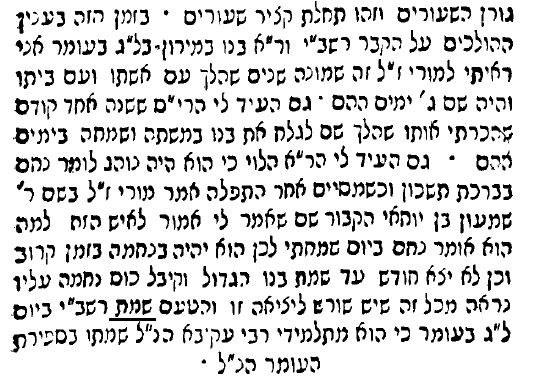
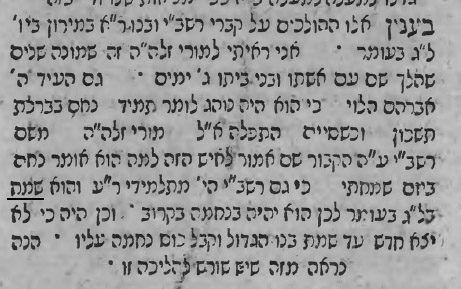
What appears to be an earlier source for some who say that Rashbi died on Lag Ba-Omer is R. Hayyim Vital, quoting in the name of the Arizal, found in the Peri Etz Chaim. Indeed, R. Hayyim Vital states that Rashbi died on Lag Ba-Omer, and he was one of the students of R. Akiva who died during Sefirah. In truth, it is a mistake to give R. Vital credit for this. The source of this mistake was based on a simple printing mistake in two edition of the Peri Etz Chaim. One was printed in Koretz 1785 (p. 108a).
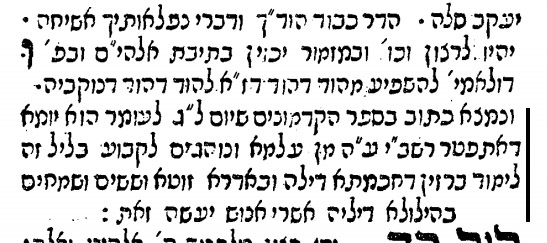
The other was printed in Dubrowno 1802 (p. 124b).

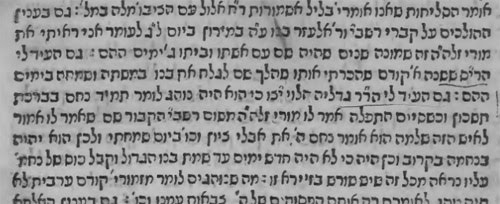
In the first printed edition of the Peri Etz Chaim, which was printed in 1782 (p. 101a), it does not say that at all. Instead of saying “she-meit” (that he died) it has a very similar, but entirely different word, samach (was joyous). The letter chet was apparently confused for a tav in the later version, causing the whole mistake![6] (Interestingly, the Aderes in his work Zecher Davar has a whole collection of cases where a problem arose due only to a קוצו שלו יוד.)
In the Shaar ha-Kavanot from R. Vital first printed in 1752, where the same piece appears, it also reads samach (p. 127) like the first edition of Peri Etz Chaim. In a later edition of of Peri Etz Chaim printed in 1819 it also reads samach. These would seem to confirm that the error is indeed she-met rather than samach.
The late Meir Benayahu z”l and, more recently, R. Yaakov Hillel, confirmed, based on many early manuscripts that this reading that does not have Rashbi dying on Lag be-Omer, is the correct reading from the writings of R. Chaim Vital. Recently, R. Yaakov Hillel printed the Sefer Shaar Ha-Tefilah from a manuscript of R. Hayyim Vital’s actual handwriting, and in that location (p. 312), as well, the passage states that it was the day of Simchat Rashbi, not the day he died.[7]
Interestingly, the Chida in his work Birkhei Yosef, printed in 1774, writes that Rashbi died on Lag Ba-Omer. But in a later work of his, Ma’aret Ayin, printed in 1805, he writes that the Prei Etz Chaim is full of mistakes and this statement regarding Lag Ba-Omer and Rashbi’s death day is one of them. So the Chida’s conclusion is that it is not a reference to Rashbi’s day of death at all. This conclusion is accepted by later authorities, including Takfo Shel Nes (p. 59a), Shu”t Rav u-Po’alim (1:11), and Tziyun LeNefesh Chayah (no. 65).[8]
The Lubavitcher Rebbe[9] wrote in a letter to R. Zevin that there is a printing mistake in the Peri Etz Chaim.

הרה”ג הוו”ח אי”א נו”מ וכו’ מהורשי”ז שי’
שלום וברכה!
במקרה ראיתי, בספרית כ”ק מו”ח אדמו”ר שליט”א, את ספרו “המועדים בהלכה” מהד”ת, ומצאתי שם בפרק ל”ג בעומר העתקת לשון הפרע”ח (דפוס דובראוונע ודפוס לאשצוב) שער ספה”ע פ”ז בהערה, וז”ל: והטעם שמת רשב”י ביום ל”ג בעומר כי הוא מתלמידי רע”ק שמתו בספה”ע.
והנה ידוע, אשר קטע זה מוקשה הוא הן בנגלה, כי רשב”י הוא מהחמשה תלמידים שסמך רע”ק אח”כ, הן מצד הנסתר ע”פ המבואר, בפע”ח שם ובסידור האריז”ל, מדריגת הכ”ד אלף תלמידים שמתו ומדריגת ה’ תלמידים הנ”ל. וכבר עמד ע”ז בשו”ת דברי נחמי’ חאו”ח סל”ד סק”ז. וסיים: ואולי יש ט”ס בפע”ח שם במ”ש כי הוא כו’ כנ”ל וצ”ע בדפוס קארעץ ששמעתי ששם נשמט זה.
ואמת כן הוא, אשר בפע”ח דפוס קארעץ לא נמצא קטע הנ”ל. וכן בסידורי האריז”ל ובשני פע”ח כת”י, שישנם באוסף הכת”י אשר לכ”ק מו”ח אדמו”ר שליט”א, חסר כל ענין זה. כן לא מצאתי לביאור הנ”ל בכל דרושי דא”ח שראיתי לע”ע.
וז”ל ספר הכוונות (ענין ספה”ע דרוש יב) בטעמי מנהגי ל”ג בעומר: כי הרשב”י ע”ה הוא מחמשה תלמידיו הגדולים של רע”ק ולכן זמן שמחתו ביום ל”ג בעומר. ועד”ז הוא במשנת חסידים.

– ובעהמ”ס ד”נ כנראה לא ראה את סה”כ, מדאינו מביאו – ומכמה טעמים מהנכון, לפענ”ד, לתקן את הנ”ל בספרו, או עכ”פ להעיר על הספקות שבדבר, בהזדמנות הראשונה. ..

The question then is, what is the earliest printed source that Rashbi died on Lag Ba-Omer. Avraham Yaari and Meir Benayahu demonstrate that the earliest source to mention Lag Ba-Omer as the yarzheit of Rashbi is none other than the Chemdat Yamim. R. Yaakov Hillel also confirms this in his Aid ha-Gal ha-Zeh (p. 13).
The Chemdat Yamim was first printed in the 1730s and has been the source of controversy and debate until today. Some go out of their way to attack it, claiming it has strong ties to Shabbetai Tzvi. Others strongly defend it, saying it is a very special work. Whatever the case is, Chemdat Yamim has been established by many as the source of many different customs that we observe today. It is not necessarily the earliest source, but in the first few years after it first appeared, Chemdat Yamim was printed many times, becoming a bestseller as it were. Because of this, many customs contained therein became widespread. One notable example is the celebration of Tu Be-shevat. After the Chemdat Yamim was printed, many works about the customs of Tu Be-shevat were printed based on it. What is very interesting is that Chasidim, who are principally against the Chemdat Yamim, are very into this concept that Lag Ba-Omer is the yarzheit of Rashbi.[10]

If one looks at all early mentions of Lag Ba-Omer and the Arizal one will not see any mention of it being the yarzheit of Rashbi. Here are some examples:
The Magen Avraham, first printed in 1692, writes when talking about days when we do not say Tachanun writes:
מעשה באחד שנהג כל ימיו לומר נחם בבונה ירושלים ואמרו בל”ג בעומר ונענש על זה מפני שהוא י”ט [כונת האר”י] (מגן אברהם סי’ קלא ס”ק יז)
When talking about Lag Ba-Ome , the Magen Avraham writes:
ומרבים בו קצת שמחה – וכתו’ בכוונות שגדול אחד היה רגיל לומר נחם בכל יום ואמרו גם בל”ג ונענש (מגן אברהם סי’ תצג ג)
We see that he makes no mention of it being the yarzheit of Rashbi when he referencing to the Arizal and Lag Ba-Omer. It is generally accepted that the Magen Avraham is responsible for bringing the writings of the Arizal into the world of halakhic discourse. The question, however, is regarding the Magen Avraham’s source for this specific Arizal. In general R. Yosef Avivi shows that the Magen Avraham when quoting from the Arizal was using the work Shulhan Arukh Shel Arizal.[11] There are many works similar to this work, one was called Nagid U-metzaveh; another was called Lechem Min Hashamayim. In both of these works, the whole story with the Arizal and Nachem appears with the version that this was the day of Simchat Rashbi, and not the day he died.
Now in this work, the story as quoted above appears and no mention of it being the yahrzeit of Rashbi, but rather that it was the day of Simchat Rashbi. However we cannot say, for certain, that his source was the Shulhan Arukh Shel Arizal because he specifically quotes the Sefer Hakavanot as his source. Now the problem with this is, which Sefer Hakavanot was the Magen Avraham referring to? The only edition printed before the Magen Avraham was from R. Moshe Terniki printed in Venice in 1620. In that edition of Sefer Hakavanot, there is nothing about Lag Ba-Omer. In a personal communication, R. Yosef Avivi suggested to me that it was the Sefer Hakavanot that was written in Cracow in 1650 and the Magen Avraham had it in manuscript. This edition of Sefer Hakavanot was later printed under the name Peri Etz Chaim in 1785.[12]
Another example of an early source who quotes the Arizal about Lag Ba-Omer but makes no mention of it being his yahrzeit can be found in the Ateret Zekenim from R. Menachem Auerbach, first printed on the side of the Shulhan Arukh in 1702 (it was written much earlier). He also cites the story of the Arizal:
מנהג ארץ ישראל שנוהגין לילך על קברי רשב”י ז”ל ור”א בנו ביום ל”ג בעומר והעיד ר”א הלוי שהוא היה נוהג תמיד לומר נחם בברכת תשכון וכשסיים התפלה א”ל ר”י לוריא ז”ל משם רשב”י הקבור שם שאמר לו אמור לאיש הזה למה הוא אומר נחם ביום שמחתי ולכן הוא יהיה נחם בקרוב וכן היה שמת לו בנו הגדול (סי’ תצג).
Here too we see a version of the story that has nothing about it being the yahrzeit of Rashbi.
Another example of an early source that quotes the Arizal about Lag Ba-Omer, but makes no mention of it being his yahrzeit can be found in the Sefer Shirei ha-Levim. This work was first printed in 1677; it includes anything having to do with the topic of Shir Shel Yom including the Arizal’s custom that he found in different sources.[13] When talking about Lag Ba-Omer he writes:
ל”ג בעמור שייך מזמור לז על שם שנאמר בו צופה רשע לצדיק וגו’ וזה שייך על רשב”י וחבריו שנשארו מתלמידי ר”ע כמבואר בגמרא ולא שלט בהם המלאך המות ביום ההוא וכן מיום ההוא והלאה כי קצת דיעות. וכתב בספר כוונת האר”י הנדפס שהלך האריז”ל עם אשתו ובניו לגלח על קבר רשב”י ועשה משתה ושמחה ג’ ימים לג לד לה ולמדו ספר הזוהר על קברו לכבודו של רשב”י וחביריו שנשתיירו והעמידו תורה באותו שעה, וע”ש מעשה נפלא על אחד שנענש על שאמר נחם בתפילת יח בעת שמחתו אבל ספר כוונת של הקדוש ר’ חיים וויטל…
I am not sure which printed edition of Sefer Hakavanot he was referring to that contains this passage. However we see here also no mention of it being yahrzeit of Rashbi.
The Mishnat Chassidim, first printed in 1727, collected lots of material from the Arizal. When talking about Lag Ba-Omer, also makes no mention of it being the yarzheit of Rashbi.[14] He just writes:
ועל ידי ר’ שמעון בן יוחאי שהיה אף הוא תלמידו נתקיים העולם לפיכך אין להתאבל ביום זה כלל על החרבן שלא יענש אל מצוה לשמח שמחת ר’ שמעון בן יוחאי ואם דר בארץ ישראל ילך לשמוח על קברו.
Next is the historical work Divrei Yosef from R. Yosef Sambary, completed in 1672 but only printed a few years ago, (although parts were printed by Adolf Neubauer in 1887). When he records the story with the Arizal about someone saying Nachem at the kever of Rashbi, he does not even mention it was on Lag Ba-Omer; he, too, records the story stressing that it was a day of Simcha not the yahrzeit of Rashbi (p. 188).
It is also worth pointing out that the Shelah ha-Kadosh, an earlier work that was influenced by the Arizal, when talking about Lag Ba-Omer, also makes no mention of it being the yahrzeit of Rashbi.
The Divrei Nechemiah, written by the grandson of the Ba’al ha-Tanyah, writes (no. 34) that there is a printing mistake in the Peri Etz Chaim when he says that it was the yahrzeit of Rashbi. However he concludes:
אך המפורסמות אין צריך ראיה שכבר נתפרסם בכל העולם מכמה דורות ע’ הלולא דרשב”י בל”ג בעומר ומסתמא יש מקור לזה בזוהר או בכתבי האר”י ז”ל.
In short it is quite amazing that the whole source for Lag ba-Omer being the day of Rashbi’s death is based on a printing mistake found in only one version of the story with the Arizal, while all other versions I have found of the story does not say anything about it being the yahrzeit of Rashbi!
Returning to the origins of going to Meron on Lag Ba-Omer, Avraham Yaari, has a very detailed article where he collects many early sources[15] for going to Meron in general[16] from famous travelers such as R. Binyomin Me-Tudela in the 1170s, R. Pesachyah Me-Regensburg, but these early sources make no mention of going to Rashbi’s Kever, only to the kevarim of Hillel and Shammai[17] who are also buried in Meron.[18] The first source that Avraham Yaari found that mentions going to Rashbi’s kever is from the twelfth-century in the travels of R. Yaakov HaKohen. After that, he found it in other sources.[19] None of these sources mention to these kevarim at a specific time. In the beginning of the fourteenth century, however, a student of the Ramban mentions going to the kevarim of Hillel and Shammai in Meron on a specific date in the month of Iyar, on Pesach Shnei. We have other early sources that mention going to those kevarim on Pesach Sheini. In the famous letter of R. Ovadiah me-Bertinoro (1488) and the travels of R. Moshe Basola (1521-1523), we also find mention of going to Meron to visit the kevarim of Hillel and Shammai on Pesach Sheini. From many of these sources, we see that the reason they went was to daven for water, and that at times, water would miraculously appear from the caves. However, it is important to stress that while we have many accounts of going to Meron even during the month of Iyar none mention going to the kever of Rashbi during that time of year.
Avraham Yaari and Meir Benayahu cite many sources that clearly demonstrate that the Mekubelei Tzefat would go to Meron to the kever of Rashbi a few times during the year to learn Zohar. However, the first source we have for someone going to Rashbi’s kever specifically on Lag Ba-Omer, is the Talmdim of the Arizal, who say that the Arizal once went to the kever of Rashbi on Lag Ba-Omer while still living in Egypt. When recording this testimony, R. Hayyim Vital writers that he is not sure if this occurred before the Arizal was well versed in Kabbalah. But he stresses that he was doing something done by others before him. We do not know to whom R. Hayyim Vital referred. Meir Benayahu concluded that the custom of going to Meron on Lag Ba-Omer was begun by the Mekubelei Tzefat.
Although Yaari concedes that Mekubelei Tzefat were very into going to the kever of Rashbi, that is not how the minhag to go specifically on Lag Ba-Omer developed. Yaari shows that the custom of going to Meron was taken from an earlier custom of going to Shmuel Hanavi’s Kever on his yahrzeit, which was on the twenty-eighth day of Iyar.[20] The Tur brings down from the Behag that one should fast on this day. We have many early sources of prayers that were recited on this day at Shmuel Hanavi’s Kever.[21] In the travels of Meshulem Me-Volterrah from 1481, the travels of R. Ovadiah me-Bertinoro (1488) and the travels of R. Moshe Basola (1521-1523) we also find mention of going to Shmuel Hanavi’s Kever on his yarzheit. In these sources, we also see that they used to light many big flames. Avraham Yaari believes this to be the source of the minhag to go to Kever of Rashbi.
In sum, the above indicates that there are early sources for people going to Meron during the month of Iyar, on Pesach Sheni, to the kevarim of Hillel and Shammai. The Mekubelei Tzefat went to Rashbi’s kever throughout the year and Meir Benayahu feels that the minhag of going Lag Ba-Omer originated from them too. While Yaari feels that the custom of going to Meron on Lag Ba-Omer was taken from an earlier custom to go to Shmuel Hanavi’s Kever on his yahrzeit, it is also clear that the Arizal did, in fact, go to the kever of Rashbi on Lag Ba-Omer at least once.
However it appears to this writer that it is more likely that the custom of going to Meron to the Kever of R. Shimon Bar Yochai on Lag Ba-Omer grew out of the earlier minhag of going to Meron in the month of Iyar, to the kevarim of Hillel and Shammai on Pesach Sheini which is only a few days before Lag Ba-Omer, and not from the Minhag of going to Shmuel Hanavi’s Kever on his yahrzeit, which was on the twenty eighth day of Iyar, which is not even in Meron. Possibly support to this can be found in the travels of R. Moshe of Basola who writes that after going to kevarim of Hillel and Shammai on Pesach Sheini, the crowd would go to the cave where Rashbi and his son hid for thirteen years and they would spend a few days and nights celebrating in Meron.[22]
In the work Arugat Ha-Bosem, written in 1234, I found a very interesting version to the earlier quoted, famous Gemara of why the sefirah period is considered a time of mourning. He writes:
מה טעם מנהג בישראל אין עושין מלאכה בין פסח לעצרת, משתקשע החמה עד למחרת שחרית, ואמרו לנו שני טעמים אחד על פטירת תלמיד הילל ושמאי, דאמ’ שמוני’ אלף תלמיד’ היו להילל הזקן ושמאי מגבת ועד אנטיפרס, וכולן מתו מפסח עד עצרת על שאלה ונוהגים כבוד זה לזה… [ערוגת הבשם, א, עמ’ 75].
This version would be possible additionally support, that originally in Iyar Jews went to the kevarim of Hillel and Shammai on Pesach Sheini. However I was unable to find any other manuscript that records such a reading of this Gemara.[23]
R. Shemaryhu Adler has a very interesting insight into the deaths of the talmdim of R. Akiva during sefira and when they start dyeing. In this piece he also says as a fact that Rashbi died on Lag B’Omer.
נראה טעם הגון ונכון לעצומו של יום לג בעומר דהוא בכלל יום טוב. ובהקדם להבין עוד מה דלכאורה תמוה דלמה לכולהו הני שיטות ליכא התחלה לאבילות כי אם מזמן התחלת ספירת העומר והיינו מיום ב’ דפסח דאיזה שייכות יש לאבילות ךדלמידי ר”ע לזמן התחלת ספירת העומר כיון דיבמות ס”ב ע”ב אמר כולם מתו מפסח ועד עצרת וסתמא תנא מפסח מנ”ל דזהו מיום ב’ דפסח ולא מיום א’.
נראה ע”פ דאמר במנחות סח ע”ב יתיב ר”ט וקא קשיא ליה מה בין קודם לעומר לקודם שתי הלחם אמר לפניו יהודה בר נחמיה לא אם אמרת קודם לעומר כשן לא הותר מכללו אצל הדיוט כו’ שתק ר”ט צהבו פניו של רבי יהודה בר נחמיה אמר לו ר”ע יהודה הבצו פניך שהשבת את זקן תמהני אם תאריך ימים אר”י ב”ר אלעי אותו הפרק פרס הפסח היה עשעליתי לעצרת שאלתי אחריו יהודה בן נחמיה היכן הוא ואמרו לי נפטר והלך לו עכ”ל הגמרא יעו”ש
ומזה נראה דהי’ קודם פסח ט”ו יום ונשאו ונתנו בענינא דעומר וע”י דצהבו פניו של יהודה בן נחמיה במה דהשיב את ר”ט ועי”ז קפד ר”ע מסברא לומר דבעת שהגיע זמן הקרבת העומר דהוא זמן התחלת ספירת העומר ביום ב’ של פסח מצאה הקפידה מקום דתיחול כיון דעיקר דהשיב לר”ט היה בענינא דעומר וכיון דקפידת ר”ע היה על מה דתלמידו יהודה בן נחמיה התכבד בתשובתו לר”ט ולא נהג בו כבוד כראוי ומצאה הקפידה מקום לנוח בזמן הקרבת העומר דזהו היתה סיבה להא דהשיב הזקן ר”ט שפיר התפשטה קפידת ר”ע ג”כ על כל תלמידיו שלא נהגו כבוד זה לזה והלכך שפיר התחילה פטירתן מאותו זמן דעיקר הקפידה חלה והיינו מיום ב’ דפסח שהוא זמן הקרבת העומר והלכך שפיר שייכא אבילות דתלמידי ר”ע לזמן התחלת ספירת העומר וכנ”ל
ועיין כי רשב”י היה מתלמידי ר”ע והיה קפדן גדול וכדאמר במעילה יז ע”ב… וא”כ הו”א כיון דר”ש ג”ג נפטר ביום ל”ג בעומר נהי דכבר היה זה זמן טובא אחר שמתו תלמידי ר”ע כיון דאמר ביבמות ס”ב והיה… מ”מ כיון דקפידת ר”ע על מניעת נהיגת כבוד חלה בזמן בעומר שוב פטירת ר”ש דהיתה בזמן ימי העומר והיינו ל”ג בעומר ג”כ מקפידת ר”ע רבו על דהיה קפדן ובודאי לא נהג כבוד, והלכך לשלילת מחשבה כזו עושים קצת שמחה להראות דפטירת רשב”י אינו בגדר קפדנותו של ר”ע רבו ומטעמא דנהי דרשב”י היה קפדן מ”מ לא היתה לבד התכבדות בקלונו של חברו ח”ו דז”א דרשב”י הי צדיק גמור ועיקר קפדנותו לא היתה כ”א לכבוד השי”ת וקנאותו וזהו עיקר הלולא דרשב”י (שו”ת מראה כהן, סי’ כט אות ג).
R. Eliezer Dunner, in his work Zichron Yosef Tzvi, offers a very novel reason for the celebration on Lag Ba-Omer. He says that we know that R. Akiva was a strong supporter of Bar Kochba. He suggests that R. Akiva students were soldiers in his army to fight the Romans and they died in this time period of Sefirah. During this time, on Lag Ba-Omer, the Jews were winning, that is why they turned this day into a great day of celebration.
ידענו כי ר’ עקיבא היה הולך ונוסע ומלמד בכל תפוצת הארץ ובכל מקום היה לו תלמידים הרבה מאוד ועין שחושב לבר כוזבא כמשיח קרא כל תלמידיו להלחם בצד בר כוזבא ותחת רגליו נגד חיל האויבים… ואף על פי שבתחילה חלשו היהודים את אויביהם לפי חרב אחר כך גברו הרומיים ולכדו מישראל עיר ועיר ובאותה זמן היתה מלחמה בכל יום יום ובכל מלחמה נפלו ומתו הרבה אנשים מחיל בר כוזבא ובהן כמה תלמידי ר’ עקיבא וכששקעה החמה בכל יום ויום פסקה המלחמה ואז נקברו כל המתים. ואפשר שבתוך כל המלחמות הללו שהיו יום יום ושבהם גברו האויביהם על ישראל היה יום אחד והוא ל”ג בעומר שגבר בו ישראל אותו יום שבו היה להם ישעות ה’ בעת צרתם יום גבורה ותשועה אותו יום קבעו ליום שמחה לדור דורים וכמו כן שמעתי גם מפי הרב דק”ק פוזנא מוהר”ר זאב פיילכענפעלד ז”ל (זכרון יוסף צבי, סי’ תצ”ג).
However, this original explanation, while giving us new insight into the mourning period during sefirah does not help us understand the connection to Rashbi. Avraham Korman in his Pinu’ach Aggadot (pp. 190-210) cites others (not R. Dunner) that tie the death of the talmidim of R. Akiva to the rebellion of Bar Kochba and he goes further to explain the connection between this and Rashbi and other minhagim of Sefirah.
There is a custom in many chasidic courts to use bow and arrows on Lag Ba-Omer. Many explanations are offered, but Korman says that perhaps the bows and arrows serve as a reminder of the war that the students of Rebbe Akiva fought against the Romans. As an aside, although most sources for bow and arrows on Lag Ba-Omer are found in chasidic seforim, I have found a possible source that in Vilna in the early 1800’s they also used bow and arrows on Lag Ba-Omer.[24]
R. Mordechai Ha-Kohen suggests based on this connection between the students of R. Akiva and the battle of Bar Kochba, that we can understand another issue. The Tur brings an old minhag that woman would refrain from doing work at night from after sunset the whole sefirah. He says the reason was the woman too participated in the battles against Bar Kochba they acted as nurses and helped the fallen soldiers and buried the dead every day after sunset when the fighting stopped. Therefore he says a custom developed that woman today do not do work after sunset.[25]
The earliest source who ties the mourning period during sefirah period for the deaths of the students of R’ Akiva and the battle of Bar Kochba that I found was in the magnum opus of the famous Galician maskil, Nachman Krochmal, who write in his Moreh Nevuchei Ha-zman:
אכן נראה כי גברה עתה המחשבה והעצה למרוד גם בין קצת החכמים וביחוד בין התלמידים והבחורים, ויש זכר לדבר גם בתלמוד ובמדרשות, ד”מ השנים עשר אלף תלמידים שהיו לר’ עקיבא מגבת ועד אטניפרוס וכולם מתו מפסח ועד עצרת (כלומר שעזבוהו כולם בזמן קצר לעת המרידה ולבסוף ספו תמו במלחמה) [מורה נבוכי הזמן, שער י, עמ’ קט].
Support to this theory can possibly be found in the Iggeret R. Sherirah Gaon according to Gedaliahu Alon. R. Sherirah Gaon writes:
והעמיד ר’ עקיבא תלמידים הרבה והוה שמדא על התלמידים של ר’ עקיבא והות סמכא דישראל על התלמידים שנייים של ר’ עקיבא דאמור רבנן שנים עשר אלף תלמידים היו לו לר’ עקיבא מגבת ועד אנטיפטרס וכלם מתו מפסח ועד עצרת (אגרת ר’ שרירא גאון, ב”מ לוין, עמ’ 13).
Alon suggests that the words and “there was a Shemad” implies they were killed by the government.[26] However, it is not so simple that this is all historically true as there are many different discussions to what extent was R. Akiva was actively involved in the rebellion. It is well known that the Rambam writes:
וביתר שמה והיו בה אלפים ורבבות מישראל והיה להם מלך גדול ודימו כל ישראל וגדולי החכמים שהוא המלך המשיח, ונפל ביד גוים ונהרגו כולם והיתה צרה גדולה כמו חורבן המקדש (הל’ תעניות ה:ג).
Elsewhere he writes even more clearly:
אל יעלה על דעתך שהמלך המשיח צריך לעשות אותות ומופתים ומחדש דברים בעולם או מחיה מתים וכיוצא בדברים אלו, אין הדבר כך, שהרי רבי עקיבא חכם גדול מחכמי משנה היה, והוא היה נושא כליו של בן כוזיבא המלך, והוא היה אומר עליו שהוא המלך המשיח, ודימה הוא וכל חכמי דורו שהוא המלך המשיח, עד שנהרג בעונות, כיון שנהרג נודע להם שאינו… (הל’ מלכים יא:ג).
The Meiri writes:
וכן בדבור הזה עמד בן עוזיבא ועשה עצמו משיח, וטעו רבים אחריו, ואף ר’ עקיבא היה נושא כליו (סדר קבלה, מה’ אופק, עמ’ 77).
R. Hamberger in his Meshichei Sheker u-Mitnageidheim (pp. 676-681) has a long list of people who agree with the Rambam.
Zecharia Frankel in Darkei HaMishna (p. 128) concludes that he did not really have much to do with the rebellion[27]. Y. Derenberg concludes that R. Akiva and his students were very involved with Bar Kochba.[28] R. Issac Halevi in his Dorot Ha-Rishonim (5, pp. 602- 628) downplays R. Akiva’s role completely saying he did not really endorse Bar Kokhba for that long. From the Rambam and Meiri quoted above it seems they disagree. Aharon Heyman concludes that R. Akiva and his students were actively involved with Bar Kochba (Toledot Tanaaim ve-Amoraim 3, pp. 1002-1004).
To conclude with a well-known cute story related to R. Akiva and Bar Kochba: R. Zevin brings from R. Chaim Soloveitchik:
פעם אחת נסע רבי חיים ברכבת… היה שם איש אחד מן המסיתים, שהירבה דברים להוכיח שאותו האיש הוא המשיח… בתוך הויכוח נענה אחד ואמר להמסית וכי מי יודע יותר בטיבו של אותו האיש התנאים, שהיו בדורו והכירו אותו ואת מעשיו או אתה שאתה רחוק ממנו כאלפיים שנה? והרי התנאים של אותו דור דנוהו ותלוהו. השיב המסית אותם התנאים הרי אנו רואים, שטועים היו שכן טעה רבי עקיבא וחשב את בר כוכבא למשיח. נסתתמו טענותיו של היהודי ורבי חיים כשראה שיד המסית על העליונה, נענה ואמר וכי זו מנין לך שרבי עקיבא טעה בבר כוכבא? נתלהב המסית הרי הרגו את בר כוכבא! אם כן משיב רבי חיים בנחת הרי אתה מודה שמשיח שנהרג אינו משיח. (אישים ושיטות, עמ’ ס).
* Thanks to R. Yosef Avivi for his help with some of the issues related to the writings of the Arizal.
[1] Much has been written about all the customs of Lag Ba-Omer. The best collections of material on the topic appear in Avraham Yaari, Tarbiz 22 (1951); Meir Benayhu, Sefunot 6 pp. 11-40, summarized in Sefer Vilnai 2:326-330] and R. Betzalel Landau, Maseh Meron (1966). See also David Tamar, Eshkolet Tamar, pp. 116-120]. See also R. Shelomo Joseph Zevin, Moadim Bahalcha pp. 359-64; Shmuel Ashkenazi, Avnei Chain pp. 103-11. For more recent collections of sources see: R. Yaakov Hillel, Aid ha-Gal ha-Zeh, pp. 3-29; Moshe Blau, Yeshurun 15 (2008), pp. 854-872; Tuviah Freund, Moadim le-Simcha; Pardes Eliezer s.v Lag ba-Omer;Yitzhak Tessler, Pinnenei ha-Chag.
As I have noted in my previous post at the Seforim blog on the topic of Lag ba-Omer, Freund and Blau have each plagiarized greatly from the works of Landau, Yaari, and Benayahu.
[2] For a detailed discussion, see R. Gedaliah Oberlander, Minhag Avoteinu be-Yadeinu (Merkaz Halakhah, 2005), pp. 528-547.
[3] On this work see R. R.N. Rabinowitz, Ohel Avraham (1898) pp. 14-15; Y.Yudolov, Yeshurun 24 (2011), pp. 893-919.
[4] Dershos Ri Ibn Shu’eib, 1, p. 222.
[5];Peri Chadash, 493:2. See also Beis Yosef and Aruch Ha-shulchan.
[6] For more on this edition, see R. Yosef Avivi, Binyan Ariel, pp. 68-71 and his Kabbalat Ha-Ari, 2, pp. 705-06.
[7] One can see pictures of the manuscripts in the article from Moshe Blau cited in footnote one.
[8] It would appear to me that Reb Yosef Engel also did not think that Rashbi died on Lag B’omer as in his work Otzros Yosef he has many pages on Lag b’omer and talmidei R. akiva etc and he makes no mention that it was the day he died.
[9] Thanks to an anonymous commenter for pointing to this letter.
[10] For a partial list of sources regarding the Chemdat Yamim controversy, see my Likutei Eliezer, p. 2. It’s worth mentioning that a new three volume edition of the Chemdat Yamim has just been printed in Benei Brak. The edition is very nice and was based upon the first edition. However, the 250 page introduction is extremely amusing.
[11] See R. Yosef Avivi, Kabbalat Ha-Ari, 2, pp. 752-753.
[12] See R. Yosef Avivi, Kabbalat Ha-Ari, 2, pp. 593-598, 670-672, 705-06. See also Zeev Gries, Safrot Ha-hanhaghot, pp. 81-84, 87-90; Yaakov S. Speigel, Pitchei Tefilah u-Moed, pp. 308-309.
Edit 6.22.11: However after reading this post R. Bentzion Meisles (In a personal communication) showed me that this whole piece with the Arizal going to Meron does indeed appear in the Sefer Hakavonos of R. Terniki, (In the 2006 edition it appears on pp. 5-6) and it too says שמחתי.
[13] On this work see here and here.
[14] See R. Yosef Avivi, Kabbalat Ha-Ari, 2, pp. 757-759.
[15] The actual sources can be seen in his works Masaot Eretz Yisrael and Iggerot Eretz Yisrael.
[16] Much has been written about davening at kevarim in general see Yehezkal Lichtenstein, Me-Tumah Le-Kedusha, pp. 218-242, 293-386.
[17] M. Zulay published very early Piyutim that seem to show that Hillel and Shammai were brothers! See his Eretz Yisrael u-Piyuteh, pp. 539-545.
[18] On going to the kevarim of Hillel and Shammai see M. Weiss, Kivrei Avos, 129-132; Elchanan Reiner “Pilgrims and Pilgrimage to Eretz Yisrael (1099-1517),” (PhD dissertation, Hebrew University of Jerusalem, 1988), 295-320.
[19] General sources for going to the Kever of Rashbi can be found in M.Weiss, Kivrei Avos pp. 179-81; Z. Vilnai, Mazavos be-Eretz ha-Kodesh pp. 117-150.
[20] On this being his date of death see the Tur (O.C. 580); S. Elitzur, Lamu Tzamnu, pp. 177-180.
[21] M. Zulay, Eretz Yisrael U-piyuteh, pp. 401-412. For more regarding Shmuel ha-Navi and visiting his grave, see M. Weiss, Kivrei Avot, pp. 113-16; Lamu Tzamnu pp. 177-80; Reiner op. cit. pp. 306-20; Y. Lichtenstein, Me-Tumah Le-Kedusha, pp. 298-230.
[22] The Itinerary of R. Moses Basola (David ed.) p.91.
[23] See Makhon Talmud Yisraeli, Yevamot 62b.
[24] Kundes p. 49. For more on this 1824 parody see here. For more sources on using bow and arrows on Lag Ba-Omer: see the sources listed by Landau, ibid pp. 124-26; Moadim le-Simcha pp. 155-59; Pardes Eliezer pp. 229-49; ha-Koton ve-Halachosov chapter 24 p. 59 n. 22; Zikhronot Av u-Beno p. 231; A.S. Sachs, Worlds that Passed (Philadelphia, 1928), p. 112.
[25] Ishim Utekufot, pp. 102-105.
[26] Toldos Hayehudim Beretz Yisroel, 2, pp. 43-44.
[27] See also J. Brull in his Mavo Le-Mishna, 2. pp. 121-122. For more sources on all this see: G. Alon, Toldos Hayehudim Beretz Yisroel, 2, pp. 16-47; S. Safrai, R. Akiva Ben Yosef, pp. 26-33; M. Cohen, Ishim Utekufot, pp. 92-112; R. Y. Tamar, Alei Tamar, Tannis, pp. 390-392;C. Kulitz, Rosh Lechachochim; Ibid, Ben Ha-aliyah; collection of articles in Mared Bar Kochba, Ed. A. Oppenheimer; R. Hamberger, Meshichei Sheker U-misnagdim, pp. 138-155, 665-681.
[28] Maseh Eretz Yisroel, pp. 220-228.


A Preliminary Bibliography of Recent Works on Birkat ha-Chamah

A Preliminary Bibliography of the Recent Works on Birkat ha-Chamah by Eliezer Brodt & Ish Sefer There are many works and articles on this topic and, as such, this is merely a preliminary attempt to deal with this burgeoning area of Jewish literature. [See also here]. For a great bibliographic note on the development of Seder Birkat ha-Chamah, including publications relating to birkat ha-chamah, see R. J. D. Bleich, Birkat ha-Chamah, pp.128-133. JNUL has put up a many of the editions of relating to subject here, here, here, here, here, here, here, here, here, here, here, here, here, here, here, here, here, here, and here. That's right, the JNUL has 19 editions (!) of the Birkat ha-Chamah starting with the first in 1785 through 1981 Edah Haredit edition.  These editions come from such disparate places as Egypt, Tunis, India, and Iraq.   But, now, turning to the editions currently in print.Boker Yizrach from R. Meldola was reprinted again and it includes a later edition with a Pirush Sharei Mizrach from R. Yekusiel Kamelhar (about him in general see this book).Tekufos ha-Chamah u-Berckoseh of R. Yechiel Michel Tukuchensky was reprinted again. A new work on this topic is called Otzar ha-Zemanim by R. A. Brisk. This work is 336 pages is beautifully type-set, well organized, very strong in halacha and it has a bit on the astronomical aspects of birkat ha-chamah.Another work on this topic is by R. M.M. Gerlitz called Birkat ha-Chamah ke-Hilkhoto. On the prior edition, R. J. D. Bleich writes that Gerlitz's book is the most comprehensive work on the topic. This work is an expanded version of its earlier edition, and is now 558 pages. This work is strong in both astronomy, devoting 190 pages to the topic, and strong in the halacaha aspects. It also has many responsum relating to this topic and includes dershot that were said at prior birkat ha-chama by various Gedolim. In addition, this new edition has many letters to R. Chaim Kanievsky on the topic (a recent "minhag" of all works on halacha). To just mention one interesting discussion which R. M.M. Gerlitz deals with is the Ozstrosver's now famous statement that it is extra special if Birkat ha-Chamah falls out on Erev Pesach (pp.115-18). Another nice addition to R. Gerlitz's revised edition is R. Yakov Emden's comments (pp.479-94) all about birkat ha-chamah. These comments were originally printed in the back of the 1757 edition of Megilat Tannit and were omitted from later editions of Megilat Tannit. As such, R. Emden's comments escaped the notice of many of the people learning this topic. Aside from R. Emden's discussion about birkat ha-chamah, he also deals with the Frankist movement and states that one can inform on them to the government (he also deals with Christianity). However,  R. Gerlitz cuts out a page of this – where R. Emden listed some of the Frankists sins – Gerlitz argues that there is no need  to print this today. Today with the amazing web data base of free seforim at Hebrew books one can see this rare edition here and the pages on birkat ha-chamah here and the edited pages here. One thing lacking from this otherwise excellent edition is a proper index of topics discussed.Another work is called Birkat ha-Chamah be-Tekufoseah by R. Genot. This work is 748 pages and is very strong in the astronomy aspects but weaker in the halacha aspects. On the bibliographical front, it reproduces many different editions of Birkat ha-Chamah. He also includes the comments of R. Emden but in a much more abbreviated form than R. Gerlitz. One interesting thing (p.276) a quote from a manuscript from 745 years ago of how the beracha was recited by the Chazan after Ma'ariv! One big mistake in this work when dealing with the famous question of if the calendar according to Shmuel is off so why do we follow Shmuel's opinion,  R. Genot prints a photocopy of the original Halevonon article of R. Alexander Moshe Lapides he then writes: בעוד שהקושיא בת מאות השנים על אמיתות תקופת שמואל נידונה בספרי האחרונים נתפרסמו מאמרים אחדים גם בכתבי עת, שלא עלו על שולחנם של שלומי אמוני ישראל. הבאונם אך כקוריוז משלים לנושא רחב זה , ואם יש בהם משפטים הנוגדים את מסורתנו, הרי הם דברים שאין בה ממש (עמ' 424). He obviously does not know who R. Alexander Moshe Lapides was – a talmid  chaver of R. Yisroel Salanter and one of leading Litvish Gedolim of his time. As an aside this piece was recently reprinted in the excellent edition of Torat ha-Goan R. Alexander Moshe pp.6-8. Another work is from R. Zvi Cohen called Birkat ha-Chamah, 383 pages. This sefer is like all his others, full of excellent information from a very wide range of sources. This work is expanded from earlier edition and is strong in halacha aspects but not as strong in astronomy. Another work on the topic is called Seder Bircas Kiddish Hachamah by R. Strohli, 203 pages.Of great interest to me in the works of R. Brisk, R. Gerlitz, R. Genot, R. Cohen and R. Strohli [a version of this appeared in the recent Journal Etz Chaim volume 8] is how they list sources of Gedolim throughout the ages how they each did this beracha.  In doing so, these works quote many rare sources although, at times, they overlap each other (next time around someone just has to take all the works on the topic and put it together into one volume). One source which escaped them (except for The Sun Cycle p. 23) is found in a autobiography from the early 1600's where the author describes as follows:  כט אדר שעז בהיותי בק' ורנקבורט נתחדש החמה כי כן נעשה כל כח שנה מחזור החמה ולא נעשה כזאת עוד עד ער"ח ניסין ארבע מאות וחמשה אשרי המחכה ויגיע לימים אלו והלכו כל הקהל בשעה ג' על היום על בית הקברות ויום מעונן היה ועמדתי בתוכם ואמרנו פה אחד ברוך עושה מעשה בראשית (ר' אשר ב"ר אליעזר הלוי, ספר זכרונות, עמ' 7).  Another interesting thing we see from this account is the strange minhag to say birkat ha-chamah in the cemetery or near it. This strange minhag is only mentioned briefly by R. Genot in Birkat ha-Chamah be-Tekufoseah (p. 290) and discussed at greater length by R. Gerlitz in Birkat ha-Chamah ke-Hilkhoto (pp. 231-233) (otherwise I have seen no mention of this strange custom). It seems this was the minhag in Frankfurt according to the Yosef Ometz but R. Chaim Rapoport in Birkat ha-Chamah Al Pei Minhag Chabad (p. 80-81) cites the Alei Tamar who argues that this is an incorrect reading of Yosef Ometz and they did not say the beracha at the cemetery. However from this account we see that they indeed did say it at the cemetery. [See also E. Prins comments on this Yosef Ometz in Parnos le-Dorot, p. 292.]Another work is called Birkat ha-Chamah Al Pei Minhag Chabad, from R. Chaim Rapoport 167 pages. This edition includes a section of the halachot in English. Of special interest in this work of R. Rapoport and that of R. Strohli is their sections dealing with women and this beracha. In English, there is  R. J. D. Bleich, Birkat ha-Chamah, 243 pages. This work is extremely well written, as R. Bleich excels at making extremely complicated things sound easy.  It deals with astronomy and halacha aspects very comprehensively for scholar and layman alike. Just to mention one interesting source, not only related  to birkat ha-chamah, is that when discussing aleinu and the censorship of the statement  שהם משתחוים להבל וריק ומתפללים אל אל לא יושיע that the Mahril Diskin held one has to be careful to say it because of משנה ממטבע שטבעו חכמים בברכות. R. Bleich writes that he saw in the siddur of R. Reven Grozovsky that this phrase was written in the siddur. Just one complaint with this particular edition is it is very annoying the way the pages are set up as a Hebrew book even though it is written in English making the pages confusing going from one page to the next. Additionally, one thing lacking from this otherwise excellent edition is a proper index of topics discussed. Another work also in English is from R. Yehuda Hershkowitz, The Sun Cycle, 213 pages printed by Tuvia's. The strength of this work lies in its uniqueness not to merely retread the same ground the above works deal with.  R. Hershkowitz, notes in the introduction that he does not see any point in replicating the seforim already out there on the topic. Instead, he chose to deal with the deeper meaning of the prayers and the beracha in general. He has extensive comments on the tefilos (according to kabbalah and machasvah). He also includes an excellent in depth chapter about the astronomical aspects of this topic. Most of the book is in English but he includes all the tefilos in Hebrew with a translation, notes and an in-depth scholarly chapter on the sugyah in Berkhot, regarding birkat ha-chamah, discussing the Bavli, Yershalmi and Tosefta. One thing lacking from this otherwise excellent edition is a proper index of topics discussed.
One interesting aspect in this work is as mentioned most of these works provide (just some better than others) accounts showing different birkat ha-chamah accounts through out history. Hershkowitz shows that the earliest possible source is from about 1300 years ago in various early paytanim (see The Sun Cycle p.15). Another interesting discussion which he deals with is the definition of the word סלה that it might mean refrain meaning repeat, which means it was intended for the choir to repeat it (see The Sun Cycle pp.68-70).

One interesting point regarding birkat ha-chamah is that although we hold that one makes the beracha with shem u-malchut, the Maharal did not. An explanation for the Mahral's practice appears in R. Moshe Kunitz's Ben Yochai:ומהאי טעמא נראה שהגאון האדיר אבי זקני מהר"ל מפראג ז"ל היה מברך ברכת קידוש החמה בלא שם ומלכות, לפי שבערוך (ערך חמה) כ' ב' פירושים אהא דתני ברכות נט רע"ב הרואה חמה בתקופתה מברכין וכו' ולפי הב' אשתמיט מאמר אביי שם בש"ס ישינם לכן נראה דברכה קבועה כל כח שנין איתקין אחר חתימת התלמוד ומש"ה לא בירך בשם ומלכות (בן יוחאי, שער שבעי סי' רפא, דף קמא ע"א).  
What is even more interesting is this account is referenced by R. Akiva Eiger who quotes it in his notes to Shulcahn Orach O.C. 229:2. The reason why this is interesting is because of who R. Kunitz was.  In particular, he had very strong Haskala leanings and was even linked with R. Aaron Chorin a leading figure of the early Reform movement. R. Moshe Sofer referred to Chorin as Acher as a play on Chorin's name and, in R. Sofer's view, Chorin's opinions.  In part, Kunitz's connection to the Reform movement is based on a letter that appears in Nogah TzedekNogah Tzedek, printed Dessau, 1818, is written to justify various changes such as the using the Sefadic pronunciation, doing away with the silent Shemoneh Esreh, and the inclusion of musical instruments, such as the organ, even on Shabbat.  At the end of this volume, pp. 27-28, Kunitz's letter addressing these issues appears.  On the first issue, the Sefardic pronunciation, Kunitz says this is fine, and notes that R. Nathan Adler (R. Sofer's Rebbi) used the Sefardic pronunciation. Regarding abolishing the silent amidah, he is against this. Regarding the final issue, the use of music, Kunitz again takes a permissive view and allows for musical accompaniment, although he doesn't discuss Shabbat. 
The "Traditional" response to Nogeh Tzedek (and its related works) was not short in coming. The traditionalists banded together sending out letters and collected the responses in a single volume, Eleh Divrei ha-Brit, Altona, 1819. On this aspect see M. Samet, Ha-Chadash Assur min ha-Torah pp.241-42 (and index) and this thread, this thread, and this thread.Returning to Kunitz's work, Ben Yochai, one of the aspects of this work is explaining why some time Rashbi is referred to as ר' שמעון and others as ר' שמעון בר יוחאי. His basic theory is that before he went into cave he is referred to as ר' שמעון and only after the cave is he called בר יוחאי. Indeed, on the title page of the book there is an illustration of the "cave."  In truth, however, this theory is a mistake as Yechosei Tannim Vamorim the Rebbe of the Rochach writes just the opposite:  וכן דברי ר' שמעון בן יוחי ורוב פעמים דברי ר' שמעון אלא כולן בבחרותן קודם שהובהקו לרבים ולכשנעשו ראשי ישיבות הוזכרו סתם (יחוסי תנאים אומוראים, מהדורת מימון, עמ' שצא). Another large part of Ben Yochai deals with R. Yakov Emden's comments on the Zohar in Mitpachas Seforim.  R. Kunitz answers each one of R. Emden's 280 comments. A more recent attempt to deal with R. Emden's criticisms of the Zohar was mounted by  R. Reuven Margolis in his notes to his edition of the Zohar, Nitzotei Zohar. See R. Zevin excellent review on Margolis's Zohar in his Soferim Ve-Sefarim, (Midrash ve-zohar …, pp.31-32).  Yet at the same time, R. Margolis writes in Arshet 2, pp. 336-337 that one has to check carefully into each thing which Kunitz says. It is not only R. Margolis that question Kunitz's work.  Rosenthal in his excellent bibliography, Yodeah Sefer, comments on the Ben Yochai: ואתה הקורא בראותך את ספר הגדול למראה הזה עם כל אורך לשונו ובקיאותו לעור עין כל קורא, אל תבטחבו ואל תשע אל דבריו. לך נא וקרא בדברי המחברים אשר באו אחריו כמו בספרי כרם חמד, תעודה בישראל, בית יהודה, ושרשי לבנון והוא מחברת הראשונה מבית האוצר, ופרחי צפון, וכלם יענו ויאמרו כי כל דבריו הבל ואין בהם מועיל, וכל דבריו הטובים אשר נמצאו בספרו, אשר בהם התראה לעין הקורא כבקי בכל ספרי העברים, גנב מספר סדר הדורות.
On this work of Kunitz in general see Boaz Huss, Ke-Zohar ha-Rokiyah, pp. 321, 333, 343-44.

In the fascinating sefer (subject of its own post hopefully shortly) on Zohar called Matzav Hayashar by R. S. Z. Dober, Dober accuses Kunitz many times of plagiarism (1:2a, 7a). The only compliment R. Dober gives Kunitz is that he had a nice library (2:60) and that R. Dober is a good judge of that as he had a great library too.  Kunitz's work Ben Yochai is quoted by many just to list a few Shut Sich Yitzchak (67,116, 414, 464), Shut Afrekasta Danyah, (1:1&27) and R. Ovadiah Yosef in all his seforim. In the incredible sefer Ha-Meir Laretz he has a few comments on his Teshuvos Hamesaref (see pg 85a). Another work of Kuntz is Ma'ashe Hakhamim, Beis Rebbi, Vienna, 1805.  This work is a biography of R. Yehuda ha-Nasi, Rabbenu ha-Kodosh.  An abridged version, titled Toldot Rebbi Yehuda ha-Nasi, appears at the beginning of the Tifferet Yisrael Mishnaot.  Although, in the latest version of the Tifferet Yisrael, Zekher Hanoch edition, the Toldot have been removed.  According to the publisher, Moznayim, it was Kunitz's reputation that was cause for removal.  Ironically, in this latest edition, the publishers seem to have overlooked a much more controversial statement in their edition. There is an article titled, Ma'amar 'al Dikduk Lashon ha-Mishna that includes a footnote that argues that many parts of Kohelet were written later than the traditional dating. See p. 13b, note *. (Thanks to Dr. Marc Shapiro for calling this to my attention.)  This passage remains in the Zekher Hanoch edition. While Ma'ashe Hakamim, until recently, received widespread dissemination through the inclusion in the Mishnaot, not everyone felt it was a worthwhile sefer.  Indeed, Rosenthal, again in Yodea Sefer is very critical of this work, as well as Kunitz's other work, Sefer ha-Iyun.  See Yodeah Sefer, letter Bet, no. 224, and letter Mem, no. 1208.  The only sefer of Kunitz that escaped Rosenthal's wrath is Kunitz's Ha-Matzref, although Rosenthal doesn't have any entry for that work at all. 


Summer 2020 Sale Announcement: Eight New (or newish) book recommendations

Summer 2020 Sale Announcement: Eight New (or newish) book recommendations

By Eliezer Brodt

Normally this time of the year I post to announce book week and to list out many of the seforim and books printed during the year. This year, due to Covid-19, there is no book fair. At this time there is “talk” of holding a fair in a few months, but who knows what the future will bring. Some publishing companies are currently running sales via their websites; others did not. What follows is a partial list of publishers on sale right now: Bialik, Bar-Ilan University Press, Magnes Press, Academy L’Lashon Haivrit, Mechon Shlomo Uman, Zichron Aron, Mechon Yerushalayim (catalog available upon request), and Ahavat Shalom (catalog available upon request). As in previous years I am offering a service, for a small fee to help one purchase seforim or Books from these sales. For more information about this email me at Eliezerbrodt@gmail.com

This post serves a dual purpose; by mentioning and describing a few, new, important works (some are brand new; others are not), the Seforim blog readership is made aware that they are out there. The second purpose of this post is to make particular seforim available for a limited time and at a special price to those interested in purchasing them through me. Part of the proceeds will be going to support the efforts of the Seforim Blog. Contact me at Eliezerbrodt@gmail.com for more information.

The first book I would like to mention is in English, titled Torah & Rationalism, Understanding Torah and the Mesorah – Writings of Rabbi Aaron Chaim Halevi Zimmerman (216 pp.).

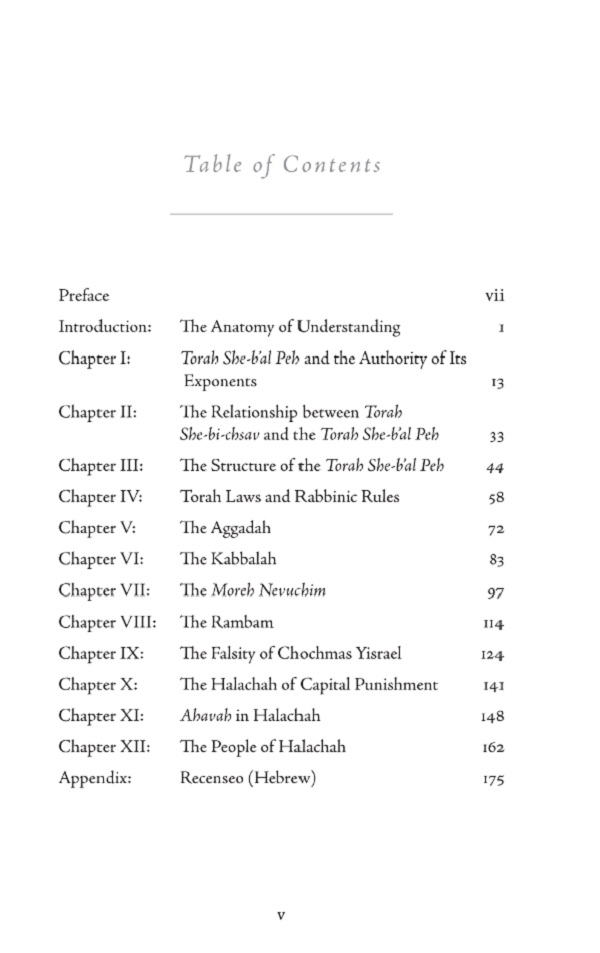
This work was compiled and annotated by Rabbi Moshe Landy. It’s very well written and will certainly be enjoyed by readers. Of note is that this work includes his attacks on Chochmat Yisroel in general and specifically on Louis Ginsburg, G. Scholem and Leo Strauss.

Here is the table of contents.

משה ארנד, שבעים פנים לתורה, 747 עמודים

The second work I would like to mention is a collection of Professor Moshe Arend’s writings. Arend was a famous educator at various institutions and universities. He also wrote numerous articles and books, including a critical edition of R’ Yosef Kra on Iyov and a work on Rashi with Nechama Lebowitz (via Open University).

This new work is composed of a few parts (see the table of contents below). The first section is based on Shiurim he gave devoted to outlying the methods of fourteen different Rishonim and Achronim on Chumash. This part is 348 pages long and is a very valuable tool, as he was known as a master educator.

Other sections are devoted to education (including a section on how to properly teach Tanach) Aggadah, articles on Moadim, Teffilah and Minhaghim. It also includes some memoirs of his interesting life, and write ups of some people he knew. The work concludes with some interesting letters. This wide range collection of material was compiled by his son Dr. Aharon Arend and includes a thorough index to easily locate the numerous gems found throughout the book. Some sample pages are available upon request.

Here is the Table of contents and cover.


יצחק טברסקי, כמעיין המתגבר, הלכה ורוח ביצירת חכמי ימי הביניים, עורך: כרמי הורוביץ, מרכז זלמן שזר, 749 עמודים

The third work I would like to mention is the collection of all of Professor Yitzchak (Isadore) Twersky’s thirty-one articles, translated into Hebrew on a wide range of topics. As the original English articles have yet to be collected into one volume, this compilation serves an additional benefit. Many of these articles have been quoted, used and become classics in academic literature, and now for the first time many of them are easily accessible for the Hebrew reader. A PDF of the introduction is available upon request.

Here is the Table of contents and cover.


גנזי הירושלמי, יעקב זוסמן, בהשתתפות בנימין אליצור, בתוספת החיבור, שלמה נאה הערות ללשון קטעי הגניזה של התלמוד הירושלמי, 831 עמודים, בן צבי

The fourth important work I would like to mention is Ginzei HaYerushalmi from Professor Yaakov Sussman. This work collects all of the Yerushalmi manuscript fragments from the Cairo Geniza as well as collections from all over the world. The original plan was to include in this volume, Sussman’s discussions on the Yerushalmi, but due to his health that part of the project was cancelled. A PDF of the introduction and some sample pages are available upon request.

שרגא אברמסון, מחקרים בספרות הגאונים, מגנס, 488 עמודים

The fifth work I would like to mention is a collection of articles by Professor Shraga Abramson. As the abstract of this book states, Abramson was the most important scholar of his time in the field of Geonic literature and the teacher of most of the proceeding generation in this field of study. This book is the third collection of his studies pertaining to the Geonic period. The two previous volumes are considered mandatory for those interested in this formative and fascinating period. The current volume contains studies published in his lifetime but were not included in other compilations, as well as some unpublished studies found in his estate. The articles deal with various aspects of the Geonic literature. A PDF of the Table of contents & introduction are available upon request.

ספר המספיק לעובדי השם לראברהם בן הרמבם, מהדורה שניה מתוקנת, הוצאת אוניברסיטת בראילן, 358 עמודים

The sixth important work worth mentioning is the Sefer Hamaspik of R’ Avraham Maimuni, son of the Rambam. This part of the work was first printed in 1989 and is mostly of a Halachic nature, focusing on Tefilah. At the time, critical reviews of the edition noted various issues with the translation from Judeo-Arabic, issues which were addressed in this new, revised edition. At this time, I am not able to weigh in if enough was corrected or not, however I can say the work is very special, unique and is definitely worth one’s time to learn through it.

יעקב זוסמן, תורה שבעל פה פשוטה כמשמעה, כוחו של קוצו של יוד, מגנס, 228 עמודים

This essay is one of the most incredible academic works I have ever read. The abstract describes it as follows: It deals with the famous question of the manner in which the Tannaitic and Amoraic literature was passed on, orally or in writing, which is of great importance in determining the basic cultural and historical facts in the world of the Sages and in understanding the development of the Oral Law and in the formation of its literature. In Sussman’s revolutionary study, this complex subject was re-examined based on a thorough and profound study of various Talmudic sources, while comparing them with external, time-based evidence, published for the first time in Talmud Studies in 2004. It is published again in this book, along with detailed indices for source texts and various topics discussed therein.

חנן גפני, מפי סופרים תפיסת התורה שבעל פה בראי המחקר, מרכז זלמן שזר, 342 עמודים

Another slightly older work I would like to mention is Chanan Gafni’s Conception of the Oral Law in Modern Jewish Scholarship. This book continues his previous, excellent work P’shuto Shel Mishna. The detailed table of contents below gives one an idea of the topics dealt with inside. A pdf of the introduction is available upon request.


New Book: The Living Tree: Studies in Modern Orthodoxy by Rabbi Shlomo Riskin

Rabbi
Shlomo Riskin’s new book,
The Living Tree: Studies in Modern Orthodoxy, has just
appeared. The Seforim Blog is happy to present this selection from it.

Halakhic Pluralism in the Eyes of Rishonim and
Aharonim

In many of the off-hand remarks of the early
commentators, their advocacy of the principle of halakhic pluralism is plain to
see, regardless of whether these great authorities stemmed from Ashkenaz,
Sepharad, or Provence. They repeatedly express the pluralistic principle of
“these and those are the words of the Living God.”
Rashi, in his commentary
to Ketubot 57a, writes:
W hen two [sages] argue
over the statement of one [who was their master], and one sage says that this
is what the master said and the other says that this is what the master said,
one of them is lying. But when two Amora’im argue regarding a civil or ritual
halakhic issue, and each one maintains the logic of his position, there is no
falsehood. Each one is expressing his logic, the one master giving a reason for
permitting and the other master giving a reason for prohibiting, one master
compares issue to issue in such a fashion, and the other master compares it in
another fashion. It is necessary to say, “these and those are the words of the
Living God”; sometimes this logic pertains and sometimes that logic pertains,
because the logic changes even on the basis of a small change in the issues at
hand.
The Ritba (Rabbi Yom Tov ben Avraham Asevilli,
1250–1330) on Eruvin 13b comments as follows:
“These and those are the
words of the Living God.” The rabbis of France asked, How is it possible for
both views to be those of the Living God when one prohibits and the other
permits? And they answered: W hen Moses went on high to receive the Torah he was
shown forty-nineways to permit and forty-nine ways to prohibit every object. He
asked the Almighty concerning this, and He said, “Let these [matters about
which there are so many possibilities] be handed over to the sages of Israel in
every generation, and let the resolution be in accordance with their will.”
 Rabbi
Menaĥem Meiri (1248–1316), in his work Beit HaBehira, commented on Yevamot
14a:
That which the Torah
commanded lo titgodedu (“Do not slice yourselves up” – Deut.14:1), even
though its principal meaning is not to wound oneself as an expression of
mourning for one who has died, there is a nuance [within the word titgodedu
which may be interpreted to mean] not to turn the commandments into separate
divisions [agudot], and this is to prohibit several individuals from
performing ritual in one way while others per- form the ritual in a different
way, until it appears as though we are being led by two Torahs. But this
prohibition applies only when a city has only one court, and when even this
court is itself divided, with one component group deciding in accordance with
one view and another component group in accordance with another view. But
whenever there are two judicial courts, albeit in one city, and one court is
accustomed to deciding in accordance with this view and the other court is
accustomed to deciding in accordance with that view, this does not represent
separate divisions because it is impossible for everyone to always agree on one
opinion. This is certainly true regarding actions based upon custom, where
there is no objection if these act in such a way and those in another way.[1]
Even during the period of the later
commentators, the idea of halakhic pluralism finds expression. Admittedly,
works such as the Kitzur Shulhan Arukh of Rabbi Shlomo Ganzfried, which
records only one authoritative opinion – unlike the original Shulhan Arukh,
which includes the opposing views of Rabbi Karo and the Rema – seem to imply a
more monistic halakhic approach. A ringing defense of pluralism is to be found
in the words of Rabbi Chaim ben Rabbi Bezalel, brother of the Maharal, who
studied together with Rabbi Moshe Isserles (the Rema) in the mid- sixteenth
century in the yeshiva of Rabbi Shalom Shachna. He wrote Viku’ah Mayim Hayim
(usually included at the end of the Rema’s Torat Hatat), in which he
vigorously argues against any written halakhic codification reflecting only one
halakhic opinion:
Only after [the decisor]
has studied all of the legal disputes which have arisen regarding a specific
law can his word run quickly into the sea of wisdom…Moreover, the mind of an
individual is not always consistent and perhaps his mind is not disposed to
give the same halakhic ruling which he gave yesterday; there is not in this any
change or deficiency [which would lead us] to say that through him the Torah is
becoming like two Torahs, God forbid. The opposite is the case; this [manner of
halakhic investigation, exploring multiple opinions] is the path of Torah, and
“these and those are the words of the Living God.” (Elon, Mishpat HaIvri,
37)
A fascinating contrast is to be found in the
writings of two cotemporary religious leaders, Rabbi Moshe Feinstein and Rabbi
Yitzhak Hutner. The former, world-renowned halakhic decisor of our generation,
utilizes the expression “these and those are the words of the Living God,” but
nevertheless posits that one argument may ultimately be more correct than the
others:
And this is the matter
concerning all of the disputes of our earlier and later sages, when one forbade
and the other permitted: whenever the [law] was not resolved in accordance with
one [of them], any [rabbi] could rule in his locality in accordance with his
logic, even though the true law is only in accordance with one of them…Both are
the words of the Living God, but the real truth, revealed before heaven, is
only like one of them.
Nevertheless, Rabbi Moshe Feinstein insists that
with regard to reciting the blessings on learning Torah and fulfilling the
commandment to study Torah, no differentiation should be made between texts
containing majority opinions and texts containing minority opinions. All Torah
texts are worthy since “these and those are the words of the Living God” (Iggrot
Moshe, Orah Haim
4:9, 24).
Rabbi Yitzhak Hutner, on the other hand, accepts
the talmudic view that disputes arose as a result of insufficient study or
forgetfulness, a view which we initially equated with the monistic approach to
halakha. Nevertheless, he resoundingly affirms the positive role of disputes in
enlarging the scope of Torah and initiating novel ideas therein. He even reads
into this view of the origin of halakha a bold concept of halakhic pluralism:
Sometimes, the
nullification of Torah is its very confirmation, as it is written, “the tablets
which you have broken.” [God said to Moses], “May your strength increase
because you have bro- ken them; the act of breaking the tablets is an act of
confirming the Torah through its nullification.” Our sages have said, “Were the
tablets not broken, Torah would not have been forgotten in Israel” (Eruvin
54a); we find therefore that the breaking of the tablets contains an aspect of
forgetting of the Torah. We learn from this an awesome and novel idea: it is
possible for Torah to be increased through its having been forgotten, and it is
possible to be blessed with increased strength because of the Torah having been
forgotten!
Go out and see what our
sages have taught: three hundred laws were forgotten during the mourning period
for Moses, and Otniel ben Kenaz restored them with his logic and casuistry (Temura
16a). And even more than that: every dispute in halakha stems from the fact
that Torah was forgotten, and nevertheless our sages declared, “Even though
these purify and those defile, these invalidate and those permit, these exempt
and those obligate, these and those are the words of the Living God.” Hence,
all different opinions and differing views contribute to the growth of Torah
and its majesty, which…is emphasized to a greater extent by the Oral Law which
is revealed in disputes rather than by agreement, because “these and those are
the words of the Living God” includes the principle that even the rejected view
in halakha remains Torah knowledge as long as it was expressed as part of the
give-and-take of the Oral Law…and if there will be a vote afterwards and the
decision is in accordance with the rejected view, from then on halakha will be
different in truth.
The “battles” within
Torah are not simply one of many possible ways of (acquiring) Torah, but rather
the positive creation of new Torah values which cannot be found in the words of
Torah… And the two sides which clash in halakha become partners in the creation
of a new Torah value whose name is “the battle of Torah.” (Pahad Yitzhak,
Hanukka
pp. 36–37)
Despite all this, pluralism is obviously not
open-ended. Starting with the biblical story of the Tree of the Knowledge of
Good and Evil which opens the Book of Genesis and serves as an introduction to
the entire Torah, it is clear that God demands that the definition of what is
good and what is evil must emanate from an objective source beyond the
subjective individual. Indeed, even though the fruit was “good to eat, a
temptation to the eyes, and a desirable way to gain wisdom,” the Almighty
nevertheless decided that it was evil to partake of it. And from the talmudic
period until the Emancipation, the partners to the “these and those are the
words of the Living God” disputes each accepted upon themselves an external and
objective halakha. Submission to a higher autonomous system was the axiom of
halakhic dispute. Hence, a non- Orthodox system cannot claim halakhic
legitimacy under the rubric of “these and those are the words of the Living
God.” While we may certainly learn from serious Jews of any or no religious
persuasion, both tradition and logic dictate that halakhic legitimacy can only
be accorded to those who accept upon themselves the axioms upon which the
halakhic system is based.
Although a non-halakhic theological system
cannot claim for itself a voting voice in a forum of halakhic discourse, I
believe it is crucial that the tent of Orthodoxy be as broad, open, and
inviting as possible. Even a halakhic position which the Orthodox majority
rejects, but which, nevertheless, has a legitimate halakhic basis to rely upon,
should be given due consideration.
Within the world of halakhic Judaism, the most
striking affirma-tion of the benefits of a pluralistic approach is to be found
in the words of Rabbi Avraham Yitzhak HaKohen Kook, in Olat Re’iya,
volume 1, p. 336:
The multiplicity of
views which arise as a result of the differences of personalities and
educational backgrounds is specifically the fact which most enriches and
broadens wisdom. Ultimately, all issues will be properly understood, and it
will be recognized that it would have been impossible for the Building of Peace
[the Third Temple] to have been erected had it not been for all those
influences which appeared to have been in conflict.
According to Rabbi Kook, it is the sum total of
many different ideas and ideologies which will ultimately lead to a shared
vision that expresses true peace; the authentic symphony is the product of many
different musical instruments melding together in majestic harmony.

[1] It is interesting to
note that according to Rabbi Ben-Zion Uziel, the first Sephardic chief rabbi of
the State of Israel, in his Piskey Uziel (page 26, siman 10), Rashi
would permit two different courts – for example, Sephardic and Ashkenazic – in
one city, since he explains the prohibition of making divisions “lest it appear
that we are acting in accordance with two Torahs” (Rashi on Yevamot 13b)
and different communal customs do not suggest two Torahs. Maimonides, on the
other hand, would prohibit this since he maintains that the prohibition of
making divisions, “that there not be two courts in one city, this one in accord
with this custom and that one in accord with that custom, for this matter
causes great dissension” (Mishneh Torah, Hilkhot Avoda Zara, chapter 12,
law 14). Rabbi Avraham Yitzĥak HaKohen Kook, in Ezrat Kohen, siman 103,
par. 17, rules that the Sephardic and Ashkenazic communities in one city are
separate, and the prohibition of making halakhic divisions does not apply to
them. Rabbi Kook cites the Shakh to Yoreh De’ah 242, who limits the
prohibition, “Do not slice yourselves up” to dissension within the same court
in one city.


In Praise of Ephemera: A Picture Postcard from Vilna Reveals its Secrets More than One Hundred Years after its Original Publication

In Praise of Ephemera:
A Picture Postcard from Vilna Reveals its Secrets
More than One Hundred Years after its Original Publication*

by Shnayer Leiman

I belong to a small group of inveterate collectors of Jewish ephemera. We collect artifacts that many others consider of little or no significance, such as postage stamps; coins and medallions; old posters, broadsides, and newspaper clippings; outdated New Years cards; wine-stained Passover Haggadot; Jewish ornaments, objects (e.g., Chanukkah dreidels) and artwork of a previous generation; photographs and postcards; and the like. The items we collect – all of Jewish interest – take up much space in our homes; they can also be costly at times. Often, we end up paying much more for an item than it is really worth, especially if it completes a set. Collectors of ephemera suffer from a disease that has no known remedy. The only respite we have from the disease is when we write scholarly essays about what we have collected, for – as I know from experience – it is not possible to write scholarly essays and actively collect ephemera at the same time.

The Picture Postcard.

Several years ago, I acquired the following postcard. It measures 5½ inches by 3½ inches, a standard size for its time. It is a mint copy, meaning that no message was penned on its back and it was never mailed. Thus, I cannot date the postcard by a recorded date or postmark on its reverse side (but see below). We present the obverse and the reverse of the postcard for the benefit of the reader:

Obverse. The obverse presents a black and white photograph, also standard for its time. It features a tombstone with a Hebrew inscription; a mausoleum behind the tombstone, with a brief Hebrew inscription; and what appears to be a cemetery attendant, with his hand atop the tombstone. Most important, it contains a German heading under the photograph, which reads in translation: “From the Eastern Front of the Theater of War, Wilna, An Old Jewish Tombstone [with Inscription].”

Reverse. The reverse prints the name of the publishing company that produced the postcard: “The Brothers Hochland in Koenigsberg, Prussia.”

Historical Context.

In terms of historical context, the information provided by the postcard (a German heading; Vilna is defined as the eastern front of the theater of war; the postcard was produced in Koenigsberg) can lead to only one conclusion, namely that the postcard was produced on behalf of the German troops that had occupied, and dominated, Vilna during World War I. German troops occupied Vilna on September 18, 1915 and remained in Vilna until the collapse of the Kaiser’s army on the western front, which forced the withdrawal of all German troops in foreign countries at the very end of 1918. Thus, our photograph was taken, and the postcard was produced, during the period just described. Its Sitz im Leben was the need for soldiers to send brief messages back home in an approved format. The ancient sites of the occupied city made for an attractive postcard. (This may have been especially true for Jewish soldiers serving in the German army.)

Due to a wonderful coincidence, a distinguished scholar of Yiddish and a dear colleague, Professor Dovid Katz, recently published a copy of the very same postcard we publish here.[1] Unlike my copy, his copy includes on the reverse side a dated message penned by the German soldier who mailed it, as well as a dated postmark. The message was written on December 3, 1917 and postmarked the next day, on December 4. Thus, we can narrow the timeline somewhat, and suggest that the postcard was almost certainly produced circa 1916 or 1917.

The Old Jewish Cemetery.

The old Jewish cemetery was the first Jewish cemetery established in Vilna. According to Vilna Jewish tradition, it was founded in 1487. Modern scholars, based on extant documentary evidence, date the founding of the cemetery to 1593, but admit that an earlier date cannot be ruled out. The cemetery, still standing today (but denuded of its tombstones), lies just north of the center of the city of Vilna, across the Neris River, in the section of Vilna called Shnipishkes (Yiddish: Shnipishok). It is across the river from, and just opposite, one of Vilna’s most significant landmarks, Castle Hill with its Gediminas Tower. The cemetery was in use from the year it was founded until 1831, when it was officially closed by the municipal authorities. Although burials no longer were possible in the old Jewish cemetery, it became a pilgrimage site, and thousands of Jews visited annually the graves of the righteous heroes and rabbis buried there, especially the graves of the Ger Zedek (Avraham ben Avraham, also known as Graf Potocki, d. 1749), the Gaon of Vilna (R. Eliyahu ben R. Shlomo, d. 1797), and the Hayye Adam (R. Avraham Danzig, d. 1820). Such visits still took place even after World War II.

The cemetery, more or less rectangular in shape, was spread over a narrow portion of a sloped hill, the bottom of the hill almost bordering on the Neris River. The postcard captures the oldest mausoleum and rabbinic grave in the old Jewish cemetery, exactly at the spot where the bottom of the hill almost borders on the Neris River. It was an especially scenic, and historically significant, site in the old Jewish cemetery, and it is no accident that the photographer chose this site for the postcard.

The Tombstone and its Hebrew Inscription.

The tombstone is that of R. Menahem Manes Chajes (1560-1636). He was among the earliest Chief Rabbis of Vilna. Indeed, his grave was the oldest extant dated grave in the Jewish cemetery, when Jewish historians first began to record its epitaphs in the nineteenth century. R. Menahem Manes’ father, R. Yitzchok Chajes (d. 1615), was a prolific author who served as Chief Rabbi of Prague. Like his father, R. Menahem Manes published several rabbinic works in his lifetime, and some of R. Menahem Manes’ unpublished writings are still extant in the Bodleian Library at Oxford University. His epitaph reads:[2]

The Mausoleum and its Hebrew Inscription.

In the old Jewish cemetery, many of the more famous rabbis were buried in mausoleums. All rabbis buried in mausoleums were buried underground. The mausoleum itself served as an honorific place of prayer that a visitor could enter and then pray at the grave of the rabbi of his choice. All tombstones were placed outside the mausoleum, and were affixed to its outside wall, directly opposite the body of the deceased rabbi named on the tombstone (but buried inside the mausoleum). Often, the names of famous rabbis were painted on the outside wall of the mausoleum (much like street signs) identifying who was buried in it. The mausoleums sometimes contained the graves of several famous rabbis. R. Menahem Manes Chajes was buried in the mausoleum that can be seen behind his tombstone. A famous rabbi buried in the same mausoleum was R. Moshe Rivkes (d. 1672), author of באר הגולה on the Shulhan Arukh.[3] The inscription on its wall, and above the tombstone of R. Menahem Manes, reads:

פה מצבת הגאון הגדול ר‘ מאנש חיות

Here is the tombstone of the great Gaon, R. Manes Chajes

The Cemetery Attendant.

What has remained a mystery for more than one hundred years is the identity of the cemetery attendant. We shall attempt to identify him, and to restore him to his proper place in Jewish history.

The reader will wonder how I know that the person in the photograph was a cemetery attendant. Perhaps he was a tourist who just happened to be there on the day the Hochland Brothers Publishing Company arranged for a photograph to be taken for its postcard collection?

Initially, it was simply a hunch, largely due to ephemera, that is, other photos of visitors to the old Jewish cemetery in the interwar period. I have a collection of such photos, and either they feature the tourist (who handed his camera to the tour guide or to the cemetery attendant, and asked that his picture be taken in front of the Vilna Gaon’s tombstone or at the Ger Zedek’s mausoleum), or they feature a cemetery attendant who stands in those places, while the tourist, who knows how to use the camera, takes the photo. The tourists can always be recognized by their garb, which matches nothing worn by anyone else in Vilna. The cemetery attendants, functionaries of a division of the Jewish Kehilla (called Zedakah Gedolah at the time), all wear the same dress, a “Chofetz Chaim” type cap and a long coat, both inevitably dark grey or black. While I am not aware of another old Jewish cemetery photograph featuring the specific cemetery attendant seen in our postcard, his dress is precisely that of all the other cemetery attendants whose photos have been preserved.

But there is no need for guesswork here. Sholom Zelmanovich, a talented artist and Yiddish playwright, published his דער גרצדקווילנער גראף פאטאצקי  in 1934.[4]

This three-act play commemorates the life and death of the legendary Ger Zedek of Vilna in a new and mystical mode.[5] The volume includes sixteen original drawings by Zelmanovich. Several of the drawings preserve details of Vilna’s old Jewish cemetery with seemingly incredible accuracy. Thus, for example, Zelmanovich depicts the northern entrance gate to the old Jewish cemetery, as well as the nearby Jewish caretaker’s house on the cemetery grounds, even though few photographs are extant that even begin to capture the details of those sites. His depiction of the Ger Zedek’s grave (and the human-like tree that hovered over it) is perfectly located in the south-eastern corner of the old Jewish cemetery, and is surrounded by the wooden fence that existed in that corner prior to 1926. Only someone who spent quality time in Vilna’s old Jewish cemetery could have known exactly where to place the entrance gate, the caretaker’s house, and the Ger Zedek’s grave.

One other matter needs to be noticed. Zelmanovich dedicated the volume in memory of his deceased parents, Meir Yisrael son of Mordechai and Sheyne daughter of Broyne.[6]

In the summer of 1935, the municipal authorities of Vilna, then under Polish rule, announced their plan to demolish Vilna’s old Jewish cemetery and replace it with a soccer stadium. Vilna – and worldwide – Jewry did not stand idly by. Instead, they engaged in an extensive, and ultimately successful, battle against the municipal authorities. As part of its efforts to win over the municipal authorities, the Vilna Jewish community charged a young Jewish scholar, Israel Klausner,[7] with writing a history of the old Jewish cemetery. It would offer clear documentation and prove beyond doubt that various Polish kings and municipal authorities throughout the centuries had authorized the Jewish community to construct the cemetery and maintain it. The cemetery was legally the property of Vilna’s Jewish community. Klausner’s monograph, entitled קורות בית-העלמין הישן בוילנה (Vilna, 1935), includes a discussion of the Ger Zedek’s grave. In a footnote,[8] Klausner mentions in passing Sholom Zelmanovich’s “recently published drama on the Ger Zedek,” and adds that Zelmanovich was the son of the caretaker of the old Jewish cemetery (Hebrew: בן בעלהקברות ), Meir Yisrael Zelmanovich! The plot thickens.

The full force of the Hebrew term בעלהקברות is not really captured by the English term “caretaker.” There were a variety of cemetery attendants who worked in the old Jewish cemetery in various capacities (such as guiding visitors and leading them to the graves they wished to visit, reciting prayers at the graves, ground-keeping, repairing broken tombstones and re-inking their inscriptions, and guard duty). But one cemetery attendant was in charge of all the other attendants, and as we shall see, he and his family lived in the house on the cemetery grounds. He was called: בעלהקברות, perhaps best rendered as: “Cemetery Keeper” or “Managing Director” of the old Jewish cemetery. We have established that Meir Zelmanovich served in that capacity. But who was he when did he live?

Meir Zelmanovich.

Sadly, almost nothing is known about the life of Meir Zelmanovich. He published no books and wrote no essays. As best I can tell, only one newspaper report mentions his name during his lifetime.[9] The report itself is significant. It records a complaint made by Meir Zelmanovich in 1919 that the Polish legionnaires had desecrated the old Jewish cemetery. But it would be Zelmanovich’s tragic death in 1920 that would perpetuate his memory. Here, we need to provide some historical context. Israel Cohen begins his discussion of the impact of World War I on Vilna, as follows:[10]

Within the small space of eight years, from 1914 to 1922, the Jews of Vilna tasted of the blessings of nine different governments, and suffered from a combination of other evils even more noxious. They became a prey to economic depression, military requisitions, unemployment, famine and disease; thousands of them were subjected to forced labor, imprisonment, plunder and brutal attacks; and physical and material deterioration inevitably engendered a certain degree of social demoralization. All the variegated differences of principle, of religious outlook and sociological doctrine, were now forgotten in the inferno created by the common foe. The long protracted fight for civil and political rights had to yield to the more primitive and desperate struggle for mere existence.

Almost certainly, the greatest concentration of Jewish suffering in this period came in April of 1919, when the Polish legionnaires unleashed a pogrom against Vilna’s Jews. Israel Cohen describes the horrors that followed:[11]

The [Polish] legionnaires[12] defiled and desecrated the [old Jewish] cemetery, smashed the tombstones, and opened the graves (including some of Vilna’s earliest rabbis) in the belief that they would find in them arms and money. Disappointed in their search, the Poles transferred their attentions from the dead to the living and ran amuck in the Jewish quarter. For three days they seized Jews in the streets, dragged them out of their homes, bludgeoned them savagely, and looted their houses and shops. About 80 Jews were shot, mostly in the suburb of Lipuvka, where some were ordered to dig their own graves; others were buried alive, and others were drowned, with their hands tied, in the Vilia [now: Neris] River… All sorts of outrages were committed in those days by the Poles in celebration of their victory. They tied a Jew to a horse and dragged him through the streets for three miles. They took a sadistic delight in cutting off the beards and earlocks of pious Jews. They even arrested, assaulted and humiliated Rabbi Rubinstein and Dr. Shabad. Altogether, thousands of Jews in Vilna, as well as in Lida and Bialystock were imprisoned in various concentration camps where they were ill fed and beaten, and where they suffered from hunger and typhoid. Moreover the total loss due to destruction and pillaging of Jewish people in the pogrom, in Vilna alone, was estimated at about 20 million roubles (about $10,000,000).

Polish rule of Vilna came to an end when the Russians recaptured Vilna on July 14, 1920. Russian rule lasted for six weeks, after which the Russians retreated and left Vilna in the control of the Lithuanians. Lithuanian rule lasted until October 8, 1920, when the Poles once again recaptured Vilna. One can only imagine the fear that gripped the Jewish community in Vilna, when they heard the sounds of the approaching Polish legionnaires. In fact, hundreds (some claim: thousands) of Vilna’s Jews fled on October 8 to Kovno, then part of Independent Lithuania.[13] Indeed, there was what to fear, for the Polish legionnaires were free again to wreak havoc with Jewish lives. And although the severity of the pogrom of 1919 did not repeat itself, the indiscriminate murder, rape, and looting of Jews that took place in Vilna between October 8-10, 1920 was, at least in the eyes of the victims, yet another pogrom.[14] Briefly, eye-witness Yiddish accounts[15] record that at least 6 Jewish men and women were murdered, numerous women were raped, and some 80 Jews were mugged and robbed. No one was brought to justice for committing these crimes! On October 10, 1920 Meir Zelmanovich, Cemetery Keeper of the old Jewish cemetery in Vilna was murdered by the Polish legionnaires. He was 70 years old when he died. The official Jewish record of his death lists his home address as “Derewnicka 3.” This is the address of the house on the grounds of the old Jewish cemetery. It is no wonder that Sholom Zelmanovitch could depict so vividly the northern entrance gate to the cemetery, its nearby caretaker’s house, and the human-like tree hovering over the Ger Zedek’s grave. His childhood playground was the old Jewish cemetery in Vilna.

On the picture postcard from 1916-1917, one sees an elderly Jew. One possibility is that it depicts none other than Meir Zelmanovitch, the Cemetery Keeper of the old Jewish cemetery until his death in 1920 at age 70. I suspected that this was the case, but could not prove it until recently — when a small miracle occurred.

Miracles Sometimes Do Occur.

In March of this year, out of the clear blue sky, I was contacted by Laurie Cowan, who introduced herself as a great-granddaughter of Meir Zelmanovich! She basically was interested in any information I could provide about her great-grandfather that she didn’t already know. I was delighted to make her acquaintance, but wondered what led her to me. It turns out that both of us were seeking information about the same person – Meir Zelmanovich – from the Lithuanian State Historical Archives in Vilnius. An alert researcher at the Archives noticed this, and made the “shidduch” between us. I shared with Laurie whatever I knew about her great-grandfather. In turn, I asked her to send me copies of whatever documents she had relating to her great-grandfather. She sent me a scan of the following photograph of her great-grandmother and great-grandfather, Sheyne[16] and Meir Zelmanovich:

Never has it been so easy to identify an unidentified picture on a one-hundred year old picture postcard! One suspects that the picture postcard company representative, and a photographer, met with the Cemetery Keeper Meir Zelmanovich at the old Jewish cemetery in Shnipishok. He led them to the mausoleum of R. Menahem Manes Chajes, and was asked to pose at the tombstone just outside it. He graciously accepted the invitation. This may well have been the last photo taken of Zelmanovich, and it preserves, together with the photo provided by Laurie Cowan, the likeness of a martyr who fell during the October 1920 mini-pogrom in Vilna.[17]

At least six Jews were murdered between October 8-10 in 1920 in Vilna. They died for one reason only, namely, because they were Jews. Such Jews are regarded as martyrs and their names, at the very least, deserve to be recorded and remembered. Until now, none of the names of the Vilna martyrs of 1920 have been published in any public Jewish record, whether in a contemporary Jewish newspaper, or a Jewish historical essay or book, or an online posting. Having examined the extant records in the Lithuanian State Historical Archives, I have been able to retrieve the 6 names of the Jewish victims who were murdered in Vilna in October of 1920. In each case, the Jewish Kehillah records of Vilna in 1920 state clearly in Hebrew that the cause of death was either נהרג or נהרגה (i.e., murdered). The names are:

1. Shmuel ben Mendel Katz, age 56, died October 9.

2. Etel Natin, age 36, died October 9.

3. Basya Natin, age 32, died October 9.

4. Rokhl Blume Shuster, age 45, died October 9.

5. Meir Zelmanovich, age 70, died October 10.

6. Shlomo Abramovich, age 17, died October 12.[18]

May the memory of these martyrs be forever for a blessing! [19]

NOTES:

עם הספר, the People of the Book the world over, mourn the death of R. Shmuel Ashkenazi in Jerusalem, at the age of 98. He was שר הספר, the consummate master of the Hebrew book. Bibliographer, bibliophile, and book collector, his encyclopedic knowledge of all of Hebrew and Yiddish literature remains unparalleled in our time. His most recent contributions appeared in three massive volumes, replete with some 1,794 pages of immaculate scholarship. He never wasted a word; he wrote with precision and parsimony. Among his many accomplishments, he edited the Kasher Passover Haggadah, one of the most significant scholarly editions of the Passover Haggadah ever published. He was largely responsible for the single most accurate bibliography of Hebrew books ever produced, מפעל הביבליוגרפיה העבריתThe Bibliography of the Hebrew Book 1473-1960. Aside from his scholarly distinction, R. Shmuel Ashkenazi wrote in an elegant Hebrew with its own special charm. Not only did he advance discussion, but he did so in an aesthetically pleasing manner. For those of us who knew him personally, he evinced the same charm in his personal relationships that he did in his writings. He set a standard of excellence that we can only strive to emulate, but never really replicate. יהא זכרו ברוך!

This essay is dedicated to his memory, a token of appreciation for all he has taught me.

[1] Dovid Katz, “World War I Postcard of the Grave of Rabbi Menachem Manes Chayes (1560-1636) in the Old Vilna Jewish Cemetery,” Defending History (11 March 2020), available here) A copy of our postcard can also be seen online at ‘YIVO 1000 Towns’, record ID 10743 (http://yivo1000towns.cjh.org).
[2] For a fuller discussion of R. Menahem Manes Chajes and his epitaph, see S. Leiman, “A Picture and its One Thousand Words: The Old Jewish Cemetery of Vilna Revisited,” The Seforim Blog, January 14, 2016, especially notes 7-11, online here.
[3] Aside from his pivotal commentary on R. Joseph Karo’s Shulhan Arukh, R. Moshe Rivkes was a great-great grandfather of the Vilna Gaon.
[4] Precious little is known about Sholom Zelmanovich (1898-1941). See the brief biographical entry in לעקסיקאן פון דער נייער יידישער ליטעראטור (Martin Press: New York, 1960), vol. 3, column 670, which mistakenly lists him as being born in a town near Kovno, circa 1903. He was born in Vilna in 1898 (JewishGen) and died during one of the first Nazi aktions in the Kovno Ghetto.
[5] In general, see Joseph H. Prouser, Noble Soul: The Life and Legend of the Vilna Ger Tzedek Count Walenty Potocki (Gorgias Press: Piscataway, 2005). Prouser’s excellent monograph is a study of the many literary reworkings of the legends surrounding the Vilna Ger Zedek, with primary focus on 20th century Jewish literary contributions. Strangely, he offers no discussion of Zelmanovich’s contribution.
[6] On the feminine Yiddish name “Broyne,” see Alexander Beider, Dictionary of Ashkenazic Given Names (Avotaynu: Bergenfield, 2001), pp. 484-486.
[7] Klausner (1905-1981) settled in Palestine in 1936 and continued to be a prolific author of studies and books on the history of Vilna’s Jewish community. Aside from several important monographs, like his history of the old Jewish cemetery, he wrote a two-volume history of Jewish Vilna entitled 1939-1881 וילנה ירושלים דליטאדורות האחרונים (Ghetto Fighters’ House: Tel-Aviv, 1983), to which a third volume treating 1495-1881 was added posthumously, based largely on studies previously published by Klausner.
[8] קורות ביתהעלמין הישן בוילנהp. 45, note 1.
[9] See Vytautas Jogela, “The Old Jewish Cemetery in the Nineteenth and Twentieth Centuries,” Lituanus, vol. 61, no. 4 (2015), pp. 81-82.
[10] Israel Cohen, Vilna (Jewish Publication Society: Philadelphia, 1943), pp. 358-359.
[11] Ibid., pp. 378-379.
[12] Cohen regularly spells the word: “legionaries.” For the sake of consistency, I have spelled the word “legionnaires” throughout this essay.
[13] See, e.g., Boaz Wolfson, “מיטלליטע” in פנקס פאר דער געשיכטע פון ווילנע אין די יארן פון מלחמה און אקופאציע (B. Zionson: Vilna, 1922), column 387.
[14] There are probably as many definitions of “pogrom” as there are scholars and politicians. Since it is unclear whether the crimes committed on October 8-10, 1920 were planned and implemented by either a government or a political action committee, and since the duration of the attacks was short and rather swiftly brought under control, historians are reluctant to refer to the events that occurred on October 8-10, 1920 as a pogrom. On the other hand, to label those events a mere “disturbance” does not begin to capture the malevolent intent of the perpetrators directed specifically against Jews, and does not address the intensity of Jewish suffering at the time. For some of the different views regarding the definition of “pogrom,” and how the term has been manipulated by political interests, see Szymon Rudnicki’s forthcoming essay “The Vilna Pogrom of 19-21 April 1919,” to appear in Polin 33 (2020). Professor Rudnicki kindly allowed me to see a pre-publication copy of his lucid and informative essay.
[15] Wolfson, loc. cit. Cf. Jacob Wygodski, אין שטורם (B. Kletzkin: Vilna, 1926), pp. 217-221.
[16] Sheyne Zelmanovich died in Vilna on October 26, 1921, at age 68 (JewishGen). She lived in her home on the old Jewish cemetery grounds until her death. In a personal communication, Laurie Cowan informed me that the Zelmanoviches had 10 children who survived to adulthood. The 6th child, Beirach (popularly called: Berik; and later, Ben), was her grandfather, an older brother of Sholom mentioned above.
[17] The only other extant likeness of Meir Zelmanovich (known to me, and recovered on July 15, 2020) is an undated passport photo (circa 1916) preserved in the Lithuanian State Historical Archives. During the German occupation, all residents of Vilna were required to have – and to carry at all times – a German passport (we would call it: an Identity Card). Meir Zelmanovich’s German passport photo confirms the identity and authenticity of the photos of Zelmanovich published in this essay. All three photos are of one, and the same, person.
[18] One suspects that Abramovich may have been shot or beaten on October 9 and 10, like the others, but did not die from his wounds until the 12th.
[19] This essay could not have been written without the help of Regina Kopilevich, researcher (and tour guide) extraordinaire, who located whatever documents I sought at the Lithuanian State Historical Archives (Lietuvos Valstybes Istorijos Archyvas) in Vilnius. I am indebted to the librarians at the Archives for allowing her and me to examine these and other documents during my visits to Vilnius. Next to Google, JewishGen is a modern Jewish historian’s best friend, and we are grateful to all who contribute to making JewishGen the great historical resource that it is. Matt Jelen’s careful reading of an earlier draft has significantly improved the final version. I alone am responsible for whatever errors appear in this essay.