The 1526 Prague Haggadah and its Illustrations

The 1526 Prague Haggadah and its Illustrations
By ELIEZER BRODT

This piece was originally printed in Ami Magazine’s Kunteres 9 Nisan 5777 – April 5, 2017

The topic perhaps most written about in Jewish literature is the Haggadah shel Pesach. There are many kinds in many languages and with all kinds of pirushim and pictures. Whatever style one can think of, not one but many Haggados have been written—be it on derush, kabbalah, halachah, mussar or chassidus. There are people who specialize in collecting Haggados, even though they don’t regularly collect sefarim. In every Jewish house today one can find many kinds of Haggados. Over the years, various bibliographers collected and listed the various Haggados. In 1997, Yitzchak Yudolov printed The Haggadah Thesaurus, which contains an extensive bibliography of Haggados from the beginning of printing until 1960. The final number in his bibliography listing is 4,715! Of course, many more have been printed since 1960. New Haggados are printed every single year. Even people who never wrote chiddushim on the Haggadah have had one published under their name based on their collected writings. When one goes to the sefarim store before Pesach, it has become the custom to buy at least one, although it is very easy to become overwhelmed, not knowing which to pick.
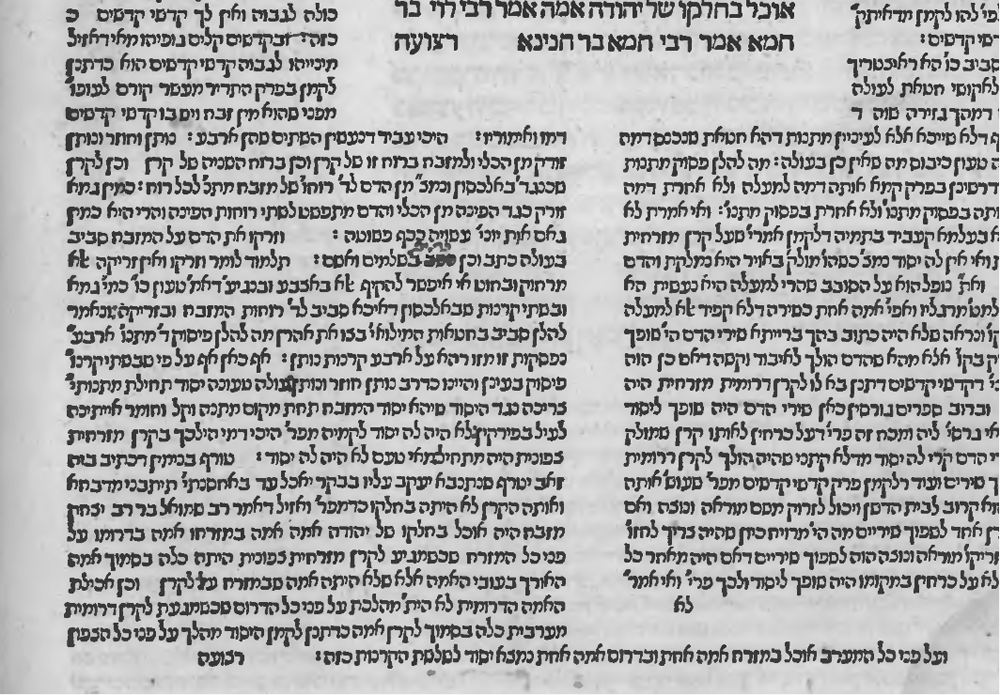
The one I would like to focus on in this article was printed in Prague in 1526.[1] The Prague  edition of the Haggadah is considered by experts to be one of the most important illustrated Haggados ever published. It is perhaps the earliest printed[2] illustrated Haggadah for a Jewish audience, and it served as a model for many subsequent illustrated Haggados. Some insist that it is the greatest single Haggadah ever printed. “Certainly it is one of the chief glories in the annals of Hebrew printing as a whole and for that matter in the history of typography in any language.”[3] Printing came to Prague in 1487 (around 40 years after its invention), and the first Hebrew book was printed there in 1518. The Prague 1526 edition was published by the brothers Gershom (Cohen) and Gronom Katz on Sunday, 26 Teves 5287 or December 30, 1526.[4]
This Haggadah contains many of the halachos of the Seder beginning with bedikas chametz, a collection of pirushim on various parts of the Haggadah, and 60 illustrations made from woodcuts. However, we do not know who authored these halachos and divrei Torah (which are full of interesting ideas). The halachos written here are very significant, as they were written and printed before the Shulchan Aruch. The illustrations are also significant, as they had a tremendous impact on the illustrated Haggados printed afterward.
I would like to discuss some of the interesting things we can learn about the Seder and Haggadah via this Haggadah and some of its illustrations.
The first general question is why they chose to illustrate the Haggadah. Who was their intended audience? Various people who studied this Haggadah have debated this issue,[5] but to me it’s pretty clear that it had to do with one of the most important parts of the Seder night—the special audience—the children. This was a tool to help enable us to fulfil the important obligation of v’higadeta l’vincha. Last year, in an article in this magazine, I outlined many customs done during the Seder with the underlying theme to get the children “into” the Seder. One of the best ways to get kids “into” it is via visual aids, showing them pictures or acting out certain things.  Simply reciting the Haggadah and just saying “some Torah” is not as effective. It would seem to me that this was their intention when they illustrated the Haggadah. It could be that some of the pictures were to lighten it up for the adults too, as I will soon explain.
The significance of this point is that Rav Shlomo Zalman Auerbach, zt”l, raises possible issues with looking at illustrated Haggados on Pesach based on the halachos in the Shulchan Aruch (307:15) dealing with reading captions of images on Shabbos.[6]
If we are correct that the purpose is to educate the children, it might be a possible reason to permit looking at these images. To be sure, some of the Haggados with images were printed with the involvement of great gedolim, such as the illustrated 1590 Prague Haggadah, which had a kitzur of the Zevach Pesach of the Abarbanel written by Rav Yitzchak Chayis (1538-1610).
Just to emphasize the significance of visual aids when learning, in a haskamah for a work about shechitah that was written but never printed, the Aderes stresses the benefit of the numerous diagrams and illustrations of animals in the book for the understanding of the various complex halachos of shechitah.[7]
Similarly, Rav Belsky dissected an animal on video to give a visual aid for those learning Maseches Chulin. It is also related that when the Minsker Gadol, Rav Yerucham Perlman, zt”l (1835-1896), first became rav he made it his business to go to the head shochet of the city to learn all the aspects of animals for the laws of treifos and the like. The shochet asked him how he could possibly teach the rav anything. The Minsker Gadol replied, “It’s one thing to learn the halachos in sefarim, but when it comes to psak halachah one needs to know the exact aspects as they are on the actual animal.[8]
Additionally, there is a great benefit for us to analyze the pictures nowadays, as it can give us a glimpse into how they conducted the Seder in those days.
Halachos
One of the first parts of the Seder is the eating of karpas. Nowadays, for the most part, the custom is for the children to say, “We wash our hands, but we don’t say the brachah for this washing.” In the instructions to the Prague Hagadah it says to say the brachah for washing.[9] In fact, there are a number of Rishonim who say that one should say the brachah of al netilas yadayim.
Who pours the wine?
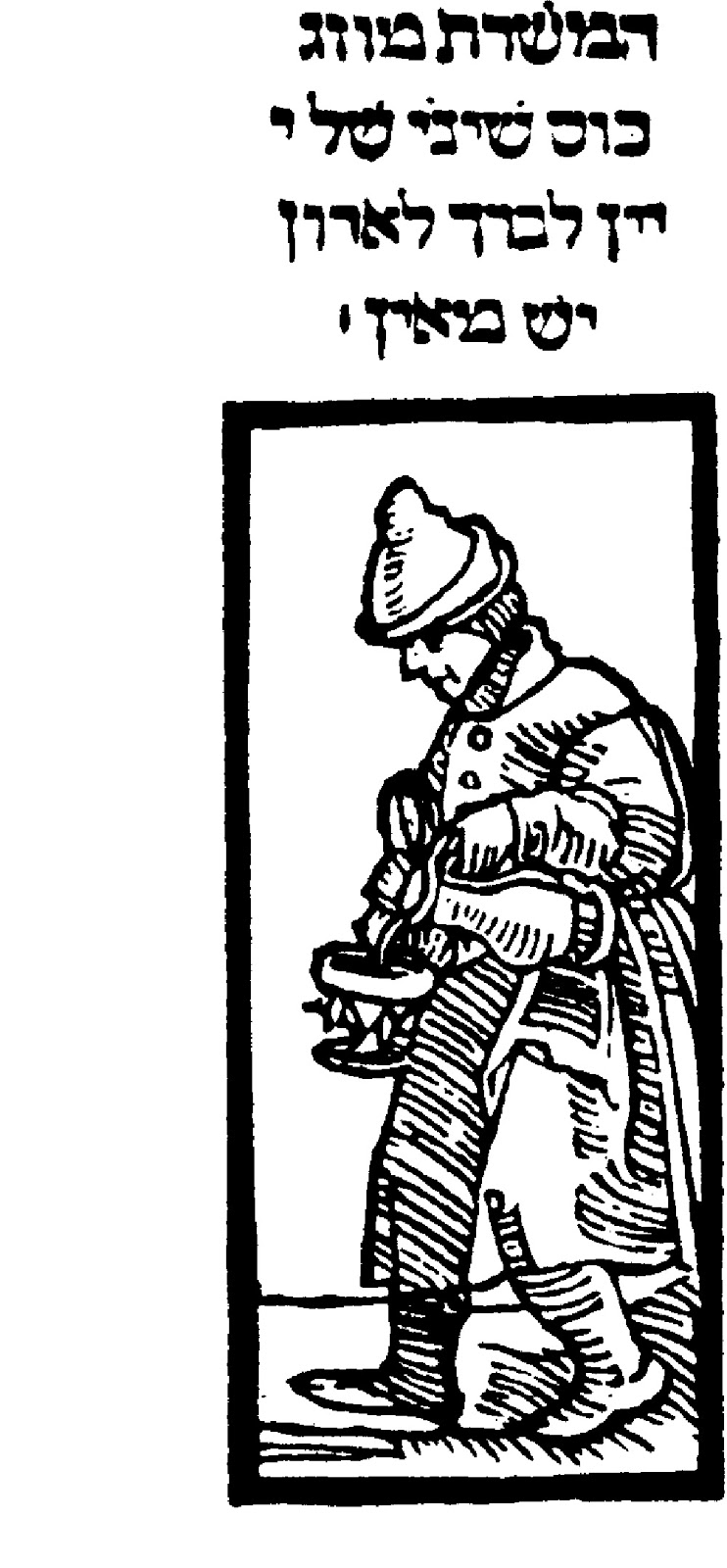
After saying Ha Lachma Anya the cups of wine are refilled. There is a picture of someone refilling the wine with a caption stating that the servant should refill the wine. The Rama in Darchei Moshe says that the person who is conducting the Seder should not fill the cups of wine; rather, someone else should do it for him.[10] This would appear to be an earlier writter source with the same idea.[11] Interestingly enough, the Aruch Hashulchan writes that we do not do this. The leader can pour the wine for himself, and there is no reason that his wife should have to pour for him.[12] Rav Yitzchak Chayis writes in Siach Yitzchak—which is a halachic work about the Seder night first printed in Prague in 1587—that one should train his six or seven-year-old child to do this mitzvah.[13] Perhaps another minhag related to this statement of the Rama is that the one leading the Seder does not get up to wash his hands; rather, the water is brought to him.[14]
Pouring out the wine for the Ten Makkos
 
After saying Ha Lachma Anya the cups of wine are refilled. There is a picture of someone refilling the wine with a caption stating that the servant should refill the wine. The Rama in Darchei Moshe says that the person who is conducting the Seder should not fill the cups of wine; rather, someone else should do it for him.[10] This would appear to be an earlier writter source with the same idea.[11] Interestingly enough, the Aruch Hashulchan writes that we do not do this. The leader can pour the wine for himself, and there is no reason that his wife should have to pour for him.[12] Rav Yitzchak Chayis writes in Siach Yitzchak—which is a halachic work about the Seder night first printed in Prague in 1587—that one should train his six or seven-year-old child to do this mitzvah.[13] Perhaps another minhag related to this statement of the Rama is that the one leading the Seder does not get up to wash his hands; rather, the water is brought to him.[14]
Another minhag found in this Haggadah is the famous custom of dipping the fingers into the wine when saying the Ten Makkos. In this section of the Haggadah there is an illustration of someone dipping his finger into his cup and there is also a caption under the picture stating that some dip with the pinky, followed by a reason for this custom.[15]
The earliest known source for this minhag can be found in a drashah of the Rokei’ach, recently printed from a manuscript by Professor Simcha Emanuel.[16] But this source speaks about dipping the index finger. The Rama also writes to dip the index finger. Interestingly, the Magen Avraham says to dip with the kemitzah, which is the ring finger.
Walking with a sack on the back
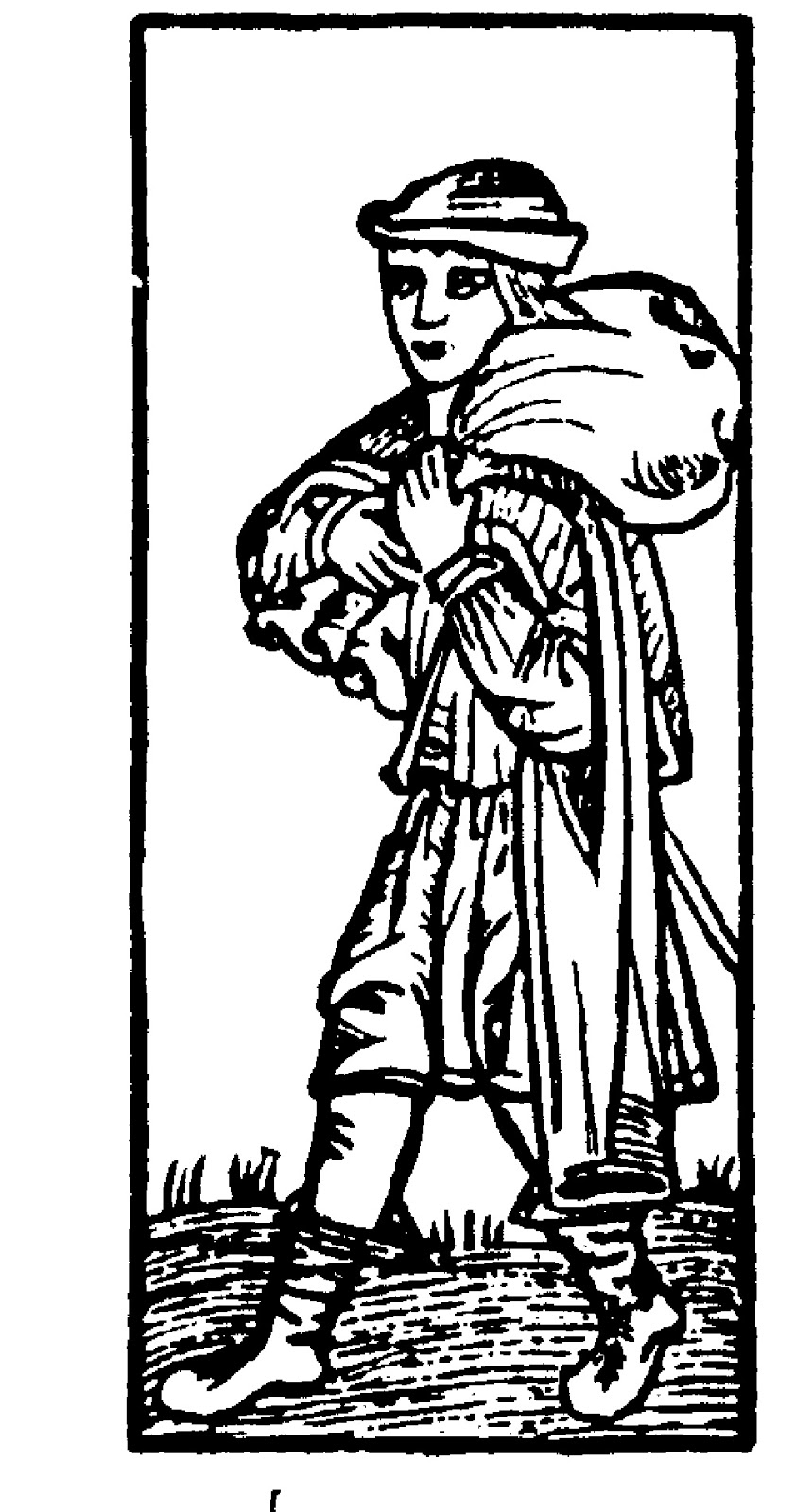
There a few places in the Haggadah, such as near the paragraph of B’chol dor vador, where we find an illustration of someone walking with a sack (of matzah) on his back. The source for this can be found in some of the Rishonim and early Acharonim. After mentioning breaking the matzah in their description of Yachatz they add that the leader of the Seder puts it on his shoulders and walks with it for a bit; others do this only later on when they eat the afikoman.[17]
Eliyahu Hanavi coming to the Seder
I traced the sources for this in a previous article in Ami Magazine. When discussing the sources for this, Rabbi Sperber notes[18] that in a few of the illustrated Haggados there are pictures of a man on a donkey near Shefoch Chamascha. In some of them he is being led by someone else; for example, in the Prague Haggadah of 1526.
I also noted that Rabbi Yuzpeh Shamash writes that mazikin run away from any place where Eliyahu’s name is mentioned. He says that because of this some make a picture of Eliyahu and Moshiach for the children, so that the children seeing it will say “Eliyahu,” causing the mazikin to disappear.[19] This could indicate that the illustrations were shown specifically to the children, as I claimed earlier.
Nusach of the Haggadah
The actual nusach of the Haggadah is its own large topic, starting from the Gemara and moving onward to manuscripts and discussions among the poskim. In the beginning of the Haggadah we begin with the famous Aramaic passage of Ha Lachma Anya. Much has been written about different aspects of this passage. One aspect is whether the exact nusach should be Ha Lachma Anya or K’ha Lachma Anya. The Rama quotes Rav Avraham of Prague, who says to specifically say Ha Lachma Anya and not K’ha Lachma Anya. The Maharal says the same. We see that two great sages from the city of Prague paskened that we should say Ha Lachma Anya.
Who was this Rav Avraham of Prague quoted by the Rama?
Rav Dovid Ganz (a talmid of the Maharal) writes in his historical work Tzemach Dovid that he was the rosh yeshivah and av beis din of Prague in the 1520s. He also authored some notes to the Tur, which were printed by Gershom (Cohen) Katz in Prague in 1540.[20] Thus, it is interesting that in the Haggadah the nusach was different from that of the av beis din of the city. Interestingly enough, his sons printed two more Haggados (1556 and 1590) in Prague and there too the nusach is different from that of Rav Avraham. Ultimately, the Magen Avraham concludes that whichever nusach one says is fine.[21]
What to use for maror
Another interesting picture is of the maror. In two places in the Haggadah the illustration used for maror is that of a lettuce—chasah. This is chazeret, which is the first of the five types enumerated in the Mishnah that one can use for maror.
There is a famous teshuvah from the Chacham Tzvi where he writes at length that this is the ideal item to be used for maror, as it’s the first in the list of the Mishnah.[22] We also find that the Netziv wrote a letter to his son, Rabbi Chaim Berlin, urging him to use it for maror instead of sharper vegetables, especially after fasting and drinking wine.[23] There are also numerous earlier illustrated manuscripts that show pictures of lettuce for the maror.[24]
More on maror
Speaking of maror, the inscription next to the picture is of great interest. It says, “There is a custom when saying maror that the man points to his wife, as it says ‘An evil wife is worse than death.’” Much has been written about this illustration. Some have written that it is ridiculous and there cannot be such a custom. On the other hand, Rabbi Wengrov and, more recently, Rabbi Yisroel Peles,[25] have demonstrated that there are pictures of a man pointing to his wife near the paragraph of maror in various illustrated Haggadah manuscripts. It is clear, however, as Rabbi Wengrov writes, that this was done in a joking manner to lighten up the Seder, but it isn’t serious, chas v’shalom. Rabbi Wengrov demonstrates that other pictures found in these Haggados show that the authors had a sense of humor and drew certain illustrations to lighten up the mood.[26]
Explanation via illustration
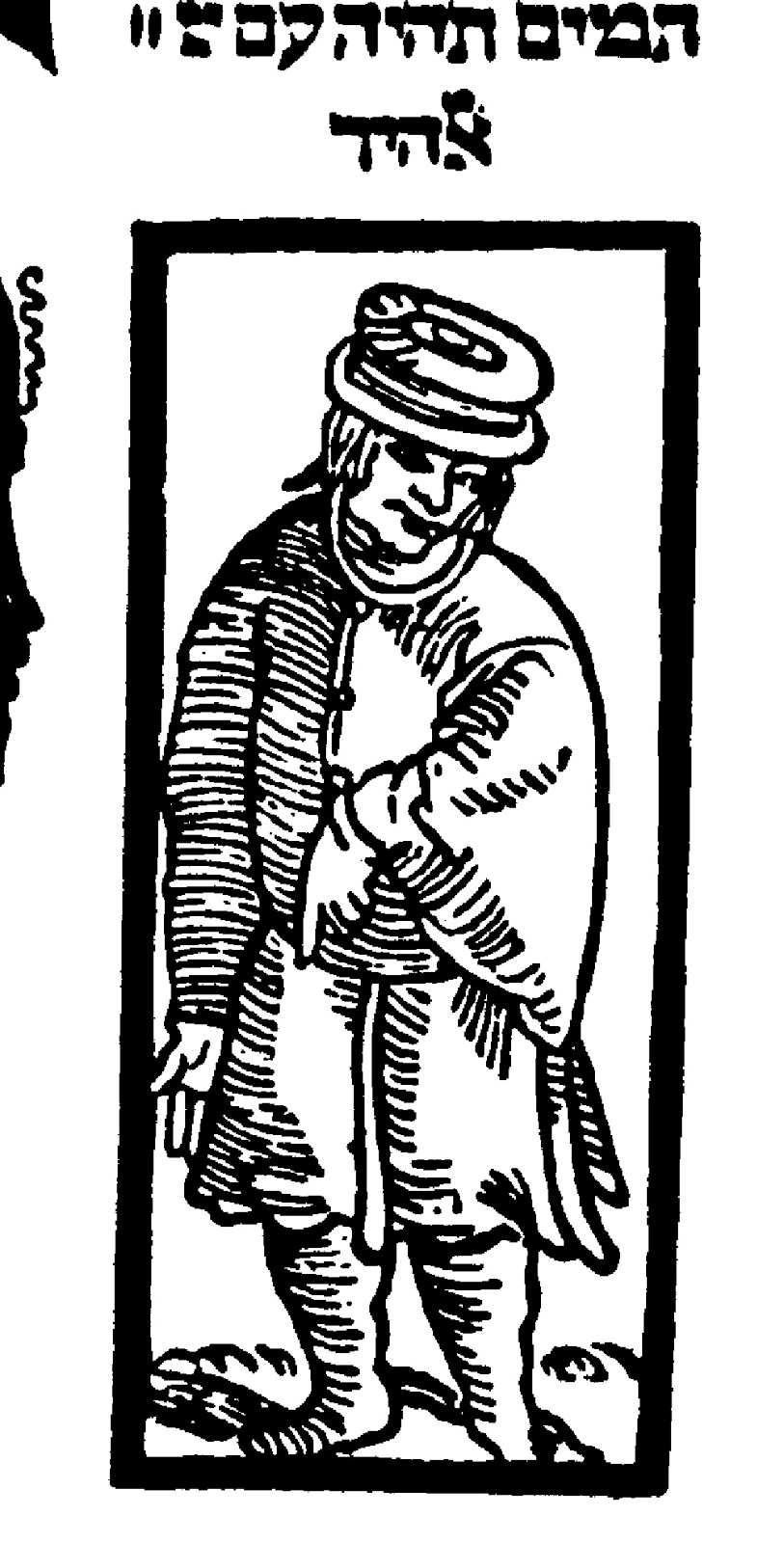
 
 
Some of the pictures in the Haggadah are to explain a particular passage. One such example is the image of the four sons. The tam is often translated as a derogatory term—the foolish son. However, the caption above the picture says, “Tamim tihyeh im Hashem” – always be complete with Hashem, which means that they understood the tam to be a man of piety.[27]
Omission
At the end of the Haggadah we conclude the Seder with a few songs, such as Echad Mi Yodei’a[28] and Chad Gadya. The authors and earliest sources for reciting them are unknown.[29] Rabbi Shemaryah Adler suggests that Chad Gadya may have been written by Daniel.[30] Rabbi Yedidyah Tiyah Weil writes in Marbeh L’sapeir on the Haggadah that he heard that these two songs were found in a manuscript from the beis midrash of Rav Elazar Rokei’ach. Numerous pirushim have been written about Chad Gadya, based on all the methods of learning Torah.[31] Be that as it may, many have noted that they are not found in this Haggadah. The first time they appear in print are in the Haggadah printed in Prague in 1590.
Another notable omission is the stealing of the afikoman. I wrote in the past in this magazine that one of the earliest sources in print can be found in the Siach Yitzchak, which mentions stealing the afikoman, but not in the same way as we do it nowadays.[32] It would seem that since no mention of it is made in the instructions of the 1526 Haggadah that it was not yet a widespread custom at that time.
Kiddush and Hunting
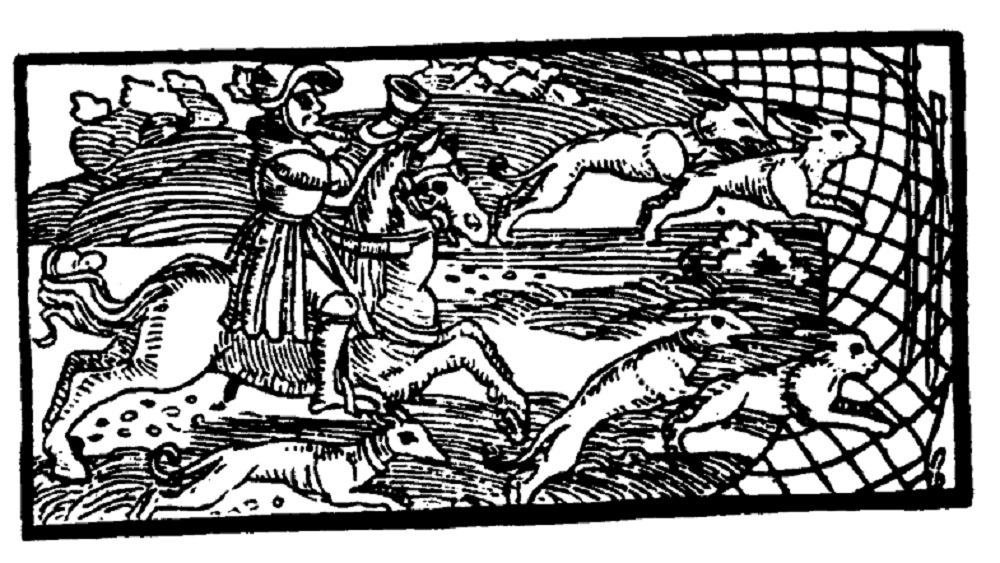
 

In the beginning of the Haggadah, on the bottom of the page of Kiddush, we find a mysterious picture of someone hunting hares with a horn and dogs. This picture can also be found in a bentcher printed by the Katz brothers in Prague a few years earlier. The question is obvious: What in the world does this have to do with Kiddush, especially as it is not a Jewish hobby? One of the answers suggested is that when Yom Tov occurs on Motzaei Shabbos we use an abbreviation known as Yaknehaz to remember the order in which to say Kiddush and Havdalah. The pronunciation of Yaknehaz is similar to jagen hasen, which is German for hunting hares, so this picture is meant to serve as a reminder of the abbreviation.[33]
Moreon Kiddush
Throughout the Haggadah there are illustrations of people holding cups of wine; sometimes the one holding the cup is dressed like a king. It would appear that this is to reflect the halachah to act like a king on the Seder night as part of the celebration of our freedom.
At other times the image is of an older man holding the cup either in his left hand or in his right. Rabbi Shaul Kook points out that some of the time it’s in the palm of his hand, which is the way it should be held according to various mekubalim, while at other times he holds the cup by its stem. He suggests that near the passage where Rabbi Elazar ben Azaryah says, “I am like someone who is 70 years old,” he is depicted as holding the cup in his left hand while stroking his white beard with the other to show that he’s really not that old.[34] At that point in the Haggadah one would not be holding the cup for the purpose of drinking one of the four kosos and that’s why he’s not holding it in his palm. Whereas in the pictures near where one would hold the cup for drinking he is holding it in the palm of his right hand. However, there is another picture on the page of Kiddush that is similar to the one of Rabbi Elazar holding the cup in his left hand and stroking his beard. Rabbi Kook says that this is because the printer was not educated and, not realizing the reasons for the difference, used the wrong woodcut.[35]
 
The problem with this is that the earliest source we have for holding the cup of wine specifically in the palm of the hand is in the Shalah HaKadosh, which was first printed in 1648—long after this Haggadah was printed.[36] It is, however, very possible that mistakes were made because printing with woodcuts is very difficult and confusing.
Sitting during Kiddush
Other customs that we can possibly learn from the illustration of Kiddush are that the person is both sitting and looking at the cup. These are also mentioned by various poskim in regard to the halachos for how Kiddush should be said.[37] There are other halachos of Kiddush that can perhaps be learned from these illustrations, but one has to be careful as to how much to “read into” them.
[1] On this Haggadah, see A. Yaari, Bibliography Shel Haggadot Pesach, p. 1. Y. Yudolov, Otzar Haggados, p. 2, # 7-8; the introduction to the 1965 reprint of this Haggadah; Yosef Yerushalmi, Haggadah and History, plate 13; Yosef Tabori, Mechkarim B’toldos Halachah (forthcoming), pp. 461-474. See especially the excellent work of Rabbi Charles Wengrov, Haggadah and Woodcut, (1967), which is completely devoted to this Haggadah. Another recent work devoted to this Haggadah was printed this year by R’ Yehoshua Goldberg, Haggadas Prague. Many thanks to my friend Dan Rabinowitz for the discussions about this Haggadah over the past few years. Here are two earlier posts by Dan on manucript Haggados and the 1526 Prague Haggadah: here and here. Thanks also to Mr. Yisroel Israel for his help with the images.
[2] As there are numerous illustrated manuscript haggadas.
[3] Yerushalmi, Haggadah and History, p. 30.
[4] This detailed publication information does not appear on the title page; rather, it appears at the end of the book in what is referred to as the colophon. On the printers see Chaim Friedberg, Toldos Hadefus Haivri, pp. 1-10. On various aspects about printing in these years in Prague, see Hebrew Printing in Bohemia and Moravia (Prague 2012).
[5] Richard Cohen, Jewish Icons, (1998), pp. 94-97; Chone Shmeruk, The Illustrations in Yiddish Books of the Sixteenth and Seventeenth Centuries (Heb. 1986).
[6] Halichos Shlomo (Pesach), pp. 267-268.
[7] Intro to Shu”t Ohel Yosef, 1903.
[8] Hagadol MiMinsk, p.51.
[9] Drashah L’Pesach L’Rabbi Elazar MiVermeiza, p. 96. See: Haggadah Shevivei Eish, p. 152; Y. Tabory, Pesach Dorot, pp. 216-244. See also what I wrote in my work Bein Kesse Le’assor, pp. 148-153.
[10] Darchei Moshe, 486:1.
[11] See also Siach Yitzchak (Brooklyn 2016), p. 241.
[12] Aruch Hashulchan, 473:6.
[13] Siach Yitzchak, p. 239, 252.
[14] Siach Yitzchak, p. 239.
[15] On this minhag see Zvi Ron, Our Own Joy is Lessened and Incomplete; The History of an Interpretation of Sixteen Drops of Wine at the Seder, Hakirah 19 (2015), pp. 237-255. I hope to return to this in the future.
[16] Drashah L’Pesach L’Rabbi Elazar MiVermeiza, p. 51, 101, 127.
[17] Rabbi Wengrov (above note 1), p. 60. See also Hanhagot HaMaharshal, pp. 10-11; Magen Avraham, 473:22; Chidushei Dinim MeiHilchos Pesach, p. 38. See Rabbi Chaim Benveniste, Pesach Me’uvin, 315; Vayageid Moshe, pp. 116-117.
[18] Minhagei Yisroel 4, pp. 168-170.
[19] Minhaghim Dik’hal Vermeiza, p. 86
[20] Tzemach Dovid, p. 139. See also Tzefunot 7 (1990) pp. 22-26.
[21] See also Siddur R’ Shabsei Sofer, 1, p. 5; Rabbi Yosef Zechariah Stern, Zecher Yosef, p. 4. [22] Chacham Tzvi, 119. On using this even though it is not bitter see also Dovid Henshke, Mah Nishtanah (2016), pp. 250-255, 215-220, 224-227, about Maror being bitter.
[23] Meromei Sadeh Pesachim 7b, See also Arthur Schaffer, History of Horseradish as the Bitter Herb of Passover, Gesher 8 (1981) pp. 217-237; Levi Cooper, Bitter Herbs in Hasidic Galicia, JSIJ 12 (2013), pp. 1-40; Z. Amar, Merorim, pp. 67-83. See also Rabbi Yehudah Spitz, Maror Musings, the not so bitter truth about Maror, Ami Magazine (2014), pp. 230-234.
[24] See Rabbi Wengrov (above note 1), p. 54. See also Rabbi Dovid Holtzer, Eitz Chaim 25 (2016), pp. 285-292.
[25] Hamaayan 51 (2011), pp. 11-14.
[26] On this and other pictures related to humor in the Haggadah see Rabbi Wengrov (above note  1),pp. 54-59.
[27] See also Rabbi Wengrov (abovenote 1), pp. 43-44; HaggadasMidrash B’chodesh (2015) of Rav Eliezer Foah (talmid of the Rama MiFano), p.135; R’ Elazer Fleckeles, Maaseh B’Rabbi Elazar, p. 63-64. See also Dovid Henshke, Mah Nishtanah (2016), pp. 358-359.
[28] See Rabbi Toviah Preshel, Kovetz Maamarei Tuviah 2, pp.64-65.
[29] See Chone Shmeruk, “The Earliest Aramaic and Yiddish Version of the Song of the Kid (Khad Gadye),” in The Field of Yiddish, 1 (New York 1954), pp. 214-218; Chone Shmeruk, Safrut Yiddish,pp. 40-42, 57-60; Asufot, 2 (1988), pp. 201-226; Rabbi Yisroel Dandrovitz, Eitz Chaim 23 (2015), pp. 400-416. Shimon Steinmetz discusses the origin of Chad Gadya here.
[30] Minchas Cohen, p. 73. Many thanks to my friend Rabbi Shalom Jacob for sending copies of this extremely rare work.
[31] Marbeh L’Sapeir, p. 140, 151. See also Rabbi Yosef Zechariah Stern in his Haggadah Zecher Yosef (p. 30), who writes that he did not find this piyut printed before the sefer Maasei Hashem. See also the Haggadah Shleimah ad. loc.; Assufot, vol 2 pp. 201-226; Mo’adim L’simcha vol. 5 ch. 11; Y. Tabory, Pesach Doros, pp. 341-342 and the note on pp 379.
[32] Siach Yitzchak, p. 21a. About this gaon see the introduction of Rabbi Adler in his recent edition of Pnei Yitzchak – Apei Ravrevi.
[33] See Rabbi Wengrov (above note 1), pp. 36-37.
[34] See Rabbi Yosef Zechariah Stern, Zecher Yosef, pp. 5a-6a.
[35] See Yeida Haam 2 (1954), p. 148; Iyunim Umechkarim, 1 pp. 81-83.
[36] See also R’vid Hazahav, Vayeishev (Kaf Paroh); Rabbi Mordechai Rosenbalt, Hadras Mordechai, Bereishis, 259. See also Shu”t Beis Yaakov, (1696) 174 who quotes such a custom from the Arizal.
[37] See Rabbi Dovid Deblitsky, Birchos L’rosh Tzaddik, pp. 25-31.


An Obscure Diagram in the Bomberg Shas

 An Obscure Diagram in
the Bomberg Shas
By Eli Genauer
A recent book auction
by Kestenbaum featured the following listing:

AUCTION 65: JUNE 25TH, 2015
LOT:
111 (TALMUD, BABYLONIAN). Masechta Sotah. With commentaries by Rashi, Tosaphoth,
Maimonides and Rabbeinu Asher. FIRST BOMBERG EDITION .. ……Vinograd, Venice 27;
Habermann, Bomberg 22.

Daniel Bomberg, Venice: 1520.
                   This
Tractate contains the only appearance of a printed text illustration throughout
the entire Talmud issued by Bomberg (see f. 43r).

The reference to ( see f.43r ) indicates that this singular
printed diagram in the Bomberg Shas appears on Daf 43A in Sotah.
It is a diagram of the configuration of trees in a particular
orchard and it looks like this

We find other instances of a Bomberg edition of tractate Sotah
being offered for sale, and they contain the same basic information.

Kedem Auctions Auction no. 40 – Books, Manuscripts, Rabbinical LettersWednesday, September 3, 2014 – 17:00Books & ManuscriptsTractate Sotah –
Venice, 1520 – Bomberg Printing, First Edition
Babylonian Talmud, Tractate Sotah – with Rashi commentary and
Tosfot, Piskei Tosfot and Rambam’s commentary on the Mishna. Venice, 1520.
Printed by Daniel Bomberg, first edition.
On Leaf 43, 1 is an illustrative sketch on Rashi commentary. This is the
only printed sketch found in the Bomberg edition of the Talmud. Bomberg left
the rest of the places which were designated for sketches and illustrations
empty to complete with drawings after printing.

Sotheby’s
Babylonian Talmud, Tractate Sotah, Venice: Daniel Bomberg, 1520
17 DECEMBER 2008 | 10:00
AM ESTNEW YORKBabylonian Talmud,
Tractate Sotah, Venice: Daniel Bomberg, 1520Folio (13¾ x 9½ in.; 350 x 242 mm.Folio 43r. provides the
only example of the inclusion of a printed diagram in the Bomberg Talmud.
In all other tractates, Bomberg simply left a blank space in which an
individual could insert a diagrammatic drawing.

The source for
this information most likely came from “Maamar al Hadfasat HaTalmud” by Raphael
Nathan Nata Rabbinovicz. It was first printed in 1868 as a hakdamah to
his book Dikdukei Sofrim on Masechet Brachot and later
added on to by Rabbinovicz and printed as a separate book.
I refer to this edition: Maamar ‘al
hadpasat ha-Talmud with Additions,
ed. A.M. Habermann, Mossad ha-Rav Kook,
Jerusalem: 2006

On page 41,
Rabbinowicz, writing about the first Bomberg edition, states as follows

״ובכל
התלמוד (וכן בכל הדפוסים הישנים עד דפוס בערמן) נשמטו הציורים בגמרא, רש״י
ותוספות,ונשאר מקומם חלק, מלבד בסוטה מג. שישנו הציור ברש״י

In all of the
Talmud ( and in all other older printed editions of the Talmud until the Berman
edition ( Frankfurt An Der Oder 1697-99) )the diagrams were not included in the
Talmud, Rashi and Tosfot, and their space remained empty, except for Sotah
43A, where we find a diagram in Rashi.


He seems to be
saying that not only in the Bomberg first edition was this the only diagram
included, but also in subsequent Bomberg editions this remained the only
diagram included. He even casts a wider net and says that this was the only
diagram included in any set of the Talmud until the Berman edition of Frankfurt
an Der Oder printed from 1697-1699.

Is this correct?
I would have to say it is mostly correct but not completely.

The Israel
National Library website contains the following page:

It is a
wonderful source for early printed books and it contains every tractate of the
first edition of the Bomberg  Shas. What
may a bit less known is that it also contains one tractate of the third edition
of the Bomberg  Shas, Masechet Zevachim,
printed in 1548. (1)

If we look at
Daf 53B, we are confronted with the following

A close up of
the bottom of the page looks like this

At first I
thought that this diagram of the Yesod of the Mizbeach had been drawn in by
hand, but an analysis of the difference in the way this page was set up versus
the same page in the first two editions lead me to conclude that this diagram
was added by the Bomberg editors intentionally and was included as part of the
printed page. Aside from that, I had the privilege of looking at this same page
in a different copy held by the JTS Library with Sharon Lieberman Mintz, ( JTS
Curator of Jewish Art) and she confirmed that this mechanical drawing and the
one available online at the NLI website were exactly the same.
If we look at
the 1520 edition, we can see the problem that the editors faced

Here is both 53A
and 54A

Let’s take a
closer look at the bottom of 53B, where the diagram appears in the third
edition
After a lengthy
explanation by Rashi on the makeup of the Yesod, he adds the word “Kazeh”. It
is right at the bottom. Usually, we would find an empty space there, but alas,
there is no room.

The empty space
where the diagram should go is not on the bottom of 53B, but rather on the top
of 54A. It has nothing to do with the Rashi that begins with the word
“Retzuah”.

So it is
possible that by the third edition of Zevachim, the Bomberg editors decided to
fix that. They set the type for 53B in a different manner, allowing them the
space for a diagram, and they even included the diagram.
I thought I
might find other diagrams in this third Bomberg edition and spent an afternoon
at the JTS Library looking through various Masechtot of that edition, but did
not find another diagram. As far as I know, this was the only diagram added to
the third edition. There is no way to know for sure why the Bomberg editors
added this one, just as there is no way to know why the diagram on Sotah 43A
was included in the first edition. But at least one can see what might have
bothered them here.
[1] I refer to this as the third edition although there is much discussion as to
whether this might actually be a fourth edition. For more background on this,
please see Marvin J.  Heller, Printing the Talmud (A History of
the Early Printed Editions of the Talmud )
Im Hasefer, Brooklyn, NY 1992,
pages 167-180


The Modern Custom of Standing for the Ten Commandments

Many mitvot require that one stand. One of which is reading the Torah. Thus, the ba’al koreh and the person making the blessing stand. When it comes to those who are just listening, there is a debate whether they are required to stand as well. Some hold that the listeners are required to stand while others require the listeners to stand only for the blessings, and finally others don’t there is a nearly universal custom to stand during the recitation of the Ten Commandments. Tracing the history of this custom, however, uncovers that not only is this a fairly recent custom, it is also a highly problematic one.

The earliest possible source for this custom, as with many of today’s “universal” customs, is the Hemdat Yamim. The Hemdat Yamim, records that:
According to the Hemdat Yamim, the custom of the Ari (most of his customs the Hemdat Yamim attributes to the Ari, see this post discussing the spurious nature of the Meron custom also attributed to the Ari,) was to not stand for the recitation of the Torah with the exception of the Ten Commandments. Importantly, the Hemdat Yamim is only proposing this custom, not attempting to justify an already existing custom. Moreover, as we shall see, most who discuss the custom of standing for the ten commandments do so in an effort to reconcile this custom with the prohibition of elevating or highlighting the ten commandments as proscribed by the Talmud.

For instance, R. Shmuel Aboab discusses the custom of standing for the Ten Commandments. R. Aboab was asked “about the custom of some to stand for the Ten Commandments, what is the reason for this custom and should others follow it?” In his response, R. Aboab first questions the custom in light of the well-known passage in the Berachot where the Talmud records that the custom to read the Ten Commandments was abolished in the “gevulot” due to the “minim.” Thus, according to the Talmud, highlighting the Ten Commandments or, in this case, standing specifically for their reading may run afoul of this passage. Ultimately, R. Aboab defends the custom of standing and distinguishes the Talmudic passage and claims that the Talmudic restriction is only applicable “when it is unclear why one is favoring the Ten Commandments over the rest of the Torah, i.e. when one reads the Ten Commandments daily. But, here, [merely standing on Shavout or Parshat Yitro or Vethanan] the purpose is clear in that we are reenacting the acceptance of the Divine Glory and thus there is no fear of the minim. The standing for the Ten Commandments is thus akin to standing when we recite the blessing on the new moon, . . . as Abbai states we need to do it standing and Rashi explains that since we are greeting the Divine Glory we are required to make the blessing standing out of respect for the Divine Glory. Therefore, we stand when the Ten Commandments are read and it poses no problem.”[1]
The Hida also defends the custom of standing and argues the Talmudic fear of minim is not applicable as the Ten Commandments are read as part of a larger Torah reading thereby demonstrating that although we may stand for part we believe in it all.[2]

In fact, it is not an exaggeration to say, from the early 18th century there has been a virtual explosion of commentaries attempting to justify this custom in light of the Talmud. [3]

Of course, as with most Jewish customs, not everyone agrees that standing for the Ten Commandments is appropriate. R. Y. Emden (additions to the Siddur, Laws of Shavout) holds that one should not stand for the Ten Commandments as does R. Gieger in Divrei Keholot (p. 466).

Returning now to the origins, the earliest and most likely source is the Hemdat Yamim, which dates to sometime in the 17th century. That said, he is not actually the earliest person to discuss this custom. Rather, the Rambam discusses this custom, however, the Rambam cannot be the source for the custom of standing for two reasons. First, this passage of the Rambam was unknown until the 20th century. Second, the Rambam was against the custom of standing for the Ten Commandments.

The Rambam’s statement appears in two editions of his responsa, first in the Freimann edition and then again, with small differences, in the Blau edition. The first, Freimann was published in 1934, and Blau’s was published in 1971. Consequently, these can not be the sources for the custom discussed in the 17th century as these were still in manuscript and unknown in the 17th century – that is, no one mentions the Rambam until the publication of these editions. Moreover, as we have seen, this is not a inconsequential custom, rather, on its face this custom runs counter to the Talmud and thus if in fact this custom pre-dated the Hemdat Yamim why is there no one who raises the conflict with the Talmud in Berchot. As we have seen, once the custom is discussed it is almost always in the context of justifying the custom in light of the Talmudic passage.

The Rambam, contrary to the position of those discussed above, takes issue with standing during the Ten Commandments. Specifically, unlike those above, he is unwilling to distinguish the Talmudic passage and in fact expands on what the Talmud prohibits. According to the Rambam, based on the Talmud, it is prohibited from elevating any part of the Torah over any other part. As the Rambam discusses at length in his Commentary on the Mishna, the introduction to Perek Helek, it is heresy to claim any one part of the Torah is more important than any other. Similarly, the Rambam holds that to stand for one part of the Torah and not another part is akin to heresy as it shows that the Ten Commandments are somehow worthy of standing to the exclusion of the rest of the Torah.

To recap, the custom of standing seems to have become popular with the Hemdat Yamim in the early 18th century and the Rambam was against this practice ruling that it skirted the line of heresy. R. Ovadiah Yosef, basing himself on the Rambam (R. Yosef doesn’t trace the lack of historical basis for the custom), rules that it is prohibited to stand. Surprisingly, this is not the conclusion reached by all his contemporaries. Instead, R. Waldenberg, takes the position that since this is well-established “minhag yisrael” standing for the ten commandments is permitted. R. Waldenberg raises the possibility that this custom falls in the category of those customs which are so powerful they override law.

R. Waldenberg then deals with the Rambam, and essentially dismisses the Rambam as unimportant because this responsum was unknown. R. Waldenberg then throws in for good measure the controversial statement of the Hazon Ish regarding using recently discovered manuscripts. [4]

R. Waldenberg is not the only one to dismiss this responsum. R. Feinstein also discusses standing for the Ten commandments and offers his own justification. In doing so he never mentions the Rambam’s position. R. David Feinstein was asked if his father was aware of this responsum and R. D. Feinstein said that his father was not. But, R. Dovid continued, “knowing his father’s position on newly discovered manuscripts – [that he took a dim view?]- the Rambam’s responsum doesn’t affect the analysis.”Feldman, Yisrael be-Mamadam, p . 1051. Thus, rather then dealing with the Rambam in a meaningful manner many appear to be willing to dismiss the entire position of the Rambam. Furthermore, the reason for this pithy dismissal is not based on substance but, instead, by alleging without any basis in fact that this responsum is a forgery.In sum, the custom of standing is based on the Hemdat Yamim and is not older than the 18th century. The Rambam had serious reservations about establishing such a custom, but some are willing to ignore the Rambam on questionable grounds.

Sources:

See Y. Goldhaver, Minhagei Kehilot, vol. 1 227-36 where the majority of the above is taken from. See also, Sperber, Minhagei Yisrael, vol. 2, 109-11, n.63 (he discusses among other things, the meaning of “minim”); E. Brodt, Yeruschasanu, vol. 2, p. 208; G. Oberlander, Minhag Avotanu be-Yadanu, Nissan-Av, chapter 27; S.Y. Feldman, Yisrael be-Mamadam, vol. 2, 1040-51.

See also, Goitein, A Mediterranean Society, vol. II, 340 where he records the custom that to take an oath one had to swear “in the name of God, and the Ten Commandments.” And that a document from Syracuse, Sicily, it records that “the party giving the oath was even obliged to read the Ten Commandments aloud from the Torah Scroll.”

[1] R. Aboab’s distinction is far from certain. Specifically, why it is clear on Shavout one is standing for a particular purpose as opposed to the daily recitation of the Ten Commandments?[2] This reasoning is also not convincing as the proposed daily recitation of the ten commandments was also in a larger context where other Torah passages are recited, Shema, Az Yashir, and Tehilim. If reading the ten commandments during Yitro obviates the minim issue why doesn’t reading it with the Shema or the Monday and Thursday Torah readings obviate the minim issue?[3] See R. Ovadiah Yosef, Yeheva Da’at, vol. 1 no. 29 where in his typical fashion cites almost all the relevant literature.[4] R. Waldenberg is not the first, nor presumably will he be the last, to question the authenticity of a particular responsum of the Rambam. For other examples, see Y.S. Speigel, Amudim be-Tolodot Sefer ha-Ivri, Kiteva ve-Hatakah, 264-65.


An “Artscroll”™ Illustration in the Vilna Shas-Masechet Shabbat 98b

An “Artscroll” ™ Illustration in the Vilna ShasMasechet Shabbat 98b

By Eli Genauer

לזכר נשמת אבי מורי ר׳ יעקב קאפל בר׳ משה יהודה הלוי גענויער ז״ל. היארצייט שלו י״ד סיון.

For those studying Daf Yomi this week, there is a unique diagram that appears on Shabbat 98b. In the Vilna Shas one can see a closeup “picture” of one of the boards of the Mishkan (“קרש“) which would make Artscroll proud.[1] While one might be familiar with diagrams that appear in the Talmud, those diagrams illustrate comments in the rishonim, mainly Rashi. Most of these are called out specifically by Rashi: “kazeh” “like this.” Artscroll, however, includes their own illustrations beyond those from any of the rishonim. Yet, they were not the first publishers of the Talmud to do so. Indeed, this diagram on page 98b is a much earlier example of a publisher electing to incorporate their own diagrams into the text.

Diagrams in Printed Editions of the Talmud

The use of diagrams is attested to in numerous manuscripts. These diagrams appear in Rashi, Tosefot and even were used by the Geonim.

When manuscripts gave way to printing in the late 1400’s and early 1500’s, those diagrams were excluded in the early printed editions of the Shas. When Daniel Bomberg published the first complete edition of the Shas in the early 1500s, he did not include the actual diagrams, but instead left a space for the book’s owner to pencil in the relevant diagrams (how they would know what the diagram looked like is left unanswered).

Finally starting with 1697, (the Berman Shas of Frankfurt on der Oder) did diagrams start to reappear in the empty spaces (mostly in Eruvin and Sukkah).

What was the source of those diagrams in the Berman Shas and in ones that were printed soon after in the early 1700’s? There were three sources, the Maharshal, Maharsha, and Mahram of Lublin.

This is the Shaar Blatt from the Frankfurt on der Oder 1697 edition:

The Maharshal is the key point person when it comes to diagrams. He had the 2nd edition of the Bomberg Shas (printed circa 1528) and made his notations there. He recognized the importance of the Shas being printed but also the dangers that lay in the fact that if there was a mistake, it would find its way into thousands of hands. He lived at a time when there were still manuscripts around, and he made his corrections based on those manuscripts and also his own logic. Since he had the status of an Adam Gadol, his own logic carried much weight. Originally, he did not set out to write a book with his corrections. Like the Ba’ch, he just made the corrections in his own Gemara. After he died though, his sons printed Sefarim which reflected his notes.[2] Therefore, if in the late 1600’s or early 1700’s you were printing a Shas, and you looked at a previous edition and in Rashi it said “Kazeh” and there was a space, you would look at the Chochmas Shlomo. If he had added a diagram, you would place that diagram in the empty space and feel comfortable that it had good Yichus. There were times that there wasn’t an empty space that the Chochmas Shlomo shows a diagram, and in that case, the printers usually added it.

The 1715 Amsterdam Edition of the Talmud

A complete edition of the Talmud was first published in Amsterdam in the 1640s by Immanuel Benveniste. In the 17th and 18th centuries Amsterdam was counted among the most important cities for the printing of Hebrew books and there were many well-known publishers that followed Benveniste and they printed many important works yet none of them attempted to reprinting the Talmud. Only some sixty years later did Amsterdam see a Talmud come off its presses. This one, that began in 1714, was never completed.

R. Judah Aryeh Loeb ben Joseph Samuel of Cracow appealed to Samuel ben Solomon Marsheses and Raphael ben Joshua de Palasios prominent members of the Amsterdam Sephardic community and asked them to print a new edition of the Talmud. Neither had ever published a book. In 1710, Loeb unsuccessfully sought to publish an edition of the Talmud in Frankurt. Now, in Amsterdam he sought to try again. Marcheses and Palasios formed a printing house specifically to print a “fine and accurate edition,” in an environment that “the workers would not be hurried so that they could work with care, reducing errors, and under the supervision of … the dayyan of the Ashkenaz Rabbinic Court of Amsterdam who would help establish the correct text.”[3] An emissary was sent to visit various Jewish communities to collect subscribers and reduce the burden of the significant printing costs. Relevant to diagrams, the emissary came bearing a gift, the Amsterdam 1710 edition of R. Jacob ben Samuel Bunim Koppelman of Brisk’s (1555-94) Omek Halakahah (first printed in 1510), a book that includes many diagrams to explain difficult passages of the Talmud.[4]

The first volume, Berakhot, was published in 1714[5] and the editors note the sources for their text and likely for the diagrams as well.

  1. Chochmas Shlomo

  2. Chochmas Manoach

  3. Chidushei Halachos of the Maharsha

  4. Maharam Lublin

  5. Sifrei Hashas of Yosef Shmuel ben Zvi – seemingly these were concentrated on Zeraim, Kodshim and Taharos

The volume on Meseches Shabbos was published in 1715 and the top 4 appear in the Hakdamah:

The Source and Purpose of the Diagram in Shabbos 98b

The Gemara in Masechet Shabbat on Daf 98a and b deals with the laws of carrying and discussing some of the details of the boards (“קרשים“) which made up the walls of the Mishkan.[6] These board were comprised of a complex system designed to keep each board straight and provide sufficient support for the entire structure of the Mishkan. Indeed, if one examines modern editions of the Talmud, there is an illustration that appears on the page. But where did it come from and more importantly what is its purpose? As we will show, the first edition to incorporate this diagram was the 1715 Amsterdam edition of the Talmud.

This is how it appears in the 1715 edition.

This image was reprinted in the Vilna Shas in a slightly clearer format although with the same detail and is a bit easier to analyze.


The picture primarily shows that there were three rods (“בריחים”) that connected one board to the next. The rods on the top and bottom went through outer rings, but the rod in the middle went through the width of the board.( “עובי הקרש“) It also shows the sockets on the bottom (“אדנים“) and the grooves (“ידות“) inserted in them which provided stability to the boards as they stood.

As discussed above, manuscripts of Gemarot though generally do not contain pictures, and a check on the invaluable website “Hachi Garsinan” shows that no manuscript of these pages has a picture to illustrate what a board looked like.[7] One might expect Rashi in his description of some of the statements of the Gemara to state his opinion and then write “כזה” (“ like this” ) Then we could expect to find an illustration in any of the number of Rashi manuscripts we have, and we could expect that this illustration (or an empty space for it) would appear in subsequent printed editions. Here we have none.[8]

The most relevant Rashi appears to his comments regarding how the boards stood miraculously.[9] But It does not discuss the fact that the middle rod went through the thickness of the board, but rather the miraculous nature of how the rod bent as it turned the corner. Another potential relevant Rashi explains the statement “the Sages taught, the bottoms of the beams (kerashim) were grooved and the sockets were hollow.” This deals with a completely different aspect of the beams which is how they were shaped on the bottom (and only according to Rabbi Nechemya). Thus, it is unsurprising that the manuscripts of Rashi do not include this diagram.

It was only in the 1715 edition does this illustration first appear. Yet, in the case of the picture of the keresh on Shabbos 98b, we do not find this picture in any of the sources identified by the Amsterdam publishers, not the Maharshal, Chochmas Manoach, Chidushei Halachos of Maharsha, or in Maharam Lublin.

First, we must identify what the diagram is attempting to illustrate. Rather than the more common form of diagrams, this one is not an illustration tied to one of the rishonim, rather it is illustrating two statements of the Gemara, one in the middle of the Daf and one at the very bottom. This, despite the fact that the diagram appears close to Rashi’s commentary on the page, seemingly tying it to his commentary.

Instead, the illustration is the independent product of the Amsterdam publishers and intended to elucidate the text of the Gemara, what did the board system look like. The Mesivta edition of Oz Vehadar also understands that this picture illustrates the words והבריח התיכון בתוך הקרשים. They indicate that Tziyur 6 which except for the detail on the bottom looks very similar to the one in the Vilna Shas, illustrates that statement.

In truth, the main part of the picture showing the middle rod going through the width of the board is not at all aligned with a comment of Rashi. Understanding that it just tries to give a picture of the “קרש” will make it easier to understand for people who study this page. This illustration is designed to explicate the text of the Talmud itself and was the entirely the idea of the publishers of the Amsterdam Talmud.

Why did the editors of the Amsterdam 1715 Shas insert a picture like this? Perhaps they were inspired by diagrams that appeared in a book called Omek Halacha by Jacob ben Simcha Bunim Koppelman which had just been reprinted in Amsterdam in 1710 and was even used in the fundraising campaign for this edition of the Talmud.[10] It has a picture of the grooves that fit into the sockets that is associated with the second aspect of this picture.

Yet, the Amsterdam publishers did not reprint the Omek Halakha’s crude diagram. Like the text and the other aspects of this edition, they included a much clearer and more detailed diagram that is infinitely more helpful in understanding the complicated text. Adding such a picture to a Daf of Gemara was a revolutionary act at that time and once added, it became part of Tzurat HaDaf that we have until today.

[1] As a matter of fact, there is a picture of the “קרש” in the Artscroll Stone Chumash, page 457, similar to the picture of the “קרש” in the Vilna Shas
[2] See Yaakov Spiegel, Amudim be-Toldot ha-Sefer ha-Ivri: Hagahot u-Magihim (Ramat Gan: Bar Ilan Univeristy Press, 2005), 312-17.
[3] Marvin J. Heller, Printing the Talmud: Complete Editions, Tractates, and Other Works and the Associated Presses from the Mid-17th Century through the 18th Century (Leiden: Brill, 2019), 75.
[4] Koppelman published another illustrated book, Ohel Yaakov. See Marvin Heller, The Sixteenth Century Hebrew Book: An Abridged Thesaurus, Volume 2, (Leiden: Brill, 2004), 724-25.
[5] For additional information on this edition see Heller, Printing the Talmud, 74-89.
[6] The categories of work employed to build the Mishkan formed the basis for the Melachot of Shabbat. In this case, the boards of the Mishkan were transported from one location to another giving rise to issues relating to the domains created thereby.
[7]
https://fjms.genizah.org/
[8] The manuscripts I checked on the KTIV website of the National Library of Israel were ones known as Parma 2097, Vatican 138, and Paris 324. All have no diagram in this entire Perek despite containing other diagrams of Rashi in other Perakim. (The two other manuscripts I checked of the total five that were available did not have diagrams in other Perakim either). The general website address for KTIV is https://web.nli.org.il/sites/nlis/en/manuscript
[9] In the book רש״י ,חייו ופירושיו“,כרך ב׳, הוצאת הקדש רוח יעקב, תשנ״ז” page 497, the author Rav Rephael Halpren states that there are 101 diagrams in Rashi included in the Vilna Shas, 51 of them in Masechet Eruvin. He then proceeds to enumerate all of them, including this one on Shabbat 98b. From the positioning of it on the page it certainly does look that way.
[10] Jacob ben Simcha Bunim Koppelman (1555–1594) was a talmudic scholar distinguished for his broad erudition and interest in secular sciences. Early in his life he embarked upon mathematical and astronomical studies, in addition to intensive occupation with traditional Jewish learning. He is the author of Omek Halakhah (Cracow, 1593). In it he elucidates the laws appertaining to Kilayim, Eruvin, etc., with the aid of diagrams and models. See here on Jacob ben Simcha Bunim Koppelman. 

This is it as it appears in the first edition (Cracow 1593):

https://hebrewbooks.org/pdfpager.aspx?req=45068&st=&pgnum=39


Was Professor Saul Lieberman “Orthodox” or “Conservative”? [1]

Was Professor Saul Lieberman “Orthodox” or “Conservative”? [1]
by David Golinkin
Saul Lieberman (1898–1983) is universally regarded by Talmud scholars as the foremost talmudist of his generation, and some regard him as one of the foremost talmudists of all times.
Immanuel Low wrote to him in Hebrew in 1938: “In the depth of your articles there are many sparks of the spirit of the Gaon of Vilna.” E. S. Rosenthal wrote in Hebrew in 1963: “… until we can almost say about him: there was no king like him before him, according to his custom and his method.” Jacob Neusner, who later attacked Lieberman after Lieberman had panned Neusner’s Yerushalmi translation, wrote to Lieberman on December 10, 1981: “I am enjoying Hayerushalmi Kifshuto so much, that I wanted to tell you so…. It reminds me of why I have long ago concluded you are the greatest exegete of rabbinic texts of the twentieth century and among the true greats among the ones I have studied and used—of all times.” Yitzhak Rafael wrote in Hebrew in 1983: “I am not authorized nor do I dare assert that Professor Rabbi Saul Lieberman z”l was the greatest Talmud scholar in recent generations, but it seems that no one would attempt to dispute this assertion.” David Weiss Halivni wrote in 1986: “Professor Lieberman was not only a yahid b’doro, unique in his generation, but a yahid b’dorotav, unique in all generations.” Elijah Schochet wrote in 1988: “Rabbeinu Eliyahu, the Gaon of Vilna, was born on the first day of Pesah, 1720. Rabbeinu Shaul, our own Gaon, was laid to rest on the eve of Pesah, 1983. Between them, there was no other like Saul Lieberman.”[2]
Finally, in 2002, Israel Ta-Shema recounted an amazing story that took place in 1981, in which he asked Professor Lieberman a riddle about the Yerushalmi. Ta-Shema had heard the riddle from Rabbi Shlomo Goren in 1961 and since then had been unable to find the answer. Professor Lieberman spent about three minutes in silence, during which he opened one volume of the Yerushalmi and closed it. Finally he returned to the bookshelf, pulled out Yerushalmi Sotah 2:1, and showed Ta-Shema the correct answer. Lieberman later explained to Ta-Shema that “in my youth, I would have answered immediately that the answer is not in the Yerushalmi at all. But now that I am old, I do not rely on my memory, which is already weakened; and therefore I decided to flip through all the pages of the Yerushalmi in my mind, in order to make certain that it is not found in any place. And when I arrived at chapter 2 of Sotah, I found the place and showed you.” Ta-Shema concluded the story: “I had the merit over the course of the years to be a frequent visitor to the houses of quite a few of the greatest talmidei hakhamim [scholars] of the generation and among the beki’im [those who possess encyclopedic knowledge] in their generation … but [bekiut] of such magnitude I have never seen, not before and not after, and the memory of that Shabbat has not departed from me until today.”[3]
In addition to his amazing memory and breadth of knowledge, Lieberman was one of the most prolific Talmud scholars of all times. He published 225 books and articles, for a total of approximately 11,500 pages—devoted, for the most part, to the explication of rabbinic texts.[4] Finally, he published books and articles related to almost every area of Jewish studies, including Bible, Dead Sea Scrolls, Mishnah, Tosefta, Yerushalmi, Bavli, ancient piyyut, Hellenism, Greek, Latin, and medieval rabbinic literature.[5] Therefore, it is not surprising that over eighty books and articles have been devoted to Lieberman and his œuvre between 1948 and 2008.[6] Indeed, three entire books have been published about Lieberman since 2002.[7]
This essay will respond to the most recent monograph, Marc Shapiro’s Saul Lieberman and the Orthodox.[8] Professor Shapiro has shown in his writings that he is adept at archival research.[9] This monograph is no exception; it quotes and/or publishes at least twenty-five letters related to Lieberman. Indeed, it should be entitled “What the Orthodox Thought of Saul Lieberman,” since it quotes the opinions of Rabbis Yaakov Halevi Herzog, Yitzhak Nissim, Shlomo Goren, Isser Yehuda Unterman, Abraham Isaac Hakohen Kook, Meir Ben-Zion Hai Uziel, Ḥayim Ozer Grodzinsky, Isaiah Karelitz, Pinchas Hirshprung, Meshulam Rathe, Mordechai Gifter, Yehiel Yaakov Weinberg, Yehudah Leib Maimon, Yaakov Yisrael Kanievsky, David Zvi Hillman, Yaakov Kamenetski, Aaron Kotler, Menahem Mendel Kasher, Shlomo Yosef Zevin, Menahem Mendel Shneerson, Ze’ev Wolf Leiter, Samuel Belkin, Yosef Dov Soloveitchik, and She’ar Yashuv Cohen. We are in debt to Marc Shapiro for this very useful anthology based on archival sources.
However, it would appear that Shapiro has missed the mark regarding three critical points: (1) the character of the Jewish Theological Seminary from 1940 and following, (2) Lieberman’s motives for accepting a position at JTS and remaining there, and (3) whether Lieberman consider himself “Orthodox” or “Conservative.” This essay will address these three critical issues in Lieberman’s biography.
The Character of the Jewish Theological Seminary from 1940 and Following

Shapiro’s basic assumption is that Lieberman was “Orthodox” and JTS was “Conservative.” Thus, he writes: “It can be imagined what a shock it was for the Orthodox when in 1940 the internationally renowned Jerusalem illui Saul Lieberman accepted an invitation to join the Seminary faculty.”[10] This assumption about JTS, which repeats itself throughout the monograph, is basically incorrect, for the following nine reasons:
1.   During most of the years that Lieberman taught at JTS (1940–1983), almost all of the Talmud faculty at JTS were “Orthodox” or strictly observant Jews, including Rabbis Alexander Marx, Louis Ginzberg, Louis Finkelstein, Moses Hyamson, Abraham Sofer, Moshe Zucker, H. Z. Dimitrovsky, A. S. Rosenthal, Yehezkel Kutscher, Mordechai Margaliot, Jose Faur, David Weiss Halivni, Dov Zlotnick, Israel Francus, and Shamma Friedman.
2.   During the 1940s and 1950s, most of the students at JTS were observant Jews; a large percentage of them came from Orthodox homes and/or were graduates of Yeshiva College. This point is stressed by Schochet and Spiro in their recent biography of Lieberman, and more importantly, it is stressed by Shapiro himself: Between 1946 and 1957, 60% of JTS rabbinical students came from Orthodox homes and 30% were graduates of Yeshiva College.[11] Similarly, both Rabbi Isaac Klein and my father, Rabbi Noah Golinkin z”l, began their studies at Yeshiva University in the 1930s and then transferred to JTS. Rabbi Klein said that he did so in order to learn the critical methodologies of Professor Louis Ginzberg. Indeed, he received s’mikhah yoreh yoreh yadin yadin from Ginzberg. He certainly was not looking for a more lax halakhic approach.[12]
3.   From 1940 to the late 1950s, the division between Orthodox and Conservative Judaism was not at all clear. Indeed, this was pointed out by Shapiro himself as well as by other scholars, such as Jonathan Sarna.[13]
4.   Beginning in the 1950s, the mehitzah become the main dividing line between Orthodox and Conservative Judaism,[14] but the Seminary synagogue maintained separate seating for men and women from the days of Solomon Schechter until Professor Lieberman passed away in 1983.[15]
5.   During all of the years that Lieberman taught at JTS, the Seminary synagogue did not use any of the siddurim produced by the Rabbinical Assembly and edited by Rabbis Silverman, Hadas, or Harlow. It used, instead, a rather obscure Orthodox prayer book edited by Rabbi A. Th. Philips. Indeed, I was informed by someone who prayed in the Seminary synagogue with Professor Lieberman for nine years that at one point, two of the students told Professor Lieberman that the Philips siddurim were falling apart. They, of course, wanted to replace Philips with a more modern siddur. Professor Lieberman said that he would take care of the problem. He then proceeded to purchase two boxes of brand new Philips siddurim! [16]
6.   From 1940 until 1959, Higher Criticism of the Bible was not taught at JTS.[17] This opposition began way back in the days of Sabato Morais, who headed JTS from 1887 until 1897.[18] Solomon Schechter, who served as president of JTS from 1902 until 1915, called Higher Criticism “Higher Anti-Semitism.”[19] Cyrus Adler, who was president of JTS from 1915 until 1940, was also opposed to Biblical Criticism; in his day, Bible was taught at JTS with medieval Bible commentators.[20] Finally, Louis Finkelstein, who headed JTS from 1940 until 1972, was also opposed to Higher Criticism.[21] In 1944, he asked Lieberman to “gently” tell H. L. Ginsberg to write his article on biblical history in a proposed volume entitled Judaism and the Jews “from an extremely conservative point of view,” so as to “avoid various pitfalls of higher criticism.”[22]
7.   Furthermore, in the 1940s when Lieberman started teaching at JTS, the rabbinical students dressed just like rabbinical students at Yeshiva University.[23]
8.   More importantly, Louis Finkelstein, who together with Louis Ginzberg invited Lieberman to teach at JTS in 1940, saw JTS—as had Solomon Schechter and Cyrus Adler before him[24] —as an institution for k’lal yisrael, the collective Jewish people, and not just of the Conservative Movement. Finkelstein stated in 1941: “If someone calls us traditional, orthodox or conservative, it is he who makes a division in Judaism, not us … I think that the members of the faculty generally prefer the term ‘traditional Judaism’….”[25] After quoting this passage, Schochet and Spiro add: “Finkelstein preferred viewing JTS as an umbrella institution for all traditional Jews, which he hoped would attract to it Orthodox Jews, rather than one reflecting a specific denominational ideology. Finkelstein made no secret of the fact that he hoped that Orthodoxy would eventually find a home at the Seminary. He would therefore counsel his associates, ‘Let’s not be too Conservative; let’s not prevent [Orthodox Jews] from coming.’”[26]
Indeed, Shapiro himself stresses[27] that when Haim Zalman Dimitrovsky came to study with Lieberman at JTS in 1951, he did not even know that JTS had a connection with the Conservative Movement!
9.   Finally, Shapiro himself[28] quotes a letter written by Rabbi Yehiel Yaakov Weinberg in 1948, when he was informed by someone supposedly “in the know” that Finkelstein was interested in him joining the faculty, alongside Ginzberg and Lieberman. Weinberg wrote to his friend Samuel Atlas (in Hebrew): “How could it be possible that they are asking me, when they have two great teachers like L. Ginzberg and Sh. Lieberman?” Weinberg did not say that he could not teach at JTS because it was Conservative or heretical; he simply said that they did not need him, because they already had Ginzberg and Lieberman.
Thus, from 1940 when Lieberman began to teach at JTS, until 1959—and, to a large extent, until 1972, when Louis Finkelstein retired—it was difficult to call JTS a Conservative institution. The faculty and students were mostly Orthodox or traditional; the lines between the movements were not clearly drawn; the Seminary synagogue maintained separate seating and used an Orthodox prayerbook; Higher Criticism was not taught; and the students at JTS even dressed like the students at YU. Louis Finkelstein viewed JTS as an institution for k’lal yisrael and even Rabbi Weinberg had no ideological objections to teaching at JTS.
Thus, there is no basis for Shapiro’s surprise that an “Orthodox” Jew like Lieberman accepted a position teaching at a “Conservative” institution.
Lieberman’s Motives for Leaving Israel, Accepting a Position at JTS, and Remaining There Until the End of His Life

Shapiro says[29] that Lieberman’s main motives were economic security, which he did not have in Jerusalem, and a desire to draw the students at JTS nearer to Torah and Judaism. These points are undoubtedly true, but I believe that there are at least six reasons why Lieberman left Israel, came to JTS, and stayed there for forty-three years:
1.   Saul Lieberman could not earn a living in Jerusalem. This is what Rabbi Meir Bar-Ilan, Lieberman’s father-in-law, told Rabbi Aaron Pechenik and others,[30] and this was the reason that Lieberman later gave Pechenik for remaining there.[31] Indeed, while in Israel (1927–1940), Lieberman worked as a clerk at the Tel-Aviv Chamber of Commerce, as a teacher in Herzlia, as a part-time lecturer at the Mizrahi Teachers Institute.[32] as a secretary at Yeshivat Shaar Hashamayim, as a Talmud teacher at Hebrew University (from 1932–1937, a position from which he was fired and only received severance pay a year later),[33] and as Dean of the Harry Fischel Institute for Talmudic Research.[34]
2.   Shapiro also says that Lieberman wanted to draw the students at JTS closer to Torah and Judaism,[35] as indicated by his brother Meir, by Pnina Herzog, and in a letter to Gershom Scholem from 1941. Furthermore, Lieberman himself said this in a Hebrew letter to Hapardes in 1945, which Shapiro published in 2003. There he says: “Young Jewish men are innocent (t’mimim) and there is nothing that will influence them more than the light of Torah planted by a teacher who believes in the holiness of the Torah.”36] 
3.   At Hebrew University, Lieberman’s Talmud course in the 1930s shrank from six to two students, he was fired, and Hebrew University refused to award him a Ph.D. for Talmuda Shel Kisrin or Tosefet Rishonim.[37] The Harry Fischel Institute, which Lieberman headed for five years, was not an academic institution. Indeed, Lieberman himself spelled out in 1937 the requirements for Talmud scholarship; the students at Harry Fischel did not possess many of those qualifications.[38] In other words, at Hebrew University he had scholars to talk to but no job, while at Harry Fischel he had a job but no one to talk to. Thus, in 1940, JTS was the only serious academic center of Jewish studies in the world, as Lieberman himself wrote to Louis Ginzberg in Hebrew on April 30, 1940: “And I also hope that I could bring benefit to your Bet Midrash, which is now the only scientific institution [i.e., of Jewish studies] in our world.”[39]
4.   In 1940, and for most of the years that Lieberman taught there, JTS had the best Jewish library in the world, with a large collection of manuscripts and Genizah fragments.[40] Schochet and Spiro relate that Seminary librarian, Nahum Sarna, advised Menahem Schmelzer, his successor, to open the Rare Book Room at any time so that Lieberman could consult the thirteenth-century manuscript of the Mishneh Torah, which was placed on a table there especially for his use.[41] 
5.   Lieberman had a very warm relationship with Louis Ginzberg of JTS.[42] They met in 1929 when Ginzberg served as visiting lecturer at Hebrew University and Ginzberg asked Lieberman to prepare for publication Ginzberg’s lecture, “The Significance of Halakhah for Jewish History.” They then corresponded from 1930 to 1940. Louis Finkelstein explicitly praised Ginzberg for his indefatigable efforts to persuade Lieberman to come to JTS. This special relationship is evident from a Hebrew letter from Lieberman to Ginzberg from 1940.[43]
6.   Finally, Lieberman had an incredibly close relationship with Louis Finkelstein, who gave Lieberman whatever he needed and treated him like a king. Their relationship has been dealt with at length by Schochet and Spiro.[44] A few examples will suffice: Rabbi Bernard Mandelbaum, long-time Vice President of JTS, said: “Finkelstein gave Lieberman whatever he needed.”[45] Lieberman said as much in his Hebrew introduction to Hilkhot Hayerushalmi in 1947: “And last but not least is my friend, Rabbi E. A. Finkelstein, the President of our Bet Midrash, who provides me with special conditions for Talmud Torah and work with all possible convenience.”[46]
But their relationship went way beyond one of providing scholarly needs. Finkelstein viewed Lieberman as the most important Talmud scholar in the world and he told him so, both privately and publicly, on a regular basis. He referred to Lieberman’s arrival in the United States as “a historic one in the development of American Judaism … Even if the Seminary across the years had done nothing else than lay the foundation for such a work [=Tosefta Kifshutah on Zera’im], the institution would have justified itself.”[47] Finkelstein further stated that “Professor Lieberman does not exist for the Seminary; the Seminary exists for Professor Lieberman.” Faculty member Professor Judah Goldin once said, “Finkelstein believed in God and worshipped Lieberman.”[48] 
On December 1, 1959, Finkelstein informed Lieberman that he would become Rector of JTS, with all the powers and no administrative responsibilities: “It seems obvious to me that with your increasing preoccupation with the Tosefta Kifshutah (which …will turn out to be probably the most significant single accomplishment of the Seminary) …”[49] In a letter to Edward B. Lawson, American Ambassador to Israel, in 1955, Finkelstein introduced Lieberman as “Professor of Talmud in the Seminary and one of the most learned men in the world.”[50] Finally, when Finkelstein got Lieberman involved in the agunah dilemma in 1953, he introduced the Lieberman ketubah at the Rabbinical Assembly Convention in hyperbolic terms and compared it to the accomplishments of the tannaim.[51]
Thus, it appears that Lieberman came to JTS and stayed there for six reasons: because he could not earn a living in Jerusalem; in order to draw the students closer to Torah and Judaism; because JTS was the only scientific institution of Jewish studies in the world; because JTS had the best Jewish studies library in the world, to which he had open access at all times; because of his warm relationship with Louis Ginzberg between 1929 and 1953; and because of his unique relationship with Louis Finkelstein from the 1930s until 1983.
Did Lieberman Consider Himself “Orthodox” or “Conservative”?

Shapiro claims that Lieberman “regarded himself as an Orthodox Jew”[52] and he faults me[53] for categorizing Lieberman as a Conservative rabbi,[54] but he himself writes: 
In 1959, Lieberman became rector of the Seminary, and one of his responsibilities was “guarding the general religious policy of the institution.” Thus, there is certainly justice in the assertion that whatever his personal religious commitments, Lieberman had become part and parcel of the Conservative Movement and was assisting it at the time that the Orthodox were attempting to expose what they regarded as the Conservatives’ distortion of halakhah.[55]
Shapiro’s confusion is well-justified; I myself have debated whether Lieberman considered himself Orthodox or Conservative.[56]
On the one hand, he taught at the only Conservative rabbinical seminary from 1940 until 1983, and he served as its rector from 1959 until 1983. When he proposed his takkanah regarding the ketubah to the Conservative Rabbinical Assembly in 1953, he attacked “the Orthodox rabbis”:
I saw that some of you were accused of being frightened by the Orthodox rabbis. I want to tell you that I am not frightened by them at all. I want, therefore, to give you a point of information. In truth, they were frightened, and I want you to know why they were frightened. They weren’t afraid that the Bet Din would issue some takkanot. No, not at all. They were afraid that the Bet Din will issue takkanot in accordance with the law.
As a matter of fact, one of the very important members of the Orthodox rabbis said so in many words: If this Bet Din of the Rabbinical Assembly will issue atakkanah, that will be takkanato kalkalato. It will be a great misfortune because they will get authority and that is the reason why they oppose this. Many of them think that [if] that Bet Din will begin to move in this line, the movement can become strong and it will affect them.[57] 
When, during the negotiations about a Joint Bet Din, the Orthodox insisted that the RA sanction rabbis who perform a wedding even without aget, “Lieberman’s spontaneous response was that the Conservative Jews do not like inquisitions …”[58] He also wrote a letter that enabled Rabbi Theodore Friedman, a leading Conservative rabbi, to receive permission to perform weddings in Jerusalem, and another letter to Chief Rabbi Unterman in 1964, which defended the gittin performed by Rabbi Israel Silverman and other Conservative rabbis.[59]
On the other hand, Schochet and Spiro cite an undated interview in the Jerusalem Post in which “Lieberman explicitly stated that he himself was not a Conservative Jew; however, he praised Conservative Jews for their sincerity and their success in appealing to young people.”[60] Furthermore, in 1974, the Israeli daily Maariv published an article claiming that Golda Meir had asked Lieberman to influence the Conservative Movement to accept a compromise on the “Who Is a Jew” issue. Lieberman was described there as “one of the leaders of the Conservative Movement and as the Vice-President of the Jewish Theological Seminary in New York.” Lieberman wrote an indignant letter to the editor in Hebrew in which he denied the whole story and in which he said:
I am not one of the heads of the Conservative Movement and I am not, nor have I ever been, the Vice President of the [Jewish] Theological Seminary. I teach Torah to the Jewish people and I don’t understand much about politics.[61]
Finally, when a group of Seminary professors, graduates, and students held a “Conference on Halakhic Process” in 1979 in order to urge JTS not to ordain women, Lieberman wrote a letter to the Conference praising them for deciding to discuss “how to guard the last spark of the halakhah, that it should not be extinguished.”[62]
There are three possible ways to interpret this contradictory data. The first approach is followed by Hillel Goldberg, who, in a nasty review of Schochet and Spiro’s biography, would have us believe that Lieberman was Orthodox and taught and stayed at JTS simply because it was a cushy job which allowed him to do his research.[63] This approach contradicts everything we know about Lieberman’s piety and integrity, and barely merits a response. The second approach is put forth by Marc Shapiro, who maintains throughout his monograph that Lieberman was “Orthodox.” When he defended Conservative rabbis during the attempts to set up a joint Bet Din, “Lieberman was only reflecting on the mindset of the Conservative rabbinate, not describing his own feelings.”[64]
There is, however, a third way to interpret the data. I agree with Shapiro that Lieberman did not consider himself “Conservative.” However, neither did he consider himself “Orthodox.” An “Orthodox” Jew would not have spoken about Orthodox rabbis in the third person and in such a critical tone as Lieberman used in the 1950s. Furthermore, neither Shapiro nor Schochet and Spiro adduce even one text in which Lieberman himself calls himself “Orthodox.” Shapiro[65] simply refers to Schochet and Spiro.[66] but the latter offer no such proof. They quote Rabbi Berel Wein, who said that Lieberman “was personally an observant Jew.” They quote Rabbi Emanuel Rackman who said that Lieberman was “a Jew whose Orthodoxy was beyond question.” They themselves say: “These citations from prominent Orthodox rabbis reflect the common perception that Saul Lieberman was indeed ‘Orthodox’ in his religious practices” (emphasis added). They then cite numerous instances of “his firm adherence to halakhic practice and accepted custom.” They later quote someone who said that Lieberman “stressed that he wanted to be known as ‘Orthodox’ (note 266), but Lieberman himself never wrote such a thing.”
Furthermore, Shapiro mistranslates a key passage in Lieberman’s important Hebrew letter to Hapardes from 1945, which Shapiro himself published in 2003. Shapiro writes:
In his letter, Lieberman states that at the Seminary he is permitted to teach what he wishes. He also mentions that if another two or three Orthodox teachers joined the faculty (italics added), they could turn it into a wonderful place.[67]
However, that is not what Lieberman wrote. He wrote:
זהו מוסד חשוב שלו היו נכנסים לשם עוד שנים שלשה מורים משלומי אמוני ישראל היו מהפכים אותו לבית ספר למופת
This is an important institution. If two or three teachers “who seek the welfare of the faithful in Israel” [cf. II Samuel 20:19] would enter it, they would turn it into an exemplary school.[68]
Similarly, in his 1964 letter to Rabbi Unterman defending the gittin of Rabbi Israel Silverman.[69] he states that “Rabbi Silverman, when he was my student, observed Torah and mitzvot as is fitting.”
היה שומר תורה ומצוות כראוי וכיאות
He goes on to say
that it is essential to arrange matters related to gittin in America, and if there is good will on all sides, it is possible to arrive at a mutual agreement. Otherwise, I am afraid that chaos will take over this profession too and we will come to a similar situation to giving a hekhsher to a treif kitchen in an Israeli boat. And behold this hekhsher was not given by the Conservatives (who rejected the offer with disgust), but by an irresponsible group which calls itself Orthodox, and this group also performs gittin!
The picture that emerges from Lieberman’s letter to Hapardes in 1945, from his attempt to set up a joint Bet Din in 1953, and from his letter about gittin in 1964, is that Lieberman meant exactly what he said in his letter to Maariv in 1974: “I teach Torah to the Jewish people and I don’t care much about politics—that is: I am neither ‘Orthodox’ nor ‘Conservative.’ There are “Conservative” rabbis who are halakhic and there are ‘Orthodox’ rabbis who are not. I care that the teachers at JTS should be sh’lomei emunei yisrael and that the students and graduates should beshomrei torah u-mitzvot ka-rauy v’khayaut.” Lieberman did not care about labels but rather about substance, and in this he was a true disciple of Rabbi Judah the Prince who said: Al tistakkeil ba-kankan, ella b’mah she-yeish bo—do not look at the vessel, but rather at its substance.[70] 
Notes

[1] This article is based on a lecture given in Hebrew in Jerusalem on Professor Lieberman’s 30th Yahrzeit, 9 Nisan 5773 (2013). It originally appeared in Conservative Judaism 65 (Summer 2014), pp. 13-29, published here with the permission of The Rabbinical Assembly.
[2] The first quotation is from Elijah J. Schochet and Solomon Spiro, Saul Lieberman: The Man and His Work (New York: Jewish Theological Seminary, 2005), p. 303 (and cf. pp. 53, 139). The other quotations are from David Golinkin, “The Influence of Seminary Professors on Halakhah in the Conservative Movement, 1902–1968,” in Jack Wertheimer, ed., Tradition Renewed: A History of the Jewish Theological Seminary, vol. 2 (New York: Jewish Theological Seminary, 1997), p. 473, n. 36. For Lieberman’s attack on Neusner’s translation of the Yerushalmi, see Journal of the American Oriental Society 104:2 (April–June 1984), pp. 315–319. For Neusner’s counterattacks against Lieberman, see History and Theory 27:3 (1988), pp. 241–260 = Jacob Neusner, Wrong Ways and Right Ways in the Study of Formative Judaism (Atlanta: Scholars Press, 1988), pp. 3–27; and idem, Why There Never Was a Talmud of Caesarea: Saul Lieberman’s Mistakes (Atlanta: Scholars Press, 1994).
[3] Ta-Shema in Meir Lubetski, ed., Saul Lieberman (1898–1983): Talmudic Scholar and Classicist (Lewiston, Queenston, Lampeter: The Edwin Mellen Press, 2002), pp. 88-90 = Israel Ta-Shema, Knesset Mehkarim, vol. 4 (Jerusalem: 2010), pp. 337–339 (Hebrew). See Shamma Friedman in Lubetski, pp. 91–95, for an explanation of the riddle.
[4] A. S. Rosenthal wrote in Proceedings of the American Academy for Jewish Research 31 (1963), Hebrew section, p. 1, that Lieberman wrote 10,000 pages. A careful count of Tuvia Preschel’s 1993 bibliography of Lieberman in Shamma Friedman, ed., Sefer Hazikaron L’rabbi Shaul Lieberman (New York and Jerusalem: Jewish Theological Seminary, 1993), pp. 1–28, adds up to approximately 11,500 pages.
[5] See Preschel’s bibliography (above, n. 4) as well as the essays in the Lubetski volume.
[6] See Golinkin, pp. 472–473, n. 35, for a listing of thirty items and Elinor Grinet, “A Bibliography About Saul Lieberman: The Man and His Work,” in Lubetski, pp. 91–96, for seventy-seven items (some of them overlap). More recent works include: Aviad Hacohen, Madda’ei Ha-yahadut 42 (5763–64), pp. 289–301; a letter from Lieberman to the editor of Hapardes from 1945, published by Marc Shapiro in Kitvei Ha-Gaon Rabbi Yehiel Yaakov Weinberg, vol. 2 (Scranton: University of Scranton Press, 2003), pp. 449–450; review of new edition of Hayerushalmi Kif-shuto edited by Menahem Katz (New York and Jerusalem, 2008), by Yehoshua Schwartz in Makor Rishon Hatzofeh,April 11, 2008, pp. 10, 13; Naomi G. Cohen, “In Memoriam: Chana Safrai (1946–2008), Friend and Colleague,” in Nashim 15 (Spring 5768/2008), pp. 198, 201. For reactions to Schochet and Spiro’s book, see: Hillel Goldberg, Tradition 40:3 (Fall 2007), pp. 69–75; Aaron Rakefet, Tradition 40:4 (Winter 2007), pp. 68–74; and Bernard Septimus and David Horwitz, Tradition 41:1 (Spring 2008), pp. 114–115.
[7] The books are Lubetski (n. 3 above), Schochet and Spiro (n. 1 above), and Shapiro (n. 8 below).
[8] Marc B. Shapiro, Saul Lieberman and the Orthodox (Scranton: University of Scranton Press, 2006).
[9] See, for example, his book Between the Yeshiva World and Modern Orthodoxy: The Life and Works of Rabbi Jehiel Jacob Weinberg, 1884–1966 (London and Portland: Littman Library of Jewish Civilization, 1999); Kitvei Ha-gaon Rabbi Yehiel Yaakov Weinberg, 2 vols (Scranton: University of Scranton Press 1998 and 2003); and “Scholars and Friends: Rabbi Jehiel Jacob Weinberg and Professor Samuel Atlas,” in The Torah Umadda Journal 7 (1997), pp. 105–121.
[10] Shapiro, p. 16.
[11] Schochet and Spiro, p. 22, and Shapiro, p. 16. Both base themselves on Jeffrey S. Gurock, “Yeshiva Students at the Jewish Theological Seminary,” in Wertheimer (n. 2 above), vol. 1, p. 473.
[12] Regarding Rabbi Isaac Klein, see what I wrote in my introduction to his Responsa and Halakhic Studies, second revised and expanded edition (Jerusalem: Schechter Institute of Jewish Studies, 2005), p. xii.
[13] Shapiro, pp. 14–15; Jonathan Sarna, American Judaism: A History (New Haven and London:Yale University Press, 2004), pp. 237ff. Shapiro, pp.14–15.
[14] See my book The Status of Women in Jewish Law: Responsa (Jerusalem: Schechter Institute of Jewish Studies, 2012), pp. 14–15, and n. 27; p. 31, n.3; pp. 308–340.
[15] See JTS Semi-Centennial Volume (New York: Jewish Theological Seminary, 1939), p. 59; Jonathan Sarna, “The Debate Over Mixed Seating in the American Synagogue,” in Jack Wertheimer, ed. The American Synagogue: A Sanctuary Transformed (Cambridge: Cambridge University Press, 1987), pp. 379–380; David Golinkin, ed., The Responsa of Prof. Louis Ginzberg (New York and Jerusalem: Jewish Theological Seminary, 1996), pp. 85–100; Wertheimer, vol. 1, p. 395, Harvey E. Goldberg, “Becoming History: Perspectives on the Seminary Faculty at Mid-Century”, Schochet and Spiro, p. 22.
[16] Personal communication from Dr. Baruch Schwartz, April 13, 2008. The siddur was entitled Daily Prayers with a Revised English Translation (New York: Hebrew Publishing Co., 1914), and reprints.
[17] David Ellenson and Lee Bycel, “A Seminary of Sacred Learning: The JTS Rabbinical Curriculum in Historical Perspective,” Wertheimer, vol. 2, p. 559.
[18] Ibid., pp. 536, 656.
[19] Solomon Schechter, Seminary Addresses and Other Papers (New York: The Burning Bush Press, 1959), pp. 35–39 and cf. pp. 1–7.
[20] David Ellenson and Lee Bycel, “A Seminary of Sacred Learning: The JTS Rabbinical Curriculum in Historical Perspective,” Wertheimer, vol. 2, p. 546.
[21] JTS Semi-Centennial Volume, p. 25.
[22] Schochet and Spiro, p. 29.
[23] Compare the pictures in Jeffrey Gurock, The Men and Women of Yeshiva (New York: Columbia University Press, 1988), after p. 120; to the pictures in Baila R. Shargel, “The Texture of Seminary Life During the Finkelstein Era,” Wertheimer, vol. 1, pp. 527, 535.
[24] Regarding Schechter, see Mel Scult, “Schechter’s Seminary,” in Wertheimer, vol. 1, pp. 58–59; Michael Panitz in Robert Fierstien and Jonathan Waxman, eds., Solomon Schechter in America: A Centennial Tribute (New York: The Joint Convention Committee, 2002), p. 14; and Solomon Schechter, Seminary Addresses and Other Papers, pp. 48–49. Regarding Adler, see Schochet and Spiro, p. 17, which is based on Mel Scult (in Wertheimer, vol. 1), pp. 85–88.
[25] Schochet and Spiro, pp. 21–22.
[26] Ibid., p. 22. Regarding Finkelstein’s desire for JTS to serve all denominations, see Michael B. Greenbaum, “The Finkelstein Era,” in Wertheimer, vol. 1, pp. 163ff.; Jack Wertheimer, “JTS and the Conservative Movement,” in Wertheimer, vol. 2, pp. 419–420; and Michael B. Greenbaum, Louis Finkelstein and the Conservative Movement: Conflict and Growth (Binghamton: Global Publications, 2001), pp. 48, 60–67. Ibid., p.22.
[27] Shapiro, p. 48.
[28] Ibid., p. 9, n. 30.
[29] Shapiro, pp. 17–18.
[30] Ibid., p. 17.
[31] Ibid.
[32] See Saul Lieberman, Mehkarim B’torat Eretz Yisrael, ed. David Rosenthal (Jerusalem: Magnes, 1991), pp. 601–602, for a beautiful vignette from that period of time.
[33] Schochet and Spiro, pp. 8–10.
[34] Ibid., pp. 10–11.
[35] Shapiro, p. 18.
[36] Shapiro, Kitvei Ha-gaon Rabbi Yehiel Yaakov Weinberg, vol. 2 (Scranton: University of Scranton Press, 2003), p. 449.
[37] Schochet and Spiro, pp. 9–10.
[38] Ibid., pp. 10–11; and cf. Lieberman’s English introduction to Harry Fischel Institute Publications, Section III, Rishonim, vol. 1 (Jerusalem: Harry Fischel Institute Press, 1937), pp. vi-viii, where he spells out the qualities necessary to do scientific talmudic research. My thanks to Professor Shamma Friedman, who called my attention to this passage a number of years ago. Cf. Preschel (n. 4 above), who lists this article in item 36 even though the Hebrew and English introductions to that volume are totally different. Ibid., pp.10–11.
[39] Shapiro, Hebrew side, p. 17, also quoted in the English side, n. 64.
[40] Regarding the Seminary library, see Alexander Marx in The JTS Semi-Centennial Volume, pp. 87–120; Menahem Schmelzer, ed., Alexander Marx, Bibliographical Studies and Notes, (New York: Jewish Theological Seminary and Ktav, 1977); Herman Dicker, Of Learning and Libraries: The Seminary Library at One Hundred (New York: Jewish Theological Seminary, 1988); and Menahem Schmelzer, “Building a Great Judaica Library—At What Price?” in Wertheimer, vol. 1, pp. 678–715.
[41] Schochet and Spiro, p. 16.
[42] Ibid., pp. 9, 18–20.
[43] Shapiro, Hebrew section, pp. 17–18.
[44] Schochet and Spiro, pp. 23–39.
[45] Ibid., p. 16.
[46] Saul Lieberman, Hilkhot Hayerushalmi L’harambam (New York: Jewish Theological Seminary, 1947), p. 3
[47] Schochet and Spiro, p. 24.
[48] Both quotations are from Schochet and Spiro, p. 26.
[49] Ibid., p. 37.
[50] Ibid., p. 40.
[51] David Golinkin, ed., Proceedings of the Committee on Jewish Law and Standards of the Conservative Movement 1927–1970 (New York and Jerusalem: The Rabbinical Assembly and the Institute of Applied Halakhah [of the Schechter Institute], 1997), vol. 2, pp. 825–829.
[52] Shapiro, p. 26.
[53] Ibid., p.20, n. 72
[54] Golinkin, Proceedings, vol. 1, p. v.
[55] Ibid., p. 24.
[56] Golinkin, “Influence,” pp. 451–452. Golinkin, “Influence,”pp.451–452.
[57] Shapiro, pp. 26–27 = Proceedings of the Rabbinical Assembly 17 (1953), pp. 75–76 = Golinkin, Proceedings, vol. 2, pp. 810–811.
[58] Rabbi Wolfe Kelman, unpublished letter to Sheldon Engelmayer, May 14, 1987. I received a copy from Professor Jack Wertheimer and I gave a copy to Marc Shapiro, who quotes from the letter in his monograph, p. 20.
[59] Golinkin, “Influence,” p. 452, n. 55. Shapiro published the second letter on the Hebrew side of his book, pp. 33–34.
[60] Schochet and Spiro, p. 99, end of n. 163.
[61] I quoted this letter in Golinkin, “Influence,” p. 452. Shapiro published the entire letter in Shapiro, Hebrew side, pp. 35–36 and discusses it on the English side, p. 20, n. 72.
[62] Shapiro, Hebrew side, p. 40.
[63] See above, n. 5.
[64] Shapiro, p. 20, n. 72.
[65] Ibid.
[66] Schochet and Spiro, pp. 66 ff., 99 n. 163.
[67] Shapiro, p. 22.
[68] Shapiro, Kitvei Ha-gaon Rabbi Yehiel Yaakov Weinberg, vol. 2 (Scranton: University of Scranton Press, 2003), pp. 449.
[69] Shapiro, Hebrew section, pp. 33-34
[70] Pirkei Avot 4:20.


Shnayer Leiman – The New Encyclopaedia Judaica: Some Preliminary Observations

The New Encyclopaedia Judaica: Some Preliminary Observations

by

Shnayer Leiman 1. In 1972, the first edition of the Encyclopaedia Judaica appeared in print. With 25,000 entries, it moved well beyond its distinguished predecessors, such as the Jewish Encyclopedia (New York, 1906), the Universal Jewish Encyclopedia (New York, 1939-43), and the short-lived German language Encyclopaedia Judaica (Berlin, 1928-34). Its special focus on the Holocaust and its aftermath, on the State of Israel, and on the centrality of the Jewish community in the United States, rendered it the most current and useful of all the Jewish encyclopedias. But 35 years have passed since its publication, and there was a felt need for a new version that would update many of the entries in the light of scholarly advance. Also, new entries had to be provided for all that was new in Jewish life during the past 35 years. Early in 2007, the 22-volume second edition of the Encyclopaedia Judaica appeared in print – in hard copy and electronic versions – and it was heralded as yet another milestone in the history of Jewish encyclopedias.

2. A striking difference between the first edition of the Encyclopaedia Judaica (henceforth: EJ) and the second edition of the Encyclopaedia Judaica (henceforth: NEJ [= new Encyclopaedia Judaica]) is the almost complete lack of visual images in NEJ. Whereas EJ contained some 8000 photographs and portraits (judiciously selected from a larger pool of 25,000), NEJ has only 8 pages of photographs in the center of each volume. Thus, for example, the entry on Solomon Dubno (d. 1813) in EJ is accompanied by a striking portrait of him [reproduced below]. The portrait is lacking in NEJ. Similarly, the entry on Vilna in EJ is accompanied by some 9 photographs that make the city come to life; none appear in the NEJ entry on Vilna. The almost complete lack of visual images in NEJ is a fatal flaw that renders it the least attractive (and arguably, the least informative, for often pictures inform even more than words) of all the Jewish encyclopedias listed above in paragraph 1.

3. One of the key selling points of NEJ is that it updates – and allegedly supersedes – the 1972 edition of EJ. In the general introduction to NEJ, we are informed that more than 2,650 new entries were incorporated into NEJ, and that over half of the original entries (in EJ) were revised and updated for NEJ. Indeed, it is a delight to see entries in NEJ for Dina Abramowicz, Zvi Ankori, Gerson Cohen, Lucy Dawidovich, Marvin Fox, Ismar Schorsch, Yosef Yerushalmi and the like – none of whom were accorded entries in EJ. But upon inspection, it turns out that many key entries that needed to be revised and updated were neither revised nor updated. And regarding the new entries, there are serious errors of commission and omission.

Samples of entries that should have been updated, but were not, include:

a) Abraham b. Elijah of Vilna (d. 1808). NEJ reprints EJ, apparently unaware that some 130 printed pages of Abraham b. Elijah of Vilna’s writings on Bible, Talmud, Midrash, and Jewish bibliography were published for the first time, from manuscripts, in 1998 (see Yeshurun 4[1998], pp. 123-254). EJ and NEJ list Abraham b. Elijah of Vilna’s date of birth as 1750. Recent historical studies indicate otherwise and suggest he was born in 1766 (see, e.g., Yeshurun 14 [2004], pp. 982-996). These and other post-1972 studies on Abraham b. Elijah of Vilna surely merited mention in a revised and updated entry. In this instance, NEJ does not reflect the present state of modern scholarship.

b) Adam Ba’al Shem. NEJ reprints the EJ entry by Gershom Scholem, who – in one of the most controversial passages he ever wrote – identified the writings of the Sabbatean prophet Heshel Zoref (d. 1700) with the writings ascribed by Hasidic lore to the legendary Adam Ba’al Shem. The latter’s writings, according to Hasidic legend, formed the basis for the uniquely Hasidic teachings of R. Israel Ba’al Shem Tov. Scholars were quick to challenge Scholem’s identification during his lifetime and after his death. None are cited in the NEJ entry. An entire literature has grown around this particular issue. Much (but not all) of the relevant bibliography appeared in Y. Liebes, ed., גרשם שלום: מחקרי שבתאות, Tel Aviv, 1991, pp. 597-599. None of this appears in the NEJ entry. Once again, NEJ does not reflect the present state of modern scholarship.

c) Chajes, Zevi Hirsch (d. 1855). NEJ reprints the EJ entry. In the intervening years, numerous studies and two major books were published on Chajes, none of which is mentioned in NEJ. Here it will suffice to mention the titles of the two books:

Bruria Hutner David, The Dual Role of Rabbi Zvi Hirsch Chajes: Traditionalist and Maskil, Columbia University Ph.D., University Microfilms, 1971.

Mayer Herskovicz, רבי צבי הירש חיות, Jerusalem, 1972 (reissued: Jerusalem, 2007).

Here too, NEJ does not reflect the present state of modern scholarship.

d) Kalmanovitch, Zelig (d. 1944). NEJ reprints the entry in EJ. The diary (mostly in Yiddish and partly in Hebrew) of this Yiddish scholar — and victim of the Holocaust – is one of the most poignant of the Holocaust diaries. In 1977, Kalmanovitch’s son, Shalom Luria, publish an annotated Hebrew translation of the diary, together with a 50 page introduction that reveals much about Kalmanovitch that was not previously known. See Z. Kalmanovitch, יומן בגיטו וילנה, Tel Aviv, 1977, pp. 9-59. A sizeable and significant fragment of the diary, entirely in Hebrew, was discovered in the Lithuanian Central Archive in Vilna, and published in 1997. See Yivo Bleter 3(1997), pp. 43-113. None of this information appears in the NEJ entry. Regarding the Kalmanovitch entry, then, NEJ does not reflect the present state of modern scholarship.

e) Luria, David b. Judah (d. 1855). NEJ reprints the entry in EJ. No mention is made in either EJ or NEJ that a portrait of Luria is extant (in Vilna) and has been frequently published. See, e.g., Yahadut Lita,Tel Aviv, 1967, vol. 3, p. 62. More importantly, some 230 printed pages of Luria’s hiddushim on Bible, Mishnah, the Jerusalem Talmud, and Midrash Mishle, as well as responsa, were published for the first time, from manuscripts, in 1998-9. See Yeshurun 4(1998), pp. 489-647 and 6(1999), pp. 285-359. NEJ does not reflect the present state of modern scholarship regarding this entry as well.


4. Sins of commission are inevitable in any encyclopedia. The name of the game is to keep them at a minimum, and it is largely the responsibility of the editors to check and recheck possible misspellings, mistaken dates and facts, discrepancies, imaginary references, exaggerated claims, and the like. NEJ is not lacking in sins of commission in all of the above categories. One amusing instance will have to suffice for our purposes.

NEJ contains two entries of interest that appear several pages apart in volume 3. The first entry is entitled: Bloch, Chaim Isaac. The second entry is entitled: Bloch, Hayyim Isaac ben Hanokh Zundel Ha-Kohen. Innocent readers will assume, as they have every right to assume, that these represent two different persons. Alas, they are one and the same person. The first entry is a new one, designed especially for NEJ. The second entry is the old one, reprinted from EJ (minus the handsome photograph [reproduced below] that accompanied the original EJ entry). There are some interesting differences between the two entries. In the first entry, the reader is informed that Rabbi Bloch was born in 1867. Several pages later, however, Rabbi Bloch aged some 3 years, as we are informed that he was born in 1864. In the first entry, we are told mostly about essays he contributed to a variety of Torah journals – though mention is made of the fact that he published books as well. None of their titles are listed. In the second entry, not a word is said about his contribution to Torah journals. Instead, the titles of all his published works are listed. In the bibliographies appended to the two entries, each lists an item not in the other. The primary blame here hardly rests with the authors of the entries; presumably, they performed their assigned tasks as best they knew how. It is the sloppiness of the editors that allowed for the publication of two (sometimes contradictory) entries for one and the same person. Given the premium placed on space in any encyclopedia, this is a sin of no small import.

5. Sins of omission are inevitable in any encyclopedia. As the editors indicate in the general introduction to NEJ: “An obvious problem in the compilation of any encyclopedia is the decision as to which entries are to be included and which excluded …there is always a body of “borderline” entries which potentially could fall in either category. This problem becomes particularly sensitive when dealing with biographies of contemporaries. Which scholars receive entries and which do not? Where is the line to be drawn for rabbis or businessmen or lawyers or scientists? In some subjects, it was possible to fix objective criteria. For example when it came to U.S. Jewish communities, it was decided to include only those numbering more than 4,500.”

One can only sympathize with the impossible task before the editors. It was a no-win situation for them; whatever their decision, they would surely be open to criticism. If nonetheless I join the chorus of critics, it is not because of “borderline” entries. My own sense is that serious sins of omission occurred throughout NEJ, and in a broad range of categories. I shall attempt to illustrate this by selecting at random 5 categories of Jewish life that were of sufficient interest to me that I was even willing to leaf through the pages of NEJ in order to see how they were treated. I am well aware that others may consider unimportant what I consider important. What follows is no more than the personal opinion of one observer. The names listed below have no independent entry in NEJ and, at best, are mentioned in passing in other, often thematic entries.

a) Women. In the publicity relating to NEJ, it was stated openly that in earlier encyclopedias, including EJ, Jewish women were marginalized. They accounted for no more than 1.25% of the entries in EJ. This was a matter that would be rectified in NEJ. I do not know whether, in fact, this has been rectified in NEJ. But here are some omissions that seem striking to me.


1. Adele Berlin. A noted Bible scholar in the Department of Hebrew and East Asian Languages at the University of Maryland, her published books include:

Biblical Poetry Through Medieval Jewish Eyes; Dynamics of Biblical Parallelism; Poetics and Interpretation of Biblical Narrative; JPS Bible Commentary: Esther; Lamentations: A Commentary; Zephaniah: A New Translation with Introduction and Commentary; and more.

2. Esther Rubinstein (1883-1924). An early advocate of religious Zionism, she was a leading Hebraist, Zionist, educator, and social activist in Vilna. Her learned essays on women’s suffrage paved the way for a change in rabbinic attitudes toward this issue. She founded the first religious day school for Jewish women in Lithuania. See the entry in אנציקלופדיה של הציונות הדתית, Jerusalem, 1983, vol. 5, columns 582-585.

3. Rivka Schatz-Uffenheimer (d. 1992) served as Edmonton Professor of Jewish Mysticism at the Hebrew University. Her many books on Kabbalah and Hasidut (e.g., Hasidism as Mysticism; The Thought of R. Moshe Hayyim Luzzatto [Hebrew]; The Messianic Idea from the Spanish Exile On [Hebrew]; R. Dov Baer of Mezhirech’s Maggid Devarav Le-Yaakov: An Annotated Edition [Hebrew] ) are landmarks in the history of Jewish mysticism.

4. Sara Schenierer (1883-1935), educator and author, founded the first Beth Jacob school in Cracow in 1917. In 1923, she founded the first Beth Jacob teacher’s seminary, also in Cracow. By 1927, there were 87 Beth Jacob schools, with over 10,900 students, in Poland alone. The movement spread throughout Europe, and ultimately to the United States and Israel, where it continues to thrive – with well over 50,000 students – to this very day. She also spearheaded a Jewish youth movement for young girls in Poland, wrote children’s literature and plays. Her collected writings were published in 4 volumes in Hebrew in Tel Aviv, 1955-60.

b) Rabbis.


1. R. Shneur Kotler (1918-1982) succeeded his father, R. Aharon Kotler, as Rosh Yeshiva of the Lakewood Yeshiva. He served in that capacity from 1962 until his death. Under his watch, the Lakewood Yeshiva grew from a student body of 200 students to a student body of over 1000 students. He established a system of Kollels throughout the larger Jewish communities in the United States. He was active in Agudat Israel, Chinuch Atzma’i, Torah U-Mesorah and other educational organizations. It was largely due to his leadership that the Lakewood yeshiva and its affiliate institutions number today well over 4000 students.

2. R. Eleazar Menachem Shach (1898-2001) was Rosh Yeshiva of the Ponevezh Yeshiva in Bnei Brak. From 1970 until his death, he was generally recognized by the Yeshiva world and by much of the Haredi world as the Gadol Ha-Dor. He was an occasional supporter of the Shas party, and was the founder of the Degel ha-Torah party. As such, he wielded enormous power in Israeli politics and the world over. He was the author of a monumental commentary on Maimonides’ Code, entitled Avi Ezri.

3. R. Yosef Shalom Elyashiv (b. 1910) succeeded Rabbi Shach as Gadol Ha-Dor. He is, arguably, the single, most powerful figure in the Yeshiva world and in much of the Haredi world. An expert in Jewish law, he has published some 26 volumes of hiddushim on the Talmud and Shulhan Arukh, as well as collections of responsa.

c) Academic Scholars. Two of the women listed above, Adele Berlin and Rivka Schatz-Uffenheimer, could just as easily have been listed under this rubric, with absolutely no bending of the rules. They were listed above only because of the claim that a special effort was made to include as many women as possible in the new entries for NEJ. Despite the claim, they were not accorded entries in NEJ.

1. Gerald Blidstein holds the Miriam Martha Hubert Chair in Jewish Law at Ben-Gurion University. His publications are simply too numerous to be listed here. Suffice to say that he was awarded the Israel Prize in Jewish Thought in 2006.

2. Menachem Cohen, Professor of Bible at Bar-Ilan University, is the head of the Mikra’ot Gedolot Ha-Keter Project – a project that is preparing for publication the Aleppo Codex and its Masorah, the Aramaic Targums, and critical editions of medieval Jewish commentaries on the Bible. Some 10 volumes have already appeared in print under his aegis. They represent the finest edition of Mikra’ot Gedolot ever produced.

3. Yehuda Liebes holds the Gershom Scholem Chair in Kabbalah at the Hebrew University. His many publications include: Studies in the Zohar; Studies in Jewish Myth and Jewish Messianism; and Elisha’s Sin (Hebrew). His annotated versions of Scholem’s studies are indispensable for scholarly research.

4. Haym Soloveitchik, University Professor at Yeshiva University, taught for many years at the Bernard Revel Graduate School of Yeshiva University. His published books include: Halakhah, Economics, and Communal Self Image (Hebrew); Pawnbroking in the Middle Ages (Hebrew); Wine of Non-Jews (Hebrew); Responsa as Historical Sources (Hebrew). Some of his shorter essays (e.g.“Three Themes in Sefer Hasidim”; “Rupture and Reconstruction”) have stimulated more discussion than books by others on the same topics. He was a recipient of the prestigious National Foundation for Jewish Culture Jewish Cultural Achievement Award in Jewish scholarship.

5. Yaakov Sussman is a world class Talmudic scholar who was awarded the Israel Prize for Talmudic Research in 1997. His many publications on the manuscripts, editions, and the history of the publication of the Mishnah, the Jerusalem Talmud, and the Babylonian Talmud; his edition of the “Miqsat Ma’aseh Torah” fragments of the Dead Sea Scrolls; and his edition of the Rechov inscription are the point of departure for all scholarly discussion of those topics.


d) Jewish Communities. As noted above, NEJ allows for an entry on any Jewish community in the United States with 4,500 Jewish residents or more. Thus, e.g., there is an entry on Wilkes-Barre, Pennsylvania which, perhaps, once had that many Jewish residents. According to the entry in NEJ, there were only 3000 Jewish residents in Wilkes-Barre in 2005. It is therefore somewhat surprising that there are no separate entries in NEJ on:

1. Monsey, N.Y.

2. Teaneck, N.J.

3. Far Rockaway, N.Y.

4. Lawrence, N.Y.

5. Cedarhurst, N.Y.

6. Woodmere, N.Y.

7. Kew Gardens Hills, N.Y.

I do not know the exact Jewish population of any of the towns listed above, but I suspect that each has at least 3000, and in all likelihood more than 4500, Jewish residents. In all fairness, NEJ presents a somewhat detailed discussion of Monsey and Teaneck under other rubrics (Rockland County and Bergen County). But I could not locate any discussion of Far Rockaway, the Five Towns, or Kew Gardens Hills. Each of these communities has a rich history, with many
synagogues, schools, and often institutions of national and international repute. They surely merit entries in NEJ.

6. The previous paragraph presents a rather long list of sins of omission relating to women, rabbis, academic scholars, and Jewish communities. One could easily add more names to each of the categories; and certainly so if yet other categories are examined. Doubtless, some will argue that there is simply no room in a 22-volume encyclopedia for so many “borderline” entries. In order to counter such an argument, I will list here four entries – exactly as they appear on the printed page – that found their way into NEJ.

1. Calwer, Richard (1868-1927). German socialist, economist, and politician. He belonged to the reformist wing inspired by Ferdinand Lasalle within the German Social Democratic Party (SPD). Calwer harbored a strong anti-Jewish bias. In a brochure published in 1894, he attacked the SPD’s radical wing as having been “incited by a few Jews who make slander their business,” and deplored that such “specific” Jewish characteristics as “zealousness, contentiousness, and commercial craftiness” had found their way into the party press and literature. He also criticized the SPD for combating anti-Semitism to the extent of creating the impression that Social Democracy had been “Judaized” (verjudet). Calwer left the SPD in 1909. He was a pioneer in Western socialist non-Marxian economics, which he taught until his suicide in Berlin.

2. Cohen, Philip Melvin (1808-1879), pharmacist and civic leader in Charleston, South Carolina. Cohen, born in Charleston, was the son of Philip Cohen, lieutenant in the War of 1812. During the Second Seminole War Cohen served as surgeon to a detachment of troops in Charleston Harbor (1836). In 1838 he became city apothecary. He was a member of the city board of health (1843-49). Cohen was a director of the Bank of the State of South Carolina (1849-55). He was one of the citizens who served as honorary guard at the funeral of John C. Calhoun in 1850.

3. Nagin, Harry S. (1890- ), U.S. civil engineer. Born in Romny, Russia, Nagin went to the U.S. in 1906. From 1924 he was executive vice president of a large steel products company in Pennsylvania. He took out over a hundred patents on steel structures, bridge floors, gratings, concrete, and plastics.

4. Abrams, “Cal” (Calvin Ross; 1924-1997), U.S. baseball player, lifetime .269 hitter over eight seasons, with 433 hits, 32 home runs, 257 runs, and 138 RBIS. Born in Philadelphia to Russian immigrant parents, he moved with his family to Brooklyn when he was a child. Having grown up in Brooklyn in the shadow of Ebbets field, Abrams fulfilled a life-long dream when he signed with the Brooklyn Dodgers after graduating from James Madison High School. But after two weeks in the minor leagues he was drafted into the army., where he served four years. Abrams spent three years in the minor leagues, winning the Southern Association championship with Mobile in 1947 while hitting .336. Abrams, who batted and threw left-handed, played for the Brooklyn Dodgers (1949-52), Cincinnati Reds (1952), Pittsburgh Pirates (1953-4), Baltimore Orioles (1954-55), and Chicago White Sox (1956), and had a perfect fielding percentage in three different seasons, 1950, 1952, and 1956. Abrams is best remembered for one of the most famous plays in Dodger franchise history. In the final game of the 1950 season, with the Dodgers one game behind the Philadelphia Phillies in the pennant race, Abrams tried to score from second with two out in the bottom of the ninth of a 1-1 game on a hit by Duke Snider, but Abrams, who had been waved home by third base coach Milt Stock, was thrown out by the Phillies’ Richie Ashburn. Had Cal scored, the Dodgers would have won the game and forced a playoff with the Phillies for the pennant. Dick Sisler hit a three-run home run in the top of the tenth to win the game – and the pennant – for Philadelphia. It was the closest Abrams ever got to the post-season. Dodgers fans vilified Abrams for years but he was defended by both Ashburn and Phillies pitcher Robin Roberts for the play, who agreed with many others who said that Abrams should not have been sent home by Stock.

————————–

Far be it from me to deny Richard Calwer (a non-Jew), Philip Melvin Cohen, Harry S. Nagin , and Cal Abrams – not exactly household names – their rightful place in Jewish history. But at the expense of Professor Haym Soloveitchik? NEJ inherited the Calwer and Cohen entries from EJ. But the Nagin and Abrams entries are original with NEJ. In the case of Abrams, whose baseball career ended in 1956, this is somewhat surprising, for he obviously didn’t make the cut with EJ in 1972 (in contrast to Hank Greenberg and Sandy Koufax). Now I am well aware that Rav Shach could not hit major league pitching to save his life, and that his lifetime batting average would have paled in significance to Cal Abrams .269 lifetime batting average. But, really, does Cal Abrams take precedence over Rav Shach in a Jewish encyclopedia?


7. In sum, the returns are hardly in. Not for nothing did we label these comments “preliminary observations.” Much more needs to be investigated before one can judge how well NEJ has captured the totality of past Jewish life, and the pulse of present Jewish life, as reflected in the 2007 edition. But until all the returns are in, hold on to your 1972 edition of EJ for dear life! It is not at all clear that NEJ has superseded, or that it will ever supersede, EJ. All public libraries and private collectors will do well to retain their 1972 editions of EJ and keep them precisely on the same shelves they have now occupied for some 35 years.