Shemot Hakhamim & Its Ommissions

על ספר שמות חכמים, קיצור תולדות רבותינו הראשונים,
אברהם מאיר וייס, בני ברק, תשס”ט
מאת
עקביא שמש

Abstract:  A new book, a history of Rabbis and their books from the Geonic and Rishonim periods, Shemot Hakhamim, Kitzur Toldot Rabotenu ha-Rishonim, while attempting to be comprehensive falls short on that account.  In particular, the failure of the author to use “academic” works diminishes the value of this book.  While A. Shamesh is willing to cede that attempting to read the entire corpus of academic literature on this period including all the disprete articles is daunting, that does not excuse ignoring whole works on this topic.  For example, Shemot doesn’t use the classic bibliographic work, Sa’arei ha-Elef by R. M.M. Kasher (which recently has been updated here), any of Ta-Shma’s works, Amudim be-Tolodot Sefer ha-Ivri by Y.S. Speigel, A. Grossman’s works on the Rishonim, or Shivrei Luchot by Y. Emmanuel. These omissions allows for gaps and misinformation in Shemot, examples of which are provided below.  Finally, A. Shamesh notes that even without resorting to “academic” works, the author could have still mitigated his omissions by consulting the works of R. Ya’akov Hayyim Sofer
אחד מהענפים שנעשו מאוד פופלריים בספרים היוצאים לאור בשנים האחרונות הוא: תולדותיהם של גדולי ישראל. יש ספרים המוקדשים לגדול אחד בלבד, או לכמה גדולים בני אותה משפחה. יש המוקדשים לגדולים בני אותה עיר, או בני אותה מלכות, ועוד כהנה וכהנה. אם באנו למנות כאן את הספרים הרבים שיצאו לאור בתקופתנו בנושא זה אין אנו מספיקים ואין אנו מפסיקים. יש מקום לשאול מה ראה דורנו צורך כה גדול בספרים אלו, אלא שאין זה כרגע הנושא שאני רוצה לעסוק בו. בתוך כל המכלול הגדול של ספרים אלו, יש מספר ספרים, לא גדול, שכל עיקרם לא בא אלא לעזור ללומד בידיעת סדר הדורות.
לכשתמצא לומר הרי חשיבות הנושא הזה נלמדת מהספרים שהגיעו לידינו כבר מתקופת הגאונים, כמו סדר תנאים ואמוראים שמחברו אינו ידוע, או איגרת רב שרירא גאון. חלק מהאמור בספרים אלו עוסק בידיעת הדורות אם במעט ואם ברב. אין צורך להאריך ולהוכיח עד כמה ידיעה זו חשובה ללומד, ודי לעיין בהקדמתו של ר’ יחיאל היילפרין לספרו סדר הדורות, שבה הרחיב בנושא זה.[1]
בדורנו, דור שבו יוצאים לאור ספרים רבים מכתבי יד של גדולי ישראל בכל הדורות, ידיעת הדורות נעשית קשה יותר ויותר. כדי לפתור קושי זה, נתחברו בדורנו מספר ספרים המוקדשים, כאמור, לנושא של ידיעת סדר הדורות. עתה יצא לאור ספר נוסף בתחום זה הנקרא: שמות חכמים. הסמתייחס לחכמים שפעלו בתקופת הגאונים והראשונים, ועליו נייחד את דברינו.
המחבר כתב ב”פתח השער”, כי החיבור לא נעשה מלכתחילה להפצה בציבור אלא לתועלתו האישית. במשך הזמן כשגדלה כמות החומר הנלקט, הוא החליט להוציא מהדורה נסיונית לתועלת הציבור. הואיל והיא עוררה עניין רב בין הלומדים, הוא החליט להוציאה לאור לאחר שערך מחדש את החיבור, “תוך כדי מעקב צמוד למקורות נאמנים עד כמה שבידינו הדבר. עלי לציין כי המקורות נשאבו על הרוב מחיבורי רבותינו בעצמם. למעט מקורות מכתבי יד של חיבורים או איגרות, שנמסרו ע”י חוקרים מדורות שלפנינו”.
יש לשבח אפוא את המחבר על זהירותו הרבה. צא וראה שאין הוא מסתפק בכך, אלא מוסיף זהירות על זהירות והוא כותב בהמשך דבריו: “גם במה שהכנסתי לחיבור אינני נוטל אחריות מלאה על אמינות המקורות”. אמנם הוא ניסה לברר את עד כמה שאפשר את אמינות המקורות, ואם הדברים לא היו ברורים דים הוא לא הביאם בספרו, אבל “לא תמיד יכולתי לעמוד על דיוק הדברים”.
עוד הוא מוסיף ומודיע למעיין, ואף זו במסגרת זהירותו, כי “מן הראוי היה לנדוד על פני ספריות, וללקט משם חומר על חכמי הראשונים, מתוך ספרות רחבה של חוקרים ואנשי מקצוע שעסקו בתחום זה. אולם את עבודתי ערכתי כאמור במסגרת למודי, ולא ניתן לי הפנאי הדרוש להיקף הנ”ל”. ממילא מובן, כפי שהוא עצמו כותב בהמשך, כי אין הספר מכיל “את שמות כל החכמים השייכים לתקופת הגאונים והראשונים”.
למרות כל ההסתיגויות הללו, הרי שלפנינו ספר שיש בו למעלה מ-500 עמודים, ובו חומר רב על רבותינו.
הספר ערוך בצורה שיש בה מן החידוש. כידוע, שאלת עריכת ספר מעין זה, היא שאלה קשה, שהרי ניתן לערוך אותו באופנים שונים. אי לזאת כתב המחבר בעמ’ יז, את “סדר עריכת הספר” ושם מסביר כי בחר לערוך את הספר בסדר “כרונולוגי, שהוא שנת לידת החכמים, לפי מידת הידיעות שבידינו”. הסיבה לכך נמצאת המשך דבריו, ששם הוא כותב כי “הספר מחולק לערכים כלליים, בפנים הערך ישנם אותיות קטנות הכוללות את פרטי החכמים הקשורים אליו בקשר רב ותלמיד, קשרי משפחה, או השייכים לתקופתו”.
גם העריכה הפרטית של כל ערך היא מחודשת, והיא כוללת: “זמנו של החכם, משפחתו, רבותיו, חביריו ותלמידיו… שבחיו שנאמרו מפי חכמים אחרים, וכן ציון שמות החכמים שחכם זה מביא בכתביו, ולחילופין מי מהחכמים מביא בשם החכם הזה”. הוא מוסיף כי במדור “מן החכמים שמביא” ציין רק לחכמים שלדעתו יש בהם עניין מיוחד. אבל דברים מפורסמים כמו “שהרמב”ן מביא את הראב”ד” אין צורך לומר. גם המדור “הובא ב: נועד לעדכן מי מהחכמים מביא את החכם המדובר בשמו. ושוב אין השאיפה להביא הכל. מדור זה נועד לעדכן את הזמן שממנו והלאה החל החכם להתפשט ושהובא בשמו או בשם חיבוריו בספרים וחיבורים אחרים”.
הספר פותח ב”מבוא כללי קצר”, שבו כותב המחבר “על מקומות התורה, בהם גדלו וצמחו מאורינו וגדולינו, לאורך תקופת החיבור”. הספר מסתיים בחמשה מפתחות שונים לעזר המעיין.
המחבר הגיש לנו ספר על גדולי ישראל, הערוך בצורה נאותה ומחודשת. ניכר שהמחבר השקיע עמל רב בעבודה זו, והוא גם מעיד כך על עצמו בהקדמתו. עמל זה אינו לשוא, וברי כי הספר יהיה לעזר רב ללומדים.
כשעיינתי מעט בספר זה, והתפעלתי מגודל המעמסה שלקח על שכמו המחבר, אמרתי הואיל והמחבר הוא מן הזהירים, הבה ונבחן אם אכן כך הדבר. אי אפשר כמובן לעבור על כל הספר בזמן מועט, והואיל וגם לי אין פנאי, פניתי בראשונה לעמוד כג שכותרתו: “פענוח המקורות וראשי תיבות, וכן פירוט מהדורות הספרים שצויינו מהם המקורות”. ראיתי שיש קצת אי דיוקים ברשימה זו. המחבר הקפיד לרשום את המחברים והמהדורות, אבל עדיין מצאנו ספרים שנדפסו יותר מפעם אחת, והמחבר לא ציין באיזה מהדורה השתמש. כגון: סדר הדורות, ספר הקבלה, ספר חסידים, צמח דוד, ועוד. אבל לעומת זאת ביחס לתשובות הרמב”ם, תחת הקיצור: ה”פ, הוא מציין במפורש שכוונתו למהד’ פריימן.[2] יש בה גם כפילויות שהרי “ספר קושיות”, הוא הוא “קושיות” הרשום קצת אחריו. וכן “שה”ק”, הוא הוא “שלה”ק”, הרשום שתי שורות לאחר הקיצור הקודם. יש כפילות מסוג אחר שהרי הקיצור: “מה”ר”, מתפרש אצלו: “מבוא לר’ משה הרשלר לספר עליות רבינו יונה לב”ב או לתר”פ [אגב, פיענוח ראשי תיבות אלו אינן מופיעים אצלו, והכוונה כמובן: תוספות ר’ פרץ] ב”מ”. מדוע ציין באותו ציון לשני מבואות שונים, לא נתברר לי. גם לא נתבררו לי דבריו: “ח”פ – תשובות חכמי פרובינציה (מהד’ מהר”ק)”. לא ידוע לי כי ספר זה יצא ע”י מוסד הרב קוק.[3] בספר עצמו בעמ’ סח הערה 6 מופיע שלוש פעמים הקיצור: מ”ר. אין במפתח פירוש לראשי תיבות אלו, ואין לדעת כוונתו.[4]
אולם יותר ממה שיש ברשימה זו, מתגלה מה שאין בה. הרי המחבר כתב כי ברשימה זו יש “פירוט מהדורות הספרים שצויינו מהם המקורות”. לאמור, אלו הם הספרים ששימשו למחבר כאבני בנין לספרו. יש לשבח את המחבר שהזכיר ברשימה זו את ספר בעלי התוספות לא”א אורבך, ספר שרבים מכותבי התולדות והמבואות למיניהם השתמשו בו, אבל לא הזכירוהו.
אבל עם זאת מתברר שהמחבר אינו משתמש בספרות עזר נוספת. איני מתכוון למאמרים, שאכן יש צדק בדברי המחבר שיש טירחה בהשגתם, אלא אני מתכוון לספרים. כגון, אין ברשימה זו איזכור של הספר שרי האלף לרמ”מ כשר, מהד’ שנייה, ירושלים, תשל”ט. אין מן הצורך להסביר עד כמה חשיבותו של ספר זה רבה לעבודה מסוג זה, אבל המחבר אינו משתמש בו. על כך יש להוסיף כי המחבר אינו מודע כנראה לסדרת הספרים “קבץ על יד” היוצאת לאור ע”י חברת מקיצי נרדמים. חסרון זה הוא מהותי ביותר, שהרי כל ייעודם של ספרים אלו הוא פירסומם של חיבורים מכתבי יד. אין הדבר דומה כלל למאמרים שמתפרסמים בכתבי עת. בכל ספר של “קבץ על יד” מתפרסמים לראשונה חיבורים רבים מכתבי יד, וכיצד אפשר להתעלם מהם. ברור שספרים אלו מצויינים בשרי האלף, אבל מאז שפורסם שרי האלף עברו 30 שנים, ומאז נתפרסמו ב”קבץ על יד” חיבורים רבים.
אין איזכור לשני ספריו של א’ גרוסמן: חכמי אשכנז הראשונים, חכמי צרפת הראשונים. אין איזכור לספריו של י’ תא שמע: הספרות הפרשנית לתלמוד באירופה ובצפון אפריקה. אין איזכור לספריו של י”ש שפיגל: עמודים בתולדות הספר העברי. אין איזכור לספרו של ש’ עמנואל: שברי לוחות. אלו הן דוגמות בלבד, והייתי יכול להוסיף לרשימה זו ספרים נוספים שהיה מן הראוי להשתמש בהם. נכון שהמחבר נזהר והודיע למעיין כי לא היה לו זמן לעבור על ספרים של חוקרים,[5] כפי שהעתקתי את דבריו לעיל, אבל דומה שעל מספר ספרים יסודיים בתחום זה (לא מאמרים מפוזרים) היה מן הראוי לעבור.
החסרון של ספרות מחקר מלמדנו שעלינו לשבח את המחבר שהגיע לחומר רב ומגוון בכוחות עצמו. אבל מסתבר כי היה יכול להיעזר בעבודות קודמיו. יתר על כן, אילו היה נעזר בהן, הוא היה יכול להעשיר את ספרו, או למנוע שגיאות בספרו.
אין כאן מקום להאריך, ועל כן אסתפק בדוגמות בודדות. אפתח בהראותי מה חסר בספרו הואיל ולא השתמש בשרי האלף. אתייחס רק לאמור בשרי האלף, מחלקה ששית, ספרי הפוסקים,[6] ואף כאן אני מסתפק במספר דוגמות כפי המזדמן. ואני מצמצם את עצמי עוד יותר, ומתייחס רק לחיבורים שיצאו כספר, ולא לחיבורים שנתפרסמו בסדרה “קבץ על יד”, ולא באלו שנתפרסמו בכתבי עת.
א. על פי מפתח שמות החיבורים שבסוף הספר, אין נזכרים בספרו הספרים: הלכות קצובות, הלכות הנגיד מהד’ מרגליות,[7] אוצר חלוף מנהגים בין בני בבל לבני א”י, גנזי מצרים,[8] הלכות א”י מן הגניזה.
יכול אדם לומר הרי ספרים אלו אין ידוע מי חיברם, ולכן לא הזכירם. אבל אנו מוצאים בספרו בעמ’ לח אות [א] שהוא כותב: “עוד גאונים וחיבוריהם, חיבורים מהגאונים: אוצרות הגאונים, בשר על גבי גחלים, גרש ירחים, הלכות ארץ ישראל, חמדה גנוזה, מתיבות, ניהוגים שבין בני ארץ לבין בני בבל, שימושא רבא, שערי תשובה, שערי צדק, ו’תשובות הגאונים'”.
למדנו מכאן כי המחבר מנה גם חיבורים שנתחברו בתקופת הגאונים שמחברם אינו ידוע. וא”כ היה יכול להוסיף את הרשימה דלעיל.
והואיל ורשימה זו שכתב המחבר באה לידינו, הבה נעיין בה. ספר אוצרות הגאונים, איני יודע טיבו, ולא מצאתיו בספריות. כנראה צ”ל: אוצר הגאונים, שהיא הסדרה שבה רוכזו תשובות הגאונים וגם פירושיהם, וגם פירוש ר’ חננאל, על פי סדר הש”ס, ע”י ב”מ לוין. בספר גרש ירחים, נראה שכוונתו לתשובות הגאונים מהד’ ג’ הרפנס, ירושלים, תשנ”ב-תשס”ד (5 כרכים). אבל אין כאן חיבור חדש. ג’ הרפנס סידר על פי סדר שקבע לעצמו, שבחלקו דומה קצת לשולחן ערוך, את תשובות הגאונים מתוך ספרי הגאונים והראשונים שנדפסו. ביחס לספר מתיבות כתב המחבר בהערה מספר מקורות שבהם הוזכר ספר זה, אבל לא ציין כי כל המקורות שבהם נזכר הספר בדברי הראשונים נאספו ויצאו לאור כספר ע”י ב”מ לוין, ירושלים, תרצ”ד. כן נהג גם ביחס לניהוגים שבין בני א”י לבין בני בבל. והנה מלבד שהשתמש בשם שאינו מקובל כל כך, ואני מסופק אם מישהו מכיר את החיבור בשם זה, הרי שלא ציין כי הספר נדפס, ויותר מפעם אחת.
לא ברור מה רצה לומר ב’תשובות הגאונים’. בהערה שכתב שם נראה שיש טעות, הואיל ואין היא שייכת כלל לעניין. אולי רצה לפרט כאן את תשובות הגאונים שיצאו לאור בנוסף על אלו שהזכיר כאן, שהרי הוא הזכיר רק חלק קטן מהקבצים של תשובות הגאונים שיצאו לאור במשך הדורות, ואיני מפרטם כאן. אוסיף כאן כי בדורנו ראה אור הספר ‘תשובות הגאונים החדשות’ שההדיר ש’ עמנואל, מכון אופק, ירושלים, תשנ”ה. ודאי שיש להזכיר ספר זה, ואולי אף ספר זה היה אצלו תחת הכותרת ‘תשובות הגאונים’.
ב. יש ספרים שהמחבר מציין את קיומם על פי מובאות בראשונים, אבל אינו מציין כי נדפסו. על פי שרי האלף (או קטלוגים של ספריות) היה יכול לומר למעיין כי ספר מסוים נדפס. לדוגמה: ברכות מהר”ם,[9] הלכות שחיטה למרדכי,[10] ועוד.
ג. בעמ’ שיט הזכיר את החיבור הגהות מיימוניות על הרמב”ם. נראה שהיה מן הראוי לציין כי יש שתי מהדורות לחיבור זה. האחת, אלו הגהות מיימוניות דפוס קושטא, והשניה ההגהות שנדפסו בדפוס ויניציאה, וממנו בדפוסים הרגילים. עובדה זו צויינה בשרי האלף כמובן, עמ’ שעא, וגם ברמב”ם מהד’ פרנקל, ובמקורות נוספים. יש בידיעה זו חשיבות למעיינים, הואיל ומרן בבית יוסף השתמש בהגהות מיימוניות דפוס קושטא, ודברים מסויימים שהביא משם, אינם מצויים בהגהות שבדפוסים הרגילים.
ד. בדומה לכך מצינו אצלו בעמ’ רפד ביחס לשבלי הלקט. המחבר לא כתב מאומה על הדפוסים של הספר. אבל על המעיין לדעת שהחיבור שבלי הלקט שנדפס לראשונה בויניציאה ש”ו, הוא למעשה קיצור, או מהדורה אחרת, של שבלי הלקט,[11] והוא שהיה לפני הפוסקים האחרונים. שבלי הלקט השלם נדפס ע”י בובר רק בשנת תרמ”ז. אבל מרן הבית יוסף ראה את שבלי הלקט השלם והביא ממנו. עובדה זו מיישבת שאלות ששאלו האחרונים על דברי הבית יוסף המביא משבלי הלקט והדבר לא נמצא לפניהם. עתה התשובה מובנת, לפניהם היה שבלי הלקט הקצר.
אילו היה המחבר מעיין בשרי האלף עמ’ תב, היה רואה כי הספר נדפס לראשונה בקיצור, ומאוחר יותר נדפס בשלימות.
אכן בשרי האלף לא נאמר כי מרן הב”י השתמש בבהגהות מיימוניות דפוס קושטא, וכן לא נאמר כי היה לפניו שבלי הלקט במהדורתו השלימה.
אבל גם אם המחבר אינו מעיין בספרות המחקר כפי שכתב, הוא היה יכול לדעת את שני הפרטים האחרונים בשלימותם, ופרטים נוספים חשובים על ספרים ומחבריהם, אילו היה מעיין בספריו של רי”ח סופר, ראש ישיבת כף החיים. כמעט אין לך ספר שלו שאין בו דיון אגב אורחא, או במיוחד, בספרים ומחברים. יש בספריו מפתחות טובים ובנקל ניתן למצוא פרטים אלו. ואם לא די בכך, הרי שרי”ח סופר כינס חלק מדבריו על ספרים ומחברים, ועוד הוסיף עליהם, בשני ספרים מיוחדים, שהם: מנוחת שלום, חלק ו, וחלק ז, ירושלים, תשס”ב, שכותרת המשנה שלהם היא: על ספרים וסופרים.[12]
נחזור אפוא לספרות המחקר. חשבתי שמן הראוי להראות מה היה המחבר יכול להפיק משאר הספרים שהזכרתי לעיל. אבל כיון שהדברים ארוכים, אקצר בדוגמאות, והמעיין ימצא עוד.
ה. ערך רבינו מנחם המאירי, עמ’ שכ-שכב. לדברי המחבר נפטר בשנת ע”ה, ובהערה 6 כתב: “ועכ”פ לא לפני שנת ס”ו”. נמצא שהוא מסופק בשנת פטירתו, אבל תא שמע בספרו הנ”ל, ח”ב, עמ’ 159 מראה בבירור שהוא נפטר לאחר שנת ע”ד.
בין ספריו של המאירי מנה המחבר את אהל מועד.[13] תא שמע לא מנה ספר זה. ואכן המאירי אינו מזכיר ספר זה בשום מקום. האיזכור היחיד הוא בשם הגדולים ערך ר’ מנחם ב”ר שלמה לבית מאיר, המפנה לשו”ת אבקת רוכל למרן סי’ רי. התשובה שם היא של ר”ש הלוי הזקן שכתב: “גם הרב המאירי כתב כן בפירוש בספר מגן אבות ובספר אהל מועד אשר לי”. בימינו שזכינו שכל ספרי המאירי הידועים לנו נדפסו, מן הדין היה שהמחבר יעיר לפחות שספר זה לא נודע עד היום. אולם דא עקא שהמחבר אינו מציין, לא כאן ולא במקומות אחרים,[14] אם ספר זה או אחר נדפס, והמעיין אינו יודע זאת. לכן, ניתן להסביר שר”ש הלוי התכוון לספר אהל מועד המובא בבית יוסף ומחברו ר”ש גירונדי.[15]
ספר נוסף שכתב המחבר הוא בית יד. אכן המאירי חיבר קונטרס[16] הנקרא בית יד שהוא נספח לפירושו על ברכות, אבל אין זה ספר, ולכן הוא לא נמנה אצל תא שמע.
אחרי ספר זה מנה המחבר את כתב הדת, ובהערה ציין שהוא ספר בענייני אמונה “רבינו מזכירו כמה פעמים בפי’ לאבות”. בעניי לא מצאתי זכרו במסכת אבות,[17] אלא רק בבית הבחירה על סנהדרין צ ע”א כתב המאירי: “ואמנם טרם שאתחיל בזה הסכמתי לכתוב תחלה הדברים התלמודיים שבפרק ואחרי כן אשוב עליו ואכתוב מה שנכלל בו מן האמונות ולגלגל עליו שלמות מה שצריך להאמין על פי הדרכים הדתיים כאשר ייעדתי בקונדרס מיוחד בפני עצמו קראתי שמו כתב הדת”.[18]
אחרי זה כתב המחבר כי המאירי חיבר את קרית ספר. בהערה מוסיף: “על הל’ ס”ת. רבינו כותב (סנהדרין מח:) ‘הארכנו בה בחבור ספר תורה שחברנו בחסד עליון’, כנראה כוונתו לספר זה”. לא ברור מה מקום יש להסתפק בזה אחר שספר זה נדפס, וברור שכוונתו אליו.[19]
אחר ספר זה מנה המחבר את חיבור התשובה ומשיבת נפש כשני ספרים, ובהערה כתב שאולי חד הם. גם כאן יש להתפלא על המחבר, שהרי ר”א סופר הדפיס את חבור התשובה, ומשם אנו למדים כי החיבור נחלק לשני חלקים. האחד: משיב (לא: משיבת) נפש. השני: שבר גאון (המחבר לא הזכירו).
על חיבורים נוספים של המאירי ראה תא שמע הנ”ל בעמ’ 160, והמצויין כאן בהערה 18. אגב, חלק מהפרטים על המאירי היה יכול המחבר ללמוד גם מספר שרי האלף, אבל כפי שאמרנו אין הוא משתמש בספר זה.
ו. עמ’ צז ערך ר’ יעקב ב”ר שמשון. א’ גרוסמן בספרו הנ”ל, חכמי צרפת הראשונים, עמ’ 226-211, דן בפירוט רב בחכם זה. ממנו למדנו כי הוא חיבר ספר הנקרא ספר האלקושי, שאין הוא נזכר על ידי המחבר. המחבר הזכיר את הפירוש של ר’ יעקב למסכת אבות, וכותב על כך בהערה: “כתב תמים”. מה יכול להבין הקורא מהערה זו? האם כוונתו כי זה שם החיבור? האם כוונתו כי הוא נדפס בתוך ספר שנקרא כתב תמים? ובכן, כוונתו כי הוא מוזכר בספר כתב תמים שכתב ר’ משה תקו. היכן מוזכר? מה כתוב שם? הקורא אינו יכול לדעת, כיון שהמחבר קיצר. אבל גרוסמן בעמ’ 413 מביא את הציטוט בשלימותו וגם מוסר לקורא האם הפירוש נדפס, ובאיזה אופן נדפס.
המחבר כתב כי ר’ יעקב כתב פירוש על ספר יצירה. אבל גרוסמן בעמ’ 421 נוטה לדחות זאת, ולדעתו הדברים לקוחים מספר האלקושי. בעמ’ 425-424 מראה גרוסמן כי ר’ יעקב חיבר פיוטים וגם פירש פיוטים מסויימים. ברם המחבר מציין רק שר’ יעקב כתב הגהות לפיוט של ר’ שמשון ב”ר יונה לשבת הגדול.
ז. בעמ’ רעג הזכיר המחבר את תוספות אלפסי כחיבורו של ר’ משה מלונדריש על יסוד איזכור בתרומת הדשן ובשו”ת מהרי”ק. על פי מפתח שמות החיבורים שבסוף הספר, זה המקום היחיד שבו מצאנו את החיבור תוספות אלפסי.[20] אבל המונח תוספות אלפסי מציין הגהות שכתבו חכמי אשכנז לדורותיהם על הרי”ף, ואינו מיוחד לחכם אחד בלבד. כתבו על כך מספר חכמים, וציינם ודן בהם י”ש שפיגל בספרו עמודים בתולדות הספר העברי – הגהות ומגיהים, מה’ שנייה, עמ’ 177-176.
ח. ספרו של ש’ עמנואל שברי לוחות, שהוזכר לעיל, מיוחד כולו לרישום ודיון בחיבורים אבודים מתקופת בעלי התוספות. המחבר לא עיין בספר זה, ולפיכך נעלמו ממנו חיבורים אלו, ולא הזכירם. הרי מספר דוגמאות:[21] ארבעה פנים (עמנואל עמ’ 290), חנוכי (עמ’ 31), חתום (שם), ועוד.[22]
כאמור, אני מסתפק בדוגמות אלו, ודומה שבזה הבהרתי די הצורך את החסרון שיש בכך שהמחבר אינו מודע לספרים אלו שציינתי ואחרים. לכן, איני עומד על נקודות אחרות שהיה אפשר לדון בהן בקשר לספר שלפנינו.
עם זאת ברצוני להבהיר כי אין ההערות הללו גורעות מחשיבותו של הספר שלפנינו. אני סבור שיש לשבח מאוד את המחבר על העבודה העצומה שהשקיע. לא זו בלבד, אלא שהמעיין בספר רואה כי המחבר בדק פרטים רבים מבחינת סדר הזמנים והאישים, ולא אחת הוא מצביע על קשיים מסויימים ונשאר בצ”ע, או שהוא מנסה ליישבם. ברי כי גם במתכונתו הנוכחית, ספר זה הוא עזרה גדולה למעיינים.
נאחל למחבר כי בס”ד יזכה להאיר את עיני ציבור הלומדים במהדורה נוספת של ספר זה, ואולי גם בספרים נוספים שיוקדשו לחכמים שפעלו בשאר התקופות. יחד עם זאת נבקש ממנו שבבואו לעשות זאת, יואיל נא לעיין גם בספרות נוספת, תורנית ומחקרית כאחד, כדי להוציא מתחת ידו דבר מתוקן, לתועלת המעיינים. 

[1]               איני מציין לחכמים נוספים שכתבו בזה, והדברים ברורים וידועים.
[2]               לכאורה היה עליו לציין למהד’ בלאו המאוחרת והמעודכנת יותר.
[3]               יש גם שגיאת דפוס בשמו של ר”א שושנה. בקיצור: ה”מ, נדפס: ר”י שושנה. אבל בקיצור: יד רמ”ה נדפס שמו כהלכה.
[4]               אולי: מדברי רבינו, וכוונתו להערות ר”ד לנדו, שבעמ’ טז כתב כי כתב הערות על הספר במהדורתו הראשונה.
[5]               אגב, איני יודע אם שרי האלף ייחשב אצל המחבר כספר מחקרי או תורני.
[6]               יש לשים לב כי המדובר כאן בספר שיצא לאור לפני 30 שנה, ומאז נוספו ספרים רבים. עידכון מסויים לכך פירסם ש’ עמנואל באינטרנט, ואיני מתייחס לכך.
[7]               אמנם אין זה ספר מקורי אלא אוסף המובאות של הנגיד, אבל מן הראוילהזכירו בעמ’ סה הערה 7 ביחס להלכתא גברוותא.
[8]               יצא בראשונה בתוך כתב עת, ואח”כ בצילום נפרד. אולי משום כך לא נמנה בספרו.
[9]               בעמ’ רעח הערה 14 הזכיר את סדר ברכות [אינו נזכר במפתח] ואת הלכות שמחות. את השני ציין שישנו בידינו כלומר שנדפס, וא”כ משמע שהראשון אינו נדפס, ונעלם ממנו האמור בשרי האלף עמ’ שסט מס’ 29.
[10]               ראה בספרו עמ’ שיז והערה 7, אבל לא ציין שנדפס. וראה עוד על חיבור זה, ש’ עמנואל, שברי לוחות, עמ’ 245-244.
[11]               על היחס בין שני החיבורים ראה בספרו של י”ש שפיגל, עמודים בתולדות הספר העברי, כתיבה והעתקה, תשס”ה, עמ’ 226-219, ובהערה 139 שם ציין לעוד חכמים שכתבו בנושא זה.
[12]               כבר ציין מ’ שפירו כאן כי אנשי אקדמיה כמעט ואינם מכירים את ספריו של רי”ח סופר, והנה אנו רואים שככל הנראה גם בציבור התורני אין ספריו מוכרים.
[13]               אגב, המחבר אינו מציין אם ספר זה או אחר נדפס, והמעיין אינו יכול לדעת זאת מעצמו.
[14]               לעתים מצא לנכון לציין. כך בעמ’ שטז הערה 43, על ספרי ר”י אבן נחמיאש הוא כותב: “ישנם בידינו”.
[15]               וכן כתב רי”ח סופר בקובץ מקבציאל, לד, תשס”ח, עמ’ תקכט.
[16]               כך הוא קורא לו בעצמו, וא”כ אין זה ספר.
[17]               ראה אבות מהד’ ש”ז הבלין, ירושלים, תשנ”ה, עמ’ יב, שמנה את חיבורי המאירי בענייני אמונה, ולא הזכיר חיבור זה.
[18]               חשבתי שהמחבר נמשך אחר מבואו של ר”מ הרשלר לקרית ספר, ח”א, ירושלים, תשט”ז, מבוא, סוף אות ג (דומה שהרשלר נמשך אחר אור המאיר לרש”ב סופר, ירושלים, תש”ב). הרשלר הוסיף כי הוא נזכר גם בפירושו לתנ”ך. ואכן נזכר בפירוש לתהלים סוף מזמור קב, וגם שם נאמר שהוא קונטרס. אבל אם כך היה לו להזכיר גם קונטרס על פסוקים וסליחות, ועוד חיבורים שהזכיר שם הרשלר.
[19]               ראה מבואו של הרשלר שם עמ’ אות ו (אין מספור של עמודים במבוא).
[20]               יש להוסיף כי גם הרשב”ם כתב תוספות על הרי”ף, והזכירם המחבר בעמ’ קח ובהערה 17, אבל לא הזכיר זאת במפתח החיבורים. אציין כאן כי דברי הרשב”ם על הרי”ף נמצאים בחלקם גם בדפוסי הרי”ף שלפנינו, והמחבר לא ציין זאת. ראה על כך בספרו הנ”ל של שפיגל, עמ’ 175-174. שפיגל סבור שהרשב”ם כתב את הגהותיו בגליון, ולא כספר עצמאי. אפשר שגם המחבר סבור כך, ולכן לא מנה חיבור זה במפתח שמות החיבורים.
[21]               אציין כאן כי עמנואל בעמ’ 240 הזכיר את איסור והיתר לרא”ש הנזכר פעם אחת בלבד בשו”ת רדב”ז ח”ג, סי’ תתקח (תסט). גם המחבר הזכיר, בעמ’ שיד, בתוך חיבורי הרא”ש את הל’ איסור והיתר. אבל בעוד שלשאר החיבורים הוא ציין מראה מקום, לחיבור זה הוא לא ציין מקור. אכן אוסיף כאן כי ידיעה זו והפנייה לשו”ת רדב”ז, כבר כתב החיד”א בשם הגדולים ערך רא”ש.
[22]               עמנואל בעמ’ 240 מזכיר את הספר הנקרא שערי הפנים. אכן, גם המחבר הזכיר ספר זה במפתח שמות החיבורים. אלא שיש במפתח שני שיבושים. האחד, הוא נקרא: שער [צ”ל: שערי] הפנים. השני, נאמר כי הוא נזכר בעמ’ סח בהערה, ונשמט בדפוס מספר ההערה שהיא 32. 


To Censor or Not to Censor, that is the Question

To Censor or Not to Censor:  Electricity on Yom Tov, Illustrations and Other Items of Interest at Legacy Judaica’s March 2020 Auction

By:  Eliezer Brodt & Dan Rabinowitz

Legacy Auction’s latest auction will take place on March 26, 2020.  Their catalog provides us the opportunity to discuss a few items of interest to bibliophiles.

There are many examples of the phenomenon of censoring or declaring forgeries of teshuvot and other halakhic rulings especially when those rulings are contrary to contemporary practices. Nonetheless, there is at least one example where the urge to suppress contrary halakhic rulings was rejected.[1]

R. Yehiel Mikhel Halevi Epstein of Novogrudok is most well-known for his pseudo commentary on the Shulkhan Orakh, Orakh ha-Shulhan. [2] In addition to that work, he also wrote teshuvot and other important material, some of which was recently reprinted (see our post here) in Kitvei ha-Orukh ha-Shulkhan.  One was controversial responsum regarding turning on and off electric lights on Shabbat.

R. Dov Baer Abramowitz was born in 1860 in Lithuania but left at age 10 for Jerusalem.  He received ordination from R. Shmuel Salant and in 1894 emigrated to the United States.  He held a handful of rabbinic positions, eventually, in 1906 becoming the chief rabbi of St. Louis.  Abramowitz sought to reverse the trend of American Jews abandoning the faith and issued a variety of publications that sought to accomplish the goal of strengthening American Orthodoxy.  He was involved in the establishment of REITS, the Agudath Harabbonim, and the first branch of Mizrachi in America. [3] In 1903, Abramowitz, as part of his educational program, began issuing his journal, Bet Vaad le-Hakhamim, “the first rabbinic journal in America, to address the waning of religious observance and the lack of unity among religious authorities in America.” [4].  The annual subscription was $2, a fairly substantial sum when the average weekly wage in 1905 was approximately $11.  The journal lasted one year with six issues.

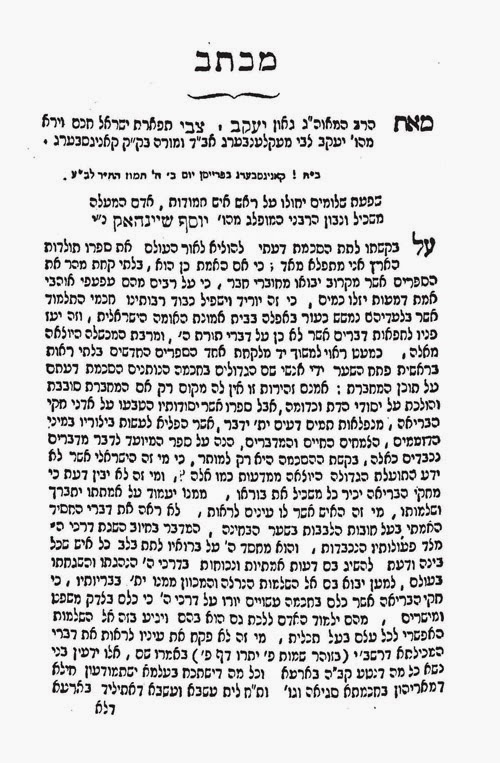
The first issue begins with an important announcement regarding the “new technology in the new land” that is a hot water heater and using it on Shabbat.  (Bet Va’ad vol. 1, 4).   Many important American (in addition to a few international) rabbis participated in the journal.  For example, R. Chaim Ozer Gordzinsky’s older cousin and with whom he studied, Zevi Hirsch the rabbi of Omaha, Nebraska, wrote a lengthy responsa regarding riding a bicycle on Shabbat.  He argues that the issue is carrying an object on Shabbat in a public space or even in a karmelit, but he identifies no other prohibition. (Bet Va’ad no. 5, Sivan 5663 [1903], 3-7).   Thus, it is unclear whether where there is eruv whether he would have permitted riding a bicycle.     The journal also includes a letter detailing the revolutionary production process of Manischewitz machine matzot and the various benefits of that process.  (Bet Va’ad, vol. 1 25-27). The letter is from the Chief Rabbi of Cincinnati because Manischewitz was originally founded in Cincinnati and only began production in the New York area in 1932 and shuttered its Cincinnati operations in 1958.[5]

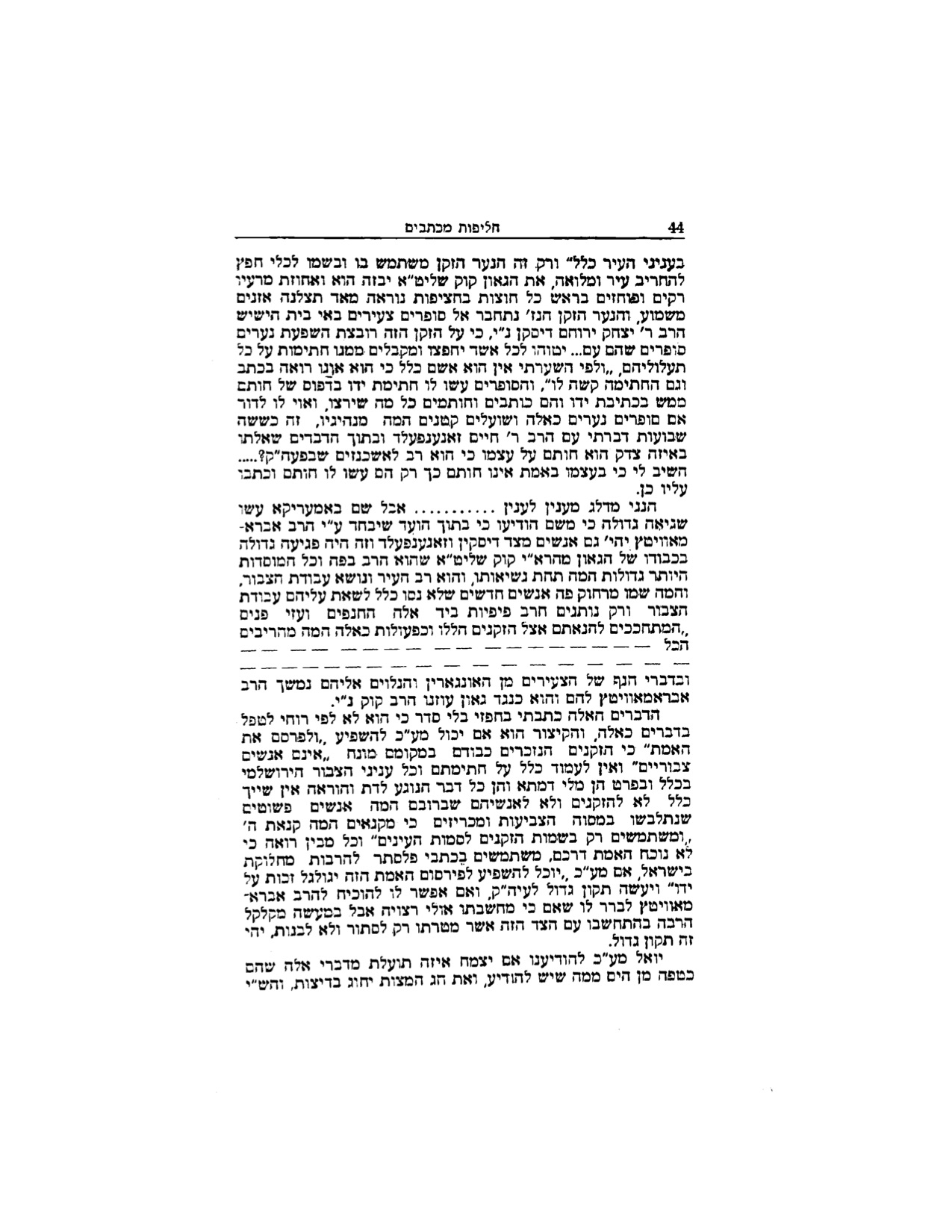
The first issue includes four letters discussing the use of electricity on Yom Tov and whether one can turn on and off electrical switches, R. Epstein’s is the first.  (Bet Va’ad, vol. 1, 1). Therein he argues that one can turn on electrical switches on Yom Tov.  He identifies the issue of nolad or creating something as potentially prohibiting the action but concludes that one is merely connecting the circuits and nothing new is created.  But he caveats his responsum with the disclaimer that electricity is uncommon in Novogrudok and his opinion is based upon his best efforts to understand electricity. Indeed, R. Shlomo Zalman Aurbach refers to R. Epstein’s responsum as containing “devarim tmuhim” and explained that they are a product of a faulty understanding of the technology.(Shlomo Zalman Aurbach, Me’orei Or (Jerusalem, 1980), appendix). Lot 85, includes this volume as well as the second issue.

R. Epstein was not alone in permitting electricity on Yom Tov, indeed, the other three letters in Bet Vaad similarly permit electricity. Other contemporary rabbis also rule in favor of electricity.

Nonetheless, those are minority views and today the common Orthodox practice is to refrain from turning on and off electrical switches.  When the publishers of R. Epstein’s writings were deciding what to include in Kol Kitvei, they approached R. Chaim Kanievsky and asked whether they should exclude R. Epstein’s responsum regarding electricity.  Presumably, they were concerned that one of the greatest halkhic authorities of the late 19th and early 20th centuries permitted what is “established” law to the contrary (despite the other opinions). But R. Kanievsky rejected that position and held that the responsum should be reprinted.[6]

Another example of Americana and the use of fire on Yom Tov appears in one of the first haggadot printed in the United States.  The 1886 illustrated Haggadah contains a depiction of the four sons.  Depicting the four sons is very common in the illustrated manuscripts and printed haggadot. In this instance, the wicked son’s disdain for the seder proceedings shows him leaning back on his chair and smoking a cigarette. According to many halakhic authorities, smoking is permitted on Yom Tov, nonetheless, the illustration demonstrates that at least in the late 19th-century smoking was not an acceptable practice in formal settings. (For a discussion of smoking on Yom Tov, see R. Shlomo Yosef Zevin, Mo’adim be-Halakha (Jerusalem:  Mechon Talmud Hayisraeli, 1983), 7-8).


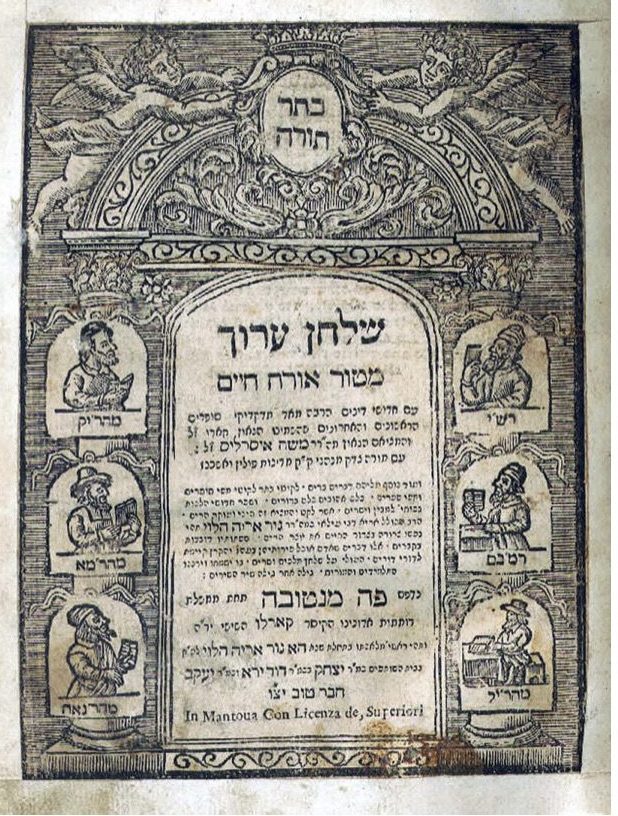
One of the other lots that also implicates illustration is lot 94, Shulhan Orakh im Pirush Gur Areyeh, Mantua, 1722, that contains the commentary of R. Yosef ben Ephraim Gur Areyeh Halevi.  As we have previously discussed at the end of this post, the Gur Areyeh’s title page to the first volume depicts six relevant personalities, Rashi, Rambam, MahaRIL, R Yosef Karo, R. Moshe Isserles, and R. Gur Areyeh.  According to some accounts, this illustration roused the ire of some rabbis because they felt the depictions were crude, and in some instances seem to show at least one rabbi in violation of Jewish law.  Allegedly, they claim that the Rambam is shown with insufficient peyot (sidelocks) in addition to long hair (as do others).  Thus in the remaining volumes of this edition, the illustrations were removed and they no longer appear (although at least in one preserved copy the illustration is repeated in the Yoreh De’ah volume).


One lot, # 161, is an incredible discovery: R. Yosef Dov Halevi Soloveitchik’s (Bet Halevi) copy of the Halakhot Gedolot (BeHaG).  This copy contains hundreds of unpublished glosses, citations, and cross-references. This copy establishes that the Netziv was not the only Rosh Yeshivah of Volozhin who was involved in the works of the Geonim. One only can hope that whoever purchases this copy will publish the notes.

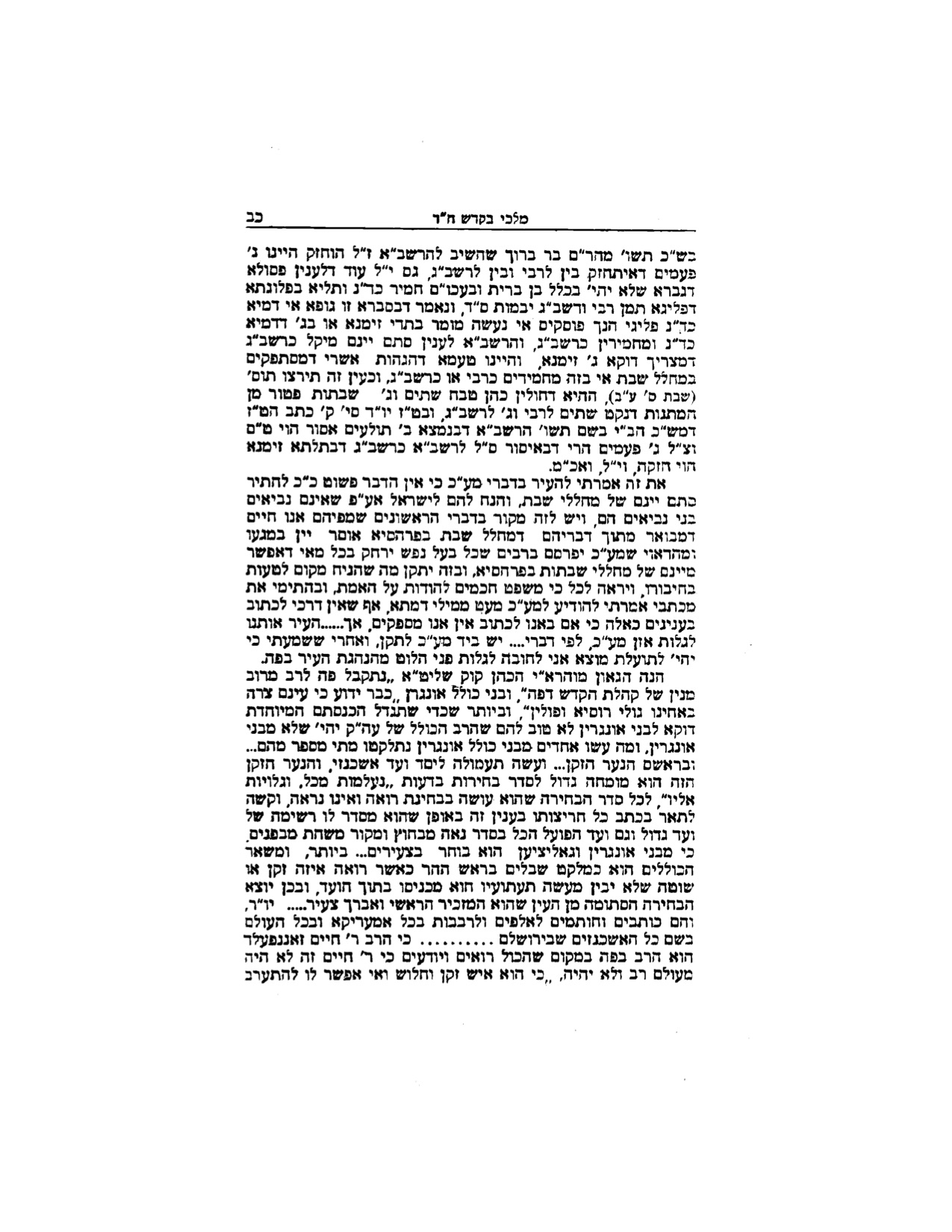
Another such item is # 87 is a presentation copy of Derishat Tzion that contains the commentary of R’ Tzvi Pesach Frank. Although not noted in the description R. Frank presented this copy to R’ Chaim Hirschenson.  In his Shut Malkei Bakodesh,(4:10) R’ Hirschsenson prints a very interesting letter from R Frank after he received a copy of one of R. Hirschenshon’s book. R Frank took issue with some of R. Hirschenshon’s conclusions and to his credit, he prints it without censoring it. The book being auctioned might have been a gift from R Frank in return for the gift he received. R. Frank’s letter is full of fascinating contemporary descriptions of Jerusalem.

Finally, for a discussion regarding lot 93, Menukha ve-Kedusha and censorship see our post here.

[1] See, for example, Yakkov Shmuel Speigel, Amudim be-Tolodot Sefer ha-Ivri:  Ketivah veha-Atakah (Ramat Gan:  Bar Ilan University Press, 2005), 241-97; Marc Shapiro, Changing the Immutable:  How Orthodox Judaism Rewrites History (Oxford:  Littman Library of Jewish Civilization, 2015), 81-118.

[2] For a biography see R. Eitam Henkin, Tarokh le-fani Shulkhan (Jerusalem:  Maggid, 2019).  Regarding this book see our discussion here.

[3] Yosef Goldman, Hebrew Printing in America 1735-1926:  A History and Annotated Bibliography (Brooklyn:  [YG Books], 2006), vol. 1, no. 584, 514. See our reviews of Goldman’s bibliography here and here.

[4] Goldman, Hebrew Printing, no. 591, vol. 1, 521.

[5] See generally, Yossi Goldman, vol. 1, no. 591, 520-21.  Bet Vaad contains materials beyond responsa and halakhic discussions, including poetry, discussions regarding Jewish life in America such as yeshivot, restaurants, and a fable written in verse.

For a discussion of Manischewitz, see Jonathan D. Sarna, “How Matzah Became Square: Manischewitz and the Development of Machine-Made Matzah in the United States,” in Rebecca Kobrin, ed., Chosen Capital: The Jewish Encounter with American Capitalism (New Brunswick: Rutgers University Press, 2012), 272-288; Jonathan D. Sarna, How Matzah Became Square: Manischewitz and the Development of Machine-Made Matzah in the United States (New York: Touro College, 2005).

[6] Regarding the position that seeks to portray Orthodox Judaism a monolithic halakhic process and view as legitimate only certain opinions see Adiel Schremer, Ma’ase Rav: Shekul ha-Da’at ha-Halakhati ve-Eytsuv ha-Zehut ha-Yahadut (Ramat Gan:  Bar Ilan University Press, 2019), 191-97.


Marc B. Shapiro – Responses to Comments and Elaborations of Previous Posts III

Responses to Comments and Elaborations of Previous Posts III
by Marc B. Shapiro

This post is dedicated to the memory of Rabbi Chaim Flom, late rosh yeshiva of Yeshivat Ohr David in Jerusalem. I first met Rabbi Flom thirty years ago when he became my teacher at the Hebrew Youth Academy of Essex County (now known as the Joseph Kushner Hebrew Academy; unfortunately, another one of my teachers from those years also passed away much too young, Rabbi Yaakov Appel). When he first started teaching he was known as Mr. Flom, because he hadn’t yet received semikhah (Actually, he had some sort of semikhah but he told me that he didn’t think it was adequate to be called “Rabbi” by the students.) He was only at the school a couple of years and then decided to move to Israel to open his yeshiva. I still remember his first parlor meeting which was held at my house. Rabbi Flom was a very special man. Just to give some idea of this, ten years after leaving the United States he was still in touch with many of the students and even attended our weddings. He would always call me when he came to the U.S. and was genuinely interested to hear about my family and what I was working on. He will be greatly missed.
1. In a previous post I showed a picture of the hashgachah given by the OU to toilet bowl cleaner. This led to much discussion, and as I indicated, at a future time I hope to say more about the kashrut industry from a historical perspective.[1] I have to thank Stanley Emerson who sent me the following picture.
It is toilet bowl cleaner in Israel that also has a hashgachah. Until Stanley called my attention to this, I was bothered that the kashrut standards in the U.S. had surpassed those of Israel. I am happy to see that this is not the case. (In fact, only in Israel can one buy a package of lettuce with no less than six (!) different hashgachot. See here)
But in all seriousness, I think we must all be happy at the high level of kashrut standards provided by the OU and the other organizations. This, of course, doesn’t mean that we have to be happy with what has been going on at Agriprocessors. I realize that this is a huge contract, but it was very disappointing to see that the first response of the OU to the numerous Agriprocessors scandals, beginning with the PETA video, has been to circle the wagons and put out the spin. Any changes from the OU only came after public outrage, and if the hashgachah is eventually removed from Agriprocessors, it will once again be due to this outrage. To be sure, we no longer can imagine cases of meat producers locking the mashgiach in the freezer,[2] but it does seem that the company was being given pretty free reign in areas where the hashgachah could have been using more of its influence. (Let’s not forget that Agriprocessors needs the OU more than the reverse.) At the very least, we need some competition in the glatt kosher meat business. Agriprocessors has a near monopoly and as we all know, competition is what forces businesses to operate at a higher standard.
In fact, the entire glatt kosher “standard” should be done away with and turned into an option for those who wish to be stringent. This has recently been tried in Los Angeles, with the support of local rabbis, but I don’t know how successful it has been. The only way this can happen on a large scale is if the OU once again starts certifying non-glatt. The masses have been so brainwashed in the last twenty years that they will not eat regular kosher unless it has an OU hashgachah. There is no good reason – there are reasons, but they aren’t good – why the OU does not certify non-glatt. As is the case with the Chief Rabbinate in Israel, the OU should certify both mehadrin (glatt) and non-mehadrin.
It might be that people in Teaneck and the Five Towns don’t feel the bad economic times. Yet there are many people who are having difficulty making ends meet. It is simply not fair to create a system where people are being forced to pay more money for meat than they should have to. The biggest problem Orthodoxy faces, and the factor that makes it an impossible lifestyle for many who would otherwise be drawn to it, is the enormous costs entailed. Anything we can do to lower this burden, even if it is only a couple of hundred dollars a year–obviously significantly more for communal institutions–should be done.
Returning to Agriprocessors, while the current issue focuses on the treatment of workers, the problem of a couple of years ago focused on the treatment of animals. Yet the two should not necessarily be seen as so far apart. According to R. Joseph Ibn Caspi (Mishneh Kesef [Pressburg, 1905], vol. 1, p. 36), the reason the Torah forbids inflicting pain on animals is “because we humans are very close to them and we both have one father”! This outlook is surprising enough (and very un-Maimonidean), but then he continues with the following incredible statement: “We and the vegetables, such as the cabbage and the horseradish, are brothers, with one father”! He ties this in with the command not to cut down a fruit tree (Deut. 20:19), which is followed by the words כי האדם עץ השדה. This is usually understood as a question: “for is the tree of the field man [that it should be besieged of thee?] Yet Caspi understands it as a statement, and adds the following, which together with what I have already quoted from him will make the Jewish eco-crowd very happy.
כי האדם עץ השדה (דברים כ’ י”ט), כלומר שהאדם הוא עץ השדה שהוא מין אחד מסוג הצמח כאמרו כל הבשר חציר (ישעיה מ’ ו’) ואמרו רז”ל בני אדם כעשבי השדה (עירובין נד ע”א)
Finally, in Rabbi Shmuel Herzfeld’s op-ed on Agriprocessors in the New York Times (see here) he wrote as follows: “Yisroel Salanter, the great 19th-century rabbi, is famously believed to have refused to certify a matzo factory as kosher on the grounds that the workers were being treated unfairly.” Herzfeld was attacked by people who claimed that there is no historical source to justify this statement. While the story has been garbled a bit, the substance indeed has a source. I refer to Dov Katz, Tenuat ha-Mussar, vol. 1, p. 358. Here R. Yisrael Salanter is quoted as saying that when it comes to the production of matzah, one must not only be concerned with the halakhot of Pesah, but also with the halakhot of Hoshen Mishpat, i.e., that one must have concern for the well-being of the woman making the matzah.
אין כשרות המצות שלמה בהידוריהן שבהלכות פסח לבד, כי אם עם דקדוקיהן גם בדיני חשן משפט
2. In my previous post I wrote: “With regard to false ascription of critical views vis-à-vis the Torah’s authorship, I should also mention that Abarbanel, Commentary to Numbers 21:1, accuses both Ibn Ezra and Nahmanides of believing that the beginning verses of this chapter are post-Mosaic. Yet Abarbanel must have been citing from memory, since neither of them say this. In fact, Ibn Ezra specifically rejects the notion that the verses were written by Joshua.” I made a similar point in Limits of Orthodox Theology, p.106 n. 102.
I looked at Abarbanel again and would like to revise what I wrote. I don’t think it is correct to say that Abarbanel was citing from memory, since he quotes Nahmanides’ words. With regard to Ibn Ezra, I now assume that Abarbanel thinks Ibn Ezra is being coy. In other words, although Ibn Ezra cites a view held by “many” that Joshua wrote the beginning of Numbers 21, and then goes on to reject this view, Abarbanel doesn’t trust Ibn Ezra. He thinks that Ibn Ezra really accepts the “critical” view. I see absolutely no evidence for this. Ibn Ezra has ways to hint to us when he favors a critical view, and he never does so with this section. Furthermore, I am aware of no evidence that the “many” who hold the critical view are Karaites, as is alleged by Abarbanel.
What led Abarbanel to accuse Nahmanides of following Ibn Ezra in asserting that there are post-Mosaic verses in Numbers 21? As with Ibn Ezra, Abarbanel sees Nahmanides as hiding his critical view and only hinting to it. Numbers 21:3 reads: “And the Lord hearkened to the voice of Israel, and delivered up the Canaanites; and they utterly destroyed them and their cities; and the name of the place was called Hormah.” Yet as Nahmanides notes, it is in Judges 1:17 that we see the destruction of the Canaanites and the naming of the city Hormah. How, then, can the city be called Hormah in Deuteronomy when it won’t be conquered and named for many years?
Nahmanides writes that the Torah here is relating “that Israel also laid their cities waste when they came into the land of Canaan, after the death of Joshua, in order to fulfill the vow which they had made, and they called the name of the cities Hormah.” In other words, the Torah is describing an event, including the naming of a place, which will only take place a number of years later. This event is described in the book of Judges. The verse in Numbers is written in the past tense, which would seem to render Nahmanides’ understanding problematic. Yet as Chavel points out in his notes to his English edition, this does not concern Nahmanides. “Since there is no difference in time for God, it is written in the past tense, for past, present, and future are all the same to Him.”
This is certainly true with regard to God, but what about the Children of Israel? How are they supposed to read a section of the Torah that speaks about an event as having happened in the past but which in reality has not yet even taken place? These are problems that the traditional commentators deal with, but Abarbanel sees Nahmanides as departing from tradition and offering a heretical interpretation. He is led to this assumption because Nahmanides uses the ambiguous words “Scripture continued” and “Scripture, however, completed the account.” Why didn’t Nahmanides say that Moses wrote this? It must be, according to Abarbanel, that Nahmanides is hinting that this was written down after Moses’ death. In Abarbanel’s words:
כי הרב כסתה כלימה פניו לכתוב שיהושע כתב זה. והניח הדבר בסתם שהכתוב השלימו אבל לא זכר מי היה הכותב כיון שלא היה משה עליו השלום והדעת הזה בכללו לקחהו הראב”ע מדברי הקראים שבפירושי התורה אשר להם נמנו וגמרו שלא כתב זה מזה והרמב”ן נטה אחרי הראב”ע והתימה משלימות תורתו וקדושתו שיצא מפיו שיש בתורה דבר שלא כתב משה. והם אם כן בכלל כי דבר ה’ בזה.
From here, let me return for the third time to what some would see as an aspect of biblical criticism in Radak. To recap, in his commentary to I Sam. 4:1 Radak writes:
על האבן העזר: כמו הארון הברי’ והכותב אמר זה כי כשהיתה זאת המלחמה אבן נגף היתה ולא אבן עזר ועדיין לא נקראה אבן העזר כי על המלחמה האחרת שעשה שמואל עם פלשתים בין המצפה ובין השן שקרא אותה שמואל אבן העזר שעזרם האל יתברך באותה מלחמה אבל מה שנכתב הנה אבן העזר דברי הסופר הם וכן וירדף עד דן.
Dr. H. Norman Strickman convinced me that Radak means that the words “and pursued as far as Dan” are a later insertion, since the city was only named Dan after it was conquered in the days of Joshua (Joshua 19:47). In a comment to the post, Benny wrote:
There is no reason to assume that Radak is not referring to Moses prophetically writing the word Dan. It just means that in the time that the story took place, the name was not Dan. . . . I think that it is definitely possible that Radak understood that Moshe is the one who wrote “Et HaGilad Ad Dan”.
Dr. Yitzchak Berger wrote to me as follows:
I think the commenter ‘Benny’ was right about Radak’s view of Gen. 14:14. At I Sam 4:1 he’s probably merely contrasting the author-narrator’s [i.e. “sofer’s”–MS] perspective with that of the players in the story, concerning the phrases in both Samuel and Genesis (in the case in Samuel there would be no reason for him to introduce a later editor).”
As is often the case in these sorts of disputes, I find myself being moved by the last argument I hear. As I noted in the earlier post, Radak elsewhere insists on complete Mosaic authorship of the Pentateuch. Thus, it is certainly easier to read this text in a way that would not create a contradiction.
While on the subject of Mosaic authorship, let me also add the following. David Singer recently wrote an interesting article on Rabbi Emanuel Rackman.[3] With the recent passing of Rabbi Moses Mescheloff,[4] Rackman, born in 1910, might be the oldest living musmach of RIETS. If this is so, don’t expect this to be acknowledged in any way by the powers at YU.[5] The ideological winds have blown rightward in the last thirty years, and Rackman has moved leftward. He is thus no longer regarded as representative of RIETS or worthy of any acknowledgment.[6]

A similar thing happened at Hebrew Theological College in Skokie. Rabbi Eliezer Berkovits (died 1992) was, in my opinion, the most significant and influential person ever to teach on its faculty. (Unfortunately, they didn’t let him teach Talmud, only philosophy.) Yet not only does HTC currently have no interest in recognizing him, in 2001, some eighteen years (!) after the appearance of Not in Heaven, a very negative review appeared in the Academic Journal of Hebrew Theological College.[7] To show how insignificant Berkovits is in Skokie, neither the author, Rabbi Chaim Twerski, nor any of the editors, realized that his last name is not spelled Berkowitz! Were he alive today, can anyone imagine that HTC would allow him to speak? (It would be interesting to create a list of people who founded or taught at institutions and today would be persona non grata there. A few come to mind, and for now let me just mention R. Zev Gold, the outstanding Mizrachi leader who was one of the founders, and first president, of Yeshiva Torah Vodaas. Gold, who was also a rabbi in Scranton, was one of the signers of Israel’s declaration of independence.[8])
Some people pointed out that in Twerski’s negative review, Berkovits is never even referred to as Rabbi, only as Dr. (A cynic might add that in his zeal to use the title “Dr.” instead of “Rabbi” for those he doesn’t approve of, Twerski even gives R. Judah Leib Maimon a doctorate, referring to him as Dr. Maimon.) In the following issue, Twerski apologizes for any disrespect, noting that while some people took offense at how he referred to Berkovits, others “who know [!] him well have told me that he always preferred to be addressed as ‘Dr. Berkovits.'” I think this is a fair response. After all, would anyone criticize an author for referring to “Dr. Lamm”? Yet I must also say that someone reading the article will not learn that Berkovits was a great talmudic scholar, and I don’t even know if Twerski recognizes this.
Returning to Singer, in his article he writes that Rackman accepted the Documentary Hypothesis. I discussed this issue with Rackman some years ago and this is definitely not what he told me. The most he would say was that he would not regard someone as a heretic if he accepted biblical criticism. Yet he personally was not a believer in the theory. In support of Singer’s assertion to the contrary, he quotes the following passage from Rackman: “The most definitive record of God’s encounters with man is contained in the Pentateuch. Much of it may have been written by people in different times, but at one point in history God not only made the people of Israel aware of his immediacy, but caused Moses to write the eternal evidence of the covenant between Him and His people.” He also quotes another statement by Rackman: “[T]he sanctity of the Pentateuch does not derive from God’s authorship of all of it, but rather from the fact that God’s is the final version. The final writing by Moses has the stamp of divinity – the kiss of immortality.”
Singer misunderstands Rackman. There is no Higher Criticism here, no Documentary Hypothesis. What Rackman is saying is that the stories in the Pentateuch might have been recorded by various people before Moses, but that these stories were later included in the Torah at God’s command, with Moses being the final author. In both of these passages Rackman is explicit that the Torah was written by Moses. Rackman’s position in these quotations is very traditional, asserting that all that appears in the Torah is Mosaic. With this conception it doesn’t matter if, for example, the stories of Noah or the Patriarchs had earlier written versions passed down among the Israelites, since what makes them holy and part of the Torah is God’s command to Moses that they be included in the Holy Book. This was done by Moses’ “final writing.” I can’t see anyone, even the most traditional, finding a problem in this.
While on the subject of Rackman, let me make a bibliographical point. R. Moshe Feinstein, Iggerot Moshe, Yoreh Deah IV, no. 50:2 refers to:
המאמרים של רב אחד שמחשבים אותו לרב ארטאדקאקסי שנדפסו בעיתון שבשפת אנגלית . . . והנה ראינו שכולם דברי כפירה בתורה שבעל פה המסורה לנו.
R. Moshe goes on to further attack the heresy of this unnamed rabbi, who is none other than Rackman. This can be seen by examining Ha-Pardes, May 1973, p. 7, where R. Moshe’s letter first appeared. It is not a private communication but is described as coming from Agudat ha-Rabbonim of the United States and Canada, and R. Moshe signs as president of the organization. Earlier in this issue (it is the lead article) and also in the April 1973 Ha-Pardes, R. Simhah Elberg published his own attack on Rackman, referring to him as ראביי ר. Elberg refers to Rackman’s articles which appeared regularly in the American Examiner, and which so agitated the haredim – and also many of the centrist Orthodox. This paper then joined with the Jewish Week, and became known as the Jewish Week and American Examiner. Rackman continued to publish in the paper until around 2001. (His article discussing my biography of Weinberg was one of the last ones he would write, and it is reprinted in the second edition of One Man’s Judaism [Jerusalem, 2000], pp. 402-404.)
3. Many people were interested in the claim, quoted in an earlier post, that rabbis turned over their own children to become soldiers if these children were no longer observant. If something like this ever happened it would have been very heartless, and there were, of course, many children of gedolim who became non-religious. While in some cases the child choosing a different path led to estrangement with his father, in others, father and son remained close, and I think today everyone realizes that this is the only proper approach to take.
R. Jehiel Jacob Weinberg thought that it might be a good idea for a father to attend his son’s intermarriage, in order not to break ties completely. (Believe it or not, this statement was published in Yated Neeman.) Yet to see how different things were in years past, at least among some parts of our community, consider the following responsum by the important Hungarian posek, R. Jacob Tenenbaum.[9] The case concerned an Orthodox shochet whose son went to the בית האון (This means the non-Orthodox rabbinical seminary in Budapest, against which the Orthodox rabbis carried on a crusade.) The problem was that during his vacations the son came home to his parents’ house. Tenenbaum was asked if this meant that the shochet was disqualified and could no longer serve the community. The father pleaded that he loved his son, and Tenenbaum replied that התנצלות זה הוא הבל. Tenenbaum also rejected the father’s claim that if he doesn’t show love to his son, the latter will go even further “off the derech.”
Tenenbaum demanded that the father make a complete break with his son (that is, if the father wanted to be regarded as a Jew in good standing). The choice was clear: The father had to decide between loving his son and making a living (for if chose the former he would be blacklisted throughout the country):
ואם אביו יתן לו מקום בביתו או יתמכהו באיזה דבר בזה יגלה דעתו שגם בו נזרקה מינות [!] ובזה אין חילוק בין שו”ב לאיש אחר . . . אם יחזיק ידו או יתן לו מקום בביתו הנה ידו במעל הזה אשר בנו פנה עורף לדת ה’ ועל כן צא טמא יאמר לו, ושלא יוסיף עוד ראות פניו אם לא ישמע לדבריו לעזוב דרך רשע.
I know this sounds like a Hungarian extremist approach, but R. Kook had basically the same viewpoint. In Da’at Kohen no. 7, he too is asked about a shochet whose non-religious sons live at home. R. Kook replies that while technically the actions of the sons do not destroy the hezkat kashrut of the father, nevertheless, the matter is very distasteful (מכוער). Even if the father could not be blamed at all in this matter, nevertheless, it is a hillul ha-shem. Since the beit din has the power to legislate in matters beyond the strict law, “there is no migdar milta greater than this.” He explains the reason for his uncompromising viewpoint:
שלא ילמדו אחרים להפקירות עוד יותר, כשרואין שבניו של השו”ב הקבוע הם מחללים ש”ק, ע”כ לע”ד ברור הדבר, שכ”ז שבניו הם סמוכין על שולחנו, ואין פוסקין מחילול ש”ק, איננו ראוי להיות שו”ב קבוע, ומה גם בעדה חרדית.
If this is said about a shochet, how much more would it apply to a rav of a community. It is therefore easy to understand why non-religious children of some well-known rabbis are no longer welcome in their parents’ home. (Other well-known rabbis have a completely different outlook, and reject what they would categorize as the conditional-love approach of Rabbis Tenenbaum and Kook).
4. Since I have mentioned R. Jehiel Jacob Weinberg a few times, I must call attention to something that was pointed out to me by Rabbi Chaim Miller. Miller might be known to some readers for his wonderful editions of the Chumash and Haggadah with a commentary based on writings of the Lubavitcher Rebbe. He has also published the first volume of a multi-volume work on the Thirteen Principles.[10]
I have often been asked if Weinberg gave semikhah to the Lubavitcher Rebbe. There is such a story yet I always found it suspicious that it was never mentioned in the Rebbe’s lifetime. Furthermore, Weinberg never mentions this in his letters. (He does mention that R. Yosef Yitzhak Schneersohn loved him.) So when asked, I always replied that I didn’t believe the story to be correct, as there is no evidence. In fact, I thought that the story was created as a clever way of giving the Rebbe semikhah. There is no record of him receiving semikhah before he arrived in Germany or after he left, so it made sense to have him receive it during his time in Berlin. Once you assume that the semikhah is received in Berlin, who better than Weinberg to give it to the Rebbe? Yet I always assumed that that this was a legend and wondered if the Rebbe even had semikhah.
Rabbi Miller called my attention to the new book, Admorei Habad ve-Yahadut Germanyah, pp. 103ff., where R. Avraham Abba Weingort, who is completely trustworthy (and far removed from Habad), records the testimony of two other reliable people from Switzerland who knew Weinberg well. Although there is probably some exaggeration in the details of the story they tell, they report being told by Weinberg that he indeed gave semikhah to the Rebbe, and the circumstances of how this came about (including requiring that the Rebbe come to some of his shiurim at the Berlin Rabbinical Seminary).[11] I can now better understand why the Rebbe’s contact information given to the University of Berlin was the address of the Berlin Rabbinical Seminary.[12] From now on, whenever I am asked if the Rebbe received semikhah from Weinberg, I will reply yes.
5. In recent years a few volumes from the writings of R. Yehudah Amital have been translated into English, allowing many new people to be exposed to his thoughts. Here is a provocative passage from his newest volume, Commitment and Complexity: Jewish Wisdom in an Age of Upheaval, p. 48:
We live in an era in which educated religious circles like to emphasize the centrality of Halakha, and commitment to it, in Judaism. I can say that in my youth in pre-Holocaust Hungary, I didn’t hear people talking all the time about “Halakha.” People conducted themselves In the tradition of their forefathers, and where any halakhic problems arose, they consulted a rabbi. Reliance on Halakha and unconditional commitment to it mean, for many people, a stable anchor whose purpose is to maintain the purity of Judaism, even within the modern world. To my mind, this excessive emphasis of Halakha has exacted a high cost. The impression created is that there is nothing in Torah but that which exists in Halakha, and that in any confrontation with the new problems that arise in modern society, answers should be sought exclusively in books of Halakha. Many of the fundamental values of the Torah which are based on the general commandments of “You shall be holy” (Vayikra 19:2) and “You shall do what is upright and good in the eyes of God” (Devarim 6:18), which were not given formal, operative formulation, have not only lost some of their status, but they have also lost their validity in the eyes of a public that regards itself as committed to Halakha.
This reminds me of the quip attributed to Heschel that unfortunately Orthodox Jews are not in awe of God, but in awe of the Shulhan Arukh. In truth, Heschel’s point is good hasidic teaching, and R. Jacob Leiner of Izbica notes that one can even make idols out of mitzvot.[13] He points out that the Second Commandment states that one is prohibited from making an image of what is in the heavens. R. Jacob claims that what the Torah refers to as being in the heavens is none other than the Sabbath. The Torah is telling us that we must not turn it into an idol. In this regard, R. Jacob cites the Talmud: “One does not revere the Sabbath but Him who ordered the observance of the Sabbath.”[14]
I believe that the “halakho-centrism” that Amital criticizes has another pernicious influence, and that is the overpopulation of “halakhic” Jews who have been involved in all sorts of illegal activities. A major problem we have is that it is often the case that all sorts of halakhic justifications can be offered for these illegal activities. One whose only focus in on halakhah, without any interest in the broad ethical underpinnings of Judaism, and the Ramban’s conception of Kedoshim Tihyu, can entirely lose his bearings and turn into a “scoundrel with Torah license.” The Rav long ago commented that halakhah is the floor, not the ceiling. One starts with halakhah and moves up from there. Contrary to what so many feel today, halakhah, while required, is not all there is to being a Jew, and contrary to what so many Orthodox apologists claim, halakhah does not have “all the answers.” One of the most important themes in Weinberg’s writings is the fact that there are people in the Orthodox community who, while completely halakhic, are ethically challenged.
Since I already mentioned Rabbi Rakow, let me tell a story that illustrates this. I went to Gateshead to interview him about his relationship with Weinberg. When I got there I had a few hours until our meeting so I paid a visit to the local seforim store. I found a book I wanted and asked the owner how much it cost. He gave me a price, and then added that if I was a yeshiva student there was a discount. When I later met with Rakow I asked him if it would have been OK for me to ask one of the yeshiva students to buy the book at discount, and then I could pay him for it. He replied that there was certainly no halakhic problem involved. After all, the first student acquires the book through a kinyan and then I buy it from him. But he then added: “Yet it would not be ethical.”

Weinberg’s concerns in this area were not merely motivated by the distressing phenomenon of halakhically observant people who showed a lack of ethical sensitivity. His problem was much deeper in that he feared that this lack of sensitivity was tied into the halakhic system itself. In other words, he worried that halakhah, as generally practiced, sometimes led to a dulling of ethical sensitivity. Weinberg saw a way out of this for the enlightened souls, those who could walk the middle path between particularist and universal values. Yet in his darkest moments he despaired that the community as a whole could ever reach this point. This explains why he esteemed certain Reform and other non-Orthodox figures. Much like R. Kook saw the non-Orthodox as providing the necessary quality of physicality which was lacking among the Orthodox, Weinberg appreciated the refined nature of some of the non-Orthodox he knew and lamented that his own community was lacking in this area. It was precisely because of his own high standards that he had so little tolerance for ethical failures in the Orthodox community. Weinberg’s sentiments, which focused on inner-Orthodox behavior, were not motivated by fear of hillul ha-shem. It was simply an issue of Jews living the way they are supposed to. [15]

In his opposition to halakho-centrism, Amital finds a kindred spirit in R. Moses Samuel Glasner and cites the latter with regard to the following case. What should someone do if he has no food to eat, except non-kosher meat and human flesh. From a purely halakhic standpoint, eating non-kosher meat, which is a violation of a negative commandment, is worse than cannibalism. The latter is at most a violation of a positive commandment (Maimonides) or a rabbinic commandment according to others.[16] Yet Glasner sees it as obvious that one should not eat the human flesh, even though this is what the “pure” halakhah would require, for there are larger values at stake and the technical halakhah is not the be-all and end-all of Torah.[17]
Glasner writes as follows in his introduction to Dor Revi’i:
כל מה שנתקבל בעיני בני אדם הנאורים לתועבה, אפילו אינו מפורש בתורה לאיסור, העובר על זה גרע מן העובר על חוקי התורה . . . ועתה אמור נא, בחולה שיש בו סכנה ולפניו בשר בהמה נחורה או טרפה ובשר אדם, איזה בשר יאכל, הכי נאמר דיאכל בשר אדם שאין בו איסור תורה אע”פ שמחוק הנימוס שמקובל מכלל האנושי, כל האוכל או מאכיל בשר אדם מודח מלהיות נמנה בין האישים, ולא יאכל בשר שהתורה אסרו בלאו, היעלה על הדעת שאנו עם הנבחר עם חכם ונבון נעבור על חוק הנימוס כזה להינצל מאיסור תורה? אתמהה!
In other words, the Torah has an overarching ethos (Natural Law?) which is not expressed in any specific legal text, and this can sometimes trump explicit prohibitions.[18]
Glasner has another example of this: Someone is in bed naked and a fire breaks out. He can’t get to his clothes and has two choices: He can run outside naked or put on some women’s clothes. The pure halakhic perspective would, according to Glasner, require him to go outside naked, since there is no biblical violation in this. But Glasner rejects this out of hand:
ובעיני פשוט הדבר דלצאת ערום עברה יותר גדולה . . . כי היא עברה המוסכמת אצל כל בעלי דעה, והעובר עליה יצא מכלל אדם הנברא בצלם אלוקים.
While I don’t know if the Rav would agree with Glasner, he too acknowledged that ethical concerns are a part of halakhic determination, meaning that not everything is “pure” halakhah. “Since the halakhic gesture is not to be abstracted from the person engaged in it, I cannot see how it is possible to divorce halakhic cognition from axiological premises or from an ethical motif.” Yet he adds: “Of course, in speaking of an ethical moment implied in halakhic thinking, I am referring to the unique halakhic ethos which is another facet of the halakhic logos.”[19] I wonder, though, if the approach set out here stands in contradiction to how, in his famous essay, he portrays the Halakhic Man’s mode of thinking. Would Halakhic Man, whose values arise exclusively from the halakhic system, be able to write the following, which acknowledges a significant subjective element?
Before I begin the halakhic discussion of the subject matter I wish to make three relevant observations . . . I cannot lay claim to objectivity if the latter should signify the absence of axiological premises and a completely detached attitude. The halakhic inquiry, like any other cognitive theoretical performance, does not start out form the point of absolute zero as to sentimental attitudes and value judgments. There always exists in the mind of the researcher an ethico-axiological background against which the contours of the subject matter in question stand out more clearly. . . . Hence this investigation was also undertaken in a similar subjective mood. From the very outset I was prejudiced in favor of the project of the Rabbinical Council of America and I could not imagine any halakhic authority rendering a decision against it. My inquiry consisted only in translating a vague intuitive feeling into fixed terms of halakhic discursive thinking.[20]
How often have I seen Orthodox polemicists criticize this very approach?
Finally, with regard to the issue of cannibalism mentioned above, let me point to one more relevant source (I can’t resist). In a previous post I mentioned that since every topic in halakhah has been dealt with in such detail, scholars today have to find new areas to focus on. Because of this, large books constantly appear about all sorts of things that are found in the sources, but to which no one ever gave much thought in previous years. The example I gave was an entire book dealing with the halakhot of sex change operations. The halakhot of cannibalism is one of the last areas which hasn’t yet been given a book-length treatment. However, R. Yosef Aryeh Lorincz has recently published Pelaot Edotekha.[21] The author is a rosh kollel whose previous book won an award from the municipality of Bnei Brak (see here). He is also the son of Shlomo Lorincz, one of the elders of haredi politics. He raises the following question (before reading any further, make sure the digitalis is in easy reach): Is it permitted to eat the flesh and drink the blood of demons?! Let me quote some of what he says on the topic:
יש לעיין באותם השדים שיש להם דמות אדם ומתו מה דין בשרם ודמם האם אסורים באכילה, דפשוטו אינם אדם וגם אינם בהמה אלא בריה בפנ”ע ולא מצינו שאסרה תורה לבשר ודם דשדים, אולם להאמור לעיל דשד הוה מקצת אדם, א”כ הוה כעין חצי שעור ואסורים באכילה, עוד יש לעיין אם בשרו ודמו יש להם טומאה כמת עכו”ם, ואם אסורים בהנאה לשיטות דמת עכו”ם אסור בהנאה.
Whatever you may think about hashgachot on candles and toilet bowl cleaner, I am fairly certain that even if Lorincz can prove that demon’s flesh and blood is kosher, none of the kashrut organizations will be rushing to add their symbol to this product. But in all seriousness, I know that I am not the only one who thinks that it is very unfortunate that we have Torah scholars spending time on this sort of thing.
6. I have been asked to say something about the current conversion controversy. The halakhic problems will be sorted out by the poskim, but let me make a few comments about the historical issue. There have been a number of people who have stated that the lenient approach often associated with R. Uziel is a singular opinion, or that this view was original to him. That this is mistaken can be seen by anyone who examines Avi Sagi’s and Zvi Zohar’s book Giyur u-Zehut Yehudit. In fact, throughout most of Jewish history a lenient approach to conversion was the mainstream approach.
Now it is true that R. Herzog famously states that in earlier times one could be more lenient than today, because in a traditional society when someone converted he was immediately part of a community and was required to be observant.[22] Things are very different today when you can convert and move to a secular neighborhood in Tel Aviv. There is no communal pressure for you to be observant, and the convert can look around and see that the leaders of the Jewish people in Israel, Peres, Olmert and Livni, are not religious. In such a world, R. Herzog didn’t think we could rely on certain leniencies used in the past.

However, despite R. Herzog’s opinion, the lenient approach, which didn’t insist on a convert’s complete observance of mitvot remained popular in modern times. (Contrary to what has often been stated, the lenient approach, and this includes R. Uziel, always insisted on kabbalat mitzvot. The dispute concerns what “kabbalat mitzvot” means, and whether a formal acceptance, without inner conviction, is sufficient.) Until recent years the lenient approach was even a mainstream position, alongside the more stringent (and widespread) approach. Among the adherents of the lenient approach one must mention R. David Zvi Hoffmann, who was the final halakhic authority in Germany until his death in 1921. Almost every Orthodox rabbi in that country, and many in other parts of Western Europe, looked to him as their authority. Others who held this position include R. Unterman and R. Goren. In addition, the Israeli Chief Rabbinate batei din, which were full of haredi dayanim, until recently followed the lenient approach. Many non-Jews were converted in Israel by dayanim who knew perfectly well that these people were not going to live an Orthodox life. Some of them were even intent on marrying people who were living on secular kibbutzim.[23] No one ever challenged the validity of these conversions. The situation was similar in places outside of Israel. See R. Yitzhak Yaakov Weiss, Minhat Yitzhak, vol. 6, no. 107:
לצערנו הרב גם רבנים חרדיים ומומחים מגיירים כעין זה ומחשיבים אותה כבדיעבד.
Unlike what goes on today, in previous generations there were never any classes for future converts. In fact, according to R. Akiva Eger, these classes are improper, since one is not permitted to teach Torah to a non-Jew.[24] Now obviously, this is not the position we accept, but it does illustrate that in reality converts don’t need to know much about Judaism. R. Malkiel Zvi Tenenbaum writes similarly in dealing with a case from England where a man was with a non-Jewish woman and wanted to convert her. The man had stopped eating non-kosher and attended synagogue on Rosh ha-Shanah and Yom Kippur, but he was obviously not a completely observant Jew. Tenenbaum notes that even though it is possible that the only reason the woman is converting is so that she can remain with her husband–apparently she thought that this was in doubt due to his new religiosity– nevertheless, one should not be too exacting with her, other than telling her a few weighty and light mitzvot. This approach should be adopted because ex post facto the conversion will be fine, “and by doing this, we will save the Jew from living with her in a forbidden manner . . . but it is best that she learn everything [relating to Judaism] after she converts, and in particular in this case when we have to hurry to save the husband from sin.”[25]
Even R. Moshe Feinstein’s opinion regarding conversion is not uniform, and you can see changes in his view in the direction of leniency. But leaving that aside, although R. Moshe requires real kabbalat mitzvot, he acknowledges that a rejection of complete halakhic observance might not really be a rejection, because the person might not think that a particular law is really required. For example, what about a case where a woman converted in order to marry a Sabbath violator and was herself now a Sabbath violator? This is the exact sort of conversion that would be thrown out today. The fact that after the conversion she never observed Shabbat would suffice to show that there was no kabbalat mitzvot. Yet R. Moshe disagrees. He says that it depends on the woman’s mindset. In this case, perhaps she never intended on violating the halakhah, but she didn’t believe that Shabbat is really a law! And why should she, when she sees that most Jews don’t keep it? In R. Moshe’s words, she thought that observing Shabbat was hiddur be-alma, that is, something nice, but not required. This means that she never rejected the halakhah of Shabbat, she just didn’t know about it, and people are not required to know every halakhah before they convert. Therefore, R. Moshe concludes that the conversion is valid.[26] In another responsum,[27] R. Moshe explains that even if one rejects a particular mitzvah of the Torah, ex post facto the conversion is still valid:
ולכן צריך לומר שכיון שאיכא עכ”פ קבלת מצות אף שלא בכולן הוא גר ונתחייב בכולן אף שלא קבלם דהוה מתנה ע”מ שכתוב בתורה.
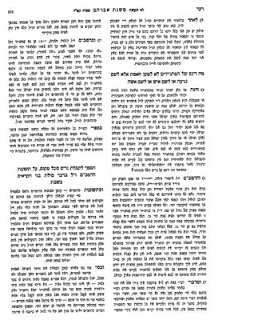
Anyone who reads responsa literature of the last hundred years often comes across cases where a man was intermarried and wanted to convert his wife, or wanted to convert his future wife. Often he had a child with the non-Jewish woman and wanted the child to be converted. A few different issues are discussed in these responsa, in particular nitan al ha-shifhah, but one thing you find very little discussion of is kabbalat mitzvot. The rabbis often give permission to convert the children even though the parents are not religious, and they give permission to convert the non-Jewish spouse even though there is no expectation that the person is going to lead a religious life. This obviously shows us that these rabbis had a different conception of conversion than what is today declared to be the only acceptable approach. Rabbi Yehudah Herzl Henkin[28] has recently called attention to Rabbi Abraham Price’s comments in this regard.[29] Price was the leading rav in Toronto, and he defends the lenient approach (which was being carried out all over the world). Yet today, these conversions would be thrown out. Here is the page from Price’s sefer.
In the recently published responsa of R. Eliezer David Rabinowitz-Teomim (the Aderet), Ma’aneh Eliyahu, no. 65, he discusses converting a Gentile who was involved with a Jewish woman. He raises the issue of whether it is proper to convert the man if he will not be observant. Even though the woman will be spared the sin of intermarriage, the man who is converted will now be violating the prohbitions of Niddah and Shabbat. This means that he was in a better place before he converted, as he was not obligated in these laws. The Aderet never assumes that the conversion won’t be valid because the man will be non-observant. Indeed, his entire responsum is based on the fact that it will be valid, which leads him to wonder if conversions like this are a good idea.
אם הם מדור החדש, וקרוב הדבר שלא תשמור לטבול בזמנה, ויחללו שבת, ויכשלו באיסור נדה החמורה, רחמנא ליצלן, ועוד ועוד, באופן כזה חלילה, צריך ישוב והתבוננות אם לטובלו לדת ישראל.
(There are many other responsa where halakhists show great annoyance that people who convert often don’t live a religious life, but very few of these halakhists mention anything about the conversions not being valid.)
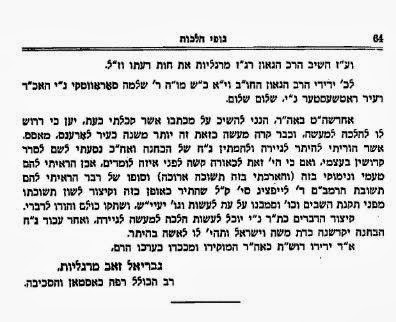
Here is another example that nicely illustrates what I am talking about. It has not been quoted in any of the numerous discussions of the issue and can be added to the lenient side. Yet as I indicated, there is nothing unusual in this case as the approach seen here was very popular. R. Shlomo Sadowsky was a rav in Rochester and in 1918 he published his sefer, Parparaot le-Hokhmah. On page 63 he discusses converting a non-Jewish woman who is married to a Jewish man. In this case, he turned to R. Gavriel Zev Margulies, one of the leading poskim in America. (Joshua Hoffman wrote a wonderful masters dissertation on him.) The decision is made to convert her, and there is no mention of authentic acceptance of mitzvot. The halakhic concern focuses on a different matter, and the two rabbis are guided by the desire to help the man get out of the sin of intermarriage. Here is the responsum.
A few pages prior to this, Sadowsky has a responsum from 1906, when he was a rav in Albany. Here he discusses converting the son of a Jewish father and a non-Jewish mother. The mother had no interest in converting. Sadowsky agrees to convert the child who would, of course, be raised in an intermarried home without any Torah or mitzvot. He sent his responsum to the great R. Moses Danishefsky, the rav of Slobodka, and Danishefsky agreed with him. There is absolutely no discussion about the fact that the boy will be brought up without Torah observance. Both Sadowsky and Danishefsky assume that there is a benefit to being Jewish, even if one is being brought up in an intermarried home.[30] Here are the responsa from Rabbis Sadowsky and Danishefsky.
The technical issues are probably easier in this last case, as a child doesn’t need to have kabbalat mitzvot to be converted. Yet it is still significant that the issue of being raised in a non-religious home is not considered. There have been cases in Israel where the rabbinate refuses to convert children in situations like this, since the parents are not religious. The parents are thus forced to raise non-Jewish Hebrew speaking children, who of course will serve in the army and then marry Jewish Israelis.
For another example of converting women where there is no real expectation that they will be “observant” (by current standards), since their husbands were themselves not religious, see this responsum by R. Judah Leib Zirelson, from his Atzei ha-Levanon, no. 63.
I could cite a number of other sources, but it should be obvious by now that the lenient approach is hardly a daat yahid, identified only with R. Uziel. I believe that an examination of the responsa literature reveals that until recently this was a mainstream approach among both rabbis doing conversions and poskim who dealt with this issue. I am not saying that it was the dominant approach, only that it was widespread. As we all know, however, many converts of years past would not be accepted by batei din today. (Nothing I have mentioned so far should imply that R. Druckman’s beit din followed any of the sources mentioned so far. From what I have been able to determine, his beit din required a lengthy instruction period as well as attachment to an Orthodox family during this period, and also complete acceptance of mitzvot. For one relevant article, see R. David Bass in Tzohar 30, available here.)
There is another important source, a pre-modern responsum that is not mentioned by Sagi and Zohar and is directly relevant to the issue of revoking of conversions. It is cited by the Shas member of Kenesset (and author of seforim), R. Hayyim Amselem,[31] as part of his responsum against the revoking of any conversions. R. Simeon ben Tzemach Duran, Tashbetz, vol. 3, no. 47, writes as follows:
מי שלא נתגייר אלא שעה אחת וחזר לסורו לאלתר ועבד ע”ז וחלל שבתות בפרהסיא כמנהגו קודם שנתגייר ומין הוא ומן המורדים הוא, דלא קרינן ביה אחיך כמ”ש למעלה, ואפ”ה חשבינן ליה ישראל משומד וקידושין קידושין . . . וכן ראיתי בתשובה למורי חמי הרב רבנו יונה שכתב כן, וכן כתוב בספר העיטור ובספר אבן העזר, שמעשה הי’ בכותי שקידש ואצרכוה גיטא מר רב יהודה ומר רב שמואל רישי כו’, והדבר ידוע שגזרו עליהם להיות כעכו”ם גמורים כדאיתא בפרקא קמא דחולין.
In other words, in a case where a convert immediately after the conversion practices idolatry and violates Shabbat, the rishonim mentioned hold that the conversion is valid and the person has the status of a sinning Jew. Today, we would be told that such a conversion is completely invalid, as it is obvious that the convert never intended to accept Judaism. The proof of this is that immediately following the conversion he continued in his old ways. Yet these rishonim hold that the conversion is binding.
R. Shlomo Daichovsky, until recently a dayan on the Supreme Rabbinic Court, held this position. Eight years ago he expressed his opinion against R. Avraham Sherman and wrote as follows:[32]
נשותיהן של שלמה ושמשון עבדו עבודה זרה – כך מפורש בתנ”ך. גירותן היתה מפוקפקת מלכתחילה, כלשון הרמב”ם: ‘והדבר ידוע שלא חזרו אלו, אלא בשביל דבר’. בנוסף: ‘הוכיח סופן על תחילתן שהן עובדות עבודה זרה שלהן’. ועוד יותר: ‘לא על פי בית דין גיירום’. יש כאן שלושה חסרונות גדולים. אין לי ספק, כי אם היתה באה גירות כזאת לפני בית הדין ברחובות, היו פוסלים אותה, ללא כל בעיה. יתכן, וגם אני הייתי מצטרף לכך. אף על פי כן, רואה אותן הרמב”ם כישראליות לכל דבר. ומוסיף בהלכה י”ד: ‘אל יעלה על דעתך ששמשון המושיע את ישראל או שלמה מלך ישראל שנקרא ידיד ה’ נשאו נשים נכריות בגיותן’. כלומר, אסור להעלות על הדעת, אפשרות כזו. ובעצם, למה לא?
אין מנוס ממסקנה כי בדיעבד, אינו כלכתחילה. ולא ניתן לפסול גיור בדיעבד, לאחר שנעשתה.
R. Ovadiah Yosef believes that we can void a conversion, but only if there was (or should have been) a certainty before the conversion that the whole thing was a sham. But if there was no reason to think so, even if the convert did not become an observant Jew the conversion is valid. He writes (Masa Ovadiah, p. 438[33]):
“אם באמת היה הדבר גלוי וידוע מראש שאינם מקבלים עליהם עול תורה ומצוות, רק ע”ד האמור: ‘בפיו ובשפתיו כבדוני ולבו רחק ממני’, ואנן סהדי שלא נתכוונו מעולם לקיים המצוות בפועל, אז גם בדיעבד י”ל שאינם גרים. אבל אם לא היה כאן אומדנא דמוכח בשעת הגיור, אע”ג דלבסוף אתגלי בהתייהו, דינם כישראל מומר, שאע”פ שחטא ישראל הוא.
In the famous Seidman case, where R. Goren – based on R. David Zvi Hoffmann’s well-known responsum – converted a woman who was going to be living with a kohen after the conversion, R. Ovadiah agreed that the conversion was valid be-diavad. (See R. Shilo Rafael, “Giyur le-Lo Torah u-Mitzvot,” Torah she-Baal Peh 13 (1971), p. 131).
R. Yitzhak Yaakov Weiss was opposed to voiding conversions carried out by a valid beit din (Minhat Yitzhak, vol. 6, no. 107):
אם היה הגירות נעשה בפני בי”ד כשרים היינו מוכרחים לומר שהבי”ד בדקו היטב בשעת מעשה וראו שמקבלים בלב שלם, ע”כ אף שראינו שאח”כ אין מחזיקין במה שקבלו עליהם אמרינן דהדרו בהו ויש להם דין ישראל מומר
The rabbis at Kollel Eretz Hemdah were asked from Karlsruhe, Germany, about people who convert and continue to violate Shabbat and act no differently than before the conversion.[34] In other words, they fooled the Beit Din. Are they to be regarded as converts? The reply is that while le-hatkhilah one cannot convert people unless they accept to observe the Torah
אי-אפשר לבטל את הגירות של גרים שנתגיירו בבית-דין אורטודוקסי, אף על פי שלא היו כנים בבית-הדין ולא קיבלו על עצמם באמת לקיים את כל מצוות התורה, כל עוד שבאמת הם רוצים להיות יהודים, ורוצים להשתייך לעם ישראל.
As mentioned already, this is a matter that will have to be decided by the halakhic authorities. But I think that what I have written so far is sufficient to establish that there has been a great deal of distortion regarding this issue, often by well-meaning people. (In particular, I noticed that a number of writers, including talmidei hakhamim, have mistakenly claimed that the Bah is the only one to say that the Rambam didn’t require kabbalat mitzvot be-diavad.)
What is important to remember is that it is not just some modern Orthodox and religious Zionist rabbis who oppose the revoking of a conversion, but no less a figure than the Tashbetz. If today’s authorities disagree, that is their right, but it is simply wrong for haredi leaders to say that conversions have always required absolute commitment to mitzvah observance, and that lacking such commitment the conversions were always regarded as having no validity. As is often the case, there are different traditions. The adherents of the stricter approach are attempting to recreate the past, as if there has been only one approach. In fact, there is an even more radical view found in the rishonim. I refer to the Meiri’s position that be-diavad one can convert without a beit din. That is, following circumcision one can then accept the Torah and immerse all by oneself, and ex post facto it is a valid conversion.[35]
I understand that all the discussions about the revoking of conversions have been very difficult for converts. After all, they were taught that once they convert they are as good as any other Jew. They have begun to learn that matters are not so simple. What is one of these converts supposed to think when they see the heading of R. Menasheh Klein’s responsum, Mishneh Halakhot vol. 9, no. 237: גרים כשרים אין להם יחוס וראוי לזרע ישראל לרחק מהם ? 
He explains:
וודאי שיש מצוה לקרב ולאהוב את הגרים אבל אין זה מחייב להתחתן עמהם והרי משה רבינו קבל כמה גרים דכתיב וגם ערב רב עלה אתם ואפ”ה לא נתערבו בהם ולא התחתנו עמהם בני ישראל.
(By the way, the heading of the responsum following this is בענין נשים בעצם אם הם במדרגה אחת עם אנשים. Maybe on another occasion I will return to this, but I think everyone can predict what his conclusion is.)
This is a theme that is found in a number of his responsa.[36] In fact, it appears that if he had his way there would be a complete ban on conversions.[37] Since not every convert will be able to find another convert to marry, I guess he would advise having them marry the community’s losers, as no self-respecting Jew should marry a convert, at least not if you want your children to turn out right.[38] As to why the children of converts don’t turn out properly, Klein has his own theory.[39]
ודע דעלה בלבי מפני מה גרים לא יצליחו בניהם ע”פ רוב לפמ”ש דגר שנתגייר בידוע שנשמתו גם כן היתה מאותם שרצו לקבל התורה מסיני ולכן סופה שתתגייר, והנה כל זה נשמתו אבל נשמת זרעו שממשיך לא היו במעמד הר סיני ולכן אין זרעיו מצליחין . . . ומעתה מי פתי יסור הנה לישא אשה אשר יצאו ממנה בני סורר ומרה, ואם לפעמים ימצא שלא יצאו בדור הזה אולי עד עשרה דרי לא תבזה ארמאה ויחזרו ח”ו לסורם, ועכ”פ ע”פ רוב הכי הוא, והגע עצמך אם יאמרו לו שישא אשה חולנית שבעוד חמשה שנים תמות ורק על דרך נס יש אחת מיני אלף שתחיה או שע”פ רוב תלד בנים חולי גוף או רוח ודאי לא ישאנה . . . וכ”ש הכא שיצאו ממנו ח”ו דורות כאלו וכיוצא בה, מי הוא בעל אחריות שייעץ לאדם לישא אשה כזו.
He then quotes some negative things said about converts in the Zohar, and concludes as follows, in words that the Eternal Jewish Family[40] will never include in its literature and which are very hurtful:
ומעתה מי זה יכול ליעץ לאדם מישראל אשר נתחייבנו עליו ואהבת לרעך כמוך ואמרו ז”ל מה דסני לך לחברך לא תעבד והאיך נעבור על יעצנו רע ח”ו לזרע קודש משרשא קדישא וגזעא דקשוט להתערב ולתתגעל בגיורת המזוהמה בזוהמת הנחש . . . ולכן ודאי דכל מי שחש וחס על עצמו ועל זרעו יראה להדבק בטובים.
It is interesting that R. Moshe Sternbuch expresses the exact opposite approach to converts.[41] We can see the same sort of dispute between them with regard to baalei teshuvah, with Klein having a suspicious and at times negative view toward them, and Sternbuch having the opposite approach. But before one assumes that Klein’s outlook is just another example of the far-out positions he often takes, take a look at the following from R. Kook,[42] commenting on Berakhot 8a which states: “Some say it means: Do not marry a proselyte woman”:
כי ראוי לדאוג שיהיו תולדותיו זרע ברך ד’ בטבעם קשורים ג”כ בקשר טבעי עם ד’. אבל הגיורת, קשורה אינו כ”א בחירי ואיננו חזק כ”כ כהטבעי. ע”כ יש לחוש על קיומו, גם המדות הקדושות שהאומה הישראלית מעוטרות בהן חסרות הנה בהכרח, והמזג פועל על הבנים.
Finally, let me say something about RCA’s agreement with the Chief Rabbinate that all conversions already recognized by the RCA will be accepted in Israel. Unfortunately, I don’t believe that the Chief Rabbinate can deliver on this. That is because, as we have seen in the latest controversy, the dayanim are not bound by the Chief Rabbinate’s agreements. The Chief Rabbinate can accept a convert for its own purposes, but local dayanim have the autonomy to issue their own rulings, as we saw Rabbi Sherman do.
Furthermore, there is no guarantee that the agreement with the Chief Rabbinate will be upheld for a more fundamental reason: It violates the conscience and halakhic standards of the haredi world, which is currently taking over the religious court system. Let me explain what I mean. Many people who converted through RCA rabbis did not become completely observant. Some didn’t become observant at all. (I have already mentioned that this was the case with haredi rabbis as well.) If a dayan feels that such a conversion is invalid halakhically, the fact that the Chief Rabbinate made an agreement that all RCA conversions from previous years will be accepted is irrelevant. An agreement of this nature cannot override halakhah. So the dayan in question will be forced to reject this conversion no matter when it took place.
To show how difficult the situation can become, take a look at this article from Yated Neeman that appeared a few years ago.[43] I think we can get a good sense from it where we are heading with regard to conversion, and why the only solution is to have two separate court systems dealing with this matter. Yes, it is true that people converted by the Religious Zionist courts might not be accepted by the haredim, but so what? In the unlikely event that one of these converts or their children will want to marry a haredi, they can undergo a second haredi conversion. This is hardly a big deal, and certainly not reason enough for the Religious Zionists to entirely abandon their vision of halakhah, all in order to satisfy the haredi demands for a “single standard,” which by definition always means the haredi approach.
[1] In the meantime, see my article in the Forward. R. Menachem Genack responded here.
Contrary to Genack, the Modern Orthodox world would unquestionably still be eating non-glatt if it was available under (what they viewed as) reliable hashgachah. I also think everyone understood that my comments about the D symbol was not in criticism of identifying a product as dairy, but that the OU does not use the DE symbol (Incidentally, neither of these symbols existed when I was growing up. You knew if a product was dairy by looking at the ingredients, and one does not need to be concerned with the equipment unless you are specifically told – as you now are – that a product was made on dairy equipment. Even then, there are poskim who hold that you can ignore the DE and eat the product with meat, since despite what it says on the label, we don’t actually know that the parve food we are eating was produced within 24 hours of a dairy run.) Why do I think the D symbol instead of DE reflects a turn to the right?: I called the OU on three separate occasions and spoke to three different rabbis, and all of them explained that the reason DE is not used is because they have a fear that some small bits of milk might still be in the product. This is an incredible chumra, which incidentally has no real basis, as companies have to be very careful about not allowing milk into products which are non-dairy. (The threat of major lawsuits from people who are allergic to milk is a constant concern for the companies.) Furthermore, to claim that any such milk might exist in large enough quantities not to be batel is incredibly far-fetched. Despite raising these points in all three conversations, I was told that the organization chooses to be strict.
[2] R. Gedaliah Silverstone, who for many years was the leading rav in Washington, D.C. writes as follows (Tokhahat Hayyim, 1928, p. 14):
מעשה היה בעירי שטבח אחד הסגיר את הרב המשגיח בתיבת המקרה לערך חצי שעה ולא נתן לו לצאת, ואמרתי אז בדרוש על הטבח הזה שלכל הפחות היה לו פעם אחת בתיבת המקרה (שנקרא איז באקס) שלו חתיכה של בשר כשר.
For those who don’t read Hebrew: When the Mashgiach was locked in the freezer, Silverstone quipped that at least on one occasion there was a piece of kosher meat found there! See Yosef Goldman, Hebrew Printing in America 1735-1926 (Brooklyn, 2006), p. 765.
[3] “Emanuel Rackman: Gadfly of Modern Orthodoxy,” Modern Judaism 28 (May 2008), pp. 134-148.
[4] See here.
[5] When planning its ninetieth anniversary celebration in 1976, Yeshiva University was upset to find that Mordecai Kaplan was its oldest living graduate. This squelched any plans to make a big to-do in honor of the graduate. See Jeffrey S. Gurock and Jacob J. Schacter, A Modern Heretic and a Traditional Community (New York, 1997), p. 1.
[6] No one has yet written an article focusing on the Rackman-Lamm contest for election to the presidency of YU, and the historical significance of Lamm’s victory. I hope that a capable YU student takes upon himself this task. To do it right, he must interview the people still alive who were on the committee and can testify as to what led them to go with the younger and less distinguished Lamm. Until now, all we have had are rumors and fairy tales. One example of this is the following passage from R. Herschel Schachter’s Mi-Peninei ha-Rav (p. 170).
לפני כעשרים וחמש שנים, לאחר שנפטר הר”ר שמואל בלקין, והיו צריכים לבחור נשיא חדש לישיבה אוניברסיטה, החליט רבנו שאחד מהמועמדים לא היה ראוי לאותה אצלטא בגלל דיעותיו הבלתי-מסורתיות. רבנו כינס את כל הרמי”ם ביחד, וערך וניסח מכתב לועד-הנאמנים של הישיבה שהוא מתנגד מאוד להתמנותו של פלוני, וחתם את שמו למטה, ומסר את המכתב לשאר הרמי”ם שאף הם יחתמו. אחד מהרמי”ם פתח ושאל לרבנו, ומה כל הרעש הזה, מה פשעו ומה חטאתו של אותו פלוני. ענה רבנו ואמר, שיהודי המדפיס במאמר בעתון שלפי דעתו שני חלקי ספר ישעיה נכתבו על ידי שני בני אדם נפרדים, אפיקורס הוא, ואי אפשר למנותו כנשיא של הישיבה. והמשיך הלה לטעון ואמר, דהלא אף באברבנאל גם כן מצינו לפעמים דברים זרים אשר הם נגד מסורות רז”ל חכמי התלמוד. וענה רבנו ואמר, שאף את האברבנאל לא היה רוצה לראות כנשיא ישיבה-אוניברסיטה. ובזה נסתיים הויכוח. כל הרמי”ם שהיו נוכחים בשעת מעשה חתמו על מכתבו של רבנו, המכתב נמסר לועד הנאמנים, ונתבטלה מועמדותו של הלה.
I have it on very good authority (from conversations with two people who were intimately involved in the election process) that the event described here never happened. There might, however, be a kernel of truth in the story, as is often the case with such tales, and perhaps one of the readers can illuminate the matter. As for Rackman and Deutero-Isaiah, since he is not a Bible scholar I am certain that he never expressed his opinion in the way described here (I also hope that the Rav never said what is attributed to him. R Joseph Karo, Kesef Mishneh, Berakhot 3:8 refers to Abarbanel as הנשר הגדול)
What Rackman does say is as follows (One Man’s Judaism, pp. 248-249):
The Talmud itself was not dogmatic, but contemporary Orthodoxy always feels impelled to embrace eveery Tradition as dogma. The Talmud suggests that perhaps David did not write all the Psalms. Is one a heretic because one suggests that perhaps other books were authored by more than one person or that several books attributed by the Tradition to one author were in fact written by several at different times? A volume recently published makes an excellent argument for the position that there was but one Isaiah, but must one be shocked when it is opined that there may have been two or three prophets bearing the same name? No Sage of the past ever included in the articles of faith a dogma about the authorship of the books of the Bible other than the Pentateuch. . . . How material is it that one really believes that Solomon wrote all three Scrolls attributed to him? Is the value of the writings itself affected? And if the only purpose is to discourage critical Biblical scholarship, then, alas, Orthodoxy is declaring bankruptcy: it is saying that only the ignorant can be pious – a reversal of the Talmudic dictum.
The book about Isaiah he refers to is Rachel Margalioth’s The Indivisible Isaiah: Evidence for the Single Authorship of the Prophetic Book, published in 1964 by Yeshiva University’s Sura Institute. (She was the wife of famed scholar Mordechai Margalioth.)
[7] No one has yet written an article focusing on the Rackman-Lamm contest for election to the presidency of YU, and the historical significance of Lamm’s victory. I hope that a capable YU student takes upon himself this task. To do it right, he must interview the people still alive who were on the committee and can testify as to what led them to go with the younger and less distinguished Lamm. Until now, all we have had are rumors and fairy tales. One example of this is the following passage from R. Herschel Schachter’s Mi-Peninei ha-Rav (p. 170).
לפני כעשרים וחמש שנים, לאחר שנפטר הר”ר שמואל בלקין, והיו צריכים לבחור נשיא חדש לישיבה אוניברסיטה, החליט רבנו שאחד מהמועמדים לא היה ראוי לאותה אצלטא בגלל דיעותיו הבלתי-מסורתיות. רבנו כינס את כל הרמי”ם ביחד, וערך וניסח מכתב לועד-הנאמנים של הישיבה שהוא מתנגד מאוד להתמנותו של פלוני, וחתם את שמו למטה, ומסר את המכתב לשאר הרמי”ם שאף הם יחתמו. אחד מהרמי”ם פתח ושאל לרבנו, ומה כל הרעש הזה, מה פשעו ומה חטאתו של אותו פלוני. ענה רבנו ואמר, שיהודי המדפיס במאמר בעתון שלפי דעתו שני חלקי ספר ישעיה נכתבו על ידי שני בני אדם נפרדים, אפיקורס הוא, ואי אפשר למנותו כנשיא של הישיבה. והמשיך הלה לטעון ואמר, דהלא אף באברבנאל גם כן מצינו לפעמים דברים זרים אשר הם נגד מסורות רז”ל חכמי התלמוד. וענה רבנו ואמר, שאף את האברבנאל לא היה רוצה לראות כנשיא ישיבה-אוניברסיטה. ובזה נסתיים הויכוח. כל הרמי”ם שהיו נוכחים בשעת מעשה חתמו על מכתבו של רבנו, המכתב נמסר לועד הנאמנים, ונתבטלה מועמדותו של הלה.
I have it on very good authority (from conversations with two people who were intimately involved in the election process) that the event described here never happened. There might, however, be a kernel of truth in the story, as is often the case with such tales, and perhaps one of the readers can illuminate the matter. As for Rackman and Deutero-Isaiah, since he is not a Bible scholar I am certain that he never expressed his opinion in the way described here (I also hope that the Rav never said what is attributed to him. R Joseph Karo, Kesef Mishneh, Berakhot 3:8 refers to Abarbanel as הנשר הגדול)
What Rackman does say is as follows (One Man’s Judaism, pp. 248-249):
The Talmud itself was not dogmatic, but contemporary Orthodoxy always feels impelled to embrace eveery Tradition as dogma. The Talmud suggests that perhaps David did not write all the Psalms. Is one a heretic because one suggests that perhaps other books were authored by more than one person or that several books attributed by the Tradition to one author were in fact written by several at different times? A volume recently published makes an excellent argument for the position that there was but one Isaiah, but must one be shocked when it is opined that there may have been two or three prophets bearing the same name? No Sage of the past ever included in the articles of faith a dogma about the authorship of the books of the Bible other than the Pentateuch. . . . How material is it that one really believes that Solomon wrote all three Scrolls attributed to him? Is the value of the writings itself affected? And if the only purpose is to discourage critical Biblical scholarship, then, alas, Orthodoxy is declaring bankruptcy: it is saying that only the ignorant can be pious – a reversal of the Talmudic dictum.
The book about Isaiah he refers to is Rachel Margalioth’s The Indivisible Isaiah: Evidence for the Single Authorship of the Prophetic Book, published in 1964 by Yeshiva University’s Sura Institute. (She was the wife of famed scholar Mordechai Margalioth.)
[8] Here is a bit of Jewish Scranton trivia. Many people know that Harry Wolfson and R. Shraga Feivel Mendlowitz lived there. But did anyone know that R. Herschel Shachter was born in Scranton?
[9] Naharei Afarsemon, mahadurah tinyana, no. 15.
[10] See here.
[11] R. Pini Dunner writes: “I asked him [R. Yosef Tzvi Dunner] if he remembered the Rebbe from his time in Berlin (1932-36). He smiled and said he remembered him well – he was the rather modern-dressed young man with the neatly trimmed beard who stood at the back of the shiur room and who would talk in learning after almost every shiur with Rav Yechiel Yaakov Weinberg z”l.” See here.
[12] See Shaul Shimon Deutsch, Larger Than Life, vol. 2 (New York, 1997), p. 75.
[13] Beit Yaakov, vol. 2, p. 256.
[14] Yevamot 6b
[15] I think an important point, which I have not seen anyone make, is that the entire concept of hillul ha-shem has basically disappeared in the United States. This perhaps has had some impact on Orthodox misconduct. What I mean is that in years past people were held back from doing things because of a fear of how it would look to the non-Jewish world, i.e., it would lead to Jews and Judaism being degraded in their eyes. Today, very few Jews think like that. We live in a great country. If a Jew, or an Orthodox Jew, does something illegal, even if he is on the front page of the newspaper, the typical non-Jew does not take this as a reflection on Jews as a whole or on the religion – and we have had many examples to illustrate the empirical truth of this statement. People know that there are scoundrels in every religious group, and one should not judge another person or religion based on the actions of individuals. When we have reached this wonderful point, what room is there for hillul ha-shem as a motivating factor?
[16] See J. David Bleich, Contemporary Halakhic Problems, vol. 1 pp. 194-196.
[17] Ve-Ha’aretz Natan li-Venei Adam (Alon Shvut, 2005), pp. 38ff.
[18] In attempting to explain why there is no explicit prohibition against cannibalism in the Torah, R. Kook expresses a similar concept (Otzarot ha-Re’iyah [2002], vol. 2, p. 89):
לא הוצרכה תורה לכתוב עליו איסור מפורש, שאין האדם צריך אזהרה על מה שקנה לו כבר מושג טבעי בזה.
Weinberg speaks of cannibalism as being against “the will of the Torah,” even though not explicitly forbidden. See Seridei Esh, vol. 3, no. 127 (p. 342). See the discussion in Daniel Sinclair, “Musar u-Mishpat ha-Tiv’i be-Mishpat ha-Ivri: Akihlat Basar Adam ke-Mashal,” available here.
[19] Community, Covenant and Commitment, ed. N. Helfgot (Jersey City, 2005), p. 276.
[20] Ibid., pp. 24-25.
[21] (Bnei Akiva, 2008). The passage I refer to comes from vol. 2, pp. 125-126.
[22] See Pesakim u-Khetavim, Yoreh Deah nos.89, 92. R. Abraham Dov Ber Kahana Shapiro expressed the same sentiments. See Devar Avraham, vol. 3, no. 28.
[23] In referring to such a case, where after conversion the woman would live on a secular kibbutz where she would not be able to observe mitzvot, R. Yehudah Herzl Henkin writes (Bnei Vanim, vol. 2, p. 135):
אם היא סברה שסדורי החיים שבקבוץ לא איפשרו לה דהוי כעין אונס שעומד לבוא עליה לפי דעתה ואינו חסרון בקבלת המצוות אף על פי שלדינא אינו אונס שהרי לא נאנסה להשאיר בקבוץ.
[24] Teshuvot, vol. 1, no. 41.
[25] Divrei Malkiel, vol. 6, no. 19.
[26] Iggerot Moshe, Yoreh Deah I, no. 160. This notion, that even apparently obvious Jewish laws could be viewed by some people as not binding, has all sorts of ramifications and has often dealt with by poskim. One interesting example is Teshuvot Maharam Lublin, no. 15, where R. Meir of Lublin was asked about a man who was caught having sex with a Christian prostitute, and he was sentenced to death. He could escape this sentence by converting to Christianity. (The responsum, which was sent to the city of Apta, deals with a young man held prisoner by the “Ishmaelites” because he was found with an “Ishmaelite” prostitute. Obviously, R. Meir is speaking in code, as Muslims were not in large supply in Apta. I will speak more about this sort of code in a future post.) The local community wanted to know if they had an obligation to ransom him, as it could be that the imprisoned man had the status of a mumar le-teavon. R. Meir rejects this point and offers the following incredible justification:
ופרט בזמנינו זה בעו”ה שרבים נכשלים בעבירה זו שאין להחשיבה כמומר לתיאבון.
See also the famous responsum of R. Akiva Eger (Teshuvot, vol. 1, no. 96), who deals with otherwise otherwise religious Jews who shave with a razor. (While reading his words ask yourself if the community he describes sounds more like a haredi community or a Modern Orthodox one.):
י”ל דהשתחת בתער דנתפשט בעו”ה אצל הרבה לא חשב שזהו איסור כ”כ דלא משמע להו לאינשי דאסור, וכאשר באמת נזכר בג”ע שהשיב להמוכיח שהרבה אנשים חשובים עושים כן, וכיון דבאמת פשתה המספחת בזמנינו גם לאותן הנזהרים בשאר דברים נדמה להם דאינו איסור כ”כ.
R. Eliezer Papo, Pele Yoetz, s. v. hov, writes:
ע”פ מה דקיימא לן אומר מותר אנוס הוא ומאחר שדרך איש ישר בעיניו נמצא שהוא אומר מותר ואנוס הוא.
The last three sources mentioned are quoted by R. Zvi Yehudah Kook, Li-Netivot Yisrael, vol. 1 pp. 154-155.
[27] Iggerot Moshe, Yoreh Deah III, no. 106.
[28] See here.
[29] Mishnat Avraham, vol. 2, p. 274.
[30] R. Moshe Feinstein recognized the logic of this approach. See Iggerot Moshe, Yoreh Deah I, no. 158:
לא ברור הדבר במדינה זו שהוא זכות כיון שבעוה”ר קרוב שח”ו לא ישמור שבת וכדומה עוד איסורים. אך אפשר שמ”מ הוא זכות שאף רשעי ישראל עדיפי מעכו”ם.
Iggerot Moshe, Even ha-Ezer IV, no. 26:
וגם אף אם לא יתגדלו להיות שומרי תורה מסתבר שהוא זכות דרשעי ישראל שיש להם קדושת ישראל ומצותן שעושין הוא מצוה והעבירות הוא להם כשגגה הוא ג”כ זכות מלהיות נכרים.
R. David Horowitz, Imrei David, no. 172, also permits the conversion of the child, and holds out hope that the parents will do teshuvah (apparently even including the non-Jewish mother in this):
מה לנו להתחכם נגד מצות ד’ . . . מצינו כי אדם רע עשוי לעשות תשובה, וגם כאן נאמר כי עוד יבוא יום וישעה אדם אל עושהו ותפקחנה עיני עורים וידעו כי ערומים הם והרבה לחטוא.
[31] Or Torah, Tamuz 5768.
[32] See here.
[33] In Yabia Omer, vol. 10, Yoreh Deah no. 26, he decides that a particular conversion can be voided, and one of the reasons is subsequent non-observance. Yet this was not the main justification for his decision. In addition, this was a special case as it concerned an agunah.
[34] Be-Mar’eh ha-Bazak, vol. 3, p. 149
[35] Beit ha-Behirah, Shabbat 68a.
[36] See e.g., Mishneh Halakhot, vol. 10, no. 239:
ודאי דזרע אברהם יצחק ויעקב המיוחסים מתרחקים מן הגרים כפי האפשר הגם שמקרבים אותם מצד מצות ואהבתם את הגר אבל אין זה מצוה לנו להתחתן עמהם.
I certainly think he is going overboard when he writes (ibid., vol. 15, p. 151): ואין ממנים גר להיות שמש בביהכ”נ
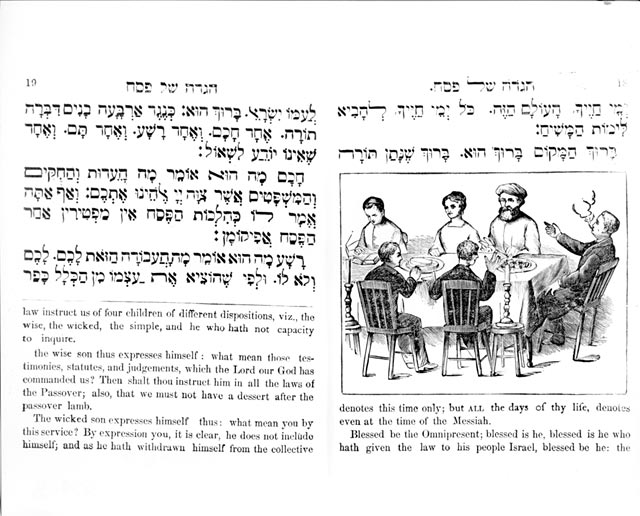
[37] See ibid., vol. 16, p. 384: .ומשבח אני בזה מנהג הספרדים שאין מקבלין בקהלותיהם גרים He is referring to the Syrian ban on converts, which has its own racist elements, as in both the popular and even in some of the rabbinic mind of this community there is a stress on “pure Jewish blood.” This latter point is far removed from opposition to converts in order to prevent intermarriage, and leads to a shunning of all converts, even those converted as babies, as well as a shunning of children and even grandchildren of converts.
[38] ] See ibid., vol. 9, no. 239
[39] See ibid., vol. 10 no. 239.
[40] See here.
[41] Teshuvot ve-Hanhagot, Even ha-Ezer no. 728. See also ibid., vol. 2 no. 623, where he writes: עיקר היחוס הוא כששומרים מצוות.
[42] Ein Ayah, Berakhot 8a.
[43] Available here. The “so-called Orthodox rabbis” referred to in this article are Rabbis Gedaliah Dov Schwartz, Reuven Bulka and Shmuel Goldin. The RCA is described as an “organization of rabbis who call themselves Orthodox, but are known as modern.” The article also defames Rabbis Shear Yashuv Cohen and Shalom Messas. There are a number of falsehoods in the article, but let me just mention one: “The conversion was made for the purpose of marriage, and such types of converts are not to be accepted according to the halocho.” Yet the almost unanimous opinion of poskim, from all circles, is that when confronted with a possible intermarriage, one should convert the non-Jewish partner if all all feasible. The only dispute is how observant the convert must be in order to be accepted.


Visiting Zoos in Halacha

Visiting Zoos in Halacha
By Eliezer Brodt
This article originally appeared in Ami Magazine (2012) Issue #88. This version has a few updates. I hope to return to this subject shortly. For a more expanded version of this article see my article in Yeshurun 26 (2012), pp. 853–874 (PDF available upon request).
Zoos are hotspots on Chol Hamoed. Standing together with the rest of Brooklyn or Yerushalayim, trying to give your children a glimpse of a penguin or seal or elephant, is always a pleasant way to spend a day. But what do the poskim have to say about visiting the zoo? [1]
 The Gemara in Berachos (58b) notes that if one sees a monkey or an elephant he should make the brachah M’shaneh habriyos.”This halachah is brought in the Tur and Shulchan Aruch. [2] There are a few questions to ask about this brachah. How often should the brachah be made? That is actually a machlokes Rishonim. The Ravi, known as the second Raavad, says that one makes this brachah of “M’shaneh habriyos” only once in 30 days on any specific animal, i.e., a particular elephant. However, if you see another animal, that is, a second elephant, you can make another M’shaneh Habriyos even within 30 days of the first brachah. [3] The Radvaz quotes this Ravi. [4] However, the Tur quotes a Raavad that one only makes such a brachah once in a lifetime, as the effect that seeing this animal has on a person is a onetime thing. The Tur himself argues and says that, as the Ravi said, after 30 days one can make a brachah on the same animal again. The Mechaber paskens like the Raavad, and the Rema paskens like the Tur. The Shulchan Aruch Harav says when we say that this brachah is made only once in a lifetime, that refers to each kind of animal. [5] This is the opinion in Rabbi Aaron Eichorn’s Mishnah Berurah [6] as well
as that of Rav Elyashiv,[7] among others. However, the Shulchan Shlomo [8] and Aruch Hashulchan argue and are of the opinion that one can make the brachah again on this same animal after 30 days. [9] This is also the opinion of the Chazon Ish. [10]
Is this brachah limited to the elephant and monkey, which are mentioned in the Gemara?
From many Rishonim, it would seem that there is something special about an elephant and a monkey, since that is all they list. [11] The Meiri writes that it’s because these animals are similar to humans. From the Preisha it appears that it is specifically a brachah on the monkey and elephant because they are very different from other animals. [12] Rabbi Aaron Eichorn also says this brachah is only on elephants and monkeys. [13] Rabbi Yaakov Emden writes that this brachah is specifically for the elephant and monkey, because the monkey has some features similar to man, and the elephant is very strong and smart as well as large.[14] Maharash Serlio writes that he heard from Reb Meshulam that the reason why we only make a brachah of “M’shaneh habriyos” on monkeys and elephants is that after the mabul G-d punished mankind and turned many into elephants and monkeys. He says that is the reason monkeys look similar to humans and elephants understand humans. [15] The Chazon Tov, a work devoted to explaining all the dreams listed at the end of Maseches Berachos, notes that based on this Reb Meshulam, we can understand the Gemara in Berachos which says that if someone sees a monkey or elephant in a dream it’s not a good sign. That is because they were originally humans who were turned into animals. [16]
However, Rabbi Yair Chaim Bacharach says that someone brought to his town a strange-looking cow with two heads and he allowed people to make “M’shaneh habriyos” on this creature. [17] It would appear from him that this brachah is not limited to these specific animals, but he is unclear which others one can make a brachah on.[18] Rav Shlomo Zalman Auerbach also says that one can make a “M’shaneh Habriyos” on any peculiar animal, not only on an elephant or monkey, but he doesn’t specify which.[19]
From what the Chida records in his travels (more on this shortly), it appears he held that this brachah is made only on an elephant, since he records that he saw many different animals at different times and yet he only made a “M’shaneh habriyos” on an elephant. He writes, for example, that he saw lions at least two different times but did not make a brachah on them. In the Leket Yosher, written by a student of the Rabbi Yisrael Isserlein, author of the Terumas Hadeshen, it is explained that Rav Isserlein once went on Shabbos to see two lions, because he had never seen a lion. [20] He did not make a brachah M’shaneh Habriyos,” and it would appear that he too held that one only makes such a brachah on elephants and monkeys.
Are there any problems with going to a zoo? Is it important to go to the zoo to make a brachah M’shaneh habriyos,” or even just to see animals?
Rabbi Moshe Greenwald, in Shut Arugos Habosem, writes very clearly that it is not permitted to go to the circus to view animals to make a brachah M’shaneh habriyos.” [21] Rabbi Eliezer Deutsch writes the same in his Shut Prei Hasadeh. [22] According to these Acharonim, one can ask whether it would be permitted to go to a zoo.
Rabbi Avraham Lipshitz says that one may go to a zoo to make a brachah of “M’shaneh Habriyos.” He writes that if it was not permissible, how would one ever make such a brachah? However, he says one is not obligated to go to the zoo in order to do it. [23] According to this, would it be permissible to go to the zoo to see animals that one does not make a brachah M’shaneh Habriyos” on?
One of the most fascinating figures of Jewish history in the past few hundred years was the Chida. He was born in 1724 in Jerusalem and died in 1807 in Livorno. One of the most prolific writers, he wrote on an extremely wide range of subjects, covering all areas of Jewish studies. He wrote on Chumash, Nach, Shas, halachah, derush, kabbalah, mussar, klalim, and bibliography. He authored over 60 works, but not all were printed in his lifetime and some still only exist unpublished in manuscript form. What is even more fascinating is that he did much of his writing while traveling. For a good part of his life, he traveled as a messenger, raising money for the community of Chevron. One work of the Chida that is less known is his travel diary, Maagel Tov. This work, which records his travels in Europe and elsewhere, was only published in full for the first time in 1934 by Aaron Freiman. Part of this work was printed in 1879, and another part was printed in 1910. In addition, some sections were published in journals, including a partial French translation. More recently it was translated into English. [24]
As you might expect, it is fascinating on many fronts. It provides numerous observations of many different Jewish communities of the time. In addition to being enlightening in the area of history, these documents are also very rich for those interested in the world of Jewish sefarim. To me it is clear that he never intended for this work to be printed, as it includes personal information about himself and the people he visited. In general, such works are very important because they give us a rare glimpse into the mind of the author, and this work certainly
does that. [25]
The Chida records a few times that he visited a zoo (or other place with animals) during his travels. [26] In one place (mentioned earlier) the Chida, after describing at length the exact details of an elephant, writes that he made the brachah M’shaneh habriyos.” [27] Various works on halachah quote this to point out that the Chida visited the zoo. But there are other important things to learn from his diaries. One is that it is completely permissible to go to a zoo, since he writes that he did so numerous times. [28] Two, I would say that from the fact that the Chida went to see animals numerous times during his travels, one must be obligated at least at some point in one’s lifetime to see animals to make a “M’shaneh habriyos”—not like Rabbi Avraham Lipshitz. Three, if one looks at the list of the animals that the Chida says he saw, there are many on which one does not make a brachah—and yet he went to see them. There must therefore be something significant about going to see animals besides the brachah. Rabbi Ovadia Yosef concludes, based on the Chida and Rabbi Isserlin, that it is certainly permissible to go to a zoo to see the animals. [29] Other gedolim who went to the zoo and made “M’shaneh habriyos” on these animals were the Divrei Chaim, [30] the Munkatcher Rebbe,[31] Rabbi Yaakov Shalom Sofer [32] and the Steipler.[33]
But the question remains: Why did the Chida go to see animals more than once? It was not to make a “M’shaneh habriyos,” since he records that he did so only on an elephant. Why did the Terumas Hadeshen go see a lion, on Shabbos, if he was not making a brachah?
Meir Benayhu merely says that the Chida was a curious person who wanted to investigate all sorts of phenomena. We find that he examined plants and other items during his travels. [34]
 Rabbi Kinreti writes that the Terumas Hadeshen specifically went on Shabbos because on Shabbos a talmid chacham can be mevatel Torah for oneg Shabbos. [35]
However, I will demonstrate that there is much more involved in going to the zoo. A first point: In 1841, Yosef Schoenhack began printing his work Toldot Haaretz, which deals with natural sciences. One volume is all about zoology, dealing with the different animals mentioned in Chazal. He received a haskamah [approbation] from Rabbi Yaakov Zvi Mecklenburg, author of Hakesav V’hakaballah. In this lengthy but beautiful haskamah, Rabbi Mecklenburg writes about the importance of such a work, explaining that listing all the animals helps one realize the greatness of G-d and the greatness of the creation of the World. He cites the statement in Chovos Halevavos, that when a person sees the
wisdom of the world and its workings, a person will want to emulate the Creator. Further, by studying all the animals that exist, many areas of Chazal can be properly understood, especially in Aggadah. I would suggest that if this is what Rabbi Mecklenburg says about reading about animals, how much more does it apply to actually seeing them. We know the famous rule Eino domeh shemiah leriah: Seeing is much better than just hearing.


I would like to elaborate a bit more on both aspects mentioned by Rabbi Mecklenburg about the benefits of learning about animals. Similar to the Chovos Halevavos quoted by Rabbi Mecklenburg, the Rambam writes that the way to attain love for G-d is to analyze His actions and creations to see the great wisdom in how they work.[36]
The Sefer Habris also mentions that this is the importance of studying animals. [37] Rabbi Hillel Posek actually permits one to go to a zoo for this reason. [38]
Another similar aspect of studying animals can be understood via a manuscript of Rabbeinu Yehudah Hachasid, printed for the first time a few years ago, which was based on the theme of zecher asah linifle’osov—He made a remembrance for His wonders. [39]  This work uses various mysteries of creation and aspects of animal nature to show that G-d intentionally created the world in an amazing way that is beyond human comprehension and logic to clearly show that it was He who created it. Thus, going to a zoo to observe and study animals can help a person reach a better appreciation of G-d and His creations, by seeing that there are things beyond our comprehension. [40]
As an aside, it could be that this theme of Rabbeinu Yehudah Hachassid, of zecher asah linifle’osov, could explain why the brachah of “M’shaneh Habriyos” is said specifically on the elephant. In Perek Shirah, the elephant says, “How great are Your actions, G-d! Your thoughts are deep.” Rabbi Shmuel Kimchi writes in his commentary to explain this passage that an elephant is an incredible creation, and only G-d knows why it is made in that way; His exact intentions are beyond us. [41] This idea is very similar to the idea of Rabbeinu Yehudah Hachasid in his work.
Another similar concept is alluded to in the famous quote attributed to Rav Samson Raphael Hirsch upon returning from a visit to the Swiss Alps. “Now I can answer properly when Hashem asks me in the world of truth, ‘Did you see my Alps?’”[42]
 Rav Hirsch also writes:
“I almost believe that all you homebodies will one day have to atone for having stayed indoors, and when you seek entrance to see the marvels of Heaven they will ask you, ‘Did you see the marvels of G-d on earth?’ Then, ashamed, you will mumble, ‘We missed that opportunity.’ “How different were our rabbis in this respect. How they breathed, felt, thought and lived in G-d’s marvelous nature. How they wanted to awaken our senses for all that is sublime and beautiful in Creation. How they wanted to teach us to fashion a wreath of adoration for G-d out of the morning’s rays and the evening blush, out of the daylight and the night shadows, out of the star’s glimmer and the flower’s scent, out of the roar of the sea and the rumble of the thunder, the flash of the lightning. How they wanted to demonstrate to us that every creature was a preacher of His power [emphasis added], a monitor of our duties; what a Divine revelation they made of the book of nature.”[43]
Another great person who made similar observations was Rabbi Menachem Friedman. In 1929 Rabbi Friedman who was the Chassdic Rebbe of Itzkan, printed his work Al Yoffee which was incredible work all about the Torah’s attitude to beauty. The work concludes with an autobiographical chapter all about his visits to Switzerland and Italy and how he from time to time looking and observing everything around him the he would think how amazing and wonderful Gods creations are. [44]
 The truth is that all this can possibly be tied to a Yerushalmi brought down by numerous Rishonim [45] and even brought down l’halachah
by the Magen Avraham. [46] Reb Moshe Hakohen, a nephew of the Rosh, in his work Sefer Hamaskil, writes that every year a person should make sure to buy each kind of fruit so he can make a brachah on each of them, since the Yerushalmi says that everyone will have to give an account of what he saw and did not eat. One is supposed to enjoy the creations of G-d, and if he does not, he will have to give an account of why not. [47]
I think this explains why the Chida made the effort numerous times to see animals. This could also be the reason why the Terumos Hadeshen went to see the lions. It could also explain why the Chida visited many gardens during his travels. [48]
Rabbi Mecklenburg, in the abovementioned haskamah, points out that observing animals helps us understand many things. The truth is that
this knowledge is also necessary in order to understand the many chapters in Chumash that list which animals are kosher and which are not. Rabbi Yosef Fried authored a work on hilchos shechitah and treifos that had illustrations of every part of the animal’s body. In his haskamah to this work, the Aderes wrote that such a volume is extremely beneficial for both student and teacher, in that it increases one’s understanding of the halachos. [49] The commentary of Rabbi Dovid Zvi Hoffman on Vayikra demonstrates how a proper understanding of animals helps us comprehend the Chumash. [50] It is also needed to help one understand Perek Shirah. Rabbi Hillel Posek writes a similar reason permitting one to visit a zoo, [51] as does Rabbi Nosson Gestetner. [52]
 Interestingly, Rabbi Gedaliah Nadel traveled outside Eretz Yisrael in order to visit a large collection of birds and animals, which he studied in great detail to understand which are kosher and which are not. [53]
One can perhaps go even further and say that Chazal derived a real understanding of animals from actually seeing them, as is obvious from the lists compiled by Rabbi Yehoshua Heller [54] and Rabbi Yekusiel Kemelhar [55] and others.[56] This, too, could perhaps explain the Chida’s visits, which were to enrich his understanding of the Torah.
There is another point that we can learn from the Chida: Rabbi Tzvi Hirsch Koidenover writes in his work Kav Hayashar that although one is supposed to make a “M’shaneh habriyos” when seeing certain animals, one should not stare at them but rather just look at them quickly and make the brachah. He writes that looking at “impure” (i.e., not kosher) animals can cause spiritual problems.[57] One could claim that both the Chida [58] and Rabbi Yisrael Isserlin did indeed see non-kosher animals—lions and elephants— but that they looked at them quickly just to make the brachah. But the Chida’s description of the elephant shows that he definitely did not just look at it for a second, make a brachah, and leave, but rather that he observed it for some time.
There is much to gain from going to the zoo.
Notes
 
1. For more on all this see my recent article in Yeshurun 26 (2012), pp. 853–874. See also: Rav Ovadiah Yosef, Chazon Ovadiah (Tu Beshevat), Jerusalem 2007, pp. 453–456; Rabbi Betzalel Stern, Ohalecha B’amitecha, Jerusalem 2005, pp. 173–174; Rabbi Shlomo Schneider, Shut Divrei Shlomo 4, Brooklyn 2009, Siman 532; Rabbi Yitzchak Eshkoli, Tzaar Balei Chaim, Ofakyim 2002, pp. 211-216; Rabbi Dovid Yosef, Halacha Berurah, 11, Jerusalem 2010, Siman 225; Rabbi Ari Zivotofsky, “Praising God at the Zoo”, Journal of Halacha and Contemporary Society, LXII, Fall 2011, pp. 43–53; Ten Da’at: A Journal of Jewish Education, Vol. XVI, Rabbi Moshe Bleich, “The Halakhah Corner: Visiting the Zoo,” pp. 10–22 [thanks to Rabbi Ari Zivotofsky for this source]; Rabbi Eliyahu Ariel, Sefer Shaar ha-Ayin (Modiin Illit, 2008; Hebrew), pp. 118–125, 350–356; Rabbi Shmuel Shtitzburg, Sharei Halacha, Beit Shemesh 2003, p. 471. Another other important source on this topic worth mentioning is the beautifully written chapter ‘Jews, Zoos and Teddy Bears’, in Rabbi Natan Slifkin, Man And Beast, Brooklyn 2006, pp. 13-38.
2. Aruch Chaim, siman 225. In general, any reference in this article to which I do not give a citation can be found in this siman.
3. Shut Ravi, siman 33. He only says Kushi, not elephant, but it would appear the same applies, because one makes the same brachah on both ”M’shaneh habriyos.
4. Shut Radvaz, 1:296.
5. Seder Bircat Hanenin, 13:13.
6. Bircat Habayis, Munkacz 1893, Shaar 29:12.
7. Ibid., 29.
8. Shulchan Shlomo, ad loc.
9. Aruch Hashulchan, ad loc.
10.  Rabbi Eliyahu Ariel, Sefer Shaar ha-Ayin, p. 417.
11.  See my Yeshurun article (above note 1), pp. 861–864.
12.  Ibid.
13.  Bircat Habayis, Munkacz 1893, op. cit., Shaar 29:13.
14.  Meor U’ketziah, ad loc.
15. Meleches Shlomo, Kelayim
8:6.This issue is not simple, because Chazal in Sanhedrin say that
after the Dor Haflagah, not the Dor Hamabul, was when they became
monkeys. There is also no mention of anyone becoming elephants. See Rav Yaakov
Kaminetsky in his Emes Le-Yaakov on Shulchan Aruch, ad loc., p.
107. See also the important sources collected by Rabbi Dovid Weiss, Megadim
Chadashim
, Berchos, Jerusalem 2008, p. 502–504; idem, Megadim Chadashim,
Bereishis, Jerusalem 2010, pp. 212–214. See also the Shevet Mussar,
ch. 47; Rabbi Eliyahu Ariel, Sefer Shaar ha-Ayin (Modiin Illit, 2008;
Hebrew), pp. 410–411. For more on all this see my recent article in Yeshurun
26 (2012), p. 863. Worth mentioning related to all this is the story I heard
from Rabbi Nosson Kaminetsky about his father, Rav Yaakov Kaminetsky, who was
flying business class from Israel to the States and was seated near Yerucham
Meshel, chairman of the Histadrut at the time. The two were shmoozing.
Meshel saw that Rav Yaakov’s son and granddaughter kept coming in from the
economy section to check if they could be helpful to him. He marveled that
there was such kibbud av, and compared it to his own situation where his
children and granchildren hardly visited him. Rav Yaakov answered that since
he, Meshel, believes in Darwin, that man evolved from the monkey, there is no
reason for them to respect him. They are another generation farther from the
monkey; he should be respecting them. He, Rav Yaakov, believed that Adam was
G-d’s handiwork and our children are another generation removed from that
glory. They therefore respect someone closer to Creation.
16. Chazon Tov, Jerusalem 1998, pp. 173–175.
17. Mekor Chaim, ad loc.
18. Yalkut Avraham, ad loc., writes that his father made such a brachah on a twoheaded human being that he saw in Vienna.
19.  Halichos Shlomo, Tefilah, p. 290.
20.  Leket Yosher, Jerusalem 1964, p. 66.
21.  O. C. siman 39.
22.  Volume 3, siman 173.
23. Yalkut Avraham, New York
2002, pp. 64–67.
24.  Benjamin Cymerman, The Diaries of Rabbi Ha’im Yosef David Azulai,
Jerusalem 1997. 25 This work has been explored very carefully in a few recent
works, most notably in Meir Benayahu’s masterpiece on the Chida entitled Ha-Chida,
first printed in 1959. This work was also used in the articles of various
scholars in the important work Sefer Ha-Chida, which Meir Benayahu
edited that same year. In 2006 a collection of Letters and history about the
Chida was printed by Shlomo Vankin called Igrot V’haskomot Rabbenu HaChida.
This work contains lots of useful information about the Chida and makes use of
these travels in his work. More recent work on these travels was done in an
article by Matthias B. Lehmann, “Levantinos and Other Jews: Reading H. Y. D.
Azulai’s Travel Diary,” Jewish Social Studies [n.s.] 13:3
(Spring/Summer 2007): 1-34. In 2010, a very good M.A. was written about these
travels by Oded Cohen: Ma’agel Tov of R. Hayyim Yosef David Azulai
(HIDA)—Meeting Between Tradition and Modernity
, MA, Tel-Aviv University,
2010, Hebrew. More recently, my articles in Yeshurun 26 (2012), pp.
853-874; Yeshurun 26 (2012), pp. 907–939; Hapamon 4 (2012), pp.
81–86. See also Yaacob Dweck, ‘A Jew from the east meets books from the west’, Jewish
Culture in Early Modern Europe
, Essays in honor of David B. Ruderman,
Edited by Richard Cohen and others,
Pittsburg 2014, pp. 239-249.
26. Ma’agel Tov, [will be
quoted as M.T.], Jerusalem 1934, p. 5, 68, 32, 68, 69. For fish,
see p. 82. For a peacock, see p. 92, 93. He also visited many different
gardens; see p. 5, 81-82, 91-92, 98, 105, 150–151, 154, 155–156. See also his Midbor
Kademos, beis: 22.
27. M.T. pp. 69-70.
28. M.T., p. 5, 32, 68, 69.
29. Yabiah Omer, 4, O.C. 20. See also his Chazon Ovadiah (Tu B’Shvat), pp. 453–455.
30. Tehillat Chaim, 2, Bnei Brak 1995, pp. 183–184.
31. Nimikei Aruch Chaim, 225; Rabbi Shabtzvi Liphshitz, Sefer Ha-Eshel, erech Baalei Chaim, 24.
32. Toras Chaim, 225:16.
33. Orchos Rabbeinu, 1. p. 94
34. Ha-Chida, Jerusalem 1959, p. 88, 161.
35. Leket Yosher, Jerusalem 2010, p. 142. I will hopefully return to this topic in a future article.
36. Yesodei Hatorah, 2:2.
37. Sefer Habris, 1, end of Maamar 14, Ch. 8. I heard from Rav Don Segal at a hesped for Rav Shach that Rav Shach used to study the Sefer Habris specifically for this reason, to gain a deeper appreciation for G-d and his world.
38. Shut Hillel Omer, O.C.
144.
39. This work was first printed by
Israel Ta-Shma, See his Studies in Medieval Rabbinic Literature, vol. 1,
Jerusalem 2004, pp. 181–207. A more recent critical edition was printed
by Yaakov Yisroel Stal, Amoros Tehoros Chizonis Upinemis, Jerusalem
2006.
40. This is based on the
introduction of Y. Stal to the previously mentioned edition. For more on this
work see Joseph Dan, History of Jewish Mysticism and Esotericism: The Middle
Ages
, vol. V, Jerusalem 2011 [Hebrew], pp. 393–423.
41. Perek Shirah, Jerusalem
2005, p. 39. Chazon Tov, (Jerusalem 1998, p. 65), adds that the reason
why the word pelah is used in relation to the elephant (besides being
related to its name) is because it is a true wonder. It is huge, and all its
features are large, but at the same time it can move very fast.
42. Rabbi Eliyahu Klugeman, Rabbi
Samson Raphael Hirsch
, New York 1996, p. 320.
43.
Collected Writings of Rabbi Samson Raphael Hirsch 8, 1995, p.
259.
44. Al Yoffee, p. 45. On this
fascinating person see David Assaf, Caught in the Thicket (heb.),
Jerusalem 2006, pp. 283-316; on this work see ibid, pp. 299-300.
45. For an impressive listing of Rishonim
who quote this Yerushalmi, see M.M. Honig, “On the New Edition of Sefer
Hamaskil of R. Moshe Ben R. Eliezer Hacohen,” Yerushaseinu (2006), pp.
218–220.
46. Magen Avraham, ad loc.,
14.
47. Sefer Hamaskil, Jerusalem
2004, pp. 48–49.
48. M.T., p. 5, 81–82, 91–92, 98,
105, 150–151, 154, 155–156.
49. The sefer was
unfortunately never printed but the haskamah was, in the introduction to
Rav Fried’s Shut Ohel Yosef, New York 1903.
50. See also Rabbi Avraham Mi-shayer
Aryeh, Shiltei Giborim, Jerusalem 2010, pp. 228-251.
51. Shut Lehoros Nosson, 4, Bnei
Brak 1985, Siman 68.
52. Shut Hillel Omer, O.C.
144.
53. Mili De-Hespeidah, Bnei
Brak 2005, p. 80.
54. Moaz Hadas, Jerusalem
1903, pp. 35a–36a.
55. Ha-Talmud U-maddah Ha-tevel,
Jerusalem 1984, pp. 78–79.
56. See Rabbi Dr. Isaac Herzog, Judaism
Law and Ethics
, London 1974, pp. 161– 165.
57. Kav Hayashar, Jerusalem
1993, p. 8. See also Rabbi Yitzchak Eshkoli, Tzaar
Balei Chaim, Ofakyim 2002,
pp. 217-218.


58.
The Chida saw other non-kosher animals see M.T. p. 5, 32, 68, 69.


The Agunah Problem, Part 1; Incarceration and Free Speech

The Agunah Problem, Part 1; Incarceration and Free Speech
Marc B. Shapiro

1. There has been a lot of discussion recently about the International Beit Din and its rulings allowing certain marriages to be voided, thus freeing women from being agunot. As is to be expected, this beit din has been subject to strong attacks, even of a personal nature, despite the fact that the members of the beit din are recognized talmidei hakhamim. These dayanim are intent on keeping everything above board and have published the reasoning behind their rulings, thus giving opponents the opportunity to engage in halakhic argumentation.
From what I have read, the International Beit Din has three approaches to freeing agunot. One is annul the marriage based on mekah taut, i.e., there was some problem with the husband that would have prevented the wife from marrying him had she known of it. This is a perfectly valid mechanism that has been used by many poskim, such as R. Zvi Pesah Frank, R. Moshe Feinstein, and R. Avraham Shapiro. Although one can, of course, criticize the application of mekah taut to a particular case, the mechanism itself is part of standard halakhic operating procedure and the International Beit Din is well within its rights to use mekah taut when possible. 

The second approach is to find a problem in the marriage ceremony itself, meaning that the marriage never took place. For example, one can show that there were no proper witnesses to the marriage. Here again, one can disagree with particular rulings, but not with the basic approach.

The third approach is that of get zikui, which in the current context means that the beit din issues a divorce to the woman on behalf of the man, even if the man has not approved of this and even if is against his will.[1] While there has been a good deal of discussion of this approach, I can’t find on the International Beit Din’s website that any marriage has actually been dissolved by using this mechanism. Unlike the other two approaches, there is little precedent for use of a get zikui, which means that its chances of being generally accepted are nil.
The use of a get zikui is actually suggested by R. Jehiel Jacob Weinberg, Seridei Esh, vol. 3, no. 25. In fact, R. Weinberg’s responsum is the most detailed discussion of get zikui but surprisingly it is not included on the International Beit Din’s website. It must be noted, however, that R. Weinberg is only prepared to suggest a get zikui if the husband would want the get to be given. However, in the contemporary agunah situation the problem is that the husbands do not want to give the wives a get, and concerning these cases R. Weinberg writes: נפל היסוד של כתיבת גט מטעם זכי’
Is there another possible approach? How about a heter meah rabbanim for a married woman if she can’t get a get? I know you are thinking that this is crazy, but look at the following page, which comes from the medieval work Etz Hayyim by R. Jacob Hazan.[2] 
As you can see from the very end of the page, it states that the rabbis required a man to give a get if he contracted a marriage באיסור, which in this case means he was already committed to marry someone else. Then it says that if this man disappeared the woman can be freed with a heter meah rabbanim (actually, it says ish, not rabbanim, but I don’t want to get into that now). This is a very radical position, that a woman can be freed by a heter meah rabbanim, and it is attested to nowhere else. Not surprisingly, R. Israel Brodie, the editor of Etz Hayyim,[3] calls attention to this unusual halakhic position. R. Shlomo Yosef Zevin also refers to this novel idea.[4]
But are Rabbis Brodie and Zevin correct? Israel Moshe Ta-Shma and Shlomo Zalman Havlin say no, and see this as a serious mistake. According to them, the last case discussed in Etz Hayyim has nothing to do with the man who married באיסור but refers back to a case mentioned earlier on the page of a man who was only committed to marry a woman. If this man then disappears, מתירין הבחורה במאה איש. In other words, the woman is released from any obligation to marry the missing man, but this has nothing to do with a woman already married. I will let the readers decide for themselves who is correct.[5]
As for the problem of women not being able to get a divorce because the man refuses, there are some important points that must be made which I don’t think everyone is aware of. Today, many people assume that a woman who wants out of a marriage, for whatever reason, has that right. After all, a woman is not a prisoner and a husband should not force her to be married to him if she doesn’t want to. However, this viewpoint is very much a modern approach.[6] If you look at the standard halakhic sources you will find that there is no obligation for a man to give his wife a divorce just because she wants it. Ever since R. Gershom, the same situation is also found in reverse, namely, a husband is not allowed to divorce his wife against her will just because he no longer wishes to be married to her. This approach to ending marriage is very much in line with how secular society use to operate before the introduction of no fault divorce.
Significantly, Maimonides does require the husband to give his wife a divorce if she says she no longer wishes to live with him.[7] R. Kafih elaborates on the wisdom of Maimonides’ position, and here are some of his important words[8]:
ברוך ה’ א-להי ישראל אשר הזריח לנו את המאור הגדול הזה אשר במבטו החודר פלש למעמקי הדורות וצפה גם את דורנו הפרוץ לבשתינו ולמגנת לבבנו, אוי לעינים שכך רואות ואוי לאזנים שכך שומעות, ואלו ראו שאר חכמי הדורות את דורנו היו חותמים על פסקו של רבנו בשתי ידים. כי המציאות הוכיחה צדקת רבנו, שכל התובעת ג”פ בימינו וטוענת מאיס עלאי, לא רק עיניה נתנה באחר אלא היא כבר בחיק האחר או האחרים וחביטא קמייהו כמברכתא, ולפיכך מצוה לכוף את הבעל המתעקש בכל כפיה אפשרית כדי להפריד בין הדבקים ויפה שעה אחת קודם.
However, it is the view in opposition to Maimonides that became the standard position, and it is this view that is recorded in the Shulhan Arukh[9] and followed by batei din. According to this approach, even if a woman says she can no longer live with her husband, he is not obligated to give her a get. What this can lead to is most vividly illustrated by the movie Gett, available here to watch for free for Amazon Prime members.
I have been told that the Beth Din of America operates on the principle that if one of the parties wants a divorce, for whatever reason, and there is no chance for reconciliation, then the Beit Din will instruct the other spouse to comply. But this is not how many other batei din operate. We have to be honest and acknowledge that the problem many women face is not because the dayanim are cruel or anti-women, but that it is Jewish law itself, or rather an interpretation of Jewish law, that is preventing them from receiving their divorces. 

I feel it is necessary to stress this since we can now better appreciate why certain rabbis have attempted to find solutions within Jewish law to the contemporary agunah problem. Many on the right don’t see why this is necessary and why batei din cannot just follow Jewish law as it has operated until now instead of looking for “solutions”. These people might not realize the difficult situation this puts women in, a situation that might have been tolerable years ago but for more and more Orthodox Jews that is no longer the case. On the other hand, many on the left think that it is a simple matter to solve the agunah problem, and that it is just cruel and insensitive rabbis preventing this. This too is a distortion as the rabbis’ hands are often tied by halakhah, and this remains the case no matter how much of a “rabbinic will” they have.

Let me illustrate what I am talking about. As an example of how sentiments have changed over the centuries, here is a passage from R. Hayyim Benveniste that I have cited in two previous posts. In Keneset ha-Gedolah, Even ha-Ezer 154, Hagahot Beit Yosef no. 59, in discussing when we can force a husband to give a divorce, R. Benveniste writes:
ובעל משפט צדק ח”א סי’ נ”ט כתב דאפי’ רודף אחריה בסכין להכותה אין כופין אותו לגרש ואפי’ לו’ לו שחייב להוציא
Can anyone imagine a posek, from even the most right-wing community, advocating such a viewpoint today? The logic behind this position, as can be seen by examining the original responsum in Mishpat Tzedek, is that even if the man is running after her with the knife, we don’t assume that he will actually kill her. He must be doing it just to scare her, and that is not enough of a reason to force him to divorce her, or even to tell him that he is obligated to do so. And if we are wrong, and he really does kill her? I guess the reply would be that this isn’t anything we could have anticipated even if we saw the knife in his hand. This example shows how some poskim from prior generations made it extremely difficult for women to receive a divorce.
Let me give a few examples from more recent years. In 1967 the Supreme Rabbinic Court, consisting of Rabbis Yitzhak Nissim, Betzalel Zolty, and Yosef Shalom Elyashiv, concluded as follows.[10]
כשם שאין כופין בעל לגרש את אשתו בגלל טענת מאיס עלי, כך אין מחייבין את הבעל לגרש עקב טענה זו
This approach, which repeats itself again and again, completely undermines the assumption so many have that a man is obligated to give his wife a get when she no longer wishes to be married to him.
Look again at the conclusion of Rabbis Nissim, Zolty and Elyashiv. It couldn’t be any clearer that this woman is not an agunah. Their conclusion also contradicts the definition of agunah provided by JOFA (see here p. 22).

AGUNAH (pl: AGUNOT) A married woman who may not remarry because the death of her husband has not been verified or because (for whatever reason) she is unable to obtain a get from her husband.

It is simply not true that a woman unable to obtain a get from her husband “for whatever reason” is an agunah. I wish it were different, and I wish Maimonides’ ruling carried the day. But that is not the case, which means that an agunah has to be defined as one whose husband refuses to issue a get after ordered to do so by a beit din.
R. Zvi Hirsch Grodzinski, perhaps the leading talmudist and halakhist in the United States in the early years of the twentieth century, discusses a case where a woman committed adultery (or only claimed to have done so; the matter is not clear, but for this post I am assuming she actually did commit adultery). She then wished to get divorced from her husband.[11] She must have had some connection to Judaism as she requested that her husband give her a get. I think most people would assume that in such a case, where the woman will no longer be living with her husband, that it is essential that the husband give her a get so that she is no longer committing adultery. With the get she can repent and move on with her life. Hopefully, she will be able to find another husband and live as pious Jew.
Yet just because most of us might intuitively feel this way, this does not mean all halakhists have to agree. R. Grodzinski concludes that the husband cannot be forced to give the get. To use today’s popular language, this meant that he was allowed to keep her as an agunah for the rest of her life. Of course, R. Grodzinski would deny that the woman was an agunah. Despite the woman’s adultery, I think most people will still be troubled reading the following words from R. Grodzinski, from which we see that he saw no problem in condemning her to live the rest of her life without receiving a get.
כ”ש בנ”ד שנאסרה עליו ע”י זנות דאין כופין אותו לגרשה בגט, כיון שהיא נתנה אצבע בין שיניה, וגרמה לעצמה במעשיה הרעים והוא לא עשה און, ולמה נכוף אותו ליתן לה גט, לא תבעל לו ותוצרר אלמנות חיות כל ימיה, הלא אינה מצווה על פו”ר, וכי בשביל שהיא הולכת אחרי שרירות לבה וזנתה תחתיו נכוף אותו לגרשה
I don’t think you need to be a member of JOFA or Open Orthodox to be upset by what R. Grodzinski writes, as it probably closed off any chance of repentance on the part of the woman. He also views the withholding of the get as a suitable form of punishment for the woman. Not being obligated in the commandment to procreate, she can be kept a “living widow”.[12]
For another noteworthy example, here is the conclusion of a 1953 Jerusalem Beit Din decision, by the dayanim R. Jacob Ades, R. Bezalel Zolty, and R. Yosef Shalom Elyashiv:[13]
החשש כי האשה תצא לתרבות רעה אם הבעל לא יתן לה גט, אינו משמש יסוד לחייב את הבעל לתת לה גט
This decision from the Jerusalem Beit Din has another passage that is very troubling to me. I find it hard to believe that any Modern Orthodox beit din could conclude in this fashion, and it is precisely attitudes such as this that convinced women that the rabbinic courts in Israel were stacked against them.[14]
הא דברועה זונות יש לחייבו לתת לה גט, היינו היכא שהאשה היתה רוצה לחיות אתו, אלמלא שהבעל הוא רועה זונות, במקרה זה יש מקום לחייבו לגרשה כשהיא דורשת גט, משום שרועה זונות יאבד הון וסופו לא יהיה בידו לפרנסה, וגם משום שעצם היותו רועה זונות נוגע לה שהוא גורע מעונתה, וגם יש חשש של סכנה לחיות אתו, אבל במקרה שהאשה מורדת בבעלה ולא רוצה לחיות אתו בגלל איזו סבה שהיא, ואחרי זה נהיה הבעל רועה זונות אף שיש עבירה בידו, מכל מקום אין לחייבו משום זה לתת לה גט, כיון שהיא מורדת בו הרי הוא פטור ממזונותיה ושוב אין החשש שרועה זונות יאבד הון ולא יהיה בידו לפרנסה, וגם אין הטעם שברועה זונות הדבר נוגע לה שהוא גורע מעונתה וגם יש חשש סכנה לחיות אתו, דהלא היא מורדת בו ולא רוצה בכלל לחיות אתו.
What is a woman supposed to do in a case like this? After learning that her husband frequented prostitutes she had even more reason not to want to return to him, and yet the beit din held that in such a case the husband did not have to give her a get since her initial reason for wanting to be divorced was something else. Again we see that a man can, if he chooses, prevent his wife from being free.
Also of interest are the three reasons the court suggests why a woman would not be happy if her husband was going to prostitutes: 1. He will be spending their money, 2. He will be using them as his sexual outlet and will not want to sleep with his wife, 3. He could pass on a disease to her.
While it is true that a wife’s anger will include reasons 1 and 3, these are not the main reasons she will be upset. For example, the husband could be as rich as a former New York governor and have used protection, yet the wife will still be devastated for the simple reason that his actions were a terrible breach of trust. More than anything else, modern marriages are based on trust. As for reason 2, it is hard to imagine that there is any modern woman who, if she discovered that her husband was going to prostitutes, would want to be divorced because of this reason.
Where did the dayanim get these three reasons, as surprisingly, they don’t tell us? I found reason 1 cited in the Beit Yosef, Even ha-Ezer 154 (towards the end, s.v. מצאתי כתוב בשם ספר אגודה). It originates in R. Alexander Susslein Ha-Kohen’s Sefer Agudah: Yevamot, no. 77.[15] Reasons 2 and 3 are found in the Arukh ha-Shulhan, Even ha-Ezer 154:16.[16]
These reasons undoubtedly reflect a different understanding of marriage, one which does not see the modern romantic notion of trust as the centerpiece of a marriage. Since people’s psychology has changed over the centuries, I don’t think that the reasons offered by medieval authorities operating in a completely different environment can determine what modern women will regard as “deal-breakers” when it comes to marriage. If a modern woman has different expectations of what marriage is than what people had years ago, I would think that this must be taken into account by a beit din in determining what situations require ordering the husband to give a get.
In fact, Sefer Agudah cites another reason why the court compels a husband visiting prostitutes to divorce his wife.
פעם אחת בא מעשה לידי לאה טוענת על ראובן שהיה רועה זונות והוא כופר. ופסקתי שאם תביא עדים שהוא כן יוציא ויתן כתובה. איבעית אימא קרא, איבעית אימא גמרא, איבעית אימא סברא . . . ואיבעית אימא סברא דגרע מכל הנהו דפרק המדיר.
In the final words just quoted (and underlined), Sefer Agudah is referring to this Mishnah in Ketubot 77a:

ואלו שכופין אותו להוציא מוכה שחין ובעל פוליפוס והמקמץ והמצרף נחושת והבורסי בין שהיו עד שלא נישאו ובין משנישאו נולדו ועל כולן אמר רבי מאיר אע”פ שהתנה עמה יכולה היא שתאמר סבורה הייתי שאני יכולה לקבל ועכשיו איני יכולה לקבל. 

The following are compelled to divorce [their wives]: A man who is afflicted with boils, or has a polypus, or gathers [objectionable matter] or is a coppersmith or a tanner, whether they were [in such conditions or positions] before they married or whether they arose after they had married and concerning all these R. Meir said: Although the man made a condition with her [that she acquiesces in his defects] she may nevertheless plead, “I thought I could endure him, but now I cannot endure him.”

This final reason given by Sefer Agudah is based on sevara and not on a rabbinic text.[17] I don’t know why it was not cited by the dayanim, but it supports the point I made that the beit din need not be bound by examples given in the Talmud or other rabbinic sources. Rather, it can evaluate the current psychology of women and how they regard marriage.

For another example of how different current understandings are from what they used to be, look at this responsum of R. Zvi Hirsch Ashkenazi, Hakham Zvi, no. 133.
It deals with a man who committed adultery with a married woman, and his wife therefore wishes to divorce him. In such a case, contemporary Orthodox Jews of all persuasions would agree with the general view in society, that if the wife can forgive her husband and remain married, then it is no one else’s business what goes on in their lives. However, contemporary Orthodox Jews would also agree that if the betrayal is so devastating that the wife will never be able to trust her husband again, and she wants a divorce, then the husband should be required to give the divorce. To paraphrase what the Sefer Agudah said, this is certainly on the level of the things for which the Mishnah in Ketubot requires a husband to grant his wife if she requests if.
Yet the Hakham Zvi refuses to require the man to issue the divorce. One of the things he says is that even the Sefer Agudah would agree that in order to force a divorce the husband has to have been given prior warning not to visit prostitutes. In the case the Hakham Zvi was asked about, he says that there is another reason not to require the get, and that is that the man claims that he wishes to repent. So here we have a case where a man commits adultery, his wife cannot accept this and requests a divorce, and the man refuses and says he will repent. Today people would say that this woman is an agunah, as she is trapped in a marriage she doesn’t want to be in with a husband who cheated on her. Yet the Hakham Zvi rules in favor of the man that no divorce is required.
One can find numerous examples where poskim rule similarly. Here, for instance, is a decision of the Tel Aviv Beit Din.[18]
I think people will be shocked to learn that a woman who wants to divorce her husband because he went to a prostitute is being told by the beit din that she must stay with him if he promises not to do it again. But this only illustrates that the so-called agunah problem is inherent to the halakhic system, which according to the dominant interpretation does not recognize that a woman should be able to exit a marriage if she feels she can no longer live with her husband. There are literally hundreds of examples in the responsa literature and beit din proceedings where a woman is told that even though she wants to be divorced, there is no obligation on her husband to give her a get. Isn’t this where poskim must put their efforts to see if changes can be made? What a woman will tolerate today is not necessarily the same thing as what the Sages and earlier poskim assumed, and this is a point that was already made by halakhic authorities in prior generations.[19]
To further illustrate my point, R. Joseph Karo states that even if a husband is beating his wife he can’t be forced to divorce her.[20] She will obviously live apart from him, but R. Karo does not accept the view of some earlier authorities that the husband can be forced to issue her a divorce. This means that the woman is what we would today call an agunah, but the problem we are facing is not just about an evil man but arises from the halakhah itself. As we have just seen, according to R. Karo it is the halakhah that prevents us from forcing a husband to divorce his wife, even if he beats her.
In this case, R. Moses Isserles strongly rejects R. Karo’s opinion and states that we can force a man beating his wife to divorce her.[21] The passage I have underlined is of particular significance regarding the point I made previously.[22]
ואיני רואה בזב דבריו כלל דכדאי הם הגאונים לסמוך עליהם כל שכן שהרמב”ן ומהר”מ הסכימו בתשובותיהן בענין הכאת אשתו והביאו ראיות ברורות לדבריהם גם הסברא מסכמת עמהן ומה שלא הוזכרו בדברי הפוסקים אפשר לומר שהיה פשוט בעיניהם וקל וחומר הוא מהאומר איני זן וכו’
In deciding which opinion to follow, that of R. Karo or R. Isserles, I think that a point made by R. Jehiel Jacob Weinberg is relevant. He states that if there is a dispute among earlier halakhic authorities, we should reject the view that will bring the Torah into disrepute in people’s eyes.[23]
ואגלה להדר”ג [הגרא”י אונטרמן] מה שבלבי: שמקום שיש מחלוקת הראשונים צריכים הרבנים להכריע נגד אותה הדעה, שהיא רחוקה מדעת הבריות וגורמת לזלזול וללעג נגד תוה”ק

Can anyone deny that in the dispute between R. Karo and R. Isserles, the sort of consideration R. Weinberg was referring to would force dayanim, even Sephardic dayanim, to decide in accord with R. Isserles? In today’s day and age, it would be simply incomprehensible to people that a man who regularly beats his wife cannot be forced to give her a get.
There is another noteworthy decision given by the Supreme Rabbinic Court, again consisting of Rabbis Yitzhak Nissim, Bezalel Zolty, and Yosef Shalom Elyashiv.[24] The case was that a married man left his first wife and married another wife. The problem was that he never divorced the first wife, making him a bigamist. Furthermore, he refused to give his first wife a get. The woman therefore turned to the Beit Din asking them to force him to do so. The conclusion of the Beit Din was that while in this case, as opposed to the ones we saw earlier, the man was indeed obligated to divorce his wife, nevertheless the Beit Din could not force him to do so. Since the Beit Din ruled that he was obligated to give the get, his not doing so would make the woman an agunah in the eyes of the court. But since the Beit Din felt that it was unable to force the man to issue the get, who knows how long (maybe her entire life) the woman was forced to remain an agunah. Unfortunately for the woman, R. Shaul Yisraeli, also a member of the Supreme Rabbinic Court, was not one of the dayanim in this case, since he wrote to R. Elyashiv arguing that the court should indeed force the husband to give the get.[25]
Since I mentioned R. Weinberg earlier in this post, take a look at this responsum from Seridei Esh, vol. 3, no. 29.
R. Weinberg was asked about a man who was sent to jail for sexual abuse of young girls. Understandably, his wife wanted a divorce. The rabbi didn’t know what to do and therefore wrote to R. Weinberg. He mentions that he never had to deal with a case of sexual abuse and doesn’t know how to relate to it from a Jewish law perspective. He also assumes that there was no actual sexual relations but only fondling.
R. Weinberg, relying on the Hakham Zvi, states that the husband cannot be forced to divorce his wife, since he was never warned and there was no testimony in a beit din. He also says that one cannot rely on testimony given in a secular court, and makes the valid point that during that time, the Nazi era, there was a great deal of anti-Semitism and pleasure in making the Jews look bad.
None of this could have been of much comfort to the woman. We have no idea about her relationship with her husband. She might have already suspected him of being a pervert, or when he was arrested it might have clarified certain things that she wondered about. She might have confronted him after the arrest and seeing his reaction to her questions she knew he was guilty. Whatever the case, she no longer wished to remain married to someone she believed to be a sexual abuser. R. Weinberg was as open-minded a posek as one could imagine, yet even he was of the opinion that the husband could not be compelled to divorce his wife.
Today, if someone accused of sexual abuse refused to issue his wife a get, rabbis in the United States would call for protests in front of his house. Yet R. Weinberg does not see this as warranted. I think one of the most difficult things for people to grasp in his responsum, and in that of the Hakham Zvi, is the need for the husband to be warned. We are not talking about sentencing him in a beit din, where warning is a technical requirement, but whether or not the woman wants to live with him any more. In the two cases we have just seen, the issues of concern to the wives are one man’s visits to a prostitute and the other’s sexual abuse of children. Neither wife cared if her husband was “warned” in beit din since the offense is the same to her either before or after the “warning”.
Nevertheless, the notion that the husband has to be warned is found elsewhere as well. For example, regarding a husband who beats his wife, R. Moses Isserles, Shulhan Arukh, Even ha-Ezer 154:3, states that according to some such a man can be forced to give his wife a get. The Vilna Gaon explains, in words that lead to a liberal understanding of when a man can be forced to divorce his wife:
יש אומרים שכופין כו’: שאפילו על שאר דברים שאין לה צער כל כך כגון המדיר שלא תלך לבית אביה או לבית האבל כו’ [כתובות עא ע”ב] או שלא תשאל נפה וכברה כו’ [שם, עב ע”א], כל שכן במצערה בגופה. תשובת הרמב”ן סימן ק”ב.
Yet after stating that some say that a man who beats his wife can be forced to divorce her (an opinion he himself held, as we saw earlier in the quotation from Darkhei Moshe [26]), R. Isserles adds that a prior warning is required: ובלבד שמתרין בו תחילה פעם אחת או שתים.

Now that we have seen some of the real halakhic difficulties that stand at the center of the so-called agunah problem, in the next post I will offer a simple suggestion that I think can solve at least some of the cases.

2. Someone who read my earlier posts that discussed various punishments ordered by Jewish courts asked me about a quotation from R. Shlomo Yaffe, dean of the Institute of American and Talmudic Law, which offers a different perspective. See here. Before even getting to the particular quotation, let me say that I have real problems with some of what was said (or at least reported to have been said) at the recent conference on Jewish law reported on the link just given. For example, Rabbi Yaffe was asked, “If there were no First Amendment would we still have the freedom of speech?” The only correct answer has to be that without the First Amendment our freedom of speech will be endangered, and it could even become illegal to speak publicly about certain laws in the Torah (e.g., homosexuality), as this could be categorized as “hate speech”. But instead, Rabbi Yaffe replied: “Absolutely . . . We know that God had freedom of speech. He spoke and the world came into being. . . . We have free will and the ability to express ourselves.” How does this bit of darshanut answer a serious question about the importance of the First Amendment?
Professor Jeremy Waldron stated at the conference, “People have a right to be protected from vicious defamations upon them on account of their religion. So if somebody says, ‘All Muslims are terrorists,’ we believe [Muslims] have a right to be protected against that defamation.”[27] This is exactly why we need a First Amendment and why free speech must be protected. If it became illegal for some idiot to say, “All Muslims are terrorists,” then the next thing would be punishing people for saying that “Muslims are more likely to support terrorism than adherents of other religions,” and bans on the drawing of Muhammad’s picture and insulting the Prophet would not be far behind because after all, these are viewed by Muslims as defamations of their religion. (Muslims in Europe have already demanded that those insulting Muhammad not be protected by free speech laws.)
In other words, giving an inch in this matter would open up the floodgates and would be the end of free speech in America. As I already mentioned, this would also be a big problem for the traditional Jewish community, since it is only the constitutional guarantee of free speech that prevents “progressive” groups from legislating against “hate speech” found in religious communities. Based on the quote from Waldron, I would assume that he is a supporter of the “speech codes” that at one time were so popular at universities, until people began to realize the stifling effect they actually had on free speech. For those who are having trouble remembering what they learnt so many years ago: The First Amendment was created precisely in order to protect unpopular speech.
The particular quote from Rabbi Yaffe that I was asked about is the following: “In general, Jewish law and tradition are extremely opposed to incarceration as fundamentally immoral unless it is to protect someone from inflicting real harm on another human being.” What this means is that incarceration is only designed to protect the innocent, but Jewish law and tradition does not recognize incarceration as a means of punishment. This statement is simply false. Let us remember that incarceration must be seen as an improvement over the physical punishments I have detailed in earlier posts. Given the choice between lashing people and mutilating them, certainly incarceration is preferable. (See also what I wrote here.) As for incarceration itself, the Rambam states as follows in Mishneh Torah, Hilkhot Sanhedrin 24:9:
יש לכפות ידיים ורגליים ולאסור בבית האסורין
What this means is that a judge may bind a prisoner’s hands and feet and may imprison him. Punishment is one of the reasons that this is done, as Maimonides explains ibid. 24:10. Although there is nothing in the Torah about imprisonment, it was used as a punishment throughout Jewish history.[28] Simhah Assaf, who writes a good deal about Jewish prisons in Ha-Onshin Aharei Hatimat ha-Talmud, pp. 25ff, informs us that such prisons were found in Babylonia, Spain, Italy, Moravia, Poland, and Lithuania. One can also add Hungary and Bohemia to this list. According to Assaf, it is only in France and Germany that we don’t find Jewish prisons.[29] In addition to actual prisons, we also find something else: 

A symbolic imprisonment, which served as a means for expiation as well as one of humiliation and embarrassment, consisted of shackling a suspected murderer, for example, during a service. He was to have his hands as well as his body chained. This was apparently a tradition received from R. Judah the Pious.[30]

[1] See R. J. David Bleich’s discussion of get zikui in Tradition 35:4 (2001), available here. See also the responsum of R. Solomon David Kahane in Sefer ha-Yovel Karnot Tzaddik (Kefar Habad, 1992), pp. 253ff. For the Safed beit din’s decision to issue a get to a woman whose husband was in a vegetative state, see here, and see the beit din’s defense of its decision here. An entire book was published in opposition to this decision; see here.
[2] Vol. 2, p. 236.
[3] Vol. 3, p. xi.
[4] See Sinai 60 (1967), p. 319.
[5] See Havlin in Ha-Ma’yan (Tevet 5728), pp. 33-34 n. 14.
[6] In previous posts I have cited numerous examples that show that the notion that men and women are equal is also a modern idea. The standard traditional view was that a woman is secondary to her husband and under his authority. I mention this here only because I recently found a very interesting formulation that is relevant to what we will be discussing. In R. Hayyim Aryeh Leib ben Joseph Hayyim, Sha’ar Bat Rabim (Warsaw, 1900), parashat Tazria, p. 24a-b, he explains why a woman, who is “enslaved to her husband as a slave,” does not choose to run away like other slaves do.
והוא ימשול בך: לעבוד עבודתו. ואעפ”י שהיא משועבדת לבעל כעבד ודרך העבד לברוח מאדונו כדי שלא להשתעבד מ”מ גזר ה’ עלי’ שתחפוץ להשתעבד לבעלה כשפחה מדה כנגד מדה כי חוה נתנה גם לבעלה ויאכל במצותה לכן נענשה שלא תהיה היא עוד מצוה עליו אלא הוא יצוה עלי’ כל רצונו כן כתב רמב”ן.

[7] Mishneh TorahHilkhot Ishut 14:8.
[8] Sefer Nashim, vol. 1, pp. 306-307.
[9] See Shulhan Arukh, Even ha-Ezer 77:2.
[10] Piskei Din shel Batei Din ha-Rabaniyim be-Yisrael, vol.  7, p. 3 (emphasis in original).
[11] Ha-Measef 9 (5664), nos. 1, 24.
[12] Ha-Measef 9 (5664), p. 1b. Many of his words are taken from She’elot u-Teshuvot ha-Rosh 43:8.
[13] Piskei Din shel Batei Din ha-Rabaniyim be-Yisrael, vol. 1, p. 139. R. Eliezer Waldenberg had a different approach. See Tzitz Eliezer, vol. 4, p. 109:
מכל האמור יש כר נרחב לדון בדבר כפיה לגרש במקום שישנו בטענת המאיס עלי אמתלא מבוררת, ובית הדין רואה צורך השעה לכוף את הבעל לגרש כדי שלא תצא האשה לתרבות רעה.
[14] Piskei Din shel Batei Din ha-Rabaniyim be-Yisrael, vol. 1, p. 141. A decision directly opposed to this was given in 1979 by the Supreme Rabbinical Court. The dayanim were R. Mordechai Eliyahu, R. Joseph Kafih, and R. Shaul Yisraeli. See Piskei Din shel Batei Din ha-Rabaniyim be-Yisrael, vol. 12, p. 25:
אפילו אם נעשה “רועה זונות” לאחר שאשתו עזבה אותו אין לחייבה לחזור ולחיות אמו.

[15] The Sefer Agudah’s ruling is cited in R. Moses Isserles, Shulhan Arukh, Even ha-Ezer 154:1. However, R. Isserles does not provide the Sefer Agudah’s reason, only his conclusion that a man who visits prostitutes can be forced to divorce his wife.
[16] It appears that the Arukh ha-Shulhan derived reason 2 from a formulation in the Sefer Agudah. However, R. Yosef Goldberg argues that the Arukh ha-Shulhan is mistaken and that the Sefer Agudah cannot be seen as a source for this reason. See Goldberg, “Teviat Ishah le-Hayev et Ba’alah be-Get,” Zekhor le-Avraham  (2000), vol. 2, pp. 669ff.
[17] See also R. Simeon ben Zemah Durah, She’elot u-Teshuvot Tashbetz, vol. 2, no. 8:
ואפילו לכוף אותו להוציא יש לדון מקל וחומר דבעל פוליפוס, דהשתא מפני ריח הפה כופין, מפני צער תדיר שהוא מר ממות לא כל שכן.

[18] Piskei Din shel Batei ha-Din ha-Rabaniyim be-Yisrael, vol. 8, p. 254.
[19] For a detailed discussion of the matter, see R. Avishai Teherani, Amudei Mishpat, vol. 1, Even ha-Ezer, no. 12. R. Teherani’s own conclusion is as follows:
המכה את אשתו, ואין סכנת נפשות לאשה, אין כופין אותו להוציא, שיש לחוש שלא נכשל בגט מעושה, אכן אם יש לאשה סכנת נפשות אמיתית, כופין אותו לגרשה בטרם יהרגנה, ויש לדיין ליתן עיניו בזה הרבה, כי כבר היו מעשים מעולם [!] ברצח האשה
(emphasis added). This is hardly a position that will find a sympathetic ear among most contemporary Orthodox Jews. R. Hanan Aflalo, Asher Hanan, vols. 3-4, no. 77, adopts an entirely different tone. With regard to the matter of a woman who wants a divorce because her husband visited prostitutes, unlike the decisions already mentioned, R Aflalo shows a real understanding of how a modern woman relates to this sort of thing. He writes as follows (p. 421):  
מאסה בו על עצם המחשבה שגופו היה דבק בגופן של נשים אחרות במעשה הניאוף והטינוף שבו, ובכך נגעלת מעצם המחשבה לכך לחזור עמו לחיי אישות ולשלום בית. ובאמת שמילים וטענות אלו יש בהם ממש.
R. Uriel Lavi, av beit din of the Safed beit din that issued the controversial get to a woman whose husband was in a vegetative state (see note 1), and who has been villified in the haredi world and through their pressure kept off the Supreme Rabbinic Court (see here), has the same sympathetic approach as R. Aflalo. See his Ateret Devorah, vol. 2, p. 644:
חיוב הבעל בגט הוא מפני המאיסות שבמעשיו. אמנם בעלמא באומרת מאיס עלי אין כופין גירושין, אך כשמאיסות זו היא כה חמורה ונובעת ממעשיו הנלוזים של הבעל, ואין זו בעיה חריגה של האשה, אלא מאיסות המוכרת והמקובלת בנסיבות אלו אצל כל הנשים, יש לכפות את הבעל.
It is precisely rabbis with this type of modern understanding that can provide a solution to the problem we have been discussing, as we will see in the next post.
[20] Beit Yosef, Even ha-Ezer 154 end, s.v.מצאתי בתשובת רבינו שמחה 
[21] Darkhei Moshe, Even ha-Ezer 154:21 (The text is from the Machon Yerushalayim edition which has added material from Darkhei Moshe ha-Arokh).
[22] R. Isserles also adds the following which is relevant to recent events in which a number of people were sentenced to prison for kidnapping and torturing men who refused to give a get.
נראה דטוב שלא לכופו ליתן גט אלא בדרך זה להחרימו או לתופסו בידי גוים או בשוטים שלא להכותה או שיוציא ויתן גט ובדרך זה לא מיקרי כפייה על הגט רק לקיים מה שמחוייב לעשות.
[23] Kitvei ha-Gaon Rabbi Jehiel Jacob Weinberg, vol. 1, p. 60.
[24] Piskei Din shel Batei ha-Din ha-Rabaniyim be-Yisrael, vol. 7, p. 65.
[25] Mishpetei Shaul, no. 34
[26] For a detailed discussion regarding whether the beit din can force a wife beater to divorce his wife, see R. Isaac ben Walid, Va-Yomer Yitzhak, vol. 1, no. 135.
[27] If someone said, “All NRA members are terrorists,” would Waldron think that NRA members also have a right to be protected against that defamation? And if not, why not? What possible legal distinction is there between belonging to a religion and belonging to an organization?
[28] See R. Yehoshua Inbal, Torah she-Ba’al Peh (Jerusalem, 2015), p. 215.
[29] Assaf, Ha-Onshin, p. 25.
[30] Eric Zimmer, Harmony and Discord (New York, 1970), p. 93.


Simchas Torah & a Lost Minhag of the Gra

Simchas Torah & a Lost Minhag of the Gra
By Eliezer Brodt
Chol HaMoed Succos is the Yarzheit of the Vilna Gaon (for an earlier post on the Gra see here and here). In this post I hope to show a source for a “forgotten” Minhag of the Gra.
In 1921 the great bibliographer (and much more) Yitzchak Rivkind described a strange custom he saw during the time he learned in Volozhin (after it was reopened and headed by R’ Rephael Shapiro), in an article about Minhag HaGra. On Simchas Torah they would open the Aron Kodesh when saying Aleinu, both at night and during the day, and while singing the Niggun of Mussaf of Yom Kippur would bow on the floor exactly like we do on Rosh Hashonah and Yom Kippur. When he asked for the source of this Minhag he was told it comes from the Gra. When he visited Vilna sometime later he found the only place that they observed this unique Minhag was in the Kloiz of the Gra, but nowhere else in Vilna.[1] 
In 1933 R’ Meir Bar Ilan printed his memoirs in Yiddish for the first time (in book form); in it he describes the great Simcha in Volozhin on Simchas Torah, that of his father the Netziv and of the Talmidim. He then writes that when they got to Aleinu they would open the Aron and with Niggun of Mussaf of Yom Kippur would sing and bow on the floor exactly like we do on Rosh Hashonah and Yom Kippur.[2] However, this custom is not mentioned in the Maaseh Rav or any of the other collections of Minhagim of the Gra.
Earlier this year (2018) R’ Dovid Kamenetsky published a very important manuscript related to the Maaseh Rav. This work sheds light on how this important sefer of the Gra’s Minhaghim was written. The Gra had a very close talmid named R’ Saadyah who wrote up the various things he witnessed the Gra doing. This formed the basis of the Maaseh Rav who then went and added to it from other sources. This original manuscript work was recently discovered and printed by Rabbi Kamenetsky; in it we find that R’ Saadyah writes that on Rosh Hashonah and Yom Kippur the Gra would fully bow (prostrate himself) during Aleinu, and did the same on Simchas Torah at night. Thus we now for the first time have the actual exact source of the Gra doing this.[3] 
בר”ה וי”כ וש”י כשאומר הש”ץ זכרנו:… כשהגיע לכורעים הי’ כורע ונופל על אפיו בפשיטת ידים ורגלים וכן בשמחת תורה בלילה היו אומרים מזמורים ותפילות …בים ואח”כ היו נופלים על אפיה’ כנ”ל באימ[ה] בעלינו…
Here is a copy of the page in the manuscript (thanks to Rabbi Dovid Kamenetsky):
A possible explanation for this Minhag is that when things were getting a bit too wild, i.e. too leibedek, they did this to remind the crowd it’s a Yom Tov. This is not the only minhag done like Yomim Noraim, in one account we find “The Musaf was chanted with the music of the New Year’s ritual.”[4] 
[1] HaIvri, 10:35, (1921), pp. 6-7. See Yaari, Toldot Chag Simchas Torah, p. 366.
[2] MeiVolozhin Ad Yerushlayim, 1, p. 115.
[3] See TorasS Hagra, p. 212. On this work see Toras Hagra, pp. 127-226.
[4] Between Worlds, p. 93