Forgetfulness & Other Human Errors a New Monography by Marc Shapr

As a religion based on tradition, Judaism places great stock in the words and opinions of its early Sages. This is so to the extent that there is great debate as to whether it is even possible that these early authorities could err. In fact, throughout Jewish literature one can find many areas where people argue for deference based on seniority. For instance, there is an extensive debate on the binding authority, and to what extent, with regard to the Rishonim or the Shulhan Arukh. Similarly, there are those who refuse to allow that the Rishonim or earlier authorities erred. Recently, some accused Rabbi Natan Slifkin of allowing that certain statements of Hazal require reappraisal and that those statements are wrong. In the case of Slifkin, his issues with the particular statements of Hazal were not novel and mainly he repeated some of the same arguments that have been bouncing around for the last 400 years or so without adding anything new to that particular debate. A more important case, however, was that of R. Hayyim Hirschensohn in his discussion of whether women are allowed to hold positions of power.[1]

In the early part of the 20th century there was a debate of the appropriateness of women taking part in elections – whether they can vote or run for office. (Of late, this debate has been renewed by the Young Israel stance regarding women becoming a synagogue president.) Most are aware that those who argue that women cannot hold positions of power rely upon the Rambam, hilkhot melakhim 1:5, who in turn in relying upon a Sifre 147 to Devarim 17:15. R. Hirschensohn, however, understood the Sifre in a radically different manner and in doing so allowed that the Rambam erred in his interpretation of the Sifre. Specifically, R. Hirschensohn argues that the Sifre that states “that the verse (Devarim 17:15) ‘You shall place upon yourselves a king’ limits the placement to a king and not a queen” should be understood that the requirement for a king does not require a queen. That is, should the queen die she need not be replaced; however, should the king die there is a commandment to replace him.” Furthermore, according to R. Hirschensohn, the Sifre has nothing to do with the other statement from Hazal (Yevamot 45b) based on this verse, that “any leadership you shall establish should only be from your brethren [they must be Jewish].”[2] Thus, the Rambam erroneously conflated the two statements and thereby misunderstood the Sifre and came to the incorrect conclusion – that women are barred from all positions of power. As R. Hirschensohn explains “that even one as great as the Rambam in his knowledge and wisdom is not immune from error, an which then caused many who followed after him to rely upon and led to other errors. It is without a doubt the Rambam relied upon memory regarding these statements, and did not have time to reexamine them again” (See Malki ba-Kodesh 2:194).

As one would expect, aside from taking issue with R. Hirschensohn’s position on women holding power, many took issue with R. Hirschensohn’s claim the Rambam erred. R. BenZion Uziel said that although he respects R. Hirschensohn — in fact R. Uziel ultimate held like R. Hirschensohn on this issue — R. Uziel “believed that [R. Hirschensohn] erred in hastily writing such things about our master, Maimonides. For, while we may indeed take issue with his position, we may not characterize him as having committed [elementary] errors in understanding the text, or as having been mislead by custom and historical context. [R. Hirschensohn’s] remarks to such effect are, no doubt, a slip of the pen.” Mishpetei Uziel, vol. 2, Hoshen Mishpat, no. 6 (the translation comes from this article). R. Uziel was not alone in disputing R. Hirschensohn’s assessment of the Rambam as is evidenced by the many letters to R. Hirschensohn and his responses on the issue of the Rambam erring. See, e.g. Malki ba-Kodesh 4:131, 6:103-104 (letter from R. Yosef Babad).[3] It is worth noting that R. Hirschensohn seemed to have tired defending this opinion saying in one letter “that any further argument about this point is only repetitive.” Malki ba-Kodesh 6:100.

Another more recent example was noted by R. Eliezer Brodt in the magazine Datza, no. 15 (19 Kislev 5368): 4, where he calls to attention the recent edition of R. Yosef Karo’s Maggid Mesharim edited with notes by R. Yosef Kohen. In the Maggid Mesharim, amongst the many halakhic statements from the Maggid — the legendary angel that visited R. Karo and whose remarks are recorded in this work — is that “on Rosh ha-Shana one should not eat meat or drink beer [wine] and one should be careful about other foods as well. And, although Ezra said [regarding Rosh ha-Shana] ‘go eat sweet food’ that was only said for the populace, I [the Maggid] am speaking to the special ones.” The problem with this specific statement is that, as many commentaries have noted, it contradicts various Talmudic statements – including a Mishna or two – that imply one should eat meat on Rosh ha-Shana. (For more on the topic of eating meat on Rosh ha-Shana see Eliezer’s post earlier post, available here, additionally, Eliezer’s forthcoming volume on many of the customs of Rosh ha-Shana will also discuss this custom amongst others.)

Amongst the many others who attempted to explain this statement of R. Hayyim of Volozhin explained that the entire power of the Maggid only came from R. Karo himself. Thus, if R. Karo forgot a Mishna or a source then the Maggid wouldn’t know it either. Therefore, “it is clear that at that moment the Bet Yosef [R. Karo] forgot the relevant Mishna, or there was some lack in his recollection or understanding, and due to that the light [understanding] of the relevant Mishna was also held back from the Maggid.” R. David Luria, Kadmut Sefer ha-Zohar 5:4 (Koenigsberg, 1856), p. 35a (quoting R. Hayyim). Thus, according to R. Hayyim, R. Karo could forget and make mistakes.

R. Hayyim of Volozhin’s understanding, however, is completely rejected by R. Yosef Kohen in his new edition of the Maggid Mesharim. R. Kohen commenting on R. Hayyim’s explanation says “I am extremely troubled, how is it possible to say that the great Rabbi Bet Yosef, who understood and was completely fluent in the entire Talmud and Mishna, that he forgot a simple Mishna or that he was weak in a particular Mishna.” Maggid Mesharim, R. Yosef Kohen ed. (Jerusalem, 2007), 418.

Again, we see the two camps clearly, those who allow for human error and forgetfulness and those who refuse to believe great Rabbis could fall prey to these human frailties. An examination of the relevant sources shows that those in the former camp have the greatest support. To return to the Rambam that R. Hirschensohn argued erred in his understanding of the Sifre. The Rambam himself in his famous answer to the Hakhmei Lunel, admitted that he had made a mistake. Similarly, the Rambam’s son, R. Abraham when presented with a contradiction between his father’s statement and a Talmudic passage said “it is possible that my father forgot this passage when he wrote this.”

Likewise, R. Yair Hayyim Bacharach, author of Shu”t Havvot Yair, explains in a responsum “to one Godol who cast aspersions on [R. Bacharach] for claiming errors in the writings of the great earlier ones. That is, you asked how can I have the gall to dispute the earlier ones which we are much smaller. And, that I went further and said [at times] that they had forgotten the words of the Talmud and the Poskim.” R. Bacharach answered “I turn the question back on you, is not this language, that is, ‘you have forgotten [אשתמיטתיה]’ taken from the Talmud itself and applied to the greatest Amoraim . . . using [forgetfulness] is a respectful way to allege that one didn’t remember a relevant passage. Forgetfulness is human nature and affects everyone. Of course, how forgetful one is depends on the person.”

R. Bacharach then offers historical examples to support his contention. “Who is greater than Moshe the greatest prophet who forgot two laws (Shapiro notes that Bacharach erred – Moshe made three errors! (Shapiro, 52 n.220)) due to anger . . . and who is a greater Posek than the Rambam who understood the entire oral Torah as is evidenced by his work and who also authored a commentary on the entire six volumes of the Mishna based on the Talmud . . . who also forgot . . . and Rashi, who was a repository of Torah, but who writes in his commentary to the Torah . . . ‘I don’t know . . . and whom the Ramban wrote that [Rashi] forgot a passage from Midrash Ruth.” R. Bacharach continues to list other such examples. He concludes “there is no shame in saying that the Rishonim and the Achronim . . . forgot a Talmudic passage or Tosefot . . . and this position is evident from the writers in all the generations that precede me, they never held back from saying on the great ones before them.” R. Yair Hayyim Bacharach, Shu”t Hut ha-Shuni, no. 20.

R. Ya’akov Hayyim from Baghdad, in the introduction to his responsa Rav Pealim, echos R. Bacharach’s sentiment. “In truth one can find that many great ones that they made terrific errors, errors that even children wouldn’t make, and at times they made mistakes in quoting biblical verse, as was the case with the goan, wonder of his generation the Hida [R. Hayyim Yosef David Azulai, one of the most erudite scholars of his period] . . . on these sorts of errors the verse ‘that one is blameless from error’ (Psalms 19:13).” By way of example R. Ya’akov Hayyim highlights four such errors R. Yosef Shaul Nathanson, author of the Shu”t Shoel u-Meshiv made in his work. R. Ya’akov Hayyim concludes “therefore, do be surprised to find I disagree with the great ones . . . when I argue they erred because they forgot. Because, such allegations [of forgetfulness] are not unique and in no way take away from their greatness.”

It is particularly ironic that the Hida fell prey to this very type of forgetfulness as he wrote an entire book, Helem Davar, [4] showing exactly these types of mistakes in other’s works. The title of the Hida’s work, Helem Davar is rather instructive when discussing the possibility of sages erring. Helem Davar refers to the sacrifice the members of Sanhedrin would bring should they all err, indicating that even groups of great people are not immune from making mistakes.

With the above introduction we now turn to Professor Marc Shapiro’s new book Studies in Maimonides and His Interpreters (Scranton and London: University of Scranton Press, 2008), 205 pages, where one of the three articles is devoted to showing exactly the type of errors that must be attributed to forgetfulness or faulty memory that appear in the Rambam. This volume is an expanded discussion of Prof. Shapiro’s two earlier articles “Maimonidean Halakhah and Superstition” (2000) and “Principles of Interpretation in Maimonidean Halakhah: Traditional and Academic Perspectives” (2008), both of which originally published in Yeshiva University’s Maimonidean Studies, and includes a Hebrew section of several letters from two twentieth-century Torah giants (R. Joseph Kafih and R. Yehiel Yaakov Weinbeg), as well as from the nineteenth-century-maskil Nahman Isaac Fischmann to R. Samuel David Luzzatto zt”l (ShaDaL).

Shapiro provides many examples of persons who held Maimonides and others could err as well as many who hold that one cannot attribute difficult passages to error. For example, notes that the Hida (contrary to what we have seen above regarding his view of other scholars) held that one can not write off difficulties in Maimonides’ statements to error as “[i]f such approaches are adopted every insignificant student will be able to offer them, and what value is there in writing such thing?” (Shapiro, 8)[5]. On the other hand Shapiro marshalls numerous sources, including the Ramabam himself, who allow for the errors in the Rambam. In the letter to the sages of Lunel, the Rambam states that in his old age he suffers from forgetfulness. (See Shapiro 73 n.295, 76 nn. 308, 309 discussing the controversy over the authenticity of these letters). However, even explict statements from the Rambam himself have been disputed by later authorities. For example, although the Rambam condeeds regarding a law in Yad that he erred, the Gra says that the Rambam was erring is saying he erred. The Gra explains that the original law in Yad is indeed right contrary to the Rambam’s own position. (Shapiro 69 n.282). The Gra’s position is somewhat tenuos, aside from the obvious issue of ignoring the statement of the original author, as “a number of . . . achronim provided what they believed to be better proofs for Maimonides’ decisions than he himself was able to supply” but is has been shown “that the aharonim who adopted this approach erred in almost every example.” (Shapiro 54 n.227).

Included in the book is a short “Note on Maimonides and Muhammad” following censorship that occurred in his “Islam and the Halakhah,” Judaism 42:3 (Summer 1993): 332-343, about which Shapiro writes:

The “Note on Maimonides and Muhammad” found at the end of the English section requires a bit of explanation, as it speaks to the times in which we live and the sometimes precarious state of scholarship when it comes up against larger political forces. In 1993, I published an article in Judaism entitled “Islam and the Halakhah.” In the version of the article submitted to the journal, I mentioned that Maimonides referred to Muhammad as a “madman,” and in a few lines I also explained the origin of the term. When the article appeared in print, however, I was surprised to find that this had been removed without my knowledge. Naively, I thought that this was an innocent mistake, and I inquired as to what had happened. Imagine my shock when I was told that my article had been censored because the journal did not want to publish anything that could be seen as offensive to Muslims! While some may see this as understandable in the wake of the Salman Rushdie episode, it was nevertheless a betrayal of scholarship, which cannot be guided by political correctness. I would hope that any Muslims who see the “Note on Maimonides and Muhammad” will understand that its intent is not to insult their prophet, but rather to clarify a historical issue.

Studies in Maimonides and His Interpreters is available for purchase here at Amazon.com.

The editors of the Seforim blog take great pride in the first post (of hopefully many frequent posts) at this new web address being able to discuss Professor Shapiro’s new work. This is so, as Professor Marc B. Shapiro has been (as many others) a frequent contributor to the Seforim blog. It is such contributions that make the blog so much better.

Notes:
[1] Much of the material on R. Hayyim Hirschensohn was brought to my attention by Marc Herman, “Orthodoxy and Modernity: Rabbi Hayyim Hirschensohn’s Malki ba-kodesh,” (BA thesis, Brandeis University, 2005), 18-51. For a recent review of the scholarly consensus on R. Hayyim Hirschensohn, see Marc B. Shapiro, “Review of Jewish Commitment in a Modern World: Rabbi Hayyim Hirschenson and His Attitude to Modernity by David Zohar,” The Edah Journal 5:1 (Tammuz 5765): 1-6. Additionally, parts of the material on this topic of claiming that people forgot, comes from R. Shmuel Ashkenazi’s article “Helem Davar u-Tous Sofer.” Ashkenazi’s article was originally supposed to appear in the journal Or Yisrael no. 15 (Nissan 5659), but at the last minute the editors decided not to publish it and instead the article was published separately in a run of 25 copies. Ashkenazi, himself an outstanding repository of material – it seems unlikely he forgets but he is human – in this article lists numerous examples of errors that can only be attributed to forgetfulness or printing error. For instance, Ashkenazi notes that R. Yechiel Epstein in his Arukh Ha-Shulhan states “it is surprising that the Rif does not mention the laws of yayin pagum, not in the eigth chapter of berakhot discussing the laws of wine for blessing, or in the tenth chapter of Pesachim regarding kiddush and havdalah.” In fact, however, the Rif in the tenth chapter of Pesachim does discuss the laws of yayin pagum.
Or, the case of R. Aryeh Leib ben Asher Gunzberg (author of Shu”t Shaagat Aryeh), who notes in his Turei Even, that “we never find anywhere that the reading of the Bikurim passage is called Vidyu.” Turei Even, Megilah, 20, s.v. mihu. Ashkenazi cites R. Yeruchum Fishel Perlow’s comments in the journal Noam who notes R. Gunzberg forgot the mishna in Bikurim 2:2 which calls this recitation “viduy” as well as the Rambam in the laws of Bikurim 3:5, who says “it is a mitzvah to preform viduy on the bikurim.” Ashkenazi adds the Tosefta in Bekurim chapter one and the Yerushalmi Bikurim, chapter 2 also refer to this process as viduy.

Another example, this one with the Hida. The Hida in Machzik Beracha (O.C. 468:10) and Lev David (end of chapter 10) states the author of the SeMaK is R. Yecheil. But, the real author is R. Yitzhak Corbeil. The Hida, in his own work on Hebrew bibliography, Shem ha-Gedolim, actually gets it right. But, it appears that he forgot that when he wrote these other works.

[2] R. Moshe Feinstein also argues the Sifre is not connected with the Talmudic statement. See Iggerot Moshe, Yoreh Deah II, #44-45. R. Feinstein, however, ultimately comes to the opposite conclusion then that of R. Hirschensohn – the opinion of the Rambam must be followed and women cannot hold high office.

[3] As an aside, one of the many letters to R. Hirschensohn regarding women’s voting rights came from Yehiel Mihel Goldberg from Radom. Goldberg attempts to bolster R. Hirschensohn with the (now) well-known statement of R. Shmuel Archivolti in his Ma’ayan Ganim and recorded by R. Barukh ha-Levi Epstein in both his Torah Temimah and Mekor Barukh that supposedly is a halakhic statement which allows for women to study Talmud. As I have demonstrated elsewhere, the Ma’ayan Ganim is not a responsa work or halakhic work. But, Goldberg’s use of the Torah Temimah for this point seems to be the earliest. While the Torah Temimah was first printed in 1902 and then reprinted in 1904, it was not reprinted until 1928 and Goldberg’s letter was written in 1921. Perhaps Goldberg’s use evidences that the Torah Temimah was well received soon after it was published.

[4] This work, Helem Davar was recently printed (Beni Brak, 2006) for the first time in book form from manuscript – it also was printed as part of the lager book Iggerot ve-Haskmot Rabbenu ha-Hida also in 2006. Prior to this 2006 publication, R. Yehuda Leib Maimon published Helem Davar in the journal Sinai 43 (1948): 301-15. The 2006 edition includes Maimon’s original article as well as a commentary on Helem Davar, Hokher Davar.

[5] This argument, essentially a slippery slope argument, is also applied to making textual emendations. See, e.g. R. Y. Landau, Noda be-Yehuda Kama, Even ha-Ezer, 32; this issue is discussed by Y.S. Spiegel, Amudim be-Tolodot Sefer ha-Ivri Haghot u-Maghim, Ramat Gan, 2007, pp. 255-56.


Depicting Difference: The Tower of Babel and the Language of Sacred Art

Depicting Difference: The Tower of Babel and the Language of Sacred Art

“For form is only the manifestation, the shape of content.”
Ben Shahn, The Shape of Content, p. 72

Genesis chapter 11 presents the narrative of the Tower of Babel, detailing how, contrary to the divine directive to disperse and populate the earth, the descendants of the flood’s survivors congregated in a single city and commenced construction of a substantial tower. God intervened to prevent further cooperation among them by disrupting their shared language, thereby introducing linguistic diversity, which ultimately ceased the building process and resulted in the broad dispersal of the population.

The account of the Tower of Babel offers a unique context for exploring what characterizes an image—and, by extension, a work of art—as Jewish. In Christian artistic traditions, from medieval illuminations to Renaissance paintings, the tower is often portrayed as a symbol of pride and serves as a cautionary emblem against human ambition. In contrast, Jewish philosophy and visual culture do not treat the tower as an important iconographic motif or as a warning against aspiration. Where the story does appear in Jewish art, it offers an alternative interpretation, and in certain instances, it recasts the tower motif in a more positive light.

The Architecture of Arrogance: Bruegel’s Tower and the Christian Moral Imagination

A painting of a tower of babel AI-generated content may be incorrect.

Figure 1: Pieter Bruegel, The Tower of Babel, Kunsthistorisches Museum, Vienna

Among the most celebrated representations of the Tower of Babel is Pieter Bruegel the Elder’s painting housed in Vienna’s Kunsthistorisches Museum (we previously discussed another painting from the museum, Samuel van Hoogstraten’s Old Man at a Window, and whether it is a Jewish painting, its subject a famous Rabbi). Measuring over three feet wide and five feet high, this work features a monumental spiral structure composed of arches and tiers that ascend unevenly into the clouds. The immense scale of the tower stands in stark contrast to the small human figures depicted throughout—hundreds of workers engaged in various tasks. Bruegel’s paintings are notable for their comprehensive and detailed portrayal of subjects. (This site allows you to zoom in on all the details.) In this scene, each trade and stage of construction is rendered with meticulous attention; some laborers transport massive stone blocks along ramps, while oxen-pulled carts bear heavy loads of building materials. Human-powered treadwheel cranes lift supplies upward, and scaffolding constructed from poles, planks, and ropes clings to the sides of the tower. Masons apply mortar and lay bricks, carpenters reinforce beams, and overseers direct operations, attempting to manage the complexity and activity inherent in such an undertaking.

In the foreground, King Nimrod, adorned in elaborate robes and a crown, oversees the construction as the principal architect of the tower. He reviews architectural plans with his attendants while laborers kneel. Surrounding him, foremen gesture towards the ascending walls, effectively conveying his directives to the assembled workforce. Beyond the imposing structure of the tower, ships are visible entering the harbor, their masts prominent on the horizon.

Bruegel often used allegory in his work. By integrating contemporary construction methods and maritime elements into the depiction of the ancient story, he placed Babel in the context of his own time. The painting presents examples of human innovation alongside the risks associated with ambitious endeavors, making its observations applicable from the 16th century to the present day.[1]

A painting of people working on a tower AI-generated content may be incorrect.

Figure 2: 13th Century Manuscript of Rudolf von Ems Poetry

A letter l with a tower and people working AI-generated content may be incorrect.

Figure 3: 14th Century York Manuscript

Earlier artistic portrayals commonly focused on Babel’s height and grandeur. Medieval manuscripts and Church paintings often depicted it as upright, rectilinear, and monumental, resembling a fortress or cathedral spire. In contrast, Bruegel presents the tower as unstable, leaning, and showing deterioration at its foundation, while construction continues at the upper levels. The structure appears to challenge natural order by being built atop a mountain and using brick, which leads to rock formations that affect its stability. Bruegel incorporates Roman arches reminiscent of the Colosseum, suggesting parallels to historical architecture that had fallen into decline by the time of his visit in 1560. Some areas are already inhabited; for example, a woman is seen hanging laundry. The residents appear unaware of the structural issues beneath them, blinded by their hubris. Nimrod’s prominence in the foreground, with the workers genuflecting to him and his plans that he holds in his hands, further emphasizes the fetishization of human ambition.

At the time, Bruegel’s audience didn’t have to look far to see a potential Babel in the making: Antwerp was booming, expanding, and building like never before, and its populace risked falling into the sin of pride. In 1563, when Bruegel painted the Tower of Babel, the city was Europe’s busiest port and a magnet for wealth, with goods and materials streaming in daily through the Scheldt River. Massive new fortifications were under construction to secure the city’s growth, while the Cathedral of Our Lady still stood unfinished, its single soaring spire a symbol of grandeur halted midstream. Cranes, treadwheels, scaffolding, and teams of laborers were familiar sights on Antwerp’s skyline, all details Bruegel carefully folded into his painting. Even the ships visible in the harbor of his Babel recall Antwerp’s bustling docks, tying the biblical story directly to his contemporaries’ lived experience. For Bruegel’s viewers, the tower was not just a monument to ancient pride but a mirror of their own city’s dazzling ambition and its underlying fragility.

Bruegel does not show the dramatic aftermath, the confusion of tongues, and the scattering of peoples across the earth. Instead, he arrests the narrative at the moment of construction, filling the canvas with the feverish activity of workers and the looming mass of the tower itself. In doing so, he lets the architecture bear the weight of the story: the leaning walls, the buckling arches, and the crumbling base foreshadow the enterprise’s futility. The punishment is absent because the tower already embodies it, an image of human ambition that carries within itself the seeds of its own destruction.

Bruegel’s legacy is twofold. On the one hand, he fixed Babel’s appearance for centuries: spiraling, leaning, and crumbling, the visual template repeated in paintings, engravings, church murals, and biblical illustrations well into the modern era. From 16th-century Flemish workshops to 18th-century Bibles, from church frescoes to Romantic illustrations, and even into 20th-century literature and contemporary art, Bruegel’s leaning Tower of Babel has been endlessly reimagined as the enduring image of human ambition and collapse.[2] On the other hand, he reshaped its meaning. Earlier images celebrated human pride by showing the tower upright and impregnable. Bruegel’s version, and the generations of artists and authors who followed, transformed it into a parable of fragility, a monument doomed to collapse even as it rose.

Buildings Fall Books Endure: The Jewish Reading of Babel

Within the Jewish exegetical tradition, the story of Babel carries a different emphasis than in Bruegel’s Christian retelling. The tower itself is a bit player in a larger story, a catalyst and not the focus, less important than the human decision it symbolizes. In Genesis 9:1, God commands Noah’s descendants to “be fruitful, multiply, and fill the earth.” Yet instead of dispersing across the world, humanity chooses to settle in one place and build a city and tower “lest we be scattered abroad upon the face of the whole earth” (Gen. 11:4). In this reading, the sin is not arrogance against heaven but resistance to God’s plan of dispersal. The tower becomes a narrative device, a means of dramatizing humankind’s determination to remain unified, sedentary, and secure.[3]

Seen from this perspective, the confusion of languages and scattering of peoples is not so much a punishment as a necessary correction. The multiplicity of tongues is God’s way of ensuring that His will for humanity, for it to spread, diversify, and populate the earth, is carried out. The Jewish interpretation, therefore, reads the story as a lesson about human attempts to thwart divine design, not Bruegel’s Christian vision, which centers on pride and monumental ambition. What matters is not the tower’s collapse but humanity’s refusal to scatter, and the way God ultimately enforces the order of creation.

This contrast is confirmed by the way Jewish tradition titles the episode “Dor Haflagah,” meaning “the Generation of Division,” rather than “Migdal Bavel,” the Tower of Babel. (Sanhedrin 10:3; Baba Metziah 4:2). The Hebrew name shifts attention away from architecture altogether and toward the human drama: the refusal to scatter, the divine act of dividing languages, and the dispersal across the earth. In other words, where Christianity made the tower a visual icon, Judaism made the generation itself the lesson.[4]

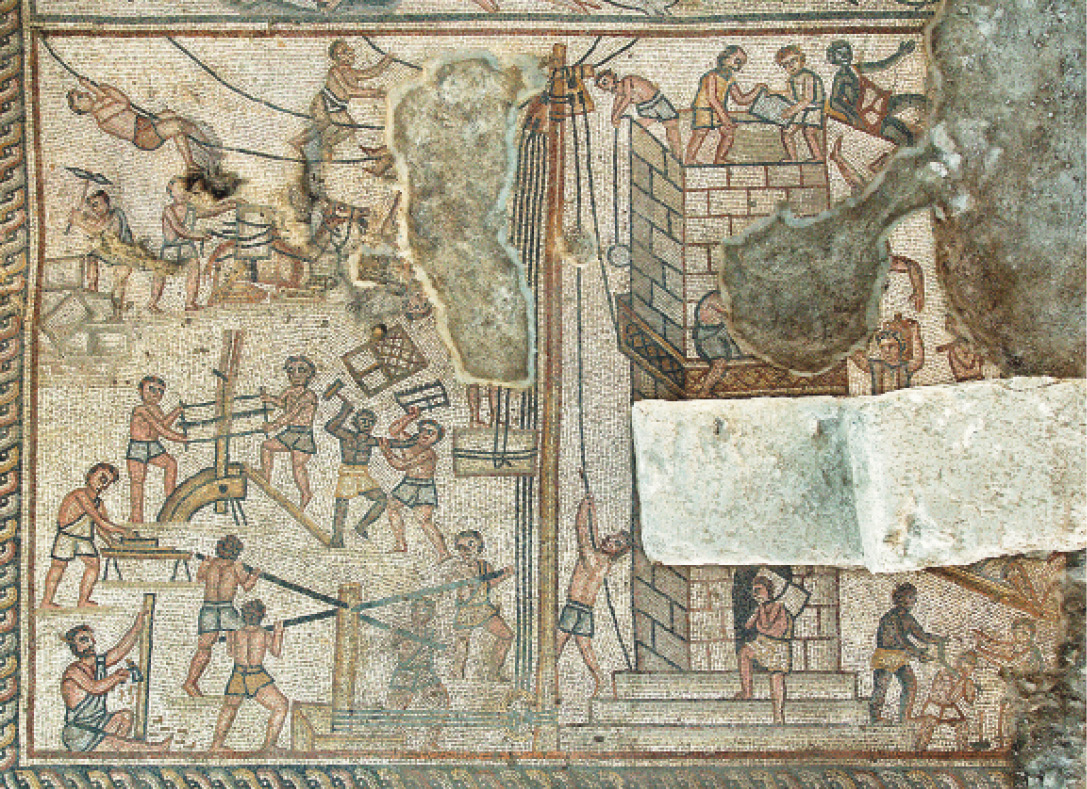
This approach was not only in Jewish exegesis but also in Jewish art. There are only five identified examples of the tower in Jewish art, but in all of them, it is illustrated in a uniquely Jewish manner.

A mosaic of people in different poses AI-generated content may be incorrect.

Figure 4: Tower of Babel, Khirbet Wadi Hamam Mosaic, c. 3rd century, source.

A mosaic of people working on a building AI-generated content may be incorrect.

Figure 5: Tower of Babel, Huqoq Synagogue, c. 5th Century

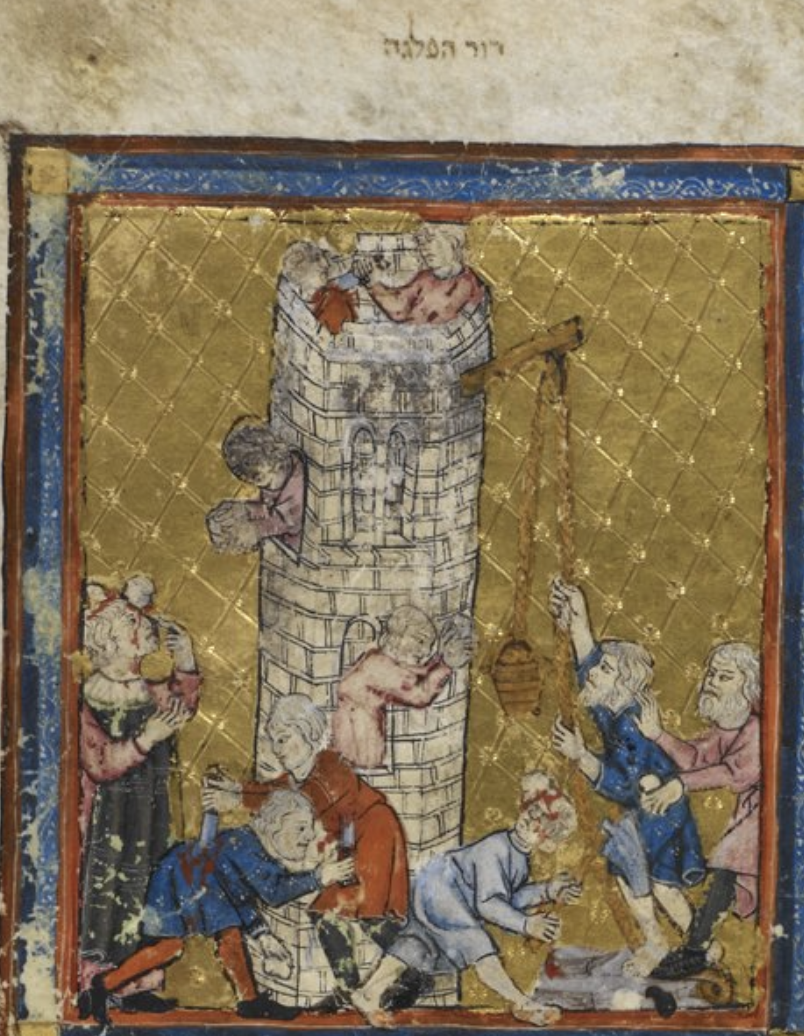
The earliest two examples are synagogue mosaics, a third-century synagogue in Wadi Hamam, and a recently discovered fifth-century mosaic on the floor of the Huqoq Synagogue in northeastern Israel. Only a part of the Wadi Hamam scene has survived, though it is the largest intact biblical scene found. It shows workers and a tower on the left. In the center, two workers are hitting each other. The Huqoq mosaic is larger and illustrates all stages of construction, including detailed depictions of hoists, levers, and various chiseling and cutting tools. At the center of the scene, two workers are engaged in conflict—one wielding a hammer and the other a saw.[5] Similarly, three medieval manuscripts feature this theme; in two, the depiction of violence is the central focus, while in the third, it forms part of a broader image, akin to the mosaic. [6]

A close-up of a painting AI-generated content may be incorrect.

Figure 6 Golden Haggadah, fol. 3r

Although these examples feature the tower, they can be distinguished from the Christian perspective. Firstly, the labeling of the images aligns with Jewish tradition, specifically referencing Dor Haflagah. Secondly, Bruegel’s comprehensive visual representation notably omits any mention of violence. The interpretation that linguistic confusion led to violence is exclusive to Jewish sources, appearing in Genesis Rabba and various other texts, but not in Christian writings.[7] Given that the mosaic dates to the third century, this seems to potentially point to an earlier codification of Genesis Rabba than is currently assumed or that this approach was already was an oral legend.[8] The only known medieval Christian manuscript featuring a descent into violence, The Bedford Book of Hours, has prompted one scholar to assert that it “is undoubtedly based on a Jewish legend.”[9]

While Jewish manuscript culture preserves the uniquely Jewish interpretation of the iconography of the Tower of Babel, Jewish print culture would transform Bruegel’s symbol of pride and sin into a fortress of divine protection.

The Soncino family was the first great dynasty of Hebrew printers, active in northern Italy from the late 15th to the early 16th century.[10] Originating from the town of Soncino in Lombardy and operating intermittently between roughly 1483 and 1527, they established presses in a succession of Italian cities, including Soncino, Brescia, Fano, Pesaro, and Rimini, as well as in Turkey. The founder, Joshua Solomon Soncino, and his nephew, Gershom ben Moses Soncino, expanded the enterprise into one of the most respected printing houses of Renaissance Italy. Gershom issued one of the earliest dated Hebrew books, a Talmudic tractate printed at Soncino in 1484. This work, with its unique layout, is the first of its kind to become canonized, combining the source text with two surrounding commentaries, and is itself a work of art. Their editions combined typographic precision with decorative sophistication equal to the best contemporary Latin and vernacular presses, and their name became synonymous with the art of Hebrew printing itself. They did not just print for a Jewish audience, but also printed over 100 non-Jewish titles, outdoing their Jewish output of 64 titles.

SEFER IKKARIM (BOOK OF PRINCIPLES), RABBI JOSEPH ALBO, RIMINI: GERSHOM SONCINO, 1522 | Sacred Splendor: Judaica from the Arthur and Gitel Marx Collection | 2019 | Sotheby's

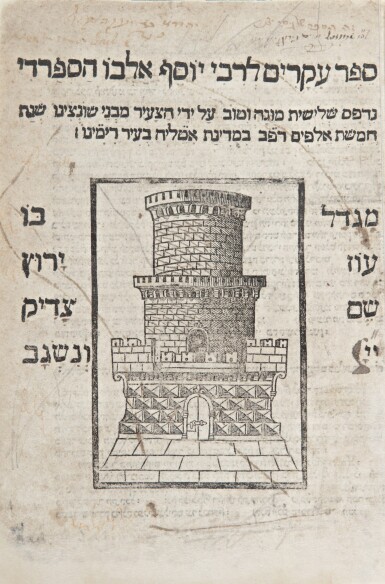
Figure 7: Joseph Albo, Sefer Ikkarim, Rimini, 1522

The Soncino family was active from 1483, but in books printed from 1522, first in Rimini and subsequently in Salonika and Constantinople, Gershom incorporated a new printer’s mark – essentially a printer’s coat of arms.[11] This first appeared in R. Joseph Albo’s Sefer Ikkarim and depicts a traditional Renaissance-style solid stone tower rising above a crenellated wall, accompanied by the verse ‘מִגְדַּל עֹז שֵׁם יְהוָה, בּוֹ יָרוּץ צַדִּיק וְנִשְׂגָּב” “the name of the Lord is a mighty tower; the righteous runneth into it, and is set up on high,’ (Proverbs 18:10) on the left and right sides of the image. Gershom chooses to highlight the tower, unlike other possible symbols such as the rainbow, clouds of glory, or King David, which could have served a similar purpose.

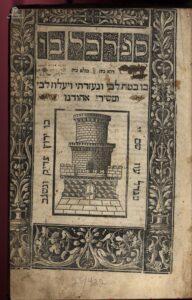
Figure 8: Kol Bo, Rimini, 1525, Gross Family Collection

In the Sefer Kol Bo, published in Rimini circa 1525 and considered Gershom’s most distinguished work from that period, a prominent introductory statement appears above the tower: “In You I place my heart and you will help me, and I will raise my heart and with song I will praise you: ‘the name of the Lord is a strong tower; the righteous runs into it, and is safe.’” This clearly presents the tower as an icon of divine protection and intervention. Notably, Gershom’s tower does not correspond with any physical structure in Soncino or Rimini; instead, the tower symbolizes a spiritual rather than an earthly construct.[12] There is one small, but somewhat strange, detail about Gershom’s tower: the doors are latched on the outside, making the locks useless. This oddity reinforces that the tower is divine, as it does not need a locked door. We reenact this belief annually during the Pesach seder. Gershom’s tower, rooted in Mishlei rather than Bereishit, represents divine protection in contrast to retribution. For a Jewish printer deeply engaged with Renaissance book art, this choice offered a thoughtful reinterpretation, reclaiming the tower as a symbol of resilience and trust in God’s safeguarding of the Jewish community people.[13]

The story of the “tower,” whether Bruegel’s collapsing monument or Soncino’s enduring emblem, reminds us how difficult it is to define what makes art “Jewish.” The same image can signify pride or faith, sin or sanctity, depending on the hands and the heart that shape it. Jewish art, then, is not confined to subject or style, but often lives in subtler places — in the design of a page, the mark of a printer, or the choice of a verse. Ultimately, even art speaks in different languages.

Notes: 

  1. For background on the creation of the painting see Margaret A. Sullivan, Bruegel and the Creative Process, 1559-1563 (Ashgate: England, 2010), 191-204. For a direct comparison of the painting with the biblical narrative see Ruth Dorot and Edna Langenthal, “Pieter Bruegel the Elder’s The Tower of Babel (1563). From Art to Architecture,” Journal Education Culture and Society, 2, (2023), 380-400.

  2. See Diána Kulisz, “The Tower of Babel Motif in the Art of the Low Countries,” in Mesopotamia Kingdom of Gods and Demons, ed. Zoltán Niederreiter, (Budapest: Museum of Fine Arts, 2024), 424-439.
  3. See Umberto Cassuto, A Commentary on the Book of Genesis, Part II, trans. Israel Abrams, (Jerusalem: Magnes Press, 1974), 225-226. Abarbenal, however, interprets the section much more in line with Bruegel’s themes. See Nehama Leibowitz, Studies in Bereshit, trans. Aryeh Newman, (Jerusalem: World Zionist Organization), 95-97.
  4. See Cassuto, id. at 203.
  5. See Karen Britt and Ra’anan Boustan, “Artistic Influences in Synagogue Mosaics: Putting the Huqoq Synagogue in Context,” BAR, May/June 2019, 40-41. They note that these are the only two known examples of synagogue mosaics to depict the Tower of Babel.
  6. The Golden Haggadah, Bezalel Narkiss ed. (England, 1996) 24-25; Marc Michael Epstein, The Medieval Haggadah: Art, Narrative & Religious Imagination (New Haven: Yale University Press, 2011), 157-158.
  7. For a collection of the various sources see M.M. Kasher, Torah Shelemah, vol. 1, 515, no. 60 and 517 no. 73.
  8. See Anat Reizel, Introduction to Midrashic Literature, (Tevunot: Alon Shevut, 2011), pp. 105–106.
  9. See Mira Friedman, “The Tower of Babel in the Bedford Book of Hours,” in The Old Testament as Inspiration in Culture, Jan Heller, ed. (Trebenice: 2001), 113-114.
  10. See generally, A.M. Haberman, Perakim be-Toldoth Hamdpissim ha-Ivrim (Jerusalem: Rubin Mass, 1978),15-101; Moses Marx, “Gershom Soncino’s Wander Years in Italy, 1498-1527” in HUCA XI (1936), reprinted as a stand alone work with many examples of Soncino illustrations, in 1969, by the Society of Jewish Bibliophiles.
  11. Abraham Yaari, Hebrew Printers’ Marks: From the Beginning of Hebrew Printing to the End of 19th Century (Jerusalem: Hebrew University Press, 1943), 4-5, 123-124. Gershom once used a different mark with a tower in the 1505 Fano edition Mashal ha-Kadmoni. Id. 124.
  12. Yaari, Printers Marks, 124.
  13. Gershom’s prayer may have been tied to a conflict with a Jew who had converted to Christianity. In the end, perhaps because of this conflict, although it remains unclear, Gershom was forced to flee Italy soon after. See Marx, “Wandering Years,” 55-59.


Hebrew Printing in Lissa (Leszno), A Brief (Perchance) Transitory Moment

Hebrew Printing in Lissa (Leszno), A Brief (Perchance) Transitory Moment

 By Marvin J. Heller[1]

Jewish history is replete with cities, locations, that in their time were centers of Jewish life, replete with communal activities and prominent sages, but sadly, are poorly recalled today, if at all, except in academic and historical circles. One such location is Lissa, Leszno in Polish. Given its relative prominence, Lissa is unusual in that, unlike many similar locations, it was not home to a prominent Hebrew press. Lissa did, perchance, host a printing press for a brief period of time, and that press, together with the books it is credited with publishing, is the subject of this article.

Lissa (Leszno) is located in the Poznan district of Prussia, or, depending on one’s perspective, in the Wielkopolska province of Poland.[2] Previously a village, Lissa was incorporated as a town in 1534, granted a charter by Count Andreas Lescynski, whose descendants include Stanislas Leszczynski, King of Poland (1704-1709). Jewish settlement followed soon after, the settlers likely coming from Germany, having such names as Auerbach and Oldenburg, and several decades later from Silesia. There were Jews prior to that time, however, as communal records record a coronation tax in 1507.

There are contradictory reports as to Jewish settlement, one noting that the Jewish community was granted a charter in 1580, and at about that time a synagogue and a cemetery were established. Another recounting informs that the privilege granted to the Jewish community is dated March 10, 1626, and the earliest preserved tombstone dates to 1662/67. The Jewish population of Lissa consisted of approximately 5,000 Jews in 1765 (about 15% of the town’s population); one of the largest Jewish communities in the Polish–Lithuanian Commonwealth.

The Lissa (Leszno) community had business relations with Breslau as early as 1650. By 1740 Jewish merchants outnumbered non-Jews; by 1793, 40 of the 53 merchants were Jewish, as were 200 of the 201 brokers. Similarly, by 1800, 32 of the 51 tailors were Jews, while others were smelters, tanners, furriers, and embroiderers. Products such as woven goods, furs, and hides reached Moscow and the Turkish borders. After the second partition of Poland and the absorption of Lissa into Prussia in 1793, the community, deprived of its markets in Poland and Russia, began to decline, falling as low as 804 in 1913.

Jewish life was not entirely pacific. The Jewish community of Lissa suffered during tah-ve-tat (the Chmielnicki massacres of 1648-49) and during the second Swedish war which forced the Jews to temporarily flee in 1659. In the Northern War (1706–07), the community underwent extra exactions from both sides, suffering plunder and rape from Russian soldiers, the entire Jewish quarter being burned. In 1709, there was a plague and Jews were accused, by bringing the corpse of a Jew to be buried, of infecting the town with the plague. There were several subsequent events, including devastating fires in which Jewish homes and synagogues were destroyed.

All this notwithstanding, Lissa became a center of Jewish life in Greater Poland in the mid-eighteenth century, renowned throughout Europe for its rabbinic sages and yeshivot. Among the prominent rabbinic sages who served in Lissa are R. Isaac Eilenburg, R. Jacob Isaac ben Shalom; Isaac ben Moses Gershon; R. Ephraim Kalisch; Mordecai ben Ẓevi Hirsch; the latter’s brother, R. Abraham Abusch Lissa; R. David Tevele; R. Jacob Lorbeerbaum, and from 1864 to 1912 R. Samuel Baeck. Also associated with Lissa is R. Akiva Eger, who studied in Lissa from 1780 to 1790.

Given the above, it would be surprising if there was not a Hebrew press in Lissa. Nevertheless, Lissa’s subsequent history, would suggest that locating a press there in the early decades of the nineteenth century is also, perchance, surprising, as will be addressed later. Concerning the Lissa press, Yeshayahu Vinograd records eight entries for it in his Thesaurus of the Hebrew Book.[3] Those works are all small, in octavo format, generally booklets at best. One additional work, not recorded in the Thesaurus as a Lissa imprint, but so listed by the National Library of Israel, is R. Joseph Yuspa Hirschfeld’s Yad Yosef.

We come now as why the Hebrew press in Lissa is referred to in the article title as “Brief (Perchance) and Transitory.” In contrast to the above record of Lissa imprints, Ch. Friedberg, in his History of Hebrew Typography, does not have an entry for Lissa, but rather subsumes the publications credited to that city to his entry for Dyhernfurt (Dyhernfurth) writing concisely in a footnote, that “the printers intentionally give the place of printing on several title-pages as Lissa in place of Dyhernfurth for reasons that are unclear. There is no doubt that these books were printed in their entirety in Dyhernfurth.”[4] That location is in Lower Silesia, a community approximately 50 miles (80 km.) distant from Lissa. It had, at times, been under Austrian (Hapsburg) rule, subsequently considered part of Poland and of Prussia.

Dyhernfurth was home to a press that had previously been very successful, beginning with Shabbetai Bass (1641-1718) who established a Hebrew press there in 1689. In the more than ensuing century, Hebrew presses in Dyhernfurth printed numerous titles including individual tractates from the Talmud, as well as two complete editions of the Talmud. However, the second edition of the Talmud, printed from 1816 through 1824, was not successful.[5] The then current Hebrew press, that of David Sklower and Naphtali Zevi ben Moses David Hochmavitz, was forced to close. Part of the typographical equipment fell to Sklower who relocated to Breslau and afterwards to Warsaw. The remaining typographical equipment went, in 1821, to R. Zevi Hirsch ben Meir Katz, known as Warschauer.

It is Warschauer who is credited as the Hebrew printer in Lissa (Leszno). It is his name that appears on the title-pages of several of the books that give Lissa as the place of publication. Friedberg, as noted above, writes that these books were actually Dyhernfurth imprints. Friedberg references an article in the Soncino-Blãtter by Dr. Louis Lewin who writes, in considerably greater detail, that it has escaped notice that the Lissa type is consistently Dyhernfurth type and “dass sie durchgangig Dyhernfurther Typen aufweisen, eilweise nur Fortfetzung eines Dyhernfurther Druckes sind . . . (that it is partially only a continuation of the Dyhernfurth press)”. Furthermore, a Lissa ליסא press being concealed, only alluded to by the phrase Gedruckt in der hebrãischen “Buchdruckerei.”

Lewin continues that works such as the Mahzor are either a reprint of the popular and much reprinted Heidenheim Machzorim or a plagiarism of an author whose authorship is disputed. He is also dismissive of the women’s prayer books, not consequential works. Lewin also observes that no mention is made of the press in the Lissa commuity news or in other contenporary Lissa docments. concluding that “all these prints must be “Es mńssen darum alle diese Drucke als Pseudo-Lissaer”not noted in Jewish literature. But ratherליססא , the names of the print shop owners and staff echte Dyhernfurther bezeichnet werden, deren Druckherren die Brūder Hirsch und Markus Warschauer waren (described as pseudo-Lissaer and actually Dyhernfurth imprints, the printers being the brothers Hirsch and Markus Warsawer).[6]

Interestingly. Friedberg, in his bibliographical lexicon, Beit Eked Sefarim, records these Lissa imprints without modifying notation.[7] Other bibliographers also record Lissa imprints without qualifications. For example, Aron Freiman, in A Gazetteer of Hebrew printing, records Joseph Hirschfeld’s Lekitat Yosef as the first Lissa imprint.[8]

At this time, that is the early nineteenth century, there was a prohibition in Austria on the publication of several categories of Hebrew books, particularly Hasidic and kabbalistic books as well as Yiddish works. Lissa, however, although previously part of the Habsburg domain, appears to have been apart from that realm at this time. When those prohibitions were in effect, Hebrew printers attempted to circumvent them by either by backdating books to a period prior to its imposition of the prohibition or giving a false publication place on the title-page. However, the books credited to the Lissa press, with a rare exception, do not appear to fall into the prohibited categories and should not, therefore, have required any prevarication.[9]

As noted above, only a small number of titles are credited to the Lissa press. The titles described are indicative of the market to which this small press directed its publications. It did not publish large works, such as Talmudic tractates or major halakhic treatises. Rather its publications are small books addressed and of value to the general population.

La-Yesharim Tehillah – Among the first titles published by the press is La-Yesharim Tehillah, a drama by the renowned kabbalist R. Moses Hayyim Luzzatto’s (Ramhal, 1707–1746). Ramhal is best known today for his Mesillat Yesharim, a popular and much studied ethical masterpiece. La-Yesharim Tehillah (Praise to the Upright), a very different composition, is one of Ramhal’s last works. It is an allegory, expressing the feelings of persecution he experienced due to controversy about him, and reflecting his belief in the ultimate victory of the just. This edition was published in octavo format (80: 72 pp.).

1824, La-Yesharim Tehillah

The title-page, which has no ornamentation, neither decorative borders nor a printer’s mark, states:

La-Yesharim Tehillah
Shir Yididos

On the day of the wedding of the sage, the wise, כהר”ר [the honorable rabbi]
Jacob Di-Gais יצו [may his Rock and Redeemer watch over him]
With the bride, the virgin, the modest
Lady Rachel De Vega Enriques יצו [may her Rock and Redeemer watch over her]

I, the young
Moses Hayyim ben Jacob Hayyin Luzzatto, have written it.
First printed in Amsterdam in 1740
And printed a second and third time in Berlin in 1780
And in the year
[5]584 (1824) לבע [From the creation of the World].
LISSA
At the press of the partners, Gabridor Warschauer, and Company.
At the expense of the exalted R. Lipman of Koenigsberg.

The title, La-Yesharim Tehillah, is from the verse “[Sing forth, O you righteous, to the Lord; it is fit that] the upright [acclaim, praise] Him” (Psalms 33:1); the subtitle, is from “For the leader; on the shoshannim by the son of the Korah, A maskil, a song of endearment (A Love Song, Shir Yididos (Psalms 45:1).

The title-page is followed by prefatory material set in rabbinic letters, among them introductions, one from R. Solomon ben Joel of Duvno, descriptions of the allusions in the play, a list of the characters, and the play. The text is in square vocalized Hebrew. La-Yesharim Tehillah, Ramhal’s third and last play, was written in Amsterdam and represents the climax of his dramatic art. The play is an allegory in three acts of four, five and six scenes. [10] An example of the text,

Understanding: O Uprightness, Beloved of my soul, let thy heart take courage; like a girdle gird on strength! For when assistance seems far away, relief comes suddenly to us. When in the blazing heat, in summer drought, the sky is covered with thick darkness of the clouds whose thunder roaring makes the earth beneath to quake; when lightning flashes like an arrow; when the wind rends the mounts, as thought they were earthen pitchers . . . then the beasts of the forest all together take refuge, and all the young doves flee into the clefts of rocks. . . .

Uprightness: O understanding, of joy of my heart, thy comforting has surely enlarged my heart. For now it seems as though from the words of thy mouth I behold an opening for my hope. But be so kind, if thou hast good tidings. Withhold it not from me.[11]

A popular and much reprinted work, the Bet Eked Sepharim records twenty-six editions through 1949. According to the Bet Eked Sepharim this is the eighth edition, not the fourth printing of La-Yesharim Tehillah.[12]

Likitat Yosef – Also printed in 1824 and, reportedly, again in 1826 is R. Joseph Yuspa ben Tzvi Hirsch Hirschfeld’s Likitat Yosef, a linguistic work, a Hebrew-Yiddish Dictionary with references to Biblical verse for instructing children.[13] This too is an octavo ([6], 61, [1] ff.). The publishers are given as Medihernfort and Kamp. Hirschfeld (d. 1848), a pedagogue, is credited with three additional works, Yad Yosef (below), Middot ha-Derashot Halakah (Berlin, 1840), and Shir ha-Yahid (Berlin, 1833), on prayer and zemirot.[14] Another work, recorded by William Zeitlin is Bechinath Olam (Berlin, 1838), “Reflections on the world and its inhabitants by R. Jedaya Penini. …”[15]

The title-page of Likitat Yosef is formatted in the same manner as La-Yesharim Tehillah, that is, without ornamentation. However, unlike the preceeding work, which is dated in a straight forward manner, Likitat Yosef is dated with a chronogram, “‘Accursed is the one who moves the boundary of his fellow ארור מסיג גבול רעהו (584 = 1824)’ (Deuteronomy 27:17) for fifteen years.” The restriction on reprinting Likitat Yosef is highly unusual, not because it states the time limit for reprinting the work, but due to its mention on the title-page rather than in an approbation, which is the customary way of restricting unauthorized republication, and that it is used as the dating chronogram. The title-page states that it is:

Sefer
Likitat Yosef
A key
To finding pleasing items,
One language and other things[16]
Hebrew . . . words from
Yuspa Hirschfeld
Preschool teacher . . .
Printed
Here, in the crowned city
LISSA
“Accursed is the one who moves the boundary of his fellow” (584 = 1824) for fifteen years.
At the press of the partners from Dyhernfurth, Medihernfort and Kamp

The title-page is followed by the introduction which begins “‘A wise man has his eyes in his head’ (Ecclesiastes (2:14), an understanding scale in his hand, and the roots of understanding branch out in his eyes. He will see that ‘My heart overflows with a goodly theme’ (Psalms 45:2): to teach the young of the children of Israel ‘a clear language’ (Zephaniah 3:9).” Hirschfeld continues on the importance and value of the youth of Israel learning the language well, on a daily basis. The heart of the wise person values this in contrast to the fool who has no appreciation. Hirschfeld states that due to his love of brevity he has not expounded on words at length

There is a brief postscript in which Hirschfeld references his father, R. Tzvi Hirsch, followed by a brief statement from the printer who states that it is not as leket shikhhah, the forgotten gleanings from the field, but rather is selections all pure. Below is an acronym, the first letter of each line spelling Joseph Yuspa. Next is a list of sixty-three contributors (sponsors) arranged by city in German (Fraktur), that is, Breslau (22), Posen (17), Lissa (14), Krotoschin (6), Wortenborg (2), and D. Ostrowo (2).

1824, Likitat Yosef

The text is set in two columns, arranged alphabetically. Within each column words are given in Hebrew in square vocalized letters with their explanation in Yiddish set in a smaller font comprised of a mixture of Vaybertaytsh and rabbinic letters. Synonyms are given in order and words are organized by letters of the alphabet and vowels, for example, ayin patach, ayin segol, for example

Likitat Yosef has been reprinted several times, beginning, as noted above, with a reported second Lissa edition (1826), Vienna (1825), and again in Vienna (1835).[17]

Tehinat Imahot; Techina Shlosha She’arim – Our next Lissa titles are two small octavo tehinot, that is, Tehinat Imahot ([8] ff.) by Hadas, the wife of the late R. Yudel of Hadzish and Techina Shlosha She’arim ([16] ff.), no author given. Both were printed, respectively, in 1824 and 1825, by the Hebraisher Buchdruckerei (Hebrew book printers) with the same title-page format as noted above.

Tehinnot are described by A. Idelsohen as private devotions, often the source for later public prayers. They are a personal, spontaneous and inspired form of expression representing the craving of the soul. They may be understood as in keeping with Berakhot (28b), which states, “do not make your prayer routine, but rather free supplications and petitions before God.” Tehinnot were written through the ages by men of piety; they have been described as a “rivulet of that warm and soulful outpouring [that] never ran dry in Israel.” They have been written through the generations to express plights, needs, wishes, and aspirations which move the heart. Originally in Hebrew, they have been written in all languages spoken by Jews. Tehinnot in Yiddish were mainly for women and those unfamiliar with Hebrew. In many cases tehinnot were published in book form.[18]

Similarly, Meyer Waxman writes that “Tehinoth were the special medium of devotion of the women of Israel and were adapted . . . both in form and content to their needs. Generation after generation of pious souls had poured forth their hearts before their Maker and pleaded for the health and welfare of their near and dear ones in the semi-lyrical language of these supplication prayers.” He notes their varied nature, describing them as heterogenous, addressing all phases of life, supplications in an intimate tone.[19]

The text of both or our tehinot are set in Vaybertaytsh, a semi-cursive type generally but not exclusively, reserved for Yiddish books, so named because these works were most often read by the less educated and women. They were clearly meant for an Ashkenazi audience, for books in Vaybertaytsh were certainly not directed or intelligible to a market outside that community, but also evidence that that market was sufficiently large enough to justify the publication of works for a particular element of rather than for the entire Jewish community.[20]

The title-page of Tehinat Imahot (mother’s supplications) states that it is a collection of prayers of life, continuing in Yiddish that it is with the merit of our fathers and mothers and the Lord who has given us years of life through honorable deeds. The text is in a single column, set in Vaybertaytsh.

Techina Shlosha She’arim is in three parts, as noted on the title-page, that is, hallah, niddah, and lighting Sabbath candles; Shabbat and Rosh Hodesh; and the Yamim Nora’im. The text, set in a single column in Vaybertaytsh, excepting headings and introductory lines, is comprised of both prayers and brief halakhic notes. The references to hallah, niddah, and lighting Sabbath candles concerns the taking of a portion of bread for an offering; niddah, the monthly menstrual separation; and hadlaka, lighting the Friday evening Sabbath candles. The importance of these activities is based on Shabbat 31a, which states “For three transgressions woman die in childbirth. Because they are not observant [of the laws] of Niddah, Hallah, and lighting of Sabbath candles.”


1825, Techina Shlosha She’arim


This is the only edition of Tehinat Imahot. This is the first edition of Techina Shlosha She’arim; it has been reprinted numerous times, the Thesaurus records twenty-one editions.[21]

Yad Yosef – Our second R. Joseph Yuspa Hirschfeld title is Yad Yosef. This, the first edition, is not, as noted above, recorded in the Thesaurus as a Lissa imprint but rather as having been printed in Vienna at the press of Anton Schmidt in 1826. Friedberg, in the Bet Eked, does record this edition as a Lissa imprint.[22] It was published as a duodecimo (120: [2], III-VI, [VII-XII], 216, [2] pp.). The title-page, which does not name Lissa as the place of publication, follows the style of the other Lissa imprints, that is, with a simple title-page devoid of ornamentation. It describes Yad Yosef as the names of the persecuted שמות הנרדפים for which there are references. It is dated “And we will rejoice in the words of your Torah ונשמח בדברי תורתך (588 = 1828).” The colophon dates completion of the work to Wednesday, Rosh Hodesh Heshvan, in the year “Happy is the one who waits אשרי המחכה (589 = October 8, 1828)” (Daniel 12:12).

Yad Yosef reads from left to right, like a German book. Nevertheless, it begins with a Hebrew title-page followed a multi-page vorrede (preface) in German followed by a second lengthy preface in Hebrew. The former has an image of justice, sitting blindfolded with a sword in one hand, scales in the other. Below it is Hebrew text that states,

“See for yourselves how my eyes
lit up when I tasted that bit of honey” (I Samuel 14:29)
“If my anguish were weighed” )Job 6:2) on the matter.
“My full calamity laid on the scales” )Job 6:2) and for my heart suffices.

Repeated below it are those verses in German. The Hebrew introduction begins in a light manner that might perchance be meant to be humorous or sarcastic, stating that “it is well known, especially to those who love words of acumen אמרי בינה that it is the custom for a work, small or large, to have a have a brief summary of the book’s topic – to place words in the mouth of the reader, his eyes to see, his eyelids discern the apology, and quickly find the object of his desire.” He then continues, begins, in a more serious vein,

that he “has walked in their footsteps and prepared a lexicon, also I – and this work (letter) I gathered with great diligence, nights as days, with exertion for the honor of the Torah and those who study it: who love and cherish it the beloved! “The teaching of the LORD is perfect” (Psalms 19:8), in it are written and I have found the reasons of DIFFERENT WORDS IN EXPRESSION AND TOUGHT – I have arranged them alphabetically . . .

1828, Yad Yosef

The introduction is followed by the text, set from left to right, comprised of Hebrew works and concise bi-lingual references. Entries are brief, the Hebrew word in the center in square vocalized letters, to the left a source of the term in rabbinic letters, and to the right a translation in German and biblical source. Three examples of the text, one only with a reference, that to Rashi, from the above image, are:

כביר ע’ רש’י ובאור – Matratze. 1. Sam 19. 13.

ענג Lust, Wohlleben. Jes. 58. 13

תענוג Vergnūgen. Sprūch. 19. 10.

כביר Matratze. 1. Sam 19. 13. which refers to the verse “Michal then took mannequins and placed them in the bed, and she put a כביר goat-skin at its head and covered it with a cloth.” (I Samuel 19:13).

ענג Lust, Wohlleben. Jes. 58. 13 (If you restrain your foot because it is the Sabbath, refrain from accomplishing your own needs on My holy day; if you proclaim the Sabbath ענג ‘a delight’ and the holy [day] of the Lord ‘honored’ and you honor it by not engaging in your own affairs, from or discussing the forbidden: seeking your own needs.” (Isaiah 58:13)

תענוג Vergnūgen. Sprūch. 19. 10. תענוג Pleasure does not befit a fool; surely [it is not fitting for] a servant over dignitaries. (Proverbs 19:10).

Yad Yosef concludes with a multi-page bi-lingual Hebrew-German Oeffentliche Danksagung (public thanksgiving) addressed to Tobias Marcus and L. Mende, an example below:

Let your home be wide open, and let the poor be members of your household. (Avot 1:5)
Dein Haus sei offen, Fremde aufaunehmen, um Gastfreiheit an ihnen su üben; achte sie wie deine Hausgebornrn.”

Open your hand to the poor and needy kin in your land (Deuteronomy 15:11)
Thue deine Hand auf gegen deinen Bruder, de Arman und Dürftigen in deinem Lande.

Yad Yosef has been reprinted twice, in Frankfurt on the Oder (1828) and in Berlin (1830).[23]

A final word on Joseph Yuspa Hirschfeld. Moritz Steinschneider has an entry for Joseph Hirschfeld, which begins “Privatlehrer in Schweria a. d. Warte. [Postena Berol. etc. Mrt. mense Decmbr. A1848. – Autor suspectus,” that is he describes Hirschfeld as a private tutor and concludes that the authorship is suspect.[24] No reason is given for that suspicion and in the absence of any supporting or contradictory evidence Steinschneider’s position remains open, unresolved.

Also attributed to the Lissa press is a Mahzor, dated 1824, not seen by the author. Perchance, this is the Heidenheim Mahzor referred to by Lewin. Another work credited to the press, although its date distances it from the general period of activity of the subject press, is R. Saul Isaac ben Ahron Jacob Kaempf’s Toldot Rabbi Akiva Eger, dated 1838. Also noted is another undated edition of Techina Shlosha She’arim.

We now return to the subject of perchance, that is, whether there was a press in Lissa or, as Dr. Lewin suggests, the books attributed to Lissa were actually printed in Dyhernfurth. Lewin was a respected scholar and his reservations need be taken seriously. However, upon inspection, his contention does not appear to be convincing.

Among his arguments for a Dyhernfurth publication site for the books attributed to Lissa are the likeness of the fonts in the books printed in both locations. However, likeness of fonts is not a strong argument: not only is type available to more than one press from a foundry, but more likely Warschauer took typographical equipment with him when relocating to Lissa, as did Sklower when he relocated to Breslau. Similarly, there is no reason why the worker’s names, not noted in the colophons, is any more suggestive of Dyhernfurth than Lissa, nor does the insufficient description of the press seem sufficient evidence to question its location. That the women’s prayer books appear to be inconsequential to Lewin does not detract from their communal value or suggest that they were printed elsewhere. That the press is not mentioned in communal news or documents may be because the press was not consequential. It might be well asked, if the Lissa press was in Dyhernfurth, why is it not mentioned in their communal records, or, finally, what was to be gained by concealing the press’s location.

On the other hand, just as Sklower left Dyhernfurth for Breslau so did Warschauer leave Dyhernfurth for Lissa. That the press appears to have done poorly there actually supports a Lissa location. A small press, it did not publish “consequential” works such as the Talmud, large halakhic titles, or responsa. The books that it did publish were of value to a, perchance, less educated community, addressing their needs, including women’s prayer books.

A likely reason for the presses’ difficulties and brief existence may actually be its location, that is, in Lissa. That location, as noted above, at one time a city of import, had begun to decline after the partition of Poland and its annexation by Prussia in 1793. No longer an important commercial center nor a location with a history as a center of printing. Lissa had no prior press, nor was it well situated for a press. The books it published were small, of value to a local population, consisting of ethical, linguistic and liturgical works, but did not address the needs of a more sophisticated population with leading yeshivot, as Lissa had been so earlier. It was not set up for book distribution, a basic requirement for a successful press. Several of the books that it did publish, were quickly reissued in Vienna, republished at the press of Anton Schmidt, a publisher of consequence.[25]

Given the restrictions on reprinting stated on the title-page of Likitat Yosef it would appear that the almost immediate reprinting of that title and other works were at the initiative of the author. Given the poor distribution of Lissa imprints Hirschfeld likely sought a larger and more successful press, an objective filled by the press of Anton Schmidt. Perchance, no, in this instance certainly not perchance, but more likely, indeed assuredly, if the books had been printed in Dyhernfurth, with its history of printing and successful book distribution, there would not have been a need to reprint these titles in Vienna.

All of the above notwithstanding, the books that were published in Lissa, albeit small in number and in size, were worthy titles. Lissa was, as noted at the beginning of this article, one of many presses, small in size and output, which are poorly recalled today. Nevertheless, this does not detract from the fact that these presses published valuable works, serving the needs of the local population. Here too, the Lissa press, despite being short lived, published books of value to its community and deserves to be remembered and well regarded.

[1] I would like to express my appreciation to Eli Genauer for reading the article and his comments. All images in this article are Courtesy of the National Library of Israel.

[2] The background information on the history of Lissa (Leszno) is a composite of the following articles on that city, namely Jacob Rothschild and Danuta Dombrowska, “Leszno,” Encyclopaedia Judaica, vol. 12, p. 667; Gotthard Deutsch and Samuel Baeck, “Lissa (called formerly Polnisch Lissa),” Jewish Encyclopedia, vol. 8, pp. 107-08; “Leszno (I),” The Encyclopedia of Jewish Life Before and During the Holocaust, vol. 2, pp. 74-74; and Hanna Węgrzynek, “Leszno,” YIVO Encyclopedia of Jews in Eastern Europe, translated from Polish by Joanna Nalewajo-Kulikov, vol. 1, p. 107.

[3] Yeshayahu Vinograd, Thesaurus of the Hebrew Book. Listing of Books Printed in Hebrew Letters Since the Beginning of Printing circa 1469 through 1863 II (Jerusalem, 1993-95), p. 407 [Hebrew].

[4] Ch. Friedberg: History of Hebrew Typography of the Following Cities in Europe: Amsterdam . . .Dyhernfurt . . . From its Beginning in the year1516 . . (Antwerp, 1937), p. 72 [Hebrew].

[5] Concerning the printing of the Talmud in Dyhernfurth see Marvin J. Heller, Printing the Talmud: A History of the Individual Treatises Printed from 1700 to 1750. (Brill, Leiden, 1999), pp. 219-43.

[6] Louis Lewin, “Hebrãische Drucke und Drucker aus Grosspolen,” Soncino-Blãtter (Berlin, 1925-26), pp. 173-74. R. Louis Lewin (1868–1941), was a German rabbi and historian. He served as rabbi in several communities prior to settling in 1937 he settled in Palestine. Among his several works is Geschichte der Juden in Lissa (1904). Israel Halpern, “Lewin, Louis,” EJ 12, p. 761.

[7] Ch. B. Friedberg, Bet Eked Sepharim, (Israel, n.d), var. cit. [Hebrew].

[8] Aron Freiman, A Gazetteer of Hebrew printing, reprinted in Hebrew Printing and Bibliography (New York, 1976), p.298.

[9] Concerning the intentional misdating of Hebrew books or giving a different location see Marvin J. Heller, “Who can discern his errors? Misdates, Errors, and Deceptions, in and about Hebrew Books, Intentional and Otherwise,” in Further Studies in the Making of the Early Hebrew Book (Brill, Leiden/Boston, 2013), pp. 395-420.

[10] Meyer Waxman, A History of Jewish Literature III (New York, London, 1960), pp. 101-04.

[11] Benzion Halper, “Dispute Between Understanding and Uprightness” in Post – Biblical Hebrew Literature: an Anthology (Philadelphia, 1921), pp. 243-246

[12] Friedberg, Bet Eked Sepharim, lamed 422. The eight printings recorded by the Bet Eked Sepharim, in contrast to the first editions cited on the title-page of this edition are 1) Amsterdam,1743; 2) Berlin, 1780; 3) Lvov, 1790; 4) Lvov, 1799; 5) Berlin, 1799; 6) Lvov, 1803; 7) Lvov, 1823; and (8) Lissa, 1824.

[13] Both the Thesaurus and the Beit Eked Sefarim have entries for a 1826 edition of Likitat Yosef. However, none the library catalogues checked, admittedly a small number, nor World Cat, he world’s largest network of library content and services, record an 1826 edition of Likitat Yosef.

[14] Vinograd, Thesaurus I, p. 221.

[15] William Zeitlin, Biblotheca hebraica post-Mendelssohniana (Leipzig, 1983). p. 144.

[16] This phrase appears, with a single letter variation, in Genesis 11:1 as “[The whole earth was of] one language and of common purpose .שפה אחת ודברים אחדים.” Perhaps this form of the verse on the title-page is more appropriate for Likitat Yosef, as it appears in halakhic and midrashic works as well as commentaries, and one kabbalistic work, Sefer Milḥamot Hato Likitat Yosef’ as “The whole earth was of one language and other purposes שפה אחת ודברים אחרים,” suggesting Likitat Yosef’s linguistic purpose, that is, it is a bi-lingual dictionary.

[17] Friedberg, Beit Eked Sefarim, lamed 788; Vinograd, Thesaurus, I, p. 221. Concerning the 1825 Vienna edition of Likitat Yosef. There is no question of misdating or incorrect labeling. The 1825 Vienna was seen and a comparison of the two editions show that it is as described, a separate, independent, and apparently slightly expanded printing of the Lissa edition of Hirschfeld’s Likitat Yosef, this at the press of Anton Schmidt.

[18] A. Idelsohen, Jewish Liturgy and its development (New York, 1932), pp. 257-58, 264-65;

[19] Waxman, p. 641.

[20] Concerning the early use of Vaybertaytsh see Herbert C. Zafren, “Variety in the Typography of Yiddish: 1535-1635,” Hebrew Union College Annual LIII (Cincinnati, 1982), pp. 137-63; idem, “Early Yiddish Typography,” Jewish Book Annual 44 (New York, 1986-87), pp. 106-119. In the former article, Zafren informs that the first book in which Yiddish was a segment was major was Mirkevet ha-Mishneh (Sefer shel R. Anshel), a concordance and glossary of the Bible (Cracow, 1534/35). In the latter article he suggests that the origin of Vaybertaytsh, which he refers to as Yiddish type, was the Ashkenaz rabbinic fonts, supplanted by the more widespread Sephardic rabbinic type which prevailed in Italy (p. 112).

[21] Vinograd, Thesaurus II, p. 165.

[22] Friedberg, Bet Eked Sepharim, yod 119; Vinograd, Thesaurus II, p. 230.

[23] Friedberg, Bet Eked Sepharim, yod 119.

[24] Moritz Steinschneider, Catalogus Liborium Hebraeorum in Bibliotheca Bodleiana (Berlin, 1852-60), col. 1043, no. 5233.

[25] Anton Schmidt was sufficiently sucessesful and the quality of his books highly regarded with the result that he was ennobled in 1823 by the Austrian Emperor, so that he now was Anton Von Schmid.


Publish and Perish or Digital death

Publish and Perish or Digital death

By: Yaakov Rosenes
About the author: Yaakov Rosenes made Aliya from Canada after graduating from Trent Univ. and U of I Chicago Circle. In the 70’s he held various research and administrative positions at Yad HaRav Herzog, Feldheim publishers, and Machon Yerushalayim. In the 1980’s he founded the Judaica Archival Project, a Preservation and Access program for Rabbinics at JNUL. Since the 1990’s the Project has offered bibliographic and book-finding services at www.virtualgeula.com.
Introduction:
Since the advent of the Internet, the nature of reading and publishing has changed radically in the secular world. Also today Jewish publishing is something entirely new. Now that it is acceptable to bring a lap-top computer into Kollelim we find literally thousands of Avrechim working on original (and frequently worthwhile) Seforim. Today over 75% of the 4000 new Torani titles appearing annually are privately printed by the author. At least half of these books are sold from homes. Many authors are experimenting with print-on-demand technologies and printing smaller editions to lower their costs. Other authors are posting their Seforim online as PDF files or as e-books. In short Jewish publishing which used to be dominated by 10 major publishers and distributors has become a market with thousands of players. Store owners have no shelf-space for new titles. Readers are jaded from too much material. Authors are frustrated because they can’t sell or even give-away their Sefer. Fortunately and unfortunately every Rabbi, Scholar, Admor, Mashpia, Maran and Baba has created his own literature and is trying to attract own readership. In short today’s Torani publishing has become a free-for-all.
How many Sifrei Kodesh are printed every year?
In Israel alone 50 every week are recorded by the book depository department at JNUL. I terms of cost at an average of $2000 per book means that Klal Yisrael invests over $5,000,000 per year in printing new Seforim! This number has doubled every 5 years for the last 30 years but the readership is growing at a much slower rate than the “printer ship”.
How much does it cost to print a Sefer today?
From 1K to 10K. It depends on the size of the book, the size of the edition and how it is bound. A Soft cover edition of 500 copies can cost as little as $1000. A hardcover edition of 500 pages of 1000 copies can cost over $10,000 to print in Israel.
What do you mean by Publish and Perish?
Self-explanatory, when your brother-in-law gets a copy of your new Sefer and puts it straight on the top back shelf of his bookcase it means even your closest audience has no time for your creation. The point of printing a Sefer is to open up a dialogue with a readership. Unfortunately today most new Seforim are what is called “vanity publishing” which sadly turns into a monologue between the author and himself.
Who is printing Seforim today and who should not print a Sefer?
Everybody who is sitting in a Bet Midrash with a lap-top or tablet computer is probably working on a Sefer. On any typical morning in my Kolel there are at least 10 Avrechim with computers on the desk. Some of them even wear their Tefillen while they edit their Sefer. Any first time author should think many times before he starts to work on a Sefer. Is it original? Who will read it? Don’t I need an editor? Why is my Rav encouraging me ?  Maybe he thinks it will be therapeutic? What does my wife or my father-in-law or my brother-in-law really think? If the answer is not clear to any of the above questions please do not print more than 50 copies, soft cover.
How did you print Seforim 40 years ago and how is it done today?
When I came to Israel in the 1970’s we still used a monotype press attached to a mechanical keyboard which set letters in molten lead. Today offset printing presses are prevalent where pages are prepared in a phototypesetting machine copied by a huge negative camera and then taped into paper frames to expose on to printing plates. This method works for a press-run of thousands. Since the invention of the laser printer in the 1980’s virtually anyone can print his own primitive book. So today when a new author can expect to sell or give away only 200
copies at the most it pays to skip the typesetting and the plates and to print the pages via a quality commercial digital printer or online printing service.
What is happening in the secular world and how is the Torani world different?
At least one major chain of brick and mortar bookstores has gone bankrupt and several others are faltering. Amazon.com is selling more e-books than printed books ! Many magazine, newspaper and paperback publishers are putting their major resources into digital editions. However only a few have actually shut down their print editions. In the Torani world we have Shabbos and we have to concentrate more to understand what we read. Therefore the market for the new editions of: Humashim, Mishnayot, Shasim, Turim and Shulkan Aruch etc. is healthy and growing. However the self publishing authors (many of whom are not only very sincere but also very talented) is the where the market is crashing. One bookstore owner told me when he sees an author coming in his front door with a pile of Seforim he runs out the backdoor in order not to embarrass him since he doesn’t have any shelf space for yet another Avrech with yet another new Sefer.
How has the Web changed people’s reading habits?
The web is not a place to read anything serious. Most people read the opening line of the opening page and then surf ahead. The media is simply too full of distractions to make a pleasant reading experience. Most people if they want to concentrate on a text will print it and take it with them to really absorb what it says. Only a small percentage of today’s readers really read books – most of us skim the first few pages and head for the newspaper.
Would you recommend putting your book on the Web?
Light reading perhaps. Giving away a chapter is a good way to promote a Sefer. For serious reading or learning – It’s suicide. Many people will download the file but very few will print it and even fewer will actually read it. As Yannai HaMelech noted after he wiped out Hachmei Yisrael.”The Sefer Torah is there in the corner – If anybody wants to learn it he can come and use it. RH”L
Is the Feldheim bankruptcy a sign of the future?
Yes and No, if the publishers will make some adjustments they have a good chance to survive. First of all the role of the publishers is to select the best talents and to prints the best Seforim. Most of our Jewish publishers became vanity publishers in the 70’s and 80’s. A particular publisher I once worked for used to dig up unpublished manuscripts of questionable value and then look for rich and naive descendants who would pay a pretty penny to see their grandfather’s Sefer in print and then try to convince the Velt that this was a major work from a Gadol
of the last generation. Other publishers specialized in finding new and wealthy authors who would subvent (plus some healthy profit) an entire edition of their new work and then market it as a major masterpiece and 2 years later quietly dump the entire stock for a song on a naive distributor. The publishers who we see today are still in business and going strong are the ones who didn’t use these tricks but simply read carefully what they publish.
The Future – Is it entirely gloomy?
In my opinion the future of Jewish publishing eerily echoes the past. Before the printing press every reader hired a Sofer to copy his Rav’s Sefer, specifically for his own personal study. Copying books wasn’t a business, only the Sofer was paid for his time. Recently I have met several Talmidei Hachamim who are making use of scanned books to print out exactly what they want to learn and then they bind their print-outs into folders. Others bring them to a professional book-binder.
Are we returning to the époque where books are copied one at a time for personal study only? I believe so. Maybe this is a good thing? Shouldn’t Jewish study be freed from the false paradigm of “the best seller” which is a very non-Jewish commercial concept? Shouldn’t we free ourselves from our own enslavement of having to see every book on the market and consciously tune ourselves into what we really can focus on. Living in an age of so much noise shouldn’t one train himself to concentrate on the music?


Additional related links about this topic: See here, here, here & here.


Ancient Jewish Poetry & the Amazing World of Piyut: Interview with Professor Shulamit Elizur

ANCIENT JEWISH POETRY & THE AMAZING WORLD OF PIYUT: Professor Shulamit Elizur explores the Cairo Genizah and other obscure places for hidden gems


BY BATSHEVA SASSOON


Just as the mountains surround Jerusalem, so G-d surrounds his people, from now to all eternity —Tehillim 125:2

This piece originally appeared in14 TISHREI 5778 // OCTOBER 4, 2017 // AMI MAGAZINE #337
Thanks to Ami for permission to publish this here.This version is updated with a few corrections and additions


Inside the Old City of Jerusalem one cannot see the mountains that surround it, only its many confining walls. Yet even for someone who has a phobia of confined places, as I do, this part of the Holy City is liberating. Many years ago, the great Jewish poet Rabbi Yehudah Halevi wrote longingly about Jerusalem, “I wish I could fly to you on the wings of an eagle, and mingle my tears with your dust.” Today, one can readily fly to Jerusalem, but to have a chance to explore its poetic and emotional underpinnings is a rare treat.


Professor Shulamit Elizur, whom I am visiting this morning in her book lined apartment, is not only one of the foremost experts in the world on piyut but she is also a talmidah chachamah and scholar, whose fear of sin precedes her wisdom.


“I was around 16 years old when I realized that if you want to learn something, it isn’t wise to try to absorb too much at one time,” she shares with me without a hint of pretension. “I decided to study the Mishneh Torah of the Rambam, so I learned one perek a day until I got to the end. I did the same thing with Nach, learning two perakim a day, and I’ve gone through the entire Shishah Sidrei Mishnah numerous times. The same applies to piyutim: If you divide them up and study them over time, you will eventually succeed in understanding all of them.”


She then asks me not to mention some of her other scholarly undertakings so that she doesn’t come across as if she were bragging. And she’s not; she is simply a brilliant scholar who loves to learn every spare minute, and the world has been tremendously enriched by that. As the head of the Fleischer Institute for the Study of Hebrew Poetry, a member of the Academy of the Hebrew Language and a member of the editorial board of the Mekitze Nirdamim publishing house, she has her hands full. But she still finds time to write books and study, as well as to talk to me this morning about her ongoing research. Indeed, her energy is laudable as she keeps on getting up to fetch one book after the other to prove a point.


GENIZAH


Anyone who is familiar with contemporary Israeli culture knows that there has been a revival of the singing of piyut. Jewish liturgical poems that were composed to be recited during tefillah are now being performed by Israel’s top singers in clubs and at concerts. But Shulamit Elizur insists that what she does has nothing to do with this trend.


“The modern performers are mainly interested in the piyutim that have tunes, and those that are printed in our siddurim. But I’m involved in doing research into the piyutim that were lost and haven’t been said in many years. My field is kitvei yad, primarily those that were found in the Cairo Genizah.”


I ask her if after all these years it’s still possible to find new things.


“We have an organization that takes all the fragments and deciphers them. For example, I found a fragment of a page and then much later I found another piece of the same page. It turns out that the page is part of a sefer written by Rabbeinu Saadyah Gaon against the Kara’im. We don’t have the entire book, but the two pieces I was able to put together are from a previously unknown part of that sefer, which was very exciting for me.”


“So it’s all about putting pieces together,” I state.


“Yes, although we do sometimes find complete pages as well. For example, I discovered a piyut for Tefillat Geshem on Shemini Atzeret that isn’t found in our siddurim and predates the great paytan Rabbi Elazar Hakalir, who lived in Eretz Yisrael close to the Muslim conquest. It is very unique and I published it in one of my articles.


“When we go through the Genizah, we examine each piece individually to try to understand what it is. We have a catalogue with over 160,000 entries. That doesn’t mean that there are that many piyutim, because if we find the same piyut five times it gets five separate entries. But there are tens of thousands of them, most of which are unknown, and we are constantly finding more. The next step is to upload them onto a website to make them accessible to the public, but right now we don’t have the funds to complete the project.


“We still have a few years of research left, because even though we’ve gone through every fragment found in the Genizah that was known to be a piyut, there are still many more that weren’t known to be parts of piyutim. In Cambridge, the Genizah was organized according to category: There are contracts, letters, parts of Tanach, Talmud and piyutim. My teacher, Ezra Fleischer, began the work of examining all the other categories for fragments that were previously unrecognized as piyutim, and the work is not yet finished. For example, when a contract was no longer needed, the other side of it could then be used to write piyutim, but it was still categorized as a contract. So we still need to find all of those fragments of lost piyutim and piece them together.”


“How many fragments are in the Genizah?”


“Tens of thousands, and sometimes there can be as many as 50 piyutim on a single one. This is a very large undertaking. Ezra Fleischer worked on it for 40 years, and before he passed away he asked me to continue his work.”


“So you’re his successor.”


“For this project, but I don’t claim to come close to his stature. He was unbelievably knowledgeable in piyut, nusach hatefillah, secular poetry and languages; he spoke more than ten.”


“Was he born in Eretz Yisrael?”


“No. That’s another story, which is really deserving of its own article. He was born and raised in Romania. His father was Yehuda Leib Fleischer, who did research on Rav Avraham ibn Ezra, which is why he named his son Avraham Ezra.


“As a bachur, Ezra was an activist for immigration to Eretz Yisrael, so he was arrested and put in jail under extremely dangerous conditions. He was kept in solitary confinement for a number of years, so during that time he composed a number of Hebrew songs and poems in his head. When he was finally freed, he wrote three books of songs and poems from memory.


“He also wrote a book against the Communists, which he was able to put into the hands of the Israeli ambassador, who sent it to Israel and had it printed under a pen name. It received such wide acclaim that he received the Israel Prize for it anonymously while he was still in Romania. But he couldn’t reveal to anyone that he was the author, because he knew that the Romanians would kill him if word got out.


“A year later he was allowed to go to Israel, where he became friends with my parents. I was five years old when I first met him. He told me that he had studied law in Romania because that was the only exam that wasn’t held on Shabbat. He actually hated law, but he had to study something in university so he chose that. Still, even after he graduated he couldn’t get a job in a prestigious law office, which would have necessitated working on Saturdays, so he became the official secretary of the kehillah under Rav Rosen. He really had unbelievable mesirat nefesh to keep Shabbat.”
ACADEMIA


“How did you become interested in the study of piyut?”


“When I went to university I wanted to study the Hebrew language. But because I was required to add another subject I decided to add Hebrew literature, which my mother taught. Then Professor Fleischer invited me to join his project and I loved it. I took several courses with him and became more and more interested. I finished my bachelor’s degree after only two years and had to decide what to do next.


“In the meantime I had gotten married, and I wanted to make sure that whichever professor I learned under would help me advance in my studies. I also had a choice between studying for a master’s and a more difficult program that would allow you to start working towards your doctorate after a year of study. By then I was expecting, and I realized that the harder program would actually be easier for me because it allowed for much more study to be done at home. The problem was that the language department didn’t want to work with me within the parameters of this program. Since I loved the piyutim, I decided to try to do my doctorate with Ezra Fleischer and he agreed. After the initial year of post-graduate study it took me another three and a half years to receive my doctorate. So the whole thing from undergraduate to PhD took six and a half years, which was also when I gave birth to my third child.”


“Did you find that you had a harder time as a woman in a man’s field?”


“There were never any problems because of that.”


“Are you the highest-ranking professor of piyut in Hebrew University?”


“Yes. There are professors emeritus, but I’m the only one left who is still teaching. Aaron Mirsky, who was related to me, and Ezra Fleischer have both passed away. Then there’s Yosef Yahalom, but he is now retired.”


“Aaron Mirsky internalized the language of the paytanim, but people don’t write like that anymore.”


“That’s true, and sometimes it wasn’t easy to understand him. I remember that my mother once won a prize and Aaron Mirsky was one of the judges who gave a speech. He used the word ‘shigush,’ and throughout the entire evening my aunt kept asking what it meant. I told her that it was an Aramaic word from the piyutim. Incidentally, having a knowledge of targum is also very helpful when trying to understand the piyutim. I make sure to learn shnayim mikra v’echad targum every week. My father taught me Targum Onkelos when I was a young girl, and I taught it to my children as well.”


“Are most of your doctoral students at the university secular?”


“No. Most of them are religious.”


“Do your secular students look at all of this as simply another subject, or does it bring them closer to Yiddishkeit?”


“I really don’t know. Sometimes it does bring them closer. I’ve had students who told me that they weren’t familiar with any Tanach, so I told them to study two perakim a day to catch up. But only one person actually took my advice. I remember that it really bothered me at the time that she was the only one, because she wasn’t Jewish, but in the end she became a giyoret kahalachah and is a shomeret mitzvot.”


“Do you face any difficulties as a woman in this field in the world at large?”


“It’s a bit more complicated. I never go anywhere I’m not wanted.


TORAH KNOWLEDGE


“You must really have a lot of Torah knowledge for all of this,” I tell her.


“I need to learn all the time, so I do.”


“There certainly aren’t many women in the world who know as much Torah as you do,” I insist.


“Baruch Hashem, there are many women who are very knowledgeable today, although they might not be familiar with piyutim. At the last Siyum HaShas, the organizers realized that a lot of people were bringing their wives along, so they decided to have a separate women’s program and asked me to speak. I talked about a mesorah that emerges from the piyutim that Hillel and Shammai were actually brothers, and I explained what it really means. The paytan says that just as the Torah was originally given to two brothers, Moshe and Aharon, so too was it later given to Hillel and Shammai, who were also brothers. Then I showed them how Hillel is a continuation of Aharon and Shammai is a continuation of Moshe, and I brought many mekorot showing how each one had his own direction and how the two of them coming together b’achvah is the epitome of the entire Torah.”


“Where did you find all of those sources? In midrashim?”


“Some of them are from the Midrash, but there are a lot in chasidut as well.”


“In order to understand piyutim a person would have to study them for many hours, but we usually say them too quickly to really understand them.”


“That’s true. That’s why they should be learned properly before Yom Tov. But you don’t have to learn everything in a single year. You can do it gradually. I apply the same principle to the kinot of Tishah B’Av; each year, two should be studied properly. While we’re on the subject, I’d like to share something very interesting. The first kinah we say in the morning is alphabetical in order, but it only starts from the letter samech. What happened to the previous letters? Well, if you look in the machzorim of Nusach Italia you’ll find that they recite a krovetz for each brachah of Shmoneh Esrei. The paragraphs are arranged alphabetically from alef through nun, but they end at Bonei Yerushalayim. That’s because the original place to say kinot was in the middle of the brachah of Bonei Yerushalayim during Shmoneh Esrei! They didn’t say as many kinot as we do, though; they’d recite a few piyutim of kinot and then a few piyutim of nechamot. Similarly, the original minhag in Ashkenaz for Selichot on a taanit was to say it during the brachah of Slach Lanu.


“Studying piyutim reveals minhagim that have been forgotten. For example, on Rosh Hashanah they would blow the shofar in the Beit HaVaad (where the Sanhedrin of Eretz Yisrael sat) even when it occurred on Shabbat. But how was it actually done? There’s a piyut, published by Ezra Fleischer in Tarbiz 54 (reprinted in a volume of his collected writings, Statutory Jewish Prayers) that describes how they would bring the shofar before Shabbat and tie it securely to an amud so that it couldn’t move at all. When it came time to blow the shofar, the baal tekiah would blow the shofar with his mouth without touching it so there would be no issue of carrying.”


“There are many other minhagim as well. In the foreword to every sefer I write, after I describe the literary points, I go into the tochen and the many lost midrashim and so on. I also write about lost minhagim, but what minhagim could I write about for Rosh Hashanah? However, as everyone knows, the way we often find things we’re looking for is through hesech hadaat. You just have to be aware that there’s a problem, because otherwise you might see it without understanding what you’re seeing.


“There’s a question that has bothered researchers for many years. In Masechet Megillah (30b) there is a machloket as to whether to read the parshat hashavua on the arba parshiyot and take out two sifrei Torah—as we do—or to take out only one sefer Torah and read just the special kriah for that week. The question is, according to the second opinion, how could they call up seven people to the Torah on Parshat Shekalim, for example? This question has been examined and much has been written about it.


“The researchers found kitvei yad that say that they simply read longer parshiyot for the arba parshiyot. For example, it says that according to that opinion they would read from Zachor until ba’eir heiteiv in the next parshah [Devarim 27:8]. It says that for Hachodesh they would also read more and Parah is long enough. However, it doesn’t say what they would do for Shekalim.


“A couple of years ago I found a piyut for Parshat Shekalim that I wanted to work on for something else. As I was working on the peirush, I began to wonder why it talks so much about the ketoret if it’s supposed to be about shekalim. Then I realized that it goes from the kiyor to the shemen hamishchah and the ketoret and concludes with ‘V’shamru Bnei Yisrael et haShabbat.’ So I suddenly realized that it must have been the kriah for Parshat Shekalim according to the second opinion—until V’shamru. This piyut was able to help me find a minhag without even searching for it.


“Similarly, the piyutim can give us a picture of what the nusach hatefillah was like. I wrote a paper saying that the nusach of Shmoneh Esrei used to have pesukim before the end of every brachah, just as there are pesukim before the end of birchot kriyat Shema. I proved this from the piyutim, although I was strongly criticized. Then I showed it to one of my former students who told me he’d heard something similar from a researcher who had found a Christian prayer in Greek from the fourth century that was based entirely on Shmoneh Esrei and also had pesukim at the end of each brachah. Another researcher subsequently found a papyrus from that era that also showed one of the brachot with pesukim. There are researchers who still disagree, but I feel that there are now three proofs for this idea.


“I also wrote a sefer called Piyutei Pinchas Hakohen. Pinchas Hakohen was a rosh yeshivah and paytan in Eretz Yisrael during the eighth century. There are many minhagim that can be found in his piyutim as well. He has many beautiful piyutim for Rosh Chodesh, one nicer than the next. However, he also has piyutei kiddush yerachim that are very difficult. In that group, there is a kiddush for each month. But when would kiddush be said on Rosh Chodesh?


“In Masechet Sofrim [19:7] it says that the zekeinim and the talmidim would make a seudah on the night of lamed and after Birkat Hamazon they would pour a cup of wine, say the brachah of Hagafen, and then they would say a brachah that concluded with Baruch atah Hashem, mekadeish Yisrael v’roshei chodashim. So he composed a special nusach of kiddush to be said each month with that brachah. In Masechet Sofrim it says that this wasn’t a regular kiddush but a special praise of Hashem, which had to include something about the tuvei ha’ir, the shevatim, the months of the year and the mazalot.


“You can see in his piyutim that each month contained something about its mazal, the corresponding sheivet, its stone in the Choshen and so on. He goes through it in alphabetical order, and in each month when he reaches the letter tzaddik he discusses the tzom, the fast that occurred in that month. They had a list of fasts that were observed in commemoration of whatever took place in that month. I did some research and eventually found the list in a kinah for Tishah B’Av written by Rabbi Elazar Hakalir. Then I started looking through kitvei yad and found a lot of them describing these fasts. I ultimately wrote a whole book on these fasts, because there are a number of different versions, including one that’s quoted in Shulchan Aruch [Orach Chayim 580:2]. I even gave a full seminar on this topic. One of my students told me she expected it to be boring, but in the end it was the most interesting one she’d ever taken!


“Not everyone observed those fasts; only the talmidei chachamim fasted. Eventually it turned into a list of yahrtzeits of tzaddikim that grew longer and longer, because once they weren’t fasting anyway it didn’t really matter how long the list was. But the original list was quite short. This was something I only found out about thanks to the piyutim of Pinchas Hakohen. I’ve also learned a lot of other interesting things, including some gezeirot the Jews suffered from in those days. The first part of the sefer on the fasts is just texts with philological explanations. The second part is a discussion of all the fasts.


“Are they all yahrtzeits?”


“Most of them are, but some of them commemorate other events that took place. For example, the fast of 8 Teves is observed to commemorate the writing of the Torah in Greek, which is mentioned in Shulchan Aruch.


“Incidentally, I wrote a sefer for the bar mitzvah of each of my sons—although not for my grandsons, because that would be too much for me, ka”h! One son’s bar mitzvah was on Parshat Hachodesh so I wrote about the piyutim of the arba parshiyot. Another one was in Parshiyot Acharei Mot-Kedoshim, so I wrote about a paytan who wrote a lot for Acharei Mot and Yom Kippur.”


ANCIENT HISTORY


“How far do the piyutim go back?” I inquire.


“We have some that go back to the fifth century and maybe a bit earlier, but probably not much earlier than that. The sixth century has quite a lot of piyutim, and by the tenth century we find an explosion, to the extent that every small community had its own piyutim. They were very important to each kehillah. Think about what happens now during chazarat hashatz. People don’t listen with the proper kavanah, and it’s only natural because the chazan is simply repeating what everyone just finished saying. But if the tzibbur expected to hear a new piyut, it would cause everyone to concentrate much better. In those days they didn’t simply repeat the piyutim of the previous year; every year they came up with something new. Just for Shachris of Shavuot we have six piyutim that were written by Rabbi Elazar Hakalir to be said before Kedushah. One of those reached Ashkenaz, but the Genizah has more.”


“Many cultures have been built on the oral transmission of tradition through song. Is that something that existed in our history as well?”


“The paytanim originally knew their songs b’al peh, because as the Gemara says [Shabbos 115b], ‘Kotvei brachot k’sorfei Torah,’ those who write the brachot of Shmoneh Esrei are considered to have burned the Torah [because they are not allowed to be saved if there is a fire on Shabbos]. And the piyutim were actually said within chazarat hashatz instead of the nusach of the middle of the brachot and then they concluded with the matbei’a of the brachah.


“We know this because some piyutim are meshorsharim, linked together by beginning each one with the last word of the previous piyut, which means that nothing was said between the ending of the brachah and the beginning of the next piyut. Additionally, we see that the piyutim mentioned tal and geshem, depending on the time of the year, because that was the only way to mention them. They also said all of the piyutim by heart, which is why they are usually arranged alphabetically to make them easier to remember.


“As we know, it was forbidden to have written siddurim in those days. They only started writing them down much later. If they were written down, it was usually done in secret. But of course, if they hadn’t been written down at all we would never know about them, so they were at least sometimes written down, but the typical person didn’t have one. We have a letter from a chazan to a friend asking him to send him piyutim before the chagim, and to do so quickly, so he would have enough time to learn them by heart.”


“Why did they have to be recited from memory?”


“It’s a matter of kavod not to read words that are meant to be coming from the heart from a piece of a paper. To use a modern example, until the last 20 years or so it was accepted that the President of the United States doesn’t give a speech by reading from a paper. The same applies to a chazan.


“I have a student who is blind. He just sits and listens to my courses, and he’s one of my top students. He knows a lot of midrashim b’al peh. I’ll read a piyut, and he’ll interrupt every couple of words and point out which midrash it’s referring to. He’s used to knowing everything b’al peh, and the same was true for everyone when these piyutim were written. This only changed in the middle of the Geonic period.


“In those days everyone was trained to remember everything. Today, with computers, it’s only getting worse. Everyone relies on the computer and on Bar Ilan’s Responsa Project. The worst part is that without remembering, we don’t even know what to search for. That’s why it’s still so important to commit things to memory. Children used to know the entire Tanach b’al peh before they even began to learn mishnayos, and then they learned that by heart as well.”


CHAZANIM


“What do you think was the point of the piyutim?”


“To sing beautiful praises of Hashem, although they were also educational.”


“Did they have special melodies?”


“Not exactly songs with actual notes, but they had tunes in the same way that when we daven or learn Gemara there are certain tunes to the words; we don’t just say them. For example, my grandfather would work in the orchards all day long, come home, open a Gemara and chant the words in his special tune. He would also pay his workers to take a break to learn Torah, so anyone who loved to learn wanted to work for him! We don’t really know the melody to which piyutim were chanted, but there was definitely a tune.”


“Did any women write piyutim?”


“No, because the paytan had to be the shliach tzibbur, which obviously precludes women.”


“Rabbi Elazar Hakalir was a shliach tzibbur?”


“Yes, he and the great early paytan Yanai even sometimes signed their works with the word ‘chazan.’ They wrote their piyutim for themselves. When they stood at the amud, the tzibor had no idea what they would say before they heard it.”


“The piyutim of Rabbi Elazar Hakalir are very similar to those of the German Rishonim.”


“That’s because the Germans copied his style. A number of his piyutim made their way from Eretz Yisrael to Italy and from there to Germany, where they imitated him.”


“It takes a real talmid chacham to be able to understand the depth hinted at in his piyutim.”


“That’s true. I am working right now on his piyutim, so I can show you some. There’s a book I published together with Dr. Michael Rand. I wrote the peirush and he examined the kitvei yad. The book consists only of piyutim written by Rabbi Elazar Hakalir for Rosh Hashanah. It was very difficult, because it requires careful examination of all of the midrashim to be able to understand what he’s saying. Interestingly, there are very few piyutim said today that don’t have additional parts that are no longer recited.”


“In other words, they were abbreviated?”


“Yes, in later generations. For example, Ta’ir V’taria, which is said during Shachris of Rosh Hashanah, is just the refrain of a lengthy piyut that is no longer said. Another example is Melech zechor achuz keren. You can see what a great poet the author was, as in those four words he was able to mention malchiyut, zichronot and shofarot, as well as the remembrance of Akeidat Yitzchak. After that we say Melech Elyon, which we can see was censored because each line originally had a corresponding line about the melech evyon—the poor king of flesh and blood—of which we now only say two lines at the end. However, if we look at the kitvei yad we find that there was an additional piyut before Melech Elyon, which apparently was never brought to Germany and isn’t said by any community in the world to our knowledge.”


“I would imagine that if we were to say all of Rabbi Elazar Hakalir’s piyutim for Rosh Hashanah it would probably take us an entire week.”


“Or it could take us an entire year to choose which piyutim we wanted to say in a particular year! He didn’t say everything he’d ever written each year; he apparently alternated.”


LOST MIDRASHIM


“There’s another amazing thing I find when doing research. I am constantly coming across midrashim that were lost to the ages. Sometimes I’ll only find the source years later. For example, there’s a piyut that says that the moon disappears on Rosh Hashanah so that we should not be reproved in judgment. What does that mean? I looked and looked but could not find any such midrash. Eventually I found that Machzor Vitry and others write that Hashem established Rosh Hashanah on Rosh Chodesh so that when the Satan will try to prosecute the Jews by saying they sinned, Hashem will tell him to bring witnesses. The Satan then says, ‘Who should I bring? I can’t bring the sun and the moon, because the moon is in hiding and the sun can’t testify on its own.’ When the Satan comes back on Yom Kippur, Hashem tells him that it’s too late because Bnei Yisrael already did teshuvah. Here we see a source for it in 11th-century Germany, but Rabbi Elazar Hakalir lived in the seventh century. Another paytan, Yannai, who lived in the sixth century, also mentions this idea in a piyut. So without these piyutim we would have thought it was a chiddush of rabbanei Tzarfas, but now we know that it probably originated in a lost midrash.


“Another interesting example: Everyone knows that Haman was referred to as ‘the Agagi’ because Shaul allowed Agag to live one extra night, which allowed Haman’s ancestor to be born. However, the earliest makor we find in writing in the 16th century; this fact was discovered by Rav Shmuel Ashkenazi of Yerushalayim. But I found a ktav yad of a piyut about Purim that describes this very story and explains how Haman’s ancestor was born, which gives us a source from 1,000 years earlier! And there are many similar examples of lost midrashim being kept alive through unknown piyutim.”


“Is it possible that the later chachamim wrote things based on these lost piyutim?”


“That’s very unlikely, because these kitvei yad were never disseminated. But what these piyutim prove is that there was a mesorah that people knew about and may have even been set down in midrashim that were subsequently lost, and the later chachamim who did write about them were familiar with the original mesorah.”


“Do you give shiurim on the meanings of the piyutim?”


“Only in the university, although tonight there will be an event in preparation for Rosh Hashanah where I will be speaking about Unetaneh Tokef.”


“Let’s talk about Unetaneh Tokef for a moment.”


“Everyone knows the story of Rabbeinu Amnon and his mesirat nefesh that led to his writing this piyut. Everyone also knows that he lived in the city of Mainz, Germany, which means that he had to have lived towards the end of the tenth century, because we don’t find any piyutim from that region before that time.”


“He is also a personality about whom we know almost nothing.”


“Exactly. We don’t know anything about him except this story. However, we found Unetaneh Tokef in the Genizah near a collection of piyutim by Yannai. We even began to think that maybe Unetaneh Tokef was written by Yannai, which I still think is true, but at the very least it seems to have come from the era of Yannai. Other researchers argued and said that because of its length and the lack of rhymes and verses it was really from Ashkenaz. Then we found incontrovertible proof that it did not originate in Ashkenaz: a very long piyut from Rabbi Elazar Hakalir to be said right before Kedushah of Musaf that takes the words of Unetaneh Tokef and enlarges upon each line. This clearly shows that while he was not the composer of Unetaneh Tokef, he was familiar with it and it was significant enough in his lifetime that he felt it worthy of being adapted and enlarged upon.”


ELIZUR’S WRITINGS


“I see that you enjoy the piyutim of Rabbi Elazar Hakalir very much, but it would seem that most people appreciate Rabbi Yehudah Halevi more because his style is easier to understand.”


“We’ve found new things from Rabbi Yehudah Halevi as well. Incidentally, not everything he wrote is so easy to understand. Everyone knows Tziyon Halo Tishali, which is easy to understand, particularly in contrast with Rabbi Elazar Hakalir. But many of his piyutim also require study.


“I wrote an article a number of years ago about the piyutim that were written to be said before Kedushah. With all those references to hidden midrashim, they could not have been intended for just anyone sitting in a beit knesset. As I tell my students, ‘You’re all sitting in front of me right now, but when it comes to the test, some of you will get 100% while others might only get 70%.’ The paytanim understood this as well, so in the beginning of those piyutim you’ll find the references hinted at very obliquely. Then, as the piyut continues, those remazim will be fleshed out a bit more, and by the time you get to the end there are concepts that can be understood by anyone. In this way, more and more people can feel a connection.”


“Are all of your books on piyut?”


“Yes.”


“But your sefer on the parshah, Shirah Shel Parashah, is something that is accessible to everyone, not just scholars.”


“Absolutely. I wrote another book like that on secular poetry from Spain.”


“How long did it take you to write the sefer on the arba parshiyot for your son’s bar mitzvah?”


“A couple of months. I work very quickly.”


“Which sefer do you consider your biggest accomplishment— your magnum opus?”


“The one I’m in the middle of writing right now. It’s a sefer on the history of the kedushta, which are the piyutim composed to be recited right before Kedushah. There are many chiddushim in that sefer and also things about Rabbi Elazar Hakalir that I discovered.”


“From examining his kisvei yad?”


“We don’t have any kitvei yad from him personally. He passed away in the middle of the seventh century, and the earliest kitvei yad we have are from the ninth century. However, I was able to figure these things out from the style and verses of his piyutim. It’s very complicated; I’ve been working on this for decades.


“Which ones are nicer? The ones he wrote when he was younger, or the ones he wrote when he was older?”


“Although the two styles are very different, they are both very nice, and I wouldn’t say that one is nicer than the other. In between there was a time when his style was very complicated, and I don’t really appreciate it, but I like to say that he was engaged in developing his later style. His later style is much easier to understand and is very lyrical. He wrote piyutim for chatanim and for the seven weeks of nechamah after Tishah B’Av. I wrote a sefer on those. I’m currently working on Rabbi Elazar Hakalir’s piyutim for Yom Kippur, and I daven that Hashem should give me the koach to finish it.”


BACKGROUND


“Was your father a learned person?”


“Yes. He was a talmid chacham who had studied in Yeshivas Chevron as a bachur, but after that he learned entirely on his own.”


“What was his name?”


“Meir Chovav. My grandfather, father and uncle were all very interested in piyut and zemirot. They had special tunes for all of the zemirot of Motza’ei Shabbat. I don’t know many people who sing all of the zemirot in the siddur, but my grandfather did. When I got married I asked my mother to teach me all of her father’s tunes so I’d be able to pass them onto the next generation, and now all of my children know them as well.”


“I’ve heard of your father. He wrote many sefarim.”


“Right, and he was also an editor. He taught me piyutim as soon as I started to read. He davened in Yeshivat Eitz Chaim and I used to sit next to him as a young girl. They would say the piyutim for the Arba Parshiyot after davening rather than during chazarat hashatz. As they said them, my father would show me the words and explain them to me. My mother was also a teacher of literature and she wrote her master’s thesis on the Selichot of Rabbi Shimon ben Rabbi Yitzchak. So I grew up in a home where piyutim were of the utmost importance. My father had a theory in chinuch that the world needs to hear: When you tell children that if they learn you’ll give them candies, you’re teaching them that the goal is the candies, and that Torah is something that needs to be paid for and isn’t good on its own. My father’s approach was the exact opposite. If you do something correctly, I will stay and learn Torah with you. If you are dressed and ready to go to school early, you can come to my room and I will learn with you. This taught us that Torah itself was the reward. I did the same thing with my children and I’ve seen amazing results.


“Last week we went on vacation up north. When we arrived at the hotel, there was a beit knesset there. Whoever hadn’t davened Minchah yet went and davened, and then they needed a minyan for Maariv, so they waited for a minyan. Our family has seven men over bar mitzvah between our children and grandchildren, so they only had to wait for three more people. In the meantime, I walked in to see what was happening and found my son-in-law learning with a group of children and teaching them the story of tanur shel Achna’i [Bava Metzia 59a]. One of my sons was sitting and learning Gemara with his ten-year-old son. Two grandchildren—cousins—were learning Gemara; everyone was learning. They all know that whenever there’s free time it’s for the purpose of learning. I felt so fortunate. This was exactly my father’s shitah in chinuch. Whenever I see things like this it makes me really happy. Seeing the grandchildren laughing and playing during the vacation was very nice, but seeing them learning like that was so much better.”


“I’m sure the fact that they have a mother like you also helps.”


“And it’s not just my sons; my daughter is also very learned. She is now finishing her doctorate on how to teach family purity in today’s day and age.”


“How many children do you have?”


“I have four, baruch Hashem; one daughter and three sons. My daughter and her 17-year-old daughter daven in the beit knesset three times a day, sitting bitzniut in the ezrat nashim.”


“How long have you been living here in the Old City?”


“Forty-one years.”


“This is a very nice house. Are all the homes here similar?” “Each one is different. No two are the same.”


“Are there any problems with the Arabs in the neighborhood?”


“Almost none.”


“Do people who live here go to the Kotel every day?”


“Some do. There were years when I went every day, but I want to be able to daven properly with a minyan and that’s very difficult to do from the ezrat nashim of the Kotel, so I go to the Churva. I’ve been davening there every day since they renovated it. There are many women in the neighborhood who daven with a minyan every day and even three times a day. Between the Kotel and the Churva, it’s very easy. My husband goes to the Kotel because on the men’s side it’s much easier to daven.”


“What does your husband do?”


“He works at the Academy for the Hebrew Language. They are working on a historical dictionary of the Hebrew language. They have a collection of every word used by Chazal, all of the midrashim, all of the piyutim, megillot genuzot and more. They want to upload as many texts as possible into the computer and then analyze where and how many times every single word can be found. What’s unique is that they don’t just put up every word on the website; they dissect them. So, for example, as I’m working and come across a certain word, I can search for it and see every context in which it is used. They check each text according to the most accurate kitvei yad and give an explanation for every word. This is my husband’s biggest project. They also publish sefarim of the kitvei yad from time to time. For example, they printed the Talmud Yerushalmi from the only full ktav yad in existence. If there are mistakes in the ktav yad they point them out. Right now my husband is working on an index that explains each mistake; he’s constantly working on the Yerushalmi.”


“Was your husband also born in Yerushalayim?”


“Yes. His mother was a Holocaust survivor and his father was a survivor of the Chevron massacre; he was learning in Yeshivat Chevron at the time. My husband was their only son.”


“And now, to sum things up…”

“What can I really say in summary? I thank Hashem for ‘placing my portion among those who sit in the beit midrash,’ and for giving me the ability to teach and explain piyutim. I daven that Hashem should give me the koach to continue with my work.”

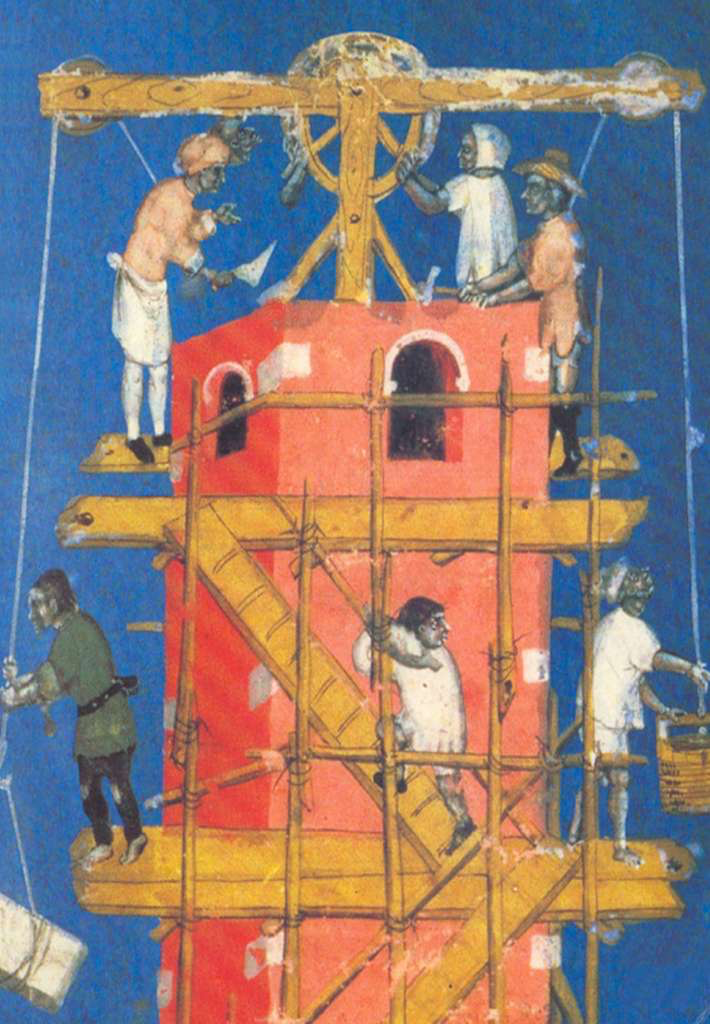
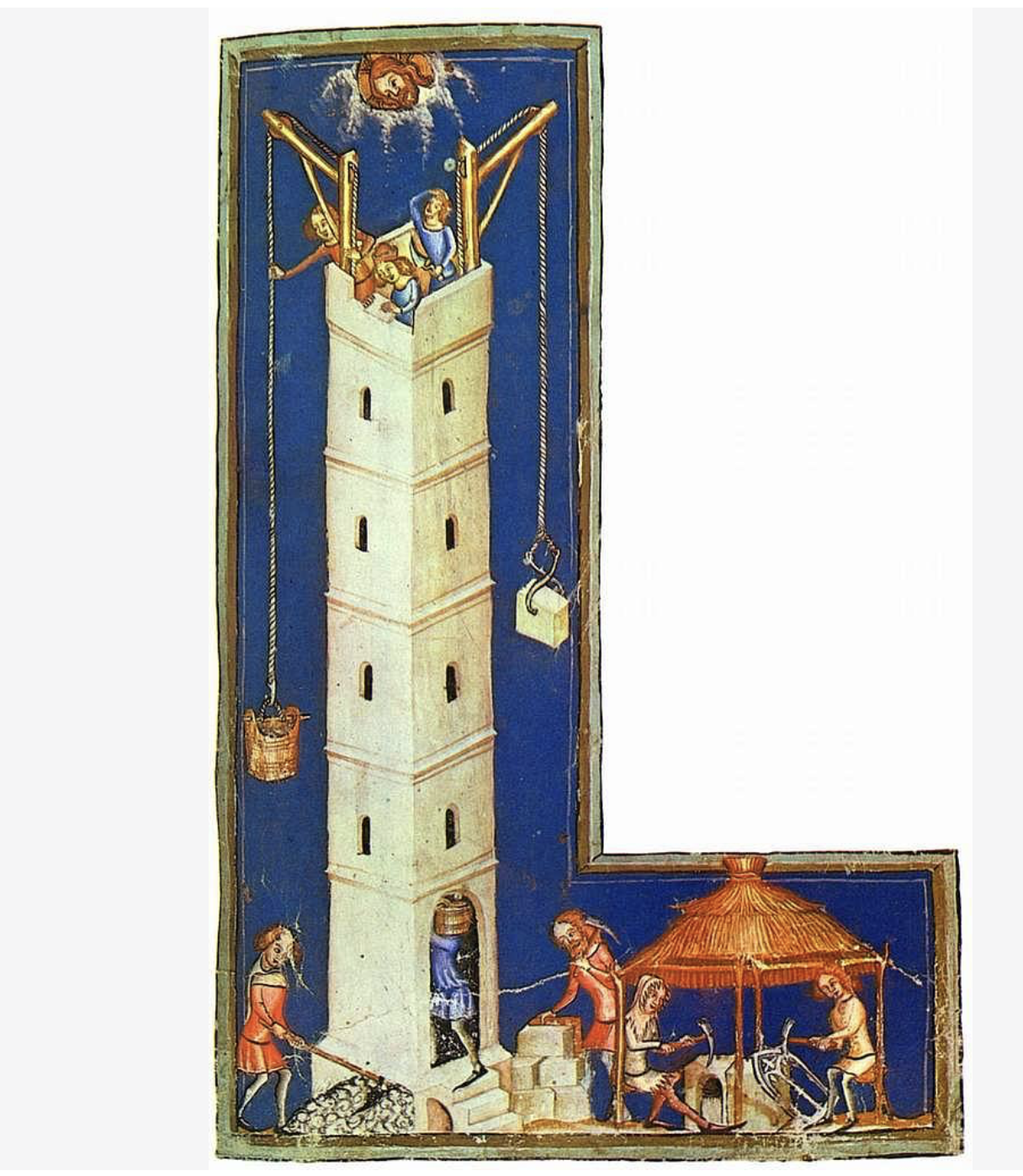
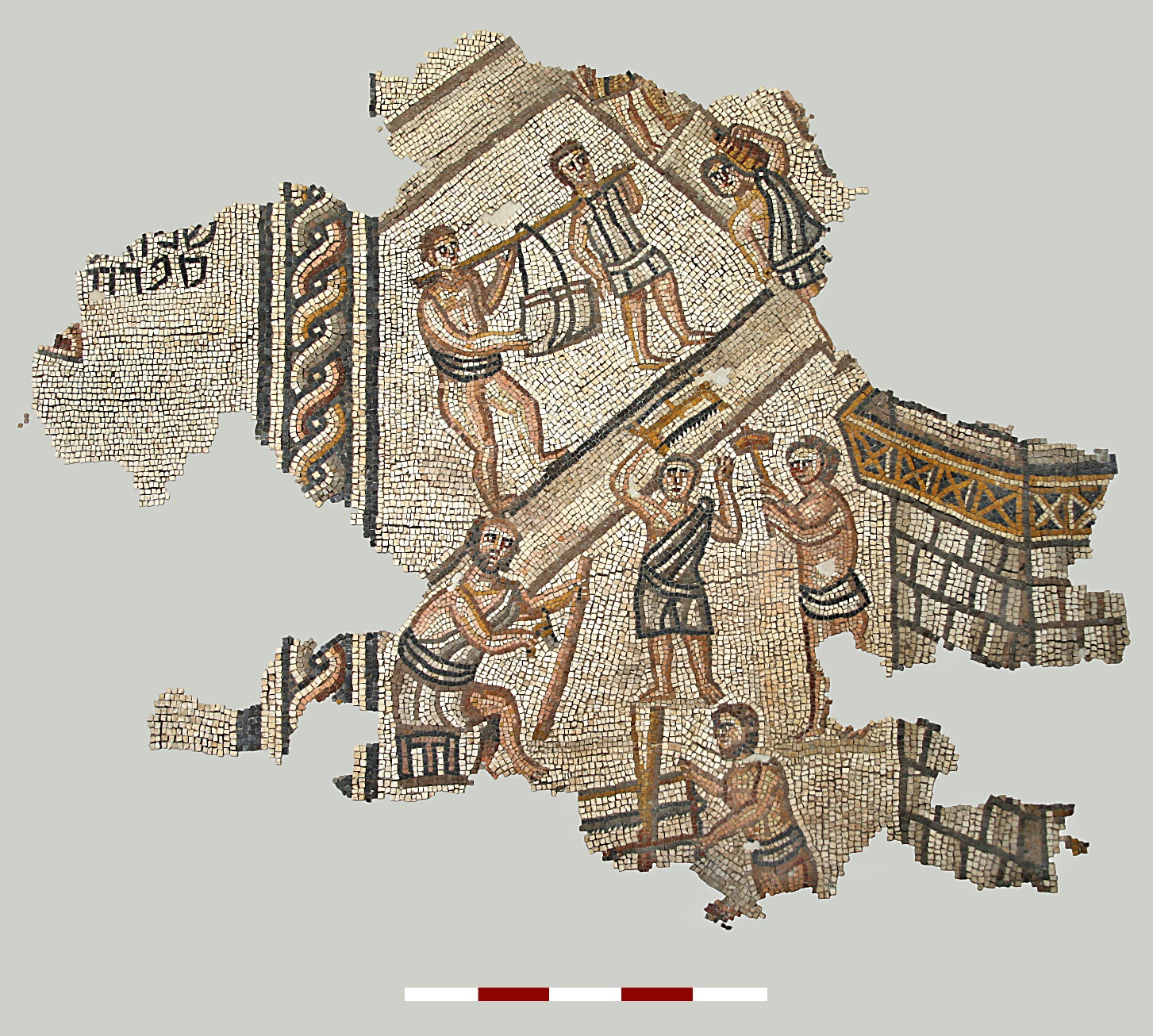
Book Review: ‘After Revelation: The Rabbinic Past in the Medieval Islamic World’, by Marc D. Herman

Review of ‘After Revelation: The Rabbinic Past in the Medieval Islamic World’, by Marc D. Herman

Reviewed by Eliyahu Krakowski


Dr. Marc Herman’s After Revelation: The Rabbinic Past in the Medieval Islamic World (University of Pennsylvania Press, 2025) examines shifting conceptions of Torah she-beʿal peh within the Judeo-Islamic world from the geonic period through the time of Maimonides.[1] Beginning with Rav Saadya Gaon and concluding with the Rambam, Herman traces a gradual reorientation away from the geonic understanding of Torah she-beʿal peh as wholly revealed toward the Maimonidean position, in which human interpretation plays a constitutive role in the formation of rabbinic law. Alongside his analysis of Jewish legal sources, Herman situates these developments within their broader intellectual environment, drawing careful parallels to contemporaneous trends in Islamic jurisprudence and legal theory. In tracing this shift, the book clarifies how medieval Jewish thinkers conceptualized the authority of Torah she-beʿal peh, and how those conceptions correspond to broader jurisprudential models current in the Islamic world.

But beyond its central thesis, the book assembles a substantial body of sources bearing on a range of foundational questions, including rabbinic authority, legal innovation, and the historical development of Torah she-beʿal peh. Many of the texts Herman discusses are drawn from recently published fragments or from manuscripts that remain unpublished, and several appear to have received little or no attention in prior scholarship. Rather than offering a comprehensive or conventional review, I will focus here on a selection of sources that I found particularly significant and that contribute to a more precise understanding of several of the issues under discussion. Because Herman’s treatment of these materials is often brief, expanding upon certain sources and arguments in greater detail is worthwhile.

  1. Adding to Torah Prohibitions and the Tree of Knowledge 

The story of Adam and Eve contains an interesting example of what, depending on one’s perspective, can either be seen as a (very early) model of rabbinic legislation or as a problematic example of proto-bal tosif, the prohibition of adding to the Torah. When repeating God’s command not to eat from the Tree of Knowledge, Eve apparently adds to the prohibition (Gen. 3:3): “But from the fruit of the tree which is in the middle of the garden, God has said, ‘You may not eat from it and you may not touch it, lest you die.’” Every yeshiva student is familiar with Rashi’s interpretation:

“‘And you shall not touch it’ – she added to the command; therefore she came to detraction, as it is said: “Do not add to His words” (Proverbs 30:6).”

This, in turn, is based on the Gemara (Sanhedrin 29a):

“Hizkiyah said: From where is it derived that whoever adds, detracts? As it is stated: ‘God said: You shall not eat from it and you shall not touch it.’”

However, according to Avot de-Rabbi Natan (version 1, 1:5), it appears that the added prohibition was in fact a prototypical seyag, a protective fence of the sort we are instructed to erect in order to safeguard the Torah:

“And make a fence for your words, just as the Holy One, blessed be He, made a fence for His words; and Adam the First made a fence for his words … What was the fence that Adam the First made for his words? As it says: ‘And the Lord God commanded … for on the day that you eat of it you shall surely die’ (Genesis 2:17). Adam the First did not wish to say to Eve exactly as the Holy One, blessed be He, had said to him; rather, he said to her thus, and he made a fence for his words beyond what the Holy One, blessed be He, had said to him: ‘But from the fruit of the tree that is in the midst of the garden God said: You shall not eat from it and you shall not touch it, lest you die,’ for he wished to guard himself and Eve from the tree even through mere touching.”

In the context of Karaite critiques of rabbinic authority, this question took on heightened urgency. Herman (39-40) refers to Rav Saadya Gaon’s commentary on Genesis 3:1, which elaborates the positive reading found in Avot de-Rabbi Natan:

“The fifth question: On what basis did Eve say, ‘and you shall not touch it,’ when God did not say this to Adam?

The answer: After God said to Adam not to eat from the Tree of Knowledge, he instituted a safeguard for the matter and refrained even from touching it, so that if some mishap should occur in this regard, it would fall upon what he himself had added and not upon the essence of the prohibition. This is like an expert physician who wishes to distance a patient from eating meat and therefore also warns him against poultry, so that if he should treat the command lightly he will stumble with poultry and not with actual meat. On this basis our predecessors instructed us: ‘Make a fence for the Torah’ … and in all these cases, and others like them, we rely upon what the Torah itself prohibited as a matter of protection and fencing, as it is written: ‘He shall not multiply wives for himself, lest his heart turn astray’; and ‘silver and gold he shall not multiply for himself exceedingly, lest his heart grow haughty,’ and the like.”

Rav Saadya likens Adam’s added prohibition to the case of a patient who is forbidden to eat meat and whose physician therefore also prohibits poultry. As Herman observes, the analogy closely recalls the rabbinic prohibition of poultry with milk. Notably, in this instance Rav Saadya is prepared to treat the added restriction as Adam’s own enactment, a position that sits uneasily with his more general tendency to ground even rabbinic legislation in divine authority.

Elsewhere (80), Herman cites the eleventh century Andalusian commentator R. Yehuda Ibn Balaam who went a step further and “described the addition of a prohibition against touching the forbidden tree in the Garden of Eden (Genesis 3:3) as the sound exertion of legal thinking (ijtihād).”[2] It seems that according to Ibn Balaam, in contrast to Rav Saadya, this is not merely a discretionary seyag but a logical extension of the law. In other words, according to Rav Saadya, the prohibition of touching the Tree of Knowledge would have been classified under the Rambam’s first shoresh in Sefer ha-Mitzvot, namely rabbinic enactments, whereas according to Ibn Balaam it would fall under the second shoresh, that of rabbinic derashot or derivations.[3]

  1. Rabbinic Legislation and Adding to the Torah

Another obscure yet significant source cited by Herman bears on a question raised forcefully in Karaite polemics, namely, why rabbinic legislation does not itself constitute a violation of the biblical prohibition against adding to the Torah. Herman (27) points to Rav Saadya Gaon’s discussion in his work on the calendar, the Kitāb al-Tamyīz (Book of Distinction), where Saadya emphasizes that the prohibition of adding to revelation applies to “all that I have commanded you” (Deut. 4:2; 13:1), and not to “all that I have written for you.” On this view, rabbinic enactments cannot be considered impermissible additions, since they themselves form part of the revealed command structure. The relevant text survives only in an Arabic fragment published by Hartwig Hirschfeld in 1903.[4]

Herman (90) also cites R. Yehudah ha-Levi’s response to this challenge in the Kuzari (3:41). Ha-Levi explains that the biblical prohibition was directed at the masses, in order to prevent them from conjecturing, theorizing, and legislating on the basis of their own reasoning, as the Karaites did. Laws instituted by the Sanhedrin or by prophets, according to ha-Levi, are categorically excluded from the scope of this prohibition. Notably, Maimonides appears to adopt the opposite position. In his view, it is precisely authoritative figures such as prophets or the Sanhedrin who are capable of violating the prohibition of bal tosif.[5] But Maimonides’ formulation in Hilkhot Mamrim 2:9 (cited above, note 3) represents an even sharper rejection of Rav Saadya’s approach. According to the Rambam, bal tosif is violated precisely by collapsing the distinction between rabbinic legislation and divine command, thereby presenting the former as if it were itself part of the Torah. This could serve as a description of Rav Saadya’s enterprise. 

It is also noteworthy that figures operating within the Karaite orbit accepted the premise underlying the question, namely, that there exists a general prohibition against adding new laws to the Torah. By contrast, rabbinic authorities more distant from anti-Karaite polemics, such as Rashi, R. Yosef Albo, and the Maharal, rejected this premise altogether. On their account, bal tosif does not prohibit the introduction of new mitzvot, but rather the alteration of an existing mitzvah’s internal structure, such as adding a fifth passage to the tefillin. From this perspective, rabbinic legislation bears no relation to the prohibition of bal tosif at all.[6]

  1. Hanukkah from Where in the Torah?

Rav Saadya Gaon’s discussion of Hanukkah provides a clear illustration of a broader geonic tendency: to anchor what might otherwise appear to be rabbinic innovations or postbiblical developments in biblical revelation itself. As Herman (29) notes:

“Saadia was anxious to uphold divine authority for Hanukkah, the formulations and structures of many prayers, court oaths, communal bans, the second day of festivals observed in the diaspora, and even one passage in a lament by Eliezer Qillir… Saadia adopted a variety of strategies to depict these practices as supported by divine revelation. Written revelation, he claimed, actually refers indirectly to legal institutions that might be considered postbiblical, such as the festival of Hanukkah, the observance of two days to mark some new lunar months, or the rules of the Jewish calendar.”

One of the sources Herman adduces in this context is a passage from the the recently recovered complete Sefer ha-Mitzvot of Rav Saadya, in which Rav Saadya seeks to ground the festival of Hanukkah in biblical prophecy:

“The tradition has established that there will be a day on which He will deliver us from the descendant of Amalek … and that when the Lord grants victory to the sons of Levi in their war against those who rise against them, that time shall be honored, as it is said: “Bless, O Lord, his valor, and accept the work of his hands; crush the loins of those who rise against him, and of those who hate him, that they rise no more” (Deut. 33:11). And we do not find that they fought anyone other than the Greeks.”[7]

This passage is particularly illuminating when read alongside Maimonides’ remarks in the first shoresh of his own Sefer ha-Mitzvot, where he sharply criticizes those who would count Hanukkah among the 613 commandments:

“I do not suppose that anyone would imagine, or that it would even occur to anyone’s mind, that it was said to Moses at Sinai that he should command us that, if at the end of our kingdom such-and-such should occur with the Greeks, we would then be obligated to light the Hanukkah lamp.”[8]

The position that Maimonides declares inconceivable is, in fact, precisely the one advanced by Rav Saadya. Because Maimonides elsewhere explicitly objects to the Behag’s enumeration, and because the Behag does count ner Hanukkah as a mitzvah, it has generally been assumed that Maimonides’ polemic here is directed against the Behag. The discovery of this passage, however, together with another like it in Rav Saadya’s writings, reveals that Maimonides’ criticism is not aimed at a merely theoretical justification for counting Hanukkah, but at Rav Saadya’s concrete attempt to ground the obligation in biblical revelation.[9] Herman (104) himself emphasizes this point, noting that:

“This was something of a pattern for Maimonides, who was reluctant to name Saadia even when strongly disagreeing with him. But it is hard, in fact, not to read Maimonides’s presentations of the Oral Torah as a pointed rebuttal of the views of the Egyptian-born gaon.”[10]

The same geonic impulse to locate Hanukkah within the orbit of biblical revelation appears elsewhere as well. In his discussion of the Torah center of Kairouan, Herman (67) observes that R. Nissim Gaon likewise adopted Rav Saadya’s position regarding the divine authority of Hanukkah, repeating a midrash according to which the festival had already been foretold to the biblical Aaron. This refers to the well-known passage cited by Nahmanides in his commentary on Behaʿalotekha (Num. 8:2):

“Why is the section of the Menorah juxtaposed with the dedication of the princes? When Aaron saw the dedication of the princes, his spirit sank, for neither he nor his tribe had participated in the dedication. The Holy One, blessed be He, said to him: ‘By your life, yours is greater than theirs, for you kindle and prepare the lamps morning and evening’this is the language of Rashi, citing an aggadic midrash… The intent of this aggadah is to expound a hint from the passage concerning the dedication of the lamps that would take place in the Second Temple through Aaron and his sonsthat is, the Hasmonean High Priest and his sons. I found it stated in this very language in the Megillat Setarim of Rabbeinu Nissim, who cites this aggadah and says: ‘I saw in a midrash: once the twelve tribes had brought offerings and the tribe of Levi had not brought [any]… the Holy One, blessed be He, said to Moses: ‘Speak to Aaron and say to him’there will be another dedication [hanukkah] involving the lighting of lamps in which I will perform miracles and deliverance for Israel, through your descendants. [This] dedication will be named for them, namely the Hanukkah of the sons of the Hasmoneans. Therefore this section was juxtaposed to the section of the dedication of the altar’.”

This is a celebrated passage in Nahmanides’ commentary, but when read against the background of geonic polemics and the geonic impulse to locate later rabbinic enactments within biblical revelation, it takes on a new significance. Herman draws attention in this connection to the landmark work of Yosef Ofer and Jonathan Jacobs on Nahmanides, which reconstructs the layered development of Nahmanides’ Torah commentary on the basis of authorial update lists and a comprehensive comparison of manuscript traditions. Ofer and Jacobs demonstrate that the passage attributing Hanukkah to Aaron through R. Nissim Gaon’s Megillat Setarim belongs to Nahmanides’ later additions, composed after his arrival in Eretz Yisrael, and that in earlier recensions of his commentary Nahmanides struggled to resolve the difficulties posed by this midrash.[11]

  1. A Sage is Superior to a Prophet

Interpretations of the talmudic dictum hakham adif mi-navi, “a sage is superior to a prophet” (Bava Batra 12a), offer a revealing lens through which to assess medieval attitudes toward the relative status of divine revelation and human juridical creativity. In a substantial study published two decades ago, Alon Goshen-Gottstein traces the reception history of this dictum and concludes that it was largely ignored prior to the emergence of the Book of the Zohar.[12] Herman (81-82), however, draws attention to a significant pre-Zohar interpretation that appears to have gone largely unnoticed in this discussion, preserved in the commentary of R. Isaac Ibn Ghiyath, commonly known by his acronym רי״ץ גיאת, to Kohelet:

“Upon proper reflection, I have found that the sages of the Torah possess a superiority over the prophets. For the former draw forth [insights] from their intellectual inquiry and the illuminations of their intellect: they innovate new teachings from foundational principles and derive consequences from root concepts. The latter, by contrast, are guided only by prophecy and directed by prophetic vision alone. You already know what occurred with respect to what the prophet Nathan said to David, ‘Do all that is in your heart, for the Lord is with you’ (II Sam. 7:3) – and he was mistaken; whereas Solomon’s ruling in the case of the two women was successful. It is to this distinction that the saying refers: ‘A sage is superior to a prophet.’”[13]

As Herman observes, Ibn Ghiyath’s interpretation is “closer to that of the Qaraite Qirqisaniwho had cited it to show that the ancient rabbis themselves admitted to ‘extracting’ new lawthan to geonic-era apologetics.” In other words, this interpretation stands in contrast to the geonic claim that Torah she-beʿal peh is all revealed law, instead seeing the active process of building upon revelation by means of human wisdom as a higher achievement than the passive process of receiving prophetic instruction. This helps explain why this dictum received little attention in certain eras. In the context of anti-Karaite polemics, openly conceding the primacy of human legal creativity over prophecy was potentially destabilizing. Yet Herman does not emphasize the significance of Ibn Ghiyath’s comment in the history of the interpretation of this saying, noteworthy in its own right.[14]

  1. Increasing Andalusian Independence

A recurring theme throughout Herman’s work is the growing independence of non-Iraqi scholars, such as R. Hananel, R. Shmuel ha-Nagid, the Rif, and R. Joseph Ibn Migash, from the authority of the Babylonian geonim. This is the intellectual world into which Maimonides was born. Herman (104-105) highlights one particularly telling instance in which Maimonides explicitly defends his Andalusian tradition against claims of Babylonian hegemony:

“[I]n a polemic against against Samuel ben ‘Eli…who claimed the title gaon, Maimonides provided a list of Andalusi “geonim” to support his view: Ibn Ghiyath, al-Baliya, al-Fasi, and Maimonides’s own father’s teacher, Ibn Migash. Maimonides asked: ‘Should one not heed the words of our geonim because they are not Babylonian [i.e., Iraqi]? Is it possible that locale is determinative [she-maqom gorem]?’ While these examples show a sense of continuity with the Andalusi tradition, Maimonidean innovations nevertheless abounded…”

Herman offers a nuanced account of the gradual emergence of Andalusian scholarly independence from geonic authority, culminating in Maimonides’ own complex stance toward the inherited geonic tradition.[15]

These few examples from this densely referenced work should suffice to illustrate the wealth of material contained within. Dr. Marc Herman’s After Revelation: The Rabbinic Past in the Medieval Islamic World is distinguished by its meticulous research and careful presentation of sources, a quality that is especially welcome in the current scholarly landscape. In addition, by focusing on a specific historical era which has received relatively little scrutiny, Herman has brought to light a rich array of material which deserves the attention of anyone interested in the development of the concept of Torah sheb’eal peh.

[1] Full disclosure: the author of the book under review, Dr. Marc Herman, is a longtime friend to whom I often turn with questions regarding Maimonides’ Sefer ha-Mitzvot. References to his pages are given parenthetically in the text. Readers of The Seforim Blog may already be familiar with his work through his review in Marc Herman,  “Review of ‘Ha-Sefer ha-Kollel (Kitāb al-Hāwī)’, by Rabbi David ben Saʿadya al-Ger,” The Seforim Blog (4 September 2024), available here. My thanks to Seforim Blog editor Menachem Butler for his editorial review and comments.
[2]
Herman cites Ibn Balaam’s comment from Maaravi Perez, “Another fragment from Kitāb al-Tarjīḥ by R. Yehuda Ibn Balaam: Genesis 2:11-4:9; 8:10-20,” Proceedings of the American Academy for Jewish Research, vol. 57 (1990-1991): 8 (Hebrew), available here; the fragment is also available via the remarkable alhatorah.org.
[3]
 For a discussion of the tension between seyag and bal tosif as it arises from the narrative of Adam and Eve, see R. Bezalel Naor, “Mitzvat Hashem Barah,” printed at the conclusion of his edition of the Rashba’s Maʾamar ʿal Yishmael, ed. Bezalel Naor (Spring Valley, NY: Orot, 2008), 87-91 (Hebrew). His discussion displays his characteristic breadth of learning, though he does not cite the sources later adduced by Herman; conversely, Herman does not refer to Naor’s treatment. Notably, the Hida (Ahavat David, derush 13) explicitly confronts the apparent contradiction between the position of the Gemara with that of Avot de-Rabbi Natan and proposes a reconciliation:

“The matter is straightforward: Adam the First certainly acted properly in making a fence. However, he should have said, “This is the command of the Lord, and I am making a fence with respect to touching,’ and in that case Eve would not have erred. It was from this aspect that the mishap emerged, and this is what is meant by the conclusion, ‘A person should not add to the words he hears’; that is, one should not attribute the addition to the original speaker.”

See also R. David Zvi Hoffmann’s commentary to Genesis 3:1, and R. Yaakov Kamenetsky, Emet le-Yaʿakov, Genesis 3:3, who develop the same distinction—between legitimate protective legislation and its improper attribution to divine command. R. Yaakov Kamenetsky articulates this concept pointedly in his commentary to Avot 2:5:

“The essential point is that one know that he is keeping this only as a fence, and not as an essential matter in its own right … for if this is not known, one may come to great stumbling blocks. It appears that Adam the First himself stumbled precisely in this matter in the sin of the Tree of Knowledge, and from this grew and developed the entire notion of sin and iniquity in the world, with the resulting consequence death.”

Against this backdrop, R. Bezalel Naor draws attention to a difficult comment of the Moshav Zekenim. The Moshav Zekenim cites the following question of the tosafist R. Isaac [presumably Riʾ of Dampierre]:

“You shall not eat and you shall not touch”—from here [we learn that] whoever adds, detracts, for the Holy One, blessed be He, commanded only with respect to eating. And R. Isaac finds this difficult: perhaps she acted by way of distancing, as we find with respect to the nazirite… and this requires further investigation.”

Why, R. Naor asks, did the Moshav Zekenim not explain that the difficulty with this seyag lay specifically in its attribution to God Himself, as is made explicit in the aforementioned sources? One possible answer emerges from the Maharil’s account of asmakhta. See Maharil, Likkutim, no. 70 (quoted by R. Asher Weiss, Minhat Asher, Devarim, p. 37):

“Wherever it is stated [that something is] rabbinic and the verse is merely an asmakhta, this is its meaning: it is certainly a rabbinic enactment, and they went and examined and found for themselves a scriptural support, and they anchored their words to it in order to strengthen them—so that people would think it is of Torah origin and be stringent with it, and not come to treat the words of the Sages lightly and leniently. (In the Mekhon Yerushalayim edition there is another version: ‘in order to mislead them.’)”

According to the Maharil, the purpose of an asmakhta is precisely to cause people to attribute divine authority to a rabbinic enactment. This would also appear to be the most straightforward explanation of the Raʾavad’s gloss to Hilkhot Mamrim 2:9. Maimonides explains that the difference between prescribed rabbinic enactments and proscribed bal tosif lies in their attribution: 

“Since a court has authority to decree and prohibit something permitted, and its prohibition may stand for generations … what, then, is the meaning of the Torah’s warning ‘You shall not add to it nor detract from it’? That one should not add to the words of the Torah nor detract from them, and establish the matter permanently as Torah law.”

On this, Raʾavad comments: 

“All of this is mere wind, for anything they decreed and prohibited as a fence and safeguard for the Torah does not constitute adding, even if they established it for generations, treated it as Torah law, and anchored it to Scripture, as we find in many places where something is rabbinic and the verse is merely an asmakhta.”

Raʾavad apparently sees the existence of asmakhta as a refutation of Maimonides’ position. Cf. the Vilna Gaon’s comment in Aderet Eliyahu, Genesis 3:3, which offers another defense of Eve’s “fence.”
[4]
Hartwig Hirschfeld, “The Arabic Portion of the Cairo Genizah at Cambridge (Third Article): Saadyah Fragments,” Jewish Quarterly Review, vol. 16, no. 1 [old series] (October 1903): 103, available here.
[5]
See my article in Eliyahu Krakowski, “Is a Prophet Authorized to Institute a Rabbinic Commandment? A Halakhic Clarification and Its Implications for Maimonidean Thought,” Hakirah: The Flatbush Journal of Jewish Law and Thought, vol. 12 (Fall 2011): 26-28 (Hebrew), available here, for a detailed analysis of Rambam’s position that the prohibition of bal tosif applies precisely to prophetic or judicial claims of divine authority. R. Asher Weiss formulates this point as a matter of halakhah le-maʿaseh in response to a question posed by his teacher, the Divrei Yatziv:

“My teacher and master, the holy rabbi, our master [Rabbi Yekusiel Yehudah Halberstam], wrote in Responsa Divrei Yatziv (Orah Hayyim §214) to comment on the formula le-shem yihud customarily recited by Hasidim prior to the counting of the ʿomer, in which it is said: “to fulfill the positive commandment of the counting of the ʿomer, as written in the Torah, etc.” This formulation implies that the obligation in question is a de-oraita commandment, and thus constitutes an addition to the commandments and a violation of bal tosif according to the view of Maimonides. For this reason, he adopted the practice of saying instead: “to fulfill the commandment of the counting of the ʿomer, and it is written in the Torah, etc.,” so that it should not be understood as a de-oraita commandment, but rather in a formulation that is also compatible with a rabbinic commandment… In my view, however, even though this observation has merit, as a matter of strict law there is no objection here, for several reasons. First, there is no prohibition involved except in the context of formal legal instruction issued by a court or by a sage rendering authoritative rulings to others; this has no application to a devotional prayer recited informally by each individual person…”

This represents the distinctively Maimonidean understanding of bal tosif, in marked contrast to the approach articulated by R. Yehuda ha-Levi.
[6]
 See Rashi to Deut. 4:2 and 13:1; Sefer ha-Ikkarim 3:14; Maharal, Beʾer ha-Golah, beʾer 1; cf. Nahmanides to Deut. 4:2. Notably, both sides in the Karaite-rabbinic controversy presupposed that bal tosif prohibits the introduction of new laws as such, even though this assumption was rejected by a number of rabbinic authorities operating at some remove from the immediate polemical context. A structurally analogous phenomenon, in which opposing camps converge upon a shared but historically secondary interpretation of a source, can be observed in the medieval debates over hokhmat yevanit. See Eliyahu Krakowski, “How Much Greek in ‘Greek Wisdom’? On the Meaning of Hokhmat Yevanit,” The Seforim Blog (27 December 2011), available here, where I argue that the identification of hokhmat yevanit with Greek philosophy represents a thirteenth-century polemical development rather than the original talmudic meaning, even though both sides in the controversy itself accepted this understanding.
[7]
 Rav Saadya Gaon, Sefer ha-Mitzvot (Kitāb al-Sharāʾiʿ), ed. and trans. Nissim Sabato (Jerusalem: The Ben-Zvi Institute, 2019), 199 (Hebrew). My thanks to Rabbi Dr. Eliezer Brodt for obtaining a copy of this important work for me. The text is also available on alhatorah.org, and should not be confused with R. Yeruham Fishel Perla’s monumental commentary on Rav Saadya’s poetic Azharot.
[8]
 See, now, the newly-published edition of Maimonides, Sefer ha-Mitzvot, ed. R. Yitzhak Sheilat (Jerusalem, 2025), 39-40 (Hebrew). It is surprising that R. Sheilat, who serves as rosh yeshiva of Yeshivat Birkat Moshe alongside R. Sabato, does not reference in this context Rav Saadya’s Sefer ha-Mitzvot.
[9]
 For an otherwise insightful discussion of this passage, see Moshe Halbertal, Maimonides: Life and Thought (Princeton: Princeton University Press, 2014), 111-116, who perceptively analyzes Maimonides’ objection to the enumeration of rabbinic enactments but does not identify Rav Saadya Gaon as the concrete target of the critique.
[10]
In his notes to this passage in Rav Saadya Gaon’s Sefer ha-Mitzvot, R. Haim Sabato expresses caution as to whether Maimonides had Rav Saadya specifically in mind. However, Herman’s view is compelling. For a fuller treatment of whether Maimonides’ critique in Sefer ha-Mitzvot is aimed specifically at Rav Saadya Gaon, see R. Haim Sabato, “Did Maimonides Know Rav Saadya Gaon’s Complete Sefer ha-Mitzvot?” in Zvi Heber and Carmiel Cohen, eds., MiBirkat Moshe: Maimonidean Studies in Honor of Rabbi Nahum Eliezer Rabinovitch, vol. 2 (Maʿale-Adumim: Maʿaliyot, 2012), 757-763 (Hebrew), available here, and Marc D. Herman, “Systematizing God’s Law: Rabbanite Jurisprudence in the Islamic World from the Tenth to the Thirteenth Centuries,” (PhD Dissertation, University of Pennsylvania, 2016), 167-168, 301, available here.
[11]
 See Nahmanides’ Torah Commentary Addenda Written in the Land of Israel, eds. Yosef Ofer and Jonathan Jacobs (Jerusalem: Herzog Academic College and the World Union of Jewish Studies, 2013), 430-432 (Hebrew).
[12]
 See Alon Goshen-Gottstein, “The Sage is Superior to the Prophet: The Conception of Torah through the Prism of this Proverb through the Ages,” in Howard Kreisel, ed., Study and Knowledge in Jewish Thought (Beer Sheva: Ben Gurion University of the Negev, 2006), 37-78 (Hebrew), available here, who identifies two citations of this dictum in sources that predate the Sefer ha-Zohar, one in Hovot ha-Levavot and one in a work attributed to R. Avraham b. ha-Rambam, possibly by R. Nissim Gaon. The interpretations of R. Isaac Ibn Ghiyath and R. Joseph Ibn Migash discussed here, however, suggest that the paucity of earlier citations reflects not simple neglect but a reluctance to highlight texts that openly privilege human juridical creativity over prophetic transmission.
[13]
 This commentary is printed in R. Yosef Qafih, Hamesh Megillot, ed. Shimon Najar (Israel, 1970), 162-163 (Hebrew), where it is attributed to Rav Saadya Gaon; it is now also available online at alhatorah.org in R. Qafih’s translation. Another text overlooked by Goshen-Gottstein and cited by Herman (87) is the commentary of R. Joseph Ibn Migash (Riʾ Migash) preserved in Shitah Mekubetzet to Bava Batra 12a:

“‘Amemar said: A sage is superior to a prophet. Rav Ashi said: You may know this from the fact that a great scholar states a matter and it is then said that the law accords with [a tradition] given to Moses at Sinai’— and even though this scholar never heard this matter at all. Thus, [we see that] ‘the sage is superior to the prophet’: for the prophet says only what he has heard and what is placed in his mouth to say, whereas the sage can articulate what was said to Moses at Sinai even though he never heard it.”

[14] Elsewhere, however, Herman does highlight the significance of Ibn Ghiyath’s comment more explicitly. See Marc Herman, “Situating Maimonides’s Approach to the Oral Torah in Its Andalusian Context,” Jewish History, vol. 31, no. 1 (December 2017): 31-46, available here.
[15]
 This analysis bears indirectly on a debate I conducted in the pages of Hakirah: The Flatbush Journal of Jewish Law and Thought with R. Shmuel Phillips concerning whether Maimonides adhered to a rigid, geonically derived methodology of talmudic interpretation that would have sharply limited the scope for post-talmudic harmonization or innovation. My contention in that exchange was that Maimonides engages in implicit synthesis and interpretive reconciliation of talmudic sources, even when such activity is not explicitly signaled in his formulations. The historical picture reconstructed by Herman strengthens the view of Maimonides as an independent thinker who was not constrained by geonic precedent, nor, in fact, by the precedent of his immediate Andalusian predecessors, making it difficult to sustain an account of Maimonides as merely transmitting talmudic conclusions through the mechanical application of geonic rules. See my article in Eliyahu Krakowski, “Talmud Oversimplified? A Partial Review of Talmud Reclaimed: An Ancient Text in the Modern Era by Shmuel Phillips,” Hakirah: The Flatbush Journal of Jewish Law and Thought, vol. 35 (Summer 2024): 129-145, available here, as well as the continued exchange in Shmuel Phillips, “Talmud Reclaimed and a Battle Over Methodologies of the Rishonim,” Hakirah: The Flatbush Journal of Jewish Law and Thought, vol. 36 (Winter 2025): 193-216, available here, and Eliyahu Krakowski, “Rejoinder: Reclaiming Talmudic Complexity,” Hakirah: The Flatbush Journal of Jewish Law and Thought, vol. 36 (Winter 2025): 217-229, available here.