A Forgotten Work on Chanukah: חנוכת הבית

Rabbi Eliezer Brodt of Jerusalem has authored articles in the journals Ohr Yisrael and Yeshurun, both familiar to many readers of the Seforim blog, and is contributing what is hoped to be the first of many guest-posts.

While learning הלכות חנוכה, I noticed that the very first מגן אברהם quotes a sefer called חנוכת הבית. I had never heard of the sefer before, and I was curious about it. I asked several people about the sefer until I found someone who was familiar with it. He was kind enough to purchase it for me. I started reading through the sefer last week, and I completed it over shabbos. It was a fascinating read.

In the introduction, the author begins with a list of questions about the נוסח of הנרות הללו. He then proceeds to answer his questions with the interesting concept that almost all of the הלכות חנוכה are hidden in the text of הנרות הללו. I believe that this is a virtually unknown idea, as I have yet to see this concept quoted in any sefer about חנוכה — including the outstanding sefer חזון עובדיה by ר’ עובדיה יוסף. Even the generally exhaustive מפתח על שבתי פרנקל on מסכת בבא קמא in the גמרא relating to חנוכה he makes no mention of his piece on this גמרא!

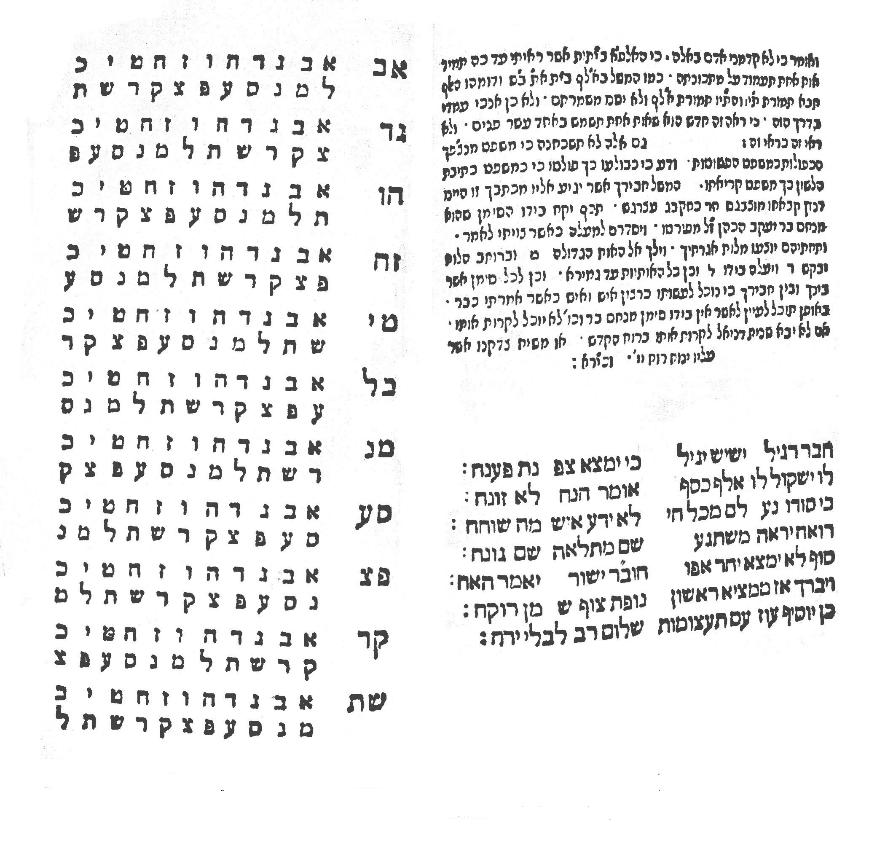
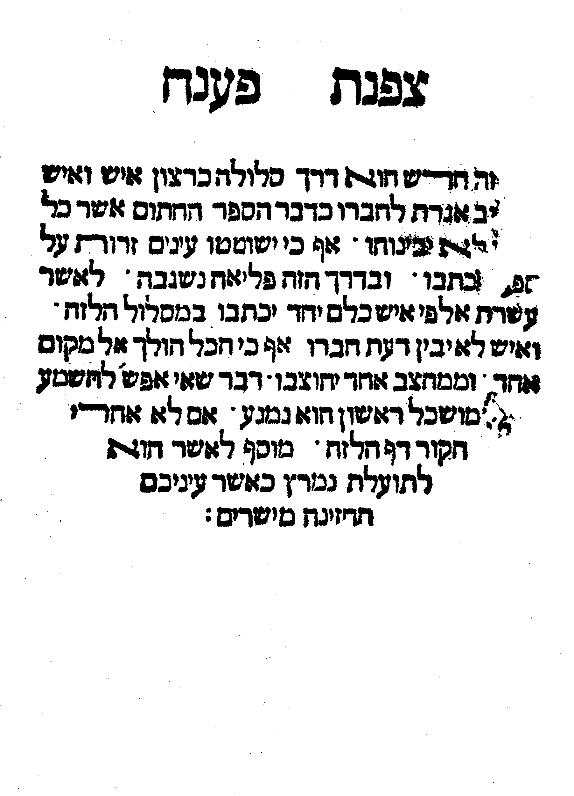
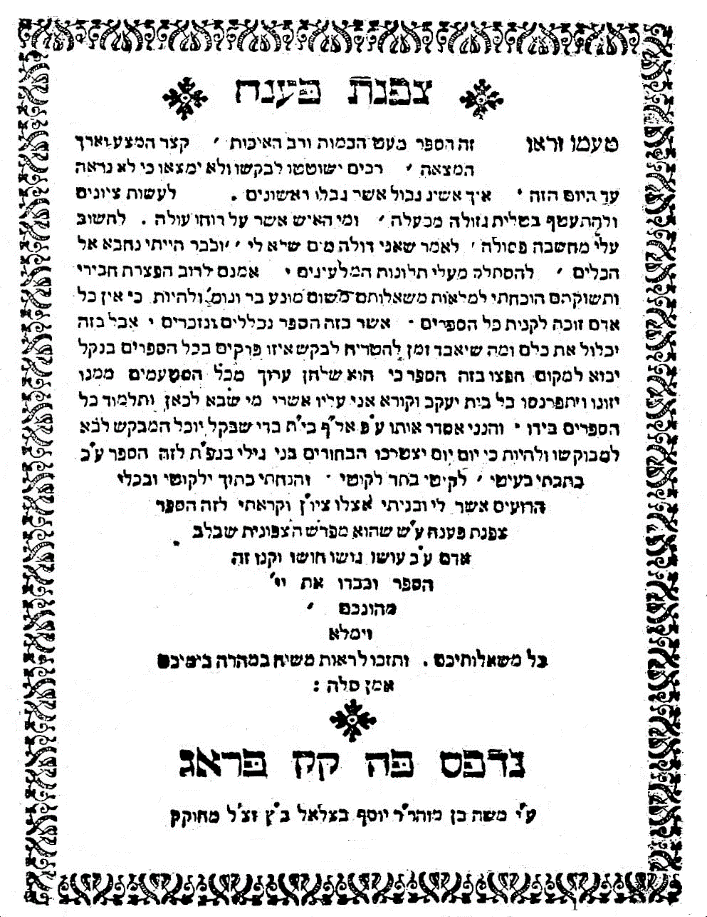
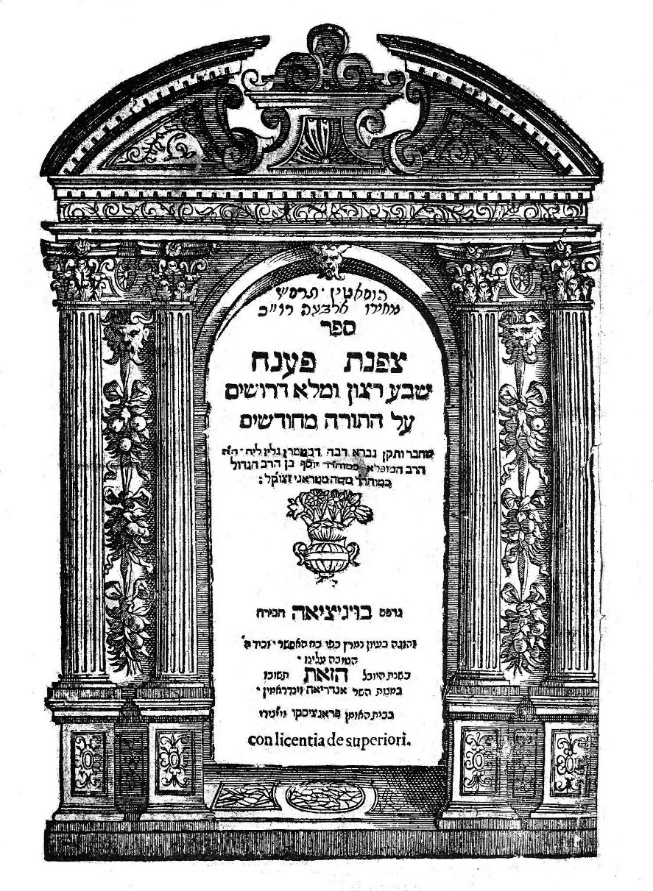
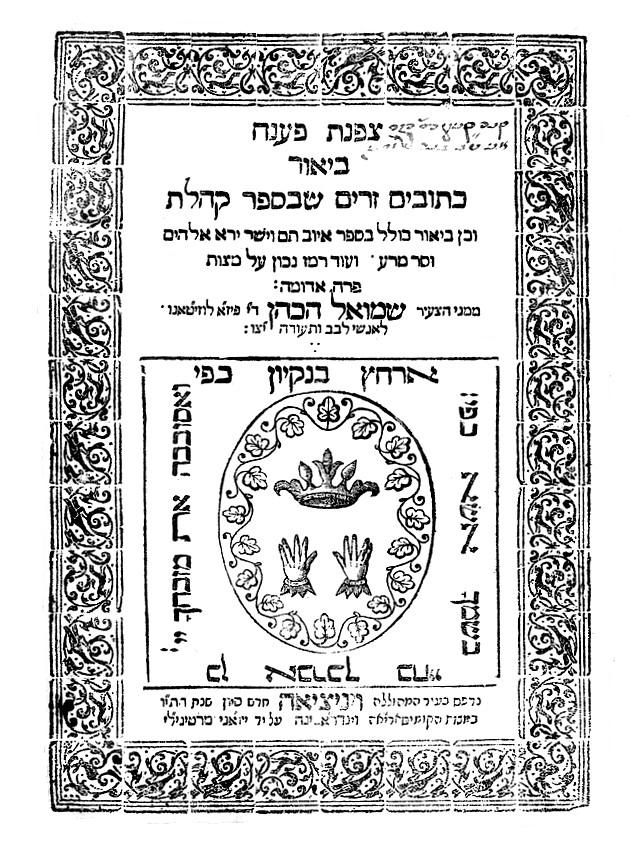
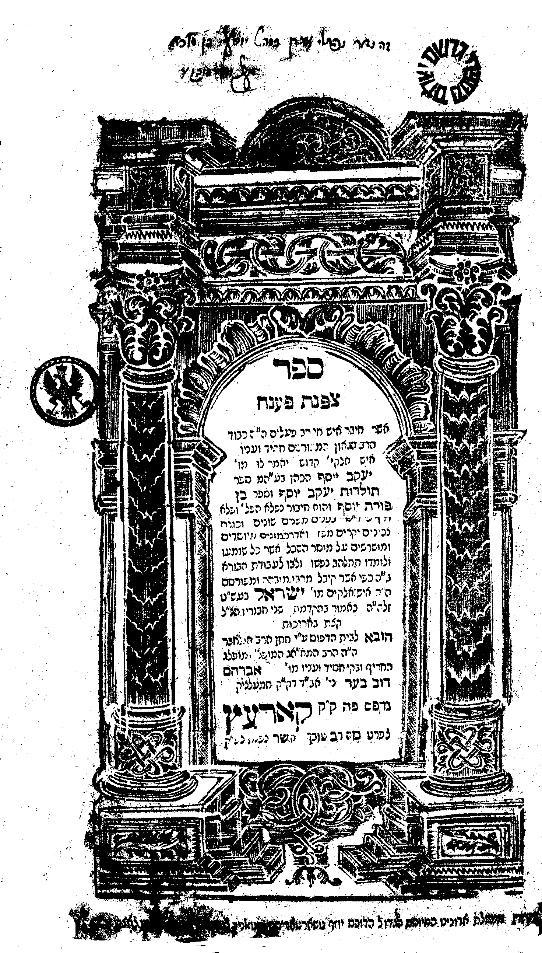
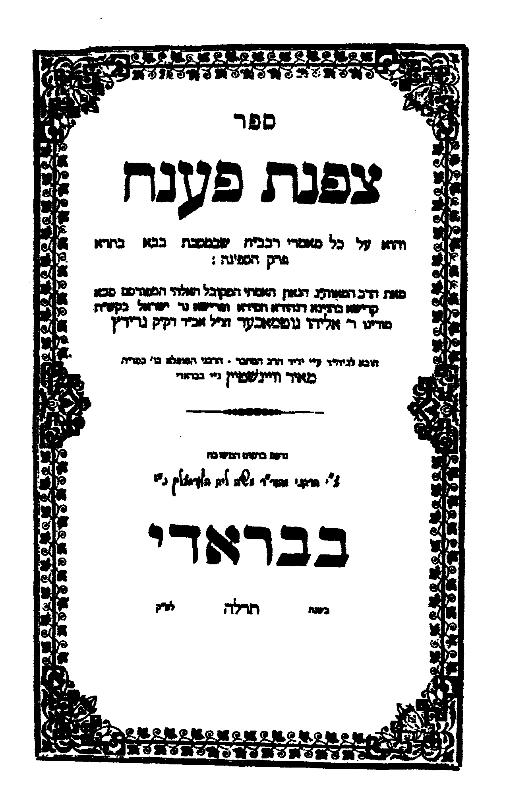
Not much is known about ר’ שאול בן ר’ דוד, the author of חנוכת הבית. His date of birth appears to have been around the year 1570. We do know that he learned from the מהרש”ל השני and ר’ הירש שור, the father of the תורת חיים. He was a ראש ישיבה in Russia. ר’ שאול wrote a few seforim, the most well known being טל אורות on the ל”ט מלאכות of שבת. The טל אורות received many very חשוב הסכמות, including הסכמות from the מהרש”א, the כלי יקר and the של”ה. It’s quoted by the מגן אברהם and מרכבת המשנה many times. A beautiful edition was reprinted in ירושלים in 1996. Another sefer by this author is תפלת הדרך which was printed by his son in 1641 [this book includes an unusual illustration of a ship at sea on the last page]. The sefer חנוכת הבית was first printed in פראג in 1616. It was not reprinted until in 1981 in a photo offset version. It was reprinted a year later, and in 2002, a very nice edition with notes was printed.

חנוכת הבית seems to be almost completely unknown to many bibliographers. The חיד”א makes no mention of it in his שם הגדולים although he has two entries on the author. The bibliographer יצחק בן יעקב has two separate entries on the sefer, one of which says “this might be the sefer that the מגן אברהם quotes a few times,” but he doesn’t write any details about it. Then two entries later he talks about our sefer showing he never saw it – because it’s the same one that the מגן אברהם mentions.

As previously mentioned, חנוכת הבית starts with the concept that almost all of הלכות חנוכה are hidden in הנרות הללו. There are three additional parts to the sefer. The first is a song which contains many of the halachos of חנוכה in the lyrics. Another part is מליצות based on הלכות חנוכה containing clever גמטריות and kabbalistic ideas about חנוכה. The third part is a דרשה connecting פרשת תצוה to חנוכה in many ways. The author was fond of writing in song. He also wrote similar kinds of songs in his work ט”ל אורות. In his introduction to ט”ל אורות, he writes that he likes this method because it’s a great memory tool. We have other songs he composed, such as a song in the שלשלת הקבלה, which was a הספד on his רבי, the מהרש”ל השני. Another song he wrote could be found in one of the manuscript’s of סידור שבתי סופר, which was written by his nephew.

חנוכת הבית discusses almost all the important topics related to חנוכה and makes many interesting points. The author goes through many of the גמרות in מסכת שבת about חנוכה at great length. He deals with topics such as the famous question of the בית יוסף. (See סקווירא תשסג p. 33), why חנוכה isn’t nine days because of ספיקא דיומא (Idem at p. 50), why the מנורה wasn’t טמא etc (Idem at p. 36). He takes sides on some of the big halachick questions in the פוסקים such as whether to light נר שבת or נר חנוכה first (Idem at p. 58), whether to make הבדלה before נר חנוכה on מוציא שבת or not (Idem at p. 60), and many other topics. The author also takes a stance in the big controversy about the נוסח of the ברכות. Like the מהרש”ל, he says that the correct way is to say שלחנוכה as one word (Idem at p. 32). The sefer mentions that the מהר”י סגל lit נרות in the place where he gave his שיעור (Idem at p. 120). Also mentioned is the reason for the מנהג to eat milchigs on חנוכה (Idem at p. 136). חנוכת הבית is also the earliest known source for giving gifts on חנוכה. In his song, the author uses the words “לחלק מתנות.” In the הלכה part of the sefer, he writes that one should give צדקה, especially to the children who are learning תורה (Idem at p. 72, 83). It is this statement the מגן אברהם quotes when he quotes from the חנוכת הבית. The חנוכת הבית is quoted another time by the מגן אברהם in הלכות פסח.


Sources:

שלשלת הקבלה עמוד קנ; מגן אברהם סימן תפט סעיף ז ובהלכות חנוכה ריש סימן תרע; אוצר הספרים אות ח מספר 732 ו734; והמבוא של הטל אורות באריכות שיצא לאור בירושלים תשנ”ו

Appendix:
Title Page from Chanukat Ha-Bayit (Prague, 1616)

Ship Illustration from Shaul ben David’s Tefilat Ha-Derekh (Prague, 1641)


Hebrew printing in Altdorf: A brief Christian-Hebraist Phenomenon

Hebrew printing in Altdorf: A brief Christian-Hebraist Phenomenon

By Marvin J. Heller[1]

Altdorf is remembered in Jewish history, when it is recalled at all, for the small number of Hebrew, Hebrew/Latin books printed there, beginning in the seventeenth century. Our Altdorf (old village), Altdorf bei Nürnberg, Bavaria, is one of several communities so named, others elsewhere in Germany, France, Switzerland, Poland, and even one Altdorf in the United States.[2] Again, our Altdorf, with the name to distinguish it from other Altdorfs, is Altdorf bei Nürnberg, that is, Altdorf near Nuremberg, a small Franconian town in south-eastern Germany, 25 km (15.53 miles) east of Nuremberg, in the district Nürnberger Land.

First mentioned in 1129, Altdorf was conquered by the Free Imperial City of Nuremberg in 1504. In 1578 an academy was founded in the city, becoming a university in 1622, one that lasted until 1809. Its most prominent student was the polymath Gottfried Wilhelm Leibniz (1646–1716), a discoverer of differential and integral calculus. The university is important to us as it was a center of Christian-Hebraism. An instructor in Hebrew at the university was R. Issachar Behr ben Judah Moses Perlhefter, whom we shall meet, albeit briefly, below. Also active in Altdorf was the renowned Christian-Hebraist Johann Christoph Wagenseil, whom we shall also meet, but in much greater detail, further on in the article, as well as his predecessor at the University of Altdorf, Theodor (Theodricus) Hackspan.

Jewish settlement in Altdorf is not recorded, indeed Altdorf apparently had no Jewish community in the seventeenth century, which makes the publication of Hebrew books in Altdorf of unusual interest. In the seventeenth and eighteenth centuries Christian-Hebraists, particularly in Protestant lands, studied and published Hebrew works for their own purposes, primarily philological and biblical titles, and translations of rabbinic works, often theological titles accompanied by glosses contesting the Jewish authors’ positions, all to better understand the sources of Christian theology and refute Jewish understanding of those works. Parenthetically, Christian-Hebraists often relied on both Jewish apostates and knowledgeable Jews for assistance with Hebrew, attempting to convert the latter to their beliefs.[3]

In Altdorf, in contrast, the Jewish related works are often polemics, including works that Jews might circulate in manuscript but were unable to print on their own behalf. The first Hebrew title printed in Altdorf was R. Yom Tov Lipmann Muelhausen’s Sefer Nizzahon (Liber Nizachon Rabbi Lipmanni . . .), published in 1644.[4] It was preceded and followed by Hebrew/Latin works, again, polemics, primarily comprised of the latter rather than the former, published in the seventeenth century, our subject period. Together with those bilingual titles and three works published in the 1760s, only sixteen works are recorded in a Hebrew bibliography for this period in Altdorf.[5]

A different enumeration of the titles printed in Altdorf, by the National Library of Israel, lists thirty-eight titles for Altdorf through 1765, again mainly Latin works with varying amounts of Hebrew, albeit dealing with Hebrew subjects, among them Kabbalah. However, for our period of interest, that is, the seventeenth century, ten titles only are recorded by the NLI. In addition, there are a number of works not in either enumeration, printed in Altdorf, that pertain to our subject, the works of Christian-Hebraists. Altdorf does not merit an entry in Ch. B. Friedberg’s multi-volume History of Hebrew Typography . . . and in terms of Hebrew printing it might be described as a cul-de-sac, its’ publications being of little import or lasting influence in the history of Hebrew typography. Nevertheless, its publications are of interest, being concerned with Jews, Judaism, and the study of Jewish texts by Christian-Hebraists.

This article, bibliographic in nature, is concerned with those seventeenth century titles published by Christian-Hebraists in Altdorf. In addition to the Hebrew titles a small number of the Christian-Hebraists’ Latin works will be noted as examples of their areas of interest and output, beginning with titles by Theodricus Hackspan. This will be followed in greater detail by a discussion of the first printed edition of the Sefer Nizzahon, translations of Mishnayot, and additional titles published by Wagenseil, among them Tela ignea Satanae, his most famous collection of polemic works.

I

Hackspan (1607-59), a noted Lutheran theologian and Orientalist, studied under renowned individuals in those fields, namely Daniel Schwenter (1585-1636) and Georg Calixtus (1586-1656). From 1636 Hackspan was at the University of Altdorf where he held the chair of Hebrew, was the first to publicly teach Oriental languages, and from 1654 was Professor of theology while retaining the chair of Oriental languages. It is said that “his close application to study and to the duties of his professorships so impaired his health that he died in the fifty-second year of his age. Hackspan is said to have been the best scholar of his day in Hebrew, Chaldee, Syriac, and Arabic.”[6] A prolific author, his works include titles printed as early as 1628 through 1633 in Jenae, and, from 1636, in Altdorf, with minimal Hebrew, beginning with Observationes Philologicae Ex Sacro Potissimum Penu Depromtae, with several coauthors. This was followed, in 1637, by a Hackspan title with somewhat more Hebrew De Necessitate Sacrae Philologiae in Theologia, this on comparative theology. Hackman also wrote works not related to Judaism, for example, Fides et leges Mohammaedis exhibitae ex Alkorani manuscripto duplici (1647) dealing with Islam, well beyond the scope of this article.

Assertio passionis Dominicae adversus Judaeos & Turcas. The first title in our series published in Altdorf by Theodricus Hackspan is his Assertio passionis Dominicae adversus Judaeos & Turcas (Assertive passion of the Lord against the Jews and the Turks), a small quarto (40: 24 pp.) Latin polemic with varying amounts of Hebrew, published in 1642.
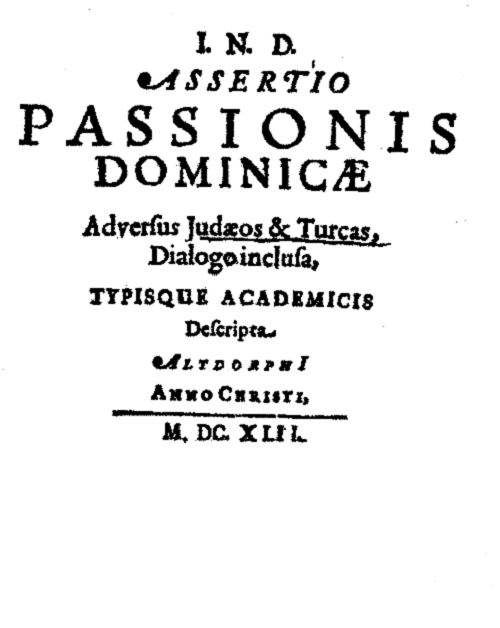
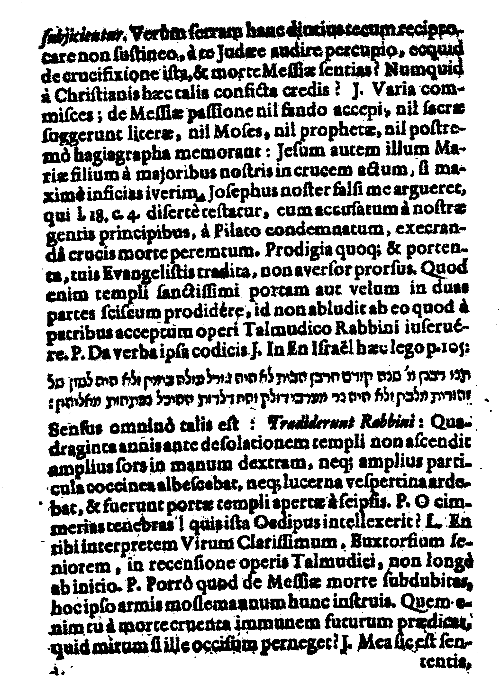
 

Assertio passionis Dominicae adversus Judaeos & Turcas is primarily in Latin with very limited Hebrew and slightly more Arabic text. Several Hebrew sources are referenced. Among them “שלחן ערוך tractatu ארוך חיים Hilcot תשעה באב ושער תעניות.” There are only two full Hebrew passages, both set in rabbinic letters, as well as several brief lines in square letters. The passages, from Ta’anit 5b-6a and Yoma 39b respectively, with Latin translation and commentary, are:

He replied: Let me tell you a parable – To what may this be compared? To a man who was journeying in the desert; he was hungry, weary and thirsty and he lighted upon a tree the fruits of which were sweet, its shade pleasant, and a stream of water flowing beneath it; he ate of its fruits, drank of the water, and rested under its shade. When he was about to continue his journey, he said: Tree, O Tree, with what shall I bless thee? Shall I say to thee, ‘May thy fruits be sweet’? They are sweet already; that thy shade be pleasant? It is already pleasant; that a stream of water may flow beneath thee? Lo, a stream of water flows already beneath thee; therefore [I say], ‘May it be [God’s] will that all the shoots taken from thee be like unto thee’. So also with you. With what shall I bless you? With [the knowledge of the Torah?] You already possess [knowledge of the Torah]. With riches? You have riches already. With children? You have children already. Hence [I say], ‘May it be [God’s] will that your offspring be like unto you.’

Our Rabbis taught: During the last forty years before the destruction of the Temple the lot [For the Lord] did not come up in the right hand; nor did the crimson-coloured strap become white; nor did the westernmost light shine; and the doors of the Hekal would open by themselves.”[7]

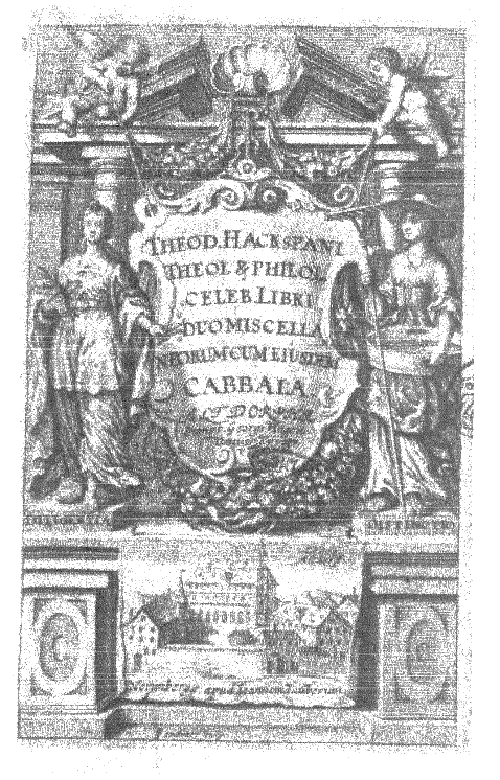
Miscellaneorum Sacrorum libri duo. Another Hackspan title published in Altdorf, this in 1660, is Miscellaneorum Sacrorum libri duo: quibus accessit ejusdem Exercitatio de Cabbala Judaica, a translation of two miscellaneous sacred books (17 cm.: 5, 453, [33] pp.), printed by Georgii Hagen, typos & Sumptibus  Universitatis Typographi together with Johannum Tauberum, Bibliopolam.
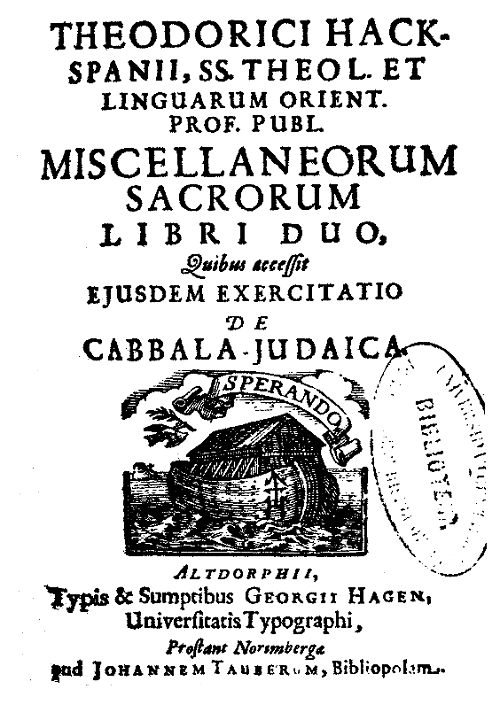
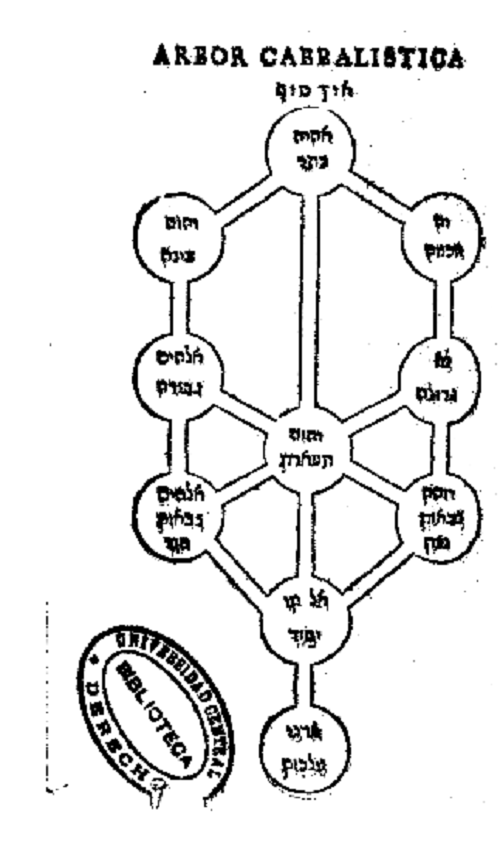
Miscellaneorum Sacrorum libri is a Latin introductory work comprised of introductions to Bible and Kabbalah, the latter section, from pp. 282-453, entitled “Cabbalae Judaicae brevis exposition.”  Miscellaneorum Sacrorum libri duo was has two lead title-pages (above) and, in the Kabbalistic section, a diagram of the tree of life which enumerates and displays the sephirot (emanations).
Here too the text is primarily Latin with varying amounts, but generally brief Hebrew, including quotes from the Talmud and other varied Hebrew sources. For example (p. 417) “CXXXII. Nostra aetate quoque familia in scriptus eorum occurrunt (In our time in the writings of these men, too, was met by the family) Kimchi in Obadiam scripit” followed by seven lines of Hebrew beginning ארץ אדום אינה היום לבני אדום כי האומות נתבלבלו רובם הם בין אמונת בנוצרים . . . (Today the sons of Edom, because the nations were confused, are mostly Christians) . . . . Terra Idumea hodie non est filiorum Edom: nam populi confusi sunt (Edom today is the rule (that is the example) for the people were mixed up.

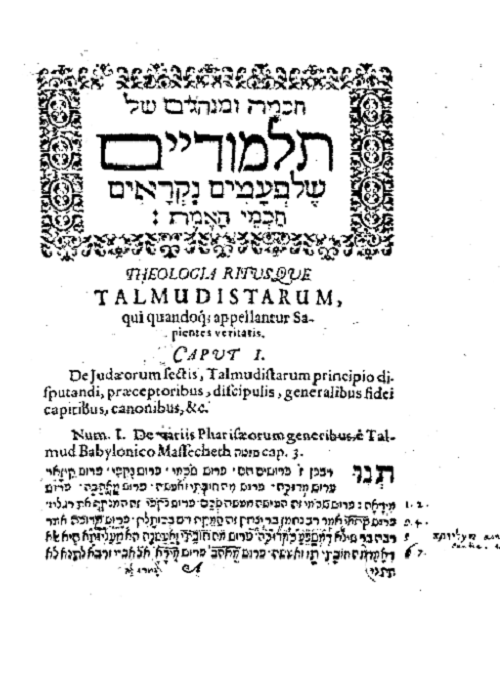
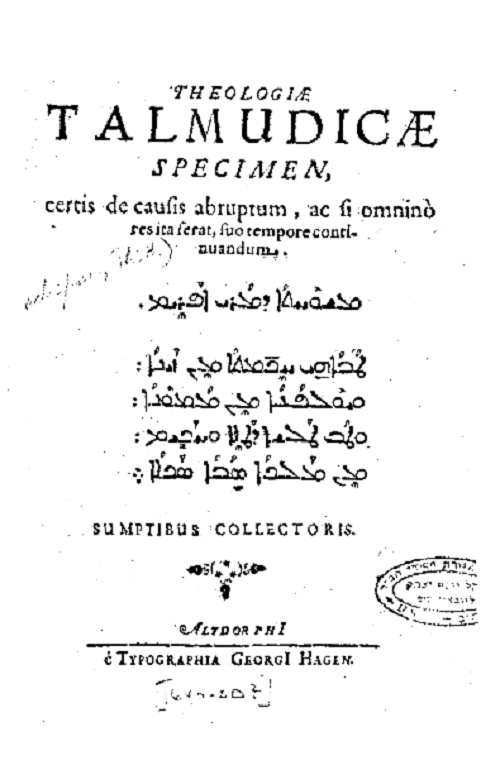
Theologiae talmudicae specimen. Yet another work by Theodricus Hackspan is Theologiae Talmudicae Specimen, certis de causis abruptum: ac si omninò res ita ferat, suo tempore continuandum. Theologiae Talmudicae Specimen (undated, 154 pp.), also printed by Georgii Hagen. The text of Theologiae Talmudicae Specimen is almost entirely in Hebrew, excepting Latin headers and marginal references. Despite the fact that Theologiae Talmudicae Specimen is almost entirely in Hebrew, in contrast to the other Hackspan titles noted here, it is set to read from left to right as if in Roman letters.
II

Sefer Nizzahon. The first Jewish title in our series published in Altdorf is R. Yom Tov Lipmann Muelhausen’s (d. 1459) Sefer Nizzahon (1644). This, the first printed edition of Nizzahon, was published in quarto format (40: [14], 512, 24 pp.), It is a polemic defense of Judaism and refutation of Christianity, here with a Latin translation by Theodore Hackspan, It was published so that Christians might be able to attempt to refute its arguments.

Muelhausen was one of the leading rabbinic figures of his time and a dayyan in Prague. His name, Muelhausen, likely derives from an earlier family residence in Muelhausen, Alsace. He studied under R. Meir ben Baruch ha-Levi (c. 1320-1390), Sar Shalom of Neustadt (14th cent.), and R. Samson ben Eleazar. In 1389, Muelhausen was one of a number of Jews incarcerated after an apostate named Peter accused them of defaming Christianity. In addition to his great rabbinic erudition, Muelhausen knew Latin and was familiar with Christian literature, making him a formidable polemicist. He was a prolific writer, his other works are on halakhah, philosophy, aggadah, piyyutim, and Kabbalah. In preparing Nizzahon Muelhausen utilized earlier Jewish polemical works, including an earlier thirteenth century Sefer Nizzahon Yashan (Nizzahon Vetus), with which this work is not to be confused. The effectiveness of Muelhausen’s Nizzahon may be gauged by the appearance of additional Latin editions and bitter attempts at refutations.
In a disputation in which Muelhausen represented the Jews he is reported to have been completely effective in his arguments, with the result that eighty Jews were martyred but Muelhausen miraculously survived.[8] Soon afterwards, in 1390, Muelhausen wrote Sefer Nizzahon for other Jews who had to respond to challenges from Christians. Nizzahon was copied but remained in manuscript until the publication of this edition, as the Church prohibited Jewish possession of a copy.

Christian scholars attempted to print Nizzahon for many years but were unable to obtain a manuscript. In 1644, Theodor Hackspan was successful in getting a copy. He had looked for a Nizzahon for a long time without success until he was informed that a rabbi in the neighboring small city of Schnattach had a copy but would not show it to anyone. Hackspan, together with some friends, paid an unwelcome visit to the rabbi, as if to engage him in a dispute. In the heat of the debate the rabbi took out his hidden manuscript of Nizzahon to look into it. Hackspan immediately seized the book from the rabbi’s hands, ran off with it to his carriage, and returned with it to Altdorf. Then, with a few of his students, they immediately copied the book and soon after printed the editio princeps of Sefer Nizzahon. Ora Limor and Israel Jacob Yuval Shoulson write that Hackspan printed Lippman’s text with care, not making any deliberate changes or alterations. Nevertheless, due to the poor knowledge of Hebrew of his “scribes . . . the book is full of mistakes, especially minor errors.” Meyer Waxman remarks that in his Latin introduction Hackman”attempts to refute Lippman in a dignified manner. Others, however, were not so generous.” [9]
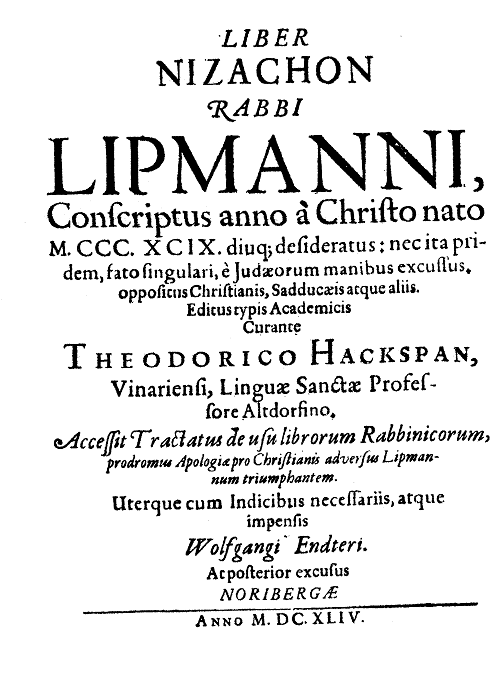
 

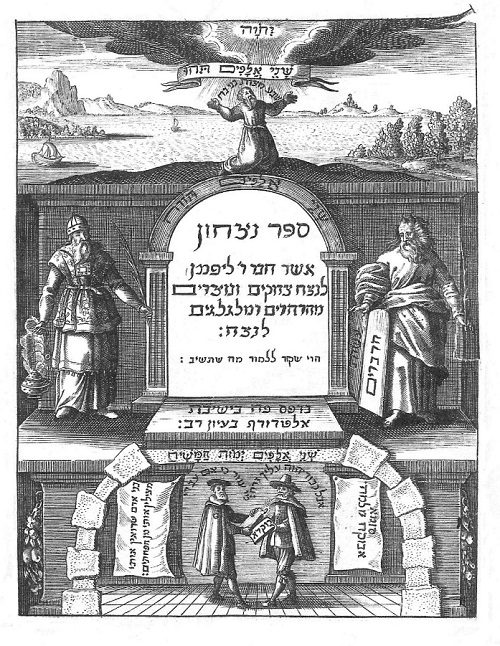
Nizzahon has an engraved Hebrew title page (above) followed by a Latin title page, which begins Liber Nizachon rabbi Lipmanni. . . .[10] Next is a dedication to Dn. Johan-Jodoco from Hackspan, introductions, a table of contents, and the Hebrew text set in a single column in rabbinic letters with marginal biblical references. Nizzahon is divided by the days of the week, further organized by books of the Bible, and subdivided into 354 sections, representative of the lunar year. These sections, not in order in the book, are refutations of Christian arguments (66 sections), explanations of dubious actions by the righteous in the Bible (39), explanations of difficult verses (41), reasons for precepts (34), refutations of the arguments of skeptics (55), against heretics and Karaites (47), and concluding with sixteen Jewish principles (48) to be read on Shabbat. Muelhausen refutes the Christian concepts of the Messiah, Immaculate Conception, and original sin. The Latin portion of the volume, printed in Nuremburg, begins on p. 211 and is paginated from right to left.[11]

Nizzahon was printed by Wolfgang Endter (1593 – 1659), a member of the well-known Nuremberg publishing family. The Hebrew title-pages states that it was printed in Altdorf, the Latin title-page gives Nuremberg at the place of publication. Nizzahon was reprinted in Altdorf in 1681 as part of Wagenseil’s Tela Ignea Satanae (below). The first Jewish edition of Nizzahon was published by Solomon Proops in Amsterdam (1709).

III

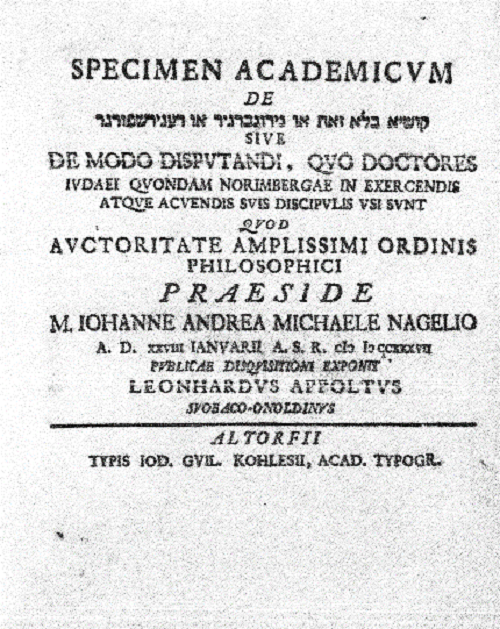
Kushya belo Zot o Niremberger o Regensburger.
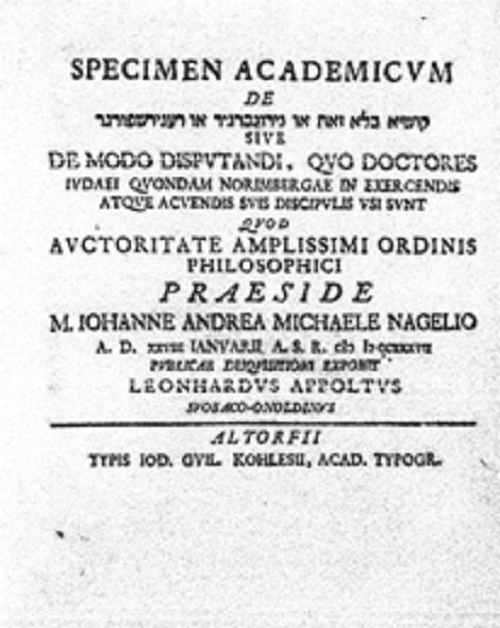
Another work with Hebrew attributed to the Altdorf press was Kushya belo Zot o Nuremberger o Regensburger, a relatively small work (19 cm. 24 pp.), printed in 1670. This very rare work was described in an auction catalogue, the entry stating,

Kushya belo Zot o Niremberger o Regensburger

A composition regarding Talmudic disputation and the ‘chilukim’ method of the Ashkenazim by Leonard Appoltus, supervised by Prof. Johanne Andre Michael Nagelio.

Altorf, [c. 1670].

In Latin with segments in Hebrew.

24 p. 19 cm. Good condition. ‘Blo Zot’, Nirenburger’ and and ‘Regensburger’ are different types of questions that it was usual to ask in the ‘chuilukim’ method.

Very rare. Not in the Jerusalem National Library.

o.b $300     $400/700[12]

From the sale results sheet it appears that this item did not sell.

IV

In 1674 Christoph Wagenseil (1633-1705), professor of Oriental languages at the University of Altdorf from 1667, succeeded Hackspan, becoming the most prominent Christian-Hebraist in Altdorf. Wagenseil, learned his Hebrew from Enoch Levi, a Viennese Jew, and Jewish studies from R. Samuel Issachar Behr ben Judah Moses Eybeschuetz Perlhefter, (d. after 1701), a Prague scholar, kabbalist, and instructor in Hebrew in the University of Altdorf. Perlhefter was the author of Ohel Yissakhar, Ma’aseh Ḥoshen u-Ketoret, and Ba’er Heitev; served as rabbi in Mantua, leaving there over a dispute concerning the pseudo-Messiah Mordecai of Eisenstadt, a follower of Shabbetai Zevi, whom Issachar Behr had initially supported. He subsequently returned to Prague where he held the position of dayyan.

Perlhefter’s wife, Bella, taught Wagenseil’s daughter dancing and music.[13] Elisheva Carlebach elaborates, writing that Wagenseil, as did other Christian-Hebraists, often pressured the Jews who assisted them to convert. In this context, Wagenseil, unable to influence Perlhefter who was residing at the time in Altdorf, turned to Bella, then in Schnattach, inviting her to join his household for a family celebration. Bella responded, in literate Hebrew, that as she had a small child, whom she could not leave, “And if I carry him with me the cold is great, the snow is high, and a tiny child cannot tolerate the cold, for he or she has not been out of the house from the day of his or her birth and is not accustomed to the cold [Mrs. Perlhefter changed genders in mid sentence].” [14]

Wagenseil traveled widely as a youth, serving as a private tutor, and while in North Africa, Wagenseil acquired Hebrew manuscripts. Although “tarred” as an anti-Semite, together with other German Hebraists in the nineteenth century, Wagenseil was an accomplished Hebraist and, despite his opposition to Jewish beliefs, often defended Judaism against its more virulent enemies and their baseless charges. David Malkiel reports that Wagenseil had cordial relations with Jewish contemporaries.[15] Assessments of Wagenseil vary, from Heinrich Graetz, that “he was a good-hearted man, and kindly disposed towards the Jews,” to Frank E. Manuel, for whom he is one of three Christian-Hebraists, with Shickard and Eisenmenger, who “used their learning to cast a glaring light on those texts in the Talmud and later Jewish writings that were either blasphemous or full of hatred for Christians.” Wagenseil confuted Christian charges that the Talmud was blasphemous, senseless and jumbled, arguing that in it were matters of morality, wisdom, and medical advice; he also opposed blood libels. Furthermore, he maintained that Catholic censors had distorted the Talmudic text, particularly of Avodah Zarah.[16]

Wagenseil is credited with assembling the first comprehensive study of Jewish observances and ceremonies by a Christian. Jonathan I. Israel notes that Wagenseil considered much of what he found superstitious and absurd, and that his motivation was to bring Jews to Christianity. Nevertheless, “for all that an unmistakable admiration for Jewish life and Jewish life-style insistently creeps through.” He quotes Wagenseil, who wrote in the forward to the apostate Friedrich Albrecht Christiani’s Der Jüden Glaube und Aberglaube (Leipzig, 1705),

that they show far more care, zeal, and constancy in all this (their religious duties) than Christians do in practicing their true faith, and that, furthermore, they are far less given to vice; rather they possess many beautiful virtues, especially compassion, charity, moderation, chastity, and so forth . . .[17]

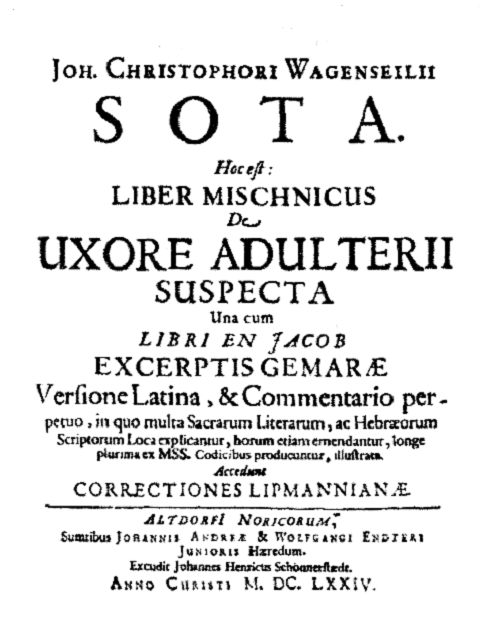
Sotah (the suspected adulterous woman) has numerous illustrations, several being full page, and a detailed attractive copper-plate title page of the Sotah (the wife accused of adultery) being taken by the priests to be tested. The volume opens with a full page depiction of the Sotah being taken to be tested by the priests.

The verso has verses in Latin from Psalms and the Christian Bible. The title page in red and black, begins, Hoc est: liber mischnicus de uxore adulterii suspecta (this book is a work concerning a woman suspected of adulterous behavior). Reading from left to right, the volume begins with considerable prefatory material, including several indices, one in Hebrew, correctiones Lipmannianae (10-81), corrections to Hackman’s edition of the Sefer ha-Nizzahon based on two other manuscripts he was able to obtain, and the text, which has separate pagination.
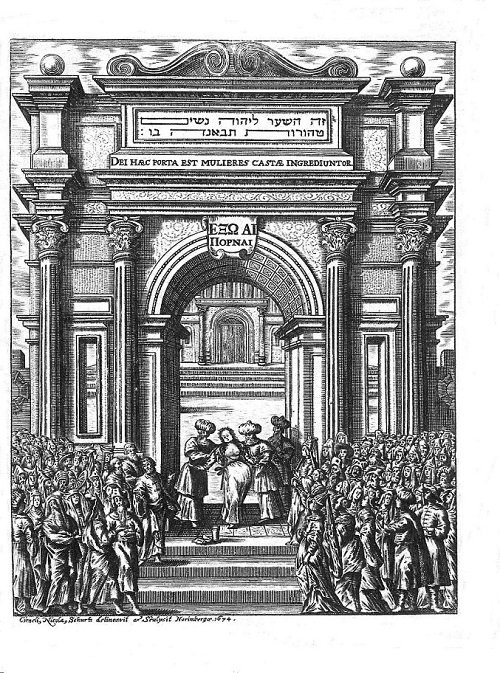
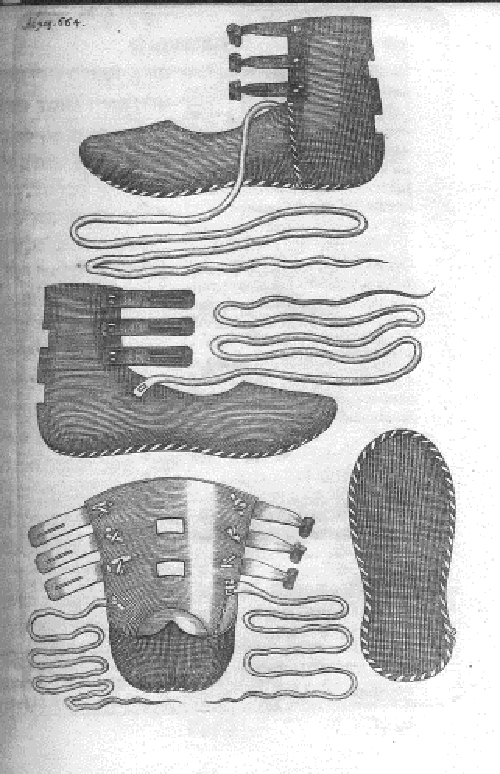
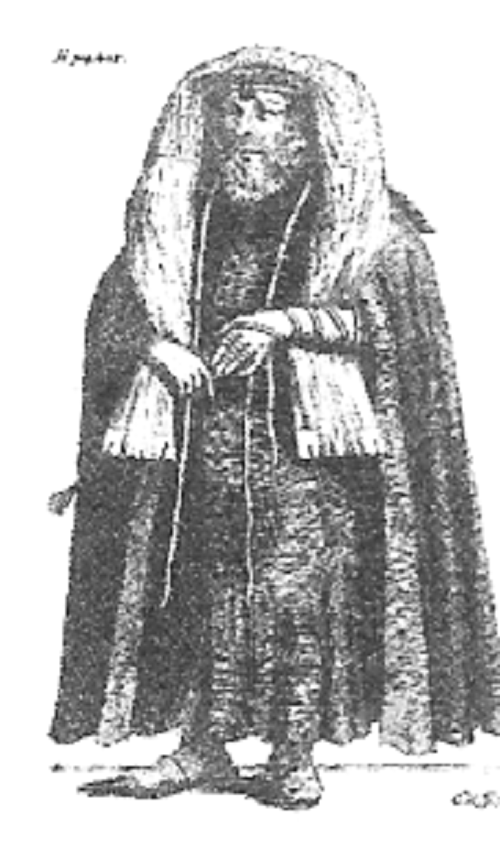
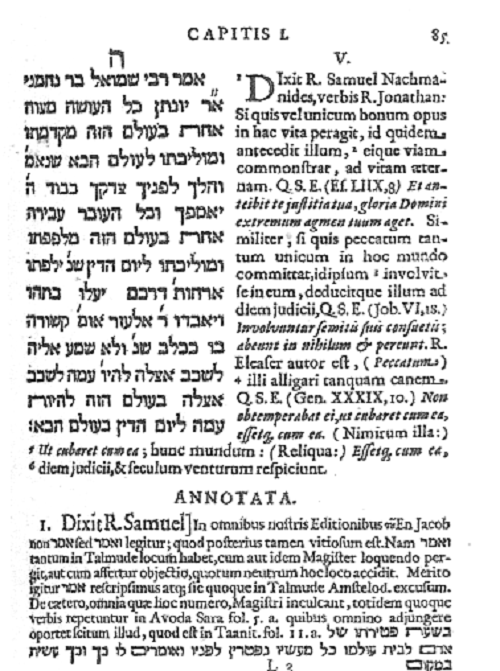
Within the text the Mishnah is always in the left margin in square unvocalized Hebrew, the translation in the right column, accompanied by an extensive Latin commentary with occasional Hebrew, with excerpts from the gemara, including most of the aggadah in the Ein Ya’akov, on this tractate. The volume has numerous illustrations, several being full page. Among them are depictions of the priest wearing talit and tefillin with their straps for the head and arm, magen davids, halizah shoes, coins, and an undressed woman with skull and cross. Negaim was the next tractate translated by Wagenseil, to prove that the Talmud contained valuable and interesting material on medicine.[18]
Tractates Avodah Zarah and Tamid. Another translation of Mishnayot tractates, this of Avodah Zarah and Tamid, prepared by the Christian-Hebraist Gustavo Peringero (Gustav von Lilienbad Peringer, 1651-1705), a student of Johann Christoph Wagenseil. Peringero, (1633–1705), was professor of Oriental languages at Upsala (1681- 1695) and afterwards librarian at Stockholm. Charles XI, king of Sweden, who reputedly had an extraordinary interest in Jews and even more so in Karaites, sent Peringero to Poland to learn about the latter and perhaps to attempt to convert the Karaites to Christianity, for, as Graetz notes, they did not have “the accretion of traditions, and were said to bear great resemblance to the Protestants,” nor were they “entangled in the web of the Talmud.” [19]
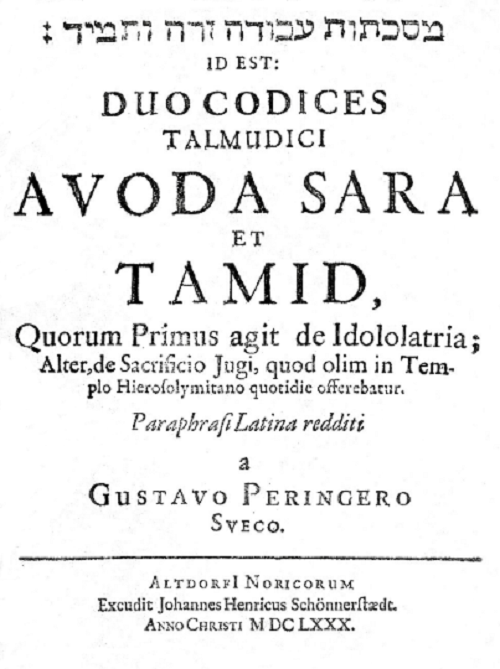
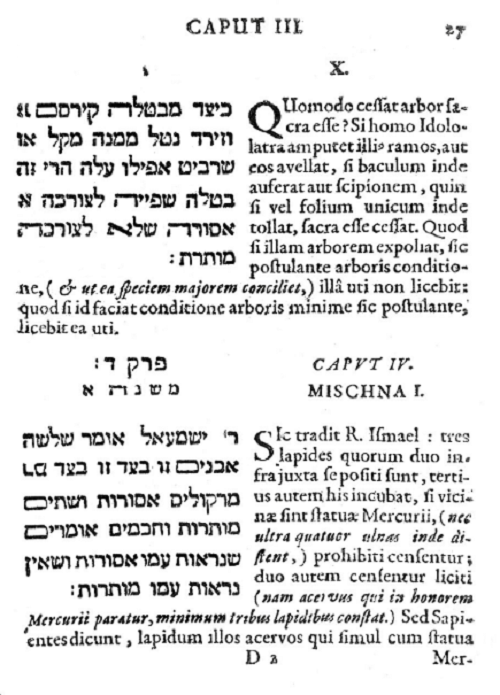
This edition of Mishnayot of tractates Avodah Zarah and Tamid in Hebrew with accompanying Latin translation and annotations by Peringero was published in 1680 by Johannes Henricus Schönnerstadt in a small octavo format (80: [7], 78 pp.).The title page of this volume is, excepting a Hebrew header, entirely in Latin. It states that it is comprised of two codices, primarily about idolatry, and secondly about sacrifices in the time of the Temple. The title page is followed by a dedication to Dominae (Mistress) Ulricae Eleonorae, wife of Charles XI, a preface in Latin with occasional Hebrew, and then the text.

Reading from left to right, the Mishnayot are in the left column, the integrated translation and glosses in the right column. Avodah Zarah concludes on p. 43 and Tamid begins immediately after on the following page. Peringero’s translation of Avodah Zarah was inserted by Wilhem Surenhusius (1666-1729) in his Versio Latina Mischnae (1698-1703). In addition to these tractates, Peringero also translated Abraham Zacuto’s Sefer Yuhasin, portions of Maimonides’ Mishneh Torah (Upsala, 1692), and several other works into Latin. He was also the author of Dissertatio de Tephillin sive Phylacteriis (Upsala, 1690). [20]

In addition to tractates Avodah Zarah and Tamid the printer, Johannes Henricus Schönnerstadt, also published separate editions of Shekalim and Sukkah at this time, also with Latin, but not translated by Peringo.

IV

Returning to Wagenseil, we come to two very different works. The first, although chronologically the later of the two, and not an Altdorf publication, is Belehrung der Judisch-Teutschen Red-und Schreibart (An Instruction Book in the Method of Speaking and Writing Judeo-German, Koenigsberg, 1699). This is, as the title suggests, a Yiddish grammar with a “loose Yiddish version (with German translation) of Hilkhot Derekh Eretz,” a rabbinic work on ethical behavior. Also included is a Yiddish account (with German translation) of the Fettmilch uprising in 1614 in Frankfurt on the Main, as well as selections from tractate Yevamot on levirate marriage as well as the entire tractate Neg’aim on leprosy with notes, this in order to aid in teaching Hebrew.[21]

The second and Wagenseil’s most famous collection of Jewish polemical literature, Tela ignea Satanae, in which Wagenseil, among other subjects, includes his responses to Sefer Ha-Nizzahon. Wagensiel travelled widely, through Spain and into Afric Belehrung e a, to collect these manuscripts.[22]

Tela ignea Satanae. Published in 1681 by Wagenseil in quarto format (40: [2], 635, [12]; 60; 260; [2], 100; 45; 480, [1] pp.) Tela ignea Satanae, perhaps Wagenseil’s best known work, is comprised of six polemical anti-Christian works, almost all not previously printed.
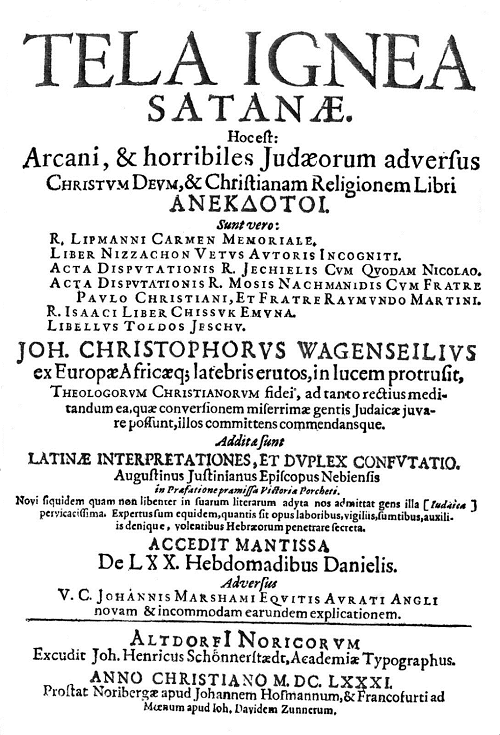
          

The first title page, printed in red and black, has the full title of Tela ignea Satanae. Hoc est: Arcani, et horribles Judaeorum adversus Christum Deum, et Christianam Religionem Libri (Flaming Arrows of Satan; that is, the secret and horrible books of the Jews against God and the Christian religion). After the verse the title-page states,

John Christopher Wagenseil thrusts these forward into the light, bringing them together and entrusting them, dug out from the hiding places of Europe and Africa, to the faith of Christian Theologians, that they may more rightly consider those things, which are able to aid the conversion of that wretched Jewish race. Added are: Latin Interpretations, and Two Confutations. Augustine Justianus Bishop at Nebiensis in the Forward Preface of Victoria Porchetus. I know how unwillingly that most stubborn (Jewish) race admits us into the most secret parts of their literature. I have tried by all means, however great the task, with toil, sleeplessness, expense, with willing helpers finally, to penetrate the secrets of the Hebrews.[23]

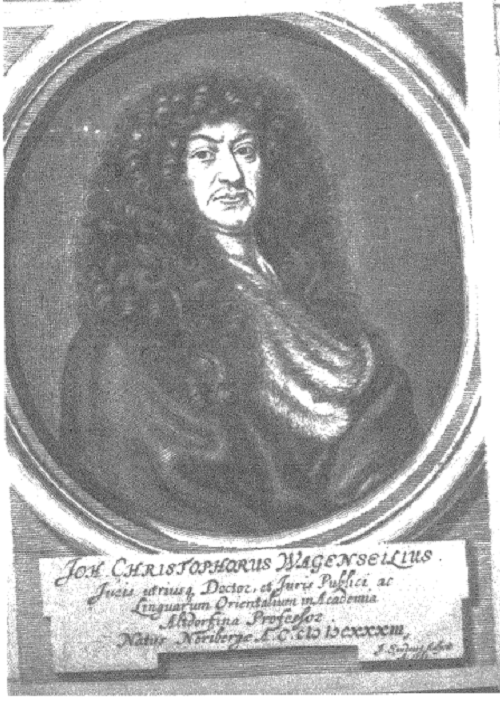
The facing page has a full front-piece portrait of Wagenseil. In two volumes, the work begins with a Latin introduction, followed by the six books, each with its own title page with Hebrew headers and Latin text, a Latin introduction (refutation), and then the text in two columns comprised of facing Hebrew and Latin.

That these books were not previously printed but rather circulated among Jews in manuscript only, or where printed were done so by Christian Hebraists with Latin translation and refutation, is due to their polemic and inflammatory content. As a result, these books today exist with variant texts. Tela ignea Satanae, as noted above, is comprised of six independent books, listed below, several described afterwards in somewhat greater detail:

Nizzahon, Polemic in defense of Judaism by R. Yom Tov Lipmann Muelhausen. Printed previously in Altdorf/Nurenburg, 1644 (see above).

Nizzahon, anonymous polemic in defense of Judaism.

Vikku’ah Rabbenu Yehiel mi-Paris, record of the disputation between R. Jehiel of Paris and Nicholas (dispute over the Talmud in Paris in 1240, below, 1681).

Vikku’ah ha-Ramban im broder Paulus, record of the disputation between the Ramban (Moses ben Nahman, Nahmanides) and the apostate Pablo Christiani in 1263 before King James of Aragon.

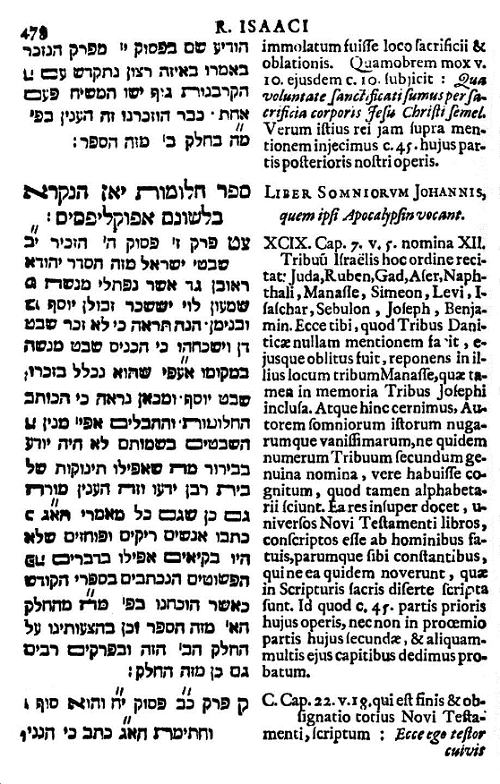
Hizzuk Emunah, anti-Christian polemic by the Karaite scholar, Isaac ben Abraham Troki.

Jeshu, negative and, from a Christian perspective, highly blasphemous account of the life of Jesus.[24] [25]

Vikku’ah Rabbenu Yehiel im Nicholas Jehiel ben Joseph of Paris. This is a record of the disputation held in Paris on Monday, June 25, 1240, attributed to R. Jehiel ben Joseph of Paris. Jehiel, one of the leading Ba’alei Tosafot, was a student of R. Judah ben Isaac (Sir Leon), whom he succeeded as rosh yeshivah in Paris.  Among Jehiel’s students was his son-in-law, R. Isaac of Corbeil (Sefer Mitzvot Katan, Semak). Jehiel was the author of tosafot quoted by many rabbis and included in those tosafot known as our tosafot. He is also frequently referenced in the Torah commentary Da’at Zekenim. Because of his prominence Jehiel was selected as a primary representative of the Jewish community in the disputation over the Talmud resulting from the charges leveled against it by the apostate Nicholas Donin. The record of that disputation, generally known as Vikku’ah Rabbenu Yeh iel mi-Paris, is the third work in Wagenseil’s Tela ignea Satanae (above, 1681).

        The Vikku’ah follows the same pattern as the other works in Tela ignea Satanae, that is, it has a bilingual Hebrew-Latin title page, followed by a Latin preface, and the text in two columns in facing Hebrew and Latin. Donin’s denunciation of the Talmud included thirty‑five charges which primarily stated that Jewish emphasis on the Oral Law was in itself a blasphemy against the holiness of Scriptures recognized by Jew and Christian alike; the Talmud overtly fostered anti‑Christian attitudes and contained blasphemous statements offensive to Christianity; and that it was irrational, and morally and intellectually offensive.
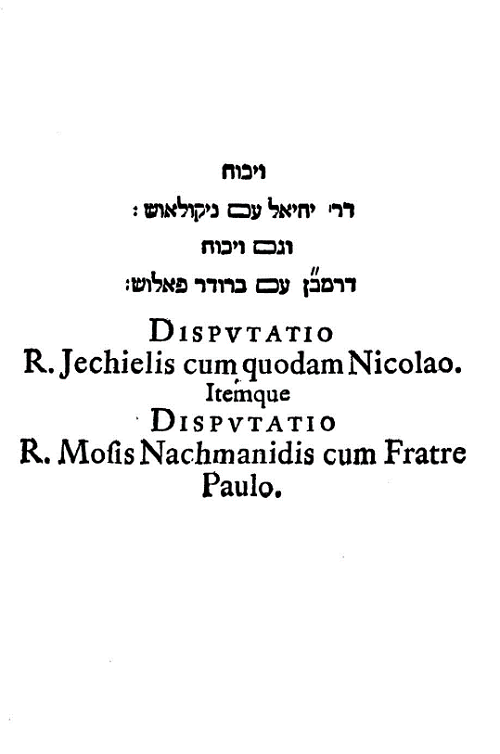
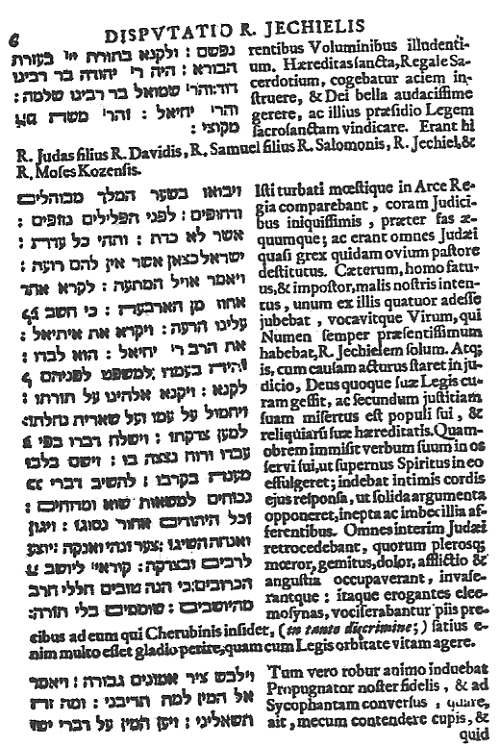
          

        The trial was presided over by the Queen Mother Blanche, who was in an advanced stage of pregnancy. The judges were high Church dignitaries, such as the Archbishop of Sens, the Bishop of Paris, and the Chaplain to King Louis IX, none of whom knew Hebrew. Jehiel, although the primary Jewish spokesman, was assisted by R. Moses ben Jacob of Coucy (Semag), R. Judah ben David of Melun, and R. Samuel ben Solomon of Chateau‑Thierry (all 13th century). Although Jehiel defended the Talmud, noting inter alia, that Donin was the real heretic, justifiably excommunicated by the Jewish community fifteen years before the debate. His arguments were to no avail, for the matter had been predetermined from the outset. Even before the court’s formal decision was rendered, it had been decided to burn the condemned books. In June, 1242, twenty‑four wagon loads of Hebrew books, containing thousands of volumes, were seized and burned in Paris. Jehiel remained for some time in Paris, teaching students from memory. In 1260, Jehiel went up to Eretz Israel, effectively ending the period of the Ba’alei Tosafot.[26]

Hizzuk Emunah. Anti-Christian polemic by the Karaite scholar, Isaac ben Abraham Troki (c. 1533-c. 1594). Hizzuk Emunah is the fifth work in Wagenseil’s Tela ignea Satanae below, 1681). Troki is known by his birthplace, Troki (Trakai), capital of Lithuania until 1323 and home to the most important Karaite community in Lithuania. He was, from the age of twenty, the secretary-recorder of the Karaite General Assembly which met there in 1553. Author of a work on shehitah and religious poetry, Troki became the foremost Karaite scholar in Eastern Europe, serving as dayyan to both Karaite and rabbinic Jews. He studied Bible and Hebrew studies under the Karaite scholar Zephaniah ben Mordecai, and had Christian teachers for Latin and Polish literature. Engaging in dialogues with Christian clergyman of different persuasions, Troki became fluent in Polish and Latin and familiar with their theology and arguments against Judaism. It was those conversations that prompted Troki to write Hizzuk Emunah. Written in the last year of his life, Hizzuk Emunah was completed by Troki’s student, Joseph ben Mordecai Malinovski.
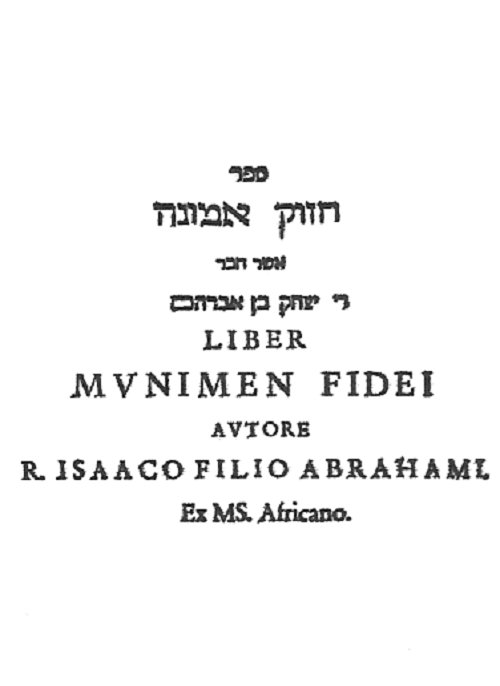
Wagenseil obtained a copy of the manuscript in 1665 on a trip to Ceuta, North Africa. He translated Hizzuk Emunah into Latin, in which form it was widely used not only by Christian missionaries but also by opponents of Christianity, such as atheists, French philosophes, among them Voltaire. Hizzuk Emunah follows the same format as the other polemic works in Tela ignea Satanae, that is, it has its own Hebrew-Latin title page, a Latin introduction, and then the text, in two facing Hebrew and Latin columns. The book, in quarto format, is in two parts comprised of ninety-nine chapters. In the first chapter, Troki begins by questioning the authenticity of the Christian messiah, arguing against his pedigree, acts, the time in which he lived, and the fact that he did not fulfill the promises expected of the Messiah.

As an example of the first argument, Troki writes that he cannot be of Davidic descent due to the concept of virgin birth and that even apart from that, the relationship of Joseph to David is wanting in proof. He also notes contradictions in the Christian Bible on that and other subjects, and compares the Hebrew Bible and Gospels. Most of Troki’s arguments are based on biblical texts, accounting for its effectiveness against Christian arguments. Nevertheless, he also utilizes rabbinic sources, so that Hizzuk Emunah has been accepted by rabbinic authorities, perhaps unique for a Karaite work.[27]

        Hizzuk Emunah is considered one of the most effective polemic works. Although circulated widely in manuscript, Hizzuk Emunah was not printed by and for Jews until the Amsterdam edition of 1705. It has been frequently reprinted, translated into Yiddish (Amsterdam, 1717), English by Moses Mocatta (London, 1851), German (Sohran, 1865), and Spanish as Fortificación de la Fe (1621), extant in manuscript.

Wagenseil would publish several additional Hebrew/Latin collections and works, among them Exercitationes sex varii argumenti (1697); Denunciatio Christiana de Blasphemiis Judæorum in Jesum Christum (1703); and Disputatio Circularis de Judæis (1705) as well as several titles published elsewhere. As might be expected, Wagenseil’s influence in this field was considerable, his students also becoming Christian-Hebraists, for example, Peringer above, and our final Altdorf imprints, the first by a student of Wagenseil.
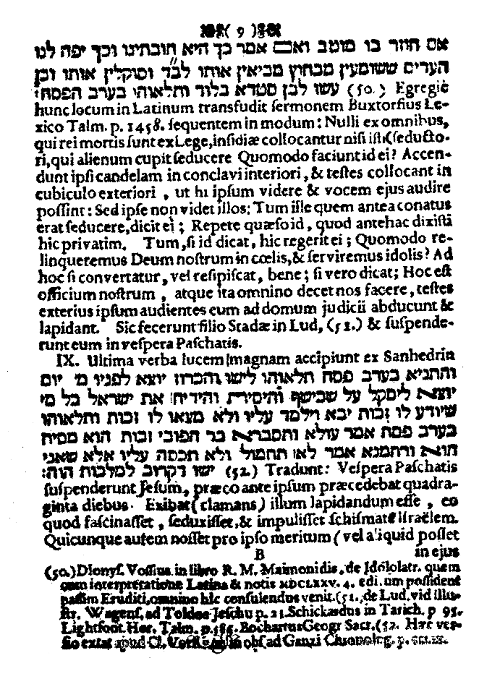
Jesus in Talmude. Our final works are Jesus in Talmude and Der Jüdische Theriak. The former is  dissertation submitted at the University of Altdorf by Rudolf Martin Meelführer (Rudolfo Martino Meelführero, 1670–1729) in 1699, and described by Peter Schäfer as “the first book solely devoted to Jesus in the Talmudic literature;” the latter a refutation by R. Solomon Ẓevi Hirsch Aufhausen (Openhausen, Ufenhausen, of Aufhausen) in Yiddish of an anti-Jewish work. Meelführer was also a Christian-Hebraist, teaching in Altdorf and afterwards as adjunct in philosophy at Wittenberg. The dissertation is important as it was the first study fully devoted to the subject. Meelführer, in contrast to Wagenseil, was almost immediately forgotten.[28] Here too the work is primarily in Latin, but includes examples of the Talmudic text in Hebrew, from early editions of the Talmud, as the later editions available to Meelführer were censored and omitted many of the passages he refers to. Meelführer appears to primarily rely on secondary sources for Talmudic entries, notably R. Gedaliah ben Joseph ibn Yahya’s (1515-1587), Shalshelet ha-Kabbalah (Venice, 1586).[29] An example of the text brought by Meelführer is Sanhedrin 42a (below), censored from most editions of the Talmud,

On the eve of the Passover Yeshu was hanged. For forty days before the execution took place, a herald went forth and cried, ‘He is going forth to be stoned because he has practiced sorcery and enticed Israel to apostasy. Anyone who can say anything in his favor, let him come forward and plead on his behalf.’ But since nothing was brought forward in his favor he was hanged on the eve of the Passover! – “Ulla retorted: Do you suppose that he was one for whom a defence could be made? Was he not a Mesith [enticer], concerning whom Scripture says, Neither shalt thou spare, neither shalt thou conceal him? With Yeshu however it was different, for he was connected with the government [or royalty, i.e., influential].
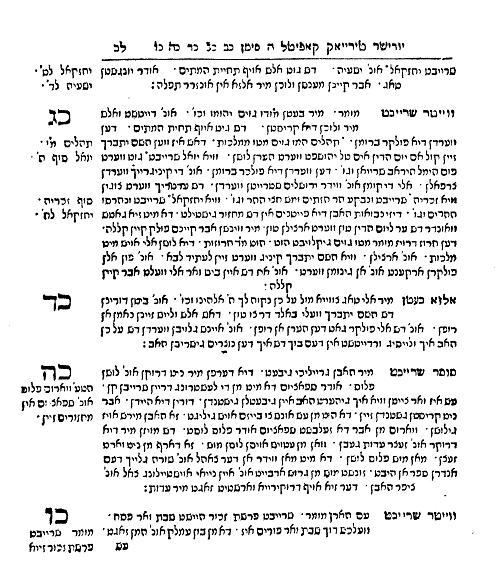
Der Jüdische Theriak (the Jewish Medicine) by Zalman Ẓevi Hirsch Aufhausen is a point by point refutation of Jüdischer Abgestreifter Schlangenbalg (The Jewish Serpent’s Skin Stripped) by the apostate Samuel Friedrich Brenz of Ettingen. Converted to Christianity in 1610, Brenz wrote Jüdischer Abgestreifter Schlangenbalg (Hanau, 1614) in “the thirteenth year after my rebirth.”[30] Der Jüdische Theriak, first printed in Hanau in 1615, was reprinted in in Altdorf in 1680 by Henricum Meyer, Academiae Typographu, as a small quarto (40: 36, [1] ff.), the text in old Yiddish set in Vaybertaytsh, a type generally but not exclusively reserved for Yiddish books, so named because these works were most often read by the less educated and women.[31] Given that it is a Jewish refutation of Christian ant-Jewish polemics its publication in Altdorf was likely done for the same purpose as Nizzahon, so that Christians might be able to attempt to refute its arguments.[32] In Jüdischer Abgestreifter Schlangenbalg Brenz collected all of the accusations made against Jews, accusing them of making derogatory and blasphemous remarks against the founders of Christianity and the Church, fostering animosity, and stating that the Talmud permits Jews to cheat Christians.
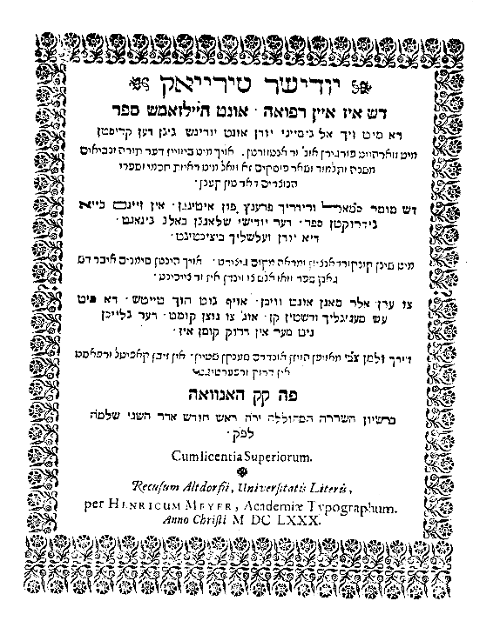
Zinberg notes that there is scant information about Aufhausen and what is known is surmised from remarks in Der Jüdische Theriak. Zinberg conjectures that Aufhausen (b. c. 1565-60) was an itinerant who, driven from his home by “evil Jews” travelled widely, broadening his world-view and culture, knowledgeable with German, knew Luther’s translation of the Bible, and was familiar with Flavious Joseph, Buxtorf the Elder, Pica della Mirandola, and Johannes von Reuchlin on the Kabbalah among others. Furthermore, Aufhausen “displays great knowledge of Talmudic literature, and that he wrote elegant Hebrew is attested to by the poem written in the well known azharot-meter on the front page of the Teryak.” Zinberg infers from Aufhausen’s remarks that he was a shohet and mohel (ritual slaughterer and circumciser) but these professions did not provide well for Aufhausen, his wife, and six children “who were not always well fed.”[33]

Morris M. Faierstein writes that Der Jüdische Theriak is unique, it is the only Jewish response in Yiddish to anti-Jewish polemics by Christians and Jewish apostates in early modern Germany and the only such work printed in Germany.[34] Zinberg quotes Aufhausen that Der Jüdische Theriak is an antidote to the venomous bite of the anti-Jewish snake, that is, Brenz’s work. Aufhausen describes Brenz as “a terrible usurer,” and if one added together all the horses on which he loaned money one could put in the filed a regiment of riders, which is what brought him to baptism, noting that the Jews hated him for his ugly deeds pushing him way with both hands.” Brenz is a “frightful ignoramus and a petty, good for nothing creature, his diatribe lacks any system or order.[35] In his introduction, Aufhausen informs how he came to write Der Jüdische Theriak. Benz’s book was

placed before me, and worthy people waved it under my nose. As a result I called the aforementioned apostate a liar, as I continue to do the present. On Monday, the seventh of Ab, he [Benz] he rode up to my door in a violent manner and threatened me and wanted to kill me. He publicly confirmed the wickedness of his book in front of Jews and Christians, said that it was all true and just and wanted to continue persecuting Jews. However, I sanctified the name of God in response to his desecration of God’s name and called him a liar to his face and swore to write a book against his lies . . .[36]

Der Jüdische Theriak is comprised of seven chapters, each addressing a specific group of accusations. Aufhausen cites numerous examples from the Talmud to show that Jews are commanded to show mercy and friendliness to non-Jews, and those few laws that are not friendly are directed against pagans, not Christians.[37] Der Jüdische Theriak is also directed towards women, for, as Carlebach notes, Christian missionaries had introduced Yiddish into their conversion material to make them accessible to women. Aufhausen refutes their claims writing for “common Jews and Jewesses.”[38] In the final chapters of Der Jüdische Theriak Aufhausen includes an appeal for tolerance advocating equal treatment for all, both Jews and Christians,

I have shown above that [tractate] Baba Kamma and [tractate] Avodah Zarah write: “A heathen who studies Torah and studies the law of Moses is as good as the high priest.” Thus anyone who studies the Law and does not ridicule it, he is an honest person and is highly honored. It is the same whether Christian or Jew. . . .

I had this book printed in Yiddish in the Hebrew alphabet so that someone will know how to respond to Christians in conducive circumstances, and also to understand from this and keep in mind what a great sin it is to deceive Christians, with words or deeds.[39]

The study of Jewish texts by Christian-Hebraists proved to be a passing phenomenon. By mid-eighteenth century the interest of Christian-Hebraists in rabbinic literature and studies had diminished.[40] In Altdorf, in contrast to other locations where, as noted above, Hebrew works, primarily philological and biblical titles and translations of rabbinic works, often theological titles accompanied by glosses contesting the Jewish authors’ positions, were studied by Christian-Hebraists for their own purposes to better understand the sources of Christian theology and to refute Jewish understanding of those works, the emphasis of those studies here was primarily for polemic purposes. Wagenseil, although his object was not always antithetical to Jewish texts, is remembered today as being among the leading exponents of the Christian-Hebraist movement. His works, several described here, as well as those of his contemporaries in Altdorf, represent an attempt by Christian-Hebraist scholars to understand and refute Jewish beliefs. Despite being, from several perspectives, among those of history, a failed and futile effort, it represents an interesting intellectual endeavor.

[1] I am indebted to Eli Genauer for reading the text and his comments, several noted below and to R. Jerry Schwarzbard, the Henry R. and Miriam Ripps Schnitzer Librarian for Special Collections for his assistance. Images are courtesy of the Library of Agudas Chassidei Chabad Ohel Yosef; Yitzhak;Bayerische StaatsBibliothek; the Library of Congress; Hathi Trust; Hebrewbooks.org; and R. Eli Amsel, Virtual Judaica.

[2] The other Altdorf’s are, in Germany, Altdorf, Lower Bavaria, Landshut, Bavaria; Altdorf, Böblingen; Altdorf, Esslingen; Altdorf, Rhineland-Palatinate, Südliche Weinstraße; and Weingarten (Württemberg) or Altdorf: in Swiitzerland, Altdorf, Jura or Bassecourt; Altdorf, Schaffhausen; and Altdorf, Uri: in France, Altdorf, Bas-Rhin” in Poland, Stara Wieś, PszczynaStara Wieś; and Silesian Voivodeship; and in the United States, Altdorf, Wisconsin.

[3] An unanticipated result of the Christian-Hebraists’ efforts, suggested by Eli Genauer in a private correspondence, is that readers of the Christian-Hebraists works might possibly have been influenced in another direction, suggesting that “even though the Christian scholars published these books to show the errors of Judaism, there might have been some people who say “‘hey, the Jews have some pretty good points.’”

[4] Aron Freimann, “A Gazetteer of Hebrew Printing” (1946; reprint in Hebrew Printing and Bibliography, New York, 1976), p. 268; Moshe Rosenfeld, Hebrew Printing from its Beginning until 1948. A Gazetteer of Printing, the First Books and Their Dates with Photographed Title-Pages and Bibliographical Notes (Jerusalem, 1992), p. 64 no. 618 [Hebrew].

[5] Yeshayahu Vinograd, Thesaurus of the Hebrew Book. Listing of Books Printed in Hebrew Letters Since the Beginning of Printing circa 1469 through 1863 II (Jerusalem, 1993-95), p. 23 [Hebrew]. Vinograd notes three additional works, a Mishnayot, printed in 1860, Toldot Jeshu, in a collection of Wagenseil’s works (below), and an undated edition of Hochmah u-Minhag shel Talmidim.ge

[6] John McClintock, James Strong “Hackspan, Theodor” Cyclopedia of Biblical, Theological and Ecclesiastical Literature, ttps://www.studylight.org/encyclopedias/tce/h/hackspan-theodor.html. (New York, 1870).

[7] Translations are from The Soncino Talmud, Judaica Press, Inc. (Brooklyn, NY, 1990).

[8] Israel Moses Ta-Shma, “Muelhausen, Yom Tov Lipmann,:EJ 14, pp. 595-59.

[9] Ora Limor and Israel Jacob Yuval “Skepticism and Conversion: Jews, Christians, and Doubters in Sefer Nizzahon,” in Hebraica Veritas?: Christian Hebraists and the Study of Judaism in Early Modern Europe, Allison P. Coudert and Jeffrey S. Shoulson, editors (Philadelphia, 2004), p. 166; Meyer Waxman, A History of Jewish Literature (1933, reprint Cranbury, 1960), II p. 51.

[10] Eli Genauer, in a separate correspondence, brought the following to my attention concerning the text at the bottom of the title-page of Sefer Nizachon.  “I was curious about the script written at the bottom starting with ‘Suma Avuka Zu Lamah’  . . . continuing on to the other side start from top line 7th word…B’Sefer HaNitzachon…I think the author is using this as an example of Jewish title pages and didn’t realize it was printed by a Christian. It is actually a Gemara in Megillah 24b which goes like this

אמר ר’ יוסי: כל ימי הייתי מצטער על מקרא זה (דברים כח, כט) “וְהָיִיתָ מְמַשֵּׁשׁ בַּצָּהֳרַיִם כַּאֲשֶׁר יְמַשֵּׁשׁ הָעִוֵּר בָּאֲפֵלָה”. וכי מה אכפת לֵיה [=לו] לעיוור בין אפלה לאורה? עד שבא מעשה לידי. פעם אחת הייתי מהלך באישון לילה ואפלה וראיתי סומא שהיה מהלך בדרך ואבוקה בידו. אמרתי לו, בני, אבוקה זו למה לך? אמר לי, כל זמן שאבוקה בידִי, בני אדם רואין אותי ומצילין אותי מן הפחתין ומן הקוצין ומן הברקנין.

Fascinating. I’m not sure what they were trying to point out but I wouldn’t be surprised if it had Christian implications.”

The above text (Megillah 24b) states “R. Jose said: I was long perplexed by this verse, And thou shalt grope at noonday as the blind gropeth in darkness.5 Now what difference [I asked] does it make to a blind man whether it is dark or light? [Nor did I find the answer] until the following incident occurred. I was once walking on a pitch black night when I saw a blind man walking in the road with a torch in his hand. I said to him, My son, why do you carry this torch? He replied: As long as I have this torch in my hand, people see me and save me from the holes and the thorns and briars.”

[11] J. Rosenthal, “Anti-Christian Polemics from its Beginnings to the End of the 18th Century,” Areshet II (Jerusalem, 1960), p. 148 no. 70 [Hebrew]; Waxman, pp. 545-51.

[12] Judaica Jerusalem, “Rare Books, Manuscripts, Documents, and Jewish Arts” (Jerusalem, October 14, 1993), no. 4.

[13] Louis Isaac Rabinowitz, “Perlhefter, Issachar Behr ben Judah Moses” Encyclopedia Judaica, edited by Michael Berenbaum and Fred Skolnik, vol. 20. (2007), vol. 15, p. 777. Concerning the personal life of Bella Perlhefter and letters to Wagenseil see Elisheva Carlebach “Introduction to The Letters of Bella Perlhefter,” Early Modern Jewries, I (2004, Wesleyan University, Middletown, CT), pp. 149-57: https://fordham.bepress.com/emw/emw2004/.

[14] Elisheva Carlebach, Divided Souls: Converts from Judaism in Germany, 1500-1750 (New (Haven & London, 2001), pp. 204-05). Carlebach  continues that Wagenseil subsequently invited her again, this time writing to Samuel Issachar Behr, to which she responded that “‘you have further written to me about coming to your place, to teach dance to the only, wonderful daughter of your master the great scholar, whose name escapes me, May God watch over her, it is puzzling to me  that you add, ‘and to teach her to play the zither,’ for you know that from the day of my mother’s death, I took an oath not to play any musical instrument, and now how can I violate my oath? But it is possible that sometime I will come to teach her to dance.”

[15] David Malkiel, “Christian Hebraism in a Contemporary Key: The Search for Hebrew Epitaph Poetry in Seventeenth-Century Italy,” Jewish Quarterly Review 96:1 (Philadelphia, 2006), pp. 126, 136.

[16] Frank E. Manuel, The Broken Staff: Judaism Through Christian Eyes (Cambridge, Mass., 1992), var. cit.

[17] Jonathan I. Israel, European Jewry in the Age of Mercantilism 1550-1750 (Portland, 1998) pp. 189-90.

[18] Elisheva Carlebach, “The Status of the Talmud in Early Modern Europe,” in Printing the Talmud: From Bomberg to Schottenstein, eds. Sharon Liberman Mintz and Gabriel M. Goldstein (New York, 2005), pp. 87-89; Heinrich Graetz, History of the Jews (Philadelphia, 1956), History of the Jews V, pp. 185-87.

[19] Graetz, History of the Jews V, pp. 182-83. Concerning Peringer’s mission, Graetz writes “Whether Peringer even partially fulfilled the wish of his king is not known; probably he altogether failed in his mission.” Moritz Steinschneider, Catalogus Liborium Hebraeorum in Bibliotheca Bodleiana (CB, Berlin, 1852-60), cols. 270 no. 1876.

[20] Graetz, History of the Jews V, pp. 182-83; Steinschneider, CB, col. 270 no. 1876.

[21] Christian Hebraism: The Study of Jewish Culture by Christian Scholars in Medieval and Early Modern Times, (Cambridge, Mass., 1986), p. 40 no. 61.[22] The Jewish Life of Christ being the SEPHER TOLDOTH JESHU, or Book of the Generation of Jesus, translated by G. W. Foote and J. M. Wheeler (2018), p. 6.

[23] “Wagenseil’s Latin Introductory Material to His Tela Ignea Satanae (The Fiery Darts of Satan) Published in 1681,, Translated into English” Translated by Wade Blocker (wblocker@nmol.com) Dates of Translation: 2000-12-21 through 2001-03-09.

[24] Malkiel,, pp. 126, 136; Manuel, The Broken Staff, pp. 76, 150-51.

[25] Toledot Jeshu, for all its condemnation in Christian sources, is also not well received by Jewish chroniclers. Graetz, vol. v pp. 185-86, describes it as an “insipid compilation of the magical miracles of Jesus (Toldoth Jesho) with which a Jew, who had been persecuted by Christians, tried to revenge himself on the founder of Christianity.” Manuel, p. 150, in even stronger language, describes it as “the most scandalous of all” of the works in Tela ignea Satanae, “a scurrilous account . . . a gross parody that outraged Christians.”

[26] J. D. Eisenstein, ed., Otzar Vikkuhim (Israel, 1969), pp. 82-86 [Hebrew Mordechai Margalioth, ed., Encyclopedia of Great Men in Israel III, (Tel Aviv, 1986), cols. 843-85 [Hebrew].

[27] Gershon David Hundert, Yivo Encyclopedia of Jews in Eastern Europe, (New Haven & London, 2008) p. 1906; Isaac ben Abraham Troki, Hizzuk Emunah or Faith Strengthened, translated by Moses Mocatta, introduction by Trude Weiss-Rosmarin (New York, 1970), v-xii.

[28] Peter Schäfer, Jesus in the Talmud (Princeton, 2007), pp. 3-4.

[29] Shalshelet ha-Kabbalah (Chain of Tradition), a popular and much reprinted mixture of history and tales, is a chronicle of Jewish history from the creation to the time of the author. Parenthetically, the work was completed on the day of the bar mitzvah of ibn Yahya’s eldest son, his first born, Joseph, to whom the book is addressed.

[30] Gotthard Deutsch, S. Mannheimer, “Brenz, Samuel Friedrich,” Jewish Encyclopedia, Isadore Singer, ed. V. 3 (New York, 1901-06), p. 370; Carlebach, Divided Souls, p. 90.

[31] The title-page gives the place of printing in Hebrew as Hanau, 1615, based on the Hebrew text, שלמ”ה (375 = 1615) and right below the Hebrew, in Latin letters, is Altdorf MDCLXXX (1680). This title page is than a copy of the original with the place and date of the second edition noted below the Hebrew. Der Jüdische Theriak was translated into Latin by J. Wülder (Wilfer, 1681) and reprinted again in 1737 by Zusssman ben Isaac Roedelsheim who, according to Israel Zinberg, A History of Jewish Literature, translated by Bernard Martin, IV (New York, 1975), p. 165, further Yiddishized the language of the work somewhat, and in places changed purely German wiods into more Yiddish teems.” Der Jüdische Theriak was translated into English by Morris M. Faierstein as Yudisher Theriak: An Early Modern Yiddish Defense of Judaism (Detroit, 2016).

[32] After writing the above my supposition found support in Faierstein’s introduction (p. 27) where he writes “The work would be useful to Christian Hebraists and help them to formulate counter arguments to the Jewish objections raised by Zalman Zevi against the missionary works that were being produced with the intention of convincing Jews to convert to Christianity.”

[33] Zinberg, pp. 165-66.

[34] Faierstein, p. ix- xi.

[35] Zinberg, p. 166, quoting Der Jüdische Theriak.

[36] Faierstein, p. 38.

[37] Waxman, II pp. 557-59; Zinberg, p. 166, quoting Der Jüdische Theriak.

[38] Carlebach, Divided Souls, p. 185.

[39] Faierstein, pp. 140, 144.

[40] Concerning the diminished interest by Christian-Hebraists in rabbinic literature and studies in the eighteenth century see Elisheva Carlebach, “The Status of the Talmud in Early Modern Europe” in Printing the Talmud: From Bomberg to Schottenstein, eds. Sharon Lieberman Mintz and Gabriel M. Goldstein, (New York: Yeshiva Univ. Museum, 2005), pp.85-88 and Jam-Win Wesselius, “The First Talmud Translation into Dutch: Jacob Fundam’s Schatkamer der Talmud (1737),” Studia Rosenthaliana 33:1 (1999), p. 60.


Torah Genius, Infallibility and Augmented Intelligence

Torah Genius, Infallibility and Augmented Intelligence

by Avinoam Fraenkel

For details of Avinoam Fraenkel’s new book, Shomer Emunim: The Introduction to Kabbalah, and his previous two-volume Nefesh HaTzimtzum, see here.

To view his series of short Shomer Emunim Kabbalah explainers, that introduce the basic concepts of Arizal’s Kabbalah in the context of contemporary science and technology, see here.

This essay explores the nature of Torah genius, and how it can be dramatically enhanced by embracing technology. It investigates why, notwithstanding the remarkable awe-inspiring stature of true Torah geniuses, they must never be thought of as being beyond genuine human error. It also provides some insights on how the accelerating technological changes we are all witnessing around us, may shape the abilities of the Torah genius of the future.

With its central focus on Torah study, Jewish society has always prized scholastic excellence. Throughout the ages, the pursuit of excellence has been used as the primary tool to motivate Torah students. The Talmud therefore queries which of two types of Torah genius is optimal.[1] Would it be the “Sinai,” the person whose predominant skill is the instant recall and mastery over the breadth of scholarly sources, as fresh as if just heard at Mount Sinai? Or could it be the “Oker Harim/uprooter of mountains,” one who primarily has penetratingly deep analytical skills enabling the logical clarification of issues from first principles, even if unaware of all the sources? The Talmud states that the optimal quality is that of the wide erudition of the “Sinai.”

Some argue that the leaning towards being a “Sinai” was only applicable in Talmudic times due to the scarcity of written resources, and that with the proliferation of books in the age of printing, the primary skill that should now be encouraged is the “Oker Harim.” However, it appears that in the main, rabbinic consensus sides with the Talmud, in that while the intellect of the “Oker Harim” is certainly valued, the sheer scope of knowledge of the “Sinai” is deemed advantageous.[2] Jewish literature frequently records instances of great rabbis who were seen to have developed a balanced hybrid of both these areas of genius, referring to them with the ultimate accolade of “Sinai and Oker Harim.”

Nevertheless, it is also clear that gifted genius can sometimes not only be less than optimal in achieving correct Torah understandings but can even be an impediment. R. Avraham Yeshaya Karelitz, the Chazon Ish, beautifully expressed this paradox. Sometimes with great people who are geniuses and are lightning-fast at grasping concepts, it can be that their very genius puts them at risk of simply missing the point, especially with complex, deep topics expressed in difficult language. The Chazon Ish wrote a response challenging the Halachic legal ruling made by R. Yechiel Meir Tukachinsky about the nature of the International Date Line. R. Tukachinsky was known to be a genius not only in Halachic law but also in mathematics, which he used in arriving at this ruling. The Chazon Ish’s Halachic critique of R. Tukachinsky was published in Kuntres Shmoneh Esreh Shaot, where he includes the following statement:

It is human nature to read the contents of a book superficially and quickly, like when reading a letter. One of the attributes of acquiring wisdom is to become accustomed to being precise with the language of the Sages as their words were written with analytical precision. Reading quickly and reading analytically are generally opposites with divergent outcomes. Because of the human tendency to be hasty, which is especially so with those who grasp concepts quickly [with geniuses], it happens that Sages read books and attribute things to them that were not thought of [by their authors] and are indefensible, or that they don’t relate to their subtlety. This is particularly so with matters that are truly deep [expressed] with difficult text that emphasizes their depth.[3]

This same sentiment is also succinctly expressed more than once by the Talmud describing a sage who:

… because of his sharp intellect, he did not [properly] investigate it.[4]

This can be understood to be a possible flaw in the ability of an “Oker Harim,” who is potentially at risk of skimming over material and missing highly relevant information needed to reach a sound conclusion.

It can also be argued that there is a potential risk that can sometimes compromise the ability of a “Sinai” to reach correct conclusions, distorting this kind of sage’s understanding in his Torah study. This potential impediment comes from a combination of two primary factors.

The first factor is the essential nature of what Torah study has become over the millennia of exile. While the Jewish People are living in exile before the final redemption there is a lack of clarity of Torah, which is also in exile. This lack of clarity generates differences in opinion, a position that will remain until the onset of a final process of clarification with the final redemption. Consequently, it has unfortunately become second nature for us to accept differences and even great differences in all areas of potential Torah discussion. These differences deeply impact all the finer points of such discussion, ranging from the Halachic to the philosophical, and include approaches to serving God. This has cultivated a historical Torah study culture of primarily focusing on highlighting differences between views, instead of investing the lion’s share of our study effort on how to reconcile and unify these differences. Acceptance of difference is expressed by our Talmudic Sages with the principle of “both these and these are words of the Living God.”[5] This principle is used when we reach a stalemate in our understanding of a topic and cannot see any possibility of consensus, by allowing us to accept the current status quo and the acceptance of difference. It biases us to primarily focus on highlighting difference and to potentially miss opportunities for seeing unity.[6]

The second factor relates to those gifted with exceptional memories, who seldom forget anything, a key skill of a “Sinai.” The Talmud highlights that there are times when “Shikcha/forgetfulness” can be considered a blessing. In particular, in relation to the passing of beloved ones where the pain of their passing can be so great that if we were not able to forget them, our daily lives would be adversely impacted and, in some cases, we would cease to be properly functional.[7]

The dysfunctional impact of persistent memory was clearly illustrated with the case of Solomon Shereshevsky, a mnemonist, who was studied over a 30 year period starting from the 1920s, by the Russian neuropsychologist, Prof. Alexander Luria.[8] Shereshevsky’s remarkable memory was such that he retained everything he read, saw or heard, including lengthy sequences of random words and numbers, with his memory persisting with instant recall over many years. In later years, this caused Shereshevsky to have great social difficulties. He had total recall of the finest detail of every face he saw and the context in which he saw it. However, over time, a person’s face naturally changes. Most people, with regular memory ability, remember the general appearance of a person’s face without paying much attention to the finer details, and as a result, can recognize them. This is because the general appearance remains static and recognizable over time even if many finer points of detail in a person’s face change. Shereshevsky’s memory however, was so acute and precise that his memory stored the finest details of every face he saw, every time he saw it. His memory bank of faces was so vast that even the subtlest differences over time between faces of the same person were differentiated in his memory. Even differences in mood of a single person would be reflected in a different facial expression, which was enough to distinguish the face seen in one mood state from the face seen in another mood state. The result was Shereshevsky’s inability to recognize that it was the same person. While skilled in the most incredible way with the ability to identify difference, this prevented him from relating to the larger unified picture, to the extent that he became severely disabled in his ability to recognize people.

Although Shereshevsky’s case was extreme, his case helps us to understand the potential risk of error that a “Sinai” can make. Even someone with a lesser memory than Shereshevsky, but still with a significant power of instant recall of textual sources, is at risk of only seeing the difference in detail between them and of missing the bigger picture that may connect them. Such a person is in danger of sometimes not seeing the forest for the trees. This risk is significantly amplified when taking the first factor into account, where our current Torah study culture generally disposes us to focus on differences in the first place.

In sum, every person, no matter how great and how endowed with genius they may be, is therefore potentially at risk of human error.

To put the concept of potential human error on the part of our great leaders into perspective, there is no sage or leader greater than Moshe Our Teacher. Moshe was the primary lawgiver and the direct conduit through which the Jewish People received the details of most of its laws from God. Any possibility of even the slightest error on Moshe’s part would therefore risk provoking people to question the legitimacy of all the information he directly transmitted from God. In stark contrast, every other leader in Jewish History would only base their decisions on details derived from the laws received from Moshe and not directly on the word of God. The gravity of a potential error on their part would therefore be of far less consequence in comparison to an error on Moshe’s part. It would therefore be of paramount importance for Moshe to ensure that there would be no doubt cast over the accuracy of his transmission from God.

Nevertheless, Moshe considered that even with the gravity of this point, it was outweighed by the sheer magnitude of imparting a moral message to the future generations. A message that all Torah sages, no matter how distinguished, brilliant, or Divinely inspired they may be, are at risk of human error. Our Sages candidly explain an error that Moshe made in his statement of the law in an instance where his brother Aharon corrected him. Their comment in the Midrash states the following:

[The verse states] “And Moshe heard and it was good in his eyes,” [upon which the Midrash comments:] he [Moshe] made a public announcement saying, “I erred and my brother Aharon taught me.”[9]

R. Naftali Tzvi Berlin, the Netziv, highlights the significance of Moshe’s message, in his commentary on the Torah:

Moshe made a public announcement that he erred as per [Vayikra] Rabba [above]. The reason for this announcement was to teach the sages of the generation and of the future generations that a great person should neither be embarrassed nor flinch over an error in teaching, as Moshe Our Teacher also erred![10]

Therefore, no matter how great Torah leaders may be, to the extent that our Sages teach us to even accord them with an almost Divine reverence[11] and to carefully study their small talk,[12] no Torah sage is above the potential for human error and there is absolutely no concept of rabbinic infallibility in Judaism.[13]

Moreover, the possibility of potential leadership infallibility is categorically dismissed by the Torah when it explicitly provides instruction for how a Jewish High Court or leader should potentially atone, should it cause or act on an inadvertent error.[14] In Judaism the open acceptance of the possibility of unintentional human error of a leader and the forthright admission of such an error should it happen, does not compromise the preeminence of such a leader. In fact, it is the very mark of true human greatness.

On a deeper level it can be understood that it is the very nature of learning itself that requires errors to be made as part of the process of successful study. The inherent nature of analytical study is the breakdown of a concept into its component parts which are then reconstructed into a refined idea. This process is intrinsically prone to potential error as it is not straightforward to produce a refined idea from a place of conceptual breakdown. It is as the Talmud unequivocally states:

No person establishes [a proper understanding of] words of Torah unless he has first stumbled over [his interpretation of] them.[15]

R. Moshe Chaim Luzzatto, the Ramchal, amplifies this sentiment:

There is no sage that will not err and will not need to learn from his colleagues, and in many instances even from his students.[16]

R. Yosef Ergas highlights that this is even true for the most accomplished Torah scholar who regularly studies the deepest parts of the Torah, the Acts of Merkava and Creation:

It is impossible for even one who regularly studies the Acts of Merkava and Creation, not to be caused to stumble over them with some incorrect analogy and the like, to the extent that he needs the rebuke of admonition to cleanse him.[17]

Notwithstanding the sheer awe required to be accorded to one’s Torah teacher and ultimately to the Torah Sages, it does not mean there is no latitude for independent thought on the part of the student. On the contrary, the essential nature of true Torah study is such that all Torah students are actively encouraged to intellectually engage with the teachings handed down to them, independently debating and analyzing them within the framework of Torah. It was no less than R. Chaim Volozhin, a Torah sage of immense stature who deeply venerated his teachers,[18] who explains that it is the process of studious debate with one’s teacher which refines and expands a person’s understanding of Torah. He refers to it as “the war of Torah”[19] and that in the context of this war, even a father and son and a teacher and student are respectfully pitched as enemies in debate against each other[20] and that “it is forbidden for a student to accept his teacher’s words when he has serious questions about them and that sometimes the truth is with the student.”[21] It is significant that R. Chaim’s position of a student requiring independent thought was encouraged by no less than his own primary teacher, the Vilna Gaon.[22]

While it is rare for a Torah genius to err in his studies, should such an error genuinely be found, it in no way compromises the stature of that Torah sage, and that sage’s general teachings are all very much worthy of deep and close study.[23] Nevertheless, as has already been highlighted, it is the very nature of genius itself that can cause a true Torah sage to be disposed to occasional error. See examples of such occasional error in the note.[24]

As technology progresses in our current age of the “Digital Transformation,” Torah accessibility has and is being transformed in ways previously unimaginable even just a few decades ago. The widespread immediacy of textual and analytic access to huge libraries of Torah sources, has already fundamentally revolutionized the ways in which we can learn Torah. Therefore, it is now highly relevant to ask if the skills required to optimize Torah study excellence have changed in any way. More specifically, what skills should we reasonably expect the “Sinai” or a “Oker Harim” to have to acquire in our Information Age? Furthermore, is there scope to seriously reconsider which of the “Sinai” or the “Oker Harim” may now be thought of as being optimal?

Before presenting an approach to this, it is relevant to appreciate the nature of this revolutionary advancement and exactly why a change in skillset may be needed. This understanding delves deeply into the very essence of how humanity is being transformed by the Digital Transformation. Physical human beings are far from what most people conceive. We are not independent beings, separated from other life forms and materials in our world environment. Rather, we are a symbiotic composite of all those life forms and our lives are entirely dependent on them.

This is captured by an ancient understanding that there are 4 very general levels of created physical existence. These 4 levels are integrated in that they hierarchically build upon each other. First there is the inanimate, the basic minerals and materials from which everything is constructed. Then there is plant life. This is followed by animal life. The fourth and highest level is human life, a level characterized by speech, our ability to communicate in a sophisticated way. The key point here is that each higher level is a composite of all the lower levels. A human being is therefore a symbiosis of the mineral, plant and animal levels, with additional intellectual and communication dimensions that makes a person uniquely human. Surprisingly to many, the majority of the cells within a human body do not have human DNA and cannot be considered human. Nevertheless, without them a human cannot live. One example is the microbiota cells in the gut that form an essential part of digestive process. Another is the need for bacteria to stimulate the postnatal development of the brain. A human is nothing less than a symbiosis of all these levels, a remarkable ecosystem where these levels are integrated through a mind bogglingly complex set of interacting processes that are totally dependent on the wider environment.[25]

With the Digital Transformation, the ecosystem of mankind’s wider environment is fundamentally changing. It is now possible for a person to supplement and augment his intellectual abilities with computer resources. This is such that each component, the human brain (an analog processor) and the computer (a digital processor), combine their unique abilities to optimize problem solving and intellectual processes.

A striking example of this was demonstrated in the world of chess. Over an extended period, computers had been entered into chess tournaments pitted against the chess grandmasters. For many years the grandmasters always won these competitions. However, with the accelerating improvements in computing power, the inevitable happened in 1997. IBM’s Deep Blue supercomputer beat the reigning world champion, Gary Kasparov. In the face of the subsequent prospect of computers always defeating humans, a new type of chess tournament was invented. “Freestyle” tournaments were introduced where teams of human chess players and/or computers would play against each other. The shock came in 2005, when two amateur chess players with strong chess programming skills using ordinary computers, won the tournament, beating several teams of grandmasters who were supported by well-known advanced chess computers. The secret of this success is that certain human skills are unmatched by even the most powerful digital computers such that when humans and computers team up with optimum balance, the refined combination of their complementary skills gives such a team an unprecedented advantage. This resulted in an optimized inexpert human and ordinary computing hybrid that surpassed both grandmaster and supercomputer excellence.

With this in mind, we can now consider how the skills of a “Sinai” and “Oker Harim” may need to be enhanced. Traditionally, the primary skill of a “Sinai” would be to accurately amass Torah information. However, with the technological resources available today, everyone has immediate access to extensive databases and search capabilities of Jewish resources, such as the Bar-Ilan Responsa project, D.B.S., Sefaria, Hebrewbooks, Otzar HaChochma and many other internet resources. The sheer amount of information available at everyone’s fingertips far eclipses the amassed knowledge and the accurate immediacy of access to it of almost every historic “Sinai.” The skillset required to command this incredible body of knowledge is no longer the ability to amass it in the first place. Rather it is the ability to learn how to quickly identify what may be relevant out of this huge amount of information when pursuing a specific inquiry.

This is significantly assisted by mastering the use of sophisticated search tools. To do this efficiently, in addition to some computing skills needed to understand data and how to maximize use of search technology, new Torah study skills are required. To optimize searching, a deep understanding is needed of the expected similarities and differences in word usage, expression deployment and conceptual coded nuance, together with word and expression spelling differences, across the vast history of Jewish scholarship. The more effective this combined understanding, the more focused the search query and the smaller the search results. The search results can still often be large and will then require expert perusal to quickly identify which sources found are most likely to be relevant to probe further, to shed light on the inquiry being investigated. So, it seems that the key skill of a modern day “Sinai” is already fundamentally transformed and is now more about harvesting relevant information rather than having to acquire it all in the first place.

On the other hand, the primary skill of the “Oker Harim” has traditionally been one of deep analysis driven by the ability to ask penetrating questions. Perhaps the effectiveness of this skill is captured by the well-known adage “a Torah scholar’s question is already half the answer.”[26] Advanced computer searches now make it possible to ask a whole different genre of insightful questions, that were not previously possible. It is now relatively easy to investigate the development of concepts aided by the original context, usage and development of words, expressions and concepts, and to trace their historical usage over time. The greater the insight in framing the search question, the more refined the search result, enhancing the ability to harvest focused sources from which meaningful answers can be constructed. Therefore, while the adoption of technology augments the “Oker Harim’s” toolkit and dramatically extends his skillset, it has not yet fundamentally replaced it.

However, it could be strongly argued that with the currently available technology the excellence of the transformed “Sinai” is no longer the preserve of the rare genius and now has a lower entry bar accessible to a wider group of people. On the other hand, the qualities of an “Oker Harim” are thus far not yet transformed, but with the augmented ability of using technology to extend the depth of analysis, there is now an enhanced ability for the “Oker Harim” to widen the excellence gap. Moreover, it is now more than ever within the reach of an “Oker Harim” to also garner most of the skill of a current day “Sinai.” There is therefore scope to now consider that the optimum skill for scholastic excellence in Torah may indeed be that of the “Oker Harim.”[27]

Nevertheless, we are only at the beginning of the Digital Transformation. Attempting to predict what a future technology augmented “Sinai” or “Oker Harim” may be capable of, is near impossible. Technology industry experts already openly admit that with the incredible accelerating pace of technological change they can no longer predict what the technological landscape will look like in even as early as 5 years’ time. Technologies in areas such as cloud computing, big data, predictive analysis, artificial intelligence, swarm intelligence, augmented intelligence, brain research and biotechnology are rapidly developing and integrating together in truly unpredictable ways.

Although there is no clear visibility of how all this will be manifest, perhaps the most significant expected transformative change is the physical integration of humans with technology. Currently, this is at an embryonic stage, however it does already exist. Brain integrated technology already enables paraplegics to walk. Monkeys can already interact with computers through wireless brain implanted computer chips.[28] It is therefore only a matter of time before the human mind will become directly connected to an implanted computer and there will ultimately be a true symbiosis of humans with technology, literally taking mankind to a new level of existence. In this context it is impossible to predict what future transformations of the “Sinai” and “Oker Harim” will look like. One can however safely conclude that the future landscape for Torah study excellence will be unimaginably transformed and future Torah students will be motivated by the emergence of a new breed of technologically augmented Torah genius.[29]

[1] Berachot 64a; Horiot 14a.

[2] A good summary of the various views and sources is provided by R. Yisrael Eisenstein in his Amudei Eish, Siman 15, Sect. 4 (brought on p. 76a of the first edition, published in Lemberg, 1880).

[3] Kuntres Shmoneh Esreh Shaot, Chorev, Jerusalem, 1943, at the beginning of Ot 14.

[4] Eruvin 90a; Bava Batra 116b.

[5] Eruvin 13b; Gittin 6b.

[6] For in-depth discussion about the concept of “Torah in Exile” and how, in Messianic Times, there will be a “New Torah” (as per the expression in, e.g., Vayikra Rabba Shemini 13:3), that is new to us in the very specific sense that all perceived differences will be reconciled, clarified and unified, see Shomer Emunim: The Introduction to Kabbalah, pp. 923-924; Nefesh HaTzimtzum, Vol. 2, pp. 119-124; 126-127.

Specific examples reconciling famous differences of rabbinic opinion are presented in Shomer Emunim: The Introduction to Kabbalah, pp. 324-328. Another specific example is given in the early Chassidic work, Meor Einayim, Shemot, which prefaces it with the general statement: “We have a Torah wide principle that both these and these are words of the Living God. It is just that we won’t understand how this is so until the arrival of our Messiah, speedily in our days.” R. Shlomo Elyashiv similarly generally comments in his Leshem Shevo VeAchlama, Sefer HaDe’ah, Vol. 1, Maamar Kelali Al Yesod HaSefer, Ot 5, p. 4a, col. 1: “The concept of how the practice of Torah and Mitzvot is subject to conflicting opinions in the words of our Sages will be clarified in the times of the Messiah, how it is that both these and these are truly the words of the Living God.” Notwithstanding isolated examples of reconciliation, before the arrival of the Messiah, we are obliged to generally accept and focus on difference.

[7] Pesachim 54b, lists 3 things that were factored into the Creation to enable it to function properly, with one of them being about “the dead, that they should be forgotten from the heart/mind.” Also see Berachot 58b and Moed Katan 8b, which state different time periods after which the dead are forgotten.

[8] Prof. Luria’s The Mind of a Mnemonist (first published in 1968), recorded his research on Solomon Shereshevsky.

[9] Vayikra Rabba Shmini 13:1 quoting Vayikra 10:20. Also see Yalkut Shimoni, Shmini, Remez 533; Targum Yonatan on Vayikra 10:20.

[10] Harchev Davar commentary on Vayikra 10:20. Also see the Netziv’s Meishiv Davar 2:9.

[11] Mishna Avot 4:12, which states “the awe of your teacher should be like the awe of Heaven.”

[12] Sukkah 21b; Avodah Zarah 19b, as there is much to learn even from their incidental small talk.

[13] The Talmudic Sages are frequently recorded to have issued statements of error and retraction. E.g., “The statements I told you were my error,” in Shabbat 63b; Eruvin 16b/104a; Chulin 56a; Niddah 68a. E.g.2, “What I said was incorrect,” in Rosh Hashana 13a; Yevamot 20b; Ketuvot 33a; Gittin 23a; Bava Metzia 6b; Bava Batra 131a; Sanhedrin 61a; Makot 8a/8b; Zevachim 94a; Menachot 12b.

[14] Vayikra 4:13-26.

[15] Gittin 43a. Also see Shabbat 119b and Chagiga 14a. In Kabbalistic terminology, the concept of breakdown is known as “Shevira” and reconstruction is known as “Tikun.” The process of the creation or advancement of anything and everything in this world, whether it is the development of Torah ideas or the production of an item, goes through a process of Shevira/breakdown followed by Tikun/reconstruction/rectification. This is captured in Mishna Avot 5:23 that “according to the pain is the reward,” (or as commonly stated in contemporary language “more pain, more gain”). It is also captured by the expression commonly used in Chassidic literature of “Yerida LeTzorech Aliyah,” i.e., that a relative descent from a current level is a necessary step in order to ascend to anything higher than the current level. The concept of Shevira and Tikun and the sheer extent of its impact on our world is explained in detail in Shomer Emunim: The Introduction to Kabbalah, Kabbalah Overview, Chaps. 3-4.

[16] Mesilat Yesharim, Chap. 22.

[17] Shomer Emunim: The Introduction to Kabbalah, p. 368-369, where R. Ergas makes this comment based on a quotation he provides from Sefer HaBahir 150 immediately preceding it.

[18] R. Chaim Volozhin was the primary student of the R. Eliyahu, the Vilna Gaon. The awe and respect he had for his teacher are captured in the largest repository of student published anecdotes of the Vilna Gaon, that R. Chaim presented in his introduction to the Vilna Gaon’s commentary on Sifra DeTzniyuta (which is fully translated and commented on in Nefesh HaTzimtzum, Vol. 2, pp. 469-517). R. Chaim’s son, R. Yitzchak, in his introduction to his father’s work, Nefesh HaChaim, describes that the extent of his father’s veneration of the Vilna Gaon was even manifest physically in that, “When he would talk in learning and mention the name of his teacher [the Vilna Gaon], his whole body would tremble and his appearance changed.”

[19] Sanhedrin 111b.

[20] Kiddushin 30b.

[21] R. Chaim Volozhin’s Ruach Chaim commentary on Mishna Avot 1:4.

[22] See R. Chaim’s ninth responsum recorded in Chut HaMeshulash. Towards the end of this responsum he states, “… and my teacher, the holy one of Israel, our great master, the prodigy, the pious one, our Rabbi, Eliyahu of Vilna has already warned me not to be influenced by others in rendering Halachic decisions.”

[23] In addition, where an error was made, there is much to be positively learned from closely studying the circumstances and thought processes giving rise to that error.

[24] Shomer Emunim: The Introduction to Kabbalah includes several footnotes that provide detailed examples in the wider context of the main themes presented, of occasional factual errors made by various genuinely great Torah scholars, renowned for their outstanding and remarkable genius. These include:

  • An error apparently made by R. Shlomo Elyashiv, the Leshem, in his understanding of the position of R. Naftali Hertz Videnbaum HaLevi on the concept of Tzimtzum, on p. 780, fn. 358.
  • An error by the last Lubavitcher Rebbe, R. Menachem Mendel Schneerson, in stating that the Baal Shem Tov initiated a new understanding of Divine Providence where, in fact, the Baal Shem Tov’s position is unsurprisingly identical to that of the Arizal, on p. 859, fn. 452.
  • An error apparently made by R. Tzadok HaCohen, R. Baruch of Kosov, R. Pinchas Eliyahu Horowitz of Vilna, R. Yaakov Emden, in their understanding that Yosher Levav physicalized God, on p. 865, fn. 464.
  • A second error by R. Menachem Mendel Schneerson in how he related to those expressing a position of what is known as “Tzimtzum Kipshuto” and his understanding of the Vilna Gaon’s position on Tzimtzum, on p. 903, fn. 537 (also see Nefesh HaTzimtzum, Vol. 2, pp. 106-117).

[25] The Rambam mentions these 4 levels in Moreh HaNevuchim 1:72. It is beyond any question that these 4 general levels were expressed in terms of the scientific understanding of the Rambam’s day, deeply rooted in Greek philosophy. E.g., Aristotle’s De Anima/On the Soul discusses these 4 categories referring to the inanimate, the plant soul, the animal soul, and then to humans as having an intellectual soul. They are also mentioned in the introduction to the Ramban’s Commentary on the Torah. In R. Bachye’s Commentary on the Torah, these 4 levels are clearly framed in the context of the Creation Narrative at the beginning of the Torah, in the introduction to the portion of Vayakhel, Shemot 35:1, which states:

It is known that there are 4 categories of the lowly creations with one above the other. They are the inanimate, plant life, animal life, and the one who speaks [humans]. The inanimate are the mountains and the hills. This category does not have a soul at all, not a plant [soul], not a soul that animates [an animal soul] and not an intellectual soul [a human soul]. Above it there is plant life. It has an additional property over and above the inanimate in that it has a plant soul within it. Above the plant life are the other life forms, [animal life,] that have [both] an animate soul and a plant soul. Above animal life, which does not speak, there is man, who incorporates all of them with the plant soul and animate soul within him. He has the additional property over all of them with the intellectual soul. You will similarly find this sequence of coming into existence in the Creation Narrative. The inanimate, as written [on the third day of creation], “and let the dry land appear” [Bereishit 1:9]. Plant life, as written after this [on the third day of creation], “let the earth sprout [vegetation]” [Bereishit 1:11]. Animal life, as written on the fifth [day of Creation], “let the waters swarm with swarming living creatures” [Bereishit 1:20]. The one who speaks [human life], as written on the sixth [day of Creation], “let us make man in our image” [Bereishit 1:26]. With the lowly creations you will find that the later they are in the sequence [of creation] the better they are. This is the opposite of the supernal creations where the earlier they are in the sequence [of creation] the better they are. [I.e.,] the light on the first day [of creation]. On the second day, the firmament which is on a lower level than the light. On the fourth day [of creation], the luminaries which are on a lower level than the firmament.

This is reflected by R. Yitzchak ben Moshe Aramah in his Akeidat Yitzchak, Parshat Bereishit, Gate 3 (towards the end of the Gate):

This is the compelling reason why man was not created first. For if the one with the speaking soul [man] would have been created before the inanimate, the plant life and the rest of the animals, it would have opposed the natural order …. Therefore, the natural sequence is necessitated, and this is the reason that man was necessitated to be the last of all of them.

The concept of the advancement of the creation through the 4 levels of life is also reflected in the Arizal’s teachings in Etz Chaim 50:10, where each higher level is described as being given additional structure and organization, over and above each lower level. This piece from Etz Chaim is elaborated on in detail, within the context of a contemporary scientific framework of understanding called “Emergence,” in Shomer Emunim: The Introduction to Kabbalah, pp. 794-797.

[26] This maxim seems to have been first stated in the 14th century by R. Shem Tov ben R. Avraham ibn Gaon, in his Migdal Oz commentary on the Rambam’s Mishneh Torah, Hilchot Teshuva, Chap. 5.

[27] See R. Nachman of Breslov’s Likutei Moharan, Part 1, Sect. 15, which links the domain of the “Sinai” to a level of revealed knowledge and that of the “Oker Harim” to a higher level of currently concealed knowledge. He comments that while the Talmud identifies the “Sinai” as being optimal, that is in pre-messianic times. However, he highlights that in the future messianic times, the higher level of “Oker Harim” will be merited, together with an associated incomparably higher dimension of Torah knowledge.

[28] See an excellent example here, and independent in-depth analysis and validation of this example here.

[29] The concept of “Emergence” and how it leads to greater intellectual insight and ultimately to an explanation of the Messiah’s identity, is explained at length and in context in Shomer Emunim: The Introduction to Kabbalah.


R. Flensberg, Donkeys, Antelopes and Frogs

R. Flensberg , Donkeys, Antelopes and Frogs

Recently, a book, Aggadata de-Ve Rav, Machon Limud Aggadah, Ashdod, 2010, pp. 50, 176, 56, collecting various works attempting to explain the difficult and, on their face, rather odd stories (aggadot) that appear in Baba Batra (73a-74) many of which involve odd animals do odd things.  In addition to these passages, there is another odd passage in Bechorot (7b) which also involves an animal, a donkey also engaging in odd behavior. This passage was too was also the subject of many works attempting to explain it. This new book reprints four of the many works attempting to decipher the stories in Baba Batra, R. Elyakim Getz, Redfunei be-Tapuchim, R. Zev Wolfe Boskowitz, Le-Binyamin Amar, R. Eliyahu Guttmacher, Tzafnat Panach, and the fourth is Aggadot Soferim, which a collection of materials on the topic from Ritva, Gra, and R. Efrayim Lunschutz (author of Kli Yakar, among other works).  While three editions of Redfunei be-Tapuchim are available on Hebrewbooks (here, here and hereLe-Binyamin Amar and Tzafnat Panach are not. The book also provides biographical details about these authors (56 pp.).  Additionally, a list of others books devoted to the Baba Batra stories which are not reprinted herein are included.  The list provides over 25 such works devoted to the stories in Baba Batra.  Regarding the donkey of Bechorot there are almost as many books on that topic.  We have found 23 such works.  One of those discussing the donkey of Berchorot is an important, little-known and recently reprinted book on that topic.  Specifically, R. Hayyim Yirmiyahu Flensberg’s Nezer ha-Nitzhon, Vilna, 1883 (reprinted Machon Mishnas Rabbi Aaron, Israel, 2001).*  Amongst the many who praised Flensberg’s book, was his teacher, the Netziv.  And, it was not only the Netziv, but Flensberg received a request from his alma mater, Volozhin, that his book was so popular could he please send ten additional copies. Thus, in light of this book discussing, what is arguable similar aggadot, we provide background on this little-known Lithuanian rabbi, his works and children.


Flensberg was born in 1842.  And, as many great rabbis, there are both miraculous stories told of his conception and birth as well as how bright he was.  Indeed, it is said that he knew 300 pages of Talmud, with Tosefot, at his bar-mitzvah.  While those stories are not unusual, what is unusual was the bar-mitzvah gift he received from his rebbi, R. Ya’akov Tuvia Goldberg, a copy of Avraham Mapu‘s Ahavat Tzion, perhaps the first Hebrew novel.  As his rebbi saw that Flensberg expressed an interest in studying Hebrew, his rebbi decided this book would be appropriate.  Apparently, this gift was so important, that in the biography of Flensberg, written by his son Yitzhak Yeshayahu Flensberg, some seventy years later, records this.  It is worth noting that, although this biography appears at the beginning of the second volume of Flensberg’s Torah commentary which was reprinted in 2000 by the Lakewood publisher, Machon Mishnas Rabbi Aaron, this fact remains in this edition.

It should also be noted that, while on its face, it is questionable how much one can read into a single bar-mitzvah gift, Shaul Stampfer views this gift as highly significant.  Stampfer writes, that although the policy of the Volozhin rabbinic administration was to prohibit haskalah literature, Flensberg is used as an example to prove that “not all the students viewed reading haskalah literature as conflicting with torah study.”  Shaul Stampfer, The Lithuanian Yeshiva, Jerusalem, 2005, 171.  Stampfer cites the story of the bar-mitzvah gift and notes that although Flensberg received this gift “he still went to study in Volozhin.”  Id. at 172.  Indeed, it is even more questionable to use the bar-mitzvah gift to understand the Volozhin students’ views on haskalah literature when one considers the timing.  Flensberg didn’t go to Volozhin immediately after his bar-mitzvah, rather it would be over a year and a half before he went to Volozhin. [1] During that time, Flensberg stopped studying with R. Goldberg, the bar-mitzvah gift, giver and began studying with R. Leib Charif (eventual Chief-Rabbi of Tytvenai and Rietavas Lithuania).  (Also relevant for our purposes is that R. Leib  authored a book on the donkey Gemara in

Bechorot called Eizot Yehoshua.) Thus, there are two significant factors that may sever any ties between Flensberg’s bar-mitzvah gift and his ultimate decision to go to Volozhin.  


In all events, Flensberg thrived at Volozhin.  He studied in the Netziv’s group and was close to the Netziv.  Additionally, he was selected for the highly prestigious position at the Volozhin Yeshiva as the Purim Rav of Volozhin.  His appointment to this position took place sometime before he left Volozhin in 1859, making this the earliest, and perhaps one of the only, recorded mention of this custom from Volozhin.[2] In fact, there are those who doubt the existence of the custom of Purim Rav at Volozhin.[3] This appears to undermine that position.  Additionally, the description of the Purim Rav position is of interest.  According to Flensberg, the position was fairly innocuous.  For the two days of Purim, the Netziv would cede his position to the best student. The student would wear the Netziv’s hat and use the Netziv’s walking stick.  All the students would give the Purim Rav great deference.  They would also pepper him with questions both about Purim and more comical questions.  The Purim Rav would answer in the Purim spirit.  Nowhere is there any mention of lack of respect or, seemingly anything that is objectionable. 

After leaving Volozhin, he married Itta, whose father was R. Mendel Katz, who would eventually become a rabbi in Radin.  After his marriage he went to study in a bet midrash in Kovno.  Although some refer to this place as “the Kovno Kollel,” it cannot be referring to the famous Kovno Kollel as that did not begin until 1877 long after R. Flensberg left Kovno and entered the rabbinate.  During his time in Kovno Flensberg became friendly with R. Yitzhak Elchonon Spektor. After leaving Kovno in 1869 to his first rabbinic position, and, in 1889, after a few other employment changes, Flensberg ended up in Shaki as the chief rabbi. 

Flensberg found the rabbinate a good fit and focused on derash and philosophy.  But, before publishing any of his books, he penned a number of important articles in various newspapers including Ha-Levonon, Ha-Melitz, and Ha-Maggid.  In general, he took a rather novel views towards newspapers.  At the time, many viewed newspapers as a threat to Orthodox Judaism as it exposed people to different views that they otherwise wouldn’t be exposed to.  Thus, many took the position that reading a newspaper was prohibited.  Flensberg, however, recognized that merely ignoring the problem is ineffective.  Instead, he proposed that the Orthodox start their own newspaper so that their views will be available to all. This view echos that of R. Yaakov Ettlinger, who started the Orthodox journal Shomer Tzion ha-Ne’eman. (And, it appears, the same debate is happening, again, today with regard to the internet and related technologies.) In addition, Flensberg also penned a series titled Moreh Neukei ha-Zeman he-Hadash, which some view an indirect attack against Nachman Krochmal‘s similarly titled work. Flensberg wrote this essay during a time that he was suffering from headache and prohibited from Torah study.  Thus, turned his focused to producing essays for newspapers.  


After his wife died in 1882, he published his first work, Nezer ha-Nitzhon.  As mentioned above, this book contains a lengthy explanation of the talmudic story regarding the famous donkey.  Additionally, he includes two derashot at the end.  In the introduction, he credits his wife for the publication and explains that this book is in her memory. In 1897, he published his next books, She’alot Hayyim, Divrei Yirmiyahu in Vilna.  The first titled portion is comprised of responsa and the second titled portion is comprised of dershot.  The second part also contains a lengthy introduction regarding Flensberg’s view on derush, and a eulogy for R. Yitzhak Elchonon Spektor and the Godol of Minsk.  

It appears that not everyone, including those who normally are very well-read, were familiar with R. Flensberg’s works.  Katzman explains that R. Zevin, in Ishim ve-Shetot (p. 71), confuses R. Hayyim Flensberg with another R. Hayyim – R. Hayyim Soloveitchik.  The statement R. Zevin attributes to a child R. Hayyim Soloveitchik, and which R. Zevin himself doubts it comports with what we know about R. Hayyim Soloveitchik’s manner of deciding law, actually appears in R. Hayyim Flensberg’s She’alot Hayyim, no. 14.[4] 

In 1905,[5] he published his commentary on Hasdai Cerscas’ Ohr Adonay.[6]  This is one of the very few commentaries on this very difficult work.  Flensberg prefaces the book with an in-depth introduction regarding the work and its author.  R. Yehiel Yaakov Weinberg wrote a glowing review of the book.  Weinberg expressed surprise that no one else, with one exception, had seen fit to review such a worthy book.  Weinberg notes that to write such a commentary requires not only “an ish ma’adai” but also one must be a “rav ve-goan talmudi.”[7] Flensberg includes a few pages of comments on Moreh Nevukim at the end of the book, and there are two letters one from Abraham Harkavey and the other from R. Dr. Abraham Berliner, at times, taking issue with some of Flensberg’s conclusions.  This was intended to be the first part of two of Flensberg’s commentary on Crescas.  According to Flensberg’s son, in 1909 the second portion was published but languished at the printer. And, after World War I broke out in 1914, the Flensberg’s were under the impression all the copies were lost.  In 1925, they learned that Ester Rubinstein, Flensberg’s daughter, had saved the plates as well as other manuscripts.  It is unclear if the second portion was ever actually reprinted.  The JNUL appears to only have a few leaves from the second volume.

In 1910, Flensberg published his commentary on Shir ha-Shirim, Merkevot Ami. And, that same year, he also published his first volume of commentary on the Torah, Divrei Yirmiyahu, covering Genesis. 

In 1914, Flensberg died, his full epitaph is included in his son’s biography which appeared in the second volume of Flensberg’s Torah commentary which was published posthumously in 1927. This version of the epitaph is the only complete one as the one on his headstone accidentally left out a line “for some [unnamed] reason.” 

He was survived by his son, Yitzhak Yishayahu, and his daughter, [Haaya] Ester Rubinstein.  Yitzhak Yishayhu lived in Pilwishki the town where R. Yehiel Yaakov Weinberg served as Rabbi.  When Weinberg describes the learned people in Pilwishki, one of the ones he singles out is Yitzhak Yishayahu.[8] Flensberg’s daughter, however, was more well-known than his son.  She married Yitzhak Rubinstein, who subsequently became Chief Rabbi of Vilna – the first in over 200 years – and she was heavily involved in Vilna community affairs and was an ardent Zionist.  This is in contrast to her father who compared Zionists to “the Berlin group . . . of maskilim.”[9] She was also very learned and R. Weinberg provides that when her father couldn’t remember a source, he would ask Ester who could always provide it.

Ester was also involved in woman’s issues.  She started a girls school in Vilna and wrote why woman’s suffrage is allowed under Jewish law.[10]

Ester died young, at age 43, in 1924.  A Sefer Zikhron was published in her honor and, among others, R. Weinberg wrote a beautiful article describing Ester in the most honorific terms. An English translation was published by Dr. Leiman. Additionally, a memorial service was held in the Great Synagogue of Vilna, according to Leiman, “this was the only woman ever accorded this honor.”

Yitzhak, after Ester died, was involved in a bitter fight for the Vilna rabbinate that pitted him against R. Hayyim Ozer Grodzenski, and the Mizrachi versus the Agudah.  In the end, Rubinstein was elected by a majority of the vote.  This was viewed as untenable, and the chief rabbi position was split between the halakhic and administrative, giving both Rubinstein and Grodzenski positions.[11] This controversy was memorialized by Chaim Grade in his Rabbis and Wives, where he “resurrects” the dead Ester and imagines her as the driving force in her husband’s push for the Rabbinate.  This part is untrue. However, Grade’s story of how Rubinstein was almost shouted down during his first speech (and his supporters forcibly ejected the shouters) after his election is true.

Two Broadsides Attacking Rubinstein and Urging Voters to Pick Number 18, R. Hayyim Ozer’s Number
These may have been penned by the Hazon Ish as he was heavily involved in the campaign to elect Grodzenski.

From a private collection.


Yitzhak would leave Europe to the United States to teach in Yeshiva University in 1941. On May 23, 1944, the day Belkin is inaugurated president of Yeshiva University, Rubinstein received an honorary doctorate of divinity from Yeshiva University. See also, N.Y. Times, May 23, 1944 p. 21.  Rubinstein died on Oct. 30, 1945 [23 Marchesvan 5706] and is buried in Mt. Carmel cemetery in Queens.
In conclusion, R. Flensberg’s books from the one, Nezer ha-Nizhon, on the odd donkey passage to his more run of the mill responsa to his philosophy and derush are all of interest. Additionally, his children were no slouches either.

Notes

[1] Katzman asserts that Flensberg didn’t go to Volozhin until he was 16 or 17, which makes any connection between a bar-mitzvah gift and Flensberg’s entrance into Volozhin even more tenuous.  See Eliezer Katzman, “A Biography of the Rav from Shaki – The Goan Rabbi Hayyim Yirmiyahu Flensberg ZT”L,” in Hayyim Yirmiayahu Flensberg, She’elot Haayim, Machon Mishnas Rabbi Aaron, Israel, 2001, 1.  Katzman, however, provides no citation in support of his dates.  We rely upon Flensberg’s son’s biography for our chronology.  See Yitzhak Flensberg, “In Place of an Introduction,” in Hayyim Yirmiyahu Flensberg, Divrei Yermiyahu al ha-Torah, Vilna, 1927, vol. 2, V-VI. 
[2] This has been noted by Katzman, “Biography” p. 2 n.2. It is odd that in Stampfer’s discussion of the Purim Rav in Volozhin, he fails to note Flensberg’s importance in establishing the existence of this custom even though the source is the same biography that contains the bar-mitzvah gift story.  Cf. The Lithuanian Yeshiva at 165-68.  Indeed, it is on the very next page after the bar-mitzvah gift.  See “In Place of an Introduction” at VI. 
[3] See this excellent article by Yehoshua Mondshein which demonstrates that the most well-known story regarding the institution of Purim Rav is likely more legend than fact.  Additionally, Mondshein collects those who doubt the existence of the Purim Rav custom. But see Stampfer, at 168 where he provides that the Purim Rav custom was abolished at Volozhin because of the Netziv’s second marriage after his first wife died.  At the time of the marriage the Netziv was in his sixties, and his new wife was in her twenties.
(The exact age difference is unclear, Stampfer’s source, Meir Berlin, Rabban shel Yisrael, pp. 124-31 states that the Netziv was 50 and that there was “only” a thirty year age difference and not forty.) She was a divorcee who had divorced her first husband because she felt he wasn’t a world class “lamdan.”  And, she was extremely protective of her husband’s honor. It appears that she or the Netziv or both became the butt of jokes and she insisted that the Purim Rav custom end. Based upon her insistence, the custom died. For additional sources regarding the Purim Rav, see Mondshein’s article cited above and Eliezer’s post in note 23. See also R. Nosson Kamenetsky, Making of a Godol, Jerusalem, 2002, vol. 2, p. 1062 regarding Netziv and Purim Rav.   
[4] See Katzman, “Biography” at 3 regarding Flensberg’s plea for an Orthodox newspaper and id. at 5 regarding R. Zevin. Regarding R. Ettlinger’s journal see Judith Bleich, Jacob Ettlinger his Life & Works, unpublished doctoral dissertation, NYU, 1974, 291-321.
[5] It should be noted that there is some confusion regarding the publication date.  According to the title page that appears on the soft outer cover, the book was published in Elul 5,667 [Sept./Oct. 1906], according to the two virtually similar title pages that follow the soft cover, the book was published in 5665 [1904/1905]. In Weinberg’s review, he first refers to a 1901 publishing date which appears to be a typographical error and then, later, mentions that he was writing his review over four years after Flensberg’s commentary was published.  Weinberg’s review was written in 1912 and if he was being exact, that would give it a publication date of 1908. We have used the 1905 date as it is the date given by Flensberg’s son in his biography.  It is clear, that whichever year it was published, Flensberg’s commentary was not composed that year as Flensberg had been working on this commentary for some twenty years.  See “In Place of an Introduction” at VII-VIII. 
[6] Regarding the propriety of using of god’s name in titles see R. Hezkiyah Medini, Be’ari ba-Sadeh in his Sedei Hemed. Medeni was forced to defend the title of his magnum opus, Sedei Hemed, even though he didn’t use god’s name, only a word, that in this context refers to god only if read incorrectly. See also Ya’akov Shmuel Spegiel, Amudim be-Toldot Sefer ha-Ivri: Ketivah ve-Hatakah, Bar Ilan Univ. Ramat Gan, 2007, pp. 608-10; R. Moshe Hagiz, Halachot Ketanot, Jerusalem, 1981, no. 314 (sedi). 
[7] The review originally appeared in Ha-Ivri, Jan. 26, 1912, p. 47 and is reprinted in Collected Writings of Rabbi Yehiel Yaakov Weinberg, Marc B. Shapiro, ed., vol. II, Scranton, 2003, 115-18.
[8] See Yehiel Yaakov Weinberg, “Introduction,” in R. Abraham Abba Resnick, Keli She’aret, Netanya, 1957 reprinted in Shapiro, Collected Writings, vol. II, pp. 388-402. For an overview of Weinberg’s time in Pilwishki see Marc B. Shapiro, Between the Yeshiva World & Modern Orthodoxy, Littman Library, 1999, 18-50.
[9] Kaztman, “Biography” at 3. 
[10] See Leiman, n. 4.
[11] See Gershon Bacon, “Rubinstein vs. Grodzinski: The Dispute Over the Vilnius Rabbinate and the Religious Realignment of Vilnius Jewry. 1928-1932,” in The Goan of Vilnius and the Annals of Jewish Culture, Izraelis Lempertas, ed., Vilnius Univ., 1998, 295-304; see also the end of Menachem’s very comprehensive post, for additional sources regarding the election. 

*
In 2001, Machon Mishnas Rabbi Aaron republished all of R. Flensberg’s works with the exception of R. Flensberg’s commentary on Crescas.


Approbations and Restrictions: Printing the Talmud in Eighteenth Century Amsterdam and Two Frankfurts

Approbations and Restrictions:
Printing the Talmud in Eighteenth Century Amsterdam and Two Frankfurts
by Marvin J. Heller
Approbations designed to protect the investment of printers and their sponsors when publishing a large work such as the Talmud were well intentioned. Unfortunately, the results were counter-productive, resulting in acrimonious disputes between publishers within and between cities. This article discusses the first approbations, issued for the Frankfurt on the Oder Talmud (1697-99), and the resulting dispute with printers in Amsterdam in 1714-17. The background of the presses and the pressmarks utilized by the printers are discussed, giving a fuller picture of the printing of the Talmud in the subject period, as well as addressing antecedent (Benveniste) and subsequent editions.
Approbations for books have multiple purposes, among them commendations, indicating approval or praise for the subject work, confirming that a book’s contents do not contain forbidden or prohibited matter, and to protect a publisher’s investment from competitive editions for a fixed period of time. This article is concerned with the last purpose, here rabbinic approbations (hascoma, pl. hascomot) limiting or preventing rival editions of the Talmud published in the last decade of the seventeenth century into the first half of the eighteenth century.
The restrictive approbations discussed here are unlike those issued previously, such as the first approbations for a Hebrew book, R. Jacob Barukh ben Judah Landau’s (15th cent.) concise halakhic compendium, Sefer Ha-Agur (Naples, 1487), one of seven approbations, that of R. Judah ben Jehiel Rofe (Messer Leone, 15th cent.) stating he has examined ha-Agur, and, “it is a work that gives forth pleasant words. . . . I have, therefore, set my signature unto these nectars of the honeycomb, these words of beauty,” or those in Italy or in Basle, which assured the authorities that nothing untoward or offensive to Christianity was included in the book, or to current approbations, which assure the reader that a work’s contents are in conformity with the community’s religious standards. In contrast, the approbation issued for the Frankfurt on the Oder Berman Talmud, and to subsequent editions, was a license for a fixed number of years, prohibiting other publishers from printing competitive editions that would prevent the printer and his sponsor(s), who would otherwise be reluctant to make the substantial investment required to print such a large multi-volume work as the Talmud, from realizing a return on their investment.
The discord arising from restrictive approbations for printing the Talmud were not the first such disputes. In Amsterdam, disputes between printers arose over editions of the Bible. Johannes Georgius Nisselius and Joseph Athias competed in the mid-seventeenth century over a Sacra Biblia (Hebrew Bible) for the use of students and several years later Athias and Uri Phoebus were involved in controversy over their translations of the Bible into Yiddish, competing for the Jewish market in Poland. Arguing over the right to publish for and sell to that market, they sought to reinforce their positions by seeking approbations from the Polish, as well as the Amsterdam rabbinate.[1] Nevertheless, their competition pales in contrast to the recurring altercations over the right to print the Talmud, which spanned several centuries and much of the European continent.
Raphael Natan Nuta Rabbinovicz writes that the intent in granting this and subsequent approbations was for the good of the community, to insure investors a reasonable return on their investment. The result, however, was that the Talmud was printed only eight times in the century from 1697 to 1797, and the price of a set of the Talmud was dear. Prior to that the Talmud had been printed several times in Italy and Poland within a relatively short period of time, the primary impediment then being the opposition of the Church and local authorities. Rabbinovicz concludes that after 1797 the use of restrictive approbations declined, with the consequence that within four decades, to 1835, the Talmud was printed nine times.[2]
During last decade of the seventeenth century into the first half of the eighteenth century several rival editions of the Talmud appeared, beginning with the Frankfurt on the Oder Talmud (1697-99) followed by two incomplete editions in Amsterdam (1714-17 and 1714), the Frankfurt on the Main Talmud (1720–22), again in Amsterdam (1752–1765), and finally the Sulzbach Red (1755-63) and Black (1766-70). We are concerned with and focus on the early editions, that is, on the dispute between the Frankfurt on the Oder and Amsterdam printers, their dispute resulting from restrictive approbations issued to presses printing the Talmud. This article discusses the background of the Hebrew presses that published these Talmud editions in the seventeenth and eighteenth century; its primary focus, being the disputes resulting from the restrictive approbations.
I Amsterdam – Benveniste Talmud
Amsterdam has a distinguished place in Jewish history. Among the notable features of that city’s Jewish community are its printing-houses, among the foremost in Europe for centuries. Highly regarded, Amsterdam imprints were distributed and sold throughout all of Europe. The preeminence of Amsterdam as a European book center is evident, for it is estimated that the output of the Dutch presses in the seventeenth century exceeded the combined production of all the presses of all other European countries. The number of book-printers totaled 273 at its peak in 1675-99, employing at its height in excess of 30,000 people supported through some facet of the book trade.[3] The important works published by its presses include editions of the Talmud, beginning with the Benveniste Talmud of 1644-47, through the much praised Proops’ Talmud of 1752-65. In addition to complete editions of the Talmud individual treatises, frequently in a smaller format, were also published for students and individuals who did not require or who could not afford a complete Talmud.[4]
The printing of Hebrew books in Amsterdam by Jews begins in 1627, when two printers published books, Manasseh (Menasseh) Ben Israel (1604-57) and Daniel de Fonesca. The former’s press was the first to publish with a Sephardic rite prayer-book, completed on January 1, 1627. Manasseh Ben Israel would achieve acclaim that, together with its founder’s many other achievements, is still recalled today. Manasseh did not publish Talmudic tractates but his press did issue three critical editions of Mishnayot (1632, 1643, and 1646). He also intended to publish an edition of the Talmud but that did not come to pass.
The next printer of Hebrew books of import in Amsterdam was Immanuel (Imanoel) Benveniste. Benveniste is believed to have been among the Jewish refugees from Spain or Portugal, and that he was descended from the illustrious Sephardic family of that name.[5] Beneveniste relocated to Amsterdam because, by the mid-seventeenth century that city offered better opportunities for the distribution of Hebrew books than any city in Italy.[6] Beneveniste was the publisher of the first Amsterdam Talmud, printed from 1644-47. The Benveniste Talmud is in a smaller (c. 260:195 cm.) quarto format than the usual large folio editions.[7]

Fig. 1
Although not subject to restrictive approbations it is included here due to its relevance to the history of the printing the Talmud in Amsterdam and because the title-pages of Benveniste’s publications are distinguished by his escutcheon, an upright lion facing inward towards a tower; a star is above the lion and the tower. The lion is on the viewer’s right, the tower on the left. At least six forms of Benveniste’s device have been identified. In all cases, excepting his Talmudic treatises, Benveniste’s insignia is set in a crest above an architectural frame surrounding the text of the title page. On the title-pages of the Benveniste tractates his mark appears at the bottom of the page in an ornamental shield, with a helmet in the crest (fig. 1). Given the high regard of most Benveniste imprints this device was subsequently used by several printers in Amsterdam, including two of the following subject editions, as well as by other presses in various locations.[8]
This Talmud has been has been praised for restoring expurgated material. Unlike Benveniste’s other publications, however, the Beneveniste Talmud is not highly regarded. Raphael Natan Nuta Rabbinovicz quotes from an approbation given by R. Moses Judah ha-Cohen, Av Bet Din, of the Ashkenazi community in Amsterdam, for the Berman Talmud (Frankfurt on the Oder, 1697-99) which states that Benveniste, due to his concern over expenses, printed a Talmud edition which was, due to its small size, difficult to learn from. Furthermore, Benveniste used letters that were “the smallest of the small and blurred so that the users eyes become heavy and his sight wanders as if from old age.”[9] This notwithstanding, no less a personage than the Vilna Gaon (R. Elijah ben Soloman Zalman, Gr”a, 1720-70) made use of the Benveniste Talmud, Rabbinovicz writing that “he had heard from a great Talmudic scholar who related that he had seen a Talmud from which the Gr”a had learned by R. Judah Bachrach (1775-1846) av bet din Seiny with his (Gr”a’s) handwritten annotations, brief and varied from his printed annotations, and that it was a Benveniste Talmud.”[10]
II – Frankfurt on the Oder – Michael Gottschalk
Printing with Hebrew letters in Frankfurt on the Oder begins when the Christian printers Joachim and Friedreich Hartmann (1594-1631), who, using new Hebrew fonts and vowels cast by Zechariah Crato (?) of Wittenberg, published a Hebrew Bible in 1595-96. While there are references to an even earlier Bible, half a century earlier, that is uncertain. More than a century later, Johann Christoph Beckmann (1641-1711), professor of Greek language history, and theology at the University of Frankfurt on the Oder, operated a printing-press in Frankfurt on the Oder from 1673 to 1717, which he acquired from his brother Friedreich on June 1, 1673 for 400 Thaler; Friedreich, in turn, had purchased the press for a like amount. Beckmann obtained a travel scholarship from the Brandenburg Elector and, during his travels in Europe came to Amsterdam. In 1663, in that city, Beckmann met Jewish students, the renowned R. Jacob Abendana (1630-85), and studied Talmud. In 1666, Beckmann returned to Frankfurt, where he obtained a position at the university (Viadrina), teaching there until his death in 1717 and serving as rector eight times. Because of the admission of Jewish students, the Viadrina became the “Amsterdam of the East,” both Hebrew and oriental studies being of importance.[11]
Beckmann was granted, initially, on May 1, 1675, a license to employ two Jewish workers, under the direct protection of the university, to print a Hebrew Bible, this despite of the protests of Frankfurt city. By 1693, however, Beckmann found that his responsibilities at the university left him with insufficient time to manage the press. Therefore, he contracted with Michael Gottschalk, a local bookbinder and book-dealer to manage the printing-house, transferring all of the typographical equipment and material to Gottschalk. Their arrangement was noted on the title-pages of the books issued by the press, which stated “with the letters of Lord Johann Christoph Beckmann, Doctor and Professor . . . at the press of Michael Gottschalk.” Gottschalk became the moving spirit of the press for almost four decades.
After printing several varied Hebrew titles Gottschalk approached Beckmann, requesting that he obtain permission to reprint the Talmud. Beckmann petitioned Friedreich III, Elector of Brandenburg (1657-1713, reigned 1688-1713, from 1701 King of Prussia), requesting a license to print the Talmud. Friedreich, in turn, sought the counsel of the Berlin professor Dr. Daniel Ernest Jablonski (1660-1741), from 1691, court preacher at Königsberg for the elector of Brandenburg, Friederick III. Jablonski, a Christian German theologian of Czech origin, an orientalist, had been associated with universities in Holland and England, settling in Lissa in 1686, and from there moving to Berlin. In 1700, Jablonski became a member of the Academy of Sciences in Berlin. Jablonski established a Hebrew press in Berlin, publishing a scholarly edition of the Hebrew Bible based on the Leusden edition (Amsterdam, 1667, Atthias) and a translation of Richard Bentley’s A Confutation of Atheism into Latin (Berlin, 1696). Jablonski, was to become personally involved with Hebrew printing in Berlin, and would be participate in the publishing of two later editions of the Talmud.
When a sponsor was sought for the Frankfurt on the Oder Talmud, Beckmann found one in the Court Jew Issachar (Ber Segal) ha-Levi Bermann (1661-1730) of Halberstadt, known as Bermann Halberstadt or, in his commercial dealings with the non-Jewish world, as Behrend Lehmann. It was Bermann who bore the cost of this Talmud, and whose name is associated with it. Selma Stern observes that Bermann was a pious and observant Jew throughout his life. He was held in high regard by his fellow Jews; and was described as “a second Joseph of Egypt” and “the chosen of the Lord, who warns him about the machinations of his enemies and miraculously rescues him when he is in dire straits.” Bermann was known among his people as “the founder of the Klaus in Halberstadt, the publisher of the Talmud, the man who defeated the first Prussian king at chess and who even in the glittering world of the Court never forgot Eternal Truth, corresponded to the ideal which Jews have had of their great men leaders.”[12]
Beckmann and Bermann entered into an agreement to publish the Talmud, Beckmann transferring his rights to Bermann, and the latter accepting responsibility for publishing the entire edition, making an initial payment of three hundred reichsthalers at the time of the agreement.[13] The printer was to be the Christian, Michael Gottschalk. Approximately half of the sets of this Talmud, known as the Berman Talmud, were distributed by Bermann to yeshivot and penurious scholars who could not otherwise have acquired a complete Talmud. Not only did he spend fifty thousand reichthalers of his own money to publish the Talmud, from which he apparently saw no financial gain, distributing copies to Talmudic students, but afterwards granted permission to the Amsterdam and Frankfurt on the Main printers to publish a complete Talmud, this in spite of the fact that he had approbations preventing republication of competitive editions.[14]
Fig. 2
Each volume of this Talmud has two title-pages. The first, a volume header page, has an engraved copper plate title-page (fig. 2) by the craftsman Martin Bernigeroth (1670-1733), Dt. Kupferstecher u. Zeichner (engraver and illustrator).[15] This initial title-page consists of an upright lamb with a pitcher on top of a portico. Below it, on the sides of the page, are Moses to the right and Aaron to the left. Beneath them, similarly situated, are King David with a harp, and King Solomon. Above each figure is that individuals’ name. Avraham Habermann and Avraham Yaari both write that the sheep and laver represent Bermann, who was a Levi. Yaari adds that the sheep further represents Bermann’s “mazel” or constellation, for Bermann was born on the 24th of Nissan (April 23), 1661, the astrological symbol for that month being a sheep.[16]
The second textual tractate title-page follows immediately after the volume title-page. The tractate title-pages are basically copied, with several modifications, from the Benveniste Talmud; but also includes some features characteristic of the Basel Talmud, which is supposed to be the source of this edition. The text concludes in Latin, informing that it is “in accordance with expurgations of the Council of Trent. . . .” and that it was printed in conformity with the Basle edition (1578 – 1581). Between the Hebrew and Latin text is Michael Gottschalk’s printer’s mark (fig. 3), which appears on the title-pages of this Talmud. It is a mirror-image monogram (cipher) of his name, the first usage of such a monogram in a Hebrew book.[17]

Fig. 3
Printed with this Talmud are approbations for the edition. When Johann Christoph Beckmann secured permission in 1695 from the Kaiser, Leopold, and from Friedreich Augustus, Elector of Saxony and King of Poland, to print the Talmud, he was given not only authorization to print the Talmud, but was also granted the sole and exclusive right to do so for twelve years. Leading rabbinic figures, according to Rabbinovicz, issued restrictive approbations, the first instance in which such rabbinic licenses were granted. The rabbis who signed the approbations were R. Naftali ben Isaac ha-Kohen Katz, av bet din (head of the rabbinical court) of Pozna, R. Joseph Samuel of Cracow, av bet din of Frankfurt on the Main, R. David ben Abraham Oppenheim, av bet din of Nikolsburg, and R. Moses Judah ha Kohen and R. Jacob Sasportas of Amsterdam concurred in granting this monopoly, issuing approbations (hascomas) for twenty years.
These approbations were unlike those issued previously in Italy, which assured the authorities that nothing untoward or offensive to them was included in the book, or current approbations, which assure the reader that a work’s contents are in conformity with the community’s religious standards. The approbation issued for this Talmud, and to subsequent editions, was a license for a fixed number of years, prohibiting other publishers from printing competitive editions that would prevent the printer and his sponsor(s), who would otherwise be reluctant to make the substantial investment required to print the Talmud, from realizing a return on their investment.
Oppenheim refers to the burning of the Talmud and other Hebrew books in the Chnielnicki massacres tah ve-tat (1648–49), fires that resulted in the loss of many Hebrew books, resulting in a dire need for Talmudic tractates. Indeed, he writes that the entire Jewish educational system was endangered due to insufficient copies of the Talmud. He praises Lehmann, noting his benevolence in distributing half of the copies to needy students free of charge.[18] Towards the end of his long and flowery approbation Oppenheim forbids the printing of the Talmud by anyone without the permission of Issachar Bermann SG”L, from the day that printing commences until twenty years have elapsed from its completion. This prohibition is “whether for all or for part, even for one tractate only, whether for oneself or for others, and is not to be done by means of guile or ruse.” To enforce his decree R. Oppenheim states that “this decree falls equally upon the purchaser as well as the seller, for that which a rabbinic court declares ownerless is ownerless. Any [such tractate] found in a person’s possession without license, is to be taken forcibly, without payment or deed . . .”[20]
Similarly, R. Joseph Samuel of Cracow begins by praising Berman, noting that all realize that these many days many thought to print the Talmud due to its being unavailable, not to be found, except one to a city and two to a family. He notes, however, that although many wanted to print the Talmud it was to no avail, for it is a large project of much work and difficult to complete, until the Lord aroused the spirit of R. Berman of Halberstadt for the public benefit and the honor of the Torah, to print an entire Talmud on good paper, with fine ink, and diligent workers, well edited. Lest there be many who “bear gall and wormwood” (Deuteronomy 29:17) who also wish to print the Talmud and therefore cause great harm R. Berman’s interests, and “lock the door before him” (cf. Bekhorot 10b) who performs a great mitzvah to benefit the public, for “such is such theTorah, and such is its reward” (Berakhot 21b, Menahot 21b)? He therefore, concurs with the other leading rabbis to decree,
Excommunication and a ban on each and every person who should take it upon himself to print the Talmud in its entirety or in whole or in part without the agreement and knowledge of the noble R. Berman, except for a section needed to learn in yehivot, which is not included in the ban. It is permitted to print only that section and not a complete tractate in order to “magnify the Torah, and make it glorious” (Isaiah 42:21). A blessing should come upon he who hearkens to our words, may blessings of good come upon him and may he receive good from God Who is good. But “he who breaches through a fence, shall be bitten by a serpent” (Avodah Zara 27b) . . . and all the curses written in the Torah shall come upon him. . . .
Even before the privilege for this Talmud had expired the need for a new edition became apparent, numerous appeals being made to Issachar Bermann to republish the Talmud. Gottschalk, who had the rights granted to Beckmann, was also favorable to reprinting the Talmud. The Talmud had sold well and Gottschalk, as a result, had become a wealthy man.[20] Frederick William I of Prussia acceded to their request on May 23, and a new privilege, dated October 13, 1710, was granted to Gottschalk by Joseph I, successor to Leopold, in 1705, to print the Talmud and sell it throughout his domain, albeit with the customary restrictions and with the provision, as with all Hebrew books, that five copies be brought to the Imperial court. Similarly, on January 11, 1711, Frederick Augustus I (Augustus II), Elector of Saxony and King of Poland, also granted such a privilege. Nevertheless, these privileges were not immediately acted upon by Gottschalk and it would be several years before he printed the second of his three editions of the Talmud.[21]
III – Marches and de Palasios and Solomon Proops
Individual tractates were frequently published in Amsterdam, to address the continuing communal need for treatises for study purposes. The printers of these tractates include Moses Mendes Coutinho, Asher Anshel and Issachar Ber, Issac de Cordova, Joseph Dayyan and Moses Frankfurter, the latter two dayyanim (judges) of the Ashkenaz religious court. During the interval between the Benveniste and the Frankfurt on the Oder editions of the Talmud no complete Talmud had been printed. It must have appeared unseemly, however, that in Amsterdam, the center of Hebrew printing, with the greatest number of, and the largest, Hebrew printing-presses, that no Talmud edition had been issued for over six decades.
An attempt to correct this, even if that was not the printers’ primary intent, occurred during the interval between the first and second Frankfurt on the Oder editions of the Talmud. two independent editions of the Talmud were begun in Amsterdam in 1714. The first was published by the partners Samuel ben Solomon Marcheses and Raphael ben Joshua de Palasios, the second by Solomon Proops. Both publishers began to print in 1714; both editions are in attractive large folio format; the title-pages of both Talmuds have, as a printer’s device, copies of the Benveniste escutcheon (figs. 4, 5). Most importantly, neither Talmud edition was completed.
Except for a Sephardic rite prayer-book, printed by Samuel Marcheses at the press of Joseph Athias, neither partner, prominent members of the Amsterdam Sephardic community, had previously published any works. Their motivation in establishing a press was for the specific purpose of printing the Talmud. Furthermore, they intended to do so in such a manner as to produce an especially fine and accurate edition. The workers would not be hurried, so that they could work with care, reducing errors, supervised by R. Moses Frankfurter, who would help establish the correct text.[22] Marcheses and de Palasios did so under the influence of R. Judah Aryeh Loeb ben Joseph Samuel Schotten ha-Kohen (1644-1719), av bet din of Frankfurt on the Main, and his father-in-law R. Samuel Settin of Frankfurt n Main. Judah Aryeh Loeb had previously attempted to have a Talmud printed in Frankfurt in 1710 but, due to the prior approbations granted to the Frankfurt on the Oder Talmud his efforts were to no avail, and he was unable to get authorization from the emperor to print the Talmud. In 1713, Judah Aryeh Loeb explored the possibility of obtaining permission to print in Frankfurt from the Kaiser in Vienna, but did not even receive a response to his inquiries. Judah Aryeh Loeb next turned to Amsterdam where, with the assistance of his father-in-law and the agreement of R. Issachar (Ber Segal) ha-Levi Bermann who had the prior approbation he commenced to print the Talmud.[23] Subsequently Samuel Settin arranged for Samuel Marches and Joshua de Palasios to undertake this venture, arranging for R. Zvi Hirsh of Sharbishin, at the time a resident of Amsterdam, to visit various Jewish communities, seeking subscribers to defray the cost of publication.[24]
Printing began with tractate Berakhot in 1714; the following tractates are recorded by Rabbinovicz as having been printed: 1715 – Shabbat and Seder Zera’im: 1716 – EruvinPesahimHagigahMo’ed KatanYomaShekalimMegillah, and Ketubbot: 1717 – BezahRosh Ha-ShanahSukkahTa’anit, and Yevamot.[25] Printing was discontinued in 1717 due to the approbations issued to the Frankfurt on the Oder printer for the Berman Talmud.
The approbations for this edition appear in tractate Shabbat. They are from R. Solomon ben Jacob Ayllon, R. Gabriel ben Judah Loeb of Cracow, R. Samuel ben Joseph Schotten ha-Kohen, R. Baruch ben Moses Meir Rappaport, R. Ezekiel ben Abraham of the house of Katzenellenbogen, R. Menahem Mendel Ashkenazi, R. Isaac Aaron ben Joseph Israel of Metz, and R. Phineas ben Simeon Wolff Auerbach of Cracow. The approbation of R. Menahem Mendel Ashkenazi, at the time Landesrabbiner in Bamberg and Baiersdorf, subjected anyone who violated the copyright to excommunication, placing a
ban, and anathema, and death on anyone who would reprint the Talmud during twenty years from the completion of this edition without the knowledge or permission of the above [Judah Aryeh Loeb] in any manner, whether in its entirety or in part, even a single tractate, excepting a section needed for learning in the yeshivot according to the requirements of the times, whether by himself or by his agent or his agent’s agent, directly or indirectly, whether a member of his household or not a member of his household . . . and he who heeds our words shall be blessed . . .
Marcheses and de Palasios acknowledge the existence of the prior restrictive approbation for the Berman Talmud on the title-pages of their tractates, which note that most of its benefits can be attributed to the Talmud of R. Issachar Bermann of Halberstadt, and also state
[And even though] most of the qualities to be found in this Talmud were acceded to me by the noble, the eminent, the distinguished R. Issachar Bermann Segal of Halberstadt even though the time restricting publication established by the geonim of the land for the above noble (Berman) for printing his Talmud has not yet elapsed. An palanquin to the above eminent noble for this. Now “My eyes and my heart are always toward the Lord” (cf. Psalms 25:15) . . .

Fig. 4. 1714, Berakhot, Marches and de Palasios 

Fig. 5. 1714, Berakhot, Solomon Proops
In the same year, 1714, that Berakhot was published a second Talmud was begun in Amsterdam. The publisher of that edition was Solomon ben Joseph Proops, then a book dealer, Maecenas to numerous Amsterdam publishers, and the founder of the famous Proops press. He had been a book-dealer and financed and partnered in a number of works published at other presses before establishing his own press in 1704. The printing-house founded by Solomon Proops would become one of the most illustrious in the history of Amsterdam Hebrew printing. It issued, almost simultaneously with the Marches and de Palasios edition, a copy of Berakhot with Seder Zera’im, possibly followed by Bezah.
Proops was unable to continue with his proposed Talmud edition, publishing one (two) volume(s) only. Judah Aryeh Loeb, relying on the approbations given his Talmud prior to the Proops edition, objected to the publication of a rival Talmud, and brought the matter before a rabbinic court. The court’s enjoined Proops from printing additional tractates, and trespassing on Judah Aryeh Loeb’s rights as a printer. To avoid further difficulties of this sort, Marques and de Palasios secured approbations from leading rabbinic authorities for their Talmud, prohibiting other printers from publishing a Talmud.
Rabbinovicz observes that Proop’s defense, that he was unaware that Samuel Marches and Joshua de Palasios were already engaged in the publication of the Talmud, was untenable. Proops had to know that R. Judah Aryeh Loeb was publishing tractates in Amsterdam. Proops might argue that he had begun Berakhot prior to the other press, was unaware of their approbations, and having begun, should be allowed to complete his work.
This was not the last law suit concerning the Talmud that Judah Aryeh Loeb had to contest. Although we can sympathize with Judah Aryeh Leib’s difficulties with Solomon Proops, there is a certain poetic justice to his situation, for just as he protested the Proops Talmud in Amsterdam, so too did he face objections from the Frankfurt on the Oder printer. As noted above, Michael Gottschalk, the Berlin and Frankfurt on the Oder printer, who had printed his first Talmud (1697-99) and would subsequently print two additional two editions of the Talmud (1715-22, 1734-39), brought a suit to force Judah Aryeh Loeb and the partners to cease printing their Talmud. In addition to his prior approbations Gottschalk claimed that he had obtained the sole authorization to print his second Talmud, again for twenty years, from Kaiser Joseph I of Germany in 1710, King Frederick Augusta of Poland and Saxony in 1711, Kaiser Karl VI and King Frederick Wilheim in 1715. Gottschalk filed his complaint in mid-1717.
Rabbinovicz writes that he does not know why Gottschalk waited so long to exercise his rights to stop the printing of this edition. Gottschalk had obtained royal permission, as well as rabbinic approbations, as early as 1715. Instead, he permitted Judah Aryeh Loeb to print a number of tractates over a period of several years before he acted. According to Friedberg, in that year, Samuel Schotten took tractates from the Amsterdam Talmud to the book fair in Lippsia (Leipzig).
There were several book fairs of importance in Germany, among the most important being those of Frankfurt on the Main from as early as 1240 and the Leipzig (Lippsia) fair, which predates it, from 1170. Both locations were centers of the printing industry, Frankfurt midway between north and south, Lippsia in the north. Although Frankfurt initially overshadow Leipzig, it later “was forced to yield to the Saxon city. . . . which became . . . the centre of German book publishing.” Leipzig’s importance can be further credited, “not in its number of presses but in its number of shops, its number of book dealers, and publishing houses.” Furthermore, although many German cities had book fairs, “Leipzig was one of the most important fairs eastern and south Eastern Europe and soon utilized the advantage of her connections for the development of the book trade.”[26] It is not surprising then, that Moses Schotten, the son of Samuel Schotten, attended the book fair.[27]
Returning to Friedberg’s account of events, Moses Schotten attended the Leipzig book fair, bringing samples of the tractates printed in Amsterdam. Gottschalk “waited for him and then ambushed him in secret.” Immediately after Schotten arrived in Leipzig Gottschalk contacted the fair officials, that the tractates brought by Schotten should be confiscated. The fair officials did not act, however, instead awaiting instructions from the prince of the district capital, Dresden, who delayed until the conclusion of the fair. In the interim, Schotten was able to sell the tractates that he had brought without hindrance.
Gottschalk returned home, bitter, and submitted a complaint on January 3, 1716 to the king. In it Gottschalk related what had occurred at the fair and petitioned the king for recourse against those who had trampled “with their feet” on his legal rights. The king responded to affirmatively to Gottschalk on February 12, 1716, prohibiting the sale of the Talmud at the fair by anyone except Gottschalk. Several additional tractates were printed in Amsterdam and Schotten returned, in October 3, 1717, to the fair. Gottschalk, when he became aware of this, informed the officials of their obligations and this occasion all the books (tractates) that Schotten brought with him were seized. Moses Schotten justified his actions, stating that he had come only as an agent of his father, Samuel Schotten, from Frankfurt on the Main. If the fair officials had complaints they should bring them to that city. Although Gottschalk was successful in preventing the sale at the fair and the further publication of tractates from this Talmud in Amsterdam ceased in 1717, his victory was short lived. Soon after Judah Aryeh Loeb was able to resume printing in Frankfurt on the Main, publishing a fine and complete Talmud.[28]
III
Frankfurt on the Main Talmud
Printing was relatively late in coming to Frankfurt on the Main, partly due to its proximity to Mainz, an early center of printing. The first Frankfurt printer was Beatus Murner, who printed nine books in 1511-12. Among those nine titles are the first books printed in Frankfurt with Hebrew letters, a 1512 editions of a Birkat ha-Mazon Benedicite Judeorum’ (Hebrew in woodcut) and Hukat ha-Pesach Ritus et celebrate phase judeorum’ by Beatus Murner’s better known brother, Thomas Murner, a Maronite brother and enemy of Martin Luther.
The printing of a significant number of Hebrew books begins in the last decades of the seventeenth century, in about 1675. Four hundred ninety titles, albeit some questionable, are ascribed to Frankfurt in the hundred-year period from 1640 to 1739.[29] Johann Koelner (1708–28), who published a complete Talmud (1720-22) is credited with more than one hundred titles, although that number includes each of the tractates in his edition of the Talmud.[30] This Talmud was initially the completion of the Talmud begun in Amsterdam in 1714 by R. Judah Aryeh Loeb together with Samuel Marches and Joshua de Palasios interrupted by the suit, based on approbations for his edition, brought by Michael Gottschalk
Judah Aryeh Loeb now attempted, successfully, to complete the Talmud he had begun in Amsterdam in Frankfurt on the Main. Given that Gottschalk, based on the approbations he had received for his second Talmud, was able to prevent publication of Judah Aryeh Loeb’s Talmud in Amsterdam, only three years earlier, how was Judah Aryeh Loeb able to publish a complete Talmud only three years later in Frankfurt? Friedberg writes, tersely, that “the eminent, the prominent R. Samson Wertheimer from Vilna, court Jew of Karl VI, influenced him to give Aryeh Loeb ben Joseph Samuel av bet din Frankfurt on the Main authorization to print a new edition of the Talmud. The sovereign acceded to his request and authorized publication of the Talmud in Frankfurt from 1720.”[31] Rabbinovicz remarks that the interruption in the work on the Amsterdam edition and the ensuing great expense, as well as the bribes in the courts until Aryeh Leib succeeded, left him in reduced financial condition, until Samson Wertheimer, became involved, making it possible to continue and publish this fine edition.[32]

Fig. 6
Approbations were also published with this Talmud, primarily reprints from the Amsterdam edition and with one new approbation, from R. Jacob ben Benjamin Katz (Poppers, Shav Ya’akov) (1719). Another example of the continuity of the two editions is that the volumes issued in both cities are alike, the title pages showing minor textual variations only, such as the new place of publication, and on some but not all of the Frankfurt tractates, the inclusion of accompanying Latin text, confirming that it was printed in accordance with the text of the censor Marco Marino (Basle Talmud, 1578-81) and variations of the printer’s mark. Whereas the treatises printed in Amsterdam have a new woodcut of the Benveniste printer’s mark, the Frankfurt volumes, although retaining the outer crest with helmet, replace the lion and tower with the double headed eagle of the Hapsburgs (fig. 6).
Printing began in Frankfurt on the Main in 1720 with tractate Kiddushin, it having been anticipated that they would be allowed to bring the tractates printed previously in Amsterdam to Frankfurt. However, this was not permitted, so that they began to print the remainder of the Talmud, beginning with Berakhot completing the Talmud until Kiddushin that year, except for Seder Zera’im and tractate Ta’anit which were printed in 1722. Another possibility, suggested by Rabbinovicz, is that they were allowed to publicly sell the tractates printed in Amsterdam in Germany, but the market for the tractates printed in Frankfurt exceeded expectations, so that, to complete sets of the Talmud it was necessary to reprint those tractates printed earlier in Amsterdam.[33]
IV Aftermath
The next controversy over rival editions of the Talmud occurred with the second printing of the Talmud by the Proops’ press in 1752 – 1765. This edition, published by Solomon Proop’s sons, Joseph, Jacob, and Abraham, is a large, very fine folio edition. Publication was interrupted for several reasons, but primarily due to the publication of rival editions of the Talmud in Sulzbach by Meshullam Zalman Frankel and afterwards by his sons, Aaron and Naphtali, that is, the Sulzbach Red (1755-63) and the Sulzbach Black (1766-70). The first Sulzbach Talmud is known as Sulzbach red because the first title-page in the volume was printed with red ink, in contrast to Sulzbach black, in which the first title-page in the volume is printed entirely in black ink. Both the red and the black are smaller folio and not highly regarded.
Resolution of the dispute between the two publishing houses was settled by a rabbinic court that determined, among its findings, that despite Proops’ prior approbations the Sulzbach printer did not have to desist from publishing, for the Sulzbach Talmud was less expensive and therefore available to individuals who could not afford the larger and finer Amsterdam Talmud, the latter marketed to a more affluent market.
One other dispute of significance, that embroiled leading rabbis in Europe, was over the rival editions of the Talmud printed by the Shapira press in Slavuta and the Romm press in Vilna of their respective editions of the Talmud in 1835. Both the Amsterdam-Sulzbach and Slavuta-Vilna disputes are beyond the scope of this article. However, they, as well as the controversy surrounding the Frankfurt on the Oder and Amsterdam editions of the Talmud, the subject of this article, confirm Raphael Natan Nuta Rabbinovicz’s observation as to the negative and disruptive results of restrictive approbations.
Even though the intent in granting approbations was for the good of the community, to insure investors a reasonable return on their investment, the result, as noted above, was detrimental. The Talmud was printed only eight times in the century from 1697 to 1797, and the price of a set of the Talmud was dear. Prior to that the Talmud had been printed several times in Italy and Poland within a relatively short period of time, the primary impediment then being the opposition of the Church and local authorities. After 1797 the use of restrictive approbations declined, with the consequence that within four decades the Talmud was printed nine times, this notwithstanding the Slavuta-Vilna rivalry. Given these controversies and their negative outcomes, perhaps a better course for all would have been to apply Hillel’s admonition in Avot.
Be of the disciples of Aaron, loving peace and pursuing peace.
(Avot 1:12)
[1] L. Fuks and R. G. FuksMansfeld, Hebrew Typography in the Northern Netherlands 1585-1815, (Leiden, 1984-87), I pp. 45-48, II pp. 237-40, 297.
[2] Raphael Natan Nuta Rabbinovicz, Ma’amar al Hadpasat ha-Talmud with Additions, ed. A. M. Habermann pp. 100, 155-56 (Jerusalem, 1952) [Hebrew].
[3] H. I. Bloom, The Economic Activities of the Jews of Amsterdam (Port Washington, 1969), p. 45.
[4] Concerning individual tractates not printed as part of a Talmud in this period see Marvin J. Heller, Printing the Talmud: A History of the Individual Treatises Printed from 1700 to 1750 (Leiden, 1999).
[5] The Benveniste family, distinguished and widespread in Spain and Provence, is mentioned as early as 1079 in documents from Barcelona. After the expulsion of the Jews from Spain in 1492 the family was widely dispersed, but primarily throughout the Ottoman Empire where many eminent rabbis were named Benvensite. (“Benveniste,” Encyclopaedia Judaica. Ed. Michael Berenbaum and Fred Skolnik. 2nd ed. Vol. 3 (Detroit, 2007. 382. Gale Virtual Reference Library. Web. 4 Jan. 2012).
[6] A. M. Habermann, The History of the Hebrew Book. From Marks to Letters; From Scroll to Book (Jerusalem, 1968), p. 155 [Hebrew].
[7] In addition to the well-known commercial edition, there was also a deluxe edition, measuring 310 x 225 mm. This was brought to my attention by of Daniel Kestenbaum of Kestenbaum and Company.
[8] Concerning the widespread use of the Benveniste device see my “The Printer’s Mark of Immanuel Benveniste and its Later Influence,” Studies in Bibliography and Booklore XVIII (Cincinnati, 1993), pp. 3-14, reprinted in Studies in the Making of the Early Hebrew Book (Brill, Leiden/Boston, 2008), pp. 54-71. Parenthetically, among the first to employ the Benveniste escutcheon on a tractate title-page was the press of Asher Anshel ben Eliezer Chazzen and Issachar Ber ben Abraham Eliezer of Minden in their edition of Bava Batra (1702). Their other tractate, Bava Mezia (1699) does not have the Benveniste escutcheon.
[9] Rabbinovicz, pp. 95-6.
[10] Rabbinovicz, p. 129 no. 1. Yaakov Shmuel Spiegel, Amudim be-Toldot ha-Sefer ha-Ivri: Hagahot u-Megihim (Ramat-Gan, 1996), pp. 404-05 [Hebrew] adds that the Vilna Gaon learned from and made annotations on the Berlin – Frankfurt on the Oder Talmud of 1715-23. 
[12] Selma Stern, The Court Jew. A Contribution to the History of Absolutism in Central Europe (Philadelphia, 1950), pp. 55-59.
[13] Friedberg. History of Hebrew Typography of the following Cities in Central Europe: Altona, Augsberg, Berlin, Cologne, Frankfort M., Frankfort O., Fürth, Hamberg, Hanau, Heddernheim, Homberg, Ichenhausen, Neuwied, Wandsbeck, and Wilhermsdorf. Offenbach, Prague, Sulzbach, Thannhausen from its beginning in the year 1513 (Antwerp, 1935), p. 37 [Hebrew].
[14] Manfred R. Lehmann, “Behrend Lehmann: The King of the Court Jews” In: Sages and Saints, ed. Leo Jung (Hoboken, 1987), p. 205; Ya’akov Loyfer, Mi-Shontsino ve-ad Ṿilna (Jerusalem: ha-Modia, 2012), p. 139 [Hebrew].
[15] A highly regarded engraver, Martin Bernigeroth is known to have done as many as 1600 engravings, many portraits. His sons, John Martin (1713-1767) and Johann Benedict (1716-1764), were also worked noted engravers. Concerning the former see, Joseph Strutt, A Biographical Dictionary, containing an historical account of all the engravers, from the earliest period of the art of engraving to the present time, and a short list of their most esteemed works . . . I (London, 1785), p. 88.
[16] Avraham Habermann, Title Pages of Hebrew Books, (Tel Aviv, 1969), pp. 63, 130 no. 47 [Hebrew]; Yaari, Printers’ Marks, pp. 49, 152 no. 78.
[17] Avraham Yaari, Hebrew Printers’ Marks (Jerusalem, 1943), pp. 50, 152 no. 79 [Hebrew]; Marvin J. Heller, “Mirror-image Monograms as Printers’ Devices on the Title Pages of Hebrew Books Printed in the Seventeenth and Eighteenth Centuries,” Printing History 40. Rochester, N. Y., 2000, pp. 2-11, reprinted in Studies, pp. 36-38, 363, figs. 21-23.
[18]  Menahem Schmelzer, “Hebrew Printing and Publishing in Germany, 1650-1750,” in Leo Baeck Institute Year Book XXXIII (London, Jerusalem, New York, 1988), p. 375.
[19] “That which a rabbinic court declares ownerless is ownerless’ is discussed in Yevamot 89b, Gittin 36b and Jerusalem Talmud Shekalim 3a. The source for this concept is Ezra 10:8 “And anyone who will not come within three days, as according to the counsel of the princes and the elders, all his property will be forfeited and he will be separated from the congregation of the captivity.”
[20] Institut für angewandte Geschichte – Gessellschaft und Wissenschaft im Dialog e. V. http://www.juedischesfrankfurtvirtuell.de/en/en_C.php
[21] Friedberg, Central Europe, pp. 40-41; William Popper, The Censorship of Hebrew Books (New York, 1899, reprint New York: Burt Franklin, 1968), pp. 111-12.
[22] Ch. B. Friedberg, History of Hebrew Typography of the following Cities in Europe: Amsterdam, Antwerp, Avignon, Basle, Carlsruhe, Cleve, Coethen, Constance, Dessau, Deyhernfurt, Halle, Isny, Jessnitz, Leyden, London, Metz, Strasbourg, Thiengen, Vienna, Zurich. From its beginning in the year 1516, (Antwerp, 1937), p. 43[Hebrew].
[23] Friedberg, Central Europe, pp 44-45; William Popper, The Censorship of Hebrew Books (New York, 1899, reprint New York: Burt Franklin, 1968), p. 115.
[24] Friedberg, Amsterdam, p. 43.
[25] Rabbinovicz, p. 101.
[26] James Westfall Thompson, The Frankfort Book Fair. The Francofordiense Emporium of Henri Estiene: Edited with Historical Introduction Original Latin Text with English Translation on Opposite Pages and Notes (Chicago, 1911, republished New York, 1968), pp. 10-11, 15, 42.
[27] Jewish attendance at book fairs appears to have been common place. It was at the Frankfurt on the Main book fair in 1577 that Ambrosius Froben met R. Simon Guenzburg (Simon zur Gemze) of Frankfurt, a meeting that eventually culminated in the Basle Talmud (1578-81). Concerning this see my Printing the Talmud: A History of the Earliest Printed Editions of the Talmud (Brooklyn, 1992), p. 244-45.
[28] Friedberg, Central Europe, p. 46.
[29] Yeshayahu Vinograd, Thesaurus of the Hebrew Book. Listing of Books Printed in Hebrew Letters Since the Beginning of Printing circa 1469 through 1863 II (Jerusalem, 1993-95), pp. 579-90 [Hebrew].
[30] Vinograd, I p. 459.
[31] Friedberg, Central Europe, p. 67.
[32] Rabbinovicz, p. 111.
[33] Rabbinovicz, pp. 109-10.


Zafenat Pane’ah—A Further Example in the Titling of Hebrew Books

Zafenat Pane’ah—A Further Example in the Titling of Hebrew Books
by Marvin J. Heller[1]

Pharaoh called Joseph’s name Zafenat Pane’ah and he gave him Asenath daughter of Poti-phera, chief of On, for a wife. Thus Joseph emerged over the land of Egypt (Genesis 41:45). Zafenat: Zafenat Pane’ah. This name means decipherer of the cryptic (revealer of secrets). There is nothing similar to pane’ah in Scripture (Rashi).

The titling of Hebrew books is a beguiling subject. It has been addressed in several works and I too have addressed the subject in a number of articles. My articles differ, however, from the other studies which are concerned with the titling of books in an overview or general manner, that is, in the manner in which books are titled.[2]

Hebrew book titles often do not reflect the contents of a book, for as Dr. Joshua Bloch observes, that among the most curious characteristics of Hebrew books is that titles “frequently conceal the contents of important works which might otherwise be consulted in the course of research.” As an example, he quotes “Isaac Samuel Reggio (1784-1855), an eminent Italo-Jewish scholar, in his edition of the Behinot HaDaat (Examination of Religion) by Elijah Del Medigo (1460-1497), significantly observed that the book in addition to its other good qualities carries a title corresponding to its contents – a distinction rare among Hebrew books.”

In contrast, my articles explore the various and multiple uses of single titles, themed book titles, as well as titles from Shir ha-Shirim (Song of Songs).[3] In these cases, as Bloch observed, the subject of the book is not immediately obvious from the book title, indeed it might be considered concealed. This article focuses on a title from a unique biblical verse, employing a name that implies cryptic meaning, making its employ by varied books all the more intriguing.

The books with the cryptic title we are concerned with are entitled Zafenat Pane’ah, from the verse noted above “Pharaoh called Joseph’s name Zafenat Pane’ah.” Sixteen varied books, as well as two books with the expanded title Ẓafenat Pane’aḥ Hadash, are recorded in the Bet Eked Sefarim, a bibliography of titles set in Hebrew letters printed from 1474 through 1950.[4] In addition to the works recorded in the Bet Eked Sefarim there have been several additional printings of books with that title as well as books printed under other titles that are composites of several works, some including parts entitled Ẓafenat Pane’aḥ or with subsections or commentaries so entitled.

The examples of books entitled Ẓafenat Pane’aḥ follows, in chronological order, in two parts. The first part is comprised of expansive descriptions of books with our title, the second is concise descriptions of examples of other works with our subject title. In neither case are the titles to be considered comprehensive but rather an example of the varied and expansive uses made by authors in entitling their books Ẓafenat Pane’aḥ.

I

Abraham Menahem Rapa mi-Porto (Rapaport) Ashkenazi, Sabbioneta , 1555: Our first title, appropriately enough, is a work on cryptography by R. Abraham Menahem ben Jacob ha-Kohen Rapa mi-Porto (Rapaport) Ashkenazi, 1520-c.1594). Abraham Menahem served as rabbi in Verona, as well as heading a famed yeshiva in that location. Prior to accepting his rabbinic position, Abraham Menahem studied secular as well as rabbinic subjects, particularly medicine, and worked as an editor in Hebrew print-shops. His wide scholarship is evident from his other works, particularly his Torah commentary based on Midrashim, Minhah Belulah (Verona, 1594).

1555, Zafenat Pane’ah Abraham Menahem ha-Kohen Rapaport
Courtesy of the Jewish Theological Seminary 

1555, Zafenat Pane’ah
Courtesy of the National Library of Israel

Abraham Menahem spent two years preparing Zafenat Pane’ah. It is a small work, actually a small booklet, described as either a duodecimo (120) or an octavo (80) consisting of [6ff]. In the absence of the place of publication, locations such as Venice (Steinschneider), Ferrara (BenJacob), and Sabbioneta (Sonne) have been suggested. Avraham Yaari, following Sonne, records Zafenat Pane’ah as a Sabbioneta imprint, including it among the books published by the Foa press in that location.[5] The National Library of Israel records Zafenat Pane’ah, giving the location as Sabbioneta but also notes Riva di Trento as a possible place of publication.[6]

The title-page, perchance intentionally cryptic, does not identify the publisher, place of printing, or author, although the latter is evident from the text. Zafenat Pane’ah was, as noted above, published as a small booklet. The text of the title-page, again, lacking the date and place of publication, as well as having no ornamentation, states,

“See, this is new!” (Ecclesiastes 1:10); “In a levelled way” (cf. Jeremiah 18:15); “that they should do according to every man’s pleasure” (Esther 1:8); to write letters to one’s companion as a sealed book that will not be intelligible to those who see it. Even if alien eyes peruse the writing, in this manner it will be a great marvel, that tens of thousands of men all together should write in this way, that one should not understand the thinking of his companion. Even if “all go to one place” (Ecclesiastes 3:20) and hew from one quarry, something impossible to be heard and from intelligence withheld. If not after searching this page, confirming its great benefit as “your eyes uphold righteousness” (cf. Psalms 17:2).

The title-page is followed by Abraham Menahem’s lengthy effusive dedication to his uncle, R. Jacob Mugil, in which he also discusses the need for and value of cryptography, concluding with the date Tuesday, 15 October, 1555, Venice, signed Menahem of Porto. Next is a brief introduction in which the rules of encryption are discussed. He writes that there should be a sign between the writer and the recipient, whether in Hebrew, Ashkenaz, or whichever language the writer chooses, and it does not matter if the signs are numerous or few in number. “‘One who does much sacrifice and one who does less, as long as’ (Berakhot 5a, 17b) he places one letter with another as I will explain.” After some brief instructions on spacing Abraham Menahem signs his name as Menahem ben Jacob ha-Kohen from Porto.

Abraham Menahem’s name follows given in a bold, brief statement referring to the coding of his name, and, also in bold letters, the verse “If you had not plowed with my heifer, you would not have found out my riddle,” (Judges 14:18 ) This is followed by an example, in which Porto’s name appears as Menahem bar Jacob ha-Kohen mi-Porto, followed by the verse. His name is then spelled out over the verse as an encryption example. The text follows, discussing the subject of cryptography.[7]

Abraham Menahem was an eyewitness to the burning of the Talmud in Venice in 1553, which tragic event is reported in the Minhah Belulah, on the phrase “. . . a fiery law unto them,” (Deuteronomy 33:2), where he writes “I fixed these days for myself, for each and every year, for fasting, weeping, and mourning, for this day was as bitter for me as the burning of the House of our God (the Temple).

Anonymous, Prague, [1617]: Our second Zafenat Pane’ah, also a small work, is a very different type of book from Abraham Menahem’s Zafenat Pane’ah. This Zafenat Pane’ah is an alphabetical listing of the chapter heads of Mishnayot in the Babylonian Talmud. It was published at the press of Moses ben Joseph Bezalel Katz in Prague ([1617]) as a quarto (40: 4 ff.). Neither the compiler’s name nor the date are given, the latter being an estimate only. The anonymous author provides a detailed title page in lieu of an introduction, writing:


1617, Zafenat Pane’ah, Prague
Courtesy of the Jewish National and University Library

“O taste and see” (Psalms 34:9) this book, small in size but of great value. “The bed is too short” (cf. Isaiah 28:20) the presentation is long. Many run to and fro, seeking but do not find, “for it was not seen to this day” (I Kings 10:12). How do I think to reset that “which the early ones marked out” (cf. Deuteronomy 19:14), to establish markers and to wrap myself in a tallit stolen from its owner. Who is the man who would think so, to think of me an unfit thought, that I draw waters that are not mine, and I had already “hidden myself among the baggage” (I Samuel 10:22) to avoid the complaints of the mockers. However, the majority urgings of my associates and their desire convinced me to fulfill their requests, because “He who withholds grain [the people will curse him]” (Proverbs 11:26). As not everyone is able to acquire every book which is included and mentioned in this work, all is included here, and whatever time would be lost in trying to locate whichever chapter in all of the books, for it is a spread table (shulhan arukh) with all the savory food from which all the house of Jacob will be fed and nurtured. And I say concerning it, “fortunate is he who comes here and has the learning of all his books is in his hand” (cf. Pesahim 50a, Mo’ed Katan 28a, Ketubbot 77b, Bava Batra 10b). . . .

He concludes that that it is Zafenat Pane’ah (revealer of secrets, Genesis 41:45) for it reveals that which is hidden in the hearts of man. One should acquire this book, honor the Lord, and merit to see the coming of the Messiah speedily in our day.

The text follows in three columns in square letters. Each entry is comprised of the initial words of the first Mishnah in a chapter, the chapter umber, and the tractate name, arranged alphabetically by the first word in a Mishnah. At the end of the volume is a brief colophon summarizing the contents.

Joseph di Trani’s (Maharit), Venice, 1648: In 1648, the Venentian Vedramin press published a folio (20: [2], 236, 13 ff.) edition of R. Joseph ben Moses di Trani’s (Maharit, 1568–1639) discourses on the weekly Torah portion and festivals, entitled Zafenat Pane’ah. Trani was born in Safed under auspicious signs. On the night that he was born R. Moses Alshekh reputedly saw a great light over his house; his name was selected prior to his birth by R. Moses Cordevoro; his father noted that the year of his birth equaled איש חי (329 = late 1568; a valiant man, II Samuel 23:20), and he received a blessing from R. Joseph Caro prior to the latter’s death. Plague forced him to leave Safed for Egypt, returning, spending some time in Damascus and Jerusalem, but, by 1594 in Safed for an extended period of time where he headed a yeshivah. In 1599, he was sent as an emissary from Safed to Constantinople, and after a second visit, in 1604, heading a yeshivah, and eventually becoming chief rabbi. Among his students were R. Hayyim Benveniste, R. Joshua Benveniste, R. Hayyim Algazi, and R. Solomon ha-Levi.

The title page says that it is Zafenat Pane’ah, “satisfied with favor, and full of” (Deuteronomy 33:23) discourses on the Torah, updated, that were written and corrected by the great man . . . Printed “In the year of this הזאת (5408 = 1648) jubilee you shall return” (Leviticus 25:13).

The title page is followed by two quatrains of verse from the author’s son, R. Moses di Trani, with the heading, “I am the poorest of the poor” (cf. Judges 6:15) “my mouth shall praise you with joyful lips” (Psalms 63:6). Next is Moses’ introduction, the introduction of R. Yom Tov ben Yaish, and verse in praise of the author from his young pupil R. Isaac Alankowa, each paragraph beginning with the word kol (voice), all in a single column in rabbinic letters. At the end of the volume is the introduction of the second editor, R. Jacob ben Moses ha-Levi. The last introduction is printed twice, once with and once without Moses’ name and with variant headings. Zafenat Pane’ah concludes with indexes of verses, Midrashim, and rabbinic sayings. In his introduction Moses begins paragraphs two through nine with the phrase “before the light of the Torah became submerged” due to the destruction of the first Temple; decrees of the wicked Greek kings; destruction of the second Temple; etc. The following ten paragraphs begin “This” is in praise of his father and his work.


1648, Zafenat Pane’ah, Joseph ben Moses di Trani (Maharit), Venice
Courtesy of the Library of Agudas Chassidei Chabad Ohel Yosef Yitzhak

Zafenat Pane’ah is comprised of two to three sermons on each parashah and on festivals. Each homily begins with a quote from a Midrash or equivalent source in square letters, which is then explicated. Sources are given in the margins. The only decorative material is the frame about the heading of the first discourse and a design after the introduction of Jacob ben Moses with his name.

This is the only edition of Zafenat Pane’ah. Other works, excepting di Trani’s responsa and novellae, are no longer extant.

Samuel ha-Kohen di Pisa Lusitano, Venice, 1656: Controversial commentary on the difficult passages in the books of Ecclesiastes and Job by R. Samuel ha-Kohen di Pisa Lusitano (16th-17th cent.). Printed as a quarto (40: [4], 3-33 (should say 31) ff.) in 1656 by the Vendramin press in Venice, this is the only edition of this Zafenat Pa‘ane’ah, the only work of Lusitano, a scholar of Portuguese origin. The title, appropriately, reflects Lusitano’s purpose, to be, appropriately enough for our title, a revealer of secrets (Rashi on Genesis 41:45). Zafenat Pane’ah’s title page states that it is “on the unusual terms in Ecclesiastes and an explanation of Job, ‘a blameless and upright man, one who fears God and turns away from evil’ (Job 1:1, 8, 2:3). Also included are correct allusions on the precept of Parah Adumah (red heifer, Numbers 19:2).”

1656, Zafenat Pa‘ane’ah, Samuel ha-Kohen di Pisa Lusitano, Venice
Courtesy of Virtual Judaica

The title page is dated in the month Sivan in the year 416 (1656). Nevertheless, some bibliographic works, such as the Hebrew Bibliographic Project, based on references in the text, record it as a [1640] imprint. There are several pages of verse (2a-4a) in praise of the book by R. Leone (Judah Aryeh) Modena, R. Jacob ben Moses Levi, יא”ק (R. Joshua Abraham Kalimoni), אמ”ט (I, Moses Treibush of the seed of Jacob), and R. Jacob ben Abraham Shalom, nephew of Lusitano. Next is a warm letter ([4b]-4a) to Lusitano from R. Simhah Luzzatto, who raises the question of whether Job, at the time of his afflictions, denied reincarnation. Lusitano’s brief introduction (4b) follows, in which he notes that it is incumbent upon every Jew to learn Torah and to delve into the books of the Bible. He has turned to the works of “the sage Solomon” in the deep work Ecclesiastes and portions of Job and also to the precept of Parah Adumah. It is not Lusitano’s intent to bring novel interpretations but to elucidate the explanations of the sages.

Zafenat Pane’ah, in a single column in rabbinic letters, is divided into fourteen chapters, one through seven on Ecclesiastes, eight through thirteen on Job, and fourteen on Parah Adumah. Several chapters deal with the Messiah, or other controversial subjects: for example, 2) the time of the Messiah, 3) whether a person born after his coming will die, 4) if after reincarnation the Lord will renew the world in such a manner that they will be angels, 8) whether Job is Job ben Issachar ben Jacob, and 11) allusions to Leviathan on the war of Gog and Megog and whether the Lord revealed to Job his ways, wisdom, and knowledge.

Lusitano’s positions, particularly on reincarnation, incurred opposition from several rabbis. Most notable is R. Samuel Aboab (1610-94), who in his responsa, Devar Shemu’el (Venice, 1702), writes that when he saw the manuscript of Zafenat Pane’ah he was greatly pained and wrote to Lusitano attempting to prevent its publication. Attempting to explain the coming of the Messiah and reincarnation from the verses in Ecclesiastes is like attempting to “make an elephant pass through the eye of a needle” (Berakhot 55b) and attempting to determine these times is in opposition to the Rambam. Worst of all, he endangers the people by confirming that for this generation is written the end of days and Moses’ promise of redemption.

Joseph (Ashkenazi), Frankfurt on the Oder, 1693-94: Zafenat Pane’ah Hadash, homilies on diverse subjects by R. Joseph ben Moses (Ashkenazi), darshan of Przemyslany and rabbi and dayyan in that location (17th cent.) was printed in Frankfurt on the Oder in 1693-94 at the press of Michael Gottschalk as a quarto (40: 60 ff.). Joseph ben Moses was also the author of Keter Torah (Berlin, 1699), and a commentary on the Haggadah included in Haluka de-Rabbanan (Amsterdam, 1695). The title page describes it as:

Discourses, pleasing and delightful, a “work well set” (cf. Isaiah 3:24), a work of great sharpness, “more precious than fine gold” (cf. Isaiah 13:12) and pearls. His Torah was expounded with forty-nine faces, and within each and every entry you will find many views. Written by the great rav, the darshan of Przemyslany, R. Joseph ben Moses, grandson of the gaon R. Abraham Ashkenazi, descended from Rashi, son-in-law of R. Naphtali of Przemyslany, and author of Ketonet Passim.

Beginning of work is dated to Tuesday, the day that it states two times “it was good טוב (15)” (Genesis 1:10, 12) Kislev “And Pharaoh called Joseph’s name Zafenat-Pane’ah (he who explains what is hidden) שם יוסף צפנת פענח (454 = December 5, 1693)” (Genesis 41:45). The colophon (59b) dates completion of the work to Thursday, 2 Shevat, “One law shall be for him who is native born, and for the stranger who sojourns among you תורה אחת יהיה לאזרח ולגר הגר בתוככם (454 = January 28, 1694)” (Exodus 12:49). There is an approbation signed by nine rabbis from the Va’ad Arba Aratzot (1b); Joseph’s introduction (1b-2b), beginning that the Torah is expounded in 49 ways and concluding that the book is named Zafenat Pane’ah for it reveals that which is concealed; the text (3a-59b) in two columns in rabbinic letters; concluding with errata (60a-b) and a list of abbreviations (60b).

Zafenat Pane’ah Hadash is comprised of 60 discourses on diverse subjects, most discourses addressed in several homilies, varying in number from one homily (17 discourses) to sixteen (1) entries and in length from several pages to brief paragraphs The subjects are Adam and Hava, explained in sixteen entries; Patriarchs and Matriarchs; Eretz Israel; first-born; creation; blessing; exile and redemption; robbery; redemption and David (15 Shir ha-Ma’alot); judgment, mercy, and David; hekdesh; confession and repentance; merit and obligation; sin and punishment; tohorah and tuma; Jacob and tribulation; Judah, yibum and halizah; priesthood; honor of Torah and Torah scholars; honor, praise, and rising; learning the written and oral Torahs; Mizraim; Tabernacle and Temple; Moses and Aaron; flood and dispersion; angels; damages, marital property (melog and zon barzel); marriage and divorce; Sodom and Gomorrah; Sanhedrin; witnesses; slaves; Pesah, removal of hamez; Pharaoh and Mizraim; zaddikim; curse and blessing; Korah and his assembly; Cain and Abel and the splitting of the Reed Sea; Kri’at Shema; betrothal; considerable possessions; the wicked; Shabbat; representatives; tribes; oaths; reward and punishment; reward of mitzvah and Torah; resurrection; repentance; and terumot and ma’aserot.

1693-94, Tzofnat Pa’aneah Hadash, Joseph ben Moses of Przemyslany, Frankfurt am Oder
Courtesy of the Society for the Preservation of Hebrew Books

The title-page has an elaborate pillared form comprised of two cherubim at the top blowing horns and at the bottom an eagle with spread wings. Within the wings is a carriage and figures, and in the middle of this scenario is a depiction of the Patriarch Jacob meeting Joseph in Egypt, recalling “And Joseph made ready his chariot, and went up to meet Israel his father, to Goshen, and presented himself to him; and he fell on his neck, and wept on his neck a good while” (Genesis 46:29).[8]

Jacob Joseph ha-Kohen Katz, Koretz, 1782: A commentary on Exodus by R. Jacob Joseph ben Zevi ha-Kohen Katz of Polonnoye (d. c. 1782). Among the foremost disciples of the Baal Shem Tov, Jacob Joseph was a scion of the kabbalists R. Samson ben Pesah of Ostropol (Ostropoler, d. 1648) and R, Joseph Katz (17th century), and of R. Yom Tov Lipman Heller (1579–1654). Jacob Joseph’s most famous work is Toledot Ya’akov Yosef (Korets, 1780), discourses on the weekly Torah readings and the first Hassidic book to be published.[9]

1782, Zafenat Pa‘ane’ah, Jacob Joseph of Polonnoye, Koretz
Courtesy of the National Library of Israel

Jacob Joseph’s Zafenat Pane’ah was printed in Koretz ([1] 35 ff.) at the press of Tsevi Hirsh ben Aryeh Leib Margolis (Margoliot), the first of two of Jacob Joseph’s works printed there at this time. Zafenat Pane’ah was preceded by Ben Porat Yosef (1781), on Genesis. The title-page, dated “How abundant is the good that You have in store [for those who fear You] מה רב טובך אשר צפנת (542 = 1782)” (Psalms 31:20) references Jacob Joseph, noting his Toledot Ya’akov Yosef and refers to the man of God, ISRAEL [Ba’al Shem Tov], informing that it was brought to press by his, Jacob Joseph’s, son-in-law R. Abraham Dov Ber, av bet din Hamaltzik.

The title-page is followed by the introduction which has an interesting and unusual heading, stating that the introduction to this work “has been printed before, twice in two of the author’s books, and is included here so as not to have a blank page. Printed here is an omission from Parasha Ki Sisa (Exodus 30:11-34:35).” It is not only the introductions that are alike, for Ya’aḳov Shemuʼel Shpigel informs that the title-page of Zafenat Pane’ah and Ben Porat Yosef, are also alike. He suggests that Jacob Joseph was not present and it is difficult to know who was responsible for the title-pages. Shpigel does note, however, that the reference to Jacob Joseph’s son-in-law is modified and either he or the printer might be responsible. The reference to the Ba’al Shem Tov is unchanged.[10]

Jedaiah ben Abraham Bedersi (Ha-Penini); Isaac Eisig ben Isaiah Auerbach (Reis) 1797: Classical ethical work, Beḥinat Olam (Examination of the World), by R. Jedaiah ben Abraham Bedersi (Ha-Penini, c. 1280 – c. 1340) with the commentary Zafenat Pane’ah by R. Isaac Eisig ben Isaiah Auerbach (Reis, early 18th century). A popular work, the Bet Eked Sefarim records as many as many as seventy-three printings of Beḥinat Olam, including editions with varied commentaries, three with Zafenat Pane’ah.[11] This printing of Beḥinat Olam, with the commentary Zafenat Pane’ah, was published in Brunn at the press of Joseph Karl Neiman as an octavo (80: 45 ff.). It was preceded by a Sulzbach edition (1744). Parenthetically, Beḥinat Olam was first printed in Mantua in 1478. This is the twenty-fifth edition of that work.

Jedaiah ben Abraham Bedersi (Ha-Penini), was a poet, physician, and philosopher. Among the other works credited to him is Baḳḳashat ha-Memim (The Mem Prayer) composed when he was fifteen. A versified prayer of 1,000 words each of which begins with the letter mem. He also wrote a commentary on the Haggadah, Ohev Nashim (In Defense of Women), Sefer ha-Pardes on such various subjects as isolation, worship, science, and grammar. Beḥinat Olam, Bedersi’s best known work, written after the expulsion of the Jews from France in 1306, is a versified examination, in thirty-seven chapters, of the vicissitudes and vanities of life, with religious and philosophical insights.

This Zafenat Pane’ah is a commentary on Beḥinat Olam by Isaac Eisig ben Isaiah Auerbach. Auerbach was a German grammarian and commentator. He was the author of several books on Hebrew grammar, reputedly motivated by his inability to understand Rashi, causing him to study philology. He eventually wrote Be’er Reḥovot (Sulzbach, 1730), a commentary on the Rashi on the Torah. He was the author of this Zafenat Pane’ah, a Yiddish translation and adaptation of Beḥinat Olam.[12]

1789, Beḥinat Olam with Zafenat Pane’ah, Brunn
Courtesy of the Jewish National and University Library

The title-page is followed by Auerbach’s introduction in which, at both the beginning and the end he describes Zafenat Pane’ah as being an explanation and interpretation (Zafenat Pane’ah). It is followed by the text which is in two columns, the inner columns the text of Beḥinat Olam in square vocalized letters, the outer column Zafenat Pane’ah set in Yiddish in Vaybertaytsh, a type generally but not exclusively reserved for Yiddish books, so named because these works were most often read by the less educated and women.[13]

II

Zafenat Pane’ah, as noted above, is an intriguing title for a book. Based on the rare appearance of the verse “Pharaoh called Joseph’s name Zafenat Pane’ah . . . (decipherer of the cryptic (revealer of secrets), a name that appears once only in the Bible. Zafenat Pane’ah is a name of Egyptian origin, it being the name given by Pharoah to Joseph, albeit one recognizing his rare ability to decipher Pharoah’s dreams. As a title, Zafenat Pane’ah has had an allure for authors. Of the books described above one only deals with cryptography, while several of the first group of books’ authors are named Joseph. Perhaps the allure of the name, Zafenat Pane’ah, decipherer of the cryptic (revealer of secrets) is seen by the authors as being applicable to their works, finding meaning in their interpretations of obscure passages in scriptures and other challenging works.

Our Zafenat Pane’ahs, the subject matter of this article, are early printings. It is important to note that later publications with our title, beyond the scope of this article, while not addressed in any detail, are also of interest. Indeed, note should be taken that several of these later works are, valuable and noteworthy. Below are concise examples of several later works entitled Zafenat Pane’ah

R. Elijah Guttmacher (1795–1874), a student of both Kabbalah and general studies, served as rabbi in Pleschen and Grodzisk Wielkopolski, attracting followers who came to him for amulets, cures, and guidance. He was unusual, in contrast to both Orthodox and assimilationist rabbis, in being a supporter of the Ḥibbat Zion movement. Author of works on Mishnayot and the Talmud, Guttmacher’s titles also include a Zafenat Pane’ah (Brody, 1875, below) “devoted to the tales of Rabbah b. Ḥana as told in Bava Batra.”[14] R. Saul Nathan Nathansohn, in his approbation to this work, writes that Zafenat Pane’ah is so entitled because it is an explanation of the aggadah of Rabbah bar Ḥana which is “obscure and sealed,” all the earlier geonim put their hearts to elucidating it and even the Vilna Gaon wrote a commentary on it.

A sad, tragic Zafenat Pane’ah is the eulogy by R. Asher Nissan ben Judah Leib Levinsohn for his only son, R. Menahem Nahum Nathan. Printed in Vilna (1875), the title-page describes Menahem Nahum Nathan as a gaon, gadol, and sage, and informs that Asher Nissan was the author of such works as Gan Ne’ul, Afikei Yehudah, and Likkutei Shoshanim. In a preface to the reader, Asher Nissan informs that he has entitled the eulogy Zafenat Pane’ah “Because his name is becoming נאה to him and he is becoming to his name, for my son, the gaon.”

Among the later editions of Zafenat Pane’ah are several books entitled Zafenat Pane’ah by the illustrious R. Joseph Rozin (Rosen, Rogachover, 1858–1936). A prolific author, all of his numerous and varied works on the Torah, Talmud, Rambam, and responsa have the title Zafenat Pane’ah.[15]

Our final Zafenat Pane’ah is a commentary on the Torah and festivals by R. Pinchas Shapira ben Shalom, published in Jerusalem (1964). A resident of Kozakonyha, Marmaros from from 1905, he was deported by the Hungarians during World War I to Galicia, settling, in 1918, in Felsovisso. He perished in the Holocaust.[16] His Zafenat Pane’ah was published by his son-in-law, R. Menahem Mendel Taub, the Kaliver rebbe. In the introduction Pinchas Shapira writes that he has entitled this work Zafenat Pane’ah because it alludes to his name and to the names of his father and of his mother. The initial numerical values of Zafenat Pane’ah צפנת פענח are, together with the number of its letters and general number (828 + 8 + 1 = 837), equal to Pinchas פינחס (208) ben במוה”ר (253) Shalom שלום (376 = 837). A second example is Pinchas פינחס ben Hanna Sarah בן חנה שרה (208 + 620 = 828).

III

Our Zafenat Pane’ahs and a [Hadash], noted both in some detail and concisely, encompass such varied subjects as cryptography, an alphabetical listing of Mishnayot chapter heads, biblical interpretations, a eulogy, an ethical work, and other diverse subjects. All reflecting the authors’ concerns with clarifying, making clear, that which is not clear, not immediately obvious without insightful interpretation. What then, could be more appropriate than the title Zafenat Pane’ah, “decipherer of the cryptic (revealer of secrets)”?

1875, Zafenat Pa‘ane’ah, Elijah Guttmacher, Berlin
Courtesy of Ozar ha-Hachms

[1] I would, once again, like to express my appreciation to and thank Eli Genauer for reading the manuscript and his comments.
[2] Among the authors addressing the subject of book titles are Abraham Berliner, “Shemot Seforim Ivrim,” in Ketavim Nivharim II (Jerusalem, 1969), pp. 147-48 [Hebrew]; Joshua Bloch, “Some Odd Titles of Hebrew Books,” Bulletin of the New York Public Library 41:10 (New York, October, 1937, reprinted in Hebrew Printing and Bibliography, New York, 1976), pp. 151-57; Solomon Schechter, “Titles of Jewish Books,” in Studies in Judaism, First Series (1896, reprint Philadelphia, 1938), pp. 270-281; and Menahem Mendel Slatkine, Shemot ha-Sefarim ha-Ivrim: Lefi Sugehem ha-Shonim, Tikhunatam u-Te’udatam (Neuchâtel-Tel Aviv, 1950-54) [Hebrew].
[3] My previous articles on the subject are “Adderet Eliyahu; A Study in the Titling of Hebrew Books,” in Studies in the Making of the Early Hebrew Book. Brill, Leiden/Boston, 2008, pp. 72-91; “What’s in a name? An example of the Titling of Hebrew Books,” in Further Studies, pp. 371-94; “Keter Shem Tov: A Study in the Entitling of Books, Here Limited to One Title Only” in Essays on the Making of the Early Hebrew Book (forthcoming); “Entitling Hebrew Books from Shir ha-Shirim: (Song of Songs)” in Essays; and “For a Remembrance: Books so entitled as a remembrance for the author.” (Hakirah, forthcoming).
[4] Ch. Friedberg, Bet Eked Sefarim, (Israel n.d.), tav379-396 [Hebrew].
[5] Avraham Yaari, “The Printers B’nei Foa,” in Studies in Hebrew Booklore, (Jerusalem, 1958), p. 362 n. 17 [Hebrew].
[6] National Library of Israel system number 990017477400205171.
[7] Marvin J. Heller, “Abraham Menahem ben Jacob ha-Kohen Rapa mi-Porto (Rapaport) Ashkenazi: A Renaissance Rabbi of interest” Seforim.blogspot.com (March 17, 2021).
[8] Concerning the eagle motif on the title-page of Hebrew book see Marvin J. Heller, “The Eagle Motif on 16th and 17th Century Hebrew Books,” Printing History, NS 17 (Syracuse, 2015), pp. 16-40 and in Essays (forthcoming).
[9] Mordechai Margalioth, ed. Encyclopedia of Great Men in Israel 3 (Tel Aviv, 1986), cols., 867-69; [Hebrew]; Tzvi M. Rabinowicz, The Encyclopedia of Hasidism (Northvale, London, 1996, pp. 239-40.
[10] Ya’aḳov Shemuʼel Shpigel, ʿAmudim be-Toldot ha-Sefer ha-Ivri: be_Sha’are ha-Defus (Jerusalem, 2014), pp. 115-16 [Hebrew].
[11] Ch. Friedberg, Bet Eked Sefarim, bet 341.
[12] Yehoshua Horowitz, “Auerbach, Isaac Eisig ben Isaiah,” Encyclopaedia Judaica, vol. 2, pp. 654-655.
[13] Concerning the early use of Vaybertaytsh see Herbert C. Zafren, “Variety in the Typography of Yiddish: 1535-1635,” Hebrew Union College Annual LIII (Cincinnati, 1982), pp. 137-63; idem, “Early Yiddish Typography,” Jewish Book Annual 44 (New York, 1986-87), pp. 106-119. Zafren suggests, in the latter article, that the origin of Vaybertaytsh, which he refers to as Yiddish type, was the Ashkenaz rabbinic fonts, supplanted by the more widespread Sephardic rabbinic type which prevailed in Italy (p. 112)..
G[14] Getzel Kressel, “Guttmacher, Elijah.” Encyclopaedia Judaica, vol. 8, pp. 155-156.
[15] An example of the Rogachover’s acumen can be seen from his exposing the widely accepted bogus edition of Seder Kodashim of the Jerusalem Talmud. The Rogachover, one of the few who questioned the authenticity of the forgery, observed that each Talmudic tractate mentions at least one amora (Talmudic sage) not mentioned elsewhere, whereas in this work there are no amoraic hapax legomena. Concerning the forgery see Marvin J. Heller, “Who can discern his errors? Misdates, Errors, and Deceptions, in and about Hebrew Books, Intentional and Otherwise” Hakirah: The Flatbush Journal of Jewish Law and Thought 12 (2011), pp. 269-91, reprinted in Further Studies in the Making of the Early Hebrew Book, (Leiden/Boston, 2013), pp. 417-20.
[16] Tzvi M. Rabinovicz, The Encyclopedia of Hasidism, (Northvale,1996), p. 450.