A Gemeinde Gemeinheit

A Gemeinde Gemeinheit
by Shlomo and Mati Sprecher
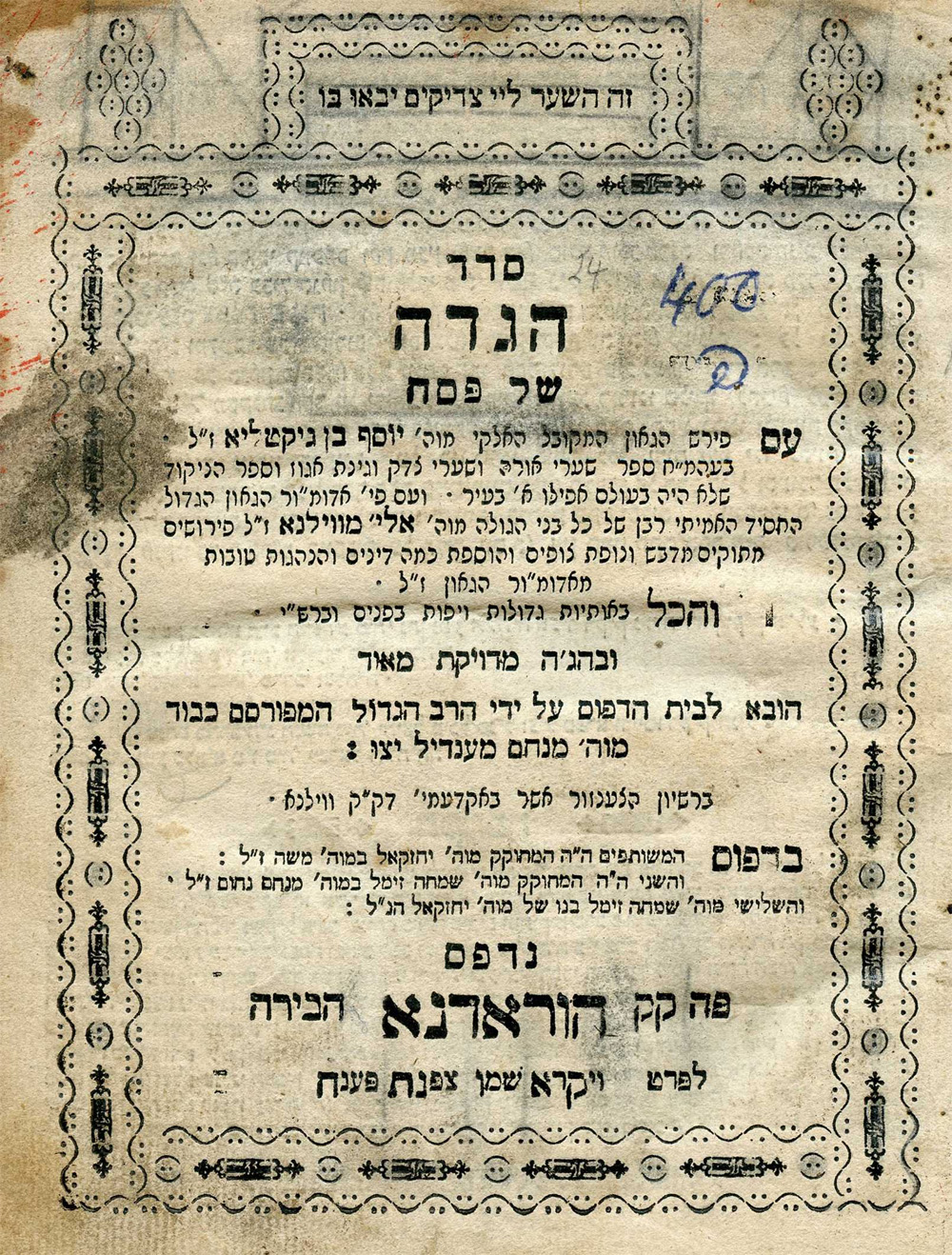
We are delighted that the occasion of our son’s wedding (Uri Sprecher to Rivi Zand, 4 Kislev 5769) solved a 150-year-old bibliographic mystery. When we chose to provide our guests with the opportunity to engage in limmud Torah during the course of the wedding by reprinting and distributing “Tshuvah Be’Inyan Kriat HaKetubah,” we assumed that, just as the title page and the publisher’s introduction indicated, it represented an actual Halakhic Responsum issued in 1835 by the Chief Rabbi of Bialystok, Rabbi Nechemiah, to a query submitted to him by Rabbi Shalom, the Chief Rabbi of Novgorod. The Responsum had been brought to print, some 2 ½ decades later, by Rabbi Nechemiah’s devoted disciple, Nehorai Zechnech-Lefavitch, who had just taken up residence in Vienna, a city in which the necessity of the public reading of the Ketubah was coming under question.
Nehorai Zechnech-Lefavitch, informs us that he had long sought to share his teacher’s wisdom with the world at large, and so he seized this opportunity to enlighten his Viennese hosts with his Rebbi’s lengthy and learned psak, which after closely examining all the arguments ruled that such a public recitation of the Ketubah was entirely and appropriately dispensable. This Tshuvah (aside from its scarcity as an example of ephemera,[1] i.e., a solitary Responsum appearing in print) was taken at face value and duly registered as such in all the standard bibliographies of Hebrew printing and Responsa literature. Even A.H. Freimann, in his authoritative work, Seder Kiddushin VeNissu’in (Jerusalem, 1964) cites this work (on page 41) and Daniel Sperber, in his magisterial Minhagei Yisrael (Jerusalem 1995), 4:89, follows Freimann’s lead in referencing this Teshuvah. Further attestation of its acceptance as an authentic Responsum is its inclusion in an anthology of rare Halakhic material bearing on Kiddushin and Nissu’in issued by Rabbi Yitzchok Herskovitz, Mili deVei Hillulah, (Brooklyn, 1998), adorned with the Haskamah of his illustrious father, Rabbi Ephraim Fishel Herskovitz, the noted Hasidic Posek of the Klausenberger Kehillah (who is also an acclaimed expert on Seforim).
However, our close reading of this Tshuvah led us in an entirely different direction. To us, the work’s style manifested clear Maskilic echoes, and its arguments rejecting the binding nature of centuries-old Minhagim were clearly not in accord with 19th –century Halakhic thought. Our reaction was that the work must certainly be pseudepigraphical and could not have arisen from the pen of the Chief Rabbi of Bialystok. In fact, a quick perusal of the reference literature demonstrated that there never was any Chief Rabbi of Bialystok named Nechemiah, nor, for that matter, was there any Chief Rabbi Shalom of Novgorod. As for Nechemiah’s disciple, Nehorai Zechnech-Lefavitch, well, one didn’t need to do much research in order to recognize the pseudonymous nature of this publisher’s name.[2] But who was really behind this masterful forgery, which deceived so many discerning readers for a century and a half?[3] Our initial thought was to place the blame on the notorious Abraham Krochmal or his erstwhile partner in literary crime, Yehoshua Heschel Schorr. They certainly had the requisite Talmudic knowledge to perpetrate a learned forgery.[4] But the tone of the work did not reflect their slashing, acerbic style. Our Tshuvah evinced a genuine love for Talmudic learning, albeit with a clear intent to utilize earlier sources to eliminate the prevailing Minhag of Kriat HaKetubah and replace it with an edifying sermon.
At an impasse, we reached out to Professor Shnayer Z. Leiman, who suggested that the scholar most likely to solve the mystery would be the doyen of Israeli bibliographers, Rabbi Shmuel Ashkenazi.[5] We were rewarded thanks to the tireless efforts of Eliezer Brodt who, on our behalf, pestered the aged Jerusalem sage until he successfully unmasked the name, but not quite the identity, of the author. Rabbi Ashkenazi concluded that the first line of the introductory poem that prefaced the Halakhic query contained the acrostic – “Meir Ish-Shalom.” (His initial contention was that this could not be the noted 19th –century Viennese scholar, Meir Ish-Shalom, because his heretofore known literary output began only some five years later, with his publication of the Sifre in 1864.)
Once Rabbi Ashkenazi had provided the key to the author’s name via the acrostic, it became apparent that all along the title page had been proclaiming that very same message. Let us recall the passage in Bavli Eruvin 13b where it is recorded that the celebrated Tanna, known to us as Rabbi Meir, was actually named Nehorai, according to one opinion; or alternatively, that both Meir and Nehorai were laudatory appellations reflecting his enlightening wisdom, whereas his actual name was Nechemiah. Recall also that the query first originated with Rabbi “Shalom” of Novgorod, and the word “shalom” appears twice more on the title page and is highlighted by the placement of a circle above one of its appearances.
Although none of the biographies[6] and bibliographies[7] devoted to the life and works of Meir Ish-Shalom attributes the Tshuvah Be’Inyan Kriat HaKetubah to him, we believe that a re-examination of Meir Ish-Shalom’s life supplies overwhelming confirmation that he is indeed the actual author of this Tshuvah. Born, as Meir Friedmann, in 1831, to a simple village couple in Krasna, his formative years were strained by extreme material and spiritual deprivation. At the age of Bar Mitzvah, his great desire to study Torah was realized by his acceptance to the Yeshiva in Ungvar, which was led by a distant relative of his mother, Rabbi Meir Asch-Eisenstadter, a noted disciple of the Hatam Sofer. Meir’s brilliance was soon recognized by his teachers, and he made great strides in Torah scholarship and adopted many stringent ascetic practices such as prolonged fasting, ritual immersion in ice-covered rivers and hours of un-interrupted Torah study and prayer. At the age of 19, he was granted Rabbinic ordination. Unfortunately, this phase of his life was cut short by a spiritual crisis induced by his exposure to Mendelssohn’s Biur and Wessely’s Hebrew poetry.[8] After a decade of hardship and wandering through Hungary and Slovakia, his wanderlust brought him fortuitously to Vienna in late 1857. That summer, the newly hired assistant to Vienna’s Chief Rabbi Mannheimer, Adolf Jellinek, began officiating at marriages. Claiming that sitting through the recitation of the Ketubah was too burdensome for the assembled guests, Rabbi Jellinek substituted in its stead an edifying sermon in the German language.[9] This reform of the Chuppah ritual was not endorsed by his employers, the leadership of the Gemeinde, who at that time still favored the classical Viennese approach of caution and consensus in religious reform,[10] and letters of reprimand directed at Rabbi Jellinek for this innovation are extant.[11] Rabbi Jellinek’s angry retort to Josef von Wertheimer, the Gemeinde’s President is also preserved:
Tatsache ist es; dass kaum eine kleine Zahl unserer grossen Gemeinde sich mehr um die Ketuba kummert, da die Vorlesung derselben fur jeden Sachverstandigen, der niche in Zogling der Pressburger Rabbinatsschule ist, als nutzlos und storend erscheint. Tatsache ist es, dass man hier mit mir umspringt, als ware ich der unfahigste, geistloseste, taktloseste und unbrauchbarste Mensch. In Berlin sitzen Manner wie Fr. Veit, Magnus, Dr. Oesterreicher, Geheimrat Joel Meyer im Vorstande; aber wahrlich diese Manner werden es nich wagen, ihre Prediger so zu tyrannisieren, wie es hier in Wien beliebt wird, wo alle Urteile nach Horensagen under Einflusterungen gatallt warden.[12]
Apparently, the ex-Yeshiva prodigy, newly arrived from Hungary, aided Rabbi Jellinek in resisting his Governing Board’s demands to re-institute the recitation of the Ketubah by fabricating a learned Responsum from a distant (and fictional) Rabbi proving that reading the Ketubah was a practice that had no sound Halakhic basis. This fabricated Responsum relied heavily on the reasoning advanced by Rabbeinu Meshulam in his celebrated correspondence with Rabbeinu Tam, which had recently appeared in print when the Sefer HaYashar was published for the first time.[13] Meir Ish-Shalom was thus able to demonstrate that Rabbi Jellinek’s innovation, far from being a deviation from correct Halakhic practice predicated on a reformist basis, was in reality a restoration of the authentic ritual promoted by Rabbeinu Meshulam, whose arguments, in the opinion of the Responsum, clearly bested the counter-arguments of Rabbeinu Tam.[14] 
After surviving this rocky beginning, Rabbi Jellinek enjoyed a productive career that spanned the remaining four decades of the 19th Century. In 1864, Rabbi Jellinek established the Beth Midrash, an adult-education program, and Meir Ish-Shalom, our Hungarian prodigy, finally secured a steady income as a teacher at that institution. In 1893, the program was expanded to include a seminary for the training of Rabbis, and Meir Ish-Shalom was appointed Professor of Rabbinics, a job he held until his death in 1908. Among his students was a fellow Eastern European expatriate and ex-prodigy – Solomon Schechter.
Although he remained a devoted student of Torah and Rabbinics, Meir Ish-Shalom did display intentions to abrogate other time-honored practices as well. For example, he argued that it was entirely correct to accede to the expressed desires of a non-Jewish husband to be allowed to purchase a burial plot alongside that of his Jewish wife, who had been interred in the Gemeinde’s cemetery. This ruling proved too radical even for his colleague, Isaac Hirsch Weiss, who strongly protested this breach of Jewish law and custom.[15] One of the ironies of history is that Isaac Hirsch Weiss has high name recognition as a foe of traditional Orthodoxy, because of his authorship of the controversial Dor Dor VeDorshav, whereas Meir Ish-Shalom’s Midrashic editions enjoy a respected position in the typical Yeshiva library. This anomaly was first noted by an actual Bialystoker Talmid Chakham, Rabbi Eliezer HaBavli, writing in HaLevanon 8 (1872): 372, who considered Meir Ish-Shalom to be firmly in the camp of the Maskilim and thus deserving of opprobrium and censure.[16] Imagine what Rabbi Bavli would have said had he known the true iniquity of Meir Ish-Shalom – creating a forged Tshuvah that justified discarding an ancient and hallowed Ashkenazi Minhag and attributing it to the “chief rabbi” of his beloved Bialystok.[17]
[1] Attesting to its ephemeral nature is the fate of my own personal copy. Since purchasing it at the renowned liquidation sale of Feldheim’s Lower East Side bookstore in 1988, I haven’t been able to extract it from whichever book I placed it in (for safe-keeping!). My fellow Feldheim shopper, Dr. Benny Ogorek, was kind enough to lend me his copy to produce the facsimiles that were distributed at the wedding. On these forgotten Hebrew booksellers of the Lower East Side (and especially Philipp Feldheim’s bookstores), see Shnayer Z. Leiman, “Montague Lawrence Marks: In a Jewish Bookstore,” Tradition 25:1 (Fall 1989): 59-69, and esp. 60, 68n5.
[2] Saul Chajes, who assembled all known Hebraic pseudonymy in his Otzar Beduyei HaShem (Vienna, 1933) also overlooked Tshuvah Be’Inyan Kriat HaKetubah, as it does not appear in the what he considered to be the comprehensive repository of all such literature. What is especially surprising is that Chajes spent the last two decades of his life in Vienna (1914-1933) and he was employed as the primary assistant to Bernard Dov Wachstein, the librarian and archivist of the Gemeinde’s magnificent library and communal archives, and therefore was no doubt aware of this pamphlet.
[3] With the possible exception of Benjacob who places a question mark after listing Rabbi Nechemiah of Bialystok as the author of the Tshuvah; see his Otzar HaSefarim (Vilna, 1880), 675, item #1013.
[4] See Allan Nadler, “The Besht as Spinozist: Abraham Krochmal’s Preface to Ha-Ketav ve-ha-Mikhtav,” in Daniel Frank & Matt Goldish, eds., Rabbinic Culture and Its Critics: Jewish Authority, Dissent, and Heresy in Medieval and Early Modern Times (Detroit: Wayne State University Press, 2008), 359-389, for examples of Krochmal’s not very successful pseudepigraphical attempts. See also Daniel B. Schwartz, “The Spinoza Image in Jewish Culture, 1656–1956,” (PhD dissertation, Columbia University, 2007), who discusses how Abraham Krochmal (son of Nachman Krochmal) “became a leading advocate for religious reform in the Hebrew press and served briefly as [Yehoshua Heschel] Schorr’s co-editor of He-Haluts” (page 207).
[5] For more information regarding this semi-mythic figure see S.A. Tefilinsky, Alpha Beta Kadmaita D’Shmuel Ze’ira (Jerusalem, 2000) which lists 289 publications that Rabbi Ashkenazi either wrote under various guises or had a significant role in editing (i.e., ghost-writing).
[6] The earliest complete biography of Meir Ish-Shalom was authored by his son, Joab Freidmann, Lector M. Friedmann (Wien, 1931). The noted Rabbinic scholar, Binyamin Ze’ev Benedikt, a native of Vienna and the son of Rabbi Lemel Benedikt, the Rabbi of the Adath Jeshurin Synagogue located in the Ninth District (Neunte Bezirk), had intended to write a full-length book devoted to the life and works of Meir Ish-Shalom, but settled instead for a fifteen-page essay that appeared in the Mosad ha-Rav Kook Bibliographical Yearbook, Areshet 2 (1960): 269-284. Benedikt had earlier compiled what he considered to be a complete bibliography of all Meir Ish-Shalom’s works, which appeared in Kiryat Sefer 24 (1948): 263-275. The attribution of the Tshuvah Be’Inyan Kriat HaKetubah to Meir Ish-Shalom eluded both Joab Friedmann as well as Binyamin Ze’ev Benedikt.
[7] See B.Z. Benedikt’s two bibliographies referenced above. Tuvia Preschel supplemented Benedikt’s bibliographies in Areshet 3 (1961): 468, but he too failed to include the Tshuvah Be’Inyan Kriat HaKetubah in the list of works authored by Meir Ish-Shalom.
[8] See Solomon Schechter’s obituary entitled “Lector Meir Freidmann” that was reprinted in Seminary Addresses and Other Papers (Cincinnati, 1915), 136.
[9] See Marsha L. Rozenblitt, “Jewish Identity and the Modern Rabbi: The Cases of Isak Noa Mannheimer, Adolf Jellinek, and Moritz Güdemann in Nineteenth-Century Vienna,” Leo Baeck Institute Yearbook 35 (1990): 111. According to Rav Moshe Leiter, “HaPulmus Hildesheimer – Yellinek,” HaDarom 17 (Nisan 1963): 105-133, Rabbi Leib Schwab, the lapsed disciple of the Hatam Sofer, was the Mesader Kiddushin at Rabbi Jellinek’s own Chuppah, in Budapest (May 1850) and he was the one who initiated this practice of skipping the reading of the Ketubah. He was also responsible for moving the Chuppah from the synagogue’s courtyard to the interior. Rabbi Leiter, however, provides no citation for these claims (which can be found on page 108 of his article).
[10] See Marsha Rozenblitt, “The Struggle over Religious Reform in Nineteenth-Century Vienna,” AJS Review 14:2 (Fall 1989): 179–221.
[11] Moses Rosenmann, Dr. Adolf Jellinek: Sein Leben und Schaffe (Wien, 1931), 83.
[12] Ibid, p. 84. For those whose German is somewhat weak (and I include myself in that category, Rabbi Jellinek’s response is as follows: “only a small number of our large community trouble themselves regarding reading the Ketubah, since the vast majority (besides those graduates of the Pressburg Yeshiva) consider it a useless and disturbing ritual.” The remainder of the letter voices a complaint which many a pulpit rabbi must feel regarding the tyrannical oppression perpetrated by the lay leadership on the hired clergy.
[13] (Vienna, 1811).
[14] For a comprehensive essay on this fascinating conflict between these two noted antagonists, see Dr. Avraham (Rami) Reiner’s article, “Parshanut VeHalakhah BePulmus Rabbeinu Tam VeRabbeinu Meshulam,” Shnaton HaMishpat HaIvri 21 (1998-2000): 207-239. The section that relates to our Responsum is found on pages 228-230.
[15] See the biographical essay by Yehudah Bergmann entitled “Meir Ish-Shalom” that appeared in Sefer HaZikaron LeBait HaMidrash LeRabbanim BeVinah (Jerusalem, 1946), 43.
[16] Cited by Rabbi Eliezer Katzman, “Chalutzei Tzava: Sefer HaTzava U’Mechabro- LeDmut HaRav HaGaon Rav Eliezer HaBavli ZT”L M’Bialystok,” Yeshurun 2 (1997): 666-679. 
[17] We wish to thank all those who helped us on this project: Rabbis Shmuel Ashkenazi, Eliezer Brodt, Menachem Butler, Eliezer Katzman, and Menahem Silber, as well as Drs. Shnayer Z. Leiman, Benny Ogorek, and Avraham (Rami) Reiner. And Achronim Achronim Chavivim – Uri and Rivi!


R. Reuven Margulies I

First, I want to post a bibliography of R. Margulies’s works and then I shall discuss some biogrpahical details in the next post. This bibliography is not a scientific one in that I do not attempt to list every edition. Rather, I am listing just the works and some bibliogrpahical information as I see fit. Most of this information comes from Naftali Ben Menachem’s bibliogprahy of R. Margulies’s books which was printed in Sefer Margolious.

1) Toldot Adam (Lemberg 1912) on R. Shmuel Edels
2) Kav Besamim (Lemberg 1913) 102 notes on Tosefot
3) Drush l’yom ‘alot ‘al kesi moshlim ‘adonanu haKeiser Karal haRishon (Lemberg 1918)
4) Kavi Ohr (Lemberg, 1921) laws pertianing to Israel as well as articles on history, including yesod hamishna among others
5) Yesod HaMishna V’Arikachto (Lemberg, 1933) on the creation of the Mishna
6) Sefer Hassidim with his notes (multiple printings)
7) Tolodot Rabenu Hayyim ben Atar (Lemberg, 1925), biography on the Ohr Hayyim includes the notes of R. Meir Dan Plotzki (Kli Hemdah)
8) Ohr Meir (Lemberg, 1926), biography of R. Meir from Perlmishiya
9) Margenuta d’Reb Meir (Lemberg, 1926), sayings of the above R. Meir
10) Shealot u’Teshuvot min HaShamyim, R. Margulies’s extensive notes on the teshuvot as well as a comprehensive introduction discussing Torah lo’ Bashmyim and other related topics (multiple printings)
11) Yalkut Margolious ([Lemberg], 1927), derashot of R. Margulies
12) Imrei Kodesh haShalem (Lemberg, 1928)
13) Vikuach Rabbanu Yehiel m’Paris (Lemberg, 1928), with biography of R. Yehiel
14) Shemot v’Kinuim B’Talmud, discussing names in the Talmud, including when two names started, (multiple printings)
15) Helulua d’Tzadika (Lemberg 1929), lifespan and death dates of Tzadikim
16) Vikuach HaRamban (Lemberg, 1928)
17) Yalkut Peninim (Lemberg, 1929), derashot
18) Butzna d’Nehora HaShalem (Lemberg, 1930), about R. Barukh of Metzerich
19) Gevurot Ari (Lemberg, 1930), biography of R. Leib Srhson
20) Toldot Rabbenu Avrohom Mimoni, biography of Rambam’s son, (multiple printings)
21) Rishimah (Lemberg, 193-) list of books in his bookstore
22) Mekor Barukh (Lemberg, 1931), biography of R. Barukh of Metzerich and other historical documents
23) Shem Olam, to reveal the anonymous people in hazal (multiple printings)
24) HaModiah journal
25) Nefesh Hayyia, on Shulchan Orakh multiple printings
26) Hagadah shel Pesach (Tel Aviv, 1937)
27) Shichot Chakhamim
28) Mekor haBerakha discussing blessing and why and when before one does something (recently reprinted)
29) Zohar with his extensive notes (multiple printings)
30) Sibah hisnaguto discussing R. Emden/R. Eybeschitz controversy (very controversial Scholem wrote a pamphelet against this) Tel Aviv 1941
31) Reb Saul Levin M’Ziaf haSefer Besamim Rosh, in Aresehet 1944
32) Malechi Elyon on angels in Hazel (multiple printings)
33) Ollalot various articles (multiple printings)
34) Tikunei Zohar notes, multiple printings
35) Sefer haBahir same as above
36) Zohar Hadash same
37) L’Toldot Anshei Shem b’Lvov, Jerusalem 1952
38) Milchmot HaShem (R. Avrohom ben HaRambam) (including the biography on him) (multiple printings)
39) haRambam v’Hazohar now reprinted in Penini Margolios
40) Sha’ari Zohar collecting relvant passages from the Zohar to Hazal (multiple printings)
41) Margolios HaYam on Sanhedrin (multiple printings)
42) Divrarim b’Itam dershot
43) L’Heker haMisparam beTalmud, Sinai 44
44) Tzioyunim Bibliographim a comprehensive biobibliography in Areshet 1-2,4
45) Tziyunim l’Ha’arot l’Seder haDorot, Sinai 46
46) HaMikrah v’Hamesorah multiple printings
47) Mekharim b’Darkei haTalmud v’Hidosov multiple printings


Review of Rabbi Eliezer Berkovits, Jewish Women in Time and Torah

Review of Rabbi Eliezer Berkovits, Jewish Women in Time and Torah

Ross Singer

Ross Singer received rabbinic ordination from Professor Rabbi David Weiss Halivni, Rabbi Shear Yashuv Cohen, and Rabbi David Bigman. He has an MA in Talmud and Rabbinics from the Jewish Theological Seminary and is a graduate of the Mandel Jerusalem Fellows. He has published articles in The Edah Journal, The JOFA Journal, Amudim, Lehrhaus, The Jerusalem Post, and The Times of Israel. He is the translator of Gideon Katz’s In Silence and Out Loud: Yeshayahu Leibowitz in Israeli Context.

Ross served as a rabbi in Vancouver, Canada and Baltimore, MD, and currently resides in Israel where he works as an educator and tour guide.

Rabbi Eliezer Berkovits has long been an outlier in the Orthodox world.[1] Over the past two decades, there has been a concerted effort by admirers of R. Berkovits to revive his thought and put it on the agenda. New commentaries to the Haggadah[2] and Megillat Esther[3] have been culled from the large corpus of R. Berkovits’ writings, a sampling of his important essays has been collected and published,[4] major works have been translated into Hebrew and published by Shalem Press, and new editions of his out of print books have been reissued including the subject of this review, his Jewish Women in Time and Torah.

On the backdrop of this trend to cultivate a reconsideration of R. Berkovits’ thought in the Orthodox community, it is important to note that a feature of R. Berkovits’ work may play a role in its marginalization. In the introduction to his English magnum opus, Not in Heaven, R. Eliezer Berkovits writes:

Finally may I be permitted a personal confession. While all my life I have endeavored to take my stand on the foundations of Halakhic Judaism, as it was handed down to me in my father’s house and as I have acquired it from my studies in Y’shibot and later from my great teacher, Rabbi Yehiel J. Weinberg, ז”ל, at the Hildesheimer Rabbinical Seminary in Berlin, in this my work I was determined to be guided exclusively by the traditional halakhic material as I found it and as I have learned to understand it over the years.[5]

While Rabbi Berkovits describes his return to the classic sources as a departure from the approach that he received from his teachers and based upon his own unique understanding, scholars of R. Berkovits’ work have found other halakhists who lay out kindred theories of halakhah. Some theorize that R. Berkovits may have been influenced by R. Moshe Shmuel Glasner, the father of one of his early teachers, R. Akiva Glasner,[6] and Rabbi Chaim Hirshensohn.[7] Despite his “confession,” R. Berkovits’ approach has powerful antecedents that a reader of Not in Heaven will not encounter there. It is not clear why they go unmentioned and unexplored by R. Berkovits. It is clear that a full appreciation of the place of his approach in the broader canvas of halakhic thought requires some filling in of gaps that his work leaves out.

This is particularly true of R. Berkovits’ final work, Jewish Women in Time and Torah. The recent republication of this volume affords us an opportunity to explore analogs of the book’s central thesis that R. Berkovits leaves unmentioned or underdeveloped, and to note some more recent work that picks up on its themes.

Before engaging in the endeavor to uncover the congruity of R. Berkovits’ thought in this work with the larger tradition, let us appreciate two features of this new edition. Firstly, it includes a moving introduction by R. Berkovits’ granddaughter, R. Rahel Berkovits. Her essay gives some important personal and ideological context. Secondly, this new edition uses footnotes as opposed to endnotes used in the earlier edition making it easier to turn to the various sources quoted by R. Berkovits without losing one’s place in the book.

The most significant contribution of the content of Jewish Women in Time and Torah is R. Berkovits’ distinction between “Torah-taught” and “Torah-tolerated.” This distinction lies at the center of the book’s agenda. R. Berkovits explains that the Torah was given into a particular cultural context and as such, it must take that context into consideration in legislating its norms. The Torah must, in certain cases, compromise its highest ideals for the sake of speaking to a particular generation who in their context are unable to understand and accept the fullest aspirations of the Torah. Using a pragmatic strategy, the Torah guides the community towards ever greater fulfillment of its ideals. In R. Berkovits’ own words:

The goals and the values are these forever. But they are taught and applied with the wisdom of understanding that time-conditioned reality cannot be changed overnight. The method of the Torah is to acknowledge reality, to take human nature into account and apply the eternal word to it so far as is possible, thus to teach values and guide behavior, indicating the goal towards which the guided change has to move.[8]

The Torah tolerates time-conditioned realities and they may seep into its norms, however one must distinguish between the Torah-tolerated and the Torah-taught. R. Berkovits asserts that the disparaging statements about women and halakhic inequalities that one finds in Jewish tradition stem from the ancient context into which Torah was given and in which it developed. Such evaluations of women were Torah-tolerated, however none of them were Torah-taught. While R. Berkovits had advocated for decades for adjustments in halakhah for women’s status, he had justified this approach in the past based on his understanding of halakhah’s prioritization of the ethical. In Jewish Women in Time and Torah, he introduces this historiosophy to his English language readers for the first time.[9] According to his read of the history of halakhah, the time is ripe to rid halakhah of what it had compromised on in the past:

It is our task to eliminate whatever remains from the Torah-tolerated, impersonal phase and to establish woman’s status completely on the Torah-taught and prescribed personal level.[10]

To appreciate the significance of this, it may be helpful to look at a question posed to R. Berkovits by R. Shalom Carmy. In a nuanced review of R. Berkovits’ approach, R. Carmy finds much to appreciate. Nevertheless, he echoes the common critique that R. Berkovits’ approach overreaches. R. Carmy notes R. Berkovits’ exasperation over a statement of the Ramban regarding the case of a woman who claims that her husband is repulsive to her without offering independent evidence. While reinforcing the strength of the position that allows the court to force the husband to divorce his wife, Ramban adds that whoever follows the stricter opinion that the court cannot force the husband “has lost nothing, and may be blessed.” R. Berkovits states that, “one remains astounded at such words. To be ‘strict’ in matters of divorce and overlook the happiness of the woman may often be extreme leniency in the implementation of the not insignificant commandment ‘And you shall love your neighbor as yourself.’” Rabbi Carmy takes issue with Rabbi Berkovits critique of Ramban:

We are obligated, as a simple matter of intellectual integrity and a measure of kevod ha-Torah, to understand why Ramban’s theoretical and practical judgements diverge markedly from ours. Such an exercise will yield a better understanding of Torah and a better self-understanding… Rolling one’s eyes in exasperation with the Ramban is not a philosophy.[11]

Rabbi Carmy’s point is an excellent one. How can R. Berkovits so easily discount the Ramban’s statement? Isn’t it too part of the Torah that must be understood and appreciated? If the priority of the ethical is so fundamental to halakhah, why doesn’t the Ramban recognize that? In Jewish Women in Time and Torah, R. Berkovits provides an answer to these questions. Ramban’s acquiescence to an approach in halakhah that diminishes women’s status before the court is a holdover of a Torah-tolerated approach. In our period such an approach should be left behind as we reassert the Torah-taught.[12]

The implications of R. Berkovits’ historiosophy of halakhah are tremendous and raise many questions. It introduces new dimensions to the subjective element of R. Berkovits’ thought. How is one to distinguish in the corpus of Torah between what is merely Torah-tolerated and what is actually Torah-taught? Where does R. Berkovits get such an idea about halakhic evolution and progression? Is this aspect of his thought also a deviation from the teaching he received from his family and teachers? What precedents exist for approaching Torah and halakhah in this way?

Indeed, it seems that R. Berkovits’ historiosophy of halakhah conflicts with the predominant way that Torah is presented in many orthodox circles. One of the opening statements of Bereishit Rabbah presents a conception of Torah that seems antithetical to R. Berkovits’ approach:

A king of flesh and blood who builds a castle does not do so from his own knowledge, but rather with the knowledge of a craftsman, and a craftsman does not build it from his own knowledge; he has scrolls and books in order to know how to make rooms and doorways. So too God looked into the Torah and created the world…[13]

In this depiction, the Torah precedes the world. The Torah then can be seen as pristine and untouched by human history and culture. In such a depiction, the Torah’s commandments cannot bear the taint of any human foibles. The Torah does not tolerate or compromise with or react to history because the Torah precedes history. In my experience, this is the dominant conception of Torah’s relationship to the world in Orthodox circles.[14]

Is there an alternative competing conception to this one upon which R. Berkovits can find precedent? To ground his position in the classical sources, R. Berkovits first quotes from Rashi’s interpretation of Psalms 29:4. Rashi comments, “At the time of the giving of the Torah, God limited His voice in accordance with the strength of the Israelites to receive.”[15] R. Berkovits elaborates explaining that each person received the Torah “in conformity with his own spiritual and moral capacity.” Building on this, R. Berkovits turns to the Rambam’s famous passage in his Guide for the Perplexed about the origin of the sacrifices:

… the prevailing custom in the world was to sacrifice animals… God’s wisdom counseled Him that to command the Jews to give up all that kind of service and annul it completely would have been something that their hearts could not have accepted… For this reason, God allowed the [generally practiced] sacrificial services to remain but directed them away from those created or imagined powers in which there is no truth, to His own name blessed be He.[16]

While R. Berkovits suffices with this one excerpt, the notion that God’s revelation to Israel took into account particular historical circumstances recurs throughout the Rambam’s writings. In a number of places in the Guide, Rambam explains that the Torah’s commandments and teachings are responses to and polemics against the practices and beliefs that had become prevalent among ancient idolators. For example, this is how he explains the reason for the Korban Pesach:

Scripture tells us, according to the version of Onkelos, that the Egyptians worshiped Aries, and therefore abstained from killing sheep, and held shepherds in contempt… For this reason those sects abstained from eating goats’ flesh. …This is [also] the reason why we were commanded to kill a lamb on Passover, and to sprinkle the blood thereof outside on the gates. We had to free ourselves of evil doctrines and to proclaim the opposite, viz., that the very act which was then considered as being the cause of death would be the cause of deliverance from death.[17]

This approach is not limited to the Guide. In his earlier popular works Rambam makes similar suggestions. In the Sefer HaMitzvot (Negative Commandments #43) Rambam already explained that the Torah’s prohibition of shaving off the corners of one’s head is in response to the practice of ancient idolatrous priests shaving that part of their hair. He repeats this explanation in the Mishneh Torah (Hilkhot Avodah Zarah 12:1). The reason for the prohibition of mixing wool and linen together in garments is explained in the Sefer HaMitzvot (Negative Commandments #42) in the same way. In his Letter on Astrology, Rambam again articulates the broad use he makes of the approach:

I also have read in all matters concerning all of idolatry…I have read it and have understood its subject matter and have plumbed the depth of its thought. From those books it became clear to me what the reason is for all the commandments that everyone comes to think of as having no reason at all, other than the decree of Scripture.[18]

Given the claim that the Guide was written as an apologetic work to draw in those who had been lured away from traditional Judaism and therefore might include rhetorical passages that do not represent the most authentic positions of Rambam, these examples[19] are significant.

Another iteration of Rambam’s assertion that the Torah takes into account the exigencies of history found outside of the Guide is found in his Epistle on the Resurrection of the Dead.[20] After reaffirming his earlier pronouncements that the resurrection of the dead is a fundamental Jewish principle, Rambam addresses the absence of any explicit indication of the resurrection of the dead in the Pentateuch. He explains that the notion of the resurrection of the dead was so foreign and difficult to accept in the culture of Moses’ time, that were it to be mentioned, it would have made the acceptance of all the Torah’s other truths and instructions unthinkable. Therefore, God withheld the truth of the resurrection at that time in order to inculcate other more fundamental notions of prophecy and creation. Only after prophecy and creation were well established beliefs did God see fit to reveal the notion of resurrection and therefore we only find resurrection mentioned explicitly in later books of the Bible. Rambam explains that just as the Israelites were led out of Egypt in a circuitous route to avoid the land of the Philistines, “lest the people change their minds when they see war and return to Egypt (Exodus 13:17),” so too the revelation of the resurrection took a circuitous route lest the people reject the Torah. The metaphor of the circuitous path of the exodus is also employed by the Rambam in the Guide to explain his approach to the sacrifices in the passage mentioned above. The impact of the exigencies of human history not only shape the path of the Exodus and the establishment of the sacrificial rites, they also determine that certain information must be omitted from the content of the Torah.

In perhaps the most subtle but also the most profound example of this phenomenon, Rambam seems to hint that the very revelation of the whole of the Torah was a reaction to a particular historical moment. In chapter one of the Mishneh Torah’s Laws of Idolatry, Rambam recounts how all of the progress in creating a monotheistic community was nearly undone during the many years that the Israelites lived in Egypt.

When the Jews extended their stay in Egypt, however, they learned from the [Egyptians’] deeds and began worshiping the stars as they did, with the exception of the tribe of Levi, who clung to the mitzvot of the patriarchs – the tribe of Levi never served false gods. Within a short time, the fundamental principle that Abraham had planted would have been uprooted, and the descendants of Jacob would have returned to the errors of the world and their crookedness.

Seemingly in response to this deterioration, God

brought forth Moses, our teacher, the master of all prophets, and sent him. Once Moses, our teacher began to prophesize, and God chose Israel as His inheritance, He crowned them with mitzvot and informed them of the path to serve Him, and the law prescribed for idol worship and all those who stray after it.

In the Rambam’s retelling it sounds as if the superior level of prophesy bestowed upon Moses and the giving of the mitzvot of the Torah are prompted by a crisis in history – the potential loss of the monotheistic tradition that Abraham founded. As Rabbi Nahum Eliezer Rabinovitch puts it in his commentary to this passage:

We find that Moses’ mission and the transmission of Torah and mitzvot guaranteed that the root that Abraham planted was not uprooted and would never be uprooted.[21]

Rav Shagar suggests that this first chapter of the laws of idolatry should be seen as just one example of a larger phenomenon in the Mishneh Torah:

In my opinion, one should explain the Rambam’s effort in the Mishneh Torah in his historical introductions to various halakhot, like his introduction to the laws of marriage for example, in this way (a historical understanding). The Rambam, in opposition to most of the Torah’s interpreters today, did not hide his conception of the Torah as constructed by history (among other factors) and as adapted to changing human consciousness.[22]

Deeply embedded in Rambam’s thought, and throughout his writings we find that the Torah was shaped by the exigencies of history.

Perhaps the greatest rabbinic figure since Rambam to articulate a similar approach to the impact of history on the formulation of the Torah was Rabbi Abraham Isaac HaCohen Kook. In a letter to the orthodox academic biblical scholar, Moses Seidel, R. Kook writes:

If we find in the Torah certain things which seem to be based on widely accepted ideas of the distant past, but are incompatible with the scientific knowledge of today, we cannot be sure if our current research has produced absolute truth. Even if current understandings are true, there certainly could have been an important and sacred reason for which these matters needed to be explained according to the popular notions of ancient times and not scientifically precise ones. This approach is taken for granted by certain spiritual notions and fundamentals of understanding scriptural narrative like, “the Torah addressed humanity’s evil inclination,” or “[The Torah is formulated] in order to explain in a way that it is intelligible to the [human] ear”, and these instances testify to beloved enduring Divine wisdom.[23]

In another letter to Seidel, Rav Kook writes:

Life must be understood through two parameters, how it is and how it should be… The Divine exalted Torah is that very beloved instrument that cultivates and directs life towards the state that it should be. However, you must be careful not to think that these two parameters have no relationship or connection to each other, for they are related matters just like the changing horizons that one who travels a long journey encounters.[24]

These two letters together produce an approach that is basically the same as R. Berkovits’ – the Torah takes into account “the popular notions of ancient time” even if they are not “precise”, and seeks to move life from “how it is” towards “how it should be” incrementally like “changing horizons.” These ideas find a later iteration in the posthumously published L’nevuchei Hador.

A similar notion can be found in R. Kook’s essay “Fragments of Light.” There he writes:

The long road of development, after man’s fall, also needs physical exertion, which will at times require a meat diet, which is a tax for passage to a more enlightened epoch, from which animals are not exempt…

This is the advantage of the moral sense when it is linked to its divine source. It knows the proper timing for each objective, and it will sometimes suppress its flow in order to gather up its strength for future epochs, something that the impatient kind of morality that is detached from its source would be unable to tolerate. When the animal lust for meat became overpowering, if the flesh of all living beings had been forbidden, then the moral destructiveness, which will always appear at such times, would not have differentiated between man and animal, beast and fowl and every creeping thing on the earth. The knife, the axe, the guillotine, the electric current would have felled them all alike in order to satisfy the vulgar craving of so-called cultured humanity.[25]

These and similar ideas on the consumption of meat in another essay were culled together by R. Kook’s student R. David Cohen into an essay entitled “A Vision of Vegetarianism and Peace.” In R. Berkovits’ terminology, R. Kook is suggesting that the eating of meat is Torah-tolerated but not Torah-taught. Though he never quotes from R. Kook, their approaches clearly share a similar understanding of the necessity for Torah to compromise its highest aspirations in the face of the exigencies of history.

And yet, even as we have seen that R. Kook and the Rambam both teach that the Torah includes elements that are the product of historical circumstances, one could still challenge the notion that this should have any practical ramifications. The same Rambam who in the Guide presents the sacrificial system as a compromise with historical exigencies, in the Mishneh Torah brings all of the details of the halakhah of animal sacrifice. As Rabbi Ira Bedzow articulates it:

Nevertheless, the obligation of sacrifices was never abrogated completely in favor of prayer. In his Book of the Commandments, Maimonides enumerates prayer as the fulfillment of the specific commandment of worshiping God. Yet he also enumerates each commandment of the sacrificial rite even though they could have been included in the general category since they are considered only a way-station on the path to proper worship. Their enumeration shows that as specific commandments, the performance of sacrifices is eternally valid, as is the rest of the Torah.[26]

We could also note that R. Kook was insistent that for his time it was inappropriate to implement the Torah taught vegetarianism. He explicitly discouraged his son from refraining from eating meat.[27] R. Kook was concerned that the time was not yet ripe and the consequences of implementing the Torah’s ideals could backfire. Moreover, even though R. Kook was very unconventional as a thinker, his practical halakhic decisions were often very conservative.

R. Kook’s and Rambam’s reticence to diverge from the Torah-tolerated halakhah towards what they believed was a more ideal Torah teaching is an important point to consider. However, most of what Rabbi Berkovits advocates for in this book is not analogous to the abolition of sacrifice or the wholesale prohibition on consuming meat. In most cases, Rabbi Berkovits is suggesting the adoption of one strain of the halakhah embedded in the Talmudic and post-Talmudic authorities over other strains. For instance, his proposals of women reading Megillat Esther for the community, making Kiddush in their homes, counting for the three that make up the Zimmun and leading the zimmun, all are based on classical sources.

And still, even regarding relatively minor adjustments, how can one be sufficiently confident that one strain is merely tolerated while the other is Torah-taught? Could both be Torah-taught and part of Rabbinic pluralism – a pluralism that R. Berkovits embraces in other contexts?[28] R. Berkovits insists that in these cases one position is a holdover with less legitimacy and the other is an ideal whose time has come. R. Berkovits traces a line from negative statements about women in ancient Greek culture and presumes that parallel statements in the Rabbinic literature must derive from this foreign source. R. Berkovits seems to presume that this is self-evident and does not feel a need to demonstrate causation. One wonders if there is a possibility of a more objective way of separating the “Torah-taught” from the “Torah-tolerated.”

At just about the same time that R. Berkovits was writing up these ideas,[29] R. Nahum Eliezer Rabinovitch was sharing very similar thoughts:

The system of Torah and commandments is two-fold. On the one hand, it conveys concepts, instills eternal values, and directs people to the service of God at the highest levels and to the formation of a society worthy to be the bearer of God’s presence. On the other hand, it encompasses legislation and commands to combat the forces of evil and destruction that erupt within the individual’s soul and the nations’s spirit and to ensure that the necessary conditions for spiritual development are satisfied to the greatest possible extent, given each generation’s situation and the social, economic, and cultural circumstances prevalent at any given time and place. For the first objective, the Torah places before us lofty goals that challenge and motivate the generations, for even the noblest of people cannot attain them in full. At the same time it establishes, for the second objective, criteria for conduct that people can, as a practical matter, accept minimum standards that must be met to avoid endangering the survival of the individual and the society in which he is placed and giving up all hope of spiritual uplift.

R. Rabinovitch and R. Berkovits are laying out very similar ideas to each other at the same time without mentioning each other.

Like R. Berkovits, R. Rabinovitch asserts that halakhah indeed should respond and has responded to progress in history that allows for the raising of “minimum standards” towards “service of God at the highest levels.” He writes:

In the time of the rishonim, R. Gershom, Beacon of the Diaspora, saw that his generation was ready for a ban on divorce without the wife’s consent and for eliminating polygamy, at least within the communities of Western Europe. By now, his enactments have spread through all Israel. Certainly the Sages instituted such enactments – yet they did not draw them out of thin air, but advanced the values already determined by Scripture. In the biblical era, however, the time was not yet ripe, and people were not yet ready for the full realization of that vision. Only over time, as a result of training in the life of Torah, were people’s hearts made ready and did it become possible to draw closer to the goal established by the Torah.[30]

R. Rabinovitch sees in takanat Rabbeinu Gershom an example of the Torah-taught replacing the Torah-tolerated. He powerfully grounds his claim that monogamy is an ideal of the Torah and that polygamy is a compromise with reality, He allows the Torah to present its ideal in its own terms: “Therefore a man shall leave his father and his mother and cleave to his wife and they will become as one flesh” (Genesis 2:24). “I am my beloved’s and my beloved is mine” (Song of Songs 6:2).

It is worthwhile noting some differences between R. Rabinovitch’s presentation and R. Berkovits. R. Rabinovitch’s seems to have a higher threshold for determining the Torah-taught.[31] He is less willing to intuit the Torah’s higher ideals and so all of his examples rely on broad constitutive statements. He also is much less programmatic and ambitious than R. Berkovits. R. Rabinovitch makes the case that this is how Torah works but he does little to lay out what our next steps should be. For those who are convinced of the basic theory of Torah-taught vs. Torah-tolerated, the continuum between the more programmatic and intuitive R. Berkovits and the more conservative modest R. Rabinovitch might provide margins to the discussion of how far one can or should go with this approach.

Before closing, we should note some very recent movement towards these ideas in another realm. While, for R. Rabinovitch, R. Berkovits, and R. Kook, these ideas primarily address ethical qualms that we might have over the discrepancy between our senses of morality and the tradition’s prescriptions, they have also been used recently to address issues arising from the discipline of Biblical Criticism.

In two recently published books, the ideas explored above are brought to shed light on Biblical criticism. R. Joshua Berman’s Ani Maamin and Yeshivat Maale Gilboa’s Gishat HaTemurot seek to address the discrepancies and contradictions in the Torah that scholars of the Documentary Hypothesis make so much of. Both of these books suggest that understanding the Torah’s relationship to historical developments and culture explains these discrepancies in ways that can be harmonized with reverence for the divinity of the text.

R. Berman titles the opening chapter of his book, “The Rabbinic Mandate to Understand the Torah in Ancient Near Eastern Context.” He justifies his approach by quoting the passages from The Guide mentioned above, the Letter on Astrology, Ralbag, and Rav Kook. R. Yehuda Gilad in his article in Gishat HaTemurot brings together Rambam’s passage about sacrifice in The Guide, Rav Kook’s Letter #89, and the Vision of Vegetarianism and Peace and offers an overarching analysis of the ramifications of this approach.

From all this we can see that R. Berkovits’ thesis in Jewish Women in Time and Torah is deeply grounded in the broad oeuvre of Rambam’s writings, and it reverberates with seminal passages in the writings of R. Abraham Isaac HaCohen Kook. It was paralleled by the work of his younger contemporary R. Rabinovitch, and its methodology has been used in two important books to address the challenges of Bible criticism. Perhaps what might seem at first glance to run afoul of common attitudes towards the sanctity of the Torah’s text, should be considered a legitimate and well-trodden path of engaging with the Torah by some of our greatest lights. If so, this can open an exciting and vital debate about the potential ramifications for the proper adjudication of halakhah in our moment in history. The republication of Jewish Women in Time and Torah is an excellent springboard for this debate.

* * * * * * *

Notes

[1] His approach has been disparagingly associated with Conservative Judaism. See R. Chaim Twerski, Academic Journal of Hebrew Theological College 1:2 (April 2003), in the letters section page 101. His yirat shamayim has been called into question. See Allan Nadler, “Eliezer Berkovits’ Not in Heaven,” Tradition 21:3, (Fall 1984), p. 97. While his own teacher, Rabbi Yechiel Ya’akov Weinberg, wrote a glowing approbation of R Berkovits’ work Tnai Bernesuin UVaGet (For an analysis of the controversy around this letter, see Marc B. Shapiro, Between the Yeshiva World and Modern Orthodoxy, (1999), pp. 191-192, footnote 83), in private correspondence, Rabbi Weinberg wrote that an article of R. Berkovits’ “contains harmful ideas that cannot be accepted” (Shapiro, “Rabbi Jehiel Jacob Weinberg on the Limits of Halakhic Development” The Edah Journal 2:2 Tammuz 5762, p. 2). To be sure, in that same letter, R. Weinberg ultimately comes to the general defense of his devoted student, but the statement that R. Berkovits had gone too far in this particular article is telling. When publishing an article by R. Berkovits in 1965, Tradition felt the need to include the following disclaimer: “Although most of our Editorial Board disagree with the views expressed in this essay, Tradition is happy to provide a forum for the provocative ideas presented by Dr. Eliezer Berkovits (‘Orthodox Judaism in a World of Revolutionary Transformations’ (Berkovits 1965).” Gil Graff cites a letter where R. Berkovits himself felt he hadn’t found a place where he felt comfortable in American Jewish life (Gil Graff “Halakhah as Torat Hayyim, Journal of Modern Jewish Studies, April 16, 2019, p. 7).

[2] Reuven Mohl (ed.), Faith and Freedom Passover Haggadah with Commentary from the Writings of Rabbi Eliezer Berkovits, (2019).

[3] Reuven Mohl (ed.), Faith Fulfilled: Megillat Esther and the Ma’ariv Evening Service for Purim with Commentary from the Writings of Rabbi Eliezer Berkovits, (2022).

[4] David Hazony (ed.), Essential Essays on Judaism, (2002).

[5] Eliezer Berkovits, Not in Heaven, (1983) p. 2.

[6] Dr. David Hazony, Prof. Marc Shapiro and Rabbi Nathan Lopes Cordozo have all made this speculation. R. Cardozo writes, “Rabbi Berkovits received his rabbinical training (and semicha – rabbinic ordination) from Rabbi Akiva Glasner (1885-1956), who took over as Chief Rabbi of Klausenburg when his father, Rabbi Moshe Shmuel Glasner (1856-1924) left for Israel. The latter – a staggering, daring figure in the world of Halacha – authored Dor Revi’i, one of the most remarkable works ever written, suggesting an entirely different approach to Jewish Law. The elder Rabbi Glasner had a major influence on Rabbi Berkovits’s halachic thinking and approach” (R. Cardozo, “Faith and Freedom – a book review,” Times of Israel, March 27, 2019 https://blogs.timesofisrael.com/faith-and-freedom-a-book-review/). David Hazony writes, “Yet he had other teachers, as well, whose influence was no less evident than Weinberg’s, even if he does not tell us as much explicitly. Of these, probably the most decisive was Rabbi Akiva Glasner, under whom he studied and received rabbinic ordination during his years in Pressburg, and who officiated at Berkovits’ wedding—a traditional symbol of reverence and, presumably, influence. And though Glasner himself left little record of his views regarding the subjects Berkovits wrote about, we do know that he shared a close affinity with his father, Rabbi Moshe Shmuel Glasner, even succeeding him as chief rabbi of Klausenberg. The elder Glasner was renowned for two controversial beliefs in his time—beliefs that find powerful expression in Berkovits’ writings, and which do not have seemed to be emphasized in those of Weinberg, and which, knowing what we know about how rabbinic dynasties tend to function, are likely to have infused Akiva Glasner’s teachings as well and reached Berkovits through him” (Hazony, Human Responsibility in the Thought of Eliezer Berkovits – Thesis submitted to the Senate of the Hebrew University, July, 2011, p. 31). Professor Shapiro is much more reserved writing that, “Presumably, some of the elder Glasner’s ideas were carried forward by his son, although it is impossible to say if this influenced Berkovits, since he never mentions Glasner in his writings” (Shapiro, “Rabbi Eliezer Berkovits’s Halakic Vision for the Modern Age,” Shofar 31:4, p. 16). R. Glasner may have had explicit influence or subconscious influence on R. Berkovits or perhaps he had no influence at all. Whatever the case may be, R. Berkovits’ approach does have a powerful important antecedent.

[7] See Hazony, Human Responsibility in the Thought of Eliezer Berkovits – Thesis submitted to the Senate of the Hebrew University, July, 2011, pp. 35-36. See also R. Jonathan Sacks, Arguments for the Sake of Heaven, (1995), pp. 196, where R. Sacks puts R. Hirschensohn and R. Berkovits in the same ideological camp.

[8] P. 47.

[9] This idea appears in Hebrew in a less developed form in Berkovits’ article מעמד האישה ביהדות – הבט הלכתי-חברתי that appears in דב רפל (עורך) הפנינה: ספר זכרון לפנינה רפל which was published in 5749 (1988-89) – a year or so before the publication of Jewish Women in Time and Torah.
This article introduces a new element into Rabbi Berkovits’ historiosophy of halakhah. In Not in Heaven, he writes that, “halakha is the application of the Torah to life. But since there is no such thing as life in general, since it is always a certain form of life at a specific time in history, in a specific situation, Torah application means application to a specific time in a specific situation” (pp. 1-2). In his article “The Role of Halakhah,” he writes that “the concrete historical situation is forever changing. Halakhah therefore, as the application of Torah in a given situation, will forever uncover new levels of Torah-depth and Torah-meaning and thus make new facets of Judaism visible… authentic Jewry represents a single application of Torah to a specific constellation of conditions in which Jews find themselves at one time in their history (Berkovits, “Authentic Judaism and Halakhah,” Judaism 19 (1): 66–76). However, In Jewish Women in Time and Torah he goes a step further. It is not just that the adjudication of halakhah’s ideals must be applied and adapted to particular circumstances. Here he is saying that halakhah at times compromises on its ideals during historical periods in which its ideals are unachievable.

[10] Berkovits, Jewish Women in Time and Torah p. 71.

[11] R. Shalom Carmy, “Eliezer Berkovits’s Challenge to Contemporary Orthodoxy, The Torah u-Madda Journal (12/2004), p. 198.

[12] Reading R. Berkovits’ complaints about the agunah issue in his early work highlights the new dimension that the Torah-taught vs. Torah-tolerated conception brings to R. Berkovits thought. In “The Role of Halakhah,” p. 74, he writes, “It has, however, become more serious in our times than it has been even before, First of all, the problem has been psychologically aggravated. Conditions have changed, movies have changed, the position of women in society has changed. People are no longer willing to put up with the problem as they might have done in earlier times. The unresolved status of the problem drives numerous people away from Halakhic Judaism. Often the woman is penalized because of the attitude of the husband. He may refuse to give a get out of spite or because, exploiting the situation, he makes monetary demands on his wife or on her family in return for a religious divorce… The problem of the agunah is a critical problem of Jewish ethics. It challenges the entire concept of derakheha darkhei noam, that the ways of the Torah are ways of pleasantness. It is unquestionably a grave injustice to the woman. Its consequences often lead to self-defeating futility, for in the majority of such problematic cases the parties accept the civil divorces as final and remarry without the benefit of a get.” Modern women’s feelings, injustice, social mores, the fact that there will be remarriages anyway etc. are the issues that R. Berkovits raises here. However, the crisis is not described as the result of an anachronistic compromise. After reading Jewish Women in Time and Torah, the absence of the Torah-taught/Torah-tolerated distinction in this exhaustive diatribe is glaring.

[13] Genesis Rabbah 1:1.

[14] To be sure, R. Berkovits might interpret this passage as referring only to the Torah-taught elements of Torah. However, the passage does not hint at any such distinction and it is my sense that it is not commonly taken that way.

[15] Jewish Women p. 45.

[16] Guide for the Perplexed 3:32 quoted on p. 46 of Jewish Women.

[17] Guide for the Perplexed 3:45. Other examples can be found in this chapter and in 3:30; 3:37; 3:39; 3:46; 3:49 as well.

[18] Twersky, ed. A Maimonides Reader, pp. 465-66.

[19] For some others, see Sefer HaMitzvot Negative commandment #45 and Hilkhot Avodah Zarah 12:7.

[20] See Abraham Halkin (translator), Epistles of Maimonides: Crisis and Leadership (1985), pp. 229-230.

[21] Rabbi Nahum Eliezer Rabinovitch, Yad Peshuta, Hilkhot Avodah Zarah ch. 1 Hebrew:

נמצא שעל ידי שליחותו של משה רבינו ומתן תורה ומצוות הובטח שאותו עיקר ששתלו אברהם לא נעקר ולא ייעקר לעולם

[22] Rabbi Shimon Gershon Rosenberg, Kelim Shvurim (Heb.) 5764, p. 34, n. 18.

[23] Iggrot HaRaya #473, p. 119.

[24] Iggrot HaRa’yah, #89, pp. 94-95.

[25] Translation taken from Ben Zion Bokser, Abraham Isaac Kook, (1978) pp. 318-319.

[26] Ira Bedzow, Halakhic Man Authentic Jew (2009), p. 177.

[27] Iggrot HaRa’yah #802.

[28] Not in Heaven, pp. 50-53.

[29] R. Nahum Eliezer Rabinovitch first lays out the ideas mentioned below in an essay in Maaliyot (a publication of Yeshivat Birkat Moshe) in 1988. R. Berkovits presents these ideas in the same year. See footnote 9 above. Rabbi Rabinovitch’s essay was expanded and republished in a collection of his essays entitled Darkah shel Torah that was published in 1998. The portions quoted here are taken from Joel Linsider’s translation of the expanded essay that appeared in The Edah Journal 3:1 Tevet 5763.

[30] R. Nahum Eliezer Rabinovitch, “The Way of Torah,” The Edah Journal 3:1 Tevet 5763, p. 8.

[31] R. Berkovits’ claim of a Torah ideal of an equality of the sexes might find an anchor in R. Yehuda Herzl Henkin’s essay “Equality Lost.” See R. Y.H. Henkin, Equality Lost.


R. Elazar Fleckeles’s Haggadah Maaseh BR’ Elazar

R.  Elazar Fleckeles’s Haggadah Maaseh BR’ Elazar
By Eliezer Brodt
In the past I wrote:
Perhaps the topic which has engendered the most commentary in Jewish literature is the Haggadah shel Pesach. There are all kinds, in all languages, and with all types of commentary, pictures, etc. Whatever style one can think of, not one, but many Haggadahs have been written. So, whether it’s derush, kabbalah, halakha, mussar or chassidus there are plenty of Haggadahs out there. Then, there are people who specialize in collecting haggadahs although they do not regularly collect seforim. In almost every Jewish house today one can find many kinds of Haggadahs. Every year people print new ones; even people who had never written on the Haggadah have had a Haggadah published under their name, based on culling their other writings and collecting material on the Haggadah. When one goes to the seforim store before Pesach it has become the custom to buy at least one new Haggadah; of course one finds themselves overwhelmed not knowing which to pick! Every year, besides for the new Haggadahs being printed, old ones are reprinted, some in photo off-set editions, others with completely retype set.
Some years there are many choices of what to buy; in recent years, while the quantity of Haggadahs being printed has not ebbed, the quality most arguably has. This year, one important and high quality Haggadah that has been retype-set and republished is Maaseh BR’ Elazar by R’ Elazar Fleckeles.
R’ Elazar Fleckeles was born in 1754 in Prague and died there in 1826. He was a direct descendant of R’ Ephraim Luntschitz, author of the Keli Yakar, whom R’ Fleckeles quotes many times throughout his writings. When R’ Fleckeles was 14, he went to study with R’ Ezekiel Landau and spent ten years studying there. R’ Landau, as is evident from his haskamot to R’ Fleckeles works, held R’ Fleckeles in high regard. Additionally, many teshuvot in R’ Landau’s Noda b’Yehuda are addressed to R’ Fleckeles. In R’ Fleckeles’s writings, he quotes many interesting statements from R’ Landau. When R’ Fleckeles was twenty-four, he became the Rabbi of Kojetin, a town in Moravia. However, just four years later R’ Fleckeles returned to Prague to sit on R’ Landau’s Bet Din and serve as a head of a yeshiva. [See also here and here].R’ Fleckeles authored many works on halakha and derush, as well as a commentary on the Haggadah called Maaseh BR’ Elazar. R’ Fleckeles was a skilled halakhist, as is evident from his volumes of responsa, Teshuva m’Ahavah, but his fame also rests on his skills as a darshan. His derashot were published in a four volumes, Olat Chodesh. The fourth volume contains, R’ Fleckeles series of derashot he gave against Shabbatai Tzvi and Jacob Frank (this section has a separate title, Ahavat David) [recently auctioned off as noted here].

Almost all of his works besides his Teshuva m’Ahavah, are very hard to find.
A few years ago a new Boro Park-based Machon called Netzach Yaakov started reprinting his seforim. In 2014 they printed a volume of his Drashot related to Elul and Tishrei along with two works, Chazon LaMoed and Olat Chodesh (437+20 pp.). This beautifully produced work, including an introduction about R’ Fleckeles and a detailed index, matches the content of the actual Drashot.
 A few weeks ago this company released a new edition of his commentary on the Haggadah: Maaseh BR’ Elazar (224 +23 pp).
The Maharil noted in a drasha that he gave before Rosh Hashonah:
כל אדם יחזור וילמוד התפלה והקרובץ מקודם להיות שגורים בפיו בר”ה בשעת התפלה. וכן ילמוד בניו ובני ביתו סדר התפלה, ויריצם סדר הברכות ומלכיות זכרונות ושופרות, כדי שלא יצטרך בר”ה להפסיק בין גאולה לתפלה להראות להם אז הסדר, כי צריכנא לסמוך גם ביום טוב גאולה לתפלה. [וכשחל ר”ה בשבת כל שכן – דצריך אדם לסדר להרגיל התפילה להראות לבני ביתו בתחילה – דאז משנין בכמה מקומות התפילה – והקרובץ [מהרי”ל, עמ’ רעב]
 But specifically more instructive is the Sefer Hamaskil‘s comment:
מה טוב ומה נעים לעיין תמיד דבר בעתו בכל שבוע ושבוע בפירוש חומש ומחזיר וסליחות… ואגדת פסח [ספר המשכיל עמ’ 70].
His basic point being that one should try to prepare before each occasion the tefilos we specific to that occasion – and for Pesach that is the Haggadah.
Many people look all over each year to have nice new pieces of Torah to say over at the seder. This work is full of nice (many) shorter pieces focusing on Peshat and Derush (not Kabbalah) which can be enjoyed by different audiences.
Some General comments on this work;
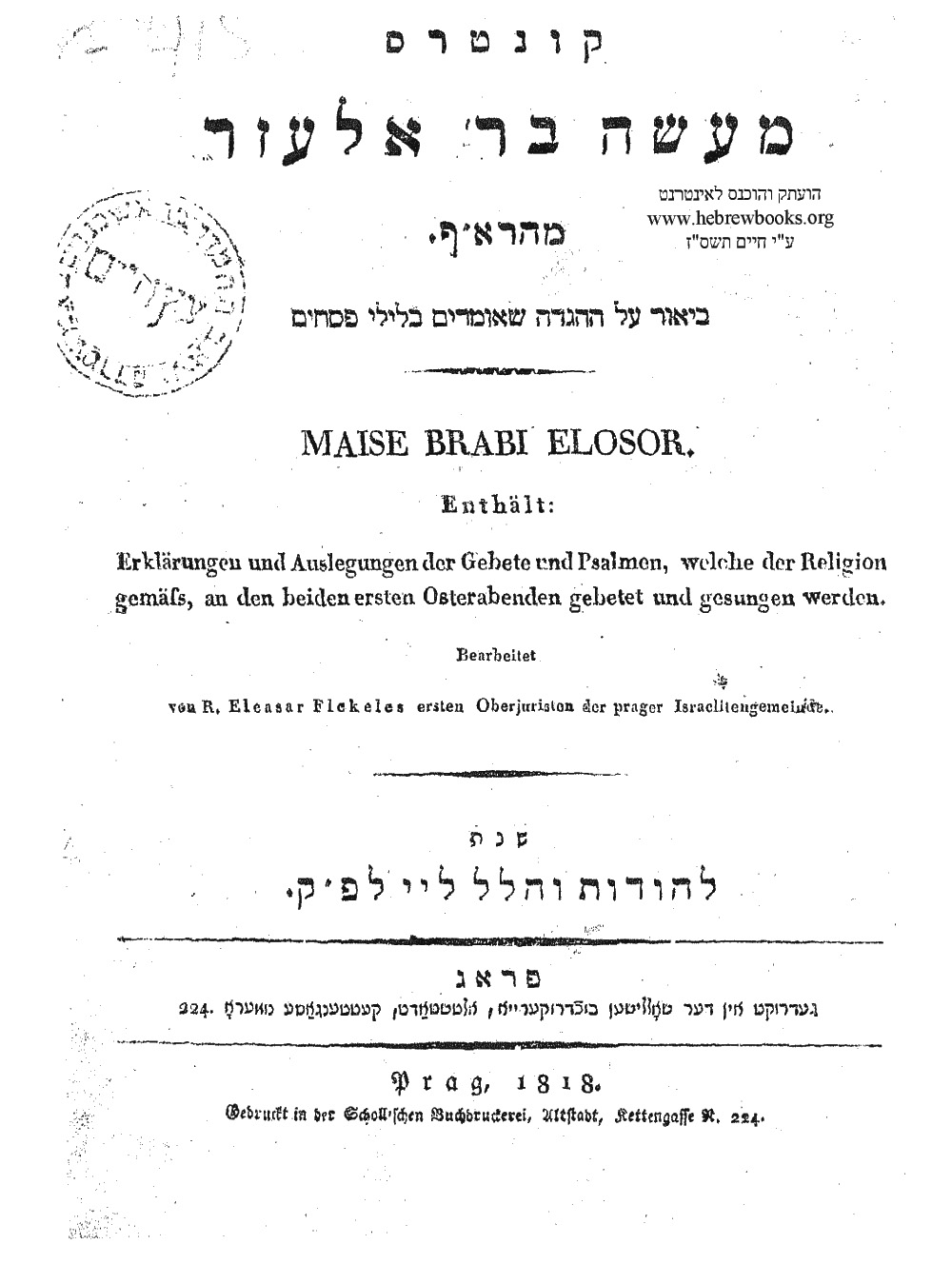
This Haggadah was first printed by the author in Prague in 1818.
Abraham Yaari, in his work A Bibliography of the Passover Haggadah, writes about this work:
הפרט העברי ככתבו עולה תקע”ב אולם יש לקרוא את שני היודין של השם כשם הויה, ואז יעלה תקע”ח, בהתאם לשנה הלועזית 1818, ולהסכמת הצנזור שניתנה באוקטובר 1817 [מספר 418]
For recent Discussion of other works with similar wording see Yakov Speigel Amudim be-Toldot ha-Sefer ha-Ivri; BeSharei HaDefus, pp. 273-296.
In 1944 in Oradea, Romania this work was printed again. It appears that this was the last Haggadah printed in Europe during World War Two. To me it is fascinating that in this turmoil time they bothered to print this work.
Yaari records this edition [number 2308] as does Yitzchak Yudolov in The Haggadah Thesaurus [number 3918]
This 1944 edition has an interesting addition, as noted by the publisher. Into the text of the Haggadah the prelude Li Shem Yichud was added:
 ולא הוספתי עליו רק מה שנוהגים לומר לפני כל מצוה לשיחקב”ה וכו’ [=לשם יחוד קודשא…] הצגתי כהסכמת הגאון משאמלויא שליט”א…
In R’ Ehreneich’s second letter to the publisher he writes:

 אבל בזמנינו נתפשט המנהג
של צדיקי הדורות זי”ע לאמרו והגאון המחבר זצ”ל שהוא בעולם האמת
בודאי לא יקפיד ע”ז ויאחז כאו”א ויעשה כמנהגו…


Although it’s very nice that they decided to add this into R’ Fleckeles work and not hide this addition but I do not think they had any right to do such a thing. R’ Fleckeles was very outspoken about saying Li Shem Yichud, to say the least.
דרך כלל יאות לבטל כל התחנו’ ובקשות אלו וכיוצא בהן שנתחדשו מלקוטי האחרונים ומעיד אני עלי שמים וארץ שראיתי אחד הי’ רצה לברך על אתרוג המהודר של רבינו הגאון האמתי נ”ע (כי הי’ תמיד מהדר מן המהדרין אחר אתרוג המהודר בכל מיני הידור וכסף וזהב לא הי’ נחשב בעיניו מאומ’ אף שהאתרוג הי’ בתכלית היוקר) וכאשר ראה שאותו פלוני אמר יה”ר קודם נטילת לולב (הנדפס במחזורים ובלקוטי צבי) כעס ורגז ואמר בקצף גדול האומר יה”ר אינו מניחו לברך על אתרוג שלו ולא הניחו לברך ועיין מ”ש רבינו בספרו נ”ב חלק א”ח סי’ ל”ה דף כ’ ע”ג ובחלק י”ד סי’ צ”ג והרבה יש לי לדבר בענינים האלה וכאלה ומרוב טרדותי לא אוכל להאריך [שו”ת תשובה מאהבה, א, סוף סי’ א][1]
He was following in the path of his Rebbe, the Nodeh BeYehudah, who as is well known was adamantly against the saying of Li Shem Yichud:
ועל הרביעית אשר שאל בנוסח לשם יחוד אשר חדשים מקרוב נתפשט ונדפס בסידור הנה בזה אני משיב עד שאתה שואלני נוסח אמירתו יותר ראוי לשאול אם נאמר כי טוב באמירתו. ולדעתי זה רעה חולה בדורנו ועל הדורות שלפני זמננו שלא ידעו מנוסח זה ולא אמרוהו והיו עמלים כל ימיהם בתורה ובמצות הכל ע”פ התורה וע”פ הפוסקים אשר דבריהם נובעים ממקור מים חיים ים התלמוד עליהם נאמר תומת ישרים תנחם והם הם אשר עשו פרי למעלה וגדול מעל שמים חסדם. אבל בדורנו הזה כי עזבו את תורת ה’ ומקור מים חיים שני התלמודים בבלי וירושלמי לחצוב להם בורות נשברים ומתנשאים ברום לבבם כל אחד אומר אנכי הרואה ולי נפתחו שערי שמים ובעבורי העולם מתקיים אלו הם מחריבי הדור. ועל הדור היתום הזה אני אומר ישרים דרכי ה’ וצדיקים ילכו בהם וחסידים יכשלו בם. והרבה היה לי לדבר מזה אבל כשם שמצוה לומר דבר הנשמע כך מצוה שלא לומר דבר שאינו נשמע וה’ ירחם עלינו. עי”ש באריכות. [נודע ביהודה (קמא) יו”ד, סי’ צג].
A few months ago I mentioned the censorship of this Teshuvah.
This topic of saying Li Shem Yichud will hopefully be discussed at a different time.[2] But just to add some sources.
In 1805, R’ Menachem Mendel of Shklov, one of the main talmidim of the Vilna Gaon, printed the Gra’s work on the Haggadah for the first time.

Before Maggid it says:
הנני מוכן ומזומן לקיים המצוה לספר ביציאת מצרים לשם יחוד הקב”ה…
In a recent edition of the Gaon’s Haggadah the editor writes:
והנה אין גילוי מפורש בדעת רבינו הגר”א ז”ל באמירת לשם יחוד אך אילו ידע רמ”מ ז”ל שרבינו ז”ל מתנגד לאמירתה בוודאי לא היה מדפיסה… [ר’ חנן נובל, הגדה של פסח עם פירוש הגר”א, ירושלים תשע”ג, עמ’ כט, עי”ש].[3]
This same passage appears in later prints of the Gra Haggadah including one printed in Prague in 1813 at the time R’ Fleckeles was very active there. [Worth noting is the censor was R’ Fleckeles friend, Karl Fisher].

Even though it is unclear what the Gra held about saying Li Shem Yichud, another talmid of his appears to write against it. Here is what R’ Menashe M’IIlyah writes about it in Alfei Menashe:

In the beginning of the Haggadah, R’ Fleckeles deals with the famous question as to why there is no Beracha on Sipur Yetzias Mitzrayim, quoting a Shut Besamim Rosh on the topic [see here]. A few lines later he quotes the real Shut HaRosh, with this preface:
ובתשובות הרא”ש המקובלת לנו ראיתי…
Returning to this newest edition of the Maaseh BR’ Elazar.
One nice piece in this Haggadah is his discussion against his Rebbe, the Nodeh Beyhudah, about the Issur of Chametz in Mitzrayim.
He writes:
הנה חדשים מקרוב נדפס ספר מערבי וראיתי…
The current editors do not write to which sefer he is referring. This is the work he is referring to, first printed in 1793:

In 1959, Yitzchak Refael printed numerous additions to this Haggadah in the journal Sinai (45: 22-36). The source of these addenda is R’ Fleckeles personal copy, which he had specially bound with added on margins and blank pages inserted between each page, affording the author ample room for marginalia. After passing through several hands, finally arriving in R’ Maimon’s library. This new version of the work includes all of these addenda, in their proper places. Interestingly enough, neither Yaari nor Yudolov mention these additions in their entries on this Haggadah.Returning to Li Shem Yichud Sharon Flatto writes in her ‘The Kabbalistic Culture of Eighteenth Century Prague’:

Notably a Haggadah was recently discovered that was owned during the late 1780s by Fleckeles…. The margins of this Haggadah contain leshem Yihud formulas to be recited before the blessing on the the four cups of wine penned in Fleckeles’ hand.

In the footnote she writes they seem to have been written between 1784-1790.'(pp. 225-226). While I wish I had more clearer sources about this discovery. She does not note that the Haggadah that R’ Fleckeles himself printed in Prague in 1818 nor in the manuscript updates of R’ Fleckeles to his own Haggadah does he write to say Li Shem Yichud or any such Tefilah in the Haggadah. This newest edition of the Maaseh BR’ Elazar prints the Haggadah like R’ Fleckeles did in 1818 without Li Shem Yichud.

Besides for all these new pieces added into this new edition, the volume also includes a well-written introduction about R’ Fleckeles, including an interesting eye witness account from manuscript of the day he died in Prague. Another plus to the new edition are the numerous sources they added, at times quoting R’ Fleckeles references from his other works.  Finally, there is a very useful index of topics and seforim quoted by R’ Fleckeles at the end of the volume. I really hope they continue to print the rest of R’ Fleckeles works.
To purchase this Haggadah try Girsa in Jerusalem, Biegeleisen in NY or your local seforim store.
Appendix:

One of the seforim noticeably omitted, for the most part, from R’ Fleckeles works, including this Haggadah, is the Zohar.
Much of the sources in R’ Fleckeles writings regarding the Zohar and Kabalah in general has been gathered in Boaz Huss’ recent work, KeZohar Harokeyah (pp. 322-323). Most notable is this piece which I quote here in its entirety:
ועתה אין מן הצורך להשיב את האיש אשר רצה להמצי’ דבר חדש להשביע את האיש הישראלי בספר הזוהר… את זה כתבתי לדעת האיש ההוא שהספר הזוהר כלו קדוש אבל אני אומר הריני נשבע בתורת ה’ שבספר הזוהר נמצאו כמה זיופים וקלקולים אשר הוסיפו ועלה אחת מתלמוד בבלי הויות דאביי ורבא קדוש יותר מכל ספר הזוהר הנה אם אמרו חכמי התלמוד על ברייתא דלא מתנייא בי ר’ חייא ור’ אושיעא מאן ימר דמתרצתא היא דלמא משבשתא היא וספר הזה ודאי לאו בר”ח ורב אושיעא אתמר כי כל הדורות מראש לא זכרו מספר הזוהר מאומה לא בהקיץ ולא בחלום כי הנה אם אמת הדבר שהחבור הזה הוא מהתנא ר’ שמעון בר יוחאי אשר ר’ יהודה הנשיא קבל גם ממנו כמבואר בהקדמ’ הרמב”ם לספרו יד החזק’ איך לא זכר את הספר הזה בחבורו ש”ס משניות או בשום מקום ואף ר’ יוחנן שחיבר תלמוד ירושלמית אינו מזכירו בשום מקום ורבינא ורב אשי שחברו תלמוד בבלי מאה שנים אחר חבור תלמוד ירושלמי והיו סוף אמוראים ולא שמו רמז בכל התלמוד מספר הזוהר ורבה בר נחמני שחובר רבות ושוחר טוב וכיוצא בהם הרבה לא זכרו מחבור רשב”י גם רבנן סבוראי והגאונים והרי”ף והרמב”ם ורש”י ותוס’ והרמב”ן והרשב”א והרא”ש והטור והילקוט שמעוני אשר אסף ולקט כל המדרשות והמכילתות והברייתות כלם לא ידעו ולא ראו ממנו דבר עד שזה קרו’ לשלש מאות שנים ענו ואמרו שמצאוהו ואיזהי כנסיה אשר קבלוהו בכנופיה, כמו תלמוד בבלי וירושל’ וז”ל הרמב”ם בהקדמתו לספר יד החזקה אבל כל הדברים שבגמרא הבבלי חייבין כל ישראל ללכת בהם וכופין כל עיר ועיר וכל מדינה ומדינה לנהוג בכל המנהגות שנהגו חכמי הגמרא ולגזור גזירותם וללכת בתקנותם הואיל וכל אותם דברים שבגמרא הסכימו עליהם כל ישראל עכ”ל ויעיין עוד שם ואין אני חלילה מטיל דופי ופגם בכבוד התנא אלדי ר’ שמעון בר יוחאי כי הוא היה מחסידי עליון אלא אני אומר לאו גושפנקא דרשב”י ועזקתיה חתום עליה ומי שיש לו חצי דעת יגיד כן שהרי נזכרו בספר הזוהר כמה תנאים ואמוראי’ שהיו אחר רשב”י שנים רבות במספר והארכתי בזה במקום אחר מפי סופרים ומפי ספרים כמבואר בס’ מטפחת להגאון מו”ה יעב”ץ זצלל”ה שגזר אומר שחלו בו ידים מזייפים וחשד את החכם ר’ משה דיליון יעיי”ש.
והינה מיום שנתחדש ספר הזוהר הרבה נכשלו ע”י כי כמה דברים סתומים וחתומים אשר המציאו האחרוני’ להתעות בני אדם יושבי חשך השכל, צאו וראו כמה קלקולים רבים קלקלו מאמיני הכלב רע שבתי צבי שבור ואחוזת מרעהו ברכי מסאלנוקא ויעקב פראנק שם רשעים ירקב, ותלו דבריהם בספר הזוהר אשר בודאי לא יאונה לצדיק ר’ שמעון בר יוחאי כל און.
מה טוב ומה נעים, אשר כתבתי בחבורי קטן אשר קראתיו בשם קונטרס אהבת דוד שנדפס בק”ק פראג תק”ס וזה לשוני שם באו ונחזיק טובה וחינות לשני מלכים גדולי אדירי’ אדוננו המשובח המנוח הקיסר יאזעף השני ואדוננו המהולל הקיסר פראנץ השני אשר צפו והביטו בחכמתם הנפלאה, רבות רעות ושבושי דעות תסתעפנה מחלומות והבלים המקובלים, והמה לנזקי בני האדם נזקי הגופות ונזקי הנפשות, ופקדו באזהרה גדולה שלא להביא ספרי קבלה בכל מדינות מלכותם הפקודה הראשונה העכסט האף דעקרעט פאם ב’ נאוועמבר למספרם והשני פאם ז’ יוני למספרם והארכתי שמה בדברים נכונים… (תשובה מאהבה חלק א סי’ כו).
According to Shmuel Werses, Haskalah and Sabbatianism, (Heb.), pp. 68 and Boaz Huss, KeZohar Harokeyah (p.323) this teshuvah has been censored out of the 1912 edition of TM. I have been unable to independently confirm this, as the 1912 editions I have seen (both in NLI and in BIU) have it in full – as do most reprints available today, including the edition found on the HebrewBooks.org website
In another teshuvah on this topic R’ Fleckeles writes:
ובלא”ה כבר כתבתי פעמי’ רבות שאין ראי’ מזוהר שלא נודע ברור מי הוא המאסף והמלקט ספר הזוהר והרבה הוסיפו  (תשובה מאהבה א:סב).
It is worth pointing out that R’ Fleckeles does not dismiss the Zohar completely taking it into account elsewhere in TM; for example in this teshuvah he writes:
מה ששאלני מדוע רובא דעלמא מקילים והולכים בבקר ד’ אמות בלי נטילת ידים שחרית הא כבר כתב המ”א בשם הב”ח בשם תולעת יעקב כל ההולך ד’ אמות בלי נטילת ידים שחרית חייב מית’ עיי”ש וכמה בני תורה אשר אינם שוגגים מקילים ואין להם על מה שיסמכו. ידע ידידי שדבר זה כתב בעל תועלת יעקב בשם הזוהר וכן העתיקו הב”ח, והמג”א השמיט בשם הזהר או מן השמים השמיטוהו כי חפשתי בספר הזוהר יגעתי ולא מצאתי ובעל א”ר האמין לשמועותיו בשם הזוהר והאר”י וצדר להקל עיין סי”א סק”ד ולבסוף מסיק בשם ספר דמשק אליעזר שדבר זה  דוקא בזמנם כמו גילוי וזוגות עיין שם ולענ”ד ליתא בזוהר כלל והרב בית יוסף אשר העתיק בכל פעם דברי הזוהר לא שם רמז מזה ושארי לי’ מארי’ שעשה רוב ישראל לחייבי מיתות שוגגן ישרים יחזו במסכת ברכות דף  סמ”ך ע”ב ישר יחזו פנימו ולענ”ד היא משנת חסידים והזריז הרי זה משובח ואפשר דזוהר מיירי אם מים מצוים לפניו והולך ד’ אמות בלי נטילת ידים ואח”ז ה’ אנה לידי ספר ברכי יוסף וראיתי שמביא דברי הזוהר כת”י וסיים וזה לשונו אלא דשמיע לי מרבני קדישו דזמנין דמיא הרחק מאד מאדם ובלכתם ילכו פחות מד’ אמות כאותה שאמרו גבי שבת עיין שם סימן א’ אות א’ ולשון הזוהר אינו לפני לעיין והנרא’ לענ”ד כתבתי. (תשובה מאהבה חלק א סי’ יד וראה חלק ב סי’ א אות ד)
As an aside, the shitos of R. Fleckeles on the Zohar are bland compared to those of his Rebbe, the Noda Beyehudah, as found in the recently printed drasha of his from manuscript by Dr. Maoz Kahana and M. Silber. I note in passing that this drasha has sparked a debate between them and Dr. Flatto, to which she responded in a later version of the journal Kabbalah.


[1]  See also his Melechas Hakodesh, p. 132
[reviewed here].
[2]  See Moshe Hallamish, Kabbalah (Heb.),
pp. 45-70; Maoz Kahane, MiHaNoda BiYehuda LaHatam Sofer, pp. 89-91 and
pp. 235-236; most recently Shimon Szimonowitz, Haggadah
Aleh Zeis
(2016), pp. 35-78.
[3]  Thanks to R’ Dovid Vieder for this source.


Ten Commandment Representations in Hebrew Manuscripts & Books: Artistic Approaches to Theological Issues in Judaism

Ten Commandment Representations in Hebrew Manuscripts & Books: Artistic Approaches to Theological Issues in Judaism

Dan Rabinowitz

Today, the Ten Commandments or Decalogue[1] are among the most prominently featured symbols associated with Judaism. The Decalogue is represented by two tablets, generally connected and rounded at the top. This representation occupies a central place within synagogue architecture, often displayed on the exterior or interior of the edifices and frequently above the ark itself, which is regarded as the most sacred element within the building. However, it is noteworthy that these practices only began to emerge in the 16th century. The exact origins of this practice remain unclear, but it is likely that they were influenced by the Christian adoption of the Ten Commandment tablets in art as representative of Judaism. Some scholars suggest that this may not be an instance of benign cultural exchange but might have its roots in anti-semitic legislation, which mandated that Jews wear badges shaped like the Ten Commandments with rounded tops. This imposition may have influenced Jewish consciousness, potentially resulting in eventual self-association with this symbol.[2]

Historical evidence indicates that the ancient Jewish community used of other symbols such as the lulav, shofar, menorah, ark, scroll, and etrog, but not the luchos. The absence of the luchos is unsurprising when one considers the inherent difficulties of accurately replicating them. There is substantial ambiguity surrounding the exact proportions and shape of the tablets. Consequently, accurate reproductions were improbable, preventing their adoption as a common, recognizable symbol. Apart from the Israelites in the desert who witnessed the Sinai revelation, the tablets were not publicly displayed but remained housed within the ark. The fact that the luchos were kept in the ark and never removed suggests that they were intentionally not intended for public display.

In contrast to other Temple implements that are meticulously described, the details of the luchos are only generally mentioned as being made of stone and numbering two. This lack of elaboration has resulted in uncertainty even regarding the inscriptions on the stones and their shape. Today, it is widely accepted that each tablet contained five commandments and can be sourced to the Mekhilta DeRebi Yishmael, Yisro (Horovitz-Rabin, 233-234); however, according to the prevailing opinion in the Talmud Yerushalmi (Shekalim 6:1; Sotah 8:3), each tablet contained the entire Decalogue. Additionally, Rav Saadia Gaon asserted that one tablet recorded the version given in Exodus, while the other contained the version from Devarim.

It was not until the early rabbinic period that there was an explicit discussion regarding the shape of the luchos. The two Talmuds are inconsistent as to the exact dimensions and shape of the tablets (and both versions appear in midrashic literature). According to the TY, the tablets were rectangular, six tefachim in length and three in width. The TB describes them as square, six by six. Some attempt to reconcile the two Talmudic versions, there is clearly no consensus are single traditional regarding the shape.[3]

Beyond the challenges in determining and reproducing accurate divisions and shapes, there is a theological concern with their display. The Mishna records that the recitation of the Decalogue was part of the daily service in the Beis haMikdash. Evidence of this practice is found in the Nash Papyrus, dating between the second and first centuries BCE. In that document, the Ten Commandments appear before the Shema. Although the Nash Papyrus is likely either tefillin or a mezuzah, it seemingly confirms inclusion in the liturgy even outside of the Temple.[4] Nonetheless, the liturgical practice was abolished by Rabban Gamaliel II of Yavne. The rationale for the abolition was that some sect, the Minim, had elevated the Decalogue above the rest of the Torah, and the continued public recitation might imply acceptance of that position.[5] It is worth noting that even when the Decalogue was incorporated into the liturgy, there is no mention of it being displayed.

None of these sources mention the most common shape, tablets with rounded tops. According to one theory, this shape was borrowed from the Roman writing tablet, the diptych, which consisted of two tablets hinged together. Regardless of the original source, the rounded-topped tablets became the standard in Christian art from at least the 12th century. Since Jews adopted the luchos as a symbol much later, roughly in the fifteenth to sixteenth centuries, they chose the most commonly recognized version, which features rounded tops.[6] 

The earliest extant depiction of the luchos appears in the Dura Europos Synagogue fresco, where Moshe is holding a scroll. While Dura Europos does not settle the issue of the shape of the tablets, it does begin to reveal some details about how the luchos iconography has evolved over time to address what can be referred to as the “minim conundrum.” The conflict between the Torah recording God delivering just the Decalogue at Sinai, whereas Jews believe that the entire Torah was given at Sinai.

Illuminated Manuscripts and the Ten Commandments: Resolving the Issue of the Minim

Many manuscripts, including Haggadahs, prayer books, and Bibles, feature imagery related to the Decalogue episode. Beyond merely illustrating the text these illustrators intentionally depicted the scene to address and resolve the minim issue and link the delivery and reception of the Decalogue with the entirety of the Torah. For example, many Ashkenazic Haggadahs include the Decalogue scene, typically accompanying the Dayenu, although two include it later in the liturgy. [7] The earliest, known as the Birds Head (dating to the beginning of the 14th century), depicts two fingers emerging from the cloud, presenting two rounded-topped tablets to Moshe. Immediately below, Moshe appears again transferring the tablets, now five, to two figures, presumably Aaron and/or Yehoshua. The dual tablets have been converted into five, referencing the Five Books of the Torah.[8] The Birds Head Haggadah’s metamorphosis during the transmission process of the two tablets into five is the only example of this solution in any Jewish (or non-Jewish) manuscripts.[9]

Figure 1: Birds Head Haggadah, fol. 23r, Israel Museum

A similar rereading of the Giving of the Law occurs in the thirteenth-century Parma Machzor. Unlike the Birds Head, which transforms the two tablets into five in their delivery, the Parma Machzor, however, depicts God giving Moshe three tablets, presumably alluding to the three books of Tanakh, the entire corpus of the Torah.[10]

Figure 2: Parma Machzor (Biblioteca Palatina, MS Parm. 2887)

Beyond transforming the tablets into more than the two mentioned in the Torah, other forms of iconographical methods were used to address the minim issue. Writing material underwent significant changes throughout the centuries. It was initially etched onto stones, like the luchos, then papyrus (like the Nash), and eventually, using animal skins that are much more resilient than papyrus, it was transformed into scrolls. Finally, “the most revolutionary invention in the history of the book” – the codex – was created at the beginning of the Common Era and became commonplace by the third century CE.[11] The codex, which we recognize as a book today, consists of individual pages written on both sides and addresses the major limitations of the scroll: the difficulty of quickly moving from one section to another and the fact that only one side could be used. Christians were the first to adopt this form sometime in the third century CE. Jews, however, adopted the book or codex much later than most other cultures, likely only in the ninth century.[12] This is unsurprising, as the scroll was not merely a device for Jews, but was imbued with special holiness.

These two forms, the scroll and codex, were used to address the minim issue. In these instances, they assumed the role of the entire torah as contrasted with the tablets, recording just the Decalogue. Scrolls are substituted for the tablets in at least two Haggadahs from the late fifteenth century (c. 1470-1480): the Nuremberg II and the Yahuda.

Figure 3: Second Nuremberg Haggadah (Center for Jewish Art)

Figure 4: Yahuda Haggadah (Center for Jewish Art)

In both, Moshe holds up an open scroll with wooden poles in a manner familiar from the hagbah ceremony. Likewise, in the well-known illuminator Joel ben Simon’s c. 1470 Machzor, now referred to as the Rothschild Weill Machzor, Moshe lifts the scroll. In a later Haggadah, known as MS 1388 Paris (1583), Moshe is holding a partially open scroll, though it is not raised like the other examples.[13] 

Figure 5: Rothschild Weill Machzor (Center for Jewish Art)

A similar image appears in the Ulm Machzor, c. 1430; however, Moshe is receiving it directly from God, echoing the approach of the Parma Machzor that there was no transformation, rather the delivery itself was the entire Torah.

Figure 6: Second Darmstadt Haggadah 9v (Center for Jewish Art)

The codex is similarly employed to address the minim issue. In the Second Darmstadt Haggadah (here), Moshe appears at the top right, beneath the shofar. He is holding two connected rectilinear tablets, hinged at the bottom. A man, dressed differently than Moshe and likely Aaron or Yehoshua, appears at the bottom right holding two separate rectilinear tablets, which are clearly sourced from Moshe. Finally, a group of Israelites appears in the bottom center of the page. The leader is now holding a book. This transforms the tablets into a book or Torah. The connection between the tablets becomes clearer as the person holding the book points to Aaron/Yehoshua and the tablets, indicating that the book’s source is the tablets and ultimately what Moshe received directly from God. Therefore, collectively, the page illustrates the transmission and transformation of the Luchos, from the ten into the Torah – received from God by Moshe, which was then handed off to Aaron and finally to the Jewish people.

Figure 7: Detail Second Nuremberg Haggadah (Center for Jewish Art)

There is perhaps another example of the codex that addresses the minim issue. In the Laud Machzor, c. 1290, the illustration for the piyyut recited on Shavous, Adon Ammani, the upper register has an angel delivering two separate rectilinear tablet while on the right side the Israelites receive a single item with a loop at the bottom. Unlike the Birds Head or other manuscripts that has the transformation into the Torah during the transmission stage; here, the only item the Israelites received was this single item with the loop. What is this unusual single panel with a loop? It may be a a codex. Manuscripts and codices were originally kept in cabinets, armaria, but in the late 13th and early 14th centuries they were more commonly placed on desks, and the practice of chaining books to prevent theft began (see here). Perhaps the loop in the Laud Machzor is a ring of a chained codex and another provides another example of using the codex to address the minim issue.

Figure 8: Laud Machzor 127r (Bodleian Library, MS Laud Or. 321)

Hebrew Book Illustrations & Anti-Jewish Representations

Illustrations in printed books, however, do not appear to be concerned with solving the minim issue. To the contrary, some iconography in printed books can be read to diminish or even undermine not only the torah’s transmission but even the continued applicability and viability of the Decalogue. Printed illustrated Hebrew books depict either Moshe receiving or transmitting the tablets or simply Moshe and the tablets without context. Of the four printed mother Haggadahs that served as models for nearly all subsequent printed illustrated Haggadahs, only one, Amsterdam 1695, depicts ma’mad har sinai. Unlike the other illustrations in that edition, which are modeled after Mathis Merian’s Bible, this illustration was borrowed from other Amsterdam Hebrew prints. As we have previously discussed, while the engraver clearly used Merian as a model he deliberately altered the images to suit the Jewish text rather than their original Christian source. Merian’s imagery for ma’amad har Sinai was entirely at odds with the Jewish view, and therefore, the illustrator sought an alternative source. Merian only depicts the sin of the Golden Calf and not the delivery or transmission of the Decalogue/Torah. That aligns with Christian theology that focuses on the sins of the Jews, rather than the monumental and exceptional example of God speaking directly to the Jews and imparting his Torah.

Figure 9: Amsterdam Haggadah, 1695 (Center for Jewish Art)

The Amsterdam Haggadah used the imagery that first appears on the titlepage of the 1679 Amsterdam Humash and reused on many subsequent editions of the Humashim from Amsterdam and other cities. Here, the mountain is in the middle and Moshe is still on top, receiving the tablets. They are square, and one is held in each of his hands. The illustration does not depict Moshe delivering the Torah or tablets; therefore, it does not address the tension between the Decalogue and the torah. Nonetheless, arguably implicitly, the inclusion of the image on a title page of a Humash, obviates the need to include additional imagery for the minim issue – Moshe receiving the tablets is literally attached and is the precursor to the entire Torah.

Figure 10: Humash, Amsterdam, 1679 (Gross Family Collection)

While the Decalogue scene does not appear in the other mother Haggadahs, Moshe with the luchos is used as one of the border figures in the Venice 1609 Haggadah. Moshe is carrying two connected round-topped tablets and has a light emanating from his forehead. This illustration of Moshe and the luchos is among the most common title page illustrations in Hebrew books.

Figure 11: Title Page Shu”t Rashba, Hanau, 1610 (Gross Family Collecdtion)

It first appears adorning the titlepage of Shu”T Maharil, Hanau, 1610. However, that image was clearly borrowed from a non-Jewish source. Moshe has horns, with rounded topped tablets, and is flanked by Aaron wearing a bishop’s mitre and holding a censer.[14] There is another nuance to the image that may also specifically Chrisitan, and more important theologically than whether Moshe had horns or light emanating from his head. Unlike the Jewish sources discussed above, Moshe does not hold the tablets aloft. Rather, they are standing on the ground, his hand on top. This aligns with the Christian view of the Decalogue; after Jesus, it was relegated to a secondary role or was even superseded by the New Testament. The depiction in Shu”T Hashiv R’ Eliezer, published in 1749 in Neuwied, Germany, presents a particularly striking variation. In this volume, Moshe’s hand is shown flat, seemingly serving to drive down the tablets into the ground rather than grasping them, as seen in the Hanua prints. Additionally, unlike other works that either show some of the text on the tablets or leave them blank, Hashiv depicts the tablets filled with lines, effectively obscuring or erasing any text.

Figure 12: Shu”t Hashiv Reb Eliezer, Neuwied, 1748

The unique nature of Hashiv’s title page is amplified when compared with to similar title pages, one may have even served as the a model for Hashiv. Critically, that title page includes subtle yet significant modifications. For example, David Gans, a disciple of Maharal, in his work Sefer Nitzahon, published in Altdorf in 1644, created one of the most exquisite Hebrew title pages. It features a similar depiction of Moshe as seen in Hashiv, with his hand resting atop the tablets that include some lines, resembling Hashiv. However, these tablets prominently display the Hebrew “Aseres ha-Dibros,” clearly underscoring their importance.

Figure 13: Sefer Nitzhon, Altdorf, 1644

Another contrary example is Yefeh Anaf, by R. Shmuel Jaffe, Frankfurt a.d. Order, 1696, which depicts a Jewish Moshe with rays emanating from his head, holding round-topped tablets with the beginning of each directive in Hebrew.

Like the three manuscripts discussed above, there is another title page that features Moshe with a scroll instead of tablets. This title page, which appears in a number of different Amsterdam books, for example, Sefer Shenei Luchos ha-Bris, Amsterdam, 1698, Yad Yosef, Amsterdam, 1700, and Eshlei Ravrevei, Amsterdam, 1711, is an amalgamation of four biblical figures, each symbolizing one of the four crowns: Torah (Moshe), priesthood (Aaron), kingship (Dovid), and a good name (Shlomo).

Figure 14: Shnei Luchos ha-Bris, Amsterdam, 1698

A later Amsterdam edition of the Humash combines all three Amsterdam illustrations on the title page. The 1827 Amsterdam Humash features Carl Christian Fuchs’s engraved title page. At the top is the image of Moshe accepting the two square tablets. Moshe appears below on the left, holding round-topped tablets with lines representing the text, and in the center is a crown of Torah. Fuchs includes another Amsterdam illustration at the bottom of the page, this one from the 1695 Haggadah, which depicts the temple.

Figure 15: Humash, Amsterdam, 1827

There is another unique depiction of the tablets on an early 19th-century title page. In the third edition of Mendelsohn’s Humash, Fürth, 1801-1803, Moshe and Aaron flank the title page. However, Moshe, with rays, holds only his staff. In the central image, the ark of the covenant is present, and the two tablets, with rounded tops, are superimposed in the foreground.

Figure 16: Derech Selulah, Fürth, 1802 (Gross Family Collection)

One printed book, however, R. Yosef Ergas’ Shomer Emunim (Amsterdam, 1736), may be a unique example that specifically addresses the minim issue. This work, which discusses the legitimacy of Rabbinic Judaism, includes a representation within a circular design surrounded by laurel leaves at the center of the upper register. Initially, the figure appears to be Moshe holding the luchos. However, the accompanying legend identifies the figure as “Rabbenu ha-Kodesh,” Rabbi Yehudah ha-Nasi, the compiler of the Mishna and a key figure in rabbinic Judaism. This suggests that the Mishna – Rebi Yehuda’s text – is synonymous with the luchos.

Figure 17: Shomer Emunim, Amsterdam, 1736 (Moreshet Auctions)

This interpretation is further supported when compared to the title page model for Shomer Emunim, David Nieto’s Matteh Dan, Kuzari ha-Sheni, (London, 1724). This work also defends rabbinic Judaism and depicts the figure labeled “Rabbenu ha-Kodesh” encircled in the upper register, but he is holding a book with the inscription “Mishna.” The printers of Shomer Emunim modeled the title page on Matteh Dan, yet went further in visually equating the Mishna with the Decalogue.

Figure 18: Matte Dan, London, 1714 (Moreshet Auctions)

Except for the Amsterdam prints, title page illustrations consistently show round-topped tablets, unlike Hebrew manuscripts where tablet shapes vary. This likely stems from printing developing after Christian art standardized the round-topped representation. Table 1 summarizes twenty-two manuscripts depicting the tablets, with no consistent shape linked to a specific era or region. In one instance both rounded and rectilinear shapes in the same manuscript.[15] In the Sarajevo Haggadah, the tablets appear on two separate panels (panels 30 and 32): once when Moshe receives and conveys the Decalogue, and a second time in the scene depicting what may be the Tabernacle, Solomon’s Temple, or the Messianic Temple.[16] In the first instance, the tablets are rounded, while in the second, they are rectilinear. It is conceivable, though admittedly improbable, that the original designs were rounded and depicted in the first panel. However, in the second panel depicting the temple, when the decision was made to construct the ark with a square shape, the tops may have been removed to ensure a better fit.

The Ultimate Message of Har Sinai

One final manuscript illustration is notable not only for the shape or material of the tablets, but for the broader message it conveys. The entire nation was present at ma’amad Har Sinai, including men, women, and children. The Dresden Machzor, circa 1290, depicts Moshe receiving the tablets on the upper right of the panel. On the left side of the top register, Moshe delivers them to a kneeling woman, with no men depicted. This representation indicates that the Torah was given to and applies to everyone equally. The shape itself conveys a universal message. The luchos feature rounded tablets within a rectangular frame, symbolizing that everyone fits within Judaism’s broad parameters.

Figure 19: Dresden Machzor, c. 1290 (MS Dresd. A.46A, 202)

Table 1: Manuscripts & the Shape of the Tablets

Square/Rectilinear

Rounded

Scroll

1. Laud Machzor (Southern Germany, c. 1290, Bodleian, Laud Or. 321, fol. 127v) Birds Head Haggadah (Southern Germany, c. 1300, Israel Museum, MS 180/57, fol. 23) Nuremberg II Haggadah (1470-1480, Schocken Library, MS 24087)
2. Rothschild Machzor (Florence, 1492, JTS, fol. 139) Sarajevo Haggadah (Spain, 14th Century, Sarajevo Museum) Yahuda Haggadah (mid 15th century, Israel Museum, MS 180/50)
3. Tripartite Machzor (Southern Germany, c. 1320, British Library, MS. Add. 22413, f. 3r) Parma Machzor (13th century, Western Ashkenaz, Parma, Biblioteca Palatina, MS Parm. 2887, fol. 101v) Rothschild Weill Machzor (c. 1470, NLI, MS 804450, fol. 203)
4. Schocken Bible (Southern Germany, c. 1300, Schocken Library, MS. 14840, fol. iv) Dresden Machzor (1290, Mscr. Dresd. A.46.a, fol. 408) MS 1388 Paris (1583, Bibliothèque Nat., MS 1338, fol. 14r)
5. Regensburg Pentateuch (Regensburg?, c. 1300, Israel Museum, MS 180/52, fol. 154v) Ulm-Treviso Siddur (1450-1453, Parma, Biblioteca Palatina, MS Parm. 2895, fol. 271)
6. Sarajevo Haggadah (Spain, 14th Century, Sarajevo Museum) Floersheim Haggadah (1502, Zurich, Floersheim Collection, fol. 15).
7. First Leningrad Bible Egypt, (?) 929, fragment (Leningrad Public Library, MS II 17)
8. Parma Bible (Parma, Biblioteca Palatina, MS Parm. 2710, fol. 3r)
9. King’s Bible (Catalonia, Spain, 1384, MS King’s 1, f. 3v)
10. Catalan Bible (Catalonia, Spain, third quarter of 14th century, MS Add. 15250, f. 3v)
11. Harley Catalan Bible (Catalonia, Spain, c. 1350, MS Harley 1528, f. 8r)
12. Darmstadt Haggadah II (Universitäts-und Landesbibliothek, Darmstadt, Cod. Or 28, fol. 9v)

[1] Although these terms are inaccurate because the Torah does not refer to them as commandments, huqqim, mitzvos, or mishpatim, rather aseres hadivarim or aseres hadibros, nonetheless, as that is the most widespread description we use that term.
[2]
See generally, Gad Ben-Ami Sarfatti, “The Tablets of the Covenant as a Symbol of Judaism,” in The Ten Commandments, As Reflected in Tradition and Literature Throughout the Ages, ed. Ben-Zion Segal (Jerusalem: Magnes Press, 1985)(Hebrew), 353-388; Ruth Mellinkoff “Round-topped Tablets of the Law,” Journal of Jewish Art I (1974): 28–43.

Almost immediately after the luchos were displayed in synagogues, some argued that their display contravened the injunction against elevating the Decalogue above the rest of the Torah. The first to raise this issue was Rabbi Yom Tov Lipmann Heller. He describes how one synagogue in Prague displayed them and equates the display with the public reading, subsequently banning the practice. Rabbi Heller, who served as the rabbi of the Altneu Synagogue (Old-New Synagogue), incorporated other symbols within the building. The walls bear various abbreviations corresponding to verses that describe the decorum and purpose of prayer. The ark is flanked by two lions at the top, and the luchos do not appear anywhere within the synagogue. Rabbi Heller was most likely referring to the Maisel’s Synagogue which, today, displays the luchos above the ark. This synagogue was originally built in the 1590s. However, since it burnt down in 1689 we cannot be certain that the design of the ark was the same during Rabbi Heller’s lifetime. Whether or not this was the synagogue Rabbi Heller referenced, it serves as an example of how his opinion never gained traction even in Prague. Indeed, the Maisel’s Synagogue also displays the Decalogue on the exterior of the building, as does the Baroque Synagogue (originally built in 1622/23, also destroyed in the 1689 fire). The Klausen Synagogue’s building was completed in 1694, and its ark is topped by the luchos. For more information, see Prague Synagogues (Jewish Museum in Prague: 2011), which includes photographs of the synagogues and descriptions of their respective histories.

For a discussion of the issue of Decalogue displays in synagogues see Yechiel Goldhaver, Minhagei ha-Kehilos, vol. 1 (Jerusalem: 2005), 45-48n1, who collects examples throughout Europe of synagogues with the luchos displays as well as sources discussing the propriety of the practice.

Regading contemporary sources that discuss what shape to use for the luchos, rounded, square or rectangular, see Reuven Chaim Klein, “Square versus Rounded,” available here. Of note is the opinion of R. Yisroel Yaakov Fisher, Chief Rabbi of Badatz Eidah Chareidis, who argues, the contra-historical position, that the original tablets were rounded. Indeed, according to Fisher, there were rounded at the top and bottom.
[3]  See Chaim Kenefsky, Baraysa d’Melehes haMishkan, Da’as (Beni Brak, 1996), 38, and Meir Ish Shalom, Beritah, 43; see also Menahem Silber, “Aron ha-Edus ve-Luchot ha-Bris: Tzurotom u-Tavnesam,” in Sefer ha-Zikhron le-Rebi Moshe Lifschitz, ed. Rafael Rosenbaum (New York: 1996), 236-42; see also, Midrash Devarim Rabba, ed. Saul Liebermann (Jerusalem: Shalem, 1992)122n2.
[4] See Ephraim Urbach, “The Place of the Ten Commandments in Ritual and Prayer,” (Hebrew), in Ten Commandments, ed. Segal, 128.
[5] See Urbach, “Place,” 132-136, 138-142; Von V. Aptowitzer, “Bemerkungen zur Liturgie und Geschichte der Liturgie,” MGWJ 74 (1930), 104-115. Both also attempt to identity of the sect of the minim.
[6] See Mellinkoff, “Round-Top.”
[7] See generally, Sarit Shalev-Eyni, “Receiving the Law: Visual Language and Communal Identity in Medieval Ashkenaz,” Gesta 55(2), (Fall 2016), 239-255. Shalev-Eyni discusses many of the examples below.
[8] See Marc Michael Epstein, The Medieval Haggadah: Art, Narrative, and Religious Imagination (Yale Univ. Press, New Haven, 2011), 90; Metzger, Haggadah, 303. Metzger demonstrates that the second figure is also Moshe. Id.
[9] Metzger, Haggadah, 303.
[10] Shalev-Eyni, “Receiving of the Law,” 246-249.
[11] Anthony Grafton, “From Roll to Codex: A Christian Initiative,” in Crossing Borders, Hebrew Manuscripts as a Meeting-place of Cultures, ed. Piet van Boxel and Sabine Arndt (Bodleian Library, Oxford, 2012), 15.
[12] Grafton, “Roll,” 20.
[13] Metzger, Haggadah, 305.
[14] Regarding the image of the horned Moshe see Ruth Mellinkoff, The Horned Moses in Medieval Art and Thought (University of California Press: Berkeley, 1970. For a collection of articles discussing the depiction of Moshe throughout history and reproductions of many examples, see Moïse Figures d’un Prophète, ed. Juliette Braillon, (Musée d’Art et d’Histoire du Judaïsme: Paris, 2015).
[15] The Sarajevo Haggadah is the only Haggadah manuscript from the Sefard tradition that depicts the Giving of the Torah. While the Sephardic manuscripts precede the Haggadah text with the Biblical Cycle from Genisis to Exodus, the remaining Haggadahs end before the episode at Mount Sinai. See Metzger, Haggadah, 302.
[16] See Shalom Sabar, The Sarajevo Haggadah History & Art (Sarajevo: 2018), 233-235; 239-241. Sabar only offers Solomon’s Temple or the Messianic Temple. Nonetheless, it is equally possible that this panel simply depicts what follows the Giving of the Law, the construction of the Tabernacle.


The Other Works of R. Yehiel Mihel Epstein, Author of the Arukh HaShulhan

A Review of: Kitvei Ha’Arukh HaShulhan
Eliezer Brodt

Almost every Friday morning, I get a call from a fellow seforim addict asking me what’s new on the market. The past few weeks, he had been complaining to me that the market is dry, and nothing of note has been put out. Yesterday, he told me that finally one interesting thing came out the night before: a collection of the writings R. Yehiel Mihel Epstein (1829-1908), the author of the Arukh HaShulhan, called Kitvei Ha’Arukh HaShulhan. So off I ran to the seforim store to get this new piece. What follows is a review of this new sefer.

Kitvei Ha’Arukh HaShulhan is divided into multiple parts. The first part is a reprint of the “Or La’Yesharim” by R. Epstein. The Or La’Yesharim is a commentary on the classic work, Sefer HaYashar of Rabbeinu Tam. R. Epstein wrote this when he was very young, although it wasn’t published until 1869.

The Sefer HaYashar of the Rabbeinu Tam[1] (this is not to be confused with the mussar work with the same title which is incorrectly attributed to the Rabbeinu Tam – there is some debate exactly who the author is, with some claiming it is R. Zerachia HaLevi, author of the Ba’al HaMe’or, others attribute it to R. Zerachiah HaYevani, and finally others claim the author is Rabbeinu Yonah) which is today available in two parts – Hiddushim and She’elot u-Teshuvot. The Sefer HaYashar was first published (both parts together) in 1811 in Vienna, but this edition was full of errors. Later, in 1898, it was reissued – but only the She’elot u-Teshuvot section, by R. S. Rosenthal for Meketzei Nerdamim. He included both his own notes as well as notes from R. Ephraim Zalman Margolis in an effort to correct the seriously corrupted text. In 1959 R. S. Schlesinger republished the the Hiddushim section of this sefer in a more critical edition. Professor E. E. Auerbach writes that it is ironic that the Sefer HaYashar should have so many textual errors, when one of the purposes of the Sefer HaYashar was to provide a correct text of the Gemara. (Balei Hatosfot p. 94). In Kovetz Al Yad (volume 7), R. Yosef Kapach printed some more teshuvot of Rabbeinu Tam. Today, however, there are still still many pieces which rishonim quote from the Sefer HaYashar of Rabbeinu Tam which are not found in either section of the Sefer HaYashar that we have.

The Or La’Yesharim by R. Epstein is an extensive commentary covering the Nashim and Niddah masekhtot of the Hiddushim section of the Sefer HaYashar. The original edition was very rare and now, thanks to work R. Horowitz, the editor of the newly published Kitvei Ha’Arukh HaShulhan, it is now available to all. This part of the volume comprises 200 pages and is nicely printed and includes a thorough index.

Or La’Yesharim has many haskamot from: R. Yitzchak Elchanan Spektor; the author’s brother-in-law, R. Naftali Zevi Yehudah Berlin (Netziv); the author’s uncle R. Meir Berlin; R. Yehoshua Leib Diskin; and even from a Hasidic Rebbe, R. Aaron M’Chernobyl. It seems that there also was a haskama from the R. Menahem Mendel Schneerson, third rebbe of Lubavitch known as the Tzemach Tzedek, but it was lost.

The next part of the Kitvei Ha’Arukh HaShulhan is a collection of the Arukh HaShulhan’s She’elot u-Teshuvot on all areas of halakha. It’s known that the Arukh HaShulhan wrote a very large amount of She’elot u-Teshuvot to thousands of questions that he was asked from all over the world. But, he writes that he was too busy to keep copies of all of them and thus, unfortunately, we do not have too many copies of these letters. However, R. Horowitz collected the letters that we do have from various sources: publications of the time, people he corresponded with that printed his letters in their seforim and manuscripts. There are some interesting statements in the teshuvot such as “Chas vesholom to rely on the shekia of Rabbeinu Tam as the Gra and Shulhan Arukh Harav already come out not like him” (p. 7). Another interesting letter is where R. Epstein writes after trying to find a leniency, he writes “even though I always try to leniencies where needed here I could not” (p. 74).

Interestingly enough, this new edition included all letters of the Arukh HaShulhan based on the advice of R. Chaim Kanievsky, to produce a complete work and not to censor any of the letters. This includes the famous letter of the Arukh HaShulhan permitting one to use electricity on Yom Tov. But, as has already been pointed out by many people, this was based on a faulty understanding of the exact science of how electricity works (pg. 12-13). Another famous letter of his printed here is his allowing of Metzizah through an instrument (p. 50).

The next part of the sefer is a collection, but not all, of derashot (sermons) of R. Epstein. One only wonders why the editor chose to put in these and not all, (or perhaps none) as we already have all this in a recently released volume. These derashot are excellent continuing in the path familiar already through his commentary on the Haggadah called Leil Shimurium.

The volume continues with a collection of letters related to community work, various semikhot that he gave to Gedolim and haskamot that he gave to various works. These come from private collections, including those from Hebrew University and the Schocken Collection of Jerusalem.

One interesting letter that seems to have bypassed the radar of the editors is a letter where someone had asked him about something, and R. Epstein responded:

“unfortunately, we cannot ask my brother in law, the Netziv, because he’s ill, and we can’t ask R. Yitzchok Elchanan Spector because he’s surrounded by people (מוקף מסביב)” (p. 141).

He seems to be hinting to what is claimed by many – the R. Yitzchok Elchanan was greatly influenced by his secretary, R. Yaakov Lifshitz. For examples, see Yaakov Mark’s work: Bemechitzasam Shel Gedolei Hador (p. 102), where he reports such a confession from R. Yaakov Lifshitz himself. (See also Nathan Kamenetsky, Making of a Gadol, pp. 458-463). However, interestingly enough, there is a letter in regard to another issue, where R. Yitzchak Elchanan himself writes:

“I have been a Rav for tens of years authored thousands of teshuvos on every area of halakha to inquires from all over the world and in regard to many areas relating to the zibur and no one has ever questioned that I was not going according to my own mind and it’s a great chutzpah to say publicly that I have no da’at and people in my household use me!”

(Iggerot R’ Yitzchok Elchanan Spector, vol. 1 pp. 59-60 [2]). Another interesting letter included is against Zionism (pp. 139-140) and R. Epstein’s defense of the Mussar movement (pp. 132-136).

After each piece throughout the sefer R. Horowitz writes its exact source. I personally find this method much more user friendly than other similar works where they include this material in the back of the sefer which many times confuses the reader.

The volume ends off with a short biography of R. Epstein. The only point of criticism on the biography is that not enough credit is given to the sources. One of the sources is R. Meir Bar-Ilan, a nephew of the Arukh HaShulhan, who is only mentioned in one footnote, but should have been mentioned in many more.

In sum this is a beautifully presented volume of the writings of the R. Epstein and is well worth adding to one’s collection.

Notes:
[1] See generally, E.E. Aurbach, Ba’alei HaTosefot, 80-91; Y. Felix, “Sefer haYashar l’Rabbenu Ya’akov ben Meir,” Sinai, 39 (1956): 52-61, 106-15, 172-83, 224-39.
[2] It is possible that R. Yaakov Lifshitz actually authored this letter.