Review of Quntres

Review of Quntresby B. Jackson First, a quick note regarding Prof. Haym Soloveitchik's apparent position that anonymous critiques are inappropriate.  It appears that his position overlooks at least one example of just that.  As Dan Rabinowitz has pointed out in a prior post, R. Shmuel Aboab authored an ethical work which critiqued some of the perceived laxity of the day but did so anonymously.    Turning to the new online journal Quntres: An Online Journal for the History, Culture, and Art of the Jewish Book. This online only journal, which focuses on the history of the Jewish book has just published its inaugural issue. The editors explain that they view this journal as a "to continue the tradition of scholarship dedicated to the history of the Jewish book once represented in Europe in Hebräische Bibliographie and the Zeitschrift für hebräische Bibliographie, then transplanted to Israel in Kiryat Sefer, and now taking on a virtual form at the libraries of the Jewish Theological Seminary."  Although not noted, arguably there have been such journals in America already such as the Jewish Book Annual.  Additionally, in Israel, Ali Sefer, although on extended hiatus, has recently been restarted (soon to be reviewed). Be that as it may, any addition to the study of the Hebrew book is most welcome.    This issue contains four articles, three in English and one in Hebrew.  The first two articles are articles truly devoted to Hebrew bibliography.   Marvin J. Heller, a prolific writer in this field, already having authored his excellent studies on the printing of the Talmud as well as his Abridged Thesauruses of the Hebrew book, turns his keen eye to unraveling the bibliographical history of the Sefer ha-Kavanot.  Indeed, this issue is also dealt with by Yosef Avivi, in his recent bibliography of writings of the Arizal.  The second article, by Jordan S. Penkower is also of interest to Hebrew bibliographies as well as students of the Bible.  In particular, Penkower traces the history of Norzi's Introduction to his Minhat Shai.  As most are aware, Minhat Shai, is a fundamental work on textual variants of the Bible, and the introduction, not included in the first edition of Norzi's work – nor many other editions – is important as well.  Penkower has published other similar bibliographical and Bible related studies such as his articles on the verse divisions of the Bible, the chapter divisions of the Bible and his seminal article which is steeped in bibliographical finds on the pronunciation of the word "zekher."[1] The final English article, while not directly devoted to Hebrew bibliography is still of interest to the history of Hebrew bibliography as it is an appreciation of Moritz Steinschneider, one of the most important Hebrew bibliographers of all time. The final article, in Hebrew, is by Shmuel Glick and discusses some examples of censorship in the responsa literature.  Glick, of course, is the editor of the Kuntress ha-Teshuvot he-Hadash project (two volumes have already been completed [see reviews here and here], with the third and final volume set to appear this summer) and thus is perfectly placed to write such an article.  Indeed, Glick mentions the project in many footnotes for additional details. The start of the article is not all that promising as Glick trots out the well worn example of the responsa of the Rema regarding yayin nesach.  This is one of the most well known examples of censorship in responsa literature.  Many have discussed this example, but curiously Glick doesn't reference most of the scholarly literature on the topic.  For example, Asher Siev, in his edition of the She'elot u-Teshuvot ha-Rema discusses this as does Daniel Sperber in Minhagei Yisrael. [2]  Neither source is mentioned. Another omission is Glick's discussion of the responsa of R. David Tzvi Hoffmann.  Glick notes that in the Kest-Leibowitz edition a responsum regarding headcovering is removed.  It appears that Glick was unaware of Dan Rabinowitz's article (see here) where he notes this as well as other examples of censorship specific to headcovering.  One other example that Glick discusses should also be augmented. Glick mentions the responsum of R. Ezekiel Landau regarding a suspected case of adultery.  The responsum contains graphic details discussing the alleged act.  David Katz, "A Case Study in the Formation of a Super-Rabbi: The Early Years of Rabbi Ezekiel Landau, 1713-1754," (PhD dissertation, University of Maryland, 2004), 228-248, provides much in the way of background with regard to this case.  While it is possible that Glick didn't see this dissertation, the sources Katz provides should be added to the single source Glick provides.  One other addition regards the Hatam Sofer's responsum discussing metiziah be-peh. Glick correctly notes that this responsum was subject to much controversy whether it was authored by Hatam Sofer.  While Glick provides a few sources, he fails to mention that Jacob Katz has written an excellent article on the topic  –  see  Jacob Katz, "The Controversy Over the Mezizah," Halakhah in Straits: Obstacles to Orthodoxy at its Inception (Jerusalem: Magnes Press, 1992), 150–183 (Hebrew), translated in idem, "The Controversy Over the Mezizah: The Unrestricted Execution of the Rite of Circumcision," in Divine Law in Human Hands: Case Studies in Halakhic Flexibility (Jerusalem: Hebrew University Magnes Press, 1998), 357-402 as well as the more recent article by Shlomo Sprecher, "Mezizah be-Peh: Therapeutic Touch or Hippocratic Vestige," Hakirah 3 (September 2006): 15-66.  Another example of responsa censorship that Glick provides bears mentioning because Glick's discussion supplements the discussion in Kuntress ha-Teshuvot.  Glick, in this article, mentions the removal of the responsum from R. Y. Greenwald to R. Sonnefeld regarding joining the Agudah from Greenwald's Zikrhon Yehuda.  In Kuntress ha-Teshuvot, Glick questions Miamon's story regarding how and why this responsum was removed.  Maimon claimed that as Greenwald argued against joining the Agudah, the Agudah purchased all the copies of Greenwald's responsa and removed and substituted a different responsum.  Unfortunately, the censors failed to change the index to reflect the alteration and in all copies, the index records a responsum discussing joining the Agudah and in some editions the responsum in question (no. 210) deals with that while in others it deals with the issue of eating on the eve of Yom Kippur.  Glick, however, questions this in Kuntress noting various problems with Maimon's story.  (See Kuntress ha-Teshuvot, vol. 1, no. 1310).  Now, Glick provides additional material that appears to indicate that Maimon was wrong.  In particular, Glick cites Schisa's article where Schisa provides a very different version of what happened. Namely, that the printers, in order to be able to sell this work at a convention that was an Agudah convention, on their own switched the responsum in question.  According to this version, the alteration was for profit not ideology.  Curiously, Glick makes no mention that the article considerably augments what appears in Kuntress ha-Teshuvot.        Of course, the balance of Glick's article is very interesting and provides some lesser known examples of censorship in responsa literature.  Two technical notes.  First, in Glick's article he refers to non-existent page numbers.  That is, he references pages in his article (see, e.g.,  pp. 43, 65 n.56, 69 n.66) that are internally incorrect.  Second, although this journal is published digitally, the format is somewhat poor.  In particular, the lines are justified but, rather than get all the words on a single line, a considerable amount of words are broken up and hyphenated.  This makes for difficult to reading both digitally and in hard copy.      

[1] See Jordan S. Penkower, "The Chapter Divisions of the 1525 Rabbinic Bible," Vetus Testamentum 48:3 (July 1998): 350-74; idem, "Verse Divisions in the Hebrew Bible," Vetus Testamentum 50:3 (July 2000): 379-93; idem, "Minhag and Mesorah: On the Recent Ashkenazi Custom of Double Vocalization of זכר עמלק (Deut. 25:19)," in R. Kasher, M. Sipor, Y. Sarfati, eds., Iyenei Mikrah u-Parshanut 4 (Ramat Gan: Bar-Ilan University Press, 1997), 71-128. [2] Teshuvot ha-Rama, Ziv. ed. no. 124, and pp. 66-67; D. Sperber, Minhagei Yisrael, (Jerusalem: Mossad ha-Rav Kook, 1991), vol. 2, p. 56 n.26; D. Sperber, Netivot Pesikah (Jerusalem: Reuven Mass, 2008), pp. 104-14; Y.S. Spiegel, Amudim be-Tolodot ha-Sefer ha-Ivri Ketivah ve-Hataka (Ramat Gan: Bar Ilan University Press, 2007), p. 273 and the notes therein.


Jews, Drinking & Kiddush Clubs

The popular press, in this case Newsweek, does not always get Jewish practices correct. Newsweek just published a short piece on Jewish drinking and specifically mention “Kiddush clubs.” While the article makes it appear that this is a new problem, (and to be fair, it seems that is what they were erronously told by those they spoke with), in fact, as is almost always the case, ain hadash tachas ha-shemesh – there is nothing new under the sun. First, the article claims that “Jews don’t drink – much. Historically, Jews have not had alcohol problems to the extent as some other religious groups.” This claim, that Jews don’t drink, echos the erroneous assertions of some non-Jews, especially during the temperance movement of the 19th and early 20th century in the United States. Much of the temperance movement was lead by certain Christians and pointed to Jews or more specifically the Old Testament in suport of banning alcohol. One particularly egregious mistake in doing so was to misinterpret the prohibitions of Passover. That is, the problem that some in the temperance movement were required to deal with is if Jesus drank wine at the Last Supper, then how can wine be bad? To answer this, some pointed to “Jewish” practice. Specifically, they noted that the Last Supper took place on Passover, “and we know that the Jews were scrupulous in using at this ceremony none but unleavened bread and unfermented wine.” Of course, while leavened bread is prohibited there is no related prohibition on fermented wine.[1] Professor Hayim Solovetick has shown that historically Jews were involved in the wine business and drank as much as their non-Jewish neighbors. These facts may have affected certain halachik rulings. This does not mean that Jews must drink alcoholic beverages. Although wine is mandated for numerous rituals, according to most, grape juice suffices. For this point we again turn back to the temperance movement and this time the effect of the 18th Amendment. The 18th Amendment prohibited the consumption of alcohol. However, the National Prohibition Act carved out an exemption that allowed for consumption for “religious rites.” As a consequence, there was a market for fraudulent rabbis and other religious figures that would permit the otherwise prohibited. To counter these scofflaws, R. Levi Ginzburg,[2] penned a responsum arguing that grape juice sufficed to Jewish religious purposes. This responsum remains the most comprehensive discussion of grape juice in Jewish law. Isaac Wise, authored an essay discussing the topic of how Judaism views being a teetotaler. Wise rejects this practice. Wise notes that “Isaiah, upbraiding the weakness of his people says: ‘Thy wine is adulterated with water.’ and the Psalmist sings: ‘And wine gladdens the heart of man.'” Wise continues and highlights the use of “mishteh, ‘a drinking occasion.” Accordingly, Wise explains that since “Moses and the Talmud are not opposed to the use of wine or strong drink. The Jew might consider it superfluous to be more orthodox than Moses, the prophets, or the rabbis of old.” Wise further argues that if the reason for prohibiting drink is due to the harm that may come from overindulging, there is a much more pernicious “evil” that of the amassment of wealth. Wise claims that “the wildest imagination [is] too feeble to depict a mere fraction of the woes and crimes caused by money. It makes rogues of honest men, and villains of generous souls . . . Money makes slaves, hypocrites, gamblers, thieves . . . [it] ruins virtue, beguiles innocences.” Thus, Wise concludes that “the use of wine or strong drink as a beverage is no moral wrong . . . the abuse of religion and prayer is worse than the abuse of liquor, [and] the present crusade [of temperance] will not remedy the evil; it is contrary to law and liberty, and it makes us ridiculous in the eyes of the civilized world.” As was the case with Wise, there can be no doubt that drinking has been a controversial topic for one reason or another. One of the more well-known cases of censorship relates to a ruling on wine. The Rama’s responsum on the consumption of ya’yin nesach was removed in most of the editions of his responsa. This responsum was so unknown that some charged the Rama never authored it and it was a forgery.[3] But we need not go so far afield as ya’yin nesach to find controversy. As is mentioned in the article, there are those who participate in Kiddush clubs and, (as would be expected), there are those who question such gatherings. What no one appears to mention is that the Kiddush club is not a recent invention. Instead, from at least mid-sixteenth century, such gatherings took place. Specifically, R. Moshe Yitzhak M’zia (1530-1600, most of his responsa were authored between 1560-80) in his Yefeh Nof was asked About the custom of the bachurim on Shabbat to leave the synagogue after the Torah is removed from the ark to drink whisky before the mussaf, is this permitted? If they do not sit down for a meal this is permitted because the law does not follow Rav Huna who prohibits tasting prior to mussaf.[4] According to this responsum, groups would leave to drink during the prayers.[5][5] From this responsum we can glean a few important facts about the custom during that period. First, such gatherings probably would not be called Kiddush clubs because they did not make Kiddush at all. Second, R. M’zia does not condemn the practice and expresses no outrage or suggestion that it stop. Instead, it appears so long as it was halachikally ok, R. M’zia was unwilling to challenge this practice.

[1] For more on the topic of unfermented wine (raisin wine) on Passover and its connection with the temperance movement see Jonathan Sarna, “Passover Raisin Wine, The American Temperance Movement, and Mordechai Noah,” HUCA, 59 (1988), 269-88. Additionally, see the fascinating article by Hannah Sprecher, “‘Let Them Drink and Forget Our Poverty’: Orthodox Rabbis React to Prohibition,” American Jewish Archives 43:2 (Fall-Winter, 1991): 134–179. Sprecher discusses the one Orthodox response to Ginzberg. Id. at 158. See, as well, Marni Davis, “‘On the Side of Liquor’: American Jews and the Politics of Alcohol, 1870-1936,” (PhD dissertation, Emory University, 2006), esp. chap. five (“‘A House Divided Against Itself’: American Jews Respond to Prohibition”), 190-250. Finally, see J. David Bleich, Contemporary Halakhic Problems, vol. V, 2005, chap. viii, “The Whiskey Brouhaha,” where he takes issue with the monkier used by a drinking club – the Glatt Cigar Society. Aside from actually drinking, Jews also authored parodies on drinking. One such parody is devoted to prohibition Gerson Kiss, Massekhet Prohibishon (Brooklyn, 1929), a description of which is found in in Sharon Liberman Mintz & Gabriel M. Goldstein, eds., Printing the Talmud: From Bomberg to Schottenstein (New York: Yeshiva University Museum, 2005), 300. And, Y. Friedlander, the possible author of the well-known forgery Yerushalim on Seder Kodshim, also authored a drinking parody. This parody, however, focused on the hassidic custom of drinking for the purposes of tikkun. The parody is titled Sefer ha-Tikkun and is a “Shulhan Orakh” on all the various times and occasions to make a tikkun. See Baruch Oberlander, “Ha-Yerushalmi le-Seder Kodshim vehaMotzei le-Or Shelo,” Or Yisrael 15 (1999), 174-75; see also Boaz Haas, Ke-Zohar ha-Rakiyah, Jerusalem, 2008, 353 n.330 who also discusses the Sefer ha-Tikkun. For other examples of parodies see Eliezer Brodt’s post on the topic here. [2] As an aside, it worth noting that Ginzburg was originally a student of Telz Yeshiva and later in life went on to teach at JTS. However, after Telz relocated to the United States, he helped with the publication of the Teshuvot R. Eliezer from R. Eliezer Gordon, Rosh ha-Yeshiva of Telz. Ginsburg was thanked in the back of this edition in a full page, it appears that in some copies, (perhaps those disturbed to Telz students) Ginzberg’s name was pasted over. Additionally, on the topic of Ginzburg and Telz Yeshiva, Ginzburg authored an excellent five volume work on the Yerushalmi, Pirushim ve-Hiddushim al ha-Yerushalmi. R. Gifter and Ginzberg carried on a correspondence regarding this work which still remains in manuscript – but is facinating in its content.[3] See Y.S. Speigel, Amudim be-Tolodot Sefer ha-Ivri Ketivah ve-haTakah, Ramat Gan, 2005, 273 and the notes therein.[4] This responsum was first published by Assaf in his Mekorot l’Tolodot ha-Hinukh be-Yisrael, (in the original version it appears in vol. 4. no. 39:6, p. 43 and in the latest version, edited by Shmuel Glick, Jerusalem, 2002, it appears in vol. 1. P. 111). R. M’zia’s responsa remained in manuscript until 1986 when Mechon Yerushalim published them. This edition includes a biography of R. M’zia by Professor Eric Zimmer. Additionally, Zimmer authored an article on M’zia. See E. Zimmer, “The book Yefeh Nof of R. Yitzhak M’zia,” Kiryat Sefer 56 (1981), 529-545; E. Zimmer, Gahalaton shel Hakhamim, Jerusalem, 1999, 84-105.[5] This is distinct from the custom of stopping the prayers and everyone, not just the bachurim, going home to eat a snack and then study prior to the start of the Torah reading; this custom is discussed at length by R. Y Goldhaver. See R. Y. Goldhaver, Minhagei ha-Kehilot, Jerusalem, 2005, vol. 1, 200-208. R. Goldhaver’s work includes notes by the prolific and encyclopedic R. Shmuel Ashkenazi. On this topic of taking a break during services, Ashkenazi notes that Goldhaver made a common bibliographic mistake of attributing the Shu”t Hut ha-Meshulush to the author of the Tashbetz, R. Shimon b. Tzemach Duran, because both works were published together. See R. Shmuel Ashkenazi comments id., vol. 2, 316.


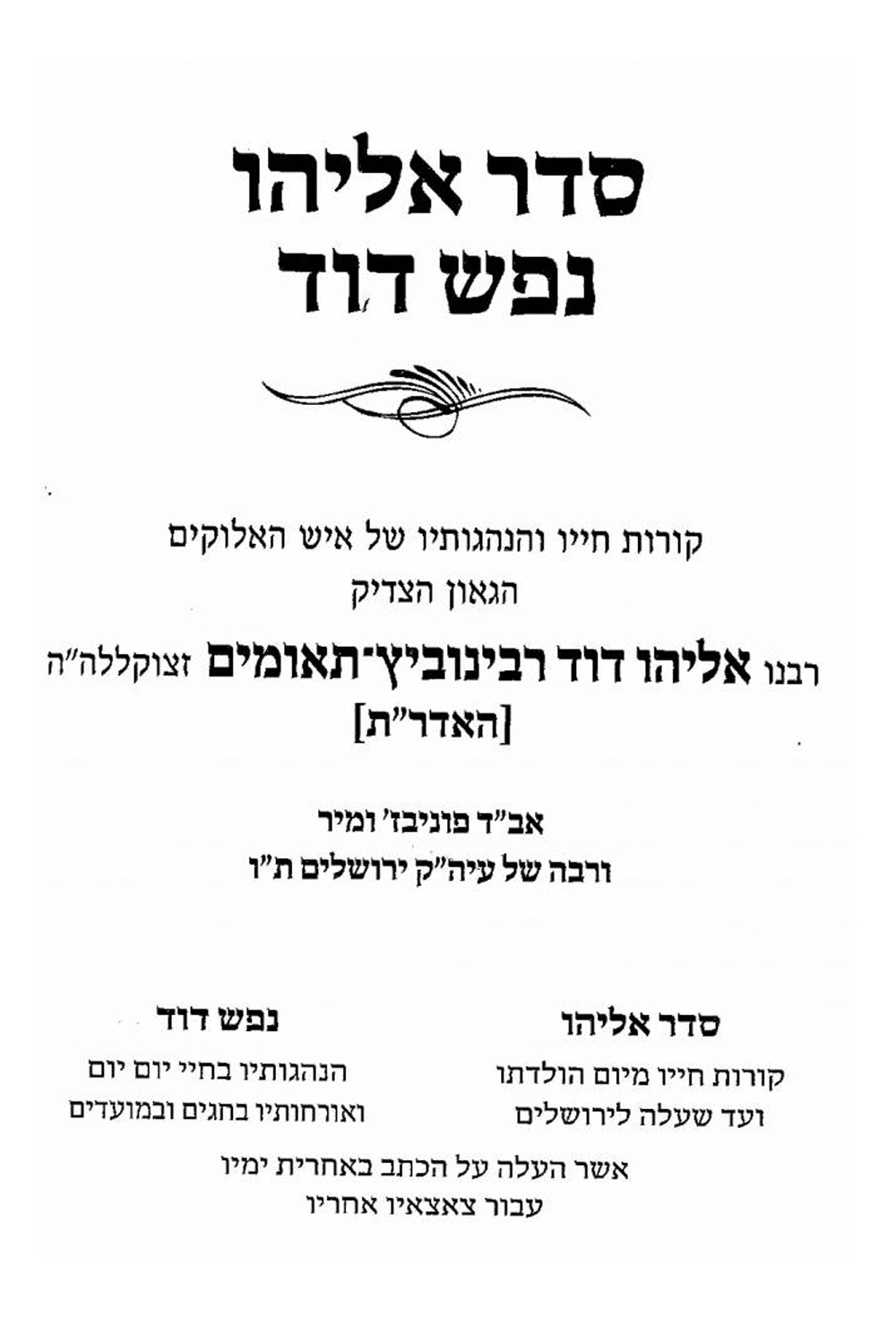
Censorship: The Autobiography of R. Eliyahu David Rabinowitz, ADeReT

Censorship: The Autobiography of R. Eliyahu David Rabinowitz, ADeReT

There are a handful of rabbinic autobiographies, R. Yehuda Areyeh of Modena, Hayyei Yehudah, R. Yaakov Emden, Megillat Sefer, and a few others.[1]  One of the more recent rabbinic autobiographies is that of R. Eliyahu David Rabinowitz, otherwise known as Aderet.  This work, was first published in the journal, Ha-Peles edited by Aderet’s nephew, Eliyahu Akiva Rabinowitz.  Only a portion of the autobiography appears in Ha-Peles. However, the editor did give us the title of this work for posterity.  Although Aderet did not title the work, in Ha-Peles it appears under the title, Seder Eliyahu, this title remains today.[1a] In reality, Seder Eliyahu is one part of three part work, the second part, Nefesh David, records various customs (and has been reprinted a few times), and the third part, regarding how to handle Aderet’s body after his death, Achar Eliyahu or Acharei David, apparently was never written. 

Aderet’s autobiography was first published in its entirety in 1983 by Mossad ha-Rav Kook.   The Mossad received the manuscript from Aderet’s grandson.  As will become apparent, much of what was written, prior to 1983, regarding Aderet is lacking because  prior to its publication in 1983,  his autobiography was virtually unknown.  As an aside, the New Encyclopaedia Judaica reuses the article on Aderet from the original Encyclopaedia Judaica and is but one example of the shortcomings of the New Encyclopaedia, for more examples see Dr. Leiman’s critique here, and Dr. Havlin’s critique here, and Dr. Richler’s critique here of the New Encyclopaedia Judaica. 

The 1983 edition, however, has been out-of-print for years, and this year, some of Aderet’s desendents republished Seder Eliyahu (additionally, they also reprint Nefesh David in this volume).  The editors of this new edition thank Mossad ha-Rav Kook for allowing them to reprint this work.  But, in their introduction, they argue that Aderet “never intended to publish this work and allow others to read it, instead, it was meant for his family.” Seder Eliyahu, Jerusalem, 2010, at 7 (“Jer. ed.” or “New Edition”).  Based upon this assertion, the editors of this edition justify “removing various passages that were never intended for outsiders to read.”  Id. at 9.  They explain that whenever they removed text “three lines (- – -) serve to indicate missing text.”  Id.  As we shall see they are inconsistent at best at using the three dash device and many instances of removal are not noted. 

Regarding the claim that Aderet never intended this book to be published. The original publication in 1983 includes the entire text with no omissions.  Recall that this text was obtained by Mossad ha-Rav Kook from Aderet’s grandson, we have no indication that he objected to publishing the entire text.  Moreover, the first time the autobiography (partially) appeared in Ha-Peles much of the “offensive” material was included. Recall that Aderet’s nephew was the editor of Ha-Peles  and he saw no need to censore anything. Finally, although there may be some indications that an autobiography was merely written for family members and not intended for broader publication, this device is common in autobiographies.  R. Emden also implies that he didn’t intend his autobiography to be widely distributed, but as Dr. Schacter demonstrates, Emden wanted others to read it.[2]  Indeed, according to Schacter, R. Emden’s autobiography can be classified as “that of ‘autobiography as polemic.'”  As Emden writes of his purpose, “[i]n order that the sun of my righteousness should shine forth . . . [and because] many of [my enemies] libelous writings will certainly remain extant in the world for some time.  Therefore, necessity has compelled me to clarify my case before God and man. . . . Behold [this autobiography] will serve as a vindication for me, for my children and my descendants.”[3] Thus, “there is equally no question that the overriding primary impetus behind Megillat sefer was a desire on the part of Emden to clear his name and vindicate himself in his controversy with Eybeschutz,” and “[t]here is no doubt that it is the Emden-Eybeschutz controversy that serves as the ‘center of gravity’ for” Megillat Sefer.[4]  Of course, for R. Emden to be publicly vindicated, presumably the public would need to be aware of the work.[5]

With Emden’s motives in mind, it is important to distinguish Aderet’s work.  While Aderet includes descriptions of others in his work, and, at times, some of these descriptions are far from flattering, it does not appear that Aderet was looking for vindication or had a polemic motive in mind.  While Aderet did not get along with his constituents in Ponovitch, that dispute was mainly surrounding Aderet’s salary and how the community treated him.  Aderet wasn’t involved in any global disputes like the Emden-Eybeschutz controversy and thus Aderet wasn’t required to vindicate himself.  Moreover, Aderet ultimately came out on top, becoming Chief Rabbi of the Ashkenazim in Jerusalem.  Thus, he was well-respected and had no reason to resurrect his image – his image was already good.

Perhaps a better understanding of some of the material as it relates to others in Seder Eliyahu may be better understood by looking at Marcus Mosley’s comments[6] and quote from Rousseau: 

Autobiography operates upon an entirely different set of criteria. For the autobiographer, the significance of the other is determined solely by the role that he or she plays in the formation of the self, regardless of social standing. Thus Rousseau, in the “Neuchatel” variant of the preamble to the Confeinddow: “The relationships I have had with several people compel me to speak as freely of them as of myself. I can only succeed in making myself known by making them known also.” Many of the more decisive encounters with the other in the shaping of the autobiographer’s self occur in the years of childhood and adolescence. Parents, teachers, schoolmates, and domestic staff may thus achieve a prominence in the autobiography that would, in the memoir, be reserved for generals and prime ministers, renowned men of letters, and so on. This is not to say that the formative encounters with the other in an autobiography are restricted to the historically obscure. But when the great do drift in and out of the pages of an autobiography, it is often not on account of the qualities that granted them this status that they are recalled.
Thus, Aderet’s comments about others, most notably regarding R. Yitzhak Elchonon Spector, may be understood as merely providing insight into Aderet’s own life rather than commenting on R. Spector, for example.

The new edition of Seder Eliyahu, however, leaves out much of Aderet’s comments about others, depriving the reader of fully understanding the Aderet as well as distorting history.  We will provide all the examples of where the new edition has altered or removed material from the 1983 edition. 

Biography of Aderet

The basic outlines of Aderet’s biography are not in dispute.  Here are the highlights.  Aderet was born, with his twin, on the first day of Shavout in 1843.  His father was a rabbi and Aderet’s family were descendant from famous rabbinic figures from both his father’s and mother’s side.  When he was five, his mother died and his father remarried.  At twelve, Aderet began writing his first sefer, and began wearing tefflin for his entire twelth year.  At thirteen, he had his bar mitzvah and, contrary to the custom, was allowed to read the haftorah for the first day of Shavout. This haftorah is typically reserved for the rabbi or a talmid hakham due to the content of the haftorah.  But, Aderet’s father argued that it was appropriate for his son to read the haftorah.  Soon after his bar mitzvah he completed his first work with his twin brother, Shevet Achim.  At fifteen he became engaged to girl, and soon after was appointed rabbi of Ragali.  The engagement didn’t end well. His fiancee’s mother died and the step-mother was lax in her observance and the marriage was called off.  But, in due course, Aderet was engaged again to the daughter of a prominent family in Ponovitch.  This time, Aderet went through with the wedding.  He remained in Ponovitch, supported by his in-laws, and studied in a small bet midrash.  In 1875, Aderet was selected to be the rabbi of Ponovitch.  In 1893, the town of Mir approached Aderet to become its rabbi.  Aderet accepted.  Ponovitch, however, wanted its rabbi to remain, but, after receiving advice from various rabbis, eventually, Aderet left and went to Mir.  In 1901 he was invited and accepted to become Chief Rabbi of the Ashkenazim in Jerusalem.  On the 3rd of Adar I, 1905, Aderet died in Jerusalem.

Aderet is known as having a phenomenal memory.  He was also a prolific author, but much of his writings remained in manuscript.  In the last decade or so, many of his books have been published, a bibliography of which will appear soon. 

The above provides a basic outline of Aderet’s biography, but a close examination of his autobiography provides additional detail.    

Autobiography of Aderet

There are a few important gaps in Aderet’s biography that can be filled only by utilizing his autobiography.  For example, Aderet’s father’s second wife.  If one reads some of the biographies, she is mentioned only in passing.  But, Aderet explains she was no minor figure.  To the contrary, it appears that Aderet’s step-mother and his father had a horrible marriage.  Indeed, Aderet couldn’t stand her and he was especially bothered the way she treated his father.  After Aderet’s father died, Aderet immediately left town as he couldn’t bear remaining with her.  He turned down his father’s position as rabbi of Vilkomer because that would mean he would have to live in the same city as his step-mother.  Aderet recalls bitterly how he sped home once and therefore missed out on meeting various rabbis only to find out that his step-mother hadn’t told anyone he was coming and no one was there when Aderet returned causing him to miss meeting the rabbis and not seeing family.

Some biographies make it appear that Aderet had a great relationship with the people of Ponovitch.  These biographies point to the fact that when Mir approached him, Ponovitch tried its hardest to keep Aderet. But, in his autobiography Aderet explains how horrible the people of Ponovich were to him.  They paid him almost nothing and even that little amount wasn’t always timely.  He was so poor that he didn’t have his own bed and had to sleep on a few chairs.  Although Aderet had some of his children die and others were sick, for the most part, the people of Ponovitch made his life even more difficult.  The town didn’t help when he had sick children.  One particularly shocking incident was one of the Ponovitch community members became gabbi.  Aderet didn’t like waiting between Kabbalat Shabbat and Ma’ariv because waiting only meant that people ended up talking and not acting as one should in Shul.  The gabbi, however, wanted to talk and wanted a break.  Thus, when Aderet asked the hazzan to immediately begin ma’ariv, the gabbi told the hazzan “it’s not time yet.”  This type of maltreatment by the Ponovitch community members was not uncommon.  Therefore, when Mir came knocking, and, although Mir was a significantly smaller community, Aderet wanted to get out of Ponovitch and accepted Mir’s offer.

As Aderet was almost always looking to leave Ponovitch, he competed for a job in Riga.  And, although he was the most qualified candidate, the position was given to someone else. Aderet lost out on the position because R. Yitzhak Elchonon Spector backed Aderet’s rival.  Aderet was extremely upset at R. Yitzhak Elchonon and even sent a very nasty letter to R. Yitzhak Elchonon.  R. Yitzhak Elchonon’s reaction was that “the letter was so disrespectful that but for Aderet’s reputation as a talmid hakham, he [R. Yitzhak Elchonon] would see to it that Aderet couldn’t even get a job a beadle in a bet midrash.”  Aderet was so embittered by this episode he remarks that he never forgave R. Yitzhak Elchonon. This was not the only time Aderet had a falling out with R. Yitzhak Elchonon.  At a rabbinic conference, led by R. Yitzhak Elchonon, there was a miscommunication which R. Yitzhak Elchonon took personally.  As such, R. Yitzhak Elchonon refused to entertain anything else during the conference and the conference was totally unsuccessful. Aderet was appalled that R. Yitzhak Elchonon’s personal feelings didn’t allow the conference to produce anything of value. 

Aside from making Aderet’s life miserable, the treatment of the town of Ponovitch also forced Aderet to allow his son-in-law, R. Abraham Isaac Kook, to leave and take up his own rabbinic position.  Although Ponovitch had promised Aderet a higher salary, the town never came through and thus Aderet couldn’t support his daughter and son-in-law.  In his autobiography, he describes how heartbroken he was when his son-in-law and daughter left. 

Comparison of the New Edition and 1983 Edition of Aderet’s Autobiography


As noted above, the editors of the New Edition provide that they have removed material from Seder Eliyahu, and that they have noted any time anything is removed.  This is false.  Although it is true that the editors have removed material but they have not always noted when they did so.  At times removed material is noted by “- – – ” in the text, many times there is no indication that anything is missing.  Moreover, the editors are inconsistent when they alter the text.  That is, in correcting typos or when removing abbreviation, sometimes they note they are altering the text and other times they do not.  Of course, this omission is less serious than wholesale removal of text, but consistency is still important.  For example, in the 1983 edition many persons are only referred to in abbreviated form, while in the New Edition their full name is used; thus the original reads “my uncle רפ”ק” while in the New Edition it reads “my uncle Rabbi Pinchus Cantor.”  The editors don’t note that they have inserted his full name; however, whenever the text uses an abbreviation to refer to R. Shmuel Mohilever – “הגרש”מ” in the New Edition they provide his full name but do so in brackets indicating an insertion into the text. Compare 1983 ed. pp. 84 &  92 & Jer. ed. at 71 & 76. It is unclear why they decided to consistently indicate this insertion and not others.

Turning the censored materials. These materials can roughly be divided into three categories.  (1) materials that mention Zionism or are related to Zionism; (2)  in this category we include what is best described as negative comments about women and marriage; and (3) personal attacks or observations about other Rabbis.  We must note that many of these omissions have been cataloged here as well.

First Category – Zionism

Items from this category include material that appears in the footnotes to the 1983 edition as well as items in the text itself.  The New Edition resuses almost all the footnotes that appear in the 1983 edition but leave out information when that information relates to Zionism.  Thus:

1983 ed. (p. 17 n.5) provides a footnote when the text mentions R. Moshe Telsher “for more information see Sefer Zikhron le-[Rabbi Abraham Isaac Kook] 1945″  Jer. Ed. (p. 15) doesn’t include this note at all. 
1983 ed.  (p. 28 n.14) contains a citation to Maimon’s Sa’arei ha-Meah, Jer. ed. (p. 26 n. 17) removes citation no notation anything is missing.
1983 ed. (p. 29 n.16) explains that R. Mordechai Gimpel Yaffo “was one who espoused emigration to Israel and himself emigrated in 1888”, Jer. ed. (p. 23 n.19) removes this text without notation.
1983 ed. (p. 59 n.46) regarding R. Mordechai Elisberg, the note explains “one of the leaders of the Hovvei Tzion movement,” Jer. ed. (p. 57 n.55), removes this text, no notation.
1983 ed. (p. 72 n.57) regarding R. Shmuel Mohliver “was the head and founder of the Hovvei Tzion movement,” Jer. ed. (p. 69 n.68) removes this text, no notation.
1983 ed. (p. 102 n.78) explaining that the author of Chavush Pe’ar “is R. Kook,” Jer. ed. (p. 96) the note is missing.

We should noted that the editors of the Jerusalem edition didn’t excise every Zionistic mention.  Instead, they retain the sentence “the Hovvei Tzion chapter in Bialystok requested that I [Aderet] give a derasha.”  Jer. ed. at 81.  Similarly, Aderet describes how heart broken he was when his son-in-law and daughter had to leave because Aderet couldn’t support them and how happy Aderet was when he met up with his son-in-law later that year and spent time together.  In the text, however, Aderet doesn’t identify by name his son-in-law.  The New Edition retains the footnote from the 1983 edition which identifies the son-in-law as “The Gaon R. Abraham Isaac Kook ZT”L.”  Jer. ed. at 60 n.57.

Second Category – comments about women

The vast majority of these changes relate to women, and specifically, when there was martial discord or divorce.  There are essentially two women whose mention is censored, Adert’s step-mother and Aderet’s nephew’s first wife.  As mentioned above, Aderet had serious issues with his step-mother and he is very vocal about those problems in his autobiography.  Additionally, Aderet’s nephew’s first marriage didn’t work out.  The first wife was the daughter of R Eliezer the chief rabbi of Anchin but she was uninterested in leading a religious life and thus this marraige ended in divorce.  Whenever mention of either of these two women occurs in Seder Eliyahu the Jerusalem edition leaves them out.  Thus, there is no mention in the Jerusalem edition that Aderet didn’t get along with his step-mother and that the nephew’s first wife wasn’t religious. Rather than explain what is missing each time, as the excised portions are generally similar, we have indicated where a passage relating to Aderet’s feelings about his step-mother is missing and where the excised passage relates to the non-religious first wife of Aderet’s nephew.  We will, however, indicate where there is missing text and the editors of the new edition fail to note that they have removed text.

Step-mother
1983 ed. (18-19) lacking in Jer. ed. (16) noted with – – –
1983 ed. (23) lacking in Jer. ed. (21) no notation
1983 ed. (35) lacking in Jer. ed. (33) noted with – – –
1983 ed. (37) lacking in Jer. ed. (35) noted with – – –
1983 ed. (46) lacking in Jer. ed. (44) noted with – – –
Non-religious wife
1983 ed. (64) lacking in Jer. ed. (60) no notation
1983 ed. (71) lacking in Jer. ed. (68) noted with – – –

There is one final example that arguably fits in this category although it relates to neither of the above mentioned women.  Instead, this instance relates to Aderet spening time in Vienna and meet R. Shlomo Netar.  As part of their conversation R. Netar related some of his problems to Aderet.  One related to his wife who is described – in the 1983 ed. (42)- as “the really horrible woman, may God save us, who is the granddaughter of R. Simcha Bunim Peshischa (or so I [Aderet] recall).” This quote is lacking in the Jer. ed. but is noted with – – -.

We should note that much of the material regarding Aderet’s step-mother appears, in toto, in a separate biography of Aderet that is appended to the beginning of Hiddushei ha-Gaon ha-Aderet, Machon Kitvei Yad ha-Aderet be-Artzot ha-Brit, Israel, 2003.  This is somewhat ironic in that this biography is very careful what it mentions, or doesn’t mention.  Specifically, although Aderet’s son-in-law (and, ultimately, after the untimely death of Aderet’s daughter and remarrying Aderet’s niece, became Aderet’s nephew), R. Abraham Isaac Kook, wrote a fine biography of Aderet, Adar ha-Yakar, and Kook’s biography is used in the biography appearing in Hiddushei, R. Kook’s name is never mentioned.  That is, the mention of R. Kook was controversial (this may be related to the fact that the publisher of this volume is a member of the Satamar sect).[7]  But, regarding Aderet’s step-mother, all that material appears in the biography in HiddusheiSee Hiddushei, at pp. 4, 6, 8 and 10 almost all of which are taken, almost verbatim, from the autobiography. Thus, even without access to the autobiography, any reader can find the relevant passages. 

Third Category – personal observations or attacks on other rabbis

Some of these negative assesments relate to R. Yitzhak Elchonon although comments about other rabbis are also censored. 

1983 ed. (60-61) discussing Aderet’s failed bid to become Riga’s chief rabbi, and, specifically, how R. Yitzhak Elchonon sunk Aderet’s bid.  Additionally, Aderet notes that he sent R. Yitzhak Elchonon a very nasty letter explaining how disappointed Aderet was with R. Yitzhak Elchonon’s involvement and decision to pick someone else.  Jer. ed. (68) the entire story is missing and there is no notation anything was removed.  
1983 ed. (62) Aderet expresses his displeasure with some Ponovitch residents regarding salary negotiations and essentially calls them animals.  Jer. ed. (69) lacking the name calling, no notation anything is missing.
1983 ed. (78) Aderet records the comments of a beadle who questioned R. Yitzhak Elchonon’s authority.  Jer. ed. lacking but noted with – – – .
1983 ed. (79) Aderet meets someone who is wearing two pairs of teffilin neither of which are in their proper place.  Aderet goes on to explain while this person passed himself off as a miracle worker, in reality he was a fraud.  Aderet says the person “is the author of the book Kav Chen.”  This must be incorrect.  The author of Kav Chen, R. Noach mi-Koruv, died in 1855, but Aderet says this meeting took place in 1890. What is more likely is that Aderet was referring to the publisher of Kav Chen, R. Noach’s grandson, R. Hayyim Moshe Ze’ev.  In all events, rather than attempting to correct or ascertain who Aderet is referring to, the Jer. ed. (75) “solves” the problem by removing the passage “the author of the book Kav Chen” and replace it with – – -. 
1983 ed. (83) Aderet mentions “Leib Grabman” who involved the secular authorities in a communal dispute.  Jer. ed. removes “Leib Grabman” and replaced with – – -.  
1983 ed. (87-88) Aderet discusses a rabbinic conference he attended.  In attendence was also R. Yitzhak Elchonon who became personally insulted after a miscommunication.  As such, R. Yitzhak Elchonon refused to allow passage of any of the many “good ideas” the conference attendees offered.  To add insult to injury, in the Jewish press, R. Yitzhak Elchonon blamed the poor result on everyone else.  Jer. ed. (84) removes the entire story and replaced it with – – -.  
1983 ed. (91) Aderet describes some rather insulting behavior directed at him by members of the Ponovitch community, including the gabbi ignoring Aderet.  Jer. ed. (85) leaves out these stories and replaces them with – – -.
1983 ed. (93) after the Aderet leaves Ponovitch a very prominent member of the Ponovitch community died suddenly and “some people said his death was because he failed to show Aderet proper respect and to pay Aderet on time.  As such Aderet is said to have cursed the dead man and his family.”  Jer. ed. (86) removed and replaced with – – -.  
1983 ed. (98) discusses a plan, by persons unconnected to Aderet, to trick R. Yitzhak Elchonon that was ultimately unsucessful. Jer. ed. (91) removed and replaced with – – – .
1983 ed. (99) Aderet details how various rabbis/roshei Yeshiva of Mir weren’t completely honest with Aderet.  Aderet refers to these persons by name.  Jer. ed. (92) removed entirely and replaced with – – -.
1983 ed. (103-04) Aderet details attempts at thwarting him from becoming a teacher at Yeshivat Mir.  Jer. ed. (97) removed and replaced with – – -.  Inetrestingly, much of the background and history of this incident is found in Pinchus Lipschutz’s – the editor of Ya’ated Ne’eman – book Peneni Chen, Monsey, 2000, p. 17 (thanks to a Seforim Blog reader for this citation).  

Additional Comments Regarding Aderet’s Autobiography

Aside from the issues raised above, it should be noted that Aderet’s biography is full of facinating information both about him and his contemporaries as well as of general interest to students of Jewish history, custom, and law. While we intend to devote an entire post to the full contents of Seder Eliyahu we wanted to provide a few particularly interesting passages from Seder Eliyahu.  All of the following examples appear in both editions of Seder Eliyahu.  As mentioned above, Aderet, when he was in Vienna, met R. Shlomo Netar, who was also bookseller and who studied in the Yeshiva of Hatam Sofer.  R. Netar related that he was in class with Hatam Sofer’s son, R. Shimon Sofer (eventual author of Michtav Sofer), was in the same class.  R. Shimon Sofer “was often hit with sticks [by the teacher] and this was at the request of R. Shimon’s father,” Hatam Sofer.  1983 ed. at 42; Jer. ed. at 40.

A few halacha/custom related items.  Aderet records that when he travelled by ship, once the gangplank was lifted and the ship was underway he recited tefillat ha-derekh.  Someone on board the ship questioned this practice arguing that since the ship hadn’t left the city limits, one cannot recite teffilat ha-derekh.  Aderet, however, responded by distinguishing between normal overland transport and ships (and presumably airplanes).  Aderet explained that when going overland there is a fear that one may decide to return home thus one needs to wait until leaving the city limits, the point of no return.  But, once one is onboard a ship and the gangplank is removed one can’t leave and therefore one can immediately recite teffilat ha-derekh. 1983 ed. at 42; Jer. ed. at 40.

Another time, Aderet also advocated for a novel halachic position.  In this case, Aderet wanted to personally perform the circumcision of his son. But, the circumcision fell on Saturday, and, as Aderet hadn’t ever performed a circumcision previously, the rule is that one cannot perform their first circumcision on Saturday.  Aderet, however, argued that the prohibition on performing one’s first circumcision on Saturday applies if one is circumcising someone other than their own child. That is, as there is a unique obligation to circumcise one’s child that trumps the prohibition against performing the first circumcision on Saturday.  Aderet marshalled various sources that supported his position and presented his argument to R. Yosef Zechariah Stern (an equally impressive contemporary) who rejected Aderet’s argument.  Aderet concludes that he “decided to refrain from deciding law in way that runs counter to Shulchan Orach and thus would appear strange to the public.”  1983 ed. 52; Jer. ed. at 51.  

On one Saturday, there was a communal rift which resulted in the secular authorities confiscating the shul’s sefer torah.  Thus, the shul didn’t complete the weekly mandatory reading.  Although Aderet ended up hearing the reading in another shul, Aderet argued that the shul whose sefer torah was confiscated was required the next week to make up the reading it missed.  He argued this position to R. Aaron Halberstam, son of R. Hayyim Halberstam, the Sanzer Rav.  R. Aaron disagreed.  He explained that the torah reading obligation is communal in nature and so long as a community shul recited the proper reading, those in the community that missed it need not repeat it.  Aderet, however, argued that while one needs a minyan and thus is communal in nature, there is an individual obligation to read the weekly portion and if one shul didn’t hear the weekly portion then they need to recite it the next week.  [Hida in his diary/travelouge seems to support Aderet’s postion, see Ma’agel Tov ha-Shalem when he too missed the torah reading].  1983 ed. at 80; Jer. ed. at 77.

One final story relating to custom.  Aderet spends some time on why he picked particular names for his children. One name, however, is particularly noteworthy.  Aderet named one of his sons Mordechai Yonah.  Aderet explains that he picked Yonah because “of [his] mother’s name” Tova which is the Yiddish equivalent of Yonah.  This practice indicates that Aderet wasn’t bothered giving a boy a woman’s name or that naming for someone does not necessarly means using the same form as the original name.  1983 ed. at 51; Jer. ed. at 50.

Post Script Regarding Aderet’s Works & Works About Aderet

Besides for not using the Aderet’s autobiography at all or enough. It is worth pointing out that in the past recent years there has been a virtual explosion of the Aderet’s works which, until now, have remained in manuscript.  The Aderet authored over one hundred works although most still remain in manuscript and are scatered all over the world in various collections.

A few notable works of Aderet that have recently been published.  Mechon Ahavat Shalom has printed eight volumes of Aderet’s works, and, in addition, have published many shorter pieces  in their journal Mekabziel. Worth noting is the recent lengthy correspondence which Machon Ahavat Shalom printed between the Aderet and Yakov Reifman. Mechon Yerushalayim has printed three volumes of the Aderet’s comments on Humash aside from the many pieces they have printed in their journal Moriah. Additionally, there are some other volumes that have been printed from manuscripts. One worth mentioning is the Over Orach which was printed by Mechon Me’or the editor of this work proudly told me how he took out many pieces from this manuscript before printing it for the public as he felt it was not “kovod” for the Aderet. Now this censorship isn’t mentioned anywhere in the work.  Besides for the significance of the Torah found in these works which will be the subject of its own post including a in depth bibliography and description of the works. There is also much important material about Aderet’s life that can be gleaned from these recently published works. 

Below is a (non-comprehensive) list of articles discussing Aderet’s biography, although some are better than others:

Ehad be-Doro, vol. 1, 191-202
Seder Parsheyot le-Aderet, vol. 1, Machon Yerushalyim, Jerusalem, 2004, 329-99 (includes bibliography)
Shlomo Albert, Aderet Eliyahu, Jerusalem, 2003
Hiddushei ha-Gaon ha-Aderet, Machon Kitvei Yad ha-Aderet be-Artzot ha-Brit, Israel, 2003, Katzman 1-42.
Moshe Tzinovitz, Ishim u-Kehilot, Tel Aviv, 1990 128-30
Moshe Tzinovitz, Mir, Tolodot Yeshivat Mir, Tel Aviv, 1981, 175-83
Rabbotenu she-beGoleh, Jerusalem, 1996, vol. 1, 121-28
Asher Yetzaveh, Mechon Ahavat Shalom, Jerusalem, 2004, vol. 1, pp. 395-425 (Nefesh David is reprinted in this work, however, the editors fail to mention that they copied it from the 1983 ed.). 

  
Notes:
[1]  See Jacob J. Schacter, “History & Memory of Self:  The Autobiography of Rabbi Jacob Emden,” in Jewish History & Jewish Memory, Essays in Honor of Yosef Hayim Yerushalmi, eds. E. Carlebach, J. Efron, D. Myers, Brandeis University Press, 1998, 429 and nn. 6-8 discussing these autobiographies and providing additional examples. Emden’s autobiography, the Kahana edition is available online at here, and here with Gershom Scholem’s notes. Scholem penned his own autobiography (although it only covers a small portion of his life), Gershom Scholem, From Berlin to Jerusalem, tr. Harry Zohn, New York, 1980. Elliot Horowitz discusses Scholem’s autobiography in Horowitz’s article, “Confessions of a Jewish Autobiography Reader,” in JQR (n.s.), 95 (1), Winter 2005, pp. 74-80 & Saverio Campanini, “A Case for Sainte-Beuve, Some Remarks on Gershom Scholem’s Autobiography,” in Creation & Re-Creation in Jewish Thought, eds. R. Elior & P. Schafer, Paul Mohr Verlag, 2005, pp. 363-400.  More recently, Scholem’s diaries have also been published, Lamentations of Youth:  The Diaries of Gershom Scholem 1913-1919, ed. & tr. A.D. Skinner, Cambridge, Mass, 2007, a review appears here.   
Returning to Emden’s autobiography aside from the Kahana edition linked to above, there is another edition published by Abraham Bick-Shauli in Jerusalem in 1979, however, Schacter has serious reservations about this edition.  Schacter’s assesment of Bick-Shauli’s edition is that it “is absolutely and totally worthless.”  Schacter, id. at 446 n.13.  Of late, someone attempted to question the authenticity of Emden’s autobiography, Schacter’s comments are equally appropriate regarding this work as well.
Regarding Modena’s autobiography, see also Ariel Rathaus, “Leon Modena’s Autobiography & His Realistic Poetics,” in Italia, ed. Robert Bonfil, Conference Supplement Series, 1, Magnes Press, Jerusalem, 2003, 131-42. Of course, regarding Modena one should always consult Howard Ernest Adelman, Success & Failure in the Seventeenth Century Ghetto of Venice:  The Life of Leon Modena, 1571-1643, unpublished doctoral dissertation, Brandeis Univ., 1985, and this post by Yitzhak and this follow-up post on Ishim ve-Shitos. Modena’s autobiography is available in excellent editions in both Hebrew and English (part of which is online at Google books here), The Autobiography of a Seventeenth-Century Venetian Rabbi: Leon Modena’s Life of Judah, ed. Mark R. Cohen, Princeton Univ. Press, 1998 (English) & Sefer Hayyi Yehuda, ed. Daniel Carpi, Tel Aviv Univ., Tel Aviv, 1985. 
Additionally, regarding Jewish autobiography generally this discussion here, and see  M. Stanislawski, Autobiographical Jews, Essays in Jewish Self- Fashioning, Univ. Washington Press, 2004.  Thanks to both Menachem Butler and Eliezer Brodt for providing many of these sources.
[1a] The Ha-Peles piece has a very nice footnote where Aderet’s sister’s erudition is described.  “She knew Hebrew and the Talmudic language. During the winter, on Friday nights, she would sit by the fire and study the responsa literature of the rishonim, such as the responsa of Rashi, Rambam, Rosh and similar titles that don’t contain pilpul. She was fluent in many responsa.  She also studied the Sefer Hassidim daily.”  She was so well-versed in Sefer Hassidim that her father, when he was unsure of a citation in Sefer Hassidim would ask her. Eliyahu Akiva Rabinowitz also records that after Aderet published an article in Yagdil Torah she read it and asked an insightful question, which Aderet subsequently published, in her name, in Yagdil TorahSee ha-Peles, 720 n.2.
[2]  See id. at 438 and nn. 58-59 (Schacter offers citations to other similar works who employ this device).
[3] Id. at 431 quoting Megillat Sefer, Kahana ed. (“with slight corrections from the manuscript”) pp. 54-55. 
[4] Id. at 433.  
[5] Assuming that Schacter is correct regarding Emden’s motives, the lingering question is why wasn’t Megillat Sefer published during Emden’s lifetime or soon after? Emden had his own press and was not shy about publishing his own works that defended his position, no matter how controversial those works were.  Why didn’t Emden do the same with his autobiography?  Unfortunately, Schacter doesn’t address this question, perhaps in his forthcoming translation of Megillat Sefer, he will provide more background regarding the publication of Megillat Sefer.
[6] Marcus Mosley, “Jewish Autobiography:  The Elusive Subject,” in JQR (n.s.), 95, 1 (Winter 2005), 25.   
[7] The author of this biography, however, is not Satmar.  The author of the biography portion is R. Eliezer Katzman who is perhaps the only person who has demonstrated the similarities between various positions of R. Abraham Isaac Kook and the Satmar Rebbi.  See Eliezer Katzman,  in Ketonet Yosef, ed. D. Gotlieb et. al. New York, 2002.   


Was Avraham a Lamdan?

Was Avraham a Lamdan?
By Ezra Brand

I would like to thank Eliezer Brodt for reviewing this article and discussing it with me, and my father for editing this article.

Some time ago there was a discussion in cyberspace regarding whether the Avos kept all of the mitzvos. The discussion was started when a video on Youtube made fun of the idea, and a response to the video was published on the Hirhurim blog (here), as well as counter-response (here). I’d like to discuss some of the basic issues involved.

The Mishnah at the end of Kiddushin says that Avraham kept the whole Torah.[1] The Rambam (Hil. Melachim 9:1) brings down the mitzvos that each of the Avos innovated. Many laws are learned from the stories in Bereishis even though they happened before the giving of the Torah.[2]

However, Chazal do not discuss any of the questions arising from the statement that the Avos “kept the Torah.”[3] Here and there, the commentators discussed some of the more obvious questions. For example, the Ramban in his commentary on the Torah (Gen. 26:5) famously asks how Ya’akov could have married two sisters, something prohibited by the Torah. This question in particular seemed to have intrigued many commentators.

The later commentators discussed whether the Avos and their children had the status of Jews or non-Jews, since they lived before Matan Torah. This question is discussed extensively by the author of the Mishneh L’melech in his sefer P’rashas D’rachim. Later, this was discussed at length by R’ Yosef Engel in the first volume of the encyclopedia he started to write, called Beis Ha’otzar, under the entry “Avos.” An interesting question that was first posed by R’ Pinchas Horowitz, one of the rebbeim of the Chasam Sofer, in his commentary on the Torah, Panim Yafos, is the following: According to the opinion that the Avos were inherently non-Jews, how could they keep the whole Torah, which includes keeping Shabbos? We know that a non-Jew is prohibited from keeping Shabbos, so what did they do? Many ingenious answers are given to this question.[4]

A few hundred years ago, a popular method of learning was the “pilpul” method. In short, this method consisted of explaining difficult passages in the Gemara by connecting the passage under discussion with other seemingly unconnected passages of Gemara in other places. This style was not limited to Gemara, but was also used when explaining the Chumash. This method was attacked by R’ Yair Chaim Bachrach, author of the Chavos Yair, as well as by others.[5] In any case, in these seforim pilpul was used to answer questions on the Avos’s actions.[6] To quote the Encyclopedia Judaica (1st edition, Volume 13, entry “Pilpul,” pg. 527): “Criticism was much more lenient regarding the application of pilpul to the exposition of the Bible and the homiletic literature, since this was considered irrelevant to a true understanding of halakhah. Consequentially, popular preachers used to strain their imagination by adducing the most complicated talmudic passages and controversies in order to throw new light on a story from the Bible or the Midrash.”

In the past 150 years, literature on the attempted synthesis of the Torah Shebichsav (Written Torah) and the Torah Shebal Peh (Oral Torah) has exploded. This literature was meant to show that the explanations of Chazal, Torah Shebaal Peh, are in truth hinted to in the Torah Shebichsav itself. Originally, the reason for this was the attacks of the maskilim on the tradition of Torah Shebaal Peh. This led to the commentaries of R’ Shamshon Rephael Hirsch, the Malbim, the sefer Haksav V’Hakabbalah, and the sefer Meshech Chochma. In addition, many anthologies of the words of Chazal regarding the written Torah were collected and put in the order of the Torah. Examples of this include the sefer Torah Temimah, as well as the still-incomplete Torah Shleimah. [7]

However, these commentaries, in their comments on Sefer Bereishis, do not systematically try to harmonize the actions of the Avos with the accepted halachah.[8] This is somewhat surprising, since the point of their commentaries is to harmonize the Torah Shebichsav with the Torah Shebaal Peh, and this would seem to be a part of that job description.

With the contemporary stress in the yeshivos on the learning of Gemara to the exclusion of almost everything else (excluding perhaps mussar seforim), and the great stress on “lomdus”, some recent seforim have followed the trend of harmonizing Torah Shebichsav with Torah Shebaal Peh to the extreme. (Lomdus is an expression used in yeshivos to refer to the Brisk analytic-style of identifying and analyzing concepts. The Yiddish term reid is also used to mean the same thing.) These modern seforim will treat the possuk like a piece of Gemara, ignoring possible theological or philological explanations, and only answer using lomdus. This lomdus can be taken to such extremes that it is often very similar to the pilpul commentaries on the Torah of the 17th century. These seforim basically spend a long time trying to answer a question in any possible way, without trying to actually fit the explanation into the passuk in any way.

The sefer Chavatzeles Hasharon by R’ Mordechai Carlebach (on Bereishis, Yerushalayim 5765) is the most popular of this genre. This sefer essentially contains essays of lomdus based on the parshah, including many questions on the halachic acceptability of the Avos’s actions. Even more recently, the sefer Arugas Habosem by R’ Menachem Ben Yakov (on Bereishis and Shemos, Yerushalayim 5772) is almost an exact copy of Chavatzeles Hasharon, not only in content but also in the physical layout. A sefer by a nephew of R’ Shlomo Zalman Auerbach, R’ Baruch Rakovski, called Birchas Avos (Yerushalayim 5750), is completely devoted to questions on the Avos’s actions, as is the sefer Mili D’Avos (by R’ Shmuel Yaffah, Lakewood 5770).

Recently, seforim which collect divrei torah on the parshah from different sources have gained popularity.[9] One of the first of this genre is the Pardes Yosef (by R’ Yosef Pazanavski, incomplete, Bereishis, Piotrkow 5690, Shmos and Vayikra, Lodz 5697).[10] This was followed many years later by R’ Yisachar Rubin’s very popular Talelei Oros (10 volumes, Bnei Brak 5753-5757). Another sefer of this genre is K’motzei Shallal Rav, which collects divrei torah on the parshah from places one would normally not expect to find them, such as in introductions to a halachic works. Since these divrei torah are in the context of a halachic work, many times they are very halachically oriented. Hence, these divrei torah also fall into the category of trying to synthesize. Pilpula Charifta, by R’ Natan Margolis (on Bereshis, volume 1, Yerushalayim 5755, volume 2, Yerushalayim 5750), also collects divrei torah in the same manner.

Are these kinds of explanations part of the “Seventy Faces of Torah”? Do the authors of these explanations themselves think there is any truth to the explanations they are presenting? The author of the Klei Chemda writes in his introduction that much of what he wrote in the sefer is “לחדודי בעלמא”, to sharpen the mind. This idea comes from the Gemara, which says that sometimes teachers who say a false din in order to get their students thinking, and ultimately to correct them.[11]

I think that a similar question has to be asked on many Chassidic explanations, as well as the common “vort.” Did the authors of these explanations really think this was a possible explanation of the text? I think not. In fact, many times authors will write that their explanation is “בדרך צחות”. So why do they bother writing them? There are two possible explanations. First of all, even if the explanation is not true, the parts leading up to it are. (Assuming there is more than one part to the explanation.) The vort is a fun way to teach people the intermediate parts. In addition, they will be able to remember the intermediate parts more easily, since they are logically connected to an interesting end.[12] A second possible explanation for why the authors wrote such explanations is that there is an underlying moral message (assuming there is an underlying moral message). As with the first explanation, the vort is an enjoyable, and therefore effective, way of getting across a moral lesson.

Would a Chassidic Rebbe admit that his “Toyreh” is not the true explanation of the verse? That is a question that I cannot answer.[13]

[1] also Yoma 28b; Yerushalmi Kiddushin Perek 2 Halacha 12; Vayikra Rabbah 50:10; Tanchuma Lech L’cha 11; and many more places. See Encylopedia Talmudit, Volume 1, entry “אבות”, pg. 36-37.

[2] See Encylopedia Talmudit, Volume 1, entry “אין למדין מקודם מתן תורה”, pg. 635ff. However, see the Encyclopedia Talmudit ibid. that quotes the Yerushalmi that says that we don’t learn laws from stories of events that happened before the giving of the Torah. See Encyclopedia Talmudit ibid. for various attempted explanations.

[3] See Sanhedrin 58b where the Gemara discusses some of the marriages of the Avos in the context of discussing the laws of incest for b’nei no’ach. However, the laws of b’nei no’ach are far less than what a Jew must keep. The Gemara in Yoma (referenced in note 1) says that Avraham even kept rabbinically mandated laws.

[4] Regarding all this see Encyclopedia Talmudit referenced in note 1. See also Maharatz Chayes in Toras Hanevi’im, Chapter 11, pg. 63-72; Nefesh Hachaim, Sha’ar 1, Chapter 21; Leket Yosef (available here); Steven Wilf, The Law Before The Law, Lexington Books, 2008 (here).

[5] R’ Bachrach attacked the pilpul method in Shu”t Chavos Ya’ir, siman 123, and at length in an unpublished sefer of his called Ya’ir Nesiv. Parts of it were published by Jellenik in the journal Bikurim, Vienna 5624, pg. 4. Pilpul was also attacked by the Maharal and the Shelah. See also the ostensibly anonymous K’sav Yosher, published in 5544, pg. 9b, (here). It’s author was Saul Berlin of Besomim Rosh infamy.

[6] I’d like to point out at this point that much of what I will write also applies to the Jews after matan torah. There are many questions on how their actions fit with the commonly accepted halacha. However, I am mainly focusing here on the actions of the Avos. As for the actions of the Bnei Yisroel after matan torah, the Gemara discusses these questions in many places. Many times the answer of the Gemara is that the action was a hora’as sha’ah, i.e. a temporary waiver of the prohibition. See at length Encyclopedia Talmudit, Volume 8, entry “הוראת שעה”. R’ Yitzchok Halevy in his monumental Doros Harishonim, in the volume discussing Tanach and aimed at refuting the Bible Critics, tries to answer many of the questions of the maskilim on the Torah Shebaal Peh based on Tanach. Another sefer that I am aware of that discusses these questions is the commentary Mussar Hanevi’im, on Nevi’im Rishonim (by R’ Yehuda Leib Ginzburg, Volume 1, St. Louis 5705, Volume 2, Yerushalayim 5736, available here and here).

[7] Interestingly, a hundred years before the publishing of the Torah Temimah, R’ Dov Ber Treves, who was on the beis din of Vilna at the time of the Gra, also wrote a commentary on the Torah bringing down many of the saying of the Gemara in order of the Torah. In fact, the Torah Temimah was accused of plagiarizing from the Revid Hazahav. Another little known work of this sort is the Be’er Heiteiv (Vayikra, Vilna 5627), available here. The Chazon Ish writes on this workוראיתי להגאון האדיר ר’ אריה ממינסק בספרו באר היטב… (חזון איש, קדשים ס’ כו אות טז).

[8] They do, however, discuss these questions in many places, especially the Meshech Chochma. The Netziv in his commentary on the Torah, Ha’amek Davar, also incorporates much from Torah Sheba’al Peh, and answers questions on the Avos’s actions.

[9] There is a similar phenomenon of seforim collecting the different explanations of the commentators on the Talmud, such as Machon Yerushalayim’s Otzar Mefarshei HaTalmud, Frankel’s Mafte’ach, and many others.

[10] For a description of the Pardes Yosef, see an earlier post on the Seforim Blog here.

[11] Eiruvin 13a, and other places. This is one of the contexts in which it is permitted to lie. See R’ Yosef Chaim, Shu”t Torah Lishmah, siman 364, Yerushalayim 5736, pg. 250 s.v. ובגמרא דעירובין. R’ Yosef Chaim in that response collects all the places in which it is permitted to lie. Contrary to popular belief, it permitted to lie in far more than the three places the Gemara in Bava Metzia 23b says. One of the most surprising cases in which it is permitted to lie, is the following: If a person knows that a certain halacha is true, but because of his low standing in people’s eyes, when he says it, it will not be accepted, he is permitted to say that a certain gadol said that halacha, even if that gadol never said such a thing! See at least four examples of this in Torah Lishmah there (pg. 250, s.v. ובגמרא דשבת; ibid. s.v. עוד שם בדף נא; pg. 251. s.v. ובגמרא דפסחים; pg. 252, s.v. עוד שם בדף כ. This would seem to cause problems for the mesorah of Torah Shebaal Peh, and was in fact one of the maskilim’s questions on the veracity of the mesorah. See I.H. Weiss, Dor Dor V’Dorshov, Part 1, Chapter 1, pg. 4.

[12] This is similar to what the Rambam writes in the introduction to his Peirush Hamishnah (Mossad HaRav Kook edition pg. 10) regarding asmachtos. He writes that the Gemara never intended to to say that asmachtos are true explanations of the verse. Rather, the asmachta is a formula to help people remember the halacha, as in the times of Chazal it was prohibited to write Torah Shebaal Peh. This view is atacked harshly by the Ritva, Rosh Hashonoh 17a. See Encyclopedia Talmudit, Volume 2, entry “אסמכתא”, pg. 106, footnote 16 and 28.

[13] A possible nafkah minah (halachic ramification) is whether it is permitted to learn the explanation in the bathroom, where learning Torah is generally prohibited. However, this nafkah minah is mostly theoretical, because, as was pointed out, even if the explanation itself is not true, many times the constituent steps are Torah. See Yisroel Bazenson, Messilat Hak’sharim (Tel Aviv 5766), (this sefer is written by a follower of Breslov and attempts to formulate “rules” for learning Likutei Moharan) pg. 153, where the author asks this question regarding the teachings of R’ Nachman of Breslov; he points out that many times R’ Nachman’s explanations even go so far as to contradict the simple meaning of the phrase he is coming to explain. Bazenson answers:

ברוב הפסוקים ומאמרי חז”ל שהוא שהוא מפרש על פי דרכו הפנימית , לאף שנראה כמשנה או אפילו כסותר הפירוש הרגיל , אם יזגה המעיין ישיג את המקום שבו שני הפירושים מתחברים ועולים בקנה אחד. ואז הפירוש הרגיל יקבל, כתוצאה מחיבור זה, תוספת בהירות שמעולם לא היתה לו.

Bazenson then goes on to bring three examples of such places in Likutei Moharan, and attempts to show how in fact the nistar complements the nigleh. (I would like to thank Eliezer Shore for pointing out this source to me.) I have not studied his explanations in depth to see if they are convincing.


Review of Dovid Bashevkin’s Sefer Berogez Racheim Tizkor

By Rabbi Yitzchok Oratz
Rabbi Yitzchok Oratz, a musmach of Beth Medrash Govoha, is the Rabbi and Director of the
Monmouth Torah Links community in Marlboro, NJ.
אהרן יצחק הלוי ארץ
כי הוא ידע יצרנו:
הערות והארות, ציונים ומראה מקומות, על עניניבחירה, חטא, ותשובה.
מיוסד על ספר “ברגז רחם תזכור” להרב דוד אליקים בשבקין.
Introduction
In wrath, remember mercy. For He knows our nature . . .
God knows the nature of every generation, Rabbi Dovid Bashevkin has written a Sefer uniquely appropriate for the nature of ours[1].
Take a trip to your local Jewish bookseller during this time period, and you will find numerous seforim, old[2] and new[3], on the themes of sin and repentance. Although they certainly vary in style and quality, a common denominator among many is the heavy reliance on Rambam’s Hilchos Teshuva and Sha’arey Teshuva of Rabbeinu Yonah of  Gerondi[4].  And this is to be expected. Timeless classics, these works of the great Rishonim are unmatched in their systematic and detailed discussion of sin and punishment, free will[5] and repentance, and are a prerequisite study for any serious discussion of Teshuva.
But therein lays the dilemma.
For although Rabbeinu Yonah maps out the exalted levels of Teshuva that one should certainly strive for, they seem not to be for the faint of heart.  Is our generation really up to the task of embracing the sorrow, suffering, and worry, the humbling and lowering oneself[6], without allowing for the concomitant sense of despair[7] and despondence[8]?
And how many of us can honestly stand before the Creator, and proclaim that we will “never return” to our negative actions, to the extent that God Himself will testify that this is the case[9]? If confession without sincere commitment to change is worthless[10], does repeating last year’s failed commitments not require choosing between giving up and fooling ourselves?
This is where B’Rogez  Rachem  Tizkor comes in Based heavily on the thought of Izbica in general, and Reb Tzadok ha-Kohen of Lublin in particular, it discusses the value of spiritual struggle, the interplay between determinism and free will, the redemptive potential of sin, and the status of those who have not yet arisen from their fall.
In a refreshingly humble[11], almost apologetic, essay at the Seforim blog, R’ Bashevkin expresses hope that his work brings “the much needed attention these thinkers deserve in contemporary times,” while delivering a message of “comfort and optimism[12],” without being disloyal “to the type of avodas Hashem . . . they hoped to engender[13].” I think he was successful on all accounts.
Overall, the sefer is a good introduction to R’ Tzadok for those who are not familiar with his thought, and offers many insightful and fascinating comments even for those who are. Some that I found particularly interesting includethe insight into why R’ Mesharshiya cursed Ravina that he should come to permit forbidden fats (Yevamos 37a, B’Rogez Rachem Tizkor p. 16), what important lesson can be learned from the Talmudic teaching that one who responds Amein Yehay Shemy Rabbah with all his might is forgiven even if he has a trace of idolatry (Shabbos 119b, p. 18), what benefit is there in requiring that anyone appointed to the Sanhedrin know how to purify a sheretz (Sanhedrin 17a, p. 19), why does the Talmud expound so harshly on the sins of Achan (Sanhedrin 44a, p. 36), a new understanding of why one may lie for the sake of peace (Yevamos 65b, p. 84), and what possibly could be negative about being attached to Torah (p. 23).
In the aforementioned essay, the author hopes that, in keeping with its theme, the work is read with a “measure of mercy.” He has nothing to worry about. My main critiques are that some of the discussion of the more controversial statements of Izbica required more elaboration[14], the lack thereof leads to a seeming conflating of two similar, yet far from identical, concepts, and more contrasting and supporting texts (both from within Izbica and R’ Tzadok’s thought and without) would have made for a stronger case and deeper understanding.
My hope is to fill in these gaps in some small measure. Hopefully it will further enlighten those whose appetite was whet by this fine work.
ועתה באתי להעיר כדרכו של תורה, ואת והב בסופה.
הכל בידי שמים אפילו יראת שמים!”
א) בסי’ ג’ שו”ט בטוטו”ד בענין מה שנראה שהוא חידוש נועז[15] מבית מדרשו של האיזביצ’א, דהכל בידי  שמים אפילו יראת שמים[16]ודיש מושג של עבירות שהם למעלה מבחירת האדם[17].
וקודם כל אעיר, דכנראה עירבב שני דברים דומים אבל לא שוים. דהיסוד הראשון הוא דהכל בידי  שמים אפילו יראת שמים, דהיינו דכל מה שהי’ הוה ויהי’ הוא בדיוק רצונו יתב”ש, כל מעשי המצוות וכל העבירות, דוכי יעשה בעולם דבר שלא ברשות קונו ובלא חפצו? כל אשר חפץ ה’ עשה בשמים ובארץ! וכשמדברים על דרך זה, אין שום חילוק בין עבירות שהן למעלה מבחירתנו ואלו שתוך שדה בחירתנו. “כל מה שחטא הי’ גם כן ברצון השם יתברך” (צדקת הצדיק אות מ’). “ולעתיד יתברר כן על כל חטאי בני ישראל וכו’ שיתברר שהיה מסודר מאמיתות רצון ה’ יתברך שיהיה כן ואם כן גם בזה עשו רצון ה’ יתברך” (מחשבות חרוץ אות ד’). הכל הוא מאתו יתברך.
והענין השני הוא כשמדברים מתוך עולם הבחירה[18], דע”פ פשטות בחירה הוא ד”נדע בלא ספק שמעשה האדם ביד האדם” ו”עושה כל מה שהוא חפץ ואין מי שיעכב בידו מלעשות הטוב או הרע,” ומשו”ה “דנין אותו לפי מעשיו” (רמב”ם פרק ה’ מהלכות תשובה), ואעפ”כ חידש האיזביצ’א  ד”לפעמים אשר יצר האדם מתגבר עליו עד שלא יכול לזוז בשום אופן ואז ברור הדבר כי מה’ הוא” (מי השילוח פרשת כי תצא כ”א:י”א), ו”פעמים יש אדם עומד בנסיון גדול עד שאי אפשר לו שלא יחטא” (צדקת הצדיק אות מ”ג)[19].
הרי דיש שני ענינים נפרדים, שניהם חידושים נפלאים, ושניהם מבית מדרשו של האיזביצ’א.
ב) אבל באמת, כד נעיין היטב בזה,  נמצא  הרבה  סייעתא לשני החידושים בדברי חז”ל ובתורתן של גדולי ישראל אף מאלו הרחוקים מתורת איזביץ, דבעיקרי התורה ויסודותיה תורה אחת היא לכם[20].
“שאין מציאות כלל ללא השם יתברך וכו’ ולא שיך כלל לעבור על רצונו, כי אין שום מושג ללא רצונו יתברך. ואף כאשר האדם חוטא, אינו עובר על רצון השם יתברך, אלא זה גופא רצונו יתברך, ורק האדםטועה וסוברשעושה נגד רצון השם, ועל זה יענש על שסובר שעושה נגד רצון השם יתברך. ואיתא בחז”לשבפרשת האזינו מורמז כל הבריאה כולה, וכל מעשי האדם לעולם וכל זה כבר יצר הקדוש ברוך הוא בעת בריאת העולם, והאיך יתכן שיעבר על רצון השם, והרי הכל כבר נברא ונוצר על ידו.”
הרואה דברים אלו בודאי יחשוב דתורת איזביץ  יש כאן.
ואינו כן. אלא מבית מדרשו של בעלי המוסר, מפי המשגיח המפורסם הרה”ג ר’ יחזקאל לוינשטיין ז”ל  יצא הדברים (אור יחזקאל, שיחות אלול עמוד ס”ז – ס”ח). ולהפתעתי מצאתי  שדבריו הובאו  גם בספר ממחבר מפורסם של חסידי ברסלב[21]. הרי דתורת ברסלב, איזביץ, ובעלי המוסר, כולם מסכימים לעצם היסוד דהכל בידי שמים, ללא יוצא מן הכלל.
ומקור הדברים לכאורה הוי במדרש (במדבר רבה, פרשת נשא, פרשה “יג סי’ י”ח):
אע”פ שאירע לשבטים שבא לידיהם מכירת יוסף את סבור שלא היה בא לידם אותו המעשה             אלא א”כ היו רשעים במעשה אחרים לאו אלא צדיקים גמורים היו ולא בא לידם חטא מעולם וכו’ אלא זה בלבד ומתוך גנותם סיפר הכתוב שבחם שלא היה בידם עון אלא זה בלבד ולפי שמכירת יוסף זכות היה לושהיא גרמה לו למלוך וזכות היתה לאחיו ולכל בית אביו שכלכלם בלחם בשני רעבון לכך נמכר על ידם                        שמגלגלין זכות על ידי זכאי.”
ולכאורה תמוה, דאף דלבסוף היה לטוב עדיין צ”ע מה דה”זכות” מתייחס להם דהא מפורש במדרש דמכירת יוסף היה “עון.”
אלא לכאורה הכוונה הוא דכל ענין מכירת יוסף הי’ עצה עמוקה של אותו צדיק הקבור בחברון[22] ובהכרח ירדו בנ”י למצרים דעצת ה’ היא תקום. הרי דבמכירת יוסף, אף דנחשב להם לעון, אפ”ה היו השבטים שלוחא דרחמנא לקיים גזירותיו. ומעשה אבות סימן לבנים[23], דכן הוא בכל מה שאירע בהעולם, הכל הוא לקיים רצונו יתברך[24], וזהו אף בהעבירות שאדם עושה[25], אבל בעבירות אין התועלת והטוב שיצא ממעשי אדם מתיחחסים לו[26], ואדרבה נענש עליהם אף שמעשיו היו “גופא רצונו יתברך[27].” אבל כל זה כשלא עשה תשובה, אבל אצל שבטים שאמרו “אבל אשמים אנחנו על אחינו” (בראשית פרק מ”ב פסוק כ”א) שהוא תשובה על מעשיהם (עיין בשערי אהרן בשם הזוהר ועוד) נעשה להם זדונות כזכיות ממש וכמו שלא הי’ עון כלל, דיבוקש עון ישראל ואיננו, וכל הטוב הנמשך ממעשיהם מתייחס להם כזכות ממש[28] (עיין בזה בס’ תקנת השבין סי’ י’ אות ט).  הרי דאף מעשי העבירות הוי קיום רצונו יתברך.
ג) וכל זה הוא בנוגע להענין הראשון (ד”כל מה שחטא הי’ גם כן ברצון השם יתברך” ו”אף כאשר האדם חוטא וכו’ זה גופא רצונו יתברך”). ובנוגע הענין השנית, דהוא דאף כשמדברים על עולם הבחירה אפ”ה לפעמים יש מציאות דיש עבירות שא”א שלא יכשל בהן, בזה היטיבו אשר דברו בזה ב”ברגז רחם תזבר” דשפיר משמע מפשטות שיטת ר’ אלעאי (קידושין מ.) דיש ענין בזה.
  ובאמת, יש עוד כמה מקומות בש”ס דמשמע כן. עיין צדקת הצדיק (אות מ”ג) דהביא מגמ’ ברכות ל”ב. “משל לאדם אחד שהיה לו בן הרחיצו וסכו והאכילו והשקהו ותלה לו כיס על צוארו והושיבו על פתח של זונות מה יעשה אותו הבן שלא יחטא,” וכן מגמ’ כתובות נ”א: “כל שתחלתה באונס וסוף ברצון אפי’ היא אומרת הניחו לו שאלמלא לא נזקק לה היא שוכרתו מותרת מ”ט יצר אלבשה” “הרי דזה מחשב אונס גמור אף על פי שהוא ברצונה מכל מקום יצר גדול כזה אי אפשר באדם לכופו.[29]”
ועייו בס’ יד קטנה (ריש הל’ תשובה) דהאריך לחדש דיש ענין “רב וגדול למאוד” בוידוי פה אף בלי חרטה[30] ובלי עזיבת החטא[31], ובכל דבריו מיירי במי ש”אין לו שלטון וממשלה על חוזק כבד לבבו להטותה באמת” ו”הרי הוא כמו אנוס מן חוזק כבד לבבו,” הרי דנקט לדבר פשוט שיש מצבים ויש אנשים שבשום אופן א”א להם לשוב מדרכם הרעה.
ועיין בס’ מכתב מאליהו ב”קונטרס הבחירה” (ח”א עמוד קי”ג) שביאר הגרא”א דסלר זצ”ל לא רק דיש עבירות שהן למעלה מבחירתנו, אלא רוב מעשינו הוא למעלה או למטה מנקודת הבחירה שיש לכל או”א. ועיין שם בהערה מהרב ארי’ כרמל דהמקור לדבריו הוא מדברי ר’ אלעאי בקידושין שם. הרי לא רק דכן ס”ל לר’ אלעאי אלא נקטינן כדבריו[32].
ויש לציין שבדברי הנחל נובע מקור חכמה כנראה מבואר דלא כזה. עיין ליקוטי מוהר”ן (תנינא, תורה ק”י) “שמעתי, שאיש אחד שאל אותו: כיצד הוא הבחירה? השיב לו בפשיטות, שהבחירה היא ביד האדם בפשיטות. אם רצה עושה, ואם אינו רוצה אינו עושה. ורשמתי זאת, בי הוא נצרך מאד, כי כמה בני אדם נבוכים בזה מאד, מחמת שהם מרגלים במעשיהם ובדרכיהם מנעוריהם מאד, על כן נדמה להם שאין להם בחירה, חס ושלום, ואינם יכולים לשנות מעשיהם. אבל באמת אינו כן, כי בודאי יש לכל אדם בחירה תמיד על כל דבר, וכמו שהוא רוצה עושה. והבן הדברים מאד[33].”
ד) אבל עיין שם בצדקת הצדיק שסיים ביסוד גדול “אבל האדם עצמו אינו יכול להעיד על עצמו בזה כי אולי עדיין היה לו כח לכוף היצר.”  ובס’ ברגז רחם תזכר שם הביא מעוד כמה מקומות בתורתו של הכהן הגדול שכן הוא, והביא ביאור נפלא בזה מבעל פחד יצחק, ויסוד זה שייך בשני הענינים, בין מה דהכל הוא מהשי”ת ובין מה דיש עבירות למעלה מהבחירה, בכולם אסור לנו בפועל להכחיש הבחירה בשום פנים ואופן וחייבים אנו להלחם ביצרינו בכל נימי נפשינו[34].
ואם כנים אנחנו בזה[35], דמצד אחד תורת איזביץ  יש לו יסודות נאמנים וקיימים בדברי חז”ל והרבה ס”ל כמותו, ומצד שני דבפועל אסור לנו להכחיש הבחירה כלל וכלל, יש כאן תמיה גדולה — א”כ מה כל הרעש הזה על תורתו, מה חרי האף הגדול הזה דלא רצו להדפיס ספריו ואף שרפו ספריו באש ר”ל[36]?
וכד נעיין היטב בזה, נראה דעיקר הרעש על חידושו הי’ על מה דגלא רזין מעלמא דאתכסיא, רזין עילאין וטמירין שכיסה עתיק יומין ולא איתגלאו מכמה דרין. ובזה הניח מקום לטעות בדבריו (כאשר כבר הי’ ר”ל) להחליש חומר החטא. והיטיב דבר בזה הגאון המקובל ר’ יצחק מאיר מרגנשטרן שליט”א מירושלים ד”מדרגה זו וכו’ אין מגלין אותה אלא לצנועים, ומכל שכן שאין לדרוש בה בקול רעש גדול, כי אם בדוקא בסוד ובהעלם גדול, דחלילה לאדם שיחשוב קודם החטא דהכל מרצונו יתברך וכיוצא באלו מחשבות פגול, דבזה עלול הוא להתיר מה שאסרה תורה וכו’ והרי הוא בכלל אחטא ואשוב אין מספיקין בידו לעשות תשובה, ודייקא אחר שכבר נכשל רח”ל בחטא, אז ישיב אל לבו לשוב אל ה’ בכל לבו ובכל נפשו, ולא יעלה על דעתו דאחר שנתרחק הנה מכאן ואילך הרי הוא מרוחק ושוב לא יזכה לראות אור השמש, דאינו כן, דודאי בפנימיות בדרך העלמה הכל היה כרצון השי”ת לצורך תיקון העולם, אלא דכבוד אלקים הסתר דבר.”
ובימינו כבר דורשין סתרי תורה, שפוני טמוני חול דתורת איזביץ, ברבים, בקולי קולות וברעש גדול. ואפשר דכן צריך להיות. דבדור חלש, ודור שרבים משתוקקים להרגיש בחוש ד”קרבת אלקים לי טוב,” יש צורך גדול לדמות לשכינה ולהחיות רוח שפלים ולב נדכאים[37], ללמוד זכות על החוטא (אבל לא על החטא), ואפילו אם הוא בעצמו הוא  החוטא[38], ולהבין דלפעמים באמת יש נסיונות שהם למעלה מנקודת בחירתנו, ושהכל הוא עצת ה’, ואל לנו ליפול בעומק היאוש ודכאון[39]. ועכ”ז צורך להדגיש דבעצם תוקף הנסיון יש לנו ללחום ביצר בכל כחנו, ואין לנו להתיאש מלהתגבר עליו בטענת שאין ביכולתנו.
במקום שבעלי תשובה עומדים
ה) וכשם שחייב ללחום ביצה”ר וחלילה לחשוב קודם החטא דהחטא הוא רצונו, כך אסור לעמוד במקום נסיון. ומפני זה יפה הביא (בעמוד מ”ט) לתמוה על דברי הכלי יקר (חקת י”ט:כ”א) דבעל תשובה מותר וצריך לעמוד במקום הנסיון שנפל מתחלה, ואף להתיחד עם אותו אשה אשר חטא, ואם יתגבר על יצרו בזה נחשב בעל תשובה גמורה. ויפה כתב לתמוה על דבריו.
ויש להוסיף בזה דברי המי השלוח (ח”ב פרשת יתרו עה”פ לא תשתחווה להם ולא תעבדם) “ולא תעבדם שלא תעשה מהם עבודה להש”י בהכניסך לנסיון בדי שתתגבר על יצרך וכו’ ואפילו אם מכוין שעי”ז יתגבר כבוד שמים בהתגברו על היצר.” ועיין רמב”ם פ”ב מהל’ תשובה ה”ד “ומתרחק הרבה מן הדבר שחטא בו.” ועיין צדקת הצדיק אות ע”ג, ובס’ מגדים חדשים (ברכות ל””ד ע”ב ובמילואים שבסוף הספר) הביא מכמה ספרים דכתבו כעין דברי הכלי יקר, וגם אלו החולקין על דבריו, ועיין שם בשם לקט יושר (ע’ קל:ו) “שאחד רצה לעשות כדלעיל ועשה העבירה שנית,” ועיין בס’ שערים מצויינים בהלכה (ברכות שם) שהביא מכמה מקומות דמבואר דלא כהכלי יקר, וכתב דדבריו בזה תמוהין[40] )אבל לכאורה מדברי הירושלמי הובא בערל”נ סנהדרין כ”ב. יש ראי’ לשיטת הכלי יקר, וצ”ע(.
חדש ימינו כקדם
ו) בעמוד ס”ט הביא פירוש נפלא (מר’ שמחה ווליג נר”ו) דהכוונה במדרש איכה (ה’:כ”א) “חדש ימינו כקדם כאדם הראשון כמד”א (בראשית ג’) ויגרש את האדם וישכן מקדם לגן עדן” דהכוונה הוא דוקא לאחר החטא, דבזה מיירי הפסוק. וכבר מזמן אמרתי כן לעצמי ולאחרים, והדבר מפורש בחדושי רד”ל שם “שאחר שנתגרש לקדם עשה תשובה ונתקבל ברצון.”
ובזה אמרתי דאפשר להגן על הרמב”ם מקושייתו של הריטב”א. דעיין כתובות (ח.’) דאחד מברכת חתנים הוא “שמח תשמח ריעים האהובים כשמחך יצירך בגן עדן מקדם ברוך אתה ה’ משמח חתן וכלה.”  ועיין רש”י שם “בגן עדן מקדם דכתיב ויטע גן בעדן מקדם וישם שם וגו.'”
ועיין בריטב”א שם דכתב וז”ל “גירסת רש”י ז”ל כשמחך יצירך בגן עדן מקדם וכן הגירסא בכל הספרים וכן הכתוב אומר ויטע ה’ אלהים גן בעדן מקדם וישם שם את האדם והרמב”ם ז”ל גורס מקדם בגן עדן ואין הלשון הזה מתוקן כראוי, כי הלשון הזה נאמר על האדם כשנתגרש מג”ע וישכןמקדם לגן עדן ואע”פ ששם אמר לגן וכאן אמר בגן שמא יבא לטעות אדם בענין וגם בלשון[41].
ולפי דברי המדרש דברי הרמב”ם א”ש. דזהו גופא מה מברכין להחתן וכלה, שהקב”ה ינהג עמהם ברחמים כאשר עשה לאדם וחוה אף לאחר הנפילה, לאחר שנפל מאגרא רמא שהי’ יושב בג”ע והיו מלאכי השרת צולין לו בשר ומסננין לו יין (סנהדרין נ”ט:) לבירא עמקתא של בזעת אפך תאכל לחם (בראשית ג’:י”ט), אבל לא גירש אותם מיד אלא נתן להם את השבת “אדם שמר את השבת בתחתונים והיה יום השבת משמרו מכל רע ומנחמו מכל שרעפי לבו” (פרקי דר”א פרק כ’)[42], ויעש להם כתנות עור, וכמש”כ רבינו בחיי שם “ע”ד הפשט רצה ליחס פעולת ההלבשה אליו יתברך להורות על אהבתו וחמלתו על יצוריו, שאע”פ שחטאו לא זז מחבבן, והוא בעצמו השתדל בתקונם ובגמילות חסדים. והנה כל זה חסדי הש”י, ועל זה אמר הכתוב: (דניאל ט, ז) “לך ה’ הצדקה ולנו בושת הפנים”. ולפי”ז א”ש הגמ’ בסוטה (י”ד.) “דרש ר’ שמלאי תורה תחלתה גמילות חסדים וסופה גמילות חסדים תחילתה גמילות חסדים דכתיב ויעש ה’ אלקים לאדם ולאשתו כתנות עור וילבישם” ולא מנה החסד שעשה עמהם לפני החטא בהכנת כל צרכי החתונה (עיין ברכות ס”א., ב”ר פרשה ח’ אות י”ג) דעיקר החבה והחסד הוא לאחר החטא, דאפ”ה לא זז מחבבן, ועיקר הברכה הוי דוקא  “מקדם לגן עדן” ולא “גן בעדן מקדם[43].”
לכוף את יצרו עדיף
ז) בעמוד ע”ד הביא (מהגר”ר גרוזובסקי זצ”ל בשם הגר”ח חלוי) דהמחלוקת עם רשעים “צריכה להיות כשנאת הבעלים לעכברים שמצטער על שישנם וצריך לבערם ולא כחתול הנהנה ממה שיש לו לבער ולאכול.” וכתב דזה א”ש לשיטת הרמב”ן עה”ת לבאר למה נענשו המצריים אע”פ שהיתה גזירה על כלל ישראל, וק”ו לגבי ישראל “אם דחה אותו האיש יותר מן הראוי וכו’ הרי זה בכלל שנאה גמורה וגדול עונו.”
ויפה כתב. אבל יש להעיר ולהוסיף, דלפי דברי הרמב”ן בפרשת לך לך (ט”ו:י”ד), אף אם לא דחה אותו יותר מן הראוי כלל, אלא בדיוק במדה המחייבת, כל שנהנה מעצם השנאה כחתול לעכבר, הרי בכלל שנאה האסורה וגדול עונו. דהא ברמב”ן שם איתא כמה טעמים למה נענשו המצריים, דטעם אחד הוא שהוסיפו על הגזירה, ושוב כתב ד”אם שמע אותה ורצה לעשות רצון בוראו כנגזר אין עליו חטא אבל יש לו זכות בו וכו’ אבל אם שמע המצוה והרג אותו לשנאה או לשלול אותו, יש עליו העונש כי הוא לחטא נתכוון, ועבירה הוא לו.” וזהו טעם שנית דשייך אף כשלא הוסיפו כלום. ודון מינה ואוקי באתרה.
ושמעתי לפרש (כמדומני בשם אחד מאדמור”י גר) “וירא פינחס וכו’ ויקם וכו’ ויקח רמח בידו” — אבל הקנאים תמיד יש רמח מזומן בידיהם . . .
 “אין צדיק בארץ אשר יעשה טוב ולא יחטא”
ח) בעמוד ט”ו הביא קושיית התוס’ (שבת נ”ה: בד”ה ארבעה) על הגמ’ דארבעה מתו בעטיו של נחש, דצ”ע מהפסוק בקהלת (ז’:כ’) “כי אדם אין צדיק בארץ אשר יעשה טוב ולא יחטא.”  וכתב לפרש ע”פ דברי השלה”ק (מס’ תענית, פרק תורה טור, סי’ קמ”ד – קמ”ה) “שטמונים בתוך הנפילות והמכשולות של צדיקים הכח והדחיפה לעשות טוב.” וענין זה הוא באמת בריח התיכון של כל הספר, דכל הנפילות הם בעצם לטובותינו, וכל הירידות בעצמותן הם לצורך עלי'[44], ושהכל הוא עצת ה’ לטוב לנו לחיתנו.
אבל עדיין פירוש השל”ה בלשון הפסוק דחוק. ושמעתי ממו”ר המשגיח הרה”ג ר’ מתתיהו סלומון שליט”א (בשם רבו הרה”ג ר’ אלי’ לפיאן זצ”ל) לפרש על פי דברי ר’ יונה (בשע”ת שער הראשון אות ו’) “אמת כי יש מן הצדיקים שנכשלים בחטא לפעמים, כענין שנאמר כי אדם אין צדיק בארץ אשר יעשה טוב ולא יחטא,” דלכאורה תמוה דמתחלה אמר דיש מן הצדיקים, דהיינו מקצתם, דנכשלים בחטא, והביא ע”ז פסוק דאין צדיק בארץ אשר לא יחטא, דמשמע דכולם חוטאים. ותירץ הרה”ג ר’ אלי’ ז”ל דבאמת מצינו צדיקים אשר אין חוטאים, אבל צדיקים אשר עושים טוב בהם אין מי שלא יחטא.  דהיינו, שפיר אפשר להיות צדיק לעצמו ולישב בזוית ולעבוד את ה’, אבל מי שמלמד לאחרים ועוסק בצרכי צבור “לעשות טוב[45]” א”א לו שלא יחטא[46].
ועצם יסוד הדברים כבר נמצא במשך חכמה פרשת נח (ט’:כ’), בפתוחי חותם להחת”ס (נדפס כהקדמה לשו”ת יו”ד),  ובספורנו סוף פרשת בראשית (ו’:ח’)[47].
ולפי”ז מיושב קושיית התוס’, דהארבעה מתו בעטיו של נחש, עם כל צדקתם שאין לתאר ואין לשער, לא מצינו שלימדו והשפיעו על אחרים ועסקו בטובת העולם[48] באותו מדה[49] שעשו אאע”ה, משה רבינו, ודוד המלך, דהם (אע”פ שחטאו) קיימו רצון ה’ למען אשר יצוה את בניו ואת ביתו אחריו, צדיקים כאלו זכו לעצמם וזכה לדורי דורות, ומצדיקי הרבים ככוכבים יזהירו, וצדקתם עומדת לעד[50].
ונמצא, שלא רק “שטמונים בתוך הנפילות והמכשולות של צדיקים הכח והדחיפה לעשות טוב,” אלא הדחיפה לעשות טוב הוא גרמא לנפילות, ואעפ”כ זהו רצונו יתב”ש.
“בנים אתם לה’ אלקיכם”
ט) בעמוד ל”ד הביא מר’ צדוק הכהן (תקנת השבין סי’ ט”ו, אות פ”ד) שהמקור להענין ש”אע”פ שחטא ישראל הוא” הוא משיטת ר”מ בקידושין ל”ו. דבין כך ובין כך נקראו בנים, והלכה כמותו דדייק קרא[51].
ויש לציין למש”כ בהגדה של פסח “מגיד משנה” (לבעמח”ס שו”ת משנה הלכות ז”ל) דגם בעל ההגדה סתם כר”מ. ד”כנגד ארבעה בנים דברה תורה,” דאף הרשעים דהוציאו עצמן מן הכלל וכפרו בעיקר עדיין נקראו בנים למקום. וזה תואם שיטתו (בשו”ת משנ”ה ח”ו סי’ כ”ז, כ”ח, ל[52]’) המובא ב”ברגז רחם תזכר” (עמוד ע”ז, ובצדק כתב המחבר ד”ניכרין דברי אמת”) לחלוק על דברי האדמו”ר ממונקאטש זצ”ל[53], וס”ל דחייב להתפלל על נדחי ישראל שישובו בתשובה שלמה.
וכדברי המשנ”ה הוא מנהג כלל ישראל, וכמו שהוא בנוסח תפלת זכה שאומרים בכניסת יום הקדוש[54] “ובתוכם תרחם על פושעי עמך בית ישראל ותן בלבם פחד הדר גאונך והכנע לבם האבן וישובו לפניך בלב שלם וכו’ גם כי הרבו אשמה לפניך עד שננעלו בפניהם דרכי תשובה אתה ברחמיך הרבים תחתור להם חתירה מתחת כסא כבודך וקבלם בתשובה וכו'[55].”
“אע”פ שחטא ישראל הוא”
י) בסי’ ב’ הביא שיטת האג”מ (אבה”ע ח”ד סי’ פ”ג) דכל סוגיית הגמ’ (סנהדרין מ”ד.) בענין “ישראלאע”פ שחטא ישראל הוא” הוי רק דברי אגדה[56] להשמיענו חביבות ישראל להקב”ה שאפילו בשעה שהן חוטאים קורא אותן ישראל. ומבואר בדברי האג”מ דכוונת רבי אבא בר זבדא  בגמ’ שם “אע”פ שחטא ישראל הוא” הוי על שאר כלל ישראל (ולא על עכן) דאע”פ שגם הם נחשבו כחוטאים מחמת ערבות[57], אפ”ה עדיין שם ישראל עליהם, וכתב האג”מ דכן משמע מדברי רש”י שכתב “מדלא אמר חטא העם עדיין שם קדושתן עליהן.
ויש לציין שכעין הבנת האג”מ בהגמ’ וברש”י כתבו עוד מהאחרונים. עיין שו”ת אפרקסתא דעניא (ח”ב או”ח סי’ י”ט) וז”ל “ותו דעל גוף הדבר אני תמה, שהביאו מאמרם ז”ל, אע”פ שחטא ישראל הוא לענין המומר עצמו, הרי בסנהדרין שם הכא קאמר “חטא ישראל” אר”א ב”ז אע”פ שחטא ישראל הוא, אמר ר”א היינו דאמרי אינשי, “אסא דקאי ביני חילפי אסא שמה ואסא קרו לה”. ופרש”י מדלא אמר חטא העם, עדיין קדושתן עליהם עכ”ל. והרי הכונה הפשוטה לפענ”ד, דאע”פ שנתחייבו כל ישראל בחטאו של עכן מטעם ערבות, מ”מ קרי להעם בשם ישראל, דעדיין קדושתם עליהם, וזה מבואר במשל שהביא אסא כו’ דהיינו הצדיקים וכו’ אבל חילפא גופא לא קרו לי’ אסא” עכ”ל האפרקסתא דעניא.   וכן הוא בשו”ת דברי יציב (אבה”ע סי’ ס”ב, אות ז:כ”ג) “חטא ישראל אמר ר’ אבא בר זבדא אע”פ שחטא ישראל הוא, אמר ר’ אבא היינו דאמרי אינשי אסא דקאי ביני חילפי אסא שמיה ואסא קרו ליה עיי”ש. וכו’ והנלע”ד בביאור הענין, דהנה רש”י בסנהדרין שם ביאר חטא ישראל מדלא אמר חטא העם עדיין שם קדושתם עליהם עכ”ל, וכו’ והיינו דקאי על כלל ישראל שקדושתם עליהם אע”פ שחטא עכןוכו’ ולמד הש”ס מכאן דישראל הוא היינו שכלל ישראל נשאר בקדושתו אף שהחוטא ביניהם, וזה כוונת רש”י עדיין שם קדושתם עליהם. ועל זה הביא המשל וכו’, וה”נ כלל ישראל אף שעומדים ביניהם רשעים מ”מ לא נפגמה קדושתם וישראל הם, אמנם המומר עצמו לא נקרא ישראל. “
אבל אף דבהבנת הגמ’ ורש”י שוה דבריהם, בעצם הענין חילוק גדול יש. דלהדברי יציב משום דהגמ’ מיירי בהציבור א”כ א”ש הני שיטות דס”ל דמומר לגמרי דינו כעכו”ם, דהא לגבי היחיד אין כאן ענין “ישראלאע”פ שחטא ישראל הוא[58]” (וכעין זה הוא באפרקסתא דעניא שם), משא”כ להאג”מ אין צורך כלל להענין דאע”פ שחטא ישראל הוא, דבודאי מומר דינו כישראל, משום דלא שייך המציאות לישראל שיעשה בדין נכרי.
ואף דבעצם סברת האג”מ נראין דבריו[59], אבל מה שהוסיף דהפוסקים שנראו מדבריהם ד”אע”פ שחטא ישראל הוא” הוי מקור להלכה צ”ל דרק מליצת הלשון בעלמא הוא, בצדק העיר בזה בספר “ברגז רחם תזכר” (עמוד ל”ה) דמדברי המרדכי (יבמות סי’ כ”ט) לא משמע כן. ובאמת כן הוא בהרבה מקורות, בראשונים ואחרונים, דשפיר משמע מלשונם דהשתמשו ב”אע”פ שחטא ישראל הוא” כמקור גמור להלכה ולא רק כמליצת הלשון[60] — לדוגמא עיין חידושי רמב”ן (ב”מ ע”א:), ב”י או”ח סי’ נ”ה, גר”א יו”ד סי’ קנ”ט ס”ק ד’, טושו”ע ונו”כ אבהע”ז  סי’ קנ”ז (עיין שם בגר”א ס”ק ז’), וכהנה רבות.
גדולה עבירה לשמה
  י”א) בעמוד פ”א – פ”ב הביא להקשות על שיטת הנפש החיים (פרק ז’ בפרקים שלאחר שער ג’) דענין העבודה על דרך “עבירה לשמה” לא היתה נוהגת אלא קודם מתן תורה לבד, וצ”ע דהא עצם הלימוד (בנזיר כ”ג:) הוא מיעל דהיתה זמן רב אחר מ”ת. וכתב לתרץ דבאמת קושיא מעיקרא ליתא, דבית הקיני לא מבני ישראל המה, ודברי הנפש החיים אמורים רק לגבי העבודה דכלל ישראל.
אבל באמת אינו ברור כלל דיעל לא היתה מבנ”י.  דעיין ילקוט שמעוני (יהושע רמז ט’) “יש נשים חסידות גיורות הגר, אסנת, צפרה, שפרה, פועה, בת פרעה, רחב, רות, ויעל אשת חבר הקיני.” אבל עיין בזית רענן שם די”ל שנתגיירה לאחר המעשה. ועיין בזה בדורש לציון להגאון הנו”ב (סוף דרוש ב’ ד”ה בו ביום) ובשו”ת בית שערים חלק אורח חיים סימן לד.
אבל באמת מצינו בחז”ל ובראשונים דכבר נתגיירה בשעת מעשה. דהא מצינו שהרגה לסיסרא ביתד ולא בכלי זין כדי שלא לעבור על איסור כלי גבר, ואיסור זה שייך אצלה רק אם כבר נתגיירה. עיין בזה  ברש”י[61] נזיר נ”ט., בגליון הש”ס שם (דהביא דכן הוא בתרגום ובילקוט), בשו”ת אגר”מ (או”ח ח”ד סי’ ע”ה),  ובשו”ת (בצל החכמה ח”ה סי’ קכ”ו).
ולתרץ הקושיא על הנפש החיים — עיין מש”כ הנצי”ב (העמק דבר סוף שלח), ובפירוש “הקדמות ושערים” על הנפש החיים שם (אות ב’), ובהערות לנפש החיים (בני ברק, תשמ”ט, אות 7)[62].
הערות שונות
י”ב) בעמוד פ”ד הביא לדון בענין לעבור על איסור קל להציל מהחמור, והביא מס’ עקידת יצחק לחלק דזהו רק היתר ליחיד אבל לא לרבים. עיין בס’ “לבושה של תורה” להרב פסח אליהו פאלק שליט”א (סי’ מ”ד אות ג’ – ה’) מש”כ בענין זה בכלל, ובענין שיטת העקידת יצחק בפרט.
ובענין זה שמעתי בשם גדולי ישראל דאף דיש מתירין להזמין אנשים שאינם שומרי תו”מ לסעודת שבת במטרת לקרבם ליהדות, אף אם יודעים שיחללו בשבת כשבאים ברכב, אבל הוראה זו אין מגלין אלא לצנועין, אבל א”א להיות הוראה כללית לכל או”א[63].
ואפילו בנוגע הוראה ליחיד, לפני כמה שנים שאלתי את הגרי”ש אלישיב זצ”ל בנוגע לאחד מבני קהילתי, איש יקר שרצה לקרב לתו”מ אבל לצערו במציאות א”א לשמר שבת לגמרי כהלכתה עדיין מפני לחץ משפחתו, אם מותר לי ללמדו האיך לחלל שבת באופן שיעבור רק מדרבנן וכו’. והשיב דמותר ללמד הסוגיות עמו והוא ערום יעשה בדעת, אבל אסור לפסוק וללמדו מה שיש בפועל לעשות כדי לחלל השבת.
י”ג) בעמוד צ”ד העיר (בדרך אגב) בענין אם שייך לומר דאפשר לחלוק על הגמ’ דהא ב”ד יכול לבטל דברי ב”ד חבירו ע”פ י”ג מדות. ולכאורה יש להעיר דמבואר בכמה מקומות דלעתיד יהי’ ההלכה כב”ש (עיין הרב שמואל אשכנזי, אלפא ביתא תניתא דשמואל זעירא, ח”א עמוד 241 – 244), וא”כ מבואר דלעת”ל ישתנה הדברים מדינא דגמ’. אבל לכאורה זה גופא דינא דגמראשב”ד יכול לסתור חבירו. ודכמו דמה דהתשבי יתרץ כל ה”תיקו” שבש”ס לא הוי סתירה להגמ’ כמו כן הך כללא דב”ד יכול לבטל דברי חבירו. ואדרבה — אם א”א להם לבטל בית דינו של ב”ה א”כ זה גופא יהי’ ביטול דינא דגמ’ דנפסק שיש בידם לבטל דברי ב”ד אחר.
ועיין בזה בגמ’ יומא פ’ ע”א וברש”י  שם, בדברות משה (יבמות פרק ד’ הערה נ”ט), ובס’ “באמונה שלמה” (להרב יוסף זלמן בלאך שליט”א, עמוד בעמוד שי”א – שי”ב הערה ד’).
י”ד) בעמוד צ”ה העיר בענין לפרש בדברי הראשונים מה שלא כיונו במובן ההיסטורי. יש לציין למה שהביא  הרה”ג ר’ מיכל שורקין שליט”א (ס’ מגד גבעות עולם ח”ב עמוד ז’) מסורה שקיבל הגרי”ד הלוי סאלאווייציק ז”ל מאביו הגר”מ ומדודו (בעל  עבודת המלך) “שהרמב”ם  כתב את ספרו ברוח הקודש, ולאחר שנכתבו הדברים, אין הרמב”ם בעל הבית” על היד החזקה ושפיר אפשר לתרץ את דברי הרמב”ם אף כשתירץ הרמב”ם באופן אחר בתשובותיו (והביא שם דכעין זה כתב האו”ת אף בנוגע להשו”ע). וכנראה דכן קיבל הגר”מ ז”ל מפי קדשו של אביו הגאון החסיד הגר”ח מבריסק, וכמו דמצינו שביאר הגר”ח דברי הרמב”ם במ”ת אף שכבר כתב הרמב”ם בתשובה לחכמי לוניל דיש ט”ס במשנה תורה  (עיין הל’ נזקי ממון פ”ד ה”ד ובכס”מ ובחידושי רבינו חיים הלוי שם), וכן מפורסמת שמועה כזו בעולם הישיבות בשם הגר”ח, ומסורה זו היא אף למעלה בקודש, דכן ס”ל זקני הגר”ח הנצי”ב והגר”ח מוואלאזהין ז”ל, עיין בשו”ת נשמת חיים (ב”ב תשס”ב, סי’ ס”ז) דכתב הרה”ג ר’ שלמה הכהן מווילנא להגר”ח ברלין (בנו של הנצי”ב)  וז”ל “וכן שמעתי מפי אביו הצדיק זצ”ל שאמר בשם חמיו זקנו הצדיק מו”ה חיים מוואלזין שיש לומר פירוש בלשון הרמב”ם והשו”ע אם הוא עולה ע”פ ההלכה אף שבודאי לא כוונו לזהמשוםשרוח הקודש נזרקה על לשונם“. וכנראה כן ס”ל גם מרן החת”ס זי”ע — עיין בליקוטי שו”ת (סי’ ק”א סוף בד”ה אמנם) דהביא ביאור בדברי הרמב”ם אף דכתב שם ד”הרמב”ם בעצמו לא תי’ כן לחכמי לוניל” (וע”ע בשו”ת חת”ס חלק ז’ סי’ כ”א). וכעי”ז כתב הפנ”י (כתובות ל”ה ע”ב בד”ה ואי)[64].
ופה תהא שביתת קולמסי. ואסיים מעין הפתיחה, דברי ר’ צדוק הם כמים קרים על נפש עיפה, ופתח תקוה אף ל”מי שיקלקל הרבה כיון שבא מזרע יעקב יעשה תשובה ויוכל לזכות וכו’ כמו שזכה שלמה המלך ע”ה על ידי אשה רעה. שבסיבתה נתעורר לתקן הכל על ידי תשובה. וזה שנאמר וה’ ברך את אברהם בכל. בכל המדריגות כאמור” (פרי צדיק בראשית פרשת חיי שרה), אכי”ר. 


[1] Aside for the content, a feature that is certainly unique to our generation is that the sefer was made immediately available at Hebrew Books. In an essay at the Seforim Blog (discussed below), the author describes his admirable goals in publishing the sefer. Undoubtedly these goals are enhanced by making it available to as wide an audience as possible. On the other hand, my experience is that people respect seforim given away less than those they paid for (see also Bava Kamma 85a).
[2]Popular examples of the genre I discuss below are Rav Yosef Cohen’s thorough “Sefer Ha-Teshuva” (M’Chon Harav Frank, Yerushalayim, 5766) and “Yad Kohen” by R’ Dovid Yehudah Hakohen Duetsch (Yerushalayim, 5771), both based on Rambam’s Hilchos Teshuva. Popular seforim on Rabbeinu Yonah include Rabbi Aharon David Goldberg’s Meshivas Nefesh, and Matnas Chelko based on the discourses of the Lakewood Mashgiach, Rav Matisyahu Salomon, Shlit”a.
[3] This includes the just published “Sefer Hagus Teshuva,” (Lakewood 5775) by Rav Aryeh Malkiel Kotler, Shlit”a, Rosh Yeshiva of Beth Medrash Govoha in Lakewood (dedicated in memory of his mother Rebbetzin Rishel Kotler Z”L).
[4] Of course, these works quote extensively from other classic works on Teshuva (such as “Bais Elokim” by R’ Moshe ben Yosef di Trani) and a wide range of sources from the books of Mussar. My point is that they frequently are written as commentaries to the works of Rambam and Rabbeinu Yonah (as the examples I cite above in note 2 and 3), and/or rely heavily on their words.
[5]Free will is a major theme in Rambam’s writings, not so in that of Rabbeinu Yonah (who nevertheless views it as a fundamentally important concept, see Sha’arey Teshuva 3:17 along with the comments in Sefer Matnas Chelko).
[6] Levels 3, 4, 5, and 7 of the 20 levels listed by Rabbeinu Yonah.
[7] See below note 39.
[8] I once asked R’ Matisyahu Salomon how one is too avoid this pitfall when learning books of Mussar. Without directly answering the question, he pointed out that a Jew is frequently required to experience competing emotions, without one overtaking the other. He referenced Yirmiyahu’s writing of the book of Eicha, which, like all prophecy, required a joyful spirit, as well as the fact that despite Rabbeinu Yonah’s seemingly harsh demands, he still refers to the “sweetness of Mussar” (Sha’arey Teshuva 2:13).
This idea that times of Teshuva demand joy and fear at the same time is discussed extensively in the context of the nature of the day of Rosh Hashana. See Rav Eliezer Menachem Man Shach, Michtavim Uma’amarim (volume 2, page 147), Rav Moshe Shapiro, Sefer Afikey Mayim on Yomim Noraim (chapter 30, page 182),the just published “Sefer Hagus Teshuva,” (see note 3) chapter 37, page 258, and the comments of Rabi Eliezer Eisenberg (pointed out to me by his son Rabbi Mordechai Eisenberg) here.
[9] Rambam, Hilchos Teshuva 1:1 and 2:2.
[10] Ibid 2:3.
[11] His self-deprecating also manifest itself in a Tweet where he called his work his “mediocre-opus.”
[12] Another important source that allows for “comfort” is R’ Yisroel Salanter – see his important (re)definition of “complete Teshuva” in Ohr Yisroel (# 6 – 8). I hope to further discuss his thought on a different occasion.
[13] He further discusses these themes in an important essay at the Hirhurim Blog.
[14] In chapter three it almost seems that R’ Bashevkin is afraid to elaborate on the full import of the seemingly radical Izbica statements, immediately muting their controversial nature by offering “solutions,” lest his book be used as a source for those “disloyal “to the type of avodas Hashem . . . they hoped to engender.” One also gets this sense from the amount of warnings and caveat’s given throughout the sefer (see page 11, 17, 19). I almost got the feeling that it had the flaw that he “doth protest too much.”
[15] עיין בשו”ת מנחת יצחק (ח”ח סי’ ב’) דלכתוב הביטוי “חידוש נועז” על גברא רבא היא ביטוי  שלא בכבוד מאד. אבל הכא כנראה לכו”ע חידושי האיזביצ’א  הם בגדר “חידוש נועז” דהא ע”פ מושכל ראשון נראה דסותר הבחירה ד”עיקר גדול הוא והוא עמוד התורה והמצוה” שבלעדו “מה מקום לכל התורה” (רמב”ם הל’ תשובה פרק ה’). וגם תלמידי האיזביצ’א יודעים היטב “כי בכמה מקומות יקשו הדברים לאזנים וכו'” (הקדמת נכד הרב הקדוש מאיזביצע לס’ מי השילוח).
[16] עיין מי השילוח פרשת וירא עה”פ ותכחש שרה (י”ח:ט”ו), צדקת הצדיק אות רנ”ז.
[17] עיין מי השילוח סוף פרשת בלק (נדפס בפרשת פנחס) עה”פ וירא פנחס(כ”ה:ז), ובפרשת כי תצא עה”פ וראית בשביה (כ”א:י”א),
[18] “דהידיעה במקום אחר והבחירה במקום אחר” —  עיין ליקוטי  מאמרים  לר’ צדוק הכהן (עמוד קע”א) בשם האר”י, הובא בס’ ברגז דחם תזכר (עמוד מ’).
[19] ובישראל קדושים אות י’ — “שפעמים דאי אפשר לנצחו וכו’.”
[20] עיין בס’ ויואל משה, מאמר שלש שבועות, אות קפ”ב (הובא בס’ “הגאון” עמוד1232), ובס’ בגן החכמה (עמוד148).
[21] ספר “בגן החכמה” להרב שלום ארוש שליט”א (עמוד 146 – 147. הראוני לזה אחי הר’ מאיר שלמה עמוש”ט.).
[22] עיין רש”י בראשית פרק ל”ז פסוק י”ד, גמ’ סוטה י”א ע”א, בב”ר (פרשה פ”ד אות י”ג(.
[23] ענין “מעשה אבות סימן לבנים” נמצא הרבה ברמב”ן עה”ת, אף שלא מצאתי בדבריו לשון זה ממש.  עיין בפירושו לבראשית י”ב:ו’, י”ב:י’, כ”ו:כ’, וריש פרשת וישלח. ועיין פרי צדיק ריש פרשת ויגש “כי כל מעשה אבות סימן לבנים כמו שכתב הרמב”ן (בראשית י”ב: ו’). וגם בפרשה זו מרמז המדרש תנחומא שכל ענין התגלות יוסף לאחיו הוא מעין התגלות הישועה לעתיד.”
[24] עיין דברי הרמב”ם במו”נ (חלק שני פרק מ”ח) “מבואר הוא מאד שכל דבר מחודש א”א לו מבלתי סבה קרובה חדשה אותו, ולסבה ההיא סבה, וכן עד שיגיע זה לסבה הראשונה לכל דבר, ר”ל רצון ה’ ובחירתו וכו’.” עוד שם “דע כי הסבות הקרובות כלם אשר מהם יתחדש מה שיתחדש אין הפרש בין היות הסבות ההם עצמיות טבעיות, או בבחירה, או במקרה, וכו’ והמקרה וכו’ הוא ממותר הענין הטבעי וכו’ ורובו משותף בין הטבע והרצון ובחירה וכו'” עיין שם כל דבריו הנעימים (ועיין חוה”ל שער הבטחון הפרק השלישי).
[25] ומעשי החטא מביא לבסוף להיפך ממטרת החוטא, דיושב בשמים ישחק ה’ ילעג למו ובת קול אומר “ונראה מה יהיו חלמתיו” (עיין בראשית פרק ל”ז פסוק כ’ וברש”י שם), ועצת ה’ היא  תקום (עיין רמב”ן בראשית ל”ז:ט”ו-י”ז).
[26] אבל באמת, אף לרשע מגיע קצת שכר כשמעשיו מביא טובה לעולם (אף שזה הי’ היפך כוונתו). ומפני זה מבני בניו של המן למדו ולימדו תורה בבני ברק  ומנו רב שמואל בר שילת (עיין גיטין נ”ז:, סנהדרין צ”ו:, ובעין יעקב בסנהדרין שם), וחייב איניש לבסומי עד וכו’ — עיין או”ח סי’ תרצ”ה ובישועות יעקב שם, חכמה ומוסר להסבא מקלם (ח”ב עמוד שמ”ה), קדושת לוי ב”כללות הניסים”  ובקדושות לפורים קדושה רביעית, ובקונטרס  מים חיים על אגדת החורבן (לייקוואוד, תש”ע).
[27] כלשון האור יחזקאל. ועיין ברמב”ן (בראשית ט”ו:י”ד), ובראב”ד הלכות תשובה (פ”ו ה”ה).
[28] וזהו עומק כוונת הפסוק’ “אלקים חשבה לטובה” (בראשית פרק נ’ פסוק כ’).ועיין בכ”ז באריכות בס’ ים החכמה תשס”ח, עמוד תקצ”ו – תר”ז.
[29] ועיין עוד בגמ’ יומא י”ט: – כ’. וברש”י שם יומא כ. “לפתח חטאת רובץ – יצר הרע  מחטיאו בעל כרחו” (ועיין מהרש”א שם), וקידושין ל: ו ופ”א. – :.
[30] כלשונו “ואי אפשר לו בשום ענין לשבור את לבבו הרע להתחרט בלב שלם על פשעיו” וכשמתודה “איו לבבו שלם עמו” “ותוקף לבבו הרע בל עמו כלל לשום חרטה.” ועיין בספר יד כהן על הל’ תשובה (פ”א ה”א אות ד’) דהביא דברי היד קטנה וכתב דמיירי “שמתחרט הוא על  מה שעבר עד עתה.” וזה אינו, כדמפורש להדיא בדבריו (וכנראה טעה בזה גם ב”ספר המפתח” שבסןף רמב”ם הוצאת שבתי פרנקל).
[31] וכלשונו “כי כבר לבב אבן לו ואין דרך להטותה בשום פנים.”
[32] ועיין בשו”ת משיב דבר ח”ב סי’ מ”ד, הובא לקמן בס” ברגז רחם תזכר עמוד פ”ג – פ”ד, דמבואר בדבריו דיש מציאות שללא מצי לכייף ליצרו .
[33] וזהו אף דבהענין הראשון נראה דס”ל כעין תורת  האיזביצ’א, “שהכל נעשה ע”י השי”ת” (עיין ליקוטי הלכות דברים היוצאים מן החי ד’ אות מ”א – מ”ב), וזהו כמש”כ דשני ענינים נפרדים יש.
[34] ובברגז רחם תזכר הדגיש וחזר והדגיש נקודה זו — “אין זה לימוד זכות על עבירות עצמן” (עמוד י”א), “חובה גמורה היא לנהוג ביראת חטא” (עמוד י”ז), “שחלילה וחלילה להורות היתר אפילו על דבר שיש בו קצת נדנוד איסור” (עמוד י”ט).
[35] See Alan Nadler, Hasidim on the Margin: Reconciliation, Antinomianism, and Messianism in Izbica/Radzin Hasidim (review)” Jewish Quarterly Review Volume 96, Number 2, Spring 2006, pp 276 – 282. See there on page 281 “Magid is still unable to point to single example of actual antinomian behavior by a single Hasid since the inception of the Izbica dynasty in 1839.” See also, here  and Marc B. Shapiro, Changing The Immutable: How Orthodox Judaism Rewrites Its History (Portland, Oregon, 2015), 90.
 [37] עיין רמב”ם פ”ב מהל’ מגילה הל’ י”ז.
[38] עיין ליקוטי מוהר”ן תורה רפ”ב.
[39] ד”אין שום יאוש בעולם כלל” (ליקוטי מוהר”ן תנינא תורה ע”ח), “ואין לך מחלה כמו היאוש” (רבינו מאורנו ר’ ישראל מסאלאנט זצללה”ה באור ישראל סי’ ז’.).
[40] See also here at notes 4 – 11.
[41] הגירסא שהביא הריטב”א הוא ברמב”ם הלכות אישות פרק י’ הלכה ג’. אבל בהלכות ברכות פרק ב’ הל’ י”א כתב כגירסא שלנו. אבל בקצת דפוסים ליתא הברכות שם כלל, עיין רמב”ם מהדורת שבתי פרנקל ובשינוי נוסחאות שם.
[42] ובזה א”ש הקשר בין שבת לתשובה (עיין בזה בברגז רחם תזכר סי’ י”א), וכל המשמר שבת כהלכתו וכו’ מוחלים לו, עיין גמ’ שבת קי”ח: ובס’ מאור ישראל (להגרע”י זצ”ל) שם.
[43] והברכה להם הוי דכל ימיהם, אף בזמן שלא יהיו נקיים וטהורים כיום החופה, אפ”ה יתנהג עמהם במדת הרחמים. וזה גם לימוד להחתן וכלה שאף לאחר ה”גן עדן” של יום החופה, השבע ברכות ושנה ראשונה, כל ימי חייהם יתנהג זה לזה כרעים אהובים, וכמו שמיד לאחר החטא (להרבה ראשונים, ודלא כרש”י, עיין בשערי אהרן) קרא האדם שם אשתו חוה כי הוא היתה אם כל חי, לחיים ניתנה ולא לצער (עיין כתובות דף ס”א.).
See  here.
[44] ויפה הביא בזה (בעמוד מ”ח) מש”כ הפחד יצחק באגרותיו (סי’ קכ”ח) עה”פ “שבע יפול צדיק” (משלי כ”ד:ט”ז)  “ד”החכמים יודעים היטב שהכונה היא שמהות הקימה של הצדיק הוא דרך ‘שבע נפילות’ שלו.” ובאמת הדברים מפורשים בחז”ל (ילקוט שמעוני, תהלים רמז תרכ”ח) “אמר דוד כל מה שנתת לנו טובים ונעימים וכו’ וכה”א אל תשמחי אויבתי לי כי נפלתי קמתי אלולא שנפלתי לא קמתי כי אשב בחשך ה’ אור לי אלולא שישבתי בחשך לא היה אור לי.”
[45] ובזה מיושב קושיית השל”ה שם דלימא רק ‘אין צדיק בארץ אשר לא יחטא’. [אבל באמת, יש מקום להעיר על כל היסוד (דיש בני אדם שבאמת אין חוטאים כלל ) מלשון שלמה המלך (מלכים א’ פרק ח’ פסוק מ”ו, דברי הימים ב’ פרק ו’ פסוק ל”ו) “כי אין אדם אשר לא יחטא.” אבל עיין מצודת דוד שם שכתוב “ר”ל אם אין בהם אדם אשר לא יחטא בכדי להגן הוא על כולם ואז בודאי תאנף בם.” ולדבריו לכאורה אתי שפיר[.
[46] ובספרו מתנת חלקו על שע”ת איתא יסוד זה אבל קצת באופן אחר וז”ל שם “הלשון ‘בארץ’ בפסוק שהוא לכאורה מיותר — אלא ר”ל שהוא ‘בארץ’ היינו שיש צדיקים שהם פורשים לגמרי וכו’ אבל אם צדיק רוצה להיות אם אנשים ולהתנהג טוב אתם, א”א שלא יחטא” עכ”ל.
[47] ועיין בדרש משה פרשת נח (ו’:ט’) שלדבריו גם נח נחשב לצדיק “שעשה טוב” (ודלא כהמשך חכמה), אבל בעצם היסוד כתב כדברי המשך חכמה, החת”ס, והספורנו. אבל יש לציין שבספר “הגאון” (עמוד 234) הביא המעשה המפורסם עם הגר”א והמגיד מדובנא, ומשמע דהגר”א חולק על כל היסוד. אבל אני שמעתי המעשה שבכה הגר”א והסכים לדברי המגיד.
[48] ומפני זה אין רישומן ניכר בהמשך הדורות, ולא מצינו שמתפללין בזכותו בעת צרה, ואינם מאלו שלמדין מהם הנהגת חיים לדורות וכו’. ועיין בתוס’ בכורות (נ”ח. בד”ה  חוץ) דכנראה לשיטת ר”ת היה חכם א’ ששמו קרח שהי’ גדול אף מר”ע וחביריו ואפ”ה לא שמענו ממנו מאומה!
[49] דלכאורה פשוט דגם אלו שמתו בעטיו של נחש למדו ועסקו בטובת הכלל, דהא  מצינו דעמרם גדול הדור היה ומעשיו השפיעו על הכלל (עיין סוטה י”ב ע”א, וע”ע במדרש שיר השירים פרק ה’ בד”ה באתי לגני), ובברכות נח. “זה ישי אבי דוד שיצא באוכלוסא ונכנס באוכלוסא ודרש באוכלוסא,” ועיין סוכה דף נב ע”ב. אבל אעפ”כ לא מצינו באלו שמתו בעטיו של נחש שהפקירו נפשם (כלשון המשך חכמה) במידה שעשו אלו שזכו להשפעתם לדורי דורות. (ובנוגע מה שישי נחשב כבלי חטא, עיין בזה בויק”ר פרשת תזריע י”ד:ה, הרמ”ע מפאנו מטמר חקור דין 0ח”ג פרק י’), ובס’ מאור ישראל (להגרע”י זצ”ל) לפסחים (קי”ט.)
[50] וכשהצעתי הדברים לפני אאמו”ר הרב זעליג פסח הלוי ארץ זצ”ל הראה לי את דברי הרד”ק בירמיהו (ריש פרק ה’) “שוטטו בחוצות ירושלים וראו נא ודעו ובקשו ברחובותיה אם תמצאו איש אם יש עושה משפט מבקש אמונה ואסלח לה” והעיר הרד”ק דהרי היה בירושלים חסידים ועבדי ה’ וכמו שאמר דוד (תהילים ע”ט)  “נתנו נבלת עבדיך מאכל לעוף השמים בשר חסדיך לחיתו ארץ,” ותירץ הרד”ק בשם אביו דבוודאי הי’  צדיקים בירושלים אבל היו נחבאים בביתם מפני הרשעים ולא היו יכולים להראות ברחובות ובחוצות לעשות משפט ולבקש אמונה. ונמצא מדבריו דאף דהיו שם צדיקים כ”ז שלא היו יכולים להתראות ברחובות ולהשפיע על אחרים, נחשב כאילו אין צדיקים שבזכותם יסלח ה’ (ועיין באבן עזרא בראשית י”ח:כ”ו).
[51] וכמו שהביא ר’ צדוק מתשובות הרשב”א בשני מקומות (וב”ברגז רחם תזכר” יש ט”ס, דהתשובה השני’ הוא בסי’ רמ“ב, לא בסי’ רצ“ב). והמהרשד”ם (אבה”ע סי’ י’)  ודעימיה דס”ל דמשומד דינו כעכו”ם סוברים דהלכה כר”י  שס”ל דרק בזמן שנוהגין מנהג בנים קרוין בנים (גם בזה יש ט”ס שם, דכתב שם דהם סוברים דר’ מאיר ור’ יהודה הלכה כר”מ, וצ”ל כר”י).
[52] אבל סי’ כ”ט הוא בענין אחר, והמ”מ בברגז רחם תזכר עמוד ע”ז הוא לא בדיוק. ועיין גם בדברי המשנ”ה בחלק ג ‘סי’ כ”ט ובחלק ז’ סי’ כ’.
[53] ועיין מש”כ להשיב על דבריו בשו”ת מנחת אשר ח”א סי’ ס”ד.
[54] עיין בני יששכר (חדש תשרי, מאמר ח’ “קדושת היום סוף אות ב’), ובמחזור “מסורת הרב” עמוד 600 .
[55] עיין חיי אדם (הלכות שבת ומועדים כלל קמ”ד).
[56] ובעמוד ל”ב הביא דיש מקשים על שיטת רש”י דלמד דין דאע”פ שחטא ישראל הוא מהגמ’ בסנהדרין לגבי עכן, שהסוגיא נראית כדברי אגדה, ולשיטת האג”מ א”ש. ובענין הקשר בין אגדה להלכה הביא בעמוד מ”ה מהמהרש”א והרגאי”ה זצ”ל דצריכים להאחד זו עם זו. ועיין מש”כ הגרש”י זוין זצ”ל באישים ושיטות בענין גישה המיוחדת שהי’ להרב קוק בענין זה, לעומת שיטת רוב גדולי ישראל דס”ל דשתי עולמות יש כאן ולא קרב זה אל זה.  ויש לציין שבספרי ר’ צדוק כן מצינו הלכה ואגדה משולבים יחד.
[57] אבל לכאורה יש להעיר מלשון הגמ’ “אע”פ שחטא” ולא “אע”פ שחטאו” וכן “ישראל הוא” ולא “ישראל הם.”
[58] ושיטת המהרשד”ם (אבה”ע סי’ י'(, שנו”נ האחרונים בדבריו ,ושהערה”ש (עיין הערה הבא) כתב עליו ד”אין יסוד לדבריו” והאג”מ כתב שהוא “דבר זר ומשונה” ו”טעות שפלטה קולמוסו,” הוי דאה”נ המקור שאנו לומדים שישראל כשר אע”פי שחטא  הוא  מעכן, אבל עכן עצמו לא מצאנו לו עון אחר רק שמעל בחרם אמנם בשאר המצות כשר היה, ומש”כ בגמ” שר’ אלעא ס”ל שעבר עכן על ה’ חומשי תורה סברת יחיד היא, א”כ אין למדין מזה למי שמחלל שבת בפרהסיא ועובד ע”ז שכל העובר על אחד מהם כעובר על כל התורה כלה והוה ליה גוי גמור אין שם ישראל עליו. והנה, מלבד מה שהשיבו האחרונים על דבריו (ועיין בתקנת השבין לר’ צדוק הכהן, סי’ ט”ו אות פ”ג דהעיר על דבריו וכתב “ומה שכתב וכו’ הוא זר בעיני”), לא זכיתי להבין דבריו הק’ כלל, דהא אף אם ר’ אבא בר זבדא (שהוא בעל המימרא דישראל הוא) לא ס”ל כר’ אילעא, עדיין מפורש בגמ’ שם שר’ אבא בר זבדא ס”ל דעכן בעל נערה המאורסה, וא”כ צ”ע מש”כ המהרשד”ם דלא מצינו לו עון אחר.
[59] עיין בערה”ש (אבה”ע סי’ מד סעיף י”א) “יש מי שאומר דזה שאמרנו דאפילו זרעו שהוליד משנשתמד כשנולדו מישראלית או מכיוצא בו דדינם כישראל ואם קידש קדושיו קדושין זהו רק בלאונסו וכו’ אבל בלרצונו אין על זרעו שם ישראל [באה”ט סק”ח בשם בן חביב ורשד”ם] ואין עיקר לדברים הללו דבמה בטל מהם שם ישראל וכו’ ויש מי שאומר עוד דבמשומד עצמו כשקידש אשה אין קדושיו תופסין רק מדרבנן [שם סקי”ז בשם הרי”ם] ואין לזה שום טעם אם קידש בפני עדים כשירים למה לא יתפסו קדושיו מן התורה כשידעה שהוא משומד וכו’ [וראיתי ברשד”ם ס”י ואין יסוד לדבריו וכו’.” ועיין בדברי יציב שם (אות ב’:ט’) דתמה עליו, “איך אפשר לומר על כל גדולי הפוסקים האלו שדבריהם בלא טעם ח”ו.” אבל למעשה האג”מ והערה”ש ס”ל דלא שייך המציאות לישראל שיעשה בדין נכרי.
[60] ובהרבה מקומות אמרו כן בשם רש”י (עיין שו”ת רש”י סי’ קע”ה). ובזה שפיר העיר האג”מ בתשובה הנ”ל דלפי”ז כנראה יש סתירה בין מש”כ בפירושו לסנהדרין (דמשמע דמש”כ הגמ’ “דישראל הוא” מיירי בכלל ישראל ולא בנוגע להיחיד) למש”כ בתשובה ואומרים הראשונים בשמו, וצ”ע.
[61] אבל יש לציין לדברי מהר”ץ חיות ריש נזיר “וכבר ידענו דפירוש על נזיר אינו מרש”י רק איזה תלמוד יחסו לשמו ואינו ממנו.”
[62] ובעמוד פ”ג הביא שיטת הס”ח (הובא בב”ש וח”מ ריש אה”ע סעיף כ”ג) שאם מתיירא אדם שיצרו מתגבר עליו ליכשל באיסור חמור של א”א או נדה מוטב לו שיוציא ז”ל, והרי ראינו שיש מצבים ששייך עבירה לשמה. ובעצם הדין דס”ח אם זה הוי ראי’ דמש”כ בזהר דעון הוז”ל חמור מכל העבירות שבתורה (וכמו שהביא המחבר בסעיף א’) הוא לאו דוקא (וכמש”כ הב”ש ס”ק א’), לכאורה מסברא  הפשט הפשוט בס”ח הוא כמ”ש בשו”ת בית שערים (מכתבי יד סי’ נ’) “דאם בועל אשה אסורה לו עובר ג”כ משום השחתת זרע.” וצל”ע מה שכנראה לא נקטו כן הרבה מהאחרונים. עוד יש להעיר דלכאורה יש ראי’ מפורשת לדברי הס”ח מגמ’ סוטה ל”ו:, ומעולם היתה תמוה לי למה לא הביא האחרונים מגמ’ זו, עד שמצאתי את אשר אהבה נפשי בדברי הכהן הגדול מאחיו ב”ישראל קדושים” (אות י’ בד”ה וכל פגמי), וברוך שכוונתי לדעתו הגדולה.
[דברי ר’ צדוק בזה הובא לתשומת לבי ע”י
Marc B. Shapiro, Changing The Immutable: How Orthodox Judaism Rewrites Its History (Portland, Oregon, 2015), 198 note 35.]
[63] ואף דבזה אני הולך רכיל מגלה סוד, אבל זה הוי הוראה ושוברו בצידו, דבאמת שלא במקומו הראוי אינו מותר, וישרים דרכי ה’ וכו’. ועיין בשו”ת חת”ס ח”א או”ח סי’ קנ”ד.
[64] עיין בזה בקובץ באור ישראל גליון מ”ט עמוד רמ”ו אות ט’, ובמש”כ באור ישראל (גליון נ”ה עמוד רמ”ט – רנ”א) ובמה שהשיב הרב חיים רפופורט על דברי (עמוד רנ”א – רנ”ג).
See also, Marc B. Shapiro, Studies in Maimonides and His Interpreters (Scranton and London, 2008), 73 – 74.


Rabbi Yitzhak Hutner’s View of Torah Im Derekh Eretz and a Hidden Haskamah Rediscovered

Rabbi Yitzhak Hutner’s View of Torah Im Derekh Eretz and a Hidden Haskamah Rediscovered
Shmuel Lesher

Shmuel Lesher is the assistant rabbi of the BAYT (Toronto). He can be reached at shmuel.lesh@gmail.com

*Thanks to my father-in-law, Rabbi Hanan Balk, for sharing many of the works used to research this topic with me from his vast and eclectic personal library. Thank you to Rabbi Dr. Jacob J. Schacter, Rabbi Moshe Lieber, Rabbi Daniel Korobkin, Ezer Dienna, and Rabbi Ken Stollon for greatly improving this article. Thank you to Simmy Zieleniec for connecting me with the Levi family.

Rabbi Yitzhak Hutner: A Brief Biographical Sketch

R. Yitzhak Hutner (1906-1980), the longtime dean of Yeshiva Rabbi Chaim Berlin of Brooklyn, New York had a unique and eclectic approach to Torah, spirituality, and Orthodox society life in the 20th century. A student of the famed Lithuanian Rabbi Nosson Tzvi Finkel, the Alter (Elder) of Slabodka, and influenced by Rabbi Avraham Yitzchak HaKohen Kook, R. Hutner brought a blend of Hasidic and Lithuanian creative spirituality when he made his way to America. He shared his poetic and philosophical ideas with his students through his maamarim (discourses) which were later recorded, edited, and presented in his magnum opus Pahad Yitzhak (1964-1982).

Published biographical material about R. Hutner is sparse and scattered.[1] Even more difficult to come by are definitive statements of policies or positions made by R. Hutner. Therefore when determining his position on the question of the admissibility of a Torah Im Derekh Eretz curriculum, an educational program designed for the combined study of Torah and secular studies, one has to piece together bits and pieces of evidence in order to arrive at even an approximation of his view.

In one of the few biographical works on R. Hutner, R. Dr. Hillel Goldberg begins by citing an anonymous student’s recollection of R. Hutner saying, “Regardless of what you hear quoted in my name, do not believe it unless I have told it to you personally.”[2]

Ironic as this quotation may be, I understand why R. Goldberg chose it to begin his biographical sketch. The citation — however accurate or “believable” — captures the challenge the persona of R. Hutner poses to the genre of biography. It seems as though R. Hutner intentionally obscured his public position on a number of issues, preferring to share his outlook with his students and others personally.

The Yeshiva Community’s Approach to Secular Studies

To appreciate the nuances of R. Hutner’s position on Torah Im Derekh Eretz, it is important to understand the American Yeshiva community of which he was part. In his study of the early and mid-20th century American Yeshiva world, William Helmreich describes three basic approaches that American yeshivas took to secular studies.

On one hand, Yeshivas Rabbeinu Yitzchak Elchanan (RIETS), from its inception took a more open approach to secular studies. On the other extreme, yeshivas like Beth Midrash Gavoha of Lakewood, New Jersey and Telshe of Cleveland, Ohio completely forbade college attendance, notwithstanding that it is likely that many of their alumni did attend some level of advanced educational institution. A third group of yeshivas, including Ner Israel of Baltimore and Yeshivas Chofetz Chaim of New York landed somewhere in the middle of these two extremes. Although they discouraged college attendance, these yeshivas recognized that a college degree can be a necessary step for a yeshiva student to make a living. Because of this reality, many yeshivas took a more moderate stance on college attendance.[3]

It appears that Yeshiva Rabbi Chaim Berlin would most likely fit into the third category of yeshivas which discouraged college attendance but did not forbid it. R. Hutner, who had a powerfully personable and dominating personality, encouraged his students to devote themselves completely to Torah study. As one student put it:

I went to college and, while permitted, college was looked down upon. With some exceptions, the top fellows didn’t go. The strength of Rav Hutner’s personality-my feet trembled whenever I spoke to him-drew us all in. It enabled you to resist your more modern parents who often wanted you to go to college. He built up your ego and made you feel you were great.[4]

R. Hutner had a broader vision for the American Jewish community than just his own yeshiva’s success “It is only a matter of time,” R. Hutner commented to Shmuel Avigdor when asked in an interview in the 1960’s what he thought about the future of the American Jewish community he inhabited and helped create and foster. R. Hutner told Avigdor:

It is obvious that it will not be exactly the same as the European Judaism that existed before the Shoah. It will have its own unique character. It will have its own ‘kineitch’ (personality or character). But it will be a Judaism that is complete and authentic — A Judaism not embarrassed of our former generations. Even today we already have American-born avreikhim (married kollel fellows) who are gedolei torah (great Torah scholars) in the original and authentic sense of the word. It is true that their greatness in the Torah is currently measured by the greatness in the style of Poland and Lithuania and there is no ‘greatness’ in the American style yet. But this will come with time, it’s all a matter of time.[5]

The American Yeshiva community, in R. Hutner’s eyes, although it would be “American” with its own flavor and identity, must be modeled after the same idealism and single-minded focus on gadlus (greatness) in Torah that characterized the European community of the previous generations. In fact, Helmreich reports that R. Hutner was critical of Yeshiva University’s synthesis of Torah and secular studies, stating that “When they put the word ‘University’ in, they spoiled everything.”[6]

Notwithstanding the above evidence which suggests a less sympathetic view towards the combination of Torah and secular studies, R. Goldberg, one of R. Hutner’s biographers posits:

Rabbi Hutner rejected synthesis but not secular study, at least for a select few. The unexceptional Talmud student would be unable to cope with intellectual challenges to tradition that Western philosophy, historiography, and other branches of learning pose. For Rabbi Hutner himself, secular study was less central than for Rabbi Soloveitchik…To Rabbi Hutner’s unitive mind, secular study identified a domain of the sacred within itself, a procedure that amounted to Torah’s reclaiming what rightfully belonged to it; for Torah, said Rabbi Hutner, was the sovereign source of all that is sacred. Hence he saw neither a moral nor a technical justification for the citation of secular sources in his writings.[7] 

R. Goldberg’s depiction implies that R. Hutner did, in fact, have a good deal of sympathy for secular studies, albeit only for the select few. Clearly, the evidence for R. Hutner’s position is somewhat mixed. R. Hutner’s view on Torah Im Derekh Eretz and secular studies is characteristically nuanced and even appears at times to be contradictory.

The Primary Sources

Understanding this, in order to best determine R. Hutner’s true perspective, I thought it wise to focus not on secondary sources and analysis, but on R. Hutner himself, the choices he made for himself and for his community, and his own writings. In addition to many years of intensive and single-minded yeshiva study, R. Hutner chose to study at the University of Berlin. However, it is hard to evaluate this choice as indicative of a worldview as it was only a short 4-month stint.[8] Although it does indicate some level of interest in secular and/or academic knowledge and the granting of some legitimacy to its study, albeit not necessarily for the masses.

When it comes to communal policy it appears that R. Hutner did, at least initially, support the study of secular subjects at the high school level. In the biography of Rav Dr. Joseph Breuer, the authors write:

Both R. Moshe Feinstein- rosh yeshiva of Mesifta Tiferes Yerushalayim on the East Side – and R. Yitzchok Hutner – rosh yeshiva of Yeshivas Chaim Berlin in Brooklyn – had been a part of the planning process [in assisting Rav Breuer to open some form of a Torah Im Derekh Eretz Yeshiva High School for the Jewish community of New York].[9]

Because of opposition from other gedolim to the prospect of such a yeshiva high school, the school never actually got off the ground.[10] However, R. Hutner’s early support of a yeshiva high school that would have included a dual curriculum modeled after the Hirschian approach suggests a more sympathetic view of Torah Im Derekh Eretz.

R. Hutner not only supported the founding of a yeshiva high school with a dual curriculum, there is evidence that he even supported the founding of a form of yeshiva college. William Helmreich documents a fascinating development almost totally unknown today:

In 1946 a petition was submitted to the Regents of the University of the State of New York requesting a charter for a new institution to be known as the American Hebrew Theological University. The proposed college was to be formed by the merger of Yeshiva Torah Vodaath and Yeshiva Rabbi Chaim Berlin.[11]

The Board of Trustees of this institution included Rabbi Shraga Feivel Mendlowitz (1886-1948), the menahel (principal) of Yeshivas Torah Vodaath, and, none other than, Rabbi Yitzchok Hutner. As with the yeshiva high school, although Yeshiva Torah Vodaath and Yeshiva Rabbi Chaim Berlin were granted a provisional charter on July 18, 1946, about a year later the application was withdrawn and the college was never formed. 

It appears that the person responsible for this major reversal was Rabbi Aharon Kotler. According to Helmreich’s interview with Rabbi Harold Leiman,[12] then the principal of Yeshiva Rabbi Chaim Berlin high school and the person chosen as dean of this new college, after a long conversation between R. Shraga Feivel Mendlowitz and R. Aharon Kotler in which the latter expressed his strong opposition to the idea, the decision was made to abandon the project.[13]

Even though these schools never came to be, it appears from these accounts that R. Hutner did support the idea of founding a high school as well as a college founded upon the values of Torah Im Derekh Eretz. It is even clearer in the case of the proposed American Hebrew Theological University that R. Hutner was serious about the implementation of a dual-curriculum. The fact that a dean was selected and a formal request for a charter was submitted and granted indicates how far along in the process they were in bringing the school into existence even if they ultimately withdrew the application.

Evidence From R. Hutner’s Writings 

The other area to look for evidence regarding our question is R. Hutner’s writings, primarily his letters. In a well-known letter (no. 94) to a student struggling with his transition from yeshiva into the workforce, R. Hutner emphasizes the ideal of bringing Torah values into the outside world. In his words:

Someone who rents a room in one house to live a residential life and another room in a hotel to live a transient life is certainly someone who lives a double life. But someone who has a home with more than one room has a broad life, not a double life.[14]

Although this letter does not directly support the study of secular subjects, it is clear from the content of his message that R. Hutner sees his student’s involvement in the world outside of the yeshiva as a broadening of horizons and not merely a necessary evil. 

In another letter (no. 102) included in Igros Ukesavim, R. Hutner writes negatively about a certain kind of approach to a dual yeshiva curriculum (see below). First, R. Hutner praises a work he received, presumably written by his interlocutor. Afterwards, he refers to a particular passage in this work in which the author describes an ideal in which yeshiva students, in addition to many years of Torah study, engage in “yishuv” — agricultural work or the development of land. R. Hutner notes that this outlook of “Torah Umelakhah” — Torah study and work — appears to the [American] public as a “fifty-fifty” form of a dual curriculum and is completely the opposite of the vision of the author.[15] The thrust of the letter is that, in R. Hutner’s view, despite its popularity in the American Jewish Community, a dual curriculum is not an ideal for which to strive.[16]

Notwithstanding the skepticism found in the above letter, there is another significant piece of evidence that R. Hutner did in fact approve of the Torah Im Derekh Eretz approach. R. Hutner gave his own written endorsement of the ideal of Torah Im Derekh Eretz in the form of a haskamah — a formal rabbinic letter of approbation.

Yehuda (Leo) Levi’s Work and the Case of a Missing Haskamah

In the very first footnote of the very first article of The Torah Umadda Journal, effectively launching the entire publication, the editor, Rabbi Dr. Jacob J. Schacter, cites a letter written by R. Avraham Bloch. This letter, along with three other letters of European Gedolim regarding Torah Im Derekh Eretz was first published by Rabbi Prof. Yehuda (Leo) Levi. These letters were written in response to R. Shimon Schwab’s queries regarding the admissibility of a curriculum that included secular subjects in a yeshiva outside of Germany. R. Schacter writes that R. Bloch’s response was first published by R. Levi in 1966.[17][18]

In 1959, R. Levi wrote an earlier work, Vistas From Mount Moria, published by the Gur Ayeh Institute, the same institution that published Rav Hutner’s Pahad Yitzhak. It was his first published work on the topic of Torah and General Culture.[19] In the introduction to this book, the author makes reference to two endorsements, one of which, to my knowledge, has not yet been published.

In the introduction, R. Levi thanks “Rabbi Dr. Joseph Breuer” and “Rabbi Isaak Hutner” for their endorsements and constructive criticism. However, neither of these endorsements are printed in the volume but are said to be “available upon request.”

Almost 20 years later, R. Levi did include rabbinic endorsements for his work Shaarei Talmud Torah (1981). Endorsements are given by R. Yaakov Kaminetsky (Nissan 5740), R. Pinchas Menachem Alter of Gur (5740), R. Avraham Farbstein (5741), R. Aaron Soloveitchik (not dated), and R. Ovadiah Yosef (5747).[20]

Although both R. Breuer’s and R. Hutner’s endorsements of his other work are not included, R. Levi does write in his foreword to his 1990 work Torah Study (a translation of Shaarei Talmud Torah) that the Hebrew edition was published in 1981, when his “unforgettable mentor, HaRav Joseph Breuer, had explicitly expressed the wish that the author’s notes and essays be presented in a comprehensive and coordinated Sefer.” No mention of R. Hutner is made.[21][22]  

I thought the story ended there. But to my great surprise and joy, in the course of researching this topic, I was connected to Yosef Levi, a son of Yehuda Levi who graciously shared the missing haskamah with me which I include along with a translation below.

The following pages, 155-157 (below), include the haskamah given by R. Dr. Breuer and R. Hutner:

Translation of Rav Hutner’s Endorsement 

LETTER OF ENDORSEMENT

From the rabbi who is great in wisdom and fear [of heaven], the man to whom hidden things are revealed, my rabbi and teacher, Moreinu Harav Yitzhak Hutner, may his light shine, Rosh Mesivta Yeshivas Rabbi Chaim Berlin and Kollel Gur Aryeh  

20 Elul 5719

My dear, honorable, and beloved Mr. Yehuda the son of R. Yosef Aharon Halevi, may his light shine,

Peace and blessings,

I remember when I was younger, I once had the opportunity to be within the orbit of one of the elder gedolim of the previous generation. Our conversation led to a discussion about Rabbi Samson Raphael Hirsch zt”l. This gadol then told [me] what he had heard in the year 5630 (1869-1870) from one of the unique [people] of the generation before him. In that year of 5630, news of R. Hirsch and his activities had reached Russia. There were those who had concerns about his approach, because it appeared that the study of Torah had not gained a proper footing within his activities and his educational approach. However, these concerns were not accepted by the gedolei hador of those days. And despite these doubters (naysayers), an attitude of loyalty towards R. Hirsch was established and his approach was deemed akin to [spiritual] rescue from the fire. In relation to this, this gadol then expressed the following: “The clearest proof that the intentions of Rav Hirsch were for the sake of Heaven will be found in the near future, that the desire for Torah study in the soul of the next generation of Rav Hirsch’s community will increase, and many of them will attempt to acquire additional Torah beyond what was taught by of the community’s educational system.” So were the words of that gadol.

This gadol’s words were right on the mark because we can see with our [own] eyes that during the period between the two World Wars, many benches in the yeshivas in Eretz Yisrael, Hungary, Lithuania, Poland, and Galicia were filled with the descendants of R. Hirsch’s followers. 

These recollections come up out of my memory when I encounter you, my dear. In terms of ancestry, you descend from a well-pedigreed family of German Jewry (from the descendants of the Maharal).[23] Accordingly you received your education in the ways of the great teacher of this [form of] Judaism. Your gifts have made you famous in the field of physics to the point that you have caught the eye of the government, which, because of the times, is now in need of first-rate scientific resources. At the same time, the hopes of that righteous man (referred to above) have been fulfilled in you; your heart is deeply inspired to commit yourself to Torah study in order to quench the great fire that burns within your soul. To this end, you have limited “derekh eretz” pursuits to only that which is absolutely necessary, and have established a place for yourself in our Beis Medrash Gur Aryeh. Because you have accomplished the dictum, “Make your occupation incidental and your Torah study primary” (Avos 1:15) we have witnessed your ascent in Torah study with great success. 

However, even as you were planted in the Bais Medrash, you did not forget about those whose portions [in Torah] did not fall to them pleasantly, and who did not merit to be enhanced through entering into the tent of Torah. Because of your upbringing and background, you can sense the difference between the one whose perspective is from within the Temple courtyard and the one who is from a distance. When one drinks from the nearby springs and is able to place his lips to the flowing waters, the life essence of the water enters his very being and irrigates the “marrows of his bones.” His soul is renewed and his breath invigorated. 

Not so for the person who is sustained by the water of the spring from a distance. He has to use pipes and various vessels that draw from different kinds of vessels (Esther 1:7) in order to access the water. The nature of running water is that it loses its freshness  when it passes through the pipes. What’s more, by passing through pipes, the water picks up sediment and dirt on the way. 

We know well that large group of people who, despite being prepared to accept the yoke of Torah and mitzvos, nevertheless, fail to have the water penetrate them with their normal purity and freshness, due to the fact that their lives have positioned them at a distance from the wellspring. They can only draw water that is blocked, occluded, and which has other ingredients mixed in.

Therefore, when you felt the spiritual distress of this group, your spirit pushed you into being their helper and assistant. It is for this purpose that you wrote a survey of topics in the realm of hashkafos and deos (Torah outlooks and doctrines), in order to preserve, in some way, the purity of the water for those who find themselves far away from the springs.

When you gathered together these different essays into one pamphlet with the title, Vistas from Mount Moria, you gave it to me with the request for an endorsement — I deem it correct to grant your request because I think it serves a great purpose for people of the group mentioned above as well as many who occupy the Beis Hamedrash. 

Just as you have been successful in the study of Torah, so shall you be successful in the pillar of kindness to bring close those who are far and to reveal the beauty of the Torah which you have found in the Beis Hamedrash to those who are found to be still outside of it. 

With the hopes of raising the esteem of those who toil in Torah, 

Yitzhak Hutner[24]

See Appendix for a different version of Vistas From Mount Moria. Both were published in 1959 (see facsimiles of both editions below) Although, if you compare the same pages (154-157) beginning from the back of this book, you will find that there are exactly the same amount of pages between page 154 and the Hebrew title page, however, they are all blank. Note the publication and year appear to be the same as the original version but the endorsements of both Rabbi Dr. Joseph Breuer and Rabbi Yitzchok Hutner are removed. This supports Yosef Levi’s explanation as to why the haskamah was hidden as I will address below.


Analysis of the Endorsement

R. Hutner’s letter of endorsement can be divided into two sections. In the first part of the letter, R. Hutner grants legitimacy to R. Samson Raphael Hirsch’s educational approach. In the second part of the letter he focuses on his student R. Levi and the importance of his work.

In the first part of the letter, in typically cryptic form, R. Hutner does not quote the gedolim who he is citing as approving of the Hirschian method. However, he clearly sees this positive view of R. Hirsch and his Frankfurt Kehillah as the definitive view. In his opinion, the descendants of the Frankfurt community joining the yeshivas outside of Germany in between the two world wars as a sign of the authenticity of R. Hirsch’s approach of combining Torah and worldly knowledge. One might argue though, that this reveals R. Hutner not to be a staunch proponent of the Hirschian philosophy as he only sees its legitimacy based on the Yeshiva Community’s criterion or a “Torah Only” standpoint and not a viable independent approach. R. Hutner praises the Frankfurt educational model not on its own merits but because it produced yeshiva students who eventually made their way to “Torah Only” institutions outside of Frankfurt. 

Moreover, although R. Hutner grants legitimacy to R. Hirsch’s program and although he himself endeavored to create dual-curriculum institutions, it would be difficult to argue that he viewed Torah Im Derekh Eretz the same as did R. Hirsch. 

Dr. Shnayer Z. Leiman, in his “Rabbinic Openness to General Culture,” cites a number of passages from R. Hirsch’s writings proving that R. Hirsch believed in the intrinsic value of Torah Im Derekh Eretz as an ideal for which to strive.[25] One citation from R. Hirsch’s work will suffice:

Culture starts the work of educating the generations of mankind and the Torah completes it; for the Torah is the most finished education of Man…culture in the service of morality is the first stage of Man’s return to God. For us Jews, Derekh Eretz and Torah are one. The most perfect gentleman and the most perfect Jew, to the Jewish teaching, are identical. But in the general development of mankind culture comes earlier.[26]

R. Hutner, who rejected the synthesis of Yeshiva University, presumably would not subscribe to R. Hirsch’s formulation of “Derekh Eretz and Torah being one.” That being said, and notwithstanding R. Hutner’s use of an external assessment of the Hirschian approach, I still believe R. Hutner personal admiration for R. Hirsch as well as for R. Levi does come through in this letter. The nameless gadol from the previous generation he cites approvingly, clearly saw R. Hirsch’s opponents as incorrect and not how the “leaders” of the previous generations viewed the issue.

The second part of the letter expresses clearly his deep appreciation, pride, and personal interest in R. Levi whom he saw as a future “thought leader” on how to approach the issues of Torah engaging with science and general culture. R. Hutner shares his concern about a particular subset within the Jewish community who have erred in their understanding of Torah. R. Hutner believed that R. Levi, a true Torah scholar of the first degree, someone who had an intimate knowledge of Torah as well as a deep understanding of culture, was uniquely equipped for guiding this group in approaching the proper balanced synthesis of Torah and worldly values.

It is of great significance that although all identifying information was removed, much of the contents of the haskamah was in fact published in Igros Ukesavim as Letter no. 127. This shows that, in the view of the publishers of Igros Ukesavim, this letter belongs in the Pahad Yitzhak corpus, R. Hutner’s written legacy. To my mind, this indicates that the letter reflects R. Hutner’s authentic position regarding the value of secular studies and R. Hirsch’s approach.

The Story Behind The Haskamah and its Removal 

The question remains, why was R. Hutner’s haskamah pulled from some editions of Vistas From Mount Moria? Yosef Levi shared with me an excerpt of the text of his yet to be published biography of his father in which he records the story which I have paraphrased below:[27]

Before the book was published some copies were distributed. Apparently, R. Aharon Kotler received a copy because he approached R. Levi and told him that he should not publish the book because he found some of the passages in the book problematic. R. Levi responded that he would consult with his rabbis. Apparently, R. Kotler shared some written comments with R. Levi because Yosef Levi records that his father reviewed Rabbi Kotler’s comments and found that they concerned only two pages related to studying science. He then decided to go ahead with publishing the book after removing the two pages from the book that R. Kotler saw as problematic.

He then asked his two rabbis, R. Breuer and R. Hutner, whether he should proceed with this plan to publish the book without these pages. R. Breuer told him to continue to publish the book along with the two pages because in his view there was nothing wrong with them. However, R. Hutner, although he agreed with R. Breuer, asked R. Levi to remove his haskamah from the book. He felt the honor of R. Kotler, whom he saw as his Rebbi, demanded that he not publish his endorsement. R. Levi agreed and R. Hutner paid to have his haskamah removed from the book. The way that this book was printed, there were one thousand copies that were bound (which R. Hutner’s haskamah was removed from) and there were another thousand unbound copies that still had R. Hutner’s endorsement. R. Levi asked R. Hutner what he should do with those copies. R. Hutner told him not to remove his haskamah from them. “Ask me again when they are ready to be bound,” he told Levi. Once the first thousand copies were sold and they were ready to bind the second thousand, R. Kotler had already passed away. At this point, R. Hutner instructed Levi to bind the second batch of books with his endorsement. Later, R. Levi was told,[28] many people had called R. Hutner asking him to withdraw his endorsement from the book. With his characteristic wit, R. Hutner told the person who answered the phone (probably his daughter, Rebbetzin Bruriah Hutner-David) to tell these callers that he was unable to take their call as he was taking a course at New York State University.

Conclusion 

I believe the context of R. Hutner’s letter and its subsequent removal is of historical significance because it provides the student of history with a hitherto unknown understanding of R. Hutner’s nuanced view of Torah Im Derekh Eretz. It appears that although he supported and advocated for R. Levi bringing a Torah Im Derekh Eretz perspective to those “outside of the Bais Hamedrash,” he chose ultimately not to advocate for this approach formally for the larger American Jewish community. He decided not to publish his endorsement for R. Levi’s book and not to establish a yeshiva high school or college based on the principles of Torah Im Derekh Eretz. Why was R. Hutner’s public position so drastically different from his personal one?

First, and perhaps most significant of all, was R. Aharon Kotler’s role in both the abandonment of the dual-curriculum college as well as the removal of the haskamah should not be underestimated. It is likely that the power and force of R. Kotler’s personality and his Torah-stature prevented R. Hutner from even entertaining the possibility of deviating from his position. Once R. Kotler made his position known, R. Hutner, despite his own view being more amenable to secular studies, was compelled to comply out of his deep respect for R. Kotler, or simply because it would be impossible to succeed at the communal level without his support.

Second, I believe in order to appreciate R. Hutner, one has to understand that in addition to being a talmid hakham, innovative thinker and Rosh Yeshiva, he was a pragmatic leader with an eye towards communal policy. I believe the reason for his choices not to move forward with an American Yeshiva College and not to publish his haskamah has much to do with R. Hutner’s vision for the development of the post-war American Jewish community. 

R. Hutner fully believed in the success of a new American Yeshiva community even when it was not at all obvious it would succeed. In America, the Conservative and Reform movements were seen by many as the way of the future. However, R. Hutner remained determined to create a strong and vibrant American Yeshiva community fully dedicated to greatness in Torah and mitzvos.[29] Although it would be an “American” Judaism, different from the European world from which he emerged, it would not be founded upon compromises. I believe this lay at the heart of R. Hutner’s ultimate opposition to a formal synthesis of Torah and secular studies. In R. Hutner’s mind, for the fledgling American Yeshiva community, a dual curriculum would be seen more as a compromise than an ideal.

As historian Zev Eleff has noted, much of the ideological battles in the American Orthodox community during the post-war years can be seen as a debate over what was “authentic Orthodoxy.” R. Hutner was determined to ensure that the newly forged post-war American Jewish community would be an authentic Judaism devoid of compromises. It is likely that in R. Hutner’s view, R. Hirsch’s program of Torah Im Derekh Eretz, although an admirable one, was perceived as more of a balancing act. Just as it was a legitimate and valiant attempt in Frankfurt to bridge the world of the Yeshiva and the outside world, so too in America, it was valuable for those “outside the walls of the Beis Hamidrash.” However, R. Hutner, not just a Rosh Yeshiva but a communal visionary, believed that in order to shape the future of the American Yeshiva community and achieve the creation of an “authentic Orthodoxy,”[30] the face of the community had to be authentically and exclusively Torah-based. If this is correct, unlike R. Ahron Kotler, R. Hutner’s endorsement of a “Torah-only” approach was less of his own personal view and more of a pragmatic vision of what he assessed would effectively capture the hearts and minds of the American Jewish community. 

It appears that history has come out in favor of this vision. Against all odds and all critics, the American Yeshiva community has continued to grow by leaps and bounds beyond anyone’s wildest dreams. Although the Jewish community is currently in a new era, with its own set of challenges and opportunities, the early growth of the Yeshiva community was vital for American Orthodoxy’s success. Although not a direct heir to the Hirschian Frankfurt educational model, the American Orthodox community has certainly benefited from yeshivas that embraced a dual curriculum model as well. As the American Orthodox Jewish community grew in the 20th century against all odds and predictions, it became clear that in the new world of America, more than one approach can prosper. 

Appendix

[1] For biographical information on R. Hutner see R. Dr. Hillel Goldberg, Between Berlin and Slobodka: Jewish Transition Figures From Eastern Europe (Ktav, 1989), pp. 63-87; “Zikhronos,” in R. Yosef Buxbaum (ed.) Sefer Hazikaron Limaran Baal Pahad Yitzhak (Gur Aryeh Institute for Advanced Jewish Scholarship, 1984), pp. 3-66 translated with additions by Rebbitzen Bruriah David and R. Shmuel Kirzner (ed.) An Inner Life: Perspectives on the Legacy of HaRav Yitzchok Hutner zt”l (Gur Aryeh Institute for Advanced Jewish Scholarship, 2024); Yaakov Elman, “Rav Yitzchok Hutner and the Meaning of Hanukkah,” Tablet (December 4, 2015). In Hebrew see Alon Shalev, “Orthodox Theology in the Age of Meaning: The Life and Works of Rabbi Isaac Hutner (Hebrew University Doctoral Dissertation, 2021); Uriel Benar, “Hatifaso shel harav Yitzhak Hutner Vishahruro,” Hamayan Gilyon 61:2, Tevet 5781(Machon Shelomo/Yeshivat Shalavim), pp. 31-47; Shlomo Kiserer, “Hateshuva Bihaguto Shel Harav Yitzhak Hutner,” (Bar Ilan University Doctoral Dissertation, 2008); Yisrael Besser, “Hamahapkhan,” Mishpacha (17 Kislev 5781).

Notwithstanding these works, generally, there has been little biographical material published on R. Hutner. Some may suggest the reason for this is R. Hutner’s general disapproval of biographies. R. Dovid Bashevkin notes in his “Letters of Love and Rebuke From Rav Yitzchok Hutner,” Tablet (October 9, 2016), that R. Hutner laments the often hagiographic nature of rabbinic biographies in an often quoted letter in Pahad Yitzhak, Igros Ukesavim, Letter no. 128 (Gur Aryeh Institute for Advanced Jewish Scholarship, 1981). However, there is evidence that R. Hutner did in fact greatly appreciate the genre of “gedolim biographies.” Zikhronos, p. 88 states, “[R. Hutner] chose [to study] not only complete periodical history, he also [studied] biographical works of the gedolim of the generations.” (translation is my own).

For more on R. Hutner’s groundbreaking work see Steven S. Schwarzschild, “An Introduction to the Thought of R. Isaac Hutner,” Modern Judaism 5:3 (1985), pp. 235-277; R. Dr. Hillel Goldberg, “Rabbi Isaac Hutner: A Synoptic Interpretive Biography,” Tradition 22 (Winter 1987), pp. 18-46; R. Dr. Yaakov Elman, “Autonomy And Its Discontents: A Meditation On Pahad Yitshak,” Tradition 47.2 (Summer 2014), pp. 7-40.
[2]
Between Berlin, p. 63.
[3]
William Helmreich, The World of the Yeshiva: An Intimate Portrait of Orthodox Jewry (Free Press, 1982), pp. 220-224.
[4]
Ibid., p. 35.
[5]
 Shmuel Avigdor, Mipihem Shel Raboseinu (Bnei Brak, 2007), pp. 458-459. [Hebrew]. The interviews were conducted on 15 Kislev 5725 and 23 Shevat 5727. Translation is my own.
[6]
 Helmreich, p. 234. Interview conducted on July 9, 1978. It can be noted that although the students at Yeshiva Rabbi Chaim Berlin did have secular coursework as part of their high school curriculum, when R. Hutner had the opportunity to found his own yeshiva in Jerusalem, Israel, Yeshivas Pahad Yitzhak, to my knowledge, he never implemented any form of secular studies into the students’ curriculum. However, this may not be completely indicative of R. Hutner’s worldview as much as a practical consideration. The implementation of a dual curriculum in Eretz Yisrael was historically more contentious than in the United States. For example see Yaacov Lupu, “Haredi Opposition to Haredi High-School Yeshivas,” The Floersheimer Institute For Policy Studies (2007) [Hebrew] and Christhard Hoffmann and Daniel R. Schwartz, “Early but Opposed — Supported but Late: Two Berlin Seminaries which Attempted to Move Abroad,” Leo Baeck Institute Year Book, 36 (1991), pp. 267-283.

It should be noted that of late, things are beginning to change on that front. See for example the work of Rabbi Yehoshua Pfeffer of the Iyun Institute (Herut Israel Liberty Center) and Rabbi Karmi Gross, Rosh Yeshiva of Yeshivat Derech Chaim to foster greater Haredi involvement in Israeli society which includes more openness to secular studies in Haredi yeshivas.
[7]
Between Berlin, p. 78.
[8]
 Ibid., p. 65.
[9]
 Dr. David Kranzler and R. Dovid Landseman, Rav Breuer: His Life and His Legacy (Feldheim, 1998), p. 135.
[10]
 The authors (Ibid.) note that R. Mendel Zaks and R. Aharon Kotler were opposed to the founding of the school.
[11]
 Helmreich, pp. 46-47. According to the charter application (Petition for American Theological University, pp. 1-10, prepared for The Regents of the University of the State of New York on March 30, 1946) the school would offer a basic liberal arts program “equal to that of other junior colleges chartered by the Regents. The petition also proposed to establish a number of graduate schools, for which a B.A. would be required.
[12] Dr. Shnayer Z. Leiman’s father.
[13] Helmreich, p. 50.
[14]
Pahad Yitzhak, Igros Ukesavim, Letter no. 94. Translation adapted from R. Dovid Bashevkin, “Letters of Love and Rebuke.”
[15]
 It should be noted that here R. Hutner uses the term “Torah Umelakhah” to describe a combination of Torah study and other occupations. This term connotes engagement with the secular from a more pragmatic and practical perspective.
[16]
Although the recipient of this letter is not named (as is the case with all of R. Hutner’s responsa in Igros Ukesavim), according to R. Moshe Lieber, it is R. Michoel Ber Weissmandl and the work, which was removed from the letter, was his Min Hameitzar.

Clear proof of this can be seen in Sefer Zikaron (p. 44) which makes explicit reference to a letter R. Hutner wrote to R. Weissmandl. Personal correspondence with Rabbi Moshe Lieber (May-June 2021). For more on R. Weissmandl and his historical role in rescuing Jews from the Holocaust see Avraham Fuchs, Karasi V’Ein Oneh (Jerusalem, 1983) translated in The Unheeded Cry (Artscroll/Mesorah, 1984).
[17]
 See Yehuda (Leo) Levi, “An Unpublished Responsum on Secular Studies,” Proceedings of the Association of Orthodox Jewish Scientists 1, pp. 106-112. These four responsa were reprinted by Levi in his “Shetei Teshuvos Al Limud chokhmos chizoniyos,” Ha-Ma’ayan 16:3 (1976), pp. 11-16, and in his Sha’arei Talmud Torah (Jerusalem, 1981), pp. 296-301 and in Ha-Pardes 64:8 (May 1990): pp. 9-12. For more see Jacob J. Schacter, “Torah u-Madda Revisited: The Editor’s Introduction,” The Torah Umadda Journal 1 (1989): pp. 1-2, and nn 1-3.
[18]
There are some discrepancies between the different publications of these letters. See Marc B. Shapiro, Between The Yeshiva World and Modern Orthodoxy: The Life and Works of Rabbi Jehiel Jacob Weinberg (Littman Library, 1999), p. 152n77; Yehuda (Leo) Levi, “Rabbi Samson Raphael Hirsch-Myth and Fact,” Tradition: A Journal of Orthodox Jewish Thought, Vol. 31, no. 3 (Spring 1997), 11; Marc B. Shapiro, “Torah im Derekh Erez in the Shadow of Hitler,” Torah Umadda Journal, Vol. 14, (2006-2007), pp. 85-86,95; my “Hirschian Humanism after the Holocaust,” Seforim Blog (April 2021), footnote 15.
[19]
 In this work, he refers to some of these gedolim’s statements although without noting the context in which these statements were made. It is unclear if the author was aware of the backstory of these letters at the time he published this work in 1959. See Leo Levi, Vistas From Mount Moria: A Scientist Views Judaism and the World (Gur Aryeh Institute for Advanced Jewish Scholarship, 1959), p. 94.
[20]
Haskamos are available here:

על הספר שערי תלמוד תורה לר”י לוי <פתיחות לדעות שונות> – פורום אוצר החכמה (otzar.org). There appears to be some changes made to R. Pinchas Menachem Alter’s haskamah. See below for the original which shows clearly that some text was removed from the printed version.
על הספר שערי תלמוד תורה לר”י לוי <פתיחות לדעות שונות> – פורום אוצר החכמה (otzar.org).

To explain these discrepancies, Yossi Levi (Personal correspondence, May 6, 2024) shared with me that in Yehuda Levi’s (father) archive there exists a correspondence between his father and R. Alter in which R. Alter accepts R. Levi’s comment that his position is more clearly reflected in haskamah that was printed and not the initial written version.
[21]
Yehuda Levi, Torah Study: A Survey of Classic Sources on Timely Issues (Feldheim, 1990), p. xxix. This is not the first time R. Hutner was associated with a missing haskamah. See R. Eitam Henkin, “Eiduto shel Harav Hutner Odot Harayah Kook Vihauniversitah Haivrit,” Hamayan 53:3 (Nisan 5773), pp. 61-69 translated in R. Eitam Henkin, Studies in Halakhah and Rabbinic History, (Maggid, 2021) p. 316n16 who notes that Toras Hanazir, R. Hutner’s first work printed in 1936, was subsequently published a number of times missing the haskamah of R. Avraham Yitzhak Kook.
[22]
 Although he did not write a haskamah which appears in the book, R. Shimon Schwab wrote a very positive review of Shaarei Talmud Torah in which he states it is “a most remarkable work, to say the least. It combines erudition, scholarship, and great reverence for Torah and Gedoley Torah… It would be a great service to the English-speaking public to have this Sefer translated as soon as possible. See R. Shimon Schwab, Mitteilungen (Tishri/Kislev 5743), adapted from the back cover of Torah Study.
[23]
The Levi family has an oral tradition of descendancy from the Maharal (Personal Correspondence, Yosef Levi, July 15, 2024).
[24]
Yosef Levi believes that the name was penciled in by his father although a signature was clearly meant to be there. This claim is supported by the correction made in pencil (again, presumably made by the author) to R. Breuer’s haskamah.
[25]
 Shnayer Z. Leiman, “Rabbinic Openness to General Culture,” in Jacob J. Schacter, ed., Judaism’s Encounter with Other Cultures – Rejection or Integration? (Maggid, 2017), pp. 234-248.
[26] R.
Samson Raphael Hirsch, The Pentateuch, Genesis 3:24.
[27] Yosef Levi (Email correspondence, May 6, 2024).
[28]
Yosef Levi shared that he was told this by his father.
[29] See his “Our Attitude Toward Public Opinion,” Jewish Observer 6 (March 1970): 11-13 where he advocates for a confident “Torah-conscious Jew” who rises above the sway of public opinion.[30] Zev Eleff, Authentically Orthodox (Wayne State University Press, 2020).