Sinful Thoughts: Comments on Sin, Failure, Free Will, and Related Topics Based on David Bashevkin’s new book Sin•a•gogue: Sin and Failure in Jewish Thought

Sinful Thoughts: Comments on Sin, Failure, Free Will, and Related Topics Based on David Bashevkin’s new book Sin•a•gogue: Sin and Failure in Jewish Thought (Boston: Academic Studies Press, 2019)

By Rabbi Yitzchok Oratz

A Bashevkin-inspired Bio Blurb:[1] Rabbi Yitzchok Oratz is Rabbi of the Monmouth Torah Links community in Marlboro, NJ. His writings can be found in various rabbinic and popular journals, including Hakira, Ohr Yisroel, Nehoroy, Nitay Ne’emanim, and on Aish, Times of Israel, Torah Links, Seforim Blog, and elsewhere. His writings are rejected as often as they are accepted, and the four books he is currently working on will likely never see the light of day.

“I’d rather laugh[2] with the sinners than cry with the saints; the sinners are much more fun.”[3]

Fortunate is the man who follows not the advice of the wicked, nor stood in the path of the sinners, nor sat in the session of the scorners.

(Psalms 1:1)

One who hopes is always happy [and] without pain . . . hope keeps one alive . . . even one who has minimal good deeds . . . has hope . . . one who hopes, even if he enters Hell, he will be taken out . . . his hope is his purity, literally the Mikvah [4] of Yisroel . . . and this is the secret of repentance . . .

(Ramchal, Derush ha-Kivuy) [5]

Rabbi David Bashevkin is a man deeply steeped in sin.

The study of sin, that is.

His recent book, Sin•a•gogue: Sin and Failure in Jewish Thought, is his second foray into the murky waters of sin, the first being his Hebrew B-Rogez Rahem Tizkor, which appeared in 2015. Throughout the book he ably serves as a “choti umachti,” as he walks us along the paths of sinners and allows us to listen in to their scorn sessions, plumbs their thoughts and analyzes their intentions, all with goal of detecting the sometimes deeply concealed sweet smell and seeds of holiness that can be found even among the sinners of Israel.[6]

As sin and failure are topics with which I am all too familiar, I took the opportunity to offer a review of sorts of the Hebrew book for readers of the Seforim Blog. The ensuing years have only honed my expertise, bringing me back to offer some comments on themes discussed in the new book.[7] While the topics of the two books are fundamentally the same, the new volume does include a great deal of entirely new material; the same will be true of this review. Furthermore, the change of language, in both the book and the review, demands a new style and structure for even the repeated material, and opens up the discussion to those who do not feel entirely at home in traditional rabbinic language and literature.

An Open Discussion of Sin

Overall, I found the book to be enjoyable, informative, thought-provoking,[8] and even inspiring at times. But should this discussion of sin be taking place at all?

From a traditional Jewish perspective, the answer is far from simple. The most controversial idea in the book (chapter 4), is the radical theology of the Hasidic court of Izbica in general, and Reb Tzadok ha-Kohen of Lublin in particular,[9], that sin is sometimes inevitable and always the will of God.[10] This concept does not apply only to someone who is sick (p. 42), coerced (p. 39), or in a compromising situation (note 124), nor is it the case only for someone who is faced with the necessity of choosing the lesser of two evils (p. 41); all this is standard Talmudic discussion. Rather, Izbica theology teaches that the seemingly free-willed choice to sin, motivated solely by one’s internal desires, is also the will of God – “All is in the hands of heaven, including the fear of heaven.”[11] This, of course, seems to be in direct contradiction to the concept of free will, the “fundamental concept and pillar” that is the underpinning of the totality of the Torah (Rambam, Hilchos Teshuva 5:3).

But is this really a problem? Long before the radical statements of Izbica, Rambam (Hilchos Teshuva 5:5) noted that our free will is seemingly contradicted by the existence of an all-knowing God, and Chovos Halevavos[12] raised the problem of free will being controverted by the many verses that indicate that God is in complete control of every action that takes place.[13] Neither source offers a resolution, demanding that we live with this paradox. Why, then, can’t we deal with Izbicean though similarly, why is it considered uniquely controversial? [14]

The obvious answer is that both before and after noting the paradox between predetermination and free will, Rambam hammers home the idea that, resolution or not, free will is real:

However, this is known without any doubt: That man’s actions are in his own hands and The Holy One, blessed be He, does not lead him in a particular direction or decree that he do anything. This matter is known, not only as a tradition of faith, but also, through clear proofs from the words of wisdom (Hilchos Teshuva 5:5).

Chovos Halevavos, too, stresses that the proper path requires us to act with confidence in our freedom to make our own choices.

And because free will is real, sin, with all its consequences, is very real as well:

Accordingly, it is the sinner, himself, who causes his own loss. Therefore, it is proper for a person to cry and mourn for his sins and for what he has done to his soul . . . since free choice is in our hands and with our own decision we committed all these wrongs, it is proper for us to repent (Hilchos Teshuva 5:2). “Consequently, the prophets taught that a person is judged for his deeds, according to his deeds – whether good or bad. This is a fundamental principle on which is dependent all the words of prophecy.” (5:5) And as long as one has not repented he is “hated by God, disgusting, far removed, and abominable . . . separated from God, the Lord of Israel . . .” (7:6 – 7) .

Compare this with the Izbica/Rav Tzadok attitude toward sin as (correctly) presented in Rabbi Bashevkin’s book; the Izbica approach recognizes “the powerful religious energy present in sins and the potential to challenge such energy into greatness, ultimately result[ing] in the redemption” (p. 102, based on Divrei Halomot # 3). In the Izbica worldview, sinning doesn’t make one “hated, disgusting, and far removed” from God, because “wherever a Jew may fall, he falls into the lap of God” (p. 48, from Pri Tzadik, Naso 15). Rambam’s message to sinners is to “cry and mourn,” and hope that their misdeeds do not prevent them from ever returning (6:4), while Rav Tzadok urges sinners never to despair “in any circumstance” (p. 100, from Divrei Sofrim 16). The contrast couldn’t be starker.

Based on the above, the real challenge of Izbica is neither philosophical (determinism vs. free will), nor historical (“How did the adherents of Izbica prevent their deterministic notion of sin from developing into an antinomian concept of Judaism?” [p. 47]). Instead, the question is practical: How do we go about “incorporating the theologically and oftentimes radical aspects of Izbica Hasidut into the contemporary Jewish community” without “under[mining] the ideals that we are working towards” (p. 48)?

In truth, the real question is not how we go about incorporating aspects of Izbica, but whether we need to reassess or fine-tune the aspects that have already been absorbed into our modern theology. The relatively recent phenomenon of neo-Chassidus (of which Rabbi Bashevkin is described as an avid follower is not primarily influenced by Izbica, [15] but its understanding of sin and failure certainly have Izbician overtones.[16]

Every discussion of the neo-Chassidus movement, pro and against, raises some form of the question of whether it leads to “perver[sion] of Chassidic concepts of joy, prayer . . . to the detriment of halachic observance,” and whether the idea that one always “falls into the lap of God” is mere “sugarcoating” the reality that our connection and relationship to Him can be broken “through destructive habits and the like,” no matter how deeply spiritual one “feels.” [17]

In other words, while historically Izbica theology was not detrimental to the strict halachic observance of Izbica Chasidim, [18] the jury is still out on whether the same can be said regarding its contemporary application. [19]

Rabbi Bashevkin himself clearly understands that Izbica thought is frequently misunderstood, misinterpreted and misapplied, and has a fascinating discussion on where and why its application goes wrong (pp. 50 – 52). The proper application of Izbica theology, according to Bashevkin, has us look at religious life as having a floor and a ceiling, the floor being the way “we deal with failure and those still mired in sin,” and the ceiling being the “ideals and values we reach towards.” Izbician theology can offer a message of “comfort and optimism,” helping to cushion the floor of Jewish life for those still mired in sin, without altering the ultimate ideals – “The floor was carpeted, but the ceiling remained in place” (pp. 46 – 50 and here.

While this certainly does seem to be a proper application of Izbician thought, it leaves plenty of room for the devil in the details. How comfortable should the cushions be? If every time a Jew sins he falls onto the lush carpet of the Bashevkian Izbician floor, what incentive is there ever to get up, or not to fall again? Maybe the floor needs to be carpeted, but how much more plush than commercial grade is called for?[20]

An even more fundamental question is if Bashevkin himself does justice in applying his principle. He approvingly quotes (p. 49) the work of Dr. Jennie Rosenfeld as “a fine example of the contemporary application of Izbica-Lublin theology.” Writing on the Wexner Foundation blog, Dr. Rosenfeld[21] describes her work as “focused on singles and on the need to create a sexual ethic which can speak to Orthodox singles today even when they may violate the halakhah.” Even assuming that Rabbi Bashevkin did not see her comments on the Wexner blog[22], and without casting aspersions on Dr. Rosenfeld’s important body of work, I question if a work titled “Toward a Modern Orthodox Sexual Ethic” can claim to be a faithful contemporary rendering of Izbica thought. There never was an “Izbician sexual ethic,” only “comfort and optimism” for those who had fallen (always a large segment of the community [23]) to get up off the floor and move on.

Later in that same chapter, Rabbi Bashevkin writes: ““Our collective imperfection is not cause for collective allowance . . . Sin and failure, no matter how common, can never be communally condoned or publicly institutionalized” (p. 53). This would seem to disallow creating “a sexual ethic which can speak to Orthodox singles” that might violate halacha.  That was true in the community of Izbica, in the community of Rabbi Yitzhak of Arama (p. 53), and would seem no less so in the Modern Orthodox [24] community today.

The Audacity of Hope

The above discussion highlights the sensitive nature of any public discussion of sin.[25] But every generation has its challenges in handling delicate issues. Ours may the one where the overwhelmingly forgiving tone of Izbica (and Breslov) theology is most potentially dangerous, [26] but it also may be the one where it is most needed. [27]

Support for this idea may come from a surprising place.

In chapter thirteen of Bashevkin’s book, he discusses the fascinating personal correspondence of Rabbi Yaakov Yisrael Kanievsky (the Steipler), and correctly notes (p. 143) that the theme of “[p]roductivity, patience, and optimism return again and again” throughout his letters. But hidden in his message of optimism is another subtle, but important, point that should not be overlooked. Speaking to yeshiva students struggling with “the known sin,” the Steipler acknowledges that the message of optimism he offers was deliberately downplayed in previous generations.

“The holy books intentionally wrote with great clarity [about the devastating nature of this sin] in order to keep people from sinning,” but were “very sparse” in explaining the other side of things, how one can draw a tremendous “light of holiness upon himself and throughout worlds” each time he controls his burning desires and refrains from sin. Even if one continues to fall,  says the Steipler, each time he does successfully control himself is a source of great merit and enables him to achieve levels of  “unfathomable holiness,” which will eventually permit him to leave sin completely behind. It is “fundamentally important not to feel sad, and not to think of the past [sins] at all” until one has the maturity to deal with them properly. “[N]ever despair, God forbid, for one must always hope for God’s assistance . . . “ [28]

Take careful note of what he is saying:  In today’s world we need the audacity to speak of hope even when mired in sin, the clarity to acknowledge that the strict and unforgiving messages of the previous generations would be counterproductive today. Harsh warnings are a thing of the past; strident calls for change do not suffice. “Hope and change” are the language of our times. [29]

Crying with the Sinners, Laughing with the Sages

While our generation may require a message of optimism and hope, and it is appropriate to look for sources in the rabbinic literature that reinforce that approach, it is equally important that we do not overplay our hand and interpret every source in an unreservedly sanguine way.

In chapter eight, Bashevkin insightfully analyzes the various versions of the tragic story of the great Talmudic sage Elisha ben Avuyah, and his spiritual descent to become Aher, the Other. In Bashevkin’s rendering, Aher is the foil to Rabbi Akiva, a Bizarro Rabbi Akiva, of sorts. Aher enters the pardes (“orchard” of mystical knowledge) and goes off the Torah path; Rabbi Akiva enters and emerges complete. Aher begins as a scholar and ends as a heretic. Akiva, by contrast, begins his life antagonistic to rabbinic authority and ends his life as a scholar. Rabbi Akiva’s outlook is portrayed as optimistic – his “exegetical perspective suggests indefatigable opportunity”; even in face of destruction, Rabbi Akiva “found reason for laughter.” Aher, on the other hand, is an “unrelenting pessimist” who “saw closed doors even when there was still hope of an entrance.” (pp. 94 – 95).

At the risk of being regarded as an unrelenting pessimist myself, I will note that while fascinating and certainly not without merit, there are limits to this interpretation.

Firstly, it does not seem that Rabbi Akiva’s “exegetical perspective suggests indefatigable opportunity” in all cases.  In the Babylonian Talmud version of the story (Chagigah 15a-b), the second exegetical conversation, Rabbi Akiva’s statement that “even what is broken can be fixed” does indeed suggest a great deal of optimism. However, the first one is much more ambiguous. The concept that “the wicked take their share and the share of their friend in Gehinom” has undeniable pessimistic overtones. Furthermore, the version in the Jerusalem Talmud (cited on pp. 91 – 92), where Rabbi Akiva teaches that blessing at the end [of life] is due to good deeds at the beginning, is explicitly understood as a message of doom for Aher, as the good deeds of his beginning were not done for the sake of Heaven. [30]

More fundamentally, while Rabbi Akiva did indeed find reason for laughter as others were crying, when he would study Torah verses that indicate the severity of sin, he was brought to tears [31] (not of joy) – “When Rabbi Akiva came to this verse he would cry.” [32] Only when surrounded by his colleagues who were deeply cognizant of the severity and bleak results of sin – because of our sins we were exiled from our land – did he offer a message of hope and consolation.  But sin itself is never a laughing matter (link) [34].

The Ba’al Shem Tov and (lihavdil [34]) Christine Todd Whitman:  Guilty but not Charged?

Over twenty years ago, I received a ticket for having an expired New Jersey state inspection sticker on my car. I knew it was expired, but was hoping I wouldn’t get caught until I’d had a chance to get the car inspected. No such luck. Guilty as charged, I paid the ticket and moved on.

Later that week, I heard on the radio that Christine Todd Whitman, then Governor of the State of New Jersey, had extended the inspection deadline for all cars by thirty days. As I had already paid the ticket, I sent off a protest letter (yes, an actual letter) to the Governor, and was pleasantly surprised when I received a very apologetic reply, stating that I was one-hundred-percent correct, but it was the responsibility of the local township to return the funds. Armed with the letter, I went down to the town hall, where they also apologized profusely, refunded my fine, and expunged this nefarious crime from my permanent record. I wasn’t guilty after all. [35]

Or was I?

In his Hebrew work (p. 40), Rabbi Bashevkin cites a parable from the Ba’al Shem Tov about a man who tests his wife by pretending to be another, and seduces her to sin. When she later brokenheartedly admits her sin, he consoles her by telling her that he had been masquerading as the seducer all along, and therefore she never really sinned.

Christine Todd Whitman might agree, but for Rabbi Akiva this would be nothing more than hollow consolation. As discussed in Rabbi Bashevkin’s book (pp. 33 – 36) it was these types of scenarios that brought Rabbi Akiva to tears, and Rabbi Hiyya bar Ashi to a life of repentance and a death in misery. The very fact that one intended to sin was reason for tears and repentance; that no actual sin occurred as no source of consolation.

But the Ba’al Shem Tov was not the first to offer such consolation; Yosef offered similar solace to his brothers. Which is it? Are such scenarios causes for comfort or for crying?  Bashevkin offers a number of possible resolutions (pp. 35 – 36).

Besides those he offers, others are given; [36] I would like to offer my own.

Every sin has two components: the rebellion against God and the actual damage done. In these scenarios, the consolation is only that no damage was done (either because no sin was committed or the act turned out to be for the best). But the rebellion against God’s authority still exists, and is a cause for tears.[37] In the case of Yosef’s brothers, since they had already genuinely repented (see Genesis 42:21 with Sha’arey Aharon), no new tears were needed. Only because their sincere repentance had been accepted could their negative plans be viewed as a source of blessing. [38]

First there are tears and repentance, only afterwards is the consolation meaningful.

A Flag as White as Snow [39]

Both in the text and the notes, I have touched on some of the thought-provoking topics raised in Rabbi Bashevkin’s book, touching on some of the topics (and there are many more [40]), that are ripe for discussion, challenge, debate and clarification  k’darko shel Torah (see Chagigah 3b). Indeed, a strong point of the book is that it covers many fundamentally important topics in a way that is relatable to scholar and layman alike.

Besides being provocative, discussion of sin can also be inspiring. In chapter six, Bashevkin offers a touching rereading of Richard Pindell’s famous story, “Somebody’s Son,” that would be good material for any rabbi’s Yom Kippur derasha.[41] The chapter starts off with the theologically challenging question (based on Gemara Chullin 60b), “Does God Repent?”

But theology aside, the very idea that God is hoping – waiting, so to speak – to see if He will be allowed into our lives, is one that deeply resonates.[42]

For seven years straight I had the privilege of davening on Yom Kippur in Beth Medrash Govoha’s Bais Eliyahu Bais Medrash. All of those years, the revered Rosh Yeshiva, Rav Yeruchem Olshin, shlit”a, led the davening for Neilah and spoke beforehand, and for seven years straight he said, with great emotion, the same exact thing:[43]

Yom Kippur is a great thing; there is nothing better than it . . . if we only would take advantage . . . A parable: A king made a feast to show his love for his subjects . . . four hours went by, five hours went by and no one came . . . finally towards evening people started trickling in . . . the king ran over to them and said with great emotion “I owe you a great favor! If not for you the entire feast that I made would have to be fed to the dogs.”

Yom Kippur is not only about us returning to favor in God’s eyes.  It is also about His hope (kaviyachol) that we take the opportunity to let Him into our lives. Ultimately, this is what Rabbi Bashevkin’s book is about – finding a way to let God in, to allow His spark to uplift our very human, often sinful, lives.

If you extract the precious from the worthless, you shall be as my mouth . . .

(Jeremiah 15:19)

Es Va’heiv B’Sofa

(Kidushin 30b)

Notes:

[1] See Sin•a•gogue, pp. xv – xvi, and R’ Bashevkin’s earlier comments here.  The idea that one should have a bio that includes failure may be the reason why the Torah includes the sins of the ancient greats. See the commentary of Rabbeinu Asher on Beraishis 38:16.
[2] See Sin•a•gogue, p. 95, and our discussion below.
[3] I start with this line from Billy Joel’s “Only the Good Die Young” to highlight a striking feature of Bashevkin’s book. The chapters all begin with epigraphs that run the gamut of sources, ranging from John Milton (Paradise Lost) to Bob Dylan (“Absolutely Sweet Marie,” which Bashevkin misspells as Mary) to an HBO crime drama (True Detective). The common denominator is that there is not a Jewish source among them. Indeed, throughout the book there are seemingly more obscure pop-culture references than desultory Talmudic discussions (see p. 195). This style is common in the outreach world that he (and I) work in, and popular among certain segments of the Orthodox community. Through Bashevkin’s creative pen, these sources make the book a lighter, more enjoyable read, palatable to a wider audience, without diminishing the seriousness of the topics he discusses. Of course, for some Torah scholars, this approach would be considered misguided (if not blasphemous), and their concern should not be discounted. In his Foreword to the book (p. x), Shaul Magid writes that it is “precisely Bashevkin’s point” to level the playing field by comparing a comment by George Orwell to the Hazon Ish. I have my doubts if that really is his point. In any case, while it is certainly true that sin and failure are universal concerns, and, for example, a “preacher’s kid” may have struggles similar to those of a rabbi’s son (see note 309), this book is specifically about sin and failure in Jewish thought. By emphasizing similarities we sometimes gloss over fundamental differences.  See the comments of Rabbi Aharon Lichtenstein in Judaism’s Encounter with Other Cultures: Rejection or Integration?, ed. Jacob J. Schacter (Northvale, NJ, 1997), p.  278. See also his “The Future of Centrist Orthodoxy,” Leaves of Faith. vol. 2 [Jersey City: Ktav, 2004], p. 323, where he writes, “Does a universalist concern require that youngsters – and hence most adults as well – know a good deal about the Rolling Stones but nothing of the Avnei Nezer? “ To apply his point to one of the topics in the book under discussion – I know many more people who know about the question of determinism vs. free will from The Adjustment Bureau than those who have spent time studying the sacred sources of our tradition. See also the comments of Rabbi Zion Baoron, in his michtav beracha (point # 3) to Rabbi David Stav’s Bein HaZemanim (Yedioth Acharonoth books, Tel Aviv 2012).
[4] Mikvah has the same root as tikvah – hope.
[5] A new edition of this work, with commentary, was recently put out by R’ Mordechai Elbaz of Kollel Sha’arey Tzion. Reading the Hebrew, I found it shocking how much the theme, and even the words, are reminiscent of the teachings of Rav Nachman of Breslov. I subsequently found that others agreed (see here).
[6] See Gemara Chagigah 15b and 27a (I am not sure how this fits with Chagigah 14a), Beraishis Rabba 65:22, Rav Tzadok ha-Kohen of Lublin (Likutey Ma’amarim #8, 12, and 16, and Machshavos Charutz # 8), Rav Nachman of Breslov (Likutey Mohoran # 178), and Rav Nosson of Breslov (Likutey Tefilos 2:10).
[7] The earlier review was far easier to write, as it was during the month of Elul when sin and repentance are timely topics, and the roar of Elul from my yeshiva days was still ringing in my ears. But maybe this shouldn’t be the case. Maharsha (end of Megilah) writes that there is no specific mitzvah to expound on the laws of teshuva thirty days prior to Rosh Hashana and Yom Kippur, as teshuva is a year-round undertaking. Furthermore, some commentaries explain that we begin reciting Pirkey Avos during the spring, as this season renders us particularly susceptible to sin (see Piskey Teshuvos 292 # 9).
[8] One especially thoughtful and thought-provoking topic is Bashevkin’s extremely powerful discussion of the challenges facing rabbis’ children and the challenge of balancing love of Torah and love of family (chapter 10). This issue is not new – see Gemara Bava Metzia, 85a. Some important sources on this topic include Rav Matisyahu Solomon’s commentary on Rav Moshe Cordevaro’s Tomar Devorah (on the middah of L’She’airis Nachalaso), as well as his commentary of the last verses in Megilas Esther. Rav Matisyahu writes that in order to give meaning to God’s directive that we treat the entire Jewish people as family, we must first treat our actual family kindly (Rav Matisyahu is in favor of nepotism). Praying that God have mercy “like a father has mercy on his children,” is worse than meaningless if we don’t have mercy on our actual children.  It is not clear, however, if all the ba’aley mussar agree. See Rav Yitzchok Blazer’s comments in Kochvei Ohr (regarding Rav Yisroel Salanter) and Tenuas HaMussar (volume 4, pp. 173 and 271 – 272) about the Alter of Novardok’s disregard and seeming cruelty to his family. See also Gemara Gittin 6b, Eruvin 22a, Ta’anis 23b – 24a. I hope to discuss this topic in detail in an upcoming article (and book).

On this topic, a must-read is the powerful poem by Rabbi Samuel Adelman, and the beautiful letter by his daughter, Roz Duman, which can be found in Jewish Action (Fall 2017, p. 3). One can only hope all rabbis would be so sensitive to their children’s plight, and a daughter so understanding and appreciative of her father, as this parent and child. Speaking of rabbis’ children, see here where the Klausenberger Rebbe zt”l, is quoted as questioning a father’s qualifications based on how his son turns out as an adult. However, see there where Professor Marc B. Shapiro correctly points out that “there are many examples of pious people whose children ended up very differently.”  Considering whom some of these fathers were (see the book under discussion, p. 78), the Klausenberger Rebbe’s point is very difficult to understand.
[9] It should be noted, that the seforim of Rav Tzadok were understood to explain and moderate some of the more problematic statements of Izbica. See Sefer Yam Ha-Chochma (5779, p. 450 – 451).
[10] These are two related, but distinct, concepts. See my review of the Hebrew edition in Yitzchok Oratz, “Review of ‘Sefer Berogez Racheim Tizkor’, by Dovid Bashevkin,” the Seforim Blog (7 September 2015), available here.
[11] See the sources in the book (note 131) and in my Hebrew review in Yitzchok Oratz, “Review of ‘Sefer Berogez Racheim Tizkor’, by Dovid Bashevkin,” the Seforim Blog (7 September 2015), available here, at note 16.
[12] Sha’ar Avodas Hashem # 8.
[13] Rambam raises a similar question, but doesn’t leave this one unanswered — see Hilchos Teshuva 5:5 and 6:5.  Lechem Mishneh (6:5) assumes that the two questions are one and the same, but this is strongly challenged by Ohr Sameach (6:5) and Arba Turey Even (brought down in Sefer ha-Likkutim in the Frankel Rambam, 6:5).
[14] Indeed, maybe the answer here too is that it remains a paradox. See Tzidkas HaTzadik # 40 and my Hebrew review in Yitzchok Oratz, “Review of ‘Sefer Berogez Racheim Tizkor’, by Dovid Bashevkin,” the Seforim Blog (7 September 2015), available here, at note 18.
[15] Neo-Chassidus is influenced by many streams of classical Chasidus. Indeed, part of its charm is that it is not limited to any one school of thought or practice. That being said, I have heard its influences described with an acronym that spells out the name of the prophet Chabakuk – standing for Chabad, Breslov, (R’ Shlomo) Carlebach and (Rav) Kook. Throw in a little Komarno, Berditchev and Rav Tzadok, and I do think it is a workable description.
[16] We are not discussing Izbica ideology per se, but rather its effect on our attitude toward sin. It is likely that the neo-Chassidic attitude toward failure and sin may be more influenced by Breslov than by Izbica, but both play a role. While Breslov does not share the Izbica theology of free will (see Likutey Mohoran, Tinyana 110), they share much in common regarding the proper response to sin and religious failure (see pp. 284 – 285).  Whatever the exact influence, the questions, discussion and challenges that follow still apply.
[17] The first quote is from R’ Joey Rosenfeld (a strong supporter) in the Jewish Article article on neo- Chassidus, the second from Rabbi Noach Shafran (a harsh critic) in a Mishpacha magazine conversation in response to their earlier article on the subject.  Rabbi Shafran’s comments brought a firm, but calm, response from Rav Moshe Weinberger (rav of Congregation Aish Kodesh in Woodmere, New York, and the undisputed spiritual leader of neo-Chassidus in America) in print, but a far harsher one in two public shiurim he gave shortly after the printed response came out. (The shiurim used to be available here, but seem to have been taken down, possibly because Rabbi Weinberger felt he had been too harsh. The sources to “Hashem’s Unbreakable Love For Every Jew” are still available here. The greatest share of Rabbi Weinberger’s barely concealed ire was directed at the idea that a Jew can have his connection to Hashem broken.
[18] “[N]o one, scholar or Hasid, disputes the halakhic nature of Izbica life.” “The Izbica community and its associated communities in Radzyn and Lublin were quite halakhic.” – see here. See also and my Hebrew review in Yitzchok Oratz, “Review of ‘Sefer Berogez Racheim Tizkor’, by Dovid Bashevkin,” the Seforim Blog (7 September 2015), available here, at note 35.
[19] To clarify, and not to be accused of disparaging a large group of yeraim v’shlaimim, I am speaking about a relatively small percentage of the group. As a whole, it certainly seems to be a force for enhanced avodas Hashem. I, too, have gained much from the seforim of Rav Yitzchok Meir Morgenstern and Rav Avraham Tzvi Kluger (among others), and from the shiurim of Rav Weinberger and Rav Meilech Biderman,  and very much look forward to my annual pilgrimage to Aish Kodesh for Lag Ba’omer (see here). But as opposed to Izbica theology having no known negative effect on its original adherents (for reasons explained by Bashevkin on pp. 50 – 52), the same cannot necessarily be said about neo-Chassidus today. In Rabbi Weinberger’s written response he rhetorically asks, “Can it be that there is a holy reason why every passing year sees more and more people gravitating to places like Uman or Lizhensk?” No doubt. But as anyone who has been to Uman or Lizhensk (and now Kerestir) can testify, there can also be non-holy or unholy reasons, as well.
[20] In Rabbi Weinberger’s above-mentioned lectures, he says he was challenged to reconcile his teaching of “God’s unbreakable love for every Jew” (see also Zohar, Shemos 5b) with the words of the Rambam that speak of the sinner being “hated by God, disgusting, far removed and abominable.” Rabbi Weinberger’s response (oversimplified here) is that on the deepest level the love always remains. But the question remains — whatever the answer, Rambam did write the words “hated, etc.” Doesn’t that indicate that, on some level, the sinner is supposed to feel hated etc.? Is the sinner justified, upon seeing those words, to run straight to the teachings of Rav Nachman and Izbica for comfort? How does Rabbi Weinberger know that when Rabbi Shafran speaks of the broken relationship, he isn’t simply reiterating  the concepts expressed by Rambam? Should there be some degree of discomfort, even feeling of God’s (dare I say) hate after sinning? Or is the carpet so thick that we never even feel the fall?

It could be argued that the Rambam himself never tells the sinner that he is hated. Only once he repents does Rambam tell him how fortunate he is to have overcome his prior state. And the Breslov response is likely that any harsh message (like that of Reishis Chochma) is always intended to come with a concomitant sense of God’s love (see the sources in Rav Avraham Tzvi Kluger’s Yichud HaShabbos (volume 2, p. 32).  But I still think the matter needs much more clarification then it has received.
[21] Dr. Rosenfeld has another title – “manhiga ruchanit,” – and another she does not seem to have – “rabbi” (see here). The question of the appropriateness of both these titles may be related to Izbica as well – see here and here. See also the recent review by Dr. Rosenfeld of Sin•a•gogue at the Lehrhaus blog.
[22] It may have been too painful for Rabbi Bashevkin to go to the Wexner blog, as he was ‘rejected from the Wexner Graduate Fellowship. Twice.’ (here) (This would be the appropriate place to put a “JK” or smiley emoji, but I don’t want to be known as a pioneer in using text slang or emojis in rabbinic or academic writing. Although being that among the thousands of seforim online at HebrewBooks Dot Org, Bashevkin’s is likely the only one that includes the author’s Twitter handle (see here), maybe this review would be an appropriate place to introduce some 21st-century lingua franca. But I resist.)
[23] See Raishis Chochma, Sha’ar HaTeshuva 3:10, who writes that no one in his day was free of the sin of hotza’as zera livatala.
[24] This is the true regardless of whether the word “modern” is a qualifier or not.
[25] This is especially the case regarding sexual matters, see Chagigah 11b, and especially when presented to a popular, as opposed to scholarly, audience. See Iggeros Moshe (EH 1:64, and 3:14). This highlights a fundamental difference between Rabbi Bashevkin’s Hebrew and English books. Both are fine works, both cover similar sensitive and controversial topics, but even the most traditional reader would not find Rabbi Bashevkin’s Hebrew sefer problematic, not the case with the English one. Aside from the fact that he is far more cautious in the Hebrew work (see my Hebrew review in Yitzchok Oratz, “Review of ‘Sefer Berogez Racheim Tizkor’, by Dovid Bashevkin,” the Seforim Blog (7 September 2015), available here, at note 4), style (see note 3 above) and audience matter. To use Bashevkin’s terminology (from the introduction to Mei ha-Shlioah), Hebrew readers are more likely to be “Intimates who understand [its] true value” (p. 50).
[26] See B-Rogez Rahem Tizkor, page 42) for a fascinating explanation (from Rav Hutner) of why free will is under attack, especially in our days.
[27] See my Hebrew review in Yitzchok Oratz, “Review of ‘Sefer Berogez Racheim Tizkor’, by Dovid Bashevkin,” the Seforim Blog (7 September 2015), available here at end of note 4).
[28] See letters 11 – 15 in volume 1 of Kreina d-Igrassa (Bashevkin’s spelling. No one in history has ever pronounced it like that, including, I am willing to bet, the Steipler himself.)
[29] Despite these words of encouragement, some of the points raised above still need to be clarified. The Steipler was speaking to yeshiva students in despair, offering hope to those who already felt the pain of the fall and the extreme discomfort of the “floor.” His words of hope to them (and thousands of yeshiva students who subsequently read his words) was lifesaving. Furthermore, even to them, he does mention the fear of punishment as a tool to refrain from sin. (See, for example, letter # 14).
[30] I find it fascinating, yet tragic, that the one teaching in the Mishna recorded in the name of Elisha ben Avuya (Avos 4:20) is how a child is a clean slate. Yet, at the end of his life he claimed that from the very beginning his slate wasn’t clean.
[31] And sometimes he cried and laughed – see Gemara Avoda Zara 20a. (The laughter there does seem to indicate optimism, but the tears do seem to me somewhat pessimistic, seeing something good and already thinking that all good must come to an end.)
[32] Kiddushin 81b.
[33] It should be noted that that even contemplating the severity of sin permitted Rabbi Akiva to find a spark of hope. When Rabbi Akiva recognized the severe consequences of any involvement with sinful behavior, he realized that this must indicate an even greater reward for those who have any involvement in good deeds. See Rashi on Vayikra 5:17.
[34] The term “lihavdil” is not meant, God forbid, to disparage Whitman. See Senator Joe Lieberman’s The Gift of Rest (Howard Books, New York, 2011, p. 198).
[35] As noted in the book (p. 32), the idea that one cannot be held responsible for an attempt to commit crimes that were never actually possible to execute raises questions regarding the legality of certain sting operations. .

Bashevkin also discusses culpability for an attempt when, if successful, an actual crime would have occurred.   He concludes that a “conceptual category of attempt . . . does not seem to exist in Jewish law . . .  attempted murder . . . is not found in the Talmud” (p. 32 -33).   Bashevkin’s conclusion takes for granted that the concepts of being permitted to kill a rodef (a pursuer) and ba b’machteres (a burglar who tunnels/breaks into a home) are forms of preemptive strike to save the victim, not punishment for the attempted murderer. This is not remotely clear, as there is a large body of Talmudic debate on the topic. For some discussion, see the language used in Rambam, Sefer HaMitzvos (positive mitzvos # 239 and 247 and negative mitzvah # 293), Shiurey Rav Dovid (Povarsky, Bava Basra 7b), Shiurey Rav Shmuel (Rozovsky, Sanhedrin 72b, note 309), Noda B’Yehuda, Tinyana, CM # 60, and Aruch Laner (Sanhedrin 73a).

Even more questionable is why eidim zomimin (conspiring/falsified witnesses) are not an example of criminal attempted sins, as they are punished for thought only, but not when action takes place, See Rashi to Devarim 19:19. See also Chidushey Rabbenu Chaim HaLevi, Hilchod Edus chapter 20, and the comments of Rav Yechezkal Abramsky (Melech B’Yafyo, p. 301).  For a more kabbalistic approach, see Sefer Yam Ha-Chochma (5778, p. 152 – 153, based on Maharal, Be’er HaGolah chapter 2).
[36] See also Rabbi Yehoshua Oshinsky, Sefer Shalmey Levi (Modi’in Ilit, 5770), p. 58 – 60).
[37] This is likely the intent of the parable of the Ba’al Shem Tov (mentioned above); there, too, the consolation comes only after repentance. See Peri Tzadik, Roch Chodesh Menachem Av # 1.
[38] See my Hebrew review in Yitzchok Oratz, “Review of ‘Sefer Berogez Racheim Tizkor’, by Dovid Bashevkin,” the Seforim Blog (7 September 2015), available here, at note 2.
[39] On p. 3, Bashevkin writes that 19th-century anthropologist Frank Boas’s assertion that the Eskimos have numerous words for snow is “not entirely discredited,” but on p. 13 writes that it has “long been discredited.” I guess it took a long time two write those ten pages, but not long enough to correct the name to Franz (see note 22 above, and apply here). In any case, the earlier assertion seems correct (see here).
[40] Some additional, random comments on the book: 1) On the first page of the Foreword there is a typo on the third-to-bottom line (“or” instead of “our”). 2) Page xii – regarding sanitized storytelling – see my comments in The Torah U-Madda Journal (Volume 8, pp. 331 – 333). I was subsequently quite surprised to see that Prof. Kimmy Caplan wrote an entire article in Kimmy Caplan, “‘Absolutely Intellectually Honest’: A Case Study of American Jewish Modern Orthodox Historiography,” in Rachel Elior and Peter Schäfer, eds., Creation and Re–Creation in Jewish Thought: Festschrift in Honor of Joseph Dan on the Occasion of his Seventieth Birthday (Tübingen: Mohr Siebeck, 2005), 339-361 available online here, addressing one of my points, and especially pleased with his conclusion (p. 361): “Rabbi Oratz was correct in observing that Modern Orthodox historiographers are similar in nature to Haredi historiographers.” 3) Regarding the value of “Half Repentance” (p. 127), it should be noted that not all agree. See the first “Likkut” on Hilchos Teshuva in the Sefer HaLikuttim of the Frankel Rambam. 4) Regarding outward coercion bringing out inner desire (p. 129), see  Sefer Darkey Moshe (Rabbi Shachna Mendel Scheiner, 5778, p. 329) where Rav Moshe Feinstein is quoted as positing the radical idea that based on this there can almost never be a mitzvah done shelo lishma, as any external influence just represents inner desire!
[41] I plan on using it. Please don’t tell my community.
[42] Related to this idea, see the powerful story told by Shlomo Zalman Shragai, cited in Rabbi Norman Lamm’s “The Shema” [The Jewish Publication Society, Philadelphia, 2000, p. 118 – 119.]
[43] In Yiddish, of course.  This derasha, highly based on the Yom Kippur derasha of Rav Aharon Kotler, zt”l, can be found (with sources) in Rav Olshin’s Sefer Yareach L’Moadim on Yom Kippur (Ma’amar # 83). The version in print differs slightly from the version I heard each year.
Post on my sefer

Announcing The Publication of Eliezer Brodt's Bein Kesah L'Asurby Eliezer Brodt This post is not a review of a sefer as one can not review ones own sefer. Rather it is a simple announcement and book description. Last year I posted a chapter from my sefer about the minhaghim of Rosh Hasnaha. I was hoping to complete that work this year but as the material grew I realized that would not be possible. Around Pesach time I decided that I would take some of the parts about aseret yemei teshuvah and print it as its own pamphlet. The pamphlet grew into its own 286 page sefer. The name of the sefer is Bein Kesah L'asur. The central topics of the sefer revolve around the chumras (stringency) that people practice during aseret yemei teshuvah.The sefer begins with a chapter to explain why we observe these chumras even though right afterwards we revert back to our old ways. This follows with a chapter about the special power of Teffilah during this period. In the next chapter I trace at length the source of the minhag to take on chumros during this period starting with the Yerushalmi and up until recent literature showing how this minhag developed over time. Throughout I discuss many topics that were inter related to this Yerushalmi such as baking challos for shabbos that it should be specifically Pas yisroel, the minhag of people of Tzefas to eat chulin B'taharah, going to the Mikvah erev Yom Tov especially Rosh Hashana and Yom Kippur, and if there was Efar Parah Adumah after the destruction of the Bes Hamikdash. Besides this I deal with other topics such as the time period one has to observe these chumros. After which I have a few chapters disusing at length the actual chumras that people did, such as washing hands before eating vegetables, giving tzedakah in asret yemei teshuvah, checking ones tzizits before putting it on, sleeping during the day and on shabbos. There are some interesting appendixes in these chapters such as where the source for sleeping on Shabbos is considered oneg shabbos, wearing teffilin the whole day or at least during mincha. The last two chapters are about chumras in general (the pros and cons), and about the famous Asrah Mili Dechasdusad'Rav (the 10 pious practices of Rav) – in particular "Rav Lo soch Sicha Bitalha Miyomov" (Rav never spoke unnecessary words his whole life). I conclude the sefer with a chapter about the sefer Simachat Ha-nefesh which I used many times through out this work. I included an index of some 40 entries of some obscure seforim and topics that I discuss in the footnotes.  The sefer is available in Girsa, Otzar haseforim, next to the Mir and Shankies. It is en-route (arriving right after Rosh ha-Shana) to Biegeleisen and Judaica plaza. For all information about this sefer including donations for this one or the upcoming volume contact me at eliezerbrodt-at-gmail.com What follows is a sample chapter based on one of the most famous things everyone learns about in school about asret yemei teshuvah that if you do teshuvah each day of the week has power to fix all of those days of that year. החומרות בעשרת ימי תשובה ככפרה על ימות השנהא. אלולא דמסתפינא הייתי אומר, שהסיבה שישראל קדושים לאחוז בחומרות יתירות בעשרת ימי תשובה היא משום היסוד המפורסם על שמו של האריז"ל:אמר לי הרב משה גאלאנטי, ששמע ממורי ז"ל: שאם האדם יתענה בשבעת ימים שבין ראש השנה ליום הכפורים ויעשה בהם תשובה גמורה, כל יום מהם מכפר על כל העונות שחטא כל ימיו, ביום שכיוצא בו… ואם התענה ועשה תשובה בכל שבעת הימים ההם, יתכפרו לו כל עונותיו שעשה כל ימיו[1].ומשום כך נהגו בחומרות יתירות בימים אלו, כדי שיעלה להם שעשאום בכל ימות השנה. ואכן ראיתי שהדברים נתבארו בכתבי ר' דוד מנובורודוק (רוסיה הלבנה, תקכה-תקצג), בעל 'גליא מסכת': ועוד ראיתי, שענין הזה שאמרו דורשי רשומות, דכל יום מימי עשרת ימי תשובה עומד ומעותד שיהיה ניתקן בו כל מה אשר עיות, חס וחלילה, בכל יומו מימות השנה. ויש לזה סמיכות בירושלמי… דרבי חייא רבה מפקיד לרב: אי אתה יכול למיכל כולה שתא חולין בטהרה – אכול, ואם לאו – תהא אכיל שבעה יומין מן שתא. וכתב ראבי"ה: קבלתי, שאלו שבעה ימים בין ראש-השנה ליום כיפור… אם כן נראה, שבחר שבעה ימים מעשרת ימי תשובה כדי שכל יום ויום, הן יום ראשון או יום שני וכן כולם, יתקן כנגדו מכל ימות השנה[2]. ב. רעיון זה שר' דוד מנובורודוק הביאו בשם "דורשי רשומות" הוא באמת מתורת האריז"ל, וכאמור. ונוסיף בכך דברים. ר' רפאל עמנואל חי ריקי (תמז-תקג), מגדולי מקובלי איטליה שגם שהה בצפת ובירושלים מספר שנים, כותב בשנת תפב בספרו משנת חסידים: "ובעשרת ימי תשובה… המתענה בהם ועושה תשובה גמורה, מוחלין לו בכל יום מימי השבוע שבעשרת ימי תשובה מה שחטא ביום ההוא לעולם"[3]. כמו חיבורים אחרים, גם משנת חסידים הינו סיכום מתורתו של האר"י כפי שקיבלו המחבר מתלמידי תלמידיו בארץ-ישראל ובאיטליה, ולפיכך אנו מוצאים את הרעיון המדובר גם בכתבים אחרים שאספו לקרבם מתורת האר"י. ר' מאיר פופרש כותב: "מי שיחזור בתשובה גמורה ויתענה בשבעת ימי התשובה, נמחלו לו כל עונותיו. דהיינו, אם חל ביום ראשון משבעת ימי התשובה ביום א דשבת – מתכפרים לו כל עונותיו שחטא ביום א דשבת… וכן כולם. זה וודאי בלי ספק"[4]. הדברים הובאו גם במקורות מאוחרים יותר, ולא תמיד בשמו של האריז"ל. כך כותב הגר"א (ליטא, תפ-תקנח) בלשונו התמציתית: "…ולכן המעשים הנאותים הנפעלים בימים אלו [=בעשרת ימי תשובה], חשובים ככל השנה"[5]. אחריו כותב תלמיד-תלמידו, ר' יצחק אייזיק חבר (ליטא, תקמט-תריג): "לכן בימים המקודשים האלו… מחויב כל איש… לטהר עצמו מכל חטא ואשמה על-ידי תשובה גמורה… בימים אלו [ש]הם כלל כל ימות השנה, וכמו שכתב האריז"ל, שבשבעת הימים – כל יום ויום נתקן בו מה שפגם באותו יום מכל ימות השנה…"[6]. גם באחד מספריו של ר' יוסף תאומים (פולין ואשכנז, תפז-תקנב), בעל 'פרי מגדים', נאמר: "כי יקר הזמן מאד מאד, על כן ימהר יחיש מעשיו לתקן את כל אשר עיות בכל השנה. כי בעשרת ימי תשובה, בכל יום יתקן מה שפגם בכל השנה באותו יום"[7].וכך אצל עוד רבים מרבותינו האחרונים[8].   ג. אמנם ראוי לציין שהיסוד המובא על-שם האריז"ל מצוי, ברמיזה, באחד מספרי בן-דורו המבוגר, ר' משה קורדובירו (הרמ"ק; שאלוניקי-צפת, רפב-של)! וזה לשונו: עשרת ימי תשובה… ועשרה ימים אלו הם עשרה ימים שבהם עשר ספירות ודאי. ואולם מלת 'תשובה' נודע פירושה: תשובת הדברים אל שרשם… וכפי פעולת האדם בימים ההם כן יפגום בימים או ישלימם במעשיו הטובים… [ו]נתן הקב"ה לישראל עשרה ימים אלו, שהם של תשובה, שמתגלה המקור, שהיא הבינה, על הימים – שהם העניפים, להמשיך להם שפע רב, ולתקן על ידי התשובה כל פגם שפגם בימים הנזכרים שחלפו[9].אך הפלא הוא, שהמקור הראשון המזכיר ענין זה בשם האריז"ל הוא ר' משה גלנטי[10], שרבותיו המובהקים היו: ר' יוסף קארו (בתורת הנגלה) והרמ"ק (בתורת הנסתר)![11]. על פרט נוסף ראוי להתעכב מעט. במובאות הראשונות שמשם האריז"ל הודגש, ששבעת ימים אלו מתקנים את כל ימות השנה רק "אם האדם יתענה" בהם "ויעשה בהם תשובה גמורה"[12]. ואילו מתורתו של הרמ"ק אנו שומעים ש"ישלימם במעשיו הטובים" בלבד, וניתן להבינם כמחייבים רק את התשובה ולא גם את התענית. ולמרות כל זאת, רוב המקורות המאוחרים המביאים יסוד זה בשם האריז"ל[13], ואף-על-פי-כן אינם מציינים שיש להתענות, אלא רק מחייבים את התשובה! ד. היה שמצא את שורש יסודו של האר"י בתורת הנגלה, וזולתו מצאה בתורת הנסתר. הראשון הוא ר' יחזקאל לנדא (פראג, תעד-תקנג), בעל 'שו"ת נודע ביהודה', המוצא לכך סמך מהמסופר בתלמוד בבלי (חגיגה ה סע"ב):רב אידי, אבוה דרבי יעקב בר אידי, הוה רגיל דהוה אזיל תלתא ירחי באורחא וחד יומא בבי רב. והוו קרו ליה רבנן: 'בר בי רב דחד יומא'. חלש דעתיה… נפק רבי יוחנן לבי מדרשא ודרש: "ואותי יום יום ידרשון ודעת דרכי יחפצון" (ישעיה נח ב), וכי ביום דורשין אותו ובלילה אין דורשין אותו? אלא לומר לך: כל העוסק בתורה אפילו יום אחד בשנה – מעלה עליו הכתוב כאילו עסק כל השנה כולה…מסיק מכך ר' יחזקאל לנדא: "הרי מפורש בגמרא, שיום אחד יוכל לתקן כל השנה. ואם כן יפה כתב האר"י, שיוכל לתקן בימים הקדושים הללו מעשה כל ימות השנה"[14].מאידך, ר' רפאל כ"ץ (המבורג, תפג-תקסד) מוצא סמך לדברי האריז"ל בנאמר בספר הזוהר[15]:בכל יומא ויומא כרוזא נפיק וקרי ולית מאן דישגח. דתניא: אינון יומין דבר-נש כד אתברי בההוא יומא דנפק לעלמא, כלהו קיימין בקיומייהו ואזלין וטאסין בעלמא נחתין ואזהרן לבר-נש כל יומא ויומא בלחודוי. וכד ההוא יומא אתי ואזהר ליה ובר נש עביד בההוא יומא חובא קמי מאריה, ההוא יומא סליק בכסופא ואסהיד סהדותא וקאים בלחודוי לבר. ותאנא בתר דקאים בלחודוי, יתיב עד דבר-נש עביד מניה תשובה. זכה – תב ההוא יומא לאתריה; לא זכה – ההוא יומא נחית ואשתתף בההוא רוחא דלבר ותב לביתיה ואתתקן בדיוקניה דההוא בר-נש ממש… בין כך ובין כך, אתפקדן אינון יומין וחסרים ולא עאלין במניינא דאינון דאשתארו. ווי לההוא בר-נש דגרע יומוי קמי מלכא קדישא ולא שביק לעילא יומין לאתעטרא בהו בההוא עלמא – – -מסיים ר' רפאל הכהן ואומר: "והנה, כתבו בעלי מוסר, שסגולת הימים האלו [=עשרת ימי תשובה], שאם שב לפניו ברוך הוא, מוחלין לו כל מה שחטא באותו יום בשבוע כל ימות השנה. נמצא על ידי מה ששב בימים הקדושים האלו, גורם שחוזרים הימים שחטא בהן במנין הימים, כמבואר בזוהר. ועל ידי זה נכון הוא לקרוא לאותן הימים 'ימי תשובה', כי על ידי ימים האלו משיבין לו הימים שנאבדו ממנו בחטאתו בהן"[16].  ה. יסודו של האריז"ל, ששבעת הימים מעשרת ימי תשובה מתקנים את היום השבועי שכנגדו, שימשו שורש ועיקר גדול; ממנו נוספו כמה הנהגות טובות ואף נתבארו על-ידו כמה מהִלכות ימים אלו.1. ביטול השינה ב'שבת תשובה'. המחבר האנונימי של ספר חמדת ימים הבין מיסוד זה, שבשבת החל בעשרת ימי תשובה ('שבת תשובה') אין לקיים בו את מצוות 'שינה בשבת תענוג': בשם הרב ז"ל, כי כל יום מעשרת ימי תשובה, מה שיעשה האדם בתשובה בהם – מתכפר מה שפגם באותו יום כל ימות השנה. וכן על זה הדרך בכל עשרת הימים. והאיש השלם עם השם, צריך לתת אל לבו אם פגם באיזו משבתות השנה בשיחת חולין ודברים בטלים או כעס… צריך… בשבת זו לתקן את אשר עוותו, להיות תמיד … ולמעט בדיבורו. ואף שאמרו דורשי רשומות: שינה בשבת תענוג. לאו משנת חסידים היא לשבת זו, שבת תשובה, כי לא אמרו זה רק לשאר שבתות… כי גדול הוא לפני אבינו שבשמים לתקן בו כל שבתות השנה[17]. הדברים האחרונים יומתקו בצירוף דברי ר' צבי הירש הורוויץ (פפד"מ, תקו-תקעז) על חובת האדם לפשפש במעשיו בשבת תשובה דווקא: "וידוע מה שכתבו בספרי מוסר, שבכל יום ויום מימי השבוע יראה לפשפש במעשיו של כל השנה מה שפגם באותו יום. אשר לדעתי, נכון מה שמכנים העולם בפרטות יום השבת יותר משאר הימים לקרותו בשם 'שבת תשובה', מפני שבשבת מחויבים לפשפש במעשיו ולתקן מה שפגם בחילול שבתות של כל השנה, ואין לך שום עבירה שבעולם שיהא נכלל בה הרבה עבירות כמו ענין שבת, שיש בה ל"ט אבות מלאכות, ולכל אחד כמה תולדות וכמה איסורי דרבנן…"[18].2. היתר התענית ביו"ט שני וב'שבת שובה'. באמצעות יסוד זה יש המיישב את תמיהת הרא"ש על היתר התענית ביום שני דראש-השנה וב'שבת שובה'. רב נטרונאי גאון סובר, שביום-טוב ראשון דראש-השנה אסור להתענות, כי הוא מדאורייתא, אבל ביום-טוב שני של ראש-השנה וכן בשבת שלאחריו – מותר, "משום דעשרה ימים אינון משונין מכל ימות השנה, לפיכך נהגו רבותינו לישב בהן בתענית בין בחול בין בשבת"[19]. הגיב על כך הרא"ש: "ודבריו תמוהין, שאסר להתענות ביום-טוב ראשון של ראש-השנה והתיר להתענות בשבת!"[20].אמנם אחרי שנודע לנו מיסודו של האריז"ל לא רואה ר' יחזקאל לנדא (פראג, תעד-תקנג), בעל 'שו"ת נודע ביהודה', כל קושי בשיטת רב נטרונאי גאון: כתבו בשם האר"י ז"ל, דבכל יום בין ראש-השנה ליום-כיפורים צריך האדם לתקן אותו היום של כל השנה. דהיינו, ביום ראשון צריך לשוב אל ה' על כל מה שחטא תמיד ביום הראשון, וכן ביום השני… ואם לא עשה כן ועבר יום אחד משבעת ימים אלו, הרי זה מתחייב בנפשו, והוא מעות לא יכול לתקן עוד. אמור מעתה, יום ראשון של ראש-השנה יהיה אותו גם אחר ראש-השנה, [אם כן] למה לו להתענות ולחלל את יום-טוב דאורייתא חינם? דרך משל, אם חל ראש-השנה ביום השני, יהיה יום השני אחר בין ראש-השנה ליום-כיפורים… אם כן, יום ראשון [שהוא] דאורייתא, אין צריך להתענות חינם. אבל שבת שבתוך הימים, שבין ראש-השנה ליום-כיפורים, דאי אפשר לתקן עוד, התיר להתענות – להציל ממות נפשו. וזה אשר דקדק רב נטרונאי [לומר]: 'דעשרת ימים אינון משונין מכל ימות השנה'. רצונו לומר, בהם צריכין אנו לתקן כל הימים מימות השנה, ולפיכך נהגו רבותינו לישב בהן בתעניות בין בחול ובין בשבת"[21].3. ריבוי צדקה בעשרת ימי תשובה. את המנהג שהביא הרמב"ם: "נהגו כל בית ישראל להרבות בצדקה… מראש-השנה ועד יום-הכפורים יתר מכל השנה"[22], ביאר ר' נסים אברהם אשכנזי על-פי יסודו של האריז"ל:דכוונת הזקנים הללו לקבל מכל איש ואיש שהיה נותן להם מפרי צדקתם [רק] בין ראש-השנה ליום-הכפורים[23], דבאלו הימים היה התועלת וזכות גדול מאוד, מה-שאין-כן בשאר הימים… והיינו טעמא דצריך להרבות בצדקה בימים ההם יותר מכל השנה הוא משום, דהשב בעשרת ימי תשובה – כל יום מכפר על כל הימים שכמותו. כלומר, עשה תשובה ביום ראשון דשבוע של עשרת ימי תשובה – מכפרת על כל יום ראשון שבשבוע שכל ימי חייו… ולכן, כדי לזכותם בזכות גדול, היו מקבלים הזקנים הללו מבין ריש שתא… משום דגדולה תשובה של אלו הימים שכל יום ויום מכפר… מה-שאין-כן שאר הימים, דאין-הכי-נמי דזכות הוא להם, מכל מקום אינו כל-כך זכות ותועלת לאדם כעשרת הימים האלו שבין ראש-השנה ליום-הכיפורים[24].4. ריבוי דרשות בעשרת ימי תשובה. על-פי יסוד זה מסביר ר' שלמה קלוגר, מדוע נהגו ישראל קדושים להרבות בדרשות בימים אלו. שבנוסף לטעם הפשוט – לעורר את לב השומעים לאביהם שבשמים, הוא רואה בכך גם תיקון פגמי הדרשות של כל ימות השנה:והנה יש לומר תועלת הדרוש בימים הללו. כיון שימים הללו כל אחד מתקן יומו של כל השנה, דתקנו ימים כנגד ימים. ולכך… אולי הוי חטא בידינו בדרשות של כל השנה, הן המגיד הן השומע, ויתוקן בדרשה זו, לתקן דרשות כל השנה[25]. 5. מעלת התשובה בימים אלו. ר' שמואל גינצלר (הונגריה, תקצה-תרעא) מבאר מדוע האדם השב מחטאיו בעשרת ימי תשובה, תשובתו "מתקבלת היא מיד"[26]. כי קיימא לן, שהשב על חטאו באותו היום שחטא – תשובתו מקבלת מיד ואינו צריך לארבעת חילוקי הכפרה[27]. אם כן, "הוא הדין אם אפילו לא עשה התשובה ביומא ממש, רק בעשרת ימי תשובה שב, [כי משום] שכל יום ויום מעשרת ימי תשובה הרי הוא מתקן בתשובתו היום ההוא של כל השנה, [לפיכך] התשובה ההיא שעשה בעשרת ימי תשובה – הרי הוא גם כן כאילו עשה תשובה באותו יום ממש שחטא בו, שאז אין צריך לארבעה חלוקי כפרה". ומשום כך השב בעשרת ימי תשובה – תשובתו מתקבלת מיד, שאינו צריך לארבעת חילוקי כפרה[28].6. האכילה בערב יום-הכיפורים ב'מורא שמים'. בספרו עבודת הקודש כותב החיד"א: "בערב יום הכיפורים, גם [כ]שיאכל ממצותו – מורא שמים יהיה חופף עליו"[29]. וביאר דבריו ר' יהושע קפלן מוולאז'ין:פירוש, שיאכל על טהרת הקודש בכוונה שיוכל מזה לעבוד ה' יתברך… ואם זה בשאר ימות השנה, כל-שכן בערב יום-כיפורים שהוא יום אחד מעשרה ימי התשובה, וידוע מה דאיתא בשם האר"י ז"ל, שבכל יום ויום מעשרת ימי תשובה מתקן בכל מה שחטא בכל השנה ביום ההוא לעולם, אם כן במה שאוכל בכוונה הנ"ל, מתקן בזה האכילה במה שפגם בכל השנה באותו היום ובאיזה אכילה שלא כהוגן, ובפרט באיזה דבר איסור, חס וחלילה, על כן מה מאד ראוי להתאמץ בזה בכל יום של עשרת ימי תשובה[30]. כיוצא בזה כותב גם ר' שלמה קלוגר: "כיון שימים הללו כל אחד מתקן יומו של כל השנה, דתקנו ימים כנגד ימים. ולכך הוי מצות אכילה בערב יום כיפור, לתקן אכילת כל השנה…"[31]ו. שמענו עד עתה על יסודו של האריז"ל, שכבר רמזו הרמ"ק ושורש לו בתלמוד בבלי ובספר הזוהר, שכל יום משבעת הימים שבעשרת ימי תשובה מתקנים את היום השבועי שכנגדם. אולם כדרכה של תורה, גם יסוד זה זכה לפיתוח והרחבה. ר' ישעיה הורוויץ, בעל 'שני לוחות הברית' (שבמקום אחר מביא לשיטת הרמ"ק![32]), כותב, שכל יום מחודש אלול מכפר על פגמי השנה החולפת! וזה לשונו: "אלול, חודש זה מוכן לתשובה. ומסתברא, מאחר שהוא החודש האחרון מהשנה לעשות בו תשובה, על כל מה שפגם בכל השנה"[33].     

[1]שער הכוונות, דרושי ראש השנה, הקדמה.[2] ר' דוד מנובורודוק, גליא מסכת, ב, חלק הדרשות, ד"צ: ירושלים תשכט, דף יט ע"ד ואילך.בהמשך הוא מבאר, שלדבריו מובן מדוע רב חייא הזהיר רק על שבעה ימים מתוך עשרת ימי תשובה ולא על עשרה ימים: "ובזה ניחא דנקט ירושלמי 'שבעה יומי', וקשה, דהא עשרת ימי תשובה – עשרה יומי אינון, אלא על-כרחך דלא צריכי אלא להיות שמור יום כנגד יומו של כל השנה". [3] ר' רפאל עמנואל חי ריקי, משנת חסידים, ח"ג, מסכת ימי תשובה, אות ג, ד"צ: ירושלים תשמב, דף קמב ע"ב.קביעת שנת תפב כתאריך כתיבת החיבור, הוא לנאמר בשער המהדורה הראשונה (משנת חסידים, אמשטרדם תפז): "…שחברתי אני… עמנואל חי בלא"א אברהם ריקי תנצב"ה בעיר ליוורנו בשנת ד"ל לימי שני חיי, הוא שנת ה'כ'ו'נ'ו'ת' ליצירה". חישוב הגימטריא מעלה שכוונתו לשנת תפב[4] אור צדיקים, ענין עשרת ימי תשובה, סי' לו, סעיף א, תל-אביב תשכ, עמ' לז.[5] הגר"א, אדרת אליהו, בראשית א יד.[6] ר' יצחק אייזיק חבר, שיח יצחק, דרוש תוכחת מוסר, אות כו, ירושלים תשס, עמ' נה טו"ב. למקור זה הפנני ידידי הרב פרופ' י"ש שפיגל, ויישר כוחו.[7] ספר המגיד, ג, לונדון תשנ, עמ' קיט.[8] אציין ככל אשר מצאתי: ר' יהונתן אייבשיץ, יערות דבש, ח"א, דרוש א, דף ה ע"א; שם, דרוש ה, דף מה ע"א; ר' ידידיה טיאה ווייל, לבושי בדים, ירושלים תשמח, עמ' קפה; ר' דוד זכות ממודינא, זכר דוד, מאמר שלישי, פרק סח, ירושלים תשסא, עמ' תצא-תצב; ר' יהודה עלי, קמח סלת, הלכות עשרת ימי תשובה, סעיף ה, ירושלים תשסה, עמ' תד; ר' אורי מסטרילסק, פתורא דאבא (מנהגי האריז"ל), ירושלים תרסה, דף מא ע"ב; ר' אלכסנדר זיסקינד מהורודנא, יסוד ושורש העבודה, שער האיתון (אחד עשר), פרק חמישי, ירושלים תשכה, עמ' שי; ר' דוב בער קאראסיק, פתחי עולם ומטעמי השלחן, סי' תרג, סעיף א; ר' אברהם שלום חמוי (ארם-צובה, נפטר תרס), מחזור בית דין, ירושלים תשמו, דף קעג ע"ב, סעיף א; ר' יוסף כנאפו, זך ונקי, פרק יט, ירושלים תשסה, עמ' קנט ואילך; ר' משולם פינקלשטיין, אלף המגן, סי' תרג, ס"ק ו; רי"ח סופר, כף החיים, או"ח, סי' תקסב, ס"ק יד; ר' ישראל מאיר הכהן, משנה ברורה, סי' תרג, ס"ק ב; נ' סטפנסקי, ועלהו לא יבול, א, ירושלים תשסה, עמ' ריב-ריג (בשם ר' שלמה זלמן אויערבאך); הרב עובדיה יוסף, חזון עובדיה על ימים נוראים, ירושלים תשסה, עמ' רט, הערה יב.[9] ר' משה קורדובירו, זבחי שלמים, הקדמה, ירושלים תרמג, דף ב ע"ב. משם העתיקו ר' ישעיה הלוי הורוויץ (שני לוחות הברית, מסכת ראש השנה, אור תורה, סי' כג, דף נח ע"א), וממנו לספרו של ר' דוד זכות ממודינא (זכר דוד, מאמר שלישי, פרק סח, ירושלים תשסא, עמ' תפט).[10] עי' לעיל, ליד הערה 1.[11] ראה: מ' בניהו, יוסף בחירי, ירושלים תשנא, עמ' רצח-שה, ובמיוחד בעמ' שב-שג; הנ"ל, תולדות האר"י, ירושלים תשכז, עמ' 113.[12] כך הביא ר' חיים ויטאל בשם ר' משה גלנטי ששמע מהאריז"ל. ראה לעיל, הערה 1. וכך במקורות יותר מאוחרים, כמו: משנת חסידים ואור צדיקים. עי' לעיל בסמוך.וזו אכן שיטת האריז"ל, שיש להתענות בעשרת ימי תשובה. ראה מה שהביא ר' דוד זכות ממודינא (זכר דוד, מאמר שלישי, פרק סח, ירושלים תשסא, עמ' תצא) מספר כתב-יד לר' חיים ויטאל. ובחיבורי עורו ישנים משנתכם, המצוי בעריכה סופית, הארכנו בזה טובא. [13] ראה הנסמן לעיל, הערה 8.[14]דרשות הצל"ח, דרוש יט, ביתר עילת תשסב, עמ' קלג.כיון לכך מדיליה ר' דוד מנובורודוק, שם (לעיל, הערה 2): "ואפשר לסמוך לזה האמור בפרק קמא דחגיגה, על קרא ד'אותי יום יום ידרשון', דהעוסק יום אחד בשנה בתורה ומעשים טובים מעלה עליו כאילו עסק כל השנה כולו. ולכן כל ימי השבוע מעלה יומו ומתקן נגד מה שעיות בכולהו". [15] זוהר, ח"א, דף רכד ע"א.[16] מרפא לשון, עמוד יום הדין, ירושלים תשסה, עמ' שב-שג. הועתקו דבריו אצל ר' אהרן קוטלר בספרו משנת ר' אהרן, ב, ירושלים תשמח, עמ' רכא. גם ר' שמואל גינצלער (הונגריה, תקצה-תרעא) הבין שיסודו של האריז"ל הוא בזוהר הנ"ל. ראה בספרו: משיב נפש, ברוקלין תשסה [נדפס לראשונה בסיגט תרעב], עמ' תצב.יתכן גם, שהאריז"ל הושפע גם משיטת ר' יוסף גיקאטיליה וספר הזוהר שהתפילות שבכוונה הנאמרות בעשרת ימי תשובה מעלים ומתקנים את כל התפילות הפסולות של ימות השנה (בענין זה, ראה להלן, פרק…). אלא שהאריז"ל הרחיב את הרעיון לכל החטאים, שאת כולם ניתן לתקן בעשרת ימי תשובה. ועיין בזה. [17] חמדת ימים, ימים נוראים, פרק ו ('שבת תשובה'), דף סב ע"א. וראה דבריו שם, דף מו ע"ב.[18] לחמי תודה, ברוקלין תשיז, דף נו ע"ב, דף עו ע"ב. בספר זה נזכר יסודו של האריז"ל פעמים נוספות, בסגנונות ואופנים שונים, ראה: שם, דף עו ע"ב, דף צג ע"ב, דף קי ע"א, דף קכט ע"א, דף קע ע"א.[19] כך הובא בטור, או"ח, סי' תקצז. וראה: י' ברודי (מהדיר), תשובות רב נטרונאי גאון, או"ח, סי' קפב, ובהערות, וש"נ המקבילות.[20] רא"ש, ראש השנה, פרק ד, סי' יד. הובאו דבריו אצל בנו: טור, שם.[21] דברי ר' יחזקאל לנדא הובאו אצל תלמידו ר' אלעזר פלקלס (פראג, תקיד-תקפו), בספרו שו"ת תשובה מאהבה, ח"ב, סי' תקצז, פראג תקעה, דף לח ע"ג. וכך גם כותב בשמו ר' ישעיהו ווינר, בגדי ישע, או"ח, סי' תקצז, ס"ק ו. וגם כאן זכה ר' דוד מנובורודוק לכוון לדעת קודמיו, ראה בספרו גליא מסכת, ב, חלק הדרשות, ד"צ: ירושלים תשכט, דף יט ע"ד.[22] רמב"ם, הלכות תשובה, פ"ג ה"ד.[23] כוונתו למסופר בירושלמי, פאה פ"ח ה"ח: "אמר רבי חייא בר אדא: אית הוו סבין ביומינו, מן דהוה יהבין לון מבין ריש שתא לצומא רבא הוון נסבין, מן בתר כן – לא הוון נסבין; אמרי, רשותא גבן".[24] נחמד למראה, פאה פ"ח ה"ח, שאלוניקי תקצב, דף מ סע"ג-ע"ד. בגוף הנושא שיש להרבות בצדקה בעשרת ימי תשובה, הארכתי להלן, פרק…[25] קהלת יעקב, ירושלים תשסב, דף טז. וראה עוד: שם, דף שעט.[26] רמב"ם, הלכות תשובה, פ"ב ה"ו: "אף-על-פי שהתשובה והצעקה יפה לעולם, בעשרה הימים שבין ראש-השנה ויום-הכפורים היא יפה ביותר ומתקבלת היא מיד…"[27] מבוארים ביומא פו ע"א (מובא בדילוגים שלא נסמנו): "שאל רבי מתיא בן חרש את רבי אלעזר בן עזריה ברומי: שמעת ארבעה חלוקי כפרה שהיה רבי ישמעאל דורש? אמר: שלשה הן, ותשובה עם כל אחד ואחד. עבר על עשה ושב – אינו זז משם עד שמוחלין לו; עבר על לא תעשה ועשה תשובה – תשובה תולה, ויום הכפורים מכפר; עבר על כריתות ומיתות בית דין ועשה תשובה – תשובה ויום הכפורים תולין, ויסורין ממרקין; אבל מי שיש חילול השם בידו – אין לו כח בתשובה לתלות, ולא ביום הכפורים לכפר, ולא ביסורין למרק. אלא כולן תולין, ומיתה ממרקת".[28] ר' שמואל גינצלר, משיב נפש, ברוקלין תשסה [נדפס לראשונה בסיגט תרעב], עמ' תצג.וקדם אותו ר' משה סופר, ה'חתם סופר' (פפא"מ ופרשבורג, תקכג-תר): "…קיימא לן, שאינו יכול לתקן מעוות יום זה – בחבירו. [כמו,] אם לא בירך היום, אי אפשר לברך מחר בשביל היום… והטעם, משום שכל יום יש לו אור מיוחד למעלה בשמים ממעל, והוא מבקש ברכותיו ותקנותיו. ואם-כן ממילא, הדין בחטא, שפגם באותו יום, צריך לשוב באותו יום ממש; ולכן צדיקים שבים בכל לילה. מכל מקום, ברב חסד השם עלינו, כי ימי תשובה, שבעה ימים שבין ראש-השנה ויום-כפור, שכל יום כלול מכל ימות השנה. הא כיצד? שבת של ימי התשובה, כלול משבתות של כל ימות השנה, ויכול לתקן כל אשר פגם בשבת; ראשון בשבת כלול מכל [ימי] ראשון בשבת של כל השנה כולה; וכן כולם" (דרשות חתם סופר, ח"ב, ירושלים תשמט, עמ' מ טו"ב. למקור זה הפנני ידידי הרב פרופ' י"ש שפיגל, ויישר כוחו). [29] עבודת הקודש, מורה באצבע, סי' ט, אות רסט, ירושלים תשמ, עמ' מט.[30] פירוש שערי הקודש, שם, הערה יח.[31] ראה לעיל, הערה 25.[32] עי' לעיל, הערה 9.[33] שני לוחות הברית, מסכת ראש השנה, נר מצוה, סי' א, דף נג ע"א.


Cherubim: Winged Celestial Beings on the Title-Pages of Early Hebrew Books

Cherubim: Winged Celestial Beings on the Title-Pages of Early Hebrew Books
by
Marvin J. Heller[1]


And having driven out the man, He stationed at the east of the Garden of Eden the Cherubim and the flame of the ever-turning sword, to guard the way to the Tree of Life (Genesis 3:24).

You shall make two Cherubim of gold—hammered out shall you make them—from both ends of the cover. You shall make one cherub from the end at one side and one Cherub from the end at the other; from the cover shall you make the Cherubim at its two ends. The Cherubim shall be with wings spread upward, shielding the Cover with their wings with faces toward one another; toward the cover shall be the faces of the Cherubim being turned toward the cover. (Exodus 25: 18-20).

Rav Ketina said: When the Jewish people would ascend for one of the pilgrimage festivals, the priests would roll up the curtain for them and show them the cherubs, which were clinging to one another, and say to them: See how you are beloved before God, like the love of a male and female (B.T. Yoma 54a).

Cherubim (angels) are a frequent presence on the title-pages of early Hebrew imprints in the sixteenth century and afterward, the latter beyond the scope of this article. They are also to be found in incunabula, on the frames of initial pages and head-pieces for text.

How do you define what are cherubim? One definition, that of the Encyclopedia Judaica, is “a winged celestial being which appears in the Bible in several different guises.” It then proceeds to give several descriptions of cherubim. The Jewish Encyclopedia begins with a more detailed description, stating cherubim are “the name of a winged being mentioned frequently in the Bible. The prophet Ezekiel describes the cherubim as a tetrad [set of four] of living creatures, each having four faces—of a lion, an ox, an eagle, and a man—the stature and hands of a man, the feet of a calf, and four wings.”[2]
The use of cherubim is also noted in the 1911 Encyclopædia Britannica where they are described as “imaginary winged animal figures of a sacred character, referred to in the description of Solomon’s temple (1 Kings vi. 23-35, vii. 29, viii. 6, 7), and also in that of the ark of the tabernacle (Ex. xxv. 18-22, xxvi. 1, 31, xxxvii. 7-9). . . . In Gen. iii. 24 the cherubim are the guards of Paradise . . .”[3]
The frequency of the appearance of cherubim in Hebrew literature can be found on Sefaria, a bibliography of Jewish texts, which records fifty-six entries for cherubim under biblical, Mishnah 27, and Talmud 991. Among other entries are Midrash, 590; Halakhah 7947; Kabbalah 747; and yet still others as well as multiples of commentaries on the first works.[4]

These multi-winged creatures are also a feature in general literature. Franz Sales Meyer, under the heading Miscellaneous heads, describes the “Angel faces, youthful heads, with a circular or disc-like halo, are first met-with in the Byzantine style, as the result of ecclesiastic articles,” He continues that in the early Italian Renaissance such renderings were charmingly naïve. They appeared as adornments on friezes and arches, medallions, and in borders. They also are to be found on tombs and are “Much used in Modern ecclesiastical decorations.” The text is accompanied by a page of examples of the cherub head, including one of a skull.[5]

It had been my intention to describe Hebrew title-pages with images of cherubim over a period of two centuries.[6] The numerous instances of such usage, however, has necessitated a considerable limiting of our subject period. Indeed, rather than noting all the examples in our current period, in the sixteenth century, we only describe several exemplars, giving background about the books in which they appear, that is, the publisher, author, and book subject.[7] This article is expansive, that is, in describing cherubim, it discusses the varieties of Hebrew literature, the authors of the subject works, the presses that published them, and even Hebrew book history. The title-pages and infrequent text pages with displays of cherubim addressed here are in chronological order, but from diverse locations and, again, on a variety of books, indicative of how widespread Hebrew publishing was and even more so the depth and nature of Hebrew literature.[8]

1514-18, Hameshei Humshei Torah – Our first work with the appearance of cherubim is a folio (20) edition Hameshei Humshei Torah (Pentateuch) with haftorat and commentary of Rashi printed in 1514-18 in Prague at the press of Gershom ben Solomon ha-Kohen and partners. Gershom later received a royal privilege from King Ferdinand of Bohemia, allowing him, that is Gershom alone, to enjoy a monopoly on Hebrew printing in Prague. His descendants, known as the Gersonides, continued to print in Prague until the mid-seventeenth century.


1514, Hameshei Humshei Torah
Courtesy of the Library of the Jewish Theological Seminary

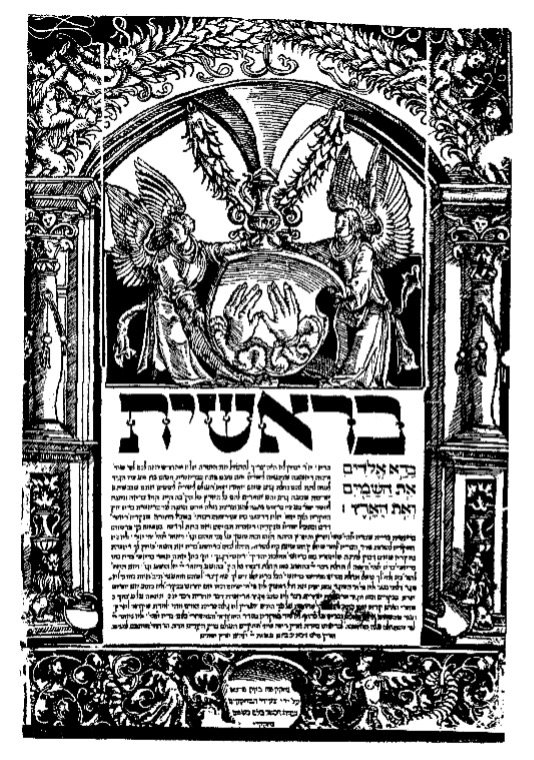
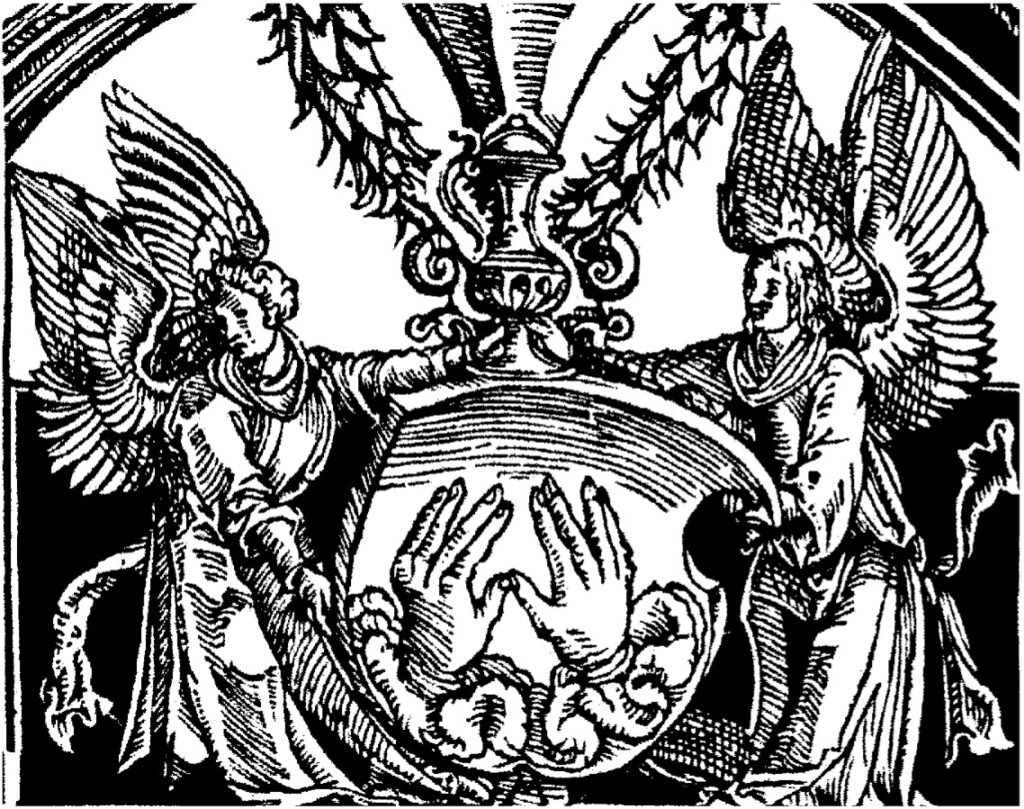
A magnificent edition, with ornate woodcut frames and large type for the text. Each book has a unique decorative opening page, there is no title page, comprised of four separate pieces, those on the pillared sides with vases, leaves, and cherubim, similar but not identical, the top piece with a concave bottom edge. Genesis has a convex curved piece to fit with this top piece on the upper half of the page, with winged cherubim holding a shield with the spread hands of the Kohen giving the priestly blessing.[9]

Work on the Pentateuch began on 10 Sivan (June 14, 1514) but, perhaps as a result of the success of the prayer book, the partners found they had overextended themselves and found it necessary to suspend work on this project for two years. In 1530 Gershom and his sons reprinted this Pentateuch in an identical format, except for changes to the decorated initial pages.

1527, Dictionarium ChaldaiOur next entry with cherubim is an Aramaic grammar by the Christian-Hebraist scholar Sebastian Muenster (1489-1552). It was printed in Basle in 1527 at the press of Johannes Froben in quarto format (40: [1], 434, [7] pp.). The Froben family was the most significant printers of Hebrew books in Basle. Johannes Froben published as many as 250 titles, among them Hebrew/Latin books of the Bible and grammatical works, primarily works by Muenster.

Sebastian Muenster, a cosmographer, astronomer, and orientalist was, for twenty three years, professor at Basle. Born in Niederingelheim, Hesse, the son of a Spitalmeister (hospital master), Muenster had no university education nor did he ever receive a degree. His education consisted of some private instruction in Latin and later studies at Frieberg and attendance at lectures given by the Franciscans. In 1506, Muenster entered the Minorite order and was sent to study in Rufach under Conrad Pellican (Pellicanus, 1478-1556). The following year he took vows and, in 1512, was ordained a priest. Muenster assisted Pellican in teaching in Pforzheim and, from 1524-29, occupied the chair of Hebrew at the University of Heidelberg. In 1529, Muenster converted to Protestantism and moved to Basle, where he occupied the chair of Hebrew, at a salary of 60 gulden; from 1547/8 he was rector. From about 1525, Muenster was a student of Elijah Levita, translating and editing his grammatical works. Muenster also translated a number of other Hebrew works into Latin and was a prolific author in his own right. By the time of his death more than 100,000 volumes of his works were in circulation. His Jewish oeuvre, more than three-score publications, covers all aspects of Judaica, excepting Kabbalistic studies, which did not interest him. In 1523, Muenster published Dictionarium Hebraicum . . . adiectis Chaldaicis vocabulis, his study of the Aramaic language. The book reads from left to right but the text follows the Hebrew alphabet. Words are given in vocalized Hebrew, followed by their etymology, definition and examples.

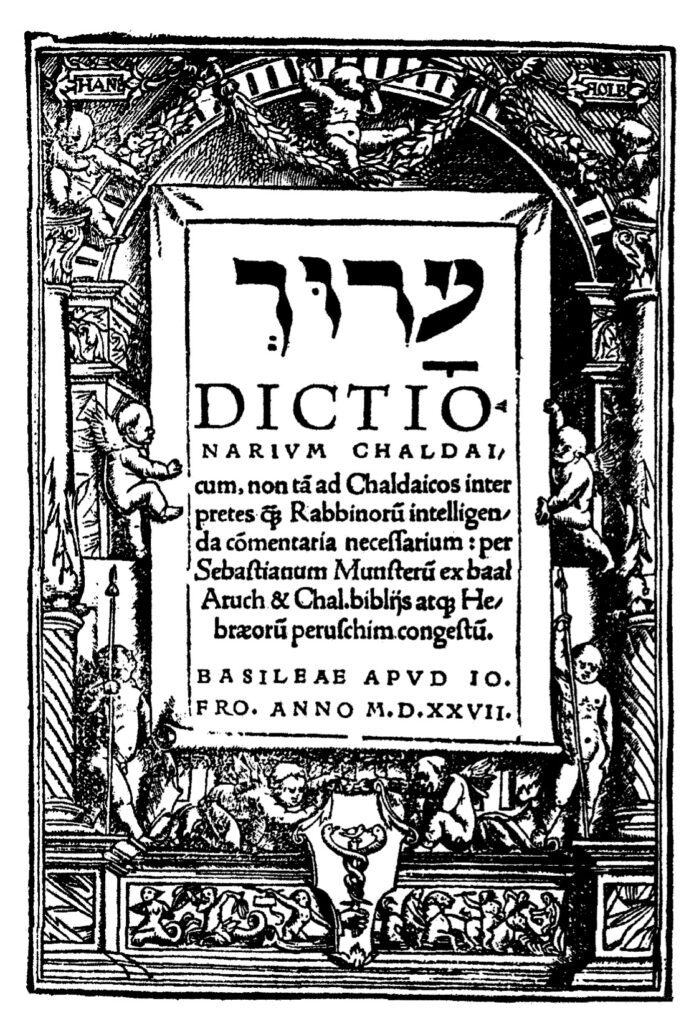
The title page of the Dictionarium Chaldai has an architectural frame with cherubim in various positions, as well as additional cherubim below mounted and otherwise. This title page, designed by Hans Holbein, was used as early as 1516 on Basel statutes and into the seventeenth century.[10] [11]

Not long afterwards, from 1540 through 1543, at least five titles were printed in three locations with varied images of cherubim on the title-page, that is Augsburg, Prague, and Bologna. That is not to say these frames were not used on other books, most likely they were, but rather these are examples of cherubim used by the printers of Hebrew books at the time.

Augsburg has an early history related to Hebrew printing. Several early anti-Jewish works beginning with the apostate Johannes Pfefferkorn’s Der Judenfeind (1509) and other anti-Semitic books by apostates were published there. Another early Augsburg publication of note, this certainly more positive, albeit not a Hebrew edition of that popular and much republished work, is the first printing of R. Joseph ben Abraham Gikatilla’s (1248–c. 1325) kabbalistic classic, Sha’arei Orah, which explains and analyzes the ten Sefirot. This edition of Sha’arei Orah is a Latin translation of that work by the apostate Paulus Ricius (Paulus Israelita, 1480-1541) under the title Portae lucis, published in 1516 at the press of Johann Miller.

1527, Dictiorionarim Chaldai
Courtesy of the Fales Library and Special Collections, New York University

Serious Hebrew printing in Augsburg begins when Hayyim ben David Shahor, among the pioneers of Hebrew printing outside of Italy, came to Augsburg in about 1533/34. In Augsburg, Schwarz worked in the print shop of Silvan Otmar (d. 1540), a renowned and highly productive printer, and resided in the home of Bonifacius Wolfhart, a Protestant pastor who also served as the censor of Hebrew books for Augsburg.[12] Shahor printed several works in conjunction with his son, Isaac, and his son-in-law, Joseph ben Yakar, who assisted him at the press, although their names are not mentioned on the title-pages.[13]

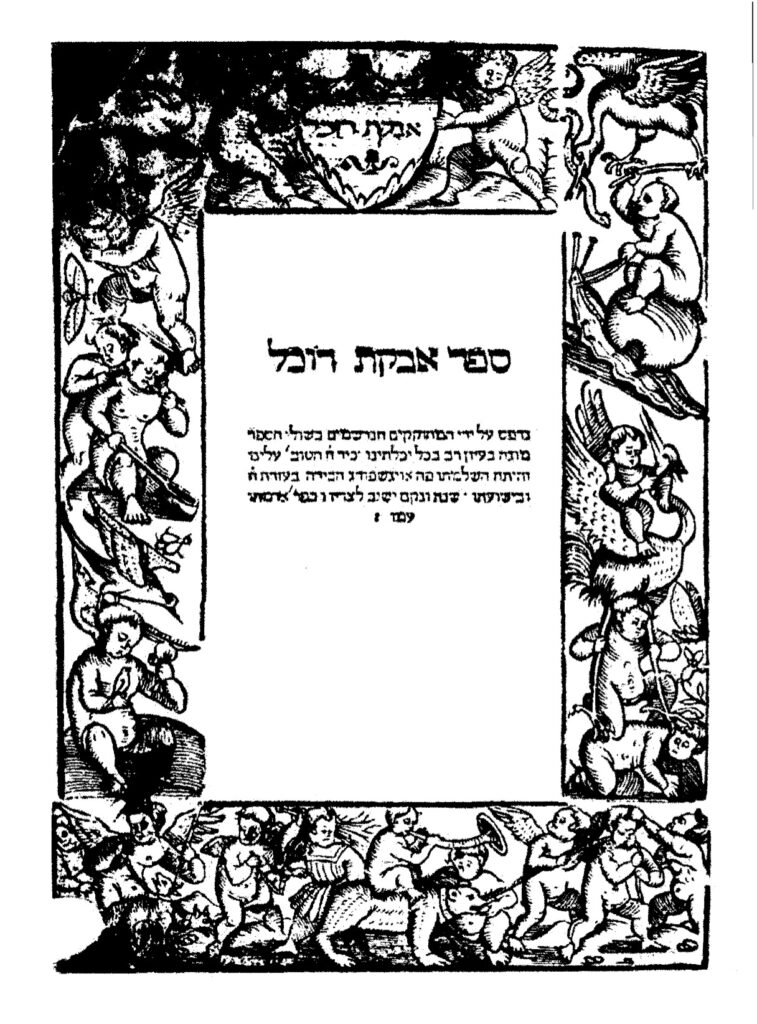
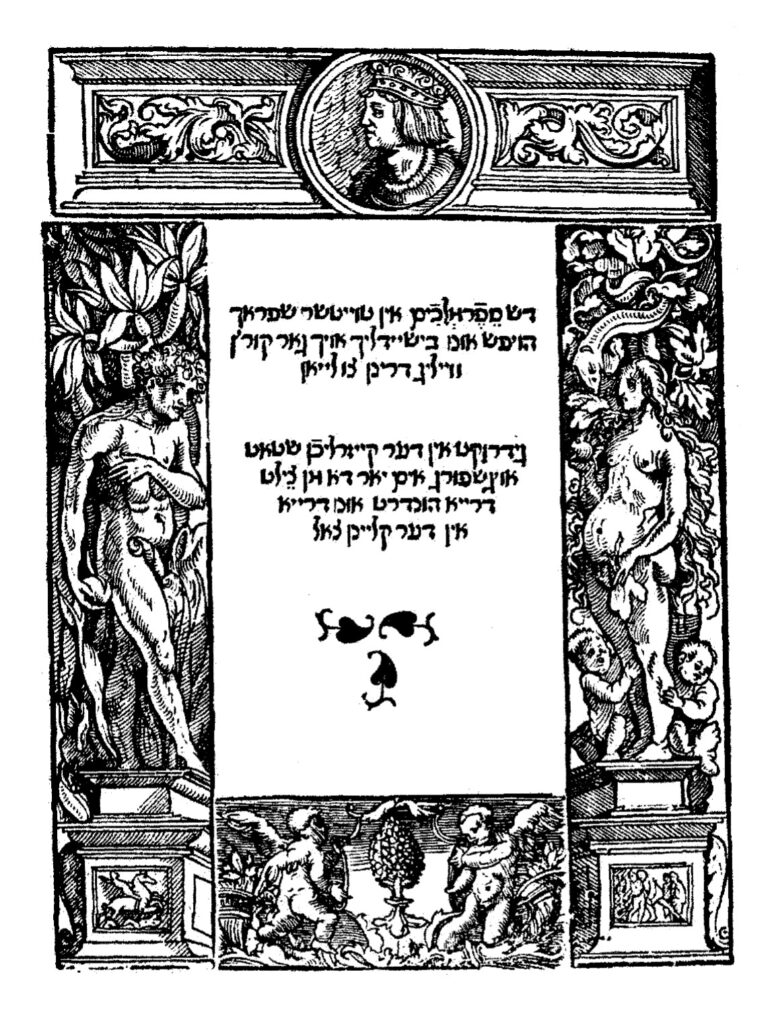
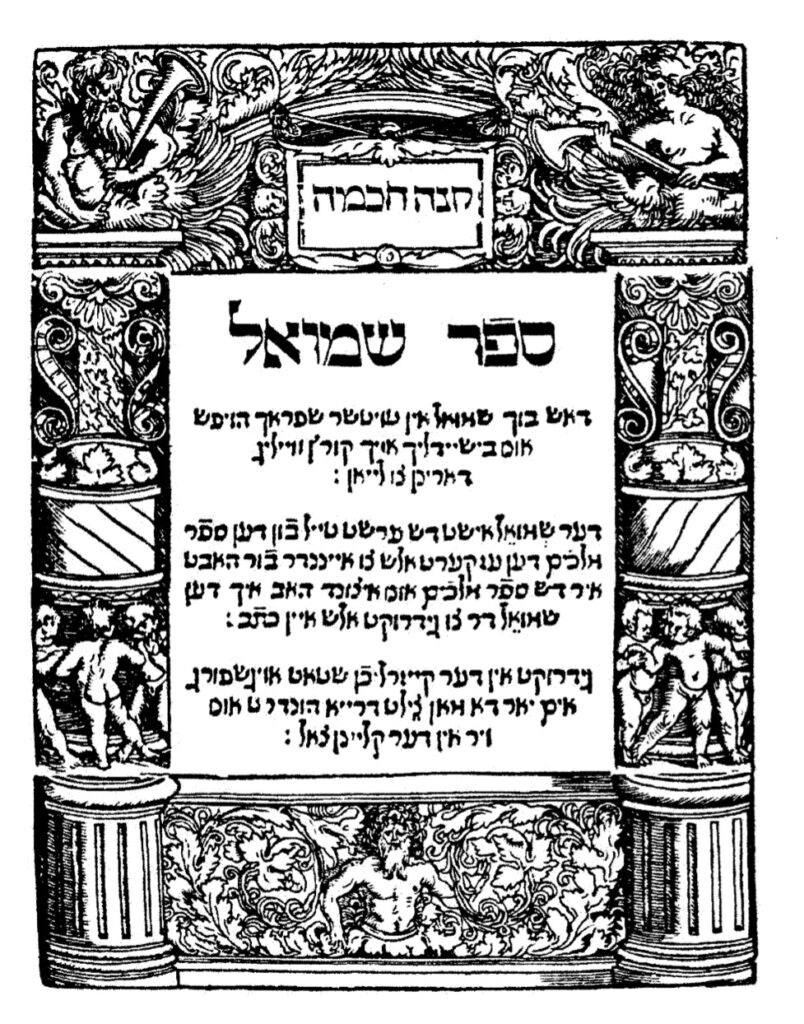
Shahor likely joined with a non-Jewish printer, perhaps August Wind, a printer of Hebrew works for Christian clergyman. Hayyim left for Italy, returning to Augsburg in 1540. He then printed three books, Avkat Rokhel, Arba’ah Turim and a prayer book for, according to the Thesaurus of the Hebrew Book, a total of ten works in Augsburg. Due to a lawsuit by an apostate, Paulus Aemilus, with whom Shahor had been associated in Ferrara, resulting from their failed venture, Shahor and his family were forced to cease publication and leave Augsburg. Aemilus, seeing a market in Augsburg for Hebrew/Yiddish books, began to print on his own account. He issued a small number of titles, most notably the Melokhim Bukh (1543) and the Shmuel Bukh (1544), Yiddish poetical renditions of the books of Kings and Samuel, both with images of cherubim (below).[14]

1540, Avkat Rokhel Our first Augsburg title is Avkat Rokhel, an eschatological work on the principles of faith attributed to R. Machir ben Isaac Sar Hasid, a student of R. Judah ben Asher, son of the Rosh. Printed in octavo format (80: 18 ff.), perchance by Shahor. The Thesaurus of the Hebrew Book attributes it, albeit in brackets, to Hayyim Shahor, in contrast to the National Library of Israel that records the printer as unknown.[15]

The text of the title page is set within a decorative frame with nineteen cherubim and a number of animals. The title-page states that it is,

Sefer Avkat Rokhel

Printed by the printers named at the end of the volume. Edited with great care, with all our ability, “the good hand of our [Lord] upon us,” (ref. Ezra 8:18). And it was completed, here Augsburg, the great city, with the help of the Lord and His salvation. In the year, “[Rejoice, O you nations, with his people; for he will avenge the blood of his servants,] and will render vengeance to his adversaries, and will make expiation כפר (300=1540) for the land of his people” (Deuteronomy 32:43).

The names of the printers, Hayyim Shahor, Isaac ben Hayyim, and Joseph ben Yakar, the statement on the title page notwithstanding, are not given at the end of the volume. A brief introduction informs that the work was named Avkat Rokhel (the perfumer’s powders, Song of Songs (3:7)) for as the perfumer’s powders strengthen the soul, so too when one reads this book will he fear and cause his soul to be pure and free from all sin and transgression, thus meriting the good.

1540, Avkat Rokhel
Courtesy of the Dorot Jewish Division New York Public Library

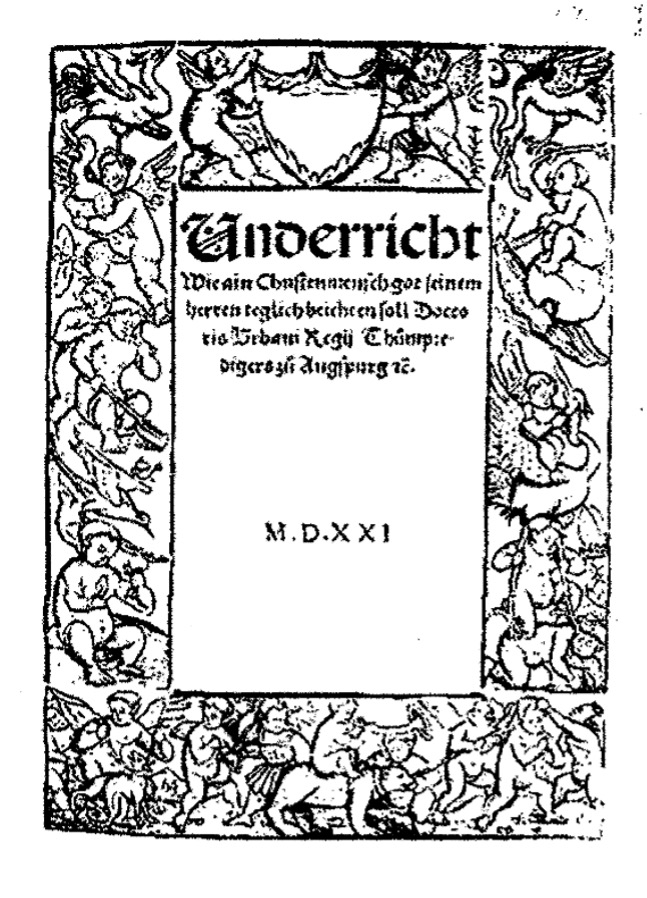
The like title-pages of Avkat Rokhel and Unterricht Wie ain Christenmensch, the latter a non-Hebrew work printed approximately two decades earlier, reflect a relationship between Jewish and Christian printers, that is, Christian printers published Hebrew books in association with Jewish associates. The relationship between the printers was mutually beneficial. For the Christian publisher “the Hebrew books sector, being unique, was attractive to investors, being more limited and not so wildly competitive as the Italian book sector.”[16] In addition to the non-Jewish printer’s access to the Jewish book market, the Jewish publisher was able to not only publish Hebrew books, but he also gained access to the typographical material of his Christian associate. The latter, for example, frequently provided attractive frames to the former after having used them for his market and the Jewish partner also utilized the printer’s other ornamentation. This was of value to the Jewish partner as he did not have to go the expense of having decorative material prepared, at a relatively much greater expense as it would be utilized for a much smaller market. This despite the fact that the frames were often incompatible with traditional Jewish sensibilities.[17]

1521, Unterricht Wie ain Christenmensch [18]

The like title-pages of Avkat Rokhel and Unterricht Wie ain Christenmensch, the latter a non-Hebrew work printed approximately two decades earlier, reflect a relationship between Jewish and Christian printers, that is, Christian printers published Hebrew books in association with Jewish associates. The relationship between the printers was mutually beneficial. For the Christian publisher “the Hebrew books sector, being unique, was attractive to investors, being more limited and not so wildly competitive as the Italian book sector.”[19] In addition to the non-Jewish printer’s access to the Jewish book market, the Jewish publisher was able to not only publish Hebrew books, but he also gained access to the typographical material of his Christian associate. The latter, for example, frequently provided attractive frames to the former after having used them for his market and the Jewish partner also utilized the printer’s other ornamentation. This was of value to the Jewish partner as he did not have to go the expense of having decorative material prepared, at a relatively much greater expense as it would be utilized for a much smaller market. This despite the fact that the frames were often incompatible with traditional Jewish sensibilities.[20]

The title-page of Avkat Rokhel has the largest number of cherubim of our title-pages, nineteen in all, of our title-pages. The cherubim appear on the bottom, sides, and top of the frame, all active, albeit in different activities. The text of Avkat Rokhel is in three parts, each further subdivided. The first section addresses the struggle against one’s evil urge prior to redemption and the birth pangs and advent of the Messiah, and an explanation of the pertinent midrashim; the second part discusses the rewards and punishments of the soul after the resurrection, the nature of the world to come according to Judaism, in contrast to the views of non-Jews, and resurrection; and the third part the laws stated by the sages of the Talmud as halakhah Moshe me-Sinai, the formation of man and the number 248 limbs in a person, the statement of our sages concerning three partners in that process (God, man, and woman) and some gematriot.

This is the third edition of Avkat Rokhel, it having been printed previously in Constantinople (1516) and Rimini (1526). Ch. B. Friedberg records, in his Bet Eked Sepharim, more than twenty-five printed editions of Avkat Rokhel. It was translated into Latin by A. Hulsius and printed in his Theologia Judaica, (Breda, 1653) and a Yiddish edition was prepared by Naphtali Pappenheim (Amsterdam, 1647).[21]

1543, Melokhim Buch Two additional works printed in Augsburg, attributed to Moses (Esrim ve-Arbeh) Ashkenazi, are Yiddish poetical renditions of the books of Kings and Samuel. Moses’ appellation, Esrim ve-Arbeh (24), derives from either his birthplace, Vierundzwanzig Hoefe (24 courts) in Wuerttemberg, or from his extensive knowledge of the 24 books of the Bible. Moses’ accreditation with either authoring or transcribing the Melokhim Bukh is due to its similarity to the Shmuel Bukh, more reliably attributed to him. Nevertheless, sufficient differences exist between the two works that many scholars believe they do not share a common author. It is clear, however, that the author, even if not this Moses, was an Ashkenazi Jew. The Melokhim Bukh was published in quarto format (40: [123] ff.) by, according to the colophon, Paulus Aemilus. A Latin colophon states, Augustae Vindelicorum/ per Paulum Aemilium, Anno/ Domini M. D. XLIII. Meyer Waxman suggests that it is doubtful, the colophon notwithstanding, that the publisher was Aemilus; more likely it was Hayyim Shahor.

We have noted above that the frames on these title-pages were first used by Christian printers and that when that market no longer needed the frames, they were made available to Jewish printers. The cherubim frames noted above were generally acceptable to a contemporary renaissance Jewish public, although some, many, were questionable and would not be used today. In contrast, the title-page of the Melokhim Buch has a border made up of a four-part frame, the top with a representation of a king, the left and right sides respectively with images of Adam and Eve, unclad, the latter with the snake, two small children, and expecting. At the bottom are two cherubim. Use of this frame is surprising, for in contrast to other frames its’ contents appear to be objectionable, more so than other frames, even those with mythological characters. It seems likely that this frame might also be distasteful to Christian sensibilities.[22]

1543, Melokhim Buch
Courtesy of Dr. Moshe Rosenfeld

The title page states that it is “The book Melokhim (Kings) in Taytsher sprach, beautiful and clear and very entertaining to read. Printed in the imperial city of Augsburg in the year 303 (=1543)” [23] The colophon dates the completion of the work to Friday, 14 Av, 303 (July 25, 1543), which was a Sunday in 1543.

The Melokhim Bukh was not written as a sequel to the Shmuel Bukh. It is the older of the two books, originally written as a separate work, possibly as early as the fourteenth century. The format of the Melokhim Bukh, a rhymed paraphrase of the book of Kings, is that of the heroic epic, stylistically modeled after comparable German sagas, such as the Nibelungen. The subject matter is the events in Kings I and II, imaginatively and colorfully enhanced by material from the Talmud and Midrashim, all expressed with a deep piety. Intended as a complete history, it begins with a hymn of praise to God in three strophes followed by nine strophes from the Exodus to the last days of David, the contents of Kings, and as a sequel, the history of the Jews to the end of the second commonwealth in thirty strophes). An example of the text is,

You have frequently performed signs for the children of Israel;

Therefore they are obliged to have You for their Lord.

And to fear Your name-that is useful and good for them.

That man is foolish who acts contrary to Your word.[24]

1544, Shmuel Bukh The Shmuel Bukh was published, also likely by Hayyim Shahor in quarto format (Format 40: [102] ff.). It has an ornate title page made up of figurines above and about pillars with cherubim on the sides. It too is in Vaybertaytsh; among its reprints is a Latin edition (Ingolstadt,(1562). Waxman suggests that the Shmuel Bukh was likely written at least a hundred years earlier, most likely an original production of medieval Jewry. The author reworked the biblical material and incorporated aggadic elements. It was written in “vigorous poetic style” in eight line strophe and was meant to be sung.[25]

1544, Shmuel Bukh
Courtesy of Dr. Moshe Rosenfeld

In contrast to what was written above, “works that many scholars believe they do not share a common author,” Zinberg informs that both the Melokhim Bukh and the Shmuel Bukh are composed in the same verse-meter. Moreover, the title-page states that “Shmuel is the first part of

the book Melokhim, for it is all related.” Nevertheless, Zinberg quotes other sources that “these are two quite different works and were probably written by two different poets.”[26]

1553, Ma’yan GannimA composition book comprised of sample letters from R. Samuel ben Elhanan Jacob Archivolti (c. 1515-1611). Ma’yan Gannim was published in a small sextodecimo format (160: 45, [1] ff.) at the Venice press of Alvise Bragadin. The Bragadin press was active before the papal bull, dated August 22, 1553, by Cardinal Giovanni Pietro Caraffa, the future Pope Paul IV, an extreme reactionary and bitter anti‑Semite, who ordered the confiscation and burning of the Babylonian and Jerusalem Talmuds. This had a chilling effect on Hebrew printing and resulted in a considerable decline if not outright cessation of printing in Venice, and the subsequent expurgation and censorship of Hebrew books. When Hebrew printing resumed in Venice in 1563, among the Christian printers who took up the publication of Hebrew books was Alvise Bragadin. Bragadin died in the mid-1570’s, he was succeeded by his son, and after him by successive members of the family well into the eighteenth century, the last known Bragadin being Alvise III. Throughout that time the press remained a leading printer of Hebrew books in Venice.

1553, Ma’yan Gannim
Courtesy of the Library of Agudas Chassidei Chabad Ohel Yosef Yitzhak

Archivolti, a student of R. Meir Katzenellenbogen (Maharam, 1473-1565), served as rabbi, av bet din, and rosh yeshivah in Padua. Among his students was R. Judah Aryeh (Leon) Modena (1571-1648). Prior to settling in Padua in 1568, Archivolti worked as a corrector for the Hebrew presses in Venice.

In contrast to our preceeding examples of cherubim, this exemplar does not appear on the title-page of the book, which has the Bragadin device, that is, three crowns, but rather at the beginning of each of the book’s five chapters, a woodcut illustration comprised of three cherubim in a cage, surrounded on all four sides by a verse.

The title is from “A fountain of gardens (ma’yan gannim), [a well of living waters, and streams from Lebanon” (Song of Songs 4:15). The text states that there are fifty letters, that is, twenty-five letters with their responses, written by Archivolti. There is a preface and introduction from Archivolti, followed by a table of contents, and, beginning on 7a, the text. Ma’yan Gannim is the first book written by Archivolti, for he describes it as his first fruits, an offering to the Lord. Archivolti also wrote Degel Ahavah (Venice, 1551), an ethical work; He’arot le-Sefer he-Arukh (Venice, 1553), textual references for the Arukh of Nathan ben Jehiel; and, his most important title, Arugat ha-Bosem (Venice, 1602) a grammatical work in 32 chapters.

The sections or chapters, each on a different theme, are correspondence between a father and son; between friends; from an older to a younger man; with government officials; and others, including letters of a romantic, and even sensual nature. Such letters, at the very least inappropriate by modern religious standards, are intermingled with those of a sacred nature, reflecting contemporary mores and addressing current issues, including therefore, information of historical and cultural value. Ma’yan Gannim is designed to teach through example the rules of correspondence. The letters are in metrical form, designed by Archivolti as literary models, many with ethical content, for his students.[27]

1556, She’ilot u’Teshuvot Jacob ben Moses Moellin (Maharil) – Two hundred and five responsa from R. Jacob ben Moses Moellin (Maharil, c. 1360-1447). The She’ilot u’Teshuvot were published in Cremona at the press of Vincenzo Conti in octavo format (80: [7] 79 ff.). After the Talmud was burned in Venice in 1554 there was a precipitous decline, if not a complete cessation, in the number of Hebrew books printed in Venice for several years. The breach was filled by presses in Ferrara, Sabbioneta, Cremona, and Riva di Trento. Vincenzo Conti (d. 1569) printed briefly in Sabbioneta and subsequently in Cremona, where his press was active from 1556 to 1567, issuing more than forty titles.

Maharil was the leading halakhic authority of his time. His most important work is Sefer Maharil (Minhagei Maharil, 1556, Sabbioneta), a popular and influential work on customs and laws. It was composed by his pupil Eleazar ben Jacob (Zalman of St. Goar), from the discourses that he heard from Maharil. She’ilot u’Teshuvot is comprised of Two hundred and five responsa, a small part only of Maharil’s responsa. The subject matter, as in the Sefer Mahril, deals to a great extent with custom, but also includes much personal material. They also reflect Maharil’s considerable humility and compassion.

1556, She’ilot u’Teshuvot Jacob ben Moses Moellin (Maharil)
Courtesy of the Library of Agudas Chassidei Chabad Ohel Yosef Yitzhak

The title-page has an ornamental frame made up of four parts, enabling the printer to use them in other arrangements, although this is the manner in which the parts are most often employed. The top frame has the face of a man and cherubin; on the sides are suits of armor, shrubs, and musical instruments and, in the center of the left vertical frame the letters SPQR, reputedly standing for Senatus Populusque Romanus; and on the bottom a two headed crowned eagle and on the sides the cherubim. This frame was used by Conti on his early imprints, appearing on about ten works.

1558, Sefer Rav Alfas Sefer Rav Alfas, (Hilkhot Rav Alfas, Sefer ha-Halakhot of Alfasi, Rif) was published in Riva di Trento by R. Joseph Ottolenghi and Cardinal Cristoforo Madruzzo in a three volume folio format (20: 288, 268, 302 [8] ff.). The Tyrolese town of Riva di Trento is the source of an unusual episode in the history of the Hebrew book. It was for a short time, from 1558 to 1562, a refuge for the Hebrew book; one in which about forty Hebrew titles were printed. Believed to be the first work printed in Riva di Trento, Hilkhot Rav Alfas was likely selected, in addition to its inherent popularity and value, due to the ban on the Talmud, the Rif, being a halakhic compendium of the Talmud, filling, to some extent, the gap left by the scarcity of that work.

It was in Riva di Trento that Cardinal Cristoforo Madruzzo (1512-78), Cardinal of Trent, a scholar and supporter of learning, who argued at the Council of Trent (1562) for leniency and moderation in condemning books, became the patron and protector of a Hebrew press, which was also a source of revenue for him. Ottolenghi (d. 1570), originally of Ettlingen, in Baden, Germany, reflected in its Italianized form in his name, was rosh yeshivah at Cremona, and under his tutelage Talmudic studies had continued in Cremona after that work had been banned and burned elsewhere. He assisted the press, providing indices and annotations to a number of works and assuring that material offensive to the church had been deleted from those books of value to his yeshiva. and R. Jacob Marcaria, a dayyan on the bet din presided over by Ottolenghi and a physician, recruited by Madruzzo help finance and play a role in the press. Marcaria edited and wrote brief prefaces for most of the books printed in Riva di Trento. The press was located in the house of Antonio Broën.

Sefer Rav Alfas is a halakhic compendium by R. Isaac ben Jacob Alfasi (Rif, 1013-1103). Alfasi, born in the Algerian village of Qal’at Hammad, was a student of the great sages R. Nissim ben Jacob (c, 990-1062) and Hananel ben Hushi’el (d. c. 1055) in Kairouan. After learning with them Alfasi relocated to Fez, from where his surname al-Fasi (Rif) is derived, and became recognized as the leading Talmudic sage of the time. In 1088, at the age of 75, two informers denounced him to the government – the charges are unknown – and he was forced to flee to Spain. Eventually settling in Lucena, Alfasi succeeded R. Isaac ben Judah ibn Ghayyat (c. 1020-89), who had died a few months earlier, as head of the yeshiva.

1558, Sefer Rav Alfas
Courtesy of the National Library of Israel

The text of the title-page of each volume has cherubim at the sides, and below bears the Cardinal’s coat‑of‑arms , a significant statement of the Cardinals’ support and protection of the press at a time when his church was burning and banning Hebrew books. Furthermore, the title pages informs that Sefer Rav Alfas was edited with great care by the gaon R. Joseph Ottolenghi and was printed and financed by him, and that this was done, “in the dominion of” the following in bold letters “Cardinal Cristoforo Madruzzo.”

Sefer Rav Alfas, Alfasi’s major work, is one of the greatest works in halakhic literature. It is extracts all pertinent legal decisions from the Talmud, eliminating non-halakhic material, discussions, and subject matter not applicable today. It covers the following orders of the Talmud, Mo’ed, Nashim, and Nezikim, as well as tractates Berakhot and Hullin. Laws in Kodashim and Tohorot, such as mezuzah and tefillin, are organized as Halakhot Ketannot. Sefer Rav Alfas differs from earlier works, such as Halakhot Gedolot, in that it is more comprehensive, more detailed, and by the inclusion of material from the geonim, although, like them, it follows the order of the tractates.

1559-60, ZoharClassic kabbalistic work of Jewish mysticism, attributed to R. Simeon bar Yohai (second century). This, the second printing of the Zohar, it was published previously in Mantua (1558-60), published in Cremona at the press of Vincenzo Conti in a three volume folio format (20: 132, 122, 146 ff.) by Vincenzo Conti (d. 1569). Conti, who had printed briefly in Sabbioneta, is better known for his activity in Cremona, where his press, active from 1556 to 1567, issued more than forty titles.

The title page of has a decorative architectural frame with an arch, at the top a vignette of Akedat Yizhak (the binding of Isaac), surmounted by an eagle, and accompanying cherubim; below in the bottom squares, figurines, perchance also cherubim. It is dated, “For the Lord will not forsake כי לא יטש (319=1559) his people [for his great name’s sake] (Samuel I 12:22), and it was completed in the year ש”ך ([5]320=1560).” At the bottom of the page is an imprimature from the Inquisition on the title page, the sole Cremona imprint to place it there, as well as a longer permission at the end of the book.

1559-60, Zohar
Courtesy of the Library of the Jewish theological Seminary

Written in Aramaic and Hebrew, Sefer ha-Zohar al ha-Torah is a comprehensive system of kabbalistic theosophy, encompassing cosmology, the soul, and good and evil. It is an esoteric commentary on the Torah, with homilies, midrashic passages, parables, and numerous discursive passages. It is based on the concept that within scriptures is a concealed stratum, deciphered by Kabbalah, expressing the inner meaning of the Torah, with its “splendor, beauty, and greatness.”

The corrector (and expurgator) was the apostate Vittorio Eliano, grandson of the foremost grammarian, Elijah Bahur Ashkenazi Segal. A member of a Dominican commission to review Hebrew books, Eliano was associated with all the books published by Conti from 1558 through 1559. Although begun later than the Mantua edition, noted above, this printing, done in haste, was completed earlier. Nevertheless, it was not immediately released for sale, for when more than 10,000 Hebrew books were burned in Cremona, with the complicity of Eliano, the entire edition was seized. It was just barely saved, in contrast to other works, by the apostate Dominican, Sixtus of Siena. It is known as the Zohar Gadol (large Zohar), in contrast to the smaller Mantua edition (Zohar Katan), and is also referred to, because of Eliano’s involvement, as the “Christian edition.” This notwithstanding, the Cremona edition was the preferred of the two editions by eastern European kabbalists.[28]

1560, Shir ha-Yihud – Shir ha-Yihud (Hymn of Divine Unity) an anonymous piyyut (liturgical poem) written in the mid-twelfth century, most often attributed to Samuel ben Kalonymus he-Hasid (c. 1130-1175), less often to his son, Judah ben Samuel he-Hasid (c. 1150-1217), author of the Sefer Hasidim, both among the foremost representatives of the Hasidei Ashkenaz, and, on occasion, to yet others.

Shir ha-Yihud
Courtesy of the National Library of Israel

Shir ha-Yihud was published at the press of Eliezer and Joseph ben Naphtali Hertz Treves. Active for one year only, in 1560, they issued six books, before being forced to close by a meeting of the leaders, both Protestant and Catholic, of the Swiss Confederation in June, 1560, who feared that they were about to print the Talmud.

The frame, one of several with cherubim employed by the press, also was used on the title-page of Begidat Hazman, an allegoric maqāma (a poetic narrative in rhymed prose) by Mattathias (Mattityah ben Moses), a 15th century Spanish or Provençal Hebrew poet or Mattathias ha-Yiẓhari, a representative of the Jewish communities of Aragon at the Tortosa disputation (1413–14).

1568, Passover Haggadah Passover Haggadah printed in Mantua in folio format (20: 36 ff.) by Joseph Shalit ben Jacob Ashkenazi of Padua. This edition is a reprint of the 1560 Passover Haggadah, also printed in Mantua, but with modifications and the addition of the marginalia of R. Joseph Shalit ben Jacob Ashkenazi of Padua entitled Nimukei Yosef.

1568, Passover Haggadah
Courtesy of the National Library of Israel

The title page frame has representations of the Mars and Minerva followed by the first text page, which has two woodcuts of cherubim along the top. Following text pages have those cherubim image, as well as numerous other cherubim images, including several marginal cherubim images. This Haggadah shares some features with the Prague Haggadah of 1526. Woodcuts are accompanied by captions, given as rhymed couplets, a feature of Ashkenaz manuscript Haggadot. In some instances, for example, by the four questions, the earlier edition was framed by a lush Italian border, without illustrations. Here the types and the top and upper left borders with their vines and cherubs only are alike.[29]


1576, Yosef LekahYosef Lekah is a commentary on Megillat Esther by R. Eliezer ben Elijah Ashkenazi (1513-86). It was published in Cremona in 1576 by Christopher Draconi in octavo format (40: 83, 1 ff.). Draconi, previously associated with Vincenzo Conti, attempted to publish Hebrew books in Cremona. Although he would issue Latin books from 1569 to 1614, he printed one Hebrew book only, Yosef Lekah.

1576, Yosef Lekah
Courtesy of the Fales Library and Special Collections, New York University

R. Eliezer ben Elijah Ashkenazi was a multi-faceted individual, a Talmudist, physician, and well-rounded scholar, who served as rabbi in a number of varied communities. His first rabbinic position, from 1538-61, was in Fostat, Egypt. Forced to leave Fostat, Ashkenazi went to Famagusta, Cyprus, where he was rabbi for two years, and then to Venice. He left for Prague (1561), after a dispute with the Maharam of Padua, and after traveling as far as the Crimea, returned, via Famagusta, to Venice. Ashkenazi was next rabbi in Cremona, where he published Yosef Lekah. Shortly after he left to be rabbi of Posen, and, from 1584, was in Cracow. Ashkenazi experienced difficulties in Poland, disputing over his right to open a yeshiva in close proximity to an existing yeshiva, so that Joseph Solomon Delmedigo (1591-1655) wrote about him, “You have brought a vine from Egypt; you have cast out the nations, and planted it” (Psalms 80:9). Ashkenazi was highly regarded by his contemporaries, corresponding with prominent rabbinic figures such as R. Joseph Caro, R. Joseph Ha-Kohen (Katz), R. Moses Isserles (Rema), and R. Solomon Luria (Maharshal), several mentioning him in their responsa. R. Elijah of Pesaro, in Famagusta in 1563, praised Ashkenazi’s scholarship, noting that he was fluent in twelve languages.

The title-page has four cherubim images, two reclining at the top of the structure, two standing erect by the pillars at the sides. The title-page is dated “Therefore they called these days Purim קראו לימים האלו פורים (336 = 1576)” (Esther 9:26). Yosef Lekah is dedicated to Don Joseph Nasi, Duke of Naxos, whom Ashkenazi, in the introduction, compares to Joseph in Mizraim and Mordecai at the time of Ahasuerus. Ashkenazi, therefore, entitled this work Yosef Lekah. Two, almost identical, editions of Yosef Lekah exist, both dated 1576. Although almost exact copies of the original, it is clear, upon close examination, that the book was reset. Christopher Draconi’s Yosef Lekah was the last Hebrew book printed in Cremona.

Ashkenazi’s most important work is Ma’aseh HaShem (Venice, 1583), on the historical occurrences in the Torah, with a commentary on the Passover Haggadah; selichot; and, not extant today, a super-commentary on the Ramban (Nachmanides) and annotations to R. Caro’s Beit Yosef.[30]

Conclusion – In this article we have described books printed in Augsburg, Basle, Cremona, Mantua, Prague, and Venice. The cherubim imagery on these title-pages, reflecting the influence of Renaissance humanism, their attractiveness notwithstanding, do not appear on the title-pages or accompanying the text in Hebrew books published in more modern times. A review of the title-pages reproduced here, all dissimilar, with their numerous depictions of cherubim, attest to the popularity of that image. Given the strictures on Hebrew printing from the mid-sixteenth century in Italy, the frequent use of cherubim testify to the cooperation of Jewish and non-Jewish printers, their frequency perchance suggesting a positive relationship going beyond mere monetary gain.

We conclude with the Talmudic statement above, which suggests why the image of cherubim was so popular:

Rav Ketina said: When the Jewish people would ascend for one of the pilgrimage festivals, the priests would roll up the curtain for them and show them the cherubs, which were clinging to one another, and say to them: See how you are beloved before God, like the love of a male and female. (Yoma 54a)

Lastly, in conclusion an image of a cherub, both chronologically and, in cherubian activity, quite different from those depicted in this article. It is included as it is unusual and eye catching, an image of a Cherub smoking a pipe. It appears in in at least two Basle imprints published by Israel ben Moses ben Abraham Halle, active in Offenbach, although not continuously, from 1718/19 to c. 1738/43. The works are Anaf Etz Avot, R. Benjamin ben Yekutiel Wulff’s commentary on Pirke Avot, and tractate Sanhedrin (1721).[31]

  1. Once again, I would like to express my gratitude and appreciation to Eli Genauer for reading the article and his insightful comments.
  2. Emil G. Hirsch, W. Muss-Arnolt, J. Frederic McCurdy, Louis Ginzberg, “Cherub ( ; plural, Cherubim)” Jewish Encyclopedia IV (New York, 1901-06), pp. 13-16; Shalom M. Paul, Louis Isaac Rabinowitz, “Cherub” Encyclopedia Judaica IV (Jerusalem, 2007), pp. 600-01.
  3. Thomas Kelly Cheyne, 1911 Encyclopædia Britannica, Volume 6, reproduced in https://en.wikisource.org/wiki/1911_Encyclop%C3%A6dia_Britannica/Cherubim
  4. https://www.sefaria.org/search?q=%D7%9B%D7%A8%D7%95%D7%91%D7%99%D7%9D&tab=text&tvar=1&tsort=relevance&svar=1&ssort=relevance.
  5. Franz Sales Meyer, Handbook of Ornament: a Grammar of Art, Industrial and Architectural Designing in all its Branches for Practical as well as Theoretical use (New York, 1957), pp. 108-09.
  6. Codices and early imprints did not have title-pages, the first leaf normally being left blank to protect the book, that page later becoming a dedicated page. The first book with a detailed title-page was the Calendarium of Johannes Regiomontanus, appearing in 1476 (Venice), being a fifty-five year calendar (1475-1530), printed by Johannes Regiomontanus. The first Hebrew book with a title-page was the Sefer ha‑Roke’ah (Fano, 1505) of R. Eleazar ben Judah of Worms (c. 1165 – c. 1230).
  7. Cherubim also appear on the frames of Hebrew books printed in the incunabular period. For examples of such frames see Marvin J. Heller “Behold, you are beautiful, my love: The Use of Ornamental Frames in Hebrew Incunabula” Printing History NS 10 (New York, July, 2011), pp. 39-55, reprinted in Further Studies in the Making of the Early Hebrew Book (Leiden/Boston, 2013), pp. 3-33.
  8. The following book descriptions are selected, modified from Marvin J. Heller, The Sixteenth Century Hebrew Book: An Abridged Thesaurus ( Brill, Leiden, 2004), var. cit.
  9. Avraham Yaari, Hebrew Printers’ Marks (Jerusalem, 1943), pp. 7 and 126-27 n. 10 [Hebrew].
  10. Jerome Friedman, The Most Ancient Testimony. Sixteenth-Century Christian-Hebraica in the Age of Renaissance Nostalgia (Athens, Ohio, 1983), pp. 44-48, 214-15; A. M. Habermann, Title Pages of Hebrew Books (Tel Aviv, 1969), p. xi [Hebrew with English introduction], pp. 19-20, 125-26 nos. 4-5; Joseph Prijs, Die Basler Hebräischen Drucke (1492-1866) (Olten, 1964), pp. 49-51 n. 26; Frank Rosenthal, “The Rise of Christian Hebraism in the Sixteenth Century,” Historia Judaica II (New York, 1945), (New York, 1945), pp. 182-91; and Richard S.Westfall, “Sebastian Muenster,” http://es.rice.edu/ES/humsoc/Galileo/Catalog/Files/muenster.html
  11. An interesting example of this later usage is R. Moses ben Hanokh Altschul’s (c. 1546–1633) Brant Shpigl, a popular Yiddish work on ethics, correct demeanor, and customs for women, published by Konrad Waldkirch (Basle, 1602), also indicative of the passage of typographic material between printers.
  12. Stephen G. Burnett, “German Jewish Printing in the Reformation Era (1530-1633),” University of Nebraska – LincolnUniversity of Nebraska – Lincoln DigitalCommons@University of Nebraska – LincolnDigitalCommons@University of Nebraska.
  13. Ch. B. Friedberg, History of Hebrew Typography of the following Cities in Central Europe: Altona, Augsberg, Berlin, Cologne, Frankfort M., Frankfort O., Fürth, Hamberg, Hanau, Heddernheim, Homberg, Ichenhausen, Neuwied, Wandsbeck, and Wilhermsdorf. Offenbach, Prague, Sulzbach, Thannhausen from its beginning in the year 1513 (Antwerp, 1935), pp. 29-31 [Hebrew].
  14. A. M. Habermann, “The Printer Hayyim Shahor, his Son Isaac and Son-in-law Joseph Yakar,” in Studies in the History of Hebrew Printers and Books (Jerusalem, 1978), pp. 103-07 [Hebrew].
  15. Yeshayahu Vinograd, Thesaurus of the Hebrew Book. place, and year printed, name of printer, number of pages and format, with annotations and bibliographical references II (Jerusalem, 1993-95), p. 2 no. 10 [Hebrew].
  16. Zipora Baruchson, “Money and Culture: Financing Methods in the Hebrew Printing Shops in Cinquecento Italy,” La Bibliofilia 92 (1990), 25.
  17. For examples of such usage see Marvin J. Heller, “Behold, you are beautiful, my love: The Use of Ornamental Frames in Hebrew Incunabula” Printing History NS 10 (New York, July, 2011), pp. 39-55, reprinted in Further Studies in the Making of the Early Hebrew Book. (Brill, Leiden/Boston, 2013), pp. 3-33; “Mars and Minerva on the Hebrew Title Page,” The Papers of the Bibliographical Society of America 98:3 (New York, N. Y., 2004), pp. 269-92, reprinted in Studies in the Making of the Early Hebrew Book (Brill, Leiden/Boston, 2008), pp. 1-17; and the “The Printer’s Mark of Marc Antonio Giustiniani and the Printing Houses that Utilized It,’ Library Quarterly, 71:3 (Chicago, July, 2001), pp. 383-89, reprinted in Studies, pp. 44-53.
  18. Unterricht Wie ain Christenmensch by Urbanus Rhegiosu (1489-1541), a Protestant Reformer active in Northern and Southern Germany promoting Lutheran unity in the Holy Roman Empire. Unterricht is one of several titles with this frame printed by Silvan Otmar of Augsburg (https://www.flickr.com/photos/58558794@N07/6576279085).
  19. Zipora Baruchson, “Money and Culture: Financing Methods in the Hebrew Printing Shops in Cinquecento Italy,” La Bibliofilia 92 (1990), 25.
  20. For examples of such usage see Marvin J. Heller, “Behold, you are beautiful, my love: The Use of Ornamental Frames in Hebrew Incunabula” Printing History NS 10 (New York, July, 2011), pp. 39-55, reprinted in Further Studies in the Making of the Early Hebrew Book. (Brill, Leiden/Boston, 2013), pp. 3-33; “Mars and Minerva on the Hebrew Title Page,” The Papers of the Bibliographical Society of America 98:3 (New York, N. Y., 2004), pp. 269-92, reprinted in Studies in the Making of the Early Hebrew Book (Brill, Leiden/Boston, 2008), pp. 1-17; and the “The Printer’s Mark of Marc Antonio Giustiniani and the Printing Houses that Utilized It,’ Library Quarterly, 71:3 (Chicago, July, 2001), pp. 383-89, reprinted in Studies, pp. 44-53.
  21. Ch. B. Friedberg, Bet Eked Sepharim, (Israel, n. d), alef 286 [Hebrew].
  22. A later example of an objectionable title-page is the responsa of R. Joel ben Samuel Sirkes’ (Bach, 1561-1640), She’elot u-Teshuvot Bayit Hadash, printed in Frankfurt am Main (1697) by Johann Wust. The title-page had an ornate frame with forms of unclad women which aroused rabbinic opposition, for those authorities considered the title-page inappropriate and offensive to Jewish sensibilities. The quire had to be reprinted with a new title-page, now with two cherubim holding a floral wreath with grapes. A similar situation occurred earlier in Hanau in 1630. Sefer ha-Roke’ah, by R. Eleazer of Worms, was issued in a small format, 12×16 cm., due to the economic restrictions resulting from the Swedish War. On the title-page “Venus rises naked from the waters on a seashell – a common pagan motif” (The book was issued by a press belonging to a non-Jew, Hans Jacob Hena, so that, it has been suggested, no attention was initially given to the title-page. When the book was sold, “many Jewish purchasers tore out the offending page” (Raphael Posner and Israel Ta-Shema, ed. The Hebrew Book: An Historical Survey [Jerusalem: Keter Publishing House, 1975]). There does not appear to have been any opposition to this last title-page in Venice, for the Venus rising from the waters motif appears in Hebrew works printed there, where it was the press mark of Alessandro Gardoni (Venice, 1577-78) and can be found in the Mishneh Torah printed by Meir Parenzo at the press of Alvise Bragadin in 1574.
  23. Taytsher sprach (Vaybertaytsh), is a type generally but not exclusively reserved for Yiddish books, so named because these works were most often read by the less educated and women. Concerning the early use of Vaybertaytsh see Herbert C. Zafren, “Variety in the Typography of Yiddish: 1535-1635,” Hebrew Union College Annual LIII (Cincinnati, 1982), pp. 137-63.
  24. Israel Zinberg, A History of Jewish Literature, translated and edited by Bernard Martin VII (Cleveland, 1973), p. 116.
  25. Meyer Waxman, A History of Jewish Literature (1933, reprint Cranbury, 1960), II pp. 632-33.
  26. Zinberg, p. 106.
  27. Robert Bonfil, Jewish Life in Renaissance Italy (Berkeley, 1994), tr. Anthony Oldcorn, pp. 133, 169; Deror Schwartz, “Samuel Archivolti, his Life and Writings,” Asufot VII, ed. Meir Benayahu (Jerusalem, 1993), pp. 82-83 [Hebrew]; and Zinberg, II p. 130.
  28. Amram, pp. 324-27; Robert Bonfil, “Change in the Cultural Patterns of a Jewish Society in Crisis: Italian Jewry at the Close of the Sixteenth Century,” in Essential Papers on Jewish Culture in Renaissance and Baroque Italy, ed. David B. Ruderman (New York, 1992), p. 418; Rachel Elior, “Messianic Expectations and Spiritualization of Religious Life in the Sixteenth Century,” in Essential Papers . . ., p. 286.
  29. Yaari, Printers’ Marks, pp. 12, 132 n. 19; Yosef Hayim Yerushalmi, Haggadah and History (Philadelphia, 1975), nos. 28-31; and Isaac Yudlov, The Haggadah Thesaurus. Bibliography of Passover Haggadot: From the Beginning of Printing until 1960 (Jerusalem, 1997). p. 4 n. 25 [Hebrew].
  30. David Amram, The Makers of Hebrew Books in Italy (Philadelphia, 1909, reprint London, 1963), p. 319; Meir Benayahu, Hebrew Printing at Cremona: Its History and Bibliography (Jerusalem, 1971), pp. 22-24, 232-34; and Jacob Elbaum, Openness and Insularity. Late Sixteenth Century Jewish Literature in Poland and Ashkenaz (Jerusalem, 1990), p. 47, [Hebrew].
  31. This image appeared in my article “Offenbach Revisited: An enigma Reexamined,” published in the Gutenberg-Jahrbuch (Mainz, 2012), pp. 219-28, and reprinted in Essays on the Making of the Early Hebrew Book (Brill, Leiden/Boston, 2021) pp. 273-92. It was noted there that “in his observations to a draft of this paper, Professor Dr. Hans Schneider observes that he has never seen ‘a cherub smoking a pipe’ and suggests that if the figure is an angel the instrument is a flute. He agrees, however, that the object in question does look like a clay pipe as in the self-portrait of Gerrit Dou. Professor Dr. Schneider suggests that the figure might be an oriental man or boy, as was often painted in the seventeenth and eighteenth century, wearing a turban-like cap with plumes, and that what appears to be an angel’s wings might be a fluttering cape. The reader may draw his or her own conclusions.”


Dovid Bashevkin – Perpetual Prophecy: An Intellectual Tribute to Reb Zadok ha-Kohen of Lublin on his 110th Yahrzeit

Perpetual Prophecy:
An Intellectual Tribute to Reb Zadok ha-Kohen of Lublin on his 110th Yahrzeit
by Dovid Bashevkin
Reb Zadok ha-Kohen Rabinowitz of Lublin (hereafter: “Reb Zadok”) was born in 1823 into a noted rabbinic family. From a young age, we are told, he displayed signs of astonishing genius.[1] While many of these stories are questionable, it is evident that by the time he celebrated his bar mitzvah he was extremely thoroughly familiar with the standard rabbinic corpus and could navigate it easily.[2] By the time he turned twenty he had already written several works on Talmudic law and showed his interest in matters historical. From studying his earlier works it becomes abundantly clear that even prior to his later Hasidic transformation he was quite an original thinker. Though many of his works are in the form of traditional rabbinic writing, there is much that is truly striking, both in terms of the topics which he broached, which included historiography, chronology,[3] and astronomy, and the manner in which they were discussed. From an early age he was quite fond of amalgamating the normally distinct worlds of legal Talmudic discussion and aggadah.
During the mid-twentieth-century, Reb Zadok’s thought was first taught in America by R. Shraga Feivel Mendowitz, who gave classes on his works during his tenure as administrator and Rosh Yeshiva at Yeshivas Torah V’Daas.[4] The works of Reb Zadok also deeply influenced the works of R. Eliyahu Dessler,[5] R. Gedaliah Shor,[6] and R. Yitzchak Hutner.[7] These roshei yeshiva brought Reb Zadok’s works to American yeshivot. Often unknown to those studying the works of these aforementioned rabbis, some of who rarely, if at all, cite Reb Zadok by name, the thought and influence of Reb Zadok is manifest in their work. It is fair to say that the resurgence of the study of what has become known as “mahshava” in contemporary yeshivot truly owes a great deal of credit to the works of Reb Zadok.
The academic study of Reb Zadok is surely in debt to Prof. Yaakov Elman, who brought the thought of Reb Zadok to the English speaking academic world in a series of articles published over the past twenty-five years.[8] His analysis of many of the central themes simultaneously charted new grounds in Hasidic scholarship and remain the standard from which subsequent scholarship on Reb Zadok is measured.[9]
Recently, Reb Zadok has begun to receive much deserved attention from the academic community. Historians, theologians, and sociologists have begun to explore the works of “The Kohen,” as he is often referred to colloquially, for his timeless and penetrating approach to Jewish thought. On the occasion of Reb Zadok’s 110th yahrzeit, a brief history of Reb Zadok’s thought, as expounded in the last few generations and a never-before-published original essay (“The World as a Book: Religious Polemic, Hasidei Ashkenaz, and the Thought of Reb Zadok”), is presented for the readers of the Seforim blog.
The turning point in Reb Zadok’s life was his divorce from his first wife. At the age of twenty-one, after getting married in his mid-teens, he decided to seek a divorce. The reasons for his insistence on a divorce are not clear, though it seems that Reb Zadok was led to believe that his wife had not maintained the level of piety that was required for him, as a Rav and Kohen. His wife, however, refused to accept a bill of divorce, forcing Reb Zadok to travel as an itinerant scholar throughout Europe in order to obtain a heter meah rabbanan.[10] Of the many rabbinic personalities he met during the trip, it was R. Mordechai Yosef Leiner of Izbica who would completely transform Reb Zadok’s life.[11]
After his encounter with the Rebbe of Izbica, Reb Zadok decided to begin living as a Hasid. Though such a transition, as pointed out by Alan Brill, was certainly not as dramatic as it would have been several generations earlier, when the Hasidic-Mitnaggedic feud was in its fullest thrust, the cultural change was still quite significant. Reb Zadok spent nearly a decade at the court of R. Leiner after which he left to remarry and settle near Lublin. His second marriage, sadly, did not produce any children. For the remainder of his life, Reb Zadok remained immersed in study and contemplation from which he produced volumes of writings, none of which were published in his lifetime. He spent thirty-four years, from 1854 until 1888, in seclusion. It was only during the final thirteen years of his life, following the death of his dear friend R. Leible Eiger (who had succeeded R. Leiner after his death in 1854), that Reb Zadok functioned as a traditional Hasidic Rebbe.[12] On the ninth of Elul (Monday, 3 September 1900), in the seventy-seventh year of his life, Reb Zadok passed away.
Reb Zadok incorporated his own life struggles and frustrations into his own work. Over the course of his life there were two struggles that loomed large: his divorce and subsequent wandering through Europe, and his childlessness. Regarding the former, it is difficult to find even an allusion to the emotional toll which this difficulty took on Reb Zadok’s life. However with regard to the latter, it is quite clear that his childlessness was a major theme in his works. The title of Reb Zadok’s sermon collection, Pri Tzadik, is an allusion to his own perception of his children (referred to Rabbinic literature as pri [“fruits] of an individual) being the Torah teachings imparted to his students.[13] Additionally, Reb Zadok dedicated an entire work, entitled Poked Akarim (“The Visiting of the Barren”), first printed in 1922, for this theme to be made apparent.
The only source of directly autobiographical information from Reb Zadok is his fascinating work, Divrei Halomot (“The Message of Dreams”), first printed in 1903, of his own documentation of his dreams. The dreams, which are dated starting in 1845 and end in 1883, are mostly theological or Talmudic in nature, but many autobiographical insights can be gleaned from them as well.[14] Particularly, as been noted by several scholars, the third dream recorded, dated 1843, has provided particularly rich insight into Reb Zadok’s self-perception:
“I dreamt a dream [when I was present in Izbica] in which certain ideas were reveled to me from the roots of my soul. And among the ideas which were told to me is that the generation of Messiah will consist of those souls of the Generation of the Wilderness… whom are in turn comprised of the souls of the Flood… and they (the Generations of the Flood) corrupted their ways and sinned in what is known in rabbinic works as the sin of youth[15]… and the rectification of this is in the Generation of the Wilderness for which is was called ‘the kindness of youth.’ As it is written “I have remembered for you the kindness of my youth.” (Jeremiah 2:2).”[16]
Undoubtedly, this text, described by Reb Zadok himself as “the roots of my soul,” is the most authoritative presentation of Reb Zadok’s self-image in his extant writings. While its interpretation is ambiguous, the thrust of the dream is the powerful religious energy which is present even in sins and the potential to channel such energy into positive direction, ultimately resulting in the redemption. Why this relates to “the root” Reb Zadok’s soul is less clear. What emerges from this dream is THE central role the Hasidic idea of “descent in order to elevate” played in Reb Zadok’s life, where in his methodology, as articulated by Yaakov Elman, “the great Lurianic drama of cosmic catastrophe and slow rebuilding takes on a decided epistemologic cast.” This “cosmic drama,” which Reb Zadok brilliantly presents through his mastery of halakha, aggada, and the unfolding of Jewish History, was just as evident in the story of his life.
While the following appendix is, of course, not an exhaustive presentation of Reb Zadok’s thought, the following brief essay should serve as a call for scholars from across academic disciplines to carefully re-consider Reb Zadok’s contribution to modern intellectual thought.
Appendix:
The World as a Book:
Religious Polemic, Hasidei Ashkenaz, and the Thought of Reb Zadok
Sweet are the uses of adversity,
Which like the toad, ugly and venomous,
Wears yet a precious jewel in his head;
And this is our life, exempt from public haunt,
Finds tongues in trees, books in the running brooks,
Sermons in stones, and good in everything
-William Shakespeare (As You Like It, Act II, 1.14-17)
Mainstream Orthodox Jewish religious thought views the Bible as the exclusive representation of God’s will. Certainly, experiential reality may serve as testimony to His will or may inspire others to follow His will, however the arbiter of what His will precisely is, is restricted to the domain of the Bible. This view is clearly reflected in the oft-cited formulation of the Zohar that “God looked into the Torah and created the world.”[17] The all encompassing will of God is clearly represented in the statement by the Torah, while “the world” is merely an expression of its truth. The world is not given any independent status as a prophet of sorts for the word of God.
Yet, a second model exists. Reb Zadok cites that he has heard from his master, “That God created a book, and that is the world, and the commentary (on the book), and that is that Torah. For the Torah is akin to a commentary of God’s possessions.”[18] This analogy clearly places a greater focus on the world as a repository for Godly revelation. While the Torah clearly functions as a means of deciphering for the revelatory code of the world, it still remains to be seen within this analogy if the world can relate the will of God without the expository aid of the Torah. Moreover, does this analogy leave room for the possibility that the World may contain truths that do not even exist within the Torah? In order to understand the broader implications of this analogy, this essay will explore its origins and counterparts predating Reb Zadok and its specific influence on his general theology.
The notion that the word of God is revealed in two books, the Bible and the “Book of Nature,” dates back to beginning of the Common Era.[19] Throughout the centuries this idea was developed by many thinkers, each of whom expanded and evolved the scope and nature of the implications of this concept. While discussing its relationship to the Hasidei Ashkenaz, which will be discussed later, Haym Soloveitchik has argued that the analogy of the world as a book played an essential role in medieval thought:
“This implicit doctrine of dual revelation bears a familial resemblance to the common idea of the ‘book of creatures,’ which, in one form or another, shaped the entire medieval perception of the outside world and, as it also underlay most of its art, found expression in every frontal, portal, and stained-glass window of the cathedrals of the time. The doctrine taught that God has declared Himself in two manifestations: in the Holy Scriptures and in the Book of Nature. The world of sense is what it appears to be – a structure of physical objects – but it is at the same time a mirror and mystical typology of the attributes of the Creator Himself.”[20]
Following the humanistic revolution and the Renaissance the notion of the “Book of Nature” lost its prominence in Christian theology. The advances of science and humanistic thinking forced Christians to focus on other ideas to further their own theological agenda.[21]
Overall it seems there are two primary themes that can be culled from the vast array of presentations this analogy has taken in Christian thought relate to its objective and its substance. Firstly, in regards to its objective, the analogy served an important polemical role in the Church’s battles with the Cathar heresy which maintained that a “radical dualism of evil matter and divine spirit” existed in the world. Cathar dogma was founded upon the notion that two Gods existed, one evil who was the creator of matter, and one good, who controlled the world of spirituality.[22]
This approach is innovative for two reasons. By definition, proposing that God has revealed Himself outside the explicit prophetic revelation of Scriptures is novel to a normally prophetically based religion. Yet Christian theologians were uniquely innovative in that they actively pursued God’s implicit revelation in nature in its most basic sense, namely, flora and fauna. While other theologians were content with the first innovation, it was a markedly Christian exercise to search for Gods message in the pedals of roses and the contours of a nut.[23]
Eventually, with the advent of the scientific revolution, the Church and its sacrosanct “Book of Nature” faced tremendous controversy. The Galileo affair managed to shift the astronomical view of our universe and consequently redefine the essence of the Book of nature.
In response to a letter from his student Castelli, who informed him of the concerns of the Grand Duchess Christina regarding the relationship between religious dogma and Copernican theory, Galileo wrote her a short essay entitled “Letter to the Grand Duchess.” It was in these letters, to his student Castelli in 1613 (“Letter to Castelli”) and to the Grand Duchess in 1615, that Galileo began to release the shackles restricting the Book of Nature to the Domain of the Book of Scriptures. Later, in 1623 Galileo finally made it abundantly clear in which domain the Book of Nature resided.[24] He wrote:
“Philosophy is written in this grand book, the universe, which stands continually open to our gaze. But the book cannot be understood unless one first learns to comprehend the language and read the letters in which it is composed. It is written in the language of mathematics, and its characters are triangles, circles, and other geometric figures without which it is humanly impossible to understand a single word of it; without these, one wanders about in a dark labyrinth.”[25]
The sacred Book of Nature, which had for so long served as theological tool of the Church was now beginning to lose its authority. Galileo was careful not to deny the authority of the Book of Scriptures; it was with the interpretive framework of the Book of Nature that he took issue. Criticizing the Church’s claim as the exclusive authority in the Book of Nature’s interpretation, he felt the church had overstepped its boundaries in so narrowly defining the scope of legitimate interpretation. In his opinion the Church believed that, “Theology is the queen of all the sciences and hence must not in any way lower herself to accommodate the principles of other less dignified disciplines subordinated to her; rather, there others must submit to her as to a supreme empress and change and revise their conclusions in accordance with theological rules and decrees.”[26] Galileo did not seek to delegitimize the Church’s claim to truth in the Book of Scriptures; he just wanted that the Book of Nature be approached and understood on its own terms as a concurrent source of truth, rather than a truth subordinate to the truth of the Church.
Scholars have pointed out that it was not Galileo’s intention to engage in religious polemic, and he was, in fact, quite hesitant to respond to the Duchess, due to his concern that his innovative ideas would shake her faith. Most notably, Galileo never published the letter, a testament to his honest intentions to simply allay the Duchess’s theological concerns. However the letter did eventually circulate locally and found its way into the Congregation of the Holy Office in Rome, eventually setting the stage for Galileo’s trial of 1633 and the placement of Copernicus’ De revolutionibus on the banned Index of the Church.[27]
Ultimately Galileo’s presentation of the parallel truths of the Book of Nature and the Book of Scriptures did not help mitigate the attacks of his persecutors. As described by Biagioli, “The book of nature, therefore, was a Trojan horse: it seemed to pay homage to the theologians and their regime of truth, but it would have restricted their authority if they allowed it through their gates.” The Church did not allow itself to be fooled.
Emerging from this entire affair is a new chapter in the evolution of the interpretive framework of the Book or Nature. No longer was nature a hermeneutical resource for theological pontification, now it had a life and a message of its own, independent from theological dogma.
As the “Book of the Nature” received serious attention in the world of Christian theology, it also managed to infiltrate the medieval world Hasidei Ashkenaz. In a pioneering study, Haym Soloveitchik presented the primary text of the Hasidei Ashkenaz as Sefer Hasidim and explained that “underlying much of Sefer Hasidim, is the idea that the will of God, the rezon ha-Bore has not been cabined or confined within the overt dictates of the Torah, written or oral.”[28] The author of Sefer Hasidim seemed convinced that a vast body of unexpressed commandments exists outside of the explicit ruling of the Torah. Soloveitchik suggested that such an assumption is derived from “the vast disparity between Biblical and Rabbinic norms, and the testimony of God’s actions (both His wrath and His favor) in the Bible and in daily experience, [which] stand witness to the operation in history of standards of judgment other than those articulated in the Torah.”[29] Indeed, the introduction to Sefer Hasidim makes this goal quite clear:
“[This book] is written for those who fear God and are mindful of His name. There is a hasid whose heart desires, out of love for his Creator, to do His will, but he is unaware of all these things-which thing to avoid and how to execute profoundly the wish of the Creator. For this reason the Sefer Hasidim was written so that all who fear God and those returning to their Creator with an undivided heart may read it and know and understand what is incumbent upon them to do and what they must avoid.”[30]
Perhaps this statement may not at first glance seem relevant to the previous discussion, but it underlying assumption is extremely important to the general notion of the Book of Nature. Heretofore in Jewish theology it was generally assumed that all of God’s commandments were explicit either in the Written Law or the Oral Law which was simultaneously handed to Moses on Sinai. Generations following the canonization of the Talmud viewed it is the final authority on Jewish law not only in terms of deciding existing law but also in determining which laws even existed. Those within the Hasidei Ashkenaz were revolutionary in the sense that they suggested that the Law as revealed through the existing Torah was incomplete and an independent set of directives could be derived implicitly that had not been previously expounded in the Bible or Talmud.
To be sure, as Soloveitchik is quick to point out, the notion of a separate implicit revelation played significantly different roles in Hasidic thought and Christian theology. The differences, as presented by Soloveitchik, were as follows:
“The Hasidic doctrine dealt with Divine imperatives, the Christian one with Divine attributes; the former asserted deductions of new truths, the latter symbolic reflections of known ones. They share, however, one common assumption: outside the binding, canonized corpus, a ‘larger scripture,’ as it were, exists which can yield up religious truths upon proper inspection.”
Regardless of Soloveitchik’s distinction, the innovation of the Hasidei Ashkenaz serves as a powerful precedent in Jewish theology for extra-Biblical revelation. Reb Zadok employs the analogy of “The Book” in several different places and contexts.
As previously mentioned, in Reb Zadok’s first work after becoming joining the Hasidic ranks of Izbica, he presents the following:
“Every day there are innovations in Torah, for God recreated every day his works of the world, and the works of the world (maaseh bereishit) is through the Torah as cited in the beginning of Bereishit Rabbah,[31] and logically the recreation of the world as well is though the Torah. And it is for this reason that after the blessing [of the Shema] ‘Yotzer ha-Meorot,’ which relates to the recognition of the recreation of the world every day, [the Rabbis] established a second blessing which functions as a blessing on the Torah as explained in [TB] Berahot 11b (i.e. ‘Ahava Rabba’). One requests (to God) to know the innovations of the Torah which are through the recreation of the world. And as I have heard, that God created a book, and that is the world (olam),[32] and the commentary (on the book), and that is that Torah. For the Torah is akin to a commentary of God’s possessions.”[33]
As is typical of much of Reb Zadok’s writings in Tzidkat ha-Tzadik, he is quite brief and does not go onto lengthy expositions as found in his later writings. In this passage it is seems clear that he is following traditional Jewish thought in ascribing precedence to the book of God (i.e. the Torah) over the book of Nature. His citation of the classical passage in Midrash Rabbah, aside from lending traditional pedigree to his thought,[34] clearly articulated the traditional Jewish view that the world is an outgrowth of the Torah and not vice versa. After establishing this traditional premise, Reb Zadok proceeded to present an atypical understanding of the relationship between the Torah and the world, namely, that the World is a book while the Torah is mere commentary. Certainly it seems fair to presume that a commentary is ancillary to the book to which it is attached; therefore this relationship must be more carefully examined and defined in the context of broader Jewish thought and the full scope of Reb Zadok’s writings.
In his work Mahshavot Harutz, Reb Zadok returns to and elaborates upon the usages of the book analogy.[35] In this essay, he proposed that the essence of all existence in this world is comprised of the letters of the Torah. Similar to his previously cited comments, he once again invokes the oft-quoted passage in Bereishit Rabbah that the Torah is the blueprint of the world. However in this passage he elaborates much further upon the concept of the world as a book and its relationship to the Torah.
Reb Zadok began the essay by citing the Talmudic passage that on Rosh Hashanah “three books are opened”: The book of the righteous, the book of the wicked, and the book of the ambivalent. Each of these books, in Reb Zadok’s thematic archetype, corresponds to a different expression of spiritual existence. The book of the righteous corresponds to the objective truth contained in the Written Torah, which in effect corresponds to the world of writing. The book of the ambivalent corresponds to the Oral Law thus representing the world of speech. While the Book of the wicked, corresponding to the implicit essence of spirituality, which is the only vestige of spiritual connectivity which remains for the wicked, this, says Reb Zadok, is the world of thought. Such a presentation is counterintuitive, for it posits that the highest expression of truth is found in the Book of the Wicked. Yet, it is precisely the transcendental nature of this concealed element of Godliness which demands that it be referred to as “The Book of the Wicked;” for the only remaining grasp which the wicked have into the world of spirituality exists within this book.
Though Reb Zadok expands his tripartite correspondence, what is crucial for our discussion is his explanation as to why the Talmud ascribes the description of “writing” to all three books, even the book of thought. He writes:
“And the language of writing is relevant in all (three books). For all of them are called books…and also on the book of thought its writing is the physical world which is a remnant of the letters of thought which are faintly recognizable through their (i.e. the wicked) actions. And so I have received that this entire world is a book which God created. And it appears to me that as a child I saw such a formulation in the work Me’or Einayim[36] which cited the formulation in a gentile work of pedagogy. Seemingly, it was found there a slight parallel of this idea that all of the creations of the world are the forms of the letters which God inscribed in his book, the worlds. The Torah is the commentary on that book and adorns the world with truth for within the Torah the letters of thought are explicitly manifest, as opposed to in the World which only presents vestige and a remnant. And through the Torah we are able to understand the hints of the remnants and recognize that within the worldly actions contain the thoughts of God. Nevertheless, one must bear in mind, that all worldly actions and creations of the world are a Book unto themselves on which the letters of God’s thoughts are inscribed through great concealment. There is no creation which is not marked for a specific purpose in the mind of God.”[37]
In this remarkable passage, Reb Zadok presents more clearly his understanding of the relationship between the Book of Nature and the Book of Scriptures. Reb Zadok believed that the experiential world functioned as a means of revelation, though the cryptic revelatory language of the world is chiefly deciphered though the explanation of the Torah. Yet all of the experiences of the world are infused with spiritual and theological significance through which God’s glory can be revealed. It is clear from the passage that “The Book of Nature” in Reb Zadok’s thought it not restricted to mere flora and fauna, but encompasses more broadly the entire experiential world. Whether such experiential revelation can ever occur without the aegis of the Torah still remains to be seen.
Another point worthy of note in this passage is Reb Zadok’s willingness to cite a Gentile work which obscurely alludes to his idea. In fact, citing the controversial work Me’or Einayim, is in itself quite noteworthy bearing in mind the scathing criticism the work endured in previous generations. Certainly such citations should be seen in light of Reb Zadok’s general open mindedness to scholarly inquiry, particularly historical studies,[38] and his nuanced attitude toward gentile wisdom, all of which have been previously noted by scholars.[39] Ironically, this controversial citation may very well be justified based on the import of the very idea he is citing it for, namely, that all of creation, even gentiles, are passages in the God’s grand book: The World.
Reb Zadok’s view of the “Book of Nature” contrasts strongly to the Christian conception. Whereas Christians took a markedly literal approach to the theological messages of nature, in Reb Zadok’s works such messages are restricted to experiential sentiments and personal directives. Reb Zadok’s avoidance of homiletical deductions from nature’s structure sidesteps the potentially officious theological implications of the Book of Nature which arose for the Church during the time of Galileo.
Reb Zadok’s conception of the revelatory consequences of the “Book of Nature” appears in his novel understanding of the “bat kol” (trans: heavenly voice). Departing from the more traditional description of the bat kol,[40] which understood the phenomena quite literally, Reb Zadok proposed a new approach (which seems to be theologically rooted in his aforementioned conception of “The Book of Nature”):
“And our Rabbis have revealed to us stories which discuss the bat kol, which is defined as listening to the voices of everyday people who are discussing daily matters and do have other intentions. Rather one listener is able to be informed, through their words, what is required of him… Namely, God articulates the will of his voice through regular people. Even though they have their own intentions when they speak and the directives do not seem to emanate from God with intention and clarity, rather His will relates to us implicitly…For example when God wishes good it is manifest personally in each of his creations according to their conception of good. The Jewish people relate according to their conception of good, gentiles relate each according to their own conception…and so it is with all creations according to their own conception. And therefore it is nearly impossible to define what is the implicit will that God intends to impart since it is manifest through different being, each with their own conceptions and notions of that message.”[41]
Undoubtedly, Reb Zadok maintains that there are vital messages contained in the Book of Nature. However, the implicit revelatory message through which the Book of Nature operates often obfuscates our ability to properly decipher its contents. The Torah contains God’s explicit spoken word, while Nature, or more precisely experiential life, only relates implicitly God unarticulated will. Yet all of Nature remains, as Reb Zadok often quotes from his Hasidic predecessor R. Simha Bunim of Przysucha, “a means of acquiring God.”[42]
Indeed, Reb Zadok allowed for the actual interpretation of Natures message, yet only by those properly initiated to the methods of interpreting bat kol, as demonstrated in a widely-told story:
“As is well known in the name of Zusia of blessed memory that he was once walking along the road and it chanced upon him that a Gentile wagon driver, who was transporting hay, fell over. The man requested help, to which he responded, ‘I cannot.’ The Gentile said to him, “You can, but you just do not want to.” Regarding this Rebbe Zusia said to himself that it must be an allusion to the fallen hey (referring to the fifth letter in the Hebrew alphabet) represented in God’s name. It has fallen and it is in my power to pick it up, I just don’t want to. And so it is with all occurrences that chance upon a person, for all worldly events are really spiritual allusions.”[43]
Reb Zadok believed that the everyday experiences of life are in truth lessons which provide spiritual guidance. Often these experiences can compel one to reexamine or develop a novel approach to Torah scholarship. As Reb Zadok relates in several places, the Talmud classic presentation of a legal opinion, “A’leiba d’man d’amar,” derives from the leiv, the experiential heart, of each scholar.[44] Yet unlike to the Christian conception, which allowed viewed the Book of Scriptures and the Book of Nature as competing voices, Reb Zadok only considers the Book of the World on matters which have not yet been clearly articulated in the Torah. Though the prophetic gates of the Book of Scriptures have closed, God continues to speak.

Dovid Bashevkin studied for several years at Yeshivat Shaalavim and at Ner Israel Rabbinical College, and is completing his rabbinic ordination at RIETS (Yeshiva University), and holds an MA in Jewish philosophy the Bernard Revel Graduate School (Yeshiva University), where he focused on Polish Hasidut and the writings of Reb Zadok ha-Kohen of Lublin and studied with Prof. Yaakov Elman. The article was written on the occasion of the sixth yahrzeit, on 2 Ellul, of his grandmother, Zlata Golda bas Gershon Binyamin ha-Levi a”h. The author would like to offer a tremendous thanks to his mentor, Prof. Yaakov Elman, who continuously offers selflessly of his time, energy, and much saged advice to an ever inquiring and searching student, and under whose guidance this essay was privileged to have been written. Special thanks, as well, is extended to a very dear and longtime-friend, the ever patient and indefatigable Menachem Butler, for his assistance in many of the nuances of this essay, and to the editors (and readers) of the Seforim blog for their gracious consideration of this essay. Of course, any errors contained in this essay are the responsibility of the author, and he can be reached here (dovidbash@yahoo.com).
[1] For some astounding tales of genius and piety from Reb Zadok’s youth, of which include recitation of a blessing on his mother’s milk and the ability to count how many leaves were on a tree, see Abraham Isaac Rabinovitch, Malachei Elyon (Jerusalem: Otzar HaSippurim, 1966), 19 (Hebrew). For more general information on Reb Zadok’s life, though mostly hagiographic, see ibid. 18-32; see also Shlomo Zalman Sheragaʼi and Avraham Bick, be-Heikhal Izbica-Lublin (Jerusalem: Mosad ha-Rav Kook, 1977; Hebrew) which includes some fascinating, though almost certainly apocryphal, tales about Reb Zadok’s initial meeting with R. Mordechai Yosef Leiner. Also see the more recent work, Sefer ha-Kohen (Bnei Brak: Mekhon Shem Olam, 2004), 11-24 (Hebrew).
[2] The sermon delivered at his bar mitzvah has been subsequently published in Collected Writings of Reb Zadok of Lublin, vol. 2 (Jerusalem: Mekor ha-Seforim, 2001), Meishev Tzedek, 69-78 (Hebrew), and bears the mark of a mature and erudite scholar. Additionally see Reb Zadok, Or Zaruah, 53, which contains some remarks he wrote at the age of thirteen.
[3] See Reb Zadok, Kuntres Zikeron la-Rishonim printed in Sinai 21 (Nisan, 1947) and Kuntres Shemot ba-Aretz which discuss, respectively, the history and chronology of the prophets and the post-Talmudic sages. Reb Zadok himself dates Zikeron la-Rishonim as being written in 5597 (1837), thus placing this astounding work under the pen of a thirteen year old!
[4] This was reported to me by several students who attended these classes. See, as well, Aharon Suraski, Sheluha de-Rahmana (New York: Feldheim 1992), 126. I am especially grateful to Prof. Shnayer Z. Leiman for his assistance in locating this source.
[5] For example see Mikhtav me-Eliyahu, vol. 3 (Bnei Brak: Committee for the Publication of the Writings of E.L. Dessler, 1964), 277-278 (Hebrew).
[6] For example see Or Gedalyahu: Sihot u’Mamarim ‘al Mo’adim (Brooklyn, 1981), esp. the talks on Hanukkah.
[7] R. Hutner’s relationship with Reb Zadok’s work is particularly mysterious. Nowhere in Pahad Yitzhak does R. Hutner mention Reb Zadok explicitly by name, though those familiar with Reb Zadok’s work can sense his influence throughout. The only explicit reference to Reb Zadok can be found in an introductory letter to the publication of work Alfasi Zuta, later republished in his collected letters #80, where R. Hutner cites a passage from Reb Zadok’s Sefer Zichronot, one of his lesser studied works, explaining the permissibility to learn the works of the students of the R. Yisrael Sarug, despite the ban imposed by R. Hayyim Vital on learning Kabbalah of the Arizal from any sources other than his own. R. Hutner’s citation of this obscure passage in R. Zadok’s works definitely betrays his intimate familiarity with his works. Why Reb Zadok is never cited by name in Pahad Yitzhak is a matter which must be considered and see Steven S. Schwarzschild, “An Introduction to the Thought of R. Isaac Hutner,” Modern Judaism 5:3 (October 1985): 235-277, who discussed some of the influences of Reb Zadok’s Rebbe, R. Mordechai Yosef Leiner of Izbica on the thought of R. Hutner, and noted (in 264n27) that “R. Hutner occasionally cites R. Zadok, in a heavily chassidic, messianic context: cf. e.g. ‘This Week’s Biblical Lesson’ (Yiddish), Algemeiner Journal, Dec. 23, 1977, p. 5, col. 5,” and see also Yaakov Elman, “R. Zadok Hakohen on the History of Halakah,” Tradition 21:4 (Fall 1985): 20-22 (“Addendum”). Surprisingly, the recent exhaustive and important work by Shlomo Kasirer, “Repentance in the Thought of R. Isaac Hutner,” (PhD dissertation, Bar-Ilan University, 2009; Hebrew) does not consider the influence of Reb Zadok on R. Hutner.
[8] Shai Hadari should certainly be given due credit for his Hebrew works on Reb Zadok, the first academic presentation of R. Zadok’s works, in Shai Hadari, “Roshei Hodashim be-Mishnei R. Zadok ha-Kohen,” Sinai 56:1-2 (1965): 84-99 (Hebrew); idem, “Purim be-Mishnato shel R. Zadok ha-Kohen mi-Lublin,” Sinai 46:6 (1960): 333-369 (Hebrew); idem, “Shir Shel Yom,” Sinai 53:1-6 (1963): 75-91 (Hebrew). In addition, an excellent biographical portrait can be found in Alan Brill, Thinking God: The Mysticism of Rabbi Zadok of Lublin (Jersey City, NJ: Ktav Publishing House, 2002), 15-51, though (to date) the most comprehensive analysis of Reb Zadok’s overall works and thought remains Amira Liwer, “Oral Torah in the Writings of Reb Zadok ha-Kohen of Lublin,” (PhD dissertation, Hebrew University, 2006; Hebrew), and see, as well, her earlier work in Amira Liwer, “Paradoxical Themes in the Writings of Reb Zadok ha-Kohen of Lublin,” (MA thesis, Touro College, 1992; Hebrew). Those interested in comparative theology would certainly enjoy Chaim Hirsch, Ahavat Tzedek (Jerusalem, 2002; Hebrew), which compares the thought of Reb Zadok to that of R. Kook. In a similar vein, see Bezalel Naor, “Zedonot Na’aseh ki-Zekhuyot be-Mishnato shel ha-Rav Kook,” Sinai 97 (1983): 78-87 (Hebrew); and see also idem, “Hashpat Nefesh ha-Hayyim al Reb Zadok ha-Kohein mi-Lublin,” Sinai 104 (1989): 186-188 (Hebrew). Much can be learned from the overlap and nuanced differences of these innovative thinkers. For a comprehensive bibliography of Reb Zadok’s works, and secondary works discussing Reb Zadok’s life and scholarship, see Gershon Kitsis, ed., Me’at Latzadik (Jerusalem: Beis Publications, 2000; Hebrew), and Alan Brill, Thinking God, 378-390 (Appendix I).
[9] See Yaakov Elman, “R. Zadok Hakohen on the History of Halakah,” Tradition 21:4 (Fall 1985): 1-26; idem, “Reb Zadok Hakohen of Lublin on Prophecy in the Halakhic Process,” Jewish Law Association Studies 1 (1985): 1-16; idem, “The History of Gentile Wisdom According to R. Zadok ha-Kohen of Lublin,” Journal of Jewish Thought & Philosophy 3:1 (1993): 153-187; idem, “Progressive Derash and Retrospective Peshat: Nonhalakhic Considerations in Talmud Torah,” in Shalom Carmy, ed., Modern Scholarship in the Study of Torah: Contributions and Limitations (Northvale, NJ: Jason Aronson, 1996), 227-87; and idem, “The Rebirth of Omnisignificant Biblical Exegesis in the Nineteenth and Twentieth Centuries,” Jewish Studies Internet Journal 2 (2003): 199-249.
[10] A heter meah rabbanan is a document signed by one hundred rabbis which allows one to take a second wife in the event that the current wife refuses to willingly accept a divorce. The specific Halakhic details of this document, while fascinating, are beyond the scope of this paper. For more on the issues surrounding this document see “Herem de-Rabbeinu Gershom,” Encyclopedia Talmudit, vol. 17, cols. 378-454, esp. 447-452 (Hebrew).
[11] See Alan Brill, Thinking God, 24, for an impressive list of some of the personalities encountered during his travels. Notably, Reb Zadok is mentioned in R. Joseph Shaul Nathenson’s Shoel u-Meshiv 6th ed., no. 54.
R. Mordechai Yosef Leiner, originally a student of R. Simcha Bunim of Prysucha, and afterwards of R. Menachem Mendal of Kotzk, famously departed Koztk in 1840 to establish his own Hasidic court. For more details on the life of R. Leiner and the reasons for his schism with R. Menachem Mendel, see Morris M. Fairstein, All is in the Hands of Heaven: The Teaching of Rabbi Mordechai Joseph Liener of Izbica (New York, 1989), and, more recently, in idem, “Kotsk-Izbica Dispute: Theological or Personal?” Kabbalah 17 (2008): 75-79. A more detailed discussion of Izbica’s radical philosophy of determinism and sin can be found in Aviezer Cohen, “Self-Consciousness in Mei haa-Shiloah As the Nexus Between God and Man” (PhD dissertation, Ben-Gurion University of the Negev, 2006; Hebrew), and Aviezer Cohen, “Capability as a Criterion for Observance and Non-Observance of the Mitzvot: Religious Existentialism in the Thought of Franz Rosenzweig and Rabbi Mordechai Leiner of Izbica,” in Haviva Pedaya and Ephraim Meir, eds., Judaism, Topics, Fragments, Faces, Identities: Jubilee Volume in Honor of Rivka (Beer-Sheva: Ben-Gurion University of the Negev Press, 2007), 525-575 (Hebrew). See also the important work by Shaul Magid, Hasidism on the Margin: Reconciliation, Antinomianism, and Messianism in Izbica/Radzin Hasidism (Madison: University of Wisconsin Press, 2003), and Don Seeman, “Martyrdom, Emotion and the Work of Ritual in R. Mordecai Joseph Leiner’s Mei ha-Shiloah,” AJS Review 27:2 (November 2003): 253-280.
[12] R. Leible Eiger was the grandson of the pre-eminent Rav, R. Akiva Eiger and the son of R. Shlomo Eiger, a major rabbinic figure in his own right. Similar to Reb Zadok, he also left his Lithuanian upbringing for the world of Hasidut. Initially he began as a student of R. Menachem Mendel Morgenstern, the Rebbe of Kotzk, however he left in 1840 with the court of R. Mordechai Yosef Leiner to Izbica. Reb Zadok’s and R. Leible’s similar life trajectories made them natural friends and they remained as such their entire lives. For more on the life of R. Leible, see the three volume work Yehudah leKasho (Tel Aviv, 1999) and for a letter from Reb Zadok to R. Leible, responding to the former’s legal query regarding the laws of circumcision, see Collected Writings of Reb Zadok of Lublin, vol. 5 (Jerusalem: Mekor ha-Seforim, 2001), Levushei Tzedakah, 34-35 (Hebrew). R. Leible’s works, Torat Emet and Imrei Emet, have not received any attention in the academic community and a complete study on the intellectual oeuvre remains a scholarly desideratum.
[13] See Elchanan Dov’s biographical sketch appended to Reb Zadok, Otzar ha-Melekh (Bnei Brak: Yahadut, 1968), 3, who cited Midrash Tanhuma, Noah 3, which reads: “When a person leaves the world without children he is pained and tearful. God says to him: Why are you crying? Because you did not grow any fruits in this world? There is a fruit more beautiful than children…the Torah of which it is written, ‘The fruits of the Righteous is the Tree of Life.’”
[14] See the important study by Martin Ritter, “Scholarship as a Priestly Craft: Harry A. Wolfson on Tradition in a Secular Age,” in Klaus Herrmann, Margarete Schlüter, and Giuseppe Veltri, eds., Jewish Studies Between the Disciplines: Papers in honor of Peter Schäfer on the Occasion of his Sixtieth Birthday (Leiden and Boston: Brill, 2003), 435-455, who has noted that “only by a careful reconstruction of the scholar’s complete writings is [the reader] able to discover the speculative underlying dimension that is often inter-woven with dry and long-winded interpretations. For later generations it thus remains a complex challenge to reconstruct the ideas of those polymaths from their vast publications, correspondence, and papers” (436). The same methodological inquiry, suggested Ritter, could be extended to Henry Corbin, Étienne Gilson, Erwin R. Goodenough, Gershom Scholem, and Leo Strauss, and one would not be incorrect to also include Reb Zadok, and R. Nahman of Bratslav, R. Joseph B. Soloveitchik, among others.
[15] This is a rabbinic euphemism for the sin of wasting seed, about which see Shilo Pachter, “Shmirat ha-Berit: The History of the Prohibition of Wasting Seed,” (PhD dissertation, Bar Ilan University, 2006), esp. 247-255, for a discussion of Reb Zadok. Recently, Reb Zadok’s theology has been used to formulate an appropriate response to the growing issue of sexual impropriety within the Modern Orthodox community, as discussed in Jennie Rosenfeld, “Talmudic Re-Readings: Toward a Modern Orthodox Sexual Ethic,” (PhD dissertation, City University of New York, 2008), esp. 73-123 (“Nineteenth Century Polish Hasidism’s Radical Ethics: R. Mordekhai Yosef Leiner of Izbica and R. Zadok ha-Kohen of Lublin”), and though her interpretations and applications are often questionable, the discussion is nonetheless fascinating. For an additional perspective, listen to the lecture by R. Mayer Twersky and Dr. David Pelcovitz, “Maintaining Kedusha in an Overexposed Society,” YUTorah.org, delivered on 8 February 2009, available here (http://tinyurl.com/274omzd).
[16] See Alan Brill, Thinking God, 27.
[17] Zohar, vol. 2, 161a.
[18] This comment is prefaced with “sha’mati” (trans: I have heard) indicating, as all of his comments which such prefaces, that he heard this from his Rebbe, R. Mordechai Yosef Leiner of Izbica. For more on the phrase “I have heard” in the writings of Reb Zadok and its relationship to the similar “I have received” found in his works, see Amira Liwer, “Oral Torah in the Writings of Reb Zadok ha-Kohen of Lublin,” (PhD dissertation, Hebrew University, 2006), 426-428 (Hebrew). Yaakov Elman, “The Rebirth of Omnisignificant Biblical Exegesis in the Nineteenth and Twentieth Centuries,” Jewish Studies Internet Journal 2 (2003), 224n62, cites the comments of Mei ha-Shiloah on TB Nedarim (22b) as a source for Reb Zadok’s words. However, Liwer points out, 373n26, that the aforementioned source in Mei ha-Shiloah does not present the analogy of the world as a book, but rather relates that the Torah incorporates all of the knowledge of the world. Liwer does, however, cite two sources in Mei ha-Shiloah which refer to the Jewish people as a book, which, as will be discussed later, seems to be the essential point and source of Reb Zadok’s comments.
[19] For a detailed history of this concept see E.R. Curtius, European Literature and the Latin Middle Ages, trans. W.R. Trask (New York: Harper & Row, 1953), 304, who cites an early Babylonian reference to stars as “the writing of the sky.” See also Ilse N. Bulhof, The Language of Science: A Study of the Relationship between Literature and Science in the Perspective of a Hermeneutical Ontology. With a Case Study of Darwin’s The Origin of Species (Leiden: Brill, 1992), passim, and C.J. Glacken, Traces on the Rhodian Shore: Nature and Culture in Western Thought from Ancient Times to the End of the Eighteenth Century (Berkeley: University of California Press, 1967), 204.
[20] Haym Soloveitchik, “Three Themes in the Sefer Hasidim,” AJS Review 1 (1976): 315-16.
[21] For a more detailed discussion of the interaction of science and nature in Christian theology, see David C. Lindberg and Ronald L. Numbers, eds., God & Nature: Historical Essays on the Encounter between Christianity and Science (Berkeley: University of California Press, 1986).
[22] See Per Binde, “Nature in Roman Catholic Tradition,” Anthropological Quarterly 74:1 (January 2001): 15-27. In regards to its substance, the analogy has a markedly literalist tone to its message. Nature was not simply a product of God’s handiwork, but His spiritual message can be deciphered from within Nature to inspire man. Émile Mâle cites a gross example of literalism from Adam of Victor who, while contemplating a nut, remarked, “What is a nut if not the image of Jesus? The green and fleshy sheath is His flesh, His humanity. The wood of the shell is the wood of the Cross on which that flesh suffered. But the kernel of the nut from which men gain nourishment is His hidden divinity.” See Émile Mâle, The Gothic Image: Religious Art in France of the Thirteenth Century (New York, 1953), 30, citing Adam of St. Victor, Sequentia. Patrol, cxcvi, col. 1433. Mâle also noted other literalist interpretations of the spiritual message within nature such as Peter of Mora musing on the roses of a pedal and Hugh of St. Victor thoughts of the dove.
[23] This is not to say that such ruminations do not appear in Jewish theology. Certainly, reflections on the significance of the structure of nature are only to be found scattered in Jewish thought (see for example TB Eiruvin 100b). However the centrality and seriousness of this discipline is entirely absent and on whole the practice altogether disappeared following the redaction of the Talmud.
[24] See Mario Biagioli, “Stress in the Book of Nature: the Supplemental Logic of Galileo’s Realism,” MLN 118:3 (April 2003): 557-585, for a detailed analysis of evolution of the Book of Nature in Galileo’s thought.
[25] Galileo, “The Assayer (1623),” in Stillman Drake, trans., Discoveries and Opinions of Galileo (New York: Doubleday, 1957), 238.
[26] Galileo, “Letter to the Grand Duchess (1615),” in Maurice Finocchiaro, The Galileo Affair: A Documentary History (Berkeley: University of California Press, 1989), 99.
[27] For more details on the affair, see Maurice Finocchiaro, The Galileo Affair: A Documentary History (Berkeley: University of California Press, 1989).
[28] Haym Soloveitchik, “Three Themes in Sefer Hasidim,” 313.
[29] Ibid., 314.
[30] “Introduction,” in Judah Wistinetzki, ed., Sefer Hasidim (Berlin: M’kize Nirdamim, 1891), trans. Soloveitchik, in ibid., 312. For a related article on the background of Sefer Hasidim, see Ivan G. Marcus, “The Recensions and Structure of Sefer Hasidim,” Proceedings of the American Academy for Jewish Research 45 (1978): 131-153; and on the early 152 sections of Sefer Hasidim (dubbed “Sefer Hasidim I”), see Haym Soloveitchik, “Piety, Pietism and German Pietism: ‘Sefer Hasidim I’ and the Influence of Hasidei Ashkenaz,” Jewish Quarterly Review 92:3-4 (January-April 2002): 455-493. See, as well, the recent symposium about Sefer Hasidim that appeared in Jewish Quarterly Review 96:1 (Winter 2006).
[31] Most likely this is referring to the first passage in the introduction to Bereishit Rabbah which, based on Proverbs 8:30, refers to Torah as an instrument of a craftsman used in order to fashion the world.
[32] Our translation of the word “olam” as “the world” is important as it clearly varies from the Christian concept of “The Book of Nature.”
[33] Tzidkat ha-Tzadik 216.
[34] Reb Zadok truly made an art out of finding traditional textual support for otherwise innovative ideas. His expertise in this area was twofold. Firstly the very act of finding sources for ideas which were genuinely innovative and oftentimes radical. Secondly his command of such a wide ranch of sources allowed him to ‘create’ fascinating connections between texts which were seemingly unrelated. Oftentimes he would find support for Kabbalistic idea in Halakhic texts. For a more detailed discussion regarding Reb Zadok’s methods of interpretation, see Amira Liwer, “Oral Torah in the Writings of Reb Zadok ha-Kohen of Lublin,” (PhD dissertation, Hebrew University, 2006), especially 379-382 (Hebrew).
[35] Mahshavot Harutz #11.
[36] Written by Azariah de’ Rossi (1513-1578). For more on the thought of Azariah de Rossi and the work Me’or Einayim, see Lester A. Segal, Historical Consciousness and Religious Tradition in Azariah de’ Rossi’s Me’or ‘Einayim (Philadelphia: Jewish Publication Society, 1988), Giuseppe Veltri, “The Humanist Sense of History and the Jewish Idea of Tradition: Azaria de’ Rossi’s Critique of Philo Alexandrinus,” Jewish Studies Quarterly 2:4 (1995): 372-393, the very important scholarly contribution in Azariah de Rossi, The Light of the Eyes, trans. Joanna Weinberg (New Haven: Yale University Press, 2001), as well as Giuseppe Veltri, “Conceptions of History: Azariah de’ Rossi,” in Renaissance Philosophy in Jewish Garb: Foundations and Challenges in Jewish Thought on the Eve of Modernity (Leiden & Boston: Brill, 2009), 73-96.
[37] Mahshavot Harutz ibid.
[38] See the work of Reb Zadok, “Kuntres Zikeron la-Rishonim,” published many years later in Sinai 21 (Nisan, 1947) and Kutres Shemot ba-Aretz which discuss, respectively, the history and chronology of the prophets and the post-Talmudic sages. For further discussion regarding Reb Zadok’s iconoclastic approach to historical study and scholarly analysis see Gershon Kitsis, ed., Me’at Latzadik (Jerusalem: Beis Publications, 2000), 255-268 (Hebrew).
[39] For a detailed analysis of Reb Zadok’s innovative approach towards Gentile wisdom, see Yaakov Elman, “The History of Gentile Wisdom According to R. Zadok ha-Kohen of Lublin,” Journal of Jewish Thought & Philosophy 3:1 (1993): 153-187.
[40] About “bat kol,” see Encyclopedia Talmudit, vol. 5, cols. 1-4 (Hebrew). See also Aspaklarya, vol. 4 (Jeruslaem: Hotzat Aspaklarya, 1998), 381-385 (Hebrew).
[41] Dover Tzedek #111.
[42] Reb Zadok cites this statement of R. Simcha Bunim, which is a Hasidic reinterpretation of Psalms 104:24, in several places. For some examples see Tzidkat ha-Tzadik #232, Mahshavot Harutz, ibid. Reb Zadok was deeply influenced by the thought of Przysucha and in many ways his thought is built upon the foundation built by Przysucha. Though Reb Zadok personally never studied under R. Simcha Bunim, his Hasidic master, R. Mordechai Yosef Leiner of Izbica, was initially a student of R. Simcha Bunim. Thought much has been written about the influence of Izbica on Reb Zadok’s thought, sadly, the effects of Przysucha have been generally neglected by the scholarly community. For more on the life of R. Simcha Bunim of Przysucha, see the very important work by Michael Rosen, The Quest for Authenticity: The Thought of Reb Simhah Bunim (Jerusalem: Urim Publication, 2008), and see the earlier article by Alan Brill, “Grandeur and Humility in the Writings of R. Simha Bunim of Przysucha,” in Yaakov Elman and Jeffrey S. Gurock, eds., Hazon Nahum: Studies in Jewish Law, Thought, and History Presented to Dr. Norman Lamm on the Occasion of His Seventieth Birthday (New York: Yeshiva University Press, 1997), 419-448.
[43] Pri Tzadik Nassoh #13. See also Pri Zadik Balak #2. This approach, that the experiential life of man serves as a repository for God’s messages, can also be found in other Jewish thinkers, most notably R. Nahman of Bratslav (in, for example, Likkutei Moharan 54:2). For more on the intriguing relationship between Reb Zadok and R. Nachman’s writings, see my unpublished essay “Between Bratslav and Lublin,” written as a graduate seminar paper for Prof. Jonathan Dauber at the Bernard Revel Graduate School (Yeshiva University).
[44] See Likkutei Amarim #7, Divrei Halomot #23, and Pri Tzadik, Naso #5.


No more Bentchers: A Review of a Sefer Given as a Wedding Gift

No more Bentchers: A Review of a Sefer Given as a Wedding Gift
by Eliezer Brodt

A wedding carries with it many customs, one of which is an attempt to use this ceremony to disseminate Torah. There was an old custom in many communities for people to write poems in honor of the simchas chasan and kallah. Others even wrote plays in honor of the bride and groom. One example is the Ramchal who wrote the play Ma’ashe Shimshon (as well as other poems for various weddings). In other communities there was a custom for someone to say a derasha at the chasunah for the same reason (in certain circles this still exists). Recently a newer custom evolved to print a sefer and give it out at the wedding.

It used to be a plain old bentcher was given out at a wedding, some, wanting something more substantial than a bentcher began giving out siddurim or chumashim. Today, in many circles, a sefer of some sort is given out to the wedding guests. Some times it’s an old work of some old famous relative of the family that has never been printed before, other times is a reprint from a relative of one of the wedding parties work which had been out-of-print. Some times its it’s torah from the groom or from some family member that’s making the wedding. What’s even more interesting about these seforim is many times they never reach the stores even the famous Biegeleisen who generally gets close to everything printed (to some known as Gan Eden). The market for these seforim many times is very small so the family never bothers bringing it to any stores. [Although, recently, various works of R. Reuven Margoliyot were reprinted for a wedding. It seems these were more widely disseminated as the republication forced Mossad HaRav Kook to reprint the works and to note that, according to them, the wedding reprint was a violation of their copyright.] The only way one gets the sefer is by being at the wedding or knowing someone who has been there. Other times it’s just pure luck – somehow one gets lucky and stumbles upon it. It’s a shame that a complete bibliography of such works can not really be written because there is no way to know all the works that have been published for these occasions.

A few months ago I was at the wedding of a good friend. As is now commonplace, the guests received a sefer – more correctly a collection of seforim – at this wedding. What follows is a review of that wedding gift.

First, I can only refer to this work as Mazkeret Nisuin Yehudah Vyael Hershowitz (a keepsake from the wedding of Yehudah and Yael Hershkowitz) as no other title is provided. The sefer is a paperback and is one hundred and thirty six pages long. It includes a few parts some of which have never printed before. The book was edited by the groom – R Yehudah Hershkowitz. R. Hershkowitz has authored many articles some of which appeared in Or Yisroel and Yeshurun dealing with many areas of learning and history.

The sefer contains four sections: section one is the sefer Ashes Chayil from R. Avrohom Yagel, section two are Shelios Uteshuvot from R. Avigdor Kara, section three is the Mamar al targum from R.Yakov Ben Chaim (ibn Adonijah), and section four is a Kuntres from R. Noach Berlin. I assume the reason why he printed it in this order is because Ashes Chayil is the most relevant to the wedding and then the other placement is based on chronological order. Prior to each section R. Herskowitz includes an excellent historical introduction to the work which follows.

The first part is the sefer Ashes Chayil from R. Avrohom Yagel. This work has been printed a few times even at a chasunah in 1994 of Zvi and Sarah Friedman in this edition R Herskowitz reset the type, which had not been done in the prior reprint, and added some notes.

The author R. Avrohom Yagel has been discussed at great length by Professor David Ruderman in his book Kabblah, Magic and Science. R. Avrohum Yagel was born in 1553. He corresponded with many gedolim of the time, amongst them the Ramah Mepano and R. Mordechai Dato. He was highly respected by the Ramah Mepano. He wrote many works on all areas especially science, many of which are still in manuscript and await publishing. One of his seforim is called Gaie Chezyon this work has been recently reprinted in English and Hebrew by Professor David Ruderman. It is a highly original work written in the form of dreams dealing with many topics. Many aspects of R. Yagel’s personal life can be gleaned from this work.

Ashes Chayil was first printed in Venice in 1606 and is a commentary on the thirty-first chapter of Mishlei which contains the verse of Ashes Chayil . R. Yagel wrote this work in honor of a friend’s wedding. The main idea of the work is to discuss what the role of a wife in marriage, to fear and love god, fear and love her husband and not to sit idle. R. Yagel notes that these same attributes apply not only for marriage but also when serving God. In the work there are many interesting explanations to different aggados of Chazal. Besides for this he writes many practical pieces of advice relating to marriage. For example, he writes, how the wife should get up early to prepare the household needs (pg 36). He writes that her voice should not be heard outside (Pg 40). Another point he makes is she should be careful to dress in a ts’neius manner and not to dress up like many woman to impress everyone (pg 49-50).

The next section are the Shelios u’Teshuvot of R Avigdor Kara. These teshuvot are printed here for the first time from manuscript. Here too R. Hershkowitz includes an excellent historical background about R. Avigdor Kara and his times. Although not much is known about R Avigdor Kara, R. Hershkowitz includes a brief history as well as a listing of the writings of two of his contemporaries which help with R. Kara’s biography: R. Yom Tov Melehuzan and R. Menachem Shalem. They were all active on the beis din in Prague during the same time periods (approx. 1390-1439). Besides for this R. Yom Tov Melehuzan was involved in kabblah as many of his works show whereas R. Menachem Shalem was more involved in philosophy. R Avigdor Kara was somewhere in between them as he was involved with both areas. In one of the teshuvot printed in this collection we see how R Avigdor Kara struggled trying to reconcile contradictions between Kabblah and philosophy. In the end R. Kara writes that he was successful and felt that he was able to show that there were no contradictions between the two. Both R. Yom Tov Melehuzan and R. Menachem Shalem were close with R Avigdor Kara quoting him in their respective works. R Avigdor Kara wrote many works on all areas. Some were printed many others remain in manuscript. One work, the Sefer Hapliah (more on this in a future post) was attributed to him but as has been recently proven is certainly not from him. The Sefer Hapliah although many write it is from R Nechunyah Ben Hakonah (see the many sources R Hershkowitz cites) but Professor Ta Shema (see his Kneset macharim Volume 3) and others have demonstrated that it’s a much later work.

R Herskowitz was perhaps unaware of some more sources on R Avigdor Kara. R. Yididiah Tiyah Weil brings that R Avigdor made a golem (Levushim Levadim pg 37). There is a nice chapter on R. Avigdor Kara in the controversial book Hachasidus from R. Ahron Marcus (chapter 28). Another point R. Hershkowitz missed is that the Zemir Achud Yuchud is attributed to him . This song is sung in many circles when the chasun gets an aliyah and has been subject to an excellent article by one of the experts on minhagim, R. Hamburger in his Shorshei Minhag Ashkenaz (volume 3 Pg 373- 397). While these contemporary sources are not mentioned, R. Herskowitz does provide many other sources.

The teshuvos which are included in this volume are on some very interesting topics. He discusses davening to angels and in general what function they serve exactly in tefilah. This is another great source for the well-known discussion of Machnesei Rachamim which has been treated thoroughly in the classic article of R. S. Sprecher (Yeshurun, vol. 3, pp. 706-29). It is also an important source for the debate, recently restarted again on this blog, regarding Professor Marc B Shapiro book. Another teshuvah deals with a work of R. Avigdor Kara’s which we do not have called Even Sappir. R. Avigdor explains what this work was, it appears to be rectifying contradictions between Kabblah and philosophy. For both these teshuvot R. Hershowitz provides some excellent background behind these topics. One other (of the many) interesting points found in this section is a early source that one should remove ones shoes before entering shul. This subject has been treated by many, most recently by R. Yecheil Goldhever in his now classic Minhaghei Hakehilos (volume one pg 3-7).

The next section is the Mamar Al targum from R.Yakov Ben Hayyim. This Mamar was very rare and exists in less than five chumushim in the world. R. Yakov Ben Hayyim was the famous editor for the Bomborg publishers in Venice. Much has been written about Bomberg, but suffice it to say it played a very important role in the history of the printing of seforim. Many of the seforim printed in this printing house have remained the same layout to this day such as the Mikros Gedolos Chumash, Shas Bavli and Yerushalmi and Rambam. R. Hershkowitz has a nice discussion on how exactly did R.Yakov Ben Hayyim edit the seforim. One of the famous points of interest with R.Yakov Ben Hayyim is that he became a Christian, not much is known as to when and why. R. Hershkowitz wants to suggest an interesting possibility that R.Yakov Ben Adoneiah did not do so willingly but rather was forced. [The inclusion of R. Yakov and R. Yagel has another connection, in that R. Yagel was erroneously accused of converting to Christianity.]

The Mamar Al targum discuses many interesting things amongst them when was Targum Onkelos given and written. He also has a big chidish L’ehalacha that sh’naim mikra ve’achad targum needs to be done during K’reias hatorah.

The last section is a Kuntres from R. Noach Berlin. This kuntres was never printed before. In this section R Hershkowitz does not provide that much of a biography about R. Noach Berlin as he and a friend are currently working on another work of R. Berlin the Meyin Hachacmah (which we eagerly await). R. Noach Berlin authored many famous works amongst them the Atzei Arazim (on Shulchan Orach Even Ezer) and Aztei Almughim (on eruv chaserios and netlayas yadaim). R. Chaim Volozhiner writes that after the Gra died the only person he had to consult with was R. Noach Berlin. This kuntres is on the topic of woman doing semicha. While discussing this topic he goes thru many others (as was the style of learning in those days) and deals with woman and mitzvos aseh sheha’zman grama especially Tefilin.


Lawrence Kaplan’s review of Eliyahu Stern, The Genius

Eliyahu Stern’s recent book on the Vilna Gaon has generated a lot of discussion. The Seforim Blog is happy to present Lawrence Kaplan’s review of the work which will be followed up by a three-part post by Marc Shapiro

Eliyahu Stern, The Genius: Elijah of Vilna and the Making of Modern Judaism. New Haven: Yale University Press 2013, pp. xiv+322.*
My father, of blessed memory, was an Orthodox Jew of Lithuanian descent, a “Litvak.” Though he was a businessman all his life, he, like many traditional Litvaks, always kept up his study of classical Jewish texts, both biblical and rabbinic. I remember how often on a Sabbath, whether during a lull in the services or at one of the Sabbath meals, he would introduce an observation on the Scriptural portion of week with “The Gaon says,” literally, “the Genius says.” What followed was always a very acute and original textual insight. Of course, we all knew, without his having to tell us, to whom he was referring. Given my father’s Lithuanian background, he could have had in mind only one Gaon, one Genius: Rabbi Elijah of Vilna (1720-1797), better known as the Vilna Gaon.
            In this regard my father was not unique. As Eliyahu Stern states at the beginning of his important and ambitious study, The Genius: Elijah of Vilna and the Making of Modern Judaism:
For two centuries Elijah has been known simply by the name “Genius,” or “Gaon.” His biographers claim that “one like him appears
every thousand years.”… By the time of his death… he had written commentaries on a wider range of Jewish literature than any writer in history…. His originality, command of sources, and clarity of thought… establish him as the equal of… religious and intellectual giants such as Aquinas and Averroes. (1)
Not surprisingly, not very long after the Gaon’s death traditionalist scholars began writing biographies extolling his piety and, even more so, his brilliance, an enterprise that continues until today.  Despite their hagiographic nature and often strongly ideological bent, these biographies are often serious attempts, granted from within a traditional perspective, to document the Gaon’s life and works and paint his personality, and, if used selectively and critically, they can be of great value to academic historians. Thus, to take a very recent example, R. Dov Eliakh’s 1300 (!) page, three volume biography from 2002, Ha-Gaon[1]  clearly has a Haredi ideological agenda, doing its best to distance the Gaon from, heaven forbid, any “enlightenment” tendencies, and further waging a fierce campaign against all the ”distortions”
that the dastardly “enlighteners” perpetrated on the Gaon and his disciples.[2] Yet this biography, ironically enough, has been condemned in certain extremist Haredi  circles for displaying its own enlightenment tendencies, perhaps alluding to its very full (and useful) documentation and its ”sin” of every now and then referencing academic articles and even worse identifying their authors![3]
            Primarily, however, traditionalist scholars undertook to preserve and disseminate the Gaon’s vast intellectual legacy by transcribing, editing, publishing, and commenting on his works.  Here one must state that while no one will deny the Gaon’s “originality [and] command of sources,” for Stern to speak of his “clarity of thought” is misleading.  While a few of his works, like his Commentary on Proverbs, are full and clear, most of his  writings, as scholars have noted and Stern himself concedes, are exceptionally concise and concentrated, often consisting entirely of learned but obscure allusions and references, the relevance of which can be  deciphered  only by exceptionally knowledgeable readers.[4] Indeed, many of his “commentaries” are, in truth, nothing of the sort, but simply glosses and annotations entered by the Gaon into the margins of the texts in his rabbinic library. Most of his works were not prepared for publication; many were dictated in oral form to his students and exist in varying recensions. At times the Gaon’s original manuscripts are missing, and the accuracy of the printed texts prepared from them is not certain.  The magnitude of this on-going effort cannot be overstated, and even today the job is far from completed.[5]
            In contrast to traditionalist scholars, academic scholars until fairly recently focused, by and large, only on selected aspects of the Gaon’s personality and legacy. They examined the famous and exceptionally fierce  campaign which he, together with the Vilna community leaders, waged against the new spiritual pietistic Hasidic movement; took note of his interest in a broad range of secular disciplines, to be sure, only as ancillaries to the study of the Torah, and asked to what extent he could be seen as a forerunner of the East European Haskalah (Jewish enlightenment); and finally posed the question as to what extent his views regarding the interplay between piety (yirah) and study of the Torah anticipated those of the mid-nineteenth century ethical-pietistic “mussar” movement. In all these instances the scholarly interest was not so much in the Gaon per se, but in his relationship to either contemporaneous or subsequent religious movements.[6]
            Over the past two decades, however, scholars have sought to extend these rather limited horizons and take stock of the broader contours of the Gaon’s intellectual legacy. Important attempts have been made to probe the Gaon’s original Kabbalistic thought; show how, despite his presumed anti-philosophical stance,  he drew upon the medieval Jewish philosophy in forming his world view; examine his hermeneutics and the connected issue of how he conceived of the relationship between the plain-sense meaning of the biblical text and its rabbinic interpretation; and finally assess his immense more strictly Talmudic legacy, looking at his many innovative and unconventional legal rulings and interpretations of rabbinic texts.[7]
            Stern’s The Genius both synthesizes and builds upon this recent scholarship, and is the first attempt to undertake an intellectual biography and cultural profile of the Gaon, placing him firmly within the concrete social and political reality of the Vilna of his day and taking into full account his dizzyingly wide ranging and varied intellectual and literary activity. Of particular interest is the colourful, warts and all, personal portrait that Stern paints of the Gaon, examining the connections between the Gaon’s eccentric, highly reclusive and ascetic lifestyle—for example, he limited his sleep to two hours a day and almost ruthlessly cut all emotional ties with his immediate family—and his genius, or to be more precise the connections drawn between these two facets of his personality by his disciples. As Edmund Morris notes[8] when speaking of the slightly later Beethoven, a genius’ admirers expect him to be unlike ordinary men and wholly devoted his calling—music for Beethoven, rabbinic learning for the Gaon. If Beethoven’s admiring patrons viewed him, to cite Morris, as an ”undisciplined freak”—and all the greater for that—the Gaon’s admiring students appeared to have viewed him as a highly disciplined, indeed, over-disciplined, one—and,
again, all the greater for that.
            Yet, as the book’s subtitle, Elijah of Vilna and the Making of Modern Judaism, indicates, Stern has an even bolder agenda. For in addition to limning the Gaon’s life, thought, and personality, Stern in his book’s Introduction and Conclusion advances a novel thesis regarding the nature of modern Judaism and the role of the Gaon in its making, seeking to unsettle the binary opposition generally drawn between tradition and modernity.
            For Stern, modernity is not “just a movement based on… liberal philosophical principles,” but “a condition characterized [among other
things] by democratization of knowledge and privatization of religion… that restructured all aspects of European thought and life in diverse and often contradictory ways,” (8) and that in the case of Judaism “gave rise to [both] the Haskalah and institutions such as the Yeshiva” (8).  It is in this light Stern maintains that we should understand the historical significance of Gaon’s great work on Jewish law, his Bi’ur
or commentary on Joseph Karo’s sixteenth century code of law, the Shulhan Arukh. Here, to sharpen Stern’s analysis, we may point to an instructive paradox. From the sixteenth to the eighteenth century, thanks to the primacy of the Shulhan Arukh, the study of the Talmud was neglected and scholars focused their attention on codes of law. The Bi’ur might seem to fit into that pattern, but in actuality it served to subvert the Shulhan Arukh’s authority. For by tracing in great and unprecedented detail the source of the Shulhan Arukh’s rulings back the Talmud and its classic commentaries and then by often challenging those rulings in light of those sources the Bi’ur spurred a return to Talmudic study.
            Stern suggestively, if perhaps a bit mechanically, links the move, sparked by the Gaon, from study of Codes to study of the Talmud to the decline of the kehilah, the Jewish community, and the rise of more privatized forms of traditional Judaism. As long as a kehilah possessed the power, granted to it by the local non-Jewish authorities, to govern itself by Jewish law, study of the codes, which served as guides to practical communal legal decision making, occupied center stage. With the kehilah’s decline, study of the Talmud for its own sake emerged as the highest form of religious worship and pushed the study of the codes to the margins.  Thus, Stern notes, the Yeshiva of Volozhin, founded in 1803 by the Gaon’s leading disciple, R. Hayyim of Volozhin, which served as the primary center of Talmud study in Eastern Europe through the nineteenth century, was a new type of Yeshiva that “functioned independently of any communal governing structure, and …recruited students and funds from across European Jewry” (138). Moreover, this detaching of Talmudic study “from practical code-oriented learning” encouraged “an ethos of innovation, originality, and brilliance” (139) where intellectual battles were won by “pedagogic persuasion and not coercion” (140).
            This perception of the Volozhin Yeshiva as exemplifying the rise of a more privatized and democratic form of religion thus connects directly with Stern’s broader thesis that the modern condition manifested itself in both “enlightened” and “traditional” forms of nineteenth century Judaism, despite their apparent opposition. This analysis is very suggestive, but open to two objections.
            First, while the Gaon certainly played an important role in the move from the study of Codes to study of the Talmud, Stern exaggerates the extent of that role.  It would appear that Stern rather uncritically relies on the understandably hyperbolic claims made by the Gaon’s students, who credited him with almost singlehandedly reviving the study of Talmud in traditional circles. In truth, however, the Gaon’s approach appears to be a part of a broader return to Talmudic study in the eighteenth century, which occurred for reasons we cannot enter into here, as exemplified by, among others, his slightly older central European rabbinic contemporary Rabbi Jacob Joshua Falk (1680-1755) and, in particular, by his Lithuanian contemporary R. Aryeh Leib Ginzburg (1695-1785), both of whom, unlike the Gaon, actually wrote full scale commentaries on the Babylonian Talmud. Indeed, as Yisrael Ta-Shma has noted, Falk’s commentary, the famed Pnei Yehoshua, with its penetrating questions but often not entirely satisfactory answers, spurred a whole spate of commentaries on the Talmud, seeking to provide their own answers to Falk’s questions.[9] And, as Ta-Shma has further noted, Ginzburg’s equally famed writings, the Turei Even, Gevurot ha-Ari, and, in particular, the Sha‘agat Aryeh, with their rejection of pilpul, independent approach, amazing control of the far-flung reaches of classic halakhic literature, and very close attention to the peshat of the Talmudic text, resemble in many ways the Gaon’s approach to the Talmud.[10]
            Indeed, Stern admits that “it is puzzling that Elijah composed a commentary on the Shulhan ‘Arukh but not on the Talmud itself” (131). His suggestion “that in the eighteenth century it was much easier to purchase a set of Karo’s code than to acquire a full set of Talmud” (131) is painfully weak, as Stern himself appears to realize. After all, if such a consideration did not deter Rabbis Falk and Ginzberg from writing their commentaries, it is hard to imagine it deterring the even more independent minded Gaon. Moreover, the Gaon wrote full scale commentaries on recondite sections of the relatively neglected Palestinian Talmud and on other obscure works of rabbinic literature despite
their relative inaccessibility.
              Perhaps the key here is the Gaon’s daring and its limits. Rabbi Falk in his commentary deferred to and simply expounded the interpretations of the Rishonim, the classical medieval Talmudic commentators. Even the more independent minded Rabbi Ginzberg, who often rejected views of the Aharonim, even those of the classical commentators on the Shulhan Arukh, never directly rejected those of the Rishonim. The Gaon, by contrast, felt free to reject the Rishonim’s views, despite their great standing.  Still, it was one thing for him to offer original and unconventional explanations of the Palestinian Talmud, where there was not an authoritative tradition of commentary, or even to reject the Rishonim’s explanations of the Babylonian Talmud and offer explanations of his own in the course of his Commentary on the Shulhan ‘Arukh, where his dissent might not be that visible. But a full scale commentary on the Babylonian Talmud would have required that the Gaon, who was unwilling to compromise “his own understanding,”[11] take issue much more openly with the explanations of the Rishonim and present his own exceptionally bold and innovative interpretations.  That might have been too bold a move even for the Gaon, given the conservatism of the Jewish community of his day. This would also explain why the Gaon, despite his son’s, R. Abraham’s urgings, never wrote his own Code of Law.  Again, it was one thing to undermine the Shulhan ‘Arukh’s rulings in course of a commentary, another to simply set the Shulhan ‘Arukh’s rulings aside and directly offer competing rulings in a new code of law.[12]
            Second, even if we grant Stern’s point that the Volozhin Yeshiva exemplifies the rise of a more privatized and democratic form of religion that manifested itself in both “enlightened” and “traditional” forms of nineteenth century Judaism, he underplays the difference
it makes whether that privatization and democratization are harnessed in the service of greater acculturation and individual autonomy, as in the case of the Haskalah, or greater insularity and ideological intolerance, as in the case of many Lithuanian Yeshivas. It is striking that while in the book’s text Stern lauds “the freedom and individuation” of Talmudic study in the Yeshivas, in a lengthy endnote he concedes that
“for all the lively debate … bouncing off the [Yeshiva] walls, these walls were soundproof, blocking out those with radically different and conflicting opinions” (264, n. 80).[13]
            More problematic, Stern’s thesis that the Gaon’s activity and image contributed  to the privatization of Judaism and the democratization of rabbinic knowledge leads him to skew his portrait  of the Gaon, exaggerating both his radicalism and modernity. Thus, for
example, the reader never gets a full sense from Stern of the depth of the Gaon’s involvement in Kabbalah nor learns, except in passing, of the sheer number of major commentaries he authored on Kabbalistic literature. Perhaps Stern deemed such a discussion too technical for the general reader,[14] but one inevitably gets the feeling that this minimizing of the Gaon’s Kabbalistic side fits into the modern picture Stern is drawing.
            A fairly mild example of Stern’s modernizing portrait of the Gaon may be found in Chapter 2, ”Elijah’s Worldview,” the book’s most technical chapter. Here Stern, building on the scholarship of Alan Brill,[15]  seeks to show how the Gaon drew upon Greek and medieval Jewish philosophic sources, Kabbalistic texts, and even, indirectly, the eighteenth century German idealistic tradition in constructing his view of God, creation, and nature. The chapter’s centrepiece is an extended comparison of the worldviews of the Gaon and Leibniz. To be sure, Stern concedes, the Gaon never read any of Leibniz’s works; indeed he most probably did not know any language other than Hebrew. Still, he notes, the Gaon was influenced by the work Tekhunot Ha-Shamayyim, written by Raphael Halevi of Hannover, a leading student of Leibniz, as well as by the writings of Rabbi Moses Hayyim Luzzatto “who read and appropriated Leibniz’s ideas on theodicy” (38).  More significant, “Elijah, Luzzatto, and Leibniz were working with an overlapping set of Kabbalistic and philosophical texts, ideas, and questions that pervaded eighteenth century European intellectual life” (38). Stern’s comparison, while suggestive and forcefully argued, is not entirely
convincing. He argues that both “Leibniz’s and Elijah’s views converge around the … idea that knowledge can be represented in mathematical terms.”[16]  This contention that the Gaon, like Leibniz, believed “that knowledge can be represented in mathematical terms” rests primarily, however, on Stern’s vocalization of a key word from the Gaon’s commentary on the Sifra de-Tzeniuta (196-198, note 19), a vocalization Stern puts forward in opposition to that of Elliot Wolfson, the leading scholar of Kabbalah in North America. However, R. Bezalel Naor, the noted rabbinic scholar of Kabbalah and editor of the Gaon’s commentary on the Sifra de-Tzeniuta, in a review of The Genius supports Wolfson’s vocalization of the text.[17] This is a highly technical matter, and I do not deem myself qualified to adjudicate this dispute, but at the very least it must be said that Stern is building a very imposing edifice on a very slender base.
            Even if we grant Stern his vocalization, nevertheless, as he himself admits, at the heart of Leibniz’s metaphysics are not so much abstract mathematical points, but monads, which are living, self-contained substances. Here Leibniz, as has often been noted, seems to be in large measure inspired, if only negatively, by Spinoza, and his theory of monads appears to be an attempt to adopt Spinozistic premises while avoiding Spinozistic conclusions. Of course, there is no evidence that the Gaon was aware of Spinoza, whose name, indeed, does not appear in Stern’s book. Thus, while it is true that “Elijah … and Leibniz were working with an overlapping set of Kabbalistic and philosophical texts, ideas, and questions that pervaded eighteenth century European intellectual life,” they were also working with non-overlapping sets of “texts, ideas, and questions.” By focusing on the overlapping issues and scanting the broader and differing contexts within which the Gaon and Leibniz worked, Stern, even granting his mathematical comparison, ends up giving a somewhat unbalanced picture of the metaphysical systems of both these thinkers.  Stern concludes his chapter with a bold, if rather speculative, suggestion that one may draw a link between the Gaon’s highly abstract theological ideas and his daring emendations of rabbinic texts, which, in Stern’s view, should be seen as part of “his broader philosophic project of restoring the rational pre-established harmony of a world confused by unnecessary human error and evil” (56-57). Perhaps.
            Chapter 3, “Elijah and the Enlightenment,” advances the book’s most startling and revisionist claim. Generally, Stern notes, the Gaon’s contemporary, Moses Mendelssohn is portrayed as the founder of modern Judaism, while the Gaon is depicted as the defender of rabbinic or traditional Judaism. Stern, however, as part of his effort to unsettle the binary opposition between tradition and modernity, argues that in certain respects the Gaon was a more radical figure than Mendelssohn. Thus, while Mendelssohn maintained that rabbinic interpretations of the legal passages in Scripture were to be identified with the plain-sense meaning of the text, the Gaon interpreted the plain-sense meaning of the text independently of rabbinic interpretations, which were seen as belonging to another level of Scripture. Stern argues that this difference reflects a greater level of self-confidence on the Gaon’s part, as “the intellectual leader of a majority Jewish culture” (71) than on Mendelssohn’s, living as he did in “Berlin, a cosmopolitan city with a tiny Jewish minority” (64), where rabbinic Judaism and particularly rabbinic law were under attack in Christian academic quarters. Stern, I believe, accords too much weight here to matters to matters of demography. Rather, contra Stern, I support the regnant view that this hermeneutical difference reflects, in large measure, the Gaon’s insularity from as opposed to Mendelssohn’s greater openness and sensitivity to their respective surrounding cultures, deriving, in turn, from the presence of a “beckoning bourgeoisie,” to use Gershon Hundert’s phrase,[18] in Berlin and the absence of one in Vilna.
            Even more problematic, Stern’s contrasting portraits of the Gaon and Mendelssohn serve to exaggerate the Gaon’s modernity, while minimizing Mendelssohn’s. Stern begins his chapter, “Elijah and the Enlightenment” with the arresting claim that while ”Elijah believed that Judaism and Jewish texts expressed universal values, Mendelsohn, Leibnitz’s best known Jewish follower … highlighted the social and political limitations of idealism” (63). Really? What of the Gaon’s view (to cite Stern himself) that ”Jew and Gentile do not share the same deity” (109)? And what of his view (something Stern omits to point out) that Jewish souls, as the Kabbalah maintains, differ essentially from non-Jewish souls?[19] Regarding Mendelsohn, Stern himself acknowledges that he believed that philosophy (and we would add Jewish belief) “[are] something universal and cannot contradict natural reason” (79). Furthermore (again something Stern neglects to tell us), Mendelssohn’s criticisms of German idealism flowed from its being in his view not universal enough, still retaining the traces, as in Leibnitz’ affirmation of eternal damnation, of its Christian theological origins. All this is apart from the Gaon’s ready use of the ban to suppress the nascent Hasidic movement, as contrasted with Mendelssohn’s call upon both Church (including Synagogue) and State to renounce any coercion in matters of religious belief.
            A final example of Stern’s skewed perspective is his depiction of the Gaon’s view about the nature and authority of the rabbinic tradition. Stern on the same page (64) first asserts that the “the Gaon called into question the canons of rabbinic authority” and then that
he “challenged the rabbinic tradition.” Both assertions lack any foundation. True, for the Gaon the rabbinic interpretations of the legal passages of biblical text are to be distinguished from their plain-sense meaning, but, as he clearly states on many occasions—and here, incidentally, he is following in Maimonides’ footsteps—their authority is based on their being divinely revealed “laws given to Moses on Mount Sinai,” and after the fact they can all be derived, via the principle of Scriptural omnisignificance, from seemingly minor and trivial superfluities or gaps in the biblical text.  Given this clearly stated view, Stern’s contention that for the Gaon “rabbinic authority is not derived from the rabbis’ connection to the biblical text itself, but rather is based on the fact that the Torah was given to human beings to interpret” (76) cannot be sustained.[20]
            Stern seeks support for his view by referring to a justifiably famous comment of the Gaon to Lev. 6:2. He writes:
The Gaon explains how the [literal sense] of the biblical text allows a [high] priest to enter the [Holy of Holies] whenever he pleases. (According to the rabbis of the Talmud the high priest could only enter once a year.) The Gaon makes a simple but critical historical distinction: during the time of Scripture, biblical law permitted Aaron to go in when he pleased; his access to the [holy of holies] was restricted only later in history when the law changed.  (81)
This is seriously confused. The distinction the Gaon draws in his comment is not between the literal sense of the biblical text and a differing rabbinic view, but between two units of the biblical text itself. Leviticus 16:1-28, the Gaon maintains basing himself on a rabbinic observation in Leviticus Rabbah 21:7,[21] refers just to Aaron, who is allowed to enter the Holy of Holies any time he wishes as long as he performs the ritual outlined in that section. Lev. 16:29-34, on the other hand, refers to all high priests subsequent to Aaron, who are allowed to enter the Holy of Holies only if they perform the requisite ritual and only once a year on Yom Kippur. This accounts for the fact that Yom Kippur is not mentioned in verses 1-28 as well as for the emphasis in verses 16:29 and 34 that this law is “for all time” and the otherwise inexplicable emphasis in 16:34 that this ritual is to be performed only “once a year.” Aside from brilliantly illuminating the biblical text, the Gaon’s analysis also allows him to deftly and convincingly resolve some long standing rabbinic conundrums, such as the rabbinic debate over the
function of the “ram for a burn offering” and the puzzling rabbinic assertion that Lev.16:23 is out of place.[22]
            That Stern misconstrues the Gaon’s observation is particularly unfortunate, since its proper explication would have offered readers a wonderful example of the Gaon’s exegetical genius. This leads to another weakness of Stern’s book. Stern repeatedly and rightly stresses the Gaon’s exegetical originality and incisiveness, but the all too few examples he brings do not, at least in my view, substantiate his claim. There is never any “aha” moment where readers of the book will exclaim ”Wow! This is brilliant; this true genius.” Stern points to the Gaon’s deletion of a passage from a classic rabbinic text on the grounds of its superfluity (55). But while it may take daring to deem a passage inauthentic because it is redundant, it does not require any particular genius to do so. There are many not overly technical examples that Stern could and should have brought where the Gaon’s textual emendations bring light and clarity to what had previously appeared to be a textual and conceptual muddle—say his brilliant transposition in Tosefta Terumot, 7:20 of ”outside” (“mi-be-hutz”) and “inside” (mi-bifnim”)[23] Similarly, there are not overly technical examples of the Gaon’s brilliantly original  interpretations of halakhic texts that Stern could and should have brought—say the Gaon’s famous and oft-cited interpretation of Mishnah Berakhot 4:1 regarding the meaning of the word “keva” in the Mishnaic statement that the evening service has no “keva”.[24]
            In a related, if somewhat different vein, Stern’s scanting the Gaon’s Kabbalistic side deprives him of the opportunity to show the reader how the Gaon often uses Kabbalah to brilliantly explain and illuminate a rabbinic Aggadah. From a critical-historical perspective, of course, such explanations cannot be accepted, since the Kabbalistic concepts the Gaon uses are, as established by historical scholarship, much later than the rabbinic material he is explaining; nevertheless, at times his comments (say his famous explanation of the debate in Bava Batra 15a and Menachot 30a regarding who wrote the last eight verses of the Torah[25]) are so ingenious and so elegantly and powerfully resolve multiple problems in the rabbinic text being explicated that even the critical reader, almost against his or her own better judgment, begins to wonder “Perhaps this is the meaning of the rabbinic text after all!”
            Finally the book is missing a bibliographical chapter, briefly describing the Gaon’s major works, their publishing history, and the problems involved in their editing. Some of this can be found scattered throughout the book, but that is no substitute for a systematic presentation. Such a chapter by detailing the multiple editions of many of the Gaon’s writing and the differences between them would have sensitized the readers to the difficulties in reconstructing his worldview.[26] It would also have driven home the amazing range of the Gaon‘s literary activity. Above all, it might have provided the reader with a deeper understanding of the nature and sheer reach of the Gaon’s literary project. Aside from his commentary on the Shulhan Arukh that, in many ways, is the odd-man out, the Gaon in his writings sought to explicate the totality of biblical and rabbinic literature. But, for him, rabbinic literature includes the liturgy, all of classical rabbinic literature, including the Mishnah, Tosefta, Halakhic and Aggadic midrashim (including Pirkei de-Rabbi Eliezer), the Babylonian and Palestinian Talmuds, and even such historical rabbinic works as Seder Olam Rabbah, all of which for him constitute the exoteric branch of rabbinic literature, as well as such classic Kabbalistic works as the Zohar, Tikkunei Zohar, Raya MehemnaMidrash ha-Ne‘elam, Sefer Yetzira, Sifra
de-Tznuiuta
, and Sefer ha-Bahir, all of which for him constitute the esoteric branch of rabbinic literature. In this respect Stern’s speaking of the Gaon’s “mastery of the entire canon of rabbinic and Kabbalistic literature” (20) is, without further explanation, somewhat misleading, for in the Gaon’s view these were two branches of rabbinic literature, and his goal was to show that, if properly explicated, both branches not only were they not contradictory, but, more, formed a unified whole, rooted in and deriving from biblical literature. This explains why the Gaon, as seen above, never hesitated to use Kabbalistic concepts to explicate aggadic texts and, perhaps even more important, why, he maintained that, if understood properly, there was no contradiction between the halakhic rulings found in the Zohar and those found in the Babylonian and Palestinian Talmuds. Again, the ambition and boldness of this project are breath taking, and, if anywhere, it is here that we find “his broader philosophic project of restoring the rational pre-established harmony of a world confused by unnecessary human error and evil.”
            In sum: Stern’s The Gaon is a pioneering work about an intellectual titan that opens up many important avenues for further research, but I remain unconvinced by its modernizing portrait of the Gaon. Above all, while I am certain that anyone who finishes reading The Gaon with, say, the Appassionata Sonata or Eroica Symphony playing in the background will understand and appreciate Beethoven’s genius, I am not at all certain that, for all Stern’s learning and insight, she will understand and appreciate in what way the Gaon was a genius.
*A considerably briefer and more popular version of this review, “Was the Gaon a Genius?” appeared in Tablet Magazine,
April 3, 2013.
[1] Dov Eliakh, Ha-Gaon, 3 Volumes. Jerusalem: Moreshet ha-Yeshivot, 2002.
[2] Eliakh, Ha-Gaon, pp. 594-639, 1293-1308.
[3]  See ”The Ban on the Book ‘Ha-Gaon,’” Tradition-Seforim Blog, March 27, 2006, and the references there.
[4] Perhaps, however, one mght distinguish between clarity of thought and clarity of presentation.
[5] See Otzar Sifrei ha-Gra (Thesaurus of the Books of the Vilna Gaon), Yeshayahu Vinograd, Jerusalem: Kerem Eliyahu, 2003. This massive work of over 400 pages, a “detailed and annotated bibliography of books by and about the Gaon and Hasid R. Elijah…of Vilna,” should give the reader some idea of the immensity of the task. For a small but important and illustrative example of what remains  to be done, see Yedidya Ha-Levy Frankel, “The Original Manuscript of the Gaon’s Commentary  to the Palestinian Talmud Zera‘im” (in Hebrew), Ha-Gra u-Veit Midrasho, eds. M. Hallamish, Y. Rivlin, and R. Schuchat (Ramat-Gan: Bar-Ilan, 2003), pp. 29-61.
[7] The most recent and finest example of this approach is Immanuel Etkes, The Gaon of Vilna: The Man and his Image, translated from the Hebrew by Jeffery Green, Berkeley: University of California, 2002. (The Hebrew original was published in 1998.)
[7] Representative studies illustrating this new approach may be found in the volume, Ha-Gra u-Veit Midrasho, above, n. 5.
[8]  Edmund Morris, Beethoven: The Universal Composer (New York: Harper Collins, 2005), pp. 130-133.
[9] See Yisrael Ta-Shma, “Some Observations on the Work ‘Pnei Yehoshua’ and its Author” (in Hebrew), Studies on the History of the Jews of Ashkenaz Presented to Eric Zimmer, eds. G. Bacon, D. Sperber, and A. Grossman (Ramat-Gan: Bar-Ilan University, 2008), pp. 277-285.
[10] See Ta-Shma, “The Vilna Gaon and the author of ‘Sha’agat Aryeh,’ the ‘Pnei Yehoshua,’ and the book ‘Tziyon le-Nefesh Chayah’: On the History of New Currents in Rabbinic Literature on the Eve of the Enlightenment” (in Hebrew), Sidra 15 (1999), pp. 181-191. Stern includes this article in his bibliography, but, surprisingly, never refers to Rabbis Falk and Ginzburg.
[11] See R. Abraham b. Elijah’s “Preface” to the Biur ha-Gra on the Shulhan ‘Arukh: Orah Hayyim, cited in Stern, p. 131,
[12] Eliakh, Ha-Gaon, pp. 702-704, cites R. Zvi Hirsch Farber’s suggestion that, to the contrary, the Gaon was convinced that if he wrote a new Shulhan Arukh it would succeed in displacing the old one.  He therefore desisted from writing one “out of his great respect” for Rabbis Karo and Isserles. This suggestion, in my view, is more of a tribute to R. Farber’s piety than to his historical judgment.
[13] In the same note Stern further states “In the early modern period Eastern European rabbinic Jews had been forced to work within the confines of a Jewish  corporate structure, their internal differences notwithstanding…. While pre-modern Eastern European Jewish life was far from ’tolerant,’ it forced extreme elements of the Jewish community to work with one another…. Though a plethora of different ideological voices could be heard within the yeshiva, the new learning institution severely curtailed the range of acceptable positions and practices tolerated by the lay-led early modern corporate structure.” This is very well said, though undercutting the rather rosy picture of the Yeshiva Stern paints in the body of his book. It must be noted, however, that Stern’s basic point here  was often made by the eminent historian of modern Judaism, Jacob Katz, contrasting the early modern corporate Jewish community not so much to the Yeshiva but to the more homogeneously Orthodox Jewish communities of the modern period.  It is unfortunate that Stern all too often uses Katz as a foil for his own revisionist views and does not sufficiently acknowledge the debt he owes to Katz’s pioneering and incisive—if, of course, debatable—theories.
[14] See “Interview with Eliyahu Stern,” Alan Brill: The Book of Doctrines and Opinions, Dec. 20, 2012.
[15] Alan Brill, “Auxiliary to Hokhmah: The Writings of the Vilna Gaon and Philosophical Terminology, Ha-Gra u-Veit Midrasho (above, note 5), pp. 9-37.
[16] In a famous passage from Halakhic Man, Rabbi Soloveitchik writes: “Not for naught did the Gaon of Vilna tell the translator of Euclid’s geometry into Hebrew [R. Barukh of Shklov] that ‘to the degree that a man is lacking in the wisdom of mathematics [hokhmat ha-matematikah], he will lack a hundred fold in the wisdom of the Torah.’ This statement is not just a pretty rhetorical conceit testifying to the Gaon’s broadmindedness, but a firmly established truth of halakhic epistemology.” See R. Joseph B. Soloveitchik, Halakhic Man, trans. Lawrence Kaplan (Philadelphia: Jewish Publication Society, 1983), p. 57.   In truth, however, R. Soloveitchik’s quote is not exact.  What the Gaon actually said was “to the degree that a man is lacking in the other branches of wisdom [shearei he-hokhmot], he will lack a hundred fold in the wisdom of the Torah,” and consequently his statement, contra R. Soloveitchik, should be seen precisely as “a pretty rhetorical conceit testifying to the Gaon’s broadmindedness.” At the same time, in light of Stern’s demonstration regarding the centrality of mathematics in
the Gaon’s conception of the universe, R. Soloveitchik’s claim regarding the Gaon’s overall world–view, if not regarding this particular statement, may not be that far off from the truth!
[17 Bezalel Naor, “Book Review: The Genius,” Orot Blog, March 4, 2013. The review actually just consists of Naor’s posting a letter he wrote to Wolfson the day before, agreeing with and defending the latter’s view on this issue.
[18] Gershon Hundert, “(Re)defining Modernity in Jewish History,” eds. Jeremy Cohen and Moshe Rosman, Rethinking European Jewish History (Oxford: Littman Library, 2009), pp. 139-140; cited in Stern, p. 69.
[19] See the Gaon’s commentary on Isaiah 8:4. “The root of the souls of the nations of the world differs from root of the souls of the Jewish people, for their [nations of the world’s] souls derive from the [demonic] other side.” See Eliakh,   The Gaon, p.1178, which reproduces two copies of the Horodna-Vilna 1820 edition of the Gaon’s Commentary on Nakh: one with the passage intact; the other where the passage is—understandably!—inked out by the censor.
[20] Stern appears to attribute to the Gaon a view approaching that of Nahmanides, though, as noted in my text, his position is much closer to that of Maimonides. But to discuss this with the fullness it deserves would take us beyond the confines of this review essay.
[21] “Whenever he wishes to enter, he can enter, but only if he performs this ritual.” For further analysis, see Leviticus Rabbah, edited by Mordecai Margulies, Vol.2 (New York: Jewish Theological Seminary, 1993), p. 484, note 2.
[22]  See Sefer Aderet Eliyahu: Kitzur Torat Kohanim (Tel-Aviv, 1954), p. 38; and Zikhron Eliyahu (Benei Brak, 1991), pp. 12-15 (part two). For a full discussion, see R. Mordecai Breuer, “Seder Avodat Yom ha-Kippurim,” Pirkei Mo‘adot, Vol.2 (Jerusalem: Horev, 1986), pp. 512-516.
[23] For some representative modern discussions of Tosefta Terumot, 7:20 and the conundrums it poses, see R. Prof. Saul Lieberman, Tosefta ki-Feshutah, Zer‘aim, Vol.1 (New York: Jewish Theological Seminary, 1992), pp.420-423; the exchange between Prof. Samuel Atlas and R. Yehiel Yaakov Weinberg in the latter’s Seridei Esh, Vol. 3 (Jerusalem, 1977), #78 (pp. 197-201); David Daube, Collaboration with Tyranny in Rabbinic Law, Oxford University Press, 1965; Elijah J. Schochet, A Responsum on Surrender: Translation and Analysis, published as an Appendix to The Bach: Rabbi Joel Sirkes, His Life, Works, and Teachings (New York, 2006), pp. 325-413; and Aharon Enker, “Tzorech: Dehiyyat Nefesh Mipnei Nefashot,” in ‘Ikkarim Be-Mishpat ha-Pelili ha-‘Ivri (Ramat Gan: Bar-Ilan University, 2007), pp. 389-448. I hope to show on another occasion that the Gaon’s brilliant emendation of the Tosefta is thoroughly convincing and justified, despite its rejection by both Professors Lieberman and Atlas.
This example also sheds light on the issue as to whether the Gaon in emending a text believed that he was restoring it to its original historical form which had been effaced as a result of the vagaries and errors of copyists, or to cite Stern, whether he believed that he was “refining the text according to what … the text ideally ought to look like” (55). From Stern’s comment it appears he believes the latter to be the case. But it is one thing to say that the Gaon believed that a superfluous passage, even if it was historically part of the original text, ought to be deleted in the name of an ideal principle of maximum conciseness—a principle dear to the Gaon’s heart, quite another to say that the Gaon believed that a passage that, in his view, made no sense was historically part of the original text.
[24] For a full discussion of the Gaon’s explanation and the reactions it aroused, see Hannan Gafni, Peshutah shel Mishnah: ‘Iyyunim be-Heker Sifrut Hazal be-‘Et ha-Hadashah (Tel Aviv: Hakibbutz Hameuchad, 2012), pp. 70-72. Another well-known and not overly technical example Stern might have brought is the Gaon’s explanation of Mishnah Bava Metsi‘a 1:1, cited and made famous by R. Israel Lipschutz in his Mishnah commentary, Tiferet Yisrael. See Gafni, p. 59, note 2, and the sources he cites there. In truth, if anywhere, it is here that the Gaon, though I tend to doubt it, “called into question the canons of rabbinic authority” and “challenged the rabbinic tradition.”
[25] See Zikhron Eliyahu (above, n. 22), pp. 20-22 (part two). But see Yaakov S. Spiegel, ‘Amudim be-Toldot  ha-Sefer ha-Ivri: Hagahot u-Magihim (Ramat-Gan: Bar-Ilan University, 1996), p. 390, n.26.  Stern, p. 223, n.100, appears to allude to this comment of the Gaon, but from his very brief, almost cryptic, remarks it is impossible to discern the point the Gaon is making.
[26 Alan Brill, “Auxiliary to Hokhmah” (above, n. 15).