The Rabbi, the Rebbe, and the Messiah

The Rabbi, the Rebbe, and the Messiah
By Brian Schwartz
If someone were to ask you of an instance where a rabbi was declared the messiah by his followers, the first example that would probably come to mind is the last Lubavitcher Rebbe, R’ Menachem Mendel Schneersohn, who to this very day many of his chasidim regard as the Messiah, despite his death.  Many people would struggle to point to any other similar times in history, besides for the Shabbethai Tzvi affair and his various successors[1], where someone was thought of as the Jewish Messiah. However, throughout the past few hundred years, there have been a handful of rabbis who have been explicitly or implicitly declared the messiah, suggested it, or have been accused of suggesting it. 
Messiahship was a chasidic and mystical phenomenon, with chasidic rebbes; R’ Yisrael Ba’al Shem Tov[2], R’ David of Tulna[3], R’ Yisrael of Ruzhin[4], R’ Nachman of Breslov[5], R’ Yitzchak Isaac Safrin of Komarna[6], R’ David Moshe of Chortkov[7], and mystics; R’ Chaim Vital[8], R’ Chaim ibn Attar[9], R’ Moshe Chaim Luzzato[10], Shukar Kuchayil I[11], and Shukar Kuchayil II[12], and more recently Yisrael Dov Odesser[13], all being labeled one way or another as the Messiah[14].  Despite the characterization of these individuals as the Messiah, most lived on without any scandal associated with the eschatological attribution.  There is one instance however, which unfortunately did cause a great uproar.  I refer to you the case of R’ Menachem Mendel Hagar, the scion of the Vizhnitz chasidic dynasty, and the Transylvanian town of Borşa.
Borşa was a mountain village located in Northern Transylvania, in the Maramureș region of Romania.  In 1830 it had a Jewish population of 250, rising to 1,432 in 1890.  Most of the people in Borşa were chasidim of the Kosov-Vizhnitz dynasty.  In 1855, R’ Yaakov Tzvi Waldman, a chasid himself, though an adherent of R’ Chaim Halberstam of Sanz, was chosen as rabbi of Borşa.  Considered a great talmid chacham by his peers[15], Rabbi Waldman was defrocked by his own kehillah because of his harsh words towards the Vizhnitz Chasidim of his town.  The story behind this is relayed by R’ Avraham Yehuda Schwartz, author of the Sh”ut Kol Aryeh, in two letters he sent; one to the townspeople of Borşa, and one to R’ Menachem Mendel Hagar, the Rebbe of Vizhnitz.  In the letters, he mourns over the great bizuy talmid chacham that transpired because of the people of the town removing Waldman from his position as rabbi, replacing him with a boor, and threatening anyone who still considered him rabbi with excommunication.  

What caused all this to transpire?  In the year 1870, the Chasidim of Borşa decided that since the gematria of “Menachem” (the Vizhnitzer rebbe’s name) is equivalent to that of “Tzemach” (a term used by the prophets to refer to the messiah, see Zachariah 6:12, and Midrash Eicha Rabbah 1:57), Menachem Mendel Hagar, the Rebbe of Vizhnitz must be the messiah.  Reacting to this, Waldman said, “כי אמונה כזאת ועבודת האנשים המאמינים בה זרה.”

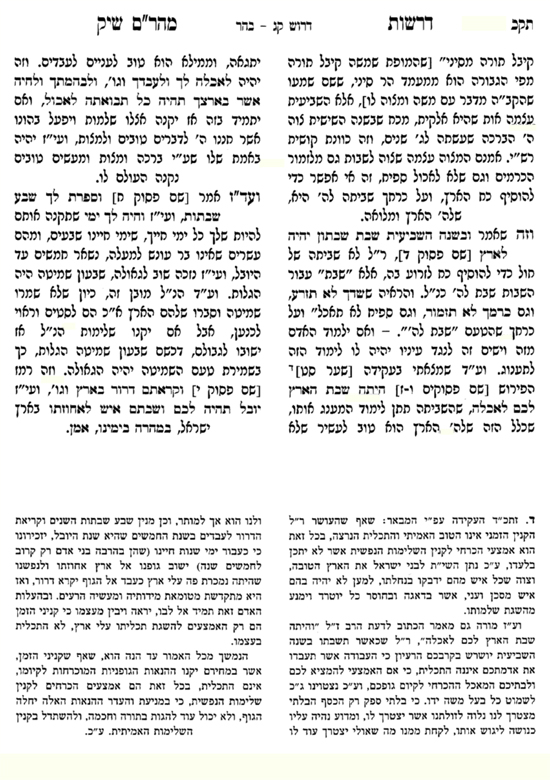
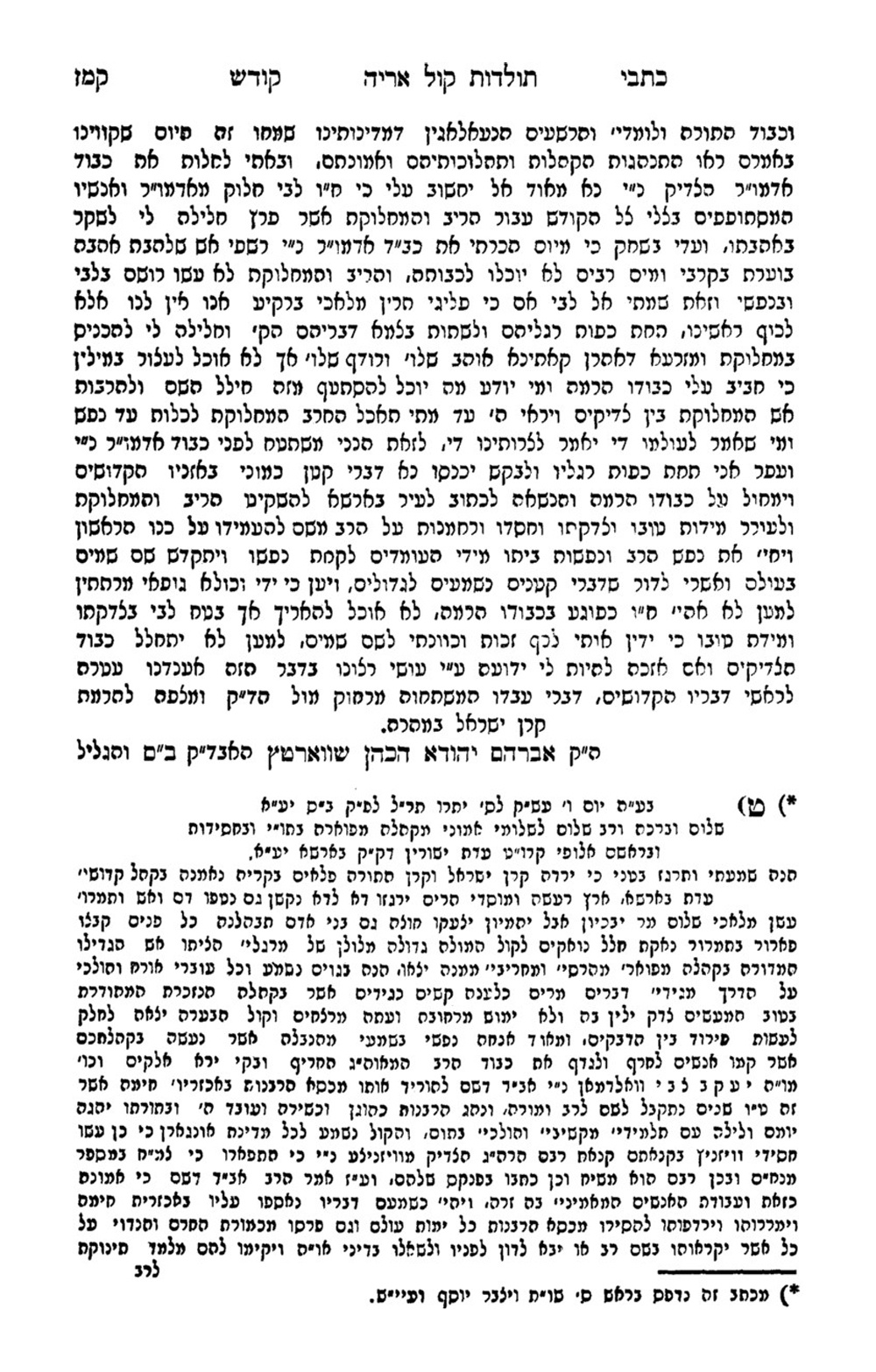
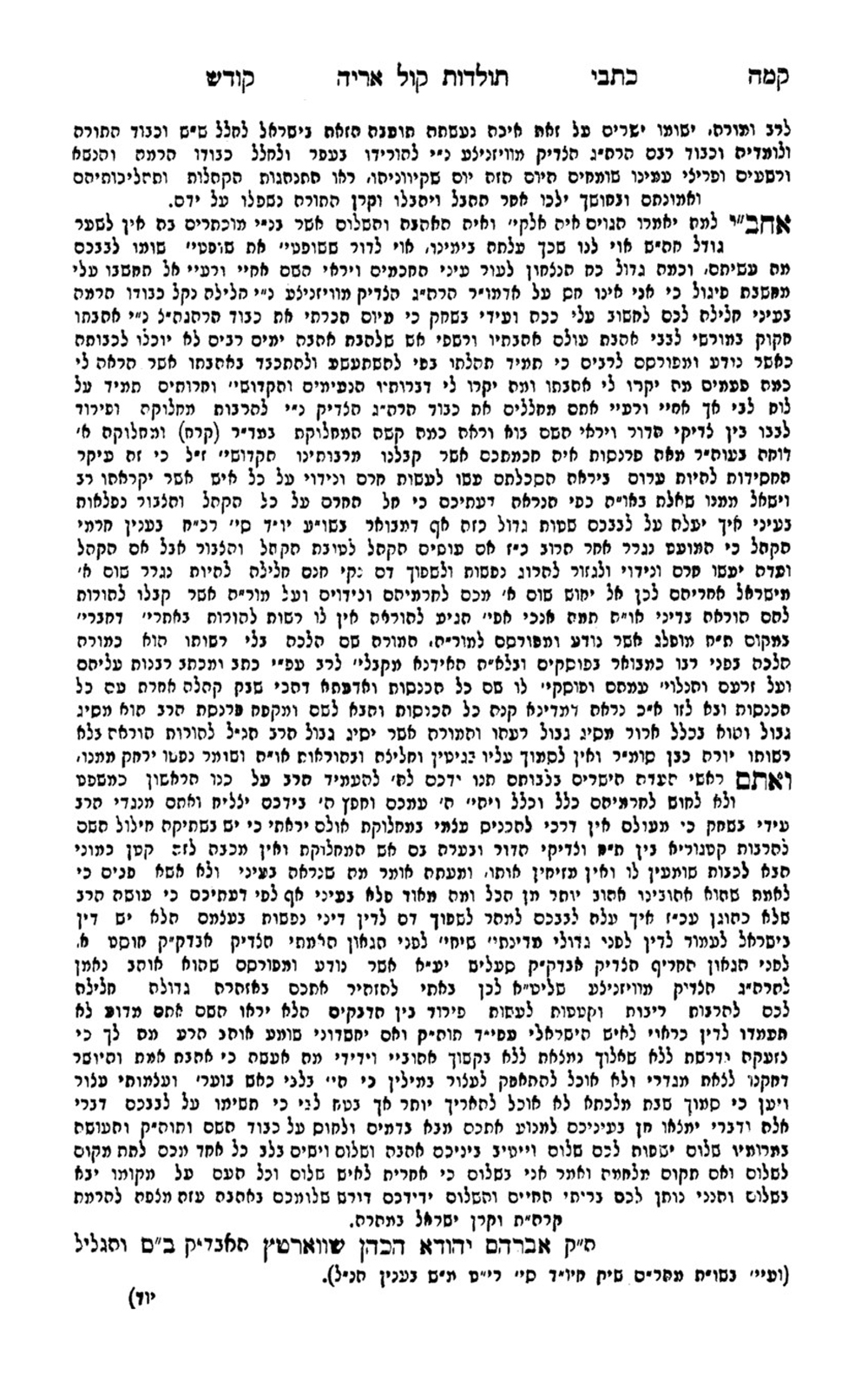
Here are the two letters printed in the Toldos Kol Aryeh, and if you look at the footnote to the letter to Borşa on p.147, you’ll notice that it says that it was first printed in the beginning of Shu”t Vayitzbor Yosef:
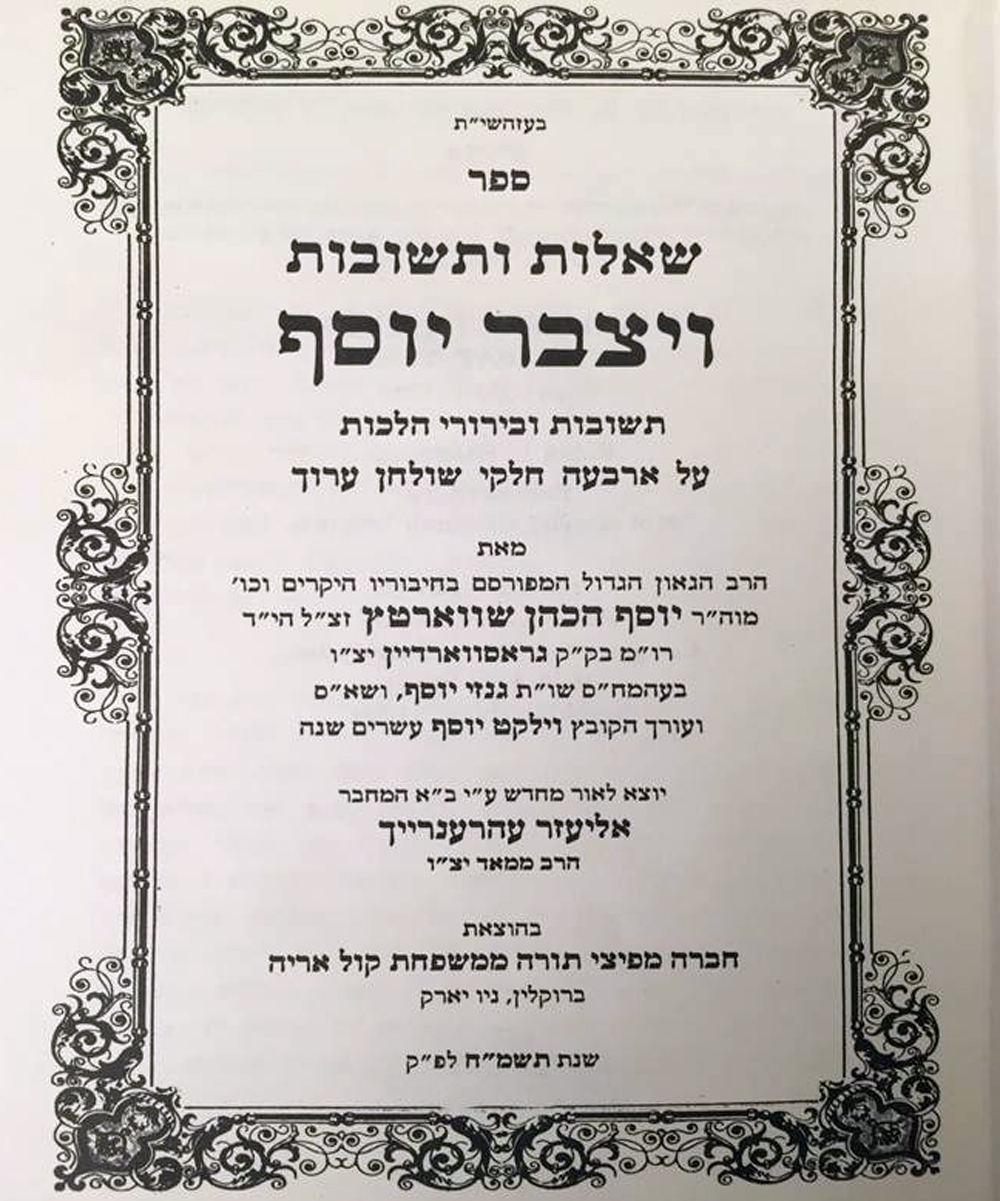
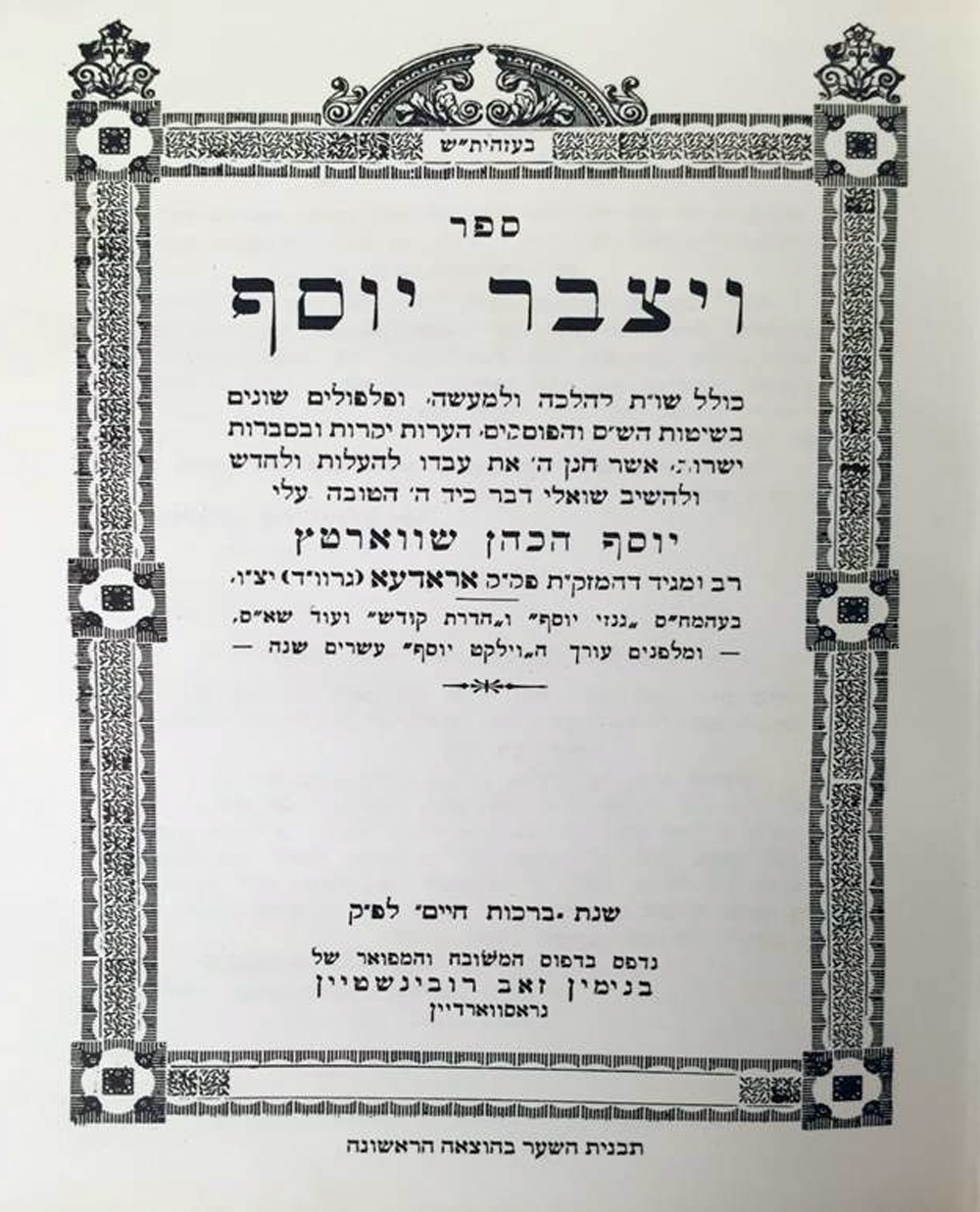
The Vayitzbor Yosef was written by R’ Yosef Schwartz[16], the grandson of R’ Avraham Yehuda Schwartz.  The copy I initially had, was the second edition printed by R’ Yosef’s nephew in Brooklyn in 1987[17].  Here is the title page:
  
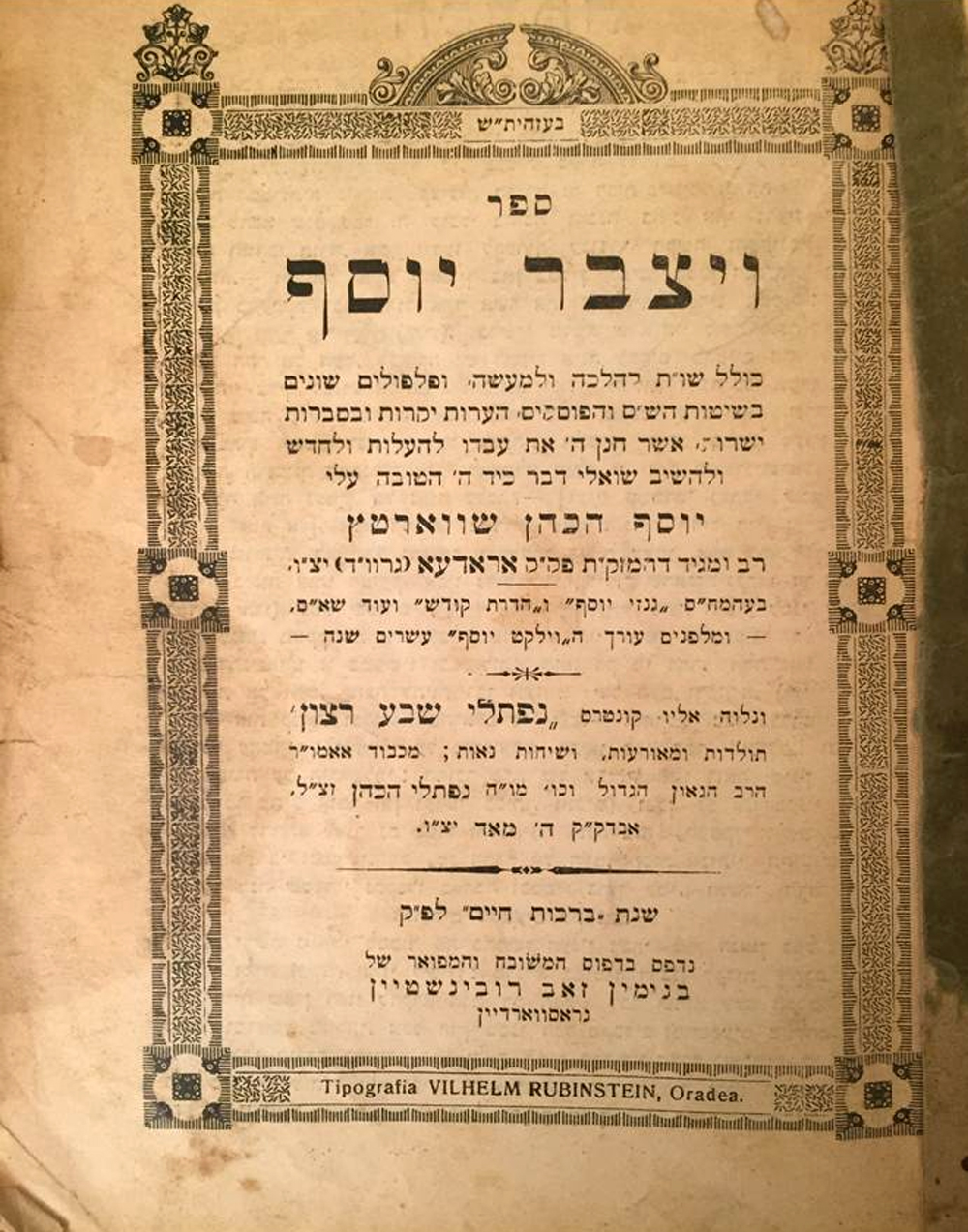
However, a thorough search for the letter through the entire work came up with nothing.  It seems to have vanished.  After an exhaustive hunt, I was finally able to procure a first edition of the Vayitzbor Yosef, and upon examination, I was able to realize the full extent of how doctored the second edition is.  In the second edition, there are approbations added from R’ Yosef Schwartz’s other work Ginzei Yosef, and the index is in the back of the sefer, unlike the first edition where they were printed in the front, right after the hakdamah and before the pesicha.  These changes are quite innocuous.  However, in the second edition, a picture of the original title page is presented with a glaring omission.
Here is how it is presented:
And here is it in actuality:
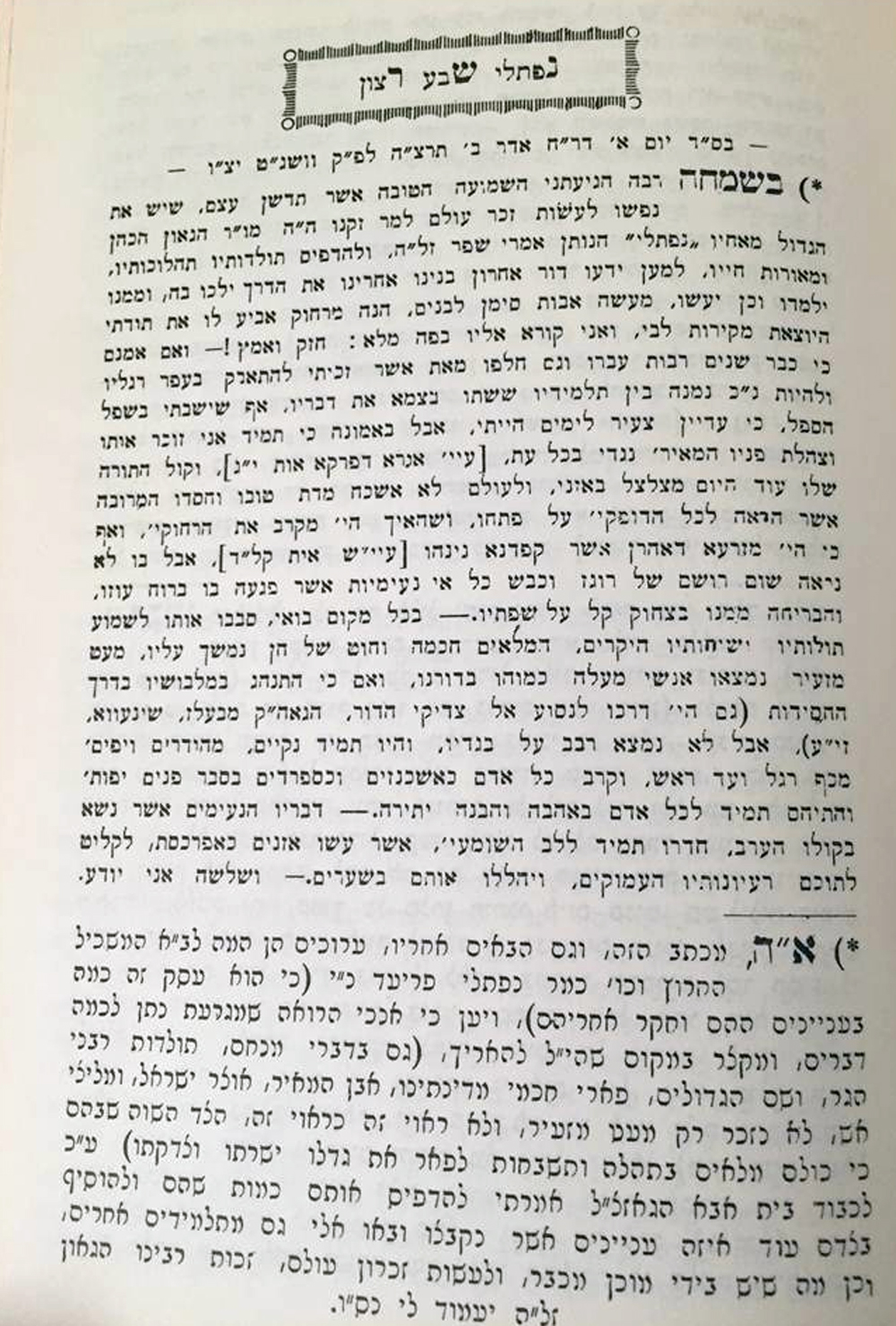
Notice anything different?  That’s right, on the original title page, there is mention of a separate part of the sefer, “Naftali Savah Ratzon” which is supposed to be a collection of things that the author heard from his father R’ Naftali Schwartz.  If you guessed that the second edition is devoid of this section in its entirety, you would also be correct.  Here is a picture of the beginning of that missing section, which also happens to be printed in the back of the New York edition of Toldos Kol Aryeh:
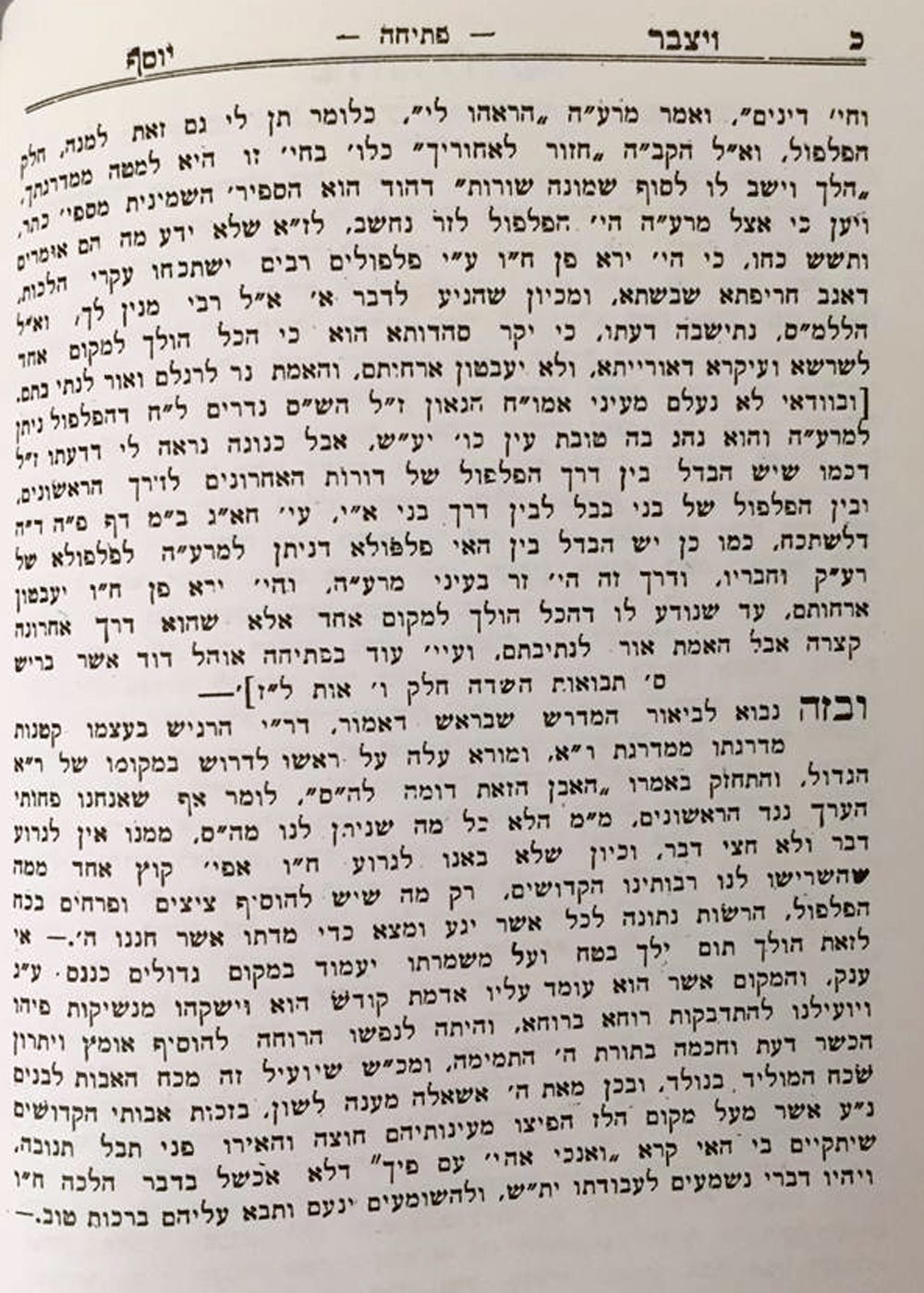
Having gone through the Naftali Savah Ratzon, I couldn’t find any objectionable material that would have motivated the publishers from removing it.  So what was their motivation?  Remember the missing letter from R’ Avraham Yehuda Schwartz, the Kol Aryeh?  Well, in the first edition, there is another small section right after the pesicha, called “Hashmatah V’hosafa L’kunteres Naftali Savah Ratzon.”

Here is how the second edition appears:
And here is how it’s supposed to look like:
This section is four pages long, and in it can be found the censored letter from R’ Schwartz to the people of Borşa.  It would seem that this sensitive letter was behind the publisher’s motivation to totally remove any mention of the Naftali Savah Ratzon, since it was officially part of it as a hashmatah.  So not only was an important document lifted from the sefer, a whole section became a casualty along with it.  Why the publishers couldn’t just take the letter out and keep the rest of the Naftali Savah Ratzon, I’m not sure.  I guess they wanted as “clean” of a job as possible.
I must point out how Leopold Greenwald, Yaakov Tzvi Abraham, Dr. Yehuda Speigel, and Gedaliah Stein explain the rationale of the people of Borşa’s belief that Menachem Mendel Hagar was the Messiah, and how their explanation is mistaken.  Greenwald[18], Abraham[19], Speigal[20], and Stein both suggest how the belief was formulated as a reaction to Hagar’s sefer, Tzemach Tzadik.  In his work Zichron Borsa[21], Stein explains that since Hagar gave no explanation to the title of his sefer, which was perplexing since it did not have Hagar’s name within its title as do other sefarim, such as “Kedushas Levi” by R’ Levi Yitzchak of Berditchev, or “Ahavas Yonasan” by R’ Yonasan Eibeshutz, his chasidim saw in it an esoteric meaning.  As the gematria of “Tzemach,” which is used to refer the Messiah in Zachariah 6:12, is equivalent to “Menachem,” and likewise the gematria of “Tzaddik,” which is also used in Zachariah 9:9 to refer to the Messiah, is equivalent to “Mendel,” this must mean that their rebbe, R’ Menachem Mendel Hagar is indeed the Messiah! 
This explanation is simply untrue.  In no way, could the work Tzemach Tzadik have had any influence on what happened in Borşa in 1870, when it was only published for the first time in 1885.  As for the reason why it was called Tzemach Tzadik, Hagar’s son Baruch, explains in the preface to the work that he simply named it because the gematria is equivalent to Menachem Mendel.  It is also untenable to argue that a manuscript, or knowledge of one with the title Tzemach Tzadik, was floating around at the time of the dispute, because  R’ Baruch Hagar writes in the preface that the material for the work was only written a few years before his father’s passing in 1885.  Consequentially, we must take the letters of the Kol Aryeh for their simple meaning, that the people themselves came up with the gematria of tzemach and its link to the Messiah and the Vizhnitz Rebbe.
Many leading rabbis of the time came to R’ Waldman’s defense, including; R’ Moshe Schick[22], R’ Chaim Sofer of Munkatch[23], R’ Chaim Halberstam of Sanz[24], R’ Yosef Shaul Nathansohn[25], and the previously mentioned R’ Avraham Yehuda Schwartz. It seems that the only rabbi that came to the defense of the Vizhnitz Chasidim, was R’ Yehuda Modern[26].  What happened next isn’t very clear, but it seems that a tribunal was held by Schwartz to settle things[27], and Waldman was reinstituted as rabbi of Borşa.  Waldman died in Vienna in 1883.
As a side note, take a look at the last page of the letter of R’ Schwartz, printed in the first edition of the Vayitzbor Yosef, on the very bottom:
That is a stamp referring to the responsum of R’ Moshe Schick to Borşa!  I don’t know if this appears in every first edition copy, or if some private owner went to the trouble to specially stamp this, but it would be interesting to find out!


[1] Mordechai Mochiach of Eisenstaedt, Baruchia Russo, Jacob Querido, Abraham Cordozo, Yehuda Leib Prossnitz, and Jacob Frank
[2] See Ba’al Shem Tov Al Hatorah (Jerusalem 1998) in the Hakdamah #23 in the name of Nachum from Chernobyl, though this is seemingly a contradiction to the Iggeres Hakodesh of the Ba’al Shem Tov where he writes that he spoke with the Messiah.
[3] See Aharon Wertheim, Halachos V’halichos B’Chasidus (Mossad Harav Kook, 2002), pp. 20-21 fn. 52
[4] See David Assaf, The Regal Way (Stanford University Press, 2002), pp. 257-261
[5] See Yehuda Leibes, Studies in Jewish Myth and Jewish Messianism (State University of New York Press, 1993) p. 115
[6] See the hakdamah to Chumash Heichal Bracha (Lemberg 1864), “וגם דודי מורי החסיד השלם הצדיק אא”ק מוהר”ר משה הוא קרא אותי בפעם הראשון בשם מורה מורנו בפ’ בהר וקרא לפני או דודו יגאלנו ואמר עשיתי אותך גואל ואמר זה באנפין נהרין.”.  See Heichal Bracha on Leviticus 25:49 where he says that the verse is referring to Mashiach ben Yosef.  See also Megilas Starim (Jerusalem 1944) where he says he was born in the year משיח בן יוסף,  here.
[7] See Nochum Brandwein, Imrei Tov (1891) p.29a where he writes, “כמו ששמעתי מפי מרן הק’ והטהור איש צדיק תמים שמו נאה לו מוהר”ר דוד משה שליט”א. וזאת ידוע כי “משה” עולה :”אלקים אחרים”, כי בכוחו נמתק אלקים אחרים , “משה דוד” עולה: “שטן”,כי בכוחו להמתיק את השטן מישראל, ואז נמשך גאולה לישראל, כי: “משיח” עם הכולל עולה: “משה דוד”, ואז יקויים “ועינינו תראינה מלכותך” ע”י דוד משיח צדקך .  here.
[8] See Chaim Vital, Sefer Hachizyonos (Jerusalem, 2001) pp. 8, 17-18
[9] See Ohr Hachaim, Deuteronomy 15:7 at the end, here.
[10] See Isaiah Tishby, Messianic Mysticism (Littman Library, 2014) pp. 196-199
[11] See Yaakov Sapir, Iggeres Teiman Hasheni (Mainz, 1873)  here and Amram ibn Yachya Kerach, Sa’aras Teiman  (Jerusalem. 1954) pp.36-39 here.
[12] See ibid.
[14]  Though R’ Shalom Shachna of Lublin allegedly wrote on his gemara about the debate in Sanhedrin 98b over the name of the Messiah, “אני אומר שכנא שמו שנאמר לשכנו תדרשו”, referring to Deuteronomy 12:5, See Reuven Margolyos, Margolyos Hayam, Sanhedrin 98b #14, it was probably from a disciple in jest.  See Asher Ziv, Rabbeinu Shalom Shachna Milublin, Hadarom No.57, p.119.
[15] His two volume halachic work, Shu”t Tzvi V’Chamid, was printed from a manuscript in 2008.
[16] Here is a picture of R’ Schwartz with his wife:

[17] Unfortunately, hebrewbooks.org doesn’t yet have the sefer online. You can still look at the first forty pages for free on Otzar Ha-Hochma online with this link, here, even if you don’t have a subscription.
[18] Matzevat Kodesh (New York 1951) p.24 fn.57 here,  L’toldos Hareformatzian Hadatis B’Germania U’bungaria p.20 fn.40 here.
[19] L’koros Hayahadus B’trasylvania (New York) p.84
[20] Toldos Yisrael V’hispatchus Hachasidus B’Rusia H’Karpatis p.32
[21] (Kiryas Motzken, 1984) part 2 pp.68-71
[22] Shu”t Maharam Schick, Yoreh Deah #219,  here.  The published teshuva is written to an anonymous kehillah, though it is attributed to the town of Borşa.
[23] Toldos Sofrim (London, 1962) pp.37-38, here.  From Sofer’s letter we see how this was also part of the greater dispute between the Sanz and Sadigura chasidim, on this see David Assaf, Heitzitz V’Nifga Ch.19.
[24] Measef Ha’be-er year 7 p.42,  here.  I was very pleased when I first saw this letter. In it, Halberstamm argues that even an evil person that learns torah, his torah isn’t נמאסת, how more so then to a righteous person.  He brings a proof from the famous gemara in Chagiga 15b where a fire came down from heaven in front of Yehuda Hanasi to defend Elisha ben Avuya from disparagement.  I always made the same argument to fanatics who would say disparaging remarks about R’ Joseph B. Soloveitchik.
[25] Shu”t Shoel U’Meishiv Sheviah #16, also in Kerem Shlomo Tamuz 5743
[26] Tzfunos no.10 Teves 5751 p.118, here.
[27] See Toldos Kol Aryeh p.79 #122, here.


Milah Books & Manuals

Milah Books & Manuals
by Eliezer Brodt & Ish Sefer
Much has been written on milah. Hebrew Books has over forty seforim on this topic. There are those books that discuss the various controversies, including abolishing milah in toto[1]or specific parts of milah such as metzizah be-peh.[2] Others focus on the philosophic and theological implications of milah.[3] This post, however, will focus on two types of milah books, one what we will refer to as milah manuals and the second, books about milah. The former is comprised of books that explain, in detail, the process of milah – these can include the physical process, i.e. how the surgery is to take place, as well as the more esoteric processes such as thoughts or prayers that are to accompany the milah. The second type of book doesn’t focus on the technical aspects of milah but instead focuses on the customs, the laws, etc. that are connected with the surgery. One final point, this is not intended to be a complete bibliography of either type of work, instead, we have picked out a few titles that hopefully will be of interest to the readers.
Milah ManualsThe first manual up for discussion is R. Tzvi Benyamin Auerbach’s, Brit Avraham, Frankfort, 1860. This book includes a nice introduction dealing with a history of the Ravan as well as other Rishonim. Additionally, all the liturgy associated with brit and explanations of the liturgy is included. There is a section on the laws relating to milah. At the beginning of this section, Auerbach notes that although he takes a different view of some of rules governing milah, he provides explainations for his divergent opinions in another section. Indeed, Auerbach does provide a detailed discussion of the law of milah including a discussion of most, if not all, relevant opinions. Interestingly, although the laws and liturgy are in Hebrew, this section, the section discussing the bases for Auerbach’s opinions, is in German. Not only is it in German, but in Latin characters indicating that Auerbach was trying to demonstrate the correctness of his opinion to only those who could read German. Let us explain. Auerbach’s work includes one other section in the vernacular. That section discusses various cures associated with milah. This section is written in Yiddish in Hebrew characters. Auerbach explains that he did so “so that even those who do not understand Hebrew will understand this section.” Thus, there are three potential audiences for this book. Those who only understand Yiddish, those who understand Hebrew, and finally, those who understand German as well. R. Auerbach is most well-known for another work, Sefer ha-Eshkol he edited and published from a manuscript and added his own commentary, Nahal Eshkol. As Dr. Shapiro has discussed, this work was accused of being a forgery, that although it was attributed to Rabbi Abraham ben Isaac, a Rishon, it was in fact a later invention. Ironically, in the introduction to Brit Avraham (pp. 24-25), Auerbach discusses the importance of authenticating manuscripts and ensuring proper attribution. Specifically, Auerbach provides Brother, the following story illustrates how must care and time one must take in authenticating old manuscripts that are found in various libraries. In fact, Gedolei Yisrael have erred because they failed to take proper care [in authenticating manuscripts] when it came to the prohibition of terafot. Auerbach offers the story that when he was studying under R. Leib Karlburg, R. Karlburg ruled that an animal was not a terifah which appeared to be in contravention with the understood law. Auerbach questioned him on this ruling and R. Karlburg explained that all the Rabbis in Cologne and Bonn permit this because of a responsum authored in 1626 and signed by numerous rabbis that remained in manuscript but was included in the communal pinkas from R. Yehuda Miller’s library. Auerbach went and looked this up, and indeed there was such a responsum attributed to various Rabbis. Auerbach, however, wrote to his father-in-law, an expert in yoreh deah, regarding this leniency, and his father-in-law told him to ignore it and follow the accepted stricter position. Auerbach continues, that after he got to Frankfort, he told R. Aaron Fuld this story and R. Fuld immediately showed Auerbach a responsum from R. Mordechai Halberstatt, Ma’amar Mordechai. R. Halberstatt published the responsum (as well as other manuscripts from R. Miller’s library) and after doing so states “all of the preceding manuscripts are forgeries and the product of the the doer of a terrible deed, may his name be blotted out, Lieb the non Jew who is the well-known informer Kreski (this wicked one is referred to in the book Ametz Yosef as the informer Krauss . . .) . . . he is the the one who forged and spoke falsehoods in the names of various luminaries.” Auerbach then finishes “that I have spoken at length [regarding the need for caution authenticating manuscripts] because there is still a community who follows the [erroneous] practice regarding the above issue of terifah.” Ironically, one of the justifications for Auerbach publishing a forgery was that Auerbach was duped regarding the manuscript and failed to do correctly authenticate the manuscript he attributed to the Sefer ha-Eshkol.[4] The next two manuals are interesting in both their content as well as their titles. These two manuals are more focused on the kabbalstic intent that one is to have during the ceremony. Sod ha-Shem has already been discussed here and here due to the fact the author, R. David Lida, has been accused of being a Sabbatian. But, it should also be noted that both Sod ha-Shem and Hotem ha-Shem use God’s name in the titles. Indeed, in the later case, God’s full name is spelled out – Yud, Hey, Vav, Hey (additionally, must of what is in Hotem ha-Shem comes from Sod ha-Shem). Such use of God’s name is not unique to these books. The first to discuss the issue of using God’s name in the title actually arose not because the book in question had God’s name but rather because the title could be (incorrectly) read to be referring to God. Of couse, we speak of Hezkiyah Medini’s Sedi Hemed. The Sedi Hemed was not published in a single set as it is available today. Instead, R. Medini sent kuntresim in paperback as the parts became available to various rabbis to get their opinions on the work. Although much of the feedback R. Medini got was positive, R. Medini recieved two letters from a rabbi R. Medini does not identify that questioned R. Medini’s work and more particularly, the title of his work. These letters complained that since the Sedi Hemed had a paper cover with the title on it, when one went to bind all the kuntresim together, the binder would inevitably remove one cover. According to the anonymous rabbi this was problematic because Sedi also spells out a name of god and thus opens the potential for discarding of a page with god’s name on it.

R. Medini responded by noting that since the word in question “sedi” is not intended to be holy, although the same word may also have a holy connotation, whether it is in fact holy is dependent upon the intent of the author (i.e. elohim referring to idols). Here, the intent was not god’s name so there is no problem. R. Medini also noted that of the many, many rabbis who wrote to him regarding his book, none had refrained from mentioning the title and none brought this “issue” to his attention. R. Medini then cataloged a few books that, like the Sod ha-Shem and Hotem ha-Shem, have god’s actual name in the title and none of these authors were at all bothered by that. Indeed, it seems rather odd to worry about a book title, when the entire book is to be respected. R. Medini then wrote to numerous rabbis to check and make certain that his logic was sound (they all responded that R. Medini was correct). The first he wrote to was the extremely erudite scholar, R. Yosef Zekhariah Stern. R. Stern agreed with R. Medini and offered additional titles that contain god’s name. Additionally, R. Stern also highlighted names that include god’s name in them such as eliyahu, eliezer, daniel and the like. R. Stern proclaims that although these names contain god’s name in them no one has ever had a problem with them nor did he ever see anyone hyphenate or otherwise alter the name to ensure that god’s name doesn’t appear. Today, however, the very practice that R. Stern notes was never done, has become commonplace in some quarters. In the end, R. Medini’s work retained the title Sedi Hemed; however, the title now carries nekkudot to ensure that no one makes a mistake regarding the pronunciation.
In 1892, Zichron Brit li-Rishonim was printed. Although published in the end of the nineteenth century, this manual is based on the pesakim of the rishonim R. Yakov ha-Gozer and his sons. Israel Ta-Shma points out that this is the first specialist sefer written in times of Rishonim where we do not know anything about them in others areas of torah (as there were other specialist seforim written before but by well-known gedolim). Additionally, Ta-Shma demonstrates that this work was meant for the Moheleim of the time to improve the field. See I. Ta-Shma, Keneset Mechkarim, Iyunei be-Safrut ha-Rabbanim be-yemi ha-Benyaim, (Bialik Institute, Jerusalem: 2004), vol. I, pp. 320-22; idem, Halakha, Minhag, u-Metziut be-Ashkenaz 1100-1350, (Magnes Press, Jerusalem: 1996), pp. 96-99 The question is why the name “ha-Gozer.” R. Yissacar Tamar in Alei Tamar [Moed 1:149];has a lengthy piece on the topic where he points out there are almost no sources in chazal that “gozer” refers to a mohel. He suggests that maybe the editor stuck it in. R. Tamar then suggests that perhaps the name “gozer” has nothing to do with Milah. Instead, it was a nickname of respect that he was a Tzadik and what he was gozer hashem did. [See also R. Elijah Levita, Tishbi, s.v. gezeriah.] However it appears that Alei Tamar missed a known Midrash which provides: שבעה הרי שמונה, אמר משה בזכות המילה שניתנה לשמונה נקרע הים, ונקלס באז. אמר ר’ לוי לגוזר ים סוף לגזרים (תהלים קלו יג), שכן בלשון ארמי קורין למהולין גזורים, בזכות המילה נקרע הים (מדרש תנחומא (בובר) פרשת בשלח סימן יב) .
Other Works on Milah An excellent sefer on milah, Koret ha-Brit, was written by R. E. Posek and first printed in Lvov in 1893 and recently reprinted (300 pgs). This sefer covers all topics relating to milah and provides incredible sources and many of his own fascinating insights on the topics. It also includes an abridged selection of all the kabbalah aspects mentioned in R. Lidas Sod ha-Shem. He received many nice haskomos to the sefer among them the Marsham, Adres and Sdei Chemed. Besides for receiving these haskomot he also received many notes on his work from the Adres and Marsham indicating that both read the book closely. The Adres, in his haskamah, discusses limiting oneself to a single topic. ומצאנו לרבותינו ז”ל שהיו מצוינם במקצוע אחת יותר מחבריהם [עי’ ברכות כ’ א’ , מו”ק כח ב, ע”ז ד’ א’ , ב”ק לט נג א, ב”מ ס”ו פו א’, חולין נב ב, גיטין ה’ ב] ומה”ט קבעו הלכה כמותם בזה [עי’ רש”י כתובת מג ב, רא”ש ב”ק פרק ד] כן נוכל לומר על ידידינו המחבר… Another important work was the Zecher Dovid written by R. Dovid Zechus Modena first printed in 1816 . This work is extremely special. This was very rare ever since it was printed and therefore it was rarely quoted even Sefer ha-Brit, discussed below, which quotes many seforim on the topic does not quote this work. The sefer Otzar ha-Brit from the famous yerushalmi mohel does quote this work often as he received special permission from Hebrew University to borrow it when he was working on his seforim. In 2001, Ahavat Sholom reprinted this work in a beautiful set of six volumes including a volume of indexes and a volume of dershos of his on chumahs that was never printed before. This work is an encyclopedia on Milah and many other topics. It is divided into three sections the first two relate to milah in all aspects of kabalah and halacha. The importance of this work is besides for quoting an excellent selection of sources on his topics he adds in many of his own nice points brings many sources from unprinted manuscripts and organizes it all very well making it a pleasure to read. The third section of this sefer is all about the cycle of the year from Shabbat and all the Yamim Tovim here too he deals a little bit about milah but mostly focuses on the Yamim Tovim and includes excellent discussions and sources on the topics. This is one of the best seforim which Ahavat Sholom has printed.

Another work on the topic is Machsehrei Milah written by R. Eliyhu Halevi, Livorno, 1793 and recently reprinted by Ahavat Sholom. This new edition includes a selection of the Kuntres on metzizah from R. Hezkiah Medini the author of the Sedi Hemed as well as a selection of halachos from R. Yakov Hillel. Another work is Sefer ha-Bris written by famous mohel R. Pirutinsky comprised of 415 pages and is an extremely thorough work on the topic. One section of great interest is on metzizah (pp. 216-26) where he brings many sources on the topic including R. Chaim Solovetick’s and R. Aron Kotler’s opinions (p. 224). Another sefer of interest is called Meshiv Nefesh first printed in 1906 and recently reprinted by Tuvias. The author was Dr. Sherhai a doctor who also appeared to be a big talmid chacham. This work consists of three parts. The first part titled Meshiv Nefesh is about Halacha Limoshe Misinai all over chazal He also deals with the Rambam Shitas on this topic at great length. The second part of the sefer deals with many aspects of Milah showing, at great length, that the metzizah is an very important part of the Mitzvah and is not just based upon danger to the baby. He has a interesting discussion about the famous concept nishtanh ha-teveh (pp. 21b- 22b, 34a-34b). He also claims, like many others, that the Chasam Sofer teshuvah on the topic of metzizah is not a forgery but, instead, was a horas sh’eah (p.64). The third part of the sefer is titled Bris Shalom in which the author argues, using medical sources, that metzizah is not dangerous at all. As an aside besides for all his discussions in regard to Milah he also has a few other interesting discussions where he deals with going to doctors (p12b), the knowledge of Noach, Moshe Rabenu (p.12b) Tanim vamorim in medical areas (p.18a) including a list of those that actually practiced medicine (pp.14b,17a). He also includes a list of Geonim Rishonim and achronim (pp.19a- 22b) who practiced medicine including Rashi (p.19b). He concludes this section with a very interesting piece (p.23a): מדוע נשתנה הדור הזה מדורות הראשונים שהיו גם כן חכמים גדולים בחכמת הרפואה וגאונים גדולים בחכמת התורה, אף שברוך ה’ לא אלמן ישראל כי נמצאים גם בזמננו בפרט בארץ אשכנז… ורופאים הושמרים תורתנו הקדושה כדיו וכדת בכל פרטיה ודקדוקיה מהם וגם כן גדולי תורה על כל זה אינם במדה מרובה כמו בדורות הראשונים… התשובה לשאלה הזאת נמצא גם כן בתורתינו הקדושה על פי מליצת חז”ל באמרם לעולם יכנוס אדם בכי טוב ויצא בכי טוב, פירוש כל מה שיתחל האדם ליכנס באיזה דבר או באיזה חכמה ללמוד יכנס בכי טוב ואין טוב אלא תורה פירוש אל יכונס אלא כשישים תורת ה’ לעיקר, וכן בדורות הראשונים שבתחלה מלאו כריסם בש”ס פוסקים כמו כל הגאונים שהבאתי ורצו ללמוד החכמה הזאת באשר היא שייכה לחכמת התורה, והרבה ענינים בחז”ל מה שלא יכלו לבארם בביאור נכון רק על ידי חכמת רפואה כמו כל הגאונים שהבאתי ורצו ללמוד החכמה הזאת באשר היא שיכה לחכמת התורה, והרבה ענינים בחז”ל מה שלא יכלו לבארם בביאור נכון רק על ידי חכמת הרפואה… וכוונתם היתה רצויה להיות להם מזה מטרה בח בחיים ושיהא להם לחם חוקם מזה בכדי שיוכלו ללמוד וללמד את שתי חכמות שתהינה מתאימות ועולות בד בבד ותהיינה לאחדים בידם וגם לקיים מצות מעשה היא פיקוח נפשות חיי דברייתא, ומאחר שנכנסו בכי טוב שלמים בחכמת הרפואה ומלאים במדות טובות וביראת שמים וכל שיראתו חטאו קודמת לחכמתו חכמתו מתקיימת, אבל לא כן עתה בדור הזה רובא דרובא נכנסו ללמוד הכמות ולשונות בעודנו כשהוא נער הוא כתינוק שנשבה לבין הנכרים דלא עסקו בלימוד התורה כפי הנצרך… Over the years many sefarim and articles have been written about metzizah pro and against doing it with a klei. One such work was called Sefer Dam Brit, printed in 1901 in London by Alexander Tertis. This work contained a method of doing metzizah be-klei called the Tertis-apparatus (see below) and including many important haskomot of gedolim. One haskamah was from the Orach Hashulchan (p.34) but R. Pirutinsky already points out that in his work Orach Hashulchan (Y.D. 264:19) that R. Epstein takes a different view than the one he expresses in his haskamah. דע שיש בזמנינו שאומרים שיותר טוב לעשות המציצה לא בפה אלא באיזה ספוג שמספג את הדם ולא נאבה לאם ולא נשמע להם ורבותינו חכמי הש”ס היו בקיאים ומחוכמים יותר מהם אך זהו בוודאי שהמוצץ יהיה לו פה נקי בלא שום מחלה ושניים נקיים… ואין לנו לחדש חדשות כאלה ונהיה כאבותינו ובמדינתינו לא שמענו זה: Many of the haskomot are worth studying and quoting but one of the important ones was from R. Yakov Yosef where he writes (p. 6): וכבר למדנו חז”ל ללמוד בדברים הנוגעים לחכמת הרפואה והטבע מחכמי הרופאים… ולמה לא נסמוך על הרופאים שאומרים כי מציצה של שמירת הבריאות תוכל להיות על ידי כלי מתוקן על זה וגם לא מצינו במסכת שבת באיזה אופן לעשות… This haskamah in particular incurred the wrath of the Adres in a rather harsh letter recently printed in his Shut Mayneh Eliyhu (p. 352). Shockingly this letter was not edited out .The letter is really worth quoting in its entirety as it is very important for the whole topic but here is part: לבי ידאב על מעשה הקובץ של לעטריס שהדפיס בעתונו היהודי המקבץ שו”ת ממי שהוא מונה וספור שלשים וא גם יותר רבנים המתירים, ובראשם ימנה הגאון חת”ס והגאון חריף שקוראים אותו בארץ ליטא חריף. צחוק מכאביב לב עשה לנו בהזוג הזה, ומאן מעייל בר נפח בארעא דעיילי זקוקין דנורא, מה ענין ר’ יעקב מנויארק אשר היה רב בזאגר ומ”מ בווילנא, ועל ידי מכונות ותחבולות כדרכו יצא לנויארק, וידענו היטב היטב את האיש ואת שיחו תהלוכותיו ותחבולותיו מתחילה עד סוף, מה ענינו לרבינו החתם סופר, אשר עוד כשמונים שנה בדור דעה שהיו אז כל הגאונים האידרים בחיים הי’ הוא הראש וראשון להוראה וממנו יצאה תורה לכל ישראל, ואותו הרב ר’ יעקב שלא שמש תלמידי חכמים ומלך מעצמו, על פי תבונותו, כי פקח גדול הוא, אינו מגיע לקרסולי תלמידי תלמידו של הגאון חתם סופר, לא בתורה ולא במעשים טובים, והרי לפנינו שעזב עיר וולינא תפארת ליטא, והלך לנוע על ארצות אמעריקא להיות שם רב ראשון בנויארק כחלומו אשר חלום… והרואה דברי הר”מ פ”ו ה”א מדיעות, יעי’ שם היטב בלשונו, יראה עד כמה מלאה לבו יראת שמים לעשות כן. ואיש כזה אשר בהיותו מולדותו לא הי’ מגדולי הרבנים רק מגדולי הדרשנים כיד הדיבור הטובה עליו, אשר בעבור זה נתקבל למ”מ בווילנא (אחרי תחבולות רבות מצידו), הוא נעשה חריף בעברו על הים ובא לארץ החדשה, כשושנה בין החוחים, ונעשה שר לסרוחים. והנה הוא גם בעל הוראה ויתיר כמו שלבו טוב עליו, ובדור החושך הזה מקלו יגיד לו, כל המיקל הרי זה משובח, וכל המחמיר הוא ללעג ולמטרה לפני בני עולה, כמעשה אתרוגי קורפו, שביעית, ועוד ועוד אשר הדבר נמסר לעורכי העתונים לעפר בעפר על כל מי שלא יאמר כדבריהם. Interestingly enough elsewhere the Adres writes much less harsh about the topic in his notes to R. Posek Kores Habris the Adres writes (pp.143a-143b) בזמנינו המציאו חכמי הרופאים פני המציצה כמין שפופרת חלקה למצוץ על ידה בפה ולא להכניס האבר בפה ולמוץ וכל זה מחשש חולי המתדבק להמוצץ או מהמוצץ להתינוק והתירו פרושים את הדבר ובכיוצא בזה י”ל שמאל דוחה וימין מקרבת As an aside we see from this letter the tremendous respect and kovod he had for the Chasam Sofer. Other places in his writings show this for example is in Shivis Zion (p.233) after quoting the famous Chasam Sofer in succcah … (36b) that some edited out that says: … לע”ד רבי ישמעאל נמי לא אמר מקרא ואספת דגנך אלא בא”י ורוב ישראל שרויין שהעבודה בקרקע גופה מצוה משום יישוב א”י ולהוציא פירותי’ הקדושי’ ועל זה ציותה התורה ואספת דגנך ובועז זורה גורן השעורי’ הלילה משום מצוה וכאלו תאמר לא אניח תפילין מפני שאני עוסק בתורה ה”נ לא יאמר לא אאסוף דגני מפני עסק התורה ואפשר אפילו שארי אומניו’ שיש בהם ישוב העולם הכל בכלל מצוה אבל כשאנו מפוזרי’ בעו”ה בין או”ה וכל שמרבה העולם יישוב מוסיף עבודת ה’ חורבן מודה ר”י לרשב”י וע”ז אנו סומכי’ על ר’ נהוראי במתני’ סוף קידושין מניח אני כל אומניות שבעולם ואיני מלמד בני אלא תורה היינו בח”ל … The Adres adds: … הרי לנו דבר נפלא מגאון עולם אביר הרועים רבינו שבגולה אשר הוא עומד ההוראה שכל בית ישראל נשען עליו ומי יבא אחריו … . [See also the list in Seder Eliyhu pp.122-123] For more on this see here . As an aside it seems that R. Yakov Yosef never knew about the Adres opinion of him as in a Haskamah to the sefer Neveh Sholom written five years later in 1900 he writes : ומחמת כי חולה אנכי ל”ע ע”כ לא יכילתי לעיין בו כראוי אבל המיעוט אשר ראיתי יעיד על ספרו כולו כי ראוי להוציא לאור עולם ובפרט כי כבר הוסכם ספר של מחבר הנ”ל מידידי הרב הגאון כו’ מו”ח אליהו דוד ראבניבוץ אב”ד פאנויעז ואין בודקין מן המזבח ולמעלה[Thanks to Eli Markin for this source.] Another excellent collection on Milah is called sefer Otzar Habris (four volumes) written by the famous Yerusalmi Mohel R. Yosele Weissberg. As an note of interest in his section on the metzizah controversy in volume four on page seven in the beginning of this section he gives credit to Jacob Katz for Katz’s essay on the topic

[1] See J. Katz, Divine Law in Human Hands, Magnes Press (Jerusalem: 1998), pp. 320-56. [2] J. Katz, Divine Law in Human Hands, Magnes Press (Jerusalem: 1998), pp. 357-402. [3] See, e.g., Shaye J.D. Cohen, Why Aren’t Jewish Women Circumcised?, University of California Press, (Berkely & Los Angeles, Ca.: 2005).[4] For more on this responsum, see Kuntress ha-Teshuvot, vol II, no. 2031.


The Cup for the Visitor: What lies behind the Kos Shel Eliyahu?

The Cup for the Visitor: What lies behind the Kos Shel Eliyahu?
By: Eliezer Brodt
 
In this post I would like to deal with tracing the early sources for the Kos Shel Eliyahu. A version of this article was printed last year in Ami Magazine (# 65).  This post contains a few corrections and additions to that version. A much more expanded version of this article will appear in Hebrew shortly (IY”H).
One of the memorable parts of the seder night is during Shefoch Chamascha when we open the door for Eliyahu Hanavi to come inside and drink from the Kos Shel Eliyahu. Children all over the world look carefully to see if there is less wine in the cup after he leaves, while many adults ‘accidently’ shake the table to make sure that there is less wine. What are the sources of this custom? When do we pour the kos of wine and what should we do with the leftover wine from the kos—drink it, spill it out, or save it? In this article I hope to trace this custom to its  earliest known sources and to discuss some other aspects of the seder night related to this topic.[1]
I would like to point out that my intention in this article is not to collect all the sources and reasons on these specific topics but rather to focus on the earliest sources and how these various minhagim came about.[2]
To begin with, it is worth pointing out that as far as we know today, there is no mention of the concept of Kos Shel Eliyahu in all of the literature that we have from the Geonim and Rishonim. Neither is there mention of it in the Tur, Shulchan Orach, Rema, or other early commentators on the Shulchan Orach.
One of the earliest mentions of a Kos Shel Eliyahu can be found in Rabbi Yaakov Reischer’s (1660-1733) work, Chok Yaakov, on Hilchos Pesach, first printed in 1696, in Dessau. He wrote that in his area, people had the custom to pour an extra glass of wine and call it Kos Shel Eliyahu.[3] He does not mention a reason for this custom, or at what point during the seder it is done, nor does he connect it to the opening of the door during Shefoch Chamascha or the idea Eliyahu Hanavi comes to the Seder.
Rabbi Chaim Benveniste (1603-1673), famous for his work Knesses Hagedolah, in his work on Pesach called Pesach Meuvin, first printed in 1692, writes that he saw some Ashkenazi Jews that leave an empty glass in the middle of the table for the leftovers of each cup of wine, and they call it Kos Shel Eliyahu. He writes that he liked this minhag so much that he started doing it himself, and he drank this glass during the Meal.[4] Here too, there is no connection made between the Kos Shel Eliyahu and opening the
door during Shefoch Chamascha for Eliyahu Hanavi.
In 1728, Rabbi Moshe Chagiz (1671-1751), printed part of a work of his, on minhagim, in the back of Sefer Birchat Eliyahu[5]. He writes that he was asked about the custom of Ashkenazi Jews to pour a cup of wine at the beginning of the seder for Eliyahu Hanavi, and that after the seder the head of the household slept next to this full glass of wine. Rabbi Moshe Chagiz was asked if observing this custom was a problem of nichush [divination].
Rabbi Chagiz replied that it was not a problem of nichush at all. He explained that the reason for this custom was similar to the reason we prepare a special chair for Eliyahu Hanavi at a bris milah.[6] Eliyahu Hanavi witnesses that the bris is performed. So too, on Pesach, Eliyahu Hanavi is supposed to be a witness that the Korban Pesach is done properly. The Korban Pesach is dependent on milah, since the halacha is that only someone with a bris milah can eat the Korban Pesach.[7] However it is important to point out that according to this reasoning, Eliyahu Hanavi does come to the seder, but it would seem that this would apply only during the times when the Korban Pesach was eaten.


New early sources for Kos Shel Eliyahu
 
Until 1984 these were the three earliest sources that made any mention of Kos Shel Eliyahu. In 1984, Rabbi Binyomin Nuzetz printed parts of a manuscript of Rabbi Zeligman Benga on Pesachim. Rabbi Benga was a grandson of Rabbi Menachem Tzioni and a close talmid of the Maharil, and he died around 1471. Rabbi Benga writes that he noticed some people pour a special glass of wine and call it Kos Shel Eliyahu. He writes that a possible reason for this is that we pour wine for Eliyahu Hanavi, since we are expecting him to come and he will need wine for the Arba Kosos.[8] This source helps us date the Kos Shel Eliyahu a few hundred years earlier than previously thought. Previously, the earliest source was printed in1692. What is interesting about this source is that he was not sure where the minhag came from and, again, he mentions no connection to Shefoch Chamascha.
In 1988, the department in Machon Yerushalayim that prints early works of German Jewry printed two volumes from manuscript from Rabbi Yuzpeh Shamash (1604-1678) of Worms. Rabbi Yuzpeh Shamash writes that it was the custom in Worms at the beginning of the seder to pour one extra cup of wine. Just as we say in the Haggadah, “Kol dichfin yesev v’yachul,” we prepare a glass for the guest who might come. This glass is called Kos Shel Eliyahu since this is the guest we await. Rabbi Yuzpeh Shamash brings another reason why it is called Kos Shel Eliyahu:
because it is a segulah to say “Eliyahu” to get rid of mazikim [destructive forces], and we do various things on the seder night to chase away the mazikim.[9]
In 1985, a manuscript of Rav Yaakov Emden was printed in the Kovetz Kerem Shlomo of Bobov. This manuscript contained Rav Yaakov Emden’s notes on the Pesach Meuvin of Rabbi Chaim Benveniste. He says that there is a minhag to have a Kos Shel Eliyahu but not to pour leftover wine in a cup for him—that would not be an honor for him at all. He points out that the Chazal say not to drink from a cup that someone else drank from.[10]


Additional Reasons for Kos Shel Eliyahu
 
Rabbi Aron of Metz (1754-1836) suggested that the origin of the Kos Shel Eliyahu is that on Pesach the head of the household does not pour for everyone. Therefore, out of convenience, people would leave a big cup in the middle of the table for everyone to take from. Once the children started asking what the cup was for, they would tell them it was a cup for Eliyahu Hanavi.[11]
Rabbi Mordechai Gimpel Yaffe suggests an original possibility for the Kos Shel Eliyahu. The halacha is that when one makes a seudah he should leave over a little space empty as a zecher l’churban. He says that on Pesach, a glass of wine was left over as a zecher l’churban. It was called Kos Shel Eliyahu to represent the hope that Eliyahu Hanavi would come quickly to correct the Churban.[12]
Rabbi Shimon Falk asks the following question: The halacha is that one cannot bring a full loaf of bread to the table before bentching, since it looks like one is doing it for some form of idol worship. So why isn’t it a problem to prepare a glass of wine for
Eliyahu Hanavi? Rabbi Falk suggests that it this might the reason we do not find any mention of a Kos Shel Eliyahu in the Gemara, but today, when there is no one amongst the goyim who worship in this manner, it’s not a problem.[13]


Maharal Haggadah
 
In 1905, in Warsaw, Rabbi Yudel Rosenberg printed the Haggadah of the Maharal which he claimed was from a manuscript of the Maharal’s son in law. In this Haggadah there is a lengthy discussion of the number of glasses of wine one should drink at the seder. The Maharal concludes that one has to drink five cups of wine and that this fifth cup is the Kos Shel Eliyahu.[14] If this is correct we have an early source for Kos Shel Eliyahu, the Maharal, and based on his words we would have many more early sources, since various Rishonim listed by the Maharal mentions the fifth glass of wine.
However, it has been proven that, although Rabbi Rosenberg was a tremendous talmid chacham, he was also a forger. He may have possibly had good intentions behind his forgeries.[15] His most notable forgery was the story about the Maharal’s golem.[16]
Rabbi Avraham Benidict devoted two articles to proving that this Haggadah is a forgery.[17] One of the points he discusses relates to our topic. In 1582, the Mahral publised his work about Pesach and the seder titled Gevuros Hashem. In this work, the Maharal writes that one may drink a fifth cup, but he doesn’t connect the fifth cup to Kos Shel Eliyahu.


The Fifth Cup of Wine
 
However, whether or not the Maharal said that one has to drink a fifth cup, and whether or not he says that this is the Kos Shel Eliyahu, there are others that make a connection between the fifth cup and Kos Shel Eliyahu. A small introduction is needed. The Mishnah at the beginning of Arvei Pesachim says that even a poor person has to have four cups of wine at the seder. Later on, the Mishna and Gemara discuss exactly when the cups should be poured and drunk. The Gemara (119a) says that Reb Tarfon held that the fourth cup should be drunk after we say Hallel Hagadol. Many Geonim and Rishonim interpret this to be referring to a fifth cup of wine. In 1950 Rabbi Menachem Kasher printed a booklet collecting all the Geonim and Rishonim that deal with this issue and he showed that many held that one should, but does not have to, drink a fifth cup of wine.[18] It is worth noting that in Teiman[19] and in Italy,[20] many people drink a fifth cup of wine at the seder because of this. None of the sources that Rav Kasher collected tie this fifth cup to the Kos Shel Eliyahu.
Some bring in the name of the Gra,[21] others in the name of Rabbi Ephraim Zalman Margolis,[22] an interesting explanation for the development of the Kos Shel Eliyahu. There is an argument in the Gemara in Pesachim (119a) whether one needs to drink the fifth glass of wine. There is no final halacha given. Because we are not sure what to do, we prepare a cup of wine, but do not drink
it. The reason it is called Kos Shel Eliyahu is that Eliyahu is going to come and tell us what the din is.[23]
So according to this Gra, Kos Shel Eliyahu is not really a new concept. It always existed, as the numerous sources that Rav Kasher collected demonstrate, but it was not called Kos Shel Eliyahu.
Many times we have different versions of something said over in the name of the Gra. Sometimes that is because things were added to what he actually said. In this case, one version has the Gra saying this idea a bit differently, that the opinion in the Gemara that one should drink a fifth cup of wine was Reb Eliyahu, so the fifth cup is called Kos Shel Eliyahu after him. This version concludes that this reason was revealed to the Vilna Gaon because his name was Eliyahu, as well. The problem with this version is that as far as we know there was no Tanna or Amorah with the name Eliyahu and that the person who said to drink a fifth cup of wine was Reb Tarfon.[24]
Be that as it may, it is likely that there are early sources for a fifth cup of wine at the seder and at some point its name became Kos Shel Eliyahu. But none of these explanations (except for that of Rav Moshe Chagiz) tie the cup to Eliyahu coming to the seder.


The Custom of Opening the Door
 
There is a custom of many that before we begin saying Shefoch Chamascha someone opens the door. What is the source for this minhag? One of the earliest sources of keeping the door open the whole night of Pesach is found in the Geonim. Rav Nissim Gaon says that one should be careful to leave open the doors the whole night.[25] The Manhig explains that this is because the night of Pesach is Leil Shimurim and if Eliyahu will come the door will be open and we would be able to run and greet him.[26] The Rama writes in the Darchei Moshe that because of this we open the door when saying Shefoch Chamascha, to show that we believe in Hashem and that Moshiach should come.[27] So it is clear from this that there is some connection between Shefoch Chamascha and Moshiach coming, but there is no mention in the Geonim and Rishonim that Eliyahu comes when we open the door. Rather it is understood to be a preparation for his eventual coming. It is worth pointing out that not everyone said Shefoch Chamascha[28]
and that there are many different versions of what is said by Shefoch Chamascha.[29]
Rabbi Yosef Hann Norlingen (1570-1637) writes in Yosef Ometz (first printed in 1723) that in Frankfurt there was a custom that when the door was opened by the head of the house at Shefoch Chamascha someone would come in the door, to show our belief that Moshiach will come.[30]
However, Rabbi Yair Chaim Bachrach of Worms writes in Mekor Chaim that the minhag that some had to have the form of a person appear when the door was opened at Shefoch Chamascha was not proper.[31]


Woodcuts and Pictures From Early Haggadahs
 
Some have claimed that there is no basis for a connection between Shefoch Chamascha and Eliyahu coming to the seder. However, as I will demonstrate, this is not so. Some of the earliest Haggadahs printed include many woodcuts and pictures of various aspects of the seder. These Haggadahs are a great resource to help find early sources of how various things were done at the seder.[32] Regarding Eliyahu Hanavi coming to the seder, Professor Sperber noted[33] that in a few of these Haggadahs there are pictures by Shefoch Chamascha of a man on a donkey in some of them he is being led by someone, for example, in the Prague Haggadah printed by Gershon Cohen in 1527.[34] The pictures were updated in a Haggadah printed in Prague in 1560. Another early Haggadah that has such pictures by Shefoch Chamascha can be found in the Haggadah printed in Mantuvah in 1550.[35] Yosef Guttman collected fifteen illustrated Haggadah manuscripts from the fifteenth century which all show a man on a donkey by Shefoch Chamascha.[36] From all this evidence it is clear that already a few hundred years ago there
was a belief that when the door is opened by Shefoch Chamascha that there is a connection to Eliyahu Hanavi and Moshiach.
Mantua 1550:
Prague 1556:
Prague 1590:


Sleeping Near the Kos Shel Eliyahu
 
In 1958, Rabbi Yosef Avidah wrote a small work devoted to gathering all the known information about the Kos Shel Eliyahu. He makes the following interesting observation. Rabbi Moshe Chagiz writes that the custom was that the head of the house slept near the Kos Shel Eliyahu the whole night but he does not say why. He suggests that the reason for this was similar to the reason for sleeping with the door unlocked to show we eagerly await Eliyahu’s and Moshiach’s arrival. He goes further to show that there is an early source for this minhag. The Leket Yosher writes that his Rebbe, Reb Yisroel Isserlin, author of the Terumas Hadeshen,
used to sleep on Pesach on the bed that he leaned on during the meal and he does not know what his reason for this was.[37] Rabbi Avidah suggests that he was sleeping there to remind himself of the concept that on Pesach night we show that we eagerly await Moshiach.[38]
It is interesting to note that the Likutei Chaver from Rabbi Chaim Plaut, a talmid of the Chasam Sofer, writes that the Chasam Sofer would keep the cup the entire night and use it for Kiddush the next morning.[39] This would seem to have a connection to the same idea.
However it is worth pointing out that these don’t point to a connection between Kos Shel Eliyahu and Shefoch Chamascha.


Opening the Door and Zugos
 
Another nice possibility given to explain the opening of the door by Shefoch Chamascha is from the Bais Halevi. The Rama says we open the door to show that it’s Leil Shimurim. The Bais Halevi comments that according to this it would make more sense to open the door at the beginning of the seder not at the end specifically when we say Kol dichfin yesev v’yachul ?[40] He answers that the Gemara in Pesachim (109 b) asks how can there be a halacha to drink four cups of wine if there is a danger to eat or drink things in pairs—which is known as zugos. The Gemara answers since it is Leil Shimurim, there is no danger. So the Bais Halevi says that we specifically open the door when the fourth cup is drunk to explain to the person who would ask why isn’t there a problem of zugos. We show him that it’s not a problem because it is Leil Shimurim as we open the door.[41]


Additional Reasons for Opening the Door by Shefoch Chamascha
 
 A similar explanation for the opening of the door specifically by Shefoch Chamascha is suggested by Rabbi Yosef Zechariah Stern. He says the Gemara in Pesachim says another way that there is no problem of zugos is if one opens the door to the street. So that is why we open the door specifically at this point in the seder.[42]
Others suggest the reason for the opening of the door by Shefoch Chamascha was to show the gentile neighbors that the accusations against the Jews about using blood of Christians and the like are false.[43] Rabbi Shmule Ruzuvski suggested that the
possible reason why the door is opened by Shefoch Chamascha is that when we used to eat the Korban Pesach the halacha
is that one cannot take any of it out of the house so they used to lock the door. After bentching, they would go to the roof to say Hallel, so they opened the door.[44]
A Very Original Explanation for this Custom of Eliyahu Hanavi and the Seder
 
One possible explanation of why Eliyahu Hanavi is associated with the seder could be the following: Rabbi Yuzpeh Shamash writes[45] that on Pesach night we say Eliyahu and Moshiach will come because mazikin run away from a place where they recite Eliyahu’s name. He says that because of this some make a picture of Eliyahu and Moshiach for the children so that the children seeing it will say “Eliyahu,” causing the mazikin to disappear.[46] Interestingly enough he writes that this could also be the reason it is called Kos Shel Eliyahu to get rid of the mazikin.[47] According to all this, what lies behind saying Eliyahu’s name at the seder is simply a desire to get rid of mazikin.
Earlier I mentioned the Bais Halevi and others who say that the opening of the door at the seder by Shefoch Chamascha is to get rid of mazikin. According to Rabbi Yuzpeh Shamsash this was the also reason some used to draw pictures of Eliyahu and Moshiach.


Eliyahu Actually Comes
 
There are quite a number of stories concerning Eliyahu at the seder just to list some of them:
 The Yismach Moshe once sent some of his chassdim to eat the seder with the Chasam Sofer. When they returned they told him that \in the middle something strange happened. A farmer came in. He drank a cup of wine that the Chasam Sofer gave him and then the Chasam Sofer drank from the cup after him. The Yismach Moshe told them that this was Eliyahu Hanavi.[48]
The Chiddushei HaRim once was speaking about the greatness of the Nodeh B’Yehuda. He said that when the Noda B’Yehuda would say Shefoch Chamascha he would escort Eliyahu Hanavi all the way to the street. The Noda B’Yehuda said, “It’s not that I actually see him, but rather \that I believe so strongly that he does come to everyone, and this emunah is better than gilui Eliyahu![49]
Rabbi Yitchock Weiss writes that Rabbi Shneur Lublin, author of the Shut Toras Chesed, did not allow anyone to eat at his seder,
He also told said that Eliyahu or a messenger comes to every great person on the night of the seder.[50]
The Belzer Rebbe would great Eliyahu when he opened the door by Shefoch Chamascha.[51]
 
Rabbi Yitchock Weiss writes that Rabbi Chaim Gottlieb of Stropkov would be visited by Eliyahu Hanavi at the seder. Many
wanted to come to see this so they asked him permission to come. He answered, “Why not?” While they were there, they fell into a deep sleep until the seder was over.[52]


Conclusion
 
In conclusion there are definitely early sources that talk about a fifth cup of wine at the seder. According to some, this fifth cup at some point started being called Kos Shel Eliyahu. Starting from the late 1400s we find that people would pour a special kos, and call it Kos Shel Eliyahu.  I have shown that there are early sources for opening the door at Shefoch Chamascha that give various reasons. I also showed that there are many drawings by Shefoch Chamascha of a man on a donkey and Eliyahu found in the early manuscripts and printed illustrated Haggadahs. This would logically lead us to conclude that there was a belief that he did indeed come to visit when the door is opened and I offered another possible explanation for all this. May we be zocheh for Eliyahu to come with Moshiach this year at the Leil Haseder.

NOTES

[1] For sources on this topic that helped me prepare this article See Rabbi Yosef Zecharia Stern, Zecher Yehosef, pp. 39-40; Rabbi Moshe Weingarten, Seder Ha-Aruch 1 (1991), pp.576-582; Shmuel & Zev Safrai,Haggadas Chazal, (1998), pp.177-178; Rabbi Gedaliah Oberlander, Minhag Avosenu Beydenu, 2, pp. 392-409; Rabbi Tuviah Freund, Moadim Li-Simcha (Pesach), pp. 358-376; Pardes Eliezer, pp. 180-243. These collections of sources were useful but it is worth noting that much earlier than all these collections many of the sources on this topic were already collected by Rabbi Yosef Avidah in 1958, in a small work called Koso
Shel Eliyahu
. As I mentioned a few weeks ago I recently reprinted this work with additions from the author’s copy. Another earlier useful article on the topic is from Yehudah Rosenthal, Mechkarim 2, pp. 645- 651. For general useful collections of material related to Eliyahu Hanavi see the two volume work Romot Gilod from Rabbi Eliezer Veisfish, (2005) and the earlier work of Aharon Weiner, The Prophet Elijah in the Development of Judaism (1978). I would like to thank my good friend Yisroel Israel for help with the beautiful pictures to accompany this article.
[2] I hope to return to all this in my forthcoming article in Hebrew on this topic.
[3] Chok Yaakov, end of Siman 480.
[4] Pesach Meuvin (1997), p. 124, #182.
[5] See also the end of his Shut Shtei Lechem. Rabbi Freund (above note 1), p. 359 was apparently not aware of where this piece was printed first. This explanation is also brought in Rabbi Dovid Zecut, Zecher Dovid, Mamar Rishon, Chapter 26, pp. 174-175. See Elisheva Carlbach, The Pursuit of Heresy, (1990) esp. pp. 247-249.
[6] I hope to return to this topic in a future article.
[7] See Hagadat Baer Miriam of Rabbi Reven Margolis (2002), p. 90-91 where Rabbi Magolis brings a similar idea from the Toras Emes.
[8] Moriah, 13, (1984), n. 146-147, p. 17. See Chidushei MaHarz Binga, (1985), p.195.
[9] Minhaghim De-Kehal VerMeizah, (1988), p. 85-86.
[10] Kovetz Kerem Shlomo, 76 (1985) p. 7
[11] Meorei Or, Pesachim. On this work see the important article of Yakov Speigel, Yerushaseinu 3 (2009, pp. 269-309.
[12] Techeles Mordechaei in Keser Kehunah, (2004), p. 40. See also his Hagadas Mordechai, p. 75.
[13] Shut Shem Mishimon, (2003) 2, pp. 100-101.
[14] Hagdah Shel Pesach, Loshon Limudim , 1905, pp. 65-66.
[15] See Meir Bar Ilan, Alei Sefer 19 (2001), pp. 173-184.
[16] On all this see the excellent work from Dr. Shnayer Leiman, 2004, The Adventure of the Maharal of Prague in London. See also E. Yassif, Ha-golem Me-Prauge U- Massim Niflayim Acharyim, (1991).
[17] See Moriah 14 (1985) n. 3-4, pp. 102- 112; Moriah 16 (1989) n. 9-10, pp. 124- 130. See also Y. Yudolov, Otzar Hagadas, p. 171, #2299; Rabbi Shlomo Fischer, Tzefunot 3 (1989) p. 69.
[18] Kos Chemeshi, Later reprinted in the back of Haggadah Shelimah, pp. 161-177. See also Yosef Tabori, Pesach Dorot, (1996), pp. 325-341; Shmuel & Zev Safrai,Haggadas Chazal, (1998), pp. 40-41.
[19] See Rabbi Yosef Kapach, Ha-Liechos Teiman (1968), pp. 22-23. See also Rabbi Y. Ritzabi, Aggadata Depischa, (1996), pp. 388-390; Moshe Garba, Mechkarim BeSidurei Yeiman 1 (1989), pp. 139-141
[20] See Machzor Roma (1485), p. 73b [in the facsimile edition of this Machzar printed in 2012]. See also Sefer Ha-Tadir, (1992), p. 217.
[21] See the excellent article of Rabbi Y. Avidah in Hatzofeh (1958) which I
recently
reprinted in his Koso Shel Eliyahu pp. 53-57where he explains why he does not believe that the Gra actually said this idea.
[22] Hagdah Shel Pesach shel Haflah.
[23] See Likutei Tzvi, p. 28; Pineinim MeShulchan Ha-Gra, pp. 112-113; Hamoer Ha-godol, pp. 126-127. See also Rabbi Yeruchem Fishel Perlow in his notes to the Chidushel Dinim Mei-Hilchos Pesach, pp.29-30 who gives this explanation himself. See also A. Hopfer, Ha-Tzofeh Le-chochmas Yisroel, 11 (1927), pp. 211-21; Rabbi Shlomo Zalman Auerbach, Shalmei Moed, p. 404.
[24] This version appears in the beautiful Haggadah Beis Avrhom- Beis Aron (p.117b) where the author heard this from The Belzer Rebbe T”l in the name of the Gra. On all this see Yaakov Speigel, Yeshurun 7 (2000), p. 728-730. See also Shut Ber Sheva, end of siman 73; Rabbi Yosef Zecharia Stern, Mamar Tahaluchos HaAgdot, p. 26.
[25] Rav Nissim Goan, (Abramson) p. 278.
[26] Sefer Ha-Manhig, 2. p. 423-424. See Daniel Sperber, Minhagei Yisroel, 3, pp. 81-82.
[27] For a discussion of the opening of the door see Rabbi Yosef Avidah, Koso Shel Eliyahu, pp. 4-8. See also his work Bershis Be-mlitzah Ha-ivrit, (1938), pp. 40-43. For an early illustration of the opening of the door at Shefoch Chamascha see Therese and Mendel Metzger, Jewish Life in the Middle ages, (1982),p. 380.
[28] For example, in Italy they did not say it. See Machzor Roma (1485); Machzor Moscovitz, (2005), p.29. See Yitzchack Yudolov, Kovetz Mechkarim Al Machzor Ki-Minhag Bnei Roma (2012), pp. 17-18.
[29] See Daniel Goldshmidt, Haggadah Shel Pesach (1960), pp. 62-64; Haggadah Sheilmah, pp. 177-180. See also Yosef Tabori, Mechkarim Betoldos Halacha (forthcoming), pp. 370-389; Shmuel & Zev Safrai,Haggadas Chazal, (1998), pp.174-175.
[30] Yosef Ometz , p. 172, #786.
[31] Mekor Chaim, end of Siman 480.
[32] See Cecil Roth, Areshet 3 (1961, pp. 7-30, especially, pp. 14-1. See also Richard Cohen, Jewish Icons, (1998), pp. 90-100; U. Schubert, Emunos HAsefer HaYehudit (1993); Marc Epstein, The Medieval Haggadah: Art, Narrative, and Religious Imagination (2011), especially, pp. 80-84.
[33] Minhaghei Yisroel 4, pp. 168-170.
[34] On this haggadah see Y. Yudolov, Otzar Haggadas, p. 2, # 7-8. See also Rabbi Charles Wengrov, Haggadah and Woodcut, (1967), pp, 69-71; the introduction to the 1965 reprint of  his Haggadah; Yosef Yerushalmi, Haggadah and History, plate 13; See also Yosef Tabori, Mechkarim Betoldos Halacha (forthcoming), pp. 461-474.
[35] On this rare Haggadah see Y. Yudolov, Otzar Haggadas, p. 3, # 14.
[36] The Messiah at the Seder—A Fifteenth Century Motif in Jewish Art, pp. 29-38 printed in Sefer Rephael Mahaler (1974). See also his Hebrew manuscript Painting (1978), pp. 98-99. See also the Illustration of the Washington Haggadah 1478 in Betzalel Narkiss, Hebrew Illuminated manuscripts, pp. 140-141,34.
[37] Leket Yosher, p. 86.
[38] Koso Shel Eliyahu, pp. 12-13.
[39] Likutei Chaver Ben Chaim, 5 (1883), p. 110 b.
[40] The truth is as previously mentioned originally that was indeed the custom.
[41] Bais Ha-Levi, Parshas Bo, p. 15. The Chasam Sofer says this same idea in his notes to Shulchan Orach, 480.
[42] Rabbi Yosef Zecharia Stern, Zecher Yehosef, p. 39. See also Mishna Zicron (1923), p. 138; Rabbi Tzvi Farber, Kerem Hatzvi, p. 79. See the comments of the Dvar Yehoshuah on this printed in Hagadat Baer Miriam of Rabbi Reven Margolis (2002), p. 91.
[43] Likutei Tzvi, p. 29; Rabbi Shlomo Schick, Siddur Rashban, p. 32; Hagaddas Ha-Malbim (1883), p.50 (editor’s note).
[44] Mikrai Kodesh (Harri), p. 548.
[45] Rabbi Oberlander and Freund (above note 1) incorrectly thought that this comment is from the Chavos Yair.
[46] Minhaghim De-Kehal VerMeizah, (1988), p. 87. Rabbi Gedaliah Oberlander, Minhag Avosenu Beydenu, Rabbi Tuviah Freund, Moadim Li-Simcha, and Pardes Eliezer, all quote this piece of Rabbi Shamash But they did not realize what he was really saying.
[47] Minhaghim De-Kehal VerMeizah, p. 86.
[48] Orchos Hasofer, p. 115.
[49] Or Pnei Yitchak, p. 16.
[50] Elef Kesav, p. 21.
[51] Elef Kesav, p. 72.
[52] Elef Kesav, p. 97.


Hasidism in America

Hasidism in America

Marc B. Shapiro
There is a tape of R. Joseph B. Soloveitchik in the 1950s saying that there is no real Hasidism in the United States. He says that he saw real Hasidism in Warsaw, and America does not have it. When the Rav made this statement, I think most non-hasidim would have agreed that Hasidism did not have any real future in the United States. The 1950s was a time when the focus was on the melting pot. In such an era, Hasidism would have been as out of place in wider American society as Muslim women walking down the streets of New York City or Los Angeles wearing hijabs. How things have changed!
There are many reasons for the great success of Hasidism in the United States, among them the turn to multiculturalism which has made the public square more welcoming of a variety of lifestyles. The coarsening of the wider culture has also pushed religious people to a more inward direction, and those looking to escape from this culture can easily be drawn towards Hasidism. Also important is that for many young hasidim the wider culture does not have the same draw it once did. And for those who do want to be part of the wider culture, in today’s day and age one can be a hasid and live a much more open life, even if only virtually, then people did a generation or two ago. The rise of the welfare state has also been crucial to hasidic growth, as without the welfare state hasidic communities as we know them would be unsustainable.[1] Finally, there is one other element that has been important to hasidic growth, and also to its fracturing, and that is the leadership that has been able to provide guidance in post-war America.

Samuel Heilman’s engrossing new book discusses this very point, that of leadership. Its title is Who Will Lead Us? The Story of Five Hasidic Dynasties in America, and it is required reading for anyone interested in the contemporary hasidic world.
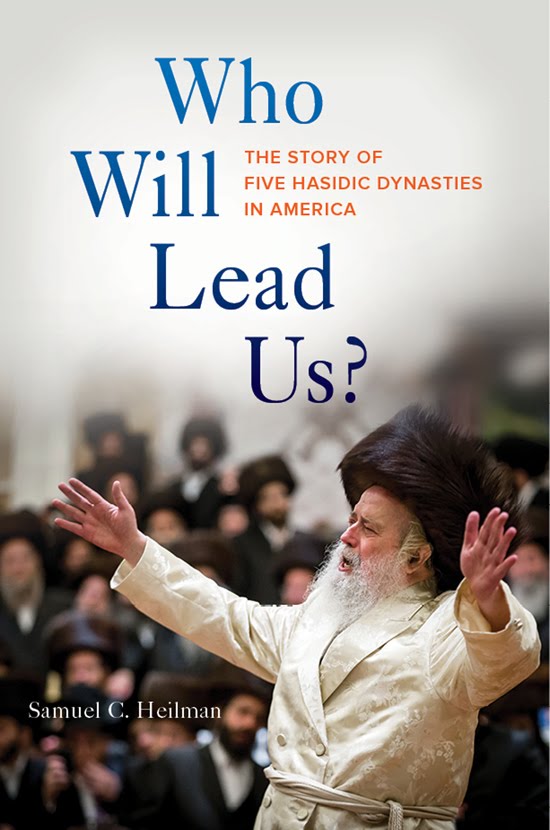
The dynasties Heilman focuses on are Munkács, Boyan, Bobov, Satmar, and Lubavitch. There is also an introductory chapter on succession in Hasidism which itself is an important issue. I do not know if people in the hasidic world give it much thought, but for non-hasidim the whole matter of succession is somewhat strange, since by what right should a son (sometimes even a very young son) or son-in-law be able to take over religious leadership? Very few outsiders will be impressed with the hasidic concept of “holy seed,” as in the non-hasidic world, at least until recent years, it was understood that one rises to greatness based on one’s own achievements, not based on who one’s father was (though that always helps). It is thus interesting to learn that in the early years of Hasidism the concept of family succession did not exist.[2] Yet as we all know, for many years now succession has been based on lineage and in that way the hasidic court is just like the royal court.[3] (I was struck by Heilman’s use of the term “dowager” to describe the widow of the rebbe. I have never seen the term used in this way but is a good usage.) Of course, there have been times when there were disputes as to who should be the rightful successor, and this always had the potential to lead to a split in a hasidic group, a point we will return to.
Heilman was fortunate that he “was helped immensely by several rebbes who graciously consented to be interviewed and who for long hours and over many months and years opened their lives to me” (p. xv). Some readers might find it strange for a rebbe to be so open with an academic researcher, but it shows that at least some rebbes are interested that academic discussions about them be accurate, and that their perspectives be taken into account.[4]
Heilman’s chapter dealing with Munkács is riveting, and never before has the story been told in print. By “story,” I have in mind the life of R. Baruch (Boruchel) Rabinowitz, the rebbe of Munkács, who did what is almost unheard of, namely, giving up his “rebbeship.” Freed from this role, he was able to become more “modern” and publicly abandon the anti-Zionism so much associated with his father-in-law, R. Hayyim Eleazar Shapira, his predecessor as rebbe of Munkács. While living as a rabbi in Brazil (the “chief rabbi” of São Paulo), he even acceded to his new wife’s wishes to get a dog (which he himself walked). He read widely in secular literature, earned a university degree in philosophy and psychology, and taught philosophy at the University of São Paulo. (p. 51).
While some have seen the Holocaust as changing R. Baruch’s outlook, it appears that this is not entirely the case. As Heilman informs us (p. 44), during the Munkácser Rebbe’s famous 1930 trip to the Land of Israel, in which R. Baruch the future son-in-law accompanied him, R. Baruch snuck out at night to meet secretly with R. Yaakov Moshe Charlop, the leading follower of R. Kook. (Heilman refers to R. Charlop as head of Yeshivat Merkaz ha-Rav, but that would only happen after R. Kook’s death.) This shows that already in his youth he had a much broader perspective than his future father-in-law.
By the time his metamorphosis is complete, it appears that R. Baruch should be categorized as a Religious Zionist – or perhaps even a Modern Orthodox – rabbi. There is a picture in the book of him with Ben Gurion. Unfortunately, Heilman does not identify the other rabbi in the picture – R. Shlomo Goren. Here is another picture of R. Baruch in the Sinai desert after the 1967 war.[5]
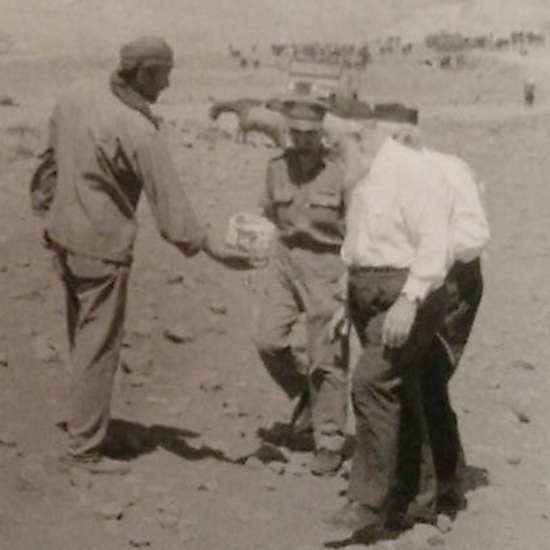
Because R. Baruch had given up the role of rebbe, this meant that it was to pass to his son. Yet R. Baruch did not seem too happy about this and appears to have never regarded it as a real option, as he did not raise any of his sons to become a rebbe. Heilman does a wonderful job describing how it came to pass that the young Moshe Leib became the rebbe. The story he tells is also one of great sadness, of a deep human tragedy, as in the end there was a complete break between R. Baruch and three of his children from his first marriage (which includes the current Munkácser Rebbe), even to the extent of R. Baruch forbidding them to attend his funeral or to say Kaddish for him. (You can see R. Baruch’s letter here.)  Is there anything more tragic for a family than this?
While it is often stated that the hasidim rejected R. Baruch because he became a Zionist, the truth is that he rejected them, in that he chose not to continue as the rebbe. The bitter and public break with his children was a real family tragedy, but it is difficult to read the book and not conclude that the fault for this lay in R. Baruch’s unresolved issues – Heilman speaks of “Oedipal overtones” (p. 63) – seen most vividly in R. Baruch’s shocking behavior at R. Moshe Leib’s wedding. The result of all this is that R. Baruch has been completely erased from Munkács history and has no significance to the movement. When a book with his approbation is reprinted, such as R. Joseph Lustig’s Amudei Esh le-Veit Yosef, it is not surprising that the approbation is removed. Here is the title page of the edition with the approbation removed.
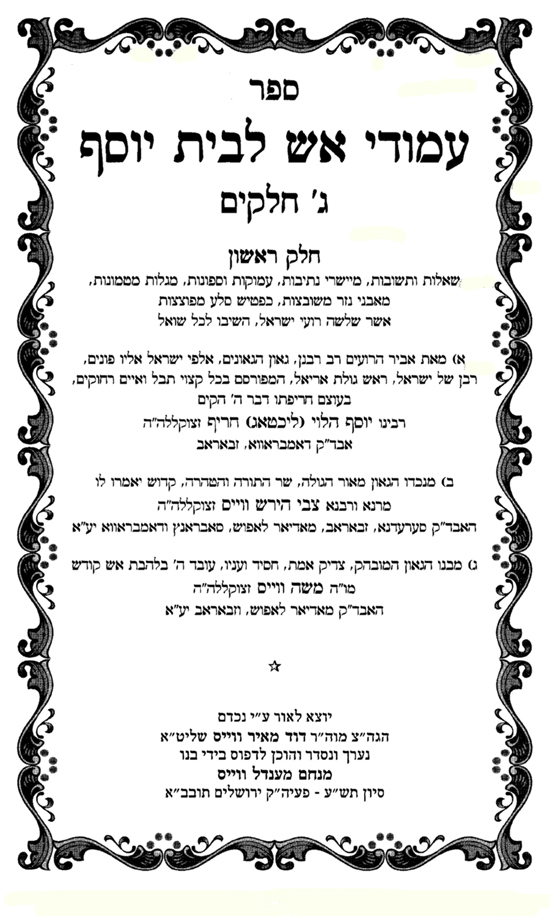
Despite the family tragedy, it must be said that R. Baruch’s son and successor, R. Moshe Leib, has been remarkably successful in leading a revival of the dynasty. He has also played a role in wider Jewish affairs, both publicly and behind the scenes, and is a fine example of what a successful rebbe can be.
Let me add a few more points about R. Baruch that are not mentioned in Heilman’s book. One might have assumed that as R. Baruch became more modern he would distance himself from his father-in-law, a man very much identified with extremism. But that did not happen. Until the end of his life he continued to display awe for R. Hayyim Eleazar Shapira. In Binat Nevonim (2012 ed.) pp. 153-154, he defends R. Shapira against the accusation that he was a “ba’al machloket.” What about his well-known attacks against the Religious Zionists and those non-Zionist Orthodox who wished to go on aliyah intending to work the land?[6] R. Baruch explains, very unconvincingly, that R. Shapira reacted the way he did because he hoped that the Messiah would soon arrive and people would then be able to immigrate to the Land of Israel without confronting any irreligiosity. R. Baruch’s own opinion comes a few pages later, p. 157, where he writes that the ingathering of Jews, including non-religious, to the Land of Israel is a fulfillment of biblical prophecy. Only later will God send His Holy Spirit to purify the people from all of its sins, and then He will send the Messiah. Such a perspective is very much at odds with what R. Shapira advocated.
Interestingly, in dealing with the accusation that his father-in-law was a “ba’al machloket,” R. Baruch says nothing about R. Shapira’s battles against the Agudah and its rabbis,[7] or his battles against non-Agudah rabbis and rebbes, in particular the Spinka Rebbe, R. Isaac Eizik Weiss, and the Belzer Rebbe, R. Yissachar Dov Rokeah. In the latter case, R. Shapira’s actions were very extreme, and it was alleged that he even attempted to get the government to expel the Belzer Rebbe from the city.[8] He attacked the Belzer Rebbe personally and referred to his hasidim as חזירי בעלז.[9] His attacks on Belz did not stop even after the Belzer Rebbe’s death, and the Belzer community of Munkács decided to separate from the wider Orthodox community of the city which was controlled by R. Shapira.[10] Since they were not legally allowed to create another Orthodox community, they officially became the Neolog community of Munkács. Although they were as distant from the Neologs as their persecutor, R. Shapira, declaring themselves as Neolog was the only way for them to create their own community which would be recognized by the government.[11]
In Binat Nevonim, pp 173-174, we see very clearly R. Baruch’s Religious Zionist feelings. He reviews the modern growth of the Land of Israel beginning with the early immigrations, and mentions how Jews hoped that this growth was the beginning of the redemption. He even states that the British did not live up to their expected role when they removed a large part of biblical Israel from the Jewish homeland. Could anything be further from the old Munkács approach than the following words from R. Baruch, after summarizing the various nineteenth-century attempts to build up the Land of Israel (p. 174)?
הארץ השוממה מתחילה לנשום ולהחיות מחדש. היא מתחילה להעלות תקווה בלב יושבי הארץ ובלב העם היהודי כולו, שהנה הגיע הזמן של שיבת ציון של חזון הגאולה לעם ישראל ולחזון הגאולה לכל העמים שעם יהודי נשא בקרבו מאז אברהם אבינו דרך הנביאים עד היום הזה.
He recognizes that we have not yet reached the end of the road, but like any Religious Zionist he is confident that the time is coming when the State of Israel will live up to its promise (p. 176):
עם ישראל, זה הנולד לגדולות ולנצורות, לא בדור הזה שהוא כדורו של דוד המלך ייהפך לאור לגויים, לא בדור הזה יהפוך את מדינתו למדינה לדוגמא. אבל יבוא הדור, דור שיהיה דומה לדורו של שלמה, דור שידע מנוחה, דור שלא יצטרך לנהל מלחמות, דור שידע להעמיד את כח החכמה לפני כח הגבורה – והדור הזה יקים את המדינה לדוגמא, מדינה שבה מדע התורה, המוסר, והצדק, והשוויון ישמשו תשתית לחיי האנושות, ואז יבוא משיח צדקנו, נצר דוד מלכנו ומציון תצא תורה ודבר ה’ מירושלים.
In discussing the Holocaust, R. Baruch states that we cannot ask why God was silent and did not hear the cries of the millions of victims (p. 158). He strongly rejects the notion that the Holocaust, which was an unparalleled national suffering, can be explained as due to any particular sins (p. 198). Regarding the Holocaust, it is also important to mention that R. Baruch was very involved in the efforts to save Hungarian Jewry.[12]
Returning to Heilman, the story of Boyan, which he tells with great skill, did not have the conflict and tragic aspects that were described in the chapter on Munkács. Yet here too we find the same theme, namely, a dynasty without an obvious successor. And again, we see that with the right man, and with proper guidance from the hasidic elders, he can grow into the role. As with Munkács, the Boyaner Rebbe has blossomed into a respected rebbe, either overcoming his more modern background (as some would say), or using this background to allow him to better understand the Jewish people as a whole.
For those interested in conflict in religious life, the chapters on Bobov and Satmar, focusing on the split in these movements, provide plenty of that. In fact, even before the dispute over who would be the current Satmar rebbe, conflict was a basic feature of Satmar life already in Europe. Heilman writes, “For Satmar hasidim conflicts served as a form of socialization and identity formation. . . . [T]his relish for conflict, framed as a steadfast ideological purity, would become the essential identity of Satmar Hasidism.” (pp. 163, 164)
In addition to discussing the conflicts over succession, Heilman also provides the necessary background to understand matters. Thus, in the chapter on Bobov, long before we get to the conflict that led to the split in the movement, Heilman reviews the history of Bobov, its fate during the Holocaust, and its rebirth after the war. Heilman does the same in all of the chapters, allowing readers to appreciate the unique aspects of each of the different Hasidic groups. In his chapter on Satmar, here is how Heilman summarizes what defined this group for its rebbe, R. Joel Teitelbaum.
The struggle to remain apart as well as distinctive and to argue that these positions were the only and authentic way of being Jewish not only made Yoelish’s followers feel that they were part of a great cause and the true defenders of Jewry and Judaism but made Satmarism and its inventor a kind of model for what steadfast Orthodox Judaism was meant to be, a vanguard of contra-acculturation and authenticity. Second, he had to make sure that his educational system did not provide his hasidim with the skills that would make leaving the enclave easy. Third, he had to demonize the world outside so that his followers would either be afraid of entering it or be confident that their own ways were infinitely superior. (p. 173)
I would like to add a few final comments and corrections.
I am not sure why Heilman includes a chapter on Chabad. While obviously the story here is not the fight over succession but the fact that there has not been a succession, for those who read Heilman’s and Menachem Friedman’s biography of the Lubavitcher Rebbe, the material in Who Will Lead Us? focusing on R. Menachem Mendel is not new. The first half of the chapter deals with prior Lubavitcher rebbes, not really the focus of the book which deals with the American scene, but helpful to understanding later events.[13]
It seems that spending so much time among the hasidim has led some of their hagiography to rub off on Heilman. How else to explain his statements that R. Baruch knew Maimonides’ Guide of the Perplexed by heart (p. 42) and R. Joel Teitelbaum “was able to review a folio of Talmud at age five” (p. 156)? Both of these men were scholars, and thus the hagiography focuses on their scholarship. I would be interested to know if in the hagiography about current rebbes, and in particular the ones discussed by Heilman, is scholarship even mentioned. Do current hasidim even assume that their rebbes are great Torah scholars?
In the preface, p. xiv, Heilman tells us that he will look at five different successions. In Munkács and Boyan a successor was lacking. In Bobov and Satmar two individuals claimed the throne. In Habad, the “hasidim denied a need for a successor at all, claiming that their rebbe had never really died.” While it is true that the Habad hasidim have no interest in a successor, there is only a very small number who claim that the Rebbe did not die (and thus they do not go to his grave). The mainstream messianist view is that the Rebbe indeed died and will be resurrected as the Messiah.[14] Even those who do not write זצ”ל or זי”ע do not deny that the Rebbe died and was buried. Yet they assume that his soul is still involved in this world and as such they do not want to treat him as someone who has passed from the scene.
P. 58. Heilman writes that the Lubavitcher Rebbe “claimed to have attended the Sorbonne and other European universities.” (p. 58) I do not understand the use of the word “claimed,” as it appears to cast doubt on what the Rebbe said. Yet in Heilman’s book, The Rebbe, he himself mentions that the Rebbe was a registered student at both the University of Berlin and the Sorbonne.
Pp. 85-86. Heilman states that R. Yerucham Gorelick “came from Slutzk, Belarus, and had studied in the famous non-Hasidic yeshiva there.” This is incorrect as R. Gorelick studied in Lomza, Radin, and also in Brisk, but not in Slutzk. In fact, in 1923 (when R. Gorelick was twelve years old) the Slutzk yeshiva moved to Kletzk.
P. 169. In discussing the Kasztner train and the inclusion in it of the Satmar Rebbe, Heilman writes: “Kasztner was persuaded, after someone paid a ‘huge sum,’ to include Yoelish and some of those connected to him among the 1670 in the train.” Why the leading anti-Zionist, R. Joel Teitelbaum, was included on the Kasztner train is a question that has never been convincingly answered. A popular legend is that Kasztner’s mother appeared to him in a dream and requested that he include the Rebbe. Yet even if this explains why the Rebbe was included, there were also other anti-Zionist rabbis who were on the train, which was a microcosm of larger Hungarian Jewish society.[15]
Before reading Heilman’s book, I had never heard that it was only money that enabled the Rebbe to be rescued. The source Heilman provides for this is a Satmar biography of the Rebbe that relied on an item that appeared in the Satmar paper Der Yid. These are precisely the sorts of sources that have to be used very carefully, and in many cases are simply useless if one is trying to find out the truth. At the very least, Heilman should have written that it is “alleged” that someone paid a huge sum, rather than state it as fact. One of the “problems” of the Satmar Rebbe’s biography is that despite being saved by the Zionist Kasztner, there is no evidence of the Rebbe ever having expressed any gratitude towards Kasztner or the Zionists as a whole for saving his life, something that has often troubled people. However, if the only reason the Rebbe was on the train was because of a simple monetary transaction, then he would have no reason to feel grateful to Kasztner or the Zionists. To put it another way, there is good reason for Satmar writers to portray the event this way in order to burnish the reputation of the Rebbe. As such, the unsubstantiated report Heilman relies on here must be treated with a great deal of suspicion.
The hasidic world is obviously of great significance in Orthodoxy. There are so many different hasidic groups that just when I think I know them all, I see an article about another rebbe whom I have never heard of. In fact, some years ago someone produced a “yellow pages” of all the hasidic rebbes. There are 554 listed, and by now no doubt a few more need to be added. Here is the first page.
There are significantly more rebbes now than a hundred years ago. Marcin Wodzinski has written that “there were approximately three hundred tsaddikim active in 1900.”[16]
What I know from friends in the hasidic world is that there are also people who should be regarded as “independent hasidim.” I first heard this expression a few years ago in Budapest where I became friendly with a visiting American hasid. When I asked him which group he was part of, he replied, “independent.”
Here was a man who looked like a hasid, who considered himself a hasid, who valued the hasidic way of life, and yet he did not have a rebbe. Since then I have met other “independent hasidim,” and their story is pretty much the same. They grew up as hasidim and love Hasidut, but they do not find any of the rebbes appealing. Some of them have also seen things that caused them to be disillusioned with the contemporary rebbes. They do not deny the value of a rebbe, and believe that great rebbes existed in the past. It is just that today they do not see such figures.
I would love to see an article dealing with the phenomenon of the independent hasidim. Is this something that can continue in a family over generations, or is it a one generation event, with the children brought up in such a family generally joining a hasidic group or linking up with the yeshiva world? Interestingly, Wodzinski notes the existence of independent hasidim around the time of World War I, and I wonder when they first appeared. In Wodzinski’s words: “During the war and after it, shtiblekh sprang up, gathering the half-rejects and half-deserts from the Hasidic world, shtiblekh unaffiliated with any court.”[17]
The independent hasidim should be distinguished from what Wodzinski has termed “à la carte Hasidism.” This is a phenomenon that also existed in the early twentieth century, and consisted of “young Hasidim who sampled different courts, picking various festivals with different tsaddikim depending on individual taste or indeed on the way different tsaddikim enacted different elements of Hasidic ritual.”[18]
Another point of interest which has not yet been analyzed is the position of the rebbe when he was still a child and teenager. Heilman’s book discusses this with regard to the current Munkácser Rebbe, but when he was young there was not yet an expectation that he would become the rebbe. What about those who knew that they would become rebbe. What type of childhood did they have? Did they have friends like other children, or were they regarded as too special to mix with the masses? And how about when they were teenagers and realized the significance of their fathers, who served as rebbes? It would be fascinating to hear from current rebbes about how they experienced childhood and young adulthood. People often forget that even the most important figures were once young and enjoyed the same sort of fun that all young people do. I actually have a photo of a young Shlomo Halberstam (1907-2000) in his bathing suit having fun in a lake. Heilman discusses in detail his experiences during the war and how after the war he rebuilt the Bobov dynasty, a task that fell to him as his father, R. Ben Zion, was murdered by the Nazis.[19] Yet the photo I just mentioned reminds us that even future rebbes were able to enjoy themselves like everyone else.
* * * * * *
Since this post deals with Hasidism, it is a good place to call attention to an unfortunate example of censorship in the writings of the Hatam Sofer. Here is the title page of volume 2 of the Derashot of the Hatam Sofer, first published by R. Joseph Naphtali Stern in 1929. R. Stern’s edition is based on the Hatam Sofer’s own manuscripts.
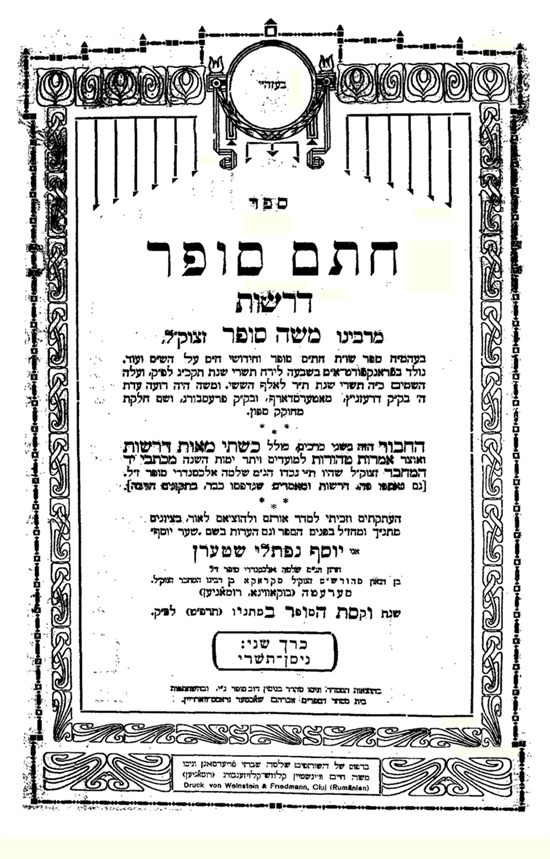
Beginning on p. 371a one can find the eulogy for the Hatam Sofer’s teacher, R. Nathan Adler. On p. 373a, in speaking of the great piety of R. Adler, the Hatam Sofer writes: ולא כחסידי הזמן ח”ו.


Now take a look at the Pressburg 1881 edition of Torat Moshe, Va-Yikra, p. 41b. You can see that the words ולא כחסידי הזמן ח”ו do not appear. It is not known if the publisher was responsible for this censorship, as he informs us in the introduction to volume 1 that some of what appears in the book was copied from the Hatam Sofer’s manuscripts and sent to him.
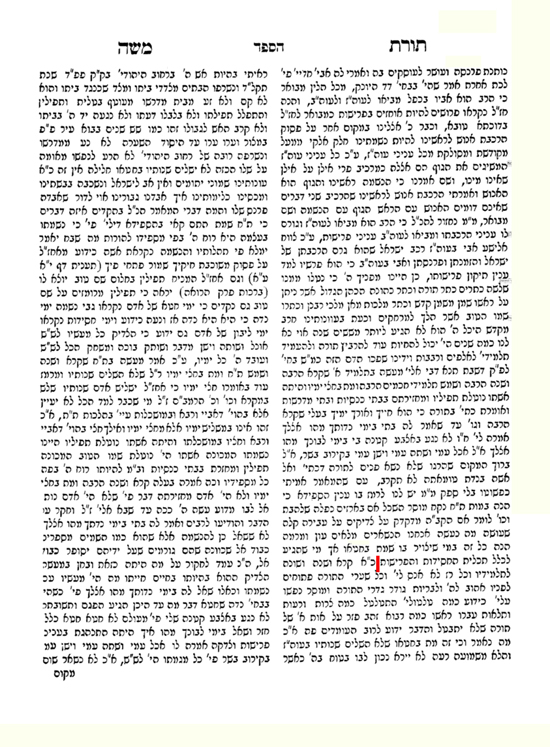
And while on the topic of censorship, here is another example dealing with a leading student of the Hatam Sofer, R. Moses Schick. Here is Derashot Maharam Schick, p. 30b, published in Cluj around 1936.[20]
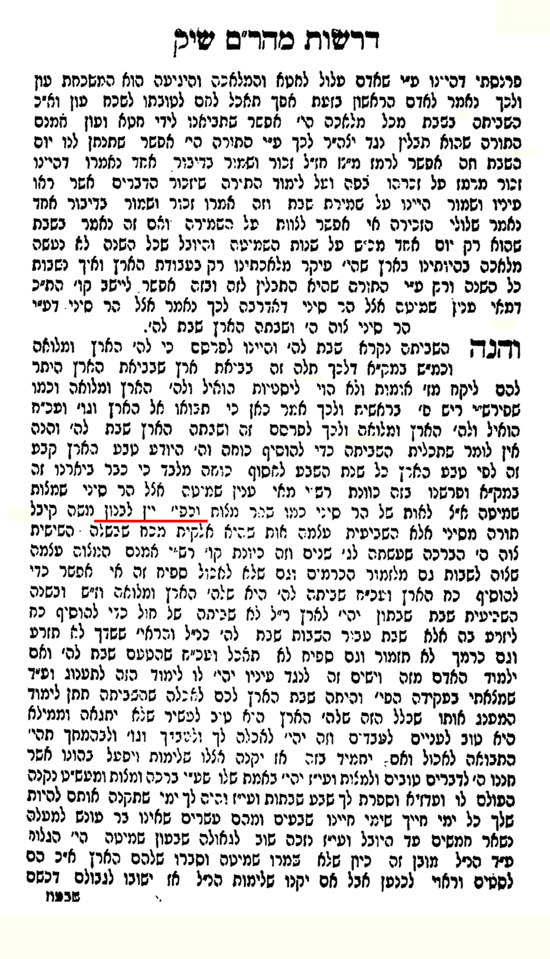
You can see that he mentions Wessely’s Yein Levanon. Now take a look at the Derashot Maharam Schick published in Jerusalem, 2003.
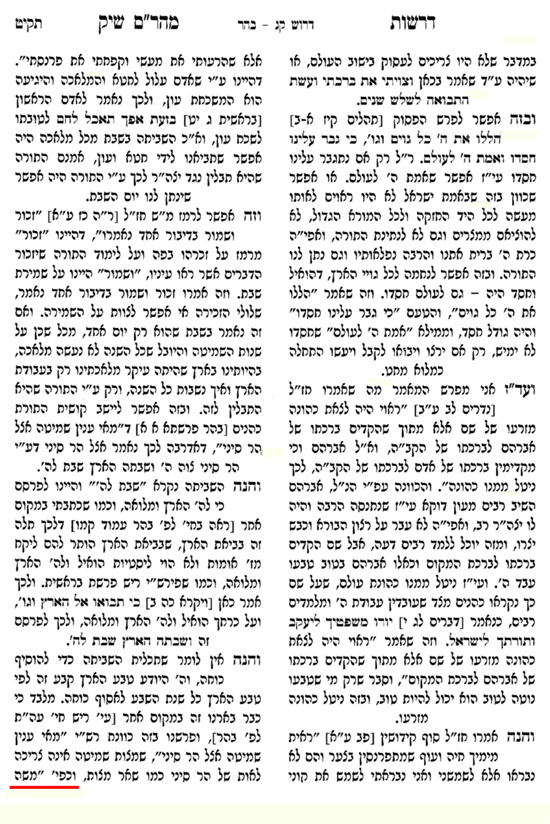
As you can see, the reference to Yein Levanon has been removed. R. Moses Schick believed that Yein Levanon was a fine book, worthy of being quoted. However, the publisher thought differently. Ironically, the new edition was published by Makhon Maharam Schick. Here is the title page
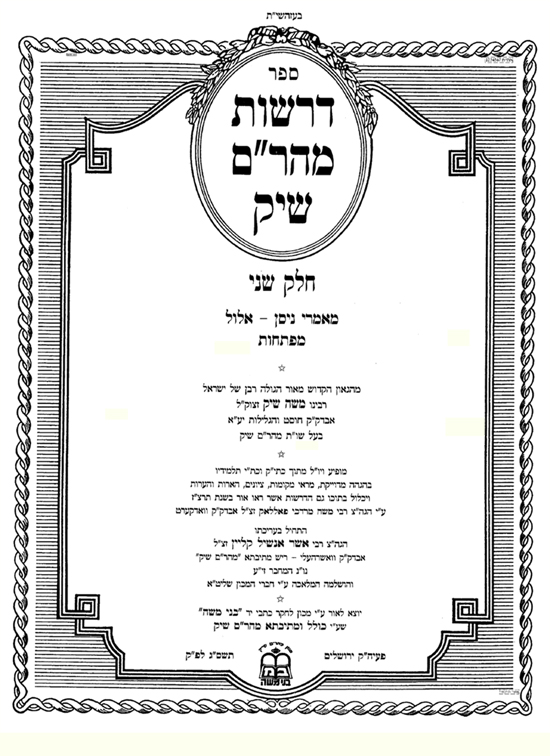
So we have a publishing institute named after R. Moses Schick, and the people who run it would no doubt insist that they have the greatest respect for R. Schick. Yet this respect does not include respecting the sanctity of what he actually wrote.

R. Moses Schick refers to Wessely’s comment to Avot 1:1. In the new edition of Yein Levanon (Rishon le-Tzion, 2003), p. 44, the editor points out that R. Samson Raphael Hirsch, in his commentary to Avot 1:1, also cites Wessely by name. While this comment appears uncensored in the English translation of Hirsch’s commentary, in the Hebrew translation Wessely’s name has been replaced by “one of the commentators.” The editor adds: “The translators think that they are wiser  and more understanding than R. Samson Raphael Hirsch.”

* * * * * *
In Changing the Immutable, p. 211, I write that R. Hayyim Vital “records” and “mentions” certain negative information about Israel Najara. Yitzy Weinberg commented to me that I neglected to state a very important point, namely, the source of R Vital’s information. Weinberg feels, and others probably do as well, that knowing the source is important, since if R. Vital recorded information that he had personal knowledge of it would have more significance than if it came from another source.

Before coming to this point, I must note from a modern perspective, it is hard not to conclude that R. Vital was overly credulous. He was ready to believe the most far-fetched tales of angels, demons, magic, spirit possession, and exorcisms, and has no reticence in describing personal experiences with some of these things. He himself was even possessed by a powerful evil spirit. Morris M. Faierstein has recently discussed this episode and reaches the following striking conclusion: “Within the universe of Lurianic Kabbalah and the stories found in Vital’s mystical diary, the Book of Visions [Sefer Hezyonot], it can only be Jesus of Nazareth who was the evil spirit that possessed Hayyim Vital.”[21] 

Knowing all this, I do not believe that the information about Najara quoted by R. Vital should be accepted at face value,[22] especially when the charges made (homosexual behavior and sexual relations with a non-Jewish woman) are so serious. I would say this even if the ultimate source of this information was R. Vital himself.[23] 
Nevertheless, I agree that I should have mentioned that the information recorded by R. Vital came from a spirit that had entered a woman (a phenomenon that only after R. Vital’s time came to be known as a dybbuk[24]). Furthermore, in the book I noted: “Because of this, Vital wrote that ‘the hymns that he has composed are themselves good, but whoever speaks to him and whatever leaves his mouth is forbidden, because he always used foul languages and was a drunkard his whole life.’” This too is a statement from the spirit.
Among the information revealed by the spirit was that “between the fast days,” Najara “prepared a meal at that hour at the house of Jacob Monides, put his hat on the ground, sang songs in a loud voice, ate meat, drank wine, and even became drunk.”[25] R. Vital writes that Najara admitted that this incident occurred, meaning that in this case R. Vital wants us to know that the spirit spoke the truth. R. Vital does not record asking Najara about the spirit’s more serious accusations, and he would have told us if he had.[26]
Despite what I have just written, some seem to assume that everything that appears in R. Vital’s Sefer ha-Hezyonot must be attributed to himself, even if he attributes it to a spirit. Thus, Lawrence Fine writes: “In his dream diary, Vital alleges that Israel Najara engaged in homosexual behavior in his drunkenness, and contends, in connection with Damascus, that ‘there is much homosexuality . . . in this land.’”[27] As you can see, Fine does not mention the spirit but states that “Vital alleges.”
Another example is that Israel Zinberg writes that “Vital declares,” and then cites the passage I quoted in my book, which first appeared in Shivhei R. Hayyim Vital.[28] “The hymns that he has composed are themselves good, but whoever speaks to him and whatever leaves his mouth is forbidden, because he always used foul language and was a drunkard his whole life.” Zinberg does not mention the spirit.
Avraham Amazleg writes as follows (emphasis added)[29]:
שם רח”ו גם בפי הרוח דברי גנאי וביקורת על נג’ארה. רח”ו או הרוח אמנם מודים שהפזמונים שהוא חיבר הם טובים, אבל אסור לאומרם או לדבר עם המחבר, כי פיו דובר נבלה, וממילא הוא שיכור כל ימיו.
Almog Behar writes[30]:
המקובל רבי חיים ויטאל, תלמיד האר”י, בן תקופתו, כתב עליו ב”ספר החזיונות” שלו.
I could bring a number of additional examples where the words of the spirit are attributed to R. Vital, but I think readers get the point.
Although in all texts of Shivhei R. Hayyim Vital Najara’s name was deleted – it first appeared in the 1954 edition of R. Vital’s Sefer ha-Hezyonot – it was not too difficult for Zinberg and others to figure out who was being referred to. R. Moses Sofer appears to have also been aware of the passage in Shivhei R. Hayyim Vital, or perhaps there even was an oral tradition about the more serious charges against Najara that only appeared in print in 1954. I say this because when asked by his son why he did not sing Najara’s spiritually moving Y-ah Ribon, the Hatam Sofer replied: “Rather than telling you why I do not sing it, it is better to sing it.” From that point on he sang Y-ah Ribon.[31]
* * * * * *
R. Yechiel Goldhaber is well known as an outstanding scholar, whose many publications are always enlightening.[32] Not many know that he also offers tours of the Old City of Jerusalem. Having had the pleasure of participating in one of his tours, I highly recommend it to all who are interested in the history of Jerusalem (which I believe includes all Seforim Blog readers).
My own Torah in Motion tours to Europe in summer 2018 have also been announced. You can read about them here.

The young scholars R. Yisachar Dov Hoffman and R. Ovadiah Hoffman are known to many Seforim Blog readers. R. Yisachar has authored Avodat Ovadiah which focuses on practices of R. Ovadiah Yosef. R. Ovadiah Hoffman is a Seforim Blog contributor, and both of them have published three volumes of Ha-Mashbir, dedicated to studies on R. Ovadiah Yosef. I think readers will be interested to know about an event they are organizing to commemorate the yahrzeit of R. Ovadiah Yosef. It is to take place on Sunday, October 22, 2017, from 6:25pm-9pm (refreshments available), followed by maariv. It will be an evening of shiurim dealing with contemporary halakhic issues and reflections on the legacy of R. Ovadiah Yosef. It will be held at Beis Midrash Kerem Shlomo, 1880 East 27th Street (between Ave. R and S), in Brooklyn. The scheduled speakers are R. Herschel Schachter, R. Aryeh Ralbag, R. Yitzchok Yisraeli, and R. Betzalel Rudinsky. It promises to be a fascinating evening.

[1] See Heilman, Who Will Lead Us, p. 193, where he mentions that in 1984, under the leadership of R. Moshe Teitelbaum, the Satmar were officially designated by the government as a “disadvantaged minority, which allowed them access to various government benefits.”
[2] R. Hayyim Halberstam, Divrei Hayyim,vol. 2,  Hoshen Mishpat. no. 32, writes against the practice of family succession when it comes to the Rebbe, and contrasts this with the position of town rav where there is such a concept:
ועל דבר ירושת הכבוד הנה במח”ת כ”ת הבוררים הרבנים וכי רבני החסידים שליטתם בתורת משרה כמו רב שבנו קודם הלא ידוע שהקדוש ר”א ואביו הק’ זלה”ה לא היו רבנים ורק מחמת גודל קדושתם ויראתם נשמעו דבריהם לכל הגליל וינהו אחריהם ללמוד תורה ויראה מהם גם נתנו להם נדבות לכבד יראי השם כמותם ירבו בישראל ושאלו עצות כאשר ישאל איש בדבר אלקים כי היו בעלי רוח הקודש ותפלתם ודיבורם בקדושה עשו פרי ומה נעשה אם הבאים אחריהם אין בהם קדושה זו. מה ירשו לשאול עצה דעת אין בהם. אם להתפלל מי יודע העולה למעלה לא ידעתי שום צד ירושה בזה. והנה מצינו למופת כגון הרב הקדוש איש אלקים רשכבה”ג מו”ה דוב בער זלה”ה ממעזריטש השאיר הגדולה לתלמידיו הרב הק’ מברדישטוב ומאור עינים ואור המאיר זלה”ה, וכן רבו הבעש”ט הניח המשרה זו לתלמידיו לא לבנו שהי’ קדוש ה’ וכן רבינו הקדוש בעהמ”ח נועם אלימלך הניח המשרה לתלמידיו לא לבנו הגם שהיו קדושים למאד כידוע לכן אין בזה שום ירושה ורק מעשיו יקרבוהו ומעשיו ירחקוהו.
[3] In R. Zvi Yehudah Kook’s recently published Sihot R. Zvi Yehudah: Emunah, ed. S. Aviner (Jerusalem, 2017), p. 200, Berdyczewski is quoted explaining what led him to abandon traditional Judaism. In short, it was seeing how his learned grandfather had to humble himself before a young rebbe. While Hasidism and attachment to a (worthy) rebbe are wonderful things, one should always remember what R. Kook states in Orot, p. 146, about the possible dangers:

הדבקות בצדיקים, כדי שיתערב כח המציאות שבנשמתם עם הנשמה הבלתי-נשלמת, היא דבר נכבד מאד במהלך התפתחות הנפשות, אבל צריך שמירה גדולה, שאם יטעה בצדיק אחד, וידבק בו דבקות פנימים הויתית, וידבק ג”כ בחסרונותיו, הם יפעלו לפעמים על הדבק במדה גרועה הרבה ממה שהם פועלים על האיש המקורי. אשריהם ישראל שהם דבקים בנשמת האומה, שהיא טוב מוחלט, לשאוב על ידה אור ד’ הטוב

[4] Heilman never mentions a rebbe by name as his source, but on p. 53, in quoting the recollections of an unnamed family member, it is the Munkácser Rebbe who is being quoted. There were only two family members who were present at the event discussed, the Rebbe (R. Moshe Leib) and his brother, Chaim Elazar. Since Chaim Elazar spoke on the record and on numerous occasions is mentioned by name as the source for information, the “unnamed family member” must be the Rebbe himself. The Rebbe must also be the source for the information on pp. 57-58, where Heilman records what R. Baruch told the young Moshe Leib, including his recommendation that Moshe Leib attend university. Heilman also mentions what Moshe Leib told his father: “Today, if someone puts a college diploma on his wall, his rebistve is finished.”
[5] The picture comes from this article. For a bar mitzvah video made by one of R. Baruch’s grandsons, see here.
[6] See Yitzhak Alfasi, Ha-Hasidut ve-Eretz Yisrael (Jerusalem, 2010), pp. 175-176; Menachem Keren-Kratz, “The Politics of Jewish Orthodoxy: The Case of Hungary 1868-1918,” Modern Judaism 36 (October 2016), 8pp. 232-233.
[7] As part of his battle against the Agudah, he also took on Daf Yomi which in his mind was simply ridiculous:

טפשות וצחוק מכאיב
“For how can one learn a page every day when the pages almost always end in the middle of a subject.” Divrei Torah (Brooklyn, 1998), vol. 6, no. 82. Elsewhere he explained that the great danger in joining a Daf Yomi group is that one might be led to adopt the Agudat Israel ideology, “and Heaven forbid to join with them.” Iggerot Shapirin (Brooklyn, 1983), p. 319. He also accused the Agudah of initiating the Daf Yomi in order to have at its disposal ready-made groups that could be used to colonize the Land of Israel. See Sha’ar Yisaschar (Brooklyn, 1992), p. 382.
For other examples of rabbinic opposition to Daf Yomi, due to its association with Agudat Israel, see Tikun Olam (Munkács, 1936), p. 106; Aharon Rosenberg, ed., Mishkenot ha-Ro’im (New York, 1987), vol. 3, pp. 901-902; Nitzotzei Or 3 (Elul, 5758), pp. 33-41. While I do not think that R. Joseph B. Soloveitchik can be called an opponent of Daf Yomi, I was present at a shiur in the summer of 1985 where he expressed his dismay that due to the growing popularity of Daf Yomi, people were no longer studying all six orders of the Mishnah, much of which has no Talmud and is thus not included in the Daf Yomi cycle. (For reasons that are unclear, Middot and Kinnim are the only tractates of Mishnah included in Daf Yomi.)
[8] See Yeshayahu A. Jelinek, The Carpathian Diaspora: The Jews of Subcarpathian Rus’ and Mukavchevo, 1848-1948 (New York, 2007), p. 172; Shmuel ha-Kohen Weingarten, “Pulmus Munkács-Belz,” in Yehudah Erez, ed., Entziklopedyah shel Galuyot: Karpatoros (Jerusalem-Tel Aviv, 1959), p. 230; and my Changing the Immutable (Oxford, 2015), p. 229.
[9] See Weingarten, “Pulmus Munkács-Belz,” p. 230.
[10] Not surprisingly, this dispute led to violence. The topic of violence, which has been a part of certain hasidic courts, is worthy of a study. Let me offer a few relevant sources. There is a report of hasidim murdering a mitnaged. See Mordechai Wilensky, Hasidim u-Mitnagdim (Jerusalem, 1970), vol. 2, p. 178. This report, contained in the early anti-hasidic text Shever Posh’im, includes names and places and was written not long after the event described. Nevertheless, I would not accept the story as historically accurate without confirmation from other sources, which as far as I know has not been found. See also S.’s post here which discusses another alleged murder by hasidim. (I do not believe there is any truth to this story.)
There are, unfortunately, hasidic stories that present violence as an acceptable option to settle disputes. It is safe to assume that such teachings have an impact on some impressionable minds (think New Square). For example, in Sippurei Niflaot mi-Gedolei Yisrael (Tel Aviv, 1969), p. 279, it reports that R. Menahem Mendel of Kotzk thought that R. Shmelke of Nikolsburg made a mistake when he forced his “enlightened” opponents to leave the city. What he should have done, according to the Kotzker, is have them killed.
Some relevant material is found in the book Zikhron Asher (1980) by R. Asher Edelstein. This book is not found on Otzar ha-Chochmah or hebrewbooks.org. I learnt about it from R. Nahum Abraham, Darkhei ha-Ma’amarim (n.p., 2017), section Peti Ya’amin le-Khol Davar, pp. 113-114 (who cites the stories I mention). Here is the title page.
Here is pp. 14-15 where we are told that the Kosover Rebbe tried to drown the follower of another rebbe. Following this it mentions how each of the rebbes discussed would bring punishments upon the followers of the other rebbe.
Here is pp. 31-32 where it records that the Kosover Rebbe was angry that one of his hasidim went to the Belzer Rebbe, and this anger caused the man’s factory to burn down. It also tells a story of violence that took place at the wedding of one of the Ruzhiner Rebbe’s sons. This story ends with the death of the man who during the wedding had stabbed the Kosover Rebbe with a needle. 
Here is pp. 63-64 where it describes how the rebbe R. Yissoschar Berish Eichenstein once removed a fly from his plate on Shabbat, in violation of the halakhah. When this was mentioned to him by R. Menahem Mendel Stern, the rav of Sighet, R. Eichenstein replied that a man had been reincarnated in this fly, and he had to be metaken it. R. Stern replied that he does not seen any tikunim but only regular Shabbat violation. The story ends that R. Eichenstein’s brother cursed R. Stern and R. Stern returned the curse, leading to the brother’s early death and R. Stern not having any “nachas” from his descendants. 
None of the pages I have reproduced are found in the 2004 edition of Zikhron Asher. Here is the title page.
Yitzhak Even, Mahloket Sanz ve-Sadegura (New York, 1916), has a lot to see about violence between the Sanzer and Sadegura hasidim. On p. 68, he tells how some Sanzer hasidim murdered a Sadegura hasid. On pp. 79-80, he discusses the stabbing of a Sanzer hasid and further violence against Sanzer hasidim. He also mentions a report that in response to being attacked, the Sanzers murdered an elderly Sadegura hasid. See also pp. 83, 86-87. I do not know how reliable Even’s information is.
[11] See here. This action led to R. Shapira issuing the following statement in 1929, declaring that the Belz community is to be regarded as no different than the Reform community:
הן כבר הודענו כי אותן שמחזיקים בבית התפלה של הנעאלאגים דפה – דינם כמו שאר הנעאלאגים האוכלים נבילות וטריפות – ופשוט שאין להם נאמנות וחזקת כשרות כלל.
See Weingarten, “Pulmus Munkács-Belz,” col. 230 n. 2. See also ibid., col. 232, that originally the Belzers wished to be recognized as a Status Quo community. Only when the government did not agree to this, did they then request, and receive, government recognition as a Neolog community. Weingarten’s father was the secretary of the Munkács community. See Weingarten, “Ha-Admor Mi- Munkács, Rabbi Hayyim Eleazar Shapira,” Shanah be-Shanah (1980), p. 447. Even though Weingarten was a Zionist, he still had a very good relationship with R. Shapira. See Weingarten, Perurim mi-Shulhanam shel Gedolei Yisrael (Jerusalem, 2004), pp. 17-37.
[12] Regarding this, see Binat Nevonim.
[13] On p. 216, Heilman mentions that already the Tzemach Tzedek sent out shluchim to the wider Jewish world. Apropos of this, I know that some have wondered why Chabad calls its emissaries שלוחים and not  ,שליחי which any Hebrew dictionary will tell you is the plural of שליח. Yet as R. Meir Mazuz points out, in rabbinic Hebrew the plural is indeed שלוחים. Thus, we find in Rosh ha-Shanah 18a: על ששה חדשים השלוחין יוצאים. Also, Maimonides has a section in the Mishneh Torah that is called הלכות שלוחין ושותפין. See R. Mazuz’s note to Hannah Peretz, Patish he-Hazak (Bnei Brak, 2013), vol. 2, p. 384 n. 26, and his recently published Mi-Gedolei ha-Dor, vol. 3, p. 129 n. 2. R. Mazuz thinks that the term שליחים originates in Christian circles, and that it was perhaps because of this that Jews used the term שלוחים. Yet as far as I know there is no evidence that Christians used the term שליחים in the days of the Mishnah. 

I do not believe that the term  שלוחappears in classic rabbinic literature, but we do have it with a suffix. E.g., Mishnah Berakhot 5:5: ששלוחו של אדם כמותו. See Ben Yehudah’s dictionary, s.v. שלוח, שליח. Ben Yehudah, s.v. שלוח, explains the difference between שלוח and שליח as follows:

[שלוח] זה שנשלח, בהבדל מה מן שליח, שתפקידו הקבוע הוא לשמש כנשלח בשליחות.
In s.v. שליח he writes:
ואפשר שבא שליח בעקר כצורה ארמית שליח, שליחא במק’ שלוח בעבר.
[14] The only time I have ever had contact with a Chabad group that apparently denies the Rebbe’s death was in New Delhi. Here is a picture of the sign in front of the Chabad House and the stamp that is found in its siddurim and seforim.


ללא שינוי דגניזה means that the Rebbe’s soul continues to function in his body as there was no death.
[15] R. Jacob Elimelech Panet, the rav of Dej, Hungary, was on Kasztner’s list as one of the rabbis to be saved. However, R. Panet refused to leave the Dej ghetto and was later murdered in Auschwitz. See Shlomo Spitzer, Kehilot Hungaryah (Jerusalem, 2009), p. 111.
[16] “War and Religion; or, How the First World War Changed Hasidism,” Jewish Quarterly Review 106 (Summer 2016), p. 289 n. 20.
[17] Wodzinski, “War and Religion,” p. 305.
[18] Wodzinski, “War and Religion,” p. 299.
[19] In the recently published English translation of R. Pinchas Hirschprung’s Holocaust memoir, The Vale of Tears, trans. Vivian Felsen (Toronto, 2016), pp. 152-153, he discusses the Shabbat he spent with R. Ben Zion in Lemberg shortly after the start of the war. This memoir originally appeared in Yiddish in 1944. Fortunately, it was not translated by ArtScroll or one of the other haredi publishing houses as I am certain they would have deleted some of R. Hirschprung’s wonderfully honest comments. See e.g., p. 222, where he confesses that he thought of suicide. On p. 156, he writes, “I slept well, woke up past noon and recited the morning prayers far too late.” P. 160: “I was envious of this woman’s profound belief in divine providence.” P. 166: “I stealthily took some water from the town ritual bath.” On p. 221, he writes that R. Chaim Ozer Grodzinski told him that he was not worried about Lithuania losing its independence, a view that was soon shown to be incorrect. On pp. 246-247, he writes about how R. Chaim Ozer told him that he and his yeshiva should not take the visas for Curacao that were available, but should remain in Vilna. Had R. Hirschprung and his colleagues listened to R. Chaim Ozer it would have meant their deaths. I do not think that a haredi publication would ever record such an error in Daas Torah. R. Hirschprung also mentions how a hasid who was with him argued that precisely because R. Chaim Ozer, the misnaged, said not to get the visas, that this was a sign from heaven to do the exact opposite.
Regarding R. Hirschprung, in 1985 I was present at a siyum ha-shas where R. Shlomo Goren said that R. Hirschprung was the only person alive who knew the entire Talmud by heart. I found two talmudic notes published by R. Hirschprung when he was only fourteen years old. See Or Torah )Lvov) 1 (1926), p. 18, Beit Va’ad le-Hakhamim )Satmar), Adar 5686 (1926), p. 67. See also ibid., Kislev 5687 (1927), pp. 37-38. When he was sixteen he began to edit the Cracow Torah journal Ohel Torah. Regarding R. Hirschprung’s book Peri Menahem, which was written when he was apparently only thirteen years old, see Gedulat Pinhas (Brooklyn, 1999), p. 14; Yaakov Shmuel Spiegel, Amudim be-Toldot ha-Sefer ha-Ivri: Be-Sha’arei ha-Defus (Jerusalem, 2014), p. 65.
At a future time I can discuss the rabbis who told people to remain in Europe even after World War II had begun. Since in this post I have discussed the Satmar Rebbe, I will only mention that R. Asher Anshil Yehudah Miller reports that during the Holocaust the Rebbe told his followers to remain in Hungary, which in hindsight was clearly a wrong decision. See Miller, Olamo shel Abba (Jerusalem, 1984), p. 309. R. Miller writes:
בשעה שהיהודים עמדו במבוכה ולא ידעו להחליט האם כדאי לברוח, מכיון שלא הכירו את מזימתם ואכזריותם של הגרמנים, עשו הוראותיו של האדמ”ר מסאטמער רושם עצום על כל יהודי חרדי “לא להבהל ולא להמלט, כי קרובה הישועה לבוא”. לדאבונינו לא כך היו פני הדברים – אלפי נפשות של יהודים טובים עם בני משפחותיהם הגיעו למחנות השמדה, למרות שהתגוררו בקרבות הגבול.
[20] There is no publication date on the title page, but the introduction is dated 1936.
[21] See Faierstein, “The Possession of Rabbi Hayyim Vital by Jesus of Nazareth,” Kabbalah 37 (2017), p. 36.
[22] In his introduction to Jewish Mystical Autobiographies (New York, 1999), p. 12, Morris M. Faierstein writes:
A related question is how are we to deal with Vital’s assertions when he cites the dreams and visions of others that were supposedly told to him, or when he recounts various “omens” that foretold his greatness in his childhood or youth. Similarly, when he ascribes certain thoughts or actions to others, should we assume that he is a reliable reporter or that these are his own invention? Data that cannot be verified from external sources, and this includes most of the contents of the Book of Visions, must be treated as Vital’s perception or belief. It would not be helpful to use judgmental terms like fantasy or invention or say that Vital “alleges” this or that. It is obvious that we are dealing with a “visionary” document and it should be approached from that perspective.

Regarding the larger question of how seriously we should take accusations found in written works, especially when we know that the author had negative feelings about the person he was writing about, I saw something relevant in Pawel Maciejko’s new book, Sabbatian Heresy. This is a very helpful book, which includes translations of a number of important texts. In the introduction, p. xxiv, Maciejko writes as follows:

While Sabbatians did not always display a positive or even tolerant attitude toward non-Jews, they never ignored other religions and traditions. They studied them with an intensity that sometimes bordered on obsession (according to contemporary testimony, Rabbi Jonathan Eibeschuetz developed an “uncontrolled urge to read books of the priests”). 

What is the source for the information about R. Eibeschuetz? None other than R. Jacob Emden, who said all sorts of negative things about R. Eibeschuetz. Thus, I do not feel it is appropriate to refer to such a source as “contemporary testimony.” 
[23] Israel Zinberg, who died before the most serious accusations against Najara were published, wrote as follows:

To be sure, Hayyim Vital is not a completely reliable witness. Apparently, he had some personal scores to settle with the poet. Furthermore, the vain and arrogant Vital envied Najara, because Isaac Luria was so enchanted by his verses. Luria used to say that even among the “family on high” Najara’s hymns are received with great enthusiasm, and that his soul is a “spark” of no less a soul than that of King David, the godly poet of the Psalms. (A History of Jewish Literature, trans. B. Martin [Cincinnati and New York, 1975], vol. 5, p. 95)
It is one thing to say that R. Vital believed in all sorts of superstitions, but Zinberg crosses the scholarly line by casting aspersions on R. Vital’s character. See also Meir Benayahu, “Rabbi Yisrael Najara,” Asupot 4 (1990), pp. 234-235, who defends Najara against the attacks on him, in particular by R. Menahem Lonzano. He writes:
ואולי דווקא משום הדרשות לתשובה שהיה ר’ ישראל נאגארה דורש ורבים חסידים וישרים נלקטו אליו בג’ובאר, שכל מעיינם היה בתיקון עצמם וקירוב זמן הגאולה, קינאו בו וטפלו עליו דברים שלא כן?
In his criticism of Najara, R. Lonzano pointed to what he regarded as the totally inappropriate erotic language used by Najara in describing the loving relationship between man and God. See Benayahu, “Rabbi Yisrael Najara,”, pp. 223ff. One example of such erotic language is found in Najara’s poem ידד שנת עיני  (Shirim, ed. Tova Beeri [Tel Aviv, 2015], pp. 126-127):
לו אהיה יונק ואתה אומני
אינק שדי יופיך צמאי אשברה
דוד נעלה חמדת מהללי . . .
לו אהיה אהל ואתה שוכני
נתעלסה אהב בגיל נתאזרה
דוד נעלה חמדת מהללי
לו אהיה לשון ואתה מעני
אשקיט יקוד חשקך בשיר ואזמרה
דוד נעלה חמדת מהללי
Here is my attempt at a translation:
If I were a suckling infant and You my wet nurse
I would suckle at Your beautiful breasts, quenching my thirst
My beloved, exalted and praiseworthy . . .
If I were a tent and You dwelled within
We would revel in love, gird ourselves in joy
My beloved, exalted and praiseworthy
If I were a tongue and You my response
I would calm my flaming desire for You with song
My beloved, exalted and praiseworthy
The first line of the last stanza is difficult. I have followed Prof. Joseph Yahalom’s suggestion. Prof. Tova Beeri in her note to the passage believes that the translation should be, “If I were a tongue and You the enabler of my speech,” based on Prov. 16:1. See also here s.v. פירוש. At this time, let me thank the incomparable Peter Cole for his e-mails to me discussing some of the problems of translations of poetry.
Najara would no doubt defend himself against R. Lonzano’s criticism by stating that he was following in the path of Song of Songs. Cf. Andreas Tietze and Joseph Yahalom, Ottoman Melodies Hebrew Hymns (Budapest, 1995), p. 19.
[24] See Encyclopaedia Judaica, s.v. Dibbuk.
[25] Faierstein, Jewish Mystical Autobiographies, p. 71.
[26] Sefer ha-Hezyonot, p. 34. Benayahu, “Rabbi Yisrael Najara,” p. 231, quotes all the bad things the spirit said about Najara and writes (emphasis added):
הרח”ו ראה בכך אשמה כבדה ולכן סיפר לנאג’ארה על כל אשר נאמר עליו, והוא כותב: “והודה לי שכן היה”.
Yet this is incorrect. As I indicated in the text, R. Vital did not speak with Najara about the more serious accusations.
[27] Physician of the Soul, Healer of the Cosmos: Isaac Luria and His Kabbalistic Fellowship (Stanford, 2003), p. 176.
[28] A History of Jewish Literature, vol. 5, p. 95.
[29] Ha-Moreshet ha-Musikalit shel Kehilot Yisrael, vols. 7-8 (Tel Aviv, 1986), p. 76.
[30] See here.
[31] Minhagei Ba’al Hatam Sofer, ch. 5:14 n. 1; Zemirot le-Shabbat Beit Soferim (London, 2015), p. 57. See also here.
[32] A recent video of a lecture of his on “Mesoros of Esrogim” can be seen here.


Renewal of the Hakhel Ceremony in Jerusalem and New York

Renewal of the Hakhel Ceremony in Jerusalem and New York[1]

By Aaron R. Katz

A graduate of the University of Chicago Law School and a musmach of RIETS, Aaron is the Associate Director, Private Equity and M&A Finex at WTW Israel. He lives with his wife and four children in Mishkafayim, Ramat Bet Shemesh.

As we come to the final days of the Shmitah year, preparations will soon begin for the Zecher LeHakhel events that will occur starting with the new year of 5783 (2022), which is a Motzei Shmitah year (the year following the Shmitah year).

During Chol Hamoed Sukkot in 2015, a Zecher LeHakhel ceremony took place in the courtyard in front of the Kotel. As the corresponding Hebrew year of 5776 immediately followed a Shmitah year, the event was a commemoration of the biblically-ordained Hakhel ceremony[2] in which the entire nation would assemble during Sukkot[3] of every Motzei Shmitah year for a public reading by the king of certain parts of Deuteronomy.[4] Present at the event at the Kotel were numerous dignitaries, including the Ashkenazi and Sefardi Chief Rabbis, as well as President Reuven Rivlin.

 The current Hakhel ceremony traces its roots to R. Eliyahu David Rabinowitz-Teomim (1843-1905) (the “Aderet” and the father-in-law of R. Avraham Yitzchak Hacohen Kook), who discussed the establishment of a commemoration of Hakhel in his book Zecher LeMikdash in 1889 (the Hebrew year of 5649, which itself was a Shmitah year), a work that was anonymously published but has been conclusively determined to have been written by him.[5] The first modern-day ceremony took place in 1945, following the end of the 5705 Shmitah year, under the auspices of Ashkenazi Chief Rabbi Isaac Herzog. The ceremony began in the Yeshurun Synagogue and concluded at the Kotel. In 1952, following the 5712 Shmitah year, the Hakhel ceremony was held on Mt. Zion (as the Kotel was under Jordanian rule at the time) and was attended by both R. Herzog and Sefardi Chief Rabbi Ben-Zion Meir Hai Uziel. A book titled Zecher LeMitzvat Hakhel, edited by R. Mordechai Cohen, appeared shortly after the ceremony and contains a lengthy discussion of the Hakhel ceremony, as well as pictures and a description of the 1952 event. [6]

In the Nisan 5713 (March/April 1953) edition of Yeshiva University’s Talpioth journal includes two articles on Hakhel, including one by the journal’s editor R. Samuel K. Mirsky, under the title: “Renewal of Hakhel.[7] At the end of that same journal appears a Hebrew description of a Hakhel ceremony that took place in New York. The description was written by a certain צ.. (which most certainly refers to R. Zvi Tabory, who took part in the event as mentioned below). An English translation of this description from Talpioth appears below.[8]

Hakhel Gathering in New York

On Wednesday, the third day of Chol Hamoed Sukkot, a special gathering took place at the Commodore Hotel in New York to commemorate the Hakhel ceremony.

The gathering was organized by the Jewish Agency’s Department for Torah Education and Culture in the Diaspora to allow the Jews of the Diaspora the opportunity to identify with our brethren in the State of Israel who were assembling at the same time on the summit of Mt. Zion in Jerusalem to take part in a Hakhel ceremony organized by the Chief Rabbinate and the Ministry of Religion, the first such event since the establishment of the State.

The Rabbinical Council of America co-organized this gathering together with the Jewish Agency’s Department for Torah Education and Culture in the Diaspora (the “Department”), and this joint effort was extremely successful. A large celebratory crowd filled the hall, and hundreds of people were forced to go home for lack of space.

Dr. Yosef Burg, Israel’s Health Minister, inspired those assembled with his words on the responsibilities of a Jew, whoever he may be, to the State of Israel. R. Samuel K. Mirsky gave an instructive talk on the renewal of the practice of Hakhel in Israel. R. Zvi Tabory, Director of the Department in New York, opened the evening and pointed out the historic nature of the event, which comes on the heels of the revival of our nation in its land. He also delivered words of blessing on behalf of the Chief Rabbinate of Israel and the head of the Department, R. Zev Gold of Jerusalem. The participants enthusiastically accepted the blessing from Zion: “Just as you have merited to organize this event, so may you merit to perform the ritual properly according to all of its laws in the restored Temple in Jerusalem!” R. Israel Tabak of Baltimore, head of the Education Department of the Rabbinical Council of America, served as the master of ceremonies for the event and introduced R. Theodore Adams, the President of the Rabbinical Council of America, who discussed the concept of Jewish unity. Dr. Pinkhos Churgin, President of Mizrachi in America, delivered words of blessing on behalf of the Mizrachi organization, and R. Yissocher Levin, President of Hapoel HaMizrachi in America, delivered words of blessing from his organization.[9] Mr. Eliezer Doron, Israeli Consul General of New York, delivered words of blessing on behalf of the State of Israel.

A musical program was arranged by Cantor Shalom Katz from Washington, D.C., and Cantor Pinchas Jassinowsky from New York. Mrs. Jassinowsky accompanied them on the piano. 

R. Zvi Yehuda Meltzer, Av Bet Din of Rehovot and Rosh Yeshiva of Yeshivat Hadarom in Israel, recited a special prayer for world peace.

It is quite unfortunate that an event of this caliber only occurs once every seven years; however, we can hope that the inspiration and excitement felt on this occasion will sustain the Jewish community for the next seven years.

The organizers of the event did not want to limit its scope simply to New York; rather, they intended to extend it to outlying cities as well. In turning to rabbis across the United States to suggest that they arrange Hakhel commemoration events in their respective communities, they offered a sample program, attached materials on the topic of Hakhel, and provided copies of the thorough, instructive, powerfully impactful article on Hakhel written by R. Samuel K. Mirsky, an advanced edition of which had been published in honor of the celebration held on Chol Hamoed Sukkot.

In addition, the Department arranged a celebratory Hakhel event for upperclassmen from yeshiva day schools that took place in the large hall of the Rabbi Isaac Elchanan Theological Seminary. This event was also held during Chol Hamoed Sukkot, and 1,200 students from 20 different yeshiva day schools participated. Students from the Shulamith School for Girls put on a wonderful play about the draining of the Hula swamps. A choir of one hundred students from Yeshiva Rabbi Moshe Soloveichik and Yeshiva Rabbi Israel Salanter, conducted by Mr. S. Silbermintz, sung a number of pleasant tunes for the audience.

These young children also lit candles and prayed for world peace, and it is certain that this event left a lasting impact on the attendants.

Conclusion

This post focuses on the rebirth of the modern Hakhel ceremony in the years of 1945 and 1952. In a future post, I hope to examine the manner in which the ceremony was observed in later years in both Israel and the diaspora. Of particular interest is whether R. Mirsky’s push for widespread of observance of Hakhel in the diaspora made a lasting impact following the successful 1952 event.  

Notes:

[1] I wish to thank my dear friends Rabbi Shaul Seidler-Feller, Mr. Menachem Butler and Rabbi Dr. Eliezer Brodt for their assistance on this brief essay at the Seforim blog. The essay is dedicated to the memory of my beloved chavrusa Donny Ladell, דניאל שבתי בן אליעזר ז“ל, upon his thirteenth yahrtzeit.
[2] See Deuteronomy, ch. 31. Also see the recently published Parshas Ha’melech by R. Moshe Parness on pages 118-120 where he quotes the relevant sources that discuss that Hakhel is only a biblical commandment in force as long as the Beit Hamikdash is standing. There is also a sefer called Parshas Ha’melech by R. Shmuel Genut on Hakhel that was just published this summer as a third edition (with the earlier two editions having been published in the two previous Motzei Shmitah years, respectively) that discusses the mitzvah of Hakhel, online here.
[3] For an in-depth discussion on the exact day of when Hakhel would take place, see David Henshke, “When is the Time of Hakhel?” Tarbiz, vol. 61, no. 2 (1992): 177-194 (Hebrew), available here.
[4] See Rambam, Hilchot Chagigah, ch. 3. For a detailed analysis of the Rambam’s opinion and a description of the proper halachic manner in which to conduct a Zecher LeHakhel event, see Maran Ovadya Yosef, Chazon Ovadya: Hilchot Shmitat Ksafim uPruzbul (Jerusalem, 2015), 219-228 (Hebrew), as well as his responsum in She’elot u-Teshuvot Yabia Omer, Yoreh Deah, vol. 10, no. 22. Maran Ovadya Yosef was prominently involved in numerous “Zecher LeHakhel events” at the Kotel. I was privileged to see him in person in 2008 at the last Zecher LeHakhel he attended before his passing in 2013.
[5] See Yaakov S. Spiegel, Amudim be-Toldot ha-Sefer ha-Ivri / Chapters in the History of the Jewish Book, vol. 3: The Title Page (Jerusalem, 2014), 35-36 (Hebrew), regarding the anonymously published Zecher Lemikdash, which includes an approbation from Rabbi Eliyahu David Rabinowitz-Teomim, known as the Aderet, as well as comments that the Aderet himself wrote on the work, which Spiegel notes was purposely done by the Aderet in order to conceal that he himself authored the work.

Note that the Ahavat Shalom edition of all of the Aderet’s writings was published in 2004 and the Zecher Lemikdash volume contains the original Zecher Lemikdash that was anonymously published as well as additional writings from the Aderet that has not previously been published (see pages 22-24 and 82-85).

See also the recently-published volume of The Collected Writings of R. Moshe Reines, ed. Eliezer Brodt (Jerusalem, 2018), 604 (Hebrew), where R. Reines identifies the Aderet as the author of Zecher Lemikdash. For more on this work, see here. Also see Ari D. Kahn, “The Commandment of Hakhel,” Explorations (25 September 2015), notes 2-3, available here, regarding the authorship of Zecher Lemikdash. R. Parness in Parshas Ha’melech (see source 2 above) also quotes Zecher Lemikdash though he argues with one of the Aderet’s sources.
[6] This sefer is available online here.

In a recently published collection of writings of the Chazon Ish titled Sefer Chazon Ish: Shailos uTeshuvos v’Chiddushim, it is recorded in Siman 446 that on his copy of the Sefer Zecher LeMitzvat Hakhel, the Chazon Ish wrote that “assur la’asot ken” (it is forbidden to do so). Perhaps the Chazon Ish’s opinion may serve as one source for the general resistance of Ashkenazi haredi circles to joining in the event at the Kotel, which is more closely identified with the national religious movement (at least from the perspective of Ashkenazim). Notably, since the late Lubavitcher Rebbe, Rabbi Menachem Mendel Schneerson, was a proponent of Hakhel events (see, for example, the letter from R. Schneerson in the beginning of Zecher LeMitzvat Hakhel), the Chabad movement hosts numerous such events around the world throughout the entire year following Shmitah. For a synopsis of R. Schneerson’s views on Hakhel, see, for example, two articles by Shmuel Butman, “A Special Year: Hakhel Gatherings for Torah Inspiration,” The Jewish Press (23 September 1994): 19; and Shmuel Butman, “The Year of Hakhel,” The Jewish Press (21 October 1994): 36. See also the Likras Shabbos volume (volume 516, Parshas Veyelech, 5776) published by Or Hachasidus which contains many insights on Hakhel from R. Schneerson.
[7] Talpioth, vol. 6, no. 1-2 (March-April 1953): 92-118 (Hebrew).

Several months prior to the publication of his Talpioth article, R. Mirsky published two articles in English-language publications on Hakhel in Samuel K. Mirsky, “Hakhel,” The Jewish Forum, vol. 35, no. 9 (October 1952): 167-169; and Samuel K. Mirsky, “The Forgotten Mitzvah,” The Jewish Horizon, vol. 15, no. 2 (October 1952): 3-4. See also the article by R. Mirsky’s brother-in-law in Gersion Appel, “Renewing the Covenant: The Importance of Hakhel for the Jewish Faith and Its Implications for Today,” The Jewish Horizon, vol. 15, no. 6 (February 1953): 6-9.

Interestingly, R. Mirsky posited, based on R. Eliezer of Metz, that there are really two separate Mitzvot involved with Hakhel, one of which is a commandment directed to the entire nation and one of which aims at the individual. R. Mirsky wrote that the individual commandment had been transformed into the modern-day celebration of Simchat Torah, and that, with the establishment of a Jewish state, the national commandment can now be renewed, concluding that “only a Hakhel in which the national aspect is emphasized in fitting celebration can fill the demand of the hour.”

For an initial biographical tribute to R. Samuel K. Mirsky, see Yehudah Mirsky, “The New Heavens in the New World: The Religious Hebraism of Samuel K. Mirsky,” in Adam S. Ferziger and David Sperber, eds., Darkhei Daniel – The Paths of Daniel: Studies in Judaism and Jewish Culture in Honor of Rabbi Professor Daniel Sperber (Ramat-Gan: Bar-Ilan University Press, 2017), 101*-128*, available here.
[8] The JTA also has a write-up of the New York event. See online here:

“A parallel celebration of the revival for the first time in 2,000 years of “Hakhel,” the Biblical ceremony which was performed in ancient Israel at the end of every Sabbatical year, took place at the Hotel Commodore here tonight at a public service sponsored by the Jewish Agency and the Rabbinical Council of America. The service was a counterpart of a similar celebration held in Jerusalem earlier this week on Mount Zion under the auspices of the Chief Rabbinate of Israel. A message from Dr. Nahum Goldmann emphasizing that the furtherance of Jewish scholarship and culture in its various forms is of decisive importance for the survival of the Jewish people and of Judaism, was read at the service here. A “Hakhel” ceremony for children, attended by 1,200 pupils of 19 Hebrew day schools in New York, was held yesterday at the Yeshiva University.”

[9] Note that at this time, Mizrachi and Hapoel HaMizrachi were two Israeli political separate parties. These parties later combined for the 1955 Knesset elections and ultimately merged in 1956 to form the National Religious Party.


Jewish Communal Workers, Preacher’s Kid Syndrome, and Sefer Shmuel

Jewish Communal Workers, Preacher’s Kid Syndrome, and Sefer Shmuel [1]

This article is dedicated to the memory of HaRav Gedalia Dov Schwartz, zt”l, – whose 5th Yahrtzeit was on Erev Chanukah, the 24th of Kislev 5786 (2025). Rav Schwartz was an overflowing spring of Halachic guidance, wisdom, and practical rabbinic advice. I will always feel indebted to Rav Schwartz for the numerous times he graciously shared his vast knowledge — as well as his compassionate heart — with me.

______________________

. . . וכל מי שעוסקים בצרכי צבור באמונה, הקדוש ברוך הוא ישלם שכרם . . .

. . . and all those who faithfully occupy themselves with the community’s needs, may the Holy One, Blessed is He pay their reward . . . [2]

Yichus [pedigree] is a lot like potatoes – often times, the best part is underground.” [3]

While great ancestry may sometimes provide a person with a head start in life, pedigree offers no guarantee of achieving greatness. We have observed this reality in the world around us, we know this fact from our study of Jewish history, and we certainly know this to be true from countless episodes in Tanach.

It is important to remember, however, that while a child may not have emulated the lofty character traits and/or achievements of his/her parents, those parents and their child-raising efforts are not necessarily at fault. After all, numerous factors (i.e. inborn nature, environment, etc.) play a role in shaping a child’s development. Unless there are clear indications of bad parenting, it would be foolish speculation (at best) or outright cruelty (at worst) to accuse parents of failing to properly raise their children.

If we agree not to automatically label friends and neighbors as bad parents based on how their child(ren) turned out, do our great ancestors — our role models found in Tanach — deserve any less? Of course, we ought to extend them the same courtesy. Hence, we should not assert that any of the great figures of Tanach were guilty of poor parenting without clear indications from the texts themselves, the teachings of our Mishnaic / Talmudic Sages, or the early Biblical commentaries that this was in fact the unfortunate case.

In the Book of Shmuel I, we sadly find two tragic cases where the sons of great Jewish leaders — Eli and Shmuel — did not live up to the hopes of their fathers or their people[4]. While our Sages and the classic commentaries suggest interpretations which minimize the guilt of each leader’s sons[5], it is clear nonetheless that the sons of Eli (the High Priest of the Tabernacle at Shiloh) as well as the sons of Shmuel (the great selfless prophet) abused the power of their respective offices and were therefore unworthy of leading the Jewish people.

Do Eli’s and Shmuel’s sons’ failures to live up to their fathers’ examples indicate poor parenting on the part of their fathers? Fortunately, there is at least one of our classical commentaries to offer us some direction.

Among the early Biblical commentaries, the explanations of Ralbag[6] to Tanach are most unique. Aside from authoring a running commentary, Ralbag also provides us at regular intervals with what he refers to as the To’eliyos — the practical lessons to be learned from many Biblical episodes. Ralbag’s takeaway lessons offer a treasure trove of insights into human nature, the character traits which we aspire to attain, and a better understanding of the Mitzvos. Finally, Ralbag often utilizes his To’eliyos as a vehicle for explaining the Torah’s worldviews.

In two places in his To’eliyos to Shmuel I, Ralbag provides us with a great deal of insight into the sons of Eli and Shmuel — as well as their fathers’ roles in their unfortunate outcomes.

Ralbag #1

רלב”ג שמואל א פרק ז

העשרים ושלשה[7] הוא להודיע כי לא היתה הסבה בחטא בני עלי הוא היות עלי בלתי משגיח בענינם ובלתי מיישיר אותם אל הטוב. וזה כי את פני עלי ובהשגחתו נתיסר שמואל לשרת את ה’. ועם כל זה לא הועילה הנהגת עלי להישיר בניו אל השלמות מצד רוע תכונתם.

To paraphrase Ralbag, the sins of Eli’s sons were not due to a lack parental oversight and/or an effort to steer them in the proper direction. After all, it was Eli’s oversight and guidance which brought Shmuel to properly serve G-d. Unfortunately, Eli’s efforts did not succeed in steering his own sons towards wholesomeness, for they were born with a propensity for wrongdoing.

In this To’eles, Ralbag relates several details about Eli and his sons:

A) Eli was an involved parent. He was משגיח בענינם — he looked after the affairs of his sons and tried to be מיישיר אותם אל הטוב — steer them in the right direction.

B) Eli’s parenting skills were successful in ensuring that Shmuel — his young charge and student — developed into the consummate servant of G-d we know him as.

C) Despite Eli’s valiant efforts as a parent, unfortunately, he was unsuccessful with his own sons. Why were Eli’s parenting skills effective with Shmuel but not with his own biological children?

רוע תכונתם — unlike Shmuel, Eli’s sons naturally possessed a propensity for wrongdoing.

The picture of Eli which emerges from this To’eles / lesson of Ralbag is that of an involved parent. Though he was successful in raising Shmuel, Eli saw no such success with his own sons. Why not? The fault was not Eli’s. With a natural disposition for wrongdoing, Eli’s sons had a handicap working against them which they failed to overcome.

On the surface, this To’eles of Ralbag, wherein Eli seems blameless for the failures of his sons, stands in sharp contrast to a second To’eles of Ralbag found just a bit later in Shmuel I.

Ralbag #2

Following Chapter 12 of Shmuel I, Ralbag records another To’eles which assesses Eli’s parenting efforts.[8]

רלב”ג שמואל א פרק יב

הראשון הוא להודיע שראוי לשלם שידקדק בהנהגת בניו שתהיה באופן הראוי, ולא יקל מזה מפני רוב טרדותו בהנהגת העם. הלא תראה מה שקרה לשמואל בעבור שלא דקדק בהנהגת בניו שתהיה לפי הראוי. וזה, שזה היה סבה שסרה הממשלה מזרעו. ונמשך מזה ששאלו להם ישראל מלך, שהיה סבה בסוף לגלות ישראל מעל אדמתם, כמו שזכרנו. וכזה בעצמו קרה לעלי, מפני שלא דקדק בהנהגת בניו לפי הראוי. כי זה היה סבה שמתו בניו, וסרה מבי’ עלי בסוף הענין הכהונה הגדולה ונתנה לזרע פנחס בן אלעזר.

To paraphrase Ralbag, a wholesome person ought to be exacting in regard to his children’s conduct. One must not let communal responsibilities get in the way of his familial obligations. As an example, see what resulted from Shmuel’s not having been as exacting with his sons as he should have been. As a result, his children were not worthy of being leaders of the Jewish people. This led the people to request a King, which was the eventual cause of their exile from Israel. This is exactly what befell Eli — and it was all a result of his not having been as exacting with his sons as he should have been. This is why Eli’s sons died and the office of the High Priesthood was transferred to the offspring of Pinchas the son of Elazar.

In this To’eles / lesson, Ralbag teaches us that:

A) A truly good parent is one who is מדקדק בהנהגת בניו — exacting regarding his/her children’s conduct — despite the many communal responsibilities he/she may be tasked with.

B)  Unfortunately, Shmuel could have done better in this regard. As he was so occupied in his selfless work on behalf of the Jewish people, he neglected to be as exacting as he should have been with his own sons. Regrettably, Shmuel’s neglecting to properly involve himself in his sons’ lives eventually resulted in tragedy for the Jewish people. This sounds very much like what is referred to nowadays as “preacher’s kid syndrome” – which is “a situation in which the parents of a preacher’s kid are attuned to everyone’s problems but those of the kid.” [9]

C) Sadly, Eli preceded Shmuel in this very regard. He too was not as exacting with his sons as he should have been. Eli’s deficiency in this parental role had grave consequences for his immediate family.

The second To’eles of Ralbag clearly ascribes the failure of the sons of both Eli and Shmuel to some lack of parental involvement. On the surface, this second To’eles of Ralbag seems to contradict what he wrote about the diligent parenting efforts of Eli in the previously quoted To’eles. In that first comment, Ralbag had written that Eli’s sons failed in life as a result of their own deficiencies — not because of any lack in Eli’s parenting.

Can these two seemingly contradictory comments of Ralbag be reconciled?

I believe the following approach best resolves the apparent contradiction between Ralbag’s two Toeliyos involving the parenting efforts of Eli:

According to Ralbag, there are two different levels of parental involvement one can exercise when raising children:

  1. Ralbag’s lower level of parental involvement is described as being – משגיח בענינם. Such a parent is by no means oblivious of what the child is up to. On the contrary, that parent keeps tabs on the child, monitors the child’s affairs, and maintains a certain level of involvement in the child’s life.[10]
  2. Ralbag’s higher level of parental involvement is described as being – מדקדק בהנהגת בניו. That parent is exacting and even more involved, taking a hands-on interest in the life of the child. Such a parent is not just a משגיח / observer looking in on the child’s life. This level of parental involvement connotes one who is actively involved in every aspect of the child’s conduct.

From Ralbag’s perspective, neither Eli nor Shmuel was an uninvolved father who gave no time to their sons and left their kids alone to raise themselves. They were fathers who were definitely involved in their sons’ lives. Their commitment in raising their sons, however, was simply limited to משגיח בענינם — general oversight, that is the lower level of parental involvement. Neither Eli nor Shmuel could claim to have been a father who was מדקדק בהנהגת בניהם. According to Ralbag, they just were not exacting with, or extremely involved in every aspect of their sons’ lives.

Thus, there is no contradiction between the two To’eliyos of Ralbag. In his first To’eles, Ralbag noted that Eli fulfilled the first level of his parental responsibilities vis-à-vis his sons — that of being משגיח בענינם. While that level of parental involvement may suffice when raising a child with a propensity for goodness — i.e. Shmuel — it is not the level of involvement needed when raising children with an inclination for wrongdoing — i.e. Eli’s own sons.

In his second To’eles, Ralbag stated that while one would be wrong to claim that both Eli and Shmuel completely ignored their parental responsibilities, neither of them was as fully involved of a father he should have been. Both Eli and Shmuel should have realized that in order to successfully raise their sons, each would need to be a father who was מדקדק בהנהגת בניו. Their sons’ inborn dispositions demanded a greater level of parental involvement from their fathers.[11]

Why did Shmuel fail to be as exacting with his sons as he should have been? Ralbag clearly states that Shmuel erred due to his pre-occupation with being the consummate Jewish communal leader.[12] While Shmuel never fully ignored his parental responsibilities, Ralbag learns that in his passion to selflessly address the very real needs and concerns of his people, unfortunately, Shmuel neglected to give his sons the full measure of parental involvement which — due to their dispositions — they so desperately required.[13]


Conclusion

Having presented a working approach to reconcile two seemingly conflicting תועליות of Ralbag, it behooves us to conclude by emphasizing Ralbag’s crucial message.

In Koheles (2:14) we read: . . . הֶחָכָם עֵינָיו בְּרֹאשׁוֹ, וְהַכְּסִיל בַּחֹשֶׁךְ הוֹלֵךְ — The wise man’s eyes are in his head, but the fool walks in darkness . . . Long before the Boy Scouts of America coined their motto, King Solomon taught how important it is to “Be Prepared”. In a similar vein, during World War II, Winston Churchill is credited as having stated: “He who fails to plan is planning to fail”.

In his To’eliyos cited above, Ralbag reminds us how crucial it is that every Jewish communal worker adopt a strategy for juggling his/her many responsibilities. Jewish communal workers must struggle with allocating their limited amounts of time, attention, and energies. Anyone involved in such work must be ever alert to ensure that the needs of his/her family are not overlooked in the process of nobly serving the needs of their community.

Is there any one proven formula to help a Jewish communal worker properly balance the very real and competing needs of one’s spouse, family, and community? Absolutely not — after all, the characteristics and circumstances of no two spouses, families, communities, or Jewish communal workers are perfectly alike.

There are, however, three crucial steps which I believe each Jewish communal worker should take when allocating his/her time, attention, and energies:

  1. Communicate — One must truly know and understand their spouse, family, and community in order to correctly allocate the time and attention each requires. The only way to accomplish this is through frequent and meaningful communication.
  2. Re-evaluate — As good a balance one may have achieved in the past, the needs of one’s spouse, family, and community constantly change. As such, it is wise for every Jewish communal worker to periodically reassess the formula he/she has created to meet the needs of those requiring his/her time, attention, and energies.
  3. Pray — Ultimately, each and every Jewish communal worker is only human. As such, even one’s most thought-out plans to allocate his/her limited resources may have been made in error. Without G-d’s help, no Jewish communal worker can possibly hope to succeed in the balancing act he/she must perform. Once one has done his/her part in this process, the Jewish communal worker should sincerely ask G-d for His assistance as he/she strives to work on behalf of His people.

May the lives of Eli HaKohoen and Shmuel Hanavi serve as an inspiration — as well as a lesson — to all Jewish communal workers.[14]

  1. I am greatly indebted to my Rabbeim who introduced me to Ralbag’s commentary to Tanach during my years in Yeshiva; Rabbi Avrohom Semmel (Queens, NY) and Rabbi Yitzchok Shapiro (Boca Raton, FL) for their assistance (several years ago) with the sources cited in this article; and my father, Mr. U. Harold Males for his editorial assistance.
  2. From the pre-Mussaf prayer recited each Shabbos in synagogues around the world.
  3. A number of years ago, I heard that sharp remark from Rabbi Berel Wein, zt”l, during a Jewish history lecture. In a personal communication with Rabbi Wein regarding the origins of this adage, he told me that while he was not aware of a specific source, he believes it to be one of our people’s great Yiddish folk sayings.
  4. See Shmuel I, 2:12-22 and Shmuel I, 8:1-5.
  5. See for example the ideas mentioned in Rashi to Shmuel I, 2:22 and Radak to Shmuel I, 8:2.
  6. Ralbag (רלב”ג) is the acronym for Rabbi Levi ben Gershom — sometimes referred to by his Latinized name — Gersonides. Ralbag (1288-1344) lived in the region of Southern France known as Provence. In recent years, Ralbag’s commentaries on much of Tanach have been masterfully annotated and republished by Mossad Harav Kook in Jerusalem, Israel.
  7. In the standard Mikra’os Gedolos editions of Nach, this To’eles is listed as number 23 and can be found after Chapter 7 of Shmuel I. In the newer Mossad Harav Kook edition, however, it is listed as תועלת number 24.
  8. In all editions of Ralbag’s commentary this lesson is listed as number 1 in this group of To’eliyos.
  9. From: http://en.wikipedia.org/wiki/Preacher’s_kid
  10. According to Ralbag, this parent also makes efforts to be מיישיר אותם אל הטוב — to steer his/her children in the proper direction.
  11. Although he did not state so overtly, it seems clear that Ralbag understood Shmuel’s sons as having propensities for wrongdoing just like Eli’s sons did. Otherwise, the lower level of parental involvement, which Ralbag described as משגיח בענינם in his first To’eles would have sufficed for Shmuel’s sons.
  12. See Shmuel I 7:15-16 and Ralbag’s accompanying comments for an example of Shmuel’s devotion to serving his people in such a time-consuming and selfless fashion.
  13. Why did Eli fail to be as involved of a parent as he should have been? Ralbag does not address that question. Was Eli overly occupied with the needs of his people — like Shmuel — so that his sons’ needs were neglected? Or, perhaps Eli was not as busy with the needs of the Jewish people, but he just did not realize his sons had propensities for wrongdoing, and therefore required a higher level of parental involvement on his part? While one could certainly speculate, Ralbag does not seem to clearly address this point.
  14. Two additional comments of Ralbag concerning Dovid HaMelech are very relevant to this discussion. See Ralbag’s comments to Shmuel II 8:18 as well as To’eles #3 to Melachim I chapter 2. In both of those places, Ralbag introduces an even greater level of parental involvement which he called משגיח במוסר בניו – ensuring that one’s child is reprimanded and/or punished for his/her wrongdoings. This highest level of parenting goes beyond mere oversight, and is necessary when one’s child has stepped beyond the lines of acceptable behavior. According to Ralbag, had Dovid achieved that level of parental involvement, several of his sons might have turned out better. (It is important to note that unlike his treatment of Shmuel, Ralbag did not overtly attribute Dovid’s parental failings to his untiring efforts on behalf of the Jewish people.)