Megillat Sefer Translation: A Review By Pini Dunner

Megillat Sefer Translation: A Review
By Pini Dunner

Rabbi Pini Dunner is a scion of one of Europe’s preeminent rabbinic families. He studied at various yeshivot and then graduated University College London with a degree in Jewish History. Best known as the founding rabbi of the trailblazing Saatchi Synagogue in London’s West End, he is also a prominent collector of, and expert on, antiquarian Hebrew books and manuscripts, and is frequently consulted by libraries, book dealers, and private collectors. In Summer 2011, Rabbi Dunner was appointed Mashgiach Ruchani of the prestigious YULA High School in Los Angeles, where he now resides with his wife and 6 children.

One of the most prolific rabbinic authors of the eighteenth-century, who saw many of his many written works published during his own lifetime, was Rabbi Jacob Emden (1697-1776). Rabbinic scholar and polemicist are probably the two most common descriptions used with reference to this enigmatic scholar. However neither description does justice to a man who was a unique polymath of distinguished descent, and who for many decades of the eighteenth-century was of considerable influence well beyond his own circle of friends and supporters.

R. Emden wrote and published novellae and responsa, the majority of which were original in their construction and in the topics they addressed. He wrote extensively, almost comprehensively, on the laws and customs relating to Jewish liturgy and the duty of prayer. He engaged in literary criticism and scientific enquiry in his published works in a way that sets him apart from his contemporaries, and this element of his output remains to this day remarkable in both originality and boldness. His polemics with crypto-Sabbateans – most famously with his nemesis Rabbi Jonathan Eybeschuetz – and with the purveyors or promoters of what R. Emden perceived as a threat to the integrity of Jewish tradition were unyielding in their vehemence, his words cutting like a knife through the humbug of his opponents. And yet, in other instances, R. Emden was a compromiser, open to change and ready to innovate, often in ways that left his contemporaries astounded, and leaves us to wonder what he was all about. All in all his publications reveal a man of many facets, whose brilliance and self-assuredness come across in every page, and whose long-term mark on the development of Judaism must have already been evident in his lifetime, but which remains equally evident to this day.

One book that was not published during R. Emden’s lifetime was his autobiography. Discovered in manuscript at the Bodleian Library in Oxford in the late nineteenth century, it appeared in print for the first time more than 120 years after his death, and then again, in a variant edition, some 80 years later. For those who may have been, or may be, intrigued by the unique personality of R. Emden, his autobiography is an absolute revelation. Candid and brutally honest, about himself as well as about his interlocutors, it opens a door into the life of this rabbi that no other rabbinic autobiography ever has for any other rabbi in history.

Until now, this memoir, entitled Megillat Sefer, has remained somewhat inaccessible to those who are unfamiliar with rabbinic Hebrew [or French – ed.] In particular, R. Emden was fond of using verses from the Bible, or quotes from the Talmud, to illustrate a point in his narrative, and those unfamiliar with either of these two sources in their original Hebrew or Aramaic would struggle with these references and not get the point, or might simply lose the thread of the narrative in question. In general the Hebrew used in Megillat Sefer was of an advanced vocabulary and style, written as it was by a master of Hebrew grammar. So when I heard last year that a translation of Megillat Sefer into English had been finally published I rushed out to get it as soon as I could. The translation project was originally undertaken by Rabbi Dr. Sidney Leperer (1923-1996), Professor of History and Talmud at Jews’ College in London, and following his death, carried forward by his devoted student Rabbi Dr. Meir Wise of London. The book itself is a one-off vanity publication and, sadly, it falls very short of being a useful contribution to the range of academic literature relating to R. Jacob Emden. (It may be purchased in soft-cover here, or hard-cover here – ed.).

The style of the translation is somewhat stiff, in places almost unreadable. Leperer and Wise – who it is asserted used the original Oxford manuscript as the basis for the translation – chose, it would seem, to stick as closely as possible to the original Hebrew when rendering the narrative into English. This does not serve the narrative well, although the narrative, it has to be said, is absorbing enough to overcome any such impediment, except perhaps to the most casual of readers. Each biblical or talmudic reference cited by the author is identified by the translators in brackets within the text of the narrative, and the translators also chose to transliterate all the Hebrew quoted by Emden into English characters. There is very little by way of introduction, and only the first 3 chapters (of 12, and it should be noted that the final 9 chapters consist of 85% of the total autobiography) have endnotes, and these are not very detailed or deeply researched. The publisher’s introduction (penned by Rabbi Wise?) notes that ‘due to its inherent incompleteness this translation is not intended to be an exhaustive academic work, and readers are encouraged to consult other sources for further research on Rabbi Emden and his life’ (p5). Later on he adds: ‘In this edition, no indexes of sources, places and people appears. Readers are encouraged to consult the Bick edition for such information. While a glossary is included in [sic.] the end of the work which explains some of the terminology, it is not intended to be an exhaustive reference’ (p7).

There are too many petty errors in the translation narrative and annotations to cite in a short review such as this, many of them resulting from the choice made by the translators of which transcript to use, about which more below. It would be a pity however not to share some of them, just so that readers of this review can get some sense of the sloppiness of this work. Some typical misreadings include the following:

p. 30, 6 lines from bottom: Uban [read: Ofen] [Strangely, the translator got it right on p. 35, l. 4.]

p. 34, last paragraph, l. 5: The Gaon Ba’al Sha’ar Ephraim [Actually, the reference is to R. Heschel]

p. 41, l. 3: Rabbi Yaakov Reischer [Actually, the reference is to R. Wolf, Av Bet Din of Bohemia]

p. 51, 3 lines from bottom: a certain R… who could [This is censorship in 2011. The original reads: R. Ber Cohen.

p. 60: line 5: Rabbi M. Bron [The Hebrew should be deciphered : R. Mendel ben R. Natan]

p. 92, last line: Rabbi Wolfe Merles [read: Mirels].

p. 107, l. 10: who then presided over… [The Hebrew reads: who now presides over]

p. 114 , 9 lines from bottom: Israel Pirshut [read: Israel Furst]

p. 161, 10 line from bottom: Popros [read: Poppers]

p. 165, l. 15: My eldest son, Shai [ Here, according to the translation, R. Yaakov Emden’s eldest son was called Shai. Actually, R. Yaakov Emden’s eldest son was R. Meir, later rabbi of Konstantin. Indeed, R. Yaakov Emden never had a son named Shai. The translator read the abbreviated form of שיחיה as the name Shai !

What a pity that a work of such significance was published before it had been properly completed. What a disservice to Rabbi Leperer’s memory! This distinguished teacher, who spent decades turning British novice rabbis into professional, scholarly rabbinic leaders, has seen his life’s work turned into an incomplete, poorly edited book which, since it was not published by an international academic publisher (understandably!), is destined to complete obscurity and irrelevance.

As if this is not enough of an indignity, the transcript of the original memoir used as the foundation for the translation is so flawed, that no scholar of Emden takes it seriously. In the introduction (p.6) the publisher/translator informs the reader that: ‘….the [Bodleian] manuscript was used as a primary source for the translation, with the Bick edition used as a secondary. The Kahana edition was used for comparison purposes only, due to its inherent unreliability’. In a footnote the publisher/translator adds that in the introduction to the Bick edition ‘multiple examples are cited of how the Kahana edition embellished certain matters, omitted others and made up some as well’.

The claim that the original Bodleian manuscript was used is too ridiculous to refute, as it is patently untrue. Clearly the source for this translation is the Bick edition. This decision to rely on the Bick edition of Megillat Sefer, on the basis of Bick’s introduction to his version, is so puzzling as to put into question the depth, if any, of Rabbi Wise’s (and Rabbi Leperer’s?) knowledge of contemporary academic research and opinion regarding Rabbi Emden, and in particular his autobiography.

The most noted contemporary expert on the life of Rabbi Jacob Emden is undoubtedly Rabbi Jacob J. Schacter, whose Harvard PhD dissertation was entitled ‘Rabbi Jacob Emden: Life and Major Works’, and is about as comprehensive a treatment of Rabbi Emden’s life as has ever been written. Furthermore, he is in the process of preparing a full-blown academic, critical treatment of Megillat Sefer, to be published by Merkaz Zalman Shazar in Jerusalem, based on years of research and a comprehensive knowledge of everything ever written by and about his protagonist.

In the late 1990s, Schacter wrote an article for the jubilee festschrift honouring his teacher Yosef Hayim Yerushalmi (1932-2009), entitled “History and Memory of Self: The Autobiography of Rabbi Jacob Emden.” The article quotes from and refers liberally throughout to Megillat Sefer, as might be expected, and in a footnote comments as follows:

“Throughout this essay, I refer to the Warsaw, 1896, edition of Megillat Sefer edited by David Kahane even though it is not a fully accurate transcription of the [Bodleian] manuscript (which itself is only a copy of the original). Acknowledging and claiming to correct some of the mistakes to the Kahane edition, Abraham Bick-Shauli reprinted Megillat Sefer in Jerusalem, 1979, but his version is much worse than Kahane’s. He recklessly and irresponsibly added to or deleted from the text, switched its order, and was generally inexcusably sloppy. As a result, his edition is absolutely and totally worthless.”

In a much more recent article, “Sefer Megillat Sefer,” penned by Rabbi Menachem Mendel Goldstein of Kiryas Joel for the Etz Hayim journal published by the Bobov Hasidim, the same sentiment of disdain for Bick’s edition is expressed, this time in the main text of the article:

‘In the year 5657 (1896) the book [Megillat Sefer] was published in full for the first time in Warsaw by David Kahane, based on the aforementioned [Bodleian] manuscript. He [Kahane] omitted anything that he believed appeared twice in R. Emden’s text, [in terms of] narrative text and subjects, as he explained in his introduction: “I found it necessary to omit any repetition so that his [R. Emden’s] words should not be burdensome for the reader, and I have indicated any such omission in the body of the narrative text itself.” Notwithstanding this admission, his work is defective through [both] inclusion and omission. The latest version is that of Bick-Shauli, the last person to publish the book [Megillat Sefer] (Jerusalem, 5739), who besides for including all the errors of David Kahane[’s edition], added insult to injury and was fraudulent in his work, brazenly including things which do not appear at all in the [Bodleian] manuscript, and it is therefore not possible to rely on this edition at all.’

Another contemporary scholar who has written extensively on the Emden-Eybeschuetz controversy is the frequent contributor to the Seforim Blog, Professor Shnayer Z. Leiman. When he was shown the introduction to this new translation of Megillat Sefer by the editors of the Seforim Blog he responded by email as follows:

“Alas, the pages you sent suffice to indicate that the editors did not act wisely. Bik’s edition is an unmitigated disaster. He inserted materials that appear nowhere in the one extant manuscript, and skewed the remainder of the text beyond repair. Kahana’s edition is infinitely superior, though not without error. If anything, the editors should have relied only on the manuscript, and when in doubt, consulted Kahana. Relying on Bik is like relying on R. Shlomo Yehuda Friedlander for establishing the correct text of a Yerushalmi passage, or like asking R. Yaakov Emden for a letter of recommendation on behalf of R. Yonasan Eibeshuetz. Why didn’t the editors consult someone who knows something about Megillat Sefer, like Jacob J. Schacter?”

A very good question indeed, and one that is more rhetorical than worthy of further investigation or discussion.

Finally, this month, a new edition of Megillat Sefer has been published in the original Hebrew, with extensive annotations by the noted Emden scholar, R. Avraham Yakov Bombach. He is scathing about the Bick edition, about which he writes (p.3, my translation from the Hebrew):

“In [1979] a new edition of Megillat Sefer was published in Jerusalem by R. Abraham Bick-Shauli….This edition is absolutely terrible. It contains numerous omissions and errors. Not only was he sloppy in transcribing the original manuscript, but he also added pieces from his own imagination as if they were written by [Emden].”

Despite these considerable – and frankly unforgivable! – drawbacks, the new translation is a nonetheless interesting addition to the copious published literature concerning R. Emden. As a result of the publisher’s desire for the book to be taken seriously as a full translation, he has deliberately not edited out any embarrassing passages. Incidents which could be deemed controversial by the familiar array of orthodox propagandists and publicists, and perhaps even rather unseemly to those less inclined to hagiography as a literary desideratum, are candidly recounted through this translation into the English vernacular, and are not airbrushed out of the narrative as they might have been in other hands. Countless references to R. Emden’s personal health and unflattering illnesses appear in the text (e.g. p. 123), as does the episode of his unfulfilled marriage hopes to the daughter of a German lay leader known as R. Leib of Emden, following his father’s unequivocal rejection of the match (pp.125-126).

The notorious episode in the narrative where R. Emden overcame his passion for a female cousin appears in full (pp. 162-163), an excerpt of which reads as follows:

‘In Prague I experienced a challenge similar to that of the (Biblical) saintly Joseph, in fact mine was somewhat more challenging. I was then a passionate young individual who had been separated from his spouse for a considerable period. I therefore longed for female company which I had the opportunity of fulfilling in the person of a lovely young lady viz. my cousin, who kept me company and who was audacious enough to evince a special affection for me, in fact she almost embraced me. Indeed when I was resting in my bed she came to see if I was well covered, in other words, she wanted me to embrace her. Had I yielded to my baser instinct she would not have denied me anything. On several occasions I almost succumbed, just as a flame is attracted to stubble, but the Almighty granted me strong willpower as well as an abundance of dignity and courage (cf.Gen.49:3) to prevail over my burning passion.’

The translation retains in vivid detail every episode recorded in the original Hebrew, with R. Emden’s numerous business tribulations, petty disputes, strong opinions and blunt observations presented to us in his own words, through the English rendition. His own personal account of the initial stages of his dispute with R. Eybeschuetz are here, as well as his critical comments regarding R. Ezekiel Katzenellenbogen, author of Knesset Yehezkel and the rabbi of the Triple Community (Altona-Hamburg-Wandsbeck), along with a critique of his fellow-campaigner against crypto-Sabbatean, R. Moses Hagiz.

Take this example of his strident views with reference to R. Katzenellenbogen (p.241):

‘What can one say about R. Ezekiel’s novellae, his interpretations of texts and his sermons? (Except) that they were objects of derision. Even if one were told about them one would hardly believe the foolish statements, the inane observations and ideas that provoked excessive laughter from all who listened to them.’

And this about his father’s erstwhile friend and primary supporter in the infamous Nehemiah Hayun episode of 1713, R. Moshe Hagiz (p.212):

‘His excessive prattling in synagogue also annoyed me for this amounted to a profanation of God in the presence of the general congregation. Much worse was his neglect of praying with a minyan on six days of the week and, this despite the pressing requests of his Shabbat and Yom Tov minyan to meet (for prayer) during the rest of the week.’

These vignettes make the new translation a refreshing read for those English readers interested in a candid account of eighteenth century Jewish life. Perhaps for this reason, and this reason alone, R. Wise can be commended for bringing this work to press. No doubt he overcame many hurdles to see the publishing project to fruition and despite its uselessness as an academic work, or as a fitting tribute to Rabbi Leperer, this book has at least some limited value as an access point for anyone who is curious to gain insight into the life story of R. Jacob Emden, but for whom the Hebrew original is too difficult a read. Through this translation, with all its flaws, you will learn something about the life of R. Jacob Emden, and how he perceived the world around him and those with whom he came into contact and conflict.

[I offer special thanks to Professor Shnayer Z. Leiman and Mr. Menachem Butler for their assistance in preparation of this review essay. P.D.]


Midrashic Exegesis and Biblical Interpretation in the Meshekh Hokhmah


Midrashic Exegesis and Biblical Interpretation in the Meshekh Hokhmah
by Yitshak Cohen
In honor of Yitshak Cohen’s just-published book, “Or Sameah” Halakhah u-Mishpat: Mishnato shel Ha-Rav Meir Simhah ha-Kohen al Mishneh Torah le-ha-Rambam, the Seforim Blog is happy to present this post in English, which is taken from a longer article to appear in the Jewish Law Annual.
Introduction
R. Meir Simhah Hacohen (henceforth: RMS) was born in 1843 in the village of Butrimonys, in the Vilnius district. Gaining renown as one of his generation’s leading scholars, in 1888 he was appointed rabbi of the city of Daugavpils (Dvinsk), a post he held until his death in 1926.[1] He was most active during the period spanning the late nineteenth and early twentieth centuries, a period in which the Lithuanian yeshivot were ascendant in Eastern Europe.[2] His literary output was unique and varied as his writings fall into many rabbinic-legal genres. He spent most of his life writing a work on Maimonides’ Code of Jewish Law (henceforth: Code), the Or Sameah (henceforth: OS).[3] He also wrote a second literary work, published in Riga, approximately a year after his death, entitled Meshekh Hokhmah (henceforth: MH). In his one line introduction to MH, he characterized it as “elucidations and interpretations, insights and homilies, comments and novella on the five books of the Pentateuch.”[4] In addition to these, R. Meir Simha wrote novellae on the Babylonian and Jerusalem Talmuds and a volume of responsa.
In my book I demonstrated that the rabbinic legal decisors (poskim) regarded OS not only as a collection of novellae but also as a halakhic work, containing legal rulings.[5] Should this also prove true of RMS’ commentary on the Torah, the MH, this would be an even more surprising and significant discovery, for RMS does not hint at this role in his introduction and since the closing of the Talmud there are almost no instances of halakhists offering midrashic exegeses of biblical verses as the basis for normative rulings.[6] If RMS took this path and the rabbinic decisors accepted it as the basis for establishing normative law, the roots of this phenomenon are worth exploring. Therefore, in this article, I will study RMS’ unique midrashic exegeses in MH and explore their legal status and the extent of their influence on later rabbinic decisors: Did these decisors attribute legal standing to MH in light of the midrashic exegeses it contains, or did they relegate it to the biblical commentary or novellae genres. Did they also rely on the conclusions RMS reached through his midrashic exegesis when the laws he deduced strayed beyond what were deemed the boundaries of the normative halakhic framework? Did they also rely on his novel interpretations when ruling on especially weighty matters, such as marital law, the release of agunot, and more? This article will present some of the findings RMS reached via his midrashic exegesis, and discuss the extent of their impact on the rabbinic decisors. Building upon this analysis, it will examine why RMS’ midrashic exegesis’ had such a remarkable impact on later decisors.
A. RMS and His Use of Midrashic Exegesis as a Legitimate Tool for the Development
of Jewish Law
A.1. The Traditional Reticence to Engage in Midrashic Exegesis as a Means for
Developing the Law 
Gilat wrote that in the post-talmudic period, we find almost no evidence of Jewish law being created through midrashic exegesis, not in the period of the Early Authorities (Rishonim, medieval authorities spanning the 11th-15th centuries CE) and certainly not in the period of the Late Authorities (Aharonim, 15th century CE and on).[7] Thus, legal creativity stemming from the Torah and the rest of Scriptures, as a rule, atrophied.[8] These sources were only used to provide a basis for laws already promulgated in the Talmud. Indeed, a decisor must display tremendous judicial boldness and courage to “skip over” or ignore the classical literary sources of antiquity, the Geonim, and the Early Authorities and create original, legal precedents based on the source text, itself. Indeed, it is natural that as time goes on and rabbinic decisors find themselves further and further from the “source”, those willing to turn their backs on the customary and the conventional, bravely opting to engage in midrashic exegesis to render new rulings will be few and far between.
Urbach[9] conducts a lengthy inquiry into the problematics of accepting midrashic exegesis as the basis for Jewish law. He quotes the opinion of Rabbi Yitzhak Isaac Halevy,[10] who contends that only masoretic transmission can function as the source for Jewish law; the Rabbis never relied on midrashic exegesis as the source for legal innovation. Epstein also adopts this approach.[11] In contrast, Albeck argues that when a case reached the High Court of Law (Beit Din Hagadol) on a point of law that had no extant tradition, the judges engaged in midrashic exegesis, plumbing the depths of the biblical text and deriving from it alone the legal verdict.[12] However, both Epstein and Albeck agree that the laws transmitted to us from the periods of the “The Pairs” (Zugot) and the Tannaim were only handed down in the following ways:  decrees, enactments (which derived from the authority invested in the established institutions), tales, testimony, and tradition (transmitted to us in the form of custom). In light of this historical background, the extraordinary boldness of a rabbinic decisor who innovates Jewish law based on his midrashic exegesis of the Bible becomes clear.
The rabbinic decisors’ reticence throughout the generations regarding deriving Jewish law from Scriptures stems from several fears: firstly, the stories in the Torah and even more so in the Prophets are told with a wealth of detail; they may unintentionally promote certain modes of behavior or action that the biblical “author” did not intend to teach; indeed, specific details may be mentioned merely to set the historical stage and possess no normative implications whatsoever. Secondly, there is an even more complex problem: even if the biblical author meant to impart halakhic rulings, the rabbinic decisors will have grave difficulty deciding which of the myriad details is relevant and foundational, crucial to informing the very nature of the law, and which is mere background, having no impact on the law’s formulation.[13] Therefore, RMS’ midrashic exegesis is a phenomenon demanding study in and of itself, and all the more so, if it influenced later rabbinic decisors.
A.2. RMS as Groundbreaker, Adopting Midrashic Exegesis as a Means to Develop the Law
Gilat cites four examples taken from the Late Authorities in which midrashic exegesis was used to develop normative Jewish laws, this, despite the traditional opposition to doing so. Surprisingly, three of the four examples were taken from RMS’ oeuvre. A thorough analysis of RMS’ work reveals that these are not the only instances. Some of these instances are widely cited in later works and by the academy as possessing original and surprising positions. Without a doubt, RMS’ work on the Bible, an unusual undertaking for a halakhist, presents us with ample opportunity for investigating this matter.
B. Creative Midrashic Exegesis: The Midrash, Its Rejection and Its Influence
In order to emphasize the complexity involved in creating Jewish law via midrashic exegesis, I have chosen to begin with three cases[14] where the rabbinic decisors reject RMS’ midrashic exegesis, instead of adopting it. RMS’ boldness will become even more evident, in the context of this rejection.
B.1. Rejecting Creative Midrashic Exegesis – One Who Murders a Person in his Death Throes
After the Israelites’ defeat in their war against the Philistines, a fugitive reaches David and tells the following tale:
I happened to be at Mount Gilboa and I saw Saul
leaning on his spear, and thechariots and horsemen closing in on him … Then he
said to me , ‘Stand over me, and finish me off, for I am in agony and barely
alive.’ So I stood over him and finished him off, for I knew that he would
never rise from where he was lying….[15]
The following dialogue ensues after David laments:
David said to the young man who had brought him the news, “Where are you from?” He replied, “I am the son of a resident alien, an Amalekite.” “How did you dare,” David said to him, “to lift your hand and kill the Lord’s anointed?” Thereupon David called upon one of the attendants and said to him, “Come over and strike him!” He struck him down and he died. And David said to him, “Your blood be on your head! Your own mouth testified against you when you said, ‘I put the LORD’s anointed to death.’ ”
Maimonides in Laws concerning Murder and the Preservation of Life (2:7) writes:
Whether one kills a healthy person or a dying invalid
or even a person in his death throes, he must be put to death on this account.
But if the death throes are humanly caused, for example, if one who has been
beaten to the point of death is in his throes, the court may not put his slayer to death.
Commenting on this section, RMS deduces a halakhic norm from the story about King David:
And note, that there was a dispute regarding whether one who killed a person in his death throes should be punished as a murderer. And our Rabbi [Maimonides] ruled in accord with the Rabbis to exempt him. It seems that in this case as well, he is liable by the
law of the king of Israel, so the king may slay him. And proof for this may be adduced from the case of David who killed the Amalekite proselyte based on his own admission of guilt; and this was authorized by the king’s law…even though he [King Saul] had fallen on the spear and [the Amalekite] stated “for I knew that he would never rise from where he was lying”… and so we learn that in the case of one who kills a person in his death throes, the murderer is punishable by death, by the king’s law.
RMS agrees that the court cannot execute an individual who killed a person in his death throes; however, he adopts the novel position that the king has the authority to do so. In doing so, RMS improves upon Maimonides’ code by adding a halakhic component that stems from midrashic exegesis.[16]
RMS strives to prove that Maimonides would also agree with this ruling:
And our Rabbi demonstrated sensitivity to this point
in his holy words: “and if the death throes are humanly caused … the court may
not put his slayer to death.” He inferred: the court, but by the law of the
king he is condemned to death,
It would be interesting to examine whether RMS’ success at finding support for his innovation in Maimonides’ language led later rabbinic decisors accept it. What did RMS hope to achieve by pointing out the consonance between Maimonides’ wording and the results of his own midrashic exegesis?
B.1.A. The Tzitz Eliezer’s Opposition to the Specific Midrash concerning the Law of the King
Rabbi Eliezer Waldenberg (1917-2006), in his book Tzitz Eliezer, disputes the halakhic norm derived by RMS from Scriptures:
And so, apparently, we must study the source brought
by the OS [to establish the law] in the case of one who killed a person in
humanly caused death throes from the case of the Amalekite proselyte, from the
language used by Scriptures therein … and this implies that David condemned him
to death based on the authority of the special law delineating the punishment
due one who defaces and murders the LORD’s anointed one. So he invoked the law
of the king in this case wherein the murderer killed the LORD’s anointed one,
even though the victim was already dying from humanly caused death throes. And therefore
this does not provide proof that the law of the king would be invoked in a
similar case if an ordinary human being was slain.
The Tzitz Eliezer argues that the victim being “the LORD’s anointed one” was a crucial element in the Amalekite proselyte’s transgression, and, indeed, played a critical role in David’s decision to execute him. In his opinion, had the killing not fulfilled this condition, the murderer could not have been subject to execution by order of the king. RMS apparently believed that this detail was only of historical import and was not a factor in David’s legal ruling; therefore, he concluded that one who kills a person in his death throes – no matter what the dying man’s stature may be – is condemned to death by the authority of the king. This discussion highlights the complexity involved in deriving Jewish law from Scriptures and aptly demonstrates the fundamental reason underlying the Late Authorities’ reticence to do so. Implicitly, however, it also demonstrates RMS’ daring in utilizing midrashic exegesis as a legitimate tool for developing or innovating Jewish law.
B.1.B. Paving the Way for Sanctioning the Use of Midrashic Exegesis as a Tool for Developing the Law
Reading between the lines of R. Waldenberg’s ruling, an astonishing phenomon comes to light: while R. Waldenberg rejects the halakhic ruling innovated via this midrashic exegesis, he, himself, adopts such a methodology. That is to say, he is influenced by RMS. He does not disagree with RMS’ means but with the conclusion he reached, for he also engages in midrashic exegesis, but arrives at a different reading. RMS pioneered the use of midrashic exegesis as a legitimate tool for developing the Halakha and the Tzitz Eliezer followed in his footsteps; however, in this case, he disputed RMS’ conclusions and limited the ruling to apply exclusively to one who killed the LORD’s anointed one. The Tzitz Eliezer could have stood upon principle and issued a categorical denunciation of such a methodology, as we will see others do below. The Tzitz Eliezer did not do so. He looked and was hooked.
B.1.C. Creative Midrashic Exegesis: Amalekite Proselyte
RMS also understands the transgressor’s identity, as an Amalekite proselyte, to be of import and grants it legal weight. In the Torah portion of Ki Tetze, RMS notes the Mekhilta in which God swears that no Amalekite will ever be converted.[17] Ipso facto, there can never be an Amalekite proselyte, and the individual mentioned in the verse must be an ordinary Noahide. King David ordered his execution, as he would have for any Noahide; for Noahides are subject to execution based on self-incrimination. This in contradistinction to the law applying to Jews, who cannot be executed based on their own testimony: “no man may incriminate himself.”[18] This law which RMS seems to have innovated almost as an aside in the course of his pursuit of a greater innovation is not at all obvious; indeed, it is quite novel.
The Tzitz Eliezer objects to this midrashic exegesis offered by RMS.[19] In his opinion, Maimonides, himself, did not read the verse this way.[20] In fact, the opposite seems to be true; Maimonides seems to explicitly state that an Amalekite proselyte is a righteous convert who can be accepted into the ranks of nation of Israel. As proof of this, note that Maimonides finds it necessary to justify David’s decision to execute the proselyte based his own self-incrimination by explaining that it was either a horaat shaah (emergency ruling specific to that time and place) or stemmed from the authority of the king. Had the Amalekite proselyte been considered a Noahide, as RMS declares, there would have been no need to justify his execution.


[1]
B.Tz. Eizenstadt, Dor rabbanav vesofrav [no official English title], 6,
(New York: 5665) 39.
[2]
S. Stampfer, The Formation of the Lithuanian Yeshiva, (Hebrew;
Jerusalem: 2005) 12.
[3]
This work is generally classified as a commentary on the laws contained in
Maimonides’ Code; see, for example, M. Elon, Jewish Law: History,
Sources, Principles
, 1-3, (Hebrew; Jerusalem: 1992), 930.
[4]
This work was edited and published in more than sixteen different editions and
was reprinted numerous additional times, including in expanded editions
produced by A. Abraham, S.H. Domb, Z. Metzger, and Y. Cooperman.
[5]
Doctoral dissertation cited above, p. 247ff.
[6]
Responsa Maharik, Root 139, p.156; R. Elijah Mizrahi in his commentary
on the Torah, beginning of Parashat Matot, s.v. vayedaber, notes
that the authority to do so was only granted to the mishnaic sages; Sedei
Hemed
, Kelalei Haposkim 16, n. 50; Responsa Beit Avraham
remarks that we have not found this approach adopted by any rabbinic decisor,
neither the early nor the late ones; and for an academic perspective, see: Z.
Frankel, The Way of the Mishnah (Hebrew; Berlin: 1859), 18.    
[7]
Y.D. Gilat, Studies in the Development of the Halakhah (Hebrew;
Ramat-Gan: 1992), 389.
[8]
See B. Lifshitz, “Aggada and Its Role in the Unwritten Law” (Hebrew), Shenaton
Hamishpat Haivri
22 (2004), 233, 295, regarding the Written Law becoming a
canonical work that does not function as the basis for legal creativity, even
as it plays the role of authoritative source for all such creativity.
[9]
E.E. Urbach, The World of the Sages – Collected Studies (Hebrew;
Jerusalem: 2002), 50; Idem, “The Derasha as a Basis of the Halakha and the
Problem of the Soferim
” (Hebrew), Tarbiz 27/2 (1958), 166.
[10]
Y.I. Halevy, Dorot rishonim (Berlin: 1923), part 1, vol. 3, 292; vol. 5,
467.
[11]
Y.N. Epstein, Prolegomena ad Litteras Tannaiticas (Hebrew; Jerusalem:
1957) 511; see too M. Halbertal, Interpretative Revolutions in the Making,
(Hebrew; Jerusalem: 1997) 14.
[12] H. Albeck, “Hahalakhot vehaderashot”, Alexander
Marx Jubilee Volume
(New York: 1950), 1-8. S. Friedman appears to adopt a
similar approach in Tosefta Atiqta: Synoptic
Parallels of Mishna and Tosefta Analyzed With Methodological Introduction (
Pesah
Rishon
) (Hebrew; Ramat-Gan: 2002), 77.
[13]
Thus writes A. Grossman, The Early Sages of Ashkenaz (Hebrew; Jerusalem:
1988), 157: “There is no need to mention that usually such deductions from the
Bible are not necessitated by the plain sense of Scriptures and oftentimes are
not even required by the methods adopted by the halakhic midrashim; they are
only cited as asmakhta, to bolster the law.”
[14] [Only one
case is mentioned in this post. For the others, see the forthcoming article in Jewish
Law Annual
.]
[15]
2 Sam 1.
[16]
In my article, “The Or Sameah’s Objectives and their Halakhic and
Jurisprudential Implications” (Hebrew) Shenaton Hamishpat Haivri  25 (2008), 97, I demonstrated that RMS’
primary goal in composing the OS was improving Maimonides’ code and expanding
its contents to include additional cases that had not been incorporated
originally. RMS performed this task by adopting a variety of methods described
in the article. Here, we witness RMS adopting another method that allows him to
innovate and improve the law; this time, innovations based on midrashic
exegesis.
[17] See M.I.
Kahana, The Two Mekhiltot on the Amalek Portion  (Hebrew; Jerusalem: 1999), 102.
[18] See
bSanhedrin 9b, Maimonides, Code, Laws concerning Evidence 12:2; A.
Kirschenbaum, The Criminal Confession in Jewish Law (Hebrew; Jerusalem:
2004).
[19] Responsa
Tzitz Eliezer
, vol. 13, #71.
[20] Maimonides,
Code, Laws of Kings 6:1-4. Kesef Mishneh comments that if they
agree to observe the seven Noahide laws, they are no longer classified as
Amalekites and they are to be treated like any other kosher (ritually
unobjectionable) Noahides.


R. Akiva Yosef Schlesinger, Tikkat Shofar on Shabbat & plagiarism (of course)

Menachem Mendel has a very good post discussing the issues and the history regarding the propriety of blowing the shofar on Rosh HaShana when it falls on Shabbat. A central figure in this discussion is R. Akiva Yosef Schlesinger. R. Schlesinger is perhaps best known for his book Lev haIvri a commentary on the last will and testament of the Hatam Sofer. In this book, which perhaps can be used to trace much of Haredi ideology today, the bulk is devoted to putting down the “reformers.” He discusses Mendelssohn’s Biur, speaking in the vernacular and a host of other issues. There is no doubt he held what many would consider extremists views. R. Schlesinger has a less well known side – his love of Israel and dislike or almost vehement hatred of inertia.

R. Schlesinger who was born and raised in Hungry emigrated to Israel. When he got to Israel, at the time, most people were supported by the various kollelim. These kollelim would be set up by country, Hungarian Kollel etc. (the American Kollel was controversial). These kollelim in turn wielded tremendous power – they had the money. R. Schlesinger took a very dim view of these kollelim. First, he felt the money was not given out based upon need and merit, rather it was given based upon status and connections. Additionally, this system only ensured that people would never actually try and make money themselves. To be clear, these kollelim did not only support people learning full time, rather, almost everyone was supported by them.

R. Schlesinger came out strongly against the kollelim and decided to set up his own system. This system he outlined his book Kollel HaIvirim. First, he explains his system would be democratic. He explains that the Torah requires one to follow the majority. This is so, even when a Godol or the like holds different views. He proves this by pointing to the system of the Sanhedrin. There, they did not just go with greatest Rabbi on the Sanhedrin, rather, they started polling the views of the lowest one. (p. 7).

According to R. Schlesinger’s system the Kollel or Board would be in charge of almost everything. They would oversee the education of the children. He advocated for marriage at 18 and then a 3 year period to devote to study. However, R. Schlesinger notes, not too many people are successful at just studying Torah full time, therefore, the Kollel should see who is not or who does not have an interest and they should learn a proper profession. This study should not be half hazard. Instead, they should study from a expert and devote a significant amount of time to this endeavor. He includes agriculture among these professions. (p. 9-10)

R. Schlesinger did not shy away from accountability. Even today many religious organizations do not have open books. R. Schlesinger, however, advocated for a yearly accounting which would be sent to all where they could view all the expenses and the accounting of the Kollel. (p.11).

He also seems to have taken what today would be considered a religious Zionist view of the then current status of Israel. Although at the time, Israel was under the rule of the Turkish government, due to the fact, they were fairly benevolent he understood that it was already then – long before the founding of the State of Israel – the messianic era. Specifically, he points to the Talmudic passage which explains the only change during the messianic era will be the removal of government oppression (אין בין עולם הזה לימות המשיח אלא שעבוד מלכיות בלבד). (p. 19) Additionally, he chides his former countrymen on their aversion to move to Israel. He says R. Isaiah Horowitz in the 16th century moved to Israel although it took a year to do. Today, he says, it is easy. The government gives anyone who wants a pass and it on the fast ships and rail it takes a mere 10 days. (p. 16).

Although it was fairly safe, R. Schlesinger was aware there still should be a security force. Thus, he advocated for a month long rotation for everyone. These watchers would serve for a month and then others would take their place. He says they should do so even on Shabbat. (p. 26b).

He wanted everyone to have a flag. There would be a general Kollel haIvrim flag with white, green, purple and turquoise. Then each shevet would have their own as well. (p. 27).

All of these plans met with serious resentment from the established Kollelim. They viewed him as undermining their system and way of life. So, as anyone who wants to get someone in trouble does – they searched his books to find something they could ban. Sure enough, they were successful. In his book Bet Yosef Hadash, which is on the Bet Yosef, he discusses a terrible problem and attempts to find a satisfactory answer. In Russia at the time there was forced conscription for a 25 year period. This was a Jewish death sentence – some people, were taken as young as 8. So, some would flee Russia and move to Israel to avoid this. At times, their wives refused to come. R. Schlesinger, therefore, discusses the possibility of getting around the Herem of Rabbenu Gershon on two wives. R. Schlesinger’s enemies, however, accused him of doing away with and not respecting the Herem.

They consigned his books to the fire and put a ban on them.

In the end, however, his students (and he had many) were successful in setting up the city of Petach Tikvah (see here for more). They wanted R. Schlesinger to join them, and he did. He purchased land, but to honor his father in law, purchased it in his father in laws name.

Unfortunately, this had terrible ramifications. When R. Schlesinger returned to Hungary to gain support for his movement, his enemies went to his father in law. His father in law was old and could not take this. His father in law signed over the land he owned in Petach Tikvah, the land which was the culmination of R. Schlesinger’s dream to his enemies, the Hungarian Kollel. R. Schlesinger then attempted to get it back. He did win some court victories. His opponents, however, used his own means against him. They ignored the pronouncements of the Bet Din, knowing that R. Schlesinger would never go to a non-Jewish court.

It seems that not only was R. Schlesinger a tragic figure, but other things he touched as well. Shmuel Weingarten was an avid Zionist. He published, among other things, a book demonstrating the collection of anti-Zionist letters in Dovev Siftei Yeshanim were forgeries. At the end of his life he obtained letters sent to R. Schlesinger’s group (although they don’t mention it, Weingarten shows they in fact were)and published them in a volume titled B’Shevach Yishuv Ha’aretz. These letters were from many Rabbis, some who were not that well known. Weingarten, as he notes, had to spend considerable effort tracking down and providing biographical information about these persons. He also transcribed the letters. He, unfortunately, did not live to see this book published.

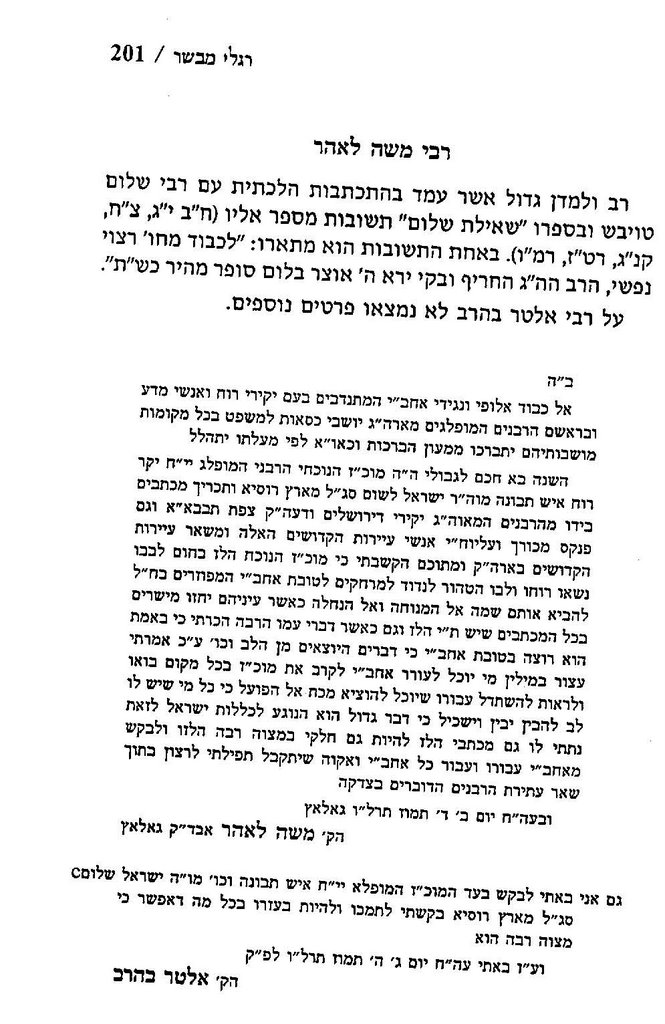
In 1999/2000 some in Beni Brak B. Margolius (most likely a woman due to the lack of first name), published a book, Ragli Mevasar. This book is divided into three parts. The first two are biographies of R. Schlesinger and his father in law. The last part are the very same letters originally published by Weingarten. Additionally, they include the very same biographies that Weingarten did. There is absolutely no attribution at all! I have included a page from each were the reader can see how they are the same. The top page is from Weingarten and the bottom from Ragli Mevasar. None of the library catalogs I have seen note that this is plagiarized.


Eliezer Brodt: A Censored Work by a Student of R. Hayyim of Volozhin: The Case of Menuchah u-Kedushah

A Censored Work by a Student of R. Hayyim of Volozhin:
The Case of Menuchah u-Kedushah
By Eliezer Brodt

A few years ago (c2000) a fascinating sefer was reprinted called Menuchah u-Kedushah. The sefer was written by R. Yisrael Isserl from Ponevezh. Not much is known about the author except that he was a talmid of R. Hayyim of Volozhin. It’s clear from the sefer that he was a very special person and a big talmid hakham. The haskamot that he received from the R. Naftali Zevi Yehudah Berlin (Neziv), R. Bezalel HaKohen and R. Avraham Eisenstadt, author of the Pitchei Teshuva, show that he was a very prominent, well-known person (for some reason these haskamot were omitted in the reprinted edition). R. Shlomo Elyashiv, the author of the Leshem, also writes that he was an Ish Kadosh, a Holy Man. It appears that he was a melamed [teacher], and (as we will see) it seems that he must have been an excellent one. In the recent reprint, R. Shmuel Auerbach writes that the sefer was famous in particular as a guide in raising children and many followed it and became true Ovdei Hashem. Interestingly, the sefer was originally published anonymously (Vilna, 1864).

In this post I would like to discuss this sefer a bit. The author in his introduction (which, oddly enough, was omitted in the newest reprinted version of the sefer) outlines very clearly what he had wanted to accomplish with this work. Divided into three parts, the first is called Sha’ar HaTefillah, an explaining as to what one should do in order for his tefillot to be accepted. Included are many explanations on different parts of Tefillah. The second part is called Sha’ar HaTorah, which is the way the author feels one should teach children. The third part is called Sha’ar Yichud HaMa’aseh which includes advice how to battle the Yetzer Hara in all different situations.

The sefer reviews many interesting things especially vignettes from R. Elijah Gaon of Vilna (the Gra) and R. Hayyim of Volozhin. Also, included are many beautiful explanations on different areas of Tanakh and Aggadah. Aside from the explanations, this the sefer also includes many halakhot and minhagim. The sefer begins with a nice collection of halakhot of kavod seforim including that the prohibition to use one sefer under another one to bring it closer to you, or leaning completely on seforim like a shtender. To list a few examples of Ta’amei Minhagim brought throughout the sefer: the reason behind the mitzvah to eat on Erev Yom Kippur (pg 51) and giving tzedakah (pg 204). He is very against talking at all during davening; even talking in learning between aliyot (pg 75). The author also wrote a lengthy discussion regarding the proper time to light the Chanukah menorah; opining to light after ma’ariv. The author states that the only reason why R. Elijah Gaon of Vilna lit earlier was because of concern that if he would have waited until after ma’ariv he would have this on his mind the throughout davening, similar to a groom who is exempt from kriat shema (pg 160) due to his preoccupation. When he discusses sitting shiva on ones parents he exclaims ‘do not just sit there making the same mistake most do’; namely, they claim that since it is prohibited for a mourner to learn Torah, they leave a Sefer Iyyov on the stool nearby just to glance at from time to time and fall asleep. Rather, one is supposed to learn the topics that a mourner is allowed to so that one could give one’s parent many merits; there is enough material to learn for three weeks (pp. 88-89)! He writes to his son any shiur that he goes to after he dies he should always say the kaddish de’rabbanan for him; not only the first year (pg 95-96).

Many interesting discussions on various topics, such as the Neshama Yetairah that one gets on shabbat (pp. 49-50) are found throughout the sefer. He also has a lengthy discussion on the now-famous topic (in light of all the biographies on the gedolim) that no great person achieved anything great in life without working very hard for it. The talmudic use of the term “Noch Nafshei” a term of resting, was not hapenstance. Instead, it was used to demonstrate that, in many instance, those persons did not have easy lives, and thus only after death is it approriate to use a term of rest – hence Noch Nafshei. This is in reference to Tana’aim and Amoraim; how much more so in regard to regular people (pp. 79-82). Elsewhere in the sefer he has a long discussion on chumrot, writing very strongly: “one should be concerned that the yetzer hara is bribing him and allowing him to do them so he will be too occupied to observe the ikkar.” As an example for this he gives, he points out that in Minhagei Ha-Gra that he had eaten Matzah Shemurah the whole Pessach. Whereas the author realizes that if because of this chumrah he will have to eat separately from the rest of his family and not have proper simchat yom tov which is a de’oraita, he should not be makpid on eating matzah shemurah which is just a pious action (pp. 155-156).

Another point of interest that he writes is that the Messilat Yesharim was written with ruach hakodesh so listen to what he says (pg 158). When he talks about the sefer Nefesh Ha-Hayyim from his teacher R. Hayyim of Volozhin, he writes “listen to his holy mouth as the sefer is exactly like its name ‘life for the soul’ and one should know that ruach hakodesh is in all the words in the sefer so that it should be accepted by its readers” (pg 69).

After reading all this it would seem to appear that this is a very good work and there should be no problems with anything written in it. However this is not the case. The people who printed it write that in the section called “Sha’ar HaTorah” we were advised by gedolim not to print some parts. This is very strange because as mentioned earlier he had very prominent haskamot from some big gedolim and as the Leshem writes he was a Holy Man, and he was also a known student of R. Hayyim of Volozhin. One is left wondering what in the world could have been wrong with what he had written prompting censor?

In the 1967 reprint of the original edition by Meir Kleiman, the missing pages are included, about five all together. In short, what the deleted material is as follows, he saw many people who had no business becoming teachers taking the job only for the money. He writes that he was a teacher and he would spend a few weeks trying to understand each student what was the best way to deal with him. Another thing he writes is the importantance that boys have a proper understanding of the Hebrew language; not that he has to be a baki in dikduk just to know the basics than it’s easier to learn chumash. Once the boy knows chumash only than should you go on to learn Gemara. When he begins this limud, be careful to go slowly so as not to over burden him. The main point is not to learn enmass, rather emphasis on making sure the student fully understands everything before going further. Instead what happens is the boy only knows how to parrot what the teacher says and on shabbos he shows this off to the father; however nothing of value ever comes out of this. Another thing he writes is in regard to the failure to teach the boys tanakh; not only Gemara as the study of Tanakh is extremely important. Professor Simha Assaf brings much of this edited part in his Mekorot le-Toledot ha-Hinnukh be-Yisrael (vol. 1 Pg 607-613). R. Yitzchak Abadie discusses this whole section in his Teshuvot Ohr Yitzchak (pp. 444-450), available for download at www.HebrewBooks.org.

Reading all of the above, one can only wonder as to what was wrong with printing these parts; the author can not be accused of having haskalic leanings for a few reasons: One, if he did have haskalic leanings, then why allow the rest of the sefer be reprinted. In all honesty, the very thought is quite ridiculous; the Leshem writes he was a Holy Man and a reading of the sefer will show how true that is. Also he was very against learning philosophy saying that only the Rishonim were they on the level to learn it (pg 47).

What’s interesting about all this is many schools in the United States would do well to follow this advice in their educational methods; I am sure it would help many. Not that it’s the solution to all the problems with the children of today but it’s certainly a good start. Interestingly enough R. Yakov Horowitz in a recent article in his column ‘Chinuch Matters’ in the English Mishpacha 143 (Pg 10) called ‘It Doesn’t Start in Tenth Grade‘ writes the same point. R. Yakov Horowitz continues with this theme in the next issue in an article called ‘Training Wheels‘. Of course these columns have been met with opposition. One reader writes (English Mishpacha 145, pg 6) “Torah is acquired thru yegia through no other method can Torah become yours. Making torah easy at the beginning only makes it harder later on. The author mentioned that he is backed by various Achranoim who have suggested alternative methods for teaching torah. It should definitely be mentioned that these methods were unaccepted in Klal Yisroel. Mesorah means tradition passed on Midor Ldor not looking in seforim for unaccepted methods.”

One only wonders what this reader is talking about as shown here a Holy Man and talmid of R. Hayyim of Volozhin wrote these same suggestions as R. Yakov Horowitz and received good haskamot from important known gedolim. Further more as I have mentioned R. Shmuel Auerbach writes that the sefer was famous, in particular, as a guide in raising children and many followed it and became true Ovdei Hashem.


Do you recall Hrubieszow? Hrubieszow, Home to an Active Early Nineteenth Century Hebrew Press

Do you recall Hrubieszow?

Hrubieszow, Home to an Active Early Nineteenth Century Hebrew Press[1]

Marvin J. Heller

A barely remembered Hebrew press, one credited with as many as forty books, although that number is uncertain, was active in Hrubieszow (Hrubyesho), Lublin district, in southeastern, Poland from 1816 to1821 and then intermittently until 1827. The variance in the number of titles printed may be attributed to the manner in which books are recorded, some titles being a composite of three works. In some instances, the town or the printers’ names are omitted from the title-page due to censorship or book tariff payment. The books published by the press are relatively small varied books, designed to meet the community’s needs and interests. The first works printed include several Yiddish titles. Most of the books are small format, ranging from duodecimo (120) through quarto (40) formats. The article describes a small portion of the Hrubieszow imprints to give a sense of the press’s publications, their variety, indicative of the community and how, through their books, the press served it. The selected works are generally of a scholarly and specialized nature, primarily Hasidic works on the weekly parasha (Torah reading), ethical, and halachic tomes, although varied within each category. These works reflect both the composition and interests of the community.

A barely remembered Hebrew press, one that is credited by the Thesaurus of the Hebrew Book with as many as forty books in the early nineteenth century, was active in Hrubieszow (Hrubyesho), Lublin district, in southeastern, Poland.[2] Jewish presence in Hrubieszow dates to the first half of the fifteenth century, Jews being recorded there as tax farmers and merchants, doing business in such diverse areas as Walachia, Turkey, the Crimea, and Kiev.

In the 10th century, the Hrubieszow district had been part of the Polish state. In 981, however, it was seized by the Kievan Rus’, subsequently changing hands several times, even falling to the Mongol Empire in the mid-13th century. Even earlier, the founding of Hrubieszow dates to the early Middle Ages when there was a defensive ‘gord’ (a medieval Slavonic fortified settlement) on the Huczwa river island. Hrubieszow is mentioned as early as 1254, as a hunting settlement amid forests. In 1366, Hrubieszow, then known as Rubieszów, was recaptured by King Casimir III the Great, again becoming part of the Kingdom of Poland (see banner of early Polish monarchy, right). In about 1400, the town received a charter from Polish king, Władysław II Jagiełło. Hrubieszow (Rubieszów) was destroyed several times by Crimean Tatars, who raided the area in the 15th, 16th and 17th centuries, and by rebellious Cossacks.

In 1772, After the First Partition of Poland, Hrubieszow was annexed by Austria. In 1800, Stanisław Staszic founded the Hrubieszow Agricultural Society, the first cooperative organization in Europe, which existed until 1945. In 1802, the name Rubieszów was changed to Hrubieszow, the name by which it is known today. Seven years later, in 1809, after the Austro-Polish War, Hrubieszow became part of the short-lived Polish Duchy of Warsaw, subsequently becoming, in 1815, by the Congress of Vienna ,part of the Russian-controlled Congress Poland, within the Lublin Governorate.[3]

As noted above, Jews were active in Hrubieszow from the first half of the fifteenth century. At some point in that century, Jews in Hrubieszow received several privileges for wine trade and management of the town tax chamber. By 1551, thirteen Jewish residents occupied four houses, that number rising to 40 Jews living in 5 houses by 1560. That number continued to increase, so that from the 18th century until the beginning of the 20th century Jews comprised a considerable majority of Hrubieszow’s population, controlling trade, industry, and craft. In 1578, King Stephen Bahory granted the Jews in Hrubieszów extensive rights. Less than a century afterwards, during tah-ve-tat (the Chmielnicki massacres of 1648-49), the Jewish community was almost entirely destroyed. Soon afterwards, however, the Jewish community was reestablished – a yeshivah was opened, headed by R. Isaac ben Judah Charif. Hrubieszow would subsequently be home to a number of prominent rabbis and became influential in the Arba’ah Artzot (Council of the Four Lands).[4] In the 18th century the Hasidic movement became active in Hrubieszow, the city becoming a center of Berdichev Hasidism. Among its leaders was R. Joseph ben Mordecai Katzenelboigen (R. Mordechai of Neszhchiz), who relocated there in the 1790s.[5]

We now turn to our subject, Hebrew printing in Hrubieszow. As noted above, the Hrubieszow press is credited by the Thesaurus with as many as forty titles, although that number may be uncertain; in contrast, Avraham Yaari records only thirty-four titles for Hrubieszow.[6] Those works are relatively small varied books, designed to meet the community’s needs and interests, published from 1816 to1821 and then intermittently until 1827. This article will describe a small portion of those works, to give a sense of the press’s publications, their variety, indicative of the community and how, through their books, the press served it. To address a greater number would be tedious for both the reader and the writer.

Dr. N. M. Gelber and Avraham Yaari inform that attempts to establish a Hebrew press in Hrubieszow were made from 1792 through 1804, in the Austrian period, but that the matter was delayed, the privilege to do so not granted. In late 1816, a Hebrew press was established in Hrubieszow, now part of Congress Poland. The founder of the press was R. Menahem Mendel Finkelstein (Finkel Stein). He had partners, namely R. Moses Tzikor and R. Saul Moss Goldstein of Łaszczów. Finkelstein provided the financing, the latter two the necessary skills, being experienced printers, having been partners in the Hebrew press in Łaszczów. Management of the press changed in the following years. Goldstein left the press in 1819, returning to Łaszczów, Finkelstein left the press in 1821, leaving Tzikor in charge. Tzikor then took Solomon ben David as a partner. Eight master printers were employed by the press as compositors and press operators, namely Daniel Ze’ev ben Segal, Baruch Abraham ben David, both from Hrubieszow, Isaac ben David from Łaszczów, Hayyim ben Eliezer from Zhovkva, Israel ben Raphael, Menachem Mendel ben Baruch, Pesach Joseph from Łęczno, and Eliezer Segal, perchance from Hrubieszow.[7]

Printing began shortly after the privilege was granted, the first works being published, including several Yiddish titles. Vinograd records ten titles for 1816-17, beginning with Shir ha-Shirim (1816), Orhot Zaddikim, Gedolus David u-Malchus Shaul, Haggadah shel Pesah, Sefer Hasidim, Lekah Tov, a siddur Tefillas Nehora, Noam Elimelekh, Shivhei ha-Ba’al Shem Tov, and Tanna de-vei-Eliyahu. These are all small format books, ranging from duodecimo (120) through quarto (40) formats. These works are indicative of the variety of the Hrubieszow imprints and the community the press served. For example, R. Judah ben Samuel he-Hasid’s (c. 1150-1217) Sefer Hasidim, an ethical, mystical, and halakhic work; Tanna de-be-Eliyahu is an aggadic midrash attributed to Elijah the prophet as dictated to the third century amora Anan bar Rav: Noam Elimelekh by R. Elimelech of Lizhensk; Shivhei ha-Ba’al Shem Tov, collection of Hasidic tales about the founder of Hasidim, and in contrast to the prior works, Joseph ha-Efrati’s Gedolus David u-Malchus Shaul, a maskilic (enlightened) drama.[8]

Noam Elimelekh – We begin with R. Elimelech ben Eliezer Lippman (Lippa) of Lizhensk’s (1717-87) Noam Elimelekh, a classic and primary Hasidic work, representative of the press’s output and the communities’ interests. R. Elimelech was a student of R. Samuel Smelke Horowitz (Rebbe Reb Shmelke, 1726-78), and afterwards a disciple of R. Dov Baer the Maggid of Mezhirech (1704–72), as well as meeting by the latter R. Levi Yitzhak of Berdichev (c. 1740-1809). After the Maggid’s passing, Elimelech became the acknowledged head of the Hasidic movement and is considered the theoretician and creator of “practical zaddikism.”[9]
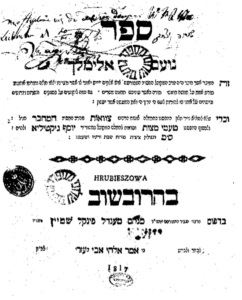
Noam Elimelekh was published as a 23 cm. work ([1], 94 ff.) The title-page begins with honorifics of Elimelech of Lizhensk and informs that in order that there should not be blank paper at the beginning of the book and for benefit of the public, they have published the testament of the author (see below), and at the end of the volume is R. Joseph Gikatilla’s Tamei Ha-Mitzvot. Not noted but also at the end of the volume are Likkutei Shoshana and Iggeret ha-Kodesh. The title page is dated with the chronogram “[for he said] the God of my father’s [house] was my help כי אמר אלקי אבי בעזרי (577 = 1817)” (cf. Exodus 18:4). Elimelech’s testament, entitled conduct (הנהגות) of a man is on the verso of the title-page and consists of twenty-one admonitions for a person.
The title-page states that Noam Elimelekh was published at the press of Menahem Mendel Finkelstein. According to Ch. B. Friedberg the references to the publisher on the title-page varies between books. He notes that initially references to the printer stated Menahem Mendel Finkel Stein and associates. Afterwards, however, he does mention the names of his partners.[10]

1817, Noam Elimelekh

The text, a hasidic Torah commentary on the weekly Torah portion, follows. It emphasizes the role of the zaddik in worship and divine service. At the end of the concluding section of the book are two decorative tail-pieces. These tail-pieces, particularly the one on the left, appear on title-pages of several Hrubieszow books.
Noam Elimelekh is a classic Hasidic work. First printed by his son after his death in Lvov 1788, Noam Elimelekh has proven to be an immensely popular work. This, the Hrubieszow printing, is the sixth edition. It is reported that more than 50 editions of Noam Elimelekh have been printed.[11]

Sefer Hasidim – R. Judah ben Samuel he-Hasid’s (c. 1150–1217) Sefer Hasidim, a different but computable work is, as noted above, an ethical, mystical, and halakhic work. Judah was a disciple of his father, R. Samuel (ben Kalonymous) he-Hasid (c. 1120-75) an eminent kabbalist and ascetic; portions of Sefer Hasidim are attributed to Samuel he-Hasid. They are among the most renowned members and leaders of the Hasidei Ashkenaz, the influential Jewish pietist movement in medieval Germany.

It is reported that when Judah’s mother was pregnant with him, she was walking along a path by a bet medrash (Torah study hall) when a wagon came bearing down upon her, with no place to turn, neither to the right nor to the left. Just as she was about to be crushed by the horses’ hoofs, the walls of the bet medrash opened saving her and her son. It is also told that Samuel he-Hasid witnessed the heavens opening; asked what kind of son he wanted, he replied, one of exemplary piety. Judah reputedly hosted the prophet Elijah, was able to revive the dead, and performed miracles, particularly saving Jews from oppressors. He practiced an ascetic form of mysticism, fasting two days for Yom Kippur, throughout the week, eating at night only, and often fasted on Shabbat, claiming that the change would cause him pain, detracting from his pleasure in Shabbat. It was said by a contemporary that if Judah had lived in the times of the prophets he would have been a prophet.
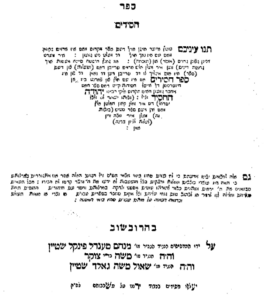
1817, Sefer Hasidim

The title-page of Sefer Hasidim, published is octavo format (80: [64] pp.) is in Yiddish, excepting the names of the printers and the publication date. All of the printers are cited here in bold letters, that is, Menahem Mendel Finkel Stein, Moses Tzikor and Saul Moss Gold Stein. The date in the chronogram, “Let the faithful exult in glory;
let them sing joyously upon their beds יעלזו בכבוד ירננו על משכבותם )577 = 1817).” (Psalms 149:5)

Sefer Hasidim is foremost an ethical manual, practical rather than theoretical, encompassing all aspects of life, including the minutiae of personal, family, and business matters. Numerous examples are cited, containing, considerable information about contemporary Jewish life. Advice is detailed and pragmatic, with the goal of achieving strict adherence to an ethical and pious life. These instructions, often based on kabbalistic teachings, have been influential because of the author’s great piety. Sefer Hasidim is also a mystical work, explaining biblical and talmudic passages.[12]

Gedolus David u-Malchus Shaul – A very different work is Joseph Ha-Efrati of Tropplowitz’s (c. 1770–1804) Gedolus David u-Malchus Shaul, a drama in Yiddish. Among the smallest Hrubieszow imprints, it was printed in duodecimo format (120) 29 ff.
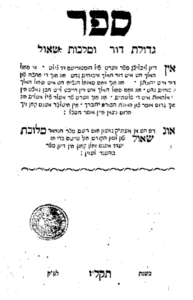
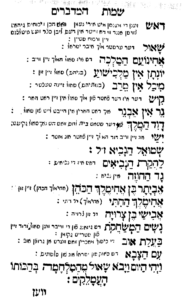
1817, Gedolus David u-Malchus Shaul

The author, born in Tropplowitz, Silesia, was a Hebrew poet, dramatist, and tutor. While working in the last capacity he wrote the first acts of the drama Melukhat Sha’ul from Melukhat Sha’ul completed in Prague in 1793. Gedolus David u-Malchus Shaul is a Yiddish translation, retitled. This version, that is the Yiddish translation, has been described as “part of the traditional Purimshpil (“Purim play”) in many Lithuanian and Polish towns . . . the first modern Hebrew drama of the Haskalah period, is noteworthy for its new egalitarian and humanistic ideas.” In writing Melukhat Sha’ul Ha-Efrati was reputedly influenced by Shakespeare, Goethe, Schiller, and von Haller, as well as M. H. Luzzatto. The primary characters, Saul. David, Jonathan, and Michal reputedly signify abstract ideas rather than lifelike characters, representing “the pathos of a suffering hero, ridden with envy and guilt, torn by fears and loneliness, and not merely a proud and jealous king.”[13]

The title-page is misdated, the date, given in a straightforward manner, is תקלז (= 1777). Depending on when the misdating was caught, it may have been corrected with a stop-press correction, that is, when an error was found the press would be stopped, the error would be quickly corrected and printing resumed. As one copy only of Gedolus David u-Malchus Shaul was seen it not known if that was done or if this is the sole uncorrected title-page for that work.[14] Friedberg writes that he has seen several of the press’s books that are misdated[15] For other examples, see below.

The text is in Yiddish excepting paragraph headers and, similarly, except here vocalized, the names of the participants in the drama on the verso of the title-page. This is the third edition of Gedolus David, the first having been printed in Lvov in 1801; It is a popular work, as many as fourteen editions are recorded for Gedolus David in the Bet Eked Sefarim and only twelve editions for Melukhat Sha’ul.[16]

The following year, 1818, saw the publication of five titles, primarily Hasidic works, among them such classics titles as R. Menahem Nahum Twersky of Chernobyl’s Me’or Einayim, homilies on the weekly Torah portions; R. Samuel ben Nathan Ha-Levi Loew Kolin’s Maḥaẓit ha-Shekel on the Shulḥan Arukh Oraḥ Ḥayyim and Yoreh De’ah; R. Jacob ben Solomon Habib’s Ein Ya’akov, collection of aggadah in the Talmud; R. Levi Yitzhak of Berdichev’s Hasidic classic Kedushat Levi discourses on the weekly Torah readings, and, in Vinograd’s listing, a second Hrubieszow edition of Noam Elimelekh.

Kedushat Levi – R. Levi Yitzhak of Berdichev’s Kedushat Levi, a classic Hasidic work of weekly discourses. was published in quarto format (40: [1], 78, 27, 15 ff.) in the year “Isaac pleaded [with the Lord] ויעתר יצחק (571= 1818)” (Genesis 25:21). R. Levi Yitzhak of Berdichev, who defended Hasidus against its opponents, settled in Berdichev, in 1785, residing there for the rest of his life. When he passed away, it seemed, to R. Nahman of Bratslav that “the light of the world had been extinguished.” Levi Yitzhak was held in the highest regard and affection by Jews. An example of his sensitivity, even to transgressors, is the following incident,

When he happened to meet “a young man eating in public on the fast of Tisha B’Av (the anniversary of the day on which both the first and second Temples were destroyed) the rabbi asked him mildly, “Have you forgotten that today is the Ninth of Av? Or are you perhaps unaware that it is forbidden to eat on the Ninth of Av?” “I have not forgotten what day it is and I am well aware of the prohibition,” answered the young man. “Possibly, my son, you are not in good health and have been advised by your doctor to eat?” the rabbi of Berdichev inquired further. No, I am in excellent health,” was the reply. “See, O Lord,” exclaimed the sage with joy, “how admirable Your children are! Even when they transgress Your Commandments, they do not stoop to falsehood.” [17]

Levi Yitzhak’s first published work, also entitled Kedushat Levi, is discourses on Hanukkah and Purim, printed in Slavuta in 1798. It was subsequently included in later editions of Kedushat Levi on the weekly Torah readings.
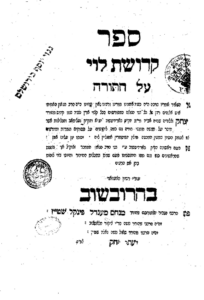
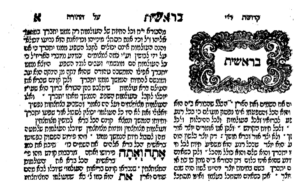
1818, Kedushat Levi

The title-page of this edition of Kedushat Levi begins with honorifics for R. Levi and then informs that it also includes additional material on various subjects. On the verso of the title pages is an approbation from four rabbis from Berdichev; R. David Shalit, R. Aaron Isaac ha-Kohen, R. Nathan Aryeh Davir, and R. Mordecai באאימו son of my lord, my father, teacher, and rabbi David Shalit. Below the approbation is the standard disclaimer that the people among whom the Jews reside today are not like those in the time of the Talmud, immoral idol worshippers, but today show respect for Torah and do justice and righteousness in their lands, The text follows, primarily on the weekly parsha, but also addressing other biblical books, festivals, and concluding with a final section addressing various subjects, including Pirke Avot. Kedushat Levi.

First published in Berdichev in 1811, this, the Hrubieszow edition, is the third printing of Kedushat Levi. A popular work, it has frequently been republished.

Sefer ha-Yashar – Among the books published in 1819 is R. Zerahiah ha-Yevani’s (13th or 14th century) popular ethical work Sefer ha-Yashar (Book of Righteousness). The title-page attributes the work to R. Jacob ben Meir Tam (Rabbenu Tam, c. 1100-1171), a not infrequent error, as well as it being attributed to R. Jonah Gerondi (13th century). The former did author a Sefer ha-Yashar (Vienna, 1811), but that is another work, consisting of responsa and novellae, while the style of the latter, who wrote ethical works, differs from this book. A number of manuscripts, however, name Zerahi ha-Yevani’s as the author. While many now accept him as the author, that attribution is not definite. Little is known about Zerahiah, except that he was a resident of the Byzantine Empire and that he is credited with Sefer ha-Yashar.

Sefer ha-Yashar was published in octavo format (80: [2], 40 ff.). The title-page begins that it is “the path of life and moral reproof, to go on a straight path. It is dated “it is [very] indeed upright וישר הוא מאוד (579 = 1819)” (cf. Deutronomy 32:4; Psalms 21:29). The printers names are given on the title-page as Menahem Mendel F. Sh. and Moses Tzikor,
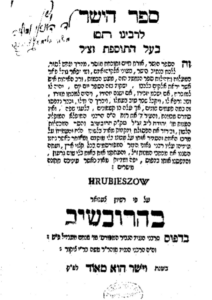
1819, Sefer ha-Yashar

There is an introduction, in which Zerahiah brings proof for the Torah and its precepts from both reason and from the prophets, and bemoans the pursuit of pleasure, wealth, and honor in his time, rather than religion and morality. Sefer ha-Yashar, with the purpose of directing one’s soul towards the correct worship of God, piety, and ethical content, is written in an easy style so that it will influence others to right conduct. Sefer ha-Yashar is comprised of material from earlier ethical works, although they are not mentioned in the text by name nor directly quoted. It is evident, from the book, that he was familiar with Jewish philosophic works. The most significant of the prior works, acknowledged in the introduction, is Bahya ibn Paquda’s Hovot ha-Levavot, studied by Zerahiah, but too long and complex for the average reader. It provides, in summary, the essence of several chapters. Another important influence, evident in the text, is Maimonides.

The text, divided into eighteen chapters which address, beginning with the creation of the world, worship, repentance, knowledge of God, the will of God, the world to come, complete repentance, the significance of the righteous, accountability of a person, remembrance of the day of death, and the distinction between the righteous and the wicked. Zerahiah’s primary subjects are the need to imitate God, conditions of proper prayer, both theoretical and practical; correct conduct and obstacles to be overcome to achieve it; and repentance.[18]

A popular work Sefer ha-Yashar was first printed in Constantinople (1540); this is the twenty-second edition, of slightly more than fifty recorded by the Bet Eked.Sefarim.[19]
Levushe Serad – Another different work, also published in 1819, is R. David Solomon Eybeschuetz’s (Eibenschutz) halachic Levushe Serad on the Shulhan Arukh Yoreh Deah, particularly on the laws pertaining to shechita (ritual slaughter). Printed as a folio (20: [2], 2-102 ff,) in the year “attired as thin beast לבושי השרד בהמה דקה (561 = 1801).” This date is certainly incorrect, a bet ב at the head of the word בהמה (beast) which make the verse meaningful but gives a date in error, as opposed to a kafכ which would read כהמה and would give the correct value of (579 = 1819) but be meaningless. I would suggest, and this is entirely speculative, that the printer wanted the meaning of beast even if that threw the date off. Support for this conjecture can be found in the correct date, immediately below the Hebrew date, in Arabic numerals, that is, 1819. This is the only title-page seen among the Hrubieszow imprints with an Arabic numeral date.

The author, R. David Solomon ben Yerachmiel Eybeschuetz, was born in Russia and studied under R. Moses Ẓevi Heller. He served as rabbi in several locations, among them Buzhanow, Soroki (Volhynia), and Jassy, (Rumania). Eybeschuetz made aliyah, that is, he went up to Eretz Israel, residing in Safed, where he died in 1812. Eybeschuetz was also a kabbalist as well as a Talmudist. His other works include responsa, Ne’ot Deshe (part one, Lvov, 1861), part two and manuscripts, including a commentary on the Torah and discourses.[20]

The title-page describes Levushe Serad as being comprised of three parts, the first explaining the laws pertaining to laws of falling and broken bones in cattle and fowl; the second, laws applying to lungs; and the third, applying to Yoreh De’ah. The printers are given here as Menahem Mendel Finkel Stein. and Moses Tzikor.

The verso of the title-page has an approbation from R. David Shalit. The text is comprised of the commentary in two columns. The text of this volume on Yoreh Deah varies from the previous volume on Orah Haim. Chaim Tchernowitz describes this volume as following R. Alexander Sender Shor’s (d. 1737) influential Simla Hadasha, also on shechita; Levushe Serad being described as the most important commentary on that work [21] It does not include the text of Yoreh De’ah, on which Levushe Serad comments and elucidates.
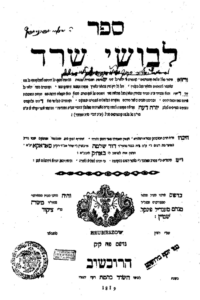
1819, Levushe Serad

Levushe Serad on Orah Haim was first published in Mohilev (1805). This volume, on Yoreh Deah is the third edition, it too having been printed previously in Mohilev (1812).[22]

Havvat Da’at – Among the books printed in 1820 was another work on Shulhan Arukh Yoreh Deah, but considerably different from Levushe Serad, that is, R. Jacob ben Jacob Moses Lorbeerbaum of Lissa’s (c. 1760–1832) Havvat Da’at. It was published as a folio (20: [1], 37 [should say 36], [34] ff.) in the year “Day to day makes utterance, night to night speaks out יום ליום יביע אומר ולילה ללילה יחוה דעת (470 = 1805) 19:3), This chronogram is also misdated, as is noted by the NLI catalogue, which records it as a circa 1820 imprint; which also states that the printer, who is not identified on the title-page, is unknown.
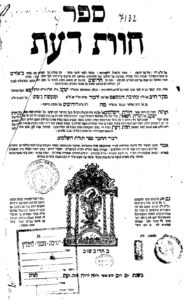
1820, Havvat Da’at

Jacob Lorbeerbaum of Lissa was a distinguished rabbi, who served in several communities, writing, in addition to Havvat Da’at other valued works. [23] However, his early days were difficult and troubled. His father, rabbi of Zborow, passed away prior to Lorbeerbaum’s birth; he was raised by R. Joseph Te’omim (Pri Megadim, 1727–1792), a relative. He initially combined learning and business, being a partner in a brewery but, when that failed, Lorbeerbaum became rabbi in Monasterzyska, founding a yeshivah there. He subsequently became rabbi of Kałusz writing many of his earliest works there, including Havvat Da’at which, reflecting his great humility, was originally published anonymously. When his authorship was subsequently identified ,Havvat Da’at became the name by which he is known.[24]

In 1809, Lorbeerbaum became rabbi of Lissa. Lorbeerbaum was an opponent of the Haskalah movement, their influence resulting in his leaving Lissa in 1822 and returning to Kalisz. Disputes there forced him, in 1830, to again relocate again finally settling in Stryj, serving there as rabbi until his death.

The title-page of Havvat Da’at states that it is on Shulhan Arukh Yoreh Deah, which is a tree of knowledge “desirable as a source of wisdom” (Genesis 3:6), for the pure and the impure. It continues that it is comprised of two parts, Biurim, explanations in depth based on prior commentaries and Hiddushim, novellae, interpretative explanations of statutes and critical analysis. On both sides of the pressmark is the standard disclaimer that the contemporary peoples among whom the Jews dwell today are not immoral idol worshippers as in the past.

The commentary, as described on the title-page, is in two parts, about the text of the Shulhan Arukh. Chaim Tchernowitz describes the subject matter of Havvat Da’at as being on such subjects as salting of meat, meat and milk, mixtures, interest, niddah, and other halakhot dealing with prohibitions such as Stam Yeinam (gentile wine), and treifus. He concludes that according to Havvat Da’at even with laws dealing with permitted and prohibited foods there is room for critical and analytical critique.[25]

Given the title-page variations of this edition, described above, it is not surprising that Avraham Yaari questions, concisely, whether Havvat Da’at is a Hrubieszow imprint. He suggests that it was published elsewhere, writing “one more book that is listed as having been published in Hrubieszow was actually published in Polonne. This is Chavat Da’at by Ya’akov of Lissa.”[26] While we have noted a number of variations in Havvat Da’at, such as the dating error in the chronogram, albeit not that unusual for Hrubieszow publications, the absence of the printers’ names, and a pressmark that is not common to Hrubieszow title-pages, there is also the fact, in contrast to these varoiances, that the place of printing is clearly given on the title-page as Hrubieszow. Furthermore, other bibliographic sources, such as Friedberg’s Bet Eked Sefarim and Vinograd’s Thesaurus record Havvat Da’at as a Hrubieszow imprint. An examination of a sample of Polonne and Sudylkow (also suggested) title-pages did not show any like images. The question of whether Havvat Da’at was a Hrubieszow imprint or was published elsewhere is a teku (u nresolved).

Another Hrubieszow imprint by Jacob Lorbeerbaum of Lissa is a folio edition of Beit Ya’akov, novellae and commentary on Shulchan Aruch, Even Ha–Ezer and tractate Ketubot. The printers are given as Moses Tzikor, of Laszczow, and Solomon, ben David Lev, of Laszczow, Menahem Mendel Finkel Stein having already left the press.

This is the fourth printing of Havvat Da’at. The first edition was published in Lvov (1799).

Avodat ha-Kodesh – Among the books printed in Hrubieszow in 1820 is Avodat ha-Kodesh by R. Ḥayyim Joseph David ben Isaac Zerachia Azulai (Hida, 1724-1807), a prominent kabbalist, rabbinic scholar, bibliophile, and prolific author. More than eighty works are attributed to him, sixty in print, on a wide variety of subjects on Torah, halachah, aggadah, and kabbalah.[27] Avodat ha-Kodesh, an 18 cm. octavo(80: 40 ff.) is comprised of three related works, Vinograd records each independently, that is, Avodat ha-Kodesh, Moreh be-Etzba, and Ziporin Shamir as separate entires. All three titles, kabbalistic explanations of customs, are in octavo format (80) and relatively small works. Shimon Vanunu, describes Avodat ha-Kodesh as a compilation of several of Hida’s prior works.[28]

Hida was born in Jerusalem to a prominent Sephardic family, descendant from exiles from Spain, and his great-grandfather was the kabbalist R. Abraham Azulai (c. 1570–1643, Hesed le-Avraham), originally from Fez, Morrocco and on his maternal side from R. Joseph Bialer, a German scholar. He was educated by leading rabbinic figures, among them R. Isaac ha-Kohen Rapoport, R. Shalom Sharabi, and R. Haim ibn Attar (Ohr ha-Haim). He served as rabbi in several communities and beginning in 1755, served as an emissary from Eretz Israel to Jewish communities in Europe.
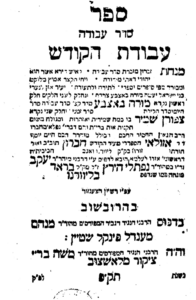
1820, Avodat ha-Kodesh

The title-page has the heading Avodat ha-Kodesh in large bold type and below notes the other two works, and then that the book was brought to press by R. Jacob ben Naphtali Hertz of Brod and that it had been printed previously in Livorno. The title-page is dated in a straightforward manner as (תק”פ = 1820). The verso of the title-page has the disclaimer that the non-Jews among

whom the Jews noted above that contemporary nations are unlike the earlier nations who were immoral idol worshippers, but today show respect for Torah and do justice and righteousness in their lands. It is followed by the tailpiece noted above that appears on the title-pages of several books. Examples of the text are:

147: all who say shirat ha-yam (Exodus 14:30 – 15:19) with joy as if he himself had been delivered from the sea, Pharoh, and his army, when they drowned in the sea, and says Shira with great feeling is forgiven his iniquities.

148: all who weep and mourn for a person who was kosher is forgiven his iniquiites.

149: all who pray erev Shabbat and say [the prayer] ויכלו “the heavens and earth were completed” (Genesis 2:1), two angles say to him turn your eyes and your sins will be atoned for.

The pressmark appears at the end of the book as a tail-piece.

Tomer Devorah – Another work published in 1820 is R. Moses ben Jacob Cordovero’s (Ramak, 1522-1570) popular and much reprinted Tomer Devorah. A small kabbalistic, ethical, and inspirational treatise, it was published as a 19 cm. octavo (14 ff).

Moses ben Jacob Cordovero was the first to describe the dialectical process through which the Sefirot pass in their development and to interpret the various stages of their emanation as manifestations of the Divine mind.[29] Based on his name, Cordovero appears to have been descended from Jewish exiles from the city of Cordova. It has been suggested, but this is uncertain, that he was born in Safed. Cordovero was a student of R. Joseph Caro (1488-1575) in nigleh (revealed, literal Torah) and, after heeding a heavenly voice that urged him to study Kabbalah, of his brother-in-law, R. Solomon Alkabez (Lekhah Dodi) in nistar (esoteric Torah, Kabbalah). Cordovero became a leader of the ascetic mystical community of Safed, preparing for it a list of rules of conduct, primarily instructions and commands. He served as a dayyan in Safed and founded a yeshivah there in about 1550, which he headed until his death in 1570.

Among Cordovero’s students were R. Elijah de Vidas (Reshit Hokhmah), R. Abraham Galante (ha-Kadosh), R. Samuel Gallico (Asis Rimmonim, an abridgement of Pardes Rimmonim), R. Hayyim Vital, and R. Isaac Luria (ha-Ari). Although Luria was Cordovero’s student for a short while only, and his system of Kabbalah would supplant that of Cordovero, Luria refers to Cordovero as his master and teacher, testifying that Cordovero was completely free of sin, that both the sages of the Mishnah and Elijah the Prophet appeared to him, and that at Cordovero’s funeral a pillar of fire preceded his coffin. Others, such as R. Menahem Azariah da Fano, although in Italy, considered themselves disciples of Cordovero. A prolific writer, he is responsible for several of the classics of Kabbalah.[30]

Tomer Devorah is entitled from “And she sat under the palm tree of Deborah (Tomer Devorah) between Ramah and Beth‑El in Mount Ephraim” (Judges 4:5). The title-page urges man to follow a straight path, to end his isolation and reflect on his ways, to cleave to the order of the sephirot. The printers are given as Menahem Mendel Finkel Stein and Moses Tzikor of Łaszczów, their names preceded by honorifics. The title-page is dated with the chronogram in the year “This is the Teaching that Moses placed before the children of Israel זאת התורה אשר שם משה לפני בני ישראל (580 = 1820)” (Deuteronomy 4:44).
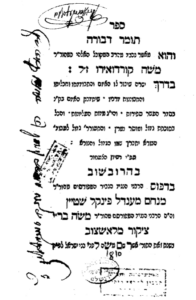
1820, Tomer Devorah

The text is comprised of ten chapters describing Divine qualities and how man should strive to emulate them. They are, 1) the Supernal Crown (Keter) and the thirteen attributes of higher mercy which belong to it; 2) the qualities of the crown, such as humility and kindness, eradicating pride from the heart; 3) wisdom (Hokhmah), love and care for all creatures; 4) understanding (Binah) and repentance; 5) on mercy (Hesed), the methods of performing mercy and assisting the Sefirot to function harmoniously; 6) power (Gevurah), utilizing the evil inclination to serve God; 7) beauty (Tiferet), the study of Torah and behavior appropriate to a scholar; 8) Endurance, Majesty and Foundation (Netzach, Hod and Yesod), support of Torah students and purity of life; 9) Sovereignty (Malkut), sacrifices for Torah and performing marital duties with holiness; 10) Man’s conduct so that he is never separated from the world of the Sefirot. An example of the text, from Keter, is:

Keter – Some major activities that are the main governance: Further for a person to resemble his Creator from the secret of the trait of the Crown (Keter), he must [do] some major activities – which are the main governance. The first: The trait of humility – which includes everything – because it is dependent on the Crown. As behold, It is a trait over all of the Traits, but it does not raise itself and become proud above [the others]. Indeed, It goes down and always looks downwards. And that is from two reasons: The one is that It is embarrassed to look at Its Cause, rather Its Emanator always looks down upon It to benefit It; and It looks down to the lower ones. So [too,] must a person be embarrassed from staring upwards, to be proud. Rather, he must always stare downwards, to diminish himself all that he can.[31]

The title page is followed by a brief introduction from R. Moses Basola, with the pressmark. He found the manuscript of Tomer Devorah in the library of R. Menahem Azriah, who gave it to Basola, in order to bring it to press to merit Israel.

Tomer Devorah is replete with allusions from Talmudic and kabbalistic sources, systemizing and vividly presenting abstruse concepts. It has been frequently republished and translated into other languages, among them English. Tomer Devorah was first published in Venice (1588); this the Hrubieszow edition, is the fourteenth. The Bet Eked Sefarim records thirty-two editions, several with annotations, and not recording translations.[32]

Ayyelet Ahavim – A rhetorical and poetic treatise on the Akedah (sacrifice of Isaac) by R. Solomon de Oliveyra (1633-1708). Ayyelet Ahavim was printed as a 19 cm. octavo (80: [4], 20, [1] ff.). It is dated in a straightforward manner as תקפ”א,ה ([5]581 = 1821).

R. Solomon de Oliveyra is accounted among the Sephardic sages of Amsterdam.[33] Oliveyra’s place of birth, whether Lisbon or Amsterdam, is uncertain. Albert Van Der Heide suggests that as Oliveyra’s parents were fugitive co1nversos, as documented in Amsterdam in 1628, he must have been born in the latter location. Also, based on the marriage certificate issued by the city of Amsterdam, Oliveyra married Rached Dias in 1660, when twenty-seven years old, again attesting to Amsterdam as his place of birth.[34] Oliveyra served as rabbi (hakham) and teacher in the Talmud Torah Etz Haim of the Keter Torah association of the Amsterdam Portuguese community, of which he later became president. He was a member of the rabbinical council, over which he presided after the death of R. Jacob Sasportas (c. 1610-98). In addition to these rabbinic positions, Oliveyra worked as a corrector in the printing-house of Uri Phoebus.[35] Oliveyra was the author of a number of varied multi-lingual works on grammar, lexicography, other philological subjects, poetry, and riddles. Van Der Heide has described Oliveyra as “the preeminent and omnipresent Hebrew poet of Jewish Amsterdam.” Oliveyra became, for a time, an adherent of Shabbetai Zevi, composing liturgical verse in his behalf as well as writing approbations

The primary publisher of Oliveyra’s books was David de Castro Tartas (c. 1625–c. 1700), active from 1662 to 1698 in Amsterdam. Their relationship began in 1665, when our subject work, Ayyelet Ahavim ws published. The title-page begins that it is Igeret: words of truth, “to understand a proverb, and a figure” (Proverbs 1:6). It is entitled Ayyelet Ahavim for it was “a precious vessel” (Hosea 13:15, Nahum 2:10, II Chronicles 32:27), “To receive the instruction of wisdom” (Proverbs 1:3), “He established it and searched it out” (Job 28:27), by the rav, the Sephardic sage SOLOMON ben DAVID Oliveyra, in the month of Ziv in the year תי”ז (1657, printed in Amsterdam in the year תכ”ה (1665). It adds that it has now been brought to press by R. Abraham Moses ben Solomon ha-Levi of Lublin: with the permission of the censor in Hrubieszow at the press of Moses ben Tzikor of Łaszczów.
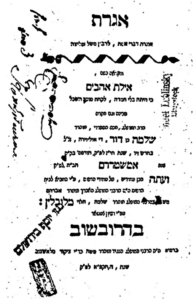
1821, Ayyelet Ahavim

Oliveyra’s introduction follows (2a-b) in which he states that he does not wish to delve into deep explanations nor to go up to the heights of discourse, but rather his heart wishes to speak of the greatness of that “righteous man, who quarried the fetters of love, of that which he formed יצורו for the love of the One Who formed him יוצרו.” Oliveyra’s intent is to investigate this holy and wondrous deed. Among the several reasons that he entitled this work Ayyelet Ahavim is that it is on the love of Abraham and his soul for God “As the hart longs for water streams” (cf. Psalms 42:2). The wide-ranging text is comprised of numerous aggadot, and including riddles and parables. In one section the alternating paragraphs of verse are between father and son. The prose text is accompanied by infrequent marginal references.

First printed in Amsterdam (1665) this is the third and last published edition Of Ayyelet Ahavim.[36]

Summation – Ten books have been described. The selected books give an insight to the type of works published by the Hrubieszow press. They are generally of a scholarly and specialized nature, primarily Hasidic works on the weekly parasha (Torah reading), ethical, and halachic tomes, although varied within each category. These works reflect both the composition and interests of the community. One book, Gedolus David u-Malchus Shaul, stands out, being of a contrary nature, that is, it has maskilic overtones. The provenance of one other work, Havvat Da’at, has been questioned. Also published were two editions of Shir ha-Shirim (1816, 1827), the former not seen, the latter (1820) with the commentaries of R. Eliezer ben Judah (Rokeah) and R. Moes ben Nachman (Ramban).

A lacuna in the press’s publications is the absence of Mishnaic and Talmudic volumes, attesting to the press’s emphases on small books, perchance the nature of its’ operations, a small publisher catering to and meeting a small market’s needs. It did, however, print an Ein Ya’acov, on the aggadot in the Talmud, this with the commentary Kotnot Or. The emphasis on small works does not in any way detract from the value of the press’s publications. Indeed, the books were well printed and attractive. Yaari, however, while approving of their appearance is not so positive as to the titles printed, writing “The books printed in Hrubieszow were elegant in appearance, but not of significant content. Most had been printed previously by other presses. These books were in great demand, such as popular Yiddish books.”

As noted above, the Thesaurus credits the Hrubieszow press with as many as forty titles, although that number appears uncertain, or perhaps exaggerated; Avraham Ya’ari recorded thirty-four titles only. Perchance, the difference in number can be attributed to the manner in which books are recorded. Avodat ha-Kodesh, for example, is a composite of three works, each listed independently in the Thesaurus but one entry only in Yaari’s listing. Summerly, there are three entries in the Thesaurus for Siddur Tefillat Nehora, a two-part prayer book designed so that it can be used for both Ashkenaz ads Sephardic rites. There is one listing only by Yaari, but more detailed. The entries in the Thesaurus for Tefillat Nehora are several years apart (1817, 1821, [1824]). To complicate matters, Yaari has several entries for Kotnot Or but the Thesaurus has one entry only for the Ein Ya’acov. The exact number of publications must remain then a teku (unresolved).

We have noted misdates and censors’ remarks. Yaari comments on this writing:

The names of the town or the printers are omitted from the title pages of several of the books printed in Hrubieszow. This is probably due to censorship, or book tariff payment. Sometimes the printers mentioned their names in some copies but not in others; sometimes they even inserted the name of a different town or stated a different year, to deceive the censor or the tariff–collector

No books omitting Hrubieszow were seen or noted.[37] Why then, printing with the censors’ approval they would omit their names is unclear. Indeed, the books described above, all, with the exceptions of Havvat Da’at all have the printers’ names. In conclusion, as already noted, the Hrubieszow press published small varied books covering a variety of subjects. The books served communal needs, were works of value, and attractively printed. A press only active for a brief period, it served the Hrubieszow community well. It deserves, should be remembered, in addition entries in bibliographic and historical records.
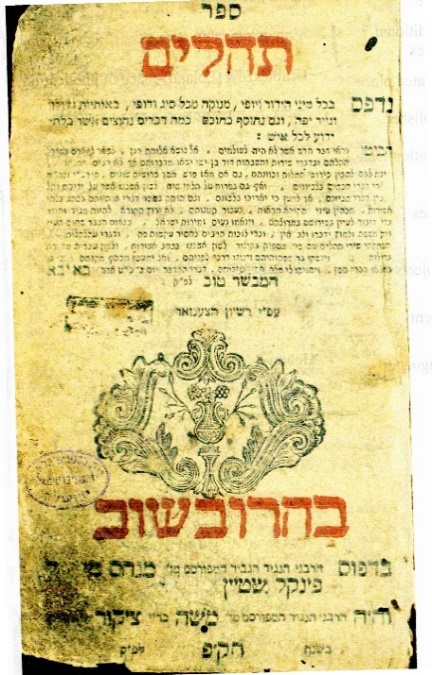
  1. I would like to express my appreciation to Eli Genauer for reading the article and his corrective comments, and Eli Amsel for his additional insights. All the title and text page images are courtesy of the National Library of Israel. The Polish monarchy banner is a public domain image.
  2. Vinograd, Yeshayahu. Thesaurus of the Hebrew Book. place, and year printed, name of printer, number of pages and format, with annotations and bibliographical references II (Jerusalem, 1993-95), p. 167 [Hebrew].
  3. https://en.wikipedia.org/wiki/Hrubiesz%C3%B3w
  4. The Encyclopedia of Jewish life Before and During the Holocaust, editor in chief, Shmuel Spector; consulting editor, Geoffrey Wigoder; foreword by Elie Wiesel I (New York, 2001), pp. 532-34; Polin: Virtual Shtetl https://sztetl.org.pl/en/towns/h/266-hrubieszow/99-history/137366-history-of-community; Dr. N. M. Gelber, Notes on the History of the Jews of Hrubieszow, tr. Yael Chaver, https://www.jewishgen.org/yizkor/Hrubieszow/hru021.html.
  5. Hurvitz Tzvi Ha–Levi Ish Hurvitz, “The Town of Hrubieszow and its Rabbis,” translated by Yael Chaver, Columns 51-52. https://www.jewishgen.org/yizkor/Hrubieszow/hru051.html
  6. Avraham Yaari, “The Hebrew Printing Press in Hrubieszow,” Kiryat Sefer, (Jerusalem, 1943–4), pp. 219–228 [Hebrew], tr. by Yael Chaver https://www.jewishgen.org/yizkor/Hrubieszow/hru051.html#Page57
  7. Dr. N. M. Gelber, Notes on the History of the Jews of Hrubieszow, tr. Yael Chaver, https://www.jewishgen.org/yizkor/Hrubieszow/hru021.html..
  8. Ch. B. Friedberg, History of Hebrew Typography in Poland from the bginning of the year 1534, and its development up to our days . . . Second Edition, Enlarged, improved and revised from the sources (Tel Aviv, 1950), pp.150-52 [Hebrew].
  9. Mordechai, Margalioth, ed., Encyclopedia of Great Men in Israel I (Tel Aviv, 1986), cols. 179-80 [Hebrew].Tzvi M. Rabinowicz, The Encyclopedia of Hasidism (Northvale, 1996), pp.111-12.
  10. Ch. B. Friedberg, History of Hebrew Typography in Poland, op. cit.
  11. Arnold Green, “Elimelekh of Lizhensk, “The Yivo Encyclopedia of Jews in Eastern Europe, Gershon David Hundert, ed. I (New Haven & London, 2008), p. 467; Rabinowicz, op. cit.
  12. Marvin J. Heller, The Sixteenth Century Hebrew Book: An Abridged Thesaurus II (Leiden, 2004) p. 697: Simcha Kogut, “The Language of Sefer Hasidim, Its Linguistic Background and Methods of Research,” in Studies in Medieval Jewish History and Literature, ed. Isadore Twersky, II (Cambridge, 1984), pp. 95-108; Reuben Margaliot, ed., Sefer Hasidim (Jerusalem, 1973), pp. 3-9 [Hebrew].
  13. https://www.encyclopedia.com/religion/encyclopedias-almanacs-transcripts-and-maps/ha-efrati-tropplowitz-joseph
  14. To replace a sheet with a single error would necessitate replacing several pages, the number depending on the book format. The normal practice, therefore, was to retain the original defective sheet and use both it and the corrected sheet in copies of the book. Due to cost factors, both of paper and labor, the sheet with the error would be replaced only if the error was substantial or substantive. It is therefore possible for books to consist of non-uniform copies, having several sheets with variant readings. For examples of such errors see Marvin J. Heller, “Who can discern his errors? Misdates, Errors, and Deceptions, in and about Hebrew Books, Intentional and Otherwise” Hakirah: The Flatbush Journal of Jewish Law and Thought 12 (2011), pp. 269-91, reprinted in Further Studies in the Making of the Early Hebrew Book, (Brill, Leiden/Boston, 2013), pp. 395-420.
  15. Friedberg, History of Hebrew Typography in Poland, p, 151 n. 1.
  16. Ch. Friedberg, Bet Eked Sefarim, (Israel n.d.), gimmel 128, mem 1922 [Hebrew].
  17. Rabinowicz, p. 61.
  18. Margalioth, Great Men, II col. 465-66; Meyer Waxman, A History of Jewish Literature (1933, reprint Cranbury, 1960), II pp. 276-79.
  19. Friedberg, Bet Eked.Sefarim, yod 1152.
  20. Louis Ginzberhg, N. T. London, “Eibenschutz, David Solomon,” Jewish Encyclopedia V (1New York, 901-06), pp. 75-78.
  21. Itzhak Alfassi “Schor, Alexander Sender ben Ephraim Zalman” v. 18 Encyclopedia Judaica (Jerusalem, 2007), p. 161; Chaim Tchernowitz, Toledoth ha-Poskim, III (New York, 1946), pp. 206-08 [Hebrew].
  22. Friedberg, Bet Eked.Sefarim, lamed 108.
  23. Lorbeerbaum’s other published works are Ma’aseh Nissim (Zolkiew, 1801), on the Passover Haggadah; Mekor Ḥayyim (ibid., 1807), novellae and expositions of the laws of Passover in the Shulḥan Arukh together with the glosses of R. David ben Samuel ha-Levi and Abraham Abele Gombiner on Oraḥ Ḥyyim and novellae to tractate Keritot; Netivot ha-Mishpat (ibid., 1809–16), on Ḥoshen Mishpat; Torat Gittin (Frankfurt on the Oder, 1813), the laws of divorce and novellae on tractate Gittin; Kehillat Ya’akov (1831), on Even ha-Ezer and sections of Oraḥ Ḥayyim; Derekh ha-Ḥayyim, an anthology of liturgical laws, first published with the prayer book (1828) and then separately (1860 or 1870); Naḥalat Ya’akov (1849), expositions of the Pentateuch; Emet le-Ya’akov (1865), expositions of talmudic aggadot; Imrei Yosher, commentaries on the five megillot, each published independently; his ethical will (1875); and Millei de-Aggadeta (1904), sermons and responsa (EJ, op. cit.). In a private correspondence Eli Amsel noted other such works, writing “Another Hrubieszow imprint by Jacob Lorbeerbaum of Lissa is a folio edition of Beit Ya’akov, novellae and commentary on Shulchan Aruch, Even Ha–Ezer and tractate Ketubot.”
  24. Haim Gertner, “Lorbeerbaum, Ya‘akov ben Ya‘akov Mosheh of Lissa, Yivo Encyclopedia, I pp. 1087-88; Ephraim Kupfer, “Lorbeerbaum, Jacob ben Jacob Moses of Lissa” Encyclopedia Judaica XIII pp. 191-92.
  25. Tchernowitz, Toledoth ha-Poskim, III, p. 258.
  26. The Polonne (Polonnoye) press was active from 1789 to approximately 1830, publishing as many as130 titles. Among them three editions of Havvat Da’at. An accompanying note in the Polonnoye entry references it as a Sudylkow imprint (Vinograd, p. 502). Two [1834] editions of Havvat Da’at are listed for that location.
  27. Yaakov Amsalem and Yisrael A. Groweiss, “The Hida’s Riddle,” Mishpaha, March 22, 2022.
  28. Shimon Vanunu, Encyclopedia Arzei ha-Levanon. Encyclopedia le-Toldot Geonei ve-Hakhmei Yahadut Sefarad ve-ha-Mizrah II 649-(Jerusalem, 2006), pp. 649-69 [Hebrew]. The works noted by Vanunu are Moreh be-Etzba, Ziporin Shamir, Kesher Gadol, Kaf Ahas, Yosef be_Seder, Sensen le-Ir, and Shomir Yisrael.
  29. Heller, The Sixteenth Century Hebrew Book, var. cit. ; Gershom S. Scholem, Major Trends in Jewish Mysticism (New York, 1960). Pp. 252-53.
  30. Concerning other works by Moses Cordovero see Marvin J. Heller, “His Hand did not Leave Hers Until he was Grown: Two Little Known Works from Moses Cordovero (Ramak)” Los Muestros no. 44 (Brussels, 2001), pp. 44-46, reprinted in Studies in the Making of the Early Hebrew Book (Leiden/Boston, 2008), pp. 278-83.
  31. https://www.sefaria.org/Tomer_Devorah.2.2?lang=bi&with=SidebarSearch&lang2=en.
  32. Friedberg, Bet Eked Sefarim, tav 484.
  33. Concerning see Marvin J, Heller, ” Solomon de Oliveyra:
    A Seventeenth Century Sephardic Sage,” Sephardic Horizons (v. 13: 1-2 Winter-Spring 2023), https://www.sephardichorizons.org/.
  34. Albert Van Der Heide, “Poetry in the Margin: The Literary Career of Haham Selomoh d’Oliveyra (1633-1708),” Studia Rosenthaliana 40 (2007-08), pp. 14.
  35. L. Fuks and R. G. Fuks-Mansfeld, Hebrew Typography in the Northern Netherlands 1585-1815 2 (Leiden, 1987), p. 247; Margalioth, col. 1264 [Hebrew].
  36. Friedberg, Bet Eked.Sefarim, alef 1626.
  37. While I did not see any such works, Eli Amsel also wrote “I have several in my collection, only TWO without the city mentioned in title, Bet Ya’akov, cityless; Pri Etz Chaim, with koretz as the city in very small font!!!”


An Honest Account of a Contemporary Jewish Publishing Odyssey

In Your Anger, Please Mercifully Publish My Work:
An Honest Account of a Contemporary Jewish Publishing
Odyssey
by Dovid Bashevkin[1]
My recently published
sefer, “Berogez Racheim Tizkor” (trans: “In your anger, you shall remember to
have mercy”), whose title is based on the verse in Habbakuk 3:2 and
traditionally recited each morning during Tahanun, really began as a tweet. In
March 2014, I tweeted, “Considering writing a sefer entitled “Aveiros
K’Hilchisa.”

The tweet was originally
intended as a satire of the many seforim that have been published as halakhic
digests of obscure practical issues in Judaism.  If there could be an Ittush be-Halakhah (trans: “Sneezing in
Jewish Law,” – an actual pamphlet shown to me by my dear friend and devoted
consigliere Reb Menachem Butler), why not an “Aveiros K’Hilchisa”?[2]

However, as often
happens, what began as satire became a very real project.  Following the
passing of my Zaide, Mr. William Bashevkin, and last living grandparent, I
thought it would be a fitting tribute to their memory to publish a work of
Torah.  Additionally, coupling sorrow with joy, my marriage this past
year to Tova (née Flancbaum) gave me the inspiration to begin
my relationship with a project of Torah scholarship.  The sefer,
which is a small collection of essays discussing halakhic issues related to sin
and the path towards teshuva, is based upon shiurim I have had the opportunity
to deliver periodically at the Young Israel of Lawrence
Cedarhurst.  With special appreciation to Mr. Joel Mael, who originally invited
me and has been a continual source of guidance and counsel, the
chevra who have participated in the shiurim are really my partners in this
effort – without them, none of this would have been possible.
Nonetheless, publishing a sefer has historically, and
remains, an exercise marked with rabbinic ambivalence. As I note in the pesicha many great rabbinic figures
looked suspiciously at the growing trend of publication. The Chatam Sofer in
his Responsa Orach Chaim #208 famously considered those who publish works for
their own self-promotion to be in violation of the prohibition of writing down
Torah sh’Baal Peh, which, in his view, was only permissible if the work was
truly written with pure intention.[3]
Indeed, in a different response (vol. 6, #61), The Chatam Sofer laments the
overwhelming increase in seforim being published.
Why, then, publish a sefer?
This question, I believe, has added import in contemporary
society when the inclination for self-promotion and aggrandizement has
seemingly never been stronger. So, then, is the publication of a sefer just an
exercise in intellectual, albeit spiritual, vanity? This question has been
addressed by many, including on the pages on the Seforim blog, most notably by
Yaakov Rosenes in his post “Publish and Perish or Digital Death” (link).
What follows are my experiences and brief thoughts on the issue of seforim
publication.
Firstly, as Rabbi Yaakov Levitz, a noted seforim distributor
in Brooklyn, mentioned to me, the only thing that sells is “Soloveitchik,
stories and pictures.”[4]
No one should publish a sefer as a venture to make money. Aside from the
questionable motive, it just won’t work. The only works that have a faint
chance are those that will be purchased for Bar Mitzvah gifts. Other works that
deal with more scholarly or intricate Talmudic issues will have a hard time
even recouping the cost of publication.[5]
Financial investments aside, I published this work for three
reasons:
Firstly, as I mentioned earlier, the sefer is dedicated to
the memory of my grandparents and in honor of my marriage. Admittedly, these
reasons are rather self-centered. I do, however, think they are relatively
justifiable. While I grant that there are certainly less narcissistic ways of
memorializing or honoring loved ones, I do think that sharing Torah, when
possible, is appropriate. As Rabbi Hershel Schachter notes in the generous michtav bracha that he wrote to my
sefer, the greatest honor one can accord their ancestors is sharing Torah.
While the quality of the Torah may be questionable, I hope the honor it brings
to their memory is just the same.
Secondly, throughout the sefer, the works of Reb Zadok of
Lublin, who I had the opportunity to study under Professor Yaakov Elman at
Yeshiva University’s Bernard Revel Graduate School of Jewish Studies, and those
of Rav Yitzchok Hutner both feature prominently.[6]  I was
first introduced to the works of Reb Zadok of Lublin by Rabbi Dr. Ari Bergmann
of Lawrence, NY, and the door to Rav Yitzchok Hutner was kindly opened to me by
Rabbi Ari Waxman of Yeshivat Shaalvim. Those familiar with these thinkers
understand their relevance to the modern reader. Unfortunately, particularly
Reb Zadok and the larger school of his rebbe, Rabbi Mordechai Leiner of Izbica,
are often misunderstood and frequently misinterpreted.[7] My hope was
to develop my own creative ideas within their school of thought, while still
remaining loyal to the type of avodas
hashem
I think they hoped to engender. I don’t know if I was successful,
but I hope the sefer continues to bring the much needed attention these
thinkers deserve in contemporary times.
Lastly, the Kotzker Rebbe famously remarked, “All that is
thought should not be said, all that is said should not be written, all that is
written should not be published, and all that is published should not be read.”[8]
Undoubtedly, not everything in this work, or nearly any work, should have been
published. In some ways I am comforted by the saying of Reb Chaim Brisker that
even one valuable chiddush within an otherwise subpar work, can redeem an
entire sefer, as Rav Hershel Schachter observes in Nefesh Harav (1994), page 334. Parenthetically, in Rabbi
Schachter’s introduction to his later work, Ginat
Egoz
(2006), he shared a wonderful anecdote that after mentioning the
aforementioned saying of Reb Chaim during a shiur at Yeshivat Shaalvim, the
Rosh Yeshiva approached him and (jokingly?) said that his entire shiur was
worth hearing just because of that one story from Reb Chaim.
No one will like, enjoy, or appreciate everything in a
sefer, but I think the one insight that illuminates, explains or inspires
another makes the entire work worth it. And, as often happens in the course of
writing, the one who is inspired is the author himself. Rav Yaakov Yisrael
Kanievsky, The Steipler Gaon, often advised writing personal Torah ideas as a
means of cultivating a stronger relationship with Torah (for example, see his
collected letters, Karyana de-Igarta #41).
In fact, Yeshivat Chachmei Lublin had a special seder at the end of the day (at
10PM following a half-hour seder set to review the Rif) for students to write
and develop their own chiddushei Torah.[9] We are
willing to take risks in the pursuit of so many other goals, why not jeopardize
our precision and flawlessness by sharing more published Torah? While I admire
the Brisker allegiance to publishing perfection, I think many students have
missed the opportunity to kindle an excitement for Torah in others and
themselves by dwelling too much on their unworthiness in the endeavor. It only
takes one chiddush or one idea to make it worthwhile.
I knowingly may sound a bit too optimistic and/or forgiving
when it comes to seforim publication and am glad to be guilty of such. In fact,
it is the theme of my sefer. As I mentioned the title, Berogez Racheim Tizkor
is said during Tachanun. In Tachanun this line is followed by the verse in
Tehillim 123:3 which begins “Ki Hu Yada Yitzreinu.” Together these verses form
a meaningful plea – that though we invoke God’s anger, we request his mercy for
God knows our inner nature. Much of the work elaborates on that request.
Namely, how the limitations of our free-will relate to our shortfalls and
failures. The work discusses the halakhic and theological implications of sin
and the often inevitability of failure. The underlying message, I hope, is one
of comfort and optimism.
Here are some of the topics discussed in the sefer:
● The status of apostates
in Jewish law and thought;
● Do we always have the
free will to avoid sin? And, assuming they do exist, is repentance required for
such sins?;
● What should you wear to
a sin?;[10]
● If spiritual struggle is
redemptive, is it permissible to seek out situations of spiritual challenge?;
● The desultory
appearances of the mysterious personality “Geniva” in Tractate Gittin;
● A contextual analysis of
the Talmudic statement “A man doesn’t stand on words of Torah unless he fails
in them,” (Gittin 43a);
● The halakhic import of
granting someone forgiveness verbally, while internally still harboring
internal resentment;
● An analysis of issues
surrounding the concept of Averah Lishmah in contemporary times;
Additionally, the sefer is book-ended by two essays related
to Torah study in general, respectively considering the relationship between
Blessings on the Study of Torah HaTorah and the Blessing of the Kohanim, and
the role of Converts and Kohanim in the development of the Oral Law. Copies of
Berogez Racheim Tizkor are available for purchase at Biegeleisen in Boro Park,
and is currently available online here.
I hope Berogez Racheim Tizkor is read with the same measure
of mercy which, especially nowadays, is required of any sefer to be written.

[1] David Bashevkin is the
Director of Education at NCSY. He studied at Yeshivat Shaalvim, the Ner Israel
Rabbinical College and at Yeshiva University, where he completed a Master’s
degree in Polish Hassidut, focusing on the thought of Reb Zadok ha-Kohen of
Lublin, under the guidance of Professor Yaakov Elman. He is currently pursuing
a doctorate in Public Policy at the Milano School of International Affairs.
[2] Ittush be-Halakhah has previously been reviewed by David Assaf, “On
Sneezing in Jewish Law,” Oneg Shabbes (1
July 2012), available here;
and a mention in the infamous thirteenth footnote to Marc B. Shapiro,
“Concerning the Zohar and Other Matters,” the
Seforim blog
(29 August 2012), available here.
[3] As I also note, this is
in accordance with the more restrictive view of his Rebbe, R. Nathan Adler who
understood that the prohibition of writing down the Oral Law was not completely
abrogated and, in certain instances, remains in place even in contemporary
time; see Sdei Chemed, ma’arechet 4,
no. 22, for a longer halakhic discussion of his views. For an interesting
parallel, see Ignaz Goldziher, “The Writing Down of the Hadith,” in Muslim Studies, vol. 2 (London: George
Allen, 1971), 181-187.
[4] Rabbi Levitz’ most
(in)famous sefer that he distributed was, of course, Rabbi Nathan Kamenetsky’s
quite-celebrated and much-talked-about Making
of a Godol
in 2002. Though an improved edition of this work was published
in 2004 — with its “List of Improvements” detailed in volume two, pages
1427-1429 — Rabbi Levitz was not the distributor for the second volume.
[5] In terms of the cost of
publication there are two major expenditures: editing and printing. Editing
costs vary. For some is just gentle linguistic touch-ups and proofing, for
others the editor functions more as a ghost writer. I had the opportunity to
work with a brilliant editor, Rabbi Avshalom Gershi, who has worked on some of
the recent seforim of Rav Soloveitchik, most recently the first volume of his chiddushim on Gittin. Aside from his fair price, actually writing the sefer
yourself is a major cost-cutting initiative I would urge thrifty authors to
take. In terms of printing the price varies in terms of the amount of copies
published, the length of the work, and the quality of the page and cover. Since
my sefer is quite small and short and I eschewed editing that even bordered on
ghostwriting my costs were well under five thousand dollars. For others who
have larger works and print more than the industry minimum of five hundred
copies, the costs can rise into the tens of thousands. Hence, the rapid rise in
dedication pages.
[6] For Professor Elman’s
articles on Reb Zadok ha-Kohen of Lublin written over the past three decades,
see Yaakov Elman, “R. Zadok Hakohen on the History of Halakah,” Tradition 21:4 (Fall 1985): 1-26; Yaakov
Elman, “Reb Zadok Hakohen of Lublin on Prophecy in the Halakhic Process,” Jewish Law Association Studies 1 (1985):
1-16; Yaakov Elman, “The History of Gentile Wisdom According to R. Zadok
ha-Kohen of Lublin,” Journal of Jewish
Thought & Philosophy
3:1 (1993): 153-187; Yaakov Elman, “Progressive
Derash and Retrospective Peshat: Nonhalakhic Considerations in Talmud Torah,”
in Shalom Carmy, ed., Modern Scholarship
in the Study of Torah: Contributions and Limitations
(Northvale, NJ: Jason
Aronson, 1996), 227-87; and Yaakov Elman, “The Rebirth of Omnisignificant
Biblical Exegesis in the Nineteenth and Twentieth Centuries,” Jewish Studies Internet Journal 2
(2003): 199-249; and Yaakov Elman, “Autonomy and its Discontents: A Meditation
on Pahad Yitshak,” Tradition 47:2
(Summer 2014): 7-40. For recent latest scholarship Rav Yitzchok Hutner, see
Shlomo Kasirer, “Repentance in the Thought of R. Isaac Hutner,” (PhD
dissertation, Bar-Ilan University, 2009; Hebrew).
On the occasion of the 110th yahrzeit of Reb Zadok ha-Kohen
of Lublin zy”a five years ago, I published a 5,000 word essay in Dovid
Bashevkin, “Perpetual Prophecy: An Intellectual Tribute to Reb Zadok ha-Kohen
of Lublin on his 110th Yahrzeit,” (with an appendix entitled: “The World as a
Book: Religious Polemic, Hasidei Ashkenaz, and the Thought of Reb Zadok,”), the Seforim blog (18 August 2010),
available here.
[7] I will be elaborating
on this theme in a forthcoming essay.
[8] On The Kotzker Rebbe’s
proverbs, see Yaakov Levinger, “The Authentic Sayings of Rabbi Menahem Mendel
of Kotzk,” Tarbiz 56:1 (1986):
109-135 (Hebrew); and Yaakov Levinger, “The Teachings of the Kotzker Rebbe
According to his Grandson R. Samuel Bernstein of Sochotchow,” Tarbiz 55:4 (1986): 413-431 (Hebrew).
[9] See Dovid Abraham
Mandelbaum, ed., Iggerot ve-Toledot
Rabbeinu Maharam Shapira mi-Lublin
(Bnei Brak, 2010), 125 (Hebrew), which
reproduces in full the daily schedule from Yeshivas Chachmei Lublin. For an
earlier scholarly essay, see Hillel Seidman, “Yeshiva Chachmei Lublin,” in
Samuel K. Mirsky, ed., Mosedot Torah
be-Europa: Jewish Institutions of Higher Learning in Europe
(New York,
1956), 393-413 (Hebrew).
[10] This chapter is an
expanded Hebrew version of Dovid Bashevkin, “What to Wear to a Sin,” Torah Musings (21 July 2013), available
here.