Book announcement: New edition of Avudraham and other works, R. Greensweig, etc.

Book
announcement New edition of Avudraham and other works
By Eliezer Brodt
אבודרהם, עם הגהות
וביאורים תהלה לדוד, א, ירושלים תשס”א, שכא עמודים
אבודרהם, א, ירושלים
תשע”ה, נערך מחדש על פי דפוס ראשון מוגה ומפוסק עם מקורת מלאים, מדור הערות
הארות וביאורים מקורות ומקבילות לדברי רבינו, תפילות חול, 429 עמודים
אבודרהם, ב, ירושלים
תשע”ו, כהנ”ל, תפילות שבת ומועדים, 625 עמודים
ר’ אליהו
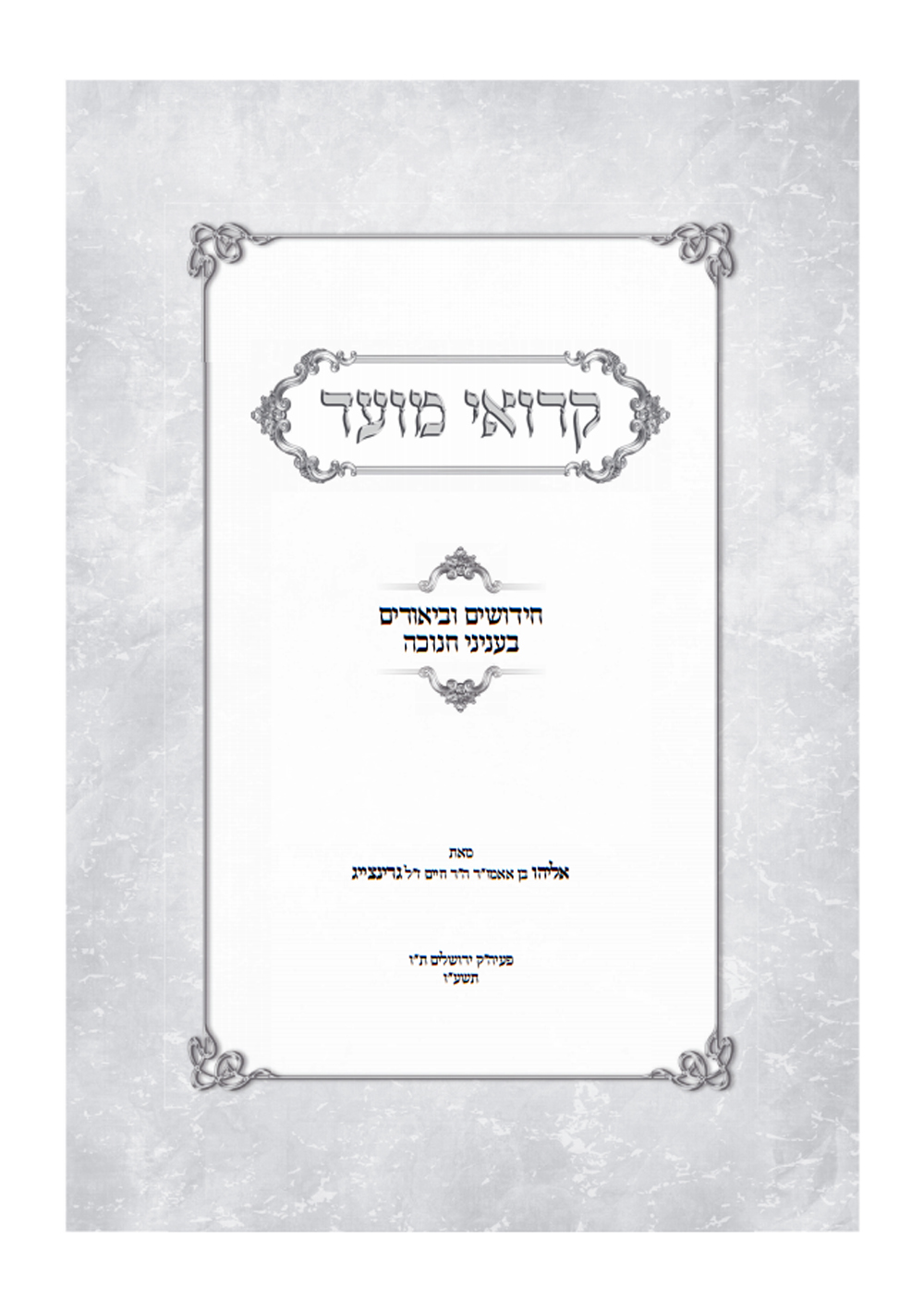
גרינצייג, קרואי מועד, פסח, שעה עמודים
הנ”ל, קרואי
מועד
, ראש השנה, שלג עמודים
הנ”ל, קרואי
מועד
, ספירת העומר שבועות, רמט עמודים
הנ”ל, קרואי
מועד
, חנוכה, רצה עמודים
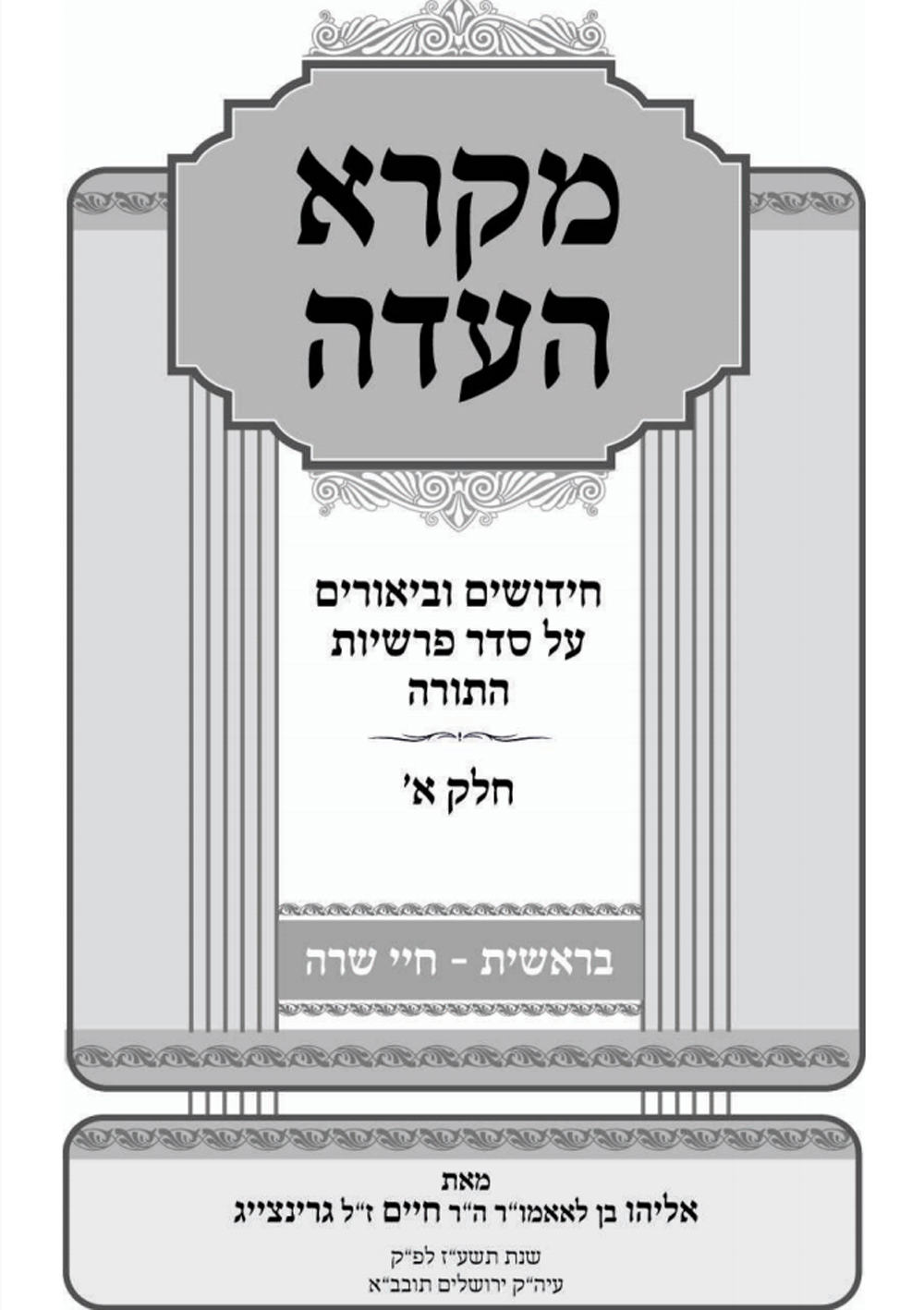
מקרא העדה, חידושים
וביאורים על סדר פרשיות התורה, א, בראשית-חיי שרה, תקסד עמודים
Many
years ago, while still a bochur learning in the Mir, a friend of mine took me
along for a Shabbas meal, promising me I’d meet an amazing Talmid Chochum
obsessed with seforim. This was my first encounter with R’ Eliyhau Greensweig. My
friend did not exaggerate in any way. The whole meal I simply sat there drooling
at the wall-to-wall seforim library. Later I learned this was only part of his
library. This was a collection which I had never before seen the likes of.
During the meal we spoke about numerous seforim and random sugyos; I was simply
blown away. From that Shabbas, I began visiting him every few weeks and we
would speak for a few hours about different topics and seforim. His vast knowledge
was, simply put, incredible. One additional attribute which always struck me
while talking with R’ Greensweig was his tremendous humility. Many times, when
specific topics came up, he would say “I wrote a whole kuntres on
this”. Once, he took out a huge stack of papers and said to me “this
is a work on Rambam Sanhedrin”. Over time, it came out that he had ghost
written numerous articles and works. Once I mentioned to him that I had noticed
that a specific volume of a particular set of seforim has a different style
than previous volumes and that whoever wrote the notes is familiar with “not
the ‘standard stuff'”. He smiled at me and said “guess who wrote
those notes…?” Still, much of his work has appeared under his own name. One
of the main projects which he had worked on for many years was  Otzar Mifarshei HaTalmud from Machon
Yerushalayim. Without getting into the pros or cons of this work, anyone
familiar with it knows it has references to thousands of seforim. This was done
long before many of the modern Torah computer programs came on to the playing
field (which is beside the point, as R’ Greensweig does not know how to use a
computer search engine!). One description I had heard of him was “he was
Mechon Yerushalyim’s ‘secret weapon'”.
Over the past
twenty five years various prominent Torah Journals, such as Yeshurun, Yerushaseinu,
Beis Aharon V’Yisroel, Moriah, Kol Torah and others, have
featured numerous articles authored by him. Some of the times he would print a
section of the Avudraham with his erudite notes; other times the article
was related to the Torah reading (Parsha) or an upcoming Yom Tov.
In 2001, an
annotated edition of part of the classic work Avudraham appeared on the seforim
market. Printed by the Or Hasefer Publishing house, it included an anonymous
commentary called Tehilah Ledovid.
The significance
of the Avudraham is well known and hardly needs mentioning here; just to
cite the well-known Haskamah of the Nodeh Beyehudah to the Prague
edition:

כבר נודע בשער בת
רבים גודל מעלת החיבור ספר אבודרהם, ורוב מנהגי התפילות והברכות קדושות והבדלות על
ספרו בנוים, ובטור אורח החיים מביאו הבית יוסף והאחרונים לרוב מאוד, והוא ספר יקר
הערך ויש בו צורך, כי האחרונים העתיקו ממנו דברים בקיצור…

Avrhom E. Harkavy writes:

סי’ אבודרהם יקר
ונכבד הוא לנו כי בו שרד וימלטו דברים רבים מסדור רב עמרם גאון (שלא בא לידנו
בתמונתו וצבינו) ומסדור רב סעדיה גאון ומשאר חבורים קדמונים. [חדשים גם ישנים, עמ’
237]

For anyone looking to learn through an enjoyable
sefer about Tefilah and Yom Tovim – this the work for him.
The notes in the
Or Hasefer edition impressed numerous experts and Talmedei Chachomim. However
almost no one knew who the author was, as he chose to remain anonymous. The
author is, of course, none other than R’ Eliyahu Greensweig. Interestingly, the
introduction of the 2001 volume “claims” to be based upon manuscripts,
sadly however, this is not the case. This claim was something the publisher
added by himself after he checked up a few things in manuscript; R’ Greensweig
himself never checked up manuscripts. The primary aim of his notes was to provide
the sources for the material quoted (utilized) by the Avudraham and to
cite those sources who discuss the sefer. Most accurately, the notes are
encyclopedic and full of thousands of sources, many from rare seforim. The
notes are also full of “Torah” and at times perhaps a bit lengthy (as
is common these days). Additionally, it is clear from the material cited that
the author has an excellent command of academic literature, as well. For the
most part all these sources could be found in R’ Greensweig’s incredible
library! However, despite the great value in this edition, until recently only
one volume was available leaving many to wonder when the rest would (ever?) be
completed.
In 2015, volume
one was reissued in a limited edition with corrections and many additions by
the Keren Re’em publishing house. One useful correction was that some of the
longer notes were removed for the body and placed in the appendix. In the
summer of 2016, volume two was released privately for the first time.
A few months ago
the two volumes were released for sale to the public distributed by Yefeh Nof publishers,
with the final volume, volume three, due to be released in the summer, BE”H. I
highly recommend this work and am sure that many will benefit from these
volumes.
Besides for this new work on Avudraham,
as I mentioned previously, R’ Greensweig has written voluminously over the
years. Thanks to the efforts of his sons and some generous sponsors, some of
his other works have just been printed. To date, four volumes on the Yom Tovim
have appeared in a paperback edition, each one including the related section of the Avudraham
in the back, with R’ Greensweig’s invaluable notes. The most recent of the four
seforim is on Pesach. A few weeks ago, a hard cover volume on the first
half of Chumash Bereishis appeared, with a total of eighty pieces! All
this material is pieces he wrote over the years; each week he would write on
one topic, and then add to it when he found more material, with a small
percentage of the articles having appeared in various journals throughout the
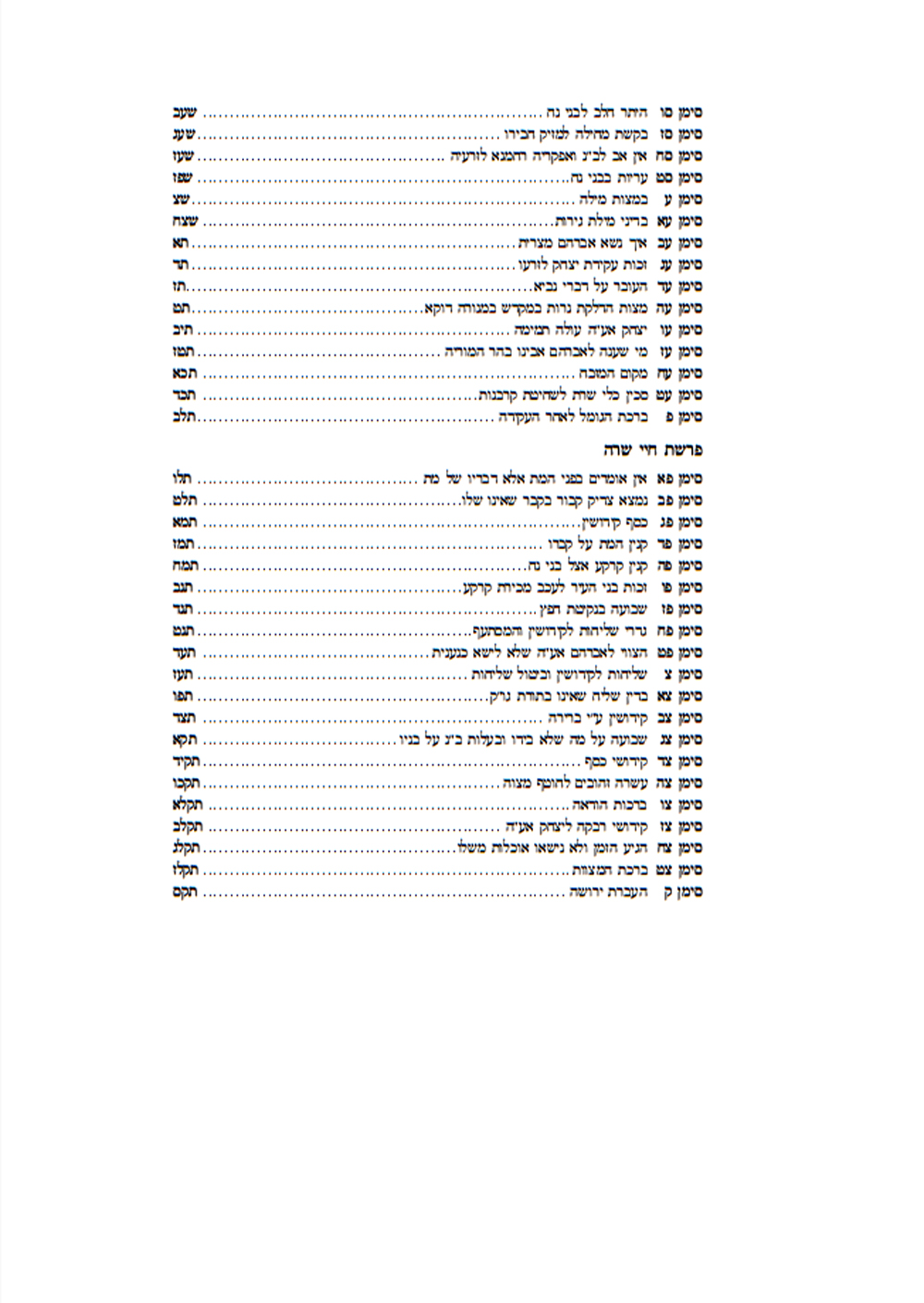
years. One does not have to wait until Chumash Bereishis arrives to
learn this sefer as the pieces are encyclopedic and useful all year around (see
below for the table of contents). One weakness, pointed out in the introduction,
is sometimes there can be a certain amount of redundancy and sometimes the
pieces smack of a lack of proper editing. The reason for these drawbacks is that
proper editing (and condensing the redundant pieces) would hold up and delay
printing.
Here are the table
of contents of some of these works, showing the wide range of topics discussed.
A PDF sample piece of the Avudraham and of one article is available upon request,
also available upon request is a much more in-depth Table of contents of the
works.

Copies of the newly
published two volume set of Avudraham should be available in regular stores.
The paperback works on Yomim Tovim are available for purchase at Begieleisen in
Boro Park and Judaica Plaza in Lakewood.


Simchat ha-Nefesh: An Important But Often Ignored Work on German Jewish Customs

Simchat ha-Nefesh:
An Important But Often Ignored Work on German Jewish Customs
By Eliezer Brodt

While doing research for a forthcoming article on the topic of saying דרשות at wedding celebrations, I kept noticing secondary sources citing to the work שמחת הנפש. Yet, after obtaining many editions of the שמחת הנפש I was still unable to locate the quotes regarding wedding speeches! After a while, I came across a citation to a specific edition of the שמחת הנפש and came to the realization that there was a second volume to this title, one that is very rare, and has only reprinted once. While the first volume was reprinted numerous times, it was this second volume of שמחת הנפש that contained the information I needed. It was in 1926 that Professor Yaakov Shatsky published an edition of שמחת הנפש which includes this second section and thus I was finally found the elusive source!

The question remained, though, as to why this source was not in all the other editions that I had looked at; in order to understand why, a discussion of שמחת הנפש is warranted.

The author of the שמחת הנפש was ר’ אלחנן קירכהן – son-in-law of the famous author of קב הישר, R. Tzvi Hirsch Kaidanov – was born in 1666 in קירכהן (hence his surname) which is not far from Hamburg. ר’ אלחנן קירכהן was a quite a Talmid Hakham and is evident from his sefer and correspondences with many גדולים of his time such as ר’ יהונתן אייבשיץ. (See בינה לעתים הלכות יום טוב פרק א הלכה כג ; שמחת הנפש, ירושלים, תשנ”ט Introduction, pp. 31-32 ; כל בו על אבילות .עמוד 200-201)

ר’ אלחנן קירכהן wrote seforim on many topics, but only one of his other seforim, חידושים מספר (see שמחת הנפש, Shatsky ed., 1926, pp. 29-30.), was published and the others still remain in manuscript. It seems from his writings that he was a professional darshan. It is also clear that he traveled all over Europe, as throughout the sefer, he gives accounts of his travels. In 1707, he printed anonymously the first two parts of what would ultimately become his famous work, שמחת הנפש. The first two parts were printed many times in many places, while the third part, the one printed in 1727, was printed only once. (See Shatsky’s introduction, especially pp. 23-28, where there is an extensive bibliography of the exact printings. See אוצר הספרים לבן יעקב ; עמוד 594 אות 864.)

It is this mysterious third part, which is very rare; indeed, few copies exist in libraries worldwide. In 1926, however, it was reprinted by Professor Yaakov Shatsky in a facsimile edition.

Many important personages praised שמחת הנפש. For example, ר’ יהונתן אייבשיץ (in his יערות דבש, א, דרוש יב, באמצע), strongly praise the שמחת הנפש ;ר’ יוסף מאיר אב”ד האנובר in his הסכמה writes that one could פסקן from this sefer, a point we will return to later! (הסכמה למהודרא פירדא תפז); the חתם סופר also spoke very highly of the sefer, (הסכמה של ר’ שמעון סופר למהדורת פאקש תרנט, Intro to the ירושלים edition pg 36-37.)

ר’ שמען סופר writes that his father, the כתב סופר, used to learn theשמחת הנפש on שבת with his sister. He also writes that within the copy of the שמחת הנפש of his grandfather, ר’ עקיבא איגר, he had seen comments in the sefer. Interestingly enough, we find that ר’ עקיבא איגר quotes from the sefer in his notes שלחן ערוך גליון רע”א סי’ תרצו סעיף ד. The sefer was among the list of seforim in the library of ר’ פנחס קאטצענאליבויגען. (See יש מנחלין עמוד נ אות קכב; and Dan’s post Ghosts, Demons, Golems and their Halachik Status about ר’ פנחס קאטצענאליבויגען.) In 1898, in Faux, Hungary, at the suggestion of ר’ שמעון סופר, a copy of שמחת הנפש was reprinted with a פירוש by ר’ יהודה קרויס. For other examples of those praising the שמחת הנפש, see the introduction to the most recent edition by ר’ שמואל לוריא.

שמחת הנפש was extremely popular amongst the general populace as is evident from the fact that it was reprinted throughout Europe at least twenty-eight times. Even the most recent edition (a Hebrew translation) was reprinted just a year later. What is so exceptional about the sefer? I believe that the answer lies in the way it was written. With its very captivating and down-to-earth language, the sefer speaks to the reader in a clear manner and keeps one interested using many stories and parables (seeתולדות ספרות ישראל עמוד 103-108.) In addition, שמחת הנפש was an excellent halakhic guide for the masses for regular day-to-day situations.

Unfortunately as with many of our seforim, at one point this book was banned, and even, according to some, burnt. Zinberg explains that the reason it was burnt was because at the end of the first volume, there is a second part containing halakhot, about which the printer wrote in the shar blatt “שלחן ערוך, אורח חיים ויורה דעה ומנהגים של כל השנה.” People felt it was dangerous to give a sefer which allowed the masses to easily find the law (תולדות ספרות ישראל,ד, עמוד 107 ; ספר וסייף, עמוד174-176). This was despite the fact, as mentioned previously, thatר’ יוסף מאיר אב”ד האנובר says in his הסכמה to the sefer, that one couldפסקן from the sefer, and despite the fact that ר’ עקיבא איגר actually did פסקן from it. However, after this one incident, there is no indication of any other strong opposition as is self evident from the amount of subsequent printings.

As mentioned previously, שמחת הנפש is composed of three volumes. The author lists the contents of his sefer on the title page. Amongst them are: (1) מוסר and תוכחה with many משלים ומעשיות; (2) Proofs of why one should not get upset about anything, as everything that happens is from G-d and for ones benefit; (3) Proof of the existence of the נשמה; (4) The הלכות of the whole year including הלכות for woman on חלה ונדה (this was the second part of the first volume). In his introduction he adds that he wrote the part of הלכות because there are many places where people do not haveרבנים to ask there questions to. So he included the הלכות so everyone could now what to do. He even writes that one could rely on it not like other seforim that have many mistakes. (This is in contrast to many Halakha seforim where the author writes “do not rely on me.”) This last part stating that one could rely upon the sefer, however, was not reprinted in all the editions of the sefer. In the introduction he writes even more clearly the goal of the sefer:

“I prove that one does not have to worry I give many solutions to deal with pain… I show that the נשמה is created to serve g-d. With this I have included all the דינים, so one should know how to serve him. All that you do should be with שמחה therefore I called the sefer שמחת הנפש.”

In 1727 he wrote a third part which (called part two). This part consists of הלכות ומוסר in the form of songs for שבת, יום נוראים, סוכות, פסח, חנוכה, פורים, חתונה, מילה, וכל השנה. He even included the musical notes for the songs. The inclusion of musical notes was an innovative method of giving mussar. The author’s goal was to reach the masses, even the people who lived in the villages he had visited and had seen that they were negligent in many of the areas discussed in the sefer.

שמחת הנפש, is a practical, down to earth book. We can see this through many points mentioned in the sefer such as: when doing תשובה , one should do it slowly and not be too hard on oneself with excessive fasting (ירושלים ed., p. 154); don’t hit a child before age four (Idem at p. 175); a recurring theme throughout the book is the author comforting people who lost children (Idem at pp. 27,28,30,55,62), which was a common occurrence in those days. The author mentions that he himself also lost a child (Idem at p. 47). שמחת הנפש contains many interesting topics, such asנשמות, ניסים , andשדים . The sefer is full of interesting stories about these topics, some of which the author was eyewitness to or was actually involved in. For example, in the chapter on demons, the author writes that he personally saw a boy of three speaking about concepts of Torah and Kabbalah that he didn’t understand (Idem at p. 52). He also mentions that when he was in Poland, there was a woman whose children were killed by a demon (Idem at p. 53). Also mentioned in שמחת הנפש is the famous legend that when the רמב”ם died, his ארון traveled to ארץ ישראלby itself (Idem at p.106). [For more on this legend see ספר יוחסין עמ’ 220;שלשלת הקבלה עמ’ ק ;במאבק על ערכה של תורה עמ’ 246;אגרת ארץ ישראל (יערי) עמ’ 302;ארשת חלק ו עמ’ 63]

The book quotes from a wide range of sources: חז”ל, ראשונים, ספרי קבלה, and many interesting seforim such as: צרי היגן, שבט מיהודה, נשמת חיים, מקוה ישראל, מסעות ר’ בנימן and many others. It is evident that the author must have had access to an unusually extensive library for his time.

שמחת הנפש is a pretty much untapped wellspring of מנהגים of Germany. The reader can also get a clear picture of life in those times, especially in the small villages. As the author traveled, he wrote מוסר based on what he felt the people he met on his travels were lax in.

One of the first people who tapped into this source was Zinberg (תולדות ספרות ישראל חלק ד עמ’ ,144-146,102-110). After that, Professor Simcha Assaf quotes the שמחת הנפש once in his masterpiece, (מקורות לתולדות החינוך בישראל, א, עמוד 164-165). Professor Yaakov Shatsky printed his edition after that. After Professor Shatsky,אברהם יערי used it a few times in his classic work תולדות חג שמחת תורה (pp. 320, 328, 378, 465, 476, 505). Then Professor Jacob Rader Marcus introduced it to Herman Pollack who quotes from it extensively in his book, “Jewish Folkways in Germanic Lands,” as a quick look in the Pollack’s book and its footnotes will show. Despite this, today the שמחת הנפש is a pretty much unknown book in the field, with the exception of Rabbi Shlomo Hamburger, who uses it as a source in his books on minhagim. To the extent that Professor Zev Gris in his book ספרות ההנהגות which is devoted to the topic of the seforim of מוסר והנהגות and their impact, does not even mention it. But later on, it seems that the book was brought to his attention. He discusses the שמחת הנפש in a later book of his, called הספר כסוכן תרבות (pp. 58, 69, 96). In his analysis of Jewish Attitudes toward Gambling, Leo Landman refers to שמחת הנפש as he writes:

“A seventeenth century German moralist complained bitterly about some professional gamblers who would pawn their Talit and Tefillen or their Arba Kanfot in order to raise money for gaming.”

See his “Jewish Attitudes toward Gambling the Professional and Compulsive Gambler,” Jewish Quarterly Review 57:4 (April, 1967): 311.

Some interesting samples of מנהגים and daily life that are mentioned in the sefer are: saying יגדל every day ירושלים) ed., p. 89), dinnim of זכר לחורבןsuch as leaving a spot in the house unpainted (Idem at pp. 75,123), חתן and כלה fasting on the day of their chupah (Idem at p. 174). The reader is able to see from the book which areas people were negligent in. For example: they were not careful about shaving with a razor (Idem at p. 94), and people used to play cards all night (Idem at p. 121). The author describes how the people dealt harshly with each other in business matters (Idem at p. 149). He speaks againstחזנים that do not understand what they’re davening and says that this is a cause for the long galus (Idem at pp. 153-154). Interestingly, he writes that parents sent their kids to dance school (Idem at p. 122).

All of the above is in the first part of volume one. The following are examples from the second part of the volume which is, in a sense, a complete handbook on אורח חיים andיורה דעה . When the author talks about ראש השנה, he says, “we do not sleep onראש השנה, rather we learn the whole day but it’s worse not to sleep and talk”.דברים בטלים (See הלכות ראש השנה עמוד נח סוף העמוד.)

He also includes an extensive chapter on תחומין as it seems many villages were lax in this area (See “Jewish Folkways in Germanic Lands,” p. 323 note 104; ירושלים ed., pp. 30-31). In the third part, (called volume two) which is written in song, as previously mentioned, the author speaks against women that drank excessive amounts of alcohol at wedding and בריתי מילה (vol. two, p. 18). People in the villages children dealt with the farm animal’s onשבת (see תולדות ספרות ישראל עמוד 145), and people wrote מגלת אסתר on paper (Idem).

One topic which is dealt with throughout the sefer is tznius. The author goes so far as to say that the reason why many Jews died in ת”ח ות”ט and other גזירות was because of lack of tznius (ירושלים ed., pp. 64, 124). Examples of tznius the people of his times were lax in include: men and women who weren’t married to each other danced together in public, some women were very involved in dressing in order to be attractive to men. In contrast to all this, the author was told that in Turkey, the people were so careful with tznius that men hardly ever saw women. Women didn’t go to shul, and when guests stayed in someone’s house, the man of the house didn’t allow his wife and daughters to see the guests (Idem at p. 64).

Another issue the author takes a strong stance was the education system. In the first part of the sefer, he recommends that when starting to teach children to learn, you ought to begin with תנ”ך and דקדוק. Only after that should one continue on to משנה and גמרא. That’s the only way people will have success in learning. He states that many people leave the field of learning at a young age, and because they don’t know the basics of תנ”ך and דקדוק, they can’t understand the tefillos they say daily. To quote the sefer, “I’m writing this in German so that everyone can understand, especially women who are busy with child raising. The women should not think that their sons have to learn גמרא at an early age. The מהר”ל and others already said that one should first learn תנ”ך, then דקדוק, and only then move on to משנה and גמרא.” He repeats this in the third part of the sefer, in short, where he mentions that people only teach their children גמרא and not תנ”ך. (See מהדורת תפז עמוד יח. Professor Simcha Assaf in מקורות לתולדות חינוך בישראל only quotes the last source on education.)

In conclusion, the שמחת הנפש is a truly unique sefer. The first part of שמחת הנפש was translated but it could use much more extensive notes. It would be very worthwhile for someone to undertake to translate all three parts of the sefer with extensive footnotes, as was recently done to Gluckel von Hameln.

Many editions of the שמחת הנפש is available online here, including the first – the 1707 edition as well as the rare 1727 edition. Aside from שמחת הנפש the site, from the Frankfurt University Library, contains over 700 Yiddish prints, all free.


Book Week 2011

Book Week 2011

by Eliezer Brodt

Book week has just begin in Eretz Yisrael. As I have written in previous years every year in Israel, around Shavous time, there is a period of about ten days called Shavuah Hasefer – Book Week (see here, here and here). Shavuah HaSefer is a sale which takes place all across the country in stores, malls and special places rented out just for the sale. There are places where strictly “frum” seforim are sold and other places have most of the secular publishing houses. Many publishing houses release new titles specifically at this time. In my reviews I sometimes include an older title if I just noticed the book. As I have written in the past, I do not intend to include all the new books. Eventually some of these titles will be the subject of their own reviews. I try to include titles of broad interest. Some books I cannot provide much information about as I just glanced at them quickly. I apologize in advance for any mistakes regarding transliteration. I also apologize in advance for using the word excellent so many times when describing seforim in this post! Additionally this year I am offering a service, for a small fee to help one purchase these titles (or titles of previous years). For more information about this email me at Eliezerbrodt-at-gmail.com. Part of the proceeds will be going to support the efforts of the the Seforim blog. Earlier this year I posted a list of recent academic titles see here. It’s worth checking back to this post in the next few days as I will probably add some more tiles, especially from Mechon Yerushalaim. 1) Magnes Press has many special titles this year. First and foremost is Benny Brown’s book on the Chazon Ish (see here). Another special title is the three volume critical edition of Sifri from M. Kahane. Another nice title is Kabbalistic Manuscripts and Textual Theory from Daniel Abrams. A nice collection of articles is Chinuch Vedas. There is a new collection of articles related to R. J. B. Soloveitchik called Rav Be-olam Ha-chadosh. There are also some new works on philosophy of Halacha. One is called Halacha, Meta Halacha, u-Philosph. Another one is called Halacha Ke-mecholles Shinu. There is another collection from E. Melamed called Midrashe Halacha shel Ha-amoroyim be-talmud Bavli. Another title is from S. Tzefatman called Rosh Ve-rishon. Another title is from Shlomo Simonsohn on the Jews in Sicily. Another nice collection is related to the Cario Genizah called Ha-kanon Ha-somu Min Hayin. Another nice title is a collection of articles related to Gan Eden called Gan Eden Me-kedem. In English, there is a new title called The Pinnacle of Hatred: The Blood Libel and the Jews.2) Kibbutz Hamechuad has a very special new title from Chanan Gafni called Peshuto Shel Mishana (a table of contents is available upon request). I highly recommend it and hope to return to it a post in the very near future. 3) The Israel Democracy Institute has some very good new titles. One is from Benny Brown (author of the work on Chazon Ish) dealing with R. Elyahsiv, Shlita and Rav Shach. Another work which looks interesting is a collection of articles called Rabnut HaAtgur (two volumes; a table of contents is available upon request). There are some other good titles there for good prices. 4) Caramel reprinted N. Krochamal’s classic work Moreh Nevuchei Ha-zeman.5) The Israel Academy of Sciences and Humanities does not have anything new but has some very good deals on old titles. 6) Merkaz Zalman Shazar has some new special titles. Amongst them is Amram Tropper’s Kechomer Beyad Hayotzer and the Hebrew translation of Professor Kanarfogel’s Peering through the Lattices, called Sod U-magiah Uprishut Bemishnsom Shel Balei Hatosfot. 7) Reuvan Mass has a few new titles. Amongst them works on the Maggid Me-Mezritch, Ha-shar Le-aon and a work on R. Tzvi Mezigitov, Al Derech Ha- avodah.8) The Bialik Institute has a few new titles, amongst them Lo Yossur Shevet Me-Yehudah in honor of Professor Simon Schwarzfuchs, which is a excellent collection of articles including pieces from of Professors Chaim Soloveitchik, Shnayer Z. Leiman, A. Grossman. M. Rosman, Eric Zimmer, R. Reiner ,Simcha Emanuel and many others (a table of contents is available upon request). Another nice title is Legalot Nistorot from Chana Werman. Aharon Shemesh has a book related to halacha in the Dead Sea Scrolls. Another title, Yosef Dat, is a Sefer Hayovel for Y. Salomon. In English there is a new title edited by Boaz Huss called Kabbalah and Contemporary Spiritual Revival. 9) Bar Ilan University has some new titles. The latest volume of Sidra is something specia,l with an all star line-up of writers (see here). A good title for those interested in academic Talmud is called Meleches Machsevet (see here). There are new volumes of Badad and Iyunei Mikra. Another title is on Zionist movement in Poland (see here). 10) Mechon Ben Zvi has some new titles, amongst them some new volumes in their set of critical editions of classics of Sefer ha-Makabim. Other works include Safrut Ha-mikra and a new translation of Shemoneh Perakim of the Rambam from M. Schwartz and two more volumes in their special series.


The Enigma of Abraham Rosenberg, R. Yitzchak Scheiner, Mordecai Kaplan, and Prof. Marvin Fox

The Enigma of Abraham Rosenberg, R. Yitzchak Scheiner, Mordecai Kaplan, and Prof. Marvin Fox


Marc B. Shapiro

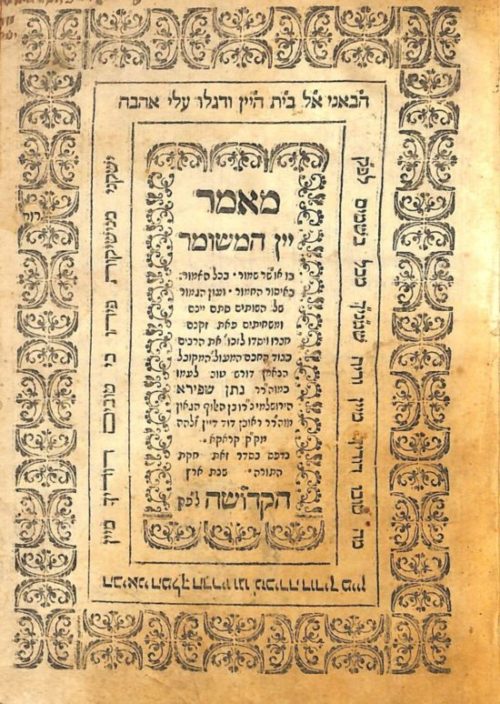
Abraham Rosenberg made his first appearance during the dispute over Solomon Friedlaender’s forged Yerushalmi Kodashim. He portrayed himself as a student of Friedlaender. Here is the title page of his booklet Aneh Khesil in which he defends Friedlaender from the attacks of his critics.


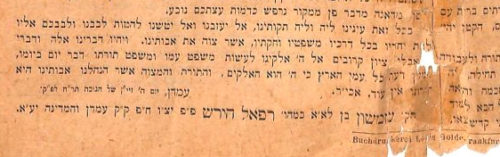
Rosenberg also wrote some other things in defense of Friedlaender, including an article in the Frankfurt Orthodox paper Der Israelit and letters to various figures who were involved in the dispute over the Yerushalmi Kodashim.

Who was Rosenberg? Discussion of this will be found in R. Baruch Oberlander’s forthcoming book on the forged Yerushalmi Kodashim, a work which is sure to be a tour de force of scholarship. (The Hungarian version of the book has already appeared.) Based on what R. Oberlander documents, I don’t think there can be any doubt that Rosenberg was not a real person but was a creation of Friedlaender. Even the city that Rosenberg claimed to be rabbi of does not exist. In the meantime, for those who want to learn about this fascinating story, I recommend this video from R. Oberlander.

The story becomes even stranger, as beginning some fifteen years after Rosenberg’s first appearance in the Yerushalmi Kodashim controversy, a few articles written by an otherwise unknown “A. Rosenberg” appeared in 1923 and 1924. Friedlaender died in January 1924, so in theory it is possible to argue that he is the author of these articles that appeared in the Hebrew section of the German Orthodox journal Jeschurun.[1] Yet it is much more likely that the articles were written by someone else who took the pseudonym. Two of the articles in Jeschurun focus on the Jerusalem Talmud. The other article deals with how biblical verses are cited with variations in the Babylonian and Jerusalem Talmuds, and Rosenberg argues against the notion that these quotations are evidence of biblical readings at variance with what is found in the so-called Masoretic text. In addition to these articles, Oberlander also refers to A. Rosenberg’s Al Devar Tikunei Nushaot bi-Yerushalmi, which was published in Lodz, 1928 (so at least it says on the book’s title page). This is four years after Friedlaender’s death, so he could not have been the author.


If you look at Rosenberg’s book, you can’t help but be impressed that the author knows the Jerusalem Talmud and rishonim, and he is also on top of modern scholarship. At first glance, it seems that were very few people in the world at that time who were able to write such a work, which has led to speculation about who the author could be. Oberlander, in his forthcoming book, writes as follows:

מהרב פרופ’ ש”ז הבלין שמעתי את ההשערה ש”א. רוזנברג” מירושלים אינו אלא פרופ’ שאול ליברמן (1898-1983), שידוע כמי שאהב מעשה קונדס כאלו (ראה גם י”ש שפיגל: ’עמודים בתולדות הספר העברי – בשערי הדפוס ‘עמ’ 46 הערה 151, 48 הערה 161). אמנם פרופ’ מלך (מרק) שפירא במכתבו אלי דוחה השערה זו, שהרי עד שנת 1928, כשהתחיל ללמוד באוניברסיטה העברית בירושלים, לא היה לו לליברמן שום ידע מדעי ולא השתמש בשיטות מדעיות בלימודים שלו. ראה Elijah J. Schochet and Solomon Spiro, Saul Lieberman – The Man and His Work, New York, 2005, p. 7-8

Oberlander cites Prof. Shlomo Zalman Havlin who speculates that A. Rosenberg is none other than Saul Lieberman. Indeed, a cursory examination of Rosenberg’s book shows great similarity with Lieberman’s works on the Yerushalmi and Tosefta. Yet when R. Oberlander asked me about this, I told him that Lieberman could not have written Al Devar Tikunei Nushaot bi-Yerushalmi. On p. 106 we see that the book, which shows great awareness of modern scholarship, was completed erev Yom Kippur 1926. Rosenberg’s articles in Jeschurun from a few years before also show an awareness of modern scholarship. Yet until Lieberman began studying at the Hebrew University in 1928, he had not been introduced to academic scholarship on the Talmud,[2] and he certainly was not writing anything about this in the early 1920s.

If Lieberman is the author of Al Devar Tikunei Nushaot bi-Yerushalmi we must assume that there are three A. Rosenbergs. 1. Friedlaender, 2. the author of the Jeschurun articles, 3. Lieberman. Even if Lieberman has nothing to do with the book, it is still possible that the author of Al Devar Tikunei Nushaot bi-Yerushalmi took the name “A. Rosenberg” in imitation of the earlier author in Jeschurun, but they are not the same person.

I asked Havlin what led him to conclude that Lieberman is the author. He replied by noting that we cannot learn anything from the name “A. Rosenberg”, and he added that even the year and place of publication (Lodz) are not certain. In other words, it is possible that the book actually appeared after 1928 and was published in Palestine.

Havlin noted a few other considerations that led him to his conclusion: The book appeared at the same general time as Lieberman’s Al ha-Yerushalmi (Jerusalem, 1929), the improbability of attributing such a work to anyone else during this period, Lieberman’s relationship with J.N. Epstein (see below), and that Lieberman had a mischievous streak that could have led him to publish the book anonymously. Havlin also noted that he heard the following from Prof. Yaakov Sussman. Sussman asked Lieberman about Al Devar Tikunei Nushaot bi-Yerushalmi, and Lieberman responded: “Sheigetz, how did you come to this book?” By refusing to discuss the book with Sussman, or even to comment about who authored it, it is obvious that Lieberman was hiding something. Furthermore, I would add, isn’t it strange that Lieberman never refers to this book in any of his writings on the Yerushalmi? Here is a book with the exact sort of research that Lieberman was doing and yet he doesn’t mention it. דבר זה אומר דרשני.

Havlin also noted the following: On p. 19 n. 31 the author refers to a book of his in manuscript with the title המדע התלמודי וצרכיו. This is actually the title of a 1925 lecture delivered by J.N. Epstein upon assuming his position at the Hebrew University. The lecture was later published in Yediot ha-Makhon le-Madaei ha-Yahadut 2 (1925), pp. 5-22. Clearly the author was having some fun here, and we know that Lieberman had an interesting relationship with Epstein. Another personal comment is found on p. 91 where the author refers to R. Chaim Heller as “my friend”.

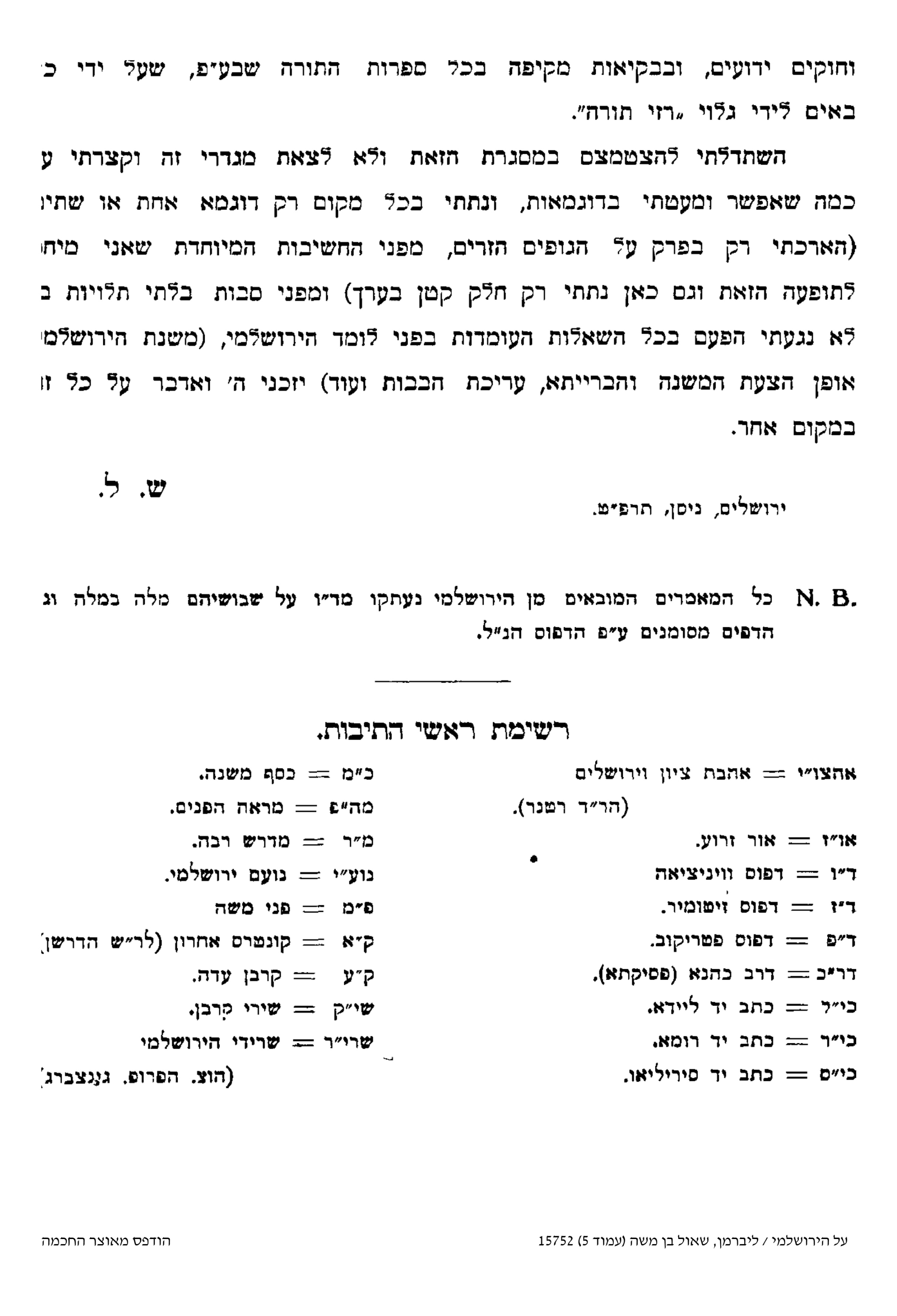
Returning to the quote above from R. Oberlander, he cites Yaakov Spiegel who gives two examples of Lieberman being a bit unconventional in some of his writings. In his book Amudim be-Toldot ha-Sefer ha-Ivri: Be-Sha’arei ha-Defus,[3] Spiegel notes that in the preface to the 1970 publication of the first volume of R. David Pardo’s Hasdei David on Taharot, which was edited by Lieberman (as were the next two volumes on Taharot), Lieberman signs his name in the preface as .ש.ל. Spiegel adds:

יש אומרים שחתם את שמו בראשי תיבות ולא בשמו המלא, מפני שרצה שהספר יכנס לבית המדרש, והמבין יבין

Yet this is incorrect, as Lieberman always ended the prefaces to his books with his initials. We see this beginning with his first book, Al ha-Yerushalmi, published in Jerusalem, 1929, long before he ever thought of joining the JTS faculty.


So his use of initials has nothing to do with covering up who he was, and on the very first page of the preface to Hasdei David he refers to what he wrote in Tosefta ki-Feshutah. However, it is noteworthy that Lieberman’s name does not appear on the title page of the book as you can see here.

This, perhaps, was due to a desire to have the book accepted in yeshivot. It is one thing to have references to Tosefta ki-Feshutah inside the book, and something else entirely to have Lieberman’s name on the title page, which might have prevented yeshivot from purchasing Hasdei David.

Spiegel also notes that Louis Finkelstein is referred to in the preface to Hasdei David as ר’ אליעזר אריה נר”ו בהרב ר’ שמעון הלוי ז”ל, without his last name. Spiegel sees this as a way of hiding Finkelstein’s identity, just as Lieberman did with the others mentioned in the preface. One of the people Lieberman refers to is הרב ר’ יהושע נר”ו בהרב ר’ יהודה ליב who discovered the manuscript of R. Pardo. (This is R. Yehoshua Hutner.) Lieberman also mentions two other people, one who transcribed the manuscript and another who proofread the book. It is possible that one or more of these individuals did not want to be mentioned by name as helping Lieberman, and this explains why Lieberman abridged all the names, including Finkelstein’s. But I repeat, Lieberman’s name in the preface is not in code, as .ש.ל is how he always signed the end of the prefaces of his books.

Spiegel[4] also notes that in Sinai 85 (1979), p. 199, the following short piece is signed בלי שם.

It is known, Spiegel tells us, that this was written by Lieberman. He also mentions that there is a hint to Lieberman’s authorship in that all the letters in בלי שם are found in Saul Lieberman’s name. This is indeed significant, as it shows us that for whatever reason, Lieberman was not averse to writing anonymously. In fact, in 1932 Lieberman used the pseudonym .ל.ל when he published a note in Tarbiz.[5] In 1936 he again published a note with this pseudonym.[6]

When I first examined Al Devar Tikunei Nushaot bi-Yerushalmi, I too thought that Lieberman must have written it, for the reasons already mentioned. What stood out most to me, as I have mentioned already, is that Lieberman in his many writings, including those that focus on the Jerusalem Talmud, never referred to the book even though it does the same thing what he was doing in Ha-Yerushalmi ki-Feshuto. I assumed that had anyone other than Lieberman written the book he certainly would have mentioned it, at least in the introduction to Ha-Yerushalmi ki-Feshuto, even if only to express his disagreement about certain matters. Obviously, Lieberman had a reason for not referring to this book, and I assumed it was because he did not want to associate his later scholarship with it.

Yet when I looked carefully at Al Devar Tikunei Nushaot bi-Yerushalmi and compared it to other writings of Lieberman on the very same sugyot, I was not able to find any parallels. This is so even though the book is written in the same style as Lieberman’s writings. Just when you would have expected some repetition from Al Devar Tikunei Nushaot bi-Yerushalmi in Yerushalmi ki-Feshuto and Tosefta ki-Feshutah, you find nothing.

I also noticed that there is a good deal of fraudulence in Al Devar Tikunei Nushaot bi-Yerushalmi, and it is impossible to imagine that Lieberman, in his alter ego “Rosenberg,” would have been a part of this. For example, on p. 5 in the note he cites Solomon Buber from Ha-Levanon, Sep. 18, 1872, as stating that there is a Yerushalmi Kodashim in the Vatican. Yet if you look at Buber’s article you find that he says the exact opposite, that there is no such manuscript there. Buber further states that he doesn’t believe that there ever was a Yerushalmi Kodashim. What is the point of “Rosenberg” providing such misinformation other than to play games with the readers? On p. 30 n. 37, “Rosenberg” actually states that he thinks that portions of the Yerushalmi Kodashim published by Friedlaender are authentic. This makes no sense, as there was no manuscript to which Friedlaender could have added his own material.[7] All academic scholars in the 1920s knew this, so what kind of fraudulence is “Rosenberg” peddling here? Interestingly, on pages 3 and 8 “Rosenberg” also refers to the earlier work by the other Rosenberg (i.e., Friedlaender), the booklet Aneh Khesil. This must be seen as an inside joke, especially since the page number given is 36 but the booklet doesn’t have this many pages.

Only after I had gone through Al Devar Tikunei Nushaot bi-Yerushalmi did I learn that the entire book is a series of plagiarisms from earlier authors, as has been noted by Elyashiv Cherlow[8] and an anonymous commenter here. Cherlow also points out that “Rosenberg” quotes a Geniza text that he invented from thin air. I too found an example of the author’s plagiarism that is not noted by Cherlow or the anonymous commenter: The lengthy passage, with numerous sources, found on pp. 71-72 n. 57, is lifted word for word from Avigdor Aptowitzer’s article in Ha-Tzofeh le-Hokhmat Yisrael 1 (1911), pp. 87-88.

There are some other strange things in Al Devar Tikunei Nushaot bi-Yerushalmi. For example, what is one to make of the dedication to the Jewish communal leader Louis Marshall?

Since this post has dealt with Lieberman, even if only to reject the notion that he is the author of Al Devar Tikunei Nushaot bi-Yerushalmi, let me add a couple of more points about him. From 1918-1962 there was an Orthodox publication called the Jewish Forum.[9] In the January 1961 issue there appeared an article by “Dayyan al-Yahud” sharply criticizing Conservative Judaism. In this article the author also took aim at Lieberman, referring to him as a “careerist”. He writes:

We ask, in all sincerity, where is the steadfastness of principle and consistent loyalty to Torah-Tradition on the part of the same Professor? This “guiding spirit” of the new kethubah, who only a few years ago, when the Agudath Harabbanim of the United States and Canada had declared Dr. Mordecai M. Kaplan under “herem” (anathema), himself recognized the “herem” as binding upon all Traditional Jews and refused to be in Kaplan’s company, as evidenced, in our presence, by his demonstrably stepping out of the Seminary elevator at the very entrance to the main building of the Seminary, no sooner than Dr. Kaplan had stepped in.

Such incongruous and compromising practices on the part of the Seminary’s present “scion” of Halakhah must of necessity lead to lack of reverence for time-honored traditions by its student body and graduates. No wonder that the latter, with few exceptions, are now groping in darkness and exhibit vacillation and uncertainty in their respective ministries.

Quite apart from the criticism of Lieberman, the passage is significant because the author testifies to having personally seen that Lieberman had previously observed the herem against Kaplan and refused to be in his presence.[10]

Who is Dayyan al Yahud? If you google the name, you will find that he also wrote articles critical of Kaplan and Heschel, yet none of the American authors who refer to Dayyan al Yahud identify who he is. He also wrote a number of articles under this pseudonym in Or ha-Mizrah. Yet his identity was never really a secret and is none other than the noted scholar Israel Elfenbein (1891-1964). The author of many works, Elfenbein is most known for his scholarly edition of Teshuvot Rashi (New York, 1943), which incidentally also includes notes from Louis Ginzberg. Elfenbein became a significant figure in American Orthodoxy, serving as editor of Or ha-Mizrah and education director of Religious Zionists of America. He was also honored with a Jubilee Volume (Jerusalem, 1963), which in addition to articles from various academic scholars, also has contributions from R. Eliezer Silver, R. Yehudah Gershuni, R. Nissan Telushkin, R. Leo Jung, and R. Menahem M. Kasher. Elfenbein also engaged in polemics against Conservative leaders. Yet one would not have expected his prominence in Orthodoxy, as in his early years Elfenbein received semikhah from the Jewish Theological Seminary and served as rabbi of the Conservative congregation Adath Israel in Nashville from 1915-1916.[11] 

In truth, Elfenbein’s identification with Orthodoxy was a return to his youth, as before he came to America he had studied in Pressburg and had received semikhah from R. Shalom Mordechai Schwadron. That at least is the story told by his relative, Y. N. Adler,[[12] but being that Elfenbein came to America when he was fifteen years old, is it really possible that he received semikhah at such a young age?[13] Upon arriving in New York in 1906 he entered Yeshivas Rabbeinu Yitzchok Elchonon (where his classmate was Bernard Revel, who himself had received semikhah at age 16).[14] With such a background in traditional Torah learning, how did Elfenbein end up at JTS?

Adler tells a fascinating story, different versions of which we know from other sources as well, although as far as I can tell, only the Rabinowitz article (see note 15) mention Elfenbein’s name. During Elfenbein’s time at RIETS—from other sources we know that the year was 1908—he and some friends wanted to study at a university (Yeshiva College did not yet exist). They therefore took the regents exam which allowed them to apply to institutes of higher learning. According to Adler, among the students who were part of this group, and who later became quite distinguished, were Rabbi Baruch Shapiro, who later served as rav in Seattle, Rabbi Louis Epstein, Rabbi Yehiel Kaplan, Dr. Israel Efros, Rabbi Solomon Goldman of Chicago, and Dr. Abraham Neuman.

This action, Adler tells us, greatly upset the rabbinic leadership of RIETS. In response to this, Elfenbein and his friends stopped learning at RIETS and set up a beit midrash, which they called Beit ha-Midrash ha-Elyon, in the Adass Bnei Yisrael synagogue of R. Solomon Elhanan Jaffe. (Other sources record the name as “Yeshivah le-Rabbanim”.) This beit midrash did not last long, and most of the students, including Elfenbein, transferred to JTS.[15]

Returning to Lieberman, there is another interesting comment in R. Dov Cohen’s Va-Yelkhu Shneiheim Yahdav, p. 168. He mentions how in Jerusalem Lieberman was treated with great respect at the Chevron Yeshiva, even after he had gone to the university. As for his going to JTS, Cohen recalls a biting hasidic comment about mitnagdim, that for Torah study a Litvak would even enter a church!

האיש היוה דוגמא למה שהיו החסידים טוענים על המתנגדים, כי התורה בליטא התקדשה עד כדי כך שעבורה היה מוכן הליטאי להכנס לכנסיה. . . [הנקודות במקור] אחר שהתגורר כמה שנים בירושלים, נמלך בדעתו כי מוטב שילמד באין מפריע. מאחר שהציעו לו משרה חשובה בסמינר קונסרבטיבי באמריקה, נסע שם וקיבלה. הוא לא שיתף עמם פעולה בסיוע לדרכיהם הנלוזות, חלילה. גם שם היה יושב בחדרו ועוסק בגמרא וכן בחיבור ספריו על התוספתא. זכורני שבכינוס של אגודת הרבנים באמריקה, בו השתתפתי, התייחסו אליו כאל “אחד משלנו” שיכול לעזור ולסייע, אף שהוא “אצלם”. גם הרב אברמסקי, התקיף והלוחם, קיבלו בכבוד גדול. שמעתי גם כן, שהוא החזיק מכספו כמה וכמה בני תורה בירושלים.

Regarding Lieberman, I have one final point to make. In Saul Lieberman and the Orthodox, p. 7, I mentioned a November 1930 letter from Lieberman to Louis Ginzberg in which Lieberman writes that he began working on a great project on the Jerusalem Talmud, but had to stop because one cannot work on Berakhot without knowing all of the Yerushalmi. Only when he finished the entire Jerusalem Talmud did he pick up the project again. I added that the project Lieberman refers to must be Ha-Yerushalmi ki-Feshuto, which appeared in 1935.

Here is the relevant section of Lieberman’s letter:

 התחלתי ג”כ בעבודה גדולה על שדה הירושלמי אבל הוכרחתי לעזוב אותה מפני שאי איפשר [!] לעבוד ב”ברכות” כל זמן שאינם יודעים [!] את כל הירושלמי עד “נדה” ורק בקיץ זה אחרי גמר הירושלמי שבתי עוד הפעם לברכות

The problem with my assumption that Lieberman’s project was Ha-Yerushalmi ki-Feshuto is that this book includes his commentary on ShabbatEruvin, and Pesahim, and in his letter he speaks of returning to Berakhot. Yet I didn’t know of anything else that could fit the description of a great project on the Yerushalmi during this time period. 

Dan Rabinowitz has, I think, provided the answer. He called my attention to Tovia Preschel’s article in Ma’amrei Tuviah, vol. 2, pp. 155-156. Preschel recounts that not long after Lieberman settled in Jerusalem in 1928, he was asked by R. Michel Rabinowitz to assist him in translating the Yerushalmi into Hebrew. Lieberman replied that he had never studied the Yerushalmi and he can’t translate a work that he doesn’t know. He asked for time to immerse himself in it, and for the next year and a half he completed the Yerushalmi a few times. In the end, the Hebrew translation did not appear, but I have to agree with Dan that it is this project that Lieberman is referring to in his letter to Ginzberg, not Ha-Yerushalmi ki-Feshuto.

2. Since I mentioned RIETS earlier in this post, let me add the following. In 2022 the ArtScroll biography of R. Yitzchok Scheiner appeared, authored by Nachman Seltzer.[16] This book tells how R. Scheiner was living in Pittsburgh and was intending to attend a local university. However, a fundraiser for RIETS (i.e., Yeshiva College) was in Pittsburgh and convinced R. Scheiner’s parents to send him there. Seltzer, p. 30, includes all of one paragraph dealing with R. Scheiner’s time at Yeshiva College. I quote it here, followed by the two subsequent paragraphs.

The winter that Yitzchok Scheiner enrolled at Yeshivas Rabbeinu Yitzchok Elchonon was cold, dark, and dreary. Though he had been raised in Pittsburgh and was no stranger to the grayness and never-ending winter months, the young man came down with the kind of cold that turned into something more serious and that he couldn’t seem to shake.

The illness that plagued him for so many months would turn out to be a blessing in disguise, because it forced him to find a place to convalesce.

In those early years, Jewish camps suitable for yeshivah bachurim were few and far between, which is why, come summertime, Yitzchok Scheiner found himself on a bus headed up to the mountains, to the one and only Camp Mesivta, founded by the legendary R. Shraga Feivel Mendlowitz. It was a summer that would change his life.

Seltzer continues by describing how at camp R. Scheiner was influenced to enroll in Torah Vodaath at the end of the summer. Interestingly, the book never refers to Yeshiva College, only Yeshivas Rabbeinu Yitzchok Elchonon, but R. Scheiner was enrolled in the college, in addition to studying in the yeshiva.

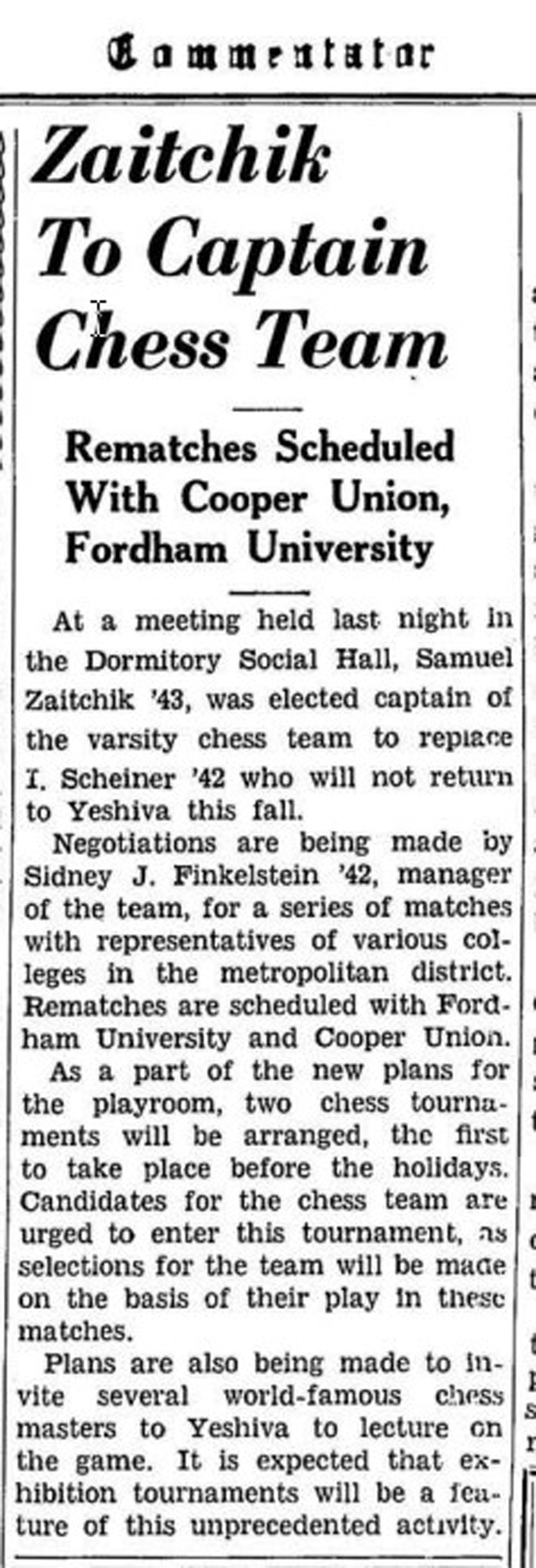
According to Seltzer, R. Scheiner was only at Yeshiva College for less than one academic year, for he tells us that he enrolled in the winter. As far as I know, this is incorrect, and he was at Yeshiva College the entire academic year 1939-1940. In fact, he was on the chess team and was even chosen as the captain.

This page from the Yeshiva College yearbook, Masmid 1940, can be seen here.

What complicates matters is that R. Scheiner himself said that he was at Yeshiva College for two years (and this was after a semester at the University of Pittsburgh, a point which is not mentioned by Seltzer).[17] According to the records of the University of Pittsburgh, Office of the University Registrar, Isadore Leon Scheiner attended the University of Pittsburgh for a semester in 1938-1939, during which time he took seven classes (I presume that the semester ended in January.) Even if R. Scheiner entered Yeshiva College for the spring 1939 semester, his time there would have been three semesters, not two years, so presumably when he said “two years” he was not being exact. By fall 1940 R. Scheiner – who was on track to graduate in 1942 – had left Yeshiva College. We know this because the Sep. 18, 1940 issue of the Yeshiva College Commentator mentions that he is no longer there.[18]

In discussing his time at Yeshiva College, R. Scheiner states: “When I got there, I discovered that the other students did not take Torah learning as seriously as I wanted to or as seriously as some of the rabbeim wanted them to, so I left.”[19]

Interestingly, in an interview that appeared on Matzav.com here, R. Scheiner does not mention that he attended Yeshiva College, or perhaps this was censored by Matzav.com:

Where did the Rosh Yeshiva learn in his youth?

HaRav Scheiner: I learned in the United States, in Yeshivas Torah Vodaas, from Rav Reuven Grozovsky zt’l, Rav Boruch Ber’s son-in-law and from Rav Shlomo Heiman zt’l. There was a group of students who would go to Lakewood to hear Rav Aharon Kotler’s shiurim and I sometimes joined them. Some of them stayed on afterwards to learn there permanently, among them HaRav Elya Svei. The Rosh Yeshiva, Rav Reuven Grozovsky, made my shidduch.

R. Scheiner would later teach at the Etz Chaim Yeshiva in Montreux, Switzerland, where he developed a close relationship with R. Jehiel Jacob Weinberg who lived in the town. For R. Scheiner, it was a great privilege to be in such close proximity to one of the gedolei Yisrael, and they spent much time together “talking in learning.” When R. Scheiner moved to Jerusalem, they continued their relationship by mail, with many Torah letters going from one to the other.

Here is a never-before publicized picture of R. Weinberg, together with R. Scheiner. The man in the middle who is speaking is R. Meir Just of Amsterdam. I thank Israel Bollag for sending it to me. (In a future post I will include more unknown pictures of R. Weinberg, including some in color.)

Unfortunately, the only mention of R. Weinberg in Seltzer’s book is in the following paragraph (p. 81).

There were other great Torah scholars teaching at the yeshivah in Montreux alongside Rav Yitzchok. One of them was R’ Betzalal Rakow, who would later be appointed rav of Gatesehad, England. R’ Yechiel Yaakov Weinberg, also known as the Seridei Eish, also spent time in the yeshivah.

R. Weinberg never officially taught at the yeshiva, although he would sometimes give the opening shiur of the semester. I assume this is what Seltzer means by “spent time in the yeshivah.” The real problem with the paragraph is that it makes it seem as if these three figures were colleagues, and at the same level. The truth is that both R. Scheiner and R. Rakow regarded R. Weinberg as a rebbe of sorts, which is understandable, especially as he was decades older than them.

3. In my last post here, I linked to a lecture from Professor Isadore Twersky that I found at the University of Scranton. Dr. Marc Herman called my attention to another video here in which Prof. Twersky appears. Unlike the video I posted, in this video you can hear Prof. Twersky very clearly. I was at Harvard when this presentation took place, yet I had no idea that Twersky was ever on this panel.[20] I think people will find it interesting that the moderator is none other than Alvin Bragg, the current Manhattan District Attorney. Prof. Harvey Mansfield also appears and is provocative as always (this time saying that grade inflation came about because of Affirmative Action).

4. Earlier in the post I mentioned Mordecai Kaplan, so here is a good place to add another point about him. Kaplan’s father, R. Israel, was close to R. Isaac Jacob Reines. (Mordecai Kaplan was actually born in Svencionys, where R. Reines had served as rav.) This explains why Kaplan, who had already been ordained by the Jewish Theological Seminary, turned to R. Reines when he wished to acquire a semikhah from a well-known rabbi. Everyone who writes on this matter refers to Kaplan traveling to Europe on his honeymoon after his June 2, 1908 wedding, at which time he also received semikhah from R. Reines who was then serving as rav in Lida.[21] People have generally assumed that he traveled to Lida to receive the semikhah.

In 1994 Jacob J. Schacter published a picture of R. Reines’ semikhah, dated 28 Elul, 5668 (Sep. 24, 1908). From this document we see that Kaplan actually met R. Reines in Frankfurt, and that is where they “spoke” in learning, following which R. Reines gave him semikhah. Schacter writes: “While traveling through Frankfurt he met his father’s old friend, Rabbi Yizhak Reines, spent some time with him, and received rabbinic ordination from him.”[22] This is based on Kaplan’s own recollection where he writes: “I had the opportunity to meet the late Rav Yitzhak Reines in Frankfort-on-the-Main and to obtain the requisite Hatarat Hora’ah from him.”[23]

Did Kaplan just happen to be passing through Frankfurt while on his honeymoon? The answer is no, and I’m happy to share something that is completely unknown: Kaplan was actually in attendance, together with R. Reines, at the 1908 Frankfurt Mizrachi conference. Here is the report of the conference in the Sep. 4, 1908 issue of the Cracow newspaper Ha-Mitzpeh. Kaplan is mentioned in the first paragraph.

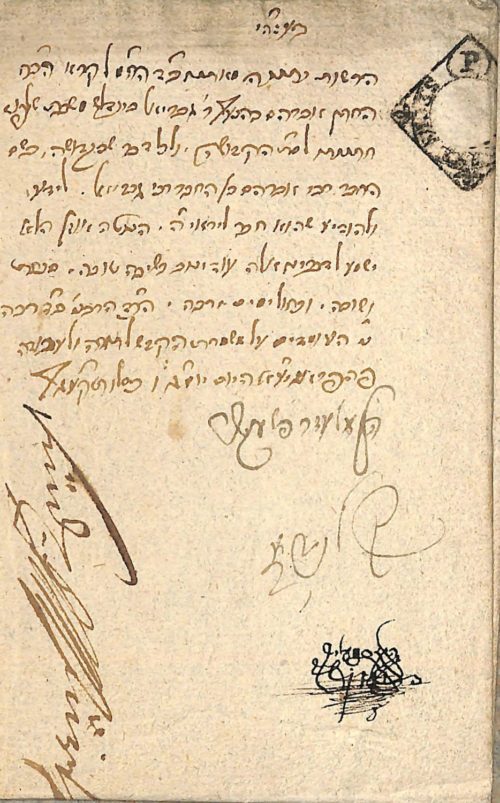
5. In Hakirah 32 (2022), I published a number of letters from R. Joseph B. Soloveitchik. One of them was sent to Professor Marvin Fox who had asked the Rav about the synagogue he attended, Agudas Achim of Columbus, Ohio. The synagogue had recently built a new building and instituted mixed seating.[25] Fox also turned to R. Mordechai Gifter. Here is R. Gifter’s letter to Fox.

Here is a draft of a Hebrew letter from Fox to the Rav.

It is not known if Fox ever sent the Hebrew letter, or if he sent an English one. I would presume the latter, as the Rav’s reply, that appears in Hakirah, is in English. 

Fox’s archive also contains the following English letter. In the Rav’s June 1955 letter in Hakirah, he is responding to Fox’s 1955 question about praying in a synagogue without a mechitzah (i.e., Agudas Achim). The letter below is from a later period and asks about praying in the synagogue’s beit midrash, in which no women are present. (As Fox’s son Avi informed me, Fox was at Harvard during much of 1956; this letter to the Rav is from when he returned to Columbus after his time in Boston.)  Fox’s archive does not contain a reply to this letter.

Here is the letter that Fox sent to Rabbi Samuel Rubenstein, the rabbi of Agudas Achim.


Fox’s reference in the Hebrew letter concerning the synagogue of R. Leopold Greenwald—of Kol Bo al Avelut fame—as not having a regular mehitzah is of interest. R. Greenwald was a strong opponent of anything smacking of reform. He himself spoke strongly against mixed seating in the synagogue and would never enter a synagogue with such an arrangement. Yet his own synagogue, Beth Jacob, against his wishes also decided to remove the mehitzah. Since it still kept separate seating, R. Greenwald felt that he could remain as rabbi even though he was not happy with the situation.[25]

While Beth Jacob remained in the Orthodox fold, and would later reinstall a regular mehitzah, in 2004 Agudas Achim decided to affiliate with the Conservative movement.

All the letters published above are found in the Marvin Fox Papers, Box 11 and Box 29, Brandeis University, and appear here courtesy of the Robert D. Farber University Archives and Special Collections Department, Brandeis University.

Since in this post I mention both R. Bernard Revel and R. Mordechai Gifter, let me add one more point regarding them. In 2011 Milei de-Igrot, vol. 2, appeared. This contains the letters between R. Gifter and his rebbe at RIETS, R. Moshe Aharon Poleyeff.

In addition to all the Torah the volume contains, it also offers us insights regarding both of these rabbis’ personalities and the history of Orthodoxy in the U.S. and Lithuania. Here is p. 168.


In addition to describing the incredible effect that Telz had upon him, R. Gifter also levels strong criticism against the אדמון running Yeshiva College who is destroying young people by exposing them to heresy. This refers to R. Revel who had a red beard. In fact, R. Aharon Rakeffet informed me that the opponents of R. Revel used to refer to him in a disgusting way as the “reiter hunt”.

6. In my last post I had the following quiz questions:

1. Which Hebrew book was the first one to use footnotes (and the footnotes even used Arabic numerals)?

2. Point to a halakhah on Pesach that the Shulhan Arukh decides in accord with the Rosh, while the Rama records the practice in accord with the Rif and the Rambam.

The answer to no. 1 is R. Noah Hayyim Zvi Hirsch Berlin, Ma’yan ha-Hokhmah (Rodelheim, 1804).[26] No one answered this question.


The answer to no. 2, which a few people answered correctly, is found in Shulhan Arukh, Orah Hayyim 474. Here R. Joseph Karo rules like R. Asher ben Jehiel, cited in Arba’ah Turim, Orah Hayyim 474, that there is no blessing on the second and fourth cups of wine at the Passover seder. R. Moses Isserles rules like the Rif, Pesahim 24a in the Alfasi pages, and the Rambam, Mishneh Torah, Hilkhot Hametz u-Matzah 8:5, 10, that one recites the blessing on all four cups.

*********

[1] “Pesukei Mikra she-be-Talmud,” Jeschurun 4 (1923), pp. 43-47, available here,“Le-Heker ha-Talmud ha-Yerushalmi,” ibid., pp. 109-112, available here, ibid., 5 (1924), pp. 18-20, available here.

[2] See Elijah J. Schochet and Solomon Spiro, Saul Lieberman: The Man and His Work (New York, 2005), p. 8.

[3] (Jerusalem, 2014), p. 46 n. 151.

[4] Amudim be-Toldot ha-Sefer ha-Ivri: Be-Sha’arei ha-Defus, p. 48, n. 161.

[5] “Od ‘le-Tikunei Girsaot be-Sifrei,’” Tarbiz 3 (1932), p. 466.

[6] See B. M. Lewin, ed., Alumah (1936), p. 156. This source and the prior one are listed in Tovia Preschel’s bibliography of Lieberman’s writings here. While this is a very complete bibliography, it omits one source that is completely unknown, and which fans of Lieberman will certainly want to examine. Here is a short article by Lieberman that appeared in Otzar ha-Hayyim 10 (1934), pp. 83-84.


[7] In the article in Jeschurun, “Le-Heker ha-Talmud ha-Yerushalmi,” p. 110, “A. Rosenberg”  states that the Jerusalem Talmud to Kodashim is lost, and he does not mention Friedlaender. Regarding the Yerushalmi Kodashim, I recently found that R. Mordechai Vorhand, Be’er Mordechai, p. 152, states that he is not going to take a stand regarding its authenticity. This is quite strange as Be’er Mordechai appeared in 1927 and the forgery had already been established for a number of years. Even stranger is that R. Menahem Mendel Kirschbaum, Menahem Meshiv, vol. 2, p. 8, also cites the Yerushalmi Kodashim. His responsum is from 1933 and Menahem Meshiv, vol. 2, was published in 1938. How could anyone at this late date still cite the Yerushalmi Kodashim? Interestingly enough, R. Kirschbaum disputes “the commentator’s” (i.e., Friedlander’s) understanding of the passage he is dealing with. Of course, “the commentator” is none other than the author (forger) of this passage, who presumably knows what he himself intended. This point is made by R. Shlomo Yosef Zevin, Soferim u-Sefarim, vol. 1, p. 307. In Menahem Meshiv, vol. 1, p. 163 (published in 1936), R. Kirschbaum shows that he is aware of the forgery, so he must have assumed that despite the forgery, some of the Yerushalmi Kodashim published by Friedlander is authentic. This explains how in Menahem Meshiv, vol. 1, pp. 70, 234, he cites Yerushalmi Bekhorot as authentic. R. Yeruham Fishel Perla states that portions of the Yerushalmi Kodashim are indeed authentic, while Friedlander forged the rest. See his edition of R. Eshtori ha-Parhi, Kaftor va-Ferah, p. 145b.

[8] “Toldot ha-Nusah shel ha-Talmud ha-Yerushalmi: Iyunim be-Kit’ei ha-Genizah,” Tarbiz 87 (2020), p. 610 n. 70.

[9] See Ira Robinson and Maxine Jacobson, “When Orthodoxy was not as Chic as it is Today”: The Jewish Forum and American Modern Orthodoxy,” Modern Judaism 31 (Oct. 2011), pp. 285-313.

[10] Regarding Lieberman and the herem against Kaplan, see my Saul Lieberman and the Orthodox, pp. 19-20. See my post here for the text of the herem against Kaplan. Here is a tidbit that is not generally known: As late as 1945, when Kaplan’s theological views were public knowledge, he was still a member of the Rabbinical Assembly’s Committee on Jewish Law. See David Golinkin, ed., Proceedings of the Committee on Jewish Law and Standards of the Conservative Movement 1927-1970 (Jerusalem, 1997), vol. 1, p. 155.


[11] See herehere, and here.

[12] See Adler’s article in the Elfenbein Jubilee Volume, pp. 9-14. Adler twice says that Elfenbein studied nine years at RIETS, but this is an obvious mistake, and is contradicted by the dates in Adler’s own article.

[13] For an earlier post in which I deal with young rabbis, see here. R. Ovadya Hoffman called my attention to another young rabbi (I also mention Hoffman in the post just linked as he noted an additional young rabbi): It is reported R. Yitzhak Isaac Katz (1753-1787) was thirteen years old at his marriage and was also appointed rabbi of Koretz at this time. His Wikipedia entry is here. The information about him becoming rav at age thirteen in found here in the biographical introduction to his Zikhron Kehunah (Lvov, 1863). I don’t know of any other examples of a thirteen-year-old who served as the official rav of a community. In the Encyclopaedia Judaica entry on R. Meshullam Roth (called “Rath” in the EJ), written by R. Mordechai Hacohen, it states that he was ordained at the age of 12 by R. Isaac Shmelkes and R. Jacob Teomim. This detail is not found in any of the sources listed in the bibliography so it is hard to know where R. Hacohen came to this information. One of the descendants of R. Roth told me that he never heard that R. Meshullam received semikhah at age 12.

[14] Aaron Rakeffet-Rothkoff, Bernard Revel: Builder of American Jewish Orthodoxy (Jerusalem/New York, 1981), p. 30.

[15] For more on student restlessness at RIETS and the 1908 student strike, see Gilbert Klaperman, The Story of Yeshiva University (London, 1969), chs. 5-7 (on pp. 115ff. he discusses the Elfenbein group); Hayyim Reuven Rabinowitz, “60 Shanah li-Shevitot bi-Yeshivat R. Yitzhak Elhanan,” Ha-Doar, June 14, 1968, pp. 552-554. See also Eli Genauer’s Seforim Blog post here which includes R. Baruch Shapiro’s recollections of the 1908 student strike.

[16] Nachman Seltzer, Rav Yitzchok Scheiner: The Life and Leadership of the Kamenitzer Rosh Yeshivah (Brooklyn, 2022).

[17] See the Pittsburgh Post-Gazette, May 1, 1998, p. A-14; Samuel Heilman, Defenders of the Faith (Berkeley and Los Angeles, 1992), p. 262. Chapter 17 in Heilman’s book is an interview with R. Scheiner, and as Heilman informed me, R. Scheiner told him that was at Yeshiva College for two years. He must have also provided this information to the Pittsburgh Post-Gazette. See also here.

[18] This page from the Commentator was posted by Dovi Safier here.

[19] Heilman, Defenders of the Faith, p. 262. I have corrected Heilman’s spelling of “rabbaim” to “rabbeim”.

[20] Regarding Twersky, I found it interesting that in a recent article Levi Cooper refers to him as a “noted academic and hasidic master.” See Cooper, “Jewish Law in the Beit Midrash of Hasidism,” Dine Israel 34 (2020), p. 63.

[21] See e.g., Mel Scult, Judaism Faces the Twentieth Century: A Biography of Mordecai Kaplan (Detroit, 1993), pp. 26, 96.

[22] Jacob J. Schacter, “Mordecai M. Kaplan’s Orthodox Ordination,” American Jewish Archives 56 (1994), p. 6.

[23] Ibid., p. 7. Schacter , ibid., also writes that R. Reines did not rigorously examine Kaplan, and therefore the semikhah should not be “considered an indication of any advanced talmudic scholarship on Kaplan’s part.” This reminded me of something interesting regarding the name “Mordechai”. According to Tosafot, Menahot 46b, s.v. amar, the name Mordechai was a second name given to those who showed great intellect and knowledge: בקיאים בעלי שכל ומדע. See also Tosafot, Bava Kamma 82b, s.v. ve-al:

דכל אותן שהיו בקיאים ברמזים ובלשונות היו נקראים על שם מרדכי לפי שהוא היה ראש וחכם להכיר

In Italy, people with the Hebrew name Mordechai were often named Angelo in Italian. This is likely because of the rabbinic identification of the biblical Mordechai with the prophet Malachi (and Malachi is akin to מלאך, i.e., “angel”). See Megillah 15a; Moshe David Cassuto, Ha-Yehudim be-Firentzi bi-Tekufat ha-Renesans, trans. Menahem Hartom (Jerusalem, 1967). p. 183.


[24] According to Marc Lee Raphael, Jews and Judaism in a Midwestern Community: Columbus Ohio, 1840-1975 (Columbus, 1979), p. 348, the synagogue also had mixed seating even before the new building, but as we see from Fox’s letter this was not the case.

[25] See Raphael, Jews and Judaism in a Midwestern Community, p. 348; Adam S. Ferziger, Beyond Sectarianism: The Realignment of American Orthodox Judaism (Detroit, 2015), p. 26; Rivka Schiller’s article on Greenwald here.

[26] This is noted by R. Binyamin Shlomo Hamburger, Ha-Yeshivah ha-Ramah be-Fiorda (Bnei Brak, 2010), vol. 2, p. 115. How is the first word of the sefer, מעין, to be pronounced? It has become common in modern Hebrew to pronounce it as “ma’ayan”. Yet this is not how it appears in the Bible. There the word has a shewa under the ayin, מַעְיׇן, so the word is to be pronounced ma’yan. The change in pronunciation of this word is noted by Joshua Blau, “Al ha-Mivneh ha-Murkav shel ha-Ivrit ha-Hadashah le-Umat ha-Ivrit she-ba-Mikra,” Leshonenu 54 (1990), p. 106. The plural of מעין is מַעְיָנוֺת, as seen in Is. 41:18, Prov. 8:24, II Chron. 32:4 (Ps. 104:10 has מַעְיָנִים). Therefore, it is unfortunate that the popular Bergen County, N.J. girls’ school has as its name “Ma’ayanot,” instead of the correct word, “Ma’yanot”. Yet in conversation, it appears that pretty much everyone seems to pronounce it correctly as Ma’yanot.


Legacy Auction, agunot, censorship, and other notable items

Legacy Judaica will be holding its latest auction on April 4th. The auction includes a few lots regarding agunot and comprehensive attempts to annul marriages.  In the early 20th century, especially in the aftermath of WWI, some tried to find global solutions to the massive agunah problem.  To those books offering solutions were those which disputed the validity of those solutions.  There is a lot of ten historic books on the controversies and a lot of letters from American rabbis.  One of the most substantial responses is, Ein Tenai be-nesunin , whose title leaves no doubt as to its position.  The book includes an important letter from R. Chaim Ozer and other rabbis.  According to some, the book was a response to one of the more eclectic figures invovled in the controversy, R. Yosef Shapotsnik.  His book, Lekor le-Asirim Dror, also leaves no doubt as to his position.  Although that book does not appear at this auction, Shapotshnik was involved in many other controversies and one of his books on the issue with an eruv in London.  (lot 48).   One of R. Nathan Shapira’s polemics, one against drinking yayin neskeh, and the other on Lurianic observances of certain mitzvos constitutes (lot 76).

A  lesser-known example of censorship are the two “first” editions of R. Yehuda Greenwald’s Shut Zikhron Yehuda, both published in 1923.  The first contains a lengthy letter questioning how R. Yosef Hayyim Sonenfeld could associate himself with the Agudah.  In the second edition that is replaced with a letter regarding eating on the eve of Yom Kippur.  Unfortunately in the second version although they changed the letter they weren’t as thorough as they should have been left the original title in the index. (lot 50).

The version of the Shulkhan Arukh with the commentary Gur Areyeh that contains the portraits of rabbis is lot 47.  Regarding the use of the portraits and whether they were offensive see our recent post.

Lot 49 is a large double-sided broadside polemic against the Reform rabbinical conferences signed by R. Samson Raphael Hirsch when he was still the rav and av beis din of Emden. Here is an excerpt:


Lot 13 is Sefer Zichronos of R’ Abohav although quoted by many it was very rare and almost no one saw it inside but rather came to it through secondary sources including the Magan Avhrhom who quotes it often,and was printed by Ahahvat Sholom twice.

Another point of interest related to this work is this work was printed anonymously The Chida deals with this at length in his Shem hagedolim if this is a proper practice. See also most recently Yakav Speigel in Amudim Betoldost Sefer haivri ( BEsharei Hadefus) Chapter Two and see our post here. We also dealt with R Abuhav here.

Lot 12 is the first edition of of ha-Kesav Ve-ha-Kaballah by R. Jacob Zvi Mecklenburg (Leipzig, 1839).

Earlier on the blog (here) we have pointed to pieces only found in the first edition of this work and this particular volume is from the main synagogue in Koningsberg where R. Mecklensberg was the rabbi.

Lot 24 is the Nesivot Mishpat. an interesting tidbit about of this work has been noted in this post

Lot 28 is the Shut Meshiv Davar of the Netziv.  The entry notes that there are two editions of the first edition. The one for sale is more complete.  Some of the differences have been noted in The series on the seforim blog “The Netziv, Reading Newspapers on Shabbos in General & Censorship” (here, here and here). Part four in the series will hopefully be published shortly dealing with some more differences between the various editions.

Lot 94 is R’ Moshe Koerner and his Toras Moshe. There are two editions of this work, each with a different introduction. This was pointed out by Dr. Sprecher in his introduction to R’ Koerner’s Birchas Moshe which he reprinted. He also printed copies of both introductions. This is not noted in the Mifal bibliography entry on this work. Also, worth pointing to about R’ Koerner is recent excellent article from, Uriel Gellman, “Between Worlds: The Miserable Life of an Itinerant Preacher on the Eve of Modernity”, Jewish Quarterly Review, vol. 109 no. 1, 2019, pp. 54-83.

Lot 82 Sefer Safra Detzniusah DeYakov  about this rare book R’ Ephrayim Zalman Margolis who had a excellent collection writes picturesquely about this work:

.והספר היה אצלי ונשרף בעוה”ר בשריפה שהיה פ”ק שנת תק”ן לפ”ק ומאז לא בא לידי

See ( מעלות היוחסין עמ’ סד) for this reference.

Lots 111-112 manuscripts of the Maaseh Rav sound very interesting one hopes that who ever prints them makes them available to the public to study. For now see R Dovid Kamenetsky article here

Lot 102 Zemirot mateh Yehudah. See what the Pre Megadim writes about this work:

בספר נטריקן, יורשלים תשכד, דף טז ע”ב: “ועיין בספר מטה יהודה על זמירות ואדם גדול היה“. וראה שם הקדמה דף ו ע”א.

Lot 103

The Dibuk highlighted in auction entry is dealt with at great length in   Sara Zfatman’s  excellent book Jewish Exorcism in Early Modern Ashkenaz (heb.).

Lot 162 provides evidence of which edition of the haggadah the Netziv might have used at the seder, R’ Eliezer Ashkenazi ‘s Maasei Hashem.  The Netziv quotes this work in his commentary on the Sifri (1:243) and in his work on Chumash Bershis (44:34). This was his personal copy:

Lot 204 is a copy of Teudas Chaver (Prague 1813) signed by the Prague beis din, including R. Elazar Fleckeles, and R. Shmuel Landau, the Noda be-Yehuda’s son.

Lot 205 R Chaim Ozer and R Kook, relating to their relationship. See R. Dovid Kamenetsky’s article here


Book Week 2026 & Year in Review: Hebrew Publishing is Alive and Well

Book Week 2026 & Year in Review: Hebrew Publishing is Alive and Well

By: Eliezer Brodt

The following is a recap of the year in Hebrew Jewish publishing for 2026, highlighting unique and noteworthy titles while also marking the annual Book Week sales. As the list makes clear, despite the ongoing conflict and security challenges in Israel, Hebrew Jewish publishing has continued with remarkable vitality and productivity. This is a testament to the enduring commitment of authors, scholars, and publishers to the world of Jewish books and ideas. Among the highlights are critical academic editions of Rishonim from manuscript, alongside numerous other unique and important titles across a wide range of fields, including History, Piyut, and Halacha.

Each year, around Shavuos, begins Shavua HaSefer—Book Week—a ten-day celebration of books and publishing. Many publishers extend their sales for the entire month. Shavua HaSefer takes place across the country in malls, bookstores, and special venues set up exclusively for these sales. Some locations focus primarily on frum seforim, while others feature a wide range of general and secular publishers. Many publishers time the release of new titles specifically for this occasion.

As in previous years, my list may occasionally include an older title I recently discovered. Please note: I do not aim to present an exhaustive list of all new releases. I try to highlight works that I believe will be of broad interest.

For last year’s list, [see  here].

As this list shows Seforim & Books are still being published in full force.

If you’d like to get a taste of what Book Week is about, listen to this episode of my podcast Musings of a Book Collector, recorded back in 2023.

To receive PDFs of sale catalogs from Machon Yerushalayim and Ahavat Shalom, feel free to email me at: Eliezerbrodt@gmail.com.

Important: A book’s inclusion on the list does not necessarily mean it is currently on sale.

The second section below based on subjects, features books published over the past year on a wide range of topics. These are not necessarily part of Book Week sales and may be harder to find— but they are still worth noting.

Again, this is not a comprehensive list, nor is it intended to be.

The goal of these lists is threefold:

  1. To help Seforim Blog readers discover significant recent publications in the world of seforim and Jewish scholarship.
  2. To assist interested readers in purchasing these books. As in previous years, I am offering a book purchasing service (for a small fee), including assistance in locating current or past titles. For more information, email me at: Eliezerbrodt@gmail.com.
  3. Part of the proceeds from this service will go toward supporting the ongoing efforts of the Seforim Blog.
מאגנס

תשובות רבנו תם, מהדירים פרופ’ רמי ריינר והרב ד”ר יוסף מרדכי דובאוויק, מקיצי נרדמים, 489 עמודים [מצוין]

רבי יצחק בן שמואל הספרדי, פירוש לספר שמואל ב, מהדיר: שמעון שטובר, האיגוד, 704 עמודים

עַל מוּת לַבֵּן: שירת ר‘ ישועה החבר בירבי נתן מעזה לזכר בנו יאשיהו, מהדירה: שולמית אליצור

קבץ על יד, לא

אפרים שהם-שטיינר, פשיעה בחברה היהודית בימי הביניים

דרשה לפסח לרוקח, מהדיר פר’ שמחה עמנואל, מהדורה שנייה עם הוספות

דוד אסף, אמא יקרה לי: פרקי מסע בזמר העברי

מחקרים בלשון, ספר היובל ליוחנן ברויאר

מחקרי ירושלים בספרות עברית, לד

דוד סבתו, יבנה וחכמיה, מסע אל ראשית ההלכה התנאית

פול מנדס-פלור, מרטין בובר: חיים של אמונה וסתירה

יובל פרנקל, חולשת הדעת: סיפורי עימות בין חכמים בתלמוד הבבלי

עמית גבריהו, נשך: הלוואה בריבית, כסף וחברה בספרות חז״ל

מאי שבת, מחוץ למחנה, שמעון ברנפלד, ביוגרפיה (1860 – 1940)

אדם טלר, פליטים ושבויים, המשבר הגדול בעולם היהודי במאה השבע־עשרה

כרמל

מרדכי זלקין, האלמנה: דבורה רום סיפורה של סוכנת תרבות

אבן אלשנטאש, סליחות והושענות לר’ יוסף בן יצחק ספרדי המכונה אבן אביתור

הספרים החיצונים, ב’ חלקים

חיים וידל, אל מעבר לדתיות ולחילוניות – בעקבות תורת ארץ ישראל של הראי”ה קוק

זהבה נויברגר, תכנים וצורות במדרש “דברים רבה”

מרטין בובר והחשיבה הדיאלוגית – חקר ושיח במלאת מאה שנים לספר ‘אני ואתה’

על הבתולים – גוף, מיניות וזהות בתרבות היהודית באירופה הנוצרית בימי הביניים

מגיד

ברכה אליצור, בשבילי אגדות בראשית: מדרשי התורה בתמורות הזמן, מגיד

יעקב מדן, כי קרוב אליך, הפטרות השבוע, עיון בדברי הנביאים

אליהו עסיס, תורה כפשוטה, שמות

מרכז זלמן שזר

יוסף דן, תולדות תורת הסוד העברית: ימי הביניים – כרך יד

עדי שרצר, זמן מתן מדינתנו, עיצובו של חג ממלכתי

עודד ישראלי, הרמב”ן (סדרת גדולי הרוח)

זיכרונותיה של גליקל – מהדורה עברית (בלי הערות)

אמה זהר, פולנים ונהנים, צריכה ופנאי בחייהם של יהודים בפולין

בית מדרש לרבנים – שכטר

שיר המעלות לדוד: מחקרים במדעי היהדות לכבוד הרב פרופ׳ דוד גולינקין, 807 עמודים

ממלכת כהנים: תשובות רבי בנימין ורבי חיים שלום מעלי הכהן, מהדיר: שמואל גליק, 578 עמודים

מדרש שמות רבה חלק א: פרשות א-יד, מהדורה ביקורתית על פי כתב יד שבירושלים עם מבוא, חילופי נוסחאות ופירוש מאת אביגדור שנאן [מהדורת צילום של הספר שראה אור בהוצאת דביר בשנת תשמ”ד (1984)]

מכללת הרצוג

משנת ארץ ישראל, משפחת ספראי, מסכת כלים, ג’ חלקים

אפרים קנרפוגל, עולמם של בעלי התוספות

ר’ יהודה ברנדס, מקץ שנתיים ימים, ב’ חלקים

יוסף מרקוס, פרשני המשנה

ידיעות ספרים

הרב שג”ר, שיעורים באגדה, 503 עמודים

הרב שג”ר, שיעורים על תורת הרב קוק – חלק א

עדן אביטבול, כובעים וחליפות, סיפורים מהישיבה

ר’ תמיר גרנות, על שפת הברית, הגות ישראלית בעידן של משבר

אלחנן ניר, זכרנו לחיים, עיוני דעת לראש השנה

דוד מנחם, שלום במרומיו

ישראל נתנאל רובין, הקבלה – אסונה של אמונת ישראל

יונתן גרוסמן, יציאת מצרים, חירות וברית

אפרת קראוס, הרב חיים דוד הלוי – סיפור חיים

אבישי בן חיים, מניפסט המסורתיות, הבשורה המתוקה- המתווה לפיוס

בר אילן

גבריאל חנוכה, משנת ר’ דוד הכוכבי, פילוסופיה דתית, הלכה וחינוך

אפרים קנרפוגל, אחים מרחוק, יחסם של החכמים באירופה בימי הביניים למשומדים ולחזרתם בתשובה

נעם סמט, שמים חדשים, ספר “קצות החושן” ועליית הלמדנות

עיוני מקרא ופרשנות יב

זהר עמר, משפחת אהרני, חלוצי המחקר הזואלוגי’ הארץ ישראלי

סידרא לו

ציונות הדתית יג

ציונות הדתית יד

בד”ד, 38-40

טל קוגמן, קרוא וכתוב בלשון עבר, הוראת העברית לילדים יהודים במחרב דובר הגרמנית בתקופה המדודרנית

עמינדב יצחקי, מנהיג בסערת התקופה, הרב מאיר בר־אילן – מנהיגהּ של הציונות הדתית בארץ ישראל בתקופת המנדט (1926–1949)

כנישתא חלק ה

עלי ספר-לד-לה

פירוש יפת בן עלי לספר עמוס מהדורה ביקורתית מוערת, בעריכת אליעזר שלוסברג, מירב עקירב

אברהם גרין, מליץ טוב, חייו והגותו של ר’ לוי יצחק מברדיטשב

דעת 93

צבי תפארה, מחקרים מוגשים לפרופ’ צבי זוהר לרגל פרישתו מההוראה

בלימה

ישראל ברטל, שמעון הכופר

האוניברסיטה העברית ירושלים, חגיגת הפתיחה ז’ ניסן תרפ”ה

ר’ אהרן שמואל תמרת, האמונה הטהורה והדת ההמונית

ג’ שלום, התנועה השבתאית בפולין, בעריכת יונתן מאיר

יונתן מאיר, חסידות שלעתיד לבוא

בנימין שבילי, הפריץ אומר שפסח היום

אריאל בן ציון, הילולא, בעריכת יונתן מאיר

הלל צייטלין, מפתח לספר הזוהר, בעריכת יונתן מאיר

משה אידל, משיחיות ציונות ומחקר הקבלה

מגילת סתרים לר’ נחמן מברסלב, יונתן מאיר

ראובן מס

יוסף פונד, מיתוס או מציאות: אגודת ישראל בעיני העיתונות הישראלית

יוסף טובי, הזיקה בין השירה העברית לבין השירה הערבית

דב הרמן, מעגל חיי המשפחה, הלכה, מנהג, פולקלור, משפט

מנחם ולדמן, ספר ה”אורית” של אבא סמואל

האקדמיה ללשון

יוסף שלמון, יחיאל מיכל פינס: איש ועד הלשון: חייו ופועלו, 198 עמודים [מעניין]

שין־ג’י פרנג, התרגום הארמי לשיר השירים

עוז לעוזי: מחקרים בלשון העברית לזכרו של פרופ’ עוזי אורנן

עיונים בלשון העברית לתקופותיה

מור שמש, מסורת לשון חכמים באשכנז במאה התשע־עשרה

בן צבי

ר’ יוסף הבא משושן, תולדות אדם, מהדיר: ליאור זקס שמואלי

שירי ר’ סעדיה בן מימון אבן דנאן

מנחם קרן קרץ, בני ברק: ממושבה דתית לבירת החברה החרדית הישראלית

אלי גורפינקל, שבח הנשים, פירוש לפרשיית ‘אשת חיל’ מאת ר’ דוד בן יהודה מסיר ליאון

מאיר בן שחר, נהר זיכרון וסכר שכחה: זיכרונות החורבן השני בחברה היהודית בשלהי העת העתיקה

ביאליק

שמא פרידמן, לישנא דרבנן, מחקרים בעברית ובארמית של הספרות התלמודית

מנחם עקשטיין, תנאי הנפש להשגת החסידות, מהדורה מדויקת על פי דפוס ראשון

ר’ יעקב ששפורטש, ציצת נובל צבי, מהדיר י’ תשבי [חזר למלאי]

ליאורה פטרובר, לדרכו של רד”ק בספר השורשים

משה בר אשר, תורת ההגה של לשון התנאים

רענן אייכלר, ארון הברית והכרובים

שמעון שרביט, מסכת אבות לדורותיה, מהדורה מדעית [חזר למלאי]

חיים דיהי, חידושי הלשון במערכת הפועל בספר בן סירא בהשוואה לעברית המקראית הקלסית

מרדכי סבתו ודוד סבתו, תלמוד בבלי, מסכת סנהדרין, פרק רביעי

שיחה על אהבה מאת יהודה אברבנאל [בן של האברבנאל], חזר למלאי

הנובלה העברית בתקופת הרנסנס, אומנות הסיפור של אליהו קפשׂאלי איש קנדיה

פירוש המקרא על פי רב סעדיה גאון, ספר בראשית

שמעון שרביט, לשונה וסגנונה של מסכת אבות לדורותיה [חזר למלאי]

שמעון שרביט, מסכת אבות לדורותיה, מהדורה מדעית [חזר למלאי]

ר’ טודרוס בן יוסף הלוי אבולעפיה, שער הרזים [חזר למלאי]

משה בר אשר, עיונים בעברית, במקרא, בלשון חכמים, בתפילה ובלשון ימינו

משה בר אשר, עֵבֶר וּמַעֲרָב, מחקרים בעברית ובערבית של יהודי המגרב

יד הרב ניסים

ר’ שמואל משער אריה [תלמיד רמ”ע מפאנו] דרוש על סמיכת אדם חכם, מהדיר: ר’ אברהם ביטון [חוברת]

ר’ רפאל בירדוגו, רקח מרקחת, על אגדות הש”ס

ר’ מרדכי עמאר, שלום רב, מבוא לשיטתו הפרשנית והפילוסופית של ר’ רפאל בירדוגו

מכון הר הברכה

זכרונות, ר’ יעקב מזא”ה ז”ל

ר’ אברהם פרייס, סמ”ג, עם משנת אברהם, ד’ חלקים

ר’ צוריאל חלמיש, חרבות לגוף האומה: הנציב מוולוז’ין ואחדות ישראל, מבוא ד”ר בועז הוטרר

ר’ אברהם פרייס, ספר חסידים, ג’ חלקים

בארות, כתב עת למחקר תורני, א

ר’ אברהם פרייס, משנת אברהם, א

אידרא

אבי שגיא, ודב שוורץ, קהילה מהפכנית בעולמה של מסורת, לדרכו של מכון שלום הרטמן

אבישי גלילי, חסדאי קרשקש – על ההוכחות לקיום האל

אברהם דוד, חברה יהודית באיטליה בתקופת הרנסנס

קדם

הודיה הר שפי, אלקטה בשושנים, מבחר מכתביו של מר שושני, 46 עמודים

בשנות רעה, הלל צייטלין: דיוקנו של פעיל רוחני חברתי, 134 עמודים

ארי ירמיש, רשימו

אריאל

עמיחי שוורץ, משבי לארץ הצבי: חייו ויצירתו של רבי אשתורי הפרחי

אקדמיה הלאומית הישראלית

קונטרס ימי שמואל, תולדות ר’ שמואל הורוויץ וסדר נסיעתו לאומן, מהדיר: יונתן מאיר

ישיבת אור וישועה

ר’ אליהו בן אמזוג, אם למקרא, במדבר-דברים

מכון שלמה אומן

סמ”ג, עשין, כרך שלישי

על הכל לרבי משה מאיוורא זצ”ל, מבעלי התוספות, מכון שלמה אומן

רבנו אברהם מן ההר, קידושין

זכרון אהרן

ר’ אליהו בחור, התשבי, כולל ליקוטי ערוך ורד”ק, צרי גלעד [מכתב יד], ועוד, תשלב +114 עמודים [!]

סידור ר’ יעקב עמדין [חזר למלאי]

ר’ אלעזר לעוו, בעל שמן רוקח, יבין שמועה על התורה

חדושי מהר”י שטייף חדשים גם ישנים על סדר מועד, ב’ חלקים

מדרש הגדול, שמות, ב חלקים

ר’ אליהו הכהן, בעל שבט מוסר, סמוכים לעד, על התורה

ספרי דברים, ג’ חלקים

שו”ת מהר”י בירב החדשות

ר’ יוסף דייטש, דברי יוסף, כולל הספדים על הנודע ביהודה

ר’ שמואל יפה אשכנזי, יפה ענף על חמש מגילות ב’ חלקים

מרדכי סגל, עיר מבצר על עניני פורים ומגילה

שו”ת מקור ברוך

תולדות יצחק על התורה

אהבת שלום

ר’ יעקב הלל, שו”ת וישב הים, חלק ה

ר’ חיים פאלאג’י, שו”ת לב חיים, ג’ חלקים

ר’ אברהם פרוסטיץ זצ”ל, מחמד לב, על תהלים, מכתב יד

ר’ משה קורדואירו, פרדס רמונים, הגהות וביאורים מגדולי חכמי הדורות והוספות רבות מכתבי יד, 40+תתפה עמודים

מן הגנזים, כ

ר’ משה בנימין, הואיל משה, דרשות על התורה, מכתב יד, ב’ חלקם [כ1500 עמודים]

ר’ עבדאללה אברהם יוסף סומך, זבחי צדק, ג’ חלקים [חזר למלאי]

ר’ גדליה ן’ יחייא, שלשלת הקבלה, 22+ תעג עמודים

שו”ת ר’ אליה מזרחי

שו”ת מהר”י באסן, עם תוספות תשובות חדשות מכתב יד

סידור הרש”ש, ר’ וידאל קואינקה, תצלום הכתב יד

ר’ יעקב הלל, נפש החיים, ב

מכון ירושלים

מנחת חינוך כרך ח

שו”ת בית יצחק, חושן משפט, מכון ירושלים

צפנת פענח, גירושין, מכון ירושלים

ר’ יקותיאל קלמנסון, מי טל, כרך על תרגום, חלק ב

מכון משנת ר’ אהרן

מערכי לב, ליקוט דרשות של ר’ רפאל חזן, בעל חקרי לב

ר’ ישראל יעקב אלגזי, שמע יעקב, על התורה

סטאלין – בית אהרן וישראל

שיר השירים: עם מדרש שיר השירים, תפסיר רס”ג, פירוש רבי שמריה, פירוש רבי יהודה בן בעלם, פירוש רבי זכאי, מכתב יד מהדיר: ר’ יהודה זיבלד, 46 +רג עמודים, מכון בת אהרן וישראל

ר’ יעקב קשטרו, שו”ת אהלי יעקב, תרעא עמודים+ מבוא 130 עמודים, מהדיר ר’ יחיאל שלוש, מכון בית אהרן וישראל

חידושי רבי מיכאל בכרך

מכון עלה זית

פירוש התורה לרב סעדיה גאון על חומש ויקרא, כולל תרגום המקרא – אלתפסיר והפירוש הארוך – אלשרח, ערוכים מתוך כת”י וקטעי גניזה עם הדרה מלאה, תרגום, ציונים, הערות וביאורים, ב’ חלקים (48+1308 עמודים)

ר’ ראובן מרגליות, מקור הברכה, בירורים בגדרי ברכות המצוות וחקר מטבעות ברכותיהן עם הרבה הוספות ותיקונים מכת”י המחבר זצ”ל ועם השלמות וביאורים ונספחים, רפ עמודים

ר’ מרדכי בנעט, שו”ת פרשת מרדכי, כולל שו”ת הר המור עם הוספות מכתב יד, יורה דעה

ר’ משה גרינעס, קרן פני משה, פירוש לרמב”ן על התורה, מהדורה חדשה ומתוקנת, 14+תרמא עמודים

צפנת פענח על הרמב”ם, שני חלקים, מהדורה חדשה

ר’ משה קורץ, מאורות משה, ליקוטי מרן הגאון ר’ משה פיינשטיין על מסכת אבות, שכב עמודים

ר’ אריה גאנז, אדירי התורה, ב’ חלקים

אור אליעזר לזכרו ר’ אליעזר פארטנוי, כולל חומר על הצלת ישיבת מיר ועוד

ר’ יעקב קיד, תורת סלבודקה, על ספר תהלים

ר’ מנצור מרזוק, קרבן אליצור, מסכת עבודה זרה, מהדורה חדשה בעריכת ר’ בנימין שפיגעל

מוסד הרב קוק

סדר עולם רבא עם ביאור הגר”א, רכא+24 עמודים

חיים טלבי, הקדיש, ההלכה והמנהג בעדות ישראל, 772 עמודים

מדרש עשרה הרוגי מלכות

ר’ יוסף קאפח, המקרא במשנת משה

הרב פרופ’ אברהם שטינברג, קביעת רגע המוות בהלכה

ביאור הגר”א, ב, בינה ודעת, מהדיר: ר’ מנחם אדלר, סי’ קכח-רנב

הרב פרופ’ דניאל שפרבר, מאי חנוכה, 169 עמודים

ר’ יצחק מלצאן בעל שביתת השבת, הגדה של פסח עם ביאור שיח יצחק

ר’ שלמה איגר, ספר העקרים, ב’ חלקים [חזר למלאי]

שו”ת ר’ שלמה איגר, ב’ חלקים, מוסד רב קוק [חזר למלאי אחר הרבה זמן]

ר’ מנדל המניק, משנה הברורה תורת הקדשים – מסכת זבחים

שיטה מקובצת, קנים

ר’ אברהם כץ, זוגיות הורות ומשפחה במשנת רש”ר הירש

קבצים תורניים

מתיבות לחקר תורה הגאונים והקדמונים וקהילות ישראל במלכות ישמעאל, גנוזות, ספונות, חקר ועיון, הלכה ומנהג, כרך א, 480 עמודים [קובץ חדש]

המשביר חלק יא

המשביר חלק יב

ישורון כרך נ

שנתון משפט העברי, לג

תחומין מה

מחקר

ר’ יוסף אביב”י, קבלת הגר”א, ג’ חלקים

ר’ משה הלל, ספר עץ חיים לרבי חיים ויטאל: תיאור כתב יד המחבר, קהילות ישראל

ר’ יהושע מונדשיין, העקלקלות לדוד

שלמה טיקוצ’ינסקי, חובה מנחמת, תנועת המוסר והשואה בהגות ובמעשה

שד”ל, Prolegomeni הקדמות לדקדוק מושכל של השפה העברית, 244 עמודים

ר’ דוד אייגר, משניות פאה עם אנציקלופדיה

טהרו של רקיע: והיה לכם לציצית, בענייני התכלת גליון כ [מאמרים מזהר עמר, ארי זיבוטפסקי, ר’ אברהם רפמן], קכח עמודים

רש”י

ד”ר יוסף מורגנשטרן, פירוש רש”י לתורה בעידן הדפוס – רומא סביב 1470: היבטים פרשניים, טקסטואליים והיסטוריים

פירוש רש”י על מסכת נזיר, מכון אופק

פירוש רש”י ובית מדרשו על סליחות – ראש השנה, מכתב יד, תז עמודים

ר’ יוסף מקרעמניץ, ביאור על רש”י, תלמיד מהרש”ל ורמ”א, מהדיר: ר’ פנחס קריגר, כולל מבוא, מראה מקומות הערות וביאורים, כ+176 עמודים.

ר’ משה פיליפ, רש”י שונה ומפרש, הפירושים החוזרים ונשנים בפירושו לתורה והפסוקים שפירוש רק פעם אחת ולא בפעם הראשונה, 554 עמודים

ר’ חיים בנימין הלוי קצנלנבוגן [נפטר תרס”ג], הגהות ספונות על סדר חמשה חומשי תורה, מכתב יד, יג+ קצח + כח עמודים, הערות והגהות ומראי מקומות

חז”ל- ראשונים

ר’ משה צבי וידר, מקראה בחקר החילוקים [בין ארץ ישראל ובבל]

ספר המצות לרמב”ם, מהדיר: ר’ יצחק שילת

תשובות רבנו החסיד אברהם בן הרמב”ם להשגות על משנה תורה לר’ דניאל הבבלי, על פי כתב יד, כולל מבוא, רפד עמודים

תמים דעים, קובץ תשובות ופירושים לרבותינו הראשונים ועל צבאם הראב”ד, מכתב יד, מהדיר: ר’ דוד דבליצקי

סדר טעמים, לתלמידו של רבינו שמואל החסיד [מכתב יד], [אביו של רבינו יהודה החסיד]: מהדיר ר’ יעקב ישראל סטל

תמיד קרוב לעמך: סדר הקרבת התמיד ופירושו לרבינו נתנאל מקינון ותלמידו, מבעלי התוספות [מכתב יד], מהדיר: ר’ יעקב ישראל סטל

פירוש הרוקח על הסידור, עם נוסח התפלה של הרוקח, תפלות החול, ]מכ”י[, מהדירים: ר’ לוי יצחק חריטן ור’ אהרן אייזנבאך, 25+ תרלה עמודים

ספר הקולות מבית מדרשו של רבינו יהודה החסיד, מכתב יד, רעג עמודים

ספר העתים, הלכות שבת, על פי כתב יד, עם הערות, יד+ 513 עמודים

ליקוטי מדרשים, חלק תשיעי – קטעי מדרשים מן הגניזה כ160 עמודים

מנחת קנאות, לרבי יונה ב”ר שלמה אבן בהלול, מכתב יד, מהדיר: פר’ יעקב שמואל שפיגל [נכתב בשנת 1257], 311 עמודים [במהדורה מצומצמת]

דרשות על התורה חלק א’ [בראשית – שמות] – ילקוט מדרשים קדום מתוך כתב יד [ברובו תנחומא במהדורה שונה], כ־140 עמודים

דרשות על התורה חלק שני [כריכה רכה] כ־190 עמודים.

ילקוט מדרשים חלק יג [כריכה רכה] כ־360 עמודים.

שערי תשובה עם פי’ סביב השלחן וזר השלחן, לר’ מאיר אתרוג, תקכג עמודים

פיוטים לשבת חתן, ר’ יצחק נקדן ב”ר שמשון עם פ’ קדמון מבית מדרשם של חסידי אשכנז, מהדיר: ר’ יעקב ישראל סטל, קי עמודים

ר’ שמשון מקינון, ספר הכריתות, ב’ חלקים, עם פ’ מקור מיים חיים, המאיר לעולם, מהדיר: ר’ מאיר דרגולי

ר’ זכריה הרופא, נימוקי הרז”ה על רמב”ם זמנים, מכתב יד

תוספות השלם, כרך יח, קרח-חקת

ספר קושיות לאחד מן הראשונים, [חזר למלאי], מהדיר: ר’ יעקב ישראל סטל

חידושי רבינו יהונתן מלוניל, פסחים

שער הגמול עם פ’ אור לעינים (ר’ שמואל הלחמי), רנט עמודים

ר’ מאיר עראמה, אורים ותומים, אסתר

ר’ מאיר עראמה, אורים ותומים, ישעיה

אחרונים

ר’ ישעיהו באסאן, אמרי יושר, מכתב יד [רבו של הרמח”ל], 42+רטו עמודים [מעניין]

ר’ משה צווייג, חידושי אהל משה, על הבבלי, ירושלמי, שו”ע עם קובץ תשובות, מכתב יד תתטו עמודים [מעניין]

הלכות בית הבחירה לרמב”ם עם פי’ רבי אביגדור נבנצל שליט”א, 169 עמודים [מאוד מעניין]

כמטמונים תחפשנה, מתורתו של הגאון המופלא רבי אהרון יהושע צוקר [העילוי מפוניבז’], תקיא עמודים [מאוד מעניין]

חשרת מים, גיטין

ר’ יהודה עדל, מי נפתוח, על הקדמת הרמב”ם לסדר טהרות, עם הערות

ר’ אברהם טיקטין, פתח הבית

ספר החרדים, ב’ חלקים, עוז והדר

ר’ שלמה זלמן אויערבאך, מנחת שלמה, פרק ערבי פסחים

ר’ שלמה זלמן אוירבעך, מנחת שלמה, על פרק איזה נשך

ר’ אלחנן ווסרמן, קונטרס דברי סופרים, מילואי דעת סופרים על גיליונות חזון איש וקהילת יעקב, מהדורה שלישית, תב עמודים

ר’ מרדכי פארהאנד, באר מרדכי על הש”ס [בעל שו”ת באר מרדכי], שסד עמודים

ר’ שמואל שטראשון, חידושי הרש”ש על הש”ס, ד’ חלקים [ברכות, יומא, ביצה, ראש השנה, תענית, מגילה מועד קטן, חגיגה, סנהדרין, סוטה, אבות]

ר’ אפרים בורודיאנסקי, משכנות אפרים, חולין יורה דעה

דברים נחמדים, בעל בני יששכר, אבות, עניינים שונים עם הוספות חשובות, שנז עמודים

לב העברי, ב’ חלקים, מהדורה חדשה

הלכה

ר’ יעקב הלוי לוינגר, גורן הלוי, דיני עבודת הלויים במקדש, תעו עמודים [מאוד מעניין]

ויעמד משה, אוצר הלכות עמידה וישיבה ברוב עניינים

פסקי לוח לארץ ישראל, להגאון ר’ יחיאל מיכל טוקצינסקי, כולל מקורות וביאורים, חרות על הלוחות, 43+ תל+ מג עמודים

ר’ מרדכי אקשטיין, מר דרור, סי’ ה’ דין כוונת הברכות והשמות, שנז עמודים

ר’ יוסף מברעסלא, חק יוסף, על הלכות פסח, מכון אכסניא של תורה, כולל ליקוטי חק יעקב והערות

ר’ יצחק שטסמן, עץ השדה, מהדורה חדשה עם הוספת

ר’ ישעיהו הלוי, בין כותלי המשחטה, המדריך להכרת הליכי השחיטה התעשייתית, 206 עמודים

ר’ נדב שריפי, מה מפטירין, מנהגי קריאת התורה וההפטרה, רעג עמודים

הרב נחום אליעזר רבינוביץ, שו”ת שיח נחום חלק ב

ר’ מאיר דורפמן, שו”ת הגרז”ן, שו”ת ושיחות עם הגאון רבי זלמן נחמיה גולדברג זצ”ל, 274 עמודים

גנזי תחומין, מאמריו של ר’ זלמן נחמיה גולדברג שהתפרסמו בתחומין ודברי זכרונות

דיני התשלום בתחבורה הציבורית, מהדורה מבוקרת ומעודכנת, קיח עמודים

ר’ מנחם שלזינגר, איל משולש, פתיחת קופסאות שקיות ופקקים בשבת, קצב עמודים

מסורת משה חלק ה (פסקים של ר’ משה פיינשטיין), תקסה עמודים + מפתחות רמג עמודים

ר’ משה קליערס, תורת הארץ חלק ב

ר’ יעקב סבתו, טהרת הכהן, דיני איסור טומאת מת לכהנים, תרי עמודים

ר’ ברנדויין, ברכת הטוב והמטיב על שינוי היין, קכח עמודים

ר’ דוד אהרן סופר, שלשה ספרים: כוס חמישי להלכה, מוסיף על הכוסות, אכילה מצה ולחם משנה [626 עמודים

ר’ הרצל הלל יצחק, הכר נא, בעניין איסור הסתכלות באדם רשע, רמא עמודים

ר’ יהודה פפויפר ר’ משולם יוסף שומן, הלכות קטניות בפסח, סה עמודים

ר’ חיים בנבנשתי [הכנסת הגדולה], שו”ת בעי חיי, או”ח, יו”ד, כולל תולדות [189 עמודים]

ר’ פסח פינפער, מסורת התורה והנביאים, מסורת התנ”ך חלוקת פרקי ופרשיות התנך פתוחות וסתומות ועוד, כולל מ”מ, מבואות, הערות והארות, שעז עמודים

מחברת הקודש, חיבורים מכתב יד לבעל תוספת שבת

חסד שבמלכות, צדקה ממלכתית ומדינת הרווחה לאור ההלכה, 508 עמודים

ר’ שמואל יוסף שטיצברג, שערי השבת, שמירת שבת בבית ובמטבח במכשירים החשמליים והדיגיטליים, א, שעה עמודים

ארצות החיים, מלבי”ם, מהדורה חדשה

ר’ מאזוז, שו”ת בית נאמן, חלק ד

ר’ עמנואל מולקנדוב, תורת הקדמונים, חלק ה

ר’ שמחה הכהן, ספר שמות, שמות אנשים ונשים, גיטין (נדפס לראשונה תי”ז), עם הערות וציונים, ר’ יוסף בנדיקט

ר’ עבדאללה אברהם יוסף סומך, שו”ת זבחי צדק השלם, תרפ”ד עמודים

ר’ מרדכי בלייער, כוס ישועות, עניני כוס של ברכה, ב’ חלקים

ר’ פסח פאלק, פיה פתחה בחכמה, הלכות שבת, מקוצה ורפואה, תרלא עמודים

ר’ שלמה שור, נוהג בחכמה, תוכחה, הלכות ומנהגים לקולא שאינם עולים לפני כללי הפסיקה, חילוקים מנהדים בין עדות ישראל, עדות ישראל שעלו לארץ ישראל, חילוקי נוסח התפילות ועוד, תשע עמודים

ר’ דוד שור, דינא דמלכותא דינא, מהדורה שנייה

ספר פועה כרך חמישי

מסחר כהלכה

ר’ שלו’ בן ציון פלמן, גשמי ברכה, הלכות ירידת גשמים, שפב עמודים

ר’ שלמה קורח, שו”ת תשובה כהלכה, תקסז עמודים

ר’ שלמה דיכובסקי, לב שומע לשלמה, חלק ד

ר’ שובאל בן שלמה, מבאר המים, שו”ע הלכות נזיקין, ריב עמודים

ר’ יעקב אריאל, פרקים בתורת המדינה, 479 עמודים

בירור הלכתי ותורני בעניין מדינת ישראל, יום העצמאות, התגייסות לצה”ל, 247 עמודים

ר’ מאיר דן פלצקי, חמדת ישראל ה’ חלקיםזכרו

היסטוריה וגדולים

ר’ דוד קמנצקי, רבנו חיים עוזר, רבן של כל בני הגולה, כרך שני [!!]

ר’ דוד קמנצקי, רבנו חיים עוזר, רבן של כל בני הגולה, כרך ראשון [מהדורה שנייה עם תיקונים והוספות]

ר’ פנחס לובאן, שמע בני, ב, הנהגות והדרכות מר’ דוד הלוי אברהמי, מח”ס בנין עולם, 738 עמודים

לב נאמן, ב, יומן של ר’ מאיר מאזוז

שמעתי מאבא, לקט עובדות והנהגות שרשמתי בצלו של אבא מארי המשגיח ר’ חיים וואלקין, 98 עמודים

ר’ יוסף שווארטץ, זכרון למשה, על החתם סופר

ר’ אברהם מאיר וייס, שימוש חכמים חלק א, קיצור תולדות רבותינו הראשונים [חזר למלאי], כולל כ-300 עמודים חדשים

ר’ יואל פעלדמאן, שלשה אבות, תולדות משפחות בראנדסדארפער, טייכטהאל, גינז, 763 עמודים

ר’ אביעד נייגר, הגאון מווילנא ותלמידיו זיע”א, גזרת הגלות שלש השבועות והנלוה עמהם, קנו עמודים

ר’ אביעד נייגר, ונציב אחד אשר בארץ, הנציב מוולוז’ין ותלמידיו זיע”א, גזרת הגלות שלש השבועות והנלוה עמהם, קעד עמודים

ר’ ברוך שרגא, חכם בן ציון, שימוש חכמים – עובדות והנהגות, ר’ בן ציון אבא שאול, בעל אור לציון

בן ציון קליבנסקי, מעבר לסוף, סיפורה של מנהלת בית היתומות בקובנה שצעדה עם תלמידותיה אל המוות

בעקבות מסע… בן יובל שנים… התקופה… בעקבות גיליונות קובץ לחושבי שמו, א, 638 עמודים

רבי לייב, ר’ ליב מינצברג זצוק”ל רבה של קהל עדת ירושלים-ישיבת המתמידים, ובעל ספרי בן מלך, פרקי חייו דרכו ומשנתו, 781 עמודים

ר’ אביש ציינווירט, חיי האר”י ז”ל, חיי מוהרח”ו ז”ל, עם ביאור אבן בוחן, שכה עמודים

ר’ מנחם פלאטו, מרן החזון איש, חלק ה, 384 עמודים

ר’ רפאל רפאלוב, החרדים והארץ, הפרק הנעלם חלקים של החרדים בחידוש היישוב בארץ, 161 עמודים

ר’ מאיר הייזלר, מי הדעת, מאמרים ושיחות שימושה של תורה, ילקוט פנינים ורשימות ולקט זכרונות מגדולי הדורות, [מהדורה שנייה], תקטז עמודים

רבי שמואל יעקב בורנשטיין, סיפור חייו

מנחם שטרן, מייסדי המושבות היו “דוסים”

ר’ בנימין פנטליאט, הקהילה האשכנזית בצפת

הרואה: אלבום תמונות של הרב אברהם יצחק הכהן קוק זצ”ל

עמור פדור, חיים שניתנו במתנה, על ר’ חיים דרוקמן

מרן הראי”ה קוק זצ”ל, הרואה בנחמה, אגרות ניחומים דברי הספד ומאמרים וליקוטי אורות בענייני אבלות ונחמה, בעריכת ר’ זאב נוימן, תסד עמודים

ר’ משה נחמני, חסידות בית אברהם, חסידי הראי”ה קוק בערי פולין, תר”ץ- תש”ג, 187 עמודים

ר’ יהושע ון דייק, בחרבי ובקשתי, שיטת מרן הראי”ה קוק ובנו הרצי”ה זצ”ל ובית מדרשם בעניין גיוס בני ישיבות

ר’ יוסף בדיחי, בצלו, פרקי יומן ממחיי מו”ר הרב צבי יהודה הכהן קוק, שנת תשל”ד, 327 עמודים

תפילה

ר’ חיים אלעזר שפירא, מאמר נוסח התפלה, רסב עמודים

ר’ אלחנן אדלר, קונטרס חלק אב, תפילת אב הרחמים, עיונים הערות וביאורים, קסא עמודים

סידור תפילה ישרי לב, לימות החול ולשבת קודש, ביאורים מוסריים מרבני הת”ת דקלם וחבר מתלמידיהם, 1454 עמודים

מחזור רמח”ל ליום כיפור

שונות

ר’ יצחק טוביה ווייס, שערי טוביה, אגרות ומכתבים, שפג עמודים

ר’ צבי לרר, קונטרס נכתב בצדו, גליוני ספרים מכתב יד גדולי ישראל, צו עמודים [מעניין]

והשב את העבודה קטורת, הלכות הקטרת הקטורת בליווי תמונות, 400 עמודים

ר’ ברוך יפה, משמרת תורה, ענייני מצוות, מועדים, שונות, תלג עמודים [מעניין]

ר’ חי רועי, למנהיגות ציבורית חלק ג

ר’ יהושע שטיינברג, נפלאות לשון הקודש על התורה

ר’ דניאל צבי רובין, מראה הגבול, צורת גבולות ארץ ישראל על פי התורה, מהדורה חדשה, תמח עמודים

ר’ משה דרורי, התשובה במשפט הישראלי

שיעורי הרב אהרן ליכטנשטיין, תשעה באב ואבילות

הרב דוד לאו, דמעות של אמונה, הרב הראשי במסע של מלחמה, חיים ותקומה, 236 עמודים

ר’ אליהו גרנצייג, תפארת התורה, מצות תלמוד תורה והלכותיה, שכח עמודים

שללו של רבינו מאיר שמחה, מבית כמוצא שלל רב, בראשית-שמות, פנינים… מתורתו של הכהן הגדול… שנלקטו ונערכו מתוך ספרי משך חכמה אור שמח…. תקכב עמודים

ר’ אורי טיגר, חונן הדעת, על רמב”ם הלכות דעות, שעב עמודים

ר’ יונתן רוזמן, חסד ואמת נפגשו, סתירות בין הלכה ותורת הנסתר

ר’ משה ירמיהו הכהן [אביו של בעל מעשה טוביה], ברכת טוב, ב’ חלקים, עם הרבה הוספות מכ”י, מכון נצח יעקב

גידולי תרומה על ספר התרומות, על פי כ”י

ר’ אברהם אבולעפיה, חיי עולם הבא, על פי כ”י

ר’ שאול הכהן, לחם הבכורים על הדקדוק, מהדורה חדשה

טעימה מתורת רש”ר הירש, בראשית-ויקרא

ר’ שלמה גריינמן, לקט השבלים, בראשית-וירא, תתריא עמודים

ר’ מאיר א”ש, אמרי בינה על הש”ס, ב חלקים

ר’ דב אליאך, דבר תורה על הפרשה, אוצר חדש… מפיהם ומפי כתבם של… ראשי הישיבות וגדולי המוסר, בראשית, שנב עמודים

ר’ זאב פריינד, יסודות קצות החושן, עניינים יסודיים מספר קצות החושן מסודרים ללימוד בעיון, תרצה עמודים

הרב ירחמיאל אליהו בוצ’קו זצ”ל, חזון תורה ואמונה מתוך הסערה

ר’ ישראל דנדרוביץ, היו דברים מעולם, הסודות הגנוזים של העולם התורני, חלק ג, 708 עמודים

משה לנדא, דע מה שתשיב בסוגיית הגיוס, 364 עמודים

ר’ שלמה גריינמן, לקט השבלים, ויקרא, תתשיג עמודים [מצוין]

ר’ שלמה בניזרי, קונטרס חיל השם, סוגיית גיוס בני הישיבות, 264 עמודים

ליאור הולצר, שבתי צבי – סיפורו של משיח [רומן היסטורי]

אנציקלופדיה תלמודית, כרך נג

ר’ דוד חזן, חוזה דוד, על ספר תהלים, א’ריד עמודים

ר’ יוסף דוד משאלוניקי, צמח דוד על תנך, ו’ חלקים, וכרך שביעי, דרשות יקרא דשכבי

ר’ ישראל אברמסקי, עיוני ישראל, כללי המשנה ברורה, קלג עמודים

ר’ צבי פרבר, שביל הצבי, מגילת אסתר, תיב עמודים

ר’ יעקב חיים סופר, ברית יעקב, חלק ב, ב’ חלקים

ר’ חיים סלומון, שבילי טהרות, דיני טומאת צרעת, תטז עמודים

דרכי ארץ, הלכות מצות הבית, שצג עמודים

ספרי רבי אהרן הכהן, חתן החפץ חיים ובנו ר’ יוסף חיים,

מאמר תלתא קרנתא בענין המן טאשין, אזני המן וקרעפליך בימי הפורים

ר’ אברהם דיקמן, פרשה ערוכה: הערות הארות ואנקדוטות משולחנו של עורך תורני לפי סדר פרשיות השבוע והזמנים, 236 עמודים

ר’ ישראל דנדרוביץ, הגדה של פסח, היו דברים מעולם, 704 עמודים

אברבנאל, הגדה של פסח, זבח פסח, מהדורה חדשה

תומר דבורה, על פי כ”י, מכון שובי נפשי

גנזי יהודה, ח, שפח עמודים

ר’ אברם פריעד, ארבעים שנה במדבר

הלל הפסח, הגדת הפסח כמנהג ארץ ישראל הקדמון, כפי העולה מן הגניזה הקהירית, מהדיר: יהונתן קרני הלוי [חוברת]

שבת געלע מצות, כולל מנהגי אפיית החלות וגולם של המהר”ל [חוברת]

והשב את העבודה, דיני קרבן פסח בליווי תמונות המחשה ייחודיות, רצ עמודים

שדי חמד, מערכת מצה, עם הערות [כריכה רכה]

ר’ יעקב חיים סופר, ברית יעקב ח”ב, מערכת ג-ד [חוברת]

ר’ העשיל מקראקא, חנוכת התורה על התורה

ר’ חיים יעקב זילבערבערג, דרכי חיים, ביאור תפילה ודברי מוסר ועוד, ת’ עמודים

ר’ בנימין שלמה המבורגר, אשכנז מבצר המסורת, מבוא לסדרת הספרים שרשי מנהג אשכנז, 353 עמודים

כוונות וסגולות, אסופות מכתבי יד החיד”א

ר’ משה לוי, שירת הלויים, עניני עבודת הלויים לפי סדר סוגיות הש”ס ופרשיות התורה, שפג עמודים

ר’ אהרן גוטסמן, אור תעלומות, דרושים מועדים, עצות וסגולות, שנ עמודים

לחם תנופה, צורת שתי הלחם וענין תנופתו, 37 עמודים

תקנת המבדיל וצום כ’ סיוון, 97 עמודים

ר’ תומר בכר, אהל יעקב, הערות וביאורים לספר וידעת כי שלום אהלך לר’ חיים פרידלנדר

ר’ אהרן אויש, שטר תנאים וכתובה שבין ישראל לאביהם שבשמים לחג השבועות, קמא עמודים

ר’ יוסף בא-גד, נחלי בא-גד [מהדורה טו]

English

Daniel Sperber, Indo-Judaic Parallels, Notes on Similar Motifs in Judaism and Hinduism, 192 pp.

R’ Bezalel Naor, The Project of Hasidism

R’ Sklar, Rav Kook’s Guide for Today’s Perplexed

R’ Ahron Notis, The Great Shiurim Debate, The History the Archaeology and the Lomdus

R’ Reit, Ushchat’tem Bazeh, The Chullin & Shechita Companion

Rabbi Rafael Dembovsky, Between Torah and Derech Eretz

Rabbi Yehoshua Kaganoff, Is Alternative Healing Kosher?