Translating the Aruch HaShulchan with AI: Method and Lessons

Translating the Aruch HaShulchan with AI: Method and Lessons[1]

Joshua Broyde (PhD)

Joshua Broyde is an AI/ML Healthcare & Life Sciences specialist at Google Cloud, where he works from strategy to implementation with enterprise medtech, healthcare, and biopharma companies to design, build, and deploy secure, production-grade AI and Generative AI systems. He has a PhD in the field of Computational Biology.

Abstract

I present a complete AI-written English translation of the Aruch HaShulchan — Rabbi Yechiel Michel Epstein’s comprehensive nineteenth-century code of Jewish law — covering all four sections of the Shulchan Aruch: Orach Chaim, Yoreh De’ah, Even HaEzer, and Choshen Mishpat. The translation was produced using Google’s Gemini 3 Flash model at its MINIMAL thinking level. Translation quality is consistently high for a first-pass working text, although it clearly sometimes makes mistakes. The full translation is freely available online at aruch-hashulchan-transla-53666.web.app, and the translation data and code are available at github.com/JoshB29/Texts_AI_Translations.

Introduction

The Aruch HaShulchan, by Rabbi Yechiel Michel Epstein (1829-1908) of Novardok, is one of the most authoritative and comprehensive codes of Jewish law in the modern era. Written in rabbinic Hebrew, it has remained largely inaccessible to English readers outside of a handful of translated sections.[2]

AI-driven translation represents a qualitative shift in what is possible for rabbinic literature. This does not fully replace careful human translation, but it creates an opportunity to scale massively: human scholars can now function primarily as editors, reviewing and refining AI-generated drafts rather than translating from scratch. A multi-year scholarly translation project can now be approximated in hours for a few dozen dollars.

Corpus

The Aruch HaShulchan comprises four sections (i.e. chelakim) corresponding to the four parts of the Shulchan Aruch: Orach Chaim, Yoreh De’ah, Even HaEzer and Choshen Mishpat. I first obtained the Hebrew source text from Sefaria[3]. In total, this corresponds to 1,507 Simanim (chapters) and comprises 24,161 seifim (subsections) and around 3,400,000 words.

Translation Method

Model and Thinking Level

I used Google’s Gemini 3 Flash (gemini-3-flash-preview) to create the translation[4]. Gemini Flash supports four “thinking levels” — MINIMAL, LOW, MEDIUM, HIGH — which trade computation budget against reasoning depth. I chose to use the MINIMAL setting, which created a good translation at a very low cost.

Each seif was passed as an isolated API call[5] with a fixed system prompt containing[6]:

  • A style guide specifying conventions for rabbinic titles (e.g., Rambam, Rema, Beit Yosef), standard formulaic phrases (e.g., עד כאן לשונו → “Thus far his words”), and transliteration conventions (siman, seif, seif katan).
  • Few-shot examples illustrating the original text and style of translation.
  • An instruction to preserve the paragraph and logical structure of the original.

In order to make the translations more consistent with each other, I applied a post-processing normalization to all translated seifim after translation was complete.

Choosing the Model Thinking Level to Use

In order to understand which model thinking level is best for rabbinic translations, I chose 5 randomly selected seifim from each chelek, and had Gemini Flash translate them at the different thinking levels. Below are the results:

I found the MINIMAL setting to produce translations of roughly equivalent quality[7] compared to the higher thinking models. The additional expense of higher thinking did not seem to create significantly better translations. You can see from the graph that the cost for each seif at the HIGH thinking level is around 5 cents, about 33 times the MINIMAL thinking level[8]. This would represent a total cost of about $1300, as opposed to only $40 I spent using the MINIMAL setting[9]. Most of this cost is due to the significant amount of thinking tokens used by the high model. These results would also suggest that Gemini’s larger model, Gemini-Pro, would be overkill for the project. However, I did not formally test Gemini Pro, or any other model family[10].

Post-Processing Results

One thing I noticed was inconsistency of the word *seif* and the names of certain rabbinic works. Specifically, *seif* was sometimes kept in transliteration and sometimes translated as “section.” To address this, I applied a post-processing step using regular expressions to standardize these renderings: *seif* was normalized to “section” and *seif katan* to “subsection.” I applied the same approach to certain rabbinic names — for example, the *Shach* was sometimes transliterated as “Shakh” — normalizing these to a single canonical spelling throughout the corpus. For future translations, this should be fixed with better prompting.

Despite the fact that each seif is translated separately, my overall impression is that the translations were reasonably good and consistent.

Translation Quality

To more systematically validate the translation quality, I selected 100 random seifim and had a separate model evaluate the translations[11]; specifically, I used OpenAI’s GPT-5.4 model with a low reasoning effort. Each of the 100 seifim was passed to the model together with its original Hebrew, and the model was asked to classify the translation into one of four categories: Good, StyleImprovementNeeded, Mistake, or EgregiousError.

The egregious error category was defined strictly: a translation qualifies as egregious if it fundamentally inverts or distorts the author’s meaning — even if the error itself is subtle. To illustrate this, the following example was included in the evaluation prompt:

Original Hebrew

OC 635:5:

ובוודאי אין זה רק זהירות בעלמא, דאיזה פסול יש בעשיית הגג קודם הדפנות? דאין זה דמיון לחוטט בגדיש, שאין על זה שם גג כלל. אבל הכא גג גמור הוא.

Hypothetical mistranslation:

And certainly this is not only a mere stringency, for what disqualification is there in making the roof before the walls? For this is not comparable to hollowing out a haystack, where it does not have the status of a roof at all. But here, it is a complete roof.

The Aruch HaShulchan is in fact saying the opposite – the Rema’s statement is only a mere stringency. The mistranslation — inserting the words “not only” — is superficially consistent with the Hebrew, but is inconsistent with the actual context of the text and completely inverts the intended meaning.[12]

I had ran the analysis 3 times, and took a majority vote to determine the classification of the seif. If there was a 3 way-tie, the most serious category was taken. Here are the results:

Classification Percentage
Good 29%
StyleImprovementNeeded 54%
Mistake 17%
EgregiousError 0%

You can see that the GPT model thinks that the translations overall need to be improved in style, and found 17% of the translations had a mistake. Importantly though, there were no egregious errors found.

Most of the mistakes were mistranslations of specific words/phrases or incorrect abbreviation expansions; some of the mistakes are a bit humorous. Here are a few examples:

YD 187:63

[עח”ד סק”ה שכתב דדווקא ברואה מ”ת אמרינן כן משום די”ל שמש עכרן אבל בשלא מחמש (sic) תשמיש …]

Translation: [see Chavot Daat subsection 5 who wrote that specifically regarding one who sees from the Torah…]

However, מ”ת means “due to sexual intercourse”. The model seems to have incorrectly expanded this to “מן התורה׳”, despite that making no sense in context.[13]

CM 163:2

כל צרכי ציבור שאינם יכולים להשוות עצמן מפני שינוי דיעות יש להושיב כל הבע”ב הנותנים מס ויקבלו עליהם ברכה שכל אחד יאמר דעתו לש”ש וילכו אחר רוב דיעות

Translation: Regarding all communal needs where they are unable to reach an agreement due to a difference of opinions, they should seat all the householders who pay tax and they shall accept upon themselves a blessing that each one will state his opinion for the sake of Heaven, and they shall follow the majority of opinions.

This is flagged as a mistake by GPT- “blessing” is not the right translation in this context; admonition or a similar word would be better.

OC 471:4

ושתיית יין שרוף מעט – וודאי מגרר גריר.

Translation: And drinking a small amount of burnt wine – certainly stimulates.

“Burnt wine” is a clear mistake for distilled alcohol.

Here’s a few more examples that I found of clear mistakes or stylistic quirks:

  • In OC siman 475, seif 16, the abbreviation “עק”נ” is incorrectly rendered as “see Ketzot HaChoshen” — the correct translation should be “see Korban Netanel”.
  • In YD siman 19, seif 6, the word “poskekim” appears twice — a word that does not exist in Hebrew or in standard transliteration. It appears to be a model-generated corruption of poskim (the standard plural of posek, a halachic decisor). The model occasionally makes up this word a few times in its translation.
  • In EH, Siman 1 seif 2, האשה אינה מצווה על פריה ורביה is translated as “The woman is not commanded regarding pruz u-revu”. This should be “The woman is not commanded regarding pru-urevu” or even better would be “Women are not commanded in pru-urevu”.
  • CM 24:1 “רבותינו ז”ל אמרו [רפ”ה לב”ק] שאין נזקקין אלא לתובע תחלה “ “Our sages, of blessed memory, said [at the beginning of the eighth chapter of Bava Kamma]”. This should be “At the beginning of the fifth chapter”

My overall conclusion is that the translation overall avoided serious errors, but that it does occasionally mistranslate more complex words or phrases, and will sometimes incorrectly expand abbreviations. The model is also no Shakespeare in terms of prose, and is sometimes stylistically awkward. Still, it is mostly correct and I think it is a useful resource. Not bad for $40.73.

Conclusion and Lessons for Future Translations

Based on my experience on using AI to translate the Aruch HaShulchan, I offer the following recommendations for those undertaking similar large-scale AI translation projects in rabbinic or other specialized religious and legal literature.

Invest in the system prompt. The single highest-leverage action is writing a strong system prompt. The prompt should do two distinct things: (1) establish the content guidance — what the model is translating, from what tradition, at what level of expertise; and (2) establish stylistic guidance — how specific terms, titles, phrases, and citation styles should be rendered, consistently and unambiguously. The prompt I used included a style guide with explicit rules for rabbinic titles, standard formulaic phrases, and transliteration conventions.

Few-shot examples are highly effective. I found that including two or three worked examples in the prompt — a Hebrew passage followed by its correct English rendering — substantially improved consistency and register. The model learns from examples what it cannot fully internalize from rules alone, particularly for the tone and sentence structure expected in halachic prose. In the prompt I used, the few shots were not even entire seifim and were actually quasi-synthetic quotes; they were meant simply to show the style of source and target text.

Smaller, lightweight models are sufficient. There is no need to use the largest or most expensive models for this class of task. LLMs have essentially solved the problem of rabbinic Hebrew translation at the level of legal accuracy. Gemini 3 Flash at MINIMAL thinking — the smallest and cheapest configuration I tested — produced translations that were as good as those produced by higher thinking levels at 33 times the cost. The marginal quality improvement from more compute is real but small; the marginal cost increase is enormous.[14]

Prompt Iteration is essential. It took a few tries to get the model to translate in the way I wanted, and running the model on a few seifim, looking at the translation, and adjusting the prompt was very helpful. This was especially helpful for certain expressions I wanted translated consistently.

Context improves consistency, but potentially at significant cost. The primary weakness of this pipeline is that each seif is translated in complete isolation: the model has no memory of the spelling choices, transliteration decisions, or citation delimiter styles it used in prior seifim. Including previous seifim as context — either by passing the already-translated text of the current siman, or through a more dynamic agent-based RAG system — would improve within-siman consistency meaningfully. However, because halachic terminology and cross-references can reach back not just to the previous seif but to earlier simanim and even different sections of the work, the amount of context needed to capture these dependencies could quickly become expensive. For a first-pass translation, I found the isolated-call approach worked remarkably well. For a definitive scholarly edition, context-aware translation is the clear next step.

Conclusion

Translating the complete Aruch HaShulchan — approximately 24,000 seifim across four major sections — is technically feasible, inexpensive ($40.73), and fast (taking a few days on my personal Mac) using current AI technology. The resulting translation is of high quality for a working text, albeit with clear and addressable weaknesses that can be addressed in future iterations of the translation. The full translation is freely available at aruch-hashulchan-transla-53666.web.app.

Appendix A: Example Gemini translations at different thinking levels

# Orach Chaim 475:16 — Thinking Level Comparison

## Hebrew Source

וכתב רבינו הבית יוסף בסעיף ד: אכל מצה בלא כוונה, כגון שאנסוהו אנסים או לסטים לאכול – יצא ידי חובתו, כיון שהוא יודע שהלילה פסח, ושהוא חייב באכילת מצה. אבל אם היה סבור שהוא חול, או שאין זה מצה – לא יצא. עד כאן לשונו. סברא זו כתב כדי לתרץ דברי הרמב”ם, שכאן פסק דיצא ובפרק שני משופר פסק דבלא מתכוין – לא יצא, לחלק בין אכילה לשאר דבר. ומיהו גם באכילה, אם לא ידע שפסח היום או שזהו מצה – וודאי לא יצא, דמצות צריכות כוונה. ובאכילה כשידע, אף שנעשה באונס – הוה ככוונה. וסברא זו הוזכרה בתוספות פסחים (קטו א). אבל מדברי הרא”ש שם, והטור בכאן, לא משמע כן, עיין שם. (עק”נ שם אות ק’, שהאריך בזה.)

## Minimal Thinking

Our teacher, the Beit Yosef, wrote in section 4: If one ate matzah without intent, for example, if oppressors or bandits forced him to eat—he has fulfilled his obligation, since he knows that the night is Pesach and that he is obligated in the eating of matzah. But if he thought it was a weekday, or that this is not matzah—he has not fulfilled it. Thus far his words. He wrote this reasoning in order to reconcile the words of the Rambam, who ruled here that he has fulfilled it, yet in the second chapter of Shofar ruled that without intent—one has not fulfilled it, to distinguish between eating and other matters. However, even regarding eating, if he did not know that today is Pesach or that this is matzah—he certainly has not fulfilled it, for mitzvot require intent. And regarding eating, when he knew, even though it was done under duress—it is like intent. This reasoning was mentioned in the Tosafot in Pesachim (115a). But from the words of the Rosh there, and the Tur here, it does not appear so, see there. (See Ketzot HaChoshen there, letter 100, who elaborated on this.)

## Low Thinking

And our teacher, the Beit Yosef, wrote in section 4: If one ate matzah without intent, such as if oppressors or bandits coerced him to eat—he has fulfilled his obligation, since he knows that tonight is Pesach, and that he is obligated in the eating of matzah. But if he thought it was a weekday, or that this is not matzah—he has not fulfilled [his obligation]. Thus far his words. He wrote this reasoning in order to reconcile the words of the Rambam, for here he ruled that he has fulfilled [his obligation], and in the second chapter of Shofar he ruled that without intent—he has not fulfilled [it], to distinguish between eating and other things. However, even regarding eating, if he did not know that today is Pesach or that this is matzah—certainly he has not fulfilled [it], for mitzvot require intent. And regarding eating, when he knew, even though it was done under duress—it is like intent. And this reasoning was mentioned in Tosafot Pesachim (115a). But from the words of the Rosh there, and the Tur here, it does not appear so; see there. (See Korban Netanel there, letter 100, who elaborated on this.)

## Medium Thinking

Our teacher, the Beit Yosef, wrote in section 4: If one ate matzah without kavanah, such as if coercers or bandits forced him to eat—he has fulfilled his obligation, since he knows that tonight is Pesach and that he is obligated in the eating of matzah. But if he thought it was chol, or that this was not matzah—he has not fulfilled his obligation. Thus far his words. He wrote this reasoning in order to reconcile the words of the Rambam, for here he ruled that he has fulfilled his obligation, and in the second chapter of Shofar he ruled that without kavanah—he has not fulfilled his obligation, to distinguish between eating and other things. However, even regarding eating, if he did not know that today is Pesach or that this is matzah—certainly he has not fulfilled his obligation, for mitzvot require kavanah. And regarding eating, when he knew, even though it was done under coercion—it is like kavanah. And this reasoning was mentioned in Tosafot Pesachim (115a). But from the words of the Rosh, ibid., and the Tur here, it does not appear so; see there. (See Korban Netanel, ibid., letter 100, who elaborated on this.)

## High Thinking

And our teacher, the Beit Yosef, wrote in seif 4: If one ate matzah without intent, for example, if oppressors or bandits forced him to eat—he has fulfilled his obligation, since he knows that tonight is Pesach and that he is obligated in the eating of matzah. But if he thought it was a weekday, or that this is not matzah—he has not fulfilled. Thus far his words. He wrote this reasoning in order to reconcile the words of the Rambam, for here he ruled that he has fulfilled, and in the second chapter of Shofar he ruled that without intent—he has not fulfilled, to distinguish between eating and other matters. However, even regarding eating, if he did not know that today is Pesach or that this is matzah—certainly he has not fulfilled, for mitzvot require intent. And regarding eating, when he knows, even though it was done under duress—it is like intent. And this reasoning was mentioned in Tosafot Pesachim (115a). But from the words of the Rosh ibid., and the Tur here, it does not appear so; see there. (See Korban Netanel ibid., letter 100, who elaborated on this.)

These translations are substantially the same, but have a few differences:

The minimal thinking omits the initial “and”, which is technically an error but does not impact the meaning. The most glaring error is that the minimal translation expands עק”נ as Ketzot HaChoshen there, whereas the more advanced models correctly expand this to Korban Netanel.

Appendix B: Some Sample Translations

# Aruch HaShulchan — Translation Samples

## OC 67:2 — Doubt about Keriat Shema

**Hebrew**

ופשוט הוא דמיירי שיש כאן ספק על הכל: על הקריאת שמע ועל הברכות. אבל אם הספק הוא רק על קריאת שמע, והברכות וודאי קרא – פשיטא שאומר הקריאת שמע ולא הברכות, דהברכות אינם שייכים לקריאת שמע כמו שכתבתי בסימן נ”ט. אך דיש לומר דאם פשיטא ליה דאמר “אמת ויציב” – גם קריאת שמע אינו חוזר וקורא, דוודאי קרא גם קריאת שמע דסירכיה נקיט ואתי. כמו שכתבתי בסימן ס”ד, דכשפתח “למען ירבו” אמרינן דוודאי אמר “והיה אם שמע” דסרכיה נקיט, עיין שם. והכא נמי כן הוא. ואם ברי לו שברכות שלפני קריאת שמע אמר, והספק הוא מקריאת שמע והברכות שלאחריהן – קורא קריאת שמע והברכות שלאחריהן.

**Translation**
And it is simple that this refers to a case where there is a doubt regarding everything: regarding the Keriat Shema and regarding the blessings. But if the doubt is only regarding the Keriat Shema, and the blessings he certainly recited—it is simple that he recites the Keriat Shema and not the blessings, for the blessings are not connected to the Keriat Shema, as I wrote in siman 59. However, one could say that if it is certain to him that he recited “Emet VeYatziv”—he also does not return and recite Keriat Shema, for he certainly also recited Keriat Shema, as he follows his habit. As I wrote in siman 64, that when he began “Lema’an Yirbu” we say that he certainly recited “VeHayah Im Shamoa” because he follows his habit, see there. And here too it is so. And if it is clear to him that he recited the blessings before Keriat Shema, and the doubt is regarding the Keriat Shema and the blessings after them—he recites Keriat Shema and the blessings after them.

<## OC 292:1 — Mincha on Shabbat: Ashrei and Va’ani Tefilati
**Hebrew**

אומרים ‘אשרי’ ‘ובא לציון’, דבכל יום אומרים אותו בשחרית, ובשבת שבלאו הכי יש אריכות בשחרית – הניחוהו למנחה. ואומרים חצי קדיש. ואחר כך אומרים פסוק ‘ואני תפלתי’, על פי המדרש שמקודם כתיב: ‘ישיחו בי יושבי שער ונגינות שותי שכר’, אמר דוד לפני הקב”ה: אף על פי ששתינו – ואני תפלתי לך ד’. כלומר דשארי בני אדם שותים ומשתכרים ועוסקים בהוללות, ואני כשאשתה – עוסק אני אחר כך בתורה ותפ(י)לה. ולכן ביום טוב דליכא קריאת התורה – אין אומרים אותו, ועוד דעת רצון הוא רק בשבת במנחה, ונקרא בזוהר (שמות דף פ”ח:) ‘רעוא דרעוין’, וזהו רק בשבת כידוע. ולכן בשבת אף כשמתפלל ביחידות או במקום שאין ספר תורה – מכל מקום אומרים אותו (עיין מג”א סק”א), וכן הוא בזוהר תרומה.

**Translation**

We say ‘Ashrei’ and ‘Uva LeTziyon’, for on every day we say them in Shacharit, and on Shabbat, since in any case there is length in Shacharit—they left it for Mincha. And we say a half Kaddish. And afterwards we say the verse ‘Va’ani Tefilati’, based on the Midrash that previously it is written: ‘Those who sit in the gate talk about me, and I am the song of drunkards,’ David said before the Holy One, Blessed be He: Even though we have drunk—’as for me, may my prayer be unto You, Hashem.’ That is to say, that other people drink and become intoxicated and engage in revelry, but I, when I drink—I engage afterwards in Torah and prayer. Therefore, on Yom Tov, when there is no reading of the Torah—we do not say it; and furthermore, the time of favor is only on Shabbat at Mincha, and it is called in the Zohar (Shemot page 88b) ‘the favor of favors’, and this is only on Shabbat as is known. Therefore, on Shabbat, even when one prays in private or in a place where there is no Sefer Torah—nevertheless we say it (see Magen Avraham subsection 1), and so it is in Zohar Terumah.

## OC 615:1 — Marital Relations on Yom Kippur

**Hebrew**

יום הכיפורים אסור בתשמיש המטה, וגם זה בכלל “ועניתם”, דמניעת תשמיש מקרי “עינוי”. ובגמרא (עז ב) יליף זה מקרא, עיין שם. ואפילו במקום שאין טובלין לקרי – אסור התשמיש (טור), כלומר: דלא תימא דהאיסור הוא משום הטבילה שאחר כך, מפני איסור רחיצה, אלא התשמיש עצמו אסור. ולכן יתרחק אדם מאשתו כל יום זה כמנידה. והיינו: שלא יישן עמה במיטה אחת, ולא יגע בה בלילה. אבל ביום אין חשש כמובן (ט”ז). ויש שאוסר גם ביום (מגן אברהם), וכמדומה שאין המנהג כן. ולא ירבה לדבר עמה (שם).

**Translation**

Yom Kippur is forbidden for tashmish hamitah, and this too is included in “and you shall afflict yourselves,” for the withholding of tashmish is called “affliction.” And in the Gemara (77b) this is derived from a verse, see there. And even in a place where they do not immerse for keri—tashmish is forbidden (Tur), that is to say: so that you should not say that the prohibition is because of the immersion that follows, due to the prohibition of washing, but rather the tashmish itself is forbidden. Therefore, a man should distance himself from his wife all this day as if she were a niddah. And that is: that he should not sleep with her in one bed, and he should not touch her at night. But during the day there is no concern, of course (Taz). And there is one who forbids even during the day (Magen Avraham), and it seems that the custom is not so. And he should not speak extensively with her (ibid.).

## YD 38:13 — The Appearance of a Lung

**Hebrew**

ולפע”ד היה נראה להשוות הדיעות במקצת דבאמת אמראה בשר קשה מאד הרי זו אדום ולכן כתב אחד מהגדולים שצריך להבחין באדמימות אם אינה נוטה למראה בשר [שמ”ח סעי’ ד’] אבל מי הוא האיש החכם ויבן את זאת ולכן נראה דזה שכתבו כמראה בשר לאו משום המראה של אדמימות אלא גם על המראה העצמיות שלה דידוע דריאה היא חלקה מאד ולהיפך מזה הבשר אינו חלק כלל שהרי נמשכת לחוטים דקים ולכן אם הרואה לעינים לא יאמר עליה שזו היא ריאה אלא בשר היא טרפה ואם יאמר הרואה שזהו כבד כשרה וה”ה אם יאמר עליה שזהו טחול ג”כ כשר ולפ”ז זה שאמרו כמראה בשר טרפה לאו משום המראה אדמומית אלא משום מראה העצם שגשמיותה נראית כבשר [ומתורץ בזה קושית המאור למה לא אמר הש”ס כעין בישרא ע”ש]:

**Translation**

In my humble opinion, it would seem possible to reconcile the opinions somewhat, for indeed, regarding the appearance of meat, it is very difficult, as this is red. Therefore, one of the great authorities wrote that one must discern in the redness if it does not lean toward the appearance of meat [Siman 38, section 4]. But who is the wise man who can understand this? Therefore, it seems that what they wrote, “like the appearance of meat,” is not because of the appearance of redness, but also regarding its essential appearance. For it is known that a lung is very smooth, and conversely, meat is not smooth at all, as it is drawn into thin fibers. Therefore, if the observer would not say of it that this is a lung, but rather that it is meat, it is terefah. But if the observer would say that this is liver, it is kosher; and the same law applies if he would say of it that this is a spleen, it is also kosher. According to this, that which they said, “like the appearance of meat is terefah,” is not because of the appearance of redness, but because of the appearance of the substance, that its physical essence appears like meat [and with this, the difficulty of the Maor is resolved as to why the Shas did not say “like meat,” see there].

## CM 378:13 — Both Parties With or Without Permission

**Hebrew**

ומה נקרא שניהם ברשות כגון חצר השותפים או שנתן הבעה”ב רשות לשניהם ליכנס לחצרו או שהניזק נתן רשות למזיק ליכנס לחצרו או המזיק לניזק וכן כששניהם הלכו ברה”ר או בסימטא מקרי שניהם ברשות דהלא לשניהם יש רשות להלוך אבל כשרצים ברה”ר ובסימטא מקרי שניהם שלא ברשות דאין רשות לאדם לרוץ במקום הילוך רבים ושלא במקום הילוך רבים כמו בשדה ובקעה מקרי ברשות גם כשרצים [נ”ל] וכן בחצר שאינו של שניהם ובעל החצר לא נתן להם רשות מקרי שלא ברשות אבל כשלאחד נתן רשות ולא להשני הוי לזה שנתן רשות כחצרו:

**Translation**

And what is called “both are with permission”? For example, a partners’ courtyard, or where the homeowner gave permission to both of them to enter his courtyard, or where the injured party gave permission to the damager to enter his courtyard, or the damager to the injured party. And similarly, when both were walking in a public domain or in a side-alley, it is called “both are with permission,” for behold, both have permission to walk. But when they are running in a public domain or in a side-alley, it is called “both are without permission,” for a person does not have permission to run in a place where many walk. And in a place that is not a place where many walk, such as in a field or a valley, it is called “with permission” even when they run [it appears to me]. And similarly, in a courtyard that does not belong to both of them and the owner of the courtyard did not give them permission, it is called “without permission.” But when he gave permission to one and not to the other, it is for the one to whom he gave permission like his own courtyard.


  1. Special thanks to Emory University’s Law and Religion Center, which funded the model calls for this project. I want to thank my father, Rabbi Michael Broyde, for his thoughts on this piece and general helpful discussions when engaging in this project. His work on the Aruch Hashulchan is what inspired this project in the first place. I thank him also for all the Torah he has taught me and continues to teach me. Thank you also to Sefaria for publishing the original Hebrew text.
  2. My father, Rabbi Michael Broyde, undertook a scholarly translation of the Hilchos Shabbos chapters of the *Aruch HaShulchan* (*Orach Chaim* 242–292, see here). Aryeh Press is separately producing AI-assisted translations of the Aruch HaShulchan that integrates commentary from the Mishneh Brurah and the Shulchan Aruch HaRav — a more ambitious and editorially intensive project targeting the same text.
  3. For Yoreh Deah, I had to combine two different files from Sefaria: Arukh HaShulchan – he – Arukh HaShulchan, Yoreh De’ah — Wikisource.json and Arukh HaShulchan – he – Aruch HaShulchan, Vilna 1923-29.json
  4. Previously, in September 2024, I used GPT-4o to translate the Aruch HaShulchan, covering Orach Chaim, Yoreh De’ah, and Even HaEzer. You can find that older translation here. I found that it also produced translations of good quality. I have since updated the translation using Gemini 3 Flash, and extended coverage to all four sections of the Shulchan Aruch.
  5. All translation pipeline code — including the API client, the translation script, the thinking-level experiment, the post-processing normalization pass, and the code powering the website — was written with Claude Code (Anthropic’s AI coding assistant). Claude Code also assisted with some qualitative analysis of the translations and assisted drafting this article.
  6. You can find the code for creating the translation, including prompts for the model, here. All model API calls had a temperature of .4.
  7. See appendix for an example. You can see the full results of the experiment here.
  8. In the translation, I found that the MINIMAL setting never did any thinking. However, this is not guaranteed, and the minimal thinking setting sometimes can engage in thinking.
  9. Even this higher rate remains significantly lower than professional human translation, which typically ranges from $0.05 to $0.20 per word. Even at the lower estimate of $0.05 per word, a professional translation of the Aruch HaShulchan would cost approximately $170,000, making the AI-driven alternative a fraction of the market rate.
  10. That being said, my impression with informally testing with Anthropic’s Claude model and OpenAI’s ChatGPT are that they generated similarly reasonable translations. As I stated above, even the older GPT4o model did a solid job of translating sections of the Aruch Hashulchan.
  11. I chose a totally different model to avoid any potential bias of Gemini both creating the translations and also evaluating. However, in principle, LLMs of the same family can be used to evaluate their own responses.
  12. The actual Gemini generated translation correctly translates this phrase as “And certainly this is only a mere stringency”. I want to thank Claude Code for accidentally surfacing this nice example. Claude Code originally flagged this correct translation as being incorrect and I had to fight with it to persuade it that in fact the original translation was correct(!)
  13. My impression is that about a third or a half of all mistakes are incorrectly expanded abbreviations.
  14. For true publication quality translations, I think more work needs to be done to test whether smaller models can be used, especially if those translations will incorporate auto-generated commentaries and cross-references.


Vayikra Perek 23 Rashi on Pasuk 35 or 27 A “Misplaced” Comment of Rashi

Vayikra Perek 23 Rashi on Pasuk 35 or 27

A “Misplaced” Comment of Rashi

Eli Genauer

The 23rd Perek of Sefer Vayikra speaks about the festivals, and ends with the discussion of Yom Kippur (Pesukim 27-32) and Succot (Pesukim 33-43). In Pasuk 27 Yom Kippur is called a “מִקְרָא־קֹ֑דֶשׁ” (a holy convocation/assembly)

ויקרא כ”ג:כ”ז

(כז) אַ֡ךְ בֶּעָשׂ֣וֹר לַחֹ֩דֶשׁ֩ הַשְּׁבִיעִ֨י הַזֶּ֜ה י֧וֹם הַכִּפֻּרִ֣ים ה֗וּא מִֽקְרָא־קֹ֙דֶשׁ֙ יִהְיֶ֣ה לָכֶ֔ם וְעִנִּיתֶ֖ם אֶת־נַפְשֹׁתֵיכֶ֑ם וְהִקְרַבְתֶּ֥ם אִשֶּׁ֖ה לַיהֹוָֽה׃

In Pasuk 35 Succot is also called a ִ מִקְרָא־קֹ֑דֶש

ויקרא כ”ג:ל”ה

(לה) בַּיּ֥וֹם הָרִאשׁ֖וֹן מִקְרָא־קֹ֑דֶשׁ כׇּל־מְלֶ֥אכֶת עֲבֹדָ֖ה לֹ֥א תַעֲשֽׂוּ

Rashi comments as follows on the words מִקְרָא־קֹ֑דֶש

מקרא קדש – קדשיהו בכסות נקייה ובתפילה. וכל שאר ימים טובים, במאכל ובמשתה וכסות נקייה ותפילה

“Sanctify it with clean clothing and prayer, and on other festivals, with food and drink, with clean clothing and with prayer”

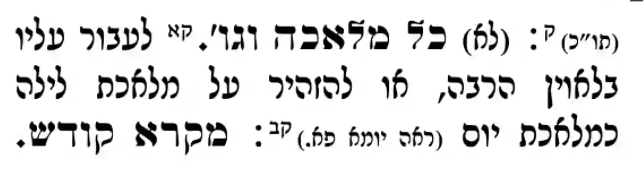
There is a disagreement among various editions of Chumash and Rashi on which מקרא קדש Rashi writes his comment. Logically, it belongs on Pasuk 27 which speaks about Yom Kippur. Rashi is telling us that the way you make Yom Kippur into a מקרא קדש is by wearing fine clothes and saying special prayers, and on other festivals, you observe them with food and drink, with clean clothing and with prayer.

This is the Artscroll Stone Chumash (Brooklyn 1993) which place the comment in Pasuk 27

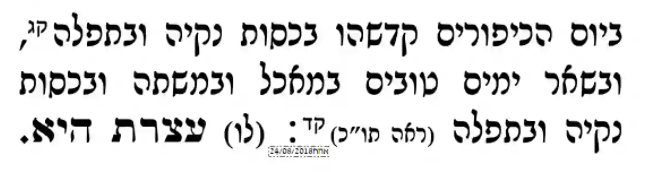
However, there are other Chumashim which do not place the comment in Pasuk 27, and wait until Pasuk 35 to record it. This means that Rashi is telling us that on Succot, we sanctify the day with nice clothing and prayer, and on other festivals, we add in food and drink. It seems to be quite illogical.

This is Chumash Habahir (Jerusalem 2005)

What is the source for recording Rashi’s comment on Pasuk 35?

It turns out that most Rashi manuscripts and early printed editions have it that way.

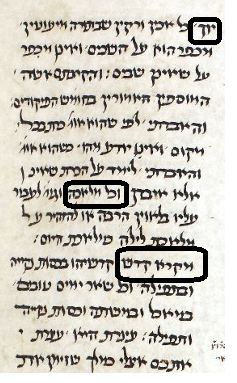
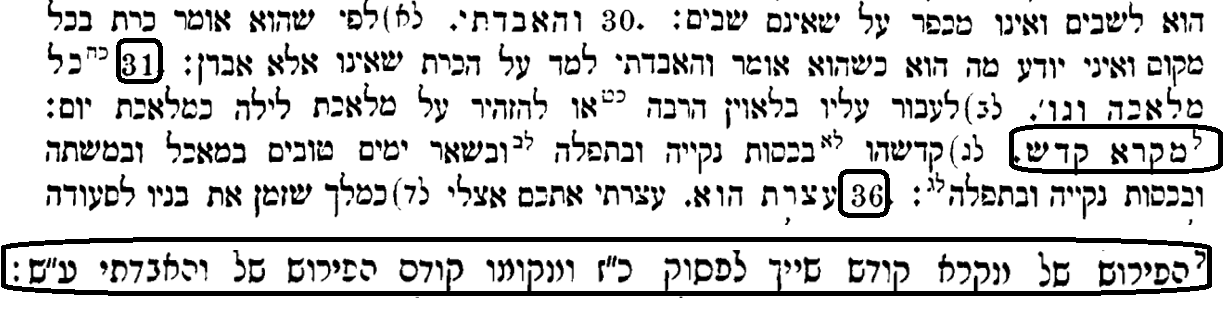
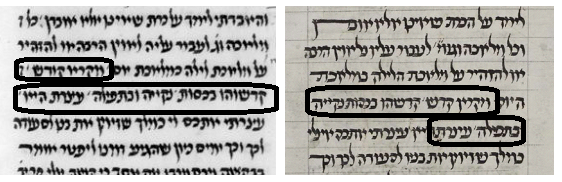
A good example is the authoritative manuscript Leipzig 1 which looks like this:[1]

The manuscript has the comment on the word “אַ֡ךְ” in Pasuk 27, followed by a few more comments continuing on to Pasuk 31, where a comment on the words “וכל מלאכה וגומ’” appears. This is followed by the comment on “מקרא קדש”. Those words only appear afterwards in Pasuk 35 meaning that Rashi wrote his words of “קדשיהו בכסות נקייה ובתפילה” as a comment on the festival of Sukkot.

The website Al Hatorah uses Leipzig 1 as its base text for Rashi, yet it positions this Rashi as a comment on Pasuk 27 which speaks of Yom Kippur. It notes though that this Dibur Hamatchil appears in Leipzig 1 and in other Eidei Nusach after the comment in Pasuk 31

דבור המתחיל זה מופיע בכ”י לייפציג 1 ובעדי נוסח אחרים לאחר הביאור על פסוק ל”א

I looked at many other manuscripts and found it to be true in the following 34 cases. I did not find one manuscript which had the comment on Pasuk 27

Oxford CCC 165 (Neubauer 2440), Munich 5, Hamburg 13, London 26917 (Neubauer 168) (1272), Paris 155, Berlin 121, Vatican ebr. 4, Vatican ebr.18, Vatican ebr.33, Vatican ebr. Vatican ebr. 94, Vatican ebr. 480, London 19665 (Margoliouth 174), London 22122 (Margoliouth 178) Oxford-Bodley Opp. 34 (Neubauer 186), Casanatense 2848 (1284), Berlin Qu 514 (1289), Florence Plut.III.03, Oxford Bodleian 69, Hamburg 32, Vatican urb. Ebr 1, Vienna codex Hebr. 220, Vienna Codex Hebr.3, London Harley 5708, Bavarian State Library, Cod.hebr. 148, HUC JCF 1(called Cincinnati 51), Paris 49, Paris 154, Parma 2708, Parma 3204 (DeRossi 181), Cambridge University Library, Ms. Add. 1828, Casantense 2988, and Sassoon 369.[2]

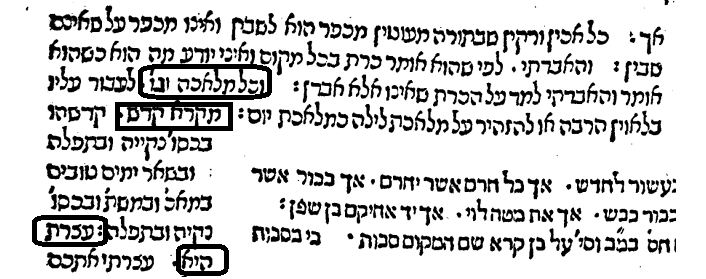
Most of the early printed editions of Rashi also have this comment on Pasuk 35. A good example is Rome 1470 where the comments on “וְהַֽאֲבַדְתִּ֛י” (pasuk 30) and “כׇּל־מְלָאכָ֖ה” (pasuk 31) precede that of “מקרא קדש” (presumably Pasuk 35)

The rest of the incunabula ( the 9 editions printed before 1500) present it that way except for Napoli 1492 where it is presented as part of Pasuk 27[3].

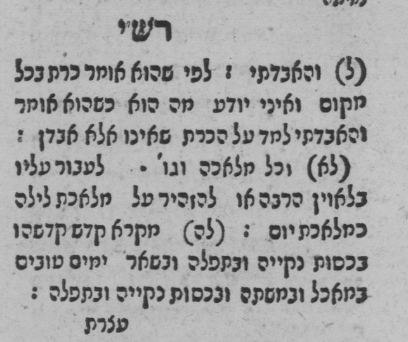
The most influential edition of the 16th century was the Bomberg Mikraot Gedolot Venice edition 1524-26 and it was recorded in the same manner. The comment on מקרא קדש comes after the comment on כָּל־מְלָאכָ֖ה of Pasuk 31, and before עֲצֶ֣רֶת on Pasuk 36. It is clearly assigned to מקרא קדש of Pasuk 35.

Many who analyzed Rashi’s work struggled with the issue of the manuscripts placing the comment on Pasuk 35, and logic dictating that it belonged on Pasuk 27. Chief amongst that group was the dean of supercommentators Rav Eliyahu Mizrachi (רא״ם)

He writes at first that logically Rashi is commenting on the words “מקרא קדש” which are written describing Yom Kippur (Pasuk 27)

שאין פירוש מקרא קדש האמור ביום הכפורי’ כפירוש מקרא קדש האמור בשאר ימים טובים כי פירוש מקרא קדש האמור ביום הכפורים הוא שתקדשהו בכסות נקייה ובתפלה לבד מאחר שאין בו אכילה ושתייה ופירוש מקרא קדש האמור בשאר ימים טובים הוא שתקדשהו באכילה ובשתייה ובכסות נקייה ובתפלה

“The interpretation of מקרא קדש on Yom Kippur is not the same as the interpretation of מקרא קדש on the other ימים טובים, because the interpretation of מקרא קדש on Yom Kippur is that you sanctify it with a nice clothing and prayer alone, since there is no eating or drinking on it, and the interpretation of the מקרא קדש on the other ימים טובים is that you sanctify it with eating and drinking, with nice clothing and prayer”

But Rav Eliyahi ran into the roadblock of the Girsa of all the manuscripts he had seen and it really bothered him

וגם בזה לבי נוקפי שהרי בכל הנוסחאות שראיתי בכולן כתוב הפירוש של מקרא קדש אחר הפירוש של והאבדתי ואחר הפירו’ של כל מלאכה

“But that makes my heart pound, because in all the Nuschaot I have seen, the interpretation of מקרא קדש is written after the interpretation of ” וְהַֽאֲבַדְתִּ֛י” (Pasuk 30) and after the interpretation of כָּל־מְלָאכָ֖ה ( Pasuk 31) .”

He nevertheless concludes that the comment belongs on Pasuk 27

אלא ע”כ לומר דהאי מקרא קדש שפיר’ בו הוא הכתוב ביום הכפורים שהוא משונה מכולם

“but rather one must say that this מקרא קדש, which is the one written on Yom Kippur, is the one which is different.”

Notice how he emphasizes that all the Nuschaot he has seen have it as the Dibur HaMatchil after “והאבדתי” (Pasuk 31) making “מקרא קדש” Pasuk 35. (regarding Succot)

However, there are a number of Rashi supercommentators who try to explain why this comment of Rashi does belongs after Rashi’s comments on Pasuk 30 and 31 (seemingly when it talks about Succot), such as Gur Aryeh( Maharal MiPrague 1512-1609).[4] The Yeriot Shlomo, which is a commentary on the Mizrachi by Maharshal (1510-1573), also addresses the issue.[5] Rav Shabtai Meshorer Bass places Rashi’s comment in Pasuk 35, and in his commentary Siftei Chachamim (Amsterdam 1680) advances this resolution:

 בכסות נקיה. והא דמהפך רש”י הקרא דמקרא קדש דהיה לו לפרש לעיל קודם פירוש והאבדתי וקודם כל מלאכה לא תעשו. וי”ל דלעיל לא יכול לפרש קדשהו בכסות נקיה וכו’ דלמא הא דכתיב מקרא קדש לאסור הלילה כיום לעניין עשיית מלאכה וכרת, אבל עכשיו דכתיב כל מלאכה לא תעשו שהוא מיותר ובא ללמד ולהזהיר על מלאכת לילה כיום ע”כ האי מקרא קודש בא ללמד על קדשהו בכסות נקיה וכו’

“Fine clothing. That which Rashi turned around the verse “מקרא קדש “? He should have explained it [where it first appears in verse 27] before explaining “והאבדתי ” and before ” כל מלאכה לא תעשו?” The answer is: He could not explain above” קדשהו בכסות נקיה,” because perhaps when it wrote ” מקרא קדש ” this was to make the night forbidden like the day regarding work and “.כרת”. But now that it is written ” כל מלאכה לא תעשו ” which is superfluous, it is to teach and warn that work is forbidden by at night as well as by during the day, therefore this ” מקרא קדש ” must be teaching that we ” קדשהו בכסות נקיה.”

How did Rashi’s comment on “מקרא קדש” fare throughout printing history?

As mentioned, 8 out of 9 incunabula placed the comment on Pasuk 35, as did Bomberg’s Mikraot Gedolot of 1524-26. Going forward, the same was true for Augsburg 1533, Bomberg 1548, Sabionetta 1557, Riva di Trento 1561, Cracow 1587, and Mantua 1589

In fact, most editions through the 19th century continued to place the comment in Pasuk 35. Clearly, they were following the manuscripts and the earlier printed editions. Examples of these were Hanau 1611-14‬‬‬‬, Amsterdam 1670, Amsterdam 1701, Venice 1702, Berlin 1703, Amsterdam Proops 1721, Livorno 1807, Ostroh 1827, Warsaw 1854, Vienna 186, Zhitomir 1867, and Vienna 1875

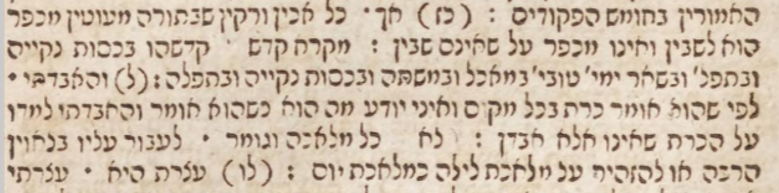
Here is Berlin 1703

The earliest more modern edition I could find the comment placed in Pasuk 27 was the 1787 Devek Tov Hamburg edition.

Another example is Furth 1812

Avraham Berliner in Zechor L’Avraham (Berlin 1867) does not assign a Pasuk number to it but records it after Pasuk 31. In note 30 he writes that it belongs in Pasuk 27, before the comment of והאבדתי which appears in Pasuk 30.

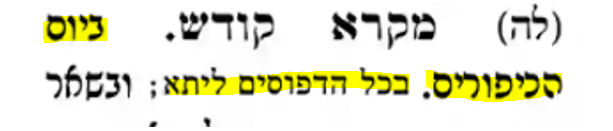
More recently, Oz Vehadar Rashi Mevuar of 2016 does not assign מקרא קדשׁ to Pasuk 35 but just to somewhere after Pasuk 31 but before Pasuk 36. It also adds the words ביום הכפורים to emphasize that the comment is made about Yom Kippur

However it admits that ביום הכפורים is not found in any early edition

Here is an example of the words “ביום הכפורים” appearing in parentheses

Malkah Shel Torah (Jerusalem 1990)

Chumash Torat Chaim (Jerusalem 1993) published by Mosad HaRav Kook maintains that it should be in the Yom Kippur section and places it in Pasuk 27, but admits that the manuscripts and early printed editions do not support this placement.

The Artscroll Elucidated Rashi, Siftei Yeshainim section (Rahway, NJ 2025) writes on this matter

שם: ד”ה מִקְרָא קֹדֶשׁ. בכמעט כל הנוסחאות (כ”י ודפוס, חדשים גם ישנים), דיבור זה כתוב להלן אחרי ד”ה “וכל מלאכה”, וא”כ לפי הסדר נראה שמוסב על פסוק לה (גבי סוכות). אבל לפי הענין נראה ברור שדברי רש”י מוסבים על יוה”כ, וכן כתב הרא”ם כאן, לכן כתבנו אותו כאן. וע’ בדברי המפרשים בפסוק לה.

Rashi Hashalem Mechon Ariel 2019) places it in Pasuk 35 but blames the incorrect placement on the mistake of printers.

Note: I believe it is difficult to assign blame to the printers after looking at all the manuscripts which placed the comment on Pasuk 35.

To summarize:

  1. Rashi made a comment regarding Yom Kippur that one sanctified it as a מקרא קדש through fine clothing and prayer, whereas other ימים טובים are sanctified additionally with food and drink.
  2. The comment of Rashi on מקרא קדש is clearly focused on Yom Kippur
  3. For some reason, all the manuscripts and early printed editions of the Chumash (except for one) place the comment of Rashi in the section dealing with Succot (Pasuk 35)
  4. Rav Eliyah Mizrachi says that logically the comment belongs in the Yom Kippur section (Pasuk 27) but notes that all the manuscripts have it in the Succot section ( Pasuk 35)
  5. Printers chose between three courses of action in terms of where they placed the comment.
  6. Place the comment in Pasuk 35 as it appears in all the manuscripts and rely on supercommentaries to explain why it is there.
  7. Place it in Pasuk 27 which speaks about Yom Kippur and where the comment seemingly belongs
  8. Place it in Pasuk 35 and, even though they appear in no manuscript, add the words ביום הכפורים with or without parentheses

The final word on this perhaps belongs to the Rashi scholar Dr. Aharon Ahrend, who wrote me

“I agree that once you examine many manuscripts, it strengthens the hypothesis that the original text was like the manuscripts. But we must always remember that we do not have Rashi’s own manuscript, and therefore when there is something strange, it can still be attributed to an error by an ancient copyist, from whom others copied.”

Notes

  1.  

    The website Al Hatorah includes this information on the manuscript named Leipzig 1

    “The popularity of Rashi’s Torah commentary and the tendency of medieval scholars and copyists to add to it their marginal glosses combined to create enormous variation between different manuscripts and editions of the commentary. As a result, it is often difficult to determine how Rashi’s original text read, and whether words, sentences, and even entire passages from the commentary, were written by Rashi himself or are merely later accretions… On this backdrop, the importance of the Leipzig 1 (Universitätsbibliothek Leipzig, B.H.1) manuscript of Rashi can hardly be overstated. This manuscript was written in the 13th century by R. Makhir b. Karshavyah, who states that he produced it from a copy of the commentary transcribed and annotated by Rashi’s own secretary, R. Shemayah. R. Makhir not only copied Rashi’s base commentary from R. Shemayah’s manuscript, but he also reproduced many of the marginal glosses contained in R. Shemayah’s text, a good number of which R. Shemayah explicitly attributes to Rashi himself. MS Leipzig 1 is, thus, an extremely valuable textual witness which comes tantalizingly close to the original source. In addition, its glosses shed significant light on Rashi’s thought processes and the development of his commentary.”

  2.  

    There were two manuscripts which had the comment after Pasuk 31, but left out the last part of it which is “וכל שאר ימים טובים”

    Paris 154 Berlin 1221

  3.  

    This is Napoli 1492. It perhaps indicates that there were manuscripts from which it took this Girsa which had it this way

  4.  

    גור אריה ויקרא כ”ג:ל”ו (Maharal Mi’Prague 1512-1609)

    https://hebrewbooks.org/pdfpager.aspx?req=42846&st=&pgnum=193

    קדשהו בכסות נקייה כו’. פירש רש”י דבר זה שלא במקומו אחר “כל מלאכה”, ועוד, דהוי ליה לפרש זה למעלה בחג המצות (פסוק ז). ויראה טעמו, דלמעלה לעולם כתיב איסור המלאכה אצל “מקרא קדש”, ויש לפרש “מקרא קדש” לקדש אותו שלא לעשות בו מלאכה, ובזה הוא מקודש, ו”מלאכת עבודה לא תעשו” פירושו ד”מקרא קדש”, שרוצה לומר בזה הוא קדש – “כל מלאכת עבודה לא תעשו”. אבל ביום הכפורים לא כתיב (בפסוק כז) “מקרא קדש” אצל המלאכה, על כרחך האי “מקרא קדש” מילתא אחריתי הוא, דלא איירי במלאכה, לכך פירש “מקרא קדש” ‘קדשהו כו’. לכך כאשר פירש כאן “וכל המלאכה וכו’ ”, הוקשה לו דלא כתיב “וכל מלאכה” גבי “מקרא קדש”, לכך פירש ד”מקרא קדש” אין פירושו שהוא קדוש ממלאכה, רק ‘קדשהו בכסות נקיה וכו”. אף על גב דהוי מצי לפרש זה על “וכל מלאכה” דלעיל (פסוק כח), אין זה קשיא, דלא פירש עליו מידי, אבל כאן (פסוק לא) פירש על “כל מלאכה” ‘לרבות כו”, פירש אחריו “מקרא קדש” ‘קדשהו כו”

  5.  

    יריעות שלמה ויקרא כ”ג:כ”ז -בד”ה מקרא קדש וכו’ דמה נשתנה וכו’ (רא”ם).

    https://hebrewbooks.org/pdfpager.aspx?req=67451&st=&pgnum=142&hilite=

    ולא הוצרך לומר זה, דבלאו הכי אי אפשר לומר שה’מקרא קדש’ הזה שפירש בו, הוא הכתוב בחג הסוכות (פסוק לה), דאם כן למה נחלק חג הסוכות משאר ימים טובים לענין מאכל ומשתה.

    ואפשר דלכך פירש”י מקרא קדש (פסוק לה) אחר שפירש קרא דכל מלאכה וגו’ (פסוק לא), משום דבזולת זה אפשר לפרש מקרא קדש האמור ביום הכיפורים (כאן) לענין איסור עשיית מלאכה אפילו אוכל נפש, מה שאין כן בשאר ימים טובים דמותרין במלאכת אוכל נפש לכן מפרש זה אחר קרא דכל מלאכה וגו’. כן נראה לי


‘And How Can One Behold a Sefer Torah in Distress?’ On the Relationship between Rabbi Chaim Heller and Rabbi Joseph B. Soloveitchik

‘And How Can One Behold a Sefer Torah in Distress?’

On the Relationship between Rabbi Chaim Heller and Rabbi Joseph B. Soloveitchik

by Aviad Hacohen and Menachem Butler


This article, published on the occasion of the anniversaries of the passing of Rabbi Chaim Heller (14 Nisan 5720) and Rabbi Joseph B. Soloveitchik (18 Nisan 5753), may their memories be a blessing, reexamines their relationship through a newly published body of correspondence, situating their bond within the intellectual and material conditions of mid-twentieth-century American Orthodoxy.[1] The letters document both a relationship of unusual personal and scholarly closeness and the economic precarity and institutional instability that affected even leading Torah scholars of the period.

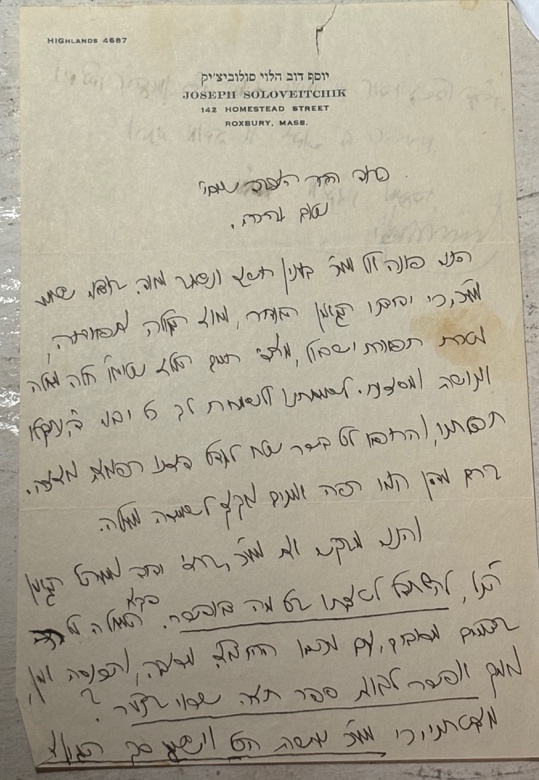
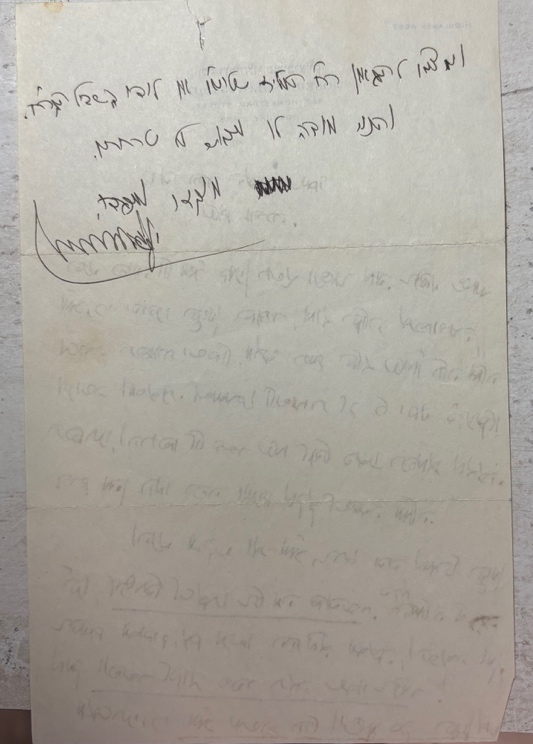
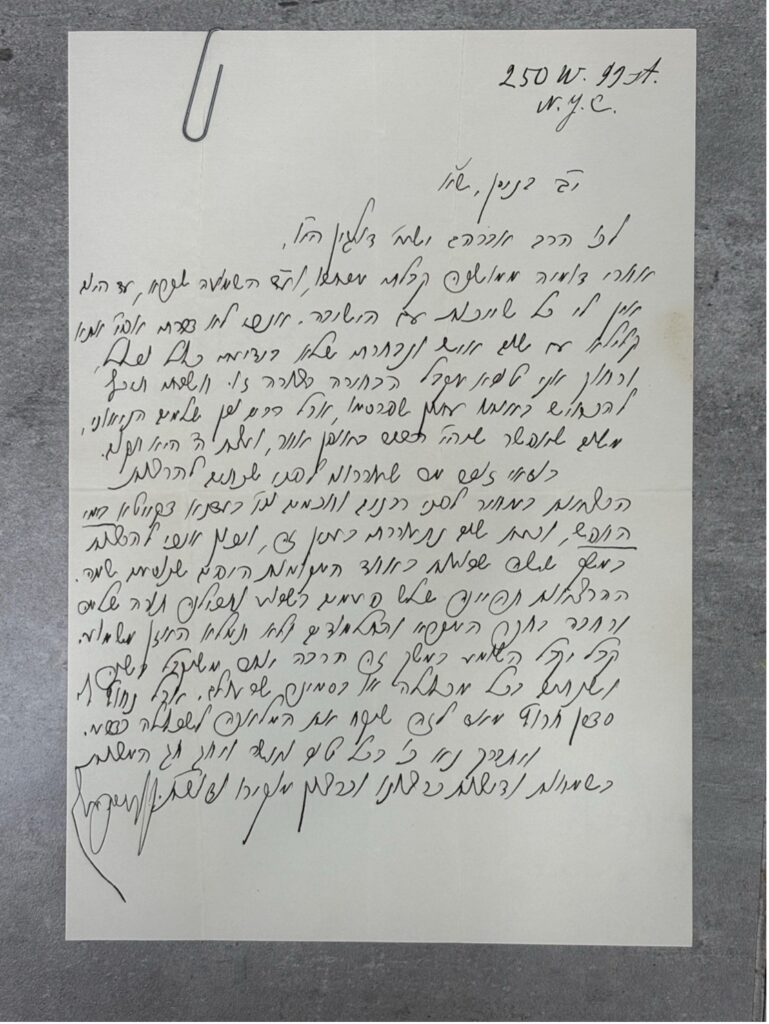
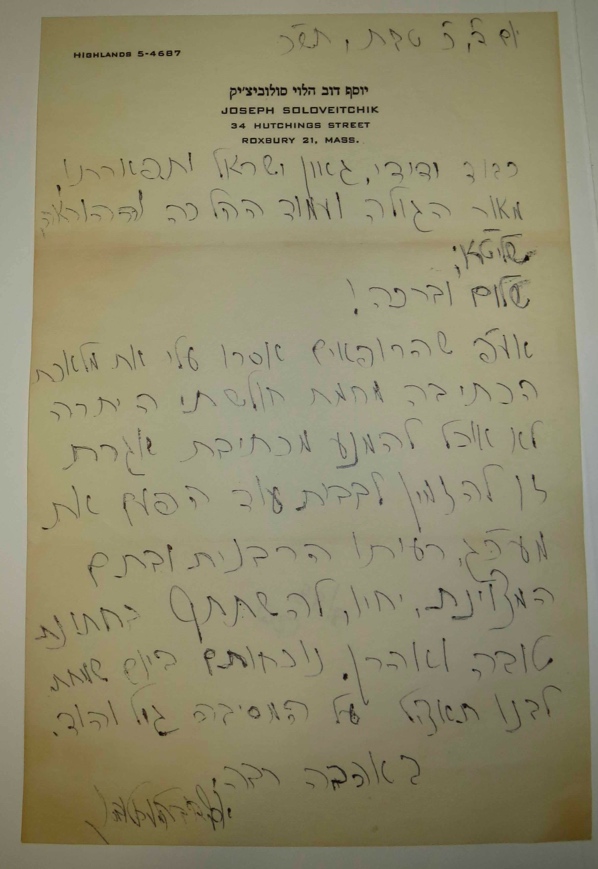
One such document, written by R. Soloveitchik in 1942 at a moment of acute crisis, reads as follows:

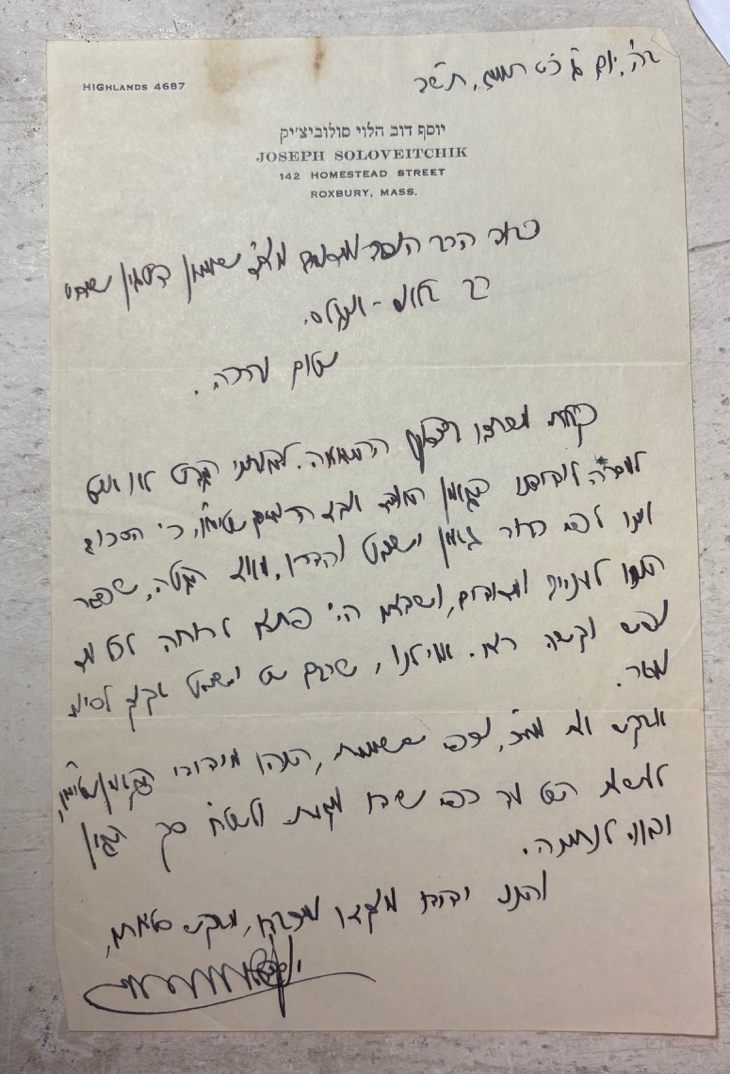
“Your esteemed honor has surely heard that our friend, the great and mighty gaon, luminary of the Diaspora and its glory, the crown of Israel’s splendor, our teacher and master Rabbi Chaim Heller, may he live long, has fallen gravely and dangerously ill. To our joy, and to the joy of all who fear God, our prayers have been accepted, and the Healer of all flesh has sent recovery and healing to the great one of our generation. Yet he remains weak and requires exceptional care. I therefore request of your esteemed honor, as a friend of the aforementioned gaon, to exert yourself on his behalf in every possible way. The supervision of the illness has entailed great expense, and even now the outlay is considerable while there is no income – and how can one behold a Sefer Torah in distress? I am confident that your esteemed honor will do all that is necessary, secure a fitting sum, and deliver it to the gaon R. H. Heller, may he live long, or to the fund ‘For R. H.’ I thank him in advance for his efforts. Your admirer and one who honors you.”[2]

In this letter, Soloveitchik addressed his friend Rabbi Simon (Abraham Yeshayahu) Dolgin,[3] then rabbi of Congregation Beth Jacob in the Beverly Hills neighborhood of Los Angeles, where he would serve for more than three decades and build one of the most significant Orthodox communities on the American West Coast. Upon receiving the appeal, Dolgin promptly sent a contribution; it appears, however, that its amount did not meet Soloveitchik’s expectations.

In a subsequent letter of appeal sent to Rabbi Dolgin approximately one month later [=14 July 1942], R. Soloveitchik again wrote:

“I received your letter together with the check. To my great regret I cannot deliver it to our friend, the great gaon, the mighty shepherd, may he live long, for the sum is not commensurate with the honor and majesty of a gaon of Israel, a luminary of the Diaspora, who dispersed his wealth to the poor and destitute, and whose home was open wide to all who were embittered and broken in spirit. Woe unto us, that the rabbi of Israel stands in need of aid and assistance. I request of your esteemed honor – who, as I have heard, is among the friends of the aforementioned gaon – to do all that lies within your power and to send a proper and worthy sum.”

The letters published here for the first time provide a rare window into the distinctive relationship, a bond of unusual personal and intellectual intimacy, and the enduring ties that prevailed for decades between two of the leading Torah scholars in the United States in the twentieth century. At the same time, they illuminate the manifold hardships, including acute financial privation, humiliation, and disappointment, that rabbis of that period were compelled to endure as they sought even minimal means of livelihood with which to sustain their households. This fate did not spare even one of the foremost sages of the generation, R. Chaim Heller, who, in order to support his family, was compelled to piece together sporadic and temporary sources of income until he eventually attained, albeit only in relative terms, a measure of stability and a settled position that afforded him and his family a degree of economic security.[4]

Beyond their intrinsic interest, these letters are of particular importance by virtue of the period in which they were written. They date to the years of the Second World War, from which very little of Rabbi Joseph B. Soloveitchik’s correspondence has survived.

Already in these early letters, the literary Hebrew of R. Joseph B. Soloveitchik and his distinctive stylistic register stand out prominently.[5] They attest both to the profound bond between the two scholars and to R. Soloveitchik’s sustained concern for the welfare of his colleague and intimate friend, R. Chaim Heller. Their connection began years earlier in Berlin.

R. Chaim Heller (1879-1960) was among the leading Torah scholars of the early twentieth century. Alongside his greatness in Torah, he was deeply engaged in the scholarly study of Talmudic literature and biblical translation.[6] His work was characterized by a distinctive methodological orientation that sought to challenge the prevailing assumptions of modern biblical criticism through philological rigor grounded in the resources of the rabbinic tradition. In his introduction to On the Jerusalem Targum to the Torah (New York, 1921), R. Heller sharply criticized what he termed the “mechanical method” of comparing ancient translations in order to posit divergent textual recensions. Against this approach, he argued that the multitude of so-called “variants” in translations such as the Peshitta, the Septuagint, and the Samaritan Pentateuch do not reflect alternative Hebrew originals, but rather systematic exegetical practices. In his view, the translators did not render the biblical text literally, but interpreted and expanded it in light of traditions preserved in Hazal. This thesis enabled him simultaneously to undermine the conclusions of contemporary critics and to reaffirm the centrality and antiquity of the Oral Torah as an interpretive matrix for Scripture.[7]

This distinctive synthesis of traditional learning and critical scholarship was already prefigured in the formative trajectory of his early life. Born in Białystok and raised in Warsaw, he was already in his youth known as “the prodigy of Warsaw.” From the age of ten he ceased studying with melammedim; he never attended a yeshiva and acquired his entire Talmudic learning independently, as an autodidact. He married the daughter of a wealthy member of the Łódź community, and in the home of his uncle in Warsaw encountered the leading sages of the generation, engaging them in rigorous dialectical discussion. Among them were R. Yosef Dov Soloveitchik, author of Beit ha-Levi; R. Isaac Elchanan Spektor of Kovno; and the Netziv of Volozhin. During these years he also formed especially close ties with R. Chaim Soloveitchik, his relative by marriage R. Eliyahu Feinstein of Pruzhany, and R. Eliyahu Chaim Meisel of Łódź. In later years, he received a doctoral degree from the University of Würzburg.

Following the death of Rabbi Malkiel Tzvi Tannenbaum, the community of Łomża was left without a rabbi, and its leaders resolved to appoint Rabbi Heller, already known as a sharp and penetrating scholar and a man of broad learning who held a doctoral degree. By that time he had published studies on the Septuagint and on Maimonides, which drew the respect of both rabbinic and academic circles. Yet after only a few months he resigned his post. Various explanations have been offered for his departure: some point to his reluctance to devote extensive time to communal responsibilities, which he regarded as bittul Torah, while R. Joseph B. Soloveitchik recounted that Rabbi Heller himself expressed concern that members of the congregation might pressure him to act against his convictions.

R. Heller soon left for Berlin, where, in 1922 he established the Beit Midrash ha-Elyon, an advanced institution for rabbinic training that drew a small but serious circle of students. Berlin at the time was a meeting ground of worlds, traditional learning and modern scholarship, and Heller moved between them with unusual authority. In R. Heller’s case, this was not merely a sociological juxtaposition but a fully integrated intellectual stance, in which Wissenschaft methods were appropriated and redirected in defense of the integrity of the Masoretic text and the authority of the Oral Torah.[8] It was there that the young R. Soloveitchik spent several formative years. He was not formally enrolled in the institution, but he attended Heller’s lectures and was deeply influenced by them. What impressed him was not only R. Heller’s mastery of Torah and scholarship, but the range of his mind – the sense that he inhabited both disciplines fully, without strain or concession.

In 1929, R. Chaim Heller was appointed as a Visiting Professor of Bible at RIETS,[9] and “for close to ten years Heller taught in New York while occasionally traveling to Berlin and elsewhere before settling in the United States.” More than a decade later, his name was even floated by Rabbi Dr. Leo Jung as a potential successor as Rosh Yeshiva of RIETS following the death of R. Moshe Soloveichik in 1941.[10] A contemporaneous portrait of Heller’s intellectual profile appears in a 1930 article by R. Yerahmiel Elimelekh (Max J.) Wohlgelernter in the ha-Pardes journal, in which R. Heller is presented not merely as a scholar of unusual range, but as a figure who entered directly into confrontation with modern biblical criticism on its own terms, armed with philological expertise yet grounded in the authority of the rabbinic tradition. Against what R. Wohlgelernter characterizes as the “mechanical” methods of contemporary critics, R. Heller is depicted as demonstrating that the multiplicity of textual variants in ancient translations reflects interpretive practice rather than divergent textual recensions, thereby reasserting the integrity of the Masoretic text and the centrality of the Oral Torah as its interpretive matrix.[11]

In 1937, several years after the rise of the Nazis to power and the intensification of anti-democratic measures directed especially against the Jews, R. Chaim Heller emigrated to the United States and settled in New York. That same year, R. Moshe Feinstein likewise arrived in New York. During this period, R. Heller renewed his connection with R. Joseph B. Soloveitchik, who had come to the United States some five years earlier at the urging of his father, R. Moshe, then Rosh Yeshiva of the Rabbi Isaac Elchanan Theological Seminary. In Boston, R. Joseph B. Soloveitchik led his community with distinction and, alongside his teaching, increasingly assumed a position of broader intellectual and religious leadership, establishing himself as a central figure for a growing circle of students and adherents.[12]

Despite this recognition of his intellectual stature, the conditions that Heller encountered upon his arrival in the United States were markedly different. Like many rabbis who fled Germany on the eve of the Second World War and arrived in the United States as refugees,[13] R. Chaim Heller entered a professional landscape that was structurally inhospitable. The lingering effects of the Great Depression continued to constrain both the rabbinic and academic labor markets.[14] Congregational positions, even in smaller and more remote communities, were typically occupied by long-established incumbents, while the few available posts offered only modest remuneration. Universities, for their part, were in a period of contraction, with limited hiring and little institutional appetite for figures whose scholarly profile did not align neatly with existing departmental frameworks. For a scholar of Heller’s unusually wide and interdisciplinary range, no obvious institutional niche presented itself.

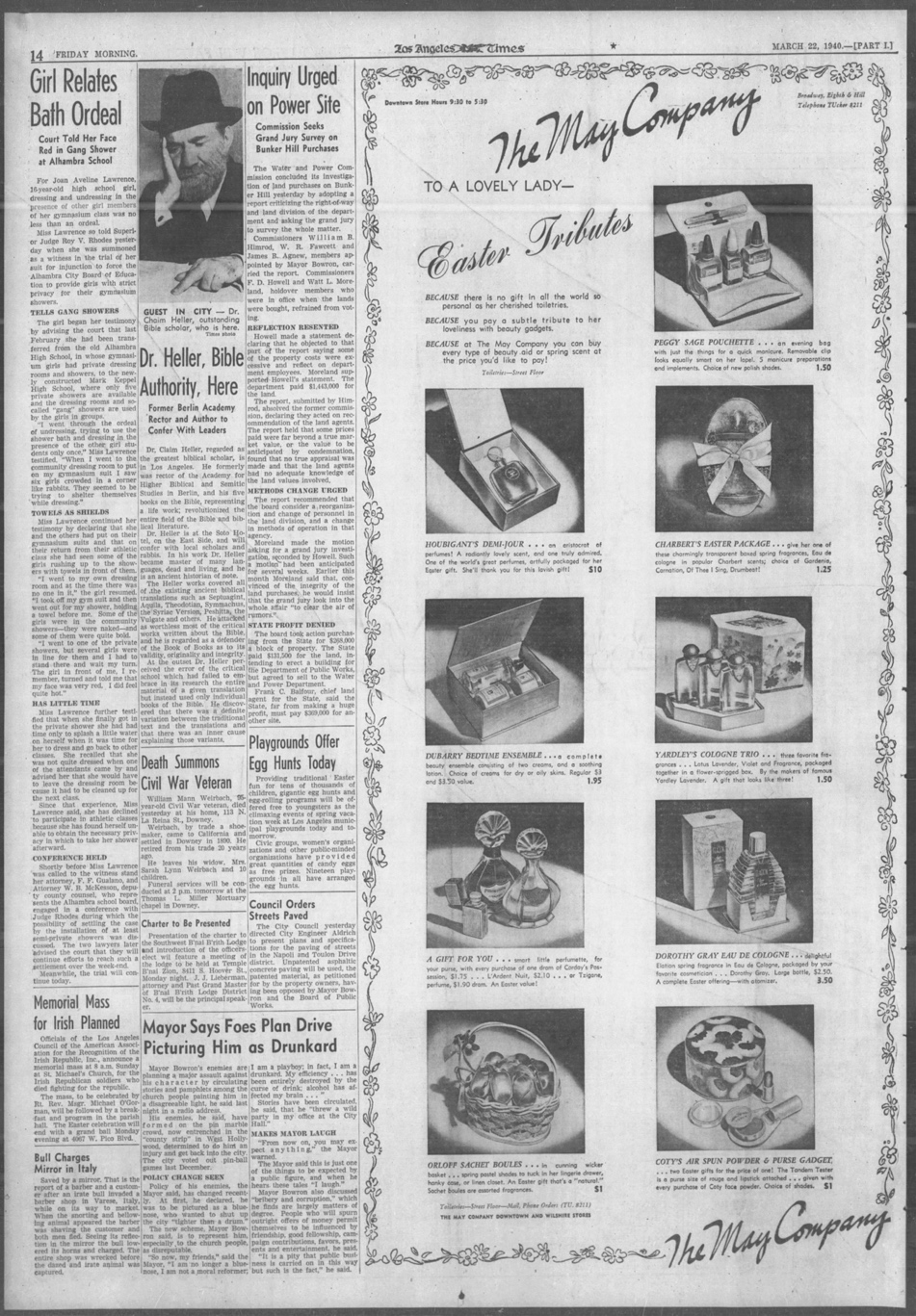
In response, Heller adopted a peripatetic mode of intellectual livelihood. Lacking a stable appointment, he supported himself through public lectures, assembling an income that remained precarious and contingent. This required sustained mobility, persistence, and a readiness to engage even relatively small audiences. At one stage, this itinerant circuit took him as far as Los Angeles, a journey that, under the conditions of the time, entailed considerable logistical and physical demands, where he delivered a series of lectures in his areas of expertise. It was likely in the course of this visit that he first encountered Rabbi Dolgin.

The notice of R. Chaim Heller’s arrival in Los Angeles appeared in the Los Angeles Times, March 22, 1940.

It may be assumed that, in the wake of this visit, the relationship between the two was further strengthened. Expression of this is found in three letters written during those years by R. Chaim Heller to R. Dolgin, which are published here for the first time.


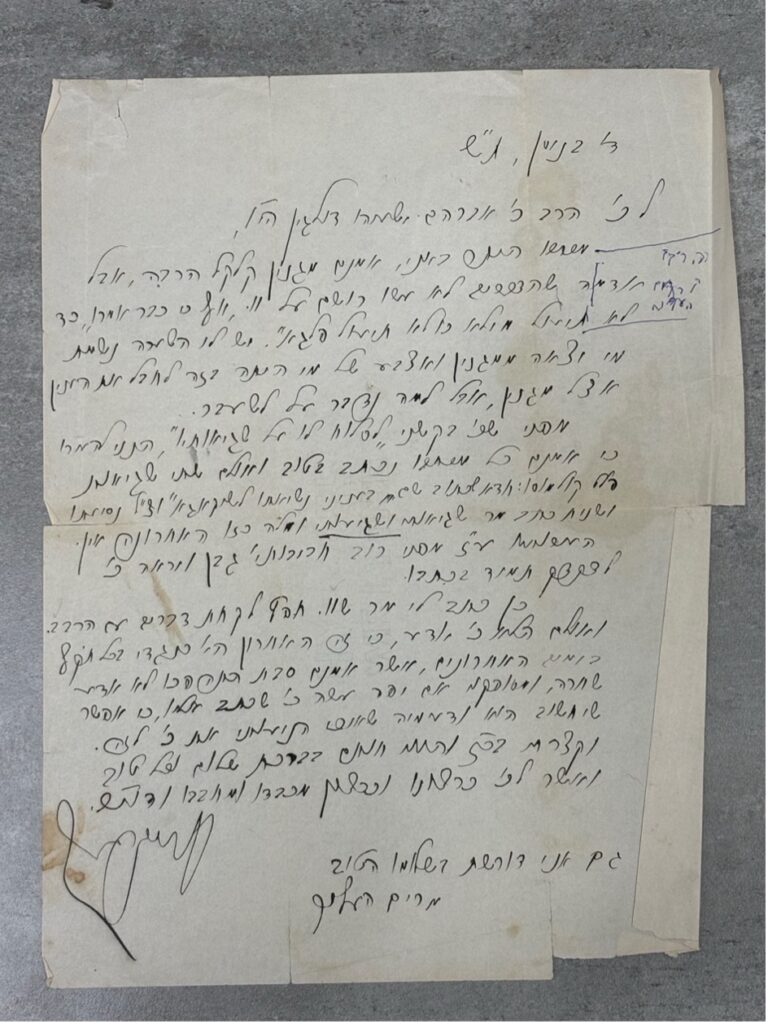
The first letter is dated 4 Nisan 5700 [= 12 April 1940], a short time, approximately three weeks, after R. Chaim Heller’s arrival in Los Angeles. It reads as follows:

“To the honorable Rabbi Abraham Isaiah Dolgin, may he live long: Your esteemed letter has reached me. Although Magnin[15] caused considerable damage, it seems to me that his words made no impression upon ploni, notwithstanding the saying, ‘When a word cannot enter in its entirety, it enters in part.’[16]

I have a conjecture as to whose soul spoke through Magnin, and whose finger was involved in undermining the matter there, but why should we speak of what has passed.

Since Your Honor requested of me “to forgive him for his errors,” I hereby note that, indeed, your entire letter was written well; however, two errors slipped from your pen: first, that you wrote also “concerning the matters of his נשיאתו (nesi’ato, ‘his presidency/bearing’) to Chicago,” whereas it should read נסיעתו (nesi‘ato, ‘his travel’); and second, that you wrote שגיאותי ושגיעותי (shegiyotai, ‘my errors’), and such a latter form does not exist.

I have drawn his attention to this out of my great affection for him,[17] and your honor should take care to be precise in his writing. You also wrote to me that Mr. Sh. desires to discuss matters with Rabbi B. [Bernard Revel[18]]; however, your honor knows that the latter has recently opposed me with full force, though I do not know the cause of his reversal,[19] and I am uncertain whether your honor acted wisely in writing to him, for he and those associated with him may think that I prompted your honor to do so. I have been brief in all this, and I conclude with blessings of peace and all good to your honor, according to your will and the will of one who esteems and cherishes you, and who inquires after your welfare.

Chaim Heller”

In the margin of the letter, his wife added a brief greeting of her own: “I too inquire after his welfare. Miriam Heller.”

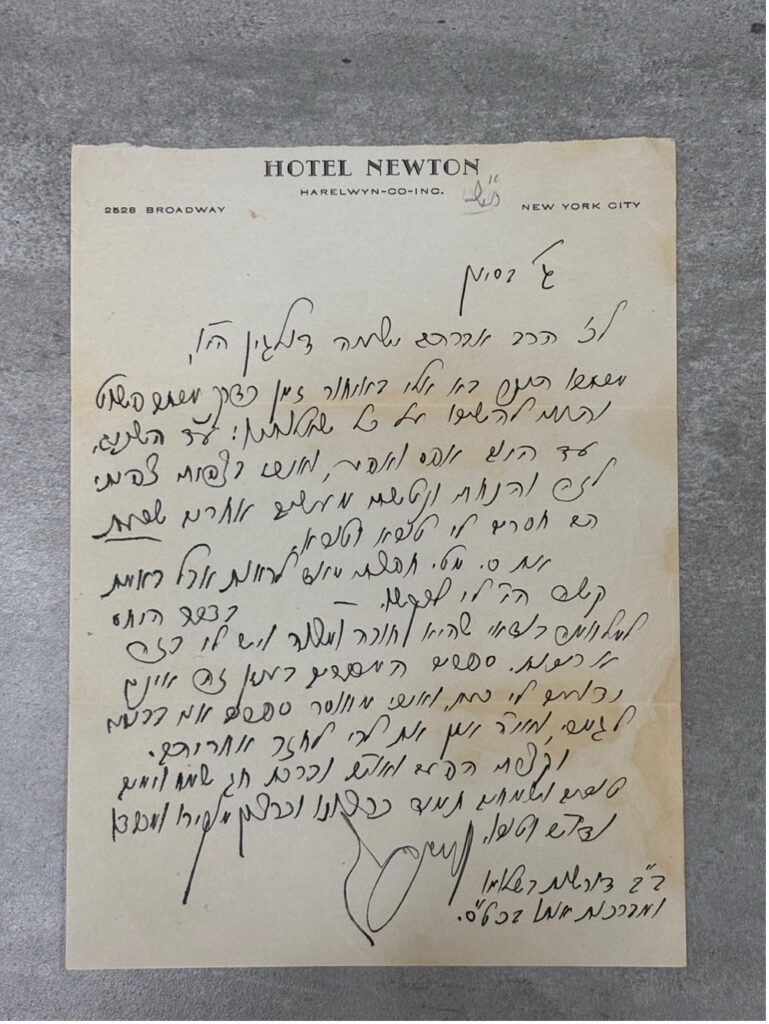
The second letter was written approximately two months later, on the eve of the festival of Shavuot, in which R. Chaim Heller gives expression to his frustration that promises made to him, apparently concerning the provision of a stable source of livelihood, had not been fulfilled. It reads as follows:

3 Sivan [5700] [9 June 1940]

To the honorable Rabbi Abraham Isaiah Dolgin, may God preserve and sustain him,

Your esteemed letter reached me with delay, as is the way of ordinary post, and I shall respond to all your inquiries: regarding the matter of the years [?], up to this day there is nothing whatsoever, and I had indeed waited and hoped for this, and accordingly set aside and abandoned other undertakings which I now lack greatly – very greatly.

I very much wished to meet with […], but in truth it was difficult for me to request this.

Concerning the attitude toward the war,[20] it is certainly an obligation and a commandment, and I have much to elaborate on this matter. Books addressing this subject are not presently known to me, for I am entirely without books in my home; with God’s help, I shall set my mind to seeking them out.

I shall be brief this time. With blessings for long life, a joyous festival, and days of gladness always, in accordance with your will and the will of one who esteems and honors you, who inquires after your welfare and goodness.

Chaim Heller

[p.s.] My wife and daughters inquire after your welfare, and bless you with every good, selah.

The third letter was written approximately a year later, on the eve of Passover 5701. At that time, reports in the press in the Land of Israel[21] indicated that R. Heller was about to receive a teaching appointment at Yeshiva University alongside his colleague R. Joseph B. Soloveitchik. Having grown accustomed to disappointment, R. Heller feared that this announcement amounted to no more than a “trial balloon” lacking any concrete foundation. This apprehension, together with his distress at both the substance and the tone of the report, found expression in a letter he addressed to R. Dolgin:


“12 Nisan 5701 [9 April 1941]

To the honorable Rabbi Abraham Isaiah Dolgin, may God preserve and sustain him,

After a long period of silence while confined to bed, I received your letter. Concerning the report that you read: to this day I have no connection whatsoever with the yeshiva.[22] I have not spoken even a word – however slight[23] – with any person, and I was selected entirely without my knowledge; indeed, I am far removed from accepting an appointment in such a manner. I immediately considered issuing a denial in the very newspaper that published the report, but many worthy individuals dissuaded me, on the grounds that matters might yet develop otherwise, and that the counsel of the Lord shall prevail.”

In this connection, he related to his friend his deliberations regarding an additional source of livelihood – delivering lectures to vacationers in the Catskill Mountains during the summer months:

“You surely recall that two years ago I was approached to deliver lectures, for remuneration, before rabbis and scholars, etc., during the summer season (be-idna de-qayta), in the vacation period; and now this matter has again been raised, and I am prepared to lecture for six weeks in one of the pleasant locales to which people travel.

The lectures would be held three times a week and would encompass a comprehensive and wide-ranging treatment of biblical scholarship and the Talmuds, such that ‘the ear would not be sated with hearing’.[24] Over this period, the listener would gain far more than he would in a year or two at any college or seminary in the world. However, I require a highly energetic organizer who will undertake to arrange this enterprise properly. May your honor be blessed with all good and prosperity, and may you celebrate the Festival of Unleavened Bread with joy and delight.”

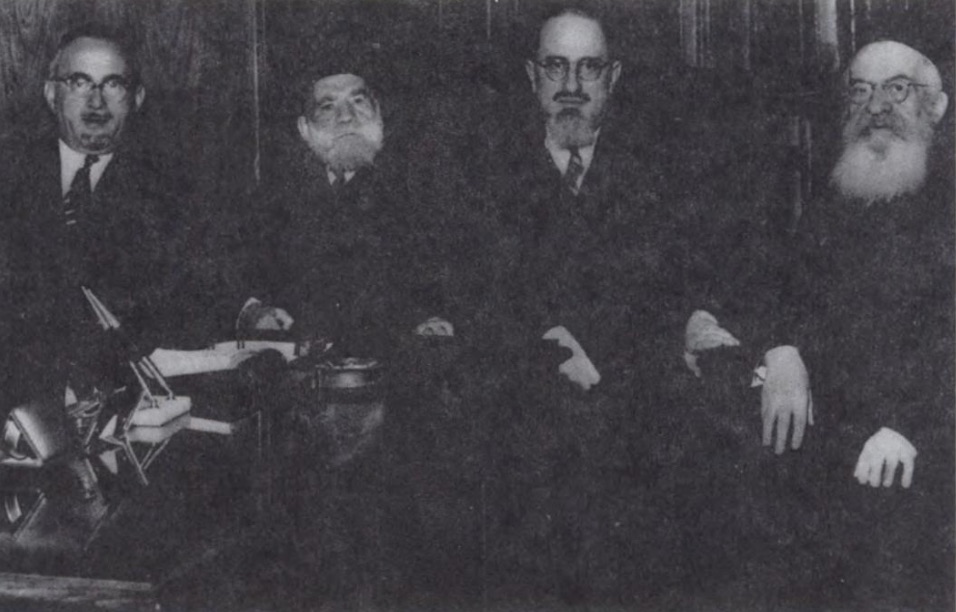
After several years in the United States, during which he lacked a stable source of livelihood, R. Chaim Heller secured a position on the teaching staff of Yeshiva University and served alongside his colleague R. Samuel Belkin, R. Joseph B. Soloveitchik, and R. Moshe Shatzkes on the RIETS Ordination Board.[25]

Screenshot

Yet, as emerges from a letter cited below, his salary conditions remained far from favorable. Efforts were made to improve them and, over time, met with a measure of success. The literary oeuvre of R. Chaim Heller is vast in scope. Yet, as R. Joseph B. Soloveitchik would later describe in his eulogy, what was published only represents only a minute fraction, “mere remnants of remnants,” of the breadth of his orally transmitted Torah. It should also be borne in mind that the overwhelming majority of his writings were composed prior to his arrival in the United States.

Among his works in the field of biblical scholarship, particular note should be taken of his studies on the textual tradition of the Bible and its various translations: his work on the Jerusalem Targum to the Torah (New York, 5681 [1921]); on the Samaritan Pentateuch (Berlin, 5684 [1924]); on the Septuagint in the Concordance Heikhal ha-Qodesh, with appended notes, commentaries, and investigations in biblical studies (New York, 5704 [1944]); and on the Peshitta, the Syriac translation of the Bible (transcribed into Hebrew script, with notes, glosses, and commentaries by Chaim Heller: Genesis, Berlin, 5687 [1927]; Exodus, Berlin, 5689 [1929]). He prepared a revised edition of the Peshitta to Exodus for publication but did not succeed in completing its printing prior to his death. Among his halakhic works, his annotated edition of Maimonides’ Sefer ha-Mitzvot (first edition, Piotrków, 5674 [1914]) is well known. A subsequent edition of this work was published by Mossad HaRav Kook in Jerusalem (5706 [1946]) – and has since appeared in numerous further editions – and for this work he was awarded the Rav Kook Prize in 5707 [1947]. His writings also include Hiqrei Halakhot, analytical investigations of legal rulings and issues in the section Hoshen Mishpat (vol. I, Berlin, 5684 [1924]; vol. II, Piotrków, 5692 [1932]); as well as studies on various topics in Maimonides and the halakhic decisors concerning the laws of lending and borrowing and their ancillary matters (Chicago, 5706 [1946]). In addition, he published, in jubilee and memorial volumes, several qontrasim that functioned as a kind of Masoret ha-Shas for the Jerusalem Talmud.[26]

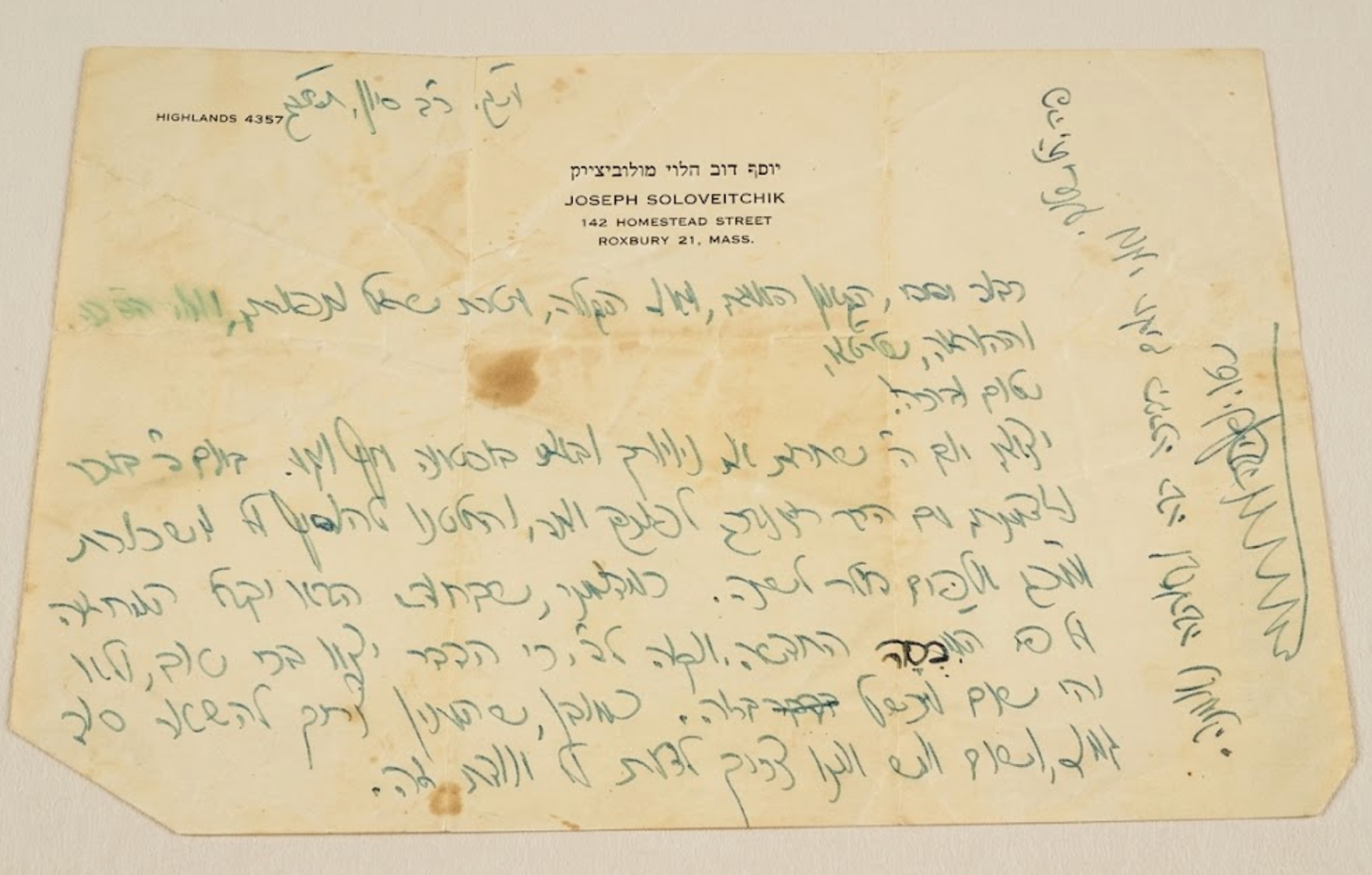
Even after R. Chaim Heller had joined the faculty of Yeshiva University, R. Joseph B. Soloveitchik continued to seek ways to assist him, inter alia by working to secure an increase in his salary. Expression of this may be found in a brief letter that he wrote to R. Chaim Heller on 23 Sivan 5713 (5 June 1953), which is likewise published here for the first time:

Erev Shabbat, 22 Sivan 5713 [5 June 1953]

To my honored friend, the true gaon, luminary of the Diaspora, crown of Israel and its glory, pillar of halakhah and instruction, may he live long,

Greetings and blessings!

I departed New York on Thursday morning and arrived in Boston utterly exhausted. On the preceding Wednesday I met with Rabbi Rosenberg at a certain inn, and we resolved to add two thousand dollars annually[27] to your honor’s salary. It seems to me that next month you will receive a check in accordance with the new scale. We trust in God that the matter will be brought to a good conclusion and that no obstacle will arise in connection with it. Naturally, the matter must remain in absolute confidence, and no one need be informed of it.

I conclude with abundant blessing and faithful affection,

Joseph Dov HaLevi Soloveitchik[28]

This quiet intervention on Heller’s behalf was not an isolated act, but part of a sustained pattern of concern. In this connection, it is instructive to recall R. Aharon Lichtenstein’s characterization of R. Joseph B. Soloveitchik, in his eulogy. Reflecting on his father-in-law’s own self-understanding, he writes:

“The personal self-conception that characterized the Rav, of blessed memory, with respect to his own functioning was bound up with educational–pedagogical activity, and this across multiple spheres. He would often remark that when he arrived in the World of Truth, and were he to be asked to specify by virtue of what he merited a share in the World to Come, he would indicate three points: (a) that he studied Torah with his children; (b) that he founded the Maimonides School in Boston; (c) that he was concerned, over an extended period, for the honor and welfare of a certain talmid hakham.”[29]

This final point refers to R. Soloveitchik’s sustained and well-documented efforts on behalf of R. Chaim Heller. The depth of this personal concern was not confined to the private sphere, but found parallel expression in a sustained intellectual and institutional collaboration between the two. A further expression of their bond and cooperation is found in their joint letter of response to Israeli Prime Minister David Ben-Gurion, who in 1958 approached them, among other “Sages of Israel,” to solicit their opinion on the question “Who is a Jew?” Although the inquiry was addressed to each of them separately, the two resolved to compose a joint reply. Thus they wrote, inter alia:

“We are indeed perplexed that the State of Israel now seeks to hew down our traditional branches and thereby smear the ancient glory of Israel which has long been sanctified through the spilt blood and sufferings of preceding generations. It is only because of these roots that we preserve our uniqueness as a holy people and that we are inextricably bound to the Holy Land. … Will the present State of Israel be built up by (maintaining a threat of) destruction to its very sanctity?”[30]

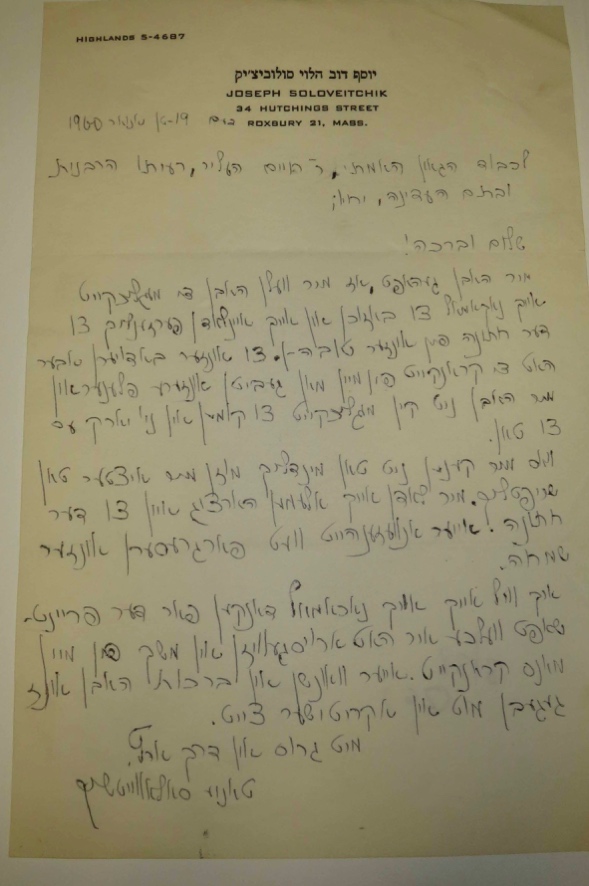
The same bond found further expression in another brief letter issued by R. Joseph B. Soloveitchik some two years later, likewise published here for the first time. The occasion for its dispatch was the forthcoming wedding of R. Joseph B. Soloveitchik’s daughter, Tova, to Rabbi Dr. Aharon Lichtenstein, his most distinguished student.

In September 1959, a small notice appeared in the “Announcements” column of The Commentator, the student newspaper of Yeshiva University, reporting the engagement of Dr. Aharon Lichtenstein, a member of the class of 1953, to Tova Soloveitchik. It appeared alongside advertisements for driving instruction and for Barton’s confectionery (under OU supervision).[31]

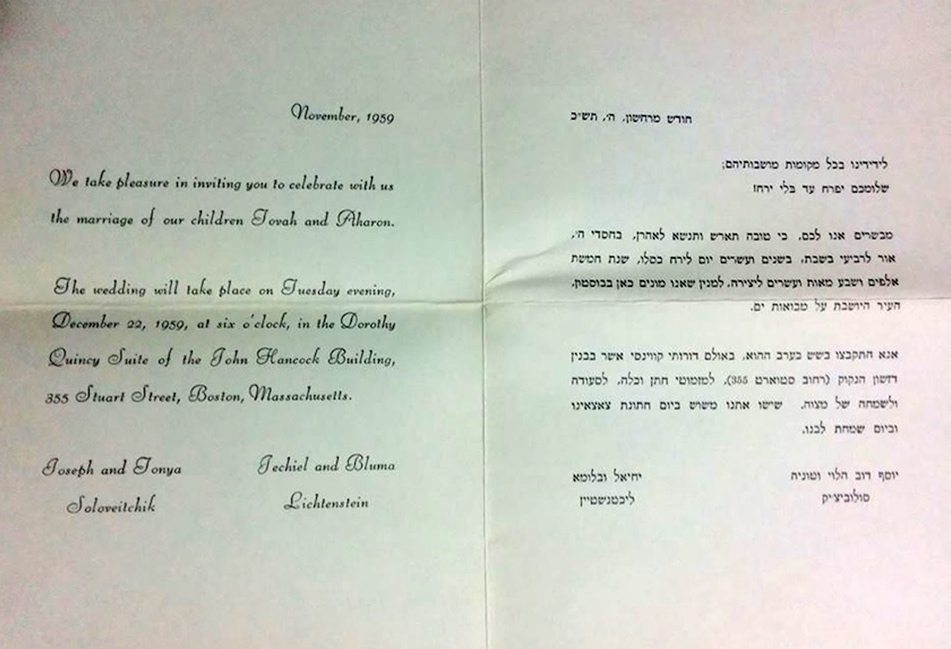
Approximately a month and a half later, in November 1959, the parents of the couple sent a formal invitation to family members and acquaintances. The Hebrew text was ornate, replete with distinctive idioms, and clearly bore the imprint of R. Joseph B. Soloveitchik’s unique stylistic signature:

“To our friends in all their places of residence – may your peace flourish without end! We hereby inform you that Tova shall be betrothed and married to Aharon, with the grace of God, on the evening preceding the fourth day of the week, on the twenty-second day of the month of Kislev, in the year five thousand seven hundred and twenty from Creation, according to the reckoning we follow here in Boston, the city situated at the approaches of the sea. Pray assemble at six o’clock on that evening in the Dorothy Quincy Hall, in the John Hancock Building (355 Stuart Street), for the celebration of bride and groom, for the festive meal, and for the joy of a commandment. Rejoice with us in the joy of our offspring’s wedding day and in the gladness of our hearts. Joseph Dov HaLevi and Tonya Soloveitchik; Yechiel and Bluma Lichtenstein.”

By contrast, the English version was brief, formulated in a more formal and utilitarian manner. The period during which the invitations were sent was one of particular intensity in the Soloveitchik household. At that time, R. Soloveitchik received an informal invitation to put forward his candidacy for the position of Chief Rabbi of Israel[32]; concurrently, he was engaged in intensive preparation for the major eulogy for his uncle, the Griz, R. Yitzhak Ze’ev Soloveitchik, later known as the discourse “Mah Dodekh mi-Dod.”[33]

תמונה שמכילה טקסט, נייר, מכתב, ספר תוכן בינה מלאכותית גנרטיבית עשוי להיות שגוי.

On account of the mention of his name as a candidate for the office of Chief Rabbi, an extensive journalistic interview with R. Soloveitchik was conducted in Yedioth Ahronoth.[34] The interviewer, Elie Wiesel (later a Nobel laureate), reported that, following the Rav’s annual Teshuvah Derashah several months earlier, the Israeli consul general in New York had sent a telegram to Jerusalem declaring: “Here is the best candidate to replace Rabbi Herzog.”[35] Wiesel asked R. Soloveitchik whether he would agree to assume the position if it were offered to him. R. Soloveitchik replied that no such offer had yet been made, but added in principle: “One does not decline an invitation that comes from the Land of Israel… When I receive it, if indeed it is sent, I shall consider it with utmost seriousness. I shall ask myself whether I am worthy of so exalted an office.” When Wiesel further inquired whether it was true that his uncle, R. Yitzhak Ze’ev Soloveitchik, had instructed him not to accept the position, R. Soloveitchik dismissed the report: “It is difficult to believe such rumors. In our family there is a tradition not to compose wills… perhaps because we fear death and its reality.”[36]

In the course of the interview, R. Soloveitchik spoke with evident pride of the religious and spiritual revival among youth and young adults in America, yet added that talk of their immigration to the Land of Israel was, at most, “a beautiful dream.” He attributed the gap between the intensification of Jewish and religious consciousness and the reluctance to immigrate, inter alia, to Prime Minister David Ben-Gurion, who, in his view, failed to appreciate the potential inherent in religion to draw youth to Israel and to demand sacrifice on its behalf. “In my view,” said the Rav, “Ben-Gurion is a religious Jew, though it is possible that he himself does not know this.” These remarks, whose precise formulation was itself questioned in contemporaneous discussion, elicited sharp criticism from several prominent figures within American Jewry. Among them was Moshe Meisels, editor of ha-Doar, who, in a pointed “open letter,” challenged both the claim that Israel had lost its ‘messianic’ hold on the Jewish imagination and the attribution of this development to deficiencies in the religious posture of the Israeli state.[37] Questioning the very premise of R. Soloveitchik’s formulation, Meisels asked rhetorically whether it could truly be maintained that “the concept of Israel has lost its messianic content,” and whether the responsibility for such a development could plausibly be laid at the feet of the state. The Rav sought to respond, but was exceedingly occupied with the final polishing of the eulogy for his uncle, R. Yitzhak Ze’ev Soloveitchik, which he was to deliver within a matter of days.[38]

Indeed, as the Yiddish adage has it, a mentsh trakht un Got lakht – man plans, and God laughs. Only a few days after the wedding invitations for his daughter and R. Aharon Lichtenstein had been dispatched, R. Joseph B. Soloveitchik was diagnosed with colon cancer and was required to travel urgently to Boston to undergo life-saving surgery. R. Soloveitchik informed his family, including the bride and groom, on the night that he delivered the eulogy for his uncle. On the following day, he departed for Boston. The couple, of course, immediately announced the postponement of the wedding, and all prayed for the Rav’s recovery.

R. Soloveitchik himself, only fifty-seven years old at the time, confided to those close to him: “I suddenly ceased to be immortal; I became a mortal being.” In the nights preceding the operation, he undertook a profound reckoning of his life. In later years, he described something of his experience during those turbulent days:

“My existential awareness was an absolute one. Non-being did not enter into it. I would not sustain my gaze upon nihility. Whenever I started to think of death, my thoughts were dashed back and they returned to their ordinary objective, to life. When I looked upon my grandson, I always tried to think of him as if he were my contemporary. I believed that we would always do things and play together. Then sickness initiated me into the secret of non-being. I suddenly ceased to be immortal; I became a mortal being.

The night preceding my operation I prayed to God and beseeched him to spare me. I did not ask for too much. All I wanted was that he should make it possible for me to attend my daughter’s wedding, which was postponed on account of my illness – a very modest wish in comparison with my insane claims to life prior to my sickness. The fantastic flights of human foolishness and egocentrism were distant from me that night.

However, this ‘fall’ from the heights of an illusory immortality into the valley of finitude was the greatest achievement of the long hours of anxiety and uncertainty. Fundamentally, this change was not an act of falling but one of rising toward a new existential awareness which embraces both man’s tragedy and his glory, in all its ambivalence and paradoxality. I stopped perceiving myself in categories of eternity. When I recite my prayers, I ask God to grant me life in very modest terms.”[39]

Further testimony to R. Soloveitchik’s state of mind during this period is found in a letter he sent to R. Reuven Katz, Chief Rabbi of Petah Tikvah. At its outset, the Rav explains that he had fallen gravely ill and been confined to bed, describing the experience in stark terms:

“Dark days, filled with anxiety, suffering, and silent loneliness, passed over me. My world was suddenly overturned. Yet the merit of my forefathers stood by me in the hour of wrath, and the Holy One, blessed be He, in His abundant mercy redeemed my soul in peace and did not allow me to die… Even now, as I begin to recover, I have not yet shaken off the physical weakness and the psychological dread that overcame me during those bitter and difficult hours of illness and suffering.”[40]

He then turns to the question of the Chief Rabbinate, noting both the changed circumstances and his own unsuitability for the role:

“However, the recent developments concerning the Chief Rabbinate… have cast a new light upon the situation, and I doubt whether I would be able to engage in Torah study with peace of mind… There is compelling reason to assume that I would become entangled in all the convolutions of politics, a matter that is neither to my spirit nor to my desire… Therefore I am compelled to acknowledge that, under the present circumstances, I am not fit for this office. I am a teacher, and I have in my world nothing but the four cubits of halakhah. I do not wish to depart from them, even were I to be offered an entire kingdom.”

These remarks make clear that R. Soloveitchik’s refusal to consider candidacy for the position of Chief Rabbi was shaped both by the lingering effects of illness and by a principled resistance to political entanglement, together with a self-conception rooted in the life of Torah within “the four cubits of halakhah.”[41]

As a result of his illness, R. Soloveitchik remained in Boston for approximately three months, during which he gradually recovered. In the course of this period, he merited to bring his daughter Tova and his son-in-law, R. Aharon Lichtenstein, under the wedding canopy. In consultation with the family, it was decided to postpone the wedding by only one month following the operation, and it was ultimately held on 26 Tevet 5720 (26 January 1960).[42]

A week before the rescheduled wedding, still confined to his bed and not yet recovered from surgery, R. Soloveitchik insisted on writing to his close friend R. Chaim Heller. The letter, published here for the first time, was not written in his own hand. The script shows that he dictated it, most likely to his wife, and, in his weakened state, managed only to sign his name.

“To my honored friend, the gaon of Israel and its glory, luminary of the Diaspora and pillar of halakhah and instruction, may he live long; greetings and blessings! Although the physicians have forbidden me to engage in writing on account of my extreme weakness, I cannot refrain from writing this letter in order once again to extend a heartfelt invitation to your esteemed honor, to your esteemed wife, and to your distinguished daughter, may they live, to participate in the wedding of Tova and Aharon. Their presence on the day of our heart’s rejoicing will lend joy and splendor to the celebration. With great affection, Joseph Dov HaLevi Soloveitchik.”

His wife, Dr. Tonya Soloveitchik, appended a moving appeal of her own in Yiddish:[43]

January 19, 1960

To the honorable and true gaon, R. Chaim Heller, to his esteemed wife, the rebbetzin, and to their refined daughter, may they live – greetings and blessings!

We had hoped that we would have the opportunity to visit you once more and to invite you personally to the wedding of our Tova. To our regret, however, my husband’s illness has altered our plans, and we have no possibility of coming to New York to do so.

What we are unable to do orally, we must now do in writing: we warmly invite you all to the wedding! Your presence will greatly enhance our joy.

I also wish once again to thank you for the friendship you have shown during my husband’s illness. Your good wishes and blessings gave us strength at a critical time.

With regards and respect,

Tonya Soloveitchik

In the end, R. Chaim Heller did not attend the wedding, apparently due to his frail health and the difficulty of traveling from New York to Boston. Within a few months, on the Fourteenth of Nisan 5720 (10 April 1960), the Eve of Passover, he returned his soul to his Creator.[44] Although the constraints of time and the approaching festival precluded extended eulogies, R. Joseph B. Soloveitchik flew from Boston to New York to attend the funeral, delivered brief words of farewell, recited kaddish at the funeral,[45] and returned to Boston before the onset of Passover. The rabbinic journal ha-Pardes would later note that “his close friend and trusted associate, Rabbi Joseph Dov Soloveitchik of Boston, eulogized him in moving words.”[46] Although these remarks were long thought to have been lost, a partial and mediated record preserved in the Yiddish press makes it possible to recover something of their content:

“A visit to Rabbi Chaim Heller was in the nature of a pilgrimage… When I would arrive at the elevator of the building at 210 West 99th Street… I would experience a sensation as though a curtain had descended, separating between the sacred and the profane. The Temple comprised three divisions: the Holy of Holies, the Sanctuary, and the Courtyard. Rabbi Chaim embodied all three. He conducted himself within the Holy of Holies… his occupation was solely with Torah… The entirety of the Torah lay before him as an open book… Yet he also partook of the character of the Courtyard, engaged with the community of Israel as a whole… From him radiated both the light of immense knowledge and the simplicity of humanity.”[47]

Even in this compressed form, the structure of the eulogy is already fully present: Heller is cast simultaneously as a figure of absolute immersion in Torah, of intellectual breadth, and of human accessibility, an integration that would find fuller expression in Soloveitchik’s later memorial address. Several weeks later, he returned to the task in a more formal setting, delivering a powerful and deeply moving eulogy at a memorial gathering at Yeshiva University.

As is well known, and in keeping with the characteristic reserve of the Lithuanian Torah greats, R. Joseph B. Soloveitchik was generally sparing in his expressions of affection, esteem, and praise for fellow scholars, and rarely employed language of overt admiration. In the case of R. Chaim Heller, however, he departed from this pattern and bestowed upon him an exceptional and uncommon measure of appreciation, the like of which he appears to have granted to few, if any, other Torah scholars.

This finds expression in the great and moving eulogy that R. Soloveitchik delivered for R. Chaim Heller nine weeks after his passing, at a public gathering at Yeshiva University on June 13, 1960, which also included eulogies by the institution’s president, Dr. Samuel Belkin. R. Soloveitchik’s eulogy was published the following year on the occasion of the first yahrzeit under the title “Rabbi Chaim Heller: The ‘Shmuel ha-Katan’ of Our Generation,” and opened with the following words:

“Who was this man who departed from us in silence and with gracious humility? What was his stature, and what were his deeds? Who was R. Chaim, who held no public office and had no need for conventional titles – whose entire greatness was encapsulated in two simple words: ‘R. Chaim,’ greater than ‘Rabban’ was his name? Some years ago… when the president of this institution, Rabbi Samuel Belkin, introduced R. Chaim… he employed the following formulation: ‘R. Chaim belongs to that small company of men of virtue for whom we pray each day in the Amidah: for the righteous, for the pious, for the elders of Your people the House of Israel, and for the remnant of their scribes. R. Chaim,’ the rabbi continued, ‘is of the remnant of Israel’s scribes.’ In this utterance he encapsulated all that was singular and wondrous in the man. At the time, I was seated on the platform beside R. Chaim, and as I beheld him – entirely withdrawn, enclosed and self-contained, as though scorched by the gaze of the audience fixed upon him – his lips murmuring, ‘What does he want of me?,’ and the pained embarrassment of a solitary individual, thrust against his will into a bustling and clamorous crowd, spread across his face…”[48]

תמונה שמכילה בחוץ, לבוש, אדם, מכונית תוכן בינה מלאכותית גנרטיבית עשוי להיות שגוי.

R. Chaim Heller and R. Joseph B. Soloveitchik in New York, in the vicinity of Yeshiva University.

Notes

    1. A shorter, and non-annotated, version of this article appeared in Hebrew as Aviad Hacohen and Menachem Butler, “‘A Sefer Torah in Distress’,” Makor Rishon, Pesach Supplement, no. 1495 (1 April 2026): 10-11, 16 (Hebrew), available here.We are grateful to our friend Aaron R. Katz and to the Dolgin family for granting us access to letters sent by Rabbi Joseph B. Soloveitchik and Rabbi Chaim Heller to the family patriarch, Rabbi Simon (Abraham Isaiah) Dolgin, of blessed memory. We thank Shulamith Z. Berger of the Yeshiva University Archives for providing photographs of Rabbi Joseph B. Soloveitchik and Rabbi Chaim Heller. We are also grateful to Rabbi Moshe Dembitzer, author of several landmark biographical studies of Rabbi Chaim Heller, for sharing with us a forthcoming, as yet unpublished essay on Rabbi Soloveitchik’s graveside eulogy for Rabbi Heller.
    2. The letter bears no date; however, the postmark on the envelope indicates that it was sent from Boston to Los Angeles on June 9, 1942.
    3. On Rabbi Simon (Abraham Isaiah) Dolgin (1915-2004) and his extensive activities, see Jubilee Volume Minḥah Le-Ish: Presented to HaRav Simon A. Dolgin on the Occasion of His 75th Birthday, ed. Itamar Warhaftig (Jerusalem: Ariel, 1990). Ordained at the Hebrew Theological College in Skokie, Illinois, Dolgin assumed the rabbinate of Congregation Beth Jacob (later in Beverly Hills) in 1938 and served there for approximately thirty-two years, during which he transformed it into a prominent Orthodox community and developed a broad educational infrastructure, including the Harkham Hillel Hebrew Academy. In 1971 he immigrated to Israel, where he served as rabbi of the Ramat Eshkol neighborhood and later as Director-General of the Ministry of Religious Affairs. On his correspondence with David Ben-Gurion, see On the Character of the State of Israel: Correspondence between Prime Minister David Ben-Gurion and Rabbi Simon (Abraham Isaiah) Dolgin, ed. Yitzhak Goldshlag (Jerusalem, 1973; Hebrew).
    4. By way of comparison with the present, this phenomenon still finds occasional resonance in the lives of rabbis today.
    5. On this point, see the remark of Rabbi Aharon Lichtenstein, at the conclusion of his discussion of “The Rav as Eulogist” (forthcoming):“It is difficult for me to conclude without saying a word about the literary dimension of these eulogies. For all my admiration of the Rav’s Torah greatness, and of the content of these eulogies – which is, of course, primary – it is hard not to be left in astonishment at his literary and linguistic ability. We are speaking of a person who was not educated in the Hebrew language, and whose knowledge in this area was drawn from reading Haskalah literature. Let us recall: the Rav did not live in a Hebrew-speaking environment, nor did he speak Hebrew fluently. Yet the richness of his language is truly astounding. Were one to read these texts for this purpose alone, I have no doubt that he would be amply rewarded.”
    6. On the most recent biography and intellectual profile of R. Chaim Heller, see the now substantial body of recent scholarship, which has significantly advanced our understanding of his life and work, see Moshe Dembitzer, “The Letters of Rav Chaim Heller,” Hitzei Giborim, vol. 9 (2016): 923-952 (Hebrew), which assembles and analyzes a wide corpus of correspondence and reconstructs key aspects of his personal and scholarly networks; Uriel Banner, “Towards a Profile of Rabbi Chaim Heller,” Asif, vol. 8 (2023): 720-766 (Hebrew), offering a synthetic biographical portrait grounded in both contemporary testimony and archival material; and Moshe Dembitzer, “‘To Show My People a New Type’: The Academic Chapter in the Life of Rabbi Chaim Heller,” Mekhilta, vol. 5 (February 2024): 365-382 (Hebrew), which reconstructs in detail his academic formation and intellectual program, particularly his engagement with philology and the Wissenschaft des Judentums milieu.
    7. For earlier biographical and bibliographical information on Heller, see Jacob I. Dienstag, “Ein ha-Mitzvot: Bio-Bibliographical Lexicon of the Scholarship on Maimonides’ Sefer ha-Mitzvot,” Talpiyot, vol. 9, no. 3-4 [=Rabbi Chaim Heller Memorial Volume] (September 1970): 663-759, esp. 697-702 [#20] (Hebrew), available here, which underscores both his expertise in biblical translation and linguistics and his programmatic effort to defend the integrity of the Masoretic text. For a critical assessment of R. Heller’s methodology, see Marc B. Shapiro, Between the Yeshiva World and Modern Orthodoxy: The Life and Works of Rabbi Jehiel Jacob Weinberg, 1884-1966 (Oxford: Littman Library, 1999), 169-171, who characterizes R. Heller’s work as driven by a dogmatic commitment to the integrity of the Masoretic text and questions the scholarly validity of his attempts to account for all textual variants within that framework. On the polemical reception of Heller’s work among contemporaries, especially R. Yehiel Jacob Weinberg and Paul Kahle, see ibid. On the reception of Heller’s halakhic method within the American-yeshiva world, see Mordechai Gifter, “Halakhic Studies in [Rav Chaim Heller’s] ‘Le-Hikrei Halakhot’,” Talpiyot, vol. 9, no. 3-4 [=Rabbi Chaim Heller Memorial Volume] (September 1970): 913-921 (Hebrew). Rabbi Mordechai Gifter, at the time Rosh Yeshiva of the Telshe Yeshiva in Cleveland and a former student of R. Chaim Heller at Yeshiva College/RIETS in the early 1930s (prior to his subsequent entry to the world of Telshe in Lithuania), presents the work as a sustained program of conceptual halakhic analysis, marked by rigorous coordination of the Rishonim. In contrast to the reading of both Professor Jacob I. Dienstag and Professor Marc B. Shapiro, it is in Rabbi Mordechai Gifter’s reading of R. Chaim Heller that there is a reflection of the work’s reception within advanced yeshiva circles as an instance of high-level lomdus rather than as an idiosyncratic or marginal enterprise.
    8. See Moshe Dembitzer, “‘To Show My People a New Type’: The Academic Chapter in the Life of Rabbi Chaim Heller,” Mekhilta, vol. 5 (February 2024): 365-382 (Hebrew).
    9. “To Join Yeshiva Faculty: Dr. Chaim Heller of Berlin Will Be Professor of Bible,” The New York Times (18 September 1929): 24.
    10. Jeffrey S. Gurock, The Men and Women of Yeshiva: Higher Education, Orthodoxy, and American Judaism (New York: Columbia University Press, 1988), 130-131, 275n21. See also “Rabbi Chaim Heller, Yeshiva U. Professor, Dead at 81,” Yeshiva University News (5 April 1960), 6-7; and Gilbert Klaperman, The Story of Yeshiva University: The First Jewish University in America (New York and London: Macmillan, 1969), 152
    11. See Yerahmiel Elimelekh (Max J.) Wohlgelernter, “Rabbi Chaim Heller: Prince of the Torah and Ruler over the Treasures of Knowledge,” ha-Pardes, vol. 4, no. 2 (May 1930): 26-30 (Hebrew); and for a later popular portrayal in the American context, see Aaron Rosmarin, “Reb Chaim Heller – One in Generations,” The Jewish Criterion, vol. 20, no. 104 (15 September 1944): 175-178. Special thanks to Shimon Steinmetz for pointing us to this article by Dr. Aaron Rosmarin.
    12. See Seth Farber, “Reproach, Recognition and Respect: Rabbi Joseph B. Soloveitchik and Orthodoxy’s Mid-Century Attitude Toward Non-Orthodox Denominations,” American Jewish History, vol. 89, no. 2 (June 2001): 193-214; Seth Farber, “Immigrant Orthodoxy’s Last Stand: The Rise of Rabbi Soloveitchik to Rosh Yeshiva,” in Immanuel Etkes, ed., Yeshivot u-Batei Midrashot: Mordechai Breuer Jubilee Volume (Jerusalem: Shazar, 2006), 417-430 (Hebrew); Seth Farber, “Immigrant Orthodoxy’s Last Stand: The Appointment of Rabbi Joseph B. Soloveitchik as Rosh Yeshivah at RIETS and the Coming-of-Age of American Orthodoxy,” in Bentsi Cohen, ed., As a Perennial Spring: A Festschrift Honoring Rabbi Dr. Norman Lamm (New York, 2013), 173-187; and earlier in Seth Farber, An American Orthodox Dreamer: Rabbi Joseph B. Soloveitchik and Boston’s Maimonides School (Hanover, NH: Brandeis University Press, 2004).
    13. See, for example, Michael A. Meyer, “The Refugee Scholars Project of the Hebrew Union College,” in Bertram W. Korn, ed., A Bicentennial Festschrift for Jacob Rader Marcus (Waltham, MA: American Jewish Historical Society, 1976), 359-375; Michoel Zylberman, “Yeshiva’s Response to World War II and Revel’s Rescue of European Refugees,” The Commentator, vol. 69, no. 4 (16 November 2004): 22-23; and most recently, Cornelia Wilhelm, The Last Generation of the German Rabbinate: German Refugee Rabbis in the United States, 1933-2010 (Bloomington: Indiana University Press, 2024).
    14. On the difficulties faced by immigrant rabbis in securing stable positions in the United States during the interwar and Depression years, including the need to obtain congregational contracts as a condition of entry and the scarcity of viable pulpits, see Jonathan D. Sarna and Zev Eleff, “The Immigration Clause that Transformed Orthodox Judaism in the United States,” American Jewish History, vol. 99, no. 3 (July 2017): 357-376.
    15. Rabbi Edgar F. Magnin (1890-1984) was a prominent American Reform rabbi who served for decades as the spiritual leader of Wilshire Boulevard Temple in Los Angeles, one of the most influential Reform congregations in the United States.
    16. Bereshit Rabbah 56:4; that is, a statement containing lashon hara – if it does not enter in its entirety [into the heart of its recipient], at least part of it enters.
    17. “Out of the abundance of my affection for him”; a common idiom found in the sources of Mishpat Ivri.
    18. Yeshiva’s founding president Rabbi Bernard Revel passed away a few months later, on December 2, 1940, in the prime of his life, at the age of fifty-five (!). For a biography from more than a half-century ago, see Aaron Rakeffet-Rothkoff, Bernard Revel: Builder of American Jewish Orthodoxy (Philadelphia: The Jewish Publication Society of America, 1972). See also Sidney B. Hoenig, “Rabbinics and Research: The Scholarship of Dr. Bernard Revel,” in Leon D. Stitskin, ed., Studies in Judaica in Honor of Dr. Samuel Belkin as Scholar and Educator (New York: Yeshiva University Press, 1972), 401-467; Harvey Horowitz and William M. Kramer, “Stamp of Approval: Oklahoma Oilman and Rosh Ha-Yeshiva Bernard Revel,” Western States Jewish History, vol. 18, no. 3 (April 1986): 256-261; Jeffrey S. Gurock, “An Orthodox Conspiracy Theory: The Travis Family, Bernard Revel, and the Jewish Theological Seminary,” Modern Judaism, vol. 19, no. 3 (October 1999): 241-253; and Moses Mescheloff, “As I Knew Him: Memories of Rabbi Dr. Bernard Revel,” in Menachem Butler and Zev Nagel, eds., My Yeshiva College: 75 Years of Memories (New York: Yashar Book, 2006), 76-80; and William L. Lee, “President Bernard Revel’s Triple Program: Inventing Jewish and Semitic Studies for the Original 1928-1929 Yeshiva College Curriculum,” in Hayyim Angel and Yitzchak Blau, eds., Rav Shalom Banayikh: Essays Presented to Rabbi Shalom Carmy by Friends and Students in Celebration of Forty Years of Teaching (Jersey City, NJ: Ktav Publishing House, 2012), 201-224.
    19. This remark (dated 12 April 1940) may plausibly be connected to the negotiations then underway between Rabbi Joseph B. Soloveitchik and Dr. Bernard Revel concerning the proposed affiliation of Heikhal Rabbeinu Haym ha-Levi, the Boston graduate-level yeshiva founded by Rabbi Soloveitchik in 1939, with RIETS and Yeshiva College. Following a period of negotiation, a formal memorandum of agreement was drafted in May 1940, envisioning the Heikhal as a New England branch of the New York institution, with coordinated academic governance and shared institutional interests. In this context, R. Chaim Heller’s reference to Dr. Revel’s sudden opposition might reflect tensions surrounding these negotiations and suggests that Heller was attempting to advocate on Rabbi Soloveitchik’s behalf before Dr. Revel. See Rabbi Joseph B. Soloveitchik, Community, Covenant, and Commitment: Selected Letters and Communications, ed. Nathaniel Helfgot (Jersey City: Ktav Publishing House, 2005), 168-169 (no. 7, “Memorandum of Agreement Between RIETS, Yeshiva College and the Graduate-Level Yeshiva in Boston Opened by Rabbi Soloveitchik”); and Samuel Pardes, “Observations on Sukkot in Boston on the Occasion of Ha-Pardes’ Jubilee,” ha-Pardes, vol. 14, no. 8 (November 1940): 27-29 (Hebrew), who describes the rapid consolidation of Orthodox communal life in Boston under Soloveitchik’s leadership, including the central role of the Heikhal, thereby providing contemporaneous evidence for the institutional significance of the Boston enterprise. See also Menachem Genack, “Rabbi Nota Greenblatt, zt”l,” Jewish Action, vol. 83, no. 2 (Winter 2022): 67-68, who notes that during the six months in which Rabbi Greenblatt studied at Heikhal Rabbeinu Haym ha-Levi, Rabbi Soloveitchik “sat opposite the sole portrait in the room – that of ‘the Zeide, Reb Chaim’.” Although the proposed affiliation with RIETS and Yeshiva College ultimately did not materialize, Rabbi Soloveitchik’s Boston enterprise continued to consolidate locally.As Maimonides School historian Seth Farber notes, on December 31, 1940, the Maimonides Educational Institute merged with Yeshivat Torat Israel and Heikhal Rabbeinu Haym ha-Levi, forming a unified institution soon relocated to a centrally situated campus serving the Orthodox communities of Dorchester, Roxbury, and Mattapan. In 1962, reflecting shifting demographic patterns in Greater Boston, the Maimonides School relocated to Brookline under the leadership of Rabbi Soloveitchik and his wife, Dr. Tonya Soloveitchik, chair of the School Committee. See Seth Farber, An American Orthodox Dreamer: Rabbi Joseph B. Soloveitchik and Boston’s Maimonides School (Hanover, NH: Brandeis University Press, 2004), 56. See also Seth Farber, “Reproach, Recognition and Respect: Rabbi Joseph B. Soloveitchik and Orthodoxy’s Mid-Century Attitude Toward Non-Orthodox Denominations,” American Jewish History, vol. 89, no. 2 (June 2001): 193-214; Seth Farber, “Immigrant Orthodoxy’s Last Stand: The Rise of Rabbi Soloveitchik to Rosh Yeshiva,” in Immanuel Etkes, ed., Yeshivot u-Batei Midrashot: Mordechai Breuer Jubilee Volume (Jerusalem: Shazar, 2006), 417-430 (Hebrew); Seth Farber, “Immigrant Orthodoxy’s Last Stand: The Appointment of Rabbi Joseph B. Soloveitchik as Rosh Yeshivah at RIETS and the Coming-of-Age of American Orthodoxy,” in Bentsi Cohen, ed., As a Perennial Spring: A Festschrift Honoring Rabbi Dr. Norman Lamm (New York, 2013), 173-187; and Tovah Lichtenstein, “Mrs. Soloveitchik: A Biographical Sketch,” Tradition: A Journal of Orthodox Jewish Thought, vol. 55, no. 2 (Spring 2023): 95-112.
    20. The letter was written in the midst of the Second World War.
    21. “Leading Torah Sages Appointed Heads of Yeshivat Rabbeinu Yitzchak Elchanan in New York: Rabbis Dr. Chaim Heller, Rabbi Yitzhak Rubinstein of Vilna, and Rabbi Joseph B. Soloveitchik,” ha-Tsofeh (4 April 1941): 1 (Hebrew).
    22. This is a reference to the Rabbi Isaac Elchanan Theological Seminary.
    23. An expression from Kabbalistic and Hasidic literature, in its fuller form: “ata qalila de-leit beih meshasha,” meaning a slight utterance devoid of substance.
    24. See Ecclesiastes 1:8.
    25. This photo appears in Aaron Rakeffet-Rothkoff, The Rav: The World of Rabbi Joseph B. Soloveitchik, vol. 2 (Jersey City, NJ: Ktav Publishing House, 1999), 216. 
    26. At the time, a rumor circulated that these booklets were composed as part of a commentary on the entire Jerusalem Talmud; if such a work existed, it has not come down to us.
    27. $2,000 in June 1953 is equivalent to approximately $24,386.94 in present-day value, adjusted for inflation based on the U.S. Consumer Price Index.
    28. This letter was made available to us, through the courtesy of the family of R. Chaim Heller, in August 2012.
    29. See Aharon Lichtenstein, “Eulogy for Rabbi Joseph B. Soloveitchik,” Mesorah Journal, vol. 9 (1994): 8-33, esp. 24 (Hebrew).
    30. The letter was printed in English translation in Joseph B. Soloveitchik and Chaim Heller, Jewish Identity: Who Is A Jew?, ed. Baruch Litvin and Sidney B. Hoenig (New York: Feldheim, 1965), 116-117, and reprinted in a slightly different translation in Rabbi Joseph B. Soloveitchik, Community, Covenant, and Commitment: Selected Letters and Communications, ed. Nathaniel Helfgot (Jersey City: Ktav Publishing House, 2005), 168-169 (#27. “On the ‘Who is a Jew?’ Question [a]”).
    31. The Commentator, vol. 50, no. 1 (24 September 1959): 4. See also Jesse Sodden, “A Jewish Ideal Realized on the American Scene (Interview with Stephen Klein),” The Jewish Forum, vol. 34, no. 6 (June 1951): 105-108; and Morris Freedman, “Orthodox Sweets for Heterodox New York: The Story of Barton’s,” Commentary Magazine, vol. 13, no. 5 (May 1952): 472-480.
    32. On this episode, see Jeffrey Saks, “Rabbi Joseph B. Soloveitchik and the Israeli Chief Rabbinate: Biographical Notes (1959–1960),” Bekhol Derakheha DeAhu (BaDaD), no. 17 (September 2006): 45-67. For a detailed account of an earlier, unsuccessful candidacy and its broader implications, see Aviad Hacohen, “‘You May View the Land from a Distance, but You Shall Not Enter It’: Rabbi Joseph B. Soloveitchik’s Candidacy for the Tel Aviv Chief Rabbinate and the Riddle of His Subsequent Refraining from Visiting Israel,” in Dov Schwartz, ed., Religious Zionism: History, Thought, Society, vol. 9 (Ramat Gan: Bar-Ilan University Press, 2023), 153-222 (Hebrew).
    33. See Gerald J. Blidstein, “Rabbi Dr. Soloveitchik Eulogizes Famed Uncle, The Brisker Rav,” The Commentator, vol. 50, no. 5 (17 December 1959): 1,3. The eulogy was later published as Joseph B. Soloveitchik, “Mah Dodekh mi-Dod,” ha-Doar, vol. 43, no. 39 (27 September 1963): 752-759 (Hebrew), and reprinted in Joseph B. Soloveitchik, Besod Hayahid Vehayahad, ed. Pinchas Peli (Jerusalem: Orot, 1976), 191-253 (Hebrew).
    34. Elie Wiesel, “‘The Immigration of Jewish Youth from the United States Is in the Nature of a Beautiful Dream’…: said Rabbi Joseph B. Soloveitchik, who has been mentioned as a candidate for the position of Chief Rabbi of Israel, in a conversation,” Yedioth Ahronoth Sabbath Supplement (13 November 1959): 7 (Hebrew).
    35. See Jeffrey Saks, “Rabbi Joseph B. Soloveitchik and the Israeli Chief Rabbinate: Biographical Notes (1959-1960),” Bekhol Derakheha DeAhu (BaDaD), no. 17 (September 2006): 45-67, esp. 50.
    36. Elie Wiesel, “‘The Immigration of Jewish Youth from the United States Is in the Nature of a Beautiful Dream’…: said Rabbi Joseph B. Soloveitchik, who has been mentioned as a candidate for the position of Chief Rabbi of Israel, in a conversation,” Yedioth Ahronoth Sabbath Supplement (13 November 1959): 7 (Hebrew).
    37. See Moshe Meisels, “The State of Israel and the Land of Israel: A Sort of Open Letter to Rabbi Joseph B. Soloveitchik,” ha-Doar, vol. 40, no. 5 (4 December 1959): 71 (Hebrew).
    38. Gerald J. Blidstein, “Rabbi Dr. Soloveitchik Eulogizes Famed Uncle, The Brisker Rav,” The Commentator, vol. 50, no. 5 (17 December 1959): 1,3.
    39. These reflections were published only decades later, in Joseph B. Soloveitchik, Out of the Whirlwind: Essays on Mourning, Suffering and the Human Condition, eds. David Shatz, Joel B. Wolowelsky, and Reuven Ziegler (Hoboken, N.J: Ktav, 2003), 131-132. On this, see Dov Schwartz, “Finitude and Suffering: ‘Out of the Whirlwind’,” in From Phenomenology to Existentialism: The Philosophy of Rabbi Joseph B. Soloveitchik, vol. 2 (Leiden: Brill, 2013), 227-289.
    40. Published in full in Marc B. Shapiro, “Letters from the Rav,” Hakirah: The Flatbush Journal of Jewish Law and Thought, vol. 32 (2022): 135-168, at 165-166 (Hebrew). An abridged version appeared in “Rabbi Dr. Joseph B. Soloveitchik Refuses to Stand for the Office of Chief Rabbi of Israel [Letters to MK Haim-Moshe Shapira and Rabbi Reuven Katz],” ha-Doar, vo. 40, no. 19 (11 March 1960): 330 (Hebrew), and a partial English translation is found in Rabbi Joseph B. Soloveitchik, Community, Covenant, and Commitment: Selected Letters and Communications, ed. Nathaniel Helfgot (Jersey City: Ktav, 2005), 173-176 (no. 29, “Declining the Offer to Submit His Candidacy for the Position of Chief Rabbi of the State of Israel [a]”).
    41. See also Menashe Unger, “What Disappointed Rabbi Soloveitchik in the Chief Rabbinate?” Tog-Morgen Journal (11 March 1960): 5 (Yiddish); Menashe Unger, “Rabbi Soloveitchik Reflects upon the Great Responsibilities of the Rabbinate,” Tog-Morgen Journal (14 March 1960): 5 (Yiddish); and Menashe Unger, “Conversation with Rabbi Joseph B. Soloveitchik, ‘The Rabbinate and that of the State Are Two Separate Domains’,” ha-Tsofeh Literary Supplement (18 March 1960): 3-4 (Hebrew). An edited translation appears in Rabbi Joseph B. Soloveitchik, Community, Covenant, and Commitment: Selected Letters and Communications, ed. Nathaniel Helfgot (Jersey City: Ktav Publishing House, 2005), 179-185 (no. 31, “On the Chief Rabbinate of Israel [c]”);
    42. For the literary gift from Rabbi Jehiel Jacob Weinberg to the newlyweds, see Shaul Seidler-Feller, “‘Amru Lo HaKadosh Barukh Hu … Yodea Ani Kavanato shel Aharon Heikh Hayetah Le-Tovah’: On a Short Wedding Wish to the Lichtensteins from the Pen of Rabbi Jehiel Jacob Weinberg,” The Seforim Blog (18 June 2015), available here.
    43. Our thanks are extended to Dr. Vicki Shifris and Dr. Nathan Shifris for their assistance in translating the letter.
    44. R. Chaim Heller passed away at the Hospital for Joint Diseases in Manhattan (now NYU Langone Orthopedic Hospital). See “Rabbi Chaim Heller, Yeshiva U. Professor, Dead at 81,” Yeshiva University News (5 April 1960): 6-7.
    45. See Aharon Benzion Shurin, “The Gaon Rabbi Chaim Heller Who Passed Away on the Eve of Passover,” Forverts (15 April 1960): 6 (Yiddish); and the testimony regarding the recitation of Kaddish attributed to Aharon Benzion Shurin’s brother, Rabbi Israel Shurin, in Hershel Schachter, Mi-Peninei ha-Rav (Jerusalem: Flatbush Beth Hamedrosh, 2005), 266 (Hebrew).
    46. Samuel Pardes, “The Gaon Rabbi Chaim Heller,” ha-Pardes, vol. 34, no. 8 (May 1960): 40 (Hebrew).
    47. We thank Rabbi Moshe Dembitzer for sharing an unpublished forthcoming essay on Rabbi Soloveitchik’s eulogy at Rabbi Heller’s graveside. The present English translation is based on a Hebrew rendering of the text in a forthcoming study by Moshe Dembitzer, “Words of Farewell at the Bier of Rabbi Chaim Heller,” and has been checked against the Yiddish original published by Hillel Seidman, “Rabbi Chaim Heller: His Genius in Torah and in Hokhmat Yisrael,” Tog-Morgen Journal (20 April 1960): 5 (Yiddish). See also Hillel Seidman, “The Combatant for the True Meaning of the Torah: After the Passing of Rabbi Chaim Heller,” ha-Doar, vol. 40, no. 23 (29 April 1960): 443 (Hebrew); and Hillel Seidman, “The Gaon Rabbi Chaim Heller: In His Halakhic Rulings and His Practices,” ha-Doar, vol. 40, no. 24 (6 May 1960): 460-461 (Hebrew).
    48. Joseph B. Soloveitchik, “Rabbi Chaim Heller: The ‘Shmuel ha-Katan’ of Our Generation,” ha-Doar, vol. 41, no. 23 (21 April 1961): 400-405 (Hebrew), reprinted in Ohr ha-Mizrach, vol. 9. 1-2 (September 1961): 1-11 (Hebrew); and then republished under a new title in Joseph B. Soloveitchik, “Rabbi Chaim Heller,” Panim El Panim, no. 514-515 (2 April 1969): 20-25 (Hebrew); and Joseph B. Soloveitchik, “Profile of Rabbi Chaim Heller (On the Tenth Anniversary of his Passing — Eve of Passover, 5720),” Shana be-Shana (1970): 197-221 (Hebrew). It was later reprinted under the title “Peletat Sofreihem” (lit. “The Surviving Remnant of Their Scribes”) in Joseph B. Soloveitchik, Besod Hayahid Vehayahad, ed. Pinchas Peli (Jerusalem: Orot, 1976), 254-294 (Hebrew); and Joseph B. Soloveitchik, Divrei Hagut ve-Ha’arakha, ed. Moshe Krone (Jerusalem: World Zionist Organization, 1982), 137-162 (Hebrew). A translation of this essay appears in Joseph B. Soloveitchik, “A Eulogy for R. Hayyim Heller” (trans. Shalom Carmy),” in Joseph Epstein, ed., Shiurei ha-Rav: A Conspectus of the Public Lectures of Rabbi Joseph B. Soloveitchik (Hoboken, NJ: Ktav Publishing House, 1974), 46-65.


Birds’ Heads, Romaine Lettuce, and the Art of Reading a Haggadah

Birds’ Heads, Romaine Lettuce, and the Art of Reading a Haggadah

A persistent question arises with every illustrated Haggadah, whether a fourteenth-century Sephardic manuscript or a mid-twentieth-century Maxwell House edition: what function do these images serve? Are they merely decorative, do they provide commentary, or do they serve as documentary evidence of ritual practice? Furthermore, when these images draw from the visual culture of the surrounding non-Jewish world, as is often the case, does such borrowing diminish their Jewish character, or does it indicate a more complex dynamic?

These questions are more thorny than they initially appear, and scholarly responses have evolved significantly in recent decades. This post synthesizes several strands: our previous discussions of specific manuscripts, insights from Marc Michael Epstein’s influential scholarship on medieval Haggadah manuscripts, and a notable controversy documented by Leor Jacobi. Our aim is to provide a more nuanced and comprehensive guide to interpreting these images.

The Two Mistakes

Anyone who works closely with illuminated Haggadot will recognize two recurring interpretive errors, both of which diminish rather than illuminate.

The first is the “derivative” thesis: the assumption that when an image in a Jewish manuscript resembles one in a Christian context, it is merely borrowed and thus lacks distinctive Jewish meaning. This perspective has informed much scholarship. Medieval Jewish and Christian artists often employed similar pictorial conventions; when similarities are observed, scholars have typically identified the Christian source, labeled the Jewish version as dependent, and concluded their analysis. This approach, however, overlooks the transformation that occurs when such imagery is adapted within a Jewish context and the specific messages it conveys to a Jewish audience.

The second error is more nuanced and may be termed the Wissenschaft snapshot: interpreting manuscript images as direct documentary evidence of ritual practice. For example, treating a depiction of marror as a definitive record of the vegetable used at the Seder, or viewing an illustration of bedikat chametz as a literal representation of the search process. This approach originates in nineteenth-century Jewish scholarship, which sought to extract concrete evidence about historical Jewish life from all available sources.

In 2012, in the comments section of this very blog, Marc Michael Epstein intervened in just such a discussion with a statement worth quoting in full:

Rabbosai (and Marasai): A manuscript is NOT a mirror. Jews depict themselves in their art (or commission art that depicts them) not as they were, but as they desired to be seen. Please please please do not engage in the typical Wissenschaft strategy of looking at illuminated manuscripts for “clues to Jewish life in the Middle Ages” or even to Jewish history. What we can learn from them is histoire des Mentalites, but even that takes a lot of work to get to.

This intervention arose from a debate about whether Sephardic medieval Haggadot depict marror as an artichoke, a topic addressed further below. The methodological insight, however, is broadly applicable: these images provide access to the histoire des mentalités—the internal landscape of aspiration, theological imagination, and communal self-representation. This perspective offers a richer understanding than the Wissenschaft snapshot, though it requires careful interpretation. Importantly, analyzing how a community chose to represent itself constitutes significant historical evidence, even if it does not directly reveal specific ritual practices.

The Birds’ Head Haggadah

The oldest extant illustrated Haggadah text, dated to the early 1300s (and now in the Israel (now in the Israel Museum, although the exact provenance remains murky like so many Jewish items), takes its name from its most immediately striking feature: nearly all the human figures bear birds’ heads rather than human faces. Non-Jewish figures — Egyptians, angels — are instead shown with blank circular discs where faces should be. The zoophilic imagery has attracted a remarkable range of explanations: halakhic anxiety about depicting human faces too completely; a visual encoding of relative spiritual status; and, at the least plausible extreme, the claim that the birds’ beaks are an anti-Semitic caricature of the Jewish nose inserted by a hostile illustrator.

Birds Head Haggadah, Exodus Scene

Epstein critically examines these theories, ultimately adopting a more nuanced position that acknowledges the halakhic dimension without attributing the imagery to a single cause. As discussed in our earlier review, the most illuminating aspect of his analysis is his attention to an anomaly previously dismissed as carelessness. In the Exodus scene depicting the Israelites fleeing and Pharaoh’s army in pursuit, most figures conform to expectations: Israelites with birds’ heads and Egyptians with blank discs. However, two figures in the pursuing army also have birds’ heads. Epstein, prompted by his ten-year-old son’s observation, suggests these figures represent Datan and Aviram, members of the erev rav who chose to remain with the Egyptians. The presence of birds’ heads is intentional, signifying that even the sin of siding with oppressors does not erase Jewish identity. This artistic choice introduces themes of the wicked son, belonging, apostasy, and the potential for return, all of which are particularly resonant in the context of the Seder.

This approach exemplifies Epstein’s methodology: treating anomalies not as errors to be dismissed, but as interpretive keys to deeper meaning.

The Golden Haggadah

The Golden Haggadah, a Sephardic manuscript from around 1320 distinguished by its extensive use of gold borders and embellishments, illustrates a key structural distinction within the manuscript Haggadah tradition. In Ashkenazic manuscripts, illustrations are integrated throughout the text, appearing in margins and between passages, and typically serve to comment on or extend the Haggadah narrative, such as scenes of Pesach preparations, the search for chametz, or the baking of matzah. In contrast, Sephardic manuscripts concentrate pictorial content before the text in a visual preamble: a series of full-page panels, arranged two or four per page, that trace Jewish history from the patriarchal era or creation through the Exodus, preceding the Haggadah text itself. These images function as a visual overture rather than direct illustrations of the liturgy.

While the Golden Haggadah adheres to Sephardic conventions, Epstein demonstrates that its imagery is more sophisticated than a straightforward chronological sequence. The illustrator establishes a network of visual connections across panels separated by generations, particularly through the motif of water. Water is depicted in scenes such as Jacob before Pharaoh, the drowning of Israelite boys in the Nile, the rescue of infant Moses, and Moses drawing water for Jethro’s daughters. In each instance, the depiction of water, its color, movement, and spatial relationship to the figures, is distinctive and cross-referential, encouraging viewers to interpret these scenes collectively rather than in isolation. The resulting theological argument centers on themes of divine providence, measure-for-measure justice, gratitude, and salvation as continuous threads throughout history. This constitutes visual midrash: interpretive commentary conveyed through imagery, fulfilling the Seder’s purpose of provoking reflection.


The Rylands Haggadah, Its Brother, and the Marror That Wasn’t an Artichoke

The third and fourth manuscripts analyzed by Epstein—the Rylands Haggadah (currently housed at the John Rylands Library in Manchester) and the manuscript referred to as the Brother to the Rylands—are Sephardic codices discussed together in his work. The term “Brother” was introduced by Bezalel Narkiss due to the notable visual similarities between the two manuscripts; Katrin Kogman-Appel has since argued that the so-called Brother likely predates the Rylands and served as its model. For the purposes of this discussion, both manuscripts represent a shared visual tradition, and the direction of influence is less significant than the insights they collectively provide.

Rylands Brother Haggadah

These manuscripts prompted a particularly instructive methodological episode in recent Haggadah scholarship, which unfolded in real time in the comments section of this blog in 2012 and was subsequently documented by Leor Jacobi. The central question was whether depictions of marror in the Rylands, the Brother, and the Sarajevo Haggadah represent an artichoke. David Golinkin had cited these illustrations as evidence that artichokes were used as marror in medieval Catalonia. Upon encountering this question on Erev Pesach 5772, wrote immediately to Epstein, who replied within the hour:

I don’t believe the Sephardic mss show an artichoke, rather they depict an entire head of romaine lettuce. The way to prove or disprove this would be to compare contemporary or roughly contemporary botanical mss.

When the same identification appeared in a post on this blog, Epstein returned with the fuller statement quoted above — “a manuscript is NOT a mirror” — and added the crucial clarification about representational logic:

Also, because a head of Romaine is SHOWN in the haggadah it doesn’t mean that there was a head of (possible unchecked-for-bugs) Romaine on the table. Every image is not a snapshot, but a representation — a combination of the real, the general, the ideal and the symbolic. Showing the head is a way of REPRESENTING Romaine — it says, “We use a type of lettuce that grows with leaves together in a head like this.” It does NOT necessarily mean “We use complete heads of Romaine at the Seder, like this.”

This logic warrants careful consideration. A manuscript illuminator aiming to depict marror must clearly indicate the species. Depicting the entire head of romaine lettuce—leaves clustered in a recognizable form—serves as an effective visual shorthand for this type of lettuce. Illustrating individual romaine leaves would make them nearly indistinguishable from other leafy vegetables. Thus, the whole head functions as the visual vocabulary for the species, rather than as a literal representation of the serving. The same reasoning applies to artichoke identification: if an artist intended to depict an artichoke, the distinctive globed, thistle-shaped head would be unmistakable. The Sarajevo Haggadah’s depiction of veined leaves bound at the base with a cord, as Epstein observes, aligns with characteristics of lettuce rather than artichoke.

Jacobi’s account adds another layer of insight: Epstein posits that artists of later manuscripts (the Rylands and Brother, likely produced after the Golden Haggadah) may have copied a lettuce image from an earlier model and, interpreting the veined and slightly “spiky” leaves, mistakenly identified it as an artichoke. Patrons did not correct this, as they recognized that artichokes were not used as marror and thus interpreted the image as romaine, regardless of the artist’s intent. These images illustrate the challenges of visual transmission when botanical knowledge is limited, but they do not provide evidence of actual Seder practice beyond confirming that romaine was regarded as the standard marror species in Sephardic communities, a fact already established by textual sources.

Rylands Haggadah

The Barcelona Haggadah introduces additional complexity: its marror illustration appears to have been added by a post-medieval artist who, relying on earlier Haggadah images as models, no longer understood the original intent, resulting in a stylized hybrid that is neither distinctly artichoke nor lettuce. As Evelyn Cohen observes, some manuscripts left the marror space blank, indicating that the image was occasionally tailored to the patron’s local practice. This underscores the non-monolithic nature of the visual tradition and the influence of artist-patron relationships on the final product.


In summary, there is no textual or visual evidence that artichokes were ever used as marror. Romaine lettuce, which becomes increasingly bitter as it is chewed—beginning with a mild taste and culminating in pronounced bitterness at the spine, thus symbolizing the intensification of Egyptian servitude—is far better supported as the intended species and is almost certainly what these images depict.

The Printed Haggadah: The Same Logic

The interpretive methodology applied to medieval manuscripts is equally relevant to the printed tradition.The four foundational printed Haggadot—Prague 1526, Mantua 1560, Venice 1609, and Amsterdam 1695—established a visual vocabulary that influenced nearly every subsequent illustrated Haggadah for centuries thereafter. As we have discussed at length in earlier posts (see here, here, and here), these Haggadot draw from both manuscript precedents and the broader visual culture of their respective eras, exhibiting the same patterns of intentional borrowing and creative transformation observed in medieval manuscripts.

The Mantua 1560 Haggadah, the first illustrated Italian Haggadah, exemplifies this dynamic. Its depiction of the Wise Son is modeled unmistakably on Michelangelo’s prophet Jeremiah from the Sistine Chapel ceiling. However, while Michelangelo’s Jeremiah is bareheaded, the Haggadah’s Wise Son wears the Pileus Cornutus, the conical hat mandated for Jews by Christian law (and likely the beginning of the custom of universal Jewish headcovering). Thus, a figure from the Vatican’s most prominent sacred space is appropriated, marked with a symbol of Jewish social subordination, and reimagined as an embodiment of Jewish wisdom at the Seder table. This reflects both dependence and subversion.

Mantua, 1526, The Wise Son

A similar complexity is evident in the title page’s distinctive helical “barley-sugar” pillars. While these are sometimes attributed to their prominent use at St. Peter’s Basilica, suggesting Christian architectural borrowing, the more probable source is local: the Cortile della Cavallerizza at the Palazzo Ducale in Mantua, designed by Giulio Romano and completed around 1540. The printer Ruffinelli appears to have incorporated these pillars throughout his Mantuan publications as a regional identifier, functioning not as a Christian symbol but as a marker of local identity, akin to a colophon. What may appear as Christian iconography is, in fact, civic geography repurposed as a printer’s device.

Prague Haggadah, Kiddush

The warning against treating images as direct records of practice is relevant here as well. R. Shlomo Hakohen Kook criticized the Prague 1526 Haggadah for depicting the wine cup held in the left hand and grasped by the stem rather than cupped at the base, but both critiques conflate artistic representation with ritual documentation. The left-handed depiction results from the woodcut printing process, which produces a mirror image of the original block; copyists working from printed exemplars, rather than the original block, further reversed the image, consistently yielding left-handed figures. This reflects printing history, not halakhic instruction. The issue of cupping the cup is another anachronism: this practice became widespread only after the publication of the Shelah, which appeared more than a century after the Prague Haggadah. Thus, the woodcut cannot be faulted for omitting a custom that did not yet exist.

What We Can and Cannot Learn

The illuminated Haggadah is a remarkable historical source, but its value depends on the questions posed to it. These manuscripts and early printed books are not objective records of ritual practice; rather, they reflect the choices of communities, shaped by artistic conventions, available models, patron preferences, and the expressive possibilities of the visual vocabulary of their era. When interpreted thoughtfully, they reveal the inner imaginative life of the communities that produced them: their understanding of the Exodus, their self-conception, the theological claims embedded in their liturgical texts, and their engagement with and adaptation of surrounding visual cultures.

This constitutes an exceptionally rich body of evidence, surpassing any attempt to treat the images as mere snapshots of Seder table contents. However, extracting meaningful insights requires art-historical expertise, contextual historical knowledge, and a readiness to embrace interpretive ambiguity—qualities that distinguish the approach exemplified by Epstein from earlier traditions.

Readers who have not yet encountered The Medieval Haggadah: Art, Narrative & Religious Imagination (Yale University Press, 2011) — reviewed here when it appeared here — would do well to remedy that before this Pesach. And to spend a few more minutes at the Seder with the pictures. Additionally, Epstein’s recently released book, People of the Image: Jews and Art,  similarly tackles these topics, including discussions of Haggadah illustrations and, like his The Medieval Haggadah, is among the best in the genre. A review of the book is forthcoming.

Related posts: our 2012 review of Marc Michael Epstein’s The Medieval Haggadah: Art, Narrative & Religious Imagination (here); Leor Jacobi on the artichoke controversy and how to read manuscript marror illustrations (here) and earlier discussions about the vegetable here and here; halakhic implications of Haggadah illustrations (here); and our discussions of the Prague 1526 Haggadah (here here, and here), and for our examination of printed illustrations see “The Mother Haggados: Models for Modern Analysis of Printed Jewish Illustrations.”


Etymologies of the Hebrew Calendar

Etymologies of the Hebrew Calendar

By Dan D.Y. Shapira

Dan (or, Dan D.Y.) Shapira is an Orientalist and grows more than fifty trees on the edge of the Judaean Desert. He’s a Full Professor at Bar-Ilan University.

The month of Nisan begins the Hebrew year. Its name comes, ultimately, from Sumerian nisag (nig, “thing,” + sag (“head/first”), “first fruits” at about the spring equinox, via Akkadian and / or Aramaic. It should be observed that the names of the months in Sumerian were different from those used later in Akkadian.

It is not completely clear whether חודש האביב, “the month of green ears of young barley,” was the name of this month, and not its appellation.

Then comes Iyyar, from Akkadian itiAyari, “blossom.” In the Babylonian calendar its name was Araḫ Āru (Araḫ = yeraḥ, ירח), which also meant “month of blossoming.”

The name of the month Sivan comes from Akkadian simānu, “season; time.”

This word can be the source of Aramaic > Late Biblical Hebrew and Mishnaic and Talmudic Hebrew zeman, זמן. However, this etymology poses a huge historical problem, because of similarity to Iranian zaman, with Avestan (the language of the Avesta, the Zoroastrian holy corpus) zruuan-, “time,” and with the Iranian “deity” Zurvān, the primordial time-space, from whose good thought Ahura Mazda / Ohrmazd, the benevolent actor, and from whose doubt in his own thought Angra Mainyu / Ahriman, the malevolent actor, were “born.”

The evidence in various Semitic languages demonstrates that zeman has different phonetic forms: Aramaic had both zeban and zeman, Syriac Aramaic zabnā, Mandaic Aramaic zaman and zban, Arabic both zamn and zamān, and Ethiopian Semitic languages have zaman, zäbän (Tigre), zämän (Amharic, Tigriñña and Gurage), and Mehri, an indirect continuation of Ancient South Arabian, has both zemōn and zubōn.

The name of Tammuz comes from the Assyrian and Babylonian month Araḫ Dumuzu, named after the Mesopotamian deity Dumuzid, a dying and reviving deity, mentioned in Ezekiel 8:14 (“Then he brought me to the door of the gate of the Lord’s house which was toward the north; and, behold, there sat women weeping for Tammuz”; KJV).

Ab / Av comes from Abu, meaning “reed”; the name מנחם אב is a later invention, because of the calamities of this month and the hope of redemption to occur in this month.

Elul has its name from Araḫ Ulūlu “harvest month” in the Babylonian calendar; in the Babylonian calendar (and in some later calendars derived from it), Ulūlu was used as a leap month (the function of Adār II with the Jews).

Tishrei / Tishri has its name from Akkadian tašrītu, “beginning,” as this month was opening the second half of the year (the verbal root ŠRY exists also in Hebrew and Aramaic). Now we celebrate the יום תרועה as Jewish New Year.

Marcheshvan / Marḥešvan comes from Akkadian waraḫ šamnu, “eighth month”; in Hebrew, the Akkadian name was divided incorrectly into war- > mar- / ḫašamnu > ḫašvan, provided with a Volketymologie (the Bitter Cheshvan).

Kislev, from Babylonian Kislimu, meaning possibly “thick mud,” and associated in Babylon with the cult of Nergal, deity of the Netherworld, plague, and war. In the Jewish tradition, this months is associated with dreams.

Tevet / Ṭēḇēṯ, from Akkadian ṭebētu, the “muddy month.”

Shebat / Shvat (Šeḇāṭ) comes from the Babylonian Šabāṭu, meaning “strike,” and referring to the heavy rains; this is one of the two Babylonian months directly mentioned in the Bible (Zechariah 1:7), besides Adār.

Adār has its name derived from the Babylonian Araḫ Addaru, “month of harvest.”

It is generally assumed that these month names were adopted into the Hebrew calendar during the sixth century BCE Babylonian captivity of the Jews. Month names from the Babylonian calendar appear not only in the Hebrew calendar, but also in the Mandaean, Modern Assyrian, or Syriac, calendar, in the Syriac calendar proper, and in the names of half of the month used in Türkiye and in many Arab-speaking countries (along with Islamic and Gregorian calendars).

In these calendars, for example in the Arabic secular calendar, Tišrīn al-ʾAwwal (the First Tišrīn) stands for October, Tišrīn aṯ-Ṯānī (the Second Tišrīn) stands for November, Kānūn al-ʾAwwal (the First [month of] heating utensil) stands for December, Kānūn aṯ-Ṯānī (the Second [month of] heating utensil) stands for January, Šubāṭ is February, ʾĀḏār is March, Naysān is April, ʾAyyār is May, Ḥazīrān (month of Boar, the Syrius star) is June, Tammūz is July, ʾĀb is August, ʾAylūl is September. These names are based closely on the names in Syriac Aramaic.

In the Bible, several Phoenician-Canaanite month names are used: Ziv, “glow” = Iyyar; Ethanim = Tishrei; Bul = Marcheshvan / Marḥešvan. These names are only mentioned in connection with the building of the First Temple these names may be attributed to the presence of Phoenician scribes in Solomon’s court at the time of the building of the Temple.

There are movements in Lebanon trying to revive the Phoenician Language and Phoenician-Canaanite paganism; they use these months names known from the Bible and from Phoenician and Punic inscriptions, with Pegarim (month of the cult of the dead) for Elul, etc.


Book Review: Yosie Levine, Hakham Tsevi Ashkenazi and the Battlegrounds of the Early Modern Rabbinate

BOOK REVIEW

Yosie Levine. Hakham Tsevi Ashkenazi and the Battlegrounds of the Early Modern Rabbinate. London: Littman Library, 2024. xiv, 266.

Reviewed by Bezalel Naor

Yosie Levine has tackled the enigmatic figure of Hakham Tsevi Ashkenazi (1658-1718), a man whose title alone beggars the imagination. At first blush, the terms “Hakham” and “Ashkenazi” present an oxymoron. The term “Hakham” is generally reserved for Sephardic sages. (An outlier would be Hakham Isaac Bernays of Hamburg [1792-1849], but that is a discussion for another paper.) Hakham Tsevi went so far as to add to his signature the letters samekh teth, in typical Sephardic fashion. (Levine grapples with the significance of the suffix on pages 206-207.)[1]

Reared in Budin (today Budapest),[2] then under Ottoman rule, our protagonist lived at various times in the Balkans (Adrianople, Belgrade, Constantinople, Salonika and Sarajevo), Central Europe (Altona, Hamburg, Wandsbek) and Western Europe (Amsterdam and London). This straddling of Ashkenazic and Sephardic communities produced a hybrid: Hakham Tsevi Ashkenazi.

In the final chapter of the book, entitled “Afterlife: The Response of Modern-Day Posekim to Hakham Tsevi’s Early Modern Responsa,” the author demonstrates how certain positions of Hakham Tsevi which seemed outlandish and even revolutionary at the time, have come home to roost in the twenty-first century.

First, there is the Hakham’s responsum discussing whether an artificial man, a golem, can be counted in a minyan or prayer quorum of ten.[3] The Talmud (Sanhedrin 65b) recounted how Rava created a man by employing Sefer Yetsirah. The Hakham’s own ancestor, Elijah Ba‘al Shem of Chelm, created such a humanoid. (The Hakham’s son, Rabbi Jacob Emden, would later address this very issue in his responsa.)[4] In our own age of robotics and Artificial Intelligence, one anticipates a robust halakhic literature on the subject of the golem. (The golem of the Gemara was bereft of the power of speech, so in that respect, present-day robots are certainly superior.) An area of Halakhah that immediately comes to mind is Nezikin, torts or damages.

An outspoken responsum of the Hakham directed Diaspora Jews visiting the Land of Israel to observe but a single day of Yom Tov in conformity with local custom.[5] A the time it was written, Hakham Tsevi’s decision flew in the face of the accepted practice, whereby Diaspora Jews observed two days of the festival during their sojourn in the Land, in conformity to their place of origin. Writing from Safed in the sixteenth century, Rabbi Joseph Karo attested that pilgrims to the Land would assemble their own minyan, in which they recited the prayers for the second day of Yom Tov in exile, a practice sanctioned by the gedolim of old.[6]

Hakham Tsevi’s own son, Rabbi Jacob Emden, respectfully disagreed with his father’s opinion. In a lengthy responsum, he militated for the two-day observance.[7]

According to Levine, the 1903 decision of Rabbi Elijah David Rabinowitz-Te’omim (Aderet) in Jerusalem, invoking and inveighing with Hakham Tsevi’s responsum, was a first.[8] In Levine’s words: “This ruling represented a radical break with established norms and constituted a watershed in the reception history of Hakham Tsevi’s responsum” (page 197).[9]

Earlier, Levine writes that Rabbi Shneur Zalman of Liady (1745-1812) was “sympathetic to Hakham Tsevi’s ruling in principle” (p. 195). The footnote refers us to Rabbi Shneur Zalman’s Shulhan ‘Arukh 496:11. This reference requires some unpacking. While Rabbi Shneur Zalman’s ruling just happened to coincide with that of Hakham Tsevi, it was certainly not the basis of his ruling. Rather, he based his decision on a rishon, the medieval authority Rabbi Eliezer ben Nathan (Ra’avan) of Mayence. Ra’avan, in turn, followed in the footsteps of Rabbenu Hananel ben Hushiel of Kairouan.[10]

(An aside: Rabbi Abraham David Lavut of Nikolayev [1814-1890], a disciple of Rabbi Menahem Mendel Schneersohn of Lubavitch [Tsemah Tsedek], brought to the discussion a mystical element, whereby the “illumination” [he’arah] of the Festival takes a day longer to reach the Diaspora.[11] The late Rabbi Baruch Na’eh, of blessed memory, impressed upon this writer in no uncertain terms that the Alter Rebbe’s pesak was derived from Rabbenu Hananel—which is to say Ra’avan—and not from these mystical considerations.)[12]

Aderet’s contemporary, Rabbi Hayyim Soloveichik of Brisk, also maintained that visitors to Erets Yisrael should observe but a single day of Yom Tov, but unlike Aderet, he did not see the need to invoke the authority of Hakham Tsevi. Neither did he seek support in the work of the rishon, Rabbi Eliezer ben Nathan (as did Rabbi Shneur Zalman). As it is often quipped, “Reb Hayyim was a rishon!”[13]

In more recent times, Rabbi Tsevi Pesah Frank was open to the thinking of the Hakham Tsevi (though he countered that the law might devolve upon the individual, “a-karkafta de-gavra”).[14] On the other hand, Rabbi Shelomo Zalman Auerbach rejected the ruling of the Hakham Tsevi.[15]

This issue remains a heated debate to this day. Some Diaspora Jews keep two days in Erets Yisrael, while others observe but one day.

*

Perhaps the most infamous, and certainly the most traumatic of Hakham Tsevi’s controversies, was his confrontation with crypto-Sabbatian Nehemiah Hiyya Hayyon in Amsterdam in 1713. Hayyon, a man of dubious character, arrived in town from the East (he claimed to be from Safed), intent on publishing his literary oeuvre. Hakham Tsevi served at that time as Rabbi of the Ashkenazic community of Amsterdam. Upon perusal of Hayyon’s book ‘Oz le-Elohim, printed in Berlin earlier that year, Hakham Tsevi discovered that the work contained arch-heresy. (For a long time, it was thought that this was the theology of Shabbetai Tsevi. Today, the scholarly consensus is that ‘Oz le-Elohim is in fact an offshoot of the theology of Abraham Miguel Cardozo [1627-1706].)[16]

Hakham Tsevi proceeded to issue a broadside banning the book. (Levine provides a facsimile on page 168.) One would imagine that the preeminent sage would have easily prevailed over the rascal. Actually, the outcome was the exact opposite. Hayyon remained in Amsterdam and Hakham Tsevi was routed, beating a retreat to London. (Elisheva Carlebach treated this sorry chapter in Jewish history in her biography of Hakham Tsevi’s ally in the affair, Rabbi Moses Hagiz, The Pursuit of Heresy.) It turned out that the Sephardic Hakham of Amsterdam, Solomon Ayllon, was himself a crypto-Sabbatian. Presented with the political clout of the powerful Spanish-Portuguese Mahamad (or Ma‘amad), and ultimately, the Dutch authorities, Hakham Tsevi was forced to flee.

One finds it of interest that Hakham Tsevi’s broadside skirts the issue of the mistaken belief in the pseudo-Messiah Shabbetai Tsevi. (You might call that “the elephant in the room.”) Instead, it focuses on how scandalous is this strange notion that Levine felicitously refers to as Hayyon’s “belief in a First Cause that was decoupled from the revealed God of Israel” (page 167).

Since Levine has discussed the afterlife of Hakham Tsevi’s literary legacy, I should like to take this opportunity to explore the afterlife of Hayyon’s—or more precisely, Cardozo’s theology.

Today one puzzles over vestiges of the opposition of the Sibah Rishonah (First Cause) and Elohei Yisrael (God of Israel) that survive in the reputable works of Rabbi Baruch of Kosov (Yesod ha-Emunah)[17] and Rabbi Israel Hapstein, the Maggid of Kozienice (‘Avodat Yisrael).[18] Should we suspect these authors of being closet Sabbatians?

We need to disentangle theology from sociology. Espousal of this kind of theology does not necessarily connect one to the Sabbatian movement.

It is plausible (though unlikely) that even the way Cardozo himself came to his theology was coincidental to his attraction to the Sabbatian movement. Prima facie, what one observes in Cardozan theology is the convergence of two worlds: that of the philosopher and that of the kabbalist. The Marrano physician, educated at Salamanca in general philosophy, encountered, upon reentry to the Jewish fold, an opposed worldview of a particularistic Judaic nature. The valorization of Elohei Yisrael over the Sibah Rishonah is a celebration of Cardozo’s conversion (or re-conversion) to Judaism. The “decoupling,” or to use the Hebrew term, the pirud that so scandalized Hakham Tsevi, is an outgrowth of the maelstrom, and perhaps unresolved tension, within Cardozo’s soul.

Hakham Tsevi was outraged by the proposition of a First Cause without will (ratson) and intention (kavanah). Similarly irksome was the notion that on the ultimate level of divinity, chosenness disappears. The first proposition is articulated by Rav Kook.[19] The second, by Rabbi Dov Baer Shneuri of Lubavitch (Mitteler Rebbe).[20] Would Hakham Tsevi consider these writings beyond the pale? Perhaps not.

As long as unity (yihud)—for lack of a better term, monotheism—is maintained, one remains within the mainstream of Jewish belief. It was precisely the “decoupling” of these two elements—the universalist and the particularist—that provoked the defender of the faith. The Hakham recognized shtei reshuyot (dualism)[21] when he saw it. No amount of sophistry could camouflage an incipient idolatry.

Again, we need to distinguish between Cardozo’s Messianism and his theology. And even then, there is required a refinement before that theology can mainstream. (Just as Rav Kook entertained the thought that by a process of purification or tseruf, Spinoza’s pantheism might one day be rehabilitated. No longer would Spinoza be referred to as Maledictus but Benedictus.)[22]

Notes

  1. Hakham Tsevi’s son, Jacob Emden, continued the practice, signing responsa “Ya‘abets Samekh Teth.” Ya‘abets is the initials of Ya‘akov ben Tsevi.
  2. Also referred to in German as Ofen.
  3. She’elot u-Teshuvot Hakham Tsevi, no. 93.
  4. She’elat Ya‘abets II, no. 82.
  5. She’elot u-Teshuvot Hakham Tsevi, no. 167. He reasoned that should one observe an additional day in Erets Yisrael, one would thereby be in violation of Bal Tosif (Thou shalt not add). See Rosh Hashanah 28b, regarding one who sleeps in the sukkah on Shemini ‘Atseret.
  6. See Rabbi Joseph Karo, She’elot u-Teshuvot Avkat Rokhel, no. 26
  7. She’elat Ya‘abets, Part One, no. 168.
  8. See Rabbi Elijah David Rabinowitz-Te’omim, Kuntress Shevah ha-Arets, in Be-Shemen Ra‘anan, vol. 2, ed. Ben Zion Shapira (Jerusalem, 1991), p. 209, par. 35. The reference to Hakham Tsevi’s responsum should read no. 167 (not no. 147).
  9. Rabbi Elijah David Rabinowitz-Te’omim (known by the acronym Aderet) served as the assistant to Rabbi Samuel Salant, Rabbi of Jerusalem. Aderet was the father-in-law of Rav Kook, who would go on to become Ashkenazic Chief Rabbi of Erets Israel. Evidently, Rav Kook—unlike Aderet—did not accept the ruling of Hakham Tsevi. See Rabbi Avraham Yitzhak Hakohen Kook, Orah Mishpat, no. 125.
  10. See the commentaries of Ra’avan and Rabbenu Hananel to Pesahim 51b-52a. Rabbenu Hananel’s reading differs from our own. In our version, Rav Safra travels from Erets Yisrael to Bavel. In Rabbenu Hananel’s version, Rav Safra travels from Bavel to Erets Yisrael. The conclusion is that in places of habitation (yishuv), one must conform to local custom (and observe a single day of Yom Tov); in the desert (midbar), one maintains one’s original custom of two-day observance. See the letter of Rabbi Meir Don Plotzki published in Rabbi Shelomo Zalman Ehrenreich’s edition of Ra’avan. Unfortunately, Rabbi Ehrenreich terribly misunderstood the reference to Ra’avan in Rabbi Shneur Zalman of Liady’s Shulhan ‘Arukh. This misreading persisted in Rabbi Yitzhak Flakser’s Sha‘arei Yitzhak.
    See Rabbi Eliezer ben Nathan of Mayence, Even ha-‘Ezer/Sefer Ra’avan, ed. Shelomo Zalman Ehrenreich (Simleul, 1926), Pesahim, 162b (text of Ra’avan), 161d-162c (supercommentary of Even Shelemah); Rabbi Yitzhak Flakser, Sha‘arei Yitzhak, vol. 1 (Jerusalem, 1999), Hilkhot Yom Tov Sheni, chap. 3.
    In a stroke of originality, Rabbi Moshe Sternbuch suggested that this variant of Rabbenu Hananel might have been the source of Maimonides’ startling ruling (Hilkhot Kiddush ha-Hodesh 5:12) that in the desert of Erets Yisrael one observes two days of Yom Tov. See Rabbi Moshe Sternbuch, Mo‘adim u-Zemanim, Part III (Pesahim) (Jerusalem, n.d.), chap. 121 (62a).
    First published in Prague in 1610, Ra’avan was available to Rabbi Shneur Zalman of Liady. Rabbenu Hananel’s commentary to Pesahim, on the other hand, did not become available until 1868, when it was published in Paris (from a Munich manuscript) by Rabbi Yosef Halevi Stern.
  11. Rabbi A.D. Lavut, Sha‘ar ha-Kollel (Brooklyn, 2005), 1:2 (1b-2a).
  12. Rabbi Baruch Na’eh in private conversation with the writer (BN) before Pesah of 1987. He was the son of the famed Habad halakhist Rabbi Abraham Hayyim Na’eh, author of Ketsot ha-Shulhan (on Shulhan ‘Arukh Harav). Rabbi Barukh Na’eh authored two volumes of Gemara Shelemah Pesahim.
    Inter alia, see the reaction of Rabbi Meir Mazuz when presented with the Sha‘ar ha-Kollel. Recorded in She’elot u-Teshuvot Ish Matsli’ah, vol. 1, 2nd edition (B’nei Berak, 1989), Orah Hayyim, no. 40 (116b). Rabbi Matsli’ah Mazuz’s posture as a posek–similar to that of the Hakham Tsevi (Part One, no. 36)—was that the Kabbalistic perspective must never result in a bouleversement of the Halakhah. See Levine, pp. 84-86. Also, Rabbi Jacob Emden’s lengthy responsum in She’elat Ya‘abets, Part One, no. 47.
  13. See Rabbi Tsevi Yosef Reichman, Reshimot Shi‘urim, Sukkah (New York, 1990), p. 227; Rabbi Tsevi Schachter, Nefesh Harav (Jerusalem, 1994), p. 84; Levine, Hakham Tsevi, p. 198.
    Another Lithuanian posek who inclined to the one-day observance was Rabbi David Friedman of Karlin. See She’elat David (Piotrkow, 1913), Kuntress ha-Minhagim, 11b, footnote. One should not be surprised that he did not mention Hakham Tsevi. Reb Dovid Karliner was famous for his eschewal of Aharonim (later-day authorities)!
  14. Har Tsevi, Orah Hayyim, vol. 2 (Jerusalem, 1973), no. 78 (126b).
  15. See the letter of Rabbi S.Z. Auerbach to Rabbi Yitzhak Flakser in Sha‘arei Yitzhak, vol. 1 (Jerusalem, 1999), Hilkhot Yom Tov Sheni, chapter 17.
  16. See Yehudah Liebes, On Sabbateanism and Its Kabbalah (Hebrew) (Jerusalem, 1995), pp. 35-36.
    For a cornucopia of Cardozo’s literary output, see David J. Halperin, Abraham Miguel Cardozo: Selected Writings (Mahwah, New Jersey, 2001).
    Rabbi Yahya Kafah of San‘a, Yemen, mistook ‘Oz le-Elohim for a work of mainstream Kabbalah. Rav Kook set him straight that this is in fact a heretical work. See Rabbi Yahya Kafah, Milhamot Hashem (Jerusalem, 1931); RAYH Kook, Ma’amrei ha-Rayah, vol. 2 (Jerusalem, 1984), p. 520; idem, Haskamot ha-Rayah (Jerusalem, 1988), no. 41, p. 46; idem, letter and pesak din in front matter of anonymous Emunat Hashem (Jerusalem, 1937).
  17. See Rabbi Baruch of Kosov, ‘Ammud ha-‘Avodah (Chernowitz, 1863), Kuntresim le-Hokhmat ha-Emet, 128d. In the newer edition, Yesod ha-Emunah, ed. Ya‘akov Aharon Ilowich (Monsey, NY, 2007), Kuntresim le-Hokhmat ha-Emet, par. 206 (p. 488). And see Esther Liebes, Ahavah vi-yetsirah be-haguto shel R. Baruch mi-Kosov (Ph.D. dissertation, Hebrew University, 1997), pp. 279-280.
  18. In the Pe’er mi-Kedoshim edition of ‘Avodat Yisrael (B’nei Berak, 2013), 290b. The context is a kavanah for Rosh Hashanah.
    See the lengthy discussion in Bezalel Naor, Navigating Worlds: Collected Essays (New York, 2021), pp. 529-530.
  19. Siddur ‘Olat Re’iyah, vol. 1, p. 23, s.v. Le-shem yihud; p. 111, s.v. Atah hu ‘ad she-lo nivra ha-‘olam.
  20. Rabbi Dov Baer of Lubavitch, Imrei Binah (Brooklyn, 2018), Sha‘ar Keri’at Shema‘, par. 94 (120c); quoted in Bezalel Naor, The Project of Hasidism (New York, 2025), p. 108.
  21. Mutatis mutandis, we find in the Mishnaic era the heretic Elisha ben Abuyah (Aher) constructing a duality of the Unmoved One (“no sitting or standing”) and Metatron, the advocate of Israel (“sitting and writing the merits of Israel”). See Hagigah 15a; and the reading of Maimonides, Commentary to the Mishnah, Introduction to Perek Helek (Sanhedrin chap. 10), the third fundamental (Kafah edition, p. 141).
  22. Rav Avraham Yitzhak Hakohen Kook, Pinkas Rishon le-Yaffo, par. 117, in Kevatsim mi-Ketav Yad Kodsho, ed. Boaz Ofen (Jerusalem, 2006), p. 146.
    It seems such a purification of Cardozan theology was uppermost in the mind of Rabbi Pinhas Elijah Hurwitz of Vilna. See his Sefer ha-Berit (Brünn, 1797), Part One, ma’amar 20, chap. 15 (109a-111a). After presenting the opposition of the First Cause and the God of Israel (the hallmark of Cardozo’s theology), Hurwitz quotes the Italian kabbalist Rabbi Joseph Ergas (author of Shomer Emunim) in his polemic work, Tokhahat Megullah & Ha-Tsad Nahash (London, 1715) against Hayyon and Abraham Cardozo. The upshot is the integration of the two aspects of the divinity within an acceptable orthodox framework. Concerning Ergas’ anti-Sabbatian polemic, see Bezalel Naor, Post-Sabbatian Sabbatianism (Spring Valley, NY, 1999), pp. 145-149.Hurwitz has misquoted Tokhahat Megullah f.12. For “Hu mitparesh bi-fe‘ulotav ve-ne‘elam be-‘atsmuto,” read: Hu mitparsem bi-fe‘ulotav ve-ne‘elam be-‘atsmuto.