R. Hayyim Soloveitchik’s Attitude Towards Girsaot: A Response to Dr. Marc Shapiro

R. Hayyim Soloveitchik’s Attitude Towards Girsaot

A Response to Dr. Marc Shapiro

Elisha Friedman

R. Hayyim Soloveitchik earned his towering stature in Jewish intellectual history for his revolutionary methodology of Talmudic analysis, but scholars have also noted another aspect of his insights, which is a disinterest, bordering on disregard, for textual veracity. In general, traditional Talmudists were not overly concerned with bibliographic issues and girsaot (textual variants), but even within this tradition R. Hayyim stands out as extreme. One of the most glaring, and by extension often quoted, examples of R. Hayyim using a faulty text is his analysis of the passage in Mishneh Torah, Hilkhot Nizkei Mamon 4:4.

In a recent post, Dr. Marc Shapiro responded to my objection to this example. Dr. Shapiro’s clarification was helpful in elaborating on the proof from Nizkei Mamon, as well as documenting a number of scholars who have used it. The basic outlook of this school is that R. Hayyim is entirely removed from girsah considerations. In this post I will articulate an alternative approach to this issue, arguing that R. Hayyim does take girsah factors into consideration. In section one, I sketch Shapiro’s perspective (in my understanding) and the proof from Nizkei Mamon. In section two, I present an alternative reading. In section three, I conclude with some broader reflections on R. Hayyim’s attitude towards girsaot.

  1. R. Hayyim’s Aversion to Girsaot

Traditional Talmudists, with some notable exceptions, generally ignored issues of girsah, preferring to focus on the content and logical flow of classical texts. In many ways this is the defining hallmark of traditional Talmudic scholarship, as opposed to other methods of study which concentrate on textual issues. One of the notable exceptions to this overall trend was Vilna Gaon. As an example, the mishna towards the end of tractate Avot (5:20) reads,

יהודה בן תימא אומר, הוי עז כנמר, וקל כנשר, ורץ כצבי, וגבור כארי, לעשות רצון אביך שבשמים. הוא היה אומר, עז פנים לגיהנם, ובשת פנים לגן עדן. יהי רצון מלפניך יי אלהינו שתבנה עירך במהרה בימינו ותן חלקנו בתורתך.

Yehuda ben Tema said: Be strong as a leopard, light as an eagle, swift as a deer, and brave as a lion, to do the will of your Father in Heaven. He would say: the brazen-faced [is destined] to Gehinom; the shame-faced to Gan Eden. May it be Your will, O Lord our God, that Your city be rebuilt speedily in our days and set our portion in the study of Your Torah

After two statements reflecting on the proper role of aggression in religious life, the mishna suddenly includes an out-of-place prayer for the rebuilding of Jerusalem. It seems clear there is a textual problem with this mishna, and surveying how traditional commentators approached it is illustrative.

Vilna Gaon offered an obvious textual emendation – that this prayer was erroneously copied here, but properly belongs four mishnayot later at the end of the tractate.[1] Meiri offers another textual solution, that originally this mishna was the conclusion of the tractate, so it ended with a prayer, and then subsequently additional statements were added on, but the prayer remained where it had been originally.[2]

Yet the majority of commentators, including Rambam, Bartenura and Tiferet Yisrael, avoid a textual solution. Some suggest a homiletical reason for the insertion of this prayer, based on the notion that God blessed the Jewish people with a lack of aggression. R. Akiva Eger in his commentary cites an interpretation from Radach (R. Dovid Hacohen of Corfu), who explains that since this mishna discusses the proper religious uses of aggression, therefore the mishna prays for the messianic times when we will no longer require any aggression.

This example illustrates the general reluctance of traditional commentators, with some exceptions such as Vilna Gaon, to resolve questions through textual solutions. It also points towards a possible reason for this: avoiding textual solutions generates greater religious and homiletical creativity. Since, in this instance, commentators avoided the textual solution, they were enabled to formulate homiletical insights.

There is no question that R. Hayyim Soloveitchik reflects this traditional hesitancy regarding textual solutions. When R. Hayyim confronts a difficulty, he prefers a conceptual answer over a textual resolution, even when the latter seems evidently correct. As an example, in Hilkhot Hametz u’Matzah 1:3, Rambam ruled that one who did not burn his hametz before Passover does not receive the punishment of lashes because it is a passive violation not active, “for he did not perform a deed” (מפני שלא עשה מעשה). R. Hayyim asks that this statement contradicts the Talmudic rationale exempting lashes (Pesachim 95a), which is that this is a prohibition which is attached to a positive mitzvah to destroy the hametz (לאו הניתק לעשה).

This question is problematic, since there is a seemingly obvious textual answer, namely, that Rambam had a well-attested variant girsah of that Talmudic passage, which omits the entire לאו הניתק לעשה rationale. In fact, in the standard Vilna Shas, this line appears in parentheses to indicate the alternative girsah! Yet instead of offering this obvious girsah solution, R. Hayyim prefers to develop his conceptual insight, which illustrates his general aversion to girsah answers.[3]

When studying R. Hayyim’s insights one can intuit that his avoidance of girsaot goes further than other leading Talmudists, his relentless focus on conceptual analysis seemingly leaves no room for girsaot (or other) concerns. But it can be difficult to express this insight in more precise language. It is particularly challenging because we have no programmatic statement from R. Hayyim as to his outlook on textual issues, as such scholars must try to recreate his attitude from his hiddushim.[4]

There is a scholarly formulation of this which contends that R. Hayyim avoids girsaot to the extent that he is even willing to cite and analyze faulty texts which were retracted by their very own authors. The explanation for this is that when it comes to religious texts R. Hayyim maintains an extreme theory of textual autonomy, that religious texts transcend the author who wrote it. I will cite Shapiro’s formulation of this idea,

On occasion, [traditionalists] even ignored the explanations Maimonides himself later gave for his halakhot… A different justification, with a more modern appeal, is quoted in the name of R. Naphtali Zvi Judah Berlin: “All the works of our teachers, the rishonim, until the era of Pnei Yehoshua, were written with ruah ha-kodesh, and obviously Maimonides’ Code is in this category. What Maimonides wrote in a responsum is Maimonides’ explanation of what he wrote in his Code, but there is still room for other explanations, for there are 70 facets to the Torah.” In fact, even after Maimonides wrote to the sages of Lunel – who had asked about a difficulty in the Mishneh Torah (Nizkei Mamon 4:4) – informing them that their text of this halakhah was mistaken, we still find R. Hayyim Soloveitchik and others offering analyses of the mistaken text!
Marc Shapiro, Studies in Maimonides and His Interpreters, (University of Scranton, 2008), 54-5.

The primary evidence for this formulation derives from R. Hayyim’s comments in Hilkhot Nizkei Mamon, to which we proceed now. The printed editions of Mishneh Torah read,

When a person entrusts his animal to an unpaid watchman, a paid watchman, a renter or a borrower, these individuals assume the owner’s responsibilities. If the animal causes damages, the watchman is held liable. When does the above apply? When they did not guard the animal at all. If, however, they guarded the animal in an excellent manner, as they should, and it got loose and caused damage, the watchmen are not liable, and the owners are liable.

This was a problematic halakha because if the watchmen guarded it excellently no one should be liable. Rambam himself was asked this question as part of a series of questions posed to him on Mishneh Torah by the sages of Lunel. Rambam responded explicitly that this version was an error and instead it should read that the owners are liable in a case of inferior protection,

If, however, they guarded the animal in an excellent manner, as they should, and it got loose and caused damage, the watchmen are not liable. If the watchmen guarded the animal in an inferior manner, they are not liable if they are unpaid. Instead, the owners are liable, even if the animal kills a person. The watchman is liable if he is paid, a renter, or a borrower.

Rambam’s response was cited in Kesef Mishnah, which is printed on the side of the standard editions of Mishneh Torah, such that no reader could miss this retraction. Yet, R. Hayyim wrote two lengthy pieces on Nizkei Mamon, and in both he analyzes this passage using the erroneous text, without ever noting Rambam’s own emendation! This seems to be clear evidence that R. Hayyim disregards textual emendation, even when the text in question is clearly mistaken.

In his recent post Shapiro documents a scholarly consensus which has coalesced around this reading, including rabbis Eliyahu Soloveitchik, Yehoshua Inbal, Norman Solomon and most prominently, Baruch Shmuel Deutsch. This reading of R. Hayyim has widespread support because it is so striking that he is knowingly using a faulty text in his lengthy analysis of this topic. In fact, when I explained this essay in May 2023 as part of a series explaining Hiddushe Rabbenu Hayyim Halevi, I enthusiastically made the same point, influenced by the earlier scholarship, which you can hear at the beginning here.

But after processing the piece, I came to believe that a more careful reading of R. Hayyim shows that in fact he deftly avoids ascribing ideas to Rambam based on the faulty text, in recognition of Rambam’s own emendation. I then found that this view had already been exhaustively presented in 2007 by R. Avraham Lipschitz.[6] In the following section I will present Lipschitz’s approach, that R. Hayyim does not dismiss Rambam’s own emendation of his text, and more broadly that R. Hayyim is not as impervious to textual matters as the prevailing scholarship would indicate.

  1. Re-Reading R. Hayyim

Twice in his comments, R. Hayyim refers to the erroneous version. First, in the opening paragraph in Nizkei Mamon 4:4, where R. Hayyim sets up the piece. In order to explain why R. Hayyim is not in fact basing his insights on the faulty text, let me sketch the broad purpose of this piece. The conceptual insight at the heart of this piece is the idea that when an animal damages something, while being watched by a watchman, the watchman’s financial liability is inherent to his responsibilities as a watchman, and not derivative from the owner’s liability.[7] In R. Hayyim’s framework, the paradigmatic case for this is when the damaging animal was a tam (new damager). When a tam damages, as opposed to a mu’ad (habitual damager), the owner does not pay from their own estate, only from the value of the animal itself. This creates a litmus test for R. Hayyim to explore the watchman’s liability, since there is no financial restitution outside the animal itself.

If we now work backwards to the opening paragraph, we can see that this insight is not dependent on the faulty girsah. In order for the piece to work R. Hayyim needs to establish two things: first, that this halakha is referring to a tam, as Maggid Mishneh in his commentary suggests, second, he needs to introduce the issue of a watchman’s liability, which Raavad in his glosses touches on. Now both Raavad and Maggid Mishneh had the faulty version of Mishneh Torah, so it seems reasonable that when presenting their approaches R. Hayyim sticks with the faulty version, which is a historically accurate reflection of these two commentators.

But as R. Hayyim progresses to his own analysis of this issue, it is no longer relevant which version of Mishneh Torah one uses. In both versions – the mistaken one and the corrected one – Rambam is discussing a tam, and rules that in some cases the owner is liable, while in others the watchman is. The juxtaposition of these two rulings sets up the premise of R. Hayyim’s piece, and it makes no difference whether owners are liable for excellent protection (erroneous version) or inferior protection (corrected version). Rambam’s girsah is incidental to R. Hayyim’s discussion, and as such this piece does not provide evidence for R. Hayyim’s attitude towards girsaot.

Let us move on to the second instance where R. Hayyim analyzes Rambam’s problematic text, in Nizkei Mamon 4:11. This is a much stronger proof than the first instance, since in this piece R. Hayyim cites the erroneous version to prove the point that Rambam sees the owner’s and watchman’s liability as mutually exclusive. R. Hayyim deduces this from the erroneous text, which states the watchman is exempt and the owner is liable, indicating that it is an either-or issue, i.e. only one party will be liable in any given case. He then proceeds to explain the faulty text further, and he does all this without acknowledging Rambam’s own retraction.

From this passage then we do seem to have proof for the extreme formulation of R. Hayyim’s approach to textual autonomy, and Hazon Ish in his glosses (as Shapiro notes in his post) certainly understands it this way. But I would note two counter points. First, Lipschitz counters that R. Hayyim is still not really relying on a faulty text, since his overall discussion is not dependent on this point. The conceptual idea in this piece is whether in a case where the first watchman gave the animal over to a second watchman, the first watchman is entirely removed from the situation, or even though he’s exempt he remains a relevant party. As part of this discussion, R. Hayyim is attempting to explain the related issue of the owner’s role in the situation, which brings him to the faulty text. But even without this digression, the overall piece can stand on its own. According to Lipschitz, this minimizes the implication of R. Hayyim using the faulty text.[8]

Second, I would add that if you follow the contours of R. Hayyim’s discussion, this step is deep into a discussion of Raavad’s glosses. One could argue that in this step he is explaining the debate from the viewpoint of Raavad, who never knew about Rambam’s retraction and had to try and make consistent sense of Rambam’s rulings. Although R. Hayyim does ascribe these ideas to Rambam, it is really Raavad’s strawman version of Rambam. Put differently, had the faulty text not been used by Raavad, R. Hayyim would not defend it.

Lipschitz’s approach (slightly) modifies the prevailing scholarly view that R. Hayyim is entirely impervious to textual emendations.[9] While it is clear that R. Hayyim is largely dismissive of textual issues, even he has his red lines, such as using a faulty text which the author himself corrected. Though, I will note, the broader difficulty of formulating precisely R. Hayyim’s attitude towards girsaot remains.

  1. R. Hayyim’s Attitude Towards Texts

We have explored the debate between Shapiro and Lipschitz, over the extent of R. Hayyim’s disregard for girsaot, namely, whether he would build a hiddush on a retracted girsah. In this conclusion I reflect on the religious motivation for R. Hayyim’s cavalier attitude towards girsaot.

It is important to clarify that R. Hayyim’s opposition to emendations is not rooted in a reverence for the printed text, but rather in a reverence for texts which were used by Torah giants. In other words, if a mistaken girsah can be attributed to a Torah giant, R. Hayyim considers it valid, but if it has no traditional support amongst Torah sages, it is invalidated. For example, if someone were to discover an unknown girsah in the Cairo geniza, it would have little relevance for R. Hayyim. Likewise, a printed version, which was not endorsed by Torah giants, does not have standing in R. Hayyim’s outlook.

For this reason, R. Hayyim is willing to change the girsah at the end of his essay on Hilkhot Edut 21:9, because as he notes none of the commentators on Rambam are bothered by this question (אשר כן משמע מזה שלא העירו בזה המפרשים כלל), which seemingly indicates they had a different girsah. Since no leading Torah scholar can be said to endorse the printed version, R. Hayyim does not need to defend it.

But R. Hayyim is not entirely consistent in this approach, and in another parallel case he does not apply this logic. In Hilkhot Korban Pesah 6:2, Rambam rules that one who slaughters the Korban Pesah for the correct group, but intends to sprinkle the blood for the wrong group, the sacrifice is valid but this group does not fulfill their Pesah obligation. Not only does this ruling seem logically inconsistent – if it is a valid offering why does the group not fulfill their Pesah obligation? – it also seems to blatantly contradict the explicit Talmudic ruling that the group does fulfill their obligation. R. Hayyim’s opening paragraph suggests all sorts of girsah based solutions, except the most obvious one: that there is a misprint in Mishneh Torah.

Here too, the misprint theory could be supported by the fact that none of the classical commentators on Rambam address this question, indicating they had a corrected version. In fact, in a letter critiquing R. Hayyim’s approach, R. Chaim Mordechai Roller, cites this exact consideration as proof that it must be a misprint in Mishneh Torah, since none of the classical commentators raise the question.[10] R. Hayyim’s refusal to accept this girsah change seems to contradict his own logic in Hilkhot Edut.

Be that as it may, R. Hayyim’s attitude seems to be that we must defend any version of a text which was used by Torah giants. Presumably, and this is my own words, it is hard to accept that Torah giants use nonsensical texts, such that any problematic girsah they used must have a good explanation. There may be an additional element of Divine Providence, that we must assume God would not allow Torah giants to get tripped up by worthless texts, so there must be a profound meaning to explain it.

* * * * * *

Notes

[1] Vilna Gaon in his commentary to Avot (on mishna 20 and mishna 24):

טעות סופר כאן, וצריך לומר בסוף הפרק, כמו שכתבתי למטה

[2] This is one option Meiri proposes (in his commentary to mishna 20):

או אפשר שיהיה זה סיום המסכת אלא שנתוספו בה אח”כ דברים אחרים

See also R. Shmuel de Uceda’s related discussion in Midrash Shmuel (end of mishna 21 and beginning of mishna 22), and Tosafot Yom Tov (beginning of mishna 21), about the order of these ending mishnayot. Chanoch Albeck in his edition of the Mishna (Mossad Bialik, 1952) endorses Meiri’s suggestion.

[3] Elsewhere I have documented the nuances of R. Hayyim’s attitude towards girsaot in further detail, see כללי הגר”ח מבריסק בביאור הרמב”ם – ספריית אסיף, pp. 388-92.

[4] Avraham Lipschitz, “יחסם של אחרונים לתגליות נוסח”, סיני, גליון קמא, תשס”ח, עמ’ קג

suggests a possible formulation, pointing to one instance (which will be discussed below) where other traditional commentators explain Rambam’s faulty girsah, but at least pay homage to the girsah issue and note the corrected version, whereas R. Hayyim’s omission of any acknowledgement of the whole issue is more extreme:

לכאורה לפנינו מקרה ראשון של התעלמות גורפת מהמישור הפילולוגי ללא כל צורך בהצדקתה

[5] Marc Shapiro, Studies in Maimonides and His Interpreters, (University of Scranton, 2008), 54-5.

[6] Avraham Lipschitz,

“יחסם של אחרונים לתגליות נוסח”, סיני, גליון קמא, תשס”ח, עמ’ פא-קו

which takes this halakha in Mishneh Torah as a test case for traditionalist attitudes towards girsaot. Lipschitz’s son, R. Uri Lipschitz, is a Rosh Yeshiva at Yeshivat Siach Yitzchak, founded by Rav Shagar.

[7] See R. Baruch Ber Lebowitz’s formulation of this in Birkat Shmuel, Bava Kamma, #7 & 8

[8] Ibid, pp. 103-4.

[9] Lipschitz sums up his conclusion (p. 103):

קיצור הדברים, טענתי היא שאין לגר”ח התנגדות עקרונית להשתמש בנוסחים חדשים, וודאי לא כאלה המוזכרים בכסף משנה, אלא שהקו המנחה אותו הוא הרעיון המרכזי אותו הוא בא לחדש, או הקושי המרכזי בו הוא עוסק

[10] Teshuvot Be’er Chaim Mordechai (3:12).


Wrestling with the Ketsot – Review of ‘New Heavens: The Ketsot ha-Hoshen and the Rise of Lamdanut’, by Noam Samet

Wrestling with the Ketsot

Review of ‘New Heavens: The Ketsot ha-Hoshen and the Rise of Lamdanut’, by Noam Samet

By Moshe Shochat

“…We also studied the Ketsot ha-Hoshen… The book was expensive, and my brother obtained a copy for consultation and decided to transcribe it in his fine handwriting. Only after prolonged arguments with me did my brother agree that we should first study it, and after each sugya and topic decide what was worth copying. We maintained this method throughout the two years we spent at Telz. Day after day we worked through the Ketsot ha-Hoshen, the Netivot ha-Mishpat, the novellae of R. Akiva Eiger, and several other books… My brother preserved the manuscript for many years; it was always for him a source of inner satisfaction and spiritual renewal, an occasion to resume his Talmud study…”[1]

— Ben-Zion Dinur (1884-1973)

“All the devotion of a Telz alumnus to the Gemara and its sharp nosei kelim – the Shita Mekubbetset, the Penei Yehoshua, the Ketsot ha-Hoshen, the Shev Shma’ateta, and works of that kind – a devotion that persisted even after he had turned to heresy and Haskalah – derived from the wisdom residing in the act of study itself, from the logic that bores down to the roots of things, dismantling and rebuilding. The capacity to hold one’s own in learned discourse (kennen redn in lernen) – that is the entire Torah. Where that is present, everything is present. The person who possesses it faces nothing beyond his reach, since everything else is acquired through labor, and it is of no consequence whether it has yet been acquired or not.”[2]

– Meir Shely (1893-1983)

These two descriptions fix the spirit of the Lithuanian yeshiva as it stood more than a century ago. But ask a yeshiva student today, and he will tell you that the hunger for the Ketsot ha-Hoshen – “Ketsoys” or “Ketseys” in Lithuanian-yeshiva pronunciation – has not abated, save for the fact that present-day students are no longer required to copy the book by hand, and copies circulate in abundance. But “why speak of others,” as the Simple Son asks in the Haggadah. Last Shabbat I found myself opening the Ketsot and paging through old notebooks from my yeshiva years – something I had not done in more than twenty years. I returned in my mind to the hours we spent wrestling with the lamdanut arguments of the Ketsot and the Netivot alongside the other commentators, and felt a sharp longing for an experience I have not had since. What accounts for the Ketsot’s hold? What historical and cultural situation produced it? What does it contain that has absorbed thousands of Torah students since it was first printed in Lvov some two hundred and thirty years ago?

It is this question that Rabbi Dr. Noam Samet sets out to answer in his newly-published book, New Heavens: The Ketsot ha-Hoshen and the Rise of Lamdanut.[3] Samet is a rare combination of research scholar and rosh yeshiva, a pairing that serves him exceptionally well in the analysis of the Ketsot’s lamdanut character. Throughout the book his deep investment in the Ketsot’s teachings is evident – a product of serious yeshiva study – alongside the scholarly discipline to organize and properly conceptualize both the novelty of the Ketsot’s work and the intensity of engagement it has drawn from successive generations of students. He addresses this openly in explaining his chosen appellations for his subject: “Choosing the family name or an acronym-based designation (such as ‘Ra’al’ or ‘Heller’) immediately situates the writing in a somewhat distancing register, one I feel is inappropriate to my relationship with the material. I shall therefore permit myself, with the reader’s indulgence, to employ various designations freely – Ra’al, ‘baal Ketsot ha-Hoshen,’ or ‘the Ketsot’ – in the hope that the learned reader will understand that in all cases the reference is to R. Aryeh Leib ha-Kohen Heller and his work Ketsot ha-Hoshen…”[4] For the same reason, I shall follow suit in the review below.

R. Aryeh Leib ha-Kohen Heller (1745-1812) was born and raised in Galicia. He served in the rabbinate of the small community of Rozhnyatov before moving to Stryi. In the year of that move, 1788, the first part of Ketsot ha-Hoshen was printed, accompanied by the Kuntres ha-Sefeikot composed by his elder brother R. Yehuda, later rabbi of Sighet. The second part appeared in 1796. Before going to press the book underwent extensive revision, with numerous passages excised for two principal reasons. First, upon discovering that R. Yonatan Eybeschütz had anticipated him in the Urim ve-Tummim, Heller deleted his own parallel formulations to avoid redundancy. Second, his brother R. Yehuda, who served as his editor, removed passages too heavily marked by the methods of pilpul and thus perhaps not qualifying as davar emet – a true statement. The accumulation of these revisions produced a curious phenomenon: a large proportion of the internal cross-references in the earliest editions are incorrect, reflecting the deletion of entire sections and the consequent displacement of section numbers.

According to Samet, these two editorial interventions together trace the intellectual coordinates within which the work positions itself. On one hand, the Ketsot regards itself as belonging to the nosei kelim literature of the Shulhan Arukh and thus as a natural successor to the Urim ve-Tummim. On the other hand, the removal of pilpul passages registers a methodological tension – between pilpul and halakhic ruling – that runs beneath the surface of the book.

A dedicated chapter in Samet’s study is devoted to the Ketsot’s celebrated introduction. “R. Aryeh Leib did us a service,” Samet writes, “by attaching to his work a searching introduction – a brief theological composition treating the hermeneutical tension, and in particular the gap between man’s finite capacity and the infinite divine Torah,”[5] The introduction centers on a passage from the Zohar according to which, when a person originates a hiddush in Torah, that word of innovation ascends before God, who kisses it, and the one who originated it becomes a partner in the act of Creation. These words elevate the creative act of Torah scholarship despite the tension between innovation and received tradition. The Ketsot proceeds, drawing on rabbinic teaching, to show that the Torah scholar does not merely transmit tradition but acts creatively within it – “and this is the covenant and the wondrous love that He gave us the Oral Torah as an outright gift, and ‘from the wilderness, a gift’ – in accordance with the rulings of the sages.” This wondrous love finds abundant expression in the Ketsot itself, through repeated registers of pleasure and satisfaction, particularly when the author notes that his reasoning coincides with a position of the Rishonim.

The Ketsot adds a further observation: God’s Creation is perfect; human beings are limited and deficient, and their engagement with divine truth is, from an absolute standpoint, error. Yet it is precisely this “error” that is accepted before God, and that even sustains Creation at every moment – and this is what is new in the descent of the Torah to human beings. Samet reads in these words a polemic against the Haskalah critique then being directed at pilpul and hiddush for their supposed falsity. But a competing tendency was also at work within the beit midrash itself – one that placed the recovery of original truth at the top of its agenda and admitted no other pursuit. This was the approach of the Vilna Gaon, as described by his disciple R. Hayyim of Volozhin: the Gaon worked to strip away corruptions and recover “original” truth through philological and critical methods. Samet connects the Brisker school to this same tendency, with its use of abstract conceptual analysis to locate the foundational source of a law. In this view, the quality of a hiddush is expressed not in its formal elegance but in its clarity and internal truth. The Ketsot took the opposing position: hiddush is a distinctive power and a central purpose of Torah study. This does not license falsity or remove all constraints – the indispensable condition for legitimate Torah innovation is mastery of the Torah’s proper methods. The scholar who recognizes that his innovations continue, rather than sever, the interpretive tradition of the Rishonim is the one whose Torah qualifies as truth.

Certain sections of the Ketsot have won particular standing in the batei midrash and are studied and cited repeatedly – it is not unusual to hear scholars say, “this is the Ketsots in lamed-dalet” or “the well-known Ketsot in resh-mem-alef.” In most sections the Ketsot follows the interpretive path of the nosei kelim without distinctive departure; but the sections that secured the book’s authority in the batei midrash are those in which he broke from his predecessors and proposed new insights and conceptualizations that opened fresh avenues of halakhic thought. The author devotes one chapter to the Ketsot’s treatment of the laws of testimony (hilkhot edut) and another to five examples drawn from different areas. To avoid leaving this review guilty of bittul Torah, I will select one of the shorter and more accessible examples from the book, through which some of the aspects the author wishes to illuminate can be seen at work.

In Bava Batra 149a, the Talmud recounts the case of Issur the proselyte, who transferred his assets to his son – who does not inherit him under halakha, owing to Issur’s conversion – by means of an odita, that is, a declaration of acknowledgment (hoda’a). The Rishonim debated the legal character of this mode of acquisition at length. The Ketsot addresses it in sections 40 and 194, and takes the position that odita is a fully independent mode of acquisition operating on the same footing as any other: “It is a complete act of acquisition, in no way inferior to any other mode of acquisition, whether for monetary matters or for ritual prohibitions” (194:4). The acquisition takes effect when a person declares before witnesses that a certain object belongs not to him but to another – the intended transferee. That declaration itself transfers the object, even if both parties know that the admission does not correspond to fact. The Ketsot’s engagement with this mode of acquisition grows out of a discussion of transfer of ownership to a gentile – for example, the sale of a firstborn animal (bekhor) to exempt it from the relevant sanctity, or the sale of hametz. Under halakha, a gentile cannot acquire through all the modes available to a Jew; he cannot, for instance, acquire movables (metaltelin) through the payment of money alone. Some proposed kinyan agav (acquisition incidental to real property), but the Ketsot was not satisfied that this mode applies to a gentile – nor does every seller possess land, and meshikha (formal pulling) is impractical for large quantities of hametz. His proposed solution was kinyan odita, but the mechanics of this mode had not been adequately worked out by the Aharonim; some had in fact restricted it to deathbed declarations (shekiv mera), or confined it to monetary matters and excluded ritual prohibitions – making it very difficult to press into service for hametz sales. This practical problem drove the Ketsot to undertake a lamdanut analysis aimed at clarifying and sharpening the mechanisms through which the acquisition operates.

The analytical discussion of those mechanics is found in section 40. Its foundation is the sugya of Ketubot 101b, concerning one who says to his fellow “I am indebted to you for a maneh.” In R. Yohanan’s ruling – which was accepted as normative – that statement binds him. Rashi and Tosafot understood the case to involve a written document, which they took to be the source of the obligation. The Rif and Maimonides, however, held that the admission itself creates the obligation. The Ketsot explains that kinyan odita is operative here and functions even for movables and in the absence of a written document. In this he also resolves a contradiction in the Shulhan Arukh that I will not pursue here; what matters is that the nosei kelim who addressed the Shulhan Arukh’s ruling kept their discussion within the sugya at hand, while the Ketsot alone saw fit to move outward to the sugya of odita and establish its halakhic principles from the ground up. The principle he extracts is that odita operates specifically through having witnesses attest to a declaration of prior obligation – not through a present-tense act of transfer. A declaration formulated in those terms is itself the act of acquisition. From this he draws a further ruling: kinyan odita requires witnesses; an admission made privately, or even before witnesses without the declarant’s having said to them “atem edai” – “you are my witnesses” – produces no acquisition. This holds despite the general principle that “la ivre sahade ela le-shakkarei” – witnesses exist only for the dishonest – meaning that where there is no suspicion of falsehood, witnesses are ordinarily unnecessary. That principle governs modes of acquisition in which witnesses serve only to document a transaction that has already occurred independently; in kinyan odita, by contrast, the presence of witnesses is constitutive of the transaction itself.

The discussion then turns to the Ketsot’s standing relative to the Rishonim and the pilpul tradition. The Ketsot presents his innovation as a resolution of a difficulty raised by the Tosafists in Bava Metsia 46a: why money cannot be transferred by odita. His answer is the absence of witnesses. R. Yaakov of Lisa, author of the Netivot ha-Mishpat, objects sharply: if Tosafot themselves did not resolve the difficulty in this way, by what right does the Ketsot depart from them? The Ketsot responds in his Meshovev Netivot, holding his ground: in kinyan odita, “as long as one has not said ‘atem edai’ before witnesses, there is no odita here, and if there is no odita there is no acquisition.” He further supports his position with a proof from Ramban, then returns to Tosafot. Committed as he is to the literature of the Rishonim, he insists that his position does not necessarily contradict Tosafot: the reason Tosafot did not themselves answer that witnesses were absent is that the case involves a threshing floor – a place where people are routinely present – but as regards his underlying account of the odita mechanism, Tosafot would, he maintains, concur.

As Samet summarizes, the Ketsot ruled by independent reasoning (sevara) that kinyan odita operates only before witnesses, and was prepared to legislate accordingly even against the surface implication of Tosafot’s words. The Netivot’s objection exposes the substantive disagreement between them over the role of reasoned argument and the degree of independence the lamdan may exercise against the rulings of the Rishonim. The Ketsot is prepared to follow sevara even when doing so forces strained readings of earlier authorities. The lamdanut sequence illustrates a dense interplay of practical necessity and conceptual ambition: the need to solve the hametz sale problem drives the Ketsot to define and conceptualize odita as a fully independent mode of acquisition, reconstructing that category through a series of earlier sources that he rereads and renegotiates in lamdanut terms.

This is a brief and compressed sampling of the work the author unfolds in a substantial book. My review has concentrated on the beit-midrash dimensions, but the book also engages the historical and legal context in which Heller operated – the dissolution of Jewish communal self-governance and the transfer of juridical authority to the state – and a dedicated chapter treats “Naturalism, Nominalism, and Lamdanut,” examining legal theories that may have shaped the development of study methods within the beit midrash. The book is not easy reading; it demands sustained intellectual effort. Yeshiva students and alumni will find a rigorous new account of a work they know well, while the book is structured to be accessible also to readers outside that world who want a serious introduction to the tradition of lamdanut. No copyeditor’s name appears on the book, and professional language editing would have broadened its reach. That aside, I owe the author an acknowledgment of genuine debt for returning me, if only for a few hours, to a part of my life I had set down a long time ago.

This article presents an English translation of a Hebrew review published by Moshe Shochat at his blog, Sefarim ve-Kitvei Yad, which originally appeared May 20, 2026, and available here.

  1. Ben-Zion Dinur, “Two Years at the Telz Yeshiva,” in Immanuel Etkes and Shlomo Tikochinski, eds., Yeshivot Lita: Pirkei Zikhronot (Jerusalem: Shazar, 2004), 250-251 (Hebrew).
  2. Meir Shely, “Shards of Telz,” in Immanuel Etkes and Shlomo Tikochinski, eds., Yeshivot Lita: Pirkei Zikhronot (Jerusalem: Shazar, 2004), 266 (Hebrew).
  3. Noam Samet, New Heavens: The Ketsot ha-Hoshen and the Rise of Lamdanut (Ramat-Gan: Bar-Ilan University Press, 2026; Hebrew).
  4. Ibid., 17n9.
  5. Ibid., 121.


Breaching the Walls of History with Postscript

Breaching the Walls of History

By Dan Rabinowitz

This essay first appeared in the Jewish Review of Books (Spring 2026) and is republished here. Its postscript appeared in the magazine’s Substack newsletter, which you can subscribe to here.

Last December, on the eighth day of Hanukkah, the American haredi newspaper of record Yated Ne’eman published a long, impassioned article titled “Ufortzu Chomos Migdolai Vetimu Kol Hashmanim,” by Rabbi Michoel Sorotzkin. The Hebrew title is from the fifth stanza of the famous Hanukkah standard Maoz tzur, which many of us never get to: “They breached the walls of my towers and defiled all the oils.” That is to say, the Greeks (and their Hellenized Jewish allies) broke through the defenses of the holy Temple in Jerusalem, leaving, seemingly, all its oils polluted and unusable. One might have expected that such a headline would announce a discussion of, say, the closure of haredi yeshiva day schools in New York City, or the Israeli government’s attempts to draft haredim into the military, or, perhaps, the rampant antisemitism threatening European Jewry.

But Sorotzkin’s article addressed none of these very real challenges to haredi life. The breach he identified, the defilement requiring an elaborate polemic couched in apocalyptic language, was a brief mention I had made of the Brisker Rov’s visit to a library in Vilna, in an article I published in these pages last summer (“Golden Ledgers,” Summer 2025, and republished on the Seforim blog).

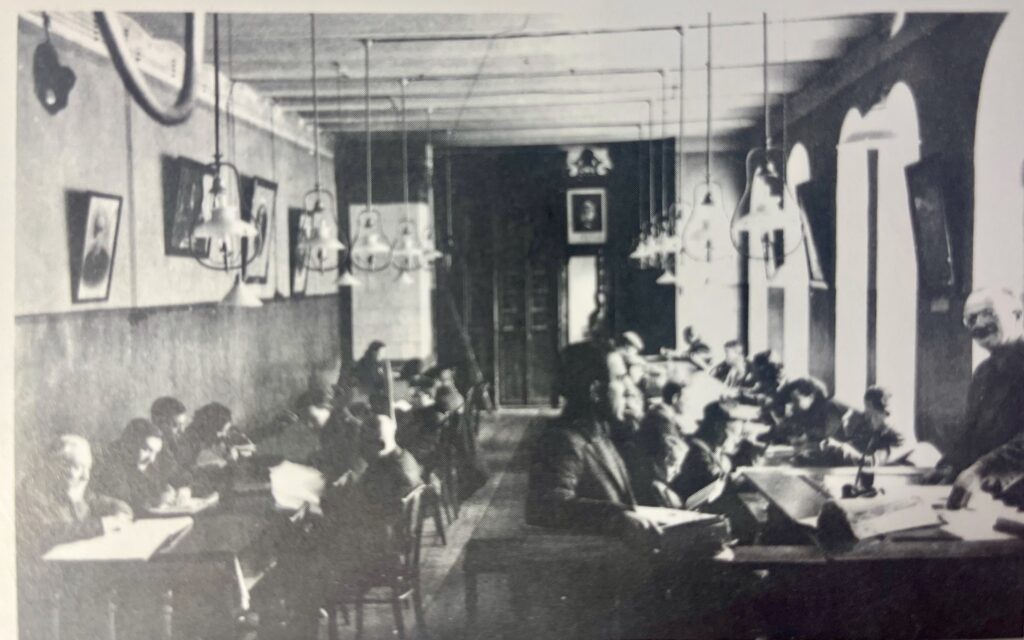
The Strashun Library of Vilna was the first Jewish public library; it admitted both male and female patrons and included secular as well as religious books (sifrei kodesh). The historical question at issue itself is trivial—in fact it isn’t really a question. Rabbi Yitzhak Ze’ev Soloveitchik, who was commonly known as Reb Velvel or the Brisker Rov, visited the Strashun Library with at least one, but almost certainly two, of his sons on October 1, 1940, and they checked out the books to read in its famous reading room that the library ledger lists them as checking out.

Strashun Library Reading Room. Layzer Ran, Jerusalem of Lithuania, vol. 2, 346.

This is demonstrable beyond any remotely reasonable historical doubt. The interesting question is: Why was it so important to Sorotzkin, a prominent member of the haredi world, to tie himself up in speculative knots denying it not once but twice in one of that world’s leading newspapers? Before answering that question, I should explain how I came to write an article that breached the walls and defiled the oils, when what I was trying to do (if you’ll allow me to mix biblical metaphors) was pluck a brand from the fire.

I go to Vilna at least three times a year. Sometimes I stay at a hotel at the epicenter of the three main streets that formed the Jewish district; other times I stay near German Street where Mattityahu Strashun once lived. My mornings begin with a thirty-minute walk to Lithuania’s National Library. The route passes through streets that once hummed with Yiddish, past buildings that housed yeshivas and Jewish publishers, through spaces that sustained centuries of Jewish intellectual life before the Nazis destroyed it. My afternoons are spent walking those streets comparing what I’ve found in the archives against what I expected to find, evenings reviewing notes and planning the next day’s research. What I’m trying to do is reconstruct the ordinary moments that illuminate the extraordinary history of Jewish Vilna.

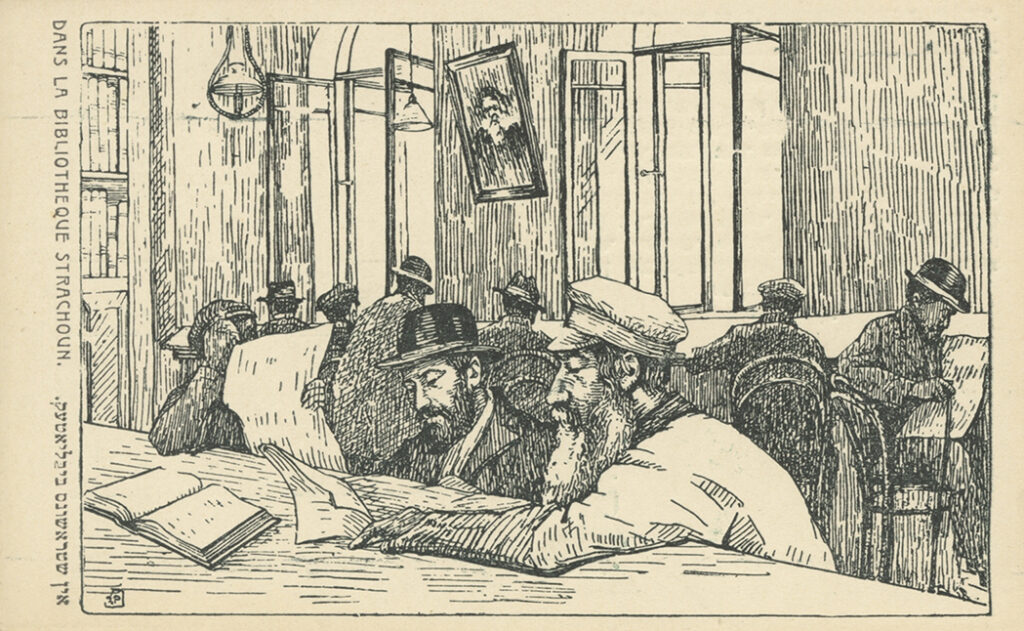
“In the Strashun Library”: a postcard from the “Vilner yidishe geto” (Vilnius Jewish Ghetto) series with illustrations by Ber Zalkind. (Ber Zalkind, Khaykl Lunski/Wikimedia Commons.)

During these walks, I often run into tour groups gathered at one of the few plaques marking the place of Jews in the city’s history. Usually, it’s the plaque noting the line of demarcation where the Nazis established the Vilna Ghetto. This is the tours’ inevitable focus: the annihilation of the Jews. What preceded the destruction—the institutions of learning and publishing, the literary circles and research institutes, the daily life that made Vilna the “Jerusalem of Lithuania”—receives far less attention. There used to be a sign marking where the Great Synagogue complex, the architectural and spiritual center of Jewish Vilna for centuries, stood. That sign is gone now. What remains are markers of death and destruction; all the complexity of Jewish intellectual life before World War II gets compressed into a prelude to catastrophe.

Those of us who study prewar Jewish culture are trying, each in our own way, to reconstruct and understand the life that preceded the catastrophe. That’s how I came to write a book on the Strashun Library several years ago. It’s why I continue to research its workings and the vibrant world of which it and its patrons, including great rabbinic leaders like Yitzhak Ze’ev Soloveitchik and ordinary Jewish readers, were a part.

The Strashun Library opened in 1902 as the first Jewish public library, built from Mattityahu Strashun’s private collection of rare books and manuscripts. From its opening, it became central to Vilna’s intellectual ecosystem. Its reading rooms welcomed everyone: rabbis and historians, secular scholars and traditional students, men and women, those seeking Yiddish literature and those researching Jewish law. By the time it was shuttered in 1940, it held roughly fifty thousand volumes and served a public that spanned the full spectrum of Jewish life.

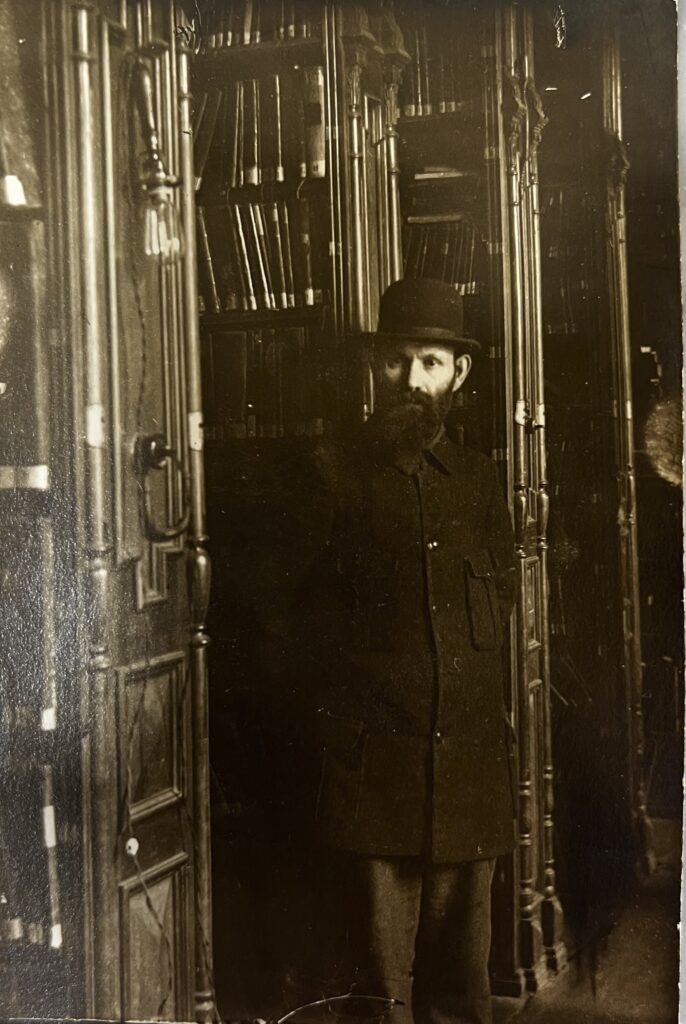
Khaykl Lunski, Librarian of the Strashun Library in the book stacks. Postcard (undated), Private Collection.

When I discovered the library’s checkout ledgers in the National Library of Lithuania archives in 2024, I realized that their spare entries allowed us to reconstruct the day-to-day life of the library: who used it, which books they read, and how it served different strata of Jewish society.

As the first step in a project to digitize and make the ledgers publicly available to other researchers, I spent four very full days scanning thousands of pages, each holding about fifty handwritten entries. As I worked, I browsed the names and tried to quickly register patterns in the data. One of the names that jumped out at me was “Yitzchok Soloveitchik,” who requested a collection of I. L. Peretz’s Hasidic stories, Khasidish. Could this be Rabbi Yitzhak Ze’ev Soloveitchik, the son of Rabbi Chaim Soloveitchik, who founded the famous Brisker approach to talmudic study?

Yitzhak Ze’ev inherited and extended his father’s analytic method and later became one of the most uncompromising voices in Israeli haredi leadership, where he was known as the Brisker Rov. I knew that he and his family had been in Vilna at the time, because I’d found him listed among prominent rabbis in Vaad ha-yeshivos refugee housing records that show, yeshiva by yeshiva, where students, teachers, and refugees were staying. Nonetheless, it could have been another Yitzchok Soloveitchik. Then I looked more carefully at the same ledger page and saw another entry: a Raphael Soloveitchik had requested Maimonides’s Iggeret ha-shemad just a few lines above Yitzchok’s request for Peretz. Now it was clear. The Brisker Rov had a son named Raphael, and although Peretz’s short stories was a surprising choice for his father, the choice of Maimonides’s famous letter on persecution by the scion of a family fleeing persecution and famously devoted to Maimonides made perfect sense.

In short, the ledger documented that the Soloveitchiks had used the library just weeks before the Soviets would permanently close it, which is what I wrote, in passing, in my article. All that I thought I had documented in doing so was that the library served the rabbinic elite alongside ordinary Jews of all kinds, who were reading everything from talmudic commentaries to Yiddish translations of Tolstoy. But merely documenting a prewar Jewish world that was different than is generally imagined in haredi publications like Yated turned out to be an act of desecration.

Rabbi Sorotzkin’s first attack began by quoting the offending lines—or part of them at any rate—from my article: “On the afternoon of October 1, 1940, Reb Velvel came to the Strashun Library with his teenage son . . . His father’s reading for the day was more surprising: I. L. Peretz’s short stories about Hasidim.” (Sorotzkin’s ellipses will turn out to be doing a lot of work here.)

“With this passage,” Sorotzkin wrote, “Mr. Dan Rabinowitz does more than recount an archival curiosity. He stages a tableau.” He went on:

The Brisker Rov, Rav Yitzchok Zev Soloveitchik, appears before us not as generations of talmidim knew him, but as a character in a modern morality play: seated calmly in the Strashun Library of Vilna, immersed in the ironic fiction of I. L. Peretz, surrounded by secular readers, students, men and women alike.

The effect is unmistakable. The reader is invited to marvel at the distance between the “real” man and the image preserved by Torah memory. Hagiography, we are told implicitly, has concealed a richer, more complex inner life—one now revealed by the cold honesty of a library ledger.

It is an elegant narrative. It is also an edifice built on sand. What we encounter here is not historical reconstruction, but a breach—peritzas geder—in the most basic disciplines of historical inference. And once the wall is breached, all the oil may be rendered impure.

Beyond the rhetoric of righteous indignation, Sorotzkin’s argument was simple: The Brisker Rov would never have entered a “mixed, open, modern” library because his “entire being recoiled from even the faintest rei’ach [whiff] of ideological modernity.” Therefore, someone else named Yitzchok Soloveitchik must have. And here Sorotzkin had a candidate:

The Vilna region was saturated with Soloveitchiks. . . . Among them appears a Yitzchok Soloveitchik, a timber merchant, a vald-socher [from Švenčionys]—precisely the kind of educated townsman who would frequent the Strashun Library and read Peretz.

There are just three problems with this line of argument—actually there are more than that, but let’s restrict ourselves to three for the moment:

a. The same ledgers that documented the visit of a “Yitzchok Soloveitchik” also recorded several visits by Rav Pinchas Hirschprung, who would later serve as chief rabbi of Montreal. Rav Chaim Ozer Grodzinski, the preeminent Torah authority in Vilna, held special borrowing privileges at the library, and Rabbi Yisrael Meir Kagan, the renowned Chafetz Chaim, visited and signed the library’s VIP “Golden Book.” If such colleagues could visit the library, can Sorotzkin really be so certain that the Brisker Rov’s “entire being” would have prevented him from doing so?

b. Švenčionys is over eighty kilometers from Vilna, and we have no evidence this timber merchant traveled to Vilna in October 1940. Not to speak of the fact that neither Rabbi Sorotzkin nor I know anything about the reading habits of Jewish timber merchants in the area.

c. The ledger records two Soloveitchiks visiting the library on October 1, 1940. Are we to suppose that this other Yitzchok Soloveitchik also had a son named Raphael, who was also a deep Maimonidean?

This last problem—call it the “Zvei Soloveitchiks problem”—returns us to Rabbi Sorotzkin’s creative use of ellipses. When he quoted my offending lines about Reb Velvel, he elided Raphael—whom I mentioned in those sentences—right out of the picture and never acknowledged that he appeared in the ledger a few lines above his father.

Actually, unlike Sorotzkin’s conjectural Peretz-reading ironist timber merchant, the Brisker Rov had good reason to visit the Strashun Library. He was in the midst of a life-and-death halakhic controversy with his colleague Rav Aharon Kotler about whether refugees should try to flee to Eretz Yisrael or America. To support his position that they should not go to America because of the spiritual danger, the Brisker Rov turned to a passage he remembered from Maimonides’s Iggeret ha-shemad, which he wanted to quote verbatim.

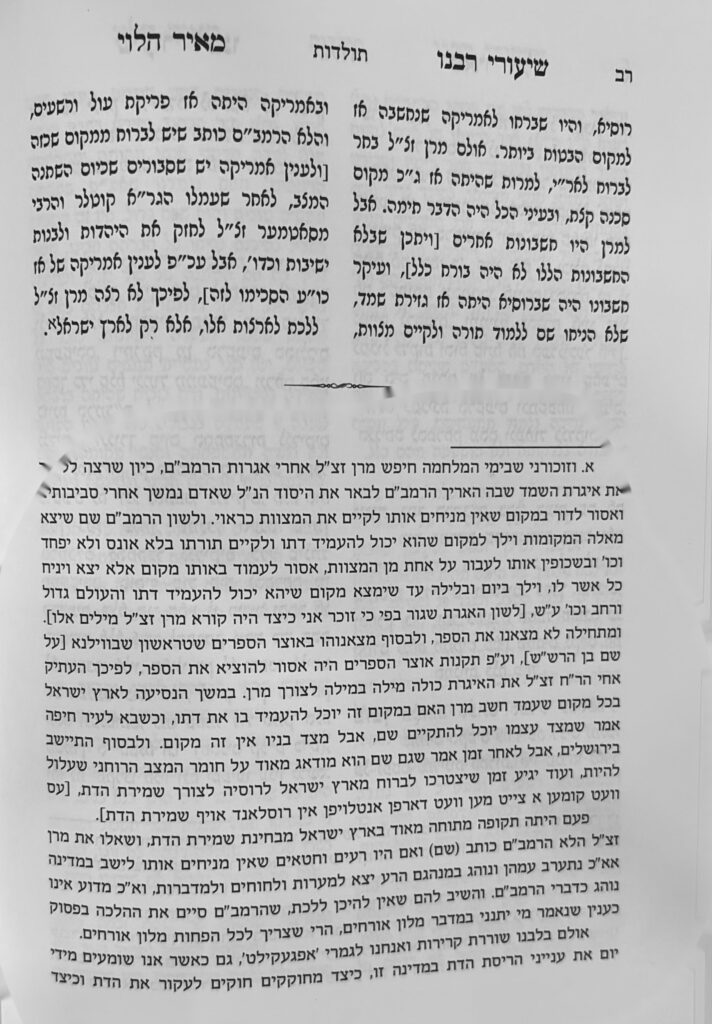
Soloveitchik family memory confirms this. In a footnote to Shiurei Rabbeinu Meir ha-Levi, a collection of the Brisker Rov’s son, he is quoted as saying:

I recall that during the war years, Maran [the Brisker Rov] sought a copy of the letters from the Rambam, because he wanted to study Iggeret he-shemad, in which the Rambam has a lengthy discussion to explain the fundamental idea that a person acclimates to his surroundings and it is prohibited to live in a place which doesn’t allow one to fulfill the mitzvot properly. . . . Initially, however, he was unable to find a copy, and, in the end, he located one in the Strashun Library in Vilna. According to the library’s rules, one was not permitted to remove books from the building. And therefore his son R. Chaim copied it word for word for him.

The library ledger records Raphael as the borrower of Iggeret ha-shemad while the family testimony remembers Chaim as the copyist. Perhaps both brothers participated, or Raphael handled the checkout while Chaim copied the passage. Or perhaps the family misremembered which brother accompanied his father to the library. At any rate, there were at least two, and quite possibly three, Soloveitchiks at the Strashun Library on that day. And they were there precisely because the Brisker Rov took his obligations as a halakhic scholar and leader of Torah Jewry so seriously.

When I wrote to Yated Ne’eman to explain all this, the editors—to their credit—published my letter, but they did so alongside a reply from the unflappable Rabbi Sorotzkin. Sorotzkin not only blithely failed to acknowledge his errors of omission and commission but went on to a new and truly gobsmacking theory, titling his response “Veha’emes Vehashalom Ehavu” (Love truth and peace).

The entry for a “Yitzchok Soloveitchik” must, he now admits, refer to one of the famous Soloveitchiks rather than a random timber merchant from Švenčionys. Still, it couldn’t possibly be the Brisker Rov. So, who was it? Here I must quote Rabbi Sorotzkin at length to convey just how far he is willing to go to save Reb Velvel from having gone to a public library:

The presence of a ledger entry bearing the name “Yitzchok Soloveitchik” is taken to indicate the Brisker Rov himself, seated in the reading hall and borrowing secular literature. Yet there exists a far more coherent and internally consistent explanation, one that aligns with the testimony, the ledger itself, the halachic framework governing names and conduct, and the lived reality of the Brisker household.

According to this reading, it was the Brisker Rov’s son, Rav Chaim who entered the Strashun Library as the responsible emissary. Anyone familiar with the family dynamic knows that his keen intelligence, composure, and practical capability marked him as the natural choice for such a mission. His younger brother, Rav Rafael, accompanied him and formally requested the Iggeres HaShemad, which then had to be copied in full—a task of approximately 3,500 words, requiring a prolonged stay. Such an extended presence in a public institution would naturally invite scrutiny. To avoid unnecessary attention, it would have been prudent, even expected, to request an additional book, a routine borrowing that raised no eyebrows and normalized the time spent at the table.

Here the ledger entries themselves become illuminating rather than sensational. Immediately preceding the Soloveitchik entry, two patrons are recorded borrowing works by I. L. Peretz. . . . When Rav Chaim was offered titles by the same author, the specific work recorded — Chassidish — was accepted not as an ideological choice but as a convenient placeholder, a book taken to cover the duration required for copying the Iggeres. . . .

The use of the name “Yitzchok” in the ledger is likewise neither mysterious nor incriminating. Rav Chaim could not identify himself by his own well-known name without drawing attention, particularly given that the sefer of his grandfather, Rabbeinu Chaim Halevi, was already catalogued in that very library. Nor could he identify himself by his father’s full name. Halacha is explicit that one may not refer to one’s father by name, even after death, without alteration. . . . The use of the shortened form “Yitzchok” . . . would have satisfied both the halachic requirement and the practical need for discretion, without uttering an outright falsehood.

It is difficult to imagine anyone believing that a scholarly household in the midst of the “lived reality” of a desperate flight to safety from both the Soviets and the Nazis would strategize over the impossible “mission” of going to a library frequented by other pious Jews to copy a passage from Maimonides. And further, to think that they needed an elaborate cover story involving false names and phony book checkouts so that the Jewish librarians did not penetrate their cover (and what?—inform Rav Kotler about the killer prooftext from Maimonides?). The tradition has a term for such groundless theorizing, pilpul shel hevel, and it is a hallmark of the Brisker tradition to oppose it.

Sorotzkin closes his response on an extraordinary—and, one presumes, unconscious—note of chutzpah. “When suggestive narratives arise from thin evidentiary reeds,” he writes, “methodological restraint becomes not a courtesy but an obligation.” But perhaps I am being unfair, as George Orwell once remarked, “We are all capable of believing things which we know to be untrue, and then, when we are finally proved wrong, impudently twisting the facts so as to show that we were right.”

Sorotzkin’s initial response characterized my work as “peritzas geder,” a breach of protective walls. But what did he think needed to be protected? Not the Brisker Rov’s actual stature or commitment. That he wanted to verify the exact wording of Maimonides’s Iggeret ha-shemad from the richest collection of sifrei kodesh in Eastern Europe to guide his thinking on the refugee crisis illuminates the rigor of his approach to unprecedented questions. What Sorotzkin needed to protect was rather a nostalgic fantasy: one in which the great sages (gedolim) of that generation never entered mixed public spaces, relied on secular institutions, or read fiction. But the infrastructure of Jewish life in places like Vilna was not neatly divided into “Torah” and “secular” categories, and gedolim and their students checked out books from the Strashun Library alongside maskilim, socialists, and ordinary Jews looking for something to read.

I go back to Vilna regularly to identify, amid the destruction and absence, what can be found to resurrect, contextualize, and enrich our understanding of the astounding Jewish culture of prewar Vilna. The Jews of this city—rabbis and students, traditionalists and modernists, Hebraists and Yiddishists—created institutions, filled libraries, published journals, founded schools and research institutes, and argued about everything.

The Brisker Rov spent an afternoon in the Strashun Library in October 1940 with his sons to obtain a text he desperately needed. While his sons diligently copied Maimonides’s text, he requested Peretz’s collection of Hasidic stories. I don’t know why and, of course, it doesn’t matter—only Sorotzkin and his more credulous readers would think that it does. But there is a plausible answer. It turns out that among Peretz’s Hasidic tales is the story “Between Two Mountains,” in which a fiercely strict and intellectual rosh yeshiva called “the Brisker Rov” is taught a lesson in humanism by a former student who has become a Hasidic rebbe. Might not the Brisker Rov have been simply curious to read about his fictional counterpart?

The Holocaust destroyed the Strashun Library and most of the Jewish world of which it was a part. The Soviets shuttered its reading room; the Nazis looted its collections; after the war, the building was destroyed. Yet, the few surviving Strashun Library ledgers reveal precious little moments in the lost history of Jewish intellectual life in Vilna. The final volume documents the last gasp of Eastern European Jewry, not only the local Jewish inhabitants but also the thousands of refugees like the Soloveitchiks who, fleeing Hitler and Stalin, briefly sought safety in Vilna.

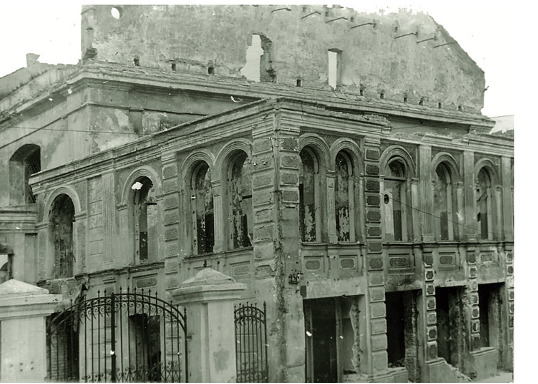
Strashun Library Building in 1945. Vilna Gaon Museum of Jewish History Archive, 1829-1

It seems to me that what we, their descendants, owe them is to see their lives, at least in glimpses, as they were, even if it is through the entries of a humble library ledger. That is a history worth recovering, even when—especially when—it complicates what we thought we knew. Such complication is not desecration; on the contrary, it honors their memories.

Postscript

After writing this response to Rabbi Sorotzkin’s pilpul shel hagiografia, I continued to return to the 1940 ledger, which hasn’t been digitized yet. As I described above, Sorotzkin’s new, and equally implausible, claim was that Chaim Soloveitchik used his father’s name rather than his own, to avoid the commotion of being recognized as the grandson and namesake of the author of one of the library’s own seforim, and to escape the notice of the authorities. In fact, it turns out Chaim checked out books under his own name at least five times in September 1940.

The first entry was on September 6, 1940, weeks before his father and Rafael appear in the ledger together. He checked out the Iggeret ha-shemad twice, on September 12 and September 14. These are, undoubtedly, the visits to transcribe Maimonides’s text, as described in the family testimony recorded in Shiurei Rabbenu Meir HaLevi. Rafael’s borrowing of the same text on October 1, when he visited the library with his father, was probably to check his brother’s transcription against the source.

That September, Chaim also read the tenth-century grammarian Dunash ben Labrat, the letters of Sa’adia Gaon and Ramban, the Abudraham’s commentary on the siddur, Samuel David Luzzatto’s essays collected in Bet ha-otzar, and a run of midrashic works, several in modern critical editions such as those of Solomon Buber. This is not the reading of a man sent on an undercover mission to copy one text. It is, rather, the reading of a wide, curious, and learned mind, and the ledger records it without comment or apology.

Of course, this isn’t surprising. As I wrote above, many well-known rabbinic figures used the library without incident. What is surprising is the pseudo-pious lengths to which Sorotzkin went to deny that the Brisker Rov and his sons simply used the Strashun Library, a fact that the family itself had no qualms about memorializing. What the ledgers allow us to do is to see, in a reader’s own name and hand, what he read in one of the great libraries of his world.

The Strashun Library Ledger Project, which is digitizing and making the ledgers publicly available, is a collaboration between the Martynas Mažvydas National Library of Lithuania, the e-Lijah Lab at the University of Haifa, Yale University’s Jewish Studies Department and Library, the Fortunoff Video Archive, and Litvak SIG.


Book Week 2026 & Year in Review: Hebrew Publishing is Alive and Well

Book Week 2026 & Year in Review: Hebrew Publishing is Alive and Well

By: Eliezer Brodt

The following is a recap of the year in Hebrew Jewish publishing for 2026, highlighting unique and noteworthy titles while also marking the annual Book Week sales. As the list makes clear, despite the ongoing conflict and security challenges in Israel, Hebrew Jewish publishing has continued with remarkable vitality and productivity. This is a testament to the enduring commitment of authors, scholars, and publishers to the world of Jewish books and ideas. Among the highlights are critical academic editions of Rishonim from manuscript, alongside numerous other unique and important titles across a wide range of fields, including History, Piyut, and Halacha.

Each year, around Shavuos, begins Shavua HaSefer—Book Week—a ten-day celebration of books and publishing. Many publishers extend their sales for the entire month. Shavua HaSefer takes place across the country in malls, bookstores, and special venues set up exclusively for these sales. Some locations focus primarily on frum seforim, while others feature a wide range of general and secular publishers. Many publishers time the release of new titles specifically for this occasion.

As in previous years, my list may occasionally include an older title I recently discovered. Please note: I do not aim to present an exhaustive list of all new releases. I try to highlight works that I believe will be of broad interest.

For last year’s list, [see  here].

As this list shows Seforim & Books are still being published in full force.

If you’d like to get a taste of what Book Week is about, listen to this episode of my podcast Musings of a Book Collector, recorded back in 2023.

To receive PDFs of sale catalogs from Machon Yerushalayim and Ahavat Shalom, feel free to email me at: Eliezerbrodt@gmail.com.

Important: A book’s inclusion on the list does not necessarily mean it is currently on sale.

The second section below based on subjects, features books published over the past year on a wide range of topics. These are not necessarily part of Book Week sales and may be harder to find— but they are still worth noting.

Again, this is not a comprehensive list, nor is it intended to be.

The goal of these lists is threefold:

  1. To help Seforim Blog readers discover significant recent publications in the world of seforim and Jewish scholarship.
  2. To assist interested readers in purchasing these books. As in previous years, I am offering a book purchasing service (for a small fee), including assistance in locating current or past titles. For more information, email me at: Eliezerbrodt@gmail.com.
  3. Part of the proceeds from this service will go toward supporting the ongoing efforts of the Seforim Blog.
מאגנס

תשובות רבנו תם, מהדירים פרופ’ רמי ריינר והרב ד”ר יוסף מרדכי דובאוויק, מקיצי נרדמים, 489 עמודים [מצוין]

רבי יצחק בן שמואל הספרדי, פירוש לספר שמואל ב, מהדיר: שמעון שטובר, האיגוד, 704 עמודים

עַל מוּת לַבֵּן: שירת ר‘ ישועה החבר בירבי נתן מעזה לזכר בנו יאשיהו, מהדירה: שולמית אליצור

קבץ על יד, לא

אפרים שהם-שטיינר, פשיעה בחברה היהודית בימי הביניים

דרשה לפסח לרוקח, מהדיר פר’ שמחה עמנואל, מהדורה שנייה עם הוספות

דוד אסף, אמא יקרה לי: פרקי מסע בזמר העברי

מחקרים בלשון, ספר היובל ליוחנן ברויאר

מחקרי ירושלים בספרות עברית, לד

דוד סבתו, יבנה וחכמיה, מסע אל ראשית ההלכה התנאית

פול מנדס-פלור, מרטין בובר: חיים של אמונה וסתירה

יובל פרנקל, חולשת הדעת: סיפורי עימות בין חכמים בתלמוד הבבלי

עמית גבריהו, נשך: הלוואה בריבית, כסף וחברה בספרות חז״ל

מאי שבת, מחוץ למחנה, שמעון ברנפלד, ביוגרפיה (1860 – 1940)

אדם טלר, פליטים ושבויים, המשבר הגדול בעולם היהודי במאה השבע־עשרה

כרמל

מרדכי זלקין, האלמנה: דבורה רום סיפורה של סוכנת תרבות

אבן אלשנטאש, סליחות והושענות לר’ יוסף בן יצחק ספרדי המכונה אבן אביתור

הספרים החיצונים, ב’ חלקים

חיים וידל, אל מעבר לדתיות ולחילוניות – בעקבות תורת ארץ ישראל של הראי”ה קוק

זהבה נויברגר, תכנים וצורות במדרש “דברים רבה”

מרטין בובר והחשיבה הדיאלוגית – חקר ושיח במלאת מאה שנים לספר ‘אני ואתה’

על הבתולים – גוף, מיניות וזהות בתרבות היהודית באירופה הנוצרית בימי הביניים

מגיד

ברכה אליצור, בשבילי אגדות בראשית: מדרשי התורה בתמורות הזמן, מגיד

יעקב מדן, כי קרוב אליך, הפטרות השבוע, עיון בדברי הנביאים

אליהו עסיס, תורה כפשוטה, שמות

מרכז זלמן שזר

יוסף דן, תולדות תורת הסוד העברית: ימי הביניים – כרך יד

עדי שרצר, זמן מתן מדינתנו, עיצובו של חג ממלכתי

עודד ישראלי, הרמב”ן (סדרת גדולי הרוח)

זיכרונותיה של גליקל – מהדורה עברית (בלי הערות)

אמה זהר, פולנים ונהנים, צריכה ופנאי בחייהם של יהודים בפולין

בית מדרש לרבנים – שכטר

שיר המעלות לדוד: מחקרים במדעי היהדות לכבוד הרב פרופ׳ דוד גולינקין, 807 עמודים

ממלכת כהנים: תשובות רבי בנימין ורבי חיים שלום מעלי הכהן, מהדיר: שמואל גליק, 578 עמודים

מדרש שמות רבה חלק א: פרשות א-יד, מהדורה ביקורתית על פי כתב יד שבירושלים עם מבוא, חילופי נוסחאות ופירוש מאת אביגדור שנאן [מהדורת צילום של הספר שראה אור בהוצאת דביר בשנת תשמ”ד (1984)]

מכללת הרצוג

משנת ארץ ישראל, משפחת ספראי, מסכת כלים, ג’ חלקים

אפרים קנרפוגל, עולמם של בעלי התוספות

ר’ יהודה ברנדס, מקץ שנתיים ימים, ב’ חלקים

יוסף מרקוס, פרשני המשנה

ידיעות ספרים

הרב שג”ר, שיעורים באגדה, 503 עמודים

הרב שג”ר, שיעורים על תורת הרב קוק – חלק א

עדן אביטבול, כובעים וחליפות, סיפורים מהישיבה

ר’ תמיר גרנות, על שפת הברית, הגות ישראלית בעידן של משבר

אלחנן ניר, זכרנו לחיים, עיוני דעת לראש השנה

דוד מנחם, שלום במרומיו

ישראל נתנאל רובין, הקבלה – אסונה של אמונת ישראל

יונתן גרוסמן, יציאת מצרים, חירות וברית

אפרת קראוס, הרב חיים דוד הלוי – סיפור חיים

אבישי בן חיים, מניפסט המסורתיות, הבשורה המתוקה- המתווה לפיוס

בר אילן

גבריאל חנוכה, משנת ר’ דוד הכוכבי, פילוסופיה דתית, הלכה וחינוך

אפרים קנרפוגל, אחים מרחוק, יחסם של החכמים באירופה בימי הביניים למשומדים ולחזרתם בתשובה

נעם סמט, שמים חדשים, ספר “קצות החושן” ועליית הלמדנות

עיוני מקרא ופרשנות יב

זהר עמר, משפחת אהרני, חלוצי המחקר הזואלוגי’ הארץ ישראלי

סידרא לו

ציונות הדתית יג

ציונות הדתית יד

בד”ד, 38-40

טל קוגמן, קרוא וכתוב בלשון עבר, הוראת העברית לילדים יהודים במחרב דובר הגרמנית בתקופה המדודרנית

עמינדב יצחקי, מנהיג בסערת התקופה, הרב מאיר בר־אילן – מנהיגהּ של הציונות הדתית בארץ ישראל בתקופת המנדט (1926–1949)

כנישתא חלק ה

עלי ספר-לד-לה

פירוש יפת בן עלי לספר עמוס מהדורה ביקורתית מוערת, בעריכת אליעזר שלוסברג, מירב עקירב

אברהם גרין, מליץ טוב, חייו והגותו של ר’ לוי יצחק מברדיטשב

דעת 93

צבי תפארה, מחקרים מוגשים לפרופ’ צבי זוהר לרגל פרישתו מההוראה

בלימה

ישראל ברטל, שמעון הכופר

האוניברסיטה העברית ירושלים, חגיגת הפתיחה ז’ ניסן תרפ”ה

ר’ אהרן שמואל תמרת, האמונה הטהורה והדת ההמונית

ג’ שלום, התנועה השבתאית בפולין, בעריכת יונתן מאיר

יונתן מאיר, חסידות שלעתיד לבוא

בנימין שבילי, הפריץ אומר שפסח היום

אריאל בן ציון, הילולא, בעריכת יונתן מאיר

הלל צייטלין, מפתח לספר הזוהר, בעריכת יונתן מאיר

משה אידל, משיחיות ציונות ומחקר הקבלה

מגילת סתרים לר’ נחמן מברסלב, יונתן מאיר

ראובן מס

יוסף פונד, מיתוס או מציאות: אגודת ישראל בעיני העיתונות הישראלית

יוסף טובי, הזיקה בין השירה העברית לבין השירה הערבית

דב הרמן, מעגל חיי המשפחה, הלכה, מנהג, פולקלור, משפט

מנחם ולדמן, ספר ה”אורית” של אבא סמואל

האקדמיה ללשון

יוסף שלמון, יחיאל מיכל פינס: איש ועד הלשון: חייו ופועלו, 198 עמודים [מעניין]

שין־ג’י פרנג, התרגום הארמי לשיר השירים

עוז לעוזי: מחקרים בלשון העברית לזכרו של פרופ’ עוזי אורנן

עיונים בלשון העברית לתקופותיה

מור שמש, מסורת לשון חכמים באשכנז במאה התשע־עשרה

בן צבי

ר’ יוסף הבא משושן, תולדות אדם, מהדיר: ליאור זקס שמואלי

שירי ר’ סעדיה בן מימון אבן דנאן

מנחם קרן קרץ, בני ברק: ממושבה דתית לבירת החברה החרדית הישראלית

אלי גורפינקל, שבח הנשים, פירוש לפרשיית ‘אשת חיל’ מאת ר’ דוד בן יהודה מסיר ליאון

מאיר בן שחר, נהר זיכרון וסכר שכחה: זיכרונות החורבן השני בחברה היהודית בשלהי העת העתיקה

ביאליק

שמא פרידמן, לישנא דרבנן, מחקרים בעברית ובארמית של הספרות התלמודית

מנחם עקשטיין, תנאי הנפש להשגת החסידות, מהדורה מדויקת על פי דפוס ראשון

ר’ יעקב ששפורטש, ציצת נובל צבי, מהדיר י’ תשבי [חזר למלאי]

ליאורה פטרובר, לדרכו של רד”ק בספר השורשים

משה בר אשר, תורת ההגה של לשון התנאים

רענן אייכלר, ארון הברית והכרובים

שמעון שרביט, מסכת אבות לדורותיה, מהדורה מדעית [חזר למלאי]

חיים דיהי, חידושי הלשון במערכת הפועל בספר בן סירא בהשוואה לעברית המקראית הקלסית

מרדכי סבתו ודוד סבתו, תלמוד בבלי, מסכת סנהדרין, פרק רביעי

שיחה על אהבה מאת יהודה אברבנאל [בן של האברבנאל], חזר למלאי

הנובלה העברית בתקופת הרנסנס, אומנות הסיפור של אליהו קפשׂאלי איש קנדיה

פירוש המקרא על פי רב סעדיה גאון, ספר בראשית

שמעון שרביט, לשונה וסגנונה של מסכת אבות לדורותיה [חזר למלאי]

שמעון שרביט, מסכת אבות לדורותיה, מהדורה מדעית [חזר למלאי]

ר’ טודרוס בן יוסף הלוי אבולעפיה, שער הרזים [חזר למלאי]

משה בר אשר, עיונים בעברית, במקרא, בלשון חכמים, בתפילה ובלשון ימינו

משה בר אשר, עֵבֶר וּמַעֲרָב, מחקרים בעברית ובערבית של יהודי המגרב

יד הרב ניסים

ר’ שמואל משער אריה [תלמיד רמ”ע מפאנו] דרוש על סמיכת אדם חכם, מהדיר: ר’ אברהם ביטון [חוברת]

ר’ רפאל בירדוגו, רקח מרקחת, על אגדות הש”ס

ר’ מרדכי עמאר, שלום רב, מבוא לשיטתו הפרשנית והפילוסופית של ר’ רפאל בירדוגו

מכון הר הברכה

זכרונות, ר’ יעקב מזא”ה ז”ל

ר’ אברהם פרייס, סמ”ג, עם משנת אברהם, ד’ חלקים

ר’ צוריאל חלמיש, חרבות לגוף האומה: הנציב מוולוז’ין ואחדות ישראל, מבוא ד”ר בועז הוטרר

ר’ אברהם פרייס, ספר חסידים, ג’ חלקים

בארות, כתב עת למחקר תורני, א

ר’ אברהם פרייס, משנת אברהם, א

אידרא

אבי שגיא, ודב שוורץ, קהילה מהפכנית בעולמה של מסורת, לדרכו של מכון שלום הרטמן

אבישי גלילי, חסדאי קרשקש – על ההוכחות לקיום האל

אברהם דוד, חברה יהודית באיטליה בתקופת הרנסנס

קדם

הודיה הר שפי, אלקטה בשושנים, מבחר מכתביו של מר שושני, 46 עמודים

בשנות רעה, הלל צייטלין: דיוקנו של פעיל רוחני חברתי, 134 עמודים

ארי ירמיש, רשימו

אריאל

עמיחי שוורץ, משבי לארץ הצבי: חייו ויצירתו של רבי אשתורי הפרחי

אקדמיה הלאומית הישראלית

קונטרס ימי שמואל, תולדות ר’ שמואל הורוויץ וסדר נסיעתו לאומן, מהדיר: יונתן מאיר

ישיבת אור וישועה

ר’ אליהו בן אמזוג, אם למקרא, במדבר-דברים

מכון שלמה אומן

סמ”ג, עשין, כרך שלישי

על הכל לרבי משה מאיוורא זצ”ל, מבעלי התוספות, מכון שלמה אומן

רבנו אברהם מן ההר, קידושין

זכרון אהרן

ר’ אליהו בחור, התשבי, כולל ליקוטי ערוך ורד”ק, צרי גלעד [מכתב יד], ועוד, תשלב +114 עמודים [!]

סידור ר’ יעקב עמדין [חזר למלאי]

ר’ אלעזר לעוו, בעל שמן רוקח, יבין שמועה על התורה

חדושי מהר”י שטייף חדשים גם ישנים על סדר מועד, ב’ חלקים

מדרש הגדול, שמות, ב חלקים

ר’ אליהו הכהן, בעל שבט מוסר, סמוכים לעד, על התורה

ספרי דברים, ג’ חלקים

שו”ת מהר”י בירב החדשות

ר’ יוסף דייטש, דברי יוסף, כולל הספדים על הנודע ביהודה

ר’ שמואל יפה אשכנזי, יפה ענף על חמש מגילות ב’ חלקים

מרדכי סגל, עיר מבצר על עניני פורים ומגילה

שו”ת מקור ברוך

תולדות יצחק על התורה

אהבת שלום

ר’ יעקב הלל, שו”ת וישב הים, חלק ה

ר’ חיים פאלאג’י, שו”ת לב חיים, ג’ חלקים

ר’ אברהם פרוסטיץ זצ”ל, מחמד לב, על תהלים, מכתב יד

ר’ משה קורדואירו, פרדס רמונים, הגהות וביאורים מגדולי חכמי הדורות והוספות רבות מכתבי יד, 40+תתפה עמודים

מן הגנזים, כ

ר’ משה בנימין, הואיל משה, דרשות על התורה, מכתב יד, ב’ חלקם [כ1500 עמודים]

ר’ עבדאללה אברהם יוסף סומך, זבחי צדק, ג’ חלקים [חזר למלאי]

ר’ גדליה ן’ יחייא, שלשלת הקבלה, 22+ תעג עמודים

שו”ת ר’ אליה מזרחי

שו”ת מהר”י באסן, עם תוספות תשובות חדשות מכתב יד

סידור הרש”ש, ר’ וידאל קואינקה, תצלום הכתב יד

ר’ יעקב הלל, נפש החיים, ב

מכון ירושלים

מנחת חינוך כרך ח

שו”ת בית יצחק, חושן משפט, מכון ירושלים

צפנת פענח, גירושין, מכון ירושלים

ר’ יקותיאל קלמנסון, מי טל, כרך על תרגום, חלק ב

מכון משנת ר’ אהרן

מערכי לב, ליקוט דרשות של ר’ רפאל חזן, בעל חקרי לב

ר’ ישראל יעקב אלגזי, שמע יעקב, על התורה

סטאלין – בית אהרן וישראל

שיר השירים: עם מדרש שיר השירים, תפסיר רס”ג, פירוש רבי שמריה, פירוש רבי יהודה בן בעלם, פירוש רבי זכאי, מכתב יד מהדיר: ר’ יהודה זיבלד, 46 +רג עמודים, מכון בת אהרן וישראל

ר’ יעקב קשטרו, שו”ת אהלי יעקב, תרעא עמודים+ מבוא 130 עמודים, מהדיר ר’ יחיאל שלוש, מכון בית אהרן וישראל

חידושי רבי מיכאל בכרך

מכון עלה זית

פירוש התורה לרב סעדיה גאון על חומש ויקרא, כולל תרגום המקרא – אלתפסיר והפירוש הארוך – אלשרח, ערוכים מתוך כת”י וקטעי גניזה עם הדרה מלאה, תרגום, ציונים, הערות וביאורים, ב’ חלקים (48+1308 עמודים)

ר’ ראובן מרגליות, מקור הברכה, בירורים בגדרי ברכות המצוות וחקר מטבעות ברכותיהן עם הרבה הוספות ותיקונים מכת”י המחבר זצ”ל ועם השלמות וביאורים ונספחים, רפ עמודים

ר’ מרדכי בנעט, שו”ת פרשת מרדכי, כולל שו”ת הר המור עם הוספות מכתב יד, יורה דעה

ר’ משה גרינעס, קרן פני משה, פירוש לרמב”ן על התורה, מהדורה חדשה ומתוקנת, 14+תרמא עמודים

צפנת פענח על הרמב”ם, שני חלקים, מהדורה חדשה

ר’ משה קורץ, מאורות משה, ליקוטי מרן הגאון ר’ משה פיינשטיין על מסכת אבות, שכב עמודים

ר’ אריה גאנז, אדירי התורה, ב’ חלקים

אור אליעזר לזכרו ר’ אליעזר פארטנוי, כולל חומר על הצלת ישיבת מיר ועוד

ר’ יעקב קיד, תורת סלבודקה, על ספר תהלים

ר’ מנצור מרזוק, קרבן אליצור, מסכת עבודה זרה, מהדורה חדשה בעריכת ר’ בנימין שפיגעל

מוסד הרב קוק

סדר עולם רבא עם ביאור הגר”א, רכא+24 עמודים

חיים טלבי, הקדיש, ההלכה והמנהג בעדות ישראל, 772 עמודים

מדרש עשרה הרוגי מלכות

ר’ יוסף קאפח, המקרא במשנת משה

הרב פרופ’ אברהם שטינברג, קביעת רגע המוות בהלכה

ביאור הגר”א, ב, בינה ודעת, מהדיר: ר’ מנחם אדלר, סי’ קכח-רנב

הרב פרופ’ דניאל שפרבר, מאי חנוכה, 169 עמודים

ר’ יצחק מלצאן בעל שביתת השבת, הגדה של פסח עם ביאור שיח יצחק

ר’ שלמה איגר, ספר העקרים, ב’ חלקים [חזר למלאי]

שו”ת ר’ שלמה איגר, ב’ חלקים, מוסד רב קוק [חזר למלאי אחר הרבה זמן]

ר’ מנדל המניק, משנה הברורה תורת הקדשים – מסכת זבחים

שיטה מקובצת, קנים

ר’ אברהם כץ, זוגיות הורות ומשפחה במשנת רש”ר הירש

קבצים תורניים

מתיבות לחקר תורה הגאונים והקדמונים וקהילות ישראל במלכות ישמעאל, גנוזות, ספונות, חקר ועיון, הלכה ומנהג, כרך א, 480 עמודים [קובץ חדש]

המשביר חלק יא

המשביר חלק יב

ישורון כרך נ

שנתון משפט העברי, לג

תחומין מה

מחקר

ר’ יוסף אביב”י, קבלת הגר”א, ג’ חלקים

ר’ משה הלל, ספר עץ חיים לרבי חיים ויטאל: תיאור כתב יד המחבר, קהילות ישראל

ר’ יהושע מונדשיין, העקלקלות לדוד

שלמה טיקוצ’ינסקי, חובה מנחמת, תנועת המוסר והשואה בהגות ובמעשה

שד”ל, Prolegomeni הקדמות לדקדוק מושכל של השפה העברית, 244 עמודים

ר’ דוד אייגר, משניות פאה עם אנציקלופדיה

טהרו של רקיע: והיה לכם לציצית, בענייני התכלת גליון כ [מאמרים מזהר עמר, ארי זיבוטפסקי, ר’ אברהם רפמן], קכח עמודים

רש”י

ד”ר יוסף מורגנשטרן, פירוש רש”י לתורה בעידן הדפוס – רומא סביב 1470: היבטים פרשניים, טקסטואליים והיסטוריים

פירוש רש”י על מסכת נזיר, מכון אופק

פירוש רש”י ובית מדרשו על סליחות – ראש השנה, מכתב יד, תז עמודים

ר’ יוסף מקרעמניץ, ביאור על רש”י, תלמיד מהרש”ל ורמ”א, מהדיר: ר’ פנחס קריגר, כולל מבוא, מראה מקומות הערות וביאורים, כ+176 עמודים.

ר’ משה פיליפ, רש”י שונה ומפרש, הפירושים החוזרים ונשנים בפירושו לתורה והפסוקים שפירוש רק פעם אחת ולא בפעם הראשונה, 554 עמודים

ר’ חיים בנימין הלוי קצנלנבוגן [נפטר תרס”ג], הגהות ספונות על סדר חמשה חומשי תורה, מכתב יד, יג+ קצח + כח עמודים, הערות והגהות ומראי מקומות

חז”ל- ראשונים

ר’ משה צבי וידר, מקראה בחקר החילוקים [בין ארץ ישראל ובבל]

ספר המצות לרמב”ם, מהדיר: ר’ יצחק שילת

תשובות רבנו החסיד אברהם בן הרמב”ם להשגות על משנה תורה לר’ דניאל הבבלי, על פי כתב יד, כולל מבוא, רפד עמודים

תמים דעים, קובץ תשובות ופירושים לרבותינו הראשונים ועל צבאם הראב”ד, מכתב יד, מהדיר: ר’ דוד דבליצקי

סדר טעמים, לתלמידו של רבינו שמואל החסיד [מכתב יד], [אביו של רבינו יהודה החסיד]: מהדיר ר’ יעקב ישראל סטל

תמיד קרוב לעמך: סדר הקרבת התמיד ופירושו לרבינו נתנאל מקינון ותלמידו, מבעלי התוספות [מכתב יד], מהדיר: ר’ יעקב ישראל סטל

פירוש הרוקח על הסידור, עם נוסח התפלה של הרוקח, תפלות החול, ]מכ”י[, מהדירים: ר’ לוי יצחק חריטן ור’ אהרן אייזנבאך, 25+ תרלה עמודים

ספר הקולות מבית מדרשו של רבינו יהודה החסיד, מכתב יד, רעג עמודים

ספר העתים, הלכות שבת, על פי כתב יד, עם הערות, יד+ 513 עמודים

ליקוטי מדרשים, חלק תשיעי – קטעי מדרשים מן הגניזה כ160 עמודים

מנחת קנאות, לרבי יונה ב”ר שלמה אבן בהלול, מכתב יד, מהדיר: פר’ יעקב שמואל שפיגל [נכתב בשנת 1257], 311 עמודים [במהדורה מצומצמת]

דרשות על התורה חלק א’ [בראשית – שמות] – ילקוט מדרשים קדום מתוך כתב יד [ברובו תנחומא במהדורה שונה], כ־140 עמודים

דרשות על התורה חלק שני [כריכה רכה] כ־190 עמודים.

ילקוט מדרשים חלק יג [כריכה רכה] כ־360 עמודים.

שערי תשובה עם פי’ סביב השלחן וזר השלחן, לר’ מאיר אתרוג, תקכג עמודים

פיוטים לשבת חתן, ר’ יצחק נקדן ב”ר שמשון עם פ’ קדמון מבית מדרשם של חסידי אשכנז, מהדיר: ר’ יעקב ישראל סטל, קי עמודים

ר’ שמשון מקינון, ספר הכריתות, ב’ חלקים, עם פ’ מקור מיים חיים, המאיר לעולם, מהדיר: ר’ מאיר דרגולי

ר’ זכריה הרופא, נימוקי הרז”ה על רמב”ם זמנים, מכתב יד

תוספות השלם, כרך יח, קרח-חקת

ספר קושיות לאחד מן הראשונים, [חזר למלאי], מהדיר: ר’ יעקב ישראל סטל

חידושי רבינו יהונתן מלוניל, פסחים

שער הגמול עם פ’ אור לעינים (ר’ שמואל הלחמי), רנט עמודים

ר’ מאיר עראמה, אורים ותומים, אסתר

ר’ מאיר עראמה, אורים ותומים, ישעיה

אחרונים

ר’ ישעיהו באסאן, אמרי יושר, מכתב יד [רבו של הרמח”ל], 42+רטו עמודים [מעניין]

ר’ משה צווייג, חידושי אהל משה, על הבבלי, ירושלמי, שו”ע עם קובץ תשובות, מכתב יד תתטו עמודים [מעניין]

הלכות בית הבחירה לרמב”ם עם פי’ רבי אביגדור נבנצל שליט”א, 169 עמודים [מאוד מעניין]

כמטמונים תחפשנה, מתורתו של הגאון המופלא רבי אהרון יהושע צוקר [העילוי מפוניבז’], תקיא עמודים [מאוד מעניין]

חשרת מים, גיטין

ר’ יהודה עדל, מי נפתוח, על הקדמת הרמב”ם לסדר טהרות, עם הערות

ר’ אברהם טיקטין, פתח הבית

ספר החרדים, ב’ חלקים, עוז והדר

ר’ שלמה זלמן אויערבאך, מנחת שלמה, פרק ערבי פסחים

ר’ שלמה זלמן אוירבעך, מנחת שלמה, על פרק איזה נשך

ר’ אלחנן ווסרמן, קונטרס דברי סופרים, מילואי דעת סופרים על גיליונות חזון איש וקהילת יעקב, מהדורה שלישית, תב עמודים

ר’ מרדכי פארהאנד, באר מרדכי על הש”ס [בעל שו”ת באר מרדכי], שסד עמודים

ר’ שמואל שטראשון, חידושי הרש”ש על הש”ס, ד’ חלקים [ברכות, יומא, ביצה, ראש השנה, תענית, מגילה מועד קטן, חגיגה, סנהדרין, סוטה, אבות]

ר’ אפרים בורודיאנסקי, משכנות אפרים, חולין יורה דעה

דברים נחמדים, בעל בני יששכר, אבות, עניינים שונים עם הוספות חשובות, שנז עמודים

לב העברי, ב’ חלקים, מהדורה חדשה

הלכה

ר’ יעקב הלוי לוינגר, גורן הלוי, דיני עבודת הלויים במקדש, תעו עמודים [מאוד מעניין]

ויעמד משה, אוצר הלכות עמידה וישיבה ברוב עניינים

פסקי לוח לארץ ישראל, להגאון ר’ יחיאל מיכל טוקצינסקי, כולל מקורות וביאורים, חרות על הלוחות, 43+ תל+ מג עמודים

ר’ מרדכי אקשטיין, מר דרור, סי’ ה’ דין כוונת הברכות והשמות, שנז עמודים

ר’ יוסף מברעסלא, חק יוסף, על הלכות פסח, מכון אכסניא של תורה, כולל ליקוטי חק יעקב והערות

ר’ יצחק שטסמן, עץ השדה, מהדורה חדשה עם הוספת

ר’ ישעיהו הלוי, בין כותלי המשחטה, המדריך להכרת הליכי השחיטה התעשייתית, 206 עמודים

ר’ נדב שריפי, מה מפטירין, מנהגי קריאת התורה וההפטרה, רעג עמודים

הרב נחום אליעזר רבינוביץ, שו”ת שיח נחום חלק ב

ר’ מאיר דורפמן, שו”ת הגרז”ן, שו”ת ושיחות עם הגאון רבי זלמן נחמיה גולדברג זצ”ל, 274 עמודים

גנזי תחומין, מאמריו של ר’ זלמן נחמיה גולדברג שהתפרסמו בתחומין ודברי זכרונות

דיני התשלום בתחבורה הציבורית, מהדורה מבוקרת ומעודכנת, קיח עמודים

ר’ מנחם שלזינגר, איל משולש, פתיחת קופסאות שקיות ופקקים בשבת, קצב עמודים

מסורת משה חלק ה (פסקים של ר’ משה פיינשטיין), תקסה עמודים + מפתחות רמג עמודים

ר’ משה קליערס, תורת הארץ חלק ב

ר’ יעקב סבתו, טהרת הכהן, דיני איסור טומאת מת לכהנים, תרי עמודים

ר’ ברנדויין, ברכת הטוב והמטיב על שינוי היין, קכח עמודים

ר’ דוד אהרן סופר, שלשה ספרים: כוס חמישי להלכה, מוסיף על הכוסות, אכילה מצה ולחם משנה [626 עמודים

ר’ הרצל הלל יצחק, הכר נא, בעניין איסור הסתכלות באדם רשע, רמא עמודים

ר’ יהודה פפויפר ר’ משולם יוסף שומן, הלכות קטניות בפסח, סה עמודים

ר’ חיים בנבנשתי [הכנסת הגדולה], שו”ת בעי חיי, או”ח, יו”ד, כולל תולדות [189 עמודים]

ר’ פסח פינפער, מסורת התורה והנביאים, מסורת התנ”ך חלוקת פרקי ופרשיות התנך פתוחות וסתומות ועוד, כולל מ”מ, מבואות, הערות והארות, שעז עמודים

מחברת הקודש, חיבורים מכתב יד לבעל תוספת שבת

חסד שבמלכות, צדקה ממלכתית ומדינת הרווחה לאור ההלכה, 508 עמודים

ר’ שמואל יוסף שטיצברג, שערי השבת, שמירת שבת בבית ובמטבח במכשירים החשמליים והדיגיטליים, א, שעה עמודים

ארצות החיים, מלבי”ם, מהדורה חדשה

ר’ מאזוז, שו”ת בית נאמן, חלק ד

ר’ עמנואל מולקנדוב, תורת הקדמונים, חלק ה

ר’ שמחה הכהן, ספר שמות, שמות אנשים ונשים, גיטין (נדפס לראשונה תי”ז), עם הערות וציונים, ר’ יוסף בנדיקט

ר’ עבדאללה אברהם יוסף סומך, שו”ת זבחי צדק השלם, תרפ”ד עמודים

ר’ מרדכי בלייער, כוס ישועות, עניני כוס של ברכה, ב’ חלקים

ר’ פסח פאלק, פיה פתחה בחכמה, הלכות שבת, מקוצה ורפואה, תרלא עמודים

ר’ שלמה שור, נוהג בחכמה, תוכחה, הלכות ומנהגים לקולא שאינם עולים לפני כללי הפסיקה, חילוקים מנהדים בין עדות ישראל, עדות ישראל שעלו לארץ ישראל, חילוקי נוסח התפילות ועוד, תשע עמודים

ר’ דוד שור, דינא דמלכותא דינא, מהדורה שנייה

ספר פועה כרך חמישי

מסחר כהלכה

ר’ שלו’ בן ציון פלמן, גשמי ברכה, הלכות ירידת גשמים, שפב עמודים

ר’ שלמה קורח, שו”ת תשובה כהלכה, תקסז עמודים

ר’ שלמה דיכובסקי, לב שומע לשלמה, חלק ד

ר’ שובאל בן שלמה, מבאר המים, שו”ע הלכות נזיקין, ריב עמודים

ר’ יעקב אריאל, פרקים בתורת המדינה, 479 עמודים

בירור הלכתי ותורני בעניין מדינת ישראל, יום העצמאות, התגייסות לצה”ל, 247 עמודים

ר’ מאיר דן פלצקי, חמדת ישראל ה’ חלקיםזכרו

היסטוריה וגדולים

ר’ דוד קמנצקי, רבנו חיים עוזר, רבן של כל בני הגולה, כרך שני [!!]

ר’ דוד קמנצקי, רבנו חיים עוזר, רבן של כל בני הגולה, כרך ראשון [מהדורה שנייה עם תיקונים והוספות]

ר’ פנחס לובאן, שמע בני, ב, הנהגות והדרכות מר’ דוד הלוי אברהמי, מח”ס בנין עולם, 738 עמודים

לב נאמן, ב, יומן של ר’ מאיר מאזוז

שמעתי מאבא, לקט עובדות והנהגות שרשמתי בצלו של אבא מארי המשגיח ר’ חיים וואלקין, 98 עמודים

ר’ יוסף שווארטץ, זכרון למשה, על החתם סופר

ר’ אברהם מאיר וייס, שימוש חכמים חלק א, קיצור תולדות רבותינו הראשונים [חזר למלאי], כולל כ-300 עמודים חדשים

ר’ יואל פעלדמאן, שלשה אבות, תולדות משפחות בראנדסדארפער, טייכטהאל, גינז, 763 עמודים

ר’ אביעד נייגר, הגאון מווילנא ותלמידיו זיע”א, גזרת הגלות שלש השבועות והנלוה עמהם, קנו עמודים

ר’ אביעד נייגר, ונציב אחד אשר בארץ, הנציב מוולוז’ין ותלמידיו זיע”א, גזרת הגלות שלש השבועות והנלוה עמהם, קעד עמודים

ר’ ברוך שרגא, חכם בן ציון, שימוש חכמים – עובדות והנהגות, ר’ בן ציון אבא שאול, בעל אור לציון

בן ציון קליבנסקי, מעבר לסוף, סיפורה של מנהלת בית היתומות בקובנה שצעדה עם תלמידותיה אל המוות

בעקבות מסע… בן יובל שנים… התקופה… בעקבות גיליונות קובץ לחושבי שמו, א, 638 עמודים

רבי לייב, ר’ ליב מינצברג זצוק”ל רבה של קהל עדת ירושלים-ישיבת המתמידים, ובעל ספרי בן מלך, פרקי חייו דרכו ומשנתו, 781 עמודים

ר’ אביש ציינווירט, חיי האר”י ז”ל, חיי מוהרח”ו ז”ל, עם ביאור אבן בוחן, שכה עמודים

ר’ מנחם פלאטו, מרן החזון איש, חלק ה, 384 עמודים

ר’ רפאל רפאלוב, החרדים והארץ, הפרק הנעלם חלקים של החרדים בחידוש היישוב בארץ, 161 עמודים

ר’ מאיר הייזלר, מי הדעת, מאמרים ושיחות שימושה של תורה, ילקוט פנינים ורשימות ולקט זכרונות מגדולי הדורות, [מהדורה שנייה], תקטז עמודים

רבי שמואל יעקב בורנשטיין, סיפור חייו

מנחם שטרן, מייסדי המושבות היו “דוסים”

ר’ בנימין פנטליאט, הקהילה האשכנזית בצפת

הרואה: אלבום תמונות של הרב אברהם יצחק הכהן קוק זצ”ל

עמור פדור, חיים שניתנו במתנה, על ר’ חיים דרוקמן

מרן הראי”ה קוק זצ”ל, הרואה בנחמה, אגרות ניחומים דברי הספד ומאמרים וליקוטי אורות בענייני אבלות ונחמה, בעריכת ר’ זאב נוימן, תסד עמודים

ר’ משה נחמני, חסידות בית אברהם, חסידי הראי”ה קוק בערי פולין, תר”ץ- תש”ג, 187 עמודים

ר’ יהושע ון דייק, בחרבי ובקשתי, שיטת מרן הראי”ה קוק ובנו הרצי”ה זצ”ל ובית מדרשם בעניין גיוס בני ישיבות

ר’ יוסף בדיחי, בצלו, פרקי יומן ממחיי מו”ר הרב צבי יהודה הכהן קוק, שנת תשל”ד, 327 עמודים

תפילה

ר’ חיים אלעזר שפירא, מאמר נוסח התפלה, רסב עמודים

ר’ אלחנן אדלר, קונטרס חלק אב, תפילת אב הרחמים, עיונים הערות וביאורים, קסא עמודים

סידור תפילה ישרי לב, לימות החול ולשבת קודש, ביאורים מוסריים מרבני הת”ת דקלם וחבר מתלמידיהם, 1454 עמודים

מחזור רמח”ל ליום כיפור

שונות

ר’ יצחק טוביה ווייס, שערי טוביה, אגרות ומכתבים, שפג עמודים

ר’ צבי לרר, קונטרס נכתב בצדו, גליוני ספרים מכתב יד גדולי ישראל, צו עמודים [מעניין]

והשב את העבודה קטורת, הלכות הקטרת הקטורת בליווי תמונות, 400 עמודים

ר’ ברוך יפה, משמרת תורה, ענייני מצוות, מועדים, שונות, תלג עמודים [מעניין]

ר’ חי רועי, למנהיגות ציבורית חלק ג

ר’ יהושע שטיינברג, נפלאות לשון הקודש על התורה

ר’ דניאל צבי רובין, מראה הגבול, צורת גבולות ארץ ישראל על פי התורה, מהדורה חדשה, תמח עמודים

ר’ משה דרורי, התשובה במשפט הישראלי

שיעורי הרב אהרן ליכטנשטיין, תשעה באב ואבילות

הרב דוד לאו, דמעות של אמונה, הרב הראשי במסע של מלחמה, חיים ותקומה, 236 עמודים

ר’ אליהו גרנצייג, תפארת התורה, מצות תלמוד תורה והלכותיה, שכח עמודים

שללו של רבינו מאיר שמחה, מבית כמוצא שלל רב, בראשית-שמות, פנינים… מתורתו של הכהן הגדול… שנלקטו ונערכו מתוך ספרי משך חכמה אור שמח…. תקכב עמודים

ר’ אורי טיגר, חונן הדעת, על רמב”ם הלכות דעות, שעב עמודים

ר’ יונתן רוזמן, חסד ואמת נפגשו, סתירות בין הלכה ותורת הנסתר

ר’ משה ירמיהו הכהן [אביו של בעל מעשה טוביה], ברכת טוב, ב’ חלקים, עם הרבה הוספות מכ”י, מכון נצח יעקב

גידולי תרומה על ספר התרומות, על פי כ”י

ר’ אברהם אבולעפיה, חיי עולם הבא, על פי כ”י

ר’ שאול הכהן, לחם הבכורים על הדקדוק, מהדורה חדשה

טעימה מתורת רש”ר הירש, בראשית-ויקרא

ר’ שלמה גריינמן, לקט השבלים, בראשית-וירא, תתריא עמודים

ר’ מאיר א”ש, אמרי בינה על הש”ס, ב חלקים

ר’ דב אליאך, דבר תורה על הפרשה, אוצר חדש… מפיהם ומפי כתבם של… ראשי הישיבות וגדולי המוסר, בראשית, שנב עמודים

ר’ זאב פריינד, יסודות קצות החושן, עניינים יסודיים מספר קצות החושן מסודרים ללימוד בעיון, תרצה עמודים

הרב ירחמיאל אליהו בוצ’קו זצ”ל, חזון תורה ואמונה מתוך הסערה

ר’ ישראל דנדרוביץ, היו דברים מעולם, הסודות הגנוזים של העולם התורני, חלק ג, 708 עמודים

משה לנדא, דע מה שתשיב בסוגיית הגיוס, 364 עמודים

ר’ שלמה גריינמן, לקט השבלים, ויקרא, תתשיג עמודים [מצוין]

ר’ שלמה בניזרי, קונטרס חיל השם, סוגיית גיוס בני הישיבות, 264 עמודים

ליאור הולצר, שבתי צבי – סיפורו של משיח [רומן היסטורי]

אנציקלופדיה תלמודית, כרך נג

ר’ דוד חזן, חוזה דוד, על ספר תהלים, א’ריד עמודים

ר’ יוסף דוד משאלוניקי, צמח דוד על תנך, ו’ חלקים, וכרך שביעי, דרשות יקרא דשכבי

ר’ ישראל אברמסקי, עיוני ישראל, כללי המשנה ברורה, קלג עמודים

ר’ צבי פרבר, שביל הצבי, מגילת אסתר, תיב עמודים

ר’ יעקב חיים סופר, ברית יעקב, חלק ב, ב’ חלקים

ר’ חיים סלומון, שבילי טהרות, דיני טומאת צרעת, תטז עמודים

דרכי ארץ, הלכות מצות הבית, שצג עמודים

ספרי רבי אהרן הכהן, חתן החפץ חיים ובנו ר’ יוסף חיים,

מאמר תלתא קרנתא בענין המן טאשין, אזני המן וקרעפליך בימי הפורים

ר’ אברהם דיקמן, פרשה ערוכה: הערות הארות ואנקדוטות משולחנו של עורך תורני לפי סדר פרשיות השבוע והזמנים, 236 עמודים

ר’ ישראל דנדרוביץ, הגדה של פסח, היו דברים מעולם, 704 עמודים

אברבנאל, הגדה של פסח, זבח פסח, מהדורה חדשה

תומר דבורה, על פי כ”י, מכון שובי נפשי

גנזי יהודה, ח, שפח עמודים

ר’ אברם פריעד, ארבעים שנה במדבר

הלל הפסח, הגדת הפסח כמנהג ארץ ישראל הקדמון, כפי העולה מן הגניזה הקהירית, מהדיר: יהונתן קרני הלוי [חוברת]

שבת געלע מצות, כולל מנהגי אפיית החלות וגולם של המהר”ל [חוברת]

והשב את העבודה, דיני קרבן פסח בליווי תמונות המחשה ייחודיות, רצ עמודים

שדי חמד, מערכת מצה, עם הערות [כריכה רכה]

ר’ יעקב חיים סופר, ברית יעקב ח”ב, מערכת ג-ד [חוברת]

ר’ העשיל מקראקא, חנוכת התורה על התורה

ר’ חיים יעקב זילבערבערג, דרכי חיים, ביאור תפילה ודברי מוסר ועוד, ת’ עמודים

ר’ בנימין שלמה המבורגר, אשכנז מבצר המסורת, מבוא לסדרת הספרים שרשי מנהג אשכנז, 353 עמודים

כוונות וסגולות, אסופות מכתבי יד החיד”א

ר’ משה לוי, שירת הלויים, עניני עבודת הלויים לפי סדר סוגיות הש”ס ופרשיות התורה, שפג עמודים

ר’ אהרן גוטסמן, אור תעלומות, דרושים מועדים, עצות וסגולות, שנ עמודים

לחם תנופה, צורת שתי הלחם וענין תנופתו, 37 עמודים

תקנת המבדיל וצום כ’ סיוון, 97 עמודים

ר’ תומר בכר, אהל יעקב, הערות וביאורים לספר וידעת כי שלום אהלך לר’ חיים פרידלנדר

ר’ אהרן אויש, שטר תנאים וכתובה שבין ישראל לאביהם שבשמים לחג השבועות, קמא עמודים

ר’ יוסף בא-גד, נחלי בא-גד [מהדורה טו]

English

Daniel Sperber, Indo-Judaic Parallels, Notes on Similar Motifs in Judaism and Hinduism, 192 pp.

R’ Bezalel Naor, The Project of Hasidism

R’ Sklar, Rav Kook’s Guide for Today’s Perplexed

R’ Ahron Notis, The Great Shiurim Debate, The History the Archaeology and the Lomdus

R’ Reit, Ushchat’tem Bazeh, The Chullin & Shechita Companion

Rabbi Rafael Dembovsky, Between Torah and Derech Eretz

Rabbi Yehoshua Kaganoff, Is Alternative Healing Kosher?


Cherubim: Winged Celestial Beings on the Title-Pages of Early Hebrew Books

Cherubim: Winged Celestial Beings on the Title-Pages of Early Hebrew Books
by
Marvin J. Heller[1]


And having driven out the man, He stationed at the east of the Garden of Eden the Cherubim and the flame of the ever-turning sword, to guard the way to the Tree of Life (Genesis 3:24).

You shall make two Cherubim of gold—hammered out shall you make them—from both ends of the cover. You shall make one cherub from the end at one side and one Cherub from the end at the other; from the cover shall you make the Cherubim at its two ends. The Cherubim shall be with wings spread upward, shielding the Cover with their wings with faces toward one another; toward the cover shall be the faces of the Cherubim being turned toward the cover. (Exodus 25: 18-20).

Rav Ketina said: When the Jewish people would ascend for one of the pilgrimage festivals, the priests would roll up the curtain for them and show them the cherubs, which were clinging to one another, and say to them: See how you are beloved before God, like the love of a male and female (B.T. Yoma 54a).

Cherubim (angels) are a frequent presence on the title-pages of early Hebrew imprints in the sixteenth century and afterward, the latter beyond the scope of this article. They are also to be found in incunabula, on the frames of initial pages and head-pieces for text.

How do you define what are cherubim? One definition, that of the Encyclopedia Judaica, is “a winged celestial being which appears in the Bible in several different guises.” It then proceeds to give several descriptions of cherubim. The Jewish Encyclopedia begins with a more detailed description, stating cherubim are “the name of a winged being mentioned frequently in the Bible. The prophet Ezekiel describes the cherubim as a tetrad [set of four] of living creatures, each having four faces—of a lion, an ox, an eagle, and a man—the stature and hands of a man, the feet of a calf, and four wings.”[2]
The use of cherubim is also noted in the 1911 Encyclopædia Britannica where they are described as “imaginary winged animal figures of a sacred character, referred to in the description of Solomon’s temple (1 Kings vi. 23-35, vii. 29, viii. 6, 7), and also in that of the ark of the tabernacle (Ex. xxv. 18-22, xxvi. 1, 31, xxxvii. 7-9). . . . In Gen. iii. 24 the cherubim are the guards of Paradise . . .”[3]
The frequency of the appearance of cherubim in Hebrew literature can be found on Sefaria, a bibliography of Jewish texts, which records fifty-six entries for cherubim under biblical, Mishnah 27, and Talmud 991. Among other entries are Midrash, 590; Halakhah 7947; Kabbalah 747; and yet still others as well as multiples of commentaries on the first works.[4]

These multi-winged creatures are also a feature in general literature. Franz Sales Meyer, under the heading Miscellaneous heads, describes the “Angel faces, youthful heads, with a circular or disc-like halo, are first met-with in the Byzantine style, as the result of ecclesiastic articles,” He continues that in the early Italian Renaissance such renderings were charmingly naïve. They appeared as adornments on friezes and arches, medallions, and in borders. They also are to be found on tombs and are “Much used in Modern ecclesiastical decorations.” The text is accompanied by a page of examples of the cherub head, including one of a skull.[5]

It had been my intention to describe Hebrew title-pages with images of cherubim over a period of two centuries.[6] The numerous instances of such usage, however, has necessitated a considerable limiting of our subject period. Indeed, rather than noting all the examples in our current period, in the sixteenth century, we only describe several exemplars, giving background about the books in which they appear, that is, the publisher, author, and book subject.[7] This article is expansive, that is, in describing cherubim, it discusses the varieties of Hebrew literature, the authors of the subject works, the presses that published them, and even Hebrew book history. The title-pages and infrequent text pages with displays of cherubim addressed here are in chronological order, but from diverse locations and, again, on a variety of books, indicative of how widespread Hebrew publishing was and even more so the depth and nature of Hebrew literature.[8]

1514-18, Hameshei Humshei Torah – Our first work with the appearance of cherubim is a folio (20) edition Hameshei Humshei Torah (Pentateuch) with haftorat and commentary of Rashi printed in 1514-18 in Prague at the press of Gershom ben Solomon ha-Kohen and partners. Gershom later received a royal privilege from King Ferdinand of Bohemia, allowing him, that is Gershom alone, to enjoy a monopoly on Hebrew printing in Prague. His descendants, known as the Gersonides, continued to print in Prague until the mid-seventeenth century.


1514, Hameshei Humshei Torah
Courtesy of the Library of the Jewish Theological Seminary

A magnificent edition, with ornate woodcut frames and large type for the text. Each book has a unique decorative opening page, there is no title page, comprised of four separate pieces, those on the pillared sides with vases, leaves, and cherubim, similar but not identical, the top piece with a concave bottom edge. Genesis has a convex curved piece to fit with this top piece on the upper half of the page, with winged cherubim holding a shield with the spread hands of the Kohen giving the priestly blessing.[9]

Work on the Pentateuch began on 10 Sivan (June 14, 1514) but, perhaps as a result of the success of the prayer book, the partners found they had overextended themselves and found it necessary to suspend work on this project for two years. In 1530 Gershom and his sons reprinted this Pentateuch in an identical format, except for changes to the decorated initial pages.

1527, Dictionarium ChaldaiOur next entry with cherubim is an Aramaic grammar by the Christian-Hebraist scholar Sebastian Muenster (1489-1552). It was printed in Basle in 1527 at the press of Johannes Froben in quarto format (40: [1], 434, [7] pp.). The Froben family was the most significant printers of Hebrew books in Basle. Johannes Froben published as many as 250 titles, among them Hebrew/Latin books of the Bible and grammatical works, primarily works by Muenster.

Sebastian Muenster, a cosmographer, astronomer, and orientalist was, for twenty three years, professor at Basle. Born in Niederingelheim, Hesse, the son of a Spitalmeister (hospital master), Muenster had no university education nor did he ever receive a degree. His education consisted of some private instruction in Latin and later studies at Frieberg and attendance at lectures given by the Franciscans. In 1506, Muenster entered the Minorite order and was sent to study in Rufach under Conrad Pellican (Pellicanus, 1478-1556). The following year he took vows and, in 1512, was ordained a priest. Muenster assisted Pellican in teaching in Pforzheim and, from 1524-29, occupied the chair of Hebrew at the University of Heidelberg. In 1529, Muenster converted to Protestantism and moved to Basle, where he occupied the chair of Hebrew, at a salary of 60 gulden; from 1547/8 he was rector. From about 1525, Muenster was a student of Elijah Levita, translating and editing his grammatical works. Muenster also translated a number of other Hebrew works into Latin and was a prolific author in his own right. By the time of his death more than 100,000 volumes of his works were in circulation. His Jewish oeuvre, more than three-score publications, covers all aspects of Judaica, excepting Kabbalistic studies, which did not interest him. In 1523, Muenster published Dictionarium Hebraicum . . . adiectis Chaldaicis vocabulis, his study of the Aramaic language. The book reads from left to right but the text follows the Hebrew alphabet. Words are given in vocalized Hebrew, followed by their etymology, definition and examples.

The title page of the Dictionarium Chaldai has an architectural frame with cherubim in various positions, as well as additional cherubim below mounted and otherwise. This title page, designed by Hans Holbein, was used as early as 1516 on Basel statutes and into the seventeenth century.[10] [11]

Not long afterwards, from 1540 through 1543, at least five titles were printed in three locations with varied images of cherubim on the title-page, that is Augsburg, Prague, and Bologna. That is not to say these frames were not used on other books, most likely they were, but rather these are examples of cherubim used by the printers of Hebrew books at the time.

Augsburg has an early history related to Hebrew printing. Several early anti-Jewish works beginning with the apostate Johannes Pfefferkorn’s Der Judenfeind (1509) and other anti-Semitic books by apostates were published there. Another early Augsburg publication of note, this certainly more positive, albeit not a Hebrew edition of that popular and much republished work, is the first printing of R. Joseph ben Abraham Gikatilla’s (1248–c. 1325) kabbalistic classic, Sha’arei Orah, which explains and analyzes the ten Sefirot. This edition of Sha’arei Orah is a Latin translation of that work by the apostate Paulus Ricius (Paulus Israelita, 1480-1541) under the title Portae lucis, published in 1516 at the press of Johann Miller.

1527, Dictiorionarim Chaldai
Courtesy of the Fales Library and Special Collections, New York University

Serious Hebrew printing in Augsburg begins when Hayyim ben David Shahor, among the pioneers of Hebrew printing outside of Italy, came to Augsburg in about 1533/34. In Augsburg, Schwarz worked in the print shop of Silvan Otmar (d. 1540), a renowned and highly productive printer, and resided in the home of Bonifacius Wolfhart, a Protestant pastor who also served as the censor of Hebrew books for Augsburg.[12] Shahor printed several works in conjunction with his son, Isaac, and his son-in-law, Joseph ben Yakar, who assisted him at the press, although their names are not mentioned on the title-pages.[13]

Shahor likely joined with a non-Jewish printer, perhaps August Wind, a printer of Hebrew works for Christian clergyman. Hayyim left for Italy, returning to Augsburg in 1540. He then printed three books, Avkat Rokhel, Arba’ah Turim and a prayer book for, according to the Thesaurus of the Hebrew Book, a total of ten works in Augsburg. Due to a lawsuit by an apostate, Paulus Aemilus, with whom Shahor had been associated in Ferrara, resulting from their failed venture, Shahor and his family were forced to cease publication and leave Augsburg. Aemilus, seeing a market in Augsburg for Hebrew/Yiddish books, began to print on his own account. He issued a small number of titles, most notably the Melokhim Bukh (1543) and the Shmuel Bukh (1544), Yiddish poetical renditions of the books of Kings and Samuel, both with images of cherubim (below).[14]

1540, Avkat Rokhel Our first Augsburg title is Avkat Rokhel, an eschatological work on the principles of faith attributed to R. Machir ben Isaac Sar Hasid, a student of R. Judah ben Asher, son of the Rosh. Printed in octavo format (80: 18 ff.), perchance by Shahor. The Thesaurus of the Hebrew Book attributes it, albeit in brackets, to Hayyim Shahor, in contrast to the National Library of Israel that records the printer as unknown.[15]

The text of the title page is set within a decorative frame with nineteen cherubim and a number of animals. The title-page states that it is,

Sefer Avkat Rokhel

Printed by the printers named at the end of the volume. Edited with great care, with all our ability, “the good hand of our [Lord] upon us,” (ref. Ezra 8:18). And it was completed, here Augsburg, the great city, with the help of the Lord and His salvation. In the year, “[Rejoice, O you nations, with his people; for he will avenge the blood of his servants,] and will render vengeance to his adversaries, and will make expiation כפר (300=1540) for the land of his people” (Deuteronomy 32:43).

The names of the printers, Hayyim Shahor, Isaac ben Hayyim, and Joseph ben Yakar, the statement on the title page notwithstanding, are not given at the end of the volume. A brief introduction informs that the work was named Avkat Rokhel (the perfumer’s powders, Song of Songs (3:7)) for as the perfumer’s powders strengthen the soul, so too when one reads this book will he fear and cause his soul to be pure and free from all sin and transgression, thus meriting the good.

1540, Avkat Rokhel
Courtesy of the Dorot Jewish Division New York Public Library

The like title-pages of Avkat Rokhel and Unterricht Wie ain Christenmensch, the latter a non-Hebrew work printed approximately two decades earlier, reflect a relationship between Jewish and Christian printers, that is, Christian printers published Hebrew books in association with Jewish associates. The relationship between the printers was mutually beneficial. For the Christian publisher “the Hebrew books sector, being unique, was attractive to investors, being more limited and not so wildly competitive as the Italian book sector.”[16] In addition to the non-Jewish printer’s access to the Jewish book market, the Jewish publisher was able to not only publish Hebrew books, but he also gained access to the typographical material of his Christian associate. The latter, for example, frequently provided attractive frames to the former after having used them for his market and the Jewish partner also utilized the printer’s other ornamentation. This was of value to the Jewish partner as he did not have to go the expense of having decorative material prepared, at a relatively much greater expense as it would be utilized for a much smaller market. This despite the fact that the frames were often incompatible with traditional Jewish sensibilities.[17]

1521, Unterricht Wie ain Christenmensch [18]

The like title-pages of Avkat Rokhel and Unterricht Wie ain Christenmensch, the latter a non-Hebrew work printed approximately two decades earlier, reflect a relationship between Jewish and Christian printers, that is, Christian printers published Hebrew books in association with Jewish associates. The relationship between the printers was mutually beneficial. For the Christian publisher “the Hebrew books sector, being unique, was attractive to investors, being more limited and not so wildly competitive as the Italian book sector.”[19] In addition to the non-Jewish printer’s access to the Jewish book market, the Jewish publisher was able to not only publish Hebrew books, but he also gained access to the typographical material of his Christian associate. The latter, for example, frequently provided attractive frames to the former after having used them for his market and the Jewish partner also utilized the printer’s other ornamentation. This was of value to the Jewish partner as he did not have to go the expense of having decorative material prepared, at a relatively much greater expense as it would be utilized for a much smaller market. This despite the fact that the frames were often incompatible with traditional Jewish sensibilities.[20]

The title-page of Avkat Rokhel has the largest number of cherubim of our title-pages, nineteen in all, of our title-pages. The cherubim appear on the bottom, sides, and top of the frame, all active, albeit in different activities. The text of Avkat Rokhel is in three parts, each further subdivided. The first section addresses the struggle against one’s evil urge prior to redemption and the birth pangs and advent of the Messiah, and an explanation of the pertinent midrashim; the second part discusses the rewards and punishments of the soul after the resurrection, the nature of the world to come according to Judaism, in contrast to the views of non-Jews, and resurrection; and the third part the laws stated by the sages of the Talmud as halakhah Moshe me-Sinai, the formation of man and the number 248 limbs in a person, the statement of our sages concerning three partners in that process (God, man, and woman) and some gematriot.

This is the third edition of Avkat Rokhel, it having been printed previously in Constantinople (1516) and Rimini (1526). Ch. B. Friedberg records, in his Bet Eked Sepharim, more than twenty-five printed editions of Avkat Rokhel. It was translated into Latin by A. Hulsius and printed in his Theologia Judaica, (Breda, 1653) and a Yiddish edition was prepared by Naphtali Pappenheim (Amsterdam, 1647).[21]

1543, Melokhim Buch Two additional works printed in Augsburg, attributed to Moses (Esrim ve-Arbeh) Ashkenazi, are Yiddish poetical renditions of the books of Kings and Samuel. Moses’ appellation, Esrim ve-Arbeh (24), derives from either his birthplace, Vierundzwanzig Hoefe (24 courts) in Wuerttemberg, or from his extensive knowledge of the 24 books of the Bible. Moses’ accreditation with either authoring or transcribing the Melokhim Bukh is due to its similarity to the Shmuel Bukh, more reliably attributed to him. Nevertheless, sufficient differences exist between the two works that many scholars believe they do not share a common author. It is clear, however, that the author, even if not this Moses, was an Ashkenazi Jew. The Melokhim Bukh was published in quarto format (40: [123] ff.) by, according to the colophon, Paulus Aemilus. A Latin colophon states, Augustae Vindelicorum/ per Paulum Aemilium, Anno/ Domini M. D. XLIII. Meyer Waxman suggests that it is doubtful, the colophon notwithstanding, that the publisher was Aemilus; more likely it was Hayyim Shahor.

We have noted above that the frames on these title-pages were first used by Christian printers and that when that market no longer needed the frames, they were made available to Jewish printers. The cherubim frames noted above were generally acceptable to a contemporary renaissance Jewish public, although some, many, were questionable and would not be used today. In contrast, the title-page of the Melokhim Buch has a border made up of a four-part frame, the top with a representation of a king, the left and right sides respectively with images of Adam and Eve, unclad, the latter with the snake, two small children, and expecting. At the bottom are two cherubim. Use of this frame is surprising, for in contrast to other frames its’ contents appear to be objectionable, more so than other frames, even those with mythological characters. It seems likely that this frame might also be distasteful to Christian sensibilities.[22]

1543, Melokhim Buch
Courtesy of Dr. Moshe Rosenfeld

The title page states that it is “The book Melokhim (Kings) in Taytsher sprach, beautiful and clear and very entertaining to read. Printed in the imperial city of Augsburg in the year 303 (=1543)” [23] The colophon dates the completion of the work to Friday, 14 Av, 303 (July 25, 1543), which was a Sunday in 1543.

The Melokhim Bukh was not written as a sequel to the Shmuel Bukh. It is the older of the two books, originally written as a separate work, possibly as early as the fourteenth century. The format of the Melokhim Bukh, a rhymed paraphrase of the book of Kings, is that of the heroic epic, stylistically modeled after comparable German sagas, such as the Nibelungen. The subject matter is the events in Kings I and II, imaginatively and colorfully enhanced by material from the Talmud and Midrashim, all expressed with a deep piety. Intended as a complete history, it begins with a hymn of praise to God in three strophes followed by nine strophes from the Exodus to the last days of David, the contents of Kings, and as a sequel, the history of the Jews to the end of the second commonwealth in thirty strophes). An example of the text is,

You have frequently performed signs for the children of Israel;

Therefore they are obliged to have You for their Lord.

And to fear Your name-that is useful and good for them.

That man is foolish who acts contrary to Your word.[24]

1544, Shmuel Bukh The Shmuel Bukh was published, also likely by Hayyim Shahor in quarto format (Format 40: [102] ff.). It has an ornate title page made up of figurines above and about pillars with cherubim on the sides. It too is in Vaybertaytsh; among its reprints is a Latin edition (Ingolstadt,(1562). Waxman suggests that the Shmuel Bukh was likely written at least a hundred years earlier, most likely an original production of medieval Jewry. The author reworked the biblical material and incorporated aggadic elements. It was written in “vigorous poetic style” in eight line strophe and was meant to be sung.[25]

1544, Shmuel Bukh
Courtesy of Dr. Moshe Rosenfeld

In contrast to what was written above, “works that many scholars believe they do not share a common author,” Zinberg informs that both the Melokhim Bukh and the Shmuel Bukh are composed in the same verse-meter. Moreover, the title-page states that “Shmuel is the first part of

the book Melokhim, for it is all related.” Nevertheless, Zinberg quotes other sources that “these are two quite different works and were probably written by two different poets.”[26]

1553, Ma’yan GannimA composition book comprised of sample letters from R. Samuel ben Elhanan Jacob Archivolti (c. 1515-1611). Ma’yan Gannim was published in a small sextodecimo format (160: 45, [1] ff.) at the Venice press of Alvise Bragadin. The Bragadin press was active before the papal bull, dated August 22, 1553, by Cardinal Giovanni Pietro Caraffa, the future Pope Paul IV, an extreme reactionary and bitter anti‑Semite, who ordered the confiscation and burning of the Babylonian and Jerusalem Talmuds. This had a chilling effect on Hebrew printing and resulted in a considerable decline if not outright cessation of printing in Venice, and the subsequent expurgation and censorship of Hebrew books. When Hebrew printing resumed in Venice in 1563, among the Christian printers who took up the publication of Hebrew books was Alvise Bragadin. Bragadin died in the mid-1570’s, he was succeeded by his son, and after him by successive members of the family well into the eighteenth century, the last known Bragadin being Alvise III. Throughout that time the press remained a leading printer of Hebrew books in Venice.

1553, Ma’yan Gannim
Courtesy of the Library of Agudas Chassidei Chabad Ohel Yosef Yitzhak

Archivolti, a student of R. Meir Katzenellenbogen (Maharam, 1473-1565), served as rabbi, av bet din, and rosh yeshivah in Padua. Among his students was R. Judah Aryeh (Leon) Modena (1571-1648). Prior to settling in Padua in 1568, Archivolti worked as a corrector for the Hebrew presses in Venice.

In contrast to our preceeding examples of cherubim, this exemplar does not appear on the title-page of the book, which has the Bragadin device, that is, three crowns, but rather at the beginning of each of the book’s five chapters, a woodcut illustration comprised of three cherubim in a cage, surrounded on all four sides by a verse.

The title is from “A fountain of gardens (ma’yan gannim), [a well of living waters, and streams from Lebanon” (Song of Songs 4:15). The text states that there are fifty letters, that is, twenty-five letters with their responses, written by Archivolti. There is a preface and introduction from Archivolti, followed by a table of contents, and, beginning on 7a, the text. Ma’yan Gannim is the first book written by Archivolti, for he describes it as his first fruits, an offering to the Lord. Archivolti also wrote Degel Ahavah (Venice, 1551), an ethical work; He’arot le-Sefer he-Arukh (Venice, 1553), textual references for the Arukh of Nathan ben Jehiel; and, his most important title, Arugat ha-Bosem (Venice, 1602) a grammatical work in 32 chapters.

The sections or chapters, each on a different theme, are correspondence between a father and son; between friends; from an older to a younger man; with government officials; and others, including letters of a romantic, and even sensual nature. Such letters, at the very least inappropriate by modern religious standards, are intermingled with those of a sacred nature, reflecting contemporary mores and addressing current issues, including therefore, information of historical and cultural value. Ma’yan Gannim is designed to teach through example the rules of correspondence. The letters are in metrical form, designed by Archivolti as literary models, many with ethical content, for his students.[27]

1556, She’ilot u’Teshuvot Jacob ben Moses Moellin (Maharil) – Two hundred and five responsa from R. Jacob ben Moses Moellin (Maharil, c. 1360-1447). The She’ilot u’Teshuvot were published in Cremona at the press of Vincenzo Conti in octavo format (80: [7] 79 ff.). After the Talmud was burned in Venice in 1554 there was a precipitous decline, if not a complete cessation, in the number of Hebrew books printed in Venice for several years. The breach was filled by presses in Ferrara, Sabbioneta, Cremona, and Riva di Trento. Vincenzo Conti (d. 1569) printed briefly in Sabbioneta and subsequently in Cremona, where his press was active from 1556 to 1567, issuing more than forty titles.

Maharil was the leading halakhic authority of his time. His most important work is Sefer Maharil (Minhagei Maharil, 1556, Sabbioneta), a popular and influential work on customs and laws. It was composed by his pupil Eleazar ben Jacob (Zalman of St. Goar), from the discourses that he heard from Maharil. She’ilot u’Teshuvot is comprised of Two hundred and five responsa, a small part only of Maharil’s responsa. The subject matter, as in the Sefer Mahril, deals to a great extent with custom, but also includes much personal material. They also reflect Maharil’s considerable humility and compassion.

1556, She’ilot u’Teshuvot Jacob ben Moses Moellin (Maharil)
Courtesy of the Library of Agudas Chassidei Chabad Ohel Yosef Yitzhak

The title-page has an ornamental frame made up of four parts, enabling the printer to use them in other arrangements, although this is the manner in which the parts are most often employed. The top frame has the face of a man and cherubin; on the sides are suits of armor, shrubs, and musical instruments and, in the center of the left vertical frame the letters SPQR, reputedly standing for Senatus Populusque Romanus; and on the bottom a two headed crowned eagle and on the sides the cherubim. This frame was used by Conti on his early imprints, appearing on about ten works.

1558, Sefer Rav Alfas Sefer Rav Alfas, (Hilkhot Rav Alfas, Sefer ha-Halakhot of Alfasi, Rif) was published in Riva di Trento by R. Joseph Ottolenghi and Cardinal Cristoforo Madruzzo in a three volume folio format (20: 288, 268, 302 [8] ff.). The Tyrolese town of Riva di Trento is the source of an unusual episode in the history of the Hebrew book. It was for a short time, from 1558 to 1562, a refuge for the Hebrew book; one in which about forty Hebrew titles were printed. Believed to be the first work printed in Riva di Trento, Hilkhot Rav Alfas was likely selected, in addition to its inherent popularity and value, due to the ban on the Talmud, the Rif, being a halakhic compendium of the Talmud, filling, to some extent, the gap left by the scarcity of that work.

It was in Riva di Trento that Cardinal Cristoforo Madruzzo (1512-78), Cardinal of Trent, a scholar and supporter of learning, who argued at the Council of Trent (1562) for leniency and moderation in condemning books, became the patron and protector of a Hebrew press, which was also a source of revenue for him. Ottolenghi (d. 1570), originally of Ettlingen, in Baden, Germany, reflected in its Italianized form in his name, was rosh yeshivah at Cremona, and under his tutelage Talmudic studies had continued in Cremona after that work had been banned and burned elsewhere. He assisted the press, providing indices and annotations to a number of works and assuring that material offensive to the church had been deleted from those books of value to his yeshiva. and R. Jacob Marcaria, a dayyan on the bet din presided over by Ottolenghi and a physician, recruited by Madruzzo help finance and play a role in the press. Marcaria edited and wrote brief prefaces for most of the books printed in Riva di Trento. The press was located in the house of Antonio Broën.

Sefer Rav Alfas is a halakhic compendium by R. Isaac ben Jacob Alfasi (Rif, 1013-1103). Alfasi, born in the Algerian village of Qal’at Hammad, was a student of the great sages R. Nissim ben Jacob (c, 990-1062) and Hananel ben Hushi’el (d. c. 1055) in Kairouan. After learning with them Alfasi relocated to Fez, from where his surname al-Fasi (Rif) is derived, and became recognized as the leading Talmudic sage of the time. In 1088, at the age of 75, two informers denounced him to the government – the charges are unknown – and he was forced to flee to Spain. Eventually settling in Lucena, Alfasi succeeded R. Isaac ben Judah ibn Ghayyat (c. 1020-89), who had died a few months earlier, as head of the yeshiva.

1558, Sefer Rav Alfas
Courtesy of the National Library of Israel

The text of the title-page of each volume has cherubim at the sides, and below bears the Cardinal’s coat‑of‑arms , a significant statement of the Cardinals’ support and protection of the press at a time when his church was burning and banning Hebrew books. Furthermore, the title pages informs that Sefer Rav Alfas was edited with great care by the gaon R. Joseph Ottolenghi and was printed and financed by him, and that this was done, “in the dominion of” the following in bold letters “Cardinal Cristoforo Madruzzo.”

Sefer Rav Alfas, Alfasi’s major work, is one of the greatest works in halakhic literature. It is extracts all pertinent legal decisions from the Talmud, eliminating non-halakhic material, discussions, and subject matter not applicable today. It covers the following orders of the Talmud, Mo’ed, Nashim, and Nezikim, as well as tractates Berakhot and Hullin. Laws in Kodashim and Tohorot, such as mezuzah and tefillin, are organized as Halakhot Ketannot. Sefer Rav Alfas differs from earlier works, such as Halakhot Gedolot, in that it is more comprehensive, more detailed, and by the inclusion of material from the geonim, although, like them, it follows the order of the tractates.

1559-60, ZoharClassic kabbalistic work of Jewish mysticism, attributed to R. Simeon bar Yohai (second century). This, the second printing of the Zohar, it was published previously in Mantua (1558-60), published in Cremona at the press of Vincenzo Conti in a three volume folio format (20: 132, 122, 146 ff.) by Vincenzo Conti (d. 1569). Conti, who had printed briefly in Sabbioneta, is better known for his activity in Cremona, where his press, active from 1556 to 1567, issued more than forty titles.

The title page of has a decorative architectural frame with an arch, at the top a vignette of Akedat Yizhak (the binding of Isaac), surmounted by an eagle, and accompanying cherubim; below in the bottom squares, figurines, perchance also cherubim. It is dated, “For the Lord will not forsake כי לא יטש (319=1559) his people [for his great name’s sake] (Samuel I 12:22), and it was completed in the year ש”ך ([5]320=1560).” At the bottom of the page is an imprimature from the Inquisition on the title page, the sole Cremona imprint to place it there, as well as a longer permission at the end of the book.

1559-60, Zohar
Courtesy of the Library of the Jewish theological Seminary

Written in Aramaic and Hebrew, Sefer ha-Zohar al ha-Torah is a comprehensive system of kabbalistic theosophy, encompassing cosmology, the soul, and good and evil. It is an esoteric commentary on the Torah, with homilies, midrashic passages, parables, and numerous discursive passages. It is based on the concept that within scriptures is a concealed stratum, deciphered by Kabbalah, expressing the inner meaning of the Torah, with its “splendor, beauty, and greatness.”

The corrector (and expurgator) was the apostate Vittorio Eliano, grandson of the foremost grammarian, Elijah Bahur Ashkenazi Segal. A member of a Dominican commission to review Hebrew books, Eliano was associated with all the books published by Conti from 1558 through 1559. Although begun later than the Mantua edition, noted above, this printing, done in haste, was completed earlier. Nevertheless, it was not immediately released for sale, for when more than 10,000 Hebrew books were burned in Cremona, with the complicity of Eliano, the entire edition was seized. It was just barely saved, in contrast to other works, by the apostate Dominican, Sixtus of Siena. It is known as the Zohar Gadol (large Zohar), in contrast to the smaller Mantua edition (Zohar Katan), and is also referred to, because of Eliano’s involvement, as the “Christian edition.” This notwithstanding, the Cremona edition was the preferred of the two editions by eastern European kabbalists.[28]

1560, Shir ha-Yihud – Shir ha-Yihud (Hymn of Divine Unity) an anonymous piyyut (liturgical poem) written in the mid-twelfth century, most often attributed to Samuel ben Kalonymus he-Hasid (c. 1130-1175), less often to his son, Judah ben Samuel he-Hasid (c. 1150-1217), author of the Sefer Hasidim, both among the foremost representatives of the Hasidei Ashkenaz, and, on occasion, to yet others.

Shir ha-Yihud
Courtesy of the National Library of Israel

Shir ha-Yihud was published at the press of Eliezer and Joseph ben Naphtali Hertz Treves. Active for one year only, in 1560, they issued six books, before being forced to close by a meeting of the leaders, both Protestant and Catholic, of the Swiss Confederation in June, 1560, who feared that they were about to print the Talmud.

The frame, one of several with cherubim employed by the press, also was used on the title-page of Begidat Hazman, an allegoric maqāma (a poetic narrative in rhymed prose) by Mattathias (Mattityah ben Moses), a 15th century Spanish or Provençal Hebrew poet or Mattathias ha-Yiẓhari, a representative of the Jewish communities of Aragon at the Tortosa disputation (1413–14).

1568, Passover Haggadah Passover Haggadah printed in Mantua in folio format (20: 36 ff.) by Joseph Shalit ben Jacob Ashkenazi of Padua. This edition is a reprint of the 1560 Passover Haggadah, also printed in Mantua, but with modifications and the addition of the marginalia of R. Joseph Shalit ben Jacob Ashkenazi of Padua entitled Nimukei Yosef.

1568, Passover Haggadah
Courtesy of the National Library of Israel

The title page frame has representations of the Mars and Minerva followed by the first text page, which has two woodcuts of cherubim along the top. Following text pages have those cherubim image, as well as numerous other cherubim images, including several marginal cherubim images. This Haggadah shares some features with the Prague Haggadah of 1526. Woodcuts are accompanied by captions, given as rhymed couplets, a feature of Ashkenaz manuscript Haggadot. In some instances, for example, by the four questions, the earlier edition was framed by a lush Italian border, without illustrations. Here the types and the top and upper left borders with their vines and cherubs only are alike.[29]


1576, Yosef LekahYosef Lekah is a commentary on Megillat Esther by R. Eliezer ben Elijah Ashkenazi (1513-86). It was published in Cremona in 1576 by Christopher Draconi in octavo format (40: 83, 1 ff.). Draconi, previously associated with Vincenzo Conti, attempted to publish Hebrew books in Cremona. Although he would issue Latin books from 1569 to 1614, he printed one Hebrew book only, Yosef Lekah.

1576, Yosef Lekah
Courtesy of the Fales Library and Special Collections, New York University

R. Eliezer ben Elijah Ashkenazi was a multi-faceted individual, a Talmudist, physician, and well-rounded scholar, who served as rabbi in a number of varied communities. His first rabbinic position, from 1538-61, was in Fostat, Egypt. Forced to leave Fostat, Ashkenazi went to Famagusta, Cyprus, where he was rabbi for two years, and then to Venice. He left for Prague (1561), after a dispute with the Maharam of Padua, and after traveling as far as the Crimea, returned, via Famagusta, to Venice. Ashkenazi was next rabbi in Cremona, where he published Yosef Lekah. Shortly after he left to be rabbi of Posen, and, from 1584, was in Cracow. Ashkenazi experienced difficulties in Poland, disputing over his right to open a yeshiva in close proximity to an existing yeshiva, so that Joseph Solomon Delmedigo (1591-1655) wrote about him, “You have brought a vine from Egypt; you have cast out the nations, and planted it” (Psalms 80:9). Ashkenazi was highly regarded by his contemporaries, corresponding with prominent rabbinic figures such as R. Joseph Caro, R. Joseph Ha-Kohen (Katz), R. Moses Isserles (Rema), and R. Solomon Luria (Maharshal), several mentioning him in their responsa. R. Elijah of Pesaro, in Famagusta in 1563, praised Ashkenazi’s scholarship, noting that he was fluent in twelve languages.

The title-page has four cherubim images, two reclining at the top of the structure, two standing erect by the pillars at the sides. The title-page is dated “Therefore they called these days Purim קראו לימים האלו פורים (336 = 1576)” (Esther 9:26). Yosef Lekah is dedicated to Don Joseph Nasi, Duke of Naxos, whom Ashkenazi, in the introduction, compares to Joseph in Mizraim and Mordecai at the time of Ahasuerus. Ashkenazi, therefore, entitled this work Yosef Lekah. Two, almost identical, editions of Yosef Lekah exist, both dated 1576. Although almost exact copies of the original, it is clear, upon close examination, that the book was reset. Christopher Draconi’s Yosef Lekah was the last Hebrew book printed in Cremona.

Ashkenazi’s most important work is Ma’aseh HaShem (Venice, 1583), on the historical occurrences in the Torah, with a commentary on the Passover Haggadah; selichot; and, not extant today, a super-commentary on the Ramban (Nachmanides) and annotations to R. Caro’s Beit Yosef.[30]

Conclusion – In this article we have described books printed in Augsburg, Basle, Cremona, Mantua, Prague, and Venice. The cherubim imagery on these title-pages, reflecting the influence of Renaissance humanism, their attractiveness notwithstanding, do not appear on the title-pages or accompanying the text in Hebrew books published in more modern times. A review of the title-pages reproduced here, all dissimilar, with their numerous depictions of cherubim, attest to the popularity of that image. Given the strictures on Hebrew printing from the mid-sixteenth century in Italy, the frequent use of cherubim testify to the cooperation of Jewish and non-Jewish printers, their frequency perchance suggesting a positive relationship going beyond mere monetary gain.

We conclude with the Talmudic statement above, which suggests why the image of cherubim was so popular:

Rav Ketina said: When the Jewish people would ascend for one of the pilgrimage festivals, the priests would roll up the curtain for them and show them the cherubs, which were clinging to one another, and say to them: See how you are beloved before God, like the love of a male and female. (Yoma 54a)

Lastly, in conclusion an image of a cherub, both chronologically and, in cherubian activity, quite different from those depicted in this article. It is included as it is unusual and eye catching, an image of a Cherub smoking a pipe. It appears in in at least two Basle imprints published by Israel ben Moses ben Abraham Halle, active in Offenbach, although not continuously, from 1718/19 to c. 1738/43. The works are Anaf Etz Avot, R. Benjamin ben Yekutiel Wulff’s commentary on Pirke Avot, and tractate Sanhedrin (1721).[31]

  1. Once again, I would like to express my gratitude and appreciation to Eli Genauer for reading the article and his insightful comments.
  2. Emil G. Hirsch, W. Muss-Arnolt, J. Frederic McCurdy, Louis Ginzberg, “Cherub ( ; plural, Cherubim)” Jewish Encyclopedia IV (New York, 1901-06), pp. 13-16; Shalom M. Paul, Louis Isaac Rabinowitz, “Cherub” Encyclopedia Judaica IV (Jerusalem, 2007), pp. 600-01.
  3. Thomas Kelly Cheyne, 1911 Encyclopædia Britannica, Volume 6, reproduced in https://en.wikisource.org/wiki/1911_Encyclop%C3%A6dia_Britannica/Cherubim
  4. https://www.sefaria.org/search?q=%D7%9B%D7%A8%D7%95%D7%91%D7%99%D7%9D&tab=text&tvar=1&tsort=relevance&svar=1&ssort=relevance.
  5. Franz Sales Meyer, Handbook of Ornament: a Grammar of Art, Industrial and Architectural Designing in all its Branches for Practical as well as Theoretical use (New York, 1957), pp. 108-09.
  6. Codices and early imprints did not have title-pages, the first leaf normally being left blank to protect the book, that page later becoming a dedicated page. The first book with a detailed title-page was the Calendarium of Johannes Regiomontanus, appearing in 1476 (Venice), being a fifty-five year calendar (1475-1530), printed by Johannes Regiomontanus. The first Hebrew book with a title-page was the Sefer ha‑Roke’ah (Fano, 1505) of R. Eleazar ben Judah of Worms (c. 1165 – c. 1230).
  7. Cherubim also appear on the frames of Hebrew books printed in the incunabular period. For examples of such frames see Marvin J. Heller “Behold, you are beautiful, my love: The Use of Ornamental Frames in Hebrew Incunabula” Printing History NS 10 (New York, July, 2011), pp. 39-55, reprinted in Further Studies in the Making of the Early Hebrew Book (Leiden/Boston, 2013), pp. 3-33.
  8. The following book descriptions are selected, modified from Marvin J. Heller, The Sixteenth Century Hebrew Book: An Abridged Thesaurus ( Brill, Leiden, 2004), var. cit.
  9. Avraham Yaari, Hebrew Printers’ Marks (Jerusalem, 1943), pp. 7 and 126-27 n. 10 [Hebrew].
  10. Jerome Friedman, The Most Ancient Testimony. Sixteenth-Century Christian-Hebraica in the Age of Renaissance Nostalgia (Athens, Ohio, 1983), pp. 44-48, 214-15; A. M. Habermann, Title Pages of Hebrew Books (Tel Aviv, 1969), p. xi [Hebrew with English introduction], pp. 19-20, 125-26 nos. 4-5; Joseph Prijs, Die Basler Hebräischen Drucke (1492-1866) (Olten, 1964), pp. 49-51 n. 26; Frank Rosenthal, “The Rise of Christian Hebraism in the Sixteenth Century,” Historia Judaica II (New York, 1945), (New York, 1945), pp. 182-91; and Richard S.Westfall, “Sebastian Muenster,” http://es.rice.edu/ES/humsoc/Galileo/Catalog/Files/muenster.html
  11. An interesting example of this later usage is R. Moses ben Hanokh Altschul’s (c. 1546–1633) Brant Shpigl, a popular Yiddish work on ethics, correct demeanor, and customs for women, published by Konrad Waldkirch (Basle, 1602), also indicative of the passage of typographic material between printers.
  12. Stephen G. Burnett, “German Jewish Printing in the Reformation Era (1530-1633),” University of Nebraska – LincolnUniversity of Nebraska – Lincoln DigitalCommons@University of Nebraska – LincolnDigitalCommons@University of Nebraska.
  13. Ch. B. Friedberg, History of Hebrew Typography of the following Cities in Central Europe: Altona, Augsberg, Berlin, Cologne, Frankfort M., Frankfort O., Fürth, Hamberg, Hanau, Heddernheim, Homberg, Ichenhausen, Neuwied, Wandsbeck, and Wilhermsdorf. Offenbach, Prague, Sulzbach, Thannhausen from its beginning in the year 1513 (Antwerp, 1935), pp. 29-31 [Hebrew].
  14. A. M. Habermann, “The Printer Hayyim Shahor, his Son Isaac and Son-in-law Joseph Yakar,” in Studies in the History of Hebrew Printers and Books (Jerusalem, 1978), pp. 103-07 [Hebrew].
  15. Yeshayahu Vinograd, Thesaurus of the Hebrew Book. place, and year printed, name of printer, number of pages and format, with annotations and bibliographical references II (Jerusalem, 1993-95), p. 2 no. 10 [Hebrew].
  16. Zipora Baruchson, “Money and Culture: Financing Methods in the Hebrew Printing Shops in Cinquecento Italy,” La Bibliofilia 92 (1990), 25.
  17. For examples of such usage see Marvin J. Heller, “Behold, you are beautiful, my love: The Use of Ornamental Frames in Hebrew Incunabula” Printing History NS 10 (New York, July, 2011), pp. 39-55, reprinted in Further Studies in the Making of the Early Hebrew Book. (Brill, Leiden/Boston, 2013), pp. 3-33; “Mars and Minerva on the Hebrew Title Page,” The Papers of the Bibliographical Society of America 98:3 (New York, N. Y., 2004), pp. 269-92, reprinted in Studies in the Making of the Early Hebrew Book (Brill, Leiden/Boston, 2008), pp. 1-17; and the “The Printer’s Mark of Marc Antonio Giustiniani and the Printing Houses that Utilized It,’ Library Quarterly, 71:3 (Chicago, July, 2001), pp. 383-89, reprinted in Studies, pp. 44-53.
  18. Unterricht Wie ain Christenmensch by Urbanus Rhegiosu (1489-1541), a Protestant Reformer active in Northern and Southern Germany promoting Lutheran unity in the Holy Roman Empire. Unterricht is one of several titles with this frame printed by Silvan Otmar of Augsburg (https://www.flickr.com/photos/58558794@N07/6576279085).
  19. Zipora Baruchson, “Money and Culture: Financing Methods in the Hebrew Printing Shops in Cinquecento Italy,” La Bibliofilia 92 (1990), 25.
  20. For examples of such usage see Marvin J. Heller, “Behold, you are beautiful, my love: The Use of Ornamental Frames in Hebrew Incunabula” Printing History NS 10 (New York, July, 2011), pp. 39-55, reprinted in Further Studies in the Making of the Early Hebrew Book. (Brill, Leiden/Boston, 2013), pp. 3-33; “Mars and Minerva on the Hebrew Title Page,” The Papers of the Bibliographical Society of America 98:3 (New York, N. Y., 2004), pp. 269-92, reprinted in Studies in the Making of the Early Hebrew Book (Brill, Leiden/Boston, 2008), pp. 1-17; and the “The Printer’s Mark of Marc Antonio Giustiniani and the Printing Houses that Utilized It,’ Library Quarterly, 71:3 (Chicago, July, 2001), pp. 383-89, reprinted in Studies, pp. 44-53.
  21. Ch. B. Friedberg, Bet Eked Sepharim, (Israel, n. d), alef 286 [Hebrew].
  22. A later example of an objectionable title-page is the responsa of R. Joel ben Samuel Sirkes’ (Bach, 1561-1640), She’elot u-Teshuvot Bayit Hadash, printed in Frankfurt am Main (1697) by Johann Wust. The title-page had an ornate frame with forms of unclad women which aroused rabbinic opposition, for those authorities considered the title-page inappropriate and offensive to Jewish sensibilities. The quire had to be reprinted with a new title-page, now with two cherubim holding a floral wreath with grapes. A similar situation occurred earlier in Hanau in 1630. Sefer ha-Roke’ah, by R. Eleazer of Worms, was issued in a small format, 12×16 cm., due to the economic restrictions resulting from the Swedish War. On the title-page “Venus rises naked from the waters on a seashell – a common pagan motif” (The book was issued by a press belonging to a non-Jew, Hans Jacob Hena, so that, it has been suggested, no attention was initially given to the title-page. When the book was sold, “many Jewish purchasers tore out the offending page” (Raphael Posner and Israel Ta-Shema, ed. The Hebrew Book: An Historical Survey [Jerusalem: Keter Publishing House, 1975]). There does not appear to have been any opposition to this last title-page in Venice, for the Venus rising from the waters motif appears in Hebrew works printed there, where it was the press mark of Alessandro Gardoni (Venice, 1577-78) and can be found in the Mishneh Torah printed by Meir Parenzo at the press of Alvise Bragadin in 1574.
  23. Taytsher sprach (Vaybertaytsh), is a type generally but not exclusively reserved for Yiddish books, so named because these works were most often read by the less educated and women. Concerning the early use of Vaybertaytsh see Herbert C. Zafren, “Variety in the Typography of Yiddish: 1535-1635,” Hebrew Union College Annual LIII (Cincinnati, 1982), pp. 137-63.
  24. Israel Zinberg, A History of Jewish Literature, translated and edited by Bernard Martin VII (Cleveland, 1973), p. 116.
  25. Meyer Waxman, A History of Jewish Literature (1933, reprint Cranbury, 1960), II pp. 632-33.
  26. Zinberg, p. 106.
  27. Robert Bonfil, Jewish Life in Renaissance Italy (Berkeley, 1994), tr. Anthony Oldcorn, pp. 133, 169; Deror Schwartz, “Samuel Archivolti, his Life and Writings,” Asufot VII, ed. Meir Benayahu (Jerusalem, 1993), pp. 82-83 [Hebrew]; and Zinberg, II p. 130.
  28. Amram, pp. 324-27; Robert Bonfil, “Change in the Cultural Patterns of a Jewish Society in Crisis: Italian Jewry at the Close of the Sixteenth Century,” in Essential Papers on Jewish Culture in Renaissance and Baroque Italy, ed. David B. Ruderman (New York, 1992), p. 418; Rachel Elior, “Messianic Expectations and Spiritualization of Religious Life in the Sixteenth Century,” in Essential Papers . . ., p. 286.
  29. Yaari, Printers’ Marks, pp. 12, 132 n. 19; Yosef Hayim Yerushalmi, Haggadah and History (Philadelphia, 1975), nos. 28-31; and Isaac Yudlov, The Haggadah Thesaurus. Bibliography of Passover Haggadot: From the Beginning of Printing until 1960 (Jerusalem, 1997). p. 4 n. 25 [Hebrew].
  30. David Amram, The Makers of Hebrew Books in Italy (Philadelphia, 1909, reprint London, 1963), p. 319; Meir Benayahu, Hebrew Printing at Cremona: Its History and Bibliography (Jerusalem, 1971), pp. 22-24, 232-34; and Jacob Elbaum, Openness and Insularity. Late Sixteenth Century Jewish Literature in Poland and Ashkenaz (Jerusalem, 1990), p. 47, [Hebrew].
  31. This image appeared in my article “Offenbach Revisited: An enigma Reexamined,” published in the Gutenberg-Jahrbuch (Mainz, 2012), pp. 219-28, and reprinted in Essays on the Making of the Early Hebrew Book (Brill, Leiden/Boston, 2021) pp. 273-92. It was noted there that “in his observations to a draft of this paper, Professor Dr. Hans Schneider observes that he has never seen ‘a cherub smoking a pipe’ and suggests that if the figure is an angel the instrument is a flute. He agrees, however, that the object in question does look like a clay pipe as in the self-portrait of Gerrit Dou. Professor Dr. Schneider suggests that the figure might be an oriental man or boy, as was often painted in the seventeenth and eighteenth century, wearing a turban-like cap with plumes, and that what appears to be an angel’s wings might be a fluttering cape. The reader may draw his or her own conclusions.”


Quiz Answers; Response to Criticism; Rav Schwab Writes to the Rogochover

Quiz Answers; Response to Criticism; Rav Schwab Writes to the Rogochover

Marc B. Shapiro

1. Let me begin with the riddles from my last post here.

A. Where do we find that Shammai not only disagrees with Beit Shammai, but also agrees with Beit Hillel?

B. In the days of the tannaim a certain item was unquestionably muktzeh. However, in the post-talmudic period, some hold that this item is no longer muktzeh. What item am I referring to? Provide the actual source in the Talmud and later authorities to justify your answer.

The answer for number 1 that I intended is found in Orlah 2:4-5. Mike Wiessenberg, David, Shimi, and Sam got this right.

Yet Moshe Schwartz offered a different answer which I think is also correct. He wrote:

From the baraisa brought down in Beitzah 20a, it could be suggested that only Beis Shammai held that one can’t bring an olah on Yom Tov, but from the fact that Bava Ben Buta said the halacha is in accordance with Hillel, it can be inferred that he is testifying to Shammai’s opinion as well. Especially since the Gemara in Shabbos 15a doesn’t ask from the machlokes of olah on Yom Yov when it says that there was only three times that Hillel and Shammai argued.  So, all this suggests to me that here Shammai was in agreement with Beis Hillel and Hillel himself that you can bring an olah on Yom Tov. See also Tosafos in Chagigah 7b.

For number 2, no one gave the answer I intended: In the days of the tannaim a get was muktzeh. That was because you could not do anything with it on Shabbat. You could not even use it to learn the halakhot of writing a get since Torah learning was to be entirely oral. Yet after the Oral Law was written, R Moshe Isserles states, Even ha-Ezer 136:7, that according to some it is now permitted to handle a get on Shabbat as it is not muktzeh. In other words, since you can learn various halakhot by examining the get, one is now permitted to do so on Shabbat. That this is what R. Isserles means is made clear by his comment in Darkhei Moshe, ibid.:

בזמן הזה שנתנה תורה שבע”פ לכתוב לכ”ע מותר לטלטל גט שהרי אדם יכול ללמוד ממנו כמה הלכות גטין

It is interesting to note that while in Darkhei Moshe R. Isserles says that everyone agrees with this opinion, in the Shulhan Arukh he writes “some say”.

The Beit Yosef, Even ha-Ezer 136, also says that everyone agrees that today it is permitted to carry a get, but in the Bedek ha-Bayit he questions this permission.

As mentioned, during the era when the Oral Law was not written all agree that a get was muktzeh (and the same law would apply to a ketubah) since all learning had to be oral. What I don’t understand, and maybe some of our learned readers can enlighten me, is what are we to make of what the Talmud refers to as megilat setarim. These were private notebooks that the Sages had during the period when the Oral Law could not be written down for the public. In order not to forget what they were taught, the Sages wrote things down. Rashi, Shabbat 6b and Bava Metzia 92a, tells us that these notebooks had to be hidden. However, Maimonides, in his introduction to the Mishneh Torah, also notes that the Sages recorded both what they were taught and their own independent Torah insights. Yet, unlike Rashi, he does not mention that they hid their notebooks. Furthermore, unlike Rashi, Maimonides does not view the permission to write down Torah thoughts as intended solely to prevent forgetting. For him, Torah she-be-al Peh signifies that Torah is transmitted orally rather than through written means. Nevertheless, it was never forbidden to write down the Oral Torah for personal use; it was kept hidden only to prevent its use for public teaching.[1]

According to Rashi, in the era of Torah she-be-al Peh one was not allowed to study the Oral Law from a written text. Writing it down was permitted only as an emergency measure, to prevent forgetting, but under normal circumstances it was forbidden. On this view, it makes sense that a get would be considered muktzeh. However, according to Maimonides, it was never forbidden to write down the Oral Law for private use. Since, in his opinion, one could study the Oral Law privately from written texts, why should a get be muktzeh? How is it different from a private notebook used for study? If anyone has an answer to this, I would be interested to hear it.

R. Meir Mazuz offers another interesting example of how halakhah has evolved in response to changing realities. Shulhan Arukh, Orah Hayyim 320:6, states: “One is permitted to squeeze lemons [on Shabbat].” R. Mazuz explains that this ruling is not mentioned by the Geonim or by Maimonides because, in their time, lemons were only primarily for medicinal purposes rather than as a food. Consequently, squeezing them for drinking would have been considered forbidden on Shabbat. This is in line with the halakhah recorded in Shulhan Arukh, Orah Hayyim 328:37: “Anything that is not eaten or drunk by healthy people is forbidden to be eaten or drunk for medicinal purposes [on Shabbat].”

2. In my article “The Brisker Method Reconsidered” and also in my book Studies in Maimonides and His Interpreters, I refer to how R. Hayyim Soloveitchik ignored Maimonides’ own explanation to the sages of Lunel of Mishneh Torah, Hilkhot Nizkei Mamon 4:4.[2] Maimonides informed them that their text of the Mishneh Torah was incorrect and supplied the proper reading. However, R. Hayyim, in his commentary, disregarded Maimonides’ correction, illustrating how the Mishneh Torah had taken on a life of its own such that there was no perceived need to follow even Maimonides’ own assertion that the text was mistaken.[3]

In a recent article, Rabbi Elisha Friedman takes issue with my point:[4]

To correct the record it is worth pointing out one error in Shapiro’s overall excellent discussion of this subject. One of his central proofs for his approach, which he repeats in his Studies in Maimonides and His Interpreters (University of Scranton Press, 2008), 55, refers to R. Hayyim’s explanation in Hilkhot Nizkei Mamon 4:4. The problem is that Rambam, in a letter, revised the text of this halakha, as R. Yosef Karo in his commentary Kesef Mishneh, ad loc., cites. R. Hayyim completely omits any mention of this revision in his discussion, which leads Shapiro into a reflection of how to view halakhic works which are based on faulty texts. This point is made even more emphatically in the book he is reviewing, Norman Solomon, The Analytic Movement: Hayyim Soloveitchik and His Circle (Scholars Press, 1993), 219. While the overall point—that R. Hayyim is impervious to such textual matters—is undoubtedly correct and can be proven from other explanations in his work,[5] Solomon and Shapiro’s example is in fact not one of them. The piece is unrelated to the words Rambam changed in his letter; it works according to all versions. R. Hayyim proves that Rambam must be referring to an animal which pays damages from its own value and then wonders why this halakha appears in the context of the watchman’s larger responsibility for damages. Quoting Rambam’s responsum might have been proper scholarly etiquette for the sake of accuracy, but it would not have changed the overall trajectory.

Let us examine this case. Maimonides writes as follows in Hilkhot Nizkei Mamon 4:4:

When a person entrusts his animal to an unpaid watchman, a paid watchman, a renter or a borrower, these individuals assume the owner’s responsibilities. If the animal causes damages, the watchman is held liable. When does the above apply? When they did not guard the animal at all. If, however, they guarded the animal in an excellent manner, as they should, and it got loose and caused damage, the watchmen are not liable, and the owners are liable.

The problem with this halakhah is that if the watchman guarded the animal properly, and it still got out, why should the owner be liable? Maimonides was asked about this by the Sages of Lunel and he told them that they should correct their texts to read: “If, however, they guarded the animal in an excellent manner, as they should, and it got loose and caused damage, the watchmen are not liable. If the watchmen guarded the animal in an inferior manner, they are not liable if they are unpaid. Instead, the owners are liable, even if the animal kills a person. The watchman is liable if he is paid, a renter, or a borrower.”

What I said—and what Friedman criticizes—is that R. Hayyim offered an analysis of the mistaken text. Looking again at R. Hayyim, I see no reason to retract what I wrote, and I don’t understand how Friedman can criticize me. The issue isn’t whether one of R. Hayyim’s hiddushim works with both the mistaken text and the corrected text. The issue is, as I said, that R. Hayyim analyzes and explains the mistaken text. He does not pay attention to Maimonides’ correction, which he knew as it is mentioned in the Kesef Mishneh. Thus, right at the beginning of R. Hayyim’s commentary to Nizkei Mamon 4:4 he writes:

וא”כ הא קשה רישא שכתב הרמב”ם שבשמירה מעולה הבעלים חייבין, ואמאי חייבין כיון דעיקר הנגיחה הויא נגיחה של פטור

Yet in the corrected text of the Mishneh Torah, it never states that the owners are liable. R. Hayyim continues discussing the uncorrected text, leading the Hazon Ish in his comment on this passage to write: וכבר כתב הכ”מ בשם הר”מ בעצמו שהוא ט”ס

In R. Hayyim’s commentary to Nizkei Mamon 4:11, which I additionally mention in Studies in Maimonides and His Interpreters, his analysis also ignores the corrected text. He cites the uncorrected text and states:

הרי דדעת הרמב”ם דרק בזמן שהשומרין פטורין הוא דהבעלים חייבין

He also writes:

ולפ”ז הרי לכאורה יש למידק מדנקט הכא הרמב”ם הך דינא דהבעלים חייבין

Yet as we have seen, in his responsum to the sages of Lunel, Maimonides says that the underlined words are a mistake, meaning that R. Hayyim’s presentation of Maimonides’ view is not in accord with his corrected text.

In response to what we have just seen from R. Hayyim, the Hazon Ish writes:

צ”ע למה לא נקבל מש”כ הכ”מ בשם רבו בתשובתו לחכמי לוניל

In other words, the Hazon Ish calls attention to the fact that R. Hayyim, in his explanation, operates on the assumption that the printed text is correct, while ignoring Maimonides’ responsum in which he states that the text is mistaken.

In Studies in Maimonides and His Interpreters, p. 55 n. 232, I refer to R. Eliyahu Soloveitchik’s note to an article by Prof. Shlomo Zalman Havlin.[6] Let me cite his words, stated with regard to Nizkei Mamon 4:4, as I think they explain well the phenomenon we are discussing and are in line with my approach.

אמנם עיון בספר חידושי רבנו חיים הלוי מראה (וזוהי גם רוח הדברים בבית מדרשו) שכשהוא נפגש עם שינויי גירסה מסוימים בגמרא או ברמב”ם, אין הוא דן בשאלה “מה יצא מתחת קולמוסו של מר בר רב אשי או של רבנו משה בן מימון”, הוא גם לא דן בשאלה הכללית יותר “מהו הנוסח הנכון”. רבי חיים מתייחס לשינויי גירסה אצל הקדמונים כאל כל מחלוקת אחרת בפשט הסוגיה, שלומדים את שתי הדעות בשווה ואלו ואלו דברי אלקים חיים. מבחינה פרשנית אפשר לומר שרבי חיים קידש את אשר היה לפניו והרחיק את עצמו מכל דיון בשאלות עובדתיות היסטוריות, ובמקומו עסק בחקר התבונה הטהורה של תורתינו הקדושה . . . ומאחר שאין ענייננו “בירור הנוסח” אלא לומדים אנו את הנוסחאות השונות, לכן גם כשהרמב”ם בתשובה מגיה את דברי עצמו, ומנמק את הנוסח הנפוץ בטעות מעתיקים, העובדה שלפני המגיד משנה היה נוסח מסויים ברמב”ם (הנוסח הנפוץ) דיה היא כדי לקבוע שהנוסח הזה תורה הוא, ויש להתייגע על פירושו.

The very point I made, and which Friedman criticizes, is also made by R. Yehoshua Inbal.[7] He writes:

והרי הגר”ח קיצוני בדבר עוד הרבה יותר מהחזו”א, וכנודע גם במקום שהרמב”ם עצמו הסביר את דבריו, והובאו הדברים בנו”כ, וגם במקום שהרמב”ם שלפנינו ט”ס לפי עדות הרמב”ם עצמו המובאת בנו”כ, התעלם מכך הגר”ח.

In his note to this passage, he refers to Nizkei Mamon 4:4 and Maimonides’ correction of the text, and then states:

אבל הגר”ח לא קיבל גילוי זה ומיישב הג’ הישנה ובסו”ד כותב שזה גם ד’ הרמב”ם

I realize that Friedman can criticize Inbal just as he criticized me, but I feel comfortable knowing that I am in such good company.[8]

Turning to a related issue, the Hazon Ish is often cited as one who was opposed to the Brisker approach. However, the most famous opponent was R. Jacob David Wilovsky, the Ridbaz. I have discussed his opposition to what he called “chemistry” (which includes the Brisker method) in earlier posts here, and here. In my earlier writing about the Ridbaz, I was unaware of another example of his criticism of the analytic approach. This appears in his Nimukei Ridbaz, Parashat Terumah, p. 24a:

שבעו”ה נתפרצה במדינות ליטא וביחוד בזאמוט ע”י איזה רבנים לימוד בדרך הכאמי או הגיון והוא לא רוח התורה אך רוח זרה באה מבחוץ והכניסו בעו”ה להתורה שבע”פ ונתפשטה לימוד הזה אצל בחורים בעו”ה עד שהתורה לבשה צורה אחרת בעו”ה והמבינים מועטים והוא רחום יכפר עון

Regarding the Hazon Ish’s critique of R. Hayyim’s hiddushim, R. Elyakim Schlesinger reports that this was not intended for public consumption, meaning that it never should have been published.[9]

R. Hayyim Dov Ber Gulevsky, the grandson of R. Simcha Zelig Reguer, also claimed that the critique of the Hazon Ish was published against the wishes of the Hazon Ish’s family.[10]

והנה בשלהי קיץ שנת תשל”ה, שמוע שמעתי שיצאו אנשים בלתי הגונים, ולא שמעו לקול הורים ומורים, ולמשפחת הגאון החסיד צדיק יסוד עולם בעל החזון איש. והוציאו במרמה נגד רצונם את ההשגות שהחסיד הנ”ל רשם על ספר חדושי רבינו חיים הלוי. והדפיסו את זה יחד עם הספר חדושי רבינו חיים הלוי

R. Hayyim Kanievsky also reported that his father, the Steipler, was unhappy that the Hazon Ish’s critique had been printed, though not because he feared it would be seen as disrespectful. Rather, his concern was that among the Hazon Ish’s comments were some weak proofs. Readers might mistakenly assume that these weak arguments formed the basis of the Hazon Ish’s position, when in fact they were merely supplementary points that did not affect his fundamental argument.[11]

3. In Renewing the Old, Sanctifying the New, I discuss R. Kook’s view about the substitution of vegetarian sacrifices in place of animals. I also refer to what the Nazir—who unlike R. Kook was a vegetarian—says about this. Unfortunately, I overlooked an important passage from the Nazir that appears in Elchanan Shilo, Yahadut Kiyumit (Tel Aviv, 2017), p. 199. This text, written after the Six Day war, was published by Shilo from manuscript:

כל רוחי מתקומם לזביחת זבחים ולהזאת דמם. הן אנו מנוזרים מבשר בהמות ועופות, אני בערך ששים שנה, ובני ביתנו כל ימי חייהם. וכיצד תהי עבודת הקודש והמקדש בזביחת בעלי חיים והזאת דמם
אמנם זה רוח טהור, כמו רוח הקודש, המתקומם נגד זה. אבל זאת היא חוקת התורה, חוקה חקקתי, גזרת התורה, ואין לנו רשות להרהר אחריה
אמנם כבר קדמו חכמינו ז”ל ואמרו בגלוי, עתידים כל הקורבנות שיתבטלו, חוץ מתודה. וכן בשערי אורה. ואולי מתקרב ובא העתיד לבא. ומשום זה מן השמים המניעות והמכשולים, לעכב שלא תתחדש עבודת המקדש בזבחים, כמו קרבן פסח. אמנם יכולה להתחדש העבודה במקדש, בהקרבת המנחות

The Nazir wonders if the future time when there will be no animal sacrifices is almost upon us. This would explain why we are precluded from rebuilding the Temple at present, so as to prevent us from having to offer animal sacrifices. In other words, the Temple will only be rebuilt after we have forsaken animal sacrifices and have moved into the era when only vegetarian sacrifices will be acceptable to God.

4. In a nice post on the Seforim Blog here, R. Shmuel Lesher dealt with aspects of R. Shimon Schwab’s approach to R. Samson Raphael Hirsch. I would like to add a few points.

Lesher deals with the famous letter from R. Schwab to the East European gedolim asking about the validity of the Hirschian approach. Lesher writes: “There seems to be some discrepancies among those who record the story. Marc B. Shapiro dates the letter to 1933, whereas Jacob J. Schacter says it was 1934. Most surprising is R. Dr. Norman Lamm’s assertion that the question was posed from America.”

The letter was sent in 1933. I know this because R. Joseph Rozin’s reply has been published in Leo Levi’s Sha’arei Talmud Torah, p. 348. It is dated 25 Adar, 5693 which corresponds to March 23, 1933. In fact, a copy of R. Schwab’s original letter, which identifies him as assistant rabbi in Darmstadt— the senior rabbi was R. Yonah Merzbach—survives in the R. Joseph Rozin archives at Yeshiva University. It is dated Erev Shabbat, Parashat Ki Tisa, 5693. This corresponds to March 17, 1933. Based on the replies that R. Schwab received, I believe that the identical letter was sent to all the rabbis R. Schwab turned to in 1933.

Leo Levi at one time mistakenly assumed that R. Schwab wrote the letters when he was a yeshiva student in Lithuania.[12] Lesher correctly writes: “Contrary to what Dr. Levi writes that R. Schwab was still a student in a Lithuanian yeshiva when he posed the question, R. Schwab had already left the Mir Yeshiva by 1931.”

But then, Lesher also writes:

Nevertheless, there is reason to believe that Dr. Levi’s record of the story should be the most accurate. In addition to publishing the four responses to R. Schwab, Dr. Levi writes in his Torah Study: A Survey of Classic Sources on Timely Issues (New York: Feldheim, 2002), 363n13, available here, that R. Schwab himself shared R. Yosef Rozen’s response with him personally. It is unlikely that Dr. Levi would not have gotten the context of the letters accurately from R. Schwab. Perhaps one can suggest in Dr. Levi’s defense, that R. Schwab may have posed the question at least twice. Once when he was a yeshiva student in Lithuania and then again in writing later when opening a yeshiva in Bavaria.

Yet this is needless speculation, as there is no question that in the text referred to in note 12 Levi was mistaken about the context of the letters. (As we shall soon see, Levi would get something wrong much more significant than this). In fact, in a later article, Levi correctly writes that R. Schwab sent the letter to the gedolim when he was a young rabbi in Germany, but he was wrong is stating that R. Schwab wrote it when it was rabbi in Ichenhausen.[13] As mentioned, he actually sent it before this, when he was assistant rabbi in Darmstadt.

In Ha-Pardes, December 1939, R. Schwab published what he later said was the letter he sent to the gedolim.[14] Yet this is not correct. The article in Ha-Pardes only includes his halakhic discussion about secular studies, which was the main part of the letter.[15] Missing from Ha-Pardes is the introduction to the letter, which is itself a fascinating historical document that illustrates R. Schwab’s disillusionment with the German Orthodox Torah im Derekh Eretz approach. It is published here for the first time, and in the transcription I have added paragraphs for ease of reading:[16]

מו”צ דק”ק דארמשטאדט והגליל

Rabbin. Ass. S. Schwab

Darmstadt

בעה”י דארמשטאדט עש”ק פ’ כי תשא תרצ”ג לפ”ק
החיים הברכה והשלו’ יחולו על מרום פסגת ראש הר קדש ה”ה עטרת תפארת גאון יעקב מחמד עינינו נשיא ישראל שר התורה קדוש וטהור יאמר להוכקשת”ר רשכבה”ג אדמו”ר מרן הגאון האדיר מו”ר הג”ר יוסף ראזין שליט”א ראב”ד דק”ק דווינסק יע”א

אחרי קידה והשתחוי’ מול הדרת קדשו ופ”ש כנכון!

בזה אגיש נגד פני כקשת”ר שליט”א שאלה חשובה למעשה בבקשה שטוחה שכשת”ר ימחל נא בטובו להשיבני דבר ולהודיעני שמעתתא אליבא דהלכתא בענין דלקמן וכוונתי ללבן ולברר האמת לאמיתו בשאלה זו ואציעה שאלתי ובקשתי בזה רק לידע הלכתא בקושטא ותורה היא וללמוד אני צריך ומעומק מקור חכמת תורתו ידלה נא כשת”ר לי מים חיים ויורני דרך הישר ואורח מישור אלך בה בס”ד

הנה בודאי ידוע להוכקשת”ר שיטת רוב יהודי אשכנז החרידים [!] על דבר ד’ ומקורם הטהור הוא הגרש”ר הירש זצ”ל בענין התחברות חכמת התורה עם חכמות אומות העולם וסברתם היא שכך פירוש המשנה באבות: “יפה תלמוד תורה עם דרך ארץ”, כלומר ללמוד חכמת התורה ביחד עם חכמות חצוניות ויסדו מכאן שיטתם שכל מה שרוח האדם פועל טוב בעולם – ר”ל כל מה שקוראין בלשון אשכנז קולטור ה”ה התרבות האנושית וכל מה שסופריהם וחכמיהם של האומות מפרסמים ומודיעים ומלמדים בעולם – שכל זה נובע ממקור חכמתו של הקבה”ו החונן לאדם דעת ולכן ראוי להגות בכל החכמות ולהתעסק עמן ובכלל להיות “געבילדעט” ככל הגוים אשר סביבותינו ואומרים שגם בדורות הראשונים היתה השיטה הזאת מקובלת בקרב עם ישראל כמו במדינות ספרד שגם שם היו לאנשים היותר חשובים שבכלל ישראל עסק עם כל חלקי החכמה והיתה להם יד בפילוסופיא, ברפואה, בתבונה, ובהנדסה ובשאר המדעות ומציאות זו משמשה לאחבנ”י כאן במדינותינו לראי’ חזקה לתמוך שיטתם. (ובפרט שחושבים הם שע”י התגשמותה של השיטה הזאת תהא להם אפשרות להראות לאפקורסים שיכול אדם להיות בעל תורה ויראה וגם בעל תרבות ומדע. ואין אחת מפרעת חברתה אלא אדרבא יחדיו תהיינה תואמות בשלמות.)

כך שיטתו של הגרש”ר הירש זצ”ל והבאים אחריו המשיכו מזה להתיר לעצמם כל מיני עניני החיצוניות, ועל פי שיטתם הזאת מותר בעיניהם ללמוד כל מיני ספרים חצונים בין ספרי טבע ופילוסופיא בין ספרי אפיקורסים ומינים וכופרים וגם ספרי משוררים שונים ואף ספרי “ראָמאַנעֶן” שבהן נכרכו דברי חכמה ומדע עם דברי חשק וספורי אהבת נשים – ושבר אל שבר יחדיו ידובקו – וגם מותר לגמרי בעיניהם לבקר באוניברסיטאות ששם מתעסקים בקביעות בכל מיני חכמה ומדע ואף הרבה פעמים בתוכן עניני מינות ממש, וגם הבקור בבתי טיאטראות כהיתר גמור נחשב להם שאומרים שבל ישגיחו בדברי עגבים שבהן אך ורק ימצאו ענין בחכמת אומנות – הבימה ובחכמת מעשה הציורים והתוארים שישנם שם – ולא אדבר עוד לא על אדות ענין לימודי החול שילמדו את בניהם עפ”י חוקי הממשלה וגזירת המלכות ואפשר שג”כ יש קצת היתר משום אומנות שכמעט א”א למצא פרוטה מספקה במדינות אלו מבלי איזה ידיעות באותן החכמות וגם בזה לא אדע בעניי עד עתה יסוד חזק של היתר ודאין. אולם לא על זאת עיקר שאלתי שכעת לפ[עמים] אפשר נדונים כמוכרחים עפ”י דינא דמלכותא ללמוד קצת חכמות כלליות בבתי ספר עממיים של כל אתר ואתר אך בראש וראשון אדאג איך למצא היתר לאותם שלומדים בלי הכרח רק מחפץ לבם חכמות אחרות מלבד תלמוד תורה בפרט בבתי הגימנסיות וכדומה

וגם אבקש לידע בבירור פירוש המשנה “יפה ת”ת עם ד”א” אם אפשר בעולם לפרשה על אופן שפרשו תלמידי הג’ רש”ר הירש זצ”ל להתאם תורה וחכמות אחרות יחד, כי כמדומה שהיתה בזמנם אז הוראת שעה אך אין להביא ראי’ מש”ס ופוסקים ליסד הוראת שעה שאין הלכה כמותה בשאר העתים ולפי כל הנ”ל לא היתה מעולם לבי שלמה עם בעלי השטה הנזכרת

R. Schwab lays out the case as follows: Most German Orthodox follow the path of R. Samson Raphael Hirsch regarding joining Torah with worldly wisdom, and they think that this is the meaning of the passage in Avot, “Yafeh Torah im Derekh Eretz”. They believe that culture and literature arise from the wisdom that God grants to humanity, and therefore one should engage in these pursuits in order to become cultured, just like non-Jews. They also maintain that this reflects how Jews lived in medieval Spain, where they were involved in philosophy, medicine, astronomy, and other sciences. Furthermore, they argue that this approach best demonstrates to heretics that one can be a pious and learned Jew while also being cultured and educated. In this way, the different aspects of one’s personality coexist harmoniously rather than creating tension.

R. Schwab states forthrightly that this was the approach of Hirsch, and that those who followed him continued in this path, permitting for themselves all sorts of “external things.” Thus, they studied all kinds of books in science and philosophy, including works written by heretics, as well as poetry and novels in which insights of wisdom and science were interwoven with erotic themes. In their view, it is entirely permissible to attend universities, even though one may encounter heretical ideas. They likewise regard going to the theatre as permissible, advising that any erotic elements simply be ignored.

R. Schwab explains that his question does not concern young people who study secular subjects, since this may be considered obligatory due to government requirements. Moreover, such study may be permitted because it is virtually impossible to earn a livelihood without some secular education. His concern, rather, is with those who engage in secular studies not out of necessity, but out of a desire to immerse themselves in Western culture. He also wants to know if the Mishnah’s expression, “Yafeh Talmud Torah im Derekh Eretz,” can really be understood in accord with the approach of Hirsch’s students, that one should join Torah together with secular studies. He assumes that Hirsch’s approach was a hora’at sha’ah but you cannot apply a hora’at sha’ah to other times. R. Schwab confesses that because of the considerations he lays out, he was never comfortable with the German Orthodox approach to Torah im Derekh Eretz. (In his 1966 work, These and Those, R. Schwab recognized that his earlier understanding, that Torah im Derekh Eretz was intended by Hirsch as a hora’at sha’ah, was a mistake.)

This is the introduction to his letter which is followed by the halakhic section of the letter, and it is this section which was published in Ha-Pardes.

Interestingly, a year after R. Schwab sent his letter to the gedolim of Europe, he sent a shorter but similar letter to R. Kook, together with the halakhic section that had been sent to the other gedolim and would later appear in Ha-Pardes. This letter to R. Kook was first published by Levi.[17] It is striking that R. Schwab, who is identified with the Hirschian separatist ideology, nevertheless included R. Kook among the gedolim he consulted. He also addressed R. Kook with exalted titles:

הגאון הנפלא בצדקתו ובחכמת תורתו מרן הגרא”י הכהן קוק

There is no record of Rav Kook replying to R. Schwab.

One point that Levi does not note is that in the halakhic section sent to R. Kook, R. Schwab added a paragraph that is not found in the original article sent to the gedolim, in which he again expresses his view that Hirsch’s approach was a hora’at sha’ah.

האף למ”ד כי שיטת הגרש”ר הירש זצוק”ל שיש חיוב בלימוד כל חכמות האומות בכדי להתאים התרבות האנושית עם חכמת התורה, בתכלית להיות “געבילדעט” ככל הגוים אשר סביבותנו, כי שיטה זאת שאינה מורה היתר בתנאים המובאים הנ”ל רק מלמד גם חיוב – זו היתה רק ואך הוראת שעה בזמנו ועתו, ויש לחקור אם ההוראה חלה ג”כ בזמננו אנו. עיין געזאמעלטע שריפטען צד 449, 456 חוברת ב’ ועוד מקומות [ועי’ בעל חתם סופר בספרו “תורת משה” פרשת שמות ופרשת בשלח]

Let us now return to Levi, who is cited in Lesher’s post. Although Levi considered himself an advocate of Hirschian Torah im Derekh Eretz, his understanding represents a very restricted version of Hirsch’s ideas. Indeed, his conception of the content of Torah im Derekh Eretz appears to be largely identical to that of R. Schwab. If you examine Levi’s Sha’arei Talmud Torah or his article “Torah im Derekh Erets in Our Time”,[18] the advocacy of secular studies is in order that one is able to make a living—Torah im Parnasah—as through work we join with God in perfecting the world. Levi also regards knowledge of science as an integral part of Derekh Eretz, and he further maintains that art and music, when used in the service of God, are also included within Derekh Eretz.

Yet the humanities, the bedrock of Western Civilization, are completely absent from Levi’s understanding of Torah im Derekh Eretz. Despite the fact that he writes that according to Hirsch, “the Torah affirms all that is true in modern culture,”[19] his presentation of Hirsch’s views completely ignores what modern culture means. He even claims that “it may be argued that it [Hirsch’s Torah im Derekh Eretz educational system] was a hora-at sha’ah, a temporary measure.”[20] Since the notion of Torah im Derekh Eretz as a temporary measure stands in fundamental opposition to Hirsch’s own understanding, Levi’s acknowledgment that this might indeed reflect Hirsch’s view highlights the problematic nature of his approach. I say this even though, after mentioning the point about hora’at sha’ah, Levi adds: “though even if we grant this [that the Torah im Derekh Eretz educational system was a hora’at sha’ah], there may be good reason to maintain that its time has not yet passed.”[21] His footnote to this last sentence is itself enlightening as to how Levi understood Torah im Derekh Eretz.

Today science and technology play an increasingly pervasive role, as we rely more and more on technological devices for our daily needs. Hence all that our sages have said about the importance of scientific knowledge applies today with even greater force.

It would therefore seem that R. Hirsch’s hora-at sha’ah, issued 150 years ago, is no less applicable now. However, any decision on this issue must be made by those rabbinic leaders who are shouldering the responsibility for the community’s spiritual welfare.

Here we see that the Torah im Derekh Eretz educational system is unequivocally regarded as a hora’at sha’ah, unlike in the earlier text, where he presents this as a debatable point.[22] He portrays Torah im Derekh Eretz as focused on science and technology. Finally, Hirsch’s imprimatur is not reason enough for it to be regarded as a valid approach, but contemporary rabbinic leaders must decide on the matter.

In a later article, Levi also notes how Hirsch not only advocated the study of science but also history. He then states:[23]

He encourages the study of nature, of the nature of man (through psychology and anthropology), and of history—but not the study of the humanities, which deal with the meaning of the world, man’s place in the world, aspirations and values, goals and ideas. Even when, on one occasion, dictates of good manners compelled him to eulogize a gentile poet, he praised that poet for having absorbed many lofty Jewish teachings, and for having enriched the gentile world by clothing those teachings in an inspiring form. Nowhere, however, in an address of fourteen pages, did he imply that we, as Jews, should—or need to—absorb ideas from a Gentile.

Levi is referring to Hirsch’s famous speech on Schiller, delivered on the hundredth anniversary of his birth. He is saying that Hirsch felt forced to deliver his speech in order that his school not be seen as departing from what was proper. Elsewhere, he makes the outlandish assertion that Hirsch only “permitted” reading German literature in order to learn the language, but not in order to know the content! [23b]

Contrary to Levi, the issue for Hirsch was not whether Jews need to absorb ideas from non-Jews, but if there is value in non-Jewish wisdom. The notion that Hirsch did not encourage the study of humanities is completely false. He, and his followers, believed strongly that great works of literature can often teach lessons fully compatible with authentic Torah teachings, and these writings are therefore to be included in “Derekh Eretz”. In his Schiller speech he explicitly states that “our forefathers in their wisdom have taught us to look among the ‘wise men of all nations’ for the ‘spirit of wisdom imparted by God to mortals.’”[24] Will anyone be surprised to learn that the study of German literature was included in the curriculum of Hirsch’s school. This was to remain a distinctive feature of Hirschian philosophy. I discuss this at greater length in my article “Rabbi Samson Raphael Hirsch and Friedrich von Schiller,” available here.

Naomi Schwab Schendowich has recently written that Hirsch’s intention in instituting Torah im Derekh Eretz in his school “was that the pupils should have intensive Torah studies as well as a wide secular education in preparation for earning a livelihood.”[25] Yet listen to what Hirsch himself says, completely rejecting the notion that Torah im Derekh Eretz is exclusively about earning a livelihood.

A good secular education can give our young people substantial new insights, added dimensions that will enrich their religious training. . . . Any supporter of education and culture should deplore the fact that when these secular studies are evaluated in terms of their usefulness to the young, too much stress is often placed on so-called practical utility and necessity. Under such circumstances the young are in danger of losing the pure joy of acquiring knowledge for its own sake, so that they will no longer take pleasure in the moral and spiritual benefits to be obtained from study.[26]

* * * * * * * *

[1] See R. Bezalel Zolty, Mishnat Yaavetz, Orah Hayyim, p. 95.

[2] For a recent academic article that deals with R. Hayyim, see Sergey Dolgopolski, “Constructed and Denied: ‘The Talmud’ from the Brisker Rav to the Mishneh Torah” in  James A. Diamond and Aaron W. Hughes, eds., Encountering the Medieval in Modern Jewish Thought (Leiden, 2012), pp. 177-200. Despite the title referring to the Brisker Rav, the article is about R. Hayyim. This reminded me of something interesting. I know someone who delivered a Daf Yomi shiur to a Hasidic audience. Unsure how they would react if he quoted Joseph B. Soloveitchik by name, he instead referred to him as the Brisker Rav.

[3] Here are two other points of note regarding R. Hayyim’s commentary.

1. At the end of the introduction the sons include a four-line remembrance of their mother.

2. It is reported that when R. Hayyim’s commentary was published in 1936, R. Baruch Ber Leibowitz had a ceremony whereby the book was brought into the beit midrash together with music, just as if it were a new Sefer Torah. Students even danced with the book from R. Baruch Ber’s house until the yeshiva. See R. Dov Eliakh, Be-Sod Siah, p. 212.

[4] “Rambam of Brisk: R. Hayyim Soloveitchik’s Relationship with Mishneh Torah,” Tradition 5 (Summer, 2024), p. 2 n. 2.

[5] Friedman, however, points to one example where R. Hayyim suggests that the text of the Mishneh Torah is in error. See Hiddushei R. Hayyim HaleviEdut 21:9. R. Hayyim supports his suggestion by claiming that his preferred reading appears in an old manuscript. However, this raises the question of where he obtained this information, since the Frankel edition of the Mishneh Torah reports that no manuscripts preserve an alternate reading. See Hiddushei R. Hayyim HaleviEdut 21:9 and Friedman, “Kelalei Ha-Gaon Rabbi Hayyim mi-Brisk be-Veur ha-Rambam,” Alumot 1 (2026), pp. 390-391.

[6] “Ha-Yahas li-She’elat Nusah be-Sifrei Hazal,” in Yoel Catane and Eliyahu Soloveitchik, eds., Beit ha-Va’ad (Jerusalem, 2003), pp. 27-28, n. 28.

[7] “Yesodot ve-Ekronot Parshanut ha-Talmud,” Ha-Otzar 6 (Av 5777), p. 266.

[8] See also R. Raphael Amihai Hadad in the recently published Ha-Mashbir, vol. 12 (2026), p. 126:

ושמעתי בשם הגרב”ש דויטש זצ”ל שאף שהגר”ח בחידושו הידוע על “שומר שמסר לשומר” (הלכות נזקי ממון פ”ד ה”ד), בונה מערכת שלמה ליישב ולהסביר דברי הרמב”ם בעוד שהרמב”ם עצמו בתשובתו לחכמי לוניל (הובא במעשה רוקח שם) תולה את זה בטעות סופר, “דומה, כי גם אילו היה הגר”ח יודע את תשובת הרמב”ם, לה היה חוזר בו”

This volume of Ha-Mashbir, edited by the indefatigable Rabbis Yissachar Dov Hoffman and Ovadya Hoffman, is as usual a fascinating publication. It includes a previously unpublished commentary by R. Ovadiah Yosef on Tehillim. It also includes letters I received from R. Meir Mazuz in the years after the publication of Iggerot Malkhei Rabbanan. You can see the letters here.

[9] Ha-Dor ve-ha-Tekufah, p. 48. Truth be told, I am hesitant to quote anything from this book. I say this because the following passage (p. 32), citing R. Isaac Zev Soloveitchik in explaining why R. Kook came to London, is so historically uninformed that it raises questions about the reliability of the entire book. There is no way that R. Isaac Zev could have said what he is quoted as saying.

פעם שאל אותי אם יודע אני איך הגיע רב קוק ללונדון, וסיפר לי כי הוא הורחק מישיבת וואלוז’ין לפי שהי’ קייליקער, ועסק בלימודי השכלה, ואח”כ התחתן וחפש רבנות, כשמוע הגר”ח ז”ל שהוא מחפש רבנות, חרה לו ז”ל מאוד, אמרו לו הלא כבר עשה תשובה, אמר להם וכי ממנים בעל תשובה להיות רב, וכתב הגר”ח לכל העירות שבליטא שלא יקבלוהו לרב, ולכן הוכרח לברוח ללונדון

The statement that we would not appoint a baal teshuvah as rav of a community, which was widely accepted throughout the generations, refers to the classic baal teshuvah, namely, someone who “went off the derekh” and then repented. It does not refer to a “tinok she-nishbah,” i.e., someone born into a non-religious family—either a Converso family or a modern non-Orthodox family—who later in life became religious. The same can be said about a hazzan, concerning which Ta’anit 16b states that he must not have had a bad reputation in his youth. See R. Moshe Sternbuch, Teshuvot ve-Hanhagot, vol. 1, no. 99; R. Netanel Meoded, Mizrah Shemesh, vol. 4, no. 1. See also R. Sternbuch, Teshuvot ve-Hanhagot, vol. 2, no. 462, who sees value in having a baal teshuvah as a darshan. R. Avraham Shapiro has a different perspective; see his Rosh Devarkha (Jerusalem, 2010), p. 565:

כאשר ראה הסבא מסלובודקה זצ”ל שכל הישיבה שלו הלכה לשמוע את הרצאתו של החוזר בתשובה – הרב בירנבוים זצ”ל – הוא אמר: אני הייתי רגיל שבעל תשובה יושב בפינה ובוכה, והיום, יושב על במה ונותן הרצאות

I would only make two points about this passage. The first is that Nathan Birnbaum was a classic baal teshuvah in that he abandoned Orthodoxy before later returning, so his situation is not comparable to current baalei teshuvah who grew up irreligious. Second, Birnbaum was not a rabbi, a mistake that can be attributed to the editor of the book, as R. Shapiro would never have referred to him with the rabbinic title. In R. Shapiro’s Siah Ish, attached to his Hag ha-Sukkot (Jerusalem, 2012), p. 96, R. Shapiro’s comment about Birnbaum also appears. Yet here he refers to “Dr. Nathan Birnbaum,” which is what R. Shapiro would have said.

[10] Gulevsky, Lahat ha-Herev ha-Mithapehet, pp. 5-6.

[11] Kanievsky, Orhot Rabbenu (new ed.), vol. 4, p. 169.

[12] See Levi, “Rabbi Samson Raphael Hirsch – Myth and Fact,” Tradition 31 (Spring 1997), p. 11, called to my attention by Lesher.

[13] Ha-Ma’yan 48 (Nisan 5768), p. 37.

[14] See Jacob J. Schacter, “Torah u-Madda Revisited: The Editor’s Introduction,” Torah u-Madda Journal 1 (1989), p. 15, n. 1.

[15] There are also a few minor differences between the original letter and what appears in Ha-Pardes. The following sentence is only found in Ha-Pardes.

ואם אסור מן הדין בודאי גם כן משום פרנסה אסור ובפרט אם יכול האדם למצא אומנות אחרת נקיה וקלה אף גם שאינו מרויח כך כך

[16] The letter is found in the R. Joseph Rozin Collection, Yeshiva University Archives, MS. no. 1142. I thank Yeshiva University for permission to publish the letter. You can see the original letter here.

[17] Ha-Ma’yan 48 (Nisan 5768), pp. 38-39.

[18] Tradition 28 (Fall 1993), pp. 46-81.

[19] “Torah im Derekh Eretz in Our Time,” p. 68.

[20] Ibid.

[21] Ibid.

[22] When Levi reprinted R. Schwab’s article on Torah im Derekh Eretz in Ha-Ma’yan 48 (Nisan 5768), pp. 38-39, he is clear that Hirsch did not regard Torah im Derekh Eretz as a hora’at sha’ah. See ibid., p. 37.

[23] “Rabbi Samson Raphael Hirsch – Myth and Fact,” pp. 7-8.

[23b] Ha-Ma’yan 48 (Nisan 5768), p. 38 n. 12.

[24] Hirsch, Collected Writings, vol. 9, p. 146.

[25] Schendowich, Hermann Schwab: Historian of German Jewry, His Life and Shorter Works (Jerusalem, 2022), p. 79 n. 24.

[26] Hirsch, Collected Writings, vol. 7, p. 88.