Parshegen, an amazing new work on Targum Onkelos

Parshegen, an amazing new work on Targum Onkelos

By Eliezer Brodt
רפאל בנימין פוזן, פרשגן, ביאורים ומקורות לתרגום אונקלוס, בראשית,963 עמודים.
הנ”ל, העקיבות התרגומית בתרגום אונקלוס, מגנס, ירושליםתשס”ד, 362 עמודים.
After many years of waiting, one volume of a highly anticipated work on Targum Onkelos, Parshegen, has finallyappeared. This volume by Rabbi Dr. Rafael Posen is an in-depth study of Targum Onkelos. Many have studied Targum Onkelos over the centuries, and continue to do so – especially when doing Shenayim Mikra Ve-echad Targum weekly, but few have penetrated the depths of this incredible work. To be sure, many others have treated the Targum before this work, most notably Rashi and the Ramban. Different works and articles by many authors have focused on different aspects of the Onkelos. But there are few that have done what Rabbi Posen sets out to do in this work.
Rabbi Posen has long demonstrated his great expertise in the Targum in numerous articles in various journals (both academic and rabbinic) over many years. A few years ago Rabbi Posen published a work on the Targum based on his doctorate called Ha-Iykivut Ha-targumit Be-Targum Onkelos (The Consistency of Targum Onkelos’ Translation). This work, printed by Magnes Press, outlines some of his themes in dealing with the Targum.[1] I highly recommend it for someone who wishes to grow in his appreciation for Onkelos (henceforth TO). One of his themes in this book, which others have also dealt with, is to show the great consistency within TO and the significance of the exception. Many times TO uses a certain word to explain something consistently throughout the Chumash except for one or two places where he uses a different term. Posen successfully shows that there was a coherent system in how and when TO used which words in which places. He explains why he deviated in some places and that it was in no way random or sloppy. It is precisely these deviations, when understood, which can show what makes TO so special and that is not just a simple translation of the Torah.
In this work Posen uses manuscripts and the academic literature available on TO side by side with all the traditional seforim written on TO. He does not just gather information but he dissects and analyzes it all very carefully, sometimes reaching his own original conclusions. He also deals with other important aspects related to understanding why Onkelos translated as he did as it relates to Halacha, Aggadah and other theological issues, such as how TO deals with anthropomorphism, which is probably the most famous TO issue of all. He also deals with the relationship of Onkelos to Midrashei Halacha and Aggadah. In each case he gives a good overview of the prior literature and issues that have been raised on that particular topic.
However in this book he only gives samples of his commentarial work on TO, outlining his ideas, so although he deals with many different pieces in TO (as a quick look at the index will show) it’s not a running commentary of TO in any way.
In the introduction he mentions that he is in middle of writing a work on Targum Onkeles called Parshegen which will be a running commentary on the whole Targum. Parshegen volume one has just been released by Yefeh Nof, his nephew’s publishing house [which will perhaps explain why there is no mention that Rabbi Posen is a Dr. having written a PhD on TO][2].This new volume is just on Genesis and is 963 pages! The presentation of the material is beautiful, well organized, concise and to the point (and if it’s 963 page and concise, you know it’s good). It is therefore a veritable goldmine. Rabbi Posen’s focus is to give the reader a clear explanation of why TO says what it does. Under the assumption that TO always has a very good reason for specifically translating the words, Rabbi Posen demonstrates how exactly TO did this. As he does in his other work, he uses the necessary manuscripts, early prints of the Targum[3] and the academic literature available alongside the seforim written on TO. He does not just gather information, but he dissects and analyzes it very carefully, checking if they are consistent with other places in the Targum. His competent use of manuscripts show how many times they can help one understand different Targumic issues. This path was not followed by many of the more recent Charedi works on TO. Posen also shows how having a good background in the Aramaic language helps a great deal. Another area he focuses on is the various statements of TO that play a role in Halacha and to underscore this, how at times it is even quoted in the Shu”t literature. He also focuses on the Targum’s usage of Midrash (both Halacha and Aggadah) which others have dealt with before. To better understand Onkelos he sometimes compares and contrasts it with the other Targumim.
To mention some other highlights of the work, in the beginning he includes a nice collection of sources about Onkelos and a very good overview of the Targum literature in general, and who likely wrote TO, and where. He included a very cool, lengthy poem about Onkelos, written in Aramaic, which he authored, as well as a running commentary explaining it. The work concludes with a nice appendix (over forty-five pages) dealing with perhaps the most famous issues that his many predecessors, beginning with the Rambam, have dealt with – TO’s approach to anthropomorphism. Parshegen includes a very nice haskamah from Rabbi Avigdor Nebenzahl, who mentions that he went through this whole work as it was written over the years, adding many comments which Posen found useful and included in this work.
All in all if, one wants to learn TO on a high level and to appreciate how special the Targum is, I highly recommend it. I feel that Rabbi Posen successfully accomplishes the goals he set in the introduction of his book: to write a clear and concise commentary on the Targum Onkelos. If one uses it one will definitely be able to understand why TO enjoys pre-eminence of all the Targumic literature. I only hope that the remaining volumes will appear in the near future as planned.
 
Parshegen is distributed by Yefeh Nof and it should be available in all stores shortly. For now see Girsa in Jerusalem and Biegeleisen in NY. If one wants some samples pages please contact me at Eliezerbrodt@gmail.com.
I wanted to add one notation to this work. An area of halacha in which Targum Onkelos plays an important role isto differentiate between the names of Hashem in the Torah which are Kodesh and which are Chol. The reason why this is important is because the halacha is that every time a sofer writes a name of Hashem in a Sefer Torah he has to articulate that it’s “Leshem Kedushat Hashem. Failing to do so, the Sefer Torah is pasul. Now Rabbi Posen is well aware of this and deals withTO as it relates to this issue. However, one important work which I did not see him quote from is the Meleches Hakodesh(Prague 1812) of Rabbi Eleazer Fleckeles, who gathered all these ambiguous name, the opinions of everyone who remarked upon them and reached conclusions about each one. In addition, he deals with Onkelos in many of the places.[4]
Another work in relation to this topic, which Rabbi Posen does use, is called Biur Shemos Kodesh Vechol. This work was printed in 1923 by Haham Moses Gaster. For many years it was assumed to be from the Rambam, as per the attribution. Rabbi Kirshbaum wrote some interesting notes on this sefer (Tzion Le-menachem, siman 6). In 1985, Y. Levinger proved that it is a forgery and it is not from the Rambam.[5] Rabbi Posen writes that Rabbis Kapach and Nebenzahl also do not agree that it is from the Rambam. R. Yitzchac Shilat told me that he too does not believe it to be authentic. Rabbi Posen points all this out in a footnote in the end of the book (pp. 922-923). However he should have mentioned this already in the beginning when he quotes the work a few times (see p. 77, 112). Other recent works used this sefer without even realizing that – at best – it is hardly clear that it is an authentic work of the Rambam, such as Miat Tzori (p. 6) and Nikadesh es Shimcha (all over the sefer).
There will be follow-up post about Rabbi Posen’s footnote in Parshegen about Shadal’s path-breaking Ohev Ger (Vienna 1830; rp. Cracow 1895) on Targum Onkelos and it’s use. I will jump off from there and also discuss the use of Shadal and Rabbi Naftali Hirz Wessely in seforim in general.
[1] Reviewed in Hamayan 45:1 pp. 88-89.
[2] Although the author is not referred to asa Dr., the works of S. Leiberman (p. 66) Cassuto (p. 161) L. Ginzburg (p.4 3 ) L. Zunz (p. 42) are all referenced normally. In the volume printed by Magnes Press Posen thanks his teachers Dov Rafel and Nechama Leibowitz in the introduction, but probably for similar reasons he does not do so in this volume, although he does quote them both [for ex. see p. 142, 152]. This volume is surely intended as a “sefer.”
[3] See R. M. Frieman, Pores Mapah, pp. 190-198.
[4] On this topic see also R. Avraham ibn Ezra (not that one!), Batei Khnesiot, siman 285; R. Yaakov Shor, Mishnat Yakov p. 6.
[5] I. Twersky when he quotes this work inhis work on the Rambam does not comment. H. Davidson in his work on the Rambam, Moses Maimonides, (Oxford Press 2005), where he deals with works misattributed to the Rambam does not even mention such a work.


Book Review: Pischei Tefilah u-Mo’ad by Y. S. Spiegel

Book Review

by Eliezer Brodt

פתחי תפילה ומועד, יעקב שמואל שפיגל, ירושלים תש”ע, 540 עמודים.

Pischei Tefilah u-Mo’ad, Y. S. Speigel, Jerusalem: 2010, 540 pp.

Professor Speigel is one of the most prolific writers in the Jewish academic scene, as the author of over 160 articles and 18 books (16 of those are publications for the first time of works which remained in manuscript. The other two are his own original and important studies; one of the latter is reviewed here). His articles cover an incredibly wide range of subjects related to many areas of Jewish Studies, including history of Rishonim, piyutim authored by Rishonim, bibliography and minhaghim, to name but a few. His uniqueness lies not only in the topics but also that his work has appeared in all types of publications running the gamut from academic journals such as Kiryat Sefer, Tarbiz, Sidra, Alei Sefer, Assufot, Teudah, Kovetz Al Yad and also in many prominent Charedi rabbinic journals such a Yeshurun, Yerushasenu, Moriah, Sinai and Or Yisroel. It is hard to define his area of expertise, as in every area he writes about he appears to be an expert! His doctorate was related to later additions in the Talmud by the Savoraim but most of his subsequent work focused on completely different areas. He has edited and printed from manuscript many works of Rishonim and Achronim on Massekhes Avos and the Haggadah Shel Pesach. He is of the opinion, contrary to that of some other academics, that there is nothing non-academic about printing critical editions of important manuscript texts. Although there is a known “belief” in the academic world, “publish or perish,” which some claim is the cause of weak articles and books, at times, Spiegel’s prolific output does nothing to damper the quality of his works. Another point unique to Speigel’s writings, besides his familiarity with all the academic sources, he shows great familiarity with all the classic sources from Chazal, Geonim, Rishonim and Achronim, to even the most recent discussions in Charedi literature – this bekius (breadth) was apparent well before the advent of search engines of Hebrew books and Otzar Ha-hochmah. Alongside all this is his penetrating analysis and ability to raise interesting points. This new collections contains 32 articles related to tefilah, kriyas ha-Torah, halacha and minhaghim related to the mo’adim. Four of these articles are entirely new, and some of the reprinted articles are already classics, quoted and used many times in recent literature. I would just like to list and describe some of the topics, found in this excellent collection. There are parts of the Zecher Tzadik (written in 1467) which is still in manuscript. The section on Pesach was printed by Speigel in a separate book via Ofek. In this collection the Halachos of tefillin and Rosh Hashana were printed. Other articles are various Shu”t from manuscript on a wide range of topics, amongst them, where the Kohanim should say Nesiat Kapayim, a Kotton davening for the Amud, washing when eating vegetables, the fast of the Bechor on erev Pesach, and consumption of sesame oil on Pesach. Each piece has a thorough introduction about the author and topic and the texts contain many useful notes. There is a great article of Hilchos Rosh Hashnah in the Azharot form from Reb Pinchas Halevei, the brother of the Reah. The notes and introduction are very good. I should point out that in the introduction to this piece, Spiegel deals a bit with the famous question of who was the author of the Sefer Hachinuch. Similar pieces in this collection are Azharot from other Rishonim which contains Hilchos Yom Kippur and another on HILchos Succos. Another piece worth mentioning is a teshuvah printed for the first time about the Beracha on Coffee. In the introduction of this piece, Spiegel collects many different aspects of coffee that early Halachic works dealt with. But we should note that his discussion regarding the appropriate shiur (amount) that would require making a beracha acharona really requires an examination of the various forms in which coffee was historically drank. Some coffees are meant to be consumed in small doses while others in larger formats. Today, for example, a typical espresso shot is just an ounce, while a standard cup of coffee is 12 ounces. While espresso is a more recent, it would be helpful to know if one’s position regarding beracha achrona is more a function of size of common cup where the person lived than a sweeping position on coffee generally. There is an article discussing the piyut Achlu Mashmanyim which is customarily recited on Shabbos Chanukah. As an aside, he provides an early source for eating sufganiyot on Chanukah. For Purim he has a large collection of Halachos pertaining to the concept of Venahaphechu – that we do the opposite of what we would think. Another special article related to Purim is a very comprehensive discussion on cross-dressing on Purim and other happy occasions throughout the year. He prints in this collection a Derasha of a talmid of the Rosh on Pesach for the first time (the Halacha part was printed by Speigel in a recent issue of Moriah). One interesting passage in this Derasha which I found was: אם אנשי’ באים ללמוד ונשים באות לשמוע טף למה בא, כדי לתת שכר טוב למביאיהן, אלמא שהתינוקות כמו כן יש שכר גדול למביאיהן לחנכם במצות. ויותר חביב לפני הב”ה בשעה שהתינוקות עונין קדיש או קדושה יותר מגדולים, שאינו דומה הבל שיש בו חטא להבל שאין בו חטא… Hopefully in the future I will return to this topic of bringing kids to shul. Amongst my favorite pieces in this collection is his article on the piyut which we say on the Yomim Noraim of Useshuvha Usefilah Utzedaka. In this piece he deals with piyutim and Halacha- namely, did Paytanim say things contrary to halacha. He deals with the Rambam’s negative opinion of Baalei Azharot (see here). He also deals with the sources of the famous story of Reb Amnon and Unesaneh Tokef. Another favorite piece is his discussion of saying Chazak! when we finish reading each book of the Chumash. A side topic of interest dealt with in this same piece is saying Yashar Koach to the Kohanim after they do nesiat kapyim. Other pieces worth mentioning are his discussions of saying Parsahas Hazinu daily. Another important part of this piece is a discussion of sources for saying Maamodos daily. Another comprehensive piece deals with when the crowd says a Passuk during Krieas Hatorah and Megilot. One last piece worth mentioning is an excellent collection of sources dealing with who decided where the baal koreh stops by each Aliyah. We can only hope that Professor Speigel collects the rest of his articles into a few volumes similar to this collection.


Pashkevilin and Benny Brown’s New Book on The Hazon Ish

[cross-posted at the Michtavim blog]
Following the internal self-destructive collapse of the proverbial ghetto walls within Jewish communities around the world, the actual walls of Jerusalem continue to be adorned with elaborate pashkevilin, broadsides, and as The Satmar Rebbe, the late Reb Yoel Teitelbaum, zy”a, once allegedly offered a deep philosophical preach: ‘Meah Shearim is sustained by the pashkevilin on her walls.’ Recent scholarship on these broadsides has been offered by Benjamin Brown, “The Socio-Religious Texture of the Meah Shearim Neighborhood,” Ariel: A Periodical for the Study of Eretz Israel 163-164 (March 2004): 121-135 (Hebrew); and on the origins of these broadsides, see Menachem Friedman, “The Pashqevil (Pasquinade) and Public Wall Poster/Bulletin Board Announcements in Haredi Society,” in Broadsides: Wall Announcements and Polemical Proclamations in the Haredi Street (Jerusalem: Ben Zvi Institute, 2005), 8-37 (Hebrew).
As noted by OnTheMainLine blog, a recent article in Haaretz, offered some background on the recent digitisation of more than 20,000 pashkevilin from a private collection in Jerusalem (under the curatorship of Mr. Yoel Krois of The Edah Charedis). To access the digitised broadsides hosted by the The National Library of Israel (at Givat Ram), see here. The ranking collection of pashkevilin actually housed in an academic setting is at The Widener Library of Harvard University, whose indefatigable Judaica librarian, Dr. Charles Berlin of the Harvard College Library, has spent decades securing copies of pashkevilin from Jerusalem. In addition, The JTS Library has thousands of broadsides within their holdings, described here.
But with the new collection of (what I’ve dubbed) ‘The Edah Charedis Collection,’ see here, Hebrew school teachers and other Jewish educators will be able to assign broadsides to students interested in perfecting their own writing skills, from the lost-art of flowery Hebrew writing. It’ll be like taking a walking trip down the winding roads of Meah Shearim, just without the rugelach, kiggel, or bags of popcorn, among other amenities of traversing the roads of Meah Shearim! The significance of these pashkevilin cannot be overstated. Scholars around the world now have a literal window into the religious imagination of the religious leadership of Meah Shearim of the past century, and from the comfort (not to mention security!) of their own home!
But as significant and exciting that twentieth-century pashkevilin are for future generations of scholars and scholarship, for many in the Jewish book world, the mere appearance of a broadside has often been the cause for consternation and anxiety for any author. Excommunications and other taunts have been immortalized during an individual’s fifteen minutes of fame, though these are often extended due to the shedding pashkevilin on the walls of Meah Shearim. One pashkevil observer once mentioned to me that the most controversial pashkevilin are often posted in the final moments after candle-lighting in Jerusalem, ensuring a 25-hour window before being defaced. Mi Ke-Amcha Yisrael!
In any event, my thoughts and fears about pashkevilin resurfaced following the publication this morning of a volume that offers the first-ever book-length academic look at Rabbi Abraham Isaiah Karelitz zt”l, widely known as The Hazon Ish, at the founding of a modern Haredi community in the State of Israel, and is a significant contribution towards the study of Orthodox Judaism and religious life in the Land of Israel during the twentieth-century. And it is nearly 1,000 pages. Yes, my friends, this is the book that we’ve all been waiting for. I am so happy to announce: Benjamin Brown, The Hazon Ish: Halakhist, Believer and Leader of the Haredi Revolution (Jerusalem: Hebrew University Magnes Press, 2011; Hebrew), co-published by The Center for Jewish Law and Contemporary Civilization at Benjamin N. Cardozo School of Law, Yeshiva University, under the directorship of Prof. Suzanne Stone. (Plans are underway for an English translation of this work; please let me know if you wish to assist in sponsorship.)
Copies of Benjamin Brown, The Hazon Ish: Halakhist, Believer and Leader of the Haredi Revolution (Jerusalem: Hebrew University Magnes Press, 2011; Hebrew), are available for purchase at Shavua Sefer in Jerusalem and at bookstores around Israel. For overseas customers, copies are also available at a special rate, with proceeds to support the efforts of the the Seforim blog. Please contact Eliezer Brodt (EliezerBrodt@gmail.com), co-editor of the Seforim blog; also, follow us on Twitter (@theSeforimblog). While I am still waiting to hear how many copies will be for sale at The Steimatzky in Bnei Brak, if you are interested in purchasing this volume, I strongly urge you to let us know as soon as possible, as Benjamin Brown, The Hazon Ish: Halakhist, Believer and Leader of the Haredi Revolution (Jerusalem: Hebrew University Magnes Press, 2011; Hebrew), is going to be the hottest-selling academic book this year….so purchase soon!
See here for the cover of Benjamin Brown, The Hazon Ish: Halakhist, Believer and Leader of the Haredi Revolution (Jerusalem: Hebrew University Magnes Press, 2011; Hebrew), as well as the volume’s ToC, prologue, and English abstract.
Operators are standing by…


Satmar From As Seen By An Insider: A Review of the New English Biography of Rabbi Yoel Teitelbaum, the Satmar Rebbe

Satmar From As Seen By An Insider: A Review of the New English Biography of Rabbi Yoel Teitelbaum, the Satmar Rebbe
by Ezra Brand

I recently bought the new biography of the Satmar Rebbe, called “The Rebbe. The Extraordinary Life & Worldview of Rabbeinu Yoel Teitelbaum. The Satmar Rebbe זי”ע”, by Rabbi Dovid Meisels (Canada 2011, distributed by Israel Book Shop). Rabbi Meisels is related to Rabbi Teitelbaum, and a staunch Satmar chossid, so you can be sure that the views espoused in the book are Satmar’s true opinions. I also recently bought Solomon Poll’s classic study if chassidim in Williamsburg in the 1950’s, during which Rabbi Meisel’s book is also mostly set. It was interesting comparing the two very different views–that of a Satmar chossid looking back at those times, and that of a contemporary secular scholar like Poll. (See also an interesting review, and comments on it, here.)
The book discusses many opinions of the Rebbe. Besides for his famous anti-Zionist opinion, the book discusses such sundry topics as the required height of the mechitza in shul, metzitza b’peh, television, derech halimud, mikvaos,tznius (married women wearing sheitels, married women shaving their hair, women required to wear thick stockings—at least 90 denier), and the times for beginning and end of shabbos. It is somewhat surprising that the book doesn’t mention the Rebbe’s famous opinion that a boy and a girl shouldn’t meet more than two or three times before getting engaged. On pg. 364 the book does mention the Rebbe’s opposition to “the chosson spend[ing] time with the kallah before and after the engagement,” but no mention is made of how many times the Rebbe held the boy and girl should meet. There is a famous story told, that Reb Moshe Bick, a prominent chassidishe posek in the Bronx, decided that boys and girls should meet at least ten times before getting married. He felt that America was different than Europe, and too many divorces were happening because of improper matches. The Rebbe was strongly opposed to this. Reb Moshe Bick explained that the difference of opinion stemmed from the fact that he was a mesader gittin, while the Rebbe was a mesader kiddushin!
Almost no sources other than Satmar publications are listed as sources. These Satmar sources are listed at the end of the book in the “Bibliography;” there are about thirty or so. The only non-Satmar sources I found were “A Concise History of Agudath Israel” (pg. 97), “Uvdos Vehanhagos Leveis Brisk” (pg. 137) (basically Satmar!), “Hamodia” (pg. 220), and “Rav Shach Speaks” (pg. 528). However, it is a breath of fresh air to see at least some sources listed; most heimishe publication until now have opted to leave them out.
The book is notable in that it is very politically incorrect. It doesn’t beat around the bush when it confronts Reb Yoel’s opinion on Zionism. Reb Yoel was famously extremely anti-Zionist—as are both camps of Satmar today—and Rabbi Meisels emotively explains the basis of his opinion. Of course, there are a lot of polemics, such as the story on page 313, where Rabbi Meisels writes:
Indeed, one measure of the impact of Vayoel Moshe is that whatever books the Zionists have since published purporting to refute it (notably Hatekufah Hagedolah and Nefesh Adah) have not been taken seriously in the general Torah world. To this day, no serious mainstream work has been written to refute Vayoel Moshe. Even those rabbis who continue to advocate voting in the Zionist elections use the terms “eis laasos” and “aveirah lishmah,” indicating that at least in theory they agree with the central concepts of Vayoel Moshe.

Notice that the all-inclusive term “Zionists” is used, without even using the word “rabbis,” even though the authors of the “Zionist books” cited were undoubtedly great Talmidei Chachomim. This pattern of not giving those who hold of Zionism any titles of respect holds true throughout the book. For example, on page 294, Rabbi Yehuda Leib Maimon, the founder of Mossad Harav Kook, is referred to as “Yehuda Leib Maimon.” It is therefore somewhat surprising that on page 317, the Minister of Religious Affairs is referred to as “Rabbi Yaakov Moshe Toledano.” Maybe only Sefardim are allowed to be Zionists!
On pg. 178, the book says about the Satmar newspaper, Der Yid: “The policy of Der Yid was that whenever the State of Israel (Medinas Yisroel) was mentioned, the word “Yisroel” was placed in quotation marks to show that Torah Jewry, the true Israel, did not recognize the Zionists’ right to use their name.” (Notice “Torah Jewry,” not just Satmar.) This is followed by Rabbi Meisels himself, such as on pg. 249 (“…State of “Israel.” “). Usually, just the term “Zionist state” is used (e.g., on pg. 247). It is surprising that on pg. 523 the book mention “[t]he Israeli authorities.” I am sure this oversight will be corrected in future editions.
Throughout the book, the author hints to the Satmar opinion that kiruv rechokim is problematic. On page 13 he writes: “One of the secrets of the Rebbe’s success is that he never tried to perfect all of American Jewry and bring it into his fold. Instead, he worked hard to keep himself and his own community, which was mostly made up of post-War immigrants, unscathed.” Satmar is famous for disagreeing with Lubavitch on this point, however this disagreement is never stated explicitly. Rather, the author says that this is why Rabbonim before the War were not successful in planting Yiddishkeit in America (page 150): “A certain writer wrote that he heard from the Rebbe in 1955, ‘Why was I more successful in planting Torah in America than all the other gedolim who tried? Because they took in too much, they wanted to make the whole America good. In order to reach people, they had to make compromises. But I realized that Yiddishkeit can only grow if you plant perfect seeds. It doesn’t grow from compromises.” This completely ignores the fact that the Satmar Rebbe was working with people who had relatively recently been forcibly plucked from their homes in Hungary, straight into Williamsburg. On the other hand, earlier Rabbonim were dealing with people who had willingly left their very religious hometowns in Eastern Europe to go to America, a much more secular country. In addition, some of the American Jews had been in America for decades, and had gotten used to the freedom of acting how they pleased, without operating within the very strict confines of the Chassidic community. On pg. 515, the book discusses the Rebbe’s opposition to Lubavitcher chassidim putting tefillin on secular Israeli soldiers, based on halachic problems. Impressively, the book quotes the Lubavitchers answer back, albeit with a rejoinder.
For some reason, the Rebbe did not like the chassidim in Borough Park. This is despite the fact that there were also Satmar chassidim in Borough Park. On pg. 400 and pg. 429 derogatory remarks said about Borough Park by the Rebbe are recounted.
Very harsh words are quoted from the Rebbe about the Lithuanian derech halimud. On pg. 457, he is quoted to have said, in response to why bochurim in Litvish yeshivas “undeniably” learn with more enthusiasm and hasmadah than the Satmar bochurim: “…Here too, there is no truth in the ‘belly logic’ (boich svaros) used in these yeshivas. It’s all their own made up ideas, and it’s fun for them to think about ideas that they themselves made up.” And again: “Their style is not more than three generations old. They created it in order to save the younger generation from the Haskalah. It’s a totally new derech. We see that not one halachic authority came out from them. There is one of them who paskens shailos, and he wreaks terrible destruction. It’s a totally new derech, and it’s not Toras Emes.” The Rebbe isn’t exactly the open-minded or “eilu ve’eilu divrei elokim chaim” type. I’m curious to know which specific posek he was referring to that he feels “wreaks terrible destruction.” It shouldn’t be too hard to figure out, because he is the only Lithuanian who paskens! I’m assuming he meant Reb Moshe Feinstein, with whom the Rebbe had many halachic/ ideological disputes.
An interesting story is told on pg. 474. One of the founding parents of “Bais Ruchel”– the Satmar girls’ school—came to the Rebbe with a complaint. “He [had] discovered that the teacher had instructed the girls to write the Hebrew words “Ani ohev es habeged (I love the garment) as writing practice.” Now, you might think the parent had a complaint that the sentence is grammatically incorrect. A girl writing this sentence should write “ani oheves es habeged.” Or, he complained that his daughter shouldn’t be taught to love her clothing, but rather Hashem. But no. His complaint is: “The Rebbe founded a girls’ school to raise a new generation of girls like our mothers and grandmothers in Europe. Now I see that my daughter brought home a notebook in which she wrote ‘Ani ohev es habeged.’ The Rebbetzin argues that the girls can’t be so ignorant; they are allowed to understand what they are saying when they daven. I had a grandmother who passed away at 103, and she knew the entire Tehillim and Maamados by heart. But she didn’t understand what she was saying. That’s how our children should grow up as well.” The Rebbe said to his rebbetzin: “ ‘He’s right!’ “ In other words, this man’s grandmother had lived to such a ripe old age because she didn’t know the words she was saying! Rather, they should be some magical formula not to be understood.
The book discusses at relative length the process of founding “Kiryas Yoel.” On pg. 528, we read that “[a] Yekke from Washington Heights, who agreed with the Rebbe’s views on many issues, wanted to move to the new town. The Rebbe invited him, ‘Bring another nine Ashkenazim with you, and you can start your own minyan in Kiryas Yoel.” I wonder who this “Yekke” was., and how long he would have lasted among the thousands of chassidim in Kiryas Yoel!
On pg. 45, R’ Meisels bring the famous myth that the town “Satmar” in Hungary is named after St. Mary. He writes: “The Rebbe never pronounced the name Satmar, since it is the name of avodah zarah. Instead he would say ‘Sakmar.’ This pronunciation was also customary in Tzanz.” Throughout the book, when the Rebbe himself mentions the name “Satmar,” “Sakmar” is used instead. In truth, “Satmar” is a combination of the Latin word “Sattu,” meaning village, and the Romanian word “Mare,” meaning large. (See the beginning of the Wikipedia article on Satmar here.)
Something that I felt was lacking was any sign of Yiddish whatsoever. The Satmar Rebbe was known as a smart person, and the book brings a nice amount of stories that contain the Rebbe’s witticisms. I enjoy seeing the actual expression used, and since the Rebbe only spoke Yiddish, as the book says on pg. 26, the Rebbe obviously said whatever he said in Yiddish. Most such biographies quote the exact expression, and then translate. Possibly, Rabbi Meisels didn’t use any English lehavdil bein kodesh lechol. I’ll explain. On pg. 13, R’ Meisels writes that he really shouldn’t be writing the book in English, since the Rebbe was against the use of English “as a medium of speaking and reading within the Jewish community.” But since there were many outside of Satmar who were interested in the life of the Rebbe, the decision was reached to write a book in English. On pg. 488, R’ Meisels writes with pride that in the Satmar summer camps, for two months the campers “did not even hear a single English word.” I guess once the decision was reached not to use Yiddish, Yiddish could never be used!
Some surprising stories are told about talmidei chachamim, which seem to be against halacha:
1) On pg. 144, R’ Meisels talks about how after the Rebbe came to America from Israel in 1946, R’ Michoel Ber Weissmandel (Rosh Yeshiva of Nitra Yeshiva in Mount Kisco) wanted to make sure he wouldn’t return to Israel. He therefore took the Rebbe’s passport and ripped it up. What is the heter to destroy someone else’s passport just because you think he shouldn’t continue travelling?
2) The book speaks about how the Rebbe was “very particular not to use tainted or impure money” (pg. 187). It goes on to write that “[m]any times, they also witnessed him taking undesirable money and flushing it down the toilet.” Similarly, on pg. 190-191, it is told that after accepting a ten-dollar bill from “a man who was not properly observant,” the Rebbe “took that ten-dollar bill, rolled it up and began to use it to scratch his ears. Soon he tore off a piece, and continued to scratch his ears with the remainder. He tore off another piece, until the entire bill was gone.” First of all, didn’t all those people who gave the money give it to support charitable causes? Didn’t they want the zchus of their money being put to good use? If the Rebbe was planning on destroying the money, he should not have accepted the money in the first place. In addition, according to American law, it is illegal to destroy money. What happened to dina d’malchusa dina? However, it is possible that the Rebbe wasn’t aware that this was illegal.
3) On pg. 193-194, the book tells how the a man gave money to the Rebbe to pay his debts: “…As soon as the old man heard this, he brought the Rebbe 20,000 crowns. ‘Now you can go and pay your debts.’ “ Soon after, the Rebbe gave the money to a poor girl for her dowry. When the person who gave money to the Rebbe found out, he protested: “ ‘But I gave you the money only on condition that you would use it to pay your debts, not for tzedaka!’ the old chassid protested. The Rebbe replied: ‘The yetzer hara has already been arguing with me for quite some time, trying to convince me to stop giving tzedaka. And now you are arguing with me as well. Don’t worry, I will soon give you back your money.’ “ Here ends the story. The problem is, the halacha clearly states that if a person gives tzedaka with intentions that the money should be used for a specific purpose, the money cannot be used for any other purpose. See Rama; Yoreh De’ah 256:4; Shach ibid. s”k 10; Shulchan Aruch, Choshen Mishpat 125:1; ibid. se’if 5; ibid. se’if 6; ibid. se’if 7; Shach ibid. s”k 25. However, it is possible that the Rebbe thought that the donor wouldn’t mind. But if so, the book should speak that out.
On pg. 268, the book describes the tricks Neturei Karta used to make sure they would win control of the Eidah Hachareidis: “Shortly before the election, the Neturei Karta divided their candidates into two parties, Neturei Karta, under Reb Amram, and Mesores Vene’emanus, under Rabbi Eliyahu Nachum Porush. In the second party they placed candidates who were not so well-known. The goal was that some voters who did not support Neturei Karta would vote for this party and thus take away votes from Agudah.” This kind of book obviously doesn’t bring any stories about its allies which they feel were done wrongly. It is therefore surprising that the book describes these devious schemes were used to rig the election.
All in all, the book tells many interesting stories about the Satmar Rebbe. It also provides a good overview of the growth of Satmar in America from after the War until the 1970’s. However, some of the stories and views are a little extreme for the litvishe palette, and the book is very polemical in nature. However, this biography will be treasured for giving over a truly unique viewpoint of a gadol, a biography so different than other “heimeshe”, biographies.


A review of some Recent Torah Journals

A review of some Recent Torah Journals

By: Eliezer Brodt


In this post I would like to focus on some recent Torah Journals that have come out in the past few weeks. In the future I hope to return to this topic of these Journals with a more in-depth look at their goals and the history of early Journals in general in relationship to this.

As many of these journals have only been distributed this week I am just offering some quick remarks on them. In general different people like different journals depending on tastes, interests and what they are expecting from them. If one wants to see some heated and sometimes comical discussions in Hebrew on these journals, one should visit the Otzar Hachochma forums.

1) מקבציאל גליון לז – ישיבת אהבת שלום

Mechon Ahavat Sholom began putting out this journal many years ago. Originally the volumes were very thin and did not come out frequently; over time they started getting thicker and thicker and coming out more often. This volume is the first (as far as I recall) to being printed in hardcover. This Journal focuses on many different areas related to Halacha. A section found in this journal not found in others is devoted to Kabbalah. They usually have a few pieces related to manuscripts that they are working on. However, the time from when they print these sample pieces to the time that the seforim are actually printed takes a long time. Usually the manuscripts and seforim they print are related to Sefaradim. There have been a few exceptions of this of late, namely manuscripts of the Litvish Goan the Aderes. To date they have printed eight volumes of his seforim. (I hope to return to these seforim in a future post). This new Journal has many letters between the Aderes and the famous Maskil R. Yaakov Reifman. Another very interesting section usually found in this journal are a few articles devoted to History. In this volume they have a fascinating manuscript from R. Betzalel Askenazi, famed for his Shita Mikubetzes related to the topic of learning pilpul. This is based on manuscripts (79 pages) on the topic never printed before with a sharp correspondence on the topic with R. Moshe Galante. The letters are preceded with a nice historical overview of the topic.

2) קובץ עץ חיים באבוב- חלק יד, שסה עמודים.

This journal usually focuses on a wide range of topics ranging from manuscripts, to halacha, minhag and even a some history. In general one interested in articles on these topics will not be disappointed, although I must say that some volumes are much better than others. In the past we have pointed out censorships from the editors. The previous issue had a nice piece from R. Goldhaber on the topic of whether there were two people with the name Jesus. However a careful reading of the footnotes will show comical censorships. Besides for this piece, the last volume was rather disappointing compared to their previous volumes. But this recent volume was a bit better. In general it’s a matter of taste what one expects in a journal; I am just expressing my feelings which many could argue on.

3) היכל הבעש”ט גליון לא, רכ”ד עמודים.

This Journal is devoted to Chassidus. Originally it came out four times a year, but now it’s down to two issues a year. There are pieces from manuscripts (of Torah and letters), minhaghim, history and in-depth pieces of Chassidic Torah. Anyone interested in Chassidus will find valuable material in every issue. On page 223 my recent work Likutei Eliezer was quoted – but the author misquotes me on the topic.

4) אור ישראל גליון סב, שנב עמודים.

This Journal has been getting thicker and thicker as time goes on. Originally it came out quarterly, but now it’s down to two issues a year. The main focus is on Minhag and Halacha but there are often some pieces related to seforim or history. There is often a nice piece on a particular Minhag related either to Shabbos or Yom Tov from R. Oberlander; unfortunately this issues does not have such a piece. Some interesting pieces in this issue that I enjoyed were the overview of the controversy in regard to the Turbot Fish, including new manuscripts (this topic has been dealt with in Kovetz Eitz Chaim volume eleven). Another piece of interest was from R. Y. Spitz on the topic of which cheeses one has to wait between eating them and meat. There is a piece on the same topic, though not nearly as thorough, in the current issue of Eitz Chaim. Another piece I enjoyed was from R. Dandorovitz on הא לחמא עניא. This piece has a point of bibliographic information in regard to Yakov Reifman. Reifman had written about the Hagaddah which was collected and reprinted in 1969 by Naftoli Ben Menachem and again in 2001 by S. Sprecher. However neither of them were aware of an additional piece of his printed after his death in Lunz’s periodical Yerushalayim. Another piece worth mentioning was from R. A Meisels on sources of over one hundred pisgamim. It’s unfortunate that he was not aware of R. S. Askenazi’s work on these topics. Another piece worth mentioning is a collection of sources about the famous gemarah of כל מה שיאמר לך בעל הבית עשה חוץ מצא. In the recently printed work of R. S. Askenazi one can find some more information on this topic. Another piece worth mentioning is the sharp piece against Nobel Laureate Professor Yisroel Robert Aumann’s article printed in Moriah a few years ago explaining a gemarah in Kesuvot based on Game Theory. There have been other discussions about this article of Professor Aumann’s in different journals such as Beis Aron Veyisroel and Hamaayan.

5) מוריה שנה שלושים ואחת, ניסן תשע”א (שס”ד-שס”ו), רעא עמודים.

This journal from Mechon Yerushlayim has been coming out for years and it has had its ups and downs. This recent issue has many nice pieces, including a long one from a manuscript of a Talmid of the Rosh on Hilchos Pesach (22 pages). This was published by Professor Yakov Spiegel. There are few other pieces from manuscript and many on Halacha and minhag. When reading this journal one finds news of future works to be released. In this volume we are treated to another section of R. Kinarti’s forthcoming critical edition of the Yosef Ometz. There is a nice piece about the fast of the Bechorim on Erev Peasch (a topic I hope to deal with at length in a forthcoming article). We also learn that after years of waiting Mechon Yerushlayim is about to print their Minchas Chinuch with notes (much more voluminous than the current editions). Amongst other titles they plan on releasing shortly is another volume of the Shu”t Tashbatz, תשב”ץ קטן and a sefer כללי הרש”ש which sounds interesting.

6) המעין, כרך נא גליון ג.

This Journal, although smaller in size than many of the other journals, is always full of excellent content on wide-ranging subjects. The issues usually go up on the web for free download shortly after publication. This issue has a letter on Eretz Yisroel from the Chazon Ish with a part previously unpublished. Another letter printed here for the first time is from R. Aryeh Levine to his future brother-in-law. One can get a glimpse of this special Tzadik from this letter. There is a nice short article from R. Peles on illustrations found in old Haggadas, particularly one than has become famous in recent years of the husband pointing to the wife when he says מרור זה. Another nice piece is from Professor Zohar Amar and Aryeh Cohen on the making of the Lechem Hapanim. Some other pieces of interest to me were the short articles with more information on the great Gaon from Tavrik R. Avraham Aharon Burstein, and the short review on the new edition of Shmirat Shabbat Kehilchata. A very interesting debate can be found in here about a very critical review of the recent edition of Sefer Haterumah printed by Mechon Yerushlayim. The first review was printed in the previous issue. In this issue someone attempts to defend the new edition, but in my opinion does not do a good job. One of my favorite parts of this journal is the last part. In this section, the editor R. Yoel Catane reviews recent Torah works, and he always has interesting points to make.

7) ירושתנו ספר חמישי תשע”א, תמח עמודים , מכון מורשת אשכנז.

This volume, like the previous volumes, has not let us down. The long wait so for it was very worthwhile. As in previous volumes its main focus is on Ashkenaz including sections on manuscripts, Halacha, Minhag history and book reviews. It also has a calendar for all year around of Minhag Ashkenaz. Amongst the pieces of manuscripts there are notes of R. Yeruchem Fischel Perlow on the Shu”t Chasam Sofer and notes of R. Dovid Tzvi Hoffman to Massches Nazir. Some of the pieces are on a much higher level than others. There is a very nice piece on saying Nishmas during the week from R. Y. Stal. Another good piece was from R. E. Blumenthal with new information about the Sefer Haterumah. Some other good pieces worth highlighting is one on Sefer Hatagin, on the Maharam Mi-rutenberg in jail, the Choir and Chazan of R. Hirsch and the early years of London’s Askenazi Community (this last piece is in English). Another piece of great interest is from R. Y. Prager on the topic of the Takkanot against מותרות in Frankfurt. This is a critical edition of the Takkanot printed by Schudt in 1716 with pictures. In the bibliography R. Prager mentions a soon to be printed work on this topic from Professor Rakover.

Another piece worth mentioning is R. Y. Meir on the pilpul method of learning called “Regensburg.” This is R. Meir second article on the topic of pilpul. The first appeared in his father-in-law R. B.S. Hamburger’s book Ha-Yeshiva ha-Rama be-Fuerth and focused on the Nuerenberg method. Both pieces were very good, but they would have benefited from using the academic literature on the topic. One very important but non-academic source on the topic which he also did not use is R. Nachman Shlomo Greenspan’s excellent work Melekhet Machshevet. A great job on this topic can be found in P. Meth, From Pilpul to Lomdut: A chapter in the Development of Derekh Halimmud, Yeshiva University 2008.

One piece which in my opinion is simply incredible was from R. Goldhaver. The gemarah relates that Hillel obligated all poor people to learn – after reading this R. Goldhaver’s piece I think that he will obligate all people who work on researching minhagim to new levels. The topic of the article was about the well known minhag to cover the Shofar during the berachos. I also have a piece in this volume about various things people did to help their memories, including an updated version of what I have written here about Baladhur (link).

8) ישורון כד תשע”א, תתקעד עמודים.

This volume continues in the path set of previous volumes giving readers of all kinds of interests first rate material on a wide range of topics from manuscripts of Rishonim and Achronim, Halacha pieces of famous gedolim of previous generations, pieces of Torah from our times and articles on historical and bibliographical topics. Usually the volumes focus on a few themes. This volume continues with that and focuses on a few topics among them the Haflaah and R. Nosson Adler. There are many new pieces of the Haflaah’s works on Torah never before printed. Besides for this there is an excellent (and long) piece from R. Dovid Kamentsky on the Pinkas of Frankfurt, which includes a lot of new halachah and history material which relates to both the Haflaah and R. Nosson Adler.

Another section of great interest to me is on R. R.N.N. Rabinowich, author of Dikdukei Soferim. This section continues with the project started in the previous volume of Yeshurun. Two more letters of his were printed, including a rare work of his on the gedolim of Cracow. There are two articles in this section from me so I cannot comment on their quality! One article is about the acceptance of the Dikdukei Sofrim. I also deal with other works of R. Rabinowich and his incredible collection of seforim. A second article is comments on the previous volume of Yeshurun where the notes of the Dikdukei Sofrim on the Hida’s Shem Hgedolim were printed.

Other sections deal with R. Eliyahu Weintraub and R. Baruch Solomon. There is a great section devoted to R. Dovid Tzvi Hillman (hopefully in future volumes more material from him will be printed). Besides for all this there are many great articles on random topics. Originally when the journal Yeshurun began they were planning to come out three times a year. But that plan never materialized and instead they came out twice yearly. But over time they went down to one issue a year; this year they printed two issues, just like in the early years. At one point people were saying that they would not be able to continue with being able to put out such top quality and quantity articles. However the past two volumes show that they are still at the top of their game and can still produce top quality volumes. One hopes that they are able to continue with this level in the future.

Table of contents of some of the journals are available upon request. Email me at eliezerbrodt@gmail.com.


Review of Shaul Stampfer, Families, Rabbis & Education

Review of Shaul Stampfer, Families, Rabbis and Education: Traditional Jewish Society in Nineteenth-Century Eastern Europe
by Marc B. Shapiro
The continuation of my last post will be ready soon, but in the meantime I am posting my short review of Shaul Stampfer’s new book. It appeared on the H-Judaic listserv, but since most readers of Seforim Blog probably did not see it, I am posting it here as well.
For many years, Shaul Stampfer has been recognized as an authority in all things dealing with nineteenth-century Jewish Eastern Europe. In his newest book, we have a collection of numerous essays representing more than twenty years of his scholarship, including one essay published for the first time (“The Missing Rabbis of Eastern Europe”). Stampfer’s focus is not on the purely intellectual debates between rabbinic elites. He is more interested in social history, how average people and in particular women lived. Even his discussions of rabbis emphasize such matters as inheritance of rabbinic positions and the rabbi’s role in communal life. His sources are quite broad: traditional rabbinic works as well as Hebrew, Yiddish, and Russian texts and newspapers.
I could write extensively about every essay, each of which taught me a great deal. (And I never imagined that an entire essay could be written on the pushke and its development.) Yet to remain within the word limit for this review, let me just mention some of Stampfer’s most important points, the major theses of the book.
People have generally assumed that marriages in Jewish Eastern Europe were very stable, with divorce being quite rare. Stampfer, however, provides evidence to demonstrate that divorce was common and not shameful. Based on his evidence, he is fundamentally correct. In addition to citing statistics, Stampfer also refers to memoir literature that mentions divorce. Yet I also think that Stampfer (and ChaeRan Y. Freeze before him) exaggerates the frequency of divorce. For example, one of his statistics of marriage and divorce is from the 1860s in the city of Berdichev where for every three to four marriages, there was one divorce. He cites similar statistics for Odessa (p. 46). Stampfer goes so far as to claim that “it may well be the case that there were thirty divorces for every hundred weddings in the nineteenth century” (p. 128). However, these numbers are certainly skewed for the simple reason that while marriages took place in every town, to obtain a divorce couples had to travel to a larger city where there was a beit din and scribe. Thus, divorces from any one city do not reveal a ratio of marriage to divorce. The situation is identical to what happens today. Couples get married anywhere they want, but must come to a central location for their divorce.

Stampfer also argues that contrary to another popular stereotype, early teenage marriage was not at all common in traditional Jewish society. While it occurred among the economic and intellectual elite, and is immortalized in memoirs of the latter, early teenage marriage does not reflect the life experience of the average young Jew. Similarly, the lower class, which encompassed most Jews, did not have much use for matchmaker services, and indeed, romance was a factor in their marriages.

Tied to the points made so far is the place of women in society. Many of us are accustomed to think of traditional society as one in which men had all the power and made all the decisions, and in which the husband went out to work while the wife served as a homemaker. Yet Stampfer shows that while this perception fits in very well with contemporary “family values,” it is not how East European Jewish society functioned. Women generally worked, were involved in business ventures, and were thus “out of the home.” Unlike today, the stay-at-home wife and mother was not necessarily an ideal. Stampfer also notes that many Jewish names were created from women’s names, which he thinks “reflects a reality in which both men and women could be in the centre” (p. 133).

Adding to these arguments, Stampfer includes the following suggestive comment: “Another indication of the place of women in Jewish society can be found in the aesthetics of Jews in Eastern Europe. Males were regarded as attractive if they were thin, had white hands, and wore glasses. These were all reflections of lives devoted to study and perhaps to asceticism. On the other hand, attractive women had full bodies and were strong and active. Their appearance promised work and support. Different ideals are expressed here, but the image of the ideal woman is not one of weakness” (p. 133). In short, East European Jewish society was not what we would regard as a patriarchy. Conservative views on the importance of women staying in the home to raise children might be sound social policy, yet we should not assume that this is how East European Jews ever actually lived.

Another fact noted by Stampfer, which will no doubt be surprising to readers, is the existence of coed heders. This is certainly not the image that people have of this institution. Yet while the coed aspect is interesting, especially, as Stampfer states, “given the contemporary concern (or obsession) in certain very Orthodox Jewish circles regarding co-educational education even in elementary grades,” even more significant is what this says about education for girls (p. 169 n. 11; see also p. 32). Contrary to what many think, there were East European Jewish girls who were educated just like their brothers, and Stampfer thinks that the ratio of girls to boys in heder was approximately one to eight (p. 170).

As for education in general, while some people like to imagine Eastern Europe as a placenwhere Torah study always thrived, Stampfer notes that “one can safely conclude that by the mid-1930s there were far more young Jewish males in secondary schools than in yeshivas” (p. 272). Also worthy of note is Stampfer’s point that the kollel (a school of rabbinic studies for married men) system developed because there were no longer many rich fathers-in-law willing to support a son-in-law who was studying. In addition, he argues that the shrinking of the job market for rabbis also had a share in the development of the kollel.

Let me conclude with some minor comments and corrections. On page 69, note 39, the proper reference in  Pithei Teshuvah  is  Even ha-Ezer 9:5, and the rabbi cited should be R. David Ibn Zimra (Radbaz), not R. Jacob Willowski (Ridbaz).On page 181, Stampfer discusses the famous description by R. Barukh Epstein of his aunt, Rayna Batya, the wife of R. Naphtali Zvi Judah Berlin. While acknowledging that some have doubted the veracity of Epstein’s story, Stampfer states that “the account seems plausible.” Here I must disagree. While there can be no doubt that Batya was an unusual woman, Epstein’s account of his conversations with her, as with much else in his autobiography, cannot be relied on. I have discussed this at length elsewhere, and readers can examine my arguments at the Seforim Blog here.

On page 285, Stampfer refers to the Moscow crown rabbi Jacob Mazeh (1859-1924) as having been martyred. Yet this is incorrect as Mazeh died a natural death. On page 326, note 6, regarding the Vilna Gaon’s attitude toward R. Jonathan Eibeschuetz, see Sid Z. Leiman, “When a Rabbi Is Accused of Heresy: The Stance of the Gaon of Vilna in the Emden-Eibeschuetz Controversy,” in Ezra Flescher, et al, eds., Meah Shearim (2001). Finally, on page 327, Stampfer offers evidence of criticism of the Vilna Gaon during his lifetime. In my September 12, 2009, post at the Seforim Blog, available here, I offer another example of such criticism. This is reported by R. Hayyim Dov Ber Gulevsky who heard it from his grandfather, R. Simhah Zelig Rieger, the dayan of Brisk. (Incidentally, Gulevsky is quoted by Stampfer on page 353.)

As mentioned at the beginning of this review, there is much more that can be said about Stampfer’s careful scholarship, which is a treat for all readers. I know that many share my wish to soon see in print the English edition of his classic work on the Lithuanian yeshivot.
* * *
Let me now add a few additional comments especially for the benefit of those who had already read the review before I posted it here.
1. Stampfer’s book is published by my favorite press, Littman Library. I want to call readers’ attention to another recent and wonderful book published by Littman: Sharon Flatto, The Kabbalistic Culture of Eighteenth-Century Prague. Interestingly, two dissertations were written at the same time on the Noda bi-Yehudah. The other was by David Katz, which bears the interesting title “A Case Study in the Formation of a Super-Rabbi: The Early Years of Rabbi Ezekiel Landau, 1713-1754 (University of Maryland, 2004). Although Katz’ dissertation has not yet appeared in print, there is definitely room for the two as they focus on different areas and are both works of great learning. (Yet I hope that when Katz publishes his book, he changes the title. It is bad enough that today we have people writing about how they “consulted Daas Torah” as if there is such an individual so named. The only thing worse would be to hear people recount how “I asked the Super-Rabbi his opinion” or to have Yated tell how how “The Super-Rabbi has issued his Daas Torah.” That will surely leave the religious Zionists reaching for their kryptonite.)

Regarding how Landau was indeed a “Super-Rabbi,” to use Katz’ expression, I found interesting testimony in R. Shraga Feivish Shneebalg, Shraga ha-Meir, vol. 2, no. 76. He states that he heard from R. Dov Berish Wiedenfeld, who heard from R. Meir Arik, that the Noda bi-Yehudah was the posek ha-dor. Assuming there is such a position, I don’t know of anyone more qualified for it than Landau. I must admit, however, that this is an Ashkenazic-centered perspective, because it is unimaginable that a Sephardic scholar would ever come into consideration by most of those who like to speak of the gadol ha-dor. Thus when people refer to R. Yitzhak Elhanan Spektor, R. Hayyim Ozer Grodzinski, etc. as the gadol ha-dor. they never wonder if perhaps there was a great sage in the Sephardic world who fit the bill. When people speak about the gadol or posek ha-dor, it really means the gadol or posek of their world.

Returning to Arik, he said that after the Noda bi-Yehudah the Hatam Sofer held that role. Here again, I don’t think there will be much argument. But the names he gives after this show how Arik, a Galician scholar, sees matters differently than a Lithuanian. He claimed that R. Solomon Drimer was the next posek ha-dor, yet I don’t think most people reading this post have even heard of him. For the next period, he gave the Hungarian posek R. Solomon Leib Tabak of Sighet (died 1908), author of Erekh Shai. Again, I don’t think most people reading this post have ever heard of Tabak. Yet Arik regarded him as the posek ha-dor. As a Galician, not a Lithuanian, Arik had a different perspective on who the great poskim were.[1] Yet a Lithuanian hearing this would laugh. If you asked him who the posek ha-dor was for the period of Tabak, he could give all sorts of names: R. Yitzhak Elhanan Spektor, R. Naftali Zvi Judah Berlin, R. Jehiel Michel Epstein, R. Joseph Zechariah Stern, and the list goes on, but Tabak wouildn’t even make it to the top twenty.

This different perspective was recognized by R. Jehiel Jacob Weinberg. In one responsum (Kitvei R. Weinberg, vol. 1, no. 11), after quoting a position of a Hungarian posek, Weinberg writes:

ודאי שרבני ליטא ופולין ילעגו על דברים אלה ואולם המחבר הנ”ל הי’ גאון וצדיק מפורסם וחלילה לבטל דבריו בתנופת יד גרידא. כתבתי כל הנ”ל כדי להוכיחו שצריך הוא להיות זהיר ומתון ולא להמשך אחרי הקולות של רבני ליטא ופולין שהם גדולים וחכמים בהלכה אבל בהוראה למעשה עולה עליהם רבני אונגארן וגאליציען ומובחרי השו”ת בהוראה למעשה שיצאו בזמן האחרון נתחברו על ידם.
Earlier in this responsum Weinberg writes:
כבר רמזתי לכת”ר שבעינים כאלו יש לסמוך יותר על רבני אונגארן הקרובה לאשכנז ויודעים מצב הדברים באשכנז יותר מרבני פולין וליטא. ובכלל נוטה אני מדעת חברי ורבותי רבני פולין וליטא שאינם משגיחים הרבה ברבני אונגארן. גם אני הייתי סבור כן קודם בואי לכאן, אבל אח”כ ראיתי כי בעניני הוראה עולים הם על רבני פולין וליטא, כי יש להם חוש מיוחד להוראה מעשית וכמעט כולם נתחנכו בבית מדרשו של רבינו שבגולה החת”ס ז”ל שהוא הי’ עמוד ההוראה כידוע ומפורסם.
These words are amazing because Weinberg is admitting that before he came to Germany, he too shared the feeling of superiority that he describes here. Before then it was unimaginable to him that a posek outside of Lithuania or Poland would have had much of value to add.
2. In a previous post, available here, I wrote about rabbis who began writing books at a very young age. I was asked if there are additional examples of this. There are indeed a number, and in a future post I will discuss one in more detail. For now, here is the title page of R. Aaron Friedlander’s Avrekh, where it tells us that part of the book was written when the author was nine years old! See also the approbations to this volume.
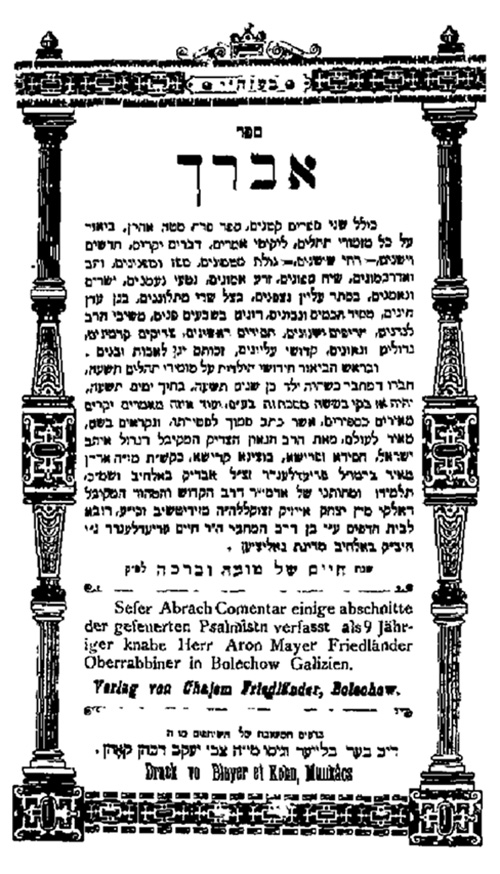
Here is the title page of R. Hezekiah David Abulafia’s Ben Zekunim. If you read the introduction you will see that the first part of this book was written when the author was thirteen years old.

R. Yitzhak Arieli reported being told by R. Kook that the latter authored a book on Song of Songs when he was only eleven years old. You can find Arieli’s testimony here.
As I am writing this people are once again outraged by something R. Ovadiah Yosef said, in that he attributed the fires in Israel to lack of Sabbath observance. Obviously, this is not the sort of comment that appeals to those with a modern temperament, but in traditional societies it is an expectation of the people that the leading rabbis will find some spiritual reason to explain tragedies. So why I am mentioning this now? Because in the document from Arieli, no. 38, he quotes R. Kook as saying something that people will find even more shocking than anything R. Ovadiah has ever said. (I don’t think you will find the students of R. Kook ever repeating it.) R. Kook wondered if the 1929 pogrom in Hebron was perhaps due to the fact that the Hebron Yeshiva brought in their “modern” ways to Israel, by which he means their way of dressing, hair style and beardless faces.
בהפרעות (בשנת תרפ”ט) בחברון מצאתיו ביום ראשון יושב ובוכה והבליט מפיו שמא מפני שהכניסו תלבושת והנהגה חדשה בארץ (היה מתנגד לגלוח הזקן (כמובן במכונה או בסם) ובלורית ואולי גם בגדים קצרים, ובישיבה העיר כ”פ ע”ז ( אבל קשה היה לשנות ההרגלים שבחו”ל).
I agree that this sounds shocking and offensive to modern ears, especially to those who lost family members in this event. I mean, can you imagine telling someone whose child was killed that it was because certain yeshiva students were dressing in a modern fashion? But again, the traditional mind works differently than the modern mind. I say this not to recommend that we all reprogram our minds so that these sorts of explanations are once again appealing, any more than I would wish that, as with Jews in medieval Germany, we once again believe that demons are all around us causing all sorts of problems. I mention it only to add some context and help explain how the most influential rabbinic mind of the twentieth century could say something which to modern ears sounds outrageous. Just as it wrong to judge pre-modern science negatively because it didn’t have access to modern technology, so too we must be careful about being prejudiced against traditionalist explanations because we might no longer share the same assumptions as our predecessors
3. With regard to R. Baruch Epstein’s discussions about his uncle the Netziv in Mekor Barukh, the irony is that the Netziv thought that there was no good purpose in reading the biographies of great Torah sages. He thought that this was nothing less than bitul Torah. See the letter from R. Hayyim Berlin printed at the beginning of his father’s Meromei Sadeh.
The Netziv’s concern with bitul Torah was such that when his wife (I presume his first wife, Rayna Batya) had to have an operation and the students wanted to say Tehillim for her, the Netziv refused to stop the learning for this. After the students continued to push, he agreed to allow five minutes of tehillim. This was reported by R. Zvi Yehudah Kook, who must have heard it from his father. See R. Hayyim Avihu Schwartz, Be-Tokh ha-Torah ha-Goelet (Beit El, 2006), p. 201.
In an e-mail discussion with one reader, he contrasted the Netziv to R. Chaim Soloveitchik and R. Velvel ,saying that the Netziv was so “normal”. I don’t want to use words like that, and while R. Chaim had many unique qualities, I don’t think the stories told about him are any more unusual than those told of other gedolim. Most of these stories are, in fact, quite inspiring. The stories about R. Velvel are, I admit, of a different flavor. I mentioned two such examples here.

Yet lest one thing that these type of stories are unique to R. Velvel, let me mention a story about the Aderet “brought down” (to use the yeshiva lingo) in the book I just referred to, Be-Tokh ha-Torah ha-Goelet, p. 324. R. Zvi Yehudah told how one of the Aderet’s sons died right after birth, just as Shabbat was starting . The Aderet told his wife that she should perpare the Shalom Zakhor as if everything was normal, for there is no avelut on Shabbat and the community does not need to know that anything is wrong. When the Rebbetzin began to cry the Aderet replied to her that she is acting this way because she doesn’t study Talmud. If she studied Talmud she would know that there are often times when we are left with questions, and the same is true in life.

4. Stampfer’s point about the frequency, and lack of shame, of divorce in Eastern Europe was an eye-opener to me. In Between the Yeshiva World and Modern Orthodoxy, p. 22, I mention that divorce was very uncommon in traditional Lithuanian Jewish society, and almost unheard of among the rabbinate. I now see that I was mistaken in this assumption (which was based on my general impressions, not on the sort of evidence Stampfer makes use of). For examples of rabbinic figures who got divorced, see here.
5. I referred to Daas Torah above, and since someone asked me if I could write up what I said about it in a recent lecture, I will do so now. In this lecture I quoted what appears in R. Yitzhak Dadon’s new book, Rosh Devarkha. This is the follow-up to his earlier book, Imrei Shefer, both of which record the teachings of R. Avraham Shapiro, Rosh Yeshiva of Merkaz ha-Rav. On p. 10 one finds R. Avraham’s very harsh comments against Daas Torah. He would refer to it as Ziyuf ha-Torah. Here are some of his words:

האם התורה עוברת רק דרך אדם אחד?! בחו”ל לא היה כדבר הזה! זה אמר כך, וגדול פלוני חלק עליו וחשב אחרת, מישהוא אמר שהפלוני הזה הוא נגד “דעת תורה”?! מהיכן הביאו את הדבר הזה? אם ה”חפץ חיים” סבר כך ורבי מאיר שמחה אחרת ופלוני גדול אחר
חלק עליהם, יש מי מהם שהוא נגד “דעת תורה”? איזו הנהגה היא זו? זו השתלטות על דעת הרבנים, ולא היה כזאת בעם ישראל.

As for the practice of declaring what the Daas Torah is through the newspaper or through placards, without any sources to support this, here are R. Avraham’s strong words (and apologies if any wives are offended):

כלפי רבנים המוצאים חוות-דעת ותלמידיהם מפרסמים זאת תחת הכותרת: “דעת תורה”, בלי שום אסמכתאות ומקורות נאמנים היה מרן זצ”ל אומר: “איזו מין דעת תורה היא זו? כשאדם אומר “דעת תורה” בלי שום מקורות, אז הכוונה היא כזאת: זה קצת מבוסס על מה שהוא למד, והרוב זה מה שאשתו אמרה לו, זה הפירוש דעת תורה.

Anyone who is honest will admit that the current practice of Daas Torah is completely phony. My proof of this is very simple. If tomorrow R. Elyashiv would declare that everyone has to say hallel on Yom ha-Atzmaut, would the Lithuanian yeshiva world listen to his Daas Torah? Of course not. They would simply replace him with another gadol whose Daas Torah is more palatable to them. In other words, the gadol only has Daas Torah because the masses, or the askanim, let him have it, and only when they like what he says. (I am curious. Has R. Elyashiv’s ruling that fashionable sheitls are forbidden had any effect on his supposed followers?).

Try to imagine what would happen if someone in the haredi world discovered a letter from the Hazon Ish, the ultimate Daas Torah authority, in which he said that only the best and the brightest in the State of Israel should devote themselves to Torah study. However, everyone else should go to work. Does anyone think that this letter would ever see the light of day? Of course not! We all know what would happen. The letter would be kept hidden, and if by chance some rebel did publish it, the haredi world would find a way to justify why they don’t accept the Hazon Ish’s viewpoint.

6. In this post I referred to a mistaken point by R. Ezriel Tauber in his recent book Pirkei Mahashavah al Yud Gimel Ikarim le-ha-Rambam. I was asked if my negative comment relates to the entire book, or just the one point I referred to. My answer is that I wasn’t referring to the entire book, and I am sure that people will find things that are valuable in it. Yet I have to say that I don’t find it helpful when an author like Tauber asserts, p. 428, that people who claim to be atheists are really not. Rather, they just don’t want to believe, but deep down they know the truth.

Contrary to Tauber (and he is not the only one to express himself this way), the only intellectually honest position is to take people like Christopher Hitchens at their word and deal with it. Claiming that the atheist really believes is no better than the atheist saying that the believer really knows the truth that there is no God.
Furthermore, from my perspective I can’t take an author seriously when he says things like how in the Far East there are people who have the power to use black magic, and their knowledge is part of a tradition that goes back to Abraham. P. 133:
ואכן במזרח הרחוק יודעים שמות של טומאה, ויש להניח ששורש הידיעה היא מאברהם אבינו. ואף על פי שהם כוחות אמיתיים, אסור לנו להשתמש בהם.
*  *  *
I want to take this opportunity to invite all Seforim Blog readers on what I know will be an amazing Jewish heritage tour to Central Europe this summer. Details can be found here. They are still working on the price, and it will be posted soon. Those who want further details are invited to contact me.
With Christmas Eve almost upon us, I also invite readers to watch, or listen to, my lecture “Torah Study (or Lack of It) On Christmas Eve: The History of a Very Strange Practice.” It is available here. The few dollars (Canadian) that it costs go to support a very worthy organization, Torah in Motion.
Notes


[1] Wiedenfeld, who is the source for the information from Arik, actually had a special place in the eyes of the Lithuanian yeshiva  world. Haym Soloveitchik writes (TUMJ 7 [1997],  p. 144):

Intellectually, the Lithuanian approach to talmudic study (derekh ha-limmud) has triumphed. One could scarcely imagine a Hungarian rosh yeshiva being considered as a candidate to head a Lithuanian yeshiva. Nor is it accidental that with one early, minor exception (the Tchebiner Rav [Wiedenfeld]), all the embodiments of da’at Torah, both in America and Israel, have been Lithuanian.


Chaim Rapoport Review

In response to a request from the editorial board of the Seforim blog, we are pleased to present a monograph-length review essay of Samuel Heilman and Menachem Friedman, The Rebbe: The Life and Afterlife of Menachem Mendel Schneerson (Princeton University Press, 2010), by Rabbi Chaim Rapoport, who is a frequent contributor to the Seforim blog (see here for his earlier essays at the Seforim blog).
We believe that Chaim Rapoport, “The Afterlife of Scholarship: A Critical Exploration of Samuel Heilman and Menachem Friedman’s Presentation of the Rebbe’s Life,” the Seforim blog (14 June 2010), available here (http://seforim.blogspot.com/2010/06/chaim-rapoport-review.html) greatly contributes to the growing study of the Chabad-Lubavitch movement during the latter half of the twentieth century.
The Afterlife of Scholarship: A Critical Exploration of Samuel Heilman and Menachem Friedman’s Presentation of the Rebbe’s Life
Two Books for the Price of One
‘The Rebbe: The Life and Afterlife of Menachem Mendel Schneerson’ by Samuel Heilman and Menachem Friedman (Princeton University Press, 2010), 382 pages.
This book is comprised of two studies.
Firstly, we have a sociological study of the Lubavitch ‘mission establishment’ (shlichus); a layman’s guide to the now global phenomenon of shluchim,[1], shluchos and their Chabad Houses – at least as they have become consolidated over the last two or three decades. The authors describe the dedication of these emissaries; their ambitions, achievements and the (messianic) ethos that spurs them to work tirelessly with the aim of drawing the hearts of all Jewish People closer to their Father in Heaven.
In this section they speak, often quite fondly, of the sterling work performed by the shluchim and their families who go and live in small towns, far-flung cities and secular university campuses in order to re-ignite religious life; providing Jewish amenities for both residents and itinerants, observant or otherwise, across the globe. They emphasize the novelty of this phenomenon, in contradistinction to other chasidic and haredi groups who tend to retreat into their insular communities, shunning exposure to the outside world and its religiously threatening elements. They depict the ‘equal rights’ and privileges of women on shlichus, describing the uniqueness of this somewhat ‘egalitarian’ phenomenon within an otherwise ultra-traditional group. They explore the motives that they believe drive so many young, talented and charismatic couples to choose such a challenging life-long career, and describe how they maintain the high level of inspiration, stamina and perseverance that are essential for success in this vocation. Finally, they demonstrate how such families see themselves, as astonishing as this may seem, to be acting as emissaries of Rabbi Menachem Mendel Schneerson (1902-1994), the seventh Rebbe of the Chabad Lubavitch dynasty [henceforth: ‘the Rebbe’]; who passed away in 1994.
Secondly, and most importantly, we have an attempt to present the life-story of the Rebbe, the man who created this mission, and the one who, to this day, inspires those who have embraced it. The authors do not merely endeavor to reconstruct the factual data of his life, much of which, they allege, is shrouded in mystery, but they also venture to penetrate the deepest recesses of his psyche. They purport to reveal his unspoken thoughts, feelings, incentives, and they sometimes even second guess his actions or reactions at any given time of his life. As Sue Fishkoff has put it, Heilman and Friedman “take a psycho-bio approach to Schneerson’s life, trying to get inside the man’s head to uncover his motivation” [2] – a tall order indeed!
The Focus of This Review
Although the biography of the Rebbe and the history of his movement are presented as intrinsically intertwined, the critical analysis I offer hereby, will focus primarily on the biographical section of the book. I propose to appraise the methodology of its authors, their sources, inferences, pre-suppositions and conclusions, and ultimately judge the quality of this biography as a work of scholarly research. At the conclusion, however, I will also make some remarks that are relevant to the work of the Chabad emissaries and the future of their mission, inasmuch as these are related to the concept of the Messiah and Redemption, subjects that are central to both the biographical and sociological sections of Heilman and Friedman’s work.
A reliable biography of a 20th century figure usually relies on several sources of information: (a) hard documentation; (b) autobiographical testimony of the subject; (c) [interviews with eye] witnesses; (d) anecdotal evidence and hearsay: “mi-pee ha-shemuah”; (e) the objective, un-prejudiced analysis and interpretation of a, b, c and d.
The subject of the biography will be ‘constructed’ by the reasonable and balanced usage of these five construction tools. This equilibrium requires that priority is given to (a) over (b) and (c) over (d) etc. [To an extent, the credentials of the biographer as a historian in general can be tested by the way he utilizes these five informants].
It is, working from this vantage point that I proceed to explore the work of Heilman and Friedman. But before I commence this task, a preliminary remark is called for. [3]
To read the entire (forty-five page) review essay, click here (PDF).
Notes:
[1] In their first endnote on the book Heilman and Friedman express surprise that Lubavitch emissaries are referred to as shluchim: “The precise Hebrew or Yiddish word for emissaries would be ‘shlichim,’ but for whatever reason, Lubavitchers have chosen to use the term ‘shluchim,’ perhaps to distinguish themselves from all other types of emissaries, religious or otherwise.” Heilman and Friedman, chapter 1, note 1. This comment bespeaks ignorance in the Hebrew language. Whilst it is true that in Modern Hebrew (the Ivrit of Ben Yehudah) the plural shlichim is used, in rabbinic Hebrew (and therefore Yiddish) it is virtually unused. The term shluchim and its derivatives are found in hundreds of places in rabbinic writings.
[2] Sue Fishkoff, “New bios of Lubavitcher rebbe dig for the man behind the myth,” Jewish Telegraphic Agency (17th May 2010), available here (http://www.jta.org/news/article/2010/05/17/2394846/new-bios-of-lubavitcher-rebbe-dig-for-the-man-behind-the-myth).
[3] There are those who would have it that only non-Israeli’s can pass judgment on the Arab-Israeli conflict; only indifferent Jews can assess the qualities of Jewish Orthodoxy; only atheists can write impartially about religion; and only academic sociologists can write objective history. I disagree.
I am an orthodox Jew. I consider myself to be a disciple of the late Lubavitcher Rebbe, and although I studied in other Yeshivot (Manchester and Gateshead), and I am familiar with a broad array of orthodox theologies, my main training was in Lubavitch. Nevertheless I consider myself to be a fair and reasonable thinker, even with regards to matters that relate to Judaism, orthodoxy, and, yes, Lubavitch. I acknowledge that I may not be able to achieve the maximum possible degree of objectivity with regard to any of the above, but on the other hand, I believe that my first-hand experience of Jewish, Orthodox and Chasidic life affords me advantages that outside scholars often lack.
Moreover, as many recent studies have demonstrated, the vantage point of the outsider is not always free from bias and prejudice. All too often, the so-called detached scholars have their own axes to grind. Not all ‘external’ expertise is objective, and, not all insiders are blind. I therefore appeal to readers to avoid pre-judging the value of my essay, by resorting to the knee-jerk: “Well, he is a Lubavitcher; what else do you expect him to say?!” Rather, listen to my argumentation, look up the sources, and judge for yourself with the maximum possible degree of objectivity that you are able to achieve.
Chaim Rapoport, “The Afterlife of Scholarship: A Critical Exploration of Samuel Heilman and Menachem Friedman’s Presentation of the Rebbe’s Life,” the Seforim blog (14 June 2010): 3, available here (http://seforim.blogspot.com/2010/06/chaim-rapoport-review.html).


Review: Bekurim with the Gra’s Commentary

Review: Bekurim with Gra’s Commentary
by: Eliezer Brodt
One of the most famous gedolim who lived in the past few hundred years was R. Eliyahu of Vilna, the Vilna goan, or Gra. Gra was known for his expertise in all areas of Torah literature including all of Tanach, Bavli, Yerushlami and the rest of Chazal. Additionally, he was an expert in dikduk, Kabbalah and Halacha. Gra did not print anything in his lifetime; however, shortly after his death, his works began to be printed and have been and continue to be until today. Not only has an incredible amounts of his own material been printed but dozens of seforim, books, and articles have been devoted to him, some devoted to his torah others to his life. Bibliographies have been written collecting everything related to Gra. The most recent listing of his work’s was from Yeshayahu Vinograd in his Otzar Sifrei ha-Gra. This bibliography was printed in 2003 and contains 1,630 entries of materials related to Gra.From 2003 until today, many more could be added to this collection. Many people have worked on different aspects of Gra’s works specifically explaining what he meant etc. As is well known Gra wrote very concisely and many of his manuscripts were his personal notes not intended to be published making it very hard to understand what he was getting at. This is true for most of what he had written such as his Biur ha-Gra on Shulchan Orach which has been worked on by many like the Demsek Eliezer, as well as R. Kook and more recently R. Rakover. These works are extensive commentary to explain exactly what Gra meant. His notes on Shas have been worked on and collected by many different people as has been many of his other works. In this post I would like to focus on recent project and organization called Mechon Maatikei Hashemua. This project is devoted to printing all Gra’s Torah on Seder Zeraim. Recently this Mechon released their first publication, the works of Gra on the first Perek of Yerushalmi Bikurim.

Many years ago, a small team of people headed by R. Yedidah Frankel, began studying Seder Zeraim. There is no Bavli devoted to Seder Zeraim only Yerushalmi which makes studying this seder more difficult as we are accustom to the Bavli.  [Regarding the question of if a Bavli on Zeraim existed but is no longer extant, see the  incredible doctorate of Yakov Zussman.] One of the reasons why Yerushalmi in general is very hard to learn is because our printed editions contain numerous textual errors. Aside from lacking the Bavli, Zeraim is more difficult to study because it has only a handful of the commentaries of the Rishonim and Achronim. One of the reasons for it not having some many commentaries was because Seder Zeraim contains little in the way of practical halacha. During the Middle Ages, the main focus of learning was on practical halacha. Thus, Seder Zeraim, among othes, was rarely studied during this period.  Another reason for the dearth of commentaries is that the Yerushalmi was simply not available – many cities during Middle Ages did not have even a single copy. However, in the past century aside from the Yerushalmi becoming more available, this part of Torah became much more relevant in light of it becoming practical halacha. Thus, many more people are studying the Yerushalmi today.

Just to cite a simple example demonstrating this phenomena.  Two hundred years ago there was almost no works devoted to Shevius  (Shmitah), today with each shmitah dozens of works have been written perhaps in the hundreds already. Now that Zeraim is more relevant and more are studying it, the periush of anyone, and more so a super star like Gra, is extremely important. This organization took upon themselves to print Gra’s commentary on Zeraim. This work is not merely a reprint Gra’s commentary on Zeraim, rather it contains much more. Frist, they found the Yerushalmi that the Gra actually used and wrote notes in when learning Yerushalmi! After carefully going through it they mapped out a plan how to go about printing it. In the past few years both the methods and benefits of this find have been written up in various Torah publications amongst them Yeshurun and Moriea. A very in-depth article was printed in the book released from Bar Ilan on the Gra a few years back, HaGra Ubeis Medraso. In each of these articles R. Frankel shows the importance of this find and how it enlightens our understanding of complex Sugyos in Seder Zeraim.

The manuscript was authenticated by experts in Gra’s handwriting. The significance of this is we now more material to help us understand this complex seder which lacks seforim compared to other areas of Torah.

This beautiful edition is composed of many parts. First, they printed the Mishana with the Pirushim of the Rambam’s Pirish Lemishna, Rash mi-Shantz, and Rosh. To ensure accuracy of these texts, all known manuscripts of these commentaries were used, in a critical edition, with many excellent and useful footnotes. Additionally, in this section they also included the perush of Gra on Zeraim – Shenoes Eliyahu reworking it with new additions from manuscripts including notes.

For the second section they use the type from the Yerushalmi printed in Amsterdam that contains R. Eliyhu Mifulda’s work because this is the edition of the Yerushalmi that Gra used and wrote his notes on. In the footnotes, the editors compared this text of the Yerushalmi to other manuscripts. They also reworked the commentary of R. Eliyhu Mifulda adding in many notes to the text. This section also includes a commentary, Biurei ha-Gra. This commentary is from notes of students of Gra which had been printed before. Again, as with the other sections, there exists a few manuscripts of this work, all of which were used for this section. The editors also include many notes to explain this part. Additionally, this section also includes the complete version of Gra’s notes based on the manuscript of his Yerushalmi. These notes were printed a few times but only partially. However, in this edition each one is put in its proper place with different fonts to make it less confusing. This part also has notes to explain what Gra meant. However, not to confuse the user, Gra’s notes appear on the page in their proper places and an in-depth explanation is included after each daf.

After this section they have a part which is composed of in-depth discussion of Gra. For example, Gra, as mentioned above, wrote rather crypitically, and at times, at first glance when one looks at it you no idea what he was trying to say. This is especially true in Gra’s own notes as they was not meant for anyone other than himself. At times, the commentary contains no words just lines, circles, dashes which, as one would imagine, are especially difficult to decipher. The only way one can properly understand  Gra is to have a great understanding of the whole sugyah. Now the whole sugyah means the comparative texts of  other sifrei chazal such as Bavli, Sifra, Sifri, and Mechilta. One also has to have a command of all the Rishonim on the particular Sugyah. This team spent a very long time going through each sugyah with great depth they presented their finds in this section. They did a excellent job of presenting the material they found in a clear and concise manner. The use charts at times and as many works as necessary to get to the bottom of the issues whether it means consulting critical editions or manuscripts of Chazal or Rishonim, dictionaries for the meaning of a word, rishonim and the works of the main achronim. After reading through each chapter in this section they explain exactly what Gra was trying to do, when one sees it one is just amazed to see what Gra meant with just a few words or dashes.


To explain what drives Gra to write in such a cryptic manner. The only reason why one is allowed to write Torah is because of a heter of עת לעשות לה’  that one will forget. Gra was not scared that he would forget so he just wrote very shorthand to remind him of what how he understand the Sugyah. I also assumed this was yet another legend that they say about Gra, but when one looks at this Yerushalmi where they reproduced the pages with Gra’s notes one can see this very clearly its no legend. The pages are full of dots, cross outs, circles, dashes and one word here and there. To the untrained eye it looks like nothing. This Mechon has shown the incredible wisdom behind each one of those markings. Another Godol who used this style of Gra was R. Nosson Adler. R. Auerbach famous for the Eshkol printed these notes also they were one word here and there lines dashes and he explained them. People accused Auerbach of forging this work too but I believe it has been proven that it is an Authentic work. See Hurowitz, Rabbanei Frankfurt (pp. 151-152). R. Chanoach Erentru brings from his Rebbe,  R. Fevel Palut, a student of the Chasam Sofer the following:

ר’ נתן אדלר אמר שהתירו לכתוב את התורה שבעל פה רק מפני החשש שמא תשכח התורה מישראל לפי זה אמר אין הוא רשאי להשתמש בהתיר זה כי אין הוא שוכח דבר. ואמר עליו שלא רק  שידע את כל התלמוד בעל פה אלא גם מעולם לא שכח דבר מכל ספרות הראשונים (עיונים בדברי חז”ל ובלשונם, עמ’ סו).

In the last section of this work they show exactly what Gra wrote and each of Gra’s notes, big or small, are reproduced in a high quality picture and blown up they than write underneath each photo exactly what they believe Gra was doing. This section at times due to spilling of ink and other problems they could not read some of the writing in the orginal manuscript they than consulted with the the Israeli police department to read some of the comments with infrared magnifiers. They even were helped by NASA to read some particularly difficult parts! I would assume this is the first time they were consulted for help in printing a rabbinical text.

This work is a labor of love as it is obvious from going through it. In the past bunch of years I do not recall any sefer that shows such meticulous preparation for publication. One can see how much the editor R. Frankel believes in the importance of his project. It is printed on beautiful paper, the the size of the volume is very tall making it very usable. The fonts and print of each page are also very well done making it not only beautiful in content but matching in looks. The editor was helped by a very small team of people who mastered Seder Zeraim over years of learning through it as did he. It took many years for this volume to be printed and it is a small part of the whole seder Zeraim very large sums of money were spent to get the project going but it still requires more to complete the project. For more information on purchasing this volume or helping with this project contact them at yedidiyah@hotmail.com. See also here.

I wish them much luck in completing this very special important project.


Sefer HaNer on Mesechet Bava Kamma

Sefer HaNer on Mesechet Bava Kamma: A Review
by:Rabbi Yosaif Mordechai Dubovick

Not every important work written by a Rishon is blessed with popularity.[1] While many texts were available throughout the generations and utilized to their utmost; others were relegated to obscurity, being published as recently as this century, or even this year. Nearly a month doesn’t pass without a “new” Rishon being made available to the public, and often enough in a critical edition. While each work must be evaluated on its own merit, as a whole, every commentary, every volume of Halachic rulings adds to our knowledge and Torah study.[2]          From the Geonic era through the Rishonim, North Africa was blessed with flourishing Torah centers, Kairouan in Tunisia (800-1057),[3] Fostat (Old Cairo) in Egypt, and many smaller cities as well. Perhaps the crown jewel of “pre-Rambam” Torah study was the sefer Hilchot Alfasi by R’ Yitchock Alfasi (the Rif).[4] Many Rishonim focused their novella around the study of Rif,[5] the Rambam taught Rif in lieu of Talmud,[6] and a pseudo-Rashi and Tosefot were developed to encompass the texts used and accompany its study.[7]

In Aghmat, a little known city in Morocco, circa the Rambam’s lifetime, rose up a little known Chacham whose work is invaluable in studying Rif, and by correlation, the Talmud Bavli as a whole. Yet, this Chacham was unheard of, for the most part, until the past half century. R’ Zechariya b. Yehuda of Aghmat, authored a compendium of Geonim, Rishonim, and personal exegesis on Rif. Spanning a period of 200 years of Talmud commentary of the first order, this work was also unique in its approach. Various editors have justly compared it to a work of similar nature and provenance, Shittah Mikubetzet by R. Betzalel Ashkenazi.

However, this source of Talmudic material from an almost blank period remained unknown until HaRav Prof. Simha Assaf published several leaves on Mesechet Berachot.[8] This followed by a semi-critical edition of a complete manuscript, by Meir David Ben-Shem bearing its rightful title, Sefer HaNer.[9] Later, J. Leveen published a facsimile version of a manuscript in the British Museum[10] on the three “Bavot” along with an English preface, indexes and a brief critique of Ben-Shem’s edition of Berachot. Since, many articles have been written about the work[11] and the Torah world has been blessed to see several volumes in print.

To date we are in possession of Sefer HaNer on Berachot,[12] Shabbat,[13] Eruvin, Moed Katan[14] and Mesechet Nezikin; namely the three Bavot.[15] In general, R’ Zechariah complied his work from the following sources, most of which were unknown as a work, and sometimes even the author was unknown. These Pirushim include Geonim; Rav Hai in particular, Rabbeinu Chananel,[16] R’ Yosef ibn Migash, R’ Baruch Sefardi (RB”S),[17] R’ Yitzchok Ghiyyat, Rav Natan author of Sefer ha Aruch, Rashi,[18] Rambam,[19] as well as material of unknown authorship.[20] Further, a notable portion of the material is in Judeo-Arabic of that period, including Geonic response and commentary, citations from R”Y ibn Migash, the Rambam’s commentary on Mishnah, and even short remarks within other commentaries as well. Accurately translating the material is a handicap, limiting the sefer’s use, and perhaps played a part in its falling into disuse at the decline of a Judeo-Arabic speaking Talmudist audience. [Much like the loss of many (non-translated) Judeo-Arabic Geonic works over time].          Recently, a new edition of HaNer on Mesechet Bava Kamma has been published; this article will attempt a comparison between the two printed editions, focus remaining upon the newer edition. While parts of the material of the manuscript (British Museum OR 10013) have been utilized in the past,[21] never has the manuscript been published as a whole, with critical notes. In 5761, as a part of Ohel Yeshayahu, a compilation of works on B”K, R. Hillel Mann published the relevant portion of Sefer HaNer from this manuscript. While this edition was surprisingly accurate to the mss. (the facsimile published by Leveen is available on Otzar HaChochmah), his notes are exceptionally lacking, with only the barest citation to what could be best described as “yeshivishe reid“; the common knowledge on the topic as discussed in the Yeshivot of today. Certainly not the optimal choice when editing and annotating a work based on Geonic and early Rishonic material, with many variant readings in the Talmud, as well novel commentaries hitherto unutilized.

Upon perusal of this edition, one cannot help but notice that in sharp contrast to the remaining nine chapters, the first chapter seems well edited, and the material in the footnotes is richer. The answer to this oddity is found in Mann’s preface; in 5752, an article containing a critical edition of the first perek was published by R’ Yehoshua Hutner of Machon Talmud Yisraeli[22]. This material had been meticulously edited by R’ Dov Havlin shlit”a and R’ Yosef haKohen Klien ob”m. Mann made use of the extensive notes, gleaned what he felt valuable, and ignored what he deemed he could.[23] According to Mann, R’ Tzvi Rotstein[24] copied the mss., and R’ Yosef Kafich translated the Arabic text.

Several months ago, a new edition of this work graced our tables. R’ Dov Havlin, the editor of the Talmud Yisraeli article, and his family[25] received permission to publish the work in its entirety.[26] Using the material previously assembled, and R’ Kafich’s translations, a preface was added, and the book printed. A mere glance at the first footnote to the preface shows the thoroughness and care taken when approaching a Rishon. As opposed to an “on-the-job training” attitude displayed by some authors, here the appropriate material was gathered and made use of in order to assess the task at hand.

The preface offers the uninitiated a précis of the academic papers written on R’ Zechariah, and deals with the author, his era and his works. Alongside, a chapter is devoted to R’ Baruch Sefardi, if only for the sake of providing the public exposure to Abramson’s pamphlet.[27] In one paragraph, the editor explains his decision to title the work “Shitta MiKubetzet Kadmon” although the author R’ Zechariah named it “HaNer”. I must confess I was not persuaded to concede to the change, and regret the license taken.[28]

Another liberty taken is the exclusion of the abbreviation “Pir'”, short for “Pirush”. This nomenclature has been edited out and replaced with a dash, although no mention was made of this in the preface.[29] This is not the case in the original article, and it would appear that this was done solely by the new editor(s). In addition, Arabic pieces, be they ever so brief, are replaced with the translation, and while the replacement is noted the original text is lacking. Mann’s edition reproduces the original, and relegates the translation to a footnote as the original article. By way of comparison, the original sports 261 footnotes on the first perek, the newer model, 98, and Mann’s version contains 102. Clearly, editing has been done, and while citations previously footnoted are now in the body of the text (parenthesized and font size lowered), one wonders what else has been omitted, and at what cost.[30]Diacritics found in the mss. are sorely lacking in all three editions, and HaShem’s name, typically written as three letters “yud”, is modernized to two.[31] Further, abbreviations have been expanded; Mann remained true to the text. Many of Mann’s mistaken readings are especially accurate in the new edition, yet typographical errors (as is wont) remain.As the work is based upon Rif, and collates many authorities, attempts to correlate the work to the Talmud’s present pagination is daunting. Many times R’ Zechariah will continue to copy a commentator, covering material spanning several folios, only to backtrack in order to begin a parallel commentary. Special attention need be given to this, and often Mann has rearranged material to fit within the parameters of one page; Havlin et al reproduce the original order.[32] The mss, while largely legible, has many additions, in different hands. Some addenda are written perpendicular to the text as marginal glossa, in a smaller hand. Mann has lost text in this fashion, as opposed to the Havlin edition wherein they are preserved. Publishing any edition of a manuscript reverts at some point to become eclectic. The editor is forced to decide on punctuation placement, and sentence/paragraph breaks, causing differing interpretations. While I cannot agree to the many changes made in the new edition,[33] this treasure trove of valuable material has now been made available to the public, and our thanks due. The text is highly accurate to the manuscript, the notes offer useful information, cross references and variant readings. This new addition to the Talmudic bookcase is most welcome, and while the implication given by the publisher that the next two meschtot are not on the agenda, may any continuation of so worthy a project be expediently brought to light.


[1] See Zohar, Bamidbar (3:134a) “everything is dependant upon fate, even the Sefer Torah in the Heichal”.

[2] See E. Soloveitchik, ‘Al Pirush Kadmon lMesechet Sukkah’, Tzfunot 18 (5752), pp 9-13. See also Prof. R’ S. Z. Havlin, Sefer Vaad lChachomim, Yerushalayim 5763, p 13-35/

[3] Home of the Yeshiva of R’ Chananel and R’ Nissim Gaon, among others. See M. Ben-Sasson, Tzemichat haKehillah haYihudit bArtzot haIslam, Yerushalayim 5757.

[4] See Ta-Shma, Sifrut Ha-parshanit le-Talmud vol. 1, Yerushalayim 5760, pg 156-159.

[5] See E. Chwat, Doctoral Dissertation, Bar-Ilan University, Ramat Gan 5750. See also S. Gottesman, Yeshurun 9 (5761) and Nitzutzei Aish, Memorial Volume, (Newhouse) Israel 2004.

[6] See E. Chwat, Yeshrun 20 (5768); M.A. Friedman, Tarbiz 62 (4) (5752).

[7] Chwat ibid. see also TaShma, ‘Klitatam shel Sifrei haRif, Rach, vHalachot Gedolot bTzarfat ubAshkenaz bMaot 11 v12’ (Knesset Mechkarim 1, Yerushalayim 5764, previously, Kiryat Sefer 54 (a)). See also Prof. Shamma Yehuda Freidman, ‘MiTosefot Rashbam lRif’, Kovetz al Yad 8 (5736).

[8] S. Assaf, ‘Chelek miPirush Kadmon liMesechet Brachot liEchad miBnei Zemani shel haRambam’, in ‘L’Zichron R’ Z’ P’ Chayyes, Yerushalayim 5693.

[9] Yerushalayim, 5718 [available here at hebrewbooks]

[10] A digest of commentaries on the tractates Babah kamma, Babha mesi’a and Babha bhathera of the Babylonian Talmud, compiled by Zachariah Ben Judah Aghmati; reproduced in facsimile from the unique manuscript in the British Museum OR. 10013; edited, with an introduction by Jacob Leveen, London 1961.

[11] C. Z. Hirschburg, Tarbiz 42 (5733); Ta Shma ‘Sifrut Haparshanit’ pg 156-159.

[12] Ben-Shem ibid.

[13] S. Eidison, Yerushalayim 5770.

[14] N. Sachs, Harry Fischel Institute, Yerushalayim 5726.

[15] B”M in Kovetz Sakosah lRoshi, Bnei Brak 5763. B”B (ch. 1-3), R’ Yekutiel Cohen, Yerushalayim 5748

[16] One of the more problematic references in HaNer is to “Miktzat”, see Abramson, ‘Pirush Rav Baruch b”r Shmuel haSefardi lTalmud’, who offers a possible theory that Miktzat means R’ Chananel’s pirush “brought in part”, as opposed to “some [commentators]”, at least in some instances.

[17] See S Abramson ‘Pirush Rav Baruch b”r Shmuel haSefardi lTalmud’, Bar Ilan Annual 26-27 (YD Gilat Jubilee volume) 5754.

[18] See Y. Malchi, ‘R, Zechariah Aghmati, haIsh, Yitzirato, haParshanit, vYachasah lPirushei Rashi’, Shanan 14 (5769) pg 65-73.

[19] See Abramson, Mechkarei Talmud 3.

[20] See Abramson ‘Pirush Rav Baruch b”r Shmuel haSefardi lTalmud’.

[21] R. M.Y. Blau, Shittas HaKadmonim B”M, B”B (2 volumes) and Three Bavot. See also TaShma, Kovetz al Yad, 10.

[22] Sefer Zikaron le R’ Yitzchok Yedidyah Frankel, Tel Aviv 5752.

[23] This explains the unintelligible note no. 81, citing Rav Nissim Gaon on B”K. After searching through Prof. Abramson’s work on RN”G, the passage (then) existed only in a re-creation of RN”G based upon Prof. Abramson’s hypothesis. Comparison to the article in the Frankel volume revels not only the true source material (Abramson), but also an additional citation to Abramson’s work Inyanut (Yerushalayim 5734, p 300), wherein a fragment of RN”G is published, verifying Abramson’s earlier thesis. All this is lacking in Mann’s note, leaving the reader at a loss.

[24] Of Rif reknown. It was Rotstein who brought the fragment mentioned in the above note to Abramson, under the impression the material was Rif. Additionally, R’ Rotstein is listed translator of the Arabic material in HaNer Bava Metziea (Sakosa lRoshi). R’ Eliezer Brodt once mentioned to me in the name of R’ Shmuel Ashkenazi that R’ Rotstein was not fluent in the language and had others translate the Rif material for him. Assumedly, one can rely on the accuracy.

[25] I am not clear as to the involvement and responsibility of each party. The preface is unsigned, R’ Havlin’s daughters are credited with copying the mss. and notes, and at the close of the preface, one R’ Bunim Shwartz’s passing is lamented, being cited as with the acronymic usage of “father”. One tends to understand that R’ Havlin’s son in law was instrumental in the ultimate publishing. This is corroborated by the disclaimer on the inside of the title page.

[26] The publication was done privately, and mention of the Machon is due to having used material penned under their auspices and ownership. However, the volume does not bear the logo nor name of the Machon and carries a private publisher (HaMesorah) on the title page’s reverse.

[27] While the original publication was in the Gilat volume [see above note no.[17], Abramson re-published the article (privately?) as a pamphlet, with corrections and additional material. I have only a photocopy of it, and welcome any information towards procuring an original.

[28] Similarly is “Chochmat Betzalel“, R’ Betzalel of Rensburg, Mossad HaRav Kook. The author had titled the book “Pitchay Niddah” and the manuscript owner and publisher, R’ Maimon took the liberty of changing the name.

[29] The dash has been implemented as a punctuation tool as well; I am unclear why this was done at all.

[30] From the outset, it seems notes detailing textual emendations based on the text of the Talmud have been omitted, and the reader is required to infer from the standard “[…]” that the text has been altered with some “self-evident” basis. It is noteworthy that the editors chose to revise the text of R’ Chananel in this fashion, by use of parentheses. Even in the case where the mss. (Add. 27194) used by the Vilna Shas is identical with the print, variant readings of Rach are common between mss, and may be based upon provenance. See J. Rovner ‘An Introduction to the Commentary of Rav Hananel ben Hushiel of Kairawan of Tractate Bava Metzia, Accompanied by a Reconstruction of the Lost Commentary to the Second Part of the Tractate based upon Cairo Genizah Fragments and Citations in the Rishonim’ (1993) Ph.D.

[31] See Y. S. Spiegel, Amudim bToldot Hasefer HaIvri, vol. 2 pg 565-632.

[32] C.f. 42b. However, on 94b, Havlin transfers text as well.

[33] It escapes me the need for semi-colon usage in Talmudic text, especially enmass.


Marc B. Shapiro – Review: Orthodox Jews in America

 
Orthodox Jews in America
 
reviewed by Marc B. Shapiro
 
This is the first part of a four part post. It begins with a review I was asked to write that in the end was never published. The format of the review was not designed for the arcane stuff and numerous footnotes that are usual fare for the Seforim blog. Yet have no fear, these will return in parts 2-4. 
 
Jeffrey S. Gurock, Orthodox Jews in America (Indiana University Press: Bloomington and Indianapolis, 2009)
 
Pretty much everyone has seen an image that would have been unimaginable fifty years ago. It could be in a restaurant, playground, sporting event, or just on the street. The image is that of a typical American grandparent, with no identifying signs of being Jewish, doting on grandchildren who are wearing long skirts, big kippot and sometimes even have sidelocks. Many have also seen another image, a Shabbat morning with father and son walking to synagogue. Father is dressed in suit and tie and son also has a suit and tie. Yet the son's suit is black and the shirt is white. He is also wearing the obligatory black hat (and in so doing is helping keep alive a business—hat making—that seems to have no other client base).
From one perspective, these images are understandable, as children have often rejected the religious lifestyle of their parents. Yet what makes the story significant is that until recently the movement was almost always in one direction, with children becoming less observant. Seventy-five years ago Rabbi Solomon Isaac Scheinfeld of Milwaukee could declare that there were no baalei teshuvah (newly religious) in the “Land of Columbus.” Yet today we see both plenty of newly religious and, even more significant from my perspective, many who were raised Orthodox adopting a more stringent observance and narrower outlook on life than their parents. This is all part of the historic revival of Orthodoxy. How we got to this place should be a question on the mind of every thinking Jew.
Many have set out to answer this question, and the study of Orthodox Judaism in all of its forms has been a growth industry for the last couple of decades. Recent years have seen an explosion of writings on the topic, both articles and full-length books. There have also been a number of conferences focusing on Orthodoxy, and many of the proceedings have been published. On the internet there are loads of sites devoted to aspects of Orthodox life and culture from all different angles. Even though the Orthodox are significantly smaller than the other denominations, the amount written about them in recent years dwarfs what we can point to with regard to the Conservative and Reform movements. In terms of blogs and other internet sites, there also is no comparison. How to explain all this?
When it comes to the blogs and more popular sites on the internet the answer is not hard to find. It is true that the other denominations have more “members” than the Orthodox. Yet if we are talking about those who are educated Jewishly, and interested in Jewish matters, the Orthodox unquestionably outnumber the other denominations. Since the internet is the great equalizer, with everyone able to set up his or her soapbox, it is no wonder that it is crawling with Orthodox sites. Furthermore, average Orthodox Jews, by which I mean those who are not in the rabbinate or the academy, buy books of Jewish interest to a much greater extent than other laypeople. Since they are bound to be interested in their own denomination, this would explain why books dealing with aspects of Orthodoxy sell well.
Yet how are we to explain the great scholarly interest that has also taken root? Are the academics fascinated by a movement that defied predictions of its demise, and instead shows incredible dynamism and often seems to be changing before our eyes? To be sure, this is bound to interest those in the academy, especially the phenomenon of a movement supposedly committed to continuity with the past that nevertheless shows an incredible ability to alter its traditional practices. After all, it wasn’t too long ago that for most products one determined if they were kosher by looking at the ingredients. Yet the consensus today in the United States, even among the Modern Orthodox, is that a product cannot be kosher without rabbinical supervision (and the supervision itself has to be regarded as reputable). Kosher consumers are now told by the various kashrut organizations that canned vegetables, which contain only vegetables and water, need supervision, not to mention mouthwash, tin foil pans, and a host of other items. They are further told that some fruits and vegetables, such as strawberries and broccoli, can’t be eaten at all, or at least not without a cleaning regimen (complete with liquid soap) that would discourage most. These are all relatively new practices that have developed, and as such are bound to spark the interest of historians, sociologists, and even psychologists.
The latest contribution to the study of Orthodoxy comes from Jeffrey S. Gurock. Gurock was one of the first scholars to write about Orthodoxy, beginning with his classic 1983 essay “Resisters and Accommodators: Varieties of Orthodox Rabbis in America, 1886-1983.” Since that time, he has written on a variety of aspects of American Orthodoxy, and his latest book can be seen as a culmination of his work in this area. Orthodox Jews in America is the first attempt at a complete history of traditional Judaism in the United States (and the colonies).
Let me note at the outset that intellectual history is not part of the story Gurock tells. Other than Rabbi Joseph B. Soloveitchik, who is briefly treated, there is no analysis of important Orthodox thinkers such as Eliezer Berkovits, Leo Jung, and Emanuel Rackman, and how their ideas were influenced by their American experience. The only time the Lubavitcher Rebbe, Rabbi Menachem Mendel Schneersohn, is mentioned is when Gurock notes that some Lubavitchers regard him as the Messiah. I think this is an important lacuna as Schneersohn's role as thinker and builder are certainly significant enough for inclusion even in a book not focused on intellectual history. In fact, it was the success of Lubavitch that encouraged the non-hasidic haredim (ultra-Orthodox) to also move into “outreach,” and today they are the major force in drawing newcomers to Orthodoxy.
This is ironic considering that some of the leaders of this world mocked the Lubavitch for doing precisely what the non-hasidic “outreach professionials” are doing today. In fact, it seems that the demographic realities of America have affected their perspective even more than Lubavitch. How else to explain that Aish Hatorah, a supposedly haredi organization, honors intermarried celebrities at its events and prominently features them in its programming and on its website? This is certainly something that R. Aaron Kotler (died 1962), who more than anyone else is the ideological forebear of the non-hasidic American haredim, could never have imagined.
In analyzing Orthodoxy we must not forget that more than anything else, it is a movement that revolves around Jewish law. Yet Gurock also pays no attention to how the halakhic system was impacted by the New World. I refer to both specific halakhic questions that arose in the United States (e.g., can one eat Turkey on Thanksgiving?), as well as the wider issue of how the democratic ethos of America influenced the outlook of the halakhic decisors, in particular men such as Joseph Elijah Henkin and Moses Feinstein. How the rabbinic leaders of both the United States and Europe regarded American Jewry, a community whose observance was often tenuous, is also an important part of the story that remains to be told.
For example, Gurock writes about the common practice of “Orthodox” Jews going to work on the Sabbath, a phenomenon he himself witnessed and offers a personal description. He even refers to a synagogue in Atlanta that in 1932 began holding Friday night services, not at sunset, but at a time that would permit members “to attend the synagogue after work or before the theatre.” In some synagogues, especially in the big cities, there was an early Saturday morning service that enabled those in attendance to go from there to work.
Not mentioned by Gurock is that there were rabbis who actually justified some of these Sabbath violators (that is, those who went to work, not the theatre goers). These rabbis asserted that those who worked on the Sabbath did so because they felt this was necessary in order to survive. Therefore, from a halakhic standpoint they could not be regarded as typical Sabbath violators. This is only one example of how the American reality influenced the halakhic response, and the writings of Rabbi Hayyim Hirschenson are most significant in this regard.
 
Finally, there is no attention paid to the wider religious context of Orthodoxy in modern times. The turn to traditional religion is certainly not confined to Judaism. The same phenomenon can be observed in Christianity and Islam, which means that there are no doubt broad cross-cultural factors that can explain some of the Orthodox revival of recent decades. In fact, this latter point, which I think is of great significance, is also entirely ignored in Haym Soloveitchik’s “Rupture and Reconstruction,” a classic article on the topic of Orthodoxy’s turn to the right. Soloveitchik describes late twentieth-century Orthodoxy’s evolution to a book culture from what had been a living culture. With this book culture, that is, modeling one’s behavior on the rulings found in traditional halakhic texts, as opposed to how Jews actually lived in the “real world,” came increasing stringency. There is a great deal of truth in this, but as is always the case, no important phenomenon can be explained by one cause. I make these points not to criticize Gurock, but only to call attention to how much work still needs to be done, even after Gurock’s book of almost four hundred pages.
Gurock’s strength is social history, and it is with this in mind that his book should be appreciated. He gives us insight into how Orthodox Jews lived, the peddler and merchant of years ago and the white collar professional of today, in places where there were many like them and in areas far removed from other Jews. Newspaper articles and memoirs are much more valuable for this type of history than the rabbinical writings, which are intended for the intellectuals and often give a very different slant. The story he tells is compelling reading, sometimes maddening (as with the various Orthodox disputes and scandals mentioned), and other times inspiring. I put the book down convinced more than ever that Orthodoxy, in all of its permutations, is where the future of American Judaism will be found. At the very least, its power and influence will be of much greater significance than today.
 
The one major negative that the community has to contend with, and which has always acted as a major hurdle to more people joining, is the incredible cost of day school tuition. Yet even here a new paradigm might be emerging, as some Orthodox parents have begun to send their children to public school. This is a new development that has just begun to pick up some steam and although not included in Gurock’s book, might be part of the Orthodox story in another twenty years.
Gurock begins his story from the start of Jewish settlement in colonial America, and I found the second chapter, dealing with nineteenth-century Orthodoxy and the difficulties it faced throughout the vast country, particularly fascinating. The bulk of the book is understandably devoted to the era beginning with large-scale Jewish immigration towards the end of the nineteenth century. It was then that American Orthodoxy really came into its own.
While some leading rabbis of the time, such as R. Jacob David Wilovsky of Chicago, assumed that no real synagogue could have English sermons, others were more attuned to where the American future would be. Although there were plans in New York and elsewhere to create European-type communities, complete with chief rabbis, the American scene, with its stress on religious autonomy, was not fertile ground for the European model. When one self-styled chief rabbi of New York was asked who actually appointed him to this august position, he is alleged to have replied, “the sign maker.” Even if apocryphal, the story accurately portrays the futility of transferring European models of authority to an increasingly complicated American scene. It is here that Gurock does a fine job showing the reader the complexity of what was taking place.
The twentieth century saw Orthodoxy really come into its own. The challenge of Conservative Judaism, the struggle to create a market for kosher products, and the varied attempts to create an attractive school system for the young are all part of the twentieth-century story recounted by Gurock. Although by mid-century any sociologist worth his salt was ready to proclaim that Orthodoxy would never survive in America—one famously declared that American Orthodoxy was a “case study of institutional decay”—by 1960 it should have been clear that Orthodoxy had made tremendous strides and was here to stay.
While there is much of significance in the book, I feel that Gurock is at his best in his treatment of what I call "old-time Orthodoxy," the type Gurock describes growing up with and has focused on in a few essays. This approach to Judaism, characterized by an identification with Orthodoxy while being less than fully observant in one’s personal life, was the dominant form of Orthodox Judaism in the United States for much of the twentieth country. Gurock has even spoken of the years 1900-1960 as “American Orthodoxy’s era of non-observance.” This “non-observant Orthodoxy” increasingly came under challenge in the latter half of the twentieth century, as stricter observance of kashrut and the Sabbath laws became part of the Orthodox mainstream. As the century came to a close levels of observance continued to rise.
Many of the older generation would have difficulty recognizing the form of Orthodoxy that has developed in the last thirty years. Unlike when they were growing up, today's Orthodoxy does not offer social dances for singles and synagogue trips to Broadway musicals. The mehitzah has been raised and the after-school Talmud Torahs have been closed down since almost all children attend day schools. Orthodoxy no longer feels very welcoming to one who drives to synagogue on Shabbat. In many congregations one who “eats fish out” will have to keep this quiet unless he wishes to appear as a religious deviant. These changes in Orthodoxy happened at the same time that most Orthodox Jews have become completely at home in American society and culture, to the extent of having kosher hot dogs sold at baseball games for all those who wish to take part in the great American pastime. 
By creating the day schools and yeshivot to which they sent their children, the old-time Orthodox planted the seeds of the future revolution in American Orthodoxy, a revolution that has brought great satisfaction to some and heartache to others. Their children discovered that Judaism as practiced in their homes was far removed from what the rabbis and the Jewish texts had to say. Unlike their parents, whose major exposure to Judaism was in the home, the children's major exposure was in the schools. It is therefore not surprising that with their new knowledge they often examined their parents' lifestyle and found in wanting. Many of these people spent time in advanced Torah study in Israel, and as part of the quest for a more serious religious life were ready to accept added stringencies (e. g., glatt kosher and even sometimes halav yisrael [milk produced by Jews]).
One sign of the haredi infiltration, as it were, of Modern Orthodox synagogues is the ubiquity of the Artscroll prayer book and Humash, which present an “East European” flavor combined with a quasi-fundamentalism. It didn’t have to be this way. Yet Modern Orthodox intellectuals were so busy writing learned essays to be read by each other, that they abandoned the masses to the right wing, producing virtually no literature directed towards them. It was only in 2009 that Rabbi Jonathan Sacks produced a competing prayer book to Artscroll, one more in line with the Modern Orthodox ethos. Yet I doubt that it can win over many of the synagogues that years ago switched over to Artscroll.
The increasing visibility and power of the right-wing Orthodox, combined with the turn to the right in Modern Orthodoxy, was bound to engender a counter reaction. Gurock has a chapter dealing with Orthodox feminism, which is just one aspect of an incipient move to the left on the part of some in the Modern Orthodox world. This new liberal Orthodoxy, not as powerful or confident as its adherents would like, has begun to focus on issues that the mainstream Orthodox shy away from, including interdenominational and interfaith dialogue. Yet Gurock is correct in sensing that the women’s issue is central to the self-understanding of the new liberal Orthodox, many of whom seek rabbinic guidance from the recently established Yeshivat Chovevei Torah in New York. It is too soon to tell what the enduring role of this new institution will be. However, the strong attacks on it by both right-wing and centrist Orthodox figures, who see it as the beginning of a new Conservative movement, show that the institution and its rabbis are already viewed as a threat.
The liberal Orthodox first found their voice in dealing with the agunah problem, and have also worked to expand the role of women in the synagogue and communal life. There are now synagogues that regard themselves as Orthodox yet function in a semi-egalitarian fashion, and full egalitarianism might just be a matter of time. Too recent to be included in the book, a woman has just been given a rabbinic ordination, and presumably there will soon be other Orthodox women rabbis. Yet there are also other aspects of the liberal Orthodox vision that Gurock does not mention. For example, social justice has emerged as an issue that they feel strongly about. A new kosher certification has even been unveiled, one that focuses on how the workers are treated. Some in this camp have even begun to speak about the need for a new approach to homosexuality. It is thus very difficult to predict where this segment of the community will be in another fifty years, and if the mainstream will even regard it as part of wider Orthodoxy. Indeed, some of the liberals see themselves as part of a new era, one that is both committed to halakhah and post-denominational in mindset.
At the end of the book, Gurock describes his trip to an Arizona hotel for Passover. Here, around the pool, he witnessed the persistence of old-time Orthodoxy, which he describes as those “Jews on the edges of Orthodoxy’s contemporary tent.” Yet the people he describes are not on the edges at all, but part of mainstream Modern Orthodoxy, especially when one leaves the great population centers. It is true that organized religious life has moved to the right. As mentioned already, you will no longer find synagogues sponsoring trips to a Broadway musical, and the once ubiquitous synagogue dance barely survives. It is also the case that many of the young generation are more observant than their parents. For example, it was almost unheard of for a married woman in America in the 1950’s and 1960’s to cover her hair. If her rabbi’s wife didn’t (and that was almost always the case), then why should she? Yet today, there are many young women in the Modern Orthodox world who do follow this practice.
However, old-time Orthodoxy, which combines a middle or upper class American lifestyle with traditional ritual observance, both survives and is reproducing. Throughout the country pools and beaches are packed with Orthodox Jews, and despite their synagogue’s lack of sponsorship, on any night one can find Orthodox in attendance at Broadway shows and the opera. The synagogue dance might have disappeared, but husbands and wives can dance to the oldies (for many this means “YMCA”) at plenty of Orthodox weddings and bar mitzvahs.
 
What we can say is that the ritual instinct of many Modern Orthodox Jews has zeroed in on matters such as kashrut and the Sabbath, so that these areas are observed much more carefully than in previous years. However, other areas of Jewish law are treated not much differently than a generation or two ago. While some observers have spoken of a future haredi takeover of American Orthodoxy, there is good reason to assume that the varieties of Orthodox experience described by Gurock will continue for a long time to come.


Review: Kehilot Hungary

Rabbi Baruch Oberlander is the rabbi in Budapest, Hungary, since 1989, and is the editor of Tel Talpiot. He has published many articles in the journal Ohr Yisroel and is the world's leading expert on the forged Yerushalmi Kodashim.

כיצד כותבים את ההיסטוריה של יהדות הונגריה בישראל?הרב ברוך אבערלאנדער
אב"ד בבודאפשט, הונגריה קהילות הונגריה – הקהילות החרדיות בהונגריה – תש"ד, מאת פרופ' שלמה שפיצר, מכון ירושלים, תשס"ט, 466 עמודים. 
החשיבות של כתיבה היסטורית נכונהכתיבה מדוייקת של דברי ימי הימים של עם ישראל חשובה מאד, וכבר במדרש[1] נאמר על כך: "כביכול ברא לדור המבול, ולא כתב אימתי בראן, העבירן מן העולם, ולא כתב אימתי העבירן… וכן לדור הפלגה, [וכן לסדומיים], וכן למצרים, לא היה כותב להם אימתי נבראו, ולא אימתי מתו… כיון שעמדו ישראל אמר הקב"ה למשה איני נוהג באלו כאותן הראשונים, אלו בני אבות הן, בני אברהם יצחק ויעקב הן, לפיכך כתוב להם, באיזה חדש, בכמה בחדש, ובאיזו שנה, ובאיזו איפרכיא, באיזה מדינה רוממתי קרנם, ונתתי להם תלוי ראש, לכך נאמר וידבר ה' אל משה במדבר סיני, הרי איפרכיא, באהל מועד הרי המדינה, באיזה שנה בשנה השנית, באיזה חדש בחדש השני, בכמה בחדש באחד לחדש…". ואם חשובים תולדותיהם של עם ישראל בכלל, הרי חשובים במיוחד תולדותיהם של אלו מבני ישראל שמתו על קד"ה, הי"ד.מיד עם תום השואה ניסה ההיסטוריון ההונגרי הרב יקותיאל יהודה גרינוואלד להציב גלעד ליהדות הונגריה על קהילותיה, רבניה ושש מאות אלף קדושיה בספרו "טויזנט יאר אידיש לעבן אין אונגארן"[2]. מאז הופיעו הרבה מאד ספרים, לקסיקונים ואנציקלופדיות שהמשיכו והשלימו עבודה חשובה זו.פרופ' אלכסנדר שייבר (1913-1985), מנהל הסמינר לרבנים הניאולוגי בבודפשט, מצהיר באחד ממאמריו[3]: "בימינו אלו קיימים שלש מרכזים בהם מתעסקים באינטנסיביות בחקר ההיסטוריה של יהדות הונגריה: בישראל, בארה"ב ובהונגריה. בישראל מופיעים בזה אחר זה מונוגרפיות וספרי זכרון על הקהילות שנחרבו… נדיר שיהיה לפרסומים אלו מטרה מדעית, בעיקר הם מתמקדים באסיפת הפרטים על החורבן הגדול וכן רשימת שמות הקדושים. ערכם של המונוגרפיות נקבעת לפי אישיותם וטעמם האישי של המחברים. ברוב המקרים החסרון שלהם הוא, שלרשותם עומדים קצת מאד מקורות; הם אינם משתמשים בחומר הארכיוני שקיים בהונגריה… הגיוני שהעבודה הכי חשובה נעשית בהונגריה…".אין ספק שצדק שייבר שקיים בהונגריה חומר ארכיוני חשוב, ואכן, אלו מהחוקרים וכותבי דברי הימים שמשתדלים להוציא מתחת ידם דבר שלם מרבים להשתמש בהם. אבל הקביעה שלו שבארץ ישראל לא עומדים לרשות החוקרים מקורות אותנטיים יומרנית מדי. גם הקביעה שלו שהעבודה ההיסטורית שנעשתה בהונגריה היא הכי חשובה ועולה בערכה על כל מה שנכתב בארץ ישראל – אינה עומדת בפני הביקורת, ואין צורך להאריך בזה.ברוח הדברים הללו אסקור במאמר זה את הספר "קהילות הונגריה" שיצא לאור בזמן האחרון בארץ ישראל, ונבדוק עד כמה דייקו הכותבים והעורכים בעובדות ההיסטוריות שרשמו, והאם השתמשו בכל המקורות העומדים לרשות ההיסטוריון של יהדות הונגריה. צורת השימוש במקורות השונים, ואלה שלא השתמשו בהםלצד העורך הראשי פרופ' שפיצר עבדו גם עורכי משנה: הרב אליעזר שטרן והגב' חיה בתיה מרקוביץ. הספר מרשים מאד, ורשומים בו ערכים נפרדים על כ-600 קהילות שונות, גדולות וקטנות. הערכים השונים באים לפעמים בארוכה ולפעמים בקצרה, והקורא צריך לשים אל לבו שלא להסיק מסקנות מהכמות על האיכות, וכפי שכבר הזהיר על-כך העורך בהקדמה לספר ש"גודל הערך בספר לא תמיד משקף נאמנה את חשיבות או גודל הקהילה… [אלא רק] משקף בדרך כלל את כמות החומר הכתוב שמצאנו על הקהילה"[4].בדיקה קלה של ספרנו מגלה לקורא שהבסיס העיקרי של הספר הוא סידרת הספרים 'פנקס הקהילות' (להלן: פ"ה)[5] בהוצאת יד ושם, ירושלים. העורכים מצאו והעתיקו מן המוכן[6] את רובם הגדול של הערכים עם קיצורים ושינויים קלים[7]. לדוגמא, כל הערך על הכפר ניר-אבראן (עמ' 265) הועתק בשינויים קלים מפ"ה (עמ' 379); גם המידע על הכפר ניר-באלטאק (עמ' 270) הועתק בשינויים קלים מפ"ה (שם עמ' 384-385), ועוד כיו"ב לאורך כל הספר. אמנם, כיון שהספר מיועד לקהל קוראים חרדי, נוסף תמיד 'תרגום' לתאריכים הלועזיים, ובמקום 1941 לדוגמא נכתב תש"א (1941)[8]. כמו כן הושמט כל הנאמר על הקהילות הניאולוגיות, ופרטים נוספים שאינם לרוחו של הקורא החרדי. כדוגמא לכך, בעיר ניר-באטור (עמ' 269) נשמט האמור בפ"ה (שם עמ' 383) שבשנת 1921 [תרפ"א] נמנו בין יהודי הקהילה ארבעה עורכי דין, שלושה רופאים ועוד. במקום זה נכתב בקיצור: "כמו כן היו כמה בעלי מקצועות חופשיים". אמנם העורכים לא היו עקביים ב'תרגום' התאריכים, ולא הקפידו לתקן את "המאה ה-18" ו"המאה ה-19" המפוזרים לאורך כל הספר.
השמות הלועזיים שבפ"ה 'מתורגמים' גם הם לשמות עבריים, ולדוגמא הרב קארל פרידמאן, תלמיד ה'כתב סופר' והרב של קהילת סטטוס-קווא בנירעדהאזא (פ"ה עמ' 380) הוא בספרנו (עמ' 266) הרב יעקב קאפל פרידמן. לעומת זאת, ממלא-מקומו הרב בלה ברנשטיין נשאר עם שמו ההונגרי, ולא 'תורגם' ל"דוב"[9]. גם שמו של הרב אברהם למברגר מנירבאטור (עמ' 270) צריך תיקון, על פי צילום דף השער של ספרו ההונגרי (ששמו נעתק בספרנו עם כמה טעויות כתיב!) שמופיע בפ"ה (שם עמ' 384): אברהם צבי.מוכרת מאד התופעה של מחבר ספר שאינו מוסיף או מחדש דברבתחום עליו הוא כותב, אלא "קורא 10 ספרים ומזה הוא עושה את הספר ה-11". כעת, לאחר שמתברר שהספר מבוסס על פ"ה, צצה השאלה האם יש בספר משהו הבא מן החדש? ואם כן, מהו החלק החדש שבו?הבדיקה מעלה שעורכי הספר הגישו לנו בספר שני מקורות חדשים:מקור חשוב הוא מפקד קהילות הונגריה שנערך באביב תש"ד (1944), בידי "המועצה המרכזית של יהודי הונגריה", היא ה"יודנראט", על פי פקודתם של הנאצים. בכ"ד אדר תש"ד (19 במרץ 1944) נכנסו הגרמנים לשטחה של הונגריה, וכמה שבועות אחרי זה, ב-7 באפריל 1944 (= ערב פסח תש"ד!) שלחה המועצה הנ"ל חוזר מיוחד אל כל הקהילות היהודיות, בו "מבקשים מראשי הקהל הנכבדים להחזיר לנו תוך 24 שעות מקבלת מכתב זה את שני השאלונים המצורפים כשהם ממולאים בפרטים המדוייקים בהתאם למצב הקהילה בתאריך 31 בדצמבר 1943 (ד' טבת תש"ד)". כ-750 קהילות נענו לקריאה בין ה-9 ל-12 באפריל (במשך ימי חול המועד). לא ידוע האם הנאצים אכן השתמשו בו. החומר החשוב הזה נשאר בידי ה"מועצה המרכזית" ונשכח מהלב. לפני כמה שנים גילו את החומר, והוא נתפרסם בשנת תשנ"ד (1996), השנה ה-50 לשואת יהודי הונגריה, בשני כרכים עבי כרס שכוללים 890 עמודים. מחוץ להונגריה לא כל-כך שמעו על קיומו של פרסום זה, שנותן תמונה מדויקת על יהדות הונגריה בימים שטרםעלה עליהם הכורת הי"ד.עורכי הספר רושמים על פי המפקד את מספר החברים ("משלמי מיסים") בקהילה, הישיבה ואת רבני הקהילה[10]. ב'פתח דבר' לספרנו כותב הרב משה בוקסבוים "שבסיסו של הספר הינו מפקד הקהילות בתש"ד". אין כוונתו לומר שבסיס כל הכתוב בספר הינו מפקד הקהילות, שהרי בסיסו של זה הינו סידרת הספרים פ"ה, אלא שכוונתו לומר שעל-פי המפקד הוחלט אלו קהילות יכללו בספר, וכל קהילה שזכרה לא בא במפקד אינה מופיעה בספר. עם כל זה עורכי הספר יצאו מגדרם ו"לגבי מספר מצומצם של קהילות חשובות ומרכזיות אשר לא נמצא חומר לגביהן במפקד הקהילות, כגון בודאפסט אשר בה חיו כמחצית מיהודי הונגריה[11], נכתבה סקירה תמציתית". אולם במקרים אחרים נעשתה השמטה מכוונת, כמו לדוגמא הנאמר בעמ' 281: "ביקסאד [לא מופיעה במפקד תש"ד, ולכן לא הובאה בספר זה]" (וראה 'על הספר' עמ' יב). דוגמא זו מלמדת אותנו כי עורכי הספר השמיטו ערים ועיירות – "קהילות הונגריה" – באופן מודע, וזאת כיון שלא הופיעו במפקד. האם עובדת היותם חסרים במפקד מוכיח שלא התקיימו כלל? התמיהה גוברת לאחר שכבר התברר שרובו של החומר הועתק מספרי פ"ה, ואם כך, למה לא יכלו להעתיק גם את הערך על ביקסאד מפ"ה (רומניה, ב, עמ' 104)?בעיה דומה קיימת גם עם הגדרת השטח של "הונגריה". הקורא הממוצע יזהה קהילות הונגריות לפי אחת משתי האפשרויות: 1) לפי מפת "הונגריה הגדולה", כלומר כל השטחים שהיו שייכים לאימפריה האוסטרו-הונגרית עד לחתימת חוזה טריאנון אחרי מלחמת עולם הראשונה (ח"י סיון תר"פ – 4 ביוני 1920); 2) לפי מפת הונגריה של היום[12]. ספרנו אינו מתאים לאף אחת משתי המפות הללו, אלא "בספר זה פירושו מדינת הונגריה המורחבת בגבולותיה בערב השואה… כידוע, בעזרת גרמניה הנאצית, שתחמה מחדש את גבולות אירופה, החזירה הונגריה לעצמה שטחים שהיו בעבר תחת שליטתה… חלק לא מבוטל של הקהילות בספר שוכנות כיום … [מחוץ להונגריה.] לעומת זאת, כמה מן הקהילות ההונגריות הידועות ביותר, כגון פרשבורג, אייזנשטאט ומטרסדורף, היו שייכות לסלובקיה ולא היו חלק ממדינת הונגריה בשנת 1944, ולכן אין להן ערך משלהן בספר". שוב עולה התמיהה, מי הכריח אותם להיצמד ל"מיטת סדום" של ה"מפקד תש"ד"? האבסורד היוצא מכך הוא: שקהילות כגון פרשבורג, נייטרא ועוד, שאלו הם היהודים ההונגרים "הטיפוסיים" לא כלולים ב'קהילות הונגריה', ואילו כל ערי ה"מאמעלאנד": מונקאטש, אונגוואר ועוד חשובים כ'קהילות הונגריה'! כל מי שלא מכיר על בוריה את המפה של שנת תש"ד, אינו יכול לדעת אלו קהילות נכללו, ולעומתם, אלו קהילות חשובות הושמטו. למשל, קהילות מסויימות מסלובקיה כלולות בספר (לדוגמא גאלאנטא), וכן חלק מקהילות יהודי טרנסילבניה אולם לא במלואן (לדוגמא סאטמאר נמנתה, ואילו טמשוואר לא). התמיהה מתעצמת נוכח העובדה שהעורכים עבדו על פי ספרי 'פנקס הקהילות', ויכלו להעתיק גם מהכרכים של מדינות רומניה וסלובקיה!מקור חדש נוסף שעורכי הספר גילו הם "דפי עד" לרישום והנצחה של הנספים בשואה של "יד ושם", שבו פרטי הקדושים. כיון שכל הנאמר בדפים אלו נרשם בדרך-כלל על-ידי קרוביהם ומכריהם של קורבנות השואה, הרי שנמצא בהם אוצר של מידע די חשוב על רבנים ודיינים שכיהנו בהונגריה בשנת תש"ד. כמדומני שגם במקור חשוב זה לא מרבים להשתמש, ועכ"פ לא בספרות החרדית.לצד המקורות החדשים והישנים האמורים ששימשו את העורכים, קיימים מקורות חשובים אחרים שהעורכים ידעו עליהם, אבל לא התאמצו כלל לעיין בהם ולעדכן על פיהם את הנאמר בספר. הכוונה היא לספרי זכרון וזכרונות השונים, בשפות שונות, שהופיעו על הרבה קהילות, בדרך-כלל על-ידי ניצולי שואה שאספו ורשמו מידע על קהילותיהם. למרבה הפלא הדפיסו העורכים בסוף ספרנו (עמ' 457-464) רשימה של כ-150 ספרי זכרון כאלו[13]. רשמו והדפיסו, אבל לא התאמצו לעיין בהם. אין צורך להרבות במלים עד כמה יכלו לדלות מספרי זכרון אלו חומר חשוב ואותנטי שהיה משלים את מה שכבר רשמו על-פי פ"ה ועוד. חסרון זה מורגש עד מאד.כדוגמא, בערך על העיר נייפעסט (עמ' 14-15), בעקבות פ"ה (שם עמ' עמ' 139-141) חסריםפרטים על ייסוד הקהילה האורתודוכסית, וכן אין מידע מפורט על הרב הראשי הראשון של קהילה זו, רבי יוסף גולדמן – שנות רבנותו, פטירתו ועוד. עיון ב"ספר זכרונות של ק"ק אויפשט"[14] (חלק העברי עמ' יד-טז, חלק ההונגרי עמ' 26-32) יכול היה להוסיף לעורכים את המידע על שנת יסוד הקהילה – תרמ"ו, ושמו של הרב הראשון שכיהן שם (בשנים תרס"ד-תרצ"ג): הרב משה צבי פרידמן[15]. הר"י גולדמן (תמונתו נמצאת שם) נבחר לכהונת הרב הראשי בשנת עת"ר (1910), וכיהן במשך 28 שנים (נפטר בשנת תרח"צ), שאז נבחר בנו הרב חי"ל. כן יכלו להוסיף שבשנת תרפ"ט (1929) הקימו בנייפעסט "אגודת שומרי שבת", שתפקדה כאגודה ארצית, וזכורני שפעם ראיתי ספר שהוציאו לאור: רשימת כל החנויות ואומנים שומרי-שבת בכל רחבי הונגריה. צורת הכתיבה של שמות הערים והיישוביםלאחר שסקרנו חלק מהמקורות שהשתמשו – או שלא השתמשו! – בהם עורכי הספר, נסקור את הנכתב בספר.אי אפשר שלא להתעכב מיד על תעתיק שמות המקומות ההונגריים. הרבה צדדים לבעיה זאת. הבעיה הראשונה היא שהקורא החרדי בדרך-כלל מכיר את הערים האלו לאו דוקא לפי השם הלועזי הרשמי שלו, אלא לפי השם היהודי שלו. ולדוגמא העיר Makó (מאקו) נקרא בפי היהודים: מאקאווא[16]. עורכי ספרנו אימצו את שיטת פ"ה – להיצמד לשמו הלועזי הרשמי של העיר. אינני כל-כך בטוח שצדקו בזה[17], שהרי הקורא החרדי אינו מכיר את השם הלועזי ואינו מחפש לפיו, דבר העשוי רק לבלבל אותו. יתרה מכך, עורכי פ"ה לפחות היו עקביים בשיטתם, שהרי הם תמיד רושמים את שם העיר בהתאם לכינויה היום, והקורא יודע לחפש לפי השם האקטואלי. כל הערים והכפרים שנמצאים היום מחוץ לגבולות הונגריה נרשמים לפי שמותיהם ברומנית, סלובקית וכיו"ב. אולם ספרנו רושם ערים וכפרים אלו דוקא לפי השמות ההונגרים שנקראו בהם בשנת תש"ד, ואינני מבין ההגיון שבדבר.הבעיה השניה היא עם תעתיק שמות הערים לעברית: ספרנו, בעקבות פ"ה, מנקד כל אל"ף שבשם עיר בניקוד פת"ח, אבל עם ניקוד זה מקבלים אנו בהרבה מקרים שם חדש שגם אינו שמה הלועזי של העיר. לדוגמא, אם נרוצה לאיית את שם העיר מאקו כפי כינויו הלועזי, צריכים אנו לנקד את האל"ף עם קמ"ץ אשכנזי-ליטאי. הניקוד בפת"ח אינו נותן לנואת שם העיר הלועזי כמו גם שאינו מספק את שם העיר כפי שהיהודים רגילים לקרוא אותו[18]. מאידך, ישנם ערים שבפ"ה נכתבו כהוגן, ובספרנו – משובש. לדוגמא קערעסטיר (Bodrogkeresztúr), כפרו של הצדיק רבי ישעיה'לה, נכתב בספרנו (עמ' 78): בודרוג-קאראסטוֹר (עם חול"ם), ולא כמו בפ"ה (עמ' 221): בודרוג-קאראסטוּר (עם שורוק).החלטה אמיצה קיבלו עורכי הספר לכלול את קהילות הסטטוס-קוו, וכפי שכותב על כך העורך (עמ' יג): "כפי שמעיד שם הספר, הוא מוקדש לקהילות החרדיות בהונגריה בגבולותיה המורחבים בשנת 1944. יחד עם זאת החלטנו לכלול בספר גם את קהילות הסטטוס-קוו, שאף הן התנהלו על פי ה'שולחן ערוך'. בספר לא מופיעות קהילות שהוגדרו כניאולוגיות בעת עריכת המפקד…". אמרתי אמיצה, כיון שרובם של רבני הונגריה האורתודוכסיים שללו את מעמדן ההלכתי של קהילות אלו, אחרי שלא הצטרפו לאירגון האורתודוכסי[19].אמנם ראוי לציין כעין סימוכין לאמור מה שכתב הרב מרדכי אפרים פישל (פיליף) פישר מדעווא[20] בירחון ההונגרי [21]Magyar rabbik: "הרבנים האורתודכסים שמכהנים בקהילות סטטוס קוו קונסרבטיביות רובם הם מתלמידי ה'כתב סופר' ורבינו הרב שמחה בונם סופר ז"ל…". ובאותו ירחון כותב הרב אריה יחיאל מיכל (מיקשא) מעהר מסיראק[22], על רבו ה'שבט סופר' מפרעשבורג[23]: "קיבלתי ממנו התרת הוראה מתי שגרתי בקהילת סטטוסקוו בניישטעטל [בסלובקיה]. אני יודע גם מקרה, שפעם העיר לאחד מתלמידיו שיגיש מועמדותו לקהילת סטטוס קוו מסוים…". מצאנו בכתבי-עת תורניים שיצאו לאור בהונגריה שנתפרסמו בהם חידושי תורה גם של רבנים שכיהנו בקהילות סטטוס קוו, ראה לדוגמא 'וילקט יוסף'[24], שם מאמרו של רבי יואל מרגרטן דומ"ץ של קהילת סטטוס קוו בערלויא[25]. ואכמ"ל בזה. הערות, תיקונים והשלמותומעתה נמשיך לעיין בתיאורי הערים והכפרים השונים. כאמור, הרי רובו הגדול נעתק מפ"ה עם שינויים קלים, אמנם לשבחם יאמר שהעורכים ניסו להשלים את התיאור ולפרט יותר את הרבנים שכיהנו בקהילות, ביחד עם תולדות ימי חייהם עד כמה שידעו. אמנם לא כל-כך הבחנתי בחידושים גדולים ובמקורות חדשים לא ידועים שגילו בתחום זה, ולא עוד אלא שגיליתי בדבריהם הרבה טעויות בחסר ויתר ועירבובי דברים. אציין בזה כמה דוגמאות בערכים שעיינתי בהם[26]:נייפעסט[1] עמ' 14-15 – לא הוזכרה כאן ישיבתו של רבי בנימין ברגר[27], אמנם היא נזכרת שלא במקומה לקמן (עמ' 54) בתיאור העיירה בעלעד.באלקאן[2] עמ' 58: "רבה הראשון של ב' היה הרב יהושע ברוך רייניץ (תקפ"ג-תרע"ב)" – הנכון הוא, שרבה הראשון של ב' היה רבי שמואל שמעלקא קליין (תקס"ה-תרל"ה), שכהן לאחר מכן כרבה של סעליש. עובדה זו אף נרשמה שלא במקומה בספרנו עמ' 251. שורש הטעות מצוי בספר פ"ה (עמ' 176) ממנו הועתקו הדברים.באראטואויפאלו[3] עמ' 68-69 – נשמט שמו של רבי יואל צבי רוט, מגדולי הרבנים בהונגריה, מחבר שו"ת 'בית היוצר'[28], שמאוחר יותר עבר לכהן כרבה של חוסט. גם כאן שורש הטעות מפ"ה (עמ' 176).בודפשט[4] עמ' 73: "הרב ליב שוואב (כיהן תקצ"ו-תרי"ז)… הרב הראשי לקהילה. הצטיין בידיעותיו הרבות והיה אהוד על כל פלגי הקהילה" – הערכה זו נעתקה כלשונה מפ"ה (עמ' 196) אך לא תואמת את המציאות, כיון שר' [יהודה] ליב שוואב היה נוטה למחדשים, ראה 'איגרות סופרים', מכתבי ה'כתב סופר' (עמ' 7): "…עיר פעסט, ושם יושב רב א' בשמו ר' ליב שוואב, אינו ממאמינים ואינו תוכו [כברו]"[29]. לעומת זאת נשמטו שני רבנים חשובים שכיהנו בקהילת פעסט: רבי בנימין זאב וואלף זוסמן-סופר, רבה של 'ש"ס חברה' – ביהכ"נ האורתודוכסי הראשון לפני ייסוד הקהילה האורתודכסית[30]. ספרו: 'חלפות שמלות בנימין'[31]. רבי אברהם אליעזר עקשטיין, הראב"ד הראשון של הקהילה החרדית בשנים תרל"ב-תרס"ח. ספרו: 'שיח אברהם'[32].[5] עמ' 75: "הרב ישראל ועלץ… כיהן כדומ"ץ ורבה של חברת ש"ס. לאחר השואה הגיע לירושלים… נפטר בשנת תשל"ד (1974)" – הנכון: לאחר השואה שימש כראב"ד בודפשט, עד לשנת תש"י[33], שאז עלה לארה"ק והשתקע בירושלים. נפטר ז' חשון תשל"ד (1973).[6] שם: "מלבדם כיהנו רבנים בבתי התפילה השונים שבעיר, וביניהם…" – יש להוסיף את רבי דוד אלי' הרשקוביץ, שכיהן בשנים תרפ"ח-תש"ד כרב בביהמ"ד 'ש"ס חברה', ואז עלה לארה"ק ונתמנה לרב שכונת גבעת שאול בירושלים. נפטר תשד"מ[34]. לפניו בשנים תרס"א-תרפ"ח כיהן שם אביו רבי יחיאל מיכל הרשקוביץ. נפטר תרפ"ח[35]. לפניו במשך כעשר שנים כיהן שם רבי זוסמאן סופר. נפטר תרס"ג[36]. פלא שדוקא הפרטים על קהילת 'ש"ס חברה' נשמטו מספרנו, שהרי אגודה זו כן מופיעה במפקד (ח"ב עמ' 535 מס' 11), עם 350 חברים. כן נשמטו גם רבני ביהמ"ד 'לינת הצדק' – רבי יהודה הרשקוביץ, כיהן כארבעים שנה, נפטר תש"ד. מילא את מקומו רבי ישראל דוד שלזינגר, שעזב את הונגריה ברכבת קסטנר[37].בוניהאד[7] עמ' 82: "הרב אליעזר חיים דייטש… ספריו: 'צמח הדסה', 'חלקת שדה'" – מועתק מפ"ה (עמ' 224). יש לתקן כאן כמה דברים: ספר 'צמח הדסה' לא היה ולא נברא! ולא רשמו את ספריו העיקריים: שו"ת 'פרי השדה'[38], ספרי 'תבואות השדה' על סוגיות בש"ס[39], ועוד[40].גירבאפינצענעל[8] עמ' 102-103 שגו בעקבות פ"ה (עמ' 244) לרשום כרב הראשון את רבי אברהם הכהן קרפלס [ויש להוסיף: ספרו שו"ת 'אהל אברהם', מונקאטש תרנ"ט]. לפועל,הרב הראשון היה: רבי יהודה ליב וייס, שאת בתו היתומה נשא רבי אברהם, וכך מילא את מקומו. נפטר כ"ח תשרי תרנ"ה (1894)[41].דעברעצין[9] עמ' 106: "הרבנים של קהילת הסטטוס-קוו" – בעותק שתח"י נמחק בצדק ותוקן בכתב יד אלמוני: "של קהילת החרדים".[10] שם: "הרב מנחם מענדל רוזנברג. כיהן בד', החל משנת תרפ"ט (1929), כדיין וממלא מקום הרב. נבחר לתפקיד אחרי פטירת אביו הרב זאב וואלף רוזנברג ששימש קודם לכן כדיין. סבו של הרב מנחם מענדל, הרב יוסף רוזנברג, היה אב"ד פישפיק-לאדאן. חותנו של הרב מנחם מענדל היה הרב דוד צבי שרייבר ראב"ד קליינווארדיין. הרב מנחם מענדל נספה בשואה באוישוויץ ביום י"ח סיון תש"ד" – חסר ויתר, וכמה טעויות ישנן בדברים אלו, ואסדרם אחת לאחת: – רבי זאב וואלף רוזנברג, בנו של רבי יוסף יוזפא אב"ד פישפיק-לאדאן, היה דיין וראב"ד "ז"ן שנים בעדתו" בד', נפטר ב' דר"ח אייר תשי"ב[42]. על כן, מסתבר שהרב Rosenberg Emanuel שמופיע במפקד אינו הרב מנחם צבי (כפי שכותב בספרנו עמ' 107), אלא אביו הרב זאב וואלף.– בנו רבי מנחם צבי נתמנה לדיין בשנת תרפ"ט, בחיי אביו הגדול. הוא לא היה חתנו של רבי "דוד צבי שרייבר ראב"ד קליינווארדיין" כי רב כזה לא היה בקליינווארדיין (ראה בספרנו זה עמ' 379 ולקמן [31]), אלא חתנו של רבי דוד צבי שרייבר מנאנאש[43]. נפטר במחנה מאטהוזן כ"ג סיון תש"ה[44].– גם אחיו רבי חזקיהו פייבל, בן רבי זאב וואלף, "נתמנה כרב דחברה ש"ס ומורה צדק" בד'[45]. אחרי השואה חזר לד' וכיהן שם כראב"ד, כנראה עד המהפכה בחורף שנת תשי"ז.[11] שם: "הדיין השני בקהילה היה הרב משה שטרן… לאחר המלחמה כיהן הרב משה כרב הקהילה. היגר לארה"ב ושימש כרב בלוס אנג'לס… ספרו: שו"ת באר משה" – הנכון הוא שהרב שטרן לא כיהן בלוס אנג'לס אלא בניו יארק, בבארא פארק.[12] שם עמ' 107 רושם שני רבנים בקהילת סטטוס קוו: הרב יוסף באראן' והרב ארתור גייאר בלי שום פרטים. יש להשלים ע"פ הספר 'רבנים ניאולוגיים וסטטוס קוו'[46], עמ' 58.חוסט[13] עמ' 136: "במקומו בח' בא הרב יואל צבי רוט (נפטר תרנ"ג, 1893). ניהל בח' ישיבה גדולה" – הרב רוט נפטר י"א כסלו תרנ"ג (1892). לא ברור מדועלא זכה הרב רוט, שהיה מגדולי הרבנים בהונגריה, שיפרטו כאן את תולדות חייו, והרי ערך זה הועתק עם קיצורים מספר 'מארמארוש', ושם (סוף עמ' 203) זה מפורט.מאד[14] שם: "אחריו כיהנו בזה אחר זה אב ובנו: הרב אברהם יהודה והרב נפתלי הכהן שוורץ (עד שנת תרנ"ז). הרב נפתלי חיבר את הספרים: שו"ת 'בית נפתלי'… מרבניה המפורסמים של מ' היה הרב מרדכי ליב וינקלר… שהצטיין בלמדנותו המופלגת וכראש ישיבה מעולה" – הסגנון כאן מוזר ותמוה. תולדות חייו של רבי אברהם יהודה נשמטו לגמרי[47]. גם לא צוין שחיבר את שו"ת 'קול אריה'[48], ועוד ספרים. תמוה מאד לכתוב רק על הרב וינקלר שהוא "מרבניה המפורסמים", כאילו בעל 'קול אריה' או לפניו בעל 'בית שערים' אינם מפורסמים[49]. לא רק ספרו ותורתו מפורסמים, גם עובדת היותו רבה של מאד מפורסם. ואם-כן מה משמעות הדברים? הפתרון של זה פשוט: פ"ה (עמ' 341-342) השמיט לגמרי עובדת כהונתם של הרבנים שווארץ במאד, וכשהגיעו להרב וינקלר הוסיפו: "נתפרסם בלמדנותו המופלגת ושמו יצא לתהילה גם מחוץ לגבולות הונגריה", כשכתבו את ערך מאד בספרנו הוסיפו לרשימה את הרבנים שווארץ, אבל כנראה לא 'העיזו' לשנות את המשך התיאור. זהו אחד מסימני ההיכר של הוספת העורכים על הנאמר בפ"ה, שמוסיפים בהבלעה ובהיסוס, והדברים יוצאים מסורבלים ולא מובנים[50].טוטקומלוש[15] עמ' 170: "הרב האחרון: הרב יוסף פורהאנד. נספה בשואה… שמו של הרב יוסף פורהאנד… לא מוזכר במפקד" – זוהי העתקה מפ"ה (עמ' 307) שם נכתב: "בט' כיהן רב עד הגירוש", וציינו את הרב יוסף פורהאנדט כ"רבה האחרון של העיירה". לא ידועים פרטים על הרב יוסף פורהאנד מהסיבה הפשוטה, רב כזה לא היה. בט' לא כיהן אף רב. ט' היתה שייכת ל"גלילות" של העיר מאקאווא, הנמצאת במרחק של כ-30 ק"מ מט'. רבי משה פורהאנד רבה של מ' היה מגיע הרבה פעמים לט'[51].[16] שם: "כרב-רשם האחראי על ט' צוין [במפקד]: הרב מרדכי וייס אב"ד שימאני (ראה עליו שם)". במפקד עצמו רשום: "ד"ר מיקשא וייס". לפי זה תמוה ביותר לזהות אותו עם רבי מרדכי וייס, בנו של המקובל והצדיק רבי שבתי שפטיל וייס משימאני (בספרנו עמ' 261). בדקתי גם במפקד של שימאני ושם נרשם "מיקשא וייס" בלי ד"ר. כיצד יתכן שהרב של שימאני היה אחראי על הרישום גם בט', שנמצאת במרחק של יותר מ-400 ק"מ משם? ב"אנציקלופדיה הגיאוגרפית של השואה ההונגרית" (בהונגרית)[52] כתוב: "מבחינת הרשם היתה הקהילה האורתודוכסית של ט' שייכת למאקאווא עד ל-1884, ומאז היתה שייכת לקהילת אורושהאזא". זהו המפתח לכל הענין. אורושהאזא נמצאת כ-18 ק"מ מט', והרב-הניאולוגי של קהילת א', ד"ר מיקשא וייס (נפטר 2001)[53], היה הרב-רשם האחראי גם על קהילת ט'[54], ואין לזה כל קשר לרבי מרדכי וייס משימאני (שנספה בשואה). ה"אנציקלופדיה" האמורה הינה עוד אחד מהמקורות החשובים שעורכי ספרנו לא השתמשו בו.מאג'ארגאנץ'[17] עמ' 198: "לא ידועים לנו פרטים על הקהילה, מלבד המופיע במפקד הקהילות תש"ד" – יש להוסיף: הרב ד"ר אברהם (אדולף) דויטש, מנהל ונשיא מוסדות החינוך של הקהילה האורתודוכסית בבודפשט מאז תר"פ ועד לשואה, היה מיוצאי קהילה זו, ראה ערכו ב'הלקסיקון היהודי' (בהונגרית)[55]. יש לציין שעל יסוד ה'לקסיקון' האמור אפשר להוסיף ולהשלים עוד הרבה פרטים שחסרים בספרנו[56].מאגוץ'[18] עמ' 202: "…הרב י' שיק… לאחר המלחמה כיהן בין השנים תש"ה-תשי"ח כרב החרדי של מישקולץ. משנת תרי"ט [צ"ל: תשי"ט] כיהן כנשיא של בית המדרש לרבנים" – יש להוסיף: שמו היהודי היה: משה נתן[57]. הנאמר כאן ש"כיהן כנשיא של בית המדרש לרבנים" תמוה מאוד – וכי איך יכהן רב חרדי כנשיא הסמינר הניאולוגי? עיינתי במקור הדברים בספר 'רבנים ניאולוגיים וסטטוס קוו' (עמ' 87), ושם נאמר שהוא כיהן כ-az Orthodox Rabbitanács elnöke, כלומר: "נשיא איגוד הרבנים האותודוכסיים". כמו כן לא מתקבל על הדעת שהרב החרדי של מישקולץ אחרי השואה כיהן כרב של קהילת סטטוס קוו במאגוץ' בשנות השואה, שהרי בדרך כלל לא התקבלו רבנים מקהילות סטטוס קוו לכהן כרבנים אורתודוכסיים. ואכן, התברר[58] שהרב שיק ממישקולץ היה לפני השואה רב ביהכ"נ "חברת בית יעקב" בבודפשט (ברח' אנדראשי), ו"תרי יוסף בן שמעון" איכא גם כאן.מאקאווא[19] עמ' 213: "הרב האחרון של הקהילה היה הרב משה פורהאנד. נולד בשנת תר"מ" – הנכון הוא שנולד בשנת תר"ך[59].[20] שם: "חתנו של הרב אפרים רוזנפלד אב"ד סענדרא" – הרב פורהאנד היה חותנו (ולא חתנו) של הרב רוזנפלד[60].[21] שם עמ' 214: "לצד הרב משה פורהאנד כיהן כדומ"ץ גיסו הרב משה נתן נטע למברגר" – הרב למברגר היה נכדו (ולא גיסו) של הרב פורהאנד, בהיותו חתנו של הרב רוזנפלד.[22] שם: "דומ"ץ נוסף במ' היה הרב יוסף כ"ץ" – שמו העברי של הדומ"ץ הוא: רבי יהושע כ"ץ, והיה ידוע כהרב דסערדאהעל בניו יארק. גם במפקד כשכתבו שאחד הרבנים הוא Katz József הכוונה לרב יהושע כ"ץ, ולא לרב יוסף כ"ץ.[23] "הרב יוסף כ"ץ… מילא את מקום חותנו הרב חיים יהודה דייטש כדומ"ץ לאחר פטירתו של זה" – שלא כדין נזכר הרב דייטש (תרל"ה-תרח"צ) רק בדרך הבלעה. הוא כיהן כדיין במ' בשנים תרס"ג-תרח"צ, וחיבר ספרים רבים, ביניהם מפורסם 'באר יהודה' על ספר החרדים[61] ועוד[62].נירטאש[24] עמ' 273: "במקומו נבחר הרב מנחם ברודא (ברודי)" – יש להוסיף: הרב ברודי היה חתנו של הרב משולם פייש הלוי[63].[25] "הרב האחרון היה… הרב אלימלך סג"ל לעווי… הוא נספה בשואה עם בני קהילתו" – רבי אלימלך נפטר בכ"ג כסלו תש"ג.סאטמארהאג'[26] עמ' 279: "אין בידינו כל פרטים אודות הקהילה, מלבד הידיעה שהיו ברשותה בית כנסת ודירה לשוחט" – יש להוסיף: הרב שלמה יהודה פרידלנדר-אלגאזי, הזייפן הנודע של הירושלמי לסדר קדשים גר תקופה מסויימת מחייו בכפר זה, והיה כותב על עצמו שהוא המרא דאתרא, ראה לדוגמא מש"כ במכתב משנת תרע"ג[64]: "…הכותב וחותם ת[ו]ך אמוני עם סגולה הספרדים ת"ת[65] ק"ק סאטמאר-כרמים יצ"ו… חכם ואב"ד דפק"ק יצ"ו והגליל". באגרת משנת תרפ"ג[66] הוא מספר גם על סופה של משרה רבנית זו: "מלפנים רב אב"ד בק"ק סאטמאר-כרמים, ומפני המלחמות הוכרחתי לברוח משם…". אמנם מסתבר שכל זה אינו אלא דמיון. סאטמאר[27] עמ' 280: "אחריו נתמנה לרב: הרב אליעזר דוד ב"ר עמרם גרינוואלד, בעל 'קרן לדוד'…" – יש להוסיף: נולד כ"ו טבת תרכ"ז (1867).[28] שם: "למד תורה מפי אחיו הגדול [הרב משה גרינוולד אב"ד חוסט], אצל בעל 'קדושת יום טוב' בסיגט, ואצל הרב יהודה גרינוואלד מסעמיהאי" – הרב גרינוואלד לא למד לא בסיגעט ולא בסעמיהאי. הרב יהודה גרינוואלד מסעמיהאי בכלל לא קיים. כדי לפענח את הנאמר כאן עיינתי בספר 'קהלת צעהלים וחכמיה', שעורך ספרנו היה גם אחד מעורכיו[67], ושם נאמר שהרב גרינוואלד "נסמך להוראה" ע"י הרבנים מסיגעט וסעמיהאי (ועוד רבנים שמשום מה לא נעתקו בספרנו), ושמו הנכון של הרב מסעמיהאי: רבי יהודה גרינפלד.פאפא[29] עמ' 328: "הרב יוסף גרינוואלד… בזיווג ראשון חתן דודו הרב אברהם יוסף גרינוולד אב"ד חוסט" – הנכון הוא, שרבי יוסף גרינוואלד היה חתן דודו-זקנו רבי יעקב יחזקי' גרינוואלד מחוסט[68].[30] עמ' 329: "במפקד מופיע כרב גם הרב שלום (או שלמה) וידר, אך אין בידינו כל פרטים עליו" – המופיע במפקד אינו מדויק, כי הרב שלמה דוב וידר לא כיהן כרב בפ' אלא כמזכיר הקהילה[69], הוא היה בנו של רבי שלום וידר מנירעדהאזא, בעל 'משמיע שלום'[70], "היה רב בנירעדהאז לאחר החורבן. נפטר כ"ד תמוז תשכ"ב"[71].קליינווארדיין [31] עמ' 379: "הדיין הרב נפתלי שרייבר (תרל"ח-תרע"ג) חיבר את הספר 'מעטה נפתלי' (פרשבורג תרכ"ז)" – איך הדפיס את ספרו בשנת תרכ"ז אם נולד רק בשנת תרל"ח? אלא הדיין הרב נפתלי שרייבר (תקצ"ו?-תרע"ג) חיבר את הספר 'מעטה נפתלי' (קליינווארדיין תרע"ד)[72].אוהעל[32] עמ' 400: "הרב אלעזר מייזליש… אחרי המלחמה היה רב בארה"ב, בעיר שיקגו. נפטר שם בשנות ה-90 של המאה ה-20" – הנכון: עזב את שיקגו ועבר למיאמי, ונפטר שם ה' אלול תשנ"ה. על מצבתו נאמר[73]: "כיהן פאר כרב הצעיר לימין אביו ועמד בראש ישיבתו", ויש להוסיפו כאן בתיאור הישיבה.שולטואדקערט[33] עמ' 411: "הישיבה האחרונה בבהונגריה התקיימה בש'… ישיבתו של הרב בנימין יחזקאל יעקובוביץ…" – נתעלמה מהם שגם בפאקש התקיימה ישיבתו של רבי ברוך צבי הכהן מושקוביץ, מחבר הספרים 'תנובות ברוך'[74].נירעדהאזא[34] עמ' 462: "בעיר הייתה גם קהילה ניאולוגית" – הנכון הוא שהיתה בעיר (לצד הקהילה האורתודוכסית) רק קהילה של הסטטוס קוו (ראה גם בספרנו עמ' 265-267).אוהעל[35] עמ' 464: "בעיר הייתה גם קהילה ניאולוגית" –בעיר היתה (לצד שתי הקהילות האורתודוכסיות) רק קהילה של הסטטוס קוו (ראה גם בספרנו עמ' 398-400).כל מחבר ועורך, ובפרט בספר בקנה מדה גדול כמו האנציקלופדיה שלפנינו, מסוגל לטעות. אולם למרבה הצער מתקבל הרושם שבספרנו זה "שיטת העבודה". בחלק חשוב של הספר לא דרשו ולא חקרו עורכי הספר אחר החומר שהגיע לידם, אלא העתיקו מן המוכן מפ"ה ועוד על הטעויות שבהם. כמו כן, עורכי הספר לא בדקו בכל הספרים והאנציקלופדיות בהם נמצא חומר הקשור ל"קהילות הונגריה", ולא תמיד הבינו את הנאמר בספרים השונים בהונגרית. במקרה הזה אכן צדק פרופ' שייבר בביקורתו הגורפת נגד ספרי הזכרון שנדפסים בארץ ישראל. נראה כי עורכי הספר מיהרו מאד לחבר את הספר ולא הספיקו לחקור ולרדת לשורשי הדברים, ועל-כן הסתמכו על מה שכבר נדפס ונתפרסם. כל זה מערער בהחלט את האמינות של כל הנכתב בספר. קורא אני לעורכים ולמו"ל 'מכון ירושלים', שיעבדו מחדש את כל החומר הנפלא הזה וידפיסו את הספר במהדורה מחודשת ויפה כיאה לזכרון "קהילות החרדיות בהונגריה", והרי העורך החשוב ידידי הרב פרופ' שפיצר אתמחי גברא ואתמחי ספריו.

[1] מדרש תנחומא (בובר) פרשת במדבר סימן ה, עה"פ וידבר ה' אל משה במדבר סיני וגו'.[2] ניו יארק, תש"ה. ונמצא גם כאן: http://chabadlibrarybooks.com/3383.[3] Évkönyv 1971/72, בודפשט 1972, עמ' 245, 248.[4] אמנם לקמן נראה שאין אמות מדה מדויקות איפה קיצרו ואיפה האריכו.[5] באם לא אציין אחרת, הרי כל ההפניות לפ"ה הוא לכרך הונגריה, ירושלים תשל"ו.[6] על כל הטעויות ואי-הדיוקים שבו, ראה לדוגמא י"י כהן: "הערות והשלמות ל'פנקס הקהילות' – הונגריה", 'המעין', תשרי תשל"ז (כרך יז גליון א), עמ' 48-57. כמה מההערות דלקמן (מס' 2, 3, 7, 22, 24) מבוססות על מאמר זה.[7] יש להעיר שכיון שספרנו וגם פ"ה מתרכזים ביישובים היהודיים שנחרבו בשואה, הרי שחסרים בהם כל אותם היישובים בהם כבר לא חיו יהודים בשנת תש"ד, ומכיוון שכך נמצא תיאור חיי היהודים בהונגריה לוקה בחסר. לדוגמא אעתיק משו"ת 'יג"ל יעקב' (או"ח סי' יא אות ד): "בביהכ"נ הישנה בכפר ביק שנחרבה מיושביה ואין שם כעת רק יהודי א', וגם הביהכ"נ כבר חרבה מאוד, וזה כמה שנים שאין מתפללים בה וא"א לבנותה… אם רשאין למכור…". התשובה נכתבה לרבי יצחק יחזקי' דונאט מאנאד (ראה ספרנו עמ' 20), ולכן יש לשער שהכוונה לכפר Bükkaranyos שנמצא בגלילות העיר אנאד. במפקד אוכלוסין של 1914 עדיין חיו שם 39 יהודים. דוגמא נוספת: בכפר Gyöngyösmellék (ליד העיר Szigetvár) "מת בי"ח שבט תרט"ו… הרב מה"ו יוסף חיים [צבי] אבערלענדער", והוא היה ה'מרא דאתרא' לקהילה היהודית שבכפר, וכפי שנכתב על מצבתו: "…ספדי עדה על מות מורך… יד ושם עשה בתוך עדתו, מורה דרך הי' עם צדקתו… ישר להורות עמך השקעת". במפקד אוכלוסין של 1914 עדיין חיו בכפר הנ"ל 33 יהודים ובשנת תרצ"ד נפטר היהודי האחרון שבכפר. לפני עשור חידשה העיריה את בית החיים היהודי עם עשרות המצבות שנשמרו בו. לא מצאתי את זכרו של הרב או של הקהילה בשום ספר. כותב המאמר הוא דור חמישי להרב יח"צ אוברלנדר.[8] אמנם לקמן ציינתי דוגמאות מכמה מקומות שלא דייקו ב'תרגומי' השנים, שהרי מראש השנה ועד הראשון לינואר אין פרטי המספרים חופפים בין מספר השנה בלוח העברי למספר שבלוח הלועזי.[9] ראה לדוגמא 'הצופה לחכמת ישראל', ד, עמ' 65. מעניין שרק במקום אחד בספרנו (עמ' 119) מציינים העורכים: "שמו היהודי הפרטי לא ידוע לנו", והרי הספר מלא עם עשרות ואולי מאות מקרים כאלו.[10] במפקד עצמו יש חומר נוסף רב שלא נכלל בספרנו, ולדוגמא: נכסי הקהילה, הוצאות והכנסות ועוד.[11] לא ברור לי איך הגיע הכותב למספר גבוה זה, הרי בבודפשט היו "מספר היהודים בשנת תש"א 184,473" (ספרנו עמ' 73), ו"כ-825,000 יהודים (ש)חיו בתחום הונגריה בשנת תש"א" ('מבוא' עמ' כח). על פי האמור היו יהודי בודפשט רק יותר מרבע של כלל היהודים בהונגריה.[12] הודות לחוזה טריאנון הצטמצמה הונגריה ב-2/3 הן בשטחה והן באוכלוסייתה. הונגריה הפסידה אז את השטחים הבאים: טרנסילבניה (עברה לרומניה); סלובקיה ו"רותניה הקרפטית" (עברה לצ'כוסלובקיה); קרואטיה, סלובניה, חלקו המערבי של מחוז באנאט, ואזור וויבודינה (צורפו למה שמאוחר יותר נקרא יוגוסלביה); אזור הבורגנלנד (עבר לאוסטריה).[13] העורכים יכלו להשלים את הרשימה אם רק היו משתמשים בפרסום בהונגרית שהופיע בבודפשט בשנת 2008: Haraszti György: Hágár országban – Hitkozség-történeti monográfiák, [nagyobb] helytörténeti tanulmányok és leírások a törtlneti Magyarország zsidóközösségeiről [= בארץ הגר – ביבליוגרפיה של מונוגרפיות, מחקרים ותיאורים היסטוריים של קהילות יהודיות דוברי הונגרית], 125 עמ'.[14] תל אביב תשל"ה. אציין כאן קוריוז מעניין בקשר לספר זה, ברשימת שמות הקדושים בעמ' 159 נוספו בטעות גם סבי הרה"ח אליעזר אבערלאנדער ז"ל (נפטר תשנ"ט), סבתי מרת אסתר ע"ה (נפטרה תשכ"ה), ולהבחל"ח אבי הרה"ח מרדכי אהרן חיים ביחד עם 7 אחיו שליט"א… (אבל בגל-עד של הקדושים בחצר בית-הכנסת בנייפעסט הם לא רשומים בין הקדושים). [15] נזכר בספר 'תלמידי פרשבורג' דלקמן, עמ' רנה.[16] ולא "מאקווא" כפי שמופיע בעמ' 212.[17] מעניין לציין את פסק השלחן-ערוך בנוגע לשמות גיטין (אה"ע סי' קכח ס"ג): "אם יש לעיר שני שמות, אחד נקרא כפי ישראל ואחד בלשון גויים, שם שקורים לו ישראל עיקר".[18] לאור כל זה זה אעתיק לקמן במאמר זה את שמות הערים כשם וככתיב הרגיל בין היהודים.[19] ראה סקירתו של י"י כהן: 'חכמי הונגריה', מכון ירושלים, תשנ"ז, פרק תשיעי: "קהילות סטאטוסקוו בהונגריה עד מלחמת העולם הראשונה, עמ' 146-158.[20] ומאוחר יותר עבר לכהן בשאראשפאטאק, ראה עליו 'תלמידי פרשבורג' עמ' תקצו, 'זכור ימות עולם' (ח"ב עמ' קיב, רפד). בספרנו (עמ' 107) אין הוא מופיע כלל כרב בדעווא.[21] שנה ה גליון 8 (אייר תרס"ט), עמ' 226.[22] שנה ג גליון 6 (אדר תרס"ז), עמ' 82-83. שמו העברי מפי הרב משה אלכסנדר זושא קינסטליכער (בני ברק).[23] ועפ"ז יש להוסיפו לרשימת 'תלמידי פרשבורג'. שמו נשמט גם מרשימת 'רבנים ניאולוגיים וסטטוס קוו'.[24] שנה ו סי' קלח, ר"ח תמוז תרס"ד. בעל 'מנחת אלעזר' הגיב ע"ז בעילום שם שם שנה ז סי' קלג (ר"ח אייר תרס"ה), נדפס בשינויים בשו"ת 'מנחת אלעזר' (ח"ב סי' מח). ראה 'תל תלפיות', ישיבה גדולה חב"ד דבודפשט, א, בודפשט תש"ס, עמ' 14-15.[25] ראה עוד 'תל תלפיות' שם, עמ' 10 הערה 8. ויש להוסיפו בספרנו (עמ' 7). שמו נשמט גם מרשימת 'רבנים ניאולוגיים וסטטוס קוו'.[26] הרבה מן התיקונים מבוססים על ספרו של הרב משה אלכסנדר זושא קינסליכער: "ה'חתם סופר' ותלמידיו", בני ברק תשס"ה. למרות שלא רשם מקורות לדבריו, הרי ידוע שדייקן הוא. להלן אזכיר אותו בשם: "תלמידי פרשבורג". וכדי לא לחלק בין תוארי הרבנים השונים אשתמש בתואר אחיד לכולם: "רבי", בבחינת "גדול מרבן שמו", וכבוד הרבנים הגאונים ז"ל במקומם מונח.[27] גם אבי הרה"ח רמא"ח שליט"א הוא מבין תלמידיו בישיבה בנייפעסט. על רבי בנימין וישיבתו ראה מאמריו של בנימין קלוגר: "צדיק מורם מעם", 'הישיבה', גליון ד (טבת תשס"ח), עמודים 7-10; "מרביץ תורה בישראל", שם, גליון ה (אב תשס"ח), עמ' 24-27. [28] מונקאטש-חוסט תרנ"ו-תרס"ב.[29] גם בספר 'אישים בתשובות חתם סופר', בני ברק תשנ"ג, עמ' קנ כתב עליו: "דעת חכמים לא היתה נוחה ממנו". וזוהי גם הסיבה כנראה ששמו נשמט מבין 'תלמידי פרשבורג'.[30] ביהכ"נ 'ש"ס חברה' משמש היום כביהכ"נ חב"ד המרכזי בבודפשט, ובו שוכנת גם הישיבה הגדולה של חב"ד.[31] ד' חלקים, פאקש תרנ"ו-תרס"א. ע"פ 'תלמידי פרשבורג' עמ' פו.[32] ירושלים, תשס"ח. בספרו שם (סי' סא) ישנו דיון היסטורי אודות כתיבת שם העיר פעסט בגיטין, שהרי "נתחברו העיירות פעסט אפען ואלטאפען, שהיו ג' עיירות מחולקות, ועתה נתחברו להיות לעיר וגם יקראו בשם אחד בודאפעסט". ראה שם תשובת הגאון בעל 'שואל ומשיב'. ומעניין מה שענה לו בשו"ת 'עין הבדלח' (סי' יד): "לפי דעתי יותר טוב שלא לשנות כלל לא בפעסט ולא באובן ישן, וגם מעלתו יהיה נזהר לכתוב באגרת רשות פעסט, ולא בודאפעסט".[33] "כאשר ירד השלג הכפור של הכפירה הקומוניסטית, והחליטו לבטל את עצמאות של הקהילות החרדיות – אורטודוקסיות… הוא היה הראשון שלקח מקל הנדודים בידו ועזב את הונגריה… שלא יהיה בין אלה שיכריחו אותם למסור את הקהילה החרדית בידי החופשים הקומוניסטים" (שו"ת 'דברי ישראל' ח"א בסוף 'מילי דהספדא' שבראש הספר). רבני אונגארן פנו אז בשאלה כדת מה לעשות גם לכ"ק האדמו"ר מהר"י מסאטמאר, אבל הוא נמנע מלהורות להם הוראה למעשה, באומרו "היאך אוכל להחליט ממרחק ענין נשגב כזה". ראה כ"ז בספר 'זכור ימות עולם' (ח"ג עמ' תז-תיג, ח"ד עמ' שמג).[34] ע"פ 'תל תלפיות', א, עמ' 29; 'תלמידי פרשבורג' עמ' תרלה-תרלו.[35] ע"פ 'תלמידי פרשבורג' עמ' תקפב.[36] ע"פ 'תל תלפיות', ב, בודפשט תשס"א, עמ' 5-6.[37] כ"ז ע"פ 'תלמידי פרשבורג', עמ' תקעב.[38] פאקש תרס"ו-תרע"ה.[39] לעמבערג תרנ"ב-תרנ"ז; פאקש תר"ס-תרס"ד.[40] ראה 'חכמי הונגריה' עמ' 426-427.[41] ע"פ 'תלמידי פרעשבורג' עמ' תעז.[42] ע"פ צילום מצבתו בראש הספר 'מכתב לחזקיהו' דלקמן.[43] בן רבי נפתלי שרייבר, דלקמן [31].[44] כ"ז ע"פ 'תלמידי פרעשבורג' עמ' תרמט.[45] ע"פ ההקדמה לספרו 'מכתב לחזקיהו', ליקוואוד תשס"ט, בהקדמת בני המחבר ובמכתבו של רבי אברהם חיים שפיצטער שם. היה זה אחרי תרצ"ב שאז נסמך להוראה, ראה שם.[46] Frojimovics Kinga: Neológ (kongresszusi) és status quo ante rabbik Magyarországon 1869-től napjainkig. Budapest, MTA Judaisztikai Kutatóközpont, 2008, 222 p.[47] אמנם בין רבני עיר בערעגסאס (עמ' 65) נרשמו בקיצור נמרץ.[48] שאמלויא, תרס"ד.[49] באם נדייק יותר הרי "למדנותו המופלגת" זה תואר מתאים ל'קול אריה', ואילו ה'לבושי מרדכי' הוא פוסק מפורסם.[50] ראה גם לקמן [23].[51] כ"ז מפי בן העיר, ידידי הסופר מר שמואל (אישטוואן גאבור) בנדק (בראון). הוא מספר בגאוה שהרב פורהאנד היה נוכח גם בחגיגת ברית מילה שלו.[52] Randolph L. Braham (ed.): A magyarországi holokauszt földrajzi enciklopédiája, בודפשט, 2007, ח"א עמ' 242. [53] ע"פ 'רבנים ניאולוגיים וסטטוס קוו' עמ' 99.[54] ה"מאטריקל" המקורי, ה"ה פנקס רישום הלידות של ט', נמצא בידי מר שמואל בנדק כאן בבודפשט. ויש להוסיפו לרשימת ספרי ה'מאטריקל' שנרשמו בספר: Frojimovics Kinga: Magyarországi zsidó anyakönyvek 1760-tól napjainkig, בודפשט, 2007, עמ' 587.[55] Újvári Péter (ed.): Zsidó lexikon, בודפשט 1929, עמ' 197. ראה גם 'תלמידי פרשבורג' עמ' תרכז. [56] לדוגמא בעיירה פיליש-ווערעשוואר (עמ' 343) נרשמו רק הרב הראשון והאחרון של הקהילה כפי הכתוב בפ"ה (עמ' 453). אבל במקורו של הערך ב'לקסיקון היהודי' בהונגרית (עמ' 710) הוסיפו לרשום עוד ארבע רבנים שבין הראשון והאחרון.[57] ראה 'זכור ימות עולם' ח"ג צילום מס' 70.[58] מפי הרב משה אלכסנדר זושא קינסטליכער (בני ברק).[59] ע"פ 'חכמי הונגריה' עמ' 519.[60] ע"פ 'חכמי הונגריה' עמ' 528.[61] קונסענטמיקלוש, תרצ"ה.[62] ע"פ 'חכמי הונגריה' עמ' 519-520.[63] ע"פ יצחק אלפסי: 'החסידות', 1977, עמ' 214.[64] ראה מאמרי ב'אור ישראל', גליון טו, עמ' קעב.[65] אולי: "תל תלפיות". או "תלמוד תורה" (ראה עד"ז ב'מסעות ארץ ישראל' של א' יערי, עמ' 300: "בבית המדרש הגדול של ישיבת ק"ק ת"ת [= קהילה קדושה תלמוד תורה]…").[66] ראה מאמרי ב'אור ישראל', גליון מה, עמ' רו. [67] בני ברק תש"ס, עמ' 175.[68] "הרב החסיד המפורסם" – כך מתארו חתנו רבי יוסף גרינוואלד בסוף הקדמתו לשו"ת 'קרן לדוד'. רבי יעקב יחזקי' היה אחיהם הצעיר של בעל שו"ת 'ערוגת הבשם' ו'קרן לדוד'. נולד כ"ח טבת תר"ל, ונהרג עקד"ה ה' סיון תש"ד. "סירב לקבל על עצמו עול הרבנות… גדול מאד בתורה ומתנהג בחסידות" (ספר 'מארמארוש', תל אביב תשמ"ג, עמ' 210, ראה שם עוד). התפרנס מהדפסת ספרים, וכפי שנאמר בשער ספר 'תורת האדם', חוסט תרס"ב: "דפוס יעקב יחזקי' גר"וו". שמעתי מפי עד שבסוף ימיו היה לו בחוסט בית כנסת קטן (שטיבל) משלו. ראה עליו (ושם גם תמונתו ורשימת צאצאיו) גם ב'ראשי גולת אריאל' ח"א, נ"י תשל"ו, עמ' שמו-שנב, 'עטרת עקיבא', בני ברק תשס"ג, עמ' שלג-שלד.[69] מפי בן הקהילה רבי יצחק דוד הכהן פריעדמאן (ברוקלין, ניו יארק).[70] מפי אחיינו ר' משה דוד וואלטער (ברוקלין, ניו יארק).[71] שו"ת 'משמיע שלום', ברוקלין תשל"א, עמ' יג. ויש להשלים עפ"ז הנאמר בספרנו עמ' 266.[72] ע"פ 'תלמידי פרעשבורג' עמ' תקל.[73] ראה צילומו כאן: http://kevarim.com/rabbi-elozer-meisels/.[74] ראה עליו: אברהם פוקס, 'ישיבות הונגריה', ב, ירושלים תש"מ, פרק מ.


Review: Or Hayyim Commentary

ביקורת ספרים: אור החיים על חומש בראשית הוצאת מוסד הרב קוק[1]מאת: רב צעיר
ביריד הוצאת מוסד הרב קוק בחודש ניסן האחרון ראיתי שיצא לאור חומש עם פירוש אור החיים בצורה ערוכה ומהודרת. עד לחודש ניסן יצא לאור הפירוש לחומשים בראשית, שמות, ויקרא. מכיוון שתכננתי להתחיל ללמוד את פירוש אור החיים לקראת תחילת ספר בראשית השנה, החלטתי לרכוש את הספרים מתוך תקווה שעד ליריד בניסן הבא יצאו שני החלקים האחרונים (שמאז יצאו לאור, ונעיר עליהם בקצרה בהמשך).פירוש אור החיים בהוצאה זו הוגה והוכן לדפוס על פי דפוס ראשון בתוספת הערות ביאורים ומראי מקומות על ידי הרב ישראל יוסף פרידמן (כך נכתב בעמוד השער). מלבד המהדיר, הרב ישראל יוסף פרידמן, חתומים בשמם על כרכים אלו כצוות העורכים: הרב שמואל נחום הלחמי, הרב מרדכי ליב קצנלנבוגן, הרב אליעזר טורק והרב נתן לויפר. כשרכשתי את הספר, לא בדקתי תחילה שאכן מדובר בספר איכותי כי סמכתי על הוצאת מוסד הרב קוק ועל עורכיו שהוציאו בעבר ספרים איכותיים מאד בתחום הפרשנות כמו חומש “תורת חיים”, הגדת תורת חיים, מגילת אסתר תורת חיים, פרקי אבות “משנת ראובן” ועוד, שאני מאד נהנה מהם. כך, חשבתי שמן הסתם גם כאן מדובר בהוצאה איכותית. הנחתי שהמטרה של מהדורה בתוספת הערות וביאורים הוא להסביר ללומד יותר טוב את כוונתו של האור החיים בפירושיו. לצערי, התבדיתי. במקום לקבל פירוש מדויק ופשוט לדברי האוה”ח המתבסס על דבריו, בספר זה ניתן למצוא דרשנות ופירושים שאינם קשורים לדבריו של האור החיים. ניתן מספר דוגמאות. שתי הדוגמאות הראשונות הן של טעויות ממש וחוסר הבנה מוחלט של דברי האור החיים. הדוגמא הראשונה היא אולי הדוגמא הבוטה ביותר שנתקלתי בה והיא מופיעה בפרשת תולדות. שם כותב האור החיים (בראשית כה ל):”על כן קרא שמו אדום” פירוש הוא עשו קרא שמו אדום, והטעם לא לצד שקרא שם האדום האדום שני פעמים, אלא לצד שהיה הולך למות ובו החיה נפשו קרא שמו אדום בשמו ועשו בדיק בשמא היה כאומרו “הכי קרא שמו יעקב ויעקבני זה פעמיים”.המהדיר כאן יצא מגדרו וחידש דבר שלא מופיע בשום מקום:ר”ל עשו קרא לנזיד ‘אדום’ על שמו כי לשון נופל על לשון הוא… ועי’ דעת זקנים לבעלי התוס’ שהקשו וכי בשביל הלעטה של מעט עדשים יקראו שמו אדום… ולדברי רבינו לא דבאמת כינו לעשו בשם אדום עוד קודם אכילת הנזיד, ועשו הוא הקורא לנזיד עדשים בשם אדום על שמו, ובזה יתיישב גם מה שאמר הכתוב ‘על כן קרא שמו אדום’ ולא אמרו ‘קראו’ לשון רבים [דאז הכוונה שקראו כן לעשו]. מלבד הטעות המוחלטת בהבנת דברי אור-החיים, כאילו שאור-החיים הבין ש”על כן קרא שמו אדום” פירושו שעשו קרא לנזיד אֶדום, המהדיר לא שם ליבו להסביר, עפ”י שיטתו, מדוע שהתורה תספר לנו איך קראו לנזיד? האם זו קושיא פחותה מזו של בעלי התוספות? הדוגמא הבאה היא גם כן חוסר הבנה מוחלט של דברי האור החיים. את הפסוק “יוסף היה רועה את אחיו בצאן” (בראשית לז ב) מפרש האור החיים:אכן כוונת הכתוב היא על זה הדרך ‘היה רועה את אחיו’ בעניין הצאן, פירוש בדרך אכילת הצאן. ברור מהמשך דברי האור החיים שהכוונה היא שיוסף היה משגיח על אחיו בעניין הדרך שבו הם היו אוכלים צאן – שהוא חשד בהם על אבר מן החי, שכן כך כותב האור החיים רק מספר שורות לאחר מכן:וממוצא דבר אתה למד מאומרו ‘רועה את אחיו’ בדין הצאן, הא למדת שנחשדו אצלו בפרט זהאך למהדיר היתה כאן הברקה של ממש:בדרך אכילת צאן- אפשר כוונתו על דרך שאמרו במדרש [ילקוט שמעוני תהלים רמז תתכג]: “ויבחר בדוד עבדו ויקחהו ממכלאות צאן. רבי יהושע הכהן בשם רבי חנינא בר יצחק מהו ממכלאות צאן שהיה דוד כולא אלו מפני אלו מוציא הגדיים ומאכילן ראשי עשבים, מוציא את התישים ומאכילן אמצען של עשבים, מוציא את הזקנות ומאכילן עיקרן של עשבים”. וזה יורה על הכשרתו למלכות כמו שאמרו (שם) על דוד שאמר הקב”ה “הואיל ויודע לרעות את הצאן יבא וירעה צאני”. כלומר, המהדיר הבין שהאור החיים כתב שיוסף היה משגיח בעניין הרגלי האכילה של הצאן. זה בודאי לא מה שהתכוון האור-החיים.עוד דוגמא למה שבעיני היא טעות בהבנה מופיעה בפרשת בראשית (בראשית ב ג), שם כותב האור החיים:”ויברך אלקים וגו'” – צריך לדעת מה היא הברכה… והנכון במשמעות הכתוב הוא כי להיות שהעולם הזה צריך הוא לשפע המקיים והיא בחינת האכילה והשתיה וצורכי האדם, וכולן מושגים על ידי טורח ויגיעה הגשמית וחולין היא, וה’ כשרצה לקדש יום השביעי קדם וברכו שלא יחסר בו דבר, הגם שאין טובת העולם השפל מושגת מהפרישות והקדושה אלא מעסק חול, אף על פי כן ברכו שלא יחסר טוב, ועוד לו שהוא יתר על שאר הימים לחם משנה שלש סעודות ותענוגים יתירים, וזו היא ברכתו והוא דבר הפך הסדר.כלומר, מכיוון שהשבת היא “שבת לה'” היינו מצפים שיידרש מן האדם להינזר מכל הנאות העולם הזה הגשמיות שהם ענייני חול, ויעסוק רק בעניינים רוחניים – כמין יום כיפור של פעם בשבוע. אך במקום זאת אנו מוצאים שדווקא בשבת האדם יותר נהנה מענייני העולם הזה מאשר בימות השבוע – הוא אוכל שלש סעודות במקום רק שתיים, הוא אוכל לחם משנה, ישן יותר וכד’. זהו הברכה שברך אלקים את היום השביעי – על אף שזה יום שאנו פורשים מעסקי החול, יום השבת לא רק שאיננו חסר בהנאות הגשמיות אלא יש בו יותר הנאות גשמיות מיום רגיל. על המילים האחרונות “והוא דבר הפך הסדר” מעיר המהדיר:כי הסדר הטבעי הוא שאם אינו מתעסק במלאכתו ביום השבת יהיה חסר ויפסיד מממונו חלק השביעי בכל שבוע, ואעפי”כ נתברך יום השביעי שלא יהיה חסר מאומה, ויותר מכך שמרבים בו בתענוגים וכמ”ש חז”ל ‘לוו עלי ואני פורע’.אך האמת היא שהאור החיים סך הכל מתמודד עם השאלה הפרשנית מדוע נכתב “ויברך… את יום השביעי ויקדש אותו” – לכאורה היה נכון יותר לומר שמברכים את היום לאחר שהוא כבר קדוש, כלומר “ויקדש… את יום השביעי ויברך אותו”. “היפך הסדר” הוא שהקב”ה קודם ברך ואחר כך קידש את יום השביעי. עוד מקום שהמהדיר טעה בו, לדעתי, זה בתחילת פרשת וישלח. שם כותב האור החיים: “ויירא יעקב מאד ויצר לו” פירוש נכנס בגדר להרוג או ליהרג, לזה כנגד ‘ליהרג’ ירא מאד, וכנגד ‘להרוג’ וייצר לו, ולזה לא אמר הכתוב ‘מאד’ אחר ‘וייצר’.עוד ירצה כי לצד שהודיעוהו כי עשו מערים להראות אחוה והוא שונא, ירא יעקב שלא להכין עצמו למלחמה שמא עשו יהרגהו ואין בידו של יעקב כלי קרב, והכין עצמו בכלי קרב “ויצר לו”, כי אפשר שלא יעשה עשו רע, וכשיראהו מוכן בכלי קרב יאמר עשו הלא יעקב הוא דורש רעה ובזה יחדש שנאתו, ולזה נתחכם “ויחץ וגו'” פירוש חיצה העם, חצי העם מראים פני אהבה וחיבה כאח לאחיו וחצי מחנהו מוכן ומזויין. כך מסביר המהדיר את החלק הראשון של דברי האור-החיים:”לא אמר הכתוב מאד אחר וייצר” וכמו שאמרו חז”ל “בתורתו של רבי מאיר מצאו כתוב והנה טוב מאד והנה טוב מות” כי לצדיקים טוב הוא המות שהם מזומנים לקבל שכרם, אך מכל מקום היה יעקב ירא כי חשש שנתמעטו זכויותיו בשביל הנסים שנעשו לו, וכמו שאמר “קטנתי מכל החסדים”, וכמו שפירש רש”י שם, אבל היה מיצר על שיהרג עשו, וכמש”כ רש”י שהיה מיצר שמא יהרג ושמא יהרוג הוא את עשו. זאת, כאשר ברור שכוונת האור החיים לומר שליהרג יעקב פחד “מאד” ולהרוג הוא לא פחד “מאד” וחס ושלום לומר “כי לצדיקים טוב הוא המות”. על חלקו השני של דברי אוה”ח המהדיר כותב כך:ויצר לו – יו”ד שויצ”ר דגושה כאילו נכתב וייצר וכמש”כ רבינו, וזה על דרך מה שנאמר לעיל “וייצר ה”א את האדם” ואמרו חז”ל “וייצר שתי יצירות” אף כאן שני צרות היו לו אם עשו בא להלחם עמו הרי אין לו כלי קרב, ואם יכין כלי קרב והוא בא לשלום תתעורר אצלו השנאה בראותו יעקב מכין עצמו למלחמה. זאת, כאשר דברי האור החיים מסובים על הכפל של “וירא” ו”ויצר” – ולא על הדגש ביו”ד של “ויצר” כמובן (ובודאי שאין שום קשר ל”וייצר ה’ אלקים את האדם”). עוד דוגמא מהסגנון הזה ניתן להביא מתחילת פרשת נח (בראשית ו’ ט’), שם דן האור החיים בשאלת החזרה על המילה “נח” בפסוק “אלה תולדות נח, נח איש צדיק”. האור החיים מסביר כך:עוד יתבאר כל הכתוב על זה הדרך, “אלה תולדות נח וגו'”, פירוש אלה סדר תולדותיו מה שהוליד מהטובות באמצעותו, אחד ‘נח’, והוא על דרך אומרם ז”ל: ‘…ריש לקיש אמר: קודם נח היו המים עולים ומציפין אותם מקבריהן כיון שבא נח ננוחו וכו” ע”כ. זה הוא שמונה בסדר תולדותיו באומרו פעם שנית ‘נח’.כלומר האור החיים מפרש את הפסוק כך: “אלה תולדות נח: [א.] נח – שהאנשים נינוחו. [ב.] איש. [ג.] צדיק. [ד] תמים. וכו'”. וכאן מסביר האור החיים מה פירוש ש’נח’ הוא מעשה טוב שעשה נח. ואיך הבין המהדיר? כך:”מה שהוליד מהטובות באמצעותו” פי’ מה שחידש נח טובה לבאי עולם באומרו פעם שנית ‘נח’, כי תיבת ‘נח’ הראשונה תורה על המנוחה שאלו שמתו והיו בקבריהן נינוחו.כמובן שהאור החיים למד שנינוחו ממילת ‘נח’ השניה, ולא הראשונה. פירוש דברי האוה”ח “מה שהוליד הטובות באמצעותו” זה פשוט הסבר למילים “אלה תולדות נח” שעיקר תולדותיהם של צדיקים מעשים טובים, והפירוט מה הם המעשים הטובים הוא: נח, איש, צדיק, תמים וכו’ כפי שהסברנו לעיל, ודבריו של המהדיר הם מוטעים לחלוטין.  לעומת מקומות שבהם המהדיר טעה באופן מוחלט בהבנה, פעמים שסתם מדובר בספקולציות חסרות כל בסיס וחסרות כל קשר לדברי האור החיים. לדוגמא, האור החיים מסביר את הפסוק “המלוך תמלוך עלינו אם משול תמשול בנו” (בראשית לז ח) באופן הבא:טעם כפל “המלוך” “אם משול” להיות כי יש בפירוש החלום שני דרכים, האחד מלכות ממש, והשני ממשלה. והנה המלכות היא בגדר ספק בפתרון אבל הממשלה בגדר מוחלט… ולזה תרגם אונקלוס במלכות-את מדמי, ובממשלה-את סביר. המהדיר מנסה להסביר מה ההבדל בין מלכות לבין ממשלה:בקול אליהו כתב בשם הגר”א מוילנא וכ”ה באבן עזרא שמלך הוא מי שהעם ממליך אותו מרצונו, ומושל הוא זה מי שמושל מעצמו בכח, ואפשר שלזה נתכוין רבינו בדרך הראשונה שהוא מלכות ממש דהיינו שהעם ממנים אותו, ודבר זה הוא בגדר ספק כי לפי שנאתם אותו ודאי לא ימליכוהו מרצונם, והדרך השני הוא החלטיי-ודאי כי זאת הדרך היחידה שיטיל ממשלתו עליהם בכח הזרוע. בהמשך מביא המהדיר גם את דעת הרמב”ן ש”המלוכה והממשלה שניהם ענין אחד, רק שהממשלה דרגה נמוכה מהמלוכה”. אעפ”כ הוא ממשיך להסביר את דברי האור-החיים בדרך הגר”א והאבן-עזרא שהוא הביא בתחילה, בדבריו בהסבר הראיה מתרגום אונקלוס:במלכות את מדמי- ‘מדמי’ פירושו מדמה בנפשו. ועל המלכות שהיא ספק אמרו לו שהוא מדמה בנפשו, כי ודאי אין הדבר יתכן, שהם ימנוהו למלך עליהם מרצונם. ובממשלה את סביר- ‘סביר’ פירושו שכך אתה סבור ומוחלט הדבר בדעתך שתהיה למושל עלינו. יש להדגיש שבשום מקום באור החיים אין ראיה או סיבה להסביר כך את דעתו על החלוקה בין מלוכה לממשלה, ודווקא מזה שהוא כתב “מלכות ממש” משמע שהוא סובר כרמב”ן ש”המלוכה והממשלה שניהם ענין אחד, רק שהממשלה דרגה נמוכה מהמלוכה”. דוגמא נוספת מעניין זה מופיעה בתחילת פרשת לך-לך (בראשית י”ב א’), שם שואל האור החיים אודות:שדיבר אליו ה’ קודם הראות לו מה שלא עשה כן בכל הנבראיםאת דבר השאלה הסביר המהדיר באופן פשוט מאד:שלא נאמר ‘וירא אליו’ אלא לקמן פסוק ז’ [וירא ה’ אל אברם ויאמר וכו’].לענ”ד השאלה יותר מורכבת מזה, והיא נובעת מתוך השוואה למשה, גדעון ושמואל שהיתה אליהם התגלות בפעם הראשונה שה’ דבר אליהם וכאן אין שום התגלות כזאת. אך אני מוכן לקבל, במקרה הזה, את הסברו של המהדיר כהסבר לגיטימי. האור החיים עונה על השאלה כך:להיות שהוא [-אברהם] עליו השלום נשתדל בהכרת בוראו מה שלא עשה אדם זולתו, ובן חמש שנים הכיר את בוראו מעצמו בהתחכמותו, לזה לא הוצרך להגלות אליו אלא אמר אליו דברותיו וכבר הוכר אצלו המדבר. כדי להסביר את דברי האור החיים, המהדיר ראה צורך להביא את דברי חז”ל:”נשתדל בהכרת בוראו” כמשאחז”ל (בראשית רבה לט א) ‘לפי שהיה אבינו אברהם אומר תאמר שהעולם הזה בלא מנהיג, הציץ עליו הקב”ה ואמר לו אני הוא בעל העולם’. “בהתחכמותו” …ששאל ‘וכי יש בירה בלא מנהיג’.אבל משום מה המהדיר בחר להוסיף עוד משפט. על סוף דברי האור החיים “לזה לא הוצרך להגלות אליו”, כותב המהדיר:ובאמת במדרש אמרו שנגלה אליו ואמר לו ‘אני בעל הבירה’. מה ראה המהדיר לכתוב משפט זה? מה הוא רצה ללמד בזה? לי אין תשובה. הדוגמא האחרונה מהסגנון הזה שבחרתי להביא הוא מדברי האור החיים על הפסוק “ויאמר ה’ לא ידון רוחי באדם לעולם” (בראשית ו’ ג’), שם כותב האור החיים:ומשחרב המעון נסתם חזון ונשארה בחינת רוח הקודש, וכשנסתתמו עיני ישראל אין אתנו משיג ריח הקודש ואין צריך לומר רוח הקודש, וזו היא צרת בית ישראל שאין למעלה ממנה הצמאים להריח ריח אבינו שבשמים ותחי רוחינו. כאן מעיר המהדיר כך:עי’ שו”ת דברי חיים לגה”ק ר’ חיים מצאנז (ח”ב יו”ד סי’ רה) שאלה אודות אחד שפגע בכבוד רבינו האוה”ח הקדוש ואמר שלא עשה ספרו ברוח הקודש, ומסיים שם את תשובתו שודאי רבינו אוה”ח הק’ חיבר את ספרו ברוח הקודש, ולפי”ז מ”ש כאן הוא רק מחמת ענתנותו (- כך במקור). קשה לומר שזה פשט דברי האור החיים, וקשה עוד יותר לומר שניתן לפרש כך את דבריו כאן. אמנם, בודאי שיש מקום להזכיר את דבריו של הדברי-חיים, אך התוספת של המהדיר על דבריו רק גורע. בהקדמה לספר, המהדיר בחר שלא לכתוב שום דבר על תולדותיו של רבי חיים בן עטר, בעל האור החיים (מלבד זה שהוא יליד מרוקו). כמו כן, הוא גם לא מצא לנכון לכתוב משהו על שיטת פרשנותו, מלבד פיסקה אחת:חיבור ה”אור החיים” על התורה אינו ספר דרושי, עיקרו הוא ביאור על התורה בדרך הפשט, חדירה לעומק השיתין של פשטי הכתובים, עמידה על קוצו של יוד בביאורי הכתובים ובלשונות השונים שהתורה נוקטת בהם, אף סדרי הכתובים גם הם מוצאים את ביטויים בהבנתו החודרת של רבינו, כשהוא חוקר ודורש למשמעותן של המאורעות וסדרי הכתובים ותוך כדי דבריו אנו מוצאים בהם פירושים מחודשים וביאורים מתוקים מדבש לאמיתה של תורה.לא נכתב שום מילה על הזמן בו נכתב הספר, על האופן בו נכתב הספר או שום דבר אחר בסגנון זה. המהדיר גם לא שטח בפני הלומד באילו ספרים הוא נעזר במהלך עבודתו. מוסד הרב קוק הם בעלי הזכויות על חלק גדול מכתביו של הרב ראובן מרגליות ביניהם ספר “נר למאור” ובו ציוני המקורות לפסוקים ולמאמרי חז”ל שבדברי אור החיים וכדרכו בקודש הוא מעיר ומפרש ביטויים קשים בדברי האור החיים (ראוי לציין כאן גם לעובדה שהרב מרגליות גם כתב ספר תולדות האור החיים). את העבודה הרבה שעשה הרב מרגליות בזמנו בעזרת מוחו החריף, היום קל מאד לבצע בעזרת חיפושים פשוטים במחשב, כך שבהחלט ייתכן שהמהדיר לא השתמש בציוני המקורות שכתב הרב מרגליות. אך חלק מההערות הקצרות שהעיר הרב מרגליות בתוך דבריו הועתקו כלשונם לתוך דברי המהדיר בתוספת “(נל”מ)” בסופו. אדם שאיננו מכיר את ספרו של הרב מרגליות, נר למאור, אין שום דרך לדעת מה זה נל”מ. יש ספרים נוספים שהמהדיר מפנה אליהם באותו צורה: שפ”ח, ברכ”ש. כמו כן גם כאשר המהדיר מפנה בפירושיו לספרים נוספים בשמם המלא הוא איננו מציין מי מחברם של ספרים אלו, היכן בדיוק (פרק, עמוד) נמצא המידע אליו הוא מפנה, על איזה הוצאה מדובר, וכדומה. דוגמא לכך מופיעה בבראשית פרק מ”א פסוק א’ ד”ה “עד ששלמו” בו מפנה המהדיר “כדאיתא בספר צפנת פענח”, מבלי להזכיר מיהו “צפנת פענח” זה, היכן איתא בספר זה וכדומה. דוגמא נוספת בבראשית פרק ל”ז פסוק ב’ ד”ה “והיכן הם” בו כותב המהדיר “וכן הקשה בסגולת משה” מבלי להזכיר כנ”ל. לאחרונה ראיתי באתר של מוסד הרב קוק שלפני כמה חדשים סיימו להדפיס גם את פירוש האור החיים לחומש במדבר ודברים. מעניין לציין שלפירוש על חומש במדבר התווסף מהדיר נוסף על הרב פרידמן, ובחומש דברים המהדיר הוחלף לחלוטין. אין לי דרך לדעת אם שינויים אלו התרחשו בעקבות טיב העבודה שהודגמה לעיל מחד, או אם שינויים אלו שיפרו במשהו את איכות העבודה על במדבר ודברים מאידך.כך או כך פניתי בשבועות האחרונים למוסד הרב קוק בנוגע לספר זה ושטחתי בפניהם את טענותי על טיבו הירוד של הספר, וביקשתי שיחזירו לי את כספי שהוצאתי בטעות מתוך מחשבה שמדובר בספר איכותי ויורידו את הספר כליל מהמדפים למען שמם הטוב. נעניתי על ידי יו”ר הנהלת מוסד הרב קוק, הרב יהודה רפאל, באופן הבא: פירוש “אור החיים” בהוצאתינו התקבל בברכה ובשמחה רבה על שולחנם של גדולי ישראל.מותר לך לחלוק על הערותיו של המהדיר ולפרש את דברי האור החיים בצורה שונה.אין מושג שמקבלים כסף בחזרה מסיבה זו שאינך מרוצה מפירושו של המהדיר.תמיד מפליא אותי איך אנשים מכובדים מוכנים להעליל על גדולי ישראל שהם נותנים את ידם לכל מיני שטויות, תוך שהם מתנסחים באופן שמשתמע כאילו הם מכבדים את אותם גדולי ישראל, אך בפועל הם בעצם מבזים אותם בטענות מסוג זה (עוד דוגמא להתנהגות מסוג זה ראו כאן). מאידך, אם יש מישהו שחושב שהאור החיים הקדוש יכול לכתוב שהתורה מספרת לנו שעשו קרא למרק אדום בשם “אֶדום”, אולי אין מה להתפלא.לסיכום, ממה שהעליתי מלימודי בספר “אור החיים” בהוצאת מוסד הרב קוק עד היום, אינני ממליץ לרכוש סדרת ספרים זו. סדרה זו, המכילה ששה כרכים, בודאי איננה מצדיקה את עצמה. להוצאת מוסד הרב קוק אני ממליץ להוריד סדרה זו מהמדפים ולמסור לתלמיד חכם המבין בפרשנות המקרא בכלל ובפירושי האור החיים בפרט את המלאכה להוציא מחדש את פירוש האור החיים על התורה.     

[1]ברצוני להודות למו”ח פרופ’ דניאל י. לסקר שעבר על רוב דברי ועזר בהערותיו להכנת המאמר לפרסום.


Review: Yemi Shemonah – The Bet Yosef's Question

ספר ימי שמונהקושית הבית יוסף

מאת: עקביא שמש בחנוכה לפני שנתיים ימים כתבתי בבלוג הנוכחי את הדברים הבאים: “אחד המאפיינים את הספרות הרבנית ההלכתית בדורנו הוא חיבור ספרים סביב נושא הלכתי אחד. העובדה שהמחבר מרכז את כל הידוע לו סביב אותו נושא, הופכת את הספר למבוקש ושימושי ביותר, לא רק ל”עמך”, אלא גם לציבור הלומדים. חלק מספרים אלו יוצא לאור במספר מהדורות, דבר המלמד על חשיבותו הרבה של הספר, ועל הצורך הרב שיש בו. הנה כי כן בהתקרב חג מסוים, אנו עדים להופעת מספר ספרים הלכתיים על ענייני החג, או אף על הלכות מיוחדות בודדות הקשורות עם אותו חג”.אבל דומה ששונה הוא חג החנוכה מיתר החגים בנושא זה. נכון, כמו בכל החגים כן גם בחנוכה יש ספרים שנתחברו על החג עצמו, או על עניין אחד, אבל עם כל זה יש בחנוכה משהו ייחודי. כוונתי היא לקושיה המפורסמת ביותר בחנוכה, הלא היא השאלה הנקראת שאלת הבית יוסף, הנמצא בסי’ עת”ר, ובלשונו של מרן: “ואיכא למידק למה קבעו שמנה ימים דכיון דשמן שבפך היה בו כדי להדליק לילה אחת ונמצא שלא נעשה הנס אלא בשבעה לילות”. מרן ענה על כך שלוש תשובות. דומני שלא מצינו עוד בחיבור בית יוסף כי על שאלה ששאל מרן הוא השיב שלוש תשובות. כך על כל פנים למדתי מפרויקט השו”ת של אוניברסיטת בר אילן.[1] אם מרן עצמו נהג באופן מיוחד בשאלה זו, הרי באו חכמי הדורות והשלימו את מלאכתו. כמעט בכל ספר שהוקדש לחנוכה אתה מוצא דיון בקושיה זו. הדיון הוא בעצם הקושיה, אבל ובעיקר באמירת תירוצים נוספים. לא זו בלבד, אלא שמצאנו אף ספר מיוחד שבו נאספו כל התשובות שנאמרו ביישוב קושיא זו. דומה שהראשון שנהג כך הוא ר’ ישראל זלצר שכתב ספר בשם נר למאה, שבו אסף מאה תשובות ליישוב קושיה זו. ספר זה יצא במספר מהדורות. עד כמה שבדקתי המהדורה הראשונה יצאה בברוקלין בשנת תשכ”ב, ולא ראיתיה, אלא ראיתי מהדורות אחרות. יש לציין כי המחבר אינו רק מלקט תשובות, אלא הוא דן ומפלפל בהן, אם מעט ואם הרבה. מאוחר יותר יצא לאור קונטרס נס פך אחד, לונדון, תשנ”ב, שיצא לאור ע”י תלמוד תורה של חסידי בעלז, ובו מאה ואחת תשובות על שאלה זו. לא ראיתי קונטרס זה. מאוחר יותר חיבר רד”ד מייזליש את הספר חנוכת דוד, וגם בו “מאה ואחד תירוצים על קו’ מרן הבית יוסף”, ברוקלין, תשס”ב, ומהדורה נוספת בשנת תשס”ו. בספר זה יש חידוש בכך, שלמרות ששער הספר הוא בעברית, הרי שכל החיבור כתוב ביידיש. נדמה לי שראיתי כי יצא גם ספר שלוקטו בו מאתיים וחמישים תשובות לשאלה זו כמניין נ”ר, אבל כרגע איני זוכר מהו.והנה לאחרונה ראיתי ספר נוסף בנושא זה הנקרא: ספר ימי שמונה, חנוכה, היוצא לאור ע”י מכון אור חדש, אשדוד, תשס”ז. בשער הספר נכתב: “אוסף נפלא ונדיר של כחמש מאות[2] תירוצים על הקושיא המפורסמת המיוחסת[3] למרן הבית יוסף, מלוקטים ממאות ספרים בכל מקצועות התורה”.כל אדם השומע את המספר חמש מאות מתמלא מיד בסקרנות שאין כמותה, כי דבר כזה עוד לא שמענו.[4] ניחא מאה תשובות, אף הוא מספר שאינו מבוטל, אבל לא רק ששמענו על כך אלא גם נדפסו לפחות שני הספרים המאשרים זאת, שהזכרנום לעיל. אבל להגדיל את התשובות פי חמש, אין זה דבר של מה בכך. לפיכך אמרתי מן הראוי לעיין בספר ולראות מה חידוש יש בו.א. סקירה קצרה של הספרעיקרו של הספר הוא כאמור תירוץ קושיתו של הבית יוסף. לאחר זאת יש בו עוד מספר הוספות: סדר הדלקת נר חנוכה, דפי גמרא ממסכת שבת השייכים לחנוכה, משנה ברורה הלכות חנוכה, מגילת אנטיוכוס, מפתח שמות הספרים.יפה עשו[5] שחילקו את תירוץ הקושיא לחמישה פרקים, בהתאם לסוג התירוץ. אלו הם: (א) היום הראשון נקבע על נס אחר. (ב) הנס ביום הראשון אירע בריבוי השמן. (ג) גם ליום הראשון לא היה מספיק שמן. (ד) חנוכה שמונה ימים כנגד מה. (ה) שונות. הם מרחיבים מעט בפתח דבר על הסוגים השונים, ולא העתקתי את דבריהם כדי לא להאריך. אוסיף על כך, שלא זו בלבד, אלא שהם הוסיפו לכל תירוץ ותירוץ גם כותרת מיוחדת, המלמדת בקיצור על התירוץ. אכן, לא נתברר לי אם יש סדר לתירוצים שבכל פרק. לא מצאתי שהם מסודרים לפי סדר הזמנים, או לפי סדר אחר, פרט לכך שהתירוץ הראשון שבכל פרק, ולפעמים גם השני, הוא משל הראשונים. אין הם דנים בתשובות שהם מביאים, אלא רק מוסרים את התשובה עצמה.עוד שני דברים הם מדגישים בפתח דבר. האחד: “מן הראוי לציין כי תירוצים רבים המובאים בספרים שונים לא העתקנום, זאת בשל היותם מובאים בשינוי קל בלבד מספרים אחרים שכבר צוטטו. וכידוע מבעל קצות החושן שכאשר שאלוהו בדבר סוד הצלחתו שספרו התקבל כל כך בקרב מרבית הלומדים, השיב: ‘בזמן שאחרים חושבים מה לכתוב ולהוסיף, אני ישבתי ומחקתי'”.השני: “באופן כללי בעריכת הספר השתמשנו בכלל הידוע ‘למען ירוץ הקורא בו’, ועל כן למרות שהשתדלנו לבלתי שלוח יד בקודש כאשר במקור היתה לשון המחבר צחה ומובנת[6]… מ”מ בעת הצורך נאלצנו על כרחנו להוסיף או לשנות לפי הבנתנו הדלה מלשון קדשם של המחברים במקור, למען ירוץ הקורא בהם. ואם שגינו, יתלו המעיינים את האשמה בנו ולא בהם ח”ו”.יש לציין כי הספר נדפס בהידור ובצורה נאה. דומה בעיני שגם הקפידו על הגהתו, כי בדרך עיוני בו, לא עמדתי על טעויות שיש בו. התשובות עצמן בדרך כלל קצרות, והדבר מועיל מאוד למעיין בו. אם נשווה זאת לספר נר למאה, הרי שהמעיין יראה כי העיון בספר נר למאה קשה יותר. המחבר דן בכל תשובה ומפלפל בה, ולא ברור תמיד מה עולה בסופו של דבר.ב. נקודות שנתעוררו אצלי אגב עיון בספר 1. התעלמות מחלקו של הספר נר למאהכפי שכתבתי לעיל, נראה כי לר”י זלצר בעל נר למאה שמורה זכות ראשונים. ולכן תמה אני על כך שבפתח דבר לספר שלפנינו נכתב: “אשר זכה [מרן הב”י] שסביב שאלתו נכתבו ונאמרו במרוצת השנים מאות תירוצים ויותר… וגם לרבות בספרי ליקוטים שנתחברו במיוחד על קושיא זו. אולם בסייעתא דשמיא עדיין הניחו לנו בקעה להתגדר בה… אחר מאות שעות של יגיעה מאומצת”. מה הייינו חסרים אילו היה נכתב כאן שמו של הספר נר למאה. והרי הם משתמשים בו ומביאים אותו. א”כ יש להניח שחמישית מהספר הגיש להם ר”י זלצר בקנה, וחסך מהם עוד כמה שעות של יגיעה מאומצת. האם אין מקום להזכיר זאת? אתמהה.אמנם הם הזכירו את הספר נר למאה בסוף הספר, במפתח שמות הספרים. אבל גם שם הוא מוזכר כאחד מני רבים, ואין אתה יודע על ייחודו של הספר. 2. על הלשון: הקושיא המיוחסתלבית יוסףלאחר פתח דבר, עמדו והסבירו בעמ’ 19 את “מהות הקושיא”. כך כתבו: “מפורסמת היא הקושיא המיוחסת למרן הבית יוסף… ברם למעשה קדמו והרגישו בזה ראשונים כמלאכים, ואף הם בלשונם הצרופה תירצו בדרך משלהם. הראשון בהם, הוא המאירי במסכת שבת (כא ע”ב) כתב… וכה”ג תירצו שאר ראשונים. ודבריהם ושיטתם יובאו להלן בינות לשאר התירוצים. למעשה הב”י עצמו אף הוא הביא ג’ תירוצים” וכו’. נמצא שכאן הסבירו מדוע נקטו בלשונם בשער הספר כי הקושיא “מיוחסת” למרן, ולא כתבו כי הוא הקשה אותה וכד’. זאת משום שקדמו כבר המאירי בקושיה זו. אמנם בעניותי איני מבין מה מקום ללשון זה. סוף סוף מרן הקשה אותה, וא”כ מה מקום לומר “מיוחסת”?אלא מן הסתם רצו לומר שהעולם מייחס את הקושיה לבית יוסף, בו בזמן שהאמת היא שהמאירי קידמו בקושיה זו. אם כך הדבר הרי לא דייקו בהמשך דבריהם. שכן, בהמשך דבריהם (באותו עמוד) העתיקו את שלושת תירוצי הבית יוסף ככתבם וכלשונם בצורה בולטת ומרווחת. ועל כך יש לשאול, הלא מפורסם בימינו כי שלושת התירוצים הללו נמצאים בתוספות הרא”ש למסכת שבת. אם כן היה עליהם לדקדק ולומר שגם שלושת תירוצי הבית יוסף, כלשונם, נמצאים בראשונים, הלא הוא תוספות הרא”ש. מה עוד שבעמוד פז, ששם הביאו את שלושת תירוצי מרן הב”י, כתבו במפורש שכן הוא בתוספות הרא”ש. אם כן מדוע כתבו כאן רק שהקושיא “מיוחסת”, הרי גם התירוצים “מיוחסים”, ואילו הם כתבו “הב”י עצמו אף הוא הביא ג’ תירוצים”.לפי דרכנו למדנו, כי הם מאוד מדקדקים לייחס כל מאמר למקורו הראשוני. א”כ מתחזקת התמיהה (לעיל סעיף 1) על שום לא הזכירו את הספר נר למאה, שהוא “המאירי” לעשרות תשובות המוזכרות בספרן.3. על מניין התירוציםעיון בספר מעלה כי חלק מהתשובות חוזרות על עצמן. אמנם המחברים היו מודעים לאפשרות מעין זו, ולכן הודיעו בפתח דבר, כי תירוצים המובאים בשינוי קל בלבד מספרים אחרים לא הוכנסו לספר. אבל דומה שלא כך הדבר. להלן מספר דוגמאות:(1) בתשובה קסו כתב המשיב עצמו כי דבריו הם “וכעין מה שתירץ הט”ז”. אם כן מה נענה אנן אבתריה? הרי אתה שומע מכאן שאין זו תשובה חדשה.(2) תשובה כה: “יש לומר שנעשה נס בנר מערבי שידלק גם ביום… ולכן תקנו להדליק ח’ ימים דגם ביום א’ הרי ניכר הנס דנר מערבי”. תשובה עא: משהדליקו את המנורה ביום ראשון ששוב לא כבה נר מערבי”. האם אין זו אותה תשובה? וראה עוד תשובות: נט, צה, וגם תשובה שמו, שאף הן דומות לאלו ולא העתקתין מפני שרציתי לקצר. (3) תשובה ד: “שנקרא כן על שם חינוך ההיכל שהיה בזמן הזה בימי חגי הנביא”. תשובה מ: “את היום הראשון קבעו לזכר חנוכת בית המקדש השני שהיה אף הוא בימי חגי הנביא”. האם אין זו אותה תשובה?(4) תשובה עט, בכותרתה נכתב: “על מה שנמלט הפך מעיני היוונים”. הכותרת של תשובה קיח היא: “הכו היוונים בסוונרים”. יש חילוק דק ביניהם, אבל האם אין זה אותו תירוץ?די בדוגמות אלו כדי ללמדנו על הקושי בחמש מאות התשובות שנאספו. האם מספר זה אכן נכון הוא, או שהיה עליהם לבדוק היטב, שמא הם מביאים בספר תשובות זהות או דומות.4. על דרך ציון המקורות בגוף הספר בגוף הספר, בסוף כל תשובה נכתב המקור לאותה תשובה. ברם, קיים חוסר בהירות בדרך הציון. אם ברצון המעיין לבדוק את המקור עצמו, הרי שברוב המקרים הדבר קשה מאוד. זאת משום שאין מראה מקום מדויק. כל עוד שהמקור הוא ספר המסודר כסדר השולחן ערוך, אני מניח שנמצא זאת בסי’ עת”ר. אם מדובר בספר דרשני לחנוכה, יש להניח שנמצא זאת בדרשה לחנוכה, אף שגם במקרה זה החיפוש אינו קל. אבל אם לדוגמה כתוב בעמ’ כה, תשובה ו, שהמקור הוא: ארץ צבי, כיצד נמצא זאת. לא רק שיש מספר ספרים בשם ארץ צבי, אלא אף אם אנו יודעים מי המחבר, עדיין אין אנו יכולים למצוא זאת בספר. חבל מאוד, שכך דרך הציון לרוב המקורות בספר.[7] אבל יותר קשה מכך היא ההפנייה למקור בצורה: “ספרים”. ואתה שואל את עצמך, מי יכול למצוא את מקורם של דברים אלו. אין הבדל בין ציון מקור בצורה זו, לבין אי ציון מקור בכלל. בשני המקרים לא ניתן לדעת מה הוא המקור. במליצה הייתי אומר עליהם את דברי הגמ’ ביומא כט ע”א: “והא איכא חנוכה, ניתנה לכתוב קא אמרינן”. ללמדך, כי נס חנוכה לא ניתן להכתב, ולכן כנראה שהם סבורים שלא ניתן לכתוב גם את המקורות לנס חנוכה.5. על מפתח שמות הספריםשבסוף הספרבסוף הספר בעמ’ שיח-שיט, הוקדשו שני עמודים, כאשר בכל עמוד יש שלושה טורים, ל’מפתח שמות הספרים’. רשימה זו לוקה בחסר. הם לא רשמו את שמות המחברים, פרט לספרים בודדים, ואין צורך לומר שלא רשמו מקום או שנת הדפסה. כידוע יש ספרים שהם בעלי אותו שם, ואם אין פרטים נוספים אי אפשר לדעת באיזה ספר מדובר.ברשימה זו אנו יכולים למצוא גם שמות כגון אלו:[8] האדמו”ר ממונקאטש זצ”ל, האדמו”ר מסטריקוב זצ”ל,[9] הגאון ר’ גרשון ליטש רוזנבוים, הרב[10] יחזקאל אברמסקי, הרה”ג ר’ מנחם מנדל כשר, כ”ק הגה”ק מקלויזנבורג, הרה”ק מסאטמר,[11] ועוד.[12] לא נתברר לי מדוע לא כתבו באלו ספר של אותם רבנים נאמרו דבריהם. הנה דוגמה נוספת של חוסר בהירות במפתח. מוזכר כאן: כ”ק הגה”ק מקלויזנבורג, ומן הסתם הכוונה לאדמו”ר בעל שו”ת דברי יציב. אכן באותה רשימה מוזכר באופן עצמאי, ספרו שפע חיים, וכן נזכר באופן עצמאי גם ספרו יציב פתגם.. האם מכאן עלי לומר כי במקום שנכתב בגוף הספר, כמקור לתשובה מסוימת: כ”ק הגה”ק מקלויזנבורג,[13] פירושו של דבר שהתשובה אינה נמצאת לא בספר שפע חיים ולא בספר יציב פתגם, אלא היא נאמרה מפי השמועה, או נמצאת בספר אחר המביא משמו, או בכתב העת של חסידות צאנז ישראל סבא וכד’. לסיום, נזכיר את אחת משלוש התשובות של מרן הב”י לקושיתו המפורסמת: גם לאחר שנתנו שמן בנרות המנורה, נשאר פך השמן מלא כבתחילה. אף אנו נאמר, כי אולי יש מספר חסרונות בספר זה, ואולי אין בו חמש מאות תשובות שונות, אבל בעיקרו של דבר הוא מלא וגדוש, וכל המעיין בו יוכל לשאוב ממנו מלא פך השמן, ואין שמן אלא חכמה.

[1] בדקתי על פי לשונו של מרן כאן, דהיינו את הצירופים של: ועוד י”ל, וכן: אי נמי.[2] בספר עצמו נמצאות תקב תשובות. [3] על הסיבה שהם נקטו לשון: “המיוחסת”, ולא: שהקשה וכד’, נעמוד בהמשך.[4] רש”י זוין, המועדים בהלכה, תל אביב, תשי”ד, חנוכה, אות א, עמ’ קנז, כתב: “אין מספר לתירוצים שנאמרו על שאלה זו”. אבל דומני שהוא לא שיער שהמספר יעמוד על חמש מאות.[5] אני נוקט בלשון רבים משום שבהסכמה הראשונה לספר שהיא הסכמת בד”צ למקהלות האשכנזים, ירושלים, תשס”ז, נאמר שהחיבור הוא “פרי עמלם של ת”ח מופלגים חברי מכון אור חדש”. לעומת זאת בהסכמה השניה של בד”צ רבני הקריות אשדוד, מרחשון, תשס”ו, נאמר: “הנה הראני האברך המופלג בתורה ויר”ש הרב וכו’ הי”ו קונטרס מחיבורו שעומד להוציא לאור ע”י מכון אור חדש” וכו’. לא פורש שמו של האברך, אבל אתה שומע שהמחבר הוא אדם אחד. אבל הואיל וההסכמה היא משנת תשס”ו, אמרתי נלך אחר לשון אחרון, שהיא ההסכמה משנת תשס”ז.[6] מעניין מאוד לציין כי בעמ’ מו, תשובה סח נדפסה ביידיש, ואני מניח כי כך היא לשון הספר. הם אף לא טרחו לתרגם את התשובה לעברית. [7] אפשר להעיר גם הערות נקודתיות, ואסתפק בדוגמה אחת. כך כתבו בתשובה רסג: “הרב בעל העתים כתב טעם אחר למה ח’ ימים לפי שבטלו מהם מילה שהיא לח’ לפיכך קבעו ח’ ימים עכ”ל (בעל העתים)”. הניסוח כאן לקוי ביותר. ראשית, אם הפתיחה היא: הרב בעל העתים כתב, מה טעם יש לכתוב בסוגריים שהמקור הוא בעל העתים. עוד קשה, מה צורך לכתוב: עכ”ל. ועוד יש לתמוה, הרי אין בידינו הלכות חנוכה בספר העתים, אם כן היכן ראו זאת בספרו. כל זה מביא אותנו למסקנה שלפנינו העתקה ממקור אחר. אפשר שהעתיקו מהכלבו סי’ מד, שהוא הביא את דברי בעל העתים. אפשר מספרים מאוחרים, שהביאו מהכלבו. כך או כך הלשון שבו הציגו את דברי בעל העתים הוא מגומגם ביותר.[8] הרשימה אמורה להיות לפי סדר א”ב, אבל הם התחשבו גם בתואר, ולכן לדוגמה ר”ח מבריסק נמצא באות ר’.[9] רק שני רבנים אלו נוסף להם: זצ”ל. כל האחרים שברשימה לא זכו לכך.[10] לא ברור לי מדוע נפקד ממנו התואר גאון.[11] הוא מוזכר פעמיים גם תחת התואר: כ”ק הרה”ק מסאטמר.[12] מעניין שברשימה נכתב גם: בעל האמרי טעם. מדוע לא די היה לכתוב: אמרי טעם.[13] כגון בעמ’ לט תשובה מז.


Review: Minhagei Lita

Minhagei Lita, Rabbi Menachem Mendel Poliakoff, Baltimore: 2008, 116 pp.


The author’s stated purpose is to “clarify for present generation the authentic customs of Lithuanian Jewry in prayer and in common Jewish practice” and highlight the Torah true approach and values that form the underpinnings” of those customs.  Minhagei Lita at 3.  Aside from the difficulty in determining what the author means by “common Jewish practice,” “Torah true approach” this book, unfortunately, has little value. This book, which is really a screed, suffers from numerous problems, which we will highlight below. This book has so many flaws that I was not even going to review it, but it seems to have garnered some media attention and thus we have decided to review the book.
The author apparently spent eight years in Telshe Yeshiva in Lithuania, between 1930-38. It does not appear, according the brief biography at the end of the book, that the author went anywhere other than Telshe.  See id. at 101-02.  He makes no mention of visiting more established and larger Lithuanian cities of Vilna, Kovno, or Mintz for example.  Indeed, in his introduction, he provides that he is “not so presumptuous and foolish to claim knowledge of all or even most of the area of Lithuanian avodah.”  Id. at 4.  But, throughout the book, the author fails to remember this disclaimer.   Instead, for example, the author asserts that “the minhag in Lithuania was to beat the Aravos,id. at 48, or that the neither “in the Telshe Yeshivah or anywhere else in Lithuania,” id. at 50, did they repeat to the two readings of the zekher.  How the author knew that these customs were uniform throughout Lithuania is unclear.
This is not the only piece of his own advice the author ignores. The author records a conversation where another Lithuanian Jew bemoans the current state of Judaisim and particular its failure “to walk humbly with G[o]d?” Id. at 61 Poliakoff agrees this sentiment but a few pages later states about himself, without irony, that “I am much more of a scholar and more pious than many people in Baltimore who denigrate the eruv.”  Id. at 74.  Additionally, Poliakoff decides that he can offer his own “novel” solution to solving the agunah problem and dispensing with the second day of Yom Tov. The idea that in one fell swoop he can deal with these weighty issues doesn’t smack of humility. Moreover, in dealing with both of these issues, as well as others in the book, Poliakoff’s lack of awareness of relevant sources is stunning. He seems to think that only with the very recent technological advances is the Yom Tov Sheni issue problematic.  Of course, since communication has been improving for hundreds of years, many, many people have raised and dealt with the issue of continuing to keep a second day for Yom Tov.  See, for example, J. Katz, Divine Law in Human Hands, Magnes Press: 1998, 255 ff.  Perhaps, as Poliakoff appears to still live in Baltimore, which to my knowledge, has no good Judaic library he had no access to these sources.  When it comes to agunah, his “novel” solution is annulment.  Of course, as anyone who has even the most basic familiarity with the history of the agunah issue knows that this approach has been raised on countless occasions.  For a recent comprehensive history, one just needs to read the comprehensive articles in Yeshurun on this topic (many of which are online at Hebrewbooks, and thus, mitigates Polikoff’s unfortunate status as a Baltimorian). Maybe Polikoff will suggest in his next book that his has novel approach to Pesach where he wants to abandon the prohibition against kitnyot.
This is not the only example where a better library would have assisted him.  He asserts that “one of the new trends today is to pronounce the word for rain in the second brachah of the amidahgashem. The traditional pronunciation has always been, geshem.” Minhagei Lita, at 22. First, this is not a “new” trend, it was started in the early 1800s.  Second, there is much written on this topic that could have clued him in on this.  There are at least three books that are entirely devoted to this issue.  See, e.g., Hayyim Kraus’s books, Mekhalkhel Hayyim, Jerusalem, 1981 and Ot Hayim, Beni Brak, 1984.  Polikoff also asserts that there that is only “recent” is pointing one’s little finger at the torah during the hagbah ceremony.  His “proof” that is a custom that has no basis and is a new one is that he “asked a person whom [he] noticed performing this act why [the pointer] did it and from where he learnt it.” The pointer “was unable to find a traditional source for it.”  Just to be clear, Poliakoff, based upon one persons failure to elicit a source, proves his point.  Rabbi Hayyim Palagei in Lev Chaim, Orach Chaim (167:6) records this custom as does the Yalkut Me’am Lo’ez (Deut. 27:26) records this custom as well as others. I am not suggesting that these sources end the discussion, or if this is an appropriate custom, but merely that the notion that there are no traditional sources is wrong. 
Then, we get to, for lack of a better descriptor, the really silly things that Poliakoff says.  For example, he asserts that it is a “misconception” that a mourner should lead the prayers, instead a mourner is only supposed to say kaddish. Minhagei Lita at 32. As an initial matter, this is a highly questionable assertion, but let’s assume he is correct.  Based upon this assumption, Poliakoff then goes on to complain that sometimes people have decided to take upon themselves to lead the services not for a dead relative that would render them an avel but a grandfather for example.  As they are doing this for hesed they should have priority over an actual avel in leading the prayers.  So, according to Poliakoff, if you are leading the prayers in memory of your great uncle Bob then you are somehow doing more hesed than if you are merely leading the prayers for one’s father John who died two weeks ago.  Why if for Uncle Bob are you doing a hesed  are you not doing it for John? Or we have the especially silly comment since “more than fifty percent of marriages today contracted by the parties themselves end in divorce, we ought to consider whether we would not be better off if we required the consent of the parents to contract a marriage.” Id. at 79.
Poliakoff, is quick to offer his own sociological take on why it is current customs and practices don’t conform with his limited experience in Telshe Yeshiva in Lithuania.  According to him this was in part brought about by the rise of the ba’al teshuva movement. Id. at 55.  I assume the argument is that since ba’al teshuva don’t have their own family customs, they relied too heavily on books, books like the Mishna Berurah, which, according to Poliakoff don’t accurately represent the Lithuanian practice. But, did all ba’al teshuva become religious via the same experiance that Rambam attributes to Abraham? That is, was it based solely on their own introspection, did they not have teachers who were not ba’alei teshuva, teachers who presumably had their own traditions and customs that they could impart to their ba’alei teshuva students? Did these ba’ale teshuva take over all the yeshivas and shuls and institute their “new” non-traditional customs and force everyone else to follow them?  Of course, as Hayyim Soloveichik points out in his own article on this topic, people today may be too willing to rely upon books rather than tradition (ahh what a idyllic world we would have if we all only followed the advice of Fiddler on the Roof) but this suggestion of Poliakoff seems too much of a generalization. For his broader point that people have uncritically accepted certain customs, there is no doubt that he is correct.  The fault with his work, however, is that he provides little basis for this criticism other than his own displeasure.  To be sure, there are numerous books and articles discussing this phenomenon, indeed, one of his examples, the pronunciation of kaddish was discussed on this site here.  And had Poliakoff done even minimal research he could have located similar objections that would have bolstered his understanding of what minhagei lita was comprised of. 
In all, if one is looking for what the customs were in Telshe, Poliakoff provides some of that and is especially strong when he limits himself to that topic. But, as of late, Telshe as a Yeshiva has been dying a slow death, it is unclear what relevance that will have to most.  For a comprehensive work on minhagei lita, however, we will still have to wait for that.


Update:  I have learned that this book was never intended to be a presentation of minhagei Lita, Telshe, or any other customs.  Instead, the book was written for personal reasons and was not expected to generate such press.  Thus, according to representations I received, no halakhic or any other conclusions were to be drawn from this book.  The sole conclusion that is excepted is that it is “proper” to kill the messenger. 


Shemot Hakhamim & Its Ommissions

על ספר שמות חכמים, קיצור תולדות רבותינו הראשונים,
אברהם מאיר וייס, בני ברק, תשס”ט
מאת
עקביא שמש

Abstract:  A new book, a history of Rabbis and their books from the Geonic and Rishonim periods, Shemot Hakhamim, Kitzur Toldot Rabotenu ha-Rishonim, while attempting to be comprehensive falls short on that account.  In particular, the failure of the author to use “academic” works diminishes the value of this book.  While A. Shamesh is willing to cede that attempting to read the entire corpus of academic literature on this period including all the disprete articles is daunting, that does not excuse ignoring whole works on this topic.  For example, Shemot doesn’t use the classic bibliographic work, Sa’arei ha-Elef by R. M.M. Kasher (which recently has been updated here), any of Ta-Shma’s works, Amudim be-Tolodot Sefer ha-Ivri by Y.S. Speigel, A. Grossman’s works on the Rishonim, or Shivrei Luchot by Y. Emmanuel. These omissions allows for gaps and misinformation in Shemot, examples of which are provided below.  Finally, A. Shamesh notes that even without resorting to “academic” works, the author could have still mitigated his omissions by consulting the works of R. Ya’akov Hayyim Sofer
אחד מהענפים שנעשו מאוד פופלריים בספרים היוצאים לאור בשנים האחרונות הוא: תולדותיהם של גדולי ישראל. יש ספרים המוקדשים לגדול אחד בלבד, או לכמה גדולים בני אותה משפחה. יש המוקדשים לגדולים בני אותה עיר, או בני אותה מלכות, ועוד כהנה וכהנה. אם באנו למנות כאן את הספרים הרבים שיצאו לאור בתקופתנו בנושא זה אין אנו מספיקים ואין אנו מפסיקים. יש מקום לשאול מה ראה דורנו צורך כה גדול בספרים אלו, אלא שאין זה כרגע הנושא שאני רוצה לעסוק בו. בתוך כל המכלול הגדול של ספרים אלו, יש מספר ספרים, לא גדול, שכל עיקרם לא בא אלא לעזור ללומד בידיעת סדר הדורות.
לכשתמצא לומר הרי חשיבות הנושא הזה נלמדת מהספרים שהגיעו לידינו כבר מתקופת הגאונים, כמו סדר תנאים ואמוראים שמחברו אינו ידוע, או איגרת רב שרירא גאון. חלק מהאמור בספרים אלו עוסק בידיעת הדורות אם במעט ואם ברב. אין צורך להאריך ולהוכיח עד כמה ידיעה זו חשובה ללומד, ודי לעיין בהקדמתו של ר’ יחיאל היילפרין לספרו סדר הדורות, שבה הרחיב בנושא זה.[1]
בדורנו, דור שבו יוצאים לאור ספרים רבים מכתבי יד של גדולי ישראל בכל הדורות, ידיעת הדורות נעשית קשה יותר ויותר. כדי לפתור קושי זה, נתחברו בדורנו מספר ספרים המוקדשים, כאמור, לנושא של ידיעת סדר הדורות. עתה יצא לאור ספר נוסף בתחום זה הנקרא: שמות חכמים. הסמתייחס לחכמים שפעלו בתקופת הגאונים והראשונים, ועליו נייחד את דברינו.
המחבר כתב ב”פתח השער”, כי החיבור לא נעשה מלכתחילה להפצה בציבור אלא לתועלתו האישית. במשך הזמן כשגדלה כמות החומר הנלקט, הוא החליט להוציא מהדורה נסיונית לתועלת הציבור. הואיל והיא עוררה עניין רב בין הלומדים, הוא החליט להוציאה לאור לאחר שערך מחדש את החיבור, “תוך כדי מעקב צמוד למקורות נאמנים עד כמה שבידינו הדבר. עלי לציין כי המקורות נשאבו על הרוב מחיבורי רבותינו בעצמם. למעט מקורות מכתבי יד של חיבורים או איגרות, שנמסרו ע”י חוקרים מדורות שלפנינו”.
יש לשבח אפוא את המחבר על זהירותו הרבה. צא וראה שאין הוא מסתפק בכך, אלא מוסיף זהירות על זהירות והוא כותב בהמשך דבריו: “גם במה שהכנסתי לחיבור אינני נוטל אחריות מלאה על אמינות המקורות”. אמנם הוא ניסה לברר את עד כמה שאפשר את אמינות המקורות, ואם הדברים לא היו ברורים דים הוא לא הביאם בספרו, אבל “לא תמיד יכולתי לעמוד על דיוק הדברים”.
עוד הוא מוסיף ומודיע למעיין, ואף זו במסגרת זהירותו, כי “מן הראוי היה לנדוד על פני ספריות, וללקט משם חומר על חכמי הראשונים, מתוך ספרות רחבה של חוקרים ואנשי מקצוע שעסקו בתחום זה. אולם את עבודתי ערכתי כאמור במסגרת למודי, ולא ניתן לי הפנאי הדרוש להיקף הנ”ל”. ממילא מובן, כפי שהוא עצמו כותב בהמשך, כי אין הספר מכיל “את שמות כל החכמים השייכים לתקופת הגאונים והראשונים”.
למרות כל ההסתיגויות הללו, הרי שלפנינו ספר שיש בו למעלה מ-500 עמודים, ובו חומר רב על רבותינו.
הספר ערוך בצורה שיש בה מן החידוש. כידוע, שאלת עריכת ספר מעין זה, היא שאלה קשה, שהרי ניתן לערוך אותו באופנים שונים. אי לזאת כתב המחבר בעמ’ יז, את “סדר עריכת הספר” ושם מסביר כי בחר לערוך את הספר בסדר “כרונולוגי, שהוא שנת לידת החכמים, לפי מידת הידיעות שבידינו”. הסיבה לכך נמצאת המשך דבריו, ששם הוא כותב כי “הספר מחולק לערכים כלליים, בפנים הערך ישנם אותיות קטנות הכוללות את פרטי החכמים הקשורים אליו בקשר רב ותלמיד, קשרי משפחה, או השייכים לתקופתו”.
גם העריכה הפרטית של כל ערך היא מחודשת, והיא כוללת: “זמנו של החכם, משפחתו, רבותיו, חביריו ותלמידיו… שבחיו שנאמרו מפי חכמים אחרים, וכן ציון שמות החכמים שחכם זה מביא בכתביו, ולחילופין מי מהחכמים מביא בשם החכם הזה”. הוא מוסיף כי במדור “מן החכמים שמביא” ציין רק לחכמים שלדעתו יש בהם עניין מיוחד. אבל דברים מפורסמים כמו “שהרמב”ן מביא את הראב”ד” אין צורך לומר. גם המדור “הובא ב: נועד לעדכן מי מהחכמים מביא את החכם המדובר בשמו. ושוב אין השאיפה להביא הכל. מדור זה נועד לעדכן את הזמן שממנו והלאה החל החכם להתפשט ושהובא בשמו או בשם חיבוריו בספרים וחיבורים אחרים”.
הספר פותח ב”מבוא כללי קצר”, שבו כותב המחבר “על מקומות התורה, בהם גדלו וצמחו מאורינו וגדולינו, לאורך תקופת החיבור”. הספר מסתיים בחמשה מפתחות שונים לעזר המעיין.
המחבר הגיש לנו ספר על גדולי ישראל, הערוך בצורה נאותה ומחודשת. ניכר שהמחבר השקיע עמל רב בעבודה זו, והוא גם מעיד כך על עצמו בהקדמתו. עמל זה אינו לשוא, וברי כי הספר יהיה לעזר רב ללומדים.
כשעיינתי מעט בספר זה, והתפעלתי מגודל המעמסה שלקח על שכמו המחבר, אמרתי הואיל והמחבר הוא מן הזהירים, הבה ונבחן אם אכן כך הדבר. אי אפשר כמובן לעבור על כל הספר בזמן מועט, והואיל וגם לי אין פנאי, פניתי בראשונה לעמוד כג שכותרתו: “פענוח המקורות וראשי תיבות, וכן פירוט מהדורות הספרים שצויינו מהם המקורות”. ראיתי שיש קצת אי דיוקים ברשימה זו. המחבר הקפיד לרשום את המחברים והמהדורות, אבל עדיין מצאנו ספרים שנדפסו יותר מפעם אחת, והמחבר לא ציין באיזה מהדורה השתמש. כגון: סדר הדורות, ספר הקבלה, ספר חסידים, צמח דוד, ועוד. אבל לעומת זאת ביחס לתשובות הרמב”ם, תחת הקיצור: ה”פ, הוא מציין במפורש שכוונתו למהד’ פריימן.[2] יש בה גם כפילויות שהרי “ספר קושיות”, הוא הוא “קושיות” הרשום קצת אחריו. וכן “שה”ק”, הוא הוא “שלה”ק”, הרשום שתי שורות לאחר הקיצור הקודם. יש כפילות מסוג אחר שהרי הקיצור: “מה”ר”, מתפרש אצלו: “מבוא לר’ משה הרשלר לספר עליות רבינו יונה לב”ב או לתר”פ [אגב, פיענוח ראשי תיבות אלו אינן מופיעים אצלו, והכוונה כמובן: תוספות ר’ פרץ] ב”מ”. מדוע ציין באותו ציון לשני מבואות שונים, לא נתברר לי. גם לא נתבררו לי דבריו: “ח”פ – תשובות חכמי פרובינציה (מהד’ מהר”ק)”. לא ידוע לי כי ספר זה יצא ע”י מוסד הרב קוק.[3] בספר עצמו בעמ’ סח הערה 6 מופיע שלוש פעמים הקיצור: מ”ר. אין במפתח פירוש לראשי תיבות אלו, ואין לדעת כוונתו.[4]
אולם יותר ממה שיש ברשימה זו, מתגלה מה שאין בה. הרי המחבר כתב כי ברשימה זו יש “פירוט מהדורות הספרים שצויינו מהם המקורות”. לאמור, אלו הם הספרים ששימשו למחבר כאבני בנין לספרו. יש לשבח את המחבר שהזכיר ברשימה זו את ספר בעלי התוספות לא”א אורבך, ספר שרבים מכותבי התולדות והמבואות למיניהם השתמשו בו, אבל לא הזכירוהו.
אבל עם זאת מתברר שהמחבר אינו משתמש בספרות עזר נוספת. איני מתכוון למאמרים, שאכן יש צדק בדברי המחבר שיש טירחה בהשגתם, אלא אני מתכוון לספרים. כגון, אין ברשימה זו איזכור של הספר שרי האלף לרמ”מ כשר, מהד’ שנייה, ירושלים, תשל”ט. אין מן הצורך להסביר עד כמה חשיבותו של ספר זה רבה לעבודה מסוג זה, אבל המחבר אינו משתמש בו. על כך יש להוסיף כי המחבר אינו מודע כנראה לסדרת הספרים “קבץ על יד” היוצאת לאור ע”י חברת מקיצי נרדמים. חסרון זה הוא מהותי ביותר, שהרי כל ייעודם של ספרים אלו הוא פירסומם של חיבורים מכתבי יד. אין הדבר דומה כלל למאמרים שמתפרסמים בכתבי עת. בכל ספר של “קבץ על יד” מתפרסמים לראשונה חיבורים רבים מכתבי יד, וכיצד אפשר להתעלם מהם. ברור שספרים אלו מצויינים בשרי האלף, אבל מאז שפורסם שרי האלף עברו 30 שנים, ומאז נתפרסמו ב”קבץ על יד” חיבורים רבים.
אין איזכור לשני ספריו של א’ גרוסמן: חכמי אשכנז הראשונים, חכמי צרפת הראשונים. אין איזכור לספריו של י’ תא שמע: הספרות הפרשנית לתלמוד באירופה ובצפון אפריקה. אין איזכור לספריו של י”ש שפיגל: עמודים בתולדות הספר העברי. אין איזכור לספרו של ש’ עמנואל: שברי לוחות. אלו הן דוגמות בלבד, והייתי יכול להוסיף לרשימה זו ספרים נוספים שהיה מן הראוי להשתמש בהם. נכון שהמחבר נזהר והודיע למעיין כי לא היה לו זמן לעבור על ספרים של חוקרים,[5] כפי שהעתקתי את דבריו לעיל, אבל דומה שעל מספר ספרים יסודיים בתחום זה (לא מאמרים מפוזרים) היה מן הראוי לעבור.
החסרון של ספרות מחקר מלמדנו שעלינו לשבח את המחבר שהגיע לחומר רב ומגוון בכוחות עצמו. אבל מסתבר כי היה יכול להיעזר בעבודות קודמיו. יתר על כן, אילו היה נעזר בהן, הוא היה יכול להעשיר את ספרו, או למנוע שגיאות בספרו.
אין כאן מקום להאריך, ועל כן אסתפק בדוגמות בודדות. אפתח בהראותי מה חסר בספרו הואיל ולא השתמש בשרי האלף. אתייחס רק לאמור בשרי האלף, מחלקה ששית, ספרי הפוסקים,[6] ואף כאן אני מסתפק במספר דוגמות כפי המזדמן. ואני מצמצם את עצמי עוד יותר, ומתייחס רק לחיבורים שיצאו כספר, ולא לחיבורים שנתפרסמו בסדרה “קבץ על יד”, ולא באלו שנתפרסמו בכתבי עת.
א. על פי מפתח שמות החיבורים שבסוף הספר, אין נזכרים בספרו הספרים: הלכות קצובות, הלכות הנגיד מהד’ מרגליות,[7] אוצר חלוף מנהגים בין בני בבל לבני א”י, גנזי מצרים,[8] הלכות א”י מן הגניזה.
יכול אדם לומר הרי ספרים אלו אין ידוע מי חיברם, ולכן לא הזכירם. אבל אנו מוצאים בספרו בעמ’ לח אות [א] שהוא כותב: “עוד גאונים וחיבוריהם, חיבורים מהגאונים: אוצרות הגאונים, בשר על גבי גחלים, גרש ירחים, הלכות ארץ ישראל, חמדה גנוזה, מתיבות, ניהוגים שבין בני ארץ לבין בני בבל, שימושא רבא, שערי תשובה, שערי צדק, ו’תשובות הגאונים'”.
למדנו מכאן כי המחבר מנה גם חיבורים שנתחברו בתקופת הגאונים שמחברם אינו ידוע. וא”כ היה יכול להוסיף את הרשימה דלעיל.
והואיל ורשימה זו שכתב המחבר באה לידינו, הבה נעיין בה. ספר אוצרות הגאונים, איני יודע טיבו, ולא מצאתיו בספריות. כנראה צ”ל: אוצר הגאונים, שהיא הסדרה שבה רוכזו תשובות הגאונים וגם פירושיהם, וגם פירוש ר’ חננאל, על פי סדר הש”ס, ע”י ב”מ לוין. בספר גרש ירחים, נראה שכוונתו לתשובות הגאונים מהד’ ג’ הרפנס, ירושלים, תשנ”ב-תשס”ד (5 כרכים). אבל אין כאן חיבור חדש. ג’ הרפנס סידר על פי סדר שקבע לעצמו, שבחלקו דומה קצת לשולחן ערוך, את תשובות הגאונים מתוך ספרי הגאונים והראשונים שנדפסו. ביחס לספר מתיבות כתב המחבר בהערה מספר מקורות שבהם הוזכר ספר זה, אבל לא ציין כי כל המקורות שבהם נזכר הספר בדברי הראשונים נאספו ויצאו לאור כספר ע”י ב”מ לוין, ירושלים, תרצ”ד. כן נהג גם ביחס לניהוגים שבין בני א”י לבין בני בבל. והנה מלבד שהשתמש בשם שאינו מקובל כל כך, ואני מסופק אם מישהו מכיר את החיבור בשם זה, הרי שלא ציין כי הספר נדפס, ויותר מפעם אחת.
לא ברור מה רצה לומר ב’תשובות הגאונים’. בהערה שכתב שם נראה שיש טעות, הואיל ואין היא שייכת כלל לעניין. אולי רצה לפרט כאן את תשובות הגאונים שיצאו לאור בנוסף על אלו שהזכיר כאן, שהרי הוא הזכיר רק חלק קטן מהקבצים של תשובות הגאונים שיצאו לאור במשך הדורות, ואיני מפרטם כאן. אוסיף כאן כי בדורנו ראה אור הספר ‘תשובות הגאונים החדשות’ שההדיר ש’ עמנואל, מכון אופק, ירושלים, תשנ”ה. ודאי שיש להזכיר ספר זה, ואולי אף ספר זה היה אצלו תחת הכותרת ‘תשובות הגאונים’.
ב. יש ספרים שהמחבר מציין את קיומם על פי מובאות בראשונים, אבל אינו מציין כי נדפסו. על פי שרי האלף (או קטלוגים של ספריות) היה יכול לומר למעיין כי ספר מסוים נדפס. לדוגמה: ברכות מהר”ם,[9] הלכות שחיטה למרדכי,[10] ועוד.
ג. בעמ’ שיט הזכיר את החיבור הגהות מיימוניות על הרמב”ם. נראה שהיה מן הראוי לציין כי יש שתי מהדורות לחיבור זה. האחת, אלו הגהות מיימוניות דפוס קושטא, והשניה ההגהות שנדפסו בדפוס ויניציאה, וממנו בדפוסים הרגילים. עובדה זו צויינה בשרי האלף כמובן, עמ’ שעא, וגם ברמב”ם מהד’ פרנקל, ובמקורות נוספים. יש בידיעה זו חשיבות למעיינים, הואיל ומרן בבית יוסף השתמש בהגהות מיימוניות דפוס קושטא, ודברים מסויימים שהביא משם, אינם מצויים בהגהות שבדפוסים הרגילים.
ד. בדומה לכך מצינו אצלו בעמ’ רפד ביחס לשבלי הלקט. המחבר לא כתב מאומה על הדפוסים של הספר. אבל על המעיין לדעת שהחיבור שבלי הלקט שנדפס לראשונה בויניציאה ש”ו, הוא למעשה קיצור, או מהדורה אחרת, של שבלי הלקט,[11] והוא שהיה לפני הפוסקים האחרונים. שבלי הלקט השלם נדפס ע”י בובר רק בשנת תרמ”ז. אבל מרן הבית יוסף ראה את שבלי הלקט השלם והביא ממנו. עובדה זו מיישבת שאלות ששאלו האחרונים על דברי הבית יוסף המביא משבלי הלקט והדבר לא נמצא לפניהם. עתה התשובה מובנת, לפניהם היה שבלי הלקט הקצר.
אילו היה המחבר מעיין בשרי האלף עמ’ תב, היה רואה כי הספר נדפס לראשונה בקיצור, ומאוחר יותר נדפס בשלימות.
אכן בשרי האלף לא נאמר כי מרן הב”י השתמש בבהגהות מיימוניות דפוס קושטא, וכן לא נאמר כי היה לפניו שבלי הלקט במהדורתו השלימה.
אבל גם אם המחבר אינו מעיין בספרות המחקר כפי שכתב, הוא היה יכול לדעת את שני הפרטים האחרונים בשלימותם, ופרטים נוספים חשובים על ספרים ומחבריהם, אילו היה מעיין בספריו של רי”ח סופר, ראש ישיבת כף החיים. כמעט אין לך ספר שלו שאין בו דיון אגב אורחא, או במיוחד, בספרים ומחברים. יש בספריו מפתחות טובים ובנקל ניתן למצוא פרטים אלו. ואם לא די בכך, הרי שרי”ח סופר כינס חלק מדבריו על ספרים ומחברים, ועוד הוסיף עליהם, בשני ספרים מיוחדים, שהם: מנוחת שלום, חלק ו, וחלק ז, ירושלים, תשס”ב, שכותרת המשנה שלהם היא: על ספרים וסופרים.[12]
נחזור אפוא לספרות המחקר. חשבתי שמן הראוי להראות מה היה המחבר יכול להפיק משאר הספרים שהזכרתי לעיל. אבל כיון שהדברים ארוכים, אקצר בדוגמאות, והמעיין ימצא עוד.
ה. ערך רבינו מנחם המאירי, עמ’ שכ-שכב. לדברי המחבר נפטר בשנת ע”ה, ובהערה 6 כתב: “ועכ”פ לא לפני שנת ס”ו”. נמצא שהוא מסופק בשנת פטירתו, אבל תא שמע בספרו הנ”ל, ח”ב, עמ’ 159 מראה בבירור שהוא נפטר לאחר שנת ע”ד.
בין ספריו של המאירי מנה המחבר את אהל מועד.[13] תא שמע לא מנה ספר זה. ואכן המאירי אינו מזכיר ספר זה בשום מקום. האיזכור היחיד הוא בשם הגדולים ערך ר’ מנחם ב”ר שלמה לבית מאיר, המפנה לשו”ת אבקת רוכל למרן סי’ רי. התשובה שם היא של ר”ש הלוי הזקן שכתב: “גם הרב המאירי כתב כן בפירוש בספר מגן אבות ובספר אהל מועד אשר לי”. בימינו שזכינו שכל ספרי המאירי הידועים לנו נדפסו, מן הדין היה שהמחבר יעיר לפחות שספר זה לא נודע עד היום. אולם דא עקא שהמחבר אינו מציין, לא כאן ולא במקומות אחרים,[14] אם ספר זה או אחר נדפס, והמעיין אינו יודע זאת. לכן, ניתן להסביר שר”ש הלוי התכוון לספר אהל מועד המובא בבית יוסף ומחברו ר”ש גירונדי.[15]
ספר נוסף שכתב המחבר הוא בית יד. אכן המאירי חיבר קונטרס[16] הנקרא בית יד שהוא נספח לפירושו על ברכות, אבל אין זה ספר, ולכן הוא לא נמנה אצל תא שמע.
אחרי ספר זה מנה המחבר את כתב הדת, ובהערה ציין שהוא ספר בענייני אמונה “רבינו מזכירו כמה פעמים בפי’ לאבות”. בעניי לא מצאתי זכרו במסכת אבות,[17] אלא רק בבית הבחירה על סנהדרין צ ע”א כתב המאירי: “ואמנם טרם שאתחיל בזה הסכמתי לכתוב תחלה הדברים התלמודיים שבפרק ואחרי כן אשוב עליו ואכתוב מה שנכלל בו מן האמונות ולגלגל עליו שלמות מה שצריך להאמין על פי הדרכים הדתיים כאשר ייעדתי בקונדרס מיוחד בפני עצמו קראתי שמו כתב הדת”.[18]
אחרי זה כתב המחבר כי המאירי חיבר את קרית ספר. בהערה מוסיף: “על הל’ ס”ת. רבינו כותב (סנהדרין מח:) ‘הארכנו בה בחבור ספר תורה שחברנו בחסד עליון’, כנראה כוונתו לספר זה”. לא ברור מה מקום יש להסתפק בזה אחר שספר זה נדפס, וברור שכוונתו אליו.[19]
אחר ספר זה מנה המחבר את חיבור התשובה ומשיבת נפש כשני ספרים, ובהערה כתב שאולי חד הם. גם כאן יש להתפלא על המחבר, שהרי ר”א סופר הדפיס את חבור התשובה, ומשם אנו למדים כי החיבור נחלק לשני חלקים. האחד: משיב (לא: משיבת) נפש. השני: שבר גאון (המחבר לא הזכירו).
על חיבורים נוספים של המאירי ראה תא שמע הנ”ל בעמ’ 160, והמצויין כאן בהערה 18. אגב, חלק מהפרטים על המאירי היה יכול המחבר ללמוד גם מספר שרי האלף, אבל כפי שאמרנו אין הוא משתמש בספר זה.
ו. עמ’ צז ערך ר’ יעקב ב”ר שמשון. א’ גרוסמן בספרו הנ”ל, חכמי צרפת הראשונים, עמ’ 226-211, דן בפירוט רב בחכם זה. ממנו למדנו כי הוא חיבר ספר הנקרא ספר האלקושי, שאין הוא נזכר על ידי המחבר. המחבר הזכיר את הפירוש של ר’ יעקב למסכת אבות, וכותב על כך בהערה: “כתב תמים”. מה יכול להבין הקורא מהערה זו? האם כוונתו כי זה שם החיבור? האם כוונתו כי הוא נדפס בתוך ספר שנקרא כתב תמים? ובכן, כוונתו כי הוא מוזכר בספר כתב תמים שכתב ר’ משה תקו. היכן מוזכר? מה כתוב שם? הקורא אינו יכול לדעת, כיון שהמחבר קיצר. אבל גרוסמן בעמ’ 413 מביא את הציטוט בשלימותו וגם מוסר לקורא האם הפירוש נדפס, ובאיזה אופן נדפס.
המחבר כתב כי ר’ יעקב כתב פירוש על ספר יצירה. אבל גרוסמן בעמ’ 421 נוטה לדחות זאת, ולדעתו הדברים לקוחים מספר האלקושי. בעמ’ 425-424 מראה גרוסמן כי ר’ יעקב חיבר פיוטים וגם פירש פיוטים מסויימים. ברם המחבר מציין רק שר’ יעקב כתב הגהות לפיוט של ר’ שמשון ב”ר יונה לשבת הגדול.
ז. בעמ’ רעג הזכיר המחבר את תוספות אלפסי כחיבורו של ר’ משה מלונדריש על יסוד איזכור בתרומת הדשן ובשו”ת מהרי”ק. על פי מפתח שמות החיבורים שבסוף הספר, זה המקום היחיד שבו מצאנו את החיבור תוספות אלפסי.[20] אבל המונח תוספות אלפסי מציין הגהות שכתבו חכמי אשכנז לדורותיהם על הרי”ף, ואינו מיוחד לחכם אחד בלבד. כתבו על כך מספר חכמים, וציינם ודן בהם י”ש שפיגל בספרו עמודים בתולדות הספר העברי – הגהות ומגיהים, מה’ שנייה, עמ’ 177-176.
ח. ספרו של ש’ עמנואל שברי לוחות, שהוזכר לעיל, מיוחד כולו לרישום ודיון בחיבורים אבודים מתקופת בעלי התוספות. המחבר לא עיין בספר זה, ולפיכך נעלמו ממנו חיבורים אלו, ולא הזכירם. הרי מספר דוגמאות:[21] ארבעה פנים (עמנואל עמ’ 290), חנוכי (עמ’ 31), חתום (שם), ועוד.[22]
כאמור, אני מסתפק בדוגמות אלו, ודומה שבזה הבהרתי די הצורך את החסרון שיש בכך שהמחבר אינו מודע לספרים אלו שציינתי ואחרים. לכן, איני עומד על נקודות אחרות שהיה אפשר לדון בהן בקשר לספר שלפנינו.
עם זאת ברצוני להבהיר כי אין ההערות הללו גורעות מחשיבותו של הספר שלפנינו. אני סבור שיש לשבח מאוד את המחבר על העבודה העצומה שהשקיע. לא זו בלבד, אלא שהמעיין בספר רואה כי המחבר בדק פרטים רבים מבחינת סדר הזמנים והאישים, ולא אחת הוא מצביע על קשיים מסויימים ונשאר בצ”ע, או שהוא מנסה ליישבם. ברי כי גם במתכונתו הנוכחית, ספר זה הוא עזרה גדולה למעיינים.
נאחל למחבר כי בס”ד יזכה להאיר את עיני ציבור הלומדים במהדורה נוספת של ספר זה, ואולי גם בספרים נוספים שיוקדשו לחכמים שפעלו בשאר התקופות. יחד עם זאת נבקש ממנו שבבואו לעשות זאת, יואיל נא לעיין גם בספרות נוספת, תורנית ומחקרית כאחד, כדי להוציא מתחת ידו דבר מתוקן, לתועלת המעיינים. 

[1]               איני מציין לחכמים נוספים שכתבו בזה, והדברים ברורים וידועים.
[2]               לכאורה היה עליו לציין למהד’ בלאו המאוחרת והמעודכנת יותר.
[3]               יש גם שגיאת דפוס בשמו של ר”א שושנה. בקיצור: ה”מ, נדפס: ר”י שושנה. אבל בקיצור: יד רמ”ה נדפס שמו כהלכה.
[4]               אולי: מדברי רבינו, וכוונתו להערות ר”ד לנדו, שבעמ’ טז כתב כי כתב הערות על הספר במהדורתו הראשונה.
[5]               אגב, איני יודע אם שרי האלף ייחשב אצל המחבר כספר מחקרי או תורני.
[6]               יש לשים לב כי המדובר כאן בספר שיצא לאור לפני 30 שנה, ומאז נוספו ספרים רבים. עידכון מסויים לכך פירסם ש’ עמנואל באינטרנט, ואיני מתייחס לכך.
[7]               אמנם אין זה ספר מקורי אלא אוסף המובאות של הנגיד, אבל מן הראוילהזכירו בעמ’ סה הערה 7 ביחס להלכתא גברוותא.
[8]               יצא בראשונה בתוך כתב עת, ואח”כ בצילום נפרד. אולי משום כך לא נמנה בספרו.
[9]               בעמ’ רעח הערה 14 הזכיר את סדר ברכות [אינו נזכר במפתח] ואת הלכות שמחות. את השני ציין שישנו בידינו כלומר שנדפס, וא”כ משמע שהראשון אינו נדפס, ונעלם ממנו האמור בשרי האלף עמ’ שסט מס’ 29.
[10]               ראה בספרו עמ’ שיז והערה 7, אבל לא ציין שנדפס. וראה עוד על חיבור זה, ש’ עמנואל, שברי לוחות, עמ’ 245-244.
[11]               על היחס בין שני החיבורים ראה בספרו של י”ש שפיגל, עמודים בתולדות הספר העברי, כתיבה והעתקה, תשס”ה, עמ’ 226-219, ובהערה 139 שם ציין לעוד חכמים שכתבו בנושא זה.
[12]               כבר ציין מ’ שפירו כאן כי אנשי אקדמיה כמעט ואינם מכירים את ספריו של רי”ח סופר, והנה אנו רואים שככל הנראה גם בציבור התורני אין ספריו מוכרים.
[13]               אגב, המחבר אינו מציין אם ספר זה או אחר נדפס, והמעיין אינו יכול לדעת זאת מעצמו.
[14]               לעתים מצא לנכון לציין. כך בעמ’ שטז הערה 43, על ספרי ר”י אבן נחמיאש הוא כותב: “ישנם בידינו”.
[15]               וכן כתב רי”ח סופר בקובץ מקבציאל, לד, תשס”ח, עמ’ תקכט.
[16]               כך הוא קורא לו בעצמו, וא”כ אין זה ספר.
[17]               ראה אבות מהד’ ש”ז הבלין, ירושלים, תשנ”ה, עמ’ יב, שמנה את חיבורי המאירי בענייני אמונה, ולא הזכיר חיבור זה.
[18]               חשבתי שהמחבר נמשך אחר מבואו של ר”מ הרשלר לקרית ספר, ח”א, ירושלים, תשט”ז, מבוא, סוף אות ג (דומה שהרשלר נמשך אחר אור המאיר לרש”ב סופר, ירושלים, תש”ב). הרשלר הוסיף כי הוא נזכר גם בפירושו לתנ”ך. ואכן נזכר בפירוש לתהלים סוף מזמור קב, וגם שם נאמר שהוא קונטרס. אבל אם כך היה לו להזכיר גם קונטרס על פסוקים וסליחות, ועוד חיבורים שהזכיר שם הרשלר.
[19]               ראה מבואו של הרשלר שם עמ’ אות ו (אין מספור של עמודים במבוא).
[20]               יש להוסיף כי גם הרשב”ם כתב תוספות על הרי”ף, והזכירם המחבר בעמ’ קח ובהערה 17, אבל לא הזכיר זאת במפתח החיבורים. אציין כאן כי דברי הרשב”ם על הרי”ף נמצאים בחלקם גם בדפוסי הרי”ף שלפנינו, והמחבר לא ציין זאת. ראה על כך בספרו הנ”ל של שפיגל, עמ’ 175-174. שפיגל סבור שהרשב”ם כתב את הגהותיו בגליון, ולא כספר עצמאי. אפשר שגם המחבר סבור כך, ולכן לא מנה חיבור זה במפתח שמות החיבורים.
[21]               אציין כאן כי עמנואל בעמ’ 240 הזכיר את איסור והיתר לרא”ש הנזכר פעם אחת בלבד בשו”ת רדב”ז ח”ג, סי’ תתקח (תסט). גם המחבר הזכיר, בעמ’ שיד, בתוך חיבורי הרא”ש את הל’ איסור והיתר. אבל בעוד שלשאר החיבורים הוא ציין מראה מקום, לחיבור זה הוא לא ציין מקור. אכן אוסיף כאן כי ידיעה זו והפנייה לשו”ת רדב”ז, כבר כתב החיד”א בשם הגדולים ערך רא”ש.
[22]               עמנואל בעמ’ 240 מזכיר את הספר הנקרא שערי הפנים. אכן, גם המחבר הזכיר ספר זה במפתח שמות החיבורים. אלא שיש במפתח שני שיבושים. האחד, הוא נקרא: שער [צ”ל: שערי] הפנים. השני, נאמר כי הוא נזכר בעמ’ סח בהערה, ונשמט בדפוס מספר ההערה שהיא 32.