Review: Contemporary Uses and Forms of Hasidut, edited by Shlomo Zuckier

Contemporary Uses and Forms of Hasidut. Edited by Shlomo Zuckier. Yeshiva University Press, 2022. 516 pages. ISBN 978-1-60280-398-5.

REVIEWED BY BEZALEL NAOR

When the ‘Ilui of Denenburg was in Lublin, he visited the Rabbi of the city, the Gaon Rabbi Shneur Zalman [Fradkin]. Upon parting, he asked him if there is to be found in Lublin another gaon. Rabbi Shneur Zalman replied: “There resides here Rabbi Zadok HaKohen, a great gaon.” The ‘Ilui of Denenburg went to the “Kohen,” who received him with great honor.

(Shmuel Ungar, Sefer Toledot Hakohen mi-Lublin, ed. Zevi Moskowitch [Jerusalem, 1966], chap. 9, p. 36)

When the famous Gaon, Rabbi Yosef Rosen, may he live, the Rabbi of Denenburg, visited him and wished to engage him in pilpul (Talmudic dialectic), [Rabbi Zadok Hakohen] said to him: “When the Men of the Great Assembly instituted the blessing, ‘You bestow knowledge upon men,’ their intention was not that one should demonstrate ones prowess in pilpul. But since ‘from the LORD a man’s steps are set’ [Psalms 37:23], perhaps it is for this reason that His Honor has come to me. Though His Honor is an ‘ilui, he should know that I was an ‘ilui. While I was yet young, I won over all the gedolim (greats) who engaged me in pilpul. Yet, I saw afterward, that it is impossible to merit to the ‘crown of Torah’ unless we latch onto the door of the disciples of the Ba‘al Shem Tov, may his merit protect us.”

(Shlomo Gavriel Margaliyot, “Toledot Rabbeinu ha-Kohen ha-Mehaber,” Introduction to Rabbi Zadok ha-Kohen, Sihat Mal’akhei ha-Sharet [Lublin, 1927], 2a)

For the better part of the twentieth century, Yeshiva University—under its rashei yeshivah, Rabbi Moshe Soloveichik, his elder son Rabbi Yosef Dov Soloveitchik (referred to simply as “the Rav”), and younger son Rabbi Ahron Soloveichik—was the vanguard of the much vaunted “Brisker derekh,” the novel method of Talmudic analysis developed by Rabbi Hayyim Soloveichik of Brisk de-Lita (Brest-Litovsk), Moshe’s father. This methodology was later transported to Yeshivat Har Etzion (in Gush Etzion), when Rabbi Yosef Dov’s son-in-law Rabbi Aharon Lichtenstein became rosh yeshivah there in 1971. The Soloveichik Family, descendants of Rabbi Hayyim of Volozhin, the premier disciple of the Vilna Gaon, carried on the Mitnagdic tradition of Torah li-shemah (study of Torah for Torah’s sake) as outlined in Rabbi Hayyim’s work Nefesh ha-Hayyim, and as put into practice for the better part of the nineteenth century in the Volozhin Yeshivah, ‘the mother of yeshivot.”

And then there was Shagar. ShaGaR (acronym of Shimon Gershon Rosenberg) (1949-2007), himself a product of the Dati-Le’umi (Religious Zionist) world (identified by their knitted yarmulkas, or kippot serugot) posed a challenge to the monolithic world of Brisk. With an impressive armamentarium of spiritual works—Habad, Likkutei Moharan (by Rabbi Nahman of Breslov), Mei ha-Shilo’ah (of the Izhbitser Rebbe)—his teachings found a chink in the armor of the time-hallowed derekh ha-limmud (method of study). One could say, Shagar was a Litvak’s worst nightmare. Students of the Gush, the so-called “Harvard of yeshivot hesder,” who evidently were dissatisfied with the traditional diet of the yeshivah, were taken by the siren song of Shagar, who dispensed a post-modernist presentation of Hasidic thought.

And then the unthinkable occurred. The refracted light of Hasidism bounced back to the “mother ship,” Yeshiva University, and in 2013, Rabbi Moshe Weinberger, an American Hasidic rebbe (a graduate of Yeshiva University), was appointed “Mashpi‘a” of Yeshiva University. (Previously, the title “mashpi‘a,” or “spiritual influencer,” was synonymous with Lubavitcher yeshivot.)

The meeting between the Vilna Gaon’s heirs and the Ba‘al Shem Tov’s heirs was happening.

The present volume, edited by Rabbi Dr. Shlomo Zuckier, a polymath of some distinction, and published under the auspices of Yeshiva University, is testimony to this paradigm shift within the world of Yeshiva University and Yeshivat Har Etzion.

The thought occurs to this writer that the confrontation of Shagar and Rabbi Aharon Lichtenstein in the Gush, might have taken place a generation earlier had Rabbi Abraham Joshua Heschel become faculty at Yeshiva University. (There exists documentation to substantiate the negotiations between Heschel and Yeshiva University.) Within the halls of Yeshiva University there would have held forth the Rav and the Rebbe; the scion of the Beit Harav mi-Volozhin, and the descendant of the Apter Rov (his namesake, Rabbi Abraham Joshua Heschel), author of Ohev Yisrael; Rabbi Levi Yitzhak of Berdichev, author of Kedushat Levi; the royal house of Ruzhin; and the Rebbe of Novominsk. A generation earlier, the encounter of the Man of Halakhah and the Man of Aggadah might have produced a marvelous cross-pollination.

A single example will illustrate the fecundity of their mutually complementary thought: Prophecy.

Where the Rav, the Ish ha-Halakhah (based on Maimonides, of course) “worked overtime” to glean the halakhic takeaway of the entire prophetic enterprise, and arrived finally at the notion of imitatio Dei (“ve-halakhta bi-derakhav”), the Rebbe, the Ish ha-Aggadah, dismissed imitatio Dei. While the Man of Halakhah sought the dimension of “prophecy needed for generations” (“nevu’ah she-hutzrekhah le-dorot,” b. Megillah 14a), the Man of Aggadah searched for precisely the “teaching of the hour” (hora’at sha‘ah).

After quoting Maimonides’ Hilkhot De‘ot 1:6 (“And in this way, the prophets called God by all those epithets [kinuyim]—“Long Suffering,” “Master of Lovingkindness,” “Righteous,” “Straight,” etc.—to make known that they are good and straight ways, and a man is obligated to conduct himself by them and to emulate Him to his ability”), Rabbi Yosef Dov Soloveitchik confides:

I always had difficulty in regard to the role of the prophets of Israel. On one hand, we rule that a prophet may not innovate to add or subtract even a jot; on the other hand, the word of the LORD required prophets, and their prophecy was written down for generations. What is the purpose of their prophecy inasmuch as they were unable to innovate any matter of Halakhah? Certainly, they rebuked Israel, and rebuke was one of the purposes for which our prophets were sent. However, I still have difficulty saying that in their prophecy they told Israel nothing in the Halakhic sense.

But now all is crystal clear. There is an entire Torah in the books of the Prophets—the Torah of the ways of the LORD, the Torah of the epithets that obligates man in imitating his Creator. … Tout court, prophecy came to teach man how to participate in the attributes of the Holy One, blessed be He, and to attain His epithets.

(Yosef Dov Soloveitchik, Shi‘urim le-Zekher Abba Mori [Jerusalem: Mossad Harav Kook, 2002], vol. 2, pp. 188-189)

In revolt against Maimonides, and nurtured on the iconoclasm of Pshysucha and Kotzk, Heschel, proponent of divine pathos, searches for exactly the “teaching of the moment,” the prophet’s experience of the moment. (As one of the authors in the collection, the late Ya‘akov Elman, wrote, “Individualism in Przysucha-Kotzk-Izbica-Lublin involves not just individual humans, but also individual moments in time and circumstance” [p. 87].)

Heschel writes:

Prophetic sympathy is by no means identical with the imitation of God, which in the broadest sense is also a biblical motif (cf. Lev. 19:2). The difference is the more significant because the resemblance, too, is obvious. Imitatio, the pattern of which is a concrete life-history, is realized as a practical way of life. Sympathy, whose object is an inner spiritual reality, is a disposition of the soul. The prototype of imitatio is an unchanging model; a constant traditional knowledge of it indicates a ready path to be followed. Pathos, on the other hand, is ever changing, according to the circumstances of the given situation. The content of sympathy is not fixed by any predetermination. What is abiding in it, is simply the orientation toward the living reality of God.

Imitatio is concerned with a past, sympathy with a present, occurrence. Imitatio is remote from history; what is at stake in sympathy is an actual historical situation.

(Abraham Joshua Heschel, The Prophets [Peabody, Mass.: Hendrikson, 2010], Part Two, p. 102)

And again, in even more strident terms:

The goal of sympathy is not to become like unto God, but to become effective as a prophet through approximation to the pathos of God. In sympathy, divine pathos is actually experienced in the moment of crisis; in imitatio, the fixed pattern is transmitted. In the former case, an assimilation or creative understanding is necessary; in the latter, mere knowledge is sometimes sufficient.

In imitatio, the whole being of the deity is often taken as the pattern; in sympathy, only its aspect as pathos is taken as the pattern.

(Ibid. pp. 102-103)

We read that when a meeting was arranged between Rabbis Heschel and Soloveitchik in the 1960s to map out a strategy for confronting the Vatican, at their initial encounter, these two Jewish leaders (whose parallel paths traversed Warsaw, Berlin and New York) discussed (at Rabbi Soloveitchik’s insistence)—Yiddish literature. Perhaps the time has come for the denizens of the worlds of Halakhah and Aggadah to discuss—Prophecy.


Review of Mavericks, Mystics, & False Messiahs: Episodes from the Margins of Jewish History by Rabbi Pini Dunner (Toby Press, 2018)

Mavericks, Mystics, & False Messiahs: Episodes from the Margins of Jewish History by Rabbi Pini Dunner (Toby Press, 2018)

Reviewed by Rabbi Reuven Chaim Klein

The first chapter of this book sets the tone by introducing the reader to the oft-retold story of the famous 17th century false Messiah, Shabbetai Tzvi (1626–1676), and how he and his handler Nathan of Gaza bamboozled much of world Jewry. As the story unfolds, more and more people began to believe that Shabbetai Tzvi was indeed the scion of David sent to redeem the Jewish people, but the story climaxes with Shabbetai Tzvi’s conversion to Islam from which point more and more became suspicious of the dubious character. Although he died in near anonymity and was buried in an unmarked grave, the repercussions of his rise and fall still reverberate throughout Jewish history.

Secret followers of Shabbetai Tzvi, known as Sabbateans continued to exist for centuries after Shabbetai Tzvi’s death. They were known for their antinomian behavior and non-standard Kabbalistic teachings. The witch-hunt against Sabbateans led to one of the most explosive controversies in Jewish History, in which Rabbi Yaakov Emden (1697–1776) accused Rabbi Yonatan Eybeschutz (1690–1764) of being a closet follower of Shabbetai Tzvi. Rabbi Dunner dramatizes this story in Chapter 3 of his book, peppering the narrative with details little-known to those who have already heard about the controversy.

In Chapter 4, Rabbi Dunner tells the sordid tale of a seemingly paranoid man named Isaac Neiberg from Mannheim who divorced his young bride of one week in the town of Cleves and fled Germany. The sordidness focuses not on the young groom, but on the rabbinic controversy that erupted over the validity of this man’s gett (“bill of divorce”). The question centered on what sort of insanity passes the Halakhic threshold to legally disqualify a person from effectuating a divorce.

In his concluding remarks, Rabbi Dunner implies that the ruling that this gett was not disqualified later influenced Rabbi Moshe Feinstein (1895–1986), who ruled that a person who is seemingly mentally unstable in some aspects, but is not totally insane, is not rendered a shotah in Halacha. This reviewer had the privilege to sit on a bus next to Rabbi Meir Simcha Auerbach, a son of Rabbi Shlomo Zalman Auerbach (1910–1995), who affirmed that his father whole-heartedly agreed with Rabbi Feinstein’s ruling on this matter.

In his work Mateh Levi (§19), Rabbi Mordechai Horovitz (1844–1910) published a responsum that he ascribed to Rabbi Nosson Maaz (1720–1793), a judge on the Frankfurt court, that laid out the reasons for disqualifying the gett. Nonetheless, some have questioned the authenticity of this responsum by claiming that it was not really written by Rabbi Maaz. Despite Rabbi Dunner’s seemingly neutral position on this question, Rabbi Mordechai Emanuel of Beitar Illit, a renowned scholar who edited and published Rabbi Nosson Maaz’s writings wrote to this reviewer that a comparison of the linguistic expressions used in the responsum published by Rabbi Horovitz and those used in Rabbi Maaz’s recently published-for-the-first-time works reveals that the responsum is most likely authentic.

The common denominator among all the misfits and charlatans that Rabbi Dunner discusses in this interesting book is that each chapter has some connection to the City of London (save for the chapter about Shabbetai Tzvi): In his chapter about the Emden-Eybeschutz controversy, Rabbi Dunner mentions that Rabbi Emden’s father, the esteemed author of responsa Chacham Tzvi, was offered the post of the Chief Rabbi of London, but declined. In the chapter about the Cleves Gett, London appears again as the runaway groom’s destination. (By the way, that story concluded with a happy ending, as the young couple later reconciled and remarried.)

Another chapter focuses on the legacy of the folk-doctor Shmuel Falk (1708–1782), popularly known as the Baal Shem of London. He was reputed to have been a master Kabbalist and healer, and much lore has sprung up about him. Rabbi Emden accused him of being a follower of Shabbetai Tzvi, but that remains to be conclusively proven. Interestingly, for many years a portrait of Shmuel Falk was misidentified as that of the more famous Rabbi Yisrael Baal Shem Tov (1698–1760).

Rabbi Dunner also presents the reader with a biographical chapter about the forger Rabbi Yehudah Yudel Rosenberg (1860–1935), who is most known for making the legends about the Maharal of Prague (1512–1526) and the Golem become mainstream, and for publishing a counterfeit commentary to the Haggadah Shel Pesach ascribed to the Maharal. Rabbi Rosenberg also published other forgeries, including a work entitled Choshen Mishpat, which claims that the twelve jewels of the High Priest’s breastplate have made their way to the Belmore Street Museum in London.

Other chapters in this book that pay homage to London by mentioning the Old Smoke include the one devoted to the peculiar story of Lord George Gordon (1751–1793)—a British aristocrat who led a failed revolt against the English crown (look up: The Gordon Riots) and eventually converted to Judaism—and the one dedicated to the fantastic tale of the escapades of an infamous Hungarian Jew named Ignatius Timotheus Trebitsch-Lincoln (1879–1943), whose various occupations include thief, member of the UK Parliament, international spy, and Buddhist monk. I am fairly confident that all these mentions of London are not unrelated to Rabbi Dunner’s hometown.

Although Rabbi Dunner presents this book to a popular audience and therefore did not provide the reader with well-sourced footnotes for every detail that he discusses (as befits a scholar of his caliber), he did offer a conclusion that sheds light on many of the different sources from which he culled information in preparing this captivating book.

Rabbi Dunner is a scion of a great rabbinic family and an alumnus of the most prestigious Yeshivas of contemporary times. He currently serves as a popular rabbi in Beverly Hills, but is also celebrated as a well-known lecturer, scholar, and social critic. His lectures and essays are thoroughly educational (and sometimes even humorous in his own way) and have special appeal to Jews of all stripes—including Hareidim, Religious Zionists, and even Secular Jews. Rabbi Dunner also boasts a magnificent and impressive collection of Judaica, including rare books, documents, leaflets, and pictures related to the history of the Jewish people. These resources no doubt aid Rabbi Dunner in his scholarly and rabbinic expertise.


WHEN HISTORY IS HIS STORY A Review of R. Dovid Kamenetsky’s “Rabeinu Chaim Ozer: Raban Shel Kol B’nei Ha’golah”

WHEN HISTORY IS HIS STORY
A Review of R. Dovid Kamenetsky’s “Rabeinu Chaim Ozer: Raban Shel Kol B’nei Ha’golah” *
(Vol. 1, Hebrew, 671 pages)

Rabbi Jonah Steinmetz is a fellow in the Wexner Kollel Elyon and director of Asicha Seminars, an online learning program for women. This is Jonah’s first contribution to the Seforim Blog.

  1. OF HISTORY AND STORY

When asked to describe the difference between recording history and telling stories, the prolific historical fiction novelist, E.L. Doctorow responded, “The historian will tell you what happened. The novelist will tell you what it felt like.” Doctorow’s assessment is unsurprisingly insightful, highlighting the benefits and drawbacks of both historiography and storytelling; however, there are rare instances where history also tells a story.

R. Dovid Kamenetsky’s new book, Rabeinu Chaim Ozer: Raban Shel Kol B’nei Ha’goleh (Vol. 1), is one such instance. In culling almost entirely from primary sources such as letters from R. Chaim Ozer Grodzinsky and his contemporaries, newspapers, and journals, Kamenetsky unwraps the history and the story of not only the protagonist, but his entire generation.

In his introduction, the author notes that “multiple writers have published short biographies – and more are yet to come – which are filled with inaccuracies and incorrect stories, and therefore [these works] should not be relied upon.”[1] He also observes that while many of R. Chaim Ozer’s correspondences have been published, the order and fashion in which they were compiled make it “nearly impossible to discern the true greatness” of the man. In stating his objective, Kamenetsky writes,

This book… is not just a biography or a book of stories. I will leave that to others… In our book, the various events are arranged according to the [chronological] order of their occurrence, contextualized by a description of Rabeinu’s navigation – as the captain of the ship of [the] Jewish [people] – which led to the achievement of desired results.

In fact, this is not a biography. It is not a book of stories. It is a book of history through which the story unfolds. In stark contrast to rigid academic works often perceived as dry and removed, Kamenetsky’s book is refreshingly dynamic. Whereas one often relies on popular tales to discover the politics, drama, and personalities in the rabbinic world, Kamenetsky allows the reader to experience history by reading the firsthand accounts of the parties and witnesses to the events.

  1. THE KIBUTZ IN VILNA

In the third chapter, Kamenetsky discusses R. Chaim Ozer’s famous kibutz in Vilna. The kibutz consisted of a small group of young prodigies who came from across Europe to study with one of the leading gedolim of the generation. In his eulogy for R. Chaim Ozer, R. Moshe Avigdor Amiel describes how there were no set shiurim. “He simply had no time.” However,

on Shabbos during bein hashmashos (the twilight hours), was our time, only our time. We felt the presence of the Shabbos queen as [R. Chaim Ozer] sat down to discuss torah with us.[2]

The students were handpicked by R. Chaim Ozer, and Kamenetsky exposes us to R. Chaim Ozer’s charisma, wisdom, and foresight without ever resorting to hearsay by sharing reports written by alumni of the kibutz. These documents reveal R. Chaim Ozer as an extraordinarily perceptive person with a keen insight into the human psyche. In perhaps the most exciting episode, R. Chaim Ozer turned down a young man applying to the kibutz with a letter of recommendation from none other than R. Chaim Soloveitchik![3] Although R. Chaim describes the potential student as an “outstandingly wonderful” prodigy from an exceptional family, he was “rejected at the doorstep.” In what is perhaps a retroactive exhibition of R. Chaim Ozer’s intuition, this young man eventually left the torah world to become an academic.[4]

In the course of this discussion, the reader learns about famous scholars such as R. Shlomo Polachek (the Meitcheter Iluy), R. Amiel, R. Reuven Katz, R. Eliezer Silver, and others who benefited from learning in the presence of R. Chaim Ozer in Vilna. Perhaps more critically, Kamenetsky disproves commonly held mistruths about others having learned in the kibutz. R. Yechezkel Abramsky fled Telz for Vilna in 1906 to avoid conscription into the Russian army. His biographers claim that he then joined the kibutz.[5] Kamenetsky notes, however, that this claim is unfounded. He similarly dispels the rumor that R. Avraham Yeshaya Karelitz (the Chazon Ish) learned in the kibutz.[6]

Supporting and managing this group was no small task. However, relative to the drama which characterized his many public roles, one imagines that the kibutz held a special place in R. Chaim Ozer’s heart as a calm, safe space for growth in talmud torah.

  1. TORAH KNOWS NO BOUNDARIES

But life was rarely calm for our protagonist. In 1932, R. Chaim Ozer wrote a letter to his nephew, Shlomo Kosovsky, in which he describes the many stressful responsibilities which burdened him in Vilna.

Thank G-d we and our family are well. However, there is no shortage of burdens and aggravation. [T]here is a decline in the physical and spiritual condition, [causing] many [people] to come to discuss and pour their bitter hearts out, and it is upon me to listen to their sighs all day. The institutions are on the verge of closure (lit. hang on nothingness), the Rameilles Yeshiva which is my load has no foundation or basis, and the future is covered in fog.[7]

Given this description of the local hardships and pressures, one would expect that R. Chaim Ozer focused exclusively on his role in Vilna, with no time to assist elsewhere. But this is not the case. When French rabbis instituted faulty halachic procedures regarding marriage and divorce, R. Chaim Ozer was at the helm of a collaborated effort on the part of the leading Eastern European rabbis to expose the colossal distortion and demand a retraction.[8] In this context, R. Chaim Ozer wrote,

Do not be surprised that foreign rabbis are intervening in halachic decisions in France, for our torah is not restricted by space.[9] Additionally… it is our opinion… that a woman who marries [under these circumstances]… [thus] her children are illegitimate and it is forbidden for others to marry them. As such, doesn’t this matter affect the entire nation?![10]

Still more political friction is uncovered through accounts of R. Chaim Ozer’s fiery disputes with R. Yosef Shaposhnik of London.[11] In 1928, Shaposhnik, self-declared “chief rabbi of the world,” published a pamphlet announcing his plans and methods for freeing agunos worldwide. The methods were halachically unfounded. Called upon by London’s R. Shmuel Yitzchak Hillman, R. Chaim Ozer led a fierce attack against Shaposhnik’s decisions, authority, and even his mental capacity.[12]

Later chapters are replete with further examples of R. Chaim Ozer’s political tact as he deftly steers the global Jewish community through the obstacle course of the 20th century. The detailed account of R. Chaim Ozer’s intimate and devoted involvement in supporting the settlement of Israel and its rabbinate will be of particular interest to the reader.[13]

  1. THE RABBINICAL CONFERENCES OF 1909-1910

With no embellishment and limited elaboration, six of the final seven chapters invite the reader into the world of the pre-Agudas Yisroel rabbinate struggling to unify in guiding the public on critical issues. Kamenetsky’s work is chronological, so this first volume does not discuss the founding of Agudas Yisroel in Kattowitz in 1912. However, these chapters discuss the seeds of the organization.

R. Chaim Ozer emerges as the founder and leader of these endeavors, and in studying his correspondences, one is welcomed into the mind and heart of the protagonist in a surprisingly intimate fashion.[14] Descriptive newspaper reports and detailed rabbinic correspondences unveil shockingly comprehensive accounts of the formation of K’nesses Yisroel – the forerunner of Agudas Yisroel – starting in 1908, as well as the rabbinical conferences in Vilna and Bad Homburg in 1909 and St. Petersburg in 1910. Kamenetsky allows the reader to feel as though he is sitting in on the events, meeting the characters, experiencing the drama, and navigating the politics.

One example of the heated nature of the conference in St. Petersburg is the reaction to the position of R. Shalom Dovber Schneerson of Lubavitch (herein Rasha”b) regarding who is eligible to be registered as a Jew in the communal records.[15] He was of the opinion that children who were uncircumcised due to the parents’ recalcitrance should not be registered as Jews. The Yiddish newspaper, Haynt (21 Adar Beis, 5670) reported this and more of Rasha”b’s inflammatory remarks.

Due to the sharp objection… to the rebbe of Lubavitch’s statements that one who does not wear tefillin is not considered a Jew, and along with this, the decision on the part of the conference to exclude uncircumcised children from the records, I felt it necessary to turn to some of the greatest rabbinic participants to hear their halachic opinion on this burning question…[16]

The pushback to these assertions was fierce and the arguments were impassioned. In further viewing reports of the intense discussions as to which Jews are eligible for higher statuses and positions within the community, the reader is drawn into fundamental, heartfelt dialogue about the core definition of a Jew.[17]

  1. R. CHAIM SOLOVEITCHIK: LEGENDS CONFIRMED

Throughout the book, we are brought into R. Chaim Ozer’s personal world as he balances his roles as decisor, teacher, and leader. But Kamenetsky exposes us to the protagonist’s social and professional circles, as well. In providing capsule biographies for many of the characters mentioned throughout the book, the author introduces us to significant, albeit lesser known, rabbinic personalities, providing background for the letters and articles from which he draws.[18]

One unforeseen benefit of Kamenetsky’s approach is the unveiling of the persona of R. Chaim Soloveitchik as perceived by his colleagues. Stories – factual, apocryphal, and everything in between – about R. Chaim’s legendary genius, benevolence, and sagacity abound. Many have been published, still more have been orally transmitted. It is fascinating to see the aforementioned stories and still other traits be corroborated and come to life through firsthand accounts recorded in this book.

R. Chaim’s position as one of the most respected rabbinic figures in Europe is revealed time and again. In introducing the concept of what eventually became Agudas Yisroel, R. Chaim Ozer heavily stresses R. Chaim’s involvement, noting that his greatness and dominance will surely draw other colleagues to join the movement.[19] In a letter encouraging Rasha”b to join, R. Yitzchak Isaac Rabinowitz points to R. Chaim as one of the three most important, influential contemporary rabbinic figures.[20] When chief rabbi of Jerusalem, R. Shmuel Salant’s assistant, R. Eliyahu David Rabinowitz-Teomim predeceased him, the former desperately pushed R. Chaim to assume the position immediately.[21] In a letter from R. Yehuda Leib Frank to his son, R. Tzvi Pesach Frank, the writer makes the astonishing claim that the Hasidim of Jerusalem will agree to no Lithuanian rabbinic leader except for R. Chaim![22]

In one pointed display of his uniqueness, R. Rabinowitz writes that R. Chaim is unlike all other Russian rabbis in that there is “nothing in his world other than torah.” “Even the greatness of millionaires like Rothschild can not affect him even slightly.”[23] About R. Chaim, Rasha”b writes, “he literally became sick from aggravation, being that he is truly G-d-fearing.”[24] These lines aptly portray R. Chaim’s confidence and immovability and capture his intense, unyielding yiras shamayim.

It is well known that, all his greatness notwithstanding, R. Chaim was exceedingly humble. R. Yaakov Ha-levi Lifschitz corroborates this in a letter to R. Rabinowitz in which he describes R. Chaim’s aversion to hubris in the following terms: “The Gaon R. Chaim is as far from pride and self-praise as we are far from eating treifos (i.e. non-Kosher meat).”[25]

It is no wonder that the newspapers would eventually describe R. Chaim, along with one other rabbi, as the “living spirit” of the rabbinical gatherings.[26] Generally, he would listen quietly as the animated discussions carried on, waiting until the arguments subsided to succinctly summarize the points and offer a brilliant assessment and decision.[27] Often, his opinion was accepted.[28]

These commonly held truths about R. Chaim’s unique genius and character are compellingly corroborated at various junctures. The author provides important insight and perspective by bearing these facts out through presenting firsthand accounts of contemporaries.

  1. OF HISTORY, NOT STORY

Kamenetsky is allergic to mythology. To be clear, he displays no disdain for tradition and no proclivity for sniffing out and destroying hagiographical accounts.[29] Balanced by genuine reverence, Kamenetsky’s commitment to intellectual honesty and academic rigor leads him to disprove baseless stories through revealing their inconsistencies with the primary sources.[30] He has a particular penchant for noting calendric contradictions which dispel the accuracy of popular tales.[31]

In the penultimate chapter, Kamenetsky recounts the classic tale of the meeting between R. Yisrael Meir Kagan (the Chafetz Chaim) and R. Meir Simcha Ha-kohen of Dvinsk at the 1910 rabbinical conference in St. Petersburg.[32] At the behest of R. Chaim Soloveitchik, the Chafetz Chaim visited the convention to reinforce the minority’s opposition to a requirement for rabbis to learn the Russian language. R. Meir Simcha – along with R. David Friedman of Karlin, R. Chaim Ozer, R. Yitzchak Yaakov Rabinowitz of Ponovizh, and the majority of those present – asserted, however, that knowledge of the national language would ultimately strengthen the orthodox hold on the rabbinate. Kamenetsky quotes R. M.M. Yoshor’s account of the following exchange.

[The Chafetz Chaim] traveled to visit the Gaon [R. Meir Simcha] of Dvinsk in his hotel. As the Chafetz Chaim began to explain his reasoning for coming, R. Meir Simcha lightheartedly remarked: “Don’t fret. The torah will remain torah and the rabbis will remain rabbis.” And, in relying upon the letter [of support] from R. David of Karlin, he said, “You should not contend with the opinion of the eldest of the Geonim. Being that you do not serve in the rabbinate and you live in a small town, you are not expert in the ways of the world and its demands.”

Unmoved, the Chafetz Chaim calmly asked [R. Meir Simcha] if he too leads a Yeshiva, noting that only someone who is in close contact with a Yeshiva is capable of presciently sensing the impending danger [in this decision].

So as to avoid a quarrel, R. Meir Simcha bolted out of the room (this was his way) … On the way [home], the Chafetz Chaim remarked: “I am impressed by R. Meir Simcha’s refined character…”

Yoshor also recounts that R. Meir Simcha quipped,

This small Jew from a small town makes more noise across the world with his simple words than the biggest rabbis from the biggest towns with their depth and sharpness.”[33]

This meeting and its narrative is preserved in many scholarly and other works, with slight but critical tweaks to the words, tones, and cadences of the parties involved.[34] Tradition has it that the Chafetz Chaim – who rarely cites contemporaries by name – relays the opinion of R. Meir Simcha in Beur Halacha (585, s.v. v’tov l’tkoah b’yad yemin) in an attempt to show the world that he bears no grudge against his colleague, their squabble notwithstanding.[35]

While this story has all the desired trappings of conflict and resolution, Kamenetsky declares that “anyone with eyes” will notice that the ending is patently false. The alleged meeting between these two rabbis occurred in 1910. The volume of Mishnah Berurah in which this paragraph appears was published sometime between 1896 and 1899, more than ten years prior to their contentious encounter![36] Of course, this does not call the veracity of the crux of the tale into question. The intellectually honest student of history must sift through the layers of a story until what remains is only the truth.[37]

In one instance, Kamenetsky disproves Ahron Sorosky’s claim that R. Avraham Bornstein of Socatchov (the Avnei Nezer) attended the 1909 conference in Vilna.[38] Although Sorosky describes the rebbe’s journey and his meetings with R. David of Karlin, the Chafetz Chaim, and R. Chaim Soloveitchik, Kamenetsky claims they are all fantasy which never occurred. R. Bornstein was invited to the conference, but he did not end up joining. Kamenetsky explains that Sorosky confused this conference with another one in Warsaw in which a rebbe from Socatchov – either R. Avraham or his son R. Shmuel (the Shem M’shmuel) did participate. He takes this opportunity to remind the reader to “never rely on any information without cross-checking other sources.”

In yet a third example, the author uses creative resources to disprove a rumored event. R. Yosef Yitzchak Schneerson (Rayat”z), son and successor of Rasha”b, reports yet another rabbinic gathering which occurred in Vilna in 1905.[39] He claims that R. David Tevele Katzenellenbogen presided over this conference which was attended by R. David of Karlin, R. Chaim Soloveitchik, and Rasha”b. Rayat”z relays his father’s call for only ordaining young rabbis who display impeccable yiras shamayim. Allegedly, R. Chaim then penned a letter to R. Chaim Ozer, informing him of this decision to only ordain such rabbinic candidates.

Kamenetsky disputes this, declaring that such an event was simply an imagined imitation of the 1909 conference in which the aforementioned rabbis participated.[40] Aside from the nonexistence of corroborating sources, the author highlights the glaring peculiarity that a rabbinical conference occurred in Vilna in 1905 and yet R. Chaim Ozer had to be informed through a letter. Furthermore, Kamenetsky notes that Rasha”b’s passport is still extant, displaying all his travels, and there is no such trip to Vilna in 1905 signified!

  1. MEGALEH TEFACH, MECHASEH T’FACHAYIM

In some cases, Kamenetsky leaves us on the edge of our seat, wishing he would disclose additional sources or offer his insightful commentary. One such case is his passing reference to the well-known tale of R. Chaim Ozer’s alleged broken engagement. Legend has it that a young R. Chaim Ozer became engaged to the daughter of R. Eliyahu Feinstein of Pruzhin. For reasons unknown, the wedding was called off.[41] The most ambitious versions of this story append a sensational postscript. Years later, R. Chaim Ozer’s only daughter, Malka, fell fatally ill with polio. With no hope of medical salvation, the desperate father sent a message to the Chafetz Chaim, requesting that he pray for the girl’s recovery. Purportedly, the Chafetz Chaim refused to offer any hope, attributing his reluctance to the fact that R. Chaim Ozer had broken an engagement in his youth.

Twice, Kamenetsky references this story. Twice, he rejects it as unfounded.[42] Of course, the intellectually honest student of history approaches such a staggering, phenomenal story with cautious skepticism. However, being that the legend is entrenched in the Krakowsky and Soloveitchik family traditions and widely accepted, one hopes that the author will provide his reasons for disbelief. Sensing our excitement, Kamenetsky asserts his claim that this story exists “only in the imagination of the maskilic authors” who invented it, “but there is no space here to elaborate.”

The author teases us in other instances as well. In his description of the Rameilles Yeshiva, Kamenetsky discusses R. Shlomo Heiman’s role as maggid shiur.[43] In 1927, R. Chaim Ozer brought R. Heiman to teach in the yeshiva in Vilna, raising the institution to new heights.[44] In the summer of 1934, however, Mesivta Torah V’Daas recruited R. Heiman to join their staff. Much to the dismay of R. Chaim Ozer, R. Heiman accepted the offer and left for America.[45] While Kamenetsky cites R. Chaim Ozer’s letters expressing his feelings during this period, he adds,

Indeed, in a different letter, dated 8 Adar 1937, Rabeinu [Chaim Ozer] partially reveals (lit. – reveals one tefach while concealing two tefachim) the reason for [R. Shlomo Heiman’s] departure.[46]

Kamenetsky proffers that this mysterious reason is “connected to R. Heiman’s role in the Yeshiva” and announces that he has the letter in his possession, but stops short of sharing the information with us. As frustrating as it may be, the reader senses and respects that the author protects the information out of great reverence for the parties involved.[47]

  1. HISTORY AS OUR STORY

In his approbation to R. Yehuda Ha-levi Lifschitz’s Dor Yesharim, R. Chaim Ozer writes the following about the study of Jewish history.

Historically, gedolei torah never devoted their minds to delving into Jewish history or even to write books about Jewish sages of past generations. The words of our ancient and later rabbis are alive and maintained in the mouths of those who learn torah. Every study hall is brimming with rabbis and their students studying a living torah as if the words were taught that day. There is no need to memorialize tzadikim, as their words are their legacy.

However, since the decline of Judaism in Europe during the time of the Reform… there is no torah and there is no fear of G-d. As such, the remaining authors devoted themselves to memorialize the great figures and occurrences of past generations. Some of them intended to endear the wisdom of Israel and its gedolim to this generation. If they won’t receive this through knowledge, recognition, and vision (i.e. through learning torah), [at least] they should receive it through hearing stories – that they had outstanding ancestors through which they claim honor.[48]

In this first volume, R. Kamenetsky fulfills R. Chaim Ozer’s charge.[49] In drawing exclusively from firsthand accounts, he presents a compelling and exciting perspective on the life and leadership of R. Chaim Ozer as well as his rabbinic milieu. He simultaneously wears the hats of both historian and novelist, telling us what happened and showing us how it felt. Most importantly, he reminds us of our great ancestors and rich history to which we strive endlessly to connect.

*Thank you to my good friends, R. Jacob Sasson and R. Dovid Bashevkin for their encouragement and involvement. Special thanks to R. Eliezer Brodt for his willingness and efforts to publish this review.

[1] P. 4
[2] P. 147
[3] Pp. 161-2
[4] Kamenetsky (ibid., n161) assures the reader that the subject remained torah-observant throughout his life. Kamenetsky (p.139, n1) also cites Ben-Zion Dinur’s account of R. Chaim Ozer’s less than warm reception when he arrive to apply for the kibutz. “From his questions,” writes Dinur, “it was clear that he knew much more about me than expected.” Dinur was rejected. He abandoned religion for the academy. Even with his prescience, however, R. Chaim Ozer was not a prophet. Kamenetsky (pp. 163-6) brings one example of a student who was accepted into the kibutz and ultimately abandoned religion, as well.
[5] See Sorosky, Ahron, Melech B’yofyo (Jerusalem, 5764), pp. 29-31.
[6] P. 160, n41
[7] Igros R. Chaim Ozer, Vol. 1, #20
[8] See Kamenetsky, pp. 261-271.
[9] Though he rightly asserted that torah knows no boundaries, R. Chaim Ozer recognized that there were situations in which he was too far-removed to offer advice or render a decision. See, for example, Igros R. Chaim Ozer (Vol. 1, #203) regarding his hesitancy to advise Mesivta Torah v’Daas regarding whether secular studies should take place on the yeshiva grounds or at an external location. After weighing the benefits and disadvantages, R. Chaim Ozer writes,

In truth, it is difficult for me to answer from afar without understanding the local conditions… I cannot know which way is better. It is preferable to take counsel with great torah scholars and decisors who are found in your country, and they will know which path to take.

See also ibid., #14 where R. Chaim Ozer differentiates between issues on which he will and will not advise from afar.
[10] Kamenetsky, p. 269
[11] Pp. 271-300
[12] R. Chaim Ozer consistently referred to Shaposhnik as “ha-meturaf” (the madman). Kamenetsky notes that this is especially striking given the former’s generally calm disposition and aversion to strife.
[13] See chapter 16.
[14] It is important to note that R. Chaim Ozer already envisioned the concept of Agudas Yisroel – with many of the details which eventually materialized – as long as ten years before the first conference in St. Petersburg. See Kamenetsky, pp. 119-126.
[15] P. 579
[16] Ibid. The reporter interviews R. Chaim Soloveitchik, among others. See pp. 579-80 for R. Chaim’s pointed, strong objection to these statements. In this context, it is important to see R. J.B. Soloveitchik’s essay, Ish Ha-halacha (p. 79 in the 1979 publication, Ish Ha-Halacha – Galuy V’nistar). The reader should note that R. Soloveitchik does not identify any particular rabbi who held that uncircumcised babies should not be included in the records. He quotes it as a majority opinion at the St. Petersburg conference. See also R. Yosef Shaul Nathanson, She’eilot U’teshuvot Sho’el U’meishiv, Vol. 3, #64.
[17] Pp. 582-3
[18] See, for example, pp. 48-103; pp. 142-156; pp. 521-7.
[19] P. 349
[20] P. 442. The other two are R. Chaim Ozer and R. Avraham Mordechai Alter of Gur.
[21] Pp. 632-3. See also p. 636.
[22] P. 647
[23] P. 439
[24] Pp. 546-7, n75. Rasha”b claims that R. Chaim initially agreed with the majority regarding the requirement to learn Russian and that it was only after the former convinced him that R. Chaim changed course. The abovementioned “aggravation” was due to R. Chaim’s regret for his alleged near misstep.
[25] P. 440, n16
[26] P. 392. The other rabbi mentioned is Rasha”b.
[27] See p. 589. It is interesting to read of the rare instances in which R. Chaim became passionate, even heated, in his participation at the conference (ibid.). It is critical to note that, on more than one occasion, R. Chaim stressed the need for decentralization of rabbinic authority. Namely, he impressed upon his colleagues the reality of nuanced situations in each community. Accordingly, he held, it was important to allow each community to take measures to form their own leadership which would guide them on local issues. See pp. 410-11.
[28] See pp. 410, 411, and 416 for three such examples. Of course, R. Chaim did not always get the final word. See pp. 541-2, for example, regarding the requirement for rabbis to learn the Russian language and the role of the “rav m’taam ha-memshalah.”
[29] In fact, in an email correspondence regarding a myth debunked, R. Kamenetsky remarked, “I don’t know of an early source to this story… To me, historically, it does not make sense. But if I find conclusive proof, I am ready to accept.”
[30] For example, see p. 314, n16; p. 386, n16; p. 431, n86; p. 457, n8; p. 666, n98.
[31] For example, see p. 10, n14; p. 37, n9; p. 65, n35; p. 66, n38; p. 79, n64; p. 158, n37; p. 173, n1; p. 347, n63
[32] Pp. 559-61
[33] Kamenetsky (ibid., n98).
[34] See Bergman, Asher, Ha-ohr Same’ach, p. 123; see also Yoshor, Ha-Chafetz Chaim: Chayav U’fo’alo, Vol. 1, Ch. 42; see also Soffer, R. Yaakov Chaim, Lecha Na’eh Le’hodot, pp. 113-14 (here); see also Brown, Benjamin, From Principles to Rules and From Musar to Halakha, n234; see also Rapoport, Yaakov M. The Light From Dvinsk: Rav Meir Simcha, The Ohr Somayach. Southfield: Targum Press Inc. (1990), p. 98; see also Schachter, R. Hershel. Divrei ha-Rav. NY: OU Press (2010), p. 215, n33); see also Kamenetsky, Noson (Nathan). Making of a Godol: A Study of Episodes in the Lives of Great Torah Personalities. Jerusalem: Hamesorah Publishers (2002), pp. 535-7. For a comprehensive review of many of the versions, merits, and demerits of this story, see R. Yisrael Dendrowitz’s piece in Ha-pa’amon, Issue 6 (Nissan, 5777), pp. 7-23. Many thanks to Dovid Bashevkin for calling my attention to the last article.
[35] The original claim was that he never quotes from contemporaries or their books, but this has been disproven time and again. For one comprehensive example, see R. Yaakov Tribetz’s essay in Yeshurun Vol. 36 (Nissan 5776), p. 501 and p. 583.
[36] It should be noted that R. Dovid Kamenetsky is not the first to call attention to this blatant discrepancy. His uncle, R. Nosson Kamenetsky raised this issue years ago (Making of a Godol, ibid). See also Mordechai Solomon’s article in Yated Ne’eman (5766, issue 1, Hebrew), cited in Ha-pa’amon (ibid., p. 11). R. Nosson Kamenetsky and Solomon note that the Mishnah Berurah was published in 1907, based on the author’s own words at the conclusion of the work. (See also Soffer, Lecha Naeh, p. 114.) R. Dendrowitz (Ha-pa’amon, ibid. pp. 19-20) claims that he saw the first edition of the Mishnah Berurah published in 1907 with this quote from R. Meir Simcha printed there.
[37] To (over)quote Doctorow, “what most people think of as history is its end product, myth.” To say as much does not deny that there may exist certain truths in myth. It is simply a call for vigorous discernment in recognizing the point at which the history becomes a story.
[38] Pp. 386-7, n16
[39] Torat Shalom – Sefer Ha-sichos, p. 365
[40] Kamenetsky, p. 431, n86
[41] R. Hershel Schachter (here, at the three minute mark) has mentioned that R. Chaim Ozer was nervous about the Feinstein family’s openness to secular studies, which led him to break the shidduch. (Thank you to Jacob Sasson for reminding me of this detail.) The young lady went on to marry R. Menachem Krakowsky, author of Avodas Ha-melech and maggid meisharim in Vilna. For more on R. Krakowsky’s relationship with R. Chaim Ozer in Vilna, see Kamentsky, Dovid, Tevunot Vol. 2 (2018), R. Menachem Krakowsky of Vilna and His Relationship to Rabbi Hayyim Ozer Grodzinski”, pp. 805-46 (Hebrew; also accessible at Academia.edu). (Compare also to Kamenetsky, Rabeinu Chaim Ozer, pp. 375-6.) If the story is true, it is also critical to consider the generous assistance which R. Chaim Ozer provided to R. Elya Pruzhiner regarding his candidacy for the rabbinical position in Jerusalem (see Kamenetsky, R. Chaim Ozer, pp. 619-21 and p. 651). R. Moshe Soloveitchik married another Feinstein daughter, adding yet another layer to his complicated relationship with R. Chaim Ozer (see Fuss and Sasson articles referenced below).
[42] P. 27, n51 and p. 37, n69
[43] Pp. 194-7
[44] P. 194
[45] Pp. 198-200
[46] P. 200, n51
[47] Yet another case of teasing the reader appears on page 434 (n5). There, Kamenetsky references an article which contains R. Chaim Ozer’s response to the Mizrachi movement’s claim that R. Chaim Soloveitchik never supported Agudas Yisroel. He writes, “elsewhere, I will expand on this.” Although here too, we are left waiting with baited breath, the author assured me that he will deal with this in the next volume. In preparation, the reader is advised to see Moshe Ariel Fuss’s piece on the topic in volume 25 of Hakirah (here) and R. Jacob Sasson’s response in volume 26 (here).
[48] Igros R. Chaim Ozer, Vol. 1, #293. See also ibid., #306 for similar comments regarding the appropriateness of celebrating the 800th anniversary of Maimonides’ birth in America.
[49] The author has promised us a second and third volume. The work is chronological. Subsequent volumes will include rigorous research and analysis of the formation, founding, and activities of Agudas Yisrael from 1912 and on, R. Chaim Ozer’s exile from Vilna during World War I. His efforts to save yeshivos and the talmidei ha’yeshivos during World War II is another topic which will benefit serious treatment. The famed dispute over the Vilna rabbinate, R. Chaim Ozer’s efforts to fight against the shechita ban, and the preventive measures he took to keep the Berlin seminary from entering Israel are also topics about which Kamenetsky will enlighten us in the future. We excitedly anticipate the forthcoming publication of all this material and more.


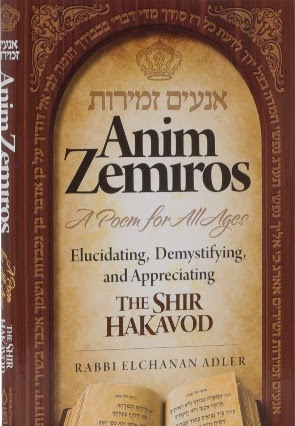
Anim Zemiros – A Poem for All Ages by Rabbi Elchanan Adler book review

Anim Zemiros – A Poem for All Ages

By Rabbi Elchanan Adler

Feldheim Publishers, New York, 2020, 192 pages

Reviewed by Myron Wakschlag

Rabbi Myron Wakschlag is a musmach of Rav Ahron Soloveichik zt”l at Yeshivas Brisk of Chicago, and is currently an IT executive in the Washington, DC area. He has researched and published on the early Orthodox rabbinate in America.

It is rare to find a book that is able to successfully illuminate a complex topic, yet still remain captivating and easily accessible. Rabbi Elchanan Adler’s new sefer on Anim Zemiros is just such a book. While Anim Zemiros is familiar to most people, its contents remain largely enigmatic due to its challenging Hebrew terminology and its esoteric meaning. Rabbi Adler has opened up new pathways that enable the reader to unlock both the simple meaning and the profound concepts lying beneath the surface of the text.

In this beautiful volume, Rabbi Adler notes how each stanza of Anim Zemiros is based on specific verses from Tanach or Talmudic/Midrashic passages. This itself is a valuable tool that sheds light on the underpinnings of the text. But the real strength of the book is in its ability to be megaleh amukos, to uncover the deep hidden beauty of the poem and make it accessible to the average reader untrained in the analysis of medieval liturgical poems. Rabbi Adler’s analysis weaves together explanations offered by traditional sources with his own fascinating insights. Rabbi Adler, an esteemed Rosh Yeshiva at Yeshiva University’s Rabbi Isaac Elchanan Theological Seminary for over 20 years, is an erudite scholar and master teacher who has an unusual gift for presenting difficult material in a way that is easy to understand.

The sefer begins with an overview that describes the origin of the formal name Shir HaKavod, the authorship and dating of the work, the origins of its inclusion in the liturgy, and the manner in which it is recited in the synagogue. It then transitions into an analysis of the overall themes, structure, and style of the text, including many interesting observations about the common ideas that are expressed within each section, and numerical allusions that emerge from the text. The next section transitions into the essence of the book, which comprises a textual analysis of each stanza, offering unique insights, explanations, interpretations, and suggestions to explicate the poem based on the full range of rabbinic literature. While it is not an exhaustive treatment of every word in the poem, Rabbi Adler’s choice of what to include helps to capture and hold the reader’s interest.

The book is valuable on many levels. In addition to its primary objective of elucidating both the plain and hidden meaning behind Anim Zemiros, a careful reading of the book allows the reader to acquire a methodology for analyzing piyyutim. Determining exactly what the author of Anim Zemiros meant to convey and what messages he buried beneath the surface is much like solving a mystery. Rabbi Adler employs many analytical tools to uncover the clues and piece together the various threads. It is enlightening to study the manner in which he carefully examines the text to identify nuances and different shades of meaning based on the poem’s rhythm, meter, textual variances, word roots, grammar, alternative translations, vowelization, allegory, and symbolism. He also often adduces prooftexts from Tanach, and contrasts the opinions of the various early and later commentaries to suggest various possibilities in the text. Utilizing this methodology, Rabbi Adler is able to “connect the dots” and uncover the concealed gems that are impossible to discern at first glance.

I owe a great debt of gratitude to Rabbi Adler, not only for giving me a much greater understanding of the magnificence of Anim Zemiros and its prominent place in our liturgy, but also for imparting his approach to analyzing piyyutim and understanding their significance. He has given me a derech to better appreciate medieval liturgical poems in general, and has also provided me with the tools to be able to analyze them on my own.


Torah & Rationalism – Writings of the Gaon Rabbenu Aaron Chaim HaLevi Zimmerman zt”l

Torah & Rationalism – Writings of the Gaon Rabbenu Aaron Chaim HaLevi Zimmerman zt”l (Feldheim 2020, 216pp.)*

Ovadya Hoffman

Deviating from conventional book reviews I shall not enter into a discussion of the author – R. Chaim Zimmerman’s genius, schooling, breathtaking erudition, oeuvre, philosophies or his broader Weltanschauung. I leave that for the biographers, that is, if any will take up the challenge.[1] Nor does this survey qualify as a comprehensive book review as I will explain later on. 

First, a word on the book itself. When a posthumously published book appears any critical minded reader wonders where the material came from, in what condition it was, did the publishers do any editing at all to the materials etc.? These are very important questions with serious ramifications and any responsible publisher should want to provide as much detail as possible. Unfortunately, in the present book we are presented with a vague picture. The reader is only informed (Preface, viii) “The text presented includes redacted variants of articles published during the 1980s under the headline Torah and Logic.” No precise list of the publications’ previous appearances is given, a proper bibliography, no exact description of the redactions or even who committed the redactions – the editor, Moshe Avraham Landy, or R. Zimmerman himself. One example, which relates to the section I’d like to focus on, is Landy’s note on p. 131 n. 265 (duplicated in the Hebrew section, p. 174). He informs us that R. Zimmerman “compiled a page by page critique of Professor Ginzberg‘s A Commentary on the Palestinain Talmud that shows most of the sources quoted by Ginzberg are found explicitly in earlier lesser-known printed books on Talmud Yerushalmi; and any chiddush, or “original idea”, offered by Ginzberg could also be found in sefarim and books of previous rabbis and scholars. This critique was written about 1950, and for various reasons was not published. Some galley proofs and other remnants of this manuscript are in the archive of the collected writing of the Gaon Rabbenu… They are presented herein for the reader in the original Hebrew…” I am unsure if what is presented are pieces of a longer manuscript which runs “page by page” (on all three volumes of the Commentary and the posthumously published fourth volume) or if this is the complete critique which, in its current composition, only encompasses the first eighty or so pages of the first volume. Again, a precise description and an unequivocal report of the materials would have obviated any confusion. 

CHAPTER IX – The Falsity of Chochmas Yisrael

I shall focus on R. Zimmerman’s charges leveled at Professor Louis Ginzberg’s Perushim VeChiddushim BaYerushalmi (herein, “Commentary”); specially the explicated charges mentioned in this chapter as they are reflective of the criticisms in the Hebrew recension, “רצנזיה” (Appendix, 175ff.), which will not be treated in this essay. I do not think such a presentation is misrepresentative or fragmentary of R. Zimmerman’s complete critique since he himself maintained that “[f]or the intelligent reader, the following evidential examples should suffice” (p. 131). Additionally, I resisted from responding to the cryptic one-liner allegations sprinkled on the preceding pages (pp. 127-130) since I’m not at all sure to what precisely R. Zimmerman was referring to and are, supposedly, detailed only in the Hebrew section. I surmise that the citations to the Commentary referenced in the notes of those one-liners were provided (or, suggested) by the editor of the manuscript, either Landy or Rabbi Eliyahu M. Zelasko (cf. p. 175). Finally, to assay the buildup and the opinions expressed in the chapter of the wider “Falsity of Chochmas Yisrael” is more tedious and requires a much more in-depth systematic debate as it relates to their different schools of thought, principles and religious philosophies, which is entirely beyond the scope of this scrutiny. This review is not intended as a rejoinder or an exculpation of Chochmas Yisrael, its “truthfulness” or its fidelity to Halachah and tradition. In this brief register it is strictly Ginzberg’s [rabbinic] scholarship I attempt to address in light of R. Zimmerman’s allegations; not the man, his beliefs or his affiliated institution(s). Transliterations below follow the method employed in the book under review. Emphasis, in italics, are of the current writer. 

P. 127
He [Ginzberg] writes in his book that he developed a novel approach and a scientific method to Halachah.
These are Ginzberg’s actual words (English intro., viii):
In these volumes an attempt has been made to deal with the writings of the mishnaic-talmudic period as a unit and, within the framework of a commentary on the first treatise of the Palestinian Talmud, to present a novel approach to the study of this literature.
To the initiated with the Yerushalmi’s commentaries I think a tenable argument can be made that Ginzberg’s tomes are a unique attempt at approaching the study of Talmud Yerushalmi with modern methods through the very framework he delineated in his introductions. Alas, R. Zimmerman did not offer examples to the contrary, i.e. books predating Ginzberg which approached the Yerushalmi mirroring the latter’s methods. This is in stark contrast to Solomon Zeitlin’s perspective who wrote in his review of the Commentary: “It is the first and only serious rabbinic work published so far in this country. Ginzberg is the first to give us a thorough, scholarly treatment of the Palestinian Talmud from the old rabbinic and also scholarly point of view.” Zeitlin, not being one to ingratiate with embellishment, went so far to suggest “Solomon ibn Adret said there was only one in a generation who could understand the Palestinian Talmud. Prof. Ginzberg, I believe without exaggeration, has no equal in our generation and is one of the greatest authorities on the Palestinian Talmud since the time of the Gaon of Vilna.”[2] Among the many Roshe Yeshivot and rabbanim who respectfully referred to and/or corresponded with Ginzberg, mention should be made here of what R. Mordechai Gifter wrote to Ginzberg upon receiving a copy of the Commentary
זה כשבוע שהובא אוצר גדול לביתי הוא ספרו של כבודו “פירושים וחידושים בירושלמי”, ואתמול גמרתי העיון בכרך הראשון על שני פרקים הראשונים במס’ ברכות. ואף שאין כבודו צריך לדכוותי, לא אוכל להתאפק לומר לו “יישר חילו לאורייתא”, ואקוה שיזכה להו”ל ספרו על כל הירושלמי, להאיר עיני ההוגים בתלמוד זה. הספר גזל ממני הרבה שינה, ואקוה שיהיו לרצון לפניו הערות אחדות שמצאתי להעיר בדבריו[3]
P. 132 

R. Zimmerman introduced the question regarding the strength of the obligation to recite the paragraphs of the Shema section; is it Biblical or rabbinical and, if any, which paragraphs? He called attention to the Peri Chadash and Sha’agas Aryeh who offered their respective
“great pilpulim… The Sha’gas Aryeh in his great teshuvah [responsum] has a pilpul on the subject, where he quotes some pieces of the Peri Chadash and argues against them… Ginzberg writes in a very trivial and casual tone against these two renowned geonim… Ginzberg writes that these two geonim, despite all their lengthy pilpul, overlooked an explicit and open source in the Talmud Yerushalmi.”
Not only is this an overly exaggerated characterization of Ginzberg’s actual words, the irony is eyebrow raising as Ginzberg’s words are presented in the footnote and the readers can detect this themselves, save for the note which contains a truncated text of Peri Chadash and therefore gives a different impression of what Peri Chadash actually wrote and how he formulated his discussion. These are Ginzberg’s words [with emphasis on the phrasing under attack]:
האחרונים האריכו לפלפל אם למ”ד ק”ש מן התורה ב’ פרשיות הן מן התורה או רק פרשה ראשונה (עיין פרי חדש ס”ו [ע.ה.: צ”ל ס”ז], ושאגת אריה ס’, ב’) ולא העירו על דברי הירושלמי כאן, שכבר אמרנו בכמה מקומות שלהירושלמי ק”ש מן התורה, ומ”מ טרחו למצוא טעם למה אין צריך כוונה רק פרק ראשון ולא אמרו שפרק ראשון מן התורה ולכך צריך כוונה ופרק שני מדרבנן ולכן אינו צריך כוונה, וע”כ ששניהם מן התורה, ועיין ראש דבור הקודם, ואכמ”ל
First of all, such common stock phrases, in all of rabbinic literature, needs no elaboration other than to say that it is not perceived as an undermining and disdainful “very trivial and casual tone” (never mind the harsher verbiage, and no less from R. Hezkiah de Silva himself). 

After repeating this same stricture (p. 133) R. Zimmerman adds:
…it is astonishing that the academic “scientific scholar” Louis Ginzberg either did not understand the words of the Peri Chadash and Sha’agas Aryeh, or deliberately deceived to discredit them. The error of Ginzberg here is because in the same chapter of the Peri Chadash, the Peri Chadash himself quotes this Talmud Yerushalmi, and brings this very proof with respect to which Ginzberg claims that he “caught” the Peri Chadash and the Sha’agas Aryeh in overlooking the Talmud Yerushalmi. Of course, the Sha’agas Aryeh makes reference to the Peri Chadash, so obviously he does not have to repeat the proof from this Yerushalmi which is clearly stated by the Peri Chadash.
Let us inspect the Peri Chadash. He begins chapter 67 with a thorough exposition determining what the obligatory status is with regards to reading chapters of the Shema. After about eight long paragraphs he arrives at his own conclusion that the reading of both chapters are biblically mandated and suggests that Rambam’s words appear to evoke the same opinion. He writes:
מעתה נשאר לנו לברר הדעת השלישי’ והיא היותר אמיתי מכולן דפרש’ שמע ופרשת והיה אם שמוע השתי פרשיו’ הוו מן התור’… וכך מטין דברי הרמב”ם ז”ל… וזו היא דעתי ומסתייעא הדין סברא דילן מהא דגרסינן בפ’ היה קורא…
Moving on to a dissection of the respective topic in the Bavli in order to prove his opinion, Peri Chadash qualifies that there is a Tanaitic dispute if the reading of both also require intent (“kavannah”) or only one of the chapters and adduces support from a Tosefta, interpreting the two opinions to be debating this last question vis-à-vis intent. To further corroborate this interpretation Peri Chadash finally adds:
ובירושלמי אמרינן מה בין פ’ ראשון דבעי כוונ’ לפ’ שני דלא בעי כוונ’ ומשני לה, נמצא דהני תנאי ס”ל דשתי פרשיו’ ראשונו’ הוו מן התור’…
It seems it is quite reasonable, if not absolute, to understand Peri Chadash’s usage of the Yerushalmi only as support to his interpretation of the views in the Tosefta regarding intent as it relates to “דהני תנאי” of the Tosefta. In other words, Peri Chadash did not cite the Yerushalmi in order to settle the question regarding the status of the Shema passages. One would imagine that if it was his intention do so he would have introduced such a critical source much earlier in his discussion and devoted more than a brief quote of this Yerushalmi passage. It appears that Sha’agas Aryeh too understood the Peri Chadash in this vein since, in his responsum, he does not merely “make(s) reference to the Peri Chadash” – he systematically went through Peri Chadash’s proofs and refutes them one by one, yet he does not single out the Yerushalmi in attempt to disprove the proof from it.
PP. 134 

Before moving to this example it is important to present the relevant rabbinic materials. Briefly put, the Yerushalmi presents two opinions as to why one must have his feet together when praying. One of the two opinions learns this from the exegetical requirement of the Kohanim to walk heel-beside-toe (“עקב בצד גודל”). A mishnah in Yoma (2:1) tells us that prior to certain Temple regulations Kohanim would race up the ramp in order to merit doing a particular service. The Tosefos Yeshanim (Yoma 22a s.v. bezman) points to this contradiction; namely, how were the Kohanim permitted to run if it is indicated in the Yerushalmi that the Kohanim were required to walk heel-beside-toe? Dismissing the possibility that they ran heel-beside-toe (“ואין נראה לומר דרצין עקב בצד גודל קאמר”) Tosefos Yeshanim goes on to present what appears as two answers. Answer 1: “ושמא כיון שלא [היו] עדיין עסוקין בעבודה כמו בהולכת אברים לכבש יכולין לרוץ” (= since they had not yet been involved in a service, such as the delivering of the limbs via the ramp, they were allowed to run). Answer 2: “אי נמי רצין עקב בצד גודל שלא להראות כמו עושה כן אלא כי כן צריך לו לילך בשעת עבודה כדפי’”. One readily discerns that this reading is textually defective. On the margin of this folio in the standard Vilna edition, a gloss is brought closing with “וע’ ש”י” (= see Siah Yitzchak [Nunes Vaes, Jerusalem 1960, p. 293]), presenting a substantiated alternative reading which, for the sake of brevity, I will not get into other than to point out that the alternative phrase indicates that there is no second answer. Instead, the rest of the text is a further explanation of a particular, related Talmudic passage elsewhere. On the other hand, in R. Avigdor Arieli’s edition of the Tosefos Yeshanim (Jerusalem 1993, p.30) some text of Tosefos HaRosh is incorporated and such is the text given: “אי נמי רצין עקב בצד גודל [קאמר שהיו ממהרין ללכת בענין זה…]”. This answer seems to say that the Kohanim would hurriedly walk heel-beside-toe. The nuanced difference borne in this answer compels one to consider that Siah Yitzchak’s emendation is more likely. 

This now brings us to the commentary of R. Avraham Abba Schiff in his To’afos Re’em which R. Zimmerman uses to level charges against Ginzberg. Here is the pertinent text of R. Schiff:
…ובירושלמי… אמרו זהו שעומד ומתפלל צריך להשוות את רגליו כו’ ח”א כמלאכים וח”א ככהנים כו’ שהיו מהלכים עקב בצד גודל וגודל בצד עקב משמע משם דוקא וכ”כ התוס’ ישנים יומא שם עיי”ש שכ’ אי נמי רצין עקב בצד גודל שלא להראות כחו עושה כן אלא כי כן צריך לו לילך בשעת עבודה כדפי’ עכ”ל ודבריהם אלו אינם מובנים והנראה לי דט”ס יש שם וכנ”ל אי נמי רצין ועולין בכבש עקב כו’ ור”ל דמתני’ ה”ק היו רצין עד לכבש והולכין בכבש כדרכן עקב בצד גודל וזהו שסיימו בת”י שלא להראות כחו עושה כן כו’ פי’ במ”ש ועולין בכבש לא להראות כחן היו עולין לכבש דעולין בכבש כדרכן עקב בצד גודל אלא עיקר הקדמתן במ”ש היו רצין דהיינו עד לכבש…
R. Schiff likewise noted the textual difficulty of the Tosefos Yeshanim and therefore suggested a different reading. He proposed that the second answer means (reads) the Kohanim would run up until the ramp but from there they would walk heel-beside-toe. If this is the second answer it seems somewhat forced as its underlying rationale is presumably to restrict running when ascending the ramp, i.e. executing a designated service, and it is essentially the same as the first answer. 

Returning to R. Zimmerman, after he informs us of the aforementioned Tanaitic contradiction, he continues:
Tosefos Yeshanim… gives these two terutzim [solutions] to answer this contradiction. On the Sefer Yere’im… there is a perush [commentary] by the name To’afos Re’em where he brings all the bekiyus [referecnes] on this subject. He also writes this contradiction and explains both terutzim. And after he writes these two terutzim, he references the Tosefos Yeshanim, as quoted above.
Next, R. Zimmerman asserts that:
…with the claim of originality, Ginzberg answers the contradiction asked by the Rishonim and of Tosefos Yeshanim with these two solutions, not being aware that Tosefos Yeshanim himself wrote these two answers word for word.
Here too, Ginzberg’s text is presented and the reader can see that he nowhere asserts any claim of originality. He merely referenced the classic sources, including the Tosefos Yeshanim, and then paraphrased what some of the Rishonim asked and answered. The only phrase one can guess (or, read into) which R. Zimmerman based this imputation is where Ginzberg wrote, regarding the distinction of ascending the ramp when executing an actual part of the service, “והיה אפשר לומר”. But, this is borderline pedantic as any accustomed student of rabbinics does not expect an author to reiterate every time they allude to an aforementioned source. He essentially claimed that Ginzberg quoted the sources but “did not make the effort to look up the Tosefos Yeshanim, and he plagiarized the words of the To’afos Re’em… taking credit for himself, and taking for granted that no one will catch him in plagiarizing these two big “chiddushim” word for word from the To’afos Re’em.” By that token one must assume as well that the other sources which Ginzberg quoted and dealt with were also gotten from a different (albeit, unnamed) source. More importantly, it is not entirely clear that To’afos Re’em even spelled out both answers of Tosefos Yeshanim, precluding the possibility that Ginzberg plagiarized “word for word from the To’afos Re’em”. Never mind the strange notion that Ginzberg wouldn’t look up an explicit Tosefos Yeshanim which he cited and instead opted to quote an unclear formulation of the To’afos Re’em.

(The reference in p. 135 n. 279 to the Commentary should read: ‘עמוד 45’, and “שהרי על הלכה כהנים זו” should read ‘…הלכת כהנים זו’. For “keves” on p. 134, “keveṣ” or “kevesh” should be supplied.)
PP. 136
R. Zimmerman opined that with all the reference books on the Yerushalmi et al.
…if someone has in front of him all these sefarim when he learns Talmud Yerushalmi (he does not have to be an expert in Halachah), he could produce most of Ginzberg’s works.
Leaving aside this fantastic assumption and the certain debatable quality of the older reference books, one wonders if the careful inclusion of “most” was some admission that even with all reference books at one’s disposal, Ginzberg’s monumental ‘Legends of the Jews’, however, could certainly not have been produced by just anyone, not even today with our advanced digital databases. If this assumption is correct, one wonders how to reconcile the acknowledgment of Ginzberg’s singular erudition but then to accuse him of plagiarizing even known, classical sources.

PP. 137 

R. Zimmerman gave some examples to illustrate Ginzberg’s dependency on the various reference books and in particular Rabbi Dov Ber Ratner’s ‘Ahavas Tzion vi-Yerushalayim’ of which he alleges:
Ginzberg being aware that one may discover the obvious, that most of his references and citations are plagiarized from Ratner… and others, always tries to disqualify Ratner and others.[4]
I’m going to leave aside the obvious question as to the merit of such a claim, whether or not an author should always cite a reference book at every instance. Instead, I prefer to determine if there is any basis at all to the claim of deceit.

The first example of Ginzberg’s alleged attempt to disqualify Ratner’s work is R. Zimmerman’s oblique citation to the English introduction of the Commentary. Here are Ginzberg’s actual words:
The most important source for establishing a correct text are the numerous quotations… and one must be grateful to Baer Ratner (1852-1917) for collecting them in twelve volumes of his work… The parallels must however be used with great caution for the following reasons…
Ginzberg then continued to list three sound and ostensibly true critiques and words of caution.[5] Perhaps interpretation is in the eyes of the reader so suffice it to say there is no readily discernible attempt to “disqualify Ratner’s work”. Conversely, in Ginzberg’s Seride Yerushalmi, after he described the importance of collecting and collating quotes of Yerushalmi as found in Rishonim, he stated “וכבר התחיל במצוה הרב הגדול וכו’ כמוה”ר בער ראטנער נ”י בספרו יקר הערך ורב השבח ספר “אהבת ציון וירושלים” אשר בו העיר על גרסאות הירושלמי שבספרי הראשונים והאיר עיני לומר הירושלמי.”” (New York 1909, intro. IV). Such statements would be counterproductive and ineffective if attempting to disqualify a work.

IBID
He copies from Ratner verbatim without mentioning his name.
The reference is given to Commentary p. 54 where Ginzberg indeed quoted the same two passages from the Yalkut which Ratner quoted. Now, even before analyzing the material one must wonder if two authors cite the same classical and relevant sources is that sufficient to presume one copied from the other?[6] In any case, if one reads the detailed discussion of Ginzberg it is unmistakable that he independently studied and scrutinized the sources for he included much detail of which Ratner does not give the slightest mention. Furthermore, mention should be made of the fact that the referenced volume of Ratner was published in 1901 and the first volume of Ginzberg’s ‘Legends’, a work which had begun in 1903 was published in 1909 (JPS 2003[7], intro. XVI). There, in describing the distance between earth and heaven (the focus of the aforementioned Yalkut) Ginzberg referenced the Yerushalmi under discussion in addition to numerous other sources (ibid. p. 10 n. 31 & 32). Interestingly, he did not, however, cite the Yalkut which he later cited in his Commentary. With intent to minimize Ginzberg’s scholarship we can fault him for not referencing the Yalkut in the notes to his ‘Legends’. But, an obvious explanation can be, due to the enormous and difficult task in reworking all available ancient texts and incorporating them into a flowing narrative by necessity would require paraphrasing and omitting subtle Aggadic amplifications. The passage in the Yalkut, which Ginzberg expresses doubts per its original text, contains almost identical phrasing as the Yerushalmi and therefore added nothing for his sources. Had Ginzberg only known about the Yalkut passages from Ratner he should have referenced it in his ‘Legends’. This is, again, leaving aside the perplexing claim that someone who organized and authored the intricate, colossal and scholarly sources and discussions in the notes to the ‘Legends’ did not independently know the Yalkut, a primary text quoted throughout the ‘Legends’.

IBID
…he writes “many erred” because they did not know the sources, but the sources are written by Ratner…
Ginzberg commented that a particular passage of the Yerushalmi is found similarly in the Bavli, and while some Rishonim/Geonim quote the passage as it’s reflected in the Yerushalmi Ginzberg posited that their source was from the Bavli, unlike Ratner who quoted the parallels in the Sheëltot and BH”G and determined that their source was the Yerushalmi. Ginzberg concluded the brief comment by exclaiming
וטעו אלה שאמרו שבהג והשאלתות השתמשו כאן בירושלמי, עיין מה שכתבתי גואניקא א’, פד.
Ginzberg clearly was taking issue with what some erroneously assumed that the Yerushalmi was the common source for those two authorities, not that some did not know the sources. Besides for his objection being rather clear, when one examines the reference to Geonica they are met with a more detailed analysis of this error. As if it’s not explicit enough, there Ginzberg wrote:
“In his learned scholia… Ratner does not hesitate to attribute it to the Yerushalmi as Rabbi Aha’s source, and yet it can be readily demonstrated, from the words of the Sheëltot, that it goes back to the Babli.” 
P.138
Again, Ginzberg writes ‘Ratner did not indicate this source’, and this is an outright falsification, because in that same place Ratner quoted the source.
The reference here is to Commentary (p. 75 fn. 84). Ginzberg writes
לאוהבו של מלך שבא והרתיק על פתחו של מלך. במחזור ויטרי שי”ג (וראטנער לא העיר על מקור זה) גרס, תערו במקום פתחו, וזה יותר מדויק…
In the parenthesis, after “מקור זה”, a footnote reads
וכן לא העיר על הילקוט… אשכול… ושלחן ארבע שמביאים דברי הירושלמי על התכיפות
R. Zimmerman must have been referring to the Yalkut reference since Ratner (cited by R. Zimmerman) does not refer to Mahzor Vitri, Eshkol or Shulhan Shel Arba. Yet, even the Yalkut is only cited by Ratner on the preceding piece of Yerushalmi “מי שתוכף לסמיכה שחיטה”. On the piece under discussion, indicated by the caption of Ginzberg’s quote, Ratner only makes reference to the Amsterdam ed. of the Yerushalmi and did not note the textual variants contained in the Yalkut. Aside for this not being “an outright falsification”, the language used to quote Ginzberg is misleading. R. Zimmerman specifically referred to the footnote in Commentary, though it does not say there “Ratner did not indicate this source”; that exact phrasing is in the main text regarding the Mahzor Vitry which Ratner did not reference. The footnote says (if rendered in English) “he also did not indicate A, B and C.” If one were to object that A was indeed indicated by Ratner then a fairer phrasing would be something to the effect of “one of the sources was quoted by Ratner” thereby not wholly discrediting the author’s point. 

At this junction I’d like to refer to one piece produced in the Hebrew section (p. 211) as it directly relates to this piece. Ginzberg’s aforementioned text is quoted and then R. Zimmerman notes
מ”ש “במחזור ויטרי שי”ג גרס תערו במקום פתחו” לא היה ולא נברא. וזה לשונו [במחזור וויטרי] סימן י”ז [עמוד 13] א”ר חמי של מי שאינו סומך גאולה לתפלה למה הוא דומה לאוהבו של מלך שבא והרתיק על פתחו של מלך… וכו’. ואמנם הגירסא זו [תרעו ולא כמ”ש גינזבורג תערו] הובא בספר המנהיג [דיני תפלה, עמוד מ”ד, הוצאת מוסד הרב קוק] וכבר ציינה ראטנער [אהבת ציון וירושלים, צד 11] וזה המחבר זייף דברי ראטנער כדרכו. ואמנם כך פירשו שמה המחזור וויטרי, תרפ”ד, דף 31, כמו שציין גינזבורג אלא שהרי המחזור וויטרי סותר את עצמו…
Admittedly I’m unsure what to make of this protest. R. Zimmerman unabashedly quotes a second text from Mahzor Vitry, which Ginzberg was explicitly not referring to, and then impugns Ginzberg of quoting a spurious text from Mahzor Vitry (and plagiarizing from Ratner), despite R. Zimmerman’s subsequent acknowledgment that Mahzor Vitry does elsewhere contain the very text quoted by Ginzberg. Additionally, the bracketed words, which dismiss Ginzberg’s quote of “תערו”, are also disingenuous since Ginzberg was not referencing the Manhig’s text at all. This also brings us back to my earlier suspicion of the editor’s methods: Who inserted these erroneous brackets? Was R. Zimmerman being unfair or was the editor unmindful?

In summation, a pattern emerges before the reader which betrays a vendetta against Ginzberg; picayune criticisms and inflated accusations which don’t hold much water. Any time a reference provided by Ginzberg had been cited elsewhere it is automatically assumed to be stolen and any explanation offered is deemed unlearned, unless there is precedence to it then it is assumed to be plagiarized. It appears it was Ginzberg himself who was the object of R. Zimmerman’s attacks, while grasping at straws under the pretense of a scholarly critique. One cannot but wonder why R. Zimmerman did not publish these galleys while Ginzberg was alive, affording him the opportunity to respond. It is not as if R. Zimmerman was one to shy from polemicizing, as he famously engaged with R. Menachem M. Kasher over the International Date Line matter. Had R. Zimmerman published the materials while Ginzberg was still alive perhaps he, and its current readership, would have merited the author’s own rebuttal.[8]
___________
 
*My thanks to the editors at the Seforim Blog and R. Moshe Maimon for reviewing the paper and offering their suggestions.
[1] For a brief biographical sketch, see the journal Yeshurun (Israel 2012, Vol. 27, 855ff.).
[2] JQR (April 1943, p. 433).
[3] Marc B. Shapiro, Saul Lieberman and the Orthodox (Scranton 2006, p. 13 n. 45, 31-21; for R. Gifter see n. 117). It would not be out of place to note how R. Zimmerman addressed Prof. Saul Lieberman, 

לחד מתקיפי דורנו הגאון המופלא הבקי בכל מכמני התורה והחכמה
(Shapiro, ibid. p. 42), while Lieberman referred to Ginzberg
 
מרא דהלכתא ומרא דאגדתא הגר”ל גינצבורג
 
(Sinai, Jerusalem 5739, p. 225; repub. Mehkarim BeTorat Eretz Yisrael, Jerusalem 1991, p. 127). On a different occasion Lieberman estimated:
ודבר אחד מבליט את גינצבורג מתוך כל החכמים שקדמו לו. בספריהם של בעלי “חכמת ישראל”, ואפילו מן הגדולים שבהם, אתה מוצא לפעמים טעויות גסות בפירושן ובפשטן של הסוגיות אשר לפניהם. מה שאין כן אצל גינצבורג העומד למעלה מזה. בכל ספריו ומאמריו המרובים אין אף פעם טעויות ממין זה ודומה להן. ואין לזלזל בפרט חשוב זה, כי טעויות גסות מן המין הנ”ל פוסלות את כל הספר בעיני בני תורה והמחבר מאבד על-ידי זה את הסמכות ואת ההשפעה שלו. ועוד זאת: גינצבורג באחת מחוברותיו “תשובה בדבר יינות הכשרים והפסולים למצוה”… הראה את כוחו גם בפסק הלכה כאחד הרבנים הגדולים, ואף בני הישיבה שאין להם עסק עם חכמת ישראל רואים בו מתוך ספרו זה אחד משלהם, את העילוי מישיבת טלז וסלובודקה. 

(ibid., pp. 613-614)
[4] Noteworthy is Ratner’s own declaration that in preparation for his volume on mas. Rosh Hashanah he utilized Ginzberg’s Seride Yerushalmi on Rosh HaShanah:…היו לנגד עיני הספר היקר שרידי ירושלמי מאת הרב הגדול ר’ לוי גינצבורג מנויארק והשתמשתי בו במס’ רה”ש (Ahavas Tzion vi-Yerushalayim, Vilna 1911, Rosh HaShanah, petah davar). Indeed the two had maintained correspondence even prior to the publication of Seride Yerushalmi, as is evident from the letter Ratner quoted which he received from Ginzberg (Ahavas Tzion vi-Yerushalayim, Piotrków 1908, Pesahim p. 55) and in the subsequent volumes he continued to use Ginzberg’s Seride Yerushalmi and Geonica. Incidentally, one instance akin to the “trivial and casual tone” but in Ratner’s work which, with equal justice, should have awakened the ire of R. Zimmerman, Ratner wrote: המפרשים יגעו בזה לפרש, אבל הגי’ הנכונה בשרידי ירושלמי… (Ahavas Tzion vi-Yerushalayim, Vilna 1913, Bez. p. 10).
[5] Similar words of caution were likewise expressed a few years later by another contemporaneous eminent scholar and expert on Talmud Yerushalmi, Professor Saul Lieberman (HaYerushalmi Kiphshuto, N.Y. & Jerusalem 1995, intro. p. 24). The words of caution had already proven to be wise and advisory as Lieberman, earlier in his ‘Al HaYerushalmi’ (Jerusalem, 1929), in multiple instances called attention to some mistakes in Ahavas Tzion vi-Yerushalayim. Cf. also J.N. Epstein in Mehkarim BeSifrut HaTalmud uVeleshonot HaShamiot, Jerusalem 1988, Vol. 2 Part 1, p. 263 n. 1. More currently, Prof. Yaacov Sussmann acutely demonstrated the shortcomings of Ratner’s magnum opus in the journal Mada’ei HaYahadut (World Union of Jewish Studies 2002, vol. 41 pp. 23; my thanks to R. Eliezer Brodt for this last reference.)
[6] It would appear that the only distinction with regards to Ginzberg is that he belonged to the “Chochmas Yisreol” camp which R. Zimmerman frequently disparaged. Otherwise, what would prevent R. Zimmerman from leveling the same charges against R. Chaim Heller, a universally recognized talmid hacham and scholar par excellence, who compiled a collection of parallel sources of the Yerushalmi in his essays ‘HaMa’alot LeShlomo’ (LeShelomo, Berlin, 1910, 246ff.) and ‘A”D [‘Al Derech] Mesoret HaShas BeYerushalmi’ (LeDovid Zvi, Berlin 1914, 55ff.), both published after Ratner’s Ahavas Tzion vi-Yerushalayim? The same can be said for R. Ze’ev Wolf Rabinovitz’s ‘Sha’are Torath Eretz Israel’ (Jerusalem, 1940) who certainly made use of Ahavas Tzion vi-Yerushalayim but only seldom referenced it, as did R. Shlomo Goren in his ‘HaYerushalmi HaMefurash’ (Jerusalem, 1961). Is one to accuse them too of plagiarism in all the instances they could have quoted Ratner? Conversely, in his review of Prof. Ginzberg’s posthumously published fourth volume of the Commentary and R. Goren’s HaYerushalmi (Kirjath Sepher, Jerusalem, vol. 33 p. 199), Professor Avraham Goldberg noted the common sources often cited by both in drawing parallels between the Yerushalmi and other rabbinic texts, yet he apparently saw no oddity and did not go as far as to accuse the later of the two, R. Goren, of plagiarism, for obvious reason.
This point of common sources is of serious significance as it relates to multiple instances where R. Zimmerman alleges the charge of plagiarism. One in particular is found in the Hebrew section (199ff.) where R. Zimmerman claims that Ginzberg copied from Jehiel Bornstein and the texts of both of these figures is then presented side-by-side (in Bornstein’s text “היה ראוי לו” should read “היה נראה לי”; “את” in “את הכוכבים הסמוכים לארץ” should be omitted; “ג’ פעמים”should read “ג’ כוכבים”; “אולי ישיבני” should read “…ישיבנו”; “שיבאו השמש והריח” should read “…והירח”; “לא” in “לא נבעו להם” should be omitted; in Ginzberg’s text “ורבי חנינא כוונו” should read “ורבי ור’ חנינא כוונו”; “רבי ב’ דקים” should read “רק ב’ דקים”). The subject under discussion pertains to the solar and lunar rotations in calculating the time of twilight (ben hashmashot). R. Zimmerman points out that Bornstein had explained the Talmudic passage in an essay published in the journal ‘HaTekufah’ (Warsaw 5786) and Ginzberg copied his explanation, even including what Bornstein had inserted in parenthesis, except that the former Anglicized the word “refraction” [presumably to conceal the plagiarism]. In truth, there’s reason to believe that Ginzberg had seen Bornstein’s essay since he referenced Bornstein’s incipient essay in his ‘Legends’ (JPS Philadelphia 1968, VI p. 129 n. 758). However, since the objective was to explain a Talmudic passage, to offer “the simple peshat”, avouched by the titular “פירושים וחדושים”, is it incredulous that Ginzberg independently arrived at the same explanation? Did R. Goren, who suggested the same explanation in his HaYerushalmi (p. 8), also plagiarize from Bornstein or Ginzberg? The parenthesis in question are in fact a parenthetical explanatory gloss which would have rightfully been placed as such by any commentator expounding the given Talmudic passage and the usage of the word “refraction” is common locution for the subject under discussion. Let us not forget that Ginzberg was a highly competent mathematician to the extent that Albert Einstein was impressed with his knowledge in mathematics (cf. The Responsa of Professor Louis Ginzberg, N.Y. & Jerusalem 1996, intro. pp. 3, 15). In all likeliness, an individual of such caliber would have independently comprehended this passage, as did Bornstein. Furthermore, the collated texts of Ginzberg and Bornstein bear very dissimilar phraseology in their attempts to explain the passage. (See also Heshey Zelcer’s comparison of three later commentaries on this passage, Ḥakirah N.Y. 2004, vol. 1 p. 113).
[7] This edition of the Legends should be used with caution as there are numerous typographical and referential errors in the main text as well as in the notes. As with all publications, Ginzberg’s Commentary was at the mercy of its publishers and it too suffered corrupted passages, some of which he communicated to S. Petrushka (see below, fn. 8).
[8] For instance, Simcha Petrushka published in the Bitzaron periodical a letter which he had sent Ginzberg containing questions and notes on his Commentary. Upon receiving a letter in response to each of his claims, Petrushka had the letter published in the following Bitzaron issue (N.Y. 1945, vol. XII, 214ff.).


Jewish Treasures From Oxford Libraries

JEWISH TREASURES FROM OXFORD LIBRARIES

By Paul Shaviv

Ed. Rebecca Abrams and Cesar Merchan-Hamann / Bodleian Library, University of Oxford, 2020 / ISBN 978 1 85124 502 4 / Available in the USA via Amazon $55

307pp, 140 full-colour plates

Oxford,[1] the ‘City of Dreaming Spires’, is one of the world’s greatest repositories of Hebraica and Judaica, both books and manuscripts.

This sumptuous volume was initiated at the encouragement and support of Martin J. Gross, a New Jersey philanthropist and Jewish community activist. It is a bargain at the price. The book is absolutely handsome – the quality of the printing is outstanding, and it is printed on 135gsm paper.

The core of ‘Jewish Treasures from Oxford Libraries’ describes seven collectors and their eponymous collections, which together constitute the Hebraica holding of the Bodleian library; plus a description of smaller, but important, holdings of some individual College libraries; and the Genizah fragments held in Oxford. There are additional essays describing the history of the Bodleian itself, and the role of successive Librarians in encouraging the acquisition of Hebrew (and other ‘Oriental’) manuscripts; of the great cataloguers (Neubauer and Cowley); and of other benefactors, including the amazing figure of John Selden.[2]

Each chapter is written by different scholars. Archbishop Laud (1573–1645), by Giles Mandelbrote; Edward Pococke (1604-1691) by Benjamin Williams; Robert Huntington (1637-1701) by Simon Mills and Cesar Merchan-Hamann; Benjamin Kennicott (1718-1783) by Theodor Dunkelgrun; Matteo Luigi Canonici (1727-1805) by Dorit Raines; Rabbi David Oppenheim (1664-1736) by Joshua Teplitzky; and Heimann Joseph Michael (1792-1846) by Saverio Campanini. Each describes the biography of the collector, the characteristics and most important items of their collection, and how and why they amassed them.

The first thing that readers will note is that only the last two are Jewish. Even in the case of David Oppenheim, his unique collection of approximately 4,500 printed books and just under 1,000 bound volumes of manuscripts languished in storage in Europe until Revd. Alexander Nicoll, the Regius Professor of Hebrew, engineered its purchase by the Library. Otherwise they are a parade of Anglican Divines and Christian Hebraists (except Canonici, who was a Jesuit), witness to the intense interest (and expertise) in Hebrew and Jewish Studies by non-Jewish scholars in the sixteenth and seventeenth centuries. The stories of the collections are fascinating. Ambassadors, merchants and missionaries all have a part in purchasing (and pursuing) manuscripts. A special place seems to be occupied by the ‘Chaplains’ attached to the Embassies – one can surmise that they both had some expertise in Hebrew, even if rudimentary, and also perhaps time to devote to the ‘hunt’. We visit the great cities of the ‘Orient’ – Constantinople, Damascus, Aleppo, Cairo, and of Europe – Italy, Spain and Germany.

The objectives and interests of each collector were different. Some – Oppenheim is the obvious example – were happy to scoop up whatever was on the market. Kennicott was interested in Biblical material, resulting in his two-volume study of variations in extant biblical texts. Along the way, each of them acquired examples of the most magnificent decorated and illuminated works, covering the entire span of Judaica – texts, contracts, ketubot, from every place. The calligraphy itself is to be savoured and enjoyed. As mentioned, the 140 full-colour (and often full-page) plates do all of this justice.

Although overshadowed by Cambridge, Oxford too has significant Genizah holdings – described by Nadia Vidro. These were acquired in the nineteenth century and pre-dated Solomon Schechter’s bulk removal of the Genizah contents to Cambridge. They are apparently strong in Talmudic texts, and also include an autograph copy of Rambam’s Mishneh Torah – complete with alterations and editing notes. Adolph Neubauer sifted through the material; kept the largest fragments, often complete or semi-complete pages – and rejected the remainder, which were sold on to Elkan Adler. Neubauer could not foresee the techniques available later, and utilized in Cambridge, to read, identify and reap the benefits of the tiniest pieces.

It is very difficult to summarize such a wide-ranging work in a short review. I am left with several thoughts:

  • In the case of the Bodleian, their holdings were purchased, not plundered, although the circumstances by which the objects came into the possession of previous owners is not necessarily known. The scholarship, and enthusiasms, of the Christian Hebraists, familiar to scholars, is of course little appreciated in today’s wider Jewish community. Were it not for them, many, many of these works would be lost. Were it not for the conscientious curation and preservation of these books and manuscripts by non-Jewish, mainly academic, libraries, they would almost certainly be lost, and even if they existed, would probably be far less accessible.

  • The sheer aesthetic beauty of many of the manuscripts speaks of a different culture. Even if, as is surmised, many were illustrated by non-Jewish professional artists[3] – they were commissioned by Jewish patrons. Even the almost-certainly Jewish artists (of Ketubot and the like) seem to show a joyfulness absent from our contemporary production of texts; which I take as a reflection of a certain dour outlook and philosophy. The same comment could be made about the narrowness of contemporary religious publishing compared to the width of thought, concern and scholarship of our forebears.

  • On a different perspective, as an (ex-pat) Anglo-Jew, and a former graduate student of Jewish Studies at Oxford (way back in the 1970’s!), I have to again sigh at the neglect of its own treasures by the Anglo-Jewish community[4]. Even the initiator of this project hails from New Jersey! Perhaps a ray of optimism may come from the fairly recent appointment of Prof. Judith Olszowy Schlanger as head of the Oxford Centre for Hebrew and Jewish Studies (formerly housed at Yarnton Manor)? Until now, most of the OCHJS Presidents have been specialists in one or another aspect of the ancient world, or of other, wider areas of Jewish study. This is not to disparage any of these eminent scholars in any way whatsoever! But Professor Olszowy Schlanger has already published on Anglo-Norman and pre-Expulsion manuscripts; perhaps we will see fresh scholarship on English and European rabbinic study from her Presidency, from still-to-be-researched corners of the Bodleian!

A great read, a great book to possess, and – happy are they who may receive this book as a perfect gift!

[1] The city has a rich Jewish history of its own, which is thought to date back to 1075. Two (!) complementary websites both give excellent information and resources about Jewish Oxford. The first site, sponsored by the local Jewish community, whose supervisory committee includes one of the editors of the volume under review, is www.oxfordjewishheritage.co.uk . Clicking on the small window labelled ‘Jewish Heritage’ in the middle of the homepage of Oxford Chabad www.oxfordchabad.org opens up a surprisingly academic and scholarly range of material on Jewish Oxford. Both recommended!
[2] The present Bodley Librarian, Richard Ovenden, writes a Foreword; Cesar Merchan-Hamann a general Introduction; Rahel Fronda writes on the smaller College collections; and Piet van Boxel on the cataloguers. Mr. Martin J. Gross, the book’s ‘prime mover’, contributes an elegant Preface!
[3] See, for example, plate 114, from Ms. Michael 627 – from a Yom Kippur mahzor, where a non-Jewish artist, not knowing which way up the Hebrew is written, has the illustrations drawn upside down on the page.
[4] Painfully, the single most important Anglo-Jewish artefact, the dated pre-Expulsion Chumash mss, shown to H.M. The Queen to demonstrate the depth of Jewish experience in England, was sold at the Valmadonna Auction. The purchaser remains anonymous. It is not known if it is still in the UK. If it is, it is neither displayed nor accessible. The Bomberg Talmud, also sold by the Valmadonna Trust, is now in New York City after being in Westminster Abbey for centuries.