Reply from Haym Soloveitchik to the JQR Interview with Robert Brody

Reply from Haym Soloveitchik to the JQR Interview with Robert Brody

By Haym Soloveitchik

Editor’s Note: As a recap of a recent exchange between two scholars on a nuanced debate within medieval Jewish history (see the first footnote), we present this final note by Professor Haym Soloveitchik.

Part One

Dr. Robert Brody advances no new arguments against my thesis in his recent interview at the blog of the Jewish Quarterly Review (https://katz.sas.upenn.edu/blog/jewish-quarterly-review/jqr-contributor-conversation-robert-brody-origins-talmud-study). I have addressed all his points in my original essay and my reply in the Jewish Quarterly Review and online on my personal website.[1] The reader can judge for himself or herself whether my arguments are persuasive.

Basically, the issue between us boils down to two points. Brody does not believe in historical implication. Two facts, to him, imply nothing. If so, all the scholar can ever have is a large pile of inert facts. For example, he denies the notion that Sura and Pumpeditha would never have surrendered their monopoly on the “Vox Talmudica,” for that “would have been institutional suicide.”[2] If that’s the case, all we can know of the past is what is explicitly stated in the sources of the past. Brody equally does not believe in probabilities (not even cumulative probabilities [3]). In the absence of probability (or improbability), all theories are equal. If one can believe that scores of scribes both educated and ignorant, with good or bad memories can inscribe a text of a million and a half words without any change in that text’s meaning,[4] then one can believe almost anything. If so, no inference is better than another. The result is that it isn’t worth pondering the implications of the data of the past; one should concentrate on simply knowing them.

This is my last reply to Dr. Brody’s critiques. I believe the exchange has reached the point of diminishing returns.

Part Two

Dr. Brody has just published in the Bar-Ilan Internet Journal a critique of my remarks of Rashi’s emendations (haggahot) on the Talmud, online here (https://jewish-faculty.biu.ac.il/files/jewish-faculty/shared/JSIJ16/brody.pdf). As this point is irrelevant to my argument, I forgo answering it now. Allow me to explain.

The crucial point in my argument is that there existed ongoing contact between Bavel and the Rhineland in the ninth and tenth centuries. This would have enabled the leaders (he-{h.}ashuvim) of the Rhineland to make inquiries of the state of talmud torah in Bavel, the economic situation of the yeshivot and the level of scholarship in the various institutions in Bavel. Conversely, it would have enabled the men of the Third Yeshivah to make inquiries of the nature of the Jewish settlement in the Rhineland, the seriousness of any offer and the financial abilities of the Rhineland leaders to support such a migration and the enterprise upon which it would embark. This ongoing contact would also have enabled manuscripts from Bavel to reach Ashkenaz in those centuries. Such a continuance of contact is proven by the trade and communication routes of the time. With goods brought regularly from the Near and Far East came manuscripts of sifrei kodesh. Jews in the Rhineland would pay handsomely for manuscripts, just as the Christian prelates and monasteries paid for reliquia. There is no reason not to conclude that manuscripts of the widest variety were available the Rhineland the great emporium of Western Europe in the closing centuries of the first millennium. Whether or not Rashi took a copy of some of these manuscripts back to Troyes is irrelevant to my contention. I introduced this issue simply because Noam’s article treated both the diffusion of such manuscripts in Early Ashkenaz and the nature of Rashi’s haggahot on the tractate of Sukkah. I believe Noam to be correct about Sukkah, but this is simply frosting on my cake. Rashi’s haggahot are at least a century after the migration of the Third Yeshivah, and their nature is of no matter to my argument.

I have long pondered the nature of these emendations well before the idea of any Third Yeshivah occurred to me, and should I come to some conclusion, I will include it in the fourth volume of my collected essays. As of now, I have spent enough time replying to Dr. Brody and must return to my own research.

Footnotes:

[1] Haym Soloveitchik, Collected Essays, vol. 2 (Oxford: Littman Library, 2014), 150-201; Haym Soloveitchik, “On the Third Yeshivah of Bavel: A Response to Robert Brody,” Jewish Quarterly Review 109:2 (Spring 2019): 289-320; Haym Soloveitchik, “Reply to Brody–Part II,” at HaymSoloveitchik.org, available here (https://haymsoloveitchik.org/downloads/Reply%20to%20Brody%20II.pdf). The only new point that he adds here is the documentation of his statement of the difference between significant and trivial variants. However, I never challenged this principal; I simply argued that there are also other principles in textual criticism, and the mark of a good editor is his or her ability to use the one most appropriate for the case at hand. See “Reply to Brody—Part II,” pp. 39-40.

[2] Collected Essays, pp. 171-172; “Reply to Brody–Part II,” pp. 9, 20.

[3] “Reply to Brody—Part II,” pp. 38-41.

 [4] Ibid. pp. 21-22.


Correction and Apology For an Earlier Post

Correction and Apology For an Earlier Post

A few months back we featured a fascinating two-part post about newly discovered documents from Rav Herzog’s Archive.

One of the discoveries of the post was a document about Meir Kahane written to President Chaim Herzog by Rabbi Joseph B. Soloveitchik in the summer of 1984 which was surprisingly supportive of Kahane.

A careful examination of the document by the family of Rabbi Soloveitchik reached the opposite conclusion. This letter is a crude forgery. Their conclusion was not derived because they disagree with the opinions expressed in it nor because they know that the Rav would never have expressed such opinions, but because of many characteristics of the signature such as misspelled name, the firm handwriting from the hand of a man suffering from Parkinson’s (comparing it to other autographs of the Rav from even earlier dates and the difference is immense), title and reference of his own father etc. It is simply an egregious forgery.

We apologize to our readers for posting and thereby disseminating this false piece of information.

Seforim Blog Editors.


A Letter Concerning Prof. Marc Shapiro’s book “Changing the Immutable”

A Letter Concerning Prof. Marc Shapiro’s book Changing the Immutable
By Eli Meyer Cohen
כבוד…
אחדשה”ט, ברצוני להעיר
כמה הערות בנוגע למש”כ מרק שפירא אודות הדברים המובאים בפי’ ר’ יהודה החסיד. שלדעת
גדולי פוסקי הדור ההוא הגר”מ פיינשטיין, הגרש”ז אויערבאך, הגרי”ש אלישיב
והגרי”י ווייס בעל מנחת יצחק ז”ל, נדפסו שם דברי כפירה  והיות שיודע אני שבטח כבודו יערוך ביקורת כללית על
ספרו, חושבני שדברים אלו יהיו לתועלת עבודתו.
ראשית אציג רקע היסטורי
לסיפור. הדבר קרה בשנת תשל”ו, כפי שמפורש בשני התשובות שכ’ הגרמ”פ באג”מ
יו”ד ח”ג סימנים קי”ד – קט”ו. התשובה הראשונה נכתבה לר’ דניאל
לוי בסוף אדר ראשון, והשניה נכתבה להגרש”ז אויערבאך בח”י תמוז. אני למדתי
אז בארץ וידידי ר’ בערל פיינשטיין נכדו של הגרמ”פ הגיע ארצה ואמר לי שהראש ישיבה
נתן לו שליחות להוליך מכתב בענין זה להגרשז”א ולרב אלישיב, ואכן כן עשה. כעת לאחר
ט”ל שנים שאלתי אותו אם עדיין הפרטים בזכרונו, ומסרם לי כאילו הדבר קרה היום.
הוא נכנס אצל הגרשז”א
וקרא את המכתב [שנדפס אח”כ סי’ קט”ו] לאיטו מלה במלה, ואמר שמלשון המדפיס,
ניתן לשמוע שדעתו היא, שלפי “מחשבת זמננו” לא מתאימים הדברים להדפסה, ומשמע
שכאילו לא יאות הדבר לקיצוני זמננו כהנטורי קרתא [כך אמר], אך הוא טועה בזה כי הדברים
הינם כפירה לחלוטין לכל אדם ולכל הדורות. גם הר’ אלישיב ראה את המכתב ולאחר קריאת המכתב
אמר לר’ בערל שיחזור לרשז”א וימסור לו שיצוה לבנו שהיה מיודעו של המדפיס שיעצרו
את ההדפסה.
וממילא מה שמשתמע מדברי
מרק שפירא שהקטעים הבעייתיים הפריעו להגרמ”פ בלבד וכאילו היתה זו מלחמת יחיד
– אין זה הדבר. אלא שאלו את פוסקי הדור של אז וכולם פסקו שזוהי כפירה, ומוכרחים להוציאם
ולעשות halachic censorship.  אלא שהפוסקים
ביניהם החליטו לא לפרסם את הדברים, משום שהם סברו להשקיט את הדבר, עד שהגיע ר’ בערל
ומכתבו בידו שדעת הגרמ”פ לפרסם את הענין כמפורש בדבריו בסוף התשובה לרש”ז,
[כ”ז מבוסס על עדותו של ר’ בערל הנ”ל שכלל גם את בעל המנח”י ביחד עם
רש”ז והרב אלישיב המוזכרים בתחילת התשובה הנ”ל.]
ומעניין מאוד איך לא הביא
שפירא את ה’מחקר’ של הגרמ”פ ד”ה ‘וכן מש”כ בדבר’. והביא ראי’ מהאב”ע
שלא היה יכול לסבול את הפירוש המופיע בר”י החסיד בענין עציון גבר – שכן מצא את
אותו פירוש בשם א’ יצחקי ועל זה אמר האב”ע “‘חלילה חלילה … וספרו ראוי
להישרף’. וא”כ נמצא שכבר הוא דין פסוק מהאב”ע שצריך לשרוף ספר כזה”.
ומש”כ אודות האב”ע
שגם בספריו יש דברים בעייתיים – ע’ בס’ הכתב והקבלה בראשית כז,יט עה”פ אנוכי עשו
בכורך,  וז”ל: ומה שהוזכר בפי’ האב”ע
לחשבו למשקר ולמכזב, איננו מלשון החכם ראב”ע, כי ידענו מכמה מקומות כי יד אחרים
שלטה בפירושיו”. וע’ גם בתו”ש פרשת שמות עמ’ רנ”ד (לא הובא ע”י
שפירא) שהרבה דברים מהקראים הוכנסו בספר אב”ע ובפרט בחומש שמות.
ועי’ גם בפירושים ופסקים
לרבנו אביגדור הצרפתי בענין המבוכה הידועה בביאור דברי רש”י בשמות ט,י”ד
שכתב רש”י “מכות בכורות”, ויש שגרסו “בְּכוּרוֹת”
– שפי’ זה הגיע מהמלמדים והקראים וטעות בידם, פי’ משום דלקו התבואות והפירות,
וטעות הוא בידם כי לא מצאו ידיהם ורגליהם בבית המדרש”. [ואגב ניתן ללמוד משם חידוש
היסטורי – שהקראים עסקו גם בלימוד פירוש רש”י ולא רק במקרא עצמו].
עוד דבר שראוי לפרסם – וכנראה
נעלם ממרק שפירא – שהגרמ”פ תפס אומנות זו גם בכתבי הרמב”ן – הלא ידוע דברי
הרמב”ן בפ’ לך לך פי”ב פסוק י’ ודע כי אברהם אבינו חטא חטא גדול בשגגה שהביא
אשתו הצדקת במכשול עון מפני פחדו פן יהרגוהו, והי”ל לבטוח בשם שיציל אותו….
גם יציאתו מן הארץ שנצטוה עליה בתחילה מפני הרעה עון אשר חטא… ועל המעשה הזה נגזר
על זרעו הגלות… עכ”ל.
והנה אני רשמתי לעצמו מהכת”י
של הגרמ”פ של ספרו דרש משה עה”ת [שנדפס לאח”ז ע”י ארטסקרול בשנת
תש”נ ושם הושמט הענין! וז”ל: טעות גדול טעה לדבר סרה על אברהם ועל דבר שנהג
כן כל ימיו כמפורש בקרא בכ”מ אשר יבוא אמרי אחי הוא, וכן עשה יצחק, ולכן הוא דין
פסוק שכן צריכים כ”מ להתנהג, ומצוה גדולה למחוק דבר זה מספרי הרמב”ן, ע”כ.
[שוב מצאתי בלשון כעי”ז בדרש משה ח”ב עמ’ י.]
והדבר מובא בס’ קול רם לתלמידו
המקורב לו ר’ אברהם פישעליס ז”ל [שהעתיק דברי רבו בדקדוק עצום] ח”ב ע’ כ”ב,
ושם כ’ שמש”כ הרמב”ן על שרה שחטאה אמנו בענוי זה שעינתה הגר-  “א”א לנו לומר איזה חטא על האבות והאמהות
אם זה לא נאמר מחז”ל הקדושים, ומצינו שהרמב”ן נמי כתב על אברהם אבינו שחטא
חטא גדול…. וגם זה א”א לומר על אברהם אבינו, ויותר טוב לומר שזה טעות סופרים”
עכ”ל.
[אגב ראוי להעיר שרש”ר
הירש ז”ל בבראשית יב, ב בונה עלדברי הרמב”ן, (ועוד) הגם שאין דרכו להביא
הרמב”ן בפירושיו, שמטרת התורה היא להודיענו גם “חסרונותיהם” של האבות
וזהו חלק מהתורת אמת שקיבלנו אנו, ע”ש. ולהגרמ”פ הבנין נופל, כי הרמב”ן
הלזה אינו אמת אלא מזוייף].
ומדי דברי בענין ה’אמת’
אציע לשונו של בעל משנה הלכות בתשובתו (חלק יב, סי’ ריד) על ענין ר”י החסיד הנ”ל,
וזה לשונו: “אבל האמת כי לא אאמין אשר דברים אלו יצאו מפי הגרמ”פ
אלא נלפענ”ד שאיזה תלמיד טועה כתבו והכניסם בין מכתביו… וכמובן גיחוך
זה רחוק מהאמת וקרוב לעניות בדעת וחוצפה נוראה לדבר סרה על דבר שיצא מעטו של הגרמ”פ
זצוק”ל, הלא אם היה מבקש האמת היה יכול בקלות להרים את הטלפון ולברר אצל ר’ דניאל
לוי השואל או אצל מקורביו או אצל רשז”א ואצל הר’ אלישיב המוזכרים בתשובה השניה
שם.
אסיים בהערה אישית שהרגשתי
בקראי ענין זה בספרו של מרק שפירא. בעי’ 59 כשכותב אודות “a recent edition of the
Mikraot Gedolot Pentateuch simply removes one of the Rashbam’s comments…”
ואני מתפלא עליו האם חסר
דיו בקולמוסו מלהזכיר שם המו”ל? ולמה מפחד מלגלות האמת כדרכו וכשיטתו בכל ספרו?
וכעת מוטל עלינו עול המחקר וחיפוש המקור, כיאות למבקשי האמת והחכמה.
בכבוד רב
קטון שבחוקרים
אלי’ מאיר

:Editors note
. For more disscussion about Rashi and makkat bekhorot, see here and here 


There is No Bracha on an Eclipse

There is No Bracha on an Eclipse
By Rabbi Michael J. Broyde
Rabbi Michael Broyde is a law
professor at Emory University School of Law and the Projects Director in its
Center for the Study of Law and Religion.  His most recent Torah sefer is
entitled “A Concise Code of Jewish Law For Converts”.  This letter was written to someone after a
shiur on why there is no bracha on seeing a solar eclipse.
1.      You are correct that I said that I thought there was no bracha on an eclipse.  I had not seen Rabbi Linzer’s teshuva at the time that told that to you this, as it was not circulating on the internet at the time that I prepared for my shiur and I did not see it until Sunday, the day after the shiur.  I try to cite as much as relevant in these classes and his thoughts are clearly relevant.  He is a stellar writer on interesting topics of halacha and I read his material consistently.  I had seen that Rabbi Eliezer Melamed in Peneni Halacha Laws of Brachot 15:6 and note 5 which does permit a bracha on an eclipse.
2.      Having said that, I would not change my mind at all in light of Rabbi Linzer’s teshuva and remain opposed to reciting a bracha over an eclipse for many reasons explained below.
3.      First, as many have noted, the giants of halacha are quite divided over the question of whether the listing in the Shulchan Aruch is paradigmatic or particular.  Some make no blessings other that for matters listed in the codes and other treat them as examples.  That dispute alone inspires me to be cautious, although I could be persuaded that the paradigmatic approach is correct and one could then make a bracha on a waterfall.  I have yet to see a clear proof that such a view is correct, but it does seem more intuitive.[1]  Yet, safek brachot lehakel is present.
4.      Second, and more importantly, if you look closely in the classical achronim, you see not a single achron who actually endorses saying a bracha on an eclipse.  Not a single one.  It is true that there is a dispute about whether the list in the Mishna is all inclusive or not (as many note, see Shar HaAyin 7:6), but even those who are of the view that the Mishnah’s list is merely examples, not a single achron actually endorses making a bracha on an eclipse as opposed to a volcano or some other natural wonder, which some clearly do permit a bracha on.  The group that favors expansive brachot on natural wonders endorse stalagmite caves, waterfalls, water geysers, volcanoes and many more: but not eclipses.  If you look, for example in Shar HaAyin 7:6 (the classical work on this topic) one sees this most clearly: even those who endorse making brachot on waterfalls, or other amazing facets of creation are uncertain נסתפק)) if one make a bracha on an eclipse, and we all know that when a posek is נסתפק, that posek does not make a bracha.[2]
a.       This contrast is made clear in the context of Rabbi Shmuel Halevi Wosner — who is the most clear and direct articulator of the view that list of wondrous sightings in the Shulchan Aruch are just examples, and one makes the bracha of oseh maaseh bereshit even on other wonders.  In Shar HaAyin page 431 he states directly that one makes a blessing on many wondrous things unlisted in the codes and he explains that “Volcanos are not present in our lands and thus are unmentioned in the Shulchan Aruch” and that it is “obvious” that one makes a blessing on them.  However, on eclipses he states “solar eclipses are mentioned a few times in the Gemera, and thus on the question of whether one needs to make a bracha when one sees them, needs more thought.[3]”  He does NOT endorse making a bracha on an eclipse. In fact, I am unaware of anyone other than Rabbis Melamed and Linzer who actually endorse the view in favor of making a bracha on an eclipse, (rather than merely ponders the possibility of such a bracha).  Rabbi Wozner’s point is important: this is not a modern issue – eclipses were well known for a few millennium, and silence in the Jewish Law codes is telling.  To the best of my knowledge the dispute about the eclipses is between two views: (1) Absolutely Not and (2) Maybe.  There is no (3) Yes view in the classical rabbinic literature for eclipses.  (That is why the listing of reasons why an eclipse might be different from other wonders below is important.)

5.      Why is an eclipse different from a stalagmite cave or a volcano?  I could think of a few reasons from a halachic perspective, even to those who believe that the Mishna’s list is not inclusive.

a.       Many perceive them to be a siman raah – a bad sign, either because of superstitious reasons or because darkness in the middle of the day is practically bad – and there is no blessing on bad omens (as Rabbi Moshe Feinstein is quoted in Mesorat Moshe 2:51).
b.      Because one sees nothing in an eclipse (as it is an absence of light, rather than a presence) and we do not make brachot on absences.
c.       Because the bracha of oseh maaseh breseshit does not apply to things whose existence can be mathematically predicted, but are merely rare: eclipses are not anomalies, but a product of the universes’ cycle of life, and more under the berkat hachama rule.
d.      Because full eclipses are exceedingly rare and partial eclipses are almost impossible to “see” without modern eclipse glasses (a 75% eclipse hardly is noticed on a functional level) and are naturally invisible.
e.       For other reasons that are less obvious related to the fact that these have to be wonders from “creation” and these are not from creation.
f.       Because some thought that eclipses were punishments and thus no blessing was ordained.[4]
6.      Based on all this, one can say that eclipses could be different from all other created natural anomalies as a matter of Jewish law and are not covered by the general idea of a wonder such that a blessing should be made. To my surprise, even as the primary source of the view that one can make a bracha on wonders beyond the Mishna’s list is Rabbi Wozner and he explicitly notes that eclipses are different from volcanoes, waterfalls, geysers and many other rare natural phenomena, the secondary codifiers of the last generation have completely missed this distinction.  Instead both Shar HaAyin 7:6 and Penenia Halacha Laws of Bracha 15:5 link the dispute about volcanoes and waterfalls with eclipses and state that one who permits a bracha for volcanoes and waterfalls would do so for eclipses as well, when in fact that is incorrect.  Eclipses were known in Talmudic times and yet no bracha was noted: that bothers Rabbi Shmuel Wozner, who permit a bracha on an erupting volcano, not to permit a bracha to be recited on an eclipse, by noting that he is uncertain if a bracha is proper.[5]
7.      Additionally, let me add a thought of my own about modern times and bracha’s over wonders.  The Shulchan Aruch OC 228:3 limits even the mountains that one can make a bracha on to such mountains in which the hand of our Creator is clear and apparent. (ולא על כל הרים וגבעות מברך, אלא דווקא על הרים וגבעות המשונים וניכרת גבורת הבורא בהם.)  I think in our modern times, with modern science explaining all of these events, no mountains or valleys ever meet the criterial of make it clear (to normal people) that God is in charge of the universe.  Based on this, I would not make any extensions of this halacha beyond its minimums recorded in the Shuchan Aruch because I think that the test for determining whether we can add to this list is and make a bracha is וניכרת גבורת הבורא בהם.  Given the secular environment we live in, I think no natural astrological events meets that bill in modern times so I only – at most — make such brachot on the things that the halachic tradition directly directs me to do, like lighting or thunder or great mountains and certain rivers. I would not make such a bracha on an erupting volcano or a solar eclipse, as seeing such does not cause normal people in my society to experience God.  (There are two formulations of my claim, each slightly different.  The first is experiential, in that I think that most people in my society do not sense any awe of God at an eclipse.  Second, even if any particular person does (and I do not doubt that some do), they cannot make the bracha since most people in America do not so sense God through these events and that is the halachic test found in the Shulchan Aruch.  The sense of wonder has to be obvious to normal people and that is lacking in the world we live in.
8.      Finally, all attempts to actually endorse making a bracha on an eclipse run directly against the combined force of both (1) the minhag, which is not to make a bracha and (2) the rule of ספק ברכות להקל. These two together make it difficult for any moreh horah to argue convincingly that there is clear proof that bracha should be made.
9.      I have consciously not engaged with Rabbi Linzer’s very worthwhile point (which I more or less agree with) that “we strive to bring our religious lives and our halakhic lives in sync” exactly because (as he himself notes) this calculus is limited to cases where there is a dispute between poskim about what to do.  Here, to the best of my knowledge, there is no dispute and since there is no classical halachic authority who actually says “yes make a bracha on an eclipse” there is no grounds to examining very important meta issues used to resolve disputes (since there is no dispute).
10.  Based on all of this, I would not make a bracha on an eclipse.
11.  Having said that, I am happy to endorse other forms of religions veneration for one who feels such wonder.
a.       One can certainly say this bracha without שם ומלכות.
b.      I am also somewhat comfortable with someone making this blessing in Aramaic (see Shulchan Aruch OC 167:10, 187:1 and 219:4) although I am aware of the view of Iggrot Moshe OC 4:20:27, but find the view of the Aruch Hashulchan OC 202:3 more analytically compelling.
c.       Both the suggestions of Rabbi Chaim David Ha-Levi (Responsa Aseh Lecha Rav, 150) that one recited va-yevarech david (Chronicles. 1:29:10) and adding “who performs acts of creation” at the end and of Rabbi David Lau, current Ashkenazic Chief Rabbi of Israel, to recite Tehillim 19 and 104 are completely reasonable as well.
d.      Other innovative non-bracha based solutions are also reasonable.
12.  On the other hand, those who attended an eclipse – I myself traveled to Rabun Georgia, an epicenter for the total eclipse and sat in total darkness at for three minutes in the middle of the day and did not feel any closer to the Almighty as Creator of the World during the eclipse than I did after or before — can feel free to engage in no innovative religious observance at all without feelings that they are deficient in any way.
13.  I welcome readers to direct me to a source written by an achron which directly discusses eclipses and permits a bracha.  (Please feel free to email me.) So far, I have only seen that the group that permits a bracha for an eclipse does so based on a putative ruling of Rabbi Wozner and others to permit such a bracha, which upon closer examination is not present.  I am willing to ponder the possibility that there is an achron who permits such a bracha even as others do not – that posek argues that all wonders deserve a bracha and the listing in paragraph 5 above about why eclipses are different from other wonders is incorrect – To the best of my knowledge, that is a theoretical position that is not actually adopted.

[1] I am inclined to the more expansive view because the formulation in the Beit Yosef in Tur OC 228.
[2] This is an important point.  Rabbi Wozner has the right as a morah horah to assert that he rules that the mishna’s list is not inclusive and that volcanoes get a bracha (which is exactly what he says, as does Rabbi Nissan Karletz in the same work on page 466).  When one asks him “how can he rule that a bracha needs to be recited, others disagree, and then the matter is in doubt”, Rabbi Wozner responds by stating that he sees no doubt and thus he feels a bracha should be recited.  When Rabbi Wozner states that he has doubt about this matter, he is being clear that this is exactly a case of doubt and no blessing should be recited.
[3] Let me add that eclipses are discussed in the rishonim and codifiers as well, with no mention of a bracha.  See Darchai Moshe on Tur OC 426 and the works cited by Rabbi Linzer in footnote 2 of his teshuva (see here).
[4] It is clear from the recounting of the Chafetz Chaim that he did not say a bracha on an eclipse.  See here.
[5] This is found both Shar HaAyin and Penine Halacha as well as Rabbi Linzer’ teshuva.  Shaar Haayin 7:6 is strict on the whole matter and does not permit a bracha practically on even volcanoes an water falls, so the mistake in that work – linking volcanoes and eclipses — is merely one of conceptual classification, but Peninia Halacha rules that המברך לא הפסיד (“one who makes the blessing is doing nothing wrong” for “volcanic eruptions, geyser, waterfalls and both lunar and solar eclipses” when it is clear to this writer that the source he is sighting – he cites Rabbi Wozner! – does not adopt that view.  (On page 466 of Shar HaAyin, Rabbi Nissan Karlitz is asked “Is the blessing oseh maaseh bereshit similar in that things that are wonders and not found in the Shulchan Aruch like an erupting volcano or a spouting geyser or other similar phenomena, also requiring a bracha” and Rabbi Karlitz answer “Logic indicates that such is the case also,” but no explicit discussion of eclipses, which could be different.


A Final Note Regarding Rav Simcha Zelig Reguer’s Position on Opening a Refrigerator on Shabbat

A Final Note
Regarding Rav Simcha Zelig Reguer’s Position on Opening a Refrigerator on
Shabbat
 By Yaacov Sasson
The purpose of this note is to
establish conclusively that Rav Simcha Zelig Reguer, the Dayan of Brisk,
never permitted opening a refrigerator on Shabbat when the light inside will go
on. I was deeply disappointed to read Rabbi Michael Broyde’s response[1] to
my “Note Regarding Rav Simcha Zelig Reguer’s Position on Opening a Refrigerator
on Shabbat.”[2] In
short, R. Broyde has incorrectly asserted that Rav Simcha Zelig permitted
opening a refrigerator on Shabbat when the light inside will go on. In truth,
Rav Simcha Zelig permitted opening a refrigerator when the motor will go on; he never addressed the refrigerator light at all. Rather than admit to this
simple mistake, R. Broyde has chosen to reiterate his basic error and compound
it with further errors. Furthermore, R. Broyde has entirely ignored the crux of
my own argument, specifically that the articles to which Rav Simcha Zelig was
responding were about triggering the refrigerator motor by allowing warm
air to enter. Those articles do not mention refrigerator lights at all. It is
therefore untenable to claim that Rav Simcha Zelig permitted opening a
refrigerator on Shabbat when the light inside will go on.
Let us proceed to examine how
each argument advanced by R. Broyde is incorrect. Below are direct quotations
from R. Broyde’s response (in bold), followed by my own comments.
“The relevant paragraph of the
teshuva by Dayan Rieger reads simply:
ובדבר התבת
קרח מלאכותי נראה כיון דכשפותח את דלת התיבה הוא כדי לקבל משם איזו דבר ואינו
מכוין להדליק את העלעקטרי הוי פסיק רישיה דלא איכפת ליה אפילו להדליק אם הוא באופן
שהוא פסיק רישיה.
And in the matter of the artificial [electric]
icebox it appears that since when one opens the door of the box to get
something from there and does not intend to ignite (light) the electricity it
is a psik resha that he does not care about, even to light in way that
is a psik resha.”
R. Broyde’s citation has omitted the first several words of the paragraph,
which read as follows[3]:
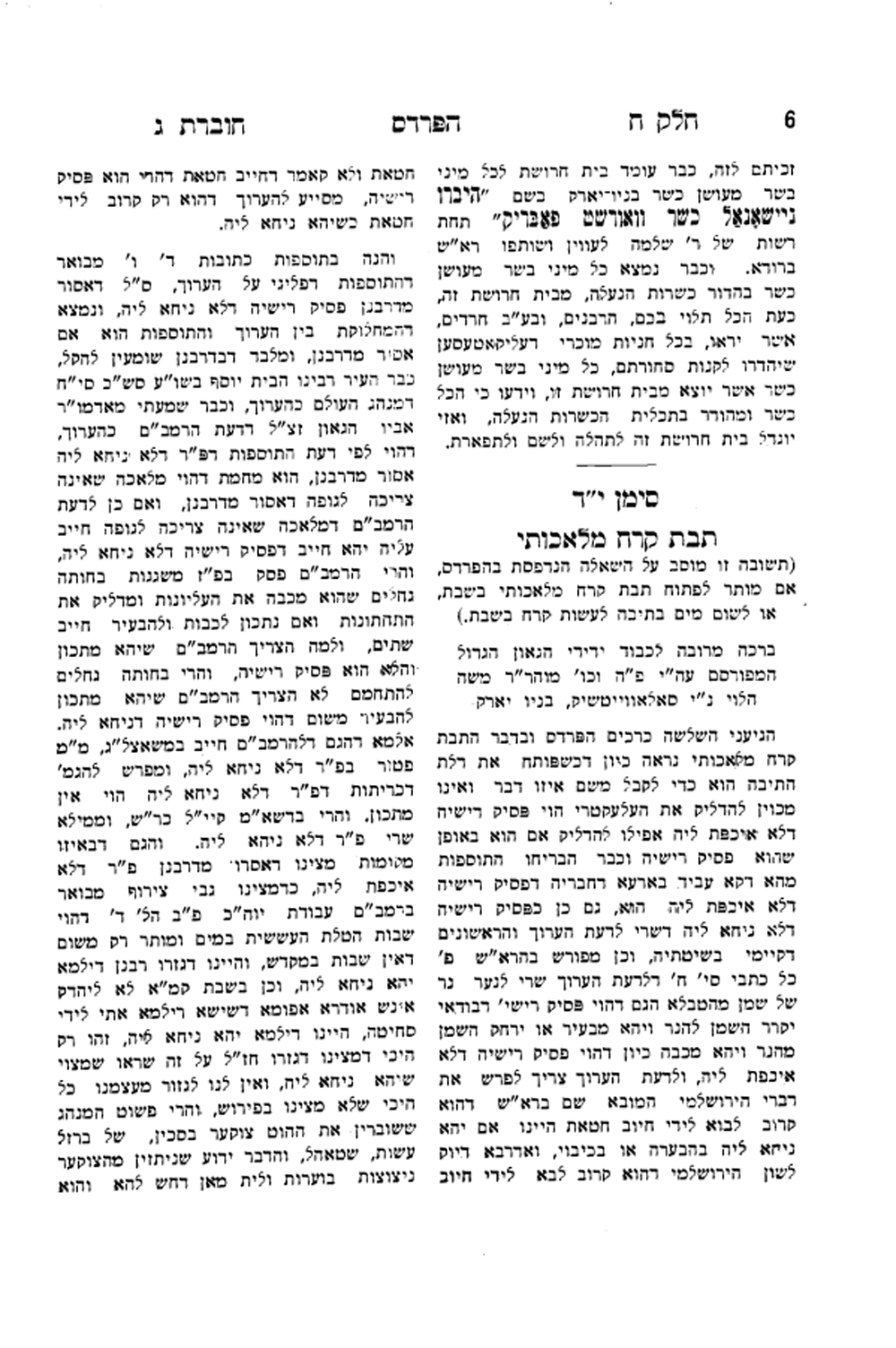
הגיעני השלשה
כרכים הפרדס ובדבר התבת קרח מלאכותי…
“I received the three issues of Hapardes and in the
matter of the artificial [electric] icebox…”

This omission is significant, because these words make clear that Rav
Simcha Zelig was addressing the refrigerator question raised in earlier issues
of Hapardes. (See Hapardes 1931 num. 2 page 3, and Hapardes
1931 num. 3 page 7.) The question under discussion in those previous volumes was
the triggering of the refrigerator motor, and not the light, as noted.
Also of note, is that at the end of his teshuva[4],
Rav Simcha Zelig addressed Rav Moshe Levin’s question regarding the
permissibility of making ice on Shabbat. Rav Simcha Zelig cited this question
specifically in the name of Rav Levin. This is significant because the ice question
appeared in the name of Rav Levin in Hapardes 1931 num. 3 page 7, in
an article about triggering the refrigerator motors.[5] See
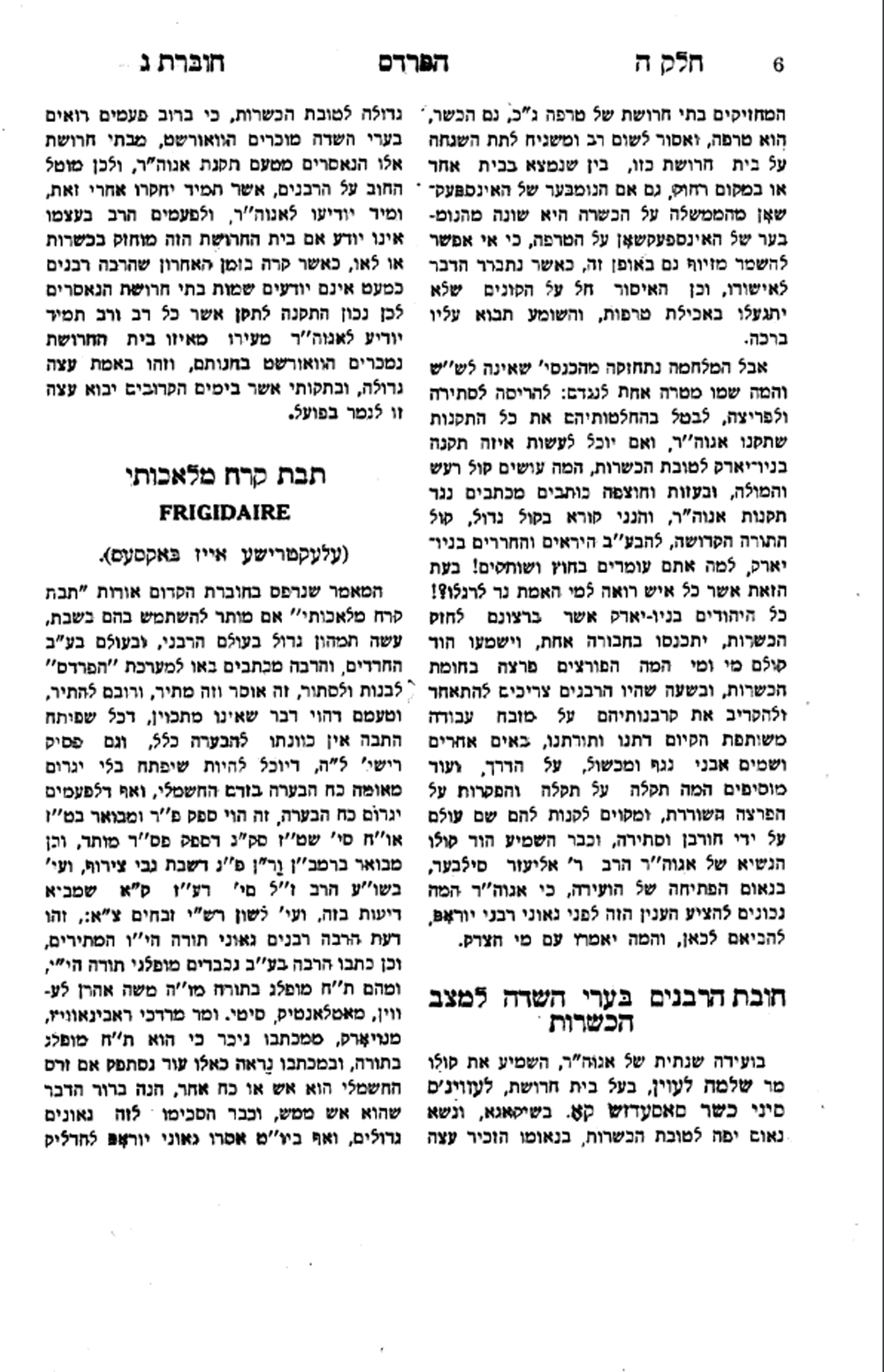
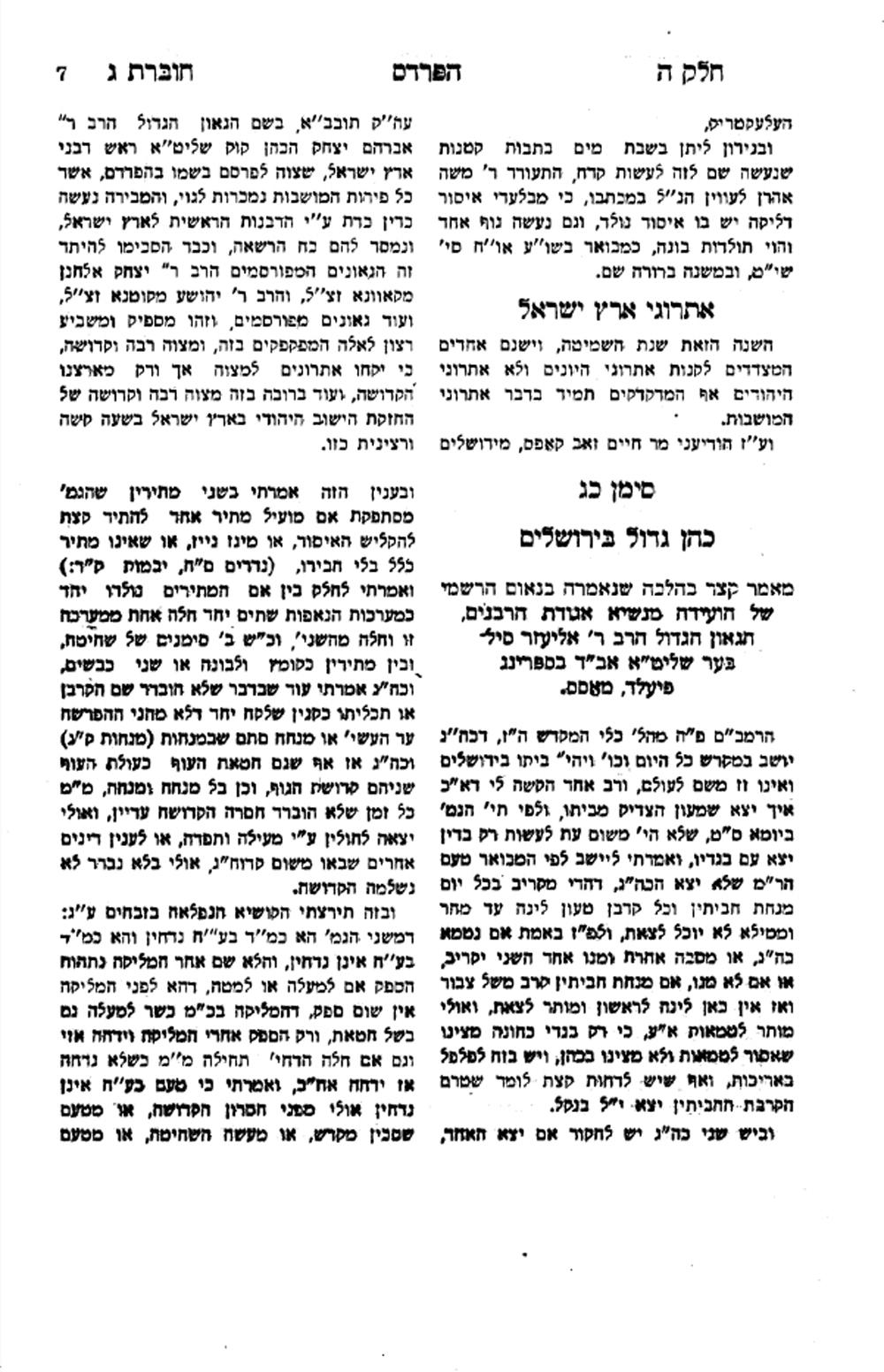
the final paragraph of the article titled “Frigidaire” in the image below:
So it is clear that Rav Simcha Zelig introduced his teshuva with a reference to the prior issues of Hapardes. And
it is also clear that he closed his teshuva by addressing Rav Moshe
Levin’s ice question from Hapardes (which appeared in the article
entitled “Frigidaire”, shown above, about the refrigerator motors.) R. Broyde
apparently contends that in between, Rav Simcha Zelig veered off to address an
unrelated question which never appeared in Hapardes (that of the
refrigerator light), without ever addressing the question of the
refrigerator motor itself. And he did this while directly addressing the
ice question from the article entitled “Frigidaire”, but never addressed the
main substance of that article, the refrigerator motor. The absurdity of this
position is self-evident.    
Also of note is the introductory paragraph to Rav Simcha Zelig’s teshuva,
presumably written by the editor, Rav Shmuel Pardes, which reads as follows[6]:
תשובה זו מוסב על
השאלה הנדפסת בהפרדס, אם מותר לפתוח תבת קרח מלאכותי בשבת, או לשום מים בתיבה
לעשות קרח בשבת.
This teshuva addresses the question that
was printed in Hapardes, whether it is permitted to open a refrigerator
on Shabbat, or to put water inside the refrigerator (freezer) to make ice on
Shabbat.
Rav Pardes clearly understood and presented Rav Simcha Zelig’s teshuva
to be addressing the question of triggering the motor, which had been raised in
earlier issues of Hapardes.
Furthermore, R. Broyde’s translation of Rav Simcha Zelig’s words is inaccurate,
and the effect of this mistranslation permeates his entire response. The
closing words of Rav Simcha Zelig in the paragraph cited by R. Broyde are:
הוי
פסיק רישיה דלא איכפת ליה אפילו להדליק אם הוא באופן שהוא פסיק רישיה.
R. Broyde has translated these words as:
“…it is a psik resha that he does not care
about, even to light in way that is a psik resha.”
The astute reader will notice that the bolded words in the Hebrew citation
are left untranslated by R. Broyde, essentially ignored, as if they do not
exist. The closing words of this sentence are correctly translated as follows: even
to light IF IT IS in a way that is a psik reisha. Most of R. Broyde’s
response revolves around the incorrect assertion that since Rav Simcha Zelig
referenced a psik reisha, he must have been referring to igniting the
light, which is a psik reisha, and not the motor, which is not a psik
reisha
. However, correctly translated, Rav Simcha Zelig says that opening
the refrigerator is permitted EVEN IF there is a psik reisha involved.
Such conditional language is entirely out of place when referring to a light,
which is certainly a psik reisha. This conditional language is only applicable
to the refrigerator motor, because there are times when, unbeknownst to the
person, the opening of the refrigerator door will immediately trigger the motor
to go on because of the already heightened initial air temperature inside the
refrigerator. (Such a situation is known in the language of the Poskim
as a “Safek psik resha”, as noted in Hapardes 1931 num. 3 page 6
regarding the refrigerator motor. It is the subject of dispute whether such an
action is permissible, similar to a Davar Sheaino Mitkavein, or
prohibited like a psik reisha.) Rav Simcha Zelig’s qualification that it
is permitted to open the refrigerator door even IF the situation is one of psik
reisha
makes clear that he is referring to the refrigerator motor, contrary
to R. Broyde’s misreading.[7]
“A careful reader of the first sentence, and indeed of the entire teshuva,
can sense that there is some ambiguity here about the electrical object
referred to, since Dayan Rieger does not specify the source or consequence of
igniting the electricity.”
There is no ambiguity to anyone who has seen the previous issues of Hapardes
which deal with the question of the refrigerator motor. There can only be
ambiguity if one reads Rav Simcha Zelig’s teshuva
entirely out of context, without looking at the articles to which he was
responding.
“Particularly in the Yiddish spoken culture of that time, the term
“electric” seems to have meant “lights” and not electricity or motor.”
R. Broyde’s assertion that “electri[c]” did not mean electricity or motor is
incorrect. See for example, the language in Rav Shlomo Heiman’s letter (dated
Erev Sukkot 5697/1936), printed in Chosen Yosef[8], and
reprinted in later editions of Chiddushei Rav Shlomo:
פקפק כת”ר
שליט”א בענין פתיחת הפרידזידעיר על העלעקטרי דע”י פתיחתו הוא
מבעיר העלעקטרי ורוצים להתיר על פי שטת הערוך דהוי פס”ר דלנ”ל
דיותר נוח לו שלא יכנס שם אויר קר, ולא יעלו לו הוצאות העלעקטרי
In this short excerpt, Rav Shlomo Heiman uses “elektri” to refer to
both the refrigerator motor and to electricity. Rav Heiman was clearly discussing
the permissibility of opening the door and triggering the refrigerator motor,
and refers to triggering the motor as kindling the “elektri”, the same
exact term used by Rav Simcha Zelig. Rav Heiman further notes that this is
considered “lo nicha lei” because the person would prefer to save the
additional expense of “elektri”, i.e. electricity.
See also the words of Rav Chaim Fishel Epstein, in Teshuva Shleima
vol. 2 – Orach Chaim, beginning of Siman
6[9]:
נשאלתי בדבר
המכונה המקררת בכח חשמל שקורין ריפרידזשיאטר, שבעת שפותחים הדלת נכנס אויר חם ואז
נתעורר כח החשמל (עלעקטריק בלע”ז) והמכונה מתחלת להניע ולעבוד כדי להוסיף
קרירות…
Here, Rav Epstein synonymizes koach chashmal, or electricity, with “עלעקטריק”.
See also Hapardes 1931, num. 2 page 3, where zerem hachashmali, or
electric current, is synonymized with
“עלעקטריק”. R. Broyde’s contention that “electri[c]”
did not mean electricity or motor is simply false.
“Elektri, according to
my colleague at Emory, Professor Nick Block, more likely means the light than
anything else in 1930s Yiddish.”
One need not be a Professor of German Studies to
recognize that within a discussion of
refrigerator motors, it is more than likely that “Elektri” means a
refrigerator motor, the subject under discussion, or its associated electricity.
This was true even in 1930s Yiddish spoken culture; see Rav Shlomo Heiman’s
1936 letter cited above.
Additionally, as mentioned above, Rav Pardes (editor of Hapardes)
clearly understood Rav Simcha Zelig’s teshuva to be addressing the
question of triggering the motor, which had been raised in earlier issues of Hapardes.
Rav Pardes’ knowledge of 1930s Yiddish was certainly robust.
“Second, and much more importantly, the halachic analysis presented by
Dayan Rieger addresses a direct action, while everyone else who discusses the
motor speaks about an indirect action…opening the door usually leads to an
increase of air temperature inside the refrigerator, which eventually directs
the motor to go on…many times when the refrigerator is opened, the motor does
not go on at all…But Dayan Rieger makes no mention of this…he assumes that when
the refrigerator door is opened the electrical object under discussion is always
ignited, and it does so immediately and directly, thus causing a melacha.
This is the formulation of psik resha, which inexorably causes melacha
each and every time…”
This section is entirely wrong, and is predicated on R. Broyde’s
misreading/mistranslation of Rav Simcha Zelig’s words, as noted above. That Rav
Simcha Zelig added the qualification of “IF IT IS” a psik reisha renders R. Broyde’s words here to be entirely
irrelevant and incorrect. Rav Simcha Zelig’s language of “IF IT IS” a psik
reisha makes clear that he is assuming that the motor is not always
ignited by opening the door, but at times it might be ignited in a manner of psik
reisha,
due to the heightened initial air temperature inside the
refrigerator. (Again, such a situation is known as “safek psik reisha”
in Rabbinic parlance, as the air temperature inside the refrigerator is not
known to the opener.) Contrary to R. Broyde’s assertions, Rav Simcha Zelig’s
language here is a clear proof that Rav Simcha Zelig’s teshuva was in reference to the refrigerator motor and not the
light.
“Professor Sara Reguer noted by email to me that “my grandfather conferred
with scientists and specialists in electricity before giving his response,” and
given this fact it is extremely unlikely that he missed such a basic point that
anyone who repeatedly opened and closed a refrigerator would have noticed.”
This argument is also incorrect, and is again predicated on R. Broyde’s
mistranslation of Rav Simcha Zelig’s words. Also significant is R. Broyde’s
citation of Dr. Reguer (in his footnote 8) that “she is certain that this teshuva
is referring to the thermostat or motor and not the light.”
“First, the other substantive halachic logic employed by Dayan Rieger which
analogizes elektri to sparks seems to me to be a closer analogy to a light than
to a motor which is hardly fire at all; sparks like incandescent lights, are
fire according to halacha.”
R. Broyde is wrong again. In fact, several poskim have noted that
ignition of the refrigerator motor also generates sparks.[10] See
the words of Rav Chaim Bick[11],
describing the problem of the refrigerator motor in Hamesila (2:1)[12]:
וע”י הגלגל
נושב רוח ומוליד הקר לחלק השני של התבה, אשר שמה נמצאים כל צרכי אכל ומשקה. הגלגל
בשעה שמתחיל מרוצתו יוצא ממנו נצוץ-אשי
And by way of the wheel,
the wind (i.e. air) blows and creates the cold in the other section of the box
(refrigerator), where all the food and drink are located. The wheel, when it
begins to run, emits fire-sparks
See also the words of Rav Chaim Dovid Regensburg,
describing the problem of the refrigerator motor, in Mishmeret Chaim, siman
3[13]:
ומה שלפעמים ניצוצות ניתזים, ברגע של מגע החוטים
החשמליים אחד בשני, אין זו הבערה, כי מלאכת מבעיר ביחס לשבת לא חשובה אלא אם האש
נאחזת באיזה דבר, וכן כתב הפרי מגדים סי תקב… 
And that sometimes sparks
fly off
,
at the moment that the electrical wires touch each other, this is not havara,
because melechet havara with respect to Shabbat is only considered when
the fire takes hold to something, and so wrote the Pri Megadim…
See also the words of Rav Shlomo Zalman Auerbach, within a discussion of
the ignition of the refrigerator motor in Minchat Shlomo (Kama), Siman
10, Anaf 2 Ot 4[14]:
אולם יש טוענים
דיש לחשוש לזה, שבכל פעם שמתחדש מעגל חשמלי יוצא במקום החבור ניצוץ קטן של אש
ונמצא שבפתיחתו הוא גורם למלאכת מבעיר…
However, some claim that one should be careful
about this, that every time that an electric circuit is completes, a small
spark of fire
comes out of the place of connection, and thus through his
opening [of the refrigerator door] he is causing the melacha of mav’ir…
Thus, contrary to R. Broyde’s assertion, Rav Simcha Zelig’s mention of
sparks is in fact directly analogous to the ignition of the refrigerator motor,
which actually involved creation of sparks.[15]
“Secondly, there has been a regular subset of poskim (as shown by Rabbi
Abadi’s most recent teshuva, Ohr Yitzchak 2:166) who adopt the exact analysis
and view of Dayan Rieger and view the light as lo ichpat since one does
not want it and a light is on already.”
To refer to a single teshuva, published in the 21st
century by a lone posek, as “a regular subset of poskim” would seem to
be somewhat of an exaggeration.
“On the other hand, there is a good and natural impulse to read halachic
literature conservatively and to press for interpretations that align gedolim
with one another and not leave outliers with halachic novelty.”
My original note and my comments here in no way reflect any impulse to read
halachic literature conservatively. They reflect my impulse to read halachic
literature correctly.
“Furthermore, I do recognize that many halachic authorities who have cited
Dayan Rieger’s teshuva have quoted it in the context of the motor and not the
light…”
More accurately, all halachic authorities who have cited Rav Simcha
Zelig’s teshuva have quoted it in the
context of the motor and not the light.
“But, I think these citations are less than dispositive for the following
important reason: Those who quote Dayan Rieger’s view as something to consider
about the motor note that his analysis is halachically wrong…Poskim generally
spend less time and ink explicating the views of authorities whom they believe
to have reached inapt or incorrect conclusions of fact or law compared with
those whom they cite in whole or in part to bolster their own analysis.”
It is unclear to me whether R. Broyde means that all of these Poskim
have misunderstood Rav Simcha Zelig’s position, or that they have
misrepresented it. Either way, the assertion is bizarre. I will leave it to the
readers to judge whether such an assertion is tenable.
The following is a partial list of Poskim and scholars who have
cited Rav Simcha Zelig as having permitted opening a refrigerator on Shabbat
when the motor will go on, and not
in the context of the refrigerator light[16]:
1)     
Rav Ovadya
Yosef (Yabia Omer, Orach Chaim Chelek 1, Siman 21, Ot 7)
2)    Rav Yehoshua
Neuwirth (Shemirat Shabbat Kehilchata, Perek 10 Footnote 33 in
the 1979 edition. This appears in Footnote 37 in the 2010 edition.)
3)     
Rav J. David
Bleich (Tradition, Spring 2017, pages
57-58)[17]
4)     
Rav Chaim
Bick (Hamesila 2:1)[18]
5)     
Rav Gedalia
Felder (Yesodei Yesurun, vol. 3 page 293)[19]
6)     
Rav Shlomo
Tanavizki (Birkat Shlomo, end of siman 2)[20]
7)     
Rav Moshe
Shternbuch (Teshuvot Vehanhagot vol. 1 Siman 220)[21]
8)     
Rav Chaim
Fishel Epstein (Teshuva Shleima vol. 2, end of Siman 6)[22]
9)     
Rav Chaim
Dovid Regensburg (Mishmeret Chaim, Siman 3, page 27) [23]
10) 
Rav Chaim
Druck (Noam Vol. 1 page 281)[24]
11) 
Rav Shmuel
Aharon Yudelevitz (Hachashmal Leor Hahalacha, page 130)[25]
12) 
Rav Yosef
Schwartzman (Shaashuei Torah, Chelek 3 – Shabbat,  pages 391-392)
13) 
Rav Shlomo
Pick (Who is Halakhic Man?, in Review of Rabbinic Judaism 12:2, page
260)[26]
In conclusion, it is clear that Rav Simcha Zelig’s teshuva about
opening refrigerators on Shabbat addressed the problem of the motor turning on
when the door is opened. Every argument put forth by R. Broyde is wrong. Rav
Simcha Zelig’s position was that it is permitted to open a refrigerator when
the motor will go on, as triggering the motor is classified as a psik
reisha d’lo ichpat lei
, which is equivalent to lo nicha lei. Rav
Simcha Zelig never addressed opening a refrigerator when the light will
go on.
Postscript:
Regarding R. Broyde’s admonition of my tone, that “we certainly could use
more light and less heat”, I could not disagree more. I will simply quote the
words of Rav Yosef Dov Soloveichik in his remarkable speech at the 1956 Chinuch
Atzmai Dinner, in appreciation of Rav Aharon Kotler[27]:
קאלטע תורה, ווי
קאלטע ליכט, איז גארנישט. עס דארף זיין הייס ליכט, א’מיר’זך
אפ’בריען ווען מ’קומט’מן צו אים…
Cold Torah, like cold light, is worthless. It must
be heated light so that one burns himself in its proximity…
[7] See Rav J. David Bleich’s typically thorough
treatment of the topic of refrigerators in Tradition
(Spring 2017, pages 57-59 and 64-65) for a discussion of why triggering the
refrigerator motor would be considered lo
nicha lei
.
[10] Rav J. David Bleich in Tradition (Spring 2017, page 72) has noted that while a number of
earlier poskim dealt with the issue
of sparking in refrigerators, sparking has now been eliminated in most
modern-day appliances.
[11] For biographical information on Rav Chaim Bick, see
here.
[15] While Rav Regensburg assumed that the creation of
sparks would happen only sometimes, it appears that Rav Bick and Rav Shlomo
Zalman assumed that the creation of sparks happened every time the motor was
triggered, and thus would be included in the category of safek psik reisha.
[16] My thanks to Dr. Marc Shapiro for bringing to my
attention the references to Rav Felder, Rav Shternbuch, Rav Druck and Rav
Schwartzman.
[17] My thanks to Rabbi Yitzchok Segal for bringing this
reference to my attention.
[27] Watch here at approximately 28:00. See also Making of a
Gadol, Second Edition, page 1019, for specific examples of Rav Aharon Kotler’s
heated remarks in defense of his Torah positions. 


ArtScroll’s Response and My Comments

 ArtScroll’s Response and My Comments
by Marc B. Shapiro 
My recent post here was more popular than my typical post. I base this statement on the fact that I received more emails from readers than usual and the post was picked up by a variety of different websites. The part dealing with the censorship of Rashbam was translated into Hebrew here (with one of the commenters calling for a herem to be placed on ArtScroll)[ and see also here.
ArtScroll has now issued its response. The following has been sent out to those who wrote to ArtScroll about the censorship.
Let us make clear at the outset, ArtScroll has total and uncompromising respect for Chazal and the classic commentators. We do not censor them. Every one of their words is holy, and we have never deigned to tamper with their sacred texts.
For an understanding of the matter under discussion, it is important to present the background of the published versions of Rashbam’s commentary on the Torah.

·      Rashbam’s commentary was first printed in 1705, based on the only existing manuscript of his virtually complete commentary on the Chumash. That manuscript began with Parashas Vayeira.

·      Subsequent editions were based on that 1705 printing.

·      In 1882, David Rosin published a new annotated edition of Rashbam’s commentary.

·   The new edition also included a commentary on the Parshiyos Bereishis, Noach, and Lech-Lecha based on comments culled by Rosin from Rashbam’s other writings as well as selections from other works that cite Rashbam. Additionally, this 1882 edition included material taken from a newly-discovered manuscript containing one page of commentary ascribed to Rashbam, on only the first chapter of Bereishis ending in the middle of verse 1:31.

·      This manuscript fragment includes an exegesis that appears several times – an exegesis that Ibn Ezra, in his famous Iggeres HaShabbos, vehemently condemns, stating, that it had been put forth by “minim” (heretics). Furthermore, a later exegesis in the same manuscript page (on verse 14) directly contradicts that earlier exegesis.
In our Czuker edition of Mikraos Gedolos, we wished to provide the Torah public with the fullest version of the Rashbam’s commentary, so rather than beginning with Parashas Vayeira, we incorporated additional material from the 1882 Rosin edition, from the beginning of Bereishis. However, given Ibn Ezra’s attribution of this exegesis to “minim,” coupled with a completely contradictory exegesis in verse 14, it is questionable whether Rashbam actually proposed the exegesis attributed to him.  Because of these factors we added only those writings attributed to Rashbam whose authenticity have not been questioned. Far from “censorship,” we have added to the older, standard Mikraos Gedolos editions.
Nevertheless, for the sake of clarity, we should have indicated that the basis for our text of Rashbam was the standard Vilna edition of 1898, with emendations from the Rosin edition of 1882. Indeed, this is what we have indicated in our just-published Sefer Shemos volume, and which will be reflected in future reprints of Sefer Bereishis.
* * * *
In my response I will only deal with the matter at hand, that is, the censorship of Rashbam’s commentary, not with the larger matter of whether ArtScroll really has “total and uncompromising respect for . . . the classic commentators.” I have dealt with this latter point in previous posts and offered evidence that contradicts ArtScroll’s assertion.
Let me begin by saying that the one word that best describes ArtScroll’s statement is “chutzpah”. Here we have an explanation from Rashbam that has been discussed and dealt with by some of the greatest Torah scholars for well over a century, yet ArtScroll feels that it knows better than all of them and thus has the authority to simply delete passages from the commentary. If that isn’t chutzpah, I don’t know what is.

Rashbam’s brother, Rabbenu Tam, famously attacked those who deleted or emended passages in the Talmud based on their own understanding.[1] Rabbenu Tam realized that if everyone had the freedom to do with the text as he wished, it wouldn’t be long before the Talmud was irrevocably damaged. As such, anyone who has a suggestion about a mistake in the text is free to add it in the form of a note or in a commentary, but he is not permitted to alter the text itself. The only honest thing would have been for ArtScroll to have included the “objectionable” passages and then explain why they feel that these texts are not authentic.
The fact that ArtScroll sees the passages that it deleted as heretical is irrelevant. Great people have regarded texts of the Rambam, of R. Kook, and of many others as heretical. Does that mean that we can start deleting these texts? There are aharonim and at least one rishon who believe that there are passages in the Talmud that were inserted by people intent on mocking the Sages (details will be in a future post). Does that mean that if ArtScroll shares this opinion it is entitled to delete these passages as well?
As I mentioned, the chutzpah is seen in the fact that ArtScroll feels that it knows better than such great figures as R. David Zvi Hoffmann[2] and R. Yaakov Kamenetsky.[3] Both of these men were not simply great talmudists but were also great biblical scholars, and they expound Rashbam’s view. It never occurred to them to delete the passages or to claim that they aren’t authentic. Cassuto was another great biblical scholar and he believed that Rashbam’s understanding of the verse is correct.[4]
Every student of Torah is taught the virtue of humility. What this means is that if you don’t understand something you seek out people greater than yourself to hear their perspective. How come ArtScroll didn’t follow this route before taking the drastic step of deleting the comments of Rashbam?
Unfortunately, if ArtScroll’s mikraot gedolot becomes the standard, anyone who uses the commentaries of R. Hoffmann, R. Kamenetsky, Cassuto and so many others will be very confused. These commentaries will cite Rashbam and explain his words, but the reader who opens up his ArtScroll mikraot gedolot to see what Rashbam says “inside” won’t be able to find it. If he doesn’t read the Seforim Blog, he won’t know what is going on.
For over a hundred years people studied Rashbam’s commentary without any problem. Different interpretations were offered, all in order to make sense of Rashbam’s words. Around fifteen years ago a few people, none of whom have any scholarly or religious standing, started making noise that there is heresy in Rashbam’s commentary on Genesis chapter 1.[5] This led a couple of haredi publishers to delete some or all of the “problematic” comments (different editions have different deletions).[6]
ArtScroll has chosen to follow this regrettable path. When this nonsense first began with the haredim in Israel, the great R. Yehoshua Mondshine, whose recent passing is an enormous loss for all, published the following letter in Kovetz Beit Aharon ve-Yisrael.[7]

The disdain he shows in this letter would be magnified if he were writing about ArtScroll, as one would expect ArtScroll to know better. It is unfortunate that ArtScroll did not heed his final words directed towards publishers inclined to censorship.
יש להתרות במו”לים שלא יהיו נחפזים “לצנזר” את פירוש הרשב”ם מכח סברות תמוהות וקלושות, ויחרדו לנפשם מאזהרות הקדמונים דלייטי ליד המגיה בספרים.
Following R. Mondshine’s letter, there appears a very lengthy letter by R. Menahem ben Shimon[8] explaining that Rashbam’s comments at the beginning of Genesis should not be controversial at all. He concludes by comparing censorship of Rashbam to the burning of Maimonides’ Guide of the Perplexed, and adds
יש בזה עזות מצח, וביזוי דברי הקדמונים, והתייחסות לדבריהם כאילו חלילה מדובר בתקליטור עם משחקים חינוכיים “בהכשר הרבנים”, וכיו”ב, וכבר הזהירונו חז”ל להיזהר בכבוד תלמידי חכמים שכל דבריהם כגחלי אש.
I have to acknowledge that some people are having a good chuckle right now at my expense. Call it naiveté, but I was convinced that the response of ArtScroll would be to admit the mistake, blame it on an error in “editing” or something like that, and correct matters in the next printing. That would have been a great outcome. I, more than many others, was shocked by ArtScroll’s response. 
In its response ArtScroll states: “[G]iven Ibn Ezra’s attribution of this exegesis to “minim,” coupled with a completely contradictory exegesis in verse 14, it is questionable whether Rashbam actually proposed the exegesis attributed to him.”
The first thing to note is that in the preface to the Iggeret ha-Shabbat, where Ibn Ezra explains what led him to write the work, he does not attribute this exegesis to “minim”. ArtScroll would have you believe that Ibn Ezra stated that the passages they have deleted are heretical interpolations. Even if this was the case, it would only be Ibn Ezra’s opinion. This would not entitle ArtScroll to delete the passages, just like they don’t have the right to delete other passages that some commentator thought were not authentic. But in this case ArtScroll is simply wrong, and I hope that they are not intentionally misleading people. (I also hope that they informed the sponsor of the new mikraot gedolot that they intended to delete passages from Rashbam.[9])

Here is the text from Ibn Ezra.[10]

As you can see, Ibn Ezra responds very sharply to the interpretation mentioned by Rashbam. Although Rashbam is not mentioned by name, the standard view in traditional and scholarly circles is that Ibn Ezra was indeed directing his words at Rashbam and not at others who shared this perspective. This would explain his use of the words ולא תשא פני איש which would only be used with reference to an outstanding scholar.[11] David Kahana suggests that, as a sign of respect, Ibn Ezra does not mention Rashbam by name and he also does not curse the author of the explanation he is attacking.[12] He only curses the one who reads it aloud and the scribe who writes it. If Ibn Ezra was directing his comment against some heretic, we would expect him to curse this person, so the fact that he does not do so is quite significant and indeed points to Rashbam as the “addressee” of Ibn Ezra’s Iggeret ha-Shabbat.
Ibn Ezra never denies the authenticity of the interpretation he is responding to; he just attacks it. His attack on Rashbam’s view is just like Nahmanides’ attack on Maimonides’ view that the angels who came to Abraham were really just part of a prophetic vision. Nahmanides does not deny that Maimonides said this, but he does say that it is forbidden to accept what Maimonides says. It is the exact same thing here. Ibn Ezra is not denying that Rashbam offered the interpretation. He is simply saying that it is forbidden to accept this approach. (I should also add, since we are discussing a dispute between Ibn Ezra and Rashbam, that by any traditional measure Rashbam must be regarded as a more significant and authoritative figure than Ibn Ezra.)

ArtScroll also states that since Rashbam’s commentary to Genesis 1:14 contradicts what he says in the passages deleted by ArtScroll, this gives weight to their assumption that the other passages were not written by Rashbam but were instead inserted by some heretic. To begin with, since there are five[13] “problematic” comments and one “non-problematic” comment, perhaps it is the “non-problematic” comment to Genesis 1:14 that is to be regarded as inauthentic and should be removed. I say this only tongue and cheek, since ArtScroll should have realized two pretty basic things.
1. Rashbam often offers explanations, even in matters of halakhah, that are in line with the peshat of the text but diverge from the talmudic understanding. I understand that in some contemporary circles this would be regarded as heretical, since they assume that the meaning of the verse, especially in halakhic matters, can only be what the sages of the Talmud declare. Yet Rashbam had a different perspective, and he allowed for a peshat that diverges from what the Talmud states.
2. If you have contradictory explanations in the same chapter, the proper thing to do is to see if they can be reconciled before deciding that some of the comments are not authentic and can therefore be deleted. This was the approach of the great scholars of the last century who discussed Rashbam’s commentary. If ArtScroll had “uncompromising respect” for these figures, who devoted great time to understanding what Rashbam was saying, they would not have dared delete Rashbam’s comments, since by doing so they are in effect claiming that they know better than R. Hoffmann, R. Kamenetsky, and so many others.
Let me cite some other writers, including outstanding Torah scholars, who discussed Rashbam’s comments on when the day begins. In ArtScroll’s eyes this was all a big waste of time, since Rashbam never could have said what appears in his commentary. I guess we should all feel sorry for these Torah scholars that when they wrote they didn’t have ArtScroll around to set them straight. The more important question is why didn’t ArtScroll think that any of the explanations offered by these scholars were enough to save Rashbam’s comments from being deleted? (My own sense is that the individual who made the choice to censor Rashbam did not begin to understand the issue and was unaware of the sources referred to in this post.)
1. R. Menahem M. Kasher discusses Ibn Ezra’s attack on Rashbam and offers an explanation for Rashbam’s position, distinguishing between how the days were structured in the first six days of creation and what occurred afterwards.[14] R. Kasher also cites R. Pinhas Horowitz, Ha-Makneh to Kiddushin 37b, that before the giving of the Torah night came after day, and this can also be an explanation for Rashbam’s approach. In support of his assumption, R. Horowitz cites a verse not mentioned by Rashbam, Genesis 8:22:  ויום ולילה לא ישבתו. As you can see, in this verse night comes after day. (R. Horowitz repeats this explanation in his Panim Yafot to Genesis 8:22.) R. Moses Sofer cites this point from R. Horowitz and notes that even today it is only with regard to Jews that night precedes day, but for non-Jews the halakhah remains that day precedes night.[15]
R. Ezekiel Landau agrees with R. Horowitz that before the giving of the Torah the day did not start at night.[16] In support of this approach, R. Samuel Mirsky refers to Ugaritic literature which he regards as real evidence for Rashbam’s position.[17]
R. Moshe Malka also takes note of R. Horowitz’s position.[18]  Based on it he claims that
נחה שקטה תמיהתו של הראב”ע על הרשב”ם, כי הוא דבר על מעשה בראשית לפני מת”ת
R. Catriel David Kaplin also refers to R. Horowitz’ perspective and explains that Rashbam agrees with it.[19]
R. Kasher further cites R. Isaac Israeli (14th century) as agreeing with R. Horowitz. In his Yesod Olam[20] R. Israeli writes
וכן נהגו כל ישראל ממתן תורה ועד עתה להתחיל קדושת השבת ושאר ימי מקראי קודש מתחילת הלילה . . . ועל העיקר הנכון הזה יסדו לנו קדמונינו וקבעו בחשבון מולדות הלבנה ותקופת החמה.
R. Kasher calls attention to the words ממתן תורה ועד עתה and concludes that R Israeli is telling us that before the giving of the Torah the day began in the morning.
Finally, R. Kasher points to two separate rabbinic texts, one talmudic and one midrashic, that he feels can support Rashbam’s approach.
2. Da’at Mikra to Genesis 1:5 (p. 10 n. 168) explains that Rashbam’s understanding of when the day begins only refers to the six days of creation.
3. A different approach in explaining Rashbam is taken by R. Moshe Schwerd in a recent article in Or Yisrael.[21]
4. The Lubavitcher Rebbe refers to Rashbam’s explanation of when the day begins in order to illustrate how explanations in accord with peshat can contradict the accepted halakhah.[22]
5. R. Chaim Leib Zaks calls attention to the fact that two medieval authorities explain Genesis 1:5: ויהי ערב ויהי בקר, just as Rashbam did, that is, that day comes before night.[23] The first is the commentary attributed to Rashi, Ta’anit 11b, s.v. למחר.[24] The second is the commentary attributed to Rashi, Nazir 7a s.v. התם.[25]
6. R. Eliyahu Katz, who served as rav of Bratislava under the Communists and later as chief rabbi of Be’er Sheva, published a number of interesting books which appear to be completely unknown. In his Emor ve-Amarta[26] he states that R. Judah ha-Nasi might also have held that according to the peshat night comes after day, and that Rashbam might have based his explanation on R. Judah’s opinion. He also points out that Rashi, Genesis 1:14 writes
שמוש החמה חצי יום ושמוש הלבנה חציו הרי יום שלם
This is a strange formulation since Rashi appears to be agreeing with Rashbam that the day – שמוש החמה – comes before the night – שמוש הלבנה.
7. R. Jacob of Vienna, in his commentary to Genesis 1:5, writes[27]:
וא”ת אימא הלילה הולך אחר היום והכי קאמר ויהי ערב של יום הראשון ויהי בקר של יום שני אז נשלם יום שלם
In his note to this passage R. Zvi Rotberg understandably refers to Rashbam, as R. Jacob might indeed be alluding to him here.[28] The editor of R. Jacob’s volume, R. Menasheh Grossberg, refers to R. Pinhas Horowitz’s view mentioned above.
8. R. Shlomo Fisher, without question one of the top Torah scholars in the world, elaborates on the implication of Rashbam’s view that it is only through Torah she-Ba’al Peh, not the peshat of the verses, that we know that day comes after night.[29] A student of R. Fisher asked him about the censorship of Rashbam, and not surprisingly he expressed strong opposition to any such tampering with the writings of rishonim. He also told this student about a contemporary “scholar” who claims that Rashbam was influenced by evil people who caused him to go astray! Talk about chutzpah![30]
10. Michael Landy called my attention to the fact that Abarbanel cites the interpretation mentioned by Rashbam in the name of יש מהמפרשים.[31]
All of these sources that I have quoted, and believe me when I tell you that there are many more, are simply designed to show that the view of Rashbam expressed in his commentary to the first chapter of Genesis is part and parcel of Torah history and literature. Many of our great minds have discussed Rashbam’s view in a variety of contexts. Yet ArtScroll, on its own, has decided that it knows best and chose to remove the words of Rashbam from the public eye. They have no right or authority to do this. Their action is a betrayal of Rashbam and of those who want to study the writings of Rashbam. It is also an incredible display of disrespect to those great Torah scholars who have devoted time to the matter and explained the comments of Rashbam that ArtScroll prefers to view as heretical.
After all we have seen, let us return to the issue of Ibn Ezra’s attack on Rashbam and ask why it was so harsh. After all, what is so terrible about explaining the peshat of the Torah even if it diverges from the accepted halakhah, an approach that is found in numerous commentators?
The significance of the example we have been discussing is that there were indeed sectarians who observed Shabbat from Saturday morning until Sunday morning. Rashbam’s interpretation was thus dangerous as it could have had real world implications by giving support to the anti-halakhic behavior just mentioned.
In his commentary to Exodus 16:25 Ibn Ezra refers to “many people, lacking in faith” who erred in this matter and did not start Shabbat on Friday night. He tells us that they based their mistaken approach on Genesis 1:5: ויהי ערב ויהי בקר. In other words, they interpreted the verse in the same way that Rashbam did. Towards the end of Iggeret Shabbat, p. 171, he also mentions these “minim” who do not observe Shabbat beginning Friday night. It is thus easy to see why Ibn Ezra reacted so strongly and set out to uproot Rashbam’s interpretation.
Who were these sectarians Ibn Ezra refers to? Presumably the Mishawites, a group that we know started Shabbat on Saturday morning.[32] Benjamin of Tudela records meeting sectarians in Cyprus, again presumably Mishawites, who indeed observed the Shabbat in this fashion.[33]
In the last paragraph of the ArtScroll letter it states that from now on they will note that their text of Rashbam is the standard Vilna edition of 1898 with “emendations from the Rosin edition of 1882”. This is clearly obfuscation as we are not dealing here with any “emendations” suggested by Rosin. To repeat what the issue is: Rosin printed from manuscript Rashbam’s commentary to Genesis chapter 1. This section of the commentary does not appear in the standard Vilna edition. ArtScroll chose to include Rashbam’s commentary to Genesis chapter 1 in its recently published mikraot gedolot. However, ArtScroll also chose to delete those sections of the commentary it didn’t like, assuming (without any evidence) that these sections were written by heretics. This is censorship of  Rashbam. That is all people need to know.[34]
ArtScroll has done some great things. They have also done some pretty disappointing things. But as I said in the prior post, nothing comes close to this. Deleting comments of one of the greatest rishonim is simply outrageous. Some have said that what ArtScroll did is unforgivable. I think this is going too far. If ArtScroll acknowledges its error and reinserts that which has been removed, I think that we all would be very happy to put this behind us. One of the most important aspects of a Torah personality is the ability to recognize when one has made a mistake and rectify it. If ArtScroll is able to do this, it would lead to great admiration.

On the other hand, if ArtScroll refuses to acknowledge that it has made a terrible error, even after seeing the evidence presented in this post, then one must conclude that ArtScroll is knowingly suppressing the words of a great rishon. One can only hope that ArtScroll does not wish to have this blemish permanently attached to its name.

[1] ArtScroll and other publishers should pay close attention to the words of Rabbenu Tam, which I would have thought would be enough to scare off the censors. Sefer ha-Yashar, ed. Rosenthal (Berlin, 1898), p. 75:
ומגיהי חנם, בעיני דינם, למדורי גהינם
P. 105:
כי כאשר לא יודעים, העולם מטעים, וכאשר תוהים, הספרים מגיהים. ואתם הרעות מהם, כי הם כותבים ה”ג בהגהותיהם, ולכן ניכר מעבדיהם. ואתה לא כן, אך סותם הגהותיך וסומכים עליך וטועים . . . אין עצה ואין תבונה, רק להעמיד על האמת ולזרוק מרה במגיהי הספרים
Even if they are not scared of מדורי גהינם, one would have thought that they would have seen the wisdom of what Rabbenu Tam writes in the introduction to Sefer ha-Yashar, ed. Schlesinger (Jerusalem, 1985), p. 9:
והדין נותן אם לא ידע אדם הלכה יכתוב פתרונו לפי ראות עיניו אם ירצה אך בספרים אל ימחק שדברי תורה עניים במקומן ועשירים במקום אחר ואם דבר רק הוא ממנו הוא [רק]
                       
[2] Sefer Bereshit, trans. Asher Wasserteil (Bnei Brak, 1969), pp. 26-27. Hoffmann writes as follows:
כמו גם פרשנים חדשים רבים הוא [רשב”ם] סבר, שבימי מעשה בראשית נמנו הימים באופן שונה מדרך מנייתם לאחר מכן, בימי מתן תורה, כשם שגם תחילת השנה לפני מתן תורה שונה – לדעת ר’ אליעזר – מזו שלאחריו.
[3] Emet le-Yaakov (Cleveland Heights, 2007), p. 17.
[4] Umberto Cassuto, A Commentary on the Book of Genesis, trans. Israel Abrahams (Jerusalem, 1998), p. 28.
[5] As far as I know, the first one to assert that Rashbam’s comments are heretical interpolations was R. Yehudah Nachshoni, Hagut be-Farashiyot ha-Torah (Bnei Brak, 1981), vol. 1, p. 262, but this had no impact on the haredi world. Here is the page from Nachshoni.

He writes:
לדעתו יש לחשוש שמא חלו ידי קראים בדברי הרשב”ם
What this means is that Ibn Ezra thought that perhaps Rashbam’s metaphorical interpretation of the commandment of tefillin in Ex. 13:9 is a Karaite interpolation. This is complete nonsense as Ibn Ezra says nothing of the sort. I think, therefore, that there is a typo and the first word should read לדעתי. It is still nonsense but at least now the sentence is understandable. Following this, Nachshoni adds another absurdity, stating that Rashbam’s interpretation of when the day starts is also a Karaite interpolation. (Prof. Daniel Lasker has confirmed to me that all Karaites began the Sabbath on Friday night.)
Now comes the real irony. ArtScroll published a posthumous translation of Nachshoni’s book in 1988. Apparently ArtScroll was embarrassed by what Nachshoni wrote so ArtScroll censored it! Here is the English version, Studies in the Weekly Parashah, vol. 2, pp. 414-415.
In 1988 ArtScroll censored the writings of Nachshoni because he said that Rashbam’s comments were heretical interpolations, but in 2014 ArtScroll accepted this very position and instead censored Rashbam! Can it get any crazier than this?
As an aside, let me also note that I find it strange that ArtScroll does not give Nachshoni the title “Rabbi” on the title page of its translation of his book, even though he is referred to as such in the preface.
[6] It is possible that the haredi publishers who censored Rashbam did so purely for financial reasons. After putting a lot of money into their editions, a pashkevil directed against them, incited by some extremist, could be financially devastating. In the haredi world it is often enough to say that there is a “problem” with a book for people not to buy it. The masses won’t have a clue about the issue, but if there is a choice between two competing mikraot gedolots, they will feel safer buying the one which has not had any questions raised about it.
[7] (Kislev-Tevet 5760), p. 150.
[8] Ibid., pp. 151-155.
[9] I don’t have the newly published ArtScroll mikraot gedolot on Exodus (and will refuse to buy it until Rashbam’s commentary is fixed). I was curious if Rashbam on Ex. 13:9 appears in full or if it too was censored. Here Rashbam states that the commandment of tefillin in this verse: והיה לך לאות על ידך ולזכרון בין עיניך, is to be understood metaphorically. Ibn Ezra, in his commentary on Ex.13:9, harshly criticizes the metaphorical interpretation. A friend sent me a copy of this page of Rashbam and the commentary appears in full. I did notice, however, that in the following verse in Rashbam, Ex. 13:10, it reads חוקת הפסח with a dagesh in the kuf. This is a mistake, and in the next printing the dagesh should be removed.
If ArtScroll is looking for something to censor in the newly released volume, Or ha-Hayyim to Ex. 31:16 probably fits the bill. In this controversial passage Or ha-Hayyim states that we don’t violate Shabbat to save the life of someone who will not live until the next Shabbat. This contradicts an explict talmudic passage, Yoma 85a, that one violates Shabbat even for hayyei sha’ah. See R. Ovadiah Yosef, Hazon Ovadiah: Shabbat, vol. 3, pp. 296ff. R. Judah Aryeh Leib Alter, Sefat Emet: Likutim (New York, 1957), p. 77a (Ki Tisa), already suggested that an “erring student” wrote these words in Or ha-Hayyim.
[10] It appears in Kerem Hemed 4 (1839), pp. 160-161.       
[11] See Aharon Mondshine, “Li-She’elat ha-Yahas she-Bein Perusheihem shel R. Avraham Ibn Ezra ve-Rashbam la-Torah: Behinah Mehudeshet,” Teudah 16-17 (2010), p. 17.
[12]  Rabbi Avraham Ibn Ezra (Warsaw, 1894), vol. 1, part 2, p. 45 n. 4.
[13] In the previous post I noted four examples of ArtScroll’s censorship with regard to Rashbam’s peshat  understanding of when the day begins: Gen. 1:4, 5, 8, 31. I neglected to mention Rashbam’s commentary to Gen. 1:6 which is also censored by Artscroll. Regarding why Rashbam’s commentary to the first three parashiyot of Genesis were missing from the manuscript, see Itamar Kislev in Tarbiz 73 (2004), p. 229 n. 12.
[14] Torah Shelemah, vol. 10-11, pp. 276-279.
[15] Hiddushei Hatam Sofer to Shabbat 87a. R. Akiva Eger points out that R. Horowitz’s position leads to a very interesting conclusion. Here is the summary in R. Yaakov Moshe Shurkin’s commentary to Teshuvot Rabbi Akiva Eger (Lakewood, 2003), vol. 2, p. 769 (Pesakim, no. 121):
וכתב רבינו דלפי חידושו של הפנים יפות הנ”ל, דדין עכו”ם ששבת חייב מיתה הוא ביום ולילה שלאחריו, יש להמליץ זכות על אלו שבאו להתגייר ומרגילים את עצמם לשמור את השבת גם קודם שנתגיירו כנ”ל, די”ל שאינם עוברים בזה באיסור דעכו”ם ששבת, דסגי להו אם יעשו מלאכה במוצאי שבת, וכדברי הפנים יפות הנ”ל. ואין צריך למחות בשפחות הנ”ל מלשבות בשבת.
[16] Tziyun le-Nefesh Hayah to Pesahim 116b.
[17]  “Midot ha-Parshanut ha-Mikrait,” Sura 1 (1954), p. 396.
[18] Be’er Moshe (Lod, 1994), p. 14. He also questions R. Horowitz’s position by citing Mishnah, Hullin 5:5:
                  
מה יום אחד האמור במעשה בראשית היום הולך אחר הלילה
Rashbam could easily reply that the Mishnah is not speaking in terms of peshat. However, I am surprised that neither R. Horowitz nor R. Landau discuss this text which would appear to contradict their approach, as they assume that the Talmud agrees that before the giving of the Torah night came after day.
[19] Keter Nehora (Jerusalem, 2004), p. 114.
[20] (Berlin, 1848), vol. 1, p. 35 (2:17).
[21] “Hagdarat Zemanei ha-Yom ve-ha-Laylah al pi Halakhah u-Mahashavah” Or Yisrael (Nisan 5770), pp. 226ff.
[22] Sihot Kodesh (1967), part 2, sihah from 12 Tamuz 5727, p. 284.
[23] “Be-Inyan ha-me-Et le-Et shel Ma’aseh Bereshit,” Ha-Maor (Oct. 1957), pp. 4ff.
[24] This source was also noted by R. Abraham Elijah Kaplan. See Divrei Talmud (Jerusalem, 1958), vol. 1, p. 42 n. 97:
וזה מזכיר דברי רשב”ם שנלחם בם ראב”ע במחברתו אגרת השבת
[25] Kaplin, Keter Nehora, p. 115, also refers to this commentary to Nazir.
[26] (Be’er Sheva, 1994), vol. 1, pp. 26-27.
[27] Peshatim u-Ferushim (Mainz, 1888),  pp. 9-10
[28] Le-Misbar Kera’e (Bnei Brak, 2005),  p. 49.
[29] Derashot Beit Yishai (n.p., 2004), p. 48 n. 11.
[30] E-mail of this student to me.
[31] Commentary to Genesis, p. 33 in the standard edition.
[32] Regarding the Mishawites, see Zvi Ankori, Karaites in Byzantium (Jerusalem, 1968), pp. 372-416. Regarding whether the Dead Sea Sect started the Sabbath on Saturday morning, see Lawrence Schiffman, The Halakhah at Qumran (Leiden, 1975), pp. 84-85. See also Jacob Z. Lauterbach, Rabbinic Essays (Cincinnati, 1951), pp. 446ff.
[33] See The Itinerary of Benjamin of Tudela, ed. Adler (London, 1907), pp. 17-18 (Hebrew), p. 15 (English).
[34] Here is the page listing the texts used in preparation of the ArtScroll mikraot gedolot for the Book of Genesis.

There is no mention of the Mossad ha-Rav Kook editions, perhaps because of copyright concerns. But there is no doubt that in preparing its text of the mikraot gedolot, an important source for ArtScroll for the commentaries of Ibn Ezra, Ramban, Hizkuni, R. Bahya ben Asher, and Sforno were the Mossad ha-Rav Kook editions (and perhaps also Bar Ilan’s Mikraot Gedolot ha-Keter).
For instance, look at the description of Hizkuni. The page from ArtScroll states that its text is based on the first printing and the manuscript thought to be from the author. This is exactly what one finds in Chavel’s edition of Hizkuni published by Mossad ha-Rav Kook. Does anyone really think that ArtScroll compared, line by line, the first printed edition to the manuscript? This work was already done by Chavel. All ArtScroll had to do was use the text provided by Mossad ha-Rav Kook. So how come ArtScroll can’t tell us this, and instead puts on this charade?

ArtScroll does not mention consulting manuscripts with any of the other texts included in its mikraot gedolot, only with the ones already published by Mossad ha-Rav Kook. ArtScroll also says that its edition of Hizkuni is based on the first printing, Cremona 1559. Yet the first printing was in Venice 1524. ArtScroll simply repeated Chavel’s mistake. See Chavel’s introduction to his edition, p. 11.
The title Hizkuni (which I don’t italicize since it is now used as a personal name) comes from the author’s introductory poem to the work. Here is the relevant page from the Chavel edition and on line 7 you can see the word vocalized.

Louis Jacobs, Jewish Biblical Exegesis (New York, 1973), p. 69, claims that the word should be vocalized as Hazekuni, which is the piel plural imperative (“strengthen me”; dagesh in zayinsheva under zayin). R. Chaim Mordechai Brecher made the same point. See G. Kressel, ed., Ha-Ahim Shulsinger (Jerusalem, 1986), p. 119. I don’t see why this is preferable as Hizkuni is also correct, as the kal plural imperative, and the kal imperative is actually much more common in the Bible than the piel imperative. Furthermore, Hizkuni rhymes better with yizkeruni, the parallel word in the poem. Finally, look at the sentence in its entirety
ויקרא שמו בישראל חזקוני, למען קוראיו בשמו יזכרוני
This means that one who pronounces the title of the book, Hizkuni, will be reminded of the name of the author, Hizkiyah. This mnemonic only works if the title of the book has a hirik under the het, like in the author’s name. See A. Ben Ezra in Kressel, ed. Ha-Ahim Shulsinger, p. 119.
Here is the introductory poem from ArtScroll’s edition. The word חזקוני is missing a dagesh in the zayin which means that ArtScroll understood it as an imperative. (Chavel places a dagesh in the zayin, meaning that he understood it as  piel plural perfect.)

Look at the third line from the bottom on p. 8 where ArtScroll has
ומבואר [נ”א: ומכוער]
Anyone who understands Hebrew can see that ומבואר is incorrect (and this error also appears in the Venice 1524 edition). When ArtScroll prepared its mikraot gedolot it had Chavel’s edition in front of it. Chavel’s edition is based on what appears to be the manuscript of the author. In this manuscript (which ArtScroll claims to have consulted) one finds the reading ומכוער. So how come this is not the word that appears in the text published by ArtScroll? This is the original reading, not a נוסח אחר. (At best, ArtScroll could have put ומבואר in brackets, but why would this even be necessary in a non-critical edition?) If ArtScroll thinks that it is important to cite the Cremona reading, then how come immediately following this it doesn’t have כי מי ימצא בו דבר חכמה מפואר. As you can see, this is what appears in the Cremona text, and again, one who knows Hebrew will realize that it doesn’t make much sense.

In the manuscript, which is the basis of Chavel’s version, the text reads אשר ימצא בו דבר חכמה מפואר. This is what appears in ArtScroll, with no indication that there is an alternative text. So why did ArtScroll feel the need to add [נ”א: ומכוער] in the previous part of the sentence? Is this just a way of showing the reader that ArtScroll is “scientific” and has examined the different versions?
If you compare ArtScroll’s version of the introductory poem to that which appears in Chavel’s edition, which is based on the manuscript, you will find that other than the example just mentioned, ArtScroll relies entirely on the mistaken text from the Cremona edition instead of using the correct version from the manuscript. Just skimming through the commentary I found other examples where ArtScroll ignores the manuscript reading in favor of the Cremona edition. I don’t know why ArtScroll did this, but it again shows that ArtScroll’s new edition of mikraot gedolot was not properly edited. 

I also found what I think is a punctuation mistake in ArtScroll’s edition of the poem. See the page from Chavel printed above, the second column, second to last line: ובעיני א-להים יישר. Chavel punctuates יישר as a pual imperfect. ArtScroll punctuates it as a kal imperfect. Because of the rhyming, I think Chavel is correct.

The issue of how ArtScroll uses works of prior scholarship requires a more detailed study than I can provide here. I would, however, like to point to one problematic aspect. Let us look briefly at ArtScroll’s Five Megillos, the earliest ArtScroll publication. ArtScroll is very proud of the fact that it only uses traditional rabbinic sources. On the first page of the commentary to each of the five megillot, we are informed that all material in square brackets is a comment from the author, which we are to assume is an original insight.
Here is ArtScroll’s commentary to Ruth 4:10.

Now read what appears in the Soncino commentary to Ruth 4:10.

ArtScroll’s entire comment is lifted from Soncino. Quite apart from the plagiarism, I find it troubling that ArtScroll feels that Soncino is good enough to be used, just not good enough to be mentioned by name. (When ArtScroll changed some of Soncino’s wording, a mistake crept in. Soncino has “sacred duty of building a home.” ArtScroll intended to change this to “sacred task of building a home,” but instead of “task” it reads “text”.)
After David Farkas called this example to my attention, it did not take me long to find other examples, of which I offer two. Here is Soncino’s commentary to Ruth 4:1.

Now look at ArtScroll on this same verse.

It is obvious that Soncino is the basis for what is found in ArtScroll. (Note the words “fairly large edifice” in both Soncino and ArtScroll.) 
Here is Soncino’s commentary to Esther 2:20.

Now look at ArtScroll on this same verse

Again, it is obvious that Soncino is the basis for what is found in ArtScroll. (Note the words “filial piety” in both Soncino and ArtScroll.)