Some Memories of Reb Dovid Feinstein zt”l: Instead of a Hesped

Some Memories of Reb Dovid Feinstein zt”l: Instead of a Hesped

By Jonathan Boyarin

Jonathan Boyarin is the Diann G. and Thomas A. Mann Professor of Modern Jewish Studies at Cornell University. His latest book is *Yeshiva Days: Learning on the Lower East Side*, available here.


My Rosh Yeshiva, Reb Dovid Feinstein zt”l, was no longer with us on Friday just before Shabbes. This morning, Sunday, we watched online as an East Side Hatzoloh ambulance bearing his coffin waited for a crowd to clear so it could head up East Broadway following his outdoor eulogies. The ambulance lights flashed, almost surreal in the bright November sunshine, seeming at once reluctant to leave the neighborhood, warning of an emergency, and telling us it was already too late.

None of us will see him again, yet in the days and years to come the memories will circulate. I am so grateful that he permitted me to publish my impressions of him and of the Mesivtha Tifereth Jerusalem that he led for decades as successor to his father, Reb Moshe Feinstein. The book is new, and I am no longer a Lower East Side resident. Along with those who did eulogize him and asked mechila, forgiveness, from him on East Broadway this morning, I ask his forgiveness that I did not manage to bring it to him personally.

Those close to him, those who studied with him, referred to him as “Rebbi” or “the Rosh Yeshiva.” To help those who knew him to remember, and to offer some slight glimpse of his special personality to those who did not know him, I share here a few strokes of my sketch of him in that book, Yeshiva Days: Learning on the Lower East Side (Princeton University Press). And I speak of him in the present, as I do in the book, written and published in the sincere hope that I might continue to study with him for years to come. It was not to be.

Unlike the paradigmatic Hasidic leader, similarly addressed and referred to as “the Rebbe,” our Rebbi’s authority is if anything anti-charismatic and reserved. He has not striven to build a community of devoted followers, but rather serves the community as it happens to manifest itself and as it turns to him. One day I overheard my study partner Asher reply to someone: “That’s so not like Rebbi. Rebbi, if he sees someone doing something he disagrees with, he won’t say anything. But if you come to him and try to justify it, he’ll throw the book at you.”

During the week that the Lower East Side was without power after Hurricane Sandy, Elissa and I took refuge with cousins in Washington Heights, and were kindly invited to Shabbes meals at the homes of local residents there. Another guest at dinner that Friday night was a young man who clearly had a “yeshivish” background, and was working on a master’s degree in art history at Bard while working at the Cloisters. He told us had spent some time at MTJ during his high school years. In response to my comment about how remarkable it is to be in a small room with just about ten other guys listening to a shiur by one of the top halachic authorities of our generation, he told me he believed the Rosh Yeshiva had stayed on the Lower East Side precisely because he doesn’t want to be the object of mass veneration.

At least once I heard the Rebbi wonder aloud about the source of his own authority. One day we worked through a very long Tosafos (at Sotah 24) that took up the full hour of his Talmud shiur. The Rebbi introduced this text by saying, “Today we have a Tosafos that has nothing to do” with the ostensible topic of the passage in the Gemara to which it is attached as commentary. Rather, this discussion turned on the fundamental principle of Rabbinic Biblical interpretation that nothing is superfluous in the Torah—and that therefore, every seeming superfluity is available to teach us something not explicitly stated in the text. On the other hand, the Gemara will also sometimes claim that at certain points, rather than redundancies being available for interpretation, the Torah is merely “speaking in human language,” as people would in conversation.

As we studied the Tosafos, the Rosh Yeshiva several times worried the question of the seeming arbitrariness of the principle’s being applied sometimes and not others: “How do we know this one is dibra toyre, and that one is something we interpret? Because his Rebbi told him! But who told his Rebbi? So is it all ultimately halachos lemoshe misinai [laws orally dictated to Moses and not actually derivable from Scripture]? And if so, then are all of these cited verses just asmachtos [prooftexts for citation, but not the actual sources of the law]?”

He did not answer his own question, on this occasion—but he did on another. The Rebbi commented on a series of very general prooftexts presented (at Sotah 23b) for why certain rules pertain to male Kohanim and not to daughters of Kohanim, and certain rules pertain to men generally and not to women: “Don’t try to interpret the verses too closely—they’re very general. It’s all really halacha lemoshe misinai and the rabbis were just trying to convince the masses. You could spend five days trying to read it precisely, and you’d really be wasting your time. You should keep studying the text further instead.” Yet Asher had earlier that same morning quoted the Rebbi to almost the opposite effect: the Rebbi had once quoted the scholar known as Malbim, to the effect that if we really knew Hebrew grammar properly, we would understand why all of the prooftexts the Rabbis cite are compelling.

The Rosh Yeshiva is able to raise these issues, it appears to me, at least in part due to his conviction that we do know in fact what the halacha, the proper Jewish procedure, is, whether or not we are absolutely certain of its particular source in the text. Related to this conviction is his penchant for attempting to make sense of the Talmudic text, in the standard “Vilna edition,” as it is printed, before considering the various emendations that have been suggested over recent centuries and that are duly marked in that same edition. Thus, in a Tosafos as printed at Sotah 25b, the word “ve’ayno,” “and he does not” is left out in a quote from the Gemara elsewhere, so that the entire meaning of the quoted Gemara is obscured. While we were sitting in the library waiting for the Rebbi, several of us noted this. Someone said, “Should we tell the Rosh Yeshiva about it?”

Asher: “No, because maybe he’ll come up with a pshat (a way to make sense of the text as printed), and we would have missed it if we told him.”

In fact, the Rosh Yeshiva puzzled over it for a few seconds, then said, “maybe it’s a mistake.”

Perhaps the Rosh Yeshiva is willing to accept a certain degree of necessary misapprehension of the Rabbinic texts because of his conviction that the halacha for us is what we do. A different time, while ultimately acceding to an emendation, he insisted it was not necessary although it produced an assertion directly contrary to the text as it stands: “Okay, you can do like the Bach and take out the word ‘lo’ [not] here, and that makes it easier to interpret. But we could also interpret it the other way. It wouldn’t change the halacha, because we know what the halacha is, because the halacha is what we do.”

Such an assertion seems to reflect a striking confidence in the integrity of a tradition of halachic practice as handed down to us. The term here is minhag, as the authorized version of practice for a given community. Asher told me of someone who had studied at the famous Yeshiva Torah VoDaas in Brooklyn, who tried to dispute the Rebbi on a particular point of halacha. The disputant “brought a sefer [a printed authority] to show how the halacha should be, and the Rebbi shouted, ‘You’re going to start paskening [deciding the law] from seforim now? That’s not our minhag!’”

The Rebbi has time for moral dilemmas presented by the Talmud as well. The Gemara at Bava Kama 38a discusses whether Gentiles, who are not obligated to observe the vast majority of the commandments in the Torah, are nevertheless rewarded if they do observe those commandments. It concludes that they are indeed rewarded, but less than Jews—because “one who is commanded and does is superior to one who is not commanded and does.” The Rebbi explained that this is because of the anxiety attendant upon the obligation in anticipation: “Why does the one who is commanded get a greater reward? Because the thought, ‘I must do it,’ is weighing on my mind long before the obligation actually comes into force.” He reinforced this argument with the maxim lepum tsaarah scharah, “according to the suffering is the reward.”

Yisroel Ruven protested that this is unfair: if the suffering involved is the measure of the reward, then a Gentile who suffers for the sake of observing a commandment should be rewarded, even if he is not obligated.

The Rebbi responded by pointing to the analogous case of a Jewish woman who is not obligated to do a certain mitsvah, but does it anyway. He stated that “according to the suffering is the reward” applies to her, and concluded that perhaps indeed it should apply to a Gentile as well. This led to a brief mention of women who insist on putting on tefillin, against the usual Orthodox practice and sometimes in the face of mockery and protest. The Rebbi remarked: “Those people [women] who [put on tefillin] must be getting lots of reward, because look at all the grief they’re getting!”

Yet he was still troubled by Yisroel Ruven’s question: It’s hard to understand why a Gentile is not rewarded according to his suffering. He suggested that perhaps God makes sure that righteous gentiles who want to observe commandments don’t suffer for it, and thus they miss out on the corresponding rewards. And he conceded that perhaps those truly “compulsive” Gentiles who not only observe the commandments, but worry about them beforehand, are in fact rewarded commensurately.

“Yeah,” Yisroel Ruven commented when I reviewed this discussion with him after the shiur, “but he also said God wants it that way [with greater rewards for those who are commanded than for those who are not], so we’ll have to work it out ourselves.”

Several of the eulogies this morning addressed both the Rosh Yeshiva’s extraordinary focus on study and his commitment to the welfare of the community, a perennial tension in rabbinic culture. The end of the first chapter of Bava Kama (17a) deals with the question of the relative priorities of Torah study versus the active performance of commandments. The Rosh Yeshiva explained the meaning of the dictum that study is great because it leads to the performance of mitzvos. It’s not because when I study, I know how to do mitzvos; on the contrary, “The more I learn, the more I’m fartift [engrossed], the more I know I don’t know.” This, he suggested, will make me stand in greater awe of Heaven, and thus encourage me to follow the commandments more diligently.

But how much indeed can be conveyed in a brief sketch like this, or even in a whole book of memories? One day Asher, Hillel, and I understood the Gemara (at Bava Kama 21b on the bottom) the same way the Rebbi understood it in shiur, and our agreement that Tosafos’ explanation of the scenario the Gemara was discussing seemed to make the most sense was evidently in accord with the Rosh Yeshiva’s reading as well. I pointed this out to Asher, who replied, “Yeah, wasn’t that satisfying? Every now and then I see that I’m reading the Gemara the way the Rosh Yeshiva learns it. Somebody asked me once years ago why I go to the shiur, and I said it’s because I hope that if I stay long enough, sometimes I’ll learn the way he does. I’ll never really get there, but every year I get a little closer to how the Rebbi learns.”

May his memory bring us blessing.


Rabbi Zalman Nehemiah Goldberg Eulogizes Rabbi Shlomo Goren

Rabbi Zalman Nehemiah Goldberg Eulogizes Rabbi Shlomo Goren

Marc B. Shapiro

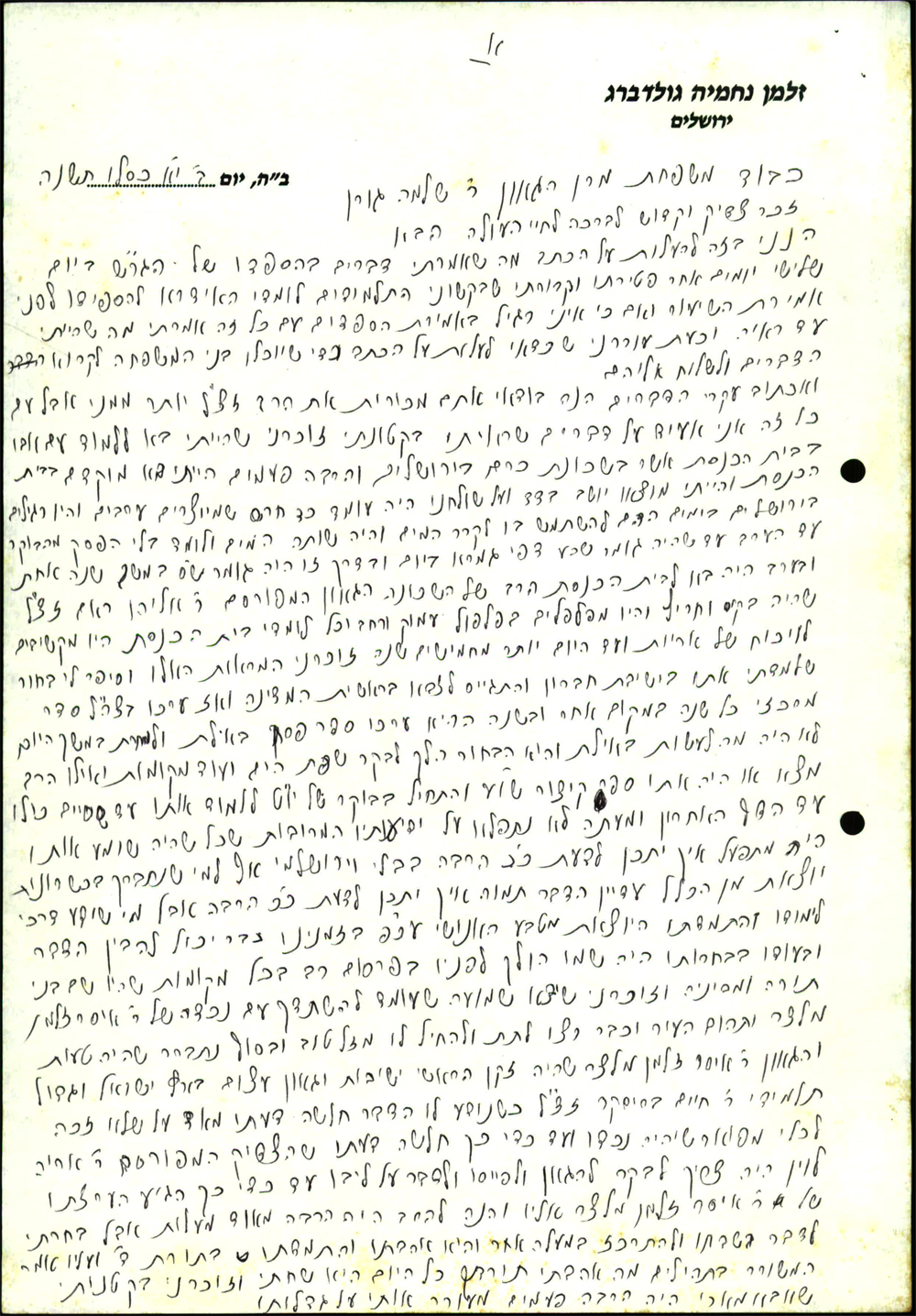
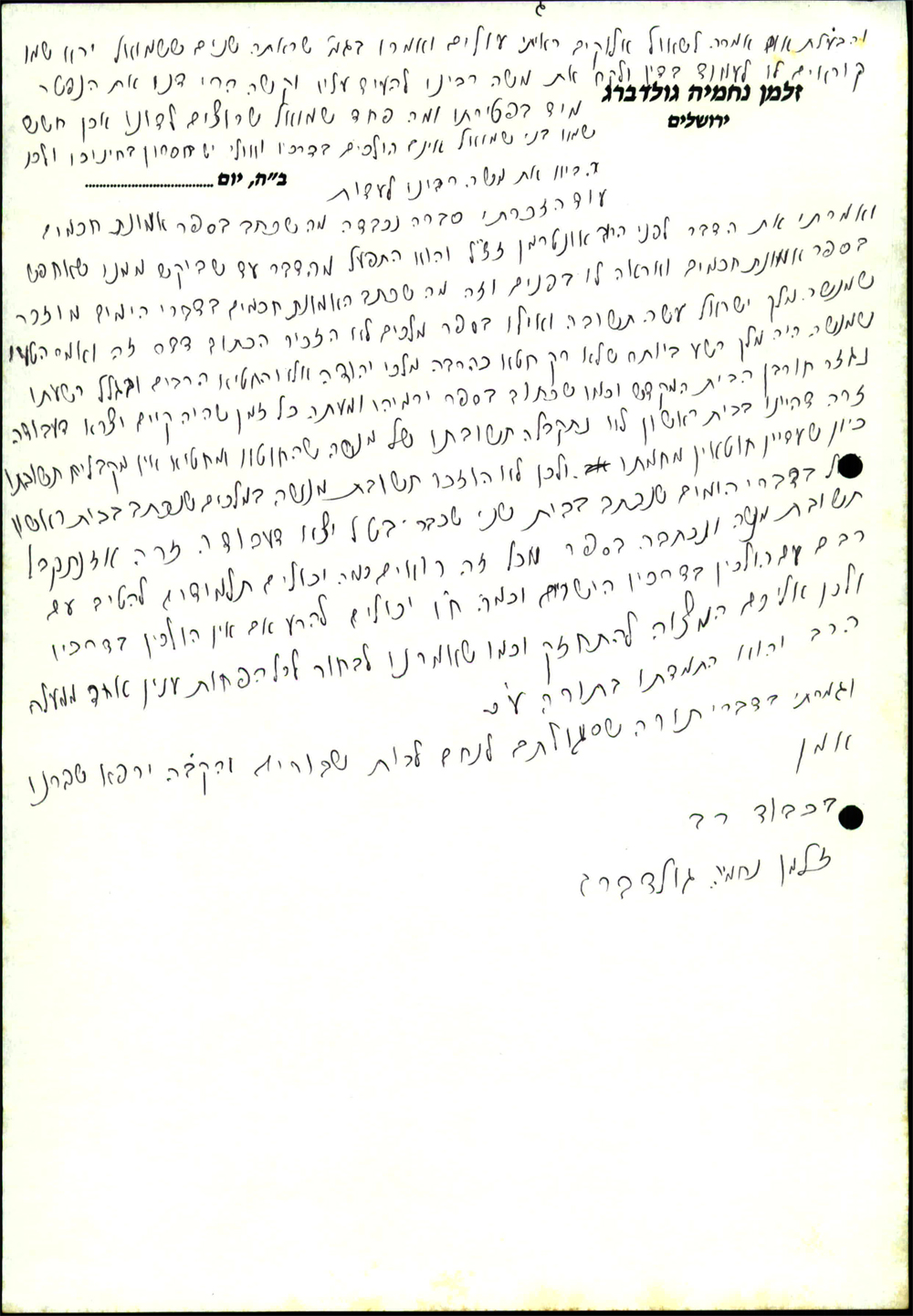
The recent passing of R. Zalman Nehemiah Goldberg was a great loss. It was not just a loss for one segment of the Torah world, as R. Zalman Nehemiah was unusual in that he was part of both the haredi world and the religious Zionist world. He was respected in both of these camps and spent his life teaching Torah among haredim and religious Zionists. One of the places he taught at was Yeshivat Ha-Idra, which was established by R. Shlomo Goren (and which closed not long after R. Goren’s death). I was fortunate to discover a eulogy that R. Zalman Nehemiah delivered for R. Goren.[1] From the eulogy you can see that R. Zalman Nehemiah broke with basically the entire haredi world which had written R. Goren off, and wanted nothing to do with him, either in life or after his death. Significantly, R. Zalman Nehemiah also contributed to the memorial volume published for R. Goren.

You can see the original handwritten eulogy in one document here, and my transcription of the eulogy in one document here.

There are a couple of noteworthy points in the eulogy which I would like to call attention to. R. Zalman Nehemiah mentions that R. Goren would complete seven pages of Talmud a day, and in this way would finish the Talmud in a year. In his autobiography, R. Goren mentions that it was R. Moshe Mordechai Epstein, the Rosh Yeshiva of the Chevron Yeshiva, who recommended to the young Shlomo Gorontchik that he learn seven blatt a day. R. Epstein said that this was what he himself did, and he recommended that R. Goren do this in the morning, while in the afternoon he study the Talmud in depth. This was not long after R. Goren entered the yeshiva, when he was not yet twelve years old.[2] Incredibly, he began learning seven blatt a day, and he tells us that during the winter he finished Yevamot twelve times. He also tells us that as he got older he would do 24 blatt a day with Rashi and Tosafot.[3]

The other point worthy of note is that R. Zalman Nehemiah mentions that there was a rumor that R. Goren was going to be engaged with the granddaughter of R. Isser Zalman Meltzer, and when this turned out to be incorrect R. Isser Zalman was very upset and was comforted by R. Aryeh Levin. In his autobiography, R. Goren discusses this matter but without mentioning any names.[4]

בעת ההיאהחלו גם רבנים ושדכנים שונים לנסות ולשדך לי אישהאחת ההצעות הגיעה מאחד מגדולי ישראלמן הגאוניםשהיה מעוניין מאוד לשדך לי את בתו

R. Goren mentions that since his father was a Gur Hasid he had to get the approval of the Rebbe, who for one reason or another was not enthusiastic about the match, meaning that there could be no shiddukh. R. Goren mentions that the woman who was suggested for him ended up marrying a great rabbi, but the marriage ended in divorce.[5]

The woman proposed for R. Goren was none other than R. Aharon Kotler’s daughter, who went on to marry R. Dov Schwartzman. It makes sense that R. Kotler would be interested in R. Goren, as he would have heard from his father-in-law, R. Isser Zalman Meltzer, about the great illui, R. Shlomo Gorontchik. There even exists a letter in which R. Kotler asks his father-in-law about R. Goren in terms of a possible shiddukh. Here is a selection from the letter which first appeared here.

Incidentally, here is a picture of R. Goren and R. Kotler from 1954 at the Agudah Kenessiah Gedolah in Jerusalem. It first appeared here. The man on the right is R. Shabbetai Yogel, who was on the Moetzet Gedolei ha-Torah.

Also noteworthy is that on one occasion R. Kotler accepted an invitation from R. Goren to speak to a group of Israeli soldiers.[6]

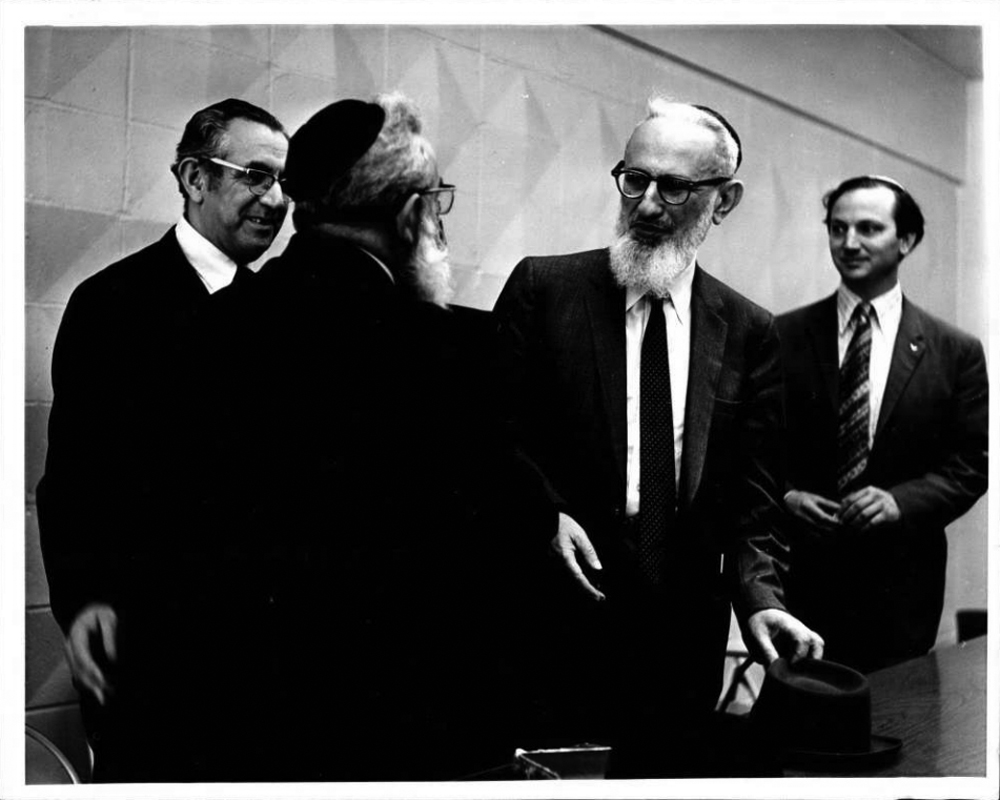
As long as we are talking about R. Goren, here are some unknown pictures of him and R. Joseph B. Soloveitchik.

In this picture the man to the left is Rabbi Israel Miller. I don’t know who is standing behind the Rav.

In this picture Rabbi Zevulun Charlop is standing on the left, and on the right are Rabbis Israel Miller and Samuel Belkin.

Here is a picture of R. Goren giving his shiur at YU. Maybe some readers were in attendance.

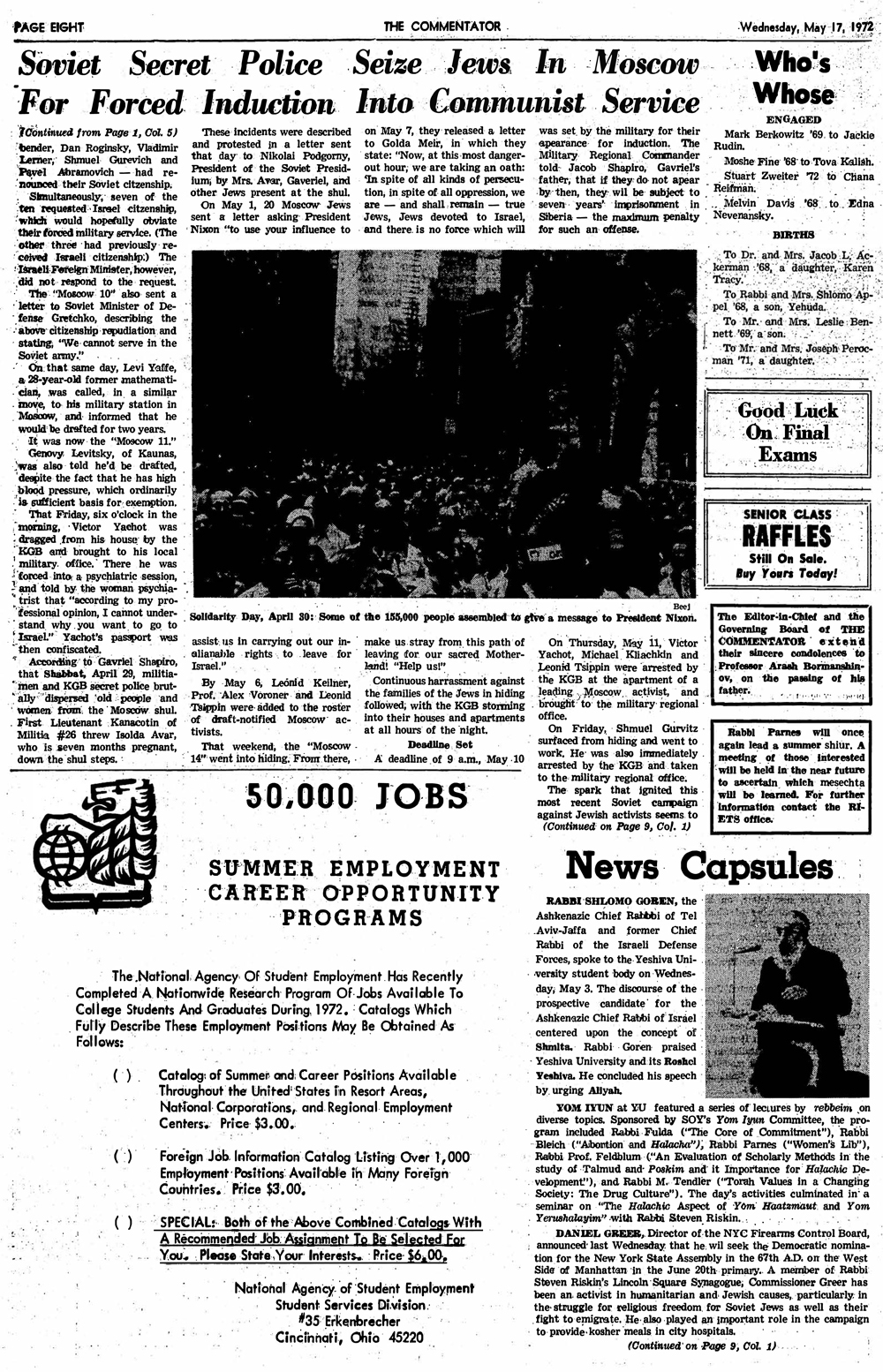
These pictures are found in the Israel State Archives here, and it is indicated in the file that credit should be given to Yeshiva University. No date is given for R. Goren’s visit, but in the Israel State Archives it indicates that the visit took place when R. Goren was Chief Rabbi of Tel Aviv. While he was elected to this position in 1968, he only started serving in 1971. At the end of 1972 he was elected Chief Rabbi of the State of Israel. From this we would conclude that the visit took place in either 1971 or 1972. We can further pinpoint the date of the visit as the file in the Israel State Archives includes the envelope in which the pictures were sent to R. Goren, and it is postmarked May 24, 1972. We thus see that the visit was in the spring of 1972. I then did a Google search, and lo and behold, I found an article on R. Goren’s visit in the May 19, 1972 issue of the Indiana Jewish Post and Opinion.

With this information I went to the online archives of the YU Commentator, and in the May 17, 1972 issue (p. 8), I found a report of R. Goren’s visit. We see from it that R. Goren spoke at YU on May 3, 1972.

*************

[1] The original letter published here is found in the Israel State Archives. Recently, the website for the Israel State Archives was updated, and I can no longer find the file that contains R. Goldberg’s letter, which is why I have not provided a link.
[2] It is commonly said that R. Goren entered the Chevron Yeshiva when he was twelve years old. However, R. Goren stated that he was born at the end of 1917 and he entered the yeshiva in the fall of 1929. See Be-Oz ve-Ta’atzumot, ed. Avi Rat (Tel Aviv, 2013), pp. 21, 61. Some sources, including the English Wikipedia, state that he was born on Feb. 3, 1917. Israel government sources and the Hebrew Wikipedia state that he was born on Feb. 3, 1918. I have no idea where the date of Feb. 3 comes from, as R. Goren himself said he was born at the end of 1917.
[3] Be-Oz ve-Ta’atzumot, pp. 62-63.
[4] Be-Oz ve-Ta’atzumot, p. 97.
[5] Be-Oz ve-Ta’atzumot, pp. 97-98.
[6] See R. Zalman ha-Levi Ury, Kedushat Avraham, vol. 2, p. 199.


Shnayer Leiman: In Appreciation*

Shnayer Leiman: In Appreciation*

Yitzhak Berger and Chaim Milikowsky

אוצר נחמד ושמן בנוה חכם

 (משלי כא,כ)

In multiple ways, the above-cited biblical phrase, on which the title of this volume is based, calls to mind its distinguished honoree. For one thing, few collections of Jewish writings surpass Shnayer Leiman’s אוצר נחמד – a vast store of literary treasures that encompasses, among much else, an abundance of rare traditional classics. For both its scale and its exquisiteness, the renowned Leiman Library inspires an inevitable sense of awe.

This repository of writings, however, attests to more than the efforts of a great collector. While it is difficult, within Shnayer Leiman’s many spheres of interest, to identify a book that he does not possess, it is equally challenging to find information that he does not know. If the volumes in his home comprise a storehouse of Jewish knowledge, it is hardly an exaggeration to say the same of their illustrious owner.

Indeed, whereas the Leiman Library constitutes an אוצר נחמד because of the “precious treasures” that it holds, we may apply the same Hebrew phrase to the man himself – a “delightful repository” of both knowledge and kindness who has enriched the lives and minds of scholars and laypeople alike. Widely sought out for his erudition and scholarship, Leiman has shared his expertise with countless individuals in academia and beyond, always with his signature pleasantness and soft and inviting demeanor. The success of his heavily attended biweekly classes, offered in his home for many years, owes not only to their rich content but also to the welcoming environment generated by him and his equally gracious wife Rivkah. Not only do Jewish books line the shelves of the Leiman home; their proprietors generously share the Torah that they comprise with an eager and inquisitive Jewish public.

The professional career of Shnayer (Sid) Leiman attests to his intellectual breadth and to the wide admiration he has earned in both academic and communal circles. A Mirrer yeshiva bochur who attained a Ph.D. in Bible under Moshe Greenberg at the University of Pennsylvania, Leiman spent several years as head of the Judaic Studies program at Yale. Later, he would return to New York to head the Bernard Revel Graduate School for Jewish Studies at Yeshiva University. Maintaining a sustained relationship with YU, he then commenced a professorship in Jewish Studies at Brooklyn College of the City University of New York, where he remained for several decades, including a period during which he served as Editor of the Yale Judaica Series. Currently, he holds a Distinguished Professorship at Touro College, assisting in the development of its Ph.D. program in Jewish Studies. In the broader community, Leiman remains a popular speaker across a wide spectrum of populations. He is especially known for his involvement in tours of European cities, where he has fascinated travelers with his lectures on pre-war Jewish communities and rabbinic figures.

Leiman’s scholarship stands out in multiple respects. With a degree in Bible that yielded a pivotal study on the canonization of Scripture – an inquiry demanding expertise in both Biblical Studies and Rabbinics – Leiman has contributed to a strikingly wide array of fields. Shedding the constraints of ever-increasing academic specialization, he has produced well over a hundred essays on such diverse topics – covering a range of eras – as canonization, Masorah, modern and early-modern rabbinic figures, Jewish ethics, modernization and rabbinic leadership, contemporary Jewish issues, and more. Notably, with his superior academic credentials in hand, Leiman has consciously chosen to diversify his writings among professional and more popular outlets, seeking to enrich and inspire the public no less than to advance the frontiers of scholarship. Lists of his publications and more, including the full text of several dozen essays, are conveniently available online at leimanlibrary.com.

Consistent with the breadth of its honoree, the present volume, marking fifty years of his contributions to Jewish Studies, contains essays that span a range of fields: Bible and philology, Masorah, biblical interpretation, philosophy and theology, halakhah and pilpul, works of art and their connection to Jewish law and thought, and the social and intellectual history of medieval and modern Jews of diverse regions and cultures. The eager participation of the authors, along with the kind tributes penned by several of them, reflects the warm admiration toward Shnayer Leiman felt by many. The editors, whom he ably and selflessly guided in their doctoral studies, join in wishing him enduring personal fulfillment and continued success in contributing to Jewish life and scholarship.

כי אם בתורת ה’ חפצו ובתורתו יהגה יומם ולילה

והיה כעץ שתול על פלגי מים אשר פריו יתן בעתו

ועלהו לא יבול וכל אשר יעשה יצליח

Yitzhak Berger

Chaim Milikowsky

יום העצמאות, תשע״ט

May 8, 2019

*Reprinted from *‘In the Dwelling of a Sage Lie Precious Treasures’: Essays in Jewish Studies in Honor of Shnayer Z. Leiman*, eds. Yitzhak Berger and Chaim Milikowsky (New York: Yeshiva University Press, 2020), with permission of YU Press, available to be ordered here.

Table of Contents:


In Memoriam: Rabbi Dr. Norman Lamm z”l

In Memoriam: Rabbi Dr. Norman Lamm z”l

by David Berger

In the early modern period, we find reference in the works of Jews in the Islamic orbit to the ideal of a hakham shalem—expert in both Torah and the various forms of wisdom. If we wish to be yet more ambitious, we can imagine an individual who supplements these already daunting characteristics with a constellation of exceptional personal qualities.

Rabbi Norman Lamm came remarkably close to meeting this extraordinary standard. He was a major thinker who articulated and embodied an ideal of interaction between Torah in its purest sense and world civilization and culture. He contributed to the academic study of Jewish thought. He composed works that inspired Jews to renewed and enhanced observance of mitzvot. He delivered shiurim to classroom audiences and to packed auditoriums, and he published a book of hiddushei Torah. He was an orator of almost transcendent talent; no one in the Jewish world—certainly in the Orthodox world–after Rav Soloveitchik came close. He radiated atzilut (which I would translate inadequately as an aristocratic demeanor) while maintaining genuine concern for virtually everyone he knew; he is said to have responded personally to every letter he received, and he sent congratulatory notes to friends and acquaintances upon reading a review or even a letter to the editor of which he approved. He stood at the helm of a religious movement, leading its central, indispensable institution, founding the Orthodox Forum, the Orthodox Caucus, and the Torah u-Madda Project, serving as the first editor of Tradition, and initiating GPATS, the primary expression of Modern Orthodoxy’s commitment to genuinely advanced Talmud study for women.

Several years after Gerson D. Cohen left Columbia to become Chancellor of the Jewish Theological Seminary—and well before his tragic, debilitating illness– he told me, “I am out of commission as a scholar.” Cohen was a brilliant, driven figure of stunning intellectual breadth and vibrant energy. I often thought of this comment when contemplating the remarkable productivity of Norman Lamm as he led a much larger, far more complex institution, and I shook my head in wonderment.

My one opportunity to characterize an aspect of Rabbi Lamm’s multifaceted accomplishments came when I was invited to write the Foreword to the Deuteronomy volume of his Derashot Ledorot, a series made possible by my wife Pearl, who was then Dean of Yeshiva University’s libraries. She spearheaded an initiative—in consultation with Rabbi Lamm– to place the treasure trove of his typewritten sermons in a digitally accessible data base, which continues to register triple-digit hits on a weekly basis, available here.

In that Foreword, I wrote about my reaction to his sermons, noting among other things his linguistic brilliance. My favorite example was his striking reformulation in a sermon about the drug culture of the late 1960’s of a classic line by Marx. “Opium,” said Rabbi Lamm, “is the religion of the masses.”

I conclude with the following passage from that Foreword recording two memorable incidents unrelated to the published sermons:

One [of these incidents] left me with an enduring impression of Rabbi Lamm’s extraordinary sermonic instinct, and the other revealed a sharp, quick, and agile mind that supplemented the deep and serious intellect expressed in his scholarly and philosophical works.

In March of 1987, Yeshiva University held “A Centennial Event Honoring the Establishment of the Yeshiva University Archives.” Because the archives contain major collections relating to the Holocaust, particularly the records of Orthodox organizations like Vaad Hatzalah and Rescue Children, the program was entitled, “Zachor: Written and Oral History,” and Prof. Geoffrey Hartman of Yale, who directed a video archive of Holocaust-related testimonies, was invited to address the gathering. Rabbi Lamm’s role was to provide a brief introduction to the event. He was by no means the principal speaker, and he could have fulfilled his obligation with a routine comment or two requiring barely a moment of thought or preparation. His introduction was indeed brief, but it was more memorable than anything said by the distinguished visitor.

I wondered, said Rabbi Lamm, why the director of an oral archive would be invited to speak at the launching of an archive of written materials. But then, he continued, I realized that when the Torah speaks of the requirement to remember Amalek, the quintessential precursor of the Nazi murderers, it introduces the divine commandment as follows: “Write this as a remembrance in a book, and place it in the ears of Joshua” (Exodus 17:14). Remembering Amalek requires both a written and an oral archive.

The second episode emerged in the wake of a position that Rabbi Lamm took on a controversial issue that need not detain us here. A prominent rabbi in the Traditionalist Orthodox community responded in a public address with the assertion that Rabbi Lamm was a sone’ Hashem, a hater of God. The editor of the Yiddish newspaper The Algemeiner Journal asked the purported God-hater for his reaction. Rabbi Lamm replied with a single, brief quotation from the Talmud: “Those who are shamed and do not shame in return, who hear their disgrace and do not respond…—of them Scripture declares, “All who love Him shall be like the sun rising in strength” (Judges 5:31).

We have suffered the loss of a unique leader whose legacy will remain with us in virtually every nook and cranny of our Jewish lives.


On the Passing of Yeshayahu Vinograd, the Bibliographer and the Man

On the Passing of Yeshayahu Vinograd, the Bibliographer and the Man

Moshe Dovid Chechik

Yeshayahu Vinograd (1933–2020), the renowned scholar and bibliographer, passed away on Thursday, 7 May 2020. He authored Otzar ha-Sefer ha-‘Ivri (Thesaurus of the Hebrew Book), Otzar Sifrei ha-Gra (Thesaurus of the Books of the Vilna Gaon), and (published) Siddur Ezor Eliyahu. The following reminiscences were written by Moshe Dovid Chechik at the request of the editors of The Seforim Blog, and translated from the Hebrew by Daniel Tabak.

While most frontmatter is forgettable, one of the most amazing prefaces that I will never forget is the one composed by Reb Shaya of blessed memory for his magnum opus, Otzar ha-Sefer ha-‘Ivri (Thesaurus of the Hebrew Book). If there were an anthology of prefaces, an entire section would be dedicated to this one, as it is truly sui generis. Its heading reads “Preface and Acknowledgments,” but only the latter is accurate. Spanning nearly four folio-sized pages is a list of every institution and individual who assisted in the writing of the book. Considering that this was a labor of many years, it was only natural that a goodly number of people would make contributions, and so Reb Shaya, a bibliographer through and through, remembered each and every one of them, dedicating a line or two or three to mark their efforts.

This preface encapsulates some of Reb Shaya’s most beloved attributes. First and foremost, he was a diligent collector of all things. In this introductory frontmatter—as in his writings themselves—he amassed all of the relevant particulars, because the omission of even one would mar the final product. Naturally, this was inextricably bound up with Reb Shaya’s characteristically phenomenal memory, as well as his drive to be as precise as possible—not to over- or understate matters, but to delineate precisely what we know and what we do not. Finally, it reflects his good-heartedness, how he found joy in sharing in the success of others and in sharing of himself with others.

In the preface, Reb Shaya did not forget about himself and so provided us with a rough self-eulogy:

The National and University Library [of Israel] served as my home and as my primary source of information and bibliographical data. […] The catalogue room [today, the computer lab] served as my main office for years, and many visitors to the library considered me staff, addressing their questions and even complaints to me… [points of ellipsis in the original].

These are the wonderful qualities that made Reb Shaya who he was. He could not have been further from the stereotype of the stodgy bibliographer who lives in a world of dry facts.

Reb Shaya’s sarcastic wit was ever-present. Thirteen years ago, a few months after I moved into his neighborhood, I ran into him on his way to the Mahane Yehuda market. At the time, we didn’t know each other. I stopped him with some hesitation and asked him when the new edition of the siddur Ezor Eliyahu would be printed. In response he asked, “Are you Chechik?” I nodded, bewildered, as if I had been caught red-handed. In an undertone I remarked that I really hope he didn’t ask every passerby if they are Chechik. He gave a hearty laugh and quickly reassured me that he bore me no grudge for the critical review I had penned two years earlier on the siddur. Quite the contrary, he added, he thought the criticism was well placed. Faced with his grin and bright eyes, I couldn’t help but believe him. We were friends ever since, and recently he reminded me of our first encounter, making sure I remembered my amusing retort.

R. Shaya’s daily route to and from the market passed under my window, allowing him to grab me for a chat when he liked. And since the stop for the 7 bus to the National Library was located under the window to his office on Bezalel Street opposite Hagidem, it gave me a chance to engage him in conversation. He would beam when reporting on the progress of every edition of the siddur, which he never ceased updating and improving, and he insisted on gifting me a copy of every edition, paying no mind to my protests.

He spoke to everyone as an equal. The age gap of fifty years that separated us never surfaced in our conversations. Neither did the immense store of knowledge he carried around. I was always astounded by his insatiable curiosity for new fields or unfamiliar topics. This was no passing interest, as he always remembered to press me about whether I had looked into something or had found a balm for some burning question of his.

R. Shaya’s trademark was his constant smile. As a neighbor, I can say that I never saw him get angry at anyone.

In recent years, when R. Shaya was already in his eighties, his main efforts were expended on a work that he unfortunately never completed. This was the Otzar ha-Ziyyufim, a compendium intended to document every instance of a Hebrew press mentioning an incorrect imprint—for whatever reason—on a title page. This painstaking work demanded a detective’s perceptive hunch, a historian’s vast knowledge, a bibliophile’s intimate familiarity with countless volumes, and, of course, a taxonomist’s complex classification scheme, which he himself had to devise and define. The illness and passing of his wife brought his work to a full stop, but recently he informed me on several occasions that his work was nearing its conclusion, even if, as we had come to expect, he would find new cases for inclusion on a daily basis. His perfectionism confined his final work to a drawer.

It is difficult to capture R. Shaya’s enormous contribution to the world of Hebrew bibliography, for which we owe him a tremendous debt. Who knows how many hours and days he saved us with the meticulously written and organized Otzar ha-Sefer ha-‘Ivri. More than twenty-five years since its publication, and in spite of the impressive technological advances of recent decades, this colossal work of Reb Shaya the bibliographer has yet to be superseded. But for his colleagues, friends, and loved ones, there is none who can replace R. Shaya the man, with his wonderful personality, good humor, and wit.


Notice on the passing of R. Shlomo Biegeleisen

All אוהבי ספר join in mourning the passing of R. Shlomo Biegeleisen, זכרונו לברכה. One of the most knowledgeable Jewish bookdealers in recent Jewish history, he did not merely sell books. He proffered sound advice, introduced customers to each other, and – in general – provided a congenial setting for תלמידי חכמים, scholars, collectors, bibliophiles, and “ordinary” Jews to meet and exchange ideas. Many a חידוש and scholarly article resulted from a conversation that took place (or: was overheard) at Biegeleisen’s Jewish bookstore. Aside from his private customers and their collections, he helped build many of the leading public libraries, including those of prominent Yeshivos and prominent academic institutions. יהא זכרו ברוך!

Special כוס תנחומין to his wife Mrs. Gina Biegeleisen; to his brother and partner R.Moshe Biegeleisen; and to his son Mr. Yossie Biegeleisen. A third generation of Biegeleisens has now joined the family business, and there could not be better testimony to this family’s ability to transmit from one generation to the next their אהבת התורה ,אהבת ישראל, and אהבת הספר.

Shnayer Leiman