Abraham Rosenberg, R. Chaim Heller, R. Shlomo Zalman Auerbach on Conversion, Abortion, Mercy Killings, and new pictures and videos of R. Jehiel Jacob Weinberg

Abraham Rosenberg, R. Chaim Heller, R. Shlomo Zalman Auerbach on Conversion, Abortion, Mercy Killings, and new pictures and videos of R. Jehiel Jacob Weinberg

Marc B. Shapiro

1. In my post here I discussed the enigmatic plagiarizer Abraham Rosenberg. As we saw, in 1923 and 1924 Rosenberg published articles on the Jerusalem Talmud in the Orthodox journal Jeschurun, and he later published Al Devar Tikunei Nushaot bi-Yerushalmi. In this last work, Rosenberg refers to R. Chaim Heller as his friend. I and so many others assumed that “Rosenberg” was a pseudonym, but Moshe Dembitzer, the expert on everything related to R. Heller, has pointed out to me that this appears not to be the case. Here is a letter Dembitzer found in the JDC archives from R. Heller to Cyrus Adler. As you can see, R. Heller mentions A. Rosenberg—the letter that is unclear must be an “A”—and one of his essays on the Jerusalem Talmud. He also mentions that Rosenberg “is considered only one of the ordinary students.”

Dembitzer also found another connection between R. Heller and Rosenberg. Here is a note from R. Charles B. Chavel’s edition of Hizkuni’s commentary on the Torah, p. 525.

Here is Rosenberg’s Al Devar Tikunei Nushaot bi-Yerushalmi, p. 102, where he cites the same explanation that Chavel cited in the name of R. Heller (but Rosenberg takes credit for it himself).

Regarding the plagiarisms of Rosenberg, I must also thank Gershon Klapper who alerted me to other examples. He wrote to me:

Rosenberg’s first article (לחקר תלמוד הירושלמי) opens אין מן הצורך לשנות את הידוע כי תלמוד הבבלי שנחתם לא זזה ידם של חכמי ישראל ממנו, very similar to how R. Heller’s ע”ד מסורת הש”ס בירושלמי begins, אין מן הצורך לשנות את הידוע כי תלמוד הירושלמי הוא עדין כשדה שאין עובד בו. But the next part of his introduction to that article is taken, slightly rearranged, from Steinschneider’s ספרות ישראל vol. 2, p. 103 (it reappears at the beginning of ע”ד תקוני נוסחאות בירושלמי, which includes most of this article’s content), as is the line beginning פעולתם של הגאונים. He does paraphrase some other language from R. Heller in the introduction, but again it isn’t word-for-word.

His second article (פסוקי המקרא שבתלמוד) opens

כי חכמי התלמוד היו בקיאים בכל ספרי התנ”ך עד להפליא, – דבר זה ידוע לכל מי שלמד גמרא, ואפילו למי שהצליף בה סקירה שטחית. כמעט מכל דף ודף שבתלמוד נראה, כי פסוקי התנ”ך, ואפילו המקראות “האובדים והנדחים” שברשימות השמות בעזרא ובדברי הימים היו שגורים על פי התנאים והאמוראים בתכלית הדיוק. בעלי התוספות (ב”ב ד’ קי”ג בד”ה תרוייהו) לא חששו להחליט, שהאמוראים פעמים שלא היו בקיאים בפסוקים. אבל כבר הודו שם בעלי התוס’ עצמם שאין החלטה זו מוכרחת וכמו שכתב הרשב”ם שם. וגם הראיה שהביאו מדברי ר’ חייא בר אבא, שאינו יודע אם נאמר בי’ הדברות טוב או לא (ב”ק נה.) אינה מוכרחת שהרי ברור הדבר, כי דברי רחב”א, אינם אלא דברי בדיחותא, כדי לדחות את השואל.

Almost every word of this comes from an article of the same title by Yisrael Chaim Tawiow which appeared in HaShiloach 29 (July-Dec. 1913). The rest of the second article is taken from Baer Ratner, סדר עולם רבא pp. 103ff. and Samuel Rosenfeld, משפחת סופרים pp. 98, 100, 105, etc.

Klapper also called my attention to Rosenberg’s plagiarism of part of a paragraph in R. Heller’s article that appears in Le-David Zvi (David Zvi Hoffmann Jubilee Volume, Hebrew section). Compare p. 56 there with Rosenberg, Al Devar Tikunei Nushaot bi-Yerushalmi, p. 11. As Klapper notes, it is quite ironic that Rosenberg leaves out the following sentence from R. Heller that occurs in the middle of the passage he plagiarizes:

ויש שיועיל לנו הציון לברוח מן העבירה ולעשות מצוה לאמר דבר בשם אומרו

While on the topic of R. Chaim Heller, first let me share this wonderful picture from R. Ahron Soloveichik’s wedding in which one can see the Rav, R. Heller and R. Yaakov Kamenetsky. As far as I know, this picture has never appeared online. I thank Yoel Hirsch for providing me with the picture.

From R. Kamenetsky’s recently published Emet le-Yaakov al Nakh, vol. 1, p. 185 n. 2, we learn that in 1937 R. Kamenetsky visited Boston to discuss with R. Soloveitchik opening a yeshiva together.

In 1924 R. Heller published his study of the Samaritan version of the Torah, Ha-Nusah ha-Shomroni shel ha-Torah (Berlin, 1924). In 1972 Makor, which published so many valuable reprints of old seforim, decided to also reprint R. Heller’s Ha-Nusah ha-Shomroni. The problem was that R. Heller had an heir, and she was the only one with the legal right to reprint his books. This led to the following letters sent by Miriam Heller’s attorney (the letters are found in the Israel State Archives, 14924/3, available here [before the recent cyber attack on the archives], pp. 35ff.). From these letters, we learn that there were other unauthorized reprints of R. Heller’s works.

One final point about R. Heller is the following: In 1912 he was appointed rav of the city of Lomza. Here is a report on his appointment from the newspaper Ha-Mitzpeh, March 29, 1912.

The writer is simply amazed that a Polish city, full of Hasidim, would hire as its rav a “Rabbi Dr.” Of course, R. Heller was a very unique “Rabbi Dr.”

2. Because I discussed conversion in the last post, I would like to call attention to R. Yoel Amital’s discovery of how R. Shlomo Zalman Auerbach’s view on the matter has been presented.[1] The issue R. Amital focuses on is whether a conversion for someone who does not observe mitzvot takes effect. I am referring to one who tells the beit din at the time of conversion that he accepts the mitzvot, but we see later that this was not the case.

In his letter in R. Zvi Cohen’s Tevilat Kelim (1975), R. Auerbach is clear that ex post facto such a conversion is still valid.

The crucial words are:

בכגון דא נלענ”ד שכל המסייעים לגירות כזו, אף שבדיעבד הם גרים גמורים, אפי”ה המגיירים אותם עוברים בלאו של לפני עור וגו’

According to R. Auerbach, because be-diavad such converts are Jewish, to convert them is a violation of lifnei iver. As R. Auerbach explains, before conversion, these people could work on Shabbat and eat non-kosher, but now that they are Jewish they are forbidden to do so. By converting people who will be committing these and other sins, the beit din has violated the prohibition of lifnei iver.

As R. Amital shows, in subsequent printings of R. Cohen’s book, R. Auerbach’s letter is printed with a significant addition (here underlined):

בכגון דא נלענ”ד שכל המסייעים לגירות כזו, אף שהם טועים לחשוב שבדיעבד הם גרים גמורים, אפי”ה המגיירים אותם עוברים בלאו של לפני עור וגו’

And

בכגון דא נלענ”ד שכל המסייעים לגירות כזו, אף אם הם טועים לחשוב שבדיעבד הם גרים גמורים, אפי”ה המגיירים אותם עוברים בלאו של לפני עור וגו’

When this letter was printed in R. Auerbach’s Minhat Shlomo, vol. 1, no. 35:3, the wording was altered further:

בכגון דא נלענ”ד שכל המסייעים לגירות כזו, אף דהם טועים לחשוב שהם גרים גמורים, אפי”ה גם לשטתם המגיירים אותם עוברים בלאו של לפני עור וגו’

In Ha-Ma’yan 56 (Nisan 5776), p. 89, in response to R. Amital’s article, R. Aharon Goldberg, a grandson of R. Shlomo Zalman, published a picture of R. Auerbach’s original letter. The wording is identical to what appears in the first edition of R. Cohen’s book. So how to explain the later additions? R. Goldberg states that it is possible that the later changes were made with the consent of R. Auerbach. Although there is no evidence of this, I find it unlikely that R. Cohen would have altered R. Auerbach’s letter while R. Auerbach was still alive. A general rule of censorship and alteration of texts is that it is done after the author is no longer alive.

Leaving aside the updated version of the letter, there is still a problem that R. Amital confronts. According to R. Auerbach’s original letter, those who convert but do not become religious, their conversion is still valid. However, R. Auerbach also signed a public letter together with the Steipler, R. Shakh, and R. Elyashiv, which states that such a conversion has no validity. So which is it?

R. Mordechai Halpern has shown that R. Auerbach sometimes presented a “public” halakhah that was stricter than his true opinion, but which for some reason he did not wish to publicize.[2] R. Amital suggests that in this case we have a similar example where R. Auerbach publicly advocated a “strict” position regarding conversion that was not in line with his true opinion. (I put “strict” in quotes because while this position is strict in not regarding a conversion as valid, it is also “lenient” in that it tells someone who converted and did not intend to become religious that she can leave her husband without a get, does not need to fast on Yom Kippur, etc.)

R. Amital also claims, implausibly in my opinion, that the public letter R. Auerbach signed does not really stand in contradiction to the letter he sent to R. Cohen. How so? The public letter speaks of people who convert without accepting to observe mitzvot, while R. Auerbach in his letter to R. Cohen is referring to people who in front of the beit din do accept to observe mitzvot, but in their inner heart do not really have such an intention.

Contrary to R. Amital, this is clearly not what the public letter means. It is referring to people who converted in a beit din, but never intended to follow halakhah. It is simply impossible to read this public letter as referring to, in the words of R. Amital: גרים שלא קיבלו עליהם כלל בבית דין לקיים תורה ומצוות. There is no beit din in the world that does not require converts to accept Torah observance. The issue the letter was addressing is converts who, despite their verbal acceptance of mitzvot, do not follow through in practice. According to the letter, such a conversion is not valid. This is so obvious that one wonders how R. Amital could have ever offered his suggestion to explain the contradiction.

R. Halpern himself notes that he knows that R. Auerbach never backed away from his earlier position, as seen in his letter to R. Cohen, that someone who was converted by a proper beit din, but did not intend to observe mitzvot, ex post facto the conversion is still valid. Yet he states that R. Auerbach later concluded that this liberal approach should not be publicized.[3]

Even with the initial two “corrected” versions of R. Auerbach’s letter, R. Auerbach mentions that rabbis who convert people who have no intention of observing Torah violate the prohibition of putting a stumbling block before the blind. R. Auerbach states that until now the person converting violated Shabbat and ate non-kosher food and these were not sins. But now, after the conversion, he is violating the Torah. R. Auerbach concludes his letter as follows:

נמצא שכל המגיירים והמסייעים לכך הו”ל כגדול המחטיאו, ועוברים בלאו של ולפני עור לא תתן מכשול

The implication of this is that ex post facto the conversion is indeed valid, as otherwise there would be no sin committed by the convert and there would be no issue of putting a stumbling block before the blind. In the words of R. Yisrael Rozen:[4]

למדנו מדבריו שהגירות חלה, דאי לאו הכי אין כאן מכשול, שהרי נשאר בגיותו

In fact, we find many poskim who say that we should not convert people who do not intend on observing mitzvot, because then they will be punished for their sins. This shows that these poskim regard a conversion without intent to observe mitzvot as valid ex post facto. In a previous post here I cited a number of examples of this, and here is one more.

R. Raphael Shapiro, Torat Refael, vol. 3, no. 42, has a short responsum about whether to convert a woman who will not be observant. It was sent to R. Mordechai Klatchko of Volozhin, who would later come to the U.S. and serve as a rav in Boston.[5] R. Klatchko was clearly a fine talmid hakham, as can be seen from the two volumes of his Tekhelet Mordekhai. R. Klatchko wrote to R. Shapiro arguing that the woman should be converted even if she was not going to be observant so that her intended husband (or perhaps current husband) could fulfill the mitzvah of procreation (which he could not do if his children would not be halakhically Jewish). R. Shapiro disagrees and states that it is forbidden to convert her, as she will certainly not observe the niddah laws, and this will cause them both to violate a Torah prohibition.

What is important for our purposes is that both R. Klatchko and R. Shapiro assume that one who converts without intending to observe Jewish law is regarded as a valid convert. As long as the person goes through a halakhically proper conversion ceremony, that is what activates the conversion. It is hard for people today to understand how R. Shapiro never even raises the possibility that a conversion is invalid if the person converting intends to routinely violate fundamental Jewish laws by living an irreligious lifestyle. But as can be seen in so many different examples, a widespread view in prior generations—I don’t know if it was the majority view or not—was that as long as the conversion is carried out properly, what happens later, and what is in the convert’s heart at the time of the conversion ceremony, have no legal significance.[6]

Here is one further example of this approach, Be-Mar’eh ha-Bazak, vol. 4, no. 96.[7]

As you can see, the approach of Kollel Eretz Hemdah is that there is no possibility of voiding a conversion carried out by a proper beit din, even if the people converting had no intention of observing mitzvot. At the beginning of the volume, it states that the responsa were reviewed by R. Zalman Nehemiah Goldberg, R. Nachum Rabinovitch, and R. Yisrael Rozen, all significant figures in their own right.

Finally, it is also worth noting that no less a figure than R. Isaac Jacob Weiss refused to void a conversion even though the woman who converted never observed mitzvot. See Minhat Yitzhak, vol. 1, nos. 121-123.

I have a good deal more to say about conversion, but in the interest of space, let me just call attention to a couple of interesting things I recently saw. The first is that R. Moses Sofer states that non-Jews are rewarded in this world if they convert to Judaism.[8] I do not know of anyone else who says that there is a divinely ordained reward for one who converts.

The second interesting discussion about conversion I recently saw is R. Aviad Sar Shalom Basilea, Emunat Hakhamim, ch. 24 (pp. 264-265 in the Jerusalem, 2016 edition). Adopting the type of anachronistic explanation that some commentators have been fond of, R. Basilea assumes that Mahlon converted Ruth and married her with huppah and kiddushin. But this creates a problem, because if Ruth was Jewish, why did Naomi push her away? R. Basilea offers a possible answer: Naomi held like the Rif and the Rambam that since Ruth’s immersion in the mikveh was not before three men, it was invalid even be-diavad. However, Mahlon held like the other poskim that be-diavad, tevilah by oneself if valid.

והנה נעמי היתה סוברת כרי”ף והרמב”ם שאפילו בדיעבד אינה גיורת ולכן השתדלה להרחיקה, ומחלון היה סבור כאותם הפוסקים הסוברים כי גיורת גמורה היתה ולכן נשאה

Does anyone, even from the most traditional communities, still offer explanations along these lines? Here is what R. Shimon Shkop wrote in a different context, and you can see that he was not a fan of this type of explanation.[9]

ודבר זה מביא לידי גיחוך, כעין הפלפולים אם פרעה היה סובר שעבודא דאורייתא

Some time ago I was looking at Abba Appelbaum’s book Rabbi Azariah Figo (Drohobycz, 1907), and he offers the following examples of anachronistic explanations (p. 54):[10]

R. Gershon Ashkenazi (1618-1693), one of the greatest halakhists of his day, also wrote a work of homiletics, Tiferet ha-Gershuni. In his derashah for parashat Mas’ei (p. 236 in the 2009 edition) he portrays the daughters of Zelophehad as arguing from halakhic logic.

In his derashah for parashat Va-Yera (p. 48), in discussing the descendants of Ishmael, R. Ashkenazi suggests that they held that the law of ketubah is rabbinic.

אם כן בני ישמעאל היו סבורים כתובה מדרבנן

Appelbaum also calls attention to R. Meir Schiff’s elaboration at the end of his commentary to Bava Kamma (found in the Vilna Shas). He portrays the incident of Esau selling his firstborn status from a halakhic angle. As such, Jacob’s thoughts were no different than those of a later halakhic scholar:

ונסתפק יעקב באומרו כיום מחמת שני דברים, שגריעותא דבכורה מחמת דבר שלא בא לעולם ומחמת אונאה . . . ויעקב נתיירא או למד הפשט כרש”י ולזה אמר ויאמר השבע לי כמ”ש בח”מ סי ר”ט ס”ד בהגה”ה

Another example, not mentioned by Applebaum, is R. Samuel Edels (Maharsha) in his aggadic commentary to Sanhedrin 57b. R. Edels wonders why Pharoah commanded the Hebrew midwives to kill the newborn Hebrew children, as it would have made much more sense to have Egyptian midwives do this. He explains that the children were to be killed before birth and for non-Jews this would be regarded as murder, which Pharoah wanted to avoid.[11] He thus turned to Hebrew midwives as for them it is not murder to kill an unborn child.

Quite apart from the far-fetched nature of the explanation, as well as its assumption that even before the giving of the Torah the Israelites were bound by Jewish law, not Noahide law, I don’t think any reader of the biblical story would find it reasonable that Pharoah was concerned about anyone violating the commandment against murder. However, the passage is also of interest in seeing how Maharsha regarded the prohibition against abortion.[12] He even portrays Pharoah as thinking that there is no prohibition for Jews to abort a fetus, including right before birth.

דודאי פרעה לא שאל מהם להרוג הזכרים בידים דבן נח מוזהר על שפיכות דמים ולכך לא אמר כן למילדות המצריות שהוזהרו על שפיכות דמים אפילו בעוברים אבל למילדות העבריות אמר שהותר לכם להרוג עובר במעי אמו וראיתם על האבנים קודם שיצא לאויר העולם אם בן הוא וגו’ וכיון שאי אפשר בהם לפטור משפיכות דמים רק בתחילת יציאת הולד קודם שיצא ראשו או רובו הוצרך לתת להם סימנין כמו שכתוב בפרק קמא דסוטה [יא ע”ב]

There has been a good deal of discussion as to how to understand the Maharsha’s words שהותר לכם. Some assume that he meant that Pharoah was in error in thinking that there is no prohibition for Jews to abort a fetus.[13] It is also possible to explain that the prohibition against abortion for Jews is only rabbinic,[14] so at that period of time there was no prohibition. R. Yaakov Farbstein states flatly:[15]

ומבואר במהרש”א דאין איסור לישראל בהריגת העוברים

This notion, that the Maharsha is saying that there is no prohibition for Jews to abort a fetus, is not in line with the overwhelming majority view beginning with the rishonim. However, in one Tosafot, Niddah 44a-b, s.v. ihu, it does state that abortion is permitted for Jews, and it does not mention that there needs to be a good reason for this or provide a timeline after which abortion is not allowed.

וא”ת אם תמצי לומר דמותר להורגו בבטן . . . וי”ל דמכל מקום משום פקוח נפש מחללין עליו את השבת אף ע”ג דמותר להרגו

Pretty much every halakhist who deals with abortion struggles with this Tosafot, as they have found it very hard to accept that any rishon could permit abortion without restrictions. One approach offered is that Tosafot is saying that there is no Torah prohibition, but there would still be a rabbinic prohibition.[16]

R. Moshe Feinstein, in his classic responsum on abortion, claims that there is a mistake in Tosafot, and instead of the two appearances of דמותר it should instead say דפטור ההורגו in both places.[17] This is in line with the phenomenon I have discussed on a few occasions, where R. Moshe is prepared to deny the authenticity of problematic texts. R. Eliezer Waldenberg offered a strong rejoinder to R. Moshe.[18]

והנה עם כל הכבוד, לא אדוני, לא זו הדרך, וחיים אנו עפ”ד גאוני הדורות, והמה טרחו כל אחד ואחד לפי דרכו לבאר ולהעמיד כוונת דברי התוס’ בנדה וליישבם, ואף אחד מהם לא עלה על דעתו הדרך הקלה והפשוטה ביותר לומר שיש ט”ס בדברי התוס’ ובמקום מותר צריך להיות אסור [צ”ל פטור]

While no other authorities agree with R. Moshe that the Tosafot contains a mistaken text, many regard the language of Tosafot as not exact.[19]

Returning to R. Shlomo Zalman Auerbach, I know of another example where he did not want a view of his to be widely shared. R. Amit Kula discusses R. Avigdor Nebenzahl’s argument that according to a variety of sources one who is suffering greatly is allowed to commit suicide. He further adds that it would be permitted to kill another in this circumstance (active euthanasia), for if you are allowed to kill yourself for a good purpose, you can do it to another as well. R. Nebenzahl adds that some of what he says comes from R. Shlomo Zalman Auerbach. He also quotes R. Auerbach that one can take medicine to reduce pain even if it will shorten one’s life.[20]

This information, which appeared in the first edition of R. Nebenzahl’s Be-Yitzhak Yikare, is not found in subsequent editions. R. Kula tells us that in these editions R. Nebenzahl inserted a note that the section was removed at the instruction of an unnamed scholar, and R. Mordechai Halpern quotes R. Nebenzahl that this scholar was none other than R. Auerbach.[21]

I find this of interest because if there is one thing that everyone knows, it is that Judaism does not allow active euthanasia (mercy killing). As is usually the case, matters are more complicated as has recently been shown by R. Yitzchak Roness in an article in Ha-Ma’yan.[22] He notes that R. Moshe Sternbuch does not believe that there is any prohibition for non-Jews to engage in mercy killing, since it is carried out for a good purpose. R. Yitzhak Zilberstein also inclines towards this position, and R. Moshe Feinstein suggests this as well, writing:[23]

אפשר שבן נח אינו אסור ברציחה שהוא לטובת הנרצח ושאני בזה האיסור לישראל מהאיסור לבן נח

R. Moshe and others specifically have in mind a non-Jew engaging in mercy killing of a Jew. The proof brought is the famous story of the death of R. Hanina ben Teradyon (Avodah Zarah 18a) where R. Hanina permits the executioner to raise the flame and remove the wool from his heart, thus actively hastening his death. R. Shaul Yisraeli goes the furthest, and for someone suffering greatly, and near death, he thinks that active euthanasia is permitted even if performed by a Jew.

R. Roness then notes that there is a dispute if one suffering great pain is allowed to commit suicide. For the side that permits this, R. Zilberstein adds that if it is permitted for the suffering individual, it will also be permitted for another to assist (active euthanasia). R. Roness also cites R. Hershel Schachter who states that active euthanasia, with the agreement of the patient, is not to be regarded as murder. He even suggests that for one suffering greatly, active euthanasia should be permitted:[24]

ההורג את חברו ברשותו יש לומר דאין בו לאו דרציחה אלא רק לאו דאך את דמכם, דלא גרע הורג חברו ברשותו מההורג את עצמו . . . ולמנוע א”ע מלסבול ייסורים דינו כפקו”נ, וכמשמעות התוס’ הנ”ל. ואם באמת כ”ה גדר היתר זה, א”כ אף בחולה הסובל יסורים קשים ומתחנן לאחרים ליטול את נפשו, אם נאמר כנ”ל, דבכה”ג אין לומר דבטלה דעתו וכו’, ג”כ הי’ צ”ל מותר מטעם פקו”נ ועיין בזה

And finally, here is what R. Chaim Kanievsky responded when asked if a Jewish patient near death could allow a non-Jew to end his life. R. Chaim does not say this is murder. On the contrary, he is inclined to permit it.[25]

אם שוהה אדם בבית חולים דעכו”ם ויש לו יסורים רבים במחלתו האנושה, ורוצה הרופא לחסוך לו היסורים ולקרב מותו ושואל ממנו רשות, האם מותר לו להסכים לזאת. והשיב רבנו שליט”א “יתכן שיש ללמוד זה ממעשה דרחב”ת” . . . והיאך הסכים רחב”ת שהעכו”ם יקרב מותו, והשיב רבנו: “איפה שהחולה מרגיש שזה טובתו יתכן שמותר כמו שמותר להתפלל עליו שימות.”

My question is, how come the “liberal” views I have mentioned are not better known?

7. In my last post here I included the first-ever color pictures of R. Jehiel Jacob Weinberg. These went around the world very quickly, and as is the nature of the internet, where the pictures came from was soon forgotten. In fact, within 24 hours someone who does not read the Seforim Blog sent them to me as a great new discovery. When I told him that I am the one who published the pictures he was at first incredulous, stating that he just got them from his cousin.

Here are two more pictures of R. Weinberg that he sent to his family. They are from before World War II when he was still in Germany. In the picture where he is lying the ground, I do not know who the couple next to R. Weinberg is.[26]


And for an extra treat, here are the only known videos of R. Weinberg, and one of them is in color. I thank Noam Cohn for putting this together, at my request, from his family’s collection. The first part has R. Weinberg with R. Arthur Ephraim Weil, the rav of Basel, and R. Leo Adler who succeeded Weil as rav of Basel in 1956. The second video, in which you can see R. Weinberg in color together with R. Samuel Brom, the rav of Lucerne, is from winter 1958-1959 at the Silberhorn kosher hotel in Grindelwald. The hotel had just inaugurated its new mikveh, and it was important to the family who owned the hotel that R. Weinberg give his approval to the mikveh.[27] At 1:12 and 3:20 you can also see the famed educator and student of R. Weinberg, Dr. Gabriel H. Cohn. Here is a picture from the event and you can see R. Brom and Dr. Cohn standing next to R. Weinberg.

Regarding R. Adler, before coming to Basel he studied ten years at the Mir Yeshiva, including in Shanghai. After the war he was in New York where he taught Torah at Yeshiva University.[28]

8. In my last post here I had the following quiz questions.

Please identify the following and email me your answers:

1. There are two se’ifim in the Shulhan Arukh that only contain two words.

2. There is one siman in the Shulhan Arukh whose number is the gematria of the subject of the siman.

The answer to no. 1 is Yoreh Deah 65:6: נוהג בכוי, and Even ha-Ezer 126:42: מותרת בויו

The answer to no. 2 is Orah Hayyim no. 586. This is the laws of shofar, and the gematria of shofar is 586. This was noted by R. Jacob Emden and I mentioned this in my article “‘Truth’ and Authorial Intent in the Study of Torah,” available here.

A number of people provided the correct answers for no. 1 and no. 2, but no one got both of my intended answers. However, Moshe Schwartz got no. 2 right with a different answer than I was thinking of (meaning he answered both questions correctly). He noted that Yoreh Deah 107 speaks about cooking eggs, and the gematria of ביצה is 107.[29] Also, shortly before this post was completed, Sol Reich provided another example: Yoreh Deah 334 is about הלכות נידוי וחרם and the gematria of נידוי וחרם is 334.

9. Information about my summer tours with Torah in Motion to Central Europe and Spain is available here.

* * * * * * *

[1] “Ha-Im Giyuram shel Gerim she-Einam Shomrim Mizvot Hal Be-Diavad? Berur Da’at ha-Gaon Rabbi Shlomo Zalman Auerbach ZTL,” Ha-Ma’yan 56 (Tishrei 5776), pp. 43-46.
[2] Halpern, Refuah, Metziut ve-Halakhah (Jerusalem, 2011), pp. 35ff.
[3] Amital, “Ha-Im Giyuram,” p. 45.
[4] Ve-Ohev Ger (Alon Shvut, 2010), p. 161 n. 1.
[5] See R. Hayyim Fischel Epstein, Teshuvah Shelemah, vol. 2, Even ha-Ezer, nos. 29-30, and R. Elijah Klatzkin, Hibbat ha-Kodesh, no. 11, where they respond to R. Klatchko’s question about a get written in Roxbury (a neighborhood in Boston), but the get only mentioned “Boston”. This is mentioned by Hayyim Karlinsky, Rabbi Hayyim Fischel Epstein (New York, 1963), pp. 26-27.

This R. Klatchko should not be confused with an earlier R. Mordechai Klatchko of Lida who also wrote a book titled Tekhelet Mordekhai. It is noteworthy that R. Klatchko of Lida wrote a lengthy haskamah for the Mishnah Berurah. Regarding R. Klatchko of Lida, see here.[6] For another example, see R. Dov Cohen, Va-Yelkhu Sheneihem Yahdav (Jerusalem, 2009), pp. 333-334. Here R. Cohen describes how, at the direction of R. Isser Yehudah Unterman, he converted a woman intent on marrying a completely irreligious Jew. This is the sort of conversion that today would not be allowed in Israel or in any of the batei din recognized by the Israeli Chief Rabbinate. See also R. Avraham Shapiro, Kuntres Aharon in his edition of R. Isaac Jacob Rabinowitz, Zekher Yitzhak (Jerusalem, 1990), p. 396, who suggests that according to Maimonides, when it comes to conversion and acceptance of mitzvot,  כיון שקבל בפה אין דבריו שבלב דברים.

For a convert who is not observant, there is one halakhic consequence, at least according to many authorities: When they divorce the get should not say ben (or batAvraham avinu, but ploni ha-ger. See R. Shimon Yakobi, Bitul Giyur Ekev Hoser Kenut be-Kabbalat ha-Mitzvot (Jerusalem, 2009), pp. 103ff. (This is an official publication of the Israel rabbinical courts.) See also ibid., p. 105, for the shocking statistic that from 1996-2008, 97% of converts who divorced in the State of Israel were irreligious. There is no reason to doubt that the number of non-divorced converts who are irreligious is similar. If only 3% of converts in Israel are religious, then, as Yakobi rightly notes, it raises serious concerns about the conversion process.
[7] A similar responsum dealing with the same case appears in Be-Mar’eh ha-Bazak, vol 3, no. 89.
[8] Derashot Hatam Sofer, vol. 2, p. 301c. s.v. yeshalem.
[9] Hiddushei Rabbi Shimon ha-Kohen (Jerusalem, 2011), vol. 4, p. 324 (Kuntres Likutim, no. 5).
[10] I can’t say whether there is any plagiarism in this book, but another publication of Appelbaum was plagiarized from Abraham Berliner. See Nehemiah Leibowitz, “Al Devar ha-Takanah be-Venetzia,” Ha-Tzofeh le-Hokhmat Yisrael 13 (1929), p. 90.

Regarding anachronistic explanations, I think most would also include in this category R. Moses Sofer’s statement that Joseph wished to pray with a minyan rather than pray vatikin by himself. See Hatam Sofer al ha-Torah, vol. 1, p. 227.
[11] The same approach is independently suggested by R. Judah Rosanes, Parashat Derakhim, Derush 17, and R. Pinhas Horowitz, Panim Yafot, Ex. 1:15.

R. Ishmael holds that abortion is treated as murder for non-Jews (Sanhedrin57b) and Maimonides rules this way (Mishneh Torah, Hilkhot Melakhim9:4). This halakhah has often been cited as proof that the crime of abortion is stricter for non-Jews than Jews, and that public policy should be in line with this. Yet in Sanhedrin 57b the Tanna Kamma disagrees with R. Ishmael and does not regard abortion as murder. In fact, according to the Tanna Kamma, abortion would seem to be permissible for non-Jews. R. Jeremy Wieder has raised the question, which I would like someone to offer a serious reply to, that while Maimonides and other authorities accept R. Ishmael as the binding decision, who says that non-Jews have to accept this? Why can’t non-Jews “poskin” like the Tanna Kamma? See here at minute 35:30.

R. Shneur Zalman Fradkin,Torat Hesed, Even ha-Ezer, no. 42:5 (in the note), suggests that Tosafot,Niddah 44a, that I discuss in the text, adopts the Tanna Kamma’s position, not the view of R. Ishmael. See Tzitz Eliezer, vol. 14, p. 184. The implications of this with regard to non-Jews are obviously significant.

See also R. Jacob Emden, Em la-Binah (Jerusalem, 2020), p. 197:

בילדכן את העבריות: לא גזר על שפיכות דמים אלא על העוברים

R. Emden seems to be saying that abortion is not regarded as murder for non-Jews. Perhaps relevant to this, it is worth noting that R. Meir Mazuz states that one should encourage a non-Jewish woman pregnant by a Jewish man to have an abortion. SeeMakor Ne’eman, vol. 3, no. 1509. See also R. Hanan Aflalo,Asher Hanan, vol. 8, no. 74. R. Joseph Babad, Minhat Hinnukh, 296:7, states that abortion is not murder for non-Jews, and therefore there is no law of rodef when it comes to a non-Jew seeking to kill a fetus. (Since later in this post I mention suicide, it is worth noting that R. Babad also states that non-Jews are not prohibited from committing suicide. See Minhat Hinnukh 34:8.)

Regarding abortion for Jews, R. Hershel Schachter has an interesting shiur here. His approach is, I think, the most lenient among contemporary poskim, as he states that for the health of the mother abortion is permitted up until the end of pregnancy, which is long after the time that the fetus is viable.

R. Schachter’s approach might be identical with the very lenient perspective of R. Abraham Isaac Bloch. See R. Mordechai Gifter,Milei de-Iggerot, vol. 7, p. 341:

בגדר האיסור דהריגת עוברין בישראל, שמעתי מאדמו”ר הגאב”ד ור”מ דטלז ז”ל הי”ד, שהוא מגדר בל תשחית, אשר לפי”ז כל שהוא לצורך רפואה או פגם משפחה, אין בזה גדר האיסור דהשחתה

[12] I would have thought that the Maharsha’s words could have halakhic significance, but R. Nahman Yehiel Michel Steinmetz states otherwise, noting אין לומדים הלכה מדברי הגדה. See Meshiv Nevonim, vol. 6, p. 250. See also R. Weinberg’s comments regarding the Maharsha in Seridei Esh, vol. 3, no. 126.
[13] See e.g., Siftei Maharsha: Shemot, pp. 16-17.
[14] For opinions that the prohibition against abortion is only rabbinic, see R. Yishai Yitzhak Shraga, Torat ha-Ubar (Jerusalem, 2017), pp. 72ff.
[15] Ohalei Yaakov: Shemot, p. 1.
[16] See R. Eliezer Waldenberg, Tzitz Eliezer, vol. 9, p. 231, vol. 14, p. 184.
[17] Iggerot Moshe, Hoshen Mishpat 2, p. 295. There are a couple of strange things in this responsum, which first appeared in the R. Yehezkel Abramsky Memorial Volume. For example, see p. 298 how R. Moshe describes R. Joseph Hayyim’s responsum in Rav Pealim. (The word שהחכם in the bottom line right column should be שהתחכם, as it appears in the R. Abramsky Memorial Volume.) Yet as R. Waldenberg points out, Tzitz Eliezer, vol. 14, p. 186, R. Moshe’s summary of Rav Pealim is inaccurate and he also does not show much regard for R. Joseph Hayyim, leading R. Waldenberg to write: והוא פלאי, ושרי ליה מריה בזה. See Tzitz Eliezer, vol. 14, p. 186. (R. Moshe actually ends his own responsum by saying ושרי ליה מריה בזה about R. Waldenberg.)

R. David M. Feldman wrote to R. Waldenberg that R. Moshe did not write the responsum on abortion, and that could explain what he saw as various problems in this responsum. SeeTzitz Eliezer, vol. 20, p. 140.

I find this approach completely untenable, although in conversation with me R. Feldman insisted on it. Some might suggest that others were involved in writing the responsum, and that explains the passage dealing with Rav Pealim. I find this impossible to accept, and would prefer to assume that at least with regard to the inaccurate Rav Pealim description, that R. Moshe did not have the text in front of him and was citing from memory from what had earlier been shown to him. As such, it is easy to imagine how he could have forgotten the details, as we have all had similar experiences. For more on this responsum, see my post here.
[18] Tzitz Eliezer, vol. 14, p. 183.
[19] See R. Zvi Ryzman, Ratz ke-Tzvi, vol. 2, p. 295.
[20] Tehumin 37 (2017), p. 124.
[21] Refuah, Metziut, ve-Halakhah, p. 28.
[22] “Ha-Im Muteret ‘Hamatat Hesed’ al Yedei Amirah le-Goy,” Ha-Ma’yan 62 (Tamuz 5782), pp. 54-64.
[23] Iggerot Moshe, Hoshen Mishpat 2, p. 313.
[24] Ginat Egoz, p. 74.
[25] R. Yosef Aryeh Lorintz, Mishnat Pikuah Nefesh, p. 26.
[26] The pictures in this post are now kept at Ganzach Kiddush Hashem in Bnei Brak.
[27] All the big rabbis stayed and ate at the Silberhorn hotel, and yet until 1975 it had no hashgachah. People knew the family that owned it to be absolutely reliable in matters of kashrut, and like the other kosher hotels in Switzerland, the kashrut was trusted without any hashgachah. In 1974 the Swiss rabbinate informed the various kosher hotels that they would need to acquire a hashgachah, thus ending the era of religious owners’ kashrut being trusted without any outside supervision. (Thanks to Dr. Joshua Sternbuch who passed on this information from the family who owned the Silberhorn hotel.)

Regarding R. Weil of Basel, R. Weinberg thought very highly of him. In one letter to R. Joseph Apfel (the date is unclear), R. Weinberg writes:
 
הרב ד”ר ווייל הוא אדם מצוין מאד בהשכלתו ובמדותי’. הוא מתלמידי בית מדרשנו מזמנו של הגרע”ה והגרד”ה ז”ל
In R. Weinberg’s letter to R. Apfel, March 16, 1952, he writes:
 
הרב דשם ד”ר ווייל (מתלמידי בית מדרשנו) הוא אדם תרבותי ובעל מדות

[28] Letter from Adler to Weinberg, Aug. 31, 1954.
[29] Already in elementary school I heard this word, as the name of the talmudic tractate, pronounced “beah”. I never understood why, and the rebbe probably wouldn’t have explained it if I asked. R. Solomon Luria states that we avoid the word beitzah as it also has a crude meaning (testicle), and therefore we use another word in its place. Yet it is reported that both the Vilna Gaon and the Hatam Sofer, as well as many others, did not accept this idea and used the word “beitzah”. See Otzrot ha-Sofer 18 (5768), pp. 82-83; R. Aharon Maged, Beit Aharon, vol. 11, pp. 254ff., R. Mordechai Tziyon, She’elot ha-Shoel, vol. 2, pp 350ff. (for many modern authorities).

Regarding the pious practice of eating eggs at seudah shelishit, see Kaf ha-Hayyim 289:12.


The Ghetto Library and Daily Life Under the Nazis

The Ghetto Library and Daily Life Under the Nazis

In giving the public this opportunity to learn more about the spiritual resistance of the Vilna Ghetto, we seek to immortalize the moral heroism of the victims of the Holocaust. And bring to light the phenomenon of the vitality and endurance of the Jewish people – throughout their long existence, laden with suffering and restrictions, it has forced them not to give up but to seek the means of self-expression and foster their traditions and culture no matter what adversity they faced.
Jevgenija Biber, “To the Reader,” Vilna Ghetto Posters

During the Holocaust, resistance took on many forms. In some instances, it was armed resistance, such as in the Warsaw ghetto and the Vilna ghetto uprisings. Other types were religious or spiritual, such as Jews performing mitzvahs or studying Torah in the most horrific situations and, for example, refusing to eat on Yom Kippur in concentration camps where their food rations were already placing them at risk of starvation. However, there is another type, and that was refusing to allow the Nazis to control everyday life. After the Soviets re-entered Vilna in 1944, among the few survivors, some began collecting whatever documents and other materials that they could regarding Jewish life before the war. Eventually, this would form the core collection of a short-lived Jewish Museum. The museum operated until 1948 when the Soviet-controlled government confiscated all the materials and dumped them into a repurposed church. It would be decades before they were placed in more appropriate locations. A portion of those documents went to the Lithuanian Central State Archives. 

Among those in the Archive are posters and broadsides from the Vilna Ghetto period. These are evidence of continuing daily life even after there had been massive deportations and murders of Jews. Nonetheless, when the opportunity presented itself, whether for intellectual events, concerts, or even sports, the Jews ferociously fought to continue to live their lives. 2005, the Vilna Gaon Jewish State Museum in Vilnius published some of these Vilna Ghetto Posters, compiled by Jevgenija Biber, Rocha Kostanian, and Judita Rozina. (Unfortunately, as far as we know, the book is only available at the Museum’s bookstore in Vilnius.)

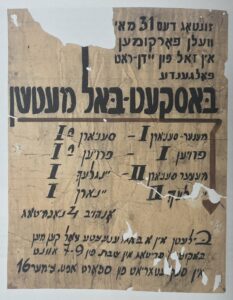
Basketball Competition at the Jewish Council hall, Sunday, May 31, 1942, Ghetto Posters, Number 6, LCVA, F. r-1421, Ap. 2, B. 94

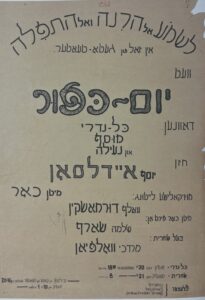
For example, one poster announces a basketball tournament that includes men, women, and seniors. Another announces the opening of the Jewish ghetto theater, whereas others announce specific plays and other cultural events, such as a night commemorating Haim Nahum Bialik. The theater hall also housed Yom Kippur services in 1942.

Ghetto Posters, number 25, LCVA, F. r-1421, Ap. 2, B. 122

On the intellectual side, there were lectures on Jewish history, one on the zugos, and the pairs of Rabbis in the Mishna. Another was an announcement of sermons delivered on the Yom Tefillah that was declared in February 1942.

Ghetto Posters, number 46, VŽM 1219

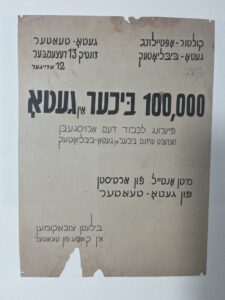
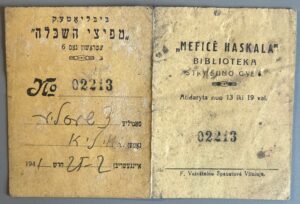
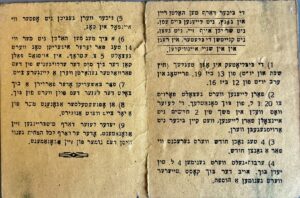
One of the most astounding documents was an announcement that on Sunday, December 13, 1942, at noon, a “Celebration of one hundred thousand books loaned by the Ghetto library” since it opened in September 1941. The ghetto library was in the former Mefitsei Haskalah Library. That library was among the three largest in Vilna. The other two, the Strashun Library and the YIVO Library were closed by the Nazis. This was nearly the same circulation numbers, 90,000 yearly, as before the Nazi invasion and ghettoization of the Vilna’s Jews. Most recently, in the portion of the pre-war documents now at the Judaica Centre at the Lithuanian National Library, a reader’s library card was discovered that slightly pre-dates the formation of the ghetto library. This card, from February 21, 1941, provides the library’s rules, including an admonishment not to leave the books in rain or snow, how to calculate due dates, and fines for overdue books.  

From the Judaica Collection of the National Library of Lithuania 

In addition to the poster is a highly detailed description of the library and its operations that survived the Holocaust. In October 1942, Kruk published “The Library and Reading Room in the Vilna Ghetto, Strashun Street.” The document was originally in Yiddish (and the original is at the YIVO Institute in New York, available here), but Zachary Baker translated it into English and added notes. (See Herman Kruk, “Library and Reading Room in the Vilna Ghetto, Strashun Street 6,” translated by Zachary Baker, in The Holocaust and the Book, Destruction and Preservation, ed. Jonathan Rose, University of Massachusetts Press, 2001, 171-200). 

Kruk provides a prehistory and then specifically recounts the library’s activities since it reopened in September 1941. Among other details, before the war, there were 2,000 subscribers, and in 1940-41, with the influx of Jews from all over Eastern Europe, that number doubled. By September 1941, there were 4,700 subscribers. Men and women were represented almost equally, although women had a slight advantage. The fact that the library reached 100,000 books by December is especially remarkable, in that it was closed for several months as it was too cold to operate. 

Kruk notes significant changes in subject matter and books during this period. For example, there was a 600% increase in readership for War and Peace, and books on war, such as All is Quiet on the Western Front and Emile Zola’s War, were also in high demand. The library’s readers of history were focused on books regarding the Crusades and other martyrdom literature. However, there have been significant changes to the library since before the war. Most notably, 15-30-year-olds made up the bulk of readers during the pre-war period, while in 1942, that number had dropped precipitously. Kruk explains that age groups bearing the brunt of forced labor were too tired to contemplate reading at the end of an exhausting day. 

Kruk summarizes the popularity of libraries and readings, even in the face of death: “A human being can endure hunger, poverty, pain, and suffering, but he cannot tolerate isolation. Then, more than in normal times, the attraction of books and reading is almost indescribable.” 


An Obscure Chumash Changes the Sefer HaChinuch Forever

An Obscure Chumash Changes the Sefer HaChinuch Forever[1]
By Eli Genauer


I have a
sefer in my collection with a very busy Shaar Blatt:

It is a Chumash printed by Yosef, Yaakov, and Avraham Proops in Amsterdam, 1767.[2] The Chumash contains some of the normal additions, such as Targum Onkelos and Rashi, along with two additions which are indicated as being “ואלה מוסיף על הראשונים. I would like to focus on one of these additions, the Sefer HaChinuch. Placing the words of the Sefer HaChinuch underneath the text of the Chumash certainly made sense in theory, as one could review its words as one studied the Parsha. But it caused two major problems, one of which could be solved by use of a magnifying glass, and the other which brought about a change in the Sefer HaChinuch “עד היום הזה.

The Sefer HaChinuch describes the details of, and reasons behind, the 613 Mitzvot.[3] Some of the explanations are very short, such as מצות אכילת מצה, (Mitzvah 10 -Shemot 12:18) so they fit nicely underneath a Pasuk. But when one Pasuk contains 3 Mitzvot and the lengthy explanations need to be placed underneath it (along with Onkelos, Rashi and Peirush Devek Tov), it creates a big problem with space. The only solution would be to have just one Pasuk on a page and to use smaller typeface for the Sefer HaChinuch than for Rashi. Here is how one page looks (Shemot 23:2). It includes Mitzvot 76,77 and 78.

This idea of including the Sefer HaChinuch in a “regular” Chumash was tried once again in 1783 in Frankfurt an der Oder, but perhaps because of this issue of space, never again after that.

This edition of the Chumash, which revised the order of the listing of the mitzvot, also altered the sequence in subsequent editions of the Sefer HaChinuch. This is despite the fact that the author of the Sefer HaChinuch specifically lists the Mitzvot of each parsha in one format. The Proops brothers’ edition of the Chumash overrode the author’s approach.[4] The original order for each Parsha is to list the מצוות עשה first and the מצוות לא תעשה afterwards. Here is how the Mitzvot of Parshat Tetzaveh are ordered in the oldest manuscript copy of the Sefer HaChinuch:

https://digi.vatlib.it/view/MSS_Vat.ebr.163[4]

This order was preserved in subsequent manuscripts, and in the first printed edition of Sefer HaChinuch.[6]

In placing the מצוות עשה first and then the מצוות לא עשה, the author of the Sefer HaChinuch is following the model of the Sefer HaMitzvot of the Rambam.[7] As he writes in Mitzvah 138:

עִם כָּל זֶה מִדֶּרֶךְ חֶשְׁבּוֹן הָרַמְבַּם זִכְרוֹנוֹ לִבְרָכָה אֲשֶׁר [נִתְפַּשֵּׁט] בַּמִּצְוֹת לֹא נִטֶּה…. כִּי הוּא בֶּאֱמֶת סִבָּתֵנוּ בְּעֵסֶק זֶה, וּמִיָּדוֹ זָכִינוּ לוֹ….

This division is also preserved in the headings of the halakhot in Mishneh Torah, and Sefer HaChinuch then follows it.

But this order would not work for a Chumash designed to have the Mitzvot aligned with the Pesukim in the order they appeared in the Parsha, because the מצוות עשה and מצוות לא תעשה are interspersed within the Parsha. For example, Mitzvot 98 and 99 are מצוות עשה and come first in the Parsha. But Mitzvah 102 (a מצות לא תעשה) follows Mitzva 99(a מצות תעשה) in the Parsha so it becomes Mitzvah 100. Here is how it looks in a modern volume:

This change in the numeration of the Mitzvot was not lost on the Proops brothers, and they note that they hoped Torah scholars would look favorably on this change.


“And now, this treasured Sefer ( HaChinuch) has been modernized according to the order ( of the Pesukim of the Chumash) so that the reader can easily follow it as he reviews the Parshat HaShavua. It is now presented page by page and therefore we have not followed the order of the author who presented all the מצות תעשה and מצות לא תעשה separately….and we have confidence that this will be pleasing to scholars who love Torah and who do the Mitzvot of Hashem…”

Artscroll has published a 10-volume series on the Sefer HaChinuch[8] and notes that the order of the Mitzvot is the way they are recorded in the Parsha. The introduction states that whereas “other Rishonim arranged the Mitzvot topically, Chinuch arranges them according to the Parshiyos (weekly readings) of the Torah, and within each Parsha, in the order in which the Torah records them”. There is a footnote to that statement which clarifies the matter by saying that originally “the author arranged the Obligations and Prohibition separately within each Parsha, first presenting all the Obligations and then all the Prohibitions. This arrangement was preserved in the earliest printed editions of Chinuch. In the 18th century, however, this format was changed, and since then the Chinuch has been printed with the Obligations and Prohibitions intermingled, in the order of the verses of the Torah”. There is no explanation as to why in the 18th century the order was changed. We are left to wonder why
something formulated by a Rishon was changed.

Rabbi Chaim Dov Chavel does not react quite as calmly to this change.[9] In his scholarly edition of Sefer HaChinuch first published in 1952 by Mosad HaRav Kook, he is quite critical of the Chumash which made these changes.[10] He writes:

במהדורה זו נעשו שינוים גדולים ורבים בטופס הספר שנכנסו בכל הדפוסים שבאו אחריה”

“In this edition, many major changes were made in the form of the book which were introduced into all the editions which followed”

He compares this edition to one which he feels is more authoritative, the first printed edition of Sefer HaChinuch, Venice 1523.[11]

Among the changes he lists is the one of re-ordering the positive and negative Mitzvot

מצות עשה ולא תעשה נסדרו כאן בפעם הראשונה בערבוב, כלומר ביחד, כמו שהן סדורות בתורה

He concludes his criticism of the Chumash with the Sefer HaChinuch by writing that it was if the printers had given the Sefer HaChinuch a “פנים חדשות “

את נוסח לשון רבינו בסדר המצוות ומנינן שינו המדפיסים לגמרי, וכמעט ששיזו לחלק זה פנים חדשות”

Because he feels it was wrong to change the order of the Mitzvot, he reverts back to the original order and numbering used in the Kitvei Yad and in the earliest printed editions.[12]

Rabbi Chavel is correct in that the order and the numbering of the Mitzvot was changed forever by the new order introduced in a Chumash which tried to incorporate in it the Sefer HaChinuch.[13] The initiative for changing the Order of Mitzvot was to for no other reason than to attempt to align the Sefer HaChinuch with a printed Chumash. No group of Torah scholars in the 18th century got together to decide to make this change. I imagine that the author of the Sefer HaChinuch might even have considered re-ordering the Mitzvot to conform to the flow of each Parsha but decided to keep the order of positive Mitzvot all together first and negative Mitzvos all together second.[14] It leaves unanswered the question of whether changing the order of the Mitzvot (even though done for what was seen to be a positive purpose) was the correct thing to do?

[1] I call this Chumash “obscure” because as you will see later on, a great scholar was unaware of it.
[2]
Encyclopedia.com notes in part on the Proops printers:

PROOPS, family of Hebrew printers, publishers, and booksellers in Amsterdam. SOLOMON BEN JOSEPH (d. 1734), whose father may have been a Hebrew printer as well, was established as a bookseller in Amsterdam and associated with other printers from 1697 to 1703….At his death, appointed guardians continued to operate the press, and even when his sons JOSEPH (d. 1786), JACOB (d. 1779), and ABRAHAM (d. 1792) took over, they traded under the old name until 1751.

https://www.encyclopedia.com/religion/encyclopedias-almanacs-transcripts-and-maps/proops

On my sefer, there is an ownership stamp of הרב י.ל. הכהן פישמן, also known as Rabbi Yehuda Leib Fishman Maimon who was one of the signers of Israel’s Declaration of Independence and was the first minister of Religious Affairs. He was also an avid book collector who owned 40,000 books. There is another ownership stamp belonging to him on the page preceding the Shaar Blatt which looks like this

It quotes part of the Pasuk in Breishit 49:10 לֹֽא־יָס֥וּר שֵׁ֙בֶט֙ מִֽיהוּדָ֔העַ֚ד כִּֽי־יָבֹ֣א שִׁילֹ֔ה and then says ספריה הרב יהודה ליב הכהן פישמןירושלים.
[3] The idea that there are 613 Mitzvot in the Torah, 365 negative Mitzvot and 248 positive Mitzvot, is first recorded in Talmud Bavli Masechet Makot 23b

דרש רבי שמלאי שש מאות ושלש עשרה מצות נאמרו לו למשה שלש מאות וששים וחמש לאוין כמנין ימות החמה ומאתים וארבעים ושמונה עשה כנגד איבריו של אדם

[4]There is much discussion as to who was the author who chose to remain anonymous.

Sefaria summarizes the issue as follows:

המחבר מזהה עצמו רק כאיש יהודי מבית לוי ברצלוני“, ויש חילוקי דעות לגבי זהותו המדויקת. יש המייחסים את הספר לר’ אהרן הלוי (ראה), אבל כבר הוכח בבירור שהוא לא חיברו. אחרים מיחסים אותו לרּ פנחס הלוי, אחיו של הראה.

[5] The bibliographic record at the National Library of Israel notes that it was written in 5093 (1333) based on the colophon which states:


נשלם על ידי אברהם בכמ”ר אברהם ז”ל ב”ר משה נ”ע ליל ו’ עשרים יום לחודש טבת שנת צ”ג

https://www.nli.org.il/en/discover/manuscripts/hebrew-
manuscripts/itempage?vid=MANUSCRIPTS&docId=PNX_MANUSCRIPTS990001132770205171&scope=PNX_MANU
SCRIPTS&SearchTxt=%D7%A1%D7%A4%D7%A8%20%D7%94%D7%97%D7%A0%D7%95%D7%9A
[6] I accessed the following manuscripts on KTIV, all of which had the same order. Parma 3016 – Laurentian Library, Florence, Italy Ms. Or. 473 -Casanatense Library, Rome, Italy Ms. 2857 – Paris BN 400vi.
[7] He was also following the pattern of the בעל הלכות גדולות, the first of the מוני המצוות.
[8] The Schottenstein Edition Sefer Hachinuch #1 / Book of Mitzvos, Brooklyn, NY, 2012 – General Introduction page xl.
[9] A comprehensive review of Rabbi Chavel’s works appeared in his “Peirush Rashi Al HaTorah” first printed in 1982 https://tablet.otzar.org/#/book/155543/p/1/t/1/fs/0/start/0/end/0/c
[10] Rabbi Chavel was not familiar with the Proops Amsterdam 1764 edition of the Chumash cited above and thought the first Chumash printed with the Sefer HaChinuch was the one of Frankfurt an der Oder of 1783. I assume he would have leveled the same criticism at the Amsterdam edition. The Bibliography of the Hebrew book notes this fact about the 1764 edition:

.ספר החינוך נדפס כאן לראשונה “אחר סדר הפסוקים” ולא לפי הסדר שקבע המחבר (עשין לבד ולאוין לבד). וכן נדפס ברוב ההוצאות הבאות. עיין במבוא של הרב חיים דוב שאוועל לספר החינוך, ירושלים תשי”ב, עמ’ כ-כא, שציין את השינויים שנעשו במהדורת תקמ”ג, שינויים אלו נעשו

[11] Here is the Shaar Blatt from Rabbi Chavel’s edition:

[12] An example would be Mitzvot 99-104. Both the order and the numbers are changed:


[13] Here are some examples of some modern editions which have it the “new” way:

מהדורת ספרי אור החיים – תשׁע״א
מכון מירב-תש״ד
מכון ירושלים-תשנ״ב
מכון אורות חיים – תשׁנ״ז
מעיל האפד- תשנ״ח
ספר החינוך המבואר השלם על מועדים- תשס״ח
ספר החינוך מבואר – צפת- תשע״ד
ספר החינוך ע”פ מנחת צבי – תשׁס״ח
Artscroll 2012-18

[14] At the end of his introduction, he writes,  עַל כֵּן רָאִיתִי טוֹב אֲנִי הַדַּל בְּאַלְפִּי, תַּלְמִיד הַתַּלְמִידִים שֶׁבִּזְמַנִּי, אִישׁ יְהוּדִי מִבֵּית לֵוִי בַּרְצְלוֹנִי, לִכְתֹּב הַמִּצְוֹת עַל דֶּרֶךְ הַסְּדָרִים וְכַסֵּדֶר שֶׁנִּכְתְּבוּ בַּתּוֹרָה זוֹ אַחַר זוֹ ….and yet he still grouped them the way he did.


There is No Bracha on an Eclipse

There is No Bracha on an Eclipse
By Rabbi Michael J. Broyde

Rabbi Michael Broyde is a law professor at Emory University School of Law and the Projects Director in its Center for the Study of Law and Religion.  His most recent Torah sefer is entitled “A Concise Code of Jewish Law For Converts”.  This letter was written to someone after a shiur in 2017 on why there is no bracha on seeing a solar eclipse.

1.     You are correct that I said that I thought there was no bracha on an eclipse.  I had not seen Rabbi Linzer’s teshuva at the time that told that to you this, as it was not circulating on the internet at the time that I prepared for my shiur and I did not see it until Sunday, the day after the shiur.  I try to cite as much as relevant in these classes and his thoughts are clearly relevant.  He is a stellar writer on interesting topics of halacha and I read his material consistently.  I had seen that Rabbi Eliezer Melamed in Peninei Halacha Laws of Brachot 15:6 and note 5 which does permit a bracha on an eclipse.
2. Having said that, I would not change my mind at all in light of Rabbi Linzer’s teshuva and remain opposed to reciting a bracha over an eclipse for many reasons explained below.
3.  First, as many have noted, the giants of halacha are quite divided over the question of whether the listing in the Shulchan Aruch is paradigmatic or particular.  Some make no blessings other that for matters listed in the codes and other treat them as examples.  That dispute alone inspires me to be cautious, although I could be persuaded that the paradigmatic approach is correct and one could then make a bracha on a waterfall.  I have yet to see a clear proof that such a view is correct, but it does seem more intuitive.[1]  Yet, safek brachot lehakel is present.
4.  Second, and more importantly, if you look closely in the classical achronim, you see not a single achron who actually endorses saying a bracha on an eclipse.  Not a single one.  It is true that there is a dispute about whether the list in the Mishna is all inclusive or not (as many note, see Shar HaAyin 7:6), but even those who are of the view that the Mishnah’s list is merely examples, not a single achron actually endorses making a bracha on an eclipse as opposed to a volcano or some other natural wonder, which some clearly do permit a bracha on.  The group that favors expansive brachot on natural wonders endorse stalagmite caves, waterfalls, water geysers, volcanoes and many more: but not eclipses.  If you look, for example in Shar HaAyin 7:6 (the classical work on this topic) one sees this most clearly: even those who endorse making brachot on waterfalls, or other amazing facets of creation are uncertain נסתפק)) if one make a bracha on an eclipse, and we all know that when a posek is נסתפק, that posek does not make a bracha.[2]
a.      This contrast is made clear in the context of Rabbi Shmuel Halevi Wosner — who is the most clear and direct articulator of the view that list of wondrous sightings in the Shulchan Aruch are just examples, and one makes the bracha of oseh maaseh bereshit even on other wonders.  In Shar HaAyin page 431 he states directly that one makes a blessing on many wondrous things unlisted in the codes and he explains that “Volcanos are not present in our lands and thus are unmentioned in the Shulchan Aruch” and that it is “obvious” that one makes a blessing on them.  However, on eclipses he states “solar eclipses are mentioned a few times in the Gemera, and thus on the question of whether one needs to make a bracha when one sees them, needs more thought.[3]”  He does NOT endorse making a bracha on an eclipse. In fact, I am unaware of anyone other than Rabbis Melamed and Linzer who actually endorse the view in favor of making a bracha on an eclipse, (rather than merely ponders the possibility of such a bracha).  Rabbi Wozner’s point is important: this is not a modern issue – eclipses were well known for a few millennium, and silence in the Jewish Law codes is telling.  To the best of my knowledge the dispute about the eclipses is between two views: (1) Absolutely Not and (2) Maybe.  There is no (3) Yes view in the classical rabbinic literature for eclipses.  (That is why the listing of reasons why an eclipse might be different from other wonders below is important.)

5.     Why is an eclipse different from a stalagmite cave or a volcano?  I could think of a few reasons from a halachic perspective, even to those who believe that the Mishna’s list is not inclusive.
a.   Many perceive them to be a siman raah – a bad sign, either because of superstitious reasons or because darkness in the middle of the day is practically bad – and there is no blessing on bad omens (as Rabbi Moshe Feinstein is quoted in Mesorat Moshe 2:51).
b.     Because one sees nothing in an eclipse (as it is an absence of light, rather than a presence) and we do not make brachot on absences.
c.      Because the bracha of oseh maaseh breseshit does not apply to things whose existence can be mathematically predicted, but are merely rare: eclipses are not anomalies, but a product of the universes’ cycle of life, and more under the berkat hachama rule.
d.     Because full eclipses are exceedingly rare and partial eclipses are almost impossible to “see” without modern eclipse glasses (a 75% eclipse hardly is noticed on a functional level) and are naturally invisible.
e.      For other reasons that are less obvious related to the fact that these have to be wonders from “creation” and these are not from creation.
f.     Because some thought that eclipses were punishments and thus no blessing was ordained.[4]
6.     Based on all this, one can say that eclipses could be different from all other created natural anomalies as a matter of Jewish law and are not covered by the general idea of a wonder such that a blessing should be made. To my surprise, even as the primary source of the view that one can make a bracha on wonders beyond the Mishna’s list is Rabbi Wozner and he explicitly notes that eclipses are different from volcanoes, waterfalls, geysers and many other rare natural phenomena, the secondary codifiers of the last generation have completely missed this distinction.  Instead both Shar HaAyin 7:6 and Penenia Halacha Laws of Bracha 15:5 link the dispute about volcanoes and waterfalls with eclipses and state that one who permits a bracha for volcanoes and waterfalls would do so for eclipses as well, when in fact that is incorrect.  Eclipses were known in Talmudic times and yet no bracha was noted: that bothers Rabbi Shmuel Wozner, who permit a bracha on an erupting volcano, not to permit a bracha to be recited on an eclipse, by noting that he is uncertain if a bracha is proper.[5]
7.     Additionally, let me add a thought of my own about modern times and bracha’s over wonders.  The Shulchan Aruch OC 228:3 limits even the mountains that one can make a bracha on to such mountains in which the hand of our Creator is clear and apparent. (ולא על כל הרים וגבעות מברך, אלא דווקא על הרים וגבעות המשונים וניכרת גבורת הבורא בהם.)  I think in our modern times, with modern science explaining all of these events, no mountains or valleys ever meet the criterial of make it clear (to normal people) that God is in charge of the universe.  Based on this, I would not make any extensions of this halacha beyond its minimums recorded in the Shuchan Aruch because I think that the test for determining whether we can add to this list is and make a bracha is וניכרת גבורת הבורא בהם.  Given the secular environment we live in, I think no natural astrological events meets that bill in modern times so I only – at most — make such brachot on the things that the halachic tradition directly directs me to do, like lighting or thunder or great mountains and certain rivers. I would not make such a bracha on an erupting volcano or a solar eclipse, as seeing such does not cause normal people in my society to experience God.  (There are two formulations of my claim, each slightly different.  The first is experiential, in that I think that most people in my society do not sense any awe of God at an eclipse.  Second, even if any particular person does (and I do not doubt that some do), they cannot make the bracha since most people in America do not so sense God through these events and that is the halachic test found in the Shulchan Aruch.  The sense of wonder has to be obvious to normal people and that is lacking in the world we live in.
8.     Finally, all attempts to actually endorse making a bracha on an eclipse run directly against the combined force of both (1) the minhag, which is not to make a bracha and (2) the rule of ספק ברכות להקל. These two together make it difficult for any moreh horah to argue convincingly that there is clear proof that bracha should be made.
9.     I have consciously not engaged with Rabbi Linzer’s very worthwhile point (which I more or less agree with) that “we strive to bring our religious lives and our halakhic lives in sync” exactly because (as he himself notes) this calculus is limited to cases where there is a dispute between poskim about what to do.  Here, to the best of my knowledge, there is no dispute and since there is no classical halachic authority who actually says “yes make a bracha on an eclipse” there is no grounds to examining very important meta issues used to resolve disputes (since there is no dispute).
10. Based on all of this, I would not make a bracha on an eclipse.
11. Having said that, I am happy to endorse other forms of religions veneration for one who feels such wonder.
a.     One can certainly say this bracha without שם ומלכות.
b.   I am also somewhat comfortable with someone making this blessing in Aramaic (see Shulchan Aruch OC 167:10, 187:1 and 219:4) although I am aware of the view of Iggrot Moshe OC 4:20:27, but find the view of the Aruch Hashulchan OC 202:3 more analytically compelling.
c.      Both the suggestions of Rabbi Chaim David Ha-Levi (Responsa Aseh Lecha Rav, 150) that one recited va-yevarech david (Chronicles. 1:29:10) and adding “who performs acts of creation” at the end and of Rabbi David Lau, current Ashkenazic Chief Rabbi of Israel, to recite Tehillim 19 and 104 are completely reasonable as well.
d.     Other innovative non-bracha based solutions are also reasonable.
12. On the other hand, those who attended an eclipse – I myself traveled to Rabun, Georgia, an epicenter for the total eclipse and sat in total darkness at for three minutes in the middle of the day and did not feel any closer to the Almighty as Creator of the World during the eclipse than I did after or before — can feel free to engage in no innovative religious observance at all without feelings that they are deficient in any way.
13.  I welcome readers to direct me to a source written by an achron which directly discusses eclipses and permits a bracha.  (Please feel free to email me.) So far, I have only seen that the group that permits a bracha for an eclipse does so based on a putative ruling of Rabbi Wozner and others to permit such a bracha, which upon closer examination is not present.  I am willing to ponder the possibility that there is an achron who permits such a bracha even as others do not – that posek argues that all wonders deserve a bracha and the listing in paragraph 5 above about why eclipses are different from other wonders is incorrect – To the best of my knowledge, that is a theoretical position that is not actually adopted.

[1] I am inclined to the more expansive view because the formulation in the Beit Yosef in Tur OC 228.
[2] This is an important point.  Rabbi Wozner has the right as a morah horah to assert that he rules that the mishna’s list is not inclusive and that volcanoes get a bracha (which is exactly what he says, as does Rabbi Nissan Karletz in the same work on page 466).  When one asks him “how can he rule that a bracha needs to be recited, others disagree, and then the matter is in doubt”, Rabbi Wozner responds by stating that he sees no doubt and thus he feels a bracha should be recited.  When Rabbi Wozner states that he has doubt about this matter, he is being clear that this is exactly a case of doubt and no blessing should be recited.
[3] Let me add that eclipses are discussed in the rishonim and codifiers as well, with no mention of a bracha.  See Darchai Moshe on Tur OC 426 and the works cited by Rabbi Linzer in footnote 2 of his teshuva (see here).
[4] It is clear from the recounting of the Chafetz Chaim that he did not say a bracha on an eclipse.  See here.
[5] This is found both Shar HaAyin and Penine Halacha as well as Rabbi Linzer’ teshuva.  Shaar Haayin 7:6 is strict on the whole matter and does not permit a bracha practically on even volcanoes an water falls, so the mistake in that work – linking volcanoes and eclipses — is merely one of conceptual classification, but Peninia Halacha rules that המברך לא הפסיד (“one who makes the blessing is doing nothing wrong” for “volcanic eruptions, geyser, waterfalls and both lunar and solar eclipses” when it is clear to this writer that the source he is sighting – he cites Rabbi Wozner! – does not adopt that view.  (On page 466 of Shar HaAyin, Rabbi Nissan Karlitz is asked “Is the blessing oseh maaseh bereshit similar in that things that are wonders and not found in the Shulchan Aruch like an erupting volcano or a spouting geyser or other similar phenomena, also requiring a bracha” and Rabbi Karlitz answer “Logic indicates that such is the case also,” but no explicit discussion of eclipses, which could be different.


Lekah Tov – What’s in a Name?

Lekah Tov What’s in a Name?
by Marvin J. Heller[1]

For I give you good doctrine (lekah tov); do not forsake My Torah (Proverbs 4:2).

The entitling of Hebrew books is a subject of considerable interest, varying as it does from the more common manner of labelling comparable works. Book titles generally reflect a book’s subject matter. In contrast, however, Hebrew book titles often reflect a subtle theme, considerably wide-ranging between books with a like title.

This subject has been addressed previously, by me and by others, in the latter case even in book format, and as the subject of encyclopedia articles. My previously addressed book titles are Adderet Eliyahu and Keter Shem Tov.[2] What the books with those titles and Lekah Tov have in common is that the books so entitled frequently do not share common subject matter.

Our listing of editions entitled Lekah Tov, a popular title, is based on the editions recorded in bibliographic works, primarily Ch. B. Friedberg’s Bet Eked Sepharim, which covers the period 1474 through 1950, and Yeshayahu Vinograd’s Thesaurus of the Hebrew Book, which covers titles printed from 1469 through 1863. Shabbetai Bass’ (1641-1718) Siftei Yeshenim (Amsterdam, 1680), the first bibliography of Hebrew books by a Jewish author, records five works entitled Lekah Tov. Isaac Benjacob, in his Oẓar ha-Sefarim, records fourteen works (through 1863) entitled Lekah Tov.[3]

The editions of Lekah Tov described in this article are the earliest editions from the sixteenth and seventeenth centuries and one title from the first decade of the eighteenth century, that is, in 1704. The order of the works addressed in this article is in chronological order, that is the order in which they were printed, rather than the time of writing or the author’s names.

I

We begin with four sixteenth century editions of Lekah Tov, the lead edition being R. Tobias (Tovyah) ben Eliezer’s Lekah Tov, known as Pesiḳta Zuṭarta (Venice, 1546), followed by R. Moses ben Levi Najara Lekah Tov (Constantinople, 1575), then R. Yom Tov ben Moses Zahalon’s commentary on the book of Esther, and R. Abraham ben Hananiah dei Galicchi Jagel’s Lekah Tov (Venice, 1595).

R. Tobias (Tovyah) ben Eliezer: Our first Lekah Tov, by R. Tobias (Tovyah) ben Eliezer (eleventh cent.), is also known as Pesiḳta Zuṭarta. A midrashic commentary on the Pentateuch and the Five Megillot, it published in רננ”ו (306 = 1546) at the renowned press of Daniel Bomberg in folio format (20:93 ff.). Bomberg, a non-Jew, came to Venice from Antwerp, obtained a privilege from the Venetian Senate to print three books, and issued as his first imprint a Latin Psalterium (1515). Soon after, in December, 1515, Bomberg requested and received the right to print Hebrew books, with a monopoly based on the expenses already incurred with such an activity. By the time his press closed, more than four decades later in 1548/49, it had published between two hundred to two hundred fifty titles, covering the gamut of Jewish literature, encompassing liturgy, Talmud, halakhah, philosophy, and grammatical works, books of high quality.

1546, Venice


R. Tobias (Tovyah) ben Eliezer 1880, Vilna
Courtesy of the National Library of Israel

Tobias (Tovyah) ben Eliezer’s (eleventh-twelfth centuries) place of residence has variously been given as Kastoria, Bulgaria, while others suggest Ashkenaz. Isidore Singer and M. Seligsohn suggest that Tobias might have been a native of Mayence (Mainz) and a son of Eliezer ben Isaac ha-Gadol, a teacher of Rashi. Ashkenaz is given suggested because Lekah Tov was written after 1097 and reference is made several times to the tribulations of the Crusades. In parashat (weekly Torah reading) Emor (Leviticus 21:1 – 24:23), for example, Tobias writes about the slaughter of the Jews in Mainz. However, as Tobias also frequently attacks Karaites and shows a knowledge of Mohammedan customs, it is suggested, by Solomon Buber, that that he was a native of Castoria in Bulgaria. Towards the end of his life Tobias settled in Eretz Israel.[4]

The pillared title-page of Lekah Tov has a header that, in a small font, states “There is neither wisdom, nor understanding, nor counsel against the Lord” (Proverbs 21:30). Below it is the phrase “the light of the righteous [will rejoice]” (Proverbs 13:9). Below in a larger font, is the title, given as Pesikta Zutarta, included here because later editions entitle and record Pesikta Zutarta as Lekah Tov.

This edition is on Vayikra, Bamidbar, and Devorim (Leviticus, Numbers, and Deuteronomy). Because the first edition was based on an incomplete manuscript which was lacking a first page, the printer entitled it Pesiḳta based on the word piska leading the words in the text. Tobias had entitled the work Lekah Tov because of the allusion to his name (tov, Tovyah, Tobias) in the title and begins each weekly Torah portion with a header verse with the word tov. For example, parashat Kedoshim begins with “Depart from evil, and do good (tov); seek peace, and pursue it” (Psalms 34:15); parashat Beha’aloscha “How sweet is the light, and it is good (tov) for the eyes to behold the sun!” (Ecclesiastes 11:7); and parashat Hukat “ You are good (tov) and beneficent, teach me Your laws.” (Psalms 119:68).

Tobias supports the literal meaning of the text but also quotes aggadot, midrashim, and the Talmud. He gives the grammatical meaning of words and quotes many halakhot, a recurrent source being R. Achai Gaon’s She’eltot. Tobias frequently refers to his father R. Eliezer, whom he refers to as ha-gadol or ha-kodesh (the great or the holy). As noted above, he attacks the Karaites and has a thorough knowledge of Mohammedan customs.

Tobias’ Lekah Tov has been cited by such leading rabbinic writers as R. Abraham ibn Ezra, R. Asher ben Jehiel (Rosh), R. Zedekiah (ha-Rofei) ben Abraham (Shibbolei ha-Leket), R. Menahem ben Solomon (Sekhel Ṭov, Even Boḥan), Rabbenu Tam, R. Isaac ben Abba Mari (Ba’al ha-Ittur), and R. Isaac ben Moses of Vienna (Or Zarua).[5]

Several editions of Tobias’ Lekah Tov on the Megillahs have been printed. The first reprint on the Torah commentary was in Vilna (1880) followed four years later by a second printing (1884), both by R. Solomon Buber at the Romm press.

R. Moses ben Levi Najara: Our next Lekah Tov is a commentary on the Torah with reasons for the mitzvot by R. Moses ben Levi Najara. This edition of Lekah Tov was printed in Constantinople at the press of the brothers, Jacob and Solomon ibn Isaac Jabez in folio format (20:150 ff.). They had printed previously in Salonica, for a brief interval in Adrianople and, after an outbreak of plague in Salonica in approximately 1570-72, Joseph Jabez sold his typographical material to David ben Abraham Azubib and left that city to join his brother Solomon in Constantinople. Solomon Jabez, had, in 1559, settled in Constantinople, founding a press that was active for about three decades. The brothers, issued more than forty titles in Constantinople.[6]

R. Moses ben Levi Najara was born in Turkey in c. 1502, perchance from a family whose origins were in Nájera, Spain. The family head, Levi Najara, settling in Constantinople after the expulsion of the Jews from Spain in1492. Moses Najara served as rabbi in Danaiditsch, spent time in Safed where at the age of thirty Najara was considered among the leading rabbinic scholars of Safed. In that location Najara was a student of R. Isaac Luria (Ari ha-Kodesh). He subsequently served as rabbi in Damascus. Moses Najara’s son, Israel Najara (c.1555 – c. 1625) was a noted poet, author of Zemirot Yisrael (Safed, 1587).

1575, Constantinople, Moses ben Levi Najara
Courtesy of the National Library of Israel

The title-page of this edition of Lekah Tov has a decorative border of florets, typical of Jabez brother publications. It dates the beginning of work to Friday, 4 Shevat, then gives the year with the chronogram “Truth will sprout from the earth אמת מארץ תצמח (331 = January 10, 1571) [and righteousness will peer from heaven]” (Psalms 85:12). The dating of this edition of Lekah Tov is problematic. With the exception of Shabbetai Bass, who gives the Hebrew chronogram date, the above bibliographic sources date publication as 1575, as does the National Library of Israel, despite the date on the title-page of מארץ (331 = 1571). Avraham Yaari transcribes the text of the title-page and then also dates it 1575.[7] In contrast to the preceeding, Abraham David, M. Franco, and Shimon Vanunu, respectively writing entries for the Najara entry in the Encyclopedia Judaica, the Jewish Encyclopedia, and Encyclopedia Arzei ha-Levanon, all date Lekah Tov to 1571. This is also the case for Isaac Benjacob who, in his Oẓar ha-Sefarim, dates publication to 1571.[8] Perchance, indeed likely, one early source erred and the later works copied and repeated the error without ever seeing the book. Another apparent error is the weekday date for the beginning of work as Friday, 4 Shevat. In 1571 that was a Sunday and in 1575 a Saturday, so that, whichever year is correct, the date for the beginning of work also appears to be in error.

There is an introduction from Najara in which he informs that he has entitled Lekah Tov for it is a good and important study, one that will guarantee the completion of their souls, truly and completely, as it was given at Sinai, to them for a goodly portion. The text follows, organized by parashah, in two columns in rabbinic letters and homilies on the Talmud, Mechiltah, Sifrah, and Sifri.

This is the only edition of Moses ben Levi Najara’s Lekah Tov. Sha’ar ha-Kelalim, published in the beginning of R. Hayyim Vital’s Etz Hayyim, is attributed to Najara in several manuscripts.

R. Yom Tov ben Moses Zahalon: Commentary on the book of Esther by R. Yom Tov ben Moses Zahalon. Entries in this article are supposed to be in chronological order of printing and this Lekah Tov was published two years after the preceding entry. However, bibliographical sources record and discount a possible, albeit questionable, Constantinople [1565], which is not noted in Avraham Yaari’ Hebrew Printing at Constantinople so that we too are discounting it. The definite publication of Zahalon’s Lekah Tov was in Safed on Friday, Rosh Hodesh Sivan, in the year “[Hear, O Lord, and have mercy on me;] O Lord, be my help! ה” היה עזר לי ([5]337 = Friday, May 27, 1577)” (Psalms 30:11) in quarto format (40: 83, 1 ff.) by Eliezer ben Isaac Ashkenazi.

This Lekah Tov is not only the first book printed in Safed, it is the first book printed in Asia, excluding Chinese imprints. Eliezer ben Isaac Ashkenazi who had printed previously in Lublin for almost two decades, leaving, with his son, to dwell in Eretz Israel – printing also, for a short time on the way, in Constantinople – anticipating that he would print books for a European market eager to purchase books from the land of Israel. Eliezer Ashkenazi became partners with Abraham ben Isaac Ashkenazi, mentioned in the colophon (apparently not a relative), the former supplying the expertise and typographic material, the latter the location and the financing.[9]

R. Yom Tov ben Moses Zahalon (Maharit Zahalon, 1558-1638), born to a Sephardic family in Safed, was a student of R. Moses Bassudia and R. Joseph Caro. He received semicha (ordination) from R. Jacob Berab II. Highly regarded by his contemporaries, who often requested his opinion on complex halakhic issues, Zahalon was a person of great integrity, not influenced by status. For example, it was his opinion, although he had the utmost respect for Caro, that the Shulhan Arukh was, “a work for children and laymen.” Zahalon made several trips as an emissary of the community in Safed to Italy, Holland, Egypt and Constantinople.[10]

1577, Safed, R. Yom Tov ben Moses Zahalon
Courtesy of the Library of the Jewish Theological Seminary

Lekah Tov was written by Zahalon at an early age, seventeen or eighteen, to send, as stated on the title page, for mishlo’ah manot (Purim gifts), to his father. Also on the title page is the prayer that, “the Lord should grant us the merit to print many books, for “from Zion shall go forth Torah, and the word of the Lord [from Jerusalem]” (Isaiah 2:3).

On the verso of the title page is a brief introduction, in which Zahalon refers to the burning of the Talmud in Italy and remarks that, “Great was the cry of the Torah before God and when He remembered the covenant that He made with us at Horeb (Sinai), the Lord roused the heart of the printer Eliezer [so that] honor dwelled in our land . . .” He encourages others to also print their books at the press in Safed. A second brief introduction from Joseph ben Meir follows, and then a longer introduction from the author. Zahalon informs that the book was named Lekah Tov because it has a reference to his name and because of the words of earlier sages on, “For I give you good doctrine (lekah tov); do not forsake my Torah” (Proverbs 4:2). The commentary, which is lengthy, includes both literal, homiletic, kabbalistic, and messianic interpretations. Zahalon does not reference a large number of other works. At the end of the volume is a copy of Marco Antonio Giustiniani’s (Justinian) device, a reproduction of the Temple in Jerusalem. Ashkenazi had used this mark previously in Constantinople.[11]


Zahalon was the author of more than 600 responsa, only partially printed (She’elot u’Teshuvot Yom Tov Zahalon, Venice, 1694); additional volumes of responsa and novellae on Bava Kamma were printed in Jerusalem (1980-81); and an extensive commentary on Avot de-Rabbi Natan entitled Magen Avot, still in manuscript.

R. Abraham ben Hananiah dei Galicchi Jagel: Catechism, or handbook on the principles of the faith, for Jewish youth by Abraham ben Hananiah dei Galicchi Jagel (1553-after 1623). This is the first edition of Jagel’s popular and much reprinted Lekah Tov. A small work, it was published as an octavo (80: 18ff.) by the press of Giovanni di Gara in Venice in 1595. Parenthetically, although the name Giovanni is given in non-Hebrew sources, the Hebrew name, which appears on the title-pages is Zoan, that is, Iohannes. The di Gara press, active from 1564 to 1611, is credited with more than 270 books, primarily in Hebrew letters, and only infrequently in non-Jewish languages.[12]

Jagel was born to the Galicchi (Gallico) family, one of the four noble families exiled from Jerusalem to Rome. The family name Jagel is taken from the liturgy of the afternoon Sabbath services (Abraham would rejoice יגל). Much of what is known about Jagel’s life is from Gei Hizzayon, an autobiographical and ethical work in the style of Dante. He settled in Luzzara, in the vicinity of Mantua in the 1570s, where, after his father’s death, he inherited the latter’s banking business, a venture, by his own admission, for which he was unqualified.

Jagel, mistakenly identified as Camillo Jagel, a censor of books from 1611, has been accused of apostasy. This identification has, however, been shown to be false. Jagel also had difficulties with business associates, particularly Samuel Almagiati, which resulted in their arranging his incarceration on several occasions, for carrying a small dagger, dining at night with a Christian, and for slander. In the last and longer imprisonment, he composed portions of Gei Hizzayon. Jagel later practiced medicine, but retained close ties with several Jewish bankers, among them Joseph ben Isaac of Fano, to whom Lekah Tov is dedicated. Jagel instructed Fano’s children, when, perhaps, he wrote Lekah Tov. In 1614, together with another banker, Jagel was kidnapped, but was able to pray three times a day with Tefillin and eat permitted foods only (Gei Hizzayon).

1595, Venice, Abraham ben Hananiah dei Galicchi Jagel
Courtesy of the Dorot Jewish Division, New York Public Library

Lekah Tov, the first catechism by a Jew, is stylistically copied from and conforms to the Catholic catechism of Peter Canisius (1521-97). It summarizes the principles of Judaism, based on Maimonides’ Thirteen articles of Faith, emphasizing Judaism’s moral and ethical aspects. Jagel also copied passages from Canisius = catechism, but without violating Jewish dogma and beliefs. The dedication, in Renaissance style, begins, “how a servant may benefit to find favor in the eyes of his lord,” followed by the introduction, in which Jagel defines his purpose as, to make a fence for the Torah and state the principles of Judaism, so that they should be fluent in the mouths of all, as did the prophets. He concludes that it is in truth a lekah tov (good doctrine, Proverbs 4:2) that I give you. The text is in the form of a dialogue between a rabbi and student, emphasizing the proper conduct for attaining happiness in the hereafter. Seven classes, each of sin and of virtue, are enumerated. The section on love towards one’s neighbor is quoted extensively in the Shelah’s Shenei Luhot ha-Berit.[13]

Lekah Tov has been reprinted thirty times, and translated into Latin, German, English, and Yiddish. Western European editions, beginning with a 1658 (Amsterdam) edition published by Naphtali Pappenheim, to compensate for insufficient Torah study. Pappenheim writes that Lekah Tov, a concise summary of the principles of the Torah, is suitable for all ages. A Yiddish edition (Amsterdam, 1675) by Jacob ha-Levi was intended for those who had difficulty with the Hebrew text and were engaged in earning a livelihood, not studying Torah sufficiently and who felt that it should be read daily by everyone.

Several editions were published by apostates, who found its style comfortable, and Christian-Hebraists, who wished to learn about Judaism, both utilizing it for missionary purposes. Eastern European editions are associated with precursors of the Haskalah in Russia. Jagel’s other works are Eishet Chail (Venice, 1606), an ode to womanhood and a code of behavior; Beit Ya’ar Levanon, a scientific encyclopedia, mostly unpublished; Be’er Sheva, also an encyclopedic compendium, and works on philosophy, astrology, and halakhah, also unpublished.

II

R. Moses ben Issachar Sertels: A Hebrew Judeo-German (Yiddish) glossary on the Prophets and Hagiographa, printed at the renowned Gersonides press in Prague, headed, from 1601, by Moses ben Joseph Bezalel Katz, his name appearing on the title-page. It was published in quarto format (40:284 ff.) in the year “Now I know that the LORD will give victory to His anointed עתה ידעתי כי הושיע ה” משיחו (364 = 1604)” (Psalms 20:7) in conjunction with Sertels’ Be’er Moshe (1605, 40: 104 ff.), a comparable work on the Torah, Hagiographa and Megillot.

Sertels (d. 1614-15) has been described by Aleander Kisch, et. al, as an exegete, resident in Prague in the first half of the seventeenth century. His name a “(סערטלש) is a matronymic from ‘Sarah.’” Olga Sixtová informs that he “shows up at the turn of the 17th century as one of the most active figures in Prague Yiddish (and Hebrew) book printing, as such he deserves more of our attention.” Sixtová writes that Sertel and his family came from Germany, likely from the Wurzburg area. A son, Issachar, died in Venna in 1625 and a daughter, Shendel, in Prague in 1631. His mobility is reflective of a Ashkenaz Jewish family, more so than of a settled Christian population. Sixtová also notes that the surname name Sertel (variously Sertl[e]in, sertl, Sertln), was after Sarah, his mother.[14]

Sertels’ Lekah Tov is described by Moritz Steinschneider as “a glossary on Pent. etc. (Moses explained), in which text is expressed separately and together with the text. Beginning as a paraphrase preceding it, in which is completed the version of words or sentences together with the expositions.”[15] It is similarly described by Otto Muneles, who records Lekah Tov together with “be’er Moŝe . . . lekah. Prag 1604, 40. (Yidd. Glossary on the Prophets and Hagigrapha.).[16] Be’er Moshe, is also glosses and notes in Yiddish.


1604, Prague, R. Moses ben Issachar Sertels
Courtesy of the National Library of Israel

Sixtová writes that Sertel’s glossaries reflect his long years and experience as a teacher. In the preface to Be’er Moshe he suggests that it could be used in place of a teacher, as the rabbis, who wander from place to place lack the time to go through the entire text with their pupils. 

The title-page of Lekah Tov has a somewhat lengthy text which begins that it is an attractive explanation in [Ashkenaz] (Judeo-German), informing that it is done with understanding and wisdom on the twenty-four books [of the Bible], of great benefit to the aged and the young. Further on Sertels notes that it was written with “an iron pen (stylus)” (Jeremiah 17:1; Job 19:24) and he entitled it Lekah Tov and included reasons. The text begins with Joshua and concludes with Daniel and Chronicles. Lekah Tov is primarily set in Vaybertaytsh, a semi-cursive type generally but not exclusively reserved for Yiddish books, so named because these works were most often read by women and the less educated.[17]

Strangely, Lekah Tov, which preceded Be’er Moshe, is recorded as a supplement to that work. Moreover, Lekah Tov, as noted above, is comprised of 284 ff. whereas Be’er Moshe, is comprised of 104 ff.

R. Abraham ben Hananiah dei Galicchi Jagel: As noted above, Jagil’s Lekah Tov has been translated into several languages. An example of these translations is the 1679 Latin edition with the title Catechismus Judaeorum. It was published in London at the press of Anne Godbid & J. Playford in duodecimo format (160: [26], 58, 58 pp.).


1679, Catechismus Judaeorum (Lekah Tov), Abraham Jagel, London
Courtesy of the National Library of Israel

It is a bi-lingual Hebrew-Latin c6atechism, or handbook on the principles of the faith, based on Maimonides’ thirteen principles of faith, for Jewish youth. Lekah Tov was written at a time when catechisms became popular as a genre due to the Reformation and Counter-Reformation. It is the first such work written for Jews. This notwithstanding, Lekah Tov became popular not only with practicing Jews but also with non-Jews and converts as a window into the beliefs of Judaism.

More unusual is this edition, the first Hebrew-Latin translation. It was prepared by an apostate, Ludovicus de Compeigne de Viel, who had been engaged by Colbert, Louis XIV’s minister of finance, to translate Maimonides’ Yad ha-Hazakah into Latin. Originally a convert to Catholicism, he subsequently converted to Protestantism under the tutelage of Henry Compton, Bishop of London.[18]

The title page, entirely in Latin, is followed by a dedication to Compton [3-10], an introduction in Latin with Hebrew [11-19] which traces the history of Jewish theology and works on Judaism, and errata. The text is in Hebrew and Latin on facing pages, each with its own pagination. The Latin text has marginal biblical references. The volume concludes with a prayer and a colophon from Meshullam ben Isaac. De Viel’s purpose, as expressed in the introduction, is to demonstrate the similarity of much Jewish and Christian doctrine. He also paraphrases Jagel’s introduction. The popularity of Lekah Tov with non-Jews may be partially attributed to the false belief, based on a misidentification, that Jagel had converted to Christianity; that unlike other works by apostates it was used to emphasize similarities rather than differences between the two religions; and that c7atechisms were part of the conversionary experience. None of this was Jagel’s intent when he wrote Lekah Tov, which was intended solely for Jewish youth.

Translations of Lekah Tov in our period were p8rinted previously in Amsterdam (1658, 1675 [Yiddish]), 9and reprinted in London (1680 [English]), Amsterdam (1686), Leipzig (1687 [Hebrew-Latin]), Franeker (1690 10[Hebrew-Latin]), Frankfurt am Oder (1691[Hebrew-Latin]), and Leipzig (1694 [Hebrew-German]).[19]

III

R. Eliezer Lipman ben Menahem Maneli (Menli) of Zamosc: Discourses and explanations of Talmudic aggadot and midrashim by R. Eliezer Lipman ben Menahem Maneli (Menli) of Zamosc, published at the Frankfurt on the Oder press of Michael Gottschalk. Originally a bookbinder and book-dealer, Gottschalk was brought into the press by Johann Christoph Beckmann, a professor of Greek language, history, and theology at the University of Frankfurt on the Oder. The latter, to, whom the press originally belonged, found that he had insufficient time to operate the press and he contracted with Gottschalk to operate the press. Among the latter’s publications is the Frankfurt on the Oder Talmud (1693-99).[20]

The title-page has a decorative frame comprised of two cherubim blowing horns at the top, at the bottom an eagle with spread wings. Within the wings is a carriage and figures, and in the middle of this scenario is a depiction of the Patriarch Jacob meeting Joseph in Egypt.[21] The text of the title-page begins “[The] wise man, hearing them, will gain more wisdom (Lekah ha-tov) ישמע החכם ויוסף הלקח הטוב” (cf. Proverbs 1:5). The initial letters of the first four words in that phrase enlarged, spelling the Tetragrammaton.


1704, Frankfurt on the Oder, Eliezer Lipman ben Menahem Maneli
Courtesy of Hebrewbooks.org

The title-page is followed by several pages of approbations, from fourteen rabbis, two pages of material that had been omitted from the text, an introduction that begins “come and partake of my food and drink of the wine that I mixed” (Proverbs 9:5). Below it a listing of the section heads, the author’s apologia, his introduction, further apologia, and finally the text, set in a single column in rabbinic letters.

IV

Seven editions of Lekah Tov have been described in this article, representing editions of that work published in the sixteenth and seventeenth centuries, as well as one work published in 1704. Among them are two editions of Abraham Jagel’s popular Lekah Tov, that is a Hebrew and a bilingual Hebrew-Latin edition. These works are varied, beginning with a midrashic commentary on the Pentateuch and the Five Megillot; a commentary on the Torah with reasons for the mitzvot; a commentary on the book of Esther; a Hebrew-Judeo-German (Yiddish) glossary on the Prophets and Hagiographa; discourses and explanations of Talmudic aggadot and midrashim, and as already noted, two editions of Abraham Jagel’s popular Lekah Tov.

These works encompass Bible commentaries, a glossary, and a Jewish catechism. None of these works are polemic, but rather, in keeping with the verse from which the title is taken “For I give you good doctrine (lekah tov); do not forsake My Torah (Proverbs 4:2), they are intellectually challenging and inspiring. That authors, from disparate places, and perchance cultures chose this title for their works, is clear, for the books described in this article represent “good doctrine.”

[1] I would like to express my appreciation to Eli Genauer for reading this paper and his editorial; comments.
[2] Previous articles on the varied use of a single book titles by Marvin J. Heller are “Adderet Eliyahu; a Study in the Titling of Hebrew Books” in Studies in the Making of the Early Hebrew Book (Brill, Leiden/Boston, 2008), pp. 72-91; and “Keter Shem Tov: A Study in the Entitling of Books, Here Limited to One Title Only,” http://seforim.blogspot.com, December 17, 2019 reprinted in Essays on the Making of the Early Hebrew Book, (Brill, Leiden/Boston, 2021), pp. 85-111. Menahem Mendel Slatkine wrote a two- volume work, Shemot ha-Sefarim ha-Ivrim: Lefi Sugehem ha-Shonim, Tikhunatam u-Te’udatam (Neuchâtel-Tel Aviv, 1950-54) on book names, Abraham Berliner, Joshua Bloch, and Solomon Schechter wrote articles on the subject and there are encyclopedia entires on the subject.
[3] Shabbetai Bass, Siftei Yeshenim (Amsterdam, 1680), pp. 35-36 nos. 44-48; Ch. B. Friedberg, Bet Eked Sepharim, (Israel, n. d), lamed 745-54 [Hebrew]; Isaac Benjacob, Ozar ha-Sefarim (Vilna, 1880, reprint New York, n. d.), p. 17 nos. 329-37; Yeshayahu Vinograd, Thesaurus of the Hebrew Book. place, and year printed, name of printer, number of pages and format, with annotations and bibliographical references I (Jerusalem, 193-95), p. 71 [Hebrew].
[4] Isidore Singer, M. Seligsohn, “Tobiah ben Eliezer,” Jewish Encyclopedia v. 12 (New York, 1901-06), pp. 169-71.
[5] Mordechai, Margalioth, ed., Encyclopedia of Great Men in Israel II (Tel Aviv, 1986), cols. 565-69 [Hebrew]; Shmuel Teich, The Rishonim: biographical sketches of the prominent early rabbinic sages and leaders from the tenth-fifteenth centuries, ed. Hersh Goldwurm (Brooklyn, 1982), p. 186; https://en.wikipedia.org/wiki/Tobiah_ben_Eliezer#Lekach_Tov.
[6] C. B. Friedberg, History of Hebrew Typography in Italy, SpainPortugal, and Turkey (Tel Aviv, 1956), pp. 134, 144 (Hebrew).
[7] Avraham Yaari, Hebrew Printing at Constantinople (Jerusalem, 1967), pp. 117-18 no. 183 [Hebrew].
[8] Isaac Benjacob, Oẓar ha-Sefarim (Vilna, 1880; reprinted New York, 1965), p. 269 no. 380; Abraham David, “Najara,” Encyclopedia Judaica 14 (Jerusalem, ) pp. 760-61; M. Franco, “Moses Najara,” 9 Jewish Encyclopedia (New York, 1901-06), p. 151; Shimon Vanunu, Encyclopedia Arzei ha-Levanon. Encyclopedia le-Toldot Geonei ve-Ḥakhmei Yahadut Sefarad ve-ha-Mizraḥ III (Jerusalem, 2006), p. 1574 [Hebrew]. A possible solution to the misdating was suggested by R. Aharon Berman, who wrote in a private communication dated December 5, 2023, “I would guess that the words on the line after “me’eretz” indicate that we are counting the 4 letters of the word “me’eretz” as part of the date. That is 331 + 4 equals 335.”
[9] Concerning Eliezer ben Isaac Ashkenazi see Marvin J. Heller, “Early Hebrew Printing from Lublin to Safed: The Journeys of Eliezer ben Isaac Ashkenazi,” Jewish Culture and History 4:1 (London, summer, 2001), pp. 81-96, reprinted in Studies in the Making of the Early Hebrew Book (Leiden/Boston, 2008), pp. 106-20.
[10] Hersch Goldwurm, The Early Acharonim: Biographical Sketches of the Prominent Early Rabbinic Sages and Leaders from the Fifteenth-Seventeenth Centuries (Brooklyn, 1989), pp. 127-28; Mordechai, Margalioth, ed., Encyclopedia of Great Men in Israel III (Tel Aviv, 1986), cols. 735-36 [Hebrew]; Abraham Yaari, Sheluhei Erez Yisrael (Jerusalem, 1951), pp. 236 [Hebrew]; Avraham Yaari, Sheluhei Erez Yisrael I (Jerusalem, 1951), pp. 238-40 [Hebrew];
[11] Concerning the widespread us of the temple device see Marvin J. Heller, “The Cover Design, ‘The Printer’s Mark of Marc Antonio Giustiniani and the Printing Houses that Utilized It,’” Library Quarterly, 71:3 (Chicago, July, 2001), pp. 383-89, reprinted in Studies, pp. 44-53; Avraham Yaari, Hebrew Printers’ Marks (Jerusalem, 1943), pp. 11 and 129-30 nos. 16-17 [Hebrew].
[12] Concerning the Di Gara press see A. M. Habermann, Giovanni di Gara: Printer, Venice 1564-1610. ed. Y. Yudlov (Jerusalem, 1982) [Hebrew].
[13] Morris M. Faierstone, “Abraham Jagel’s Leqah Tov and Its History,” The Jewish Quarterly Review LXXXIX (Philadelphia, 1999), pp. 319-50; David B. Ruderman, Kabbalah, Magic, and Science: the Cultural Universe of a Sixteenthcentury Jewish Physician (Cambridge, 1988), pp. 8-24, 158-68.
[14] Executive Committee of the Editorial Board, Aleander Kisch, “Moses Saerteles (Saertels) b. Issachar ha-Levi” J. E. 9, p. 92; Olga Sixtová, “The Beginnings of Prague Hebrew Typography 1512-1569,” in Hebrew Printing in Bohemia and Moravia, Ed. Olga Sixtová (Prague: Academia, 2012), pp. 67-68.
[15] “in ejus Glossario in Pent. etc. (Explicavit Moses), quod seorsim expressum et una cum textu (1604-5. etc.). [Incipit ut Paraphr. praecedens, sed in Ed. I. foll.12 absolvitur, sistitque Versionem verborum seu sententiarum una cum Expositionibus].” Moritz 2Steinschneider, Catalogus Liborium Hebraeorum in Bibliotheca Bodleiana (CB, Berlin, 1852-60), cols. 2428-29 no. 7038.
[16] Otto Muneles, Bibliographical survey of Jewish Prague: The Jewish State Museum of Prague (Prague, 1952), p. 29 no. 63-64.
[17] Concerning the early use of Vaybertaytsh see Herbert C. Zafren, “Variety in the Typography of Yiddish: 1535-1635,” Hebrew Union College Annual LIII (Cincinnati, 1982), pp. 137-63; idem, “Early Yiddish Typography,” Jewish Book Annual 44 (New York, 1986-87), pp. 106-119. In the former article, Zafren informs that the first book in which Yiddish was a segment was major was Mirkevet ha-Mishneh (Sefer shel R. Anshel), a concordance and glossary of the Bible (Cracow, 1534/35). In the latter article he suggests that the origin of Vaybertaytsh, which he refers to as Yiddish type, was the Ashkenaz rabbinic fonts, supplanted by the more widespread Sephardic rabbinic type which prevailed in Italy (p. 112).
[18] Morris M. Faierstone, op. cit.
[19] Charles Berlin and Aaron Katchen, eds. Christian Hebraism. The Study of Jewish Culture by Christian Scholars in Medieval and Early Modern Times (Cambridge, Ma., 1988), p. 44 no. 71; L. Fuks and R. G. FuksMansfeld, Hebrew Typography in the Northern Netherlands 1585 – 1815 (Leiden, 1984-87), II pp. 249 no. 283, 267-68 no. 332; Cecil Roth, Magna Bibliotheca Anglo-Judaica; a Bibliographical Guide to Anglo-Jewish History (London, 1937), pp. 329 no. 5, 428 no. 1.
[20] Concerning the see Gottschalk press and the Frankfurt on the Oder Talmud (1693-99) see Marvin J. Heller, Printing the Talmud: Complete Editions, Tractates, and Other Works and the Associated Presses from the Mid-17th Century through the 18th Century, (Brill, Leiden/Boston, 2019), pp. 47-73
[21] Concerning the eagle motif on the title-page of Hebrew books see Marvin J. Heller “The Eagle Motif on 16th and 17th Century Hebrew Books,” Printing History, NS 17 (Syracuse, 2015), pp. 16-40, reprinted in Essays on the Making of the Early Hebrew Book, (Brill, Leiden/Boston, 2021), pp. 5-29.


The Paper Brigade’s Recording of Epitaphs in Vilna’s Old Jewish Cemetery: A Literary Analysis

The Paper Brigade’s Recording of Epitaphs in Vilna’s Old Jewish Cemetery: A Literary Analysis

Shnayer Leiman

I. Introduction.

Shortly after the Nazis captured Vilna on June 24, 1941, representatives from the “Special Detail of Reich-Administrator Alfred Rosenberg” (Einsatzstab des Reichleiter Alfred Rosenberg) arrived in Vilna. Their task was to loot the literary (and other) treasures of Vilna’s Jewish community, and to ship them to Frankfurt.[1] Under the aegis of Nazi “experts” in Jewish matters, a slave-labor unit consisting at times of some 40 Jews was established.[2] Like the other slave-labor units, the group gathered early in the morning each day at the gate of the Jewish Ghetto. It was then marched outside the Ghetto to the nearby YIVO building at 18 Wiwulskiego Street, which had become the headquarters of Einsatzstab Rosenberg in Vilna. A variety of tasks were performed by the members of slave-labor unit, including the sorting of thousands of books and documents, cataloguing materials, and the preparation of essays on topics selected by, and of special interest to, Einsatzstab Rosenberg. The primary Nazi goal was to loot the best of the materials and to destroy the remaining materials. The primary goal of the members of the slave-labor unit was to stay alive by biding their time, and – at the same time – to rescue from destruction as many literary and artistic treasures as possible. They are the heroes of what is known as “the Paper Brigade.”[3]

II. Issues to be examined. One of the more important compilations of the Paper Brigade, completed in 1942, was a list of 51 epitaphs from Vilna’s Old Jewish cemetery in Shnipishok (in use until 1830)[4] and 140 epitaphs from Vilna’s New Jewish cemetery in Zaretcha (in use until 1941).[5] Given the fact that the vast majority of tombstones of both these cemeteries were destroyed, in part during the Holocaust, and primarily during its aftermath under Communist rule, it is imperative that the compilations of the Paper Brigade, prepared in 1942, be examined for their accuracy, and ultimately for their contribution to historical truth. Fortunately, these compilations have been preserved and can easily be accessed.[6] This study will focus only on the 51 epitaphs from Vilna’s Old Jewish cemetery. It will attempt to address, at least in a preliminary fashion, such questions as:

1. Did members of the Paper Brigade actually visit the Old Jewish cemetery and copy the epitaphs that are recorded in the compilations?

2. What other sources may have been used by the members of the Paper Brigade in preparing their compilation?

3. Why were these 51 epitaphs selected for the compilation, given the approximately 300 tombstones[7] with legible epitaphs that were still standing in the Old Jewish cemetery in 1942?

III. Methodology. We will examine samples of the transcriptions of the 51 epitaphs, as they appear in the compilation, and compare them to the transcriptions of the same epitaphs as published in books prior to the Holocaust and as preserved in photographs. We will look for patterns that repeat themselves in the 51 transcriptions of the epitaphs, patterns that may shed light on how, and from where, they were copied.

Epitaph 1: The Vilna Gaon (d.1797).

Discussion: This copy of the Vilna Gaon’s epitaph, for the most part, preserves the text as it first appeared in Yehoshua Heschel Levin, עליות אליהו (Vilna, 1856), p. 90, and in Shmuel Yosef Fuenn, קריה נאמנה (Vilna, 1860), p. 146 (and second edition: Vilna, 1915, pp. 155-156). Henceforth, we will refer to Levin as L. and Fuenn as F. The opening letters of lines 3-13 spell the acrostic רב אליהו גאון. The closing words of lines 3-13 are poetic, all of them ending with the rhyming letters עים or אים. The narrative portion (lines 14 on) follows the texts of L. and F., but not their line divisions.

What needs to be noted here is that this was not what the Vilna Gaon’s epitaph looked like in 1942. Probably due to both natural deterioration and human negligence, some of the letters on the extreme right of the tombstone were rubbed out or smudged. Attempts were made to re-ink some of the missing letters, often creating imaginary words. See below, for photographs A and B.

Photograph A[8] is a pre-Holocaust photo of the epitaph. Photo B[9] is a post- Holocaust photo, taken circa 1995. Notice line 10 in the epitaph, which must begin with an enlarged letter ג , for it begins the word גאון in the acrostic. But in the photographs, one clearly sees what looks like םכר (which probably was originally ג]ם פר[ישות ). In any event, we are served notice by the very first epitaph that the Paper Brigade did not always record what they saw; they surely did not see the words גם פרישות on the Gaon’s tombstone in 1942. They recorded what they knew from other literary sources.

Epitaph 3: R. Shlomo Zalman, father of the Vilna Gaon (d. 1758).

Discussion: The epitaph is replete with letters in parentheses. Parentheses, of course, do not ordinarily appear on Jewish tombstones. Clearly, then, the Paper Brigade either saw a mostly illegible epitaph, and filled in the missing letters, marking them in parentheses, or they copied the entire text from a published book. There is no need here for guesswork. The epitaph was published previously by three different authors: L. (in 1856); F. (in 1860 and 1915); and Israel Klausner, קורות בית-העלמין הישן בוילנה (Vilna, 1935), henceforth K. Here are the three editions of the epitaph:

L. (p. 27, n. 3):

F. (p. 123; second edition, p. 128):

K. (p. 45):

It should be noted that the Paper Brigade erred in the title of the entry, wrongly listing ר’ אליהו חסיד as the father of ר’ שלמה זלמן. Nevertheless, it seems obvious that the Paper Brigade copied the text of the epitaph almost exactly as it appeared in K., recording כסלו (and not א’ דחנוכה), and even inserting the hyphen that connects the names ישכר and בער. There was no need to visit the Old Jewish cemetery in order to copy the epitaph.

Epitaph 9: R. Avigdor b. Shmuel, father of R. Shmuel – the last Av Bet Din of Vilna (d. 1771).

Discussion: It is certainly worth noting that the format follows exactly that of epitaphs 1 and 8, and many others in the Old Jewish cemetery, namely an acrostic at the right of the epitaph, included in a rhymed poem praising the deceased and mourning his loss, followed by a narrative text listing the titles and name of the deceased and the date of death. More importantly for our purposes, this epitaph was copied almost exactly as it appears in F., p. 165; second edition, p. 171:

But note that F. included two sets of parentheses that would not have appeared on the original tombstone. In line 1, the opening word אבי is marked by parentheses, since all three letters were necessary for the acrostic. In the last line, the word תקל”א [5]531 = 1771 was added (in parentheses) for clarification of the year of death. No such markings or words would have appeared on the original tombstone. Again, it is obvious that the Paper Brigade copied the epitaph from a published text. No visit to the Old Jewish cemetery was necessary.

Epitaph 10: R. Eliyahu b. R. Moshe Kramer (d. 1710).

Discussion: The Vilna Gaon was a great-grandson of R. Eliyahu b. Moshe Kramer and, indeed, was named after him. The epitaph preserved in the compilation is taken directly from F., p. 99; second edition, p. 105:

A photograph of the original epitaph has been preserved, taken shortly before or during World War I. It features a three-line marker that identifies the grave, painted just above the epitaph. These lines may well have been added to the gravesite after F.’s visit in 1860. But an examination of the original epitaph indicates that its line division differed considerably from F.

It is clear that the Paper Brigade did not visit the gravesite itself. Below is a photo of the gravesite and a transcription of its epitaph into modern Hebrew font.[10]

Photo Transcription:

Epitaph 14: R. Yehoshua Heschel: Av Bet Din of Vilna (d. 1749).

Discussion: This was a wooden tombstone, well preserved, and photographed circa 1935 (see K., p. 52). The compilation slavishly follows the line division of F., p. 110; second edition, p. 116:

F

The circa 1935 photograph of the tombstone, however, presents a different line division for lines 8 and 10.

K Photo

In F., lines 8 and 10 end with the words זהב and לעולמו, respectively. In K., in the photo taken at the cemetery, the same lines end with the words פרוים and בך”ו , respectively. This suggests once again that the Paper Brigade did not actually copy epitaphs in the Old Jewish cemetery.

Epitaph 30: R. Noah Mindes Lipschuetz (d. 1797).

Discussion: R. Noah Mindes Lipshuetz, distinguished Kabbalist, was buried next to the Vilna Gaon. They died within three months of each other, and were מחותנים as well. (The Vilna Gaon’s son, R. Avraham, was married to Sarah, the daughter of Rabbi Noah and Mrs. Mindes Lipshuetz.) It was decided that they would share one tombstone, with only a narrow painted ivy decoration separating their epitaphs. The original tombstone, with its epitaphs, can be seen to this very day in the Sudervas Jewish cemetery in Vilnius.

Whatever reservations one may still entertain about the compilation having borrowed information directly from F., will surely be dispelled by a careful reading of F.’s recording of R. Noah Lipshuetz’s epitaph:

F 171

The last line of the epitaph in F. (p. 171; second edition, p. 177) reads:

וי”נ (= ויצאה נשמתו) שנת ג’ טבת לפ”ק תאמי צביה “And his soul departed in the year 3 Teveth, equivalent (not counting the thousands) to the numerical value of “Ta’amei Zeviah.” See Song of Songs 7:4. Now the numerical value of “Ta’amei Zeviyah” (not counting the thousands) is [5]558 = 1797, which works perfectly. But the words “and his soul departed in the year 3 Teveth” are senseless. This, of course, is an error (or: typo, if you like) in F. One need merely look at the original epitaph[11] and read the correct Hebrew text: נפטר ביו’ ג טבת שנת תאמי צביה. “He died on the 3rd day of Teveth in the year “Ta’amei Zeviyah.” But the senseless phrase “and his soul departed in the year 3 Teveth” reappears in the compilation prepared by the Paper Brigade! Had the Paper Brigade visited the Old Jewish cemetery in Shnipishok in 1942, it surely would have seen and recorded the correct text of the epitaph.

————————-

There are two epitaphs included in the 51 listed, that merit special attention.

Epitaph 51: R. Shneur Zalman Kaczerginski (d.1815).

The German title at the top of the entry identifies Kaczerginski as a talmudic scholar and philanthropist who died in 1815. As such, he certainly qualifies for inclusion in a compilation of persons buried in Vilna’s Old Jewish cemetery, which was closed in 1830. Alas, no such person was buried in the Old Jewish cemetery! It turns out that Shneur Zalman Kaczerginski was born in 1817 and died in 1887, and – of course – was buried in the Zaretcha cemetery, Vilna’s second Jewish cemetery. The Paper Brigade borrowed the full text of the Kaczerginski epitaph, word for word, from Hillel Noah Steinschneider, עיר ווילנא (Vilna, 1900), vol. 1, p. 290; once again, a sign that the members of the Paper Brigade read books sooner than copying tombstone inscriptions while standing outdoors in the cold.[12] In other words, the Paper Brigade recorded only 50 genuine entries of epitaphs for the Old Jewish cemetery (Alter Friedhof). “Epitaph 51” properly belongs to the Zaretche Jewish cemetery (Neuer Friedhof). Interestingly, Willy Schaefer, one of the Nazi “Jewish” experts who lorded it over the Paper Brigade, writes specifically in his report on Vilna’s Jewish cemeteries that the Paper Brigade had prepared a 108 page research paper with a total of 190 entries of epitaphs.[13] The 108 page research paper has been preserved (and its epitaphs are cited throughout this essay), but Schaefer’s 190 entries of epitaphs was based on the assumption that 50 epitaphs were copied from the Old Jewish cemetery and 140 from the New Jewish cemetery, i.e. Zaretcha, for a total of 190 epitaphs. In fact, we have 51 numbered entries for the Old Jewish cemetery, plus 140 numbered entries for the Zaretcha cemetery, for a total of 191 numbered epitaphs. One can only speculate as to why epitaph 51 was added to the research paper, and in the wrong place at that. And speculate we will! But before doing so, it should be noted that one key spelling difference separates Steinchneider’s recording of the Kaczerginski epitaph from what appears in the Paper Brigade’s report as Epitaph 51. Steinschneider spells the deceased’s last name as: קאצערגיסקי [Kaczergiski]. He even adds in a footnote that the deceased hailed from a town outside of Vilna called Kaczergisak, and that is why the family name is Kaczergiski. But the Paper Brigade lists the deceased’s last name as Katscherginski (in German) and קאצערגינסקי (in Hebrew).

One suspects this may have to do with the key role played by Shmerke Kaczerginski,[14] a Vilna born partisan, and a prominent member of the Paper Brigade.[15] He may have wished to memorialize a possible ancestor who was overlooked by the editors of the Paper Brigade report on epitaphs in the Jewish cemeteries. Perhaps turned down by the editor of the report on Zaretcha, Kaczerginski was able to persuade the editor of the report on the Old Jewish cemetery to add one more entry, epitaph 51 – but that required a falsification of R. Shneur Zalman Kaczergiski’s date of death, and a slight change in the spelling of his name. Whether Steinschneider’s קאצערגיסקי is interchangeable with the name קאצערגינסקי (and its Yiddish equivalent קאטשערגינסקי ) seems questionable to me; and it remains to be proven whether R. Shneur Zalman Kaczergiski was, in fact, an ancestor of Shmerke Kaczerginski.

Epitaph 31: R. Dov Baer Natansohn (d. 1804).

R. Dov Baer Natansohn is described as being active in Vilna’s Great Synagogue, and serving as an official of Vilna’s Jewish Community Council. We know too that in a later period, members of the Natansohn family would play a leading role among Vilna’s moderate Maskilim in the middle of the 19th century.[16] What’s unique about this epitaph is that it is the only one (of the 50 genuine epitaphs of Jews buried in the Old Jewish cemetery) that is not recorded in F. or K. or in any early source known to me. This is almost certainly an indication that R. Dov Ber Natansohn – at least in the eyes of Fuenn and Klausner – did not quite measure up to the names of those included in their monographs. In any event, one could argue, that this epitaph could only have been recorded by a member of the Paper Brigade who actually visited the gravesite at the Old Jewish cemetery. This may well be the case. But is also possible that a descendant of R. Dov Baer Natansohn in the Vilna Ghetto, kept a copy (or even a photograph) of the tombstone, and handed it to a member of the Paper Brigade, so that the epitaph would be preserved for posterity. It should also be mentioned that Khaykl Lunski,[17] the famed librarian of Vilna’s Strashun Library, was an early advisor to the Paper Brigade. In the Vilna Ghetto, he was busy working on a study of the epitaphs in Vilna’s Old Jewish cemetery.[18] He may well have provided a copy of R. Dov Baer Natansohn’s epitaph to a member of the Paper Brigade.

————————————-

In terms of which groups of Jews (buried in the Old Jewish cemetery) were selected for memory by the Paper Brigade, it is clear that a prior selection had already been made by F. and K. As indicated above, 49 out of the 50 genuine epitaphs were borrowed from the earlier accounts in F. and K. These were elitist accounts that focused primarily on professional rabbis and rabbinic scholars, and Jewish communal leaders. F. precluded women from the entries in his book; K. included women, but (for the most part) only to the extent that they were family members of famous rabbis, such as the Vilna Gaon. Looking specifically at the 50 epitaphs included in the Paper Brigade report, some 25 are distinguished professional rabbis and rabbinic scholars; approximately 8 others relate to the Vilna Gaon and members of his family (including women); approximately 8 relate to Jewish communal leaders; approximately 6 relate to professionals (e.g., doctors, printers, and cantors); with approximately 2 or 3 miscellaneous cases (e.g., the Ger Zedek; and R. Yehudah Asher Guenzberg, father of the Maskil Mordechai Aaron Guenzberg). Clearly, the report was prepared by someone who was sympathetic to the prominent role played by rabbinic culture in Vilna’s early modern period, and who knew where to look for the sources he needed in order to prepare the report.

Some will quibble over the tendency of the Paper Brigade to overlook the common man and woman when listing their selected epitaphs. After all, every Jewish man and woman who died in Vilna between 1592 and 1830 was buried in the Old Jewish cemetery. They seem to forget that it was 1942, under Nazi rule, and in the Vilna Ghetto, that the report was written, hardly the time and place to engage in original sociological research of any kind. At best, they could examine the printed books in the Ghetto library, or perhaps those gathered in the former YIVO building, now the headquarters of Einsatzstab Rosenberg. This they did with great skill, and often, at great risk to their lives.

In sum, it appears unlikely that the Paper Brigade spent much time, if any at all, in Vilna’s Old Jewish cemetery. The primary source for the epitaphs gathered by the Paper Brigade was a series of volumes published by a variety of scholars, including Shmuel Yosef Fuenn, Yisrael Klausner, and Hillel Noah Steinschneider. The content of those earlier volumes influenced the scope of the epitaphs that the Paper Brigade could choose for inclusion in their final report. Finally, we wish to stress that whatever is said here applies only to the Paper Brigade report regarding the Old Jewish cemetery. Even a cursory glance at the Paper Brigade report on the Zaretche cemetery indicates that its author recorded countless epitaphs that had – and have – never appeared in print. As such, it is imperative that the report be examined for the many epitaphs it, and it alone, preserves.

————————

NOTES

[1] For an early account of Alfred Rosenberg and his anti-Jewish “academic” activity, see Max Weinreich, Hitler’s Professors: The Part of Scholarship in Germany’s Crimes Against the Jewish People (New York: YIVO, 1946), pp. 77-78, note 171, and pp. 97-106. A vast literature exists on Rosenberg; for the more recent studies, see the bibliography appended to his entry on Wikipedia.
[2] On up to 40 Jews serving in the slave-labor unit, see Shmerka Kaczerginski, פארטיזאנער גייען: זכרונות פון ווילנער געטא (Buenos Aires: Union Central Israelita Polaca en la Argentina, 1947), p. 63.
[3] For the definitive study on the Paper Brigade, see David E. Fishman, The Book Smugglers: Partisans, Poets, and the Race to Save Jewish Treasures from the Nazis; The True Story of the Paper Brigade of Vilna (Lebanon, New Hampshire: ForeEdge, 2017). Cf. his Embers Plucked From the Fire: The Rescue of Jewish Cultural Treasures in Vilna (New York (YIVO, 1996; second expanded edition, YIVO, 2009); and his “Split Identity: Jewish Scholarship in the Vilna Ghetto,” אין געוועב : A Journal of Yiddish Studies, June 30, 2020, pp. 1-9.
[4]  For a history of Vilna’s Old Jewish cemetery, see I. Klausner, קורות בית-העלמין הישן בוילנה (Vilna: S. An-ski Jewish Historical and Ethnographic Society, 1935); Elmantas Meilus, “The History of Vilnius Old Jewish Cemetery at Šnipiškes in the Period of the Grand Duchy of Lithuania,” Lithuanian Historical Studies 12 (2007), pp. 63-92; and Vytautas Jogela, “The Old Jewish Cemetery in the Nineteenth and Twentieth Centuries,” Lituanus 61:4 (2015), pp. 76-93.
[5] A history of Vilna’s New Jewish cemetery in Zaretcha remains a scholarly desideratum. Tentatively, see I. Klausner, “צו דער געשיכטע פון יידן אין ווילנע: דאס נייע פעלד”, in צייט, October 4, 1933, p. 4; Zalman Szyk, יאר ווילנא 1000 (Vilne: געזעלשאפט פאר לאנדקענטניש אין פוילן, 1939), pp. 418-437; Vida Girininkiene, “The Jewish Cemetery on Olandų Street: History and Reflections,” in Rimantas Dichavičius, Paminklas Paminklui (Vilnius: UAB Balto Print, 2020), pp.19-25; and Irina Guzenberg, Vilnius: Traces of the Jerusalem of Lithuania (Vilnius: Pavilniai, 2021), pp. 691-700.
[6] The compilations of the Paper Brigade are available in Vilnius at the Judaica collection of the Mažvydas National Library of Lithuania. Based upon evidence from the Vilnius archives, Jogela (above, note 4), p. 84, claims that “a certain Goldbergas” compiled the list of 51 epitaphs. Jogela does not identify Goldbergas, but almost certainly it was Eliezer Goldberg, Jewish educator and historian. Prior to the Holocaust, he administered and taught at Vilna’s Esther Rubinstein School for Girls. In the Vilna Ghetto, he lectured widely on Jewish history in the various synagogues and schools. In 1943, he was deported by the Nazis to Estonia, where he perished in 1944. On Goldberg, see Shmerka Kaczerginski, חורבן ווילנא (New York: United Vilner Relief Committee, 1947), p.236; H.S. Kazdan, ed., לערער יזכור בוך: די אומגעקומענע לערער פון צישא שולן אין פוילן (New York: Martin Press, 1954), p. 72 (where Goldberg is described as א ייד א למדן און מיט וועלטלעכער בילדונג ); J. Biber, R. Kostanian, and J. Rozina, eds., Vilna Ghetto Posters: Album-Catalogue (Vilnius: Vilna Gaon Jewish State Museum, 2006), p. 265 (which includes a photograph of Goldberg); and A. Einat, חיי יום-יום בגטו וילנה (Haifa: Moreshet, 2013), pp. 240 and 417. It is too early to speculate how many other hands were involved in selecting the 191 epitaphs included in the Paper Brigade’s final report.
[7] See Klausner, pp. 77-82, who lists 220 named graves that were still standing in 1935. Actually, many of the “named graves” were grave sites with more than one named grave at the site, all of them listed by Klausner. Thus, a total of approximately 240 names are listed. On pp. 83-84, Klausner lists an additional 51 named graves , some of them grave sites, strewn throughout the cemetery. They actually total 55 names. The 240 names plus the additional 55 names yield an approximate total of 300 names.

[8] Photograph A is taken from the late Yeshayahu Epstein’s collection of pre-Holocaust photographs of Vilna. See Yitzchak Alfasi, ed., וילנא ירושלים דליטא חרבה! היתה ואיננה עוד (Tel-Aviv, 1993), p. 10.
[9] Photograph B is taken from the pamphlet Vilniaus Gaonas Elijahu אליהו הגאון מוילנה (Vilnius, 1996), no pagination, issued by the Lithuanian Jewish Community in anticipation of the commemoration of the 200th anniversary of the death of the Vilna Gaon (1797-1997).
[10] The photo and the transcription are taken from S. Leiman, “A Picture and its One Thousand Words: The Old Jewish Cemetery in Vilna Revisited,” The Seforim Blog, January 14, 2016, section A, item 7 and notes.
[11] See above, at Epitaph 1, Photo B, for a full frontal color photograph of the joint tombstone inscriptions of R. Noah Mindes Lipschuetz and the Vilna Gaon; cf. Photo A. In the light of the evidence presented here, R. Noah Mindes Lipschuetz did not die in November of 1797, as claimed by the German heading to Epitaph 30. He died on, or about, December 22, 1797 (= 3 Teveth, 5558), some two and a half months after the death of the Vilna Gaon on October 9, 1797 (= 19 Tishre, 5558). For an alternate reading of the somewhat unclear last lines of the epitaph (that correctly preserves the יום ג’ טבת date of death), see R. Yitzchok Arnstein’s edition of R. Noah Mindes Lipschuetz’ פרפראות לחכמה (Brooklyn: Edison Lithographic Corporation, 1995), Introduction, p. 17.
[12] Steinschneider’s text reads as follows:


[13] See Schaefer’s essay entitled “Friedhöfe und Grabsteine der Juden in Wilna,” dated 1/9/1943 (in the Judaica collection at the Mažvydas National Library of Lithuania). On the title page he refers (in German) to his gathering together of “190 tombstone inscriptions in 108 typewritten pages.”
[14] A vast literature was produced by, and exists on, Shmerke Kaczerginski (1908-1954), Yiddish poet and Vilna partisan. In general, see the entry on him in לעקסיקאן פון דער נייער יידישער ליטעראטור (New York: Congress for Jewish Culture, 1981), vol. 8, columns 48-50; and the more recent bibliography appended to his entry in Wikipedia.
[15] For some of Kaczerginski’s own reflections on the Paper Brigade, see his פארטיזאנער גייען! זכרונות פון ווילנער געטא (Buenos Aires: צאנטראל-פארבאנד פון פוילישע יידן אין ארגענטינא, 1947), pp. 61-69; חורבן ווילנע (New York: United Vilner Relief Committee, 1947), p. 337; and איך בין געווען א פארטיזאן (Buenos Aires: Cultura, 1952), pp. 40-44.
[16] See Mordechai Zalkin, בעלות השחר (Jerusalem: Magnes Press, 2000), p. 34, n. 45, and passim.
[17]  On Haykl Lunski, see Hirsz Abramowicz, Profiles of a Lost World: Memoirs of East European Jewish Life before World War II (Detroit: Wayne State University Press, 1999), pp. 260-264. Cf. Frida Shor, מ”לקוטי שושנים” ועד “בריגדת הנייר”: סיפורו של בית עקד הספרים ע”ש שטראשון בווילנה (Tel Aviv: Probook, 2012); and Dan Rabinowitz, The Lost Library: The Legacy of Vilna’s Strashun Library in the Aftermath of the Holocaust (Waltham: Brandeis University Press, 2019).
[18] S. Kaczerginski, חורבן ווילנע (New York: United Vilner Relief Committee, 1947), p. 198.


An Unexpected Epistolary Discovery and the Shared Medical Journeys of Tuviya HaRofe and Gabriel Felix (late 17th- early 18th centuries)

An Unexpected Epistolary Discovery and the Shared Medical Journeys of Tuviya HaRofe and Gabriel Felix (late 17th– early 18th centuries)

Rabbi Edward Reichman, MD

On January 26, 2024, I received an e-mail from an independent Italian Hebraica scholar[1] with references[2] and a bibliographical correction regarding a Seforim Blog article I had written about Rabbi Dr. Shimshon Morpurgo (1681-1740), a prominent medical graduate of Padua.[3] In the correspondence, he refers to a manuscript housed in the Jewish Theological Seminary (JTS) Library that not only contains a record of the original semikha granted by Rabbi Yehuda Briel (c.1643-1722) to Shimshon Morpurgo, it also contains a second issuance of semikha from Briel to Morpurgo some years later, after the latter had lost the original document. I clicked on the provided link to peruse the manuscript. The semikha text is not an autograph, but is part of a 380-page miscellany, dating from the late eighteenth century, of the writings of select Italian rabbis of the period from places including Venice, Ferrara, Florence, Mantua and Ancona. It includes responsa, legal contracts, and correspondence. The entire manuscript is in one anonymous hand. 

 While the JTS catalogue does not describe the details of the manuscript, the National library of Israel (NLI) catalogue entry includes an expansive itemization of the contents.[4] Here we find, for example, reference to the two Morpurgo ordinations, though nothing else seemingly of Jewish medical historical interest. Turning to the ordinations in the body of the manuscript, I see the section contains other correspondence of Rabbi Yehuda Briel. Skimming just a few folios ahead, my eye catches an addressee with a familiar name, Tuviya HaRofe. Could this possibly be the famous Tuviya HaRofe, graduate of Padua and author of Ma’aseh Tuviya? I had never read or heard of any direct correspondence between Briel and Tuviya. A careful analysis revealed the answer to be in the affirmative. As I continued browsing, I wondered if there would there be any other surprises. Behold, a few folios later, I find a letter from Rabbi Briel to one Gavriel ben heHaver R’ Moshe. This is most certainly Gabriel Felix, the longtime friend and fellow classmate of Tuviya. These letters are not mentioned in the expansive catalogue description and would thus escape any word search on the NLI site. They can only be found upon inspection of the manuscript itself. Furthermore, to my knowledge, historians, while certainly aware of this manuscript, have not previously noted either of these specific letters. Discovering letters by Rabbi Briel to these two famous figures in Jewish medical history, appearing mere pages apart from each other, who were in their lifetimes “ki’ahim ne’emanim” (like faithful brothers),5 inspired this brief contribution chronicling their shared trailblazing journey of medical training in the late seventeenth century.

Tuviya HaRofe (Tobias Cohen/Cohn/Katz) (1652-1729), author of the Renaissance work Ma’ase Tuviya, is one of the most famous personalities in Jewish medical history.[6] Tuviya and his close friend Gabriel Felix [7] were inseparable from their early years of medical training and beyond. Here is how Tuviya, at around the age of 55, describes his dear friend:[8]

These two Polish students began their medical journey together in 1678 in Frankfurt as the first Jewish students ever accepted to a German medical school. However, for reasons suggested below, they soon transferred to Padua, where they both completed their studies in 1683. Here we present some remarkable rarely seen archival records of their travails, after which we introduce historically overlooked correspondence they maintained with Rabbi Yehudah Briel.

Tuviya and Gabriel- The Frankfurt Years

While the University of Padua had allowed Jews into the medical faculty since the fifteenth century, Germany continued to restrict their acceptance for centuries. Tuviya and Gabriel were the very first Jewish students allowed to attend a medical school in Germany, the University of Frankfurt on Odor. This was only possible through the intercession of Friedrich Wilhelm, the Grand Elector of Brandenburg, Duke of Prussia, who ruled from 1640-1688. Part of the arrangement in exchange for Tuviya and Gabriel’s matriculation, as explicitly stated by the Duke, was for them to provide instruction in Hebrew language and grammar to the German university students. Tuviya and Gabriel happened to be particularly proficient in this area. Another transparent intent was for these young impressionable Jews to become “enlightened” and ultimately convert to Christianity.[9]

Tuviya’s medical application took the form of a poem he wrote for the Grand Duke.[10] Though referenced and transcribed in previous historical literature, the rarely seen image of the poem is presented here.[11] The choice of Hebrew as the language of the sonnet betrays the Duke’s linguistic interests in Tuviya’s matriculation. Note the acrostic, which includes not only reference to the Duke, but to his wife Dorothea as well.

Indeed, Tuviya explicitly states that he will be happy to instruct the university students in the Hebrew language:

There is a Latin version of the poem/petition as well, though the acrostics are literally lost in translation.

The university was not interested in altering its age-old policy in order to admit Jews, concerned that the Jews would pose a religious danger to the Christian students. The Grand Duke nonetheless approved their admission on April 29, 1678, over the university’s objections.[12]

English Translation[13]

Friedrich Wilhelm, Elector, etc.
Highly learned and well-learned scholars, dear faithful subjects, Gabriel Moschowitz and Tobias Moschowitz, both Jews from Poland, having approached us and tendered individual submissions in which they declare that they wish to set forth the study of medicine at our university and to learn German as well and, in return, are willing to teach Hebrew to those who desire to learn it and, at the same time, requested that they may enjoy privileges here like the other students, we have most graciously acceded to their request. We therefore hereby command you to admit both of them and to let them enjoy all the privileges of the other students freely and without hindrance.
We remain . . .

April 29, 1678

To the University of Frankfurt, His Electoral Grace of Brandenburg, Our Gracious Lord, hereby
graciously commands his Councilor and Treasurer Haydekampfen to dispense twenty Thalers to the two Jews Gabriel Moschowitz and Tobias Moschowitz, who desire to move to Frankfurt to study medicine.

April 29, 1678

On June 10, 1678, the Grand Duke reiterated his order, perhaps in response to the university’s continued opposition:

He added that the university should carefully observe whether Jewish students, in conversation with their fellow students, “might have the effrontery to persuade some to join their Jewish faith. In this case, you must report to us expediently so that we may issue further orders.” The Grand Duke hoped for the Jews’ conversion, for “when they interact for extended periods with Christians, they will acquire that much better an opinion of Christianity and perhaps, by the grace of God, they may be converted.”[14]

Tuviya and Gabriel matriculated at the University of Frankfurt on Odor on June 17, 1678.

In gratitude for their historical acceptance as Jews to a German university, Tuviya and Gabriel composed a special grammar tree[15] containing the totality of Hebrew grammar rules in a concise chart form. Though it might seem odd to gift a German ruler a work on Hebrew grammar as a token of appreciation, the historical context deems it perfectly appropriate. This document, as Tuviya’s poem, has been rarely seen[16] and is pictured below. It is likewise housed in Berlin, though at a different institution.[17]

In the circumferential text bordering the document, the authors[18] explain the impetus for its creation. Since the people of Israel have been spread geographically across the world, there evolved inconsistencies in the understanding of Hebrew grammar. The authors lament this fact with literary allusion to the Book of Esther, “How can I (stand by and) observe this tragic loss of knowledge in this field that has befallen my people!” This document therefore sets out to rectify the dire state of knowledge of Hebrew grammar.

In addition to the grammatical aspect, which is beyond the scope of this study, this document is perhaps even more remarkable for the inscription that it bears. The document, created in 1678, contains an inscription at both the header and footer. The texts are similar, though not identical, with the top in Latin and the bottom in Hebrew.

Latin Inscription

serenissimo ac potentionissimo Domino Fridricio Wilhelmo Electori Brandenburgico
Domino nobis Clementissimo, hoc schema arboris quod representat Epitomen
Gramatices Hebraicae sacraficamus, atque electorales ipsius sedes humillime
dependimus servi subjectissimi
Gabriel Felix Moschides
Tobias Moschides

Hebrew Inscription

טבלה זאת מחזקת בתוכה קצור דקדוק לשון הקודש ודוגמת אילן עשייה. אותה הקרבנו לאדונינו הדוכס הגדול המהולל
פרידריך וילהעלם יר
ה להיות לזכרון עולם תוך ביבליאהטעקא שלו המהוללה מעבדיו הנמוכים וצעירים לימים כה דברי
גבריאל רופא מבראדא וטוביה רופא כץ מזלקווי אשר היו שוקדים על שערי חכמי רופאים ופלוסופים בעיר פרנקפורט

English Translation (of the Hebrew)

This chart contains an abridged Hebrew (Lashon HaKodesh) grammar in the schematic form of a tree. This we present before our Master the Grand Duke
Friedrich Wilhelm as a constant reminder (memorial) to be placed in his magnificent library (bibliotek). From his humble and young servants
Gavriel the physician of Brody And Tuviya the physician Katz of Zolkiew. Who prostrate on the doorsteps (gates) of sage physicians and philosophers in the city of Frankfurt

In the Latin version their names appear as Gabriel Felix Moschides and Tobias Moschides, as both of their fathers were named Moshe (Moses). This grammar tree was gifted to Duke Friedrich Wilhelm. The Hebrew inscription mentions specifically that the grammar tree should be placed in Wilhelm’s magnificent library. Wilhelm built a massive personal book collection, which in the course of time ultimately became the German Imperial Library in Berlin,[19] wherein this item sits to this very day. Tuviya’s poem is also found in Berlin, though in a different library, where it has resided since gifted by him to the Grand Duke in the 1670s.

Tuviya and Gabriel achieved the near-impossible and, as Jews, attended the Frankfurt Medical School. Unfortunately, the social experiment was a resounding failure. Not only did the young Jewish students soon transfer to the University of Padua; it would also be some years till another Jewish medical student set foot on campus.[20] Perhaps the not so subtle directive of the Grand Duke to engage the Jewish students in dialogue and proselytize may have led to an uncomfortable or untenable environment for Tuviya and Gabriel. In the introduction to his Ma’aseh Tuviah, Tuviya recalls the extensive and incessant debates with students and faculty in Frankfurt, though he does not explicitly attribute his departure to this experience.

Tuviya and Gabriel- The Padua Years

Upon their transfer from Frankfurt, Tuviya and Gabriel’s matriculation at Padua was uneventful, with no need for political (or Papal) intervention, nor poetic applications or grammar trees. Suffice it say, the University of Padua was more receptive to Jews than Frankfurt. The experience of the Jewish medical student in Padua, a thriving center of Jewish life, Torah, medicine, and intellectual activity, was life altering not only from an educational perspective, but also in terms of the relationships formed with some of the greatest intellectuals[21] and rabbinic personalities of the day.

In a previous post, we documented the Torah learning of numerous medical graduates of the University of Padua in the seventeenth and eighteenth centuries, as reflected in their acquisition of a Ḥaver degree.[22] In addition to students who opted for programmatic learning, others maintained relationships with rabbinic leaders, who served as both informal educators and mentors.

Italy, and in particular Padua, was home to rabbis of great renown in the Early Modern period, as documented by the likes of Hananel Neppi and Mordechai Ghirondi,[23] Marco Mortara,[24] and more recently by Asher Salah.[25] A number of these rabbis, especially from Padua and nearby Venice, maintained relationships with the local medical students, establishing bonds that often endured throughout the students’ lives.

Rabbi Meir Katzenellenbogen (1482-1565), known as Maharam miPadua, served as leader of the Padua community for many decades. We have testimony of at least one young scholar, Avtalyon miModena, shuttling between Maharam’s yeshiva and the medical school, and presumably he was not alone.[26]

Rabbi Yehudah Aryeh de Modena (1571-1648) was a well-known personality of the Italian Renaissance, involved in halakhic discourse, dialogue with non-Jews, choral music performance in his synagogue, and discussions about the propriety of gambling, amongst other endeavors.[27] Though he lived in Venice, the close proximity to Padua facilitated much cross-pollination between these two cities. He maintained a close connection with a number of the medical students at the University of Padua. He not only wrote poems for some of the medical graduates, but in one case he collected and published an entire volume of letters and poems dedicated to his prized student Joseph Hamitz, who graduated in 1623.[28] Perhaps his most famous student from Padua’s medical school was Yosef Shlomo Delmedigo.[29]

One of the more colorful and controversial Jewish figures in Paduan history was Rabbi Moshe Haim Luzzatto (1707-1746), author of the well-known ethical work Mesillat Yesharim. While his works are part of the contemporary cannon of Jewish literature, he was controversial during his brief lifetime for his radical mystical and kabbalistic beliefs. Not only did a number of his family members graduate the medical school of Padua,[30] Ramḥal himself matriculated at the medical school for at least three terms, though we have no record of his graduation.[33] He maintained relationships with numerous Padua medical students[32] and wrote congratulatory poems in honor of their graduations as well.[33] Medical students attended his regular study group, an informal way of continuing their Jewish education, and two in particular, Moshe David Valle and Yekutiel Gordon, went on to become Luzzatto’s staunch advocates and supporters.

Here we draw particular attention to Rabbi Yehudah Briel (1643-1722),[34] another prominent Italian rabbinic figure who was involved in many of the day’s political issues (Shabtai Tzvi/Neemia Hayon controversy, Jewish-Christian debates) and whose responsa appeared, among other places, in Lampronti’s Paad Yitzak and Morpurgo’s Shemesh Tzedakah. Like his rabbinic colleagues, he likewise befriended, mentored and taught the medical students of Padua, and it is in this area that the JTS manuscript sheds new light. While living in Padua, Briel developed connections with medical students which he continued well beyond their years of training, when he served as Chief Rabbi of Mantua.

Rabbi Dr. Yitzḥak Lampronti corresponded with Briel regarding the interpretation of a Talmudic passage referring to spontaneous generation. This now famous exchange is recorded in Lampronti’s magnum opus, Paḥad Yitsḥak and is a focal point of discussions on the relationship of Torah and science.[35] As mentioned above, Briel also granted rabbinic ordination (twice) to Shimshon Morpurgo years after he graduated from Padua. Rabbi Dr. Yitzchak Cantarini, one of the more prominent medical graduates of Padua, penned a magnificent eulogy upon the death of his mentor, Rabbi Briel.[36]

Rabbi Brill and Gabriel Felix

Briel was also known to have had a relationship with Gabriel Felix, though the archival evidence is scant. In 1896, the scholar David Kaufmann published an article in French reproducing a single letter Felix wrote to Rabbi Briel on September 9, 1682.[37]

The depth of their relationship is evident from both the style and content of the letter. Gabriel bemoans the lack of Rabbi Briel’s response to his multiple attempts at communication. Though he anticipates the completion of his medical studies, he shares concerns about graduation due to his financial constraints. He reports a recent serious illness, though it appears that he recovered to the extent that he was able to recite the Hagomel blessing in synagogue. There is no mention by Kaufmann of additional extant correspondence between them.

In the JTS manuscript we find a letter from Briel to Gabriel.[38]

זה האיש מהרר גבריאל בן מעהחבר רמשה יושב בסתר סדרי התלמוד ויודע מהלכם ושבילם, גדול העצה בפסקי דינים לעקר שרשי דברי ריבות ולכרות זלזלם, רב העליליה לו עשר ידות במעלות המדות בשקל הקדש משקלם, דורש טוב לעמו במאמרים טובים וערבים להועילם, אשר עיניו פקוחות על כל נדחי נתחי בני אדם מקטנם ועד גדולם, מימינם ומשמאלם, מכיר את מקומם וטיבם מכשירם ופוסלם ולו בינה לו גבורה להעמידם על תלם, ולהחזירם לאיתנם בעת נפלם מורשי לבבו בחכמות הטבע נתנו חילם, נראה אלי (?) היום והנה בידו מגִלה מגַלה סתרי עולם, קטון וגדול שם הוא במצודת שכלו העלם, מנבכי ים המזימות העמוקות והוציאם לאור מתוך ערפלם, הליכות עולם לו לנוכח עיני הציבם להשכילם, האירו קצת פרקיו ברקיו ולפידיו אופל אדמתי בהלם, וכדברי דבר הלמד מעניינו יתנו עדיהם ויצדקו על כל חלקי החבור כלם, כי לא יטה לארץ מנלם(?) אין על עפר משלם, ולכן כאשר ענותו הרבתני להסכים עמו להרחיב גבולם, בהתחקקם בעט עופרת לדורות עולם, אמרתי מה טוב ומה נעים להראות על פני חוץ יפי מכלולם, כחם ואילם להגלות גלת(?) זהבם ואדרת מהללם הנשלם ובלתי נשלם, אשו(ר) הייא אשור הייא39[ להרים ניסם ולהקים דגלם אל כל צמאי בינה להנחילם, הבא במשפט על כל נעלם ולהסתופף בצלם יומם ולילם כה דברי הצעיר יהודה בכמאליעזר בריאל זל בעיר מנטובה בסישמעו ולמדו ליראה את השנת תמד לפק

It is signed only with the year, 5444 (1683/1684), which postdates the above correspondence by some one to two years. By this time, Gabriel had graduated from medical school.[40]

A section of the archival graduation record of Gabriel Felix (1683)[41]

While Briel does not explicitly refer to Gabriel as a “rofe” (physician), the following description of Gabriel’s capabilities certainly refers to his medical expertise:

אשר עניו פקוחות על כל נדחי נתחי בני אדם מקטנם ועד גדולם, מימינם ומשמאלם, מכיר את מקומם וטיבם מכשירם ופוסלם ולו בינה לו גבורה להעמידם על תלם, ולהחזירם לאיתנם בעת נפלם מורשי לבבו בחכמות הטבע נתנו חילם

In addition to the other references to Gabriel’s thorough scientific knowledge and powers of health restoration, the play on words “nitchei bnei adam” is likely a reference to anatomical dissection and his understanding of human anatomy.

This missive appears to be a request to provide an approbation for a work Gabriel had completed. Gabriel presented him with a scroll (i.e., manuscript) that “reveals the secrets of the world” (מגִלה מגַלה סתרי עולם). Briel responds with very positive review.

Rabbi Brill and Tuviya HaRofe

The JTS manuscript also contains a missive written by Rabbi Briel in response to Tuviya HaRofe.[42]


טובינא דחכימי, דלית ליה טימי, כרב אסי וכרב אמי, הרר טוביה הרופא שלום
וישע רב
רבתי צררוני צרות צרורות ומרורות דמר מורי נרו, אשר השמיעני
בספירי ספורי שפירי ספרו, עד כי בביתי לקשה יום עגמה נפשי
במשנה קצף על משנה שברו, ונוסף עצבוני באשר לא ידעתי היום נתיבות
פתחי נדיבים ואנה אפנה לעזרו, למצוא מעט צרי לצירו, כי ספו תמו מן בלהות
המתנדבים בעם והמשכילים אל דל לאשרו, ורבים מתעשרים ואין כל כי אם קול
ועמו שוברו, האמנם הגאון זכות המצדיק רבים בפועל כפיו ובמאמרו, ואתו עמש
אנכי הצעיר כל א‘(?) אצל יודעו ומכירו, שפכנו שיח וזה הכמוספה(?) פריו ניבו וקצירו
הלא מזער הוא cross out לתמוך ידי קצין עם שרו וטפסרו, הודו והדרו, וידענו אדוידענו
כי לא הגיע לפרק השואל והמקבל יחיד ומיוחד בדורו ואף אנו אמרנו מה נוביל
שיכלא (?) חשיב למחוסר צידה מעיקרו, והכתוב צווח די מחסורו, הלא כלמה תכסה פנינו
ונמצא קולו חומרו ואיסורו, אך מה נעשה אם המסים העודפים, תמידים ומוספים,
אכלו כל יגיענו ולא יניחו לב טוב להוציא חפצו לאורו, האלקים ירחם וינחם וירצה
המרבה והממעיט כפי יכלתו ויתרו ויקים סכת אדוהנופלת ויבנה גדרו ויחבוש
מזורו (?) יחזירהו לאיתנו, ויעטרהו רצונו, ויחכהו הון ועושר וגדולה כשברו, ויהי חמשה
ואלף שירו כעתירתי הקשור בעבותות אהבתו קשר של קיימא עבדו המוכן
לשמוע בקול דברו, יהודה בכמאליעזר באריאל זל הכותב(?) במנטובה בשנת תגיל
בהלפק כז כסלו

This letter is dated December 27, 1682, prior to Tuviya’s graduation from Padua. Tuviya is nonetheless identified as “HaRofe.” In fact, Tuviya similarly self-identified as “HaRofe” even before he attended the University of Frankfurt. It is assumed that he received some medical education through apprenticeship in Poland and thus identified as a physician even before his medical school application. University graduates were often called “rofe mumeh.”

The substance of this correspondence appears to be a response to a request for financial support, the nature and extent of which is assumedly found in Tuviya’s initial letter, not part of the manuscript. Was Tuviya, like his friend Gabriel unable to meet the tuition burden and was requesting assistance from Rabbi Briel? This would not be unprecedented. Carpi records the request of Hayyim Polacco for financial assistance from the Padua Jewish community in 1658 to complete the payments of his Padua medical school tuition, though Carpi believes this to be the only such case.[43] I procured the original request from the archives:[44]

As you can see from the bottom line, the committee voted to approve Polacco’s request by a vote of 16 in favor with 6 opposed. Tuviya was unfortunately not as lucky, and his appeal was met with rejection. What is clear however is the admiration and love Rabbi Briel expresses for Tuviya, reflecting a meaningful relationship between them.

Tuviya would go on to graduate just a few months later, on June 25, 1683.

A section of the archival graduation record of Tuviya HaRofe (1683)[45]

The previously published extant archival record reveals a rich and adventurous shared life of Tuviya and Gabriel, in particular with respect to their medical training. With the light shed by our epistolary discovery, it appears that they shared a common rabbinic mentor during their training as well.

[1] Fabrizio Quaglia.
[2] Quaglia referred me to his comprehensive bibliography of the extant manuscript works of Morpurgo. This work is accessible through the following link, which is associated with the Library of the Hungarian Academy of Sciences- http://opac.mtak.hu:80/F/S35SPDJ8LN795C8XIBHDVNATNIPHLP3YHGES8MRYX62C3BG4MK-91279?func=service&doc_library=MTA01&doc_number=000909393&line_number=0002&func_code=WEB-FULL&service_type=MEDIA%22);
[3] Edward Reichman, “The Illustrated Life of an Illustrious Renaissance Jew: Rabbi Dr. Shimshon Morpurgo (1681-1740),” Seforim Blog (https://seforimblog.com), June 22, 2021.
[4] https://www.nli.org.il/en/discover/manuscripts/hebrew-manuscripts/itempage?vid=MANUSCRIPTS&docId=PNX_MANUSCRIPTS990039344460205171
[5] Introduction to Tuviya HaRofe, Maa’aseh Tuviya (Venice, 1707).
[6]  For the latest contribution, see Kenneth Collins and Samuel Kottek, eds., Ma’ase Tuviya (Venice, 1708): Tuviya Cohen on Medicine and Science (Jerusalem: Muriel and Philip Berman Medical Library of the Hebrew University of Jerusalem, 2021). See also A. Levinson, “A Medical Cyclopedist of the Seventeenth Century,” Bulletin of the Society of Medical History (January 1917): 27-44; D. A. Friedman, Tuviah Ha-Rofe (Palestine Jewish Medical Association, 1940); M. J. Mahler, A Precursor of the Jewish Enlightenment: Dr. Tobias Cohen and his Ma’aseh Tuvia (unpublished thesis for ordination, Hebrew Union College, 1978); Nigel Allan, “Illustrations from the Wellcome Institute Library: A Jewish Physician in the Seventeenth Century,” Medical History 28 (1984): 324-8; David Ruderman, “On the Diffusion of Scientific Knowledge within the Jewish Community: The Medical Textbook of Tobias Cohen,” in Jewish Thought and Scientific Discovery in Early Modern Europe (Yale University Press, 1995), 229-55; S. G. Massry, et. al., “Jewish Medicine and the University of Padua: Contribution of the Padua Graduate Toviah Cohen to Nephrology,” American Journal of Nephrology 19:2 (1999): 213-21; E. Lepicard, “An Alternative to the Cosmic and Mechanic Metaphors for the Human Body? The House Illustration in Ma’aseh Tuviyah (1708),” Medical History 52 (2008): 93-105. See also Koroth 20 (2009-2010), in which five articles are devoted to Tobias Cohen and his Ma’aseh Tuviah. On the relationship between Cohen and the Jerusalem physician R. Dr. David De Silva, as well as for information about Cohen’s death, see Z. Amar, Pri Megaddim by Rabbi David de Silva, Physician of Jerusalem (Yad Ben Tzvi Press, 2003), 41-45.
[7] Much less has been written about Felix. See D. Kaufmann, “Trois Docteurs de Padoue: Tobias Moschides, Gabriel Selig b. Mose, Isak Wallich,” Revue des Etudes Juives 18 (1889), 293-298; D. Kaufmann, “Une Lettre de Gabriel Felix Moschides a R’ Juda Briel,” Revue Des Etudes Juives 32 (1896): 134-7; Louis Lewin, “Die Judischen Studenten an der Universitat Frankfurt an der Oder,” Jahrbuch der Judisch-Literarischen Gesellenschaft 14 (1921), 226-234. Leon Wulman, “A History of the Jewish Physicians in Poland,” in L. Falstein, ed., The Martyrdom of Jewish Physicians in Poland (Exposition Press: New York, 1963), 18-22; E. Reichman, “Notes on the Jewish Renaissance Physician Gabriel Felix: His Grammar Tree and His Family Tree,” Korot 25 (2019-2020), 339-353.
[8] From the introduction to Ma’aseh Tuviya (Venice, 1707).
[9] Nimrod Zinger notes that the universities under Protestant auspices, in particular those affiliated with the Pietistic Movement, were more inclined to admit Jews, as they were interested in the possibility of converting them. He mentions as examples Yitzak Isaac Wallich and his close relationship with Professor Hoffman at Halle, and that the student Avraham Hyman was admitted to Geissen with the intervention of the head of faculty, who was a Pietist. See his Ba’al Shem vihaRofeh (Haifa University, 2017), 263. Olaf Gerhard Tychsen also likely attempted to proselytize the Jewish medical students in Butzow and Rostock. See Edward Reichman, “What Became of Tychsen? The Non-Jewish ‘Rabbi’ and his ‘Congregation’ of Jewish Medical Students,” Seforim Blog (https://seforimblog.com), November 1, 2020. This seems to have been prevalent in German universities. The work of Monika Richarz on the Jews and German universities, cited below, is replete with examples of students being pressured to convert. This is part of a much broader issue throughout Jewish medical history. With few exceptions, Jews who professed their Judaism could not a professor be. Conversion was often the only path to promotion. This topic merits more dedicated research.
[10] Geheimen Staatsarchivs Berlin I_HA_Rep_51_Nr_98.
[11] I am unaware of its previous publication.
[12] Monika Richarz (trans., Joydeep Bagchee), German Jews and the University, 1678- 1848, (Camden House, 2022), 37.
[13] The original is found in Geheimen Staatsarchivs Berlin I_HA_Rep_51_Nr_98. A German transcription of this passage was first published in Louis Lewin, “Die Judischen Studenten an der Universitat Frankfurt an der Oder,” Jahrbuch der Judisch Literarischen Gesellschaft 14 (1921), 217-238, esp. 231. The English translation is found in Richarz (trans., Joydeep Bagchee), op. cit., 245.
[14] Richarz, 37.
[15] For further discussion on the use of schematics and tree diagrams see, Ayelet Even Ezra, Lines of Thought: Branching Diagrams in the Medieval Mind (University of Chicago Press, 2021); J. H. Chajes, The Kabbalistic Tree (Penn State University Press, 2022).
[16] I published a copy in Reichman, “Gabriel Felix,” op. cit. Chajes, op. cit., also published a copy more recently.
[17] StatsBibliotek of Berlin, 15.46 Brandenburg Preuben Berlin Deutsche Geschichte St 9480 ff./ St 7770- St 9480 St 5892.|
[18] I have made a case that Gabriel Felix was the author of the grammar tree. See Reichman, “Gabriel Felix,” op. cit.
[19] Michael Harris, History of the Libraries of the Western World (Scarecrow Press: Lanham, Maryland, 1999), 137-138.
[20] See Lewin, op. cit.
[21] For example, on Yosef Shlomo Delmedigo’s relationship with Galileo, see Stefano Gulizia, “The Paduan Rebbi: A Note on Galileo’s Household and Mediterranean Science in the Seventeenth Century,” Philosophical Readings VII:3 (2105), 43-52. Galileo taught at the university.
[22] E. Reichman, “The Physician-Ḥaver in Early Modern Italy: A Reunion of Long Forgotten ‘Friends,'” Seforim Blog (https://seforimblog.com), December 4, 2023.
[23] Toldoth Gedolei Yisrael U’Ge’onei Italia (Trieste, 1853).
[24] Indice alfabetico dei rabbini e scrittori israeliti di cose giudaiche in Italia: con richiami bibliografici e note illustative (F. Sacchetto: Padova, 1886).
[25] La Republique des Lettres: Rabbins, Ecrivains et Medecins, Juifs en Italie au XVIIIe Siecle (Brill: Leiden, 2007).
[26] Judah Saltaro Fano, Mikve Israel (Venice, 1607), 35a-36b.
[27] See Howard Adelman, “Leon Modena: The Autobiography and the Man,” in Mark R. Cohen, trans. and ed., The Autobiography of a Seventeenth-Century Venetian Rabbi: Leon Modena’s Life of Judah (Princeton: Princeton University Press, 1989), 30.
[28] See N. S. Libowitz, Seridim (The Writings of R. Yosef Chamitz, including Be-Leil Chamitz by R. Yehudah Aryeh Modena) (Darom Books, 5697).
[29] On the relationship between De Modena and Delmedigo, see Ruderman, “The Diffusion of Scientific Knowledge,” in his Jewish Thought, 118-52.
[30] A. Modena and E. Morpurgo, Medici E Chirurghi Ebrei Dottorati E Licenziati Nell’Universita di Padova dal 1617 al 1816 (Italian) (Forni Editore, 1967). See “Luzzatto” in index.
[31] Debra Glasberg Gail, Scientific Authority and Jewish Law in Early Modern Italy, Ph.D Dissertation, Columbia University (2016), 127, n. 56.
[32] See Isaiah Tishby, Messianic Mysticism: Moses Hayim Luzzatto and the Padua School (Oxford: Littman Library of Jewish Civilization, 2008).
[33] See Edward Reichman, “How Jews of Yesteryear Celebrated Graduation from Medical School: Congratulatory Poems for Jewish Medical Graduates in the 17th and 18th Centuries- An Unrecognized Genre,” Seforim Blog (https://seforimblog.com), May 29, 2022.
[34] On Briel, see, for example, Asher Salah, Le Republique des Lettres: Rabbins, Ecrivains et Medecins Juifs en Italie au 18th Siecle (Leiden: Brill, 2007), 99-103, n. 138; David B. Ruderman, Jewish Thought and Scientific Discovery in Early Modern Europe (Yale University Press: New Haven, 1995), 261-268.
[35] Paḥad Yitsḥak, s. v., tseda asura. On the Lampronti-Briel exchange and spontaneous generation, see, for example, Natan Slifkin, “The Spontaneous Sweat-Louse,” in his Sacred Monsters (Jerusalem: Gefen Books, 2007), 349-81; Moshe Meiselman, Torah, Chazal, and Science (Brookline, MA: Israel Bookshop, 2013), 279-95.
[26] See Samuel David Luzzatto in Y. Blumenfeld, Otsar Nehmad 3 (Vienna, 1860), 148-9. The eulogy is a masterpiece of word play, acronyms, and linguistic gymnastics.
[37] D. Kaufmann, “Une Lettre de Gabriel Felix Moschides a R’ Juda Briel,” Revue Des Etudes Juives 32 (1896): 134-7. I have as yet been unable to trace the whereabouts of the original letter. The archivists at the Kaufmann Collection housed in Budapest are unable to locate it.
[38] JTS Library, Ms. 7216, 181ra-181va. I thank Laura Roumani for her corrections of my transcriptions of the letters of both Gabriel and Tuviya.
[39] See Shabbat 119a.
[40] Felix graduated July 9, 1683.
[41] University of Padua Archives, CO. V. 284 c. 37r. I thank Filippo Valle for taking a photograph of the archival record.
[42] JTS Library, Ms. 7216, 177v.
[43] D. Carpi, “II rabbino Chayim Polacco, alias Vital Felix Montalto da Lublino, dottore in filosofia e medicina a Padova (1658),” Quaderni per la storia dell’ universita di Padova 34(2001), 351-352.
[44] I thank Ghila Pace for her assistance in obtaining this copy.
[45] University of Padua Archives, CO. V. 284 c. 36r. I thank Filippo Valle for taking a photograph of the archival record.


Tikkun Olam Revisited

Tikkun Olam Revisited
Shmuel Lesher 

Shmuel Lesher is the assistant rabbi of the BAYT in Toronto, Canada. You may reach him at shmuel.lesh@gmail.com.

Tikkun Olam, translated as either “healing the world” or “repairing the world” is a phrase that evokes a variety of reactions today. This two-word Hebrew phrase has become known to many even outside of the Jewish world as the Jewish term for social action. In fact, while President of the United States, Barak Obama invoked tikkun olam in a speech he delivered in Israel in 2013.[1]

Notwithstanding the terms’ acclaim, there have been those who have severely criticized its popularity. In 2018, Jonathan Neumann, in his book To Heal The World? How the Jewish Left Corrupts Judaism and Endangers Israel writes that the “tikkun olam movement” (a term he coined) is one that is born out of a rejection of traditional Jewish law and practice is synonymous with a politically leftist agenda. In his words:

Tikkun olam has no basis in Judaism. It was conceived by Jews who rejected the faith of their fathers and midwifed by radicals who saw it as a pretext to appropriate Jewish texts and corrupt Jewish rituals — such as the Pesach Seder — to further political ends. Tikkun olam represents…for all the talk of liberation, the enslavement of Judaism to liberal politics.[2]

Neumann argues that the current popularity of tikkun olam actually undermines Jewish peoplehood and “gives sanction to Anti-Zionism and assimilation.”[3]

Neumann is right and he is wrong. He is right that many have used tikkun olam to further their own political agenda without much of a basis in traditional Torah sources. He is also correct to challenge those who have jumped onto the tikkun olam bandwagon. As none other than Rabbi Jonathan Sacks, a vocal advocate for tikkun olam and social action himself, has noted, for some, “social justice has become a substitute for religious observance or G-d.”[4]

This trend is further evidenced by Jack Wertheimer, a professor of American Jewish history at the Jewish Theological Seminary of America and its former provost:

The large majority of non-Orthodox Jews have internalized a very contemporary set of values and ways of thinking about ethical decision making indistinguishable from those of their non-Jewish peers. They have been encouraged in this direction by religious leaders who invented a new commandment in the 1980’s — the injunction to engage in tikkun olam…Whatever act a Jew undertakes in a well-meaning way has come to be seen as an act of tikkun olam.”[5]

However, Neumann is wrong to assert that tikkun olam, a concern for the welfare of general society, has no basis in Judaism. 

Granted, as R. Jonathan Sacks has argued in the context of “progress” and Judaism’s view of social justice, “It is anachronistic to read back into ancient sources ideas that made their appearance centuries later.”[6] Some of the literature on tikkun olam suffers from this mistake. It is intellectually dishonest for an author to use the term “tikkun” used in Kabbalah and Jewish mysticism, or in the Aleinu prayer, “li-taken olam bi-malkhut shakay,” a hope for a world devoid of idol worship that recognizes one single G-d, and repurpose it to support the cause of feeding the hungry, universal health care, caring for those who suffered from AIDS, and other social justice causes.[7] Neumann is certainly on point by noting that the usage of the term “mipnei tikkun ha-olam” in the Talmud and in most of rabbinic literature refers to rabbinic enactments specifically for the Jewish community and not for the betterment of society at large – a far cry from the way in which the concept is used in Jewish social justice activism.[8] However, if one looks beyond the technical usage and context of this one term, there are certainly traditional sources for the importance of Jewish involvement in the betterment of general society.

A Light Unto the Nations

When one takes a look at the sources, from the Talmud until the contemporary halakhic literature, it is clear that the recognition that the Jewish people is charged with the improvement of mankind as a whole has widely been accepted among rabbinic scholars.[9]

There is a Breita (a Tannaic teaching) cited in Gittin (61a) that states that Jews are to support the gentile poor, visit their sick, and bury their dead along with the dead of Israel, and maintain their poor “mipnei darkei shalom, for the ways of peace.” Whereas some authorities interpret this phrase to mean that we adopt a non-discriminatory policy for these social issues in order to avoid non-Jewish animosity,[10] Rambam appears to see a far-reaching principle in the Mishnah. When codifying this law, his formulation is instructive:

Even with respect to Gentiles, our Sages admonish us (tzivu hakhamim) to visit their sick, bury their dead along with the dead of Israel, and maintain their poor as well as the Jewish poor in the interests of peace (mipnei darkei shalom). Behold it is written, “The L-rd is good to all, and His mercies are over all His works” (Psalms 145:9). It is also written, “Its ways are ways of pleasantness and all its paths are peace (vikhol netivoseha shalom)” (Proverbs 3:17).

Rambam is advocating for a positive obligation given to the Jewish community by Hazal to engender peace with non-Jews. Complementing this, Rabbeinu Bahya writes that “tzedek tzedek tirdof”, “one should chase after justice” (Deuteronomy 16:20) includes our obligation to act justly with non-Jews as well.[11]

Rabbi Elazar and Rabbi Yoḥanan state in Pesahim (87b) based on a verse in Hoshea (2:25), that the purpose for the exile of the Jewish people among the nations was so that converts would join them. The Maharsha interprets this to mean not to proselytize, but rather “to spread faith among idol worshipers.”[12] These sources clearly demonstrate a legal and moral concern for the nations of the world.

Going even further, Rabbi J. David Bleich notes, “There are sources indicating that the divine intent is that…the nations of the world adopt the standards that are normative for Jews.”[13] R. Bleich cites the positions of Rabbi Yaakov Ettlinger, the author of the Arukh Laner, Rabbi Samson Raphael Hirsch, and Rabbi Naftali Tzvi Yehuda Berlin, or the Netziv, in support of his thesis.

The Netziv, in a number of places, emphasizes the Jew’s obligation towards general society. In the introduction to Shemot in his Ha-amek Davar, he writes, “It is Hashem’s desire that [gentiles] study Scripture and for that reason [He] commanded it be translated into seventy languages.”[14] Netziv comments on the character of our Patriarchs who “conducted themselves with nations of the world, even…idolaters…with love and with concern for their benefit since that is what sustains creation.”[15] He also writes of the concept of being a “light unto the nations.”[16] In his words, “Israel was created to be an illumination to the nations [of the world] and to cause them to achieve knowledge of Hashem.”[17]

R. Ettlinger interprets the same concept of the Jewish people being a light unto the nations, as serving as a moral example to which they should aspire.[18] R. Ettlinger’s student, R. Samson Raphael Hirsch writes at length of the Jewish people’s obligation to serve as a moral example for all of mankind.[19]

In his landmark 1964 essay on interfaith dialogue, Rabbi Yosef Dov Soloveitchik writes of the double confrontation we face with those outside of our faith community:

We Jews have been burdened with a twofold task: we have to cope with the problem of a ‘double confrontation.’ We think of ourselves as human beings, sharing the destiny of Adam in his general encounter with nature, and as members of a covenantal community…In this difficult role, we are summoned by G-d, who revealed himself at both the level of universal creation and that of the private covenant, to undertake a double mission — the universal human and the exclusive covenantal confrontation.[20]

R. Soloveitchik refers to the Jewish commitment towards society, the “universal human covenant” as the “story [the non-Jewish faith community] already knows.” In his words:

We are human beings committed to the general welfare and progress of humanity, that we are interested in combating disease, in alleviating human suffering, in protecting man’s rights, in helping the needy, etc. – but also what is still unknown to it, namely our otherness as a metaphysical covenantal community.[21]

Notwithstanding the many Torah sources cited above supporting a commitment to the general welfare of society, as well as R. Soloveitchik’s words themselves, I have a feeling that this story is regrettably not known to many, neither in the non-Jewish faith community or in our community. [22]

The Seven Noahide Laws

The Talmud in Sanhedrin (56a) states that non-Jews are obligated in the seven Noahide laws. The Rambam emphasizes a Jew’s obligation to encourage non-Jews to adhere to the seven Noahide laws in the land of Israel.[23] In fact, the Rambam writes that the Jewish courts are obligated to establish judges for non-Jewish residents in order to enforce adherence to the Noahide Laws.[24]

Some contemporary poskim have strongly cautioned against publicizing and encouraging non-Jews to observe the Noahide Laws. Rabbi Moshe Sternbuch was staunchly opposed to Jews in any way encouraging non-Jews to observe the Noahide laws.[25] Although less adamant than R. Sternbuch, Rabbi Moshe Feinstein writes that, although it is permitted to teach the Noahide Laws to gentiles, it best not to publicize this.[26]

Rav Yosef states in Bava Kama (38a) that Hashem saw that the nations of the world were not observing the Noahide laws and therefore, He revoked the prohibitions and permitted them. Based on a number of verses, the Gemara connects Rav Yosef’s statement to the moment in history when Hashem chose to give the Torah to the Jewish people. There are a variety of explanations offered for this passage in the Talmud. The Hatam Sofer cites a ruling of the Pnei Yehoshua who explains this passage to mean that after the giving of the Torah, there is no obligation whatsoever for Jews to influence non-Jews to observe the Noahide Laws as they are no longer commanded to keep them.[27]

However, the Hatam Sofer himself disagrees and posits that the when Rav Yosef stated Hashem permitted the Noahide laws, he only meant to say that non-Jews no longer receive reward for their obligated observance of the Noahide laws, rather they receive reward like an “eino metzuveh,” someone who is not commanded, however they are still punished for violating what they are obligated in.[28] According to this reading of the Gemara, one could still argue that Jews should still encourage the observance of the Noahide Laws. 

Rabbi Yosef Dov Soloveitchik, although not an advocate of interfaith dialogue within a religious context, somewhat surprisingly, does support teaching the Noahide laws:

The Torah was not given to non-Jews directly, but the Almighty has offered it to all of mankind indirectly, as a promise, a vision, an eschatological expectation, the ultimate end of history. The Torah was given to us so many millennia ago. Our task was and still is to teach Torah to mankind, to influence the non-Jewish world, to redeem it from an orgiastic way of living, from cruelty and insensitivity, to arouse in mankind a sense of justice and fairness. In a word, we are to teach the seven mitzvot that are binding on every human being.[29]

The strongest case for a Jew’s obligation to encourage non-Jewish observance of the Noahide laws can be found in the writings of Rabbi Menachem Mendel Schneerson, the Lubavitcher Rebbe, whose approach to social action will be analyzed in depth below. In a letter to Chaplain Brigadier General Israel Drazin, the Rebbe emphasized the importance of the Noahide laws and the Jewish community’s obligation to encourage the observance of these commandments.[30]

The Lubavitcher Rebbe: A 20th Century Hasidic Socio-Mystical Thinker and Social Activist 

One contemporary Jewish thinker who took an active role in general society stands in a league of his own — the Lubavitcher Rebbe, Rabbi Menachem Mendel Schneerson. One would be hard-pressed to find a better example in the 20th century of someone who was both staunchly committed to authentic Torah values and at the same time dedicated to the betterment of general society than the Lubavitcher Rebbe. The Rebbe developed a comprehensive, holistic, and deeply spiritual mandate for what sociologist Philip Wexler refers to as the “resacralization” of society. 

The Re-enchantment and Resacralization of Society

Borrowing from a term coined by Abraham Maslow, Wexler argues that today’s culture is in dire need of “resacralization,” a process of reintroducing values, creativity, emotion, and ritual into society. Instead of the social sciences and education in general assuming a totally secularized approach to the world, according to Wexler, we have now reached, what he deems to be, a post-secular era that demands a paradigm shift and a resacralization.[32]

Menorahs in the Public Square

The Rebbe’s campaign for the public lighting of Hanukkah menorahs is likely the most visible example of the Rebbe’s mission to bring spirituality, light, and a moral awareness to society at large. The public lighting of a giant menorah began in 1974 at the foot of Philadelphia’s Liberty Bell. By the late 1970’s, the practice began to gain visibility and traction. In fact, in 1979, President Jimmy Carter left a one-hundred-day self-imposed seclusion during the Iran hostage crisis in order to light the Chabad menorah in front of the White House.[33] But the Rebbe’s activities did not go without objections. In 1978, Rabbi Joseph Glaser, the head of the Central Conference of American Rabbis (CCAR), the organization of Reform Rabbis, penned a letter to the Rebbe criticizing the public display of religion:

It has come to my attention that the Lubavitcher Chassidim are erecting Hanukkiot and holding religious services in connection therewith on public property in various locations throughout the United States. This is as much a violation of the constitutional principle of separation of church and state as is the erection of Christmas trees…It weakens our hands when we protest this institution of Christian doctrine into the public life of American citizens and thus, it is really not worth the value received.[34]  

In an additional letter, Glaser indicates the future legal efforts that were to come to the fore to stop the Menorah Campaign.[35] He ends his letter with an appeal to the Rebbe to end the menorah lightings immediately.[36] In the Rebbe’s response, he notes that there has already been positive acclaim observed over a number of years as a result of the menorah lightings:

The fact is that countless Jews in all parts of the country have been impressed and inspired by the spirit of Chanukah which has been brought to them, to many for the first time.[37] 

Regarding the constitutional issue, an issue that emerged a number of times throughout his career, the Rebbe was more forceful and unequivocal:

I can most assuredly allay your apprehension on this score. I am fully certain that none of those who participated in or witnessed the kindling of a Chanukah Lamp in a public place (and in all cases permission was readily granted by authorities) felt that his or her loyalty to the Constitution of the U.S.A. had been weakened or compromised thereby…seeing that the U.S. Congress opens [its daily sessions] with a religious invocation…and surely the U.S. Congress, comprising each and every state of the Union, is the place where the Constitution…should be most rigidly upheld.[38]

In his final letter to the Rebbe, Glaser makes a new argument, one that may be quite surprising to today’s reader. Glaser notes that the Rebbe sees some intrinsic value in having Jews attend a public menorah lighting. Glaser counters, “Ultimately the survival of Judaism depends on the home.” It is there that the menorah should be lit. Having people observing the ceremony in public constitutes a “flamboyant religious exercise instead of sacred home ritual.”[39] It is more than ironic that a major figure in the very movement that champions contributing to general society as their raison d’etre, hence the centrality of tikkun olam, claimed that Judaism’s rituals should be relegated to the Jewish home. 

Although it is not explicitly stated in the Glaser correspondence, the Rebbe’s advocacy of menorah lighting was rooted in his deeper conviction in the crucial role religion must play for society as a whole. In a 1990 worldwide menorah-lighting satellite event the Rebbe made this clear:

G-d gave each of us a soul, which is a candle that He gives us to illuminate our surroundings with His light…We must not only illuminate the inside of homes, but also the outside, and the world at large.[40]

The Educational Model of The Lubavitcher Rebbe

Building on the social theories of Max Weber and Emile Durkheim, Wexler argues in his groundbreaking work Social Vision: The Lubavitcher Rebbe’s Transformative Paradigm for the World, that religion, and specifically the socio-mystical community model of Habad Hasidim, has the potential to usher in a new social paradigm for society today.[41]  Wexler documents that the Rebbe’s educational program provided the foundation for an all-encompassing revision of social policy and social life in the United States.[42]

The Lubavitcher Rebbe’s educational agenda made its way into the public square when in 1978 President Jimmy Carter acted upon a congressional resolution to declare R. Schneerson’s 76th birthday “Education Day, U.S.A.,” recognizing the Rebbe’s commitment to general education in the United States for over three decades. 

This was a reflection of the active role the Rebbe took throughout his life in the advancement of education in American society. In 1960, R. Schneerson sent a four-person delegation to the White House Conference on Children and Youth where they argued that “children and youth be granted greater opportunities for specific religious education.”[43] A decade later, a fuller memorandum of Lubavitch policy proposal was entered into the Congressional Record. Here, the Rebbe’s vision for education in the United States is sharply articulated:

An educational system must have a soul. Children are not computers to be fed a mass of informational data, without regard for their human needs for higher goals and ideals in life.[44]

Yet, the Rebbe did not stop at what was taught in the classroom. His approach to educational policy is that it is equally important for an educational model to impact the homes, streets, and the entire social context of the students. According to Wexler, in the new social ethos of Hasidism, as conceived by R. Schneerson, lies an alternative to our current educational system. In such a model, using Wexler’s terminology, pedagogy can be seen as “initiatory, awakening, interactive…imaginative divinization.”[45]

The Non-Denominational Prayer 

The Rebbe’s view of the paramount importance of an education with a soul was given concrete expression in his advocacy for non-denominational prayer in public school classrooms in the United States. In 1962, in the Supreme Court case Engel v. Vitale, this proposition was deemed unconstitutional.[46] The case sparked a great level of controversy about the nature of education in America and how schools should best negotiate the separation of Church and State. Many Jewish groups applauded the decision of the courts.[47] However, the Rebbe, in two powerful letters, one written in 1962 and one in 1964, made his position clear. I cite excerpts of the 1964 letter below at length because I feel it clearly shows the Rebbe’s passion about this issue:

Let me assure you at once that my view… [has] not changed…On the contrary, if there could have been any change at all, it was to reinforce my conviction of the vital need that the children in the public schools should be allowed to begin their day at school with the recitation of a non-denominational prayer, acknowledging the existence of a Creator and Master of the Universe, and our dependence upon Him. In my opinion, this acknowledgment is absolutely necessary in order to impress upon the minds of our growing-up generation that the world in which they live is not a jungle, where brute force, cunning and unbridled passion rule supreme, but that it has a Master Who is not an abstraction, but a personal G‑d; that this Supreme Being takes a “personal interest” in the affairs of each and every individual, and to Him everyone is accountable for one’s daily conduct.

Juvenile delinquency, the tragic symptom of the disillusionment, insecurity and confusion of the young generation, has not abated; rather the reverse is the case…The remedy lies in removing the cause, not in merely treating the symptoms. It will not suffice to tell the juvenile delinquent that crime does not pay, and that he will eventually land in jail (if he is not smart enough?). Nor will he be particularly impressed if he is admonished that law-breaking is an offense against society. It is necessary to engrave upon the child’s mind the idea that any wrongdoing is an offense against the Divine authority and order.

According to the Rebbe’s shrewd analysis, for most people, well-reasoned argumentation or rational decision making, is simply not enough of a foundation to compel the observance of universal moral standards. A deep and lasting moral sensibility is best cultivated through a more basic socio-spiritual sense of a personal relationship with the all-knowing G-d.[48] 

The Rebbe was also a realist. He understood that if society was to change, it would not be enough to relegate his prayer to places of worship or synagogues. Prayer had to be brought to the masses, and especially to the children:

At first glance this seems to be the essential function of a house of prayer and of the spiritual leaders. However, anyone who does not wish to delude himself about the facts of house of prayer attendance, both in regard to the number of worshippers and the frequency of their visits, etc., etc., must admit that shifting the responsibility to the house of prayer will not correct the situation. Nor can we afford to wait until the house of prayer will attain its fitting place in our society, and in the life of our youth in particular, for the young generation will not wait with its growing-up process.

Children have to be “trained” from their earliest youth to be constantly aware of “the Eye that seeth and the Ear that heareth.” We cannot leave it to the law-enforcing agencies to be the keepers of the ethics and morals of our young generation. The boy or girl who has embarked upon a course of truancy will not be intimidated by the policeman, teacher or parent, whom he or she thinks fair game to “outsmart.” Furthermore, the crux of the problem lies in the success or failure of bringing up the children to an awareness of a Supreme Authority, Who is not only to be feared, but also loved. Under existing conditions in this country, a daily prayer in the public schools is for a vast number of boys and girls the only opportunity of cultivating such an awareness.

The Rebbe wholeheartedly believed in the civic utility of prayer. In his view, a more prayerful and soulful education for America’s youth would lead to a more moral America. Accordingly, the Constitution should not be a barrier to the best interests of the country:

To oppose non-denominational prayer “on constitutional grounds” is, in my opinion, altogether a misunderstanding or misrepresentation of the problem. The issue is: Whether a non-denominational prayer wherewith to inaugurate the school day is, or is not, in the best interests of the children. If the answer is “yes,” then obviously it should be made constitutional, for there can be no difference of opinion as to the fact that the Constitution has been created to serve the people, not vice versa.[49]

Following the establishment of “Education Day, U.S.A.” in 1978, the Rebbe delivered a talk at a farbrengen in his Brooklyn synagogue to mark the occasion. In this address, the Rebbe stated that the Torah requires Jews to pay attention to the nation’s educational concerns and not merely to ensure that their own community’s educational needs are met.[50]

In an even broader vision, the Rebbe advocated strongly for a new and independent department of education. Well ahead of his time, the Rebbe encouraged the raising of teacher’s salaries and more federal spending to improve the public schools. He believed this would in turn cause diminishing expenses in the penal system, crime prevention, health and welfare. In the Rebbe’s words, “A morally healthy, strong and united nation is in itself a strong deterrent against any enemy.”[51] Remarkably progressive, as part of his broad vision for a healthy and morally strong society, the Rebbe also advocated for criminal justice reforms, creating alternative energy sources, especially solar energy.[52]

The Moment of Silence Initiative 

Later, in 1981, after the election of Ronald Reagan to the presidency, the debate over the non-denominational prayer took off once again. In May 1982, Reagan proposed an amendment to the constitution that would support non-denominational prayer. While the Rebbe supported this, he understood that it would be the subject of much debate and may never be enacted. Therefore, at this time he vied for the establishment of a daily moment of silence in the public schools which he thought had the potential to gain more support. 

In a 1983 talk the Rebbe delivered, he voiced his support for a moment of silence and also stressed the need for parents to contribute to their children’s education:

The actual situation in this country is that parents have no time — and even those who do have the time do not have the patience — to invest themselves in the education of their children.[53]

The Rebbe’s solution to this was a moment of silence each and every morning in school before classes or instructions began. According to Wexler and other scholars, the moment of silence initiative created an opening for a post-secular turn in education. According to the Rebbe, the teacher’s role during the moment of silence is not to fill it with educational content but rather to “empower the students to go beyond all the normative axioms of education and find their own ways to make good use of an educational opportunity of an entirely different sort.”[54] More broadly speaking, the Rebbe’s support of the moment of silence represents his universalization of contemplative prayer within broader society. Here again we see a shift within the Rebbe’s worldview, of how a successful educational model is to be imagined.

The Contemporary Scene

The Lubavitcher Rebbe notwithstanding, R. J. David Bleich has noted that most community activities done on behalf of tikkun olam have been done in the non-Orthodox camp. He attributed the apparent neglect of broader social causes in the Orthodox community to their manifold commitments to intra-communal values such as Jewish Education, Kashrus, and other important religious activities that take up much time, energy, and attention.[55]

While it may be true that the Orthodox community has a variety of additional community causes that vie for their attention not held by their non-Orthodox brethren, I believe there is a deeper reason for the Orthodox community’s hesitation about involvement in social action. For thousands of years, the Jewish people have been the victims of discrimination, oppression, and antisemitism from the non-Jewish world. This tragic history has caused us to collectively develop a form of communal isolationism as a defense mechanism. Perhaps this is why, on the whole, and understandably so, more traditional communities have generally steered away from taking any active role in promoting religion or values in the public square. 

A few notable exceptions should be made. R. Jonathan Sacks is a towering exception to this rule. A central theme within the career and thought of R. Sacks is the belief in Judaism’s ability and obligation to influence general society. R. Sacks argued that, if understood properly, religion, and particularly Judaism, can be a source of developing a shared and collective vision for society at large.[56] Often in his writings, he emphasized the importance of religion on the world stage arguing that “a Judaism divorced from society will be a Judaism unable to influence society or inspire.”[57] 

There have been others as well. The chief rabbi of South Africa, Rabbi Warren Goldstein has worked to bring the voice of religion and values into the public school system in South Africa. In 2008, as part of the National Religious Leaders Forum, he played a major role in drafting a “Bill of Responsibilities for South African Youth.”[58] However, these exceptions prove the rule. For the most part, the frum community has not taken an active role in the betterment of society at large. 

Although this is understandable, considering our troubled history with society at large, there can be some collateral damage. Over twenty years ago, Rabbi Berel Wein told interviewer and author Faranak Margolese of the book Off the Derech, that he sees a lack of interest in general society and its issues as a contributing factor for today’s youth leaving a life of Torah and mitzvot. In his words:

To a great extent, I think one of the greatest problems that Orthodoxy faces is that it doesn’t promise anything. It should. On an individual basis perhaps it does; but [not] on a national basis. I mean let’s say everybody would vote for the Orthodox parties tomorrow. What would be its platform? What are we going to do? We have no idea. The Torah [has ideas], but someone has to articulate them. What’s our attitude toward labor unions? What’s our attitude toward the poorer section of society? Toward the Arabs? Toward anything? So now the attitude is: do Torah and mitzvot. But doing Torah and mitzvot is not a foreign policy and it’s not a domestic policy either. We don’t promise anything to anyone…We don’t say that we are going to fix the world; we don’t say those things even though it is part of our heritage, even though that’s part of Torah. We don’t express it. It could be the reason we don’t is that we have been under attack for so long; we have been the minority of a minority so we can’t afford grandiose dreams. But I think that if we don’t express grandiose dreams, we doom ourselves to remain the minority within the minority.”[59]

If as a community, we do not want to remain “the minority within the minority,” devoid of any public policy at the national or global level, it would do us well to consider an alternative model. Tikkun Olam, perhaps more accurately understood as care and concern for the society in which we live, is not our only priority. However, following the Lubavitcher Rebbe’s example, more attention must be placed on it. In the last century, Orthodox leaders and public figures, including the Rebbe, R. Sacks, and R. Goldstein have made significant contributions to betterment of general society but there is still more work to be done.

[1] “Remarks of President Barack Obama To the People of Israel at the Jerusalem International Convention Center in Jerusalem” Obamawhitehouse.archives.gov (March 21, 2013).
[2]
Jonathan Neumann, To Heal The World? How the Jewish Left Corrupts Judaism and Endangers Israel (All Points Books, 2018), xvi-xvii.
[3] Ibid. xvii.
[4] R. Jonathan Sacks, To Heal a Fractured World (Schocken, 2005), 9.
[5] Jack Wertheimer, The New American Judaism (Princeton University Press, 2018), 41. Also see Paul David Kerbel, “The Tikkun Olam Generation,” Conservative Judaism 61(3) (January 2010), 88-91. For more on the misuse of the term, see Rabbi Yitzhak Aharon Korff, “The Fallacy, Delusion and Myth of Tikkun Olam,” Jewish News Syndicate (June 3, 2013) (https://www.jns.org/the-fallacy-delusion-and-myth-of-tikkun-olam/).
[6] R.
Sacks, To Heal a Fractured World 78-79.
[7] Jane Kanarek, “What Does Tikkun Olam Actually Mean?” In Or N. Rose, ‎Jo Ellen Green Kaiser, ‎Margie Klein (ed.), Righteous Indignation: A Jewish Call For Justice (Jewish Lights Publishing, 2008), 19-22.

With regards to Aleinu, Mitchell First argues that a very strong case can be made that the word “letaken” in the original version of Aleinu was actually written with a khaf (meaning to establish the world under G-d’s sovereignty), and not with a kuf (meaning to perfect/improve the world under God’s sovereignty). See Mitchell First, “Aleinu: Obligation to Fix the World or the Text?” Hakirah, Vol. 11 (Spring 2011), 187-197.
[8]
 Neumann 133-135. The content of the Talmudic enactments referred to as “mipnei tikkun ha-olam,” are generally additional rabbinic rulings made to account for and circumvent potentially negative outcomes of previous legislature for the Jewish community. For examples of Talmudic applications of the term see Gittin 33a-35a and Gittin 45a. Neuman cites many scholars who have noted the incorrect usage of the term tikkun olam to refer to Jewish social action. See Eugene Borowitz, Renewing the Covenant: A Theology for the Postmodern Jew (Jewish Publication Society, 1996), 51; Gilbert S. Rosenthal, “Tikkun ha-Olam: The Metamorphosis of a Concept,” Journal of Religion, Vol. 85, no. 2 (2005); Levi Cooper, “The Assimilation of Tikkun Olam,” Jewish Political Studies Review 25 no. 3-4 (Fall 2014).
[9] See Rabbi J. David Bleich, The Philosophical Quest (Maggid, 2013), 209-252.
[10] See for example Ramban, Bava Metzia 78b.
[11]  Rabbeinu Bahya, Kad Ha-kemah, Gezel 1:3.
[12]
 Maharsha, Pesahim 87b s.v. lo higlah.
[13] R. Bleich, Philosophical Quest 236-237.
[14] Netziv, Kidmat Ha-emek. Translation adapted from R. Bleich 238.
[15]
Netziv, Ha-amek Davar, Introduction to Bereishit. Translation adapted from R. Bleich 243.
[16]
 Isaiah 49:6.
[17]
 Netziv, Ha-amek Davar, Shemot 12:51. Also see Netziv, Harhev Davar, Bereishit 17:4 and Ha-amek Davar, Bereishit 9:27.
[18] R. Yaakov Ettlinger, Minhat Ani, Bamidbar. See R. Bleich, Philosophical Quest 236-237.
[19] See R. Bleich 239-246. For more on R. Hirsch’s belief in Judaism’s concern for mankind as a whole see my “For the Love of Humanity: The Religious Humanism of Rabbi Samson Raphael Hirsch,” Hakirah, Vol. 33 (Fall 2022), 65-98.
[20] R. Joseph B. Soloveitchik, “Confrontation,” Tradition 6:2 (RCA, 1964) republished in R. Joseph B. Soloveitchik, Confrontation and Other Essays (Maggid, 2015), 100.
[21] Ibid., 104.
[22] For more see David Shatz, Chaim I. Waxman, Nathan J. Diament (ed.) Tikkun Olam: Social Responsibility in Jewish Thought and Law (Aronson, 1997); Yosef ben Shlomo Hakohen, The Universal Jew (Feldheim, 1995); Rabbi Netanel Wiederblank, “Our Responsibility To Humanity,” Yadrim 4, (Sivan 5782), 5-29; R. Jonathan Sacks, “Tikkun Olam: Orthodoxy’s Responsibility to Perfect G-d’s World” (Speech delivered at the Orthodox Union West Coast Convention, December 1997 – Kislev 5758); Rabbi Dr. Jacob J. Schacter, “Tikkun Olam: Defining the Jewish Obligation,” in Rafael Medoff, ed., Rav Chesed: Essays in Honor of Rabbi Dr. Haskel Lookstein, vol. 2 (Jersey City: Ktav, 2009), 183-204.
[23] Rambam, Mishneh Torah, Melakhim 8:9-10.
[24] Rambam, Mishneh Torah, Melakhim 10:11.
[25] R.
Moshe Sternbuch, Teshuvot Vi-hanhagot Vol. 3 no. 317.
[26] R. Moshe Feinstein, Igrot Moshe, Yoreh Deah Vol. 3 no. 89.
[27] Teshuvot Hatam Sofer, Hoshen Mishpat, Vol. 5, no. 185.
[28]
Ibid. Whether non-Jews are obligated in the Noahide laws after the giving of the Torah is the subject of an earlier debate. Tosafot in Hagigah (13a) rule that although it is forbidden to teach Torah to non-Jews, there is no prohibition to teach them the Noahide laws. However, Tosafot cited in the Hagahot Ha-bah (Ibid. no. 40) disagree and state that after the giving of the Torah, gentiles are not obligated in the Noahide laws and there would be a prohibition of teaching them to non-Jews. For more on this see Dovid Lichtenstein, Headlines 2: Halachic Debates of Current Events (Orthodox Union Press, 2017), 125-128.
[29]
Rabbi Joseph B. Soloveitchik, Abraham’s Journey (Ktav, 2008), 182. Thanks to my father-in-law, Rabbi Hanan Balk for pointing this source out to me.
[30]
Letter to Israel Drazin from R. Menachem Mendel Schneerson (October 31, 1986). See “What Could Have Prevented the Holocaust, Chabad.org. For more statements of the Rebbe on the importance of encouraging non-Jews to observe the Noahide laws see R. Menachem Mendel Schneerson, “The Seven Noachide Laws,” Sichos In English Vol. 16 (Kislev-Nissan 5743). This talk was delivered on Shabbat Parshat Beshalach, 15th Day of Shevat, 5743 (1983). Also see “Reach Out to the Non-Jews”, Disc 31, Program 123 (Event Date: 4 Tishrei 5747 – October 07, 1986) Chabad.org.
[31] Feist and Feist: Theories of Personality, 7th edition, (The McGraw−Hill Companies, 2009), 303.
[32] Philip Wexler, Mystical Sociology: An Emerging Social Vision (Westview Press, 2000), 42-46.
[33] Joseph Telushkin, Rebbe (Harper Collins, 2014), 262.
[34] Jonathan Sarna and David G. Dalin, Religion and State in the American Jewish Experience (Notre Dame University, 1997), 288-300 cited in Telushkin 263-268.
[35] The most significant legal case made against public menorah lighting was brought before the Pennsylvania Supreme Court in 1989. See Allegheny County v. ACLU, 492 U.S. 573 (1989). Today, Chabad’s public menorah lightings have become normative in North American society. Several thousand public lightings take place every year under Chabad auspices with an increasing amount of non-Chabad and even non-Orthodox involvement. See Telushkin 269-270.
[36] Telushkin 264.
[37] Ibid. 265.
[38] Ibid. 266.
[39] Ibid. 268.
[40] Ibid. 269.
[41] Philip Wexler, Eli Rubin, and Michael Wexler, Social Vision: The Lubavitcher Rebbe’s Transformative Paradigm for the World (Herder & Herder, 2019).
[42] Wexler 148.
[43] Ibid. 149.
[44]
Cong. Rec. – Volume 116, Part 33 (December 28, 1970, 43738) cited in Wexler 173n12.
[45] Wexler 152.
[46] Engel v. Vitale, 370 US 421 – Supreme Court (1962).
[47] Most, although not all, of the opposition to the public prayer came from the organized Jewish community. See Telushkin 255.
[48] The Rebbe’s point that morality cannot be properly developed merely by reason and rational thinking, is not dissimilar to sociologist Jonathan Haidt’s theory that moral development happens primarily through intuitive and emotional processes rather than cognitive and reason-based judgments. See Jonathan Haidt, “The Emotional Dog and its Rational Tail: A Social Intuitionist Approach to Moral Judgment,” Psychological Review, 108 (2001), 814-834.
[49] R.
Menachem Mendel Schneerson, “Prayer in Public Schools and Separation of Church and State,” 26th of Nissan, 5724 (April 8, 1964) https://www.chabad.org/therebbe/letters/default_cdo/aid/2051611/jewish/Prayer-in-Public-Schools-and-Separation-of-Church-and-State.htm

For the first letter see “Excerpt from the Lubavitcher Rabbi’s שליט”א Letter on the Question of the Regents Prayer, (24th of MarCheshvan, 5723, November 21, 1962)” Chabad.org

https://www.chabad.org/therebbe/letters/default_cdo/aid/1274011/jewish/Non-Denominational-Prayer-in-Public-Schools.htm.
[50] R. Menachem Mendel Schneerson, Sihot Kodesh 5738, Vol. 2 (Vaad Hanachot Hatemimim, 1986), 119-20.
[51]  “Excerpt from a Letter by the Rebbe שליט”א on the Proposal Creation of a Special Department of Education,” in Report on “Education Day–U.S.A.” Legislation, 18-19 cited in Wexler 176n49.
[52] Wexler 194-217.
[53] R. Menachem Mendel Schneerson, “A Moment to Save the World – Part 2”: 10 Shevat 5743 (January 24, 1983) Chabad.org cited in Wexler 168.
[54] Wexler 171.
[55] R. J. David, Bleich, “Tikun Olam: A Jew’s Responsibility to Society,” YUTorah.org (Oct 26, 1988).
[56] See R. Jonathan Sacks, The Persistence of Faith (Weidenfeld & Nicolson, 1991. This book is an expansion on R. Sacks’s BBC Reith Lectures (1990).
[57] R. Jonathan Sacks, “A Judaism Engaged With The World” (2013). Also see his The Politics of Hope (Vintage, 1997); The Home We Build Together (Continuum, 2009); “Reconciling Religion’s Role in the West: An Interview with Rabbi Lord Jonathan Sacks,” Harvard International Review 38:1 (Fall 2016), 52-54 and Rabbi Yitzchok Alderstein, “How the Torah Helped Shape the Modern World,” Jewish Action (Fall 2010).
[58] Jonathan Rosenblum, “Hail to the Chief (rabbi),” Jerusalem Post (July 1, 2011). Also see the South African government’s website for the text of the “Bill of Responsibilities.” I thank Rabbi Daniel Korobkin for pointing this out to me.
[59] Faranak Margolese, Off The Derech (Devora, 2005), 202-203. The interviews with R. Wein were held on August 28, 2000 and January 8, 2001


“Praiseworthy are You Talmidei Chachamim” – Self-Definition, Torah Study, and Jewish Martyrdom

Praiseworthy are You Talmidei Chachamim”
Self-Definition, Torah Study, and Jewish Martyrdom

Yaakov Jaffe

There is a unique genre of video on youtube, facebook, or twitter, featuring Yeshivah students of a wide variety of ages, locations, and types of dress singing the song “Ashreichem Talmidei Chachamim” while standing or dancing around the Beit Midrash of their school or Yeshivah.  The song, often also heard at wedding, praises the portion of students of Torah scholars with the following words:

Praiseworthy are you, O students of the wise,
As words of Torah are exceedingly beloved[1] to you.
How much do I love Your [=G-d’s] Torah,
All day long she is my speech.

The words of the song are a quote from the Talmud (Menachot 18a, with the last two lines, themselves, being a quote from Psalms 119:97), and the implication of the song is that those that sing it (or those that dance at the wedding when it is sung) have achieved the status of Torah scholars and are aptly described as those for whom the words of Torah are “exceedingly beloved.”  The song exists as a quasi-performative, self-definitional, transformational act, as the singing of the words, themselves, confer a status and title upon those whom it is sung about.

Like many other Hebrew songs, this quote from the Talmud is taken out of context, and consequently it disguises what exactly are the conditions to consider Torah to be “exceedingly beloved” to someone.  The context is fascinating, and it provides necessary insight for the understanding of this song.


Thought-Based Invalidations of Temple Sacrifices

Tractate Menachot is a challenging Tractate, one of the dozen longest, studied through the Daf Yomi and in elite sub-groups of elite schools of Torah study; it is not for the faint of heart.  While some of the very lengthy Talmudic tractates are frequently studied on account of their contribution to the practice of Jewish ritual and family law (Shabbat, Chullin, Psachim, Yevamot and Ketubot), and others as they are vital for building the principles of community and social law (the three Bavot), Menachot is lengthy and on the whole not particularly relevant for contemporary Jewish life and practice.

The first 18 pages are the hardest part of the Tractate, focused less on the Korban Mincha, itself, but more on thought-based invalidations of a Korban Mincha, a Mincha that becomes invalid because of the intentions the Kohein had when performing the sacrifice.  Large parts of Menachot are concrete as they involve the process of the offering and real-world errors made while performing the sacrifice; the first dozen-and-a-half pages are formal, where the sacrifice looks no different from how it always looks but may be invalidated on account of improper thoughts. In these cases, even if the sacrifice was physically offered exactly as required, it might still be invalid because of the ruinous intent.

Much of the discussion focuses on invalidations that are at least alluded to in the Bible: “Pigul,” intent to eat or burn the sacrifice at the wrong time, or “Lo Leshmah,” intent for the action to find favor as a different sacrifice type than required by the owner or a different sacrifice substance.  The long, challenging discussion concludes with another type of thought-based invalidation, so rare that is only discussed in two pages in the entire Talmud, and never in the Bible commentaries or Midrash Halacha, intent to leave over the sacrificial substances of the sacrifice unused indefinitely.  Leaving over the eaten part of a sacrifice, “Notar,” is discussed in the Torah and frequently in the Talmud; leaving over the sacrificial substances is not discussed beyond Menachot 18a and Zevachim 36a.  Intent to sacrifice sacrificial substances on the wrong day, “Pigul,” is discussed in the Torah and frequently in the Talmud; intent to leave over sacrificial substances indefinitely, never to be used, is not discussed beyond Menachot 18a and Zevachim 36a.

In the final outcome, intent to leave over blood un-sprinkled until the next day does not invalidate a sacrifice according to the majority opinion, and so Rambam rules (Psulei Ha-Mukdashim 13:8).  The focus of Menachot 18a is how Yosef Ha-Bavli was interested in exploring the question, nevertheless.  Few realize that this often-sung tune is grounded in an esoteric, arcane sub-sub-topic of sacrificial law, irrelevant to daily practice, rejected in the final halachic conclusion, disconnected from the Biblical text, and regarding largely settled law, which still bothered the praiseworthy student of the wise, Yosef Ha-Bavli.

Who was Yosef Ha-Bavli?

Yosef Ha-Bavli is known for one teaching regarding a Kohen in mourning or who had not yet offered his post-impurity sacrifices who burned a red heifer (Tosefta Para 4:3, cited in Zevachim 117b and Yevamot 74a).  The Talmud (Psachim 113b, Yoma 52b) says that he was also known by a number of pseudonyms which would increase the number of teachings associated with his name from one to a handful; whether the Talmudic teaching should be taken literally is outside the scope of this essay (but see Tosafot and Aruch La-Ner, Nidda 36b and Hyman, Toldot Tanaim Ve-Amoraim, 152).  Yosef Ha-Bavli is not unique among the sages for having composed many Mishnayot, having taught many students, having mastered much Torah, or possessing deep insight; what makes him unique is precisely his care and concern for this rather esoteric topic. Yosef Ha-Bavli was a grand-student of Rebbi Akiva, and so appears to have lived in the late 2nd century, just around the time of the publication of the Mishnah.  Any law related to thought-based invalidations had not been relevant for a century when he lived, and was a detailed, theoretical question about a Temple that was fading from memory.

In his youth, Yosef Ha-Bavli had learned from his teacher, Rebbi Yehudah, that a Kohein’s intent to leave blood un-sprinkled indefinitely invalidates a sacrifice.  Yet, as he grew older, Yosef Ha-Bavli only heard discussions of the opinion of the other rabbis that it was valid.  One Shabbat, he sat before Rebbi Elazar ben Shamua, who taught him evening, morning, and midday that it was valid, in accordance with the majority opinion.  “Afternoon he said to him ‘It is Kosher, but Rebbi Yehudah says it is invalid.’  Yosef Ha-Bavli’s face brightened from joy… ‘Rebbi Yehudah taught me that it was invalid,[2] and I went after all his students and searched for a colleague [who had the same recollection as me] and did not find one.  Now that you taught me ‘invalid’ you have returned to me my lost object.’ ”

Seeing this scene, Rebbi Elazar ben Shamua burst into tears of joy and commented how beloved Torah was for Yosef Ha-Bavli.  Note, however, that it was not Yosef Ha-Bavli’s application of Torah, mastery of Torah, or even mere study of Torah that earned him praise, it was the passionate, deep connection to Torah that led him for years to travel, ask, and search for a sage that confirmed Yosef Ha-Bavli’s studies of his own youth.  Torah is exceedingly beloved when one passes by day from land to land, asking, inquiring, confirming the exact details of every possible law.  Learning the daily practical Halacha or the parsha is not evidence of a passionate, intimate relationship a scholar has with Torah; being madly driven to confirm every last piece of minutia that one has ever learned does.  That is what means for the Torah to be exceedingly beloved, in the view of the author of the text of the song, Rebbi Elazar ben Shamua.

Who was Rebbi Elazar ben Shamua?

We have demonstrated how the identity of the object of the quote, the Talmid Chacham Yosef Ha-Bavli, and the context of the conversation, thought based invalidations, is crucial in understanding the meaning of the quote in question.  Knowing the background of the speaker, Rebbi Elazar ben Shamua, is also vital.  

Rebbi Elazar ben Shamua was a student of Rebbi Akiva (Yeavmot 62b), and so he lived through a number of challenging times, including the various Roman persecutions which followed the Bar Kochva revolt and the death of Rebbi Akiva’s earlier generation of students.  A teacher of Rebbi (Yoma 79b, Eiruvin 53a), he was an important bridge figure between two different illustrious ages of sages of the Mishnah who lived an unusually long life (Megillah 27b).  Sanhedrin 14a relates that Rebbi Elazar ben Shamua was ordained by Rebbi Yehudah ben Bava just before the latter was martyred by the Romans for having perpetuated the chain or ordination.  He is a critical figure in the perpetuation of the tradition, and his eyes witnessed how close the tradition was to being lost.[3]

Moreover, the Midrash[4] and liturgy (Tisha B-Av’s Kinah “Arzei Ha-Levanon,” and Yom Kippur’s Slicha “Eileh Ezkera” [Reish]) count Rebbi Elazar ben Shamua among the 10 Martyrs, in which case he was the last of the 10 great sages who lost their lives Al Kiddush Hashem, for no reason other than the fact that they were Jewish.  According to these sources, Rebbi Elazar ben Shamua died at the start of Shabbat, while in the middle of reciting Kiddush; his soul departed while performing a Mitzvah.  

The costs of living a life of a Talmid Chacham are much lower today than they were in the past.  Jews across the globe live without fear of persecution for their Torah study and the financial stability of our community means that Jews who study Torah are mostly free of the fear of financial distress that may have been felt in the past.  Yet, speaking just before the year 200 and knowing the dramatic cost of being a Torah scholar, Rebbi Elazar ben Shamua proclaimed how praiseworthy Yosef Ha-Bavli was for his dedication to Torah, a statement that he would not make cavalierly or apply to just anyone who studied Torah in a situation of basic security.    

By Choice or by Necessity?

Today’s Torah scholars become Torah scholars by choice; they enjoy Torah study, feel nourished by, see its value, and are prodded and supported by a community to embrace that avocation.  Rebbi Eleazar ben Shamua was a Torah scholar by necessity – perpetuating a chain nearly lost, which would not have survived were it not for his dedication, and for which he eventually was murdered.  Yosef Ha-Bavli, too, felt similarly, the heart within himself burning for decades as he passed from land to land desperate with agony to substantiate the teachings of the earlier sages.  He didn’t choose to study the esoteric, complicated details of thought-based-temple-invalidations because he found it enjoyable, meaningful, applicable, or valuable, but because of an obsession and a dedication to both the truths of the Torah and to the concept of the tradition.

Rebbi Elazar ben Shamua doesn’t cry because of happiness that a student of his made a good choice to dedicate himself to Torah.  Rebbi Elazar ben Shamua cries because he sees the perseverance of the Torah and the legacy of the tradition even through challenging times, even decades after the Temple’s destruction, through the selfless dedication of students of the wise.[5] Indeed, had Rebbi Elazar ben Shamua not lived so long, and had Yosef Ha-Bavli not persevered to ask him the same question four times that one Shabbat, the teaching of Rebbi Eliezer might have been lost to Judaism for all of time and never have made its way into the Talmud.  100 years and one long summer Shabbat were needed to preserve one detail of Torah and ready it for inclusion in the Talmud.  And so, this is less a song for a wedding feast, as the words of Rebbi Elazar the martyr leave one of sense forlorn.  It’s a song of dedication and commitment to Torah, not a song of joy and happiness.

In the words of the Chazon Ish (Emunah U-Bitachon 3:20): 

The words of are sages are like fine oil which descends upon the bones to excite the hearts towards the love of Torah, and to enjoy the luster of its delight, until the soul of Yosef Ha-Bavli wasted away having lost one law, such that his face brightened upon the intense happiness in having his lost object returned.  And the enthusiasm of Rebbi Elazar upon his affection to his student, that he cried tears of happiness and pleasure of the luster of being exact in one’s learning.[6]

Those are the Talmidei Chachamim, and praiseworthy are they.

[1] We translate “exceedingly beloved” based on how the way Rashi uses the word “Chibah” to indicate a deep, intimate connection between two subjects; for Rashi it is not it is not merely a word which indicates liking, appreciating, or enjoyment of an object by its subject.  See Rashi’s Bible commentary: Bereishit 18:18, 22:11, 33:2; Shemot 1:1, 15:17, 19:5; Vayikra 1:1; Bamidbar 10:31, 14:14, 23:21, 29:36; Devarim 1:15, 2:16, 33:3; Shmuel 1:1:7, Tehillim 105:22, Shir Ha-Shirim 1:1, 4:10, 6:5; Talmud commentary Ketubot 75a, 96a. 

In Rabbinic Literature, the word “Chaviv” is often used in the context of the strong emotional connection one feels towards the preservation of one’s own body, see the famous Brayta of Rebbi Eliezer: Brachot 61b Psachim 25a, Yoma 82a, Sanhedrin 74a; the ironic reversal when considering the righteous Sota 12a, and as variations of this Bava Batra 110a.  “Beloved” is also the best translation of the word in Shabbat 105a. The word is translated “like” or “want” in Brachot 39a, Sanhedrin 8a and Bava Kama 117b, so the translation in Menachot cannot be established with absolute certainty.
[2] Rebbi Elazar ben Shamua explains that Rebbi Yehudah had heard this view from his father, Rebbi Ilay, who heard it from the late and post second temple period sage Rebbi Eliezer, but that the other rabbis disagreed with this view. In any event, one can sketch the chain of transmission of this idea as follows: Rebbi Eliezer taught Rebbi Ilay around the year 100, who then taught his son Rebbi Yehudah around the year 130, who taught Yosef Ha-Bavli around the year 160, who then had the view confirmed close to the year 190 by Rebbi Elazar ben Shamua.  

Our presentation above simplifies the Talmudic discussion in some measure for simplicity’s sake. In truth, the Talmud supposes that though Rebbi Elazar ben Shamua generally supported Yosef Ha-Bavli’s memory, there was a discrepancy between the two presentations. Yosef Ha-Bavli may have learned a different nuance from Rebbi Yehudah, that all Tannaim agree that it is invalid, both Rebbi Eliezer and his colleagues.  Still other rabbis believed that Rebbi Eliezer and his colleagues all agreed that it was valid. For Rebbi Elazar ben Shamua, the question was a debate between Rebbi Eliezer and the other rabbis.
[3]
Understanding his life story and his role in perpetuating a tradition can also help explain his teaching in Pirkei Avot (4:15) “Rebbi Elazar ben Shamua said: the honor of your student should be exceedingly important (Chaviv) upon you like your own, and the honor of your friend like fear of your teacher, and fear of your teacher like fear of Heaven.” The tradition survives through students and teachers, through the Rebbi Yehudah ben Bava’s and Yosef Ha-Bavli’s of Jewish history.
[4] Midrash Asarah Harugei Malchut in Judah Eisenstein, Ozar Midrashim (New York, 1915), 448.  His death does not appear in other Midrashim, however, and so others doubt that he was one of the 10 Martyrs, see Alter Welner, Asarah Harugei Malchut Be-Midrash U-Be-Piyut, (Jerusalem, 2005), 80-84.  Even if he was not a martyr himself, he was the student of martyrs and a Rabbi who spanned multiple generations of Torah study.

[5] Perhaps he even also cries for his dead teachers and colleagues, simultaneously sad for the parts of the Mesorah lost to the persecutions, while also happy for the parts that still live on.
[6] The Hebrew phrase used, “Mitzuy midot,” is borrowed from the idiom for allowing liquids to settle in a liquid measure, in a way resembling squeezing them (as in Vayikra 1:15).  In that context it indicates an exactness and a precision because the measurement is more precise after the liquid has settled.  As a metaphor, it is used here to mean being exact about learning, and to clarify things that are not clear.


The Books of Maccabees and the Al HaNisssim prayer for Hanukah

The Books of Maccabees and the Al HaNisssim prayer for Hanukah.

Reuven Kimelman


The Al HaNissim prayer inserted in the Amidah for Hanukah is a purposeful combination of 1 Maccabees with Rabbinic literature and liturgy. This becomes obvious upon comparing it with the less-developed version of Massekhet Sofrim20.6:[1]

בהודייה והודאת פלאות ותשועת כהנים
אשר עשית בימי מתתיהו בן יוחנן כהן גדול וחשמונאי ובניו
וכן עשה עמנו ה’ אלהינו ואלהי אבותינו נסים ונפלאות
ונודה לשמך לנצח
בא”י הטוב

In the Modim blessing of the Amidah, we acknowledge the wonders and the salvation of priests
that You wrought in the days of Mattathias son of Yohanan Kohen Gadol, the Hasmonean and his sons.
So perform for us Adonai our God and God of our ancestors miracles and wonders
and we will thank Your name forever.
Blessed are You Adonai, The Good One.[2]

In contrast is the Al HaNissim version of the early Medieval period that incorporates also material from 1 Maccabees. The following shows the links with Biblical and Rabbinic material, then that of Maccabees.

After the opener’s mention of God’s wondrous interventions, Al HaNissim focuses on the three agents of the Hanukah story: Greeks, God, and Israel. It goes as follows:

Al HaNissim

Opener: For the miracles, for the deliverance, for the acts of might, for the acts of salvation, and for the wondrous acts that you wrought for our ancestors in those days at this time.

Greeks

1. In the days ofMattathias, son of Yoḥanan, the distinguished priest, the Hasmonean and his sons,
2. when the evil Greek kingdom rose up against Your people Israel
3. to make them forget Your Torah and to get them to transgress Your laws

You (God)

4.You, in Your overwhelming mercy, stood by them in their time of distress,
5.You defended their cause, You sided with their grievances, You avenged them.
6.You delivered the mighty into the hands of the weak, the many into the hands of the few,
the defiled into the hands of the undefiled, the wicked into the hands of the righteous,
7.and the perpetrators into the hands of the those committed to Your Torah.
8.And You had Your name magnified and sanctified in Your world.
9.Regarding Your people Israel:
You performed a great deliverance and redemption unto this very day.

Israel

10. Afterwards, Your children entered the Holy of Holies of Your Abode,
11.
cleaned out Your Temple,
12. purified Your sanctuary,
13. and kindled lights in the courtyards of Your sanctuary,
14. and designated these eight days of Hanukah
15. for reciting “Hodu” and “Hallel” to Your great Name.

Selective line commentary based on biblical and rabbinic sources:

The Opener of Al HaNissim follows the preceding Modim blessing of the Amidah in its repetitive use of עַל and its reference to miracles and wonders —

Modim:

עַל־חַיֵּֽינוּ הַמְּ֒סוּרִים בְּיָדֶֽךָ
וְעַל נִשְׁמוֹתֵֽינוּ הַפְּ֒קוּדוֹת לָךְ
וְעַל נִסֶּֽיךָ שֶׁבְּכָל יוֹם עִמָּֽנוּ
וְעַל נִפְלְ֒אוֹתֶֽיךָ וְטוֹבוֹתֶֽיךָ שֶׁבְּ֒כָל עֵת

for our lives that are in Your hand,
and for our souls that are in Your charge ,
and for Your miracles that are daily with us,
and for Your wonders and kindnesses at all times

Al HaNissim:

עַל הַנִּסִּים
וְעַל הַפֻּרְקָן
וְעַל הַגְּ֒בוּרוֹת
וְעַל הַתְּ֒שׁוּעוֹת
וְעַל הַנִּפְלָאוֹת

For the miracles,
and for the deliverance,
and for the acts of might,
and for the acts of salvation,
and for the wondrous acts

Line 1. A Genizah version mentions only Mattathias.4 Since there is no known Yoḥanan or Mattathias as high priest, כֹּהֵן גָּדוֹל may indicate a distinguished priest, as 1 Mac. 2:1 designates him only as a priest of the sons of Joarib. Moreover, the term for high priest at the end of the biblical period was הַכֹּהֵן הָרֹאשׁ as in Ezra 7:5

פִּינְחָס בֶּן־אֶלְעָזָר בֶּן־אַהֲרֹן הַכֹּהֵן הָרֹאשׁ

and 2 Chronicles 31:10

וַיֹּאמֶר אֵלָיו עֲזַרְיָהוּ הַכֹּהֵן הָרֹאשׁ לְבֵית צָדוֹק

The reference to Hasmonean is also unclear.[5]

Line 2. The same expression of Greece rising up against Israel was applied in the Midrash (Exodus Rabbah 18:2) to Rome:

מִשֶּׁעָמְדָה אֱדוֹם אָמַר הַקָּדוֹשׁ בָּרוּךְ הוּא הַסִּימָן הַזֶּה יִהְיֶה בְּיֶדְכֶם בַּיּוֹם שֶׁעָשִׂיתִי לָכֶם תְּשׁוּעָה וּבְאוֹתוֹ הֱיוּ יוֹדְעִים שֶׁאֲנִי גוֹאַלְכֶם

Lines 6-7. The initial references to the “mighty” and the “many” refer to the Greeks while the concluding references to the “wicked” (וּרְשָׁעִים) and the “evil perpetrators” (וְזֵדִים) refer to the Hellenizing wicked of Israel, as in Daniel 11:32:

וּמַרְשִׁיעֵי בְרִית יַחֲנִיף בַּחֲלַקּוֹת וְעַם יֹדְעֵי אֱלֹהָיו יַחֲזִקוּ וְעָשׂוּ (דניאל יא:לב)

and in Nehemiah 9:16, 29:

(נחמיה ט:טז, כט) וְהֵם וַאֲבֹתֵינוּ הֵזִידוּ וַיַּקְשׁוּ אֶת־עָרְפָּם וְלֹא שָׁמְעוּ אֶל־מִצְוֺתֶיךָ

Thus, the contrast with the positive-oriented, Israel-oriented phrase

“those committed to Your Torah” of line 7.

The middle transitional one, “the defiled into the hands of the undefiled,” may be Janus-faced, encompassing both Greeks and Hellenizers.

Line 8. is based on the opening of the geonic Kaddish[6]

יִתְגַּדַּל וְיִתְקַדַּשׁ שְׁמֵהּ רַבָּא בְּעָלְמָא

May His name become magnified and sanctified in the world”
and alludes to the terminology of the miniature Shema at the beginning of Shaḥarit,7 which also mentions God’s salvation.

קַדֵּשׁ אֶת־שִׁמְךָ עַל מַקְדִּישֵׁי שְׁמֶֽךָ
וְקַדֵּשׁ אֶת־שִׁמְךָ בְּעֹלָמֶֽךָ
וּבִישׁוּעָתְ֒ךָ תָּרוּם וְתַגְבִּֽיהַּ קַרְנֵֽנו
בָּרוּךְ אַתָּה יְי מְקַדֵּשׁ אֶת־שִׁמְךָ בָּרַבִּים

1. Sanctify Your Name through those who sanctify Your Name
2. and sanctify Your Name in Your world.
3. And by Your salvation may our status be raised and exalted.
4. Blessed (are) You A-donai who sanctifies Your Name in public.

Line 9. The use of the Aramaic term for salvation פּוּרְקָן is common in geonic liturgy as in Yekum Purkan

יְקוּם פּוּרְקָן מִן שְׁמַיָּא
וְתִּתְפָּרְקוּן וְתִשְׁתֵּזְבוּן מִן כָּל עָקָא

and in some versions of Kaddish

וְיַצְמַח פּוּרְקָנֵהּ וִיקָרֵב (קֵץ) מְשִׁיחֵהּ

Line 15. The terms hallel and hodu appear together in Ezra 3:11; 2 Chronicles 5:13 and possibly 1 Mac. 4:24. Hodu may designate a specific liturgical response as in Psalms 106:1, 107:1, 118:1; 1 Chronicles 16:34, 41; 2 Chronicles 5:13; 7:3, 6; 16:41; 20:21, whereas Hallel may designate the liturgical use of Psalms 113-118, as is the practice on Hanukah.

Al HaNissim also integrates Hanukah-specific material from the Books of Maccabees.
The following lines of Al HaNissim have their parallels in 1 Maccabees.

Line 3: to make them forget Your Torah and to get them to transgress Your laws
Mac.1:49 : so as to forget the Torah and violate all the commandments

Line 6: You delivered the mighty into the hands of the weak, the many into the hands of the few,the defiled into the hands of the undefiled, the wicked into the hands of the righteous,
1Mac. 3:18: “Judah said: It is easy for many to be delivered into the hands of the few. Heaven sees no difference in gaining victory through the many or through the few.

Lines 7. and the perpetrators into the hands of the those committed to Your Torah.
10. Afterwards, Your children entered the Holy of Holies of Your Abode,
11. cleaned out Your Temple,
12. purified Your sanctuary,
1 Mac. 4:42-48:

“He (Judah)…, appointed unblemished priests committed to the Torah
who purified the sanctuary
and removed the defiled stones into an unclean place .
They deliberated what to do with the profaned altar…
they tore it down and stored it in the Temple….
Taking uncut stones as prescribed by the Torah,
they built a new altar after the pattern of the old.
They repaired the sanctuary and hallowed the interior of the house and the courts …

Line 13. and kindled lights in the courtyards of Your sanctuary

1 Mac. 4:49-50:

They made also new holy vessels, and into the temple they brought lampstand,
….
and lit the lamps on the lampstand that they might give light in the Temple.

Opener: in those days at this time.

Lines 14. and designated these eight days of Hanukah
15. for reciting “Hodu” and “Hallel” to Your great Name.

1 Mac. 4:54-56:

On the very time of year and on the very day on which the gentiles had profaned the altar, it was dedicated to the sound of singing…
The entire people prostrated themselves and bowed and gave thanks to God
Who had brought them victory.
For eight days they celebrated the dedication of the altar joyfully

1 Mac. 4:59

Judas and his brothers and the entire assembly of Israel decreed that the days of the dedication of the altar should be observed at their time of year annually for eight days, beginning with the twenty-fifth of the month of Kislev, with joy and gladness.

2 Mac. 10:6, 8

They celebrated it for eight days with rejoicing,
in the manner of the Festival of Sukkot…
They decreed by public edict, ratified by vote, that the whole nation of the Jews should observe these days every year.

The report of the Talmud underscores the miracle of the lights:

Shabbat 21b

.מַאי חֲנוּכָּה? דְּתָנוּ רַבָּנַן: בְּכ״ה בְּכִסְלֵיו יוֹמֵי דַחֲנוּכָּה תְּמָנְיָא אִינּוּן דְּלָא לְמִסְפַּד בְּהוֹן וּדְלָא לְהִתְעַנּוֹת בְּהוֹן
.שֶׁכְּשֶׁנִּכְנְסוּ יְווֹנִים לַהֵיכָל טִמְּאוּ כׇּל הַשְּׁמָנִים שֶׁבַּהֵיכָל
,וּכְשֶׁגָּבְרָה מַלְכוּת בֵּית חַשְׁמוֹנַאי וְנִצְּחוּם
,בָּדְקוּ וְלֹא מָצְאוּ אֶלָּא פַּךְ אֶחָד שֶׁל שֶׁמֶן שֶׁהָיָה מוּנָּח בְּחוֹתָמוֹ שֶׁל כֹּהֵן גָּדוֹל
.וְלֹא הָיָה בּוֹ אֶלָּא לְהַדְלִיק יוֹם אֶחָד
.נַעֲשָׂה בּוֹ נֵס וְהִדְלִיקוּ מִמֶּנּוּ שְׁמוֹנָה יָמִים
לְשָׁנָה אַחֶרֶת קְבָעוּם וַעֲשָׂאוּם יָמִים טוֹבִים בְּהַלֵּל וְהוֹדָאָה

What is Hanukkah? The Sages taught: On the twenty-fifth of Kislev, the days of Hanukkah are eight. One may neither eulogize or fast on them.
When the Greeks entered the Sanctuary they defiled all the oils that were in the Sanctuary.
And when the Hasmonean monarchy vanquished them,
they searched and came up with only one cruse of oil with the seal of the High Priest, only enough for one day of lighting.
A miracle occurred and they lit from it for eight days.
The next year, they fixed these days as holidays by reciting Hallel and the Prayer of Thanksgiving.[8]

.תָּנוּ רַבָּנַן: מִצְוַת חֲנוּכָּה, נֵר אִישׁ וּבֵיתוֹ
.וְהַמְהַדְּרִין, נֵר לְכׇל אֶחָד וְאֶחָד
וְהַמְהַדְּרִין מִן הַמְהַדְּרִין
בֵּית שַׁמַּאי אוֹמְרִים: יוֹם רִאשׁוֹן מַדְלִיק שְׁמֹנָה, מִכָּאן וְאֵילָךְ פּוֹחֵת וְהוֹלֵךְ
וּבֵית הִלֵּל אוֹמְרִים: יוֹם רִאשׁוֹן מַדְלִיק אַחַת, מִכָּאן וְאֵילָךְ מוֹסִיף וְהוֹלֵךְ וּבֵית הִלֵּל
,טַעְמָא דְּבֵית שַׁמַּאי כְּנֶגֶד פָּרֵי הַחַג
וְטַעְמָא דְּבֵית הִלֵּל דְּמַעֲלִין בַּקֹּדֶשׁ וְאֵין מוֹרִידִין

The Sages taught: The mitzvah of Hanukah is to have a light kindled by the head of the household (for his household each day).
The meticulous kindle a light for each and every one in the household.
The extra meticulous adjust the number of lights daily:
According to Beit Shammai: On the first day one kindles eight and decreases by one for the next seven days.
According to Beit Hillel: On the first day one kindles one and increases by one for the next seven days.
Beit Shammai’s reasons that the number of lights corresponds to the bulls of the festival of Sukkot: which declined by one each day.
Beit Hillel’s reasons that the number of lights increases, regarding matters of holiness one upgrades not downgrades.

Beit Shammai’s reference to Sukkot matches that of 2 Mac. 10:6. It aims to recapture the past event. Beit Hillel aims to recapture the wonder of the growing miracle.

Lines 13-14 of Al HaNissim are purposely ambiguous.

On the one hand, they allow for the two going interpretations.

That of the Maccabees that the eight-day festival was based on the biblical precedent of the dedication of the first Temple under Solomon in 1 Kings 8:66, 2 Chronicles 7:9, and 2 Mac. 2:12 along with making up for the eight-day holiday of Sukkot (2 Mac. 10:6) for which there had been no access to the Temple two months earlier that year.

On the other hand, the association of the kindling of lights with eight days allowed it to be also grasped talmudically as referring to the miracle of the burning of the oil for eight days as is still understood.

Compare this with the less-developed version of Massekhet Sofrim that makes no mention of the oil miracle as opposed to the explicit reference to the miracle of the oil in Megillat Antiochus 76-80:[9]

After these things, the sons of the Ḥashmonai came into the Sanctuary, restored the gates, repaired the breaches, and cleansed the hall of the dead and of all its impurity. And they sought pure olive oil with which to light the Menorah, but they found only one little vessel sealed with the seal of the High-Priest and they knew it to be pure. And it contained but sufficient oil for one day. But the God of Heaven Who caused His presence to dwell in the Sanctuary, gave His blessing and it sufficed to light the Menorah eight days.

Therefore did the sons of the Ḥashmonai together with the Israelites ordain that these eight days be ever celebrated as days of joy and feasting along with the festivals ordained in the Torah; that candles be lit to commemorate the victory they achieved through the God of Heaven.

Megillat Antiochus’s explicit mention of the miracle of the oil stands in contrast to Massekhet Sofrim’s lack of mention.10 Nonetheless, it concludes that the candles are to “be lit to commemorate the victory they achieved through the God of Heaven.” Al HaNissim, further navigates between the two with its ambiguous ending, saying:

וְהִדְלִֽיקוּ נֵרוֹת בְּחַצְרוֹת קָדְשֶֽׁךָ .13

וְקָבְ֒עוּ שְׁמוֹנַת יְמֵי חֲנֻכָּה אֵֽלּוּ .14

לְהוֹדוֹת וּלְהַלֵּל לְשִׁמְךָ הַגָּדולְ 15

which so sounds like the last two lines of the Rabbinic formulation of the miracle of the oil–

נַעֲשָׂה בּוֹ נֵס וְהִדְלִיקוּ מִמֶּנּוּ שְׁמוֹנָה יָמִים.
לְשָׁנָה אַחֶרֶת קְבָעוּם וַעֲשָׂאוּם יָמִים טוֹבִים בְּהַלֵּל וְהוֹדָאָה

— that it was taken as its equivalent.

The validation of both the Maccabean and the Talmudic account enabled all to join in celebrating Hanukah holiday for eight days by lighting lights.11

The ambiguity of Al HaNissim casts its shadow over its epitome, HaNeirot Hallalu, recited after the kindling of the lights . Besides alluding to 1 Mac. 4:42 in referring to the unblemished priests as “Your holy priests,” it also links the miracles, reusing at the beginning and the end three of the terms from the opener of Al HaNissim, with the eight days without spelling out the specific miracle in contrast to the Talmudic assertion to which it alludes (as color-coordinated below)

albeit assumed by all.

It states:

HaNeirot Hallalu

These lights that we kindle are
For the miracles, for the wondrous acts, and for the acts of salvation –
which You wrought then at this time for our ancestors through Your holy priests.
For all eight days of Hanukah these lights are special, used only for gazing.–
In order to give thanks and say Hallel to Your great name
for Your miracles, for Your wondrous acts, and for Your acts of salvation.

By finessing the basis of Hanukah – be it the miraculous victory, the rededication of the Temple, or the miracle of the oil – all can find their way to welcome in the celebration of the festival of lights.

Reuven Kimelman

[1] For the lateness of chapters 10-21 of Sofrim, see Debra Blank, “It’s Time to Take Another Look at ‘Our Little Sister’ Soferim: A Bibliographical Essay,” JQR 90 (1999): 1-26, p. 4, n. 10. In any case, the version matches a Palestinian Genizah text which, however, adds a reference to “the evil Greek kingdom that rose against them” (Ezra Fleischer, Statutory Jewish Prayers: Their Emergence and Development [Hebrew], 2 vols., ed. S. Elizur and T. Beeri (Jerusalem: The Magnes Press, 2012):1:182.
[2] For הטוב (“The Good”) as an epithet for God, see my forthcoming book The Rhetoric of the Jewish Liturgy: A Historical and Literary Commentary on the Daily Prayer Book, London: The Littman Library of Jewish Civilization, Chapter 8, n.326. Here it corresponds to the Divine epithet at the conclusion of the Modim blessing, הַטּוֹב שִׁמְךָ (“Your name is The Good”), or הַטּוֹב לְךָ לְהוֹדוֹת.
[3] The versions in the geonic Seder Rav Amram Gaon (Amram b. Sheishna), ed. E. D. Goldschmidt (Jerusalem: Mossad Harav Kook, 1971), p. 97; and Siddur Rav Sa‘adya Gaon. ed. I. Davidson, S. Asaf, and B. Joel (Jerusalem: Mekize Nirdamim, 1970), p. 255, lacks this, but add המלחמות והפדות (“the wars and the redemption”), making for six terms. There are other variants in other siddurim; see Maḥ̣zor Vitry. R. Simḥah Me-Vitry, ed. A. Goldschmidt, 6 vols. Jerusalem: Oṣar Ha-Posqim, 5764-5769 (2004-2023), 1:116; Ismar Elbogen, Jewish Liturgy: A Comprehensive History, Philadelphia: Jewish Publication Society, 1993, p. 52 (a translation by R. Schendlin of HaTefillah BeYisrael BeHitpatḥutah HaHistorit, Dvir: Tel Aviv,1972), p. 45; and Ephraim Zlotnik, Meqorei Ha-Tefillah: Ta’ameha, Nosḥoteha, U-Minhageha, 3 Vols., (Jerusalem, 2011-2021): 1:209-212. For mentions of Al HaNissim in general in geonic literature, see Neil Danzig, Introduction to Halakhot Pesuqot with a Supplement to Halakhot Pesuqot [Hebrew] (New York: The Jewish Theological Seminary, 1993), pp. 240-241.
[4] See Stefan Reif, Jewish Prayer Texts from the Cairo Genizah: A Selection of Manuscripts at Cambridge University Library (Leiden: Brill, 2016), p. 274, with n. 16.
[5] See Mitchell First, “The Identity and Meaning of Chashmonai,” The Seforim Blog (here).
[6] For Kaddish as a geonic liturgy, see reference in n. 2, chapter 9.
[7] For the context there, see reference in n. 2, chapter 3, section 6.
[8] This may refer to Al HaNissim which is incorporated in the Modim (= Thanksgiving); see the beginning of the citation from Massekhet Sofrim, above, at n. 1; and Jonathan Goldstein, I Maccabees (AB 42) (Garden City: Doubleday, 1976), pp. 286-87. Regarding the alleged parallel in Megillat Ta‘anit, see Vered Noam, “The Miracle of the Cruse of Oil: The Metamorphosis of a Legend,” HUCA 73 (2002), pp. 191-226.
[9] The numbering follows the version in Adolph Jellinek, ed. Bet HaMidrasch, 2 vols., 6 books (Jerusalem: Wahrmann Books, 1967), 6:7-8. See the Aramaic with Arabic translation in S. A. Wertheimer, ed., Batei Midrashot, 2 vols. (Jerusalem: Ktav Ve-Sefer, 1968): 1:329-330, lines 79-86.A later rabbinized version understandably only mentions the miracle of the oil; see Jellinek, ibid., 1:141.
[10] Since their dating, as Al HaNissim, is unclear no statement is made on historical development, only content difference.Nonetheless, mention of the miracle of the cruse of oil seems to be absent from Palestinian sources.
[11] See Goldstein (above, n. 8) pp. 283-284.


The Physician-Ḥaver in Early Modern Italy: A Reunion of Long Forgotten “Friends”

The Physician-Ḥaver in Early Modern Italy: A Reunion of Long Forgotten “Friends”[1]
[2]לפרסומי מילתא ולזכר עולם כתבתי

Rabbi Edward Reichman, MD

Introduction

The Italian Early Modern Period is fertile ground for Jewish medical historical study. Its appeal lies partially in the rich lives and interests of the Jewish physicians beyond the practice of medicine alone. For example, historians have written about physician-poets[3] and physician-philosophers,[4] as well as physician-rabbis. Here I introduce a new category of hyphenated physicians that has escaped notice.

Throughout the millennia, Jewish physicians, in varying degrees, have attempted to maintain their connection to Torah learning and Jewish heritage.[5] This tradition continues to this day. Some advanced to higher levels of Torah study, with a select few even obtaining rabbinic ordination in addition to their medical degrees. These physician-rabbis have garnered the attention of scholars the likes of Holub,[6] Sergei[7]  Epstein,[8] Margalit,[9] Salah,[10] and Steinberg.[11]

Early Modern Italy seems to have provided particularly fertile soil for the nurturing and growth of the physician-rabbi, with a high percentage of members represented. This unique geographic and chronological synthesis of medicine and Torah learning is also reflected in an under-recognized phenomenon. There is yet another group of physicians from Early Modern Italy whose commitment to Torah study, albeit less advanced than rabbinic ordination, was formally recognized by the Jewish community. These physicians, or in some cases, soon-to-be physicians, obtained the prestigious degree of Ḥaver, a lower form of rabbinic ordination.[12]

Little attention has been paid to this not insignificant group of Jewish physicians in Italy who procured a Ḥaver certificate. During this period, the University of Padua was, with few exceptions, the primary place of attendance for university-trained Jewish physicians. Indeed, Modena and Morpurgo, who compiled a comprehensive biobibliography of all the Jewish medical graduates of Padua from 1617-1816, omit any reference whatsoever to graduates who obtained a Ḥaver degree.[13] They do however mention students who later obtained rabbinic ordination, such as Samson Morpurgo or Isaac Lampronti. I assume that they were simply unaware of these achievements rather than considering them too insignificant to include.

Here we bring together the Physician-Ḥaver alumni spanning over a century for a virtual reunion, in celebration of their accomplishments, which seem to have been insufficiently appreciated, if not forgotten, with the passage of time. Unsurprisingly, all our Physician Ḥaverim are also alumni of the University of Padua.

The Origin, Requirements and Benefits of a Ḥaver Degree

The term Ḥaver traces itself back to at least Mishnaic times, referring to one versed and punctilious in the observance of the Torah laws, such as tithing (trumah and ma’aser).[14] Later in history the Ḥaver title became associated with a lower form of rabbinic ordination for those capable of independent Torah study. This title was popular in Europe in the Early Modern Period, including Germany, Austria, Moravia, Poland, Lithuania and Italy.

We learn a number of aspects of the Ḥaver degree in various European cities from the local community archives. For example. certain aliyot, as well as designated haftarot for the Torah reading for both Shabbat and Yom Tov were reserved exclusively for those bearing the Ḥaver title. Age limits for obtaining the Ḥaver title were instituted by different communities. For example, in the Moravian city of Mehrin, the Ḥaver title could only be bestowed upon one who was married for at least two years. In Frankfurt on Main completion of the Yeshiva curriculum was required. In 1651, the community of Padua, where many of our Ḥaver degrees were issued, set specific age requirements for both the Ḥaver and Rabbinic degrees.[15] For unmarried men, the age requirement for Havrut was twenty-five and above, while for married men it was age twenty and above. Rabbinic ordination was restricted to those thirty and above irrespective of marital status.

As opposed to rabbinic ordination, for which there are requirements to master specific areas of practical Jewish law, including a large section of Shulhan Arukh, there does not appear to have been a uniform curriculum for the Ḥaver degree.[16] Each location designed its own program. The student would spend a period of time dedicated to Torah study and display basic competency, as well as character traits consistent with Torah values. Those deemed worthy would receive the title Ḥaver, typically bestowed by local rabbinic authorities, often in the presence of communal leaders (parnasim). While the title was intended as an honorific for religious purposes, such as when being called up to the Torah, it could be used at the bearer’s discretion. Some communities required maintenance of daily Torah learning upon receipt of the Ḥaver title.[17]

Our Ḥaverim

Below are the attendees at our first ever physician-Ḥaver alumni reunion. The participants span from the early 17th to the mid 18th centuries. We begin our event with a tribute to our Guest of Honor, Solomon Lustro, who received his Ḥaver degree on August 13, 1697. Lustro was an obvious choice for this distinction. Not only does he possess a well-preserved and most attractive Ḥaver certificate, but the day of his Ḥaver ceremony was momentous for other reasons and reflects the very nature of the physician-Ḥaver relationship. Moreover, the additional archival evidence related to his Ḥaver title represents a major source for identifying our alumni.

Guest of Honor
HeḤaver Shlomo ben Yitzhak ben Shimon Lustro (Solomon Lustro)
Below is the Ḥaver diploma for Solomon Lustro, dated 26 Av 5457.[18]


Solomon Lustro was a member of a prominent Italian family, a physician and graduate of the University of Padua Medical School, and an accomplished poet.[19] In an essay by the twentieth-century scholar Meir Benayahu on Avraham HaKohen of Zante and his famed circle of physician-poets in Padua (“lahakat ha-rofim ha-meshorerim be-Padova”) in the late seventeenth and early eighteenth centuries, Lustro is identified as one of the three core members, along with the leader, HaKohen, and Shabtai Marini,[20] both of whom also grace this list of physicians who obtained a Ḥaver degree.

Examples of Lustro’s poetry can be found in the National Library of Israel. There are also numerous congratulatory poems written by others in honor of Lustro’s medical graduation from Padua, as was the custom during this period.[20] We will have occasion to refer to them below.1

We possess the full record of the Ḥaver diploma issued to Solomon Lustro in neatly written and spaced cursive Hebrew, accompanied by decorative flourishes and interspersed with larger block letters for names or important terms. Would it not be for the fact that this document is bound along with the community archives of Padua, I would assume this was the presentation copy for Lustro himself. It does appear however that while many of the archive entries are written in informal cursive, some, including a number of our Ḥaver degrees, are written by professional scribes.

The Ḥaver diploma of Solomon Lustro contains an element not found in any other known Ḥaver certificate. While it is not the only one to include personal details of the recipient, it is nonetheless a unicum. Attention to the date provides a clue. In addition to the Hebrew calendar date, the Ḥaver diploma includes the secular date- August 13, 1697. The significance of this date is reflected in another archival document related to Lustro:

This document is also dated Tuesday August 13, 1697, though no Hebrew correlate is included. This is Solomon Lustro’s medical graduation record found in the archives of the University of Padua.[22] Lustro’s Ḥaver degree was granted on the very same day.

While an astute historian might possibly have noticed this from the concordance of dates on the two diplomas, the author of the Ḥaver text chose not to leave this to chance and seized the opportunity to explicitly and expansively note the co-incidence of events. The Ḥaver text includes direct mention of Lustro’s medical graduation and gives details of the ceremonial nature of the event. It appears that the Ḥaver was the earlier of “graduations” on that day.[23]

The text reads: We have heard with our ears that on this very day specifically he is to receive from the sages who are not from our nation

הלווריאה הגדולה

I believe this refers to the great Laurea, or graduation ceremony of the University of Padua. The author then speaks of the fanfare with trumpets and flutes and other instruments, with music filling every corner of the city and the ground trembling with excitement. He adds, “And they will shout long live the scholar Shlomo, long live the scholar Shlomo.”[24] I understand this to refer to the medical graduation festivities, as I do not believe this was customary for the Ḥaver ceremony.

Furthermore, the graduation day is referred to as:

ביום זה שהוא יום חתונתו ויום שמחת לבו דהוה ליה ביומא טבא דידיה

The medical graduation is compared to a wedding day, the day of rejoicing of his heart, akin to a holiday (yom tov). This wedding metaphor for the graduation is not unique to this document and (?as we will see) is found in the congratulatory poetry for Jewish medical graduates of Padua.

COMPARE text to Marini and others much of the text is standard

Lustro’s Ḥaver degree was bestowed by three of the prominent rabbinic figures in Padua- Rabbi Shimon Heilpron, Rabbi Dr. Yitzhak Hayyim Cantarini, himself a medical graduate of Padua (1664), and Rabbi Shmuel David Ottolenghi. Lay leaders of the community (parnasim) were also in attendance.[25]

We have additional archival documents corroborating Lustro’s Ḥaver degree. They come from an untapped source which we use for a number of our Physician-Ḥaver alumni in this contribution. Upon graduation from the University of Padua, it was not uncommon for students to receive congratulatory poems from fellow students, physicians, family members, rabbis, or mentors.[26] This practice spanned from at least the early seventeenth century into the early nineteenth century. While I have yet to do a comprehensive review of the extant congratulatory poems, I have thus far identified several poems wherein the graduate is referred to by the honorific, “heḤaver.”

Two of the congratulatory poems penned for Lustro refer to him as a Ḥaver. One was written by Avraham Paltiel Macchioro,[27] where the word Ḥaver is even bolded. The only extant copy of this poem is found in the British Library.[28]

It is perhaps no coincidence that the author who acknowledged Lustro’s Ḥaver degree, who was also a Padua medical graduate, was himself the recipient of a Ḥaver degree some years earlier (see below). Macchioro certainly appreciated the effort required to obtain such a distinction and intentionally chose to acknowledge it in the text of his poem.

A Congratulatory Poem for Two Graduations- The Only One of its Kind

The other poem for Lustro which mentions his Ḥaver degree is found only in manuscript,[29] and the author is tentatively identified as Moshe Heilpron.[30]

Similar to the text of Lustro’s Ḥaver diploma, we find here the wedding-related expressions about the graduation: the day of his wedding (יום חתונתו) and the day of the gladdening of his heart (יום שמחת לבו). [31] We find these expressions in other congratulatory poems for Jewish medical graduates as well.[32] However, there is something unique in this poem that appears in no other medical congratulatory poem. The author adds:

בחתונת בשמחת התורה

Heilpron refers to the wedding (and the associated happiness) with the Torah. Could this be a reference to Lustro’s receiving of his Ḥaver degree? While I have not come across any congratulatory poems written for one who received a Ḥaver degree, it is certainly conceivable that they exist, though likely uncommon. A congratulatory poem for both a medical and Ḥaver graduation which occurred on the same day would constitute a rarity to the extreme.

One poem for Lustro was authored by Shmuel David Ottolenghi, one the rabbinic signatories of his Ḥaver degree. It is housed in the British Library.[33]

While the letters חבר appear in the poem, the word does not bear the meaning of the rabbinic degree.

Perhaps it is a veiled allusion.

I have identified six other congratulatory poems for Lustro,[34] none of which use the Ḥaver honorific. I suggest that since Lustro received his Ḥaver degree literally on the day of his graduation, it is possible that either the poems were written earlier, prior to the day of graduation, and the day the Ḥaver ceremony, or that the authors were simply unaware of this other event in Lustro’s life.

Our Reunion Attendees

Lustro’s experience and archival records set the stage for the remainder of our reunion. Below we discuss the remaining Physician-Ḥaver alumni in attendance, arranged in chronological order by the date of their graduation from the University of Padua Medical School, as the date of the conferral of the Ḥaver degree is unknown for a number of our alumni. For each alumnus we list the date of their medical graduation from Padua (if known); the date of their Ḥaver degree (if known); the historical source confirming their receipt of a Ḥaver title; a copy of the archival record of their Ḥaver degree (if available); and brief biographical notes (if known).

1) HeḤaver Yehuda (family name unknown)
University of Padua Medical Degree: date unknown, circa early 1600’s
Date of Ḥaver Degree: date unknown
Historical Record of the Ḥaver Degree: transcription found in miscellaneous manuscript of Solomon Marini[35]

This medical and Ḥaver graduate is identified only by his first name, Yehuda. Though we have no date for either Yehuda’s medical or Ḥaver graduation, he is likely the oldest of our alumni. Furthermore, we have Yehuda to thank for our Physician-Ḥaver reunion. It was through serendipity that I discovered a transcription of Yehuda’s Ḥaver diploma in a manuscript of the works of Rabbi Solomon Marini of Padua (1594-1670). In the text of the certificate only the recipient’s first name, Yehuda, appears, and the rabbinic granters of the degree are omitted. Yehuda is identified as a physician having trained at the University of Padua. I have more fully explored Yehuda’s identity elsewhere,[36] and have tentatively concluded it to be Yehuda de Lima, a scion of the de Lima medical dynasty in Poland. As the transcription is found in a manuscript attributed to Rabbi Solomon Marini, it is likely, though by no means certain, that the latter was the rabbi who bestowed the honor. It is this discovery of Yehuda’s Ḥaver transcription that led me to a closer look at the Physician-Ḥaver combination during this historical period.

2) HeḤaver David Morpurg
University of Padua Medical Degree: March 9, 1623[37]
Date of Ḥaver Degree: unknown
Historical Record of the Ḥaver Degree: cited in contemporary scholarly literature.[38]

Morpurg graduated from Padua in 1623 and received the title of Ḥaver from Rabbi Leon da Modena. Da Modena had a significant relationship with a number of Padua medical students.[39] Though a resident of Padua during the plague of 1631, we have no record of Morpurg’s medical practice during these times.[40] His father Shemarya was a rabbi, and distributed funds to the poor during the plague, from which he succumbed. After the death of his father, Morpurg moved to Krakow, where he lived the rest of his life, practicing medicine and serving as a head of the Jewish community. In Krakow, Morpurg was engaged in regulating the work of the paramedical personnel in the Jewish district as well, including determining which practitioners were competent to perform enemas and bloodletting.[41] His son Shimon became a physician,[42] and the physician Aron Morpurg, another relative, graduated from Padua in 1671.[43]

3) HeḤaver Shabtai Hayyim Marini[44]
University of Padua Medical Degree: October 10, 1685
Date of Ḥaver Degree: 18 Kislev 5447- December 4, 1686
Historical Record of the Ḥaver Degree: Padua Jewish Community Archives[45]

Shabtai Hayyim Marini received the title of Ḥaver at the age of 24,[46] one year after his medical school graduation from Padua. It was granted by Rabbi Shimon Heilpron. Marini was one of few who went on to obtain his rabbinic ordination and was one the most prominent Italian personalities of his time.

Below is the record of his rabbinic ordination, also from the Padua Jewish community archives, from January 3, 1700.

Marini was one of the circle of physician-poets in Padua and translated Ovid’s Metamorphosis into Hebrew.[47] A number of Marinis graduated the University of Padua medical school.[48] As the names Solomon, Shabtai and Isaac repeat themselves across the generations of the Marini family, there remains confusion regarding precise familial relationships.

4) HeḤaver Avraham HaKohen miZante (Abram di Sabbato Sacerdote)
University of Padua Medical Degree: August 21, 1693[49]
Date of Ḥaver Degree- before 1693
Historical Record of the Ḥaver Degree: congratulatory poem written in honor of his medical graduation.

Abram Sacerdote, also known as Avraham HaKohen, or Avraham miZante, was the first physician in his family and the first student from Zante to attend the medical school of Padua.[50] He was a prolific poet and a prominent figure and leader of the “lehakat harofim-hemeshorerim,” a group of physician-poets in Italy.[51] The other key members of this circle, Solomon Lustro and Shabtai Marini, both received Ḥaver degrees as well. HaKohen authored a volume of poetry on the Book of Psalms (Tehillim) entitled Kehunat Avraham (Venice, 1719) which contains his portrait on the title page.[52]

The source for his Ḥaver degree is gleaned from the congratulatory poem[53] authored by his medical and literary colleague, and our Guest of Honor, Solomon Lustro.[54] Therein, Lustro refers to HaKohen as ha-Ḥaver ha-Rofeh.

5) HeḤaver Rafael Rabeni[55]
University of Padua Medical Degree: May 10, 1696[56]
Date of Ḥaver Degree: November 19, 1698
Historical Record of the Ḥaver Degree: Padua Jewish Community Archives[57]

In addition to being a practicing physician, Rabeni was the secretary or scribe (sofer) of the Jewish community of Padua. He apparently ran a school for young men studying medicine, possibly similar to the that of Solomon Conegliano, which was designed to facilitate the transition of foreign Jews into the world of a major Italian university.[58] Rabeni learned medicine with Isaac Cantarini, the renowned rabbi-physician, and was acquainted as well as with Antonio Vallisneri, Professor of Medicine at the University of Padua. He engaged in a prolonged polemic with Biagio Garofalo on the nature of Biblical poetry[59] and the Protestant Hebraist Theophil Unger penned a letter of inquiry to him, though Rabeni died before receiving it.[60]

There is an erroneous mention of Rabeni obtaining rabbinic ordination at age 15,[61] but no mention by historians of his genuine Ḥaver degree, obtained at the age of forty-one, and published here for the first time. Rabeni’s degree, although granted the same day as two other physicians, Yosef Foah and Eliezer de Mordo, is entered into the archives as a postscript in a different and less formal hand.

The text of the entry explains why:

בליל הנ”ל ובועד הנ”ל הסכמנו לתת סמיכת החברות להחכם הרופא ר” רפאל רבינו דורש ברבים נודע בשערים שמו וסופר הקק”י ומרוב ענותנותו לא כתב שמו ולכן לפרסומי מילתא ולזכר עולם כתבתי אני שמו ויקרא מעלת החכם הרופא החבר ר” רפאל, בראש הקרואים= שמעון היילפרון

Rafael Rabeni was the scribe of the community and wrote some of the archive entries.[62] He himself received his Ḥaver degree on November 19, 1698, along with Foa and De Mordo (see below). Out of great humility, when he entered the proceedings of the Ḥaver ceremony into the community archives, he omitted his own name from among those who received a Ḥaver degree that day. The author of the postscript, Rabbi Shimon Heilpron, one of the rabbis who granted the degree, chose to rectify this omission and to include Rabeni’s name along with the other Ḥaver recipients to publicize, and as an “eternal memory,” that Rabeni also received a Ḥaver degree that day. As there are no entries by Rabeni in the archives in the following days, I wonder if he was even aware of Heilpron’s addition. Our inclusion of Rabeni in our reunion is due to Rabbi Heilpron, whose efforts over three hundred years ago are bearing fruits.

6) HeḤaver Yosef Foa
University of Padua Medical Degree: May 14, 1696[63]
Date of Ḥaver Degree: November 19, 1698
Historical Record of the Ḥaver Degree: Padua Jewish Community Archives[64]

There are many from the Foa family listed in Asher Salah’s comprehensive biobibliography, but alas, no Yosef.[65] Modena and Morpurgo spell the name Fua.

Foa’s ceremony was held together with de Mordo and Rabeni and the presiding rabbis were Rabbis Shimon Heipron, Rabbi Dr. Isaac Hayyim Cantarini and Rabbi Shmuel Dovid Ottolenghi, the same rabbis who bestowed Solomon Lustro’s Ḥaver degree.

7) HeḤaver Azriel Cantarini (Azriel ben Moshe Hayyim (ben Azriel) Katz min HaHazanim (Cantarini)
University of Padua Medical Degree: November 11, 1697[66]
Date of Ḥaver Degree: April 22, 1701
Historical Record of the Ḥaver Degree: Padua Jewish Community Archives[67]

Cantarini received his Ḥaver degree together with Cervo Marini.

Below is a reproduction of a congratulatory poem for Cantarini. The work is anonymous, and the author may possibly bear the acronym HaTORaH.[68] Cantarini is the author of a book on surgery dedicated to the famous scientist/physician, Antonio Vallisnieri.[69] Azriel’s relative, Isaac Cantarini, was close with Vallisnieri and consulted with him on a number of medical cases.[70]

This poem uses the expression “beyom simhat libo” (the day of the gladdening of his heart) to refer to graduation day, similar to the expression used in Lustro’s Ḥaver diploma and in other congratulatory poems.

8) HeḤaver Avraham Paltiel Macchioro
University of Padua Medical Degree: September 4, 1698[71]
Date of Ḥaver Degree: February 18, 1693
Historical Record of the Ḥaver Degree: Padua Jewish Community Archives[72]

A full record of Macchioro’s Ḥaver degree is found in the Padua Jewish Community Archives. He received his Ḥaver distinction years before the completion of his medical training.

9) HeḤaver Naftali (Cervo) Marini
University of Padua Medical Degree: September 4, 1698[73]
Date of Ḥaver Degree: April 22, 1701
Historical Record of the Ḥaver Degree: Padua Jewish Community Archives[74]

Naftali (Cervo) Marini is the brother of Shabtai Hayyim Marini and the son of the Ḥaver Yitzhak Marini. He received his Ḥaver degree in a ceremony along with Azriel Cantarini.

There is a congratulatory poem written for both for Marini and Isaac Pangalli,[75] who graduated Padua on the same day (September 4, 1698).[76] This is a rare example of one poem written for two graduates. The poem was authored by Shmuel David Ottolenghi. Ottolenghi granted the Ḥaver degree for a number of our alumni, and while the presiding rabbis are not listed for Marini’s Ḥaver degree (or for Cantarini), it is quite possible that he bestowed his degree as well. As the Ḥaver was granted a few years after Marini’s medical training, it would not have been mentioned by Ottolenghi in the text of the poem.

10) HeḤaver Maso di Michele (Della) Bella (Meir, son of Mikhael Alatrini)
University of Padua Medical Degree: December 30, 1698[77]
Date of Ḥaver Degree: April 23, 1701
Historical Record of the Ḥaver Degree: Padua Jewish Community Archives[78]

The Alatrini were called Della Bella in Italian. Michelin Della Bella (grandfather of Meir) was the one who rented the place used for the Sephardi synagogue in Padua, first in 1617 and again in 1629 after it was burnt down by a fire.[79]

11) HeḤaver Eliezer (Lazarus) de Mordo
University of Padua Medical Degree: May 21, 1699[80]
Date of Ḥaver Degree: November 19, 1698
Historical Record of the Ḥaver Degree: Padua Jewish Community Archives[81]

De Mordo received his Ḥaver degree along with Yosef Foah. Eliezer was the first of several members of the De Mordis (Mordo, De Mordio) family, hailing from the Island of Corfu, who would graduate from Padua’s medical school.[82] He has been confused with a later family member of the same name, Lazarus (the son of Shabtai) de Mordis (1744–1823), who was also a Padua medical graduate. There is a brief biography of Eliezer (Lazarus) de Mordo[83] which identifies him as a rabbi and physician in Corfu who authored poetry and prayers.[84] The approximate date given correlates with our graduate. De Mordo’s poems appear in the Harrison Miscellany (Corfu, Ca. 1720), which, in addition to its sixty full-page illustrations from the book of Genesis, consists of prayers, blessings, and poems for a wedding ceremony according to the custom of the Jews of Corfu.[85]

There is also reference to a Rabbi Eliezer de Mordo of Corfu, called a zaken ha-musmakh (learned elder), in a discussion published in 1755 about the propriety of singing the Shema prayer with a musical melody if it may lead to confusing the words of the sacred prayer. This is likely our graduate. As De Mordis was a poet and author of prayers for the liturgy, it follows that he would be consulted specifically on an issue related to music in the synagogue.[86] Eliezer De Mordis was also the signatory to a letter in 1751 attesting to the character of a Jew who appeared in Corfu and claimed to have repented from his former evil ways.[87]

Mordo’s medical diploma is extant and part of the Friedenwald Collection at the National Library of Israel.

Isaac Lustro, possibly Solomon’s father, served as a witness on Mordo’s diploma.

12) Shimshon Morpurgo
University of Padua Medical Degree: August 24, 1700[88]
Date of Ḥaver Degree: January 3, 1700
Historical Record of the Ḥaver Degree: Padua Jewish Community Archives[89]

The reference to Morpurgo’s Ḥaver degree is a postscript appended to the mention of the rabbinic ordination of Shabtai Marini (Padua, 1685) and occupies the last two lines of the section above.

Morpurgo’s Ḥaver was granted, like a number of his predecessors, by Rabbis Shimon Heipron, Rabbi Dr. Isaac Hayyim Cantarini and Rabbi Shmuel Dovid Ottolenghi. Morpurgo later received his rabbinic ordination from Rabbi Yehuda Briel and served as rabbi of Ancona for the latter part of his life. His responsa Shemesh Tzedakah were published posthumously by his son.

Morpurgo’s medical diploma is presently housed in the Italian Jewish Museum in Jerusalem.[90]

13) HeḤaver Moshe David Valle
University of Padua Medical Degree: October 22, 1713[91]
Date of Ḥaver Degree: September 20, 1725
Historical Record of the Ḥaver Degree: Padua Jewish Community Archives[92]

Valle received his Ḥaver degree along with the young Moshe Hayyim Luzzatto and Isaiah Romanin, in 1725. One of the rabbis who granted this Ḥaver certificate to Valle was Shabtai Hayyim Marini, a Padua medical graduate (1685) and earlier recipient of a Ḥaver degree (see above), who later became a rabbi.

While Luzzatto matriculated at the University of Padua Medical School for three terms,[93] we have no record of his graduation as a physician. Valle was both a teacher and student of Luzzatto and was a great Torah scholar and prolific author in his own rite.

14) HeḤaver Mandolin Navarra (Menachem di Isacco)[94]
University of Padua Medical Degree: April 29, 1740[95]
Date of Ḥaver Degree: Before April 29, 1740
Historical Record of the Ḥaver Degree: referred to as Ḥaver is congratulatory poetry written in honor of his medical graduation.

Navarra went on to become a rabbi as well as a mohel (ritual circumciser). Among those for whom he performed the rite were the children of Jacob Grassin Basilea and Raffael Ferrarese, both Padua medical graduates.[96]

The evidence for Navarra’s Ḥaver degree, like for Avraham haKohen miZante, is found in the text of the congratulatory poems written in honor of his Padua medical graduation. In Navarra’s case, I am aware of three such poems. As opposed to Lustro, where the title Ḥaver is found in only two of his nine known congratulatory poems, for Navarra, the title Ḥaver appears in all three of the known congratulatory poems in his honor. Two are reproduced below and one, mentioned by Roth, appears to be no longer extant.

15) HeḤaver Yitzhak Consigli
University of Padua Medical Degree: February 17, 1757[97]
Date of Ḥaver degree: unknown
Historical Record of the Ḥaver Degree: In a letter from Jerusalem dated 1782 there is mention of he-Ḥaver ha-Rofeh Ha-Muvhak Yitzhak Consigli.[98]

The title “muvhak,” loosely translated as “expert,” was likely reserved for those physicians who were university graduates.

There are three extant congratulatory poems written in honor of Consigli’s graduation, none of which mention his Ḥaver title. Perhaps he obtained the title after his graduation. One was authored by Moshe b. Yuda Ḥay Romanin, which was auctioned in Paris in 2006;[99] one in Italian, by an author with the initials M. D. L. R.;[100] one in manuscript of anonymous authorship.[101]

16) HeḤaver Menahem (Mandolin) Azzar
University of Padua Medical Degree: Surgical Degree 1764, Medical Degree 1778[102]
Date of Ḥaver Degree: unknown

In the synagogue of Corfu is a list held of piyyutim authored by different members of the community which were recited on a rotational basis. One of the authors is he-Ḥaver ha-Rofeh ha-Muvhak Menahem Azzar.[103] The title “muvhak,” loosely translated as “expert,” was likely reserved for those physicians who were university graduates.

The Columbia University Library possesses two documents for Azzar.[104] One appears to be an affirmation of his credentials in surgery from Corfu in 1761, along with a transfer letter addressed to the University of Padua. The second (pictured below) is a medical diploma from Padua dated 1778.

The University of Padua archives contains a record for a surgery license dated August 8, 1764:

Conclusion

This concludes our inaugural Physician-Ḥaver reunion. Thank you for joining. We boast seventeen alumni, a respectable showing for our first event, nine of whom graduated medical school between 1696-1700, roughly half the Jewish graduates from this period. Without the efforts of Rabbi Shimon Heiplron, we would not have even known to invite Rafael Rabeni.

As to the timing of the Ḥaver degrees and their relationship to the student’s medical training, it is possible that the students’ marital status played a factor. The typical student graduated medical school around the ages of twenty to twenty-two. If a student were married, he could obtain his Ḥaver either before or shortly after the completion of his medical training. If unmarried, however, he would have to wait at least until the age of twenty-five before receiving the title.

This phenomenon of the Physician-Ḥaver is yet further proof how over the centuries Jewish physicians have attempted to combine their medical practice with Torah learning. While with this preliminary study we begin to rectify the prior oversight of the Physician-Ḥaver combination, there will surely be additions to come, and I expect more attendees at our next reunion.

Addendum- Ḥaver Programs Today

The concept of a Ḥaver degree exists to this day in different forms and is a spiritual descendant of its Italian and German ancestors. Some decades ago, I participated in Rabbi J. David Bleich’s Ḥaver program at RIETS, tailored specifically to medical halakha. Rabbi Bleich, Shlit”a, also teaches a Ḥaver program in the field of law. This tailored, profession-specific Ḥaver learning curriculum is a modern iteration of the Ḥaver concept- a curriculum for the student with a serious interest in Torah learning but not interested, able, or yet ready to commit to a full rabbinic ordination program. Today, Yeshiva University has reconfigured its Ḥaver program and other similar programs, such as the popular Semichas Ḥaver program, have become popular.

[1] My profound thanks to Laura Roumani, who brought many of these Ḥaver records to my attention as she was reading through the Padua Jewish community archives. Laura was also instrumental in aiding in the deciphering of the 17th century Italian Hebrew cursive script. The Padua Jewish Community Archives have only very recently been digitized by the NLI and made widely available for study and research.
[2] See discussion of the Ḥaver degree of Rafael Rabeni below.
[3] Benayahu.
[4] See David B. Ruderman, Jewish Thought and Scientific Discovery in Early Modern Europe (Yale University Press: New Haven, 1995).
[5] See, for example, Edward Reichman, “The Yeshiva Medical School: The Evolution of Educational Programs Combining Jewish Studies and Medical Training,” Tradition 51:3 (Summer 2019), 41-56.
[6] David Holub, Pardes David, 2 vols. (Vienna, 1880 and 1882).
[7] Menachem Mendel Leib Sergei, Meshiv Nefesh (Vilna, 1906).
[8] Rabbi Barukh Halevi Epstein, Mekor Barukh vol. 2 (Ram Publishers, Vilna, 1928), 1113-1130.
[9] David Margalit, Hakhmei Yisrael ke-Rofim (Jerusalem: Mosad HaRav Kook, 1962).
[10] Asher Salah, La République des Lettres: Rabbins, écrivains et medecins juifs en Italie au 18th siècle (Leiden: Brill, 2007).
[11] Avraham Steinberg, HaRefuah Ke-Halakhah 6 ,2nd edition (Jerusalem, 5782), 196-206.
[12] The term Ḥaver dates back to Mishnaic times and has multiple uses and meanings. For a select few of these physicians, the Ḥaver, typically granted to the younger student, was a steppingstone to the more advanced semicha or rabbinic ordination, often restricted to those of a greater age, but most sufficed with the Ḥaver degree alone. I am unsure if a Ḥaver degree was a requirement for the more advanced rabbinic ordination, akin, for example, to a master’s degree and a Ph.D.
[13] Abdelkader Modena and Edgardo Morpurgo, Medici E Chirurghi Ebrei Dottorati E Licenziati Nell Universita Di Padova dal 1617 al 1816 (Bologna, 1967). (Heretofore referred to as M and M.)
[14] See Encyclopedia Judaica, s. v., “Ḥaver.” See also Bunim Tausig miMatersdorf, Minhagei HaKehilos in the environs of Bergenland-Austria (Jerusalem, 5765), 210-218, for a lengthy discussion of both the origin and evolution of the term Ḥaver, as well as a list of decrees from different European locations relating to its practice and application. I thank Rabbi Eliezer Brodt for the important reference. This source bears little mention of the Italian experience. Tausig also includes discussion of the introduction and history of the title “Moreinu,” (rabbinic ordination), a modified and diluted version of the original semiha. He cites Hatam Sofer H. M., 163 who notes that the titles “moreinu” and “Ḥaver” lack any talmudic origins and are later constructs of tenuous halakhic basis serving communal purposes.
[15] HM 3102 photo 811, folio 168b (for date Heshvan 5412-1651 and participants), photo 813 folio 169b decision 74 (for the decision).

ליל מש”ק ליל ראשון של ר”ח חשון התי”ב

הושמה פארטי מצד מעכ”ה שמכאן ולהבא לא יוכלו לתת סמיכה מחברות לשום אחד שאינו נשוי אשר לא יהיה מבן חמשה ועשרים שנה ומחמש ועשרים שנה ולמעלה ואם נשוי אשה יוכלו לתת סמיכה לו מחברות אם יהיה מבן עשרים שנה ומעשרים שנה ולמעלה, ולא יוכלו לתת סמיכה מרבנות לשום אחד אם לא יהיה מבן שלשים שנה ומשלשים שנה ולמעלה, ועל שאר מהפארטי על זה התקפה ובגבורתה תעמוד, ולא יוכלו לכשל פארטי זו אם לא יהיה נועד כל נועדי הקק”י חוץ משנים ושתשאר ע”פ שלשה רביעים מאשר ימצאו אז בועד. ונשאר ע”פ י”ז הן ח’ לאו

[16] The famous case of the non-Jew who received rabbinic ordination, was actually a Ḥaver degree. See Shimon Steinmetz, “On non-Jews with rabbinic ordination, real and imagined: some notes on Dr. Leiman’s post on Tychsen,” On the Main-line Blog (September 20, 2011), here.
[17] Taussig, 214-215.
[18] HM 3109 NLI 990041779830205171 photos 49-50, folios 21b-22a.
[19] For a brief bio and bibliography, see Salah n. 585, Benayahu, Avraham miZante 112-117, M and M, n. 133.
[20] Meir Benayahu, “Avraham HaKohen of Zante and the Group of Doctor-Poets in Padua” (Hebrew), Ha-Sifrut 26 (1978), 108-140.
[21] See E. Reichman, “How Jews of Yesteryear Celebrated Graduation from Medical School: Congratulatory Poems for Jewish Medical Graduates in the 17th and 18th Centuries- An Unrecognized Genre,” Seforim Blog (https://seforimblog.com), May 29, 2022.
[22]  CO. V. 285, c. 123 r. See M and M n. 133. I thank Filippo Valle for this photograph.
[23] The text begins with the word, “bayom,” “on the day of.” Some Ḥaver degrees were granted in the daytime, “bayom,” as is the case here, while others were bestowed in an evening ceremony and begin with the words, “baleilah hazeh.”
[24] Here is my transcription of this section:

וכל שכן כאשר באזנינו שמענו כלם כי בפרט היום דוקא ובעצם היום הזה עתיד הוא על פלא חריפא לקבל מאת מע’ החכמים מתא שלא מבני עמינו הלווריאה הגדולה הנהוגה ליתן לכל החכמים עד שבקהל רופאים היום ינוח ויען שבין כך ובין כךהיו מעלתיהם כלם נושאים ונותנים לתת לו כבוד והדר בכתרה של תורה בפתע פתאום כל ברמה נשמע אח”כ קול המולה גדולה בקלא דלא פסיק מכל פינה ופינה ברחוב העיר מחצוצרות וקול שופר בנבל וכנור מקול גדול ולא יסף נזדעזעו כלם והריעו ותקעו כל העם בכל רם חזק מאד ובפרט המון עם יחי החכם שלמה יחי החכם שלמה והעם ומרעים ומרננים אחריהם ומחללים בחליליהם ובשמחה גדולה ותבקע הארץ לקולם וישמעו גם הם ויאמרו מדוע קול הקריה הומה כזאת והביא (?והבינו והכירו) וידעו כי זו היא הבשורה שאמרו והשמחה היא שאמר הכתוב ולישרי לב שמחה וכששמעו בדבר אחר כל זה הסכימו כלם יחד באגודה א’ פה א’ ובשפה א’ ואמרו זה היום שקוינוהו מצאנו ראינו חובה לעצמנו לתת כבוד והדר להאי צורבא מרבנן ויותר ביום זה שהוא יום חתונתו ויום שמחת לבו דהוה ליה ביומא טבא דידיה כי הפיץ מעיינות חכמתו חוצה וברחובות בחוץ תרועה (?), ואם כן לכבוד ה’ ולתורתו הסכימו מעלותיהם כנף לפרוס גולתא דדהבא אצווריה דא(?) גברא ויאי(?) גולתיה ולעטרת תפארת בסמכה וחברות הסמיכוהו והכטירוהו ויהיה מן הסמוכים לעד לעולם ככל שאר כברייא(?) דילן עד שהלוך ילך ועלה יעלה ויגדל שמו כשם הגדולים אשל בארץ המה כי מובטחים מעלותהם וכלם כי קל חיש(?) יעלה ויבא מהרה ויבצבץ ויפרח כשושנה בחכמה ובינה בע”הו כחפצם וכחפץ וכל מע’ הוריו וכל אוהביו אכי”ר

[25] Shmuel Lustro, Avraham de Pase, and Yitzhak Mi-Marini.
[26] E. Reichman, “How Jews of Yesteryear Celebrated Graduation from Medical School: Congratulatory Poems for Jewish Medical Graduates in the 17th and 18th Centuries- An Unrecognized Genre,” Seforim Blog (https://seforimblog.com), May 29, 2022.
[27] M and M, n. 136. Modena and Morpurgo identify him with Abram di Isaac Macchioro. For more on Macchioro, see Benayahu, op. cit.
[28] The Oriental and India Office Collections, Shelfmark 1978.f.3.
[29] JTS Library Ms. 9027. A copy of the poem from JTS is digitized on the NLI website NLI film no. F40082, NLI system n. 990001116080205171-1, p. 326. I thank Laura Roumani for this reference.
[30] According to Laura Roumani, the heading of the poem says that the author is the brother-in-law of Yitzḥak Lustro, father of Solomon Lustro. In his note in Italian, Soave says that Yitzḥak Lustro married Dolcetta, daughter of Shelomoh Heilpron. According to Soave, Shelomoh Heilpron had a son named Moshe. The author should then be Moshe Heilpron. However, there are no cross-references to prove it.
[31] Below is my transcription of the poem:

צאינה וראינה בנות ציון במלך שלמה בעטרה שנתעטר היום יום חתונתו ושמחת לבו בחתונת בשמחת התורה והחכמה כאשר יצא ביד רמה הוכתר בכתר הפילוסופיה והרפואה בחקירות ודרישות הריאה כשמו כן חכמתו וכשלמה חכם הפליא בתכונתו ה”ה החכם החבר שלמה בן גיסי כרע כאח לי המפואר והנעלה כמה”ר יצחק לוסטרו ובכן באומרים לי בית החכמות נלך שמחתי ועל ידי שיר נאמן זה אליו שלחתי אהבתי ונפשי בנפשו קשורה בתורה וקול זמרה

הנה תורת אל(?) רפואת נפש
גבר שלמה זה בהוד עטרת
עתה לנו הורכב בטיט ורפש
רופא הלא נודע ברוב תפארת
דרש וחקר כל מחופש חפש
כחה וגם בזה ביד גוברת
מרפא לנו או לנשמה דוררשים
לבוא עניו(?) לא תהיו בששים

ויעלו האבר
בין כל אשר דת כח
גבר שלמה זה אנוש הגבר
זרח כאש דת למו
נודע ברוב תפארת
עלה עלי אנשי מרומי קדת(?)
השיב לכל שואל אשר קרהו
שם חק ומשפט לו ושם נסהו

[32] See Benayahu.
[33] The Oriental and India Office Collections, Shelfmark 1978.f.3. I thank Dr. Ilana Tahan for her assistance in identifying the location of this poem.
[34] See Edward Reichman, “Restoring the Luster of Solomon Lustro: Newly identified Congratulatory poems,” Forthcoming.
[35] Library of the Jewish Theological Seminary, Ms. 843, Catalogue Lutzki (L 710 Adler), Elkan Nathan Ms. 987, National Library of Israel System n. 990001130520205171. The manuscript is a miscellany of the writings of Solomon (Shlomo) Marini, including drafts and seed ideas for his sermons, among other items.
[36] Edward Reichman, “The Discovery of a Long Lost “Ḥaver”: A Previously Unknown Ḥaver diploma granted by Rabbi Solomon b. Isaac Marini (1594-1670) to a Medical Graduate of the University of Padua,” Koroth, in press.
[37] M and M, n. 11.
[38] S. Simonsohn, Zikne Yehuda (Mosad HaRav Kook: Jerusalem, 5716), 48. Simonsohn mentions the Ḥaver degree but does not provide a reference.
[39] See Edward Reichman, “Congratulatory Poems for Jewish Medical Graduates of the University of Padua in the 17th and 18th Centuries,” forthcoming.
[40] For the role of Jewish medical graduates of the University of Padua in the Plague of 1631, see Edward Reichman, “From Graduation to Contagion,” Lehrhaus (thelehrhaus.com), September 8, 2020.
[41] For the full Latin text of Morpurg’s diploma, see, Majer Balaban, Historja Żydów w Krakowie i na Kazimierzu 1304-1868 (History of Jews in Kraków and Kazimierz), vol. I (Kraków, 1931), 560. I thank Dr. Andrew Zalusky for this reference, and for the additional information on David Morpurg’s practice in Krakow.
[42] N. M. Gelber, “History of Jewish Physicians in Poland in the 18th Century,” (Hebrew) in Y. Tirosh, ed., Shai li-Yeshayahu (Center for Culture of Poel ha-Mizrachi: Tel Aviv, 5716), 347-371, esp. 350.
[43] M and M, 31.
[44] M and M, n. 100. On Marini, see M. Benayahu, “Rabbi Avraham Ha-Kohen Mi-Zante U-Lahakat Ha-Rof ’im Ha-Meshorerim Be-Padova,” Ha-Sifrut 26 (1978): 108-40, esp. 110-111.
[45] Minute Books of the Council of the Jewish Community of Padua (years 1651-1692), Folio 262v. HM-3104 NLI 990041779800205171.
[46] I thank Laura Roumani for this information.
[47] See Laura Roumani, “Le Metamorfosi di Ovidio nella traduzione ebraica di Shabtai Hayyim Marini di Padova” [Ovid’s Metamorphoses translated into Hebrew by Shabtai Ḥayyim Marini from Padua] (PhD diss., University of Turin, 1992). See also L. Roumani, “The Legend of Daphne and Apollo in Ovid’s Metamorphoses Translated into Hebrew by Shabtai Ḥayyim Marini” [in Italian], Henoch (Turin University) 13 (1991): 319–335.
[48] Modena and Morpurgo, as well as the Jewish Encyclopedia (entry on Solomon Marini) claim that Shabtai Marini (1594-1685), Solomon’s brother, was a physician, though the university does not have record of his attendance. The Ḥaver discussed here is a later Shabtai Hayyim Marini and graduated Padua in 1685. Solomon’s brother Shabtai Marini (1594-1685) may have been Shabtai Hayyim’s grandfather.
[49] M and M, n. 121.
[50] Benayahu, 109.
[51] See Benayahu, “Avraham mi-Zante,” op. cit. On this author and poem, see especially, 115, 124-125.
[52] Sacerdote was 47 years old at the time of this portrait. See also, Salah, op. cit., p. 156-157, n. 227.
[53] JTS Library, Ms. 9027 V5:6.
[54] M and M, n. 133.
[55] For a bio of Rabeni, see Salah, n. 817; Francesca Bregoli, Biblical Poetry, Spinozist Hermeneutics, and Critical Scholarship: The polemical activities of Raffaele Rabeni in early eighteenth-century Italy,” Journal of Modern Jewish Studies 8:2 (2009), 173-198. The biographical information below derives from these sources.
[56] M and M, n. 128
[57] HM 3109 NLI 990041779830205171 photo 55, folio 24b.
[58] Bregoli, 175. On Conegliano and his school, see S. Kottek “Tuviya Cohen in Context,” in Kenneth Collins and Samuel Kottek, eds., Ma’ase Tuviya (Venice, 1708): Tuviya Cohen on Medicine and Science (Jerusalem: Muriel and Philip Berman Medical Library of the Hebrew University of Jerusalem, 2021); Ruderman, Jewish Thought and Scientific Discovery (cit. n. 3), 111–113. For more on the Conegliano family, see D. Kaufmann, Dr. Israel Conigliano (Budapest: Adolf Alkalay, 1895).
[59]  See Bregoli.
[60] S. D. Luzzatto, “Correspondence between C. Theophile Unger and Isaac Hayyim Cantarini,” (Hebrew) in Y. Blumenfeld, Otzar Nehmad 3 (Vienna, 1860), 128-149, esp, 128-131. See also Bregoli, op. cit., 175.
[61] See Salah, op. cit., n. 817.
[63] For example, see the community archive entry for the rabbinic ordination of Shabtai Marini mentioned above.
[63] M and M, n. 131.
[64] HM 3109 NLI 990041779830205171 photo 55, folio 25b.

Below is the transcription of the text:

ליל שלמחרתו יום ד’ י”ו כסליו התנ”ט

להרבות תורה ולהגדיל תושיה עדות ה’ נאמנה לכתם אופיו לא תסולה מפז ומפנינים יקרה נתוועדו מעל’ הרבנים והפרנסים יע”א ובתוכם מע” אהרון הכהן במקום נכנס מעלה והכתירו בכתר חברות התורה עץ חיים היא למחזיקים בה מע” הרופא יוסף פואה ומע” אליעזר מורדו מקורפו הבירה ובמקום שאמרו להתר התירו המצועה שמכאן ולהבא בכל דבר שבקדושה בשם חבר יהיה כל אחד מהם נקרא ולחבר באחדות גמורה אהל למודי התורה בזה דבר למחיה לא יבצר משמה ויעלם על רום המרכבה

כמהר”ר שמעון היילפרון, הרופא יצחק חי כהן מהחזנים, שמואל דוד אוטולינגי רבני עיר הזאת המהוללה

מע” כ”מ יצחק לוסטרו, גבריאל לאונציני, משולם היילפרון פרנסים

אהרון כ”ץ במקום נכנס

[65] See Nathan Koren, Jewish Physicians: A Biographical Index (Jerusalem: Israel Universities Press, 1973), 49.
[66] M and M, n. 135.
[67] HM 3109 NLI 990041779830205171 photo 69, folio 31b
[68] This copy is from the Valmadonna Trust, now in the NLI n. 990040718570205171.
[69] Chirurgia pratica accomodata all’uso scolaresco dedicata all’illustrissimo signor Antonio Vallisnieri … dal dottor Angelo q. Grassin Cantarini (Padova, 1715) There is a copy in the British Library, Identifier: System number: 001490104 Shelfmark(s): General Reference Collection 7482.g.25. UIN: BLL01001490104. This may be the only copy.
[70] See Bregoli, op. cit., 175 and 190 (n. 19).
[71] See Modena-Morpurgo, n. 136.
[72] From HM-3109, Minute book of the council of Padova (years 1692-1710).

HM 3109 NLI 990041779830205171 photo 17-18, folio 6a-6b.
[73] M and M, n. 138.
[74] HM 3109 NLI 990041779830205171 photo 69, folio 32b.
[75] M and M, n. 137.
[76] JTS Library Ms. 9027 V5:22.
[77] M and M, n. 139.
[78] HM 3109 NLI 990041779830205171 photo 69, folio 32b.
[79] I thank Laura Roumani for this information.
[80] M and M, n. 141.

[8] HM 3109 NLI 990041779830205171 photo 55, folio 25b.
[82] See M and M, nos. 141, 213, 219, 220, 228, and 278.
[83] N. Y. ha-Kohen, Otsar ha-Gedolim Alufe Ya‘akov (Haifa, n.d.), 188, paragraph 673.
[84] See also Steinschneider’s Hebräische Bibliographie 21 (1881): 118 regarding the composition of a piyut (either by De Mordis or in his honor) with the acrostic Eliezer (in Hebrew). The text of one of the poems mentioned here, as well as additional acrostic poems by and for De Mordis, can be found in S. Bernstein, Piyutim u-Paitanim Ḥadashim me-ha-Tequfa ha-Bizantinit (collected from manuscripts of the maḥzor according to the custom of Corfu) (Jerusalem, 5701), 58, 59, and 71.
[85] This volume is housed in the Braginsky Collection BCB n. 67 (available online at the Braginskcollection.com). I thank Sharon Liberman Mintz for this reference.
[86] See Daniel Tirney, “Ikare ha-dalet tet” (the Hebrew letters correspond to the initials of the author), O. H., n. 4, p. 12. For more on De Mordo and this musical controversy, see S. Simonsohn, “Some Disputes on Music in the Synagogue in Pre-Reform Days,” Proceedings of the American Academy for Jewish Research 34 (1966), 99-110, esp. notes 31 and 53. I thank Sharon Liberman Mintz for this reference.
[87] See M. Benayahu, Ha-Yahasim she-ben Yehude Yavan li-Yehude Italya (Tel Aviv: Ha-Makhon le-Heker ha-Tefutsot, 5740), 283. There is additional information on De Mordis and his other family members in Salah, Le Republique des Lettres (cit. n. 27), 437–438.
[88] M and M, n. 147.
[89] HM 3109 NLI 990041779830205171 photo 61, folio 27b.
[90] For more on Morpurgo, see, Edward Reichman, “The Illustrated Life of an Illustrious Renaissance Jew: Rabbi Dr. Shimshon Morpurgo (1681-1740),” Seforim Blog (https://seforimblog.com), June 22, 2021.
[91] M and M, n. 184.
[92] Archivio della Comunità Ebraica di Padova, no. 13, p. 213. It was published in RMI 20 (1954), pp. 499-503 by Paolo Nissim.
[93] See Debra Glasberg Gail, Scientific Authority and Jewish Law in Early Modern Italy, Ph.D. Dissertation, Columbia University (2016), 127.
[94] On Navarra, see Cecil Roth, “Rabbi Menahem Navarra: His Life and Time 1717-1777. A Chapter in the History of the Jews of Verona,” Jewish Quarterly Review 15:4 (April, 1925), 427-466.
[95] M and M, n. 241.
[96] See Navarra’s circumcision ledger (1745-1783) at NLI system n. 990001857430205171. The original ledger is housed in the University of Leeds in the Cecil Roth Collection (MS Roth/208). The children of Basilea are listed at numbers 41 and 91, and the children of Ferrarese at numbers 116, 130 and 148.
[97] M and M, n. 267.
[98] Avraham ben Yaakov, Yerushalayim bein haHomot (Megilat Yuhsin), p. 367
[99] Tajan Judaica Auction House, June 27, 2006 (Paris).
[100] JTS Library Ms. 9027 V5:25.
[101] NLI, n. 990002098760205171, p. 33. I thank Laura Roumani for this reference and Dorit Gani of the NLI for her assistance in procuring a copy.
[102] M and M, n. 274.
[103] Otzar Yehudei Sefarad: Toldot Am Yisrael, p. 41.
[104] The following description appears in the Columbia University catalogue: Two diplomas for Menaḥem ben Natan Azar 1. Doctoral Diploma (September 28, 1778) for the Degree of Doctor of Philosophy and Medicine of Menachem (Mandolino) Ben Natan Azzar from the University of Padova, “under Venetian authority,” with three signers. The main signer is Leopoldus Marcus Antonius Caldani Bononiensis (4 leaves, illuminated) — 2. Surgeon Diploma (April 1, 1761) of Menachem di Natan Azzar from the Colleges of Padua and Venice with four signers on behalf of the Venetian “Proveditor General,” Francesco Grimani (1 leaf).


An Autopsy in Antebellum America: Exhuming a Forgotten 19th Century Halachic Debate on Cadaveric Dissection Part I

An Autopsy in Antebellum America:
Exhuming a Forgotten 19th Century Halachic Debate on Cadaveric Dissection
Part I

By Shimon Garrel

Shimon Garrel is a current M.D. candidate at SUNY Downstate Health Science University. He is a graduate of Touro College and studied in various yeshivas in New York and Israel. 

Halachic Considerations

This article is part I of II that will seek to address two points. The first and primary goal is to bring to light a somewhat forgotten and unacknowledged controversy regarding the permissibility of cadaveric dissection of Jewish bodies that took place in the heart of New York in 1856. A secondary aspect of this study which will appear in Part II is to examine the primary halachic responses to this debate especially in light of the contemporaneous halachic literature on the subject of performing a Post-Mortem.

To fully appreciate the background of this controversy we will begin with a short review of some of the primary halachic positions on autopsies leading up to 1856. Any discussion on halachic autopsies begins with Rabbi Yechezkel Landau, author of the Noda Be-Yehuda. The Noda Be’Yehuda’s landmark teshuva, Tinyana Y.D. 210, was the first teshuva of a world renown posek to directly address the permissibility of autopsies. Since its publication, the body of teshuvos and literature addressing the subject has grown almost exponentially. The question posed to the Noda Be’yehuda, was whether the body of a patient who passed away from a suspected gallstone[1] may be dissected to understand the pathology of the disease.

Regarding your treatise, which you sent to me, and which offers a presentation of the issue that you were asked about by the holy community of London: It happened that someone was ill with a gallstone. The physicians performed surgery, as usual for such an affliction, but it did not cure him, and he died. The sages of that city were asked if it is permissible to dissect the cadaver in that place to see evidence of the root of the affliction, and to learn from it for the future practice of medicine, so that if such a case occurs again, they know how to perform the surgery necessary for a cure without incising him too much, thus minimizing the risks of the surgery. Is this prohibited because it constitutes desecration and disgrace of this corpse, or is it permitted because it leads to the future saving of lives, so that they may take the utmost caution in their craft.

…In our case, there is no ill person who needs this. Rather, they want to study this discipline in case they encounter a sick person who requires it. We certainly do not supersede any Torah prohibition or even a rabbinic prohibition due to such a slight concern. For if you call this concern “an uncertainty pertaining to a life,” then any task related to healing—grinding and cooking medicine or preparing a scalpel for bloodletting—will be permitted on Shabbat, perhaps they will encounter a sick person who requires it that night or the next day. It is also difficult to distinguish between concern for the need arising in the near future and concern for the need arising in the distant future. Heaven forfend that such a thing should be permitted. Even gentile physicians do not gain surgical experience with just any corpse, but only with those put to death by the law[2] or with those who themselves consented to it while living. If we, God forbid, are lax in this matter, they will operate on every corpse to learn anatomy and physiology, so that they may know how to cure the living. Therefore, this is all unnecessarily lengthy, and there is no lenient approach whatsoever.[3]

For the next century, many if not all halachic deliberations on the matter of autopsies centered around the conditions set by the Noda Be-Yehuda’s ruling. The Noda Be’Yehuda’s perspective on this is clear. An autopsy may only be permitted in a matter of life and death that is “lefanenu”, where performing the autopsy can immediately benefit a high-risk patient. Post-Mortem examinations with the intent of simply studying “ in case they encounter a sick person” does not rise to the level of pikuach nefesh which would permit violating various prohibitions of desecrating a body. The Chasam Sofer, Y.D. 337 commenting on the Noda Be’Yehuda’s psak, agreed to the essence of the teshuva and introduces another element not cited by Rabbi Landau, which is that of a dead body being forbidden to derive benefit from. Without a direct beneficiary of the knowledge gained by the medical autopsy, writes the Chasam Sofer, it is forbidden to conduct a dissection both on grounds of Nivul Ha-Meis, desecration of the dead, and Issur Hanah, the inability to derive any benefit from a dead body.[4]

Rabbi Yaakov Ettlinger, the famed German Talmudist and Posek, took an even more hardline approach than the Noda Be-Yehuda and the Chasam Sofer. In Teshuva 170 published in his Binyan Tzion, he quotes the Noda Be-Yehuda and argues that even if there would be a deathly ill patient who may benefit from the knowledge gleaned from the dissection of a Jewish corpse it is absolutely forbidden to save one’s self by desecrating another body.[5]

We have now seen a brief collection of the positions of some of the most widely respected poskim of the late 18th and early 19th century Europe. The consensus of these poskim with the notable exception of Rabbi Ettlinger, would be to allow an autopsy only in a case where there is a patient who will directly benefit from the anatomical and pathological knowledge derived from that dissection.

Jews’ Hospital of New York

By the year 1848, the New York City Jewish population had swelled from an estimated count of 950 in 1826 to 13,000.[6] The increase in Jewish population in New York reflected the influx of Jewish immigrants that had begun making their way to the United States. This wave of immigration consisted mainly of Jews hailing from Central and Western Europe. Like many immigration stories, a mix of push and pull factors like political instability in the rapidly changing German confederacy, the economic needs of Jewish families due to the rapidly increasing industrialization, and perhaps a spirit of adventure, caused many German Jews to journey to America.[7]


Sampson Simson

With large amounts of immigrants settling in the slums of New York, it came to the attention of some of the wealthier Jews in New York, that a gaping medical void needed to be filled. While immigrant Jews requiring medical care could get it at city hospitals like Bellevue Hospital, many faced discrimination and it certain cases, may have even been refused treatment. With the unabated Jewish population growth, the urgency to open a Jewish hospital became more and more pronounced. On January 15th, 1852, a small group of nine friends, most of them prominent members of “high society” as well descendants of some of the earliest Jewish families in America, gathered in the Trustees’ room of Shearith Israel, the historic Spanish Portuguese Synagogue, and incorporated “The Jews’ Hospital of New York”. The nine represented a cross section of some of the most important and connected Jews in New York who had worked together on other charitable causes. The leader and most senior member of the group was 72-year-old Sampson Simson. Simson, a Columbia College graduate who studied law under Aaron Burr, had been involved in many other charitable enterprises after his early retirement spent the rest of his life involved in public affairs and charity.[9] The other eight were each men of repute, Rev Samuel M. Isaacs, famous for being on of the officiating clergy men of President Lincoln’s funeral. The others, John I. Hart, Benjamin Nathan, John M. Davies, Henry Hendricks, Theodore J. Seixas, Isaac Phillips and John D. Phillips were wealthy businessmen who had participated in varies Jewish charities and were eager to contribute to this much needed project. With Sampson elected as president of the first board of Directors of the Hospital, the mission statement was defined as to provide “medical and surgical aid to persons of Jewish persuasion and for all other purposes appertaining to Hospitals and Dispensaries”.

Within a few months, funds were raised, and a location was purchased by Sampson on 28th street between 7th and 8th Avenues, which at the time was away from the hustle of lower Manhattan and in the “rural” part of Manhattan Island. By Fall of 1853, the cornerstone had been laid and construction had commenced. On May 17th 1855, the Jews’ hospital was opened in a religious ceremony that was led by Reverend Jacques Judah Lyons, the Suriname born rabbi of the Shearith Israel, as well as Ansel Leo, a nephew by marriage to Simpson and leader of congregation B’nai Jeshurun, the second oldest orthodox shul in Manhattan after Shearith Israel.[10] And finally, on June 5th 1855, the first patient was accepted to Jews’ Hospital of New York. With great fanfare the first Jewish hospital in New York, and the second in the country,[11] was opened to the Jewish public.

Figure 2 From the Picture Collection of the New York Public Library. Jews’ Hospital in New York. Printed on border: “Incorporated February, 1866. 138 and 140 West Twenty-eighth Street, between Seventh and Eighth Avenues.” In 1866 the hospital ceased acting as a sectarian institution.

A “Dissection” for the sake of Heaven

The house staff of Jews’ Hospital consisted of what today would be called an all-star team. As detailed in “The story of the first fifty years of the Mount Sinai Hospital, 1852-1902”; pg’s 22 -23.

The first Staff, announced by the Board of Directors on May 21, 1855, included some of the most prominent physicians and surgeons practicing in New York. These men had faith in the efforts of Sampson Simson and his associates. There were four Consulting Physicians. One was Chandler R. Gilman, a witty conversationalist who in his younger days had supplemented the meagre earnings of his early medical career by writing.49 He was Professor of Obstetrics and Diseases of Women and Children at the College of Physicians and Surgeons, having been appointed in 1841; and in 1894 he was one of the few contemporary physicians to insist that there was such a thing as criminal insanity and that such criminals should have special treatment. Another was William Detmold, a German, who had introduced orthopedic surgery in New York, had founded an orthopedic clinic at the College of Physicians and Surgeons in 1841, and was to be the first President of the New York County Medical Association in 1884. William H. Maxwell was the third Consulting Physician, while the fourth was Benjamin W. McCready, a highly respected physician and an early contributor to the funds of the Hospital. The two Attending Surgeons were Israel Moses, an Army surgeon who also had contributed toward the building of the Hospital, and Alexander B. Mott, the son of Valentine Mott … He was an excellent surgeon in his own right, and the founder of Bellevue Medical College. There were three Consulting Surgeons: the great Valentine Mott; Thomas M. Markoe, one of the founders of the New York Academy of Medicine eight years earlier; and Willard Parker, a leader in surgery, a brilliant lecturer who had taught at Berkshire County Medical College and the College of Physicians and Surgeons, and a co-founder with Daniel Drake of the Cincinnati Medical College in 1835. The Resident and Attending Physician was Mark Blumenthal.[12] A member of the Portuguese Congregation, Mark Blumenthal was its official doctor in its help of the sick.

With an impressive roster of physicians and large financial backing from the Jews of New York, the Jews’ Hospital at the time of its opening was placed in the unique position of being unencumbered by prehistoric medical practices and policies while being run by some of the most forward-thinking and innovative physicians in New York. With a top-of-the-line staff, the introduction of some newer methodologies was not long in coming. On December 5th of 1855, exactly 6 months after the hospital’s opening, a meeting was called at the behest of Dr. Blumenthal, the house physician of the hospital and important to note, a practicing Jew. Dr. Blumenthal asked for permission to perform a post-mortem dissection on a deceased patient, as a “justification” to defend himself against the consulting physician who disagreed with Dr. Blumenthal’s assessment on the cause of death.[13] The use of post-mortem examination to determine cause of death was a fairly new phenomenon for the 19th century.[14] Advances in anatomic as well as histologic pathology had begun to take root in medical practice in Europe. French physician and “Father of Histology” Xavier Bichat (1777 -1802) famously wrote that “we should dissect in anatomy, experiment in physiology, and make necropsy in medicine; this is the threefold path without which there can be no anatomist, no physiologist, and no physician.”T[15] The spirit permeating western European hospitals especially was that a great physician wedded clinical medicine with knowledge gleaned from anatomic and pathologic examinations. Blumenthal, besides serving as the deputy coroner of New York city in 1853, spent part of 1854 visiting hospitals in London, Paris, and Munich.12 There is no doubt he bore witness to some of the attitudes and practices present in these hospitals and took some of what he learnt back to New York.

At the convened meeting, Dr. Blumenthal’s request was discussed, and the Board of Directors approved the post-mortem examination. It wasn’t long before word of the autopsy began to circulate and the Board of the Jews’ Hospital met once again on January 14th to appoint a committee to investigate whether a carte blanche policy to post mortems at the hospital should be allowed. The committee decided to submit the question to Rabbi Dr. Nathan Adler, Chief Rabbi of England, to decide whether autopsies should be permitted under “any circumstances.”[16]

Endnotes

[1] While frequently assumed to be referring to gallstones, Rabbi Dr. Edward Reichman has convincingly argued that it is in fact a case of bladder stones. See Reichman, E. (2021). The anatomy of Jewish law: A fresh dissection of the relationship between medicine, Medical History & Rabbinic literature. OU Press. pg’s. 344 -350. Although mention should be made of the work of the French anatomist and Surgeon Jean-Louis Petit who reported and advocated for performing cholecystostomy in the early part of the 18th century. See Clark BB., Livingston WT. Evaluation of Cholecystostomy. AMA Arch Surg. 1956;72(2):218–223. For an overview of Jean-Louis Petit’s life, see Markatos, K., et al; Jean-Louis Petit (1674–1750): a pioneer anatomist and surgeon and his contribution to orthopaedic surgery and trauma surgery. International Orthopaedics (SICOT) 42, 2003–2007 (2018). I have left “אבן בכיס” as gallstones to maintain the original Sefaria translation.
[2] Interestingly, criminal bodies were the most common source of cadavers in England beginning with the English Murder Act of 1752. England of the early 18th century was experiencing concurrently a growth in the number of medical schools in the country as well as a perceived rise in crime. Hoping to “kill” as it were, two birds with one stone, Parliament passed the Murder Act in which bodies of executed criminals were to be used as medical cadavers. The hope was that this would both serve as a deterrent to criminals as it preyed on commonly held Christian religious sentiment about the need for proper burial. Similar laws were soon passed throughout parts of Europe and no doubt the Noda Be’Yehuda was aware of these codes. Understanding this also helps provide important perspective into the psak of the Noda Be’Yehuda. For a comprehensive legal and historical background on the passing of the Murder Act See Tarlow S, Battell Lowman E. Harnessing the Power of the Criminal Corpse (2018). Cham (CH): Palgrave Macmillan; 2018. Chapter 4, Murder and the Law, 1752–1832.
[3] Translation taken from Sefaria.
[4] Regarding the Chasam Sofer’s psak that studying medicine from dissections is considered Issur Hanaha see שות נצר במטעי סילא and She’elot U’Teshuvot Be’er Moshe(Danishevsky) Y.D. 52 who discuss and challenge this assumption.
[5] The novel ruling of Rabbi Ettlinger, that one may not be saved by way of desecrating a dead body has been challenged by many other Poskim. See the direct response of the Maharam Schick to Rabbi Ettlinger in She’elot U’Teshuvot Maharam Schick 336. See further Rabbi Ettlinger’s reply in She’elot U’Teshuvot Binyan Tzion 171.
[6] Oppenheim, S. D. (1918). The Jewish Population of The United States. The American Jewish Year Book, 20, 31–74. http://www.jstor.org/stable/23600990
[7] On the German Jewish immigration to America, see generally Barkai, Avraham. Branching Out: German-Jewish Immigration to the United States, 1820-1914. New York: Holmes & Meier, 1994 and Diner, Hasia R. A Time for Gathering: The Second Migration, 1820–1880 (1992).
[8] Isaacs, M. S. (1902). SAMPSON SIMSON. Publications of the American Jewish Historical Society, 10, 109–117. http://www.jstor.org/stable/43059667
[9] Mount Sinai Hospital (New York, N., Benedict, J. (1944). The story of the first fifty years of the Mount Sinai Hospital, 1852-1902. New York. See pages 5 and 6 for a detailed account of each of the founding directors.
[10] Ibid. pg 9.
[11] The first Jewish hospital in the United States was the aptly named Jewish Hospital of Cincinnati. It was founded around the year 1850. See pg. 4 of the December 9th 1853, edition of the Asmonean, a 19th century Jewish weekly, for an amusing letter to the editor by the board of the Cincinnati Jewish Hospital “clearing up” that they were the first Jewish hospital incorporated in the United States.
[12] See the entry on Blumenthal from the Jewish Encyclopedia available at https://jewishencyclopedia.com/articles/3434-blumenthal-mark for more information.
[13] Jews’ Hospital Minutes of the Board of Directors December 5th, 1855. Arthur H. Aufses, Jr., MD Archives, Mount Sinai Hospital.
[14] With the publication of the first serious work on pathology, De Sedibus et causis morborum per anatomen indagatis “Of the seats and causes of diseases investigated through anatomy” in 1761 by Giovanni Battista Morgagni, the connection between anatomy and disease had just begun to solidify.
[15] King LS, Meehan MC. A history of the autopsy. A review. American Journal of Pathology. 1973 Nov;73(2):514-44.
[16] The Occident, Vol XIV, Nu. III, pg 128.


The Birkhat ha-Mazon as an Early Modern Supplementary Prayerbook

The Birkhat ha-Mazon as an Early Modern Supplementary Prayerbook

Morris M. Faierstein Ph.D.

morrisfaierstein.academia.edu

The opportunity to meet the liturgical needs of the Jewish community in the age of printing presented both possibilities and problems for the publishers and printers who wished to publish prayerbooks. Unlike biblical and rabbinic texts that were the same for all Jewish communities, prayerbooks were very diverse with different communities having their own rites and sub-rites. Another problem was what to include and what not to include in the text of given prayerbook. To include everything that one might need for the whole cycle of the year, was not practical as one sixteenth century printer explained in his introduction:

Observing that the material in this work is constantly increasing, that it is attaining the size of the Shulhan Arukh … and has become too cumbersome to be carried into the synagogue, the present publisher, with a pure heart, decided to print the siddur in two volumes, the first to contain the daily prayers, and the second the prayers for the holy days. This arrangement will enable one to purchase either part, as he may desire.”[1]

In addition to the division of the prayerbooks into one for the daily and weekly prayers and a second volume for the annual holidays, more specialized texts were published like Kinot for the Ninth of Ab, and the Passover Haggadah. The subject of this study is a subgenre of the daily /weekly prayerbook. It is called Birkhat ha-Mazon or Siddur Berakhah[2] but is very different from the modern publications of this name. The Early Modern prayerbook typically had the regular prayers but did not include all the other prayers and rituals that were not part of the synagogue services but still played an important role in Jewish religious life. The Seder Tefillot, as it was commonly called, contained the standard prayers for the morning [Shaharit], afternoon [Minchah] and evening [Ma’ariv] services for weekdays and Sabbaths, and occasionally added the special prayers for the New Moon [Rosh Hodesh]. These prayerbooks also had to be adjusted to the specific rite of its intended market. The Ashkenazi prayerbook usually came in either the Ashkenazi rite, which meant Germany, and the Polish rite,[3] which covered the area from Bohemia eastward to Poland and Lithuania. These prayerbooks did not normally include the special prayers for holidays. To solve this problem, another genre of prayerbook was created, called the Mahzor. This was not the large medieval Mahzor that contained the whole cycle of the year’s prayers along with rules and laws.[4] Rather it was small book that contained those parts of the High Holiday and Festival services that were unique to those occasions and not included in the standard prayerbook. Jacob ben Abraham of Meseritz, who published a Mahzor in 1599 describes the situation that he saw that convinced him of the need publish his Mahzor. He writes in his preface:

Blessed be the Lord, God of Israel, forever and ever, who helped me to print small Mahzorim for the whole year according to the Ashkenazi Rite, in order to benefit the public. I saw the great need for every Jew, and particularly in this time when Jews travel and make journeys from land to land, city to city, and place to place, with merchandise and for other needs. I decided to print a small Mahzor to lighten their load, and it should be in the hands of everyone. In particular, the visitors to the fair in the holy community of Frankfurt, on the three Pilgrim Festivals and the High Holy Days. It should be in their hands, to bring it with them to the holy community, to the fair where God has been gracious to me, and to fulfill their [religious] obligations in this way. I saw with my own eyes, the visitors standing outside the synagogue, running back and forth, and not paying attention to the cantor reciting the piyyutim. The reason for this is that each person does not have a Mahzor in their hand. Therefore, I was awakened, and many householders in the holy community of Frankfurt agreed with me, to print this Mahzor so that it will be in the hands of everyone, like this small prayerbook. With it, everyone will be able to fulfill their [religious] obligation.[5]

Another group of prayers and rituals that were missing from the Early Modern prayerbook were a whole variety of prayers and rituals that were not part of the normal prayer service but were integral to Jewish religious life. To meet the need for a collection of these prayers, another type of prayerbook which contained the prayers and rituals of Jewish life, was created, called, Birkhat ha-Mazon or Seder Berakhot.[6] This subgenre of prayerbook has not been the subject of previous scholarly study. The term Birkhat ha-Mazon has come to refer in the modern world to a small pamphlet containing the Grace after meals [Birkhat ha-Mazon] along with Sabbath songs and occasionally some other additions. The Early Modern Birkhat ha-Mazon was a much larger and more significant source of religious rituals and prayers. It was the repository for the prayers and rituals that were not part of the statutory daily prayers but were integral to the cycle of Jewish life and the rhythms of the Jewish calendar.

This study of the Early Modern Birkhat ha-Mazon as a supplementary prayerbook is preliminary for several reasons. First and foremost, it is based on a sample and not on a comprehensive survey of every work bearing this title. There are at least 25-30 editions of books entitled Birkhat ha-Mazon and Siddur Berakhot that can be found in the classic bibliographies of the Hebrew Book that are not included in this study.[7] A certain percentage of these are the small pamphlet that only includes the Birkhat ha-Mazon and some Sabbath songs, like the modern pamphlets of this name. My sample consists of twenty-four editions that I was able to download and examine the complete text. The publication dates ranged from 1563 to 1780. Seventeen editions are titled Birkhat ha-Mazon and are Ashkenazi in their ritual. All of these editions are bilingual, Hebrew-Yiddish. Six other editions were published in Italy and represent the Ashkenazi (3), Sephardi, Italian, and Rome (one each) rites. These editions are all in Hebrew but may have directions or brief discussions applicable laws and rules in a different language.[8] The last edition is the most unusual. It was published in Amsterdam in 1640 and has Hebrew and Spanish texts on facing pages.[9] The editions I chose to study were based on availability. The parameters were from the beginning of printing until 1800. I included every edition that I was able to find digitized and readable online or downloadable, so that a thorough description of the contents would be possible. Each edition included in this study is described in the Appendix.

The selection of prayers that were included in all of these editions, Ashkenazi, and Italian/Sephardi, are more or less similar. All of them include Festival prayers that are not part of the synagogue liturgy and prayers for the major life cycle events. Beyond that there is some variation in the exclusion or addition of prayers that were not as central. The sequence of some of the prayers also varies, but these variations are not of consequence for this study. They are editorial decisions made by the printer. The most significant difference between the two groups is the bilingualism of the Ashkenazi editions. All of them are bilingual, with most of the prayers translated into Yiddish along with the Hebrew originals. Occasionally a prayer or group of prayers will only be in Hebrew. Most commonly, the prayers relating to the circumcision ceremony and the redemption of the firstborn are only in Hebrew. On the other hand, the prayers relating to the wedding ceremony are usually translated. This is understandable, since in the first two cases, a rabbi or specialist officiates and translation of the prayers is not important, since everyone understands what is happening and why. On the other hand, people who are not fluent in Hebrew might have an interest in the meaning of the blessings that are part of the wedding ceremony.

The prayers of the Italian/Sephardi editions are completely in Hebrew and do not have translations. Even the Italian edition for the Ashkenazi rite does not have Yiddish translations of the prayers. All of the sixteenth and seventeenth century editions have instructions only in Hebrew. The two eighteenth century editions, published in 1737 and 1739, for the Italian and Ashkenazi communities in Italy respectively, have instructions in Italian, in the Latin alphabet. Most unusual is the Amsterdam, 1640 edition, which has a long Introduction in Spanish, and the text is completely translated with facing pages of Hebrew and Spanish. This edition was prepared for the recently organized community in Amsterdam whose members had a low level of Hebrew knowledge, which explains the variation for the Spanish–Portuguese community in Amsterdam.

Another interesting question is the introduction of kabbalistic elements, which were introduced into different communities at different times and ways. The earliest kabbalistic influence is found in the Venice, 1623. It includes the three Sabbath hymns attributed to Rabbi Isaac Luria. They were to be sung at the beginning of the three Sabbath meals, one for each meal. These hymns were mentioned only once more, for a second time in the Venice, 1739 Seder Berakhah. The Ashkenazi Birkhat ha-Mazon has no explicit kabbalistic material before the Frankfurt am Oder, 1753 edition. It includes for the first time the suggestion to sing Shalom Aleichem and Eshet Hayil before the Friday night meal.[10] The Prague, 1773 edition also recommends these two hymns and]adds the suggestion to recite Psalm 137 before the Birkhat ha-Mazon during the week and Psalm 126 instead on the Sabbath and Festivals.[11]

The question of Early Modern Ashkenazi bilingualism needs some clarification. There was a clear division between public worship and private worship and study. Public worship was only in Hebrew and the prayerbooks published for worship were only in Hebrew, though many did have brief instructions in Yiddish. On the other hand, Yiddish was a tool for study and was acceptable for private prayers by women and others who might not understand the meaning of the Hebrew prayers. Tehinnot, prayers of petition, in Yiddish are well known and both women and even men would pray in Yiddish at appropriate occasions.[12] However, when one moves into the realm of the texts used for public worship, prayerbooks and Humashim, to follow the Torah reading in the synagogue, are always in Hebrew. At most we find prayerbooks that have brief instructions in Yiddish.

There are a few prayerbooks and Humashim that might challenge this conclusion and need to be considered. I found three editions of Yiddish prayerbooks in the course of my research that should be considered. The oldest published Yiddish prayerbook was published by Joseph ben Yakar in Ichenhausen, 1555. The Introduction makes it clear that it was published for women who did not understand Hebrew, so that they could study it and understand the meaning of the prayers.[13]The second prayerbook was published in Mantua in 1562 and reprinted in Venice, in 1599. This prayerbook is unusual in that it was bilingual, Hebrew and Yiddish. It was the only one that I could find that was bilingual. The printer offers very little in the way of explanation for the publication. He writes in the title page, “Prayer book for the whole year, in Hebrew and Yiddish, the like of which you have never seen. men and women will see that nothing is missing. Blessed be the one who made it for us with such skill.”[14] Similarly, there were Humashim published in Yiddish, but they too were for personal study or for educational use to teach children. They could not have been used to follow the Torah reading in the synagogue.[15]

The purpose of this preliminary study has been to establish the existence of the Birkhat ha-Mazon/ Siddur Berakhah as a distinct subgenre within the broader category of Jewish liturgical texts. Many questions remain about these texts. Why do the particular prayers vary from edition to edition? Are there things that should have been included that were not, and vice versa? What is their place in Jewish society? The editions published in Western and Central Europe are bilingual, while the Italian editions are only in Hebrew. We know that Ashkenazi Jews in Italy abandoned Yiddish for Italian as early as 1600.[16] Sephardi and Roman Jews in Italy bever used Yiddish. Was Yiddish a liturgical language or just a language of study is an important question. A preliminary conclusion is that was used as a language of study and private prayer, but Hebrew remained the language of public prayer. There are other questions that may be of interest to experts in the history of Jewish prayer and its development. These remain for further research and study.

Birkhat ha-Mazon Editions

The majority of editions do not have a Preface, colophon or other paratexts beyond the title page. In the few case where these items are found, they will be included. Some editions are illustrated. This has been noted. The list of prayers in each individual work follows the sequence found in that edition. It is worth noting that there is no standard order, as one finds in Hebrew prayerbooks.

Libraries where the digitized editions are found.

Basel – University of Basel Library, online
FKT – Digitized Yiddish book collection, University of Frankfurt, online
HB – Hebrewbooks.org
NLI National Library of Israel, digitized books, online

Part I. Birkhat ha-Mazon editions. All of these editions have all or a majority of the prayers in both Hebrew and Yiddish. Occasionally, a few prayers are only in Hebrew.

1. Prague, 1580? [NLI][17]

2. Contents.

1. Title page is missing. 2. Begins in middle of Zemirot. 3. Havdalah. 4. 5. Hanukkah. 6. Song for Shabbat Hanukkah. 7. Purim Song. 8. Purim Reshut. 9. Wedding ceremony. 10. Circumcision ceremony. 11. Redemption of the first born. 12. Eruv Tavshilin. 13. Kapparot. 14. Visiting the cemetery on the eve of Rosh Hashanah and Yom Kippur. 15. Shema before sleeping. 16. Kiddush for Pesach, Shavuot, Sukkot. 17. Passover Haggadah. Ends ¾ through the Haggadah, end is missing. [95 pages]

2. Basel, 1600. [Basel]
1. Title Page.

Birkhat ha-Mazon

Songs printed in Hebrew and in Yiddish that the women understand what they are blessing or what the songs say, and also the blessings that they are obligated to recite over all food, before and after. Also, over wine, and over fruit, and all drinks. I also added the Four Questions [the Passover Haggadah], which has not yet been found in any bentshen, and also how we do things on Passover, as will be shown below.

Commissioned by Jacob son of Abraham, of blessed memory, Tihinger, along with Jacob son of Abraham, of blessed memory, Pollak, who is called Jacob the Bookseller, from the land of Reisen, from the holy community of Mezeritz of Lithuania, near Brisk.,
Here in Basel the great city.
At the press of Konrad Waldkirch and household.
In the year, “Bestow Your faithful care on those devoted to You”[18] [360] in the small counting.

2. Preface.

I, Jacob ben Abraham, may his memory be for a blessing, the writer, have published this Yiddish bentshen for all pious women. Therefore, dear ladies, pay attention to me and buy the book quickly, so that I may rush home to my wife and children as soon as possible, for I have been in German lands for three years. I pray to God that my children are not ashamed by the fact that I carried around books. I hope that no one will speak badly of me. I behaved well in this endeavor, and I was held in esteem by others. My name is Jacob the bookseller; I am known throughout the German lands. I hope to have a good reward for fulfilling the commandment from this. In all the communities they ask for me, when will the bookseller come here, so that he might bring us books? At home, I did not have, because of our many sins, anything to eat, when I was in the land of Reisen. However, in Germany, God almighty did not forget my need. I hope to Him that I will also not, heaven forbid, forget Him. Therefore, I have had this Yiddish bentshen published. Your heart will rejoice in it. I hope you will always think well of me when I will be far from you. Therefore, dear ladies, buy it quickly from me, so that I will soon be able to run to my wife and children, since I have been away too long. My wife and children will be worried about me. With this you will be worthy that you will soon come to the Holy Land. This prays your servant, Jacob Pollack, bookseller.

3. Contents.

1. Psalm 23. 2. Birkhat ha-Mazon. 3. Zemirot. 4. Havdalah. 5. Hanukkah. 6. Purim songs. 7. Purim Reshut. 8. Wedding ceremony. 9. Eruv Tavshilin and Eruv Hazerot. 10. Kapparot. 11. Prayers for visiting Cemetery. 12. Circumcision ceremony. 13. Shema at Bedtime. 14. Sabbath Kiddush. 15. Kiddush for Rosh Hashanah. 16. Kiddush for Pesach, Shavuot, Sukkot. 17. Havdalah for festivals when the second day is a Sabbath. 18. Passover Haggadah. 19. Birkhot ha-Nehenin. 20. Al ha-Michyah. 21. Tehinnah for women to be recited after candle lighting on Friday night. [150 pages]

3. Wilhermsdorf, 1687. [NLI – Has Illustrations].

1. Title Page.

Seder Birkhat ha-Mazon

The Zemirot printed in Hebrew and in Yiddish. The Ma Nishtana [Haggadah] also beautifully and finely printed with all of the illustrations, as in the large Haggadot, with good paper and ink: As we find in the Italian Haggadot with Yiddish on the side, much nicer than the previous ones. With many laws in Yiddish on the side: This was newly produced.

Under the rule of our lord, Baron Wolfgang Julius, General Field Marshall, His Highness, May his lordship be glorified and magnified, and he have long life, amen selah.
Printed here in the holy community of Wilhermsdorf
By the printer, Isaac son of Leib Yudel’s Katz, of blessed memory, of the Gershuni family.
Satisfy us with Your Goodness”[19][447], in the small counting.

2. Contents.

1. Birkhat ha-Mazon. 2. Zemirot. 3. Havdalah. 4. Hanukkah. 5. Song for Shabbat Hanukkah. 6. Purim songs. 7. Purim Reshut. 8. Wedding ceremony. 9. Circumcision ceremony. 10. Redemption of the First Born. 11. Eruv Tavshilin and Hazerot. 12. Kapparot. 13. Shema for bedtime. 14. Passover Haggadah. 15. Birkhot ha-Nehenin. [104 pages]

4. Dyhernfurth, 1692. [HB – Has Illustrations.]

1. Title Page.

Seder Birkhat ha-Mazon

The Zemirot printed in Hebrew and in Yiddish. The Ma Nishtana [Haggadah] also beautifully and finely printed with all of the illustrations, as in the large Haggadot, with good paper and ink: As we find in the Italian Haggadot with Yiddish on the side, much nicer than the previous ones. With many laws in Yiddish on the side: This was newly produced.[20]

Printed here in Dyhernfurth
By the noble Rabbi Shabbetai Bass, may his Creator protect him, from Prague:
Printed in the year, “Please, my blessing” [452], in the small counting.
Cum Licentia Superiorum

2. Contents.

1. Birkhat ha-Mazon. 2. Zemirot. 3. Havdalah. 4. Hanukkah. 5. Purim. 6. Wedding ceremony. 7. Circumcision ceremony. 8. Eruv Tavshilin and Hazerot. 9. Kapparot. 10. Shema for bedtime. 11. Kiddush for Sabbath and Festivals. 12. Passover Haggadah. [100 pages]

5. Wilhermsdorf. 1694 (?).[20] [Basel – Has Illustrations.]

1. Title Page.

Seder Birkhat ha-Mazon

The Zemirot printed in Hebrew and in Yiddish. The Ma Nishtana [Haggadah] also beautifully and finely printed with all of the illustrations, as in the large Haggadot, with good paper and ink: As we find in the Italian Haggadot with Yiddish on the side, much nicer than the previous ones. With many laws in Yiddish on the side: This was newly produced.

Under the rule of our lord, Baron Wolfgang Julius, General Field Marshall, His Highness, May his lordship be glorified and magnified, and he have long life, amen selah.
Printed here in the holy community of Wilhermsdorf
By the printer, Isaac son of Leib Yudel’s Katz, of blessed memory, of the Gershuni family.

2. Contents.

1. Birkhat ha-Mazon. 2. Zemirot. 3. Havdalah. 4. Hanukkah. 5. Song for Sabbath of Hanukkah. 6. Purim. 7. Wedding ceremony. 7. Circumcision ceremony. 8. Redemption of the Firstborn. 9. Eruv Tavshilin and Hazerot. 10. Kapparot. 11. Shema for bedtime. 12. Kiddush for Sabbath and Festivals. 13. Passover Haggadah. 14. Birkhot ha-Nehenin. [100 pages]

6. Frankfurt a. Main, 1696. [NLI].

1. Title Page.

Birkhat ha-Mazon for Satiety and not for Hunger

Bless us, Lord our God

This Bentshen is printed according to the customs of Ashkenaz and Poland together, so that everyone should be able to understand the Hebrew and the Yiddish with ease. Therefore, you pious men and women, look at this new Bentshen. Nothing like it has been printed before, with Vayishlach and Ribono shel Olam that we recite Saturday night.

The flower of the staff ,in the small counting.
Aaron of the house of Levi [456]
Printed in Frankfurt am Main
In the new Press of Juspa Tadir Katz

2. Contents.

1. Birkhat ha-Mazon. 2. Zemirot. 3. Havdalah. 4. Hanukkah. 5. Purim Reshut. 6. Wedding ceremony. 7. Circumcision ceremony. 8. Redemption of the firstborn. 9. Eruv Tavshilin and Hazerot. 10. Kapparot. 11. Prayers for visiting cemetery. 12. Prayers for visiting cemetery before High Holy Days. 13. Tehinnot on the eve of the High Holy Days. 14. Shema for bedtime. 15. Kiddush for Sabbath and Festivals. 16. Passover Haggadah. 17. Birkhot ha-Nehenin. [95 pages]

7. Frankfurt a. Oder, 1701. [NLI –Has Illustrations.]

1. Title Page.

Seder Birkhat ha-Mazon

The zemirot printed in Yiddish. The Ma Nishtana [Haggadah] also beautifully and finely printed with all of the illustrations, as in the large Haggadot, with good paper and ink: As we find in the Italian Haggadot with Yiddish on the side, much nicer than the previous ones. With many laws in Yiddish on the side: This was newly produced.

Printed in the year 461, in the small counting.
Here in the holy community of Frankfurt am Oder
Under the rule of our lord, His Majesty, king of Prussia, Fredrick the Third, and Grand Duke of Brandenburg. May God elevate his majesty and his kingdom, higher and higher, amen.
Printed in the press of the noble Michael Gottschalk:
Commissioned by the noble Rabbi Gershon Wiener from Frankfurt am Oder:

2. Contents.

1. Psalm 23. 2. Birkhat ha-Mazon. 3. Zemirot. 4. Havdalah. 5. Hanukkah. 6. Shabbat Hanukkah. 7. Purim Reshut. 8. Wedding ceremony. 9. Circumcision ceremony. 10. Redemption of the firstborn. 11. Eruv Tavshilin and Hazerot. 12. Kapparot. 13. Shema at bedtime. 14. Kiddush for Sabbath, Rosh Hashanah, and Festivals. 15. Havdalah when second day is Saturday night. 16. Passover Haggadah. [115 pages]

8. Amsterdam, 1701. [NLI].

1. Title page.

Birkhat ha-Mazon

This Bentshen is printed according to the customs of Ashkenaz and Poland together, so that everyone should be able to understand the Hebrew and the Yiddish with ease. Therefore, you pious men and women, look at this new Bentshen. Your children will rejoice when they read in this Bentshen. Through this you will be worthy to soon come into the land of Israel. May the Messiah of David come speedily in our days. Amen, so may it be His will:

In Amsterdam
In the House of and commissioned by the young man Emanuel son of the venerable Joseph Athias, of blessed memory
Then Israel sang this song”[Exodus, 15:1], in the small counting [461]

2. Contents.

1. Psalm 23. 2. Birkhat ha-Mazon. 3. Zemirot. 4. Havdalah. 5. Hanukkah. 6. Shabbat Hanukkah. 7. Purim songs and Reshut. 8. Wedding ceremony. 9. Circumcision ceremony. 10. Redemption of the firstborn. 11 Eruv Tavshilin and Hazerot. 12. Kapparot. 13. Prayers for visiting cemetery. 14. Prayers for visiting cemetery before Rosh Hashanah and Yom Kippur. 15. Shema at bedtime. 16. Kiddush for Sabbath, Rosh Hashanah, and Festivals. 17. Passover Haggadah. 18. Birkhot ha-Nehenin. 19. Tehinnah for women to be recited after candle lighting on Friday night. 20. Yiddish prayer to be recited every day before the prayers. 21. Additional prayers after Havdalah. 22. Counting the Omer. [143 pages]

9. Amsterdam, 1702. [NLI].[22]

1. Title page.

Birkhat ha-Mazon

The Bentshen according to the custom of Ashkenaz and Poland

We have had it printed anew, with many more blessings and accompanying laws. Also, translated the zemirot completely differently. This is because much was missing in previous translations. Therefore, everyone laments that that they cannot have any understanding from the Yiddish translation. I hired someone who made the rhymes so that one should be able to sing them with one’s own tune, very beautifully. For women and maidens who do not understand Hebrew. each law is placed separately. It will be a wonder for the one who reads it. I have not spared any money, and all the mistakes from the previous Bentshen corrected, and everything has been placed in its proper order. The has never been anything like it in the world. I know that everyone will be well pleased, and nobody will be disappointed with what he paid for it.

Commissioned by the young man, Solomon son of Rabbi Joseph Katz, of blessed memory, Proops, bookseller.
In Amsterdam
In the House of the young man Emanuel son of the venerable Joseph Athias, of blessed memory
In the year, “The writing was God’s writing” [Exodus, 32:16], [462]

2. Contents.

1. Birkhat ha-Mazon. 2. Tehinnah for women to be recited after candle lighting on Friday night. 3. Kiddush for Sabbath. 4. Zemirot. 5. Havdalah. 6. Hanukkah. 7. Shabbat Hanukkah. 8. Purim songs. 9. Wedding ceremony. 10. Circumcision ceremony. 11. Redemption of the firstborn. 12. Eruv Tavshilin. 13. Kapparot. 14. Prayers for visiting cemetery. 15. Prayers for visiting cemetery before Rosh Hashanah and Yom Kippur. 16. Shema at bedtime. 17. Kiddush for Rosh Hashanah, and Festivals. 18. Passover Haggadah. 19. Birkhot ha-Nehenin. 20. Yiddish prayer to be recited every day before the prayers. [141 pages]

10. Frankfurt a. Main, 1713. [FKT].

1. Title page.

Birkhat ha-Mazon for Satiety and not for Hunger
The Bentshen according to the custom of Ashkenaz and Poland

Set very evenly to live by it. At the end as at the beginning nothing has been spared. Beautiful print and paper. It will not be too expensive for anyone, sharply printed and beautiful, so that the women and maidens will be able to understand. No money has been spared for it, and many mistakes corrected. One will see that not much remained standing. I did what I could, and with this it has an end. The Holy One should send us the Messiah soon, and the exile should soon be removed from us, speedily in our days. May the Lord our God bless us. Amen, so may it be His will:

Printed here in the holy community of Frankfurt am Main, with the fonts of
Amsterdam
In the year, “When you have eaten your fill, give thanks to your God” [Deuteronomy, 8:10], in the small counting

2. Contents.

1. Birkhat ha-Mazon. 2. Kiddush for Sabbath. 3. Zemirot. 4. Havdalah. 5. Hanukkah. 6. Shabbat Hanukkah. 7. Purim songs. 8. Wedding ceremony. 9. Circumcision ceremony. 10. Eruv Tavshilin. 11. Kapparot. 12. Prayers for visiting cemetery. 13. Shema at bedtime. 14. Kiddush for Rosh Hashanah, and Festivals. 15. Passover Haggadah. 16. Passover Haggadah. 17. Birkhot ha-Nehenin. 18. Prayers for Kiddush ha-Levanah. [93 pages]

11. Amsterdam, 1722. [NLI – Has Illustrations].

1. Title Page.

Birkhat ha-Mazon
According to the custom of Ashkenaz and Poland
The Bentshen

We have had it printed anew, with many more blessings and accompanying laws. Also, translated the zemirot completely differently. This is because much was missing in previous translations. Therefore, everyone laments that that they cannot have any understanding from the Yiddish translation. We have made the rhymes in Yiddish so that one should be able to sing them, with one’s own tune, very beautifully, and it will please everyone. For women and maidens who do not understand Hebrew. Each law is placed separately. It will be a wonder for the one who reads it. I have included much more in this printing. One can see everything in it, how many illustrations are in it, and to honor the Holy One. In order that children become accustomed to like the commandments. Everything is placed in order, and it’s like has not yet been seen in the world.

In Amsterdam
Commissioned by and at the press of
Rabbi Solomon son of Rabbi Joseph Katz, of blessed memory, Proops, bookseller.
In the year, “The Lord your God will bless all your enterprises” [Deuteronomy, 14:29], in the small counting [482]

2. Colophon.

This expanded Bentshen and all sorts of books, which make it exceptional. It can be purchased from the printer himself, the famous bookseller, Rabbi Solomon, Katz, may His Creator protect him, Proops, living in the Broad Street in Amsterdam.

3. Contents.

1. Birkhat ha-Mazon. 2. Tehinnah for women to be recited after candle lighting on Friday night. 3. Kiddush for Sabbath. 4. Zemirot. 5. Havdalah. 6. Hanukkah. 7. Shabbat Hanukkah. 8. Purim. 9. Wedding ceremony. 10. Circumcision ceremony. 11. Redemption of the firstborn. 12. Eruv Tavshilin and Eruv Hazerot. 13. Kapparot. 14. Prayers for visiting cemetery. 15. Prayers for visiting cemetery before Rosh Hashanah and Yom Kippur. 16. Shema at bedtime. 17. Kiddush for Rosh Hashanah, and Festivals. 18. Passover Haggadah. 19. Birkhot ha-Nehenin. 20. Yiddish prayer to be recited every day before the prayers. [141 pages]

12. Amsterdam, 1723. [HB – Has Illustrations].[23]

1. Title Page.

Birkhat ha-Mazon
According to the custom of Ashkenaz and Poland
The Bentshen

We have had it printed anew, with many more blessings and accompanying laws. Also, translated the zemirot completely differently. This is because much was missing in previous translations. Therefore, everyone laments that that they cannot have any understanding from the Yiddish translation. We have made the rhymes in Yiddish so that one should be able to sing them, with one’s own tune, very beautifully, and it will please everyone. For women and maidens who do not understand Hebrew. Each law is placed separately. It will be a wonder for the one who reads it. I have included much more in this printing. One can see everything in it, how many illustrations are in it, and to honor the Holy One. In order that children become accustomed to like the commandments. Everything is placed in order, and it’s like has not yet been seen in the world.[24]

In Amsterdam
In the house and press of
Rabbi Isaac, son of, Jacob De Cordova bookseller
In the year, “All who are inscribed for life in Jerusalem” [Isaiah, 4:3], in the small counting [483]

2. Contents.

1. Birkhat ha-Mazon. 2. Tehinnah for women to be recited after candle lighting on Friday night. 3. Kiddush for Sabbath. 4. Zemirot. 5. Havdalah. 6. Hanukkah. 7. Shabbat Hanukkah. 8. Purim. 9. Wedding ceremony. 10. Circumcision ceremony. 11. Redemption of the firstborn. 12. Eruv Tavshilin and Eruv Hazerot. 13. Kapparot. 14. Prayers for visiting cemetery. 15. Prayers for visiting cemetery before Rosh Hashanah and Yom Kippur. 16. Shema at bedtime. 17. Kiddush for Rosh Hashanah, and Festivals. 18. Passover Haggadah. 19. Birkhot ha-Nehenin. 20. Yiddish prayer to be recited every day before the prayers. [142 pages]

13. Frankfurt a.M., 1727. [HB – Has Illustrations].

1. Title Page.

Birkhat ha-Mazon
According to the custom of Ashkenaz and Poland
The Bentshen

We have had it printed anew, with many more blessings and accompanying laws. Also, translated the zemirot completely differently. This is because much was missing in previous translations. Therefore, everyone laments that that they cannot have any understanding from the Yiddish translation. We have made the rhymes in Yiddish so that one should be able to sing them, with one’s own tune, very beautifully, and it will please everyone. For women and maidens who do not understand Hebrew. Each law is placed separately. It will be a wonder for the one who reads it. I have included much more in this printing. One can see everything in it, how many illustrations are in it, and to honor the Holy One. In order that children become accustomed to like the commandments. Everything is placed in order, and it’s like has not yet been seen in the world.[25]

Printed here in the holy community of Frankfurt am Main
Commissioned by and published by the printers
Rabbi Zalman, son of, Rabbi David Aptrood, may he live long:
And Moses, son of, Rabbi Jonah Gomberg, of blessed memory
In the fonts of Amsterdam:
In the year, “The Lord your God will bless all your enterprises” [Deuteronomy, 14:29], in the small counting [487]
Printed by Henrich Bayerhefer

2. Colophon.

Bentshen and all sorts of books can be obtained for purchase without exception, from the printers themselves, the famous bookseller, the famous, Moses, son of, Rabbi Jonah Gomberg, of blessed memory, who lives near the Jews bridge in Frankfurt am Main:

3. Content.

1. Birkhat ha-Mazon. 2. Tehinnah for women to be recited after candle lighting on Friday night. 3. Kiddush for Sabbath. 4. Zemirot. 5. Havdalah. 6. Hanukkah. 7. Shabbat Hanukkah. 8. Wedding ceremony. 9. Circumcision ceremony. 10. Redemption of the firstborn. 11. Eruv Tavshilin and Eruv Hazerot. 12. Kapparot. 13. Prayers for visiting cemetery. 14. Shema at bedtime. 15. Kiddush for Rosh Hashanah, and Festivals. 16. Passover Haggadah. 17. Birkhot ha-Nehenin. [93 pages]

14. Homburg a.d.Hohe, 1727. [NLI – Has Illustrations]

1. Title Page.

Birkhat ha-Mazon
According to the custom of Ashkenaz and Poland
The Bentshen

We have had it printed anew, with many more blessings and accompanying laws. Also, translated the zemirot completely differently. This is because much was missing in previous translations. Therefore, everyone laments that that they cannot have any understanding from the Yiddish translation. We have made the rhymes in Yiddish so that one should be able to sing them, with one’s own tune, very beautifully, and it will please everyone. For women and maidens who do not understand Hebrew. Each law is placed separately. It will be a wonder for the one who reads it. I have included much more in this printing. One can see everything in it, how many illustrations are in it, and to honor the Holy One. In order that children become accustomed to like the commandments. Everything is placed in order, and it’s like has not yet been seen in the world:[26]

Printed here in the holy community of Homburg an der Hohe
Established by Seligman, son of, Itzik Rothschild
In the fonts of Amsterdam:
In the year, “The Lord your God will bless all your enterprises” [Deuteronomy, 14:29], in the small counting [487]

2. Contents.

1. Birkhat ha-Mazon. 2. Tehinnah for women to be recited after candle lighting on Friday night. 3. Kiddush for Sabbath. 4. Zemirot. 5. Havdalah. 6. Hanukkah. 7. Shabbat Hanukkah. 8. Wedding ceremony. 9. Circumcision ceremony. 10. Redemption of the firstborn. 11. Eruv Tavshilin and Eruv Hazerot. 12. Kapparot. 13. Prayers for visiting cemetery. 14. Shema at bedtime. 15. Kiddush for Rosh Hashanah, and Festivals. 16. Passover Haggadah. 17. Birkhot ha-Nehenin. Missing some pages at the end. [82 pages]

15. Frankfurt a. O., 1753. [NLI – Has Illustrations]

1. Title Page.

This edition is missing the title page and several pages at the beginning. Bibliographical information is taken from NLI catalog entry.

2. Contents.

1. Birkhat ha-Mazon. 2. Tehinnah for women to be recited after candle lighting on Friday night. 3. Tikkunei Shabbat [Includes Shalom Aleichem and Eshet Hayil].[27] 4. Zemirot. 5. Havdalah. 6. Hanukkah. 7. Shabbat Hanukkah. 8. Wedding ceremony. 9. Circumcision ceremony. 10. Redemption of the firstborn. 11. Eruv Tavshilin and Eruv Hazerot. 12. Kapparot. 13. Prayers for visiting cemetery. 14. Shema at bedtime. 15. Kiddush for Rosh Hashanah, and Festivals. 16. Passover Haggadah. [83 pages]

16. Prague, 1773. [NLI – Has Illustrations]

1. Title Page.

Seder Birkhat ha-Mazon

With all the laws, Zemirot, Shema before bed, Kiddush for the whole year, Wedding ceremony, Circumcision and Redemption of the Firstborn, Kapparot, Prayers recited at the cemetery, Passover Haggadah. Also, with the Yiddish translation and all the illustrations included. This is very necessary, so come running and buy this. Pay what you can afford. The Messiah should come in our days, amen.

Printed here in Prague

Under the rule of the noble lady …[28] Maria Theresa, Queen of Hungary and Bohemia … and Austria … may her kingdom flourish, and may no stranger occupy her throne, and may her honor and her kingdom exceed that of her fellows, for length of days forever. Amen, so may it be Your will.

Gedruckt zu Ding in der Kakischen Buchdruck[29]

2. Colophon.

Completed, Praise to the Lord, Creator of the world
By the worker in the holy craft the typesetter and printer, Rabbi Selig, son of, Rabbi Wolf Bak, craftsman, judge, and teacher, here in Prague, may his memory be for a blessing.
By the worker in the holy craft the typesetter, the young man, David son of Lipman Bak, may his Creator protect him.
By the worker in the holy craft the printer, Lieberl, son of Rabbi Meir Stroz, of blessed memory. Grandson of Rabbi Lieberl, Rabbi, and teacher, here in Prague, author of Sefer Matitya’

3. Contents.

1. Proper practices for meals. [these are all in Yiddish]. 2. Hand washing, with laws relating to it, and Psalm 23. 3. Viduy [Confession] in the singular. 4. Good customs before eating, along with tehinnot to be recited. 5. Laws of ha-Motzi blessing and proper practices relating to meals. 6. “By the waters of Babylon” [Psalm 137] and “A song of Ascent when we returned to Zion” [Psalm 126]. These are recited before the Birkhat ha-Mazon.[30] 7. Laws and rules relating to Birkhat ha-Mazon. 8. Birkhat ha-Mazon. 9. Shema before bed. 10. Laws relating to lighting candles on the Sabbath and other festivals. 11. Laws relating to Friday night, including the following prayers, Shalom Aleichem, a Tehinnah, and Eshet Hayil.[31] 12. Laws relation to the recitation of Kiddush. 13. Kiddush. 14. Kiddush for Festivals. 15. Kiddush for Rosh Hashanah along with customs for Rosh Hashanah. 16. Zemirot for Shabbat. 17. Havdalah, preceded by laws and customs. 18. Laws and customs for Sanctification of the New Moon, along with appropriate prayers. 19. Laws and prayers for Hanukkah candle lighting. 20. Shabbat Hanukkah. 21. Laws concerning the Fast of Esther and Purim. 22. Wedding ceremony. 23. Circumcision ceremony. 24. Redemption of the Firstborn. 25. Laws and customs for Shavuot. 26. Tehinnot for visiting cemetery. 27. Laws and customs for the Ninth of Ab. 28. Kapparot. 29. Laws relating to Yom Kippur and the Sukkot. 30. Laws of Passover and text of the Haggadah. 31. Eruv Tavshilin and Eruv Hazerot. [151 pages]

17. Fürth, 1780.[32][FKT]

1. Title Page.

Birkhat ha-Mazon
According to the custom of Ashkenaz and Poland
The Bentshen

We have had it printed anew, with many more blessings and accompanying laws. Also, translated the zemirot completely differently. This is because much was missing in previous translations. Therefore, everyone laments that that they cannot have any understanding from the Yiddish translation. We have made the rhymes in Yiddish so that one should be able to sing them, with one’s own tune, very beautifully, and it will please everyone. For women and maidens who do not understand Hebrew. Each law is placed separately. It will be a wonder for the one who reads it. I have included much more in this printing. One can see everything in it, how many illustrations are in it, and to honor the Holy One. In order that children become accustomed to like the commandments. Everything is placed in order, and it’s like has not yet been seen in the world.

Printed here in the holy community of Fürth
In the house and praiseworthy and learned press of, Rabbi Itzik, may his Creator protect him, son of Rabbi David, of blessed memory.
In the fonts of Amsterdam:
In the year, “The Lord your God will bless all your enterprises” [Deuteronomy, 14:29], in the small counting [540]

2. Contents.

The contents of this edition are also a reprint of the Amsterdam, 1722 edition. [78 pages]

Part II. Italian and Spanish editions. All of the editions in this section are from the NLI.

1. Mantua, 1563. [NLI]

1. Title page.

Order of Blessings
According to the custom of the Ashkenazim
See, this is new, containing the blessings for things that are enjoyed. Everyone who sees its explanations and additions will appreciate it.
Here in Mantua
Under the rule of our lord, his majesty Duke Gulielmo Gonzaga
By Rabbi Joseph son of Rabbi Jacob, of blessed memory of Padua

2. Colophons.

a. First Colophon.

Completed

To the blessed Lord I give pleasantries that we have lived to this time, to benefit the populace, young and old. They should praise the name of God with them, since the exalted task of the making of these zemirot completely, with the addition of the prayer, “the compounding of the incense” and other beautiful things. On the twelfth of Adar I, 323 [1563], in the small counting.

Here in Mantua
By Rabbi Joseph son of Rabbi Jacob, of blessed memory of Padua

b. Second Colophon.

Completed, praise to the Lord of the world

Rosh Hodesh Adar II, 323 [1563], in the small counting, by Jacob of Gezolo and Rabbi Joseph son of Rabbi Jacob, of blessed memory of Padua

3. Contents.

1. Psalm 23. 2. Birkhat ha-Mazon. 3. Zemirot. 4. Havdalah. 5. Hanukkah. 6. Shabbat Hanukkah 7. Purim. 8. Wedding ceremony. 9. Shema before bedtime. 10. Circumcision ceremony. 11. Redemption of Firstborn. 12. Bettering a bad dream [Hatavat Halom].13. Eruv Tavshilin and Eruv Hazerot. 14. Kapparot. 15. Pitum ha-Ketoret.[33] 16. Prayers for visiting Cemetery. 17. Funeral prayers. 18. Birkhot ha-Nehenin with explanations. 19. Sabbath Kiddush. 20. Kiddush for Rosh Hashanah. 21. Kiddush for Pesach, Shavuot, Sukkot. 22. First colophon. 23. Passover Haggadah. 24. Second colophon. [103 pages]

2. Venice, 1617. [NLI]

1. Title Page.

Order of Blessings
According to the custom of the holy community of Sepharad:
Printed at the request of the humble Abraham Haver Tov:
Commissioned by their excellencies
Pietro and Lorenzo Bragadin
In the house of Giovanni Kiutz, in the year 377 [1617]
Apresso i Clar. Sig. Pietro Lorēzo Bragadin

2. Contents.

1. Birkhat ha-Mazon. 2. Sabbath Kiddush. 3. Havdalah. 4. Shema before bedtime. 5. Bettering a bad dream [Hatavat Halom]. 6. Sanctification of the New Moon. 7. Hanukkah. 8. Purim. 9. Passover Haggadah. 10. Kiddush for Rosh Hashana, Shavuot, Sukkot. 11. Blessings for Lulav, Sukkah. 12. Wedding ceremony. 13. Circumcision ceremony. 14. Eruv Tavshilin and Eruv Hazerot. 15. Prayer upon leaving the city. 16. Prayer when someone has a miracle happen for him. 17. Prayer after bathroom use. 18. Prayer before bloodletting. 19. Birkhot ha-Nehenin. 20. Deathbed confession. 21. Prayers for mourners. 22. Laws of slaughtering. [110 pages]

3. Venice, 1623. [NLI]

1. Title Page.

Order of Blessings
According to the custom of the holy community of Ashkenazim, may their Creator protect them:
Commissioned by and printed by their excellencies, Pietro and Lorenzo Bragadini:
In Venice, in the year, 5383 [1623]
In the house of Giovanni Coliani
Appresso gli Illustris. Sig Pietro e Lorenzo Brag.

2. Contents.

1. Birkhat ha-Mazon. 2. Azamer Bishevakhin, Asader be-Seudeta, Bnei Heichalah.[34] 3. Zemirot. 4. Havdalah. 5. Hanukkah. 6. Shabbat Hanukkah 7. Purim. 8. Wedding ceremony. 9. Circumcision ceremony. 10. Redemption of Firstborn. 11. Bettering a bad dream [Hatavat Halom]. 12. Eruv Tavshilin and Eruv Hazerot. 13. Kapparot. 14. Prayers for visiting Cemetery. 15. Funeral prayers. 16. Birkhot ha-Nehenin with explanations. 17. Miscellaneous Blessings. 18. Sabbath Kiddush. 19. Kiddush for Rosh Hashanah. 20. Kiddush for Pesach, Shavuot, Sukkot. [77 pages]

4. Amsterdam, 1640. [NLI]

1. Title Page.

Order of Blessings
Orden de BENDICION conforme el uso K. K. de Sepharad.
Añadido y acrescentado en muchas cosas a las prededentes imprensiones.
Estampado en casa de IMANUEL Benbeniste, Año 5400.

2. Introduction.

It has a seven-page Introduction, “To the Reader.” The prayers are in Spanish and Hebrew on facing pages. The Spanish is written in the Latin Alphabet.

3. Contents.

1. Birkhat ha-Mazon. 2. Sabbath Kiddush. 3. Havdalah. 4. Shema before bedtime. . 5. Bettering a bad dream [Hatavat Halom]. 6. Sanctification of the New Moon. 7. Hanukkah. 8. Purim. 9. Passover Haggadah. 10. Kiddush for Rosh Hashana, Shavuot, Sukkot. 11. Blessings for Lulav, Sukkah. 12. Wedding ceremony. 13. Eruv Tavshilin and Eruv Hazerot. 15. Prayer upon leaving the city [Tefillat ha-Derekh]. 16. Birkhot ha-Nehenin. 17. Deathbed confession. 18. Prayers for mourners. 19. Circumcision ceremony. 20. Redemption of the Firstborn. [191 pages]

5. Venice, 1673. [NLI]

1. Title Page.

Order of Blessings
According to the custom of the holy community of Rome, may their Creator protect them:
Including everything that was previously done:
I greatly rejoice in the Lord, my whole being exults in my God” [Isaiah, 61:10] [1673]
In Venice
At the Bragadin press
IN VENETIA, M.DC.LXXIII
Nella Stamperia Bragadina. Per Christoforo Ambrosini.
Con Licenza de Superiori, e Pruilegio

2. Contents.

1. 1. Psalm for the Day, from Sunday to Friday. 2. Laws concerning Birkhat ha-Mazon [Hebrew]. 3. Birkhat ha-Mazon 4. A brief Birkhat ha-Mazon for workers having their meal at the place of their employer. 5. A piyyut to be recited Friday evening before prayers, composed by R. Judah Moscato [in the same place and time as Lekha Dodi would be in other communities. 6. Piyyutim for Shabbat [many same as Zemirot]. 7. Psalm 92 and other Psalms to be recited before the meal on Friday night. 8. Kiddush for Shabbat. 9. Zemirot. 10. Psalms 111, 15 recited for Shabbat. 11. Prayers and songs for conclusion of Shabbat. 12. Havdalah. 13. Sanctification of the New Moon. 14. Hanukkah. 15. Purim. 16. Passover Haggadah. 17. Eruv Tavshilin and Hazerot. 18. Kiddush for Rosh Hashana, Shavuot, Sukkot. 19. Circumcision ceremony. 20. Redemption of the Firstborn. 21. Engagement and wedding ceremony. 22. Funeral service. 23. Bettering a bad dream [Hatavat Halom]. 24. Shema before bedtime. 25. Prayer for travelers. 26. Havinenu prayer. 27. One Hundred blessings [various prayers]. 28. Birkhat ha-Nehenin. [175 pages]

6. Venice, 1737. [NLI]

1. Title Page.

Order of Blessings
According to the custom of the holy community of the Italians, may God protect them:
Con tutte le dichiarationi In volgare, & Haggadah Con la sua cerimonia ben Distinta.
Printed for the desire of the pleasant student Gad, son of the physician, Rabbi Isaac Foa may his Creator protect him
In Venice
NELLA STAM. BRAGADI.
Con Licenza de Superiori.
In the year, “Yea, you shall leave in joy” [Isaiah, 55:12], in the small counting [1737]

2. Contents.[35]

1. Psalm for the Day, from Sunday to Friday. 2. Zemirot. 3. Sabbath Kiddush. 4. More zemirot. 5. Havdalah. 6. Sanctification of the New Moon. 7. Hanukkah. 8. Purim. 9. Passover Haggadah. 10. Counting the Omer. 11. Eruv Tavshilin and Hazerot. 12. Kiddush for Rosh Hashana, Shavuot, Sukkot. 13. Wedding ceremony. 14. Circumcision ceremony. 15. Redemption of the Firstborn. 16. Prayers for Ninth of Ab. 17. Funeral service. 18. Bettering a bad dream [Hatavat Halom]. 19. Shema before bedtime. 20. Havinenu prayer. 21. Prayer for travelers. 22. One Hundred blessings [various prayers]. [107 pages]

7. Venice, 1739. [NLI]

1. Title Page.

Order of Blessings
According to the custom of the holy community of Ashkenazim, may their Creator protect them:
With greater vigor for the ancients
Con tutte ie dichiarationi In volgare; Et l, הגדה Con la sua cerimonia ben Distinta.
Now printed anew
In Venice
Nella Stamparia Vendramin, Con Licenza de Superiori,
In the year 5499, in the large counting.

2. Colophon.

By the one who works in the holy craft, David the son of the sage Raphael Hayyim Bueno, of blessed memory.

3. Contents.[36]

1. Psalms 23. 2. The psalms for each day of the week. 3. Birkhat ha-Mazon. 4. Three Sabbath Hymns by R. Isaac Luria.[37] 5. Zemirot. 6. Havdalah. 7. Hanukkah. 8. Shabbat Hanukkah. 9. Purim. 10. Kapparot. 11. Prayers for eve of Rosh Hashanah and Yom Kippur. 12. Kiddush for Sabbath. 13. Kiddush for Rosh Hashana, Shavuot, Sukkot. 14. Passover Haggadah. 15. Counting the Omer. 16. Eruv Tavshilin and Hazerot. 17. Wedding ceremony. 18. Circumcision ceremony. 19. Redemption of the Firstborn. 20. Funeral service. 21. Bettering a bad dream [Hatavat Halom]. 22. Shema before bedtime. 23. Prayer for travelers. 24. Pitum ha-Ketoret.[38] 25. Havinenu prayer. 26. Birkhat ha-Nehenin. 27. One Hundred blessings [various prayers]. [99 pages]

[1] Quotation from, J.D. Eisenstein, “Prayerbooks.” Jewish Encyclopedia. 12 Vols. New York: Funk & Wagnalls, 1909, 10: 172.[28]
[2] The former term is used in the Ashkenazi realm while the latter term is used by Sephardi and Italian communities.
[3]
In medieval rabbinic literature, it is also called minhag Ostreich (Austria).
[4]
A well-known example of the medieval Mahzor is the Mahzor Vitry, by Simcha of Vitry.
[5]
This is taken from the Preface to the Mahzor for the Whole Year, published by the partners, Jacob bar Abraham o.b.m. Tihinger and second, Jacob bar Abraham o.b.m from the holy community of Meseritz of Lithuania, in the land of Reisen, who is called Jacob the Bookseller. Basel: Waldkirch, 1599. For more details see, Joseph Prijs, Die Basler Hebräischen Drucke. Freiburg im Breisgau: Urs Graf Verlag, 1964, No. 157.
[6]
For convenience, the term Birkhat ha-Mazon will be used to describe both, but as we will see, their contents and format are similar.
[7]
These include: M. Steinschneider, Catalogus Librorum Hebraeorum in Bibliotheca Bodleiana. 2 Vols. Berlin: Friedlander, 1852-1860, Nos. 2599 – 2658; C.B. Friedberg, Bet Eked Sefarim. 4 Vols. Tel Aviv: Friedberg, 1951, s.v., Birkhat ha-Mazon; Y. Vinogard, Ozar Sefer ha-Ivri. Jerusalem: Institute for Computerized Bibliography, 1994, s.v., Birkhat ha-Mazon.
[8]
These details are included in the discussions of the individual editions in the Appendix.
[9]
The Spanish text is in the Latin alphabet.
[10]
Faierstein, Morris M. Jewish Customs of Kabbalistic Origin. Boston: Academic Studies Press, 2013, 39.
[11]
Ibid. 18-20.
[12]
The role of Tehinnot is discussed at greater length in,Morris M. Faierstein, “The Earliest Published Yiddish Tehinnot (1590–1609). Hebrew Union College Annual 91 (2020): 157–206.
[13]
For more details about this edition and the text of the Introduction see, A. M. Habermann, “The Printer Hayyim Shachor, His Son Isaac, and his Son-in-Law Joseph ben Yakar.” Studies in the History of Hebrew Printers [Hebrew]. Jerusalem: Reuben Mass, 1978, 122–124, No. 17.
[14]
Chava Turniansky, and Erika Timm. Yiddish in Italia: Manuscripts and Printed Books. Milan: Associazione Italiana Amici dell’Uuniversità di Gerusalemme, 2003, 22, No. 13 and 24, No. 14.
[15]
This is discussed in my forthcoming monograph, The Early Modern Yiddish Bible: From the Mirkevet ha-Mishneh to Blitz and Witzenhausen. Cincinnati: Hebrew Union College Press, forthcoming.
[16]
This is documented in Turniansky, and Timm, Yiddish in Italia.
[17]
The bibliographical information for this text is taken from Isaac Yudlov, Sefer Ginzei Yisrael: Osef Dr. Yisrael Mehlman. Jerusalem: National and University Library, 1985, No. 271.
[18]
The verse is from Psalms, 36:11.
[19]
The phrase is taken from the Sabbath morning Amidah prayer.
[20]
This text is the same as the Wilhermsdorf, 1687 edition.
[21] This edition does not have a date on the title page and there is no colophon. According to Isaac Ben-Jacob, Otzar ha-Sefarim. Romm: Vilna, 1880, 88, no. 663, lists a second Wilhermsdorf edition in 1694. Perhaps this is that edition. This copy is found in the Basel University library.
[22] Yudlov, Sefer Ginzei Yisrael, No. 273.
[23] This edition is a copy of the Amsterdam, 1722 edition. The publisher is different.
[24] The Yiddish text is the same as the Amsterdam, 1722 edition.
[25] The Yiddish text is the same as the Amsterdam, 1722 edition.
[26] The Yiddish text is the same as the Amsterdam, 1722 edition.
[27] This is the first edition that contains these kabbalistically influenced hymns.
[28] This indicates words that can’t be read.
[29] This and a number of other things are approximations, as the print is indistinct.
[30] These are kabbalistic innovations. See, Morris M. Faierstein, Jewish Customs of Kabbalistic Origin. Boston: Academic Studies Press, 2013, 18-20.
[31] Ibid., 39. This was also introduced by the Safed kabbalists.
[32] This edition is the same as the Amsterdam, 1722 edition.
[33] A group of prayers relating to the incense in the Temple. It was believed to be a protection against the plague.
[34] These three passages are from the Zohar and are recommended by Rabbi Isaac Luria to be recited at the three Sabbath meals. See, Faierstein, Jewish Customs of Kabbalistic Origin, 40-41. It is particularly interesting that it is quite early to be included in a prayerbook and particularly in an Ashkenazi one.
[35] This edition has discussions of applicable laws and instructions in Italian in the Latin alphabet.
[36] This edition has instructions in Italian, written in the Latin alphabet.
[37] For more details, see the Venice, 1623 edition above.
[38] A group of prayers relating to the incense in the Temple. It was believed to be a protection against the plague.


Comments on recent books by R. Benji Levy and R. Eitam Henkin; R. Joseph B. Soloveitchik; and the first color photographs of R. Jehiel Jacob Weinberg.

Comments on recent books by R. Benji Levy and R. Eitam Henkin; R. Joseph B. Soloveitchik; and the first color photographs of R. Jehiel Jacob Weinberg

Marc B. Shapiro

1. Benji Levy, Covenant and the Jewish Conversion Question: Extending the Thought of Rabbi Joseph B. Soloveitchik (Cham, Switzerland, 2021)

The last few decades have seen a lot of discussion regarding conversion, and what is and is not required before someone is accepted into the Jewish community. This is obviously a halakhic matter, as conversion is a halakhic procedure and the rabbis supervise it and are the ones to decide who is to be accepted for conversion. The issue also has a sociological component and in the State of Israel it has national and political significance as well. The fact that halakhic conversion standards in the last generation have become stricter, and conversions have even been revoked, shows that we are dealing with a matter that is far from simple. As most are aware, this has led to a good deal of tension in Orthodoxy.

Rabbi Joseph B. Soloveitchik (1903-1993) was the leading Orthodox thinker in the post-World War II era. Combine this with his standing as a great talmudist and it is obvious that he will have important insights in the matter of conversion. It is to this that R. Benji Levy turns his attention in this valuable new book which analyzes the Rav’s halakhic thinking together with his philosophical perspectives. It is a book which all students of the Rav’s thought will want to examine.

Before his discussion of the Rav’s position, Levy deals extensively with earlier rabbinic views on the status of an apostate. This is helpful in and of itself, but also in terms of seeing the novelty of the approach advocated by the Rav. Bringing the Rav’s notions of Covenant of Fate and Covenant of Destiny into the halakhic arena, Levy argues the Rav arrived at his position by positing that holiness is not inherent, something one is born into. As such, one can lose this holiness. For the Rav, this is not only stated with regard to people, as he also that he felt that there is no such thing as holiness “inherent in an object.” Rather, holiness is “born out of man’s actions and experiences” (Levy, pp. 58-59, quoting from the Rav, Family Redeemed, p. 64). As is well known, R. Meir Simcha of Dvinsk had the same perspective. The Rav also offers this perspective when it comes to niddah. See Nathaniel Helfgot, ed., Community, Covenant and Commitment, pp. 325-326: “The entire concept of tum’at niddah, ritual impurity of the menstruant, is not an inherent description, but rather a relational one, for the niddah herself is not ritually impure at all. The ritual impurity expresses itself only in relation to the other.” This is definitely not the mainstream perspective in rabbinic literature.

In chapter 5, Levy gives us a good summary of the different halakhic positions regarding conversion. In the popular mind, this is often reduced to strict or lenient positions. But this is not really accurate, as the fundamental issue under dispute is what exactly does kabbalat ha-mitzvot means. It is often unclear which side is lenient and which is strict. For instance, if a rabbi voids a conversion because someone is thought to have converted without proper acceptance of mitzvot, this can be seen as strict when it comes to conversion. But the voiding of the conversion means that this individual does not need to fast on Yom Kippur, and if he is married he can leave his wife without giving her a get. So from this perspective, the voiding of the conversion is “lenient.”

Levy also calls attention to a fascinating “hiddush” of the Rav when it comes to conversion. According to the Rav, not only does a convert need to accept all the mitzvot, but he must also commit to a life of study of Torah. “A convert who wants to enter the congregation and accept upon himself the yoke of mitsvot, but is unprepared to toil in Torah, this is lacking in their conversion” (pp. 134-135). As Levy notes, this position is in line with the Rav’s stress on serious learning as opposed to the “sentimentality of ceremonialism” (p. 135). Levy adds that this stress on study “achieves a radicalization of the overall conversion process” (p. 135). I wonder, though, is this something that the Rav actually insisted on, or was this simply a point he mentioned in shiur like so many other ideas that sound appealing but are without practical significance? In fact, do we have any evidence that the Rav ever supervised conversions? If so, it would be fascinating to know what he required from future converts and how he guided them.[1]

Levy claims that R. Aharon Lichtenstein’s position in his famous article, “Brother Daniel and the Jewish Fraternity,” is not identical with the Rav’s outlook. This was surprising to me, as it is generally understood that R. Lichtenstein’s 1963 article was an attempt to explain the Rav’s approach in the wake of the Brother Daniel episode. Levy, p. 84, quotes the Rav as saying that “however much an irreligious Jew attempts to cast off his faith, he is fated to be unsuccessful.”[2] He contrasts this with R. Lichtenstein’s statement that there is “a point beyond which the apostate cannot go and yet remain a Jew” (p. 84). Yet these statements are not in opposition. The Rav is referring to an irreligious Jew, not an apostate. A document I recently published which quotes the Rav’s explanation of his position makes this very clear.[3] It also shows that R. Lichtenstein’s points are directly in line with those of the Rav, and knowing their relationship, the article itself must have been written under the close guidance of the Rav.

Usually people think of Jewish identity as an inherent part of someone, an inheritance that cannot be given up. Yet the Rav departs from the usual approach and considers Jewish identity as something that can be lost, but only in extreme circumstances. One who is not religious does not lose his halakhic standing as a Jew. However, one who actually converts to another religion is regarded by the Rav as having severed his connection to the Jewish people, and for most intents and purposes would no longer be regarded as Jewish. (I do not know how he would regard the child of an apostate woman.)

As such, I must also reject Levy’s conclusion that for the Rav a Jew may lose his individual holiness, but his “holiness qua member of the Jewish collective is unshakeable.” It is this point that I believe to be mistaken, and as noted already, I assume that the Rav’s settled position is as explained by R. Lichtenstein. I also believe that we need not be concerned that in shiur the Rav offered a different reading of a text, as what he said in shiur was often provisional, an exploration of different possibilities.[4] In the case at hand we have more than one testimony that R. Lichtenstein’s description, that in many ways an apostate is not to be regarded as Jewish, is exactly in line with the Rav’s position. With this in mind, we also need to review Levy’s discussion of the Brother Daniel controversy (pp. 186f.). To say that the Rav supported the ruling of the Israel Supreme Court and leave it at that creates a misinterpretation. Yes, the Rav agreed with the Supreme Court that Brother Daniel was not to be regarded as Jewish. Yet the Court’s assumption was that halakhah would regard him as Jewish. However, since the Law of Return is a secular law, the Court had to decide based on how the law was understood by “the ordinary simple Jew,” and such a Jew would never regard a Catholic religious figure as being part of the Jewish people. The Rav could not be more adamant that the Court was in error, as in his view, even from a purely halakhic perspective, Brother Daniel could not be regarded as Jewish.[5]

One final point: Levy deals with authorities who have seen circumcision or immersion as conveying what can be termed “limited sanctity” or “partial conversion.” There is another source that should be added to this discussion. R. Hershel Schachter records the Rav’s understanding that the Patriarchs had moved beyond the status of benei Noah, but had not yet achieved the full status of kedushat Yisrael. Nevertheless, they still had some kedushat Yisrael.[6] This puts them somewhere between non-Jews and Jews, a “partial Jew” if one might use the term.

2. Eitam Henkin, Studies in Halakhah and Rabbinic History (Jerusalem, 2021).

It has been eight years since the murder of R. Eitam Henkin, and the deep sadness over what was taken from us remains. A glance at what Henkin was able to accomplish in his short life— three books and numerous articles, all of the highest caliber—shows us what the future would have held for him in both rabbinic and academic scholarship. As Eliezer Brodt puts it in his introduction to Henkin’s Studies in Halakhah and Rabbinic History: “He was a unique combination of an outstanding talmid hakham and historian who was also blessed with exceptional research and writing skills.” Fortunately, in his short years R. Eitam left us with much to treasure.

Studies in Halakhah and Rabbinic History, published through the great efforts of Seforim Blog editor Eliezer Brodt, is a treat for anyone who values Torah and Jewish scholarship. All of us are in great debt to Brodt for this labor of love, which began immediately after Henkin’s murder, when Brodt was the prime mover behind the publication of Ta’arokh Lefanai Shulhan, Henkin’s posthumously published book on R. Jehiel Mikhel Epstein and the Arukh ha-Shulhan. The essays in the current volume are translations of many of Henkin’s important Hebrew articles, and the translators, volunteers all, also deserve our great thanks.

The first section of the book focuses on halakhah. R. Eitam deals with the kosher status of strawberries, modern utensils and absorption of taste, the sale of land in Eretz Yisrael to non-Jews, and other topics. The second section, which has more than 250 pages, deals with the girls’ dance on the 15th of Av, the famous (or infamous) Bruriah story, the Shemitah controversy, the Novardok yeshiva, haredi revisionism when it comes to Rav Kook, and a number of other topics. The final section focuses on R. Joseph Elijah Henkin, offering a general survey of his life and significance, and a second article dealing with his statements about R. Shlomo Goren and the Langer Affair.

There is so much that can be said about this this rich book, but in the interests of space I will only offer a few comments. I am certain that in future posts I will have the opportunity to come back to it.

In chapter 2, Henkin discusses the fascinating issue of absorption of taste in modern utensils. If the halakhic concept of beliah is based on actual absorption, then when dealing with stainless steel, which does not absorb, the halakhic issues should disappear. Following this line of thinking, it could still be appropriate, for a variety of reasons, to have separate meat and dairy stainless steel utensils. But if one mistakenly cooked dairy in a meat stainless steel pot that had been used with meat in the last day, bediavad the food should be OK to eat and the pot should not need to be kashered. If one were to follow this approach, stainless steel would be treated just as Sephardim treat glass, which can be used for milk and meat as the glass does not absorb.

In response to such a claim about stainless steel, Henkin puts forth the original argument that the real issue is not the new type of materials we use for utensils, but that our ability to perceive taste is not what it used to be. In other words, if our taste buds have deteriorated, then we can no longer use them as the basis of determining if there are beliot.

To prove that our sense of taste has weakened compared to the days of the Sages, Henkin did an experiment:

I took a wooden spoon (an old one, like utensils in the average kitchen) and for about half a minute I used it to stir milk that had been boiled in a glass cup. I then washed the spoon well, and then stirred with it, also for a half minute, about half a cup of tea which had been boiled in a small metal pot (a cezve). At the same time, I stirred the same amount of tea using a new metal spoon. I tasted it myself and gave it to my family to taste (as mesihim lefi tumam, without knowledge of the experiment) and no one could discern any difference in taste between the cups. Even when the family members were asked to guess which of the two cups was “dairy,” the success of the guesses wavered as expected at around 50% (pp. 25-26).

The results he obtained led Henkin to conclude that our sense of taste has weakened. This is because it is clear from the talmudic sages that milk leaves a taste in wooden spoons, and yet in reality we see that this is not the case.

This is a very interesting point that I will leave to scientists to discuss, but I do not think it fundamentally changes the problem. Even if our sense of taste has weakened, and we cannot taste what in previous generations we would have been able to, the fact is that stainless steel by definition does not absorb taste. So even if in the days of the Sages they could sense the flavors absorbed in wood, they would not have been able to taste anything had they used stainless steel. Thus, we return to the question of whether there should be a halakhic concept of beliot when it comes to stainless steel.

I must also mention that Henkin’s teacher, R. Dov Lior, specifically states that one can use stainless steel for both meat and dairy (although in practice he requests that two other poskim agree with this position). [7] I find it hard to believe that this will ever become an accepted practice, but is there any halakhic reason why not, or is it only be a matter of continuing what we have done in the past even if there is no strict halakhic reason to do so? Must we assume, as stated by R. Yaakov Ariel, that the entire concept of beliah is a halakhic notion, which like other halakhot operates according to its own rules that are not tied to scientific facts?[8]

Finally, I must note that unfortunately when the essays were translated no attention was paid to Henkin’s website here. On occasion, Henkin corrected his essays, and when the essays were translated R. Eitam’s corrections should have been included. For example, in chapter 24 he discusses R. Shlomo Goren and the Langer affair. On p. 413 n. 17, he mentions various rabbis who were identified as having been on R. Goren’s special beit din that concluded that the Langer children were not mamzerim. Yet on his website here he notes that two of the names he mentioned are not correct. There are other articles of his where he added more material on the website, so readers who want the most up-to-date scholarship of Henkin are recommended to check there.

3. At the end of my last post I mentioned that the next post would include an unknown article by R. Joseph B. Soloveitchik. I was mistaken, for not only is the article not unknown, but it is also included in R. Nathaniel Helfgot’s collection of the Rav’s letters and public statements, Community, Covenant and Commitment, pp. 263-265. Helfgot tells us that the article appeared in the Rabbinical Council Record (no date is given). I thought it was unknown because I found it in Jewish Horizon, Sep.-Oct. 1964, and didn’t at first realize that it was also reprinted in Helfgot’s book. What accompanies the Rav’s article is another article that is pretty much unknown. Although it is recorded in the bibliography of R. Lichtenstein’s writings found hereI have never seen anyone refer to it. While new material from the Rav is obviously very exciting, the same can be said for anything from R. Lichtenstein’s pen.

Since I promised something new from the Rav, how about the following which I believe is the first time that the Rav’s name ever appeared in print. It is from the German Orthodox paper Der Israelit, February 7, 1929, and mentions the shiurim for advanced students that the Rav delivered at an Ezra youth movement gathering in Berlin.

In my Torah in Motion classes on the Rav’s letters, available here, I also discussed the Rav’s reason for rejecting numerous pleas that he put forth his candidacy for the Israeli Chief Rabbinate after the 1959 death of R. Isaac Herzog. A lot has been written about this episode.[9] However, we also have the Rav’s testimony from the 1970s that he was again approached about becoming Chief Rabbi.[10] And there is even one other testimony about the Rav and the Chief Rabbinate, but this time I am referring to the Chief Rabbinate of the United Kingdom. Bernard Homa, Footprints on the Sands of Time (Gloucester, 1990), p. 127, writes as follows about the discussion of who would succeed Chief Rabbi Joseph Hertz:

I was one of the representatives of the Federation on the London Board for Shehita, where I served as Vice-President from 1946 to 1948. I also represented the Federation in 1947 on the committee, under the Chairmanship of Sir Robert Waley Cohen, dealing with the appointment of a successor to Dr. Hertz, who had passed away in 1946. I recall two items worthy of mention. Among the several names that came up was that of the famous Rabbi Joseph Ber Soloveitchik of Boston. There was no discussion as to his merits but he was quickly excluded from consideration for a very silly reason. The Chairman reported that he had been informed that he did not know how to use a knife and fork properly.[11] His informant was clearly unaware that in the U.S.A. table customs are different from those in this country and the allegation against him was thus not only trivial, but entirely without foundation.[12]

In my article in Hakirah 32 (2022), I published a number of letters from the Rav. Let me share an additional letter, to R. Irwin Haut, which was originally supposed to be included in my article. Unfortunately, I only have the first page. (The family also only has the first page. If any reader has the complete letter, please be in touch.) I thank Professor Haym Soloveitchik for granting me permission to publish it.

יג אדר השניתשיט
March 23, 1959

Dear Rabbi Haut:

Acknowledge receipt of your letter. 

1. Liquids which were cooked or boiled before the Sabbath and remained on the covered gas range during the בין השמשות period may be put back, after being removed for the night to the refrigerator, on the covered flame on Saturday morning, provided that the liquid foods do not reach the temperature of יד סולדת. If, however, the liquids are kept near the flame so that their temperature remains above the house temperature, we do not have to concern ourselves with the aspect of יד סולדת

2. I would advise you to put a a [!] tin or tin-foil cover on the [next page missing]

The issue here is heating up liquids on Shabbat, and the position of the Rav is more liberal than the standard Orthodox approach today which is not to allow any reheating of liquids (other than Yemenite Jews who follow Maimonides’ opinion). To understand the Rav’s position, we must first note that this was actually the opinion of his mother, Rebbetzin Pesha, who was a scholar in her own right. In this case, I think we can say that the Rav was simply following his family tradition.

This is what appears in Yeled Sha’ashuim, p. 30, a book devoted to R. Ahron Soloveichik[13]:

Rebbitzen Pesha would place cold soup on the hot Shabbos blech and be careful to remove the soup before it became יד סולדת בו. She was not concerned about the איסור חזרה because the psak of the Rama is that if the food was on the Shabbos blech for the duration of בין השמשות on Friday night and was later removed from the Shabbos blech, then there is no איסור חזרה. The only question then is whether there it is forbidden from the standpoint of the איסור בישול. Rebbitzen Pesha reasoned that it is permitted to do this on the basis of ספק ספיקא. First of all, there is a מחלוקת ראשונים as to whether in דבר לח we say אין בישול אחר בישול. The view of חכמי ספרד is that even in דבר לח we say אין בישול אחר בישול. But, in this case, one removes the soup from the Shabbos blech before it reaches the heat of בישול. The soup becomes only lukewarm. There is a מחלוקת רשי ותוספות whether this is permitted or it is אסור מדרבנן גזירה שמא ישכח וזה יגיע לידי בישול. The question in this case revolves only around an איסור דרבנן. Rebbitzen Pesha, therefore, reasoned that it is permitted on the basis of ספק ספיקא.  

Quite apart from the specific issue of liquids, the Rav’s position allowing food on the blech or even in the oven during bein ha-shemashot to be placed in the refrigerator and returned to the blech or oven the next morning is well known and has been discussed by many. This leniency can be traced to R. Nissim of Gerona who derives it from the Jerusalem Talmud.[14] Let me, however, me add two points. The first is that R. Ahron Soloveichik told me that I could adopt this position in practice. (I only asked about food, not liquids). The second point is that the Rav’s position has been portrayed as only referring to foods, not liquids. Yet we see from his letter to Haut that he, together with his mother, also held this position with regard to liquids.

Having said this, I think people will find the Rav’s instructions to caterers at the Maimonides school of interest. I thank Steven DuBois for calling my attention to this document, which is found here.

In one of these instructions I think it is obvious that the Rav was adopting a more stringent approach because he was dealing with caterers, who will not be as careful in these matters as individuals at home.  As you can see, the Rav only mentions removing solid foods from the refrigerator, but nothing about liquids. I think the reason is clear. An individual at home can be careful that liquids not reach the level of yad soledet bo, but this is not something the Rav was willing to entrust to a caterer who while busily preparing the Shabbat meal will often not be so careful to make sure that the liquid does not reach yad soledet bo.

We only have the first page of the Rav’s letter to Haut, but it is clear that the Rav’s second point is his advice to put a tin or tin foil cover over the stove knobs in addition to the blech. He does not state this as an absolute requirement but as a preferable procedure. However, in his instructions to caterers, this is listed as a requirement.

Let me share some more things related to the Rav, the first one of which comes courtesy of Ovadya Hoffman. In 1993 R. Yitzhak Hershkowitz published the first volume of his responsa Divrei Or. The second section of this volume includes responsa from the sixteenth-century scholar R. Abraham Shtang. In the introduction we find the following sentence:

אחדים מתשובות אלו נדפס ביובל עי ר‘ יצחק זימער

This is a very strange sentence, because what does נדפס ביובל mean? It actually refers to the 1984 Sefer Yovel for R. Joseph B. Soloveitchik where Yitzhak (Eric) Zimmer’s article appears (and Zimmer himself spells his name זימר). As Hoffman notes, this is a sort of “the wise will understand” reference. The editor did not feel that his readership could “handle” the actual title of the book, so instead he refers to it in code.

Growing up, maybe the first thing I knew about practices of the Rav was that he stood up with his feet together for the entire repetition of the Amidah. I recall how certain YU students would imitate this practice of the Rav, which sometimes created problems when people would try to exit the row while the students were standing with their feet together. Regarding the Rav’s practice, see R. Schachter, Nefesh ha-Rav, pp. 123-124, and here.

Maimonides, Mishneh Torah, Hilkhot Tefillah 9:3, actually explicitly states: “Everyone – both those who did not fulfill their obligation [to pray] and those who fulfilled their obligation – stands, listens, and recites ‘Amen’ after each and every blessing.” You cannot be much clearer than this, but nevertheless, there are those who offer a different interpretation of Maimonides. According to them, when Maimonides writes והכל עומדין ושומעין it does not mean literally to stand. Rather, עומדין ושומעין means to be quiet and listen. This argument is made by R. Ovadyah Hadaya[15] and R. Isaac Liebes,[16] and they both make the same point in support of their position. R. Moses Isserles, Shulhan ArukhOrah Hayyim 124:4, writes: “There are those who say that the entire congregation should stand when the prayer leader repeats the prayer. (Hagahot Minhagim).” Both R. Hadaya and R. Liebes note that R. Isserles could have cited Maimonides to support the view that the congregation should stand for the repetition of the Amidah. The fact that he instead cites Hagahot Minhagim shows that R. Isserles also did not understand Maimonides to literally mean that the congregation stands.

The problem with this is that R. Hadaya and R. Liebes were unaware that the reference to Hagahot Minhagim, and all similar references to books in parenthesis, does not originate with R. Isserles. It was added by a later editor, and thus the point made by R. Hadaya and R. Liebes has no relevance to R. Isserles’ opinion.

Two more points about the Rav: I do not think it is widely known that one of the first publications of the Rav—based on notes of a listener—appeared in a Habad publication in 1942. Here is the title page which on Otzar haChochma is called מאמרי קודש פון כק אדמור שליטא.

Here is the first page of the Rav’s article.

In a few of my online classes I dealt with the Rav’s opinion that even in contemporary times the hazakah of tav le-meitav tan du mi-le-meitav armelu (that a woman prefers almost any husband to being single) remains applicable. Here is what appears in R. Elyashiv’s Kovetz Teshuvot, vol. 4, no. 117. It sure seems like R. Elyashiv is rejecting the approach of the Rav.

4. In my post here I stated that Saul Lieberman began his studies at the Hebrew University in 1928. This information is based on Elijah J. Schochet and Solomon Spiro, Saul Lieberman: The Man and His Work, p. 8. However, a reader points out that in the August 16, 1927 entry of the unpublished diary of R. Mitchel Eskolsky, who was studying in Jerusalem at Yeshivat Merkaz ha-Rav, he speaks of meeting Saul Lieberman who was at that time a student at Hebrew University.

Regarding Lieberman, I thank Aron Rowe who called my attention to the fact that JTS has put some talks of Lieberman online. Before this, I had never heard Lieberman’s voice. See herehere, and here.

For those interested in Lieberman, I recently did eighteen classes on him. You can find them on Youtube here, and they are also currently being turned into podcasts which are on Spotify and other platforms. One interesting point about Lieberman which I did not mention is found in his letter to Gershom Scholem, dated July 10, 1967. (Lieberman’s letters to Scholem are found at the National Library of Israel.) Here he states that he was upset that he was not in Israel during the Six Day War, which would have enabled him to suffer together with Israel’s inhabitants. He comforted himself with the knowledge that he was able to have more of a positive impact in the U.S. than his presence would have had in Israel. He tells us what he has in mind, namely, that he permitted collecting money for Israel on the holiday. As Dr. Aviad Hacohen has pointed out to me, this must be referring to Passover, when tensions between Israel and its neighbors were already at a high level, rather than Shavuot, which came out after the war was over. Here are Lieberman’s words:

הצטערתי מאד שלא הייתי בארץ לפני פרוץ המלחמה ובפריצתה ולא זכיתי להצטער עם הציבור במקום הדאגה והצערונֶחׇׇמׇתי היא שהבאתי תועלת כאן הרבה יותר מאשר מציאותי בארץהתרתי כאן לאסוף כספים ביוטוהרבנים שלנו פחדו לעשות כן בפומביופסקתי להם שיטילו את כל האחריות עלימעניין שהרבנים האורטודוקסיים שהתנגדו לכך לא פצו אחז את פיהם למחות נגדיאני מכיר יפה את אמריקה ואת ההתלהבות הגדולה שהיא גם עלול להצטנן קצת במשך שעות

We see that his pesak was for the Conservative movement, and when he says “our rabbis,” he means the Conservative rabbis, which he distinguishes from the Orthodox rabbis.

When people think of Lieberman they often think about another instructor in Talmud at JTS, namely, Rabbi David Halivni. I think readers will enjoy two recent publication by Zvi Leshem that record all sorts of interesting stories about Halivni, much like similar collections have been put together about so many great rabbis. See here and here.

Regarding Halivni, the following is also of interest. In 2006 a two-volume book about R. Menahem Mendel Hager of Visheva was published, Ha-Gaon ha-Kadosh mi-Visheva. Here is the title page.

R. Menahem Mendel was the grandfather of Halivni’s wife, and in the second volume there is a dedication from Halivni and his sons in memory of her. Notice how Halivni is referred to as Ha-Gaon and shlita.

5. Unlike today where there are thousands of color pictures of the current gedolim, in the past pictures of great rabbis were uncommon. Just think of the few that are available of for each gadol who lived before the Second World War. When it comes to R. Jehiel Jacob Weinberg, who died in 1966, we have a good number of pictures of him. However, until now no color pictures of R. Weinberg have ever appeared. I am happy to present the only color pictures of R. Weinberg that I have ever seen. They were taken by R. Weinberg’s nephew, Dr. David Corn, on a visit to Montreux in 1958 or 1959. I thank the Corn family for granting me permission to publish these pictures. The originals are now kept at Ganzach Kiddush Hashem in Bnei Brak.

In this picture we see a young R. Yitzhak Scheiner and a young R. Aviezer Wolfson on the right. Thanks to R. Jeremy Rosen for the identification of R. Wolfson.

Here is Dr. Corn with R. Weinberg.

Here are the remaining pictures he took.

6. In July 2023 I led what I was told was the first ever kosher tour to Tunisia, courtesy of Torah in Motion. Seeing this unique Jewish community up close was an amazing experience for all. 

Here is a beautiful picture from last summer’s trip to Tunisia. The photographer is Alan Messner and it was taken in Djerba. (I encourage everyone who studies Talmud Yerushalmi to check out Alan’s valuable index here.)

Quiz

Please identify the following and email me your answers:

1. There are two se’ifim in the Shulhan Arukh that only contain two words.

2. There is one siman in the Shulhan Arukh whose number is the gematria of the subject of the siman.

Coming next: More on Saul Lieberman, and R. Moshe Zuriel: A Great Teacher in Israel

* * * * * * *

[1] Regarding the Rav and converts, in R. Chaim Jachter’s fascinating new book, Gray Matter, vol. 5, p. 163, he mentions that in a 1985 shiur the Rav stated that non-Jews have a “right to convert.” R. Jachter elaborates on the halakhic implications of this notion.
[2] David Holzer, ed., The Rav Thinking Aloud (Miami Beach, 2009), p. 319.
[3] “Letters from the Rav,” Hakirah 32 (2022), p. 152. Here the Rav is quoted as attributing his position to his father, R. Moses. However, in Reshimot Shiurim: Yevamot (ed. Reichman), p. 211 (to Yevamot 17a), it is attributed to his grandfather, R. Hayyim. After mentioning R. Hayyim’s position that descendants of Jews in Spain who identify as Christians are to be regarded as non-Jews both le-humra and le-kula (meaning their children are also not halakhically Jewish), he adds: והוא חידוש נורא. Levy, p. 82, refers to this page in Reshimot Shiurim, but he focuses on the first possible explanation that the Rav offers, rather than the explanation of R. Hayyim which in practice was what the Rav adopted.

I have to say, however, that the Rav seems to have contradicted himself in a 1965 interview with Ha-Aretz (printed in Community, Covenant and Commitment, pp. 220-221). He stated:

During the “Brother Daniel” episode, I wrote to the Chief Rabbis urging that they should stop attempting to decide this issue according to [formal] Halakhah and decide it based on their emotions. Acccording to [formal] Halakhah, Brother Daniel is a Jew. . . . I prayed that the Justices would not follow the Halakhah.

I must also note that during the Brother Daniel episode in the early 1960s there was only one chief rabbi, R. Isaac Nissim.
[4] It might be an interesting project for someone who listened to many of the Rav’s online shiurim to put together a list of ideas he expressed that are not found in his writings or that are in contradiction to what he wrote. I am sure that there are plenty of examples where the Rav offers an idea that he is not sure about and never would have included in a published work. This is obviously relevant to how much weight we give passages in the series of books The Rav Thinking Aloud.

I thought of this when I read the summary of the Rav’s YU graduate school lecture from the late 1940s published in Hakirah 27 (2019), p. 51:

The commandment of lo tirtzah was not [meant to be] self-evident to the intellect. It is also a hok, as is the eating of hazir. The only difference is that it fits into our moral concept of thinking, whereas hazir doesn’t. [It is not obvious] reasoning that I should not murder someone who stands in my way.

Was this really the Rav’s settled opinion, or was he just trying to be provocative with the students, in order to bring out a point? I do not see how the Rav could have really thought that lo tirzah is a hok, and I do not know of anyone who has made such a claim. After all, the prohibition of murder is one of the Noahide Laws, none of which are hukkim

In Community, Covenant and Commitment, p. 333, the Rav accepts that there are “rational laws.” He adds that when the Jews were commanded about rational laws, “an internal-natural instinct was transformed into a Divinely revealed command.” Furthermore, “the normative field of operation was expanded and deepened and reached the depths and farthest boundaries of idealism, which are unknown to the psychological instincts and predilections.”

In Shiurei Harav, ed. Joseph Epstein (Hoboken, 1974), p. 114, the Rav includes lo tirtzah among the mishpatim, but here too he seems to be denying what we can call a natural law prohibition against murder according to R. Akiva. If one were to follow this approach, I do not see how the prohibition against murder can be regarded as a mishpat.

R. Akiva is saying that since you said “Do not murder,” we don’t murder; but if you did not say it, we might do it. R. Ishmael says that even without God, man would know better. For R. Akiva, a man is capable of murder and is stopped only because of God.

Today, not much proof is needed of R. Akiva’s point of view. There is some devil in man; some satan who can suddenly come to the fore. To prevent this, we need the word of God. For R. Akiva, the mishpatim, those rules for which we think we know the reason should be done on the same basis as the hukim, for which we do not know the reason.

Some might wish to bring proof that the prohibition against murder can be seen as natural law since God judged Cain guilty of murder and this was before the giving of the Torah. Yet this is not a strong point because according to Bereishit Rabbah 16:6, and see also Mishneh Torah, Hilkhot Melakhim 9:1, Adam was already commanded against murder. Yet the fact remains that non-Jews are forbidden to murder, and are called to account for violation of this command. This applies even if they had never heard of God’s revelation to Noah or Moses. Doesn’t this mean that this law is in principle knowable by reason?

Marvin Fox has a different approach.

Ye shall keep my statutes (Lev., 18:5). This refers to those commandments which if they had not been written in Scripture, should by right have been written. These include the prohibitions against idolatry, adultery, bloodshed, robbery and blasphemy [Yoma 67b].” There is no suggestion here that human reason could have known by itself that these acts are evil, nor is it suggested that they are not consistent with man’s nature. What is asserted is only that, having been commanded to avoid these prohibited acts, we can now see, after the fact, that these prohibitions are useful and desirable.

Fox. Interpreting Maimonides (Chicago and London), p. 127. When it comes to Maimonides, the crux of the problem revolves around Guide 2:33 where he categorizes murder (and the other final seven commandments of the Ten Commandments) as belonging to the “class of generally accepted opinions,” as opposed to the first two commandments which are rational, “knowable by human speculation alone.” For the most recent discussion of Maimonides and Natural Law, see Shalom Sadik, Maimonides: A Radical Religious Philosopher (Piscataway, N.J., 2023), ch. 4.

In the Hakirah article mentioned earlier in this note, the Rav also states as follows:

Those who possess greater knowledge and skill possess also the higher ranks in society. Yet Judaism tried to equate the dignity of every individual regardless of his possession of knowledge. [It differentiated] only in regard to his intellectual drive. Where Judaism gave preference to the hakham over the am ha’aretz, it was not with regard to his accumulation of wisdom but simply because he was engaged in this great ethical drive. If a man tries and fails, he is not condemned. [Rather] he receives equal respect [to that] of the hakham.

These are nice sentiments, but the Rav knew full well that this was never how Jewish society functioned. The am ha’aretz, even one who tried, and failed, to become learned in Torah, was never given equal respect to the hakham.

In reading over this note, I see that I have another point to add. I wrote: “After all, the prohibition of murder is one of the Noahide Laws, none of which are hukkim.” I do, however, know of one source that disagrees with my statement. R. David Kimhi, Commentary to Gen. 26:5, writes:

גם יש בשבע מצות שנצטוו בני נח שאין טעמם נגלה אלא לחכמים והם הרבעת בהמה והרכבת האילן ואבר מן החי לפיכך אמרחקותיואמרמצותיכלל לכל המצות השכליות בין בלבבין ביד ובין בפה מצות עשה ולא תעשה

This is a problematic passage. Leaving aside his assumption that ever min ha-hai is a hok, the other two examples he gives, mixed breeding of animals and grafting of trees, are not included in the Seven Noahide Laws. There is a dispute among the rishonim if these actions are forbidden for non-Jews. Those who hold they are forbidden see these as additional prohibitions separate from the Seven Noahide Laws.

In a future post I will deal with the issue of positive commandments that non-Jews might be obligated in. These are also not included in the Seven Noahide Laws which are only negative commandments.
[5] See my “Letters from the Rav,” p. 151.
[6] Eretz ha-Tzvi, p. 140. This is noted by R. Chaim Jachter, Gray Matter, vol. 5, p. 188.
[7] See p. 25 n. 7, where Henkin tells us that after presenting his approach to R. Lior the latter agreed that one should also perform a comparative analysis with stainless steel and other materials. It does not appear that this would have any impact on his halakhic decision, and he has not publicized a retraction. I would say to R. Eitam, and I regret that I did not have the opportunity to do so in his lifetime, that if scientifically it has been shown that there is no absorption in stainless steel, then as I mentioned in the text, I do not see why the comparative study he suggests accomplishes anything.
[8] See his letter in Ha-Ma’yan 53 (Tevet 5773), pp. 90-93. See also the discussion in Nadav Shnerb, Keren Zavit (Tel Aviv, 2014), pp. 314-322.
[9] See Jeffrey Saks, “Rabbi Joseph B. Soloveitchik and the Israeli Chief Rabbinate,” B.D.D 17 (2006), pp. 45-67. See also the lengthy new article by Aviad Hacohen which focuses on the 1935 candidacy of the Rav for chief rabbi of Tel Aviv, but also discusses the period after R. Herzog’s death, “Ki mi-Neged Tir’eh et ha-Aretz ve-Eleha lo Tavo,” in Dov Schwartz, ed., Tziyonut Datit 9 (2023), pp. 153-222.
[10] See David Holzer, ed., The Rav Thinking Aloud (n.p., 2009), p. 143.
[11] R. Meir Mazuz, Mi-Gedolei Yisrael, vol. 1, pp. 197-198, points out that in the first printing of R. Hayyim Joseph David Azulai (Hida), Ma’agal Tov (Livorno, 1879), the printer omitted the details that the Hida recorded about the way Jews in Tunis ate, which their coreligionists in Europe would have viewed as distasteful. This was restored in the Freimann edition, Ma’agal Tov ha-Shalem (Jerusalem, 1934). One of the things the Hida mentions is that in Tunis they ate with their hands, and you can see how uncomfortable it made him (p. 56):

ואוכלים בידיהם ורגליהם וכל שמנונית מלא חפניהם והיה מגביה הגביר חתיכת שומן בעודה בכפו יבלענה ומנקה ידו במטפחת שעל ברכיו והמטפחת נעשה כבית המטבחיים

And they eat with their hands and with their feet, and with all the fat are their hands filled: the g’vir would lift up a piece of fatty meat and, while holding it in his hand, would he swallow it and then wipe his hands on a towel on his knees; and this towel would become like a butcher’s shop.”

The Diary of Rabbi Ha’im Yosef David Azulai, trans. Benjamin Cymerman (Jerusalem, 2006), Part 2, p. 20.

R. Yisrael Dandrovitz has a fascinating article devoted to the issue of eating with silverware, including the dispute over whether the sages of the Talmud ate with silverware or with their hands. He also deals with the practice of many hasidic rebbes to eat with their hands (some only eat fish with their hands). See “Al Ketzeh ha-Mazleg” Etz Hayyim 21 (5774), pp. 238-269.
[12] I was skeptical about this report of the Rav being considered, and wondered if Homa had remembered correctly. But R. Abraham Lieberman called my attention to Meir Persoff, Hats in the Ring: Choosing Britain’s Chief Rabbis from Adler to Sacks (Boston, 2013), p. 116, where we see that the Rav was indeed one of proposed candidates. The documentary evidence provided by Persoff contains nothing about the Rav’s table manners as a reason for him not being invited to interview for the position of Chief Rabbi.
[13] See also R. Bezalel Naor’s letter in Or ha-Mizrah, Nisan 5766, p. 192 n. 1. R. Naor, who is nothing less than a treasure in the world of Jewish scholarship, continues to amaze with his many contributions. His most recent book is Souls of the World of Chaos, which while focused on Rav Kook also encompasses the entire range of Jewish thinkers.
[14] Shabbat 17b in the Rif pages, s.v. u-mihu.
[15] Yaskil Avdi, vol. 2, no. 2.
[16] Beit Avi, vol. 3, no. 115:6.


Simchas Torah and its Customs Including an Appendix from: R’ Chaim Zev Malinowitz Zt”l Celebrating Simchas Torah All Year Round

Simchas Torah and its customs
Including an Appendix From R’ Chaim Zev Malinowitz Zt”l
Celebrating Simchas Torah All Year Round

By Eliezer Brodt

At the end of the Yom Tov of Succos there is a special Yom Tov called Simchas Torah. While in Eretz Yisroel it’s celebrated on the eighth day of Succos, Shmini Atzeret; in Chutz L’Aretz it’s celebrated the day after Shmini Atzeret. Simchas Torah is a day of great Simcha and like all of our Yom Tovim is replete with its own unique customs. This article is in no way an attempt to cover all of the many aspects of this Yom Tov, but rather to touch upon some of its rich minhaghim, an intellectual smorgasbord of sorts.[1]

The Name of the Chag

The Tur and other Rishonim write that the reason behind the name Simchas Torah is that on this day we complete our weekly reading of the Torah and as such it is proper to be BeSimcha. The Tur also points out that the custom is to begin reading Parshos Bereishis on this day to prevent the Satan from denigrating the Jewish people.

The Hagahos Haminhagim on R’ Issac Tirnah’s Sefer Minhagim expands this point thusly: the Satan berates the Jews before Hashem with the claim that they study Torah but never complete it, and even when they finish the Torah, they do not begin their study anew.[2] Therefore, the minhag is to begin the Torah anew immediately upon its completion in order to preemptively silence the Satan from offering any critique.

The Tur continues by noting that in some communities many Piyutim are said, some of them having the custom to take out all of the Sifrei Torah from the Aron Kodesh while doing so. Other communities make a big Seudah to celebrate the Simcha of completing and starting the Torah anew.[3] From other Rishonim it appears that those responsible for the Seudah are the Choson Torah and Chosson Bereishis.[4]

The Rama adds to above explanation of the Simcha on Simchas Torah as a celebration of completing reading the Torah by correlating the minhag to circle the Bima with the Sifrei Torah to that with the Daled Minim on the earlier days of Succos.[5]

However, in a late-antiquity work called Chilukim Bein Bnei Bavel L’bein Bnei Eretz Yisroel we find that while Bnei Bavel celebrated Simchas Torah every year, the custom in Eretz Yisroel was to finish the Torah once every three and a half years (or so), and only then did they celebrate ‘Simchas Torah’.[6] This custom is mentioned by the Rambam who notes that most communities finished once a year but some had a custom to do so only once every three and a half years. The famous traveler, R’ Binyomin of Tudela, mentions[7] seeing these two customs still in practice in Egypt in the 1160’s-1170’s, as does R’ Avraham ben HaRambam a few years later.[8] [I deal with this last aspect in my Presentation on All Daf Here.]

Additional insight into this special day can be found in the Netziv who writes:

ובהעמק שאלה סוף סימן קע”א הראינו לדעת דסיום התורה הוא גם כן יום שמחה לישראל, ובסימן קמ”ו אות ה’ הכרחנו משיטת רבותינו התוספות, דזה שאומרים הלל ומברכים ביום שמחת תורה, אינו משום ספיקא דיומא של שמיני עצרת, אלא משום שמחת גמרה של תורה, והיינו משום דזהו כעין חנוכת בית המקדש. ונראה דמשום הכי משונה קריאת התורה דזה היום מדיני קריאת התורה בכל השנה, והיינו משום דהוא כמו יום חנוכת המזבח דמשונה הבאת הקרבנות מדיני הקרבנות בכל השנה, כמו שכתבתי לעיל ז’ י’ עיין שם, כן היום ביום סיום התורה משונה מנהגיה מכל השנה. ובאמת הוא זה בעת שאנחנו בגלות והשגחת ה’ עלינו על ידי ד’ אמות של הלכה הוא דבר אחד עם חנוכת המזבח בזמן שישראל בארץ ישראל ובית המקדש קיים, שהשגחת ה’ עלינו ושכינתו היה תלוי בעבודת בית המקדש, שמשום הכי כתיב בכרובים שעשה שלמה ופניהם לבית, ללמדנו שגם עיני ה’ וגם עינינו תלויות על הבית כמש”כ בפרשת תרומה ובפרשת פקודי. כך בזמן הזה סיום התורה והתחלתה הוא שמחת לבבנו. דרך כלל אין שמחת ישראל כמו בזמן שאנחנו עושים סיבה להשכין את אלהי ישראל בקרבנו, כי הוא חיינו הרחב דבר, פרשת בהעלותך, י:י אות (ב) ]9

Simcha and Dancing

One of the ways to find data and get a glimpse of how Yom Tovim were celebrated in the past is through personal memoirs and autobiographical accounts.

Rabbi Elozor Reich described Simchas Torah in Eretz Yisroel in 1953, while he was learning there, thus:

On Simchas Torah in Yerushalayim, Chevron is the center of attraction and hundreds of people pack the beis hamedrash for hakafos and the actual dancing is a showpiece here. The queue of spectators waiting to get into the gallery stretches for a distance. So as to enable them to dance with energy the oilam makes kiddush and has a snack straight after maariv, and in the morning session the hakafos are also preceded by dinner! Even though the chevron performance was outstanding with special shticklech and minhagim I must say that the simchah in Yeshivas Hamasmidim with a heimishe oilam appealed to me more. Just before Yom Tov ends the yeshiva makes a rekkidah which is joined by hundred’s and watched by hundreds more in a square near the yeshiva called Kikar Shabbos. It is near to the entrance to the Meah Shearim area and has been the scene of many battles against chillul Shabbos.[10]

Further on R’ Reich describes[11] Simchas Torah in 1954:

“On Simchas Torah all, or nearly all, Yerushalayim comes to Chevron. The art of singing and dancing has been developed to a fine degree and it is one of the sights of the year. One of the specialties is “Se’u she’arim rasheichem” when the sifrei Torah are taken out. The is a block of about a hundred jumping up and clapping over their heads in front of the aron kodesh, whilst behind them are seim-circle and semi-circle charging backwards and forwards to the magnificent tune. The hakafos ended at 2 a.m. but singing continued until 3:30. You must be wondering when we ate – well, Kiddush was made before Maariv and dinner was served all through the night and the oilam went down in groups. To return to Simchas Torah. In the morning the seder was davening until after mussaf and then dinner followed by hakafos which carried on until four, when after mincha the ulam went out to the main crossroads and several hundred watched by many more, continued enthusiastic rekidos (if not without alcoholic support) until well after nightfall, when the crowd danced up to the Brisker Rav shlit”a and back. What a sight!

Rabbi Reich’s lengthy descriptions grant us a rare glimpse of the Yerushalayim Yeshivah world in the 1950’s.

Rav Chaim Stein, Rosh Yeshivah of Telz kept a diary throughout his travels during World War II. It chronicles his great mesiras nefesh for whatever mitzvos he was able to perform during that bleak period. The entry on Simchas Torah in his home town in 1940 relates Yom Tov was celebrated with great simcha despite the foreboding and funereal atmosphere.[12]

In an account about Mir Yeshivah before the war we find:

בשמחת תורה היה שמח משהו משהו! ר’ ירוחם היה נוהג לתת בשמחת תורה שיחה קצרה בין כל הקפה להקפה. הבחורים רקדו ורקדו זמן ממושך, ואז בתום כל הקפה היו נאספים ליד הבימה, ור’ ירוחם התיישב ודיבר כעשר דקות עד רבע שעה… [שמך לא שכחנו, א, עמ’ 190-191].

In a different account of pre-World War Two life, we find many very familiar details:

Simchat Torah begins, there were processions… the reins are almost completely released. We start with the verse “You have learned to know” and at times the right of distributing to prominent townsmen the honor of reciting the appropriate selections, verse by verse, was sold for the benefit of the synagogue.Sometimes this led to quarrels and to a diminution of the honor, since the person buying the right would privilege only his own relatives and friends, which the town considered to be spiteful. Eventually, selling the right to distribute these verses was abandoned in our town. Then the synagogue official or officials begin to distribute the honor of carrying the Torahs in procession: First the kohanim and Levites, then the town dignitaries, and after them the others. And woe to the official who does not follow the rules of precedence, especially with the procession during which the verse “Helper of the weak” is recited.The cantor leads those holding the Torah scrolls and the children follow them, holding flags. They circle the bimah, then stop before the ark to sing and dance, and the first circuit is completed. And we dare not stop until seven circuits around the synagogue are completed. After the processions, members of the congregation are honored by being called up for the reading of the Torah,… and then people disperse to their homes to eat and to rejoice in the spirit of the holiday.”[13]

A Galician author details the tremendous Simcha felt on Simchas Torah, relating how everyone would visit the Chasan Torah, Chasasn Bereishis and other important members of the city to take part in a kiddush… and how during the Hakafah of ‘Ozer Dalim’ the simcha felt was incredible; in the main shul people from all backgrounds dancing together…[14]

Why is Dancing Permitted?

An important Halachic question that needs to be addressed is, how is all aforementioned dancing etc. permitted if the Halachah rules[15] is one may not dance on Yom Tov?

The Rama, in his Darchei Moshe (OH 699), cites a Maharik who quotes the Geonim as having ruled to permit dancing on Simchas Torah since it is for the Kovod of the Torah.[16]

It is worth noting that the original German Minhag was not[17] to perform any sort of Hakofos with the Sifrei Torah[18] or dancing on Simchas Torah, neither by night or by day!

However, The Arizal and Gra did dance with great Simcha with Sifrei Torah.[19] As the Chayay Adam writes:

והגר”א היה מקיף שבע פעמים ואמר הנוסח שנדפס בסידורים ואחר כך אתה הוא אלהינו, והאדרת והאמונה כמו שנדפס במחזורים, והיה מקיף ומרקד לפני הספר תורה בכל כחו [כלל קנג]

R’ Nochumka of Hordona would also show tremendous simcha on Simchas Torah and even sang special niggunim.[20]

R’ Yaakov Ettlinger writes that one should not say that it’s not befitting my Kovod and Kovod Hatorah, to dance as this was exactly the sin of Michal, Shaul’s daughter.[21] Since the Mishna Berurah cites this ruling,[22] it is quite interesting to find in his son R’ Aryeh’s glowing biography of his father, the Chafetz Chaim, a description of the Chafetz Chaim’s display of intense Simcha during the Hakofos; encouraging all present to take an active part, he himself danced with the Sifrei Torah each Hakafah… he also wanted everyone to get a chance to dance with the Torah and avoid fights.[23]

In Rav Chaim Stein’s World War II diaries (quoted above) he describes how in 1941 he and his friends danced with great simchah; having no Sefer Torah, they danced instead with Chumashim.[24]

In a similar vein, it is reported that R’ Meir Shapiro of Lublin would dance with Gemaras printed by the Slavita publishing house.[25] R’ Aryeh Kagan, son of the Chafetz Chaim, recalls how in his youth the children would dance with the Megilot of Neviyim, but this lead to physical fights among the children at which point the Chafetz Chaim gave his son R’ Aryeh a copy of the Semag to dance with, explaining to him this is an important work that included both the written and oral Torah.[26]

Which brings us to point regarding children and Simchas Torah.

Children and Simchas Torah[27]

It hardly bears saying that this Yom Tov was extremely special for children all over, and they took an active part in the singing and dancing. Thus we find quoted in the account above “the cantor leads those holding the Torah scrolls and the children follow them, holding flags”.

In another account we find:

Every child carried a paper flag or banner on which were painted a lion and hare and the words: “Be swift as a hare and strong as a lion to carry out the commandments of the Torah.” On the flag was perched a large red apple and on top of the apple a lit candle. I still picture all the townspeople gathered in the Beis Medrash , the Torah Scrolls taken out of the Holy Ark, the seven Hakafot (processional circuits) around the synagogue, the men taking turns in carrying the Torah Scrolls and the singing and the dancing. We children joined the processions and heard the Yiddish expression “Derlebt iber ah-yohr” (may you have a good year and be privileged to celebrate again next year) repeated over and over again.[28]

This minhag is noted as early as the Orach Hashulchan.[29] In 1824 a parody called the Sefer Hakundas (trickster) printed in Vilna. Through this parody we get a very interesting glimpse into Jewish life in those days. When talking about Simchas Torah he mentions the big flags carried by ‘the trickster’.[30]

There is a special minhag in Stolin that before the Hakofot they say the 13 Anei Mamin with the children in Yiddish. Rabbi Abish Shor points to early origins for this minhag.[31]

Children participated in numerous other ways and even receive Aliyot; some chicken out or are too young and just stay under the Talis during Kol HaNe-Aryim!

Dancing around a Bonfire

The Magan Avraham rules the following: it is prohibited to light Pulvyer to produce Noise as a form of Simcha. What is he referring to?

The answer is ‘Pulvyer’ is gunpowder and the sentence refers to a custom of making a fire, leaping over it and shooting gunpowder. As mentioned earlier, the custom in many German communities was not to dance with Sifrei Torah or to perform any sort of Hakofos. However, in an early account of life in Worms by Rav Yuzpeh Shamash (1604-1678) we find a lengthy description at how later on in the day, when the Chasan Torah and Chasan Bereishis would make their Seudah, they would light a big fire and eventually they would dance around it. The hagahos to R’ Yuzpeh sefer describe how the Pnei Yehoshua took part in one such fire, during his temporary residence in the city (1753-4).[32]

Interesting enough the Maharil (already quoted by the Darchei Moshe) relates how some children would take apart the Sucah and burn it on Simchas Torah in this fire. The Maharil’s father did not let him do it but the Maharil himself did allow the children do it because of simchas Yom Tov.[33]

Another item that was burned in this fire, according to R’ Pinchas Katzenelenbogen’s account in his fascinating autobiography, was the Shul’s sheimos.[34] Apparently at some point they began adding gun powder to the fire and this is what the Magan Avhrhom is referring to in his aforementioned prohibition.[35]

These are not the only minhaghim the children were involved in.

Fruit and Fruit throwing[36]

In R’ Binyamin Halevi’s Machzor Maagalei Tzedek (first printed in 1550) we find that the adults would give out fruits to the children.[37] Much later, we find this custom mentioned by Y. Gibralter in his memoirs of pre-World War II Kovno, describing how the Gabbai would give out fruit to the children.[38]

Certain Rishonim mention that the adults would through the fruit at the children. Eliyahu Raba says that Rabbenu Bechayah was against this, but he says there is a source for this custom in the Midrash. Although he does not give precise details to his source, it appears that he is referring to a midrash quoted in the Targum Sheini on Esther (3:8), which says that on Atzeres they would go to the roofs of their shuls and they would throw down stuff, which is then gathered. In Amsterdam in 1770 a commentary on this Targum was printed, which added in a few words to this Midrash, to wit that they threw down apples and grass. This is the source for many to show that spreading out grass on Shavuos is a very early minhag. However, the words apples and grass are absent in all earlier editions of Targum Sheini; neither do they appear in other midrashic works that quote this same midrash. Still, there are numerous early sources in the Rishonim to throw apples on Simchas Torah; some chassidim still do so today, understanding the word ‘Atzeres’ as referring to Sukkos-Shemini Atzeres and not Shavuos. Thus, this midrash is not a source for Shavuos but rather for Simchas Torah.[39]

In Rav Yuzpeh Shamash’s work on Worms, while discussing throwing fruit at the children, he describes how a non-Jewish woman bequeathed the Jewish Community her garden upon her death, on condition that they use her garden for the Simchas Torah fruit. R’ Yuzpeh writes that he saw fruit from this garden used.[40]

Related to this last point, this is not the only “involvement” of Goyim with Simchas Torah.

One of the more famous accounts is the British diarist Samuel Pepys’ unexpected visit to Congregation Shaar Hashamayim in London on Simchas Torah in 1663. In his diary entry for Wednesday, October 14th, he writes:

after dinner my wife and I, by Mr. Rawlinson’s conduct, to the Jewish Synagogue: where the men and boys in their vayles, and the women behind a lattice out of sight; and some things stand up, which I believe is their Law, in a press to which all coming in do bow; and at the putting on their vayles do say something, to which others that hear him do cry Amen, and the party do kiss his vayle. Their service all in a singing way, and in Hebrew. And anon their Laws that they take out of the press are carried by several men, four or five several burthens in all, and they do relieve one another; and whether it is that everyone desires to have the carrying of it, I cannot tell, thus they carried it round about the room while such a service is singing. And in the end they had a prayer for the King, which they pronounced his name in Portugal; but the prayer, like the rest, in Hebrew…”.[41]

Women

We now return our focus to the custom to throw fruit; according to some accounts, it was the women who threw the fruit. This in turn leads our attention to the role of women and Simchas Torah.

Rebbetzin Ginsburg, R. Yechezel Levenstein’s daughter, while describing Simchas Torah in Yeshivas Mir in Europe said: “the woman stood behind the mechitzos and watched”. However, I had heard that other witnesses of Simchas Torah in the Mir in Europe had said that the women were not relegated behind the Mechitzah.[42] While checking up the source of Rebbetzin Ginsburg’s interview, I saw that it’s a Hebrew version of an article originally printed in English in the book Daughters of Destiny (Artscroll). However, in the original English version it says, as I had heard from others: “The woman would stand in a corner of the bais medrash separated from the men and wait excitedly for the Hakofos to begin” (p.76). No mention of the woman standing behind a Mechetziah.

Elsewhere I found someone write about the Mir;

בשמחת תורה היה… מעמד זה היה מאד יפה… כל העיירה היתה באה גם נשות העיירה באו לחזות בשמחת תורה מעזרת הנשים… [שמך לא שכחנו, א, עמ’ 190-191].

There are few other sources from other communities that woman came in to the Beis hamedrash on this night to watch the dancing up close.[43] Rav Yuzpeh Shamash of Worms describes how the woman would gather in a circle outside of shul and sing with the wives of the Chasan Torah and Chasan Bereishis.[44] In Baghdad, R’ David Sasson relates a local custom involving woman; all of the shuls would leave the Sifrei Torah out and men and woman would go from shul to shul to kiss them.[45] We find a similar custom mentioned a bit earlier, in his letters, R’ Ovadia Bartenurah relates seeing women doing so on Yom Kippur and Hoshanah Rabah night.[46]

In yet another account we find as follows:

“Simhat Torah is considered the most joyous day in the Hebrew calendar. It is the holiday to commemorate the occasion when the reading of the Pentateuch is finished. On the eve of this day the cantor leads the hakafot as it encircles around the almemer, and girls as well as married women are permitted to take part in some of the exercises usually reserved for men in the bet hamidrash. Everyone lines up to kiss the Torah and to participate in the singing when the hakafot changes hands. The services of the following morning were a repetition of those of the evening before and were characterized by singing and dancing”.[47]

In an Italian work from 1801 we find:

חיפוש דשלושה ס”ת, שאנו עושים תכף אחר ערבית, וכשגמר… פותחים הארון הקודש ומוציאים הג’ ס”ת, וס”ת נותנים אותו למע’ הרב ויוצא עם הס”ת לעזרה, עם זקן א’ ללוות הס”ת כדי לזכות את הנשים שבאות לנשק התורה… [פינקסי קהילות אשכנזיות באיטליה, עמ’ 89]

One other point regarding woman and Simchas Torah; Rivkah Tiktiner (died in 1605), the first Jewish woman to write a complete work (Minkes Rivkah) composed a Yiddish song for Simchas Torah. Yaari suggested that this song was sung while the woman decorated the Sifrei Torah.[48]

Excessive Drinking[49]

By way of introduction to this topic, the Mishna Berurah writes here in his introduction to the Siman about Simchas Torah

מה שנוהגין באיזה מקומות שאחר מנחה של יום טוב ראשון קובעין עצמן לשתות עד הערב ולפעמים נמשך ד”ז עד שעה ויותר בלילה שלא כדין הוא מפני כמה טעמים א) דקי”ל בסימן צ”ט דאם שתה יין כדי רביעית אל יתפלל אף שיכול לדבר עדיין בפני המלך וה”ה אם שתה שאר משקין המשכרין עי”ש בסק”א ואפילו אם שותה שאר משקין שאין משכרין כיון שהגיע ספק חשיכה חל עליו חובת קידוש ואסור לטעום עד שיקדש ואפילו לאחר קידוש הלא מעוכב לאכול מחמת ק”ש של ערבית ואינו מותר רק טעימה בעלמא דהוא מיני פירות או פת כביצה ולא יותר אכן יש לחפש עליהם זכות דרבים מדכרי אהדדי ולא יבואו לשכוח תפלת ערבית אבל עכ”פ יש ליזהר שלא לשתות אז משקה המשכר ומבואר הכל לעיל בסצ”ט ס”ק א’ וב’:

The Source for this (even though the MB does not cite it here) is the Shulchan Shlomo (1771) who writes:

מה שנוהגין בכל י”ט אחר מנחה של יום ראשון שותין ומשתכרין מאוד שאסור לקבוע לשתות דבש או יין ע”ש לעיל ועוד דמשתכרין ואין יכולים לעשות הקידוש ובפרט בשמחת תורה כי אז אחר המנחה מסורין הפתקין מה שנחתם על כל כל השנה ואין להשיב לכן יזהר ללמוד באותו הזמן א”א או להתפלל או לדבר צרכי מצוה…

Then the Shulchan Shlomo writes: that when they would dance around the Bima there were many fights, oftentimes leading to violence especially as some offenders were drunk and people were jealous who got to hold the Torah first. To prevent any altercations, he suggested assigning the honors through Gorel.[50] He then concludes this siman by again encouraging people not to get drunk and fight.[51]

As mentioned, the Chosson Torah and Chosson Bereishis made a Kiddush for the town or shul. In different accounts it was held in shul before Mussaf. Numerous sources describe how the participants would become a bit tipsy and even drunk.[52]

Drunkenness had “Halacha ramifications” too. The Levush writes that although the Kohanim normally Duchen on Yom Tov[53] but as drunkenness is common on Simchas Torah, we do not Duchen on Simchas Torah!

The Mishna Berurah writes:

בא”ר כתב שבפראג נוהגין לעלות במוסף ויש עולין בשחרית וכל מקום לפי מנהגו ויזהרו שלא ישתו [סק יז]

The Menucha uKedusha writes:

תקנו לקדש על יןן טוב המשמח… לעבוד ה’ בשמחה, וכל זה לשתות מעט יותר מהרגלו עד לשמחה, וחס ושללום להשתכר אף בשמחת תורה, ואסור הוא! אבל המתקבצים בבית היין וששים ושמחים ומרקדים בשירים על מלוי תאותם, ובפיהם יתברכו לאמר לכבוד התורה, גונבים דעת של מעלה וסוברים שאין הקדוש ברוך הוא יודע עשתונותיהם [מנוחה וקדושה, עמ’ רעא].

Others got tipsy later on in the day. Pauline Wengeroff (b. 1833 in Minsk), writes:

“On simkhas torah this joy burst all bounds. On this day, you saw drunken Jews in the streets, something we otherwise only very rarely had occasion to experience. In our house, too, there was plenty of excitement. All kinds of drinks were prepared; the Jewish kitchen had to offer the best foods. Many guests were invited to lunch; the children and servants, too, were given full freedom, and strict discipline was abolished. My father, like all the guests, considered it a mitsve (a religious deed) to get tipsy at the table. My parents did not stop the young men when they danced and sang playfully, indeed wildly; Father even sang gaily along with them. Only the notes of the fiddle were missing, since the Jew was never allowed to touch a musical instrument on the festivals. There were also many religious table songs that made allusion to this joyful day and were sung in chorus. For my father, simkhas torah day had particular significance. As I have already said, my father’s main occupation was Talmud study, which he was even more eager to pursue whenever his business suffered losses. He would turn his back to the world, escape into his study room, and live only al hatauro ve‘al ho‘avaudo, as the Jew put it succinctly, that is, only in learning the laws and in prayer, which was the chief purpose of his life. Thus, from time to time, he would make a siyyum; such an event was celebrated very joyously and brought respect and honor, especially when it was a siyyum over the whole shas, that is, completing study of the entire Talmud, whose extent and unfathomable depth our sages compared to the ocean! My father used to keep his siyyum for a simkhas torah”.[54]

This account is of particular significance, as her father was R’ Yehudah Epstein, a talmid of R’ Dovid Tevel, author of Nachalas David; who was a talmid of R’ Chaim Volozhiner.[55]

In another account we find:

“After the processions, members of the congregation are honored by being called up for the reading of the Torah, … and then people disperse to their homes to eat and to rejoice in the spirit of the holiday. Again, the reins are loosened. People go from house to house and drink no end of liquor. Even those who have taken a vow of abstinence don’t abide by it strictly on this day; they get drunk and engage in all sorts of childish behavior, all in the name of rejoicing over the Torah”.[56]

See this special letter of R’ Zundel of Salant, Talmid of R’ Chaim Volozhiner from 1865 who wrote asking for Mechilah from a friend of his which happened when he was younger due to drinking in Yeshiva. The original letter was recently sold by Genazym Auction 8 (2020) item #90 for $4000.

While the Mishna Berurah is against getting drunk, he does encourage A seudah with Simcha quoting the Bikurei Yakov and others:

כתב הא”ר מבואר מהפוסקים דיש לשמוח לרבים בכל מה דאפשר בשמחה של מצוה ודלא כיש שמכין ודוחין אלו לאלו עד שהשמחה נהפך לתוגה ח”ו גם מתוך כך מונעין משמחה של מצוה ולכן יש לגעור בהן עכ”ל גם מהרי”ק בשורש ט’ האריך מאוד שלא לבטל שום מנהג שנהגו לכבוד שמחת התורה ע”ש ולכן רעה עושין בהרבה מקומות במה שביטלו מקרוב שלא לעשות משתה ושמחה בשמחת תורה אף גם ששמחין בשארי ימים וכל ימיהם כחגים ובעו”ה ביזוי כבוד התורה גרם זה שהתורה מונחת בקרן זוית ואין דורש ואין מבקש ומי יתן ישיב וירחם שבר ב”י ב”ב [בכורי יעקב]

R’ Avhrhom Zakheim writes in his memoirs, about Simchas Torah of Volozhin in 1874:

בשמחת תורה נערכה סעודה לכל התלמידים. אם מספרם לא היה גדול עשו את הסעודה בבית הנצי”ב, ואם היו תלמידים רבים ערכו את הסעודה בבית הישיבה. והנצי”ב היה נוהג ביום זה לשרת בעצמו את התלמידים, מגיש להם משקאות, עוגות ופרות. בסעודה היו מאריכים עד השקיעה. תיכף אחר הסעודה מהרו כל התלמידים לתפוס את החזקות. וזה דבר החזקה: כל תלמיד קנה לו זכות על מקום קבוע ללמודיו, והתפיסה נכללה מזה שהוא מהר על המקום שנתן עיניו בו, הניח את הגמרא על השלחן פתחה ולמד בה שעה קלה, וע”י כך קנה לו חזקה על מקומו לכל השנה. ומחר התחדשו הלמודים כסדרם על פסח… [נטעי איתן, ה, עמ’ 50]

Strange custom of Bowing

In 1921, Yitzchak Rivkind described a strange custom he saw when he was learning in Volozhin (after it was reopened and headed by R’ Rephael Shapiro); they would open the Aron when saying Aleinu and then, with the Niggun reserved for Mussaf of Yom Kippur, they would sing and bow on the floor exactly like we do on Rosh Hashonah and Yom Kippur. When he asked for the source of the Minhag he was told it comes from the Gra. Upon visiting Vilna, sometime after, he found the only place where this unique Minhag was observed was in the Gra’s Kloiz, and nowhere else in Vilna.[57]

In 1933, R’ Meir Bar-Ilan printed his memoirs in Yiddish; there he describes the great Simcha in Volozhin on Simchas Torah, both his father, the Netziv’s and the Talmidim’s. Amidst this recollection he relates that when they reached Aleinu the Aron was opened and then, with the Yom Kippur Mussaf Niggun, they would sing and bow on the floor exactly like we do on Rosh Hashona and Yom Kippur – just as Rivkind described.[58] Curiously, this custom is not mentioned in the Maaseh Rav or any of the other collections of the Gra’s Minhagim.

Recently, R’ Dovid Kamenetsky printed a very important manuscript related to the Maaseh Rav, which sheds light on how this important sefer of the Gra’s Minhaghim was written. The Gra had a very close talmid named R’ Saadyah who wrote down various customs he witnessed by his Rebbe, which formed the basis of the Maaseh Rav. He then embellished his work with material from other sources. The original work was recently discovered by Rabbi Kamenetsky who subsequently published it Within, we find that R’ Saadyah writes that on Rosh Hashonah and Yom Kippur the Gra would prostrate fully when saying Aleinu and did the same when saying Aleinu Simchas Torah night.

בר”ה וי”כ וש”י כשאומר הש”ץ זכרנו:… כשהגיע לכורעים הי’ כורע ונופל על אפיו בפשיטת ידים ורגלים וכן בשמחת תורה בלילה היו אומרים מזמורים ותפילות …בים ואח”כ היו נופלים על אפיה’ כנ”ל באימ[ה] בעלינו

Thus for the first time we have the exact source of the Gra’s and Volozhin custom in regards to Simchas Torah.[59]

In an incredible manuscript called Sefer LiKutim written in Vina during the life time of the Gra we find about RH and YK But not about ST:

הנה ראיתי הרבה ב”א מתמיהים על מנהג החסיד דקהלתינו בענין ההשתחואה ברה וביוהכ – שהוא משתחוה בפישוט ידים, לא כמנהג העולם. אבל אדרבה, הם מן המתמיהים, שהחסיד הנ”ל קיים דינא דגמרא, דאי’ בדף הנ”ל [מגילה ד’ כב] ע”ב דיליף מקרא, ד’השתחואה’ זו פישוט ידים ורגלים, ע”ש. רק על כל ישראל יש לדונו ג”כ לכף זכות, שא”א להם לעשות כן אא”כ נעשה לנו נס כמו שהיה בזמן שבהמ”ק היה קיים, שהיו עומדים צפופים ומשתחוים רווחים כי סדנא דארעא חד הוא, שבימים נוראים שחיוב להתפלל בכנופיא ובפרט ע”פ זוה”ק ובכל המדינות בב”כ ובבתי מדרשות דחוק מאוד [ספר הליקוטים, הובא ב’ישורון ו, עמ’ רמז-רמח].60

A possible explanation for this Minhag is when things were getting a bit wilder, i.e. too Lebidick, this served to remind those gathered of Kedushas Yom Tov. This is not the only Simchas Torah minhag based upon the Yomim Noraim; in one account we find: “The Musaf was chanted with the music of the New Year’s ritual”.[61]

Interesting we find in the memoirs[62] of R’ Avrohom Zakheim about Volozhin in 1874, where he describes the Simchas Beis HaShoeva as follows:[63]


Leining at night

Returning to the Night of Simchas Torah. After the dancing and after the Sifrei Torah are returned, Rav Isaac Tirna writes in his Sefer Minhagim that the custom was to again take out the Sifrei Torah and make sure they are prepared for the next day’s leining. However, the Rama both in his Darcei Moshe and in his Mapa writes they the minhag is not so; rather Parshas Nedarim was read. This statement is very puzzling for a few reasons: One there does not appear to be any early sources that mention such a custom; in point of fact, we never find any Leinig from the Torah at night the rest of the year.[64] Two, what does he mean by ‘Parshas Nedarim’? Three, does he mean to do so with a Beracha and call up others.

The Chayay Adam writes that in Prague they did not lein at night. In the various numerous collections of Minhaghim of German Jews we do not find any of them mentioning such a Leining. Neither did the Chasam Sofer Lein in his minyan.[65] The Orach Hashulchan says it’s a strange custom and thus many do not lein at night.[66] However, the Gra did do s [67] and R’ Efrayim Zalman Margolis brings it down in his classic work, Sharei Efrayim.[68]

A possible suggestion as to where this Minhag came from could be based on the fact that some Rishonim bring a custom that some had to finish leining the whole Torah on Simchas Torah night while some had the custom to do so Hoshana Rabbah at night (others did just Sefer Devaryim).[69] In a recent manuscript printed for the first time just a a year ago called Emek Succos we find that at the beginning of the fourteenth century there was a custom in Provence to Lein the whole Torah on Simchas Torah at night in front of the men, woman and children.[70] Most possibly this Minhag has to do with what the Rama brings and eventually they just leined only a small part.

Some other Halacha Questions

What happens when there are only Kohanim and Yisraelim that did not get an Aliyah do we call up a Levi that already got one?

So the Netziv writes once we do the five Aliyot than we do not need to call up the Levi again.

בעזהי”ת יום ה’ ה’ ניסן, תרמ”ג: להרב וכו’ מ’ אליהו ליבאן נ”י מו”צ בקאלאניע זאטישאק מכתב מע”כ מיום ב’ תזריע הגיע במועדו, ומחמת טרדות הימים נתאחר תשובתו, ועתה באתי בעזרו יתש

עוד שאל מע”כ נ”י בשמחת תורה שמרבים לקרות את כל הנמצאים בביהכ”נ, וקורין כ”פ כהן, ואם אין שם לוי שלא עלה לתורה אם יותר טוב לקרות עוד הפעם אותו לוי, או לקרות הכהן במקום לוי, זה הדין מבואר באו”ח (סי’ קל”ה ס”י) נהגי לקרות כהן אחר כהן בהפסק ישראל ביניהם, והקשה הב”י הרי יש לחוש לפגם השני, ויישב דקורא עוד הפעם ללוי בין הכהן וישראל, והקשו האחרונים אם אין שם לוי מה יעשו, ויישב המג”א דקורא הכהן פעמים, וסיים ואפשר לומר דכולי האי לא שרינן לקרות כהן באמצע ושיקרא פעמים, והט”ז יישב בא”א. הא כו”ע מודו שא”א לקרות את הלוי שקרא בראשונה עוד הפעם, והכי מוכח בטור שם שכתב בשם רב עמרם ובתר דקרי כהן לוי וישראל קרי מאן דבעי אי בעי כהן למיתני ומיקרי שפיר דמי, וכשאין שם כהן וקורא לישראל במקומו אומר במקום כהן כדי כו’, אבל העולה במקום לוי א”צ לומר במקום לוי כו’. ולכאורה אינו מובן היאך אפשר לעלות במקום לוי הלא הכהן קורא פעמים, אלא צ”ל דמיירי בפעם השני אחר שקרא ישראל שקורין כהן ואח”כ ישראל במקום לוי, כיון שאין שם לוי שלא קרא עדיין, וכך המנהג אצלנו בשת… ומרוב טרדא הנני בחותמי שים שלום וברכה יאושר חילו ויושבי בצלו ישאו ברכה לרגלו כנפשו ומשאלו וכנפש העמוס בעבודה: נפתלי צבי יהודא ברלין. [שות משיב דבר, ב ,סי’ מח].71

In addition, see the Mishna Berurah

במקום צורך ודחק וכו’ – כגון בשמחת תורה וכה”ג יש לסמוך דמיד שקרא ג’ קרואים הראשונים כהן לוי וישראל מותר לקרות אח”כ כהן או לוי וכמ”ש לעיל בדעת המחבר… [קלה ס”ק לז]

Chasan Torah

Much has written about different aspects of the Chasan torah.

Just to mention two sources:

R’ Efrayim Zalman Margolis writes in his, Sharei Efrayim

יש מקומות שנהגו לעשות חתן תורה אף הקטן פחות מבן יג שנה אך ברוב המקומות נוהגין סלסול בעצמם לכבוד גמרה של תורה ומהדרי’ שיהיה ת”ח הגון ועכ”פ אדם נכבד וגדול במקומו מחמת חשיבתו ועשרו וכך ראוי לעשות [שערי אפרים, שער ח’ אות סא].

Here is a Takanah from Prague 1823 from R’ Eleazar Fleckeles and his Beis Din[72]

Appendix:

By R’ Chaim Zev Malinowitz Zt”l

Celebrating Simchas Torah All Year Round[73]

Yes, I know that Sukkos is already over. Sorry, I am simply not ready to get back to the weekly parshah just yet. The month of Elul, Rosh Hashanah, Aseres Yemei Teshuvah, Shabbos Shuvah, Yom Kippur, preparing for Sukkos, Sukkos, Simchas Beis Hashoeivah, Hoshanah Rabbah, Shemini Atzeres, tefillas geshem, Simchas Torah… It is no small feat to return to “plain ordinary” life. On the other hand, that is exactly what Hashem wants of us. Moreover, the true test of what the Yamim Tovim did for us —did to us— is, of course, the manner we return to what most of our lives consist of —the routine, the standard, the customary. Are we different, did we gain anything more than pounds or inches to our waistlines? It is told that a Rebbe of mine, Hagaon Harav Mendel Kaplan zt”l, was asked the inevitable question, “Nu, Rebbe, how was Yom Tov?” His answer? “I don’t know, come back to me in about a year and I’ll be able to tell you.” Clearly, Reb Mendel had a definitive grasp of what a Yom Tov is and what is supposed to be accomplished through it.

Let us at least dwell on the last day of Yom Tov, Simchas Torah, on which we rejoiced with the Torah and our accomplishments in learning Torah.   This is a universal celebration, encompassing the more learned, the less learned, men, women and children. We rejoice with our communion with the wisdom and ratzon of Hashem, and with our ability to understand it with our human, finite minds and intelligence. Let us delve into this a bit deeper, and try to understand it on a more profound level.

It is really quite interesting that we are so insistent on immediately starting Bereishis after finishing Vezos Haberachah and Sefer Devarim. However, we do so, barely giving the ba’al koreh a chance to catch his breath. We have a Chasan Bereishis, as we have a Chasan Torah. The poem we sing to the Chasan Bereishis when we call him to the Torah speaks darkly in one line of the Satan trying to trip us up in the Heavenly Court if we would dare not start again upon finishing. What is that all about?

Hashem is perfect. That premise is absolutely true by definition, not by happenstance. Which makes it quite peculiar to find as we go through the Torah that —ostensibly— everything He seemed to want to happen —did not! From Adam’s original sin which changed the course of all of history, to Cain’s  inability to share a world with just four other people, to the Flood (which apparently has Hashem saying, “Ok, let’s try this again…”), to Bnei Yisrael’s sin at the very giving of the Torah, which resulted in the breaking of the original Tablets of the Ten Commandments resulting in their having to be “re-given.”, to the sin of the spies which irrevocably changed the history of Bnei Yisrael’s entry into their land, the land of Israel… Why is our history so peppered with doing it over again? Why is Hashem’s world always developing through second chances?

The answer lies in the very purpose of the world’s creation. Hashem said, “Na’aseh Adam,” “Let us make man.” This can be interpreted to mean that man actually shares in the creation. It is man’s input, humankind’s struggles, in which Hashem wants to be a partner in the development of history and humankind. We struggle, we attempt, we try, we fail, and we try again. Hashem is interested in the human struggle. Therefore, imperfection is perfect —for it is exactly and precisely what Hashem is looking for— for that indeed is human nature.

We do not have Torah in an ex-post facto situation. Hashem’s world is not a world of ex-post facto. Eretz Yisrael was not obtained in a second-class way. The failures of mankind are in effect their successes —if, of course, they repair that which they have wrought. For such a world manifests the handiwork of humankind, rather than one handed to humankind on a silver platter.

The Rambam (Hilchos Tefillah 13:8) makes clear that the reading of Vezos Haberachah on Simchas Torah is not simply because that is the end of the Torah and, after all, we are now concluding the Torah and celebrating Simchas Torah.  Rather, there is some aspect of parshas Vezos Haberachah that is inyana deyoma —a timely topic, having to do with the celebration of Simchas Torah. What would that be though?

I would suggest that the answer lies in the famous passuk at the beginning of the parshah, “Torah tzivah lanu Moshe, morashah Kehillas Yaakov.” “Moshe Rabbeinu commanded us concerning the Torah; it is a heritage for the Congregation of Jacob.” Rashi provides some context for this verse, explaining that despite the many persecutions, pogroms, expulsions, killings, attempted forced baptisms and all of the other forms of oppression that the Jewish people have endured; we still maintain the Torah, understanding that it is our heritage.

Now, the word morashah is closely related to the word yerushah —an inheritance. And what is a morashah if not an inheritance of sorts? However, the difference between the two is that an inheritance that I have received is mine, and I am free to do with it as I please. A heritage, a morashah, on the other hand, implies that I have something very unique and special to a particular group. Thus, even when I get it, I have a responsibility to future generations to maintain it and treasure it and make sure that it survives me, and is handed over intact to the future. Truly, the Torah is our morashah.

It is truly our Torah; it is ours to treasure, ours to maintain. Na’aseh —we too have a share in the Torah’s existence in this world. We had to go through the ordeal of the Golden Calf to get the luchos sheniyos (the second tablets). We had to survive centuries of persecution… but the reading of Simchas Torah is the statement that the Torah is indeed our morashah —and we have it in our peculiarly human way. We finish it and we immediately start it again. We may never relinquish our diligence in studying it and maintaining it. We have it as our morashah.

This is a truly inspiring and practical message to take with us into the sometimes cruel, sometimes just cold and indifferent world. Something to teach to and a message with which to inspire our children.

[1] This piece was originally written but not published in 2018. I updated it since then and hope to elaborate on it more in a future Hebrew version IYH.

For useful collections on this topic, the most comprehensive work on this day was written by the legendary expert on Seforim, Avraham Yaari, Simchas Torah (530 pp.) See also the Recently published comments of R’ Shmuel Ashkenazi, in Igrot Shmuel pp. 273-274, 291-293 to his Friend Avraham Yaari. Many later authors who wrote on the Chag seem to have “borrowed” material from Avraham Yaari and “forgot” to attribute it to him. A more recent, comprehensive work, written in a different style is called Simchas Torah from Rabbi Tzvi Varshner.

For general information see R’ Y. Reifmann, Shulchan HaKriyah, Berlin 1882, pp. 92a-99b; Rav Zvi Hirsch Grodzinsky, Mikraei Kodesh, 2, pp. 61-74; R’ S.Y. Zevin, HaMoadim BeHalacha, pp. 158-164; R’ Yechiel Goldhaber, Minhagei Hakehilot 2, pp. 153-182; R’ Ovadiah Yosef, Chazon Ovadiah (Sukkos), pp. 455-478; Luach HaHalachos Uminhaghim; R’ Deblitsky, Kitzur Hilchos HaMoadim (Sukkos), pp. 244-281; R’ Tchezner, Sharei Chag HaSukkos, pp. 273-305, 472-491; Rabbi Tuviah Freund, Moadim L’Simchah, 1, pp. 452-529; R’ Y. Mondshine, Otzar Minaghei Chabad, pp. 345-400; R’ Cohen, Olat Cohen (2014). See also the recently published manuscript by R’ Yakov Stahl [from 1359-1390] published in Yeshurun 37 (2017), pp. 167-199.
[2] In regards to when to do Shnayim mikra ve-echad targum See R’ Yismach, HaOtzar 20 (2019), pp. 244-289.
[3] Tur, no. 669. See Beis Yosef ibid.
[4] See Darchei Moshe ibid.
[5] For recent discussion about the Rama See R’ Shaul Bar ilan, HaMayan 239 (2022), pp. 54-68; Ibid, HaMayan 243 (2023), pp. 44-53.
[6] Chilukim Bein Bnei Bavel, no. 48. See R’ Ezra Altshuler’s comments on this chiluk. See also R’ Greenspan, Melches Machsheves, 2, pp. 353-355; R’ Greivisky, Bris Halevi, p. 480; the final piece of Meshech Chochma, V’Zos Habracha. For the most current bibliography on this work, see Rabbi Y.M. Dubovick, Yeshurun, 34, pp. 15-24.
[7] The Itinerary of Benjamin of Tudela, (Adler Ed.), p. 70.
[8] HaMaspik (Dana Ed.), p. 180.
[9] The following ideas were sent to me by my friend, R’ Benish Ginsburg based on ideas he heard from R’ Chaim Malinowitz (and can be found in his book R’ Benish Ginsburg, Ki BaSukkos Hoshavti, Insights into Sukkos, 2016, pp. 299-307): “Shemini Atzeres is a day on which one can achieve tremendous closeness to HaKadosh Baruch Hu... After achieving kedusha and tahara on Rosh Hashana and Yom Kippur, we experience the simcha of Sukkos, when we feel the hashra’as hashechina in the sukka. In the sukka, one is in the same dwelling, so to speak, as the Shechina. He is very close to Hashem. But there is an even higher level, and that level can be reached on Shemini Atzeres. I heard a mashal… from Rav Chaim Malinowitz… If you have a roommate in yeshiva, that creates closeness. After all, you share a room. But if your roommate is a family member, there is an extra level of love and connection. On Sukkos, we share a dwelling with Hashem, but on Shemini Atzeres, we become, in a sense, family with Hashem, “בנים למקום.” You don’t need any ma’aseh mitzva to help you focus on your simcha and closeness when you are with a family member, because the closeness is just there… However, Chazal understood that this is difficult for us. To focus on the special closeness without doing anything special… That is why the minhag developed to complete the Torah reading cycle so that we celebrate Simchas Torah on Shemini Atzeres. The way we express our highest level of closeness to HaKadosh Baruch Hu is through limud Torah and our dedication to limud Torah. On Shavuos, we celebrate kabbalas haTorah and the opportunity to learn. Shemini Atzeres is when we celebrate learning itself, as that is what helps us develop this direct connection with Hakadosh Baruch Hu. This is why we dance with the sifrei Torah on Simchas Torah. We are celebrating the special closeness with HaKadosh Baruch Hu that results from our limud Torah.
[10] A Treasure of Letters, pp. 57-58
[11]  A Treasure of Letters, pp. 148-149
[12] Mi-Telz Ad Telz, pp. 147-148.
[13] A Jewish Life on Three Continents, pp. 160-161
[14] Zichronos Av Ubno, p. 352
[15] See Rabbi Gedaliah Oberlander, Minhag Avoseinu B’yadeinu (Shonot), pp. 134-147.
[16] See Bikurei Yakov, 669:5,6,9; Rabbi Tzvi Varshner, Simchas Torah, pp. 41-46. See also VaYishma Koli, (Yaakov Spiegel Ed,) pp. 165-166.
[17] See R’ Geiger, Divrei Kohlet, p. 340. See Yerushaseynu 10 (2019), pp. 654-655.
[18] About the Amount of Sifrei torah and the origins of this aspect of ST See Yari, pp. 287-290; Yakov Spiegel, Moriah 37:7-9 (2019), pp. 49-61.
[19] See Maseh Rav, #232-233.
[20] Toldos Menachem, p. 41 see also ibid, p. 128. See Yari, pp.259-318.
[21] Bikurei Yakov, 669:9.
[22] Shar HaTzion, 669:10.
[23] Dugmah MeDarchei Avi, p. 33.
[24] Mi-Telz Ad Telz, p. 277. See also p. 319.
[25] Eleph Kesav, 2, p. 44.
[26] Dugmah MeDarchei Avi, p. 33. See also See also R’ Benish Ginsburg, Ki BaSukkos Hoshavti, Insights into Sukkos, 2016, pp. 328-331; R’ Asher Weiss, Minchas Asher, Sichos al HaMo’adim, pp. 225-226 (cited by R’ Ginsburg).
[27] See Yari, pp. 243-250; Tali Berner, Al Pi Darkom, pp. 237-240, 268-273.
[28] A. Gannes, Childhood in a Shtetl, p. 94-95.
[29] 154:11.
[30] Sefer HaKundas, p. 66. See also Hugo Mandelbaum, Jewish Life in the Village Communities of Southern Germany, p. 69. On flags, see R’ Shevat, L’Harim Es Hadegel; Aron Arend, Pirkei Mechkar LeYom Ha’atzmaut (1998), pp. 103-117.
[31] Ketavim, pp. 1216-1219.
[32] Minhaghim D’Kehal Vermeiza, (1988), pp. 229-232.
[33] See MaHaril, pp. 376-377; Bikurei Yakov, 669:5. On the significance of this passage in the MaHaril see R’ Peles, Sifri Maharil, p. 38, 399.
[34] Yesh Manchilin, pp.319-320. On the author see Maoz Kahana, From the Nodeh Be-Yehudah To the Chasam Sofer, pp.53-60,77-79.
[35] See Herman Pollack, Jewish Folkways in Germanic Lands (1648-1806), pp.174-177.
[36] This custom has been the subject of a many recent articles. See: A. Yaari, Toldos Chag Simchas Torah, pp.231-237; D. Sperber, Minhaghei Yisroel, 6, pp.140-154; R’ S. Hamberger, Shorshei Minhag Ashkenaz, 4, pp. 430-461; R’ Y. Goldhaver, Minhaghei Hakehilos, 2, pp. 147-152; R’ Y. Tessler, Hiechiel Habesht, issue 20, pp. 75-100; Or Yisroel, 41, p. 187.
[37] See Maglei Tzedek, p. 142.
[38] Yosor Yasrani, p. 110. See also Hugo Mandelbaum, Jewish Life in the Village Communities of Southern Germany, p.72.
[39] See My article in Ve-Hinneh Rivkah Yotzet, (2017), pp. 215-217.
[40] Minhaghim D’Kehal Vermeiza, (1988), pp. 228-229.
[41] The Diary of Samuel Pepys, vol. 4: 1663, eds. Robert Latham and William Matthews (London: HarperCollins, 2005), 334-336. My thanks to Menachem Butler for this source. See also Yaari, pp. 255-258 for more sources on this.
[42] Mi-pehem (p. 199) which is a collection of interviews with various Gedolim.
[43] See also Toldos Chag Simchas Torah. pp.251-252.
[44] Minhaghim D’Kehal Vermeiza, (1988), p. 220.
[45] Masseh Bavel, p. 227.
[46] Igros Eretz Yisroel, p. 106.
[47] Between Worlds, p. 93
[48] Toldos Chag Simchas Torah, p.464. This song was recently reprinted by Y. Levine with an introduction and a translation in Hebrew (Simchat Torah Leyad). On Rivkah Tiktiner, see Levine’s Introduction (ibid); Z. Gries, Hasefer Kesochen Tarbut, p.172. Meneket Rivkah, with Introduction of Frauke Von Rohden (2009).
[49] See the results of drunkenness in R’ Avhrhom Zakheim, Nitei Eytan 3 (1927), pp. 11-12.
[50] Shulchan Shlomo, 669:3-4
[51] About this important work see Yeshurun 35 (2016), pp. 788-814
[52] See Kotik, Ma Sherueti, p.330; David Daiches, Two Worlds, p. 127; A. S. Sachs, Worlds That Passed (Jewish Publication Society of America, 1928), pp. 198-204.
[53] See Zichronos Umesoras Al HaChasam Sofer, p. 203; Aderet, Tefilas Dovid, p. 147; R’ Yechiel Goldhaver, Minhagei Hakehilot 2, pp.169-170; Yaari, pp. 237-240; Rabbi Akiva Males, Friends Don’t Let Friends Drink and Dukhen: Birkat Kohanim and Simhat Torah in the Diaspora, Tradition 49:2 (2016), pp. 53-64. See also Hugo Mandelbaum, Jewish Life in the Village Communities of Southern Germany, p.71.
[54] Memoirs of a Grandmother, pp. 167-168.
[55] Her father authored an important work called Minchas Yehudah. On this work see S. Abramson, Sinai, 112 (1993), p. 1-24; N. Steinschneider, Ir Vilna, pp. 248-249.
[56] A Jewish Life on Three Continents, pp. 160-161.
[57] HaIvri, 10:35, (1921), pp. 6-7. See Yaari, p.366.
[58] MeVolozhin Ad Yerushlayim, 1, p. 115. See also Yeshurun 40 (2019). P. 775; HaTzadik R’ Shlomo Bloch, pp. 112-113, (cited in the Yeshurun article).
[59] See Toras Hagra, p. 212. On this work see: Toras Hagra, pp. 127-226.
[60] See also R’ Slutzki, Etz Efrayim, p. 4A; Yakov Spiegel, Moriah 38:10-12 (2023). Pp. 43-54.
[61] Between Worlds, p. 93
[62] Nitei Eytan 5 (1931), p. 50, quoted by Rabbi Feffer, Simchas Beis HaShoeva LeHagra, pp. 216-217.
[63] For discussion about the Gra and the tremendous Simcha in regards to the Simchas Beis HaShoeva See Rabbi Feffer, Simchas Beis HaShoeva LeHagra.
[64] See Yaari, pp. 194-203; Bikurei Yakov, 669:13; R’ Yechiel Goldhaver, Minhagei Hakehilot 2, pp.161-165, 271-277; Rabbi Gedaliah Oberlander, Minhag Avoseinu B’yadeinu, 1, pp.164-184; Rabbi Tzvi Varshner, Simchas Torah, pp. 47-49.
[65] Zichronos Umesoros Al HaChasam Sofer, p. 202.
[66] 669:2.
[67] Maaseh Rav, #230.
[68] See also Aderet, Tifelas Dovid, p. 110, 146.
[69] See my previous article in Ami Magazine “The Mysteries of Hoshana Rabbah”, for sources about this.
[70] See R’ Yakov Stahl, Ginzei Chag HaSuccos, p.95, 152.
[71] See the Luach Halachos Uminhaghim who brings this down, p. 155 and Rabbi Tzvi Varshner, Simchas Torah, pp. 208-212 challenges the Pesak of the Netziv.

This Particular Teshuvah of the Netziv is special to me. I heard it mentioned many times by my Rav, R’ Yisroel Reisman, growing up as a Teenager, along with the following beautiful story. R’’ Reisman was a Levi, he related:

“Twenty years ago, as I began developing a relationship with Rabbi Pam, an incident tozok place, on a Simchas Torah night at the Yeshiva. I had a she’eila, which would come up the next day. At a break in the hakafos, I asked Rabbi Pam this query. He replied that the question had been addressed by the Netziv, in his Meishiv Davar, but struggled to remember the response. (The sefer was then out of print, and not available at the Yeshiva.) After a few moments, his face lit up. He remembered the Netzivs ruling, and the Tur on which it was based. I was certainly satisfied, and returned to the hakafos. A little while later, as I was dancing, I felt a tap on my shoulder. It was Rabbi Pam. “Do you have a raincoat? Come. I have a Meishiv Davar at home. Let’s look up the teshuva (responsum).” I was surprised, and very excited to have the opportunity for such a close personal experience. I rushed to get my coat. As we were leaving, Rabbi Avrohom Talansky, a member of the Yeshiva staff, approached us. He had heard of my question. He told us that Rabb Yaakov Kamenetzky had been asked the she’eila, and had responded in the same manner. My heart sank. I thought our walk home was lost. Rabbi Pam politely thanked Rabbi Talansky and then – together -we went to his home, where we learned through the teshuva. It was exactly as he had said. Rabbi Pam’s Meishiv Davar was full of notations. Numerous teshuvos were marked off; he had listed others in the back cover. (Rabbi Pam enjoyed learning teshuva sefarim. His personal notes contain many pages of she’eilos tha crossed his path and the sefer in which he had come across a p’sak.) We learned through two other teshuvos before heading back to Yeshiva It was a wonderful experience but quite unusual. During the walk back to Yeshiva, I gently asked Rabbi Pam what had prompted him to walk home during the hakafos. Was he unsure if he had remembered the teshuva correctly? Rabbi Pam answered that the bachurim from the dorm had visited his home that day for a Simchas Yom Tov. Rabbi Pam had spoken of dedication to learning, and in particular, mentioned Reb Zalmen of Volozhin’s mesiras nefesh in traveling a distance to look up a teshuva. He explained, “Initially, I could not remember the teshuva. It disturbed me that, at that moment, I didn’t plan to go home to check the teshuva. I had just spoken about this! This is why I had to walk home to check the sefer. “A person must always be honest with himself. (Jewish Observer, 2001, pp. 15-16).”

[72] Published in Kerem Sholomo 8 (1985) (80), pp. 46-47. I found this in R’ Shmuel Ashkenazi’s copy of Avraham Yaari, Simchas Torah which he had received as a gift from Yaari in 1965.
[73] This is an article of the Rav’s published in a Local Newspaper a few years ago. Published here with Permission from the Malinowitz Family.