Birds’ Heads, Romaine Lettuce, and the Art of Reading a Haggadah

Birds’ Heads, Romaine Lettuce, and the Art of Reading a Haggadah

A persistent question arises with every illustrated Haggadah, whether a fourteenth-century Sephardic manuscript or a mid-twentieth-century Maxwell House edition: what function do these images serve? Are they merely decorative, do they provide commentary, or do they serve as documentary evidence of ritual practice? Furthermore, when these images draw from the visual culture of the surrounding non-Jewish world, as is often the case, does such borrowing diminish their Jewish character, or does it indicate a more complex dynamic?

These questions are more thorny than they initially appear, and scholarly responses have evolved significantly in recent decades. This post synthesizes several strands: our previous discussions of specific manuscripts, insights from Marc Michael Epstein’s influential scholarship on medieval Haggadah manuscripts, and a notable controversy documented by Leor Jacobi. Our aim is to provide a more nuanced and comprehensive guide to interpreting these images.

The Two Mistakes

Anyone who works closely with illuminated Haggadot will recognize two recurring interpretive errors, both of which diminish rather than illuminate.

The first is the “derivative” thesis: the assumption that when an image in a Jewish manuscript resembles one in a Christian context, it is merely borrowed and thus lacks distinctive Jewish meaning. This perspective has informed much scholarship. Medieval Jewish and Christian artists often employed similar pictorial conventions; when similarities are observed, scholars have typically identified the Christian source, labeled the Jewish version as dependent, and concluded their analysis. This approach, however, overlooks the transformation that occurs when such imagery is adapted within a Jewish context and the specific messages it conveys to a Jewish audience.

The second error is more nuanced and may be termed the Wissenschaft snapshot: interpreting manuscript images as direct documentary evidence of ritual practice. For example, treating a depiction of marror as a definitive record of the vegetable used at the Seder, or viewing an illustration of bedikat chametz as a literal representation of the search process. This approach originates in nineteenth-century Jewish scholarship, which sought to extract concrete evidence about historical Jewish life from all available sources.

In 2012, in the comments section of this very blog, Marc Michael Epstein intervened in just such a discussion with a statement worth quoting in full:

Rabbosai (and Marasai): A manuscript is NOT a mirror. Jews depict themselves in their art (or commission art that depicts them) not as they were, but as they desired to be seen. Please please please do not engage in the typical Wissenschaft strategy of looking at illuminated manuscripts for “clues to Jewish life in the Middle Ages” or even to Jewish history. What we can learn from them is histoire des Mentalites, but even that takes a lot of work to get to.

This intervention arose from a debate about whether Sephardic medieval Haggadot depict marror as an artichoke, a topic addressed further below. The methodological insight, however, is broadly applicable: these images provide access to the histoire des mentalités—the internal landscape of aspiration, theological imagination, and communal self-representation. This perspective offers a richer understanding than the Wissenschaft snapshot, though it requires careful interpretation. Importantly, analyzing how a community chose to represent itself constitutes significant historical evidence, even if it does not directly reveal specific ritual practices.

The Birds’ Head Haggadah

The oldest extant illustrated Haggadah text, dated to the early 1300s (and now in the Israel (now in the Israel Museum, although the exact provenance remains murky like so many Jewish items), takes its name from its most immediately striking feature: nearly all the human figures bear birds’ heads rather than human faces. Non-Jewish figures — Egyptians, angels — are instead shown with blank circular discs where faces should be. The zoophilic imagery has attracted a remarkable range of explanations: halakhic anxiety about depicting human faces too completely; a visual encoding of relative spiritual status; and, at the least plausible extreme, the claim that the birds’ beaks are an anti-Semitic caricature of the Jewish nose inserted by a hostile illustrator.
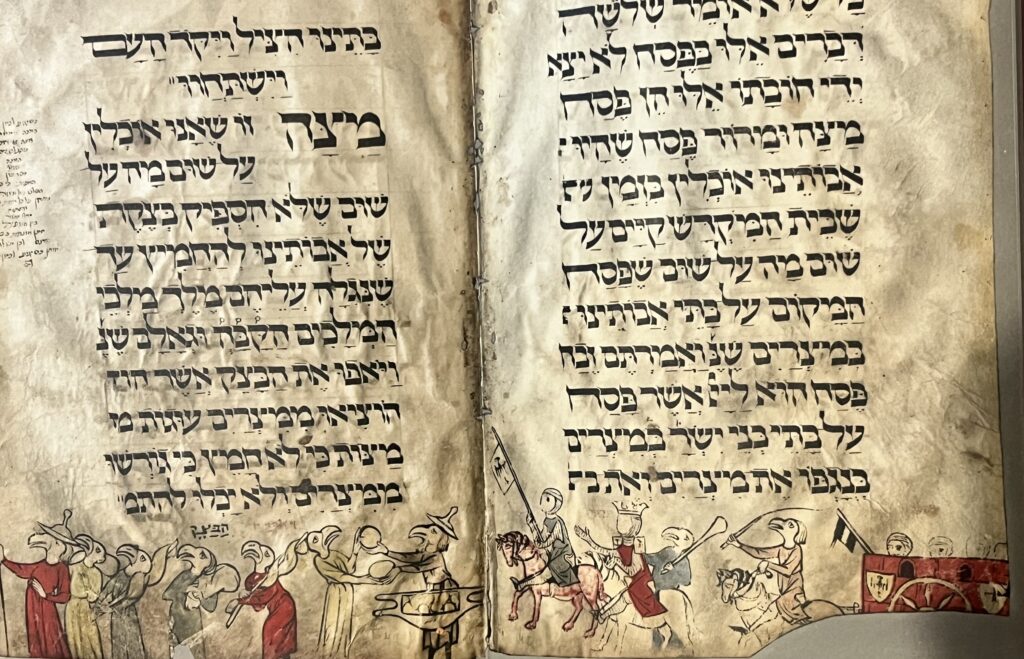
Birds Head Haggadah, Exodus Scene

Epstein critically examines these theories, ultimately adopting a more nuanced position that acknowledges the halakhic dimension without attributing the imagery to a single cause. As discussed in our earlier review, the most illuminating aspect of his analysis is his attention to an anomaly previously dismissed as carelessness. In the Exodus scene depicting the Israelites fleeing and Pharaoh’s army in pursuit, most figures conform to expectations: Israelites with birds’ heads and Egyptians with blank discs. However, two figures in the pursuing army also have birds’ heads. Epstein, prompted by his ten-year-old son’s observation, suggests these figures represent Datan and Aviram, members of the erev rav who chose to remain with the Egyptians. The presence of birds’ heads is intentional, signifying that even the sin of siding with oppressors does not erase Jewish identity. This artistic choice introduces themes of the wicked son, belonging, apostasy, and the potential for return, all of which are particularly resonant in the context of the Seder.

This approach exemplifies Epstein’s methodology: treating anomalies not as errors to be dismissed, but as interpretive keys to deeper meaning.

The Golden Haggadah

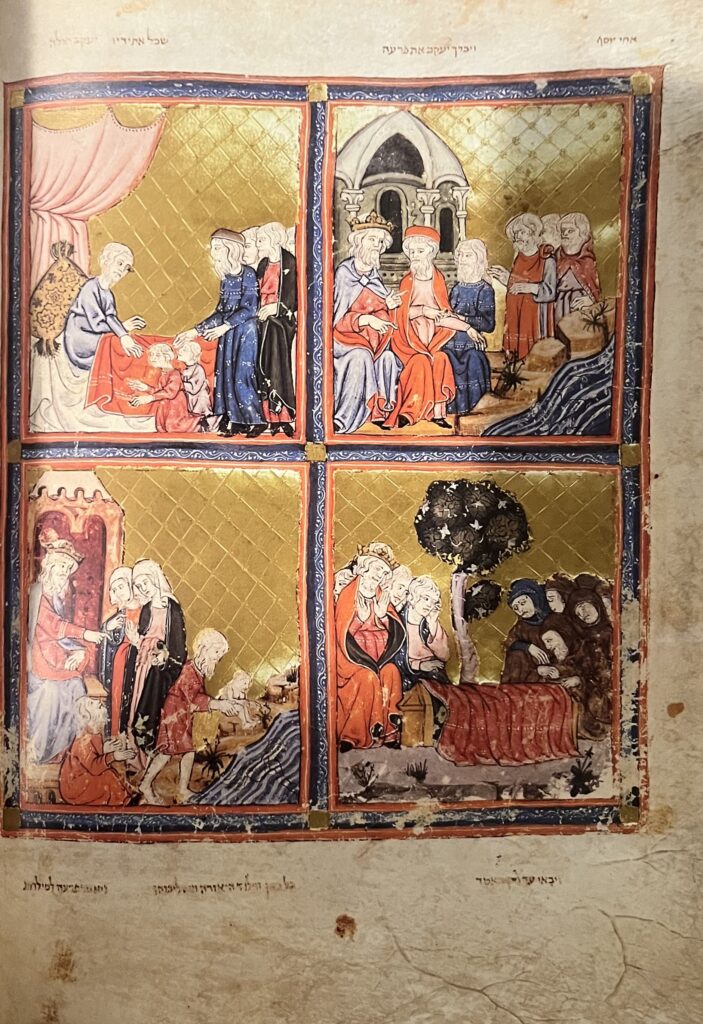
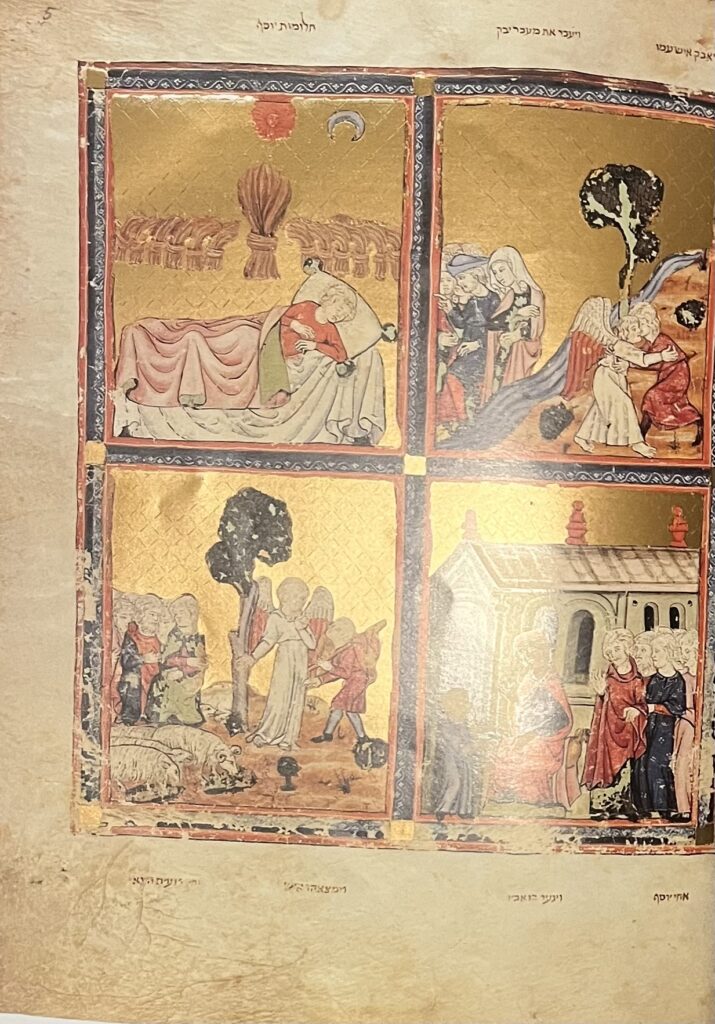
The Golden Haggadah, a Sephardic manuscript from around 1320 distinguished by its extensive use of gold borders and embellishments, illustrates a key structural distinction within the manuscript Haggadah tradition. In Ashkenazic manuscripts, illustrations are integrated throughout the text, appearing in margins and between passages, and typically serve to comment on or extend the Haggadah narrative, such as scenes of Pesach preparations, the search for chametz, or the baking of matzah. In contrast, Sephardic manuscripts concentrate pictorial content before the text in a visual preamble: a series of full-page panels, arranged two or four per page, that trace Jewish history from the patriarchal era or creation through the Exodus, preceding the Haggadah text itself. These images function as a visual overture rather than direct illustrations of the liturgy.

While the Golden Haggadah adheres to Sephardic conventions, Epstein demonstrates that its imagery is more sophisticated than a straightforward chronological sequence. The illustrator establishes a network of visual connections across panels separated by generations, particularly through the motif of water. Water is depicted in scenes such as Jacob before Pharaoh, the drowning of Israelite boys in the Nile, the rescue of infant Moses, and Moses drawing water for Jethro’s daughters. In each instance, the depiction of water, its color, movement, and spatial relationship to the figures, is distinctive and cross-referential, encouraging viewers to interpret these scenes collectively rather than in isolation. The resulting theological argument centers on themes of divine providence, measure-for-measure justice, gratitude, and salvation as continuous threads throughout history. This constitutes visual midrash: interpretive commentary conveyed through imagery, fulfilling the Seder’s purpose of provoking reflection.
 

The Rylands Haggadah, Its Brother, and the Marror That Wasn’t an Artichoke

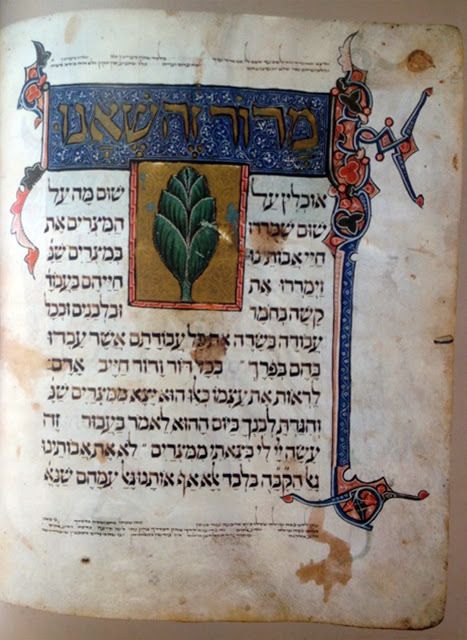
The third and fourth manuscripts analyzed by Epstein—the Rylands Haggadah (currently housed at the John Rylands Library in Manchester) and the manuscript referred to as the Brother to the Rylands—are Sephardic codices discussed together in his work. The term “Brother” was introduced by Bezalel Narkiss due to the notable visual similarities between the two manuscripts; Katrin Kogman-Appel has since argued that the so-called Brother likely predates the Rylands and served as its model. For the purposes of this discussion, both manuscripts represent a shared visual tradition, and the direction of influence is less significant than the insights they collectively provide.

Rylands Brother Haggadah

These manuscripts prompted a particularly instructive methodological episode in recent Haggadah scholarship, which unfolded in real time in the comments section of this blog in 2012 and was subsequently documented by Leor Jacobi. The central question was whether depictions of marror in the Rylands, the Brother, and the Sarajevo Haggadah represent an artichoke. David Golinkin had cited these illustrations as evidence that artichokes were used as marror in medieval Catalonia. Upon encountering this question on Erev Pesach 5772, wrote immediately to Epstein, who replied within the hour:

I don’t believe the Sephardic mss show an artichoke, rather they depict an entire head of romaine lettuce. The way to prove or disprove this would be to compare contemporary or roughly contemporary botanical mss.

When the same identification appeared in a post on this blog, Epstein returned with the fuller statement quoted above — “a manuscript is NOT a mirror” — and added the crucial clarification about representational logic:

Also, because a head of Romaine is SHOWN in the haggadah it doesn’t mean that there was a head of (possible unchecked-for-bugs) Romaine on the table. Every image is not a snapshot, but a representation — a combination of the real, the general, the ideal and the symbolic. Showing the head is a way of REPRESENTING Romaine — it says, “We use a type of lettuce that grows with leaves together in a head like this.” It does NOT necessarily mean “We use complete heads of Romaine at the Seder, like this.”

This logic warrants careful consideration. A manuscript illuminator aiming to depict marror must clearly indicate the species. Depicting the entire head of romaine lettuce—leaves clustered in a recognizable form—serves as an effective visual shorthand for this type of lettuce. Illustrating individual romaine leaves would make them nearly indistinguishable from other leafy vegetables. Thus, the whole head functions as the visual vocabulary for the species, rather than as a literal representation of the serving. The same reasoning applies to artichoke identification: if an artist intended to depict an artichoke, the distinctive globed, thistle-shaped head would be unmistakable. The Sarajevo Haggadah’s depiction of veined leaves bound at the base with a cord, as Epstein observes, aligns with characteristics of lettuce rather than artichoke.

Jacobi’s account adds another layer of insight: Epstein posits that artists of later manuscripts (the Rylands and Brother, likely produced after the Golden Haggadah) may have copied a lettuce image from an earlier model and, interpreting the veined and slightly “spiky” leaves, mistakenly identified it as an artichoke. Patrons did not correct this, as they recognized that artichokes were not used as marror and thus interpreted the image as romaine, regardless of the artist’s intent. These images illustrate the challenges of visual transmission when botanical knowledge is limited, but they do not provide evidence of actual Seder practice beyond confirming that romaine was regarded as the standard marror species in Sephardic communities, a fact already established by textual sources.
Rylands Haggadah

The Barcelona Haggadah introduces additional complexity: its marror illustration appears to have been added by a post-medieval artist who, relying on earlier Haggadah images as models, no longer understood the original intent, resulting in a stylized hybrid that is neither distinctly artichoke nor lettuce. As Evelyn Cohen observes, some manuscripts left the marror space blank, indicating that the image was occasionally tailored to the patron’s local practice. This underscores the non-monolithic nature of the visual tradition and the influence of artist-patron relationships on the final product.


In summary, there is no textual or visual evidence that artichokes were ever used as marror. Romaine lettuce, which becomes increasingly bitter as it is chewed—beginning with a mild taste and culminating in pronounced bitterness at the spine, thus symbolizing the intensification of Egyptian servitude—is far better supported as the intended species and is almost certainly what these images depict.

The Printed Haggadah: The Same Logic

The interpretive methodology applied to medieval manuscripts is equally relevant to the printed tradition.The four foundational printed Haggadot—Prague 1526, Mantua 1560, Venice 1609, and Amsterdam 1695—established a visual vocabulary that influenced nearly every subsequent illustrated Haggadah for centuries thereafter. As we have discussed at length in earlier posts (see here, here, and here), these Haggadot draw from both manuscript precedents and the broader visual culture of their respective eras, exhibiting the same patterns of intentional borrowing and creative transformation observed in medieval manuscripts.

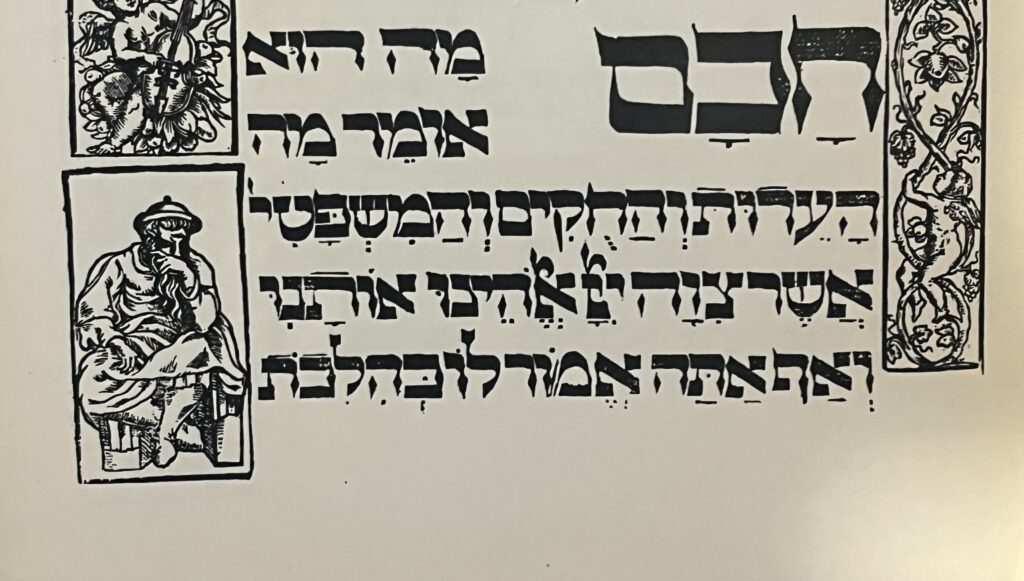
The Mantua 1560 Haggadah, the first illustrated Italian Haggadah, exemplifies this dynamic. Its depiction of the Wise Son is modeled unmistakably on Michelangelo’s prophet Jeremiah from the Sistine Chapel ceiling. However, while Michelangelo’s Jeremiah is bareheaded, the Haggadah’s Wise Son wears the Pileus Cornutus, the conical hat mandated for Jews by Christian law (and likely the beginning of the custom of universal Jewish headcovering). Thus, a figure from the Vatican’s most prominent sacred space is appropriated, marked with a symbol of Jewish social subordination, and reimagined as an embodiment of Jewish wisdom at the Seder table. This reflects both dependence and subversion.
Mantua, 1526, The Wise Son

A similar complexity is evident in the title page’s distinctive helical “barley-sugar” pillars. While these are sometimes attributed to their prominent use at St. Peter’s Basilica, suggesting Christian architectural borrowing, the more probable source is local: the Cortile della Cavallerizza at the Palazzo Ducale in Mantua, designed by Giulio Romano and completed around 1540. The printer Ruffinelli appears to have incorporated these pillars throughout his Mantuan publications as a regional identifier, functioning not as a Christian symbol but as a marker of local identity, akin to a colophon. What may appear as Christian iconography is, in fact, civic geography repurposed as a printer’s device.

Prague Haggadah, Kiddush

The warning against treating images as direct records of practice is relevant here as well. R. Shlomo Hakohen Kook criticized the Prague 1526 Haggadah for depicting the wine cup held in the left hand and grasped by the stem rather than cupped at the base, but both critiques conflate artistic representation with ritual documentation. The left-handed depiction results from the woodcut printing process, which produces a mirror image of the original block; copyists working from printed exemplars, rather than the original block, further reversed the image, consistently yielding left-handed figures. This reflects printing history, not halakhic instruction. The issue of cupping the cup is another anachronism: this practice became widespread only after the publication of the Shelah, which appeared more than a century after the Prague Haggadah. Thus, the woodcut cannot be faulted for omitting a custom that did not yet exist.

What We Can and Cannot Learn

The illuminated Haggadah is a remarkable historical source, but its value depends on the questions posed to it. These manuscripts and early printed books are not objective records of ritual practice; rather, they reflect the choices of communities, shaped by artistic conventions, available models, patron preferences, and the expressive possibilities of the visual vocabulary of their era. When interpreted thoughtfully, they reveal the inner imaginative life of the communities that produced them: their understanding of the Exodus, their self-conception, the theological claims embedded in their liturgical texts, and their engagement with and adaptation of surrounding visual cultures.

This constitutes an exceptionally rich body of evidence, surpassing any attempt to treat the images as mere snapshots of Seder table contents. However, extracting meaningful insights requires art-historical expertise, contextual historical knowledge, and a readiness to embrace interpretive ambiguity—qualities that distinguish the approach exemplified by Epstein from earlier traditions.

Readers who have not yet encountered The Medieval Haggadah: Art, Narrative & Religious Imagination (Yale University Press, 2011) — reviewed here when it appeared here — would do well to remedy that before this Pesach. And to spend a few more minutes at the Seder with the pictures. Additionally, Epstein’s recently released book, People of the Image: Jews and Art,  similarly tackles these topics, including discussions of Haggadah illustrations and, like his The Medieval Haggadah, is among the best in the genre. A review of the book is forthcoming.

Related posts: our 2012 review of Marc Michael Epstein’s The Medieval Haggadah: Art, Narrative & Religious Imagination (here); Leor Jacobi on the artichoke controversy and how to read manuscript marror illustrations (here) and earlier discussions about the vegetable here and here; halakhic implications of Haggadah illustrations (here); and our discussions of the Prague 1526 Haggadah (here here, and here), and for our examination of printed illustrations see “The Mother Haggados: Models for Modern Analysis of Printed Jewish Illustrations.”



Etymologies of the Hebrew Calendar

Etymologies of the Hebrew Calendar

By Dan D.Y. Shapira

Dan (or, Dan D.Y.) Shapira is an Orientalist and grows more than fifty trees on the edge of the Judaean Desert. He’s a Full Professor at Bar-Ilan University.

The month of Nisan begins the Hebrew year. Its name comes, ultimately, from Sumerian nisag (nig, “thing,” + sag (“head/first”), “first fruits” at about the spring equinox, via Akkadian and / or Aramaic. It should be observed that the names of the months in Sumerian were different from those used later in Akkadian.

It is not completely clear whether חודש האביב, “the month of green ears of young barley,” was the name of this month, and not its appellation.

Then comes Iyyar, from Akkadian itiAyari, “blossom.” In the Babylonian calendar its name was Araḫ Āru (Araḫ = yeraḥ, ירח), which also meant “month of blossoming.”

The name of the month Sivan comes from Akkadian simānu, “season; time.”

This word can be the source of Aramaic > Late Biblical Hebrew and Mishnaic and Talmudic Hebrew zeman, זמן. However, this etymology poses a huge historical problem, because of similarity to Iranian zaman, with Avestan (the language of the Avesta, the Zoroastrian holy corpus) zruuan-, “time,” and with the Iranian “deity” Zurvān, the primordial time-space, from whose good thought Ahura Mazda / Ohrmazd, the benevolent actor, and from whose doubt in his own thought Angra Mainyu / Ahriman, the malevolent actor, were “born.”

The evidence in various Semitic languages demonstrates that zeman has different phonetic forms: Aramaic had both zeban and zeman, Syriac Aramaic zabnā, Mandaic Aramaic zaman and zban, Arabic both zamn and zamān, and Ethiopian Semitic languages have zaman, zäbän (Tigre), zämän (Amharic, Tigriñña and Gurage), and Mehri, an indirect continuation of Ancient South Arabian, has both zemōn and zubōn.

The name of Tammuz comes from the Assyrian and Babylonian month Araḫ Dumuzu, named after the Mesopotamian deity Dumuzid, a dying and reviving deity, mentioned in Ezekiel 8:14 (“Then he brought me to the door of the gate of the Lord’s house which was toward the north; and, behold, there sat women weeping for Tammuz”; KJV).

Ab / Av comes from Abu, meaning “reed”; the name מנחם אב is a later invention, because of the calamities of this month and the hope of redemption to occur in this month.

Elul has its name from Araḫ Ulūlu “harvest month” in the Babylonian calendar; in the Babylonian calendar (and in some later calendars derived from it), Ulūlu was used as a leap month (the function of Adār II with the Jews).

Tishrei / Tishri has its name from Akkadian tašrītu, “beginning,” as this month was opening the second half of the year (the verbal root ŠRY exists also in Hebrew and Aramaic). Now we celebrate the יום תרועה as Jewish New Year.

Marcheshvan / Marḥešvan comes from Akkadian waraḫ šamnu, “eighth month”; in Hebrew, the Akkadian name was divided incorrectly into war- > mar- / ḫašamnu > ḫašvan, provided with a Volketymologie (the Bitter Cheshvan).

Kislev, from Babylonian Kislimu, meaning possibly “thick mud,” and associated in Babylon with the cult of Nergal, deity of the Netherworld, plague, and war. In the Jewish tradition, this months is associated with dreams.

Tevet / Ṭēḇēṯ, from Akkadian ṭebētu, the “muddy month.”

Shebat / Shvat (Šeḇāṭ) comes from the Babylonian Šabāṭu, meaning “strike,” and referring to the heavy rains; this is one of the two Babylonian months directly mentioned in the Bible (Zechariah 1:7), besides Adār.

Adār has its name derived from the Babylonian Araḫ Addaru, “month of harvest.”

It is generally assumed that these month names were adopted into the Hebrew calendar during the sixth century BCE Babylonian captivity of the Jews. Month names from the Babylonian calendar appear not only in the Hebrew calendar, but also in the Mandaean, Modern Assyrian, or Syriac, calendar, in the Syriac calendar proper, and in the names of half of the month used in Türkiye and in many Arab-speaking countries (along with Islamic and Gregorian calendars).

In these calendars, for example in the Arabic secular calendar, Tišrīn al-ʾAwwal (the First Tišrīn) stands for October, Tišrīn aṯ-Ṯānī (the Second Tišrīn) stands for November, Kānūn al-ʾAwwal (the First [month of] heating utensil) stands for December, Kānūn aṯ-Ṯānī (the Second [month of] heating utensil) stands for January, Šubāṭ is February, ʾĀḏār is March, Naysān is April, ʾAyyār is May, Ḥazīrān (month of Boar, the Syrius star) is June, Tammūz is July, ʾĀb is August, ʾAylūl is September. These names are based closely on the names in Syriac Aramaic.

In the Bible, several Phoenician-Canaanite month names are used: Ziv, “glow” = Iyyar; Ethanim = Tishrei; Bul = Marcheshvan / Marḥešvan. These names are only mentioned in connection with the building of the First Temple these names may be attributed to the presence of Phoenician scribes in Solomon’s court at the time of the building of the Temple.

There are movements in Lebanon trying to revive the Phoenician Language and Phoenician-Canaanite paganism; they use these months names known from the Bible and from Phoenician and Punic inscriptions, with Pegarim (month of the cult of the dead) for Elul, etc.


How the “Songs of the Day” Were Chosen

How the “Songs of the Day” Were Chosen

By David Farkas*

The morning prayer service concludes with the Song of the Day, the שיר של יום. All of them are taken from Tehillim, the Psalms. The question is, why were these particular Psalms selected for the different days of the week?

This question is squarely addressed by the Gemara. For this reason, understandably, most commentaries to the Siddur that address it simply refer to the relevant passage, and proceed no further. Yet, as we shall see, the matter does not quite end there alone.

The Custom

During the Temple period, when the daily Tamid offering was brought by the Kohanim, the Levites would accompany the service with song while the drink offerings were poured. Which songs? The Mishna in Tamid (7:4) tells us:

הַשִּׁיר שֶׁהָיוּ הַלְוִיִּם אוֹמְרִים בַּמִּקְדָּשׁ, בַּיּוֹם הָרִאשׁוֹן הָיוּ אוֹמְרִים (תהילים כד:א) לַה’ הָאָרֶץ וּמְלוֹאָהּ תֵּבֵל וְיֹשְׁבֵי בָהּ. בַּשֵּׁנִי הָיוּ אוֹמְרִים (מח:ב) גָּדוֹל ה’ וּמְהֻלָּל מְאֹד בְּעִיר אֱלֹקינוּ הַר קָדְשׁוֹ. בַּשְּׁלִישִׁי הָיוּ אוֹמְרִים (פב:א) אֱלֹקים נִצָּב בַּעֲדַת-קל בְּקֶרֶב אֱלֹקים יִשְׁפֹּט. בָּרְבִיעִי הָיוּ אוֹמְרִים (צד:א), קל נְקָמוֹת ה’ קל נְקָמוֹת הוֹפִיעַ וְגוֹ’. בַּחֲמִישִׁי הָיוּ אוֹמְרִים (פא:ב) הַרְנִינוּ לֵאלֹהִים עוּזֵּנוּ, הָרִיעוּ לֵאלֹקי יַעֲקֹב. בַּשִּׁשִּׁי הָיוּ אוֹמְרִים (צג:א) ה’ מָלָךְ גֵּאוּת לָבֵשׁ לָבֵשׁ ה’ֹ’. בְּשַׁבָּת הָיוּ אוֹמְרִים (צב:א) מִזְמוֹר שִׁיר לְיוֹם הַשַּׁבָּת, וכו’.

As one can see, each day a different Psalm was sung, including, in order, Psalms 24, 48, 82, 94, 81, and 93. On Shabbos the Levites would recite Psalm 92, מזמור שיר ליום השבת. This was the custom of the Levites during the times of the Temple.[1]

The selection of Psalm 92 for Shabbos appears relatively straightforward. Though the tannaim debate whether the “Shabbos” refers to Saturday or a future world to come, the connection of the Psalm to some kind of “Shabbos” is apparent on the surface and will not concern us here. But what about the remaining six weekdays? What connection do these Psalms have with the various days of the week?

The Gemara in Rosh Hashana 31a addresses the question head-on:

תניא רבי יהודה אומר משום ר”ע, בראשון מה היו אומרים, לה’ הארץ ומלואה, על שם שקנה והקנה ושליט בעולמו. בשני וכו’ – על שם שחילק מעשיו ומלך עליהן. בשלישי וכו’ – על שם שגילה ארץ בחכמתו והכין תבל לעדתו. ברביעי וכו’ – על שם שברא חמה ולבנה ועתיד ליפרע מעובדיהן. בחמישי וכו’ – על שם שברא עופות ודגים לשבח לשמו. בששי וכו’ – על שם שגמר מלאכתו ומלך עליהן. בשביעי היו אומרים (צב) מזמור שיר ליום השבת ליום שכולו שבת.

It is far from clear what these interpretations mean. Rashi gives an explanation for most of them. Other Rishonim, like Rabbeinu Chananel and Rabbeinu Bechaye (Exodus 29:40) offer additional explanations of the passage, or various nuanced differences of Rashi’s explanations. All, however, base their words on the sparse language of the Gemara.

And yet, an intellectually honest reader must admit, if only to himself, that these explanations seem, upon review, very forced. For example, Rashi explains that the Tuesday Psalm, which opens with the words
אֱלֹקים נִצָּב בַּעֲדַת קל,
was chosen because on this day God exposed the land masses, paving the way for animal and vegetative life and ultimately, for God’s assembly, Israel, which is situated on land. Thursday was selected because when Man sees the myriad species of birds that were created this day, his soul is uplifted, causing him to sing the words הַרְנִינוּ לֵאלֹקים עוּזֵּנוּ.

Can these ideas really be called the theme of the Psalm? Do these Psalms focus on the concepts mentioned by the Gemara, or are the phrases merely mentioned among the other verses? Could not one employ similar methods of drush to read the same concepts into almost any other Psalm?

While not exactly common, commentators will occasionally explain a Mishna differently from the Gemara, if it does not affect practical halacha.[2] Thus, the question must be asked: Is this passage in Rosh Hashana the last word on the subject?

Suggested Explanations – The Traditional Approach

As a matter of fact, it is not. Several attempts have been made to explain the connection between the days and the Psalms, independently of the Gemara. The following is a brief survey of these explanations, the first two of which can be found in a comprehensive book on the subject of the Song of the Day, by R. Peretz Shmuel HaLevi Mantel, entitled שירת שמואל – על אמרת שיר של יום (Bnei Brak 2003).[3]

The Chasam Sofer (R. Moshe Sofer, 1762–1839) in his collected Drashos (Vol. I, p. 12) references the Gemara’s explanations, and finds them “very forced”. ( הנה טעמים שאמר התנא דחוק מאד לכוון דבר יום ביומו). Instead, the Chasam Sofer posits that the seven days represent seven distinct periods of history. The first period was a time when God’s glory filled the earth, hence the Sunday Psalm speaks of לה’ הארץ ומלואה. In the second period wickedness began to prevail, and so God restricted His glory to Jerusalem and the Temple; hence, the Monday Psalm speaks of גדול ה’ ומהולל מאד בעיר אלוקינו הר קדשו . In the third period wickedness extended further and so God restricted his presence to the 4 cubits of halacha, or stated otherwise, to Judges; thus, the Tuesday Psalm speaks of אלוקים נצב בעתת אל בקרב אלוהים ישפוט. In a similar fashion the Chasam Sofer explains the ensuing days of the week – with no attempt to conform to the words of the Gemara.

The Vilna Gaon (1720 – 1797)) in his commentary to Tamid also offers an independent explanation, citing a statement in the Zohar to the effect that each Song of the Day corresponds to a thousand years of the eventual six thousand years the world is destined to endure, the final day of Shabbos referring to a time to come after the initial 6,000 year period. Having established this background, the Gaon adopts a similar approach as the Chasam Sofer in characterizing each thousand-year period, and then finding a reference in the Psalms to that period. Thus, for example, in the third thousand the Torah was given and holiness descended unto the world, hence the reference in the Tuesday Psalm to אלוקים נצב בעדת קל. In the fourth thousand the Temple was destroyed, prompting God to promise revenge, and hence the Wednesday reference to God as קל נקמות.

A problem with this approach, as noted by the aforementioned R. Mantel, is that there is actually no such passage in the Zohar. (In fact, as will be shown presently, the Zohar offers a completely different explanation, at least for the Monday Psalm.) The 6000-year duration of the world is well-known from various Talmudic passages, but there is no known statement connecting the Song of the Day to this tradition. Presumably, R. Mantel suggests, the Gaon was referring to Rashi’s statement in Avoda Zara 9a that “the six thousand years correspond to the days of the week, and Shabbos refers to the calm that will befall the world in the seventh thousand.” This statement, however, makes no connection whatsoever to the Songs of the Day.

In addition to the foregoing explanations, one can also find other suggestions that do not truly accord with the passage in Rosh Hashana. Some, like R. Tzadok HaKohen of Lublin (1823 – 1900) ostensibly make efforts to work their suggestions into the words of the Gemara, but it is quite apparent that they are really offering their own interpretations. The unique style of R. Tzadok makes his words sometimes difficult to understand, and almost impossible to translate, without copious explanatory notes. The interested reader is referred to the article שיר של יום בתורת ר’ צדוק הכהן by R. Yishayahu Hadari (סיני # נג, תשכ”ג עמודים עה-צא).

Finally, there are also individual explanations that, although structured to appear merely as commentary to the above Gemara, a close reading shows they are really the commentator’s own explanations. The Ben Ish Chai, for example, states that the Sunday Psalm is auspicious (a סגולה) for one’s livelihood, which is why it is recited communally after the evening prayers on Rosh Hashana and Yom Kippur. Thus, the first day of the working week is appropriate for its recitation. The Zohar (Vayikra 56b Margolios ed.) states that the Monday Psalm was selected for the second day because the sons of Korach who authored it sing for their brothers doomed to sit by the entrance of hell, which was created on the second day.[4] Rabbeinu Bechaye (Ibid.) asserts that the Thursday Psalm was selected because it speaks of God redeeming us from Egypt, and we find Biblical comparison of Pharoah to a crocodile; hence, the Psalm is recited on Thursday, the day such creatures were created.[5] As one can see, none of these explanations are actually founded on the words of the Gemara.[6]

From the foregoing, it is apparent that the passage in Rosh Hashana, though it looms large over all discussion on the topic, is not necessarily the last word. Even the greatest of Rishonim and Achronim have offered alternative explanations. Yet, while they are not based on the Gemara that actually addresses the question, all these explanations are still based on other Gemaras or Midrashim that seem to bear on the topic. However, there is another approach that must be explored as well.

The Non-Traditional Approach

The Bar Ilan University publishes a weekly D’var Torah, under the auspices of the official campus Rabbi. In a short, 2-page article for the 2008 edition of פרשת בחוקתי, Dr. Rachel Reich observes the following: In each of the Psalms for the week, the name of God appears in the numbered word associated with the day.

That is, the brief note of introduction to the Psalm (the כותרת, i.e, לדוד מזמור, מזמור לאסף, etc.) should be set aside, focusing only on the actual Psalm itself. On Sunday, the opening phrase is לה’ הארץ ומלואה – the name of God for the first day appears as the first word. On Monday, the Psalm begins גָּדוֹל ה’ וּמְהֻלָּל מְאֹד – again, the name of God for the second day appears as the second word. On Tuesday the phrase is אֱלֹהִים נִצָּב בַּעֲדַת-קל, the name of God again appears as the hyphenated third word for the third day. On Wednesday אֵל נְקָמוֹת ה’ קל נְקָמוֹת הוֹפִיעַ it appears as the fourth word for the fourth day. On Thursday it is הַרְנִינוּ לֵאלֹהִים עוּזֵּנוּ, הָרִיעוּ לֵאלֹקֵי יַעֲקֹב, the fifth word for the fifth day, and on Friday we have ה’ מָלָךְ גֵּאוּת לָבֵשׁ לָבֵשׁ ה’ֹ again, the name of God appears as the sixth word, on the sixth day.

This explanation is so simple and straightforward that one might perhaps doubt it for that reason alone. It can’t be that simple! And indeed, Dr. Reich herself acknowledges several problems with this solution. For one, these are not the only Psalms that have God’s name in the right spaces. For example, in Psalms 3 and 8 God’s name appears as the first word. In Psalm 9 it is the second word. Why, then, should these particular Psalms have been chosen among the others? It might also be noted that in some of these Psalms, the name of God also appears prior to the appearance under the word corresponding to the correct day. These indeed represent problems with the proposed solution.[7]

In an article I came upon years after writing this article, Rabbi Dr. Raymond Apple also cites Dr. Reich’s explanation.[8] While acknowledging the suggestion to be ingenious, Dr. ApplDe finds the suggestion too mechanical, and thinks it doubtful that the priests and poets of the First and Second Temples favored such “artificial devices.” Dr. Apple concludes, “There is no clear reason why particular psalms were designated to be recited on different days of the week” and “the reason why they were originally chosen remains a mystery.”[9]

Nevertheless, I believe Dr. Reich has hit upon the truth. Some might say that the very simplicity of the solution is itself the best indication of its truth.[10] Certainly, this explanation is not radically different from other Mishnayos that are explained by the Gemara by way of numerical explanations, such as gematriyos. The Mishna in Nazir (1:3) for example, positing thirty days as the default length of Nezirus, or Shekalim (1:3), requiring Kohanim to also contribute the annual half-shekel, are each explained by the Bavli and Yerushalmi respectively to be based on Gematrias of the word יהיה and זה. Thus, methodologically speaking, attributing an ancient practice to a numeric basis, even when the source Mishna doesn’t say so explicitly, is perfectly sound.

However, I also believe Dr. Reich is correct because there are other Talmudic passages that I think take the matter beyond doubt. Further, I do not think the questions she herself asks are problematic, and to the contrary, I think they work hand in glove together with the passage in Rosh Hashana to give us the complete picture we need.

Synthesis

A clue to the ultimate resolution lies, I believe, in how the Psalms are identified both in the Mishna and in the Gemara. Notice that each Psalm is identified only by the first line in the Psalm. Psalms are not always so identified in Rabbinic literature. In fact, they are often referred to by their nicknames: Thus, for example:

  • Psalm 91 is referred to as שיר של פגעים, ויש אומרים שיר של נגעים (Shavuos 15a).
  • Psalm 136 is referred to as הלל הגדול. (Taanis 19a).
  • 145 is referred to as אשרי, a word not actually part of the Psalm. (Brachos 4a)

In other words, Psalms are sometimes referred to by nicknames that reflect their character. By marked contrast, then, in the Mishna of Tamid and the Gemara of Rosh Hashana, where no character-defining name is given, and where the Psalm is identified only by the first line, we can infer that it is indeed only the opening line of the Song that is significant, because of the placement therein of God’s name.[11]

The clincher, though, I believe, comes from a passage at the end of Sukka (55a). There we find as follows:

תניא בחולו של מועד בראשון מה היו אומרים (תהלים כט:א) הבו לה’ בני אלים בשני מה היו אומרים (נ:טז) ולרשע אמר אלהים בשלישי מה היו אומרים (צד:טז) מי יקום לי עם מרעים ברביעי מה היו אומרים (צד:ח) בינו בוערים בעם בחמישי מה היו אומרים (פא:ז) הסירותי מסבל שכמו בששי מה היו אומרים (פב:ה) ימוטו כל מוסדי ארץ ואם חל שבת באחד מהם ימוטו ידחה.

In this passage the Gemara details the Psalms the Levites would sing during the Chol HaMoed service. But when referring to the relevant Psalm, the Gemara identifies it specifically by the verse within the Psalm that is alluded to. Again, contrast this with our Mishna and Gemara, which both only identify the Psalm by the first verse. This is especially apparent in the Thursday and Friday Psalms (81 and 82) which are mentioned both in this Chol HaMoed passage, and in the Song of the Day passage with which we began. They thus make for a clear contrast: For purposes of Chol HaMoed, they are identified by specific verses within the Psalm; but for the Song of the Day, they are identified only by their first verse. Thus, it is apparent that the Song of the Day was selected because of something in, and only in, the first sentence. Thus, one may be justified in thinking that the placement of the name of God in the first sentence is indeed the reason these Psalms were selected.[12]

The sole remaining question then, is why were these particular Psalms chosen, when there are other Psalms that also have God’s name appearing on the first or second or third word? It is here where the Gemara’s explanation comes in. If we are correct, then R. Akiva, the author of the passage in Rosh Hashana, almost certainly understood that the reason these Psalms were chosen was for the simple and easily-grasped reason that God’s name was said at the right point, exactly as posited by Dr. Reich. (There may even have been some kind of musical way of underscoring this point to the pilgrims gathered in the Temple.) But why those Psalms more than any other Psalm in which the name appears on the right word? It is because of the underlying reasons explained in the passage. Because, asכתבי קדש , the Psalms contain layers of inspired meaning, and R. Akiva saw the connection between these Psalms and the items created on the days in which they were to be read.

In short, what emerges from all this is that R. Akiva’s explanation in the Gemara is drush to the halacha embodied in the Mishna. The halacha of what song to sing is based on the simple and straightforward reason of where the name of God appears in the Psalm. Stated otherwise, perhaps, the halacha looks at the exterior form and format of the Psalm. The drush behind it, by contrast, explains why these Psalms were selected out of a number of other possibilities. By focusing on the character of the day, as reflected in the items created on the various workdays, it looks to the inner meaning, rather than the exterior. The halacha and the drasha come together, like the voices of the Levites themselves, in perfect harmony.[13]

*David Farkas is an attorney in Cleveland. His notes on the Talmud Bavli were recently published by Machon Aleh Zayis as HaDoresh Vi-HaMivakesh.

  1. Even today the custom continues, see Rambam סדר תפלות כל שנה (Warsaw-Vilna Ed.) stating: נהגו מקצת העם לקרוא בכל יום אחר תחנונים אלו שיר מזמור שהיו הלוים אומרים בבית המקדש באותו היום.The custom of the formal declaration preceding the actual Psalm, היום יום פלוני של שבת, entered the Siddur, like certain other customs, by way of the Kitzur Shla, and appears to be based on the comments of the Ramban in Shemos (20:7) urging the daily mention of Shabbos. See סדור עליית אליהו.
  2. See the comments of Tosfos Yom Tov to Nazir 5:5 אף על פי שבגמרא לא פירשו כן, הואיל לענין דינא לא נפקא מינה ולא מידי, הרשות נתונה לפרש וכו’.. The comments of Tosfos Yom Tov are actually based on the interpretation of Rambam there, and both are cited approvingly by Rashash to Pesachim 74a, who states “וכבר הרשנו הרמב”ם בפרק ה’ דנזיר משנה ה’ לפרש משנה נגד הגמרא היכא דליכא נפקותא לדינא, עיין שם בתוי”ט ועיין מה שכתבנו בברכות מ”ט ב במשנה שגם הגר”א ז”ל עשה כן.”
  3. This book was also cited by Eliezer Brodt on Seforim Blog here, https://seforimblog.com/2009/09/source-for-recitation-of-ledovid/ and see also Dan Rabinowitz’s article here https://seforimblog.com/2006/09/custom-of-reciting-ldovid-hashem-ori.
  4. See Shemos Rabbah (15:22)
  5. See Ezekiel 29:3 הִנְנִי עָלֶיךָ פַּרְעֹה מֶלֶךְ מִצְרַיִם הַתַּנִּים הַגָּדוֹל הָרֹבֵץ בְּתוֹךְ יְאֹרָיו. (I have translated תנים הגדול as “crocodile”. It might also be translated as serpent or sea monster.)
  6. The alternative explanations cited in this paragraph are all mentioned by R. Mantel in his comprehensive book mentioned above.With brilliant insight, R. Yechezkel Katzenelbogen (1667-1749) in שו”ת כנסת יחזקאל ס’ קט posits that the Tannaitic debate in the Gemara alluded to above over the meaning of the Song for Shabbos hinges upon whether or not King David, as the author of the Psalms, intended the selected Psalms to be associated with the various days of the week, or the Levites merely selected them based on their own interpretation of them. R. Yechezkel’s understanding is based on a very fine reading of the text, which, unfortunately, would require background well beyond the scope of this inquiry.
  7. Dr. Reich, after acknowledging these difficulties, concludes her article with a sincere request, “אם ידע מישהו להציע הסבר אחר לבחירת מזמורים המכונים שיר של יום, תבא עליו ברכה.” And indeed, the Dvar Torah drew a response several weeks later, in the פרשת נשא edition of the Bar Ilan weekly, from Dr. Gavriel Cohen. In addition to pointing out the significant flaw that Dr. Reich failed to mention the Gemara in Rosh Hashana, Dr. Cohen also notes that others had addressed the issue as well. It is from Dr. Cohen’s letter that I learned of Rabbi Mantel’s sefer, as well as the above-mentioned article of Rabbi Hadari. Dr. Cohen’s letter also references an explanation of Meir Hillel Ben Shammai, in a 91-page monograph entitled שיר של יום בעבודת התמיד. Ben Shammai claims, based on a reading of I Chronicles (16:7-36) that the Psalms mentioned in the Mishna were not exclusive, and in fact, the Levites would often change them to whatever they felt was appropriate This monograph, however, also fails to cite the Gemara (or any other commentator) on the topic, and I found it speculative and unconvincing.
  8. Jewish Bible Quarterly, Vol. 42, no. 2, April-June 2014.
  9. Id. Interestingly, Dr. Appel also cites the explanation of the Zohar, but without a source. As mentioned above, there actually isn’t any source for this Zohar. He does, however, cite secondary sources, Biurei Ha-Gra and Kehati to the Mishna in Tamid we began with.
  10. See various encyclopedia entries for the logical principle known as Occam’s Razor.
  11. To be sure, Rashi’s explanation of the passage too, perhaps based precisely on the above point, also focuses on the first line. However, the forced nature of Rashi’s interpretation still exists, and it is clear from other commentators cited above (including Maharsha on the passage) that they felt the explanation of the Gemara rests also upon other verses later in the Psalm.
  12. In a passage just before the passage we opened with in Rosh Hashana, the Gemara also refers to the Thursday Psalm (81) as הסירותי מסבל שכמו and not by citing the first verse. However, the Gemara there is referring to the second half of the Psalm, and thus the point is not as strong as the Chol HaMoed passage in Sukkah.
  13. I thank Dr. Eliezer Brodt for his review of this article and all the Torah I have learned from home over the years. Dr. Brodt drew my attention to the sources in fn.3, and also adds the following: על הנושא כולו ראה: יעקב שפיגל, ‘דרך קצרה בלשון תנאים ועל פשט ודרש במשנה’, אסופות ד (תש”ן) עמ’ ט-כו; חנן גפני, ‘פשט ודרש במשנה: לגלגוליה של מסורת מבית מדרשו של הגר”א’, סידרא כב (תשס”ז), עמ’ 5-19; הנ”ל, פשוטה של משנה


Were the Ba’alei Tosafos Familiar with Aesop or Buddhism?

Were the Ba’alei Tosafos Familiar with Aesop or Buddhism?

By Rabbi Akiva Males

I – The European Cheder Rebbi and the Ba’alei Tosafos[1]

While completing my Kollel studies in the early 2000’s, I took part in a well-run teacher’s training program. During one session, a noted Jewish educator shared the following first-hand experience: In speaking with an old-school European cheder rebbi years earlier, he asked that rebbi how he shared positive reinforcement with his young charges. The rebbi was confused by the question, so our instructor re-phrased it. This time, he asked the older rebbi how he dealt with students who misbehaved. With a heavily-accented Yiddish he responded matter-of-factly, “I give patsh”. A bit taken aback, our instructor followed up by asking that rebbi what he did when his students had done something right. Surprised by the question, the older man responded, “I don’t give patsh.”[2]

The lesson conveyed to our group of aspiring young educators was that a lack of punishment should never be seen as a replacement for rewarding good behavior. I fondly recalled that humorous incident as I prepared my Shabbos Derasha for Parshas Toldos 5786 / 2025. While looking over that week’s Torah portion, I chanced upon a remarkable explanation offered by the Da’as Zekeinim mi-Ba’alei Tosafos[3] which seemed to mirror the remarks of that old-school cheder rebbi.

In Bereishis 26:26, we find that not long after having expelled Yitzchak Avinu from his locale (Ibid. 26:16-17), Avimelech – king of the Pelishtim – had a change of heart. Together with his military leadership, he approached Yitzchak interested in entering into a peace treaty. Taken aback by Avimelech’s offer, Yitzchak expressed his surprise. In explaining himself, Avimelech commented (Ibid. 26:29) on how nicely he and his people had previously treated Yitzchak: “וכאשר עשינו עמך רק טוב ונשלחך בשלום – and as we have done with you only good, and we sent you away in peace”.

Avimelech’s words are startling. By all measures, Yitzchak had been terribly mistreated by Avimelech and the Pelishtim. After his people destroyed the vital wells which had been previously dug by Yitzchak’s father Avraham, Avimelech himself ordered the expulsion of Yitzchak and his family from his lands (Ibid. 26:15-16). How could such actions be described as, “we have done with you only good, and we sent you away in peace”?!

In order to explain Avimelech’s seemingly bizarre statement, the Da’as Zekeinim mi-Ba’alei Tosafos (Ibid. 26:29) offers a wonderful parable:

משל לארי שהיה לו עצם בגרונו. אמר כל מי שיבא ויטלנו יעשרנו המלך עושר גדול. בא עוף אחד ששמו אגרון שצוארו ארוך. אמר, אני אטלנו. הכניס העוף ראשו בגרון הארי והוציא העצם. לאחר שהוציאו שאל שכרו. אמר לו הארי, לא דייך ששלחתיך בשלום ולא אכלתיך כשהכנסת ראשך בגרוני, אלא שעדיין אתה שואל שכר?! כך אמר לו אבימלך ליצחק, חסד גדול עשינו ממה ששלחנוך בשלום, כי דרכנו להזיק כל הבא.

A parable can be made to a lion who had a bone stuck in his throat. He proclaimed, “Anyone who comes and removes it will be greatly enriched by the king!” Along came a bird named Agron[4] that had a long neck and said, “I will extract it.” The bird inserted its head into the throat of the lion and removed the bone. After he extracted it he asked for his reward. The lion responded, ‘Is it not enough that I sent you off in peace, and I did not eat you when you placed your head in my throat? Now you still ask for a reward?!’ This is what Avimelech said to Yitzchak, “We behaved with great kindness by sending you away in peace – as we normally harm all who enter our locale.”

According to the Ba’alei Tosafos, Avimelech truly felt that he had behaved compassionately with Yitzchak. How so? He normally treated foreign visitors in a more brutal fashion. Thus, in Avimelech‘s mind expelling Yitzchak – in a way which did not hurt him – qualified as having acted in a manner that was “only good”, and that he had in fact sent Yitzchak away in peace. I grinned as I thought of the old-school cheder rebbi who confused his “not giving patsh” with actively rewarding his students for their good behavior.

II – Aesop’s Fables and Buddhist Texts

It soon hit me that there was something about the Ba’alei Tosafos’ parable which I recognized. The more I thought about it, the story of a long-necked bird who plucked a bone out of the throat of an ungrateful predator seemed familiar to me. Where had I seen / heard this story before?

After conducting some online research, I was shocked to discover a tale in Aesop’s Fables[5] entitled, “The Wolf and the Crane.” Here is that short story as translated by George Fyler Townsend:[6]

A Wolf who had a bone stuck in his throat hired a Crane, for a large sum, to put her head into his mouth and draw out the bone. When the Crane had extracted the bone and demanded the promised payment, the Wolf, grinning and grinding his teeth, exclaimed: “Why, you have surely already had a sufficient recompense, in having been permitted to draw out your head in safety from the mouth and jaws of a wolf.”

The moral of the story according to Townsend: “In serving the wicked, expect no reward, and be thankful if you escape injury for your pains.”[7]

The striking similarities between the parable of the medieval Baalei Tosafos and that of Aesop left me quite confused. After all, Aesop told his stories in ancient Greece nearly 1,800 years earlier than the Ba’alei Tosafos had flourished in France. In order to explain a difficult passage in Parshas Toldos, had the Ba’alei Tosafos borrowed this tale from Aesop?

I paused to better understand what troubled me. After all, Jewish tradition encourages us to accept wisdom from outside sources. For example, our Sages taught in Pirkei Avos (4:1): “איזהו חכם? הלומד מכל אדם – Who is wise? One who learns from all men.” The Sages again taught in Midrash Eicha Rabbah (2:13): אם יאמר לך אדם יש חכמה בגוים תאמין” – Should someone say to you that there is wisdom among the nations, believe him.” Finally, in his introduction to his Shemoneh Perakim, Rambam – who was well known for his openness to Greek wisdom – famously expressed: “שמע האמת ממי שאמרה – Listen to the truth from whoever said it.”

Nonetheless, I had a hard time believing that the Ba’alei Tosafos had applied those aphorisms to use one of Aesop’s parables in their commentary to Parshas Toldos. After all, were the Ba’alei Tosafos known to be as comfortable as Rambam in employing ancient Greek wisdom in service of their Torah learning? Even if they were, to my knowledge, Aesop the storyteller was never grouped together with the famous philosophers, scientists, and naturalists of classical Greece. Is there any indication that Aesop’s Fables were viewed by our Rishonim as an important font of wisdom?

While I considered all this, my research soon revealed that a nearly analogous version of this same parable exists in Far Eastern traditions. I learned of a work in Buddhist literature known as the Jataka Tales. That text is a collection of stories – each containing a moral lesson – of what the Buddha said he experienced in previous lives. I was surprised to discover one of those stories known as the ‘Javasakuna Jataka’. In that tale, the Bodhisatta (i.e. the one who would eventually become the Buddha) was a woodpecker. It reads as follows:[8]

The Bodhisatta was once a woodpecker. One day he saw a lion suffering and asked what ailed it. The lion answered that a bone was stuck in his throat, causing him pain and preventing him from eating anything. After the lion promised not to eat him, the Bodhisatta agreed to help. But not entirely trusting the lion, he propped his mouth open with a stick for added safety before poking his head in to dislodge the bone. Then he kicked out the stick and flew away into a tree without a word of thanks from the lion.

Sometime later, the Bodhisatta saw the lion eating a wild buffalo. He flew onto a tree branch nearby and asked if he could get something for saving the lion’s life. The lion told him that not eating him when he had the chance was sufficient reward.

I now felt completely flummoxed. How was one to make sense of the Ba’alei Tosafos proposing a parable to explain a difficult verse in Parshas Toldos – when that parable was nearly identical to a much earlier Buddhist teaching? (After all, Buddhism can be traced back to the sixth or fifth century BCE[9] – which would make Aesop and the Buddah almost contemporaries.) Putting aside the question of using Aesop’s Fables, it seemed entirely unreasonable to imagine that the medieval French Ba’alei Tosafos had any familiarity with Far Eastern Buddhist texts.

Additionally, I had discovered three nearly identical versions of the same parable. Considering the numerous startling similarities they each shared, it seemed too unlikely for them to be unrelated. However, considering the vast distances in geography, culture, and time which separated all three, how could their commonality be explained?

III – The Jewish Origins of the Ba’alei Tosafos’ Parable: Two Possibilities

After some more research I became confident that the source of the Ba’alei Tosafos’ parable was found on the shelves of their own Beis Medrash. At least two Jewish texts contain the same parable employed by the Ba’alei Tosafos. Of those two sources, one was contemporaneous and the other was of much older vintage.

Berechiah ben Natronai ha-Nakdan[10] (Hebrew: ברכיה בן נטרונאי הנקדן) was an acclaimed Jewish writer, grammarian, translator, poet, and philosopher. Scholars believe he lived in 12th or 13th century England or France (or both). He is best-known for his work entitled Mishlei Shu’alim (“Fox Fables”).[11]

Although it is now little-known, Mishlei Shua’lim was once quite popular. According to Dr. Anchi Ho (a program specialist in the African and Middle Eastern Division of the Library of Congress):

Fox fables were a popular genre in his day, and scholars have noted that Berechiah could have drawn his fables from any number of existing collections, including the Aesop’s Fables then circulating in various vernaculars or the French fox fables written closer to his own time by Marie de France. Berechiah did not so much make up his stories as render them in Hebrew for a Jewish audience.[12]

In his introduction, Berachiah readily states that he collected many valuable parables from other cultures and languages. After adding Jewish themes, rhymes, and poems to those parables he produced a unique work filled with ethical and moral lessons. Though the makeup of his book seems rather unusual for his era and locale, until modern times, Berachiah’s Mishlei Shua’lim was readily found in Jewish libraries and homes throughout Europe.

Parable number eight in Mishlei Shu’alim is entitled: זאב ועגור / The Wolf and the Crane – the exact same appellation used by Aesop for his fable involving identical creatures. While Berachiah’s version of that parable is far more verbose than Aesop’s (it is nearly four times longer), it shares the very same story and moral lesson. As such, it seems clear that Aesop – who preceded Berachiah by over 1,500 years, was the source for the eighth parable found in Mishlei Shu’alim.

One could posit that when commenting on Avimelech’s strange choice of words in Parshas Toldos, the Ba’alei Toasafos readily recalled the parable of the wolf and the crane found in Mishlei Shu’alim. Realizing that story could beautifully explain the verses in question, they employed Berechiah ha-Nakdan’s parable. Unfamiliar as they may have been with Aesop’s Fables, by making use of Mishlei Shu’alim, the Ba’alei Toasafos unknowingly enshrined one of Aesop’s tales into their commentary to the Torah.

However, there is a second – and much older – authentically Jewish text where the Ba’alei Toasafos’ parable can be found. See Midrash Bereishis Rabbah (64:10), where it is recorded that the Sages – living over a thousand years earlier than the Ba’alei Tosafos – utilized that very story, and even connected it to the same Biblical verses in Parshas Toldos.

Before we see the parable as recorded in the Midrash, the context in which it was taught is crucial for our discussion. According to that Midrash, at some point following their destruction of the second Beis HaMikdash, the Roman Empire had a change of heart, and granted the Jews permission to rebuild their temple in Jerusalem. Upon hearing this news, our ancestors in the Holy Land were ecstatic. They quickly began making great preparations to accommodate the anticipated return of their exiled brethren.

Soon, however, the Samaritans – who had long caused problems for their Jewish neighbors – strongly petitioned the Roman government to cancel their earlier allowance. The Romans sided with the Samaritans and reneged on their short-lived permissive proclamation.

With their hopes now dashed, the Jewish people were understandably devastated. In their frustration, some began talking of rebelling against the Romans once again. Knowing what the terrible outcome of such an effort would certainly be, the Sages sought to calm the Jewish zealots who were considering this uprising.

The Midrash reports that the Sages felt that the great Rav Yehoshua ben Chananya was capable of speaking to and calming his aggrieved countrymen before it was too late. He was dispatched on this crucial mission, and he shared the perfect message with the people who most needed to hear it. Rav Yehoshua succeeded by means of the following parable:

ארי טרף טרף ועמד עצם בגרונו. אמר כל דאתי מפיק ליה אנא יהיב ליה אגריה. אתא הדין קורא מצראה דמוקרה אריך, יהיב מוקריה ואפקיה. אמר ליה הב לי אגרי. אמר לו זיל תהא מלגלג ואומר דעלת לפומא דאריה בשלם ונפקת בשלם. כך דינו שנכנסנו לאמה זו בשלום ויצאנו בשלום.

A lion tore its prey and a bone became stuck in its throat. He said: “Anyone who extracts it, I will give him a payment.” An Egyptian koray [bird] with a long neck[13] came, inserted its neck, and removed it. It said to him [the lion]: “Give me my payment.” He [the lion] said to it: “Go, boast, and say that you entered the mouth of a lion in peace and emerged in peace.” Likewise, it is sufficient that we entered into dealings with this nation in peace, and departed in peace.[14]

Using this parable, Rav Yehoshua ben Chananya successfully calmed his kinsmen. He validated their feelings of immense frustration and expressed his agreement that they were in fact owed recompense by the Roman Empire. At the same time, he reminded them of their opponent’s brutal nature. Considering that track record, it would be wise to take note of their well-being and view that as compensation of sorts.

The Midrash states that this parable can be used to explain Avimelech’s seemingly strange statement in Bereishis 26:29. Based on his normally violent behavior, in a sense, he really had done good for Yitzchak when he sent him away in peace.

One could argue that after taking note of Avimelech’s odd choice of words in Parshas Toldos, the Ba’alei Toasafos recalled the Midrash’s parable of the lion and the long-necked bird. Realizing that tale could perfectly explain the verses in question, they made use of it as well. If Rav Yehoshua ben Chananya’s teaching from the Midrash was the source of the Ba’alei Toasafos’ parable, it follows that nothing from Aesop’s Fables was inadvertently included in their Torah commentary.

IV – Which Jewish Text Was the Most Likely Candidate?

We have seen two Jewish texts from which the Ba’alei Tosafos could have sourced of their parable. For the following four reasons, I believe that the Ba’alei Tosafos’ parable was based on the Midrash Rabbah and not on Mishlei Shu’alim:

  1. Length and style of the parable: The Midrash’s version of this parable is only forty-nine words long. It is concise and to the point. Similarly, the length of the story recorded by the Ba’alei Tosafos is just sixty-nine words. Like the tale found in the Midrash, the Ba’alei Tosafos’ parable is also written in a straightforward fashion. In stark contrast, with a word count of two hundred and ninety-four (not including an additional poetic moral lesson), the parable found in Mishlei Shu’alim is extremely verbose. Furthermore, unlike the Ba’alei Tosafos’ parable, Berachiah’s tale is a winding elaborately rhyming poem.
  2. The animals involved: The parable taught by Rav Yehoshua ben Chananya in the Midrash Rabbah involved a lion and a long-necked bird. It was precisely those same two animals which were the key figures in the Ba’alei Tosafos’ version of the story.However, the predatory animal in Mishlei Shu’alim’s parable was a wolf – not a lion. In fact, the two animals involved in Berachiah’s tale were a wolf and a crane – the very same creatures in Aesop’s version of the story.
  3. Use as Biblical commentary: Midrash Rabbah serves as a running commentary on the Torah. Rav Yehoshua ben Chananya‘s parable of the lion and the long-necked bird was specifically cited by the Midrash to explain Shemos 26:29. In order to make sense of Avimelech’s strange choice of words, the Ba’alei Tosafos used that same tale in their commentary to that very verse. Mishlei Shu’alim, however, shares that parable completely unconnected to any Biblical narrative. It is not used in the context of offering any commentary on the Torah.
  4. Likelihood of familiarity: Mishlei Shu’alim was penned by a contemporary of the Ba’alei Tosafos. With the advent of the printing press still a few hundred years away[15], that work was only available in manuscript form. Copying such texts by hand was a laborious process. As such, it would take time for handwritten editions of Mishlei Shu’alim to spread across Europe. One can imagine that during the period of the Ba’alei Tosafos, they were far more familiar with a classical Jewish text – such as the Midrash Rabbah – than they were with an unusual new work like Mishlei Shu’alim.

Thus, the Ba’alei Tosafos’ parable seems to have been based on a lesson they knew from the Midrash Rabbah rather than on a tale in Mishlei Shu’alim. As such, it was Rav Yehoshua ben Chananya’s teaching in the Midrash – and not Aesop or a Buddhist text – that was the basis of the Ba’alei Tosafos’ parable.

V – The Need for Further Clarity

I now felt confident that the Ba’alei Tosafos had drawn their parable from a much earlier – and authentically – Jewish source. I realized, however, that I had only kicked the proverbial can down the road. After all, Rav Yehoshua ben Chananya’s parable – as found in the Midrash Rabbah – was taught to quell a would-be-rebellion against Rome after the destruction of the second Beis HaMikdash. That places his teaching of this parable at some point after the year 70 CE.

However, as we have seen, that same parable was shared by both Aesop and Buddhism some 500-600 years before the incident recorded in our Midrash. That being the case, I wondered about the originality of what Rav Yehoshua ben Chananya taught. In the spirit of the Sages’ earlier cited teachings in Pirkei Avos and Midrash Eicha Rabbah about being open to foreign wisdom, might he have borrowed his parable from the works of Aesop or Buddhism? On the other hand, based on what I shared in Part II regarding the Ba’alei Tosafos, it seems just as unreasonable to claim that Rav Yehoshua ben Chananya had based his parable on either of those earlier sources.

VI – The Spread of Jewish Teachings in the Ancient World – Approach A

I would like to present two approaches which can explain how this parable is of authentic Jewish vintage.

In 1995, I had the good fortune of spending close to six months furthering my Yeshiva studies in Jerusalem. While there, I discovered that Ohr Somayach – a nearby Yeshiva catering to English speaking men beginning their Jewish journeys – had an extensive Torah tape cassette lending library. While looking through their offerings, I was pleasantly surprised to find several tapes of question-and-answer sessions that had been led by Rabbi Simcha Wasserman, zt”l.[16] I borrowed them and quickly discovered that they contained a treasure trove of information.[17]

During one of those recorded sessions, a recent arrival to the Yeshiva posed the following question to Rabbi Wasserman: Prior to exploring his Jewish identity and finding his way to Israel, he had spent a significant amount of time in the Far East. While there, he immersed himself in the culture and study of various Eastern religions. The young man expressed his surprise at the similarity between several of the moral lessons he had imbibed in the Far East and some of the ancient Jewish wisdom he was now studying in Jerusalem. He found this occasional confluence of ideas confusing, and he asked Rabbi Wasserman for help making sense of those unexpected commonalities.

I remember being struck by Rabbi Wasserman’s response, and how I rewound the tape to listen to it a few times. Rabbi Wasserman began by validating that sincere student’s query. He stated that he too had thought about that question and then shared an approach that he had found helpful.

Rabbi Wasserman referred to the end of Parshas Chayei Sarah (Bereishis 25:6), which states:

ולבני הפילגשים אשר לאברהם נתן אברהם מתנת וישלחם מעל יצחק בנו בעודנו חי קדמה אל ארץ קדם.

“And to the sons of Avraham’s concubines, Avraham gave gifts, and he sent them away from his son Yitzchak while he [Avraham] was still alive, eastward to the land of the East.”

The Torah clearly states that Avraham had children other than Yitzchak whom he had raised and (one can assume) educated. In order to ensure that there would be no doubts as to Yitzchak being the sole heir to his legacy, Avraham sent those other children away before his passing. Where were those children sent? The Torah tells us they were sent “קדמה אל ארץ קדם – eastward to the land of the East.” That double expression, suggested Rabbi Wasserman, may indicate that they were sent not just east of Israel, but very east – i.e. the Far East.

It would make sense that those children of Avraham took many of his teachings with them to their new locales. With time, those children – and the Abrahamic teachings they had brought with them – fully assimilated into their new societies. Rabbi Wasserman posited that this could explain why some ideas contained in ancient Far Eastern cultures / religions bore strong similarities to several of Judaism’s ancient teachings. Those particular Far Eastern concepts may have originated with Avraham. However, due to the vast number of miles and years, their Jewish origins had been forgotten.

In the years since hearing Rabbi Wasserman’s novel (and ever so practical) theory, I thought of an additional way to support and expand on it. The Torah tells us that accompanying Avraham and Sarah to the land of Canaan were the “נפש אשר עשו בחרן – the souls whom they had made in Charan” (Bereishis 12:5). Rashi quotes the Midrash which explains that the verse refers to the students whom Avraham and Sarah had shared their unique monotheistic teachings with. According to Rambam (Mishneh Torah, Hilchos Avodas Kochavim 1:3), Avraham amassed a following of tens of thousands of students – and composed texts of religious instructions for them as well (see also tractate Avoda Zarah 14b). Rambam adds that both Yitzchak and Yaakov continued teaching others – outside of their immediate family.

As such, there were thousands of people who had been exposed to – and learned directly from Avraham, Yitzchak, and Yaakov. In time, those multitudes of devotees parted ways with the Jewish people and charted their own destinies. Despite the eventual assimilation of those one-time-students of the Jewish patriarchs (and matriarchs), some of what they had learned surely stuck with them, and would align with what would eventually become known as Jewish teachings.

VII – The Spread of Jewish Teachings in the Ancient World – Approach B

Tanach provides us with another clear avenue to explain how Jewish teachings spread throughout the ancient world. In I Melachim 3 we find that Shlomo HaMelech asked Hashem to bless him with wisdom – and that his wish was granted. In I Melachim 5:11-12 we read that Shlomo’s wisdom exceeded that of all other men, and that he composed thousands of parables and songs. As word of his incredible wisdom gained renown, many traveled from around the world to meet Shlomo and bask in his wisdom (Ibid. 5:14).

It follows that after spending time learning from Shlomo HaMelech in Jerusalem, those visitors returned to their homelands and shared some of what they had learned with their countrymen. As such, much of Shlomo’s teachings (including his parables) would have been introduced to many ancient nations and religions quite distant from Israel and Judaism. With time, and a lack of recorded history, the origins of that imported wisdom were forgotten as it was subsumed by the nations whose ancestors had imported it.

VIII – The Jewish Origin of Lion and Bird Parable

Based on either of the above-mentioned approaches, it makes perfect sense why occasional similarities are found between the age-old teachings of Judaism and those of other ancient cultures / religions. One can argue that those ideas from extraneous sources which mirror Jewish teachings may have originated with the earlier teachings of either Avraham Avinu or Shlomo HaMelech. As we have seen, each of those foundational pillars of the Jewish people shared their knowledge and wisdom with a vast number of foreign pupils eager to learn from them. Those students, in turn, took what they had learned with them when they returned to their home countries – both near and far.

We can propose that the Midrash’s parable of the ungrateful lion that required a bird to dislodge a bone from its throat was absolutely Jewish in origin. It was a creative lesson first taught by either Avraham or Shlomo to those who had gathered around them to partake of their knowledge. Those who appreciated the lesson of that parable brought it back home (along with other teachings) and shared it with their students, families, and friends. Thus, a teaching which had originated with either Avraham Avinu or Shlomo HaMelech was later taught and recorded with a few minor tweaks (which perhaps reflect the wildlife found in each locale) by both Aesop and Buddhist scribes.[18] [19]

IX – Rav Yehoshua ben Chananya’s Role

In order for this theory to function, there is one final detail which must be ironed out. As pointed out in Parts III and V, Rav Yehoshua ben Chananya’s taught this parable in order to quell a would-be-rebellion against Rome. This incident occurred in the aftermath of the destruction of the second Beis HaMikdash.

However, we proposed that this parable was authentically Jewish, and originated with either Avraham Avinu or Shlomo HaMelech. That being the case, how are we to make sense of the Midrash attributing this parable to Rav Yehoshua ben Chananya – who lived after 70 CE?

I would posit that the Midrash never stated that Rav Yehoshua ben Chananya created this parable. Instead, the Midrash taught us that he transmitted that parable. I would further suggest that this was an ancient Jewish parable – developed by either Avraham Avinu or Shlomo HaMelech – that Rav Yehoshua shared with an audience who needed to hear it.

At a time when Torah she-Ba’al Peh – Judaism’s oral teachings – was not yet written down, only the great Sages and their students were knowledgeable of the full corpus of Jewish wisdom. The Sages saw Rav Yehoshua ben Chananya as a walking repository of the Torah she-Ba’al Peh. They felt confident he could recall the perfect homiletic teaching that would convince the zealots to end their saber rattling.

This understanding fits perfectly with the words of the Midrash. In selecting Rav Yehoshua ben Chananya for this role, the Midrash stated: “אמרין יעול חד בר נש חכימא וישדך צבורא. אמרין יעול רבי יהושע בן חנניא דהוא אסכולסטקיא דאורייתא. – They [the Sages] said, ‘One wise man should go and pacify the community.’ They said, ‘Rabbi Yeshoshua ben Chananya should go, for he is the master scholar of the Torah.’”[20] The commentaries[21] to the Midrash suggest the term “אסכולסטקיא דאורייתא – the master scholar of the Torah”, connotes one who is fully proficient in the traditional Jewish homiletic teachings which calm the hearts of those who know them.[22]

According to the Midrash, our Sages acted wisely in selecting Rav Yehoshua ben Chananya for this task. At that fateful moment in Jewish history, he was able to recall the perfect ancient parable – first taught by either Avraham Avinu or Shlomo HaMelech. That parable contained the precise lesson which successfully averted a disastrous rebellion against Rome.[23]

X – Conclusion

Not all of us will spend time immersed in the cultures of the Far East. Nonetheless, it is quite likely that we will one day find ourselves just as perplexed as that sincere young man in Jerusalem who turned to Rabbi Simcha Wasserman for a lifeline. While studying Torah, we are bound to stumble upon instances where age-old Jewish wisdom and a teaching or two from ancient foreign cultures seem to mirror one another. Being able to point to Avraham Avinu or Shlomo HaMelech to explain how some of our people’s venerable teachings may have spread far beyond Israel is an extremely useful tool to have in our toolkits. One never knows when it might even prove invaluable.

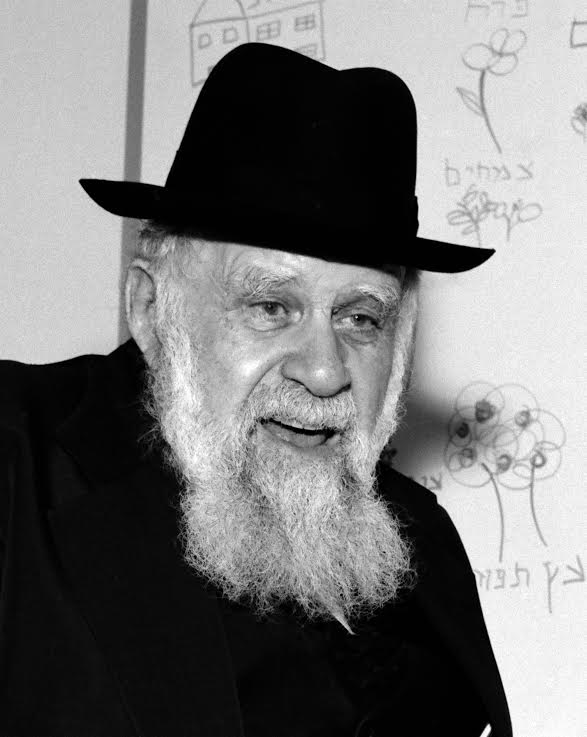
Photo of Rabbi Simcha Wasserman by Harry Green, c. 1986, South Bend, IN harrygreenphoto@gmail.com

  1. I thank Rabbi Yitzchok Shapiro (Boca Raton, Florida) and Rabbi Dr. Eliezer Brodt (Ramat Beit Shemesh, Israel) for their important comments to an earlier version of this article. I thank my father, Mr. U. Harold Males (Jerusalem, Israel) for his editorial assistance.
  2. In a humorous Forward article linked below, the author turned to an expert who proposed these definitions for the following Yiddish words: “A zets is a strong punch. A patsh is a common slap, whereas a frask is a sharp, stinging one, given with a vengeance.” See: https://forward.com/news/547/martial-arts-in-yiddish/ . After reading this, I felt relieved that the older cheder rebbi had only made use of a patsh – and not a zets or a frask.
  3. The Da’as Zekeinim mi-Ba’alei Tosafos is a Torah commentary compiled from the writings of French and German Tosafists who lived in the 12th and 13th centuries.
  4. I was unable to find information about a bird named אגרון / Agron. However, the Hebrew word for the crane is עגור / Agur (see Isaiah 38:14 and Jeremiah 8:7). A crane is a long-necked bird which certainly matches the winged creature in the Ba’alei Tosafos‘ parable.
  5. Aesop (c. 620–564 BCE) was a Greek storyteller credited with a number of tales which are collectively known as ‘Aesop’s Fables’. See: https://en.wikipedia.org/wiki/Aesop
  6. See: https://classics.mit.edu/Aesop/fab.1.1.html
  7. I have no recollection of ever reading Aesop’s Fables as an adult. Did my parents or older siblings read a children’s book of Aesop’s Fables to me when I was young? Had I read such a book to my nieces / nephews when they were little?
  8. See: https://thejatakatales.com/javasakuna-jataka-308/
  9. See: https://en.wikipedia.org/wiki/Buddhism
  10. See: https://en.wikipedia.org/wiki/Berechiah_ha-Nakdan and https://en.wikipedia.org/wiki/Mishl%C3%A8_Shu%27alim
  11. The term Mishlei Shua’lim is clearly taken from Sanhedrin 38b where we learn ג’ מאות משלות שועלים היו לו לרבי מאיר ואנו אין לנו אלא שלש – Rabbi Meir had composed 300 fox fables (i.e. parables involving animals – the fox being chief among them), but we are only left with three of them.
  12. https://blogs.loc.gov/international-collections/2021/09/a-fox-fable-goes-digital-bialiks-classic-hebrew-story-for-children-finds-new-life-at-the-library-of-congress/
  13. Eitz Yosef quotes Aruch who translates מוקרה as ‘its neck.’ It should be noted, however, that Rashi translates מוקרה as ‘its beak.’
  14. I initially wondered if this Midrash might also be the basis for the lyrics “פרוק ית ענך מפום אריותא – save Your flock from the mouths of the lions” in the Shabbos song ‘Kah Ribon’. However, a little research revealed that the term “פום אריותא – the mouths of the lions” is a clear reference to Daniel 6:23.
  15. See: https://en.wikipedia.org/wiki/Printing_press
  16. Rabbi Elazar Simcha Wasserman (1898 – 1992) was a son of the storied Rabbi Elchonon Wasserman, zt”l (1874 – 1941) – head of the pre-WWII Yeshiva in Baranovich, Poland. Prior to the Holocaust, Rabbi Wasserman (the son) immigrated to the United States where he played important roles in Jewish education and outreach (particularly in California). He and his wife moved to Israel in 1979, where they spent the final and ever-productive chapters of their lives in Jerusalem. I vividly recall attending the funerals of both Rabbi Simcha and Rebbetzin Faiga Rochel Wasserman (sadly, she passed away just after observing Shiva for her late husband) while first studying in Jerusalem in 1992. On November 5, 1992, the Los Angeles Times published an obituary for Rabbi Wasserman. See: https://www.latimes.com/archives/la-xpm-1992-11-05-we-1397-story.html . For a book-length biography, see: Fox, Dovid (1995) Greatness in Our Midst: The Life of Rav Simcha Wasserman. Jerusalem: Feldheim Publishers. For a more recent article on Rabbi Wasserman, see Eytan Kobre, “Building Worlds.”, Mishpacha, November 14, 2023. https://mishpacha.com/building-worlds/.
  17. Some of Rabbi Wasserman’s presentations have been digitized and are posted on Ohr Somayach’s website. However, among those that are available, I was unable to find the question-and-answer session cited in this article. See: https://audio.ohr.edu/showperson/id=20
  18. At this point, I believe an important disclaimer is in order. By suggesting that this parable is of ancient Jewish vintage, I am not claiming that that it was stolen from Jewish sources and plagiarized by foreigners. (Neither was that what Rabbi Wasserman had suggested.) A long tradition of such claims seems to go back to Philo (c. 20 BCE – 50 CE), and Josephus (c. 37 CE – 100 CE). For a scholarly treatment of such assertions, see Norman Roth, “The ‛Theft of Philosophy’ by the Greeks from the Jews,” Classical Folia, vol. 32, no. 1 (1978): 52-6. For some important rabbinic sources on such claims, see Rabbi Moshe Isserless’ Toras Ha’olah 1:11 (end of the chapter) and Metzudos Dovid to I Melachim 5:12. For a more recent rabbinic source see Rabbi Joseph B. Soloveitchik’s commentary to Tisha B’Av Kina 37 on page 574 in Posner, Simon. 2010. The Koren Mesorat Harav Kinot: The Lookstein Edition: Tefilla for Tisha B’Av, Kinot, Eikha. New York: OU Press; Jerusalem. (See footnote 19 for additional sources on this theme.)
  19. See the link below for a series of five thorough articles (with extensive footnotes) published in the Ohr Yisroel journal (Monsey, NY) by Rabbi Yaakov Yisroel Stahl: (10) מקור חכמת אומות העולם מעם ישראל In these articles, Rabbi Stahl cites an incredible amount of material on the theme of ancient Jewish wisdom making its way into the teachings of the nations of the world. I thank Rabbi Dr. Eliezer Brodt for bringing these articles to my attention.
  20. I credit Artscroll / Mesorah’s Kleinman Edition of Midrash Rabbah (2010) for the translation of this passage.
  21. See Matnos Kehuna, and Eitz Yosef Ibid.
  22. Both Rashi and the Eitz Yosef (Ibid.) note the clearly Latin roots (i.e. scholastic) of the word אסכולסטקיא.
  23. As demonstrated above in Part IV, this Midrash was the source of the parable shared by the Ba’alei Tosafos.


Purim in Tehran: The Symbolic Devaluation of the Ahrimanic Republic

Purim in Tehran: The Symbolic Devaluation of the Ahrimanic Republic

By Dan D.Y. Shapira

Dan (or, Dan D.Y.) Shapira is an Orientalist and grows more than fifty trees on the edge of the Judaean Desert. He’s a Full Professor at Bar-Ilan University.

Some fifty years ago, my father brought home a small glass bottle of Iranian Coca Cola, no idea where from. I sat hypnotized looking at the bottle, with its Persian (well Arabic) letters, so beautiful.

It was easy to understand that two letters stand for k, one for l, one for o and one for a. The letters for o, l, and for k had some remote similarities to the corresponding Hebrew letters, if you rotate them a bit in your head. How I know that the letter for a, ا, is also like the Hebrew א, you should just squeeze the Aleph on both sides. And a couple of year later there was the Islamic revolution in Iran, at the end of the same year there was the Soviet invasion in Afghanistan, and new tasty, delicious words began to pour – baseej, inqhilab, Haqiqat-e Inquilab-e Saur, mujahedeen-e khalq, sipaas, Kermanshah, pasdaran, and somehow I began learning Persian.

The language struck me with its grammatical similarities to German and its lexical parallels to Yiddish. Just as Yiddish incorporates Hebrew and Aramaic, Persian is saturated with Arabic. In Yiddish, one can play with registers, tilting the language toward its Germanic core or thinning out its Hebraic elements. Persian offers the same flexibility, allowing a speaker to choose more, fewer, or even no Arabic words. Years later, many Jewish-American Iranists from the WWII generation confirmed this early impression. Learning the language went smoothly, as if I had already known it in a former gilgul.

When I was an Iranian studies student in the late 1980s at Hebrew University, one of my teachers told us that Persians are simply prone to short periods of mass hysteria before returning to “normal” and going back to counting money and carpets within a few years. Time has since proven that my former teacher understood Iranians quite poorly, as they have shown no symptoms of recovering to that supposed normalcy. I eventually realized that my chances of visiting Tehran or Shiraz are slim, perhaps reserved for a future gilgul. Being an Israeli Iranist without the possibility of visiting Iran is much like being Jewish without the possibility of joining a Gentile club.

I am writing this on Sunday, March 1. Today is my secular birthday, and tomorrow, Ta’anith Esther, is my Jewish one. Last night, Bibi and Trump sent me a wonderful gift. I shouted into the sky as drones sent from Iran turned into smoke: Khamenei kotlet shod (“Khamenei went kebab”) as millions of Iranians around the world shouted along with me.

My son just called. He is married to a girl whose parents were both born in Iran. “What do you say about your birthday present?” he asked. “I just realized that your entire life is connected to the fact that you were born on Ta’anith Esther.”

“Yes,” I replied, “and I am just now writing about that. I’ll send it to you.”

It was published today that the joint American-Israeli training for the very operation we witnessed yesterday began as early as January 2023. In January! This timing is critical; it means that even as the domestic anti-Bibi demonstrations began to surge and well before the horrors of October 7, the strategic “pedestal” for the current reversal was already being constructed.

In my view, the son of the last Shah has been designated by Bibi and President Trump to lead the transitional period in a post-Khomeinist Iran. Whether he will be able to restore the historical monarchy remains an open question.

As I discussed in my co-authored article with Reuven Kiperwasser, “Encounters between Iranian Myth and Rabbinic Mythmakers in the Babylonian Talmud,” published a dozen years ago in Encounters by the Rivers of Babylon Scholarly: Conversations Between Jews, Iranians and Babylonians in Antiquity (2014) and available here, the Babylonian sages often engaged in a process of symbolic devaluation. They created their own imagined worlds by taking elements of Iranian mythology and recasting them to define the borderlines of their own culture. After the certain dismiss of what many Iranians call “the Ahrimanic Republic” (instead of “the Islamic Republic,” with Ahriman being the wicked opposite, sitra oḥora, of the benevolent Ahurmazd, or Ahura Mazda), we are seeing this ancient devaluation play out as a modern geopolitical reality. In our analysis of Sanhedrin 39a, we examine a dialogue where a Magus claims the human body is divided, with the upper part belonging to Hwrmyz (Ohrmazd) and the lower, excretory part belonging to ‘hrmyn (Ahriman). The Talmudic sage Amemar sarcastically challenged this dualism by asking why Ahriman would permit Ohrmazd to send life-giving water through his “territory.” Today, this sarcasm has turned into a tangible reality as the “Ahrimanic” regime governed through the “lower” impulses of mass hysteria and regional chaos has been devalued by a population that has largely secularized and rejected the official ideology. With the collapse of this demonic mask, many Iranian exiles will return home (four to five millions Iranians live outside of the present borders of Iran). They return to a land ready to restore its “upper” civilizational identity, finally mirroring the way the rabbis once harmonized their world with the benevolent elements of the Iranian heritage.

In Iran, while 99% of the population is officially classified as Muslim (including a 5% to 15% Sunnite minority composed of Kurds, Arabs, Baluchis, and Turkmens living along the borders), the internal reality is starkly different. In truth, only about 30% to 40% of the population considers themselves Muslim at all. The actual majority has shifted toward being non-religious or atheist, with many becoming fiercely anti-Islamic or “spiritual” in various ways. Others identify as self-proclaimed “Zoroastrians” or have become secret converts to American-style Evangelical Christianity.

Under the Khomeinist regime, Iran has become largely secularized and has partially moved in an anti-Islamic direction. Today, nobody believes in the official ideology, a situation very much like the lack of belief in the official ideology during the late Brezhnev USSR. The “Ahrimanic republic” now sends Shi’ite clerics who oppose its ideology to prison or places them under home arrest, just as the late Brezhnev USSR did to the few who identified as “the real Marxists.”

The Iran of tomorrow will certainly be anti-Islamist, with the potential for the oppression of Islam itself. While the Iran of yesterday was a global leader in antisemitism, the Iran of tomorrow will be a global leader in the state-supported fight against the “Free Palestine” movement. The “Palestinian discourse” was central to the old Iran and will remain so in the New Iran, though with its emphasis entirely reversed.

The raison d’être of the Iran of tomorrow will be a staunch alliance with the USA and Israel. The principle of nahapokh hu from the Purim story reveals the sarcastic hypostasis of the Jewish God’s sense of humor. As the scripture asks, “See, this is new? It hath been already of old time, which was before us.” One need only consider the metamorphosis of pogromist Czarist Russia into what some, astonished by the transformation, termed “the Jewish Commune.”

Some predict that Iran will fall apart due to the separatism of ethnic minorities, but to me, this is absolute nonsense. Iran has only insignificant real minority groups; although some Iranians speak languages other than Persian, they are Iranians first and foremost. Fantasies about Azeri separatism in Iran are especially hilarious. It is as if Nazi Germany tried to lure Israel’s Hasidic Jews into a “Great Germany” separatism simply because those Jews speak Yiddish. Iranians of Azeri background are, more or less, the Iranian equivalent of Israel’s Ashkenazim.

But the borders of Iran might change. It is a significant topic, and once stabilization is achieved, one can envisage the enlargement, rather than the shrinking, of Iranian territory eastwards within a predictable span of time.

The position of the Iran of tomorrow as an ally of Israel will fundamentally change Israel’s strategy toward its Arab allies and partners. MBS understood this some time ago and, consequently, dragged his feet regarding a rapprochement with Israel.

Another significant point is Türkiye, which has emerged as a primary adversary of Israel since October 7, though I hope the motivations behind this shift were largely opportunistic and fundamentally misguided. However, if the IDF map is accurate, the fact that Israeli jets overflew Turkish territory on their way to Iran suggests a significant development. This possibility hints that Mr. Erdoğan is beginning to view the regional landscape through a more pragmatic lens, perhaps recognizing the inevitable devaluation of the “Ahrimanic” status quo in favor of a more stable, “upper” civilizational order.


“I Do Not Understand a Single Word of What I Wrote in My Book”: Rav Kook, Saul Lieberman, and a Literary Mishlo’aḥ Manot Exchange

“‘I Do Not Understand a Single Word of What I Wrote in My Book’: Rav Kook, Saul Lieberman, and a Literary Mishlo’aḥ Manot Exchange”

By Aviad Hacohen

The festival of Purim, with its customs and traditions, has long constituted a broad and fertile field for a vast body of research, folklore, and ritual practice associated with the “Jewish carnival.”[1] The drinking of wine, the wearing of costumes (which have no foundation in early sources and, in the view of many scholars, were influenced by the Venetian carnival),[2] the use of noisemakers for the purpose of “blotting out Amalek,”[3] and the practice of mishlo’aḥ manot have all added layers of joy and exuberance to the festival, at times reaching the point of genuine revelry and even debauchery,[4] and giving rise in certain historical contexts to acts of mockery, hostility, and ritualized violence that have attracted sustained scholarly attention.[5]

Two of the day’s commandments explicitly mentioned in the Scroll of Esther are “the sending of portions, each man to his fellow, and gifts to the poor.”[6] Whereas the giving of charity to the poor assumed a more or less uniform form, the “sending of portions” became a platform for no small measure of creativity. Already in the Talmud,[7] it is related that the amora Rabbi Yehudah Nesi’ah (the grandson of the tanna Rabbi Yehudah ha-Nasi)[8] sent his colleague Rabbi Hoshaya an especially splendid mishlo’aḥ manot, consisting of choice veal and an entire jug of wine.

To this day, one may observe throughout Israel, particularly in Haredi concentrations, especially elaborate mishlo’aḥ manot, laden with assorted and varied food items, accompanied by ornate trays and crackling cellophane wrapping. Alongside the traditional commandment, in recent decades in particular, a rich vein of humor has developed portraying the familiar bottle of wine and dry cake as completing an entire “circuit” within the community, passed from hand to hand as a repeatedly re-gifted mishlo’aḥ manot, until it ultimately returns to its original sender.[9] In light of this reality, many today prefer to refrain from preparing an individualized mishlo’aḥ manot, much of whose content is ultimately discarded after the festival, and instead opt for a standardized communal mishlo’aḥ manot distributed collectively to members of the community. The funds thereby saved, rather than being expended on redundant food items and decorative packaging, are redirected toward a range of charitable and benevolent causes.

These contemporary developments, however, merely underscore a broader point: the commandment of mishlo’aḥ manot has long been characterized by considerable elasticity in both form and practice. Indeed, halakhic literature contains an extensive discussion concerning the question of how one may properly discharge one’s obligation with respect to this commandment. One of the more intriguing debates in this context concerns whether one may fulfill the obligation of mishlo’aḥ manot not through edible “portions,” but rather through “words of Torah,” by sending a book, each person to his fellow. There is, in fact, no small body of testimony regarding sages of Israel, such as Rabbi Shlomo Alkabetz and Rabbi Yehudah Aszod, who sent, as “mishlo’aḥ manot, each person to his fellow,” their own Torah novellae or scholarly compositions.[10]

This halakhic discussion is not merely theoretical. In the course of my research on Rabbi Professor Saul Lieberman (1898-1982),[11] I encountered a striking modern resonance of precisely this idea, one that illuminates the enduring cultural and intellectual valences of mishlo’aḥ manot beyond its strictly culinary expression. Although he arrived in Jerusalem at a relatively late age, being about twenty-nine, Lieberman quickly became integrated into Jerusalem’s intellectual milieu. As a member of the first cohort of students at the Institute of Jewish Studies at the Hebrew University on Mount Scopus (which had been founded only a few years earlier), he listened with great thirst to the teachings of the leading scholars in Jewish Studies and in classical studies, among them his teacher and master Professor Yaakov Naḥum Epstein,[12] Professor Shmuel Klein, and Professor Moshe Schwabe,[13] one of the foremost scholars of classical culture.

Alongside his academic studies, he soon acquired a reputation as an exceptionally great Torah scholar, for whom no secret of rabbinic literature was lo anīs lei, that is, nothing lay beyond him and nothing escaped his grasp. For many hours he would labor diligently over his learning, memorizing Mishnayot and Talmud – Bavli and Yerushalmi – by heart,[14] and within a few years he produced several exemplary works, such as On the Yerushalmi (1929) and The Talmud of Caesarea (1931), which to this day are regarded as foundational texts in the scholarly study of rabbinic literature.[15]

Upon the completion of his studies, Lieberman began teaching in the Talmud preparatory program of the Institute of Jewish Studies, while simultaneously devoting himself to the composition of The Yerushalmi According to Its Plain Meaning (Ha-Yerushalmi Ke-Peshuto) (1935), intended as a comprehensive commentary on the entire Jerusalem Talmud.

On the personal plane, life did not treat him kindly. A short time after his arrival in the Land of Israel, he was bereaved of his youthful wife, Rachel née Rabinowitz, daughter of the rabbi of Pinsk and a descendant of a distinguished rabbinic dynasty. Some time later, he married his second wife, Judith, likewise of illustrious lineage in her own right, the daughter of Rabbi Meir Berlin (later, Bar-Ilan), leader of the Mizrachi movement, and granddaughter of the Netziv of Volozhin. She accompanied him faithfully until the end of her days. The couple did not merit children, and Lieberman immersed himself in his learning.[16]

In the course of these years he became integrated into the “circle of Jerusalem sages,” forming close friendships with many of its members, among them the writer S.Y. Agnon[17]; the scholar Gershom Scholem[18]; the bookseller and proprietor of the Darom publishing house, Michl Rabinowitz; the educator Eliezer Meir Lifshitz; and the merchant and cultural patron Shlomo Zalman Schocken,[19] who in those days founded the Institute for the Study of Medieval Hebrew Poetry.[20]

One figure with whom Lieberman developed an especially close relationship was the Chief Rabbi of the Land of Israel, Rav Abraham Isaac Hacohen Kook. Rav Kook was revered by many members of the Yishuv, among them Berl Katznelson and S.Y. Agnon, and even by self-described “heretics” such as Gershom Scholem and Justice Haim Cohn, who in his youth studied Torah for a year in Rav Kook’s yeshiva together with his cousin, the journalist Azriel Carlebach.[21]

Despite the age gap between them (Rav Kook was twenty-seven years older than Lieberman), the two formed an exceptionally close bond, so much so that Rav Kook, despite being heavily burdened with unceasing rabbinic and public responsibilities, agreed to reserve a fixed hour each day to study in ḥavruta with Saul Lieberman the Tur on Ḥoshen Mishpat, together with Rabbi Joseph Karo’s Beit Yosef.[22]

Like many others, Lieberman, who would later come to be recognized as the greatest scholar of the Talmud in the twentieth century, continued to revere Rav Kook until his final days, and on more than one occasion cited his teachings. Thus, for example, in a letter dated 29 December 1981 to his younger colleague, Professor Ephraim E. Urbach, Lieberman opens with the following sentence:

“You wrote to me that ‘you were ill,’ and I was reminded of the words of Rav Kook, of blessed memory, who said: I prefer to hear ‘I was ill’ rather than ‘I was wealthy’….”[23]

According to a widespread Jerusalem legend, Lieberman and Rav Kook stipulated that they would not cancel their daily study session for any amount of money in the world, and that should either of them violate this condition, he would be required to pay a substantial “fine” to his counterpart. For Lieberman, whose daily schedule was relatively free, fulfilling this condition was easy. For Rav Kook, who in those days was already in poor health and burdened to exhaustion with the needs of the public, fulfilling it was far more difficult, almost impossible.

And indeed, on one such day Rav Kook was compelled to cancel the study session after being invited to serve as sandek at the circumcision of the child of one of Jerusalem’s notable residents. Lieberman, of course, did not forget the matter,[24] and resolved to vindicate the affront at an appropriate time.

In the late afternoon of the “Purim of the unwalled cities,” the fourteenth of Adar 5695 (1935), when Rav Kook was preoccupied with the final preparations for the reading of the Megillah that night in Jerusalem and with organizing the charity funds of matanot la-evyonim to be distributed the following day (for in Jerusalem Purim is celebrated on the fifteenth of Adar), Lieberman appeared unexpectedly at his home and demanded payment of the “fine”: one hour of study in exchange for the hour that had been cancelled several months earlier.

Rav Kook, who recognized the justice of the claim, had little choice. He set aside all his affairs, and the two sat and studied together for a full hour.

Thus far the story, which circulated in Jerusalem for many years. I confess that for a long time I regarded it as no more than a charming “urban legend,” one of those anecdotes that naturally crystallize around towering figures, depicting them not only in their greatness in Torah but also, in the manner of the early sages, as men of wit who knew how to tease one another with affectionate irony.

The story took root, and its echoes may be found in various books as well, albeit in an imprecise form, such as in the writings of Rabbi Moshe Tzvi Neria on Rav Kook.[25] The source material for Rabbi Neria’s account is preserved in his personal archive, now housed in the National Library of Israel, and includes a remarkable series of recollections that Lieberman shared with him in the summer of 1979.[26]

To my astonishment, however, two concrete pieces of evidence that have come to light in recent years in the course of my research on Lieberman do more than merely gesture toward the plausibility of the account. They substantially corroborate it. The first emerged many years ago in the main library of Yeshivat Mercaz HaRav – a library endowed in the name of Markus Cohn, the father of Arthur Cohn, the eminent Hollywood producer who passed away only recently.[27]

On the first volume of The Yerushalmi According to Its Plain Meaning (Ha-Yerushalmi Ke-Peshuto) (also the last, for Lieberman ultimately decided to abandon his projected commentary on the Yerushalmi and to turn instead to the Tosefta, on which he produced his monumental Tosefta Ke-Peshutah), there appears a dedication that Lieberman wrote to Rav Kook, composed, as was customary, in rabbinic idiom and in abbreviations:

“In honor of our master, the rabbi of the Land of Israel and of all the Diaspora, the Gaon Rav A.I.H. Kook, may he live a long and good life, with feelings of admiration and respect, from the author.”

Attention should be paid to the date on which these words were written. The work was published in 5695 (1935). Lieberman signed his introduction at the beginning of that year, on Sunday, 7 Tishrei 5695, between Rosh Ha-Shanah and Yom Kippur, corresponding to 16 September 1934.

Obviously, the printing also took a certain period, probably a few months.

Greater precision can be established regarding the date of publication. A notice announcing the appearance of Ha-Yerushalmi Ke-Peshuto was printed on the front page of Kol Yisrael, the organ of Agudat Israel in Jerusalem (edited by Rabbi Moshe Blau), on 8 Kislev 5695 (15 November 1934). The advertisement’s conspicuous placement on the newspaper’s front page indicates that the volume had only recently emerged from the press and was then being introduced to the reading public. It therefore provides a reliable terminus post quem for any presentation of the work to Rav Kook.

Lieberman therefore could not have presented the book to Rav Kook before that date. The possible window is accordingly narrow: from mid-November 1934 until the onset of Rav Kook’s final illness around Passover 5695 (April 1935). It is thus plausible that Lieberman brought the newly printed volume to him on the eve of Purim of that year, perhaps as mishlo’aḥ manot, or shortly beforehand, and that Rav Kook, in return, presented him with a copy of Rosh Milin bearing the distinctive Purim dedication.

Rav Kook passed away in Elul of that year. Approximately six months earlier, around Passover, he had contracted his final illness and was already confined to his deathbed in a state of severe suffering. Consequently, even had Lieberman wished to do so, he could only have presented him with the work during the brief period at the beginning of that year, from the book’s publication until Passover.

The second surprise came to my attention several years ago, when a friend sent me a photograph of the title page of Rav Kook’s small and enigmatic kabbalistic work, a copy of which was in his possession.

The work, Rosh Milin, on the Hebrew letters, was written in 1917, during Rav Kook’s exile in London in the course of the First World War.[28] Thus did Rav Kook write, in the affectionate dedication he inscribed to his young colleague and ḥavruta:

“A gift of true love to the chosen of my heart, Rabbi Saul Lieberman, may he live a long and good life. Abraham Isaac, the small [i.e., the humble one]. Purim of the unwalled cities, 5695 [1935].”

Anyone familiar with the dedications and expressions of esteem that Rav Kook addressed to various individuals, including leading Torah scholars, will recognize that the phrase he wrote to Lieberman, “true love to the chosen of my heart,” is striking in its exceptional character.

Incidentally, Gershom Scholem later related that, despite his expertise in Kabbalah, he did not succeed in understanding Rosh Milin. He further added – “on the testimony of trustworthy informants,” by which he meant his close friend Saul Lieberman (and he even recorded the remark in his personal copy of the book, now preserved in the National Library of Israel) – that Rav Kook himself told Lieberman:

“Regarding this book, the author [i.e., Rav Kook] said to my friend Saul Lieberman, shortly before his death – when he presented him with a copy as a gift – that he now does not understand a single word of what he wrote in it, even though at the time of writing he fully grasped the meaning and intent of the matters.”[29]

Although Lieberman was as far removed from engagement with Kabbalah as east is from west, he once gave memorable expression to this distance when asked to introduce a lecture by his close friend Gershom Scholem. Lieberman opened his remarks with an immortal quip about Scholem’s field of research, Kabbalah and Jewish mysticism: “Nonsense is nonsense, but the study of nonsense may be a science….”[30] Nevertheless, Rav Kook chose, of all his writings, to present Lieberman with this particular book as a gift, perhaps so that it might serve as a kind of “amulet,” or perhaps as an act of Purim mischief on the part of the aged rabbi; we cannot know.

The unusual date recorded in the dedication, “Purim of the unwalled cities, 5695,” suggests that the booklet was presented to Lieberman on that very occasion, when, according to the account, he chose to collect the aged Rav Kook’s “debt” during their joint study session, perhaps their last, on Purim of that year.

It is entirely plausible that on that occasion Lieberman brought Rav Kook his newly published work, The Yerushalmi According to Its Plain Meaning, and that in return Rav Kook presented him with mishlo’aḥ manot in the form of his small and enigmatic book.

Thus the Jerusalem legend seems to acquire flesh and sinew, and what once appeared to be no more than a charming anecdote may in fact preserve a genuine historical memory: a literary mishlo’aḥ manot exchanged between two towering figures, in which Torah, affection, and Purim playfulness were delicately intertwined.

Appendix A: Rabbi Moshe Tzvi Neria’s Archival Notes on Saul Lieberman’s Recollections of Rav Kook (Summer 1979)

The following translation is based on Rabbi Moshe Tzvi Neria’s handwritten notes preserved in his personal archive, currently housed in the National Library of Israel (Jerusalem). The notes record a conversation held during Summer 1979 in which Rabbi Professor Saul Lieberman recounted a series of episodes relating to Rav Abraham Isaac Hacohen Kook and the influence that Rav Kook exerted upon him. The material corresponds in its essentials to passages later published by Rabbi Neria, but the archival version preserves additional details and a more expansive formulation of Lieberman’s testimony.

Rabbi Neria was accustomed to preserving every scrap of paper containing substantive content that passed through his hands. Alongside newspaper clippings in which several articles about Lieberman appeared, Rabbi Neria preserved the remarks he heard directly from him in the summer of 5739 (1979). According to his account, Lieberman requested that he telephone him in the early morning (“from eight o’clock onward I disconnect the telephone, lock the door, and engage in my Talmudic study without interruptions”), and he did so.

Lieberman told Rabbi Neria that his first visit to Rav Abraham Isaac Hacohen Kook took place on the night of Shavuot:

“I heard that he was teaching Sefer ha-Mitzvot [i.e., Maimonides’ Book of the Commandments]. I came and sat down by the table. In the course of the study I made a remark, and the Rav answered me briefly. Later I made another remark, and again I received a brief reply. When I remarked upon his words a third time, the Rav turned to me and said: ‘Come in to me tomorrow.’ When I came after the festival, the Rav received me with great warmth, asked about my family, and it emerged that he knew several rabbis among my relatives. After a Torah conversation, he asked that I come to him frequently, and thus I did. On the way to the Rav’s visit to the Gerrer Rebbe (to R. Neḥemyah’le [??]), the Rav delayed at my apartment and became engrossed in a halakhic give-and-take concerning a matter I was then studying. I would come and present my novellae before him, ask about what had been difficult for me, and the like. His warm attitude toward me greatly encouraged me. He had a mystical influence upon me, even though I am far from mysticism. I had ‘tests,’ and he influenced me to remain in the study of Torah.”

Lieberman recounted to Rabbi Neria one such “test.” According to his account, a dispute arose between Rabbi Fishman [i.e., R. Yehudah Leib Maimon] and Bank Mizraḥi. The parties decided to submit to arbitration before attorney Mordechai Eliash. Lieberman represented Rabbi Fishman, whereas the bank was represented by attorney Mordechai Levanon. Rav Kook summoned Lieberman and instructed him to cease representing him in the arbitration:

“You have acquired a reputation for involving yourself in arbitration, and that will draw you away from your learning.”

Rabbi Neria further adds and cites in Lieberman’s name words of admiration and reverence for Rav Kook:

“Not only did his greatness in Torah exert influence – and he knew the entirety of Torah – but his entire personality. Matters of the people of Israel and the Land of Israel were not for him merely pathetic rhetoric; rather, they overflowed from his depths, from his hidden world, and there was something mystical in it. This was a figure overflowing with light, and his light would penetrate in its own ways… The Rav was an artist. Not merely a man with poetic sensibility, but truly an artist. In his writing there is a sacred grandeur. His words are like the tones of the shofar’s sound. The ease of his writing is astonishing, yet it is the result of abundant knowledge. They once told of a certain wealthy man who marveled at the request of a great painter to receive an enormous sum of money for a sketch he drew within ten minutes. ‘Not so,’ replied the painter; ‘I labored sixty years in order to attain an ability to draw in such a manner.’”

According to Rabbi Neria, Lieberman told him that he was occupied with printing Ḥasdei David, the commentary of R. David Pardo on the Tosefta, and that through printing his own work on Seder Ṭohorot he repaid his debt…

In this context Lieberman added:

“I also must repay a debt to the Rav [i.e., Kook]. He greatly encouraged me in the study of the Jerusalem Talmud. Several times I presented before him my Torah insights in elucidating difficult passages in the Jerusalem Talmud, and he took great pleasure in them.”

In response to Rabbi Neria’s question, “Was the Rav [i.e., Kook] as proficient in the Jerusalem Talmud as in the Babylonian?” Lieberman replied:

“The Rav was proficient in everything: Babylonian and Jerusalem Talmud, Tosefta and Midrashim, Rishonim and decisors. The Rav was the only one who encompassed the entirety of Torah, and this influenced his encompassing vision. The Rav’s vast scope contributed greatly to the richness of his personality. This was also the greatness of the Netziv, who knew the whole of Torah. I am deeply impressed by the Netziv. So too was R. Meir Simḥah [of Dvinsk, author of Or Sameaḥ].”

In this connection, Rabbi Neria cited words written by Rav Kook:

“The originality of the ‘ever-strengthening spring’ and the ‘river that does not cease’ (Avot, beginning of ch. 6) is the primary aspiration of one who engages in Torah for its own sake, which comes from divine cleaving. The inner spiritual bond with that which is all, the source of all, and beyond all. The desire filled with purity, which steadily intensifies to absorb the distilled essence of the supernal sap within the supernal realms—these are they who always seek the ennobled renewal in its vigorous force” (Iggerot ha-Ra’ayah, vol. 3, p. 4).

(“The Rav’s [i.e., Kook’s] vast scope contributed greatly to the richness of his personality. His opponents fought against him because they recognized his power, because they knew his greatness.”) According to Rabbi Neria, Lieberman described the Rav’s words as expressing a “sacred grandeur.”

Rabbi Neria further relates, in Lieberman’s name, that in the summer of 5690 (1930) Rabbi Moshe Ostrovsky came to the apartment where Rav Kook was staying in Kiryat Moshe in order to pressure him to agree to the compromise proposal then being circulated, according to which the people of Israel would relinquish part of their rights in the Land of Israel, including at the Western Wall. Lieberman was present. The visitor wished that he leave the room so that he could speak with Rav Kook privately; however, Rav Kook detained Lieberman and instructed him to continue sitting there.

Years later, after the passing of Rav Kook, Rabbi Neria heard at a memorial gathering held in the Jewish Agency building that Rav Kook had told Rabbi Ostrovsky:

“The people of Israel has not empowered any person to relinquish the Western Wall. If we relinquish it, the Holy One, blessed be He, will not wish to restore it to us.”

Rabbi Neria testifies that while he lived in Jerusalem in the 1930s, Rabbi Professor Saul Lieberman would customarily pray on the High Holy Days together with the students of Yeshivat Merkaz ha-Rav, who had established their place of prayer at Yeshivat Etz Ḥayyim in the Maḥaneh Yehudah neighborhood.

Among other matters, Rabbi Neria wrote down what he heard from Lieberman regarding his shared study with Rav Kook, and according to what is stated there. The accounts found in Rabbi Neria’s handwritten notes correspond in their essentials to what he later presented in his book.

Alongside them, I found in this archive and in additional archives details concerning Lieberman’s involvement, at the request of his friend (and relative) Rachel Yanait Ben-Zvi, wife of the late President Yitzḥak Ben-Zvi, in the establishment of a yeshivat hesder in Peki’in. Within this framework he approached Rabbi M. Z. Neria and asked him to assist in realizing the idea in practice. Concerning this episode I intend to write, God willing, elsewhere.

Notes

I would like to express my sincere gratitude to my friend and colleague Mr. Menachem Butler, who devoted considerable effort to translating and editing this article into English. I am also grateful for his valuable contributions, including bibliographical references and precise citations.

  1. See Harold Fisch, “Reading and Carnival: On the Semiotics of Purim,” Poetics Today, vol. 15, no. 1 (Spring 1994): 55-74.
  2. See, for example Yaakov Shmuel Spiegel, “Cross Dressing for Special Occasions,” in Joseph R. Hacker, Yosef Kaplan, and B.Z. Kedar, eds., Rishonim ve-Aharonim, From Sages to Savants: Studies Presented to Avraham Grossman (Jerusalem: Shazar, 2010), 329-352 (Hebrew), available here; and Gedalia Oberlander, “The Custom of Disguising Oneself on Purim,” Or Yisrael, vol. 2, no. 3 [#7] (April 1997):125-131 (Hebrew), available here; Moshe Leib Halberstadt, “Costumes on Purim and at Various Events,” Yerushatenu, vol. 5 (2011): 169-175 (Hebrew).
  3. See Shamma Friedman, “Erasing Haman,” Leshonenu, vol. 61, no. 3 (June 1998): 259-263 (Hebrew), available here; Daniel Sperber, “Destroying the Name of Haman,” Shana be-Shana, vol. 32 (2001): 203-211 (Hebrew), available here; and Daniel Sperber, How To Strike Haman (Jerusalem: The Wolfson Museum of Jewish Art, 2002; Hebrew), available here. For a comprehensive survey of the halakhic and historical sources concerning this custom, see Eliezer Brodt, “The Pros and Cons of Making Noise When Haman’s Name is Mentioned: A Historical Perspective (updated),” The Seforim Blog (22 March 2016), available here.
  4. See Dan Rabinowitz, “Purim, Mixed Dancing, and Kill Joys,” The Seforim Blog (6 March 2006), available here.
  5. See Elliott Horowitz, Reckless Rites: Purim and the Legacy of Jewish Violence (Princeton: Princeton University Press, 2006).
  6. Esther 9:22.
  7. Megillah 7a.
  8. See Alan Appelbaum, “Why the Rabbis of the Yerushalmi Called R. Judah Nesiah ‘a Great Man’?” Journal of Ancient Judaism, vol. 3, no. 3 (December 2012): 339-365.
  9. One can hardly help but wonder how long it will be before a kunṭres devoted to the halakhic parameters of re-gifting mishlo’aḥ manot appears, if indeed one has not already been published, systematically treating such questions as whether the initial recipient must effect a formal kinyan; whether the mitzvah requires that the gift be given mi-shelo (“from one’s own”); the respective roles of the giver’s kavvanah and the recipient’s awareness; the permissibility of re-gifting absent the donor’s consent (da‘at ba‘alim); whether the obligation may be discharged through an intermediary (shaliaḥ); whether one may fulfill the mitzvah with an item received earlier that same day; and whether a package that circulates through multiple hands constitutes mishlo’aḥ manot at all, or merely an elaborate exercise in communal redistribution, together with the host of subsidiary questions such a case inevitably generates.
  10. For more on this practice, see Meir Wunder, “Books as Mishlo’aḥ Manot,” Moriah, vol. 5, no. 5-6 [#53-54] (November 1973 – January 1974): 83-86 (Hebrew); and Tovia Preschel, “Mishlo’aḥ Manot of Books from Authors,” ha-Doar, vol. 53, no. 19 (8 March 1974): 295 (Hebrew).
  11. I am currently at work on a biography of Professor Saul Lieberman; for now, my earlier writings on him, see Aviad Hacohen, “Two Scholars Who Were in Our City: Correspondence between Saul Lieberman and Jacob David Abramsky,” ha-Tsofeh Literary Supplement (21 April 1984): 5 (Hebrew), available here; Aviad Hacohen, “Schlemiel, Schlimazel, and Nebbich: Letters from Saul Lieberman to Gershom and Fania Scholem,” Haaretz Literary Supplement (25 April 2000): H1 (Hebrew) , available here; Aviad Hacohen, “The Tannah from New York: A Selection of Professor Saul Lieberman’s Letters,” Jewish Studies, no. 42 (2003): 289-301 (Hebrew), available here; Aviad Hacohen, “Six Days and Seven Gates: Between Israeli President Izhak Navon and Professor Rabbi Saul Lieberman,” Oneg Shabbat (9 June 2023), available here; Aviad Hacohen, “Lieberman Kifshuto: Personal Letters Revealing the Sensitive and Playful Side of a Talmudic Genius, On the 40th Yahrzeit of Professor Saul Lieberman,” Makor Rishon, Sabbath Supplement, no. 1338: Parashat Tzav (31 March 2023): 8-11 (Hebrew), available here; Aviad Hacohen, “The Generation Did Not Appropriately and Duly Appreciate Mr. Schocken [Eulogy by Rabbi Prof. Saul Lieberman for Shlomo Zalman Schocken, March 1960],” Haaretz Literary Supplement (28 April 2024): 1 (Hebrew), available here; Aviad Hacohen, “The Story of the Rabbi Who Rejected the Maxim: ‘Torah Scholars Increase Peace in the World’,” Haaretz Literary Supplement (25 May 2023): 8 (Hebrew), available here; and Aviad Hacohen, “‘A Lithuanian Mind in Its Lithuanian Essence, From Volozhin to Jerusalem’: R. Shaul Lieberman’s Intellectual Kinship with the Legacy of Lithuanian Torah & Its Bearers,” in Martin S. Cohen, ed., Essays in Jewish Studies in Honor of Rabbi Prof. David Golinkin (Jerusalem: Schechter, 2025), 101-139 (Hebrew), available here.
  12. See Shmuel Glick and Menachem Katz, “‘A Threefold Cord’: On Saul Lieberman and His Relationship with the Hazon Ish and Jacob Nahum Epstein,” in Shmuel Glick, Evelyn M. Cohen, Angelo M. Piattelli, et al., eds., Meḥevah le-Menaḥem: Studies in Honor of Menahem Hayyim Schmelzer (Jerusalem: Schocken, 2019), 269-289 (Hebrew).
  13. See Saul Lieberman, “Ten Words,” in Texts and Studies (New York: Ktav, 1974), [1-20], where Lieberman refers explicitly to “my teacher, Prof. Moshe Schwabe, of blessed memory,” and describes Schwabe’s long-standing aspiration to produce a new dictionary of Greek and Latin loanwords in rabbinic literature. For the subsequent realization of this lexicographical program in systematic form, see Daniel Sperber, A Dictionary of Greek and Latin Legal Terms in Rabbinic Literature (Ramat-Gan: Bar-Ilan University Press, 1984); Daniel Sperber, My Rabbinic Loanwords Card Index of More Than a Half-Century: A Companion Volume to Professor Samuel Krauss’ Griechische und Lateinische Lehnwörter im Talmud, Midrasch und Targum, ed. Menachem Butler (Cambridge, MA: Shikey Press, 2022), esp. the introduction, available here, where Sperber describes the work as the product of “more than fifty-years of collection and research,” originally conceived as an annotated continuation of Krauss’s Lehnwörter, and acknowledges Lieberman’s personal role in encouraging his philological work, noting that Lieberman “adopted me as his disciple in this field.” Sperber also reproduces a letter of approbation from Lieberman dated 19 Shevat 5738 (27 January 1978), praising Sperber’s “objective evaluation of Krauss’s volume” and commending the “great progress” reflected in his conclusions.
  14. A fine “real-time” description of his path during those years appears in a letter written at the time by his father-in-law, Rabbi Meir Bar-Ilan, leader of the Mizrachi movement. Writing to his son Tuvia (a chemist and later the first Director-General of Bar-Ilan University) on 25 Marḥeshvan 5694 (5 November 1933), Bar-Ilan remarked“…And so, my dear, everything I have found here: outwardly nothing has changed in our home, but inwardly part of our apartment has been transformed into a beit midrash. For our Shaul sits and engages in Torah and scholarship with remarkable diligence. Your small room has been turned into a library, for Shaul has many books – among them items of precious value – and there he labors over them, if I am not mistaken, some ten hours a day and at night. Apart from those hours in which he teaches at the Teachers’ Seminary and at the university – only twice a week – he sits “over Torah and avodah.” He is engaged in writing a great book [this refers to Ha-Yerushalmi Kifshuto, published in 5695 (1935)], which, upon its completion and publication, will, it seems to me, renew a momentum among Talmudic circles and scholars of Israel with respect to the Jerusalem Talmud. Shaul is great – loftier than I had known – “full and overflowing” in an excellent measure; his knowledge is astonishing and his intellect clear, and beyond this he is an outstandingly diligent scholar. I do not know whether he will persist in his diligence, for it is possible that only on account of his literary work does he not divert his mind from his studies, but at present he continues his work with diligence and industriousness…”
  15. See, recently, Moshe Assis, Saul Lieberman’s Marginalia on Talmud Yerushalmi (Jerusalem: Carmel, 2022; Hebrew).
  16. On Judith Berlin Lieberman’s lineage, intellectual formation, and educational career, see Judith Berlin Lieberman, Autobiography and Reflections, eds. Menachem Butler and Abraham Lieberman (Cambridge, MA: Shikey Press, 2022), available here. See especially the autobiographical memoir (pp. 20-38) and the introductory essay by her nephew Hillel Halkin (pp. 15-19).
  17. See Aviad Hacohen, “‘Honey and Milk Are Under His Tongue, Yet Beneath It Burns a Blazing Fire’: On the Relationship between S.Y. Agnon and Saul Lieberman,” Haaretz Literary Supplement (6 October 2023): 7 (Hebrew), available here.
  18. See Aviad Hacohen, “Schlemiel, Schlimazel, and Nebbich – Letters from Saul Lieberman to Gershom and Fania Scholem,” Haaretz Literary Supplement (25 April 2000): H1 (Hebrew), available here.
  19. See Aviad Hacohen, “The Generation Did Not Appropriately and Duly Appreciate Mr. Schocken [Eulogy by Rabbi Prof. Saul Lieberman for Shlomo Zalman Schocken, March 1960],” Haaretz Literary Supplement (28 April 2024): 1 (Hebrew), available here.
  20. See, for example, Menahem Zulay, “The Research Institute for Hebrew Poetry,” Haaretz Literary Supplement (31 October 1947): 9 (Hebrew); and A.M. Habermann, “Salman Schocken and The Research Institute for Hebrew Poetry: On His Fifth Anniversary of His Death,” Haaretz Literary Supplement (17 July 1964): 13 (Hebrew).
  21. See Aviad Hacohen, “If every Sabbath were like Yom Kippur: An Interview with Haim Cohn,” Meimad, no. 17 (August 1999): 12-15 (Hebrew), available here; and Aviad Hacohen, “Apikores with Divine Grace – Review of ‘Being Jewish: Culture, Law, Religion, State’, by Haim Cohn,” ha-Tsofeh Literary Supplement (27 April 2007): 10, 13 (Hebrew), available here; and see also Azriel Carlebach, “The Rav Renowned for Halakhic Expertise,” Maariv Literary Supplement (19 February 1956): 4 (Hebrew), and Haim Cohn, “The Yeshiva of Rav Kook,” in Haim Cohn, A Personal Introduction: Autobiography, ed. Michal Smoira-Cohn (Kinneret: Dvir, 2005), 96-102 (Hebrew).
  22. Ari (Yitzchak) Chwat, “Rabbi Kook’s Connections with Prof. Rabbi Saul Lieberman as a Model for His Attitude Towards Critical Torah Research,” Tzohar, vol. 35 (2009): 59-66 (Hebrew), is especially important for situating the Rav Kook-Lieberman relationship within the broader question of Rav Kook’s principled openness to rigorous philological and historical methods in Torah study, and for treating Lieberman as a case study for the category Rav Kook termed ḥokhmat yisrael be-qedushatah. For further development of this concept, see Ari (Yitzchak) Chwat, “‘Hokhmat Yisrael in Its Holiness’: Rav Kook’s Vision for True Critical-Scientific Study,” Talelei Orot, vol. 13 (2007): 943-976 (Hebrew).
  23. The letter, preserved in the Professor Ephraim E. Urbach Archive at the National Library of Israel in Jerusalem, is scheduled for publication in my forthcoming volume, Pirkei Shaul, which, God willing, is expected to appear in the coming year.
  24. Many stories concerning Lieberman’s extraordinary powers of memory circulated among people already during his lifetime. One of the sages of Jerusalem, who sought to clarify the difference between Lieberman and other great Torah scholars endowed with remarkable mnemonic ability, described it as follows: “So-and-so, the gaon, knows the entire Talmud by heart. Say to him a particular word, and he will immediately tell you where it appears throughout the whole of the Talmud. Lieberman is greater than he: he can tell you with certainty that a particular word does not appear anywhere in the entire Talmud…”
  25. See Moshe Tzvi Neria, “From the Testimony of Rabbi Saul Lieberman,” in Likkutei ha-Ra’ayah, ed. Moshe Tzvi Neria, vol. 2 (Kefar ha-Ro’eh: 1990), 336–341 (Hebrew), which preserves a version of the Rosh Milin anecdote attributed to Lieberman (based on an interview conducted by Neria in Summer 1981), though without the later bibliographic framing and transmission history found in Scholem’s formulation. Neria’s presentation should also be situated within his broader editorial enterprise of collecting and disseminating Rav Kook-related reminiscences for a wide Hebrew readership, both in his books and in his ha-Tsofeh newspaper columns in the Religious Zionist press.
  26. For a translated excerpt from Rabbi Neria’s handwritten archival notes recording his 1979 conversation with Saul Lieberman, see Appendix A below.
  27. See Yair Sheleg, “King Arthur: Members of the Family of Arthur Cohn, Who Passed Away Last Week, Recount His Scrupulous Observance of the Sabbath Even on the Most Prestigious Stages, and His Profound Love for the State of Israel, Expressed Not Only Through Generous Donations,” Makor Rishon, Sabbath Supplement: Parashat Vayigash (25 December 2025; Hebrew), available here.
  28. See Aaron Ahrend, “About Rav Kook’s ‘Rosh Millin’,” Da’at, no. 27 (Summer 1991): 73-85 (Hebrew), available here; and Aaron Ahrend, “Further on Rav Kook’s ‘Rosh Millin’,” Sinai, vol. 110 (June – July 1992): 190-192 (Hebrew), available here.
  29. Zvi Leshem, “‘He Does Not Understand a Single Word of What He Wrote’: Gershom Scholem and Rabbi Abraham Isaac Hacohen Kook – A Story of a Marginal Note,” Ha-Safranim, Blog of the National Library of Israel (19 August 2019), available here and here.Rabbi Moshe Tzvi Neria transmitted these remarks in the name of Saul Lieberman himself. See Moshe Tzvi Neria, “From the Testimony of Rabbi Saul Lieberman,” in Likkutei ha-Ra’ayah, ed. Moshe Tzvi Neria, vol. 2 (Kefar ha-Ro’eh: 1990), 339 (Hebrew). On the affinity between the Rav Kook and Saul Lieberman, see ibid., pp. 92, 337-341, 369. From there also in Elijah J. Schochet and Solomon J. Spiro, Saul Lieberman: The Man and His Work (New York: Jewish Theological Seminary of America, 2005), 52-53, 101.
  30. See Daniel Abrams, “Defining Modern Academic Scholarship: Gershom Scholem and the Establishment of a New Discipline,” The Journal of Jewish Thought and Philosophy, vol. 9 (2000): 267-302, esp. 268n1, where he writes:“Lieberman’s statement has been circulating as an oral tradition amongst scholars and students of the Jewish Theological Seminary. The only printed reference to it I have found is offered by Joseph Dan in his “The Revelation of the Secret of the World: The Beginning of Jewish Mysticism in Late Antiquity” (Brown University Program in Judaic Studies, Occasional Paper Number 2, Providence 1992, p. 3): “We all know that mysticism is nonsense, but the history of mysticism is a science.” See however Lieberman’s article “How much Greek in Jewish Palestine,” Biblical and Other Studies, ed. A. Altmann, Cambridge, Mass. 1962, p. 135 [reprinted in Texts and Studies, New York 1974, p. 22), Lieberman offered the following formulation: “Nonsense is nonsense, but the history of nonsense is a very important science. In certain respects it is more revealing than the history of sciences based on reason.” (see also Mortimer Ostow, Ultimate Intimacy; the Psychodynamics of Jewish Mysticism, London 1995, p. 362) Lieberman apparently regretted his statement and wrote an appendix for Scholem’s Jewish Gnosticism based on these lectures.”