Should we celebrate birthdays or not? Is it better to ignore them?

Should we celebrate birthdays or not? Is it better to ignore them?
By Rav Binyamin Wattenberg

This post was originally an answer posted on july 25 2016 on the French website techouvot.com (https://www.techouvot.com/feter_les_anniversaires-vp46393.html).

The author agreed to have it translated into English but did not review the translation.

The author, Rav Binyamin Wattenberg teaches Talmud in Neuilly sur Seine, France, among other talmudic activities (techouvot.com…)

This subject is widely debated in our sefarim. Some are convinced that it is entirely a “non-Jewish” custom which is important not to follow, but I think that it is rather because of ignorance of what has been written on the subject.

I will try to summarize the different rabbinical positions with their reason, and as we will see we can find anything and everything.

GOOD MAZAL

The Yerushalmi Rosh Hashana (III, 8) relates that Amalek placed soldiers on their birthday at the battle front because they would have a good “mazal” and Moshe had to “mix mazalot”. Korban Haeda explains that by raising his hands, Moshe “mixed / disturbed” the Mazalot to counter the good mazal of Amalek’s warriors.

This idea is also found in the Chida who writes (Chomat Anakh, Iyov 3) on behalf of the Kabbalists that the birthday is a day of good mazal.[1]

That would explain the wish of the day: Mazal Tov!

There is also Rabbi Tsadok Hacohen Rabinovicz of Lublin in his Resisei Layla (Divrei Chalomot 20) who writes that a man has nothing to fear on his birthday and while the Gmara Kiddushin (38a) says that Tzadikim die on their birthday (and therefore have something to fear about), it is because for them, death is an accession to a higher level (and is therefore a positive occasion).[2]

There is a more plausible explanation of the Maguen Avraham in his Zayis Raanan on Yalkut Shimoni (‘Habakkuk 3) who answers that it is a blessing for the tzaddik to die on his birthday because “the Holy One, Blessed be He, sits and completes the years of the righteous from day to day” (Kiddushin 38a, Sotah 13b and Rosh Hashana 11a).[3]

But some consider that this good mazal on this day concerns only non-Jews (like Amalek).[4]

This is perhaps why we find several authors who are very reluctant about the idea that a Jew could celebrate such a day.

AGAINST CELEBRATING:

For example, in his Torah Shleima (Vayeshev p.1522 note 49), Rav Menachem Kasher quotes a manuscript (Chemat Hachemda) commentary on Bereshit 40, 20, that still today, non-Jews celebrate birthdays (meaning that Jews do not).[5]

Certainly, in the Gmara (Moed Katan 28a) we are told that Rav Yossef celebrated his 60th birthday, but that also indicates that he did not celebrate his other birthdays – neither he nor the other Amoraim – and it is only for its 60th that he wished to celebrate because – as he says it – it excluded Karet’s punishment.

The Minchat Elazar (the Munkasz’ Rebbe) writes[6] that there is nothing to celebrate on one’s birthday since the Sages tell us (Eruvin 13b) that it would have been better for the man not to be born.[7]

It is also the position of many authors, such as : Rav Horovitz of Strasbourg (and then of Badats of Jerusalem) in his Shout Kinian Torah Bahalacha (III, §21), Arugat Habossem (II, §215),[8] Abelsohn (Shut Knesset Avraham Yoel, §6 p.116 – linked with Shut Etz Chaim),[9] R. Tsadok Hacohen (Likutei Maamarim §13, p.140), the Klausenburg-Sanz Rebbe (Michtevei Torah II, 82 p.55), Rav Shlomo Zalman Bloch (Hatzadik R. Shlomo, p.29, ot 18), Patsovsky rav (Pardes Yosef Vayeshev Milouim p.48 and in the new edition, Bereshit II, p.777), Rav Dunner (Leket Sheelot Hametzuyot IV, p.13 and Kol Hatorah 65, p.164), Rav Stern (Beer Moshe) and Rav Wozner (Shevet Halevy) both quoted by Rav Harfenes in Beit Vaad LaChachamim (adar 2009, p.356), Shut Lehorot Natan (IX, §5, 9),[10] Gdulat Yehoshua (Chelek 2, Hakdama), Rav Shmuel Mohliver (Midei Chodesh BeChodsho, II, Jerusalem 1957, p.192 and Shana Beshana 1976, p.237).

In Hapeles (shana III, 1903, p.633) it cites the Beer Yitzchak of rav Itzchak Ber Levinzohn (p.34) stating that birthdays were non-Jewish holidays close to Avoda zara, although this Rav himself was close to Haskala![11]

The Kinian Torah Bahalacha (III, §21) is also opposed to celebrating birthdays, and quotes in support the Vizhnits’ Rebbe, Ahavat Israel, who refused to make a seuda for his 70th birthday and recited a lot of Tehilim and Bakachot instead.[12]

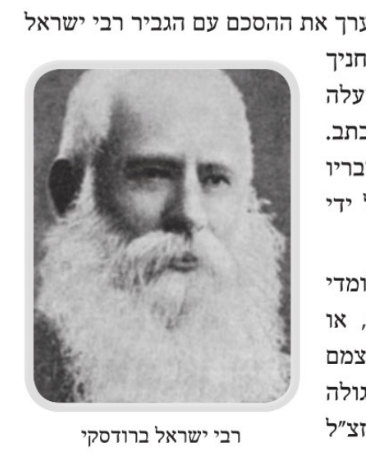
Rav Israel of Rouzhin also vigorously refused the surprise birthday organized by his wife and dismissed all the guests.[13]

The Otsar Kol Minhaguei Yeshurun (4th ed., §XXVII, 4, p.60 and 3rd ed., St Louis 1917-8, Hashmatot §14, p.304) considers that celebrating one’s birthday is a non-Jewish custom and the only character in the Choumash that one finds celebrating his birthday is Paro.[14]

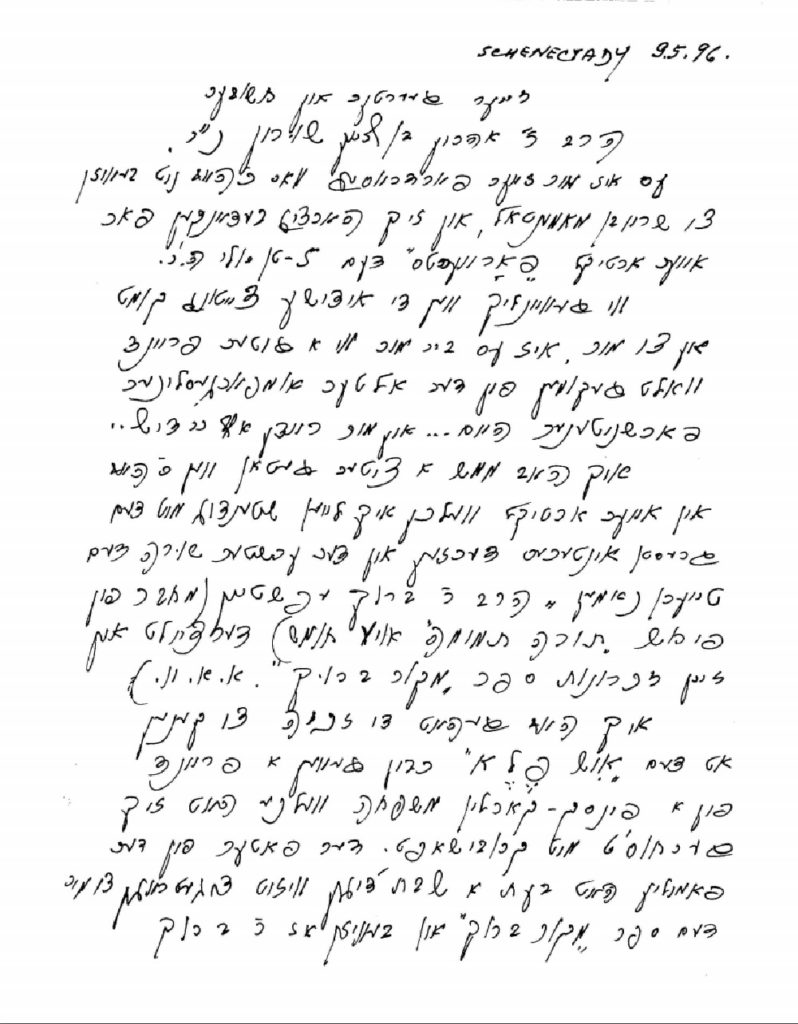
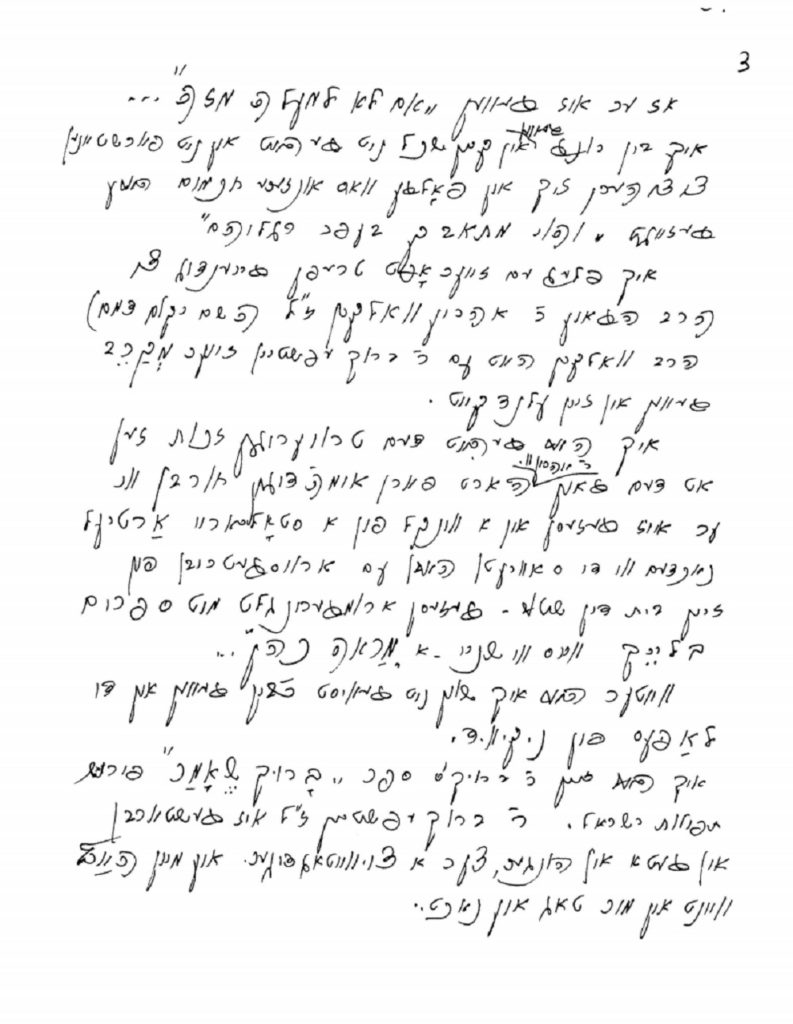
It seems that it is also the opinion of the Aderet in his Nefesh David (p.129) who did not appreciate when we wished him a happy birthday, saying that it was never a holiday among the Jews and that the only one that one finds celebrating his birthday in the Chumash is Pharaoh, while the Gmara Erouvin (13b) tells us that it would have been better not to be born … He even states that he tries to forget that it is his birthday because it causes him great sadness[15] (because “it is better not to be born …”).[16]

He emphasizes, however, that the Tzadikim have something to celebrate their birth, according to the opinion of Tosfot (Avoda Zara 5a).

He nevertheless rejoiced on the day of his 60 years for the same reasons as Rav Yosef in Moed Katan (28a), as he wrote in a letter (Eder Hayakar II, Igrot, p.93, §14 ).

Not that you have to be ashkenaz to oppose birthdays. The Rav Chalfon Moshe HaC ohen in his Yad Moshe (Vayeshev, §63 daf 70b) writes that the custom of celebrating birthdays is very present in Europe, but we (the Jews) mark this date with fasting and repentance, preferring in this the useful to the pleasant.

There is in any case a very clear tendency to connect the birthday party to Pharaoh and that would therefore be considered as a “non-Jewish” rejoicing.[17]

IN FAVOR OF CELBRATING BIRTHDAYS :

However, one could just as easily see things differently.

For the Sadigura Rebbe,[18] if the Torah tells us that there was a celebration in honor of Pharaoh’s birthday, it is not in vain, it is here for us to learn that we must celebrate birthdays. And even though Pharaoh is not a good person, the fact that the Torah mentions it indicates it has to be a followed practice. He brings as a support we learn the principle of not mixing two feasts (ein mearvin simcha bessimcha) from the Torah relating the habit of the non-Jews and particulary Lavan (see Bereshit XXIX, 27 and see Yeroushalmi Moed Katan I, 7) ; and Lavan is also the source for the idea of the seven days of wedding’s festivities.

Therefore, it should not be considered as a non-Jewish minhag, and there is no problem of Chukot hagoyim in celebrating birthdays (see also Shut Beth David, §176).

Rabbi Meir Mazouz also writes (annotations on Ben Ish Chai shana 1, Ree §7, p.580) that he has heard that some people are against celebrating birthdays but since he remembers reading that the Baal Shem Tov was celebrating his – on Elul 18th – and deduces that there is no problem.[19]

His brother-in-law, Rav Yitzchak Berdah, is even clearer in his Shut Yitzak Yeranen (V, §54) and validates the birthdays minhag by writing that those who do so have whom to rely upon.

Rav Nissim Karelitz (Chut Hashani, §195, 1, 6 p.215), unlike Rav Zeldner cited above, does not seem to consider it problematic to offer a birthday present.[20]

Ben Ish Chai (I, Ree, §17) writes that it is a good custom to celebrate birthdays every year and note that some are celebrating the anniversary of their circumcision, indicating that in his family, they usually follow the first minhag (= celebrate the day of birth).[21]

R. Avraham Pallagi in his Veavraham Zaken (Yod, §19) mentions also the minhag of celebrating birthdays. Yabia Omer (VI, WH, §29) also finds this positive.

The custom of a birthday seuda, has also been endorsed by multiple and different authors such as’ Havot Yair (§70), Shout Beth Israel (Landau) (§32), Beer Moshe (Yeroushalaimsky) (Maamar Zikhron Tov, daf 138a, §5).

The Tiferet Israel, in his will prompts his children to mutually wish each other good wishes on the days of their respective birthdays (Hamaayan -Tamuz 1971- ot 6).

It is also a habit taken seriously by Loubavitsh Chassidim. The chabad literature is full of advice and remarks on to conduct oneself on one’s birthday and even tracks sources for it in Kabbalah (Shaarei Halakha UMinhag II, §302).

We also find many Tzadikim who have celebrated their birthdays themselves.

Rabbi Avraham Pallagi already mentioned, celebrated his birthday every year from the age of 70 – according to the testimony of his son Rabbi Avraham Pallagi (Tsavaa Mechaim §40 and see also Guinzei Chaim, yud §16). And this is also the case of Rabbi David Chazan quoted in Yishrei Lev (daf 2b).[22]

We also find the Midrash Sechel Tov (XL, 20 ; p.247) stating that “the majority of “people” enjoy (mechavevim) their birthday, rejoice and make a feast”. (But it’s not clear if he speaks only of gentiles or also of jews.)

The Ktav Sofer probably did not celebrate each of his birthdays with great fanfare, but celebrated his 50th one publicly (see Shut Ktav Sofer Y “D, §148).[23]

We also know – as mentioned above – that Rav Yosef celebrated his 60th birthday (Moed Katan 28a).

And this habit was followed by several rabanim, such as the Trumat Hadeshen, quoted by his pupil (Leket Yosher II, Y “D, p.40), or the Tshortkov Rebbe and the Rudzimin’s Rabbi both cited by R.A Nayerman in his Toafot Reem (volume 1, Warsaw 1936, p.30, §23).

We also find the idea of especially ​​thanking G-d on one’s 60th birthday, as Pele Yoets in his Chesed Laalafim (§221-230, sk.8, p.372) who advocates reciting Shehechiyanu without shem UMalchut or else to prepare a fruit or a new garment for that. This is also the Ben Ish Chai’s opinion (I, Ree, §9) for the 60th and 70th birthday.

For the 70th birthday, we find in Shut Chavot Yair (§70) that it is necessary to recite Shehechiyanu (without restriction). But this opinion is not followed and the Chida (Birkei Yosef-Shiyurei Bracha §223, sk.2) will impose the same restrictions as for 60th birthday, i.e without pronouncing the name of G-d or wearing a new garment (or eating a new fruit).

See as well the Pri Megadim (Mish Zahav §444, sk.9), Shut Tzitz Eliezer (XVIII, §33), Shut Tshuva Meahava (II, §239), Samach Nefesh (erekh Shehechyanu), Rabbi Avraham Pallagi (Tsavaa Mechaim, §40), Hagahot Chatam Sofer (O.C §225), Shut R. Yedidia Tia Weill (Y “D §106 p.224 of the recent edition), Kaf Hachaim (§223, sk.28), Shut Beth Israel (Landau) (§32), Shut Beth David (§176), Chesed Laalafim (§221-23, sk.8), Divrei Israel (II, p.175) and Afarkasta Deania (I, §123), who all oppose reciting shehchiyanu “only because of the 70th birthday”, since this blessing should only be recited for the situations indicated by Chazal, as Shut Olat Shmuel (Kauder) writes (I, §22 ).[24]

However, it will still be necessary to mark the hit. The Chafetz Chaim, for his 70th birthday, invited rav Elchanan Wasserman and rav Yossef Shlomo Kahaneman for a little cake and drink and recited Shehechiyanu! (Mishnat Yaakov II, §225).

But according to other sources (Hechafetz Chaim, chayav UPealo, p.312), he did it (on his 70th birthday) on a new garment.[25]

The Chafetz Chaim also celebrated his 90th birthday and finished his Beth Israel that day (see Hechafetz Chaim, chayav UPealo, p.25).

I was myself invited to the 80th birthday (the last one) of my teacher Rabbi Chaim Yaakov Rottenberg (see Shut Beth Israel -Landau- §32), he did not recite shehechiyanu, but there was cake anyway.

Rav Fishman-Maïmon also celebrated his 80th birthday, and Rav Reuven Margulies participated to the “party” (Machanayim LXXII of Elul 5722 -1962, page 41).

Rav Nathan Adler, from London, traveled to Hanover, Germany for his mother’s 80th birthday (Letter from Rav Shlomo Eiger, printed in Igrot Sofrim, 1, p.83).

It seems that Rav Sonnenfeld also “celebrated” his 80th birthday and Rav Mendel Alter (son of the Sfas Emes) presented him his wishes despite some hesitation about the dubious origin of the birthday minhag (see his letter printed in Kerem Shlomo – Bobov – vol.205, p.47).

But for the 60 years, it is likely that there was nothing dubious, since his older brother, since the Imrei Emes, organized his (the Imrei Emes) 60th birthday party and during the meal he explained the reason for rejoicing, i.e Moed Katan 28a (Shut Maharaav – R. Avraham Binyamin Zilberberg – NY 1941, Volume 2, §61).

Returning to the 70th birthday, Rav Schneebalg (Shut Shraga Haméir IV, §69) was in favor of celebrating it.

Sdei Chemed also celebrated his (Hameassef X, Tevet 5665, IV, p.43 and p.46), and it is also the case of the Vizhnitz rebbe who celebrated it joyfully with his pupils (Israel Saba Kadisha, II, p. 177). This is also what Rav Michael Goldberger did.[26]

In 1860, for Shir’s 70th birthday (Rav Shlomo Yehuda Rapoport), his students had prepared a feast and honors for him, but he refused the honors, humbly explaining that he was born in the year Takan / TIKEN (1790) but he has not been Metaken – Ma Tikanti? (Toldot Shir of Bernfeld, p.126).

See also Voice of Truth (p.282-3) or in Hebrew Kol Chotsev (p.263-4) about the 70th birthday of Rav Schwadron.[27]

We ca find another rationale for the celebration of the 70th birthday. In the Mekor Chesed (Rav Reouven Margulies) on Sefer Chasidim (§213, note 1 ), it brings that the Yerushalmi (Yevamot VIII, 3) states that a plague occurs (at least) once every 60 or 70 years. Therefore, whoever reaches his 70 years has certainly escaped the plague that has declared “in his day”, and that’s a good reason to make a “seudat Hodaa”!

Finally, we even find in the Orchot Chaim (Bukhner) (Krakow edition 1654, §16) that the 60th and 70th birthday’s meals are of the nature of a Seudat Mitzvah.

We realize therefore that many (to the exception of those mentioned in the previous part) view positively the birthday party, and especially those of the 60th and 70th one. But we still have to define what should be done to celebrate a birthday properly.

HOW TO CELEBRATE?

On one’s birthday, it is proper to :

– as we have seen bless Shehechyanu on a fruit or a new garment (Shut Guinzei Yossef §4, 2 quoting his father-in-law, Rav Deutsch, author of Shut Pri Hassadé);

– give a lot of tzedakah (R. Chaim Pallagi in Tzedaka Lechaim – maarechet ayin §555)

– make it a “day of prayer” (Melitsei Esh p.54)

– dedicate this day or at least most of it for divine service (Torat Shalom-Schneersohn-p.398 ; Kerem Habad II, p.102 ; see also Hapardes, year 62 volume 9, p.2 on the name of the Lubavitsh Rebbe)

– learn a lot (Shut Hillel Omer, O “H §139).[28]

One should also be careful to reserve a moment for introspection and Cheshbon Hanefesh over the past year, as the Chut Hameshoulash (Munkasz edition 1893, volume 1, daf 59b-60a footnote) brings about the Ktav Sofer who had locked up hiself on his birthday (54th one) and someone who mistakenly entered the room found him sitting on the floor crying, and asked him what was happening to which he replied that he was crying over the loss of time over the past years (see also the preface to Ktav Sofer Al Hatorah, p.29)

In Shut Hadar (§18), the author states that his master – the Rav of Stretin – wanted to have an aliyah to the Torah on his birthday (which is not feasible every year …). In the same vein, the Divrei Yechezkel Shraga (parshat Vayakel) and the Tehilat Caim (p.409) bring down that the Divrei Yechezkel of Shinova wanted to be shaliach tzibur on his birthday (which is practicable more often). And this is also what R. Shaul Broch did (Shaul Behir Hashem, Ashkavta derabbi, p.275)

See also Torat Shalom (p. 406) who – for his birthday – advocates having an aliyah to the Torah, giving tzedakah, adding moments of prayer, tehilim, study and introspection, bless shehechiyanu on a fruit or a garnment (etc).

I have also read in the name Spinka Rebbe quoted in the Shut Chakal Yitzchak (I, 3) that it is appropriate on one’s birthday, to take upon oneself the commitment on something one knows he has to work on.[29]

There is also a notion of making a Siyum on a birthday.

Several rabanim wanted to make a siyum on their birthday, the Terumat Hadeshen did one on his 60th birthday (Leket Yosher II, Y “D, p.40).

See also Leket Hakemach (131) that it is appropriate to mix this rejoicing with a siyum massechet.

Thus, the Chatam Sofer planned that the end of the cycle of chumash study with his pupils falls on his birthday – the 7th Tishri (Minhaguei CS, VII, §14, p.31).[30]

His son Ktav Sofer also completed a massechet each year on his birthday (Chout Hameshoulash ed Munkasz 1893, Volume 1, daf 59b footnote).

Another fact deserves to be emphasized:

In the Sheerit Natan (p.392 ; quoted in Or Israel 46, p.249) we find a very particular siyum minhag that was taking place at Yeshivat Chachmei Lublin, every 7th Adar, birthday of the Rosh yeshiva Rabbi Meir Shapira (initiator of the study of Daf Yomi). Talmud treatises were “dispatched”, and each student took a massechet or half of it, in order that they altogether fnished Shas in one night, so that on the next day, the 7th of Adar, they were all together making a great Siyum Hashas with the Rav.

All this being said, personally, I will be tempted to give an argument in favor of those who celebrate their birthdays, but I have not seen any Acharon underlining this aspect (except Torat Shalom -Schneersohn (p.399-400 ) I found recently):

The halacha is to celebrate annually a miracle that would have happened to us (see Mishna Berura end of §218), for example the one who survives a fatal accident must celebrate this event every year.

If it is so, given the great danger of a baby birth, one could consider that it is necessary to celebrate the miracle of his birth each year.

True, nowadays, in civilized countries, the risk of miscarriage is pretty much reduced and infant mortality has also fallen down, B “H, but if the minhag has been implanted since a time when it was not the case, we may continue this custom because the danger is still not totally absent.

Only that according to this, it should also be that each mom celebrates the birthday of each of her children, because she also escaped death that day.

And, according to this rationale, we should celebrate the Hebrew date rather than the civil one.[31]

Anyway, even if no halakhic argument would push to celebrate the birthdays (and it is probable because we proved Moed Katan 28a that the Amoraim did not celebrate any birthday, only Rav Yosef distinguished itself by celebrating 60 years old – and only that one …), there is another reason, especially for children: nowadays this custom is widespread and children are sometimes misled and are tempted to move away from family. It is beneficial to show each child in the family that he is important and at least one day a year, we celebrate together. He becomes the hero of a day.

See also, a bit in this way, Kitvei Reb Eizik (Schwei) (p.273) and Torat Shalom (p.405).

At the time of the Talmud, it was not necessary, but today it can be according to the situations, the families and the place.

It would be inappropriate to say that since the Amoraim did not celebrate them, we must refrain from doing so.

To refrain from them at their time meant nothing particular, because no one was celebrating them (among the Jews at least). Today it would have another meaning for the child …

It cannot be said that he fails to celebrate, but that those who are accustomed to it should not lose it under a “religious” pretext, they must perhaps channel its spirit and enhance it by making it look, more “kadosh”, by giving more meaning to it.

See also Shut Mayim Hahalacha (Metzger) (IV, §46) who writes that it is necessary to know how to give a kedusha spirit to birthdays and not to celebrate them in frivolity.

More generally, Rav Shach used to say (see Machshevet Zkenim p.342 and also p.141 and 332) that each birthday brings us closer to death, so why rejoice? That is why only the “ben aliya”, the one who progresses from year to year in the Torah, must rejoice, because each passing year carries a new advance in Avodat Hashem, so it is closer to Chayei Netsach, the reverse of death, for the tzaddikim are called alive even after their death (Brakhot 18a).

Once a rav had suggested to the great and famous Rav Yechezkel Lewinstein – when he was mashgiach of Ponovez – to suppress the minhag of the “Santukha” (small celebration among friends of the Yeshiva when one of them is engaged) for it is systematically engaged in flattery to highlight the qualities of the chatan and the speaker, in a laudatory spirit, sometimes praises too much, which necessarily leads to a uncontrollable feeling of pride so repudiated by Baalei Moussar.

Rav Lewinstein exclaimed: “Once in the life of a man it happens that his friends give him compliments and even that you want to suppress?! “

IN CONCLUSION: It is perfectly legitimate to wish and celebrate birthdays, but you must know how to do it.

Those who are not used to accompany a family snack with Cheshbon Hanefesh are not required to adopt this minhag. But those who already celebrate this day with a small party should not abandon this beautiful habit because of some rabbis who grumble against birthdays; as we have seen, the rabbis who attached importance to these moments of rejoicing are very numerous and to the extent that one does not feast bestially but for a constructive purpose, with a feeling of Hodaa, Tshuva and introspection, it’s a very good Minhag.

[1] See also Ben Yehoyada Brachot 28a, that if a miracle happens on one’s birthday, it does not diminish his merits…
[2] It seems that some Tzadikim were not so happy to leave this world. The story that is told about the Gaon or the ‘Hazon Ish (or others, depending on the version), who would have cried before dying while saying regret a world where we can buy mitzvot for some pennies like Tzitzis, shows us that feelings are mixed ….
[3] Which means that by dying on that day, it indicates that they could have died before but have benefited from an extension, so it is “positive”.
[4] Taam Vodaas Bereichit XL, 20, however, see Nefesh Chaya (Orach Chaim §580).
[5] From Rav Aharon Zeldner’s Mate Aharon (p.68) it is deduced that giving a gift to a friend on his birthday is a non-Jewish custom not to follow.
[6] Minchat Elazar in his Divrei Torah (V, §88).
[7] This argument seems strange. In fact, we find in the prayers, all kind of different expressions of gratitude to G-d for the life He gives us (the Gomel, for example), which seems to indicate that life has its interest …

Moreover, Ramban (Shemot XIII, 16) writes that we must thank G-d for creating us.

We must therefore temper the teaching quoted (Erouvin 13b), since it is impossible to interpret it as if God had made a mistake by creating us!

It is only from men’s viewpoint that he would have been “noach“, pleasant/easier, to not have been created. Easier, certainly, but not “preferable” since G-d knows what He does.
[8] But his son (Shut Migdalot Merkachim, O.C, §31) greatly relativizes his father’s opposition by explaining the very particular context of this responsum and the specific case of the person who was concerned. Shut Vayaan Yossef (§73) also diminish the opposition of Arugat Habossem stating he was only opposed to big feasts, but not to small family party at home (see also in the same way Kvod Chachamim (Jerusalem 1982 – p.208, rav Meir Eisenstein’s maamar).
[9] See also in his Knesset Chachmei Israel, kountras 3, §66, 4 daf 65b and Kountras 6, §115, 1 daf 125a.
[10] Though he tolerates a birthday meal if it is exclusively reserved for scholars, as Rav Yossef did in Moed Katan 28a – see Lehorot Natan IX, § 5, 11.
[11] Rav H.D Halévy (Asse Lecha Rav IV, §26) has not read it, but writes that it is obvious that there is no issur Avoda Zara nor Chukot Hagoyim, because the Avoda Zara part was only the sacrifices they brought to their gods, but to celebrate a birthday is in itself a healthy idea.
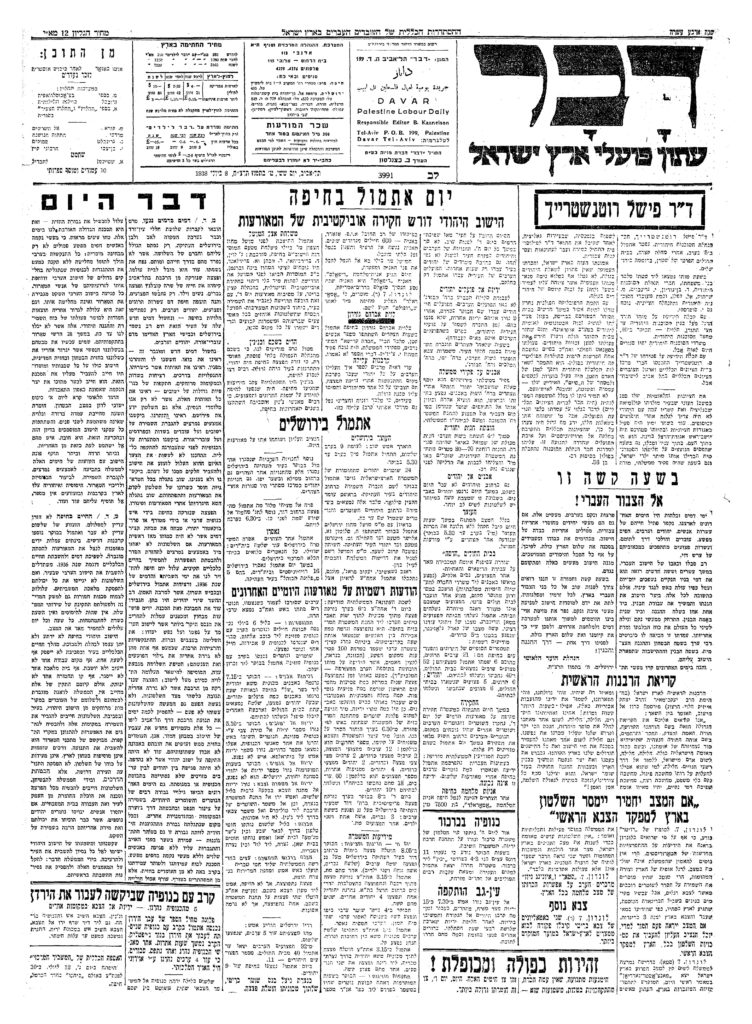
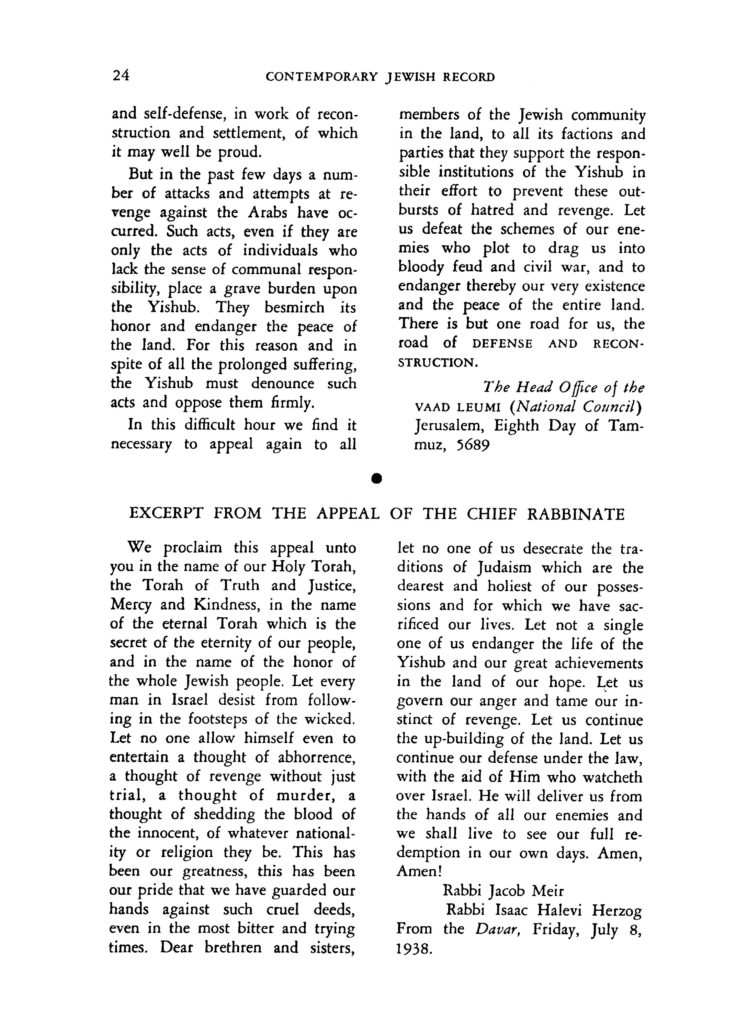
[12] He quotes also his grandfather Rav Pinchas Chaim Horovitz, the Pitcha Zuta, whom he was surprised to see on his birthday – on the 18th Tamouz 1938 – crying while reading Tehilim. He explained to his grandson (the Ahavat Israel) that he was crying over the suffering he had cause to his mother when he was born 80 years earlier … However, see how Rav Eisenstein (Zichron Shlomo, p.214 and following) rejects every argument of Rav Horovitz.
[13] Shout Knesset Avraham Yoel – Abelsohn – §6 p.116 and Knesset Chachmei Israel §115, 1 daf 125a.
[14] He also states that when the pupils of Rav Yitzchak Elhanan Spektor of Kovno in 1889 wanted to celebrate the anniversary of his 50th year in the rabbinate, he was firmly opposed it – but this was not really a birthday [Actually, it was for his 25th years (not the 50th) in Kovno, as we see in Hatzfira (No. 68) and later on in Shana Beshana (1976, p.237), even if it was already his 52th in the rabbinate in different cities].

The opposition of the Rav was also published in Hatzfira (No. 77 – 11 Nissan 1889) and for more on this subject see Toldot Yitzchak p.114 of Rav Yaakov Lifshitz, Darkenu (shana II , guilion 3, p.16) and Pardes Yosef (Vayeshev Miluim p.48) who quotes several opponents of birthdays, including “the Toldot Yitzchak of an Italian rav with the Kotna rav’s haskama” [There is indeed a Toldot Yitzchak of the rav Yitzchak Luzzato but it is a book of poems and songs which does not contains neither an approval of the Kotna’s rav, nor opposition to birthdays party. In fact, the Pardes Yossef mixed up when copying the references on this subject from the Darkenu (op cit) which quotes Toldot Yitzchak and then Kochav MiYaakov of an Italian rav with approval of Kotna’s rav (in the Kochav MiYaakov it’s p.54)].

As an aside, many other rabanim did not mind celebrating the anniversary years of their rabbinate or action for Torah, often by the publication of a sefer Hayovel, as for R. Shimon Schkop for his 50 years of teaching (see what Moshe Avigdor Amiel writs in this collection, in 1943 there will also be a sefer Hayovel for him), Rabbi Meir Shapira from Lublin (in 1930) for his 20 years in the service of the Torah, Rav Fishman-Maïmon for his 50 years (in 1926), sefer Hayovel for Rav Rabinovicz’s 70th birthday (NY 1930), another for 70 years of rav Azriel Hildesheimer (Shay Lemora), and for his rav, rav Yitzchak Bernays, for whom his 25 years of rabbinate in Hamburg were celebrated with great fanfare in 1846 (Shana Beshana 5736 p.238).
[15] Rabbi David Pardo, author of many sfarim including Lamnatzeach LeDavid and Chasdei David, writes at the end of his commentary Shoshanim LeDavid that he finished it on his 34th birthday, 1st Nissan 1752, and it does not seem to sadden him at all …
[16] But he himself writes in his Har Hamoria (Ahavat Shalom ed., P.59) that he requoted the Bracha of Shehechiyanu for his birthday with great joy! [However, in this instance, he was sick, with 41 ° C fever (!) and thought he would pass away. So, when he had the strength to pray Shavuos Maariv BeTzibur, he rejoiced (and thus the Shehechiyanu blessing). Especially since having been born in Shavuot, he perhaps said it for the Yom Tov, although he wrote that he requoted it for his birthday).
[17] We also find some who were opposed to the celebration of a death day (yohrtseit) of a tzaddik! In 1890, some wanted to celebrate the 50 years of the death of Chatam Sofer, but his students, Rav Naftali Sofer (see the beginning of Kountras Beth Efraim printed at the end of Et Sofer Volume 2) and Rav Yehuda Modern (strange name for a disciple of Chatam Sofer, symbol of the opposition to modernism deviating from the massoret) for whom it was a non-Jewish custom directly inspired by Maskilim who had recently (in 1886) celebrated the 100 years of the death of their master Mendelssohn, opposed it. “Yohrtzeit” yes, but “specifically for the 50th years”, no ! (Leket Shoshana (1942, §19) and Beth Vaad Lachachamim (Nissan 5771, p.463)). It is the idea that there would be a particular reason to celebrate only the symbolic years because “round”, which displeased these Rabanim.

Personally, I do not see why this notion should be classified as heretical / non-Jewish, if not – and it is this their real motive – in my opinion – because of the likeness with the Maskilim whose aspirations were rarely holy. The Rabanim at that time were doing everything to remove their flock from the Maskilim in order to stop the spread of the Haskala “virus”, it is a kind of prophylactic disposition. It would have been purely conjunctural, so, nowadays “the prohibition” would no longer be appropriate, but disbanded. And it is probably what could explain why for the 100th years of the death of Chatam Sofer (in 1940), they published a Sefer Hazikaron with a great ceremony in Pressburg, presided over by R. Akiva Sofer himself.
[18] Quoted in Messilot-Kislev 5747 ; see also Abir Yaakov – of the Sadigura Rebbe- p.161
[19] He does not remember where he has read this about the Baal Shem Tov, but I suppose it’s in Chabad literature, for example in Sefer Hasichot (1943, p.154, 187), Kountras Chay Elul, and Kerem Chabad (II, p.100).
[20] See also Rav Halevy in Assé Lecha Rav (IV, §26) for whom there is also no problem.
[21] Shut Beer Eliyahu (Katz) (II, Y “D §32) writes that, in his opinion, the advantage of the day of circumcision can only concern the first twelve birthdays, but from the Bar Mitzvah and on, it is more logical to celebrate the day he took upon himself to commit to the mitzvos, which is birth.
[22] See the Knesset ChaChmei Israel – kountras 3 – §115, 1 for which only birthdays of 60 and 70 deserve attention, but not the following ones.
[23] see Afarkasta Deania (I, §123) who is surprised about it because it seems to be against his father’s position. In fact, the Chatam Sofer states (Torat Moshe, Vayera, Bereshit XXI, 8) that Avraham used to celebrate every year on his son Yitzchak’s circumcision day – not his birthday.
[24] This rationale is rejected by the Tshuva Meahava for whom the Chavot Yair is not absurd (when advocating the shehechiyanu blessing in other occasion than those of takanat chazal) because, as the Bach (où, O.C 225 ?) writes, it is a bracha that has been instituted on man’s joy (and not only on the precise situations listed by chazal.

The Komarno Rebbe (Chulchan Hatahor §223, 7) sides with the Chavot Yair and indicates – at odds with all the poskim listed- to recite the bracha (he often has marginal positions in this book).

See also Rav Shlomo Tzvi Shik (Shout Rashban I, §61). According to whom, Chavot Yaïr does not hold one should recite shehechiyanu (!), but he personally thinks we should.
[25] Hard to know who to trust when the two are also contradicted by Rav Shlomo Zalman Bloch who, when he heard that the Chafetz Chaim would have given a small snack for his 70th birthday, exclaimed : “Sheker Gomur! Dos iz nit kein arbeit far Chofetz Chaim, s’iz nit a yiddishe weg!” (Hatzadik R. Shlomo, p.29, ot 18). In other words, according to him, it is absolutely impossible for the Chafetz Chaim to do so, because it is not “Jewish” to celebrate his birthday … (see Or Israel 24, p.193 note 103).
[26] see Shut Rashban I, §61 where Rav Shik wrote to him that he learned from his son (the son of rav Goldberger) that his father (rav Michael Goldberger) was about to celebrate his 70th birthday and according to him (rav Shik) it would be appropriate to recite Shehechyanu, and that he himself, if he was able to attend, would have recited it (because of Haroe et chavero achar 30 yom) as well as shechalak MeChoChmato liyereav (which is recited at the sight of a great sage in Torah).
[27]
To celebrate the 70th years of a Tzadik is noble and desirable according to the Chesed LeAvraham (Brudno) (volume 2, pticha, p.6 §4)

We also find the idea of ​​rejoicing on the birthday -at least a tzadik’s one- in the Midrash Tanchuma (Pekoudei XI) which states that G-d wished to mix the joy of the Mishkan with the joy of the birthday of Yitzchak (the 1st Nissan).

See also Tosfot and Rosh (Nazir 14a) explaining there is a doubt arising when someone says “I will be as Moshe the 7th adar” (is he Nazir or not?) because this person might allude to Moshe’s death a sad day when mourners engage in a Nezirut, or he alludes Moshe’s birthday a day of celebration and joy …

Still on the subject of celebrating important people birthdays, it seems (from see Oshea (VII, 5) “yom malkenou” and Metzudas David, ad loc) that contrary to what Rav Fraenkel writes in his Labar-mitzvah Encyclopedia (p.217), Jews did celebrate their kings’ birthdays, who explains that this is the birthday of the king and there was a feast. However, Malbim (ad loc) explains otherwise.
[28] In yeshivos, the custom is to “have a mishmar”, i.e to study all the night of the 20 years anniversary.
[29] If we do not find one (we are a great tzaddik or we do not understand the concept), we can always work on acquiring a ” Jewish spirit “. In fact, it is sometimes thought that doing all the mitzvot makes us a good Jew, but the truth is that we can do lots of mitzvot, pray three times a day, put on tfilin and tzitzit, keep Shabbat, eat strictly kosher etc. … and yet … being far from a true Judaism.

The Piaseczner Rebbe, R. Kalmish Shapiro (killed by the Nazis in Trawniki camp on 4th Heshvan 1943 after being deported from the Warsaw Ghetto in April 1943 following the insurrection), had a diary in which he wrote on his 40th birthday (19 Iyar 1929) that he should take a commitment on himself, but that he does not know what to take as “kabala” this year, “to study more? it seems to me that I’m not wasting a moment in my schedule; stay away from Taavos ? Baruch Hashem I am not dependent on any material Taava ; so what do I lack ? What I lack … is being “a Jew”! I feel like a human form, with its colors and shapes etc. to which only one thing is missing: the Neshama! Master of the world! … This is what I wish for this year (from now on), I want to convert and become a Jew! “(Quoted in Mimaayanot Hanetsach p.294).
[30] However, in the Shut Afarkasta Deania (§123), he quotes the Chatam Sofer as being opposed to choosing the birthday rather than circumcision day (see on this subject Or Israel 49, p.142, note 46).
[31] But Zichron Shlomo (Jerusalem 1994, p.219) emphasizes that according to the idea that birthdays are days of good Mazal (as mentioned in the first part), as it is related to the stars (mazalot), one must follow the solar/civil calendar ! But more on this (which date someone should celebrate) in a future post.
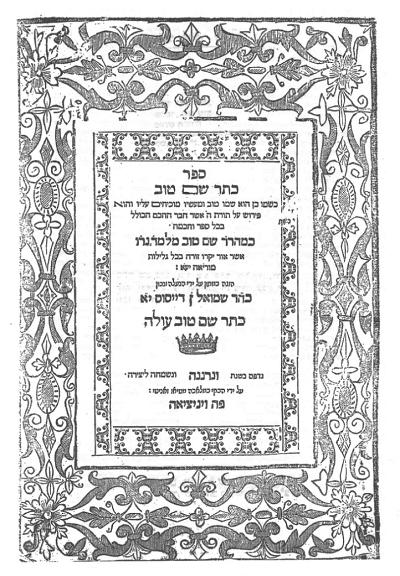
Keter Shem Tov: A Study in the Entitling of Books, Here Limited to One Title Only

Keter Shem Tov: A Study in the Entitling of Books, Here Limited to One Title Only[1]

by Marvin J. Heller

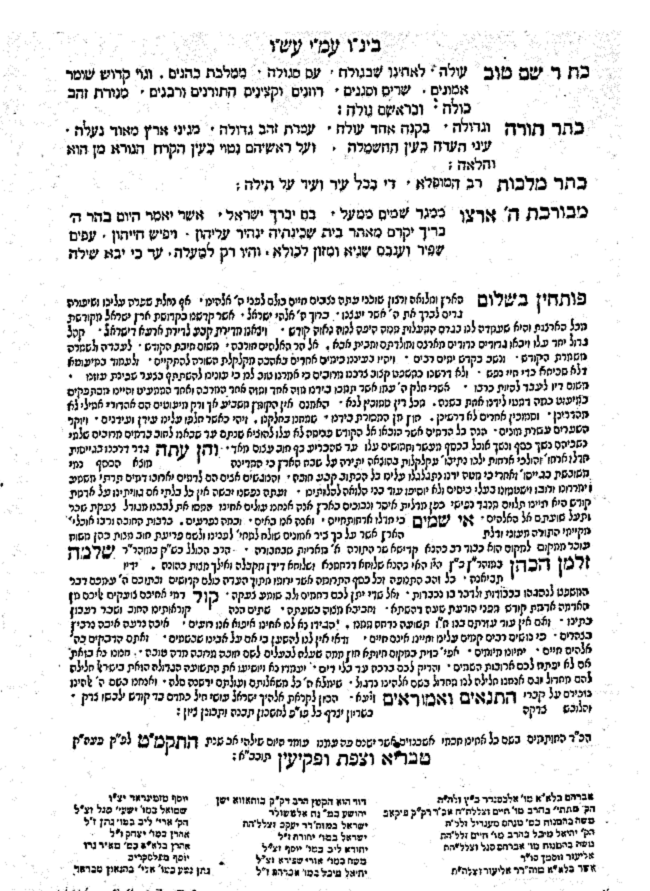
Entitling, naming books is, a fascinating subject. Why did the author call his book what he/she did? Why that name and not another? Hebrew books frequently have names resounding in meaning, but providing little insight into the contents of the book. This article explores the subject, focusing on one title only, Keter Shem Tov. That book-name is taken from a verse “the crown of a good name (Keter Shem Tov) excels them all (Avot 4:13). The article describes the varied books with that title, unrelated by author or subject, and why the author/publisher selected that title for the book.

  1. Simeon said: there are three crowns: the crown of Torah, the crown of priesthood, and the crown of royalty; but the crown of a good name (emphasis added, Keter Shem Tov) excels them all (Avot 4:13).

“As a pearl atop a crown (keter), so are his good deeds fitting” (Israel Lipschutz, Zera Yisrael, Avot 4:13).

Entitling, naming books, remains, is, a fascinating subject. Why did the author call his book what he/she did? Why that name and not another? Hebrew books since the Middle-Ages often have names resounding in meaning, but providing little insight into the contents of the book. A reader looking at the title of a book in another language, more often than not, is immediately aware of the book’s subject matter. This is not the case for many Hebrew titles, the name having been selected by the author for any one of a number of reasons, least of all the book’s subject matter, but rather the intention is/was to give the book “the crown of a good name (Keter Shem Tov).”

Book titles have been addressed in both books and articles. Menahem Mendel Slatkine wrote a two volume work, Shemot ha-Sefarim ha-Ivrim: Lefi Sugehem ha-Shonim, Tikhunatam u-Te’udatam (Neuchâtel-Tel Aviv, 1950-54) on book names; it has been the subject of encyclopedia articles in both The Jewish Encyclopedia and the Encyclopedia Judaica; and such authors as Abraham Berliner, Joshua Bloch, and Solomon Schechter have written articles on book titles, all this apart from this subject being mentioned in passing in numerous other works. I too have addressed the subject, first in “Adderet Eliyahu; A Study in the Titling of Hebrew Books,” describing about thirty books with that single title, two only related to each other, and in “What’s in a name? An example of the Titling of Hebrew Books,” describing varied books taken from a single verse “Your neck is like the tower of David built with turrets, on which hang one thousand bucklers, all of them shields of mighty men (Song of Songs 4:4).[2]

What then is the justification for yet another article on the same subject? It is, as suggested above, the allure of how authors of varied unrelated works came to entitle their books, reflective of their intellectual or emotive processes or objectives. The title selected here, Keter Shem Tov, unlike Adderet Eliyahu, is not the title of as large a number of books, but the titles here are certainly as varied as those in the previous articles. Indeed, the works so entitled are sufficiently different, again providing insight into authors’ thoughts and, perhaps, an article of interest to the reader. We will not attempt to second guess or analyze an author’s motives, all of whom intended their book to have the crown of a good name (Keter Shem Tov), but rather we will let the authors speak for themselves when describing their books

In several instances, books are so entitled as to reflect the author’s name, Shem Tov. The use of a line from Avot, to reiterate the injunctions noted previously (“Adderet”), rather than directly using the author’s name, is to avoid violating R. Judah ben Samuel he-Hasid of Regensburg’s (c.1150-1217) proscription to not do so, so as to not benefit from this world, thereby decreasing one’s portion in the world to come, or to not reduce their offspring and the good name of their progeny in this world.[3] The Roke’ah (R. Eleazar ben Judah of Worms, c. 1165–c. 1238), however states at the beginning of the introduction to his Roke’ah, that everyone should inscribe his name in his book, as we find in the Tanna de-Vei Eliyahu.[4] Indeed, the Sefer ha-Roke’ah, is so entitled because the numerical value of the family name, Roke’ah (רקח=308), equals his personal name, Eleazar (אלעזר=308). It is, therefore, permissible to allude to the author’s name, for example, a Shem Tov using the title Keter Shem Tov, a quotation from Avot. Indeed, a substantial number of the books described here refer to the author’s name.

Our selection encompasses homilies on the Torah, Kabbalah on the Tetragrammaton, halakhah and minhagim (customs), the sayings of the Ba’al Shem Tov, in praise of Sir Moses Montefiore, a letter on behalf of the Jewish community in Tiberias, and a highly unusual work on the Dead Sea scrolls. Finally, this article is a vignette, no more no less, an insight into and, in a manner of speaking, a photograph of one manner of how Hebrew books are named.

Several caveats. First, our Keter Shem Tovs are organized within subject categories, beginning with 1) discourses, both literal and kabbalistic on the Torah, followed by 2) halakhah and minhag (custom), 3) biographical and related anecdotal works, 4) miscellanea, all ordered chronologically within category, and concluding with 5) a brief summary. Secondly, our approach will be somewhat expansive, the various Keter Shem Tovs giving us entry into related aspects of Hebrew printing and Jewish history. Lastly, while the number of works entitled Keter Shem Tov is not large, that notwithstanding, our examples are an overview and not meant to be all inclusive or comprehensive but intended as an interesting insight into an aspect of Hebrew book practice.

I Discourses, Literal and Kabbalistic on the Torah

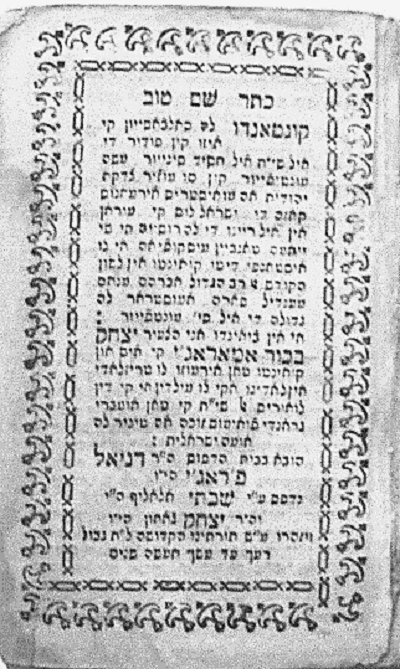
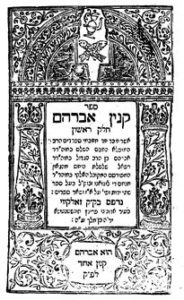
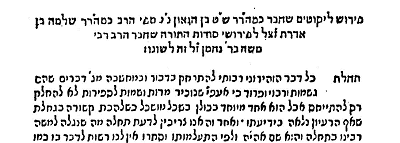
Keter Shem Tov, R. Shem Tov ben Jacob Melamed, Venice, 1596: Our first Keter Shem Tov is a commentary on the Torah by R. Shem Tov ben Jacob Melamed. It was printed in Venice (1596, 20: 136, 16 ff.) at the press of Matteo Zanetti. This Zanetti, a member of the famous Venetian printing family of that name, established his print-shop on the Calle de Dogan, publishing seven books from 1593 to 1596. Among his titles, in addition to Shem Tov Melamed’s Keter Shem Tov, are R. Nathan Nata Spira’s (Shapira) Be’urim, R. Bezalel Ashkenazi’s responsa, and R. Solomon le-Bet ha-Levi’s Divrei Shelomo.

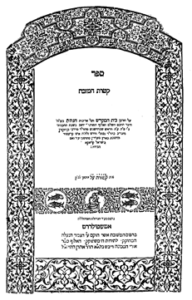
The title page has the decorative frame employed by Zanetti on several of his books with a smaller frame in the center about the text. The title-page states that,

Keter Shem Tov

As is its name so is his name good and his deeds confirm it of him. It is a commentary on the Torah of HaShem written by the sage, the complete, in every book and wisdom.

Shem Tov Melamed

Whose precious light shines throughout [may

God shield him].

Edited patiently by the lofty and exalted

Samuel ibn Dysoss [may God watch over him]

Keter Shem Tov excels

Printed in the year, “that we may rejoice ונרננה (5356=1596) and be glad [all our days]” (Psalms 90:14) from the creation.


The introduction, from a student of the author, R. Samuel ben Solomon Segelmassi follows (2a), then a page of verse from the editor Samuel ibn Dysoss, the text (3a-136a), his apologia (136b), indexes (1a-16a), errata (16a), and the colophon (16b), which states that it was completed, “on the very day that Moses went up to the firmament (6 Sivan) and the Egyptians drowned in the sea (21 Nissan), in the year, “Then he saw it, and declare it ויספרה (5356=1596) (Job 28:27), from the creation.” It is unclear why there are two apparently contradictory completion dates. The text is in two columns in rabbinic type, excepting headings and initial words.

In the introduction Samuel ben Solomon writes that one who knows matters in truth and faithfully,

“shall come back with shouts of joy” (Psalms 126:6), “to perceive the words of understanding” (Proverbs 1:2) and this is the first intent of every man who presumes in his heart (Esther 7:5) to write “goodly words” (Genesis 49:21) in a book to leave after him a blessing. . . . It is a commentary on the holy Torah, “high and lofty” (Isaiah 6:1, 57:15), on each and every parshah . . .

The introduction continues that it contains derashot (discourses) according to the literal meaning, casuistic (pilpul), and very sharp. In the following paragraph we are informed that not everything that was said on every parshah was printed because of financial restraints. In the apologia ibn Dysoss adds a familiar plaint for the period, type set late erev Shabbat could not be properly corrected. Moreover, the compositors, not Jewish and not fully familiar with Hebrew and Hebrew letters, did that which was right in their eyes, and for which he should not be held responsible.

That the title clearly alludes to the author’s name, R. Shem Tov ben Jacob Melamed, is further suggested by the last line of verse at the end of the introduction, which states that “you will find that the crown of a good name (KETER SHEM TOV) excels them all. This is, as noted above, that authors’ names were frequently employed in book-titles, but, in keeping with the injunction of R. Judah he-Hasid, indirectly, here by referencing a quote from Avot.

Shem Tov Melamed was also the author of Ma’amar Mordekhai (Constantinople, 1585), a commentary on Megillat Esther, printed by Joseph Jabez. Melamed is described on the title of this work as a physician.

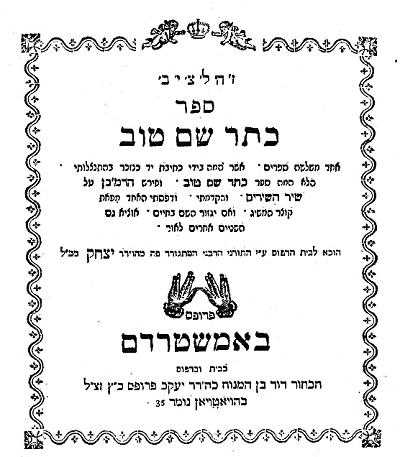
Keter Shem Tov, Amsterdam, R. Abraham ben Alexander (Axelrad) of Cologne, c. 1810-16: A kabbalistic Keter Shem Tov on the Tetragrammaton by R. Abraham ben Alexander (Axelrad) of Cologne (13th century). In Judaism the Tetragrammaton, the four letter divine name, is not directly expressed but instead referred to with a euphemistic name for God. The title-page describes this Keter Shem Tov as,

זהלציב [This is the gate of the Lord: the righteous shall enter through it] (Psalms 118:20)

Sefer

Keter Shem Tov

One of three books in my hand in manuscript, as described in my apologia. They are Keter Shem Tov and the commentary of the Ramban (R. Moses ben Nahman, Nachmanides, 1194–1270) on Shir ha-Shirim (Song of Songs). I have first printed one book only due to limited means. If the Lord will so decree I will publish the other two books. . . .


Although the title-page refers to three books two only are mentioned. The third work, noted in the editor’s apologia, is a commentary on the Merkavah of Ezekiel. Keter Shem Tov is not dated, so that various bibliographic sources date it as 1810 or 1816. The title-page is embellished by the Proops’ family press-mark, consisting of the kohen’s spread hands at the time he pronounces the priestly blessing. This edition of Keter Shem Tov (80: 5, 7 ff.) was printed in Amsterdam by David ben Jacob Proops. The Proops’ press, founded by Solomon Proops in 1704, was the longest lasting and most productive of the Hebrew printing-houses in Europe in the eighteenth century; it would continue to print Hebrew books until the mid-nineteenth century when, in 1869, the widow of David Proops sold the press to the Levissons, who printed until 1917.

Abraham, a student of R. Eleazar ben Judah of Worms (c. 1176–1238, Roke’ah), traveled through Spain between approximately 1260 and 1275, where he reportedly studied with R. Solomon ben Adret (Rashba, 1235–1310), the latter praising Abraham’s oratorical skills. Keter Shem Tov, as noted above, deals with the Tetragrammaton and also the Sefirot, addressing sacred names, using gematriot and synthesizing the mysticism of the Ashkenaz pietists (Hasidim) and Sephardic Kabbalistic methodologies.[5] Here too the reason for the title is not explicitly stated but, given the subject matter, is obvious.

This is not the first printing of Abraham ben Alexander’s Keter Shem Tov. It appeared earlier, included in a collection entitled Likkutim me-Rav Hai Gaon (Warsaw, 1798), under the title Ma’amar Peloni Almoni (ff. 26-32a). It has since been reprinted several times, often among collections of other works.

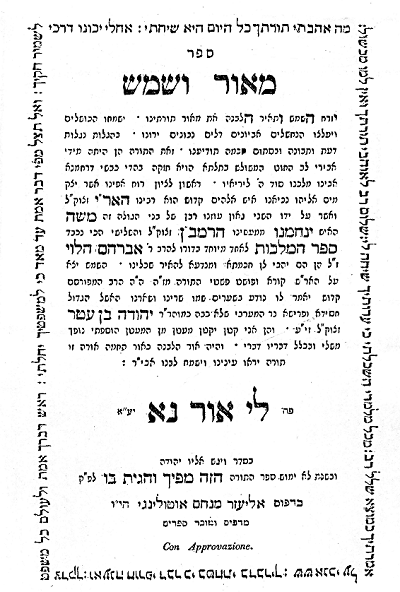
Ma’or va-Shemesh, R. Shem Tov ben Abraham ibn Gaon, Livorno, 1839: The next Keter Shem Tov, by R. Shem Tov ben Abraham ibn Gaon, is also a kabbalistic discourse on the Torah, this part of a larger multi-volume work entitled Ma’or va-Shemesh (Livorno, 1839, 80: [3], 3-11, [1], 128 ff.) printed by Eliezer Menahem Ottolenghi. The inclusion of Ma’or va-Shemesh represents a more expansive view of works entitled Keter Shem Tov as it is an independent work included in a larger collection of dissertations. The author (compiler) of Ma’or va-Shemesh, R. Judah ben Abraham Coriat (d. 1787) of Tetuán, was a scion of a distinguished Moroccan family.

  1. Shem Tov ibn Gaon (c. 1287-c. 340) was born in Soria, Spain and went up to Eretz Israel in 1312, settling in Safed where he wrote most of his books. He was a student of R. Solomon ben Adret (Rashba, 1235–1310) and R. Isaac ben Todros (13th cent.). Best known of ibn Gaon’s titles is Migdal Oz, on Maimonides’ Mishneh Torah as well as several works in manuscript. Keter Shem Tov, his first book, was reportedly written in Spain, while Rashba was still alive.[6]

The title-page of Ma’or va-Shemesh has a frame comprised of verses, all from Psalm 119:

“O how I love your Torah! It is my meditation all the day” (Psalms 97);

“O that my ways were directed to keep your statutes!) (5);

“The sum of your word is truth; and every one of your righteous judgments endures for ever” (160);

“So shall I have an answer for him who insults me; for I trust in your word” (42);

“So shall I have an answer for him who insults me; for I trust in your word” (162);

“I have more understanding than all my teachers; for your testimonies are my meditation” (99); “Great peace have those who love your Torah; and nothing can make them stumble” (165).


An additional verse is employed for the date, “This Book of the Torah shall not depart from your mouth; but you shall meditate on it הזה מפיך והגית בו (599 = 1839)” (Joshua 1:8). The title too is from Psalms, “The day is yours, the night also is yours; you have prepared the light and the sun (Ma’or va-Shemesh)” (Psalms 74:16).

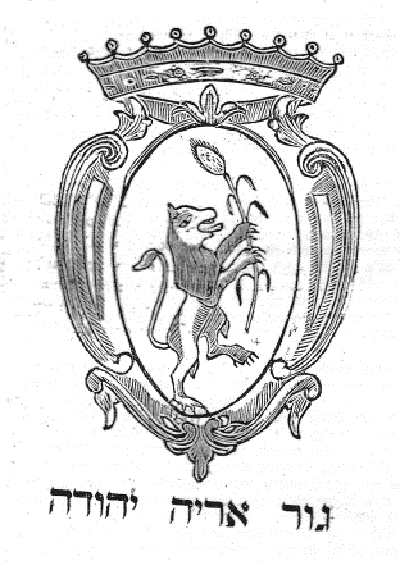
The text of the title-page notes several of the authors whose kabbalistic works comprise Ma’or va-Shemesh, notably the Ari ha-Kadosh (R. Isaac Luria, 1534 – July 25, 1572), R. Moses ben Nahman (Ramban), Sefer ha-Malkut, and R. Judah ben Attar, Coriat’s maternal grandfather. The verso of the title-page has a pressmark, a lion rampant holding thistle under crown and below it the phrase Gur Aryeh Yehudah. This device was used previously in Livorno by Eliezer Saadun. When employed by Ottolenghi the lion has been turned to face right, it having previously faced left.[7]


There are introductions from R. Elijah Benamozegh and Abraham ben Judah Coriat, the former comprised of five paragraphs, each beginning with the word Kol and concluding with Judah, the latter’s introduction comprised of eight paragraphs, each beginning with Ben and concluding with Av. The text is comprised of several kabbalistic works, among them Shem Tov ben Abraham ibn Gaon’s Keter Shem Tov (ff. 25-54a), here not explicitly stated but rather entitled Perush Sodot ha-Torah. Shem Tov was a kabbalist, who studied with the Rashba and R. Isaac ben Todros. He was greatly influenced by the Ramban (R. Moses ben Nachman), reflected in his Keter Shem Tov, which is a kabbalistic super-commentary on Ramban’s Torah commentary. Here too, the title comes from the author’s name, Shem Tov.

A small portion of ibn Gaon’s Keter Shem Tov was printed previously (ff. 41b-44a), in R. Jehiel ben Israel Luria Ashkenazi’s Heikhal ha-Shem (Venice, 1601), on the ten Sefirot, Likkutei Kabbalah Kadmonim.


This much expanded version of Keter Shem Tov is based on an 1810 manuscript prepared by R. Elijah Lombroso.

II Halakhah and Minhag

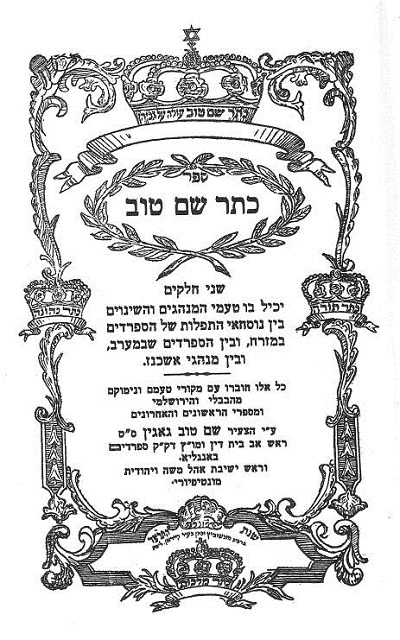
Keter Shem Tov, R. Shem Tov ben Isaac Gaguine, Kaidan, Lithuania, 1934: An encyclopedic work on the varied customs and liturgy of eastern and western Sephardim and Ashkenazim by R. Shem Tov Gaguine (Gaguin, 1884-1953). Gaguine, scion of a famous Moroccan Rabbinical dynasty which emigrated to Palestine from Spain, was a great-grandson of R. Hayyim Gaguin the first Hakham Bashi of Eretz Israel in the Ottoman Empire and a great-great grandson of the kabbalist Sar Shalom Sharabi. Gaguine, who received semicha (ordination) from R. Hayyim Berlin, served as a dayyan in Cairo, rabbi and dayyan in Manchester, England, Rosh Yeshivah of Judith Montefiore Theological College, Ramsgate, and, from 1935, as head of Sephardi Medrash Heshaim in London.[8]


This Keter Shem Tov is comprised of seven volumes, the first two published in 1934, and the last four published posthumously by his son Dr. Maurice Gaguine. The complete work has been republished several times.

As noted above, Keter Shem Tov is a comprehensive work describing the liturgy and customs of eastern and western Sephardim and of Ashkenazim, accompanied by detailed footnotes from the Babylonian and Jerusalem Talmuds and later halakhic authorities. Although most of the entries explain more familiar customs, many are unusual. Example of the latter are:

The custom in [Eretz Israel and Syria, Turkey and Morocco] when the father, grandfather, father-in-law, one’s rabbi, or elder brother has an Aliyah, to stand on one’s feet until he returns to his place, and to go to them, kiss their hand and receive a blessing (I:213).

An unusual custom of the Sephardim in the city of Algiers is the phrase “marror zeh (this marror)” is said three times and then thrown to the ground, and afterwards picked up and returned to the ka’arah (Seder plate).[9]

Why is the marror called hasa or hazeret (lettuce or horse raddish)?

The Ashkenaz custom is to take, in place of hazeret a type of dry radish called in their language hrain, which is as sharp as mustard and does not have a bitter taste. The Sephardic custom is specifically hazeret. . . . (III: 158-59).

Keter Shem Tov, R. Avishai Taharani, Jerusalem, 2000: Another work on halakhah and customs, this most specific, described on the title-page as “a treasure of all the halakhot and personal customs concerning naming sons and daughters” by R. Avishai Taharani. The title-page continues that in it are explained the basic guidelines for giving names “by whose observance man shall live” (Leviticus 18:5, Ezekiel 20:11, 13, 21). Also addressed are the names that one should refrain from using.

In the introduction (pp. 1-23) to this two volume work, Taharani informs that he has so entitled the book, based on the injunction of the Roke’ah (above), as well as several other works. He has done so, however, with gematriot (numerical equivalencies) for “Avishai Taharani ben my lord and father Isaac אבישי טהרני בן לאדוני ואבי יצחק (977) which corresponds to Keter Shem Tov כתר שם טוב (977).” The text is wide ranging, comprehensive, and accompanied by detailed footnotes. Several examples of the more unusual entries in the text are:

If a father errs and calls his son or daughter with two names, forgetting that the additional name was given to another child, there are those who say that until thirty days he may change the name (I:118).

Some say that if one has a child from an unmarried woman, the child should be called with a name that predates [the time of the] Patriarch Abraham or with a name that is not customary, for example, Dan, so that he will be judged according to his problem. There are places that it is customary to give these names to those who are kosher and Heaven forfend one should come to question those who are kosher (I: 237-38).

Some say that one should not call [a child] with one of the names that predates the Patriarch Abraham, for example: Adam, Noah, and all who call by a name that predates the Patriarch Abraham is not in the category of one who “labors in the Torah, and does not give pleasure to his Creator” (cf. Berakhot 17a). (I:397-400).

It is permissible to shorten a name, whether for a son or a daughter, as long as that name is used only casually, and it is best to use the full name at least once a day in order that the short form dies not become customary (II:110-13).

In a lengthy footnote to the third entry concerning names that predate the Patriarch Abraham a source for the entry is given, ha-Mabit (R. Moses ben Joseph of Trani, 1500 – 1580). It is followed by a number of contrary sources by other prominent rabbis, and then a lengthy discussion. That this Keter Shem Tov has proven to be a relatively popular work is evident from the publication of two additional editions, the last in 2007.

Keter Shem Tov, Kollel Keter Shem Tov, Kiryat Bialik, 2002: Collection of discourses and responsa on Shulhan Arukh Hoshen Mishpat by rabbis from the Kollel Keter Shem Tov in Kiryat Bialik, located in the vicinity of Haifa. There is an introduction from R. Mahluf Aminadav Krispin, Chief Rabbi of Kiryat Bialik, followed by the text, comprised of nineteen articles, including one by the Rosh Yeshiva R. Solomon Shalosh. Examples of the articles are 5) “on the prohibition turning to secular courts” by R. Efied Hagibi, member of the Kollel; 6) finding a relative or one who is unfit among the judges by R. David Alharar, member of the Kollel; 9) witnesses who have fulfilled their charge” by R. Evied Elul, member of the Kollel; 11) “the obligation of rent after divorce, the portion in the residence” by R. Abraham Atlas, av bet din, Haifa; 14) “acquisition through forgiveness (relinquishment) by R. Solomon Shalaoh; and 19) “the wages of a worker and contractor who did not provide the agreed upon benefit” by R. Abraham Atlas.

The title-page numbers the volume as no. one, but it is not known whether additional volumes were published.

III Biographical and Related Anecdotal Works

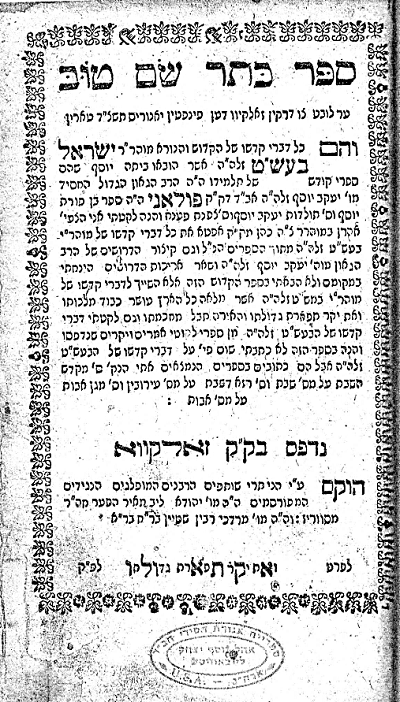
Keter Shem Tov, R. Aharon ben Zevi ha-Kohen of Apta, Zolkiew, 1794/95: The most popular of our Keter Shem Tovs, based on the printed editions, is the collection of tales and stories of the remarkable and astounding deeds of the Ba’al Shem Tov (R. Israel ben Eliezer, Besht, c. 1700–1760), founder of the Hasidic movement, as well as his recorded sayings, assembled from the works of his disciples. This collection of tales and sayings was assembled by R. Aaron ben Zevi Hirsch ha-Kohen of Opatow (Apta).


The book is in two parts, each with its own title-page but identical text, except that the first title-page is dated with a chronogram, the second title-page, printed a year later, is dated in a straightforward manner, תקנ”ה (555 = 1795). Perhaps the reason that the second title-page is so dated is that the first title-page exists in two forms, the rare first title-page, is dated “and the glory of his splendid majesty ואת יקר תפארת גדולתו (544 = 1784)” (Esther 1:4), which is incorrect, the book having been printed a decade later. The error was likely quickly caught, for the corrected and much better known title-page has the same chronogram, now reading ואת יקר תפארת גדולתו, the yod in the second word enlarged and emphasized, for a correct total of 554 (1794).[10] The variants are recorded separately in several bibliographic works.[11]

The title-page informs that that much of the contents are from the works of R. Jacob Joseph ben Zevi ha-Kohen av bet din of Polonnoye (d. c. 1782), the Ba’al Shem Tov’s leading disciple, that is, Toledot Ya’akov Yosef, Ben Porat Yosef, and Zafenat Pa’ne’ah, as well as discourses, also from other works. Among these latter sources are Likkutei Amorim and the sayings of the Ba’al Shem Tov, all collected by R. Aaron ben Zevi Hirsch ha-Kohen of Opatow (Apta).

In addition to the variations to the first title-page, the second title-page also exists in two formats, with, unlike the first title-page, some textual variations. Within the text of the book, despite Aaron ben Zevi Hirsch ha-Kohen’s comments that he has assembled the Ba’al Shem Tov’s words from the above mentioned titles, he did not, in fact, merely transcribe them in toto, nor did he distinguish which were the words of the Ba’al Shem Tov and those of Jacob Joseph.[12]

Keter Shem Tov has an approbation from R. Menachem Mendel of Liska, followed by the famed Iggeret Hakodesh, a letter from the Ba’al Shem Tov to his brother, dated Rosh Ha-Shanah, 1747, in which he relates that his soul ascended to heaven where he met with the Messiah, and then the text. This Keter Shem Tov, as noted above, has proven to be an enduring and popular work; it was printed soon after in Korezec (1797), Lemberg (1809) and several times afterwards there, in numerous other locations, and continues to be republished to the present.

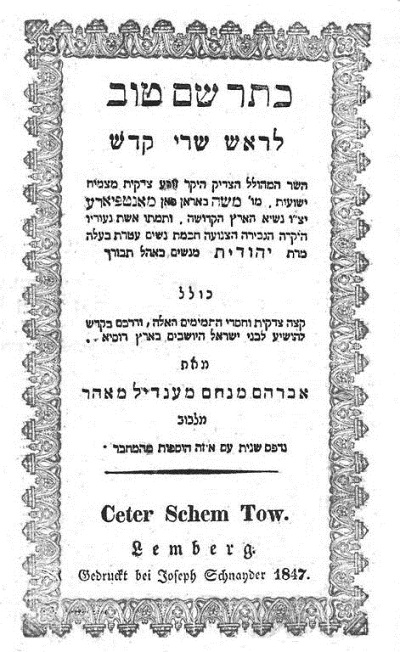
Keter Shem Tov, Abraham Menahem Mendel Mohr, Lvov (Lemberg), 1847: Sir Moses Montefiore (1784–1885) was one of, if not the most prominent member of English Jewry in the nineteenth century. Cecil Roth described him as “the most notable Jew, and indeed one of the most notable Englishmen, of the 19th century by virtue of his outstanding philanthropic work extending over a period of three-quarters of a century, into his venerable old age.”13 Montefiore traveled to the Middle East during the Damascus Affair, to Russia, Morocco, and Rumania on behalf of persecuted Jewry, as well as providing leadership and support of Jewry at home and in Eretz Israel. His indefatigable efforts on behalf of world Jewry are recorded and acknowledged in books, articles, and newspapers, several works entitled Keter Shem Tov.

The first Keter Shem Tov praising Sir Moses Montefiore is by Abraham Menahem Mendel Mohr (1815–1868), a scholarly maskil, author of a number of Hebrew and Yiddish books. The title-page states that it is,

Keter Shem Tov

For the chief, holy prince

The praiseworthy, the righteous, the dear, who sows righteousness and brings forth salvation. Our teacher, Moses Baron from Montefiore [May his Rock and Redeemer protect him], prince of the holy land. And the pure wife of his youth, the honorable lady, the modest, the wisdom of women “is a crown to her husband” (Proverbs 12:4), the lady Judith “blessed shall she be above women in the tent” (Judges 5:24). . . .

The title-page continues that the text includes some of the righteousness and perfect kindness on behalf of the Jews in Russia. A small book, (80: 16 pp.: Joseph Schnander), the text begins with verse, with the header “from Moses to Moses there was none like Moses” normally referring to Maimonides but here applied to Montefiore. The verse beginning,

“Moses ben Amram brought Israel out from the burdens of Egypt

and Moses Montefiore redeemed them from death to life.

Moses ben Amram “struck the rock, so that the waters gushed out” (Psalms 78:20)

and Moses Montefiore softened the heart of stone with “words of lips” (cf. II Kings 18:20, Isaiah 36:5). . . .


The volume concludes with a letter of appreciation from Sir Moses Montefiore.

A Ladino (Judeo-Spanish) version of Mohr’s Keter Shem Tov was printed in Salonika (1850, 80: 48, 53-80 ff.) together with two other works, Tiferet Yisrael on the Rothschilds, and Ma’aseh Eretz Israel on Eretz Israel from the destruction of the Temple to the nineteenth century. Among the many other works either praising or including a section on Montefiore are Kol Kitvei Rabbi Ya’akov Saphir ha-Levi (Jerusalem, 1934), the writings of R. Jacob Saphir (1822–1886), an emissary of the Jewish community in Jerusalem and the author of Even Saphir on the Jewish communities in such varied places as Yemen, Egypt, India, and India that he visited. In Kol Kisvei is a section entitled Keter Shem Tov Kenaf Renanim Sir Moses Monrefiore, accompanied by a cameo of Montefiore.


Yet another Keter Shem Tov about Montefiore was published by Hayyim Guedalla (London, 1884). The Hebrew title-page is followed by an English title-page that states,

The Crown of A Good Name

a brief account

of a few of the

Doings, Preachings, and Compositions

On

Sir Moses Montifieore’s Natal Day,

November 8th, 1883,

on which he was favored with a succession of telegraphic

Congratulations from the QUEEN OF ENGLAND and many

Eminent People of all Creeds.

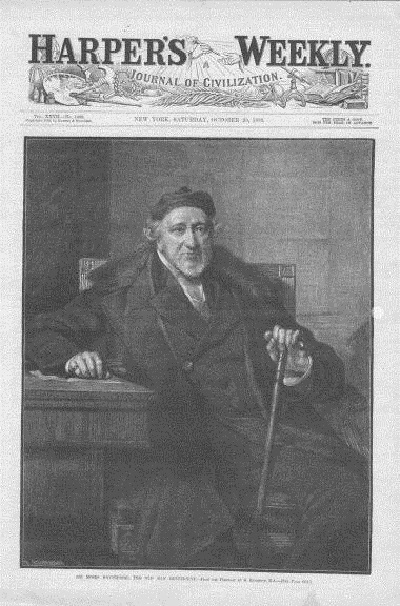
Below is the quote from Pirke Avot. The text includes congratulatory letters from the Queen, the Duke of Edinburgh, many others, and special services in both Hebrew and English. In addition, many other publications relate to Moses Montefiore, among them, albeit this not directly pertinent to the article but of interest as a further example of how widespread the high esteem in which the venerable Sir Moses Montefiore was held, is the title page of the October 20. 1883 Harper’s Weekly Journal of Civilization (New York), with a full cover portrait of Montefiore.


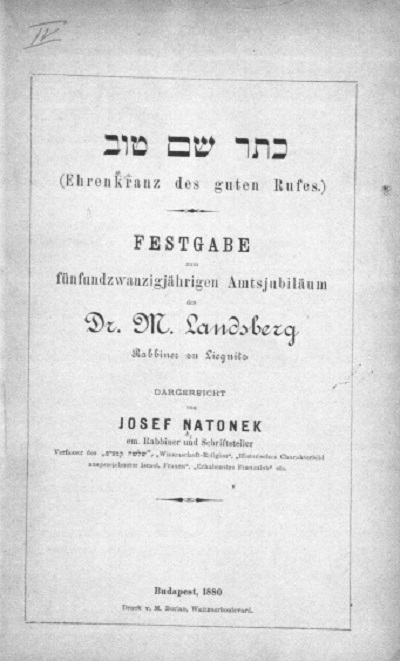
Keter Shem Tov (Ehrenkranz des guten Rufes), R. Josef Natonek, Budapest, 1880: German Keter Shem Tov by Josef Natonek in honor of Rabbi Dr. Moritz Landsberg (1824-80), son of R. Elias Landsberg (1800-79). Except for a Hebrew header the title page is entirely in German, as is the text (32 pp.), with only occasional Hebrew.


The title, Ehrenkranz des guten Rufes, is our “crown of a good name,” a Festgabe zum fünfundzwanzigjährigen Amtsjubilaeum des Dr. M. Landsberg, Rabbiner zu Liegnitz dargereicht von Rabbiner Josef Natonek em Rabbiner und Schriftsteller verfasser, that is a festive volume presented to Landsberger on the twenty-fifth jubilee of his service as rabbi in Liegnitz, by R. Josef Natonek (1813-92), a rabbi and author. Landsberg, doctor of philosophy educated in Berlin, became, in 1854, the rabbi of Legnica. Born in Rawicz, He served as rabbi for twenty-five years until his death in Liegnitz (Legnica, Silesia).[14] Landsburg was also the author of a number of studies on the history of medicine, particularly in ancient times, published for the most part in the journal Juno, published by von Henschel.[15]

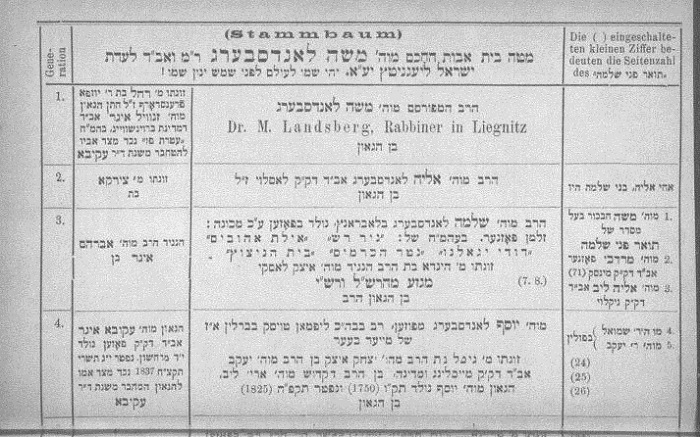
At the end of the volume is a two page Stammbaum (family tree) of the Landsberg family.


IV Miscellanea

Keter Shem Tov, R. Solomon Zalman ben Zevi Hirsch ha-Kohen, Livorno, c. 1789: Our next Keter Shem Tov is a quarto sized page printed in Livorno in c. 1789 for the Hassidic Tiberius Kollel Ashkenazim. It informs that R. Solomon Zalman ben Zevi Hirsch ha-Kohen (d. 1799) is an emissary of the Merciful One and of us (the Ashkenaz Hasidic community of Tiberias). The letter is signed by twenty-one rabbis.[16]


The letter begins with a reference to Keter Shem Tov followed by a list of honorifics “but the crown of a good name (Keter Shem Tov) excels them all. To our brothers in the exile, a treasured people, ‘a kingdom of priests and a holy nation’ (Exodus 19:6), keepers of the faith, princes and chieftains, princes and leaders, ‘a lampstand all of gold’ (Zechariah 4:2) Torah scholars and rabbis.”

It informs about their joy in the merit to live in Eretz Israel. Until now they had relied upon support from the country from which they had come; but now, however, due to war between Russia and the Ottoman Empire, they could no longer depend on that funding, so that they are now turning to Jews in other lands for support. Indeed, in describing the situation the letter notes the dire financial situation and that the land “‘is infested with bandits’ (Yevamot 115a, 122a) ‘the task masters hurried them’ (Exodus 5:13), they ‘lie in wait for blood’ (Micah 7:2). . . . ‘But now our soul is dried away; there is nothing at all (Numbers 11:6)’”

Solomon Zalman had traveled twice previously as an emissary to Russia (1779-81/1784-85), but this was his first trip to Western Europe. Avraham Yaari relates that Solomon Zalman’s undertaking was not without objection. The Sephardic community protested that the Hasidic community, which had previously received support from Eastern Europe, a venue now closed to them, was, by sending an emissary to Western Europe, entering into the domain of the general Tiberias community. The dispute was resolved several years later when joint representatives of both communities went to Eastern Europe.[17]

The letter begins with that part of the phrase from Avot referring to Keter Shem Tov intimating that a way one obtains the “crown of a good name (Keter Shem Tov)” is through good deeds and charity, which, as noted above, is “As a pearl atop a crown (keter), so are his good deeds fitting,” certainly appropriate for an appeal for the destitute community in Israel, the subject of the our Keter Shem Tov.

Keter Shem Tov, Shani Tzoref, Ian Young, Editors; Piscataway, NJ, 2013: A highly unusual Keter Shem Tov, this the proceedings of a conference on the Dead Sea scrolls held in memory of the late emeritus professor Alan David Crown in late 2011 at the University of Sydney, Mandelbaum House. This volume is part of a series entitled Perspectives on Hebrew Scriptures and its Contexts published by Gorgias Press, which describes itself as “an independent academic publisher of books and journals covering several areas related to religious studies, the world of ancient western Asia, classics, and Middle Eastern studies.” Among their subject matter is Ancient Near East, Arabic and Islam, Archaeology, Bible, Classics, Early Christianity, Judaism, Linguistics, Syriac, and Ugaritic.

Professor Alan David Crown (1932-2010) in whose memory this book was published, was Professor in Semitic Studies at the University of Sydney, and a renowned scholar and author. As noted on a website referring to him the title relates to the name Crown (Keter), for “He may have inherited the name Crown from his parents, but he earned the title ‘CROWN’ – the Crown of Torah, through his own merit, his sharp intellect and his deep respect for scholarship.”[18] The editors are Dr. Shani Tzoref, Ph.D., Skirball Department of Hebrew and Judaic Studies, New York University and currently a Qumran Institute Fellow, Seminar für Altes Testament, Georg-August-Universität Göttingen, and Dr. Ian Young, Associate Professor, Chair of Department at the University of Sydney, Australia, teaching Classical Hebrew and Biblical Studies.

This edition of Perspectives on Hebrew Scriptures and its Contexts 20: Keter Shem Tov (x, 400 pp.) is comprised of sixteen articles on various subjects in the field of Qumran studies (Dead Sea scrolls) from scholars in the field. The articles encompass the development and phases of Qumran scholarship; textual transmission of the Hebrew Bible, including Samaritan texts and Masada Biblical Scrolls; reception of Scripture in the Dead Sea Scrolls; community and the Dead Sea Scrolls; and eschatology and sexuality in the So-Called Sectarian Documents from Qumran; and the Temple and the Dead Sea Scrolls.

V Summary


This concludes our survey of books with the title Keter Shem Tov. As noted above, the article is vignettes of books so entitled. There is no single pattern in the use of the title, it being applied to a wide variety of books. There are discourses on the Torah, both literal and kabbalistic, works on Jewish law and customs, biographic or anecdotal, and several miscellaneous works, among them an appeal for support of Jewish communities in the Holy Land and on the Dead Sea scrolls. The title Keter Shem Tov has been chosen because it refers to an author’s name, for example, R. Shem Tov Melamed, R. Shem Tov ibn Gaon, and R. Shem Tov Gaguine; bibliographical works such as those referring to the Ba’al Shem Tov, Sir Moses Montefiore, and Rabbi Dr. Moritz Landsberg; and more diverse works, such as one being the novellae of a Kollel, the Dead Sea scrolls, and even topically related as in R. Avishai Taharani’s Keter Shem Tov, which actually deals with laws and customs applicable to names.

We began by noting that the title of Hebrew books, unlike books in other languages, may have “been selected by the author for any one of a number of reasons, least of all the book’s subject matter; rather the intention is/was to give the book ‘the crown of a good name (Keter Shem Tov)’.” Indeed, not one book in this article, with the possible exception of Taharani’s Keter Shem Tov, indicates its subject matter by the title. What each of these examples do have in common, is the intent to associate the name of the author, subject, or even organization with the Mishnah in Pirke Avot, which states,

  1. Simeon said: there are three crowns: the crown of Torah, the crown of priesthood, and the crown of royalty; but the crown of a good name (emphasis added, Keter Shem Tov) excels them all (Avot 4:13).

[1] I would like to thank Eli Genauer for reading the article and his comments and my son-in-law, R. Moshe Tepfer, for his assistance and research in the National Library of Israel, including getting the 1789 Livorno illustration from
[2] Marvin J. Heller, “Adderet Eliyahu; A Study in the Titling of Hebrew Books,” in Studies in the Making of the Early Hebrew Book (Brill, Leiden/Boston, 2008), pp. 72-91; idem. “What’s in a name? An example of the Titling of Hebrew Books,” in Further Studies in the Making of the Early Hebrew Book (Brill, Leiden/Boston, 2013) pp. 371-94.
[3] Judah he-Hasid, Sefer Hasidim (Jerusalem, 1973), ed. Re’uven Margaliot, pp. 210-11, n. 367 [Hebrew].
[4] Eleazar ben Judah, Sefer Roke’ah ha-Gadol (Jerusalem, 1967), ed. Barukh Shimon Shneurson, p. 1 [Hebrew].
[5] Gershom Scholem, Kabbalah (New York, 1974), p. 51.
[6] Shimon Vanunu, Encyclopedia Arzei ha-Levanon. Encyclopedia le-Toldot Geonei ve-Hakhmei Yahadut Sefarad ve-ha-Mizrah IV (Jerusalem, 2006), pp. 2152 [Hebrew].
[7] Avraham Yaari, Diglei ha-Madpisim ha-Ivriyyim (Jerusalem, 1943, reprint Westmead, 1971), pp. 96, 174 no. 160, [Hebrew].
[8] Shimon Vanunu, Encyclopedia Arzei ha-Levanon. Encyclopedia le-Toldot Geonei ve-Hakhmei Yahadut Sefarad ve-ha-Mizrah IV (Jerusalem, 2006), pp. 2155-56 [Hebrew].
[9] In contrast, the Mishnah Berurah (477:1:5) quotes the Shelah ha-Kodesh who states that ” have seen people of status who kiss the matzah and the marror . . . all to cherish the mitzvah.”
[10] Such errors and their corrections are known as stop-press corrections. Sheets were proof read while the press-run was under way; while it certainly was preferable to correct the sheets before the run began, reading also took place while the run was under way. When the corrector would find an error he would stop the run, remove the forme, quickly correct the error, and resume printing. Unless substantial, stop-press corrections did not necessitate disposing of the previous sheet – four pages in a folio, more so in a smaller format – but rather both the altered states and the originals are used. In such a case, there will be variant copies of the book, consisting of sheets printed from forms in both the earlier and later states, as is the case here.
[11] The copy with the misdated title-page in the Chabad-Lubavitch Library is attractively bound in a soft brown leather, the cover stamped כתר שם טוב ב”ק אדמו”ר שליט”א, that is, it was in the private library of the Lubavitcher Rebbe, R. Menachem Mendel Schneeersohn (1902–94). The reading room librarian, R. Zalman Levine, informs me that to his knowledge this is the only book so bound, and that it “was given to the rebbe with this binding.
[12] Keter Shem Tov (Brooklyn, 1972), p. v [Hebrew].
[13] Cecil Roth, “Moses Montefiore, 1784-1885,” in Essays and Portraits in Anglo-Jewish History (Philadelphia, 1962), p. 262.+
[14] As an aside, Jewish settlement in Lieignitz can be traced to the Middle Ages, interrupted by pogroms, the first in 1447 due to a dispute between Elżbieta, Duchess of Legnica with Jewish bankers, who demanded that she return a loan. Liegnitz is best remembered for a battle that took place there in 1241, when a Polish-German Army lead by Duke Henry II of Silesia engaged invading Mongol near the town. The Mongols were victorious, collecting nine sacks of ears from their fallen enemies, all of whom perished.
[15] Klatzkin, Jacob and Ismar Elbogen, editors, Enyclopaedia Judaica: Das Judentum in Geschichte und Gegenwart 10 (Berlin, 1928-34), p. 619.
[16] The signatories are R. Abraham ben Alexander Katz of Kalisk; R. Matthias ben Hayyim; R. Moses ben Menahem Mendel; R. Jehiel Michal ben Hayyim; R. Moses ben Abraham Segal; R. Eliezer Sussman; R. Asher ben Eliezer; R. David he is the Katan, rav of Bohava Yeshain; R. Joshua ben Noah Altshuler; R. Israel ben Jacob; R. Israel ben Judah; R. Judah Leib ben Joseph; R. Moses ben Uri Shapira; R. Jehiel Michal ben Abraham; R. Joseph of Zimigrad; R. Samuel ben Isaiah Segal; R. Aryeh Leib ben Nathan; R. Aaron ben Isaac; R. Aaron ben Meir; R. Joseph of Poloskov; and R. Nathan Nata ben Eli of Brod.
[17] Avraham Yaari, Sheluhei Eretz Yisrael II (Jerusalem, 1951, reprint Jerusalem, 1997), pp. 619-28 [Hebrew].
[18] http://learning.mandelbaum.usyd.edu.au/about-us/alan-crown/


For the Sake of Radin! The Sugar Magnate’s Missing Yarmulke and a Zionist Revision

For the Sake of Radin!  The Sugar Magnate’s Missing Yarmulke and a Zionist Revision

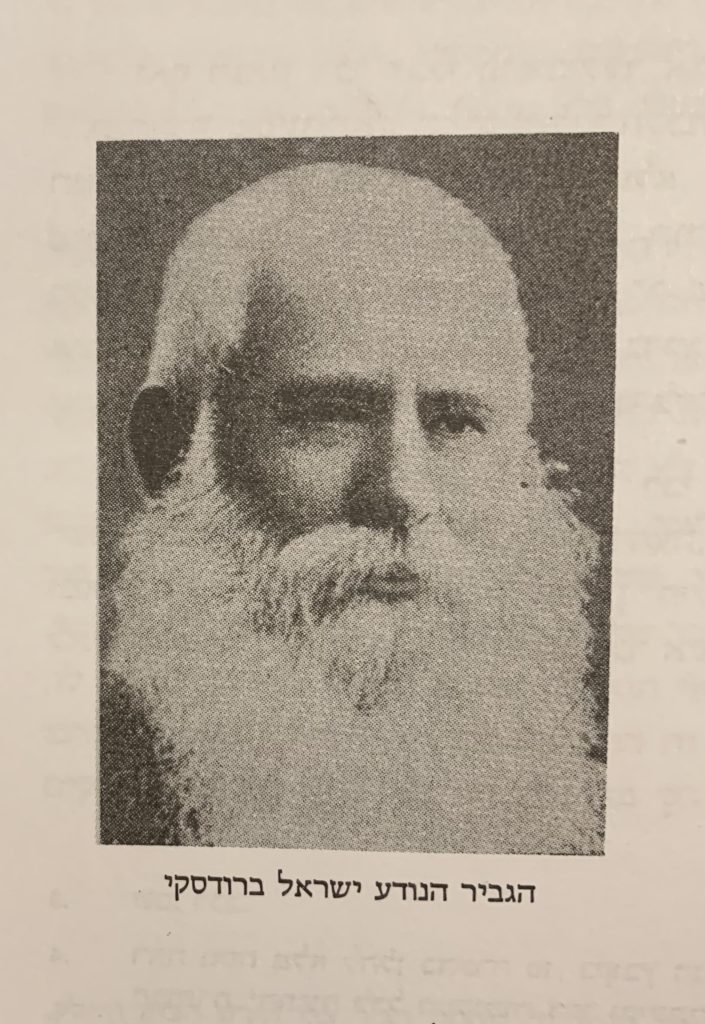
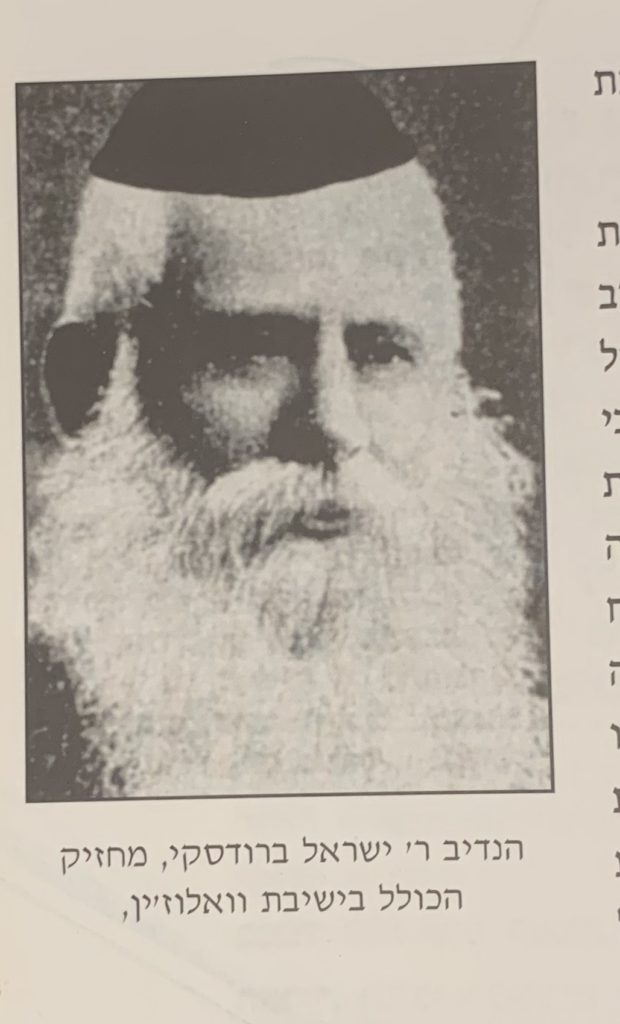
Israel Brodsky (1823-1888), built an empire on the sugar trade. After inheriting a substantial fortune, in 1843, he became a partner in a sugar refinery.[1] Eventually, he vertically integrated his business, and he controlled sugar beet lands, processing plants, refineries, marketing agencies, and warehouses throughout the Russian Empire. At its height, Brodsky controlled a quarter of all sugar production in the Empire and employed 10,000 people.[2] Brodsky sugar “was a household name from Tiflis to Bukhara to Vladivostok.”[3] Brodsky was a significant philanthropist, donating to Jewish and non-Jewish causes. In Kyiv, he and his sons virtually single-handedly founded the Jewish hospital, Jewish trade school, a free Jewish school, mikveh, and communal kitchen besides substantial individual donations, amounting to 1,000 rubles monthly, and donated to St. Vladimir University. Many of these institutions would bear the Brodsky name. Leading Shalom Aleichem to remark that the “the bible starts with the letter beyes and [Kyiv], you should excuse the comparison, also starts with beyes – for the Brodskys.” [4]

In addition to supporting local causes, he also helped other institutions outside of Kyiv. One was providing an endowment for a kolel at the Volozhin Yeshiva. The institution of the kolel, a communally subsidized institution that supported men after marriage, was originated by R. Yitzhak Yaakov Reines (1839-1915). Reines was a student of the Volozhin Yeshiva and would go on to establish the Mizrachi movement and the Lida Yeshiva, both of which were attacked by some in the Orthodox establishment.[5] Invoking the Talmudic passage Rehaim al Tsaverum ve-Yasku be-Torah?!, in 1875, he proposed an institution where “men of intellect . . . will gather to engage in God’s Torah until they are worthy and trained to be adorned with the crown of the rabbinate, that will match the glory of their community, to guide the holy flock in the ways of Torah and the fear of Heaven.” Without the communal funds, these “men of intellect” would “be torn away from the breasts of Torah because of the poverty and lack that oppresses them and their families.”[6] Reines intended that the kolel be associated with Volozhin. And, in 1878, an attempt to create such an institution began taking shape, with the idea to approach the Brodskys for funding. For reasons unknown, this never happened. Instead, through the generosity of Ovadiah Lachman of Berlin, the first kolel was established in 1880. The kolel opened not in Volozhin but Kovno. It would be another six years before Volozhin established its kolel.[7]

In 1886, Brodsky donated a substantial sum to create a kolel in Volozhin. He created an endowment fund that yielded 2,000 rubles annually. But unlike the Kovno kolel that produced some of the greatest rabbis and leaders of the next generation, according to one assessment the Volozhin kolel “had little influence on the yeshiva’s history” nor the general public.[8]

Comparing Brodsky’s donation to the kolel to that of his other contributions demonstrates that this donation was similar to his most significant gifts. His donation was in the form of stock, and while we don’t have an exact estimate of the value of those shares, we can extrapolate the total amount of Brodsky’s donations. Brodsky donated 60 shares of the Kyiv Land Bank, which was intended to produce 2,000 rubles per annum.[9] But the amount of the principle, the 60 stocks, is not provided in the source materials. In 1890, a  similar endowment by the Brodskys produced 3,000 rubles annually from a principle of 50,000 rubles, a 6 percent rate of return. Assuming a similar rate of return, his initial donation to the Volozhin kolel nearly 35,000 rubles. That is the similar amount that he donated to the Kyiv free Jewish school, the St. Vladimir’s University, and Kyiv’s mikve and communal kitchen that all received 40,000-ruble bequests.[10] Consequently, Brodsky’s gift of 60 shares of stock to the Volozhin kolel is comparable to Brodsky’s other institutional donations.

The Brodskys aligned with the Russian Haskalah movement that today we would likely characterize as Modern Orthodox, although admittedly, the definitions of sects are amorphous. The Russian haskalah was notable for embracing modernity while maintaining punctilious observance of halakha. One example that involved both the intersection of society at large and religious practice was that when the Governor-General invited two of Israel’s sons to a prestigious gala at his home, the Governor-General also provided the sons with kosher food.[11] Another example of the Brodskys’ Jewish outlook was their involvement in Kyiv’s Choral Synagogue. Choral synagogues were already established in other cities throughout the Russian Empire, including Warsaw, Vilna, and St. Petersburg. The synagogue, known as the Brodsky Synagogue, was built in 1898 by Israel’s son, Lazer. Modern practices were introduced to the Kyiv Choral Synagogue, but even those are within the bounds of accepted Jewish law.[12] Indeed, those new practices are today unremarkable, hiring a hazan, incorporating a choir into the service, delivering the sermon in Russian, and enforcing decorum during the prayers.[13]

The Haredi histories of Volozhin discuss Brodsky’s contributions to the kolel. But one publication decided that his reputation needed some creative airbrushing to (presumably) make his involvement more palatable to the modern Haredi audience. Despite the fact that other Haredi publications provide an unvarnished version.

One person who met Brodsky described him as resembling that of a biblical patriarch in appearance, yet at the same time non-Jewish.[14] Indeed a photo from 1880, this biblical patriarch appears bareheaded. This lack of head-covering was not an issue for some Haredi authors. For example, Dov Eliach includes this photograph in his history of the Volozhin Yeshiva.[15] In 2001, not ten years after Eliach’s book another Haredi author decided that the photo required adjustment despite sharing the same publisher as Eliach.


Menahem Mendel Flato’s book, Besheveli Radin (Radin’s Paths), devotes an entire chapter to Brodsky’s kolel, with his photograph accompanying the text. Yet, in this instance, rather than a bareheaded Brodsky, a crudely drawn yarmulke now appears on his head.[16] This is not the first time that images were doctored to depict a yarmulke where there is none.[17] Those types of alterations occur decades after the original, by different publishing houses, in different cities, and for a different audience.[18] Here, however, Avi ha-Yeshivot and Besheveli Radin share the same audience and are only separated by ten years. [19]


The alternation of Brodsky’s photo is not the only example of such censorship in Besheveli Radin. R. Moshe Mordechai Epstein studied in Volozhin and eventually went on to lead the Yeshivas Kenneset Yisrael in Slabodka. While he was in Volozhin, he was among those who established a proto-Zionist organization, Nes Tsiona. A photograph of the executive members appears in at least three places, yet only in Besheveli Radin is the connection to Nes Tsiona omitted.

In 1960 and 1970, two books published the photo from a copy in Russian Zionist Archives.[20] The 1960s’ version includes a legend that correctly identifies the photo as “the executive committee of the ‘Nes Tsiona’ in Volozhin in 1890.[21] The legend in the 1970 book contains the same language as before, indicating that it is a photograph of the Nes Tsiona executive committee and also identifies each of the men in the picture.[22] Yet, when the same photo appears in Beshvili Radin it is accompanied by an entirely different legend.[23] Instead, Beshvili Radin describes the photograph as depicting “a group of students from Volozhin from those days, R. Moshe Mordechai Epstein who eventually became the rosh yeshiva of Slaboka is sitting second from the right.” The purpose of the group photograph remains a mystery to Beshvili Radin‘s readers.


The history of Volozhin is complex and especially among Haredi writers raised issues that are uncomfortable truths.  Some of these authors responded by obscuring or entirely omitting these including the inclusion of secular studies in the curriculum, establishment and membership in non-traditional religious organizations, and the religiosity of some of its students.[24] Beshvilie Radin is but one example.  In his introduction, Flato discusses the purpose of Beshvilie Radin describing it as “providing the reader an entirely new perspective of that era.” We can now say that the “new perspective” is one that at times deviates from the historical record.

[1] Wikipedia, The Free Encyclopedia, s.v. “Israel Markovich Brodsky,” (accessed November 20, 2019), https://ru.wikipedia.org/wiki/Бродский,_Израиль_Маркович (Russian).

[2] Id.; Nathan M. Meyer, Kiev: Jewish Metropolis a History, 1859-1914 (Bloomington: University of Indiana Press, 2010), 39.

[3] Meyer, Kiev, 39.

[4] Meyer, Kiev, 39, 40, 71.

[5] For a biography of Reines see Geulah Bat Yehuda, Ish ha-Meorot: Rebi Yizhak Yaakov Reines (Jerusalem: Mossad HaRav Kook, 1985)

[6] Shaul Stampfer, Lithuanian Yeshivas of the Nineteenth Century: Creating a Tradition of Learning, trans. Lindsey Taylor-Guthartz (Oxford, 2015) (original work published 1995 (Hebrew)), 338 (quoting Yitzhak Yaakov Reines, Hotam Tokhnit, vol. 1 (1880), 17n4). For sources regarding the Lida Yeshiva see Eliezer Brodt, “Introduction,” in Mevhar Ketavim m’et R. Moshe Reines ben HaGoan Rebi Yitzhak Yaakov (2018), 12n42. See id. 354-61 for correspondence between the Netziv to R. Yitzhak Yaakov Reines regarding the establishment of a kolel.

[7] Stampfer, Lithuanian Yeshivas, 337-40. One possibility regarding the failure to start the kolel at that time in Volozhin might be attributable to Reines’ recognition that governmental approval was necessary to establish the kolel.  Volozhin had a difficult relationship with the Tsarist authorities.  See id. at 191-98. Adding a new institution might have been seen as a risk to the operation of the Volozhin yeshiva itself.

[8] Stampfer, Lithuanian Yeshivas, 358-59.  Among the conditions of the donation was that during the first year after his death ten men were selected and were required to visit the grave R. Hayim Volozhin’s and leading the prayers, and the recitation of the mourner’s kaddish, in addition to daily study of the mishnayot with the commentary of the Vilna Gaon, and leading the services.  The same was done on the yahrzeit of Brodsky’s wife, “ha-Tzkaniyot ha-Meforsemet, Haya.”  Dov Eliach, Avi ha-Yeshivot: MaRan Rabbenu Hayim Volozhin (Jerusalem, Machon Moreshet Ashkenaz, 2011) (second revised edition), 600-01.  (Thanks to Eliezer Brodt for calling this source to my attention).  The manuscript recording the conditions of Brodsky’s gift is currently in the possession of R. Meshulam Dovid Soloveitchik and portions are reproduced by Eliach.  See id. 601,634-35.

[9] The Land Bank was created in 1877. Michael H. Hamm, Kiev: A Portrait, 1800-1917 (Princeton: Princeton University Press, 1996), 10-11. The influence of the Brodskys was such that six members of the family were on the board of an earlier established bank, the Kiev Industrial Bank, (1871). This led some to remark that the bank should be referred to as the “Brodsky Family Bank.” Meyer, Kiev, 40. It is unclear if Israel also sat on the Land Bank board or was just an investor.

[10] Meyer, Kiev, 71.

[11] Meyer, Kiev, 40.

[12] Meyer, Kiev, 171-72. For a discussion of Vilna’s Choral Synagogue and its influence on Vilna’s maskilim see Mordechai Zalkin, “The Synagogue as Social Arena:  The Maskilic Synagogue Taharat ha-Kodesh in Vilna,” (Hebrew), in Yashan me-Peni Hadash: Shai le-Emmanuel Etkes, vol. 2, 385-403; see also D. Rabinowitz, “Kol Nidrei, Choirs, and Beethoven:  The Eternity of the Jewish Musical Tradition,” Seforimblog, Sept. 18, 2018.

[13] While today, these practices are unremarkable; at that time, there were some who opposed these changes. See generally Moshe Samet, Ha-Hadah Asur min ha-Torah: Perakim be-Toldot ha-Orthodoxiah (Jerusalem: Karmel, 2005). For an earlier discussion of the propriety of choirs and incorporating music in Jewish religious practices see R. Leon Modena, She’lot ve-Teshuvot Ziknei Yehuda, Shlomo Simonson ed. (Jerusalem: Mossad HaRav Kook, 1957, 15-20.

[14] Sergey Yulievich Vitte, Childhood During the Reigns of Alexander II and Alexander III (Russian) at 160.

[15] Dov Eliach, Avi ha-Yeshivot: MaRan Rabbenu Hayim mi-Volozhin (Jerusalem: Machon Moreshet HaYeshivot, 1991), 269. This photograph remains in Eliach’s second and updated version of Avi ha-Yeshivot printed in 2011.  See Eliach, Avi ha-Yeshivot: MaRan Rabbenu Hayim me-Volozhin (Jerusalem: Machon HaYeshivot, 2011), 292.  Although there are two changes in this version.  First, the “well-known philanthropist” becomes a “Rebi” and conveniently the top of the Rebi’s head is cut off so that one can’t tell if the Rebi is wearing a yarmulke.


[16] Menahem Mendel Flato, Besheveli Radin… ([Petach Tikvah]:  Machon beSheveli haYeshivos, 2001), 31; Marc Shapiro, Changing the Immutable: How Orthodox Judaism Rewrites Its History (Oxford: Littman Library, 2015), 136. Flato combines both of Eliach’s honorifics into “the philanthropist Rebi Yisrael Brodsky.”

[17] See Dan Rabinowitz, “Yarlmuke: A Historic Coverup?,” Hakirah vol. 4 (2007), 229-38.

[18] For examples see Shapiro, Changing the Immutable.

[19] Another Haredi history of Volozhin published the same year as Beshvili Radin also includes the unaltered photograph.  Tanhum Frank, Toledot Beit HaShem be-Volozhin (Jerusalem, 2001), 254.

[20] Yahadut Lita vol. 1 (Tel Aviv: 1960), 507; Eliezer Leone, Volozhin: Sefrah shel ha-Ir ve-shel Yeshivat Ets Hayim (Tel Aviv: Naot, 1970), 121. Despite the attribution to the Russian Jewish Archive there is no other information regarding this archive.

[21] Yahadut Lita, 507. Regarding Nes Tsiona see Stampfer, Lithuanian Yeshivas, 170-72

[22] Leone, Volozhin, 121.

[23] Another Haredi history of Volozhin also uses the same photograph but crops out all but just Epstein. See Frank, Toledot, 256. But in that instance the photo is used as part of a collage of rabbinic figures and explains why the other people are missing.

[24] Stampfer, Lithuanain Yeshivas, 43, 206-07, (secular studies), 167-178 (societies), Abba Bolsher, “Yeshivas Volozhin be-Tukufat Bialik,” in Yeshivas Lita: Perkei Zikronot, eds. Emmanuel Etkes and Shlomo Tikochinski (Jerusalem:  Zalman Shazer Center, 2004, Menahem Mendel Zlotkin, “Yeshivas Volozhin be-Tekufat Bialik,” in Etkes, Perkei, 182-92 (histories of Volozhin’s perhaps most well-known black sheep during his time there).


Further On A Forged Letter of Rabbi Joseph B. Soloveitchik

Further On A Forged Letter of Rabbi Joseph B. Soloveitchik

By Mosheh Lichtenstein

Rabbi Mosheh Lichtenstein is a co-Rosh Yeshiva of Yeshivat Har Etzion.

He is a grandson of Rabbi Joseph B. Soloveitchik.

It was recently brought to my attention that various readers of the Seforim Blog have expressed skepticism regarding the determination that the letter found in President Chaim Herzog’s archives and supposedly written by my grandfather, Rabbi Joseph B. Soloveitchik zt”l (hereafter, “the Rav”), is a forgery.


Moreover, some of the commentators have engaged in various conspiracy theories regarding the motivation and the accuracy of the claim that this is a fake letter. See here. Although I do not usually attempt to argue with such claims or engage conspiracy theorists and strongly suspect that penning this response will not necessarily convince those who refused to accept the original clarification, I will, nevertheless, attempt to present the evidence that the letter is indeed a forgery since I fear that future researchers may also question the denial and view the letter’s status as an unresolved issue.

Moreover, since there may be sincere individuals who are indeed skeptical of a forgery claim regarding a letter whose subject is a controversial figure and may suspect that there is an agenda behind the denial of the letter’s legitimacy, I am presenting the evidence for their review and evaluation. Thus, if those who expressed skepticism are indeed sincere and open to evaluating the evidence, it is my hope that they will review the evidence presented below and recognize that the letter is fraudulent.

At the outset, I must re-emphasize what was clearly stated by the editors of the Seforim Blog (here); i.e. that the determination of our family members who saw this letter and judged it to be a “crude forgery” was entirely based upon an examination of the signature, stationery and other such considerations and totally independent of any opinion, positive or negative, regarding the subject of the letter. Having stated for the record what should be obvious, I will now present the considerations themselves.

1. First, and this alone should suffice, is the error in the spelling of the name. The Rav spelled his name דוב with a vav in the middle and not דב without a vav. I have never seen a signature of the Rav without the vav and I challenge all of those who doubted our claim to produce a signature of the Rav, in his handwriting, without a vav. As there are a multitude of “semikhah klafim” signed by the Rav, as well as numerous letters that he wrote, I assume that this can be readily verified. I would add that, unlike dates or plain text, it is rare indeed that people make typos in their signature.

2. The Rav’s signature in the letter contains an additional conclusive indication that the Rav didn’t write it which is the mention of his father and his title. The Rav would use the title אבא מרי when referring to his father in his halakhic writings and famously utilized it in the title of a major work, Shiurim le-Zekher Abba Mari (Jerusalem: Mosad ha-Rav Kook, 1984). However, he never used it when referring to his father, Reb Moshe Soloveichik, in his signature. Usually, the Rav signed his name without mentioning his father but if he did mention him, he always used the Brisker title of הגאון החסיד or variations of it and never אבא מרי. Thus, he might sign בן הגאון החסיד or בהגאון מהרמsee Iggerot ha-Grid pp. 139-140 for two such examples – but not אבא מרי as in the letter under discussion.


The vast majority of the letters that I have had occasion to see, as well as those published in *Community, Covenant And Commitment: Selected Letters And Communications*, ed. Nathaniel Helfgot (Jersey City, NJ: Ktav, 2005), and originally written in Hebrew, contain the Rav’s name alone without any reference to his father whatsoever. Moreover, my impression is that the younger the Rav was and the more “rabbinic” and traditional or ceremonial the context (such as HaPardes), he might refer to his father, while in more political or non-rabbinic settings and the older he gets, he rarely signs as his father’s son. This is doubly true of the years when he had physical trouble writing (for examples of 2 late letters in very rabbinic settings in which his father is not referenced in his signature, see the letter published in the beginning of the first volume of the first edition of the Shiurim le-Zekher Abba Mari and/or the letter written to Rabbi Shemariah Gourary in October 1978 and published in a Chabad journal upon his petirah in 1993).

The bottom line is that the vast majority of all his letters don’t mention his father and this is esp. true in the later years. Thus, the very reference to his father in a very late letter to a secular political figure like Chaim Herzog might already raise suspicions about this letter, but the crucial point is that even when mentioning Rabbi Moshe Soloveichik, he is never referred to as אבא מרי. Presumably, the person who wrote this letter was aware of the Abba Mari title because of the book (which had just been published a year earlier), but unfamiliar with the Rav’s normal signature mode and thus blundered into applying the wrong title to Rabbi Moshe Soloveichik.

In an aside, I’ll also mention that the person who wrote this letter was not only woefully unequipped with knowledge of the Rav’s signature, he also didn’t know how to spell אבא מרי properly. Unlike the Rav, who was aware of the phrase’s origin in the Shas (Kiddushin 31b and Sanhedrin 5a) and its usage by the Rambam in Mishneh Torah (Hilkhot Talmud Torah 4:3 and Hilkhot Shehitah 11:10) to refer to his father and, of course, spells it properly, the writer of this letter can’t even spell the title that he chose properly (although I can’t rule out the possibility of a typo, I cannot but have the impression that this is yet another instance of the work of someone who simply doesn’t know what he’s doing).

3. The letter includes the title איש בוסטון together with the signature. I’d love to see another letter of the Rav in which he signed himself as איש בוסטון. Until such a letter is produced, I regard this as an additional example of the fraudulent nature of this letter since the Rav didn’t use such a title to identify himself. He was not Paul Revere and apparently did not consider איש בוסטון to be a defining characteristic.

4. A crucial element in assessing a signature’s authenticity a graphological examination. In our case, the signature of the Rav in the Herzog letter simply fails the most basic graphological test. Since a graphological analysis is by definition subjective, I preferred to present the verifiable objective evidence regarding the Rav’s signature prior to raising this point. I also feel obligated to preface my claim with two preliminary comments about the legitimacy of handwriting comparisons:

a. Halakhah and the American banking system that has utilized handwritten checks for decades as a prime form of payment rely upon comparison and recognition of an individual’s signature. The concept of kiyum shtarot, a major legal mechanism in Halakhah which is crucial to all legal documents, is predicated upon comparing signatures.

b. The Rav’s signature is quite distinctive and remained consistent throughout the years. A clear line runs between all his signatures, from youth to old age. In his later years, the signature is more frail and less forceful than his earlier signatures, but the basic form is constant and readily recognizable. The signature that appears in the Herzog letter is so starkly different from his recognized signature that this is a plain case of black and white and not a grey area. Had it been a grey area which required a judgement call, I would never make such a subjective claim, but the contrast here is so great that it does not require a judgement call. To utilize a Talmudic concept from a somewhat different case of graphological assessment, an average ינוקא דלא חכים ולא טפש could easily make this call.

To back up this claim, I suggest that the interested reader see for himself examples of the Rav’s signature in these years. An example from June 1983 is the letter printed in the first volume of Shiurim le-Zekher Abba Mari (first edition).

A later example, and even more relevant example, from Winter 1984 (probably January-February 1984) is this (from a dedication he inscribed to me in the Shiurim le-Zekher Abba Mari that he sent me):

One can notice 2 things in this signature: 1. Its basic consistency with his younger signatures 2. the frailty of his writing. The signature in the letter to President Herzog, in contrast, is inconsistent with all of the Rav’s signatures and does not express the frailty of his aging motoric skills, despite supposedly being written months later.

For a somewhat earlier, albeit still late, example, one can see the signature in the haskamah published by Rabbi Menachem Genack in his sefer ברכת יצחק, written in Jan. 1979.

In summary, the signature itself in the document under question is so full of errors that if it were a get, you could say that it contains almost all possible פסולים as it includes א. שינה שמו ב. ושם אביו ג. ושם עירו ד. ואינו מקויים .

From the signature, let us turn our attention to the stationery. Anyone who has seen letters of the Rav knows that the letterhead is always the Rav’s name and usually, but not always, his address as well. He does not use Yeshiva University stationery nor RIETS stationery. I have never seen a letter written by the Rav on a YU letterhead. He was not the Rosh Yeshiva of RIETS or president of YU – he was Rabbi Joseph B. Soloveitchik, the Rav, and his stationery reflects this.

It must also be emphasized that this particular letter is purported to have been written in Boston where the chance that the Rav used YU stationaey is nil. I was with the Rav in Boston during the summer of 1984 and I can attest to the fact that he did not have YU stationery in his study that summer (nor at any other time that I was in Boston).

Thus, it seems fairly obvious to assume, although I cannot verify this, that ‘the writer of this letter’ had access to YU stationery which is dispensed to hundreds of locations but not to the Rav’s private stationery and, therefore, chose to present the Rav as writing on YU stationery, unaware that by doing so ‘he’ is undermining rather than bolstering the credibility of his forgery.

Actually, what ‘the writer of this letter’ is doing is even more bumbling since ‘he’ is not using proper YU letterhead stationery either; if one looks carefully at the letter that was reproduced at the Seforim Blog, it can be noticed that it is written on paper designed for internal correspondence as a memo and is not formal institutional stationery of the sort that is appropriate to use in correspondence with a head of state.

Another suspicious element is the copies of the letter that supposedly were sent to Rabbi Norman Lamm, Dr. Burg and Rabbi Michael Strick. Aside from the fact that to the best of my knowledge, it was not the Rav’s custom to copy others on his letters and this alone is room for additional suspicion, it is unfathomable to think that he would have Rabbi Strick’s name as one of those copied to his letter. Was the Rav even aware that Rabbi Strick worked in YU’s Israel office? Even if so, why would he copy him on a letter to Herzog which does not deal with YU affairs? For that matter, why would he copy Rabbi Lamm?

Since the Rav did not ‘CC’ people and was unaware of Rabbi Strick’s position, this, too, is an additional reason that at least parts of this letter must be considered inauthentic and the work of others. [If one were to argue that this anomaly is reason to support the letter’s authenticity as a lectio difficilior, I would counter that such an argument would be reasonable, if it could be established that the Rav was aware of Rabbi Strick’s role in YU Israel, but since this is definitely not the case, he couldn’t have copied on a letter someone who he was unaware of his position. Thus it is not a more difficult reading, but rather an impossible one and, therefore, proves its inauthenticity rather than its authenticity.]

Next, let us turn our gaze to the top of the page and the salutation of בעזרת צור ישראל וגואלו. Once more, I challenge anybody to produce a letter or document in which the Rav used such a phrase to refer to the KBH in a similar context (or any context, for that matter).

Although one could conceivably argue that he did not normally do so but changed his custom when writing to the president of Medinat Yisrael, I would not accept such a line of reasoning because of the reasons outlined below, but I would also emphasize that the Rav’s letter to Prime Minister David Ben-Gurion does not contain such a phrase nor do any of his other letters to various Israeli Religious Zionist leaders. All of these letters were published in *Community, Covenant And Commitment: Selected Letters And Communications* and are readily available for examination. If one were to argue more ingeniously that he used the phrase only in a letter to Chaim Herzog because of his father, Rav Yitzhak Isaac ha-Levi Herzog’s involvement in the formulation of Tefillah Leshalom Hamedinah, he would have not only to claim that the Rav was attempting to compliment Herzog but also to establish that the Rav was aware of Rav Herzog’s role in the formulation of that text. Personally, I am quite skeptical of this for a variety of reasons, but I will not insist upon it in this discussion.

The crucial point regarding the use of צור ישראל וגואלו is that the Rav would never use such a phrase. Without entering into a protracted discussion of the Rav’s attitude to Zionism in general, a topic that much has been written upon, I will allow myself to state that while undoubtedly supportive of Religious Zionism, he was deeply opposed to three elements of Israeli Religious Zionism that he encountered in his contacts with the Israeli Religious Zionist sector. The first was the ideological position that Jewish Nationalism and its political expression are of the highest religious value. The second, not entirely unrelated to the first, was the perspective that viewed the establishment of the State of Israel and its subsequent achievements as highly significant stages in the Redemption. Regarding those who held to a position that he described as the attachment of “excessive value to the point of its glorification and deification” [of the State of Israel] (*Community, Covenant And Commitment: Selected Letters And Communications*, page 164), he defined them as delusional (the original Hebrew uses the phrase “הוזיםwhich is translated in the published text as “dreamers,” but which actually has a much stronger connation of delusion within it) and in total error. He was also very distant from a historical appraisal that saw the Geulah as imminent. As anyone who has read *Kol Dodi Dofek* or *Hamesh Derashot* is well aware, the Rav emphasizes the Man-God relationship in the context of Zionist history rather than the imminent realization of the promised Redemption.

An additional element that the Rav strenuously objected to was various expressions and formulas in liturgical or halakhic settings that were disconnected from traditional forms of expression and exuded a strong sense of a break with the past and the creation of a new religious language. I would not overstate the case if I stated that such expressions actually caused him to cringe. He certainly was emotionally distant from such phrases and did not use them. A famous example of this was his insistence upon the term “Eretz Yisroel” rather than “Israel,” but there were many such examples, some better known (e.g. translating the text of the ketuba into Hebrew), some not so well known. Even wearing a white shirt on Shabbos (“Israeli style”), rather than a suit, would sometimes annoy him if he sensed that it was an expression of non-traditionalism and “anti-Galut” sentiment. I can attest to this first hand כי מבשרי אחזה זאת. I spent time with my grandfather, the Rav, as a wide-eyed 17 year old youth who often expressed his Zionist sentiments in front of him and occasionally raised his ire by doing so. Once, discussing a related topic, he admitted to me that reciting a certain text was rationally the proper thing to do, but, nevertheless, expressed a personal emotional reluctance to do so because of its novelty and lack of traditional moorings.

Therefore, although this is admittedly a subjective criterion that I am attempting to avoid, I cannot believe that any letter that the Rav wrote or authorized – even to a head of state whose father was Rav Herzog – would contain the phrase בעזרת צור ישראל וגואלו.

Finally, I must point out an issue of content regarding the letter. As I stated at the outset, I am not judging the letter based upon any presumed attitude of the Rav regarding Rabbi Meir Kahane. However, the content of the letter is extremely problematic for totally other reasons. As can be seen, the letter concludes with a clear admonition and rebuke to President Herzog in no uncertain terms regarding his level of observance. Not only does the writer allow himself to criticize Herzog’s standards of public observance, an obviously sensitive topic for someone raised as an observant Jew, he also doesn’t shy away from introducing the extremely sensitive and intensely personal issue of Herzog’s relationships with his parents and children in light of his problematic observance of Mizvoth.

I will allow myself to state that the Rav that I knew, and I assume many of the Seforim Blog’s readers as well, would never enter into such personal matters and grant unsolicited advice and judgement upon his correspondent’s personal life and relationships. For that matter, I cannot imagine that any rational individual who is requesting a favor from a person of stature would conclude his message by rebuking the person and making it clear that he is a disappointment to his parents. Why the writer of this letter thought that this is a reasonable text is beyond me, but if he chose to concoct such a text, I do claim that the Rav would not, and could not, have written such a text. While this is admittedly subjective and, therefore, I do not rest my case upon it but rely upon the above-mentioned considerations, I do believe that the Seforim Blog’s readers should be alerted to this perspective as well.

I will not continue to discuss this letter, although much more could be said about it. In conclusion, I will add that I believe that many of the points that I raised above suffice to individually prove that this letter is utterly false; however, it is also important to emphasize that there is a significance to their cumulative effect. Thus, even if one can argue or suggest alternatives to a particular claim, the accumulation of so many suspicious characteristics is an additional consideration to recognize that the text is much too problematic to be trusted or relied upon.

Ironically, whoever thought to send this letter to President Herzog and to appeal to his zekhut avot as part of a letter requesting support for Rabbi Kahane was probably barking up the wrong tree by doing so. Rav Yitzchak Isaac ha-Levi Herzog, whose authority is celebrated in the letter, had the following to say about the issue of retribution and Jewish-Arab relationships in times of terror attacks, published on the front page of the newspaper Davar, Friday, July 8, 1938, and translated into English several months later in Contemporary Jewish Record 1:1 (September 1938):

Why did someone want to counterfeit a letter in the Rav’s name is a question that may be unanswerable, even if we were to identify the person who wrote the letter. It is certainly unanswerable without identifying the writer. It should be recognized, though, that the primary motivation may not have been a political agenda to validate Rabbi Kahane, although it is obvious that the writer’s opinion of him is somewhat favorable and that he is attempting to advance the Kach party’s agenda, but may be rooted in other realms. For instance, the writer may have had a psychological need to empower himself to speak as the Rav, for a variety of reasons, and realized this by counterfeiting a letter in the Rav’s name and sending it to a prominent and famous person.

Whatever the motivation may be – political or psychological – we must recognize that this is a letter that that was not signed or authorized by the Rav and that is what matters.


A nay bintl briv: Personal Reminiscences of Rabbis Baruch ha-Levi Epstein and Aaron Walkin from the Yiddish Republic of Letters

A nay bintl briv:

Personal Reminiscences of Rabbis Baruch ha-Levi Epstein and Aaron Walkin

from the Yiddish Republic of Letters

Shaul Seidler-Feller

Editor’s note: The present post is part two of a two-part essay. Part one can be found here.

Second Letter

Approximately eight and a half years after his column on the Hafets Hayyim appeared, Rabbi Aaron B. Shurin penned another essay, entitled “The Mistake of the Austrian Emperor” and about the meaning behind the observance of the Three Weeks, which was published 18 Tammuz 5756 (July 5, 1996), a day after they had begun.[1] In the first line, he quoted Rabbi Baruch ha-Levi Epstein (1860–1941/1942) as citing a story about Austrian Emperor Franz Joseph I’s (1830–1916) negative response to a group of Hungarian nationalists who wished to establish a day of mourning for the loss of their independence in 1848, using the Jews’ observance of Tish‘ah be-Av as a model.[2] This prompted Simon Paktor to write in:


SCHENECTADY 9.5.96.

זייער געערטער און חשובער
.הרב ר״ אהרון בן ציון שוּרין נ״י


עס איז מיר זייער פארדראסיג וואס כ׳האב ניט בעוויזן
צו שרייבן מאמענטאל, און זיך הארציג בעדאנקען פאר
.אייער ארטיקל ״פאָרווערטס״ דעם 5-טן יולי ה.י

ווי געוויינליך ווען די אידישע צייטונג קומט
אן צו מיר, איז עס ביי מיר ווי א גוטער פריינד
וואלט געקומען פון דער אלטער אומפארגעסליכער
..פארשניטענער היים… און מיר ריידן א[וי]ף יידיש

איך האב ממש א ציטער געטאן ווען כ׳האב
אין אייער ארטיקל וועלכן איך לייען שטענדיג מיט דעם
גרעסטן אינטערעס דערזען אין דער ערשטער שוּרה דעם
טייערן נאמען ״הרב ר׳ ברוך עפשטיין (מחבר פון
פירוש ״תורה תמימה״ אויף חומש) דערציילט אין
[3](זיין זכרונות ספר ״מקור ברוּך״ א.א.וו

איך האב געהאט די זכיה צו קענען
אט דעם ״אִיש פֶלֶא״ כבין געווען א פריינד
פון א פינסק-קארלין משפחה וועלכע האט זיך
געיחוס׳ט מיט קרובישאפט. דער פאטער פון דער
פאמיליע האט בעת א שבת׳דיגן וויזיט צוגעטראגן צו מיר
דעם ספר ״מקור ברוך״ און בעוויזן אז ר׳ ברוך

2

ווייזט אן אז אין שׁימל פון ברויט ליגט
דער פאטער אלתר סלוּצקי .PENECiLiN רְפוּאָה ווי
איז געווען א לאַווניק אין שטאט ראַט און די טאכטער האט
געארבעט אין דער יידישער אפטיילונג. אזוי ווי פינסק
האט געהאט א פנקס פון 800 יאר האט זיך זי געהאט די
א מעגליכקייט אויסגעפינען און אנטקעגן קומען ר׳ ברוך עפשטיינס
ביטעס אין די ארכיווע אויסצוזוכן. ער פלעגט זיך שטענדיג
בעדאנקען צו איר דורך שיקן א ״באָמבאניערקע״
דא הייסט עס א באַקס שאקאלאד)… איך)
.מיט טרערן אין די אייגן און מוז א וויילע איבערייסן

.ער האט מיר אויסגעלערנט אן אריטמעטיג פארמוּלע
איך דערמאן זיך ווען כ׳האב שבת נאכן דאוונען אין פינסקער
גרייסער שוּל אראבגעגאנגען צום ברעג פון אונזער
און בעמערקט ר׳ ברוך עפשטיין ז”ל PiNA שיינער טייך
זיצט אויף א באַנק כ׳בין צוגעגאנגען צו עם און געזאגט

״גוט שבת ר׳ ברוּך גום ברוך יהיה״

ער האט געענטפערט ״גם אתם״ און צובייגענדיג צו מיר
געפרעגט ״אפשר האט איר די פאָלקס צייטונג״
(א בונדיסטישע צייטונג וואס איז ארויס אין ווארשע)
(ווען איך האב עס דערציילט א היגן רָב (ניט קיין ראביי
האט ער צו מיר געזאגט יעצט זע איך

3

…אז ער איז געווען ״אם לא למעלה מזה״
איך בין יונג געווען און קיין שכל ניט געהאט און ניט פארשטאנען
צו צוהערן זיך און פאָלגן וואס אונזערע חכמים האבן
געזאגט ״והוי מתאבק בעפר רגליהם״

איך פלעג עם זייער אָפט טרעפן גייענדיג צו
(הרב הגאון ר׳ אהרון וואלקין ז״ל השם יקום דמם
הרב וואלקין האט עם ר׳ ברוך עפשטיין זייער מְקַרֵב
.געווען אין זיין עלנדקייט

איך האב געהאט דעם טרויעריגן זכות זען
אט דעם גאון ר׳ אהרון וו. הארט פארן אימה׳דיגן חורבן ווי
ער איז געזעסן אין א ווינקל פון א סטאָליאריי אַרטיעל
נאכדעם ווי די סאוויעטן האבן עם ארויסגעטריבן פון
זיין בית דין שטוב. געזעסן ארומגערינגלט מיט ספרים
…בליֵיך ווייס ווי שניי. א ״מַראה כהן״

ווייטער האב איך שוין ניט געווּסט כ׳בין געווען אין די
.לאַפּעס פון נ.ק.וו.ד

איך האב זיין ר׳ ברוּך׳ס ספר ״בָרוּך שֶאָמַר״ פירוּש
תפילות ישראל. ר׳ ברוך עפשטיין ז״ל איז געשטארבן
אין געטא אין הונגער, צער א צוּווייטאגדיגער. און מיין האַרץ
..וויינט אין מיר טאג און נאכט

4

מיין הארציגן דאנק צו אייך פאר דערמאנען
אין אייער ארטיקל (דער טעות….) אט דעם טייערן
.נאמען

כווינטש אייך געזונט און אריכת ימים ושנים
צו שרייבן אזעלכע ״צום האַרצן״ ארטיקלען אין
יידיש

מיט דאנקבארקייט און כבוד צו אייך
.לשנה טובה תכתבו ותחתמו
.שמעון פאקטאר
Schenectady NY.

Schenectady 9.5.96

To the highly esteemed and eminent Rabbi Aaron Benzion Shurin, may his light shine,

I am greatly displeased that I did not manage to write immediately to offer my sincere thanks for your column in this year’s July 5th issue of the Forverts.

As is usual when the Yiddish newspaper is delivered, I felt then as if a good friend had arrived from the unforgettable, obliterated old country… and we were having a conversation in Yiddish…

I literally shuddered when I noticed in the first line of your column – which I always read with the greatest interest – the dear name “Rabbi Baruch Epstein (author of the Torah temimah commentary on the Pentateuch) relates in his memoir Mekor barukh,” etc.

I had the good fortune to know that “amazing man.” I was friendly with a family in Pinsk-Karlin that took pride in its kinship with him. The head of the family, during a visit of mine one Sabbath, brought me the book Mekor barukh and showed me that R. Baruch

2

points out that medicine akin to penicillin can be found in moldy bread.[4] The father, Alter Slutzky, was an alderman on the city council, and his daughter worked in its Jewish division.[5] Since Pinsk had a communal register going back 800 years,[6] she had the opportunity to learn of and accommodate R. Baruch Epstein’s requests to search in the archive. He would always thank her by sending a bombonierka (here, we would call it a box of chocolates)…[7] I write this with tears in my eyes and must pause for a moment.

He taught me an arithmetic formula. I remember how one Sabbath, after services in the Great Synagogue of Pinsk,[8] I descended to the banks of our beautiful Pina River and caught sight of R. Baruch Epstein, of blessed memory, sitting on a bench.[9] I approached him and said, “Good Sabbath, R. Baruch – may you, too, be blessed [barukh].”[10] He responded, “The same to you”[11] and, leaning over to me, asked, “Maybe you have a copy of the Folkstsaytung?” (a Bundist newspaper published in Warsaw). When I recounted this story to a local rov (not some non-Orthodox rabbi),[12] he said to me, “Now I see

3

that he was ‘if not even higher than that’[13]…”[14] I was young and foolish and did not realize that I should really listen to and follow that which our Sages taught: “And sit in the dust of their feet.”[15]

I would very often meet him on his way to the ga’on Rabbi Aaron Walkin, of blessed memory (may God avenge their blood). R. Walkin drew quite close to R. Baruch Epstein in his loneliness.

I had the tragic fortune to see that ga’on, R. Aaron W., right before the horrific Holocaust, sitting in a corner of a carpentry workers’ cooperative after the Soviets had banished him from his rabbinic courtroom. He sat surrounded by books, his complexion pale white as snow, like leprosy shown to a priest…[16]

I knew nothing more of him; I was caught in the clutches of the NKVD.

I have R. Baruch’s book Barukh she-amar, a commentary on the Jewish prayers.[17] R. Baruch Epstein, of blessed memory, died in the ghetto a distressed man, starving and suffering. And my heart cries within me day and night…

4

My sincere thanks to you for mentioning in your column (“The Mistake…”) that precious name.

I wish you health and many long days and years so that you might continue writing such “heartwarming” columns in Yiddish.

With gratitude and esteem,
May you be inscribed and sealed for a good year,
Simon Paktor
Schenectady, NY

Although the author of our letter offers precious few details about himself in the body of the document, we know from other sources that he was born to Moishe and Gittel Paktor on January 18, 1913 in Pinsk (then part of Russia, now in Belarus).[18] At the time, Pinsk was one of the most Jewish (percentage-wise) of the major cities in Eastern Europe, with a Jewish population in 1914 of 28,063 out of 38,686 total residents (approximately 72.5%).[19] Presumably because Paktor was young and politically active, the NKVD (Soviet secret police) arrested him toward the beginning of World War II, when Pinsk was occupied by the Red Army, and sent him eastward to a Siberian labor camp, thereby inadvertently saving his life.[20] When he was released, he traveled to Munich where he met and married his first wife, Helen (1925–2019), and the two of them, together with their young son David Leon (b. 1949), immigrated to the United States in 1952.[21] Sometime thereafter the couple divorced, and in 1973 Simon moved to Schenectady to serve as the Ritual Director at Congregation Agudat Achim, a Conservative synagogue (located at 2117 Union Street).[22] There, in 1976, he married Anne Smuckler (1914–2014), whose own husband had passed away three years prior,[23] and continued serving the shul faithfully until his retirement in 1993.[24]

Paktor’s letter, like Dickman’s before it, transports us back in time, providing rare firsthand testimony that sheds light on several aspects of interwar Eastern European rabbinic culture. It deals primarily with the figure of R. Epstein, a brilliant Talmudist and polymath who decided not to enter the rabbinate but instead to support his family as a banker, all the while composing important Torah works in a non-professional capacity.[25] Perhaps the most eclectic of these is Sefer mekor barukh (Vilna, 1928), a multivolume compilation of his novellae and studies in various fields of Jewish scholarship, as well as personal reminiscences about members of his family. Paktor’s letter briefly discusses this book but also, en passant, and intriguingly, references Epstein’s research in the Pinsk Jewish communal archive; could he have been working there on his never-published bilingual (Hebrew and Yiddish) treatise on the history of Pinsk, written in the aftermath of World War I?[26]

Also interesting is Epstein’s request for a copy of the daily Folkstsaytung, not only on account of the paper’s strictly secular orientation – indeed, it, like the Forverts, was published on Shabbat and yom tov[27] – but also because halakhah, according to a number of interpretations, generally disapproves of reading printed matter like newspapers on Shabbat[28] (some would say during the week as well[29]). In apparently seeing nothing wrong with this practice, Epstein was following the example of his maternal uncle and eventual brother-in-law, Rabbi Naphtali Zevi Judah Berlin (Netsiv; 1816–1893), last rosh yeshivah of the famous yeshivah in Volozhin (present-day Vałožyn, Belarus), who, by Epstein’s own account, would regularly peruse a newspaper on Shabbat day.[30]

In addition, the letter opens a window onto the relationship between Epstein and Rabbi Aaron Walkin (alternatively spelled Wolkin; 1865–1941/1942).[31] By the period in question, Epstein had suffered a number of tragedies and personal setbacks: his wife Sophia (Sheyne), the daughter of Eleazar Moses ha-Levi Horowitz (Reb Leyzer Pinsker; 1817–1890), former chief rabbi of Pinsk, had passed away due to influenza in 1899 before the age of 40; the Mutual Credit Society, the large private bank at which Epstein had worked as an officer, closed at the beginning of World War I; and three of his four children were no longer in Pinsk.[32] Though his daughter Fania (Feygl) remained in the city,[33] Epstein was lonely and lived in a hotel.[34] Into this void stepped Walkin, who arrived in Pinsk circa 1923,[35] becoming its chief rabbi in 1933[36] and there growing close to Epstein. The two men had much in common: both had studied at the feet of Netsiv in Volozhin, married around the age of 18, endured great misfortune, visited America but decided to return to Europe, and sympathized (at least somewhat) with the Zionist movement.[37] As Paktor testifies, Epstein, who lived (as of 1930) at 89 Dominikańska (present-day Gor’kogo [renamed by the Soviets]) Street,[38] would often visit Walkin at his home at 71 Dominikańska, a claim confirmed by the latter’s son, Rabbi Samuel David (1900–1979),[39] who refers to Epstein on at least one occasion as yedidi ne’eman beitenu (my friend, a confidante of our household).[40]

Finally, the letter touches directly on the last years of Walkin’s and Epstein’s lives. Shortly after Soviet forces entered Pinsk on September 17, 1939, they banned Hebrew language instruction, abolished the traditional Sabbath and Jewish holidays, and converted the Great Synagogue into a theater.[41] We know from Paktor’s letter and other sources that Walkin, who had been imprisoned by the Russians previously,[42] largely escaped persecution at the hands of the Soviets and even managed to continue performing his rabbinic functions, including scholarly writing, in secret.[43] Epstein, by contrast, was evicted from the hotel in which he had been living and was forced to wander, further weakening him in his old age.[44]

With the Nazi advance into Pinsk on July 4, 1941, an already dire situation was made even more terrifying: Jews were wantonly robbed and beaten, forced to wear Stars of David, ordered to provision the German occupiers, forbidden to leave the city, and detained for labor or ransom. About a month later, on August 5–7, the first Aktion took place, in which the Nazis murdered approximately eight thousand Jewish men outside the city. The following May 1, a ghetto meant to concentrate the approximately twenty thousand remaining Jews was established in the poorest and most crowded part of town; this was later almost completely liquidated in the second Aktion of October 29–November 1, 1942.[45]

What became of Walkin and Epstein during this frightful time? Theories about each man’s demise abound. R. Samuel David refers to his father on several occasions with the acronym reserved for martyrs, H[ashem] y[ikkom] d[amo], following his name.[46] Indeed, at least two Pinsk natives have written that R. Aaron perished together with his flock (presumably in one of the two major Aktionen).[47] Others have hazarded guesses dating his passing to around Passover 1941 or to the summer of 1942.[48] Similarly, as surveyed recently in part by Shemaryah Gershuni, hypotheses regarding Epstein’s date of death range from 1940 to 1942 and, regarding the circumstances of his death, from natural to painful to violent.[49]

In his letter, Paktor himself could not say what had happened to Walkin, while with respect to Epstein, he claimed that he had died in the Pinsk ghetto (he, too, adds Hashem yikkom damam after mentioning them).[50] However, so far as I have been able to ascertain, and as already pointed out by Gershuni, the only eyewitness testimony to have come down to us – that of a nurse named Mila/Michla Ratnowska (b. 1916) who, together with her mother Zlata (1890–1962) and four others, survived the Nazi occupation of Pinsk in hiding – records that both men died (at home) due to illness in the winter of 1941–1942.[51] This timing is corroborated, if only implicitly, by the absence of Walkin and Epstein from the list of over eighteen thousand Jews living in the Pinsk ghetto, drawn up by the Germans “sometime in 1942.”[52] Until additional evidence surfaces, it would seem prudent to accept this as the most reliable version of the events leading up to the passing of these great men, about whom we can say (with a bit of poetic license) that they were “beloved and cherished in their lifetimes, and they never parted, even in death” (II Sam. 1:23).

Conclusion

Like the giants about whom they wrote, Shurin, Dickman, and Paktor have all passed on (in 2012, 2011,[53] and 2003, respectively). How fortunate we are, though, that their memories are preserved for us in this nay (new) bintl briv! Through these simple documents – penned in an age (not too long ago) when people still took the time to correspond thoughtfully with journalists after reading and reflecting on their essays – we are able to reconstruct, if only partially, the lives and deeds of some of the most prominent leaders of Eastern European Jewry in a prewar world now lost.
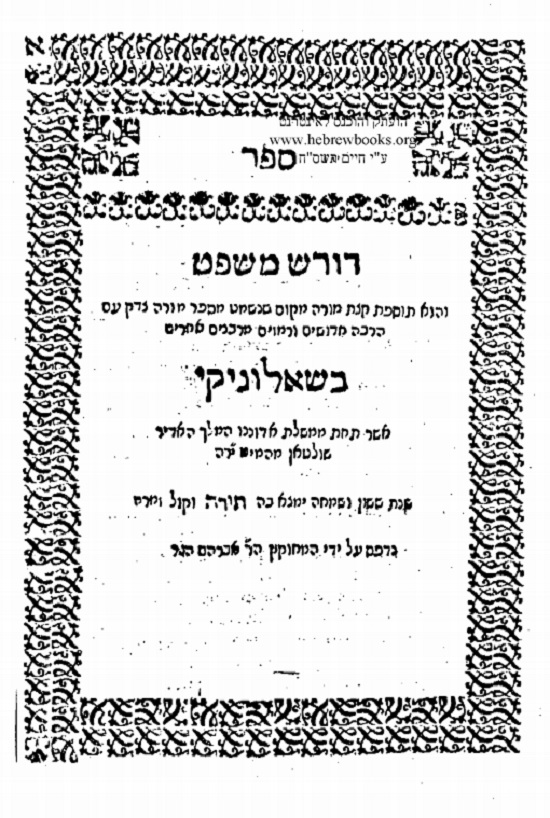

* I would like to thank Yehuda Geberer for respectfully commenting that he felt I had made a mistake in the first part of this essay, in which I had identified the Chaim Lieberman who assisted Shurin in landing a job at the Forverts as “the famed historian and bibliophile” who lived 1892–1991 (and who often spelled his name Haim Liberman in English). While Geberer is almost certainly correct that Shurin was actually helped by the man of the same name (1890–1963) who, according to his entry in the Leksikon fun forverts shrayber zint 1897, 42-43, worked as a teacher of Yiddish literature and Forverts Yiddish literary critic, I was influenced (apparently unduly so) in my (mis)identification by Yisroel Besser who, in his Mishpacha article (p. 30), writes as follows: “He went to meet the person he considers the greatest Orthodox writer of the century, Chaim Lieberman. Lieberman was a bibliophile, researcher, and historian, who suggested that young Shurin leave him some writings to peruse.”

I also wish to thank Yehudah Zirkind for kindly bringing to my attention another Yiddish-language memoir about the Hafets Hayyim, in which the author, a Radin native, tells a number of interesting stories about the great sage and also notes that he passed away “before reaching his ninety-fourth birthday”; see Abrashka-Kives Rogovski, “Der khofets-khayim in radin,” Oksforder yidish 3 (1995): 193-200, at col. 200.

[1] Aaron B. Shurin, “Der toes fun estraykhishn keyzer,” Forverts (July 5, 1996): 9, 20.
[2] See Baruch ha-Levi Epstein, Sefer mekor barukh, pt. 2 (Vilna: Romm, 1928), 515a-b, citing what he heard from Isaac Hirsch Weiss of Vienna (1815–1905). Epstein refers to the ruler as Franz Joseph II, but in point of fact the relevant Austrian emperor at the time was Franz Joseph I (whose official grand title, interestingly, included the style “King of Jerusalem”).
[3] The quotation of the original Yiddish here is not exact but is certainly close enough.
[4] I have so far been unable to locate the passage referred to.
[5] Jacob-Alter Slutzky was a prominent Orthodox lay leader of the Jewish community of Pinsk who was s/elected to serve on the city council at several points during the interwar period when Pinsk was under Polish rule; see Azriel Shohet, The Jews of Pinsk, 1881 to 1941, ed. Mark Jay Mirsky and Moshe Rosman, trans. Faigie Tropper and Moshe Rosman (Stanford: Stanford University Press, 2012), 469-470, 552-556, 559, 580-581. For the original Hebrew, see Wolf Zeev Rabinowitsch (ed.), Pinsk: sefer edut ve-zikkaron li-kehillat pinsk-karlin, vol. 1, pt. 2 (Tel Aviv; Haifa: Irgun Yotse’ei Pinsk-Karlin bi-Medinat Yisra’el, 1977; also available through the New York Public Library Yizkor Book online portal [accessed August 19, 2019]), using the index. See also Slutzky’s mini-bio in Nachman Tamir (Mirski) (ed.), Pinsk: sefer edut ve-zikkaron li-kehillat pinsk-karlin, vol. 2 (Tel Aviv: Irgun Yotse’ei Pinsk-Karlin bi-Medinat Yisra’el, 1966; also available through the New York Public Library Yizkor Book online portal [accessed August 19, 2019]), 538, where it is noted that Slutzky, like Epstein, was a member of Netsiv’s family (see below) and that he had two daughters, Zhenya and Eve. Based on a daf-ed filed by the former’s sister-in-law, Sonia Goberman (accessed August 19, 2019), it appears that Zhenya was the one who worked in the Jewish division. For Epstein’s endorsement of Slutzky during a campaign season, see “Eyn goldene keyt fun maysim toyvim,” Unzer pinsker lebn 3,42 (102) (October 16, 1936): 5.
[6] An old Pinsker tradition has it that the Jewish community was founded some time in the tenth century; see Benzion Hoffman (ed.), Toyznt yor pinsk (New York: Pinsker Branch 210, Workmen’s Circle, 1941), ix-x (notice the book’s title), and Tamir, Pinsk, 249, 252. Some have averred that an exact date for the start of the community cannot be established at present, given the number of times the Great Synagogue, and any historical documents it may have housed, burned down (on which, see n. 8 below); see, e.g., Saul Mendel ha-Levi Rabinowitsch, “Al pinsk-karlin ve-yosheveihen,” in Judah ha-Levi Levick and Dovberush Yeruchamsohn (eds.), Talpiyyot (me’assef-sifruti) (Berdychiv: Joseph Hayyim Zablinsky, 1895), 7-17, at p. 7. In any event, the current mainstream position holds that it began around 1506, the year in which a privilege issued by Fyodor Ivanovich Yaroslavich, Prince of Pinsk, granted local Jews land for a synagogue and cemetery in perpetuity; see Mordechai Nadav, The Jews of Pinsk, 1506 to 1880, ed. Mark Jay Mirsky and Moshe Rosman, trans. Moshe Rosman and Faigie Tropper (Stanford: Stanford University Press, 2008), 13-14.
[7] For a similar story, see Hillel Seidman, “Ha-rav r. barukh epstein – pinsk,” in Isaac Lewin (ed.), Elleh ezkerah: osef toledot kedoshei [5]700-[5]705, vol. 1 (New York: Research Institute of Religious Jewry, Inc., 1956), 142-149, at p. 145; reprinted with some variations in Seidman’s Ishim she-hikkarti: demuyyot me-avar karov be-mizrah eiropah (Jerusalem: Mossad Harav Kook, 1970), 108-116, at p. 111. Relatedly, see the Rosh Hashanah greetings sent to Epstein by the typesetters and printers of the Pinsker vort 2,40 (86) (September 30, 1932): 1, and of ibid. 3,38 (138) (September 20, 1933): 1.
[8] For some of the turbulent history of the Great Synagogue of Pinsk, which fell victim to fires on multiple occasions, see Nadav, The Jews of Pinsk, 1506 to 1880, 463-465; Shohet, The Jews of Pinsk, 1881 to 1941, 217-220, 300-301, 463, 648, 656; and Tamir, Pinsk, 249-252. For photographs of the synagogue, see here and here (accessed August 19, 2019). For a map of Pinsk from 1864 illustrating the location of the Great Synagogue, see Hoffman, Toyznt yor pinsk, 88-89 (in Yiddish), and Nadav, The Jews of Pinsk, 1506 to 1880, 498-499 (in English). For later maps of Jewish Pinsk, see Hoffman, Toyznt yor pinsk, 232-233, and Tamir, Pinskfoldout preceding p. 97.
[9] Epstein generally prayed not in the Great Synagogue but in the Pinsker Kloyz, a beit midrash with a firmly mitnaggedic orientation. Ze’ev Rabinowitsch reports that, “in years past, it was said that the walls of the Pinsker Kloyz do not give out in deference to R. Baruch Epstein…” (“Akhsanye shel toyre,” in Tamir, Pinsk, 264). See also Rabinowitsch, Pinsk, 412.
[10] See Gen. 27:33.
[11] In Yiddish, one appropriate response to a greeting like gut shabes! is gam atem!, using the plural atem even when only one person is being addressed. See Sol Steinmetz, Dictionary of Jewish Usage: A Guide to the Use of Jewish Terms (Lanham, MD: Rowman & Littlefield Publishers, Inc., 2005), 53.
[12] American Yiddish will often distinguish between Orthodox and non-Orthodox (particularly Reform) rabbis by referring to the former as rov/rabonim (singular/plural) and the latter as rabay/rabays (singular/plural). As essentially transliterations from the English, these terms for non-Orthodox rabbis are usually intended somewhat derogatorily in the mouths of frum Yiddish speakers.
[13] Oyb nisht nokh hekher or, as the phrase appears here in Hebrew, Im lo le-ma‘lah mi-zeh, is the title of a short story by the famous Yiddish and Hebrew classicist I.L. Peretz (1852–1915) about a Litvak who refuses to believe that the Nemirover Rebbe (a fictional character probably based on Rabbi Nathan Sternharz of Niemirów [1780–1845]) ascends on High during the annual period of selihot, as his Hasidim claim he does, instead of coming to the synagogue. Determined to find out where the Rebbe disappears to, he hides under the Rebbe’s bed one night and is amazed to discover that the Rebbe wakes early in the morning, dresses as a Polish peasant, and goes out to the forest to chop firewood for poor bedridden Jewish widows. He thereupon decides to join the Rebbe’s Hasidim, and from then on whenever anyone claims that the Rebbe flies up to Heaven to petition on behalf of his flock before Rosh Hashanah, this Litvak-turned-Hasid responds, “If not even higher than that.”

The story was first published in Yiddish in 1900 as “Oyb nisht nokh hekher! A khsidishe ertseylung,” Der yud 2,1 (January 11, 1900): 12-13. The following year, it appeared, in the author’s own Hebrew adaptation, as “Im lo le-ma‘lah mi-zeh,” Ha-dor 1,17 (1901): 207-211; for the Hebrew text, see here (accessed August 19, 2019). For editions using modern Yiddish orthography, see here and here (accessed August 19, 2019). For side-by-side Yiddish with English translation, see “Oyb nisht nokh hekher/And Maybe Even Higher,” in Itche Goldberg and Eli Katz (eds.), Selected Stories: Bilingual Edition, trans. Eli Katz (New York: Zhitlowsky Foundation for Jewish Culture, 1991), 270-281. For extensive discussions of the story’s subversive messages, historical sources, and inspirations, see Menashe Unger, “Mekoyrim fun peretses folkstimlekhe geshikhtn,” Yidishe kultur 7,3-4 (March–April 1945): 54-59, at pp. 56-57; Samuel Niger, Y.l. perets: zayn lebn, zayn firndike perzenlekhkeyt, zayne hebreishe un yidishe shriftn, zayn virkung (Buenos Aires: Confederacion pro Cultura Judia, 1952), 286-289; and Nicham Ross, Margalit temunah ba-hol: y.l. perets u-ma‘asiyyot hasidim (Jerusalem: Magnes Press, 2013), 17-83 (ch. 2).

In our context, the phrase is deployed by Paktor’s rabbinic interlocutor to express his realization that Epstein was even greater than he had originally thought.
[14] Paktor apparently also shared this story about Epstein and the Folkstsaytung with Mark Jay Mirsky; see the latter’s introduction to Shohet, The Jews of Pinsk, 1881 to 1941, xxix-xxx.
[15] mAvot 1:4.
[16] The Hebrew phrase deployed here is mar’eh kohen, a reference to the requirement that those afflicted with biblical tsara‘at must consult with a priest before the healing/atonement process can move forward (see Lev. 13). The expression, as used by Paktor, does double-duty by playing on the title of the well-known piyyut recited on Yom Kippur, which refers to the priest’s (radiant) appearance, not that of the biblical skin disease.
[17] Barukh she-amar was the last book Epstein printed before he passed away. It originally appeared in Pinsk in 1939 (publisher: Drukarnia Wolowełskiego), but, according to Aaron Z. Tarshish, Rabbi barukh ha-levi epstein[,] ba‘al “torah temimah” (Jerusalem: Mossad Harav Kook, 1967), 189, even though the work achieved great popularity within the city, it did not spread beyond. Epstein sent a single copy to the famous Strashun Library in Vilna, which then passed it on to YIVO, and the latter institution transferred it to its headquarters in New York (see the online catalog record for this copy here [accessed August 19, 2019]). This, then, was apparently the only exemplar of the book to survive the war, and when it was discovered at YIVO some time thereafter, it was used to print the photo-offset reproduction published in Tel Aviv in three parts: vol. 1 on the haggadah (1965), vol. 2 on Pirkei avot (1965), and vol. 3 on the siddur itself (1968). (For a slightly different account of Barukh she-amar’s original publication and rediscovery after the war, see Seidman, “Ha-rav r. barukh epstein,” 148. Based on a helpful personal communication from Lyudmila Sholokhova, Director of the YIVO Library, it would appear that Tarshish’s version of the story is the more accurate one.)

I assume that Paktor owned a copy of the Tel Aviv reprint, not the original Pinsk edition.
[18] See the obituary for Rev. Simon Paktor published in the Albany Times Union (March 2–3, 2003), available here (accessed August 19, 2019).

Franz J. Beranek, in his Das Pinsker Jiddisch und seine Stellung im gesamtjiddischen Sprachraum (Berlin: Walter de Gruyter & Co., 1958), discusses certain distinctive features of the dialect of Yiddish spoken in Pinsk. Upon examination of our letter, we find some of the markers of this litvish (Northeastern Yiddish) dialect reflected in such forms as eygn (eyes; see p. 33, §38, 1), greyser (large; see p. 25, §26), arobgegangen (descended; see p. 53, §48, 2a), em (him; see p. 21, §18, 1), etc. (I suspect that his use of the forms idishe [Jewish/Yiddish], reydn [to speak], and fardrosig/hartsig/shtendig/etc. [displeased/sincerely/always/etc.], instead of the expected yidisheredn, and fardrosik/harstik/shtendik/etc., is the result of Paktor following common journalistic orthographic conventions and is not reflective of his actual pronunciation of those words.) (For a recent look at Beranek’s relationship with some of his Yiddish scholarly contemporaries, see Kalman Weiser, “‘One of Hitler’s Professors’: Max Weinreich and Solomon Birnbaum confront Franz Beranek,” Jewish Quarterly Review 108,1 [2018]: 106-124.)
[19] See Mordechai Nadav, “Pinsk,” in Shmuel Spector (ed.), Pinkas ha-kehillot: polin, vol. 5 (Jerusalem: Yad Vashem, 1990), 276-299, at p. 276 (available in English translation here [accessed August 19, 2019]). See also Dov Levin, Tekufah be-sograyim, 1939–1941: temurot be-hayyei ha-yehudim, ba-ezorim she-suppehu li-berit-ha-mo‘atsot bi-tehillat milhemet ha-olam ha-sheniyyah (Jerusalem: Hebrew University of Jerusalem; Tel Aviv: Hakibbutz Hameuchad, 1980), 26, for a chart comparing the populations of cities in eastern Poland in 1931.
[20] See the aforementioned obituary for Paktor published in the Albany Times Union. On NKVD activity in Pinsk during the Soviet occupation, see Pesah Pakacz, “Shilton ha-soviyyetim be-pinsk,” in Tamir, Pinsk, 315-320, at pp. 317-320, and Shohet, The Jews of Pinsk, 1881 to 1941, 639-650. On NKVD activity among occupied Polish Jewry in general, see Yosef Litvak, Pelitim yehudim mi-polin bi-berit ha-mo‘atsot[,] 1939–1946 (Jerusalem: Hebrew University of Jerusalem; Tel Aviv: Ghetto Fighters’ House; Hakibbutz Hameuchad, 1988), 118-156. As noted by Eliyana R. Adler, the similar situation of Baltic Jews exiled to the east by the Soviets demonstrates that had they not suffered that fate, they most likely would have fallen victim to the Nazis when the latter invaded the Soviet Union on June 22, 1941; see her “Exile and Survival: Lithuanian Jewish Deportees in the Soviet Union,” in Michal Ben Ya’akov, Gershon Greenberg, and Sigalit Rosmarin (eds.), Ha-kayits ha-nora ha-hu…: 70 shanah le-hashmadat ha-kehillot ha-yehudiyyot be-arei ha-sadeh be-lita: historiyyah, hagut, re’aliyyah (Jerusalem: Efrata College Publications, 2013), xxvii-xlix, at pp. xlv-xlvi.
[21] See the Holocaust remembrance seminar announcement published in the Clifton Journal (October 30, 2015), p. 36 (available here [accessed August 19, 2019]; make sure to click “View Details”). The Air Passenger Manifest recording the Paktors’ arrival in New York, available to subscribers through the MyHeritage database (accessed June 20, 2019), is dated May 19, 1952; curiously, it lists Simon’s wife’s name as Sabina.
[22] According to Michael C. Duke, “Historian Is CBY Scholar In Residence, Oct. 8–10,” Jewish Herald-Voice (October 7, 2010) (accessed August 19, 2019), Paktor was trained as a rabbi. While I could find no direct corroborating evidence for this claim elsewhere, it is true that he is sometimes referred to in writing with the title “Reverend.” His work at the shul, for which he came to be well loved and respected, included serving as cantor and Torah reader, running the daily minyanim, preparing youth for their bar and bat mitzvahs, and even teaching Yiddish classes; Stephen M. Berk, Year of Crisis, Year of Hope: Russian Jewry and the Pogroms of 1881–1882 (Westport, CN; London: Greenwood Press, 1985), xv, credits Paktor with introducing him to the world of Yiddish scholarship. See also the aforementioned obituary in the Albany Times Union and the above article by Duke. I thank Robert Kasman, Stephen M. Berk, and Mendel Siegel for the information they provided me on Paktor’s life and service to the shul in personal communications.
[23] See the obituary for Anne Paktor published here (accessed August 19, 2019).
[24] Henry Skoburn, The Agudat Achim Chronicle: Commemorating 120 Years[,] 1892–2012 (Schenectady: Congregation Agudat Achim, 2012), 10, 12.
[25] The only book-length biography of Epstein is Tarshish’s (above, n. 17), though, as noted by Eitam Henkin, “Perakim be-toledot ba‘al arukh ha-shulhan: mishpahto ve-tse’etsa’av,” Yeshurun 27 (2012): 879-895, at p. 879, this work is in need of a thorough update that takes a scholarly-critical approach and considers the abundant literature on Epstein and his oeuvre that has appeared over the past fifty-plus years. For a shorter essay on Epstein’s life, see Seidman’s “Ha-rav r. barukh epstein” (above, n. 7). And for a famous photograph of Epstein in his younger years, see Hoffman, Toyznt yor pinsk, 335; reproduced (seemingly with modifications) as the frontispiece of Tarshish’s biography and in Zvi Kaplan, “Hiddushim ba-halakhah shel gedolei pinsk ve-karlin,” in Rabinowitsch, Pinsk, 367-406, at p. 393. (I find it hard to believe that the person in the portrait accompanying the Epstein mini-biography printed in Tamir, Pinsk, 489-491, is actually him but would be happy to be corrected.)
[26] See Baruch ha-Levi Epstein, Sefer mekor barukh, introduction (Vilna: Romm, 1928), 2 n. 1.
[27] The Folkstsaytung (People’s Paper) was the official organ of the General Jewish Workers Union in Poland, also known as the Bund. As such, it espoused a secularist, socialist Weltanschauung and polemicized against Communists, Zionists, and Orthodox Jews, among others. In addition to covering politics and workers’ issues, the paper devoted space to science and technology, sports, culture, and (Jewish and non-Jewish) literature. At its height in 1935, the Folkstsaytung had an approximate circulation of eighteen thousand. See Jacob Shalom Hertz, “‘Folkstsaytung’ 1918–1939,” in David Flinker, Mordechai Tsanin, Shalom Rosenfeld et al. (eds.), Di yidishe prese vos iz geven (Tel Aviv: Veltfarband fun di Yidishe Zhurnalistn, 1975), 151-169, and Boris Kotlerman, “Folks-tsaytung,” trans. I. Michael Aronson, in the digitized YIVO Encyclopedia of Jews in Eastern Europe (accessed August 19, 2019).

According to Seidman, “Ha-rav r. barukh epstein,” 144-145:

[Epstein] had an expansive [intellectual] horizon. He was interested in and familiar with all that was happening in the world. He read Russian and German newspapers. He also visited Vienna and Berlin in the ’20s, meeting with scholars and intellectuals there, and maintained an epistolary correspondence with the towering Jewish figures of the generation. When they visited Pinsk, he would host them. In 1914, Rabbi Hayyim Soloveichik visited Pinsk and stayed with Rabbi Baruch Epstein for Shabbat.

In addition to regularly reading the paper, Epstein also contributed to a number of (rabbinic and general Jewish) periodicals, including HavatseletYagdil torahHa-levanonHa-maggidHa-melits, and Ha-pardes; see Baruch ha-Levi Epstein, Sefer mekor barukh, pt. 3 (Vilna: Romm, 1928), 701b, and Shemaryah Gershuni, “Rabbi barukh epstein – ba‘al ha-torah temimah: beirur nesibbot petirato,” Yeshurun 29 (2013): 885-892, at pp. 886 n. 13, 889 n. 25. He even wrote a weekly column on the parashah for the Pinsker shtime; see Seidman, “Ha-rav r. barukh epstein,” 145, 148-149. While I have not examined issues of the Pinsker shtime, I know that Epstein’s parashah columns in a different local paper, Pinsker vort, were entitled Fun gebentshtn kval (=Mi-makor barukh); see the announcement in the February 20, 1931 edition, p. 1.
[28] For a summary of some of the halakhic literature on the topic and a defense (in most cases) of the widespread contemporary disregard of this prohibition, see Eitam Henkin, “Keri’at divrei defus be-shabbat be-yameineu le-or din shetarei hedyotot,” Melilot 3 (2010): 49-63 (the pagination in the printed version is slightly different from that of what I presume to be the prepublication copy available on Henkin’s website).
[29] Indeed, the Hafets Hayyim was particularly vociferous in his opposition to the practice of many of his contemporaries to regularly read newspapers, not only because of their often-improper content (heresy, scoffing, leshon ha-ra, licentiousness, etc.), but also due to the drain on one’s time involved in their consumption. See, e.g., Israel Meir ha-Kohen, Kunteres zekhor le-miryam (Piotrków: Hanokh Henekh Fallman, 1925), 8b; Aryeh Leib Poupko, Mikhtevei ha-rav hafets hayyim z[ekher] ts[addik] l[i-berakhah]: korot hayyav, derakhav, nimmukav ve-sihotav, 1st ed. (Warsaw: B. Liebeskind, 1937), 96-98 (second pagination; no. 42); ibid., 42-43 (third pagination; par. 82); idem, Mikhtevei ha-rav hafets hayyim z[ekher] ts[addik] l[i-berakhah], ed. S. Artsi, 2 vols. (Bnei Brak: n.p., 1986), 2:157-158. Relatedly, see also idem, Mikhtevei, 1st ed., 27-29 (second pagination; no. 9). It is clear, however, that the Hafets Hayyim was, at times, exposed to periodical literature; for a letter he sent to the Haredi paper Kol ya‘akov, responding to an earlier issue thereof, see idem, Mikhtevei, ed. S. Artsi, 1:297-298 (no. 122).
[30] See Baruch ha-Levi Epstein, Sefer mekor barukh, pt. 4 (Vilna: Romm, 1928), 895b, 897b-898a. Epstein’s report about his uncle’s behavior in this connection has aroused a good deal of controversy, as discussed by, e.g., Eliezer Brodt, “The Netziv, Reading Newspapers on Shabbos & Censorship,” Seforim Blogpt. 1 (March 5, 2014) and pt. 2 (April 29, 2015). Like Brodt, Marc B. Shapiro, “Clarifications of Previous Posts,” Seforim Blog (January 16, 2008) (accessed August 19, 2019), believes that one can rely upon this account. On the general question of the historical accuracy of Sefer mekor barukh, see, e.g., Eitam Henkin, “R. yehi’el mikhl epstein ve-ha-‘tsemah tsedek’ ba-adashat ha-sefer ‘mekor barukh’,” Alonei mamre 123 (Winter 2011): 189-215, and Moshe Maimon, “Od be-inyan ba‘al ha-torah temimah u-sefarav,” Kovets ets hayyim 12,1 (2018): 409-420 (among many others).
[31] Probably the two most authoritative biographies of Walkin to date are that appended to the beginning of the second volume of the New York, 1951 photo-offset edition of his responsa, Sefer she’elot u-teshuvot zekan aharon, composed by his son, Rabbi Samuel David (on whom, see below), and entitled “Toledot maran ha-ga’on ha-mehabber z[ekher] ts[addik] v[e-]k[adosh] l[i-berakhah]”; and Hillel Seidman, “Ha-rav r. aharon walkin – pinsk,” in Lewin, Elleh ezkerah, 64-71; reprinted with some variations in Seidman’s Ishim she-hikkarti, 20-28. Eliezer Katzman used these two sources in compiling much of his own profile of Walkin – “Ne‘imut ha-torah: ha-g[a’on] r[av] aharon walkin z[ekher] ts[addik] v[e-]k[adosh] l[i-berakhah,] a[v] b[eit] d[in] pinsk[,] ba‘al beit aharon, zekan aharon v[e-]ku[llei],” Yeshurun 11 (2002): 891-904; 12 (2003): 727-739 – but added some material not found in either. (It seems that unacknowledged verbatim use was made of Seidman’s and/or Katzman’s work in the Walkin biography printed in Daniel Bitton’s editions of Sefer beit aharon on Bava kamma [Jerusalem: Mekhon ha-Ma’or, 2003] and of Sefer hoshen aharon [Jerusalem: Mekhon ha-Ma’or, 2005].) For additional appreciations of Walkin’s Torah, see Kaplan, “Hiddushim ba-halakhah,” 399-406, an earlier version of which had appeared as “Ba‘al ha-‘battim’,” Ha-tsofeh 10159 (June 24, 1966): 5, 7; and of his religious persona, see the excerpt from Rabbi Joseph B. Soloveitchik’s letter to R. Samuel David, dated 8 Shevat [5]712 (February 4, 1952) and printed at the foot of the introduction to Aaron Walkin, Sefer beit aharon al massekhet gittin, 2nd ed. (New York: S. Walkin, 1955).

For photographs of Walkin, see Anon., “Shlukhim fun agudes yisroel shoyn do,” Yidishes tageblat (December 11, 1913): 8; Anon., “Visiting Rabbis Explain International Jewish Union,” The Pittsburg [sic] Press (January 27, 1914): 3; Anon., “Noted European Rabbis Greeted by Orthodox Jews of Greater Boston,” The Boston Post (February 7, 1914): 16; Kaplan, “Hiddushim ba-halakhah,” 399; Moshe Rosman, “Pinsk,” in the digitized YIVO Encyclopedia of Jews in Eastern Europe (accessed August 19, 2019); Marc B. Shapiro, “A Tale of Two Lost Archives,” Seforim Blog (August 12, 2008) (accessed August 19, 2019); the Jewish Pinsk memorial page here (accessed August 19, 2019) (Walkin is leading the Agudah procession); and David Zaretsky, “Rabbah ha-aharon shel pinsk: le-hofa‘ato me-hadash shel ha-sefer sh[e’elot] u-t[eshuvot] ‘zekan aharon’,” in Zikhram li-berakhah: ge’onei ha-dorot ve-ishei segullah (Israel: n.p., 2015?), 33-39.
[32] See Jacob Goldman’s obituary for Sophia Epstein, entitled “Allon bakhut,” in Ha-tsefirah 26,60 (March 24, 1899): 293. See also the report issued by Aaron Tänzer, “Von Brest-Litowsk nach Pinsk,” Allgemeine Zeitung des Judentums 80,1 (January 7, 1916): 6-10, at p. 9, in which he mentions Epstein’s widowhood and the bank closure. Of Epstein’s four children – Cecilia (Tsile), Meir, Eleazar Moses, and Fania – Tänzer makes specific reference only to the last, suggesting that the other three were no longer in Pinsk by that point. Indeed, we know that Cecilia’s husband Nathan (Nahum) Bakstansky (Bakst) arrived at Ellis Island in 1907 (see his Geni record here [accessed August 19, 2019]); that they and their children Aaron and Jacob were registered voters as of 1924 (see Anon., “List of Registered Voters for the Year 1924: Borough of Brooklyn—Sixteenth Assembly District,” The City Record [October 16, 1924]: 2); and that Cecilia is registered as the copyright holder for the New York, 1928 edition of her father’s Torah temimah (see Anon., Catalogue of Copyright Entries: Part 1, Group 1 […] for the Year 1929 [Washington: United States Government Printing Office, 1930], 1825-1826). In addition, according to family records made available to Henkin, Eleazar Moses had moved to Leningrad (present-day St. Petersburg, Russia) (see the corrections appended to the online version of his aforementioned article, “Perakim be-toledot”). And if Seidman is correct that one of Epstein’s sons wound up working as a physician in New York (see the Ishim she-hikkarti version of his article, p. 110), that may mean Meir, like Cecilia, made it to America as well. (I find the idea that Meir and Fania died in their youth, as reported on Henkin’s website, difficult to believe, considering that Tänzer makes no mention of this in 1916, based on a visit to Pinsk in November 1915; see also next note. But until additional information becomes available, this will be virtually impossible to definitively reject [or accept].) In this connection, see also Maimon, “Od be-inyan,” 418-419, for an interesting interpretation of a passage in Sefer mekor barukh, pt. 4.
[33] Fania was instrumental in founding a Jewish girls’ gymnasium in Pinsk in the fall of 1915, reportedly with her father’s approval. See Tänzer, “Von Brest-Litowsk,” 9, and Shohet, The Jews of Pinsk, 1881 to 1941, 34, 183, 350-351, 596-597; see also Tamir, Pinsk, 510-512. She apparently passed away during World War II, given that she (like her father) is listed among the martyrs of Pinsk in Tamir, Pinsk, 627. (It is unclear to me whether or not the Meir cited there was R. Baruch’s son.)
[34] As of Tänzer’s visit, it seems that Fania attended to the needs of her father’s house (“Von Brest-Litowsk,” 9). Tarshish notes, however, that at a certain point he began living in a local hotel, whose proprietors took care of him honorably and with dedication (Rabbi, 127; though cf. below, n. 38). Seidman adds that he ate his meals at a restaurant in the city while living in the hotel (“Ha-rav r. barukh epstein,” 144). Three hotels, all under Jewish ownership, are named in the “List of Subscribers of the Telephone Network of the Postal and Telegraph Directorate in Wilno in 1939” (select p. 52 from the drop-down menu) (accessed August 19, 2019). I have not been able to ascertain at which of these three Epstein lived.
[35] See Kaplan, “Hiddushim ba-halakhah,” 399; see also Ben-Mem, “Ha-ga’on r. aharon walkin z[ekher] ts[addik] l[i-berakhah],” in Tamir, Pinsk, 499-500, who notes that Walkin eulogized Rabbi Jacob Mazeh of Moscow (1859–1924) within the first year of his arrival in the city. Cf. the introduction to Aaron Walkin, Sefer beit aharon al massekhet bava kamma (Vilna: Shraga Feivel Garber, 1923), which the author signed (seemingly in 1923) while living in the Jewish community of Amtshislav (present-day Mscisłaŭ, Belarus). Cf. also Anon., “Horav r. arn wolkin vegn zayn raykher lebns-fargangenheyt,” Unzer grodner ekspres 2,79 (April 2, 1929): 1, the second part of an interview with Walkin, which claims that he emigrated from Russia in 1922; as well as Aaron B. Shurin, “Tsvey shayles utshuves sforim fun letstn pinsker rov,” Forverts (October 14, 1977): 3, 6, at p. 3, who writes that Walkin came to Pinsk in 1924. (On his way from Russia to Poland, he had an extended stopover in Danzig; see M. Lyubart, “Vegn yidishn lebn in danzig,” Pinsker vort 2,11 [57] [March 11, 1932]: 5.)
[36] See Anon., “Horav walkin oysgeveylt als rov fun pinsker kehile,” Pinsker vort 3,32 (132) (August 11, 1933): 6, and Shohet, The Jews of Pinsk, 1881 to 1941, 571. Cf. Ben-Mem, “Ha-ga’on r. aharon walkin,” 500, who gives the date as [5]688 (1927–1928). (His election to the rabbinate of neighboring Karlin had taken place over a year earlier; see Anon., “Horav walkin als karliner rov,” Pinsker vort 2,6 [52] [February 5, 1932]: 6.)

Relatedly, see Dov Rabin (ed.), Grodnah-Grodne (Jerusalem: Encyclopaedia of the Jewish Diaspora, 1973; also available through the New York Public Library Yizkor Book online portal [accessed August 19, 2019]), col. 352, on the brief period in 1929 when the Jews of Grodno – then part of Poland but now in Belarus – considered appointing Walkin as the chief rabbi of their community (an episode that deserves fuller historiographic exploration); see also Anon., “Kehile-rat geg[n] horav wolkin,” Unzer grodner ekspres 2,88 (April 12, 1929): 15.
[37] For Epstein, see Tarshish, Rabbi, 70-80 (relationship with Netsiv), 84-89 (marriage at approx. 18), 120-126 (visit to America), 134-135, 148-149 (Zionist sympathies) (all based primarily on passages in Sefer mekor barukh); Shohet, The Jews of Pinsk, 1881 to 1941, 536 (Zionist sympathies); and Gershuni, “Rabbi barukh epstein,” 890-892 (visit to America). For Walkin, see his undated introduction to Sefer beit aharon al massekhet bava kamma (visit to America); the postscript to his undated introduction to the commentary Saviv li-yere’av, vol. 1 (Pinsk: Drukarnia Wolowełskiego, 1935), and the wishes of nehamah printed in Dos naye pinsker vort 7,51 (356) (December 3, 1937): 6 (personal misfortune); his son’s “Toledot maran ha-ga’on ha-mehabber” (relationship with Netsiv, marriage at approx. 18, visit to America); and Ben-Mem, “Ha-ga’on r. aharon walkin,” 500, and Rabin, Grodnah-Grodne, col. 352 (Zionist sympathies). Relatedly, Walkin’s son Hayyim married the daughter of Rabbi Abraham Isaac ha-Kohen Kook (1865–1935); see the mazl tov wishes on the occasion of their engagement printed in Do’ar ha-yom 8,182 (April 28, 1926): 1, and in Ha-arets 9,2041 (May 2, 1926): 4.

For a lecture delivered in Yiddish during Walkin’s visit to the United States, undertaken December 1913–February 1914 in order to help establish Agudath Israel in America, see Aaron Walkin, Di printsipen un tsveke fun agudes yisroel: fortrog gehalten fir amerikaner idn (New York: Office of Agudath Israel, n.d.). (During his trip, Walkin visited the Rabbi Isaac Elchanan Theological Seminary at 156 Henry Street; for his comparison of the yeshivah with that of Volozhin [!], see Anon., “Agudes yisroel shlukhim in yeshives rabeynu yitskhok elkhonen,” Der morgen zhurnal [December 24, 1913]: 4. Cf. Anon., “Horav wolkin begaystert fun idishe anshtalten in amerika,” Der morgen zhurnal [January 13, 1914]: 4.)

Tragically, Epstein and Walkin shared another fate: each printed a sefer in 1939 in Pinsk, only one copy of which survived the war and was later used for photo-offset reprinting. On Epstein’s Barukh she-amar, see above, n. 17, and on Walkin’s Sefer beit aharon al massekhet gittin, see his son’s introduction to the 1955 edition.
[38] See the address given for Epstein on the title page of his Sefer tosefet berakhah ha-kolel he‘arot ve-he’arot le-sefer “megillat sefer” al hamesh megillot ha-kodem (Krakow: [Michael Horowicz], 1930) (the same address appears on the title pages of the five parts of Sefer gishmei berakhah that appeared at the same press in the same year). It is unclear to me at what point he moved into the hotel referred to by Tarshish (see above, n. 34), though it seems, based on the aforementioned “List of Subscribers,” that as of 1939 a fellow named Dawid Giler was living at Epstein’s former address on Dominikańska Street.
[39] For several biographical sketches of R. Samuel David, the only child of R. Aaron to survive the war, see Samuel David Walkin, Sefer ramat shemu’el al ha-torah: sefer be-reshit (Jerusalem: Walkin Family, 1982), 11-27; the unpaginated introductions to idem, Sefer shevivei or: likkutim, ed. Samuel David Walkin [the grandson], 2nd ed. (Jerusalem: n.p., 2011); and idem, Sparks of Light: Jewels of Wisdom from the Chofetz Chaim ZT”L (New York: Kol Publishers, 2012), 83-86. For descriptions of R. Samuel David’s efforts on behalf of his fellow Pinskers, see Rabinowitsch, Pinsk, 547, and Tamir, Pinsk, 598-599. Unsurprisingly, given the interconnectedness of Lithuanian rabbinic dynasties, R. Samuel David became close with both the Hafets Hayyim and R. Soloveitchik; for photographs of him with the former, see the plates at the end of Sparks of Light, and with the latter, see Marc B. Shapiro, “Assorted Matters,” Seforim Blog (February 17, 2016) (accessed August 19, 2019).
[40] See Samuel David Walkin, Sefer kitvei abba mari: hiddushim u-be’urim al tanakh u-midrashav, ed. Moishe Joel Walkin (Kew Gardens: Yeshiva Beth Aron, 1989), 345; see also pp. 73, 132, 160, 266, 497, 512. For other instances of R. Samuel David quoting Epstein, often preceded by honorifics, see idem, Sefer ramat shemu’el al ha-torah, 108-109, and idem, Sefer kitvei abba mari: hiddushim u-be’urim al massekhtot ha-shas, u-mo‘adei ha-shanah[,] ve-nosaf aleihem derashot ve-he‘arot be-inyanei de-yoma, ed. Moishe Joel Walkin (Kew Gardens: Yeshiva Beth Aron, 1982), 33, 176, 193, 277, 314. For a reproduction of a letter written by Epstein (on his own letterhead) to R. Samuel David on the occasion of the latter’s appointment to the rabbinate of Lukatsh (present-day Lokachi, Ukraine) in 1935, see Tamir, Pinsk, 490. On the relationship between Epstein and R. Aaron, see also Seidman, “Ha-rav r. barukh epstein,” 144, 149. (Seidman, “Ha-rav r. aharon walkin,” 69, notes that Walkin opened his home and heart “to anyone suffering or in pain.” See also Zaretsky, “Rabbah ha-aharon shel pinsk,” 36. For a similar description of R. Samuel David, see Aaron B. Shurin, “Horav hagoen r. shmul wolkin, vitse prezident fun agudes horabonim, iz nifter gevorn,” Forverts [August 29, 1979]: 1, 8, at p. 1.) Another home Epstein visited was that of Yankev Epstein in Minsk; see Devora Gliksman, A Tale of Two Worlds (Brooklyn: Mesorah Publications, ltd, 2009), 113-114.
[41] Shohet, The Jews of Pinsk, 1881 to 1941, 642, 648; see also Tamir, Pinsk, 319-320.
[42] Walkin himself refers to this, en passant, in the introduction to Sefer beit aharon al massekhet bava kamma, saying that he was jailed bi-shevil alilah, hattat ha-kahal hu (on account of libel; it is the sin of the community). R. Samuel David, in “Toledot maran ha-ga’on ha-mehabber,” explains that his father was one of those fighting to defend Jewish tradition against the edicts of the Bolsheviks and was therefore imprisoned for about half a year. Seidman, “Ha-rav r. aharon walkin,” 67, adds (perhaps by logical deduction) that the Yevsektsiya (Jewish section of the Communist Party) was responsible for informing on him to the authorities.
[43] For examples of Walkin’s wartime rabbinic activities, see Shohet, The Jews of Pinsk, 1881 to 1941, 649; Tamir, Pinsk, 320; and Seidman, “Ha-rav r. aharon walkin,” 69, 71. For his commitment especially to Torah study and creativity in this period, see the excerpt from the last letter R. Samuel David received from him printed in “Toledot maran ha-ga’on ha-mehabber,” as well as the excerpt from a letter by Rabbi Zalman Sorotzkin (1881–1966) reproduced in the introduction to Aaron Walkin, Sefer beit aharon al massekhet kiddushin, ed. Aaron ben Moishe Joel Walkin (Queens: Aaron Walkin, n.d.).
[44] See Tarshish, Rabbi, 127; see also p. 128 on Epstein’s avoidance of the Soviet authorities, even when it meant skipping meals. Zvi Gitelman, “Afterword: Pinsk in Wartime and from 1945 to the Present,” in Shohet, The Jews of Pinsk, 1881 to 1941, 652-659, at p. 653, notes that local leaders organized a committee to aid impoverished clergy, including Epstein, during this period.
[45] For harrowingly detailed accounts of the fate of Pinsk Jewry during the Nazi onslaught, see Nahum Boneh (Mular), “Ha-sho’ah ve-ha-meri,” in Tamir, Pinsk, 325-388 (a Yiddish translation by Leib Morgenthau appears on pp. 389-458 and an English translation by Ellen Stepak appears online here [accessed August 19, 2019]); Nadav, “Pinsk,” 294-298; Tikva Fatal-Knaani, “The Jews of Pinsk, 1939–1943, Through the Prism of New Documentation,” trans. Naftali Greenwood, Yad Vashem Studies 29 (2001): 149-182; Gitelman, “Afterword,” 652-654; and Katharina von Kellenbach, Nahum Boneh, and Ellen Stepak, “Pinsk,” in Martin Dean with Mel Hecker (eds.), The United States Holocaust Memorial Museum Encyclopedia of Camps and Ghettos, 1933–1945, vol. II, pt. B (Bloomington and Indianapolis: Indiana University Press, 2012), 1442-1444. For a map of the Pinsk ghetto, see Tamir, Pinsk, 334 (in Hebrew), and here (in English) (accessed August 19, 2019). For photographs of the memorials set up on the sites of mass murder, see here (accessed August 19, 2019).
[46] See, e.g., R. Samuel David’s introductions to Sefer she’elot u-teshuvot zekan aharon, vol. 2 (the one entitled “Hakdamat ben ha-mehabber maran ha-ga’on z[ekher] ts[addik] l[i-berakhah]”) and to Sefer beit aharon al massekhet gittin; see also the entries on R. Aaron maintained by Yad Vashem (1234) (accessed August 19, 2019). (I am aware that Hy”d is sometimes used even when a person was not literally killed by an enemy but rather died as a[n in]direct result of enemy persecution.) Strangely, Tamir, Pinsk, 636, does not list any members of the Walkin family among the martyrs of Pinsk.
[47] See Tamir, Pinsk, 500, and Zaretsky, “Rabbah ha-aharon shel pinsk,” 33, 37. For a relatively recent study of rabbinic leadership during the Holocaust, see Havi Dreifuss (Ben-Sasson), “‘Ka-tson asher ein lo ro‘eh’? rabbanim u-ma‘amadam ba-sho’ah,” in Asaf Yedidya, Nathan Cohen, and Esther Farbstein (eds.), Zikkaron ba-sefer: korot ha-sho’ah ba-mevoʼot la-sifrut ha-rabbanit (Jerusalem: Rubin Mass, 2008), 143-167.
[48] See Aaron B. Shurin, “Ha-rav aharon walkin: rabbah ha-aharon shel pinsk,” in Keshet gibborim: demuyyot ba-ofek ha-yehudi shel dor aharon, vol. 3 (Jerusalem: Mossad Harav Kook, 2004), 92-97, at p. 92 (ca. Passover 1941), and Seidman, “Ha-rav r. aharon walkin,” 71 (summer 1942).
[49] See Gershuni, “Rabbi barukh epstein,” 887-890. It seems that Tarshish’s version of the events (Rabbi, 128), according to which Epstein died in a Jewish hospital shortly after the Germans’ invasion in July 1941, has gained some traction. See, e.g., N.T. Erline’s epilogue in Baruch ha-Levi Epstein, My Uncle The Netziv, trans. Moshe Dombey, ed. N.T. Erline (Brooklyn: Mesorah Publications, 1988), 223; Prof. Meir Bar-Ilan’s family tree (accessed August 19, 2019); and Pnina Meislish, “Epstein, barukh, ben yehi’el mikhl,” Rabbanim she-nispu ba-sho’ah (accessed August 19, 2019). By contrast, Gitelman, “Afterword,” 728 n. 7, claims that “Epstein died a natural death in Pinsk in 1940,” while Ber Schwartz, Sefer artsot ha-hayyim (Brooklyn: B. Schwartz, 1992), 23, writes that Epstein was killed by the Nazis in 1942. Here again, Samuel David Walkin, Sefer ramat shemu’el al ha-torah, 108, refers to Epstein with the acronym Hy”d, suggesting martyrdom; see also the entries on Epstein maintained by Yad Vashem (123) (accessed August 19, 2019).
[50] Paktor could not have directly witnessed Epstein passing away in the ghetto, as by the time of its establishment he had long been exiled to Siberia by the Soviets. Interestingly, Aaron B. Shurin, in an article published about six years after Paktor sent this letter, also writes that Epstein died in the ghetto (“Ha-rav barukh epstein: mehabber ‘torah temimah’,” in Keshet gibborim, vol. 3, pp. 38-44, at p. 44). He adds (without citing a source) that Epstein was buried in the Karlin Jewish cemetery next to the grave of Rabbi David Friedman of Karlin (1828–1915). Unfortunately, the Karlin cemetery is no longer extant, making it difficult to verify this claim; see here (accessed November 24, 2019).
[51] Ratnowska’s account (committed to writing twenty years after the Holocaust) is cited by Boneh, “Ha-sho’ah ve-ha-meri,” 333. (Pnina Meislish, it should be noted, accepts this timing with respect to Walkin’s passing only; see “Walkin, aharon, ben yosef tsevi,” Rabbanim she-nispu ba-sho’ah [accessed August 19, 2019].) Cf. Rabinowitsch, Pinsk, 399 n. 3, where he quotes slightly conflicting testimony from Ratnowska, according to which Epstein passed away “suddenly” a few weeks before the establishment of the Pinsk ghetto (which sounds more like springtime than winter). In addition, according to her, Epstein was buried in the cemetery in Pinsk, not in the Karlin cemetery as posited by Shurin (see previous note). For Ratnowska’s description of life in hiding during the war, see Boneh, “Ha-sho’ah ve-ha-meri,” 357.

Interestingly, Irina Yelenskaya places both rabbis’ deaths more specifically in January 1942 in her article on Pinsk for the Shtetl Routes project (accessed November 4, 2019), though I do not know on which of her sources she bases this date.
[52] See the description of the Pinsk Ghetto Database available here (accessed August 19, 2019). By contrast, Rachel Walkin (1876–1942?), R. Aaron’s wife, is listed in the Database as living at 35 Polnocna (in German: Nord) Street (the present-day approximate equivalent is Leningradskaya Street). Also listed are Mila Ratnowska and Eve Slutzky (who is presumably to be identified with the daughter of alderman Jacob-Alter bearing the same name).
[53] See the May 2, 2011 funeral announcement published in the Chicago Tribune and currently available here (accessed August 19, 2019).


Apostates and More, Part 1

Apostates and More, Part 1

Marc B. Shapiro

Continued from here

  1. I am aware of two seforim found on both Otzar haHochma and Hebrewbooks.org which were written by men who later apostatized (there are probably more). There are also two seforim on Hebrewbooks.org which were written by someone afterhe apostatized. I realize that after this post appears it is possible that the books mentioned will be removed from Otzar haHochma and Hebrewbooks.org (as has happened in the past with problematic books that I called attention to). I am therefore providing links so that readers can access the books even if they are removed.

The first book by someone who later apostatized is Solomon Florentin’s Doresh Mishpat, published in Salonika in 1655. As mentioned, appears on both hebrewbooks.org and Otzar haHochma.

Here is the title page.


You can view the entire book here here.

Florentin was a follower of Shabbetai Zvi and was one of the group of Salonikan Jews who converted to Islam following Shabbetai Zvi’s own conversion.[1]

The second future apostate whose book appears on Hebrewbooks.org and Otzar haHochma is Aaron Israel Briman. He wrote Avnei Zikaron, which was published in Amsterdam around 1880.[2] Here is the title page.


You can view the entire book here here.

Briman, who appears to have been an ordained rabbi, was a real scoundrel. After his apostasy, which seems to have been done completely for monetary reasons, he wrote the infamous anti-Semitic work Der Judenspiegel and assisted the anti-Semite August Rohling in his attacks against the Talmud and Judaism in general.[3]  He also abandoned his wife and two small children, leaving his wife an agunah. After becoming a Christian, he engaged in various monetary frauds which landed him in prison. According to the article here in the Jewish Encyclopedia, he studied in the Rabbinical Seminary of Berlin, a point confirmed by Gotthard Deutsch.[4]

As for seforim written by someone after he converted, this brings us to Jehiel Zvi Lichtenstein (1827-1912; in his earlier years the last name he used was Hirschensohn, and I don’t know why he changed it). Detailed biographical information about Lichtenstein can be found in a good article by Samuel Leib Zitron included in volume 2 of his Me-Ahorei ha-Pargod: Mumarim, Bogdim, Mitkaḥashim that fortunately is also found online here. There is, however, no scholarly article on the writings of Lichtenstein, and although he was infamous in his day, today he is almost entirely forgotten.[5]

Lichtenstein was born in Bessarabia and was already an accomplished scholar as a young man. He was married at 18 to the daughter of a wealthy man, and he could have entered the rabbinate like so many others in his position. Yet as described by Zitron (and it appears that his description has been livened up, so it is not always clear if the facts are correct), various circumstances led him to divorce his wife, abandon his home, and convert to Christianity and become an enthusiastic missionary. Incredibly, even after converting to Christianity he continued to live as a Jew, moving to the town of Lubavitch where by all outward appearances he was a hasid of the Lubavitcher Rebbe.

Following this he went to Berlin where he was an open missionary. He then returned to Russia where he married the sister of the well-known Jewish-Christian missionary, Joseph Rabinowitz. In 1995 Kai Kjaer-Hansen published the English version of his book on Rabinowitz,[6] referring to him on the book’s cover and title page as the “Herzl of Jewish Christianity.”[7]

In 1872, after his apostasy, Lichtenstein published his book Derekh ha-Kodesh. The book was published in Berlin. I don’t know why the title page says it was printed in Russia, though this probably has something to do with taxes or customs for books sent to foreign countries.

As you can see, this is the second printing and Lichtenstein gave himself a fancy rabbinic title. I have never seen a copy of the first printing, but Ephraim Deinard states that Lichtenstein’s name did not appear on the title page of this edition.[8]

Zitron tells us that Lichtenstein returned to his hometown where he distributed Derekh ha-Kodesh among the local Hasidim. The book reads like a real rabbinic text, and on the very first page he cites both the Baal Shem Tov and R. Shneur Zalman of Liady, and he continues to cite R. Shneur Zalman constantly in the book. It is obvious from what he writes elsewhere that he pretended to be a Chabad hasid. Thus, in his self-defense published in Ha-Magid [9], when he was still pretending to be a faithful Jew, he mentions that he had lived in the town of Lubavitch. In seeking to defend Derekh ha-Kodesh from the accusation that it had Christian elements, he calls for it to be examined by leading Chabad rabbis to see if there is anything problematic in the book.

.ואקרא לשופטי צדק את רבני חב”ד הגדולים אשר ירדו לעמקי הלכה של הקבלה והחסידות הדבקים באלהים חיים המה יאמרו אם עולתה בו

His call was taken up by Jacob Solomon Alschwang who claimed to have a lot of knowledge in Kabbalah and hasidic thought, “like one of the great Chabad rabbis.”[10]  I am sure that this self-judgment contains a good deal of exaggeration, yet Alschwang did come from a Chabad background and received a traditional Chabad education before leaving that world for the world of Haskalah.[11]

Alschwang identifies a number of passages in the book which he thinks are evidence of the author’s Christian sentiments.[12] Experts in Kabbalah and Hasidism can weigh in on whether Alschwang is correct or if the passages he points to can also be supported by classic kabbalistic or hasidic texts.

One of the passages Alschwang points to is on p. 68, which according to Alschwang means that Lichtenstein is speaking of God taking physical form on earth.

וע”ז נא’ עיני ה’ המה משוטטים בכל הארץ (זכריה ד, י) שענין משוטטים היינו שמתפשטים ומתלבשים בכל הארץ, והש”י משגיח בארץ ע”י שמתלבש בהם כי המה הם כלים רוחניים שהאציל וברא להשתמש בהם, והם מתפשטים ומתלבשים בתחתונים, והמה כמו העינים אל [של] האדם שהאדם יביט בהם והשכל מתלבש בהם לראות, וכן הוא הענין באזני ה

So, what do readers think? Does this passage speak of God literally assuming some bodily form? Furthermore, can we find similar passages in standard kabbalistic texts?

Alschwang also calls attention to Derekh ha-Kodesh, p. 42, where Lichtenstein states that God will appear to prophets in a physical form. Although Lichtenstein adds that God does not really take physical form, but only appears this way, Alschwang sees this as an example of Lichtenstein is trying to push a Christian notion. I guess the idea would be to first get Jews used to the notion that God can be imagined looking like a human, and the next step is to identify a real flesh and blood human as God. Here are Lichtenstein’s words:

כי העולם הזה בכללו הוא אלהות גמור מצד שאינו נראה לנו, אך לעינינו עשה האלהים על עצמו גילוי וצורה ויתחפש בדמות גשמי (זיך זעלבסט ענטשטעלט) אשר הנבראים ישיגו בחושיהם הגשמיים (אשר גם הם רק לעיניהם) דמות וצורה גשמית ארבע יסודות ומורכביהם, דומם צומח חי מדבר וכו’, אולם לעומת הש”י הכל אלהות גמור ואין פה גילוי ודמות גשמי ומהות כלל

Alschwang also notes that on page 7 Lichtenstein makes use of the famous expression from Matthew 19:24, “It is easier for a camel to go through the eye of a needle,” which is not what one would expect to find in a rabbinic text.

At one time in his strange life, Lichtenstein actually began serving as a hasidic rebbe of sorts, praying for people and handing out amulets. Ephraim Deinard, who knew Lichtenstein from the latter’s missionary days in Berlin in the 1870s,[13] claims that it was he who exposed Lichtenstein as a fraud. He happened to be in Lichtenstein’s town on a business trip in 1879, and that is how the townspeople learned that the supposedly pious rebbe was actually a Christian missionary.[14] Even after being exposed Lichtenstein did not give up, and a few years later he was in Podolia serving as a rabbi![15]

Derekh ha-Kodesh is only found on hebrewbooks.org, not on Otzar haHochma. You can view it here. The copy on hebrewbooks.org is missing the second half of the book. It appears that not all printings of the book contained the second part which includes a commentary on various biblical passages. (Alschwang mentions that his copy only had 84 pages, which means that it also was missing the second half.). Here is the copy which is found at Harvard, which is almost twice as long as the copy on hebrewbooks.org.[16] Interestingly, in the copy found on hebrewbooks.org (and also in the complete Harvard copy), on the second page, there are corrections applicable to the missing second half of the book. Also of note is at the bottom of this page of corrections it states that the haskamot for the book were published in the first printing. As far as I can determine, no copies of this first printing have survived.

Zitron tells us that in 1882 Lichtenstein came to Odessa with the manuscript of his book, Sheva Hokhmot. He received haskamot for the book from rabbis and maskilim. Here is the title page of the London 1912 edition of Sheva Hokhmot and you can view the book here.[17]

This is a very helpful work which in alphabetical fashion discusses all the geographical sites mentioned in the Talmud and Midrash.[18] The book previously appeared in Lemberg in 1883 and can be viewed here. The title page of the Lemberg edition mentions that Lichtenstein wrote the responsa volume Keren ha-Tzvi and the book Megaleh Sod. While Keren ha-Tzvi never appeared, Megaleh Sod, which is a commentary on the Bible, was published in Budapest in 1906 and can be viewed here. It is incredible that an apostate would write such a commentary which on its face looks like any other traditional commentary. (I haven’t read it carefully to see if he also inserts Christian interpretations.)

The actual text of both editions of Sheva Hokhmot is the same, but there are some differences between the prefaces of the two volumes. In the first edition the preface is longer, contains some notes, and also includes a list of the rabbis and scholars who prepaid for the book. In the London edition, Lichtenstein included a passage from R. Aaron Hyman’s Toledot Tannaim ve-Amoraim (London, 1910), vol. 1, p. 15, which greatly praises the book and the author, with Hyman saying that Lichtenstein is “wise in the wisdom of the Torah.” Hyman obviously must have been unaware of who Lichtenstein was.

That people did not realize who Lichtenstein was explains how a copy of Derekh ha-Kodesh was bound with regular traditional seforim (including R. Moses Cordovero’s Tomer Devorah), as seen in a recent auction here.[19]

As you can see from the title pages of Derekh ha-Kodesh and Sheva Hokhmot, both of these books, now found on hebrewbooks.org, came from the Library of Agudas Chassidei Chabad.[20] You can also see from the title page of Sheva Hokhmot that, before it was acquired by the Library of Agudas Chassidei Chabad, it belonged to the great scholar Jacob Zallel Lauterbach.

With reference to Lichtenstein, Steven J. Zipperstein writes as follows:

His Sheva Hokhmot [The Seven Wisdoms] was introduced by letters of praise from important scholars such as Mattityahu Strashun, Samuel Joseph Fuenn, and others, though the book appeared three years after Lichtenstein was first denounced as a missionary (by the rather mercurial and widely disliked Ephraim Deinard) in the newspaper Ha-Maggid.[21]

Zipperstein’s information about the letters in Sheva Hokhmot comes from Zitron, who also claims that these haskamot were forged by Lichtenstein. Yet there are no such haskamot from these figures, forged or otherwise. In the 1883 edition of the book, p. 6, we are given a list of people who wrote haskamot and letters of praise (including R. Joseph Dov Soloveitchik, the Beit ha-Levi), but these were never published, not even in the 1912 edition. I have no reason to doubt that these haskamot and letters of praise were authentic, otherwise how could he have publicly announced in the various authors’ lifetimes that he received letters from them? However, these letters were also written before news of his apostasy was known.

What makes Derekh ha-Kodesh and Sheva Hokhmot so interesting is that they were both written after Lichtenstein had become a Christian, something you would never know from the title pages. I don’t know of any other such books, namely, seforim written in a rabbinic style by someone who had already converted to Christianity.

This is a picture of Lichtenstein that I found on a Messianic Jewish website here.


Here is the title page of Lichtenstein’s Hizuk Emunat Emet bi-Yeshua Mashiah ben ha-Elohim.[22]


You can find the entire book here. The author is listed as אבן צהר, which is simply the Hebrew translation of the name Lichtenstein. Also, צהר is the abbreviation of צבי הירשנזון, the birth name of the author.[23]

Lichtenstein also wrote a multi-volume Hebrew commentary on the New Testament, which you can see here. The commentary is preceded by a helpful article on Lichtenstein by Jorge Quiñónez. Lichtenstein’s revised commentary on Matthew can be seen here.[24]

There is an entry on Lichtenstein in Zalmen Reyzen’s Yiddish Lexicon.[25] Yet one of the sources in the bibliography is about Isaac Lichtenstein. This Lichtenstein is often confused with Jehiel Zvi Lichtenstein whom we have been discussing. However, they were two separate people, and Isaac Lichtenstein (1824-1908), who was actually a rabbi, was also a believer in Jesus (although it is reported that he never actually converted to Christianity).

This is his picture taken from here.

The following picture comes from here

There was another Chabad hasid, Israel Landau, who converted to Christianity and became the chief Russian censor. In Ruth Bachi-Kolodny’s article about him, entitled “The Chabadnik Who Became Czarist Russia’s Chief Censor for Jewish Writings,” available here, he is even referred to as a rabbi, but this is certainly not correct, and the description of him as a rabbi does not appear in the original Hebrew version of the article here. The article states:

Although he became an apostate Jew, he remained, deep in his heart, a devoutly religious Hasid and continued to look the part with his short trimmed beard, earlocks, skullcap and long, broad kapota ‏(the long black jacket of members of Chabad‏); he would eat only in kosher restaurants. In fact, Landau sent his wife and only daughter, Menuha, to Switzerland so they could live as Jews without any external hindrances.[26]

Ben Zion Dinur, who was from a Chabad family, mentions that it was jokingly said about Landau that even after apostatizing he still kept the holiday of 19 Kislev.[27] As for Landau’s wife and daughter, Ephraim Deinard, who knew Landau, states that they left Russia because they did not want to convert, not because Landau sent them out.[28]

My experience has been that as soon as I publish something, I find more relevant material and wish I could go back in time to include it in the publication. Fortunately, with the Seforim Blog I am able to update my writings. Not long ago I published Iggerot Malkhei Rabbanan. On pp. 300-301, R. Meir Mazuz writes that he read in Yated Ne’eman that the apostate Russian censor removed two lines from Bialik’s poem about the Kishinev pogrom of 1903, “In the City of Slaughter,” because he found them heretical and did not want to lose his share in the World to Come! I was not aware of this story but I looked at the poem and immediately identified what these two lines must be. In fact, as I only learned after the book was published, it was actually the following four lines that were deleted, and the censor who was responsible for this was none other than Landau.[29]

,סִלְחוּ לִי, עֲלוּבֵי עוֹלָם, אֱלֹהֵיכֶם עָנִי כְמוֹתְכֶם
עָנִי הוּא בְחַיֵּיכֶם וְקַל וָחֹמֶר בְּמוֹתְכֶם
–כִּי תָבֹאוּ מָחָר עַל-שְׂכַרְכֶם וּדְפַקְתֶּם עַל-דְּלָתָי
!אֶפְתְּחָה לָכֶם, בֹּאוּ וּרְאוּ: יָרַדְתִּי מִנְּכָסָי

Forgive me, beggars of the world, your God is as poor as you,
Poor he is in your living and so much more so in your deaths.
And if you come tomorrow for your due and knock on my doors—
I’ll open for you, come and look: I’ve gone down in the world.[30]

The story of the censorship is told by Benzion Katz in his memoir, in a chapter that deserves to be translated into English.[31] Katz was the founder and editor of the newspaper Ha-Zeman, where Bialik’s poem appeared. If you look in Ha-Zeman you will find that the title of the poem was changed to “Masa Nemirov”, and a note informs the reader of the infamous 1648 massacre in Nemirov. As Katz explains, this new title was suggested by Landau, who was willing to look the other way if Bialik and Katz would pretend that the words were not about the 1903 Kishinev pogrom but about another event 250 years prior.

As for the censorship of the lines mentioned above, Katz writes as follows (p. 135):

כשהיה הכל מוכן נתתי לו לקרוא את השירה. הכל נראה לו כשר, חוץ מנקודות אחדות, שלדעתו התריס שם ביאליק נגד א-לוהים. אין הוא יכול להרשות זאת – אמר הצנזור המומר. – בשביל הממשלה ימצא תמיד תירוץ אבל לא בשביל רבונו של עולם. “אינני צעיר ואצטרך לתת דין וחשבון בעולם הבא. אינני רוצה להפסיד את חלקי בעולם הבא”

Landau would not permit some lines to appear in the poem as he did not want to lose his share in the World to Come. Bialik wrote to the censor to defend himself and the censor replied as follows (as summarized by Katz, p. 135), pointing out among other things that Bialik had misunderstood the Zohar :

הוא הצעיר, אף על פי שהוא משורר גדול, מביא לי ראיות מן הזוהר הקדוש, שבו יש ביטויים שהם כביכול גם כן עלבון לקדוש ברוך הוא, אבל אלה אינם עלבונות אלא ביטויי צער וזעם. אני בקי בזוהר. אני לומד אותו יותר ממנו. אני הרשיתי להדפיס את הזוהר מה שלא הרשו הצנזורים הקודמים. היו מביאים את הספר בגניבה מחוץ לארץ. נגד א-לוהים אי אפשר לעשות כלום

All this goes to show that while you can take the Jew out of the shtetl, often (even with apostates) you can’t take the shtetl out of the Jew.

To be continued

  1. I want to call attention to four recent valuable books. The first is Mitchell First, Roots and Rituals: Insights into Hebrew, Holidays, andHistory. This book is full of interesting chapters on liturgy, history, holidays, and the Hebrew language. If, like me, you have enjoyed First’s posts on the Seforim Blog, then his latest book will be a treat.

The second book is Bezalel Naor’s translation of R. Kook’s Commentary to the Legends of Rabbah bar Hannah. This book only further solidifies Naor’s standing as the leading interpreter of R. Kook in the English language. In addition to extensive notes, Naor also includes 11 appendices which include such topics such as R. Kook’s critique of the Mussar Movement and R. Kook and the Dybbuk in Jaffa.

The third book is a joint effort by the eminent scholars Menachem Kellner and James Diamond. Its title is Reinventing Maimonides in Contemporary Jewish Thought, published by my favorite press, Littman Library. This is a collection of articles by Kellner and Diamond which focus on various important Torah scholars and their understanding of Maimonides.

Here is the table of contents.

Anyone interested in nineteenth- and twentieth-century rabbinic thinkers will find this work of value.

The fourth book is Yitz Greenberg and Modern Orthodoxy: The Road Not Taken, edited by Adam Ferziger, Miri Freud-Kandel, Steven Bayme. This book, which is full of great essays, is available in paperback here, and this is the table of contents.


  1. R. Yissachar Dov Hoffman was kind enough to send me this picture of R. Joseph B. Soloveitchik and R. Ovadiah Yosef from April 25, 1974.[32]

My question to readers is, can anyone identify the three young men standing behind the rabbis?

  1. Anyone interested in my summer 2020 trips with Torah in Motion can find details here.
  2. For those in the New York area, I will be speaking at Young Israel-Beth El of Boro Park (4802 15thAvenue, Brooklyn) on Saturday night, December 21 at 8pm. The title of my talk is “Judaism and Islam: Some Halakhic and Historical Perspectives”.

[1] See Meir Benayahu, Ha-Tenuah ha-Shabta’it be-Yavan (Jerusalem, 1971-1978), pp. 35-36.
[2] Regarding Briman and his book, which is actually a complete plagiarism – the entire book lifted word for word from R. Abraham Wallerstein, Mahazeh Avraham, found in Wallerstein’s Ma’amar Avraham (Fuerth, 1757) – see Shmuel Ashkenazi, Asufah (Jerusalem, 2014), pp 53-55.
[3] See Joseph Samuel Bloch, Zikhronot Mimei Hayai, trans. S. Shalom, (Tel Aviv, n. d), vol. 1, pp. 84ff.
[4] See his letter in the Jewish Chronicle, June 26, 1914, conveniently posted in On the Main Line here. See also On the Main Line here for a fascinating post dealing with another apostate who appears to have been a rabbi.

For detailed discussions of Briman, see Samuel Leib Zitron’s article from volume 2 of his Me-Ahorei ha-Pargod: Mumarim, Bogdim, Mitkaḥashim, available here; Joseph Samuel Bloch, Zikhronot mimei Hayai (Tel Aviv, n.d.), vol. 1, pp 81ff.; Ha-Melitz, April 24, 1885, cols. 440-441. For numerous contemporary references to Briman, see Jonatan Meir, Literary Hasidism: The Life and Works of Michael Levi Rodkinson, trans. Jeffrey G. Amshalem (Syracuse, 2016), p. 167 n. 201. Unfortunately, Meir, p. 169 n. 214, cites Chaim Bloch – about whom I have a written a good deal on this blog – without realizing that none of the unpublished material Bloch claimed to possess can be assumed to be authentic. Regarding Bloch, see also Tesla Lee’s 2016 honors thesis at the University of North Carolina at Chapel Hill, “Sigmund Freud and Chajim Bloch: Exploring the Role of the Jewish Joke in European Jewish Identity,” available here. On pp. 5-6, Lee mentions another fabrication by Bloch. Bloch describes how he offered Freud his criticisms of Moses and Monotheism, yet we know that Freud did not begin working on this book until years after Bloch’s supposed conversation with him. For a recent discussion of Bloch and his role in popularizing the Golem story, see Samuel Jacob Spinner, “Jews behind Glass: The Ethnographic Impulse in German-Jewish and Yiddish Literature, 1900-1948” (unpublished doctoral dissertation, Columbia University, 2012) pp. 89ff.
[5] The biographical information I provide about Lichtenstein comes from Zitron. Here is what the Encyclopaedia Judaica, s.v. Hirschensohn-Lichtenstein, Jehiel Zevi Hermann, writes:

Born in Russia, he converted to Christianity in 1855 in Jassy, Rumania, but keeping this secret he spent some time among the Hasidim of Lubavitch and worked on his Derekh ha-Kodesh (“The Way of Holiness,” 1872), which deals with the fundamentals of the Jewish faith, but betrays the authors Christianizing tendencies. From 1868-1878 he worked, under the name of Hermann Lichtenstein, for the Protestant mission in Berlin. He then returned to Russia where, disguised as a hasidic rabbi, he distributed his book. He married in Kishinev, Moldavia, a sister of Joseph Rabinovich, who later, probably under Hirschensohn’s influence, founded the sect called Community of Evangelian Jews. His true character discovered, he had to leave Russia and became lecturer at Franz Delitzsch’s Institutum Judaicaum at Leipzig.

[6] Joseph Rabinowitz and the Messianic Movement (Edinburgh, 1995).
[7] This title was earlier given to Rabinowitz by Hugh J. Schonfield, The History of Jewish Christianity p. 5, available here.
[8] Zikhronot Bat Ami (St. Louis, 1920), vol. 2, p. 134.
[9] Ha-Magid, May 7, 1885, p. 144.
[10] Ha-Magid, June 25, 1885, pp. 208-209.
[11] See his autobiography in Sefer Zikaron le-Sofrei Yisrael ha-Hayyim Itanu ka-Yom (Warsaw, 1889), pp. 203ff, available here. He wrote under the pseudonym ישביאל. See Saul Chajes, Otzar Beduyei ha-Shem (Vienna, 1933), p. 173. The title of the book mentioned at the beginning of this note is of interest, as it is a “memorial volume” for living writers. Today I think we would only use the words “Sefer Zikaron” for people who are deceased. It is also of interest that in the past there were writers who used ז”ל either as זכרונו לברכה or זכור לטוב for living people. See Tovia Preschel, Ma’amrei Tuvyah, vol. 1, pp. 35, 324-325, vol. 4, p. 418.

In 1878, R. Isaac Moses Abulafia published his Lev Nishbar. Here is the title page.

This book is a defense of his halakhic rulings in his responsa Penei Yitzhak against the blistering criticisms of R. Solomon Moses Gaguine in his Yismah Levav. Of interest at present is Lev Nishbar, no. 3 (p. 12b). R. Abulafia notes that R. Gaguine refers to him with ז”ל after his name, and he is certain that this was not done in accord with the view mentioned above that ז”ל can be used even with living people. Rather, he sees this as an intentional insult, and as he puts it, כונתו לרעה. This might mean that he believes that R. Gaguine, by using ז”ל after his name, is hoping for his death.

והן עתה הביאני חדריו וכתב עלי תיבת ז”ל כנז”ל וה’ יודע ועד עליו אם כונתו לרעה עלי והלב יודע אם לעקל וכו’ ועכ”פ מדקפיד בכל דוכתא ודוכתא אך בחלקות ישית להבדיל בין המתים ובין החיים בתיבת ז”ל ונר”ו כנז”ל ומדשינה עתה הפעם לכתוב עלי ז”ל במקום נר”ו הא ודאי דקפידה הוי וכונתו לרעה ב”מ

See also what R. Abulafia writes in his introduction and the first page of the opening responsum, where you can see that he is not inclined to be generous in his interpretation of R. Gaguine’s intent.

Regarding the dispute between Rabbis Abulafia and Gaguin, see Yaron Haarel, “Hashpa’atam shel ha-Sefarim Penei Yitzhak, Yismah Lev ve-Lev Nishbar al ha-Ma’avak Saviv ha-Rabanut be-Damesek,” Asuput 11 (1998), pp. 211-243.
[12] That the book contains hints to Lichtenstein’s belief in Jesus is also stated by Samuel Shraga Feigensohn, Elbonah Shel Torah (Berlin, 1929), p. 28b.
[13] Deinard, Zikhronot Bat Ami (New Orleans, 1920), vol. 2, p. 133.
[14] Ha-Magid, April 9, 1885, p. 112. See here that in his later years, Lichtenstein’s Christian missionary students would call him “Rebbe”. This source describes Lichtenstein as serving as a hasidic rebbe before adopting Christianity, but that is not correct.
[15] Deinard in Ha-Magid, April 9, 1885, p. 112. Deinard, Zikhronot Bat Ami, vol. 2, p. 137, reports that Lichtenstein served as a rabbi in Hungary. In Tzelem ba-Heikhal (New Orleans, n.d.), p. 143, Deinard writes that he was a rabbi for a short time in a town in the Austrian empire. Feigensohn, Elbonah Shel Torah, p. 28b, states that he served as the rabbi in a town in Volhynia for eight years, but there is no evidence to support this statement
[16] See Jacob Solomon Alschwang, Ha-Magid, June 25, 1885, p. 209, that David Kahana had additional pages from the book which are missing from the Harvard copy. These pages, from a section entitled Even Bohan, are explicitly Christian, as they cite Jesus and Paul, and this is no doubt why they were removed. In what looks like a defense of Even Bohan, Lichtenstein, Derekh ha-Kodesh, p. 83 in the note, states that this section was written for Christians and Muslims and deals with the Noahide laws. This is, of course, not believable, as Christians and Muslims would not be reading his Hebrew work.
[17] Deinard, Zikhronot Bat Ami, vol. 2, p. 137, claims that it was actually printed in Eastern Europe, but R. Mazin in London bought the entire printing and put a new title page on the book.
[18] The title “Seven Wisdoms” is strange as it is really not relevant to the subject of the book. Regarding the “Seven Wisdoms,” see Harry Austryn Wolfson, Studies in the History of Philosophy and Religion (Cambridge, MA, 1973), vol. 1, pp. 507ff. Abarbanel, Commentary to Exodus, ch. 25, p. 253, writes:

שבעת הנרות שבמנורה רומזים אל שבע החכמות שכלם ימצאו בתורת הא-להים

[19] In my post here, I briefly discussed the apostate Paul Levertoff. I neglected to mention that before he converted, Levertoff, whose Jewish first name was Feivel, was one of the future historian Ben Zion Dinur’s teachers in heder. See Dinur, Be-Olam she-Shaka (Jerusalem, 1958), p. 26.
[20] This library has a number of heretical books, and R. Joseph Isaac Schneersohn’s earlier collection also contained books of this sort. R. Menachem Mendel Schneerson stated:

When I came to Leningrad, I was surprised to find various [anti-religious] books in my father-in-law’s library. . . . The reason, obviously, was . . . the library attracted non-religious Jews, and even Gentiles. In the meantime, they saw what Lubavitch was and that it shares knowledge, and were drawn to it as a result. This created the opportunity to speak with non-Jews about justice, honesty, and humanity, the Seven Noahide Laws, etc. The benefit was quite evident.

On another occasion, the Rebbe explained that his father-in-law needed such books, for “such things are also necessary for good purposes, as the Mishnah [Avot 2:14] states, ‘Know what to answer a heretic.’” Both of these passages appear in R. Baruch Oberlander’s and R. Elchanan Shmotkin’s beautifully produced work on the Rebbe, Early Years (Brooklyn, 2016), pp. 167, 168.

Ephraim Deinard, Zikhronot Bat Ami, vol. 2, p. 7, reports, as an eye-witness, that R. Shmuel Schneersohn read Haskalah works before he became rebbe of Lubavitch. It is hard to know whether Deinard is to be regarded as reliable in this matter as his antipathy to Chabad is apparent throughout his writings. See especially ibid., p. 16, where among other things he states:

.החסידים היותר רעים ומסוכנים לתורת ישראל, המה חסידי חב”ד

Deinard even falsely claims, ibid., p. 8, that the responsa of R. Menahem Mendel Schneersohn, the Tzemah Tzedek, were really written by R. Hayyim Jacob Widerwitz. In Chabad texts, R. Widerwitz is referred to as the editor of the Tzemah Tzedek’s responsa. See R. Shalom Duber Levin, Toldot Habad be-Artzot ha-Berit (Brooklyn, 1988), p. 3.
[21] “Heresy, Apostasy, and the Transformation of Joseph Rabinovich,” in Todd M. Endelman, ed., Jewish Apostasy in the Modern World (New York, 1987), p. 213. Contrary to what Zipperstein states, Sheva Hokhmot was published in 1883, and only in 1885 did Deinard denounce Lichtenstein. This information appears correctly in Zitron.
[22] The book can be seen here, along with two other Christian works by Lichtenstein and an obituary of him.
[23] See Zitron here.
[24] For more on Lichtenstein, see Ephraim Deinard, Ha-Magid, April 9, 1885, p. 112; Isaac Jacob Weissberg, Ha-Melitz, May 11, 1885, pp. 515-516; Deinard, Ha-Melitz, May 29, 1885, cols. 580-581; S. Mandelkern, Ha-Magid, June 11, 1885, pp. 190-192. See also David Assaf, Hetzitz ve-Lo Nifga (Haifa, 2012), pp. 75-76.
[25] Leḳsiḳon fun der Yidisher liṭeraṭur, prese un filologye (Vilna, 1927), vol. 2, cols. 151-154, available here. An abridged entry is found in the later edition of Reyzen’s lexicon, and you can see an English translation here.
[26] I should note that not everything Bachi-Kolodny cites from Benzion Katz’s memoir, Zikhronot (Tel Aviv, 1963), actually appears there. She also writes: “Interior Minister Vyacheslav Konstantinovich von Plehve issued orders that a pogrom be carried out in Kishinev ‏(now Chisinau, Moldova‏) in April 1903, on Passover, to expedite the Jews’ exit.” This is incorrect, as no such orders were ever issued by the unquestionably anti-Semitic Plehve. See Steven J. Zipperstein, Pogrom: Kishinev and the Tilt of History (New York, 2018), 94ff.
[27] Be-Olam she-Shaka, p. 13. Incidentally, Dinur tells us, pp. 17-18, that in his Chabad home in Russia they drank milk that came from non-Jews, rather than halav yisrael. This is what he writes about his father, who was a real Torah scholar.

זכורני, פעם אחת בא הביתה ואמר לאמא: היתה לי היום עגמת נפש מזה שאת משתמשת בחלב של לא-יהודים. תמהה אמא ושאלה: מאין יודעים? אמר אבא: אני סיפרתי את הדבר. התפלאה אמא: מה ראית להודיע ברבים? אמר: פשוט, התקיפו בבית-המדרש את דוד המלמד, שהוא משתמש בחלב נכרים, והלבינו את פניו. קמתי ואמרתי: מה אתם רוצים ממנו, גם אצלי נוהגים כך! ך

This is significant testimony, as it is well known how seriously Chabad hasidim regard this matter. There is even a story about how a big scholar who came to R. Shneur Zalman of Lyady was suffering from religious doubts. R. Shneur Zalman recognized that these doubts came about because the man had inadvertently drunk non-halav Yisrael milk. See R. Joseph Isaac Schneersohn, Sefer ha-Ma’amarim 5701-5705 (Brooklyn, 2012), Hebrew version, pp. 76-77.
[28] Deinard, Tzelem ba-Heikhal, p. 169. See also Deinard, Shibolim Bodedot (Jerusalem, 1915), pp. 58ff, for Deinard’s letter to Landau which among other things urges him to return to Judaism. See ibid., pp. 176-177, for Landau’s revealing letter to Deinard. As far as I know, neither of these letters have been mentioned by scholars who have discussed Landau. They are, however, mentioned here.

Shimon Steinmetz called my attention to a memoir by another former Chabad hasid who became a missionary. See Elieser Bassin, The Modern Hebrew and the Hebrew Christian (London, 1882), available here.
[29] A reproduction of the original publication from Ha-Zeman (July-Sep. 1904), is found in Michael Gluzan, Hannan Hever, and Dan Miron, Be-Ir ha-Haregah – Bikur Meuhar (Tel Aviv, 2005), pp. 158-168.
[30] Songs from Bialik, translated by Atar Hadari (Syracuse, 2000), p. 5.
[31] Zikhronot, ch. 37.
[32] R. Aharon Rakeffet provides another picture from this particular visit of R. Ovadiah. See The Rav: The World of Rabbi Joseph B. Soloveitchik, vol. 2, in the pictures that begin after p. 135, available here. I thank R. Yissachar Dov Hoffman for providing this information as well. He also called my attention to the following additional picture of the Rav and R. Ovadiah from this visit, taken from here.


The Alleged Blindness of R. Jacob Joshua Falk During the Emden-Eibeschuetz Controversy

The Alleged Blindness of R. Jacob Joshua Falk During the Emden-Eibeschuetz Controversy

by Shnayer Leiman

R. Jacob Emden’s animosity toward R. Jonathan Eibeschuetz throughout the Emden-Eibeschuetz controversy could easily be explained away on grounds that are not necessarily bound up with an accusation of heresy. Emden, who proudly depicted himself as “a zealot the son of a zealot,” would hardly pass for Mister Nice Guy. In his autobiography, and certainly in his polemical works, Emden often emerges as a misanthropic, tempestuous, cantankerous, chronically-ill, and incessantly whining social misfit and rabbinic genius who did not suffer either fools or rabbinic scholars gladly. Indeed, he hardly had a kind word to say about most of the rabbis who succeeded his father, R. Zvi Ashkenazi, as Chief Rabbi of Altona, Hamburg, and Wandsbeck, and served during his (Emden’s) lifetime. Emden, whose father and grandfather had served as Chief Rabbis of Altona, Hamburg, and Wandsbeck surely felt that he should have been appointed to succeed them in the rabbinate. That he (Emden) had to live in Altona for some 15 years (1750-1764) as a lay Jew in the shadow of Chief Rabbi Jonathan Eibeschuetz was simply more than he could bear. And the two rabbis lived virtually around the corner from each other in Altona, then a bedroom community for some 200 Jewish families living outside of Hamburg. Not surprisingly, a long list of historians and apologists would suggest that it was jealousy more than heresy that motivated and drove Emden’s animosity toward Eibeschuetz.[1]

It is far more difficult to explain away R. Jacob Joshua Falk’s animosity toward R. Jonathan Eibeschuetz on grounds other than the accusation of heresy. It is called “the Emden-Eibeschuetz” controversy, and rightly so, for those two rabbis initiated the controversy in 1751, would continue the struggle against each other through 1764 (when Eibeschuetz died), and Emden would continue to denigrate Eibeschuetz’ memory for as long as he lived, i.e., until 1776. But during the key early years of the controversy, from 1751 until 1756, the campaign against Eibeschuetz was directed primarily by R. Jacob Joshua Falk, then serving as Chief Rabbi of Frankfurt am Main, and who had formerly served with distinction as Chief Rabbi of Lvov, Berlin, and Metz. He was arguably the גדול הדור, certainly the זקן הדור, and virtually everyone agreed that no other rabbi in the mid-18th century was in a better position to resolve the controversy. He was even-handed, had no axe to grind, and was unrelated to either Emden or Eibeschuetz. Author of the classic work פני יהושע (the first volume appeared in print in Amsterdam, 1739), no one could question either his learning or integrity. In a battle of titans – now Rabbis Falk and Eibeschuetz – that escalated over a five year period, Falk ultimately called for Eibeschuetz to be defrocked. He placed Eibeschuetz under the ban, specifically ruling that he could no longer function as a rabbi, teacher, or preacher either in Altona or anywhere else, until such time that he would appear before a Jewish court of law and his case would be adjudicated . That, of course, never happened. As indicated, defenders of Eibeschuetz could not easily account for Falk’s seemingly acrimonious stance in the Emden-Eibeschuetz controversy.[2]

A possible early mention of Falk’s suffering from blindness appears in an undated letter by R. Nathan Nota Eibeschuetz (circa 1732-1789), son of R. Jonathan Eibeschuetz. The letter was addressed to a rabbinic colleague, an ardent supporter of R. Jonathan Eibeschuetz, and was published surreptitiously by Emden in 1755, during Falk’s lifetime.[3] In it, Nathan Nota Eibeschuetz notes in a postscript that reports have just reached him from a variety of informants that Falk’s [second] wife had died suddenly in Mannheim. Her sudden death had an immediate traumatic effect on Falk, who was overcome with mental confusion and physical pain. Specifically, Eibeschuetz states that Falk “now walks lonely and desolate, depleted of strength, and is no longer able to see.”[4] Although the letter is undated, we know precisely that Falk’s [second] wife died on Monday, October 18, 1751(= 29 Tishre 5512).[5] The letter could only have been written shortly after the event it describes.

It is difficult to assess how much credibility is to be given to such a report. The author of the letter was not an eyewitness to the event he describes. Moreover, he personally viewed Falk as the “enemy,” and could only take delight in describing his mental and physical breakdown.[6] In any event, we know that some four months later Falk obviously recovered, for he remarried on Shushan Purim in 1752,[7] and clearly regained his eyesight (as we will prove below), even if he had lost it temporarily. Doubtless, this report, published in 1755, played a significant role in influencing the later accounts that had much to say about Falk’s blindness during the Emden-Eibeschuetz controversy.

In the 19th century, reports appeared in print that Falk suffered from blindness toward the end of his life. Even if we assume that these reports are accurate accounts of Falk’s state of health in 1756, they speak only of blindness during the last months, weeks, or days of his life.[8] By the 20th century, apologists broadened the period of Falk’s blindness to the entire span of his involvement in the Emden-Eibeschuetz controversy, from 1751 to 1756.[9] Thus, it was claimed that Falk never saw any of the amulets ascribed to Eibeschuetz and never read any of the polemical works published by the Emden forces between 1751 and 1756. He heard only oral reports, and based his rulings upon the misinformation that he was fed. It follows, then, that Falk’s stance in the Emden-Eibeschuetz controversy cannot be used as evidence against the integrity of Eibeschuetz. In the 21st century, more radical apologists would claim that all the letters and broadsides allegedly signed and published by Falk were in fact forged by the anti-Eibeschuetz forces.[10]

Here, we shall attempt to set the record straight. It would seem from a variety of sources that Falk could see perfectly well during the key years of the Emden-Eibeschuetz controversy. He had no problem reading texts as late as August of 1755, when – some 5 months before he died – he published the very last text he would contribute to the literature of the Emden-Eibeschuetz controversy. What follows is a summary list of some key sources, and their dates.

1. Wednesday, August 7, 1754 (=19 Av, 5514). The חיד”א (R. Hayyim Yosef David Azulai, 1724-1806) met with Falk in Worms. An impostor was bankrupting the חיד”א’s fundraising efforts on behalf of the Jewish community of Hebron. The impostor came with forged papers, claiming he was the true emissary of Hebron. He would reach each town and city in Europe before the חיד”א arrived, collect the funds, and abscond. Falk came to the חיד”א’s rescue by comparing חיד”א’s written credentials against his own collection of rabbinic signatures, and as recorded in חיד”א diary, “וירא כי החתימות דידי ודידיה היו לאחדים.” Falk saw that the signatures on both sets of documents were exactly the same, and declared חיד”א to be the only authorized emissary from Hebron.[11] See here:

2. Monday, April 14, 1755 (=3 Iyar 5515). Falk wrote a letter on behalf of Simon von Geldern (1720-1788), then an itinerant yeshiva student. Falk writes:

“The signature of the Chief Rabbi of Pressburg [on the letter you showed me] is well known to me, and I recognize it at sight. Since he praises you in his letter… I too agree to write a letter on your behalf.”[12]  See here:


3. Monday, August 18,1755 (11 Elul, 5515). Falk wrote his final letter of approbation for authors of rabbinic works. He wrote 42 altogether. See his הסכמה to R. Aryeh Leib Horowitz’ ספר המצות עם פירוש מרגניתא טבא (Frankfurt, 1756). Falk writes that a copy of R. Aryeh Leib’s מרגניתא טבא was placed before his eyes (italics mine, s.z.l.). He examined it two or three times and saw that the comments were wise and true, and agreed to write a letter of approval.[13] See here.

4. Friday, August 29, 1755 (= 22 Elul 5515). In a broadside entitled חרבות צורים , Falk published his final salvo in the Emden-Eibeschuetz controversy.[14] Some 8 weeks earlier, Eibeschuetz had published לוחת עדות (Altona, 1755), his first published book, and the only one which was devoted to a vigorous denial of the charges made against him that he was a closet Sabbatean. In the book, he addressed the amulets that had been ascribed to him, and called to the stand an impressive list of witnesses for the defense, including many of the leading rabbis in Lithuania, Poland, Bohemia, Moravia, Germany, Italy, Turkey and elsewhere, all of whom attested to his innocence of the charges levelled against him. Falk’s חרבות צורים was the first published book review of לוחת עדות, and a devastating one at that.

For our purposes, what is significant is that Falk indicates that he read the book upon publication, and indeed cites chapter and verse with precision. He even notes that he compared the printed version (in לוחת עדות) of a personal letter that Eibeschuetz had addressed to him in 1754, to the original copy still in his possession, and noticed subtle, if only minor, differences. Apparently, Falk could see quite well, as late as August 29, 1755, when the broadside was penned by him.[15] He died some 5 months later on January 16, 1756 (= 14 Shevat 5516). See here.

In sum, R. Jacob Joshua Falk was not blind during the key years that he participated in the Emden-Eibeschuetz controversy. He may well have suffered from blindness toward the end of his life. If so, this is likely to have occurred sometime after he wrote his final salvo in the Emden-Eibeschuetz controversy on August 29, 1755.[16]

Notes

[1] For a scathing rabbinic critique of Emden’s character, and for samples of the negative impact of his character on his writings, see R. Meir Dan Plotzki, “לכותבי הסתוריא” in דגלנו 2 1922, n. 5-6, pp. 108-110, and n. 10-11, pp. 191-194; and 3(1923), n. 12, pp. 230-233. For a typical historian and apologist who explains away Emden’s animosity as being grounded largely in jealousy, see E. Duckesz, חכמי אה”ו (Hamburg, 1908), pp. 55-63. A wide variety of other motivations for Emden’s animosity have been suggested, including economic factors (see, e.g., M.J. Cohen, Jacob Emden: A Man of Controversy ,Philadelphia, 1937); halakhic issues (see, e.g., Rabbi R. Margulies, סיבת התנגדותו של רבינו יעקב מעמדין לרבינו יהונתן אייבשיץ , Tel-Aviv, 1941); and kabbalistic speculation (see, e.g., Rabbi Y.Y. Safrin, נציב מצותיך [first published in Lemberg, 1858] Jerusalem, 1983, p. 117, and Rabbi A.Y. Schlesinger, קונטרוס שמרו משפט תנינא, Jerusalem, 1914, p. 72a).
[2] On Falk’s role in the Emden-Eibeschuetz controversy, see S.Z. Leiman, “When a Rabbi is Accused of Heresy: The Stance of Rabbi Jacob Joshua Falk in the Emden-Eibeschuetz Controversy,” in D. Frank and M. Goldish, eds., Rabbinic Culture and Its Critics (Detroit, 2008), pp. 435-456.
[3] Emden, ויקם עדות ביעקב (Altona, 1755), pp. 79a-80a (the pagination mistakenly reads: pp. 59a-60a).
[4] Ibid., p. 80. The Hebrew reads: אף גם הוא כעת הולך ערירי וכוחו סר ואור עינו אין אתו.

The plain sense of the phrase אור עינו אין אתו is less than certain. Although some are inclined to render it figuratively, e.g, “his eyes lost their sparkle,” in rabbinic literature it is often rendered literally and refers to loss of sight.

For the figurative sense, see 1 Sam 14:29 ארו עיני (my eyes lit up), Psalm 38:17 ואור עיני גם הם אין אתי (my eyes have lost their luster), and cf. M. Yoma 8:6. The figurative sense, then, refers clearly to the restoration or loss of physical and mental well-being. For the sense “loss of sight,” see, e.g., R. Yosef b. Eliyahu Hazzan, עין יוסף (Smyrna, 1675), introduction; R. Jacob Emden, חלי כתם (Altona, 1775), p. 22b; R. Yissachar Lichtenstein, אהל יששכר (Altona, 1826), letter of approbation by R. Michael May of Breslau; R. Abraham Ha-Levi, אברהם זכרון (Lvov, 1837), letter of approbation by R. Yaakov Orenstein; and R. Yekutiel Yehudah Greenwald, פארי חכמי מדינתינו (Sighet, 1910), p. 38, entry 13. In these (and in other) rabbinic passages, the phrase אור עינו אין אתו is often used interchangeably with the terms עיוור, סומא, and סגי נהור.
[5] See D.A.L. Zinz, עטרת יהושע (Bilgoraj, 1936), p. 19. Her tombstone – moved from the old to the new Jewish cemetery – is preserved to this very day in Mannheim’s New Jewish Cemetery.
[6] Nathan Nota Eibeschuetz adds in the postscript that “starting at her funeral, Falk proclaimed that his punishment was due to his opposition to my [i.e., Nathan Nota Eibeschuetz’] Master, Teacher, and Rabbi, my father the Gaon [Jonathan Eibeschuetz].

[7] Zinz, loc. cit.
[8] See G. Klemperer, “Rabbi Jonathan Eibenschütz,” in Pascheles’ Sippurim 4(1856), pp. 284-5 [also published as a monograph entitled Rabbi Jonathan Eibenschütz (Prague, 1858), pp. 76-77]. Cf. Y. Gastfreund, “תולדות רבי יהונתן אייבענשיטץ” in his אנשי שם (Lyck, 1879), p.17, note. None of these sources provide any detail about a progression from partial to total blindness; they simply assume that at some point toward the end of his life Falk suffered from total blindness.
[9] See, e.g., H.Y.N. Silberberg, קונטרס דרך חיים (Piotrkow, 1931), p. 81.
[10] See, e.g., Y.Y. Vidovsky, “הקדמת המו”ל” in יערות דבש השלם המנוקד (Jerusalem, 2000), vol.1, p. 45, n. 95, whose claims are based upon an egregious misreading of the evidence he presents. Falk’s apologists are not discussed in Y. Barnai’s “יחסה של ההיסטוריוגרפיה האורטודוקסית לשבתאות” in his שבתאות: היבטים חברתיים (Jerusalem, 2000), pp.120-141.
[11] H.Y.D. Azulai, מעגל טוב השלם (Jerusalem, 1934), p. 23.
[12] Simon von Geldern, כתבי קודש ומליצות (Amsterdam, 1760), p. 4b.
[13] A.L. Horowitz, ספר המצות עם פירוש מרגניתא טבא (Frankfurt, 1756), הסכמה printed immediately following the title page (courtesy: HebrewBooks.org). See, however, the הסכמה of Falk’s son on the same page, which raises the possibility that Falk’s הסכמה was dictated by him and recorded by his son. Even so, I don’t think this changes the basic facts recorded in Falk’s הסכמה.
[14] Only one copy of חרבות צורים seems to have survived the vicissitudes of time. It is preserved in a private collection, and the owner, who prefers to remain anonymous, has graciously allowed me to publish the full text anew. I plan to do so in the near future. Here I post a scan only of the opening lines and paragraph, which are relevant to the discussion at hand.
[15] It is possible to claim that Falk was already blind when לוחת עדות was published on June 27, 1755. When a copy reached Falk in Frankfurt, it was read to him by an amanuensis, who also recorded Falk’s response as it was dictated to him. The response was then published in the broadside entitled חרבות צורים. Such a claim, however, is meaningless in terms of apologetics, whose ultimate goal is to dismiss Falk’s testimony as uninformed and meaningless. By June 1755, Falk’s role in the Emden-Eibeschuetz controversy was basically over. It’s everything he said, wrote, and did before June 1755 –when he certainly could see and read – that established his unique and unequivocal stance in the controversy. Moreover, specifically with regard to חרבות צורים, every criticism of Eibeschuetz by Falk is referenced with precision to the appropriate page in לוחת עדות. Every criticism is clever, incisive, and right on target – as one would expect from a tried and tested Sabbatean-buster like Falk. None of the criticisms could be dismissed as the uninformed and meaningless testimony of a blind man who could not read and understand the text of לוחת עדות.
[16] Anecdotal evidence (that can neither be authenticated nor dated with precision) preserves a tradition that Falk wore reading glasses in Lvov. If true, it surely suggests that he was able to see at that early stage in his life (and needed glasses only for reading). Indeed, to the best of my knowledge, no one has ever claimed otherwise. See Zinz, op. cit., pp. 95-6. Elsewhere in the same volume (on p. 25), Zinz writes specifically – without adducing any evidence – that Falk “was blind for several months prior to his death.” This is perfectly consistent with our conclusion


The Gaon’s Impact on the Interpretation of both Primary Sugyot in Zemanim

The Gaon’s Impact on the Interpretation of both Primary Sugyot in Zemanim

By William Gewirtz

Unquestionably, almost all iddushim in the understanding of the vast literature on zemanim have halakhic implications. My intent is not to influence what has become minhag Yisroel; my focus is on establishing more precise halakhic definitions and theoretical innovations in sugyot that are central to the study of zemanim. Competent poskim can implement any changes in halakhic practice, which they determine that these innovations support.[1]

Two areas dominate the study of zemanim:

  • How to determine precise delimiters for the day of the week, which concludes at the end of the period of bein ha-shemashot.[2]
  • How to calculate the hours of the daytime period, which according to all opinions begins at alot hashaar.

Interestingly, in both Hebrew and English, the words yom and day denote both the daytime period and the day of the week. Our focus is on:

  • the Gaon’s impact on the interpretation of two key aspects of Shabbat 34a-35b, which examines the transition between days of the week, and
  • a key aspect of the Gaon’s clarification of Pesaim 94a focused on the daytime period.

The approach to the above sugyot were radically changed by the Gaon’s observations.[3] However, only the impact on the former sugyah in Pesaim is usually recognized.

As I strongly indicated in a paper on errors in halakhic reasoning, I do not believe that attempts to deal with the critique of Rabbeinu Tam’s position by the Gaon have ever been fully effective. In this paper, however, the focus is not on the extensive halakhic literature written primarily in the period of the aaronim, but on the text of the gemara itself and its interpretation by rishonim. The conclusions reached are very different.[4]

The first two sections address areas in the gemara beginning on Shabbat 34a where a significant modification to an earlier reading of the gemara, often associated with rishonim aligned with Rabbeinu Tam, is strongly preferred, but only when assuming a slight modification to the presumed opinion of the geonim / Gaon.[5] In a similar vein we suggest a modification to how the bein hashemashot interval is to be used, something I believe to be independent of the positions of Rabbeinu Tam and the Gaon.

The third section addresses the Gaon’s innovative reading of the gemara in Pesaim 94a, a reading that is strongly supported by both elementary logic and astronomy. Included in the Gaon’s reading is a concept that was never made explicit in rabbinic literature prior to the Gaon, to the best of my knowledge. As will become clear, that observation forms the basis for the Gaon’s challenge to the opinion of Rabbeinu Tam.

My observations are not intended to be judged as controversial, although concluding a sugyah may not have been correctly understood (or at the very least properly explained) until the 18th century might be jarring.  It is beyond my focus or competence to deal with the implications of that observation; observations addressing that point would be welcomed.

Section 1: The endpoints of the period of bein ha-shemashot

The dispute between the geonim / Gaon and Rabbeinu Tam revolves around the placement of the interval of bein ha-shemashot, within the interval between sunset and tzait (kol) ha-kokhavim, whose length is (almost always) assumed to be the time needed to walk 4 milin.[6] The length of the bein ha-shemashot period is universally assumed to be the time needed to walk ¾ of a mil. It is normally assumed that

  • the opinion of the geonim / Gaon places the bein ha-shemashot period at the start of that interval, while
  • Rabbeinu Tam places it at its end.

Those two alternatives represent opposite extremes.  Two adjustments seem reasonable.

  • First, separate the dispute between the geonim / Gaon and Rabbeinu Tam into two distinct components:
    • The first concerns the beginning and the second the end of the bein ha-shemashot period, subject to a constraint that the length of the bein ha-shemashot interval must equal the time to walk ¾ of a mil.
  • Second, assume that there are multiple hybrid / intermediate positions, situated between the two generally assumed alternatives.[7]

This allows for

  • an interpretation of the gemara in Shabbat similar (or according to some identical) to the overwhelmingly compelling position of the geonim / Gaon relative to the end of the bein ha-shemashot period,
  • while defining the beginning of the bein ha-shemashot period using the textual approaches of many rishonim, albeit employing a significantly earlier point in time, much closer to sunset.

While I have not seen this conceptualization explicitly formulated[8] in the classic halakhic literature, practice and several pragmatic opinions are supportive of this approach.  More importantly, the challenges raised to the opinions of both Rabbeinu Tam and the Gaon are, without exception, directed at the late ending of the Shabbat according to the opinion of Rabbeinu Tam and at the early beginning of the Shabbat according to the opinion of the Gaon.[9] This approach sidesteps the challenges to both opinions. Additionally, this approach absolutely disputes the view that

  • Anyone who rejects the start of Shabbat precisely at or even a few minutes after sunset must embrace the approach of Rabbeinu Tam,

an assumption that does not follow logically, though it is occasionally found in the halakhic literature.[10]

There are numerous arguments in support for this position. We cite several of the strongest:

  1. The term mi-she-tishkeh ha-amah: Ramban in Torat Ha-Adam[11] and the many akhemai sforad who adopted his position stress that the meaning of the term mi-she-tishkehha-amah unquestionably implies not sunset but a point after A simpler phrase shikiat haamah would denote precisely sunset. Of course, mi-she-tishkehha-amah does not imply any specific time but only that the time follows sunset by some number of minutes. The only change required is to assume that mi-she-tishkeh ha-amah is referring to a point much closer to sunset, something that appears more reasonable than a point over 50 minutes later according to the (theoretical) view of Rabbeinu Tam. In other respects, the gemara is read like the numerous rishonim who assumed that mi-she-tishkeh ha-amah cannot refer to sunset proper.
  2. Tosefet Shabbat:[12] Ramban argues that tosefet Shabbat could only begin after sunset during an interval that is still a part of the daytime period. Ramban does not consider tosefet Shabbat prior to sunset as meaningful, equating it to the value of illumination from a candle during daylight.
  3. The sugyah in Shabbat applies year-round, not only during a specific season or seasons: The gemara in Pesaim 94a, which equates the time needed to walk 40 milin with the daytime period, must assume an average day around either the spring or the fall equinox. In the Middle East, during a winter day of approximately 10 hours or a summer day of approximately 14 hours, the distance covered in one day would vary considerably. However, unlike the gemara in Pesaim 94a that can only apply to a 12-hour daytime period, the gemara in Shabbat, defines the end of Shabbat using terms like ashekhah, hisif ha-elyon ve-hishveh le-taton and the appearance of three stars, all of which apply (nearly) uniformly throughout the year.[13]

At both the fall and spring equinox, the sun appears in the same place over the equator and you might expect Shabbat to begin and end at the identical time.  Certainly, regardless of how one measures darkness, it is equivalently dark any number of minutes after sunset at those two times.  However, in Jerusalem and other parts of the Middle East, unrelated to the degree of darkness, stars first appear a number of minutes later (after sunset) in the fall than they do in the spring.[14]Advantaged by the early appearance of Sirius and Canopus in the spring but not the fall, the Gaon restricts the focus of the gemara to the spring only.

Note that:

  1. All rishonim who choose to comment on the sugyah in Pesaim 94a state that the day in question occurs only around the spring (or fall) equinox.
  2. Not a single rishon makes an analogous comment, restricting the gemara beginning on Shabbat 34b to any specific time of year.
  1. Shmuel’s unchallenged statement:[15]With Prof. Levi’s table (provided in the appendix) as background, examine Shmuel’s unchallenged statement on Shabbat 35a, according to the position of the geonim / Gaon.[16] After discussing the appearance of the horizon and the length of the bein ha-shemashot period, the gemara states the opinion of R. Yehudah in the name of Shmuel who asserts: “one star – daytime, two stars – bein ha-shemashot, and three stars – night.”[17] This is followed by the opinion of Yosi (bar Adin) asserting that the stars in question are neither stars that appear in the day (i. e., large stars[18] or planets) nor small stars that only appear well after the time of tzait ha-kokhavim, but medium stars. How might Shmuel’s statement be reconciled with the previous discussion in the gemara?
  • First, exclude the implausible suggestion that R. Yosi bar Adin’s assertion that Shmuel’s statement is referring to medium stars applies only to the third part (or second and third parts) of the text. Under this interpretation, the first part of Shmuel’s statement concerning one star, includes not only medium stars but also large stars or planets that are on occasion visible before sunset.  Were that the case, the statement would be informing us that the appearance of a planet before sunset does not indicate that the bein ha-shemashot period has begun. In addition to being forced to argue that the different parts of Shmuel’s statement refer to different types of stars, such an assertion would hardly be necessary; the gemara gives no hint that the bein ha-shemashot period begins before sunset.[19]
  • Second, because R. Yosef begins bein ha-shemashot at the time walk 1/12th of a mil later than R. Yehudah, some[20] align Shmuel’s statement and even pasken like R. Yosef, assuming that R. Yehudah start to bein ha-shemashot precisely at sunset, cannot be reconciled with Shmuel’s statement. Prof. Levi’s chart challenges that approach, since a delay of at most 2 minutes[21] (after sunset) provides no benefit; the first medium star cannot be seen until at least 6 minutes after sunset.
  • Third, there are other (implausible) solutions that align Shmuel with Rabi Yosi only, some going so far as identifying the amora Yosi (bar Adin) as the tanna Rabi Yosi. To follow a sugyah focused on Rabi Yehudah, with an uncontested statement that accords only with Rabi Yosi is dubious, at best. Furthermore, Shmuel’s statement, which refers to the non-instantaneous, successive appearance of stars, is difficult to align with an opinion that the bein ha-shemashot interval is instantaneous.

The most plausible suggestion, like the view of R. Ḥaim Volozhin below, is that the bein hashemashot begins at least 6 minutes after sunset.[22]

  1. Seeing stars so early (even if only in the spring) is practically impossible:

If the start of the period of bein ha-shemashot for the geonim / Gaon is precisely sunset, there has been considerable effort[23] to align the appearance of three stars within the time it takes to walk ¾ of a mil after sunset. The only solution provided is to assume that the time needed to walk ¾ of a mil applies only around the spring equinox[24] [25] and, even then, to make yet further assumptions to arrive at so short an interval.  Particularly if the time needed to walk ¾ of a mil is 13.5 minutes and even if it is a bit under 17 minutes, three stars can rarely be seen so soon after sunset and then
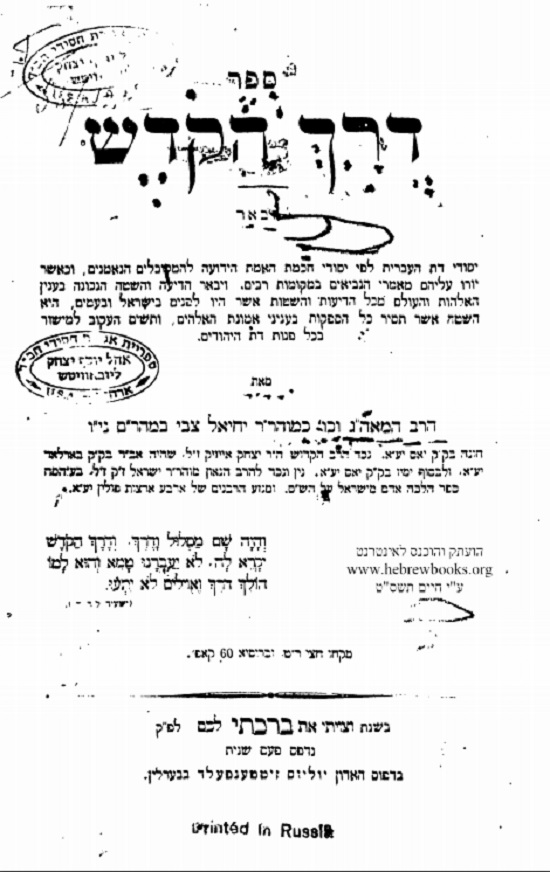
  • only with great difficulty,
  • by experts, perhaps aided by telescopes, and
  • in a pristine environment absent urban sources of light, like the Judean desert.

Under no circumstances, is 13.5 minutes possible, and 16.85 minutes is almost equally unreasonable.[26]

  1. Multiple opinions that begin bein ha-shemashot slightly after sunset:
  • 4 to 5 minutes: The minimum time reported as the custom of Jerusalem[27] as well as the opinion of R. Shneur Zalman of Liadi,[28] the point when the sun is no longer visible even from the highest elevations around Jerusalem.[29]
  • Greater than 6 minutes: The opinion of R. Ḥaim Volozhin based on Shmuel’s statement concerning the appearance of a single star that is visible in the spring to an expert observer at that time.[30] The fact that R. Ḥaim Volozhin disagrees with his Rebbe, strongly suggests that the Gaon’s position that Shabbat starts at precisely sunset was only promulgated le’migdar miltah.
  • 7 to 15 minutes: These views are supported by a variety of sources mentioned previously including R. Kapach’s view of Rambam and R. Posen’s view of the opinion of the geonim. A time around 10 minutes is implied by many Sephardi poskim who mention that until the call of the Moslem mugrab for their fourth prayer service, it is still day thus allowing for the performance of a brit on that day for a baby born in those few minutes after sunset on that same day one week earlier.

When linked to the times given in Prof. Levi’s charts, various alternatives from 6 – 16 minutes after sunset can be plausibly suggested.  The next section on how the bein hashemashot interval was intended to be used will shed further light in determining how many minutes after sunset might still be considered daytime.

Section 2.  Before or after

One aspect of the Gaon’s interpretation of Shabbat 34b, often assumed without further examination, is that bein hashemashot is calculated by adding its length to the beginning of the beginning of bein hashemashot period.  That assumption will now be challenged.  Though not conclusive as to how the sugyah should be read, some seforim of near contemporaries[31] of the Gaon assume the opposite approach, subtracting the length of the bein hashemashot interval from the end of Shabbat. The arguments below attempt to demonstrate that this approach may have been standard before the writings of the Gaon proliferated years later in the middle of the 19th century.[32] While some may argue that counting forward from sunset versus backward from nightfall is somehow tied to the fundamental makhloket of the geonim / Gaon and Rabbeinu Tam, there does not appear to be any logical, textual or halakhic basis for such an assertion.

The fundamental question is:

What possible value could there be in introducing (especially in an era before clocks) a time-based approximation that is a lower bound, season dependent, rarely applicable, and then only under rare, idealized conditions, at best? In what context would such information be useful?

Thus, I propose that the time needed to walk ¾ of a mil should be interpreted differently than the Gaon proposed and instead we will attempt to demonstrate that

  • The time to walk ¾ of a mil is to be subtracted from the end of the bein ha-shemashot period as opposed to being added to its beginning.
  • The period is not a minimum (that occurs only around the spring equinox), but a maximum (that occurs around the summer solstice). Thus, the entire sugyah is applicable year-round providing a conservative upper-bound to the length of the bein ha-shemashot

The arguments for both assertions are interrelated and are presented concurrently.[33]

  1. The gemara in Shabbat is primarily focused on Friday night and determining when the bein ha-shemashot period begins, as opposed to when it ends. The gemara assumes that the end to the period of bein ha-shemashot is known; each of the disputants are addressing when the period of bein ha-shemashot begins on Friday night. However, if the time needed to walk ¾ of a mil were meant to be added to the time of sunset, it would be addressing the end of the bein ha-shemashot period and not the beginning.
  2. The three fractions (each expressed as the time needed to walk a part (1/2, 2/3 and ¾) of a mil,) given as alternatives for the length of the period of bein ha-shemashot would then all have identical semantics; each of the three fractions (of the time to walk a mil) is counting back from the assumed point of ashekhah, to calculate the beginning of the bein ha-shemashot Given Prof. Levi’s chart, under no circumstances could anyone imagine that the time to walk either ½ of a mil after sunset could be the point at which Shabbat ends. The amoraim, R. Yehudah and R. Yosi, are quantifying the opinion of Rabi Yehudah in contrast to Rabi Nehemiah’s interval, whose period of bein ha-shemashot is only the time needed to walk ½ of a mil.
  3. If someone were countering the position of Rabi Yosi, who says the period of bein ha-shemashot is instantaneous, it is more likely that he would say that it can be “as long as” opposed to “as short
  4. The significant issue raised previously of never seeing stars as early as at the time needed to walk ¾ of a mil after sunset becomes entirely moot.
  5. The period of bein ha-shemashot has some practical consequence providing a potentially useable, conservative upper bound as opposed to a purely theoretical lower bound, which is of limited to no use.
  1. As noted earlier, rishonim, who limit the gemara in Pesaim to the equinox periods in the fall and spring, make no such assertion with respect to the gemara in Shabbat. One might presume from the lack of commentary that rishonim assumed that the sugyah applies year-round.

Treating the gemara in Shabbat like the gemara in Pesaim as referring only to days around the spring (but not the fall) equinox[34] is unnecessary when thinking of the interval as a practical upper bound.  All the other descriptions in the gemara, either the appearance of the sky / horizon or the visibility of three stars, apply year-round.

Now examine the three elements in combination:

  • The various opinions of rishonim on the time to walk ¾ of a mil – 13.5, 16.85 and 18 minutes.
  • Levi’s chart indicating that 3 stars are visible to a careful observer 30[35] minutes after sunset in the summer.
  • The two suggested interpretations that
  • delay the beginning of bein hashemashot to a point slightly after sunset, and
  • view the sugyah as subtracting the length of bein hashemashot from its end to find its beginning.

We can then assume that Shabbat begins from 12 (subtracting 18 from 30) to 16.5 (subtracting 13.5 from 30) minutes after sunset.[36]  However, given

  • very natural and expected stringency that occurs even today but certainly are to expected in an era before (widely available and accurate) clocks, and
  • the need for tosefet Shabbat

practiced times for starting Shabbat between 5 and 10 minutes after sunset ought not be surprising.

Section 3. The Gaon’s approach to Pesaim 94a.

The Gaon’s approach to Pesaim 94a is premised on an incontrovertible astronomic and logical fact. Assuming that alot hashaar approximates the first light of the day, then its evening counterpart, tzait ha-kokhavim, must occur when the sun’s illumination has (next to) no remaining effect.[37]  At both of those times, all stars that are in position to be seen are not obscured by illumination from the sun. As a result, the Gaon adds the word kol to differentiate tzait ha-kokhavim, which throughout the Talmudic literature refers to the appearance of 3 stars, from tzait kol ha-kokhavim, the appearance of “all the (potentially visible) stars.” Of course, this point demolishes[38] Rabbeinu Tam’s interpretation that is predicated on the assumption that the meaning of the term tzait ha-kokhavim occurring in both Pesaim 94a and Shabbat 35a is the same. Slightly reformulated the Gaon asks how could the time of the appearance of only three stars and the time of alot hashaar, when (almost) all the stars are still visible, be separated by intervals of identical length from sunset and sunrise respectively?  The pre-dawn counter point to the time after sunset when (only) three stars are first visible cannot be alot hashaar when (almost) all stars are still visible.[39]

This iddush is not unexpected, even though the gemara in Pesaim is the primary sugyah used throughout halakhic history to provide a source for determining the time of alot hashaar.  Despite that halakhic application, the sugyah is focused primarily on geography and astronomy. Thus, harmonious use of the term tzait ha-kokhavim with its use elsewhere in Talmudic literature, which Rabbeinu Tam assumed, need not be presumed.

Since the notion of tzait kol ha-kokhavim is new, it is also not surprising that the Gaon did not specify, to the best of my knowledge, any halakhic uses for the notion of tzait kol ha-kokhavim. Of course, those who followed Rabbeinu Tam’s position had no reason to even consider a point in the evening after tzait ha-kokhavim.

However, that changed with the arrival of what we colloquially call the Brisker methodology. Talmudists of that school have produced potential halakhic implications. For example, it is not difficult to differentiate between:

  • halakhot tied to a specific day or those that are to be performed every day,
  • from those that have no connection to any specific day but are restricted to being performed only during the daytime period.

Presumably, the construction of the Beit HaMikdash is a straightforward example. While there is a daytime requirement,[40] there is no constraint on which day of the week that construction should take place. Another example, which does not comport with the above iluk, has been proposed by R. Moshe Soloveitchik. He suggested the use of tzait kol ha-kokhavim as a delimiter for tosefet Shabbat according to those following the Gaon.  While Shabbat ends at the time of tzait ha-kokhavim, R. Soloveitchik proposed that tosefet Shabbat is meaningful only until tzait kol ha-kokhavim.

While these examples[41] are noteworthy, the lomdus of a yartzeit shiur by R. Joseph Soloveitchik was astonishing. Effectively, but not explicitly, R. Soloveitchik disregarded both historic interpretation and practice when he transformed Rabbeinu Tam into an early supporter of the notion of tzait kol ha-kokhavim.[42]  As presented in that shiur, though expressed slightly differently, the dispute between the Gaon and Rabbeinu Tam revolves around whether Shabbat ends at tzait ha-kokhavim or tzait kol ha-kokhavim.[43]

In R. Soloveitchik’s formulation, the Gaon defined a critical point along a continuum beginning at the point of sunset, when there is almost complete exposure to the sun’s illumination, and ending at the point of tzait kol ha-kokhavim when no noticeable impact from the sun’s illumination can still be detected. That critical point occurs roughly when 3 medium stars first become visible and marks the transition point between days of the week according to the geonim / Gaon.  Rabbeinu Tam, however, according to R. Soloveitchik’s formulation, defined the transition between days of the week at the point when the sun’s impact has ended entirely, a point corresponding to the end of the continuum, at tzait kol ha-kokhavim.[44]

A possible approach that R. Soloveitchik did not employ is that the Gaon and Rabbeinu Tam decided differently based on two conflicting sugyot in Shabbat and Pesaim, respectively. Of course, that would be at variance with Rabbeinu Tam’s normal methodology for resolving conflicting sugyot.  Rabbeinu Tam tends to distinguish between sugyot, something he does explicitly with respect to these sugyot, as opposed to declaring sugyot in conflict and deciding between them. The principal motivation for even raising such a possibility is R. Soloveitchik’s complete avoidance of any mention of the challenges to Rabbeinu Tam’s position from the sugyah in Shabbat. This leads me to wonder if in R. Soloveitchik’s ahistorical reformulation of Rabbeinu Tam, and for reasons entirely unstated, R. Soloveitchik gave the sugyah in Pesaim prominence and preference over the sugyah in Shabbat according to Rabbeinu Tam.

Conclusions:

It is not at all usual to treat a ruling of the Gaon as le’migdar miltah.  However, three things increase my confidence that I am correct in this instance.

  1. The reality as described in the epistle of the Ba’al ha’Tanya referenced earlier, who lived at the same time and in the same general area, clearly describes people working beyond 30 minutes after sunset, something that the Gaon would be motivated to prevent as resolutely as possible.
  2. The opinion of R. Ḥaim Volozhin, in open disagreement with the Gaon’s stated position, demands a reconciliation of views.
  3. The textual arguments made by rishonim, the halakhic writings and positions of noted aaronim, and the various arguments that I have formulated appear convincing.

What should be noted is the Gaon’s interesting ability to impact not just pesak, but the way we (perhaps even unconsciously) approach the study of sugyot.

Appendix


Prof. Levi’s Table

The three times listed in each cell of the table correspond to how difficult it is to see a star.

  • The shortest time noted is when an expert who knows exactly where to look can observe a star.
  • The intermediate time noted is when a star can be seen with great difficulty.
  • The third time noted is when a careful observer can see a star.

The time when stars are visible to a casual observer, is yet later.

[1] My assumption is that poskim may find the innovations useful in exceptional situations as opposed to more typical ones.
[2] According to the vast majority of rishonim, the day ends when bein ha-shemashot ends or at most 2 minutes later.
[3] Familiarity with both sugyot is assumed to fully assess this essay.
[4] See my article in Hakirah spring 2019 for more detail on the Gaon’s convincing attack on Rabbeinu Tam’s position.
[5] A version of that reading is presented in Ohr Meir as the opinion of the geonim, who R. Posen seeks to demonstrate conflict with that of the Gaon.  What the Gaon felt mei ikar ha’din can be disputed as will be illustrated.  Even if one were to reject any variation of the Gaon’s stated position, this paper can also be considered to apply to the less specific view of the geonim.
[6] Both 72 or 90 minutes are increasingly assumed to apply only in the Middle East around both equinoxes and require adjustment (using depression angles) to account for variation by season and latitude.
[7] These positions are more properly characterized as variants of the position of the geonim / Gaon as they are all much closer to their normally assumed period of bein ha-shemashot.
[8] Throughout R. Kapach’s commentary on Mishnah Torah, however, he asserts that this is the position of Rambam. See R. Posen’s view as well, mentioned in footnote 5.
[9] This seminal point was made explicitly by R. Chaim Sonnenfeld in teshuvah 33 (an approbation to a sefer on zemanim) in a recently published volume of his teshuvot.  His reaction, as might be expected, was to be mamir, and fulfill the stringencies of both opinions. I argue that the strengths of both opinions lead to the opposite and more probable conceptual position, adopting the leniencies of both positions.
[10] See Vol. 2 of HaZemanim BeHalakha by R. Ḥaim Benish, page 360, especially footnote 58.
[11] Pages 251 – 252, Chavel edition, Mossad Ha-Rav Kook.
[12] This argument is included due to its ancient provenance; it is easily challenged given that it is normally assumed that tosefet Shabbat can begin at plag ha’minah, which precedes sunset.
[13] Note as well, that the gemara in Pesaim 94a applies to

  • a day of average length,
  • which occurs around both the spring and fall equinox.

However, the days that would be referred to in Shabbat 34b would be

  • a minimum, as opposed to an average, and
  • restricted to those days when the appearance of three stars occurs within the time needed to walk ¾ of a mil after sunset. For astronomic reasons such days occur only in the spring and not in the fall.

While neither of these two differences is itself convincing, both lend further support to the thesis developed.
[14] See the chart by Prof. Levi provided in the attachment.
[15] A more extensive analysis of Shmuel’s statement will appear in a future issue of the Torah u’Maddah journal.
[16] This section assumes detailed familiarity with the sugyah on Shabbat 34b-35b.
[17] Prepositions have been omitted from the statement in order not to bias the semantics.
[18] Large stars are defined as kokhavei lekhet, moving stars, currently called planets. Other approaches to dividing stars into categories are much less likely and not considered.
[19] The isolated opinion of R. Eliezer mi’Mitz, who begins the bein ha-shemashot period before sunset, is difficult to reconcile with Shmuel’s statement, in any case.
[20] See the last two paragraphs on page 358 and especially footnote 50 in Vol. 2 of HaZemanim BeHalakha.
[21] The time to walk 1/12 of a mil is between 1.5 and 2 minutes.
[22] While normally I would assume Prof. Levi’s third entry matches Shmuel’s assertion, since this statement might mean seeing a star does not mean bein ha-shemashot has necessarily begun, it might mean just an accidental sighting, which may occur at the earliest time possible when normally only an expert, knowing exactly where to look, can locate a star.
[23] R. Benish, R. Willig, Prof. Levi among many others struggle with this issue.
[24] In the spring Sirius and Canopus can both be seen around 15 minutes after sunset.
[25] Having seen no earlier discussion of this issue anywhere in the halakhic literature, I believe this interpretation originated with the Gaon in O. . 261. The alternative under discussion, delaying the start of bein ha-shemashot by some small number of minutes after sunset, eliminating the hypothesis that bein ha-shemashot begins precisely at sunset, which leads to such questions.
[26] Perhaps one can assume some worsening of atmospheric conditions, as a result of pollution, slightly decreasing visibility.  I spoke with a chemist in my synagogue, Dr. Irwin Goldblatt, who verified this as a possibility.  I have no basis to determine how accurate this observation might be, but it is hard to imagine that it is consequential.
[27] See Minhagei Eretz Yisrael by R. Gliss, pages 102 and 282.
[28] Seder Hakhnosat Shabbat, found towards the end of every abad siddur, specifies 4 minutes. He reverses the position he took in Shulan Arukh HaRav, which supported Rabbeinu Tam.
[29]See Zemanim Ke’hilkhatam by R. Boorstyn, chapter 2, section 3, where he summarizes different 19th and 20th century posekim in the Middle East who supported times beyond 4 to 5 minutes and up to approximately 10 minutes after sunset.  The rationale he and many of these posekim used is varied often relying on the notion of sea level and / or visibility from higher elevations, a topic of continued debate.
[30] See the addition to Maaseh Rav section 19.  Six minutes is expressed as 1/10th of an hour to be applied in both the morning and evening, although Shmuel’s assertion of “one star – daytime” is given as the reason for the slight delay after sunset. How R. aim Volozhin determined this precise time that equals the time at which an expert can see Sirius remains a mystery.
[31] R. Adler, R. Loerberbaum, and R. Sofer all subtract the length of the bein hashemashot interval from the end of Shabbat, see my article, Zemannim: On the Introduction of New Concepts in Halakhah, in the TuMJ 2013.
[32] It goes without saying that the instantaneous communication that characterizes of our current environment cannot be anachronistically assumed in a prior period. This impacts the assumptions made about when some of these sources are read / known, a topic not pursued further.
[33] A set of arguments based on the statement of Shmuel about 1, 2 and 3 stars are not included and will be incorporated in a future paper examining both Shmuel statement and Rambam in multiple sections of Mishnah Torah, based on their mastery of astronomy as it was known in their times.
[34] First suggested by the Gaon in O. . 261, this approach is widely assumed in recent halakhic literature. Note that the gemara in Pesaim assumes an average day, which occurs in both the spring and fall around the equinox.  However, the Gaon’s argument assumes, not an average interval, but a minimum interval and one that occurs only in the spring, but not in the fall; stars are not visible as early in the fall as in the spring.  On the other hand, as suggested, a maximum would apply year-round.
[35] Prof. Levi uses a depression angle normalization to spring, which we will not explain.  His use of 28 is in fact closer to 30 minutes, as normally defined by clock-time.
[36] 12 – 13 minutes is consistent with the many rishonim supporting a time to walk a mil of 22.5 minutes.
[37] There is no reason to debate whether the underlying science favors either of the two most common halakhic definitions, which sandwich current technology’s identification of the point at which the first light of the sun is visible. Expressed as depression angles the 72- and 90-minute intervals equate to depression angles of approximately 16 and 20 degrees, respectively. With the best available equipment, light from the sun can be observed at a depression angle of approximately 18 degrees. One can then argue that 16 degrees is when the amount of light is visible to humans, while 20 degrees is when one arises in anticipation of emerging light. Both are reasonable positions for defining alot hashaar.
[38] So strong a word is intentional given the “bombe” kasha of the Gaon; see immediately below.
[39] R. Moshe Sofer might be trying to deal with this point about a symmetric point to the appearance of three stars in his commentary on Shabbat 34.
[40] See Rambam, Hilkhot Beit Ha’Beirah (1:12). Rambam’s formulation is originally stated in the negative, which raises possible questions that might be analyzed in this context.
[41] Other possible examples include the operation of a beit din, the laws of aveilut, particularly the first day, etc.
[42] The philosophical underpinnings that would enable such ahistorical iddushim is beyond the scope of this article. Despite an accusation of partiality, one cannot dismiss the assumption that R. Soloveitchik was aware of the various challenges to his iddush. Despite bringing support from the period of the rishonim, I believe the Rav was establishing what he knew to be a restatement of Rabbeinu Tam’s position, based on the undeniable accuracy and correctness of the Gaon’s notion of tzait kol ha-kokhavim. In my own mind, I have played out a long and imagined conversation with R. Soloveitchik on this subject.
[43] For any number of reasons, it is difficult to imagine the perspective presented was that of Rabbeinu Tam. Rather, it might represent Rabbeinu Tam’s position updated and enhanced by what is now known scientifically.
[44] What I also do not understand is why R. Soloveitchik referred to the mathematical notion of continuity as opposed to any astronomical knowledge, which I think would have been more relevant.


Musings on the Piyut היום הרת עולם

Musings on the Piyut היום הרת עולם

By Joseph Wertzberger

The following post is based in part on a lecture by Rabbi Ben Greenfield, newly installed Rabbi of the Greenpoint Shul, and several of its key ideas are his.

*  *  *

The poem היום הרת עולם is a very early piyut by an unknown author, appearing in writing as early as Siddur Rav Amram Ga’on, and is very widely recited after each of the sets of Tekiyot during the Shemonei Esrei of Mussaf on Rosh Hashana.  The poem is an elegy eloquently expressing the sense of fear, awe and dread in the uncertainty of judgement that the world experiences each year on the birthday of its creation.

היום הרת עולם

היום יעמיד במשפט

 כל יצורי עולמים

אם כבנים

אם כעבדים

אם כבנים רחמנו

כרחם אב על בנים

ואם כעבדים

 עינינו לך תלויות

 עד שתחננו

 ותוציא כאור משפטנו

איום קדוש

I’d like to help shed light on some of the wide-ranging, poetic meanings and allusions of the piyut, by examining the meanings of the words, phrases and concepts that appear, as well as their sources in Tanach and Chazal.  As we examine more closely the sources of these very short, alliterative phrases and ideas; alternate and variant layers of meaning present themselves to be revealed.

היום הרת עולם

The word הרת is commonly translated as birth, conception or (probably more accurately) gestation – from the root הָרָה, as in האנכי הריתי את כל העם הזה in במדבר יא.  The first line of the poem, in its simplest reading, announces very plainly: “Today is the birth of the world”.

The source of the phrase הרת עולם is in ירמיהו כ, where Jeremiah says “Cursed is the day in which I was born, the day in which my mother birthed me; let it not be blessed. Cursed is the man… who did not kill me from the womb. If only my mother were my tomb – ורחמה הרת עולם – and her womb an everlasting pregnancy.” (ארור היום אשר ילדתי בו יום אשר ילדתני אמי אל יהי ברוך.  ארור האיש אשר בשר את אבי לאמר ילד לך בן זכר שמח שמחהו.  והיה האיש ההוא כערים אשר הפך ה’ ולא נחם ושמע זעקה בבקר ותרועה בעת צהרים.  אשר לא מותתני מרחם ותהי לי אמי קברי ורחמה הרת עולם. למה זה מרחם יצאתי לראות עמל ויגון ויכלו בבשת ימי.)

Disconcertingly, the passuk is harshly negative, with a tone and meaning very different from the piyut.  Not only that, but the word עולם is used with a completely different meaning (world/forever).

Curiously, however, if we reread the piyut translating עולם as ever, the phrase הרת עולם suddenly switches to mean an everlasting birth, like it does in the passuk.  The piyut is refocused into pronouncing, “Today is an everlasting birth.”  In other words, the birth of the world that began the first Rosh Hashana is everlasting through history on this day. And the reason for that is because:

היום יעמיד במשפט

The source of the phrase is in משלי כט ,מלך במשפט יעמיד ארץ. “A king with justice raises up (alternatively: sets right) the world.”  G-d, as king and judge of the world is מעמיד the world, so to speak, through the power of Mishpat.  רבן שמעון בן גמליאל אומר, על שלשה דברים העולם קיים, על הדין… שנאמר אמת ומשפט שלום שפטו בשעריכם. אבות א יח

Which means that while we can initially read the first two lines of the poem as, “Today is the birth of the universe, all the world’s creatures are presented to judgement”, we can also read it at a second level as, “Today is an everlasting birth; today G-d raises, through Justice, all creatures of the universe”.  Rosh Hashana is the continual rebirth of the world, because the world is repeatedly raised up through Justice on this day – the original purpose of the world’s creation repeated each year as Justice is manifest into the world.  (Thank you again to Rabbi Ben Greenfield for this most wonderful and key idea.)

Even more deeply, the two readings mirror and are extensions of each other.  An abstract truth and idea such as Justice, that we perceive in G-d, becomes real – that is it is expressed, instantiated and concretized, and its realization occurs – by its enactment in the universe, much as a king’s rule is only realized through the existence of his subjects (a common concept in Chabad Chassidic writings, אין מלך בלא עם, based initially on Tanya ch. 7, with its earliest source appearing in כד הקמח, ראש השנה ב, and elsewhere in the writings of Rabbeinu Bachya ben Asher, student of the Rashba).  G-d’s משפט isn’t manifest until he expresses it in something, and by judging us he expresses Justice; we might even say he ‘creates’ it.

A third reading of the poem’s introductory lines is that היום הרת עולם, today, Rosh Hashana, is an everlasting, recurring gestation, because each year is pregnant and gestates on its Rosh Hashana when יעמיד במשפט כל יצורי עולמים, Judgement is implanted into the world, for it to become realized, expressed and carried out later on, during and throughout the year.

אם כבנים אם כעבדים

The simplest reading of our dual presentation as sons and slaves in the poem, and its initially apparent meaning on a first pass through the poem, is that while our relationship with G-d is in one sense as a son to his father, and in another as a slave to his master – either way, we beseech you G-d, judge us favorably today.

A second layer of meaning, though, sits just beneath the surface, waiting to be revealed as we reread the poem more closely.  And that is that whether we’ll be judged as children or as slaves is also hanging in the balance:  אתם קרוים בנים וקרוין עבדים. בזמן שאתם עושין רצונו של מקום אתם קרוין בנים, ובזמן שאין אתם עושין רצונו של מקום אתם קרוין עבדים (Bava Basra 10A, and see also Kidushin 36A).  We are also judged on whether to be judged as a son or as a slave.  The poem alludes to this again later on: ואם כעבדים – whether or not we are as slaves, עינינו לך תלויות – this too hangs in the balance.

A third reading of אם כבנים אם כעבדים and its dichotomy is based on the passuk in Malachi 1, בן יכבד אב ועבד אדניו. ואם אב אני איה כבודי, ואם אדונים אני איה מוראי – whether we are children and whether we are slaves – in either case we may be judged for transgressing G-d’s will.  Either way, we should have respected or feared G-d, and we now tremble to be judged for not having done so.

But nevertheless:

רחום וחנון

The interplay of כרחם אב for בנים on the one hand, and עד שתחננו for עבדים, on the other, is an obvious parallel to רחום and חנון, two primary attributes that G-d exhibits in judgement (שמות לד).  In the beautiful words of the Rambam in Chapter 54 of the Guide:

הנה נתבאר כי הדרכים אשר ביקש משה רבנו ידיעתן… הם הפעולות הבאות מאתו יתעלה, וחכמים קוראים אותם מידות ואומרים שלוש עשרה מידות. ואין העניין כאן שהוא בעל מידות, אלא עושה פעולות הדומות לפעולות הנעשות על ידינו כתוצאה ממידות… כל פעולה שנשיג מפעולותיו, נתארו יתעלה בתואר שאותה הפעולה יוצאת ממנו, ונקראהו בשם הנגזר מאותה הפעולה.  המשל בכך, כאשר הושגה עדינות ניהולו בהתהוות עוברי בעלי החיים, והמצאת כוחות בו ובמגדליו לאחר לידתו המונעים ממנו את המוות והאובדן, ושומרים עליו מן הנזקים, ועוזרים לו בצרכיו החיוניים, וכעין פעולה זו לא תיעשה מצדנו כי אם לאחר התפעלות והתרגשותו והוא עניין הרחמנות, לכך נאמר עליו יתעלה רחום כדרך שנאמר כרחם אב על בנים… לא שהוא יתעלה מתפעל ומתרגש, אלא כאותה הפעולה הבאה מצד האב כלפי הבן שהיא תוצאה של רגישות וחמלה והתפעלות בהחלט, תבוא מצדו יתעלה כלפי חסידיו. וכשם שכאשר אנו נותנים דבר למי שאין לו עלינו חובה נקרא זה בלשוננו חנינה… והוא יתעלה ממציא ומנהל את מי שאין לו עליו חוב בהמצאתו והנהלתו ולפיכך

 נקרא חנון

G-d can be said to act as a רחום in situations similar to where a human would behave as a רחום, for example as a human to its child, where the nature of the familial relationship emotively drives, and filially obligates, a behavior of רחמים.  G-d also acts as a חנון, providing bounty completely undeserved, in situations where nothing is deserved at all.

The dynamic is two-fold, and bi-directional.  Just as in our world favor is shown by the parent to the child both because it’s in the nature of the parent to provide (parents simply well up with רחמים for their children), and because the child also deserves, and has a right and a claim to, the parent’s favor by virtue of being their child (האנכי הריתי את כל העם הזה אם אנכי ילדתיהו כי תאמר אלי שאהו בחיקך, in במדבר יא); similarly, G-d acts as a רחום relative to creations with which he exhibits a father-son relationship, that is he exhibits mercy and compassion as an expression of the relationship – that’s simply what fathers do; but it’s also true that if we are his children we have a claim to his mercy –  he owes it to us – as a child has a claim to their parent’s effort and favor, and we have a right to ask for it.

A slave on the other hand is owed nothing, and can’t ask for mercy by right.  A slave can only hope for grace, מתנת חינם.

Thus, as G-d’s children, conceived in הרת עולם and created for the purpose of receiving his bounteous good (אמונות ודעות סוף מאמר א וריש מאמר ג, מורה ג כה, דרך השם ב, ועוד הרבה), we ask for G-d’s mercy.  As your children, you must have mercy on us like a father.  And G-d accedes to our request, he is רחם אב על בנים, as the passuk tells us in Tehilim 103, the phrase’s original source: לא כחטאינו עשה לנו ולא כעונתינו גמל עלינו… כרחם אב על בנים רחם ה’ על יראיו.

But we are also G-d’s slaves, in a manner יצורי עולמים, existing simply as of the universe he created למענו יתברך, at his whim and for his sake alone, because he willed it so and for purposes unfathomable (אמונות ודעות סוף מאמר א, מורה א יג, ועוד).  As slaves we don’t get to say ואם כעבדים חננו (the parallel of אם כבנים רחמנו) because we have no right to ask or expect it.  Notice also how the son’s רחמנו is immediate while the slave’s עד שתחננו is delayed and future oriented (until you will grace us).  In our presentation as slaves, we can ask for nothing, because nothing is deserved and we have nothing coming to us.  Our embarrassed gaze simply hangs towards G-d, in shame and with no claim, until he provides us his undeserved grace. אליך נשאתי את עיני… הנה, כעיני עבדים אל יד אדוניהם, כעיני שפחה אל יד גברתה, כן עינינו אל ה’ אלהינו עד שיחננו (Tehilim 123).

We are both your child and your creation.  The case of the child is hopeful, looking towards his father’s mercy, while the case of the slave is hopeless, with nothing to confidently depend upon, except to beseech the master.

אם כבנים רחמנו כרחם אב על בנים, ואם כעבדים עינינו לך תלויות… עד שתחננו

ותוציא כאור משפטנו

In its simplest reading (and particularly in נוסח ספרד, which reads ותוציא לאור משפטנו), the phrase means, “Present for us a positive judgement”, or “judge us favorably”.  The wording has its source in Tehilim 37 והוציא כאור צדקך ומשפטך כצהרים – “He will express as light your righteousness, and your [good] judgement as the mid-day”.  The sentence is Tehilim, when read in the context of its surrounding verses, says that, firstly, when you follow G-d’s ways, that path will enable your positive behavior and attributes to be expressed to the world, and secondly, they will express themselves through G-d in a way that will benefit you positively. (The surrounding verses, for full context, read, אל תתחר במרעים אל תקנא בעשי עולה. כי כחציר מהרה ימלו וכירק דשא יבולון. בטח בה ועשה טוב שכן ארץ ורעה אמונה. והתענג על ה’ ויתן לך משאלות לבך. גול על ה’ דרכך ובטח עליו והוא יעשה. והוציא כאור צדקך ומשפטך כצהרים.  דום לה’ והתחולל לו.)

Turning that back around to the piyut we find ourselves asking G-d, not only to simply judge us positively, but more deeply to express and reveal the good that is within us, the righteous משפט that we ourselves express all year – let G-d reveal it and express it back to us on Rosh Hashana, and bring our righteousness and justice to light, and see and express the good that is within us.

A third reading of ותוציא כאור משפטנו, based on the same set of verses in Tehilim 37, is that since as slaves we have no right or claim to G-d’s good judgement, and all we can do is simply hang our eyes and look to G-d and hope – when we do that, that is sufficient to have G-d bring to light our righteous judgement, גול על ה’ דרכך ובטח עליו והוא יעשה. והוציא כאור צדקך ומשפטך כצהרים – by the act of hanging onto G-d and throwing our lot and entrusting our judgement to him, we bring about his good judgement onto us – עינינו לך תלויות עד שתחננו ותוציא כאור משפטנו – we look to you as a servant to their master – and for that alone, תחננו ותוציא כאור משפטנו, bring to light our judgement.

איום קדוש

How awesome, great and holy!

עלי שיר: Poetic Allusions, Alliterations and Constructs

Some additional points relating to the poetic aspects and expressions of the piyut:

  1. It immediately brings into focus, on the very first two lines, the two main themes of the day – creation and judgement.
  2. The word הרת also brings to mind the words רתת ,הרס and הס – the latter as in וה’ בהיכל קדשו הס מפניו כל הארץ in חבקוק ב – all of which serve alliteratively to impress upon our mind the awe and dread of the day.
  3. The repetition of the word אִם, אִם, אִם brings to mind cries of אֵם, אֵם, אֵם – mother, mother; and together with רחמנו and כרחם (in addition of course to the lead-in הרת) representing רֶחֶם, give voice to maternal instincts of רחמים.
  4. Most wonderfully, if you read the poem with the pronunciation and meter of ancient Hebrew, the way it would have likely been chanted by early congregations, you’ll notice that the meter of the verse lilts and lulls quite rhythmically and evenly until hitting the word תלויות , at which point the meter is chopped off, sounding at an uneven kilter and creating a break in the meter flow, almost as if hitting a cliff – and then the original meter returns for the rest of the poem through the ending. Now, once you notice this, read and listen again even more closely, and you’ll hear a similar, but smaller and less prominent break, at the words אם כבנים אם כעבדים.
  5. Lovers of ancient piyut will no doubt know that many piyutim (and even parts of Tanach) were written with geometric configurations, with parts of the poem setting off or mirroring other parts in structural patterns. היום הרת is no exception, and is entirely marvelous:

היום הרת עולם                                                                                                               איום קדוש

היום יעמיד במשפט                                                                              ותוציא לאור משפטנו

כל יצורי עולמים                                                                     עד שתחננו

אם כבנים אם כעבדים                                       עינינו לך תלויות

אם כבנים                       ואם כעבדים

רחמנו כרחם אב על בנים

The top line at both ends represents the awesome day.  (Notice the juxtaposition of the very similar words היום and איום – there are also old versions of the piyut that read היום קדוש – see המנהיג and שבלי הלקט).  We descend and enter into the poem with the awareness of the day’s awesome moment, and then the poem itself impresses upon us G-d’s and day’s awesome holiness, and we leave with that impression imprinted upon us.

The second line on both sides is the concept of justice, descending into and standing facing justice, and then emerging with justice.

The third line represents G-d’s free-flowing grace, in creation and in granting us today his goodness.

The fourth line presents the tension and uncertainty of אם כבנים אם כעבדים on the one hand, and עינינו לך תלויות on the other (Note also above the second explanation above of אם כבנים אם כעבדים, עינינו לך תלויות – we are also תלוי as to whether a בן or an עבד).

The fifth line is the juxtaposition of sons and slaves, a central theme of the entire poem.

And finally, the sixth line fills with the central role of G-d’s mercy.

  1. An alternative configuration of the middle section into a precise mirror image is:

אם כעבדים                                      ואם כעבדים

אם כבנים                    אב על בנים

רחמנו        כרחם

Using this arrangement for the middle requires us to arrange the rest of the piyut differently, potentially as follows:

קדוש

היום                              היום

            הרת עולם                      ותוציא לאור משפטנו

היום יעמיד במשפט         עד שתחננו

כל יצורי עולמים              תלויות

אם כבנים                      עינינו לך

I excluded קדוש from this arrangement because it’s the lead-out from the piyut and also because it refers to G-d in this reading (“and bring to favorable light our judgement today, Holy G-d”), and I utilized early versions of the piyut where היום is referenced at the end instead of איום (see for example שבלי הלקט).  The middle portions on either side are not mirror images now, but complement each other with respect to meaning.

  1. Lastly, עינינו לך תלויות, ותוציא לאור משפטנו: At the time of creation, just prior to יצירת עולם, creation is hanging (תולה ארץ על בלימה), and G-d exists alone, and then G-d brings forth אור.  This parallels “our eyes are תולה to You, until You bring forth like אור our judgement…” (I admit this one is a stretch!)

So many ideas and layers of meaning, and so much beauty – all in only 32 words!


The Fish Motif on Early Hebrew Title-Pages and as Pressmarks

The Fish Motif on Early Hebrew Title-Pages and as Pressmarks

by Marvin J. Heller

            Fish are a symbol replete with meaning, among them, in Judaism, representing fertility and good luck, albeit that fish are not an image that, for most, quickly comes to mind when considering Jewish iconography. Created on the fifth day of creation, fish symbolize fruitfulness, and, as Dr. Joseph Lowin informs, the month of Adar on the Hebrew calendar (February-March, Pisces) is considered “a lucky month for the Jews (mazal dagim).” He adds that in Eastern Europe people named sons Fishl as a symbol of luck, and that in the Bible, the father of Joshua is named fish, that is, Nun, which is fish in Aramaic.[1] Similarly, Ellen Frankel and Betsy Platkin Teutsch note the allusion to fertility and blessing, the former that when Jacob blesses Ephraim and Manasseh, Joseph’s sons, he says “May they multiply abundantly ve-yidgu, like fish) in the midst of the earth” (Genesis 48:16) and the latter to the Leviathan, the great sea monster the Jews will feast upon in the messianic age.[2]

Other biblical references to fish include Dagon, the fish-god of the Philistines, also worshipped elsewhere in the Middle East, mentioned several times in the Bible (Joshua15:41, 19:27; Judges 16:23; I Samuel 5:2–7; and I Chronicles 10:10).  A fish also appears in the biblical story of Jonah, a large fish (dag gadol), not the popular whale that swallowed the prophet.

            Not only Jewish sources and printers used devices that were fish related. The Medjed fish, a species of elephant fish, a medium-sized freshwater fish with a long downturned snout, abundant in the Nile, was worshipped at Oxyrhynchus in ancient Egypt and appears in Egyptian art. Fish are a not infrequent image on medieval coat of arms. Indeed, there are as many as 181 shields of salmon alone in heraldry.[3] The most well-known printer device with a fish is the anchor and dolphin of Aldus Manutius (1449-1515), albeit not strictly speaking a fish, as a dolphin is actually an aquatic marine mammal. Among the most novel of the marine pressmarks is that of the Liege printer J. M. Hovii, active during the latter half of the seventeenth century, whose mark consisted of a mermaid enwrapped about a tree with a skull at the foot of the tree.[4]

            This article is the most recent in a series describing printer’s devices and motifs appearing on the title-pages and with the colophons of early Hebrew printed books.[5] The use of the fish images described here are varied, comprised of pressmarks and full page frames which include representations of marine life. The discussion of the images and the presses are for the sixteenth into the eighteenth century. Although a number and variety of presses that that utilized marks with fish are addressed in this article they are examples only and not necessarily complete. Furthermore, the entries are expansive, that is, printers’ marks are not described in isolation but with discussions of the presses that employed them and examples of the books on which they appeared. Entries are in chronological.[6]

            As noted above, the month of Adar is, if not exactly, coterminous with the astrological sign of Pisces. That sign is represented by a pair of fish swimming in opposite directions, as fish swimming against the stream represents the powerful Pisces potential. They can be ‘sharks’ – charismatic, strong leaders with vision and clarity about leadership that can guide an entire nation, like Moses, who was also a Pisces. But those Pisces who prefer to go with the flow can be weak people who get carried away easily and are prone to addictive patterns of behavior.

Pisces is known for the holiday of Purim. According to the sages, it will be the only holiday to continue to be celebrated throughout the world after the Messiah comes. “When Adar begins, joy enters,” as the famous Hebraic phrase goes. It is a month of happiness, miracles and wonders. It affords us the ability to achieve mind over matter, to overcome our doubts, and connect to the Light.[7]

            Another compatible view of Adar and fish states that “The astral sign of Adar is the fish (Pisces). Fish are very fertile, and for that reason are seen as a sign of blessing and fruitfulness. The Hebrew word for blessing is bracha, from the root letters betreish, kaff. In Jewish numerology (gematria), the letter bet has a value of 2, reish is 200 and kaff is 20. Each of these is the first plural in their number unit. What this tells us is that the Jewish concept of ‘blessing’is intertwined with fertility, represented by the fish of Adar.”[8]

            Our first example of a pressmark with a fish is the most unusual in the article, the only device in which the fish is not only completely inconsistent with the above description but is the least prominent representation of a fish of all the pressmarks in the article. Among the earliest printers to make utilize of the fish in a pressmark is Joseph ben Jacob Shalit in Sabbioneta. Although the Sabbioneta press is commonly associated with Tobias ben Eliezer Foa, it was Shalit who appears to initially have been the motivating force behind the press and, with other partners, the provider of necessary financial support. Tobias Foa is credited with providing only the physical quarters, Duke Vespasian Gonzaga’s patronage, and limited financial assistance. Also associated with the press were Cornelius Adelkind, Vincenzo Conti, and R. Joshua Boaz Baruch, all prominent names in mid-sixteenth century Hebrew printing in Italy.

The first title printed at the press was Don Isaac ben Judah Abrabanel’s (1437-1508) Mirkevet ha‑Mishneh (1551), a commentary on Deuteronomy. Abrabanel began work on Mirkevet ha‑Mishneh when still in Lisbon, unlike the remainder of his commentary on the Torah which was written much later. Its completion was postponed, however, due to his responsibilities at the Portuguese court. The incomplete manuscript of Mirkevet ha-Mishneh was lost when Abrabanel was forced to flee Portugal in 1483. However, on his later peregrinations after the expulsion of the Jews from Spain Abrabanel came to the island of Corfu in 1493, where he serendipitously (miraculously) found a copy of the manuscript. Leaving aside other work he turned to completing this commentary, but after the departure of French troops from Naples, Abrabanel went to Monopoli (Apulia), where Mirkevet ha-Mishneh was finally completed in the first part of 1496.

The title page, dated 5311 Rosh Hodesh Sivan (Wednesday, May 16, 1551) is comprised of an architectural border with standing representations of the mythological Mars and Minerva. This border was first employed by Francesco Minizio Calvo in Rome in 1523 and as late as 1540 in Milan. This is its earliest appearance in a Hebrew book. It would be often reused and copied, appearing on the title pages of books printed as far apart as Salonika and Cracow.[9]

On the final unfoliated leaf are two devices, on the right that of Foa, a palm tree with a lion rampant on each side and affixed to the tree a Magen David, about it the verse, “The righteous flourish like the palm tree” (Psalms 92:13), all within a circle, and to the sides the letters ט and פ for Tobias Foa. On the left is Shalit’s device, a peacock standing on three rocks, facing left, with a fish in its beak within a cartouche, although Avraham Yaari, after describing the peacock with a fish, adds, in parenthesis, (or a worm?). The letters יביש about this device stand for Joseph ben Jacob Shalit. Also printed by the press that year was R. Isaac ben Moses Arama’s (c. 1420–1494) Ḥazut Kashah, on the relationship of philosophy and religion. It too has the Mars and Minerva title-page, but here the last leaf is foliated and has one pressmark only, the peacock with fish of Shalit.[10] Parenthetically, Arama too was a refugee from Spain.

Fig. 1 pressmarks of Joseph Shalit (left) and Tobias Foa (right)

The peacock with fish pressmark was reused by Shalit in Mantua at the press of Venturin Rufinelli with the colophon of several works, for example the late 10th century ethical work based on animal tales, translated from the encyclopedic Arabic Rasa`il ikhwan as-safa` wa khillan al-wafa` (Epistles of the Brethren of Purity and Loyal Friends) into Hebrew by Kalonymus ben Kalonymus (c. 1286-c. 1328) as Iggeret Ba’alei Hayyim (1557). The original is comprised of 52 eclectic volumes (pamphlets) on philosophy, religion, mathematics, logic, and music. The portion from which Iggeret Ba’alei Hayyim is taken appears at the end of the 25th book. The original was prepared by the Brethren of Purity, a secret Arab confraternity which flourished in Basra, Iraq in the second half of the tenth century. The tales themselves have an Indian origin. Four other varied works of note with the peacock with fish pressmark are R. Saadiah ben Joseph Gaon’s (882-942) Sefer ha-Tehiyyah ve-Sefer ha-Pedut (1556) on resurrection; R. Abraham ben Samuel ha-Levi ibn Hasdai’s (13th century) Ben ha-Melekh ve-ha-Nazir (1557), also based on an Indian romance and here derived from the Arabic; Berechiah ben Natronai ha-Nakdan’s (12th-13th century) Mishlei Shu’alim (1557-58) popular collection of fables, and a Haggadah with the Mars and Minerva title-page (1568).

The Shalit pressmark also appears on the title-page of several books printed in Venice at the press of Giovanni di Gara, without mention of Shalit, so that Yaari suggests he was not involved with the books but it was used simply as an ornament. Among the titles with this pressmark are R. David Kimhi’s (Radak, c. 1160-c.1235) commentary on Psalms (1566), R. Moses ben Baruch Almosnino’s (c.1515 – c.1580) Me’ammez Ko’ah (1587-88), R. Samuel ben Abraham Laniado’s (d. 1605) Keli Hemdah (1596), each with a biblical verse about the frame, and R. Aaron ibn Hayyim of Fez’s  (1545–1632) Lev Aharon (1608), this last without the biblical verses about the cartouche. The Shalit pressmark appears in various places in the books, after the introduction, by the colophon, least often on the title-page. Yaari notes that the Shalit device was also employed by Georgi di Cavilli in an Ashkenaz rite Mahzor (1568).[11]

Leaving Italy, for now, and Shalit, we turn to Cracow where Isaac ben Aaron Prostitz, who together with his sons after him, printed Hebrew books for fifty years, beginning in 1569. In 1578, Prostitz printed at least three large format attractive tractates from the Talmud, Avodah ZarahKetubbot, and Rosh Ha-Shanah, the last extant in a ten folio unicum fragment in the library of the Jewish Theological Seminary. Moritz Steinschneider writes that Avodah Zarah was printed “si revera Supplementi tantum instar ad ed. Basil,” and “seu castrata . . .Cracoviae vero supplementi instar excusus,” that is, to compensate for its omission of the entire tractate from the much censored Basle Talmud.[12] Another feature of this tractate is that it is the first employ by Prostitz of the shield with two fish facing in opposite directions, the upper facing left, the lower facing right, above a printer’s inker, as his device.

Prostitz’s apparent next use of this device, this the first noted in bibliographic sources, is a Mahzor (1584) printed with the support of four partners, and reused frequently afterwards on such varied titles as Josippon (1589) at the end of the book, Avot with the commentary Derekh Hayyim by R. Judah Loew ben Bezalel (Maharal of Prague, c. 1525-16) after the introduction (1589), R. Moses ben Jacob Cordovero’s (Ramak, 1522-1570) Pardes Rimmonim (1591), between the books introductions, R. Bahya ben Joseph ibn Paquda’s (late 11th century) Hovot ha-Levavot, after the translator’s preface (1593) and R. Naphtali Hirsch ben Asher Altschuler’s (16th-17th cent.) Ayyalah Sheluha c. 1595. Pardes Rimmonim was actually printed in Cracow/Nowy Dwor, the change in location due to a serious outbreak of plague in Cracow, Prostitz and his family forced to flee to Nowy Dwor with the press’ typographical equipment. Pardes Rimmonim was completed in that location, the only Hebrew book printed in that Nowy Dwor.[13]

Fig. 2 Pressmark of Isaac Prostitz

Yaari questions Prostitz’s use of this pressmark. While the employ of the printer’s tool is clear, that is not the case for the fish. He suggests that it might be a propitious sign for the partners in the printing of the Mahzor in 1584, which Prostitz continued to use afterwards. This is unlikely, however, for, as we have noted, this device had been employed previously in 1578 on tractate Avodah Zarah. Another possibility is that the fish alludes to the month (Adar) in which Proztitz was born, but he then inquires why the pressmark was not used previously on all the books printed by the press. Yaari notes Steinschneider’s suggestion that the fish represented Prostitz’s entreaty for children, as his sons were borne at an old age. Here to, however, he observes that Prostitz’s four sons were born earlier, being mentioned in the colophon to Toledot Yitzhak in 1593. Another suggestion is that the fish allude to the name of R. Naphtali Hirsch ben Asher Altschuler who was known by all as Hirsch mokhir seforim (bookseller) in Lublin and for whom Prostitz printed books, for example Hovot ha-Levavot, the fish alluding to the name Naphtali, for the portion of the tribe Naphtali included the Kinneret Sea, in which fish were plentiful, but Yaari concludes this is only speculative.[14] I would question why, even if this is true for R. Altschuler, what does this have to do with Prostitiz and why he should have adopted this fish image for his pressmark?

A short lived press existed in Thannhausen, Bavaria, near Augsburg, a zoltot (supplementary festival prayers for the period between Passover and Shavu’ot) and a Mahzor (c. 1594) for the entire year according to the Ashkenaz rite were printed in the last decade of the sixteenth century. The press was a furtive effort to print Hebrew books by R. Isaac Mazia, whose name, it has been suggested, is an abbreviation for mi-zera Yehudim anusim, that is, he was of Marrano origin, or that he had served as rabbi in several communities in southern Germany, together with R. Simeon ben Judah ha-Levi of Guenzburg (Simon zur Gemze) of Frankfurt, who arranged with the Munich printer Adam Berg, to issue those works. When printing the mahzor the printers, concerned about the Christian response to sensitive passages and accusations of blasphemy, left blanks to be filled in by the purchasers.

After an examination of the still incomplete mahzorim by the censor at the University of Ingolstadt the press run of 1,500 copies was destroyed; only five copies are known to be extant today. In August, 1597, Mazia was fined 200 florin and released, while Berg, as late as 1604, was still attempting to have his impounded press returned. All of this occurred despite the fact that the authorities concurred that the mahzorim had been approved for publication by the imperial authorities in Prague. Nevertheless, the printers had neither received nor sought permission from the local authorities in Burgau to print. Moreover, as the books were for export they gave the impression that printing was done with the permission of those authorities.

 Fig. 3b Zoltot


Fig. 3a Zoltot Extract

Both titles have a like frame comprised of an ornamental border with three entwined fish at the top (the signet of Mazia), at the sides are armed men in armor each with a shield, the right shield engraved with the name R. [Isaac] Mazia, the left with the name R. Simeon Levi. At the bottom is a laver pouring water on two hands, representative of the [Simeon] Levi. Isaac Yudlov informs that the fish here represent Isaac Mazia; this appearance of three fish as a printer’s mark is apparently unique. [15]

Not long afterwards we find the fish image employed in Lublin at the press of Zevi bar Abraham Kalonymous Jaffe. Lublin has a long and proud history as a Hebrew printing center, beginning with the press established by the family of Hayyim Shahor (Schwarz), that is, his son Isaac and his son-in-law Joseph ben Yakar. This press, through descendants and collateral members, would be active for almost a hundred and fifty years. The presses’ began publishing in 1551, with a folio Polish rite mahzor for the entire year, continuing until 1646 when a fire forced the press to close; printing resumed in 1648 when tah-ve-tat (gezerot Polania, the Chmielnicki massacres of 1648-49), broke out. That and the 1655-60 Swedish Muscovy wars, combined with others conflicts besetting the area made it impossible for Jaffe to continue and he had to close the press. Printing did resume when Solomon Zalman Jaffe ben Jacob Kalmankes of Turobin, encouraged and supported by his father, reestablished a Hebrew press. He printed 30 books until 1685 and the entire Jaffe family is credited with as many as 180 Hebrew titles.

Fig. 4 Pressmark of Zevi Jaffe

A device employed by Zevi Jaffe, found on the title page of tractates in the large folio edition of the Babylonian Talmud published from 1617-1639, and after the introduction to R. Joel Sirkes’ (Bah, 1561–1640), Meishiv Nefesh, and possibly other works is a deer with raised forelegs, above a crown atop a shield with two fish, the upper facing left and the lower facing representative of the fact that he was a Levi, often accompanied by two fish, here too indicating that he was born in the month of Adar.

Among the many prominent printers of Hebrew books in Amsterdam is Uri Phoebus ben Aaron Witmund ha-Levi. He had previously worked for Immanuel Benveniste; in 1658, Uri Phoebus established his own print-shop. He would print about one hundred titles, from 1658 to 1689, the period he was active in Amsterdam, generally traditional works for the Jewish community, encompassing Bibles, prayer-books, halakhic works, haggadotaggadot, and historical treatises (Yosippon). Prostitz’s first pressmark, employed in 1569 on the title-page of R. Naphtali Hertz ben Menahem of Lemberg’s Perush le-Midrash Humash Megillot Rabbah and intermittently afterwards was a stag within a cartouche. Subsequently, Uri Phoebus employed as his device a hand pouring water from a laver, representative of the fact that he was a Levi, often accompanied by two fish, here too indicating that he was born in the month of Adar.

The first usage by Uri Phoebus of this device was in 1660 on the title-page of Ketoret ha-Mizbe’ah, R. Mordecai ben Naphtali Hirsch of Kremsier’s (d. 1670) work on the aggadic portions of tractate Berakhot dealing with the destruction of the Temple and the length of the exile. The title-page of this folio book has an arabesque frame and across the lower half of the page is Uri Phoebus’s fish mark. That device would be frequently used as a decorative ornament in many of the books that Uri Phoebus printed, placed in various locations, after introductions or the colophons.

Fig. 5a Ketoret ha-Mizbe’ah

Fig. 5b Ketoret ha-Mizbe’ah Extract

Examples of the fish woodcut appears in other works, but not necessarily on the title-page, for example, in R. Hayyim ben Benjamin Ze’ev Bochner’s Or Hadash (c. 1671-75), on the laws of benedictions in a concise and abridged form, the title page of Or Hadash has an architectural frame headed by an eagle but no fish, that device being but one of several tail-pieces.

In 1662 Uri Phoebus printed an illustrated Haggadah accompanied by the commentary of R. Joseph Shalit ben Jacob Ashkenazi of Padua entitled Nimukei Yosef. The title-page of this quarto Haggadah has an architectural frame with two robed men at the sides, above winged cherubim and between them two fish with the winged head of a cherub. At the bottom are two vignettes; on the left the punishment of Shehem for the rape of Dinah and on the right the tribe of Levi killing the worshipers of the golden calf. In 1667-68, Uri Phoebus printed, also with this title-page, Nahalat Shivah (below and extract to right), R. Samuel ben David Moses ha-Levi’s (c.1625–1681) work on legal documents, particularly relating to divorce and civil matters. Nahalat Shivah has the same title-page as the Haggadah, here dated, “The Messiah ben David is coming משיח בן דוד בא (427 = 1667),” reflecting the referring to the false messiah Shabbetai Zevi. This title-page and fish crest (below) would be reused by Uri Phoebus for many years and elsewhere besides Amsterdam.

Fig. 6a Nahalat Shivah

Fig.6 Nahalat Shivah Extract

Other title-pages employed by Uri Phoebus, with different architectural frames but with a like laver and fish image include such varied works as R. Jonah ben Isaac Teomim (d. 1669) of Prague’s Kikayon di-Yonah (1669-70), novellae on tractates of the Babylonian Talmud and, attributed to R. David ben Aryeh Leib of Lida (c. 1650-96) Migdal David (1680), both with the Benveniste frame; and R. Isaac Benjamin Wolf ben Eliezer Lipman (d. c. 1698), rabbi of Landsberg, Germany’s Nahalat Binyamin (1682), the first part of a commentary on the taryag [613] mitzvot and R. Shabbetai ben Meir Ha-Kohen’s (Shakh, 1621–1662) Siftei Kohen, a commentary and halakhic novellae on Shulhan Arukh Hoshen Mishpat these with a frame with rectangular shapes, all with the fish and lave at the apex.[16]  The title-page of Siftei Kohen, the first part of a commentary on the taryag [613] mitzvot dates the beginning of the work to 21 Tammuz, days of the Messiah ימי המשיח (423 = Thursday, July 26, 1663). The colophon dates completion of the work to Monday, 21 Heshvan, in the days of the Messiah בימי   המשיח (425 = November 9, 1664, actually a Sunday), both dates (Messiah) a possible allusion to Shabbbtai Zevi.[17]

Among the more elaborate title-pages is that of the first complete translation of the Bible (1676-78) into Yiddish by R. Jekuthiel ben Isaac Blitz, a rabbi from Witmund, Germany and corrector at the press of Uri Phoebus. This edition was the subject of a serious controversy with the Amsterdam printer Joseph Athias, who published an almost simultaneous and related Yiddish edition by Joseph Witzenhausen printed (Amsterdam, 1679-87).

Fig. 7a Bible – Engraved Front-piece

Fig. 7b Later Prophets

Figs. 7c, 7d Extracts

The Bible has an engraved front-piece title-page with depictions of Moses and Aaron, Mount Sinai at the top, and in the lower right hand corner a coronet and below it the raised hands of the Kohen giving a benediction. In the lower left hand corner is a fish and laver image, here the two fish are crisscrossed. The engraved title page is incorrectly dated תזל כטל (439 = 1679), whereas the like title-pages for each of the biblical divisions are correctly dated  תלז(437 = 1677), such as Later Prophets, below. The text has a separate but like title-page for Former Prophets, Later Prophets, and Writings. Note that in the otherwise like depictions of the fish and laver the position of the laver and water is reversed.

In 1689, Uri Phoebus ceased printing in Amsterdam, in order to relocate to Poland. Faced with competition from the large number of Hebrew printers in Amsterdam, Uri Phoebus felt that he would be more successful in Poland, located closer to its large Jewish population, a major market for the Hebrew printing-houses of Amsterdam. He established the first Hebrew press in Zolkiew in 1691, bringing his typographical material with him. Uri Phoebus’ descendants continued to operate Hebrew printing-presses in Poland into the twentieth century.

One of, if not the first book printed by Uri Phoebus in Zolkiew is R. Mordecai ben Moses Katz of Prostitz’s Derekh Yam ha-Talmud (1692) a super-commentary on the Hiddushei Halakhot of R. Samuel Eliezer ben Judah ha-Levi Edels (Maharsha). The title-page of this small work (40: 8ff.), much worn, appears to be the Benveniste frame, but at the apex is the same fish image as at the apex of Siftei Kohen. Among the decorative material, after the introduction and after the colophon is Uri Phoebus’ four fish mark, one on each side facing a laver from which water is being poured.

Among the other works published by Uri Phoebus in Zolkiew with the Nahalat Shivah title page reproduced above, is R. Jekuthiel ben Solomon Zalman ha-Levi Suesskind’s Dat Yekuthiel (1696,), a concise (80: 16 ff.) versified enumeration of the taryag mitzvoth (613 commandments). After the approbations to Dat Yekuthiel, there are thirteen, is the press mark comprised of four fish and laver. The title-page informs that the manuscript was found by Jekuthiel’s son Jonah of Kalish in his father’s bag, and arranged and brought to press by his grandson Menahem Feibush.

After the approbations is a letter from Jekuthiel to his son Eliezer. Jekuthiel, who was incarcerated at the time, in which he writes from his dark cell of his painful existence, where he had “wormwood, and gall to drink” (cf. Jeremiah 9:14) until “‘My soul is weary of my life’ (Job 10:1) ‘and my soul became impatient’ (Zechariah 11:8) to die in this way with this ‘light bread’ (Numbers 21:5) that I eat, absorbed in all my limbs, ‘the bread of adversity, and the water of affliction’” (Isaiah 30:20). Jekuthiel continues, describing his hardships, and then writes, “I will pay my vows to the Lord” (Psalms 116:14, 18) and that he took “of that which came to my hand a (new) offering” (cf. Genesis 32:14) on the taryag mitzvot. He thought to write on them in verse, “parallel, one with the other” (Exodus 26:17, 36:22), in single stanzas to the end, in the order of the Torah with references to the Hamishah Homshei Torah in the margins. Jekuthiel tells his son to take this as his blessing, which will be for a remembrance for both of them.

Uri Phoebus passed away in c. 1705.[18] He was succeeded in Zolkiew by his son Hayyim David, who had assisted his father at the press. Unfortunately, Hayyim David died shortly after his father, leaving the print-shop, in turn, to his sons, Aaron and Gershon. Uri Phoebus’ descendants continued to operate Hebrew printing-presses in Poland into the twentieth century. Aaron and Gershon did not use the ornamental material brought by Uri Phoebus to Zolkiew, instead preparing new frames that also reflected that they were Levi’im, and employed on such small format books as R. Raphael Lonzano’s Kinyan Avraham (1723) and R. Meir ben Levi’s Likkutei Shoshanim (1727). This ornate frame continued to be used by their descendants, among them Judah Solomon Yarsh Rappaport in Lvov on a Shir ha-Shirim with the commentary Magishi Minhah (1817) in Lvov.[19]

Fig. 8a Kinyan Avraham

Fig. 8b Kinyan Avraham Extract

            Turning to, Germany, we find two fish, here facing in the same direction, on a title-page with an architectural pillared title-page, and at the bottom a palm tree, about it on the left a crab facing right and on the right two fish, both facing left, the former the sign of Tammuz (Cancer, scorpio), and, as already well noted, the latter the sign of Adar. The two zodiacal emblems may have had a personal significance, but, as Yosef Hayyim Yerushalmi observes describing a slightly later usage “the significance of this combination is difficult to ascertain.[20]

First employed in Fuerth by Joseph ben Solomon Zalman Schneur and his sons from 1691 through 1698, beginning with Torat Kohanim, and other folio volumes, primarily from the Shulhan Arukh, a like frame was subsequently used by Aaron ben Uri Lippman Frankel beginning with a Haggadah, in Sulzbach (below). Aaron was active in Sulzbach from the mid-1690’s until he passed away in 1720 at the age of seventy-five, first utilizing the fish image on a Mahzor printed in 1699 and afterwards in his folio imprints. Among those titles is a Haggadah (1711) with an attractive engraved copperplate front-piece (but without fish) followed by the second architectural pillared title-page described above. The architectural title-page was subsequently reused in Feurth by Hayyim ben Zevi Hirsch, who is credited with printing as many as 164 titles in that location, among the works with this frame and fish mark are several Haggadot (1746, 1752, and 1756).[21]

Fig. 9a Aaron ben Uri Lippman Frankel

Fig. 9b Aaron ben Uri Lippman Frankel Extract

The site of yet another press that employed fish on the title-page, here apparently once only, was in Wandsbeck, a borough in north-west Hamburg in Schleswig-Holstein. The first printed books in Wandsbeck are dated to the late sixteenth and early seventeenth centuries, beginning with the Astronomiae instauratae Mechanica of Tycho Brahe (1546-1601), the famous Danish astronomer, published in 1598 by the printer Phillip van Ohr. Hebrew printing in Wandsbeck is a later occurrence, beginning approximately a century after its non-Jewish counterparts. It flourished for a brief period, primarily, albeit not solely, at the press of Israel ben Abraham.[22] The Thesaurus of the Hebrew Book enumerates forty-four titles from 1688 through 1744, several of which, including the titles previous to Israel’s sojourn in Wandsbeck, are listed as doubtful and includes duplicates as well.[23]

Israel ben Abraham was a proselyte who, reputedly, had previously been a Catholic priest. After his conversion Israel eschewed the sobriquets common among converts such as Avinu or the Ger (convert). Israel converted to Judaism in Amsterdam, where he wrote a Yiddish-Hebrew grammar Mafte’ach Leshon ha-Kodesh (Amsterdam, 1713). In 1716, after leaving Amsterdam, Israel ben Abraham acquired the typographical equipment belonging to Moses Benjamin Wulff, the court Jew in Dessau, and printed in Koethen, Jessnitz, and then in Wandsbeck from 1726-33, returning, after a brief retirement, to Jessnitz in 1739, printing a small number of titles to 1744.

Fig. 10a Selihot with ma’ariv be-zemanah

Fig. 10b Selihot with ma’ariv be-zemanah Extract

Selihot with ma’ariv be-zemanah (evening prayers in its time) is one of if not the first dated book attributed to Israel ben Abraham in Wandsbeck; it is a small octavo book (80: 7, 9, [4], 10-13, 13-23, [3] ff.). Its distinct title-page states that it is a Selihot with ma’ariv be-zemanah and that it contains matter pertaining to women; it informs that it was printed “as vowed and accepted upon themselves by the men of the hevra kaddisha (burial society) of the gemilut hasadim (charitable association) of HALBERSTADT,” and that it was “brought to press by the heads, the officers of the hevra kaddisha, R. Wulff and the noble R. Leib Warburg.” The title-page is dated in the year “You resuscitate the dead מחיה מתים אתה (469 = 1709),” a misdate, as noted by Moritz Steinschneider, who rejects the 1709 date (non admittunt; recusus ergo . . .) and dates it to 1730?[24]  At the bottom of the title-page are images of a lion at the left supporting a signet enclosing a pail, at the right a wolf supporting on the right side of the signet, two vertical fish, facing in different directions. The symbolism of these images is not clear, although it might be related to Wulff and Warburg, prominent contemporary family names.

The most dramatic, eye catching title-page with a fish motif was printed in Bad Homburg vor der Höhe at the press of Aaron ben Zevi Hirsch of Dessau. This Homburg is the district town of the Hochtaunuskreis, Hesse, Germany, on the southern slope of the Taunus, bordering, among others, Frankfurt am Main and Oberursel.[25] The title-page appears on successive editions of R. Meir ben Jacob ha-Kohen Schiff’s (Maharam Schiff, 1605-41, var. 1608-44) Hiddushei Halakhot, novellae on tractates of the Talmud, printed in Homburg in 1737, 1741, and 1747. Maharam Schiff, scion of a distinguished rabbinic family, a prodigy, was appointed rabbi of the important city of Fulda at the age of 17, where he was also served as a Rosh Yeshivah. There is a tradition that he was appointed rabbi of Prague in 1641, but if, as his grandson, who brought his works to press, reports, that he lived only 36 years, Maharam Schiff must have passed away immediately after his appointment. Maharam Schiff’s novellae are highly regarded and are reprinted in standard editions of the Talmud.[26]

The title-page has a four part frame, the top image of a fish (sea creature) attacking a ship and within the fish two men, apparently roasting a small fish (?). Below the fish (sea creature) appears to be the face of a man. On the other editions the other portions of the frame are varied. A. M. Habermann, in his work on Hebrew title-pages describes the top portion of the frame as mythological.[27]

Fig. 11 1741, Hiddushei Halakhot

Returning to Amsterdam, an edition of Avot de-Rabbi Nathan with the commentary Ahavat Hesed (1777) by R. Abraham ben Samuel Witmond (1696-1773), also the author of novellae on the Pentateuch and Babylonian Talmud (1734). Avot de-Rabbi Nathan is one of the minor tractates, fourteen (fifteen, depending upon the enumeration) minor non-canonical tractates of the Talmud today appended to Seder Nezikin. It is an ethical work, considered a supplement to or a further development of Avot but with much aggadic material not related to the Mishnah, suggestive of an aggadic midrash. Ahavat Hesed was published posthumously by Witmond’s son-in-law and grandson at the press of Gerard Johann Janson. The header and place of publication on the title-page are printed in an oversized font in red letters. At the bottom of the page is a pressmark

Fig. 12a Ahavat Hesed

Fig. 12b Ahavat Hesed Extract

At the bottom of the title-page is a shield with topped by a coronet and within it on the right are two fish facing in opposite directions, above them the sun, moon, and a star, and above them the phrase “and (Samson) said, [O Lord God,] remember me, I pray you, and strengthen me” (Judges 16:28); on the left a hand holding a pail above water, again above the sun, moon, and a star, and above the phrase “And David blessed the Lord” (I Chronicles 29:10). Yaari informs that the two phrases, allude to Witmond’s son-in-law, R. David, son of the late Solomon Bloch, together with the author’s grandson, Samson ben Moses, who brought the book to press. Furthermore, the fish refer to Samson ben Moses, born in the month of Adar, the sign of which is a fish, and the pail refers to his son-in-law David, born in the month of Shevat, that month’s sign being a pail.[28]

            The fish image, replete with its symbolism of fertility and good fortune, continued to be used in Jewish imagery and pressmarks. Indeed, shortly after its appearance on Ahavat Hesed it was again employed, if only occasionally, on the title-page of works from another Amsterdam printer, this into the nineteenth century. The usage over centuries depicted here attest to the popularity and power of the fish image, persisting to the present.

[1] Joseph Lowin, “Hebrew Root Word [D-Y-G]” Jewish Heritage on Line Magazine, http://www.jhom.com/topics/fish/lowin.html.
[2] Ellen Frankel and Betsy Platkin Teutsch, The Encyclopedia of Jewish Symbols) Northvale, London, 1995), p. 55.
[3] https://commons.wikimedia.org/wiki/Category:Salmons_in_heraldry
[4] W. Roberts, Printers’ Marks. A Chapter in the History of Typography, (London, 1893), pp. 201-02.
[5] Previous articles in this series are “Mirror-image Monograms as Printers’ Devices on the Title Pages of Hebrew Books Printed in the Seventeenth and Eighteenth Centuries,” Printing History 40 (Rochester, N. Y., 2000), pp. 2-11, reprinted in Studies in the Making of the Early Hebrew Book (Brill, Leiden/Boston, 2008), pp. 33-43; “The Cover Design, ‘The Printer’s Mark of Marc Antonio Giustiniani and the Printing Houses that Utilized It,’” Library Quarterly, 71:3 (Chicago, July, 2001), pp. 383-89, reprinted in Studies, pp. 44-53; “Mars and Minerva on the Hebrew Title Page,” The Papers of the Bibliographical Society of America 98:3 (New York, N. Y., 2004), pp. 269-92, reprinted in Studies, pp. 1-17; “The Bear Motif on Eighteenth Century Hebrew Books” The Papers of the Bibliographical Society of America 102:3 (New York, N. Y., 2008), pp. 341-61, reprinted in Further Studies in the Making of the Early Hebrew Book (Brill, Leiden/Boston, 2013), pp. 57-76; “Akedat Yitzhak (the Binding of Isaac) on the Title-Pages of Early Hebrew Books,” in Further Studies, pp. 35-56; “The Eagle Motif on 16th and 17th Century Hebrew Books,” Printing History, NS 17 (Syracuse, 2015), pp. 16-40; “The Lion Motif on Early Hebrew Title-Pages and Pressmarks,” (Printing History, NS 22, (Syracuse, 2015), pp. 53-71.
[6] Among the primary sources for this article are my The Sixteenth Century Hebrew Book: An Abridged Thesaurus (Brill, Leiden, 2004) and my The Seventeenth Century Hebrew Book: An Abridged Thesaurus. Brill, Leiden/Boston, 2011, and Avraham Yaari, Hebrew Printers’ Marks From the Beginning of Hebrew Printing to the End of the 19th Century, (Jerusalem, 1943), Hebrew with English introduction.
[7] Kabbalah Centre, https://livingwisdom.kabbalah.com/pisces-adar.
[8] Aish.com, http://www.aish.com/h/pur/b/The_Choice_of_Adar.html.
[9] Concerning the widespread use of this frame see my “Mars and Minerva on the Hebrew Title Page,” noted above.
[10] Yaari, Hebrew Printers’ Marks, pp. 12, 132 no. 19.
[11] Yaari, p. 132.
[12] Moritz Steinschneider, Catalogus Liborium Hebraeorum in Bibliotheca Bodleiana (Berlin, 1852-60), col. 220 n. 1407, col. 228 n. 1427.
[13] Nowy Dwor, Polish for ‘new manor’, is the prefix of several locations with that title. Another Nowy Dwor, Nowy Dwor Mazowiecki, was home to a Hebrew press in the late eighteenth – early nineteenth centuries, printing a significant number of Hebrew titles from 1781 through 1818.
[14] Yaari, pp. 26, 139 no. 42.
[15] A. M. Haberman, Title Pages of Hebrew Books (Safed, 1969), pp.m 48,129 no. 34; Isaac Yudlov, Hebrew Printers’ Marks: Fifty-Four Emblems and Marks if Hebrew Printers and Authors (Jeruslaem, 2001), pp. 36-40 [Hebrew]. He also informs that three small fish are the mark of the Gronim family of Prague in the sixteenth century, appearing on their headstones.
[16] Concerning Lida and Migdal David see my“David ben Aryeh Leib of Lida and his Migdal David: Accusations of Plagiarism in Eighteenth Century Amsterdam,” Shofar 19:2 (West Lafayette, Ind., 2001), pp. 117-28, reprinted in Studies in the Making of the Early Hebrew Book, pp. 191-205.
[17] Another work refering to Shabbetai Zevi noted by Ch. B. Friedberg, History of Hebrew Typography of the following Cities in Europe: Amsterdam, Antwerp, Avignon, Basle, Carlsruhe, Cleve, Coethen, Constance, Dessau, Deyhernfurt, Halle, Isny, Jessnitz, Leyden, London, Metz, Strasbourg, Thiengen, Vienna, Zurich. From its beginning in the year 1516 (Antwerp, 1937), p. 29 [Hebrew] published by Uri Phoebus is Tikkun Keria with a depiction of Shabbetai Zevi “sitting upon a throne, high and lifted up” (Isaiah 6:1).
[18] Ch. B. Friedberg, History of Hebrew Typography in Poland from the beginning of the year 1534, and its development up to our days . . . Second Edition, Enlarged, improved and revised from the sources (Tel Aviv, 1950), p. 64 [Hebrew] and Yaari, p. 158, date Uri Phoebus death to 1705. L. Fuks and R. G. In contrast, Fuks-Mansfeld, Hebrew Typography in the Northern Netherlands 1585 – 1815, II (Leiden, 1984), p. 242, writes that although Uri Phoebus was very productive in Zolkiew, he returned to Amsterdam in 1705, where, in 1710, he wrote “a short history of the first settlement of the Sephardic Jews in Amsterdam,” and where he died on 23 Shevat 5475 (17 January, 1715).
[19] Yaari, p. 158.
[20] Yosef Hayyim Yerushalmi, Haggadah and History, A Panorama in Facsimiles of Five Centuries of the Printed Haggadah from the Collections of Harvard University  and the Jewish Theological Society of America, (Philadelphia, 1976), plates 64, 65.
[21] Yeshayahu Vinograd, Thesaurus of the Hebrew Book. Listing of Books Printed in Hebrew Letters Since the Beginning of Printing circa 1469 through 1863 I (Jerusalem, 1993-95), I, p. 450 [Hebrew]; Yaari, pp. 51, 152-52 no, 82; Yudlov, pp. 59-61
[22] Concerning Hebrew printing in Wandsbeck see Marvin J. Heller, “Israel ben Abraham, his Hebrew Printing-Press in Wandsbeck, and the Books he Published,” Further Studies in the Making of the Early Hebrew Book (Brill, Leiden/Boston, 2013), pp. 169-93.
[23] Vinograd, II, pp. 168-69.
[24] Steinschneider, cols. 2792-93 no. 7517, 446-47 no. 2939.
[25] Concerning Hebrew printing in Homburg see my “Early Hebrew Printing in Bad Homburg vor der Höhe,” in progress.
[26] Itzhak Alfassi, “Schiff, Meir ben Jacob Ha-Kohen,” Encyclopaedia Judaica, (Detroit, 2007) vol. 18, p. 131; Mordechai Margalioth, ed. Encyclopedia of Great Men in Israel IV (Tel Aviv, 1986), col. 1028-29 [Hebrew].
[27] A. M. Habermann, Title Pages of Hebrew Books (Tel Aviv, 1969), pp. 104, 134 no. 88 [Hebrew].
[28] Marvin J. Heller, Printing the Talmud: A History of the Printed Editions of the Talmud from the mid-17th Century to the end of the 18th Century and the Presses that published them (Brill: forthcoming); Yaari, Hebrew Printers’ Marks, pp. 89, 169-70 no. 145.


A Newly Discovered Work of the Rambam?

A Newly Discovered Work of the Rambam?

By Eli Genauer

I recently purchased a Chumash which was printed in Sulzbach in 1741 by Meshulam Zalman ben Aharon Fraenkel

Marvin Heller succinctly sums up the history of Hebrew printing in Sulzbach as follows:

“This small Bavarian community was for over two centuries the site of Hebrew presses that printed many important titles. Duke Christain-Augustus due to his interest in Kabbalah, permitted the opening of Hebrew print shops in the 1660’s. Sulzbach was subsequently home to Hebrew presses belonging to Isaac Kohen Gersonides, Isaac ben Judah Loeb of Prague, Moses Bloch, and afterwards the Frankel-Arnstein family which printed books there from 1699-1851.”[1]

The bibliographic record at the NLI, most likely copied from the cover page of the book, notes nothing very unusual about it.

http://aleph.nli.org.il:80/F/?func=direct&doc_number=000333882&local_base=MBI01

עם שלשה [פירושים]… רש”י ז”ל, עם רש”י ישן, גם הפירוש רבינו יחזק’ בעל חזקוני, ובעל הטורים [לר’ יעקב ב”ר אשר] וכל הספר תולדת אהרן [מאת ר’ אהרן מפיסארו], וחסירות ויתירות וקרי כתיב… גם הפטורת [!] ופירוש המילות. והוגה בעיון רב…

One line that stands out a bit though, is one which indicates that there is a Peirush Hamilot for the Haftorot

                                                                                     … גם הפטורת [!] ופירוש המילות.

It also notes that there are separate title pages for the Chamaish Megillot and Haftorot

 סד דף, עם שער חלקי: “חמש מגילות… עם פירש רש”י”, וכן ההפטרות לכל השנה.

This bibliographic record comes from The Bibliography of the Hebrew Book (מפעל הביבליוגרפיה העברית)

We are informed on the NLI website that “The recording of the books is done in a scientific manner according to rules set by an editorial staff led by Prof. Gershom Scholem and Prof. Ben – Zion Dinur, and was based on examination of the books themselves. It includes a full description of the contents of the book and accompanying material, as well as all participants in its composition: editors, translators, authors of forewords and introductions, interpreters and illustrators and more.”

https://web.nli.org.il/sites/NLI/English/infochannels/Catalogs/bibliographic-databases/Pages/the-hebrew-book.aspx

It seems though that the bibliographers missed a very unusual and important feature of this Chumash.

Here is the separate cover page for the section on Haftorot:

This title page contains the following information

”  כמנהגי כל קהלת קדושות…..ועם פירוש המלות של הרמב״ם ז״ל

“According to the customs of all the holy communities…with a “Peirush Ha’Milot” of the Rambam.”

This information is also included in the preface portion of the Chumash section under the title of אמר בעל המדפיס:

“גם ההפטרות ופסקי טעמים מדוקדק…עם פירוש המלות של תורת משה הרמב״ם..”

There seems little doubt that this Peirush Hamilot is being attributed to the Rambam.

Here is what one page looks like.

An example of a “Peirush Hamilot” would be the words “קול גדול” being interpreted as “בקול גדול”

However, this other page evidences differences in methodology in the “Peirush Hamilot”.

“בדרך” is just translated as “במנהג.”

But “והיית לאיש” is expanded upon and explained as “מושל ברוחך”

“בדרכיו” is also very much expanded upon by saying exactly which paths should be followed:  “מה הוא חנון אף אתה תהא כן”.

In this section below, we are told that the four Metzoraim are Gechazi and his three sons, a comment mirroring Rashi and Radak:

In the story of Yonah, we are told that he was troubled that Hashem had forgiven the people of Ninveh.

The Peirush HaMilot explains that it was because he did not want to be thought of as a false prophet. This is similar to Rashi’s approach:

I had never heard of such a commentary on Navi by the Rambam and was not able to find any reference to it anywhere. I checked with numerous experts in the field and no one else had heard of it either.

Imagine that! A work ascribed to the Rambam showing up in Sulzbach in 1741 and seemingly never to be heard from again. The printer gives us no hint of its origin and treats it as if it were a known work.

There is more, though. There is a fascinating reference to the Sulzbach Chumash of 1741 by none other than Rabbi Reuven Margoliot.[2] In a lengthy discussion of names that are missing from the Rambam’s Hakdamah to Peirush HaMishnayot, Rabbi Margoliot posits there is a portion of this Hakdamah missing from our printed editions and expresses the hope that

                           ״ואולי תוחזר לנו האבדה הגדולה שני פרקים מהקדמת רבינו זו שהושמטו בהעתקות ולא נדפסו״

As a proof that there are missing chapters, he quotes from the Chida who writes:[3]

   ״מצאתי בספר ישן נושן כת״י שני פרקים מהקדמת פירוש המשנה להרמב״ם שלא נדפסו, והם ביאור מלות חמורות שבתלמוד״

In a footnote Rabbi Margoliot then makes a connection between the “lost” “ביאור מלות חמורות שבתלמוד” and the פירוש המלות של הרמב״ם ז״ל״” which appears in the Sulzbach Chumash of 1741.

״בחומש דפוס זולצבך תק״א בחלק ההפטרות מכל השנה הנלוה לתורה עם פרש״י וחזקוני הוא רושם שכולל פירוש המלות של הרמב״ם ז״ל״

Finally, by only citing this Chumash as containing the Peirush HaMilot, Rabbi Margoliot seems to be indicating it was the only time it was published. It certainly is a rare find for a Chumash printed in 1741.

*Seforim Blog editor’s note: The Warsaw 1860 Mikraot Gedolot included this perush hamilot (calling it haftarot im biur hamilot on the title page) but does not give the attribution to the Rambam, or to anyone.  Some of the content are word for word quotations of Rashi in the print editions. Here is the title page (from a 1951 photo offset reprint):


[1] Studies in the Making of the Early Hebrew Book by Marvin J. Heller- Leiden ; Boston : Brill, 2008.- p.40.
[2] Nitsotse or : heʼarot be-Talmud Bavli ṿe-heʻarot be-divre gedole ha-rishonim ṿeha-aḥaronim. Reuven Margoliot. Yerushalyim, Mosad Ha-Rav Kuk, 2002, p.34. The discussion of the missing names starts on page 30. The footnote cited is footnote 29 on page 34. My appreciation goes to a fine young scholar named Yosef, who brought this source to my attention.
[3] Sefer ʻEn zokher, Chaim Joseph David Azulay, Yerushalayim, 1962. p.185 #29


A nay bintl briv: Personal Reminiscences of Rabbi Israel Meir ha-Kohen from the Yiddish Republic of Letters

A nay bintl briv:

Personal Reminiscences of Rabbi Israel Meir ha-Kohen from the Yiddish Republic of Letters

Shaul Seidler-Feller

Editor’s note: The present post is part one of a two-part essay. Part two can be found here.

Introduction

Beginning on January 20, 1906, Abraham (Abe) Cahan (1860–1951), the legendary founder and longtime editor of the Yiddish-language Forverts newspaper in New York, published a regular agony uncle column famously entitled A bintl briv (A Bundle of Letters; often Romanized A Bintel Brief).[1] Herein he reproduced missives sent to the daily by its largely Eastern European immigrant readership seeking advice on a range of personal issues, followed by his wise, insightful counsel.[2] While today this once-immensely-popular feature may have quietly evanesced into the mists of Yiddish journalistic history,[3] it is my intention here to revive it, if only briefly and in altered form, via transcription, translation, and discussion of two letters penned to the distinguished Forverts columnist Rabbi Aaron B. Shurin.

Shurin, born in Riteve (present-day Rietavas, Lithuania) on the second day of Rosh Hashanah 5673 (September 13, 1912)[4] to his parents Rabbi Moses and Ruth, learned in his youth at the heder and yeshivah of Riteve (the latter founded by his father) and spent the years 1928–1936 at the yeshivot of Ponevezh (present-day Panevėžys, Lithuania) and Telz (present-day Telšiai, Lithuania).[5] In 1936, he joined the rest of his family in the Holy Land, to which it had immigrated the previous year, and soon thereafter he continued his studies at the yeshivot of Hebron (as transplanted to Jerusalem) and Petah Tikva, as well as at the 1938 Summer Seminar in Tel Aviv under Prof. Yehuda Even Shmuel (Kaufman; 1886–1976).[6] The following year (1939), he received yoreh yoreh and yadin yadin semikhot from Rabbis Meir Stolewitz (1870–1949), Isser Zalman Meltzer (1870–1953), Reuven Katz (1880–1963), and Isaac ha-Levi Herzog (1888–1959) and in 1940 moved again, this time to New York, to which his father had relocated circa 1937.[7] At that point, he began studying at Yeshiva College and Columbia University, and in 1941–1942 he simultaneously taught Bible and Hebrew language and literature in YC; he would later go on to occupy a position on the Judaic studies faculty at Stern College for Women for many years (1949–1956 and 1966–2001).[8]

In the years that followed, in addition to teaching at YU, Shurin served as cofounder and vice president of Poalei Agudath Israel (1941–1947), rabbi of two synagogues (Beth Hacknesseth Anshei Slutsk at 34 Pike Street in Manhattan [1941–1945] and Toras Moshe Jewish Center at 4314 Tenth Avenue in Brooklyn [1945–1947]), and principal of a day school (Talmud Torah Hechodosh at 146 Stockton Street in Brooklyn [1949–1953]), among several other leadership positions.[9] However, it is his sixty-two-plus-year career at the Forverts on which I wish to focus here. Already in his youth, as a talmid in Telz and then in Israel, he began writing articles and studies for various Hebrew and Yiddish publications, and when he came to America (to quote him directly), “Anywhere I could write, I did […] I enjoyed it, and I compiled a portfolio of articles on a wide range of subjects. One day, a friend said to me, ‘You should write for the Forward.’ I laughed.”[10] At the time, the Forverts was by far the most widely read Jewish newspaper, with a daily circulation of over 100,000 copies, and was avowedly secular in orientation, even publishing on Shabbat and yom tov (although it was respectful of the religious).[11] Nevertheless, despite these challenges to a young, aspiring Orthodox journalist, Shurin took the idea of working at the Forverts to the famed historian and bibliophile Chaim Lieberman (1892–1991) who, after reading a sample of his work, recommended him to Harry Lang (1888–1970), a managing editor at the paper, and shortly thereafter editor Hillel (Harry) Rogoff (1882–1971) hired him.[12] From 1944 to 1983, Shurin wrote approximately two columns per week; when the Forverts became a weekly in the latter year, he, too, switched to one column per week until his retirement in 2007.[13]

For the most part, Shurin’s Forverts articles focused on religious topics, Jewish education, social-political issues in Israel (particularly those concerning the Orthodox parties), and the lives of great Jewish historical figures.[14] The aforementioned letters written to Shurin were sent in response to two of these columns, separated by eight years. His son David was kind enough to transfer them to Seforim Blog editor Eliezer Brodt (who then e-mailed scans to me) and to give full permission for their publication and translation below.[15]

First Letter

In honor of the sesquicentennial of what some consider the birth year of Rabbi Israel Meir ha-Kohen, the world-renowned Hafets Hayyim,[16] Shurin published an article in the Forverts treating the most important aspects of this great leader’s biography, focusing on his legendarily superlative piety, as well as his literary, educational, and political activities on behalf of European Jewry.[17] Not long thereafter, he received the following letter:


שיקאַגאָ, 1/31/88

!זייער געערטער הרב שורין

אייער אינטערעסאַנטער אַרטיקל וועגן חפץ חיים האָט מיר
דערמאָנט אַ פּאַסירונג אין מיין היים-שטאָט ווילנע מיט זעכציק
.יאָר צוריק, ווען איך בּין געווען אַ קינד פון קוים פינף יאָר
מיין זיידע האָט געהאַט דעם גרויסן זכות צו זיין אַ פריינט
פון חפץ חיים, ווי אויך זיין דאָקטאָר. ווען דער חפץ חיים
.פלעגט קומען קיין ווילנע פלעגט ער אונדז שטענדיק בּאַזוכן
אַ פּלימעניצע פון חפץ חיים האָט געוואוינט ״נעקסט דאָר״ פון
.אונדז און ער פלעגט נאַטירלעך איר אויך בּאַזוכן

איינמאָל ווען דער חפץ חיים איז געקומען צו אונדז אין הויז
אַריין איז מיין זיידע פּונקט ניט געווען אין דער היים, ער איז
.געווען בּיי אַ קראַנקן. מיין פאָטער איז אויך געווען בּיי אַ פּאַציענט
מיין זיידע און מיין פאָטער האָבּן געהאַט אַ געמיינזאַמע פּראַקטיק
און מיר האָבּן אויך געוואוינט צוזאַמען. מיין מוטער האָט גלייך
געוואָלט עמיצן שיקן רופן דעם זיידן, אָבער דער חפץ חיים
האָט געזאָגט, אַז ער וועט בּעסער וואַרטן בּיז דער זיידע וועט
צוריק קומען. ער האָט ווייזט אויס ניט געוואָלט דער זיידע זאָל
זיך איילן בּיים בּאַהאַנדלען דעם קראַנקן. ער איז געזעסן
אין אַ גרויסן לעדערנעם פאָטעל אין וואַרטע-צימער און ניט
אין די אינעווייניקסטע צימערן, ווייל דאָס וואָלט געמיינט צו
זיין אַליין מיט די פרויען, מיין בּאָבּע און מיין מוטער. דאָס איז
געווען אין 1927 און ער איז שוין געווען א זקן. מיין מוטער

2

האָט מיר געהייסן אַריינגיין אין וואַרטע-זאַל און בּעטן דעם
חפץ חיים ער זאָל מיר בּענטשן. איך בּין געווען אַ קליין מיידעלע
פון פינף יאָר און איך האָבּ זיך געשעמט, האָבּ איך צוערשט
זיך בּאַהאַלטן הינטער אַ דיקער סאַמעטענער פּאָרטיערע וואָס
איז געהאַנגען איבּער דער טיר. איך האָבּ געקוקט אויף אים
פון הינטערן פאָרהאַנג און געזען אַ פנים פון בּלויז
גוטסקייט, האָבּ איך זיך אָנגענומען מיט מוט און בּין
פּאמעלינקערהייט צוגעגאַנגען צו אים. איך האָבּ ניט געזאָגט
קיין וואָרט נאָר בּלויז געקוקט אויף אים און געוואַרט. דער חפץ חיים
האָט מיר דערזען און פאַרשטאַנען. מיט אַ לייכטן שמייכל האָט ער
.אַרויפגעלייגט די האַנט אויף מיין קאָפּ און מיר געבּענטשט
איך האָבּ געשפּירט ווי אַ גרויסע וואַרעמקייט און גוטסקייט
שטראָמט פון אים און איך האָבּ געפילט אַ גרויסע ליבּשאַפט
צו דעם צדיק, ווי נאָר אַ קינד קען פילן, ניט מיטן פאַרשטאַנד
.נאָר מיטן האַרץ

בּיז היינטיקן טאָג גלויבּ איך אַז אין זכות פון זיין ברכה
.בּין איך איבּערגעקומען היטלערס לאַגערן

איך דאַנק אייך געערטער הרב שורין פאַר דעם
פאַרגעניגן וואָס איר פאַרשאַפט אייערע לייענער מיט אייערע
אַרטיקלען און איך ווינטש אייך איר זאָלט זוכה זיין צו
.דערפרייען אונדז מיט אייער שרייבּן נאָך פאַר לאנגע, לאַנגע יאָרן

,מיט אכטונג
.בּעטי דיִקמאַן
1930 W LOYOLA 618

Chicago, 1/31/88

To the highly esteemed Rabbi Shurin!

Your interesting article about the Hafets Hayyim reminded me of a story that took place in my hometown of Vilna sixty years ago, when I was a child barely five years of age. My grandfather was very fortunate to be a friend of the Hafets Hayyim, as well as his physician. When the Hafets Hayyim would come to Vilna, he would always visit us. A niece of his lived next door, and he would also, naturally, go to see her.

One time when the Hafets Hayyim came to our house, my grandfather, as luck would have it, was not home; he was tending to someone ill. My father, too, was with a patient. My grandfather and father had a shared practice, and we also all lived together. My mother immediately suggested sending someone to call for my grandfather, but the Hafets Hayyim said that he preferred to wait until my grandfather returned. He evidently did not want my grandfather to rush his treatment of the sick person. He sat down in a large leather armchair in the foyer,[18] not in the innermost rooms, because that would have meant being secluded with the women – my grandmother and mother. This was in 1927, when he was already an elderly man. My mother

2

told me to go to the hallway[19] and ask the Hafets Hayyim to bless me. I was a small, shy girl of five years, so I initially hid behind a thick velvet portiere hanging over the door. But when I peered at him from behind the curtain and saw a face of pure goodness, I mustered up my courage and slowly approached him. I did not say a word; I just looked at him and waited. The Hafets Hayyim caught sight of me and understood. With an easy smile, he lay his hand on my head and blessed me. I sensed a great warmth and goodness streaming forth from him and felt much love for this righteous man, as only a child can – not with the mind but with the heart.

To this day, I believe that it is on account of his blessing that I survived Hitler’s camps.

I thank you, esteemed R. Shurin, for the joy that you bring to your readers with your columns and wish you the good fortune to continue delighting us with your writing for many, many years to come.

Respectfully,
Betty Dickman
1930 W Loyola 618

On April 14, 1997, Donna Puccini interviewed Betty Dickman about her experiences during the Holocaust on behalf of what is today the USC Shoah Foundation’s Institute for Visual History and Education.[20] From that conversation we learn that Dickman was born Isabella Margolin on April 9, 1922 in Vilna – then part of Poland and called Wilno but today known as Vilnius, Lithuania – as the only child of her parents, Mones (1893–1941) and Henya (1894–1943) Margolin. As already noted in the letter, her maternal grandparents, Chaim and Rose Bruk, lived together with them, and both her grandfather and father were physicians, while her grandmother and mother stayed home with their Polish maid.[21] Chaim Bruk was a prominent member of the Vilna Jewish community who sat on the board of directors of the Tiferes Bachurim Society (at 6 Niemiecka [present-day Vokiečių] Street),[22] helped to found the city’s Miszmeres Chojlim charitable hospital (at 5 Kijowska [present-day Kauno] Street),[23]  and served as gabbai of Zalkin’s (formerly Zemel’s) kloyz (at 2 Rudnicka [present-day Rūdninkų] Street),[24] which was located right next door to the family’s apartment building at 4 Rudnicka Street.[25] According to Dickman, when he passed away in 1936 at the age of 70, all the stores lining the streets through which the funeral procession passed were closed, and “there must have been about twenty-five thousand [!] people at that funeral.”

Aside from its value as a firsthand account of the profoundly human, down-to-earth, and kindhearted character of the Hafets Hayyim, this letter also touches on, and complicates our understanding of, at least three aspects of his biography and religious worldview.[26] First and foremost is his attitude toward medicine. The Hafets Hayyim was famous for his pure, unshakable faith in God,[27] relying on Him to heal the sick even when traditional medical interventions had not been attempted.[28] However, a number of incidents recorded by the Hafets Hayyim’s biographers point to a willingness to, and even insistence on the importance of, consult(ation) with physicians about health-related issues.[29] While I have so far not succeeded in corroborating the letter’s claim that Bruk served as the Hafets Hayyim’s personal doctor,[30] it is evident that both certain members of the Hafets Hayyim’s family and he himself had recourse to medical professionals at various stages of their lives[31] – a point that comes through clearly in Dickman’s writing.

Another interesting aspect of this story concerns the Hafets Hayyim’s willingness to bless the young girl. Though many petitioned him to pray on their behalf or offer them a blessing,[32] the Hafets Hayyim often refused on principle to do so, noting that God makes Himself equally available to every Jew, no matter his status in the community, and that He would actually prefer to hear directly from His children than from an intermediary.[33] The fact that he made an exception in this case, while certainly not unheard-of,[34] is nevertheless noteworthy, and it deepens our appreciation of his paternal conduct with this shy little girl.

Finally, attention should be directed toward the Hafets Hayyim’s halakhic stance on yihud. While most posekim assume that secluding oneself with a married woman whose husband is in town (ba‘alah ba-ir) is permissible even ab initio,[35] the letter reports that the Hafets Hayyim would not allow himself to sit together with Mrs. Bruk and Mrs. Margolin even though their husbands were not far away.[36] Interestingly, this humra, which is based on Rashi’s understanding of a passage in the Talmud,[37] seemingly contradicts the Hafets Hayyim’s own ruling on the matter in his Sefer nidhei yisra’el, intended for Jews who had immigrated to America.[38] It would thus appear that we have here an instance in which the Hafets Hayyim’s personal practice reflected a higher degree of stringency regarding halakhah than he required of others.[39]

━━━━━━━━━━━━━━━━━━━━━━━━━━━━━━━━

* I wish at the outset to express my gratitude to Eliezer Brodt for furnishing me with the opportunity to compose this essay and for his patience during its long gestation. Additional thanks go to his fellow editors at the Seforim Blog, particularly the incomparable Menachem Butler, whose bibliographical reach seems unlimited. Finally, I am indebted to my friends Eliyahu Krakowski, Daniel Tabak, and Shlomo Zuckier for their corrections and comments to an earlier draft of this piece that, taken together, improved it considerably.

[1] On the inception of A bintl briv, see Abraham Cahan, Bleter fun mayn leben, vol. 4 (New York: Forward Association, 1928), 471-478. See also “Treasures From the Forverts’ Archive – Chapter #3. A Bintel Brief (1)” (watch at about 1:13) (accessed August 19, 2019). For the historical background behind, and contemporary influences upon, this feature, see Steven Cassedy, “A Bintel brief: The Russian Émigré Intellectual Meets the American Mass Media,” East European Jewish Affairs 34,1 (2004): 104-120.
[2] After two to three years, Cahan tells us, his many other responsibilities at the paper did not allow him to continue answering the letters personally, so that he had to ask other members of his staff to compose the responses (Bleter, 483).
[3] The most recent column, published in a dedicated corner of The Jewish Daily Forward website called The Bintel Brief, is dated May 24, 2010 (accessed August 19, 2019). Anthologies of selected letters in English translation have appeared as Isaac Metzker (ed.), A Bintel Brief: Sixty Years of Letters from the Lower East Side to the Jewish Daily Forward, trans. Diana Shalet Levy with Bella S. Metzker (New York: Ballantine Books, 1971), and Isaac Metzker (ed.), A Bintel Brief: Letters to the Jewish Daily Forward[,] 1950–1980, trans. Bella S. Metzker and Diana Shalet Levy (New York: The Viking Press, 1981). More recently, some of these missives have been adapted into graphic novel form by Liana Finck as A Bintel Brief: Love and Longing in Old New York (New York: Ecco, 2014).
[4] Anon., “About the Author,” in Aaron B. Shurin, Moadim Lesimcha: Insights[,] Explanations and Stories on the Jewish Holidays (Brooklyn: Aaron B. Shurin, 2006), xi-xx, at p. xi. Some sources date his birth to 1913 or even 1914, but these are clearly mistaken given that when he died on 24 Sivan 5772 (June 14, 2012), he was just a few months shy of his one-hundredth birthday. See, e.g., David Tidhar, Entsiklopedyah la-halutsei ha-yishuv u-bonav: demuyyot u-temunot, vol. 10 (Tel Aviv: Sifriyyat Rishonim, 1959), 3474-3475, at p. 3474, translated/adapted somewhat inaccurately and laconically in Alter Levite, Dina Porat, and Roni Stauber (eds.), A Yizkor Book to Riteve: A Jewish Shtetl in Lithuania (Cape Town: The Kaplan-Kushlick Foundation, 2000), 105-106, at p. 105; Elias Schulman, Leksikon fun forverts shrayber zint 1897, ed. Simon Weber (New York: Forward Association, 1987), 90-91, at p. 90; Berl Kagan, Yidishe shtet, shtetlekh un dorfishe yishuvim in lite biz 1918: historish-biografishe skitses (New York: Berl Kagan, 1991), 556-557, at p. 556; and Alex Mindlin, “A Religious Voice in a Secular Forest,” The New York Times (November 28, 2004). I thank Chana Pollack, Archivist at The Jewish Daily Forward, for sending me a copy of the Leksikon for my personal use.

As an aside, and since I know that the Seforim Blog has a special interest in issues surrounding plagiarism, one can find (mild) examples of this phenomenon in the announcement of Shurin’s passing published by Casriel Bauman, “A Legend in His Time: Rabbi Aharon Ben Zion Shurin z”l,” Matzav.com (June 14, 2012) (accessed August 19, 2019) – subsequently reprinted with minor modifications in the Queens Jewish Link 1,12 (June 28, 2012): 89 – which fails to cite both Tidhar’s encyclopedia entry and the New York Times interview as its sources.
[5] Anon., “About the Author,” xi; see also Tidhar, Entsiklopedyah, 3474. For photographs of Shurin (at that point still going by the original family name, Mishuris) and his friends taken in Telz on 3 Adar II 5695 (March 8, 1935), see the following Ebay listings: 12 (accessed August 19, 2019). For a recent photograph of the dilapidated yeshivah building in Telz, taken by Richard Schofield as part of his photo essay Back to Shul (Vilnius: International Centre for Litvak Photography, 2018), see here (accessed August 19, 2019).
[6] Anon., “About the Author,” xi-xii; see also Anon., “Totse’ot ha-behinot be-seminar ha-kayits mi-ta‘am ha-v[a‘ad] ha-l[e’ummi],” Ha-tsofeh 3,318 (January 13, 1939): 1. (Cf. the 1940 United States Census record for Manhattan [accessed June 21, 2019], according to which Aaron, like the rest of his family, was living in “Tel-a-Viv” as of April 1, 1935. This seems unlikely given the date inscribed on the photographs mentioned in the previous note.) According to Tidhar, Entsiklopedyah, 3474, Shurin also attended a gymnasium at night while learning at the Lomzher yeshivah in Petah Tikva.
[7] Anon., “About the Author,” xii; see also Tidhar, Entsiklopedyah, 3474-3475, and the announcement of his move to America in Ha-mashkif 2,244 (January 25, 1940): 4. His younger brother, Rabbi Israel Shurin (1918–2007), followed a very similar educational path. See the biographical sketch published originally in Yated Neeman with contributions from Rabbi Mordechai Kamenetzky and Sharon Katz, entitled “Rav Yisroel Shurin, z”l: A Revered Rav and a Link to a Lithuanian Past” (accessed August 19, 2019).
[8] Anon., “About the Author,” xii. See also Anon., Columbia University in the City of New York: Supplement to the Directory Number, 1945 (New York: New York, 1945), 45; Tidhar, Entsiklopedyah, 3474; the 1967 volume of Stern’s yearbook, Kochaviah, 35 (where he is referred to as “Arthur,” rather than “Aaron,” Shurin); and YU Review: The Magazine of Yeshiva University (Fall 2005): 30. (For the record, the latest Kochaviah yearbook in which I was able to locate Shurin on the faculty pages was the 1997 volume [p. 21]; he did not appear there in the 1998 and 2000 editions, and neither the YU Archives nor Stern’s Hedi Steinberg Library held copies of the 1999 and 2001 volumes at the time I visited them [if indeed those editions were ever actually published]. I thank Shulamith Z. Berger, Curator of Special Collections and Hebraica-Judaica, for allowing me to examine the Archives’ holdings.) As noted by Tidhar and others, Shurin edited the Hebrew section of Eidenu (New York: Students of the Rabbi Isaac Elchanan Theological Seminary, 1942), a volume dedicated to the memory of YU President Rabbi Dr. Bernard Revel (1885–1940).
[9] Anon., “About the Author,” xii; see also Tidhar, Entsiklopedyah, 3474. For some of his other organizational affiliations, see Anon., “About the Author,” xviii. See also lots 169170191198200205210, and 211 from a Kestenbaum & Company auction held on April 7, 2016, which included letters written to Shurin and his father-in-law, Rabbi Moshe Dov-Ber Rivkin (1892–1976), by some of the leading lights of the Jewish world at the time (accessed August 19, 2019). It is interesting to note that Rabbis Eliezer Silver (1882–1968) and Joseph B. Soloveitchik (1903–1993) both apparently read Shurin’s columns in the Forverts.
[10] Quoted in Yisroel Besser, “Defending the Past in the Pages of the Forward: Rabbi Aaron Benzion Shurin’s Six Decades of Journalism,” Mishpacha (May 26, 2010): 26-33, at p. 29. For more on Shurin’s writing outside of the context of his work for the Forverts, including his many rabbinic publications, see Anon., “About the Author,” xiv-xvii, and Tidhar, Entsiklopedyah, 3474-3475.

Relatedly, Israel Mizrahi notes that Shurin’s personal library of approximately two thousand volumes “included many classics as well as obscure works from the last century as well as a very strong showing of newspapers, from the 19th century through the WWII period, with many bound volumes of rare newspapers present.” See “Recent Acquisitions at Mizrahi Bookstore, the libraries of Aaron Ben-Zion Shurin […],” Musings of a Jewish Bookseller (March 29, 2016) (accessed August 19, 2019). One of his books, Eliezer Ben-Yehuda’s Ad eimatai dibberu ivrit? (New York: Kadimah, 1919), comprised lot 3 of Winner’s Auctions’ July 19, 2016 sale (accessed August 19, 2019).
[11] Gennady Estraikh and Zalman Newfield, “Grandfathers against Bar Mitzvahs: Secular Immigrant Jews Confront Religion in 1940s America,” Zutot 9 (2012): 73-84, at p. 74; see also Gennady Estraikh, “A Mid-Twentieth-Century Quest for Jewish Authenticity: The Yiddish Daily Forverts’ Warming to Religion,” in Eliyana R. Adler and Sheila E. Jelen (eds.), Reconstructing the Old Country: American Jewry in the Post-Holocaust Decades (Detroit: Wayne State University Press, 2017), 111-134, at pp. 111-112. On the occasion of the Forverts’ eightieth anniversary, Shurin himself would reflect that “the Forverts has […] been very friendly to the yeshivah world throughout the years that I have been a collaborator on the Forverts editorial staff.” See Aaron B. Shurin, “Idish lebn in amerike,” Forverts (April 24, 1977): B8, B24, at p. B24.

In his interview with The New York Times, Shurin asserts that the Forverts had a quarter million readers at the time he was hired, but Estraikh and Newfield write that that number was accurate for the 1920s, not the 1940s.
[12] Besser, “Defending,” 30, explains the decision to bring an Orthodox rabbi onboard by noting that “times were changing and the Forward management perceived that they had to provide their Orthodox readership – which was immense – with a column geared to their needs, coverage and perspective of the issues that concerned them.” Similarly, Mindlin of the Times writes that “[Shurin’s] hiring reflected the feeling of the founding editor, Abraham Cahan, that the newspaper needed to speak to the religious Jews who flooded the United States in the 30’s and 40’s.” Indeed, according to Estraikh and Newfield, “Grandfathers,” 75 n. 8, based on an article published in the Forverts in February 1956, “[b]y the mid-1950s, secular readers already belonged to the minority of the Forverts audience.” See also Estraikh, “A Mid-Twentieth-Century Quest,” passim, but esp. pp. 121-122, as well as the comments cited by S. Daniel, editor of Ha-tsofeh, in an article translated as “Faithful Servant” in Shurin, Moadim Lesimcha, xxi-xxiv.
[13] Shurin’s first column appeared as A.B. Rutzon, “‘Mizrakhi’ un ‘agudes yisroel’ – vegn vos zey krigen zikh,” Forverts (November 5, 1944): B3 (Tidhar, Entsiklopedyah, 3475, notes that A.B. Rutzon was one of Shurin’s pseudonyms, a reference to his mother’s name, Ruth). The last article of his that I was able to identify was published April 20, 2007; see the table of contents of that issue here (accessed August 19, 2019). See also Anon., “About the Author,” xv.

Interestingly, Schulman, Leksikon, 90-91, writes that Shurin also managed the Fun folk tsu(m) folk (From People to People) readers’ correspondence section of the paper, although I did not find other references to this point. Also interesting, and curious, is the fact that although Shurin’s passing was mourned at the Kave shtibl and in Der moment (accessed August 19, 2019), I could find no article online in either the Forverts or the Forward reporting his death.
[14] See Anon., “About the Author,” xv; Tidhar, Entsiklopedyah, 3475; and Schulman, Leksikon, 90.
[15] I attempted to be faithful to the originals in transcribing these letters, without adjusting or correcting such features as orthography, vocalization, or punctuation.
[16] We know that he was born 11 Shevat, but the exact year is disputed, with varying accounts claiming it was either 5588 (1828), 5589 (1829), 5593 (1833), 5595 (1835), 5598 (1838), or 5599 (1839). For some of the literature on this issue, see Moses M. Yoshor, He-hafets hayyim: hayyav u-po‘olo, vol. 1 (Tel Aviv: Netsah, 1958), 25 with n. 1; Nathan Kamenetsky, Making of a Godol: A Study of Episodes in the Lives of Great Torah Personalities: Improved Edition, vol. 1, pt. 2 (Jerusalem: P.P. Publishers, 2004), 1106-1108 (Notes and Excursuses 5.1 (2) / Excursus B); and [Dan Rabinowitz], “Chofetz Hayyim[:] His Death, the New York Times and Research Tools,” Seforim Blog (October 31, 2006) (accessed August 19, 2019).
[17] Aaron B. Shurin, “Der ‘khofets khayim’, tsu zayn 150 yorikn geboyrn-yor,” Forverts (January 29, 1988): 13, 27. See also Shurin’s earlier, Hebrew-language reflection on the Hafets Hayyim’s life and works: “He-‘hafets hayyim’ – rabban shel yisra’el,” in Keshet gibborim: demuyyot ba-ofek ha-yehudi shel dor aharon, vol. 1 (Jerusalem: Mossad Harav Kook, 1964), 115-121.
[18] The original Yiddish here reads varte-tsimer, lit., “waiting room”; I take this to refer to the foyer of the home.
[19] The original Yiddish here reads varte-zal, lit., “waiting hall”; I take this to refer to the hallway off the foyer.
[20] The Institute website can be found here, and Dickman’s interview can be found either on the Visual History Archive Online site here or on YouTube here (accessed August 19, 2019).
[21] For three slightly different dappei-ed (pages of testimony) filed by Dickman with Yad Vashem about her father, see 12, and 3; for two she filed about her mother, see 1 and 2; and for two she filed about her grandmother Rose, see 1 and 2 (accessed August 19, 2019).
[22] According to Shemaryahu (Shmerele) Szarafan, “Di religyeze vilne,” in Aaron Isaac Grodzenski (ed.), Vilner almanakh (Vilna: Ovnt Kuryer, 1939; repr. Brooklyn: Moriah Offset Co., 1992), cols. 321-332, at col. 324, the Tiferes Bachurim Society was founded in 1902 by the young Rabbi Jechiel ha-Levi Sruelow (1879–1946) to combat the radical, anti-religious forces on the Jewish street by teaching young workers and craftsmen Torah and Talmud at night and on Shabbat and yom tov, when they had free time. Chaim Bruk was one of the people who did much to ensure the society’s financial security; he is pictured, together with Szarafan, Sruelow, and other members of the board of directors, in Leyzer Ran (ed.), Jerusalem of Lithuania: Illustrated and Documented, vol. 1 (New York: Vilno Album Committee, 1974), 261, and here (accessed August 19, 2019). See also Aliza Cohen-Mushlin, Sergey Kravtsov, Vladimir Levin et al. (eds.), “Appendix: Synagogues, Batei Midrash and Kloyzn in Vilnius,” in Synagogues in Lithuania: A Catalogue, vol. 2 (Vilnius: Vilnius Academy of Arts Press, 2012), 281-353, at pp. 303-304 (no. 12), and Yisrael Rozenson, “‘Ba‘avur tse‘irim kemo gam le-ovedim u-le-ozerim ba-hanuyyot’: al ha-mif‘al ha-hinnukhi ‘tif’eret bahurim’ be-vilnah,” Hagut: mehkarim ba-hagut ha-hinnukh ha-yehudi 10 (2014): 15-72, esp. p. 44. The society eventually moved into the former kloyz of the Lubavitcher Hasidim located in the Vilna shulhoyf (synagogue courtyard); see no. 12 in the diagram of the shulhoyf available here (accessed August 19, 2019).
[23] A. Karabtshinski, “Mishmeres-khoylim,” in Grodzenski, Vilner almanakh, cols. 319-320, reports that the society after which the hospital was named was founded by Rabbi Bezalel Altshuler in 1890 as a branch of Vilna’s general charity fund and that the hospital itself was built in 1913. Ran, Jerusalem of Lithuania, 161, by contrast, writes that the hospital building dedication took place in 1912. See also the photograph of the 1910 cornerstone-laying ceremony on that same page (161) in which, according to Dickman’s interview (watch at approx. 2:49:15), Bruk is pictured on the far right wearing a straw hat and holding a cane. For a photograph of the hospital building before the outbreak of World War II, see here (accessed August 19, 2019).
[24] See Cohen-Mushlin et al., “Appendix,” 317-318 (no. 60). For a photograph of Chaim Bruk praying in the kloyz circa 1935, see Dickman’s interview (watch at approx. 2:50:11); he is pictured on the far right in the first row.
[25] For maps of prewar/wartime Jewish Vilna, see Ran, Jerusalem of Lithuania, insert (in Yiddish), and here (in Polish) (accessed August 19, 2019). For a modern map of Vilna with Jewish sites (including ghetto borders) overlaid, see here (make sure to click “Explore on your own”) (accessed August 19, 2019). Most of the addresses mentioned above can be found in the vicinity of the two Vilna ghetto locations. For a photograph of a 3-D model of the Vilna ghettos created illegally by Jewish artists in 1943, see Leyzer Ran and Leybl Koriski (eds.), Bleter vegn vilne: zamlbukh (Łódź: Farband fun Vilner Yidn in Poyln, 1947; also available through the New York Public Library Yizkor Book online portal [accessed August 19, 2019]), after p. 52. Finally, for photographs of wartime and present-day Rudnicka/Rūdninkų Street, see here (accessed August 19, 2019).
[26] A definitive academic study of R. Israel Meir ha-Kohen’s life and legacy remains a scholarly desideratum. Rabbi Eitam Henkin, who, together with his wife Naama, was cruelly murdered in October 2015 by Palestinian terrorists, had made a major bid to fill the void by submitting a doctoral proposal on the topic to Tel Aviv University. Henkin’s mentor, Prof. David Assaf, posted the proposal online shortly after his death, both as a memorial for this up-and-coming scholar, whose life and brilliant career were cut all too short, and for the benefit of future researchers: “Sheloshim le-retsah eitam henkin: tokhnit ha-mehkar al ‘he-hafets hayyim’,” Oneg shabbat (October 30, 2015) (accessed August 19, 2019). The most recent attempt of which I am aware to critically assess, albeit partially, the work of the Hafets Hayyim was penned by Benjamin Brown, “Ha-‘ba‘al bayit’: r. yisra’el me’ir ha-kohen, he-‘hafets hayyim’,” in Benjamin Brown and Nissim Leon (eds.), Ha-‘gdoylim’: ishim she-itsevu et penei ha-yahadut ha-haredit be-yisra’el (Jerusalem: Van Leer Institute; Magnes Press, 2017), 105-151.

The most extensive research on the Hafets Hayyim’s life conducted outside the academic sphere is that by Rabbi Moses M. Yoshor (1896–1978), a student and eventual personal secretary of this great Torah sage. For the history of Yoshor’s various biographical studies of his revered teacher, see his The Chafetz Chaim: The Life and Works of Rabbi Yisrael Meir Kagan of Radin, trans. Charles Wengrov (Brooklyn: Mesorah Publications, 1984), xv-xviii, xxvii-xxviii, as well as the unpaginated translator’s note and note on the author in the frontmatter.
[27] On the Hafets Hayyim as one of the main Lithuanian representatives of a phenomenon Benjamin Brown has termed “the return of ‘pure faith’” within the Jewish tradition, see his “Shuvah shel ‘ha-emunah ha-temimah’: tefisat ha-emunah ha-haredit u-tsemihatah ba-me’ah ha-19,” in Moshe Halbertal, David Kurzweil, and Avi Sagi (eds.), Al ha-emunah: iyyunim be-mussag ha-emunah u-be-toledotav ba-massoret ha-yehudit (Jerusalem: Keter, 2005), 403-443, 669-683, at pp. 433-436, as well as idem, “Ha-‘ba‘al bayit’,” 143-146.
[28] See the account of his son, Rabbi Aryeh Leib Poupko (ca. 1860–1938), in Mikhtevei ha-rav hafets hayyim z[ekher] ts[addik] l[i-berakhah]: korot hayyav, derakhav, nimmukav ve-sihotav, 1st ed. (Warsaw: B. Liebeskind, 1937), 12 (third pagination): “My mother, of blessed memory, told me in my youth that during my upbringing they almost never consulted with doctors. If one of us fell ill, my father advised [my mother] to distribute a pood of bread to the poor, while he ascended to the attic and prayed, and the sickness departed” (par. 26; subsequently quoted in David Falk, Sefer ha-boteah ba-H[ashem] hesed yesovevennu [Jerusalem: n.p., 2010], 92, 250-251). In two other places, Poupko quotes his father as extolling the value of physical suffering in this world as a means of reaching the next world (ibid., 13 [third pagination; pars. 28-29]); see also ibid., 22 (first pagination). Moses M. Yoshor, Saint and Sage (Hafetz Hayim) (New York: Hafetz Hayim Yeshivah Society, 1937), 135, writes that the Hafets Hayyim refused to heed the advice of his physicians when he trekked approximately eighty kilometers from Radin (present-day Radun’, Belarus) to Vilna in early 1932, toward the end of his life, in order to attend a rabbinical conference.
[29] Several sources treat the Hafets Hayyim’s concern for others’ (particularly his students’) physical well-being: Moses M. Yoshor, He-hafets hayyim: hayyav u-po‘olo, vol. 2 (Tel Aviv: Netsah, 1959), 717; ibid., vol. 3 (Tel Aviv: Netsah, 1961), 846-847, 918; and Aryeh Leib Poupko, Mikhtevei ha-rav hafets hayyim z[ekher] ts[addik] l[i-berakhah], ed. S. Artsi, 2 vols. (Bnei Brak: n.p., 1986), 2:107. In addition, in his magnum opus, Mishnah berurah, the Hafets Hayyim discusses situations in which a doctor’s opinion is accorded halakhic significance, e.g., in the determination of whether someone should fast on Yom Kippur (see his comments to Joseph Caro, Shulhan arukhOrah hayyim 618).
[30] Strangely, I could not find mention of either Bruk or his son-in-law Mones Margolin in the essays about Vilna doctors by A.J. Goldschmidt and Zemach Shabad in Ephim H. Jeshurin (ed.), Vilne: a zamelbukh gevidmet der shtot vilne (New York: Wilner Branch 367, Workmen’s Circle, 1935), 377-437, 725-736.
[31] In his youth, while in yeshivah, the Hafets Hayyim suffered from a condition that interfered with his learning and was instructed by his doctors to take a break from his studies for a year, which he did (Poupko, Mikhtevei, 1st ed., 5 [first pagination]). On his consultation with physicians to heal his son Abraham (1869–1891), see ibid., 39 (first pagination); to heal his first wife Frieda (née Epstein), see ibid., 91 (first pagination); and to heal himself, see ibid., 19 (third pagination; par. 46). In the latter connection, see also Yoshor, He-hafets hayyim, 1:66, 3:1058, as well as Dov Katz, Rabbi yisra’el me’ir ha-kohen[,] ba‘al “hafets hayyim”: toledotav, ishiyyuto ve-shittato (Tel Aviv: Avraham Zioni, 1961), 24, 97-98.

Interestingly, Yoshor, He-hafets hayyim, 1:35-36 n. 4, also reports the following ma‘aseh li-setor: Solomon ha-Kohen (1830–1905), a friend of the Hafets Hayyim who grew up in Vilna, became sick between the ages of 13 and 17, and so the doctors instructed him to take a break from learning. He apparently replied that it would be better for him to die from limmud torah than from bittul torah, continued his studies unabated, and was healed. When the Hafets Hayyim would tell this story, he would grow very emotional and repeat his friend’s words several times. Then again, see ibid., 1:343.

As regards Chaim Bruk, a number of sources mention visits by a physician brought in specially from Vilna to treat the Hafets Hayyim, but none of them names him, and it could very well be that different doctors were called upon on different occasions; for instance, we know from Yoshor, He-hafets hayyim, 3:1058, that the Hafets Hayyim would sometimes be treated by Dr. Zemach Shabad (1864–1935). See Poupko, Mikhtevei, 1st ed., 19 (third pagination); Moses M. Yoshor, Dos lebn un shafen fun khofets khayim, 1st ed., vol. 2 (New York: Moses M. Yoshor, 1937), 481; idem, Saint and Sage, 97; and idem, He-hafets hayyim, 2:614, 624.
[32] See Anon., “Saintly ‘Chofetz Chaim’ Dead; Spiritual Head of World Jewry a Legend in Lifetime; over 100,” Jewish Telegraphic Agency (September 15, 1933); (with slight differences:) Anon., “Chofetz Chaim, 105, Is Dead in Poland,” The New York Times (September 16, 1933): 13; and Yoshor, Saint and Sage, 65.
[33] See Poupko, Mikhtevei, 1st ed., 120 (third pagination; par. 34), 75-76 (fourth pagination; par. 4); Yoshor, Saint and Sage, 131, 175; idem, Dos lebn, 403, 525; and Dov Katz, Tenu‘at ha-musar: toledoteha[,] isheha ve-shittoteha, vol. 4 (Tel Aviv: Avraham Zioni, 1967), 88-89.

Given all of this, it is most surprising, in my opinion, to find the following recorded by the Hafets Hayyim’s son: “Once, when he took ill, he sought to walk to the grave of the ga’on Rabbi Elijah in Vilna and to ask him to arouse heavenly mercy on his behalf, in the merit” of the Haggahot ha-gera that he had printed on Torat kohanim, together with his explanations (vols. 12; Piotrków: Mordechai Zederbaum, 1911). See Poupko, Mikhtevei, 1st ed., 43 (third pagination; par. 83).
[34] In fact, numerous sources testify to the Hafets Hayyim deviating at times from this policy. See Yoshor, Saint and Sage, 97, 108, 256; idem, Dos lebn, 363, 574, 610; Poupko, Mikhtevei, ed. S. Artsi, 2:100-101; and especially Anon., Sefer me’ir einei yisra’el, pt. 2, vol. 2 (Bnei Brak: Ma‘arekhet “Me’ir Einei Yisra’el,” 1999), ch. 28 (pp. 815-868), entitled “The Righteous Man Decrees – The Power of the Hafets Hayyim’s Blessings.” Indeed, even after he published a notice in the Vilna-based Dos vort newspaper in 1925 (not 1927, as some have claimed) requesting that people no longer come to him for blessings due to his weakened state, he would nevertheless warmly greet those who disregarded this plea and grant them their wish. For the text of the announcement, see Poupko, Mikhtevei, 1st ed., 77 (second pagination; no. 32). See also Yoshor, Dos lebn, 464-465, and Katz, Rabbi, 107-108.
[35] See, e.g., the comments of Tosafot to bKiddushin 81a, s.v. ba‘alah ba-ir ein hosheshin lah mi-shum yihud; David Ibn Zimra, Sh[e’elot] u-t[eshuvot] ha-radbaz, vol. 3 (Warsaw: Mordechai Kalinberg; Josefov: Solomon Zetser, 1882), 18a-b (no. 919 [no. 481]); and Solomon Luria, Yam shel shelomoh mi-massekhet kiddushin (Szczecin: n.p., 1861), 44a (ch. 4, par. 22). This would seem to be the simple read of Moses Maimonides, Mishneh torah, Hilkhot issurei bi’ah 22:1, and of Joseph Caro, Shulhan arukhEven ha-ezer 22:8, as well.
[36] Of course, the issue of the husbands’ proximity was not the only halakhically relevant factor in this case. For instance, the Hafets Hayyim’s standing in the Jewish world, his location in the apartment relative to where the women were, his elderliness, and the presence of the young Isabella could all have been brought to bear on the question of the permissibility of yihud in this situation. For a summary of some of the discussion, see Eliezer Judah Waldenberg, Sefer she’elot u-teshuvot tsits eli‘ezer, vol. 6 (Jerusalem: Mossad Harav Kook, 1961), 183-190, 228-231 (no. 40, chs. 7-8, 22).
[37] See Rashi to bKiddushin 81a, s.v. ba‘alah ba-ir ein hosheshin lah mi-shum yihud. Several prominent aharonim (following the aforementioned comments of Tosafot ad loc.) interpreted Rashi’s words as prohibiting yihud even when a woman’s husband is in the area. Probably most famously, Rabbi Joel Sirkes (1561–1640) ruled in accordance with this stringent interpretation of Rashi in his Bayit hadash commentary on Jacob ben Asher, Arba‘ah turimEven ha-ezer 22, s.v. ishah she-ba‘alah ba-ir. Interestingly, Waldenberg, by contrast, read Rashi in a lenient light (and cited others who did so as well); see Sefer she’elot u-teshuvot tsits eli‘ezer, 6:176-177 (no. 40, ch. 4).
[38] See Israel Meir ha-Kohen, Sefer nidhei yisra’el (Warsaw: Meir Jehiel Halter and Meir Eisenstadt, 1893), 62 (ch. 24, par. 6), quoting the Shulhan arukh essentially verbatim. I thank my friend, Jonathan Ziring, for this and a number of the above yihud-related references. If I have missed a relevant citation of the Hafets Hayyim’s own work, I would love to know about it; please message me about this or any other issue with this blogpost here.
[39] As a couple of friends rightly pointed out to me, what impelled the Hafets Hayyim to avoid joining the women in “the innermost rooms” of the apartment may not have been specific  halakhic considerations but rather a more general sense of propriety. The interpretation of his behavior as reflecting a reluctance to be “secluded” (aleyn in the original) with the women despite his advanced age relies on the perceptions of someone who was five years old at the time and who may not have appreciated the complexity of the Hafets Hayyim’s thought process.

One historical question raised by the letter for which I have not yet found a satisfying answer concerns the identity of the niece who lived next door to the Bruks and Margolins in Vilna and whom the Hafets Hayyim would regularly visit when he came to town. Some of the basic information on his family tree can be gleaned from Poupko, Mikhtevei, 1st ed., 2-3 (first pagination), who informs us that the Hafets Hayyim had a number of half-siblings. See also Binyamin of Petah Tikva, “He-hafets hayyim u-mishpahto,” Toladot ve-shorashim – atsei mishpahah (January 14, 2011) (accessed August 19, 2019) for a more extensive discussion of the Hafets Hayyim’s relations. More research into the various branches of his family is required.


Antoninus, R. Moses Kunitz, and Iggerot Malkhei Rabbanan

Antoninus, R. Moses Kunitz, and Iggerot Malkhei Rabbanan [1]

Marc B. Shapiro

Continued from here

Returning to our discussion of Antoninus, we now come to a figure we have often dealt with in previous posts, R. Moses Kunitz, who for some reason has become much more controversial in recent years than he was during his lifetime.

In his biography of R. Judah ha-Nasi, found at the beginning of the Vilna Mishnayot, R. Kunitz writes as follows:

(ומערה היתה פתוחה לפני בית רבי בעיר טבריא שהיתה גדולה מאד והגיע עד בית מלך בעיר רומי כמאמרם (עבודת כוכבים י ב

Kunitz tells us that there was a cave near R. Judah’s house that led to a tunnel that was very long and connected Tiberas with the house of the king in Rome, as the Talmud states in Avodah Zarah10b.

Yet contrary to what R. Kunitz states, Avodah Zarah 10b does not say anything about a magic tunnel. It states as follows: “Antoninus had a cave which led from his house to the house of Rabbi.”  This must mean that Antoninus (who has not been identified with any certainty) had a house in the land of Israel in the vicinity of R. Judah’s house.[2]

Before looking at where R. Kunitz would have got his story about the magic tunnel, I must note that this very passage of R. Kunitz was the focus of an attack on him in Yated Ne’eman by Reuven Elitzur.[3] Elitzur’s article is titled צלם בהיכל, which gives you an idea of how strong his article is going to be.

Elitzur begins by mocking R. Kunitz’s statement that there was a tunnel going from Tiberias to Rome, which is much longer than even the longest tunnel in the world today. He adds that those who know the passage in Avodah Zarah referred to by R. Kunitz will be even more astounded. Not only does it not say anything about a tunnel to Rome, but it also speaks of Antoninus often visiting R. Judah, which according to R. Kunitz would mean that he went back and from Rome to Tiberias. Elitzur mocks R. Kunitz by adding: “this was, of course, through the miracle of ‘kefitzat ha-derekh’.”

Elitzur seems convinced that no one could be so stupid as to suggest that Antoninus had access to a magic tunnel. So where does that leave R. Kunitz who, it needs hardly be said, was not stupid at all? Elitzur explains that Kunitz’s entire point must have been to mock the Talmud. Whereas the Talmud does not say anything about Antoninus being in Rome, R. Kunitz adds this and then explains about the magic tunnel. Any normal reader seeing that the Sages believed that Antoninus had a magic tunnel will be led to mock them, which according to Elitzur was exactly R. Kunitz’s point, namely, to undermine the authoritativeness of the Talmud. As Elitzur puts it, readers of Kunitz’s essay, who do not know that the Talmud mentions nothing about a tunnel from Rome to Tiberias, will ask, “Is it possible to believe the words of those who are capable of writing such an absurd thing?”

Elitzur’s attack on R. Kunitz, which has a good deal more than this one point, paid off for him. Following the appearance of his essay in Yated Ne’eman, R. Nissim Karelitz ruled that R. Kunitz’s biography of R. Judah ha-Nasi should be removed from new printings of the Mishnayot, as he was not a faithful Jew.[4] Today, I do not think that any new printings include R. Kunitz’s essay.

Let me leave aside for now Elitzur’s general ignorance of the history of R. Kunitz and his relationship with the rabbinic world .[5] Instead, I wish to focus on the magic tunnel which Elitzur uses to defame R. Kunitz.

Moses Alshekh writes as follows in his commentary to Song of Songs 7:6:[6]

הנה זה יובן במאמר רבותינו ז”ל (עבודה זרה י ב) כי מערה אחת היתה בין צפורי שהיה בו רבי, לרומי שהיה דר בו אנטונינוס

Similar to R. Kunitz, R. Alshekh writes that Avodah Zarah 10b states that there was a tunnel between Sepphoris and Rome. As has already been mentioned, the Talmud says nothing of the sort. It does not mention Rome, or Sepphoris for that matter.

Following up on his mistaken statement that the Talmud in Avodah Zarah 10b refers to רומי, R. Alshekh notes the problem of the great distance between Rome and the Land of Israel and states that the Talmud is referring to the Galilean town Ruma, a place mentioned already by Josephus.[7] R. Alshekh also makes the interesting suggestion that when the Talmud[8] speaks of the Messiah sitting at the gate of רומי, it does not refer to Rome, as we are accumstomed to think, but to the Galilean town Ruma.

It seems that R. Kunitz made the unwarranted assumption that when the Talmud speaks of Antoninus’ house it had in mind his palace in Rome. R. Alshekh, however, mistakenly remembered the Talmud as actually using the word רומי, and this led to his suggestion that it must be referring to another place called רומי in the Land of Israel.

What about R. Kunitz’s suggestion of a magic tunnel? I have to say that Elitzur’s notion that R. Kunitz was trying to undermine respect for the Sages is ridiculous. It is obvious that by suggesting what he did, R. Kunitz showed a lack of sophistication, even for the nineteenth century. Indeed, anyone who examines R. Kunitz’s books will see a similar lack of sophistication throughout.

In describing R. Kunitz’s Ben Yohai, his most famous work, J. H. Chajes writes that it contains Kunitz’s “characteristic virtuosity, learned and dialectical, and an undeniable absurdity that did not escape the notice of scholars whose conservative inclinations should have made them natural allies.”[9] I would only add that people often forget that something that sounds crazy today could have sounded much more plausible in previous generations. While it is true that even in previous generations this particular suggestion of R. Kunitz was never taken seriously, it is a far distance from such rejection to conclude that he was trying to destroy the Sages’ reputation. Anyone who bothers to read his works will immediately see how wrong this conclusion is.

Information about R. Kunitz and his relationship to the rabbinic world, is found in the book I just published, Iggerot Malkhei Rabbanan.

This work contains more than thirty years of rabbinic correspondence sent to me by some of the most outstanding Torah scholars. It is currently for sale at both Biegeleisen and Mizrahi Books. The latter store is selling the book online here where you can also view the table of contents (or click here for a version which might be more clear). The book should also be available in Israel soon. Anyone in Israel who would like to acquire a copy should email me.

___________

[1] I had hoped that when Iggerot Malkhei Rabbanan appeared that I would have my regular size post ready. Unfortunately, this was not the case, but I did not wish to postpone the announcement of the new book so I figured that this “mini-post” would have to do.

[2] See Tosafot, Megillah 5b s.v. ve-ha:

נראה שהיה בטבריה בימי אנטונינוס כשהיו יחד

[3] Yated Neeman, parashat Shemot, 5757 (Musaf Shabbat Kodesh). The article is reprinted in Degel Mahaneh Reuven (Bnei Brak, 2011), pp. 350ff.

[4] R. Karelitz’s letter is printed in Degel Mahaneh Reuven, p. 356.

[5] I have been to R. Kunitz’s grave in Budapest many times. It is found together with the other communal rabbis, which is only natural as he served as a leading rabbi in both Buda and Pest. Here is a picture of the tombstone which I took a few years ago.


R. Leopold Greenwald, Mekorot le-Korot Yisrael(Humenne, 1934), p. 27, provided what he claimed is the text of R. Kunitz’s tombstone. But his version differs in a number of places from the original.

There are a few more points worth mentioning. R. Kunitz is the source that the Maharal (R. Kunitz’s forefather), recited the post-talmudic Birkat ha-Hamah without mentioning God’s name. See Kunitz, Ben Yohai, p. 141. Many halakhists know this report from R. Kunitz as it is mentioned by R. Akiva Eger in his note to Shulhan Arukh, Orah Hayyim 229.

R. Kunitz’s first volume of responsa, Ha-Metzaref, vol. 1, no. 20, contains a letter from R. Nathan Adler, which I believe is the only letter of his that ever appeared in print.

For previous discussions of R. Kunitz on the Seforim Blog, see Eliezer Brodt’s post here, and my posts here and here (in this post I include a previously unknown picture of R. Kunitz). See also Shimon Steinmetz’s post here that focuses on R. Kunitz’s responsa.

Those who are interested in R. Kunitz can also listen to my two classes on him here.

[6] (Jerusalem, 1990). This passage is also quoted by R. Jehiel Heilprin, Seder ha-Dorot (Bnei Brak, 2003), p. 412, Tannaim ve-Amoraim, s.v. יוסי בן קסמא

[7] Wars 3:7:21. This might be identical to the Rumah mentioned in II Kings 23:36. There is a tradition that none other than Reuben, the son of Jacob, was buried in Ruma, and other traditions include Gad and Benjamin as buried there. See Michael Ish-Shalom, Kivrei Avot (Jerusalem, 1948), pp. 104-105; Zvi Ilan, Kivrei Tzadikim be-Eretz Yisrael (Jerusalem, 1997), pp. 359-360; Avraham David, Al Bamatei Eretz ha-Tzvi (Jerusalem, 2013), p. 281.

[8] Sanhedrin 98a. This is the version in all manuscripts and older printings, before they were censored. See Dikdukei Soferim, ad loc.

[9] “Romanticising Rashbi: Moses Kunitz’s Ben Yohai,” Kabbalah 40 (2017), p. 75. My assumption was always that the main point of Ben Yohai was to defend the authenticity of the Zohar against R. Jacob Emden’s criticisms, and everything else in the book was secondary to this. However, Chajes shows that this is incorrect.


The Anonymous Author of Tikkunei Zohar and Ra‘ya Mehemna: An Antinomian or a Radical Maimonidean?

The Anonymous Author of Tikkunei Zohar and Ra‘ya Mehemna: An Antinomian or a Radical Maimonidean?

By Bezalel Naor

Today, it is an accepted fact in scholarly circles that Tikkunei Zohar and Ra‘ya Mehemna form a single unit that postdates the main body of Zohar.[1] More than one reader has been scandalized by statements in Tikkunei Zohar and Ra‘ya Mehemna likening the Mishnah to a shifhah or maidservant.[2] Predictably, in response, there grew an apologetic literature that attempts to justify how such shocking statements are compatible with normative Halakhah.[3]

One cannot rule out altogether the assertion by various secular historians that these pejorative statements betray an antinomian streak,[4] though to be certain, such statements of Tikkunei Zohar and Ra‘ya Mehemna are not situated in the present but deferred to the future. With this proviso, they are no more “antinomian” than the statement of Rav Yosef in the Talmud: “Mitsvot (commandments) are nullified in the future.”[5]

I wish to present a hitherto unexplored possibility. It seems likely that the anonymous author of Tikkunei Zohar and Ra‘ya Mehemna (which surfaced in Spain in the first decades of the fourteenth century)[6] was not so much an antinomian as a radical Maimonidean. It is in this light that we should understand negative statements issuing from the author regarding the study of Mishnah or those comparing the various Talmudic exercises and mental gymnastics to the backbreaking labor to which the Children of Israel were subjected in Egyptian exile.[7] These do not spring from an anti-halakhic mindset but rather from taking at face value Maimonides’ syllabus as laid out in his introduction to Mishneh Torah:

Hence, I have entitled this work Mishneh Torah (Review of the Law), for the reason that a person, who first reads the Written Law and then this [compilation], will know from it the whole of the Oral Law, without having need to read any other book between them [italics mine—BN].

We should be asking ourselves: Are there any historical grounds to assert that in Spain in the early 1300s there were halakhic Jews who openly—we should add, brazenly—promulgated the Maimonidean curriculum to the exclusion of Talmudic studies and the concomitant exercise of pilpul?

I offer the words of Joseph Ibn Kaspi:

Therefore my rabbis, listen to me and God will listen to you! I see that it is the intention of those among you who engage in Gemara, novellae and opinions (shitot),[8] to know proofs for the practical commandments, for you are not satisfied with the tradition from Mishneh Torah composed by Rabbenu Moshe [i.e. Maimonides], though he said: “And one shall have no need of any other book between them [Italics mine—BN].”

Here is an example. Ha-Rav ha-Moreh [i.e. Maimonides] wrote in his laws: “A sukkah that is higher than twenty ammah is invalid.”[9] Yet you despair and are without comfort until you know whether the reason is because “the eye does not rest upon it,” or because “one is not sitting in the shade of the sekhakh (overhead boughs) but of the walls,” or because “the sukkah must be a temporary dwelling,” as written in the Gemara.[10] Even this will not satisfy the very punctilious (mehadrin min ha-mehadrin) until they have added problems and opinions (shitot)[11]: “If you should say,” “one may say,” etc.

Truly, I admit that this is good, but why is the knowledge of proofs an obligation in regard to practical commandments, while not [even] an option,[12] but an outright prohibition when it comes to commandments of the heart? What sin has been committed by these four commandments of the heart (that I mentioned) that you do not treat them in the same manner but are satisfied by a weak tradition of few words, wanting comprehension?[13]

Who was Joseph Ibn Kaspi? Born either in Arles, Provence or Argentière, Languedoc,[14] around the year 1280, he passed in 1345 on the island of Majorca. His was a peripatetic life. The first period of his life was spent in the south of France. Later he gravitated to Barcelona, where his married son David resided. At approximately age thirty-five he travelled to Egypt for several months,[15] hoping to acquire there the intellectual legacy of Maimonides from the Master’s fourth and fifth generation descendants but was sorely disappointed in this respect. He even entertained the thought of traveling to Fez, Morocco in search of wisdom,[16] but that particular journey never materialized.

Ibn Kaspi’s reputation is that of an ultra-rationalist. His naturalistic explanations of events in the Bible far exceed even those of Maimonides; for that reason his opinions were marginalized. Though there is an abundance of manuscripts, it was only in the nineteenth century that Ibn Kaspi’s works were published from manuscript. (A few still remain in manuscript.) To this day, his interpretations have yet to “mainstream.”

My juxtaposing the Maimonidean enthusiast Joseph ibn Kaspi to the anonymous author of the kabbalistic works known as Ra‘ya Mehemna and Tikkunei Zohar may strike the reader of this essai as bizarre. Besides their contemporaneity, what basis is there for this juxtaposition?

Geographically, there are certainly grounds for relating the two authors to one another. Though separated by the Pyrenees, there was much traffic, intellectual and otherwise between Provence and Northern Spain. Some of the greatest families of Provencal scholars originated in Spain: the Kimhis, Joseph and his son David, who excelled as grammarians and Bible exegetes; and the Tibbonides, Judah and his son Samuel, who were the premier translators of classic philosophic works from Judeo-Arabic to Hebrew. And the traffic was two-way. Prominent Provencal families wended their way to Sefarad. The halakhist Rabbi Zerahyah Halevi (“Ba‘al ha-Ma’or”), a native of Gerona, established his career in Narbonne, only to return to Gerona at the end of his days. (His great-grandson was the Talmudist Rabbi Aharon Halevi of Barcelona.)[17] Ibn Kaspi is an example of a Provencal scholar who relocated to Catalonia: Barcelona, and eventually, the Balearic isle of Majorca. Thus, there could easily have been a sharing of ideas between southern France and northern Spain.[18]

In terms of mindset, the border between rationalist philosophy and kabbalah was especially porous at this time. Whoever authored Ra‘ya Mehemna and Tikkunei Zohar, carried with him much Maimonidean baggage. Linguistically, it is apparent to any student of the Ra‘ya Mehemna and Tikkunim that they are rife with the philosophic jargon made popular by the Tibbonides’ translations from Judeo-Arabic.[19] And let us not forget that the very backbone of Ra‘ya Mehemna is an enumeration of the commandments à la Maimonides’ Sefer ha-Mitsvot. (Rabbi Reuven Margaliyot isolated these commandments and presented them in orderly fashion in the introduction to his edition of the Zohar.)

*

When we put it all together it makes perfect sense. As shocking as some of its bold statements may be, the literary oeuvre of Ra‘ya Mehemna and Tikkunei Zohar cannot be construed as issuing from the mind of an antinomian. An antinomian would not go to the bother of constructing a Book of Commandments after a fashion. Rather, I maintain that the downgrading of the study of Talmud in general, and Mishnah in particular, should be attributed to a radical adoption of Maimonides’ curriculum of studies, whereby his halakhic magnum opus Mishneh Torah has superseded the study of Mishnah and Gemara.

In this respect, Maimonides’ devotees in Provence and Spain ventured beyond the Master himself. Maimonides penned a convincing letter to Rabbi Pinhas, the Dayyan (Justice) of Alexandria,[20] that regardless of what he wrote in the introduction to Mishneh Torah, the traditional study of the Talmudic tractates (albeit as summarized in Alfasi’s Halakhot) continues unabated in his beit midrash.[21] The curriculum that Maimonides once proposed remained an abstraction. It seems that Egyptian Jewry was not overly receptive to this innovation. Only well over a century later, did this great intellectual experiment of Maimonides, Mishneh Torah, a “hivemind of halakhah,[22] designed to replace the “dialectics of Abayye and Rava,” find foot soldiers in the likes of Ibn Kaspi and the anonymous author of Ra‘ya Mehemna and Tikkunei Zohar. They launched their campaign from the soil of Provence and Spain.

Our thesis does not ride on the reputation of Joseph ibn Kaspi. Ibn Kaspi’s statement is perhaps the most outspoken and provocative call for adoption of Maimonides’ Mishneh Torah as a way of bypassing Talmudic studies, yet there are other testimonies (from the least expected quarter) that the exclusive study of Mishneh Torah was starting to gain traction in medieval Spain.

The great halakhist Rabbi Asher ben Yehiel (Rosh) emigrated from Germany to Spain at the turn of the fourteenth century and eventually emerged as the Rabbi of Toledo, Castile, where he left his stamp on the shape of Castilian Halakhah.[23] Evidently, Rabbi Asher had cause to fulminate against authorities who decided questions of practical Halakhah based solely on the rulings of Mishneh Torah without recourse to Talmud.

Rabbi Asher writes:

I heard from a great man in Barcelona who was eminently familiar with three orders [of the Talmud, i.e. Mo‘ed, Nashim and Nezikin]. He said: “I am amazed at people who have not studied Gemara and adjudicate based on their reading in the books of Maimonides, of blessed memory, believing that they understand them. I know myself, when it comes to the three orders that I studied, I am able to understand when I read Maimonides’ books. However, his books that are based on Kodashim and Zera‘im—I do not understand at all. And I know that it is that way for them regarding all his books![24]

*

Rabbi Yahya Kafah (1850-1931) was not wide of the mark when he asserted that those statements in Zoharic literature that undercut the Talmud (comprised of Mishnah and Gemara) were designed to enhance the prestige of the Kabbalah. (By the same token, one may safely say that Ibn Kaspi’s desire to streamline the study of Halakhah, stemmed from his valorization of Philosophy.)

Logically, our next question should be: What was Maimonides’ own stake in proposing that his compendium Mishneh Torah take the place of protracted Talmudic studies? Maimonides provides a simple answer to this question in his introduction to Mishneh Torah:

At this time, severe vicissitudes prevail, and all feel the pressure of hard times. The wisdom of our wise men has disappeared; the understanding of our prudent men is hidden. Hence, the commentaries of the Geonim and their compilations of laws and responses, which they took care to make clear, have in our times become hard to understand so that only a few individuals properly comprehend them. Needless to add that such is the case in regard to the Talmud itself—the Babylonian as well as the Palestinian—the Sifra, the Sifre and the Tosefta, all of which works require a broad mind, a wise soul and lengthy time, and then one can know from them the correct practice as to what is forbidden or permitted, and the other rules of the Torah.

On these grounds, I, Moses the son of Rabbi Maimon the Sefardi, bestirred myself…[25]

While perhaps not the ideal curriculum, the exigencies of the time demanded the production of a bold new work on the order of Mishneh Torah that would preserve the practice of Halakhah for the masses ill-equipped to make their way through the labyrinthine discussions of the Talmud or even the decisions of the Gaonica (originally intended to clarify the canons of Jewish Law).

But was there perhaps another purpose of Mishneh Torah that Maimonides kept to himself and was not willing to divulge in writing? In Hilkhot Talmud Torah (Laws of the Study of Torah), Maimonides would proceed to sketch the traditional trivium of Mikra (Bible), Mishnah and Talmud, [26]such that Pardes (the esoteric teachings of Judaism) comes under the rubric of “Talmud”[27]; and that furthermore, the mature scholar who has covered the requisite literature and is thus no longer bound by the daily trivium, “will devote all his days exclusively to Talmud, according to the breadth of his mind and the composure of his intellect.”[28]

Was the condensing of Talmud into Mishneh Torah Maimonides’ master plan to free time for the study of Pardes or esoterica? Should that prove true, then Ibn Kaspi’s interest,[29] and mutatis mutandis that of the Tikkunei Zohar and Ra‘ya Mehemna, was not so very different from that of HaRav HaMoreh.[30]

[1] This fact was recognized two and a half centuries ago by the discerning eye of Rabbi Jacob Emden. See Emden’s Mitpahat Sefarim, Altona 1768, Part 1, chap. 3 (6b); chaps. 6-7 (16b-17b); Lvov 1870, pp. 12, 37-39.

Whereas Zohar itself has come to be associated with the name of Rabbi Moses de Leon, no single name surfaces in regard to Tikkunei Zohar and Ra‘ya Mehemna (though there are some who would attribute the latter to a yet unidentified disciple of De Leon).

It should be mentioned in passing that even in regard to the authorship of the Zohar there has been a sea change in scholarly thinking. Unlike Scholem, who was convinced that the single author of the Zohar was Rabbi Moses de Leon, current thinking (spearheaded by Yehuda Liebes) rejects this notion of single authorship and assumes the Zohar to be a collaborative or composite work on the part of a mystic fraternity or haburah.

[2] See Zohar I, 27b. This is actually a segment of Tikkunei Zohar that the Italian printers in 1558 mistakenly embedded in Zohar. See Editor Daniel Matt’s note to the Pritzker edition of the Zohar, vol. 1 (Stanford, California: Stanford University Press, 2004), p. 170, note 499. See also the Introduction to Tikkunei Zohar (Vilna, 1867), 15b and gloss of the Vilna Gaon, s.v. shalta shifhah.

And see the Tikkunim appended to Tikkunei Zohar (Margaliyot ed.), tikkun 9 (147a).

By the same token, there are passages where the Mishnah is related to Metatron, the “‘eved” (male servant). See e.g. Ra‘ya Mehemna in Zohar III, 29b; and The Hebrew Writings of the Author of Tiqqunei Zohar and Ra‘aya Mehemna (Hebrew), ed. Efraim Gottlieb (Jerusalem: The Israel Academy of Sciences and Humanities, 2003), p. 1, line 3.

Moshe Idel has demonstrated that this motif whereby the Mishnah is juxtaposed to Metatron is to be found in the obscure work of Rabbi Abraham Esquira, Yesod ‘Olam (Ms. Moscow, Günzburg 607, 80a-b). See Idel’s introduction to The Hebrew Writings of the Author of Tiqqunei Zohar and Ra‘aya Mehemna, pp. 23-24, 27-28. Inter alia, Esquira’s text makes mention of “six hundred orders of Mishnah.” This is a reference to b. Hagigah 14a. See Rashi there s.v. shesh me’ot sidrei Mishnah. Thus, p. 23, n. 76 of Idel’s introduction is in need of correction. By the same token, Esquira’s “seven hundred orders of confusion” (“shesh me’ot sidrei bilbulim”) is a parody of the “seven hundred orders of Mishnah” in b. Hagigah 14a. See Idel, ibid. p. 28, n. 105.

Concerning the juxtaposition of the six-lettered Metatron, the servant, to the six days of the work week, see the Vilna Gaon’s gloss to Tikkunei Zohar (Vilna, 1867), tikkun 18 (33b), s.v. be-gin de-Metatron. There is precedent in a Teshuvat ha-Ge’onim (Gaonic responsum) for restricting the activity of the angelic realm to the six days of the week and reserving the seventh Sabbath day for Israel’s sphere of influence. See Tosafot, Sanhedrin 37b, s.v. mi-kenaf ha-’arets zemirot shama‘nu; and Rabbi Reuven Margaliyot, Margaliyot ha-Yam ad locum, and idem, Nitsutsei Zohar to Ra‘ya Mehemna in Zohar III, 93a, note 2.

Later, in sixteenth-century Safed, Rabbi Isaac Luria advised reserving the Sabbath day for the exclusive study of Kabbalah (“as was the custom of the early ones”), while relegating the study of Halakhah to the six work days. This is hinted to in the two verses “Hishtahavu la-Hashem be-hadrat kodesh” (whose initials form the word “Kabbalah”) and “Hari‘u la-Hashem kol ha-’arets (initials “Halakhah”). See Rabbi Hayyim Vital, Peri ‘Ets Hayyim (Dubrovna, 1804), Sha‘ar ha-Shabbat , chap. 21 (103c); Rabbi Jacob Zemah, Nagid u-Metsaveh (Lublin, 1881), 25b. And see Peri ‘Ets Hayyim, Sha‘ar Hanhagat ha-Limmud, s.v. kavvanat keri’at ha-Mishnah (85a): “Know that the Mishnah is Metatron in Yetsirah…”

In the Ra‘ya Mehemna in Zohar III, 279b, the Mishnah is referred to as the “shifhah…the female of the ‘eved, na‘ar (“lad”). “Na‘ar” or “lad” is yet another epithet for Metatron; see b. Yevamot 16b (based on Psalms 37:25) and Tosafot ad loc. s.v. pasuk zeh sar ha-‘olam amaro. Just as Metatron is referred to as “‘eved,” “for his name is like that of his Master” (b. Sanhedrin 38b). Both Metatron and Shadai have the numerical value of 318. (In Ra‘ya Mehemna in Zohar III, 82b it is spelled out that “Metatron is a good servant, a faithful servant to his Master.”)

In Ra‘ya Mehemna, in Zohar III, 276a, three of the most difficult tractates of the Mishnah are singled out for derision, ‘Eruvin, Niddah and Yevamot, as they are assigned the acronym ‘Ani (poor man).  The Vilna Gaon points out that the derogation of the rabbis, students of the Mishnah, is not absolute, but only relative to the “ba‘alei kabbalah” (“masters of the Kabbalah”). See Yahel ’Or, ed. Naftali Hertz Halevi (Vilna, 1882), Tetse, 276a, s.v. ve-i teima.

Earlier in that passage (Zohar 275b) we have the underhanded compliment, Hakham Mufle Ve-Rav Rabbanan” (“Outstanding Sage and Rabbi of Rabbis”), whose initials spell the word “hamor” (jackass). (This cynical remark found its way into the modern mystery novel by Richard Zimler, The Last Kabbalist of Lisbon [Woodstock, NY: The Overlook Press, 1998], p. 44.)

One who found absolutely outrageous the labeling of the Mishnah as a “shifhah” was the Chief Rabbi of Sana‘a, Yemen, Rabbi Yahya ben Shelomo (Sliman) Kafah (1850-1931). See his ‘Amal u-Re‘ut Ru’ah va-Haramot u-Teshuvatam (Tel-Aviv, 1914; limited facsimile edition Jerusalem 1976), p. 12. Available at hebrewbooks.org.

‘Amal u-Re‘ut Ru’ah va-Haramot u-Teshuvatam is Rabbi Kafah’s rejoinder to the bans placed upon him by the various batei din (courts) of Jerusalem—Ashkenazic, Hasidic and Sefardic. It struck Rabbi Kafah as highly ironic that he, a staunch defender of Talmudic Judaism, was placed under the ban, while the Zohar, with its numerous derisions of Talmud and its students, was upheld and, what is more, sanctified. Ibid. p. 14.

The constraints of space do not allow us to explore the controversy regarding the Zohar that erupted in Yemen in the early part of the twentieth century between Rabbi Kafah and his disciples, the self-styled Darda‘im, on the one hand, and their opponents, to whom they referred as ‘Ikeshim. (The first label is based on the Midrashic pun on Darda‘ [1Kings 5:11] as Dor De‘ah, “a generation of knowledge”; the second comes from Deuteronomy 32:5, “dor ‘ikesh u-petaltol,” “a perverse and twisted generation.”) At the instigation of his critics, Rabbi Kafah was jailed on more than one occasion by the Muslim authorities. (Rabbi Kafah alludes to this in ‘Amal u-Re‘ut Ru’ah va-Haramot u-Teshuvatam, p. 14.)

The man who acted as a peacemaker between the warring factions was none other than Rabbi Abraham Isaac Hakohen Kook. While upholding Rabbi Kafah’s status as an unusual Torah scholar, Rabbi Kook conveyed to him that he had erred in taking literally passages that were intended to be understood metaphorically. See Igrot ha-Rayah, vol. 2, ed. RZYH Kook (Jerusalem: Mossad Harav Kook 1961), no. 626 (pp. 247-248); Haskamot ha-Rayah, ed. Y.M. Yismah and B.Z Kahana (Jerusalem, 1988), no. 41 (pp. 46-47); Ma’amrei ha-Rayah, vol. 2, ed. Elisha Aviner (Langenauer) (Jerusalem, 1984), pp. 518-521. An incomplete variant of the letter in Haskamot ha-Rayah was published by Rabbi Moshe Zuriel, Otserot ha-Rayah, vol. 1 (Rishon LeZion, 2002), no. 76 (p. 447). See further Rabbi Zevi Yehudah Hakohen Kook, Li-Sheloshah be-Ellul I (Jerusalem, 1938; photo offset Jerusalem, 1978), par. 107 (p. 46).

For Rav Kook’s involvement with the Yemenite community and facilitating their ‘aliyah at the beginning of the twentieth century, see ibid. par. 42 (p. 21); and recently Ben Zion Rosenfeld, “Yahaso shel ha-Rayah Kook le-Hakhmei ha-Mizrah bi-Tekufat Yaffo 5664-5674 (1904-1914)” [“HaRav Avraham Isaac HaCohen Kook and his Attitude Regarding the Sephardi Sages During His Stay in Jaffa 5664–567 4(1904–1914)”], Libi ba-Mizrah (My Heart Is in the East) 1 (2019), pp. 287-290.

[3] See Rabbi Hayyim Vital, introduction to Sha‘ar ha-Hakdamot (printed as an introduction to the standard editions of ‘Ets Hayyim); Rabbi Shneur Zalman of Liadi, Iggeret ha-Kodesh (4th section of Tanya), chap. 26 (especially 143a). And see Rabbi Dov Baer Shneuri, Bi’urei ha-Zohar (Brooklyn, NY: Kehot, 2015), Bereshit (to Zohar I, 27b), 5a-8d.

[4] Heinrich Graetz, History of the Jews, cited in Gershom G. Scholem, “The Meaning of the Torah in Jewish Mysticism,” in idem, On the Kabbalah and Its Symbolism (New York: Schocken Books, 1970), p. 70, n. 1.

[5] b. Niddah 61b.

Contra Graetz, Scholem, referring to “the ambiguity of certain statements about the hierarchical order of the Bible, the Mishnah, the Talmud, and the Kabbalah, which are frequent in the Ra‘ya Mehemna and the Tikkunim, and which have baffled not a few readers of these texts,” states categorically: “It would be a mistake to term these passages antinomistic or anti-Talmudic” (op. cit. p. 70). Rather, to describe the peculiar posture of the Ra‘ya Mehemna and the Tikkunim, Scholem coins the term “utopian antinomianism” or “antinomian utopia” (op. cit., pp. 80, 82).

Other secular scholars who objected to Graetz’s judgment concerning the controversial passages in the Zohar (or to be more precise, Tikkunei Zohar) were Bernfeld and Zinberg. See Heinrich Graetz, Geschichte der Juden, 7, Beilage 12; Shim‘on Bernfeld, Da‘at Elohim, Part 1 (Warsaw, 1897), pp. 396-397, note 1; Israel Zinberg, A History of Jewish Literature, vol. 3, transl. Bernard Martin (Cleveland: The Press of Case Western Reserve University, 1973), pp. 55-56.

[6] Scholem and Idel would date Tikkunei Zohar and Ra‘ya Mehemna as early as the end of the thirteenth century (bringing the work in contact with Rabbi Moses de Leon). See Idel’s introduction to The Hebrew Writings of the Author of Tiqqunei Zohar and Ra‘aya Mehemna, pp. 10, 25-26, 29. Tishby established the years 1312-1313 as the terminus ad quem for the composition of Tikkunei Zohar based on its Messianic expectations for those years. Cited in Idel, ibid. p. 10, n. 7. See also p. 23. Idel, relying on Liebes, would make the terminus ad quem a year earlier, 1311. (Ibid.)

[7] See Zohar I, 27a:

They embittered their lives with hard labor (‘avodah kashah)—with kushya (difficulty);

with mortar (homer)—with kal ve-homer (a fortiori);

and with bricks (levenim)—with libun hilkheta (clarification of the law);

and with all [manner of] labor in the field—this is Beraita;

all their labor—this is Mishnah.

Though mistakenly embedded by the Italian printers back in 1558 in the text of the Zohar, this is actually a segment from the later work Tikkunei Zohar. See above note 2.

This same anachronistic interpretation of the verse in Exodus 1:14 is found (with slight variations) in the Ra‘ya Mehemna, again embedded in Zohar III, 153a, 229b (though in this case explicitly identified as Ra‘ya Mehemna). See also Tikkunei Zohar, tikkun 21 (Margaliyot ed. 44a); the additional Tikkunim appended to Tikkunei Zohar, tikkun 9 (147a); and the Tikkunim appended to Zohar Hadash (Margaliyot ed.), 97d (where the end of the verse is interpreted, “be-pharekh—da pirkha”), 98b, 99b.

And see now, The Hebrew Writings of the Author of Tiqqunei Zohar and Ra‘aya Mehemna (Hebrew), ed. Efraim Gottlieb and Moshe Idel (Jerusalem: The Israel Academy of Sciences and Humanities, 2003), pp. 39-40.

This degradation of Talmudic hermeneutic was duly noted by Rabbi Kafah (see above note 2). Kafah believed that the not so hidden agenda of the anonymous writer was to promote the study of Kabbalah at the expense of the study of Talmud. See ‘Amal u-Re‘ut Ru’ah va-Haramot u-Teshuvatam, p. 12: “The entire purpose of the author of the Zohar is to cause the Mishnah and the Talmud to be forgotten from Israel, to stop up the mouth of the well of living waters from which flow the ways of the Oral Law, and have them occupy themselves with his new Torah.”

[8] The primary meaning of the Hebrew word shitah is a line; hence, a line of thought. For its derivative usage in medieval rabbinical literature, see Mordechai Breuer, ’Ohalei Torah (Jerusalem: Shazar Center, 2004), pp. 109, 510; Ya‘akov Spiegel, ‘Ammudim be-Toledot ha-Sefer ha-‘Ivri, vol. 2 (Ramat Gan: Bar Ilan, 2005), p. 442; and lately, Hayyim Eliezer Ashkenazi, “Heker ve-‘Iyun be-Sifrei Rishonim (4),” Yeshurun, vol. 40 (Nisan 5779), p. 930, n. 7.

In the London Beth Din Ms. 40 (designated in the microfilm collection of the National Library of Israel, F4708), f.30, this word reads “mishnayot,” rather than shitot, but the reading is unlikely, to say the least. Cf. below n. 11.

[9] Maimonides, MT, Hil. Sukkah 4:1.

[10] The three opinions are found in b. Sukkah 2a.

[11] In the London Beth Din ms. for “shitot” there occurs the grotesquerie “shtuyot” (foolishness).

[12] The London Beth Din ms. has the superior reading eino reshut o makom patur.”

[13] Joseph ben Abba Mari ibn Kaspi, Sefer ha-Mussar/Yoreh De‘ah, chap. 15.

Ibn Kaspi’s Sefer ha-Mussar was published in a couple of collections: Eliezer Ashkenazi of Tunis’ Ta‘am Zekenim (Frankfurt am Main, 1854); and Isaac Last’s ‘Asarah Klei Kesef (Pressburg, 1903). Our particular chapter (15) appeared earlier in the introduction to Ibn Kaspi’s ‘Ammudei Kesef u-Maskiyot Kesef, ed. Salomo Werbluner (Frankfurt am Main, 1848), p. xv. In Ta‘am Zekenim our quote appears on 53a; in ‘Asarah Klei Kesef on p. 70.

Sefer ha-Mussar was written for Ibn Kaspi’s twelve year old son Shelomo residing in Tarascon (Provence). According to the colophon, it was completed in 1332 in Valencia (Catalonia).

[14] Moshe Kahan is of the opinion that Joseph himself was born in Arles, and that it was his ancestors who hailed from Argentière (hence the Hebrew surname Kaspi). See M. Kahan, “Joseph ibn Kaspi—From Arles to Majorca,” Iberia Judaica VIII (2016), pp. 181-192.

[15] Kahan dates the journey between the years 1313-1315, and writes that Ibn Kaspi stayed in Egypt for about five months. Op. cit. p. 182.

In Mishneh Kesef I, ed. Isaac Last (Pressburg, 1905; photo offset Jerusalem, 1970), chap. 14 (pp. 18-19), Ibn Kaspi writes that about two years ago, at approximately age thirty-five, he went down to Egypt. The colophon of the book (p. 168) is datelined Arles, 1317, which would mean that the Egyptian expedition took place about the year 1315.

In Sefer ha-Mussar, which according to the colophon was completed in Valencia in 1332, we receive a slightly different picture. In the introduction, Ibn Kaspi writes that twenty years previous he wandered to Egypt; the total trip, from beginning to end, lasted five months. If we take him at his word, the trip to Egypt was in 1312. What is clear is that the actual sojourn in Egypt was less than five months.

[16] Introduction to Sefer ha-Mussar. In chap. 15, Ibn Kaspi spells out his fascination with Fez: “The Jews find repulsive and abandon today the Guide…the Christians respect and exalt it, and have translated it [to Latin]. All the more so the Ishmaelites; in Fez [italics mine—BN] and other lands, they established study-houses to learn the Guide from the mouth of Jewish scribes.”

[17] See Israel Ta-Shma, Rabbi Zerahyah Halevi (Ba‘al ha-Ma’or) u-B’nei Hugo (Jerusalem: Mossad Harav Kook, 1992), pp. 2, 16; Hayyim Eliezer Ashkenazi, “Heker ve-‘Iyun be-Sifrei Rishonim (4),” p. 933, n. 17.

[18] Though scholars assume a Castilian—rather than a Catalonian—provenance for Tikkunei Zohar and Ra‘ya Mehemna, I do not see that as a major obstacle. Surely, the main flow of traffic was between Provence in the south of France and Catalonia in the north of Spain, but for Jews, Sefarad was an overarching unity, no matter the local potentates into which it was fragmented. Thus, in 1305, the Rabbi of Barcelona, Catalonia, Rabbi Solomon ben Abraham ibn Adret (Rashba) was able to place a newly arrived German émigré, Rabbi Asher ben Yehiel (Rosh) in the rabbinate of Toledo, Castile. (See Avraham Hayyim Freimann, Ha-Rosh ve-Tse’etsa’av, trans. Menahem Eldar [Jerusalem: Mossad Harav Kook, 1986], pp. 28-29.)

Sometimes, within a single family one finds both strands of Kabbalah, Castilian and Catalonian. Isaac ibn Sahula, native of Guadalajara, Castile, author of the bestiary Meshal ha-Kadmoni (1281), as well as a kabbalistic commentary to Song of Songs, was a disciple of Rabbi Moses of Burgos, as well as an assumed associate of Rabbi Moses de Leon. (The first reference to the Midrash ha-Ne‘elam, an early stratum of the Zoharic literature, is found in Ibn Sahula’s Meshal ha-Kadmoni.) His brother, Meir ibn Sahula, on the other hand, prided himself on his Catalonian and Provencal pedigree, being a disciple of “Rabbi Joshua ibn Shu‘aib and of Rabbi Solomon ben Abraham ibn Adret (Rashba), who received from Nahmanides, who in turn received from Rabbi Isaac the Blind, son of Rabad of Posquières, who in turn received from Elijah the Prophet.” So writes Meir ibn Sahula at the conclusion to his commentary on the Bahir, “’Or ha-Ganuz.”

(Yehuda Liebes speculated that the especially acerb remarks that precede this peroration are directed against recent developments in Castilian Kabbalah, namely the Zohar. See Y. Liebes, Studies in the Zohar [Albany: State University of New York Press, 1993], pp. 168-169, n. 50. However, in all fairness, the description of those “who expound books and books of the nations, and transcribe therein their gods, and call them ‘Secrets of the Torah’ [Sitrei Torah],” sounds more like an attack on Maimonides and his followers who construe Aristotelian philosophy as Sitrei Torah, than an assault upon the Zohar. At the end of his lengthy footnote, Liebes conceded this distinct possibility.)

Thus, the division of Spanish Kabbalah into discrete units of Castilian versus Catalonian traditions need not prejudice us against the possibility of penetrations and influences that defy this dyadic model. One needs to complexify the general picture of Spanish Kabbalah in order to appreciate the multiplicity of forces at work. Binaries are helpful as historic guidelines but they can never do justice to the complexity of lived reality.

[19] Tishby collected some of these Tibbonide neologisms, starting with “nefesh ha-sikhlit” or “intellectual soul” (Ra‘ya Mehemna in Zohar III, 29b). See Isaiah Tishby, Mishnat ha-Zohar, vol. 1, 2nd printing with corrections (Jerusalem: Mossad Bialik, 1949), pp. 77-78.

One can well appreciate how the Chief Rabbi of Sana‘a, Yemen, Yahya ben Shelomo Kafah, a most outspoken opponent of the Zohar, typified its author as “the philosopher, author of the Zohar” (“ha-philosoph mehabber ha-Zohar”). See his ‘Amal u-Re‘ut Ru’ah va-Haramot u-Teshuvatam, pp. 12-16.

Besides the obvious use of Maimonidean terminology, there is the subtle copying of categories. An example would be the way in which the author of Tikkunei Zohar patterned his “hamesh minim” (“five species” or “five sects”) of the ‘Erev Rav (Mixed Multitude) after Maimonides’ “hamishah minim” (“five sectarians”). The passage from Tikkunei Zohar was incorporated by the printers in Zohar I, 25a. (The note in Derekh Emet alerts the reader that the material correlates to Tikkunei Zohar, tikkun 50. In the new Pritzker edition of the Zohar, the passage from Tikkunei Zohar has been removed.) Maimonides’ “hamishah minim” are found in MT, Hil. Teshuvah 3:7. This is just a random sample of the pervasive influence of Maimonides on the author of Tikkunei Zohar and Ra‘ya Mehemna.

Cf. the direct quote from Maimonides, Hil. Teshuvah 3:6 in Isaac ibn Sahula’s Meshal ha-Kadmoni (Venice, 1546), Sha‘ar ha-Rishon (10a), s.v. va-yo’el ha-tsevi le-va’er. And see now Sarah Offenberg, “On Heresy and Polemics in Two Proverbs in Meshal Haqadmoni” (Hebrew), Jewish Thought 1 (2019), pp. 64-65. Recently, Hartley Lachter has attempted to demonstrate that the general tenor of Meshal ha-Kadmoni is esoteric; see H. Lachter, “Spreading Secrets: Kabbalah and Esotericism in Isaac ibn Sahula’s Meshal ha-Kadmoni,” Jewish Quarterly Review, Vol. 100, No. 1 (Winter 2010), pp. 111-138.

[20] It should be noted, for whatever it is worth, that Pinhas ben Meshullam was a Provencal rabbi who took up the post of Dayyan of Alexandria, Egypt. It would be pure conjecture on my part to posit that his critique of Maimonides reflected the way in which Mishneh Torah had been received in Provence. It is equally possible that Pinhas’ critique was not based on actual observation of the Provencal reception of Mishneh Torah.

[21] See Igrot ha-Rambam, ed. Yitzhak Shilat, vol. 2 (Jerusalem, 1988), pp. 438-439; quoted in Bezalel Naor, The Limit of Intellectual Freedom: The Letters of Rav Kook (Spring Valley, NY: Orot, 2011), pp. 297-298.

[22] The term “hivemind” referred originally to the coordinated behavior of a colony of insects (bees or ants) which to an outside observer, appears the workings of a single mind. In the age of the Internet, it refers to the collectivity of the users who function as a single mind in expressing their thoughts and opinions. This is, in effect, what Maimonides created in Mishneh Torah. As he stated it so eloquently in the introduction to that work:

I…intently studied all these works, with the view of putting together the results obtained from them in regard to what is forbidden or permitted, clean or unclean, and the other rules of the Torah—all in plain language and terse style, so that thus the entire Oral Law might become systematically known to all, without citing difficulties and solutions or differences of view, one person saying so, and another something else [italics mine—BN]—but consisting of statements, clear and convincing, and in accordance with the conclusions drawn from all these compilations and commentaries that have appeared from the time of Rabbenu ha-Kadosh [i.e. Rabbi Judah the Prince] to the present, so that all the rules shall be accessible to young and old, whether these appertain to the (Pentateuchal) precepts or to the institutions established by the sages and prophets, so that no other work should be needed for ascertaining any of the laws of Israel, but that this work might serve as a compendium of the entire Oral Law…

(Moses Hyamson translation with correction)

[23] See A.H. Freimann, Ha-Rosh ve-Tse’etsa’av, chap. 4 (pp. 32-41).

[24] She’elot u-Teshuvot ha-Rosh 31:9; quoted in Bezalel Naor, The Limit of Intellectual Freedom, pp. 300-301.

[25] Translation of Moses Hyamson with slight alterations.

[26] b. Kiddushin 30a. See Tosafot there s.v. lo tserikha le-yomei.

[27] MT, Hil. Talmud Torah 1:11.

[28] Ibid. 1:12.

[29] In Sefer ha-Mussar, chap. 10, Ibn Kaspi lays out a study plan for his twelve year old son, Shelomo. He advises Shelomo to spend the next two years studying Bible and Talmud. From fourteen to sixteen, he should turn his attention to ethics: Proverbs, Ecclesiastes, Avot with the commentary and introduction of Maimonides, Hilkhot De‘ot of Sefer ha-Madda‘, as well as Aristotle’s Nicomachean Ethics. Starting at age sixteen, for the next two years, he should tackle the Halakhic codes of Alfasi, Rabbi Moses of Coucy [i.e. Sefer Mitsvot Gadol or SeMaG] and Maimonides, and pursue the study of logic. At age eighteen, he would be well advised to study natural science for two years. Finally, at age twenty, Shelomo should commence studying Aristotle’s Metaphysics and Maimonides’ Guide. (He is also advised to take a wife at that time.)

[30] See Maimonides’ famous parable of the King’s palace in Guide of the Perplexed III, 51.


Don’t Oppress the Ger

Don’t Oppress the Ger

Ben Zion Katz

The Torah in Motion blog by Rabbi Jay Kelman[1] discusses the daily daf as well as the parashah of the week. When reviewing Baba Metzia 59, Rabbi Kelman mentioned that the Talmud stated that there were 36 or 46 places where the Torah commands not to oppress the stranger/convert[2] (ger), but that he was not aware of any list of the verses in question.  This paper is an attempt to generate such a list.

We will begin with the Talmudic discussion itself, which is not completely straight forward. The gemara (Bab Metzia 59b) begins (my translation): “Our rabbis taught: One who oppresses a stranger/convert verbally (from the root aleph-nun-heh) violates three negative commandments, and one who oppresses a stranger/convert financially (from the root lamed-chet-tzadi)[3] violates two negative commandments.”

One would expect the Talmud now to bring three prooftexts for the former and two for the latter statement.  Instead, the Talmud brings three prooftexts for each, the third in each case not even using the word ger!

The three prooftexts for the first statement are Exod. 22:20, Lev. 19:33 and Lev. 25:17.  All three verses use the root aleph-nun-heh, but only the first two use the word ger; the third verse uses the word amito, which could be translated as his fellow citizenThe Talmud excuses the latter anomaly by claiming that certainly a ger is a fellow citizen!

The three  prooftexts for the second statement are (again) Exod 22:20 (this verse uses the verb lamed-chet-tzadi as well as the root aleph-nun-heh, so it can be used as proof for both statements), Exod. 23:9 (which uses the root lamed-chet-tzadi) and Exod. 22:24 which again is missing the word ger (and also does not use the root lamed-chet-tzadi) – the verse simply states You shall not be a usurer to him, the Talmud again stating that the ger is included in the generic “him”.  The Talmud then concludes that with either type of oppression (financial or verbal) one is actually violating three negative commandments.

The Talmud then continues: “We learned in a baraita: Rabbi Eliezer the Great stated: Why did the Torah warn us 36 times, and some say 46 times, about the ger?”  Before analyzing the verses referred to by Rabbi Eliezer the Great, we will conclude the Talmud’s discussion of the ger.  The Talmud answers Rabbi Eliezer’s question by saying “because their inclination is bad.”[4]  The most charitable way to explain this seemingly harsh response is that the convert has more temptations to sin because he or she wasn’t brought up with Torah values and/or has no religious family for support, so it is easier for them to backslide; consequently we must be especially careful in our dealings with them.  The Talmud then asks one final, obvious question: Why are we reminded not to verbally or financially oppress the convert because we were strangers in the land of Egypt?  Why is our being strangers in the land of Egypt thousands of years ago a reason for not oppressing a convert today?  The answer is taken from a baraita of Rabbi Nathan, which explains that one should not gloat about a past defect in yourself that is (still) present in another.  Presumably Rabbi Nathan felt that converts may feel like strangers even after their conversion.  The Talmud then concludes this discussion with a reminder not to offend anyone even inadvertently.[5]

Now we will analyze the purported 36 or 46 verses to which Rabbi Eliezer the Great (Rabbi Eliezer ben Hyrcanus – a second generation tanna[6]) referred.  The word ger appears in the Torah 68 times in 61 verses according to the Evan Shoshan concordance.[7]  Six verses can be eliminated from consideration because they are either referring to Israelites, they are in a narrative and not a legal context or there is simply no oppression of any kind mentioned or implied in the verse.  For example, when Abraham is attempting to purchase a burial plot for his recently departed wife Sarah from the people of Chet he says to them “I am a stranger and a sojourner with you” (Gen. 23:4).  A second verse using the word ger unrelated to Rabbi Eliezaer’s statement is when God says to Abraham that his children will be strangers in a land not theirs (Gen. 15:13)[8].  Moses says twice he is a stranger in a strange land (Exod. 2:22 and 18:3).  God warns us of strangers rising up against us if we disobey the Torah (Deut. 28:43).  Finally we are told not to sell property forever because all land belongs to God and we are merely strangers and sojourners before Him (Lev. 25:23).

Of the remaining verses, 9 specifically state to be good to the stranger/convert because we were strangers in the land of Egypt.[9]  These 9 verses (or sets of verses) are the three to which the Talmud already called our attention (Exod.  22:20, Lev. 19:33-34 [these two adjacent verses make a single point, so they will be counted as a single instance] and Exod. 23:9), as well as Deut. 5:13-15 (the Sabbath commandment in the second set of the Ten Commandments,[10] which commands that even the stranger/convert needs to rest on the Sabbath because we [lit. you] were slaves in Egypt), Deut. 10:18-19 (commands to love the stranger because we [lit. you] were strangers in Egypt), Deut. 16:11-12 (the stranger should rejoice on Shavuot because we [lit. you] were strangers in Egypt),[11] Deut. 23:8 (don’t hate the Egyptians because you were once strangers in his land) Deut. 24:17-18 (don’t pervert judgment against the stranger because we [lit. you] were strangers in Egypt), and immediately following, Deut. 24:19-22 (crops that should be left for the stranger [and others] because we [lit. you]  were strangers in Egypt.  (These last 3 verses list three types of crops to be left for the stranger, but give a single reason at the end, so are counted as a single reference.)

The next set of 6 verses or sets of verses parallel the ones just brought, but omit the reason (because we [lit. you] were strangers/slaves in Egypt) presumably because the rationale was already stated in the parallel verse.  For example, in the first set of the Ten Commandments (Exod. 20:10) the stranger/convert is also commanded to rest, but a different reason is given (because God created the world in six days and rested on the seventh day, although as Ibn Ezra points out [long commentary on Exod. 20:1] that is not a specific reason why the stranger/convert should rest; only the reason given in Deut. explains that part of the command.)  Another verse also commands to allow the stranger/convert to rest on the Sabbath (Exod. 23:12).  Lev. 19:10 mirrors Deut. 24:21, but again sans raison.  Lev. 23:22 parallels Deut. 24:19-21 in idea, but without the reason or the linguistic parallels of the previous example.  Two verses/sets of verses parallel Deut. 16:11-12 re the stranger being joyous on holidays: Deut. (16:13-14) command the stranger to be happy on Succot and Deut. 26:11 reiterates the command for the stranger to be joyous on Shavuot; in both of these cases, however, the reason (because we [lit. you] were strangers in Egypt) is lacking.  This brings the total number of verses or sets of verses warning not to oppress the stranger to 15.

Six more verses remind us to be good to the ger in different situations, or warn us not to oppress the ger, without the reason being given anywhere: Lev. 25:35 (do not lend money with interest even to a ger), Lev. 25:47 (redeem the property of a ger as you would a kinsman), Deut. 14:29 (regarding a tithe that includes distribution of benefits to the ger), Deut. 24:14 (you may not withhold anyone’s wages, including those of the ger), Deut. 26:12-13 (the declaration given when the tithe from Deut. 14:29 is brought to Jerusalem), and Deut. 27:19 (a curse for someone who subverts the rights of the ger).  This brings the verse count to 21.

The next set of 23 verses/sets of verses state that the ger should be treated the same as an Israelite and has similar obligations and punishments.  Exod. 12:19 forbids the ger from consuming leaven on Passover (Hag HaMatzot).  Exod. 12:48-49 commands that a circumcised ger can share in the paschal offering and then states more generally that one set of laws (torah achat) should apply to the circumcised ger and us (lit. you).  Num. 9:14 in the discussion of the second Passover, parallels both the specific command regarding the stranger celebrating the pesach offering and equality before the law (chukah achat), although the requirement for circumcision is lacking, likely because it is understood.  Lev. 16:29 includes the ger in the Yom Kippur commemoration.  Lev. 17:8 equates the obligations of two kinds of sacrifices (the olah and zevach) for the ger and Israelite, while verse 17:9 commands the ger too upon the proper, applicable sacrificial procedure.  Verses 17:10-12 enjoin the ger as well as the Israelite from consuming blood.  Verse 17:13 instruct the ger and Israelite how to hunt.  Verses 17:14-16 again forbid the consumption of animal blood but add prohibitions for both Israelite and ger about how the meat must be consumed and what to do if the meat is not consumed properly.[12]  Lev. 22:18 equates the ger and Israelite regarding freewill offerings.  Num. 15:14-16 in general equates the sacrificial laws for Israelites and gerim.  Lev. 20:2 forbids a certain kind of idolatry (Molech worship) equally for gerim and Israelites.  Lev. 18:26 and 24:22 again make general statements about equality under the law for gerim.  Lev. 24:16 enjoins both ger and Israelite from blasphemy.  Num. 19:10 and 35:15 equate Israelite and ger regarding the exculpatory ceremony of the red heifer (for an unsolved murder) and cities of refuge (for one who commits accidental homicide).  Num. 15:26 includes the ger in the communal sin offering ritual, while Num. 15:27-29 includes the ger in the individual sin offering ritual.  Num. 15:30-31 includes the ger in the punishment (karet) meted out for the willful violation of commandments.  Deut. 1:16 commands that judges treat gerim as they would their (Israelite) brethren.  Deut. 29:19 includes gerim in the second covenant between God and the Israelites at the end of the forty years of desert wandering, while Deut. 31:12 includes gerim in the obligation to hear the public recitation of the Torah every seven years on Sucot (Hakhel).

This brings the total verse/set of verses count to 44.  Presumably, there were some Rabbis who were “lumpers” and may have included some of the duplicate verses above as single instances when interpreting the list of Rabbi Eliezer ben Hyrcanus, making the list total 36, while others were “splitters” and divided some of the verses above considered a set, making the total 46.   In any event, I submit that the list of verses generated above is likely similar to the one compiled by Rabbi Eliezer ben Hyrcanus.

[1] TIM.org

[2] While ger (plural gerim) is usually translated as stranger or foreigner, in Rabbinic parlance it often means a convert.  I will use the term ger or translate as either stranger or stranger/convert unless it becomes obvious from the context (see below) that the Talmud is referring to a convert.  See also below, footnote 12.

[3] Probably because both roots are found in the same verse (Exod. 22:20 – see below) the Rabbis assumed they referred to different types of oppression.  These two definitions are already found in the Tannaitic literature (Mekilta de-Rabbi Ishmael, ed. JZ Lauterbach, vol. 3, Jewish Publication Society, 1935, 1961, p. 137).

[4] Here it is obvious the Talmud is referring to a convert.

[5] The expression used in the Talmud is not to mention to someone to “hang something up” if someone in that person’s family had been hung.

[6] M Margolioth. Encyclopedia of Talmudic and Geonic Literature. Joshua Chachik. Tel Aviv. 1970. vol. 1. Pp. 92-101 (Hebrew).

[7] Avraham Even Shoshan.  A New Concordance of the Bible.  Kiryat Sefer, Jerusalem.  1990, 1997.  Pp 242-3.

[8] While clearly this verse provides the moral basis for not oppressing the ger, since it is referring to descendants of Abraham, it cannot be part of a list warning not to oppress the “other”.

[9] Based on the Talmudic discussion, it is surprising there aren’t more verses such as these in the Torah.

[10] Ten Statements is probably a better translation for the way the expression is used in the Torah (e.g., Deut. 4:13).

[11] Perhaps because the pilgrimage festivals all are tied in to leaving Egypt, strangers also need to rejoice on those festivals, for we too were also once strangers (although it is odd that this injunction is not found in relation to Passover, only for Shavuot and Succot – see below).

[12] Deut. 14:21 is not included in this list, because this verse allows a ger to eat certain types of prohibited meat, unlike Lev. 17:15, presumably because the two verses are dealing with different types of gerim.