Shadal on Exodus by Daniel A. Klein (Kodesh Press) – New Book Announcement

Order on Amazon or on the Kodesh Press website.
Very rarely in the history of parshanut has one author written both a translation of the entire Torah text and a complete Torah commentary in Hebrew.  Most likely, no one has accomplished this feat since Shadal (Samuel David Luzzatto, 1800-1865).  Now, the second volume of his Pentateuco is available in a new, all-English version—Shadal on Exodus:  Samuel David Luzzatto’s Interpretation of the Book of Shemot, translated and edited by Daniel A. Klein (New York: Kodesh Press, 2015).  This edition is a double translation, rendering into clear and modern English both Shadal’s Italian version of the text and his Hebrew perush.  This marks the first appearance of Shadal’s complete work on Shemot in 143 years, since its original publication in Padua, 1872. 
A great-grandnephew of Moshe Hayyim
Luzzatto (author of Mesillat Yesharim), Shadal served for more than 35
years as a professor of Bible, Hebrew, and Jewish history and religion at the
Collegio Rabbinico of Padua, where he mentored many of the future leaders of
Italian Jewry.  Shadal was a superb
linguist, writer, and religious thinker, devoting his talents above all to parshanut.  Although he was a devout believer in the
divinity, unity, and antiquity of the Torah, Shadal approached the text in a
remarkably open spirit of inquiry, drawing upon a wide variety of sources,
ancient and contemporary, Jewish and non-Jewish, and focusing on the “plain”
meaning (peshat) as he saw it.  A
passionate scholar with a torrid “Italian” temperament, Shadal laced his
commentary with occasional touches of wit and sarcasm, and many of his
interpretations may strike even the modern reader as fresh and novel.
Among his most interesting comments on the Book of Exodus are the
following:
  •     Even when performing miracles, God prefers to adhere to the ways of nature in part.  Thus, the plagues of Egypt resembled in some respect phenomena that were natural in Egypt, some occurring in one year and some occurring in another, except that in the year in question, all of them came clustered together, and each one contained a novel aspect that was not found in nature (see at Ex. 7:20).  Similarly, the splitting of the Red Sea was a miraculous event mixed with natural elements, not entirely unlike a phenomenon that saved the Dutch fleet during a seventeenth-century war with England (see at Ex. 14:21).  In so holding, Shadal rejected on the one hand the extreme attempts by some moderns to naturalize the Exodus miracles, and on the other hand any fanciful embellishments by more traditional scholars that “unnecessarily overloaded the Torah’s account with signs and wonders.”
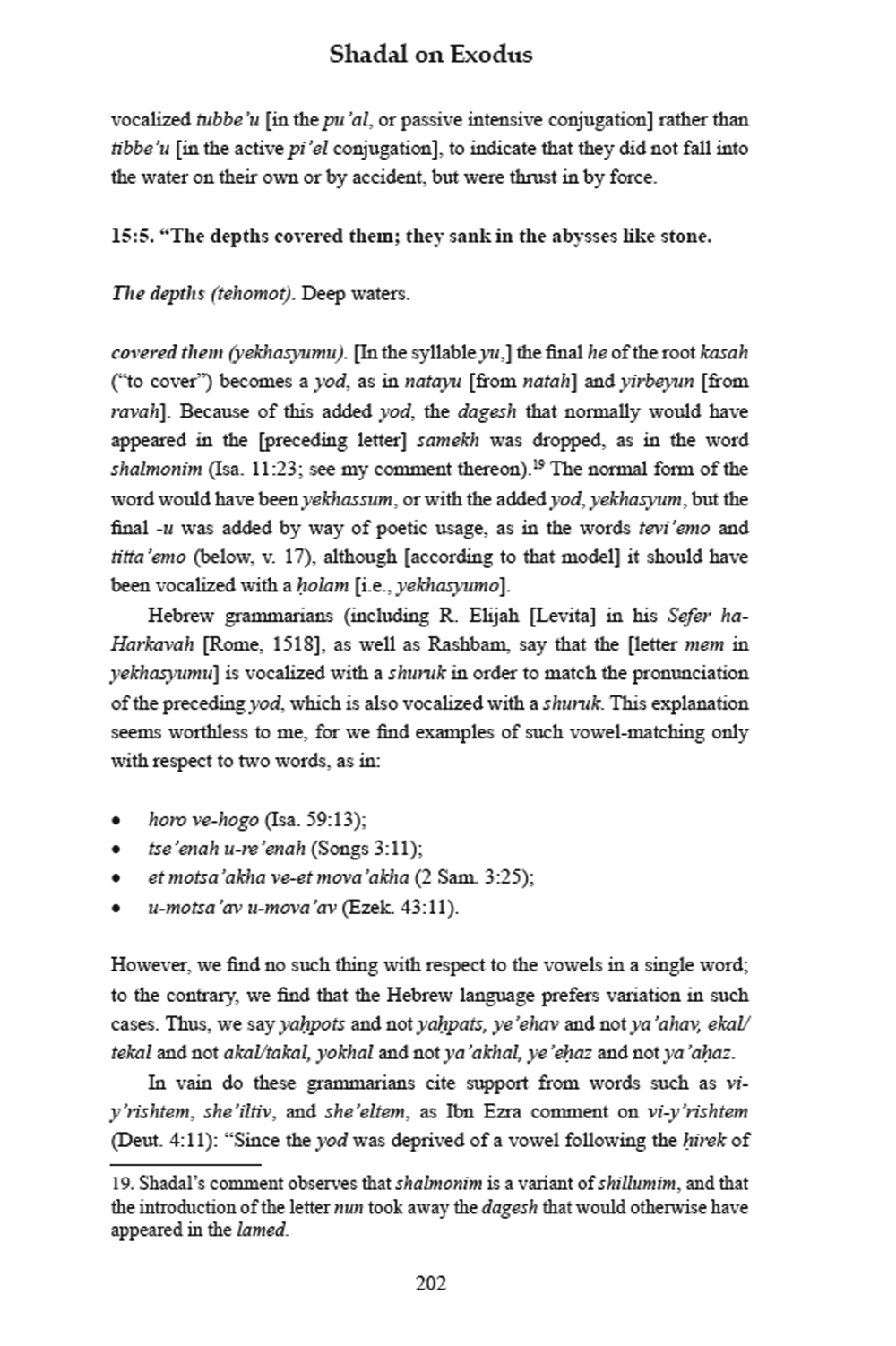
  • In the phrase tehomot yekhasyumu (“the depths covered them”) in the Song of the Sea, the grammatically strange and unique word yekhasyumu is best explained as a use of onomatopoeia—that is, the employment of an imitative and naturally suggestive word for rhetorical effect—because the double “u” sound arouses an impression of darkness and depth and thus portrays to the listener’s ear the enemy’s sinking into the deep waters (see at Ex. 15:5).  In fact, Shadal’s treatment of the entire Song is the pearl of his Exodus perush.  In the course of his commentary on chapter 15, he includes, among other things, (1) a discussion of why ancient Hebrew poetry contains traces of Aramaic, (2) a thorough explanation of the poetic device of parallelism, (3) an essay on the derivation and semantics of the word kodesh (“holiness”), and for good measure, (4) a stinging diatribe against the philosophy of Spinoza.
  •  One of the
    purposes behind the collection of the silver half-shekel for the Tabernacle was
    to diminish the people’s fear of the “evil eye” (see at Ex. 30:12).  They were being counted, and the people
    believed that a census might arouse the evil eye unless they paid a “ransom” to
    help build the sanctuary.  God did not
    wish to abolish the folk belief in the evil eye altogether, since it had the
    beneficial effect of keeping the people from putting too much trust in their
    own might or wealth.  In fact, said
    Shadal, what the common people attributed to the evil eye—and modern scholars
    just as misguidedly dismissed as coincidence—was a Divinely decreed phenomenon
    of nature, that “pride goeth before the fall.”
Shadal on
Exodus
is equipped with explanatory notes, a source index, a
subject and author index, and a list identifying the many and varied
authorities that Shadal cited. 

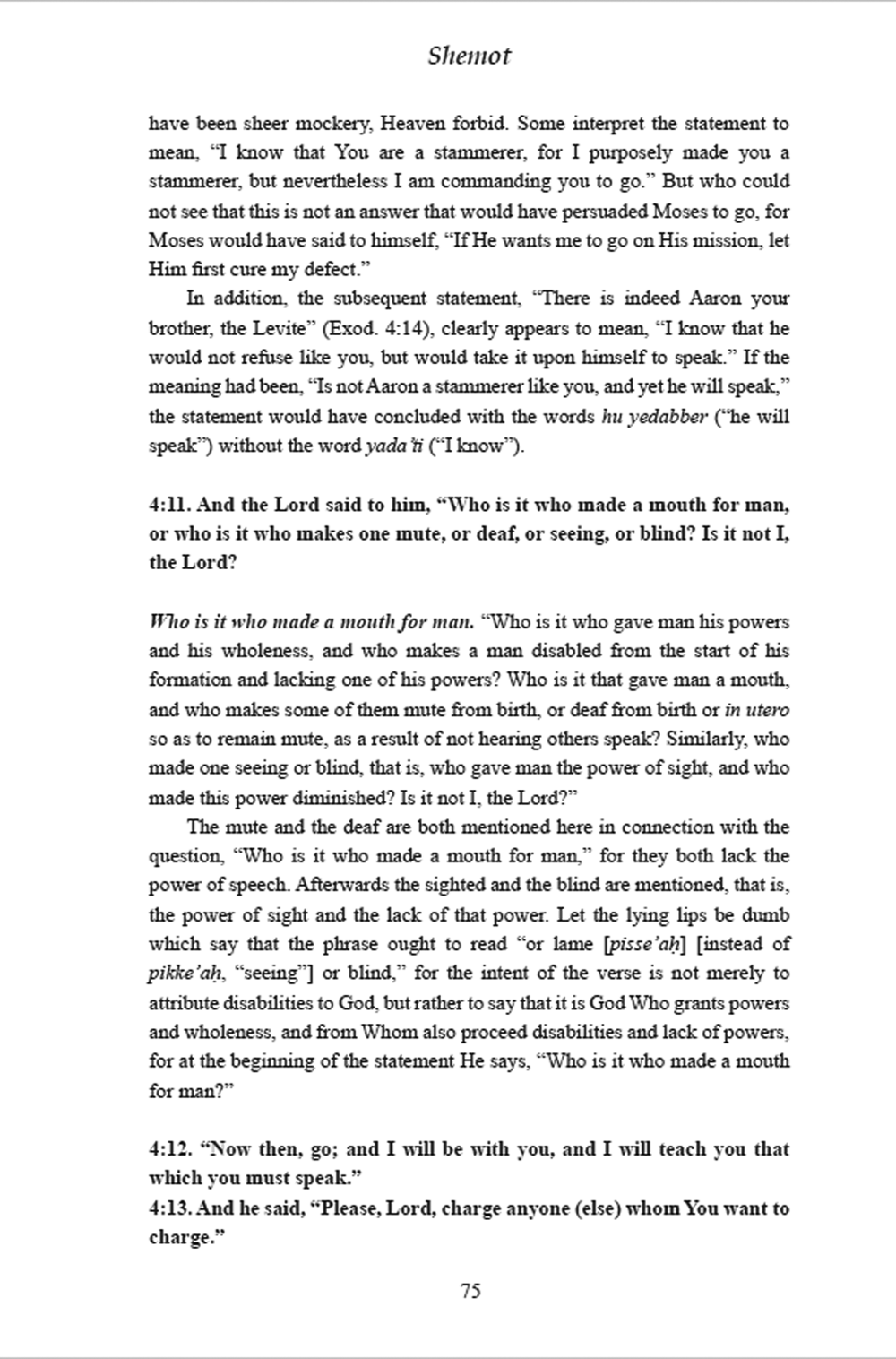
EDITED 12.17.2015 here are a few sample pages:

The book may be ordered now on Amazon or on the Kodesh Press website.


Lunch and Learn with Rav Yechiel Goldhaber on Thursday 12/3/15 at 1:00 PM

The readership of the Seforim Blog is invited to a “Lunch and Learn” that will be taking place Thursday, December 3 from 1:00 – 2:00 PM. The shiur will be given by the noted scholar and author Rav Yechiel Goldhaber of Eretz Yisrael (link). He has written many wonderful articles and works on a wide range of topics most notably Minhagei Kehilos about customs, and Kunditon (link) about the Titanic, and the Cherem on Spain. 
The Shiur will take place at 919 Third Avenue New York, NY
Because of the security policies of the building, if you are interested in attending you must RSVP to yhalpert@debevoise.com by Thursday morning (tomorrow) so that you can be registered at the front desk. Picture ID will also necessary to enter the building.


Announcement – Lecture by Rabbi Yechiel Goldhaber at the Sprecher home

The readership of the Seforim Blog is invited to a shiur that will be taking place Sunday November 29 at 8:00 PM. The shiur will be given by the noted scholar and author Rav Yechiel Goldhaber of Eretz Yisroel (link). He has authored many wonderful articles and works on a wide range of topics most notably Minhagei Kehilos about customs, and Kunditon (link) about the Titanic, and the Cherem on Spain. 
The subject of the Shiur is על חרדים ויום השואה, and it will include fascinating information from newly unearthed documents. 
It will take place in Brooklyn at the home of Dr. and Mrs. Shlomo Sprecher, at 1274 East 23rd Street.


Announcement of new works of Rishonim

Announcement of new works of Rishonim
By Eliezer Brodt
מגנזי אירופה,
כרך ראשון, ההדיר והוסיף מבואות: שמחה עמנואל, הוצאת מקיצי נרדמים, 512 עמודים.
I am very happy to announce the publication of an important work which I have been eagerly waiting for, Professor Simcha Emanuel of the Hebrew University’s Talmud department’s volume of texts from the “European Genizah” (volume one). This volume was just printed by Mekitzei Nirdamim and is being sold by Magnes Press.

New texts from Rishonim are high up on my list of favorite publications, all the more so when they are edited by Professor Simcha Emanuel. Professor Emanuel is considered one of the today’s greatest experts in Rishonic literature. He has produced numerous special works [such as this recent work, this, this and my favorite] and articles of both texts and material about them for quite some time. [Many of which are available here] All of which are of very high quality, showing an incredible breadth and depth in the material at hand. One area of specialty of his is finding long lost works; this new volume continues this trend. Starting with an important introduction to the background and importance of the Genizah, it includes numerous newly discovered texts of Rishonim, with introductions and background of their importance and proof of identification.
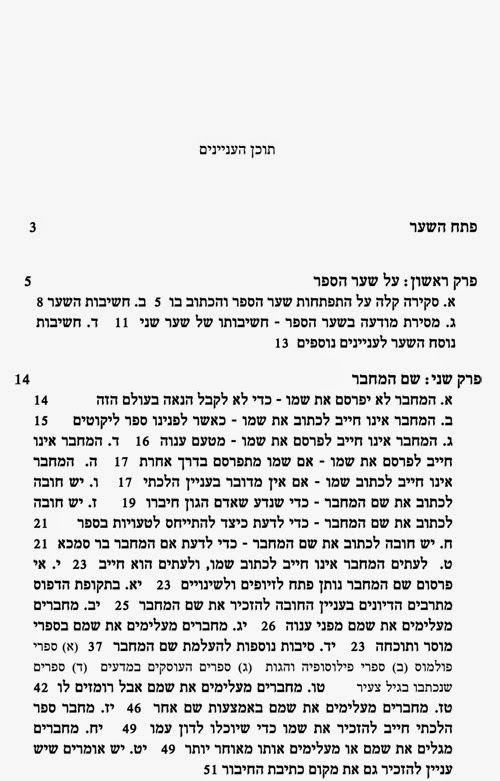
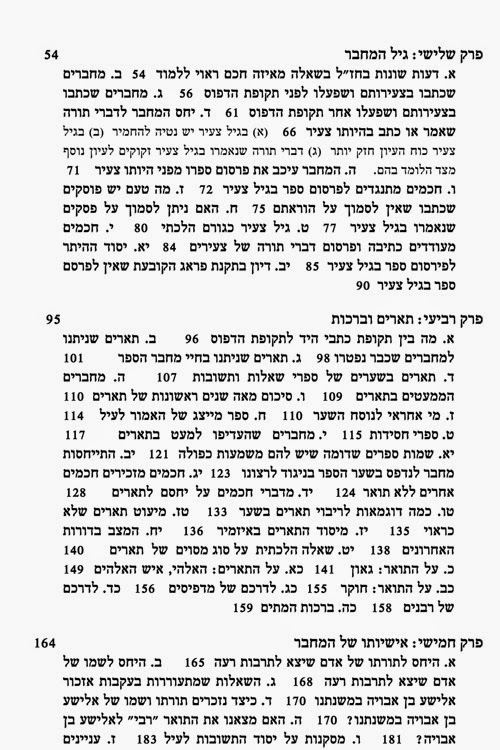
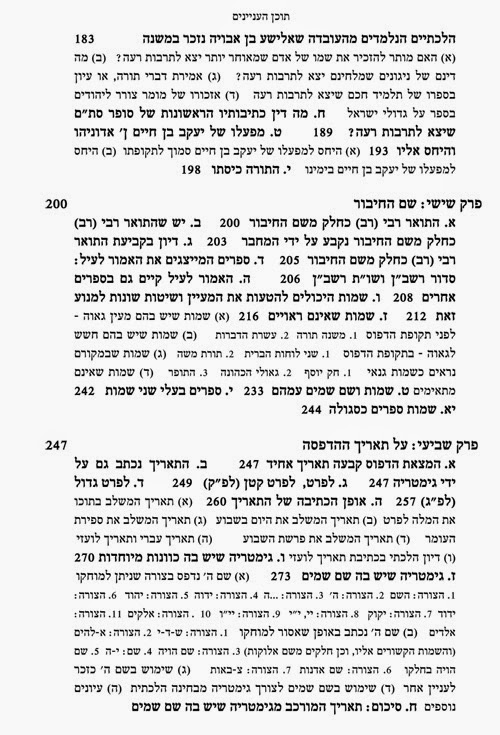
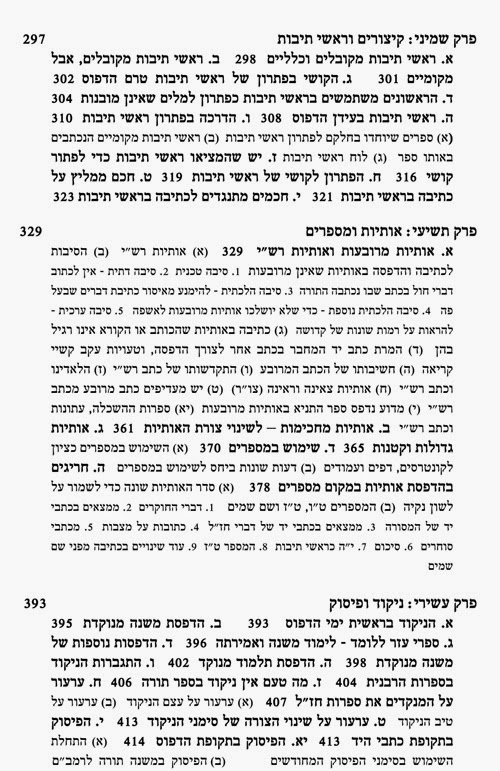
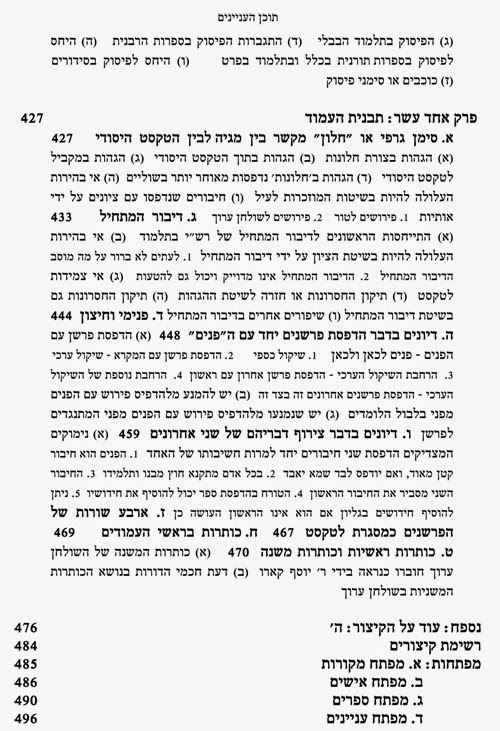
Here are the Table of Contents of this special work:

For a sample e mail me at
Eliezerbrodtatgmail.com.
The book can be purchased via Magnes
Press
or through me at: Eliezerbrodtatgmail.com.
Also take note of a special sale of numerous
titles at Magnes Press.
Copies of this work will be arriving
at Biegeleisen shortly.


New Book: The Living Tree: Studies in Modern Orthodoxy by Rabbi Shlomo Riskin

Rabbi
Shlomo Riskin’s new book,
The Living Tree: Studies in Modern Orthodoxy, has just
appeared. The Seforim Blog is happy to present this selection from it.

Halakhic Pluralism in the Eyes of Rishonim and
Aharonim

In many of the off-hand remarks of the early
commentators, their advocacy of the principle of halakhic pluralism is plain to
see, regardless of whether these great authorities stemmed from Ashkenaz,
Sepharad, or Provence. They repeatedly express the pluralistic principle of
“these and those are the words of the Living God.”
Rashi, in his commentary
to Ketubot 57a, writes:
W hen two [sages] argue
over the statement of one [who was their master], and one sage says that this
is what the master said and the other says that this is what the master said,
one of them is lying. But when two Amora’im argue regarding a civil or ritual
halakhic issue, and each one maintains the logic of his position, there is no
falsehood. Each one is expressing his logic, the one master giving a reason for
permitting and the other master giving a reason for prohibiting, one master
compares issue to issue in such a fashion, and the other master compares it in
another fashion. It is necessary to say, “these and those are the words of the
Living God”; sometimes this logic pertains and sometimes that logic pertains,
because the logic changes even on the basis of a small change in the issues at
hand.
The Ritba (Rabbi Yom Tov ben Avraham Asevilli,
1250–1330) on Eruvin 13b comments as follows:
“These and those are the
words of the Living God.” The rabbis of France asked, How is it possible for
both views to be those of the Living God when one prohibits and the other
permits? And they answered: W hen Moses went on high to receive the Torah he was
shown forty-nineways to permit and forty-nine ways to prohibit every object. He
asked the Almighty concerning this, and He said, “Let these [matters about
which there are so many possibilities] be handed over to the sages of Israel in
every generation, and let the resolution be in accordance with their will.”
 Rabbi
Menaĥem Meiri (1248–1316), in his work Beit HaBehira, commented on Yevamot
14a:
That which the Torah
commanded lo titgodedu (“Do not slice yourselves up” – Deut.14:1), even
though its principal meaning is not to wound oneself as an expression of
mourning for one who has died, there is a nuance [within the word titgodedu
which may be interpreted to mean] not to turn the commandments into separate
divisions [agudot], and this is to prohibit several individuals from
performing ritual in one way while others per- form the ritual in a different
way, until it appears as though we are being led by two Torahs. But this
prohibition applies only when a city has only one court, and when even this
court is itself divided, with one component group deciding in accordance with
one view and another component group in accordance with another view. But
whenever there are two judicial courts, albeit in one city, and one court is
accustomed to deciding in accordance with this view and the other court is
accustomed to deciding in accordance with that view, this does not represent
separate divisions because it is impossible for everyone to always agree on one
opinion. This is certainly true regarding actions based upon custom, where
there is no objection if these act in such a way and those in another way.[1]
Even during the period of the later
commentators, the idea of halakhic pluralism finds expression. Admittedly,
works such as the Kitzur Shulhan Arukh of Rabbi Shlomo Ganzfried, which
records only one authoritative opinion – unlike the original Shulhan Arukh,
which includes the opposing views of Rabbi Karo and the Rema – seem to imply a
more monistic halakhic approach. A ringing defense of pluralism is to be found
in the words of Rabbi Chaim ben Rabbi Bezalel, brother of the Maharal, who
studied together with Rabbi Moshe Isserles (the Rema) in the mid- sixteenth
century in the yeshiva of Rabbi Shalom Shachna. He wrote Viku’ah Mayim Hayim
(usually included at the end of the Rema’s Torat Hatat), in which he
vigorously argues against any written halakhic codification reflecting only one
halakhic opinion:
Only after [the decisor]
has studied all of the legal disputes which have arisen regarding a specific
law can his word run quickly into the sea of wisdom…Moreover, the mind of an
individual is not always consistent and perhaps his mind is not disposed to
give the same halakhic ruling which he gave yesterday; there is not in this any
change or deficiency [which would lead us] to say that through him the Torah is
becoming like two Torahs, God forbid. The opposite is the case; this [manner of
halakhic investigation, exploring multiple opinions] is the path of Torah, and
“these and those are the words of the Living God.” (Elon, Mishpat HaIvri,
37)
A fascinating contrast is to be found in the
writings of two cotemporary religious leaders, Rabbi Moshe Feinstein and Rabbi
Yitzhak Hutner. The former, world-renowned halakhic decisor of our generation,
utilizes the expression “these and those are the words of the Living God,” but
nevertheless posits that one argument may ultimately be more correct than the
others:
And this is the matter
concerning all of the disputes of our earlier and later sages, when one forbade
and the other permitted: whenever the [law] was not resolved in accordance with
one [of them], any [rabbi] could rule in his locality in accordance with his
logic, even though the true law is only in accordance with one of them…Both are
the words of the Living God, but the real truth, revealed before heaven, is
only like one of them.
Nevertheless, Rabbi Moshe Feinstein insists that
with regard to reciting the blessings on learning Torah and fulfilling the
commandment to study Torah, no differentiation should be made between texts
containing majority opinions and texts containing minority opinions. All Torah
texts are worthy since “these and those are the words of the Living God” (Iggrot
Moshe, Orah Haim
4:9, 24).
Rabbi Yitzhak Hutner, on the other hand, accepts
the talmudic view that disputes arose as a result of insufficient study or
forgetfulness, a view which we initially equated with the monistic approach to
halakha. Nevertheless, he resoundingly affirms the positive role of disputes in
enlarging the scope of Torah and initiating novel ideas therein. He even reads
into this view of the origin of halakha a bold concept of halakhic pluralism:
Sometimes, the
nullification of Torah is its very confirmation, as it is written, “the tablets
which you have broken.” [God said to Moses], “May your strength increase
because you have bro- ken them; the act of breaking the tablets is an act of
confirming the Torah through its nullification.” Our sages have said, “Were the
tablets not broken, Torah would not have been forgotten in Israel” (Eruvin
54a); we find therefore that the breaking of the tablets contains an aspect of
forgetting of the Torah. We learn from this an awesome and novel idea: it is
possible for Torah to be increased through its having been forgotten, and it is
possible to be blessed with increased strength because of the Torah having been
forgotten!
Go out and see what our
sages have taught: three hundred laws were forgotten during the mourning period
for Moses, and Otniel ben Kenaz restored them with his logic and casuistry (Temura
16a). And even more than that: every dispute in halakha stems from the fact
that Torah was forgotten, and nevertheless our sages declared, “Even though
these purify and those defile, these invalidate and those permit, these exempt
and those obligate, these and those are the words of the Living God.” Hence,
all different opinions and differing views contribute to the growth of Torah
and its majesty, which…is emphasized to a greater extent by the Oral Law which
is revealed in disputes rather than by agreement, because “these and those are
the words of the Living God” includes the principle that even the rejected view
in halakha remains Torah knowledge as long as it was expressed as part of the
give-and-take of the Oral Law…and if there will be a vote afterwards and the
decision is in accordance with the rejected view, from then on halakha will be
different in truth.
The “battles” within
Torah are not simply one of many possible ways of (acquiring) Torah, but rather
the positive creation of new Torah values which cannot be found in the words of
Torah… And the two sides which clash in halakha become partners in the creation
of a new Torah value whose name is “the battle of Torah.” (Pahad Yitzhak,
Hanukka
pp. 36–37)
Despite all this, pluralism is obviously not
open-ended. Starting with the biblical story of the Tree of the Knowledge of
Good and Evil which opens the Book of Genesis and serves as an introduction to
the entire Torah, it is clear that God demands that the definition of what is
good and what is evil must emanate from an objective source beyond the
subjective individual. Indeed, even though the fruit was “good to eat, a
temptation to the eyes, and a desirable way to gain wisdom,” the Almighty
nevertheless decided that it was evil to partake of it. And from the talmudic
period until the Emancipation, the partners to the “these and those are the
words of the Living God” disputes each accepted upon themselves an external and
objective halakha. Submission to a higher autonomous system was the axiom of
halakhic dispute. Hence, a non- Orthodox system cannot claim halakhic
legitimacy under the rubric of “these and those are the words of the Living
God.” While we may certainly learn from serious Jews of any or no religious
persuasion, both tradition and logic dictate that halakhic legitimacy can only
be accorded to those who accept upon themselves the axioms upon which the
halakhic system is based.
Although a non-halakhic theological system
cannot claim for itself a voting voice in a forum of halakhic discourse, I
believe it is crucial that the tent of Orthodoxy be as broad, open, and
inviting as possible. Even a halakhic position which the Orthodox majority
rejects, but which, nevertheless, has a legitimate halakhic basis to rely upon,
should be given due consideration.
Within the world of halakhic Judaism, the most
striking affirma-tion of the benefits of a pluralistic approach is to be found
in the words of Rabbi Avraham Yitzhak HaKohen Kook, in Olat Re’iya,
volume 1, p. 336:
The multiplicity of
views which arise as a result of the differences of personalities and
educational backgrounds is specifically the fact which most enriches and
broadens wisdom. Ultimately, all issues will be properly understood, and it
will be recognized that it would have been impossible for the Building of Peace
[the Third Temple] to have been erected had it not been for all those
influences which appeared to have been in conflict.
According to Rabbi Kook, it is the sum total of
many different ideas and ideologies which will ultimately lead to a shared
vision that expresses true peace; the authentic symphony is the product of many
different musical instruments melding together in majestic harmony.

[1] It is interesting to
note that according to Rabbi Ben-Zion Uziel, the first Sephardic chief rabbi of
the State of Israel, in his Piskey Uziel (page 26, siman 10), Rashi
would permit two different courts – for example, Sephardic and Ashkenazic – in
one city, since he explains the prohibition of making divisions “lest it appear
that we are acting in accordance with two Torahs” (Rashi on Yevamot 13b)
and different communal customs do not suggest two Torahs. Maimonides, on the
other hand, would prohibit this since he maintains that the prohibition of
making divisions, “that there not be two courts in one city, this one in accord
with this custom and that one in accord with that custom, for this matter
causes great dissension” (Mishneh Torah, Hilkhot Avoda Zara, chapter 12,
law 14). Rabbi Avraham Yitzĥak HaKohen Kook, in Ezrat Kohen, siman 103,
par. 17, rules that the Sephardic and Ashkenazic communities in one city are
separate, and the prohibition of making halakhic divisions does not apply to
them. Rabbi Kook cites the Shakh to Yoreh De’ah 242, who limits the
prohibition, “Do not slice yourselves up” to dissension within the same court
in one city.


New Book Announcement: Esther Unmasked: Solving Eleven Mysteries of the Jewish Holidays and Liturgy by Mitchell First

The Seforim blog is proud to announce the publication of our contributor Mitchell First’s newest book, Esther Unmasked: Solving Eleven Mysteries of the Jewish Holidays and Liturgy (Kodesh Press, 2015), available here
(http://www.amazon.com/Esther-Unmasked-Solving-Mysteries-Holidays/dp/0692375422).
Table of Contents
Introduction by Rabbi Hayyim Angel   .   .   .   .   .   .   .   .   .   .   .   .   .   9
Preface   .   .   .   .   .   .   .   .   .   .   .   .   .   .   .   .   .   .   .   .   .   .   .   .   13
1. עולם לתכן: Establishing the Correct Text in Aleinu   .   .   .   .   .   .   .   17
2. What is the Origin of the Word הליחמ?   .   .   .   .   .   .   .   .   .   .   .   30
3. והו ינא: What is the Meaning of this Cryptic Mishnaic Statement?  .   42
4. What is the Meaning of “Maccabee”?   .   .   .   .   .   .   .   .   .   .   .   60
5. What is the Meaning of Ḥashmonai?   .   .   .   .   .   .   .   .   .   .   .   76
6. What Motivated Antiochus to Issue His Decrees Against the Jews   .   .   .   .   .   .   .   .   .   .   .   .   94
7. The Origin of Taanit Esther   .   .   .   .   .   .   .   .   .   .   .   .   .   .   .   118
8. Achashverosh and Esther in Secular Sources   .   .   .   .   .   .   .   .   129
9. Mah Nishtannah: The Three Questions   .   .   .   .   .   .   .   .   .   .   168
10. Arami Oved Avi: Uncovering the Interpretation Hidden in the Mishnah   .   .   .   .   .   .   .   .   .   .   .   .   .   189
11. The Pe/Ayin Order in Ancient Israel and its Implications for the Book of Tehillim   .   .   .   .   .   .   .   .   207
Abbreviations   .   .   .   .   .   .   .   .   .   .   .   .   .   .   .   .   .   .   .   .   231
Index   .   .   .   .   .   .   .   .   .   .   .   .   .   .   .   .   .   .   .   .   .   .   .   .   232
Preface
This book consists of eleven articles that address interesting questions that arise in connection with the liturgy and origin of the Jewish holidays. Too often, Orthodox Jews take the liturgy and the origin of the holidays for granted, without adequate investigation.
For example, regarding the liturgy:
●      The Jewish obligation of תקון עולם, “improving the world,” is widely referred to and it is traditionally assumed that the Aleinu prayer is one of the texts upon which this obligation is based.  The first article shows that a very strong case can be made that the original version of Aleinu read לתכן עולם, “to establish the world under God’s sovereignty,” and not לתקן עולם, “to perfect/improve the world under God’s sovereignty.” If so, the concept of תקון עולם has no connection to the Aleinu prayer.
●      A phrase that is part of the traditional Sukkot hoshanot liturgy is אני והו הושיעה נא, based on the text of a Mishnah at Sukkah 4:5. The meaning of the phrase אני והו has been a puzzle throughout the centuries. The third article shows that almost certainly the original text of the Mishnah read  אני והוא.  With this reading,  the statement can be explained.
●      It is usually assumed that the Passover recital of “Four Questions” is one of the fundamental rituals of rabbinic Judaism. The ninth article explains that the original mah nishtannah only included three questions. The variation in the number of questions in the mah nishtannah over the centuries is then described, and the evolution of the number of questions into the present four is then explained.
Regarding the origin of the Jewish holidays:
●      The sixth article discusses what motivated Antiochus to undertake his persecution of the Jews. The three main theories will be discussed and evaluated.
●      In the seventh article, the origin of the fast of the 13th of Adar (Taanit Esther) will be addressed.  No fast in Adar is mentioned in the book of Esther or the Talmud, and the origin of this fast has always been difficult to understand. The 13th of Adar was even a holiday (Yom Nikanor) in the late Second Temple period, a day on which fasting was prohibited. Based on a careful examination of Geonic sources, the seventh article will explain how this fast first came into existence in Geonic Babylonia.
●       The identification of Achashverosh in secular sources had always been a puzzle. The eighth article will explain how, in the middle of the nineteenth century, Achashverosh was finally able to be identified. He is the king that the Greek historians referred to as “Xerxes.” The article will detail the basis for this identification, and will show that Esther can be identified in secular sources as well.
Regarding the balance of the articles:
●      The second article suggests explanations for the origin of the mysterious Tannaitic root מחל, a root not found in the Bible. The article further attempts to distinguish this root from its synonym סלח.
●      The fourth article explains the correct spelling of the term Maccabee (מקבי) and points to its likely original meaning.
●      The fifth article discusses the identity and meaning of חשמונאי.
●      The tenth article conducts an analysis of Mishnah Pesaḥim 10:4. It shows that it is likely that this Tannaitic source understood arami oved avi to mean “my father was a homeless/wandering/lost Aramean.” Typically, it is assumed that this interpretation of arami oved avi did not arise until the time of the Rishonim.
●      The final article explains the reason why the pe verses preceded the ayin verses in the acrostics in chapters 2-4 of the book of Eikhah (and in the acrostic in chapter 1 in the Dead Sea text of Eikhah).  It turns out that pe preceded ayin in the order of the alphabet in ancient Israel! The implications of this explanation for dating the book of Tehillim (interspersed with many acrostics) are then addressed.
• • •
Many of the articles included in this book have been published in earlier forms in Ḥakirah, Biblical Archaeology Review, AJS Review, Journal for the Study of the Old Testament and seforim.blogspot.com.  (For the references to the earlier articles, see the first footnote in each article.)


Several of the articles: the first (establishing the reading לתכן עולם), seventh (origin of Taanit Esther), eighth (the identification of Esther in secular sources), and eleventh (the implications of the ancient pe/ayin order) have been viewed by many as groundbreaking.


New book announcement

New book announcement
By Eliezer Brodt
תשובות רבינו אלעזר מורמייזא ה’רוקח’, שיר מחורז בהנהגת התשובה ודרכיה, מנוקד מפורש ומבאור בתוספות מביא עיונים ובירורים ומפתחות, ע”פ כתב יד, מהדיר: ר’ יעקב ישראל סטל, רח עמודים דרשות לימי התשובה, מבית מדרשם של חסידי אשכנז, ע”פ כתב יד, עד עמודים
I am happy to announce two new works by Rishonim from the Beis Medrash of Chasidei Ashkenaz, related to Teshuvah, a subject closely related to the months of Elul and Tishrei. Here is a short description of the work:
 תשובות רבינו אלעזר מוורמייזא, ה’רוקח’.
שיר מקיף וארוך, בעל למעלה משלוש-מאות וחמישים טורים כפולים, המוקדש כולו לביאור דרכי התשובה לחמשה-עשר חטאים שונים, וכשבתוך הדברים משולבים עניינים שונים – הדרכה ומוסר כללית, תיאורי העונשים שבגיהנם, שכרם של הצדיקים בגן העדן וכיוצא בכך.
שיר זה זכה לההדרה מאת הרב יעקב ישראל סטל, הנודע כבר ממהדורותיו לחיבורי רבינו יהודה החסיד ובית מדרשו (כמו: ‘ספר גימטריאות’ לר’ יהודה החסיד, ‘אמרות טהורות חיצוניות ופנימיות’ לר’ יהודה החסיד, ‘סודי חומש ושא”ר’ לתלמידי ר’ יהודה החסיד).
במהדורה זו, נתבאר השיר בפירוש צמוד, ולאחר השיר וביאורו מופיעים ‘עיונים ובירורים’ הנוגעים לשיר, שלא היה ביכולתם להכנס לפירוש הצמוד. את החיבור פותח  מבוא מקיף, המסכם את תפיסת התשובה החסידית-אשכזית, את החיבורים המיוחדים שהקדישו חסידי אשכנז לעניינה של התשובה.
חלקו האחרון של הספר הוקדש לעניינים השייכים לנושאים שנידונו במבוא אך מפאת אורכם לא מצאו בו את מקומם, כמו: פרטים שה’רוקח’ נחלק בהם על רבו המובהק ר’ יהודה החסיד; זיהוי קטע חדש מכת”י מפירוש הרוקח לתפילה, ובמיוחד: מחקר מקיף ורחב המברר כיצד הוטעו חכמים רבים, מהתקופה הקדומה ועד ימינו, לסבור שאחד מחיבורי התשובה של ה’רוקח’ יצא מר’ יהודה החסיד.
דרשות לימי התשובה: מבית מדרשם של חסידי אשכנז
 
חיבור נוסף מאותו בית המדרש – חסידי אשכנז הקדמונים, המחזיק שלוש דרשות שנשא אחד מחסידי אשכנז בימי התשובה.
בכל דרשה נוטל החכם הלא-ידוע פסוק אחד המדבר מעניינה של התשובה, ודורשה בכמה וכמה פנים ואופנים, על-פי השיטות הרווחות בבית המדרש החסידי אשכנזי. ומתוך דבריו והערות המהדיר מתבררים יפה יפה ענייני התשובה ודרכיה, הנהגותיה, סגולות ומעלות התשובה, גנות החטאים ושכר המצוות ועוד נושאים כיוצא בכך.
גם כרך זה פותח במבוא המעמיד את מקומם של הדרשות בעולמה של חסידות אשכנז, מנסה לאתר את מקומו המדוייק בין החוגים השונים שהרכיבו את חסידות אשכנז, ואף מוסיף כמה הערות ביביליוגרפיות מעניינות.
Here is a Table of Contents:


Purchasing information:
For a sample of these works or more information about purchasing this work, feel free to contact me at Eliezerbrodt@gmail.com. The price is $38 (for both volumes) including air mail shipping [to the US, Canada & England]. Copies of these works are available at Biegeleisen.


New Book Announcement: A critical edition of R’ El‘azar HaKalir’s Piyyutim of Rosh Hashanah, by Shulamit Elizur and Michael Rand

New Book Announcement: A critical edition of R’ El‘azar HaKalir’s Piyyutim of Rosh Hashanah, by Shulamit Elizur and Michael Rand
By Eliezer Brodt
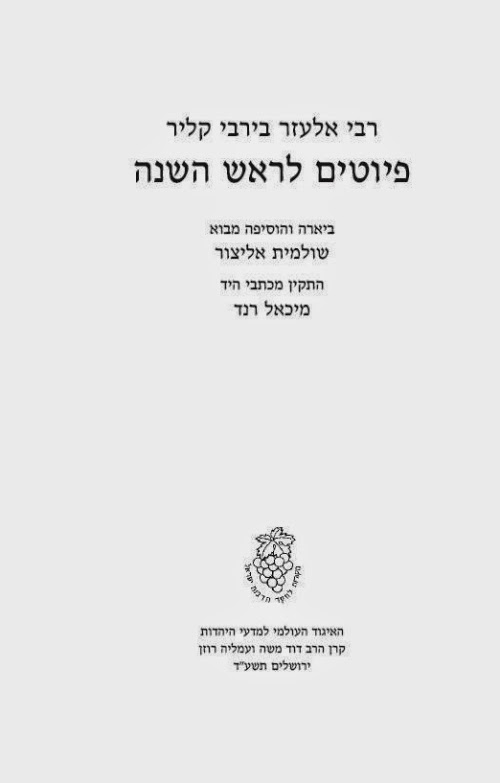
רבי אלעזר בירבי קליר, פיוטים לראש השנה, ביארה והוסיפה מבוא, שולמית אליצור, התקין מכתבי היד מיכאל רנד, האיגוד העולמי למדעי היהדות, ירושלים תשע”ד, [מקורות לחקר תרבות ישראל, כרך יח], 718 עמודים.
I am very happy to announce the publication of an important work out just in time for Rosh Hashanah, a critical edition of all of R’ El‘azar HaKalir’s Piyyutim for Rosh Hashonah, by Shulamit Elizur and Michael Rand.
The importance of studying the Piutim before Yom Tov has been noted by many for example:
R’ Moshe Hakohen, nephew of the Rosh, writes in his work, Sefer Hamaskil:
מה טוב ומה נעים לעיין תמיד דבר בעתו בכל שבוע ושבוע בפירוש חומש ומחזור וסליחות ויוצרות ופיוטים וקינות ופרקי אבות ודברות והושענות וזכרנו ואגדת פסח ומערבים וגדול וקטן… [ספר חסידים, עמ’ עא].
[For an exact explanation of this passage and for general information about this work see the special article of Rabbi M. Honig in Yerushaseinu 1 (2007) pp. 196-240 especially p. 229].
A similar idea is found in the Mahril:
וכל אדם יחזור וילמוד התפלה והקרובץ מקודם להיות שגורים בפיו בר”ה בשעת התפלה [מהרי”ל עמ’ רעב].
The Taz writes:
ראה דבתפלה שצריך להבין בפי’ הדברים בפרט בפיוטים שחמור פירוש’ אם לא בנתינת דעה רבה עליהם ודאי צריך להסדיר תחלה ולא מהני לו ספר בזה וזה פשוט [ט”ז, סי’ ק ס”ק א].
In regard to the Piyutim by the Kalir, it’s worth quoting the Arizal, as mentioned by the Magen Avrohom:
האר”י ז”ל לא היה אומר פיוטים ופזמונים אלא מה שסדרו הראשונים כגון הקלירי שנתקנו ע”ד האמת, (הכוונות( [סי’ סח הקדמה].
Different aspects related to the Kalir have been dealt with here on the Seforim Blog; see Dan Rabinowitz’s article here which includes a bibliography about him. In addition to this, see Marc Shapiro’s article here and my article here, note 73.
The Kalir as described by Rabbi Joseph B. Soloveitchik
 
I would just like to quote one special passage of Rabbi Joseph B. Soloveitchik about the greatness of the Kalir. This passage is from the Koren Mesorat Harav Kinot (pp. 386-388) which is based on Rabb Jacob Schacter’s transcripts of the Rav’s Tisha B’Av sessions:
At this point, it would be useful to make some general observations about Rabbi Elazar Hakalir and the style of his piyutim, his religious poetry. The piyutim of Rabbi Elazar HaKalir, including his kinot, serve two purposes. The first is limmud, learning. Every sentence of the piyut quotes m’aamarei Hazal, teachings of the sages. The second purpose is tokhaha, rubuking the people for their misdeeds and instructing them in the proper way to act. These piyutim deal with reproach, repentance, petition and acknowledgment of God’s justice. The shali’ah Tzibbur was not merely a hazan, a cantor, but was one of the great scholars of the generation who was the principal mokhiah, moral critic of the people…
Rabbi Elazar HaKalir was a master of the Hebrew language and very creative in his use of Hebrew. If not for him, modern Hebrew could not have come into existence. Before HaKalir, the Hebrew language was very rigid. For example, the noun and verbs were fixed in their form. It was difficult to transform a verb into a noun or a noun into a verb, a simple matter in other languages…
But HaKalir made a critical contribution to the development of the Hebrew language by endowing the language with flexibility, thereby paving the way for the development of modern Hebrew. There were other early paytanim, composers of piyut, such as Yose ben Yose, but they were not as radical in their literary style as HaKalir.  HaKalir was the father of the paytanim, and he dared to do more than any other paytan.
As noted above, Rabbi Elazar haKalir’s piyutim served two purposes: limmud, study and tokhaha, rebuke. As for the element of study, one of the dimensions of HaKalir’s piyutim is that they are compilations of the statements of the sages. Most of us, who are expert in neither Hebrew nor aggadot Hazal, find HaKalir’s corpus of piyutim boring. But it is not boring at all; it is like a gold mine. His piyutim for Yom Tov explain the essence of the Yom Tov. The midrashim concerning Sukkot are replete with information about the sukka, etrog and lulav, and all the explanations in the Midrash, all the ta’amei sukka, the reasons for the sukka, all of the ma’amarei Hazal, are brought together in the HaKalir’s piyutim for the first day of Sukkot. Similarly, his piyutim for Rosh HaShana and Yom Kippur include all the homiletical literature concerning the statement in the Midrash, “On Rosh HaShana, Sarah, Rachel and Hanna, were remembered” (Bereshit Raba 73:1). If one were to study carefully and thoroughly the piyutim of Rabbi Elazar HaKalir for Rosh HaSahana, Yom Kippur, Sukkot, and Pesah, one would find many applicable halakot and the entire pertinent Midrash, including many  midrashim that are unknown to us from any other source.
It is quite possible that during the time of Roman and Byzantine rule in the land of Israel, the ruling authorities prohibited shiurim and afternoon lectures by Torah scholars and sent officers to the synagogues on Yom Tov afternoon to prevent the people from studying. Consequently, the rabbis introduced the study of Torah into the prayer service via piyutim, a subterfuge that eluded the authorities. The piyutim were deliberately written in a fashion that would make them difficult to understand, lest the officers recognize their true function and forbid their recitation. As previously noted, we do not know with certainty when Rabbi Elazar HaKalir lived. According to Tosafot (Hagiga 13a, s.v. veraglei hahayot), he was the tanna, Rabbi Elazar HaGadol, who lived in the second century, but according to other Rishonim, he was either an amora, or one of the early liturgical poets, from the sixth or seventh century. But his piyutim could certainly have served the purpose of integrating Torah study into the prayers in a way that would not have been obvious to the non-Jewish authorities.
Description of the work:
What follows is a description of this new work [sent around from the publishers of the book]
Rosh Hashana, the Day of Judgment, has been embellished with numerous fascinating liturgical poems (piyyutim). This book is devoted to the compositions that were written for Rosh Hashana by the illustrious poet R. El‘azar berabbi Qillir, who was active in the Land of Israel at the beginning of the seventh century. The piyyutim for Rosh Hashana are many and varied, and they adorn all of the special prayers for the festival. A number of these piyyutim are known and recited to this day in Ashkenazi congregations, while others are published here for the first time. Even those piyyutim that are known from the festival prayer books (mahzorim) are presented here in a new light. The present edition is primarily based not on European mahzorim, but on earlier fragments from the Cairo Genizah; on the basis of such early sources the editors have succeeded in adding new, original material to the known compositions—there is not one famous composition to which heretofore unpublished material has not been added, in some cases throwing new light on the entire work. Even in such cases, therefore, we are not merely offering old wine in new wineskins, but presenting a new blend that confers on the poetic compositions novel aspects, not previously brought to light.
This edition has been prepared on the basis of close to 400 manuscripts, and all of the variant readings have been given in the margins. An extensive commentary aids the reader in understanding the difficult idiom of the payyetan, identifying the many scriptural and midrashic sources that are woven into the piyyutim, and following the development of their themes. A general introduction treats various questions connected to the poems, from their attribution to the author and the reconstruction of the component parts of each composition, to the literary shaping of the material. In his piyyutim, R. El‘azar berabbi Qillir treats Rosh Hashana in all of its aspects: the Day of Judgment, the blowing of the shofar; the malkhiyot, zikhronot, and shofarot verses; the merit of the Fathers; and more. A number of compositions are specially intended for when Rosh Hashana falls on the Sabbath. Qillir’s unique method in the shaping of each of these themes is also clarified in the introduction. The complex web of interrelations between the piyyutim and their literary sources is elucidated as well; thus it has become clear, for example, that one of the piyyutim edited here for the first time throws new light on the famous poem, U-netane toqef qedushat ha-yom.
“O King, Remember [the ram] caught [by its] horn!” These few words from one of the piyyutim published in the book reveal the genius of the great payyetan. Here, R. El‘azar berabbi Qillir has succeeded in encapsulating in four words the three great themes that lie at the heart of the benedictions that are unique to Rosh Hashana—kingship, remembrance and the ram’s horn (shofar)—all in the
form of a prayer that beseeches God to remember for our sakes, on the Day of Judgment, the Binding of Isaac, symbolized by the ram whose horns are caught in the thicket. And if in four words the payyetan has managed to encapsulate such far-flung meanings, one can only imagine the riches contained in this enormous collection of R. El‘azarʼs writings for the Day of Judgment, which we now have before us.
About the authors:
Prof. Shulamit Elizur has been teaching since 1980 in the section for Medieval poetry and piyyut in the Department of Hebrew Literature at the Hebrew University of Jerusalem. She has published more than ten books and scores of articles, predominantly in the field of Genizah piyyut, but also devoted to Spanish Hebrew poetry and the development of various liturgical rites. A series of her books is devoted to the Late Eastern period of piyyut, and comprises an attempt to characterize the linguistic and literary developments attested during this phase on the basis of the production of critical editions of a number of its outstanding representatives. The present work is part of another series of her books devoted to the great Classical poets, among them R. El‘azar berabbi Qillir and R. Pinhas ha-Kohen.
Dr. Michael Rand specializes in Hebrew philology and piyyut. Since 2013, he has been Lecturer in Hebrew and Aramaic at the University of Cambridge. Dr. Rand acquired expertise with Genizah manuscripts over the course of a number of years of work in the section for piyyut and Medieval poetry of the Historical Hebrew Dictionary Project of the Academy of the Hebrew Language. He has devoted an extensive study to the grammar of the piyyutim of R. El‘azar berabbi Qillir; together with Jonathan Vardi, he has recently completed a soon-to-appear reconstruction of a copy of the Diwan of R. Shmuel ha-Nagid, the leaves of which are now scattered across various Genizah collections. He has also written many articles, among which are a number in which he has edited parts of the Qillirian corpus. In the present work, Dr. Rand is responsible for the paleographical aspects of the research: reading the manuscript sources, grouping them together (where relevant) and reconstructing thereby the larger units (quires, books) to which they belong, producing the apparatus of variant readings, and describing the manuscripts.
Purchasing information:
 
For a Table of Contents or more information about purchasing this work, feel free to contact me at Eliezerbrodt@gmail.com. Copies of this work will be arriving at Biegeleisen shortly.


New Book Announcement: Amudim be-Toldot ha-Sefer ha-Ivri (Volume Three)

New Book
Announcement: Amudim be-Toldot ha-Sefer ha-Ivri (Volume Three)
By Eliezer
Brodt
I am very
happy to announce the recent publication of an important work, which will be of
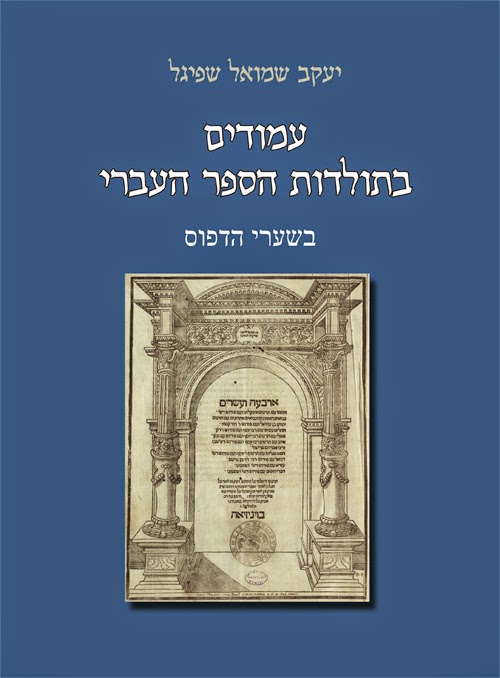
great interest to readers of the Seforim blog. The third volume of, Amudim
be-Toldot ha-Sefer ha-Ivri
by Professor Yaakov Shmuel Spiegel, of Bar-Ilan
University’s Talmud department.
As I have
written in the past, Professor Spiegel is one of the most prolific writers in
the Jewish academic scene, authoring of over 160 articles and 18 books (16 of
those are publications for the first time of works which remained in
manuscript).  Many suspect he possesses Hashbot
Hakulmos
(automatic writing).
His
articles cover an incredibly wide range of subjects related to many areas of
Jewish Studies, including history of Rishonim, piyutim authored by
Rishonim, bibliography and minhaghim, to name but a few. His uniqueness
lies not only in the topics but also that his work has appeared in all types of
publications running the gamut from academic journals such as Kiryat Sefer,
Tarbiz, Sidra, Alei Sefer, Assufot, Teudah, Kovetz
Al Yad
and also in many prominent Charedi rabbinic journals such a Yeshurun,
Yerushasenu, Moriah, Sinai and Or Yisroel. It is
hard to define his area of expertise, as in every area he writes about he
appears to be an expert!
He has
edited and printed from manuscript many works of Rishonim and Achronim on Massekhes
Avos and the Haggadah Shel Pesach. He is of the opinion, contrary
to that of some other academics, that there is nothing non-academic about
printing critical editions of important manuscript texts. Although there is a
known “belief” in the academic world, “publish or perish,” which some claim is
the cause of weak articles and books, at times, Spiegel’s prolific output does
nothing to damper the quality of his works. Another point unique to Speigel’s
writings, besides his familiarity with all the academic sources, he shows great
familiarity with all the classic sources from Chazal, Geonim, Rishonim and
Achronim, to even the most recent discussions in Charedi literature – this bekius
(breadth) was apparent well before the advent of search engines of Hebrew books
and Otzar Ha-hochmah. Alongside all this is his penetrating analysis and
ability to raise interesting points.
Some of
these articles were collected into a volume called Pischei Tefilah u-Mo’ad,
which was reviewed a few years back here
on the seforim blog. This volume is currently out of print.
One of
Professor Spiegel’s main areas of interest has been the History of the Jewish
Book. He has written numerous articles on the subject and even published
two books on this topic in a series called Amudim be-Toldot ha-Sefer ha-Ivri.  Volume one was first printed in 1996 and is
called Amudim be-Toldot ha-Sefer ha-Ivri: Haghot u-Maghim. It was
reprinted with numerous additions in 2005 (copies are still available). It was
reviewed by Dan Rabinowitz and me, a few years back here
on the Seforim Blog.
The second
volume is called Amudim be-Toldot ha-Sefer ha-Ivri; Kesivah Vehatakah.
This volume is currently out of print and will hopeful be the subject of a book
review by Dan Rabinowitz and myself in the next few months.
I think
that anyone who has an interest in the Jewish Book will enjoy this work
immensely.
In the near
future I hope to review this work in depth. Next week the blog will feature
some sample pages of this new work.
For a short
time I will be selling copies of this work for $32. The price includes airmail
shipping (to the US UK or Canada). Copies are also available at Biegeleisen.
For more information about purchasing this work, feel free to contact me at
Eliezerbrodtatgmail.com
To get a
sense of what exactly this new book is about, I am posting the Table of Contents
here:


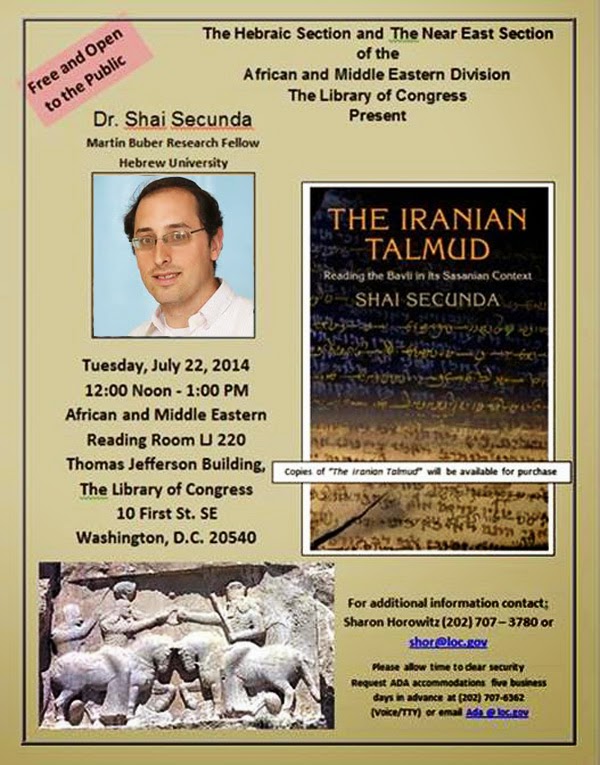
Upcoming lecture: Shai Secunda at the Library of Congress, Tues., July 22

The Seforim Blog is pleased to announce that Dr. Shai Secunda is lecturing at the Library of Congress this Tuesday, July 22. Open to the public. Come if you are around – and enjoy!


Crafting the Commandments

Albert D. Friedberg’s Crafting the Commandments has just appeared. The Seforim Blog is happy to present the following excerpt from the book’s conclusion.
Scholars have ascribed far too much importance to Maimonides’ enumeration of the commandments and far too little to the motivations that lay behind his appropriation of R. Simlai’s aggadah as the basis for the enumeration and to the significance that Maimonides attached to this aggadah. The proximate reason for creating an enumeration was his need to have a reasoned and methodical outline of all Torah legislation in front of him, a reminder of topics to guide his preparation of the upcoming code of law, a massive and unique undertaking. Thus we find him saying in the introduction to the ShM [Sefer ha-Mitzvot]:
All this [I would do] in order to guard against omitting any topic [emphasis added] from discussion, for only by including them in the enumeration of the commandments [heading the various treatises] would I insure against such omission.
This sense is reinforced by some of the Rules, especially Rules 7 and 10-14, which are essentially taxonomic rules rather than definitions of what constitutes a mitsvah. I posited that the logically unnecessary identification of this outline with R. Simlai’s count of 613 commandments owed its existence to Maimonides’ desire to incorporate the two fundamental beliefs of the Jewish faith, God’s existence and His oneness, into the legal realm, and thus transform their intellection into obligations, a dramatic departure from the preceding geonic paradigm. I inferred this conclusion from a dispassionate and unapologetic assessment of the mitsvah count. Maimonides stretched the meaning of mitsvat ‘aseh well beyond its common rabbinic usage, relying uncharacteristically on an aggadah of questionable legal worth, a homiletic creation with didactic aims and no pretensions of being precise, and resorted to a contrived and hardly compelling logic to arrive at the numerical target, likely fully aware of the variant results that could be legitimately obtained.
The enumeration, qua a reasoned list of commandments, has diverted the attention of the countless students of his works ever since the ShM left his hands. But I posit that it was not R. Simlai’s dictum that 613 commandments were given to Moses at Sinai that was significant, but rather R. Hamnuna’s accompanying exegesis. Maimonides used R. Hamnuna’s midrashic exegesis that the verses I am the Lord thy God and Thou shalt have no other God before Me specifically formed part of the count of 613 commandments to prove that to intellect the existence of God and His oneness constituted a positive, performative obligation. The credibility of R. Hamnuna’s exegesis was even more firmly established when Maimonides inferred from its language what he believed was a theological truth: the nature of the commandments to believe in the existence of God and to believe in His oneness was categorically distinct from the nature and motivation underlying the rest of the commandments. He explained this distinction by averring that the former were philosophically demonstrable truths, capable of being apprehended without the medium of revelation, while the latter were only conventions, necessitating the mediation of a lawgiver and prophet.
The two articles of faith occupy the most prominent position in the MT, appearing in the opening lines of the Sefer ha-Madda’. In a letter to his disciple, Joseph b. Judah, Maimonides wrote that he undertook to compile a code of law in his zeal for the glory of God, “in seeing a nation bereft of a truly comprehensive book (diwan) of law, and bereft of clear and correct [theological] notions.”  Only the inclusion of these two beliefs in the canon of law could have satisfied the requirements of “a truly comprehensive book (diwan)” containing “correct theological notions.”  In sum, the unequivocal and unique statement found in R. Simlai’s aggadah, that the beliefs in God’s existence and His oneness constituted positive obligations, led Maimonides to appropriate the aggadah, adopt its numerical value of 613, and conflate it with the outline that he was preparing—all despite the constraints that it imposed.
In the second half of the book, I turned my attention to the sub-section of positive commandments and drew some conclusions from the way they are described and defined in the Halakhot. While my readings hinged on what Maimonides actually wrote, I recognized that, being human, Maimonides was bound to make the occasional mistake. That said, the exceptional (but more than occasional) omission of the formulaic phrase “X is a mitsvat ‘aseh” at the start of a topical discussion held my special attention because of the implausibility of it being forgotten: the phrase is rich, bold, highly informative, and consistent with Maimonides’ sustained interest for making categorical distinctions. Additionally, and just as importantly, my readings focused on how Maimonides expressed himself. The rhetoric, the literary presentation of his ideas, and the logic of composition mattered as much to me as the slight inferences one could arrive at by noting the absence or presence of a particular term, elements which have constituted the more traditional way of studying his works.
I began the book’s second section by noting that in the Halakhot, Maimonides moves away from the contrived artificiality adopted in the ShM of using the term mitsvat ‘aseh to designate all types of legal themes: here he applies the term to a very specific case, that of an absolute and unconditional obligation. Combing scriptural and rabbinic sources, Maimonides searches for clear indications of unconditional commands and imperatives to perform well-defined acts. These he designates boldly and prominently at the commencement of each topical
discussion, with a formulaic phrase that states that the directive at hand is a mitsvat ‘aseh. Where Maimonides withholds the mitsvat ‘aseh designation, I theorized that he must have done so because the scriptural and/or rabbinic evidence was insufficient to make such a determination. I tested for this evidentiary insufficiency, and when confirmed, I theorized further that under the influence of reigning Islamic legal theory (which was also heavily if not wholly influenced by rabbinic thinking), Maimonides opts for a softer definition. As a result, certain scriptural directives are categorized as recommendations rather than orders, wise pieces of advice rather than commands. Supporting these with scriptural proof texts, he labels them with the solo term mitsvah, a label that he also uses to designate rabbinical directives. The scriptural mitsvot include such prominent directives as to love and fear God, to imitate Him, to appoint a king, to heed the call of a prophet, to rebuke the sinner, to honor the wise, to testify in court, and a few others.
I conjectured further that Maimonides deliberately withheld the scriptural designation from certain commandments that had been labeled as scriptural in the ShM when the plain reading of the scriptural text did not appear to provide sufficient evidence for them, even when rabbinic interpretation suggested otherwise. To this end, he chose an artful but somewhat concealed literary device to designate them as such, the participle of correct practice. This is the case with such prominent practices as the recitation of the Shema, the binding of the tefillin, the writing and placing of the mezuzah and the study of Torah.
In the heavily politicized atmosphere of Cairo, where Rabbanites were both assiduously courted and continuously attacked by sectarian groups (largely Karaites) over the role of the oral law in interpreting Scripture, Maimonides chose to keep his radical opinions hidden yet recoverable. When applied to the legal sections of the Torah, Maimonides’ peshateh di-qera hermeneutics would likely raise hackles among his own co-religionists and, worse yet, give comfort to the deniers of the oral law. His carefully planted literary cues could lead the reader who is familiar with rabbinic terminology and unburdened by popular and superficial conclusions to discover the Master’s true opinion or at the very least sense his ambivalence.
Maimonides was informed by a hermeneutics of peshateh di-qera that was firmly and demonstrably anchored in the Andalusian tradition. His insistence on presumed philological validity, however, left him uneasily placed, uncomfortably close to sectarian investigation and interpretation. Ironically, this led him at times to mount a struggling defense of his own traditional Rabbanite views, well aware that the plain sense of Scripture did not lend convincing support for such a stance.
Consciously or unconsciously, Maimonides navigated his legal system between the Rabbanites and the Karaites, upholding the former’s respect for authoritative tradition and the latter’s insistence on relying only on philologically informed readings. Maimonides’ extraordinarily novel application of peshateh di-qera to the halakhic corpus threatened the very foundations of a Rabbanism, one that was intimately intertwined with the Talmud and its authority. Nahmanides understood this too well when he criticized Rule 2:
[F]or this book of the master, its content is delightful, full of love [based on Song of Songs 5:16] except for this principle, which uproots great mountains of the Talmud and throws down fortified walls of the Gemara. For the students of the Gemara, this notion is evil and bitter. Let it be forgotten and not said.
Of course, Maimonides would not have conceded this point: he would have maintained that his paradigm flowed quite naturally from the pages of the Talmud. Did not the Talmud’s quest for peshateh di-qera support the distinction between divine and man-made law? Did not the rabbis of the Talmud acknowledge that explicitly stipulated scriptural laws enjoyed an epistemic advantage over and a distinction from man-made laws? To Maimonides the answer to these two questions was a resounding yes.


Thanks to his remarkable codification, Maimonides left an indelible mark on Jewish law. Unfortunately, an important part of his jurisprudence, the exquisitely fine distinctions he made between divine and human law and between command and advice, was never fully appreciated, perhaps because of its radical import—or perhaps because Maimonides, for his own good reasons, hid many of these contributions behind formulaic omissions, terminological nuances, and subtle literary devices. It is this rich and layered nuancing that in some modest way I have tried to recover.


Asufah of Rabbi Shmuel Ashkenazi

New sefer announcement: Asufah of Rabbi Shmuel Ashkenazi
By Eliezer Brodt  
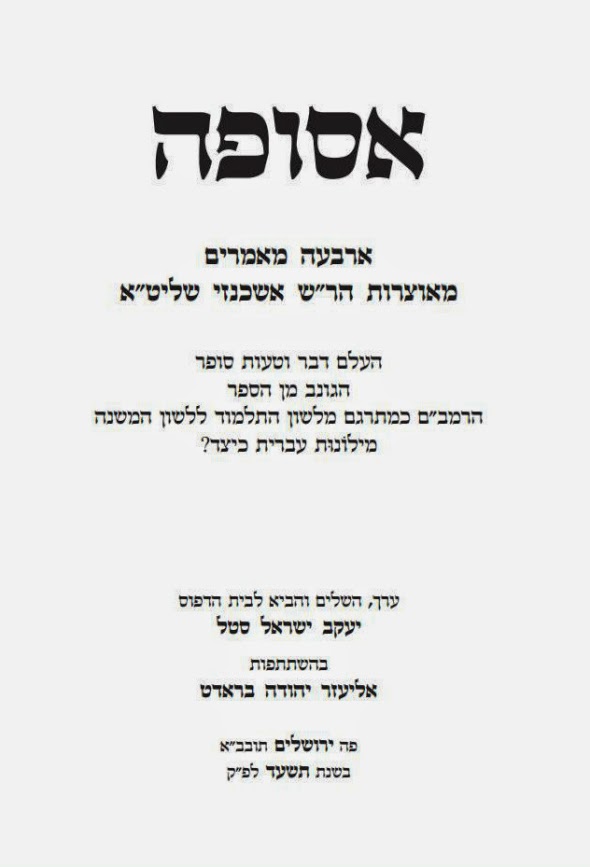
אסופה, ארבעה מאמרים מאוצרות הר”ש אשכנזי שליט”א [‘העלם דבר וטעות סופר’, ‘הגונב מן הספר’, ‘הרמב”ם כמתרגם מלשון התלמוד ללשון המשנה’, ‘מילונות עברית כיצד’?], ערך והשלים והביא לבית הדפוס, יעקב ישראל סטל, בהשתתפות אליעזר יהודה בראדט, כריכה רכה, 166 עמודים.
It is with great pleasure that I announce the release of another volume of Rabbi Shmuel Ashkenazi’s work- Asufah. As I have written in the past, we are trying to print the collected material Rabbi Ashkenazi has written over a seventy year period. Many additional volumes are ready to go to print, but we lack funds to
do so [any help would be greatly appreciated].
This new volume is composed of four articles. Two of these articles (no. 3 and 4) were printed in Leshonenu and Leshonenu L’Am, almost fifty years ago. A third article (no. 2) was partially printed in a recent volume of Yeshurun, and the fourth article (no. 1) was supposed to have been printed in the journal
Or Yisrael but was excluded from the volume right before printing.
The first article deals with mistakes that great people have made in their writings. The point of the collection is to show that anyone can make a mistake, however this does in no way detract from their greatness. This sampling is only a small part [18 samples] of a much larger collection of similar kinds of mistakes that we hope to print in the future.
The second article is a list of 85[!] cases of plagiarisms. It’s seventy two pages long and includes a very broad introduction on the subject. Hopefully this list will encourage others to collect similar instances and work to complete such a list.
The third article deals with the Rambam as a translator. As is well known, the Rambam wrote his classic work Yad Hachzakah in the Hebrew of the Mishna, as opposed to Talmudic Hebrew which is comprised of many Aramaic loanwords as well.  Thus, the Rambam had to translate many Aramaic terms into Hebrew. This article deals with this topic and shows many interesting points related to this.
The fourth article is a review of the popular Hebrew dictionary HaMilon HaChadash, by Avraham Even-Shoshan. This article was first published in 1967 in the language journal Leshonanu in three parts. Some of the material from these articles was added into later editions of the dictionary. There is a wealth of information in this article about words and expressions. Rabbi Ashkenazi had made a 12 page index for his own personal copy of the article; this index is published here for the first time in this volume. Additionally,
Rabbi Ashkenazi added many notes which he recorded over the years on the side of his copy of the article. All of the above addenda have been included in this printing.
 In sum, this volume is of importance to any person interested in the Jewish book or the Hebrew Language.
The book was printed in a limited run of 300 copies and is not being sold in retail stores. If one is interested in purchasing a copy he can do so either through me, or at Beigeleisen in the U.S. or Girsa in Jerusalem. The price of the book, including air mail shipping to the U.S., Canada or England is $24.
For a sample of this work or for any other information regarding this project, feel free to email me at: eliezerbrodt@gmail.com


New book Announcement- Megale Temirin: Special sale

New book Announcement- Megale Temirin: Special sale
by Eliezer Brodt
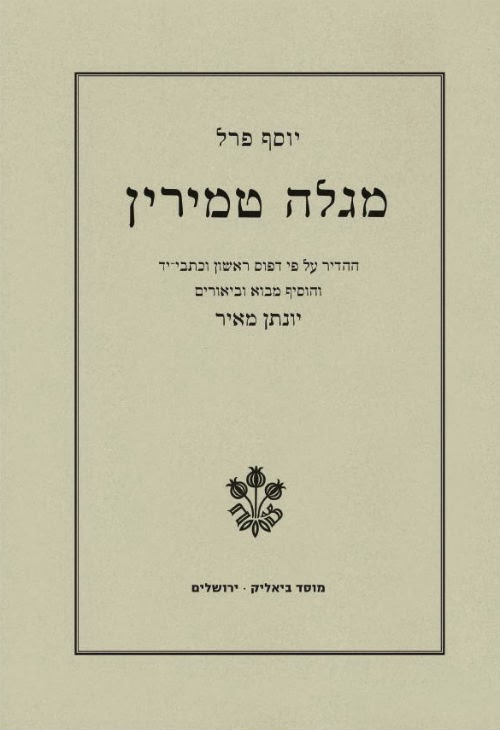
יוסף פרל, מגלה טמירין, ההדיר על פי דפוס ראשון וכתבי-יד והוסיף מבוא וביאורים יונתן מאיר, מוסד ביאליק.  ג’ חלקים. כרכים ‘מגלת טמירין’ כולל 345  עמודים +מח עמודים; כרך ‘נספחים’ עמ’ 349-620;  כרך ‘חסידות מדומה’ עיונים בכתביו הסאטיריים של יוסף פרל, 316 עמודים.
Megale Temirin (Revealer of Secrets) ed. Jonatan Meir. Three volumes, Mosad Bialik, Jerusalem
This is a short description of the work:
Megale Temirin, was first published in Vienna in 1819, and is considered one of the sharpest and wittiest pieces of Jewish literature written in the first half of the nineteenth century. It is perhaps the most important piece of Hebrew prose composed before the stories of Mendele Mocher Seforim. A sly and complex story deriding Hasidism and Hasidim, it is told through the correspondence between the beadles of Hasidic courts and contemporary rabbis. It presents a dark picture of avaricious frauds and swindlers whose main concern was control over territory and the souls of believers, a goal achieved by beguiling the authorities and attacking all opponents. Perl lends his book a ‘Hasidic’ feel both in its physical design and in its language, presenting a Maskilic version of the classic work Shivchei Habesht– that lays Hasidism bare so that no reader will ever be able to look at that, or any other Hasidic book, in the same way again.
In addition to the book’s satiric sting, which would have been enough to bring its readers a dual pleasure, Perl’s hints at contemporary people and places, hidden within anagrams and numerological tricks. With the unraveling of these clues, which also include the use of actual Hasidic sources, the book is a valuable, contemporary view of historical reality. A meticulous reading of the book may therefore open a window on the hidden worlds of Hasidism and the Haskalah at the start of the nineteenth century.
The first volume (Imagined Hasidism) of this collection serves as an introduction to the complex satirical writings of Josef Perl of Tarnopol (1773-1839). At the center of the book stands an analysis of the satires, Megale Temirin (1819) and Bochen Tzadik (1838), including a systematic treatment of the ‘characters’ in the central works and a discussion of the dozens of manuscripts to be found in the Perl Archive in Jerusalem. Perl’s writings are analyzed here in the fuller context of Hebrew and Yiddish literature in general and Maskilic and Hasidic literature in particular, as well as other polemical writings and governmental records critical of Hasidism. The study thus presents a complex and nuanced picture of the relationship between literature and history, between the anti-Hasidic reports and the more complicated historical reality, and lays the groundwork for further research into the genre of nineteenth-century Maskilic satire.
The second and third volumes (Megale Temirin) present for the first time an annotated edition of Megale Temirin. It is based on the first
edition and the scattered manuscripts and it includes a comparison to its Yiddish translation. The book is accompanied by appendices on its origins and contents, including fundamental treatments of several passages: an explication of the encoded names, the Hasidic sources used by the author, and the variants found in the manuscripts and in the only edition of the book in Yiddish.
The editor of the book, Professor Jonatan Meir, teaches in the Goldstein-Goren Department of Jewish Thought at Ben-Gurion University. He has published numerous articles and books on the Haskalah of Eastern Europe, Hasidism, and a number of varied topics in twentieth-century Kabbalah.
For a Table of Contents or more information about purchasing this work, feel free to contact me at Eliezerbrodt@gmail.com
 The set of three books is on sale for $62 before shipping. Shipping is available worldwide.


“Torah Study on Christmas Eve” — free Torah in Motion lecture by Dr. Marc B. Shapiro

In the spirit of inyana de-yomaTorah in Motion is offering, free of charge, Dr. Marc B. Shapiro’s lecture on “Torah Study on Christmas Eve,” delivered on Christmas Eve, 2009. You can get it here.[1]


We invite all those who download the class to visit Torah in Motion’s website www.torahinmotion.org where over a thousand other lectures and classes are available for download (including lectures by Dan Rabinowitz, Eliezer Brodt, and Marc Shapiro’s series of over 130 classes on great rabbinic figures). We also invite you to check out Dr. Shapiro’s upcoming tours to Spain, Italy and Central Europe. Information is available here.
[1] Or copy and paste into your browser: http://torahinmotion.org/cart/add/p2767_a2o1?destination=cart.


Rabbi Yechiel Goldhaber shiur in Flatbush, November 23

The readership of the Seforim Blog is invited to a shiur that will be taking place Motzaei Shabbos November 23 at 9PM. The shiur will be given by the noted author Rav Yechiel Goldhaber of Eretz Yisroel [link]. He has authored many wonderful articles and works on a wide range of topics most notably Minhagei Kehilos about customs, and Kunditon (link) about the Titanic, and the Cherem on Spain. 
The subject of the Shiur is על מקורות של מנהג קבלת שבת, and it will take place in Brooklyn at 1274 East 23rd Street, at the home of Dr. and Mrs. Shlomo Sprecher.