Announcement: Musings of a Book Collector podcast

Announcement: Musings of a Book Collector podcast

Eliezer Brodt

As a curator of knowledge, I enjoy sharing content for people to read, learn, and enjoy. A few years ago, I was privileged to explore another avenue for sharing information by recording an experimental podcast with Rabbi Moshe Schwed on the All-Daf platform. I have come to realize that the podcast format helps me immensely, as it requires me to compile and organize my research, and it enables me to “test it out” before publication—a” Pilpul Chaverim” of sorts.

I would like to continue with this experiment and record additional episodes on various topics for my new podcast, Musings of a Book Collector. Below is a link to my recently launched website, which contains all the information about the Musings of a Book Collector podcast and the various subscription options. Please check out the website and feel free to share your thoughts with me:

https://eliezerbrodt.com/

The first free episode is available here, here and here. It is dedicated to R’ Shlomo Zalman Auerbach and his Halachic work on electricity, Meorei Eish

The second free episode, on new and old Seforim related to Chanukah, titled Sefer Makabi’im, Sdei Chemed and other Chanukah related seforim was just recorded and is available for listening here and here and here.

For information on how to sign up for the longer series about the Meorei Eish and more, please see the website. If you choose to subscribe, kindly send me an email so I can thank you personally and keep you updated with improvements. (Apple/Podbean do not provide me with this information.)

With immense gratitude, 

Eliezer


New Sefer Announcement

New Sefer Announcement

By Eliezer Brodt

.מודעא לבית ישראל, ביטול מודעה, מודעה רבה, תשובות גדולי ישראל בנדון מצות מכונה בפסח, קיא + שיא עמודים, עי, רמרדכי קנאפפלער וישראל טרעס

I am very happy to announce the republication of the original seforim published at the beginning of the Machine Matzah Controversy in Galicia in 1859.  

One sefer, Modah Le’beis Yisroel is a collection of Teshuvot of those who were against Machine Matzah and the other one, Bitul Modah contains the Teshuvot defending Machine Matzah.

This volume was edited and produced by Rabbi Mordechai Knopfler and Sruly Tress.

This edition also includes many of the Teshuvos written over the years by various Gedolim on this subject, including from manuscripts.

Included in this volume is a fascinating article (65 pp.) by R’ Yechiel Goldhaber on the continuation of this Controversy that took place in Yerushalayim (including never before published documents).

In addition, this volume includes a useful introduction by Eliezer Brodt (43 pp.) about the Background regarding the original Controversy in 1859 and the History of the main Gedolim involved. This introduction is an expanded version of a presentation about the Machine Matzah Controversy given a few years ago, for All Daf available here and here.

For some sample pages and the introduction Email me at EliezerBrodt@gmail.com

Copies are available for purchase at the following locations:

In the US:

In Flatbush/ Marine Park at Mizrahi Bookstore (bluebirds15@yahoo.com)

In Boro Park at Biegeleisen.

In Lakewood at Numerous Locations.

For more Information

Contact me at EliezerBrodt@gmail.com

In Eretz Yisroel 

Contact EliezerBrodt@gmail.com


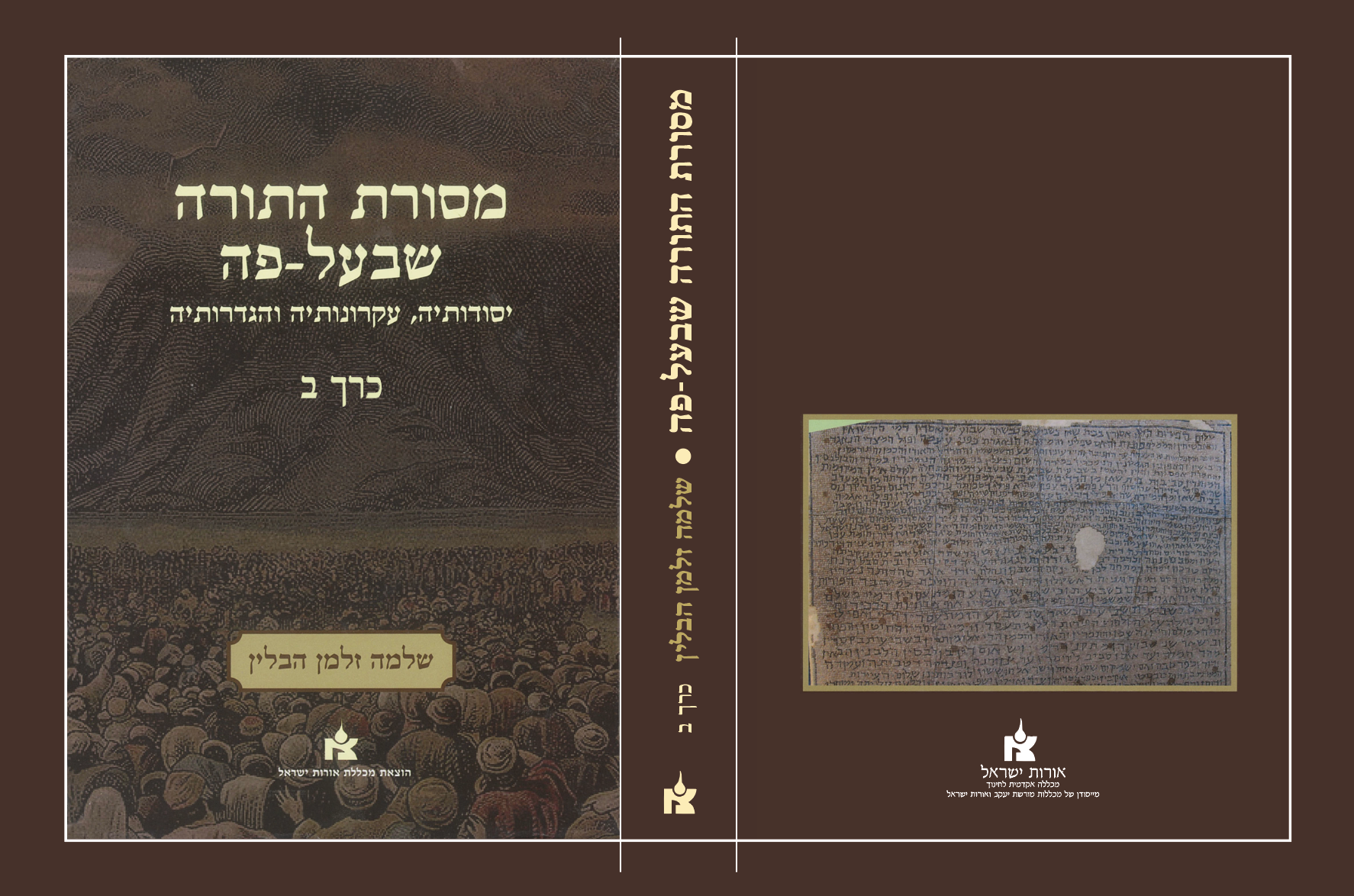
New Book Announcement: Mesoras Torah Sheba’al Peh by Harav Professor Shlomo Zalman Havlin

New Book Announcement: Mesoras Torah Sheba’al Peh by Harav Professor Shlomo Zalman Havlin

By Eliezer Brodt

רשלמה זלמן הבלין, מסורת התורה שבעל פה, יסודותיה, עקרונותיה והגדרותיה בג [בחלקים], 1048 עמודים

I am very happy to announce the recent publication of an important two-volume work, which will be of great interest to readers of the Seforim Blog. Mesoras Torah Sheba’al Peh by Harav Professor Shlomo Zalman Havlin, of Bar-Ilan University’s Talmud department.

There are various “agendas” in the following post:

The first: to further the Seforim Blog’s mission to inform its readership of new works and furnish them with a descriptive review; case in point these two incredible new volumes recently published.

Second: making some of the seforim mentioned and reviewed here available for sale; the proceeds help support the Seforim Blog.

Professor Havlin is one of the more prolific writers in the Jewish academic scene, having authored hundreds of articles and edited and published numerous seforim.

His articles cover an incredibly wide range of subjects in many areas of Jewish Studies; Geonim, Rishonim and Achronim as well as Bibliography, to name but a few. It is hard to define his area of expertise, as in every area he writes about he appears to be an expert!

He also served as chief editor of Bar Ilan University’s bibliographical journal, Alei Sefer for many years; in this capacity he also wrote numerous short but immensely insightful book reviews.

Over his career, RSZ Havlin devoted a lot of time and energy studying and analyzing various important Rishonim. Of note is the Rashba, he expended immense energy in publishing numerous manuscripts alongside his own in-depth essays regarding them. These were collected a few years back and published in two volumes by Mechon Even Yisroel.

He has edited and printed from manuscript works of Rishonim and Achronim, being firmly of the opinion, contrary to that of some other academics, that there is nothing non-academic about publishing critical editions of important manuscript texts.

His uniqueness lies not only in the topics he has taken up, but also in that his work has appeared in all types of publications running the gamut from academic journals such as Kiryat Sefer, Sidra, Alei Sefer as well as many prominent Charedi rabbinic journals such a Yeshurun, Moriah and others.

Another point unique to Havlin’s writings, besides his familiarity with all the academic sources, is that he shows prodigious familiarity with all the classic sources from Chazal, Geonim, Rishonim and Achronim, to even the most recent discussions in Charedi literature – this bekius was apparent well before the advent of search engines such as Bar-Ilan’s Responsa Project, Hebrew Books and Otzar Ha-hochmah. Alongside all this is his penetrating analysis and ability to raise interesting points.

A few years ago, my dear friend Menachem Butler made available dozens of RSZ Havlin’s publications online at his academia page available here.

About ten years ago, he published volume one of his writings, which contained fifteen chapters spanning from Chazal all the way until the Chazon Ish.

At the time, Professor Havlin mentioned to me that he hopes that he will find the strength and funding to publish the rest of his material. Over the years I reached out to him about it and he said he had no luck finding funding. To my great surprise, a few months ago he reached out to me and sent me the Table of Contents, saying the work has been finally published.

As one can see from the Table below, lots of material is devoted to the Rambam – to whom Havlin has devoted years researching all aspects of his writings from the manuscript to early printings. At one point, he published under Mechon Ofek the “Sefer Mugah (Authorized Copy) of the Rambam’s Yad and included an incredible introduction. This classic essay is included in this new collection alongside numerous essays of his on the Rambam many of which have also become classics.

These volumes have other important essays on Rishonim; included are his lengthy introductions to the Meiri’s Seder Kabbalah and his work on Avos, both of which he published critical, annotated editions through Mechon Ofek a few years back.

Some other essays in these volumes worth pointing out are his excellent introduction to the set Torasan Shel Geonim (published by Vagshal), and his essay on the authorship of the Kol Bo and Orchos Chaim.

There are also very important essays starting with the earliest Achronim to various essays on the Chazon Ish; sandwiched between are important essays on the Gra and others. One essay I enjoyed learning through a few times is his material on R’ Yechiel Ashkenazi from the time of the Rama. Another important essay of his which I enjoyed and use often is on Pilpul which was based on a talk in Harvard he gave many years ago.

There are also various book reviews of editions of seforim (some are rather sharp) all worth learning through carefully.

There is much more to say about the materials and essays in these two volumes but time is short.

Some of the essays were updated with new material or corrections from when they were published the first time.

Two minor complaints I would like to voice, one is there is no index to these works which makes it impossible to maximize all the nuggets all over in his various tangents. I imagine the reason for this is because indices costs lots of money to produce and the raising of funds for the publication was long, tedious and painful as it is so no index was included.

Another complaint which I have not come up with a good defense for is not every article has the original publication information included in the beginning of the chapter or at the end of the volumes. I imagine this too had to do with the budget.

Be that as it may, these two small complaints are negligible; these incredible volumes are worth owning and learning through carefully to gain from the research and discoveries of Havlin of over fifty years of learning.

I am the distributor of this work and I am selling copies of this work (currently it is not for sale anywhere else), so for more information about ordering\purchasing this work, contact me at Eliezerbrodt@gmail.com

Here are the Table of Contents of the book:

Vol. I:

Vol. II:


New Book Announcement

New Book Announcement

Eliezer Brodt

The Minchas Chinuch on Pesach Volume One, A deeper perspective on the Mitzvos of Leil Haseder (31+268 pp.)

The Minchas Chinuch on Pesach volume Two, A deeper perspective on the Mitzvos of Chametz (34+283 pp.)

I would like to announce the release of two new volumes from Rabbi Moshe Hubner series devoted to the the Minchas Chinuch, in English.

The first volume, released right before Pesach last year, is devoted to the mitzvos of leil haseder, including the mitzvah of matzah and sippur yetzias Mitzrayim.

The second volume which was just published is devoted to the mitzvos of chametz. Topics include eliminating chametz; the prohibition of finding and/or seeing chametz in our domain (bal yira’eh, bal yimatzeh); the prohibition of eating chametz; the prohibition of eating chametz erev Pesach; the prohibition of chametz-mixtures; and the brachah of Shehechiyanu upon the arrival of Pesach.

One of the most famous and popular sefarim of the Torah world is R’ Yoseph Babad’s Minchas Chinuch, first published in 1869. Since then, numerous editions were published, including annotations of many Gedolei Yisrael alongside full-length works on the sefer. It is famous for bringing a whole level of depth to the sugya at hand.

Now, for the first time ever, the English-reading audience can appreciate the greatness and uniqueness of the Minchas Chinuch! 

This new work is not a simple translation of the Minchas Chinuch, but rather an in-depth presentation. It incorporates all the background information necessary to understand the Minchas Chinuch in a clear, concise manner. It also includes numerous, beautifully designed charts (produced by Mechon Aleh Zayis) to help one follow the deep, “lamdushe” discussions.

In addition, many of the commentaries who analyze the Minchas Chinuch’s words (at times offering rebuttals or proofs) have been quoted, (collected from a few hundred sefarim, listed in a detailed bibliography) and scrutinized carefully.

It’s a crash course in lomdus within each page!

Currently, there is nothing similar available for the English-reading audience. High school students to post-kollel yungeleit can all enjoy the Yom Tov on another level with these groundbreaking new volumes.

For samples of the seforim email Eliezerbrodt@gmail.com

One can listen to a podcast interview with Nachi Weinstein on Seforim Chatter with R’ Moshe Hubner discussing his English adaptions of Minchas Chinuch on Pesach [here].

Copies of the work can be purchased at Mizrachi books via these links (here and here) or by sending him an email at bluebirds15@yahoo.com

Here is a Table contents of each work.

Volume 1:

Volume II:


New book Announcement

New book Announcement

After being out of print for several years, a new edition of Rav Yehuda Herzl Henkin z”l’s Shu”t Bnei Banim Vol. 1 was just published.

The volume remains as relevant, original, and significant as when written, 4 decades ago; and has haskamot from a first-rank lineup of gedolim: R. Gedalia Felder, R. Moshe Feinstein, R. Eliezer Waldenberg, R. Menashe Klein, R. Ovadia Yosef, R. Avram Shapira, and R. Mordechai Eliahu, all ztz”l.  The new edition is annotated and punctuated, making it even more accessible.  

Copies can be purchased in the US at Israel Mizrahi’s incredible book store via this link or via his email address bluebirds15@yahoo.com.

For information how to purchase copies in Israel contact Eliezerbrodt@gmail.com.

To see sample pages of the new edition, send an email to Eliezerbrodt@gmail.com.

For some recent write ups about R. Henkin: See here for an article from a close talmid of his and here for an article from Rabbi Shlomo Zuckier. Here is a link to a video presentation about his very productive life and legacy from December 30, 2020.


New Books by Rabbi Mandelbaum

New Books by Rabbi Mandelbaum

By Eliezer Brodt

This post serves a dual purpose; first, to describe some new seforim, thereby making the Seforim Blog readership aware of their recent publication. Second, to make some of these works available for purchase for those interested.

Part of the proceeds will be going to support the efforts of the Seforim Blog.

Earlier this year I wrote about two new editions of the Chida’s famous travel diary. A few weeks ago, a third edition of this diary was published (533 pp.). This edition is the complete travels in one volume. Here too, the editor has two sections of notes. One is devoted to deciphering all of the Chida’s melitzos מליצות. The second deals with the people whom he met, what he saw and much more.

The editor of this new edition is the legendary & prolific Rabbi Dovid Avrohom Mandelbaum of Bnei Brak. Both sections of notes are very valuable for those interested in the Chida.

As I have mentioned in the past about this travel diary:

On a personal note (for whatever that is worth) this work that has a special place in my heart as I have, to date, authored five articles about Ma’agal Tov and hope to IYH publish more.

I hope to write about the various new editions of this work in the future IYH. [Listen to this interview on Seforim Chatter about them].

Rabbi Mandelbaum’s edition is a very limited one, with only a small run of copies, as there are already a few other editions on the market.

Contact me at Eliezerbrodt@gmail.com for more information about purchasing or for sample pages of this new work.

For those not as familiar with Rabbi Mandelbaum’s work. [See here for a recent interview with him]. I will just highlight briefly some of the older ones and some of the newer ones.

Rabbi Mandelbaum has collected, edited and published numerous works, especially those related to Polish Jewry. At times, the material is from manuscript, others it’s from a wide range of sources that he gathers. He has been doing this for many years, long before the various computer programs have come out. Lots of his work focusses on collecting the Torah of a particular Godol, at times he publishes historical works about a particular Godol. He is famous for his work on Yeshivat Chachmei Lublin in general, especially for his work on R’ Meir Schapiro, including collecting all of R’ Schapiro’s Torah on Chumash and Halacha. He has also written extensively about the History of Daf Yomi, tracing everything about it from its inception.

In recent years he has also republished R’ Schapiro’s grandfather’s work Shut Minchat Shay.

One of his most famous works is his completion of the magnificent work on Chumash Pardes Yosef which, due to the author’s death in the Holocaust, was never completed (or if it was, it was lost). He first republished the 3 volumes of the work (with more thorough indexes) and then completed Chumash Bamidbar and Divarim in a similar style.

Another person Rabbi Mandelbaum has spent lots of time working on is Rav Aryeh Tzvi Frommer HY”D, Rosh Yeshiva of Yeshivat Chachmei Lublin [See this earlier post on the seforim blog all about R’ Frommer]. He reissued R’ Frommer’s Eretz Tzvi, and his Siach Ha-Sadeh with notes and indexes. In recent years he has reissued R’ Frommer’s work on Chumash and Mo’adim in two volumes (great material).

A few months ago, R’ Mandelbaum released a beautiful biography on R’ Frommer (447 pp.) Toldot Baal Eretz Tzvi Zal HYD, which I highly recommend.

Another work of R’ Mandelbaum which he published a few months ago from manuscript was from R’ Shimshon Wertheimer (484 pp. plus a 32 pp. index), titled Chidushei Upirushei Rabbenu Shimshon Wertheimer TZ”L Mi-vien:

A recent project of his has been documenting (with illustrations) the Mesirat Nefesh of Jews during the Holocaust. The first volume was devoted to learning during the Holocaust, including learning Daf Yomi. The next volume in the series (454 pp.) was devoted to all aspects of Mesirat Nefesh in trying to observe Chanukah during the Holocaust. There are also chapters devoted to Jews trying to observe it in Spain during the Spanish Inquisition era and more recently to Jews in Soviet Russia. The Hebrew version sold out right away.

This year he has released it in English titled Jewish Heroism: Lighting Candles in Troubled Time.

One last item of Rabbi Mandelbaum related to Chanukah and the Chida is his work Pardes Hachida which is a collection of everything the Chida wrote related to Chanukah (345 pp.). This work just came out a few weeks ago. This is another one of the many seforim related to the Chida published in recent years.

Sample pages are available upon request.