A Review of Parashas Hamelech – Al Mitzvas Hakhel, by Rabbi Moshe Parnes

A Review of Parashas Hamelech – Al Mitzvas Hakhel, by Rabbi Moshe Parnes

Reviewed by: Rabbi Moshe Maimon, Jackson, NJ

Sefer Parashas Hamelech on the mitzvah of Hakhel offers a unique and illuminating contribution on one of the lesser-studied mitzvos of the Torah. It fits the modern genre of encyclopedias on arcane subjects, while also combining elements of older and more established trends in Torah publications, weaving it all together in deft scholarly fashion. It is both an exhaustive accumulation of sources primary and secondary on its topic as well as a lively sefer iyun, providing fresh and penetrating perspectives on everything it touches.

The little explored, but very timely mitzvah of Hakhel which in the Temple era entailed a mass gathering at the Beis Hamikdash in the post-sabbatical year, where the assemblage would hear the Jewish King perform a special Torah reading, has been largely uncharted by the major halachic compendiums. A noteworthy exception is the Rambam who included it in his Hilchos Chagigah; the section of Mishneh Torah pertaining to the tri-annual Temple pilgrimage. The obvious reason for its exclusion from the codes is that this mitzvah was not of practical relevance for the Jewish Diaspora, and thus became a topic for theoretical discussion by experts only.

Interest in this mitzvah, however, was generated in scholarly circles with the return to the Land of Israel by large segments of World Jewry. Late in the 19th century, the illustrious R. Eliyahu David Rabinowitz-Teumim (“the Aderes”) published (anonymously) what to this point has been considered the most exhaustive treatment of the topic, his Zecher Lemikdash. (A major focus of the Aderes has been the possibility of reestablishing this mitzvah in modern times, even if only as a testimonial—an idea elaborated upon by R. Shmuel Kalman Mirsky in his article in Talpiyot vol. 6 pp. 92-118).

Additionally, besides for being virgin halachic ground, this topic also leads into fascinating discussions on more classical halachic topics such as laws the pertaining to daily prayer, the reverential treatment of Torah scrolls, and the specific requirements for the weekly Torah reading. Naturally, an incisive treatment of the unique Hakhel service in the Beis Hamikdash is of necessity accompanied by deep dives into the broader context of other mitzvos that were specifically pertinent in the Temple era, as well as close examinations of various elements of the Temple services and the qualifications necessary for Jewish royalty along with other such related topics.

With every passing shmittah cycle, interest in Hakhel seems to swell and this year is no different. Our author, Reb Moshe Parnes, a self-described businessman living in Boro Park but clearly a gifted scholar who devotes a good portion of his day to intense Torah study, timed the launch of Parashas Hamelech perfectly. His magnum opus was primed and perfected just in time for the culmination of the current shmittah cycle.

The volume begins with a thorough introduction devoted to the “aggadic” aspects of Hakhel and presents various different perspectives on the unique mitzvah, all culled from a wide variety of classical sources, such as the following:

  • A mass Torah-study session.

  • A demonstration geared for enhancing fear of Heaven among the masses.

  • An outgrowth of the mitzvah to make pilgrimage to the Beis Hamikdash during the shalosh regalim (a perspective enhanced by the Rambam’s placement of this mitzvah in Mishneh Torah as mentioned previously).

  • A reenactment of kabbalas haTorah.

The main body of the sefer is divided into three parts: The primary text is written in the style of a Shulchan Aruch with short, anonymous pronouncements given in the form of chapters (simanim) and paragraphs (se’ifim), which cover all the halachos of Hakhel divided into three main categories:

A] The section on the general aspects of the mitzvah covers the exact time and place for the mitzvah; the technical aspects of how the platform is constructed and the Torah scroll that is to be used for the reading.

This section ends with a spirited discussion of the sources regarding the fulfillment of this mitzvah in contemporary times. It concludes that since the mitzvah is dependent on mitzvas r’iyah (the Temple pilgrimage) which cannot be practically fulfilled without the Beis Hamikdash, the mitzvah of Hakhel cannot either be fulfilled at this time. To counter the suggestion of the Aderes that we at least make a remembrance for this mitzvah, the author points out that a zecher is not enacted when the mitzvah itself was never performed outside of the Beis Hamikdash. (The Aderes himself, following the Yaavetz, adopted the view that the custom of reading Sefer Devarim on Hashanah Rabbah evolved out of a zecher for Hakhel. If this were true, the author’s point would be considerably weakened, but it should be noted that this idea is purely speculative and does not account for the fact that the custom is practiced every year, whereas Hakhel was only relevant once in seven years).

B] The second section is devoted to the unique Torah reading that constitutes the actual mitzvah of Hakhel, and encompasses all aspects of this reading. At the end of this section, the author shows how many sources understood that this Torah reading was intended to lead into a practical mussar shmooze by the king, who would even exhort the people to be more pious in their religious observance. One prominent Italian sage, R. Shmuel Yehuda Katzenellenbogen (d. Padua, 1597), illustrates this point with a sampling of a schmooze targeting the ills of his own time—married women who did not cover their hair, or who wore wigs!

C] Section three covers all the rules regarding who is obligated by this mitzvah and who is exempt. No scenario is left unexplored, from children to converts to people with physical disabilities and much more. It is here that we can find detailed discussions pertaining to all aspects of life, even one as seemingly mundane as whether someone with impaired vision necessitating eyeglasses is considered “blind” and thereby exempted from Hakhel.

The main text is rather comprehensive and treats pretty much every aspect of the halachos of Hakhel, but it is in the two subtexts where we are treated to full blown halachic expositions of a great array of topics. The section titles “biurim” deals primarily with the material treated in the main text, providing the sources for the cited opinions with a good deal of breadth and thorough analysis—sure to delight those with a lomdishe bent.

The “iyunim” section, on the other hand, branches off the “biurim” section and includes in its scope interesting dives into topics which may be tangential to the main discussion but are compelling on their own. A sampling: What are the halachic prerequisites for determining who is a shoteh (insane)? Did the Israelite kings of the ten tribes have the halachic status of Jewish kings? What are the parameters of the mourner status conferred on one who has been placed in niddui (excommunication)? What is the reason for reading the Aseres Hadibros with the taam elyon? These and many more discussions are listed in the detailed topical index included at the end of the sefer.

The source material used for this work is exceptionally rich. When we read in the introduction the passionate dedication to the author’s late father, who possessed a tremendous library and knew how to utilize it well in his scholarly pursuits, we get the sense that the son is likewise in possession of these blessings. The fifteen-page bibliography at the end of the volume provides the authors’ names and dates of publication for the roughly 500 titles cited in the text.

A section at the end of the sefer includes a lively back and forth between the author and other scholars pertaining to their comments on his work, in which Rabbi Parnes credits his colleagues generously for their insights.

Recent years have seen a flurry of new sefarim which seem, more and more, to deal exclusively with highly specialized topics. This may just be an expression of the development of new directions in Torah scholarship in the contemporary “Torah world.” As celebrated masters of kol hatorah kulah become ever more scarce, their places are taken by localized experts who specialize in specific areas of Torah.

Perhaps, however, this trend is merely symptomatic of the nature of supply and demand in the sefarim market; a sort of Torah capitalism if you will. Consumers, sensing that previous generations have already sowed all that are worthwhile in the field of rabbinic scholarship, trend towards the encyclopedic, targeting sefarim that will reap all the fruits of the generations of labor and serve as a repository of all the information generated by scholars–both ancient and recent–on a given topic. Contemporary authors are simply aiming to meet that demand.

Whether indicative of new trends in Torah study or simply of changing patterns in the marketplace, sefarim focusing exclusively on issues that previously took up a few simanim (or, in some cases, no simanim) in Shulchan Aruch have become commonplace of late. Typically, these works excel more in their bekiyus than in their iyun. While these sefarim can be very effective for research purposes, one who still wishes to revel in that old time iyun is often better served looking for a title authored by one of the greats of the past.

Yet, as evidenced by the sterling example of Parashas Hamelech, the sources that have supplied countless generations with grist for the iyun mills are still capable of inspiring further significant halachic developments when utilized properly by capable baalei iyun. Rabbi Parnes should thus be commended for his wonderful and singular offering to the world of Torah scholarship that combines both of the aforementioned trends.

May the merit of the additional Torah study spurred on by this engaging work contribute to the tipping of the Heavenly scales and hasten us to that long-awaited moment where we can once again practice this monumental mitzvah.


‘Yikar Sahaduta Dipum Bidatta’ R. Tzvi Hirsch Levin, the Besamim Rosh and the Chida

Yikar Sahaduta Dipum Bidatta’

R. Tzvi Hirsch Levin, the Besamim Rosh and the Chida

Rabbi Moshe Maimon, Jackson NJ

Some of the worst epidemics we have known in our history have indirectly been the catalyst for important contributions by scholars who produced their valuable works under quarantine. Eliezer Brodt has published in these pages considerable lists of such scholarship, from bygone plagues down to the current terrible epidemic, which highlight the vast scope of this literary bounty.

I recently came across a very interesting sefer-epidemic connection which I have not seen mentioned yet. This material highlights the contribution of a scholar who was quite probably in quarantine when he produced his indices to a well-known and much debated sefer—R. Saul Berlin’s storied publication, Besamim Rosh. Perhaps most famous (or infamous) for its reputation as the ultimate rabbinic forgery, an exhaustive history of this volume has already been written (and interested readers would do well to refresh their memory with the excellent survey in this blog post by Dan Rabinowitz & Eliezer Brodt; see also Eliezer Brodt’s exhaustive bibliography on the subject in a footnote in Yeshurun, vol. 24, pp. 425-427). My own study of the saga of this sefer during the present COVID-19 quarantine era can hopefully shed light on some striking details pertaining to this account.

R. Tzvi Hirsch Levin in defense of Besamim Rosh

Those who have followed the rocky history associated with Besamim Rosh will recall the strenuous defense of this sefer penned by R. Saul’s father, R. Tzvi Hirsh Levin, rabbi of Berlin, and reproduced in the introduction to Rabbi Amar’s recent edition of Besamim Rosh, and most recently, together with a facsimile of the original, in R. Yisroel Chaim Tessler’s comprehensive overview of the history of R. Saul Berlin and the Besamim Rosh in Pe’alim LaTorah (vol. 34 pp. 226-229).

Modern books of Hebrew Bibliography, such as Friedberg’s Bet Eked Sefarim and Winograd’s Otzar HaSefer Ha’Ivri, contain an entry for a separate pamphlet published by R. Zvi Hirsch Levin written in defense of the Besamim Rosh entitled Yikar Sahaduta. This has led some to conclude that in addition to his letter of defense, R. Levin also wrote an additional pamphlet to clear his son of any suspicion. As far as I could tell, a separate pamphlet by this name is not to be found in any library or other public holding (cf. the aforementioned Pe’alim LaTorah article fn. 61), however, the Heimann Michael collection catalogue אוצרות חיים contains an entry on p. 250 for a copy of Besamim Rosh which has an additional pamphlet by R. Tzvi Hirsch Levin by this name appended to it, and this is likely the source for the entry in the aforementioned bibliographies.

As the printed books from Heimann Michael collection were later purchased by the British Library, it stands to reason that we may yet be able to ascertain if this Yikar Sahaduta is indeed a separate publication, though I have a hunch it is none other than R. Levin’s famous (untitled) letter that must have been bound at a later date with the sefer (as it is in R. Levin’s manuscript copy of the Besamim Rosh held at The Russian State Military Archives, see here).

The existence of a volume of R. Saul’s earlier controversial work, Mitzpeh Yakte’el (Berlin 1789), bound with R. Levin’s letter in defense of the Besamim Rosh, would lend some weight to this supposition. This copy is attested to by Moshe Carmilly-Weinberger, in his Sefer VeSayaf (New York 1967, pp. 213-215), who was somehow misled by it into thinking that the defense of Besamim Rosh was written and published with Mitzpeh Yakte’el four years prior to the actual publication of the Besamim Rosh! In any event, the British Library is at present closed to staff and public alike due to Covid-19 restrictions, and I have had to arrest my investigation of the matter for now.

While In Seclusion…

This untitled letter starts with some rhymed prose, beginning with the words איש עניו, and continues on with a passionate defense of the integrity of the sefer, and includes a barely restrained attack on those who dare to impugn it. R. Levin writes that anyone who disparages this sefer is besmirching the good name of R. Levin himself, for it was he who had given the sefer his imprimatur after reading it in manuscript form (prepared for him by his other son, R. Shlomo, later famous as R. Solomon Hirschell, Chief Rabbi of Great Britain). The manuscript had been in his possession for close to ten years prior to its 1793 printing, and it was R. Levin himself who had helped prepare the indices for this volume during his stay in Pyrmont:

והנה מעידני עלי שמים וארץ כי הספר הלז הועתק לי מבני הרבני המופלג ומושלם כמוהר”ר שלמה נר”ו זה כעשר שנים, ואני בעצמי עשיתי לו המפתחות כסדר הטורים בפרמונד… ואם כדברי המתקדשים הללו בי אני העון אשר הסכמתי להוציאם לאורה ולא על בני הגאון נר”ו לבד תלונתם כי אם גם עלי.

[I call heaven and earth as my witnesses that this sefer was copied for me about ten years ago by my son, the distinguished and perfect rabbi, R. Solomon, may G-d protect and keep him, and I personally prepared the indices according to the order of the Tur in Pyrmont… and if these sanctimonious hypocrites are correct, then the fault lies with me for sanctioning the publication; their grievance is not just with my son [R. Saul], the exemplary scholar, may G-d keep and protect him, but rather with me as well]

R. Menachem Silber pointed out to me that this Pyrmont is most probably the resort and spa town Bad Pyrmont. Here is a contemporary depiction of the promenade between the baths and the town of Pyrmont from 1780, about the time of R. Levin’s stay there, courtesy of Wikipedia.

R. Levin does not explain in this letter the significance of his stay in Pyrmont. However, in an entry in his journal, published by his descendant, R. Tzvi Michaelsohn, in his responsa Tirosh VeYitzhar in the section at the end of the sefer devoted to his antecedents’ novellae (new pagination, p. 35), we read the following:

כל זה כתבתי לי זה רבות בשנים ועתה בשנת תקו”ם לפ”ק בהיותי בפירמונד ונשב בד בבד ואין ספרים הצריכים בידי כי אם מעט אשר לקחתי מביתי ומהם ס’ בשמים ראש כ”י )ברור שכך צ”ל, ובמקור “כו'” וכנראה נשתבש המעתיק בהעתקת כתה”י – MM).

[I had written the above some years ago, but now in the year 1786, while dwelling in solitude in Pyrmont, I have few sefarim with me save for the few that I was able to take with me from home, including the sefer Besamim Rosh in manuscript].

This manuscript’s placement in Pyrmont is further evidenced by an inscription on the manuscript by one Yechiel Michel b. R. Isserl who, writing in Pyrmont (the date 1757 given in the JNUL catalogue is obviously an error in transcription), attests that the volume was in the possession of “the exemplary scholar and great rabbi of Berlin and its environs” (a reference to R. Levin himself). Later (p. 41), R. Levin writes further of his stay in Pyrmont:

ב”ה פירמונד. לאשר אין אתי כי אם ספרי משניות ושאר ספרי דבי רב אינם נמצאים כאן אמרתי לרשום כל העולה בלבי עד ירחם ה לנו ונעיין בה.

[By the Grace of G-d, Pyrmont: Having no sefarim with me here, save for a set of Mishnayot and a few other rabbinic volumes, I have determined to note whatever thoughts occur to me until God has mercy on us and I have the opportunity to do further research on them].

I have not found confirmation of an epidemic in the environs of Berlin in the year 1786, but the fact that R. Levin bemoaned his having to remain in solitude in Pyrmont, bereft of his holy works, until God shows mercy on his people, does strongly indicate that he was not there on vacation, but was forced to shelter in place there to avoid the plague. Perhaps one of the readers can supply more information and shed light on this episode.

Be that as it may, it is clear that R. Levin took advantage of his time in Pyrmont to thoroughly review the manuscript volume of Besamim Rosh (see also further references to Besamim Rosh in his novella, ibid. p. 38 section 41:3, 42:6 and p. 44 section 56:1), and it was then that he created the indices for the sefer. This must have been no small feat, as he was likely forced to rely in great part on his prodigious memory due to the dearth of basic source material available at Pyrmont.

Noteworthy in itself is that the manuscript of Besamim Rosh was among the few volumes R. Levin took with him to Pyrmont, indicative of his interest – unique among his contemporaries – in manuscript works of Rishonim. Further testament to this interest is R. Levin’s copy of a manuscript of Sefer Ra’avyah (today known as The Beth Din & Beth Hamidrash Library, London, England Ms. 11) which later formed the basis of the new edition published by R. David Deblitzky (Bnei Braq 2005), and which contains many glosses in R. Levin’s hand. One such gloss actually concerns the Besamim Rosh, and it is published here for the first time in its entirety (it is cited in R. Deblitzky’s edition, vol. 1 p. 40 fn. 14, though R. Deblitzky had trouble deciphering a couple of words):

נראה שיש כאן חסרון לשון ומ”מ אנו למדין ממנו שמחלוקת ישנה היא אי בעל קרי מותר בתפילין וכאשר כתבתי במקום אחר לסתום פי דוברי נבלה אשר שננו לשונם דבר מר על ספר בשמים ראש

[There appears to be a lacunae here, however, we may adduce from this statement that the debate with regards to the permissibility of a Ba’al Keri to wear tefillin is an old one, and I already wrote on this elsewhere to silence the speakers of mendacity (cf. Yeshayahu 9:16 – MM) who sharpened their tongues to speak ill of the sefer Besamim Rosh].

Besamim Rosh in the Chida’s Shem HaGedolim

Once on the topic of the Besamim Rosh and R. Levin’s letter of defense of it, I would like to revisit the issue of the Chida’s opinion of the sefer, and his response to R. Levin’s missive supporting it. (I had touched on this previously in a note to an article for Yeshurun vol. 28 p. 935 fn. 3).

Our primary concern will be with the entry on Besamim Rosh in the Chida’s popular bibliographical work, Shem HaGedolim, though our study of his views will give us occasion to examine statements in various other works of his as well (followed by loose translations of these statements that aim to preserve the intent of the Chida’s rich rhetorical melitza, if not necessarily its literal translation). In the course of our study, it will serve us well to bear in mind that the Chida was ever the prolific writer who particularly favored the Sephardic style of journalistic study, and in the course of his study he would constantly note in his journals anything he wished to be able to refer to later.

[In Sephardic parlance these journals would be called Zichronot – perhaps best rendered in English as ‘reminders’ – as distinct from the same term used in Ashkenazic circles to denote memoir literature. For the Chida’s own use of the term in describing his journals see the list in the bibliographical work Maranan VeRabanan appended to the Machon HaMao’r edition of Shem HaGedolim vol. 2 p. 52 #17. This list adds to the scant entry in the previous edition of Maranan VeRabanan, Jerusalem 1991, though it is far from comprehensive. The Chida also alluded to this term in the naming of his sefer Eyn Zocher as evidenced in his prelude there].

The Chida’s prolific sefarim output was based on this method of study, as he would use the material in these diaries for publication in his many sefarim (compare in general Meir Benayahu’s description of the Chida’s method of arranging his notes for publication in his biography, Rabbi Chaim Yosef David Azulay, Jerusalem, 1959, p. 93). Perhaps unique among his peers in this regard, the Chida, with his keen bibliographical instinct, was also accustomed to jot down historical and bibliographical items of interest to him, and these notations would later form the basis of his various works which together form his celebrated Shem HaGedolim (cf. Oded Cohen’s doctoral dissertation on the Chida’s cultural world: Chadashim Gam Yeshanim, Tel Aviv University, 2016, from p. 169, and recently, in the introduction to the new edition of Shem Hagedolim published by Machon HaMa’or (Jerusalem, 2019).

Contemporary editions of this work are all based on the 1852 edition, edited and published in Vilna by Yitzchak Isaac Ben-Jacob. This volume is an amalgamation of two separate, though similar, works published in various editions by the Chida, Shem HaGedolim and Va’ad Lechachamim, along with various supplemental additions appended by him to some of his subsequent works, ordered in separate arrangements – by names of scholars and by names of publications. On this edition in general, and on the editorial discretion (and liberties) employed by its publisher in particular, see the excellent article by Oded Cohen, ‘The Freedom of Editing: Isaac Benjacob’s Re-editing of Hida’s Shem Ha-gedolim’, in Zutot 10 (2013), pp. 71-87 (based on his aforementioned dissertation, from p. 182; in both sources the date for Ben Jacob’s edition is given as 1853, seemingly based on a simple computation of the Hebrew date, תרי”ג, however the date 1852 is clearly listed on the title page, so the sefer must have been published in the few months remaining to that year after Rosh Hashana).

This streamlined format is very beneficial as it made it easy to access all of the Chida’s previously disassembled comments on a particular sefer or author, and this popular format has been reproduced in all subsequent editions. Yet, while Ben-Jacob was careful to delineate the various sources from the Chida’s publications used in each particular entry, and noted them in his footnotes, the later editions omitted his notations altogether. This has proven to be a major drawback since when attempting to unpack the chronological progression of the Chida’s views concerning a specific sefer, tracking down the earlier works that now comprise the Shem HaGedolim is often indispensable in determining what he had written when.

The new Machon HaMa’or edition does make some headway in this regard, and many times the varying publications that make up a specific entry in this edition are sourced in the notes. However, as explained in their introduction, they chose not to replicate Ben-Jacob’s system, but rather to incorporate these sources in their own notes when deemed important, without systematically annotating the text. This is a regrettable decision, as without a systematic formula by which the reader can identify the different sources, the reader is often at a loss in determining that what appears at times to be one unified entry, has in fact been culled from a variety of sources.

The entry on Besamim Rosh is one such example, since this entry contains three separate statements regarding the sefer – from two different publications and espousing different views. The written record in the Chida’s other works contains varied positions towards the sefer; an initial enthusiastic reception shifting to reserved suspicion, and finally, unqualified acceptance. Only by classifying the differing statements chronologically, is it possible to ascertain the progression of his opinions.

The Chida’s Evolving Assessment

The first statement in Shem HaGedolim concerning this sefer comes from the entry for Besamim Rosh in the first volume of his sefer Va’ad LeChachamim, a bibliographical sequel to the two previously published volumes of Shem HaGedolim. Va’ad LeChachamim was first published in 1796, though this entry was apparently written very shortly after the 1793 publication of Besamim Rosh, as indicated by the opening words “עתה מקרוב” =“just now”:

בשמים ראש – עתה מקרוב נדפס ספר זה בברלין ושיש בו סימנים שצ”ב מתשובות הרא”ש ושאר גדולים וזה שמו בשמים גימטריא שצ”ב. רא”ש תשובות הרא”ש. וזה הספר הכינו וקבצו וחקרו הרב הגדול מהר”ר יצחק די מולינא ז”ל אשר מצא ספר גדול משו”ת הרא”ש וגדולים אחרים אצל גביר אחד והוא סילת וזיקק ולקט קובץ זה ועשה עליו הגהות כמפורש שם. ועוד יש הגהות כסא דהרסנא.

[Besamim Rosh – This sefer has just now published in Berlin, and it has 392 responsa from the Rosh and other great rabbis, and it is thus called Besamim, the numerical value of which is 392. This volume was collected and prepared for publication by the great rabbi, our esteemed teacher R. Yitzchak De Molina of blessed memory, who found a large volume of responsa from the Rosh and other great rabbis at the home of a wealthy patron, and he sifted through them and collected the select ones to which he appended his comments as described within. There are also included a section of comments entitled Kasa DeHarsena].

The decidedly reserved tone of this entry is readily apparent, and the reason for this is immediately explained by the Chida’s observation below:

ואשמע אחרי קול רעש כי יש בספר זה קצת דברים זרים ואמרו שהמעתיק הראשון בארץ תוגרמה מכ”י הרב יצחק די מולינא ז”ל יש לחוש שהוסיף וגרע. ולכן הקורא בס’ זה לא יסמוך עליו דאפשר דתלי בוקי סריקי בגדולים עד אשר יחקור ויברר הדברים ודברי אמת ניכרים. ודי בזה.

[I subsequently heard a clamor to the effect that there are some strange things in this sefer, and that the person in Turkey who first transcribed this sefer from the original manuscript of R. Yitzchak De Molina of blessed memory, may have perhaps added and detracted. Therefore, one who reads this sefer should not rely on it as there exists the possibility that nonsensical things have been attributed to great rabbis, unless he first investigates and clarifies the matter; and indeed, authentic material is recognizable as such. Let this suffice].

The Chida, one of the most outstanding rabbinic scholars and bibliophiles of his time, was typically very enthusiastic about newly published rabbinic manuscripts. His writings are replete with references to new ones he had seen, and from which he gleaned various insights for inclusion in his own sefarim.

The publication of the Besamim Rosh understandably excited him and he perused it for insight into topics he had himself dealt with in his writings. In his collection of halachic essays, Tov Ayin, published in the same volume as the aforementioned Va’ad LeChachamim, some of the insights gleaned from this perusal are recorded in various sections (#8, 9, 18:12,29,86).

In fact, one particular section (#9), is devoted solely to halachic observations pertaining to the Besamim Rosh. This section consists of various entries, culled by the Chida from his many diaries, to which were added notations pertaining to thoughts he had seen in the copy of Besamim Rosh that he had borrowed for a few days.

[The Chida was careful to note when he quoted from a borrowed sefer so that contemporaries could not criticize him for not citing a specific source from a volume he had himself quoted elsewhere; see for example Shu”t Chayyim Sha’al, vol. 2, section 10 paragraph 1, to wit: “והיטב חרה לו דהיה לי להביא דברי ספר הכוונת… אך גר אנכי בארץ וכמה ספרים עיקריים אין בידי ואם חיי”ם שא”ל ספרא וספרי מקיים מצות השבה” =“He was greatly upset that I did not cite Sefer HaKavanot… however I am but sojourner in this land and I lack many basic sefarim. Even when I did borrow a specific sefer, I was quick to return it”].

One entry in this section (#9:2) records the Chida’s enthusiastic reception of the new sefer (“היום נראה בעליל ספר בשמים ראש”), and all the entries show how various notations in the Chida’s writings were enhanced by his brief study of the sefer. The section concludes with the Chida’s measured remarks concerning the suspicion that had been raised in connection with this sefer:

הן בעודני קורא דרך ארעי בספר בשמים ראש הנזכר אחרי כתבי קצת פרטים שכתבתי לעיל שמעתי שיש מפקפקים בספר הזה כמו שכתבתי בקונטריס ועד לחכמים ריש מערכת בי”ת והנה צור”ף כי הספר הנזכר שאול הוא אתי לכן עמד קנה במקומו לעת הלום וה’ יצילנו משגיאות ויראנו מתורתו נפלאות כי”ר.

[During my perfunctory study of the aforementioned sefer Besamim Rosh, after I had written the few things previously mentioned, I heard that there are those who view this sefer with suspicion as I have written in my work Va’ad LeChachamim at the beginning of section Bet, which is appended to this work. As it was a borrowed sefer, I desisted from further study of it for now. May God protect us from blunders and may it be His will to reveal wondrous Torah insights to us].

This passage is revealing in that it demonstrates how the Chida’s writings were constructed. As mentioned earlier, the Chida only had the Besamim Rosh in his possession for a few days before desisting from studying it upon hearing the negative rumors surrounding the sefer. Nevertheless, in this short amount of time he had managed to write down several pages of novellae, as well as add various notations to existing entries in his diaries. Only after hearing the rumblings did he go back to add a cautionary note vis-à-vis the Besamim Rosh.

It is alluring to visualize the Chida sitting diligently at his desk with his notebooks open and pen in hand, variously writing and studying, studying and writing. The Chida describes his decision to desist from further study of the Besamim Rosh with the phrase, “לכן עמד קנה במקומו” =“and so the pen stopped here”—likely a quite literal statement.

The language in the aforementioned entry in Va’ad Lechachamim, “ואשמע אחרי” =“I subsequently heard,” also suggests that the two paragraphs were written at separate intervals. It seems that the first paragraph was written almost as soon as the Chida held the sefer in hand, and he quickly noted the bibliographical information in the manuscript of Va’ad LeChachamim that he was working on. Only later, upon hearing of the suspicions leveled against the sefer, did he go back and added the cautionary note. (I might add that I think it likely that the original entries pertaining to the Besamim Rosh contained some of the Chida’s customarily laudatory language, such as we find in Tov Ayin, but were later mildly edited for publication in light of the new findings).

Further evidence for the two stages in the Chida’s early reception of the Besamim Rosh can be adduced from an earlier entry for Mar Avraham Gaon in Va’ad LeChachamim, where the Chida first notes a responsum of Besamim Rosh pertinent to the discussion of using the biblical name of Yishma’el, and only in a later paragraph adds the disclaimer:

ואחרי כותבי יצאו עוררין על ספר זה כמו שכתבתי להלן במערכת בית ע”ש.

[After this writing, rumors were spread impugning this sefer as noted further in section Bet, see there].

The notebooks that were to become the Va’ad LeChachamim and the Tov Ayin were not the only volumes on the Chida’s desk at the time he conducted his survey of Besamim Rosh. He was simultaneously in the process of publishing his Nachal Kedumim, a running commentary on the Chumash culled from manuscript works of Rishonim along with his own observations, which appeared alongside the classic Chumash commentaries in the five volume set of Torah Ohr, in the years 1795-1797. In this work too, the Chida had occasion to reference the Besamim Rosh, though only in the addendum, Arvei Nachal. This was pursuant to his comments on Shemot (25:4) regarding the identity of the Chilazon from which the t’chelet dye was extracted for use in the construction of the Mishkan:

אחר זמן נדפסו שו”ת בשמים ראש ומשם הוכחתי בקונטריס טוב עין סי’ ט’ אות י”ב דחלזון הוא טהור ולפי”ז נחה שקטה האר”ש כל זמן שלא מצינו בדברי רז”ל להיפך.

[After some time, the responsa Besamim Rosh were published and from there I was able to prove in my compendium Tov Ayin, section 9 paragraph 12, that the Chilazon was a kosher species, and accordingly, the matter is settled as long as we don’t find any contradictory passage in the words of our sages of blessed memory].

Interestingly, here the Chida refers to what he had written in his Tov Ayin based on the Besamim Rosh, though this is already after the Chida became aware of the calumnies leveled against the Besamim Rosh, and he therefore adds the postscript that he is only relying on the Besamim Rosh as a proof text inasmuch as the conclusion drawn from this particular responsum is not contradicted by any Talmudic findings. It is instructive to contrast this position with his initial position regarding Besamim Rosh, displayed earlier in Tov Ayin (section 8) whereby the Chida exhorts his correspondent to follow the ruling of Besamim Rosh, as they are the words of the Rishonim.

One reference to Besamim Rosh in Tov Ayin (18:29), where the Chida highlights the finer points of his earlier discussion regarding the propriety of using the name Yishma’el, was similarly penned after the Chida had begun to view the sefer with suspicion, and he reiterates the disclaimer that he had made in Va’ad LeChachamim:

ועוד האריך בשו”ת בשמים ראש סימן י”ט ובתשובה לא חתים שמה דמארה עלה ואין לסמוך עליה, ומה גם שנשמע שערערו שהמעתיק תשובות אלו בתוגרמה הוסיף איזה דברים כמ”ש בקונטריס ועד לחכמים.

[This is elaborated on in the responsa Besamim Rosh section 19; however that particular responsum is unsigned and it cannot be relied upon – especially after hearing the rumors claiming that the copyist of these responsa in Turkey added some interpolations, as I have written in Va’ad LeChachamim].

Suspicion Raised by Anonymous Responsa

Throughout, it is apparent that the Chida’s main suspicion lay with those responsa that appear in Besamim Rosh anonymously. This concurs with the gist of the rumors that had reached the Chida, spelled out in the aforementioned entry in Va’ad LeChachamim and also mentioned briefly in Tov Ayin, namely, that an unnamed scribe in Turkey was responsible for inserting non-authentic responsa into his transcription of the original collection.

This brings us to the letter of defense of Besamim Rosh penned by R. Levin, and the Chida’s reaction to it. Though this letter was penned in 1794, it only reached the Chida’s attention after the 1796 publication of the first volume of Va’ad LeChachamim – though sometime before the 1798 publication of the second volume (a digital copy of which can be found here), for only in this second volume, does the Chida record his reception of this letter:

בשמים ראש – עמ”ש בח”א, ואחר זמן ראיתי בדפוס דברי הגאון הגדול המפורסם ר”מ ואב”ד דק”ק ברלין יע”א מהר”ר צבי הירש נר”ו, אמר מר כי שמע מוציאי דבה על הס’ הנז’, והפיץ והדיח כל הדברים יגעים ואסהדתיה דרב כי הספר תמים כתיב ביה והיה עשר שנים בביתו טרם שנדפס ואהניא לן יק”ר סהדותא דפום בדת”א.

[Besamim Rosh – See what I wrote in volume one. After some time I saw a printed letter from the great and famous exemplary scholar, Chief Rabbi and Academy head of the holy community of Berlin, may G-d rebuild His city Amen, our esteemed teacher and rabbi R. Tzvi Hirsch, may G-d protect and keep him. Our master said that he heard of people spreading calumnies against the aforementioned sefer, and he shattered and discredited all the inane words. The rabbi testified regarding the integrity of the sefer which had been in his possession for ten years prior to its publication, and we were pleased with his testimony against the deceitful speech].

Mystery Phrase

At the end of this volume, in a section devoted to corrigenda entitled Shulchan BaMidbar, the Chida noted that two words should be added to the concluding sentence of this entry: ותנן בבחירת”א.

However, the meaning of this rhetorical flourish is not entirely clear. In my aforementioned Yeshurun article, I suggested that these words be taken in context of the Chida’s generally strong aversion to controversy, and translated accordingly as “and it was therefore chosen for inclusion.”

Later, R. Betzalel Deblitzky wrote to me proposing that these words be understood as the Chida’s emphasis of his endorsement of R. Levin’s testimony, which he did by applying to it the same Talmudic phrase used to indicate that the Halacha is in accordance with those choice halachic testimonies recorded in Masechet Eduyot (cf. Rashi Kiddushin, end of 54b).

This reading, however, is not without difficulty. At the outset, if nothing essential has been added, it is hard to see why the Chida would trouble himself to add these two words in the corrigenda. Furthermore, in an addendum to what was to be the Chida’s final publication, his Mar’it Ha’Ayin, in a parallel passage to this one in Va’ad LeChachamim 2, the Chida writes:

ועתה אמת אגיד כי בקונטריס ועד לחכמים, ושם בטוב עין כתבתי דיצאו עוררין על ספר בשמים ראש, ע”ש, ואחר זמן ראיתי פתקא אחת שהדפיס הגאון מוהר”ר הירש אב”ד דק”ק ברלין להפיץ ולהדיח מה שערערו על הס’ הנזכר, והעיד שהס’ הנזכר הוא אמיתי ולא חלו בו ידים כלל, והוא היודע ועד, ועוד האריך בזה. ובודאי דסמכינן אהימנותיה ואהניא לן אסהדתיה.

[And now, I must tell you the truth; previously I had written in the compendium Va’ad LeChachamim, and in that same volume, in Tov Ayin, that rumors were spread impugning the sefer Besamim Rosh – see what I wrote there. Yet, after a while I saw a single flyer printed by the exemplary scholar, our esteemed teacher and rabbi R. Hirsch, Chief Rabbi of the holy community of Berlin, in order to shatter and discredit the rumors impugning the aforementioned sefer, and in it he testified that the aforementioned sefer is authentic and has not been tampered with at all, saying that he knows this to be true firsthand; and he elaborated in this vein. We should certainly rely on his trustworthiness, and I was pleased with his testimony].

It is instructive to note the similarity in language in these two parallel passages. It would appear that one of these passages actually served as the basis for the other. The fact that the Chida in this Mar’it Ha’Ayin passage only refers to the first volume of Va’ad LeChachamim and not to the updated entry in Volume Two, is a strong indication that this particular passage had been penned before the 1798 publication of Volume Two, in which case it is more than likely that the Chida copied the gist of this paragraph into his final draft of Volume Two as he readied it for publication. This possibility is further bolstered by the observation that the Chida’s language in this passage indicates that this is his first telling of his about-face on the Besamim Rosh on account of R. Levin’s bulletin.

The upshot of this is that in view of the source for the entry in Va’ad LeChachamim, the addition of the two words ותנן בבחירת”א in the corrigenda, which do not appear in the original source, does not appear to serve the purpose of emphasis alone. More likely, those two words serve a purpose germane to the context in which they appear, namely as an apologetic for the inclusion of the Besamim Rosh entry in the Chida’s sefer.

My final objection to this reading is based on my understanding of the Chida’s rhetorical melitzah style. This reading would have it that the term ותנן בבחירת”א here is borrowed from its Talmudic context, with the intent to draw a parallel from its usage there. I feel this reading is more typical of the Ashkenazic melitzah of Chida’s contemporaries – such as the celebrated R. Ya’akov Emden – who would throw around Talmudic and biblical phrases in loose context just to emphasize a point connected to the meaning of the phrase in its original context. In this sort of melitzah, one cannot fully comprehend the import of the words without knowledge of their meaning in the original, though oftentimes the message of the passage is abundantly clear on its own.

The Chida’s Sephardic melitza, however was of a rather different sort. In his melitzah, the words from the fragmented biblical or talmudical quotation – applied with little regard to proper syntax and grammar – are intended to take the place of words with similar meaning, and must be read with the sentence in order to make sense. As such, it would be expected that these two words are to be understood as saying something distinct and are not just intended to add fuel to the fire.

In this case, the Chida hyphenated בבחירת”א, which he invariably does in order to highlight that the word is being used in a different manner, or with a different spelling, than in its original context. This leads me to believe that בבחירת”א here is not a reference to the Talmudic use of the phrase in which בחירתא is the name given to the collection of choice testimonies in Masechet Eduyot, but is rather used here as to indicate the Chida’s choice (בחירה) in including the entry in his bibliographical compendium.

Unequivocal Acceptance

It may also refer to the Chida’s general acceptance of the sefer, as from this point forward, the Chida freely references the sefer without adding any note of reservation, such as in his Kisse Rachamim (Livorno 1803, Soferim, Tosefot, 1:9). Especially noteworthy is the citation in his 1798 publication Shu”T Yosef Ometz (section 11) where for the third time the discussion is raised about the permissibility of using names such as Yishma’el. While in the first two discussions cited earlier, the mention of the responsum in Besamim Rosh prompted the Chida’s subsequent disclaimer, here the mention of this responsum is stated with equanimity.

Despite the ambiguity of this particular addendum, it is clear that the Chida relied completely on R. Levin’s letter and that, in his mind, the sefer was now clear of all suspicion. Yet, one question remains. If, as the Chida stated in the Besamim Rosh entry in Va’ad LeChachamim, the suspicions concerned additions to the manuscript by an unknown scribe while still in Turkey—that is before reaching the hands of the publisher in Berlin, R. Saul Berlin, and his father, R. Hirsch Levin—how would R. Levin’s testimony to the integrity of the manuscript allay these suspicions? After all, R. Levin’s manuscript was based on the one which contained these alleged interpolations! (An editorial footnote to my article points out that this question already bothered the author of Dikdukei Soferim in his glosses to Shem Hagedolim).

In my Yeshurun article, I posited that the Chida deliberately concealed the real suspicions surrounding the sefer, namely that R. Saul himself was responsible for the fraudulent interpolations in Besamim Rosh, and out of respect for R. Saul’s father, the Chida instead blamed these insertions on some anonymous copyist in Turkey. Later, I saw that R. Matisyahu Shtrashun had already reached a similar conclusion in his notes to Sh. Y. Fuenn’s Kiryah Ne’emanah (Vilna 1915, p. 47-48).

An observation noted in the new edition of Shem HaGedolim by Machon HaMa’or may lend weight to this interpretation; nowhere in all the entries pertaining to this sefer does the Chida so much as mention the name of the publisher R. Saul Berlin. This is all the more conspicuous after the Chida mentions that the notes, Kasa DeHarsena, were appended to the sefer, without mentioning the author of these notes, R. Saul Berlin himself.

On the surface, this may indeed be indicative of the Chida’s holding of R. Saul in contempt for his role in the forgery. Yet, as noted in the same Yeshurun article, the Chida rarely cites his contemporaries in his Shem HaGedolim, and little can be deduced from the omission of R. Saul’s name. This is particularly true in light of the fact that previously, in his 1785 Machazik Beracha, and his 1790 Petach Eynayim, the Chida responded to critical glosses penned by the same R. Saul Berlin on the Chida’s Birkei Yoseph on Yoreh De’ah, and when referring to these glosses, the Chida does not name the author, whom he describes as ‘a formidable scholar’ (גברא רבא), and refers to him only as ‘the German Rabbi’ (see R. Reuven Margalios article in Areshet, Jerusalem 1944, pp. 414-417, and R. Ya’akov Chaim Sofer, Menuchat Shalom, vol. 8 p. 229). Similarly, when the Chida refers in his Shu”T Yosef Ometz (section 7), to something R. Saul wrote in Kasa DeHarsena, he refers only to the sefer but does not mention the author by name.

Furthermore, we have already seen how the Chida reiterates the claim about the errant Turkish copyist in his Tov Ayin, itself an indication that this is an accurate description of the claim countered by the Chida. As previously indicated, this passage underscores that the Chida was not worried about forgery as much as unworthy interpolation; he was therefore only concerned about an unattributed and unsigned responsum.

In the Final Analysis…

I now think that the Chida’s report of interpolations by an unnamed Turkish copyist should be taken at face value. Though the Chida’s language indicates that the complaints leveled against the Besamim Rosh were mere hearsay (as opposed to R. Levin’s defense which the Chida stresses he saw in print), and we cannot specifically identify the source of the rumors that reached his ears, we do know that similar rumors did indeed abound. Take for instance this quote from one of the leading antagonists, R. Mordechai Benet, in his Parashat Mordechai (section 5, page 8): ‘He amassed a heap of untoward sources,’ and compare also this selection from R. Levin’s letter in response to the accusations:

כי מצאו בתוך הבשמים חלבנה, והדברים לא יצאו מפי המחברים אשר נקרא שמם עליהם כי דבר בליעל יצוק בו להדיח עם ה’ מעל אלהיהם.

[They claimed to have found foul-smelling Galbanum among the Besamim incense, and that the essays are misattributed to the authors whose names they bear, for malicious content has been added in to cause Hashem’s nation to stray from their God].

Though R. Levin’s description of the charges does include the charge of forgery, it still does not name R. Saul as the culprit, and it may indicate the presence of rumors that accused him of negligence in publishing a work that contained forged and misattributed material, while stopping short of accusing him of actually perpetrating the forgery. It should be pointed out that from a historical perspective, the notion that a rabbinic work could be a complete forgery was such an outlandish proposition at that time that even the detractors wouldn’t openly make such a claim. It would be almost a hundred years before someone like R. Matisyahu Shtrashun would seriously consider the possibility that the entire work was the brainchild of R. Saul alone, and even after that we still find the likes of the great R. Meir Simcha of Dvinsk insisting that the Besamim Rosh does contain legitimate Rishonaic responsa (see Chiddushei R. Meir Simcha, vol. 2, p. 372).

As such, we should understand that the Chida accepted R. Levin’s defense of the Besamim Rosh more as vouching for the content of the sefer, and less as attesting to his son’s innocence. Contrast this with the comments of the author of Dikdukei Soferim and R. Matisyahu Shtrashun (cf. the earlier citations to their respective comments), who both wondered how the Chida could rely on R. Levin’s testimony and ignore a father’s obvious partiality towards his son. Obviously, whereas they took R. Levin’s missive as an argument in support of his son, the Chida took it as a vindication of the sefer itself.

The Chida’s reading is in fact borne out by the bulk of R. Levin’s circular (which R. Matisyahu Shtrashun admits he had not actually seen) in which R. Levin asserts that that the presence of some strange content in a sefer should by no means disqualify it, as the same can be said of many sefarim, and it is wrong to characterize a sefer on the basis of a few anomalous statements (“for this is typical of [Jewish] apostates, they collect what appears to them as strange Aggadot and unjust laws, and they then slant them in a way that will incite hatred and animosity towards us”). In any case, he adds, when taken in context these passages can often be explained in a satisfactory manner. The Chida thus appeals to R. Levin’s authority and esteem, and after reading R. Levin’s strenuous claim for the veracity and integrity of the content of Besamim Rosh, the Chida readily accepted his testimony, and discounted the false rumors without equivocation.

Ironically, though R. Matisyahu Shtrashun has all but discounted the Chida’s reliance on the testimony of R. Levin, my reading of the Chida actually anticipates R. Shtrashun’s own opinion of the sefer. R. Shtrashun concludes his brief survey of the reception of Besamim Rosh with the following remarks:

ואחרי כל אלה יש להעיר כי אף אם נחליט שכל הספר מראשיתו ועד אחריתו מעשי ידי ר’ שאול הנהו, לא נוכל לדחותו כלאחר יד חלילה, ואחרי אשר נסיר ממנו איזה דברים שנפש היפה סולדת בהם (אשר אמנם גם שם נשאר מקום רחב ידים להפוך בזכותו) הנהו מלא תורה כרמון וריח בשמיו נודף כאפרסמון בלול בחריפות ובקיאות, מחברו חותר ומעמיק בפלפול ישר בדברי הש”ס ובדברי הראשונים והאחרונים כאחד ממיוחדי גאוני זמנו.

[Having said all this, it is worth noting that even if we were to conclude that the entire sefer from beginning to end is but the handiwork of R. Saul, we still cannot discount it out of hand. For once we remove some of the more objectionable content (although there is actually ample ground to find justification even for this content), we will find it be full of excellent Torah insight, replete with ingenuity and proficiency. The author utilizes sound sophistry in developing his penetrating arguments from the Talmud and the works of Rishonim and Acharonim, like one of the special exemplary scholars of his time].

R. Shtrashun, like most of the others who dealt with the subject, was primarily concerned with the question of the sefer’s authorship, and indeed in this regard the jury has come out strongly on the side of those who claim R. Saul produced this volume on his own. Yet, as demonstrated above, the Chida’s main interest in the provenance of the sefer was to ascertain the reliability of its content. As such, the Chida was delighted with R. Levin’s yikar sahaduta – esteemed testimony, who concluded, much as R. Shtrashun was later to write, that despite some of its questionable content – for which a justifiable argument could be made in any case – the sefer on the whole was full of valuable content, and all reports to the contrary were but pum bidatta – salacious rumors.

Taken this way, R. Levin’s appraisal, enthusiastically received by the Chida, and echoed in the assessment of R. Shtrashun, may yet stand the test of time.

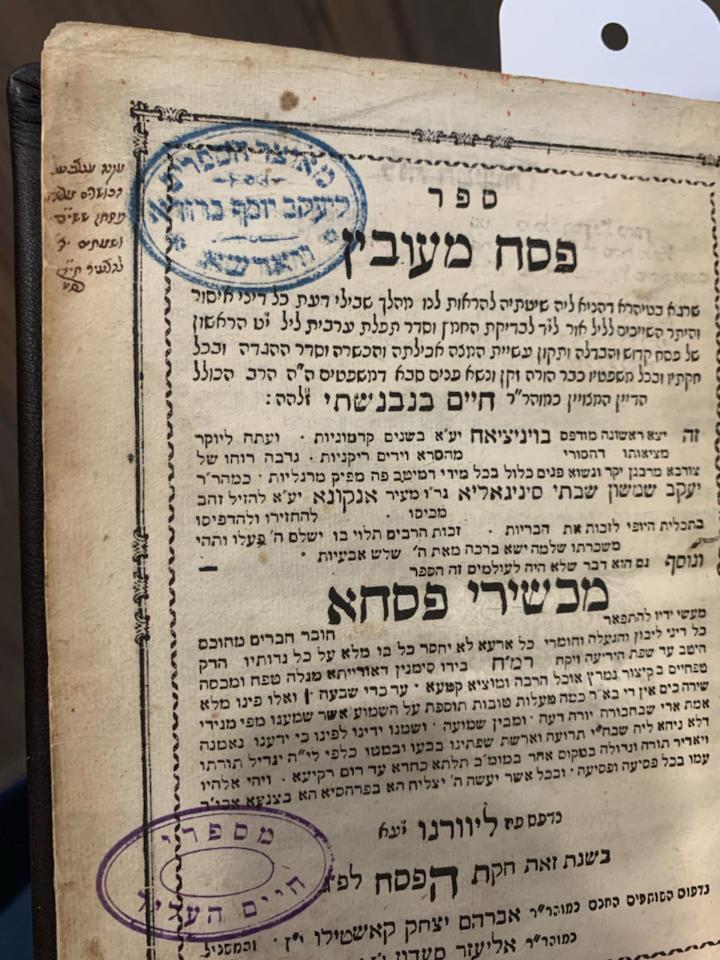

A Gift for Rabbi Chaim Yosef David Azulay: On R. Yaakov Shimshon Senigallia, author of the Machshirei Pischa haggada, and his relationship with Rabbi Chaim Yosef David Azulay,‘the Chida’.

A Gift for Rabbi Chaim Yosef David Azulay: On R. Yaakov Shimshon Senigallia, author of the Machshirei Pischa haggada, and his relationship with Rabbi Chaim Yosef David Azulay,‘the Chida’.

Moshe Maimon, Jackson NJ

Every antique sefer collector has his specialty. Some collect first prints, some collect classic editions and some collect the prints from a specific European press. The genres vary as well, with some focusing more on Kabbalah while others focus more on polemical literature. Yet, every collector will tell you, that each sefer has a story, and when you examine the individual characteristics of the sefer, the personalities involved with the sefer – whether it be the author or previous owner or the like – verily come alive and step off the pages to tell you their story.

One such cherished possession in the collection of a friend of mine, is the 1788 edition of the classic haggada, Pesach Me’uvin, by R. Chaim Benveniste, chief rabbi of Izmir in the tumultuous era of Sabbatean messianism and its after wake, and author of the important and voluminous halachic compendium, Kneset HaGedolah which collects and analyzes the considerable halachic literary output of the preceding centuries.

Benveniste’s haggada Pesach Me’uvin, first published in Venice 1692, is likewise an important compendium of halachic rulings pertaining to Passover and the seder night, and is widely quoted in the standard halachic sources. It has since been printed many times, up to the most recent edition (Lakewood 1997) in which the manuscript glosses of R. Yaakov Emden were included. A unique feature of the first publication is that it was printed simultaneously in two editions – one containing the Sephardic rite and one containing the Ashkenazic rite.

The 1788 edition is the second edition of this haggada and it was published in Livorno (Leghorn) by a young and promising scholar from an aristocratic Italian family, R. Yaakov Shimson Shabetai Senigallia of Ancona. Along with the Pesach Me’uvin, this edition included the original work of the publisher, R. Senigallia, called Machshirei Pischa, which continued the work of R. Benveniste concerning the laws of kashering kitchen utensils for Passover. 

This would prove to be the first of many scholarly contributions by R. Senigallia, and by the time of his death in 1840 he had built up a reputation as a great scholar, as well as a pious and saintly individual, with many important publications to his credit.[1] This work too would stand the test of time, and a hundred years later, in 1889, when the Netziv of Volozhin had his own commentary on the haggada, Imrei Shefer, published in Warsaw, he had it printed together with the Pesach Me’uvin and Machshirei Pischa.

At some point during the Chida’s tenure in Livorno, R. Senigallia became personally acquainted with him,[2] and the two would maintain a friendly correspondence throughout the years. R. Senigallia would refer frequently in his writings to the Chida’s own works, always with great honorifics, and after the passing of the latter, R. Senigallia was wont to chastise a fellow rabbinic scholar when he felt not enough deference had been shown in arguing with Chida’s halachic rulings.[3]

Before presenting the Chida’s copy of R. Senigallia’s haggada, a brief summary of the surviving record of their correspondence, preserved in the Chida’s letters published by Dr. C. Rosenberg,[4] is in order. Only one actual letter to R. Senigallia from the Chida has survived (#7 p. 11), a critical edition of which is appended at the end of this article, but in his other letters the Chida often makes mention of R. Senigallia, from which we can reconstruct a partial record of their correspondence and from which we can gage the nature of the close relationship they shared. 

The earliest mention of R. Senigallia is in a letter (#3 p. 7) the Chida wrote in the summer of 1787 to his erstwhile pupil and confidante, R. Yoel Camis of the Ancona Beth Din, in which he shares that he had received requests from R. Senigallia and R. Elia Nahamo, they too of Ancona, to give his haskama on the forthcoming publication of R. Senigallia’s aforementioned haggada. The Chida writes that he is unable to comply as he has already made a firm decision not to grant any haskama, and he has already had occasion to turn down many persistent entreaties from close acquaintances on account of this decision.[5 ] Concurrently, the Chida requests of R. Camis to make peaceful overtures towards the aforementioned rabbis and beg them to excuse him.

The mention of R. Senigallia in this letter is not accompanied by the terms of endearment we find in later references to him in the Chida’s letters, and perhaps we may surmise from this that they had not yet developed the close relationship they would later share. This assumption is bolstered by the fact that R. Senigallia apparently did not feel he could rely on the merit of his own relationship in approaching the Chida, and therefore turned to R. Nahamo, whose own haskama graces the sefer, for help in requesting the Chida’s haskama.[6]

Aside for the one letter in the collection addressed to R. Senigallia, the remaining references to R. Senigallia are found in the Chida’s letters to his son, R. Raphael Yeshaya Azulay, who had assumed the position of Chief Rabbi of Ancona in the summer of 1788. The Chida played an integral role in the negotiations with communal leaders to have his son elected to this position,[7] and he remained very appreciative of the efforts of the Anconians who had helped with this appointment.[8] It is difficult to ascertain if R. Senigallia had himself assisted in this matter, but the fact remains that from this point forward, he is mentioned frequently in the letters from the Chida to his son,[9] and we may rightly surmise that he had quickly become a close member of the inner circle of the new rabbi of Ancona.

Almost all of the references to R. Senigallia are in the context of the Chida’s request that his son extend warm greetings to R. Senigallia in his name, and the Chida often adds that he prays for R. Senigallia constantly. The Chida also says as much himself in his letter to R. Senigallia, where he also makes mention of his learning and praying for a few other philanthropists in Ancona as well. Likely this is indicative of the gratitude the Chida felt towards these individuals for the financial support they may have extended to the Chida,[10] and this is why the Chida wanted them to know that he was repaying his debt of gratitude.

Besides for learning and praying for the merit of his benefactors, the Chida would also honor them with his letters, and his holiday greetings to R. Senigallia in the letter to him preserved in this collection (a critically edited version of which is appended below) would seem to fit that bill perfectly.[11] Yet, the terms of endearment with which the Chida consistently refers to R. Senigallia, such as ידידינו אהובינו (our very dear beloved) and מאור עינינו (the light of our eyes), indicate clearly the genuine affection he felt for the latter. In one letter (#22 p. 35) he calls him ידידינו חמודינו נשמת רוח חיים (our very dear cherished breath of life), in which חיים meaning life, is a double entendre, also being the Chida’s first name – indicative of how important R. Senigallia was to him.

The letters also discuss other interactions the Chida had with R. Senigallia, such as the gifting to him of the Chida’s works Sha’ar Yosef (#24 p. 39) and Shem HaGedolim (#32 p. 49), or the distribution through him of other sefarim (#26 p. 43; #51 p. 67). We learn from these letters of instances (#10 p. 18; #11 p. 21) where R. Senigallia had turned to the Chida for his assistance in communal affairs, and in one case (#36 p. 53), the Chida asks his son to reply in his name regarding a request made of him by R. Senigallia for a segula needed for an acquaintance who had taken ill.[12]

All in all, this sampling serves well in painting a picture of a cordial relationship that blossomed with time and eventually became a deep and abiding friendship. At one point, their correspondence had reached a point where the Chida would become greatly distressed when too much time had elapsed without a letter from R. Senigallia (#25 p. 42), and by 1793, five years after R. Senigallia had published his Machshirei Pischa, a scant two weeks without hearing from him would give the Chida pause (#34 p. 52).

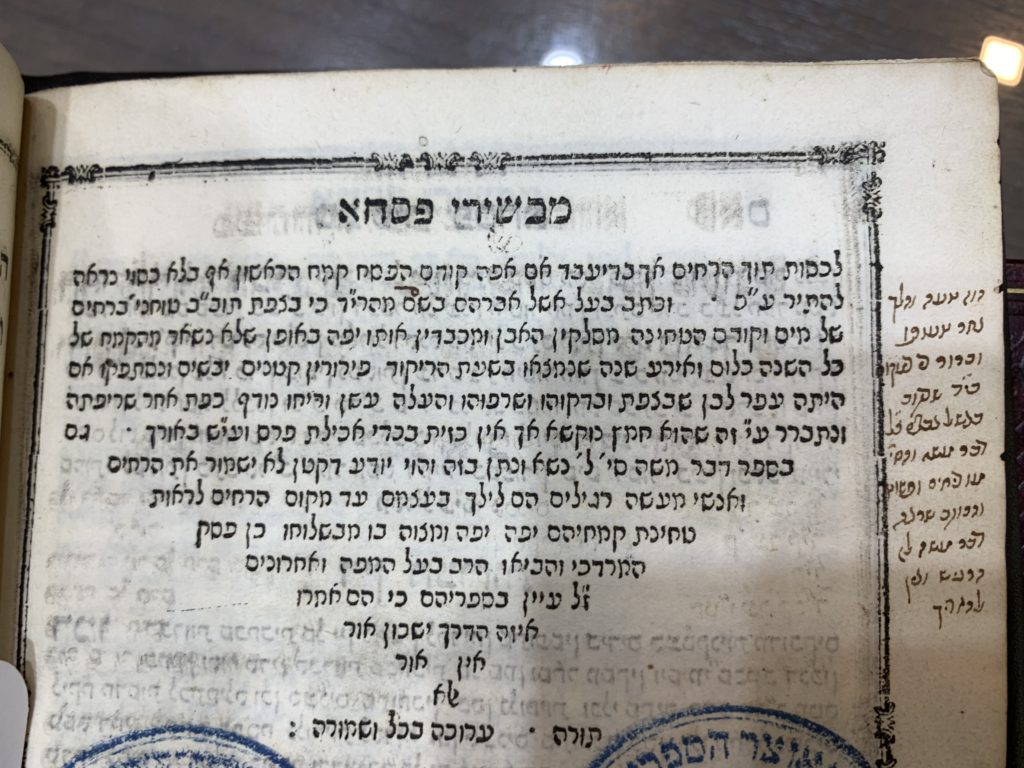
We are now in position to better appreciate the Chida’s inscription in the copy of this haggada gifted to him by R. Senigallia. We don’t know for certain when the haggada was given, but knowing of R. Senigallia’s interest in having the Chida’s recommendation on his work, it is likely that it was gifted shortly after it was published. The Chida’s apparent delight in the gift is evident in his inscription:

 מתנה מנצב על הכושרים מכשירי פסחא ששי”ם ושמחים יצ”ו להצעיר חיד”א ס”ט

Loosely rendered, it reads thus (and we emphasize “loosely”, as the Chida’s melitza is not given to literal translation): “A present from the one who stands over and guides those who are kashering and readying the preparations for Pesach joyously and happily to the humble Chida”. This clever inscription incorporates the title of the sefer Machshirei Pischa (“preparations for Pesach”), the nature of the sefer (“stands over and guides those kashering”) and even the name of the author whose initials make up the word ששים (“joyously”).[13]

Evidence of the Chida’s having studied the sefer comes from his gloss on the last page of the Machshirei Pischa section where R. Senigallia references the discussion of the Safed practice for kashering baking utensils. R. Senigallia quotes the sefer Eshel Avraham (Orach Chaim 453)14 who in turn quotes the respona of R. Yosef David of Salonika, Shu”t Bet David (Salonika 1740), who discusses this practice. R. Senigallia further cites the responsa of R. Moshe Amarilio, Shu”t Dvar Moshe (#30) who he says also discusses this particular practice. 

The Chida’s sharp eye, tremendous bekiut and keen bibliographical sense were on full display in his comment on this:

הוא טעה והלך אחר טעותו וברור כי במקום בי”ד שכתוב באשל אברהם צ”ל דבר משה והסי’ מוכיחים ופשוט והכותב שראה דבר משה לא הרגיש ואין להאריך

The Chida was quick to realize that by citing Shu”t Dvar Moshe as an additional source to the Bet David cited in Eshel Avraham, R. Senigallia was unwittingly duped by a typographical error in the Eshel Avraham. When the Eshel Avraham originally cited the Bet David, it was a mistake (as evidenced by the inaccurate citation), and in fact should read Dvar Moshe, which, it turns out, is the only source to discuss this practice.

I imagine that over the course of their long and fruitful correspondence, the Chida must have had occasion to bring this correction to the attention of R. Senigallia, and I imagine R. Senigallia must have been just as overjoyed – ששי”ם – with the knowledge of the Chida’s delight in his gift and his interest in the sefer, as we have been to learn all about the lives and emotions of these two great individuals as they come to life and step right off the pages of this cherished haggada.

*****

[1] See the entry for R. Senigallia in R. Mordechai Shmuel Girondi’s Toldot Gedolei Yisrael (Trieste 1853, p. 158). It should be noted that the list of publications there is scant compared with the fuller listing in Dr. C. Rosenberg’s Igrot M’Harav Chida (Budapest 1927, pp. 11-12). It should be further noted that some of the titles listed in R. Girondi’s work as manuscripts, such as Yaakov L’chok and Shomer Shabbat, had actually been published earlier together with other works of R. Senigallia. For a complete bibliography of his works, in print and in manuscript, see the entry for R. Senigallia in Asher Salah’s Le Republique Des Lettres, Brill 2001, p. 617.
[2] One meeting is recorded by R. Senigallia in his responsa, Meged Shamayim, Livorno 1844, p. 22a, in which R. Senigallia remembers debating the Chida with regards to a problematic text in Shu”t Rashbash. This meeting is said to have take place twenty years before the writing of this responsum, though the responsum is undated and all we know is that it was written after the Chida’s passing in 1806. Presumably, R. Senigallia was in Livorno for the 1788 printing of Machshirei Pischa, and perhaps that is when he met with the Chida, though there is no way to know for certain. R. Avraham Tikotzky writes in his preface to the Jerusalem 1986 edition of R. Senigallia’s Matan B’seter – Niddah (p. 10) that the Chida never met with R. Senigallia in person save for the one time when the Chida saw R. Senegallia as a youth (כשהחיד”א ראה את רבינו בעודו בחור). No source is given for this contention, and this is hardly evident from the aforementioned source in Meged Shamayim.

Despite the more than 200 miles separating Ancona on Italy’s east coast and Livorno on her west coast, it is likely that over the course of the Chida’s twenty six or so years in Livorno the two had more than one occasion to meet up, either in Livorno or Ancona. This is all the more likely when we consider that the Chida’s eldest son served as Chief Rabbi in Ancona from 1788 and on, and on at least one occasion, in the summer of 1791, the Chida did make the journey to Ancona to visit with him (See letter 22 on p. 34 and Dr. Rosenberg’s note there, see also p. 12 fn. 3 where he surmises the Chida’s wife, whose warm regards for R. Senigallia’s wife are expressed in the Chida’s letter to him, owed her acquaintance with Mrs. Senigallia to this visit).
[3] See Meir Benayahu’s biography: Rabbi Chaim Yosef David Azulay (Jerusalem, 1959 pp. 122-123, the reference in Asher Salah’s aforementioned bibliography to pp. 112-113 in this book should be corrected).
[4] Hatzofeh L’Chochmat Yisrael, Vol. 11 (Budapest 1927, pp. 241-309). This collection has likewise been printed in a separate pamphlet, also in Budapest 1927 (available here), and the references to this work in the present article follow the pagination in this pamphlet.
[5] The Chida emphasizes this point with the following melitzah (wordplay): ואין לדרוש בקל וחומר כי אם בגזרה שוה. This phrase which is a spinoff of the Talmudic phrase found in Pesachim (66a) and elsewhere (דאין אדם דן גזירה שוה מעצמו אלא קל וחומר) has been explained by Dr. Rosenberg in a footnote to mean that Chida’s refusal to grant haskamot was on account of his humility; he did not want to appear important (חמור) at the expense of others (קל), but rather wished to be viewed as an equal (שוה).

Whether this is indeed the Chida’s rationale for withholding his haskamot is debatable (and Benayahu in his biography (pp. 96-97) has made the convincing case that there must have been other factors as well), but it is clear that Dr. Rosenberg, who in any event had little appreciation for the melitzah of the Chida (as per his own comments in the introduction to his edition of Igrot), missed the innuendo in this melitzah as well. In this context, it is clear that what the Chida meant to say was that he does not want to be strict (חמור) with some requests for haskamot and lenient with others (קל), but rather must apply his decision (גזרה) to everyone equally (שוה).
[6] Benayahu writes in his biography (p. 97) that R. Senigallia had turned to R. Camis for help in obtaining the haskama, but this is a mistake and should say R. Nahamo in place of R. Camis, as is evident from the above quoted letter. R. Tikotzky, who seems unaware of Dr. Rosenberg’s edition of Igrot, shows his hand when he writes in his preface to the Jerusalem 1986 edition of R. Senigallia’s Matan B’seter – Niddah (p. 10): כשעמד רבינו להדפיס בשנת תקמ”ז את הספר “פסח מעובין” עם הוספותיו בשם “מכשירי פסחא” הכולל דיני ליבון והגעלה, ביקש מחברו ר’ יואל חמיץ מאנקוה (צ”ל אנקונה) כי ישפיע על החיד”א שיתן הסכמה לספר.
[7] See the documents detailed by Benayahu in his biography from p. 504 and on. Some important documents from this episode are reproduced, transcribed and translated in R. Dessler’s Shnot Dor V’dor vol. 2 (Jerusalem 2004, pp. 71-98).
[8] Cf. Dr. Rosenberg’s comments on p. 18 fn. 5.
[9] He is mentioned in 15 out of the 47 letters the Chida wrote to his son in this collection (they are: #10,11,22,24,25,26,32,33,34,36,37,40,45,46,51).

According to Dr. Rosenberg, the additional mention of סי’ ר’ יעקב, among the addressees to whom the Chida mailed letters from Firenze (listed in a 1791 letter to his son, #23 p. 37), is none other than our R. Senigallia, however I am inclined to doubt that on account of the fact that the Chida always refers to him by the name or initials of יעקב שבתי, and also always preceded with the honorific כמה”ח, which stands for כבוד מורנו החכם (contra Dr. Rosenberg p. 67 fn. 5). More likely, this סי’ ר’ יעקב is to be identified with סי’ יעקב who was one of the wealthy patrons of the community mentioned in letter #24 (p. 39), as the title סי’ (Signor), a respectful title for a layperson, would suggest.
[10] Among the Chida’s personal effects, we find a paper published in Benayahu’s biography (pp. 466-467) containing the Chida’s accounting of income for the year 1781, among which are listed several entries of subsidies he had received from various philanthropists. From what we can glean from the Chida’s correspondence, these subsidies most likely took the form of sponsorships for the Chida’s prolific sefarim output (cf. p. 38 fn. 2; p. 48 fn. 1 – the reference there to letter #23 should be corrected to #24; see also #34 pp. 51-52).
[11] Cf. #46 p. 63 where the Chida writes to his son informing him of the letter he had penned to R. Senigallia, along with that of another patron, and also asks him to deliver the letters and to elaborate on them on his own in order to compensate for the brevity of these letters.
[12] Interestingly, none of our letters are indicative in any way of a scholarly correspondence between the two, and I know of no basis for the claim put forth by R. Tikotzky in his preface to the Jerusalem 1986 edition of R. Senigallia’s Matan B’seter – Niddah (p. 10): בין החיד”א לרבינו נסבו בדרך כלל המכתבים מענייני הלכה ופלפול, אך אף בענייני קבלה החליפו מכתבים ביניהם, והחיד”א אף כותב לבנו, כי שלח קמיעות רבות לאנקונה מקום מושבו של רבינו (Our rabbi and the Chida generally corresponded in pipulistic and Halachic matters, however they also corresponded in kabbalistic matters, and in fact, the Chida even writes to his son of the many kemayas he had sent to Ancona where our rabbi resided). As far as I can tell, the only kernel of truth in this flight of fancy is the (one and only) kemaya the Chida sent to R. Senigallia, mentioned in his letter to him, and referenced in various letters to the son; however this kemaya was not intended for R. Senigallia at all, but to be used as an amulet for an ailing patron, and in any event says nothing about any supposed kabbalistic dealings between the two rabbis.
[13] This is so because the Chida uses מ for the last name, for מסיניגאליא. Although on the title page the last name is spelled סיניגאליא without the prefix מ (from), the name indicates that the family hailed from the city of Senigallia, and our rabbi sometimes spells it himself with the מ, such as on the title page of his Abir Yaakov (Pisa 1811).
[14] This is the work of R. Avraham Oppenheim first published in Amsterdam 1769 and printed in the margin of most editions of the Shulchan Aruch, and should not be confused with the similarly named work by R. Avraham David Wahrman of Butchatch, whose own Eshel Avraham, found in the back of contemporary editions of the Shulchan Aruch, was first printed in 1889, a hundred years after the Machshirei Pischa. I note this because there appears to be some confusion about this, and even the tremendously helpful Sefaria website has the former sefer listed under the authorship of the latter.


ADDENDUM:

העתק מכתבו של הרחיד”א לר’ יעקב שמשון סיניגאליא ע”פ צילום כת”י[15]5

ב”ה  ער”ח ניסן תקנ”ה[16]6

ידידנו ואהובינו חכם לב איש חסיד[17] כמהח“ר יעקב שמשון סיניגאליאה[18] יצ”ו נר”ו

ונתתי ש'[19] בארש[20]. מקוצר רוח ממה שעברתי אברים קודמין[21] יעברו חלושים[22] ודחקתי לכתוב 

שתי אותיות בפרו”ס הפסח[23] כפור”ס מן החיים[24] סוכת ש’ ולברך שמו הטוב ולכל אשר באהלי יעקב 

יחוגו הג הפסח לחיי“טם ט ולש’ ובעושר וכבוד ושמחה רבה כי”ר 

מעיד אני עלי שמים וארץ כי ברוב הימים אני מברך שמו ושם אהוב ונחמד סי’ ש”םמיצ”ו 

וסי’ יש”ע יצ”ו ואני לומד איזה ד”ת לשם יש”ע וכה יאמר להם ושלחתי הקמיעאה ליד יש”ע

על יד יאו”ר לי[25] הבן יקיר נר”ו. מצד נ”ב להגברת נ”ב מ’ ש”ר ולהבנים היקרים אצוה את ברכתי 

ברכת הדיוט. לגיסיו האהובים יצ”ו ש”ר. לכל שואל בש’ ש”ר. ואני תפלה הצעיר וזעיר 

מתפלל בעדו תמיד 

חיד”א ס”ט

אהובינו סי’ יש”ע יצ”ו יעלה עלי

‘הכתוב כאן כאלו לו לבת נתנת הארש וש


  1. בספריית בית המדרש לרבנים מספר 5397 (ניתן להוריד צילומו כאן, והמכתב מופיע בעמ’ 18 בתדפיף). המכתב נדפס ע”פ כתה”י ע”י ח’ רוזנברג בספרו ‘אגרות מהרב חיד”א’ (בתדפיס מיוחד מתוך ‘הצופה לחכמת ישראל’ שנה יא, בודפסט תרפ”ז, עמ’ 11-12, ניתן לצפות בו כאן). העתקתו של רוזנברג לקויה בחסרות ויתרות (לרוב בלתי משמעויות) שתוקנו כאן בגוון אדום. תודתי נתונה בזה למכובדי הרב שלמה דיין נר”ו שעזר על ידי בפיענוח כתה”י.
  2. באותו יום ערך מכתב לבנו (אגרות מהד’ רוזנברג עמ’ 62-63), ובין הדברים כתב לו אודות מכתבו הנוכחי להריש”ש סיניגאליא: “בדוחק אני כותב שתי שורות לסי’ ש”ם וכמהחרי”ש הי”ו נא לתתם בידם וישלח דברו להשלים ולגמור חסרי”.
  3. אני משער שתואר זה, הבנוי כנראה על לשון הכתוב במשלי (יא:יז) ‘גומל נפשו איש חסד’ (וממנו בפיוט יגדל ‘גומל לאיש חסד כמפעלו’) מרמז על חסדו של הריש”ש סיניגליה שתיווך בין הרחיד”א להגבירים הנרמזים במכתב זה ושכנראה התפרנס הרחיד”א מהם באיזה שהוא אופן (מן הסתם ע”י התרמתם להדפסת ספריו), ולכן חש הרחיד”א כלפיהם יחס של גומלים, והוא מברך את שמם ולומד ומתפלל בעדם. להגביר האחד ‘ש”ם’ ערך הרחיד”א מכתב נוסף באותו יום כנזכר באגרתו בהערה הקודמת, ולהגביר השני ‘יש”ע’ שלא ערך לו מכתב בפני עצמו (אולי מפני חולשת בריאותו) הוסיף שתי שורות הנכתבות להלן בסוף המכתב (המועתקות כאן לראשונה) להודיע לו שיקרא אגרת זו הנוכחית כאילו שהיא נכתבה אליו בעצמו.
  4. לא הרגיש המעתיק שנשמר הרחיד”א מלכתוב האותיות יו”ד וה”א ברצף ממדת חסידות, ולכן יש שאף שינה וכתב אל”ף במקום ה”א כמו ‘יאודה’ במקום ‘יהודה’, וכן אצל שם בנו הר”ר רפאל ישעיה נהג לפעמים לכתוב ‘ישעיא’ כנראה מצילומי הכתיב שע”ג המטעפות בתוך קובץ כתה”י, ואולם המעתיק העתיק תמיד ‘ישעיה’ באין מבין.
  5. קיצור ל’שלום’ (וכזה תמצא עוד שבע פעמים להלן), וכבר בספרו ברכי יוסף (או”ח פה:ח) צידד הרחיד”א כשיטת האומרים ששלום הוא מן השמות שאינן נמחקין ואשר אין לכותבן באגרות שלומים.
  6. מליצה ע”פ לשון הכתוב (ויקרא כו:ו) ‘ונתתי שלום בארץ’, ונשתמש בה הרחיד”א בעוד כמה אגרות, ור”ל הנני מקדם פניך בדיבור (ארש) של שלום.
  7. מליצה ע”פ לשון חז”ל שאנו אומרים בתפלה כל יום בסדר המערכה, ובפירושו כתב ר’ חנניה חביב אזולאי בהערה לאגרות הרחיד”א מהד’ רוזנברג (עמ’ 44) ש’קודמין’ ר”ל החליים הישנים שבאיברי גופו, ואולם לדידי חזי לי שהכוונה לאברים שבחלק הקדימה שבגוף כמו האיצטומכא, שכן סבל הרחיד”א בימים אלו הרבה מחולי המעים כנזכר באגרתו מט”ו אדר בשנה זו (עמ’ 61) ע”ש. 
  8. מליצה ע”פ לשון הכתוב בבמדבר (לב:ל) ‘יעברו חלוצים’. על חולשת אבריו והתרופפות מצב בריאותו בימים אלו, ראה אשר כתב הרחיד”א באגרת לבנו באותו יום  (עמ’ 63): “שם כתבתי כי הא גופא קשיא וכאבי נעכר ועתה רווח פורתא שאין הענין בחוזק כאשר היה ה’ ירפאני רפואה שלמה”. ואולם למרבה הצער תקוותיו של הרחיד”א להחלמה גמורה לא התגשמו, ראה אשר כתב אח”כ באגרת לבנו (אגרות מהד’ רוזנברג עמ’ 13): “נהייתי ונחליתי יותר מחודש וכל הפסח לא יכולתי לילך אפילו לישיבה ועד האידנא חייך הידיד לא איפרק מחולשא”.
  9. חמשה עשר יום לפני הפסח נקרא פרוס הפסח בלשון המשנה (שקלים ג:א), ומליצת הרחיד”א רומזת שהוא פורס בשלומו בפרוס הפסח (שכן נכתב המכתב ער”ח ניסן כנזכר בתאריך).
  10. מליצה ע”פ לשון הגמ’ בקידושין (סו:): “אמר ליה ר’ טרפון: עקיבא כל הפורש ממך כפורש מן החיים”, והכוונה כאן ש’חיים’ (שמו הפרטי של הרחיד”א) מבקש שיפרוס סוכת שלומו של הנמען.
  11. מליצה שגורה בפי הרחיד”א לבנו בכורו ר’ רפאל ישעיה אב”ד אנקונה, המכילה ר”ת של שמו (י-שעיה א-זולאי ר-פאל), וכאן היא בנויה על לשון הכתוב בשמות (ב:ה): ‘על יד היאור’, וביחזקאל (כט:ג): ‘לי יאורי


Review of My Father’s Journey by Sara Reguer

Review of My Father’s Journey by Sara Reguer (Academic Studies Press, 2015)
 
By Moshe Maimon
About a year ago, Seforim Blog readers were informed by Prof. Marc Shapiro of the publication of Sara Reguer’s book My Father’s Journey, and they were further advised that this book would be of great value to anyone interested in the history of the yeshiva movement and Eastern European orthodoxy (see here). The following review illustrates the contribution the book indeed makes to these fields of study.
This basis of this memoir is essentially a diary which affords readers a very intimate view into the mind of a Lithuanian yeshiva student in the period between the two World Wars. Interspersed between the pages of this fascinating document is a fair amount of interesting yeshiva lore, including little-known facts about prominent Torah personalities contemporaneous with the author’s father. In highlighting some of these passages, I hope to give the reader a sense of the value of this work, while also calling attention to certain historical facts that might enhance the reader’s understanding.
The book, based on a Hebrew memoir by Dr. Moshe Aharon Reguer, son of the famed Brisker dayan, R. Simcha Zelig Rieger,[1] is translated and supplemented with additional material culled from interviews conducted with Dr. Regeur by his daughter, Prof. Sara Reguer, and from family lore she preserved. Additionally, it is bolstered by her insightful comments filling in detail and providing background. To avoid confusion, different fonts have been employed to represent the different sources. The translated text of the memoir appears in italics, the interviews in plain script, and Prof. Reguer’s comments in bold typeface.
This arrangement is helpful in distinguishing between the actual memoir, written by Moshe Aharon Reguer as a young adult in 1926, and the remaining material that relates to a later period in his life. Dr. Reguer wrote his memoir from the perspective of a young man poised at an important crossroads in life. As the narrative moves into his later years, the story takes on a nostalgic, backward-looking tinge.  Prof. Reguer deftly weaves the diverse sources that capture these epochs into a beautifully coherent story.
Here I might suggest that care should have been taken to more clearly distinguish the places where the written memoir “pauses” to include later reminiscences by the author obviously not part of the original document. One example is the references to dates and events after 1926,[2] the year of the composition of the original memoir. There is no documentation for these comments which are printed together with the text of the original memoir. In some instances these secondary sources recount events already recorded in the memoir with occasional variations; to arrive at a clear understanding of what actually happened, the reader would benefit by being able to differentiate between the various sources. Take for example Moshe Aharon’s account of his farher (matriculation exam) in the Slutzker yeshiva.
First, from p. 65:
So I went to Slutzk and the Slutzker Rav Isser Zalman with Rav Aharon Kotler, his son in law, hired
a teacher for me: Rav Shach (who is now famous in Ponovezh), who was then known
as the Vabulniker”. We stayed together in an inn and he learned with me, and
after a short time he went to Rav Aharon and Rav Isser Zalman and told them “I
don’t wan’t to take any money – he doesn’t need a teacher!” So Rav Aharon said:
“so, he doesn’t need any help and can learn alone?” and he took out a gemara,
Bava Kamma 76, where there are two lines of gemara and a huge tosfot, and he
told me to prepare it alone. I did it in a few hours, and I knew it, and he
said: “you do not need a teacher!” at eleven years old!
The editor has already pointed out that the author came to Slutzk only after his bar mitzvah; consequently he was actually thirteen years old at the time, not eleven.[3] As we will soon see, the above-mentioned scenario is fraught with additional chronological inconsistencies. Compare it with the following incident on p. 84 which seems to be referring to an event that took place the following winter, more than a year later that the author’s given date:
Until mid-winter, I studied with the student Babulnikai, but one day the son in law
of Rav Isser Zalman, Rav Aharon Pines, the ilui of Sabislovitz, called
me and on his own assigned me a “kri’a” – a group of gemara with all the
commentaries, which I was to read and then be tested on. I remember that the
“sugya” was in Baba Kama, p. 10. He set a deadline at which point I came to be
tested. I knew the entire sugya backwards and forwards, and on the test I
performed so well in both breadth and depth that Rav Aharon Pines ordered that
I should study alone. This announcement made a strong impression on the
yeshiva, especially on the younger students, because it was a tradition that
even the best students were never told at such a young age – fifteen – to study
alone without help or supervision.
The core of the story is the same: young Moshe Aharon learned under the tutelage of an older, more advanced student (R. Shach)[4] until such time as a thorough test, administered by R. Aharon Kotler (Pines),[5] revealed that he was adept at independent study, and was encouraged thereafter to learn on his own. Yet other important details are different, including the identities of the parties. In the first version R. Shach initiates the test, while in the second version R. Aharon takes the initiative “on his own”. In the first version, the subject matter is an extremely difficult passage comprising one of the longest Tosfos in Shas, while in the second; it entails the knowledge of a complex but more conventional sugya. The most glaring discrepancy is the timing of this event: while the first version portrays this as having occurred within a short while after his arrival in yeshiva, the second version has it more than a year later – when the author was already fifteen years old. Which version is the true version?
The clue to unraveling the many discrepancies lies in the author’s parenthetical remark on p. 65 identifying R. Shach as the rosh yeshiva “who is now famous in Ponovezh.” This comment belies the fact that the passage was not included in the original document written in 1926 (when the young R. Shach was entirely unknown), but rather dates to a later time period, at least 30 years later, and likely some 40 some odd years after the events they describe.
Taking this into account it is not difficult to surmise that the later version is actually the original version and likely the more authoritative one inasmuch as it was written closer to the events they describe. The events were quite possibly conflated in the author’s mind when he recounted tales of his youth later in life, and that would likely account for the discrepancies in the details. People do not necessarily intend to set down the historical record in their reminiscences, and the mind has a way of selectively remembering events without explicit attention to historical accuracy – particularly when aided by the haze of nostalgia. Certainly there can be no blame in that; it is the job of the editor to point out what material was penned for the record and that which was recounted later in other contexts.
Here is another interesting tidbit recounted by the author that has likely been blurred by nostalgic reminiscence, and should not be taken as historically accurate. Regarding the closing of the Volozhin yeshiva in 1892, in the course of an interview (pp. 29-30) the author recounts an original version of the events leading up to it:
In those days the yeshiva was closed because one of the students massered (informed) and
wrote a letter signing the name of the Netziv, and in a second letter he wrote
that the Netziv is a spy and all the students are spies in Volozhin, and the
reason why he sent this is because – father told me – when he came in on Yom Kippur,
the Netziv recognized that he had eaten, which was true, and he came over and
gave him a slap in the face in the presence of everybody. And this he couldn’t
stand and he massered on the yeshiva, and they sent soldiers from Vilna
and they surrounded the yeshiva and they asked, “where is the Netziv?” and they
showed the Netziv the letter, and asked if it was his signature, and he said,
“yes it is my signature”. But at the trial in Vilna he recognized that this was
a forgery because in all of his letters, after he wrote “Netziv”, he never made
a dot and this was with a dot. And they believed him and he was free, but they officially
closed the yeshiva.
The editor concedes that there are other versions to the story, and refers the reader to the attendant literature, but grants that this is another variant. However, it is readily apparent that here too, two different episodes – the story of the informant and the story of the closing of the yeshiva – have been inadvertently blended. In reality, they had nothing to do with each other.
The story of the informant has been supplied by the son of the Netziv, R. Meir Bar-Ilan, in his classic memoir מוואלאזין עד ירושלים,[6] as well as in the biography he wrote on his father, רבן של ישראל.[7] There we are told that the episode occurred a few years before the Great Fire; a catastrophe which struck Volozhin in the summer of 1886. The closing of the Yeshiva, on the other hand, didn’t occur until 1892. It is also apparent that some of the details of the episode are more reliably preserved in R. Bar-Ilan’s recounting, who also preserves the identity of the addressee in the forged letter, one R. Yaakov Reinowitz of London. In his account the charge brought against the Netziv was not that of espionage, but rather that of dealing in counterfeit currency, and unlike in Dr. Reguer’s version, the clever detection of the forgery was brought to light with the evidence that the Netziv signed his name נפתלי צביהודה by using the last letter of צבי as the first letter of יהודה,[8] a detail which the forger was not scrupulous in copying.[9]
Additional information has come to light in the discovery of other letters written by the Netziv to this very R.
Yaakov Reinowitz.[10] R. Reinowitz, who served as a dayyan on London’s beit din, was close to the Netziv and would assist him with the raising of finances for the yeshiva.[11]  Apparently the forger was aware of this individual’s connection with the Netziv, as well as his financial involvement with the yeshiva, and therefore chose to address the letter to R. Reinowitz to make it seem more authentic. Among R. Reinowitz’ papers are some 40 letters from the Netziv, including two which have been described thus:
In 1879 Rabbi Berlin informed Reinowitz that officials of the Russian government
had searched the documents and correspondence of the yeshiva and taken away
‘all my correspondence with you’ – the reason being that ‘a vile person forged
a letter of a secret nature which I am supposed to have sent to you’. In his
next letter Rabbi Berlin said that the correspondence was returned after a few
hours and that nothing untoward happened except that they had a big fright.[12]
When seen together it is clear the Netziv is referring here to the aforementioned episode. These letters indicate that the event happened in 1879, a fact now conclusively proven with the availability of the Russian government’s file on the episode,[13] and in fact had no direct effect on the subsequent closure of the Volozhin yeshiva some thirteen years later (although the involvement of the government in the yeshivas internal affairs almost certainly did contribute in the long run).”
Here is a photo of Rabbi Reinowitz:
As to the identity of the culprit, R. Meir Bar-Ilan indicates that it was never proven conclusively. He cites several theories; including a report not unlike the one cited by our author in the name of R. Simcha Zelig, namely that it was the student who had been chastised for his Yom-Kippur indiscretions. This seems to have been the predominant theory; in R. Bar-Ilan’s recounting of the episode in his aforementioned biography, this is the only version presented. This is also the version recorded by R. Moshe Shmuel Shmukler-Shapiro in his ר’ משה שמואל ודורו,[14] where he even identifies the student who was chastised, and the year when the event occurred (1878). (Interestingly, according to R. Shmukler-Shapiro’s version, this student didn’t perpetrate the forgery himself, although his humiliation at the hands (or better, hand) of the Netziv was the catalyst for the subsequent act of revenge).
Further, in the above account, R. Simcha Zelig’s report has the student eating on Yom Kippur. According to R. Bar-Ilan, however, the nature of the student’s sin was appearing late to the prayers after having evidently bathed and combed his hair on the day of Yom-Kippur. Also noteworthy is the fact that R. Bar-Ilan mentions only that his father had angrily chastised the errant student but does not reveal, as does R. Simcha Zelig, that he had done so with a public and humiliating slap to the face. In this regard, R. Simcha Zelig’s version is also confirmed by R. Moshe Shmuel Shmukler-Shapiro in his ר’ משה שמואל ודורו,[15] although the student’s sin is described therein in accordance with R. Bar-Ilan’s version. It seems reasonable to me to assume that R. Bar-Ilan, out of concern for his father’s honor, knowingly softened the story and omitted mention of the slap in order to cushion the Netziv’s reputation in the eyes of the modern and westernized reader.
Another bit of family lore, recounted by Prof. Reguer on pp. 30-31, includes the legendary tale of R. Simch Zelig’s sagacious advice to the townspeople of Brisk, saying that in order to spare themselves from the damaging exploits of a wild first-born goat, it would be providential if the animal were to come to injury and thereafter be permitted for slaughter. The townspeople then organized a chase which resulted in the goat injuring its shoulder while attempting to escape, rendering it unfit for ritual sacrifice and henceforth permitted for slaughter.
This episode sounds too similar to an episode recounted by Dr. Reguer himself in 1973 in a letter to the editor of
the journal הדרום[16] to dismiss as a coincidence. The incident referred to there was a cause célèbre in Volzhin and was the source of a halakhic dispute between the two Rosh Yeshivas at the time, the Beis Halevi and the Netziv. Dr. Reguer writes:
את הדברים כפשוטם שמעתי
בילדותי מפי
אבי מורי זצ”ל הרב הגאון ר’ שמחה זעליג, הראב”ד בבריסק דליטא,
וכך היו הדברים: ליהודי אחד בוולוז’ין היה בכור תיש,
ומכיון לאחר שגדל דרכו היה להזיק, מסר יהודי זה את התיש לרשות הכהן, כדי שיוכל
להנות מן התיש. הכהן העניק לילדים מעדנים והם רדפו אחרי התיש וערכו לו ציד בבית הקברות
הנמצא במורד העיר. כאשר קפץ התיש מעל גדר התיל של בית הקברות
נפצע
ונמצא
מסורס.
ואז פרצה
המחלוקת
מכיון
שהכהן
היה
הגורם למעשה
סירוס
זה.
This version is also not without its ambiguities,[17] but unless we are to assume that these are two separate incidents, it is clear that the episode in question happened in Volozhin, and not in Brisk, and it is equally clear that R. Simcha Zelig was just the source for the story, but was not actually an active participant in this episode.
As mentioned, there are a number of valuable first-hand accounts of important pre-war Torah figures, most prominent among them: father of the memoirist and famed dayan of Brisk, R. Simcha Zelig Rieger, who was renowned as one of Lithuania’s foremost halakhic authorities until his tragic martyrdom in the Holocaust. In a manner characteristic of biographies written by close family members who make no attempt to portray their subjects as larger-than-life,[18] Moshe Aharon’s memoir, particularly the correspondence and photographs he includes, provides us with a close-up glimpse into this scholar’s saintly life.[19]
The book opens a window on the terrible hardships he had to endure throughout his life, and we can surmise the tremendous spiritual fortitude and determination he must have possessed in order to cope with his hard lot. Poverty and illness, compounded by having a married daughter living with her family in his home were part of R. Simcha Zelig’s daily tribulations, yet this saintly man utters no word of complaint. Even after suffering the humiliating experience of having his beard forcibly removed by the Soviets at the beginning of the Second World War, in a most harrowing encounter from which he only narrowly escaped with his life, R. Simcha Zelig had just this to say to his son: “we are all well” (p. 227).
Nothing deterred R. Simcha Zelig from his unfailing dedication to his life’s ideal of learning and teaching – not even the tragedy of losing children to illness, nor the intense pain of watching the defection of most of his adult children from their religious upbringing to a life of communism and socialism. In the face of it all, this humble genius continued unfailingly on his path, giving of himself unselfishly to anyone who needed him. While many biographies of gedolim tend to omit any references to wayward children, the correspondence included in this memoir, and especially the attendant analysis thereof, introduces the reader to the whole Reguer family. One can readily appreciate the extent to which R. Simcha Zelig went to maintain fatherly relations with all of his children – to the point of addressing his letters to every child and spouse, and even their infant children, by name.
Prof. Reguer highlights this tendency in her comments (p. 191), and further makes the astute observation that in these instances R. Simcha Zelig is careful to append the customary salutation שיחיה or שתחיה only to the names of the religious relatives; however, no explanation is given for this interesting behavior. Since this appendage is merely a blessing for long life, and is not indicative of one’s social or religious standing, it therefore strikes me as somewhat odd that R. Simcha Zelig, who went out of his way to show fatherly care and affection to these children, would omit this blessing in connection with them. Perhaps R. Simcha Zelig was only being sensitive to the irreligious outlook of those of his children who having broken with tradition would not appreciate this customary, religiously inspired, prayer on their behalf.
The family background is also instrumental in helping us understand how R. Simcha Zelig was able to countenance Moshe Aharon’s transition from the traditional Lithuanian yeshivas to the modern and Zionistic Tachkemoni yeshivas of Bialystock and Warsaw. Although the Talmudic departments in these yeshivas were headed by Brisker protégés of R. Simcha Zelig, namely the Iluy of Meicheit, R. Shlomo Polatchek, and R. Moshe Soloveitchik, they were by and large considered to be beyond the pale in the traditional Lithuanian yeshiva world.[20] In fact, according to Dr. Reguer (p. 147), R. Chaim of Brisk had actually sought R. Simcha Zelig’s help in dissuading R. Moshe Soloveitchik from accepting a position at Tachkemoni.
This transition eventually saw Moshe Aharon pursue an academic career first in Palestine[21] and later in America (a move which was to eventually spare him from the ravages of the Holocaust). While a letter from Moshe Aharon’s brother in law (p. 232) indicates that R. Simcha Zelig was unaware as to the secular nature of these studies, there can be no doubt that the author is correct in surmising (p. 145) that R. Simcha Zelig’s acquiescence to Moshe Aharon’s desire to pursue secular studies was a direct result of the outcome his earlier chinuch approach had had on Moshe Aharon’s older brothers.
Besides for his grandfather, the author was also privileged to study under various other great Torah personalities including the Alter of Slabodka (R. Nosson Tzvi Finkel), R. Shlomo Heiman, R. Aharon Kotler, R. Isser Zalman Meltzer and the dynamic young Rosh Mesivta of Karilov, R. Yechezkel of Trestina.
The latter was later to become famous in his capacity as Rosh Yeshiva in the preparatory mesivta in Slabodka and his well known by the title of his work Divrei Yechezkel, a classic work of lomdus in the yeshiva world. Yet, precious little is known about the Karilov chapter in his life,[22] and this memoir, with its focus on the Karilov yeshiva, provides a valuable contribution to his biography.
Special attention may be drawn to the lauditory description of his personality, as well as the unique relationship he shared with his students. Of particular interest is the depiction of the inspirational late-night hashkafa sessions he often held with his students (pp. 111-114).[23] Inasmuch as most people today know him only as R. Yechezkel Berstein,[24] or, as mentioned, by the title of his work Divrei Yechezkel, it would be beneficial to have that had the connection drawn out in the book.
The book contains various other tidbits concerning many of these personalities which readers will certainly find interesting. However, it is worth pointing out the difficulty involved in identifying them as sometimes various colloquialism are used in referring to these people. The difficulty is often exacerbated by the different spellings employed for some of these names. We have already seen that R. Shach has alternately been referred to as ‘the Vabulniker’ and ‘the student Babulnikai’. Apparently, in the Hebrew original, the author had spelled וואבולניקי – which he pronounced orally as ‘Vabulniki’ – as באבולניקאי which was transliterated as ‘Babulnikai’. Similarly R. Aharon Kotler has been called R. Aharon Pines, ‘R. Aharon of Svislovitzch’ and ‘the Iluy of Sabislovitch’. R. Shlomo Heiman too, is alternately referred to as ‘Rav
Shlomo Heiman Ha-pritizi’ or ‘Rav Shlomo of Poritz’.
Compounding the problem is the fact that each name is listed separately in the index, and instances where only the colloquialism is used without a last name are often not included. Perhaps this is because the index was produced with electronic search engines according to spelling and therefore did not combine various entries for one person when the spelling was different. Yet, what this gains in expedience and convenience is offset by the frustration one encounters when trying to search for references using a last name which doesn’t appear in all the occurrences. (I might add that it also makes for the inclusion of some unorthodox entries, such as ‘Sha’agat, Arye’).
If this book is republished it may be prudent for the sake of uniformity to streamline the names and titles used throughout the book. Similarly, care should be taken in the phonetic spelling of other Hebraic phrases such as רב דמתא (meaning the rabbi of the city) which has been spelled as ‘Rav Damta’ on p. 105, and thus appears to be someone’s name.
The author’s acquaintance with the Alter of Slabodka began when Moshe Aharon first joined the Slabodka yeshiva, which was then in Kremenchug during its exile during the First Word War. At the time, young Moshe Aharon was duly impressed by the Alter’s sagacious personality, but later this perception is tarnished somewhat, and at the end of the memoir he blames the Alter’s high-handed (und unfair) method in dealing with those whom he suspected of having secular leanings for his ultimate decision to leave the mussar world cultivated by the Slabodka yeshiva. One can’t help but wonder if this perception of the Alter wasn’t colored by the author’s own negative experience, fresh at the time of the writing. Perhaps with the the passage of time and the benefit of hindsight, as well as nostalgia, Moshe Aharon may have come to see things differently.
One thing that stands out about his description of the Alter is that he calls him ‘a great scholar’ (p. 95).
In Slabodka’s heyday at the turn of the century, owing largely to the Alter’s secretive ways and mysterious habits, this facet of his personality was not common knowledge and different students had different reads on it. R. Yaakov Kamenetzky was convinced that the Alter was indeed a great lamdan and scholar, while in a recent blog post Professor Marc Shapiro has quoted R. Yehiel Ya’akov Weinberg’s opinion to the contrary.[25] It seems that about 15 years later, with the passage of time, the Alter’s reputation as a superior talmid chacham had firmly taken root.
One personality that is conspicuously under-represented in the book is the Brisker Rav, R. Yitzchak Zev Soloveitchik (as well as, to a lesser extent, his brother R. Moshe). The Rieger and Soloveitchik family lived under the same roof in a multi-family dwelling owned by the Kehilla, and R. Simcha Zelig was exceptionally close with his own rebbe, R. Chaim of Brisk, as well as R. Chaim’s sons, R. Moshe and R. Yitzchak Zev. In fact, from a reference in a letter from R. Simcha Zelig to the author, printed at the end of the book (p. 197), it seems R. Simcha Zelig would exchange annual Rosh Hashana greetings with R. Moshe, as well as his son R. Joseph Ber – that is, the famed Rabbi J.B. Soloveitchik of Yeshiva University – long after the two had emigrated from Europe to America. The relevant portion of the letter reads:
I wrote a Rosh Hashana greeting to R. Moshe Azaliion [?] as I write every year and I wrote to
R. Moshe’s son a Rosh Hashana greeting and nothing came back to me as usually
did each year. Perhaps I don’t have their correct updated address. Perhaps they
moved.
Careful examination of the facsimile of the original letter, reproduced on p. 198, reveals that Azaliion is a mistaken transcription of the Yiddish ‘אזויא’ (meaning ‘just like’) and is not part of R. Moshe’s name. This leads me to believe that R. Simcha Zelig is referring to R. Moshe Soloveitchik, as well as his son R. Joseph Ber who also enjoyed a relationship with R. Simcha Zelig, having received from him a personal smicha, as well as various halakhic traditions. In a passage interpolated into the memoir on p. 45, Moshe Aharon acknowledges this fact and mentions that he asked the Rav’s son (I assume this means R. Joseph Ber’s son, Prof. Haym Soloveitchik) for a transcript of these traditions.[26]
Perhaps Moshe Aharon did not enjoy the same relationship with the Brisker Rav as did his father, possibly on account of the Brisker Rav’s rebbetzin, whom Moshe Aharon considered a difficult woman (p. 67). Later in the book, R. Simcha Zelig’s correspondence with his son reveals that Moshe Aharon also had some sort of altercation with R. Chaim’s older son, R. Moshe (p. 223). The editor surmises that this was on account of R. Moshe having left the Tachkemoni yeshiva, where Moshe Aharon was studying, before the latter could receive smicha from R. Moshe. This seems like somewhat of a stretch, and although we may never know the real reason behind it, to me the ambiguous phrase that R. Simcha Zelig writes in an effort to persuade his son to drop the fight: “you do not know a family without opportunities” (p. 220), lends itself to the interpretation that at stake was some sort of position for which Moshe Aharon may have been jockeying for at the time when both found themselves employed by Yeshiva College.
On a final note: as mentioned before, the original memoir was written in Hebrew and the published edition is an English translation of the original. While the translation on a whole is an excellent one, and results in a fluid compelling read, there are also readers who might enjoy reading the original and would appreciate the biblical and talmudical prose the author sometimes employs. One example of this is when the author refers to the land of Israel as “the land of the deer” (p. 138), which was certainly ארץ הצבי in the original. The biblical expression for Israel as ארץ הצבי appears in Daniel 11:16, and according to most commentaries is based on the verse in Ezekiel 20:6, where the context shows that צבי is not a reference to ‘deer’ (the animal) but rather ‘dear’ (as in ‘desired’).
From the facsimiles of the pages of the manuscript included in the book, one can get a sense of the rich expressive language the memoir was written in, and it is hoped that perhaps it will be printed in the original one day. For the time being we must be content with the artful and masterful work produced by Prof. Reguer, and even as it is we certainly owe her much gratitude for preserving for us this rich and valuable memoir.


[1]
Rieger or Riger are the common spellings, although a facsimile of a letter
containing the mailing address of Moshe Aharon Reguer (seemingly in R. Simcha
Zelig’s own hand) indicates that Reguer is indeed the correct spelling.
[2]
Such as this remark on p. 55: ‘many years ago I found out that he had moved to
Boro Park, I met him there but he did not understand what I was saying’.
[3] I
can’t help but wonder as to the nature of this mistake. Could it be that the
author was induced to believe his own fictitious birth date, postdating him by
two years, as described in the book on p. 23?
[4]The
reference to “the student Babulnikai” in the preceding paragraph should read
Vabolnika’i, meaning ‘hailing from Vabolnik’, a reference to R. Shach’s
hometown. See also p. 75 where he mentions his studies “with a student from
Bubolnik who lived with me”.  I will
address this example when discussing the pitfalls of phonetic transliterations
later.
[5] The
editor, who is seemingly unaware that this is the same episode as the above, also
does not indicate that she is aware that R. Aharon Kotler and R. Aharon Pines are
one and the same (Pinnes was the family name; R. Aharon later took on the name
Kotler to help him evade the draft, see Making of a Godol, second ed.,
p. 295). Adding to the confusion, the index too has separate entries for each
name, but more on that later.
[6] תל אביב, תשל”ט, עמ’ 85-87
[7] ניו יורק, תש”ג, עמ’ 115-116
[8]
This can even be seen today in the facsimiles of the Netziv’s surviving letters,
such as the one addressed to our very same R. Reinowitz, in Reuven Dessler’s שנות דור ודור,
vol. 4 (Jerusalem 2013), p. 497. Whether the Netziv’s used this unusual format
merely to give his signature an individualized flourish, or whether his intent
was to avoid spelling out יהודה – in keeping with the pious custom of
avoiding the written combination ofיו”ד  and ה”א which
form a divine name, it is significant to note that his signature was altered in
the posthumous publication of his writings by his family. There, at the
conclusion of each responsum, the Netziv’s name appears in its conventional
spelling. (In his
Making of a Godol, second ed., p. 887, R. Nathan Kamenetzky points to
another example of a famous rabbinic personality who signed his name with an
ellipsis; R. (Yisroel Eliyahu) Yehoshua Trenk of Kutna who signed his name as ישראליהושע).
[9] See
also the report of this episode by a student in Volozhin from that era, R.
Eliyahu Mileikowsky, in his שו”ת אהלי אהרן, תל אביב
תרצ”ו, עמ’ ריח-רכ.
Eliezer Brodt has further called my attention to the translation of this memoir,
with additional references, in an article by Genrich Agranovsky and Sid Z.
Leiman: Three Lists of Students, in Turim: Studies in Jewish History
and Literature
, Vol. 1 (N.Y. 2008, pp. 3-6 fn. 7).
[10] See
Eugene Newman, The Responsa of Dayan Jacob Reinowitz, 1818—1893, in Transactions
& Miscellanies (Jewish Historical Society of England),
Vol. 23
(1969-1970), pp. 22-33.
[11] I
have already referred in a previous note to another letter to him from the
Netziv in Reuven Dessler’s שנות דור ודור. See also a responsum addressed to him in
the Netziv’s משיב דבר, vol 2, #17. According to Eugene Newman, ibid, pp. 26-27,
responsa #23 and #25 in vol. 4 were also addressed to R. Reinowitz. His
signature on a ruling from the London beit din is also confirmed by the
Netziv in responsa #56 in the same volume.
[12] See
Eugene Newman, ibid, p. 31. Note that according to this account the Netziv’s
documents were returned to him after a few hours, whereas in R. Mileikowsky’s
account they were only returned to him many months later after the case against
him was officially dropped. A further discrepancy, though by no means a
contradiction, concerns the lingering danger and prolonged fear and anxiety in
R. Mileikowsky’s account, missing in the Netziv’s own telling.
[13] See
Agranovsky and Leiman, ibid, p. 2-3.
[14] ניו יורק, תשכ”ג, עמ’ 59-60
[15] See
also R. Nathan Kamenetsky’s study of similar episodes in his Making of a
Godol
, second ed., pp. 889-890.
[16] גליון לז, עמ’ 264
[17] See
R. Chaim Karlinsky’s response to this letter in the subsequent volume of הדרום, גליון לח, עמ’ 187.
[18] I
think it is this sort of attitude at play in an interview on p. 27 in which he
said that he was unable to even approximate his father’s age. Here the editor
notes that research shows that it was likely around 1863. I don’t know what
research she had in mind, but just by using material supplied in the book it is
easy to demonstrate the accuracy of the year 1864 that is often given as the
year of his birth (for example see his grandson Chaim Ber Gulevsky’s שבת שבתון p.
365 where his birthday is listed as 20 Adar 1864). On p. 236, the author’s
sister, Esther, writes in a letter to him that their mother was 77 at the time
of her passing in 1938. Earlier on p. 27 the author himself states that his
mother was 3 years older than his father. Now, had R. Simcha Zelig been born in
1863 he would have been 75 in the summer of 1938 and his wife would then have
to be at least 78.
[19]
Perhaps the editor takes this too far in constantly referring to R. Simcha
Zelig without the honorary ‘R.’ before his name. Noteworthy in this context; some
critics look askance at biographies of this sort, as the approach they take may
strike a somewhat presumptuous, all-knowing note, and their tone is often less
deferential to their subject. See R. Yisroel Miller In Search of Torah Wisdom
(Mosaica Press, 2012), pp. 59-60, who makes this point in the name of R.
Avigdor Miller concerning the biography of the Chafetz Chaim that was penned by
his son R. Leib (Consistent with this approach is R. Miller’s own account of
his repelling of his great urge to read up on R. Yisrael Salanter’s life out of
concern lest his reverence for R. Yisroel be diminished, see R. Y. Hamburger’s
biography Rav Avigdor Miller (Judaica Press 2016), p. 22). However,
often times the authentic human portrait painted by a son is unmatched in its
accuracy and detail, and by extension that much more evocative in its
portrayal. See also מגד גבעות עולם vol. 1 p. 48-49 where it is reported in the name of R. Mendel Zaks that
he preferred the Chafetz Chaim biography written by his student R. M.M. Yoshor
over that of his son R. Leib, because the former doesn’t attempt to explain the
Chafetz Chaim’s actions as does his son R. Leib. Presumably this is just
another way of expressing the sentiment quoted before in the name of R. Avigdor
Miller. Conversely, in the Artscroll biography of the late Rosh Yeshiva of
Torah V’daath, R. Avrohom Yaakov Pam (Rav Pam, Brooklyn, 2003, p. 13),
it is reported that he was fluent in R. Leib’s biography of the Chafetz Chaim
and would often quote from it. (Also worth noting is the fact that R. Yoshor
himself, in his introduction, relates with pride the fact that his work had
found favor even with the usually critical R. Leib). Ultimately, this harks
back to the age-old question of whether a hagiography is preferable to a
biography. See the excellent discussion on the topic that forms the
introduction to R. Nathan Kamenetsky’s Making of a Godol.
[20] It
is worth noting in this context a story I heard from the Rosh Yeshiva of the
Kaminetz yeshiva in Jerusalem, R. Yitzchak Sheiner, concerning a student who
aspired to join the Yeshiva in Radin. This student was disappointed to find out
that he failed his entrance examination with the Chafetz Chaim, and was told to
seek other arrangements. On his way out he chanced upon the Rosh Yeshiva of
Radin, R. Moshe Landinsky, who noticed his dejected look and asked what had
transpired. After hearing the story, R. Moshe advised him to return to the
Chafetz Chaim and ask to borrow money for the train fare from Radin to Lida.
Knowing of the Chafetz Chaim’s aversion to the modern yeshiva founded in Lida
by R. Yitzhak Yaakov Reines, this move was guaranteed to make the Chafetz Chaim
reconsider his rejection of this bachur. Sure enough, that is exactly
what happened, and the bachur was thereupon accepted to the Radin
yeshiva.
[21] As
an interesting aside, Prof. Reguer recounts on p. 157 how Moshe Aharon was
involved in the physical construction of Hebrew University’s Mount Scopus
campus, and even provides (among the unpaginated illustrations [corresponding
to p. 153]) a photograph of him posing with fellow students at the site. It
seems that many students in those days involved themselves in such activities,
and this is likely what Prof. Avigdor Aptovitzer had in mind when he wrote to
Shalom Spiegel after arriving in Palestine in 1939: “וגם נוכחתי שכמעט אי אפשר למצוא
תלמידים מסייעים שכל התלמידים במלאכה, מלאכה ולא חכמה, ונתקיים בהם אל תקרא בניך
אלא בוניך, בוניך ממש מלאכת הבנין והסעת אבנים” (Tarbitz, vol. 81, p. 463).
[22] See
R. Betzalel Devlitzky’s biography of him in ישורון, vol. 28, pp. 871-899. The Karilov
chapter is mentioned there on p. 876. This article was later expanded and
included in a recent edition of דברי יחזקאל (הוצאת מישור, בני ברק, תשע”ג).
[23]
This section has been summarized in Hebrew here.
[24] In
some sources the last name appears as Berenstein. It is likely that at some
point he altered his name in an attempt at avoiding the dreaded draft to the
Polish army.
[25] See
here.
See also R. Nathan Kamenetzky’s discussion on the topic in his Making of a
Godol,
second ed., pp. 775-778, where conflicting opinions are cited in the
name of various students.
[26] He
also received (through R. Simcha Zelig) various traditions from R. Chaim, and
he would sometimes relay these very traditions, as can be evidenced by
following the references indexed under his name in Aharon Rakeffet’s The Rav.


‘Masa’ot Yerushalayim’ and the ‘Sabba Kaddisha’ R. Shlomo Eliezer Alfandari


‘Masa’ot Yerushalayim’ and the ‘Sabba  Kaddisha’ 
R. Shlomo Eliezer Alfandari
By: Moshe Maimon
One of the greatest and most unique Torah scholars, Sephardic or otherwise, of the past 100 years was R. Shlomo Eliezer Alfandari . His life spanned about a century[1] and his prolific rabbinic career included stints in Istanbul, Damascus, Safed and Jerusalem. Besides for being an outstanding scholar with a near-photographic memory he was also extremely diligent and was a prodigious writer of responsa and novellae. Additionally, he was renowned as an independent thinker and outspoken critic of many of the societal norms prevalent around him including Zionism and modernity, and he had little tolerance for those who he felt had strayed from the torah-true path.[2] This quality earned him many admirers and not a few adversaries, but all admitted that R. Shlomo Eliezer’s sole motivation was the truth and he did nothing for personal gain. Indeed, despite his considerable means, he lived a life of asceticism and completely shunned any form of publicity.
Amongst his native Sephardic brethren he was known as ‘Chacham Mercado Alfandari’.[3] This unusual-sounding surname; ‘Mercado’, meaning ‘purchased’ in Ladino, was somewhat common in his native Turkey and was indicative of the fact that it’s bearer had undergone a symbolic ceremony in his youth whereby he was ‘sold’ and redeemed. This practice is mentioned in Sefer Hasidim (#245) and was widespread in Sephardic lands.[4] My Great-uncle, Sam Bension Maimon, himself a Turkish native, in his book The Beauty of Sephardic life (p. 188) has this to say about that interesting custom:
This practice of “purchase,” was followed by a family that was blessed with a newborn baby, but had previously suffered the loss of an infant before the new arrival. In order to ensure the life of the muevo nasido (newborn baby), they would go through a formality in which a relative or a friend would “purchase” this baby from the parents, thus transferring ownership. This was done to outsmart the evil spirits and ward off their fatal hold on this family’s offspring that was marked for a fatal accident. So, if it was a boy, he was called Mercado; or if it was a girl, she was called Mercada.[5]
Today, however, he is more popularly known as ‘the Sabba Kaddisha’ which was the title bequeathed upon him by the Minchas Elazar of Munkacz; R. Chaim Elazar Shapira, who was largely responsible for bringing this sage to the attention of the greater public especially in Europe among the Ashkenazim.  This also was used as the title of his response – שו”ת הסבא קדישא. In a sense, the Munkaczer was also responsible for shaping the perception that many people have of R. Alfandari, as his perspective as detailed in his writings and in Masa’ot Yerushalayim, is the lens through which many see the Sabba Kaddisha.
The Munkaczer, after hearing about this extraordinary personality almost completely coincidentally, gradually became convinced that this sage was the ‘Holy elder’ or Sabba Kaddisha of the generation. According to a personal Hassidic tradition he had, the Holy Elder of every generation was capable of bringing the Messiah. This is what drew this great Hassidic leader, born and bred in Ashkenazic/Hassidic Hungary to R. Alfandari, although from a distance it might have seemed that the two made strange bedfellows. R. Alfandari, for his part, was delighted to make the acquaintance of an important Torah leader who shared his extreme views on Zionism and modernity.
Masa’ot Yerushalayim; Journey To Jerusalem: A review
 
There are various sources which provide biographical information on this unique sage,[6] but predominant among them is the detailed account of the Munkaczer Rebbe’s trip to meet R. Alfandari in the late spring of 1930 shortly before the latter’s passing. This account was written by a follower of the Rebbe, who accompanied him on his trip, by the name of R. Moshe Goldstein. The book, entitled Masa’ot Yerushalayim which also contains a biographical section on R. Alfandari[7] was first published 1931 in Munkacz and has been published many times since. This monumental meeting between east and west is a most interesting narrative and in addition to providing insight into the lives of these great scholars, it also allows for a view of pre-war Israel which is the backdrop for this meeting.
The book was recently translated into English by Artscroll (in 2009) and is called Journey to Jerusalem. It is this last work which I will focus on. Unfortunately, instead of adhering to their usual high standard and putting in the type of quality effort they have come to be known for into producing a professional edition of this classic, I found it to be lacking in many basic areas. First off, it is essentially just a simple translation from the original, complete with the archaic syntax such as ‘the Holy Rebbe’, ‘the Holy shul’, etc. Generally speaking, such prose, although sounding fine in Rabbinic Hebrew, nevertheless grates on the ears when rendered into English.
Additionally, the ’famed’ Artscroll system of transliteration[8] was dropped in the case of this book, instead they adopted in many instances
the Hungarian Hasidic mode of pronunciation. Understandably, this can be accepted when mentioning the Minchas Elazar who was known to his Hasidim as the Minchas Eluzar; but what justification is there, on the other hand, for spelling out Rabbi Eluzar son of Rabbi Shimon (p. 136) and Rabbi Eluzar Azikri (p. 157)?
In one instance (p. 205) they transliterated the Hebrew spelling of the Isle of Rhodes (רודיס) and thereby refer to “…The great Rabbi Rephael Yitzchak Yisrael, rav of Rudis (!)”.
In one case a faulty translation of the original completely corrupts the meaning of the sentence such as when discussing the origin of the famous Abohab Synagogue in Safed the author writes parenthetically:
אינו נודע אם זהו בעהמח”ס מנורת המאור או זקינו.
In English they got it backwards and wrote (p. 148):
It is unclear whether it was he or his grandfather who authored the Menoras Hamaor.
So much for style, but when it comes to content there are also quite a few editorial blunders such as when they refer to the Maharit (= Moreinu Harav Yosef diTrani) as Rabbi Yitzchak (!) of Trani (p. 204). One particularly egregious oversight can be found in the following paragraph (from p. 142 – 143):
The story is told in the holy Rabbi Shlomo ibn Gabirol’s accounts of his travels in Eretz Yisroel that because of Rabbi Alkabetz’s great wisdom, the gentiles envied him, and an Arab killed him and buried him under a tree in his garden. When the tree bore fruit early, people investigated. The crime was discovered, and the murderer was hanged on that very tree. This story is recorded in the holy work Kav Hayashar (chapter 86) about Rabbi Shlomo Alkabetz.
Besides for the obvious problem with this story being that R. Shlomo Ibn Gabirol preceeded R. Alkabetz by 500 years, there are two contradictory sources given for this tale, namely the supposed ‘accounts of R. Ibn Gabirol’s travels’  (a non-existent work) and Kav Hayashar. A quick check with the Hebrew Edition will reveal the source of this error. Here is the original:
ולפלא, כי המעשה שהביאו בספרי תיירי ארץ הקודש מהקדוש מה״ר שלמה בן גבירול שמרוב חכמתו נתקנאו בו אומות העולם, וישמעאל אחד הרגו והטמינו תחת אילן בגן שלו, ועל ידי שהתאנה חנטה פגיה קודם זמנה חקרו, ואכן נודע הדבר ונתלה הרוצח על אותו אילן, מובא בספר הקדוש קב הישר (פרק פ״ו) על מה״ר שלמה אלקבץ ז״ל, יעיין שם.
What he is saying is that he was amazed to find that different accounts of tourists’ travels in Israel record a story supposedly about R. Shlomo Ibn Gabirol, while in Kav Hayashar it is reported to have happened to R. Shlomo Alkabetz. This is indeed an important bibliographical point, but In truth this legend is actually quoted in Shalshelet hakaballah regarding Ibn Gabirol[9] and although the authenticity of this sefer is often questioned, there can be no doubt that the legend predates R. Shlomo Alkabetz and indeed no contemporary sources indicate that R. Alkabetz had anything but a peaceful end. Even though all early prints of Kav Hayashar that I have checked say R. Shlomo Alkabetz, the context leaves no doubt that it is a mistake and should read Ibn Gabirol.[10]
Censorship and political correctness in Masa’ot Yerushalayim
 
It is clear that the English edition is a translation from the latest Hebrew Edition published in 2003[11] by Emes publishing ltd. (the official publishing house of the Munkacz Hasidim in Brooklyn).[12] This addition is somewhat different from the first edition and I am not sure on what basis these changes were made. In addition to the footnotes which were actually parenthetical remarks included in the text in the original they have added numerous footnotes expanding and cross-referencing the material[13] and there is no differentiation made between the original footnotes and the later ones. There are also various differences in the text itself. For instance the original edition when describing the Grave of R. Haim ibn Attar, (the author of Ohr Hachaim) the first edition (p.25b) adds:
‘סמוך למנוחת האוה”ח הקדוש שם ג”כ מנוחת אשתו ושתי יבמות שהיו לו לנשים’
The 2003 edition is less shocking in it’s revelation by stating instead:
‘סמוך למנוחת האור החיים הקדוש שם גם כן מנוחת שתי נשיו
This is also the version found in the English translation and if memory serves correct, contemporary restorations at the actual gravesite reflect the veracity of the later edition. In fact, this may be the reason they took the initiative, justified or not, to change the text.[14]
On another occasion the altering of the text was clearly intended to avoid possible fallout with today’s Yeshiva adherents. I refer you to the passage in the first edition (p.87b-88a) which recounts how certain members of the Hareidi Rabbis of Jerusalem approached the Munkaczer Rebbe in an attempt to find a solution to the problem of the negative effect the recently established Hebroner yeshiva was having on native Jerusalmite youth on account of the former’s modern style of dress.[15] The Rebbe hastened to consult with R. Alfandari who wisely advised him not to make a commotion over it as such a fuss would only have negative ‘political results’. It reads like this:
בהיות רבנו שליט”א בתוככי ירושלים באו אליו גדולים חקרי לב מהרבנים החרדים שם ליהנות ממנו עצה ותושי’ כדת מה לעשות ע”ד ישיבת סלאבאדקע שהיתה מלפנים בחברון ואחר הפרעות והשחיטות ר”ל נעתקו משם וקבעו ישיבתם בירושלים והמה רובם ככולם (אם כי למדנים הם) הולכי קצוצי פאות וזקן ומגדלי בלורית ורגילים לזה ממדינתם ובהיותם בחברון שאין שם ישוב חסידים מהאשכנזים כ”כ לא הזיקו לאחרים משא”כ פה בקרתא דשופריא עיר מלאה חכמים חסידי עליון ירעו וישחיתו לנו ולבנינו ותלמידי ישיבתנו שילמדו מהם ח”ו בדמותם כצלמם.
רבנו בשמעו את כל התלאה הזאת הלך להתייעץ עם הסבא קדישא הרב מהרש”א אם להרעיש עליהם כעת אחרי שנמלטו על נפשם מהפראים וכו’. והוא השיב בחכמת שלמ”ה אשר בקרבו כי יש לחוש בעודם בחמימות מהרוגי חברון שנשחטו גם מתלמידי ישיבתם (ובתוכם יראי ה’ הי”ד) ואם ירעישו עליהם יכנסו תחת כנפי אותו האיש קוק וכל משרד הרבנות הציונית שר”י ועי”ז יתרבה חילם עי ישיבת סלאבאדקי מפורסמת בעולם והראש מתיבתא שלהם מפורסם ללמדן ע”כ שוא”ת עדיף כעת…
וכשאני לעצמי כשבאו תלמידי סלאבאדקא לביתי לדבר דברי תורה, וראיתים בלי זקן ופיאות ומגדלי בלורית, אמרתי להם על הכתוב (שיר השירים ב, יד) הראיני את מראיך (צלם אלקים על פי התורה. ואחר כך) השמיעיני את קולך בדברי תורה. אבל כשהוא ההיפך לא אדבר עמכם, ודחיתים כי הם באמת מחריבי קרתא קדישא. וכן יעשה גם הדר״ת להזהיר לאנשי שלומו ויראי אלקים להתרחק מישיבתם, אבל לא לצאת עתה בקול רעש מטעם הנ”ל עכתד”ה.
The 2003 edition censors this passage and simply writes:
בהיות רבינו שליט״א בתוככי ירושלים באו אליו גדולים חקרי לב מהרבנים החרדים שם ליהנות ממנו עצה ותושיה כדת מה לעשות על דבר פרצה מיוחדת שנפרצה בעיר ה׳. ושאל רבנו להסבא קדישא מה לעשות במחיצת כרם בית ישראל שנפרצה. וענה לו הסבא קדישא כי יש לחוש וכו’ על כן שב ואל תעשה עדיף כעת…
וכן סיפר הסבא קדיש אל רבינו כשבאו תלמידי ישיבה מסוימת לביתי לדבר דברי תורה, וראיתים בלי זקן ופיאות ומגדלי בלורית, אמרתי להם על הכתוב (שיר השירים ב, יד) הראיני את מראיך (צלם אלקים על פי התורה. ואחר כך) השמיעיני את קולך בדברי תורה. אבל כשהוא ההיפך לא אדבר עמכם, ודחיתים כי הם באמת מחריבי קרתא קדישא. וכן יעשה גם הדר״ת להזהיר לאנשי שלומו ויראי אלקים להתרחק מהם, אבל לא לצאת עתה בקול רעש, עד כאן תורף דבריו הקדושים.
There is no reason to suspect that this was done to protect the identity of R. Kook, because this edition shows little sympathy for R. Kook, in fact in the preceding paragraphs dealing with R. Alfandari’s opposition to R. Kook, the Chief Rabbinate[16], and even to Agudath Israel, nothing is omitted and the material is buttressed with lengthy footnotes detailing all the letters written by various Rabbis opposing Zionism in general and the Chief Rabbinate in particular. It is obvious that sensitivities for the Slabodka Yeshiva are at the root of this censorship. This is also why the next passage (from p. 88a), which I am loath to reproduce here, detailing R. Alfandari’s assessment of R. M.M. Epstein and R. Kook is also omitted in the 2003 edition.
Needless to say the English edition not only follows lead of the 2003 edition in censoring the Slabodka passages but also omits all of the anti R. Kook passages such as this one, from p. 229 in the 2003 edition:
כשבאו אליו אח”כ אנשים גם רבנים או אדמורי״ם שבאו לא”י, ושמע שהיו אצל ׳קוק׳ רב חראשי של המשרד חציונית והחפשים, לא אבה לקבלם להכניסם לביתו, ואמר הלא כבר היה אצל קוק[17] ומה יחפצו ממני, ומדוע אתם פוסחים על שתי חסעיפים.
Gone too are the following statements regarding Agudath Israel attributed to R. Alfandari, and with them a possible window into the special relationship he shared with the Munkaczer:
פעם אחד שאלו אותו לחוות דעתו בענין האגודה. והשיב שאין חילוק בין הציונים והמזרחים והאגודים רק בשמא, וחוט המקיף את כולם הוא הכסף והשתררות ולא כבוד שמים. על כן היה אוהב מאוד כששמע מצדיק ואדמו״ר אשר לא כרע לבעל לשום אחת מהמפלגות וכתות הנזכרים לעיל, ואדרבה מוחה בהם ומקנא קנאת ה׳ צבאות. ואמר כי מדה זו אהוב לו מן הכל ועולה על כולנה יותר מבקיאות התורה והפלגה בחסידות וזכות אבות, אם כי רב הוא.
Understandably, the English speaking audience this book is intended for is not as virulently anti-Zionist as the Munkacz/Satmar Hasidic base that the Hebrew edition was intended for and certainly wouldn’t countenance any anti-Agudah sentiments and therefore excised the more extreme passages from its translation. It is therefore all the more surprising that the following passage got by the careful eye of the censor and made it into the English edition on P. 178:
We found out that the main reason they did not keep their word was because they were afraid of their rabbi and leader, Yaakov Maier, a member of the official rabbinate, which the Sabba Kaddisha strenuously opposed. Immediately after the Sabba Kaddisha’s demise the zealous Torah scholars of Jerusalem warned Yaakov Maier not to come eulogize him.
Obviously they did not realize that despite R. Yaakov Meir’s affiliation with the Rabbinate as the Sephardic Rishon L’zion, nevertheless he was widely respected by virtually all segments of orthodox Jewry[18]. Indeed another popular Artscroll biography actually lauds R. Yaakov Meir for forging a close connection with Jerusalem’s Ultra-Orthodox Eidah Hachareidit and working together with them on various occasions.[19] Most likely, the American proofreader did not know who this famous Israeli-Sephardic personality was and thus allowed this disrespectful passage though.
In conclusion
 
The biographical information available on R. Alfandari is sparse, and precious little of it pertains to the bulk of his life before his move to Jerusalem in his final decade. There is certainly much more to the picture we could gain from a fuller biography of his life, also taking into perspective the vastly different milieu that he sprouted from. Yet, the detailed picture we have from the period of the Munkaczer’s visit certainly is an accurate portrayal of at least one dimension of his great personality. As I have demonstrated, the reader is best served consulting the original version where possible to obtain a more complete and accurate snapshot of this historic encounter.
In the case of R. Alfandari, this sort of contest for understanding and presenting his legacy is a testament to his greatness, his broad appeal, and to his own multi-faceted personality. He is certainly worthy of further in-depth study, and a full-length professional biography would certainly give us much to learn from and be inspired. However, this will only be true if the study is free of the constraints of bias and preconceived notions.


[1] It is difficult to pinpoint his exact year of birth and many different dates have been given. Masa’ot Yerushalayim, on the basis of a statement of R. Shlomo Eliezer regarding his involvement in the Damascus Blood Libel of 1840, assumes that he had to have been born at least by 1810 and thereby making him 120 years old at the time of his death in 1930. In Ohalei Shem (pinsk 1912) p. 507 he is mistakenly referred to as ר’ חיים(!) מירקאדו אלפנדרי, and this has caused many to overlook his entry there, but there it states that he was born in 1846. Most sources give 1826 as the year of his birth.
[2] This quality was unique even among Ashkenazic Rabbis of that era but certainly among the Sephardic Rabbis. See what R. Yosef-Zundel of Salant had to say about his Sephardic contemporaries in Ha-tzaddik R. Yosef Zundel M’Salant p. 37 to wit ‘רבני הספרדים שיחיו…אעפ”י שהם ת”ח וצדיקים אכן אין הם יודעים מעניני האשכנזים כלל… ודאי כוונתם לש”ש אמנם יותר טוב היה להם השתיקה ולא להתערב בעניני האשכנזים’ .
[3] His name has understandably been misunderstood and misspelled by Ashkenazic writers. See for example: Mara D’ara Yisrael vol. 2 page 201 where he is addressed as כמהר”ר אלעזר מלכאדו אלפנדרי.
[4] In fact, the Hida writes in glosses to Sefer Hasidim (Brit Olam ad. loc.): ‘בראותי דברי רבנו הנאני דכך נוהגים במדינת תוגרמה ומתקיימים ונמצא שרש הענין בדברי רבנו ז”ל’. See also the other sources referenced in R. Margolies edition. R. Eliezer Brodt pointed out that some Ashkenazic scholars have also followed the advice of Sefer Hasidim, such as the Aderet; see his Seder Eliyahu p. 30.
[5] The practice of calling a child by anything other than his given surname may seem strange today but it had a parallel among Sephardim not too long ago, where many firstborns were called “B’chor” to the point of where his official surname was all but forgotten. See Keter Shem Tov (Keidan 1934) vol. 1 p. 680 where he writes: ‘המנהג בא”י וסת”מ כשנולד בן בכור, מלבד שם העריסה, קוראין אותו בשם “בכור” ולנקבה “בכורה”, ושם העריסה משתקע לגמרי. ואם יש לו משרה דתית קוראים לו רבי בכור, חכם בכור, או האדון בכור’.
[6] Including articles in these two publications here and here. The latter article by R. Aharon Surasky was later expanded and included in his Orot Hamizrach.
[7] This section was printed recently as the introduction to a new work of R. Alfandari’s published from manuscript by Ahavat Shalom (2011), as part of new initiative to publish more of his writings, called Yakhel Shlomo. Surprisingly, they attribute the article to the noted Jerusalem Kabbalist R. Yeshaya Asher Zelig Margolies. I am not sure how they could have made that mistake since it was clearly part of R. Goldstein’s work although he does credit R. Margolies, among others, for providing him with valuable information on R. Alfandari.
[8] See here.
[9] See here. The language used by R. Goldstein is too similar to that of Shalshelet Hakabbalah to be a coincidence and it is therefore surprising that he gave such a vague reference. The story is also recounted in Divrei Yosef (Jerusalem 2011) p. 81 with regards to R. Shlomo Ibn Gabirol.
[10] In the edition published by Machon Haktav (Jerusalem 2001) available here they have corrected it but leave no clue as to on what basis they did so. The legend itself has been shown to be inaccurate. See Yeshurun 25 pp. 769-770 and also R. Eliezer Brodt’s fine article here.
[11] The prologue to the English edition, basing itself on the Hebrew תשסד, mistakenly claims it was published in 2004.
[12] Available here.
[13]Some of which just don’t make any sense, such as this one (from the English edition p. 152): ‘Rabbeinu David ibn Zimra, who taught much Torah and had many great students. He wrote over 2000 halachic rulings, of which only 300 were printed.’ I can’t figure out what is the basis for this statement as there are actually well over 2000 responsa printed from the Radvaz.
[14] R. E. M. Reich pointed out that in Toldot Chachmei Yerushalayim vol. 3 p. 10, the author states that although according to folklore the two women buried adjacent to the Ohr Hachaim were יבמות, in reality they were his two wives. Interestingly enough, the account in Masa’ot Yerushalayim mentions three women altogether. It would seem that Toldot Chachmei Yerushalayim is the source for this change as you can tell by looking at the interesting footnote in the 2003 ed. (ad. loc.) which was lifted straight from Toldot Chachmei Yerushalayim. To wit: מקובל כי הן .היו נשים גדולות ומופלאות במעשיהן, ומנהגיהן היה להתעטף בטלית ולהתלבש בתפלין על דרך שאיתא במיכל בת שאול The only difference is that in Toldot Chachmei Yerushalayim this is only reported with regards to the second of his two wives. See also R. Rueven Margolies’ Toldot R. Chaim ibn Attar pp 45-46. Interestingly, he records an unsubstantiated report that there were four יבמות in addition to the two wives.
[15] It is noteworthy that R. Dov Cohen, a Slobodka student at that time, reported that the transition to Jerusalem was smooth ‘and almost completely devoid of any opposition’. See his memoirs: Vayelchu Shneihem Yachdav (Feldheim 2009) p. 250.
[16] R. Alfandari was so opposed to the Rabbinate that when he heard that R. Tzvi Pesah Frank, who had been close with him, had become involved with the Rabbinate, he remarked that it was ‘חמץ שנמצא בפסח’. I heard this from a descendant of R. Asher Zelig Margolies.
[17] It is instructive that in a written correspondence reproduced on p. 228 of the 2003 ed., R. Alfandari refers to R. Kook respectfully as הר’ מהרא”י קוק ה”י even when disagreeing with him sharply. It may be the zealotry of R. Goldstein who saw fit to leave out the honorifics in this quotation.
[18] To be sure, his appointment to this position after the death R. Elyashar in 1906, was not without controversy, as many favored R. Elyashar’s son to succeed him over the Alliance-trained and Zionist-inclined R. Yaakov Meir. In some cases he proved himself to be too right-wing for some factions, such as when he opposed the Vaad Ha’leumi for giving women the right to vote. See B’toch Hachomot (Jerusalem 1948) pp. 334-335.
[19] See Guardian of Jerusalem (Artscroll 1983) p. 401.