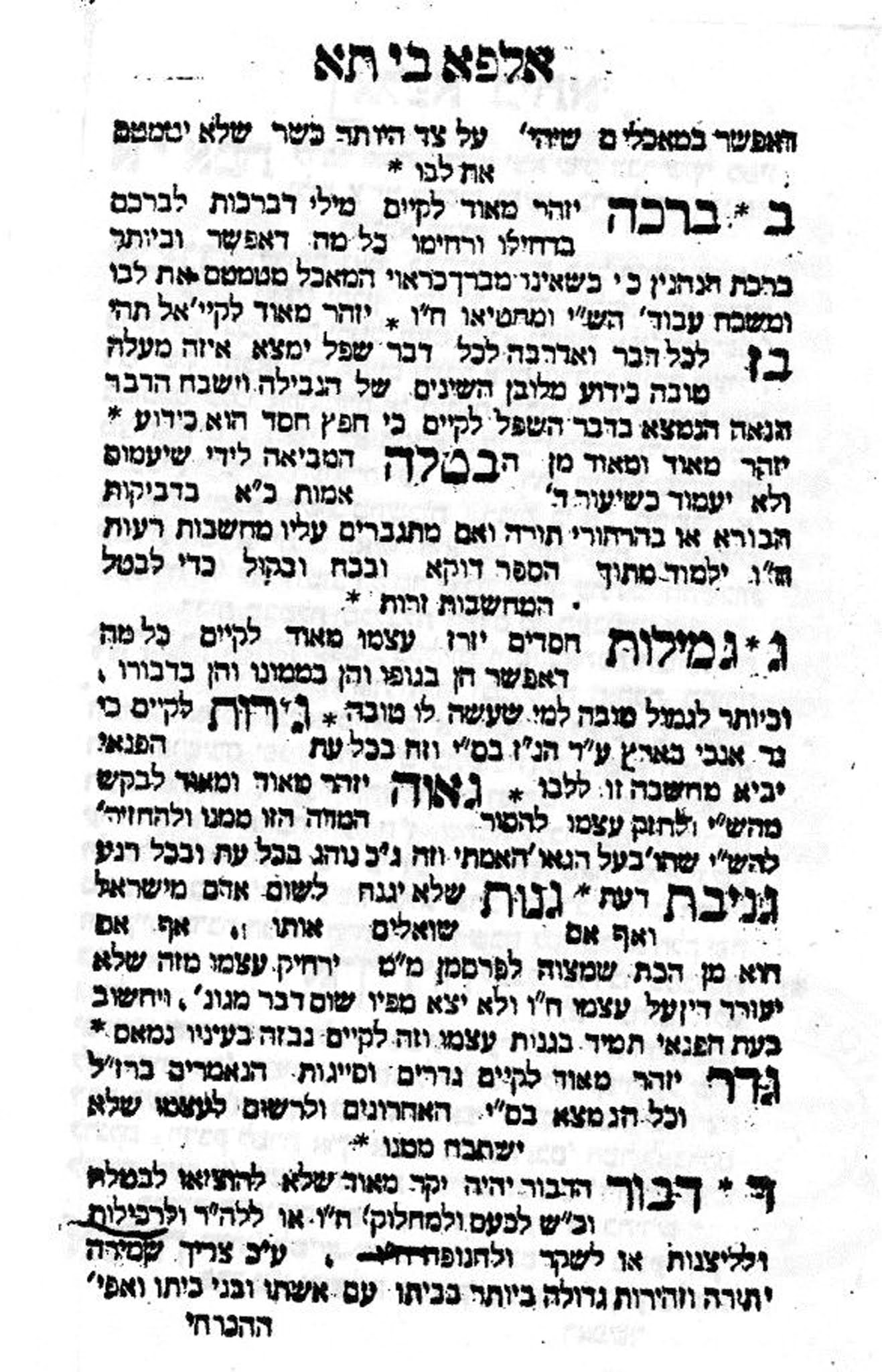
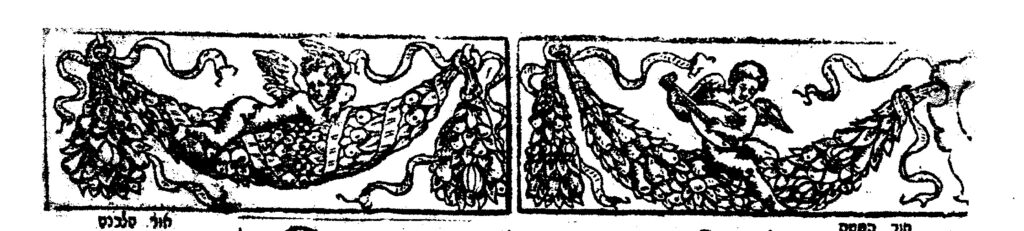
Cherubim: Winged Celestial Beings on the Title-Pages of Early Hebrew Books

Cherubim: Winged Celestial Beings on the Title-Pages of Early Hebrew Books
by
Marvin J. Heller[1]
 

And having driven out the man, He stationed at the east of the Garden of Eden the Cherubim and the flame of the ever-turning sword, to guard the way to the Tree of Life (Genesis 3:24).

You shall make two Cherubim of gold—hammered out shall you make them—from both ends of the cover. You shall make one cherub from the end at one side and one Cherub from the end at the other; from the cover shall you make the Cherubim at its two ends. The Cherubim shall be with wings spread upward, shielding the Cover with their wings with faces toward one another; toward the cover shall be the faces of the Cherubim being turned toward the cover. (Exodus 25: 18-20).

Rav Ketina said: When the Jewish people would ascend for one of the pilgrimage festivals, the priests would roll up the curtain for them and show them the cherubs, which were clinging to one another, and say to them: See how you are beloved before God, like the love of a male and female (B.T. Yoma 54a).

Cherubim (angels) are a frequent presence on the title-pages of early Hebrew imprints in the sixteenth century and afterward, the latter beyond the scope of this article. They are also to be found in incunabula, on the frames of initial pages and head-pieces for text.

How do you define what are cherubim? One definition, that of the Encyclopedia Judaica, is “a winged celestial being which appears in the Bible in several different guises.” It then proceeds to give several descriptions of cherubim. The Jewish Encyclopedia begins with a more detailed description, stating cherubim are “the name of a winged being mentioned frequently in the Bible. The prophet Ezekiel describes the cherubim as a tetrad [set of four] of living creatures, each having four faces—of a lion, an ox, an eagle, and a man—the stature and hands of a man, the feet of a calf, and four wings.”[2]
The use of cherubim is also noted in the 1911 Encyclopædia Britannica where they are described as “imaginary winged animal figures of a sacred character, referred to in the description of Solomon’s temple (1 Kings vi. 23-35, vii. 29, viii. 6, 7), and also in that of the ark of the tabernacle (Ex. xxv. 18-22, xxvi. 1, 31, xxxvii. 7-9). . . . In Gen. iii. 24 the cherubim are the guards of Paradise . . .”[3]
The frequency of the appearance of cherubim in Hebrew literature can be found on Sefaria, a bibliography of Jewish texts, which records fifty-six entries for cherubim under biblical, Mishnah 27, and Talmud 991. Among other entries are Midrash, 590; Halakhah 7947; Kabbalah 747; and yet still others as well as multiples of commentaries on the first works.[4]

These multi-winged creatures are also a feature in general literature. Franz Sales Meyer, under the heading Miscellaneous heads, describes the “Angel faces, youthful heads, with a circular or disc-like halo, are first met-with in the Byzantine style, as the result of ecclesiastic articles,” He continues that in the early Italian Renaissance such renderings were charmingly naïve. They appeared as adornments on friezes and arches, medallions, and in borders. They also are to be found on tombs and are “Much used in Modern ecclesiastical decorations.” The text is accompanied by a page of examples of the cherub head, including one of a skull.[5]

It had been my intention to describe Hebrew title-pages with images of cherubim over a period of two centuries.[6] The numerous instances of such usage, however, has necessitated a considerable limiting of our subject period. Indeed, rather than noting all the examples in our current period, in the sixteenth century, we only describe several exemplars, giving background about the books in which they appear, that is, the publisher, author, and book subject.[7] This article is expansive, that is, in describing cherubim, it discusses the varieties of Hebrew literature, the authors of the subject works, the presses that published them, and even Hebrew book history. The title-pages and infrequent text pages with displays of cherubim addressed here are in chronological order, but from diverse locations and, again, on a variety of books, indicative of how widespread Hebrew publishing was and even more so the depth and nature of Hebrew literature.[8]

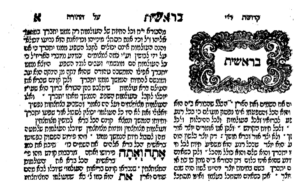
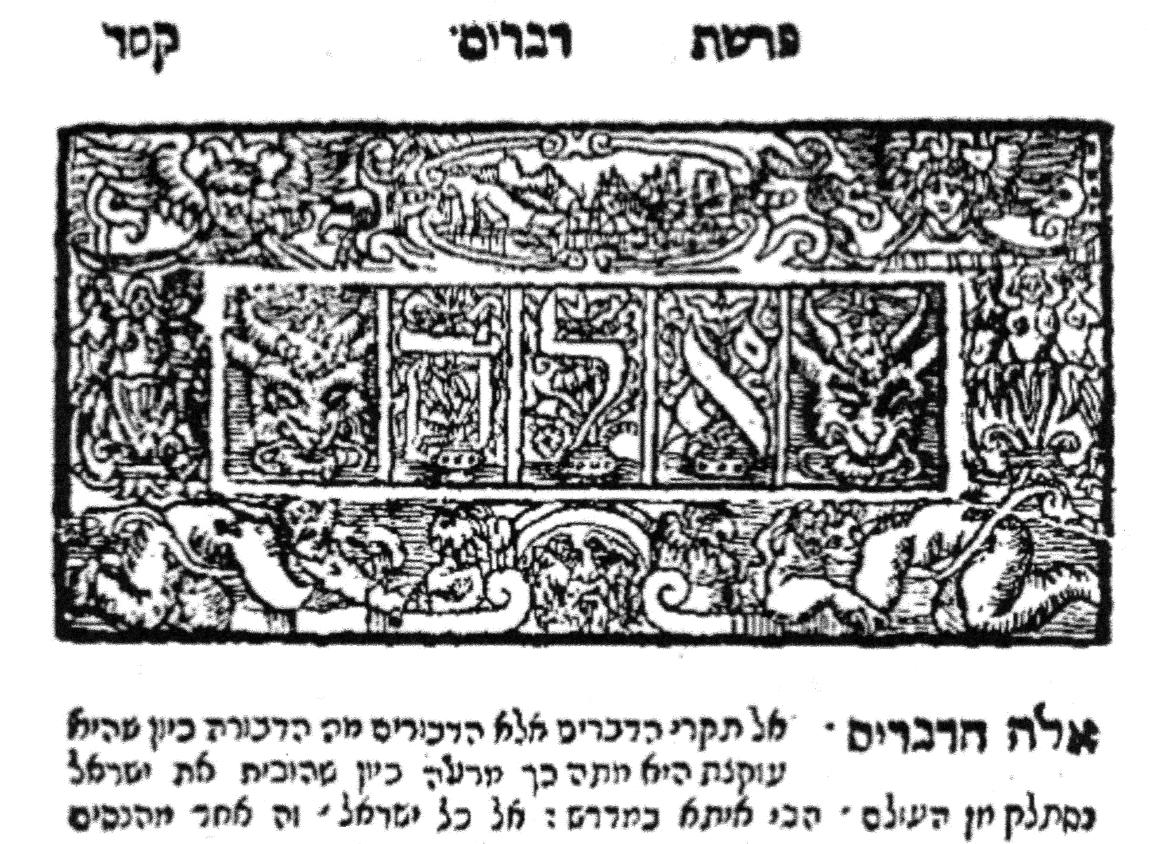
1514-18, Hameshei Humshei Torah – Our first work with the appearance of cherubim is a folio (20) edition Hameshei Humshei Torah (Pentateuch) with haftorat and commentary of Rashi printed in 1514-18 in Prague at the press of Gershom ben Solomon ha-Kohen and partners. Gershom later received a royal privilege from King Ferdinand of Bohemia, allowing him, that is Gershom alone, to enjoy a monopoly on Hebrew printing in Prague. His descendants, known as the Gersonides, continued to print in Prague until the mid-seventeenth century.
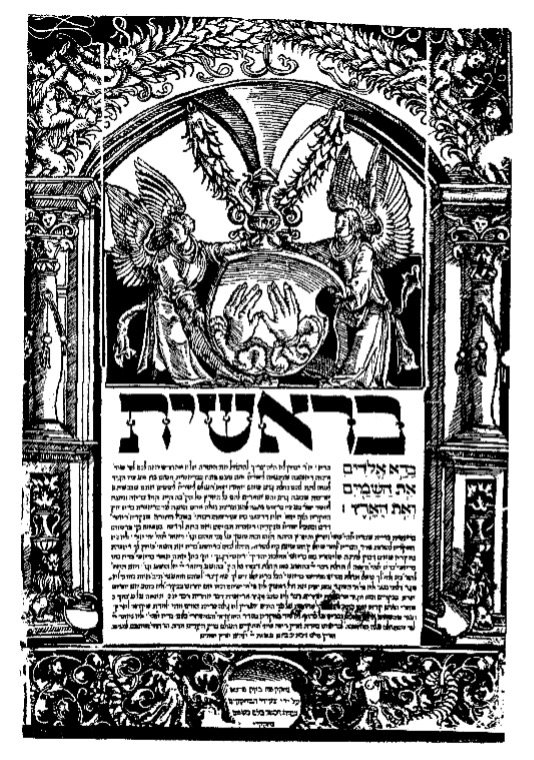
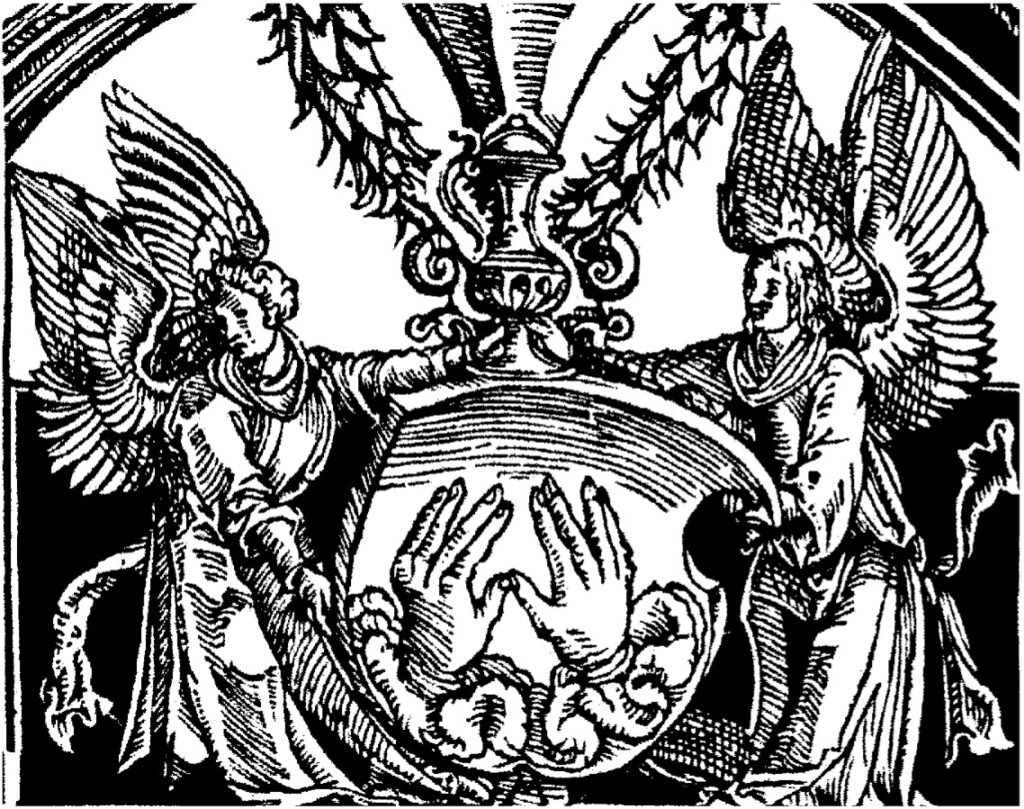
 

1514, Hameshei Humshei Torah
Courtesy of the Library of the Jewish Theological Seminary

A magnificent edition, with ornate woodcut frames and large type for the text. Each book has a unique decorative opening page, there is no title page, comprised of four separate pieces, those on the pillared sides with vases, leaves, and cherubim, similar but not identical, the top piece with a concave bottom edge. Genesis has a convex curved piece to fit with this top piece on the upper half of the page, with winged cherubim holding a shield with the spread hands of the Kohen giving the priestly blessing.[9]

Work on the Pentateuch began on 10 Sivan (June 14, 1514) but, perhaps as a result of the success of the prayer book, the partners found they had overextended themselves and found it necessary to suspend work on this project for two years. In 1530 Gershom and his sons reprinted this Pentateuch in an identical format, except for changes to the decorated initial pages.

1527, Dictionarium ChaldaiOur next entry with cherubim is an Aramaic grammar by the Christian-Hebraist scholar Sebastian Muenster (1489-1552). It was printed in Basle in 1527 at the press of Johannes Froben in quarto format (40: [1], 434, [7] pp.). The Froben family was the most significant printers of Hebrew books in Basle. Johannes Froben published as many as 250 titles, among them Hebrew/Latin books of the Bible and grammatical works, primarily works by Muenster.

Sebastian Muenster, a cosmographer, astronomer, and orientalist was, for twenty three years, professor at Basle. Born in Niederingelheim, Hesse, the son of a Spitalmeister (hospital master), Muenster had no university education nor did he ever receive a degree. His education consisted of some private instruction in Latin and later studies at Frieberg and attendance at lectures given by the Franciscans. In 1506, Muenster entered the Minorite order and was sent to study in Rufach under Conrad Pellican (Pellicanus, 1478-1556). The following year he took vows and, in 1512, was ordained a priest. Muenster assisted Pellican in teaching in Pforzheim and, from 1524-29, occupied the chair of Hebrew at the University of Heidelberg. In 1529, Muenster converted to Protestantism and moved to Basle, where he occupied the chair of Hebrew, at a salary of 60 gulden; from 1547/8 he was rector. From about 1525, Muenster was a student of Elijah Levita, translating and editing his grammatical works. Muenster also translated a number of other Hebrew works into Latin and was a prolific author in his own right. By the time of his death more than 100,000 volumes of his works were in circulation. His Jewish oeuvre, more than three-score publications, covers all aspects of Judaica, excepting Kabbalistic studies, which did not interest him. In 1523, Muenster published Dictionarium Hebraicum . . . adiectis Chaldaicis vocabulis, his study of the Aramaic language. The book reads from left to right but the text follows the Hebrew alphabet. Words are given in vocalized Hebrew, followed by their etymology, definition and examples.

The title page of the Dictionarium Chaldai has an architectural frame with cherubim in various positions, as well as additional cherubim below mounted and otherwise. This title page, designed by Hans Holbein, was used as early as 1516 on Basel statutes and into the seventeenth century.[10] [11]

Not long afterwards, from 1540 through 1543, at least five titles were printed in three locations with varied images of cherubim on the title-page, that is Augsburg, Prague, and Bologna. That is not to say these frames were not used on other books, most likely they were, but rather these are examples of cherubim used by the printers of Hebrew books at the time.

Augsburg has an early history related to Hebrew printing. Several early anti-Jewish works beginning with the apostate Johannes Pfefferkorn’s Der Judenfeind (1509) and other anti-Semitic books by apostates were published there. Another early Augsburg publication of note, this certainly more positive, albeit not a Hebrew edition of that popular and much republished work, is the first printing of R. Joseph ben Abraham Gikatilla’s (1248–c. 1325) kabbalistic classic, Sha’arei Orah, which explains and analyzes the ten Sefirot. This edition of Sha’arei Orah is a Latin translation of that work by the apostate Paulus Ricius (Paulus Israelita, 1480-1541) under the title Portae lucis, published in 1516 at the press of Johann Miller.
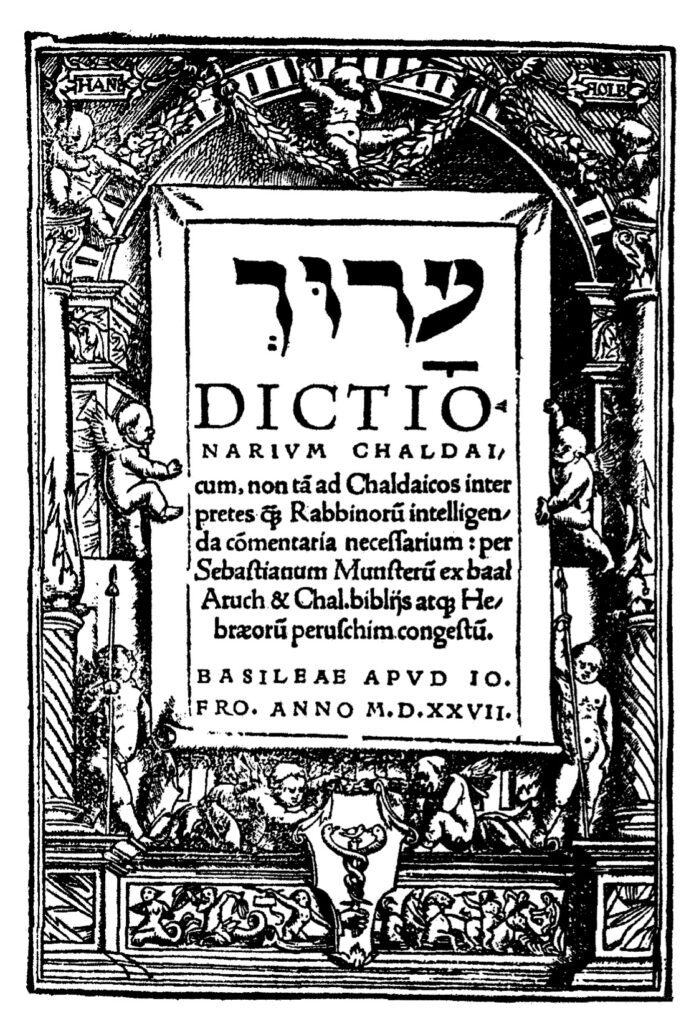
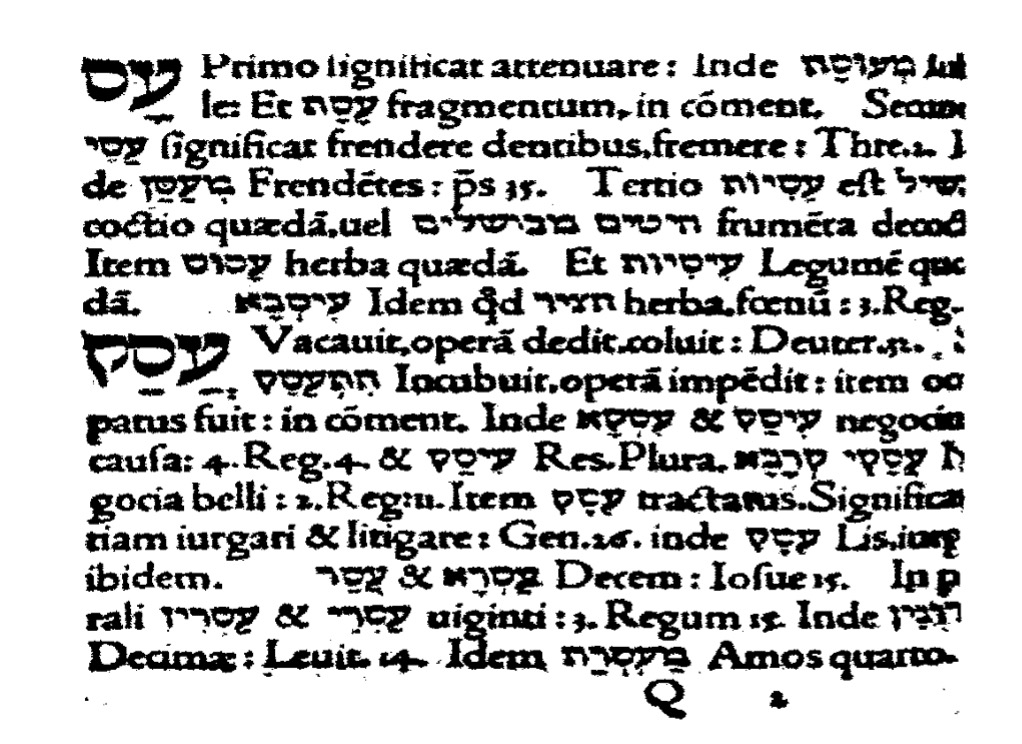
1527, Dictiorionarim Chaldai
Courtesy of the Fales Library and Special Collections, New York University

Serious Hebrew printing in Augsburg begins when Hayyim ben David Shahor, among the pioneers of Hebrew printing outside of Italy, came to Augsburg in about 1533/34. In Augsburg, Schwarz worked in the print shop of Silvan Otmar (d. 1540), a renowned and highly productive printer, and resided in the home of Bonifacius Wolfhart, a Protestant pastor who also served as the censor of Hebrew books for Augsburg.[12] Shahor printed several works in conjunction with his son, Isaac, and his son-in-law, Joseph ben Yakar, who assisted him at the press, although their names are not mentioned on the title-pages.[13]

Shahor likely joined with a non-Jewish printer, perhaps August Wind, a printer of Hebrew works for Christian clergyman. Hayyim left for Italy, returning to Augsburg in 1540. He then printed three books, Avkat Rokhel, Arba’ah Turim and a prayer book for, according to the Thesaurus of the Hebrew Book, a total of ten works in Augsburg. Due to a lawsuit by an apostate, Paulus Aemilus, with whom Shahor had been associated in Ferrara, resulting from their failed venture, Shahor and his family were forced to cease publication and leave Augsburg. Aemilus, seeing a market in Augsburg for Hebrew/Yiddish books, began to print on his own account. He issued a small number of titles, most notably the Melokhim Bukh (1543) and the Shmuel Bukh (1544), Yiddish poetical renditions of the books of Kings and Samuel, both with images of cherubim (below).[14]

1540, Avkat Rokhel Our first Augsburg title is Avkat Rokhel, an eschatological work on the principles of faith attributed to R. Machir ben Isaac Sar Hasid, a student of R. Judah ben Asher, son of the Rosh. Printed in octavo format (80: 18 ff.), perchance by Shahor. The Thesaurus of the Hebrew Book attributes it, albeit in brackets, to Hayyim Shahor, in contrast to the National Library of Israel that records the printer as unknown.[15]

The text of the title page is set within a decorative frame with nineteen cherubim and a number of animals. The title-page states that it is,

Sefer Avkat Rokhel

Printed by the printers named at the end of the volume. Edited with great care, with all our ability, “the good hand of our [Lord] upon us,” (ref. Ezra 8:18). And it was completed, here Augsburg, the great city, with the help of the Lord and His salvation. In the year, “[Rejoice, O you nations, with his people; for he will avenge the blood of his servants,] and will render vengeance to his adversaries, and will make expiation כפר (300=1540) for the land of his people” (Deuteronomy 32:43).

The names of the printers, Hayyim Shahor, Isaac ben Hayyim, and Joseph ben Yakar, the statement on the title page notwithstanding, are not given at the end of the volume. A brief introduction informs that the work was named Avkat Rokhel (the perfumer’s powders, Song of Songs (3:7)) for as the perfumer’s powders strengthen the soul, so too when one reads this book will he fear and cause his soul to be pure and free from all sin and transgression, thus meriting the good.
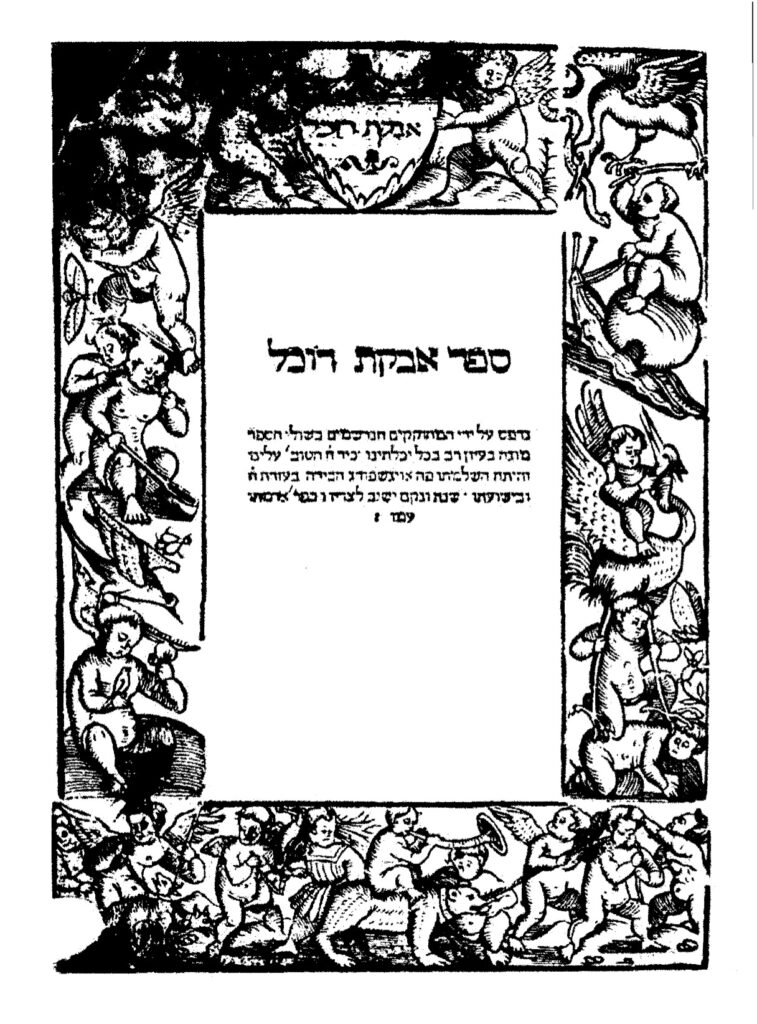
1540, Avkat Rokhel
Courtesy of the Dorot Jewish Division New York Public Library

The like title-pages of Avkat Rokhel and Unterricht Wie ain Christenmensch, the latter a non-Hebrew work printed approximately two decades earlier, reflect a relationship between Jewish and Christian printers, that is, Christian printers published Hebrew books in association with Jewish associates. The relationship between the printers was mutually beneficial. For the Christian publisher “the Hebrew books sector, being unique, was attractive to investors, being more limited and not so wildly competitive as the Italian book sector.”[16] In addition to the non-Jewish printer’s access to the Jewish book market, the Jewish publisher was able to not only publish Hebrew books, but he also gained access to the typographical material of his Christian associate. The latter, for example, frequently provided attractive frames to the former after having used them for his market and the Jewish partner also utilized the printer’s other ornamentation. This was of value to the Jewish partner as he did not have to go the expense of having decorative material prepared, at a relatively much greater expense as it would be utilized for a much smaller market. This despite the fact that the frames were often incompatible with traditional Jewish sensibilities.[17]
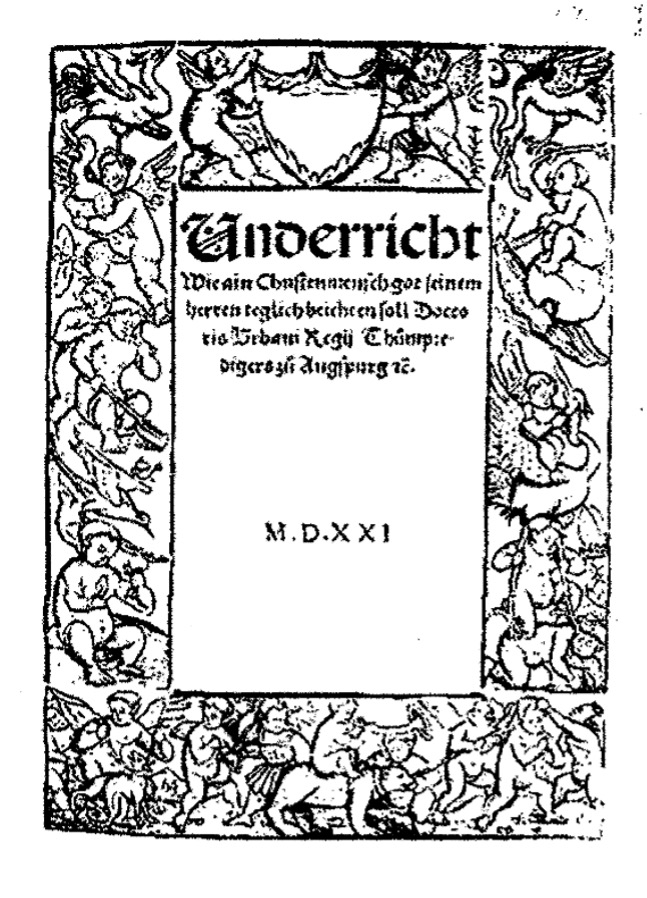
1521, Unterricht Wie ain Christenmensch [18]

The like title-pages of Avkat Rokhel and Unterricht Wie ain Christenmensch, the latter a non-Hebrew work printed approximately two decades earlier, reflect a relationship between Jewish and Christian printers, that is, Christian printers published Hebrew books in association with Jewish associates. The relationship between the printers was mutually beneficial. For the Christian publisher “the Hebrew books sector, being unique, was attractive to investors, being more limited and not so wildly competitive as the Italian book sector.”[19] In addition to the non-Jewish printer’s access to the Jewish book market, the Jewish publisher was able to not only publish Hebrew books, but he also gained access to the typographical material of his Christian associate. The latter, for example, frequently provided attractive frames to the former after having used them for his market and the Jewish partner also utilized the printer’s other ornamentation. This was of value to the Jewish partner as he did not have to go the expense of having decorative material prepared, at a relatively much greater expense as it would be utilized for a much smaller market. This despite the fact that the frames were often incompatible with traditional Jewish sensibilities.[20]

The title-page of Avkat Rokhel has the largest number of cherubim of our title-pages, nineteen in all, of our title-pages. The cherubim appear on the bottom, sides, and top of the frame, all active, albeit in different activities. The text of Avkat Rokhel is in three parts, each further subdivided. The first section addresses the struggle against one’s evil urge prior to redemption and the birth pangs and advent of the Messiah, and an explanation of the pertinent midrashim; the second part discusses the rewards and punishments of the soul after the resurrection, the nature of the world to come according to Judaism, in contrast to the views of non-Jews, and resurrection; and the third part the laws stated by the sages of the Talmud as halakhah Moshe me-Sinai, the formation of man and the number 248 limbs in a person, the statement of our sages concerning three partners in that process (God, man, and woman) and some gematriot.

This is the third edition of Avkat Rokhel, it having been printed previously in Constantinople (1516) and Rimini (1526). Ch. B. Friedberg records, in his Bet Eked Sepharim, more than twenty-five printed editions of Avkat Rokhel. It was translated into Latin by A. Hulsius and printed in his Theologia Judaica, (Breda, 1653) and a Yiddish edition was prepared by Naphtali Pappenheim (Amsterdam, 1647).[21]

1543, Melokhim Buch Two additional works printed in Augsburg, attributed to Moses (Esrim ve-Arbeh) Ashkenazi, are Yiddish poetical renditions of the books of Kings and Samuel. Moses’ appellation, Esrim ve-Arbeh (24), derives from either his birthplace, Vierundzwanzig Hoefe (24 courts) in Wuerttemberg, or from his extensive knowledge of the 24 books of the Bible. Moses’ accreditation with either authoring or transcribing the Melokhim Bukh is due to its similarity to the Shmuel Bukh, more reliably attributed to him. Nevertheless, sufficient differences exist between the two works that many scholars believe they do not share a common author. It is clear, however, that the author, even if not this Moses, was an Ashkenazi Jew. The Melokhim Bukh was published in quarto format (40: [123] ff.) by, according to the colophon, Paulus Aemilus. A Latin colophon states, Augustae Vindelicorum/ per Paulum Aemilium, Anno/ Domini M. D. XLIII. Meyer Waxman suggests that it is doubtful, the colophon notwithstanding, that the publisher was Aemilus; more likely it was Hayyim Shahor.

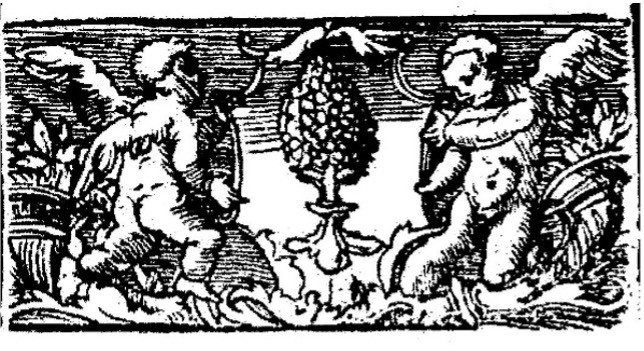
We have noted above that the frames on these title-pages were first used by Christian printers and that when that market no longer needed the frames, they were made available to Jewish printers. The cherubim frames noted above were generally acceptable to a contemporary renaissance Jewish public, although some, many, were questionable and would not be used today. In contrast, the title-page of the Melokhim Buch has a border made up of a four-part frame, the top with a representation of a king, the left and right sides respectively with images of Adam and Eve, unclad, the latter with the snake, two small children, and expecting. At the bottom are two cherubim. Use of this frame is surprising, for in contrast to other frames its’ contents appear to be objectionable, more so than other frames, even those with mythological characters. It seems likely that this frame might also be distasteful to Christian sensibilities.[22]
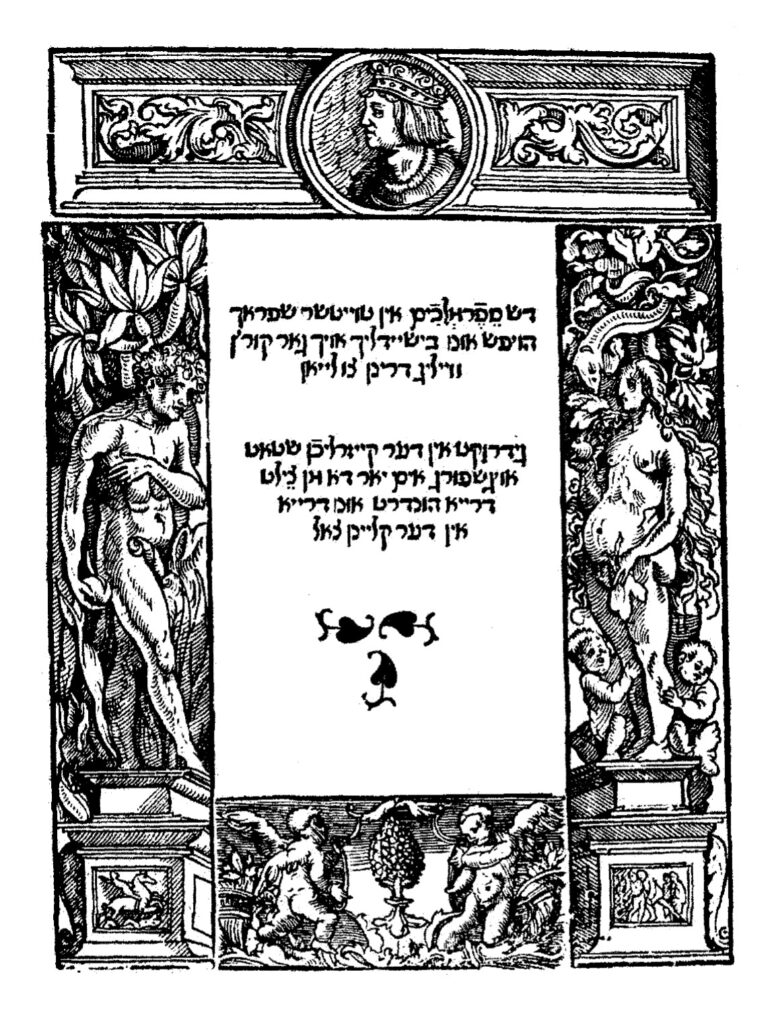
1543, Melokhim Buch
Courtesy of Dr. Moshe Rosenfeld

The title page states that it is “The book Melokhim (Kings) in Taytsher sprach, beautiful and clear and very entertaining to read. Printed in the imperial city of Augsburg in the year 303 (=1543)” [23] The colophon dates the completion of the work to Friday, 14 Av, 303 (July 25, 1543), which was a Sunday in 1543.

The Melokhim Bukh was not written as a sequel to the Shmuel Bukh. It is the older of the two books, originally written as a separate work, possibly as early as the fourteenth century. The format of the Melokhim Bukh, a rhymed paraphrase of the book of Kings, is that of the heroic epic, stylistically modeled after comparable German sagas, such as the Nibelungen. The subject matter is the events in Kings I and II, imaginatively and colorfully enhanced by material from the Talmud and Midrashim, all expressed with a deep piety. Intended as a complete history, it begins with a hymn of praise to God in three strophes followed by nine strophes from the Exodus to the last days of David, the contents of Kings, and as a sequel, the history of the Jews to the end of the second commonwealth in thirty strophes). An example of the text is,

You have frequently performed signs for the children of Israel;

Therefore they are obliged to have You for their Lord.

And to fear Your name-that is useful and good for them.

That man is foolish who acts contrary to Your word.[24]

1544, Shmuel Bukh The Shmuel Bukh was published, also likely by Hayyim Shahor in quarto format (Format 40: [102] ff.). It has an ornate title page made up of figurines above and about pillars with cherubim on the sides. It too is in Vaybertaytsh; among its reprints is a Latin edition (Ingolstadt,(1562). Waxman suggests that the Shmuel Bukh was likely written at least a hundred years earlier, most likely an original production of medieval Jewry. The author reworked the biblical material and incorporated aggadic elements. It was written in “vigorous poetic style” in eight line strophe and was meant to be sung.[25]
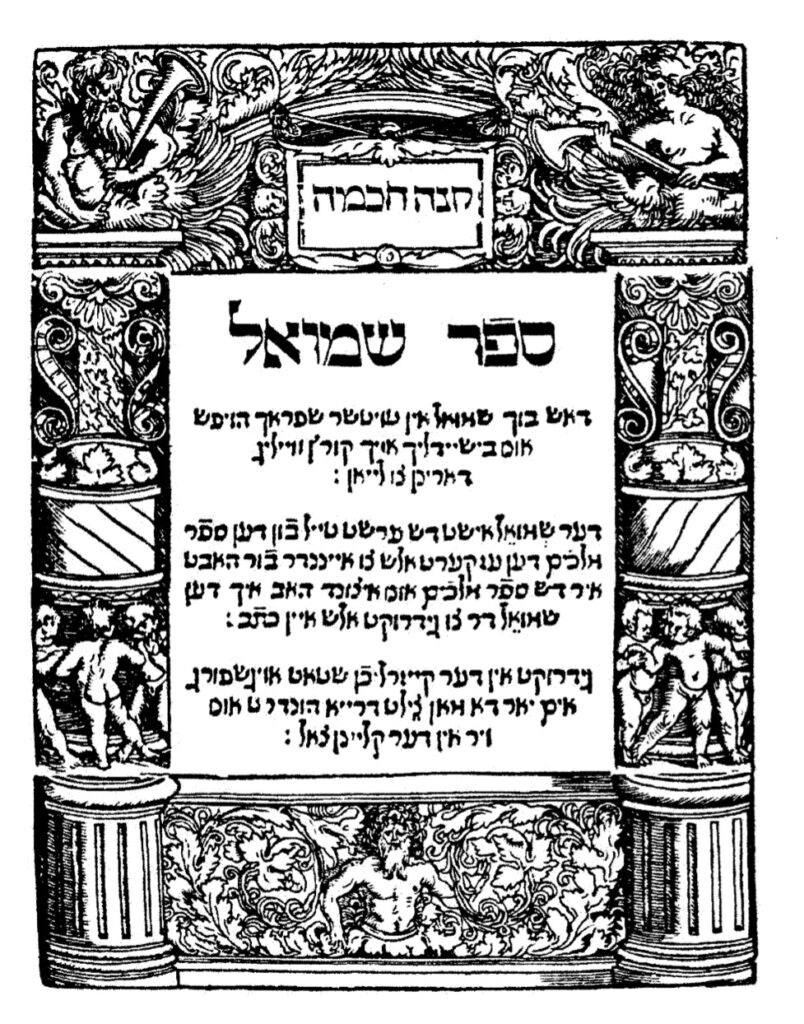
1544, Shmuel Bukh
Courtesy of Dr. Moshe Rosenfeld

In contrast to what was written above, “works that many scholars believe they do not share a common author,” Zinberg informs that both the Melokhim Bukh and the Shmuel Bukh are composed in the same verse-meter. Moreover, the title-page states that “Shmuel is the first part of

the book Melokhim, for it is all related.” Nevertheless, Zinberg quotes other sources that “these are two quite different works and were probably written by two different poets.”[26]

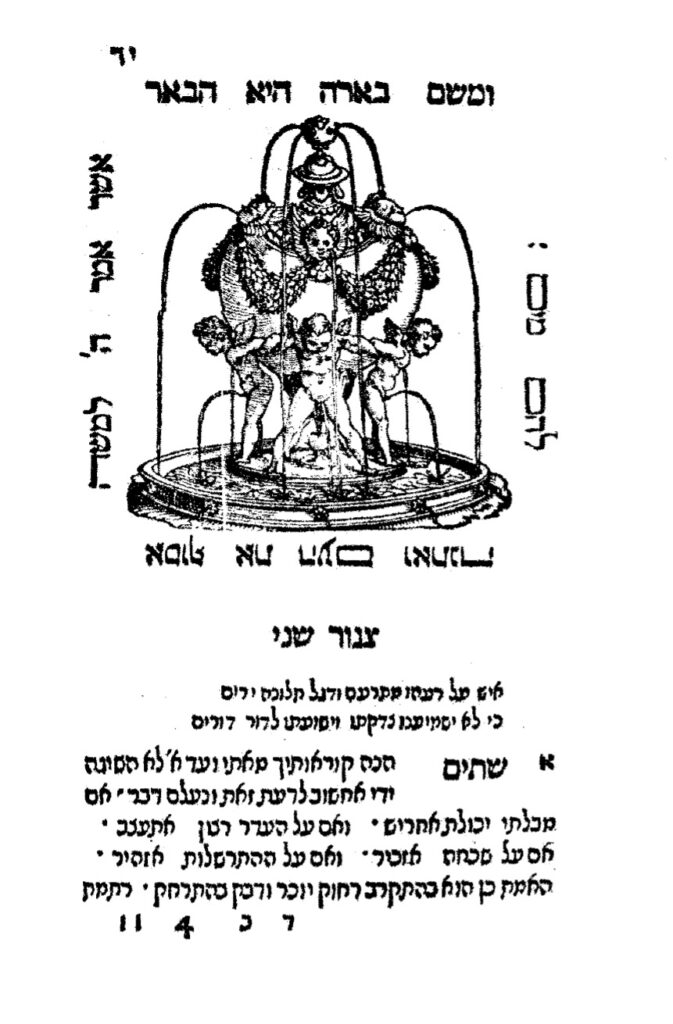
1553, Ma’yan GannimA composition book comprised of sample letters from R. Samuel ben Elhanan Jacob Archivolti (c. 1515-1611). Ma’yan Gannim was published in a small sextodecimo format (160: 45, [1] ff.) at the Venice press of Alvise Bragadin. The Bragadin press was active before the papal bull, dated August 22, 1553, by Cardinal Giovanni Pietro Caraffa, the future Pope Paul IV, an extreme reactionary and bitter anti‑Semite, who ordered the confiscation and burning of the Babylonian and Jerusalem Talmuds. This had a chilling effect on Hebrew printing and resulted in a considerable decline if not outright cessation of printing in Venice, and the subsequent expurgation and censorship of Hebrew books. When Hebrew printing resumed in Venice in 1563, among the Christian printers who took up the publication of Hebrew books was Alvise Bragadin. Bragadin died in the mid-1570’s, he was succeeded by his son, and after him by successive members of the family well into the eighteenth century, the last known Bragadin being Alvise III. Throughout that time the press remained a leading printer of Hebrew books in Venice.
1553, Ma’yan Gannim
Courtesy of the Library of Agudas Chassidei Chabad Ohel Yosef Yitzhak

Archivolti, a student of R. Meir Katzenellenbogen (Maharam, 1473-1565), served as rabbi, av bet din, and rosh yeshivah in Padua. Among his students was R. Judah Aryeh (Leon) Modena (1571-1648). Prior to settling in Padua in 1568, Archivolti worked as a corrector for the Hebrew presses in Venice.

In contrast to our preceeding examples of cherubim, this exemplar does not appear on the title-page of the book, which has the Bragadin device, that is, three crowns, but rather at the beginning of each of the book’s five chapters, a woodcut illustration comprised of three cherubim in a cage, surrounded on all four sides by a verse.

The title is from “A fountain of gardens (ma’yan gannim), [a well of living waters, and streams from Lebanon” (Song of Songs 4:15). The text states that there are fifty letters, that is, twenty-five letters with their responses, written by Archivolti. There is a preface and introduction from Archivolti, followed by a table of contents, and, beginning on 7a, the text. Ma’yan Gannim is the first book written by Archivolti, for he describes it as his first fruits, an offering to the Lord. Archivolti also wrote Degel Ahavah (Venice, 1551), an ethical work; He’arot le-Sefer he-Arukh (Venice, 1553), textual references for the Arukh of Nathan ben Jehiel; and, his most important title, Arugat ha-Bosem (Venice, 1602) a grammatical work in 32 chapters.

The sections or chapters, each on a different theme, are correspondence between a father and son; between friends; from an older to a younger man; with government officials; and others, including letters of a romantic, and even sensual nature. Such letters, at the very least inappropriate by modern religious standards, are intermingled with those of a sacred nature, reflecting contemporary mores and addressing current issues, including therefore, information of historical and cultural value. Ma’yan Gannim is designed to teach through example the rules of correspondence. The letters are in metrical form, designed by Archivolti as literary models, many with ethical content, for his students.[27]

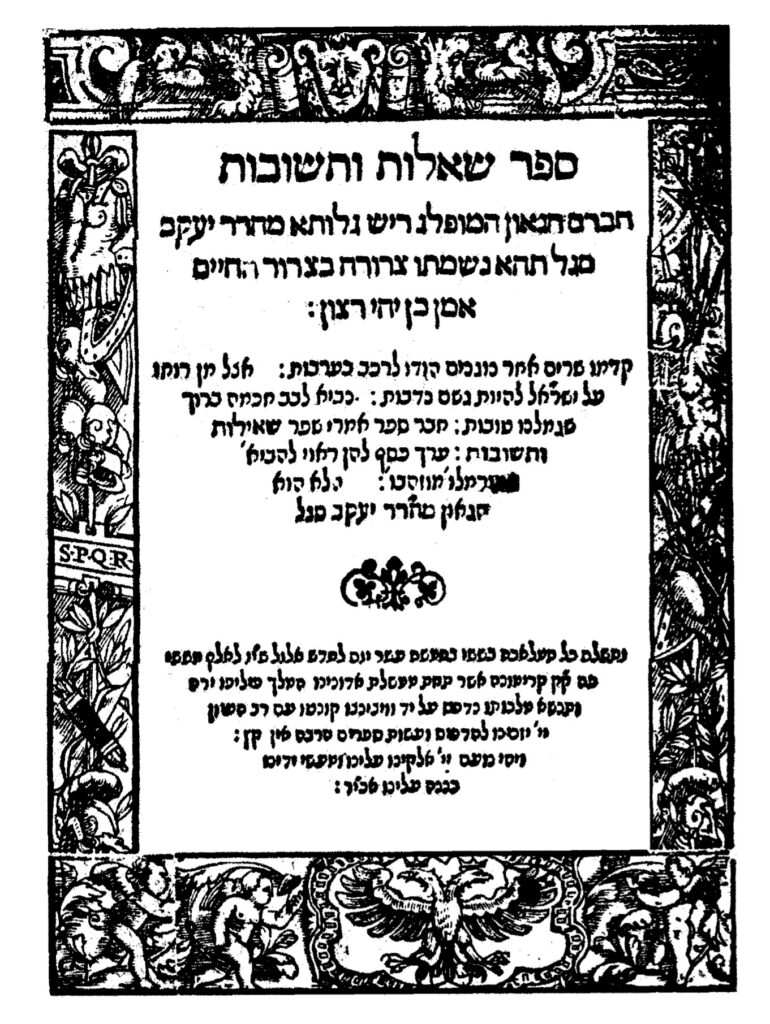
1556, She’ilot u’Teshuvot Jacob ben Moses Moellin (Maharil) – Two hundred and five responsa from R. Jacob ben Moses Moellin (Maharil, c. 1360-1447). The She’ilot u’Teshuvot were published in Cremona at the press of Vincenzo Conti in octavo format (80: [7] 79 ff.). After the Talmud was burned in Venice in 1554 there was a precipitous decline, if not a complete cessation, in the number of Hebrew books printed in Venice for several years. The breach was filled by presses in Ferrara, Sabbioneta, Cremona, and Riva di Trento. Vincenzo Conti (d. 1569) printed briefly in Sabbioneta and subsequently in Cremona, where his press was active from 1556 to 1567, issuing more than forty titles.

Maharil was the leading halakhic authority of his time. His most important work is Sefer Maharil (Minhagei Maharil, 1556, Sabbioneta), a popular and influential work on customs and laws. It was composed by his pupil Eleazar ben Jacob (Zalman of St. Goar), from the discourses that he heard from Maharil. She’ilot u’Teshuvot is comprised of Two hundred and five responsa, a small part only of Maharil’s responsa. The subject matter, as in the Sefer Mahril, deals to a great extent with custom, but also includes much personal material. They also reflect Maharil’s considerable humility and compassion.
1556, She’ilot u’Teshuvot Jacob ben Moses Moellin (Maharil)
Courtesy of the Library of Agudas Chassidei Chabad Ohel Yosef Yitzhak

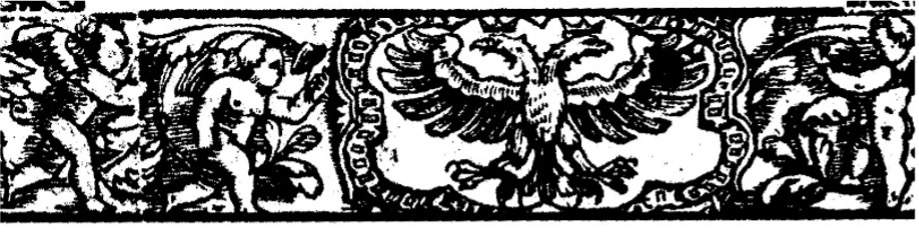
The title-page has an ornamental frame made up of four parts, enabling the printer to use them in other arrangements, although this is the manner in which the parts are most often employed. The top frame has the face of a man and cherubin; on the sides are suits of armor, shrubs, and musical instruments and, in the center of the left vertical frame the letters SPQR, reputedly standing for Senatus Populusque Romanus; and on the bottom a two headed crowned eagle and on the sides the cherubim. This frame was used by Conti on his early imprints, appearing on about ten works.

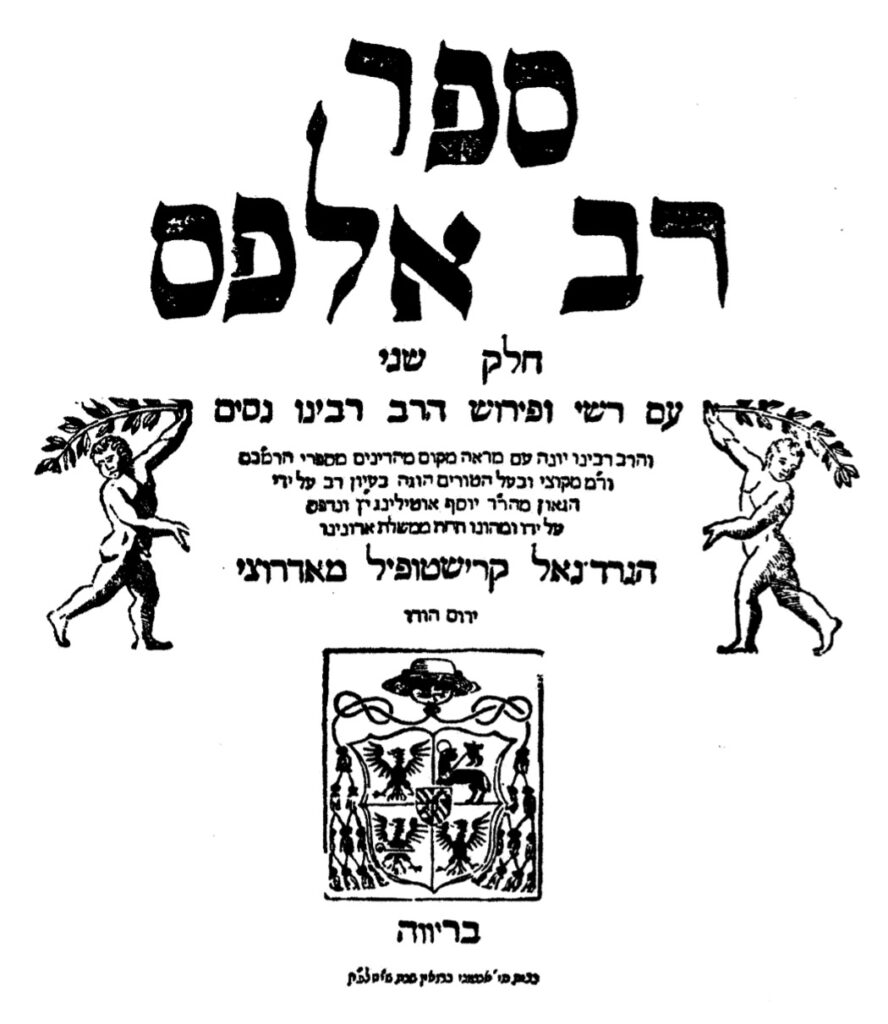
1558, Sefer Rav Alfas Sefer Rav Alfas, (Hilkhot Rav Alfas, Sefer ha-Halakhot of Alfasi, Rif) was published in Riva di Trento by R. Joseph Ottolenghi and Cardinal Cristoforo Madruzzo in a three volume folio format (20: 288, 268, 302 [8] ff.). The Tyrolese town of Riva di Trento is the source of an unusual episode in the history of the Hebrew book. It was for a short time, from 1558 to 1562, a refuge for the Hebrew book; one in which about forty Hebrew titles were printed. Believed to be the first work printed in Riva di Trento, Hilkhot Rav Alfas was likely selected, in addition to its inherent popularity and value, due to the ban on the Talmud, the Rif, being a halakhic compendium of the Talmud, filling, to some extent, the gap left by the scarcity of that work.

It was in Riva di Trento that Cardinal Cristoforo Madruzzo (1512-78), Cardinal of Trent, a scholar and supporter of learning, who argued at the Council of Trent (1562) for leniency and moderation in condemning books, became the patron and protector of a Hebrew press, which was also a source of revenue for him. Ottolenghi (d. 1570), originally of Ettlingen, in Baden, Germany, reflected in its Italianized form in his name, was rosh yeshivah at Cremona, and under his tutelage Talmudic studies had continued in Cremona after that work had been banned and burned elsewhere. He assisted the press, providing indices and annotations to a number of works and assuring that material offensive to the church had been deleted from those books of value to his yeshiva. and R. Jacob Marcaria, a dayyan on the bet din presided over by Ottolenghi and a physician, recruited by Madruzzo help finance and play a role in the press. Marcaria edited and wrote brief prefaces for most of the books printed in Riva di Trento. The press was located in the house of Antonio Broën.

Sefer Rav Alfas is a halakhic compendium by R. Isaac ben Jacob Alfasi (Rif, 1013-1103). Alfasi, born in the Algerian village of Qal’at Hammad, was a student of the great sages R. Nissim ben Jacob (c, 990-1062) and Hananel ben Hushi’el (d. c. 1055) in Kairouan. After learning with them Alfasi relocated to Fez, from where his surname al-Fasi (Rif) is derived, and became recognized as the leading Talmudic sage of the time. In 1088, at the age of 75, two informers denounced him to the government – the charges are unknown – and he was forced to flee to Spain. Eventually settling in Lucena, Alfasi succeeded R. Isaac ben Judah ibn Ghayyat (c. 1020-89), who had died a few months earlier, as head of the yeshiva.
1558, Sefer Rav Alfas
Courtesy of the National Library of Israel

The text of the title-page of each volume has cherubim at the sides, and below bears the Cardinal’s coat‑of‑arms , a significant statement of the Cardinals’ support and protection of the press at a time when his church was burning and banning Hebrew books. Furthermore, the title pages informs that Sefer Rav Alfas was edited with great care by the gaon R. Joseph Ottolenghi and was printed and financed by him, and that this was done, “in the dominion of” the following in bold letters “Cardinal Cristoforo Madruzzo.”

Sefer Rav Alfas, Alfasi’s major work, is one of the greatest works in halakhic literature. It is extracts all pertinent legal decisions from the Talmud, eliminating non-halakhic material, discussions, and subject matter not applicable today. It covers the following orders of the Talmud, Mo’ed, Nashim, and Nezikim, as well as tractates Berakhot and Hullin. Laws in Kodashim and Tohorot, such as mezuzah and tefillin, are organized as Halakhot Ketannot. Sefer Rav Alfas differs from earlier works, such as Halakhot Gedolot, in that it is more comprehensive, more detailed, and by the inclusion of material from the geonim, although, like them, it follows the order of the tractates.

1559-60, ZoharClassic kabbalistic work of Jewish mysticism, attributed to R. Simeon bar Yohai (second century). This, the second printing of the Zohar, it was published previously in Mantua (1558-60), published in Cremona at the press of Vincenzo Conti in a three volume folio format (20: 132, 122, 146 ff.) by Vincenzo Conti (d. 1569). Conti, who had printed briefly in Sabbioneta, is better known for his activity in Cremona, where his press, active from 1556 to 1567, issued more than forty titles.

The title page of has a decorative architectural frame with an arch, at the top a vignette of Akedat Yizhak (the binding of Isaac), surmounted by an eagle, and accompanying cherubim; below in the bottom squares, figurines, perchance also cherubim. It is dated, “For the Lord will not forsake כי לא יטש (319=1559) his people [for his great name’s sake] (Samuel I 12:22), and it was completed in the year ש”ך ([5]320=1560).” At the bottom of the page is an imprimature from the Inquisition on the title page, the sole Cremona imprint to place it there, as well as a longer permission at the end of the book.
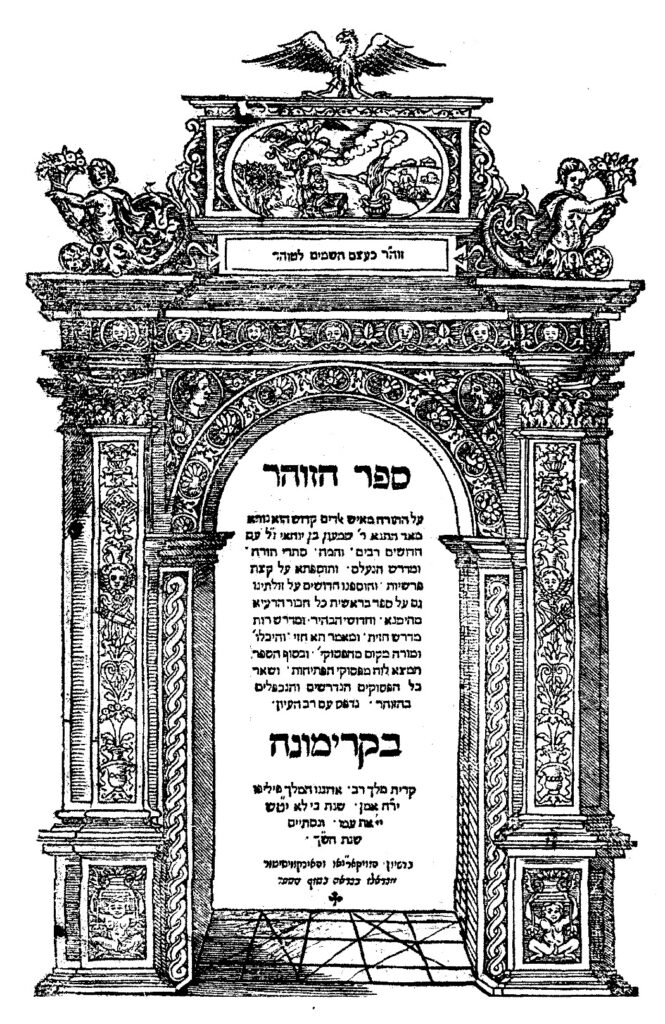
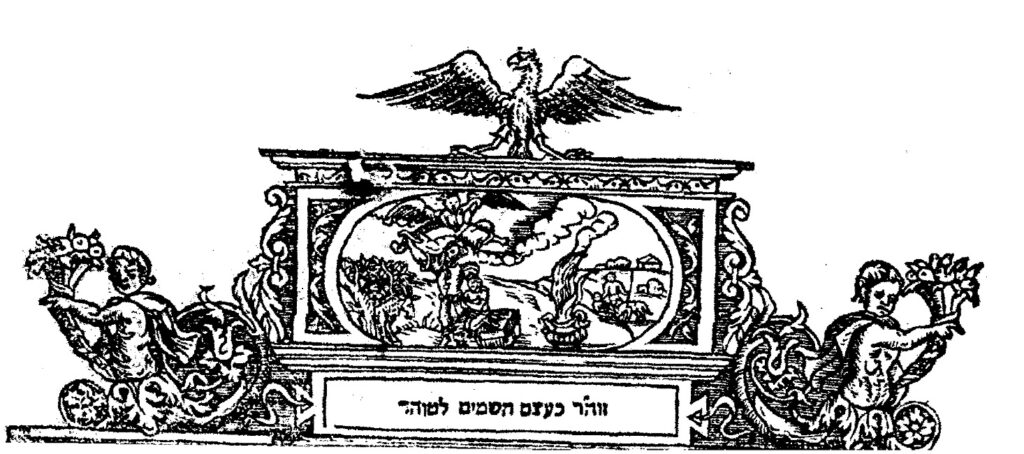
1559-60, Zohar
Courtesy of the Library of the Jewish theological Seminary

Written in Aramaic and Hebrew, Sefer ha-Zohar al ha-Torah is a comprehensive system of kabbalistic theosophy, encompassing cosmology, the soul, and good and evil. It is an esoteric commentary on the Torah, with homilies, midrashic passages, parables, and numerous discursive passages. It is based on the concept that within scriptures is a concealed stratum, deciphered by Kabbalah, expressing the inner meaning of the Torah, with its “splendor, beauty, and greatness.”

The corrector (and expurgator) was the apostate Vittorio Eliano, grandson of the foremost grammarian, Elijah Bahur Ashkenazi Segal. A member of a Dominican commission to review Hebrew books, Eliano was associated with all the books published by Conti from 1558 through 1559. Although begun later than the Mantua edition, noted above, this printing, done in haste, was completed earlier. Nevertheless, it was not immediately released for sale, for when more than 10,000 Hebrew books were burned in Cremona, with the complicity of Eliano, the entire edition was seized. It was just barely saved, in contrast to other works, by the apostate Dominican, Sixtus of Siena. It is known as the Zohar Gadol (large Zohar), in contrast to the smaller Mantua edition (Zohar Katan), and is also referred to, because of Eliano’s involvement, as the “Christian edition.” This notwithstanding, the Cremona edition was the preferred of the two editions by eastern European kabbalists.[28]

1560, Shir ha-Yihud – Shir ha-Yihud (Hymn of Divine Unity) an anonymous piyyut (liturgical poem) written in the mid-twelfth century, most often attributed to Samuel ben Kalonymus he-Hasid (c. 1130-1175), less often to his son, Judah ben Samuel he-Hasid (c. 1150-1217), author of the Sefer Hasidim, both among the foremost representatives of the Hasidei Ashkenaz, and, on occasion, to yet others.
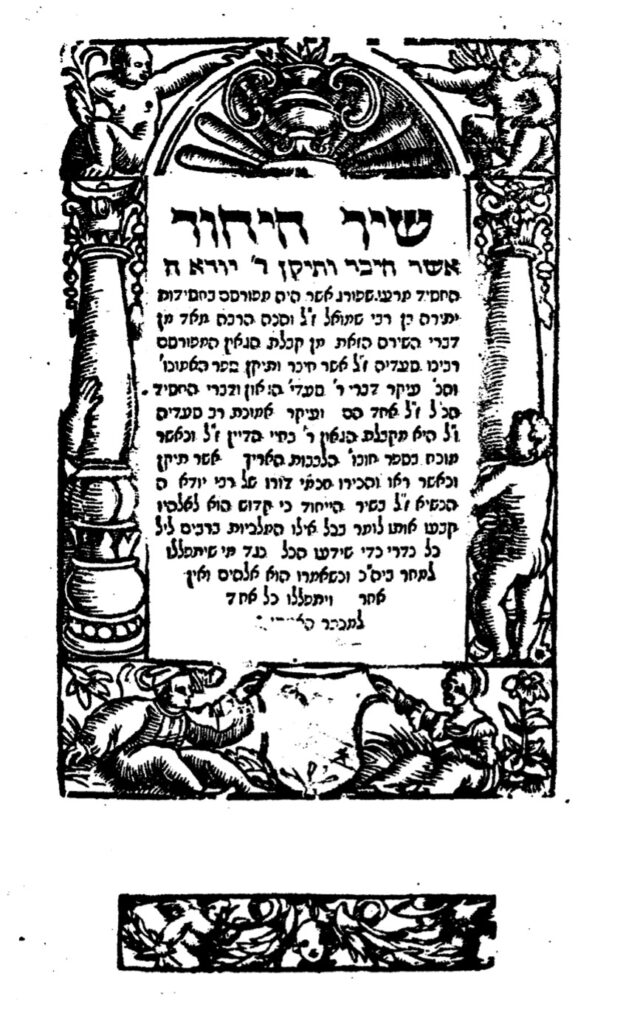
Shir ha-Yihud
Courtesy of the National Library of Israel

Shir ha-Yihud was published at the press of Eliezer and Joseph ben Naphtali Hertz Treves. Active for one year only, in 1560, they issued six books, before being forced to close by a meeting of the leaders, both Protestant and Catholic, of the Swiss Confederation in June, 1560, who feared that they were about to print the Talmud.

The frame, one of several with cherubim employed by the press, also was used on the title-page of Begidat Hazman, an allegoric maqāma (a poetic narrative in rhymed prose) by Mattathias (Mattityah ben Moses), a 15th century Spanish or Provençal Hebrew poet or Mattathias ha-Yiẓhari, a representative of the Jewish communities of Aragon at the Tortosa disputation (1413–14).

1568, Passover Haggadah Passover Haggadah printed in Mantua in folio format (20: 36 ff.) by Joseph Shalit ben Jacob Ashkenazi of Padua. This edition is a reprint of the 1560 Passover Haggadah, also printed in Mantua, but with modifications and the addition of the marginalia of R. Joseph Shalit ben Jacob Ashkenazi of Padua entitled Nimukei Yosef.
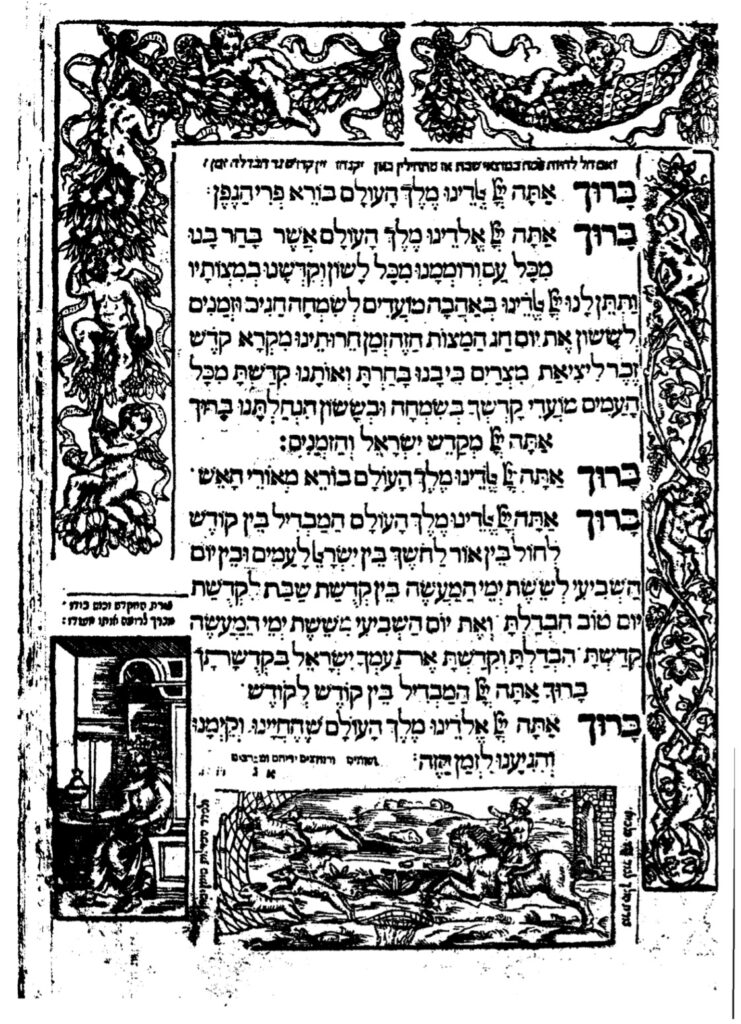
1568, Passover Haggadah
Courtesy of the National Library of Israel

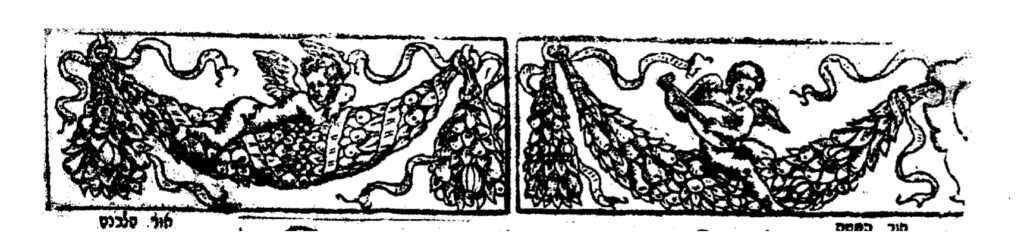
The title page frame has representations of the Mars and Minerva followed by the first text page, which has two woodcuts of cherubim along the top. Following text pages have those cherubim image, as well as numerous other cherubim images, including several marginal cherubim images. This Haggadah shares some features with the Prague Haggadah of 1526. Woodcuts are accompanied by captions, given as rhymed couplets, a feature of Ashkenaz manuscript Haggadot. In some instances, for example, by the four questions, the earlier edition was framed by a lush Italian border, without illustrations. Here the types and the top and upper left borders with their vines and cherubs only are alike.[29]


1576, Yosef LekahYosef Lekah is a commentary on Megillat Esther by R. Eliezer ben Elijah Ashkenazi (1513-86). It was published in Cremona in 1576 by Christopher Draconi in octavo format (40: 83, 1 ff.). Draconi, previously associated with Vincenzo Conti, attempted to publish Hebrew books in Cremona. Although he would issue Latin books from 1569 to 1614, he printed one Hebrew book only, Yosef Lekah.
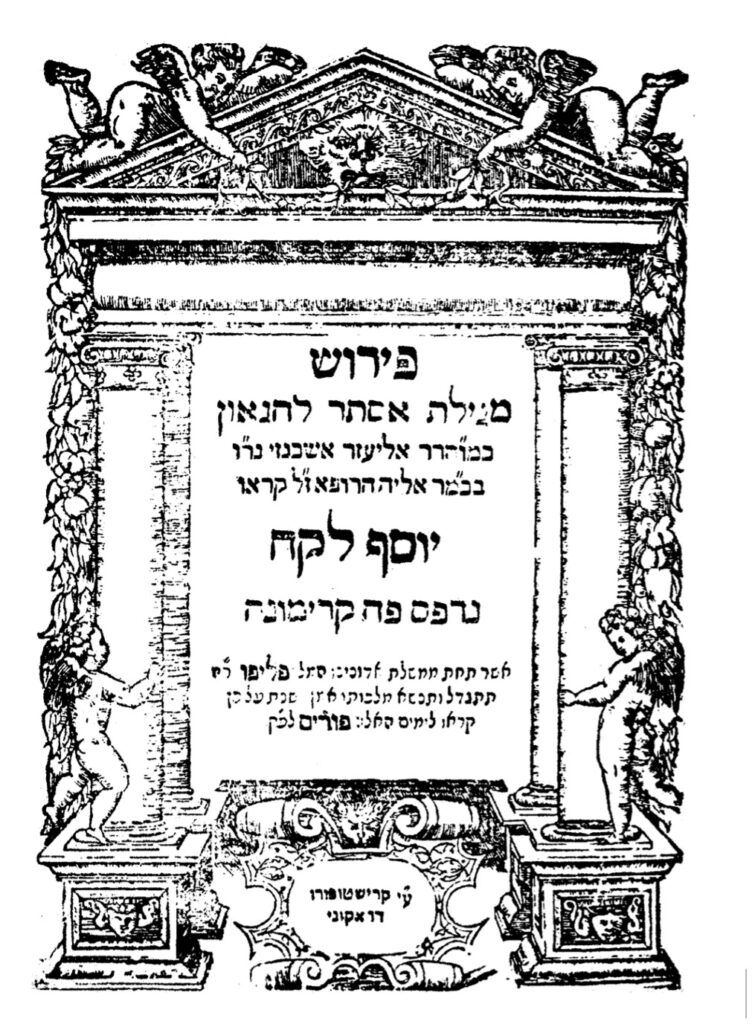
1576, Yosef Lekah
Courtesy of the Fales Library and Special Collections, New York University

R. Eliezer ben Elijah Ashkenazi was a multi-faceted individual, a Talmudist, physician, and well-rounded scholar, who served as rabbi in a number of varied communities. His first rabbinic position, from 1538-61, was in Fostat, Egypt. Forced to leave Fostat, Ashkenazi went to Famagusta, Cyprus, where he was rabbi for two years, and then to Venice. He left for Prague (1561), after a dispute with the Maharam of Padua, and after traveling as far as the Crimea, returned, via Famagusta, to Venice. Ashkenazi was next rabbi in Cremona, where he published Yosef Lekah. Shortly after he left to be rabbi of Posen, and, from 1584, was in Cracow. Ashkenazi experienced difficulties in Poland, disputing over his right to open a yeshiva in close proximity to an existing yeshiva, so that Joseph Solomon Delmedigo (1591-1655) wrote about him, “You have brought a vine from Egypt; you have cast out the nations, and planted it” (Psalms 80:9). Ashkenazi was highly regarded by his contemporaries, corresponding with prominent rabbinic figures such as R. Joseph Caro, R. Joseph Ha-Kohen (Katz), R. Moses Isserles (Rema), and R. Solomon Luria (Maharshal), several mentioning him in their responsa. R. Elijah of Pesaro, in Famagusta in 1563, praised Ashkenazi’s scholarship, noting that he was fluent in twelve languages.

The title-page has four cherubim images, two reclining at the top of the structure, two standing erect by the pillars at the sides. The title-page is dated “Therefore they called these days Purim קראו לימים האלו פורים (336 = 1576)” (Esther 9:26). Yosef Lekah is dedicated to Don Joseph Nasi, Duke of Naxos, whom Ashkenazi, in the introduction, compares to Joseph in Mizraim and Mordecai at the time of Ahasuerus. Ashkenazi, therefore, entitled this work Yosef Lekah. Two, almost identical, editions of Yosef Lekah exist, both dated 1576. Although almost exact copies of the original, it is clear, upon close examination, that the book was reset. Christopher Draconi’s Yosef Lekah was the last Hebrew book printed in Cremona.

Ashkenazi’s most important work is Ma’aseh HaShem (Venice, 1583), on the historical occurrences in the Torah, with a commentary on the Passover Haggadah; selichot; and, not extant today, a super-commentary on the Ramban (Nachmanides) and annotations to R. Caro’s Beit Yosef.[30]

Conclusion – In this article we have described books printed in Augsburg, Basle, Cremona, Mantua, Prague, and Venice. The cherubim imagery on these title-pages, reflecting the influence of Renaissance humanism, their attractiveness notwithstanding, do not appear on the title-pages or accompanying the text in Hebrew books published in more modern times. A review of the title-pages reproduced here, all dissimilar, with their numerous depictions of cherubim, attest to the popularity of that image. Given the strictures on Hebrew printing from the mid-sixteenth century in Italy, the frequent use of cherubim testify to the cooperation of Jewish and non-Jewish printers, their frequency perchance suggesting a positive relationship going beyond mere monetary gain.

We conclude with the Talmudic statement above, which suggests why the image of cherubim was so popular:

Rav Ketina said: When the Jewish people would ascend for one of the pilgrimage festivals, the priests would roll up the curtain for them and show them the cherubs, which were clinging to one another, and say to them: See how you are beloved before God, like the love of a male and female. (Yoma 54a)

Lastly, in conclusion an image of a cherub, both chronologically and, in cherubian activity, quite different from those depicted in this article. It is included as it is unusual and eye catching, an image of a Cherub smoking a pipe. It appears in in at least two Basle imprints published by Israel ben Moses ben Abraham Halle, active in Offenbach, although not continuously, from 1718/19 to c. 1738/43. The works are Anaf Etz Avot, R. Benjamin ben Yekutiel Wulff’s commentary on Pirke Avot, and tractate Sanhedrin (1721).[31]
  1. Once again, I would like to express my gratitude and appreciation to Eli Genauer for reading the article and his insightful comments.
  2. Emil G. Hirsch, W. Muss-Arnolt, J. Frederic McCurdy, Louis Ginzberg, “Cherub ( ; plural, Cherubim)” Jewish Encyclopedia IV (New York, 1901-06), pp. 13-16; Shalom M. Paul, Louis Isaac Rabinowitz, “Cherub” Encyclopedia Judaica IV (Jerusalem, 2007), pp. 600-01.
  3. Thomas Kelly Cheyne, 1911 Encyclopædia Britannica, Volume 6, reproduced in https://en.wikisource.org/wiki/1911_Encyclop%C3%A6dia_Britannica/Cherubim
  4. https://www.sefaria.org/search?q=%D7%9B%D7%A8%D7%95%D7%91%D7%99%D7%9D&tab=text&tvar=1&tsort=relevance&svar=1&ssort=relevance.
  5. Franz Sales Meyer, Handbook of Ornament: a Grammar of Art, Industrial and Architectural Designing in all its Branches for Practical as well as Theoretical use (New York, 1957), pp. 108-09.
  6. Codices and early imprints did not have title-pages, the first leaf normally being left blank to protect the book, that page later becoming a dedicated page. The first book with a detailed title-page was the Calendarium of Johannes Regiomontanus, appearing in 1476 (Venice), being a fifty-five year calendar (1475-1530), printed by Johannes Regiomontanus. The first Hebrew book with a title-page was the Sefer ha‑Roke’ah (Fano, 1505) of R. Eleazar ben Judah of Worms (c. 1165 – c. 1230).
  7. Cherubim also appear on the frames of Hebrew books printed in the incunabular period. For examples of such frames see Marvin J. Heller “Behold, you are beautiful, my love: The Use of Ornamental Frames in Hebrew Incunabula” Printing History NS 10 (New York, July, 2011), pp. 39-55, reprinted in Further Studies in the Making of the Early Hebrew Book (Leiden/Boston, 2013), pp. 3-33.
  8. The following book descriptions are selected, modified from Marvin J. Heller, The Sixteenth Century Hebrew Book: An Abridged Thesaurus ( Brill, Leiden, 2004), var. cit.
  9. Avraham Yaari, Hebrew Printers’ Marks (Jerusalem, 1943), pp. 7 and 126-27 n. 10 [Hebrew].
  10. Jerome Friedman, The Most Ancient Testimony. Sixteenth-Century Christian-Hebraica in the Age of Renaissance Nostalgia (Athens, Ohio, 1983), pp. 44-48, 214-15; A. M. Habermann, Title Pages of Hebrew Books (Tel Aviv, 1969), p. xi [Hebrew with English introduction], pp. 19-20, 125-26 nos. 4-5; Joseph Prijs, Die Basler Hebräischen Drucke (1492-1866) (Olten, 1964), pp. 49-51 n. 26; Frank Rosenthal, “The Rise of Christian Hebraism in the Sixteenth Century,” Historia Judaica II (New York, 1945), (New York, 1945), pp. 182-91; and Richard S.Westfall, “Sebastian Muenster,” http://es.rice.edu/ES/humsoc/Galileo/Catalog/Files/muenster.html
  11. An interesting example of this later usage is R. Moses ben Hanokh Altschul’s (c. 1546–1633) Brant Shpigl, a popular Yiddish work on ethics, correct demeanor, and customs for women, published by Konrad Waldkirch (Basle, 1602), also indicative of the passage of typographic material between printers.
  12. Stephen G. Burnett, “German Jewish Printing in the Reformation Era (1530-1633),” University of Nebraska – LincolnUniversity of Nebraska – Lincoln DigitalCommons@University of Nebraska – LincolnDigitalCommons@University of Nebraska.
  13. Ch. B. Friedberg, History of Hebrew Typography of the following Cities in Central Europe: Altona, Augsberg, Berlin, Cologne, Frankfort M., Frankfort O., Fürth, Hamberg, Hanau, Heddernheim, Homberg, Ichenhausen, Neuwied, Wandsbeck, and Wilhermsdorf. Offenbach, Prague, Sulzbach, Thannhausen from its beginning in the year 1513 (Antwerp, 1935), pp. 29-31 [Hebrew].
  14. A. M. Habermann, “The Printer Hayyim Shahor, his Son Isaac and Son-in-law Joseph Yakar,” in Studies in the History of Hebrew Printers and Books (Jerusalem, 1978), pp. 103-07 [Hebrew].
  15. Yeshayahu Vinograd, Thesaurus of the Hebrew Book. place, and year printed, name of printer, number of pages and format, with annotations and bibliographical references II (Jerusalem, 1993-95), p. 2 no. 10 [Hebrew].
  16. Zipora Baruchson, “Money and Culture: Financing Methods in the Hebrew Printing Shops in Cinquecento Italy,” La Bibliofilia 92 (1990), 25.
  17. For examples of such usage see Marvin J. Heller, “Behold, you are beautiful, my love: The Use of Ornamental Frames in Hebrew Incunabula” Printing History NS 10 (New York, July, 2011), pp. 39-55, reprinted in Further Studies in the Making of the Early Hebrew Book. (Brill, Leiden/Boston, 2013), pp. 3-33; “Mars and Minerva on the Hebrew Title Page,” The Papers of the Bibliographical Society of America 98:3 (New York, N. Y., 2004), pp. 269-92, reprinted in Studies in the Making of the Early Hebrew Book (Brill, Leiden/Boston, 2008), pp. 1-17; and the “The Printer’s Mark of Marc Antonio Giustiniani and the Printing Houses that Utilized It,’ Library Quarterly, 71:3 (Chicago, July, 2001), pp. 383-89, reprinted in Studies, pp. 44-53.
  18. Unterricht Wie ain Christenmensch by Urbanus Rhegiosu (1489-1541), a Protestant Reformer active in Northern and Southern Germany promoting Lutheran unity in the Holy Roman Empire. Unterricht is one of several titles with this frame printed by Silvan Otmar of Augsburg (https://www.flickr.com/photos/58558794@N07/6576279085).
  19. Zipora Baruchson, “Money and Culture: Financing Methods in the Hebrew Printing Shops in Cinquecento Italy,” La Bibliofilia 92 (1990), 25.
  20. For examples of such usage see Marvin J. Heller, “Behold, you are beautiful, my love: The Use of Ornamental Frames in Hebrew Incunabula” Printing History NS 10 (New York, July, 2011), pp. 39-55, reprinted in Further Studies in the Making of the Early Hebrew Book. (Brill, Leiden/Boston, 2013), pp. 3-33; “Mars and Minerva on the Hebrew Title Page,” The Papers of the Bibliographical Society of America 98:3 (New York, N. Y., 2004), pp. 269-92, reprinted in Studies in the Making of the Early Hebrew Book (Brill, Leiden/Boston, 2008), pp. 1-17; and the “The Printer’s Mark of Marc Antonio Giustiniani and the Printing Houses that Utilized It,’ Library Quarterly, 71:3 (Chicago, July, 2001), pp. 383-89, reprinted in Studies, pp. 44-53.
  21. Ch. B. Friedberg, Bet Eked Sepharim, (Israel, n. d), alef 286 [Hebrew].
  22. A later example of an objectionable title-page is the responsa of R. Joel ben Samuel Sirkes’ (Bach, 1561-1640), She’elot u-Teshuvot Bayit Hadash, printed in Frankfurt am Main (1697) by Johann Wust. The title-page had an ornate frame with forms of unclad women which aroused rabbinic opposition, for those authorities considered the title-page inappropriate and offensive to Jewish sensibilities. The quire had to be reprinted with a new title-page, now with two cherubim holding a floral wreath with grapes. A similar situation occurred earlier in Hanau in 1630. Sefer ha-Roke’ah, by R. Eleazer of Worms, was issued in a small format, 12×16 cm., due to the economic restrictions resulting from the Swedish War. On the title-page “Venus rises naked from the waters on a seashell – a common pagan motif” (The book was issued by a press belonging to a non-Jew, Hans Jacob Hena, so that, it has been suggested, no attention was initially given to the title-page. When the book was sold, “many Jewish purchasers tore out the offending page” (Raphael Posner and Israel Ta-Shema, ed. The Hebrew Book: An Historical Survey [Jerusalem: Keter Publishing House, 1975]). There does not appear to have been any opposition to this last title-page in Venice, for the Venus rising from the waters motif appears in Hebrew works printed there, where it was the press mark of Alessandro Gardoni (Venice, 1577-78) and can be found in the Mishneh Torah printed by Meir Parenzo at the press of Alvise Bragadin in 1574.
  23. Taytsher sprach (Vaybertaytsh), is a type generally but not exclusively reserved for Yiddish books, so named because these works were most often read by the less educated and women. Concerning the early use of Vaybertaytsh see Herbert C. Zafren, “Variety in the Typography of Yiddish: 1535-1635,” Hebrew Union College Annual LIII (Cincinnati, 1982), pp. 137-63.
  24. Israel Zinberg, A History of Jewish Literature, translated and edited by Bernard Martin VII (Cleveland, 1973), p. 116.
  25. Meyer Waxman, A History of Jewish Literature (1933, reprint Cranbury, 1960), II pp. 632-33.
  26. Zinberg, p. 106.
  27. Robert Bonfil, Jewish Life in Renaissance Italy (Berkeley, 1994), tr. Anthony Oldcorn, pp. 133, 169; Deror Schwartz, “Samuel Archivolti, his Life and Writings,” Asufot VII, ed. Meir Benayahu (Jerusalem, 1993), pp. 82-83 [Hebrew]; and Zinberg, II p. 130.
  28. Amram, pp. 324-27; Robert Bonfil, “Change in the Cultural Patterns of a Jewish Society in Crisis: Italian Jewry at the Close of the Sixteenth Century,” in Essential Papers on Jewish Culture in Renaissance and Baroque Italy, ed. David B. Ruderman (New York, 1992), p. 418; Rachel Elior, “Messianic Expectations and Spiritualization of Religious Life in the Sixteenth Century,” in Essential Papers . . ., p. 286.
  29. Yaari, Printers’ Marks, pp. 12, 132 n. 19; Yosef Hayim Yerushalmi, Haggadah and History (Philadelphia, 1975), nos. 28-31; and Isaac Yudlov, The Haggadah Thesaurus. Bibliography of Passover Haggadot: From the Beginning of Printing until 1960 (Jerusalem, 1997). p. 4 n. 25 [Hebrew].
  30. David Amram, The Makers of Hebrew Books in Italy (Philadelphia, 1909, reprint London, 1963), p. 319; Meir Benayahu, Hebrew Printing at Cremona: Its History and Bibliography (Jerusalem, 1971), pp. 22-24, 232-34; and Jacob Elbaum, Openness and Insularity. Late Sixteenth Century Jewish Literature in Poland and Ashkenaz (Jerusalem, 1990), p. 47, [Hebrew].
  31. This image appeared in my article “Offenbach Revisited: An enigma Reexamined,” published in the Gutenberg-Jahrbuch (Mainz, 2012), pp. 219-28, and reprinted in Essays on the Making of the Early Hebrew Book (Brill, Leiden/Boston, 2021) pp. 273-92. It was noted there that “in his observations to a draft of this paper, Professor Dr. Hans Schneider observes that he has never seen ‘a cherub smoking a pipe’ and suggests that if the figure is an angel the instrument is a flute. He agrees, however, that the object in question does look like a clay pipe as in the self-portrait of Gerrit Dou. Professor Dr. Schneider suggests that the figure might be an oriental man or boy, as was often painted in the seventeenth and eighteenth century, wearing a turban-like cap with plumes, and that what appears to be an angel’s wings might be a fluttering cape. The reader may draw his or her own conclusions.”


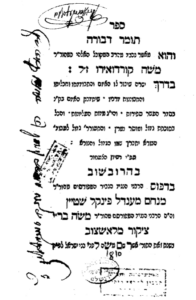
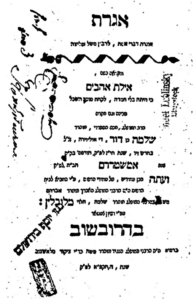
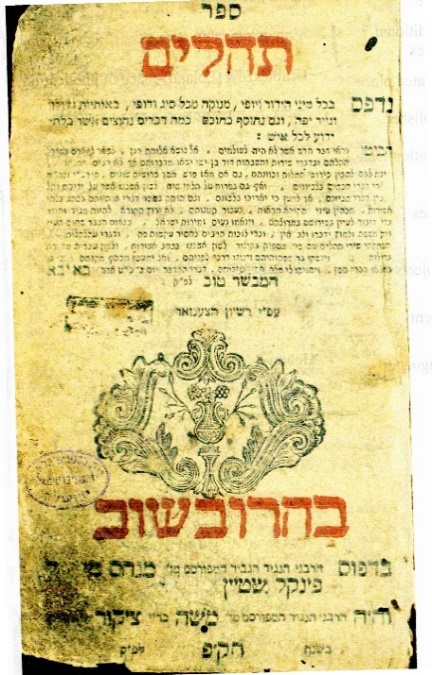
Do you recall Hrubieszow? Hrubieszow, Home to an Active Early Nineteenth Century Hebrew Press

Do you recall Hrubieszow?

Hrubieszow, Home to an Active Early Nineteenth Century Hebrew Press[1]

Marvin J. Heller

A barely remembered Hebrew press, one credited with as many as forty books, although that number is uncertain, was active in Hrubieszow (Hrubyesho), Lublin district, in southeastern, Poland from 1816 to1821 and then intermittently until 1827. The variance in the number of titles printed may be attributed to the manner in which books are recorded, some titles being a composite of three works. In some instances, the town or the printers’ names are omitted from the title-page due to censorship or book tariff payment. The books published by the press are relatively small varied books, designed to meet the community’s needs and interests. The first works printed include several Yiddish titles. Most of the books are small format, ranging from duodecimo (120) through quarto (40) formats. The article describes a small portion of the Hrubieszow imprints to give a sense of the press’s publications, their variety, indicative of the community and how, through their books, the press served it. The selected works are generally of a scholarly and specialized nature, primarily Hasidic works on the weekly parasha (Torah reading), ethical, and halachic tomes, although varied within each category. These works reflect both the composition and interests of the community.

A barely remembered Hebrew press, one that is credited by the Thesaurus of the Hebrew Book with as many as forty books in the early nineteenth century, was active in Hrubieszow (Hrubyesho), Lublin district, in southeastern, Poland.[2] Jewish presence in Hrubieszow dates to the first half of the fifteenth century, Jews being recorded there as tax farmers and merchants, doing business in such diverse areas as Walachia, Turkey, the Crimea, and Kiev.

In the 10th century, the Hrubieszow district had been part of the Polish state. In 981, however, it was seized by the Kievan Rus’, subsequently changing hands several times, even falling to the Mongol Empire in the mid-13th century. Even earlier, the founding of Hrubieszow dates to the early Middle Ages when there was a defensive ‘gord’ (a medieval Slavonic fortified settlement) on the Huczwa river island. Hrubieszow is mentioned as early as 1254, as a hunting settlement amid forests. In 1366, Hrubieszow, then known as Rubieszów, was recaptured by King Casimir III the Great, again becoming part of the Kingdom of Poland (see banner of early Polish monarchy, right). In about 1400, the town received a charter from Polish king, Władysław II Jagiełło. Hrubieszow (Rubieszów) was destroyed several times by Crimean Tatars, who raided the area in the 15th, 16th and 17th centuries, and by rebellious Cossacks.
In 1772, After the First Partition of Poland, Hrubieszow was annexed by Austria. In 1800, Stanisław Staszic founded the Hrubieszow Agricultural Society, the first cooperative organization in Europe, which existed until 1945. In 1802, the name Rubieszów was changed to Hrubieszow, the name by which it is known today. Seven years later, in 1809, after the Austro-Polish War, Hrubieszow became part of the short-lived Polish Duchy of Warsaw, subsequently becoming, in 1815, by the Congress of Vienna ,part of the Russian-controlled Congress Poland, within the Lublin Governorate.[3]

As noted above, Jews were active in Hrubieszow from the first half of the fifteenth century. At some point in that century, Jews in Hrubieszow received several privileges for wine trade and management of the town tax chamber. By 1551, thirteen Jewish residents occupied four houses, that number rising to 40 Jews living in 5 houses by 1560. That number continued to increase, so that from the 18th century until the beginning of the 20th century Jews comprised a considerable majority of Hrubieszow’s population, controlling trade, industry, and craft. In 1578, King Stephen Bahory granted the Jews in Hrubieszów extensive rights. Less than a century afterwards, during tah-ve-tat (the Chmielnicki massacres of 1648-49), the Jewish community was almost entirely destroyed. Soon afterwards, however, the Jewish community was reestablished – a yeshivah was opened, headed by R. Isaac ben Judah Charif. Hrubieszow would subsequently be home to a number of prominent rabbis and became influential in the Arba’ah Artzot (Council of the Four Lands).[4] In the 18th century the Hasidic movement became active in Hrubieszow, the city becoming a center of Berdichev Hasidism. Among its leaders was R. Joseph ben Mordecai Katzenelboigen (R. Mordechai of Neszhchiz), who relocated there in the 1790s.[5]

We now turn to our subject, Hebrew printing in Hrubieszow. As noted above, the Hrubieszow press is credited by the Thesaurus with as many as forty titles, although that number may be uncertain; in contrast, Avraham Yaari records only thirty-four titles for Hrubieszow.[6] Those works are relatively small varied books, designed to meet the community’s needs and interests, published from 1816 to1821 and then intermittently until 1827. This article will describe a small portion of those works, to give a sense of the press’s publications, their variety, indicative of the community and how, through their books, the press served it. To address a greater number would be tedious for both the reader and the writer.

Dr. N. M. Gelber and Avraham Yaari inform that attempts to establish a Hebrew press in Hrubieszow were made from 1792 through 1804, in the Austrian period, but that the matter was delayed, the privilege to do so not granted. In late 1816, a Hebrew press was established in Hrubieszow, now part of Congress Poland. The founder of the press was R. Menahem Mendel Finkelstein (Finkel Stein). He had partners, namely R. Moses Tzikor and R. Saul Moss Goldstein of Łaszczów. Finkelstein provided the financing, the latter two the necessary skills, being experienced printers, having been partners in the Hebrew press in Łaszczów. Management of the press changed in the following years. Goldstein left the press in 1819, returning to Łaszczów, Finkelstein left the press in 1821, leaving Tzikor in charge. Tzikor then took Solomon ben David as a partner. Eight master printers were employed by the press as compositors and press operators, namely Daniel Ze’ev ben Segal, Baruch Abraham ben David, both from Hrubieszow, Isaac ben David from Łaszczów, Hayyim ben Eliezer from Zhovkva, Israel ben Raphael, Menachem Mendel ben Baruch, Pesach Joseph from Łęczno, and Eliezer Segal, perchance from Hrubieszow.[7]

Printing began shortly after the privilege was granted, the first works being published, including several Yiddish titles. Vinograd records ten titles for 1816-17, beginning with Shir ha-Shirim (1816), Orhot Zaddikim, Gedolus David u-Malchus Shaul, Haggadah shel Pesah, Sefer Hasidim, Lekah Tov, a siddur Tefillas Nehora, Noam Elimelekh, Shivhei ha-Ba’al Shem Tov, and Tanna de-vei-Eliyahu. These are all small format books, ranging from duodecimo (120) through quarto (40) formats. These works are indicative of the variety of the Hrubieszow imprints and the community the press served. For example, R. Judah ben Samuel he-Hasid’s (c. 1150-1217) Sefer Hasidim, an ethical, mystical, and halakhic work; Tanna de-be-Eliyahu is an aggadic midrash attributed to Elijah the prophet as dictated to the third century amora Anan bar Rav: Noam Elimelekh by R. Elimelech of Lizhensk; Shivhei ha-Ba’al Shem Tov, collection of Hasidic tales about the founder of Hasidim, and in contrast to the prior works, Joseph ha-Efrati’s Gedolus David u-Malchus Shaul, a maskilic (enlightened) drama.[8]

Noam Elimelekh – We begin with R. Elimelech ben Eliezer Lippman (Lippa) of Lizhensk’s (1717-87) Noam Elimelekh, a classic and primary Hasidic work, representative of the press’s output and the communities’ interests. R. Elimelech was a student of R. Samuel Smelke Horowitz (Rebbe Reb Shmelke, 1726-78), and afterwards a disciple of R. Dov Baer the Maggid of Mezhirech (1704–72), as well as meeting by the latter R. Levi Yitzhak of Berdichev (c. 1740-1809). After the Maggid’s passing, Elimelech became the acknowledged head of the Hasidic movement and is considered the theoretician and creator of “practical zaddikism.”[9]
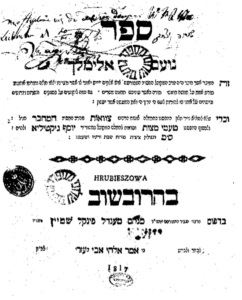
Noam Elimelekh was published as a 23 cm. work ([1], 94 ff.) The title-page begins with honorifics of Elimelech of Lizhensk and informs that in order that there should not be blank paper at the beginning of the book and for benefit of the public, they have published the testament of the author (see below), and at the end of the volume is R. Joseph Gikatilla’s Tamei Ha-Mitzvot. Not noted but also at the end of the volume are Likkutei Shoshana and Iggeret ha-Kodesh. The title page is dated with the chronogram “[for he said] the God of my father’s [house] was my help כי אמר אלקי אבי בעזרי (577 = 1817)” (cf. Exodus 18:4). Elimelech’s testament, entitled conduct (הנהגות) of a man is on the verso of the title-page and consists of twenty-one admonitions for a person.
The title-page states that Noam Elimelekh was published at the press of Menahem Mendel Finkelstein. According to Ch. B. Friedberg the references to the publisher on the title-page varies between books. He notes that initially references to the printer stated Menahem Mendel Finkel Stein and associates. Afterwards, however, he does mention the names of his partners.[10]

1817, Noam Elimelekh

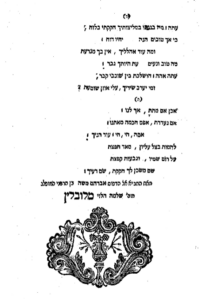
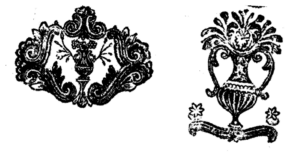
The text, a hasidic Torah commentary on the weekly Torah portion, follows. It emphasizes the role of the zaddik in worship and divine service. At the end of the concluding section of the book are two decorative tail-pieces. These tail-pieces, particularly the one on the left, appear on title-pages of several Hrubieszow books.

Noam Elimelekh is a classic Hasidic work. First printed by his son after his death in Lvov 1788, Noam Elimelekh has proven to be an immensely popular work. This, the Hrubieszow printing, is the sixth edition. It is reported that more than 50 editions of Noam Elimelekh have been printed.[11]

Sefer Hasidim – R. Judah ben Samuel he-Hasid’s (c. 1150–1217) Sefer Hasidim, a different but computable work is, as noted above, an ethical, mystical, and halakhic work. Judah was a disciple of his father, R. Samuel (ben Kalonymous) he-Hasid (c. 1120-75) an eminent kabbalist and ascetic; portions of Sefer Hasidim are attributed to Samuel he-Hasid. They are among the most renowned members and leaders of the Hasidei Ashkenaz, the influential Jewish pietist movement in medieval Germany.

It is reported that when Judah’s mother was pregnant with him, she was walking along a path by a bet medrash (Torah study hall) when a wagon came bearing down upon her, with no place to turn, neither to the right nor to the left. Just as she was about to be crushed by the horses’ hoofs, the walls of the bet medrash opened saving her and her son. It is also told that Samuel he-Hasid witnessed the heavens opening; asked what kind of son he wanted, he replied, one of exemplary piety. Judah reputedly hosted the prophet Elijah, was able to revive the dead, and performed miracles, particularly saving Jews from oppressors. He practiced an ascetic form of mysticism, fasting two days for Yom Kippur, throughout the week, eating at night only, and often fasted on Shabbat, claiming that the change would cause him pain, detracting from his pleasure in Shabbat. It was said by a contemporary that if Judah had lived in the times of the prophets he would have been a prophet.

1817, Sefer Hasidim

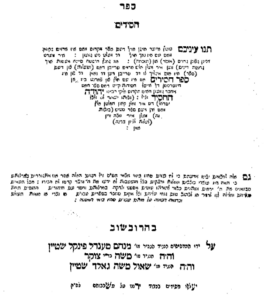
The title-page of Sefer Hasidim, published is octavo format (80: [64] pp.) is in Yiddish, excepting the names of the printers and the publication date. All of the printers are cited here in bold letters, that is, Menahem Mendel Finkel Stein, Moses Tzikor and Saul Moss Gold Stein. The date in the chronogram, “Let the faithful exult in glory;
let them sing joyously upon their beds יעלזו בכבוד ירננו על משכבותם )577 = 1817).” (Psalms 149:5)

Sefer Hasidim is foremost an ethical manual, practical rather than theoretical, encompassing all aspects of life, including the minutiae of personal, family, and business matters. Numerous examples are cited, containing, considerable information about contemporary Jewish life. Advice is detailed and pragmatic, with the goal of achieving strict adherence to an ethical and pious life. These instructions, often based on kabbalistic teachings, have been influential because of the author’s great piety. Sefer Hasidim is also a mystical work, explaining biblical and talmudic passages.[12]

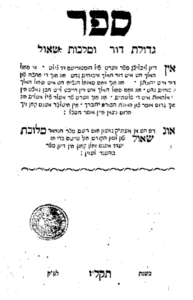
Gedolus David u-Malchus Shaul – A very different work is Joseph Ha-Efrati of Tropplowitz’s (c. 1770–1804) Gedolus David u-Malchus Shaul, a drama in Yiddish. Among the smallest Hrubieszow imprints, it was printed in duodecimo format (120) 29 ff.

1817, Gedolus David u-Malchus Shaul

The author, born in Tropplowitz, Silesia, was a Hebrew poet, dramatist, and tutor. While working in the last capacity he wrote the first acts of the drama Melukhat Sha’ul from Melukhat Sha’ul completed in Prague in 1793. Gedolus David u-Malchus Shaul is a Yiddish translation, retitled. This version, that is the Yiddish translation, has been described as “part of the traditional Purimshpil (“Purim play”) in many Lithuanian and Polish towns . . . the first modern Hebrew drama of the Haskalah period, is noteworthy for its new egalitarian and humanistic ideas.” In writing Melukhat Sha’ul Ha-Efrati was reputedly influenced by Shakespeare, Goethe, Schiller, and von Haller, as well as M. H. Luzzatto. The primary characters, Saul. David, Jonathan, and Michal reputedly signify abstract ideas rather than lifelike characters, representing “the pathos of a suffering hero, ridden with envy and guilt, torn by fears and loneliness, and not merely a proud and jealous king.”[13]

The title-page is misdated, the date, given in a straightforward manner, is תקלז (= 1777). Depending on when the misdating was caught, it may have been corrected with a stop-press correction, that is, when an error was found the press would be stopped, the error would be quickly corrected and printing resumed. As one copy only of Gedolus David u-Malchus Shaul was seen it not known if that was done or if this is the sole uncorrected title-page for that work.[14] Friedberg writes that he has seen several of the press’s books that are misdated[15] For other examples, see below.

The text is in Yiddish excepting paragraph headers and, similarly, except here vocalized, the names of the participants in the drama on the verso of the title-page. This is the third edition of Gedolus David, the first having been printed in Lvov in 1801; It is a popular work, as many as fourteen editions are recorded for Gedolus David in the Bet Eked Sefarim and only twelve editions for Melukhat Sha’ul.[16]

The following year, 1818, saw the publication of five titles, primarily Hasidic works, among them such classics titles as R. Menahem Nahum Twersky of Chernobyl’s Me’or Einayim, homilies on the weekly Torah portions; R. Samuel ben Nathan Ha-Levi Loew Kolin’s Maḥaẓit ha-Shekel on the Shulḥan Arukh Oraḥ Ḥayyim and Yoreh De’ah; R. Jacob ben Solomon Habib’s Ein Ya’akov, collection of aggadah in the Talmud; R. Levi Yitzhak of Berdichev’s Hasidic classic Kedushat Levi discourses on the weekly Torah readings, and, in Vinograd’s listing, a second Hrubieszow edition of Noam Elimelekh.

Kedushat Levi – R. Levi Yitzhak of Berdichev’s Kedushat Levi, a classic Hasidic work of weekly discourses. was published in quarto format (40: [1], 78, 27, 15 ff.) in the year “Isaac pleaded [with the Lord] ויעתר יצחק (571= 1818)” (Genesis 25:21). R. Levi Yitzhak of Berdichev, who defended Hasidus against its opponents, settled in Berdichev, in 1785, residing there for the rest of his life. When he passed away, it seemed, to R. Nahman of Bratslav that “the light of the world had been extinguished.” Levi Yitzhak was held in the highest regard and affection by Jews. An example of his sensitivity, even to transgressors, is the following incident,

When he happened to meet “a young man eating in public on the fast of Tisha B’Av (the anniversary of the day on which both the first and second Temples were destroyed) the rabbi asked him mildly, “Have you forgotten that today is the Ninth of Av? Or are you perhaps unaware that it is forbidden to eat on the Ninth of Av?” “I have not forgotten what day it is and I am well aware of the prohibition,” answered the young man. “Possibly, my son, you are not in good health and have been advised by your doctor to eat?” the rabbi of Berdichev inquired further. No, I am in excellent health,” was the reply. “See, O Lord,” exclaimed the sage with joy, “how admirable Your children are! Even when they transgress Your Commandments, they do not stoop to falsehood.” [17]

Levi Yitzhak’s first published work, also entitled Kedushat Levi, is discourses on Hanukkah and Purim, printed in Slavuta in 1798. It was subsequently included in later editions of Kedushat Levi on the weekly Torah readings.

1818, Kedushat Levi

The title-page of this edition of Kedushat Levi begins with honorifics for R. Levi and then informs that it also includes additional material on various subjects. On the verso of the title pages is an approbation from four rabbis from Berdichev; R. David Shalit, R. Aaron Isaac ha-Kohen, R. Nathan Aryeh Davir, and R. Mordecai באאימו son of my lord, my father, teacher, and rabbi David Shalit. Below the approbation is the standard disclaimer that the people among whom the Jews reside today are not like those in the time of the Talmud, immoral idol worshippers, but today show respect for Torah and do justice and righteousness in their lands, The text follows, primarily on the weekly parsha, but also addressing other biblical books, festivals, and concluding with a final section addressing various subjects, including Pirke Avot. Kedushat Levi.

First published in Berdichev in 1811, this, the Hrubieszow edition, is the third printing of Kedushat Levi. A popular work, it has frequently been republished.

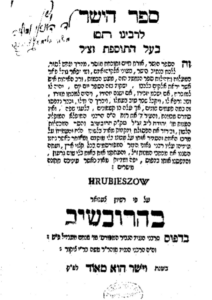
Sefer ha-Yashar – Among the books published in 1819 is R. Zerahiah ha-Yevani’s (13th or 14th century) popular ethical work Sefer ha-Yashar (Book of Righteousness). The title-page attributes the work to R. Jacob ben Meir Tam (Rabbenu Tam, c. 1100-1171), a not infrequent error, as well as it being attributed to R. Jonah Gerondi (13th century). The former did author a Sefer ha-Yashar (Vienna, 1811), but that is another work, consisting of responsa and novellae, while the style of the latter, who wrote ethical works, differs from this book. A number of manuscripts, however, name Zerahi ha-Yevani’s as the author. While many now accept him as the author, that attribution is not definite. Little is known about Zerahiah, except that he was a resident of the Byzantine Empire and that he is credited with Sefer ha-Yashar.

Sefer ha-Yashar was published in octavo format (80: [2], 40 ff.). The title-page begins that it is “the path of life and moral reproof, to go on a straight path. It is dated “it is [very] indeed upright וישר הוא מאוד (579 = 1819)” (cf. Deutronomy 32:4; Psalms 21:29). The printers names are given on the title-page as Menahem Mendel F. Sh. and Moses Tzikor,

1819, Sefer ha-Yashar

There is an introduction, in which Zerahiah brings proof for the Torah and its precepts from both reason and from the prophets, and bemoans the pursuit of pleasure, wealth, and honor in his time, rather than religion and morality. Sefer ha-Yashar, with the purpose of directing one’s soul towards the correct worship of God, piety, and ethical content, is written in an easy style so that it will influence others to right conduct. Sefer ha-Yashar is comprised of material from earlier ethical works, although they are not mentioned in the text by name nor directly quoted. It is evident, from the book, that he was familiar with Jewish philosophic works. The most significant of the prior works, acknowledged in the introduction, is Bahya ibn Paquda’s Hovot ha-Levavot, studied by Zerahiah, but too long and complex for the average reader. It provides, in summary, the essence of several chapters. Another important influence, evident in the text, is Maimonides.

The text, divided into eighteen chapters which address, beginning with the creation of the world, worship, repentance, knowledge of God, the will of God, the world to come, complete repentance, the significance of the righteous, accountability of a person, remembrance of the day of death, and the distinction between the righteous and the wicked. Zerahiah’s primary subjects are the need to imitate God, conditions of proper prayer, both theoretical and practical; correct conduct and obstacles to be overcome to achieve it; and repentance.[18]

A popular work Sefer ha-Yashar was first printed in Constantinople (1540); this is the twenty-second edition, of slightly more than fifty recorded by the Bet Eked.Sefarim.[19]
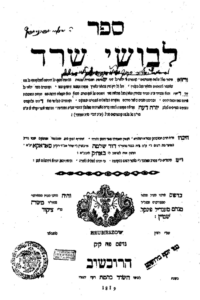
Levushe Serad – Another different work, also published in 1819, is R. David Solomon Eybeschuetz’s (Eibenschutz) halachic Levushe Serad on the Shulhan Arukh Yoreh Deah, particularly on the laws pertaining to shechita (ritual slaughter). Printed as a folio (20: [2], 2-102 ff,) in the year “attired as thin beast לבושי השרד בהמה דקה (561 = 1801).” This date is certainly incorrect, a bet ב at the head of the word בהמה (beast) which make the verse meaningful but gives a date in error, as opposed to a kafכ which would read כהמה and would give the correct value of (579 = 1819) but be meaningless. I would suggest, and this is entirely speculative, that the printer wanted the meaning of beast even if that threw the date off. Support for this conjecture can be found in the correct date, immediately below the Hebrew date, in Arabic numerals, that is, 1819. This is the only title-page seen among the Hrubieszow imprints with an Arabic numeral date.

The author, R. David Solomon ben Yerachmiel Eybeschuetz, was born in Russia and studied under R. Moses Ẓevi Heller. He served as rabbi in several locations, among them Buzhanow, Soroki (Volhynia), and Jassy, (Rumania). Eybeschuetz made aliyah, that is, he went up to Eretz Israel, residing in Safed, where he died in 1812. Eybeschuetz was also a kabbalist as well as a Talmudist. His other works include responsa, Ne’ot Deshe (part one, Lvov, 1861), part two and manuscripts, including a commentary on the Torah and discourses.[20]

The title-page describes Levushe Serad as being comprised of three parts, the first explaining the laws pertaining to laws of falling and broken bones in cattle and fowl; the second, laws applying to lungs; and the third, applying to Yoreh De’ah. The printers are given here as Menahem Mendel Finkel Stein. and Moses Tzikor.

The verso of the title-page has an approbation from R. David Shalit. The text is comprised of the commentary in two columns. The text of this volume on Yoreh Deah varies from the previous volume on Orah Haim. Chaim Tchernowitz describes this volume as following R. Alexander Sender Shor’s (d. 1737) influential Simla Hadasha, also on shechita; Levushe Serad being described as the most important commentary on that work [21] It does not include the text of Yoreh De’ah, on which Levushe Serad comments and elucidates.

1819, Levushe Serad

Levushe Serad on Orah Haim was first published in Mohilev (1805). This volume, on Yoreh Deah is the third edition, it too having been printed previously in Mohilev (1812).[22]

Havvat Da’at – Among the books printed in 1820 was another work on Shulhan Arukh Yoreh Deah, but considerably different from Levushe Serad, that is, R. Jacob ben Jacob Moses Lorbeerbaum of Lissa’s (c. 1760–1832) Havvat Da’at. It was published as a folio (20: [1], 37 [should say 36], [34] ff.) in the year “Day to day makes utterance, night to night speaks out יום ליום יביע אומר ולילה ללילה יחוה דעת (470 = 1805) 19:3), This chronogram is also misdated, as is noted by the NLI catalogue, which records it as a circa 1820 imprint; which also states that the printer, who is not identified on the title-page, is unknown.

1820, Havvat Da’at

Jacob Lorbeerbaum of Lissa was a distinguished rabbi, who served in several communities, writing, in addition to Havvat Da’at other valued works. [23] However, his early days were difficult and troubled. His father, rabbi of Zborow, passed away prior to Lorbeerbaum’s birth; he was raised by R. Joseph Te’omim (Pri Megadim, 1727–1792), a relative. He initially combined learning and business, being a partner in a brewery but, when that failed, Lorbeerbaum became rabbi in Monasterzyska, founding a yeshivah there. He subsequently became rabbi of Kałusz writing many of his earliest works there, including Havvat Da’at which, reflecting his great humility, was originally published anonymously. When his authorship was subsequently identified ,Havvat Da’at became the name by which he is known.[24]

In 1809, Lorbeerbaum became rabbi of Lissa. Lorbeerbaum was an opponent of the Haskalah movement, their influence resulting in his leaving Lissa in 1822 and returning to Kalisz. Disputes there forced him, in 1830, to again relocate again finally settling in Stryj, serving there as rabbi until his death.

The title-page of Havvat Da’at states that it is on Shulhan Arukh Yoreh Deah, which is a tree of knowledge “desirable as a source of wisdom” (Genesis 3:6), for the pure and the impure. It continues that it is comprised of two parts, Biurim, explanations in depth based on prior commentaries and Hiddushim, novellae, interpretative explanations of statutes and critical analysis. On both sides of the pressmark is the standard disclaimer that the contemporary peoples among whom the Jews dwell today are not immoral idol worshippers as in the past.

The commentary, as described on the title-page, is in two parts, about the text of the Shulhan Arukh. Chaim Tchernowitz describes the subject matter of Havvat Da’at as being on such subjects as salting of meat, meat and milk, mixtures, interest, niddah, and other halakhot dealing with prohibitions such as Stam Yeinam (gentile wine), and treifus. He concludes that according to Havvat Da’at even with laws dealing with permitted and prohibited foods there is room for critical and analytical critique.[25]

Given the title-page variations of this edition, described above, it is not surprising that Avraham Yaari questions, concisely, whether Havvat Da’at is a Hrubieszow imprint. He suggests that it was published elsewhere, writing “one more book that is listed as having been published in Hrubieszow was actually published in Polonne. This is Chavat Da’at by Ya’akov of Lissa.”[26] While we have noted a number of variations in Havvat Da’at, such as the dating error in the chronogram, albeit not that unusual for Hrubieszow publications, the absence of the printers’ names, and a pressmark that is not common to Hrubieszow title-pages, there is also the fact, in contrast to these varoiances, that the place of printing is clearly given on the title-page as Hrubieszow. Furthermore, other bibliographic sources, such as Friedberg’s Bet Eked Sefarim and Vinograd’s Thesaurus record Havvat Da’at as a Hrubieszow imprint. An examination of a sample of Polonne and Sudylkow (also suggested) title-pages did not show any like images. The question of whether Havvat Da’at was a Hrubieszow imprint or was published elsewhere is a teku (u nresolved).

Another Hrubieszow imprint by Jacob Lorbeerbaum of Lissa is a folio edition of Beit Ya’akov, novellae and commentary on Shulchan Aruch, Even Ha–Ezer and tractate Ketubot. The printers are given as Moses Tzikor, of Laszczow, and Solomon, ben David Lev, of Laszczow, Menahem Mendel Finkel Stein having already left the press.

This is the fourth printing of Havvat Da’at. The first edition was published in Lvov (1799).

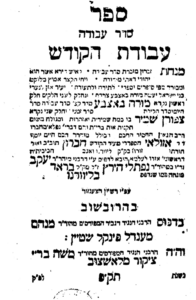
Avodat ha-Kodesh – Among the books printed in Hrubieszow in 1820 is Avodat ha-Kodesh by R. Ḥayyim Joseph David ben Isaac Zerachia Azulai (Hida, 1724-1807), a prominent kabbalist, rabbinic scholar, bibliophile, and prolific author. More than eighty works are attributed to him, sixty in print, on a wide variety of subjects on Torah, halachah, aggadah, and kabbalah.[27] Avodat ha-Kodesh, an 18 cm. octavo(80: 40 ff.) is comprised of three related works, Vinograd records each independently, that is, Avodat ha-Kodesh, Moreh be-Etzba, and Ziporin Shamir as separate entires. All three titles, kabbalistic explanations of customs, are in octavo format (80) and relatively small works. Shimon Vanunu, describes Avodat ha-Kodesh as a compilation of several of Hida’s prior works.[28]

Hida was born in Jerusalem to a prominent Sephardic family, descendant from exiles from Spain, and his great-grandfather was the kabbalist R. Abraham Azulai (c. 1570–1643, Hesed le-Avraham), originally from Fez, Morrocco and on his maternal side from R. Joseph Bialer, a German scholar. He was educated by leading rabbinic figures, among them R. Isaac ha-Kohen Rapoport, R. Shalom Sharabi, and R. Haim ibn Attar (Ohr ha-Haim). He served as rabbi in several communities and beginning in 1755, served as an emissary from Eretz Israel to Jewish communities in Europe.

1820, Avodat ha-Kodesh

The title-page has the heading Avodat ha-Kodesh in large bold type and below notes the other two works, and then that the book was brought to press by R. Jacob ben Naphtali Hertz of Brod and that it had been printed previously in Livorno. The title-page is dated in a straightforward manner as (תק”פ = 1820). The verso of the title-page has the disclaimer that the non-Jews among

whom the Jews noted above that contemporary nations are unlike the earlier nations who were immoral idol worshippers, but today show respect for Torah and do justice and righteousness in their lands. It is followed by the tailpiece noted above that appears on the title-pages of several books. Examples of the text are:

147: all who say shirat ha-yam (Exodus 14:30 – 15:19) with joy as if he himself had been delivered from the sea, Pharoh, and his army, when they drowned in the sea, and says Shira with great feeling is forgiven his iniquities.

148: all who weep and mourn for a person who was kosher is forgiven his iniquiites.

149: all who pray erev Shabbat and say [the prayer] ויכלו “the heavens and earth were completed” (Genesis 2:1), two angles say to him turn your eyes and your sins will be atoned for.

The pressmark appears at the end of the book as a tail-piece.

Tomer Devorah – Another work published in 1820 is R. Moses ben Jacob Cordovero’s (Ramak, 1522-1570) popular and much reprinted Tomer Devorah. A small kabbalistic, ethical, and inspirational treatise, it was published as a 19 cm. octavo (14 ff).

Moses ben Jacob Cordovero was the first to describe the dialectical process through which the Sefirot pass in their development and to interpret the various stages of their emanation as manifestations of the Divine mind.[29] Based on his name, Cordovero appears to have been descended from Jewish exiles from the city of Cordova. It has been suggested, but this is uncertain, that he was born in Safed. Cordovero was a student of R. Joseph Caro (1488-1575) in nigleh (revealed, literal Torah) and, after heeding a heavenly voice that urged him to study Kabbalah, of his brother-in-law, R. Solomon Alkabez (Lekhah Dodi) in nistar (esoteric Torah, Kabbalah). Cordovero became a leader of the ascetic mystical community of Safed, preparing for it a list of rules of conduct, primarily instructions and commands. He served as a dayyan in Safed and founded a yeshivah there in about 1550, which he headed until his death in 1570.

Among Cordovero’s students were R. Elijah de Vidas (Reshit Hokhmah), R. Abraham Galante (ha-Kadosh), R. Samuel Gallico (Asis Rimmonim, an abridgement of Pardes Rimmonim), R. Hayyim Vital, and R. Isaac Luria (ha-Ari). Although Luria was Cordovero’s student for a short while only, and his system of Kabbalah would supplant that of Cordovero, Luria refers to Cordovero as his master and teacher, testifying that Cordovero was completely free of sin, that both the sages of the Mishnah and Elijah the Prophet appeared to him, and that at Cordovero’s funeral a pillar of fire preceded his coffin. Others, such as R. Menahem Azariah da Fano, although in Italy, considered themselves disciples of Cordovero. A prolific writer, he is responsible for several of the classics of Kabbalah.[30]

Tomer Devorah is entitled from “And she sat under the palm tree of Deborah (Tomer Devorah) between Ramah and Beth‑El in Mount Ephraim” (Judges 4:5). The title-page urges man to follow a straight path, to end his isolation and reflect on his ways, to cleave to the order of the sephirot. The printers are given as Menahem Mendel Finkel Stein and Moses Tzikor of Łaszczów, their names preceded by honorifics. The title-page is dated with the chronogram in the year “This is the Teaching that Moses placed before the children of Israel זאת התורה אשר שם משה לפני בני ישראל (580 = 1820)” (Deuteronomy 4:44).

1820, Tomer Devorah

The text is comprised of ten chapters describing Divine qualities and how man should strive to emulate them. They are, 1) the Supernal Crown (Keter) and the thirteen attributes of higher mercy which belong to it; 2) the qualities of the crown, such as humility and kindness, eradicating pride from the heart; 3) wisdom (Hokhmah), love and care for all creatures; 4) understanding (Binah) and repentance; 5) on mercy (Hesed), the methods of performing mercy and assisting the Sefirot to function harmoniously; 6) power (Gevurah), utilizing the evil inclination to serve God; 7) beauty (Tiferet), the study of Torah and behavior appropriate to a scholar; 8) Endurance, Majesty and Foundation (Netzach, Hod and Yesod), support of Torah students and purity of life; 9) Sovereignty (Malkut), sacrifices for Torah and performing marital duties with holiness; 10) Man’s conduct so that he is never separated from the world of the Sefirot. An example of the text, from Keter, is:

Keter – Some major activities that are the main governance: Further for a person to resemble his Creator from the secret of the trait of the Crown (Keter), he must [do] some major activities – which are the main governance. The first: The trait of humility – which includes everything – because it is dependent on the Crown. As behold, It is a trait over all of the Traits, but it does not raise itself and become proud above [the others]. Indeed, It goes down and always looks downwards. And that is from two reasons: The one is that It is embarrassed to look at Its Cause, rather Its Emanator always looks down upon It to benefit It; and It looks down to the lower ones. So [too,] must a person be embarrassed from staring upwards, to be proud. Rather, he must always stare downwards, to diminish himself all that he can.[31]

The title page is followed by a brief introduction from R. Moses Basola, with the pressmark. He found the manuscript of Tomer Devorah in the library of R. Menahem Azriah, who gave it to Basola, in order to bring it to press to merit Israel.

Tomer Devorah is replete with allusions from Talmudic and kabbalistic sources, systemizing and vividly presenting abstruse concepts. It has been frequently republished and translated into other languages, among them English. Tomer Devorah was first published in Venice (1588); this the Hrubieszow edition, is the fourteenth. The Bet Eked Sefarim records thirty-two editions, several with annotations, and not recording translations.[32]

Ayyelet Ahavim – A rhetorical and poetic treatise on the Akedah (sacrifice of Isaac) by R. Solomon de Oliveyra (1633-1708). Ayyelet Ahavim was printed as a 19 cm. octavo (80: [4], 20, [1] ff.). It is dated in a straightforward manner as תקפ”א,ה ([5]581 = 1821).

R. Solomon de Oliveyra is accounted among the Sephardic sages of Amsterdam.[33] Oliveyra’s place of birth, whether Lisbon or Amsterdam, is uncertain. Albert Van Der Heide suggests that as Oliveyra’s parents were fugitive co1nversos, as documented in Amsterdam in 1628, he must have been born in the latter location. Also, based on the marriage certificate issued by the city of Amsterdam, Oliveyra married Rached Dias in 1660, when twenty-seven years old, again attesting to Amsterdam as his place of birth.[34] Oliveyra served as rabbi (hakham) and teacher in the Talmud Torah Etz Haim of the Keter Torah association of the Amsterdam Portuguese community, of which he later became president. He was a member of the rabbinical council, over which he presided after the death of R. Jacob Sasportas (c. 1610-98). In addition to these rabbinic positions, Oliveyra worked as a corrector in the printing-house of Uri Phoebus.[35] Oliveyra was the author of a number of varied multi-lingual works on grammar, lexicography, other philological subjects, poetry, and riddles. Van Der Heide has described Oliveyra as “the preeminent and omnipresent Hebrew poet of Jewish Amsterdam.” Oliveyra became, for a time, an adherent of Shabbetai Zevi, composing liturgical verse in his behalf as well as writing approbations

The primary publisher of Oliveyra’s books was David de Castro Tartas (c. 1625–c. 1700), active from 1662 to 1698 in Amsterdam. Their relationship began in 1665, when our subject work, Ayyelet Ahavim ws published. The title-page begins that it is Igeret: words of truth, “to understand a proverb, and a figure” (Proverbs 1:6). It is entitled Ayyelet Ahavim for it was “a precious vessel” (Hosea 13:15, Nahum 2:10, II Chronicles 32:27), “To receive the instruction of wisdom” (Proverbs 1:3), “He established it and searched it out” (Job 28:27), by the rav, the Sephardic sage SOLOMON ben DAVID Oliveyra, in the month of Ziv in the year תי”ז (1657, printed in Amsterdam in the year תכ”ה (1665). It adds that it has now been brought to press by R. Abraham Moses ben Solomon ha-Levi of Lublin: with the permission of the censor in Hrubieszow at the press of Moses ben Tzikor of Łaszczów.

1821, Ayyelet Ahavim

Oliveyra’s introduction follows (2a-b) in which he states that he does not wish to delve into deep explanations nor to go up to the heights of discourse, but rather his heart wishes to speak of the greatness of that “righteous man, who quarried the fetters of love, of that which he formed יצורו for the love of the One Who formed him יוצרו.” Oliveyra’s intent is to investigate this holy and wondrous deed. Among the several reasons that he entitled this work Ayyelet Ahavim is that it is on the love of Abraham and his soul for God “As the hart longs for water streams” (cf. Psalms 42:2). The wide-ranging text is comprised of numerous aggadot, and including riddles and parables. In one section the alternating paragraphs of verse are between father and son. The prose text is accompanied by infrequent marginal references.

First printed in Amsterdam (1665) this is the third and last published edition Of Ayyelet Ahavim.[36]

Summation – Ten books have been described. The selected books give an insight to the type of works published by the Hrubieszow press. They are generally of a scholarly and specialized nature, primarily Hasidic works on the weekly parasha (Torah reading), ethical, and halachic tomes, although varied within each category. These works reflect both the composition and interests of the community. One book, Gedolus David u-Malchus Shaul, stands out, being of a contrary nature, that is, it has maskilic overtones. The provenance of one other work, Havvat Da’at, has been questioned. Also published were two editions of Shir ha-Shirim (1816, 1827), the former not seen, the latter (1820) with the commentaries of R. Eliezer ben Judah (Rokeah) and R. Moes ben Nachman (Ramban).

A lacuna in the press’s publications is the absence of Mishnaic and Talmudic volumes, attesting to the press’s emphases on small books, perchance the nature of its’ operations, a small publisher catering to and meeting a small market’s needs. It did, however, print an Ein Ya’acov, on the aggadot in the Talmud, this with the commentary Kotnot Or. The emphasis on small works does not in any way detract from the value of the press’s publications. Indeed, the books were well printed and attractive. Yaari, however, while approving of their appearance is not so positive as to the titles printed, writing “The books printed in Hrubieszow were elegant in appearance, but not of significant content. Most had been printed previously by other presses. These books were in great demand, such as popular Yiddish books.”

As noted above, the Thesaurus credits the Hrubieszow press with as many as forty titles, although that number appears uncertain, or perhaps exaggerated; Avraham Ya’ari recorded thirty-four titles only. Perchance, the difference in number can be attributed to the manner in which books are recorded. Avodat ha-Kodesh, for example, is a composite of three works, each listed independently in the Thesaurus but one entry only in Yaari’s listing. Summerly, there are three entries in the Thesaurus for Siddur Tefillat Nehora, a two-part prayer book designed so that it can be used for both Ashkenaz ads Sephardic rites. There is one listing only by Yaari, but more detailed. The entries in the Thesaurus for Tefillat Nehora are several years apart (1817, 1821, [1824]). To complicate matters, Yaari has several entries for Kotnot Or but the Thesaurus has one entry only for the Ein Ya’acov. The exact number of publications must remain then a teku (unresolved).

We have noted misdates and censors’ remarks. Yaari comments on this writing:

The names of the town or the printers are omitted from the title pages of several of the books printed in Hrubieszow. This is probably due to censorship, or book tariff payment. Sometimes the printers mentioned their names in some copies but not in others; sometimes they even inserted the name of a different town or stated a different year, to deceive the censor or the tariff–collector

No books omitting Hrubieszow were seen or noted.[37] Why then, printing with the censors’ approval they would omit their names is unclear. Indeed, the books described above, all, with the exceptions of Havvat Da’at all have the printers’ names. In conclusion, as already noted, the Hrubieszow press published small varied books covering a variety of subjects. The books served communal needs, were works of value, and attractively printed. A press only active for a brief period, it served the Hrubieszow community well. It deserves, should be remembered, in addition entries in bibliographic and historical records.

  1. I would like to express my appreciation to Eli Genauer for reading the article and his corrective comments, and Eli Amsel for his additional insights. All the title and text page images are courtesy of the National Library of Israel. The Polish monarchy banner is a public domain image.
  2. Vinograd, Yeshayahu. Thesaurus of the Hebrew Book. place, and year printed, name of printer, number of pages and format, with annotations and bibliographical references II (Jerusalem, 1993-95), p. 167 [Hebrew].
  3. https://en.wikipedia.org/wiki/Hrubiesz%C3%B3w
  4. The Encyclopedia of Jewish life Before and During the Holocaust, editor in chief, Shmuel Spector; consulting editor, Geoffrey Wigoder; foreword by Elie Wiesel I (New York, 2001), pp. 532-34; Polin: Virtual Shtetl https://sztetl.org.pl/en/towns/h/266-hrubieszow/99-history/137366-history-of-community; Dr. N. M. Gelber, Notes on the History of the Jews of Hrubieszow, tr. Yael Chaver, https://www.jewishgen.org/yizkor/Hrubieszow/hru021.html.
  5. Hurvitz Tzvi Ha–Levi Ish Hurvitz, “The Town of Hrubieszow and its Rabbis,” translated by Yael Chaver, Columns 51-52. https://www.jewishgen.org/yizkor/Hrubieszow/hru051.html
  6. Avraham Yaari, “The Hebrew Printing Press in Hrubieszow,” Kiryat Sefer, (Jerusalem, 1943–4), pp. 219–228 [Hebrew], tr. by Yael Chaver https://www.jewishgen.org/yizkor/Hrubieszow/hru051.html#Page57
  7. Dr. N. M. Gelber, Notes on the History of the Jews of Hrubieszow, tr. Yael Chaver, https://www.jewishgen.org/yizkor/Hrubieszow/hru021.html..
  8. Ch. B. Friedberg, History of Hebrew Typography in Poland from the bginning of the year 1534, and its development up to our days . . . Second Edition, Enlarged, improved and revised from the sources (Tel Aviv, 1950), pp.150-52 [Hebrew].
  9. Mordechai, Margalioth, ed., Encyclopedia of Great Men in Israel I (Tel Aviv, 1986), cols. 179-80 [Hebrew].Tzvi M. Rabinowicz, The Encyclopedia of Hasidism (Northvale, 1996), pp.111-12.
  10. Ch. B. Friedberg, History of Hebrew Typography in Poland, op. cit.
  11. Arnold Green, “Elimelekh of Lizhensk, “The Yivo Encyclopedia of Jews in Eastern Europe, Gershon David Hundert, ed. I (New Haven & London, 2008), p. 467; Rabinowicz, op. cit.
  12. Marvin J. Heller, The Sixteenth Century Hebrew Book: An Abridged Thesaurus II (Leiden, 2004) p. 697: Simcha Kogut, “The Language of Sefer Hasidim, Its Linguistic Background and Methods of Research,” in Studies in Medieval Jewish History and Literature, ed. Isadore Twersky, II (Cambridge, 1984), pp. 95-108; Reuben Margaliot, ed., Sefer Hasidim (Jerusalem, 1973), pp. 3-9 [Hebrew].
  13. https://www.encyclopedia.com/religion/encyclopedias-almanacs-transcripts-and-maps/ha-efrati-tropplowitz-joseph
  14. To replace a sheet with a single error would necessitate replacing several pages, the number depending on the book format. The normal practice, therefore, was to retain the original defective sheet and use both it and the corrected sheet in copies of the book. Due to cost factors, both of paper and labor, the sheet with the error would be replaced only if the error was substantial or substantive. It is therefore possible for books to consist of non-uniform copies, having several sheets with variant readings. For examples of such errors see Marvin J. Heller, “Who can discern his errors? Misdates, Errors, and Deceptions, in and about Hebrew Books, Intentional and Otherwise” Hakirah: The Flatbush Journal of Jewish Law and Thought 12 (2011), pp. 269-91, reprinted in Further Studies in the Making of the Early Hebrew Book, (Brill, Leiden/Boston, 2013), pp. 395-420.
  15. Friedberg, History of Hebrew Typography in Poland, p, 151 n. 1.
  16. Ch. Friedberg, Bet Eked Sefarim, (Israel n.d.), gimmel 128, mem 1922 [Hebrew].
  17. Rabinowicz, p. 61.
  18. Margalioth, Great Men, II col. 465-66; Meyer Waxman, A History of Jewish Literature (1933, reprint Cranbury, 1960), II pp. 276-79.
  19. Friedberg, Bet Eked.Sefarim, yod 1152.
  20. Louis Ginzberhg, N. T. London, “Eibenschutz, David Solomon,” Jewish Encyclopedia V (1New York, 901-06), pp. 75-78.
  21. Itzhak Alfassi “Schor, Alexander Sender ben Ephraim Zalman” v. 18 Encyclopedia Judaica (Jerusalem, 2007), p. 161; Chaim Tchernowitz, Toledoth ha-Poskim, III (New York, 1946), pp. 206-08 [Hebrew].
  22. Friedberg, Bet Eked.Sefarim, lamed 108.
  23. Lorbeerbaum’s other published works are Ma’aseh Nissim (Zolkiew, 1801), on the Passover Haggadah; Mekor Ḥayyim (ibid., 1807), novellae and expositions of the laws of Passover in the Shulḥan Arukh together with the glosses of R. David ben Samuel ha-Levi and Abraham Abele Gombiner on Oraḥ Ḥyyim and novellae to tractate Keritot; Netivot ha-Mishpat (ibid., 1809–16), on Ḥoshen Mishpat; Torat Gittin (Frankfurt on the Oder, 1813), the laws of divorce and novellae on tractate Gittin; Kehillat Ya’akov (1831), on Even ha-Ezer and sections of Oraḥ Ḥayyim; Derekh ha-Ḥayyim, an anthology of liturgical laws, first published with the prayer book (1828) and then separately (1860 or 1870); Naḥalat Ya’akov (1849), expositions of the Pentateuch; Emet le-Ya’akov (1865), expositions of talmudic aggadot; Imrei Yosher, commentaries on the five megillot, each published independently; his ethical will (1875); and Millei de-Aggadeta (1904), sermons and responsa (EJ, op. cit.). In a private correspondence Eli Amsel noted other such works, writing “Another Hrubieszow imprint by Jacob Lorbeerbaum of Lissa is a folio edition of Beit Ya’akov, novellae and commentary on Shulchan Aruch, Even Ha–Ezer and tractate Ketubot.”
  24. Haim Gertner, “Lorbeerbaum, Ya‘akov ben Ya‘akov Mosheh of Lissa, Yivo Encyclopedia, I pp. 1087-88; Ephraim Kupfer, “Lorbeerbaum, Jacob ben Jacob Moses of Lissa” Encyclopedia Judaica XIII pp. 191-92.
  25. Tchernowitz, Toledoth ha-Poskim, III, p. 258.
  26. The Polonne (Polonnoye) press was active from 1789 to approximately 1830, publishing as many as130 titles. Among them three editions of Havvat Da’at. An accompanying note in the Polonnoye entry references it as a Sudylkow imprint (Vinograd, p. 502). Two [1834] editions of Havvat Da’at are listed for that location.
  27. Yaakov Amsalem and Yisrael A. Groweiss, “The Hida’s Riddle,” Mishpaha, March 22, 2022.
  28. Shimon Vanunu, Encyclopedia Arzei ha-Levanon. Encyclopedia le-Toldot Geonei ve-Hakhmei Yahadut Sefarad ve-ha-Mizrah II 649-(Jerusalem, 2006), pp. 649-69 [Hebrew]. The works noted by Vanunu are Moreh be-Etzba, Ziporin Shamir, Kesher Gadol, Kaf Ahas, Yosef be_Seder, Sensen le-Ir, and Shomir Yisrael.
  29. Heller, The Sixteenth Century Hebrew Book, var. cit. ; Gershom S. Scholem, Major Trends in Jewish Mysticism (New York, 1960). Pp. 252-53.
  30. Concerning other works by Moses Cordovero see Marvin J. Heller, “His Hand did not Leave Hers Until he was Grown: Two Little Known Works from Moses Cordovero (Ramak)” Los Muestros no. 44 (Brussels, 2001), pp. 44-46, reprinted in Studies in the Making of the Early Hebrew Book (Leiden/Boston, 2008), pp. 278-83.
  31. https://www.sefaria.org/Tomer_Devorah.2.2?lang=bi&with=SidebarSearch&lang2=en.
  32. Friedberg, Bet Eked Sefarim, tav 484.
  33. Concerning see Marvin J, Heller, ” Solomon de Oliveyra:
    A Seventeenth Century Sephardic Sage,” Sephardic Horizons (v. 13: 1-2 Winter-Spring 2023), https://www.sephardichorizons.org/.
  34. Albert Van Der Heide, “Poetry in the Margin: The Literary Career of Haham Selomoh d’Oliveyra (1633-1708),” Studia Rosenthaliana 40 (2007-08), pp. 14.
  35. L. Fuks and R. G. Fuks-Mansfeld, Hebrew Typography in the Northern Netherlands 1585-1815 2 (Leiden, 1987), p. 247; Margalioth, col. 1264 [Hebrew].
  36. Friedberg, Bet Eked.Sefarim, alef 1626.
  37. While I did not see any such works, Eli Amsel also wrote “I have several in my collection, only TWO without the city mentioned in title, Bet Ya’akov, cityless; Pri Etz Chaim, with koretz as the city in very small font!!!”


Eliezer and Joseph ben Naphtali Hertz Treves: Hebrew Publishers, briefly, in the Mid-Sixteenth Century

Eliezer and Joseph ben Naphtali Hertz Treves:
Hebrew Publishers, briefly, in the Mid-Sixteenth Century
[1]

Marvin J. Heller

A Hebrew press was briefly active in Thiengen (Tiengen) in 1560. The publishers, from the distinguished rabbinic Treves family, were Eliezer and Joseph ben Naphtali Hertz Treves. The brothers only published six (possibly seven) books before being forced to close by a meeting of the leaders, both Protestant and Catholic, of the Swiss Confederation in June 1560, who feared that they were about to print the Talmud.[2]

The Treves family was noted for the many rabbinic scholars and communal leaders it produced over several centuries. Yehoshua Horowitz, in his description of the family history, informs that the family origin may have been in Troyes, France and subsequently in Italy and Germany. A second possibility is Treviso near Venice, Italy, in the 14th century, and yet another is that the family came from Trier, Germany (Trèves in French).[3] Isidore Singer, et. al., record forty-one distinguished members of the family, writing that “No other family can boast such a continuous line of scholars as this one, branches of which have been known under the names Treves, Tribas, Dreifuss, Trefouse, and Drifzan. There exists, however, no means of tracing the connection of these various branches, which even as early as the fourteenth and fifteenth centuries were already scattered over Germany, Italy, southern France, Greece, Poland, and Russia.”[4]

The earliest known Treves is Johanan ben Mattithiah Treves, chief rabbi of France (c. 1385 – 1394), who, after the expulsion of the Jews from France in 1394, resettled in Italy, where he passed away on July 21, 1439. A responsum on the prayers of orphans for their deceased parents, and a letter addressed to the community of Padua, are still extant in manuscript in the Florence Library (Bibliothecæ Hebraicæ Florentinæ Catalogus, p. 426). Several members of the family were employed in printing presses in Italy, among them Johanon Treves at the Bomberg, Sabbioneta and Bologna presses (and later partnered with Ovadiah Seforno. As well as a scholar in his own right. Like his relative, Yochanan authored a commentary to the Siddur that was published in Bologna in 1540 and Raphael ben Johanon, rabbi of Ferrara, as editor and proofreader in Sabbioneta.[5]

Our Treves of primary interest are Joseph and Eliezer ben Naphtali Hertz Treves (1495–1566),[6] who operated the press in Thiengen. The latter served in the rabbinate in Frankfurt am Main for approximately twenty-two years. He was considered among the leading rabbis of his generation. In 1558, Kaiser Friedrich I assigned Eliezer to a committee of three rabbis to resolve the controversy surrounding the election of the chief rabbi position in Prague. committee to register the votes of Prague Jewry for the chief rabbi position. A renowned Talmudist and a Kabbalist, Eliezer became an adherent of several pseudo-Messiahs, namely Asher Lemlein (Lemmlein), who appeared in the sixteenth century; Eliezer attributed the non-fulfilment of Lemmlein’s prophecy concerning the Messiah to “circumstances other than fraud.”[7] In 1561, Eliezer, a collector of manuscripts, went to Cracow, where he transcribed Solomon Molko’s commentaries.[8][9]

Eliezer had printed previously, briefly, in Zurich. His imprints were an all-Yiddish Josippon and Sefer Hayira (both 1546), as well as a Yiddish Psalms. Dr Moshe Nathan Rosenfeld informs that the same vignette was used in Zürich with the Yiddish Psalms (1558), as well as in Tiengen. He writes that “at a meeting of the Eidgenossenschaft in Baden the Catholic representatives of Luzern, accused their Zürich colleagues of allowing the sale of anti-Christian pamphlets in the streets of Zürich.” This resulted in Treves relocating to Thiengen, with the permission of the Count of Sulz, leaving his Yiddish types behind.[10]

Joseph Treves, born in 1490, added an introduction and glosses to their father’s prayer-book, which they published, as well as the publication of the Midrash Ha-Ne’elam on Ruth, under the title Yesod Shirim.

Their father, Naphtali Hirz or Hirtz Shatz (1473-c.1540)[11] was a kabbalist and rabbinic scholar, who served as hazzan and rabbinic judge in Frankfurt am Main. He authored a kabbalistic commentary on the prayer-book, entitled Dikduk Tefillah, printed with the prayer-book, Malah ha’Aretz Deah and Naftulei Elokim (Heddernheim, 1546) and a super commentary and index on R. Bahya ben Asher (1255-1340) on the Pentateuch.[12] The former work, Dikduk Tefillah, a kabbalistic interpretation of the prayer book, reflects the rise in messianic and Kabbalah currents in Ashkenazic Jewry. As Michael A. Meyer writes, “Dikduk Tefillah (The Precise Interpretation of Prayer, 1560), reflects a rise in such tendencies.”[13] These tendencies are evident in Eliezer’s interests, as shown above.

Naftulei Elokim

Turning to Thiengen, now Waldshut-Tiengen, home to our press of interest. It is located in Baden Germany, that is southwestern Baden-Württemberg at the border of Switzerland, north of Zurzach. Jews were likely resident there in the 14th century. In 1650, eight Jewish families received a letter of protection allowing them to conduct trade but not open stores. There was continuous friction with the local population through the 18th century. Jews were only welcome in public from 1870.[14]

Eliezer, together with his brother, Joseph,[15] established their Hebrew press in the small town of Thiengen in 1559 to print kabbalistic treatises, but primarily their father’s commentary, Malah ha’Aretz Deah. As noted above, the press was active for one year only, issuing six books in 1560 and, perchance, one title in 1566, a reprint of the previous edition of the piyyut (liturgical hymn) Shir ha-Yihud (Hymnerchandce, Divine Unity).[16] Printing in Thiengen had been permitted by the Count of Sulz. However, complaints were brought by the burghers, afraid of damages because of the press, to the Bishop of Constance. He initially, in a vague response, permitted the press to continue to operate. However, when, the matter was brought before a meeting of the leaders of the Swiss Confederation in June, 1560, to which Thiengen was subject, they demanded its closure, fearing that the Talmud was to be printed there.

Another brother was Samuel, who relocated to Russia and took the family name of Zevi. He was the author of Yesod Shirim (below) on the Book of Ruth. Samuel’s sons were Eliezer, author of distinguished works, among them Dammesek Eliezer (Lublin, 1646) on tractate Hullin and Si’ah ha-Sadeh (ibid., 1645), a collection of prayers.

Kimḥa de-Avishuna

Another Treves of interest, although his relationship to our Treves family is not clear, is R. Johanan ben Joseph Treves (c. 1490–1557). A peripatetic rabbi, he wandered for twenty years in northern and central Italy, where he served as a religious instructor and rabbi in various communities in northern and central Italy. An author and publisher, Johanan Treves wrote responsa, is credited with the commentary, Kimha de-Avishuna (Bologna, 1540) on the Roman rite festival prayer book, published anonymously, as well as several halakhic works, among them glosses to the Alfasi and commentary on the laws of shehitah au-vedikah. Johanan Treves reputedly was employed in the Hebrew press in Bologna from 1537 to 1541 and, perchance, from 1545–46, as a proofreader in Daniel Bomberg’s press in Venice (noted above).[17]

The books published in Thiengen are few in number. Yeshayahu Vinograd, in the Thesaurus of the Hebrew Book, records seven titles only, all but one printed in 1560, and a single title published in 1566, which, as noted above and we shall see below, is questionable. The varied books printed in Thiengen, in alphabetical (Hebrew) order, are:

אדם שכלי Adam Sedkheli – Kabbalistic and philosophic treatise by R. Simeon ben Samuel. Of French or German birth, Simeon ben Samuel lived in the fourteenth – fifteenth centuries. Adam Sedkheli was published in quarto format (40: 24 ff.).

Adam Sedkheli
Courtesy of the National Library of Israel

The text of the title page is set within a woodcut architectural frame. The two upper corners have shields, the right shield with a key, the left a double-headed eagle, the symbol of the Holy Roman Empire, likely indicating that Thiegen was not a free city but under the direct auspices of the Empire. Simeon added the subtitle, Hadrath Kodesh, because his name, given as שמעון בן שמואל ז”ל יסדו (1012) plus the number of letters in the title (7) equals the phrase Hadrath Kodesh הדרת קודש (=1019).[18] It is that name that appears as the header in the volumes’ text pages. The intent of the book, as stated on the title page, is to save souls from destruction.

Adam Sedkheli is on the Decalogue, thirteen attributes of God (shelosh esreh middot), thirteen articles of faith, and resurrection, with a commentary by the author. The book, written about 1400, is completed with a poetic kabbalistic entreaty, Or Kadmon, which exhorts God to “[further] rescue us from the cruel decrees [following] the four miracles [performed] for us this year [1400].”[19] The miracles are enumerated as:

Salvation from a decree of death in the Jubilee year

Rescue from thousands, all dressed in white

Deliverance from the murderous brigades of Geislsler

the abdication of the “Shameful King [Wentzel], who persecuted us for many years.

The printers’ names do not appear on Adam Sedkheli nor on several of the other books printed in Thiengen. In the absence of another press in this small community, however, it may be assumed that they were responsible for those works as well. David Gans, in Zemah David, notes that Eliezer died in Frankfort in 1563.[20]

Adam Sedkheli has been reprinted several times. Ch. B. Friedberg records seven editions in the Bet Eked Sepharim, beginning with a Lublin (1599) edition through a Warsaw (1915) edition.[21]

בגידת הזמן (משכיל על דבר ימצא טוב) Begidat Hazman – An allegoric maqāma (a poetic narrative in rhymed prose) by Mattathias (Mattityah ben Moses), a 15th century Spanish or Provençal Hebrew poet or Mattathias ha-Yiẓhari, a representative of the Jewish communities of Aragon at the Tortosa disputation (1413–14). This, the first edition of Begidat Hazman, was published in octavo format (80: [26] pp.).

Begidat Hazman
Courtesy of the National Library of Israel

The title page, with a pillared frame with cherubim, has the heading “מַשְׂכִּ֣יל עַל־דָּ֭בָר יִמְצָא־ט֑וֹב וּבוֹטֵ֖חַ בַּיהֹוָ֣ה אַשְׁרָֽיו He who is adept in a matter will attain success; Happy is he who trusts in the Lord (Proverbs 12:20).” Below it the text continues “For I will give all good things, and I will give the way of traitors. I will pour out my spirit, and I will declare to the multitude my words of the betrayal of time בגידת הזמן (Begidat Hazman); the words of Mattathias from captivity.” Here too the title-page header is not the book title.

Begidat ha-Zeman was written in c. 1450. It is described as having “a clear pedagogic, apologetic, and moral purpose. . . . It is written in the first person and the personal element is important. The author repents the sins of his youth, describing his experiences, writing that he speaks from his heart, so that his tale might serve as a warning.”[22]

Mattathias is also credited as being the author of Ahituv ve-Zlmon, also a maqāma, similar in style to Begidat ha-Zeman, written prior 1453, inspired by the religious disputations held in Spain. He is also credited with a commentary on Psalm 119 with references to the disputation, and a commentary to Pirkei Avot (preserved in part only).

Ch. B. Friedberg records three subsequent editions of Begidat ha-Zeman, published in Prague (1609), Amsterdam (1650), and Offenbach (1714).[23]

יסוד שירים Yesod Shirim – Our next title, Yesod Shirim, was written by Naphtali Hirz’s son Samuel. He was, as noted above, the brother who settled in Russia. Samuel authored Yesod Shirim, a kabbalistic commentary on the Book of Ruth, literal and kabbalistic explanations.[24] It was published in 19 c. ([32] ff.).

Yesod Shirim
Courtesy of the National Library of Israel

Here too the title-page has a pillared frame with images of cherubim, unlike those employed on the title-pages of Begidat ha-Zeman (above), and Malah ha-Aretz De’ah and Shir ha-Yihud (below). The header on the title-page, in large bold letters, is given as Tapuchei Zahav, from “Like golden apples (Tapuchei Zahav) in silver showpieces is a phrase well turned (Proverbs 25:11).” Below the brief title-page text continues “behold, this is a new thing… and hidden secrets, the taste of Marut, the secret of the Kingdom of the House of David, head of the poets. Therefore, I entitled it Yesod Shirim.” Within the text, set in a single column in rabbinic letters, the page header is Yesod Shirim.

Yesod Shirim, as noted above, is on Megillat Ruth. But it is not a commentary, rather it is Midrash ha-Ne’elam, the first printing of that section of the Zohar on Ruth. The colophon states that it was printed in Thiengen by the oppressed Joseph ben Naphtali on Sunday, 23 Teves 320 (January 10, 1560). Why oppressed (עשוק) is unclear.

מלאה הארץ דעה Malah ha-Aretz De’ah – The siddur (prayerbook) prepared by R. Naphtali Hirz Treves. Malah ha-Aretz De’ah was published in octavo format (80: [242] pp.). The text of the title-page has an attractive frame with cherubim at the sides.

Malah ha-Aretz De’ah
Courtesy of the National Library of Israel

The title מלאה הארץ דעה is from “For the land shall be filled with devotion (malah ha-aretz de’ah) [to God]” and below it the verse continues “As water covers the sea” (Isaiah 11:9).[25] The text of the title-page continues that it is tefillah (prayer) for the entire year with an attractive commentary as well as a commentary in a kabbalistic manner by R. [Naphtali] Hirz [Treves]. Malah ha-Aretz De’ah is an Ashkenaz rite siddur. The text of the volume is in vocalized square letters accompanied by the commentary in rabbinic letters.

In addition to Naphtali Hirz Treves’ use of kabbalistic works in preparing his commentary to the siddur, he utilized several other sources, among the most important of which was R. Eleazar of Worms (c. 1176–1238) Sefer ha-Rokeah, an important and classic halachic and kabbalistic work.[26] Among his other sources was the Maharil (R. Jacob Moelin (c. 1365 –1427) and R. Bahya. Malah ha-Aretz De’ah closely follows the liturgy of Hasidei Ashkenaz. The commentary is extensive and lengthy.

Malah ha-Aretz De’ah was reprinted three times; two editions in Beni Brak, 1971 and 2004 and by Renaissance Hebraica c. 2000. The Renaissance Hebraica edition includes an alternative title page border. It reuses the border from Begidat Hazman.

מלכיאל Malkiel – A multi-faceted philosophical and ethical work on the afterlife, reward and punishment, and comforting Zion by R. Malkiel Hezkiah ben Abraham. Printed in quarto format (40: 22 pp.), the text of the title-page is concise, set in a decorative border. The purpose of Malkiel is described as being intended to understand the words of the sages.

Malkiel
Courtesy of the Library of Agudas Chassidei Chabad Ohel Yosef Yitzhak

Malkiel addresses such subjects as Gan Eden and Gehinom for the souls and body after death. The concealed meaning of pairs is explained, and the issue of “the tree of knowledge of good and evil” (Genesis 2:9) that the Lord prohibited to the first man and the reasons for his sin. Also explicated are the Garden of Eden, the Tree of Knowledge, Og King of Bashan and additional enigmatic aggadic materials. Additional subjects based on the words of the sages in the Talmud and Midrashim are addressed. The text is in a single column in rabbinic letters.

This is the first printing of Malkiel. Friedberg records seven later editions, beginning with Offenbach (1715) through Vilna and Grodno (1819).[27]

שיר היחוד Shir ha-YihudShir ha-Yihud (Hymn of Divine Unity) is an anonymous piyyut (liturgical poem) written in the mid-twelfth century, most often attributed to Samuel ben Kalonymus he-Hasid (c. 1130-1175), less often to his son, Judah ben Samuel he-Hasid (c. 1150-1217), author of the Sefer Hasidim, both among the foremost representatives of the Hasidei Ashkenaz, and, on occasion, to yet others. This edition was published in quarto format (40: 20 ff.). The title-page has the same frame with cherubim as Begidat Hazman (above).

Although there exist several piyyuttim entitled Shir ha-Yihud, this is the most well-known. Unlike most early manuscript versions of the Shir, which were divided into chapters, later versions, and all printed editions, are divided by the days of the week, one for each day, praising God and his uniqueness, in contrast to the insignificance of man. Lines are divided into rhymed couplets, with four beats to a couplet The fourth day differs from the other days in that it is the only day for which the verses are arranged in alphabetic order; however, the number of lines to a letter are not equal. Shir ha-Yihud is, philosophically, based on the Sefer ha-Emunot ve-ha-De’ot of R. Saadiah Gaon (882-942), a fact acknowledged on the title page.

Shir ha-Yihud
Courtesy of the National Library of Israel

It is customary, today, to recite Shir ha-Yihud on Yom Kippur eve, at the end of services, its more frequent repetition being opposed by a number of rabbinic figures, such as R. Jacob Emden (16971776), R. Solomon Luria (1510-1574) and Rabbi Judah Loew (Maharal, 1525-1609). The latter restricting it to Yom Kippur only, a “day set aside for praise of God, when a person is on a higher level, comparable to an angel” (Netivot Ovodah ch. 12, Netivot Olam).

The text of Shir ha-Yihud is accompanied by the commentary of Yom Tov Lipman Muelhausen (14th-15th centuries). Muelhausen was a dayyan in Prague, a highly respected halakhist and kabbalist. His most famous work is the Sefer ha-Nizzahon, a polemic against Christianity, passed down by hand from generation to generation, until a monk, Theodore Hackspan, seized a copy from the rabbi of Schneittach. Hackspan translated Nizzahon into Latin, added notes in attempt to refute its arguments, and had it printed (Altdorf, 1644). A Jewish edition did not appear until 1701. In a brief introduction to Shir ha-Yihud, Muelhausen writes that he has seen many commentaries on this holy work, but found them to be “straw mixed with grain.” Noting that these are inadequate, not explaining the intent of the author, he asks, “help from the Helper, my Rock, the Almighty, and I will write here all that I received, “mouth to mouth” (Numbers 12:8) from those who know the truth.” [28]

1566 שיר היחוד Shir ha-Yihud – A improbable edition of Shir ha-Yihud is listed in the Thesaurus as the seventh Thiengen imprint. It is also recorded by Isaac Benjacob in Otzar ha-Sefarim (Vilna, 1880) together with the previous 1560 printing.[29] Nevertheless, it is improbable that six years after the press was forced to close it should reopen and publish a single work, identical to one of its previous titles. Furthermore, no library records a copy of this edition. Perchance, the entry was a misreading of the early printing, copied by bibliographers and then recopied, so that in some circles it was accepted as a valid edition.[30]

The books printed in Thiengen, small in number, are nevertheless diverse. Subject matter is varied, encompassing kabbalistic and philosophic works, an allegoric maqāma, a kabbalistic commentary on the Book of Ruth, the siddur prepared by R. Naphtali Hirz Treves, and a liturgical poem. An unusual and interesting aspect of several of the Thiengen imprints is that the large lead phrase on the title-page is not the book title, which follows later in a smaller text font.

The publishers were prominent rabbis from a distinguished rabbinic family. The books printed within the span of one year, to be repetitive, are rich and varied. Thiengen, as so many other small short-lived presses, deserves to be recalled, having made a short lived but valuable contribution to Hebrew literature.

  1. Once again, I would like to express my gratitude and appreciation to Eli Genauer for his insightful comments.
  2. Stephen G. Burnett, “The Regulation of Hebrew Printing in Germany 1555-1630” in Infinite Boundaries: Order, Disorder and reorder in early Modern German Culture, ed. M. Reinhart & T. Robisheux, Sixteenth century Essays and Studies, no. 40 (Kirksville, 1998), pp. 329-30.
  3. Yehoshua Horowitz, “Treves,” Encyclopedia Judaica, (Jerusalem, 2007), vol. 20 pp. 134-35. See generally, Marcus Horovitz, Rabbanei Frankfurt (Jerusalem, 1972), 21-26; Nahum Brüll, “Das Geshiechet der Treves,” in Jahrbücher für jüdische Geschichte und Litteratur (Year 1, 1874), 87-122; and his additions, id., (Year 2, 1876), 209-10; Tzvi Lehrer, Tolodot Naphtali Hertz Treves,” in Hetzei Geborim, 7, (2014), 485-95.
  4. Isidore Singer, Schulim Ochser, Frederick T. Haneman, Richard Gottheil, Isaac Broyde, “Treves,” Jewish Encyclopedia vol. 12 (New York, 1901-06), pp. 243-48.
  5. David Amram, The Makers of Hebrew Books in Italy (Philadelphia, 1909, reprint London, 1963), pp. 205, 291.
  6. There is uncertainty about his birth and death dates. Horovitz, Rabbanei, 191-92.
  7. According to R David Gans, Eliezer attributed the failure to “the sins of the generation.” David Gans, Zemah David (Prague, 1592), Asher Lemlein (Lammlin) (16th century) was a false messiah active in 1500–02. Of Ashkenazi origin, Lemlein began his activities in northeast Italy, continuing in Germany. He claimed that, the redemption was approaching because the Messiah, Lemlein himself, had already come. Even some Christians accepted his Messianic prophecy. After his passing his movement ceased. Richard Gottheil, Isaac Broydé, “Lemmlein (Lammlin), Asher,” vol. 7, Jewish Encyclopedia, p. 680; “Lemlein (Lammlin), Asher,” vol. 12, Encyclopedia Judaica, p. 638. Dan Rabinowitz informed that Eliezer was living in Cracow already and transcribed the letters because he was caught up in the Messianic speculation. In 1531, he wrote to his father Naphtali, about the religious fever Molcho introduced into the general public. See Naphtali Hertz Treves, Malah ha-Aretz De’ah.
  8. Mordechai Margalioth, ed., Encyclopedia of Great Men in Israel I (Tel Aviv, 1986), col. 190 [Hebrew]; Isidore Singer, Schulim Ochser, Frederick T. Haneman, Richard Gottheil, Isaac Broyde, “Treves,” Jewish Encyclopedia vol. 12 (New York, 1901-06), pp. 243-48. Horovitz, Rabbanei 22-28, who provides the most comprehensive discussion regarding Eliezer.
  9. Solomon Molcho (1500-32) was born Diogo Pires to Marrano parents. He circumcised himself, became a follower of David Reubeni, who claimed to be the son of a King Solomon and brother of a King Joseph ruler of the lost tribes of Reuben, Gad, and half Manasseh in the desert of Habor. At some point he too claimed to be the Messiah. His sermons were published, Derashot (Salonika, 1529) and subsequently as Sefer ha-Mefo’ar. In 1532, Molcho went to Ratisbon, where the emperor Charles V imprisoned him. An ecclesiastical court sentenced Molcho to death by fire for Judaizing. He was offered a pardon by the emperor on the condition that he recant and return to the church. Molcho refused, choosing a martyr’s death. (Isidore Singer, Philipp Bloch, “Molko, Solomon,” vol. 8 JE, p. 651); Joseph Shochetman] “Molcho, Solomon,” vol. 14 EJ pp. 423-24. Elisheva Carlebach, “Messianism,” The YIVO Encyclopedia of Jews in Eastern Europe, Gershon David Hundert, ed. Vol. 1 (New Haven & London, 2008), p. 1160, informs that Molcho left a deep impression on Ashkenazic Jews. His messianic flag and caftan were preserved by the Jews of Prague and can still be seen there today. Concerning both false messiahs also see Moses Idel, Messianic Mystics (New Haven & London, 1998) and Gershom S. Scholem, Sabbatai Sevi; the Mystical Messiah (Princeton, 1973), var. cit.
  10. Dr Moshe Nathan Rosenfeld, “The Identity of an unknown Yiddish Prayer Book (From Zürich to Zürich),” Seforim Blog (February 18, 2025).
  11. He died prior to 1546 because, in Yesod Shirim, published that year, he is referred to as already deceased. But the exact year of his death is unknown. See Lehrer, Tolodot, 494n106.
  12. https://en.wikipedia.org/wiki/Naphtali_Hirsch_Treves. See also, Horovitz, Rabbanei, 21. Naftulei Elokim is one of two books printed in Heddernheim, a quarter of Frankfurt am Main. the other work being a Selihot, also printed in 1546, both published by a Hayyim ben Joseph (Yeshayahu Vinograd, Thesaurus of the Hebrew Book. Listing of Books Printed in Hebrew Letters Since the Beginning of Printing circa 1469 through 1863 II (Jerusalem, 1993-95), p. 158.
  13. Michael A. Meyer, editor, German Jewish History in modern Times, vol. 1 Tradition and Enlightenment 1600-1780 (1996 New York) p. 72.
  14. “Tiengen,” The Encyclopedia of Jewish life Before and During the Holocaust, editor in chief, Shmuel Spector; consulting editor, Geoffrey Wigoder; foreword by Elie Wiesel, vol. 3, p.1306.
  15. Some question whether they were related or just shared similarly named fathers. See Lehrer, “Tolodot,” 295n110.
  16. Friedberg, Ch. B. History of Hebrew Typography of the following Cities in Europe: Amsterdam, Antwerp, Avignon, Basle, Carlsruhe, Cleve, Coethen, Constance, Dessau, Deyhernfurt, Halle, Isny, Jessnitz, Leyden, London, Metz, Strasbourg, Thiengen, Vienna, Zurich. From its beginning in the year 1516 (Antwerp, 1937), [Hebrew]; Vinograd, Thesaurus of the Hebrew Book. II p. 3394
  17. Yehoshua Horowitz, “Treves, Johanan ben Joseph,” EJ, vol. 20, p. 135.
  18. Executive Committee of the Editorial Board.,M. Seligsohn, “Simeon ben Samuel,” Jewish Encyclopedia vol. 11, p. 357.
  19. Marvin J. Heller, The Sixteenth Century Hebrew Book: An Abridged Thesaurus vol. II (Brill, Leiden, 2004), pp. 504-05.
  20. David Gans, Zemah David (New York, n. d.), I, yr. 1563 [Hebrew].As Brüll notes, this is an error. Likely reversing the letter “gimal” and “zayin.”
  21. Ch. B. Friedberg, Bet Eked Sepharim, (Israel, n. d), alef 629 [Hebrew].
  22. Yonah David/Angel Sáenz-Badillos, “Mattathias (or Mattityah ben Moses?)” vol. 13 EJ, pp. 685-86.
  23. Friedberg, Bet Eked Sepharim, bet 243. Concerning the Prague edition, Gavin McDowell, “A Genealogy of Errors: Targum Pseudo-Yonatan’s Commentary Tradition” (https://books.openedition.org/ephe/2868?lang=en) informs that Shabbetai Bass (1641-1718), author of the first bibliography of Hebrew books by a Jewish author, in his Siftei Yeshenim (Amsterdam, 1680) misdated Begidat ha-Zeman. Acording to McDowell “The tally of the numeric value of these letters is 369 (80 + 5 + 80 + 200 + 1 + 3), which is 1608/09 of the Christian calendar. Bass forgot to count the word פה, reducing the date by 85 years and resulting in the year 284, which is 1524 CE.”
  24. Yehoshua Horowitz, EJ vol, 20 p. 134.
  25. The exact title is subject to some confusion and debate. The enlarged words on the title page, Malah ha-Aretz De’ah, would normally indicate it is the title. But, some of the other Thengin prints like Sod Yesharim, the enlarged letters, in that instance, Tapuchei Zahav, are not the title. Following Ben Jacob, Friedberg, in Bet Eked Sepharim refers to it Tefilot me-Kol ha-Shana Minhag Ashkenaz. Friedberg, Bet Eked Sepharim, Taf 1711. Yet, he is cited in many rabbinic texts as Siddur Rav Hirtz Shatz, and the two Beni Brak reprints use that title. See Lehrer, Tolodot, 492. Naphtali, in his introduction, titles the work Dikduk Tefilah. Unlike the printer’s introduction that precedes the work, Naphtali’s does not appear until after P’sukei D’Zimra, and may have been overlooked.
  26. The entire commentary for P’sukei D’Zimra are from Eleazar. See “Editor’s Note,” Hetzei Geborim, 8(2015), 1121.
  27. Friedberg, Bet Eked Sepharim, mem 2094.
  28. Heller, The Sixteenth Century Hebrew Book, p. 518-19; Joseph Dan, ed., Shir Hayihud (Jerusalem, 1981), pp. xii-ix and 7-26 [Hebrew with English introduction]; and A. M. Habermann, Shir ha-Yihud ve-ha-Kovod (Jerusalem, 1958), pp. 11-12 [Hebrew]. See also Abraham Berliner, “Shir ha-Yihud,” in Ketavim Nivharim I (Jerusalem, 1945), pp. 145-70 [Hebrew].
  29. Isaac Benjacob in Otzar ha-Sefarim (Vilna, 1880), p. 183 no. 475 [Hebrew].
  30. Concerning the misdating and other errors in the publishing of Hebrew books see Marvin J. Heller, “Who can discern his errors? Misdates, Errors, and Deceptions, in and about Hebrew Books, Intentional and OtherwiseHakirah: The Flatbush Journal of Jewish Law and Thought 12 (2011), pp. 269-91, reprinted in Further Studies in the Making of the Early Hebrew Book (Leiden/Boston, 2013), pp. 395-420; ibid. “Who can discern his errors? Misdates, Errors, Deceptions, and other Variations in and about Hebrew Books, Intentional and Otherwise: Revisited,” Seforimblog, Sunday, July 03, 2016, reprinted in Essays on the Making of the Early Hebrew Book (Leiden/Boston, 2020, pp. 507-36.


A year in Berlin: The Beginning of Hebrew Printing in Berlin in c. 1699

A Year in Berlin:
The Beginning of Hebrew Printing in Berlin in c. 1699
by Marvin J. Heller

The publishing of Hebrew books in Berlin is a relatively late phenomenon. The article provides a background to early Hebrew printing and then discusses the first Hebrew press in Berlin. It addresses Jewish history in Berlin, explaining why Hebrew printing began there at the end of the seventeenth century, almost two hundred and fifty years after it began elsewhere. Several unique works, rather than the usual communal prayer books and bibles, are described in some detail in the article.

Hebrew printing has a rich and lengthy history. The first Hebrew books were printed close to the mid-fifteenth century, in 1469 and 1472, approximately a decade and a half after Johann Gutenberg printed the first Bible in c. 1455 in Mainz, Germany. Those first Hebrew books, printed in Rome by Obadiah, Menasheh, and Benjamin of Rome, and several who followed, are undated. Their name appears in the colophon of R. Moses ben Nahman’s (Nahmanides, Ramban, 1194–1270) Torah commentary[1] The first dated Hebrew book was Abraham ben Garton ben Isaac’s edition of Rashi’s Torah commentary (Reggio di Calabria, 1475, completed 10 Adar, 5235 = Friday, February 17, 1475). It was followed soon after by Jacob ben Asher’s Arba’ah Turim, printed in Piove di Sacco, Padua province on 28 Tammuz, 5235 (July 3, 1475).[2]

A conservative listing of Hebrew books that can be said with certainty to have been printed prior to 1500 are, according to A. K. Offenberg, 139 titles, which he writes “may yet be too high.”I[3] In an index Offenberg records close to twenty locations in which Hebrew incunabula were printed, in Italy, Spain, and a 1493 Constantinople edition of the Arba’ah Turim.[4] Among the more notable locations in which Hebrew printing occurred in the incunabular period are Mantua, Bologna, Ferrara in Italy, and Guadalajara in Spain.

In contrast to the small number of incunabular imprints, approximately 2,700 titles were printed in the following century, that is, from 1500-1599. To be more precise, 2,672 Hebrew titles (or books with Hebrew letters) were printed, according to Yeshayahu Vinograd, in the sixteenth century. In the seventeenth century the number of Hebrew books published increased to 3,526 entries.[5] The primary centers of Hebrew printing in those centuries were, respectively, Venice and Amsterdam. Parenthetically, the latter’s imprints were sufficiently popular that publishers in other locations frequently wrote with a small font “printed with” and in a large font “Amsterdam,” and again in a small font “letters.” Below, again in a small font, the actual place of printing.[6]

That Hebrew printing began so much later in Berlin than in other centers of printing might seem unlikely, given the subsequent importance of that city’s Jewish community and press. However, it is not surprising in light of the early history of Berlin Jewry, which was difficult, indeed stormy. Expelled in the middle-ages, during the Black Death, Jews were allowed to return in 1354, but not permitted a synagogue. There is no further mention of Jews until the sixteenth century. Subsequently, Jews were expelled and readmitted several times. Gotthard Deutsch and A. Freimann write that “The real history of the Jewish community of Berlin does not begin until the year 1671.” At that time, Jews expelled from Vienna were admitted to Berlin. On Jan. 3, 1676, a decree was issued which stated “die Juden in Berlin in ihren Freyheiten und Privilegien nicht zu turbiren, noch zu kränken, sondern sie vielmehr dabey gebürend zu schützen” (not to disturb or worry the Jews of Berlin in their grants and privileges, but to protect them properly).”[7]

Hebrew printing in Berlin began soon after, that is, in the last decade of the seventeenth century. According to the Jüdisches Museum Berlin, Hebrew printing in Berlin, “which commenced later than in other German cities,” began when Daniel Ernst Jablonski published a Hebrew Bible in 1699.[8] Yeshayahu Vinograd, in the Thesaurus of the Hebrew Book, records eleven works printed from 1690 through 1699, eight in the latter date. He begins with a 1690 quarto format (40) Bible attributed to a Knebell, who Moritz Steinschneider describes in his entry for the 1699 Bible as “Opera et impensis Jo. Henri Knebel . . .” (the works and expenses of Jo. Henri Knebel),” the printer given as Jablonski.

The 1690 Bible entry is followed by two 1698 octavo editions (80: 90 pp., no pagination given for the second edition) of Psalms both in the Bodleian library and then the 1699 imprints.[9] Steinschneider dates the first Psalms as “3–9 Tischri 458 (18-24, Sept. 1697), the second as [ca. 1697-9]. These are followed by an edition of Bereishit (Genesis).[10] Also printed at this time was a siddur (prayer book) and another edition of Psalms. All of these works, as well as the following titles, were printed at the Jablonski press.

Daniel Ernst Jablonski’s (1660-1741) involvement with Hebrew printing is surprising given his background and career. He was the son of Peter Figulus, a minister of Unity of the Brethren (Unitas fratrum) and grandson of Johann Amos Comenius, the last bishop of the Unity. Jablonski served as a preacher at Magdeburg in 1683, and from 1686 to 1691 as head of the Brethren College at Polish Leszno (Lissa), a position filled by his grandfather. In 1691, Jablonski was appointed court preacher at Königsberg by the elector of Brandenburg. In 1693, he was transferred to Berlin as court preacher, and in 1699 he was consecrated a bishop of the Unity of the Brethren, where he worked to bring about a union between the followers of Luther and Calvin. In 1700, Jablonski became a member of the Academy of Sciences (Brandenburgische Societät der Wissenschaften), serving between 1710 and 1731 as director of Philology and Oriental Studies and, from 1733 and 1741, as president of the Academy.[11] He was also the author of several books on Christian theology and philosophy.

In Berlin, Jablonski established a Hebrew printing press. Vinograd very conservatively crediting him with having printed as many as twenty titles. However, a significant multiple of that number of titles were printed in Berlin at that time with no printer’s name assigned to them in the Thesaurus, or, in some instances, attributed to an editor at the press.[12] Concerning Jablonski’s heading a Jewish press in Berlin, it may not seem as improbable as it appears. Jews could not initially obtain licenses to own a printing-press, so that of necessity, the owner had to be a non-Jew, although the managers and workers were usually Jewish. Jablonski employed a number of Jewish workers at his press. The most important was Judah Loeb ben David Neumark (d. 4 Nissan = April 9, 1723) from Hanau, author of Shoresh Yehudah (Frankfort on the Main, 1692), the manager of and an editor at the Jablonski printing-house.[13]

Another of Jablonski’s achievements relates to the printing of the Talmud. He was instrumental in securing approval for Michael Gottschalk, the Frankfurt an der Oder printer, and Johann Christoph Beckman, professor of theology at the University of Frankfurt an der Oder, to publish the Frankfurt an der Oder Talmud (1697-99). Jablonski’s opinion was requested by Friedreich III, Elector of Brandenburg, after Gottschalk and Beckman sought permission to print the Talmud. Jablonski’s measured response was, overall, positive; he found the Talmud to be, with reservations, a work of value, and recommended that Friedreich approve the request to republish that work. Jablonski subsequently printed the first Frankfurt on the Oder/Berlin Talmud together with Gottschalk (1715-22).

We turn now to the more distinct books published at the Jablonski press, that are non-biblical nor prayer books, although the press issued both. Our first title is Azmot Yosef, novellae on tractate Kiddushin by R. Joseph ben Isaac ibn Ezra (c. 1560–1620), attributed in bibliographies to Neimark, as it is his name that appears on the title-page. Perchance, he managed the press and Jablonski was the proforma owner.

Azmot YosefAzmot Yosef was published in folio format (20: 125 ff.) in the year “[Show me a sign of] Your favorאות לטובה ( 459 = 1699) that my enemies may see and be frustrated because you. O Lord, have given me aid and comfort (Psalms 86:17). R. Joseph ben Isaac ibn Ezra (c. 1560–1620) was a scion of the renowned Ibn Ezra family of Spain. Publication of Azmot Yosef is attributed by Vinograd to L. Neimark. Joseph ben Isaac Ibn Ezra was a student of 1R. Samuel de Medina (Maharashdam, 1506-89) and of R. Aaron ben Solomon ben Hasson (16th Cent.). Ibn Ezra subsequently headed the yeshivah of Don David ben Yahya, where he had several eminent students, among them R. Shabbetai Jonah. He later left Salonika for Constantinople, and afterwards served as rabbi in Larissa and Sofia.[14]

The first paragraph of the title-page, a reprint of the first edition, states that it is an explanation of the rules by which the Torah is explicated, and that it is:

a commentary in iyyun and pilpul (deliberation and casuistry) of tractate Kiddushin, from the beginning until the end, on the Talmud, Rashi, Tosafot, Rif, Rambam, Rosh, his son the Ba’al ha-Turim, and others on the laws of kiddushin (betrothal). After the iyyun and pilpul I conclude with the halakhah . . . .

Also, for the benefit of the students [I explain] the rules of [kal ve-homer] (a fortiori inference), dayyo (sufficiency), and other rules: I also delve deeply into the passages of parah ve-rahel in Kol ha-basar and at the end of Kaitzad ha-regel.

The second paragraph, somewhat lengthy, informs that Azmot Yosef was printed previously in Salonica in 1601, further expounds it virtues, and informs that it is being printed for the second time in the praiseworthy city of Berlin and extols Friedreich III.


Azmot Yosef

Courtesy of the Library of Agudas Chassidei Chabad Ohel Yosef Yitzhak

In addition to the peshat (clear meaning of the text) on Kiddushin, Azmot Yosef also addresses Talmudic methodology. Ibn Ezra was also the author of Rosh Yosef, novellae on the Tur, Ḥoshen Mishpat, of which the part on taxes and associated communal issues was published as Massa Melekh (Salonica (1601). Some of his responsa were published in the responsa of R. Shabbetai Jonah, R. Solomon ha-Kohen, and R. Samuel Hayyun.

Azmot Yosef is an important work on Kiddushin and has been reprinted several times. Initially printed in Salonika (1601), as noted above, at the press of Abraham and Joseph BathSheba, this is the second edition; four additional printings of Azmot Yosef are recorded in the Bet Eked Sepharim, the most recent a Warsaw edition (1883).[15]

Gefen YehiditOur next work, Gefen Yehidit is a multi-part work, primarily on ethics, by R. Ze’ev Wolf ben Judah Leib of Rosienie. It was published in a small sextodecimo format (160: 59 ff.)

Gefen Yehidit

Courtesy of the National Library of Israel

The title page of Gefen Yehidit has a brief text that states that it is:

A book, small in size but of great quality. It speaks of matters of ethics and reverence in a clear language . . . The author should have merit. He is one of the maskilim (a person of understanding) and in this small book he demonstrates his expertise and sharpness. . .

Included is Sefer Luah ha-Hayyim which speaks of remedies in order that a person should be healthy and strong in order to serve his God continuously.

The title page is dated “a sign for good אות לטובה (459 = 1669)” (Psalms 86:17). Next is the introduction (1b-2a) of R. Judah Leib Hanau,[16] who brought the book to press. In his introduction, Ze’ev Wolf begins with a quote from Midrash Ruth in which Rav Ashi says that this Megillah is not primarily wisdom nor Torah, but to learn from it gemillut hasadim (acts of kindness), so too the work that he is writing. He informs that he has had a difficult life, and frequently quotes from the Zohar.

The text, in a single column in rabbinic letters, is comprised of Gefen Yehidit, a work of mussar (ethics); an accounting (39a-40b), beginning with and based on the memorial prayer El Malei Rahamim, of what befell the Jews of Podhajce (Podgaitsy), Ukraine in 1677 during a Tartar incursion and massacre of the Jews; followed by a dirge (40b-41a); Zemer le-Purim (42a-46b), verse for that festival in both Hebrew and Yiddish, translated word for word into the latter language because that is the language of Ashkenazim; and concluding with Luah ha-Hayyim (47a-59b), a popular medical work.

Gefen Yehidit has been reprinted several times, beginning with a Hanau (1717) edition.

Luah ha-Hayyim – Although included in Gefen Yehidit Luah ha-Hayyim is an independent work. In contrast to the other additional parts of the former title, Luah ha-Hayyim has its own title-page. Written by R. Hayyim ben Benjamin Ze’ev Bochner,[17] (for our ealier discussion regarding Bochner on the SEfohere), a prolific writer, whose works include Orḥot Ḥayyim, a commentary on R. Isaac Tyrnau’s Minhagim (1669, Prague), Mayim Ḥayyim, homilies and comments on Bible and Talmud, and Toẓeot Ḥayyim on grammar. This edition of Luah ha-Hayyim is based on earlier edition printed by Johann Christoph Wagenseil (Altdorf, 1687), also part of a larger work.

Luah ha-Hayyim

Courtesy of the National Library of Israel

The title-page states that it is:

Luah ha-Hayyim

It will be a cure for your body [a tonic for your bones] (Psalms 3:8) etc.” “They are life to him who finds them; healing for his whole body (Psalms 4:22):

Abbreviated rules of conduct for a person in the matter of healing to maintain a healthy body and it is a primary principle in the service of the Lord. In order to benefit the public, we have printed anew R. Hayyim ben Benjamin Ze’ev Bochner of Cracow’s work. It received in the past approbations from leading medical authorities for all these words are true and correct to those who are knowledgeable and meritable.

This is followed by approbations of two doctors from Lublin. An example of the text (51a-52b) is:

a clear white wine , sweet and aromatic, is healthy and caring. If one drinks a measure of wine, it is a balm for the body, for it increases bodily heat and strengthens as a lion. It gladdens the heart and hones the mind. It also helps in the digestion of food. The measure of a reviis as the amount to drink is logical.[18] More than this measure one should cease and desist. However, if one is accustomed to become inebriated from it and drinks more then enough than the head is ill and the heart is pained. One whose nature is warm and thirsts to drink should mix a little water every time. Honey that is clear and of average sweetness and strength is somewhat comparable to the nature of wine in all respects. . . .

A popular work the Thesaurus of the Hebrew Book records twelve editions of Luah ha-Hayyim, but again these are generally not independent publications.[19]

Keter Torah – Keter Kehunah – our final publication, is a Kabbalistic work on Psalms and liturgy by R. Joseph ben Moses (Ashkenazi), darshan of Przemyslany (17th cent.) Printed in quarto format (40: 91, 62-66, [1]; 76 ff.) Keter Torah and Keter Kehunah are, respectively, the second and third parts of Keter Yosef, the first part of which was printed in 1700.[20] Joseph ben Moses, who was a darshan (preacher), served as rabbi and dayyan in Przemyslany.

Each part was printed separately and has its own title page, albeit with the same frame but somewhat varying text. The pillared frame has cherubim at the top and at the bottom of the frame an eagle with a shield, and holding a sword in one talon and a scepter in the other. In its beak is a banner with the date of the respective volume.[21]

The title page of Keter Torah states that it is the second part of Keter Yosef,

A holy workbook, old replete with new, a desirable commentary, where is its like? On Psalms by the author of Zafenat Pa’ne’ah and Haluka de-Rabbanan. He is the great darshan, grandson of the gaon R. Abraham Ashkenazi, descended from Rashi, son-in-law of R. Abraham av bet din in Luntshits, and a branch and descendant of R. Saul Wahl.

It is dated “Now Israel loved Joseph אהב את יוסף וישראל (459 = 1699)” (Genesis 37:3). Keter Torah has an introduction from the author followed by the text, comprised of Psalms in the middle of the page in square vocalized letters with Joseph’s expansive commentary, Keter Yosef, on the sides in rabbinic letters. The text is divided by the days of the week and has the heading Keter Yosef. The title page of Keter Kehunah states that it is part three of Keter Yosef and that

It is the threefold part that “is not quickly broken” (cf. Ecclesiastes 4:12). In it are found at intervals some sharp novellae on Tosafot and gemara. I have entitled it Keter Torah on the order of the avodah (divine service) for the entire year. It is by the great darshan . . .

Keter Kehunah
Courtesy of Hebrewbooks.org

Keter Kehunah is dated “This is the Torah of the burnt offering זאת תורת העולה (459 = 1699)” (Leviticus 6:2). Here, too, the text is comprised of the liturgy of the daily ma’amadot (division of prayers) in the center of the page in square vocalized letters, the commentary Keter Yosef on the sides in rabbinic letters, and the heading Keter Yosef. After the daily ma’amadot are bakashot for the day and bakashot in the manner of Kabbalah. The daily ma’amadot are followed by kabbalistic prayers for special occasions such as selihot for Mondays and Thursdays, fast days, Rosh Hodesh, Shabbat with special Torah readings, Shabbat Teshuvah, Hanukkah, Purim, brit milah, kinnot for Tishah be-Av, and for dreams. There is also a prayer for someone incarcerated from R. Leone (Judah Aryeh) Modena.

This is the sole edition of any of the parts of Keter Yosef. Joseph was also the author of a commentary included in Haggadah Haluka de-Rabbanan (Amsterdam, 1695), a commentary on the Passover Haggadah; Ketonet Passim (Lublin, 1691), discourses on festivals and the Haggadah; and Zafenat Pa’ne’ah he-Hadash (Frankfurt am Oder, 1693-94, above) on diverse subjects.

In conclusion, we have described individual publications that are not part of the customary frequently printed works comprising traditional and necessary parts of Jewish literature, that is, biblical and liturgical books, although, as noted above, such works were also published by the Jablonski press. The subject matter of these other varied books addressed here encompasses Talmudic novellae, ethics, medical recommendations, and a Kabbalistic work.

What is particularly noteworthy is, given the late start of Hebrew publishing in Berlin, that it rapidly became a center of Hebrew printing. The Thesaurus records 457 titles issued by the Berlin press in the following century (1700-1799), a remarkable growth for a new press that had hardly published any books in the previous century and for a community that was initially young and relatively small compared to other Jewish communities. Despite the small number of works published in that early period, at the end of the seventeenth century, the books published not only addressed communal needs, but also included a variety of valuable works expressing the varied intellectual needs and interests of the community. It quickly grew from a small but press that had from its beginning began by serving its community with needed and valuable varied works to a press of significance.

[1] Concerning those first Hebrew imprints see Moses Marx, “On the Date of the Appearance of the First Hebrew Book,” in Alexander Marx Jubilee Volume (New York, 1950), pp. 481-501.
[2]
The above dates are Julian dates. The dates in the Gregorian calendar, adopted in Rome in 1582 in place of the Julian calendar are, for Rashi’s Torah commentary, February 26, 1475. The Gregorian date for the Arba’ah Turim would be July 12, 1475.
[3] A. K. Offenberg, Hebrew Incunabula in Private Collections (Nieuwkoop, 1990), p. xxiii-xxv, 186-94. It should be noted that other authorities cite a higher number of titles for the incunabular period. A significantly lower number is given by Richard Gottheil and Joseph Jacobs in “Incunabula” Jewish Encyclopedia vol. 6 (New York, 1901-06), p. 575 who write that 101 works printed in Hebrew letters can be identified as certainly printed before 1500. In contrast, according to Herrmann M.Z. Meyer / Angel Sáenz-Badillo, write there are “175 (207) editions printed with Hebrew letters ascertained by copies preserved in public collections.” “Incunabula” (Encyclopedia Judaica, vol. 9 (Jerusalem, 2007),vol. 9 pp. 757-58.
[4] The dating of the 1493 Constantinople edition of the Arba’ah Turim has been questioned, many bibliographers consider the correct date to be 1503. Offenberg in a convincing article, substantiates the correct date as 1493 (Offenberg, “The First printed Book Produced at Constantinople (Jacob ben Asher’s Arba’ah Turim, December 13, 1493),” in A Choice of Corals: Facets of Fifteenth-Century Hebrew Printing, pp. 102-32.
[5] Yeshayahu Vinograd, Thesaurus of the Hebrew Book. Part I Indexes. Books and Authors, Bibles, Prayers and Talmud, Subjects and Printers, Chronology and Languages, Honorees and Institutes. Thesaurus of the Hebrew Book (Jerusalem, 1993-95), pp. xxiv-xxvi [Hebrew].
[6] Mozes Heiman Gans describes this practice, writing “so highly-prized were books ‘printed in Amsterdam’ or ‘be-Amsterdam’ that cunning rivals invented the phrase ‘nidfas ke-Amsterdam’, i.e. in the manner of Amsterdam, hoping to deceive the readers by relying on the similarity of the Hebrew k and b.” Mozes Heiman Gans, Memorbook. History of Dutch Jewry from the Renaissance to 1940 with 1100 illustrations and text (Baarn, Netherlands, 1977), p. 140: Also see Marvin J. Heller, “Who can discern his errors? Misdates, Errors, Deceptions, and other Variations in and about Hebrew Books, Intentional and Otherwise: Revisited,” http://seforim.blogspot.com/, Sunday, July 03, 2016, reprinted in Essays on the Making of the Early Hebrew Book (Leiden/Boston, 2021), pp. 507-36.
[7] Gotthard Deutsch, A. Freimann, “Berlin,” Jewish Encyclopedia vol. 3. pp. 69-71.
[8] Jüdisches Museum Berlin: https://www.jmberlin.de/en/collection-hebrew-printing-in-berlin.
[9] Moritz Steinschneider, Catalogus Liborium Hebraeorum in Bibliotheca Bodleiana (CB, Berlin, 1852-60), col. 112 no. 702; Vinograd, Thesaurus of the Hebrew Book. Part II, p. 111.
[10] Steinschneider, nos. 694, 1050, 1028.
[11] https://en.wikipedia.org/wiki/Daniel_Ernst_Jablonski.
[12] Vinograd, Thesaurus of the Hebrew Book. Part I, p. 451.
[13] Ch. B. Friedberg, History of Hebrew Typography of the following Cities in Central Europe: Altona, Augsberg, Berlin, Cologne, Frankfurt M., Frankfurt O., Fürth, Hamberg, Hanau, Heddernheim, Homberg, Ichenhausen, Neuwied, Wandsbeck, and Wilhermsdorf. Offenbach, Prague, Sulzbach, Thannhausen from its beginning in the year 1513 (Antwerp, 1935), pp. 87-88 [Hebrew].
[14] See Ya’akov Shemuel Speigel’s introduction to Ibn Ezra’s responsa for additional biographical information. She’elot u-Teshuvot Rebi Yosef ibn Ezra, ed. Ya’akov Shemuel Speigel (Jerusalem, 1989), 5-30. Speigel specifically discusses Azmot Yosef, its editions and its reception. Id. 21-24.
[15] Ch. B. Friedberg, Bet Eked Sepharim, (Israel, n. d), ayin 1064 [Hebrew]. Eli Genauer updated the Bet Eked entry, which records books from 1474-1950, informing that later editions of Azmot Yosef were published in Jerusalem by Levin-Epstein in 1951, 1958, 1962, 1969, and 1976. There was also a Warsaw 1912 and a New York edition form the 1950’s as well as a Jerusalem 1988 edition, all attesting to the popularity of Azmot Yosef. Genauer quoted a yeshiva student’s joke concerning Azmot Yosef “how do you know that Jews were learning Maseches Kiddushin when they left Mizrayim [Egypt]? Because it says they took the Atzmos Yosef [bones of Joseph’ with them” (Exodus 13:19) and is also included in Kovets Mifarshim ‘al Meskhet Kiddusin, published in 2000 and 2019.
[16] He is the father of the famed grammarian Shlomo Zalmen Hanau. On some of his title pages, he indicates that his father was a sha”tz (cantor).
[17] For our discussion regarding Bochner and his works, see our post on the Seforim Blog, “Hayyim Ben Benjamin Ze’ev Bochner: Kabbalist, Talmudist, and Grammarian.”
[18] A reviis equals 1-½ eggs (see Mishna Berura 271:68) https://oukosher.org/halacha-yomis/what-is-the-volume-of-a-reviis/.
[19] Vinograd, Thesaurus of the Hebrew Book. Part I, p. 67
[20] Regarding the possible Sabbatian elements in this work, see Shnayer Leiman, Sefarim Ha-Hashudim be-Sha’abatot, in Sefer ha-Zikhron le-Reb Moshe Lipschitz, Rafael Rosenbaum, ed., (New York, 1996), p. 887.
[21] Concerning the eagle motif see Marvin J. Heller, “The Eagle Motif on 16th and 17th Century Hebrew Books,” Printing History, NS 17 (Syracuse, 2015), pp. 16-40, reprinted in Essays, pp. 5-29.


Hayyim ben Benjamin Ze’ev Bochner: Kabbalist, Talmudist, and Grammarian

Hayyim ben Benjamin Ze’ev Bochner: Kabbalist, Talmudist, and Grammarian

by Marvin J. Heller[1]

Hayyim ben Benjamin Ze’ev Bochner (c. 1610–84), a multi-faceted individual, was the author of varied works reflecting diverse contemporary intellectual interests. His books are both independent works and commentaries on earlier titles. A Kabbalist, Talmudist, and grammarian, Bochner wrote on these subjects as well as annotating numerous other works.

Born in Cracow, Bochner’s family was one of that city’s wealthiest Jewish families, owners of a stone mansion and two adjoining stores on Casimir place, a street otherwise without Jews. A student of R. Israel Seligman Ganz (1541-1613) in nigleh (revealed Torah) and of R. Jacob Temerls (Jacob Ashkenazi, d. 1666) in nistar (concealed Torah – Kabbalah), Bochner married the former’s daughter. Upon his father’s death in 1647, Bochner inherited a share in the family business and property. He elected, however, in order to further pursue his studies, to forgo his portion of the business and the properties in lieu of a life-long weekly allowance, selling his share to his three brothers a a sister. Initially, Bochner opened a free rabbinical school and associated with several renowned scholars, among them R. Lipmann Heller. Bochner, however, was subsequently called to serve as rabbi and head of the bet din in Ebenfurth and afterwards in Lackenbach in Austria, maintaining a yeshiva in both locations. He later relocated to Vienna, remaining there until the expulsion of the Jews from that city in 1670. His final residence was in in Fürth, Bavaria, where he passed away on Feb. 2, 1684.[2][3]

Bochner was a Talmudic scholar, reflected in his works. His primary lifetime occupation was writing, editing, and publishing books.[4] In this article we first address books which Bochner authored or seriously annotated, followed by other titles which he edited or annotated to a lesser extent. We begin with Orhot Hayyim published in 1654.

I

Orhot Hayyim – Bochner based his first composition of consequence, Orhot Hayyim, on the Minhagim of R. Isaac Tyrnau (1c. 1380/85-1439/52); it is an abridgment and annotation of that popular work. Orhot Hayyim was published in Cracow in 1654 at the press of Menahem Nahum ben Moses Meisels. It is a small book, a quarto in format (40: [10] ff.). The Meisels’ press was established in 1630, acquiring the typographical equipment that had previously belonged to the Prostitz press. In addition to that acquisition, Meisels had new letters cast in Venice. Meisels’ publications reflect the Prague style, likely due to the influence of his manager, Judah ha-Kohen of Prague. Meisels received a privilege from King Sigismund III Vasa, later reconfirmed by King Ladislaus IV Vasa and the town authorities.[5]

Isaac Tyrnau’s Minhagim was very popular at its time and remains so today. In the Bet Eked Sepharim, Ch. B. 2Friedberg records thirty-two editions of that work, beginning with a 1566 Venice printing though an 1880-88 Munkatch edition, including commentaries and Yiddish translations.[6] Minhagim, a compilation of customs written in the mid-fifteenth century, records the religious conventions and practices of central European Jewry for the entire year.[7]

Tyrnau was born in the Hungarian city of Tyrnau (now in Slovakia) or in Vienna, but later resided in Tyrnau, Austria. He was a student of R. Abraham Klausner, R. Shalom ben Isaac of Neustadt (Sar Shalom), and R. Aaron of Neustadt (Blumlein). Tyrnau later served as rabbi in Pressburg. An interesting digression. It is reported that Tyrnau’s beautiful daughter was kidnaped by the crown prince of Hungary who fell in love with her and subsequently renounced the crown and converted to Judaism. The prince went to study Judaism with Sephardic rabbis, returned to Hungary and had a clandestine marriage with Tyrnau’s daughter. He continued to study, with Tyrnau. Catholic priests, however, accidentally became aware of the prince’s situation, and demanded that he return to Catholicism. Upon his refusal, he was burned at the stake and the Jews were expelled from Tyrnau.[8]

The title page of Orhot Hayyim notes the inclusion of material from the Zohar and is dated, in the year, quiet השקט in the month Menahem (Av) (414 = July/August, 1654). Bochner’s abridgment of Tyrnau’s Minhagim is described on the title page as:

Abridged Minhagim of the gaon R. Eizek Tyrnau with the annotations and many laws collected from the work of the great gaon R. Moses Isserles (Rema, Shulhan Arukh) of which the eyes of all Israel behold and from whose waters they drink and according to whom the halakhah is determined everywhere in these lands and by whom we live and from other poskim who have gathered in their hands the spirit of God. . . . All the customs and laws of the entire year done and mentioned, all the order of prayers and [birkat ha-mazon], piyyutim and yozerot (liturgical poetry), reading of the parashiot and haftarot, all explained. This book includes only that which every man does not know well. . . .

On the verso of the title page is Bochner’s introduction, where he writes that he has written this work because he has seen that the hearts of people are much troubled due to the many hardships and bitterness that have befallen us in our exile, harsh and bitter, in which we have forgotten many customs which are not so frequent. Bochner continues that the gaon [R. Isaac Tyrnau] ז”ל arranged them correctly albeit in a new order, found in most siddurim (prayer books). Nevertheless, it appears to him that they are not understood by all due to their length and errors occur in many matters. Bochner remarks that many entries are not arranged in order but rather are scattered here and there so that it is not easy to locate them. Also, in some instances, they are located in a new entry, others in the applicable laws. With the result that many people, of varying stature, lesser and greater “are astray in the land” (cf. Exodus 14:3) and in doubt about many customs and laws, as Tyrnau brings different opinions that are inconsistent with each other. Furthermore, the gaon, the Rema (R. Moses Isserles, 1530-72) who came after Tyrnau, made great effort as to “search Jerusalem with lamps” (cf. Zephania 1:12) for all the customs related to Ashkenazim. Many customs are found in the Shulhan Arukh that are not among the customs of Tyrnau. Bochner notes that the world is accustomed to follow the decisions of Tyrnau when in truth they should follow the Rema whose rulings they have “ordained and taken upon” (Esther 9:27) themselves to follow. So that there should not be two Torahs he has therefore arranged it with that in mind. He has entitled the book Orhot Hayyim so that one should know the way of life (Orhot Hayyim).

1654, Orhot Hayyim, Cracow

Courtesy of the Jewish National and University Library

There are approbations from R. Gershon Saul Yom Tov, called Lippman ben Nathan ha-Levi Heller, and R. Isaac ben Abraham Moses Israel Eilenberg, a listing of the contents, and the text in two columns in rabbinic type, excepting 7a-b which are primarily in one column. Pages have the heading dinei from the book Orhot Hayyim. Isaac Yudlov observes that the text, as suggested above, is an abridgement of Isaac Tyrnau’s Minhagim with annotations and additions from the Rema’s Shulhan Aruk.[9]

There is only one incomplete edition that survives. It was part of Mehlman and now in NLI. Thus, all of the reprints are also incomplete. It was also republished in 2003, (Zikhron Aaron, Jerusalem), with Or Hadash. It is preceeded by a of part of Yudolov’s article that appeared in Moriah discussing the unicum and Bochner. Apparently Orhot Hayyim was not reprinted for several hundred years. the Jewish National and University Library catalogue records two later editions, that is Jerusalem 1994 and Brooklyn 2006. The former is incomplete, that is, selected portions of Orhot Hayyim, the second not seen.

Luah ha-HayyimOur next Bochner title is Luah ha-Ha-Hayyim, a popular medical work on dietetics. Published in 1669 in Prague by Judah ben Jacob Bak. It too is a small work, quarto in format (40: 4 ff.). The Bak press was a printing house of note, founded by Jacob ben Gershom Bak (d. 1618) in 1605; eight generations of the Bak family printed Hebrew books in Prague until the beginning of the nineteenth century. Jacob Bak was succeeded by his sons Joseph and Judah who, from 1623, printed under the name Benei (sons of) Jacob Bak. After Joseph left the firm in 1660, Judah printed alone until August, 1669, when a libel suit caused a temporary cessation in printing. Two years after Judah’s death (1671), in October, 1673, his sons Jacob and Joseph were permitted to restart the press, afterwards publishing books with Hebrew letters until 1696 under the name Benei Judah Bak.

1669, Luah ha-Hayyim, Prague

Courtesy of the Jewish National and University Library

The first text page has a heading and introductory paragraph in place of a title page, stating that:

It shall be health to your navel” (proverbs 3:8), etc. For to the Lord, “For they are life to those who find them, and health to all their flesh” (Proverbs 4:22).

Concise rules of behavior for a person for medical purposes, to maintain bodily health. This is a great principle in the service of the Rock, may His name be blessed. For the public good it is being published anew by R. Hayyim Bochner of Cracow. And it is ישקיט (429 = 1669). “For this was the custom in former times in Israel” (Ruth 4:7) and it has received approbations from the leading physicians. All these things are correct, “and right to those who find knowledge” (Proverbs 8:9) and thereby merit.

Below this brief header are approbations of two doctors, Dr. Solomon and Dr. Mattathias, both of Lublin, followed by the text, in two columns in rabbinic type with enlarged initial words in square letters. Luah ha-Hayyim, brought to press by Bochner, is frequently attributed to a R. Raphael by distinguished bibliographers such as Isaac Benjacob and Moritz 4Steinschneider, who note that Raphael’s name is formed by an acrostic of the initial letters of the first line, רבות פעמים אשר לקטתי .[10]

Luah ha-Hayyim provides dietary advice, such as not eating or drinking until one is hungry or thirsty; nor immediately after exertion; recommends wheat bread and pure sweet white wine, but in limited measure; strong drink made from wheat is also good but should be aged, pure, and clear, that being a sign that it has been properly and sufficiently cooked. One should eat more in the winter and in those long nights additional sleep is beneficial. It warns against harmful foods, among them fruit from trees, limiting those that are dried and especially those that are more juicy, which if eaten when not ripe are like a two-edged sword; and lists foods that are diarrheic. An example of the text is:

It is beneficial to let blood in the first three hours of the day, for the blood prevails over a person during the first three hours of the day. In the winter bloodletting should be done from the left arm, in the summer from the right arm, indicated by, “Length of days is in her right hand” (Proverbs 3:16). Bloodletting should not be done on a day when one returns from traveling nor on a day when one is intending to leave, nor should one go to the bathhouse that day. Also, on the day before and after one should refrain from marital relations.

At the end of the volume is the following tail-piece.

Luah ha-Hayyim was a popular work. It was also printed in Cracow in 1669 and reprinted by Johann Wagenseil in Altdorf, 1687, is one of four Hebrew translations in Exercitationes sex varii agumenti. [It appears on pp. 78-98.], accompanied by a Latin translation entitled Tabulae vitae…brevis introductio hominis, in viam sanitatis. In that edition the Hebrew text and Latin translation are set in parallel columns. In Prague in1688, Altdorf in 1697, and Berlin in 1699, as well as several later editions.[11] is Menorat Zahav Tohor (4 ff.), a kabbalistic commentary on Psalm 67 attributed to R. Solomon ben Jehiel Luria (Maharshal, c. 1510-64). The Berlin edition is printed together with R. Ze’ev Wolf ben Judah Leib of Rosienie’s Gefen Yehidit, an ethical work based on the memorial prayer El Malei Rahamim, and that commemorates what befell the Jews of Podhajce (Podgaitsy), Ukraine in 1677 during a Tartar incursion and massacre of the Jews.

Parenthetically, Bochner is also credited with a Luah Hayyim, extant as a 12ff. unicum in manuscript only. Written in 1684, shortly before his death, it is in the National Library of Israel, as a 12 ff. The subject matter of Luah Hayyim, in contrast to Luah ha-Hayyim described above, is the calendar.[12]

Or Hadash – Our next Bochner title, Or Hadash, was published in Amsterdam at the press of Uri Phoebus ben Aaron ha-Levi in c. 1671-75 in quarto format (40: [6], 53, [3] ff.). Uri Phoebus ben Aaron Witmund ha-Levi, who had previously worked for Immanuel Benveniste, established his own print-shop in 1658. He would print about one hundred titles, from 1658 to 1689, the period he was active in Amsterdam, generally traditional works for the Jewish community, encompassing Bibles, prayer-books, halakhic works, haggadot, aggadot, and historical treatises (Yosippon). In 1689, Uri Phoebus ceased printing in Amsterdam, in order to relocate to Poland. He established a Hebrew press in Zolkiew in 1691. His descendants continued to operate Hebrew printing-presses in Poland into the twentieth century.

The title page of Or Hadash has an architectural frame. The text notes that it is a very small volume:

“full with the blessing of the Lord” (Deuteronomy 33:23) specifically birkat ha-mitzvot and birkat ha-nehenin, as “men of renown” (Genesis 6:4) testify. Therefore, we said it should be printed, perhaps it will be a refuge in time of trouble for us, “to be enlightened with the light of the living Or ha-Hayyim” (Job 33:30), “and he shall plant the tents of his palace” (Daniel 11:45) . . .

The title-page is dated בו יגדל שלום (in which peace will grow, 431 =1661). The colophon is dated, Monday, Rosh Hodesh Shevat תל”ה (435 = January 28, 1675). It has been suggested that the colophon is a typesetter’s error and should read תל”א (431 = January 12, 1671), both days are Mondays, which would be consistent not only with the title page but also with the dates of the approbations, which were given in 1671 or earlier. The title-page is followed by Bochner’s preface with a border of verses, the first line is from the prayer book “Shine a new light (Or Hadash) upon Zion, and may we all soon be privileged to [enjoy] its brightness.” In the center is an acrostic of Bochner’s name, חיים באכנור Hayyim Bochner (above).[13] This is followed by twenty-six approbations from prominent Ashkenaz and Sephardic rabbis, among them among them R. Yom Tov Lipmann Heller (1579-1654) and R. Jacob Temerls (d. c. 1667).[14] The approbations are followed by a note of appreciation from Bochner (5b), his introduction (1a-6b), and then the text (7a-52b).


c. 1671-75, Or Hadash, Amsterdam

Courtesy of Hebrewbooks.org

The text of Or Hadash encompasses all the blessings of birkat ha-mitzvot and birkat ha-nehenin, excepting those pertaining to prayer. Or Hadash incorporates Or Yisrael, by Bochner’s teacher R. Israel Ganz, as well as his Birkat ha-Nehenin, which is from Bochner’s Orhot Hayyim (Cracow, 1654) on R. Isaac Tyrnau’s Minhagim, as well as other small works.[15]Among its contents, in addition to the blessings over food, are benedictions for a talit katan, tefillin, talit gadol, fixing a mezuzah, lulav, Hanukkah lights, dam betulah, sanctification of God’s name, visiting the ill, comforting mourners, and accompanying a body to its burial. As alluded to on the title-page there is an appendix entitled Or ha-Hayyim, also on dietary issues.

There are copies of Or Hadash in which the title page has a variant arrangement of the text. The text of Or Hadash is set in two columns in rabbinic type, excepting headers and initial words. There are several attractive woodcut tail-pieces, among them one, appearing several times, with a hand pouring water from a lave and two fish on each side, all symbols of a Levi, which here would be the printer, Uri Phoebus.[16] Reprinted and re-typeset in the 2003 Zikhron Aaron edition discussed above.

Or Hadash is recorded in Shabbetai ben Joseph Bass’s (1641-1718) Siftei Yeshenim (Amsterdam, 1680), the first bibliography of Hebrew books by a Jewish author, the only one of the above works so noted.[17]

Tozot Ḥayyim – This is the only edition of Tozot Ḥayyim (the Issues of Life), an abridged grammatical work on the popular Perek Shira by the renowned grammarian R. Elijah Levita (Bahur, 1468-1549). Published together with Perek Shira is Bochner’s Ma’amar al Shimoneh Beninim im ha-cenu’im ha-peshutim ve-ha-Mercovim (Essay on the construction of simple and complex pronouns). Tozot Ḥayyim was published in Hamburg at the press of Isaac Hezekiah di Cordova, one of the first publications of that press, established in 1710-11. Tozot Ḥayyim was issued in duodecimo format (120: 20 ff.).

1710, Tozot Ḥayyim

Courtesy of the Jewish National and University Library

The title-page dates beginning of the work to Tuesday, 23 Adar in the year “In an hour of favor I answer you בעת רצון עניתיך (470 = 23 February, 1710)” (Isaiah 49:8).[18] The text begins that Tozot Ḥayyim is an abbreviated essence of Perek Shira, divided into thirteen stanzas and with the addition of Ma’amar al Shimoneh Beninim im ha-cenu’im ha-peshutim ve-ha-Mercovim.

Perek Shira, the first of four parts of a larger work by Levitas entitled Pirke Eliyahu, was first published in Pesaro in 1520. It discusses in thirteen stanzas the laws of letters, vowel-points, and accents.[19] Ma’amar al Shemoneh Beninim, Bochner’s contribution to Tozot Ḥayyim is a small work, beginning on 12b. The text is bi-lingual, comprised of both Hebrew and Yiddish (Judeo-German) entries, the former in a square vocalized font, the later in rabbinic (Rashi) letters, explaining the rules of Hebrew grammar.

II

Midrash Konen – Our first Bochner title which he edited or annotated to a lesser extent than in the above works is Midrash Konen, printed in 1648 in Cracow at the press of Menahem Nahum Meisels, noted above. It as a small 20 cent. work (8, 5, 4 ff.) published together with Ma’in Hochmah, at the end of the volume.


1648, Midrash Konen

Courtesy of the Jewish National and University Library

Midrash Konen deals with creation, heavens, paradise, and hell. It reflects apocalyptic sources of the Second Temple period and mystic literature of the beginning of the Middle Ages. It was composed in about the 11th century and first published in Venice in 1601.[20] The title-page begins that Midrash Konen is based on the verse “He established the heavens by understanding” Proverbs 3:19). The title-page notes that it was edited by Bochner,

Sefer ha-Nikud vi-Sod ha-HashmalAlso printed in 1648 is Sefer ha-Nikud vi-Sod ha-Hashmal, also in Cracow, also by the Meisels press, in octavo format (80: 13ff.). These are kabbalistic works. Sefer ha-Nikud is a mystical explanation of the vocalization and deeper meaning of the twenty-two letters of the Hebrew alphabet; Sod ha-Hashmal is on the vision of Ezekiel. Both titles, written by R. Joseph ben Abraham Gikatilla (1248–c. 1325), were first published in Venice at the press of Giovanni di Gara in Arzei Levanon, a compendium of seven small independent works.21

1648, Sefer ha-Nikud vi-Sod ha-Hashmal

Courtesy of the Jewish National and University Library

Additional works that Bochner contributed to are Tikkunei Shabbat (Cracow, 1660) based on R. Isaiah Horowitz’s (Shelah ha-Kodesh, 1555-1630) Shenei Luḥot ha-Berit. It was published in octavo format (80: [25] ff.), the press is uncertain. At the conclusion of Tikkunei Shabbat are prayers to be recited at the conclusion of Shabbat. Another small title that Bochner added to is R. Ḥayyim Rashpitz’s (Raschwitz) Iyyun Tefillah (Amsterdam, 1671) on meditation in prayer based on the persecutions and the martyrdoms of Prague. Yet other titles to which Bochner is credited [he lists these, and others at the beginning of Or Hadash as written but yet unpublished] with having contributed to but not seen by this writer include Mayim Ḥayyim, containing homilies on Bible and Talmud according to the peshat, remez, derush, and sod; Beit Tefillah (Arba’ah Roshim), a grammatical and mystical commentary on the prayer-book, the laws concerning prayers; and Patora di Dahaba, a compendium of the Shulḥan Aruk unpublished [a portion (or whole?) was published on circumcision in 2003 as part of Sefer HaBrit].[22]

III

R. Hayyim ben Benjamin Ze’ev Bochner was, as noted above, a multi-faceted individual. He was the author of varied works reflecting diverse contemporary intellectual interests. His books are both independent works and commentaries on earlier titles. A Kabbalist, Talmudist, and grammarian, reflected in the titles he wrote and annotated. In summary, the works addressed in this article, all relatively small, are Orhot Hayyim on minhagim; Luah ha- Hayyim, a medical work; Or Hadash on the blessings birkat ha-mitzvot and birkat ha-nehenin; Tozot Ḥayyim, an abridged grammatical work; Midrash Konen dealing with Creation, heavens, paradise, and hell; and Sefer ha-Nikud vi-Sod ha-Hashmal, kabbalistic works a mystical explanation of the vocalization and deeper meaning of the twenty-two letters of the Hebrew alphabet and on the vision of Ezekiel as well as additional works.

These works were written while Bochner was occupied with communal issues and Torah, for which he gave up his share in a successful family business. Not well remembered today, Bochner led a meaningful and fruitful life, and should be recalled for his lifestyle and personal achievements.

[1] Once again, I would like to express my appreciation to Eli Genauer for reading the article and his constructive comments. I would also like to thank Dan Rabinowitz for his review and additive annotations.
[2] Kaufmann Kohler, S. Roubin, “Bochner, Hayyim b. Benjamin Ze’eb,” ”Jewish Encyclopedia vol. 3 (New York, 1901-06), p. 280; Mordechai Margalioth, ed., Encyclopedia of Great Men in Israel II (Tel Aviv, 1986), col. 492 [Hebrew].
[3] The order of expulsion was issued on Monday, March 1, 1670. By August 1 no Jews remained in Vienna. Soon after there was a reported deficit amounting to 40,000 florins a year in the state tax as well as a loss of 20,000 florins reported in the Landstände due to the departure of the Jews. The citizens of Vienna had agreed to pay the annual Jews’ tax of 14,000 florins but were now unable to pay their own taxes. On Sept. 26, 1673, in a conference in Wischaw, Moravia between government and Jewish representatives, it was agreed that upon payment of 300,000 florins and the former yearly tax of 10,000 florins 250 Jewish families could return to Vienna and occupy fifty business places in the inner city. (Joseph Jacobs, Meyer Kayserling, Gotthard Deutsch, Theodor Lieben, “Vienna,” Jewish Encyclopedia vol. 2 pp. 430-32).
[4] Hayyim Michael, Or ha-Hayyim (Frankfurt am Main, 1891, reprint, Jerusalem, 1965), p. 385 no. 861 [Hebrew].
[5] Krzysztof Pilarczyk, “Hebrew Printing Houses in Poland against the Background of their History in the World,” Studia Judaica 7:2 (Cracow, 2004), pp. 210-11.
[6] Ch. B. 3Friedberg, Bet Eked Sepharim, (Israel, n.d.), mem 2174 [Hebrew].
[7] Chaim Tchernowitz, Toledoth ha-Poskim, II (New York, 1946), pp. 260-61 [Hebrew].
[8] Shmuel Ashkenazi, “Tyrnau, Issac” vol. 20, Encyclopedia Judaica (Jerusalem, 2007), pp. 219-20). Another somewhat similar affair, is that the ruler of Poland, King Casimir the Great (1333-70) fell in love with Esterka, the Jewess daughter of a tailor from a small town. Later generations took this as the reason for Casimir’s noteworthy friendship for his Jewish subjects. However, when the clergy became aware of Casimir’s very close friendship towards Jews, they incited the population against them, resulting in several riotous anti-Jewish outbreaks (Moses A. Shulvass, Jewish Culture in Eastern Europe: The Classical Period (New York, 1975, pp. 4, 6).
[9] Isaac Yudlov, Ginzei Yisrael, The Israel Mehlman Collection in the Jewish National and University Library (Jerusalem, 1984), pp. 135-36, no. 808 [Hebrew].
[10] Isaac Benjacob, Otzar ha-Sefarim (Vilna, 1880), p. 257 no. 92 [Hebrew] and Moritz 5Steinschneider, Catalogus Liborium Hebraeorum in Bibliotheca Bodleiana (CB, Berlin, 1852-60), cols. 825-26 no. 4679.
[11] Yeshayahu Vinograd, Thesaurus of the Hebrew Book. Listing of Books Printed in Hebrew Letters Since the Beginning of Printing circa 1469 through 1863 I (Jerusalem, 1993-95), p. 203 [Hebrew].
[12] I would like to thank R. Eliezer Brodt for bringing it to my attention. Concerning this see the National Library of Israel Jerusalem Israel Ms. Heb. 6678=28 Hekhal Shlomo Jerusalem Israel Ms. Goldschmidt 28
[13] Bochner’s name in the works described here as well as on the title-page of Midrash Konen (below) is spelled באכנור, that is, with an א. For reasons that are not clear, several bibliographic works, including some descriptive entries in the JNL catalogue, spell it בוכנר, that is with a ו.Yet another spelling באכנער is in Isaac Benjacob, Otzar ha-Sefarim, p. 24 no. 487 [Hebrew].
[14] For a complete list of the approbations see L. Fuks and R. G. FuksMansfeld, Hebrew Typography in the Northern Netherlands 1585 – 1815 II (Leiden, 1984-87), pp. 264-65 no. 325.
[15] Benjacob, op cit.; Michael, op cit.
[16] Concerning the fish motif in Hebrew books see Marvin J. Heller “The Fish Motif on Early Hebrew Title-Pages and as Pressmarks” http://seforim.blogspot.com/, September 25, 2019, reprinted in Essays on the Making of the Early Hebrew Book (Brill, Leiden/Boston, 2021), pp. 62-84.
[17] Shabbetai Bass, Siftei Yeshenim (Amsterdam, 1680), p. 5 no. 93 [Hebrew].
[18] Problematically, 23 February, 1710 was a Sunday.
[19] Joseph Jacobs, Isaac Broydé, “Levita, Elijah,” Jewish Encyclopedia vol. 8, pp. 46-49.
[20] Moshe David Herr, “Midrashim, Smaller,” vol. 14 Encyclopedia Judaica (Jerusalem, 2007), p. 189.
[21] Concerning R. Joseph Gikatilla see Marvin J. Heller, “R. Joseph ben Abraham Gikatilla: A Medieval Sephardi Kabbalist,” Sephardic Horizons (Forthcoming). The other titles in Arzei Levanon are Midrash Konen, on the origin of the world, the heavens, paradise, and hell; Ha-Emunah ve-ha-Bittahon, a kabbalistic work generally attributed to R. Moses ben Nahman (Ramban, 1194–1270) but now believed to have been written by R. Jacob ben Sheshet Gerondi (13th century); Pirkei Heikhalot of R. Ishma’el Kohen Gadol, on Merkavah mysticism; Ma’ayin ha-Hokhmah, attributed to R. Jacob ben Sheshet Gerondi; and Klalei Midrash Rabbah, an abridged form of the methodological treatise on the Midrash Rabbah by R. Abraham ben Solomon ibn Akra.
[22] Kaufmann Kohler, S. Roubin, op. cit.


Disputatious Divorces: Public Controversies over Gitten and Couple Relations

Disputatious Divorces: Public Controversies over Gitten and Couple Relations
by Marvin J. Heller[1]

God said “It is not good that man be alone: I will make him a helper, a counterpart to him.
Therefore, a man shall leave his father and mother and clings to his wife, so that they become one flesh. (Genesis 2:18, 24)
As a rose among the thorns, so is my beloved among the young women.
As an apple tree among the forest trees, so is my beloved among the young men (Song of Songs 2:2,3).
A man takes a woman [into his household as his wife] and becomes her husband. She fails to please him because he finds something obnoxious about her, and he writes her a bill of divorcement (Sefer Keritut, get), hands it to her, and sends her away from his house (Deuteronomy 24:1).

The Bible makes clear that the normal relationship is for men and women to marry and have a warm conjugal relationship, stating this near the opening of Genesis, the first human relationship being formed on the sixth day of creation, the day the both man and women were created. This relationship is emphasized by King Solomon in the Song of Songs (Shir ha-Shirim) who, as noted above, describes the affection each member of a couple has, should have, for each other. Alas, unfortunately, this is not always the case. When that unfortunate occurrence occurs, the Torah mandates a procedure for terminating the relationship, hopefully with a minimum of animosity and acrimony.

In contrast to the above, several contentious divorces in the Jewish community, in the sixteenth through eighteenth centuries, had a very public countenance, this in contrast to the concept that divorce is a private affair. In all of these instances the disputations and the opinions of the prominent rabbis involved were recorded in numerous books of responsa. This article looks at several of those divorces and related publications, one in which none of the participants were Jewish. In that instance, however, halacha was a matter of interest. Background of the disputes are discussed in this article and several of the leading related publications are described. Five contentious divorces are addressed in this article in chronological order, excepting the English royal divorce addressed at the conclusion of the article.

I

1566 – Tamari-Venturozzo affair – We begin with the controversial divorce known as the Tamari-Venturozzo Affair, after its participants, Samuel (Shmuel ha-katan) ben Moses Ventura of Perugia, known as Venturozzo and Tamar, the daughter of Joseph ben Moses ha-Kohen Tamari, “the leading physician in Venice.” Shlomo Simonsohn, begins his description of the “divorce scandal” writing that in contrast to other communal disputes the Tamari-Venturozzo affair, an issue of Jewish law, “roused the Jewish public throughout Italy” and social conflict in the communities.[2]

In 1560, Samuel Venturozzo, was promised, (engaged to) Tamar (Tamari). Three months after the betrothal a dispute between Venturozzo and Tamari, the latter close to the Venetian government, occurred, the former reputedly for violating his marriage vows, customarily made at in Italy at the time of betrothal. As a result, Venturozzo left Venice, claiming that he fled the city because Tamari had reported him to the authorities. Venturozzo moved about in Italy, pursued by Tamari, who demanded a get (bill of divorce) for his daughter, as erusin (betrothal) involving the exchange of marital vows, that is, apart from and prior to nissu’in (marriage), had taken place, necessitating a get.

After four years, Tamari brought the case to the Maharam of Padua (R. Meir ben Isaac Katzenellenbogen, 1482-1565), among the leading rabbis in Italy. He ruled, on February 27, 1564 (4 Adar, 5324), that within a month Venturozzo must either consummate the marriage or divorce Tamar. After considerable difficult negotiations, Venturozzo returned to Venice and formally divorced Tamar, giving her a get. This did not, however, conclude the matter. Venturozzo subsequently reputed the divorce, claiming that he had been compelled to grant the get; Tamari charged that Venturozzo was mercenary. Furthermore, Tamari claimed that Venturozzo’s charges, after the fact, did not negate the get. Rabbinic and secular authorities were marshaled by both sides, in Venice on behalf of Tamari, the rabbinate in Mantua, and Cosimo I, Duke of Florence, on behalf of Venturozzo, who would later be librarian for the Duke’s Hebrew books. Even the Church, represented by Cardinals and the Inquisition, became involved. The dispute occupied the attention of Italian Jewry for seven years.[3]

According to Robert Bonfil the Tamari-Venturozzo controversy was one of several within the Italian-Jewish community. Each dispute involved numerous rabbis, none with sufficient authority to render a final decision. He writes that “the personal authority of the individuals involved was severely weakened by some harsh facts which came to light in the wake of these conflicts.” Furthermore, social tension between ethnic groups was aggravated. “Even in the case of the Tamari-Venturozzo divorce, the Mantua community was divided into two camps: the scholars of the Ashkenazic yeshivot on the one hand, and R. Moses Provenzali and the Italian community on the other.[4]

This dispute over the get divided the Ashkenazic and Sephardic communities of Italy, and, prior to its resolution, involved a wide spectrum of rabbinic authorities, in such locations as Venice, Florence, Ferrara, and Mantua, as well as Italian officialdom and even beyond Italy, in such diverse locations as Salonika, Constantinople and Eretz Israel. Polemic tracts and collections of responsa were issued for and by both sides.

Several works of responsa address this dispute, of those noted here, one was printed in Venice, R. Baruch Uziel ben Baruch Hazketto’s Hatzaah al Odot ha-Get, and two were published in Mantua, R. Samuel ben Moses Venturozzo’s Elleh ha-Devorim and R. Moses ben Abraham Provencal’s Be’ur Zeh Yaza Rishonah.[5]

1566, Hatzaah al Odot ha-Get
Courtesy of the National Library of Israel

Hatzaah al Odot ha-Get (Proposal on the matter of the get given by Samuel known as Venturozzo) is a collection of responsa from a number of rabbis in support of Tamari. It was published at the press of Giorgio di Cavalli (Venice, 1565) in a small format (21 cm. 77 ff.). Cavalli, a scion of an ancient Veronese family made Venetian patricians, was an active printer of Hebrew books from 1565 to 1567, issuing more than twenty Hebrew titles. His pressmark was an elephant bearing a turret.

Hatzaah al Odot ha-Get was published by the Tamari family and the rabbis of Venice who supported the family. The book was published at intervals and subsequently assembled as a complete work. R. Baruch Uziel ben Baruch Hazketto (d. 1571, Hazketto is a Hebraized form of his name: ḥazak, forte, פורטי, “strong”).[6] The title-page of Hatzaah al Odot ha-Get states that it’s subject matter is the get given by the young Samuel known as Venturozzo. It is dated 8 Tishrei השכ”ו ([5]326 = Monday, September 3, 1565) and “contains all the details, in general and in particular, from beginning to the end. . . . and in it can be found all the facts of the divorce.” The text begins with an account of the affair from the Tamari perspective. It is followed by correspondence and rulings supporting the Tamari family from rabbis who express their opposition to R. Moshe Provencal (Provencali), who led the rabbis of Mantua, and his supporters, the leading adherents of the Venturozzo position.[7]

Elleh ha- Devorim represents the Venturozzo family’s position. It was published in quarto format (40: pp. 46 ff.) with the assistance of R. Moses ben Abraham Provencal. Although the title-page states it was printed in Mantua the publisher is not known. In addition, a second, this the primary work representing the Tamari family position, was Provencal’s Be’ur Zeh Yaza Rishonah.

R. Moses ben Abraham Provencal (1503–1575), born in and rabbi of Mantua was a prominent Talmudist and among the preeminent contemporary Italian rabbis. Among the many works for which he is known, in addition to his responsa, are an approbation for the printing of the Zohar (Mantua, 1558–60), and other varied works.[8] A leading supporter of Venturozzo, Provencal (1503-1575), invalidated the get, contending it was given under duress. His position was opposed by many rabbis in Italy, as well as rabbis throughout Italy and Turkey. Provencal wrote to the Venetian rabbinate informing them that Tamar could not remarry until the matter was resolved. The Venetian rabbinate sought and gained the support of the rabbis (six) in the Ashkenaz yeshiva in Mantua, who “banned” Provencal, an activity supported by several prominent rabbis in Italy and abroad. Provencal was actually put under house arrest by the authorities in Mantua for his position.[9] Much of the Italian rabbinate supported Provencal.

1566, Elleh ha- Devorim
Courtesy of the National Library of Israel


1566, Be’ur Zeh Yaza Rishonah
Courtesy of the National Library of Israel

Provencal’s Be’ur Zeh Yaza Rishonah is a small work. It was printed in Mantua in octavo format (80: [22] pp.), the press, as noted above, unknown. The title-page describes Be’ur Zeh Yaza Rishonah as including all the laws concerning women on divorce and betrothal when discord occurs between a man and his wife and the monetary issues when they bring their case to judgment. In addition to the works described here Simonsohn notes several other related responsa, some still in manuscript.

When the matter became so heated there were riots, suppressed by the civil authorities, in Milan. Soon after, however, the public lost interest in the affair and it was quickly forgotten. At the end of the century Provencal’s grandchildren were unable to sell copies of his pamphlet still in their possession.

(TSB Editor note: For more about this controversy see Eliezer Brodt’s recent presentation available here.)

II

Divorce of Vienna, 1611 – Our second contentious divorce, a cause celebre known as the Divorce of Vienna (Get Mi-Vi’en) concerns a young man from Poland, sixteen years of age, who married a young woman from Vienna. He became severely ill. The couple did not have any children. Persuaded by his wife’s family, the husband agreed to divorce his wife, to give her a get, so that she would not have to undergo halitzah after his passing.[10] At the time of the divorce, the husband’s position was based on his being informed that if he recovered the marital relation would be resumed. He was provided with written and oral assurances that if he recovered, he could remarry his wife. The young man did recover, but his wife declined to resume the prior relationship and return to her [ex]husband. The issue came before R. Meir ben Gedaliah of Lublin (Maharam of Lublin, 1558–1616) who determined that because of the husband’s understanding of the situation and recovery the original divorce was invalidated.

Another rabbi of repute to whom the question of this divorce was also addressed was R. Mordecai Jaffe (Levush, 1530-1612). It was his position that the verse in Deuteronomy (24:1–2) that only if his wife does not please him, as in the header verse “he writes her a bill of divorcement, hands it to her, and sends her away from his house . . . And she shall go out of his house and became a wife to another man …” It was the Levush’s contention that a woman can remarry only if she did not find favor in her husband’s eyes. If, however, the divorce was due to other reasons, a “divorce of love” is Jaffe’s term, it “is not effective as an instrument empowering marriage to another.”

In contrast to the above, in a synod of the Polish and Russian rabbinate, R. Shmuel Eliezer Edels (Maharsha, 1555-1631) determined that, given the prior understanding, the divorce was valid. Similarly, R. Joshua Falk (1555-1614), author of Beit Yisrael commentary on the Arba’ah Turim as well as Sefer Meiros Enayim on the Shulkhan Arukh argued that the get was valid, as no explicit condition had been written in the get. Finally, the wife’s family did not permit the remarriage.[11]

(TSB Editor note: For more about this controversy see Eliezer Brodt’s recent presentation available here.)

III

Urbino 1727 – Our next contentious divorce, this quite different from our other separations, took place in Urbino, at one time capital of the province of Pesaro e Urbino, duchy of Urbino, but subsequently later a portion of the States of the Church. Jews may have been resident in Urbino as early as the thirteenth century, albeit in small numbers. The details of the divorce and the participants in the ensuing divorce are detailed in R. Isaac ben Samuel Lampronti’s (1679-1756) multi-volume encyclopedia entitled Pahad Yitzhak, most parts printed posthumously.

Lampronti, a physician, rabbinic scholar, and head of the yeshiva in Mantua, a Sephardic sage in Italy, began to assemble the contents of Pahad Yitzhak when a student in Mantua. It is an encyclopedic and comprehensive work on Jewish subjects, arranged alphabetically. Lampronti worked on Pahad Yitzhak his entire life, but only beginning to publish it when elderly. A thirteen-volume work, the first volume (Venice, 1750) of Pahad Yitzhak was printed at the Bragadin press. It is the only part of Pahad Yitzhak to be published in Lampronti’s lifetime; it is on the letters א and ב. The remainder of the work was published posthumously.[12] Publication of Pahad Yitzhak was completed in Berlin (1885-87), the final volumes published by the Meḳiẓe Nirdamim Society.[13]

1750, Pahad Yitzhak 
Courtesy of Jewish National Library


1866, Pahad Yitzhak
Courtesy of HebrewBooks.org

The case of the Urbino divorce is addressed in Pahad Yitzhak, volume 7 (Lyck, 1866), under the heading safek (doubt). Ninety pages reproduce the various works, responsa, and related correspondence concerning this dispute. The detailed Pahad Yitzhak entry on the disputed Urbino divorce is summarized by Cecil Roth in an article on the dispute. The remainder of this article entry is a concise recapitulation of that summary.[14]

In this occurrence Consolo Moscato, a very attractive orphan girl, was resident in Urbino. She was sought after by many of the local young men, but she chose to wed her cousin Solomon Vita Castello. The match was arranged, but did not take place immediately, Consolo’s father having passed away and her mother, signora Diana, remarried. The couple lived under the same roof, in the home of an aunt. Due to difficult economic conditions the year stipulated for the wedding passed and it was three years before anything was done. At the end of June, 1727 Castello purchased attractive attire for the bride from a merchant for no less than twelve zecchins.

Soon after, however, the groom became ill and his mind was affected. Castello threw himself down a well; quickly saved he was bound hand and foot to prevent another attempt. His madness was followed by periods of lucidity “or what was convenient to consider lucidity.” Castello had relapses, at which time he called upon the Saints for assistance. When his kinsfolk stopped this speech, he responded with blasphemies. When this became known priests were sent by the church authorities to save his soul. There was concern that the church would seize Consolo to accompany Castello. She therefore fled, in terror, to her mother’s home and took steps to annul her engagement.

Subsequently, Consolo became betrothed to Moses Samuel Guglielmi on Friday, October 17, 1727, freeing her from Castello, with whom she had not undergone a formal ceremony. Soon after, however, Castello regained his health and found, to his dismay, that his bride had been estranged. Consolo was now prepared to cancel her new relationship and return to Castello. However, a local rabbi, R. Judah Vita Guglielmi, a relative of Moses Guglielmi, ruled that Consolo’s renewed relationship to Castello was illegal. Consolo and Castello secretly married. It was alleged that Guglielmi had even employed a non-Jewish sorceress to break the couples’ bond. R. Judah Vita Guglielmi, seeing his authority flouted appealed to other rabbis, as did the other side. Leading rabbinic authorities in Italy became involved. After serious contentiousness on both sides, it was agreed unanimously, in the decision of R. Solomon David del Vecchio, that Consolo must be divorced by both of her suitors, neither of whom could be considered her husband. Castello subsequently demanded repayment for his expenses refusing to grant her freedom, with the result that he was excommunicated. He finally consented, the excommunication was withdrawn, bringing the Urbino dispute to a conclusion.

IV

Cleves, 1766-67 – In 1766-67, a dispute arose over a get in Cleves (Kleve), a city in the historic duchy of Westphalia in western Germany, less than 5 miles (8 km) south of the Dutch border. Jews are mentioned in Cleves as early as 1142 and were granted a charter of privilege in 1361. They received patents allowing them freedom of movement (Geleitbriefe) in 1647–51 and 1713–20. Nevertheless, Jewish residence there was small, numbering only four families in 1661, 19 in 1739, and 22 families in 1787.[15] The small number of Jews notwithstanding, there too a dispute over a divorce, the get of Cleves, was contentious and became a wide spread dispute involving leading rabbinic authorities.

Here too the dispute concerns a husband who had intermittent mental illness. In this case the subject was the marriage Isaac (Itzik) ben Eliezer Neiberg of Mannheim to Leah bas Jacob Guenzhausen of Bonn, on Elul 8, 5526 (August 14, 1766). On the Sabbath after the wedding, Isaac (Itzik), took the dowry of 94 gold crowns and disappeared. He was subsequently found, after a widespread search, two days later, in a gentile home in Farenheim and returned home. Not long afterwards, Isaac told his wife’s family that he could no longer remain in Germany because he was in serious danger and that he had to immigrate to England. Isaac stated that he was prepared give Leah a get so that she would not be an agunah (technically still married and unable to rewed). Leah agreed and Cleves was chosen as the place where the get would be given. Afterwards, Leah returned to Manheim and Isaac preceded to England. Although he gave his wife a get the validity of the divorce was questionable; it is necessary that one giving a get be of sound mind. As a result, the validity of the get became an issue of contention between rabbinic authorities in Western Europe.[16]

The divorce was given, on 22 Elul, 5526 (August 27, 1766), under the direction of R. Israel ben Eliezer Lipschuetz, the av bet din (head of the rabbinic court) of Cleves. When Isaac’s father learned of the divorce, he suspected that the whole affair had been arranged by Leah’s relatives in order to extract the money for the dowry from Isaac. Isaac’s father then turned to R. Tevele Hess of Mannheim, who determined that the get was not valid, Isaac not having been of sound mind when he gave it to Leah. Hess sought support for his position, turning to the bet din (rabbinical court) of Frankfurt, headed by R. Abraham ben Zevi Hirsch of Lissau. Abraham ben Zevi Hirsch supported Hess’s ruling but that was not the case with other prominent rabbis such as R. Naphtali Hirsch Katzenellenbogen of Pfalz, R. Eliezer Katzenellenbogen of Hagenau, and R. Joseph Steinhardt of Fuerth. While Abraham ben Zevi Hirsch agreed and even demanded that Lipschuetz invalidate the get, agreeing that Leah was still a married woman, the others did not support him, saying the divorce was valid and Leah might remarry. Furthermore, many other prominent rabbis also validated the get.[17] The Frankfurt rabbinate, here influenced by the Frankfurt am Main dayyan (judge) R. Nathan ben Solomon Maas opposed the validity of the get, publicly burning the supportive responsa of the other rabbis, condemning their support of Lipschuetz and his position. Finally, the couple remarried, and in respect of R. Abraham of Frankfurt, did so without any of the traditional blessings at the ceremony. Instead, Isaac said “with this ring you are still married to me.”

The above events are recorded in two works, both validating the get. R. Aaron Simon ben Jacob Abraham of Copenhagen’s Or ha-Yashar are favorable responsa published in the year “as a sign for rebellious ones לאות לבני מרי (529 = 1769)” (Numbers 17:25) in Amsterdam by Gerard Johan Yanson at the press of Israel Mondavo. Aaron Simon was the secretary of the Jewish community of Cologne. He was also the author of Bekhi Neharot, on the flood in Bonn in 1784 (Amsterdam, 1784). He expresses his agreement with and support of Lipschuetz in Or ha-Yashar.[18] The title-page of that work informs that it was completed in the month that the Torah was given to Israel (Sivan) and is dated “as a sign for rebellious ones לאות לבני מרי (529 = 1769)” (Numbers 17:25). Or ha-Yashar is a 19 cm. ([7], 111, [1], ff.) work. Aaron Simon ben Jacob had followed the events and had himself played a part in the granting of the get. Or ha-Yashar records the complete episode of the Cleves divorce.[19]


1769 Or ha-Yashar
Courtesy of Hebrewbooks.org

1770, Or Yisrael
Courtesy of Hebrewbooks.org

The following year Lipschuetz published Or Yisrael in defense of his position. It is dated with the popular phrase “[Rock of Israel], arise to the aid of Israel קומה בעזרת ישראל (530 = 1770)” in defense of his position. Or Yisrael was published in Cleve at the press of the widow Sitzman as a 20 cm. (120 ff.) work. It is the only Hebrew book to have been printed in Cleve. Or Yisrael is comprised of thirty-seven responsa, primarily concerned with the Cleve divorce. Responsa 34-36, which are very critical of the Frankfurt rabbis, were omitted in their entirety, the numeric order of the printed responsa being 33, 37, while responsum 33 was printed with modifications.[20]

A negative result of this controversy was similar to that of the Tamari-Venturozzo controversy, as noted above. Here too, Mordecai Breuer suggests that in the polemic over the Cleves get “rabbis and rabbinical courts from various communities likewise fought against each other with fierce antagonism. . . . and the Cleves divorce, undoubtably had a detrimental effect on the standing of the rabbinate.”[21]

Or ha-Yashar was reprinted once, in Lvov (1902). This is the only edition of Or Yisrael.[22]

(TSB Editor note: For more about this controversy see Eliezer Brodt’s recent presentation available here.)

V

Henry VIII – We conclude with what is the most unusual of our contentious public divorces, that of Henry VIII (June 28, 1491 – January 28, 1547) king of England. Henry reigned from April 22, 1509 until his death in 1547. He is an important and influential figure in English history. Henry took England out of the Roman Catholic Church, had Parliament declare him, in 1534, supreme head of the newly founded Church of England, beginning the English Reformation. He did this because the pope would not annul his marriage to Catherine of Aragon, who had not provided him with a male heir.[23]

Henry’s first marriage – he married six times, this apart from mistresses – was to the Infanta Catherine of Aragon (1485-1536) in 1509.[24] Catherine was the daughter of King Ferdinand and Queen Isabella of Spain and the widow of Arthur, his elder brother. Arthur and Catherine did not have children; the related question of levirate marriage, the question of its application to them, will be addressed below. Henry was eighteen at the time and Catherine five years older when they wed. The marriage was a political union, as were many royal marriages at the time. Henry and Catherine did have a child, Mary, born in February 1516. Of the many pregnancies and several births that Henry would have from his many wives, Mary was the only child to survive.[25]


Henry VIII
Hans Holbein the Younger

Catherine was reportedly devoted to her “young, athletic, charming husband.” She was a committed wife and very much wanted to give her husband a male heir. Their first child was a daughter, stillborn in 1510. She was followed by a son, named Henry, born in January 1511, but he lived only 52 days. In October, 1513, Catherine miscarried; in February 1515, she had a stillborn son. “In February 1516, there was happiness as Princess Mary was born. There was joy in the sign that Catherine could bear a vital child which kept alive the hope of a son.” There was, however, sadness with this birth, Catherine having been informed two weeks earlier that her father had passed. One more child was born to the royal couple, in 1518, a stillborn daughter, the last of their children.

After eighteen years of marriage and seven pregnancies, Henry despaired of having a male son with Catherine of Aragon. Winston Churchill writes that by 1525 she was forty years old. Five years earlier, Catherine had been privately mocked by Francis I, king of France, “saying she was already ‘old and deformed.’ A typical Spanish princess, she had matured and aged rapidly; it was clear that she would bear Henry no male heir.”[26]

Henry did have an illegitimate son, daughter of a maid in the court, named Henry, who was made duke of Richmond, but was not an option as successor. Henry VIII became enamored with Anne Boleyn (ca. 1504-1536), a lady in waiting to Catherine, whom he secretly wed in Whitehall Palace. He then attempted to discredit his marriage to Catherine.[27] Henry’s marriage to Anne was also not successful. Anne Boleyn was not a submissive woman. In April 1566, three years later, Anne was accused of high treason, adultery, incest with her brother George, and plotting to kill the king, and tried before a jury. On 15 May, four days later, she was convicted and beheaded. These charges, investigated by historians, are rejected as false.[28]

Henry submitted a request to Pope Clement VII that his marriage to Catherine be dissolved. The pope, however, did not agree to Henry’s request. Cecil Roth writes that the pope would have been prepared to “grant the favor” and annul the marriage but for fear of Catherine’s nephew, Emperor Charles V, who was opposed due to the slight he felt this put upon his house.[29] Henry’s marriage to Catherine was, from a religious, Biblical perspective, questionable, marrying a sibling’s wife, even if he was deceased, being prohibited. The exception to this is where the deceased brother did not have offspring, in which case the commandment of levirate marriage becomes operative.

A complex issue, biblical interpretation and Hebrew tradition assumed importance. Jewish interpretation of scriptures was not readily accessible, as the Jews had been expelled from England by Edward I on 18 July 1290. It was to Italy, therefore, with its notable Jewish community, particularly to the Venice community, that the protagonists turned.[30] Henry sent Richard Croke, an eminent classical scholar and royal tutor, to Venice to seek adjudications on the subject.

Responses both in favor and opposed to Henry’s request are found among the rabbinic authorities in Venice. Among the people that Henry consulted was Mark Raphael, a convert to Christianity who reputedly had previously held a high rabbinic position in Venice.31 The subject of Henry’s query was of the legality, according to Jewish law, of his levirate marriage to Catharine.[32]Raphael, who arrived in London on Jan. 28, 1531, held that while Henry’s marriage to Catherine was legal, the king might nevertheless take a second wife conjointly with the first wife. This decision was not acceptable, so Raphael suggested that, as Catherine’s marriage to Arthur had born no children, and Henry had married Catherine without the intention of continuing his brother’s line, that marriage was not legitimate but rather invalid. This position was presented to Parliament, Raphael subsequently being rewarded, being given special import rights in 1532.[33]


Response of Jacob Rafael Peglione of Modena, relating to Jewish marriage law that might apply in the divorce of King Henry VIII from Catherine of Aragon. Italy, 1530.
Courtesy of British Library Board
https://www.timesofisrael.com/dont-divorce-her-rabbis-letter-to-henry-viii-at-heart-of-british-library-show/

Members of the Venetian rabbinate in general were not positive, not supportive of Henry’s position. Among those approached by Henry’s representatives was R. Jacob Raphael Jehiel Hayyim Peglione of Modena. He, however, determined in a responsum that the marriage could not be dissolved. In addition to rabbinic opposition several prominent Venetian physicians opposed Henry’s position, among them Elijah Menahem Halfon, a Talmudist, physician, and kabbalist and Jacob ben Samuel Mantino, physician and translator of philosophical works.[34]

Henry VIII’s offspring did include one son, born to Jane Seymour, a sickly boy, who ruled as Edward VI (1547 – 1553). Edward was succeeded on the throne by Henry’s daughter, Mary, from Catherine of Aragon ( 1553 – 1558), a devout Catholic, remembered today as Bloody Mary, for her attempt to restore Catholicism as the state religion with utmost severity. Henry’s last offspring to rule was the daughter of Anne Boleyn, who ruled as Elizabeth I (1558-1603, reigned from 1558). Elizabeth, was, in contrast to what one might expect from Henry’s relationships with his wives and with Anne Boleyn in particular, that being a short marriage concluding with Anne’s beheading, a popular, successful, and among England’s most preeminent and perchance most significant monarch.

Conclusion – We have addressed five public and contentious divorces. What they have in common is that they were all public and controversial, the opposite of what all parties generally attempt to avoid when marriages fail. As noted at the beginning of this article, what should be a positive and affirmative relationship, should, when it fails, be a private and hopefully not overly contentious dissolution of an unsuccessful bond. The cases described here, over three centuries, were public and unpleasant affairs. They attracted attention not because of the distinction of the subject individuals in the divorces but rather because of the rabbinic participants who were called upon to resolve the issues. The exception to all of this is the divorce of Henry VIII, not Jewish, but whose advisers called upon rabbinic authorities for support.

Again, the above notwithstanding, marriage is meant to be a joyful and positive relationship, as we find in the verses from King Solomon:

As a rose among the thorns, so is my beloved among the young women.
As an apple tree among the forest trees, so is my beloved among the young men.

[1] Once again, I would like to thank and express my appreciation to Eli Genauer for his review and helpful comments on the article.
[2] Shlomo Simonsohn, History of the Jews in the Duchy of Mantua (Jerusalem, 1977), pp. 501-04.
[3] Simonsohn, History of the Jews in the Duchy of Mantua.
[4] Robert Bonfil, Rabbis and Jewish Communities in Renaissance Italy (London, Washington, 1993), pp. 107-08. Among the other disputes noted by Bonfil are the Finzi-Norzi controversy, the dispute over the mikveh of Rovigo, and a dispute over the use of gentile wine. Concerning other disputes over gentile wine see Marvin J. Heller, “R. Nathan Nata ben Reuben David Tebele Spira and his Works: Among them Ma’amar Yayin ha-Meshummar, on the prohibition against drinking Stam Yeinam (gentile wine), and Contemporary Books on that Subject” Seforim blog, June 26, 2023, reprinted in Further Essays on the Making of the Early Hebrew Book . . .
[5] All three titles were sold by Kedem Auction House, November 23, 2021, Auction 83 part 1. Elleh ha-Devorim, lot 12: Estimate: $6,000 – $10,000 Sold for: $5,000; Be’ur Zeh Yaza Rishonah, lot 13: Estimate: $6,000 – $10,000 Sold for: $5,750; Hatzaahh al Odot HaGet, this the copy of R. Akiva Eger, Estimate: $15,000 – $20,000 Sold for: $21,250, all three sale prices include the buyer’s premium.
[6] Umberto (Moses David) Cassuto, “Forti, Baruch Uziel ben Baruch,” vol. 7 Encyclopedia Judaica, p. 133.
[7] For a detailed listing of the supporting rabbis and the contents Shmuel Glick, Kuntress Ha-teshuvot He-Hadash: A Bibliographic Thesaurus of Responsa Literature Published from ca. 1470-2000 I (Jerusalem, Ramat-Gan, 20006), p. 277 no.1120.
[8] Mordechai Margalioth, ed., Encyclopedia of Great Men in Israel IV (Tel Aviv, 1986), cols. 1143-44 [Hebrew]; Shimon Vanunu, Encyclopedia L’Chachmei Italia (Jerusalem, 2018), pp. 345-46 [Hebrew].
[9] Simonsohn, p. 502.
[10] Halizah is the biblically mandated ceremony performed by the brother of a man who dies childless and who dies not want to marry his sister-in-law (yibum). Concerning halizah see my Jewish Learning https://www.myjewishlearning.com/article/halitzah-the-ceremonial-release-from-levirate-marriage/.
[11] J. David Bleich, Contemporary Halakhic Problems, vol. 1 (New York, 2018), available at https://www.sefaria.org/Contemporary_Halakhic_Problems%2C_Vol_I%2C_Part_I%2C_CHAPTER_V_Medical_Questions.1?lang=bi&with=all&lang2=en chapter VII Part I, Chapter VII Marriage, Divorce and Personal Status. Also see https://bethdin.org/the-proper-timing-of-a-get/.
[12] Shimon Vanunu, Encyclopedia Arzei ha-Levanon. Encyclopedia le-Toldot Geonei ve-Ḥakhmei Yahadut Sefarad ve-ha-Mizraḥ III (Jerusalem, 2006), pp. 1305-07 [Hebrew]; ibid. Encyclopedia L’Chachmei Italia, pp. 282-84 [Hebrew].
[13] The Meḳiẓe Nirdamim Society (lit. “rousers of those who slumber”), founded in 1862, was the first society to publish medieval and later Hebrew literature (Israel Moses Ta-Shma, “Meḳiẓe Nirdamim,” vol. 13, Encyclopedia Judaica, p. 797).
[14] Cecil Roth, “Romance at Urbino” in Personalities and Events in Jewish History (Philadelphia, 1961), pp. 275-282.
[15] Chasia Turtel, “Cleves,” vol. 4 Encyclopedia Judaica (Jerusalem, 2007), p. 759.
[16] Shlomo Tal, “Cleves Get” vol. 4 Encyclopedia Judaica, p. 760. The following account is primarily based on that entry.
[17] Among this latter group were R. Saul ben Aryeh Leib Loewenstamm of Amsterdam, R. Jacob Emden, R. Ezekiel Landau of Prague, R. Isaac Horowitz of Hamburg, R. David of Dessau, R. Aryeh of Metz, R. Elhanan of Danzig, R. Solomon ben Moses of Chelm, and a minyan (ten) scholars of the klaus (bet-midrash) of Brody.
[18] Heinrich Haim Brody, “Aaron Simeon ben Jacob Abraham of Copenhagen,” vol. 1 Encyclopedia Judaica, p. 221.
[19] A detailed discussion based on these works in English may be found in Aaron Rathkoff, “The Divorce in Cleves, 1766” Gesher 4:1 (New York, 1969) pp. 147-69.
[20] The highly controversial omitted and modified responsa were from R. Isaac ha-Levi Horowitz, R. Aryeh Leib of Hanover, and a proclamation from the author (Glick, Kuntress Ha-teshuvot), p. 46 no. 171). Or ha-Yashar was sold at auction by Kedem Auction House on April 2, 2014, lot 334. The asking price was $400. Sale price was $500. This was the copy of R. Samson Raphael Hirsch (Kedem-Auctions.com).
[21] Mordecai Breuer and Michael Graetz, German-Jewish History in Modern Times ed. Michael A. Meyer, asst. ed. Michael Brenner, translator William Templer vol. 1 (New York, 1996), p. 259. The Hamburg amulet controversy refers to the dispute between R. Jacob Emden and R. Jonathon Eybeschutz over in which the former accused the later of having written an amulet with hidden allusions to Shabbetai Tzevi.
[22] Ch. Friedberg, Bet Eked Sefarim, (Israel n.d.), alef 1155, 1160 [Hebrew].
[23] https://www.britannica.com/biography/Henry-VIII-king-of-England.
[24] Henry’s other wives were Anne Boleyn, Jane Seymour, Anne of Cleves, Catherine Howard and Catherine Parr.
[25] https://www.history.com/news/henry-viii-wives  ; https://www.encyclopedia.com/people/history/british-and-irish-history-biographies/catherine-aragon. Until her death Catherine insisted that her marriage to Arthur was never consummated.
[26] Winston Churchill, A History of the English-Speaking Peoples, vol. 2, p. 46. Although Churchill discusses Henry VIII’s divorce in some detail, he makes no mention of the involvement of rabbinic authorities, either an oversight by him or perhaps an over emphasis of their importance by Jewish sources. 

[27] https://www.encyclopedia.com/ var. cit.
[28] Catherine Howard was also charged with adultery and executed on February 13, 1542 (https://www.britannica.com/question/Why-did-Henry-VIII-kill-his-wives).
[29] Cecil Roth, The Jews in the Renaissance (1959, reprint New York, 1965), pp. 158-61.
[30] Cecil Roth, The History of the Jews in Venice (Philadelphia, 1930), p. 79; ibid. The Jews in the Renaissance.
[31] Raphael is credited with the invention of an improved invisible ink, as well as a number of theological treatises in Hebrew, “still not discovered,” at the instigation of Francesco Giorgio, a kabbalist of the Franciscan Order. It was Giorgio who converted Raphael to Christianity and translated the manuscripts for the king. (https://www.encyclopedia.com/religion/encyclopedias-almanacs-transcripts-and-maps/raphael-mark).
[32] Levirate marriage, based on the verse (Deuteronomy 25:5-6) “When brothers dwell together and one of them dies, and he has no child the wife of the deceased shall not marry outside to a strange man; her brother-in-law shall come to her and take her to himself as a wife, and perform levirate marriage.” The purpose being that offspring shall bear the name of the deceased brother, thereby perpetuating his name, or memory. In the absence of that marriage a ceremony entitled halitzah is to be performed.
[33] Isidore Singer, Joseph Jacobs “Mark Raphael,” Jewish Encyclopedia, X (New York, 1901-06), p. 319.
[34] Kaufmann Kohler, Isaac Broydé, “Halfon, Elijah Menahem,” Jewish Encyclopedia, VI, p. 170, relate that Halfon was not only recognized as a Talmudic scholar, but that a responsum of his (no. 56) is included in R. Moses Isserles’ responsa; Gotthard Deutsch, Isaac Broydé, “Mantino, Jacob ben Samuel” Jewish Encyclopedia, VIII, pp. 297-98.70.


Lekah Tov – What’s in a Name?

Lekah Tov What’s in a Name?
by Marvin J. Heller[1]

For I give you good doctrine (lekah tov); do not forsake My Torah (Proverbs 4:2).

The entitling of Hebrew books is a subject of considerable interest, varying as it does from the more common manner of labelling comparable works. Book titles generally reflect a book’s subject matter. In contrast, however, Hebrew book titles often reflect a subtle theme, considerably wide-ranging between books with a like title.

This subject has been addressed previously, by me and by others, in the latter case even in book format, and as the subject of encyclopedia articles. My previously addressed book titles are Adderet Eliyahu and Keter Shem Tov.[2] What the books with those titles and Lekah Tov have in common is that the books so entitled frequently do not share common subject matter.

Our listing of editions entitled Lekah Tov, a popular title, is based on the editions recorded in bibliographic works, primarily Ch. B. Friedberg’s Bet Eked Sepharim, which covers the period 1474 through 1950, and Yeshayahu Vinograd’s Thesaurus of the Hebrew Book, which covers titles printed from 1469 through 1863. Shabbetai Bass’ (1641-1718) Siftei Yeshenim (Amsterdam, 1680), the first bibliography of Hebrew books by a Jewish author, records five works entitled Lekah Tov. Isaac Benjacob, in his Oẓar ha-Sefarim, records fourteen works (through 1863) entitled Lekah Tov.[3]

The editions of Lekah Tov described in this article are the earliest editions from the sixteenth and seventeenth centuries and one title from the first decade of the eighteenth century, that is, in 1704. The order of the works addressed in this article is in chronological order, that is the order in which they were printed, rather than the time of writing or the author’s names.

I

We begin with four sixteenth century editions of Lekah Tov, the lead edition being R. Tobias (Tovyah) ben Eliezer’s Lekah Tov, known as Pesiḳta Zuṭarta (Venice, 1546), followed by R. Moses ben Levi Najara Lekah Tov (Constantinople, 1575), then R. Yom Tov ben Moses Zahalon’s commentary on the book of Esther, and R. Abraham ben Hananiah dei Galicchi Jagel’s Lekah Tov (Venice, 1595).

R. Tobias (Tovyah) ben Eliezer: Our first Lekah Tov, by R. Tobias (Tovyah) ben Eliezer (eleventh cent.), is also known as Pesiḳta Zuṭarta. A midrashic commentary on the Pentateuch and the Five Megillot, it published in רננ”ו (306 = 1546) at the renowned press of Daniel Bomberg in folio format (20:93 ff.). Bomberg, a non-Jew, came to Venice from Antwerp, obtained a privilege from the Venetian Senate to print three books, and issued as his first imprint a Latin Psalterium (1515). Soon after, in December, 1515, Bomberg requested and received the right to print Hebrew books, with a monopoly based on the expenses already incurred with such an activity. By the time his press closed, more than four decades later in 1548/49, it had published between two hundred to two hundred fifty titles, covering the gamut of Jewish literature, encompassing liturgy, Talmud, halakhah, philosophy, and grammatical works, books of high quality.

1546, Venice


R. Tobias (Tovyah) ben Eliezer 1880, Vilna
Courtesy of the National Library of Israel

Tobias (Tovyah) ben Eliezer’s (eleventh-twelfth centuries) place of residence has variously been given as Kastoria, Bulgaria, while others suggest Ashkenaz. Isidore Singer and M. Seligsohn suggest that Tobias might have been a native of Mayence (Mainz) and a son of Eliezer ben Isaac ha-Gadol, a teacher of Rashi. Ashkenaz is given suggested because Lekah Tov was written after 1097 and reference is made several times to the tribulations of the Crusades. In parashat (weekly Torah reading) Emor (Leviticus 21:1 – 24:23), for example, Tobias writes about the slaughter of the Jews in Mainz. However, as Tobias also frequently attacks Karaites and shows a knowledge of Mohammedan customs, it is suggested, by Solomon Buber, that that he was a native of Castoria in Bulgaria. Towards the end of his life Tobias settled in Eretz Israel.[4]
The pillared title-page of Lekah Tov has a header that, in a small font, states “There is neither wisdom, nor understanding, nor counsel against the Lord” (Proverbs 21:30). Below it is the phrase “the light of the righteous [will rejoice]” (Proverbs 13:9). Below in a larger font, is the title, given as Pesikta Zutarta, included here because later editions entitle and record Pesikta Zutarta as Lekah Tov.

This edition is on Vayikra, Bamidbar, and Devorim (Leviticus, Numbers, and Deuteronomy). Because the first edition was based on an incomplete manuscript which was lacking a first page, the printer entitled it Pesiḳta based on the word piska leading the words in the text. Tobias had entitled the work Lekah Tov because of the allusion to his name (tov, Tovyah, Tobias) in the title and begins each weekly Torah portion with a header verse with the word tov. For example, parashat Kedoshim begins with “Depart from evil, and do good (tov); seek peace, and pursue it” (Psalms 34:15); parashat Beha’aloscha “How sweet is the light, and it is good (tov) for the eyes to behold the sun!” (Ecclesiastes 11:7); and parashat Hukat “ You are good (tov) and beneficent, teach me Your laws.” (Psalms 119:68).

Tobias supports the literal meaning of the text but also quotes aggadot, midrashim, and the Talmud. He gives the grammatical meaning of words and quotes many halakhot, a recurrent source being R. Achai Gaon’s She’eltot. Tobias frequently refers to his father R. Eliezer, whom he refers to as ha-gadol or ha-kodesh (the great or the holy). As noted above, he attacks the Karaites and has a thorough knowledge of Mohammedan customs.

Tobias’ Lekah Tov has been cited by such leading rabbinic writers as R. Abraham ibn Ezra, R. Asher ben Jehiel (Rosh), R. Zedekiah (ha-Rofei) ben Abraham (Shibbolei ha-Leket), R. Menahem ben Solomon (Sekhel Ṭov, Even Boḥan), Rabbenu Tam, R. Isaac ben Abba Mari (Ba’al ha-Ittur), and R. Isaac ben Moses of Vienna (Or Zarua).[5]

Several editions of Tobias’ Lekah Tov on the Megillahs have been printed. The first reprint on the Torah commentary was in Vilna (1880) followed four years later by a second printing (1884), both by R. Solomon Buber at the Romm press.

R. Moses ben Levi Najara: Our next Lekah Tov is a commentary on the Torah with reasons for the mitzvot by R. Moses ben Levi Najara. This edition of Lekah Tov was printed in Constantinople at the press of the brothers, Jacob and Solomon ibn Isaac Jabez in folio format (20:150 ff.). They had printed previously in Salonica, for a brief interval in Adrianople and, after an outbreak of plague in Salonica in approximately 1570-72, Joseph Jabez sold his typographical material to David ben Abraham Azubib and left that city to join his brother Solomon in Constantinople. Solomon Jabez, had, in 1559, settled in Constantinople, founding a press that was active for about three decades. The brothers, issued more than forty titles in Constantinople.[6]

R. Moses ben Levi Najara was born in Turkey in c. 1502, perchance from a family whose origins were in Nájera, Spain. The family head, Levi Najara, settling in Constantinople after the expulsion of the Jews from Spain in1492. Moses Najara served as rabbi in Danaiditsch, spent time in Safed where at the age of thirty Najara was considered among the leading rabbinic scholars of Safed. In that location Najara was a student of R. Isaac Luria (Ari ha-Kodesh). He subsequently served as rabbi in Damascus. Moses Najara’s son, Israel Najara (c.1555 – c. 1625) was a noted poet, author of Zemirot Yisrael (Safed, 1587).

1575, Constantinople, Moses ben Levi Najara
Courtesy of the National Library of Israel

The title-page of this edition of Lekah Tov has a decorative border of florets, typical of Jabez brother publications. It dates the beginning of work to Friday, 4 Shevat, then gives the year with the chronogram “Truth will sprout from the earth אמת מארץ תצמח (331 = January 10, 1571) [and righteousness will peer from heaven]” (Psalms 85:12). The dating of this edition of Lekah Tov is problematic. With the exception of Shabbetai Bass, who gives the Hebrew chronogram date, the above bibliographic sources date publication as 1575, as does the National Library of Israel, despite the date on the title-page of מארץ (331 = 1571). Avraham Yaari transcribes the text of the title-page and then also dates it 1575.[7] In contrast to the preceeding, Abraham David, M. Franco, and Shimon Vanunu, respectively writing entries for the Najara entry in the Encyclopedia Judaica, the Jewish Encyclopedia, and Encyclopedia Arzei ha-Levanon, all date Lekah Tov to 1571. This is also the case for Isaac Benjacob who, in his Oẓar ha-Sefarim, dates publication to 1571.[8] Perchance, indeed likely, one early source erred and the later works copied and repeated the error without ever seeing the book. Another apparent error is the weekday date for the beginning of work as Friday, 4 Shevat. In 1571 that was a Sunday and in 1575 a Saturday, so that, whichever year is correct, the date for the beginning of work also appears to be in error.

There is an introduction from Najara in which he informs that he has entitled Lekah Tov for it is a good and important study, one that will guarantee the completion of their souls, truly and completely, as it was given at Sinai, to them for a goodly portion. The text follows, organized by parashah, in two columns in rabbinic letters and homilies on the Talmud, Mechiltah, Sifrah, and Sifri.

This is the only edition of Moses ben Levi Najara’s Lekah Tov. Sha’ar ha-Kelalim, published in the beginning of R. Hayyim Vital’s Etz Hayyim, is attributed to Najara in several manuscripts.

R. Yom Tov ben Moses Zahalon: Commentary on the book of Esther by R. Yom Tov ben Moses Zahalon. Entries in this article are supposed to be in chronological order of printing and this Lekah Tov was published two years after the preceding entry. However, bibliographical sources record and discount a possible, albeit questionable, Constantinople [1565], which is not noted in Avraham Yaari’ Hebrew Printing at Constantinople so that we too are discounting it. The definite publication of Zahalon’s Lekah Tov was in Safed on Friday, Rosh Hodesh Sivan, in the year “[Hear, O Lord, and have mercy on me;] O Lord, be my help! ה” היה עזר לי ([5]337 = Friday, May 27, 1577)” (Psalms 30:11) in quarto format (40: 83, 1 ff.) by Eliezer ben Isaac Ashkenazi.

This Lekah Tov is not only the first book printed in Safed, it is the first book printed in Asia, excluding Chinese imprints. Eliezer ben Isaac Ashkenazi who had printed previously in Lublin for almost two decades, leaving, with his son, to dwell in Eretz Israel – printing also, for a short time on the way, in Constantinople – anticipating that he would print books for a European market eager to purchase books from the land of Israel. Eliezer Ashkenazi became partners with Abraham ben Isaac Ashkenazi, mentioned in the colophon (apparently not a relative), the former supplying the expertise and typographic material, the latter the location and the financing.[9]

R. Yom Tov ben Moses Zahalon (Maharit Zahalon, 1558-1638), born to a Sephardic family in Safed, was a student of R. Moses Bassudia and R. Joseph Caro. He received semicha (ordination) from R. Jacob Berab II. Highly regarded by his contemporaries, who often requested his opinion on complex halakhic issues, Zahalon was a person of great integrity, not influenced by status. For example, it was his opinion, although he had the utmost respect for Caro, that the Shulhan Arukh was, “a work for children and laymen.” Zahalon made several trips as an emissary of the community in Safed to Italy, Holland, Egypt and Constantinople.[10]

1577, Safed, R. Yom Tov ben Moses Zahalon
Courtesy of the Library of the Jewish Theological Seminary

Lekah Tov was written by Zahalon at an early age, seventeen or eighteen, to send, as stated on the title page, for mishlo’ah manot (Purim gifts), to his father. Also on the title page is the prayer that, “the Lord should grant us the merit to print many books, for “from Zion shall go forth Torah, and the word of the Lord [from Jerusalem]” (Isaiah 2:3).

On the verso of the title page is a brief introduction, in which Zahalon refers to the burning of the Talmud in Italy and remarks that, “Great was the cry of the Torah before God and when He remembered the covenant that He made with us at Horeb (Sinai), the Lord roused the heart of the printer Eliezer [so that] honor dwelled in our land . . .” He encourages others to also print their books at the press in Safed. A second brief introduction from Joseph ben Meir follows, and then a longer introduction from the author. Zahalon informs that the book was named Lekah Tov because it has a reference to his name and because of the words of earlier sages on, “For I give you good doctrine (lekah tov); do not forsake my Torah” (Proverbs 4:2). The commentary, which is lengthy, includes both literal, homiletic, kabbalistic, and messianic interpretations. Zahalon does not reference a large number of other works. At the end of the volume is a copy of Marco Antonio Giustiniani’s (Justinian) device, a reproduction of the Temple in Jerusalem. Ashkenazi had used this mark previously in Constantinople.[11]


Zahalon was the author of more than 600 responsa, only partially printed (She’elot u’Teshuvot Yom Tov Zahalon, Venice, 1694); additional volumes of responsa and novellae on Bava Kamma were printed in Jerusalem (1980-81); and an extensive commentary on Avot de-Rabbi Natan entitled Magen Avot, still in manuscript.

R. Abraham ben Hananiah dei Galicchi Jagel: Catechism, or handbook on the principles of the faith, for Jewish youth by Abraham ben Hananiah dei Galicchi Jagel (1553-after 1623). This is the first edition of Jagel’s popular and much reprinted Lekah Tov. A small work, it was published as an octavo (80: 18ff.) by the press of Giovanni di Gara in Venice in 1595. Parenthetically, although the name Giovanni is given in non-Hebrew sources, the Hebrew name, which appears on the title-pages is Zoan, that is, Iohannes. The di Gara press, active from 1564 to 1611, is credited with more than 270 books, primarily in Hebrew letters, and only infrequently in non-Jewish languages.[12]

Jagel was born to the Galicchi (Gallico) family, one of the four noble families exiled from Jerusalem to Rome. The family name Jagel is taken from the liturgy of the afternoon Sabbath services (Abraham would rejoice יגל). Much of what is known about Jagel’s life is from Gei Hizzayon, an autobiographical and ethical work in the style of Dante. He settled in Luzzara, in the vicinity of Mantua in the 1570s, where, after his father’s death, he inherited the latter’s banking business, a venture, by his own admission, for which he was unqualified.

Jagel, mistakenly identified as Camillo Jagel, a censor of books from 1611, has been accused of apostasy. This identification has, however, been shown to be false. Jagel also had difficulties with business associates, particularly Samuel Almagiati, which resulted in their arranging his incarceration on several occasions, for carrying a small dagger, dining at night with a Christian, and for slander. In the last and longer imprisonment, he composed portions of Gei Hizzayon. Jagel later practiced medicine, but retained close ties with several Jewish bankers, among them Joseph ben Isaac of Fano, to whom Lekah Tov is dedicated. Jagel instructed Fano’s children, when, perhaps, he wrote Lekah Tov. In 1614, together with another banker, Jagel was kidnapped, but was able to pray three times a day with Tefillin and eat permitted foods only (Gei Hizzayon).

1595, Venice, Abraham ben Hananiah dei Galicchi Jagel
Courtesy of the Dorot Jewish Division, New York Public Library

Lekah Tov, the first catechism by a Jew, is stylistically copied from and conforms to the Catholic catechism of Peter Canisius (1521-97). It summarizes the principles of Judaism, based on Maimonides’ Thirteen articles of Faith, emphasizing Judaism’s moral and ethical aspects. Jagel also copied passages from Canisius = catechism, but without violating Jewish dogma and beliefs. The dedication, in Renaissance style, begins, “how a servant may benefit to find favor in the eyes of his lord,” followed by the introduction, in which Jagel defines his purpose as, to make a fence for the Torah and state the principles of Judaism, so that they should be fluent in the mouths of all, as did the prophets. He concludes that it is in truth a lekah tov (good doctrine, Proverbs 4:2) that I give you. The text is in the form of a dialogue between a rabbi and student, emphasizing the proper conduct for attaining happiness in the hereafter. Seven classes, each of sin and of virtue, are enumerated. The section on love towards one’s neighbor is quoted extensively in the Shelah’s Shenei Luhot ha-Berit.[13]

Lekah Tov has been reprinted thirty times, and translated into Latin, German, English, and Yiddish. Western European editions, beginning with a 1658 (Amsterdam) edition published by Naphtali Pappenheim, to compensate for insufficient Torah study. Pappenheim writes that Lekah Tov, a concise summary of the principles of the Torah, is suitable for all ages. A Yiddish edition (Amsterdam, 1675) by Jacob ha-Levi was intended for those who had difficulty with the Hebrew text and were engaged in earning a livelihood, not studying Torah sufficiently and who felt that it should be read daily by everyone.

Several editions were published by apostates, who found its style comfortable, and Christian-Hebraists, who wished to learn about Judaism, both utilizing it for missionary purposes. Eastern European editions are associated with precursors of the Haskalah in Russia. Jagel’s other works are Eishet Chail (Venice, 1606), an ode to womanhood and a code of behavior; Beit Ya’ar Levanon, a scientific encyclopedia, mostly unpublished; Be’er Sheva, also an encyclopedic compendium, and works on philosophy, astrology, and halakhah, also unpublished.

II

R. Moses ben Issachar Sertels: A Hebrew Judeo-German (Yiddish) glossary on the Prophets and Hagiographa, printed at the renowned Gersonides press in Prague, headed, from 1601, by Moses ben Joseph Bezalel Katz, his name appearing on the title-page. It was published in quarto format (40:284 ff.) in the year “Now I know that the LORD will give victory to His anointed עתה ידעתי כי הושיע ה” משיחו (364 = 1604)” (Psalms 20:7) in conjunction with Sertels’ Be’er Moshe (1605, 40: 104 ff.), a comparable work on the Torah, Hagiographa and Megillot.

Sertels (d. 1614-15) has been described by Aleander Kisch, et. al, as an exegete, resident in Prague in the first half of the seventeenth century. His name a “(סערטלש) is a matronymic from ‘Sarah.’” Olga Sixtová informs that he “shows up at the turn of the 17th century as one of the most active figures in Prague Yiddish (and Hebrew) book printing, as such he deserves more of our attention.” Sixtová writes that Sertel and his family came from Germany, likely from the Wurzburg area. A son, Issachar, died in Venna in 1625 and a daughter, Shendel, in Prague in 1631. His mobility is reflective of a Ashkenaz Jewish family, more so than of a settled Christian population. Sixtová also notes that the surname name Sertel (variously Sertl[e]in, sertl, Sertln), was after Sarah, his mother.[14]

Sertels’ Lekah Tov is described by Moritz Steinschneider as “a glossary on Pent. etc. (Moses explained), in which text is expressed separately and together with the text. Beginning as a paraphrase preceding it, in which is completed the version of words or sentences together with the expositions.”[15] It is similarly described by Otto Muneles, who records Lekah Tov together with “be’er Moŝe . . . lekah. Prag 1604, 40. (Yidd. Glossary on the Prophets and Hagigrapha.).[16] Be’er Moshe, is also glosses and notes in Yiddish.


1604, Prague, R. Moses ben Issachar Sertels
Courtesy of the National Library of Israel

Sixtová writes that Sertel’s glossaries reflect his long years and experience as a teacher. In the preface to Be’er Moshe he suggests that it could be used in place of a teacher, as the rabbis, who wander from place to place lack the time to go through the entire text with their pupils. 

The title-page of Lekah Tov has a somewhat lengthy text which begins that it is an attractive explanation in [Ashkenaz] (Judeo-German), informing that it is done with understanding and wisdom on the twenty-four books [of the Bible], of great benefit to the aged and the young. Further on Sertels notes that it was written with “an iron pen (stylus)” (Jeremiah 17:1; Job 19:24) and he entitled it Lekah Tov and included reasons. The text begins with Joshua and concludes with Daniel and Chronicles. Lekah Tov is primarily set in Vaybertaytsh, a semi-cursive type generally but not exclusively reserved for Yiddish books, so named because these works were most often read by women and the less educated.[17]

Strangely, Lekah Tov, which preceded Be’er Moshe, is recorded as a supplement to that work. Moreover, Lekah Tov, as noted above, is comprised of 284 ff. whereas Be’er Moshe, is comprised of 104 ff.

R. Abraham ben Hananiah dei Galicchi Jagel: As noted above, Jagil’s Lekah Tov has been translated into several languages. An example of these translations is the 1679 Latin edition with the title Catechismus Judaeorum. It was published in London at the press of Anne Godbid & J. Playford in duodecimo format (160: [26], 58, 58 pp.).


1679, Catechismus Judaeorum (Lekah Tov), Abraham Jagel, London
Courtesy of the National Library of Israel

It is a bi-lingual Hebrew-Latin c6atechism, or handbook on the principles of the faith, based on Maimonides’ thirteen principles of faith, for Jewish youth. Lekah Tov was written at a time when catechisms became popular as a genre due to the Reformation and Counter-Reformation. It is the first such work written for Jews. This notwithstanding, Lekah Tov became popular not only with practicing Jews but also with non-Jews and converts as a window into the beliefs of Judaism.

More unusual is this edition, the first Hebrew-Latin translation. It was prepared by an apostate, Ludovicus de Compeigne de Viel, who had been engaged by Colbert, Louis XIV’s minister of finance, to translate Maimonides’ Yad ha-Hazakah into Latin. Originally a convert to Catholicism, he subsequently converted to Protestantism under the tutelage of Henry Compton, Bishop of London.[18]

The title page, entirely in Latin, is followed by a dedication to Compton [3-10], an introduction in Latin with Hebrew [11-19] which traces the history of Jewish theology and works on Judaism, and errata. The text is in Hebrew and Latin on facing pages, each with its own pagination. The Latin text has marginal biblical references. The volume concludes with a prayer and a colophon from Meshullam ben Isaac. De Viel’s purpose, as expressed in the introduction, is to demonstrate the similarity of much Jewish and Christian doctrine. He also paraphrases Jagel’s introduction. The popularity of Lekah Tov with non-Jews may be partially attributed to the false belief, based on a misidentification, that Jagel had converted to Christianity; that unlike other works by apostates it was used to emphasize similarities rather than differences between the two religions; and that c7atechisms were part of the conversionary experience. None of this was Jagel’s intent when he wrote Lekah Tov, which was intended solely for Jewish youth.

Translations of Lekah Tov in our period were p8rinted previously in Amsterdam (1658, 1675 [Yiddish]), 9and reprinted in London (1680 [English]), Amsterdam (1686), Leipzig (1687 [Hebrew-Latin]), Franeker (1690 10[Hebrew-Latin]), Frankfurt am Oder (1691[Hebrew-Latin]), and Leipzig (1694 [Hebrew-German]).[19]

III

R. Eliezer Lipman ben Menahem Maneli (Menli) of Zamosc: Discourses and explanations of Talmudic aggadot and midrashim by R. Eliezer Lipman ben Menahem Maneli (Menli) of Zamosc, published at the Frankfurt on the Oder press of Michael Gottschalk. Originally a bookbinder and book-dealer, Gottschalk was brought into the press by Johann Christoph Beckmann, a professor of Greek language, history, and theology at the University of Frankfurt on the Oder. The latter, to, whom the press originally belonged, found that he had insufficient time to operate the press and he contracted with Gottschalk to operate the press. Among the latter’s publications is the Frankfurt on the Oder Talmud (1693-99).[20]

The title-page has a decorative frame comprised of two cherubim blowing horns at the top, at the bottom an eagle with spread wings. Within the wings is a carriage and figures, and in the middle of this scenario is a depiction of the Patriarch Jacob meeting Joseph in Egypt.[21] The text of the title-page begins “[The] wise man, hearing them, will gain more wisdom (Lekah ha-tov) ישמע החכם ויוסף הלקח הטוב” (cf. Proverbs 1:5). The initial letters of the first four words in that phrase enlarged, spelling the Tetragrammaton.


1704, Frankfurt on the Oder, Eliezer Lipman ben Menahem Maneli
Courtesy of Hebrewbooks.org

The title-page is followed by several pages of approbations, from fourteen rabbis, two pages of material that had been omitted from the text, an introduction that begins “come and partake of my food and drink of the wine that I mixed” (Proverbs 9:5). Below it a listing of the section heads, the author’s apologia, his introduction, further apologia, and finally the text, set in a single column in rabbinic letters.

IV

Seven editions of Lekah Tov have been described in this article, representing editions of that work published in the sixteenth and seventeenth centuries, as well as one work published in 1704. Among them are two editions of Abraham Jagel’s popular Lekah Tov, that is a Hebrew and a bilingual Hebrew-Latin edition. These works are varied, beginning with a midrashic commentary on the Pentateuch and the Five Megillot; a commentary on the Torah with reasons for the mitzvot; a commentary on the book of Esther; a Hebrew-Judeo-German (Yiddish) glossary on the Prophets and Hagiographa; discourses and explanations of Talmudic aggadot and midrashim, and as already noted, two editions of Abraham Jagel’s popular Lekah Tov.

These works encompass Bible commentaries, a glossary, and a Jewish catechism. None of these works are polemic, but rather, in keeping with the verse from which the title is taken “For I give you good doctrine (lekah tov); do not forsake My Torah (Proverbs 4:2), they are intellectually challenging and inspiring. That authors, from disparate places, and perchance cultures chose this title for their works, is clear, for the books described in this article represent “good doctrine.”

[1] I would like to express my appreciation to Eli Genauer for reading this paper and his editorial; comments.
[2] Previous articles on the varied use of a single book titles by Marvin J. Heller are “Adderet Eliyahu; a Study in the Titling of Hebrew Books” in Studies in the Making of the Early Hebrew Book (Brill, Leiden/Boston, 2008), pp. 72-91; and “Keter Shem Tov: A Study in the Entitling of Books, Here Limited to One Title Only,” http://seforim.blogspot.com, December 17, 2019 reprinted in Essays on the Making of the Early Hebrew Book, (Brill, Leiden/Boston, 2021), pp. 85-111. Menahem Mendel Slatkine wrote a two- volume work, Shemot ha-Sefarim ha-Ivrim: Lefi Sugehem ha-Shonim, Tikhunatam u-Te’udatam (Neuchâtel-Tel Aviv, 1950-54) on book names, Abraham Berliner, Joshua Bloch, and Solomon Schechter wrote articles on the subject and there are encyclopedia entires on the subject.
[3] Shabbetai Bass, Siftei Yeshenim (Amsterdam, 1680), pp. 35-36 nos. 44-48; Ch. B. Friedberg, Bet Eked Sepharim, (Israel, n. d), lamed 745-54 [Hebrew]; Isaac Benjacob, Ozar ha-Sefarim (Vilna, 1880, reprint New York, n. d.), p. 17 nos. 329-37; Yeshayahu Vinograd, Thesaurus of the Hebrew Book. place, and year printed, name of printer, number of pages and format, with annotations and bibliographical references I (Jerusalem, 193-95), p. 71 [Hebrew].
[4] Isidore Singer, M. Seligsohn, “Tobiah ben Eliezer,” Jewish Encyclopedia v. 12 (New York, 1901-06), pp. 169-71.
[5] Mordechai, Margalioth, ed., Encyclopedia of Great Men in Israel II (Tel Aviv, 1986), cols. 565-69 [Hebrew]; Shmuel Teich, The Rishonim: biographical sketches of the prominent early rabbinic sages and leaders from the tenth-fifteenth centuries, ed. Hersh Goldwurm (Brooklyn, 1982), p. 186; https://en.wikipedia.org/wiki/Tobiah_ben_Eliezer#Lekach_Tov.
[6] C. B. Friedberg, History of Hebrew Typography in Italy, SpainPortugal, and Turkey (Tel Aviv, 1956), pp. 134, 144 (Hebrew).
[7] Avraham Yaari, Hebrew Printing at Constantinople (Jerusalem, 1967), pp. 117-18 no. 183 [Hebrew].
[8] Isaac Benjacob, Oẓar ha-Sefarim (Vilna, 1880; reprinted New York, 1965), p. 269 no. 380; Abraham David, “Najara,” Encyclopedia Judaica 14 (Jerusalem, ) pp. 760-61; M. Franco, “Moses Najara,” 9 Jewish Encyclopedia (New York, 1901-06), p. 151; Shimon Vanunu, Encyclopedia Arzei ha-Levanon. Encyclopedia le-Toldot Geonei ve-Ḥakhmei Yahadut Sefarad ve-ha-Mizraḥ III (Jerusalem, 2006), p. 1574 [Hebrew]. A possible solution to the misdating was suggested by R. Aharon Berman, who wrote in a private communication dated December 5, 2023, “I would guess that the words on the line after “me’eretz” indicate that we are counting the 4 letters of the word “me’eretz” as part of the date. That is 331 + 4 equals 335.”
[9] Concerning Eliezer ben Isaac Ashkenazi see Marvin J. Heller, “Early Hebrew Printing from Lublin to Safed: The Journeys of Eliezer ben Isaac Ashkenazi,” Jewish Culture and History 4:1 (London, summer, 2001), pp. 81-96, reprinted in Studies in the Making of the Early Hebrew Book (Leiden/Boston, 2008), pp. 106-20.
[10] Hersch Goldwurm, The Early Acharonim: Biographical Sketches of the Prominent Early Rabbinic Sages and Leaders from the Fifteenth-Seventeenth Centuries (Brooklyn, 1989), pp. 127-28; Mordechai, Margalioth, ed., Encyclopedia of Great Men in Israel III (Tel Aviv, 1986), cols. 735-36 [Hebrew]; Abraham Yaari, Sheluhei Erez Yisrael (Jerusalem, 1951), pp. 236 [Hebrew]; Avraham Yaari, Sheluhei Erez Yisrael I (Jerusalem, 1951), pp. 238-40 [Hebrew];
[11] Concerning the widespread us of the temple device see Marvin J. Heller, “The Cover Design, ‘The Printer’s Mark of Marc Antonio Giustiniani and the Printing Houses that Utilized It,’” Library Quarterly, 71:3 (Chicago, July, 2001), pp. 383-89, reprinted in Studies, pp. 44-53; Avraham Yaari, Hebrew Printers’ Marks (Jerusalem, 1943), pp. 11 and 129-30 nos. 16-17 [Hebrew].
[12] Concerning the Di Gara press see A. M. Habermann, Giovanni di Gara: Printer, Venice 1564-1610. ed. Y. Yudlov (Jerusalem, 1982) [Hebrew].
[13] Morris M. Faierstone, “Abraham Jagel’s Leqah Tov and Its History,” The Jewish Quarterly Review LXXXIX (Philadelphia, 1999), pp. 319-50; David B. Ruderman, Kabbalah, Magic, and Science: the Cultural Universe of a Sixteenthcentury Jewish Physician (Cambridge, 1988), pp. 8-24, 158-68.
[14] Executive Committee of the Editorial Board, Aleander Kisch, “Moses Saerteles (Saertels) b. Issachar ha-Levi” J. E. 9, p. 92; Olga Sixtová, “The Beginnings of Prague Hebrew Typography 1512-1569,” in Hebrew Printing in Bohemia and Moravia, Ed. Olga Sixtová (Prague: Academia, 2012), pp. 67-68.
[15] “in ejus Glossario in Pent. etc. (Explicavit Moses), quod seorsim expressum et una cum textu (1604-5. etc.). [Incipit ut Paraphr. praecedens, sed in Ed. I. foll.12 absolvitur, sistitque Versionem verborum seu sententiarum una cum Expositionibus].” Moritz 2Steinschneider, Catalogus Liborium Hebraeorum in Bibliotheca Bodleiana (CB, Berlin, 1852-60), cols. 2428-29 no. 7038.
[16] Otto Muneles, Bibliographical survey of Jewish Prague: The Jewish State Museum of Prague (Prague, 1952), p. 29 no. 63-64.
[17] Concerning the early use of Vaybertaytsh see Herbert C. Zafren, “Variety in the Typography of Yiddish: 1535-1635,” Hebrew Union College Annual LIII (Cincinnati, 1982), pp. 137-63; idem, “Early Yiddish Typography,” Jewish Book Annual 44 (New York, 1986-87), pp. 106-119. In the former article, Zafren informs that the first book in which Yiddish was a segment was major was Mirkevet ha-Mishneh (Sefer shel R. Anshel), a concordance and glossary of the Bible (Cracow, 1534/35). In the latter article he suggests that the origin of Vaybertaytsh, which he refers to as Yiddish type, was the Ashkenaz rabbinic fonts, supplanted by the more widespread Sephardic rabbinic type which prevailed in Italy (p. 112).
[18] Morris M. Faierstone, op. cit.
[19] Charles Berlin and Aaron Katchen, eds. Christian Hebraism. The Study of Jewish Culture by Christian Scholars in Medieval and Early Modern Times (Cambridge, Ma., 1988), p. 44 no. 71; L. Fuks and R. G. FuksMansfeld, Hebrew Typography in the Northern Netherlands 1585 – 1815 (Leiden, 1984-87), II pp. 249 no. 283, 267-68 no. 332; Cecil Roth, Magna Bibliotheca Anglo-Judaica; a Bibliographical Guide to Anglo-Jewish History (London, 1937), pp. 329 no. 5, 428 no. 1.
[20] Concerning the see Gottschalk press and the Frankfurt on the Oder Talmud (1693-99) see Marvin J. Heller, Printing the Talmud: Complete Editions, Tractates, and Other Works and the Associated Presses from the Mid-17th Century through the 18th Century, (Brill, Leiden/Boston, 2019), pp. 47-73
[21] Concerning the eagle motif on the title-page of Hebrew books see Marvin J. Heller “The Eagle Motif on 16th and 17th Century Hebrew Books,” Printing History, NS 17 (Syracuse, 2015), pp. 16-40, reprinted in Essays on the Making of the Early Hebrew Book, (Brill, Leiden/Boston, 2021), pp. 5-29.


R. Nathan Nata ben Reuben David Tebele Spira and his Works: Among them Ma’amar Yayin ha-Meshummar, on the Prohibition against Drinking Stam Yeinam (gentile wine), and Contemporary Books on that Subject

R. Nathan Nata ben Reuben David Tebele Spira and his Works:
Among them Ma’amar Yayin ha-Meshummar, on the Prohibition against Drinking Stam Yeinam (gentile wine), and Contemporary Books on that Subject[1]

By Marvin J. Heller

Wine gladdens the hearts of men,
to make the face shine from oil,
and bread that sustains man’s life (Psalms 104:15).

The life and works of the seventeenth century rabbinic figure, R. Nathan Nata ben Reuben David Tebele Spira (Shapira), his books, among them Ma’amar Yayin ha-Meshummar, on the prohibition of stam (setam) yeinam (gentile wine), and other contemporary works by rabbis on that controversy are the subject of this multi-part article. Concerning the dispute over stam yeinam it should be noted, emphasized, that this article is not a halakhic study nor does it, in any way, intend to provide decisions in Jewish law. It is an overview, from the perspective of Hebrew bibliography, Jewish literature, and history, of an issue that does involve those subjects, but, again, from a literary and historical perspective, and that only.

I

R. Nathan Nata ben Reuben David Tebele Spira (d. 1666) was born in Cracow, where his father served as a dayyan. His grandfather, R. Nathan Nata ben Solomon Spira (Shapira, c. 1585-1633) after whom he is named, was the renowned kabbalist and author of Megalleh Amukkot (Cracow, 1637), two hundred fifty-two explanations of Moses’ prayer, at the beginning of parashat Va-Ethannan, to cross the Jordan and see Eretz Israel (Deuteronomy 3:23 ff.). Our Nathan Nata Spira served as rabbi in several cities in Poland, subsequently going up to Eretz Israel when already elderly. He became, in Jerusalem, the rabbi of the Ashkenaz community.

The Chmielnicki massacres of 1648-49 (tah-ve-tat) in Europe and the ensuing devastation resulted in a severe reduction in the financial aid provided by the Jews of Eastern Europe to the Jewish community of Jerusalem.[2] This necessitated Spira traveling to Europe as a communal representative to seek increased support for the needy Jews of Jerusalem.[3] His journey, begun in 1655, took him to Italy, Holland, and Germany. Among the communities Spira visited was Amsterdam, where his influence caused Menasseh Ben Israel to bring the plight of Polish Jewry to the attention of Oliver Cromwell. Although Spira returned to Jerusalem, the needs of his community necessitated his returning to Europe, where he passed away in Reggio, Italy in 1666. Parenthetically, two of his son-in-laws subsequently served in that city’s rabbinate.[4]

It was in Italy that Spira published his books, all at the Vendramin press.[5] That press, established by Giovanni Vendramin in 1630, broke the monopoly enjoyed until then by Alvise Bragadin. For the first ten years the press operated under the name of its founder, but after his death it became known by the names Commissaria Vendramina and Stamparia Vendramina. The press eventually joined with that of Bragadin, and the combined presses continued to operate well into the eighteenth century.[6] Spira had formed a close relationship with R. Moses Zacuto (c. 1620–1697), among the foremost contemporary exponents of Lurianic kabbalah in Italy, who encouraged and was instrumental in assisting Spira in both his agency and in printing his books. Spira also edited the writings of such kabbalists as R. Chaim Vital (1542-1620), the foremost disciple of R. Isaac Luria (ha-Ari ha-Kadosh, 1534-72), R. Moses Cordevero (Ramak, 1522-70), and R. Abraham Azulai, 1570-1643).

II

The first of Spira’s titles is Tuv ha-Aretz (Venice, 1655), a relatively small kabbalistic work (80: [4] 76 ff.), on the holiness of the land of Israel. The title page of Tuv ha-Aretz has an architectural frame and is dated “the holy הקדושה (415 = 1655) land” It describes the contents which include praise of Eretz Israel, segulot (formulaic remedies), Tikkun Hazot (midnight prayers recited in memory of the destruction of the Temple), tikkun for the night of Shavu’ot, and tikkun for Hoshana Rabbah. These tikkunim are according to the rite of the kabbalists in Eretz Israel. There is also a kinah (dirge) on the exile of the Shekhinah (Devine presence).

Zacuto, who encouraged Spira to print this work, wrote a versified preface, the initial letters of lines forming an acrostic of his name. This is followed by introductions from the author and from Zacuto, who was the editor, and who also added prefatory remarks to some of the tikkunim. Spira, in his introduction, writes that Tuv ha-Aretz is based on the writings of R. Isaac Luria (ha-Ari), R. Hayyim Vital (including the tikkun from his Etz Hayyim, with glosses from the author), R. Moses Cordovero (Remak), and R. Abraham Azulai, concerning the holiness of the land, the need to sustain its inhabitants, and rebuking those whose criticism results in reduced support. He concludes that those who hearken, “shall eat the good of the land (tuv ha-Aretz)” (Isaiah 1:19).


1655, Tuv ha-Aretz
Courtesy of the Library of Agudas Chassidei Chabad Ohel Yosef Yitzhak

Tuv ha-Aretz is recorded in Shabbetai Bass’ (1641-1718) Siftei Yeshenim (Amsterdam, 1680), the first bibliography of Hebrew books by a Jewish author. His description of Tuv ha-Aretz states that it is “in praise of Eretz Israel and explains its ten levels of holiness. It also includes tikkun hatzot and tikkun for the night of Shavu’ot according to Kabbalah.”[7]

Tuv ha-Aretz has been republished several times. The first reported reprint is Constantinople (1706).[8]

In 1660, two additional works by Spira, Mazzat Shemurim and Ma’amar Yayin ha-Meshummar. were published. Mazzat Shemurim was published by Antonio Rezzin, Vendramin in quarto format (40: 8, [4], 9-12, 21-84 ff.). Its name notwithstanding, Mazzat Shemurim מצת שמורים, despite the allusion to Pesah (Passover) and mazzah in its’ title, the word mazzat מצת does not, as its name implies, have anything to do with the festival, but rather is a kabbalistic work on the laws of mezuzah מ, zizit צ, and tefillin ת, the initial letters spelling Mazzat מצת.


1660, Mazzat Shemurim
Courtesy of the National Library of Israel

The text of the title page, which has an outer frame of florets and an inner border; comprised of verses on all four sides, primarily related to the subject matter, the bottom verse including the publication date, “You shall be blessed above all other peoples ברוך תהיה מכל העמים” ([5]420 = 1660)” (Deuteronomy 7:14). The text of the title-page states that it is:

Mazzah, “a commandment of men learned by rote” (Isaiah 29:13), kept with all honor, according to the arcanum of mezuzah, zizit, and tefillin. Also, the morning benedictions according to the order of service, most precious to all “men of stature” (Isaiah 45:14) and to “all delightful craftsmanship” (Isaiah 2:16). . . .

Be-mizvat ha-Sar ha-Gadol Morisini

in the year, “And this is the Torah of the sacrifice of peace offerings השלמים ([5]420 = 1660)” (Leviticus 7:11) from the creation.

There is a brief introduction, and below it prefatory remarks, of which each line begins with an acrostic from Vintorin ben David. The text follows, in two columns in rabbinic type, excepting headers and initial words, which are in square letters. It begins with Sha’ar ha-Berakhot, set in a decorative frame, the initial words being minhagei ha-Ari. Hilkhot Tefillin has illustrations as to the proper order of placing tefillin according to Spira. Mazzat Shemurim is also recorded by Bass, who writes “on the deep meanings of of mezuzah, zizit, and tefillin and the order of their writing, letter by letter, and all their rules, according to Kabbalah.[9]

Mazzat Shemurim was reprinted in Amsterdam (1776) and Zolkiew (1865).[10]

III

Our next Spira title is Ma’amar Yayin ha-Meshummar, on the prohibition against drinking Stam Yeinam (gentile wine). Before discussing Ma’amar Yayin ha-Meshummar an introduction to the issue of prohibitedwine and the dispute that occurred concerning that wine is necessary. Stam Yanim is defined by OU Kosher as:

Stam yainum refers to wine which might have been poured for an idolatrous service, but we did not see it happen. In the days of the Mishnah, there was a pagan ritual to pour off some wine from every bottle in honor of an idol. Because of the uncertainty, the rabbis decreed that wine that was produced by a nachri [non-Jew], or even kosher wine which was left unattended with a nachri, is forbidden for drinking and benefit because it may have been poured for idolatry. After the rabbinic decree was enacted we treat stam yainum as if we saw it being poured (Tur Y.D. 123).

Even if the nachri who touched the wine was a monotheist, and he would therefore certainly not serve an idol, the rabbis still forbade the wine, for another reason—because sharing wine can lead to intermarriage. However, in this case, it is only forbidden to drink the wine, but one may benefit from this wine in other ways (e.g., it may be bought and sold). (See Shulchan Aruch Y.D. 123:26 and Shach 123:51.)[11]

The Talmud and Shulhan Arukh address stam yeinam as follows:

R. Asi says in the name of R. Yoḥanan who says in the name of R. Yehuda ben Beseira: There are three kinds of prohibited wines: yein nesekh (libation wine) from which it is prohibited to derive any benefit from the wine and which imparts severe ritual impurity when it has the volume of an olive-bulk.

stam yeinam, the ordinary wine of a gentile which is prohibited for benefit which imparts the ritual impurity of liquids when it has the volume of one-quarter of a log.

With regard to the wine of one who deposits his wine with a gentile, one is prohibited from drinking it, but one is permitted to derive benefit from it.

And thirdly, if one deposits his wine with an idolater, for safekeeping it is prohibited from drinking, but permitted for benefit. (Avodah Zarah 30b-31a)

stam yeinam of gentiles, idol worshippers, is prohibited from benefit and similarly, our wine which is touched by them is prohibited. Hagah (Notations of Rema) Because of the decree of wine poured out as a libation for idols. In contemporary times we do not find that wine is poured out for a libation. There are those who say that wine touched by a gentile is not prohibited from benefit and therefore it is permissible to take gentile wine to fulfil an obligation (repayment of a debt) as it is saving (from a loss). That is also the case for other instances in which there would be a loss, for example, if one transgresses and purchases or sells. However, initially it is prohibited to acquire or to sell in order to profit (Shulhan Orah Y. D. 123:1)

Given the above, an unlikely dispute arose roiling Jewish communities in the late sixteenth and early seventeenth centuries. It involved rabbinic participants from Eretz Israel through Italy to Poland, and concerned stam yeinam, wine prohibited for consumption from Talmudic times. Among those who were lenient on the prohibition of stam yeinam was R. Samuel Judah Katzenellenbogen (1521-97). The son of R. Meïr of Padua (Maharam of Padua, 1482-1565), Samuel Katzenellenbogen served as rabbi in Venice and was highly regarded. His responsa are included in the responsa of several rabbis. According to Avraham Yaari, it was well known that Katzenellenbogen was lenient on the prohibition, as it concerned drinking with non-Jews which could lead to intermarriage. However, to acquire wine and drink it where weddings are not a concern, what does it matter?[12]

Also, as noted above, no less an authority than R. Moses Isserles (Rema, c. 1530-1572) the halakhic decisor for Ashkenazim, was apparently lenient on the prohibition of stam yeinam. He expressed a somewhat lenient view in his responsa, (no. 124) (Cracow, 1640), permitting Jews to do business with non-Jewish wine, vital to them to make a living. Rema noted that there was not a concern that it had been used for idolatrous purposes. Nevertheless, “what he has proposed is not in accord with settled halakhah and should not be relied upon.”

In that responsa, Rema permitted non-Jewish wine to be consumed by someone who was ill, not dangerously so, “and even those who while in perfect health drink such wine—as many did in the sixteenth century in France and as is now commonly done in nearly all countries—are not to be considered as neglecting any ritual requirement, and consequently are not to be suspected in regard to other commandments or are not to be considered as neglecting any ritual requirement, and consequently are not to be suspected in regard to other commandments or invalidated as witnesses.”[13]

Marc B. Shapiro informs that this was “quite shocking to later halakhists” who feared that this would weaken to consumption of such wine. Shapiro writes that as a result “it was too dangerous for publication. It was then censored out of the Amsterdam 1711 edition of Isserles’ responsa . . .” Shapiro relates that in contrast, R. Judah Loew of Prague (Maharal, 1525-1609) writes that in Moravia the masses and even rabbis did drink such wine. Maharal adopted a different and more severe approach, instituting “a special prayer (mi sheberakh) for those who abstained from such wine.” Lastly, Shapiro reports that more recently, R Sheftel Weiss of Nagysimonyi, Hungary (1866-1944) held that given a choice of eating pork or drinking non-Jewish wine, the former would be preferable.[14]

IV

We turn now to Ma’amar Yayin ha-Meshummar, Spiras’s work on the prohibition against drinking gentile wine (stam yeinam) as well as addressing the issue of shaving one’s beard. It too was published by the Vendramin press, this in quarto format (40: [8], 38 ff.). Spira’s approach is kabbalistic, as is that of many of the other contributors to Ma’amar Yayin ha-Meshummar.


1660, Ma’amar Yayin ha-Meshummar, Venice
Courtesy of the Library of Agudas Chassidei Chabad Ohel Yosef Yitzhak

The title page has an attractive frame comprised of an outer border of florets belonging to the Vendramin press, although that printer’s name does not appear in the book. The inner frame is comprised of four lines of biblical verses between them on all four sides – all associated with wine, all from song of Songs:

“He brought me to the banquet room (lit. house of wine) and his banner of love was over me (Song of Songs 1:4)
“Oh, give me of the kisses of your mouth, for your love is more delightful than wine” (1:2)
“How much more delightful your love than wine, Your ointments more fragrant than any spice!” (Song of Songs 4:10).
“The king has brought me to his chambers . . . Savoring it more than wine” (Song of Songs 1:4).

The text of the title-pages states that it is a comprehensive work on the grave prohibition of drinking stam yeinam (gentile wine) or destroying “the corner of their beard” (Leviticus 21:5), and that it was printed be-seder ve-zot Hukat ha-Torah in the year “the holy הקדושה (420 = 1660) land.”

R. Spira’s lengthy introduction follows, in which he recounts how “Fear of God” (Genesis 20:11, Nehemiah 5:15) has caused him to leave his place and go out as an emissary, traveling through many places, where they have changed their ways and drink in a manner not in accordance with halakhah, a situation he bemoans in strong language. He includes the “reproofs of instruction” (Proverbs 6:23) of other rabbis, some deceased נוחי עדן, who over a period of time have inveighed against these serious iniquities, some previously printed, others not, and included here.

The text is set in two columns in rabbinic type, excepting headers, introductory text, and initial words. Eminent rabbis whose works on these subjects are printed here for the first time from Salonika are R. Samuel de Medina (Maharashdam, 1506–1589), R. Jacob Taitazak, R. Solomon le-Bet ha-Levi (1532-1600), R. Solomon ha-Kohen, R. David ben Nahmias, R. Moses Garshon, R. David ibn Sasson, R. Hiyya de Boton; from Constantinople are R. Meir ben Shango, R. Hananiah ben Yakar, R. Shem Tov Atiah, R. Hayyim Bassan, R. Eliezer Nahmias, R. Samuel Jaffe, and R. Isaac Ashkenazi. A comparable number of rabbis whose writings were published previously are also included in Ma’amar Yayin ha-Meshummar.

Two brief examples of Spira’s approach, exemplified by his multi-faceted concern with wine, is the attribution (f. 5a) of the sin of Adam ha-Rishon and Eve (Genesis 3:6), where Spira writes that “the sin was that Eve squeezed grapes and gave it to him [Adam].” He continues attributing Leah taking the crown of Rachel with wine, relating that the numerical value of grapes ענבים (172) is equal to effect עקב (172), concluding that “The effect of humility is fear of the LORD” (Psalms 22:4), and that wine in grapes is the judgement resulting from this.

Further on (6b), he continues with the attribution of the prohibition on wine touched by a non-Jew to Adam and Eve, writing that Eve ate from the tree of knowledge for she added to the original command “thou shalt not touch it’ (Genesis 3:3) causing [the demonic angel) Samael to come and touch the tree and make it yayin nesekh (libation wine). Therefore, the sages enacted that the touch of a gentile makes it nesekh and prohibit benefit from it.

Contemporary Italian Jewry was considered lax in their observance of these mitzvot, stam yeinam, a rabbinic decree based on the Talmud, noted in detail above, the latter, a biblical decree, also codified in the Shulhan Arukh. Ma’amar Yayin ha-Meshummar has been reprinted several times.[15]

In addition to the above works, Spira also wrote Torat Natan, published posthumously (Lemberg, 1884). Torat Natan is an elucidation of passages in the Zohar, and Me’orot Natan, a large work in three parts on kavvanot in prayer and the order of festivals with glosses by Zacuto, R. Samuel David Ottelenghi, and others, still in manuscript.[16]

V

The prohibition of stam yeinam has been addressed in numerous rabbinic works in addition to Spira’s Ma’amar Yayin ha-Meshummar. It was not only Spira and those rabbis included in Ma’amar Yayin ha-Meshummar who expressed concern and disapproval over the slackness in observance of these mitzvot. Most of the sixteenth and seventeenth century volumes concerned with the subject of gentile wine did so as part of a considerably larger subject matter, including it as one of numerous topics in responsa. Ten works from that period addressing the proscription have been identified.[17] The majority are not primarily concerned with stam yeinam.

Several examples of those works, one primarily concerned with our subject, others noting stam yeinam as just one of numerous issues, are described below in a relatively concise manner. The subject of gentile wine, as noted above, is included in works comprised of a very wide and varied subject matter, as evident from the following works. The sole book described here that directly address the issue of stam yeinam is our first work, that is, Dimyon Aryeh.

Dimyon AryehR. Judah Leib ben David Pisk (Pisek) of Nikolsburg’s (d. c. 1644) Dimyon Aryeh (1616, Prague) is a collection of responsa on the issue of leniency on setam yeinam (gentile wine). A small work, it was printed at the press of Moses ben Joseph Bezalel Katz in quarto format (40: [18] ff.).

Pisk’s censure of stam yeinam, the drinking of gentile wine, is such that he compares it to a Torah prohibition on yein nesekh (libation), even criticizing early prominent sages for not being sufficiently emphatic on the prohibition.


1616,
Dimyon Aryeh, Judah Leib ben David Pisk, Prague
Courtesy of the Valmadonna Trust Library

At the end of the book is an approbation from R. Moses ben David Levi and then the editor’s introduction, who writes that this book, small in size but of great value, came to hand. When he saw Pisk’s great erudition and sharpness in Talmud and poskim, he entitled it

Dimyon Aryeh, from the verse, “He is like a lion (dimyon aryeh) that is greedy [for its prey]” (Psalms 17:12), for as his name so he too is like a lion in the Torah, for his heart is as the heart of a lion. His intent is not to instruct in practical halakhah but rather his intent, which is pure, is to compare one case to another מילתא למילתא, one side to another, until at the end “selecting the food from the waste” (cf. Shabbat 74a) bringing to light the correct way, as the one who sees can see. . . .

Below the introduction is verse in praise of the author, in two columns, the initial letters in both columns forming an acrostic of Joseph Prague. The verso of that page lists the contents, consisting of eleven responsa, all erudite, none immediately evident that they are on the book’s subject matter. The responsa are from leading contemporary rabbis, among them R. Ephraim Luntshits, R. Isaiah Horowitz, and R. Yom Tov Lipmann Heller. Dimyon Aryeh concludes with three brief responsa on the subject from R. Mordecai Lipshitz, R. Phineas Horowitz, and R. Lippman Segal.

For example: 5) on the obligation to spend money in order to not transgress a negative or positive precept from the Torah and what that entails: 7) explaining for which transgressions one should die rather than violate [a commandment] and on which transgressions one should violate and not transgress. This last responsum deals with the sotah (errant wife), and, with great erudition, quoting several Talmudic tractates, it is connected to the prohibition on stam yeinam. Below the approbation of R. Moses ben David Levi ([17b]) is a crowned, two-tailed lion, passant, the symbol of Bohemia.[18]

Dimyon Aryeh has been reprinted once only (Monsey, NY, 2006).

Gevurot ha-Shem
– An example of the former is the Maharal’s Gevurot ha-Shem (1581-82, Cracow); Maharal was among the preeminent rabbinic sages of the late sixteenth and early seventeenth centuries; his position on stam yeinam was noted above. Gevurot ha-Shem is on the Exodus, the Haggadah, Divine providence, exile and redemption, and consists of seventy-two chapters, fifty-one to sixty-five a commentary on the Haggadah. The volume concludes, with kizzur hilkhot Pesah and hilkhot yein nesekh ve-issuro, that is, the prohibition on gentile wine. At the beginning of that section Maharal refers to the prohibition due to socializing, noting that by drinking four cups of wine from yayin nesekh at the Passover seder sin one is adding to sin and is performing a mitzvah through a transgression. They are “The people who provoke My anger, continually, to My very face” (Isaiah 65:3).

Sefer ha-Zikhronot – Another example is R. Samuel ben Abraham Aboab’s (1610–94) Sefer ha-Zikhronot (1631-51, Prague). Born in Hamburg, Aboab was sent by his father at the age of thirteen to study with R. David Franco, whose daughter he married after the latter’s death. He initially served as rabbi in Verona, but in 1650 became rabbi in Venice, where he headed a yeshivah and rabbinic court. Aboab, who was known for his erudition, piety, and humility, fasted frequently.


c. 1631-51, Sefer ha-Zikhronot
Courtesy of Virtual Judaica

Despite his reputation for halakhic stringencies, Aboab was widely turned to, receiving numerous inquiries on matters of Jewish law. Published as an anonymous work, the title page not giving the author’s name, date or place of publication, it is attributed to Aboab and placed by bibliographic sources between 1631-51 in Prague.

Sefer ha-Zikhronot is a halakhic work explicating enactments, customs, and laws on contemporary issues. Sefer ha-Zikhronot is divided into ten zikhronot which are further sub-divided into chapters. The zikhronot are ethical principles arranged according to positive and negative precepts, dealing with those commandments, the observance of which individuals are lax in or fail to observe properly. The third of the zikhronot, comprised of three chapters, is on the prohibition of stam yeinam.

She’elot u’Teshuvot – Again, stam yeinam is addressed but is not the subject of R. Moses ben Joseph di Trani’s (Mabit, 1500-1580) She’elot u’Teshuvot (1629, (Venice). This collection of responsa consists of eight hundred and six entries. There is an index; Examples of the headings include laws of festivals (10 entries), laws pertaining to women (7) with such subheadings as betrothal (19), divorce (21), yibbum (levirate marriage) and halizah (4) ketubbot (21), dowries (7), stipulations in the ketubbot (3), support (3), and rebellious wives (3). The heading issur ve-heter has ten subheadings, among them food that is not kosher and prohibited wine, usury, Sefer Torah and parapet (ma’akeh), excommunication, vows and nazirite oaths, dedicated things, sabbatical year, prozbul, and mourning.

Masat Binyamin – The subject of stam yeinam is also addressed in R. Benjamin Aaron ben Abraham Slonik’s Masat Binyamin (1632-33, Cracow). The author was rabbi in Silesia and Podhajce. Masat Binyamin, authoritative responsa and brief halakhic novellae was published by Slonik’s grandson, R. Israel Isaac ben Hayyim Menahem Man. The title is from “Benjamin’s portion” (masat Binyamin, Genesis 43:34).

The title page is followed by Israel Isaac’s introduction, comprised of six paragraphs, each beginning Benjamin. He remarks that he has so carefully edited the work that errata are unnecessary. Next is a summary index by subject of the 112 responsa, on such subjects as gittin and halizah (12 responsa); ketubbah and dowry (7); kiddushin (5); agunah (10); business issues (8); mourning (11); other (2); zizit, prayer, and synagogue (6); Sefer Torah and its reading (6); Shabbat and eruvin (3); hamez (5); shofar, lulav, Purim, and fast days (6); forbidden foods (19); yein nesekh and usury (4); hallah, firstling of animals, and charity (3); and niddah and ritual immersion (2).


1632-33, Masat Binyamin, Benjamin Aaron ben Abraham Slonik, Cracow
Courtesy of Virtual Judaica

One responsa suggests a close relationship between Jews and their Christian neighbors. May a Jew loan clothing and jewelry to a non-Jew to wear to church on their holidays (86)? Slonik permits it as the clothes are worn for pleasure and prestige, not for religious purposes. On the sanctity of a printed Bible as opposed to a codex Bible, he rules that they have equal sanctity (99). May the margin of a Bible, trimmed when the printer binds the volume, be discarded (100)? Slonik writes that since all books are so bound it is as if the original intent was to do so and no sanctity adheres to the trimmings.

In an extensive responsa (29) Slonik deals with yein nesekh (gentile wine) where a Jew, Moses, entrusted sealed barrels of new wine to be delivered by non-Jewish waggoners under the supervision of Jews traveling on the wagon. The latter left the wagon, leaving the wine unsupervised. Moses found the wagon with the seals unbroken. Slonik writes that normally two seals are required as the seller will not see his wine again, not the case here. He permits the wine where great loss will occur with the caveat that if the wine bubbles through the tar sealing the barrel, as often happens with new wine, it is forbidden.

Davar she-bi-Kedushah – A popular kabbalistic work to arouse repentance is R. Abraham Reuben ben Hoeshke Katz (d. 1673) Davar she-bi-Kedushah. Katz is best known as the author of Yalkut Re’uveni and Oneg Shabbat. Davar she-bi-Kedushah was printed in Sulzbach (1684), at the press of Moses ben Uri Shraga Bloch. A small work, Davar she-bi-Kedushah was printed in octavo format (40: 12 ff.).


1684, Davar she-bi-Kedushah
Courtesy of the Library of Agudas Chassidei Chabad Ohel Yosef Yitzhak

There is an introduction by Abraham Reuben, in which he informs that the work is entitled Davar she-bi-Kedushah because there are ten ma’amorot for each het (sin), which is a davar shel kedushah; the initial and final letters of the title spell derasha; and for “those who seek (dorshei) the Lord shall not lack any good thing” (Psalms 34:11). It concludes with a list of twenty-two categories of sins in alphabetic order expressed as the viddui (confession of sins) on Yom Kippur, that is, the al het (for the sins that we have sinned before you). These are sins people customarily transgress and should be confessed daily.

Each sin begins with a heading of the sin, repeated as the viddui, for example, א eating and drinking, “for the sin that we have sinned before you through eating and drinking,” and then ten paragraphs from a wide selection of kabbalistic, Midrashic, and aggadic sources on that entry, the subject matter including: ב birkat ha-mazon; ג pride; ד vows and oaths: ה thoughts; י wine and yein nesekh; כ honor of sages; לevil talk and slander; מ tithes and charity; נ netilat yadayim (hand washing); צ zizit, tefillin, and mezuzot; and ת Torat Moshe. Examples from wine (3, 7) are:

3. Also these erred with wine for in that they drank wine they “fashioned a calf” (Exodus 32:4) and said “These are your gods” (Exodus 32:4, 8) and these also erred with wine. (Tanhuma)

7. The wine that Isaac gave to Jacob to drink Michael brought from Gan Eden and one does not find such wine as this for blessing except by Abraham and Melchizedek. (Midrash)

VI

R. Nathan Nata ben Reuben David Tebele Spira was, in his time, a rabbi of repute, but like many other prominent individuals is not well remembered today. His works, albeit highly regarded, are not well recalled today. While that is the case for many early rabbis of import, in Spira’s case that might be attributed to the specialized and esoteric nature of his works, as well as their kabbalistic content. Moreover, what might be considered his most important work, Ma’amar Yayin ha-Meshummar, on the prohibition against drinking Stam Yeinam (gentile wine), is on a subject that is not as prominent, or sensitive today.

The subject of stam yeinam (gentile wine) was, as noted above, a topic of some discussion in Spira’s time. There were rabbis who permitted the consumption of gentile wine that was not designated for ritual use (libations), while others were adamant that there were no leniencies where stam yeinam was concerned. Spira was clearly on the stricter side of that dispute, as expressed in Yayin ha-Meshummar. That the dispute over the admissibility of such wine was widespread and of concern is clearly demonstrated by the number of works that address the issue.

Today, stam yeinam is no longer an issue, being clearly forbidden in strictly religious circles, and no longer a matter of concern among more liberal Jews. R. Nathan Nata Spira clearly expressed the strict negative opinion on the subject.

Again, his other works, which are not controversial, are most certainly of value. R. Nathan Nata ben Reuben David Tebele Spira was, in his time, a prominent rabbi who wrote significant kabbalistic works. In addition to Ma’amar Yayin ha-Meshummar, Tuv ha-Aretz on the holiness of the land of Israel and Mazzat Shemurim on the laws of mezuzah and tefillin are valuable works that deserve to be better remembered today.

[1] I would like to express my appreciation to Eli Genauer for his several comments and emendations.
[2] The most well-known chronicle of the tribulations of tah-ve-tat is R. Nathan Nata ben Moses Hannover’s Yeven Metsulah. Concerning that work and Hannover’s other titles see Marvin J. Heller, “R. Nathan Nata ben Moses Hannover: The Life and Works of an Illustrious and Tragic Figure,” Seforim.blogspot.com, December 28, 2018, reprinted in Essays on the Making of the Early Hebrew Book (Brill, Leiden/Boston, 2021), pp. 256-72.
[3] Aryeh Leib Frumkin (Toldot Hakhme Yerushalayim II (Jerusalem, 1927-30, reprint Jerusalem, 2002), p. 40 [Hebrew]) quotes Divrei Yimei Shemu’el informing that of seven hundred widows and indigent who dwelled in Jerusalem four hundred died of famine.
[4] Hersh Goldwurm, ed. The Early Acharonim (Brooklyn, 1989), pp. 173-74; Frumkin, pp. 38-40; Mordechai Margalioth, ed., Encyclopedia of Great Men in Israel IV (Tel Aviv, 1986), cols. 1184-85 [Hebrew]; Avraham Yaari, Sheluhei Eretz Yisrael (Jerusalem, 1951, reprint Jerusalem, 1997), I p. 153 [Hebrew].
[5] The narrative of the following books is from Marvin J. Heller, The Seventeenth Century Hebrew Book: An Abridged Thesaurus, ( Leiden/Boston, 2011), var. cit.
[6] David Amram, The Makers of Hebrew Books in Italy (Philadelphia, 1909, reprint London, 1963), p. 372; Joshua Bloch, “Venetian Printers of Hebrew Books,” in Hebrew Printing and Bibliography (New York, 1976), p. 86).
[7] Shabbetai Bass, Siftei Yeshenim, (Amsterdam, 1680), p.26, tet 2. Concerning Shabbetai Bass see Marvin J. ller, “Bass, Shabbetai ben Joseph Meshorer,” The YIVO Encyclopedia of Jews in Eastern Europe, Gershon David Hundert, ed. I (New Haven & London, 2008), pp. 129-30.
[8] Yeshayahu Vinograd, Thesaurus of the Hebrew Book. Part II Places of print sorted by Hebrew names of places where printed including author, subject, place, and year printed, name of printer, number of pages and format, with annotations and bibliographical references (Jerusalem, 1993), pp. 611 no.366.
[9] Bass, p, 48, mem 293.
[10] Menahem Mendel Slatkine, Shemot ha-Sefarim ha-Ivri’im: Lefi Sugeihem ha-Shonim, Tikhunatam u-Te’udatam (Neuchâtel-Tel Aviv, 1950-54), p. 143 [Hebrew].
[11] https://oukosher.org/halacha-yomis/yayin-nesech-stam-yainum-difference/
[12] Avraham Yaari, “An unknown document pertaining to the dispute in Rovigo,” in Studies in Hebrew Booklore (Jerusalem, 1958), p. 424 [Hebrew].
[13]
 Wilhelm Bacher  Jacob Zallel Lauterbach, “Nesek,” Jewish Encyclopedia, IX (1901-06), pp. 227.
[14] Marc B. Shapiro, Changing the Immutable: How Orthodox Judaism Rewrites Its History (Oxford: Portland, Oregon, 2015), pp.81-2, 95-98. For a more detailed discussion of the controversy over setam yeinam see Gershon Kohen, “On the History of the Controversy over Stam Yayin in Italy and its Sources,” Sinai 77 (Jerusalem, 1975), pp. 64-88.
[15] Ch. B. Friedberg, Bet Eked Sepharim, (Israel, n.d), yod 542 records three additional editions after the above printing, Levon 1867, and Munkatch 1887 and 1902 records [Hebrew].
[16] Mordecai Samuel Ghirondi and Hananel Neppi, Toledot Gedolei Yisrael u-Ge’onei Italyah ve-Hagahot al Sefer Zekher Tzadikim li-Berakhah (Trieste, 1853, reprint Brooklyn, 1993), p. 276 [Hebrew].
[17] Among the works noted for this period and the list is not necessarily comprehensive, are, in chronolofical order, R. Judah ben Bezalel Loew (Maharal), Gevurot ha-Shem (1581-82, Cracow); R. Mordecai ben Gershom ha-Kohen, She’ilot u-Teshuvot ha-Geonim (1590, Prague); R. Solomon ben Abraham ibn Adret (Rashba), Avodat ha-Kodesh (1601-02, Venice); R. Judah ben Moses Saltero of Fano: Mikveh Yisrael // Palgei Mayim Moses ben Jehiel ha-Kohen Porto-Rafa (Rapaport) Judah ben Moses Saltero of Fano: (1607-08, Venice); R. Judah Leib ben David Pisk, Dimyon Aryeh (1616, Prague); R. Moses ben Joseph di Trani (Mabit), She’elot u’Teshuvot (1629, Venice); R. Samuel ben Abraham Aboab, Sefer ha-Zikhronot (1631-51, Prague); R. Benjamin Aaron ben Abraham Slonik, Masat Binyamin (1632-33, Cracow); R. Abraham Reuben ben Hoeshke Katz Davar she-bi-Kedushah (1684, Sulzbach); and R. Yom Tov ben Moses Zahalon, She’elot u’Teshuvot Yom Tov Zahalon (1694, Venice). Concerning these titles see Marvin J. Heller Marvin J. Heller, The Sixteenth Century Hebrew Book: An Abridged Thesaurus (Leiden, 2004; and ibid. The Sixteenth Century Hebrew Book: An Abridged Thesaurus. Brill, Leiden, 2004, The Seventeenth Century Hebrew Book. op. cit. var. cit.
[18] Concerning the widespread use of the lion image as a pressmark with Hebrew books see Marvin J. Heller “The Lion Motif on Early Hebrew Title-Pages and Pressmarks” Printing History, NS 22 (Syracuse, 2017), pp. 53-71, reprinted in Essays on the Making of the Early Hebrew Book. Brill, Leiden/Boston, 2021, pp. 30-61.


The Porto family: Eminent Sages, Scholars, and Prolific Seventeenth Century Authors

The Porto family: Eminent Sages, Scholars, and Prolific Seventeenth Century Authors

by Marvin J. Heller[1]

Among the illustrious families that have contributed to and enriched Jewish culture and history is the Porto (Rapa) family, comprised of sages and authors over the centuries. Known for their scholarship and valuable works, they also served in rabbinic positions in various locations. Originally from Lublin, the family came to Italy via Germany, settling in Porto in the vicinity of Verona. The family name Rapa stems from the German (Rappe in Middle High German), for raven. Rappoport is a combination of the Rapa, with Porto, done to distinguish this branch of the family from other Rapa branches. The Italian branch, our subject, providing eminent rabbis who authored distinguished works and served in the rabbinate in several cities in Italy.[2]

This article addresses the lives and works of several eminent members of the Porto family in the seventeenth century, describing a number of their diverse works. Entries are arranged chronologically.[3] A small number of Porto (Rapa) titles precede the works addressed in this article, also printed elsewhere. Among them are Kol Simhah (Prostitz, 1602) by R. Simhah ben Gershon Kohen, of Porto Rapa, on Shabbat zemirot; several editions of the Yalkut Shimonei with marginal annotations attributed to R. Menahem ha-Kohen Porto (Venice, 1566, Cracow, 1595-96, and Frankfort on the Main, 1687).[4] R. Abraham Menahem ben Jacob ha-Kohen Rapa mi-Porto (Rapaport)’s works, that is, the Minhah Belulah and Zafenat Pane’ah, are, as noted elsewhere, not addressed in this article, as having been described independently.

1608 Moses ben Jehiel ha-Kohen Porto-Rafa (Rapaport) – Our first Porto family publication is a compilation of responsa by R. Moses ben Jehiel ha-Kohen Porto-Rafa (Rapaport, d. 1624) concerning the prohibition by rabbis of the use of the mikveh in Rovigo. Moses ben Jehiel served from 1602 as rabbi of Badia Polesine in Piedmont, and afterwards as rabbi of Rovigo.

The dispute, a cause célèbre, concerned a mikveh built in 1594 by R. Jekuthiel Consiglio, then rabbi in Rovigo, in his home. Unable to obtain spring water, Consiglio dug a well and drew water with a pail, a halakhicly invalid procedure, as a mikveh requires free-flowing not drawn water. To resolve the problem, Consiglio used a pail with holes large enough to negate its status as a vessel. The mikveh’s validity depended upon whether the water passing through the bucket with holes was considered either drawn or pumped, thereby invalidating the mikveh.

After ten years possession of the house passed to R. Avtaylon Consiglio, Jekuthiel Consiglio’s older brother.[5] Among the first to invalidate the mikveh Avtaylon Consiglio, who upon studying the matter, found his brother’s position too lenient, the holes in the pail being too small to justify the leniency. Jekuthiel, however, found support for the halakhic appropriateness of his mikveh from several prominent rabbis from Venice. The dispute was widespread, in Italy prominent rabbis, such as R. Ezra of Fano, R. Moses Menachem Rapo, and R. Moses Cohen Porto, as well as R. Moses Mordecai Margalioth of Cracow responded. The dispute even extended to Prague and Safed, Eretz Israel, the respondent in the latter location there including R. Israel Galante in Safed.[6]

1608, Palgei Mayyim
Courtesy of the National Library of Israel

Three books are devoted to the subject of the Rovigo mikveh, namely Miḳveh Yisrael (Venice, 1607) by R. Judah ben Moses Saltero of Fano, Palgei Mayim (1608) by R. Moses ben Jehiel, both opposed to the mikveh, and Mashbit Milḥamot (Venice, 1606) by R. Isaac Gershon, this last in support of Jekuthiel Consiglio and his mikveh.

The title of interest to us is Moses ben Jehiel ha-Kohen Porto-Rafa (Rapaport)’s Palgei Mayim. It was, in manuscript, initially entitled Milhamot ha-Shem but was renamed. Palgei Mayim was published by Zoan (Giovanni) di Gara in quarto format (40: 78,[38\, [2] ff.) in the month of Shevat שסח (368 = January-February 1608). The title-page, which has a pillared frame, informs that it is responsa from rabbis from both Italy and elsewhere. The title-page is followed by Moses ben Jehiel’s introduction in which he informs that he has entitled this work Palgei Mayim (“rivers of water,” var. cit.) for a river of knowledge of Torah goes out of Eden. Moses ben Jehiel’s purpose in writing Palgei Mayim was to”

To defend the sage who prohibits [the mikveh] and all of us who agree with him, for this is our sole intention: to divert slanderous remarks from him, and if we do not succeed in getting people to stay away from the mikveh as we wished to do, what matter? At least we will have saved our souls.

Next is a lengthy forward preceded by a head-piece with several figurines which reappears towards the end of the book as a tail-piece (below). The text begins with a responsum from Avtalyon Consiglio, followed by a responsum from R. Ben Zion Zarfati, continuing with additional responsa.


Palgei Mayim is a compilation of the responsa of the rabbis who prohibited the use of the mikveh, quoting twenty-eight opinions in support of Porto’s position, followed by Mish’an Mayim, which is a refutation of the rejoinder of the opposition. As noted above, Porto originally intended to entitle Palgei Mayim Milhamot Ha-Shem (Wars of the Lord, Numbers 21:14) but, as he writes, reconsidered doing so to avoid creating a more combative environment. A collateral effect of this and other disputes at this time, which involved numerous rabbis, according to Robert Bonfil, was to weaken the authority of the rabbis involved.[7]

This is the only edition of Palgei Mayim, R. Moses ben Jehiel ha-Kohen Porto-Rafa‘s (Rapaport) only published work. (Seforim Blog editor’s note: Palgei Mayim and the other works mentioned about the Rovigo mikveh controversy was recently reprinted by Mechon Zichron Aron in their two-volume set Geonei Padua (2014).

1627 R. Menahem Zion (Emanuel) Porto Kohen Rappa – Our next member of the Porto (Rapaport) family, R. Menahem Zion (Emanuel) Porto Kohen Rappa was born in Trieste towards the end of the sixteenth century, serving there as chief rabbi, subsequently holding a similar position in Padua, where he died in about 1660. A multifaceted individual, Menahem Zion (Emanuel) Porto, a mathematician and astronomer, authored a variety of books encompassing several fields. His works on those subjects were highly regarded. Indeed, he was praised for his works by Italian scholars such as the mathematician and astrologer Andrea Argoli; and by Tomaso Ercaloni and Benedetto Luzzatto for his sonnets. Menahem Zion was recommended, in 1641, by Gaspard Scüppius, editor of the Mercurius Quadralinguis, to the renowned Protestant Christian-Hebraist Johannes Buxtorf (the younger), with whom Porto later carried on an active correspondence.[8]


1627, Over la-Soher,
Courtesy of Virtual Judaica

Over la-Soher, a treatise on mathematics, is Menahem Zion’s primary, best known Hebrew title. It was published in 1627 as a quarto (40: 22 ff.) at the press of Pietro, Aluise, and Lorenzo Bragadin. The title is from Abraham’s purchase of Machpelah from Ephron the Hittite, concluding, “money current among the merchants (over la-soher)” (Genesis 23:16). The title-page has a pillared frame and simply states that it is a sefer ha-mispar (book of numbers).

The verso of the title page has verse encouraging purchase of the book, beginning, “hasten to acquire Sefer ha-Mispar, look into it . . .,” followed by Porto’s introduction (2a-3a) in square letters, extolling the great benefit and practical value of the subject matter and mentioning predecessors, particularly R. Elijah Mizrahi’s (c. 1450–1526) Sefer ha-Mispar, a deep and difficult work. However, Porto, while being concise, has added to and made his book more accessible to the reader. Having dealt extensively with merchants, Menahem Zion has entitled this book Over la-Soher. Finally, Porto greatly praises his patron R. Abraham ben Mordecai Ottiniger. There is a second introduction (3a-b) from R. Gershom ben Kalonymous Hefez, a student of Porto, who was responsible for publishing Over la-Soher.

The text follows in a single column in rabbinic type. Over la-Soher is divided into twelve chapters, dealing with practical arithmetic, multiplication, divisions and fractions. Numerous examples are given in Hebrew rather than Arabic numerals. This is the only edition of Over la-Soher.

Porto’s Italian works include Porto Astronomico (Padua, 1636); Breve Istituzione della Geographia (Padua, 1636); and Diplomologia, Qua Duo Scripturæ Miracula de Regressu Solis Tempore Hiskiæ et Ejus Immobilitate Tempore Josuæ Declarantur (Padua, 1643) reportedly translated into Hebrew by Porto and into Latin by Lorenzo Dalnaki.[9] Diplomologia, Qua Duo Scripturæ is dedicated to the emperor Ferdinand III. Originally written in Italian, it was translated by the author himself into Hebrew, who then sent it to Lorenzo Dalnaki of Transylvania who translated it into Latin.

Porto Astronomico di Emanuel Porto Rabbi Hebreo di Trieste (Padua, 1636), [10] is dedicated to Count Benvenuto Petazzo. In contrast to the favorable comments noted above, Cecil Roth is dismissive of this work, writing “The Porto Astronomico . . . is unimportant save as a curiosity.” Concerning Menahem Zion’s other books, Roth includes them in the category of “popularizing works” which “were published and seem to have achieved a measure of success.”[11]


1636, Porto Astronomico
Courtesy of Google Books

1628 Abraham ben Jehiel ha-Kohen Porto – A scholar of distinction, R. Abraham ben Jehiel ha-Kohen Porto, was active at the beginning of the seventeenth century. He resided in Cremona and Mantua, and afterwards in Verona. He studied under relatives and appears to have served as rabbi in Verona. Abraham Porto was the author of several works, most notably Havvot Ya’ir, rabbinic epigrams as well as several other works, still extant in manuscript.

Havvot Ya’ir, an alphabetical collection of Hebrew words with their cabalistic explanations, was published in 1628 in Venice at the Bragadin press by Pietro, Aluise, and Lorenzo Bragadin in quarto format (40: 40 ff.). The title-page is dated in a straightforward manner, as שפח (388 = 1688), but the chronogram in verse at the end of the book provides a completion date of Rosh Hodesh Sivan [5]388 (Friday, June 2, 1628). The text is enclosed by a pillared architectural frame and states that it is an appetizer based on the sayings of our sages “‘His speech shall flow as the dew’ (cf. Deuteronomy 32:2) for from one word shall come forth, flourish, and shine many words for the honor of ‘the desirable of the young men” (cf. Ezekiel 23:6, 12, 23) such as R. Samuel Hayyim Bassan of Verona, a student of R. Samuel Meldola.”

There is a dedication to “the desirable of the young men,” R. Samuel Hayyim ben Mordecai Bassan of Verona (2a) which concludes with lines of verse. Abraham Menahem’s introduction follows, in which he gives two further reasons for entitling the book Havvot Ya’ir. Firstly, as the villages provide provision for the large cities (Megillah 2b) so this small work will much illuminate and enthuse great rabbis to remember and briefly speak the words of our sages. Also, as one that does not have children, so is his “soul abased and languishes, this is my generations before the Lord.”[12] Abraham Menahem writes that the book is called,

Havvot Ya’ir to enlighten להאיר and to inflame the hearts of choice students such as yourself (Bassan) in the way of our sages, as to why the Torah is called “Etz Hayyim (tree of life)”, (Proverbs 3:18, 11:30, 15:4), for as the small trees ignite the larger ones so too my friend, the young ignite and inflame the hearts of those who are older, “He will magnify the Torah, and make it glorious” (Isaiah 42:21).

1628, Havvot Ya’ir, Venice
Courtesy of Virtual Judaica

There is an approbation from R. Judah Aryeh (Leone) Modena, R. Simhah Luzatto, and R. Nehemiah ben Leib Sarival. The text, assembled from the beginnings of his speeches, follows in a single column in rabbinic type.

Example of entries, which are arranged alphabetically, are כ kaf: beginning karpas, yahaz כרפס יחץ, the initial letters are כי for “For כי, behold, the darkness shall cover the earth, and thick darkness the people, but the Lord shall arise upon you” (Isaiah 60:2). The Patriarchs are an omen for their offspring. Jacob “divided ויחץ the children” Genesis 33:1). צ Tzadi:צחק “God has made me laugh “ (Genesis 21:6), and according to R. Pollack, Sarah said that she trusts that her offspring will be Talmudic scholars who will be experts in צ zizit and the ties of tefillin. This is the only edition of Abraham ben Jehiel Porto’s Havvot Ya’ir.

Among Abraham ben Jehiel ha-Kohen Porto’s other works are Gat Rimmon, a book of verse; Shimmush Avraham, a commentary on the Torah (below); and Hasdei David on the Psalms, all unpublished. He also wrote responsa, several published in the responsa of his contemporaries. Abraham’s brother was R. Moses ben Jehiel Porto-Rafa (Rapoport, d. 1624), and our Abraham also edited and printed the Minḥah Belulah (Verona, 1594) of R. Abraham Menahem ben Jacob ha-Kohen Rapa mi-Porto (Rapaport), a kinsman.

Shimush Avraham
Courtesy of the Russian State Library

1675 Zechariah ben Ephraim Porto: – This Porto, a seventeenth century Italian scholar, was noted for his learning and still more for his other virtues. A native, resident of Urbino, R. Zechariah ben Ephraim Porto (d. 1672) also resided in Florence and Rome, where, in the latter location, he officiated as rabbi, although he modestly refused to assume that title. Zechariah ben Ephraim was also a philanthropist; in his will, Zechariah Porto, who was childless, left all of his wealth for communal bequests for Talmud Torahs, dowries, and support of communities in Eretz Israel. His extensive library was dedicated to the Talmud Torah in Rome.

Zechariah Porto was the author of Asaf ha-Mazkir, a work containing a list of all the explanations and comments found in the Ein Ya’aḳov, R. Jacob ben Solomon ibn Habib’s popular and much reprinted collection of the aggadic passages of the Talmud. Zechariah Porto would not publish his book; it was printed after his death by the Roman community (Venice, 1688; according to Zedner, 1675).[13]

The title-page of Asaf ha-Mazkir has images of Moses and Aaron on the sides, cherubim above holding the tablets with the ten commandments, and at the bottom additional imagery. It is dated with the chronogram “It is ‘Asaph the recorder (Asaf ha-Mazkir) אסף המזכיר’ הוא (435 = 1675)” (II Kings 18:18, 37; Isaiah 36: 3, 22). Asaf ha-Mazkir was printed at the Bragadin press by Domenico Vedelago in quarto format (40: [4], 400 ff.).

The title page of Asaf ha-Mazkir has the Bragadin frame with Moses and Aaron, and a brief text that simply states Porto’s name and that it is being published for the public good.[14] It is dated, “He is ‘Asaph the recorder’ אסף המזכיר הוא (435 = 1675)” (II Kings 18:18, 37, Isaiah 36:3, 22). The colophon dates conclusion of the work to Tuesday, 13 Adar, “relief and deliverance arise to the Jews from another place ממקום אחר (435 = March 11, 1675)” (Esther 4:14), which in fact was a Monday that year.


1675, Asaf ha-Mazkir
Courtesy of the National Library of Israel

The title page is followed by the introduction of the Talmud Torah, which praises Porto’s piety, charity, and many other fine qualities; verse, also praising Porto and his work, beginning, “The wage of the righteous” (Proverbs 10:16, 18:11); and the introduction of R. Moses ben Jacob Levi from Vienna, the editor. He writes in the same vein, but adds that he should not be held responsible for errors for work was done on Shabbat by gentiles which could not be corrected.[15] He too concludes with verse. Next is the Italian Noi Reformatori dello Studio di Padoa, dated 11. Marzo 1675 and signed Gio: Battista Nicolosi Segret.


1675, Asaf ha-Mazkir
Courtesy of the Library of Agudas Chassidei Chabad Ohel Yosef Yitzhak

The text of Asaf ha-Mazkir is set in two columns, headers and text from the Ein Ya’akov in square letters, sources in rabbinic type. Tractate names are in a decorative frame, chapters in bold letters. Entries consist of the statement in the Ein Ya’akov, followed by sources addressing those statements. An example of an entry is the last chapter of Kiddushin 82a,

One should always teach his son a clean and easy trade, etc.

Lehem Shelomo no. 366 109 f. amud a.

Tosfot Yom Tov ch. 4 195 f. amud b

This is the only independent edition of Asaf ha-Mazkir, Zechariah ben Ephraim Porto’s only published work. It was included in later editions of the Ein Ya’akov, beginning with the Amsterdam (1725-26) edition. As Eli Genauer noted, “It was included in later editions of the Ein Ya’akov, beginning with the Amsterdam (1725-26) edition.)  An example of something like this is Chochmas Shlomo which was printed a few times and then never again because it made it to the back of the Vilna Shas underneath the Maharsha. So even though it was only published independently three times, it was published dozens of times onward by being in the back of the Vilna Shas.”

1619 Allegro Porto – The most unusual entry in our collection of seventeenth century Porto imprints is Allegro Porto’s Nuevo Musiche, a collection of secular madrigals. This, our last Porto entry, is not in our chronological order, nor is it part of our description of the Hebrew works by members of the Porto family. It is included, however, assuming that Allegro Porto was a member of the extended Porto family, in order to show the great diversity and productivity, even outside of our subject area of Hebrew imprints, of the family’s accomplishments.

A madrigal is an elaborate multi-part song for several voices, without instrumental accompaniment. It is a genre popular in the late sixteenth and early seventeenth centuries. Allegro Porto published Nuevo Musiche in 1619, followed by two collections of madrigals in 1622 and 1625, one lacking a title-page.[16] Shlomo Simonsohn credits Allegro (Simha) Porto with four collections of songs, but enumerates three only, all printed in Venice, Nuove Musiche, (1619), Madrigali a cinque voci (1625), and Madrigali a tre voci, libro primo (1619).[17]

Cecil Roth informs that although singers and instrumentalists were active elsewhere in Italy, it was in Mantua only that there was a “sequence of Jewish composers who published their works.” Among them was Allegro Porto whom Roth describes as prolific. His writings, according to Roth, also include four works, two collections of madrigals for five verses being published in 1625, one being dedicated to the Holy Roman Emperor Ferdinand II, the daughter of the Duke of Mantua being his empress, Simonsohnn describes her, Eleanora Gonzaga, as the sister of the Dukes Francesco II, Ferdinando and Vincenzo II. Among Porto’s madrigals was a collection in the new style (Nuevo Musiche, 1619), this dedicated to Count Alfonso de Porzia, chamberlain to the Duke of Bavaria. Another collection of Porto’s madrigals, this for three voices “‘with some arias and a romanesque dialogue’ (the first part alone is recorded, but perhaps there were others), published first in 1619, was reissued in the nineteenth century.[18]

No image accompanies this entry, in comparison to the other book descriptions; it was not possible to find an image of Porto’s Nuevo Musiche. The reason is its great rarity, for as Roth explains “Musical publications of this age are prodigiously rare, many surviving in only a single copy – others perhaps were less fortunate, so that to state dogmatically that certain compositions were unpublished is hazardous.” He notes that in the famed musical collection of King João of Portugal, assembled in the late eighteenth century, destroyed in the Lisbon earthquake of 1755, were four works by Allegro Porto.

Finale: the Porto family in the seventeenth centuries: – The various branches and members of the Porto family in the seventeenth century provided the Jewish communities of Italy, and by extension, world Jewry, with several distinguished rabbis and authors, their diverse works encompassing Torah commentary, responsa, mathematics, astronomy, kabbalistic linguistics, Aggadah, and even musical compositions. Their books, despite their value, were, with exception, published once only, in single editions. Given that these works are viewed positively, it is unfortunate that they were not republished or are not better known. Perchance, the very diversity of these Porto publications, represent the eclectic views of Renaissance Italy. They are a rich contribution to Jewish literature, representing the contributions of the seventeenth Porto family to the Jewish society of that period and to our times as well.

[1] I would like to express my appreciation to Eli Genauer for reading the article and his several comments, in particular for his observation on the editions of Asaf ha-Mazkir.
[2] This is a companion article to a previous article on a single distinguished Porto, R. Abraham Menahem ben Jacob ha-Kohen Rapa mi-Porto (Rapaport) and his works, the Minhah Belulah and Zafenat Pane’ah. Concerning that article see Marvin J. Heller, “Abraham Menahem ben Jacob ha-Kohen Rapa mi-Porto (Rapaport) Ashkenazi: A Renaissance Rabbi of interest” Seforim.blogspot.com (March 17, 2021).
[3] Several of the background descriptions of Porto family are from Richard Gottheil, Isaac Broydé, and Ismar Elbogen, “Porto,” Jewish Encyclopedia X (1901-06), pp. 133-34 and Shimon Vanunu, Encyclopedia le-Hachmah Italia (Jerusalem, 2018), var. cit.
[4] The Yalkut Shimoni entries are from the book descriptions in the Library of Agudas Chassidei Chabad Ohel Yosef Yitzhak library catalogue.
[5] Shmuel Glick, Kuntress ha-Teshuvot he-Hadash: A Bibliographic Thesaurus of Responsa Literature published from ca. 1470-2000 (Jerusalem & Ramat Gan, 2006-07) II, pp. 839-40 no. 2982 [Hebrew].
[6] A. M. Habermann, Giovanni Di Gara: Printer, Venice 1564-1610. ed. Y. Yudlov (Jerusalem, 1982), pp. 123-25 no. 257 [Hebrew]; Carmilly-Weinberger, Censorship and Freedom of Expression in Jewish History, pp. 160-61; Avraham Yaari, Unknown Documents concerning the dispute in Rovigo,” Studies in Hebrew Booklore (Jerusalem, 1959), pp. 420-29 [Hebrew].
[7] Robert Bonfil, Rabbis and Jewish Communities in Renaissance Italy, translated by Jonathan Chipman (London, Washington, 1993), pp. 107-08.
[8] Gottheil, Broydé, Elbogen, op. cit.
[9] Giovanni Bernardo De Rossi,. Dictionary of Hebrew Authors (Dizionario Storico degli Autori Ebrei e delle Loro Opere), ed. Marvin J. Heller, (Lewiston, 1999), p. 157
[10] Cecil Roth, The Jews in the Renaissance (New York, 1959), pp. 235-36; Meyer Waxman, A History of Jewish Literature: From the Twelfth Century to the Middle of the Eighteenth Century II (New York, 1933, reprint 1960), p. 487.
[11] Cecil Roth, op cit, p. 236.
[12] Meir Benayahu, “The Caleon Press” Asufot XIII (Jerusalem, 2001), pp. 194-95 [Hebrew].
[13]  Ḥananel Nepi, Mordecai Samuel Ghirondi, Toledot Gedolei Yisrael (Trieste, 1853), p. 99 [Hebrew]; Joseph Zedner, Catalogue of the Hebrew books in the library of the British Museum (London, 1867), p. 788.
[14] Concerning the appearance of Moses and Aaron on the title-pages of Hebrew books see Dan Rabinowitz, “Aaron the Jewish Bishop,” ” Seforim.blogspot.com April 12, 2016).
[15] Concerning work done on Shabbat see Marvin J. Heller, “And the Work, the Work of Heaven, was Performed on Shabbat,” The Torah u-Maddah Journal 11 (New York, 2002-03), pp. 174-85, reprinted in Studies in the Making of the Early Hebrew Book (Brill, Leiden/Boston, 2008), pp. 266-77.
[16] Willi Apel, Harvard Dictionary of Music (Cambridge, 1969), p. 446.
[17] Shlomo Simonsohn, History of the Jews in the Duchy of Mantua (Jerusalem, 1977), p. 676.
[18] Cecil Roth, The Jews in the Renaissance (1959, reprint New York, 1965), pp. 286-87.


Hebrew Printing in Lissa (Leszno), A Brief (Perchance) Transitory Moment

Hebrew Printing in Lissa (Leszno), A Brief (Perchance) Transitory Moment

 By Marvin J. Heller[1]

Jewish history is replete with cities, locations, that in their time were centers of Jewish life, replete with communal activities and prominent sages, but sadly, are poorly recalled today, if at all, except in academic and historical circles. One such location is Lissa, Leszno in Polish. Given its relative prominence, Lissa is unusual in that, unlike many similar locations, it was not home to a prominent Hebrew press. Lissa did, perchance, host a printing press for a brief period of time, and that press, together with the books it is credited with publishing, is the subject of this article.

Lissa (Leszno) is located in the Poznan district of Prussia, or, depending on one’s perspective, in the Wielkopolska province of Poland.[2] Previously a village, Lissa was incorporated as a town in 1534, granted a charter by Count Andreas Lescynski, whose descendants include Stanislas Leszczynski, King of Poland (1704-1709). Jewish settlement followed soon after, the settlers likely coming from Germany, having such names as Auerbach and Oldenburg, and several decades later from Silesia. There were Jews prior to that time, however, as communal records record a coronation tax in 1507.

There are contradictory reports as to Jewish settlement, one noting that the Jewish community was granted a charter in 1580, and at about that time a synagogue and a cemetery were established. Another recounting informs that the privilege granted to the Jewish community is dated March 10, 1626, and the earliest preserved tombstone dates to 1662/67. The Jewish population of Lissa consisted of approximately 5,000 Jews in 1765 (about 15% of the town’s population); one of the largest Jewish communities in the Polish–Lithuanian Commonwealth.

The Lissa (Leszno) community had business relations with Breslau as early as 1650. By 1740 Jewish merchants outnumbered non-Jews; by 1793, 40 of the 53 merchants were Jewish, as were 200 of the 201 brokers. Similarly, by 1800, 32 of the 51 tailors were Jews, while others were smelters, tanners, furriers, and embroiderers. Products such as woven goods, furs, and hides reached Moscow and the Turkish borders. After the second partition of Poland and the absorption of Lissa into Prussia in 1793, the community, deprived of its markets in Poland and Russia, began to decline, falling as low as 804 in 1913.

Jewish life was not entirely pacific. The Jewish community of Lissa suffered during tah-ve-tat (the Chmielnicki massacres of 1648-49) and during the second Swedish war which forced the Jews to temporarily flee in 1659. In the Northern War (1706–07), the community underwent extra exactions from both sides, suffering plunder and rape from Russian soldiers, the entire Jewish quarter being burned. In 1709, there was a plague and Jews were accused, by bringing the corpse of a Jew to be buried, of infecting the town with the plague. There were several subsequent events, including devastating fires in which Jewish homes and synagogues were destroyed.

All this notwithstanding, Lissa became a center of Jewish life in Greater Poland in the mid-eighteenth century, renowned throughout Europe for its rabbinic sages and yeshivot. Among the prominent rabbinic sages who served in Lissa are R. Isaac Eilenburg, R. Jacob Isaac ben Shalom; Isaac ben Moses Gershon; R. Ephraim Kalisch; Mordecai ben Ẓevi Hirsch; the latter’s brother, R. Abraham Abusch Lissa; R. David Tevele; R. Jacob Lorbeerbaum, and from 1864 to 1912 R. Samuel Baeck. Also associated with Lissa is R. Akiva Eger, who studied in Lissa from 1780 to 1790.

Given the above, it would be surprising if there was not a Hebrew press in Lissa. Nevertheless, Lissa’s subsequent history, would suggest that locating a press there in the early decades of the nineteenth century is also, perchance, surprising, as will be addressed later. Concerning the Lissa press, Yeshayahu Vinograd records eight entries for it in his Thesaurus of the Hebrew Book.[3] Those works are all small, in octavo format, generally booklets at best. One additional work, not recorded in the Thesaurus as a Lissa imprint, but so listed by the National Library of Israel, is R. Joseph Yuspa Hirschfeld’s Yad Yosef.

We come now as why the Hebrew press in Lissa is referred to in the article title as “Brief (Perchance) and Transitory.” In contrast to the above record of Lissa imprints, Ch. Friedberg, in his History of Hebrew Typography, does not have an entry for Lissa, but rather subsumes the publications credited to that city to his entry for Dyhernfurt (Dyhernfurth) writing concisely in a footnote, that “the printers intentionally give the place of printing on several title-pages as Lissa in place of Dyhernfurth for reasons that are unclear. There is no doubt that these books were printed in their entirety in Dyhernfurth.”[4] That location is in Lower Silesia, a community approximately 50 miles (80 km.) distant from Lissa. It had, at times, been under Austrian (Hapsburg) rule, subsequently considered part of Poland and of Prussia.

Dyhernfurth was home to a press that had previously been very successful, beginning with Shabbetai Bass (1641-1718) who established a Hebrew press there in 1689. In the more than ensuing century, Hebrew presses in Dyhernfurth printed numerous titles including individual tractates from the Talmud, as well as two complete editions of the Talmud. However, the second edition of the Talmud, printed from 1816 through 1824, was not successful.[5] The then current Hebrew press, that of David Sklower and Naphtali Zevi ben Moses David Hochmavitz, was forced to close. Part of the typographical equipment fell to Sklower who relocated to Breslau and afterwards to Warsaw. The remaining typographical equipment went, in 1821, to R. Zevi Hirsch ben Meir Katz, known as Warschauer.

It is Warschauer who is credited as the Hebrew printer in Lissa (Leszno). It is his name that appears on the title-pages of several of the books that give Lissa as the place of publication. Friedberg, as noted above, writes that these books were actually Dyhernfurth imprints. Friedberg references an article in the Soncino-Blãtter by Dr. Louis Lewin who writes, in considerably greater detail, that it has escaped notice that the Lissa type is consistently Dyhernfurth type and “dass sie durchgangig Dyhernfurther Typen aufweisen, eilweise nur Fortfetzung eines Dyhernfurther Druckes sind . . . (that it is partially only a continuation of the Dyhernfurth press)”. Furthermore, a Lissa ליסא press being concealed, only alluded to by the phrase Gedruckt in der hebrãischen “Buchdruckerei.”

Lewin continues that works such as the Mahzor are either a reprint of the popular and much reprinted Heidenheim Machzorim or a plagiarism of an author whose authorship is disputed. He is also dismissive of the women’s prayer books, not consequential works. Lewin also observes that no mention is made of the press in the Lissa commuity news or in other contenporary Lissa docments. concluding that “all these prints must be “Es mńssen darum alle diese Drucke als Pseudo-Lissaer”not noted in Jewish literature. But ratherליססא , the names of the print shop owners and staff echte Dyhernfurther bezeichnet werden, deren Druckherren die Brūder Hirsch und Markus Warschauer waren (described as pseudo-Lissaer and actually Dyhernfurth imprints, the printers being the brothers Hirsch and Markus Warsawer).[6]

Interestingly. Friedberg, in his bibliographical lexicon, Beit Eked Sefarim, records these Lissa imprints without modifying notation.[7] Other bibliographers also record Lissa imprints without qualifications. For example, Aron Freiman, in A Gazetteer of Hebrew printing, records Joseph Hirschfeld’s Lekitat Yosef as the first Lissa imprint.[8]

At this time, that is the early nineteenth century, there was a prohibition in Austria on the publication of several categories of Hebrew books, particularly Hasidic and kabbalistic books as well as Yiddish works. Lissa, however, although previously part of the Habsburg domain, appears to have been apart from that realm at this time. When those prohibitions were in effect, Hebrew printers attempted to circumvent them by either by backdating books to a period prior to its imposition of the prohibition or giving a false publication place on the title-page. However, the books credited to the Lissa press, with a rare exception, do not appear to fall into the prohibited categories and should not, therefore, have required any prevarication.[9]

As noted above, only a small number of titles are credited to the Lissa press. The titles described are indicative of the market to which this small press directed its publications. It did not publish large works, such as Talmudic tractates or major halakhic treatises. Rather its publications are small books addressed and of value to the general population.

La-Yesharim Tehillah – Among the first titles published by the press is La-Yesharim Tehillah, a drama by the renowned kabbalist R. Moses Hayyim Luzzatto’s (Ramhal, 1707–1746). Ramhal is best known today for his Mesillat Yesharim, a popular and much studied ethical masterpiece. La-Yesharim Tehillah (Praise to the Upright), a very different composition, is one of Ramhal’s last works. It is an allegory, expressing the feelings of persecution he experienced due to controversy about him, and reflecting his belief in the ultimate victory of the just. This edition was published in octavo format (80: 72 pp.).

1824, La-Yesharim Tehillah

The title-page, which has no ornamentation, neither decorative borders nor a printer’s mark, states:

La-Yesharim Tehillah
Shir Yididos

On the day of the wedding of the sage, the wise, כהר”ר [the honorable rabbi]
Jacob Di-Gais יצו [may his Rock and Redeemer watch over him]
With the bride, the virgin, the modest
Lady Rachel De Vega Enriques יצו [may her Rock and Redeemer watch over her]

I, the young
Moses Hayyim ben Jacob Hayyin Luzzatto, have written it.
First printed in Amsterdam in 1740
And printed a second and third time in Berlin in 1780
And in the year
[5]584 (1824) לבע [From the creation of the World].
LISSA
At the press of the partners, Gabridor Warschauer, and Company.
At the expense of the exalted R. Lipman of Koenigsberg.

The title, La-Yesharim Tehillah, is from the verse “[Sing forth, O you righteous, to the Lord; it is fit that] the upright [acclaim, praise] Him” (Psalms 33:1); the subtitle, is from “For the leader; on the shoshannim by the son of the Korah, A maskil, a song of endearment (A Love Song, Shir Yididos (Psalms 45:1).

The title-page is followed by prefatory material set in rabbinic letters, among them introductions, one from R. Solomon ben Joel of Duvno, descriptions of the allusions in the play, a list of the characters, and the play. The text is in square vocalized Hebrew. La-Yesharim Tehillah, Ramhal’s third and last play, was written in Amsterdam and represents the climax of his dramatic art. The play is an allegory in three acts of four, five and six scenes. [10] An example of the text,

Understanding: O Uprightness, Beloved of my soul, let thy heart take courage; like a girdle gird on strength! For when assistance seems far away, relief comes suddenly to us. When in the blazing heat, in summer drought, the sky is covered with thick darkness of the clouds whose thunder roaring makes the earth beneath to quake; when lightning flashes like an arrow; when the wind rends the mounts, as thought they were earthen pitchers . . . then the beasts of the forest all together take refuge, and all the young doves flee into the clefts of rocks. . . .

Uprightness: O understanding, of joy of my heart, thy comforting has surely enlarged my heart. For now it seems as though from the words of thy mouth I behold an opening for my hope. But be so kind, if thou hast good tidings. Withhold it not from me.[11]

A popular and much reprinted work, the Bet Eked Sepharim records twenty-six editions through 1949. According to the Bet Eked Sepharim this is the eighth edition, not the fourth printing of La-Yesharim Tehillah.[12]

Likitat Yosef – Also printed in 1824 and, reportedly, again in 1826 is R. Joseph Yuspa ben Tzvi Hirsch Hirschfeld’s Likitat Yosef, a linguistic work, a Hebrew-Yiddish Dictionary with references to Biblical verse for instructing children.[13] This too is an octavo ([6], 61, [1] ff.). The publishers are given as Medihernfort and Kamp. Hirschfeld (d. 1848), a pedagogue, is credited with three additional works, Yad Yosef (below), Middot ha-Derashot Halakah (Berlin, 1840), and Shir ha-Yahid (Berlin, 1833), on prayer and zemirot.[14] Another work, recorded by William Zeitlin is Bechinath Olam (Berlin, 1838), “Reflections on the world and its inhabitants by R. Jedaya Penini. …”[15]

The title-page of Likitat Yosef is formatted in the same manner as La-Yesharim Tehillah, that is, without ornamentation. However, unlike the preceeding work, which is dated in a straight forward manner, Likitat Yosef is dated with a chronogram, “‘Accursed is the one who moves the boundary of his fellow ארור מסיג גבול רעהו (584 = 1824)’ (Deuteronomy 27:17) for fifteen years.” The restriction on reprinting Likitat Yosef is highly unusual, not because it states the time limit for reprinting the work, but due to its mention on the title-page rather than in an approbation, which is the customary way of restricting unauthorized republication, and that it is used as the dating chronogram. The title-page states that it is:

Sefer
Likitat Yosef
A key
To finding pleasing items,
One language and other things[16]
Hebrew . . . words from
Yuspa Hirschfeld
Preschool teacher . . .
Printed
Here, in the crowned city
LISSA
“Accursed is the one who moves the boundary of his fellow” (584 = 1824) for fifteen years.
At the press of the partners from Dyhernfurth, Medihernfort and Kamp

The title-page is followed by the introduction which begins “‘A wise man has his eyes in his head’ (Ecclesiastes (2:14), an understanding scale in his hand, and the roots of understanding branch out in his eyes. He will see that ‘My heart overflows with a goodly theme’ (Psalms 45:2): to teach the young of the children of Israel ‘a clear language’ (Zephaniah 3:9).” Hirschfeld continues on the importance and value of the youth of Israel learning the language well, on a daily basis. The heart of the wise person values this in contrast to the fool who has no appreciation. Hirschfeld states that due to his love of brevity he has not expounded on words at length

There is a brief postscript in which Hirschfeld references his father, R. Tzvi Hirsch, followed by a brief statement from the printer who states that it is not as leket shikhhah, the forgotten gleanings from the field, but rather is selections all pure. Below is an acronym, the first letter of each line spelling Joseph Yuspa. Next is a list of sixty-three contributors (sponsors) arranged by city in German (Fraktur), that is, Breslau (22), Posen (17), Lissa (14), Krotoschin (6), Wortenborg (2), and D. Ostrowo (2).

1824, Likitat Yosef

The text is set in two columns, arranged alphabetically. Within each column words are given in Hebrew in square vocalized letters with their explanation in Yiddish set in a smaller font comprised of a mixture of Vaybertaytsh and rabbinic letters. Synonyms are given in order and words are organized by letters of the alphabet and vowels, for example, ayin patach, ayin segol, for example

Likitat Yosef has been reprinted several times, beginning, as noted above, with a reported second Lissa edition (1826), Vienna (1825), and again in Vienna (1835).[17]

Tehinat Imahot; Techina Shlosha She’arim – Our next Lissa titles are two small octavo tehinot, that is, Tehinat Imahot ([8] ff.) by Hadas, the wife of the late R. Yudel of Hadzish and Techina Shlosha She’arim ([16] ff.), no author given. Both were printed, respectively, in 1824 and 1825, by the Hebraisher Buchdruckerei (Hebrew book printers) with the same title-page format as noted above.

Tehinnot are described by A. Idelsohen as private devotions, often the source for later public prayers. They are a personal, spontaneous and inspired form of expression representing the craving of the soul. They may be understood as in keeping with Berakhot (28b), which states, “do not make your prayer routine, but rather free supplications and petitions before God.” Tehinnot were written through the ages by men of piety; they have been described as a “rivulet of that warm and soulful outpouring [that] never ran dry in Israel.” They have been written through the generations to express plights, needs, wishes, and aspirations which move the heart. Originally in Hebrew, they have been written in all languages spoken by Jews. Tehinnot in Yiddish were mainly for women and those unfamiliar with Hebrew. In many cases tehinnot were published in book form.[18]

Similarly, Meyer Waxman writes that “Tehinoth were the special medium of devotion of the women of Israel and were adapted . . . both in form and content to their needs. Generation after generation of pious souls had poured forth their hearts before their Maker and pleaded for the health and welfare of their near and dear ones in the semi-lyrical language of these supplication prayers.” He notes their varied nature, describing them as heterogenous, addressing all phases of life, supplications in an intimate tone.[19]

The text of both or our tehinot are set in Vaybertaytsh, a semi-cursive type generally but not exclusively, reserved for Yiddish books, so named because these works were most often read by the less educated and women. They were clearly meant for an Ashkenazi audience, for books in Vaybertaytsh were certainly not directed or intelligible to a market outside that community, but also evidence that that market was sufficiently large enough to justify the publication of works for a particular element of rather than for the entire Jewish community.[20]

The title-page of Tehinat Imahot (mother’s supplications) states that it is a collection of prayers of life, continuing in Yiddish that it is with the merit of our fathers and mothers and the Lord who has given us years of life through honorable deeds. The text is in a single column, set in Vaybertaytsh.

Techina Shlosha She’arim is in three parts, as noted on the title-page, that is, hallah, niddah, and lighting Sabbath candles; Shabbat and Rosh Hodesh; and the Yamim Nora’im. The text, set in a single column in Vaybertaytsh, excepting headings and introductory lines, is comprised of both prayers and brief halakhic notes. The references to hallah, niddah, and lighting Sabbath candles concerns the taking of a portion of bread for an offering; niddah, the monthly menstrual separation; and hadlaka, lighting the Friday evening Sabbath candles. The importance of these activities is based on Shabbat 31a, which states “For three transgressions woman die in childbirth. Because they are not observant [of the laws] of Niddah, Hallah, and lighting of Sabbath candles.”


1825, Techina Shlosha She’arim


This is the only edition of Tehinat Imahot. This is the first edition of Techina Shlosha She’arim; it has been reprinted numerous times, the Thesaurus records twenty-one editions.[21]

Yad Yosef – Our second R. Joseph Yuspa Hirschfeld title is Yad Yosef. This, the first edition, is not, as noted above, recorded in the Thesaurus as a Lissa imprint but rather as having been printed in Vienna at the press of Anton Schmidt in 1826. Friedberg, in the Bet Eked, does record this edition as a Lissa imprint.[22] It was published as a duodecimo (120: [2], III-VI, [VII-XII], 216, [2] pp.). The title-page, which does not name Lissa as the place of publication, follows the style of the other Lissa imprints, that is, with a simple title-page devoid of ornamentation. It describes Yad Yosef as the names of the persecuted שמות הנרדפים for which there are references. It is dated “And we will rejoice in the words of your Torah ונשמח בדברי תורתך (588 = 1828).” The colophon dates completion of the work to Wednesday, Rosh Hodesh Heshvan, in the year “Happy is the one who waits אשרי המחכה (589 = October 8, 1828)” (Daniel 12:12).

Yad Yosef reads from left to right, like a German book. Nevertheless, it begins with a Hebrew title-page followed a multi-page vorrede (preface) in German followed by a second lengthy preface in Hebrew. The former has an image of justice, sitting blindfolded with a sword in one hand, scales in the other. Below it is Hebrew text that states,

“See for yourselves how my eyes
lit up when I tasted that bit of honey” (I Samuel 14:29)
“If my anguish were weighed” )Job 6:2) on the matter.
“My full calamity laid on the scales” )Job 6:2) and for my heart suffices.

Repeated below it are those verses in German. The Hebrew introduction begins in a light manner that might perchance be meant to be humorous or sarcastic, stating that “it is well known, especially to those who love words of acumen אמרי בינה that it is the custom for a work, small or large, to have a have a brief summary of the book’s topic – to place words in the mouth of the reader, his eyes to see, his eyelids discern the apology, and quickly find the object of his desire.” He then continues, begins, in a more serious vein,

that he “has walked in their footsteps and prepared a lexicon, also I – and this work (letter) I gathered with great diligence, nights as days, with exertion for the honor of the Torah and those who study it: who love and cherish it the beloved! “The teaching of the LORD is perfect” (Psalms 19:8), in it are written and I have found the reasons of DIFFERENT WORDS IN EXPRESSION AND TOUGHT – I have arranged them alphabetically . . .

1828, Yad Yosef

The introduction is followed by the text, set from left to right, comprised of Hebrew works and concise bi-lingual references. Entries are brief, the Hebrew word in the center in square vocalized letters, to the left a source of the term in rabbinic letters, and to the right a translation in German and biblical source. Three examples of the text, one only with a reference, that to Rashi, from the above image, are:

כביר ע’ רש’י ובאור – Matratze. 1. Sam 19. 13.

ענג Lust, Wohlleben. Jes. 58. 13

תענוג Vergnūgen. Sprūch. 19. 10.

כביר Matratze. 1. Sam 19. 13. which refers to the verse “Michal then took mannequins and placed them in the bed, and she put a כביר goat-skin at its head and covered it with a cloth.” (I Samuel 19:13).

ענג Lust, Wohlleben. Jes. 58. 13 (If you restrain your foot because it is the Sabbath, refrain from accomplishing your own needs on My holy day; if you proclaim the Sabbath ענג ‘a delight’ and the holy [day] of the Lord ‘honored’ and you honor it by not engaging in your own affairs, from or discussing the forbidden: seeking your own needs.” (Isaiah 58:13)

תענוג Vergnūgen. Sprūch. 19. 10. תענוג Pleasure does not befit a fool; surely [it is not fitting for] a servant over dignitaries. (Proverbs 19:10).

Yad Yosef concludes with a multi-page bi-lingual Hebrew-German Oeffentliche Danksagung (public thanksgiving) addressed to Tobias Marcus and L. Mende, an example below:

Let your home be wide open, and let the poor be members of your household. (Avot 1:5)
Dein Haus sei offen, Fremde aufaunehmen, um Gastfreiheit an ihnen su üben; achte sie wie deine Hausgebornrn.”

Open your hand to the poor and needy kin in your land (Deuteronomy 15:11)
Thue deine Hand auf gegen deinen Bruder, de Arman und Dürftigen in deinem Lande.

Yad Yosef has been reprinted twice, in Frankfurt on the Oder (1828) and in Berlin (1830).[23]

A final word on Joseph Yuspa Hirschfeld. Moritz Steinschneider has an entry for Joseph Hirschfeld, which begins “Privatlehrer in Schweria a. d. Warte. [Postena Berol. etc. Mrt. mense Decmbr. A1848. – Autor suspectus,” that is he describes Hirschfeld as a private tutor and concludes that the authorship is suspect.[24] No reason is given for that suspicion and in the absence of any supporting or contradictory evidence Steinschneider’s position remains open, unresolved.

Also attributed to the Lissa press is a Mahzor, dated 1824, not seen by the author. Perchance, this is the Heidenheim Mahzor referred to by Lewin. Another work credited to the press, although its date distances it from the general period of activity of the subject press, is R. Saul Isaac ben Ahron Jacob Kaempf’s Toldot Rabbi Akiva Eger, dated 1838. Also noted is another undated edition of Techina Shlosha She’arim.

We now return to the subject of perchance, that is, whether there was a press in Lissa or, as Dr. Lewin suggests, the books attributed to Lissa were actually printed in Dyhernfurth. Lewin was a respected scholar and his reservations need be taken seriously. However, upon inspection, his contention does not appear to be convincing.

Among his arguments for a Dyhernfurth publication site for the books attributed to Lissa are the likeness of the fonts in the books printed in both locations. However, likeness of fonts is not a strong argument: not only is type available to more than one press from a foundry, but more likely Warschauer took typographical equipment with him when relocating to Lissa, as did Sklower when he relocated to Breslau. Similarly, there is no reason why the worker’s names, not noted in the colophons, is any more suggestive of Dyhernfurth than Lissa, nor does the insufficient description of the press seem sufficient evidence to question its location. That the women’s prayer books appear to be inconsequential to Lewin does not detract from their communal value or suggest that they were printed elsewhere. That the press is not mentioned in communal news or documents may be because the press was not consequential. It might be well asked, if the Lissa press was in Dyhernfurth, why is it not mentioned in their communal records, or, finally, what was to be gained by concealing the press’s location.

On the other hand, just as Sklower left Dyhernfurth for Breslau so did Warschauer leave Dyhernfurth for Lissa. That the press appears to have done poorly there actually supports a Lissa location. A small press, it did not publish “consequential” works such as the Talmud, large halakhic titles, or responsa. The books that it did publish were of value to a, perchance, less educated community, addressing their needs, including women’s prayer books.

A likely reason for the presses’ difficulties and brief existence may actually be its location, that is, in Lissa. That location, as noted above, at one time a city of import, had begun to decline after the partition of Poland and its annexation by Prussia in 1793. No longer an important commercial center nor a location with a history as a center of printing. Lissa had no prior press, nor was it well situated for a press. The books it published were small, of value to a local population, consisting of ethical, linguistic and liturgical works, but did not address the needs of a more sophisticated population with leading yeshivot, as Lissa had been so earlier. It was not set up for book distribution, a basic requirement for a successful press. Several of the books that it did publish, were quickly reissued in Vienna, republished at the press of Anton Schmidt, a publisher of consequence.[25]

Given the restrictions on reprinting stated on the title-page of Likitat Yosef it would appear that the almost immediate reprinting of that title and other works were at the initiative of the author. Given the poor distribution of Lissa imprints Hirschfeld likely sought a larger and more successful press, an objective filled by the press of Anton Schmidt. Perchance, no, in this instance certainly not perchance, but more likely, indeed assuredly, if the books had been printed in Dyhernfurth, with its history of printing and successful book distribution, there would not have been a need to reprint these titles in Vienna.

All of the above notwithstanding, the books that were published in Lissa, albeit small in number and in size, were worthy titles. Lissa was, as noted at the beginning of this article, one of many presses, small in size and output, which are poorly recalled today. Nevertheless, this does not detract from the fact that these presses published valuable works, serving the needs of the local population. Here too, the Lissa press, despite being short lived, published books of value to its community and deserves to be remembered and well regarded.

[1] I would like to express my appreciation to Eli Genauer for reading the article and his comments. All images in this article are Courtesy of the National Library of Israel.

[2] The background information on the history of Lissa (Leszno) is a composite of the following articles on that city, namely Jacob Rothschild and Danuta Dombrowska, “Leszno,” Encyclopaedia Judaica, vol. 12, p. 667; Gotthard Deutsch and Samuel Baeck, “Lissa (called formerly Polnisch Lissa),” Jewish Encyclopedia, vol. 8, pp. 107-08; “Leszno (I),” The Encyclopedia of Jewish Life Before and During the Holocaust, vol. 2, pp. 74-74; and Hanna Węgrzynek, “Leszno,” YIVO Encyclopedia of Jews in Eastern Europe, translated from Polish by Joanna Nalewajo-Kulikov, vol. 1, p. 107.

[3] Yeshayahu Vinograd, Thesaurus of the Hebrew Book. Listing of Books Printed in Hebrew Letters Since the Beginning of Printing circa 1469 through 1863 II (Jerusalem, 1993-95), p. 407 [Hebrew].

[4] Ch. Friedberg: History of Hebrew Typography of the Following Cities in Europe: Amsterdam . . .Dyhernfurt . . . From its Beginning in the year1516 . . (Antwerp, 1937), p. 72 [Hebrew].

[5] Concerning the printing of the Talmud in Dyhernfurth see Marvin J. Heller, Printing the Talmud: A History of the Individual Treatises Printed from 1700 to 1750. (Brill, Leiden, 1999), pp. 219-43.

[6] Louis Lewin, “Hebrãische Drucke und Drucker aus Grosspolen,” Soncino-Blãtter (Berlin, 1925-26), pp. 173-74. R. Louis Lewin (1868–1941), was a German rabbi and historian. He served as rabbi in several communities prior to settling in 1937 he settled in Palestine. Among his several works is Geschichte der Juden in Lissa (1904). Israel Halpern, “Lewin, Louis,” EJ 12, p. 761.

[7] Ch. B. Friedberg, Bet Eked Sepharim, (Israel, n.d), var. cit. [Hebrew].

[8] Aron Freiman, A Gazetteer of Hebrew printing, reprinted in Hebrew Printing and Bibliography (New York, 1976), p.298.

[9] Concerning the intentional misdating of Hebrew books or giving a different location see Marvin J. Heller, “Who can discern his errors? Misdates, Errors, and Deceptions, in and about Hebrew Books, Intentional and Otherwise,” in Further Studies in the Making of the Early Hebrew Book (Brill, Leiden/Boston, 2013), pp. 395-420.

[10] Meyer Waxman, A History of Jewish Literature III (New York, London, 1960), pp. 101-04.

[11] Benzion Halper, “Dispute Between Understanding and Uprightness” in Post – Biblical Hebrew Literature: an Anthology (Philadelphia, 1921), pp. 243-246

[12] Friedberg, Bet Eked Sepharim, lamed 422. The eight printings recorded by the Bet Eked Sepharim, in contrast to the first editions cited on the title-page of this edition are 1) Amsterdam,1743; 2) Berlin, 1780; 3) Lvov, 1790; 4) Lvov, 1799; 5) Berlin, 1799; 6) Lvov, 1803; 7) Lvov, 1823; and (8) Lissa, 1824.

[13] Both the Thesaurus and the Beit Eked Sefarim have entries for a 1826 edition of Likitat Yosef. However, none the library catalogues checked, admittedly a small number, nor World Cat, he world’s largest network of library content and services, record an 1826 edition of Likitat Yosef.

[14] Vinograd, Thesaurus I, p. 221.

[15] William Zeitlin, Biblotheca hebraica post-Mendelssohniana (Leipzig, 1983). p. 144.

[16] This phrase appears, with a single letter variation, in Genesis 11:1 as “[The whole earth was of] one language and of common purpose .שפה אחת ודברים אחדים.” Perhaps this form of the verse on the title-page is more appropriate for Likitat Yosef, as it appears in halakhic and midrashic works as well as commentaries, and one kabbalistic work, Sefer Milḥamot Hato Likitat Yosef’ as “The whole earth was of one language and other purposes שפה אחת ודברים אחרים,” suggesting Likitat Yosef’s linguistic purpose, that is, it is a bi-lingual dictionary.

[17] Friedberg, Beit Eked Sefarim, lamed 788; Vinograd, Thesaurus, I, p. 221. Concerning the 1825 Vienna edition of Likitat Yosef. There is no question of misdating or incorrect labeling. The 1825 Vienna was seen and a comparison of the two editions show that it is as described, a separate, independent, and apparently slightly expanded printing of the Lissa edition of Hirschfeld’s Likitat Yosef, this at the press of Anton Schmidt.

[18] A. Idelsohen, Jewish Liturgy and its development (New York, 1932), pp. 257-58, 264-65;

[19] Waxman, p. 641.

[20] Concerning the early use of Vaybertaytsh see Herbert C. Zafren, “Variety in the Typography of Yiddish: 1535-1635,” Hebrew Union College Annual LIII (Cincinnati, 1982), pp. 137-63; idem, “Early Yiddish Typography,” Jewish Book Annual 44 (New York, 1986-87), pp. 106-119. In the former article, Zafren informs that the first book in which Yiddish was a segment was major was Mirkevet ha-Mishneh (Sefer shel R. Anshel), a concordance and glossary of the Bible (Cracow, 1534/35). In the latter article he suggests that the origin of Vaybertaytsh, which he refers to as Yiddish type, was the Ashkenaz rabbinic fonts, supplanted by the more widespread Sephardic rabbinic type which prevailed in Italy (p. 112).

[21] Vinograd, Thesaurus II, p. 165.

[22] Friedberg, Bet Eked Sepharim, yod 119; Vinograd, Thesaurus II, p. 230.

[23] Friedberg, Bet Eked Sepharim, yod 119.

[24] Moritz Steinschneider, Catalogus Liborium Hebraeorum in Bibliotheca Bodleiana (Berlin, 1852-60), col. 1043, no. 5233.

[25] Anton Schmidt was sufficiently sucessesful and the quality of his books highly regarded with the result that he was ennobled in 1823 by the Austrian Emperor, so that he now was Anton Von Schmid.


Tarnopol: A short-lived early 19th century Hebrew press

Tarnopol: A short-lived early 19th century Hebrew press
by Marvin J. Heller[1]

The blossoms have appeared in the land, The time of your song has arrived,
and the voice of the turtledove Is heard in our land.
The green figs form on the fig tree. The vines in blossom give off fragrance.
Arise, my darling; My fair one, come away!
“O my dove, in the cranny of the rocks. Hidden by the cliff.
Let me see your face, Let me hear your voice; For your voice is sweet And your face is comely.”
Catch us the foxes, The little foxes
That ruin the vineyards— For our vineyard is in blossom. (Song of Songs 2:12-15).

Tarnopol (Ternopol), a city with an established Jewish community, dates its founding to the mid-sixteenth century. The community had many positive aspects (blossoms have appeared in the land, The time of your song has arrived), and was home to a Hebrew printing press (The green figs form on the fig tree. The vines in blossom give off fragrance) for a brief time only in the early nineteenth century. Due, however, to the contentious relationship between conflicting segments of the community, that press, after publishing a variety of valuable works, was short lived and closed prematurely (The little foxes that ruin the vineyards).

Tarnopol is in Galicia, in the western Ukraine, approximately 227 miles (365 km.) from Kiev (Kyiv) and 73 miles (117 km,) from Lvov. Although there had been earlier residences in the area, credit for founding the city as a private town in 1540 is given to the Polish hetman, Jan Amor Tarnowski. Tarnowski permitted Jewish settlement almost immediately afterwards in what was his personal domain. The city charter permitted Jews to reside throughout the city, excluding the market place. Initially, the Jewish population was small, comprised of only a few dozen Jews, this based on the head tax paid, the revenues from it being, in 1564, 20 zlotys, rising to 23 the following year. Jews quickly became a majority of the population, with as many as 300 families resident there in the sixteenth and seventeenth centuries.[2] By 1765, the Jewish population of Tarnopol had increased to 1,246 Jews.[3]

In 1548, Tarnopol was granted the privilege of the Magdeburgian Laws, regulations concerning internal autonomy within cities and villages granted by the local ruler, developed by Otto I, Holy Roman Emperor (936–973). In 1566, Tarnopol received the Emporium Right, the duty of storing the merchandise of the merchants passing through the town, and the privilege of the residents of the town to be the first to purchase the merchandise. Tarnopol was fortified and strengthened during the Tartar invasions in 1575 and 1589. In 1621, it became the property of Chancellor Tomash Zamoiski.[4]

A fire in 1623 caused significant damage to the homes in the city, but Zamoiski allowed the Jews to rebuild their homes as well as a new synagogue, this constructed in citadel style, to replace the one destroyed in the fire. Jews could buy and sell goods, excepting some leather merchandise, this to protect the monopoly of Christian shoemakers. Jews could be butchers, but had to provide the owners of the city annually with ten milk stones.

Tarnopol suffered, as did Jewish communities throughout Eastern Europe, from the Chmielnicki massacres of 1648-49 (tah ve-tat) and again in 1653 from the Tartar invasions. Until the ravages of the former occurred, the Jewish community was prosperous. At that time, however, most Jews fled, those remaining being massacred. Jews participated in the defense of the city in the Cossack and Swedish wars. The city, now the property of Alexander Konyetspolski, was reconstructed, but suffered yet again in 1672 when the town’s castles and citadels were bombarded by the Turks. Towards the end of the century the community began to revive, Jewish merchants being dominant in the grain and cattle trades.[5] In 1690, Tarnopol became the private property of the Polish royal family, Subiesky, and subsequently was transferred to the noble Polish family, Pototski, remaining in their possession until 1841 when private ownership of cities was abolished.

An early rabbi in Tarnopol was R. Gershom Nahum R. Meir ben Isaac Tarnopoler, who stated that “Our community is the capital (i.e it was important).” The rabbis active in Tarnopol in the eighteenth century included R. Joshua Heschel Babad, followed by R. Jacob Isaac ben Isaac Landau. Joshua Heschel Babad’s (Babad is an acronym of Benei Av Bet Din, “children of the av bet din,” 1754-1838) itapprobations appear in several of the titles described in this article and served as rabbi of Budzanow and, from 1801, of Tarnopol. He opposed the growing circle of maskilim in Tarnopol and polemicized against their patron, Joseph Perl (below), and, in 1813, of the teaching system in the school founded by Perl where secular studies were taught.[6]

Tarnopol suffered from an outbreak of the Black Plague in 1770, suffering many deaths. Finally, in 1772, Tarnopol was annexed to Austria and from 1809 to1815 was in the possession of the Russians, returning to Austrian rule until it became part of the Western Ukrainian Republic. Its status changed yet again at the end of 1918 when it became part of independent Poland.

In the early eighteenth century Tarnopol was largely Hassidic. Nevertheless, among the significant figures in Tarnopol was Joseph Perl, a prominent Maskil, active in that movement and an opponent of Hassidus.

A Hebrew press was established in Tarnopol in 1812. At that time Nahman Pineles and Jacob Auerbach, accomplished printers, obtained permission from the Russian authorities to establish a Hebrew press, this with the condition that the books to be printed would be approved by the censor. They acquired typographical equipment from the printer Benjamin ben Avigdor and employed two workers, Mordecai ben Zevi Hirsch and Aryeh Leib ben David. Ch. Friedberg informs that this was not an auspicious time to establish a press due to the Napoleonic wars. Nevertheless, it was established with the support of Joseph Perl, who not only provided financial assistance, but also space in his school for the press. He did so in the belief that the books published by the press would be in support of the Haskalah.[7]

The Thesaurus of the Hebrew Book records twenty-two entries, from 1812-13 through 1817.[8] These works are varied. We will describe a portion of them, several in some detail, others in passing, giving a sense of the press’ output.

I

Yeshu’ot Meshiho – Printing is reported to have begun with Don Isaac ben Judah Abrabanel’s (1437-1508) Yeshu’ot Meshiho (the Salvation of His Anointed) in 1812-13.[9] Abrabanel, a noted statesman, biblical exegete, and philosopher, traced his lineage to King David. He was the grandson of Samuel and the son of Judah Abrabanel, the former an advisor to three Kings of Castile, the latter to the King of Portugal. Don Isaac Abrabanel received a thorough Jewish education, studying Talmud under R. Joseph Hayyun (d. 1497), as well as instruction in philosophy, classics, and even Christian theology, this last useful in his defense of Judaism. Abrabanel succeeded his father as treasurer to King Alfonso V of Portugal, during which time he was instrumental in redeeming Jewish captives brought to Portugal. Upon the death of Alfonso in 1481, João II (1481-95) became king of Portugal. In 1483, João accused Abrabanel of participating in a conspiracy. Forewarned, Abrabanel fled to Spain, where he served as an official in the court of Ferdinand and Isabella. In 1492, they offered him the opportunity to remain in Spain as a Jew, but he chose to go into exile and left with other Jews.[10]

A prolific author Abrabanel wrote extensive and highly regarded commentaries on books of the Bible, philosophical works, and a three-part trilogy of consolation on resurrection and redemption. Yeshu’ot Meshiho is the third part of the trilogy. The first parts are Ma’yenei ha-Yeshu’ah (Wells of Salvation), first printed in Ferrara (1551) on the book of Daniel, followed by Mashmi’a ha-Yeshu’ah (Announcing Salvation), first edition published in Salonika (1526); the trilogy is completed with Yeshu’ot Meshiho. The text addresses redemption, the Messiah, and the end of days.[11] This is recorded as the first edition of Yeshu’ot Meshiho in bibliographies, but is extremely rare and was not seen by this writer. It is recorded as an octavo.

Rosh Amanah – Our second work by the Abrabanel, also printed in 1813, is Rosh Amanah, on the principles of faith. First published in Constantinople (1505) this edition was printed in the year “[From Lebanon, my bride, with me!] Trip [look] down from Amana’s peak תשורי מראש אמנה (573 = 1813)” (Song of Songs 4:8), a reference to the principles of faith (Emunah). It was printed in quarto format (40: 30 ff.). Abrabanel completed Rosh Amanah “in Naples at the end of Marheshvan, in the year, ‘The voice of rejoicing רנה (255=November, 1494) and salvation’” (Psalms 118:15), that is, two years after the expulsion of the Jews from Spain. The verso of the title-page has an approbation from R. Joshua Heschel Babad, av bet din of Tarnopol, immediately below it is verses from Judah Abrabanel, the author’s son, and below that a statement that wherever the phrases akum or goi appears it refers to ancient idol worshippers, not to contemporary non-Jews who are upright people.

1813, Rosh Amanah

Next is Abrabanel’s introduction, in which he explains that his purpose in writing the book is twofold, to clarify the confusion resulting from the many lists on the principles of faith and to defend Maimonides from his critics, most importantly R. Hasdai Crescas (c. 1340–c. 1410–11, Or HaShem), and Joseph Albo (15th century, Ikkarim). Stylistically, Rosh Amanah follows the same format as Abrabanel’s other works, that is, he poses a series of questions which he then resolves.

There are twenty-four chapters. In the first twenty-two Abrabanel enumerates twenty-eight objections to Maimonides thirteen principles of faith, twenty taken from Crescas and Albo. Abrabanel subsequently resolves these objections, defending Maimonides from his critics, although he too, in chapter twenty-three, rejects Maimonides’ formulation of a dogma for Judaism. Rosh Amanah begins with a discussion of the thirteen principles, followed (ch. 2-5) with Crescas and Albo’s objections; then nine necessary propositions for the ensuing discussion (6-11); the refutation of the objections (12-21); criticism of Crescas’ and Albo’s formulation (22); Abrabanel’s contention that Judaism has no dogmas (23); and lastly, a discussion of the Mishnah in Sanhedrin (90a), “All Israel has a share in the world to come,” which might seem to posit a dogma for Judaism.[12]

Despite Abrabanel’s contention that Judaism has no dogmas he writes (ch 22) that if he were to, “choose principles to posit for the divine Torah I would lay down one only, the creation of the world. It is the root and foundation . . . and includes the creation at the beginning, the narratives about the Patriarchs, and the miracles and wonders which cannot be believed without belief in creation.”

Rosh Amanah has been published at least nine times to the present, excluding a questionable 1547 Sabbioneta edition, and translated into Latin by Guilielmum Vorstium (Liber de capite fidei, Amsterdam, 1638 and 1684), French by B. Mossé (Le princips de la foi, Avignon, 1884), and English twice, that is, the first five chapters by Isaac Mayer Wise (The Book on the Cardinal Points of Religion), serialized in The Israelite (Cincinnati, 1862), and more recently in its entirety as by M. Kellner (Principles of Faith, Rutherford, 1982).

Hamishah Homshei Torah – Among the other works published at this time were a Hamishah Homshei Torah, that is, a small rabbinic Bible (Mikra’ot Gedolot) with commentaries. Four volumes were published in 1813 and one volume, Bamidbar (Numbers) was published in 1814. The text of Hamishah Homshei Torah, on facing pages, is comprised of the biblical text in square vocalized letters on the right page, and below it in rabbinic letters, R. Aaron of Pesaro’s (d. 1563) Toledot Aharon, a concordance, brief citations to the places where each word or phrase in the Biblical text appear; the commentaries of Rashi; and Siftei Ḥakhamim (R. Shabbetai ben Joseph Bass, 1641-1718), a super-commentary on Rashi. On the facing page is Onkelos in square vocalized letters, the Ba’al ha-Turim (R. Jacob ben Asher, c. 1270-1340) and the continuation of Rashi and Siftei Ḥakhamim, all in rabbinic letters.

Likkuttei Shoshanah – Another very different work, published in 1813/14 is R. Samson Ostropoler of Polonnoye’s (Volhynia, (d. 1648) Likkuttei Shoshanah. Ostropoler, a kabbalist of repute, died on July 22, 1648, at the head of his community in the Chmielnicki massacres. At that time, Ostropoler assembled 300 members of his community into the synagogue and, dressed in shrouds and prayer-shawls, said selihot and prayers until they were slaughtered. R. Nathan Hannover, in Yeven Metsulah on the Chmielnicki massacres, informs that a magid (heavenly teacher) who frequently instructed Ostropoler in the secrets of the Kabbalah, warned him of the impending catastrophe, advising Ostropoler to call the community to repent, which he did but to no avail.[13] Likkuttei Shoshanah, a kabbalistic work, was published in a small format, 20 cm. (8 ff.).

II

Pa’ne’ah RazaR. Isaac ben Judah ha-Levi’s commentary on the Torah, Pa’ne’ah Raza, built upon literal interpretations (peshaṭ) intermingled with gematriot and notarikon (numerical and abbreviated letters of words) is also an 1813 publication. Isaac ben Judah ha-Levi (13th cent.) was one of the Tosafot of Sens, and a student of R. Hayyim (Paltiel) of Falaise. Printed previously in Prague (1607), this edition was published as an octavo (80: 142, [2] ff.).

1813, Pa’ne’ah Raza

The title-page informs that the contents include, in addition to Isaac ben Judah ha-Levi’s commentary the insights of many other rishonim (early sages) who are then noted, and that Pa’ne’ah Raza, is novellae on Hamishah Homshei Torah and Megillah in veiled ways. Among the many virtues that the title-page lists are insightful forms of elucidation, all desirable, sharp, sweet peshat (literal interpretations), queries and responses, and much more. Also included are words of the sages through gematriot, as given at Sinai with sound and flame.

The title-page is followed by R. Joshua Heschel Babad’s approbation and then Isaac ben Judah’s introduction. He begins that “I am the youth of my mother’s house and of my people, ‘a worm and a maggot’ (Avot 3”1), I know my place . . . ‘I am but dust and ashes’ (Genesis 18:27).” The title alludes to his name Pa’ne’ah פענח and Raza רזא, both have a numerical value of 208, the numerical value of his name, Isaac יצחק (208). He has included what he has heard from his teachers, among them Ran, R. [Joseph] of Orleans, R. Joseph Bekhor-Shor, and some sayings of R. Judah he-Hasid, in gematriot and peshat. He also names R. Eliezer of Worms and others, stating that he has noted the name of every contributor where possible; for he does not, heaven forbid, wish to take someone else’s adornment. Where he does not know the name, it is left unspecified.

R. Hayyim Joseph David Azulai (Hida, 1724-1806), notes the wonder (miracle) and foreknowledge in the heart of the author, that Pa’ne’ah Raza, the name given so many years before, standing for Isaac twice, represents both the author and, after many centuries, the editor.[14]

Although Pa’ne’ah Raza is noted for its gematriot and notarikon much of the text is literal explanations. An example is the following, from Exodus 40:35:

“And Moses was not able to enter [into the Tent of Meeting, because the cloud abode on it]. Rashi explains, “the cloud was removed and he entered and He spoke with him.” A difficulty, how if so did He speak with him. For all the days of their encampment the cloud was over it? Furthermore, if so, Aaron and his sons could not enter, in which case, how did they burn the incense, light the menorah, and arrange the lehem ha-Panim? It is possible to say that this was one (another) cloud and during the days of their encampment they were able to enter . . . and R. Eliezer of Worms explains that for one hour the cloud was on it and afterwards removed so that they could enter.

As noted above, Pa’ne’ah Raza was first published in Amsterdam in 1607. This is the third edition, followed, according to the Bet Eked Sefarim, by two additional editions, the last being Warsaw (1928). The National Library of Israel records more recent printings, the latest being Ann Arbor, Michigan (1974) and Jerusalem (2019) editions.[15]

Torat ha-Adam – A work, undated and lacking the place of printing attributed to Tarnopol, although that is uncertain, is R. Samuel ben Shalom’s Torat ha-Adam, an ethical work with kabbalistic content. It was published in c. 1813; measures 23 cm. and comprised of 28 ff.[16] At the top of the title-page is the statement, “Happy is the man who has not forgotten you, and the son of man who finds his strength in You.” The text of the title-page states that it was written by the holy man of God. All who will look into it with open eyes will see how a person has to serve the Lord with a complete and perfect service in order to acquire true completion, for this is why man was created in this world. It further informs that the author, R. Samuel ben Shalom, is a grandson of R. Moses of Ostrog, author of Arugat ha-Bosum on the Song of Songs. The title page is followed by R. Samuel’s introduction, where he writes that he entitled the book Torat ha-Adam because it is how a person should conduct himself all the days of his life in this world. Much of the text is taken from or influenced by the Mishnat Hasidim of R. Emanuel Hai Ricci.[17]

Imrei Binyamin R. Benjamin ben Meir ha-Levi of Brody’s Imrei Binyamin, discourses on the weekly Torah readings, was printed in the year “Of Benjamin he said: Beloved of the LORD, He rests securely beside Him ולבנימין[אמר] ידיד ה ישכן לבטח(574 = 1814)” (Deuteronomy 33:12). Imrei Binyamin was published as an octavo (80: [3], 92 ff.). Although the title-page describes Imrei Binyamin as being on all the weekly Torah readings the text is actually only from the beginning of Bereshit (Genesis) through be-Hukkotai (Leviticus). The title-page informs that these discourses were delivered on Shabbat by Benjamin when he was the maggid mesharim in Berdichev for seventeen years and afterwards in Brody. Imrei Binyamin was brought to press by R. Meir Eliezer ben Pinhas, the author’s grandson. He sadly begins the introduction, “I am the builder of the house of Benjamin, the father of my father.” Benjamin ben Meir had one son only, who predeceased him. In several instances, inserted between the columns of R. Benjamin’s commentary are annotations of Meir Eliezer. He hoped to publish other parts of this work but that, unfortunately, did not happen.[18]

III

Mishlei Shelomo – In 1814, the press published Menahem Mendel Lefin’s (Levin, 1749-1826) Mishlei Shelomo, a bi-lingual octavo format (80: [2], 91 ff.) Hebrew-Yiddish commentary on Proverbs. Lefin, born in Satonov, Podolia, was therefore known as Satonover, and was also referred to as Mikolayev, as he also resided in Mikolayev for an extensive amount of time; spending his last years in Brody and Tarnopol. Lefin received a traditional Jewish education, studying Talmud and rabbinic codes, but early in his life, reportedly by accident, came across and was influenced by Joseph Solomon Delmedigo’s (1591–1655) Elim, dealing with mathematics and physics, motivating him to study those subjects. Lefin subsequently went to Berlin for medical treatment where he was also influence by Moses Mendelssohn (1729–1786), becoming a strong advocate of the Haskalah.

Lefin was a prolific author, his titles including a Hebrew translation of Dr. Samuel-Auguste Tissot’s popular book on medicine; and encouraged by a friendship with Prince Czartoryski, Essai d’un plan de reforme, avant pour objet déclairerhis la Nation Juive en Pologne et de la rdresser par s4es moeurs (An essay upon a Plan of Reform with the Object to Enlighten the Jewish Nation in Poland and to Improve it in Accordance with its Customs); . Lefin’s Hebrew works include Iggrot ha-Hokkmah, Refuot ha-Am, Heshbon ha-Nefesh, which, among other ethical topics, also elaborates on Benjamin Franklin’s Poor Richard’s Almanac, which R. Israel Salanter (1810-83), founder of the Mussar movement, considered an excellent handbook for moral development and had reprinted; a new translation of Maimonides’ More Nevuchim, this in Mishnaic Hebrew, and Alon More, Lefin’s only original work, this an introduction to the philosophy of Maimonides, and Mishlei Shelomo, all in “a delightful prose”.[19]

The brief text of the title-page of Mishlei Shelomo states that it includes a concise new commentary in Ashkenaz (Yiddish) for the benefit of our brothers Beit Yisrael in the lands of Poland. Below that is that it was printed with the permission of the censors. There are two approbations, the first from R. Joshua Heschel Babad, the second from R. Mordecai ben Eliezer Sender Margolious, av bet din, Satonov. Below the approbations is Lefin’s introduction, in which he notes that so Torah should not be forgotten from Israel, he has included commentators and transcribed books of the Bible into different languages. He notes that in later generations with the movements of Jews and forgetfulness, older commentaries are not always understood, particularly in the lands of Ashenaz. Therefore, he has undertaken to bring out a concise commentary for our brothers in those lands, beginning with Proverbs (Mishlei).

1814, Mishlei Shelomo

The text follows, comprised, on facing pages, of the text of Proverbs in vocalized square letters, below it Lefin’s commentary in rabbinic letters, on the recto page. On the verso is Lewin’s translation in square vocalized letters and below it the continuation of the commentary. Zinberg writes that Lefin disregarded the distinction between the spoken and written language, and that Ecclesiastes and Proverbs should not be translated “in the language that the market-Jewess speaks to her customer in the street.” Zinberg describes Lefin’s purpose in the translation, putting an end to the standard style of the translations of the Bible that had been dominant for hundreds of years and according to which the children in the schools had the Biblical text taught and translated to them. He wishes to give ordinary Jews , worn out with toil, the “holy books” without embroidered covers, but in the simple, weekday garment of the colloquial language, with its homely concepts and images, including its Slavisms, as it is spoken at home and in the market place. . . .Mendel Levin-Satanow did not print his translation of Proverbs in the special “women’s type” customary for Judeo-German books, but in square Hebrew letters and with vowels. Levin’s spelling is also characteristic of his translation: he writes the words mainly according to their phonetic sound. Thus we find in his work rufikh, not ruf ikh: nemtzakh, instead of nemt es aykh . . .[20]

Mishlei Shelomo was part of Lefin’s translation of the Bible into Yiddish, of which only the volumes on Proverbs and Ecclesiastes were published. He was able to publish Mishlei Shelomo with the financial aid of Joseph Perl. As noted above, Mishlei Shelomo has approbation from two av bet din. It is rare, indeed unusual, for rabbis to give approbations to books by Maskilim, especially in this case where a sponsor was Joseph Perl, who was opposed to the orthodox establishment.

Waxman observes that Lefin’s translation into the Yiddish vernacular raised the objection, “a hue and cry” among Maskilim who regarded Yiddish as a jargon and wished to reduce its use as much as possible. Tobias Gutman, another maskil, even wrote a pamphlet against Lefin, branding him a traitor to the cause of Hebrew. Leaders of the Galician Maskilim intervened and the pamphlet was not published during Lefin or Gutman’s lifetime. All of this notwithstanding, Lefin’s books were generally popular.

IV

Luach (Calendar) – Three calendars are recorded for the Tarnopol press, that is, 1813,1814, and 1815, all credited to Joseph Perl. Each calendar is octavo in format, the 1814 calendar, our subject calendar, is (80: [9], [4], 1, 11, [1] ff).

Joseph Perl (1773–1839), already noted several times in passing, was a person of import in the Haskalah. He was born in Tarnopol to Todros. a wealthy wine merchant and for a time holder of the communal concession for the tax on meat. As a young man, Perl was attracted to Hassidism, but while a partner in his father’s business he travelled to various locations where he met Maskilim, among them, in Brody, Menahem Mendel Lefin, who inspired Perl. He was deeply involved throughout his life in education, founding a moderate Haskalah school in Tarnopol, one that continued to exist until World War II. Perl served as principal of the school, which initially gave lessons in Perl’s mansion taught in German, boys learning for eight years, girls for five. An opponent of the educational system established by Perl was Joshua Heschel Babad, av bet din of Tarnopol.

1814, Luach (Calendar)

Among his activities in Tarnopol, from 1813 to 1815, was the publication of these calendars, which cited rabbinic sources and popular science. Perl became an opponent of Hassidis, which he felt had left the path of tradition, authoring several anti-Hasidic satires, beginning with Über das Wesen der sekte Chassidim (On the Essence of the Hasidic Sect), written between 1814 and 1816. Next was a Hebrew-Yiddish parody of R. Naḥman of Bratslav, entitled “The Story of the Loss of the Prince,” which mocked Hasidism. His most important work was Megaleh temirin (The Revealer of Secrets; 1819), published under the pseudonym Ovadyah ben Petaḥyah, “harshly critical of Hasidic society, its leaders, and its customs its leaders, and its customs.” Perl wrote yet additional works in the same vein.[21] The activities of Perl and his fellow Maskilim resulted in a ban on the Maskilim by the admorim R. Jacob Orenshtein of Lvov in 1816 and by R. Zevi Hirsch Eichenstein in 1822, and R. T. Israel from Rejin, nicknaming “Joseph Perl ‘the second son of Miriam’” referring to the founder of Christianity.[22]

The cover of the calendar succinctly states that it is a calendar for the year 1814 and on the verso lists the contents, that is, the calendars and other material included within the publication. This is followed by a more detailed title-page that states that it is from the year five thousand תקע”ד ([5] 574 = 1814) from the creation of the world according to the accounting of the people of Israel, followed by its contents, which include the Roman (secular) calendar, other calendars as well as other virtues such as the eastern calendar, sunset, the days (history) of the Roman state, locations where places of justice are closed, concluding that added is a luah ha-lev (heart rest) in which all who read it will find calm for his soul, and, de rigeur, with the permission of the censor.

The verso of the title-page has a list of pertinent contractions for the year 1814 and below the order of Hoshanas (prayers said on Hoshana Rabbah, the seventh day of Sukkot). This is followed by several charts for the molad (appearance of the new moon), chronology of historical events, additional calendars, customs, and customs pertaining to the year 1814, and then luah ha-lev which encompasses such subjects as hospitality, loving thy neighbor, loving Torah and wisdom, charity, honoring one’s parents, and much more. Next is a section entitled examining nature, with subheadings, encompassing such subjects as five things are said about a mad dog (Yoma 88), and concerning products such as grapes and olives. At the end are ethical parables and eleven riddles, for example. who is it that is born a few days after his mother; what is the easiest of all things to do, concluding that the answers will be given in the next calendar.

Shevah Tefillot – Another prayer book, attributed by some to Joseph Perl. It is a small work (15 cm., [40\] pp.), designed for the use of students. The title-page informs that it is “Shevah Tefillot: for the seven days of the week, as the young boys pray daily immediately when they come to learn in the Beit ha-Sefer (yeshivah) which exists to educate the Benei Yisrael (Jewish children) of Tarnopol). Immediately below it is like text in Yiddish. The following page has the verse “He who turns a deaf ear to instruction. His prayer is an abomination” (Proverbs 28:29). The text is comprised of facing pages of prayers for each of the seven days of the week in square vocalized Hebrew letters and in Yiddish in square unvocalized Hebrew. The National Library of Israel (NLI) attributes Shevah Tefillot to the Beit Sefer ha-Hinukh Na’arei Benei Yisrael (Tarnopol), that is the school faculty. The Thesaurus attributes Shevah Tefillot to both the Beit Sefer and Joseph Perl, in contrast to the NLI description which states that the author compiler is unknow. However, given Perl’s involvement with education in Tarnopol the attribution to Perl appears reasonable.

V

Sha’arei Ziyyon – A very different type of work, in contrast to the works of Maskilim, is R. Nathan Nata ben Moses Hannover’s (d. 1683) Sha’arei Ziyyon, a collection of Lurianic kabbalistic prayers, particularly for Tikkun Hazot (midnight prayers in remembrance of the destruction of the Temple and for the restoration to the Land of Israel). Hannover’s birthplace and early background are uncertain. His residence in Zaslav, Volhynia, was apparently peaceful and untroubled, but came to an end with the Chmielnicki massacres of 1648-49 (tah ve-tat), witnessed and recorded by him in Yeven Mezulah. He is reported to have learned Kabbalah with R. Samson Ostropoler of Polonnoye (Volhynia) who died in those massacres (above). In 1683, Hannover, then dayyan in Ungarisch Brod, was murdered while at prayers by a stray bullet fired by raiding Turkish troops.[23]

Hannover was the author of several other important works, among them Yeven Mezulah, which chronicles the experiences of Polish Jewry during the Chmielnicki massacres, based on first person accounts, first edition published in Venice (1653) and Safah Berurah, a popular four language, Hebrew-German-Latin-Italian,, glossary for conversation and as a guidebook for travelers consisting of 2,000 words (Prague, 1660). Another work, Ta’amei Sukkah (Amsterdam, 1652) is a discourse on the festival of Sukkot. Based on a sermon delivered in Cracow in 1646; the work is incomplete. Lack of funds prevented Hannover from publishing the entire work; therefore, he writes, he is publishing one discourse only. No other parts were ever published.[24]

Turning to Sha’arei Ziyyon, it was published in 1815 in a small format, as a 14 cm. sextodecimo (160: 132 ff.). The title is from “The Lord loves the gates of Zion (sha’arei Ziyyon) more than all the dwellings of Jacob” (Psalms 87:2). The title-page informs that Hannover relied on the works of R. Hayyim Vital (1542–1620), the foremost student or R. Isaac Luria (ha-Ari ha-Kodesh, 1534–1572), whose teachings were based on R. Shimon bar Yohai (mid-second century C.E.). The title-page is followed by a description of the seven sha’arim (seven gates) comprising Sha’arei Ziyyon. They are Tikkun Hazot based on Etz ha-Hayyim; Tikkun ha-Nefesh, to be said after Tikkun Hazot with Yedid Nefesh; Tikkun ha-Tefillah according to Kabbalah; Tikkun Kriat ha-Torah; Tikkun Kriat Shema with the appropriate kavvanot; Tikkun shel Erev Rosh Hodesh; and Tikkun Malkhut on Rosh Ha-Shanah and Yom ha-Kippurim. Omitted are the approbations and Hannover’s introduction that appeared in the first edition (Prague, 1682).

Text is generally in a single column in square vocalized letters, occasionally accompanied by commentary in rabbinic letters. This too is in contrast to the first edition which was in a single column in rabbinic type with occasional headers, and some limited text in square letters. Sha’arei Ziyyon is primarily a compilation of existing prayers assembled into one work. Prayers currently recited on special festival days, such as Ribbono shel Olam, said prior to the removal of the Torah from the Ark and the Yehi Ratzon after the priestly blessing are taken from Sha’arei Ziyyon

1815, Sha’arei Ziyyon

Gershom Scholem, in describing the influence of Kabbalah on Jewish life, writes that one of the areas in which it had the greatest influence was prayer. Sha’arei Ziyyon is among the most influential books in this sphere, expressing Lurianic doctrines “of man’s mission on earth, his connections with the power of the upper worlds, the transmigrations of his soul, and his striving to achieve tikkun were woven into prayers that could be appreciated and understood by everyone, or that at least could arouse everyone’s imagination and emotion.”[25] Sylvie-Anne Goldberg describes as Sha’arei Ziyyon “one of the most widely read books in the Jewish world.”[26] The Bet Eked Sefarim enumerates fifty-four editions through 1917.[27] The National Library of Israel records an additional twelve editions through 2019.

Likkutei Zevi – Another liturgical work is R . Zevi Hirsch ben Hayyim Wilhermsdorfer’s Likkutei Zevi, a varied prayer book. Published in 1815 it too is a 14 cm. sextodecimo (160: 102 ff.). Zevi Hirsch was a scholar and printer in Wilhemsdorf, active there for almost three decades, beginning to print in 1712 at the age of twenty-nine. He was the was the author of annotations to a Selihot (1714), Darkei No’am (1724) and Likkutei Zevi (1738) published by him in Wilhemsdorf, as well as Likkutei Naftali (Fuerth, 1769).[28]

The title-page notes that Likkutei Zevi has been printed numerous times and has added prayers for the shelosh regalim, on teshuvah. Likkutei Zevi begins with prayers in large square vocalized letters, followed by prayers in smaller square unvocalized Hebrew and includes material in rabbinic letters. The text is comprised of selections form Psalms, to be said on different occasions and times of the year, such as Hodesh Elul (hafares Nedarim), Rosh HaShanah, and Yom Kippur, Mishnayot for tractates Yoma and Sukkah with the commentary of R. Obadiah Bertinoro, brief halakhot for Sukkah, material on Pesah, Iggerot Teshuvah and Rabbenah Yonah’s Yesod ha-Teshuuvah. Likkutei Zevi has proved to be a popular work, Friedberg records this as the twenty-sixth edition of fifty-eight entries for that work in the Bet Eked Sepharim through 1875, and notes further editions with supplementary material.[29]

VI

We began by noting that the Tarnopol press of Naḥman Pineles and Jacob Auerbach published a variety of valuable works “blossoms have appeared in the land, The time of your song has arrived, and the voice of the turtledove, is heard in our land. The green figs form on the fig tree. The vines in blossom give off fragrance,” this despite being “short lived and closed prematurely.” The examples of the titles issued by the press encompass philosophic, Hassidic (Kabbalistic), and Maskilic works, many clearly designed to be of communal value, such as prayer books, calendars, Hamishah Homshei Torah, and Mishlei Shelomo, others reflecting the diverse composition of the community. The varied works include books by Don Isaac ben Judah Abrabanel, Samson Ostropoler of Polonnoye, Nathan Hannover, and Menahem Mendel Lefin, and Joseph Perl.

Pineles and Auerbach were partners in the press until 1814. After that Friedberg informs that Pineles was the sole printer. He suggests that as Tarnopol was part of the Russian domain the press omitted the place of printing from some title-pages in order to mislead the Austrian censor, citing Yeshu’ot Meshiho, Hamishah Homshei Torah, Imrei Binyamin, Torat ha-Adam, Pa’ne’ah Raza, and others as examples. With the exception of Torat ha-Adam and Likkuttei Shoshanah (below) all of the titles seen and reproduced here give Tarnopol as the place of printing, which supports Friedberg that Pineles printed copies with variant title-pages for different markets. The only problem with Friedberg’s examples is that Friedberg stated that he did not see the title-page of Yeshu’ot Meshiho but included it as an example of work with variant title-pages.[30]


The press ceased printing in Tarnopol in 1817 due to a boycott of the press publications by the Orthodox community for supporting the Haskalah.[31] Prior to that, according to Friedberg, on July 6, (1 Sivan) 1816, after Tarnopol had returned to Austrian rule the press published Mekor Haim (1816) as well as educational works in German. The National Library of Israel lists a small a small number of later works, such as Ibacharta Bachaim (komentarz do Szulchana Arucha) by Hayyim ben Pinchas Schachter (1838) and Ma’aseh Ninveh (Prophezeiung Obadia’s, 1848), the latter also listed by the Thesaurus. The short-lived life of the Tarnopol press and the controversy over the nature of several of its works notwithstanding, in retrospect it can be said that the Tarnopol did press publish a variety of valuable works. Given the brief life of the press and its unfortunate end we might conclude “The little foxes. that ruin the vineyards— For our vineyard is in blossom.”

1813/14 Likkuttei Shoshanah

[1] Once again, I would like to express my appreciation and gratitude to Eli Genauer for reading this article and for his general editorial suggestions. All images in this article are courtesy of the National Library of Israel excepting Likkuttei Shoshanah, which is courtesy of the Library of Agudas Chassidei Chabad Ohel Yosef Yitzhak.

[2] Nathan Michael Gelber and Aharon Weiss. “Tarnopol,” Encyclopaedia Judaica, vol. 19, pp. 516-518; Joseph Jacobs, Schulim Ochser, Jewish Encyclopaedia, vol. 12 pp. 63-64

[3] Jonathon Meir, “”Ternopil,” YIVO Encyclopedia of Jews in Eastern Europe 2 (New Haven & London, 2008), 855-56.

[4] Francine Shapiro,  Project Coordinator, “Tarnopol,” Encyclopedia of Jewish Communities in Poland, Volume II (Ternopil, Ukraine), Translation of “Tarnopol” chapter from Pinkas Hakehillot Polin by translated by Shlomo Sneh with the assistance of Francine Shapiro, pp. 234-51, published by Yad Vashem, Jerusalem. https://www.jewishgen.org/yizkor/pinkas_poland/pol2_00234.html. The following description of Tarnopol is based on this Pinkas.

[5] “Tarnopol,” The Encyclopedia of Jewish life Before and During the Holocaust, editor in chief, Shmuel Spector; consulting editor, Geoffrey Wigoder; foreword by Elie Wiesel II (New York, 2001), III pp. 1291-93.

[6] Joshua Heschel Babad subsequently served briefly in Lublin (1828), but was compelled to leave the city because of his dispute with the Mitnaggedim there. He returned to Tarnopol serving there for almost forty years, until 1837. In 1830, Babad became ill and, in 1838, was replaced as rabbi, by the Maskil Shelomoh Yehudah Rapoport (Shir). Babad’s responsa, Sefer Yehoshu’a (Zolkiew, 1829), on Shulḥan Arukh, was considered a basic halakhic work. (Josef Horovitz, “Babad,” Encyclopedia Judaica, vol. III: vol. 3: pp. 14-15; Haim Gertner, “Babad Family,”; Yivo Encyclopedia, vol. I: pp. 102-03

[7] Ch. Friedberg: History of Hebrew Typography in Poland from its beginning in the year1534 and its development to the present. . . . Second Edition Enlarged, improved and revised from the sources (Tel Aviv, 1950), 148-49 [Hebrew].

[8] Yeshayahu Vinograd, Thesaurus of the Hebrew Book. Listing of Books Printed in Hebrew Letters Since the Beginning of Printing circa 1469 through 1863 II.(Jerusalem, 1993–95), 340-41 {Hebrew].

[9] Friedberg, History of Hebrew Typography, reports that the copy he saw lacked a title-page. He attributes this to the conditions described above.

[10] Benzion, Netanyahu, Don Isaac Abravanel: Statesman & Philosopher, (Philadelphia, 1972), var. cit.

[11] Ch. B. Friedberg, Bet Eked Sepharim, (Israel, n.d.), yod 1061 [Hebrew].

[12] M. Gaster, “Abravanel’s Literary Work,” in Isaac Abravanel. Six Lectures, ed. J. B. Trend and H. Loewe (Cambridge, 1937), pp. 48-49; and Menachem Marc Kellner, ed. and tr. Principles of Faith (Rosh Amanah) (Rutherford, 1982), pp. 11-50.

[13] Ada Rapoport-Albert, “Shimshon ben Pesaḥ of Ostropolye,” YIVO Encyclopedia 2: 1710.

[14] Hayyim Joseph David Azulai, Shem ha-Gedolim haShalem with additions by Menachem Mendel Krengel II (Jerusalem, 1979), p. 134 pe no. 123 [Hebrew].

[15] Ch. Friedberg, Bet Eked Sefarim, (Israel n.d.), pe 575 [Hebrew].

[16] National Library of Israel; Vinograd, Thesaurus of the Hebrew Book, II, 340: 7. In contrast to the two previous citations Friedberg, Bet Eked Sefarim tav records Torat ha-Adam as Tarnopol, 1812

[17] Courtesy of Virtual Judaica.

[18] Bidspirit, Winners lot 102 (January 18, 2021). Imrei Binyamin had an estimated auction price of $300-500, price realized $130. Another copy, Moreshet lot 032 (August 26, 2020), was placed on auction, estimate $350. Not sold. Virtual Judaica (September 19, 2017), estimate $200-500, price realized $100.

[19] Meyer Waxman, A History of Jewish Literature (Cranbury, 1960), vol. III pp. 142-44; Israel Zinberg, A History of Jewish Literature translated by Bernard Martin, VI (Cleveland, 1972-78), pp. 275-280

[20] Zinberg, vol. IX, p.216.

[21] Jonatan Meir, “Perl, Yosef,” YIVO Encyclopedia, vol. 1342-44.

[22] Francine Shapiro, Project Coordinator, “Tarnopol,” Encyclopedia of Jewish Communities in Poland, p.5.

[23] Concerning Hannover see Marvin J. Heller, “R. Nathan Nata ben Moses Hannover: The Life and Works of an Illustrious and Tragic Figure,” Seforim.blogspot.com, December 28, 2018, reprinted in Essays on the Making of the Early Hebrew Book, (Brill, Leiden/Boston, 2021) pp. 256-72.

[24] Concerning other such small books published as a prospective for larger unpublished see Marvin J. Heller, “Books not Printed, Dreams not Realized,” in Further Studies in the Making of the Early Hebrew Book (Brill, Leiden/Boston, 2013), pp. 285-303.

[25] Gershom Scholem, Kabbalah (NewYork, 1973), p. 193.

[26] Sylvie-Anne Goldberg, Crossing the Jabbok: Illness and death in Ashkenazi Judaism in Sixteenth through Ninteenth-Century Prague (Berkeley, 1996), p. 88.

[27] Friedberg, Bet Eked Sefarim, shin 2148. Given all of those editions it should be noted that the Bet Eked Sefarim does not include the Tarnopol edition, which, if it did, would be the thirty-ninth printing or Sha’arei Ziyyon.

[28] Concerning Zevi Hirsch ben Hayyim and his press in Wilhermsdorf see Marvin J. Heller, Printing the Talmud: A History of the Individual Treatises Printed from 1700 to 1750 (Brill, Leiden, 1999), pp. 118-52; Moshe N. Rosenfeld, Jewish Printing in Wilhermsdorf. A Concise Bibliography of Hebrew and Yiddish Publications, Printed in Wilhermsdorf between 1670 and 1739, Showing Aspects of Jewish Life Also seen Mittelfranken Three Centuries Ago Based on Public and Private Collections and Genizah Discoveries. With an Appendix ‘Archival Notes’ by Ralf Rossmeissl (London, 1995), var. cit.

[29] Friedberg, Bet Eked Sefarim, lamed 645.

[30] Friedberg, History of Hebrew Typography, op. cit.

[31] Gelber and Weiss, EJ, op. cit.


Jacob ben Elhanan Heilbronn – A Multi-faceted Erudite Scholar

Jacob ben Elhanan Heilbronn – A Multi-faceted Erudite Scholar

By Marvin J. Heller[1]

Jewish history and literature is replete with individuals of stature, men of repute, leaders in their generation, whose memory has not fared well over time. Their reputations and accomplishments notwithstanding, they are not well remembered today, excepting in rabbinic or academic circles. This is, of course, not only a Jewish phenomenon, but our concern is with one individual in particular, prominent in his time in the Jewish community, justifiably so, but, outside of the aforementioned circles is, for the most, forgotten today. Among those who were prominent in their time but are not well known by the general public is R. Jacob ben Elhanan Heilbronn.

Heilbronn (or Halpron), a late sixteenth and early seventeenth century rabbi, was a highly regarded Talmudic scholar, evident from the esteem in which he was held by his correspondents and in the approbations to his work, as well as being a mathematician. Heilbronn was the author, compiler, and translator of several varied books on different subjects, indicative of his erudition. In this article we will briefly recount Heilbronn’s life and career and then, in somewhat greater detail, describe his literary works. Mordecai Samuel Ghirondi and Hananel Neppi, suggest that Heilbronn was a student of R. Samuel Judah Katzenellenbogen (1521-97) the son of R. Meir Katzenellenbogen (Maharam of Padua, 1473–1565).[2] Born in Italy to an Ashkenaz family, Heilbronn studied in Prague, afterwards traveling through cities in Germany and Italy, earning his livelihood from teaching. Heilbronn was also a tutor, among his students were the children of R. Nehemiah Luzzatto in Venice, for whom Heilbronn included a eulogy in his Nahalat Ya’akov (below).[3]

Jacob Heilbronn’s brother was R. Joseph ben Elhanan Heilbronn, who eventually settled in and became a resident of Posen. Also a person of repute, today Joseph Heilbronn is considered a German Jewish scholar. However, not only is he also poorly recalled, when Joseph Heilbronn is remembered, it is often as Jacob Heilbronn’s brother. Joseph Heilbronn was the author of Em ha-Yeled (Prague, 1597) a popular elementary Hebrew grammar, among the earliest of children’s grammar books, reprinted several times. The title-page of Em ha-Yeled informs that it is concerned with the grammar of words, for a child of seven, to familiarize him with word structure, the letters comprising word structure, tenses, future and past, singular and plural, male and female. The purpose is so that he will be able to speak the holy tongue (Hebrew) clearly and to write grammatically. Joseph Heilbronn’s other works are Me’irat Einayim (Cracow or Prague, c. 1600), an index of the taryag mitzvot according to Maimonides; and Kol ha-Kore (Cracow c. 1602), brief rules of grammar for schools based on the work of R. Elijah Levita (Bahur, 1469-1549).[4]

Jacob ben Elhanan Heilbronn, after teaching Torah in several communities, eventually settled in Padua where he was engaged as rabbi. Padua, a city of some distinction, counted among its residence such distinguished sages as R. Samuel Archivolti (Arugat ha-Bosem, c. 1515–1611), R. Simhah Luzzatto (1583–1663), and was home to a medical school which admitted Jewish students and therefore attracted Jews throughout Europe.[5]

I

Turning to Heilbronn’s literary activity. His works are in Yiddish (Judeo-German), Hebrew, and even in Italian, reflecting the composition and needs of contemporary Jewry. The Yiddish texts, three are noted here, were all printed at the press of Giovani di Gara. That press, active from 1564 to 1611, printed more than 270 books, primarily in Hebrew letters, and only infrequently in non-Jewish languages. Of that number, almost a third are seventeenth century imprints. Di Gara published a wide variety of books, encompassing liturgical works, Bibles, responsa, haggadot, and important first titles by authors. Given the positive reputation of the di Gara press it is not surprising that Heilbronn chose to print several of his titles with the di Gara press.

Heilbronn’s Yiddish titles are set in Vaybertaytsh, a semi-cursive type generally but not exclusively reserved for Yiddish books, so named because these works were most often read by the less educated and women.[6] These books were clearly meant for an Ashkenazi audience, for books in Vaybertaytsh were certainly not directed or intelligible to a market outside that community, but also evidence that that market was sufficiently large enough to justify the publication of works for a particular element of rather than for the entire Jewish community.

Orech Yamim – We begin our review of Heilbronn’s literary activity with his translations into Yiddish of several short but substantial works. The first of these titles is Orech Yamim, an ethical work by R. Samuel ben Jacob Benveniste, one of the sages of medieval Spain. The words Orech Yamim appear in several biblical verses, but based on Benveniste’s references, the appropriate verse appears to be “With long life (orech yamim) I will satisfy him, and show him My salvation” (Psalms 91:16).

Orech Yamim is an ethical manual for parents and children emphasizing the education of children, as well as addressing the subjects of haughtiness and humility.[7] There is a dedication by Heilbronn to Rosa, wife of the official קצין R. Nehemiah Luzzatto of Venice.[8]

First printed in Constantinople (c. 1580), Orech Yamim has proven to be a relatively popular work; it has been reprinted several times in various locations and translated into different languages, most often Yiddish, beginning with this Venice edition in 1599. Approximately a year after this edition appeared a Hebrew edition was published, also in Venice.[9] The 1599 Yiddish edition was printed as an octavo (80: 16 ff.) at the Venetian press of Giovanni di Gara. This is in contrast to the c. 1600 Hebrew edition, also printed in Venice, but at the press of Daniel Zanetti as a sixteenmo (160: 7ff.).[10] There was, three centuries later, even an Arabic edition (Baghdad, 1929).

1599, Orech Yamim

1602, Dinnim ve-Seder

Courtesy of the National Library of Israel[11]

Keter Malkhut – In 1600, the di Gara press published Keter Malkhut, Heilbronn’s Yiddish translation of R. Solomon ben Judah Ibn Gabirol’s (Arabic Abu Ayyub Sulayman ibn Yahya ibn Gabirul; Latin Avicebron, c. 1021-1057) Keter Malkhut. issued in octavo format (80: 24 ff.) Keter Malkhut has been described as,

rhymed prose dealing in high style with the essence of God, the work of the creation, with a description of the “spheres,” and a confession of the low condition of man, prone to sin. . . ;.

Keter Malkhut opens with praise for the Creator and an account of His attributes: His unity, existence, eternity, and life and His greatness, power, and divinity. God is also described as “Light,” according to the neoplatonic image of the deity, “Thou art the supreme light and the eyes of the pure soul shall see thee” (tr. Lewis, 31). Nevertheless, Gabirol stresses that God and his attributes are not distinguishable: we refer to attributes only because of the limited means of human expression.[12]

There is a dedication to Kilah, the wife of the official קצין R. Mendel Ottolenghi, presumably a member of the renowned Italian family of that name.[13]

Dinnim ve-Seder (Seder Meliḥah) – In 1602, Heilbronn published Dinnim ve-Seder (Seder Meliḥah), an important work on the principles of salting meat. This edition, in Yiddish, is based on R. Moses Isserles’ (Rema, c.1525/30–1572) Torat Hattat, which in turn follows the Sha’arei Dura of R. Isaac ben Meir Dueren (late 13th century) with additions according to the customs of Polish and German Jewry. The Rema, among the foremost halakhic authorities and the leading decisor for Ashkenazim, is best known for his Haggahot or ha-Mappah, glosses on the Shulhan Arukh. Dueren, a German halakhic authority, resident in Dueren in Germany, was an authority on the laws of issur ve-hetter (dietary laws)..

The Rema’s purpose in writing Torat Hattat was that due to the popularity of Sha’arei Dura, a work of considerable brevity, people wish to learn it while [standing] on one foot. Torat ha-Hattat is not, however, merely a clarification of Sha’arei Dura, although arranged according to and following the former work, but its purpose, as Rema writes, is not only to add contemporary customs, to which Rema placed great weight, but to teach practical halakhah. Furthermore, many of the laws, particularly in the area of issur ve-hetter, as explained by R. Joseph Caro (1488 –1575) in his Shulhan Arukh, which had become widespread, are not applicable in these lands, that is Poland and other Ashkenazi communities.

Torat Hattat was first printed in Cracow in 1569, and reprinted in 1577 and 1590. This, the first Yiddish edition, was published by the di Gara press in octavo format (80: 8 ff.). It has a dedication to Moskita, daughter of R. Hezkiah Perinto. There is also a memorial address on the death of R. Avigdor Cividal (Zuidal, d. 18 Heshvan, [5]362 = November 18, 1601), rabbi in Venice.[14]

These three titles, translations of distinguished works into Yiddish by Heilbronn, are varied. Orech Yamim and Dinnim ve-Seder, while quite different in subject matter, the former an ethical manual emphasizing the education of children, as well as addressing the subjects of haughtiness and humility, the latter dealing with the principles of salting meat, are eminently practical works, addressing that part of the community that was less learned but had a serious need for the books’contents. In contrast, Keter Malkhut, while unquestionably a work of great value does not appear to fit the practical pattern of the two other works. Heilbronn’s motivation is publishing Keter Malkhut is unclear.

Even less clear is Heilbronn’s purpose in dedicating each of these works to apparently unrelated women, even if married and women of great virtue. That would appear, unless with good reason or of close relatives, to be inconsistent with Jewish values. One needs assume that Heilbronn, a respected rabbi, translator of an ethical work, had good reason for doing so, even if for reasons that are unclear, but were appropriate.

II

Kizzur Abrabanel – We turn now to Heilbronn’s Hebrew works.[15] The first of Heilbronn’s three Hebrew titles is Kizzur Abrabanel, an abridgement of Don Isaac ben Judah Abrabanel’s (1437–1508) commentaries on Pirkei Avot and the Pesah Haggadah. A noted statesman, biblical exegete, and philosopher, Abrabanel’s works encompass commentaries on the Torah, most books of the Bible, and philosophical works. Abrabanel served as an advisor and financier to kings in Portugal and Spain, electing to go into exile at the time of the expulsion of the Jews from Spain in 1492. Among his books are these commentaries on Pirkei Avot, entitled Nahalat Avot, and on the Pesah Hagadah, entitled Zevah Pesah.

Kizzur Abrabanel is an abridgement of Nahalat Avot and Zevah Pesah; it was published in 1604-05 in Lublin at the press of Zevi ben Abraham Kalonymous Jaffe as a quarto (40: 79, [1] ff.). Both titles, apart from the abridgement, were printed in Constantinople in 1505 and reprinted several times in the sixteenth century; Nahalat Avot was reprinted in Venice (1545, 1567) and Zevah Pesah was reprinted in Venice (1545), Cremona (1557), Riva di Trento (1561) and Bistrowitz (1592). Both works have proven popular, were republished several times, particularly Zevah Pesah.

Abrabanel’s style in those works, as in his other commentaries, is lengthy, deep and thorough, but eminently readable. Nevertheless, it is the length of his commentaries that made an abridgement attractive.

The title page describes Kizzur Abrabanel as having been written by Heilbronn, known by all as Hertzkes, who diligently sat in the tent of Torah where sat the sages full of mitzvot like a pomegranate and saw that lengthiness hindered others from doing so. Heilbronn, therefore, for the public good, abridged these works so that they could be quickly read. The title page is dated Wednesday, 25 Sivan 364 (June 2, 1604). The colophon dates completion of work to Friday, Rosh Hodesh Adar “and Jacob had scarcely gone out from the presence of Isaac ויהי אך יצא יצא יעקב מאת פני יצחק (365 = 30 Shevat = February 18, 1605) his father” (Genesis 27:30). On the verso of the title page is an approbation signed by eight geonim in Jaroslav. Next is Heilbronn’s introduction

the commentary of the great Rav, wonder of the generation [Don Yitzhak] Abrabanel on Avot and the Pesah Haggadah, a truly wonderful commentary, accepted by everyone, joining all the Mishnayot and ma’amarim together into one tent which was not done by other commentators, before and after. It was the desire of all to continually delve into and delight in it daily and “find rest for their souls” (cf. Jeremiah 6:16). . . .

1604, Kizzur Abrabanel

Courtesy of the National Library of Israel

Heilbronn continues that due to the lengthiness of Abrabanel’s commentary, perhaps excessively, people are unable to read and complete it, and therefore but “one from a city, and two from a family” (Jeremiah 3:14) even begin it and it lays in the corner of the house “all grown over with thorns, and nettles had covered it over” (Proverbs 24:31). He has therefore prepared this abridgement and taken the queries with which the Abrabanel customarily begins each section and placed them at the end of the work.

The text of Kizzur Abrabanel follows, in two columns, the text of each work in a square unvocalized font, followed by Abrabanel’s commentary in rabbinic letters. Kizzur Abrabanel is comprised of the commentary to Pirkei Avot, from 46b the commentary on the Pesah Haggadah, and at the end the queries with which the Abarbanel began topics in Avot (69a-75b) and the Haggadah (76a-79b).[16]

Despite being an attractive and functional volume, Kizzur Abrabanel has not, unfortunately, been reprinted, this being the only edition of Kizzur Abrabanel.

Nahalat Ya’akov – Our second Hebrew title is Nahalat Ya’akov, responsa and halakhic novellae. Nahalat Ya’akov was published in Padua in 1622 at the press of Gaspare Crivellari in quarto format (40: 51 ff.).

The title page of Nahalat Ya’akov has a six-part frame comprised of floral patterns. The text states that Nahalat Ya’akov is responsa on halakhic matters (dinim) concerning monetary issues, dietary laws (issur ve-heter), and commentary on various subjects in Tosafot and Rashi. These were collected and assembled from “elderly rabbis רבנן קשישי (Berakhot 30a, 46b) who were in his days,” and to whom he submitted queries and received responses, טו”ב (17) in number and enumerated by name on the following page. The title page has the Hebrew date שפ”ג ([5]383) and the Arabic numeral date 1622, indicating that it was printed in the final months of 1622, when the new Jewish year has begun and the secular year had not yet concluded.

1622, Nahalat Ya’akov

Courtesy of the Fales Library and Special Collections, New York University

The verso of the title page is blank. Folio 2a has the names of the rabbis, all distinguished, with whom Heilbronn corresponded, and whose responses make up a substantial portion of Nahalat Ya’akov. Among them are R. Abraham Menahem Kohen Rapa Porto (Rapaport, Minhah Belulah), Judah Katzenellenbogen, Avigdor Cividal, Mordecai Jaffe (Levush), and Isaiah Horowitz (Shelah ha-Kodesh), the last, along with R. Kalonymus ben Samuel ha-Kohen, providing approbations. There is an introduction in a single column in rabbinic type from Heilbronn, who writes that “‘Nahalat Ya’akov (the heritage of Jacob, Isaiah 58:14) your father,’ this is my portion from all my labors and exertions.” There is a dedication to his benefactor R. Simḥah Luzzatto.

Heilbronn entitles it Nahalat Ya’akov for two reasons: it is all that he has accomplished to be an inheritance to the children of Jacob; and secondly, all will see that in it are “words of delight; [and words of truth] written in proper form.” (Ecclesiastes 12:10). The text is set in two columns in square type. The volume concludes with an index. This is the only edition of Nahalat Ya’akov.

Shoshannat Ya’akov – Our final Hebrew title, Shoshannat Ya’akov, Heilbronn’s introduction to arithmetic with mathematic puzzles. It was published together with R. Eliezer ha-Gadol’s (R. Eliezer ben Isaac of Worms, 11th cent.) Orhot Hayyim. The combined work, with the title-page heading Orhot Hayyim, was published in Venice at the press of Giovanni Caleoni in 1623 as a sixteenmo (160: 12 ff.). Orhot Hayyim is a popular ethical will often erroneously credited to R. Eliezer ben Hyrcanus (1st-2nd cent.), but also appearing with R. Asher ben Jehiel (Rosh, c. 1250-1327as the author.

Shoshannat Ya’akov, our title of interest, is, as, noted above, an introduction to arithmetic with mathematic puzzles. The title-page emphasizes Orhot Hayyim, stating,

is the testament of R. Eliezer ha-Gadol, which he commanded his son Hyrcanus at the time of his passing. It was brought to press by R. Jacob Heilbronn for the public good. He has added at the end an addition of his own from his “wisdom and knowledge” (Ecclesiastes 1:16, 2:26) in arithmetic to be able to understand his fellow’s calculations and to write with allusions in the manner of esotery and appetizers of wisdom. This addition is entitled Shoshannat Ya’akov to instruct to teach the youth of the children of Israel knowledge and stratagem in concealed secrets. . . .

Shoshannat Ya’akov, includes, in addition to its arithmetic content, riddles and epigrams. Both works are set in a single column in rabbinic type, with Shoshannat Ya’akov beginning on 8a. It does not have a separate title page but rather a one-line header giving the title. At the end of the volume is verse by R. David ben Shemariah Morpurgo. An example of the contents in Shoshannat Ya’akov is the last entry (11a),

To speak in allusions so that those standing by the speaker will not understand except for his companion who knows the matter as do you but none other.

First, I will instruct you in the alef bet and afterwards how to arrange words with the five fingers of the right hand beginning with the thumb. . . .

1623, Orhot Hayyim / Shoshannat Ya’akov,

Courtesy of the Library of Agudas Chassidei Chabad Ohel Yosef Yitzhak

Moritz Steinschneider, likely referring to this work, writes informs that “arithmetical puzzles were framed in Germany by JACOB BEN ELIAKIM (613 [sic]) for primary instruction and an exercise of subtlety.”[17]

Orhot Hayyim has been frequently reprinted. This is, however, the only edition of Shoshannat Ya’akov.

III

Mitzvot Nashim – We conclude with Heilbronn’s most popular (successful) work, based on the number of times it was reprinted, that is, Mitzvot Nashim, or, in Italian,

Precetti da esser
imparati
dalle donne hebree

The above meaning precepts to be learned by Hebrew women, and continuing that it was composed by Rabbi Bini amin D’harodono (R. Benjamin Aaron ben Abraham Slonik, Solnik, c. 1550 – c. 1619) and that it was translated by Rabbi Giacob Halpron (Jacob Heilbron) into Hebrew for women with a fear of God. Precetti da Esser Imparati is a translation into Italian of R. Benjamin Slonik of Grodno’s (c. 1550 – c. 1619) Yiddish Seder Mitzvot Nashim (a lovely booklet for women). Precetti da Esser Imparati was published in Venice in 1616 at the press of Giacomo Sarzina as a 20 cm. book ( [10], 3-101, [11] pp.).

The title-page is followed by a dedication to Alla Molta Magnifica et Nobilissima Signora Osservandissima, La Signora Bona Consorte Delmolto Magnifico, & Nobelissimo Signor Lazero d’Italia Hebreo in Mantova (below, left). Again, a dedication to a woman, with the comment noted earlier.[18] It should be noted, however, that there is no impropriety suggested, as the dedications are not only done publicly but in books with approbations from highly regarded rabbis.

1616, Mitzvot Nashim – Precetti da esser imparati dalle donne hebree

Courtesy of the National Library of Israel

Mitzvot Nashim is on the three mitzvot specific to women, the laws of niddah, hallah, and lighting of Sabbath candles, which, if not observed, “are the three transgressions for which woman die in childbirth” (Shabbat 31b). The text, in Italian with occasional Hebrew, is comprised or one hundred thirty-seven chapters followed by a listing (below, right) of the mitzvot; 76 for niddah, 77-87 for hallah, and 88-101 for lighting Sabbath candles.

In his detailed work on Seder Mitzvot ha-Nashim, Edward Fram suggests Slonik’s efforts were educational rather than legislative in insuring proper observance of commandments. He had to consider that the book was for both readers and listeners, for both the pious and rebellious. Israel Zinberg, in his brief description of this title, describes it as being “in a tender, gentle tone ‘the little book for women’ teaches the Jewish wife and mother how she ought to conduct herself in her family life and religious-social life.” Most chapters are brief but several are quite lengthy and, in addition to the halakhic detail, include ethical, motivational and homiletic supporting material which certainly enhanced the books popularity.[19]

Slonik’s Mitzvot Nashim been a popular and much reprinted work. Four editions, beginning with a Cracow 1577 edition, are known for the sixteenth century, three printed in Slonik’s lifetime, and six are recorded for the seventeenth century, beginning with a Yiddish edition, Ein Schon Frauen Buchlein (Basle, 1602). Heilbronn’s Italian translation (Venice, 1616) has also proven to be popular and has been republished.[20]

IV

We began by noting that Jewish history and literature is replete with individuals of stature, whose accomplishments notwithstanding, are not well remembered today. Among those who were prominent in their time but are not well known by the general public today is R. Jacob ben Elhanan Heilbronn. A review of his life and accomplishments, particularly the books he authored and printed, suggests that he indeed was a person of accomplishment, deserving more than a passing glance. A peripatetic individual, Heilbronn appears in several locations in Europe before finally accepting a position as rabbi and settling in Padua.

It is his books that are of greatest interest and set him aside from many of his contemporaries. While his works, in most cases, are not original, they are of merit, being tri-lingual, in Yiddish, Hebrew, and Italian. They are generally adaptations of the successful and important works of others. In translating and abridging those works, Heilbronn has made them available to a much larger public, one that likely might not otherwise have had access to them. His books encompass ethical and halakhic subjects, even a mathematic work, in Yiddish, abridgements in Hebrew, and finally in Italian, making it clear that Heilbronn, in his selection of these works was erudite, and in his preparing them for a larger readership shows his concern for that public.

Admittedly, these books, abridgments and translations into Vaybertaytsh, are not such as to capture the imagination of intellectuals and academics, yet they demonstrate a concern and interest in the needs of the wider community that was, is often overlooked. Heilbronn did not do so. Indeed, Heilbronn, a rabbi in the fullest sense of the word, was, of a surety, a person of accomplishment and erudition, one concerned with the needs of his public.

[1] I would, once again, like to express my appreciation to Eli Genauer for reading the article and his comments.

[2] Mordecai Samuel Ghirondi and Hananel Neppi, Toledot Gedolei Yisrael u-Ge’onei Italyah ve-Hagahot al Sefer Zekher Tzadikim li-Berakhah (Trieste, 1853, reprint Brooklyn, 1993), p. 173 [Hebrew].

[3] Jacob Hirsch Haberman, “Heilbronn, Jacob ben Elhanan,” Encyclopaedia Judaica vol. 8, (2007) p. 766.

[4] Jacob Elbaum, Openness and Insularity. Late Sixteenth Century Jewish Literature in Poland and Ashkenaz (Jerusalem, 1990), pp. pp. 48, 264 [Hebrew]. Concerning Joseph Heilbronn’s Em ha-Yeled see Marvin J. Heller, The Sixteenth Century Hebrew Book: An Abridged Thesaurus II (Brill, Leiden, 2004), pp. 872-73.

[5] Concerning Hebrew printing in Padua see Marvin J. Heller, “‘There were in Padua almost as many Hebrew printers as Hebrew books.’ The Sixteenth Century Hebrew Press in Padua,” Gutenberg-Jahrbuch (Mainz, 2003), pp. 86-92, reprinted in Studies in the Making of the Early Hebrew Book (Brill, Leiden/Boston, 2008) pp. 121-30.

[6] Concerning the early use of Vaybertaytsh see Herbert C. Zafren, “Variety in the Typography of Yiddish: 1535-1635,” Hebrew Union College Annual LIII (Cincinnati, 1982), pp. 137-63; idem, “Early Yiddish Typography,” Jewish Book Annual 44 (New York, 1986-87), pp. 106-119. In the former article, Zafren informs that the first book in which Yiddish was a segment was major was Mirkevet ha-Mishneh (Sefer shel R. Anshel), a concordance and glossary of the Bible (Cracow, 1534/35). In the latter article he suggests that the origin of Vaybertaytsh, which he refers to as Yiddish type, was the Ashkenaz rabbinic fonts, supplanted by the more widespread Sephardic rabbinic type which prevailed in Italy (p. 112).

[7] Shimon Vanunu, Encyclopedia Arzei ha-Levanon. Encyclopedia le-Toldot Geonei ve-Ḥakhmei Yahadut Sefarad ve-ha-Mizraḥ IV (Jerusalem, 2006), p. 2175 [Hebrew]

[8] A. M. Habermann, Giovanni di Gara: Printer, Venice 1564-1610. ed. Y. Yudlov (Jerusalem, 1982), p. 92 no. 186 [Hebrew].

[9] Yeshayahu Vinograd, Thesaurus of the Hebrew Book. Listing of Books Printed in Hebrew Letters Since the Beginning of Printing circa 1469 through 1863 II.(Jerusalem, 1993–95), p. 261: nos. 870, 890 [Hebrew].

[10] Sixteenmo (sextodecimo) refers to the size of book page resulting from folding each printed sheet into sixteen leaves (thirty-two pages).

[11] The images of Orech Yamim and Dinnim ve-Seder were reproduced from the library site from microfilm, accounting for their darker appearance.

[12] Angel Sáenz-Badillos and Shlomo Pines, “Gabirol, Solomon ben Judah, Ibn,” Encyclopaedia Judaica, vol. 7 pp. 321-327.

[13] A. M. Habermann, Giovanni di Gara, p. 97, no. 196.

[14] A. M. Habermann, Giovanni di Gara, p.105, no .213.

[15] The description of the Hebrew books in this section are extracted, with modifications, from Marvin J. Heller, The Seventeenth Century Hebrew Book: An Abridged Thesaurus (Leiden/Boston, 2011), var. cit..

[16] Isaac Yudlov, Ginzei Yisrael, The Israel Mehlman Collection in the Jewish National and University Library (Jerusalem, 1984), p. 39 no. 125 [Hebrew with English Appendix]; idem, The Haggadah Thesaurus. Bibliography of Passover Haggadot From the Beginning of Printing until 1960 (Jerusalem, 1997), p. 6 no. 42 [Hebrew].

[17] Moritz Steinschneider, Jewish Literature: from the eighteenth century with an introduction on Talmud and Midrasch: A historical Essay (Hildesheim, 1967), p. 261.

[18] In all fairness, while these dedications do seem to stand out, particularly given seventeenth century and Jewish sensibilities, I must note that I too have dedicated books to women. My first book is dedicated to my wife, Shoshana; my second book is dedicated to my parents and to my in-laws, mention being made by name of both my mother and of my mother-in-law.

[19] Edward Fram, My Dear Daughter. Rabbi Benjamin Slonik and the Education of Jewish Women in Sixteenth-Century Poland (Cincinnati, 2007), pp. xvi-xvii, var. cit.; Israel Zinberg, A History of Jewish Literature VII (New York, 1975), translated by Bernard Martin, pp. 142.

[20] The  popularity of this work can be seen by recent auction history. Two editions of Mitzvot Nashim, Precetti da Esser Imparati, the 1616 Venice and the 1625 Padua, editions were sold at auction by Kedem Auction House on May 23, 2017 for $3300. An auction for the Italian 1616 edition by Kestenbaum & co on November 17, 2017, Auction 74 lot 204 estimated. price: $600 – $900 and realized $1,300. Three additional auctions, for the 1717 edition beginning with Virtual Judaica, February 25, 2014, Lot 38646, price realized 200.00; by Winner’s Auctions on November 29, 2017, Lot 357, estimate $200-300, price realized $180; and again by Kedem Auction House, Auction 013, on May 2, 2018, price realized $150.00.


Zafenat Pane’ah—A Further Example in the Titling of Hebrew Books

Zafenat Pane’ah—A Further Example in the Titling of Hebrew Books
by Marvin J. Heller[1]

Pharaoh called Joseph’s name Zafenat Pane’ah and he gave him Asenath daughter of Poti-phera, chief of On, for a wife. Thus Joseph emerged over the land of Egypt (Genesis 41:45). Zafenat: Zafenat Pane’ah. This name means decipherer of the cryptic (revealer of secrets). There is nothing similar to pane’ah in Scripture (Rashi).

The titling of Hebrew books is a beguiling subject. It has been addressed in several works and I too have addressed the subject in a number of articles. My articles differ, however, from the other studies which are concerned with the titling of books in an overview or general manner, that is, in the manner in which books are titled.[2]

Hebrew book titles often do not reflect the contents of a book, for as Dr. Joshua Bloch observes, that among the most curious characteristics of Hebrew books is that titles “frequently conceal the contents of important works which might otherwise be consulted in the course of research.” As an example, he quotes “Isaac Samuel Reggio (1784-1855), an eminent Italo-Jewish scholar, in his edition of the Behinot HaDaat (Examination of Religion) by Elijah Del Medigo (1460-1497), significantly observed that the book in addition to its other good qualities carries a title corresponding to its contents – a distinction rare among Hebrew books.”

In contrast, my articles explore the various and multiple uses of single titles, themed book titles, as well as titles from Shir ha-Shirim (Song of Songs).[3] In these cases, as Bloch observed, the subject of the book is not immediately obvious from the book title, indeed it might be considered concealed. This article focuses on a title from a unique biblical verse, employing a name that implies cryptic meaning, making its employ by varied books all the more intriguing.

The books with the cryptic title we are concerned with are entitled Zafenat Pane’ah, from the verse noted above “Pharaoh called Joseph’s name Zafenat Pane’ah.” Sixteen varied books, as well as two books with the expanded title Ẓafenat Pane’aḥ Hadash, are recorded in the Bet Eked Sefarim, a bibliography of titles set in Hebrew letters printed from 1474 through 1950.[4] In addition to the works recorded in the Bet Eked Sefarim there have been several additional printings of books with that title as well as books printed under other titles that are composites of several works, some including parts entitled Ẓafenat Pane’aḥ or with subsections or commentaries so entitled.

The examples of books entitled Ẓafenat Pane’aḥ follows, in chronological order, in two parts. The first part is comprised of expansive descriptions of books with our title, the second is concise descriptions of examples of other works with our subject title. In neither case are the titles to be considered comprehensive but rather an example of the varied and expansive uses made by authors in entitling their books Ẓafenat Pane’aḥ.

I

Abraham Menahem Rapa mi-Porto (Rapaport) Ashkenazi, Sabbioneta , 1555: Our first title, appropriately enough, is a work on cryptography by R. Abraham Menahem ben Jacob ha-Kohen Rapa mi-Porto (Rapaport) Ashkenazi, 1520-c.1594). Abraham Menahem served as rabbi in Verona, as well as heading a famed yeshiva in that location. Prior to accepting his rabbinic position, Abraham Menahem studied secular as well as rabbinic subjects, particularly medicine, and worked as an editor in Hebrew print-shops. His wide scholarship is evident from his other works, particularly his Torah commentary based on Midrashim, Minhah Belulah (Verona, 1594).

1555, Zafenat Pane’ah Abraham Menahem ha-Kohen Rapaport
Courtesy of the Jewish Theological Seminary 

1555, Zafenat Pane’ah
Courtesy of the National Library of Israel

Abraham Menahem spent two years preparing Zafenat Pane’ah. It is a small work, actually a small booklet, described as either a duodecimo (120) or an octavo (80) consisting of [6ff]. In the absence of the place of publication, locations such as Venice (Steinschneider), Ferrara (BenJacob), and Sabbioneta (Sonne) have been suggested. Avraham Yaari, following Sonne, records Zafenat Pane’ah as a Sabbioneta imprint, including it among the books published by the Foa press in that location.[5] The National Library of Israel records Zafenat Pane’ah, giving the location as Sabbioneta but also notes Riva di Trento as a possible place of publication.[6]

The title-page, perchance intentionally cryptic, does not identify the publisher, place of printing, or author, although the latter is evident from the text. Zafenat Pane’ah was, as noted above, published as a small booklet. The text of the title-page, again, lacking the date and place of publication, as well as having no ornamentation, states,

“See, this is new!” (Ecclesiastes 1:10); “In a levelled way” (cf. Jeremiah 18:15); “that they should do according to every man’s pleasure” (Esther 1:8); to write letters to one’s companion as a sealed book that will not be intelligible to those who see it. Even if alien eyes peruse the writing, in this manner it will be a great marvel, that tens of thousands of men all together should write in this way, that one should not understand the thinking of his companion. Even if “all go to one place” (Ecclesiastes 3:20) and hew from one quarry, something impossible to be heard and from intelligence withheld. If not after searching this page, confirming its great benefit as “your eyes uphold righteousness” (cf. Psalms 17:2).

The title-page is followed by Abraham Menahem’s lengthy effusive dedication to his uncle, R. Jacob Mugil, in which he also discusses the need for and value of cryptography, concluding with the date Tuesday, 15 October, 1555, Venice, signed Menahem of Porto. Next is a brief introduction in which the rules of encryption are discussed. He writes that there should be a sign between the writer and the recipient, whether in Hebrew, Ashkenaz, or whichever language the writer chooses, and it does not matter if the signs are numerous or few in number. “‘One who does much sacrifice and one who does less, as long as’ (Berakhot 5a, 17b) he places one letter with another as I will explain.” After some brief instructions on spacing Abraham Menahem signs his name as Menahem ben Jacob ha-Kohen from Porto.

Abraham Menahem’s name follows given in a bold, brief statement referring to the coding of his name, and, also in bold letters, the verse “If you had not plowed with my heifer, you would not have found out my riddle,” (Judges 14:18 ) This is followed by an example, in which Porto’s name appears as Menahem bar Jacob ha-Kohen mi-Porto, followed by the verse. His name is then spelled out over the verse as an encryption example. The text follows, discussing the subject of cryptography.[7]

Abraham Menahem was an eyewitness to the burning of the Talmud in Venice in 1553, which tragic event is reported in the Minhah Belulah, on the phrase “. . . a fiery law unto them,” (Deuteronomy 33:2), where he writes “I fixed these days for myself, for each and every year, for fasting, weeping, and mourning, for this day was as bitter for me as the burning of the House of our God (the Temple).

Anonymous, Prague, [1617]: Our second Zafenat Pane’ah, also a small work, is a very different type of book from Abraham Menahem’s Zafenat Pane’ah. This Zafenat Pane’ah is an alphabetical listing of the chapter heads of Mishnayot in the Babylonian Talmud. It was published at the press of Moses ben Joseph Bezalel Katz in Prague ([1617]) as a quarto (40: 4 ff.). Neither the compiler’s name nor the date are given, the latter being an estimate only. The anonymous author provides a detailed title page in lieu of an introduction, writing:


1617, Zafenat Pane’ah, Prague
Courtesy of the Jewish National and University Library

“O taste and see” (Psalms 34:9) this book, small in size but of great value. “The bed is too short” (cf. Isaiah 28:20) the presentation is long. Many run to and fro, seeking but do not find, “for it was not seen to this day” (I Kings 10:12). How do I think to reset that “which the early ones marked out” (cf. Deuteronomy 19:14), to establish markers and to wrap myself in a tallit stolen from its owner. Who is the man who would think so, to think of me an unfit thought, that I draw waters that are not mine, and I had already “hidden myself among the baggage” (I Samuel 10:22) to avoid the complaints of the mockers. However, the majority urgings of my associates and their desire convinced me to fulfill their requests, because “He who withholds grain [the people will curse him]” (Proverbs 11:26). As not everyone is able to acquire every book which is included and mentioned in this work, all is included here, and whatever time would be lost in trying to locate whichever chapter in all of the books, for it is a spread table (shulhan arukh) with all the savory food from which all the house of Jacob will be fed and nurtured. And I say concerning it, “fortunate is he who comes here and has the learning of all his books is in his hand” (cf. Pesahim 50a, Mo’ed Katan 28a, Ketubbot 77b, Bava Batra 10b). . . .

He concludes that that it is Zafenat Pane’ah (revealer of secrets, Genesis 41:45) for it reveals that which is hidden in the hearts of man. One should acquire this book, honor the Lord, and merit to see the coming of the Messiah speedily in our day.

The text follows in three columns in square letters. Each entry is comprised of the initial words of the first Mishnah in a chapter, the chapter umber, and the tractate name, arranged alphabetically by the first word in a Mishnah. At the end of the volume is a brief colophon summarizing the contents.

Joseph di Trani’s (Maharit), Venice, 1648: In 1648, the Venentian Vedramin press published a folio (20: [2], 236, 13 ff.) edition of R. Joseph ben Moses di Trani’s (Maharit, 1568–1639) discourses on the weekly Torah portion and festivals, entitled Zafenat Pane’ah. Trani was born in Safed under auspicious signs. On the night that he was born R. Moses Alshekh reputedly saw a great light over his house; his name was selected prior to his birth by R. Moses Cordevoro; his father noted that the year of his birth equaled איש חי (329 = late 1568; a valiant man, II Samuel 23:20), and he received a blessing from R. Joseph Caro prior to the latter’s death. Plague forced him to leave Safed for Egypt, returning, spending some time in Damascus and Jerusalem, but, by 1594 in Safed for an extended period of time where he headed a yeshivah. In 1599, he was sent as an emissary from Safed to Constantinople, and after a second visit, in 1604, heading a yeshivah, and eventually becoming chief rabbi. Among his students were R. Hayyim Benveniste, R. Joshua Benveniste, R. Hayyim Algazi, and R. Solomon ha-Levi.

The title page says that it is Zafenat Pane’ah, “satisfied with favor, and full of” (Deuteronomy 33:23) discourses on the Torah, updated, that were written and corrected by the great man . . . Printed “In the year of this הזאת (5408 = 1648) jubilee you shall return” (Leviticus 25:13).

The title page is followed by two quatrains of verse from the author’s son, R. Moses di Trani, with the heading, “I am the poorest of the poor” (cf. Judges 6:15) “my mouth shall praise you with joyful lips” (Psalms 63:6). Next is Moses’ introduction, the introduction of R. Yom Tov ben Yaish, and verse in praise of the author from his young pupil R. Isaac Alankowa, each paragraph beginning with the word kol (voice), all in a single column in rabbinic letters. At the end of the volume is the introduction of the second editor, R. Jacob ben Moses ha-Levi. The last introduction is printed twice, once with and once without Moses’ name and with variant headings. Zafenat Pane’ah concludes with indexes of verses, Midrashim, and rabbinic sayings. In his introduction Moses begins paragraphs two through nine with the phrase “before the light of the Torah became submerged” due to the destruction of the first Temple; decrees of the wicked Greek kings; destruction of the second Temple; etc. The following ten paragraphs begin “This” is in praise of his father and his work.


1648, Zafenat Pane’ah, Joseph ben Moses di Trani (Maharit), Venice
Courtesy of the Library of Agudas Chassidei Chabad Ohel Yosef Yitzhak

Zafenat Pane’ah is comprised of two to three sermons on each parashah and on festivals. Each homily begins with a quote from a Midrash or equivalent source in square letters, which is then explicated. Sources are given in the margins. The only decorative material is the frame about the heading of the first discourse and a design after the introduction of Jacob ben Moses with his name.

This is the only edition of Zafenat Pane’ah. Other works, excepting di Trani’s responsa and novellae, are no longer extant.

Samuel ha-Kohen di Pisa Lusitano, Venice, 1656: Controversial commentary on the difficult passages in the books of Ecclesiastes and Job by R. Samuel ha-Kohen di Pisa Lusitano (16th-17th cent.). Printed as a quarto (40: [4], 3-33 (should say 31) ff.) in 1656 by the Vendramin press in Venice, this is the only edition of this Zafenat Pa‘ane’ah, the only work of Lusitano, a scholar of Portuguese origin. The title, appropriately, reflects Lusitano’s purpose, to be, appropriately enough for our title, a revealer of secrets (Rashi on Genesis 41:45). Zafenat Pane’ah’s title page states that it is “on the unusual terms in Ecclesiastes and an explanation of Job, ‘a blameless and upright man, one who fears God and turns away from evil’ (Job 1:1, 8, 2:3). Also included are correct allusions on the precept of Parah Adumah (red heifer, Numbers 19:2).”

1656, Zafenat Pa‘ane’ah, Samuel ha-Kohen di Pisa Lusitano, Venice
Courtesy of Virtual Judaica

The title page is dated in the month Sivan in the year 416 (1656). Nevertheless, some bibliographic works, such as the Hebrew Bibliographic Project, based on references in the text, record it as a [1640] imprint. There are several pages of verse (2a-4a) in praise of the book by R. Leone (Judah Aryeh) Modena, R. Jacob ben Moses Levi, יא”ק (R. Joshua Abraham Kalimoni), אמ”ט (I, Moses Treibush of the seed of Jacob), and R. Jacob ben Abraham Shalom, nephew of Lusitano. Next is a warm letter ([4b]-4a) to Lusitano from R. Simhah Luzzatto, who raises the question of whether Job, at the time of his afflictions, denied reincarnation. Lusitano’s brief introduction (4b) follows, in which he notes that it is incumbent upon every Jew to learn Torah and to delve into the books of the Bible. He has turned to the works of “the sage Solomon” in the deep work Ecclesiastes and portions of Job and also to the precept of Parah Adumah. It is not Lusitano’s intent to bring novel interpretations but to elucidate the explanations of the sages.

Zafenat Pane’ah, in a single column in rabbinic letters, is divided into fourteen chapters, one through seven on Ecclesiastes, eight through thirteen on Job, and fourteen on Parah Adumah. Several chapters deal with the Messiah, or other controversial subjects: for example, 2) the time of the Messiah, 3) whether a person born after his coming will die, 4) if after reincarnation the Lord will renew the world in such a manner that they will be angels, 8) whether Job is Job ben Issachar ben Jacob, and 11) allusions to Leviathan on the war of Gog and Megog and whether the Lord revealed to Job his ways, wisdom, and knowledge.

Lusitano’s positions, particularly on reincarnation, incurred opposition from several rabbis. Most notable is R. Samuel Aboab (1610-94), who in his responsa, Devar Shemu’el (Venice, 1702), writes that when he saw the manuscript of Zafenat Pane’ah he was greatly pained and wrote to Lusitano attempting to prevent its publication. Attempting to explain the coming of the Messiah and reincarnation from the verses in Ecclesiastes is like attempting to “make an elephant pass through the eye of a needle” (Berakhot 55b) and attempting to determine these times is in opposition to the Rambam. Worst of all, he endangers the people by confirming that for this generation is written the end of days and Moses’ promise of redemption.

Joseph (Ashkenazi), Frankfurt on the Oder, 1693-94: Zafenat Pane’ah Hadash, homilies on diverse subjects by R. Joseph ben Moses (Ashkenazi), darshan of Przemyslany and rabbi and dayyan in that location (17th cent.) was printed in Frankfurt on the Oder in 1693-94 at the press of Michael Gottschalk as a quarto (40: 60 ff.). Joseph ben Moses was also the author of Keter Torah (Berlin, 1699), and a commentary on the Haggadah included in Haluka de-Rabbanan (Amsterdam, 1695). The title page describes it as:

Discourses, pleasing and delightful, a “work well set” (cf. Isaiah 3:24), a work of great sharpness, “more precious than fine gold” (cf. Isaiah 13:12) and pearls. His Torah was expounded with forty-nine faces, and within each and every entry you will find many views. Written by the great rav, the darshan of Przemyslany, R. Joseph ben Moses, grandson of the gaon R. Abraham Ashkenazi, descended from Rashi, son-in-law of R. Naphtali of Przemyslany, and author of Ketonet Passim.

Beginning of work is dated to Tuesday, the day that it states two times “it was good טוב (15)” (Genesis 1:10, 12) Kislev “And Pharaoh called Joseph’s name Zafenat-Pane’ah (he who explains what is hidden) שם יוסף צפנת פענח (454 = December 5, 1693)” (Genesis 41:45). The colophon (59b) dates completion of the work to Thursday, 2 Shevat, “One law shall be for him who is native born, and for the stranger who sojourns among you תורה אחת יהיה לאזרח ולגר הגר בתוככם (454 = January 28, 1694)” (Exodus 12:49). There is an approbation signed by nine rabbis from the Va’ad Arba Aratzot (1b); Joseph’s introduction (1b-2b), beginning that the Torah is expounded in 49 ways and concluding that the book is named Zafenat Pane’ah for it reveals that which is concealed; the text (3a-59b) in two columns in rabbinic letters; concluding with errata (60a-b) and a list of abbreviations (60b).

Zafenat Pane’ah Hadash is comprised of 60 discourses on diverse subjects, most discourses addressed in several homilies, varying in number from one homily (17 discourses) to sixteen (1) entries and in length from several pages to brief paragraphs The subjects are Adam and Hava, explained in sixteen entries; Patriarchs and Matriarchs; Eretz Israel; first-born; creation; blessing; exile and redemption; robbery; redemption and David (15 Shir ha-Ma’alot); judgment, mercy, and David; hekdesh; confession and repentance; merit and obligation; sin and punishment; tohorah and tuma; Jacob and tribulation; Judah, yibum and halizah; priesthood; honor of Torah and Torah scholars; honor, praise, and rising; learning the written and oral Torahs; Mizraim; Tabernacle and Temple; Moses and Aaron; flood and dispersion; angels; damages, marital property (melog and zon barzel); marriage and divorce; Sodom and Gomorrah; Sanhedrin; witnesses; slaves; Pesah, removal of hamez; Pharaoh and Mizraim; zaddikim; curse and blessing; Korah and his assembly; Cain and Abel and the splitting of the Reed Sea; Kri’at Shema; betrothal; considerable possessions; the wicked; Shabbat; representatives; tribes; oaths; reward and punishment; reward of mitzvah and Torah; resurrection; repentance; and terumot and ma’aserot.

1693-94, Tzofnat Pa’aneah Hadash, Joseph ben Moses of Przemyslany, Frankfurt am Oder
Courtesy of the Society for the Preservation of Hebrew Books

The title-page has an elaborate pillared form comprised of two cherubim at the top blowing horns and at the bottom an eagle with spread wings. Within the wings is a carriage and figures, and in the middle of this scenario is a depiction of the Patriarch Jacob meeting Joseph in Egypt, recalling “And Joseph made ready his chariot, and went up to meet Israel his father, to Goshen, and presented himself to him; and he fell on his neck, and wept on his neck a good while” (Genesis 46:29).[8]

Jacob Joseph ha-Kohen Katz, Koretz, 1782: A commentary on Exodus by R. Jacob Joseph ben Zevi ha-Kohen Katz of Polonnoye (d. c. 1782). Among the foremost disciples of the Baal Shem Tov, Jacob Joseph was a scion of the kabbalists R. Samson ben Pesah of Ostropol (Ostropoler, d. 1648) and R, Joseph Katz (17th century), and of R. Yom Tov Lipman Heller (1579–1654). Jacob Joseph’s most famous work is Toledot Ya’akov Yosef (Korets, 1780), discourses on the weekly Torah readings and the first Hassidic book to be published.[9]

1782, Zafenat Pa‘ane’ah, Jacob Joseph of Polonnoye, Koretz
Courtesy of the National Library of Israel

Jacob Joseph’s Zafenat Pane’ah was printed in Koretz ([1] 35 ff.) at the press of Tsevi Hirsh ben Aryeh Leib Margolis (Margoliot), the first of two of Jacob Joseph’s works printed there at this time. Zafenat Pane’ah was preceded by Ben Porat Yosef (1781), on Genesis. The title-page, dated “How abundant is the good that You have in store [for those who fear You] מה רב טובך אשר צפנת (542 = 1782)” (Psalms 31:20) references Jacob Joseph, noting his Toledot Ya’akov Yosef and refers to the man of God, ISRAEL [Ba’al Shem Tov], informing that it was brought to press by his, Jacob Joseph’s, son-in-law R. Abraham Dov Ber, av bet din Hamaltzik.

The title-page is followed by the introduction which has an interesting and unusual heading, stating that the introduction to this work “has been printed before, twice in two of the author’s books, and is included here so as not to have a blank page. Printed here is an omission from Parasha Ki Sisa (Exodus 30:11-34:35).” It is not only the introductions that are alike, for Ya’aḳov Shemuʼel Shpigel informs that the title-page of Zafenat Pane’ah and Ben Porat Yosef, are also alike. He suggests that Jacob Joseph was not present and it is difficult to know who was responsible for the title-pages. Shpigel does note, however, that the reference to Jacob Joseph’s son-in-law is modified and either he or the printer might be responsible. The reference to the Ba’al Shem Tov is unchanged.[10]

Jedaiah ben Abraham Bedersi (Ha-Penini); Isaac Eisig ben Isaiah Auerbach (Reis) 1797: Classical ethical work, Beḥinat Olam (Examination of the World), by R. Jedaiah ben Abraham Bedersi (Ha-Penini, c. 1280 – c. 1340) with the commentary Zafenat Pane’ah by R. Isaac Eisig ben Isaiah Auerbach (Reis, early 18th century). A popular work, the Bet Eked Sefarim records as many as many as seventy-three printings of Beḥinat Olam, including editions with varied commentaries, three with Zafenat Pane’ah.[11] This printing of Beḥinat Olam, with the commentary Zafenat Pane’ah, was published in Brunn at the press of Joseph Karl Neiman as an octavo (80: 45 ff.). It was preceded by a Sulzbach edition (1744). Parenthetically, Beḥinat Olam was first printed in Mantua in 1478. This is the twenty-fifth edition of that work.

Jedaiah ben Abraham Bedersi (Ha-Penini), was a poet, physician, and philosopher. Among the other works credited to him is Baḳḳashat ha-Memim (The Mem Prayer) composed when he was fifteen. A versified prayer of 1,000 words each of which begins with the letter mem. He also wrote a commentary on the Haggadah, Ohev Nashim (In Defense of Women), Sefer ha-Pardes on such various subjects as isolation, worship, science, and grammar. Beḥinat Olam, Bedersi’s best known work, written after the expulsion of the Jews from France in 1306, is a versified examination, in thirty-seven chapters, of the vicissitudes and vanities of life, with religious and philosophical insights.

This Zafenat Pane’ah is a commentary on Beḥinat Olam by Isaac Eisig ben Isaiah Auerbach. Auerbach was a German grammarian and commentator. He was the author of several books on Hebrew grammar, reputedly motivated by his inability to understand Rashi, causing him to study philology. He eventually wrote Be’er Reḥovot (Sulzbach, 1730), a commentary on the Rashi on the Torah. He was the author of this Zafenat Pane’ah, a Yiddish translation and adaptation of Beḥinat Olam.[12]

1789, Beḥinat Olam with Zafenat Pane’ah, Brunn
Courtesy of the Jewish National and University Library

The title-page is followed by Auerbach’s introduction in which, at both the beginning and the end he describes Zafenat Pane’ah as being an explanation and interpretation (Zafenat Pane’ah). It is followed by the text which is in two columns, the inner columns the text of Beḥinat Olam in square vocalized letters, the outer column Zafenat Pane’ah set in Yiddish in Vaybertaytsh, a type generally but not exclusively reserved for Yiddish books, so named because these works were most often read by the less educated and women.[13]

II

Zafenat Pane’ah, as noted above, is an intriguing title for a book. Based on the rare appearance of the verse “Pharaoh called Joseph’s name Zafenat Pane’ah . . . (decipherer of the cryptic (revealer of secrets), a name that appears once only in the Bible. Zafenat Pane’ah is a name of Egyptian origin, it being the name given by Pharoah to Joseph, albeit one recognizing his rare ability to decipher Pharoah’s dreams. As a title, Zafenat Pane’ah has had an allure for authors. Of the books described above one only deals with cryptography, while several of the first group of books’ authors are named Joseph. Perhaps the allure of the name, Zafenat Pane’ah, decipherer of the cryptic (revealer of secrets) is seen by the authors as being applicable to their works, finding meaning in their interpretations of obscure passages in scriptures and other challenging works.

Our Zafenat Pane’ahs, the subject matter of this article, are early printings. It is important to note that later publications with our title, beyond the scope of this article, while not addressed in any detail, are also of interest. Indeed, note should be taken that several of these later works are, valuable and noteworthy. Below are concise examples of several later works entitled Zafenat Pane’ah

R. Elijah Guttmacher (1795–1874), a student of both Kabbalah and general studies, served as rabbi in Pleschen and Grodzisk Wielkopolski, attracting followers who came to him for amulets, cures, and guidance. He was unusual, in contrast to both Orthodox and assimilationist rabbis, in being a supporter of the Ḥibbat Zion movement. Author of works on Mishnayot and the Talmud, Guttmacher’s titles also include a Zafenat Pane’ah (Brody, 1875, below) “devoted to the tales of Rabbah b. Ḥana as told in Bava Batra.”[14] R. Saul Nathan Nathansohn, in his approbation to this work, writes that Zafenat Pane’ah is so entitled because it is an explanation of the aggadah of Rabbah bar Ḥana which is “obscure and sealed,” all the earlier geonim put their hearts to elucidating it and even the Vilna Gaon wrote a commentary on it.

A sad, tragic Zafenat Pane’ah is the eulogy by R. Asher Nissan ben Judah Leib Levinsohn for his only son, R. Menahem Nahum Nathan. Printed in Vilna (1875), the title-page describes Menahem Nahum Nathan as a gaon, gadol, and sage, and informs that Asher Nissan was the author of such works as Gan Ne’ul, Afikei Yehudah, and Likkutei Shoshanim. In a preface to the reader, Asher Nissan informs that he has entitled the eulogy Zafenat Pane’ah “Because his name is becoming נאה to him and he is becoming to his name, for my son, the gaon.”

Among the later editions of Zafenat Pane’ah are several books entitled Zafenat Pane’ah by the illustrious R. Joseph Rozin (Rosen, Rogachover, 1858–1936). A prolific author, all of his numerous and varied works on the Torah, Talmud, Rambam, and responsa have the title Zafenat Pane’ah.[15]

Our final Zafenat Pane’ah is a commentary on the Torah and festivals by R. Pinchas Shapira ben Shalom, published in Jerusalem (1964). A resident of Kozakonyha, Marmaros from from 1905, he was deported by the Hungarians during World War I to Galicia, settling, in 1918, in Felsovisso. He perished in the Holocaust.[16] His Zafenat Pane’ah was published by his son-in-law, R. Menahem Mendel Taub, the Kaliver rebbe. In the introduction Pinchas Shapira writes that he has entitled this work Zafenat Pane’ah because it alludes to his name and to the names of his father and of his mother. The initial numerical values of Zafenat Pane’ah צפנת פענח are, together with the number of its letters and general number (828 + 8 + 1 = 837), equal to Pinchas פינחס (208) ben במוה”ר (253) Shalom שלום (376 = 837). A second example is Pinchas פינחס ben Hanna Sarah בן חנה שרה (208 + 620 = 828).

III

Our Zafenat Pane’ahs and a [Hadash], noted both in some detail and concisely, encompass such varied subjects as cryptography, an alphabetical listing of Mishnayot chapter heads, biblical interpretations, a eulogy, an ethical work, and other diverse subjects. All reflecting the authors’ concerns with clarifying, making clear, that which is not clear, not immediately obvious without insightful interpretation. What then, could be more appropriate than the title Zafenat Pane’ah, “decipherer of the cryptic (revealer of secrets)”?

1875, Zafenat Pa‘ane’ah, Elijah Guttmacher, Berlin
Courtesy of Ozar ha-Hachms

[1] I would, once again, like to express my appreciation to and thank Eli Genauer for reading the manuscript and his comments.
[2] Among the authors addressing the subject of book titles are Abraham Berliner, “Shemot Seforim Ivrim,” in Ketavim Nivharim II (Jerusalem, 1969), pp. 147-48 [Hebrew]; Joshua Bloch, “Some Odd Titles of Hebrew Books,” Bulletin of the New York Public Library 41:10 (New York, October, 1937, reprinted in Hebrew Printing and Bibliography, New York, 1976), pp. 151-57; Solomon Schechter, “Titles of Jewish Books,” in Studies in Judaism, First Series (1896, reprint Philadelphia, 1938), pp. 270-281; and Menahem Mendel Slatkine, Shemot ha-Sefarim ha-Ivrim: Lefi Sugehem ha-Shonim, Tikhunatam u-Te’udatam (Neuchâtel-Tel Aviv, 1950-54) [Hebrew].
[3] My previous articles on the subject are “Adderet Eliyahu; A Study in the Titling of Hebrew Books,” in Studies in the Making of the Early Hebrew Book. Brill, Leiden/Boston, 2008, pp. 72-91; “What’s in a name? An example of the Titling of Hebrew Books,” in Further Studies, pp. 371-94; “Keter Shem Tov: A Study in the Entitling of Books, Here Limited to One Title Only” in Essays on the Making of the Early Hebrew Book (forthcoming); “Entitling Hebrew Books from Shir ha-Shirim: (Song of Songs)” in Essays; and “For a Remembrance: Books so entitled as a remembrance for the author.” (Hakirah, forthcoming).
[4] Ch. Friedberg, Bet Eked Sefarim, (Israel n.d.), tav379-396 [Hebrew].
[5] Avraham Yaari, “The Printers B’nei Foa,” in Studies in Hebrew Booklore, (Jerusalem, 1958), p. 362 n. 17 [Hebrew].
[6] National Library of Israel system number 990017477400205171.
[7] Marvin J. Heller, “Abraham Menahem ben Jacob ha-Kohen Rapa mi-Porto (Rapaport) Ashkenazi: A Renaissance Rabbi of interest” Seforim.blogspot.com (March 17, 2021).
[8] Concerning the eagle motif on the title-page of Hebrew book see Marvin J. Heller, “The Eagle Motif on 16th and 17th Century Hebrew Books,” Printing History, NS 17 (Syracuse, 2015), pp. 16-40 and in Essays (forthcoming).
[9] Mordechai Margalioth, ed. Encyclopedia of Great Men in Israel 3 (Tel Aviv, 1986), cols., 867-69; [Hebrew]; Tzvi M. Rabinowicz, The Encyclopedia of Hasidism (Northvale, London, 1996, pp. 239-40.
[10] Ya’aḳov Shemuʼel Shpigel, ʿAmudim be-Toldot ha-Sefer ha-Ivri: be_Sha’are ha-Defus (Jerusalem, 2014), pp. 115-16 [Hebrew].
[11] Ch. Friedberg, Bet Eked Sefarim, bet 341.
[12] Yehoshua Horowitz, “Auerbach, Isaac Eisig ben Isaiah,” Encyclopaedia Judaica, vol. 2, pp. 654-655.
[13] Concerning the early use of Vaybertaytsh see Herbert C. Zafren, “Variety in the Typography of Yiddish: 1535-1635,” Hebrew Union College Annual LIII (Cincinnati, 1982), pp. 137-63; idem, “Early Yiddish Typography,” Jewish Book Annual 44 (New York, 1986-87), pp. 106-119. Zafren suggests, in the latter article, that the origin of Vaybertaytsh, which he refers to as Yiddish type, was the Ashkenaz rabbinic fonts, supplanted by the more widespread Sephardic rabbinic type which prevailed in Italy (p. 112)..
G[14] Getzel Kressel, “Guttmacher, Elijah.” Encyclopaedia Judaica, vol. 8, pp. 155-156.
[15] An example of the Rogachover’s acumen can be seen from his exposing the widely accepted bogus edition of Seder Kodashim of the Jerusalem Talmud. The Rogachover, one of the few who questioned the authenticity of the forgery, observed that each Talmudic tractate mentions at least one amora (Talmudic sage) not mentioned elsewhere, whereas in this work there are no amoraic hapax legomena. Concerning the forgery see Marvin J. Heller, “Who can discern his errors? Misdates, Errors, and Deceptions, in and about Hebrew Books, Intentional and Otherwise” Hakirah: The Flatbush Journal of Jewish Law and Thought 12 (2011), pp. 269-91, reprinted in Further Studies in the Making of the Early Hebrew Book, (Leiden/Boston, 2013), pp. 417-20.
[16] Tzvi M. Rabinovicz, The Encyclopedia of Hasidism, (Northvale,1996), p. 450.


Abraham Menahem ben Jacob ha-Kohen Rapa mi-Porto (Rapaport) Ashkenazi: A Renaissance Rabbi of Interest

Abraham Menahem ben Jacob ha-Kohen Rapa mi-Porto (Rapaport) Ashkenazi: A Renaissance Rabbi of Interest[1]

by Marvin J. Heller

R. Abraham Menahem ben Jacob ha-Kohen Rapa mi-Porto (Rapaport) is a sixteenth century rabbi of particular interest. An intriguing, eclectic, and erudite figure, his life encompasses events that effected mid-century Jewry, recorded in his work. His books, two only published, are varied and unusual, one due to its subject matter, cryptography, the other a response to the banning of the Talmud and, as a result, turning from study of that work to Kabballah. His Minhah Belulah attempting a returning to more traditional studies by providing a Torah commentary based on Midrashim.

“From His right hand He presented the fiery Torah to them” (Deuteronomy 33:2). “The Torah is compared to fire, when a man comes too close, he is burned, when too distant he is cold, so too the Torah . . . this also alludes to the great destruction our eyes have witnessed, due to our many iniquities” (Minhah Belulah on Deuteronomy 33:2)

R. Abraham Menahem ben Jacob ha-Kohen Rapa mi-Porto (Rapaport, 1520 – 1596) Ashkenazi is an intriguing, eclectic, erudite figure. He is primarily remembered today for his Minhah Belulah, a commentary on the Torah based on Midrashim and his remarks in that work on the burning of the Talmud in 1553.[2] The Minhah Belulah, certainly worthy of our consideration, eclipses Abraham Menahem’s other accomplishments, which are multifaceted and also deserving of attention. This article addresses the Minhah Belulah but is also intended to draw attention to R. Abraham Menahem’s other books and activities.

A member of the Porto family which came to Italy from Lublin, Abraham Menahem was born in Porto in the vicinity of Verona. The family name Rapa stems from the German (Rappe in Middle High German), for raven. Rappoport is a combination of the Rapa, with Porto, done to distinguish this branch of the family from other Rapa branches, a fact alluded to in the introduction to the Minhah Belulah. At a young age Abraham Menahem went to Venice where he studied secular as well as rabbinic subjects, particularly medicine; his wide scholarship being evident from his works, particularly his Torah commentary, Minhah Belulah (Verona, 1594).

His teachers included R. Elijah Levita (Bahur, c. 1468-1549) the renowned Hebrew philologist and Vittore (Victor) Trincavella (1496-1568) with whom he studied medicine, this in addition to his traditional Talmudic studies.[3] Subsequently, prior to accepting a rabbinic position, Abraham Menahem worked in Venice as a proofreader and editor for the Bragadin press; many of the books he edited have introductions or verse from him. Among the books that he worked on was Maimonides’ (Rambam) Mishnah Torah, that resulted in the controversy leading to the burning of the Talmud.[4] He would subsequently serve as rabbi in Cremona and Verona.[5] In the latter, where he officiated from 1584 to 1592, Abraham Menahem also headed a highly regarded yeshiva.

In addition to the Minhah Belulah, Abraham Menahem wrote and/or is credited with several other works, most still in manuscript, among them commentaries on several books of the Bible and Avot. I. T. Eisenstadt and S. Wiener ascribe another Torah commentary to Abraham Menahem, Soles Belulah, but there is no record of any such work by him. Soles Belulah is also noted, most briefly, by R. Hayyim Joseph David Azulai (Hida, 1724-1806).[6] Moritz Steinschneider (1816-1907) also refers to such a book, the entry in his catalogue of the Bodleian Library stating: “excerpta in Bibliis Rabb,” dating it (1724-27). Steinschneider also references other bibliographies where it is mentioned.[7] Ma’amar’al Mezi’ut ha-Shedim, unpublished, on the existence of devils, is also credited to Abraham Menahem by several bibliographers, among them Eisenstadt and S. Wiener and Israel Zinberg, the latter writing that “A special work about spirits and evil ones was written by the well-known Menahem Kohen Porto” but without specifying the title of the work.[8] In addition to these books, Abraham Menahem wrote responsa, unpublished excepting one entitled Dagim, printed in R. Isaac Hezkiah ben Samuel Lampronti’s (1679-1756) Paḥad Yitzhak.[9] Another responsum credited to Abraham Menahem concerns the wearing of tefillin during hol ha-Moed, reported as being in Teshuvot R. Abraham Menahem Porto ha-Kohen, sect. 163.[10]

Abraham Menahem was among those who prohibited reading the Me’or Einayim (Mantua, 1573) of Azariah de Rossi (c. 1511 – c. 1578). Me’or Einayim (Enlightenment of the eyes) was the most controversial Hebrew book of the sixteenth century. A series of historical essays, de Rossi was motivated to write it by an earthquake that began on November 18, 1571, in Ferrara, destroying his residence, much of the city, but not its ten synagogues, with 200 people perishing in one night. In Me’or Einayim, de Rossi describes the earthquake, and addresses classical and scientific reasons for the disaster. A conversation with a Christian resulted in Azariah translating the Apocryphal, Letter of Aristeas, into Hebrew (Hadrat Zekenim), and in the third part of Me’or Einayim attention is directed to Philo, and other Jewish authors no longer widely read, asserting that the former utilized the Greek Septuagint rather than the Hebrew Bible. De Rossi suggests that Midrashic literature should not be understood literally and questions Talmudic chronology. The resulting herem (ban), stated that “no person of any congregation . . . may have this composition in their possession, either in whole or in part, or study it, unless each individual shall have first obtained permission in writing from the sages of their city.”[11]

Abraham Menahem, despite not having actually seen the Me’or Einayim, not only presented the herem to his congregation but, in a sermon, admonished them to not be led astray by a heretical book that, in contrast to its name, Me’or Einayim, actually “darkens the sight and undermines the foundations of Judaism.” Furthermore, in a letter to R. Menahem de Fano, Abraham Menahem indicates that although he has not yet seen Me’or Einayim he is aware from personal conversations with de Rossi that de Rossi “rejects the Jewish mode of reckoning time.”[12] Subsequently, however, after R. David Provencal and R. Judah Moscato, both rabbis in Mantua, permitted Me’or Einayim to be read, Abraham Menahem retracted his position.[13] Abraham Menahem also signed takkanot (prohibitions) forbidding gambling (1573) and infringing on moneylending franchises held by fellow Jews.[14]

As noted above, the earliest published work, attributed to Abraham Menahem in bibliographies and Encyclopedias, with the exception of Eisenstadt, who attributes it to another Menahem, is Zafenat Pane’ah on cryptography, with a cipher-code of his own invention. Steischneider described Zafenat Pane’ah as “Revelator arcanorum De Cryptographia {w31433. Rof. Diz., lib. Stmp. P60. 8. en. 1556. 4289:3.[15]

Abraham Menahem spent two years preparing Zafenat Pane’ah. In the absence of the place of publication, locations such as Venice (Steinschneider), Ferrara (BenJacob), and Sabbioneta (Sonne) have been suggested. Avraham Yaari, following Sonne, records Zafenat Pane’ah as a Sabbioneta imprint, including it among the books published by the Foa press in that location.[16] The National Library of Israel records Zafenat Pane’ah, giving the location as Sabbioneta but also notes Riva as a possible place of publication.[17] Zafenat Pane’ah was reprinted twice, in Venice [1620] and in Prague, no date.[18]

The title-page, perchance intentionally cryptic, does not identify the publisher, place of printing, or author, although the latter is evident from the text. Zafenat Pane’ah was published as a small booklet, described as either a duodecimo (120) or an octavo (80🙂 consisting of [6ff]. The title, Zafenat Pane’ah, is from, “And Pharaoh called Joseph’s name Zafenat Pane’ah” (Genesis 41:45), which Rashi explains as, “he who reveals hidden things.” As stated on the title-page, the purpose of the book is to enable one may to write a letter to a friend so that all who see it will not understand it.

The text of the title-page, which as noted above, lacks the date and place of publication, as well as having no ornamentation, states,

“See, this is new!” (Ecclesiastes 1:10); “In a levelled way” (cf. Jeremiah 18:15); “that they should do according to every man’s pleasure” (Esther 1:8); to write letters to one’s companion as a sealed book that will not be intelligible to those who see it. Even if alien eyes peruse the writing, in this manner it will be a great marvel, that tens of thousands of men all together should write in this way, that one should not understand the thinking of his companion. Even if “all go to one place” (Ecclesiastes 3:20) and hew from one quarry, something impossible to be heard and from intelligence withheld. If not after searching this page, confirming its great benefit as “your eyes uphold righteousness” (cf. Psalms 17:2).


1555, Zafenat Pane’ah
Courtesy of the National Library of Israel

The title-page is followed by Abraham Menahem’s lengthy effusive dedication to his uncle, R. Jacob Mugil, in which he also discusses the need for and value of cryptography, concluding with the date Tuesday, 15 October, 1555, Venice, signed Menahem of Porto. Next is a brief introduction in which the rules of encryption are discussed. He writes that there should be a sign between the writer and the recipient, whether in Hebrew, Ashkenaz, or whichever language the writer chooses, and it does not matter if the signs are numerous or few in number. “‘One who does much sacrifice and one who does less, as long as’ (Berakhot 5a, 17b) he places one letter with another as I will explain.” After some brief instructions on spacing Abraham Menahem signs his name as Menahem ben Jacob ha-Kohen from Porto.

Abraham Menahem’s name follows given in a bold, brief statement referring to the coding of his name, and, also in bold letters, the verse “If you had not plowed with my heifer, you would not have found out my riddle,” (Judges 14:18 ) This is followed by an example, in which Porto’s name appears as Menahem bar Jacob ha-Kohen mi-Porto, followed by the verse. His name is then spelled out over the verse as an encryption example. The text follows, discussing the subject of cryptography.


1555, Zafenat Pane’ah
Courtesy of the Jewish Theological Seminary

Turning to the Minhah Belulah, the work for which Abraham Menahem is best known, that work, a commentary on the Torah, based on Midrashim, was published in Verona (1594) as a quarto (40: [3], 208, [1] ff.).[19] His motivation in writing the Minhah Belulah was the lack of Talmudic tractates. This resulted from the dispute between the Bragadin and Giustiniani presses over their editions of the Mishnah Torah, as noted above, which culminated in the burning of the Talmud, this based on a papal bull, dated August 22, 1553, ordering the confiscation and burning of the Babylonian and Jerusalem Talmuds and prohibiting their possession. Among the results was a decline in Talmudic and midrashic studies and a turn to kabbalistic works. The Minhah Belulah is an attempt to achieve something of a balance in such studies under prohibitive conditions.


1594, Minhah Belulah
Courtesy of The Library of Agudas Chassidei Chabad Ohel Yosef Yitzhak

The title, Minhah Belulah, is from the phrase minhah belulah (a meal offering mixed) במנחה בלולה, which appears in seven verses in the Torah, three in Leviticus, four in Numbers, albeit with different prefatory letters.[20] The title-pages states that it is,

Minhah Belulah

A commentary on the Hamishah Homshei Torah, prepared and written by the complete sage R. Abraham Menahem ben R. Jacob Kohen Rapa mi-Porto. The author explains there in detail many Midrashim and straight forward explanations augmenting them with interpretations of his own in a language that is clear and straightforward so that when one rests on the Sabbath, festivals, and appointed times from all his exertions he will peruse it and find in it great value “according to each man’s pleasure” (Esther 1:8) and according to his abilities.

Printed here in the capital city of Verona at the press of Messer Francesco dalle Donne

Beginning of the work was on Monday, the fifth day of the month of Iyar in the year “Rejoice שמחו (354=1594, April 15, 1594) with Jerusalem, and be glad with her, all you who love her [all you who mourn for her].” (Isaiah 66:10). May the Lord in His mercy grant us the merit to publish many books, and save us from errors and show us wonders, great and numerous “to the lawgivers of Israel” (Judges 5:9) “and a redeemer will come to Israel” (Isaiah 59:20) and so may He do. Amen.

In the domain of the rulers of Venice, may their majesty be exalted higher and higher. Amen

In the year of our lord the Duke Pasquale Cigona, may he be exalted, higher and higher Amen.

As noted above, Abraham Menahem varies the manner in which he gives his name. This is most evident in the Minhah Belulah, for as Hida observes, Abraham Menahem gives his name on the title-page of the Minhah Belulah as Rapa mi-Porto and at the end as bar Jacob ha-Kohen Rapa mi-Porto. Afterwards, Abraham Menahem writes it as R. Abraham ha-Kohen mi-Porto. Hida then comments that a source for these variaitions stems from one place, for he saw the Maharikh (R. Isaac Ha-Kohen Rapoport), author of Batei Kehunah (I, Izmir, 1741, II, Salonica 1744) that for Ashkenaz he signed his name as Isaac ha-Kohen Rapa Port from the seed of the priesthood in Lublin. Hida adds that he saw his father’s name who signed as Judah ha-Kohen Ashkenazi.[21]

The title-page informs that the publisher of the Minhah Belulah was Francesco Dalle Donne, an Italian printer whose primary business was Italian not Hebrew books. Active from 1592 into the seventeenth century, Dalle Donne was the first printer to publish books with Hebrew type in Verona, publishing the latter for about three years only, and then issuing less than ten titles, the majority in Yiddish, two only in Hebrew, the Minhah Belulah and the Midrash Tanhuma. Jews were prohibited from owning print-shops during the Counter-Reformation, from the mid-sixteenth century, so the presses publishing Hebrew books in Italy in this period belonged to non-Jews. The involvement of Christian printers, in this case Dalle Donne, with the Hebrew book market was not uncommon.[22]

Christian printers published Hebrew books in association with Jewish partners. The relationship between Christian printers and their Jewish partners was mutually beneficial. For the Christian publisher “the Hebrew books sector, being unique, was attractive to investors, being more limited and not so wildly competitive as the Italian book sector.”[23] In addition to the non-Jew’s access to the Jewish book market, the Jewish associate was not only able to publish Hebrew books, but he also gained access to the typographical material of his Christian partner. The latter, for example, frequently provided attractive frames to the former after having used them for his market and the Jewish partner also utilized the printer’s pressmark and other ornamentation. This was of value to the Jewish partner as he did not have to go the expense of having decorative material prepared, at a relatively much greater expense as it would be utilized for a much smaller market. This despite the fact that the frames were often incompatible with traditional Jewish sensibilities.[24]

The Dalle Donne press employed Abraham Bath-Sheba to print the Minhah Belulah. Abraham Bath-Sheba was the son of Sabbatai Mattathias Bath-Sheba (Basevi in Italian), an Italian-Jewish family of German (Ashkenazic) origin. Originally from Italy, Sabbatai Mattathias Bath-Sheba and his family relocated to Salonika where they operated a press, active from 1592 to 1605.[25] Interested in printing tractates from the Talmud the press sent Abraham Bath-Sheba to Italy to secure financing for the project. While in Italy he worked briefly for the Dalle Donne press in Verona, soon afterwards returning to Salonica.[26]

The title-page is followed by Abraham Menahem’s introduction, somewhat unusual, as stated in its header “ALEF BET ‘O you who linger in the garden, listening’ (song of Songs 8:13) ‘at the gate of the many-peopled city’” (cf. Song 7:5) You will come, brought into the Temple of your glory, blessings without account.” The header ALEF BET does not refer to the first letters of the Hebrew alphabet. alef bet, but rather to the fact that the introduction is comprised of one thousand (alef) instances of the letter bet, as can be seen from the first two lines of the introduction, below, emphasis added.

בחלון בתי בעד אשנבי אביוני בבנים הקרבים בקרב ובאים בגבורות חובורות
להציב הדרכים לבנות חורבות ולשובב נתיבות קצובות חצובות מחוטבות

“I have looked out of the window of my house though the lattice” (Proverbs 7:6) and the needy of your sons engaged in battle, and coming with mighty bruises,
To establish the ways, rebuild the ruins, and establish paths, . .

The introduction concludes with a page a verse, followed by the text. The enlarged initial words of each of the five books of the Hamishah Homshei Torah (Pentateuch) are set within a like ornate attractive outer frame comprised of an urban scene at the top with a male and female head at either side, below at the sides are bare female figures, and at the bottom two supine figures. The varying initial words are set with different backgrounds and side images (below).


Vayikra (Leviticus)


Devarim (Deuteronomy)

Two examples of the style of Abraham Menahem’s commentary follows.

“[Then the Lord God fashioned the side that He had taken from the man into a woman] and He brought her to the man” (Genesis 2:22). Suddenly, and while distracted, so that he would be most delighted with her, for most joy is felt when sudden, and so sorrow, as it says “Hezekiah rejoiced with them, etc.” (Isaiah 39:2) for the matter was sudden, and so, according to our sages “three things come when they are not expected, [Messiah], a find, [and a scorpion], etc. (Sanhedrin 97a) and a woman is called a find, as it is written “One who has found a wife has found good.” (Proverbs 18:22).

“[And you – lift up your staff and stretch out your arm over the sea ] and split it” (Exodus 14:16) and with the merit that “he split the wood for the offering” (Genesis 22:3) and thus he modified the language “[and the Children of Israel shall come] into the midst of the sea on dry land” in the midst of the place that was sea, and made dry land: “Lift up your staff and stretch out your arm” so that the Egyptians said that Moses did all of this with his staff, therefore [the Holy One, Blessed be He] said lift up your staff, as with “Remove yourself from among the assembly” (Numbers 17:10) and do the miracle with your hand.

Another different type of elucidation of a biblical passage, this on the verse “He said, ‘No longer will it be said that your name is Jacob but Israel . . .” (Genesis 32:29) is given by Abraham Menahem,

Israel ישראל A name that includes all the Patriarchs and Matriarchs י Yitzhak (Isaac) ש Sarah ר Rivkah ר Rachel א Abraham ל Leah. Even though we find that afterwards he is called by the name Jacob, perhaps it was not changed so that they would not say because he was a trickster it was changed (referring to the purchase of the birthright from Esau) and also because the Holy One, blessed be He gave him that name as I explained by “ and He called his name Jacob” (Genesis 25:26).

There is also some commentary reflecting current conditions, as noted above in the lead paragraph. Abraham Menahem ben Jacob ha-Kohen Rapa mi-Porto (Rapaport, 1520- c. 1594) had been an eyewitness to the burning of the Talmud in Venice in 1553, which tragic event is reported in the Minhah Belulah, on the phrase “. . . a fiery law unto them,” (Deuteronomy 33:2), That paragraph, in further detail, says”

And He said: He gave the reason why Israel was more appropriate for the blessing than the other nations, idol worshippers . . . From His right hand [He presented] the fiery Torah [to them]. “The Torah is compared to fire, when a man comes too close, he is burned, when too distant he is cold, so too the Torah . . . and this also alludes to the great destruction our eyes have witnessed, due to our many iniquities, throughout Italy. The burning of the Oral Law [Talmud] in the year שיד[as in] “the hand יד of the Lord was upon us.” The decree went out from the city of Rome to use [the Talmud volumes] as fuel for the fire. In Venice, woe to the eyes that saw this, on the thirteenth and fourteenth of Marheshvan [5]514 (October 31, November 1, 1553), a continuous fire which was not extinguished. I fixed these days for myself, for each and every year, for fasting, weeping, and mourning, for this day was as bitter for me as the burning of the House of our God (the Temple).

The text concludes on 206b, followed on 207ab by an afterward by Abraham Menahem in which, as noted above, he informs that he has only written this for his generation which lacks Talmudic tractates, they having been taken away, their place replaced by kabbalistic studies; this work has been written not for sages but for those who want the revealed Torah rather than hidden (kabbalistic) meanings, “to quench the thirst of those who want straight forward meanings or midrash,” as noted in the alef bet introduction.

Below the afterward is Abraham Menahem’s escutcheon, consisting of two scantily clad women at the sides holding a streamer that says “Abraham Menahem ben Jacob ha-Kohen.” Between the women is a shield and within it two spread hands giving the priestly benediction, below that a black raven on a branch, and at the bottom another streamer that says “Rapa me-Porto.”[27] In the reprint of the Minhah Belulah (B’nei Brak,1989) the women are more modestly covered.

Yet another modest version of Abraham Menahem’s escutcheon was published in yet another recent work, this Benjamin Shlomo Hamburger’s three volume history, Ha-Yeshiva ha-Rama bi-Fiorda (Bnei Brak, 2010). It is described by Michael K. Silber in an article entitled “Modesty and Piety: Improving on the Past” as having “been modestly transgendered and piously rendered with beards!”[28] Below is original example escutcheon and the two more modest figures.

1594, Minhah Belulah, Verona


1989, Minhah Belulah, B’nei Brak


2010, Minhah Belulah, B’nei Brak

Under the original, that is the first printing of the escutcheon is a statement informing that the work was written [completed] in Cremona on Wednesday, 24 Shevat, [5]342 (January 27, 1582), when Abraham Menahem was, rabbi in Cremona. On the following page is the apologia of the proofreader (editor), Abraham ben Jehiel Kohen Porto.

It begins with a header, initially misspelled, being given asהמגיעה rather than the correct המגיה, resulting in a stop-press correction.[29] The proofreader (editor) Abraham ben Jehiel, a kinsman, addressees the issue of typographical errors in the Minhah Belulah in his remarks, apologizing for any errors in the book, for “Who can discern mistakes” (Psalms 19:13). He informs that not only was he careful but that Abraham Bath-Sheba was diligent in the supervising the compositors reviewing the type setting, “letter by letter.” Nevertheless, the work was done by uncircumcised workers (non-Jews), inexperienced in setting Hebrew letters, and it was not possible to avoid errors. Neither they nor the author, therefore, should be held responsible for any errors, but requests they be judged favorably.[30]

We conclude our discussion of the Minhah Belulah, appropriately, by noting that, in addition to the ornamentation already mentioned there are also tail-pieces at the end of several parts of the books. Most are simply decorative use of florets or of an arch. In two instances, however, the tail-piece is of a figure on both sides of a vase. This too is not an image consistent with traditional Jewish sensibilities, reflecting the use of ornamentation by Jewish printers of their non-Jewish partners’ typographical material.


The Minhah Belulah is concisely noted in Shabetai Bass’s Sifte Yeshenim (Amsterdam. 1680) the first bibliography of Hebrew books by a Jewish author.[31] It has subsequently been regularly recorded in Hebrew bibliographies. The Minhah Belulah was first reprinted in a Pentateuch (Hamburg, 1795), reprinted in Warsaw (1853), and perhaps elsewhere. The only standalone edition of the Minhah Belulah was printed in Bnei Brak by R. Jacob David Kohen (1989).[32]

R. Abraham Menahem ben Jacob ha-Kohen Rapa mi-Porto (Rapaport) is, as stated at the beginning of this article “an intriguing eclectic figure. . . . primarily remembered today for his Minhah Belulah, a commentary on the Torah.” That work, although not frequently reprinted, is highly regarded by all who are familiar with it. Abraham Menahem’s accomplishments, however, are more varied, making him an unusual and interesting personality. Clearly a person of great erudition, not only for his mastery of rabbinic sources, such as the Talmud and Midrashim, but also for his extensive knowledge, encompassing medicine and, this most unusual, cryptography.

In addition, to the works just noted, Abraham Menahem also wrote responsa and, perhaps in the context of his contemporary activities, he was an important rabbinic figure, leading congregations in Cremona and Verona and head of a yeshivah. Nevertheless, R. Abraham Menahem ben Jacob ha-Kohen Rapa mi-Porto (Rapaport) is best remembered today for his Minhah Belulah, which, as this article has attempted to show, is a valuable and important contribution to rabbinic exegetical literature.

[1] I would like to express my appreciation and gratitude to Eli Genauer for reading this article and his suggestions.
[2] Midrash is defined by Moshe David Herr, “Midrash.” Encyclopaedia Judaica, 14, p. 182), as “the designation of a particular genre of rabbinic literature containing anthologies and compilations of homilies, including both biblical exegesis (Hermeneutics) and sermons delivered in public (Homiletics ) as well as aggadot and sometimes even halakhot usually forming a running commentary on specific books of the Bible.
[3] Vittore (Victor) Trincavella was an eminent physician whose works include translation of Greek classics. Because of his proficiency in that language he was known as the Greek scholar. Concerning Victor Trincavella see Alexander Chalmers, The General biographical dictionary: containing an historical and critical account of the lives and writings of the most eminent persons in every nation: Particularly The British And the Irish. From The Earliest Accounts To The Present Time 30 (London, 1816), pp. 35-36.
[4] Jacob David Kohen, ed. Minhah Belulah, (Bne’i Brak, 1989), pp. 6-7 [Hebrew].
[5] Eliakim Carmoly, Ha-Orevim u-Vene Yonah: Shalshelet ha-Yuhasin shel Mishpaḥat Rapoporṭ u-Mishpaḥat Yungṭoibin (Redelhaim, 1861), pp. 5-8; [Hebrew]; Mordechai,Margalioth, ed. Encyclopedia of Great Men in Israel 1 (Tel Aviv, 1986), col, 70; [Hebrew]; Tovia Preschel, and Abraham David, “Porto (Rafa-Rapaport),Encyclopaedia Judaica 16, (2007), p. 406.
[6] Hayyim Joseph David Azulai, Shem hagedolim hashalem with additions by Menachem Mendel Krengel II (Jerusalem, 1979), p. 107 no. 36 [Hebrew]; I. T. Eisenstadt and S. Wiener, Da’at Kedoshim (St. Petersburg, 1897-98), p. 144 [Hebrew].
[7] Moritz Steinschneider, Catalogus Liborium Hebraeorum in Bibliotheca Bodleiana (CB, Berlin, 1852-60), col. 704 no. 4289:2.
[8] Zinberg, !v, p.85
[9] “Rapa (Porto), Menahem Abraham b. Jacob ha-Kohen (Menahem Rapoport),” (sic.) Jewish Encyclopedia 10 (New York and London, 1901-06) p. 317. Paḥad Yitzhak, is a halakhic encyclopedia. Abraham Menahem’s responsum in vol. II (Venice, 1753), 86a-b [Hebrew] on dagim (fish) is a detailed discussion on the biblical requirement that kosher fish have scales, here concerning the permissibility of fish that either lack scales but will grow them or currently have scales but will lose them when they come out of the water. At the end of the responsum is a comment from R. Solomon Levi Mortera that he has copied the responsum from a manuscript of R. Abraham Menahem Kohen Porto’s Sheilot u’Teshuvot in the possession of R. Solomon ben Israel Basan.
[10] Robert Bonfil, Rabbis and Jewish Communities in Renaissance Italy (London, Washington,1993), pp. 66 n.134, 134-40. Bonfil’s source or Abraham Menahem’s responsa is R. Abraham Menahem, ‘Teshuvot’, in MSS. Jerusalem Heb., 83 904, Montefiore 480 and Mantua 38.
[11] Concerning the controversy over the Me’or Einayim see Robert Bonfil “Some Reflections on the Place of Azariah de Rossi’s Meor Enayim in the Cultural Milieu of Italian Renaissance Jewry” in Jewish Thought in the Sixteenth Century (Cambidge, Ma. And London, 1983), pp. 49-88. On the subject of Abraham Menahem and such bans see ibid. pp. 73-75.
[12] Zinberg, 1112.
[13] Me’or Einayim was first reprinted in 1794, in Berlin, after the haskala (Jewish enlightenment) had begun. Concerning the Me’or Einayim and the related controversy see Naomi Vogelman-Goldfeld, “Some Reflections on the Hebrew Printing in Italy During the Sixteenth Century,” in Manoscritti, frammenti e libri ebraici (Rome, 1991), pp. 101-08; Cecil Roth, The Jews in the Renaissance (1959, reprint New York, 1965), pp. 318-29; Lester A. Segal, Historical Consciousness and Religious Tradition in Azariah de’ Rossi’s Me’or Einayim (Philadelphia, 1989); Shlomo Simonsohn, History of the Jews in the Duchy of Mantua (Jerusalem, 1977), pp. 634-37; Meyer Waxman, A History of Jewish Literature (1933, reprint Cranbury, 1960), II pp. 516-22; Yosef Hayim Yerushalmi, Zakhor, Jewish History and Memory (Seattle, 1983), pp. 57-58 and 69-75; and Israel Zinberg, A History of Jewish Literature V (New York, 1975), translated by Bernard Martin, IV pp. 106-14.
[14] Tovia Preschel, and Abraham David, op. cit.
[15] Steinschneider, CB, col. 704 no. 4289:3.
[16] Avraham Yaari, “The Printers B’nei Foa,” in Studies in hebrew Booklore, (Jerusalem, 1958), p. 362 n. 17 [Hebrew].
[17] National Library of Israel system number 990017477400205171.
[18] Ch. Friedberg, Bet Eked Sefaim, (Israel n.d.), zaddi 387 [Hebrew].
[19] The Minhah Belulah was addressed previously by me in “A Little Known Chapter in Hebrew Printing: Francesco dalle Donne and the beginning of Hebrew Printing in Verona in the Sixteenth Century,” The Papers of the Bibliographical Society of America 94:3 (New York, N. Y., 2000), pp. 333-46, reprinted in Studies in the Making of the Early Hebrew Book (Brill, Leiden/Boston, 2008), pp. 151-64. This article is a detailed expansion of that section of that article on the Minhah Belulah.
[20] The verses are “This is the law of the peace-offering מִנְחָה בְלוּלָה that is mixed with oil or that is dry, it shall belong to all the sons of Aron, every man alike” (Leviticus 7:10); “And a bull and a ram for a peace-offering to slaughter before the Lord, and a meal-offering וּמִנְחָה בְּלוּלָה mixed with oil, for today the Lord appears to you” (Lev. 9:4); On the eighth day, he shall take two unblemished male lambs and one unblemished ewe in its first year, three tenth-ephah of fine flour mixed מִנְחָה בְּלוּלָה with one log of oil: (Lev. 14:10); (with a tenth-ephah of fine flour as a meal offering, mixed לְמִנְחָה בְּלוּלָה with a quarter hin of crushed oil” (Numbers 28:5); And on the Sabbath day; two male lambs in their first year, unblemished , two tenth-ephah of fine flour for a meal offering, mixed מִנְחָה בְּלוּלָה with oil and its libation” (Numb. 28:9); And three tenth-ephah of fine flour for a meal offering mixed מִנְחָה בְּלוּלָה with oil, for each bull; and two tenth ephah of one flour mixed with oil, for the one ram” (Numb. 28:12); And a tenth-ephah of fine flour for a meal offering, mixed מִנְחָה בְּלוּלָה with oil, for each lamb – a burnt-offering, a satisfying aroma, a fire offering to the Lord” (Numb. 28:13).
[21] Concerning the Francesco dale Donna press see Marvin J. Heller “A Little Known Chapter in Hebrew Printing”; Azulai, Shem ha-gedolim ha-shalem II (Jerusalem, 1979), pp.90-91 no. 146 [Hebrew]; Carmoly, p. 6, records seven different ways in which Abraham Menahem gives his name, namely Menahem mi—Porto; Menahem bar Jacob ha-Kohen mi-Porto; Menahem Porto ha-Kohen Ashkenazi; Abraham Menahem ben Jacob Rapa mi-Porto; Abraham Menahem Porto ha-Kohen; Abraham Menahem Porto ha-Kohen Ashkenazi; Abraham Menahem ha-Kohen Porto and cites the books and responsa in which those names appear.
[22] Concerning the restrictions on Hebrew workers in Venice see Benjamin Ravid, “The Prohibition against Jewish Printing and Publishing in Venice and the Difficulties of Leone Modena,” Studies in Medieval Jewish History and Literature (Cambridge: Harvard University Press, 1979), ed. Isadore Twersky, 135-53.
[23] Zipora Baruchson, “Money and Culture: Financing Methods in the Hebrew Printing Shops in Cinquecento Italy,” La Bibliofilia 92 (1990), 25. Concerning the restrictions on Hebrew workers in Venice see Benjamin Ravid, “The Prohibition against Jewish Printing and Publishing in Venice and the Difficulties of Leone Modena,” Studies in Medieval Jewish History and Literature, ed. Isadore Twersky (Cambridge: Harvard University Press, 1979), 135-53.
[24] For examples of such usage see Marvin J. Heller, “Behold, you are beautiful, my love: The Use of Ornamental Frames in Hebrew Incunabula” Printing History NS 10 (New York, July, 2011), pp. 39-55, reprinted in Further Studies in the Making of the Early Hebrew Book. (Brill, Leiden/Boston, 2013), pp. 3-33; “Mars and Minerva on the Hebrew Title Page,” The Papers of the Bibliographical Society of America 98:3 (New York, N. Y., 2004), pp. 269-92, reprinted in Studies in the Making of the Early Hebrew Book (Brill, Leiden/Boston, 2008), pp. 1-17; “The Printer’s Mark of Marc Antonio Giustiniani and the Printing Houses that Utilized It,’ Library Quarterly, 71:3 (Chicago, July, 2001), pp. 383-89, reprinted in Studies, pp. 44-53.
[25] Abraham Bath-Sheba’s device, a crowned lion on the left and half a crowned eagle on the right back to back, appears near the end of several of the books printed by the Dalle Donne press, for example, Paris un Viene (1594) and the Midrash Tanhuma (1595), although not in the Minhah Belulah. The device on the title-page of the Minhah Beliulah appears on 6a of Paris un Viene.
[26] Concerning tractate Berakhot printed in Salonika see Marvin J. Heller, ““The Bath-Sheba/Moses de Medina Salonika Edition of Berakhot: An Unknown Attempt to Circumvent the Inquisition’s Ban on the Printing of the Talmud in Sixteenth Century Italy,” Jewish Quarterly Review LXXXVII (Philadelphia, 1996), pp. 47-60, reprinted in Studies in the Making of the Early Hebrew Book, pp. 284-97.
[27] Avraham Yaari, Hebrew Printers’ Marks (Jerusalem, 1943, reprint Westmead, 1971), pp. 28, 141 no. 45 [Hebrew].
[28] Michael K. Silber, “Modesty and Piety: Improving on the Past” The Seforim Blog (December 27. 2010).
[29] Stop-press corrections result from compositor errors, caught by the corrector during the press-run. When the error was found the press would be stopped, the error corrected and printing resumed. To replace a sheet due to a single (minor) error would necessitate replacing an entire quire (several pages), the number depending on the book format. Due to cost factors, both of paper and labor, the sheet with the error would be replaced only if the error was substantial or substantive. It is therefore possible for books to consist of non-uniform copies, having several sheets with variant readings. Concerning examples of such errors see Marvin J. Heller, “Who can discern his errors? Misdates, Errors, and Deceptions, in and about Hebrew Books, Intentional and Otherwise” Hakirah: The Flatbush Journal of Jewish Law and Thought 12 (2011), pp. 269-91, reprinted in Further Studies, pp. 395-420.
[30] As with ownership of the press (above) so too it was required that compositors be non-Jews, the work subsequently reviewed by Jewish correctors. Concerning this see Marvin J. Heller, ““And the Work, the Work of Heaven, was Performed on Shabbat,” The Torah u-Maddah Journal 11 (New York, 2002-03), pp. 174-85, reprinted in Studies, pp. 266-77.
[31] Shabetai Bass’s Sifte Yeshenim (Amsterdam. 1680), p. 44 no. 211 [Hebrew]. Concerning Bass see Marvin J. Heller, “Bass, Shabetai ben Yosef,” The Yivo Encyclopedia of Jews in Eastern Europe, Gershon David Hundert, ed. I (New Haven & London, 2008), pp. 129-30; Abraham Meir Habermann, “Rabi Shabetai Meshorer Bas (ha-bibliyografi ha-‘ivri ha-rishon),” in Anshe sefer ve-anshe ma‘aseh, pp. 3–11 (Jerusalem, 1974) [Hebrew].
[32] Minhah Belulah, Jacob David Kohen, ed. (B’nei Brak, 1989), pp. 5-10 [Hebrew].


Tzevi Hirsch of Nadworna’s Sefer Alpha Beta

Tzevi Hirsch of Nadworna’s Sefer Alpha Beta

by Marvin J. Heller[1]

By the riches of the sea they will be nourished, and by the treasures concealed in the sand. (Deuteronomy 33:19).

Sefer Alpha Beta (1799) Nowy Dwor
Courtesy of the National Library of Israel

A primary component of the corpus of Hebrew literature is ethical works. The Torah is replete with examples of virtuous deeds, such as the patriarch Abraham’s numerous acts of kindness, and moral principles and commandments are a primary component of the taryag (613) mitzvot. Subsequent ethical works are innumerable, among the earliest and undisputedly the most popular being Pirkei Avot

Pirkei Avot, the last tractate of Mishnayot in Seder Nezikin, was redacted in the third century C. E. It has since been copied, studied regularly, and been the frequent subject of commentaries. First printed in the incunabular period, it continues to be reprinted to the present-day. The popularity of Avot is attested to by the number of editions, both independently and together with either Mishnayot or prayer books. Dr. Steven Weiss records, in his authoritative bibliography on Avot, from the first printing through 2015, 1,503 such editions.[2]

Among the many other frequently reprinted ethical works are such classics as R. Bahya ben Joseph ibn Paquda’s (second half of 11th century) Ḥovot ha-Levavot; R. Jonah ben Abraham Gerondi’s (Rabbeinu Yonah, c. 1200–1263) multiple ethical works, Iggeret ha-Teshuvah, Sha’arei Teshuvah, and Sefer ha-Yir’ah; R. Hayyim ben Bezalel’s (c.1520-1588) Sefer ha-Ḥayyim; the anonymous Orhot Zaddikim (Prague, 1581), written in Germany in the 15th century, preceded by an abbreviated Yiddish edition as Sefer ha-Middot (Isny, 1542); R. Moses Hayyim Luzzatto’s (Ramhal, 1707–1746) Mesillat Yesharim; and more recently and most notably R. Israel Meir ha-Kohen’s (Kagan, 1838-1933) Hafetz Hayyim, who is referred to today by that title.

Among the many other ethical works of value but less well known, is a small book, booklet really, by R. Tzevi Hirsch ben Shalom Zelig of Nadworna (d. 1801), entitled Sefer Alpha Beta, aphorisms based on hassidic works arranged alphabetically. Zevi Hirsch was a student (disciple) of R. Dov Baer, the Maggid of Mezhirech (d. 1772) but his primary influence was R. Jehiel Michal of Zloczow (c. 1731–1786), both among the early and foremost proponents of the Hassidic movement. Zevi Hirsch was a preacher in Dolina and afterwards was av bet din in Nadworna (Nadvornaya), in the Ivano-Frankovski section of Galicia, his name being associated with the latter community. According to R. Efraim Zalman Margulies of Brody, Zevi Hirsch “turned many sinners to repentance.” He had several illustrious talmidim (students) among them R. Menahem Mendel of Kosov, R. Tzevi Hirsch of Zydaczov, R. Abraham David of Buczacz, R. Tzevi Hirsch of Dilatin, and R. Isaac Landman of Visnitz.[3]

1818, Sefer Tsemah ha-Shem la-Tzevi, Berdichev
Courtesy of the National Library of Israel

Tzevi Hirsch was the author of several other titles in addition to Alpha Beta, well received and reprinted several times. Yitzhak Alfasi writes that Tzevi Hirsch was unusual for Hassidic rabbis, for, in contrast to other Hassidic leaders whose words were written by others, Tzevi Hirsch wrote his own books. That his father was a prolific author is attested to by R. David Aryeh Leib, Tzevi Hirsch’s son, in the introduction to Sefer Tsemah ha-Shem la-Tzevi (above), hassidic homilies on the weekly Torah readings (Berdichev, 1818), printed between two pages of approbations.[4]

1910, Haggadah shel Pesah, Saigat
Courtesy of Hebrewbooks.org

“This is the blessing which” (Deuteronomy 33:1) I found in his treasured files, a detailed listing of his holy writings, in his actual script, on the Torah, on the Prophets, and on many of the sayings of our sages on the Talmud and Aggadah, “founded on the holy mountains” (cf. Psalms 87:1) according to pardes (literal, allusive, discursive, and esoteric interpretations of Torah), mussar, and insight. All written by the hand of the Lord that guided him. If I brought them as they were to a press, hundreds of pages would be insufficient. . . .

Another of Tzevi Hirsch’s works is Sifte Kedoshim (Lemberg, 1873) also homilies on the weekly Torah readings and Psalms, and Haggadah shel Pesah, described on the title-page as having been concealed from the light for more than a hundred years.

We turn now to our subject book, Alpha Beta. That work, according to Ze’ev Gries, reflects the influence of the Maggid of Mezhirech.5 Initially printed as Otiyyot Mahkimot (Instructive Letters) Alpha Beta consists, as noted above, of ethical maxims arranged according to the letters of the alphabet based on Hassidic works. The date of printing is unclear, bibliographic sources giving conflicting dates and places of publication. The Bet Eked Sefarim dates the first edition to Breznitz (1796), followed soon after by Nowy Dwor (1799) and Berdichev (1817) editions. The Thesaurus of the Hebrew Book records a Russia-Poland (1790) edition followed by Ostrog (1793), Zolkiew (1794), Podberezce (1796), Nowy Dwor (1799), Lemberg (1800), Russia-Poland ([1800]), and then the Berdichev (1818) edition.[6] Among the early imprints of Alpha Beta in The National Library of Israel, which has a large collection of that work, are Ostrog (1794), Nowy Dwor (1799), Poland (c. 1800), and Berdichev (1810).

Among the earliest printings of Alpha Beta is the c. 1794/1800 edition, published in octavo (80: [12] ff.) format. The title-page of that edition does not record the date or the place of printing, thus accounting for the dating variances in the bibliographic records. The Library of Agudas Chassidei Chabad Ohel Yosef Yitzhak records it as a 1794 imprint and the press as Zolkiew. In contrast the National Library of Israel records the same edition as c. 1800, place of publication Poland. The title-pages states that it is,

1794/ 1800, Alpha Beta
Courtesy of The Library of Agudas Chassidei Chabad Ohel Yosef Yitzhak

Alpha Beta
This is the book Otiyyot Mahkimot

“A valiant man of many achievements from Kabzeel” (II Samuel 23:20, I Chronicles 11:22). In it are the order of all the middot tovot (good virtues) and the manner in which one should conduct himself as your eyes can see, “for they are life to him who finds them” (Proverbs 4:22). For the public good we have brought this booklet to press. Certainly, it will be pleasing to our brothers the children of Israel for it is “sweeter than honey” (Judges 14:18; cf. Psalms 19:11). All of your days you will taste of it and say for me it “was acquired at the full price (Genesis 23:9, I Chronicles 21:22, 24)” for it is “a ladder set earthward and its reaching heavenward] (Genesis 28:12).” Small in size but of great value.

Furthermore, we have added to this the sefer Torat ha-Adam.

Written by the rav, ha-Maggid R. Aaron ha-Levi, who is the moreh zedek (righteous teacher) in the [holy community] of Zaksanin and author of the sefer Hasdei Avot,

Tzevi Hirsch’s name does not appear on the title-page. The text follows immediately after the title-page, beginning with the phrase “‘these are the words’ (Deuteronomy 1:1) which a man shall carry out and live by them’ (Leviticus 18:5, Ezekiel 20:11, 13, 21), everlasting life, and whomever fulfills these words will assuredly be a great zaddik.” Below this opening phrase is the text, comprised of entries in alphabetic order.

Examples of the subject matter are אות א (letter alef) emet (truth); א ahavah (love): letter ב bet; bracha (blessing): ג gimmel; gemilat hesed (acts of loving kindness): ד daled, no entry; ה heh; hihor (thoughts); ו vav; ve-tikvah (and hope), ז zayin; zahiros, (caution); and concluding with ר resh ratzon (will); ש shin shtikah (silence); and ת tav: teshuvah (repentance). Entries vary in length. Examples of brief entries are:

חבר ח (friend). It is good for a person to have a friend to speak with concerning serving the Lord and to maintain distance from a bad companion, fulfilling “my sin is before me constantly” (Psalms 51:5) and seek from the Holy One, blessed be He, with a broken heart that I should not repeat these sinful deeds nor anything that is not according to the will of the Holy One, blessed be He. It is a mitzvah to very much strengthen oneself with great zeal to arise at chaztot lilah (middle of the night).7

טהרה ט (purity) A person should be pure at all times by immersing his body [in a mikvah, ritual bath) and be careful to wash his hands immediately afterwards so that there should absolutely not be any defilement on them and if possible so as to not go even daled amos. All the more when washing one’s hands in the morning one is responsible for his life (literally subject to death). Purity of his garments, as it is written “cleanse yourself and change your garments” (Genesis 35:2)and all your utensils , cups and plates shall be [ritually] clean for this arouses purity of the soul.

קדושה ק (holiness). A person should sanctify himself in all the ways that hazal (rabbinic sages) has cautioned him and as what is written, one should be very careful to sanctify all his limbs and senses.

The text of Alpha Beta is followed by Torat ha-Adam written by R. Aaron ben Judah ha-Leṿi (18th cent.), also author of Hasdei Avot.8 Torat ha-Adam is also a collection of moral maxims, concluding with a brief alphabetical list of dictums, a few a bit strange, such as כ “all your companions and your brothers will betray you: and even those who lie in your bosom will forsake you”9 and, more customary, ת “give thanks to the Lord your God and then you may go in safety on your way.”


Sefer Alpha Beta (c. 1799) Nowy Dwor
Courtesy of the National Library of Israel

Shortly after the first printing of Alpha Beta several other editions of Alpha Beta were published. Among them is a clearly dated תקנט (559 = 1799) Nowy Dwor edition (title-page above). Nowy Dwor, located in east-central Poland, thirty-one kilometers from Warsaw, was published at the press of Anton Krieger (Krüger), a Christian German cloth merchant.10 The title-page has a brief text, simply stating that it is Alpha Beta, Sefer Otiyyot Mahkimot and giving the place of printing. Here too Tzevi Hirsch’s name is omitted. The volume begins with a brief preface praising the work and then an introduction by Tzevi Hirsch’s son stating that it was previously printed as Otiyyot Maḥkimot, undated and without the place of publication. This edition, more complete, has added material, among it the following entry,

דיבור ד speech. Speech is very precious and should not be used in vain, and all the more to anger or for dispute, G-d forbid, derogatory speech, talebearing, disparaging speech, mockery, or falsehood . . .

Some letters are amplified, that is they are enlarged subheadings within entries, such as א ahavah (love) has been expanded to highlight אמת (truth), followed by ahavah (love), and then אכילה (eating), but this is infrequent. The text of Alpha Beta is followed by Be-Ezer ha-Zur, an alphabetical listing of concise aphorisms, for example,

ו One should be careful to not go daled amos (approximately 6 feet) without netilat yadaim (washing one’s hands).

ז One should be careful to join day and night times with Torah or tefillah (prayers).

יג One should not look at any animal, wild beast, or bird at the time they are occupied one with the other.

יד One should not look at any idol or graven image for his prayers will not be accepted for forty days, G-d forbid.

כד One should be careful not to embarrass anybody.

Sefer Alpha Beta (1799) Nowy Dwor
Courtesy of the National Library of Israel

There is yet another edition late eighteenth-century edition (below) this with the location unknown but clearly dated “He guards the steps of His devout ones ורעלי חסידיו ישמר (550 = 1790)” (Samuel 2:9). If the date is correct this would be the earliest of our printings of Alpha Beta. It was noted above that the Thesaurus records a 1790 Russia-Poland edition, likely referring to this printing, presumably the first printing, prior to the Nowy Dwor edition, which may have been the second edition and the first complete printing of Alpha Beta, excepting the recorded Breznitz Alpha Beta (1796), which was not seen. However, this 1790 Alpha Beta mentions Otiyyot Mahkimot but otherwise makes no reference to earlier printings.

It stands out, however, for within the entries portions of the text are highlighted so that they now appear as several entries. For example, within the above entry on ד דיבור speech there are now two additional entries, that is, the words are highlighted in the text, for example ד דיבור speech, דין judgement, and דרך ארץ respectfulness.

1818, Alpha Beta, Russia-Poland
Courtesy of the National Library of Israel

Two distinct editions of Alpha Beta are recorded as 1818 imprints. One clearly dated as 1818, lacking the place of publication, is recorded as a Russia-Poland imprint and omits Zevi Hirsch’s name. The second edition, tentatively dated 1818, the place of publication also lacking, is frequently recorded as a Berdichev imprint. It clearly identifies Zevi Hirsch as the author. These are the eighth and ninth editions of Alpha Beta.

The Russia-Poland edition is dated אלך באלפא ביתא (578 = 1818) but no printer is given. It is described as 19 cm. (8 ff.). The title-page states,

Alpha Beta
Sefer
Otiyyot Mahkimot

This brochure Otiyyot Mahkimot was prepared and created by “a valiant man of many achievements from Kabzeel” (II Samuel 23:20; I Chronicles 11:22). In it he arranged all the good middot (traits) and conduct with which a person should conduct himself as “your eyes can behold righteousness” (cf. Psalms 17:2) “for they are life to he who finds them” (Proverbs 4:22).

Selected from all the works of Kabbalah and by God fearing men. For the public good we have brought this brochure to press, and it will certainly be pleasing to our brothers the children of Israel for it is “sweeter than honey” (Judges 14:18) and all your life you should taste of it and say for full silver he acquired it for it is “a ladder set earthward its top reaching heavenward” (Genesis 28:13), of small size.

Tzevi Hirsch of Nadworna’s name does not appear on the title-page nor in the brief introductory paragraph that precedes the text, set in rabbinic letters.

The second 1818 edition is generally recorded as a Berdichev imprint, 16 cm. [28] ff. However, a word of caution. Isaac Yudlov notes that Avraham Yaari, in his article on Hebrew printing in Berdichev, in which Yaari records Bedichev imprints, omits this edition of Alpha Beta, suggesting that Yaari, who recorded fifty-six Berdichev titles, either did not believe it was a Berdichev imprint or omitted items that were questionable.11 Nevertheless, most bibliographies do record this edition as a Berdichev imprint.

The most active printer in Berdichev at this time was Israel Bak, who published Tzevi Hirsch’s Tsemh ha-Shem la-Tsevi, also in 1818 (above), also lacking the date of publication. Tzevi Hirsch’s name is clearly given, in enlarged bold letters, on the title-page of this edition of Alpha Beta. The title-page states,

Sefer
Alpha Beta

Otiyyot Mahkimot. Illuminating as saphires, shining as lightening, standing at the top of the peak of the world, who reflects on them at all times will find in it “good reasoning” (Psalms 119:66), a healing for the soul (cf. Proverbs 16:24) and a tonic for your bones (Proverbs 3:8), arousing hearts, and bringing souls closer to their Father in heaven. That came from the mouth of the righteous, the pious, and humble, holy one of the Lord, the esteemed , the rav, the gaon, illustrious in Torah, the godly man Tzevi Hirsch the light of whose Torah shined in Nadworna and other communities.

A second paragraph states that references in the Talmud to idol worshippers and various terms used to describe them do not apply to contemporary nations who are not idol worshippers but give honor to the Torah and its followers and rule with justice and kindness. Such proforma statements are often found in contemporary Hebrew works and editions of the Talmud. The title-page is followed by the introduction of Tzevi Hirsch’s son, David Aryeh. He writes,

Behold, the above holy words that were already published by one who exited and entered in the tent of the Torah of the Rav [Tzevi Hirsch], placing it in his bag, the identity of the one who took this awesome work[12] הכר”ך הנורא הזה completely unknown (lit. obscured from sight) and there is no reason as to why in places it was abbreviated and others lengthened from the author. Now time has turned, thanks to the will of the Creator, to merit my father . . . and to bring the book to press . . .

1818, Alpha Beta, Berdichev
Courtesy of the National Library of Israel Courtesy of Steven Weiss

Ze’ev Gries and Ya’akov Shemu’el Shpiegel both note, referencing the introduction, that the reason for the omission of Tzevi Hirsch’s name in the previous printings was that, beginning with the 1790 Poland or Russia edition, Alpha Beta was frequently printed without the author’s name as the book was plagiarized or printed with changes unbeknownst to the author. The situation was corrected when Tzevi Hirsch’s son, David Aryeh, issued the Berdichev, 1818 edition.[13]

Gries, after comparing the Berdichev and the previous editions, finds that the errors are insignificant, the differences minor, the texts generally alike. He concludes that David Aryeh’s complaints are primarily based on the unauthorized use of his father’s work and the omission of the aphorisms included at the end of the Nowy Dwor edition, which may have been omitted intentionally or because the manuscript in question lacked them.[14]

Printed with this edition of Alpha Beta is Mille d’Avot, a commentary on Pirke Avot. The latter work frequently printed together with Alpha Beta. In Pirke Avot: A Thesaurus Steven Weiss records eleven editions of Alpha Beta beginning with the 1818 Berdichev edition through a 2011 Benei Brak edition.[15] In the introduction David Aryeh informs that the work of “many pearls” (Proverbs 20:15) Mille d’Avot is printed from a manuscript of his father’s, the author of that work, and also notes the publication of Tsemah ha-Shem la-Tzevi.

1848, Alpha Beta, Zolkiew
Courtesy of Otzar Hahochma

Subsequent editions of Alpha Beta clearly mention Zevi Hirsch’s name, for example the 1848 Zhitomir (Zhytomyr), edition (above). That edition was printed by Ḥanina Lipa, Aryeh Leib and Joshua Heschel Shapira, sons of Samuel Abba and Phinehas Shapira, grandsons of R. Moses Shapira. The original family press, in Slavuta, highly regarded, was forced to close after charges were brought by central authorities, but denied by the local Russian authorities, concerning the alleged murder by the Shapira family of a non-Jewish worker who had denounced the press to the authorities for printing Hebrew books without the approval of the censor. The press was reestablished by the Shapira sons in Zhitomir in 1847.

There is at least one recent edition that not only recognizes Zevi Hirsch as the author of Mille d’Avot but even emphasizes Mille d’Avot over Alpha Beta, the Lodz 1930 edition (below).

1930, Alpha Beta/ Mille d’Avot, Lodz
Courtesy of Steven Weiss

Tzevi Hirsch ben Shalom Zelig of Nadworna’s Alpha Beta has been a moderately popular work. The Thesaurus of the Hebrew Book records thirteen editions, the last being a questionable Zolkiew 1850 printing; The Bet Eked Sefarim records an equal number, the latest being a Lublin 1934 printing. While Alpha Beta is highly regarded this number of printings is not, in comparison to the ethical works noted at the beginning of this work, an impressive number of editions. Alpha Beta is a small brochure, portable and more easily learned than the other books mentioned, which are large and, in some instances, multi-volume works. One would have thought that this would have resulted in many more printings of Alpha Beta rather than the relatively small number noted. Given these considerations and the value (importance) of the ethical teachings in Alpha Beta the verse quoted at the beginning would appear to be appropriate for Alpha Beta.

By the riches of the sea they will be nourished, and by the treasures concealed in the sand. (Deuteronomy 33:19).

[1] I would like to express my appreciation to Eli Genauer for reading this article and for his suggestions, Dr. Steven Weiss and R. Yitzhak Wilhelm, Library of Agudas Chassidei Chabad Ohel Yosef Yitzhak Lubavitch, for their assistance.
[2] Steven J. Weiss, Pirke Avot: A Thesaurus: An Annotated bibliography of Printed Hebrew Commentaries, 1485- 2015 [Hebrew with English introduction]. A reason for the custom of saying Pirkei Avot between Pesah and Atzeret is that in these days each and every member of the people of Israel is obligated to purify himself during the days of Sefirah as the children of Israel purified themselves from the defilement of Egypt as is known from the holy Zohar. Seven weeks comparable to the seven days of niddah. (Ohev Yisrael for the Shabbat after Pesah 3:1).
[3] Yitzhak Alfasi, Entsiklopedyah la-Hasidut: Ishim כ-ת (Jerusalem, 2004), cols 603-07 [Hebrew]; Tzvi M. Rabinowicz, The Encyclopedia of Hasidism (Northvale, London, 1996), p. 335.
[4] Alfasi.
[5] Ze’ev G,ries, Sifrut ha-Hanhagot: Toldoteha u-Mekomah be-haye Haside R. Yisrael Ba’al Shem Tov (Jerusalem, 1989), p. 119 [Hebrew].
[6] Ch. B. Friedberg, Bet Eked Sefarim (Israel n.d.), alef 1422 [Hebrew]; Yeshayahu Vinograd, Thesaurus of the Hebrew Book. Listing of Books Printed in Hebrew Letters Since the Beginning of Printing circa 1469 through 1863. I (Jerusalem, 1993-95), p. 11 [Hebrew].
[7] Arising at chaztot lilah (middle of the night) refers to the kabbalistic custom of arising at the middle of the night to recite prayers and lamentations over the destruction of the Temple. (Aaron Wertheim (Author), Shmuel Himelstein (Translator), Law and Custom in Hasidism (Hoboken, 1992), p. 99.
[8] Torat ha-Adam has been printed independently several times, beginning with an Oleksinetz edition (c.1769) entitled Zot Torah ha-Adam. It is refeered to by that title in the Sudilikov (1819) and Munkatch (1904) printings.
[9] Cf. “Trust no friend, rely on no intimate; be guarded in speech with her who lies in your bosom” (Micah 7:5).
[10] Concerning the Nowy Dwor press see Marvin J. Heller, Printing the Talmud: Complete Editions, Tractates, and Other Works and the Associated Presses from the Mid-17th Century through the 18th Century (Leiden/Boston, 2019), pp. 211-18.
[11] Avraham Yaari, “Hebrew Printing at Berdichev,” Kiryat Sepher (1944), p. 100-24 [Hebrew]; Isaac Yudlov, The Israel Mehlman Collection in the Jewish National and University Library: An Annotated Catalogue of the Hebrew Books, Booklets and Pamphlets. Jerusalem 1984, pp. 190-91 no. 1171 [Hebrew].
[12] Concerning this phrase Gries references Ezekiel 1:22 the letters of הכר”ך reversed, the verse stateing “There was a likeness of an expanse above the heads of the Chayah החיה רקיע כעין הקרח, like the color of the awesome ice, spread out over their heads from above.” Also see TB Bava Mezia 24b and Hullin 95a where the phrase “obscured from sight” appears, albeit in a very different context.
[13] Gries, pp. 120-21; Ya’akov Shemu’el Shpiegel, Amudim be-Toldot ha-Sefer ha-Iṿri: hadar ha-meḥaber: be-Sha’ari ha-Defus (Jerusalem, 2014), pp. 25-26 [Hebrew].
[14] Gries, p. 21.
[15] In a private correspondence, dated May 27, 2020, Dr. Weiss writes that, concerning Alpha Beta, he “only listed the editions with Avot.”