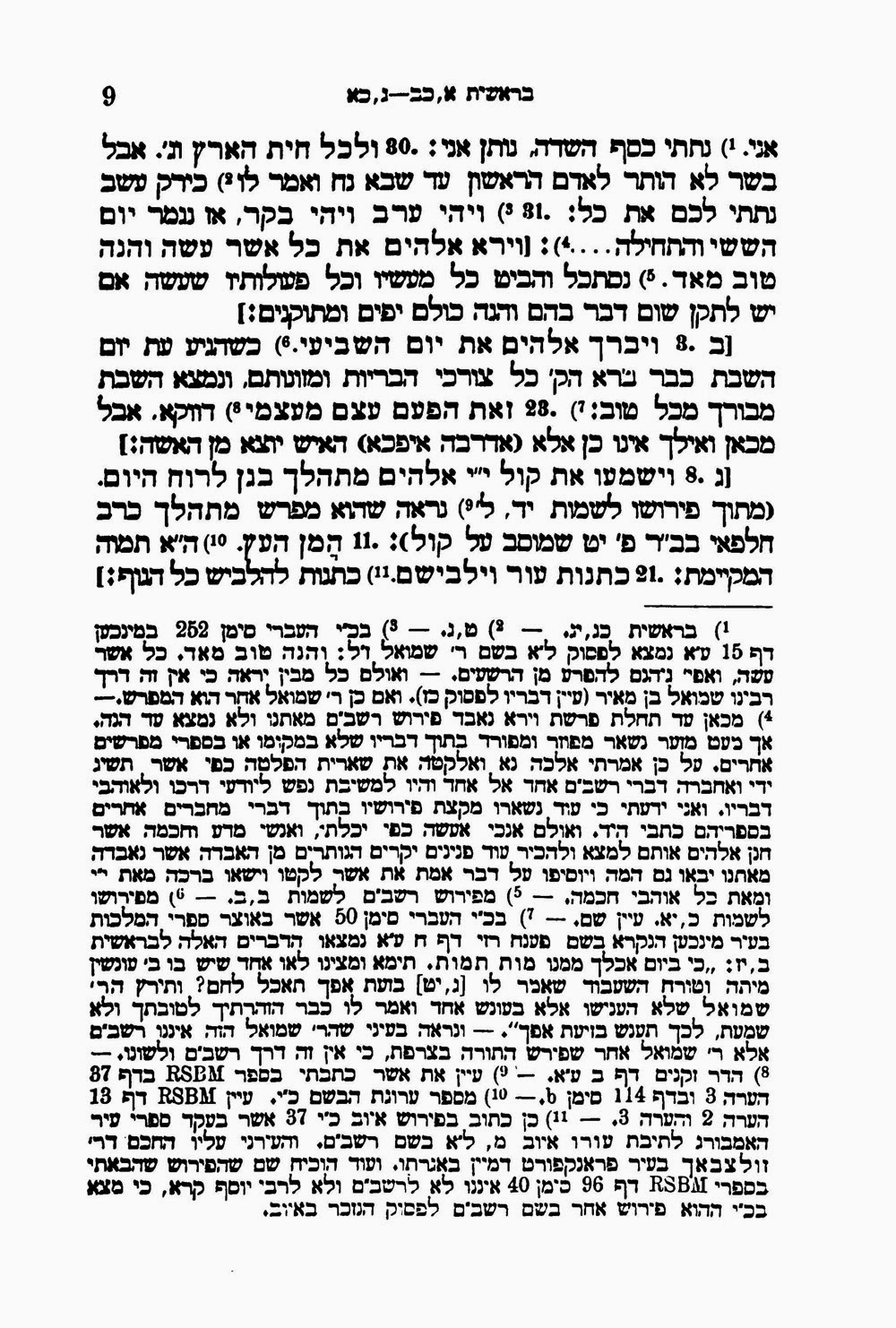
In an earlier post here I discussed ArtScroll’s use of a censored talmudic text.[1] This happens quite a bit and it is not always clear if the translators were aware that they were working with an inauthentic text. However, for many passages there is no question that they realize that what they are translating is not authentic but was added because of fear of non-Jewish reaction. Here is a chart someone drew up showing how the various new Talmud editions deal with the matter of censorship.
It is significant that even in the Hebrew ArtScroll the text that is used is censored. ArtScroll has never publicly explained why they have adopted this approach, but I think it is obvious that unlike other publishers, ArtScroll is still worried about creating anti-Semitism and thus continues to print a censored Talmud. While I think everyone agrees that the ArtScroll Talmud translation is a masterpiece, opinions will obviously differ as to whether ArtScroll made a mistake in not restoring the Talmud to its pre-censorship state.[2]
ArtScroll’s approach is different than that of other publishers who are very happy that they can now include the complete uncensored words of the Talmud. Ezra Chwat’s words express the feeling of every publisher other than ArtScroll.[3]
אין צורך להדגיש את החשיבות של הנגשת הסוגיה המקורית לעשרות אלפי הלומדים את הגמרא כפי שיצא מפיהם הקדושים של האמוראים, ושלא יסתפקו ב”גירסא” שאושרה על ידי הכנסייה.
Yet R. Leopold Greenwald had the exact opposite approach, and he was upset when he heard that a new Talmud was being printed that reinserted the censored texts. His words reflect the approach later adopted by ArtScroll [4]:
ומה מאד דאבה נפשנו בראותנו, כי מכריזים גם עכשיו על “המציאה הגדולה”, כי בירושלים מדפיסים כעת תלמוד עם כל ההשמטות שהשמיטו הצנזורים במשך מאות שנים. ועל זה אנו קוראים: שקול טובתך! בני ישראל לא ישבעו עונג מהטובה הזאת, לא ספרותנו ולא חכמתנו יתעשרו מהשמטות הללו, לא בזמננו ולא בהדורות שאחרינו. כבר שבענו צרות ומכאובות. ולהיות בפי כל מחבל בודאי אסון הוא. איפוא הם חכמי ירושלים? האם אינם רואים כי מזה לא תושע יהודה וכי צוררי ישראל ישיגו חומר מסוכן חדש?
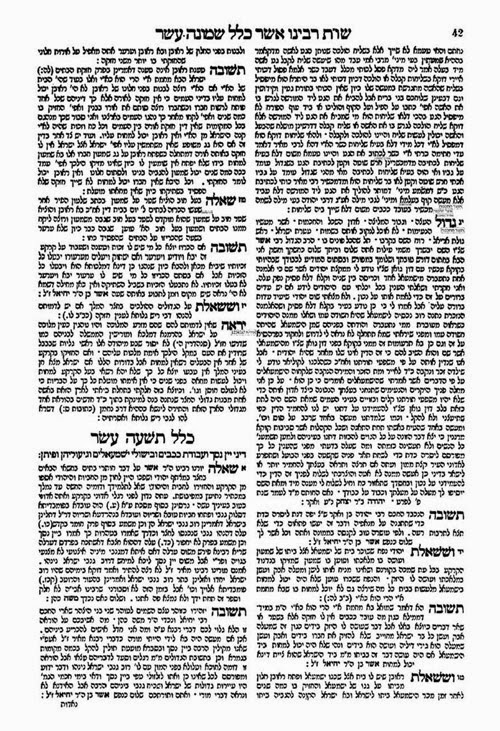
For those who are unaware of the details, let me just mention that I am not referring to a word here or there that was censored and has not been restored by ArtScroll. Sanhedrin 43a has a number of lines dealing with the execution of Jesus and his disciples. While the entire section is found in Soncino (in translation), Steinsaltz, Wagshal and Oz ve-Hadar, it is not to be found in ArtScroll. Both the English and Hebrew editions of ArtScroll tell the reader that a section has been deleted from the Vilna Shas. However, in Sanhedrin 67a, where another section has been deleted and is found in the other editions just mentioned, ArtScroll does not inform the reader of the deletion.
An allusion to the Sanhedrin 67a text is found in Va-Avo ha-Yom el ha-Ayin, attributed to R. Jonathan Eybeschuetz. This explosive text, which remained in manuscript for almost three hundred years, has just appeared in print, edited by Pawel Maciejko.[5] Va-Avo ha-Yom el ha-Ayin is very important to understanding the controversy over R. Eybeschuetz. (I hope that the manuscript Gahalei Esh, a treasure trove of documents dealing with eighteenth-century Sabbatianism, will also soon appear in a scholarly edition.) Quite apart from the radical theological notions found in Va-Avo ha-Yom el ha-Ayin, Maciejko describes the work as follows: “[I]t is blatantly pornographic (in fact, it is possibly the only truly pornographic text ever written in the rabbinic idiom.)”[6]
Speaking of pornography let me add the following. Not long ago I was visiting a certain synagogue for Shabbat. When it came time for Torah reading I took out the chumash that was near me. It happened to be the one published by R. Aryeh Kaplan. I actually am not a fan of this chumash for use in synagogue as its focus is entirely philological, and doesn’t deal with any of the issues that a typical person would want explained in reviewing the Torah portion. But this was what I had so I used it. In Exodus 35:22 an unusual word appears: כומז. It means some sort of golden bodily ornament. The word also appears in Numbers 31:50. According to the Exodus passage, this was one of the items the Israelites in the desert donated at the time of the building of the Tabernacle. The passage is Numbers refers to booty taken from the Midianites. Among the different interpretations Kaplan offers for כומז is “a pornographic sculpture.” This is quoted in the name of R. Aaron Alrabi (fifteenth century). I was quite shocked when I saw this and later saw that this interpretation is also quoted by R. Kasher in Torah Shelemah, which must have been where Kaplan saw it.
Alrabi wrote a commentary on Rashi which was published in Constantinople in 1525. In this work, on Exodus 35:22, Alrabi writes:
יראה לי שהוא תכשיט מצוייר צורת רחם האשה כדי שישתוקק רואהו לפועל המשגל והצנועות היו מביאות אותו עליהן בחדריהם לתת תשוקה לבעליהן העין רואה והלב חומד בו, והיה זה לכונה טובה לכן הותרו לשרת בקדש
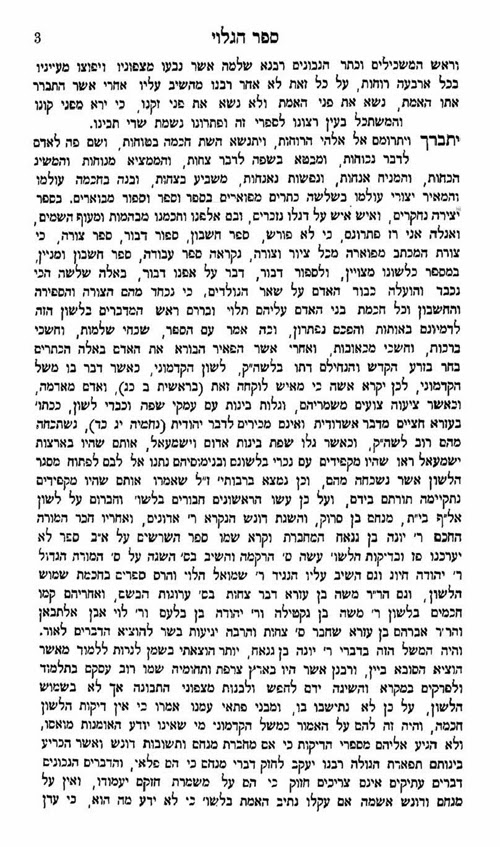
What this means is that the item in question had a picture of a woman’s private parts. The Israelite women would have their husbands look at it in order to sexually excite them before they had marital relations. Since this pornographic viewing was for a good purpose, it was permitted for these items to be donated for use in building the Tabernacle. Here is the original text.
Those who want to see the book in its entirety can view it here.
I find this explanation quite strange. I don’t know what led Alrabi to his original understanding and why he did not find any of the prior explanations compelling.
Incidentally, one of the other explanations cited by Kaplan is that כומז means a chastity belt. R. Ephraim ben Shimshon (12th-13th centuries) writes[7]:
הכומז היה כלי כמנעול שקושרת האשה פתחה שלא יודעו להם שם אדם, כי אם בעלה לבד, והוא גודר הערוה.
This is how he understands Shabbat 64a which states that כומז means דפוס של בית הרחם. Soncino translates this as “cast of the womb” and ArtScroll translates it the exact same way. Koren translates “a mold [in the shape] of the womb.” In general I would say that disagreeing with these three translations is not a smart thing to do, yet in this case I must do just that. The translations I have cited are incorrect as they do not reflect what the Talmud is saying. בית הרחם in Shabbat 64a does not mean “womb” but rather something else. In order not to cause problems for those with internet filters I won’t spell it out completely, but I think the reader already understands.[8]
Rashi, Exodus 35:22, in summarizing the Talmud leaves no doubt in this matter:
כלי זהב הוא נתון כנגד אותו מקום לאשה
The very text in Shabbat 64a also lets us know that this matter has nothing to do with a “womb”, as immediately following the explanation of דפוס של בית הרחם the Talmud explains that the wordכומז is an acronym of כאן מקום זימה “here is the place of lewdness”, and there is no issue of lewdness with the womb. ArtScroll itself, in its note on this latter passage, explains the matter well: “The place encased by this ornament is the part of the body which is the focus of lewdness.” In other words, in its commentary ArtScroll tells us that we are not dealing with the womb at all, but with another part of a woman’s anatomy. As such, it was a mistake for ArtScroll in its translation to adopt Soncino’s rendering of כומז as “cast of the womb”.
In his commentary to Berakhot 24a s.v. תכשיטין שבפנים, Rashi explains that a כומז is a chastity belt. From the context of this talmudic passage we see that it also had ornamental significance:
כומז דפוס של בית הרחם שהיו עושין לבנותיהן ונוקבין כותלי בית הרחם כדרך שנוקבין את האזנים ותוחבין אותו כדי שלא יזדקקו להן זכרים
In its commentary, ibid., ArtScroll summarizes Rashi as follows: “The kumaz was an ornament that covered a woman’s private parts.”
Let me return to Shabbat 64a where כומז is explained as being an acronym for כאן מקום זימה. The Maharal, Gur Aryeh, Ex. 35:11, writes:
מפני שהוקשה להם לרז”ל שאין דרך לשון הקודש לקרא שם מיוחד לדברים שהם ערוה . . . כל דבר ערוה אין הכתוב נותן לו שם מיוחד . . . וכאן למה קרא כומז שם מיוחד אל הכלי הזה שהוא דפוס בית רחם, ולכך דרשו רז”ל שהוא כאן מקום זימה והשתא אין שם מיוחד לכלי זה רק כאילו נקרא כאן זימה.
I don’t understand the Maharal’s point. Just because there are no words in leshon ha-kodesh for sexual organs, why should we assume that there is no name for an item designed to cover a sexual organ?
Returning to the matter of “pornographic viewing” as described by Alrabi, I wonder if this could also have halakhic significance. I mention this only because of the controversy some years ago by an answer given by R. Shlomo Aviner that in a she’at ha-dehak (i.e., there are serious marital sexual issues) it would be permitted for a husband and wife to together view explicit pictures in a book. See here.
The entire conversation with R. Aviner was a set-up, and the anti-Aviner website used it to attack R. Aviner, and portray him as permitting viewing of pornography. Yet it is obvious that he was referring to sexual self-help books (which would have explicit pictures) since he refers to books found in Steimatzky. R. Moses Feinstein had earlier permitted a soon-to-be-married man to read sexual self-help books.[9] There is no indication in R. Feinstein’s responsum that he is also including the viewing of pictures in such books, but I do not know if he would regard this as a problem if the pictures are not of real people but are drawings.
Let us return to the subject of chastity belts. In the Wikipedia entry for “Chastity Belt” one finds the following:
Gregory the Great, Alcuin of York, Bernard of Clairvaux and Nicholas Gorranus all made passing references to ‘chastity belts’ within their exhortatory and public discourses, but meant this in a figurative or metaphorical sense within their historical context.
The first detailed actual mention of what could be interpreted as “chastity belts” in the West is in Konrad Kyeser von Eichstätt’s Bellifortis (1405), which describes the military technology of the era.
As we have seen, Rashi and R. Ephraim are not referring to chastity belts in a metaphorical sense. Thus, their mention of the item is of general historical significance, and Rashi (1040-1105) might be the earliest recorded example of someone referring to a chastity belt. Eric John Dingwall wrote an entire book on the subject of chastity belts entitled The Girdle of Chastity (Scranton, 1959). On p. 14 he writes: “There can be little doubt that the idea of such a device, at least in a somewhat modified form, was current at least as early as the second half of the twelfth century.” He then cites the late twelfth-century Guigemar Epic, written by Marie de France, as a source of this. Yet Rashi’s mention of the chastity belt predates this source by around a century.
See also here where as part of a museum exhibition on chastity belts it states:
Until the 12th century, there are no textual memories related to chastity belts at all (not even any allusions without actually using the term) where the reference is not in a theological or mythological context.
This sentence is incorrect, for as we have seen Rashi referred to chastity belts many decades before Marie de France, who is also cited in the museum exhibition as the first one to refer to the item. What we have here is a good example where scholars make judgments based exclusively on their knowledge of medieval Latin, Romance and Germanic literature. Exposure to what appears in medieval Hebrew texts would have caused them to alter these judgments.
Returning to ArtScroll, here is an example where I believe that ArtScroll has printed something that they know is incorrect, but did so in the interest of good Jewish-Gentile relations. I think it is a noteworthy example as it has nothing to do with a censored text, but focuses on the explanation of the Talmud. Avodah Zarah 6a states that according to R. Yishmael it is forbidden to do business with idolaters because of Sunday. Rashi explains that this means that one can never do business with idolaters since one cannot do business with them three days before and three days after their holiday, and this includes the entire seven-day week.
It doesn’t take much imagination to realize what the Talmud is referring to by “Sunday”, and in the uncensored text it actually has נוצרי, נוצרים or יום הנוצרי instead of “Sunday”. Yet ArtScroll in its translation states that the Talmud is referring to “Babylonian pagans who observe a sun-worshiping festival every Sunday.” It is true that Meiri states as much.[10] Meiri also claims that when the Talmud uses the word נוצרים it does not mean followers of ישו הנוצרי, but refers to the use of the term in Jeremiah 4:16, which Meiri claims is derived from the word נבוכדנצר.[11] While it is true that R. David Kimhi also sees the word in Jeremiah 4:16 as related to נבוכדנצר, it is Meiri alone who claims that this is also intended when the Talmud refers to נוצרים.
It is certainly appropriate that ArtScroll cited Meiri’s explanation in a note, but how is it that this is the only explanation cited, when other than Meiri everyone else has assumed, with good reason, that נוצרים refers to Christians? This can only be an example of ArtScroll shading the truth for apologetic reasons. People can debate the appropriateness of this, but there can be no doubt that ArtScroll is not being frank in its presentation here.
In the ArtScroll Hebrew edition it also quotes Meiri and states the that Talmud is not referring to Christians. Yet unlike in the English edition, in the Hebrew ArtScroll there is a note which states: “See Rambam, Hilkhot Avodat Kokhavim 9:4”. If you open up the Mishneh Torah what you find is that the Rambam states:
הנוצרים עובדי עבודה זרה הן ויום ראשון יום אידם הוא
In other words, by referring to the Mishneh Torah after mentioning Meiri, ArtScroll is alerting readers to the fact that the Rambam does not agree with Meiri and believes that the passage in Avodah Zarah 6a indeed refers to Christians. Yet this is never spelled out in ArtScroll, and you need to take their suggestion to consult the Mishneh Torah in order to learn that not everyone agrees that when the Talmud mentions those who make Sunday their holiday that it is referring to Babylonian pagans. (In fact, as already mentioned, only Meiri advocates this position.) Does the average person who learns daf yomi realize this?
In case anyone has any doubts as to what I am saying, please note the following. After referring to Maimonides, the note in the Hebrew ArtScroll calls attention to the Venice edition of the Talmud with Rashi, and to Dikdukei Soferim. Again, only one who examines these sources will learn that they offer an interpretation at odds with Meiri. If you look at the Venice Talmud or Dikdukei Soferim (or even Steinsaltz) you will find that in Avodah Zarah 6a Rashi explains:
נוצרי, ההולך בטעותו של אותו איש שצוה להם לעשות להם יום איד בא’ בשבת
In other words, Rashi tells us, just like Maimonides, that when the Talmud refers to those who celebrate נוצרי יום it means the Christians who follow Jesus.I find it significant that even in the Hebrew edition ArtScroll feels the need to only allude to the explanation of Rashi and Maimonides, while presenting Meiri’s explanation as the standard understanding of the text. ArtScroll certainly knows that this is not the standard understanding, and ArtScroll itself cannot believe that Meiri’s understanding is what the Talmud really means. After all, every other medieval commentator agrees with Rashi and Maimonides. In this case, the only explanation is that ArtScroll is following a long apologetic tradition, which was based on fear of what the non-Jews would say if they knew the true meaning of certain talmudic passages.
Another example of this tendency was called to my attention by R. Moshe Maimon. Ketubot 15a discusses the case of A killing B, when A actually intended to kill another person. In its discussion the Talmud refers to “Canaanites”, which in the current context simply means non-Jews. In fact, in all manuscripts and early printings what appears is not “Canaanites” but “goyim”.[12] “Canaanites” is simply a “correction” of the censor. Yet ArtScroll has a note explaining that “The Canaanites were the pagan people who lived in Eretz Yisrael before the Israelites entered the land.” The implication of this comment is that the halakhah stated in the Talmud was only applicable with the ancient Canaanites but not with regard to other non-Jews. This is false and ArtScroll knows it is false, but it is no different than the “note to reader” found in many seforim that all the halakhot about non-Jews only refer to the pagans in faraway places. In the latter case everyone knew (and knows) that these words are not to be taken seriously, but I would assume that the typical user of the ArtScroll English Talmud does not realize this. It is noteworthy that the ArtScroll Hebrew Talmud does not include the note about the Canaanites.[13]
In 1728, an era in which Jewish-Gentile relations were not the best, R. Jonathan Eybeschuetz printed Tractate Berakhot with many deletions, as this was the only way he was given permission to publish the volume. Here is the title page.
The volume can be found at hebrewbooks.org here. True to form, R. Jacob Emden accused R. Eybeschuetz of being in league with the bishop of Prague and intent only on making money from his new printing.[14] There was also a lot of controversy about this edition, not only because of the many deletions but even more so because of the instances where the talmudic text was rewritten. While non-Jewish censorship has a long history, this latter practice, of Jews agreeing to rewrite sections of the talmudic text, was a new and more dangerous phenomenon. Other tractates were later printed, but R. Eybeschuetz had nothing to do with them, and in any event the controversy focused on Berakhot as the other tractates simply printed the censored text from the earlier Basel edition, but did not add anything new.[15]
In his recent outstanding study of this episode, which makes use of manuscript sources, Pawel Maciejko writes:
In both academic scholarship and Jewish collective memory, the best-known controversies concerning Rabbi Jonathan Eibeschütz (1690-1764) are those about his kabbalistic tract Va-avo ha-yom el ha-‘ayin . . . and about the allegedly Sabbatean amulets that he distributed to the members of the communities of Metz and Altona, Hamburg, and Wandsbeck in the 1750s. However, during his early years, the most important controversy concerning Eibeschütz was not the dispute surrounding his suspected Sabbateanism and the heterodox writings attributed to him but rather the outrage engendered by his friendly relations with the local Catholic clergy and his alleged involvement in the publication of heavily censored editions of the Pentateuch, the Talmud, and the prayer book. In the eyes of many contemporaries, the damage caused by the appearance of these latter publications vastly overshadowed any harm stemming from the heretical views expressed in Eibeschütz’s kabbalistic works and amulets.[16]
Maciejko notes that R. Moses Hagiz was so outraged by R. Eybeschuetz’s Talmud that he asked other rabbis to issue a ruling that it be burnt!
Shortly after the publication of R. Eybeschuetz’s Talmud someone wrote a defense of it, explaining why it was necessary to print a censored Talmud.[17] Raphael Kirchheim, who published this document, cites another who states that its author was none other than R. Eybeschuetz, since the author refers to R. Abraham Broda as his teacher.[18] R. Broda had served as rosh yeshiva in Prague, and later rav of Metz and Frankfurt.
While Maciejko also accepts this view,[19] the reference to R. Broda as the author’s teacher, מורי ורבי, would appear to show that R. Eybeschuetz could not have written the letter, since he was not a student of R. Broda.
We have good information about R. Eybeschuetz’s life, but there still is a lot we don’t know. Even though R. Eybeschuetz is not recorded as R. Broda’s student in the standard biographies, one could claim that it is possible that he studied for a short time under him, and for some reason this fact was not known to the biographers.[20] Yet in this case we can indeed make the definitive statement that R. Eybeschuetz did not study with R. Broda since R. Eybeschuetz tells us this himself. Some thirty years after R. Broda’s death in 1717 his Eshel Avraham was published (Frankfurt, 1747). Here is the title page.
Among those who provided an approbation was R. Eybeschuetz, who at that time was in Metz. His respect for R. Broda is great, but he leaves no doubt that he never studied with him:
ממש רובי חכמי ישראל בדור הזה השלימי’ המה שותי מימיו ואף אני אם לא זכיתי לאורו לחזות לרבי מקמא כי בבואי לפראג שנת תע”ל כבר חמק דודי ופנה הודו לכאן ק”ק מיץ היא העיר אשר כעת אני יושב בה בתוך עמי, מ”מ נפתולי נפתלתי עם גדולי תלמידיו הרבני’ וחכמי’ מובהקים ושלימים במדע אשר נשארו שם ושמעתי’ תמיד בבי מדרשי’ בדיבוק חברי’
Returning to the document published by Kirchheim, it describes the history of the banning of the Talmud in the years before R. Eybeschuetz printed his volume. Interestingly, it tells about the confiscation of Jewish books from the Jews of Prague, which were then handed over to the Jesuits to be examined for anything against Christianity. From other sources we know that the Jesuits burnt the copies of the Talmud they confiscated, and “[i]n the 10 years from 1715 to 1725, very few copies (according to some sources, none) of the Talmud existed in Bohemia.”[21]
This need for copies of the Talmud explains why R. Eybeschuetz had to take the step he did. The document also tells of the punishment of a man from Nikolsburg who was caught smuggling Talmuds into the Prague ghetto. He was forced, in chains, to clean the streets for a year. The smuggled Talmuds were supposed to be burnt, but this was somehow prevented (probably with a good bribe).
The only way to print a Talmud in Prague was to remove everything the Jesuits viewed as offensive to Christianity. They also viewed certain aggadot as objectionable, such as the description of God wearing tefillin in Berakhot 6a, and these too had to be removed.[22] The document tells us that having the Church agree to publication of the Talmud, even with these restrictions, was regarded as a great achievement. It also tells us that all the important rabbis in Prague permitted the publication of the bowdlerized Talmud.[23]
וכאשר הגיעו לידינו רשימה אספנו להגאון מורנו ורבנו האב”ד ור”י נר”ו בצירוף כל חכמי רבינו [!] עירנו אשר ת”ל המה גדולים בחכמה ובמנין וטבעם יצא בכל ארץ לעיון במילין אם כשר ונאות לעשות כן אם לא ואחר הלנת דין פעמים ושלש ומשא ומתן עלתה הסכמה להדפיס מס’ ברכות הנודע הגהתן וסדר זרעים אשר לא יחסר בו דבר, אך ממסכת שבת והלאה לא עבר הסכמתן כי לא נודע עדיין טיב הגהות נוצרים בו אם מעט אם רב
The document then quotes a statement issued by the scholars of Prague defending their decision, a statement that was only intended to be viewed by other learned Jews. In justifying their decision to publish a censored Talmud – since this was all they were permitted and it was a censored Talmud or nothing – we find the following very interesting passage:[24]
ודאי שנכון הדבר לעשות לבלי כושל ועיכוב כלל כי ודאי שניתן הש”ס להצילו באחד מאיבריו ולא יהיה הש”ס חמור מג”ע וש”ד אשר ק”ל יהרג ואל יעבר קימו לן אם מיחדים על אחד ימסר להם ואל יהרגו וכ”ש הדבר בש”ס שבזמן שמיחדים לומר השמיטו דא מאתכם שיהא הנשאר לפליטה שישמיטו זאת ולא יצאו כולם לבית השריפה מבלי שריד באהלינו אהל תורה ובפרט כי חז”ל שיסדו התלמוד לא על זה יסדו להיותו בדפוס גלוי לכל עמים כי אם כתבוהו בכתיבה תמה ומסרו זאת לזרע אמונים להנחיל לבניהם אחריהם לחלקם ביעקב ולהפיץ בישראל.
The last sentence is making the point that there are certain things in the Talmud that should not be published for all to see, as these are the sorts of things that could create great problems with non-Jews. The Prague scholars then state that it is actually a good thing to cut out certain passages from the Talmud. In other words, they are acknowledging that even without Christian demands, it would be best in internally censor certain passages so as to prevent problems from arising. This is exactly what ArtScroll is doing today. No one is forcing them to self-censor, but they see matters as the sages of Prague who wrote (emphasis added)[25]:
וזה לערך ר’ שנה שהחל להתפשט ספרינו בדפוס לתקנות אחינו למען יהיו להם הספרים בנקל ומצוי, אמנם בדברים כאלו תקנתם קלקלתם שגורמים סכנה לכל ספריהם ומטילים איבת הנוצרים עלינו ודאי ראוים שדברים אלו יהיו חוזרים לאיתנם הראשון מבלי לחוקקם בעט ברזל ועופרת.
They are not saying that the censored matters should be forgotten about. Rather, they should be only be passed on in a non-published form (“Torah she-Ba’al Peh”) to advanced students who study the Talmud; they should not be put down in print for all to see and thus create a Christian backlash. The sages of Prague make the same point about strange Aggadot that are not to be taken literally and can only be understood by a few, and which have become subject to Christian mockery. These too should be omitted[26] להציל דברי חז”ל. When possible, the Prague sages state, one should not delete an entire passage but simply change certain words. In this way the sense of the passage is not changed for any learned person, but problematic words are removed thus helping to blunt anti-Semitic attacks:[27]
ומכ”ש לשנות הלשון במילות ושמות נרדפים באופן שלא ישתנה הענין פשיטא שמותר
The Prague sages then state that if necessary it is even permitted to alter (i.e., falsify) halakhic rulings that appear in the Talmud in order to prevent anti-Semitism (which obviously could lead to real danger). They note that R. Solomon Luria disagrees but that the accepted practice is not in accord with what he wrote, a point that was later made by R. Moses Feinstein:[28]
דעת מהרש”ל להחמיר אף במקום סכנה. אמנם מעשים בכל יום שמהפכין הדין ומשנין מדרכי השלום בהפקעת הלואה וכדומה ולא שמענו פוצה פה לעולם וכן נראה היפוכו בדברי מהר”ם רבק”ש בש”ע ח”מ סי תכ”ה ודברים המה מועתקים בספרים רבים.
It is interesting that the Prague sages quoted the famous words of R. Moses Rivkes in his commentary to Shulhan Arukh, Hoshen Mishpat 425:5, who responds to a particular anti-Gentile law as follows:
The Rabbis said this in relation to the pagans of their own times only, who worshipped stars and the constellations and did not believe in the Exodus or in creatio ex nihilo. But the people in whose shade we, the people of Israel, are exiled and amongst whom we are dispersed do in fact believe in creatio ex nihilo and in the Exodus and in the main principles of religion, and their whole aim and intent is to the Maker of heaven and earth, as the codifiers have written. . . . So far, then from our not being forbidden to save them, we are on the contrary obliged to pray for their welfare.[29]
Some, such as Jacob Katz,[30] have seen R. Rivkes’ words as reflecting a new tolerant approach. However, the sages of Prague, who were closer to the time R. Rivkes lived, saw his words as merely designed for non-Jewish eyes and not to be taken seriously by Jews. R. Rivkes’ comment would therefore be no different than the declarations found at the beginning of many seforim that all negative statements about non-Jews are only directed towards pagans but have nothing to do with the Christians of Europe who worship God and allow the Jews to dwell among them.
Unlike what has been described by the Prague sages, Maciejko does not view the “corrections” in R. Eybeschuetz’s Talmud as simply defensive. He writes:
Eibeschütz believed that there was no final, fixed, and canonized text of the Talmud. . . . Eibeschütz put himself in the shoes of the ancient sages and saw himself not as expurgating but rather as creating the text of the Talmud.[31]
Maciejko further writes:
Eibeschütz seems to have been the only early modern Jewish author who believed that the talmudic sages needed to be edited for style. For themselves, such changes were only possible thanks to the editorial freedom Eibeschütz granted himself in his “Apology and Answer of the Rabbis Prague”: Eibeschütz considered the talmudic text open and unfinished and therefore felt free to “correct” it even in instances in which he experienced no external pressure from the church or from any other powerbrokers. As for the character of these changes, one thing can be said with certainty: most of them aimed to create a neater and simpler text of the Talmud, one that avoids intricate grammatical constructions or potentially misleading expressions.[32]
It is hard for me to accept that R. Eybeschuetz could have viewed himself as “updating” the Talmud. Yet Maciejko is correct that we are confronted with the fact that R. Eybeschuetz’s Talmud contains linguistic and stylistic changes that were not required by the censor. Unlike Maciejko, I would explain matters in the following way: Since the Talmud was already being published in a censored fashion, with numerous passages deleted or rewritten, R. Eybeschuetz saw no reason not to make other changes that would create a more user-friendly text. However, this has nothing to do with the talmudic text being “open and unfinished” as Maciejko puts it. It wasn’t that he was improving on the original Talmud or seeking to replace it, but since the Talmud he was publishing was already “damaged”, as it were, he did not see a problem making other changes if these changes could be of assistance to the reader. Furthermore, everyone who bought this Talmud knew that it was a she’at ha-dehak publication and that it was only to be used if one had no access to an uncensored text. I have no doubt that R. Eybeschuetz felt the exact same way, and thus I would need more evidence before accepting Maciejko’s theory.
Maciejko makes a further claim that R. Eybeschuetz’s “editing” of the Talmud hints to his secret universalist religious views that are also found in Va-Avo ha-Yom el ha-Ayin. This is a much more provocative claim than what I discussed in the previous paragraph, and I am curious as to what other scholars will have to say about it.
In addition to being given permission to print an expurgated Talmud, the non-Jewish authorities also permitted “strange” aggadic passages to remain if a good explanation could be provided for them. In R. Eybeschuetz’s edition of Berakhot such explanations are found at the back of the volume, and the reader is alerted to them by a note on the talmudic page.[33]
Until Hebrewbooks.org put the Prague edition of Berakhot online, it was a very rare book, and Maciejko knows of only three copies in existence.[34] In 1981 Professor Shnayer Leiman republished R. Eybeschuetz’s explanations to Berakhot.[35]
To be continued
[1] See also Jeremy Brown’s post here and regarding Brown’s post see David Zilberberg’s earlier post here.
[2] Only in the last year or so have I started to examine the ArtScroll Talmud on a regular basis and I am continuously impressed. This has to be one of the most significant Torah publications of the twentieth century. Since that is the case, I don’t see why such effort is being put into producing the new Koren Talmud. While it sometimes has points that do not appear in ArtScroll, I don’t know why anyone would prefer it over ArtScroll. I have had a chance to use both ArtScroll and Koren in reviewing some sugyot in Berakhot with my son, and in my mind ArtScroll always comes out on top. I even found one place where Soncino is to be preferred to Koren (although generally this is not the case). In Berakhot 29a it states: “Corresponding to what were these twenty-four blessings of the Amida prayer of the fast days instituted?” Unlike Soncino, Koren provides no note to this sentence and most people who read it will have no clue what it is talking about since when they look in the siddur they will not find twenty-four blessings in the Amidah on fast days (as they will assume that the fast days referred to are Yom Kippur, Tisha be-Av, etc.). ArtScroll helpfully explains as follows: “On certain public fast days decreed in times of drought, an additional six blessings, enumerated in the Mishnah in Taanis 15a, are added to the eighteen regular blessings of the Shemoneh Esrei, for a total of twenty-four blessings.” I would only add that the proper transliteration of עשרה is esreh, not esrei.
[3] See here where Chwat also posts a page of R. Hananel from the censored Sanhedrin 43a.
[4] See his letter in Moshe Chaim Ephraim Bloch, Heikhal le-Divrei Hazal u-Fitgameihem (New York, 1948), p. 8. For more opposition to publishing the censored talmudic texts, see Eliezer Zvi Zweifel, Saneigor (Warsaw, 1885), pp. 265-266
[5] (Los Angeles, 2014). Regarding the Sanhedrin 67a text, see Maciejko’s English introduction, pp. xlviii-xlix.
[6] P. xix.
[7] Perush ha-Torah (Johannesburg, 1950), p. 69.
[8] David Brodsky also discusses בית הרחם as a synonym for “va–na”. See A Bride Without a Blessing (Tübingen, 2006), pp. 55, 65, 84. In Alcalay’s English-Hebrew dictionary, s.v. va–na, it gives three Hebrew definitions, one of which is .בית הרחם
[9] Iggerot Moshe, Even ha-Ezer 1, no. 102. This appears in the second to last paragraph of the responsum. The last paragraph is where R. Moshe presents his famous view that living in the Land of Israel is not an obligatory mitzvah, a mitzvah hiyuvit, but rather a mitzvah kiyumit.Here is a good time to cite an email I received from a Lakewood scholar which I think is quite insightful, and relates to the “immodest” title pages I discuss in my recent book. This scholar writes:
There is one comment that I want to make right now regarding the pictures of the topless women that appeared and then disappeared in seforim. In addition to a point that I already once made that perhaps in earlier times the breasts were associated more with breastfeeding than with romance (it certainly was associated with that as well as can be seen from the Song of Songs, but not exclusively as today; perhaps it was more like a woman’s hair which can be seen in pictures), I would like to add a stronger point regarding these pictures.
It would seem to me that before photography when it wasn’t possible to produce real live looking pictures, people would be inclined to consider drawing an ערוה. But after the advent of real photographs, one gets the feeling that he is looking at a real image of a woman. It is for this reason, perhaps, that pictures of topless women became taboo. Once photographs began to be associated with ערוה, paintings and drawings followed since they are so similar to photographs. In other words, they became guilty by association.
If there is any merit to this argument (or speculation) then one can go a step further and say that the advent of color motion pictures which is more alive caused further stringency in this area. A picture of a woman is not that “problematic”, but to watch her video is already more like “mingling without a mechitza”. Once the women are struck from the videos, it is natural that they should be expunged from the magazines as well. It is worth noting that both the laws outlawing pornography and the invention of photography coincided with one another. It would seem that it wasn’t outlawed as long as it was only in the form of a drawing, painting, or sculpture.
While it is true that earlier sources do speak of the sexual nature of breasts (see my post here note 19), I think that my correspondent has put his finger on a very important point. It would appear that breasts were more commonly associated with breastfeeding which meant that it was not problematic to show them in pictures. We even find such a portrayal on two tombstones in the old Sephardic cemetery in Altona. Here are the pictures as they appear in Michael Studemund-Halevy and Gaby Zuern, Zerstoert die Erinnerung Nicht. Der Juedische Friedhof Koenigstrasse in Hamburg (Munich, 2002), p. 109.
There are also a whole series of paintings and sculptures showing the Virgin Mary breastfeeding, obviously showing that this was not regarded as immodest in Christian circles.
The non-sexual nature of breasts also explains Shabbat 13a:
עולא כי הוי אתי מבי רב הוה מנשק להו לאחוותיה אבי חדייהו
(Perhaps because he found this text so strange, the Hatam Sofer interpreted it allegorically: היה מנשק החכמה. See Hiddushei Hatam Sofer, ad loc.)In response to the email from the Lakewood scholar, S. commented as follows
Another point which I think needs to be brought up about nude art is just how ubiquitous it was in Europe, statues, frescoes, and title pages in books, etc., very much influenced by Classical culture, which was of utmost importance in European learning and culture. If you’re in Venice or Prague or any major city in Europe you can’t avoid seeing it. The style of title pages may have changed, as styles do, so it is not surprising that Jewish printing culture changed as well. And eventually these seforim became one, two, and three centuries old and were only seen by individuals. Nudity in art was not ubiquitous in Eretz Yisrael and America, and it is not surprising that we woke up in the 20th century in American and EY and found these things surprising. My point is that it doesn’t necessarily have to do with them seeing breasts as sexual or not (what about thighs and bare midriffs? And seforim even depicted nude women bathing in the mikveh.) It is also important to note that in the writing of many great people they refer to specific editions they used, and it is clear that they saw it and neither defaced or said anything about it. So attitudes might be a European city vs. non-European city thing as well.
In an earlier post here I dealt with this picture which appears in the Venice 1574 edition of the Mishneh Torah.
Jacob D. called my attention to Shlomo Zalman Havlin’s comment in Yeshurun 29 (2013), p. 791 n. 7. Here Havlin states that when he attended the Chevron yeshiva its library had the Venice 1574 Mishneh Torah, but the yeshiva attempted to keep this edition from students due to the “immodest” picture reproduced above. Havlin also notes that some great rabbis were involved in the publication of this edition of the Mishneh Torah, including R. Menahem Azariah of Fano and R. Moses Provencal.
[10] Meiri to Avodah Zarah p. 4.
[11] Meiri to Avodah Zarah p. 4, Ta’anit 27b (p. 97). Regarding Meiri’s claim, see Lawrence Zalcman, “Christians, Noserim, and Nebuchadnezzar’s Daughter,” JQR 81 (1991), pp. 411-426. Zalcman argues that Meiri did not just make up his interpretation for apologetic reasons, but was aware of Mandaeans who were known as natzurai and were linked to Nebuchadnezzar.
[12] See Dikdukei Soferim ha-Shalem, ad loc.
[13] The Talmud pages used by ArtScroll in its most recent printings are taken from Oz ve-Hadar’s edition (minus certain notes that appear only in the Oz ve-Hadar Talmuds). This means that ArtScroll omits the Shitah Mekubetzet, citing Meiri’s and R. Jonathan of Lunel’s tolerant comments, which appears in the standard Vilna edition, Bava Kamma 38a and 113a.
[14] Hit’avkut, p. 2a.
[15] See R. Raphael Rabbinovics, Ma’amar al Hadpasat ha-Talmud, ed. Haberman (Jerusalem, 1952), pp.112ff.; David Leib Zuenz, Gedulat Yehonatan (Petrokov, 1930), vol. 1, pp. 12ff.
[16] “The Rabbi and the Jesuit” On Rabbi Jonathan Eibeschütz and Father Franciscus Haselbauer Editing the Talmud,” Jewish Social Studies 10 (Winter 2014), pp. 147-148.
[17] The defense was published in installments in Ha-Magid, May 9, 16, 23, 30, 1877. Sections of the document appear in Zweifel, Saneigor, pp. 264-265, and in Saul Pinchas Rabinowitz’s edition of H. Graetz, Divrei Yemei Yisrael, vol. 8, p. 464 in the note. The complete document was published in Zuenz, Gedulat Yehonatan, pp. 135ff., but he does not identify its source, leading the reader to assume that he is quoting from a manuscript.
[18] See Ha-Magid, May 9, 1877, pp. 170-171. (The reference to R. Broda as his teacher appears on p. 171.) As we shall see, R. Eybeschuetz had a great deal of respect for R. Broda. Yet R. Jacob Emden’s father, the Hakham Zvi, had a different perspective. See Yehezkel Duckesz, Ivah le-Moshav (Cracow, 1903), p. 14.
[19] “The Rabbi and the Jesuit,” p. 166.
[20] S. points out an interesting source which gives an unknown, but presumably true, biographical detail of R. Eybeschuetz’s life in the spiritual autobiography of an apostate Jew named Salomon Duitsch, A Short Account of the Wonderful Conversion to Christianity of Solomon Duitsch … Extracted from the Original Published in the Dutch Language (London 1771).S. wrote to me as follows:
Prone to mystical visions and ascetic practices like fasting, he was regarded locally as a tzadik, but he eventually became convinced of Christianity. When this became known was forced to divorce his wife. After a period of wandering he ended up in Altona. He still looked Jewish and his issues were unknown there. He writes of meeting and staying the night at R. Eybeschuetz, who was very delighted to host him on account that R. Eybeschuetz was educated and taken care of as an orphan in the house of his great-grandfather in Nikolsburg. This information about a Nikolsburg period in R. Eybeschuetz’s life, and who this great-grandfather might be, is not mentioned in the biographies, and is a reminder that much information about people’s lives is not necessarily in books.
[21] Maciejko, p. 150.
[22] For details see ibid., pp. 169ff.
[23] Ha-Magid, May 16, 1874, p. 180.
[24] Ibid., May 23, p. 188.
[25] Ibid.
[26] Ibid., May 30, 1877, p. 199.
[27] Ibid. In my post here I discussed how R. Jehiel Michel Epstein engaged in self-censorship in the Arukh ha-Shulhan in order not to have problems with the non-Jewish authorities. Rabbi Shalom Baum called my attention to Arukh ha Shulhan, Orah Hayyim 480:1, for another example of this. I have underlined the words which any educated reader would understand were not to be taken seriously (since how could contemporary Jews ask God to pour out his wrath on the Babylonians who departed the historical stage over two thousand years ago?):
ואחרששתו הכוס השלישי נוהגין לומר שפוך חמתך וגו’ ולפתוח הדלת כדי לזכור שהוא ליל שמורים ובזכות אמונה זו יבא משיחוישפוך חמתו על הבבלייםשחרבו בהמ“ק
[28] Ha-Magid, May 30, 1877, p. 199. Regarding the views of R. Luria and R. Feinstein, see my Changing the Immutable, p. 42.
[29] I have used the translation in Jacob Katz, Exclusiveness and Tolerance (Oxford, 1961), p. 165.
[30] Ibid., pp. 164ff.
[31] “The Rabbi and the Jesuit,” p. 167.
[32] Ibid., pp. 173-174.
[33] I don’t know why this procedure was not required for the other tractates published in Prague.
[34] “The Rabbi and the Jesuit,” p. 179
[35] Or ha-Mizrah 29 (1981), pp. 418-428. Leiman’s publication remains valuable because of his introduction and notes.
More About Rashbam on Genesis Chapter 1 and Further Comments about ArtScroll
More About Rashbam on Genesis Chapter 1 and Further Comments about ArtScroll
By Marc B. Shapiro
I had thought that I was done with ArtScroll’s censorship of Rashbam to Genesis chapter 1, but a number of people wanted some explanation about the manuscript of Rashbam’s commentary. This will also give me the opportunity to add some more comments about this distressing episode.[1]
In my prior post on the topic, available here, I referred to Rabbenu Tam’s strong words against those who “corrected” the talmudic text based on their understanding. ArtScroll is guilty of violating Rabbenu Tam’s “command”, as he would certainly also apply his words to later generations tampering with the writings of rishonim. I think everyone can understand that if people were simply allowed to emend or delete texts based on their own understanding, not a single talmudic tractate or medieval work would emerge unscathed. As such, the only honest thing for an editor to do is to point out in a note how he feels the text should read, or if he thinks that a passage should be deleted. Unfortunately, ArtScroll did not choose this to follow this honest, and common sense, approach.
It is not just Rabbenu Tam who dealt with this matter. Nahmanides, in commentary to Bava Batra 134a, blasts those “sinners” those who emend texts based on their own understanding.
וזו עבירה גמורה ולייטי עלה רבנן כל מאן דמגיה ספרים מדעתא דנפשיה
R. Abraham ben David (Rabad) also leaves no doubt as to his position, stating that one who deletes a text based on his understanding, “his hand should be cut off, since one who deletes [sections of] books is like those who burn the Torah.”[2]
ויד המוחקת תיקצץ שמוחק הספרים כשורפי התורה
Following my posts R. Yitzchak Zilber published two pieces in Hebrew.
With regard to ArtScroll, the two pieces don’t really contain anything not mentioned already on this blog, but for those who don’t read English they are valuable. It is also good to see a noted talmid hakham express his feelings about what he terms ArtScroll’s “stupid act”. (I understand why documents like the ones published by Zilber, which are directed towards a certain population, cannot cite the Seforim Blog. Yet it is noteworthy that Uriel Simon’s book אזן מלין תבחן is cited, even if the author’s name is not mentioned). One significant point made by Zilber is his claim that ArtScroll knows the truth, namely, that the passages it chose to censor are not heretical insertions, but it chose to censor them anyway.
I have received emails that make the same point, that the censorship is all about “business”. In other words, the haredi world today does not want to see Rashbam’s peshat understanding of when the day begins, so the censorship is necessary in order for ArtScroll’s mikraot gedolot Chumash to sell. Based on what I have been told by people supposedly in the know, I am inclined to believe this. This is also an appealing explanation as it is much easier to accept than that anyone at ArtScroll really believes in the justification for its censorship that was sent out and which I discussed in the earlier post.
In my post I referred to additional authorities, other than Rashbam, who understood that according to the peshat the first chapter of Genesis teaches that the day begins in the morning.[3] I also mentioned those who believe that this was how things were before the giving of the Torah. R. Moshe Maimon called my attention to the fact that R. Saadiah Gaon also apparently held this view.[4] Here is R. Kafih’s edition of R. Saadiah, Perushei Rabbenu Sa’adiah Gaon al ha-Torah, p. 71. Look at chapter 10, note 4.
R. Ovadiah Yosef cites a number of additional sources that mention the notion that before the giving of the Torah night came after day.[5] One of these is R. Moses Sofer,[6] who not surprisingly quotes his teacher, R. Pinhas Horowitz, whose view on this matter I referred to in the prior post.[7] R. Meir Mazuz[8] notes that R. Reuven Margaliyot says the same thing.[9]
A number of people commented on how ironic it is that Ibn Ezra is being used as a source to determine what is heretical, being that his views on Mosaic authorship are themselves regarded by heretical by ArtScroll.[10] Furthermore, Ibn Ezra has no reticence in citing Karaite interpreters, yet as we know, ArtScroll only cites “accepted” authorities, and won’t even mention the Soncino commentary by name. Incidentally, there are some times when ArtScroll errs in this matter. For example, in its commentary to Jonah, p. 111, it cites “Yefes ben Ali” (who is quoted by Ibn Ezra). Presumably, the ArtScroll editor assumed that he was a rishon.[11] In truth, he was a Karaite, and his inclusion in the Jonah commentary is diametrically opposed to the standard set up by ArtScroll with regard to which commentators they will cite, a standard that opposes the Ibn Ezra-Maimonides approach (adopted by Soncino) of “accept the truth from whomever said it”.[12]
When it comes to Karaite influence on Ibn Ezra, R. Joseph Delmedigo goes so far as to say that most[!] of Ibn Ezra’s explanations come from the Karaites. Reflecting the fact that Ibn Ezra does sometimes strongly reject the Karaite interpretations, Delmedigo states that Ibn Ezra is like a baby who nurses from his mother [i.e., the Karaites] but sometimes also bites her breast.[13]
ודע כי בספרי הקראים תמצא באור לדברי הר”א”ב”ע[!] כי רוב באוריו מקדמוניהם כגון הר”ר ישועה והר”ר יפת והר”ר יהודה הפרסי דולה מושך גם כי לפעמים כיונק שדי אמו נושך
Philip Birnbaum writes:
Ibn Ezra cites Yefet more frequently than any other exegete. In his commentary on the Minor Prophets, Ibn Ezra quotes Yefet forty-four times whereas he mentions Sa’adyah Gaon only five times. . . . Ibn Ezra borrows from Yefet much more than he acknowledges.[14]
This connection of Ibn Ezra to Yefet even led to the creation of a false legend that Ibn Ezra was a student of Yefet.[15]
While Ibn Ezra often adopts the interpretations of Karaite commentators, he also blasts them when necessary. One such example is in his commentary to Deuteronomy 12:17 where he writes: “The heretics [Karaites] say that there are two sorts of first-born. One is the first to break out of its mother’s womb. The second is the first-born of the flock. There is no need to respond to their nonsense.”[16] It is noteworthy that the “nonsense” interpretation that Ibn Ezra refers to is indeed found in a few rishonim including Hizkuni and R. Jacob of Vienna.[17]
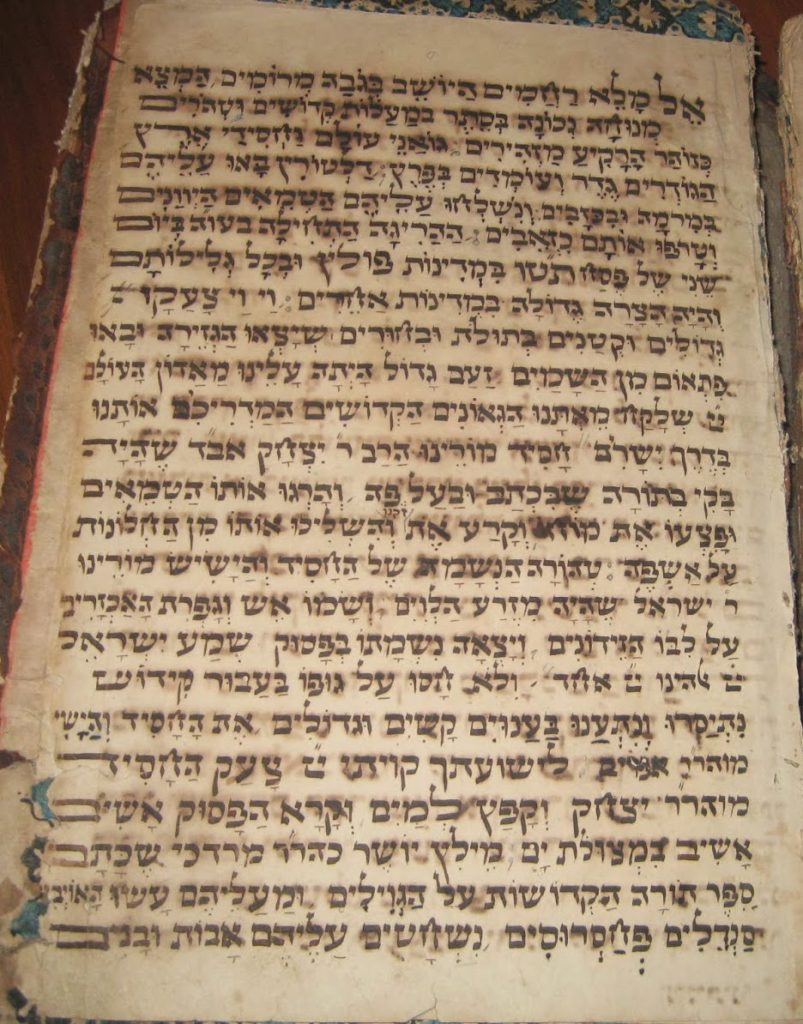
Let us now turn to the manuscript of Rashbam. The first thing to mention is that there is only one surviving manuscript page for Rashbam’s commentary to the beginning of Genesis. There used to be another manuscript that contained his commentary to the rest of the Torah but was missing the commentary to Genesis chapters 1-17. Unfortunately, this manuscript was lost during World War II. For such a great figure as Rashbam, it is definitely noteworthy that so few physical specimens of his Torah commentary survived until modern times.[18] What this tells us is that not many scribes were interested in copying the commentary, and I do not know why this was the case. In fact, it is not merely his commentary on the Torah that suffered this fate. While we have Rashbam’s commentaries to most of Bava Batra and the tenth chapter of Pesahim, we know that he also wrote commentaries to most of the other tractates, yet these are lost.[19] Is there any way to explain this?
Here is the manuscript of Rashbam to the beginning of Genesis.
It is found in the Bavarian Staatsbibliothek (Munich) and is referred to as Hebrew Manuscript no. 5 (2). Here is the link.
This manuscript of Rashbam is bound together with another manuscript from 1233 that contains the earliest example we have of Rashi’s commentary on the Torah. It is also the first illuminated Ashkenazic manuscript (with the illumination by a non-Jewish artist).[20] The copyist of the Rashi manuscript was not some anonymous person, but R. Solomon ben Samuel of Würzberg. R. Solomon was an outstanding student of R. Samuel he-Hasid and a colleague of R. Judah he-Hasid. He was also a student of R. Yehiel of Paris, and R. Solomon’s son was one of the participants in the 1240 Paris Disputation together with R. Yehiel. R. Solomon wrote Torah works of his own and he may be identical with R. Solomon ben Samuel, the author of the piyyut ישמיענו סלחתי that is recited in Yom Kippur Neilah.[21] ArtScroll, in its Yom Kippur Machzor, p. 746, tells us that ישמיענו סלחתי was written by “R’ Shlomo ben Shmuel of the thirteenth-century.”[22]
It is significant that in this early copy of Rashi’s commentary, whose copyist was himself a Torah great, Rashi’s comment to Genesis 18:22 appears in its entirety.[23] In this comment, Rashi refers to one of the tikun soferim and states that the Sages “reversed” the passage. What this means is that Rashi understood tikun soferim literally. Some have claimed that Rashi could never have said this, and it must be a heretical insertion. (There is always someone who says this about texts that depart from the conventional view.) In line with this approach, ArtScroll deleted this comment of Rashi.[24] As we have seen with the passages of Rashbam that were censored, in this case as well ArtScroll would also no doubt claim that it accepts the view of those who do not regard the deleted comment as authentic. Yet how can such a claim be taken seriously when the earliest manuscript of Rashi’s commentary, dating from the early thirteenth century and copied by R. Solomon ben Samuel, contains the passage?
Returning to Rashbam, I have the following question. Just like there is only one manuscript for his commentary to Genesis chapter 1, for the rest of the commentary on the Torah there was also only one manuscript and we don’t know anything about the copyist. Why don’t ArtScroll and the other censors start deleting the many other “problematic” passages in Rashbam, with the excuse that they are heretical insertions? Why only focus on the commentary to Genesis chapter 1?
I must also note that Rashbam himself, in his introductory words to parashat Mishpatim, refers to his commentary at the beginning of Genesis. Rashbam explains that the point of his commentary is not to explain the halakhah but rather the peshat, “as I have explained in Bereishit.” Where does he explain this in his commentary to Genesis? As Rosin points out in his note, Rashbam discusses this matter at the beginning of his commentary to parashatVa-Yeshev, and also at the beginning of his commentary to parashat Bereshit (which is from the supposedly questionable manuscript).
In my opinion, there is no doubt that in parashat Mishpatim Rashbam had the commentary to parashat Bereishit in mind. You can see this by comparing his words. In his commentary to parashat Mishpatim he writes:
ידעו ויבינו יודעי שכל כי לא באתי לפרש הלכות אע”פ שהם עיקר כמו שפירשתי בבראשית כי מיתור המקראות נשמעין ההגדות וההלכות.
At the beginning of parashat Bereishit he writes:
ועיקר ההלכות והדרשות יוצאין מיתור המקראות
Please look at what I have underlined and compare it to the passage I cited from the commentary to parashat Bereshit.
There are a number of other parallels between what Rashbam states in his commentary to Genesis chapter 1 and what appears elsewhere in his Torah commentary, meaning that it is impossible for one to argue that the commentary on the first chapter of Genesis is of uncertain authorship.[25]
I must also mention that Hizkuni, in his commentary to Genesis chapter 1, incorporates a number of Rashbam’s comments (without mentioning him by name). A list of these was compiled by אריסמנדי on the Otzar ha-Hokhmah forum. [26] He concludes:
יש לנו להצטער ולמחות על כי שלטו ידי זרים בחיבורי הראשונים, ולתבוע מההוצאות השונות שידפיסו את פירוש רשב”ם בשלמות האפשרית, ואל יהינו לשלוח יד בו. וכשם שלא יעלה על דעת מאן דהוא לצנזר מפירוש ראב”ע את הקטעים שיצאו עליהם מתנגדים, וכיו”ב במשנה תורה להרמב”ם ושאר חיבורי רבותינו ז”ל. הכי לצנזורים הערלים והמשומדים יאמרו להידמות?
In all the correspondence I have had about this matter, which includes people in various haredi communities, no one has disagreed with this last paragraph. In other words, no one has expressed any support for ArtScroll’s censorship of Rashbam, and the reason is obvious. This is not a matter of ideological or scholarly disagreement. It has nothing to do with haredi vs. Religious Zionist. It is about basic scholarly integrity as well as respect for Rashbam and his readers. This is something scholars of all persuasions can agree on.
One final point regarding Rashbam: In my post here I referred to Rashbam’s famous words in his commentary to Gen. 37:2 that he heard from his grandfather that if he had time he would write new commentaries focused on the peshat. Later in his commentary to this verse, he cites an explanation which appears in Rashi (without mentioning him by name) and refers to this explanation as הבל הוא. In a recent article,[27] R. Meir Mazuz refers to this comment and notes that it is not merely Rashbam who, when it came to Torah matters, was not afraid to strongly reject his grandfather’s position. Rashbam’s brother, Rabbenu Tam, also had this approach.
הלא זה האיש שפסל כל התפלין של חכמי דורו (ובכללם של מר זקנו זצ”ל רבן של ישראל) ועשה אותם כקרקפתא דלא מנח תפלין ח”ו . . . וכן פסק ר”ת שכל המאכיל אונה סרוכה באומא מאכיל טריפות לישראל (תוס’ חולין דף מ”ז ע”א) בניגוד לדעת רש”י שמתיר (שם דף מ”ו סע”ב). וכן חידש לברך על תש”ר על מצות תפלין, בניגוד לרש”י והרי”ף והרמב”ם.
This will be my last post dealing with ArtScroll and Rashbam unless new information comes to light. I have made my position very clear and there is no need to go over this matter again and again. The important thing is that people not forget that ArtScroll’s new mikraot gedolot Chumash is a censored work.
By now no one is surprised that ArtScroll engages in censorship. This has been their modus operandi from the beginning. But is there more, that is, does ArtScroll also publish things that it knows are incorrect? This is a more difficult question to answer. In Changing the Immutable, p. 41, I cite an example where I am pretty sure that this is the case, since the alternative would be to assume ignorance of a pretty basic fact of which I am certain the learned folks at ArtScroll are well aware. Yet aside from a few such cases, which relate to Jewish-Gentile relations, I don’t know of any evidence that ArtScroll intentionally misinterprets sources. Contrary to what some others think, I assume that if there is a misinterpretation it is simply an error, which all people are liable to make. I admit, however, that I am not sure what to make of the following example (called to my attention by R. Yonason Rosman).
The following is ArtScroll’s commentary to Deut. 29:9, in which it quotes Or ha-Hayyim:
Moses divided the people into categories to suggest that everyone is responsible according to how many others he or she can influence. Leaders may be able to affect masses of people; women, their immediate families and neighbors; children, only a few friends and classmates; common laborers, hardly anyone. God does not demand more than is possible, but He is not satisfied with less (Or HaChaim).
This is a very nice thought, but does Or ha-Hayyim actually say this? Here is Or ha-Hayyim on the verse.
As you can see, Or ha-Hayyim does not say that everyone is responsible according to how many he or she can influence. He specifically states that children are not responsible for others since אינם בני דעה. He then adds that women are like children in this respect (i.e., not responsible for others; he is not including them as אינם בני דעה).[28] Thus, ArtScroll’s presentation of Or ha-Hayyim’s view with regard to children and women is actually the exact opposite of what he really says. Was this an intentional distortion in the name of political correctness or a simple misunderstanding? Does ArtScroll view itself, in darshanut-like fashion, as able to elaborate on and alter the message of the commentaries it quotes, so that when it indicates that an interpretation comes from Or ha-Hayyim (or any other source) it could also mean “based on Or ha-Hayyim”? If the latter is true, one must wonder why there is no indication of this in the preface to the Stone Chumash.
To be continued
* * * *
By now many people have read my new book and I have received lots of comments and additional sources. I will discuss some of them in future posts.Although I read the book over a number of times before publication and sat shiv’ah neki’im over every sentence, I knew that there would be some errors that got through. I have learnt that absolute perfection is simply unattainable. However, we are fortunate today that errors can be quickly corrected and the corrections publicized very widely through this blog. Those who have the book can simply insert the corrections. When the book is reprinted the corrections will be added as well.
P. 17. I refer to R. Eliezer David Gruenwald. This should be R. Judah Gruenwald (1845-1920). Thanks to Yisroel Rottenberg for catching this mistake.
P. 21. I discuss the concept of halakhah ve-ein morin ken. Shortly before the book went to press, I added a comment to note 74 in which I stated that Mishnah Berakhot 1:1 contains an example where the Sages did not reveal the true halakhah in order to keep people from transgression. This is a mistake and I thank R. Yonason Rosman for the correction. The Sages made a decree to keep people from transgression. Once this was done we are dealing with a actual rabbinic law so it has no connection to halakhah ve-ein morin ken. Furthermore, since it was a rabbinic decree binding on all there is no reason to think that the Sages were concerned that the masses not know that the biblical law allowed for more flexibility. (We do find such a concern in more recent rabbinic literature, as I discuss in the book.)
P. 55. I refer to an article by Jacob J. Schacter on the 93 Beth Jacob girls. I know this article well and I can’t explain how it is that I recorded the co-author of the article as Norma Baumel Joseph. The co-author is actually Judith Tydor Baumel.P. 205 n. 71. I refer to Teherani, Amudei Mishpat, vol. 1, pp. 147ff. This is the second pagination in the volume.
P. 225. I wrote that R. Naftali Zvi Judah Berlin stated that R. Shneur Zalman of Lyady’s arguments were only intended to intimidate the scholarly reader. R. Yonason Rosman pointed out that my language here is not precise. What the Netziv says is not that R. Shneur Zalman’s arguments were intended to intimidate the scholarly reader, but rather his statement that he has many arguments was for intimidation.
P. 259 n. 100 refers to volume 14 of R. Wosner’s Shevet ha-Levi. This should be volume 11.And while we are talking about typos, this is a good opportunity to correct an unfortunate error that appeared in the first printing of Studies in Maimonides and His Interpreters, p. 152, right at the end. The first word from the verse from Hosea that I quote is מחמד, not מחמר. If this mistake is found in your copy of the book, please correct it.
_______________
[1] In my post here I mentioned that the Lubavitcher Rebbe referred to Rashbam’s peshat interpretation that the day begins in the morning, the interpretation that was censored by ArtScroll. My reference was to a talk the Rebbe gave, and R. Avrohom Bergstein and others called my attention to the fact that in a letter the Rebbe also referred to this peshat interpretation of Rashbam. See Iggerot Kodesh, vol. 24, no. 934, also found in Likutei Sihot, vol. 15, p. 493.
[2] This passage is quoted from the manuscript by R. Menahem Lonzano. See Jordan S. Penkower, Masorah and Text Criticism in the Early Modern Mediterranean (Jerusalem, 2014), p. 118. Lonzano also refers to Nahmanides’ comment that I quoted.
[3] In this listing I included R. Ezekiel Landau. A Lakewood scholar properly corrected me as R. Landau is only referring to the fact that when it comes to kodashim night goes after day.
[4] R. Moshe Maimon also called my attention to the following: In my post here I discussed R. Dovid Cohen’s book, Ha-Emunah ha-Ne’emanah (Brooklyn, 2012). Among other things, I wrote:
One more point about R. Cohen’s book is that it is obvious that at times he is responding to what I wrote in The Limits of Orthodox Theology (and he also makes use of many of the sources I cite). While I am not mentioned by name (no surprise there) I am apparently included among the משמאילים referred to on p. 5 (see Limits, pp. 7-8).
R. Cohen has recently published the seventh volume of his book of questions, Ve-Im Tomar. Look at page 14, no. 216.
Now look at the source for this question provided by R. Cohen.
The question R. Cohen refers to comes from Limits, p. 7 (although I ask why Maimonides does not mention anything about teaching a prospective convert the Thirteen Principles. I don’t ask this question about talmudic sages.). Although I was not mentioned by name in Ha-Emunah ha-Ne’emanah, I am certainly honored to be cited in Ve-Im Tomar.
Since I mention R. Cohen, here is a page from his Ohel David, vol. 3, p. 36.
In his commentary to 1 Kings 7:23 he quotes the verse as follows:
ויעש את הים מוצק עשר באמה משפתו על שפתו
The words I have underlined caught my eye because the verse actually states משפתו עד שפתו. I assume that what appears in R. Cohen’s book is a typo as I haven’t seen any editions of Tanach that contain this error. However, this verse is also part of the Sephardic Haftarah for parashat Va-Yakhel, and believe it or not there are chumashim that do make this mistake. Here, for example, is a page from a popular tikkun kor’im. Look at the last words on the page and you will see the mistaken text.
[5] See She’elot u-Teshuvot Hazon Ovadiah, vol. 1, p. 5.
[6] See Torat Moshe, vol. 3, p. 18b and Derashot Hatam Sofer, vol. 2, p. 231b.
[7] It has already been pointed out that while the yeshiva pronuncation of R. Horowitz’s book המקנה is Ha-Makneh, from Jeremiah ch. 32 we see that it should really be pronounced Ha-Miknah. R. Horowitz’s most famous work is הפלאה. This is an abbreviation of הקטן פינחס הלוי איש הורויץ. The spelling I have given of R. Horowitz’s last name is how he himself spelled it. Here is the title page of his Sefer Ketubah, the first part of his Hafla’ah, published in 1787.
[8] Or Torah, Sivan 5775, p. 945.
[9] Nitzotzei Or, Berakhot 4a.
[10] It is also ironic that in R. Moshe Feinstein’s condemnation of the publication of the commentary of R. Judah he-Hasid, he cites Ibn Ezra’s attack on Yitzhaki for the latter’s own “biblical criticism.” See Iggerot Moshe, Yoreh Deah, vol. 3, no. 114.
[11] This example was earlier noted by B. Barry Levy, “Our Torah, Your Torah and Their Torah: An Evaluation of the Artscroll Phenomenon,” in Howard Joseph, et al., eds., Truth and Compassion: Essays in Judaism and religion in Memory of Rabbi Dr. Solomon Frank (Waterloo, Canada, 1983), p. 147.
[12] I was quite surprised to find that R. Moses Teitelbaum, Yismah Moshe: Shemot, p. 177b, comes off sounding just like Soncino rather than ArtScroll, in defending citation of Karaite interpreters.
הנה אנכי שולח מלאך ע’ באברבנאל שכתב בשם חכמי הקראים כי זה נאמר על יהושע, והנה האומר דבר חכמה אף באוה”ע חכם נקרא, ובאמת שהם גרועים כי הם מינים ואפיקרוסים, מ”מ את הטוב נקבל כי כמה מפרשים הלכו בדרך הזה שהנביא נקרא מלאך
Regarding the Karaites, even though they are to be viewed as heretics, and a Sefer Torah written by a min is to be burnt, R. David Ibn Zimra stated that if one of the Karaites writes a Sefer Torah it is not to be burnt. Rather, it is to be placed in genizah. The reason for this is that the Karaites believe in the written Torah. See She’elot u-Teshuvot ha-Radbaz, vol. 2, no. 774.
R. Ishtori ha-Parchi, Kaftor va-Ferah, ch. 5 (pp. 76-77 in the Beit ha-Midrash le-Halakhah be-Hityashvut edition) thinks that such a Sefer Torah does not need to be put away, even though one cannot publicly read from it since the letters of God’s name were not written with the proper intention and other rabbinic requirements were not fulfilled. But the Sefer Torah is not pasul simply because of who wrote it. He also mentions the beautiful Bibles produced by Karaites in the Land of Israel. (When he says “Sadducee” he means Karaite.)
מזה נראה שהצדוקי אם כתב ספר תורה שלא יהיה פסול ואע”פ שיקרא מין אינו ממין זה המין שעובד ע”ז . . . והנה תמצא עמנו היום בארץ הצבי הרבה צדוקים סופרים והרבה ספרים נאים מכתיבתם בתורה נביאים וכתובים. ועל ספר תורה מסתברא שבמה שאינו ניכר שאין ראוי לסמוך עליהם כבעבוד לשמה וכתיבת אזכרות לשמן ותפירת היריעות בגידי טהורה.
See R. Yitzhak Ratsaby, ed., Shemot Kodesh ve-Hol (Bnei Brak, 1987), pp. 5-6. See also the important comments of R. David Zvi Rotstein, “Sefer Torah Menukad,” in Ohel Sarah-Leah (Jerusalem, 1999), pp. 673ff. (Rotstein thinks that when Masekhet Soferim refers to “Sadducees” it too means Karaites.)
R. Naftali Zvi Judah Berlin, Meshiv Davar, vol. 2, no. 77, states that it is permissible to write a Sefer Torah for Karaites if they will treat it with respect. For more discussion regarding this matter, see R. Hayyim Hezekiah Medini, Sedei Hemed, vol. 9, Divrei Hakhamim no. 135.
[13] See his letter published in Abraham Geiger, Melo Chofnajim (Berlin, 1840), p. 20 (Hebrew section). See also שפ”ר in Ha-Magid, Sep. 7, 1864, p. 279, arguing that this letter was not written by Delmedigo.
[14] The Arabic Commentary of Yefet Ben ‘Ali the Karaite on the Book of Hosea (Philadelphia, 1942), pp. xliii-xliv. See Michael Wechsler, The Arabic Translation and Commentary of Yefet ben ‘Eli the Karaite on the Book of Esther (Leiden, 2008), p. 72, who characterizes Ibn Ezra as “the greatest single mediator of Yefet’s exegesis (and hence of Karaite exegesis generally) among the Rabbanites.”
[15] See Avraham Lipshitz, Pirkei Iyun be-Mishnat ha-Rav Avraham Ibn Ezra (Jerusalem, 1982), p. 192.
[16] I have used the translation of H. Norman Strickman and Arthur M. Silver.
[17] See R. Kasher, Torah Shelemah, vol. 12, pp. 192-193. R. Kasher writes:
ויש להתפלא איך שיטה זו נכנסה גם לפירושי הראשונים ולא ידעו שיסודה ממקור זר
At first I wondered why R. Kasher thought that the origin of this interpretation is with the Karaites. Why not posit that a Rabbanite peshat interpeter could independently arrive at the same conclusion as that offered by the Karaites? I later found that R. Kasher himself, Torah Shelemah vol. 17, p. 311, offers this exact same approach:
וצ”ל שכתבו כן בדרך פירוש בפשטא דקרא
Daniel Sperber, Minhagei Yisrael, vol. 1, p. 151 n. 8, assumes that the interpretation indeed originates with the Karaites. Regarding the Karaite understanding, see Torah Shelemah, vol. 27, p. 210. See also my post here where I refer to R. Moshe Feinstein’s attack on a “heretical” interpretation that is also found in a number of rishonim.
[18] Additional pieces from Rashbam were published by Moshe Sokolow, “Ha-Peshatot ha-Mithadshim”: Ketaim Hadashim mi-Perush ha-Torah le-Rashbam – Ketav Yad,” Alei Sefer 11 (1984), pp. 73-80 Jonathan Jacobs argues that these are not part of Rashbam’s Torah commentary but from a polemical letter Rashbam sent to a student. See “Rashbam’s Major Principles of Interpretation as Deduced from a Manuscript Fragment Discovered in 1984” REJ 170 (2011), pp. 443-463. For more comments of Rashbam found in another manuscript, see Elazar Touitou, “Ha-Peshatot ha-Mithadshim be-Khol Yom: Iyunim be-Ferusho shel ha-Rashbam la-Torah (Ramat Gan, 2003), pp. 189ff.
[19] See Israel Moshe Ta-Shma, Ha-Sifrut ha-Parshanit la-Talmud be-Eiropah u-vi-Tzefon Afrikah (Jerusalem, 1999), vol. 1, p. 58.
[20] See Eva Frojimovic, “Jewish Scribes and Christian Illuminators: Interstitial Encounters and Cultural Negotiation,” in Katrin Kogman-Appel and Mati Meyer, eds. Between Judaism and Christianity: Art Historical Essays in Honor of Elisheva (Elisabeth) Revel Neher (Leiden, 2009), pp. 281-305; Hanna Liss, Creating Fictional Worlds: Peshat Exegesis and Narrativity in Rashbam’s Commentary on the Torah (Leiden, 2011), p. 45 n. 32; Colette Sirat, Hebrew Manuscripts of the Middle Ages, ed. and trans. Nicholas De Lange (Cambridge, 2002), p. 170. Sirat gives the date of the manuscript as 1232. In truth, we can’t be sure if it is 1232 or 1233 as the colophon only gives the Hebrew date 4993, but convention in such cases to give the later date. See the transcription in Frojimovic ,“Jewish Scribes,” p. 301.
[21] See R. Moshe David Chechik, “Inyanei Aseret ha-Dibrot ve-Ta’amei Rut le-Rabbenu Shlomo mi-Würzberg,” Mi-Shulhan ha-Melakhim 4 (2006), p. 5. R. Yaakov Yisrael Stal hopes to soon publish one of R. Solomon’s works. See Sodei Humash u-She’ar mi-Talmidei Rabbenu Yehudah he-Hasid, ed. Stal (Jerusalem, 1999), p. 17 n. 115.
[22] Leopold Zunz, Literaturgeschichte des synagogalen Poesie (Berlin, 1865). p. 287, does not think that the two R. Solomon ben Samuels are identical. He assumes that the author of the piyyut pre-dates the 13th century R. Solomon ben Samuel we are discussing.
[28] See R. Yaakov Hayyim Sofer, Edut be-Yaakov (Jerusalem, 2011), vol. 2, p. 164.
Changing the Immutable: How Orthodox Judaism Rewrites Its History
Changing the
Immutable: How Orthodox Judaism Rewrites Its History
Marc B. Shapiro
I am happy to announce that my
new book is now with the printer and should be at the distributor by May 4. Amazon
and book stores will have the book not long after that. Changing the
Immutable has taken quite a long time and I hope readers find that it was
worth the wait. One of the main reasons it has taken so long is that some of my
time in recent years has been devoted to my posts on the Seforim Blog. When I
first started posting here I saw it merely as a pleasant diversion. However, I
now see my Seforim Blog posts as an important part of my scholarly
writing. Throughout Changing the
Immutable I reference not only my posts but many others that appeared on
the Seforim Blog.
I am making this announcement now
rather than after the book appears because Amazon is offering a pre-order
discount (link). For those who want to wait, I know that Biegeleisen will be selling
it at a very good price.
Maccabean Psalms? (and more)
Maccabean Psalms? (and more)
By Marc B. Shapiro
(This post was originally part of the previous one, but since I know people don’t like reading posts more than twenty pages long, I split it up into two parts.)
1. I know that every year around Christmas time some people read my article on Torah study on Christmas eve. At the end of the article I raise the possibility that the various Nittel practices were actually based on non-Jewish superstitions. My suspicion was proven beyond any doubt in a wonderful article by Rebecca Scharbach, “The Ghost in the Privy: On the Origins of Nittel Nacht and Modes of Cultural Exchange.”[1] I recommend that everyone add this article to their “holiday reading”. (Due to reasons beyond my control, this post was not able to appear, as planned, before Christmas.)
As for our own holiday of Hanukkah, let me share something that I think people will find interesting. When it comes to the dating of various Psalms, for those in the Modern Orthodox/Religious Zionist world there don’t appear to be any dogmatic issues involved, much like there are no dogmatic issues raised if one assumes that the prophecies beginning in Isaiah chapter 40 come from a later prophet than those in the first part of the book.[2] Nevertheless, I think people generally assume that traditionalists will not speak about “Maccabean Psalms”. (Truth be told, I don’t know if there are even any academic scholars that still identify some of the Psalms as belonging to the Maccabean period.)
See S.’s post here where he notes that Philip Birnbaum, in his siddur, seems to allude to a psalm as having been written in the Maccabean period. However, S. also quotes R. Samson Raphael Hirsch as stating that Orthodox Judaism rejects the notion of “Pseudo-Isaiah”, and of “Maccabean songs under the name of David.” On the other hand, R. Solomon Judah Rapoport believed that at least one psalm (and perhaps more) were written during the Maccabean period. He identified other psalms as dating from the Second Temple period and defended the religious legitimacy of this view. “If the sages of the Talmud advanced the date of a number of Psalms from the time of David to that of Ezra, a period of more than five hundred years, we must have no scruples in advancing them another two hundred years.”[3] R. Samuel Barukh Rabinkow also felt that “the religious value of any of the Psalms is independent of the time of its composition or any historical consideration or reflection.”[4]
I found a very interesting passage by R. Abraham Saba in his Tzeror ha-Mor.[5] He appears to be saying that Psalm 30, which we recite every day (and which many recite after Hanukkah morning tefillah and after lighting the Hanukkah candles) was written when the Temple was rededicated by the Hasmoneans.
אני סבור כי מזמור שיר חנוכת הבית לדוד נתקן על חנוכת הבית של חשמונאי . . . ולכן נעש’ נס בשמן והדליקו ממנה שמנה ימים ועל זה סדר מזמור שיר חנוכת הבית
R. Saba continues by explaining the various verses in line with this conception. Now I realize that one can argue that what he means is that David prophetically wrote the psalm with the Hasmonean rededication in mind, and this interpretation is actually stated by R. Abraham the son of the Vilna Gaon.[6]
מזמור שיר חנוכת הבית לדוד: עשה המזמור הזה לשיר אותו בחנוכת הבית העתידה להיות בימי החשמונאים
Yet such an approach this does not appear to fit with the words of R. Saba:
נתקן על חנוכת הבית של חשמונאי
In his “translation” of this passage Eliyahu Munk writes: “I am convinced that David, in his holy spirit, foresaw such a period and dedicated Psalm 30, 1-13 to that period, therefore commencing with מזמור שיר חנוכת הבית לדוד ‘a song for the consecration of the House,’ the ‘house’ being the reconsecration of the Temple after the Hasmoneans’ victory.”[7] Yet all readers can see that in the original R. Saba does not mention David or his holy spirit.
R. Joseph Hayyim[8] believes that Psalm 30 as a whole was written by David, and he says it is possible that David also wrote the first verse. But he also says that it is possible that the first verse, which speaks of dedication of the Temple, was added to the psalm during the Maccabean period.
אפשר לומר לעולם דוד הע”ה לא אמר פסוק זה של חנוכת הבית, אלא גם הוא התחיל מן ארוממך, ופסוק זה בזמן בית שני כשעשה הקב”ה להם נסים וניצולו וחנכו הבית והמזבח מחדש הוסיפו על מזמור זה פסוק זה מפני שראו דכל דברי המזמור שייכים גם לעניינם.
He adds that this notion should not trouble anyone, as we know that according to one opinion in the Talmud the last eight verses of the Torah were added by Joshua, and he also notes that there were a couple of verses in the book of Joshua that were added after Joshua’s death. In other words, minor additions to abook after the death of the author are not religiously problematic.
Nevertheless, R. Meir Mazuz is indeed troubled by what R. Joseph Hayyim wrote.[9] He claims that the verses added to biblical books noted by R. Joseph Hayyim were added by prophets.[10] Yet in the case of Psalm 30, R. Joseph Hayyim is suggesting that an addition took place during Second Temple times after prophecy had already ceased and there was no longer the institution of anshei keneset ha-gedolah. According to R. Mazuz this is indeed religiously problematic. One can reply to R. Mazuz that while prophecy might have ceased, ruah ha-kodesh did not,[11] and therefore it was permissible for verses to be added to the book of Psalms even in the Maccabean period. After all, a standard view among rishonim is that the book of Psalms is not the product of prophecy but of ruah ha-kodesh.[12]
R. Mazuz adds a second reason why he cannot accept what R. Joseph Hayyim writes. He claims that R. Joseph Hayyim’s position will give support to the modern biblical scholars who believe that verses in the book of Daniel were added in the Maccabean period, a position he also finds religiously objectionable. I don’t understand this objection as the modern biblical scholars do not need, and do not look for, support from traditional commentators. They are completely oblivious to what rabbis like R. Joseph Hayyim have to say on these matters, and have no reason to cite his view as a support for their own position.R. Moses Isaac Ashkenazi discusses the authorship of Psalms in the introduction to his Ho’il Moshe on Tehillim (Livorno, 1880). Although he has his doubts, he says that one who assumes that Psalm 44 was composed during the Maccabean period “has what to rely on.”
So much for Maccabean psalms, but what about post-Davidic psalms in general? R. Ashkenazi identifies Psalms 79 and 137 as having been written during the Babylonian Exile. He also thinks that Psalms 126 and 129 might have been written then. He is led to his view because he can find no evidence that David was a prophet. While David had ruah ha-kodesh, it is only prophecy that reveals future events, and thus the psalms that reflect a post-First Temple era must indeed have been written centuries after David.
ואין להניח שמזמורים כאלה נכתבו בנבואה, שלא מצאנו בשום מקום שדוד היה נביא ה’, כלומר שה’ דבר עמו כמו שדבר עם שלמה בנו רק שלח אליו נביאיו נתן וגד, אולי מפני ששפך דם הרבה, רק רוח ה’ לבשתהו תמיד כשבא לחבר מזמוריו
As with R. Ashkenazi, his predecessor R. Eleazar ben Samuel Shmelke claims that Psalms 79 and 137 were composed after the destruction of the First Temple. He states that this was also Ibn Ezra’s opinion.[13] In Ibn Ezra’s introduction to Tehillim (which is not found in all mikraot gedolot editions) Ibn Ezra states that “others” held that Psalm 137 and a number of other psalms were written during the Babylonian Exile, yet he does not signal his acceptance of this view.
One of those Ibn Ezra had in mind who held that some psalms were written during the Babylonian Exile was R. Moses Ibn Gikatilla.[14] R. Raphael Berdugo also states that a number of psalms, including Psalm 137, were composed during the Babylonian Exile.[15]
In addition, Malbim, introduction to Tehillim, states that some Psalms were written during the Exile:
התפלות אשר יסדו בגלות בבל על שרפת המקדש ועל הגלות, עד שוב ה’ את שיבת ציון בימי כורש.
He refers in particular to Psalm 137 and also Psalm 85. After saying this, however, he has a footnote in which he states that what he just mentioned is only on the level of peshat, but that he really believes that these psalms were written prophetically in the days of David. I ask readers to examine the text and footnote, and tell me, does anyone think that Malbim is being frank in his comments in the note?
It appears to me that what he writes in the note does not reflect his actual view, which is indeed found in the text. The note is only apologetic, and designed to protect him from being attacked by those who would see his approach as heretical. He would therefore be able to say, “But look at what I wrote in the note.”
According to Rashbam, Commentary to Pesahim 117a s.v. Yehoshua, R. Yose ha-Gelili was of the opinion that the Hallel in Psalms (Ps. 113-118) originated with Mordechai and Esther, i.e., in the Persian period.[16]
In Rashbam’s commentary to Tehillim (which we can expect ArtScroll to censor if it ever publishes it), he points to psalms which were composed during the Babylonian Exile and also states that other psalms were written after Ezra’s return to Jerusalem. For example, Psalm 122:3 states: “Our feet are standing within thy gates, O Jerusalem. Jerusalem, that art builded as a city that is compact together.” According to Rashbam, these references to Jerusalem must date from after the return from exile.[17]
2. Here is a provocative passage quoted in the name of the hasidic master R. Uri of Strelisk (1757-1826).[18] Would any hasidic leader speak this way today?
והרה”ק מסטרעטן זצ”ל אמר משמו עה”פ שומר נפשות חסידיו מיד רשעים יצילם, שאמר: לפני ביאת המשיח יהיו רבי”ס רשעים גמורים ר”ל, אבל הן החסידים הם בתמימותם סוברים שרבם הוא עובד ה’ ולכן נוסעים אליו, לזאת התפלל דהמע”ה שומר נפשות חסידיו כי השי”ת ישמור את החסידים ומיד רשעים יצילם שלא שלא יכשלו ח”ו ברבי”ס כאלו
His comment was only applicable to the phony rebbes. But for an authentic rebbe it is worth travelling great distances and missing out on Torah and tefillah just to hear one bit of wisdom.[19]
אמר שיש ליסע לצדיק אמת אפילו אלפיים פרסאות ולבטל בהליכתו ובחזירתו מתורה ותפלה והכל כדי דיבור אחד של אמת אשר ישמע מפי צדיק אמת
3. Every year there is discussion about the moment of silence in Israel in memory of the soldiers and Holocaust victims, and we always hear about how this is not a Jewish thing to do. Here is a page from R. Ovadyah Hadaya’s Yaskil Avdi, vol. 6, p. 300 (hashmatot Yoreh Deah 2:2).
He regards the moment of silence as entirely appropriate, seeing it as similar to the silence in a house of mourning which shows acceptance of God’s decree.
See also my post here where I wrote that in November 1965 R. Jehiel Jacob Weinberg gave a hesped for four recently deceased rabbis, among them R. Yerucham Warhaftig and R. Eliezer Yehudah Finkel. These latter two were good friends of R. Weinberg, and R. Weinberg’s friendship with R. Finkel went back to their youth. After the eulogy R. Weinberg asked everyone in the room to stand up. They stood silently for around ten seconds and then he asked them to sit down.
In this post I wrote: “I presume this was intended as a show of respect rather than as a moment of silence, since the latter could be done sitting down.” I now think that my statement is probably incorrect, because a moment of silence is also intended as a show of respect, i.e., the two are not in contradiction. In thinking of the story now, it appears that R. Weinberg’s request to stand in silence is really no different than what takes place in Israel.
4. A haredi biography on R. Isaac Blazer has recently appeared. Here is its title page.
Needless to say, R. Jehiel Jacob Weinberg is quoted a good deal in the book. Here is page 410 which contains a picture of R. Weinberg.
The book does not mention that this picture first appeared on the Seforim Blog; see my post here.
In the quotations from R. Weinberg, the book has no problem making “improvements”. For example, R. Weinberg sometimes refers to R. Isaac Blazer as רי”ב, and the new book has altered this to הגרי”ב. R. Weinberg certainly regarded R. Blazer as a gaon, and he sometimes does refer to him as הגרי”ב. However, he did not feel that it was necessary to always refer to R. Blazer this way. The author of the book therefore decided to “correct” what R. Weinberg wrote. I guess this author (who is unnamed) did not think that R. Weinberg showed proper kavod to R. Blazer, which itself is a crazy thought.
Speaking of R. Weinberg and kavod, I think readers will find the following interesting. R. Weinberg stated: “We are all human. I too like kavod. I try not to chase after it, but if it is put on my plate, I will take it.”[20] How many other great rabbis would be honest enough to admit that they are not at the level of the Hafetz Hayyim and R. Elijah David Rabinowitz-Teomim,[21] and that they too like kavod? What R. Weinberg was saying is that this is normal and nothing to be ashamed of, and that for “mere mortals” what is important is not to chase after kavod.5. In my post here. I discussed Haym Soloveitchik’s newly published volume 2 of his collected essays. I neglected to mention that on pp. 285-287 he deals with R. Yitzchak Grossman’s criticism of one of his essays, criticism that appeared on the Seforim Blog here here. Soloveitchik shows his scholarly honesty in that he is prepared to acknowledge that in two of his criticisms Grossman is correct. He also responds to another criticism of Grossman, and I ask people to read what Soloveitchik says very carefully. It was precisely this sort of interpretation, now standard in the academy, that R. Samson Raphael Hirsch was so opposed to. You can be sure that if these words were stated by R. Dov Linzer or R. Ysoscher Katz, that a certain author, on a certain website, would go after them for “undermining the mesorah”.
Ben sorer u-moreh, according to the setam mishnah, nidon al shem sofo. This runs contrary to every principle in Jewish law and, indeed, in most Gentile law. People are executed for crimes that they have committed, not for crimes that they might commit–preventive detention for the criminally inclined perhaps, but preventive execution?! If I find tanna’im attempting to make the implementation of this law impossible, does it strain the imagination to think that they did so because it contradicts their elementary sense of right and wrong? I, for one, think not.
Rabbi Grossman argues that we find a similar ruling about nig’ei battim and there is no ethical problem in this realm. Indeed, there isn’t; however, no one claimed that all instances of “never was and never will be” (lo hayah ve-lo nivra) are a result of ethical issues. Only those in which we find this type of problem, such as ben sorer u-moreh and, to add to the roster, the “apostate city” (ir ha-niddahat) as R. Eliezer Berkovits has contended (as noted by R. Grossman). . . . An exegesis that makes execution of a law more difficult may be simply a matter of interpretation; an exegesis that makes execution impossible has that in mind to begin with. One plausible reason that one might have sought to render a Divine directive inoperable is that such a dictate appeared inconceivable for a just God.
6. I want to call readers attention to the recently published Kovetz ha-Mashbir, vol. 1, edited by Yissachar Dov Hoffman and Ovadyah Hoffman. This volume is devoted to the writings and teachings of R. Ovadiah Yosef and is full of valuable articles. It can be purchased at Biegeleisen.
[1] Jewish Studies Quarterly 20 (2013), pp. 340-373.
[2] The point about Second-Isaiah has recently been made by R. Amnon Bazak, Ad ha-Yom ha-Zeh: She’elot Yesod be-Limud Tanakh (Tel Aviv, 2013), pp. 161-172. There is a good deal that can be said about this book, which deals with a number of themes we have discussed in previous posts. See e.g., p. 274 n. 60, which accepts the notion that sometimes the numbers given in the prophetic books are only symbolic and don’t reflect historical reality.
[3] Quoted in Isaac Barzilay, Shlomo Yehudah Rapoport (Shir), 1790-1867, and his Contemporaries ([Israel], 1969), p. 54.
[4] See Fritz Gumpertz’s recollections in Jacob J. Schacter, ed., “Reminiscences of Shlomo Barukh Rabinkow,” in Leo Jung, ed., Sages and Saints (Hoboken, N.J., 1987), p. 110. Gumpertz, ibid., also notes that Jacob Barth dated a number of psalms to the Second Temple period.
[5] Parashat Noah, p. 13a in the Venice, 1522 edition, and p. 13a in the Warsaw 1879, edition.
[7] Tzror Hamor, vol. 1 (Jerusalem, 2008), p. 156.
[8] Rav Pealim, vol. 3, Orah Hayyim no. 5.
[9] See his Emet Keneh on Psalm 30:1 (p. 513), and his recently published Asaf ha-Mazkir (Bnei Brak, 2014), p. 283. (My thanks to Dov Weinstein for kindly sending me a copy of Asaf ha-Mazkir.)
[10] I have discussed the matter of later prophets adding material to the Torah and other biblical books in a number of posts. This is the phenomenon of multiple authors for one book. What do readers make of the following example, which appears to be an example of attributing one verse to more than one prophet? The Av ha-Rahamim prayer states ועל ידי עבדיך הנביאים כתוב לאמור (“your servants the prophets) and then proceeds to only cite a verse from the book of Joel. Does this make any sense? Jacob Reifman did not think so and he actually found a manuscript that had עבדך הנביא. He claimed that this must be the authentic text and the one that printers should now use when they publish siddurim. See Ha-Magid, Jan. 23, 1861, pp. 14-15, Feb. 12, 1862, p. 55. Yet we also find in the liturgy for a ta’anit dibur that the words עבדיך הנביאים are used and this is followed by three verses from the book of Micah ch. 7. In other words, הנביאים is again used with regard to only one prophet. See this page from Seder ha-Selihot ha-Shalem Ateret Paz, p. 103 (second pagination).
When the phrase עבדיך הנביאים כתוב לאמר is used in the mussaf of Rosh ha-Shanah, in both the silent amidah and the repetition (two times in each), it is followed by citations from different biblical books.
[11] Although Yoma 9b (and parallels) states that ruah ha-kodesh ceased after the days of Haggai, Zechariah, and Malachi, it was always assumed that there were exceptions to this general statement (and some believed that when the Talmud stated “ruah ha-kodesh” it actually meant real nevuah). Also, the Talmud itself, ibid., states that even without ruah ha-kodesh people still had access to a “bat kol”. See R. Reuven Margaliyot’s introduction to his edition of She’elot u-Teshuvot min ha-Shamayim, pp. 25ff. See also R. Meir Ibn Gabai, Avodat ha-Kodesh, vol. 4, ch. 24; R. Isaac Sternhell, Kokhvei Yitzhak, vol. 2, p. 186; R. Aaron Maged, Beit Aharon, vol. 11, pp. 704-705. R. Joseph Engel, Gilyonei ha-Shas, Yerushalmi Shevi’it, 9:1, writes: צ”ל דתרי גווני רוח הקודש הם
[12] See Maimonides, Guide of the Perplexed 2:45, R. David Kimhi, introduction to his commentary on Psalms, Ritva, commentary to Rosh ha-Shanah 32a (col. 296 in the Mossad ha-Rav Kook edition) commentary to Moed Katan 16b, R. David Abudarham, Abudarham ha-Shalem (Jerusalem, 1963), p. 272. See also Meiri’s introduction to his commentary on Psalms, p. 9:
זהו דעת הקדומים בענין דוד המלך ע”ה ר”ל שלא להיות בכלל הנביאים [אבל] ברוח הקדש
[13] Ma’aseh Rokeah (Amsterdam, 1730), p. 65a. See his Ma’aseh Rokeah al ha-Torah (n.p., n.d.), parashat Va-Yehi, where he does not attribute this view to Ibn Ezra. See also Aharon Marcus, Barzilai (Jerusalem, 1983), pp. 271-272.
[14] See Uriel Simon, Four Approaches to the Book of Psalms, trans. Lenn. J. Schramm (Albany, 1991), pp. viii, ix, 120-121, 130ff.
[15] See Mesamhei Lev (Jerusalem, 1990), pp. 141, 222 (both of these page numbers are from the second pagination).
[16] See Yisrael Moshe Ta-Shma, Keneset Mehkarim (Jerusalem, 2004), vol. 1, pp. 286-287.
[17] See the selections of the commentary printed in Aharon Mondshine, “Al Gilui ha-Perush ha-‘Avud’ shel Rashbam le-Sefer Tehillim,” Tarbiz 79 (2010-2011), pp. 130, 133.
[18] Imrei Kadosh ha-Shalem (Jerusalem, 1961), Or Olam, no. 11.
[19] Imrei Kadosh ha-Shalem, no. 42. Regarding phony rebbes, see R. Pinhas Miller, Olamo shel Abba (Jerusalem, 1984), p. 245, regarding a rebbe in Bucharest who drank non-kosher wine.
[20] Hidushei Ba’al Seridei Esh (Jerusalem, 2012), vol. 3, p. 28 n. 21.
[21] See R. Kook, Eder ha-Yekar, p. 64.
More on R. Kook’s Recently Published Writings
More on R. Kook’s Recently Published Writings
by Marc B. Shapiro
In my post here here I mentioned that R. Kook argued that there is good reason to observe mitzvot even if one does not have a traditional view of the Torah’s authorship. On the one hand, there is nothing surprising in this. After all, would anyone tell a non-Orthodox Jew that it is OK if he eats on Yom Kippur?[1] R. Kook’s originality is therefore not seen in the bottom line, but in the argument he uses.[2] He notes that Maimonides and other medieval greats used arguments that they themselves did not accept in order to make religious points. For example, Maimonides used an argument that assumed the eternity of matter in order to prove the existence of God.[3] This was valuable in that those who accepted the former point would also be forced to acknowledge the latter point, i.e., God’s existence. Only then could he attempt to weaken the belief in eternity. Similarly, R. Kook is prepared to argue for the binding nature of Torah law even on the assumption that it was not given to Moses. This is valuable since, in his day at least, it was the acceptance of biblical criticism that encouraged people to give up the observance of mitzvot. If R. Kook can therefore show that even an acceptance of biblical criticism does not mean that there is no place for mitzvot, it will be a great achievement.[4]
R. Kook notes that traditional Jews observe rabbinic laws and even customs. His point is that these are regarded as valuable and help form the religious personality Yet no one believes that they were given to Moses by God. Why, then, should believers in biblical criticism not feel bound to other laws, which while traditionally seen as from Sinai, can also be regarded as rabbinic or even as customs (“folkways” in Mordecai Kaplan’s language). In other words, the mitzvot should be seen as having value regardless of their origin.
I have to say, however, that the weakness in R. Kook’s argument should be apparent. For those who accept the entire system, it makes sense that on top of the divinely revealed Torah laws, that rabbinic laws and customs are also added. But if one rejects the basis of Torah law, then the other two components simply fall away.
R. Kook picks up with his theme in a later passage.[5] Before dealing with the matter of biblical criticism, he briefly discusses the so-called dispute between science and Torah that caused so much difficulty in his day. In a passage that is very similar to one that appears in his letter to Moshe Seidel,[6] R. Kook explains that the Torah makes use of the “science” of its day, and writes about such matters in a simple and understandable fashion. The Torah makes no attempt at scientific accuracy (which would not have been understandable in earlier days). As R. Uri Sharki, a follower of R. Kook, puts it, the creation story (which contains great secrets) is presented in the language of myth בסגנון המיתי.[7] Most people today who have examined the matter accept this approach, but since the average person does not understand what myth is (seeing it as synonymous with fairy tale or legend), you don’t have a typical Orthodox rabbi using this language in his sermon on parashat Bereshit.
I have discussed this matter in detail in an earlier post here so there is no need to repeat what I have already said. Let me only add that the use of the term “science” in this context is not really accurate. What R. Kook is discussing is the early history of the universe, knowledge of which we have arrived at by means of science. R. Kook is saying that we should not treat the Torah’s descriptions as “history”, as that is not the Torah’s purpose. As I have pointed out in the post mentioned above, I believe that R. Kook’s approach was not only intended to answer problems dealing with the first chapters of Genesis but with any problems that might arise between what historians conclude and what appears to be the peshat in the Torah, e.g., the lifespans recorded in Scripture, the description of the Flood, and the huge number of people who took part in the Exodus, to mention just a few that are often discussed.[8]
Following this matter, R. Kook returns to the issue of Torah mi-Sinai. He states that even if one believes that the Torah was written after Moses or that the text has been corrupted, this does not affect his obligation to observe the mitzvot, since the acceptance of the Torah was dependent on its acceptance by the nation. Therefore, an individual cannot remove himself from this group. This is no different than a host of other matters where we say that an individual cannot choose a separate path from that which was decided by the group.[9]
Regarding the revelation of the Torah, it is important to also cite R. Kook’s words in Shemonah Kevatzim 1:633, about which an entire post could be written. I ask readers to focus carefully on the implications of what he says.
There is denial that is like an affirmation of faith, and an affirmation of faith akin to denial. A person can affirm the doctrine of the Torah coming from “heaven”, but with the meaning of “heaven” so strange that nothing of true faith remains. And a person can deny Torah coming from “heaven” where the denial is based on what the person has absorbed of the meaning of “heaven” from people full of ludicrous thoughts. Such a person believes that the Torah comes from a source higher than that! . . . Although that person may not have reached the point of truth, nonetheless this denial is to be considered akin to an affirmation of faith. . . . “Torah from Heaven” is but an example for all affirmations of faith, regarding the relationship between their expression in language and their inner essence, the latter being the main desideratum of faith.[10]
Since we are speaking about R. Kook, let me also call attention to a few more significant passages in the newly published Li-Nevokhei ha-Dor. I previously referred to this text which a few years ago was somehow illegally placed online. In 2014 R. Shahar Rahmani published the work with notes, and it is to this edition that everyone should now refer. In studying Li-Nevokhei ha-Dor, readers should remember that it was written before R. Kook came to the Land of Israel.
In chapter 13 R. Kook acknowledges that in a future era, when we will have a Sanhedrin, there will be a need for new derashot in halakhah, which will respond to the then current circumstances, something we at present cannot do. In this future era people will no longer be able to complain, as they do now, that the rabbinic obligations are not suitable for the current time. This is an acknowledgment that there are indeed aspects of rabbinic law that should, and will, be changed. But R. Kook falls back on the procedural problem of doing this prematurely, before the mechanism to do so exists (i.e., the Sanhedrin).
I have no reason to assume that R. Kook is speaking about the messianic era, since he does not mention this, instead writing about the “far off future”. Had he intended the messianic era, he would have said so. What this means is that when the Jews are once again dwelling in their land there is a possibility for the revival of a living halakhah, by means of a Sanhedrin which would create derashot. See, e.g., these two sentences, where he responds to suggestions by those living in Europe to alter halakhah. He insists that no changes in halakhah can take place at present, but it is significant that he does not mention the messianic era (and note the positive way he describes the רגש of the advocates of halakhic change). In other words, while haredim push off all such talk to the messianic era, R. Kook is not bound by such conservatism and could imagine halakhic change via a Sanhedrin in the pre-messianic era as well.
אבל הרוצה לדחוק את הקץ, ולהתנהג בדרישות שאנו חייבים ויכולים לקיימן רק בהיותינו בבית חיינו, גם לעת פזורינו ודלדולינו, ופורץ גדר של המרכז הלאומי הנשגב, התלמוד וחתימתו, בשביל קורת רוח של חיי שעה ודרישת אסתתיקא זמנית, הוא מחליף עולם קיים בעולם עובר בכלל האומה ומביא אנדרולומוסיא לעולם
ידעתי אמנם שהדעה הנשאה הזאת תוכל להיות למפגע לקלי דעת החפצים לדחוק את הקץ ורודפים את העתיד הרחוק בלא זמנו, אלה הם השועלים המחבלים, שאף שהרגשתם היא הרגשה רוממה ונעלה, אבל רוחם אינו רוח שוקט הראוי לכל איש ישר היודע את אשר לפניו
The future Sanhedrin will be able not only to overturn talmudic halakhot, but it will also be able uproot Torah laws if it finds it necessary. R. Kook further tells us that if the Sanhedrin is able to change our understanding of a biblical law by means of a derashah, it is not even to be regarded as an “uprooting.” It is by means of derashot that the Sanhedrin would be able to permanently alter the way of Torah observance. Consider for example the matter of women not being accepted as witnesses for certain matters. Rather than using apologetics to explain this to contemporary women, R. Kook’s approach allows people to say that indeed, this can be changed by a future Sanhedrin by means of a new derashah, but that today there can be no change since we do not have the mechanism to do so. The matter is thus turned into a technical problem rather than an ideological one.[11]
R. Kook also elaborates on the idea that the closing of the Talmud was a historical phenomenon brought on by the difficulties of the galut. But the Jewish people only accepted such a closure until the time that they returned to their land and the nation was once again rejuvenated.
Chapter 13 of Li-Nevokhei ha-Dor can stand alone as an essay. It is a very important statement of how R. Kook understood Jewish law, and I hope someone will translate it into English. I think what R. Kook was talking about is the same thing later advocated by R. Eliezer Berkovits, although I am not claiming that R. Kook would have supported Berkovits’ ideas as practical in our time. However, the concept that Berkovits was speaking about, of an Eretz Yisrael halakhah, is exactly what R. Kook had in mind.[12]
If this wasn’t enough, R. Kook has more to say in chapter 13. He discusses how the great stress on Talmud study in recent centuries has brought much that is positive to the Jewish people. However, he also notes the downside of this single-minded focus on Talmud study, a criticism that (for those who accept it) would be even more applicable in our day. He says that this focus on Talmud study has led to a weakness of the body for many students, a point already known from Orot. He also states that the Talmud-only curriculum has led people to be unaware of those secular studies that are indeed essential.[13]
חסרון המדעים הנחוצים לאדם באשר הוא אדם
Most interesting, however, is the additional problem R. Kook sees with the exclusive focus on Talmud study. He says that it has led to ethical problems, problems that arise when people spend their time focused only on halakhic details without seeing the broader picture, that of the heart which cannot be encompassed in halakhic details but only in a broad ethical vision.
וגם חסרונות מוסריים שבאו לרגלי התיחדות העסק השכלי רק בפרטי ודקדוקי הלכות מאין שם לב לרגשי לב והגיוני מוסר כלליים
R. Kook is quick to point out that it is not the study of Talmud per se that is responsible for the problem he mentions, but rather the single-minded focus on Talmud to the exclusion of all else, meaning that there is no room for secular studies, physical exercise, and exposure to the larger ethical teachings of the Torah.
אמנם כל המגרעות האלה לא באו לנו מצד השקידה על למוד התלמוד וקיומו, כי אם מצד ההפרזה הקיצונית על שלא הנחנו מקום לחלקי החינוך האחרים להכשרת החכמות והמדעים, לחוזק הגוף, להרחבת הדעה וההגיון המוסרי שבתורה, שעל זה כבר צוחו גם כן גדולי הדורות, ומקוצר רוח לא היה להם שומע
For good measure R. Kook adds that extremism, be it in actions or beliefs, is always bad for us.
והנטיה הקיצונית היא לעולם מכאבת בנו כל חלקה טובה, הקיצוניות בחינוך ובמעשים וכמו כן הקיצוניות בדעות
I will continue with more from Li-Nevokhei ha-Dor in future posts, but for now I would like to add one more comment about R. Kook. At least one reader is upset that I haven’t focused on R. Kook’s halakhic and talmudic writings, as he thinks that this is the main aspect of R. Kook, while his philosophical writings were only done on the side, as it were. This exact same point has been made with regard to R. Soloveitchik. That is, people have criticized certain academics for portraying the Rav as primarily a philosopher for whom his talmudic studies were a secondary element. In this case the criticism is certainly correct, as when it came to the Rav his talmudic studies were the main focus and it was his philosophical writings that were secondary.
Yet this is not the case when it comes to R. Kook. It is true that he was a great posek, however this was not where his heart was. In his inner essence he was a thinker and kabbalist, not a talmudist or halakhist. This is not just my own speculation. R. Kook himself said as much to both R. Reuven Margaliyot and R. Moshe Zvi Neriyah. Here is what he told R. Neriyah:[14]
שעה שחפץ היה הפילוסוף קנט להנפש מקצת ממחקריו הפילוסיפיים, עסק בגיאוגרפיה. וכך היה אומר: “מחמת שאני איש האבסטרקים, חש אני הרגשת-נופש וחילוף כחות כשאני מעיין בדברים מוצקים כגון: הר, נחל, עיר כפר וכדומה,” אף אני כך – ציין הרב – הרי אני מטבעי איש המחשבה והרגש, אולם בבואי להנפש, אני עוסק בהלכה ואני חש שרגלי עומדות על קרקע מוצק.
R. Kook told R. Margaliyot the same thing:[15]
מטבעי “בעל מחשבות” אנכי ושורש נשמתי היא “המחשבה”, וכשאני זקוק למנוחה והחלפת כוח הנני מתעסק בהלכה.
See also my post here where I discuss R. Kook’s belief that the nitty-gritty of halakhic study can have a negative effect on great people’s spiritual life.
All that I have just mentioned is far removed from R. Soloveitchik’s understanding of the role of halakhic study and its place in his own spiritual personality.[16]
Based on what I have cited, we can also reject what Hillel Goldberg has written in a generally very positive review of Yehudah Mirsky’s new book on R. Kook.
R. Kook’s status as a major halakhic decisor was not just something added onto an already impressive resume. It was not just one more remarkable thing he did. It was of his essence. And the elevation and illumination it entailed were of a piece with, perhaps even a spur to – certainly not in opposition to – the strivings of his soul.[17]
These are very nice words by Goldberg, but the problem is that they are contradicted by none other than R. Kook himself who denies that halakhic study is “of his essence” and confesses that halakhic study was at times indeed in opposition to “the strivings of his soul.”
In previous posts I have quoted all sorts of amazing passages from R. Kook, and here is another one. It appears in Shemonah Kevatzim 2:34.
At the beginning of the passage R. Kook refers to those special tzaddikim who do not need to learn Torah or pray on a regular basis. (When he speaks of learning Torah he is referring to traditional talmudic learning.) That there are some individuals who are so close to God that they don’t need to learn is not that surprising, as one can find the idea in certain hasidic texts that learning Talmud removes one from devekut with God. Some hasidic texts also state that the tzaddik does not need to heed the proper times of prayer, as he is above time. Yet I don’t know if there are any hasidic texts that go as far as R. Kook in assuming that that since the tzaddik is so closely connected to God that he can go for weeks without praying. I assume all this was only theoretical for R. Kook. I stress this since when one studies the totality of his writings it is obvious that R. Kook includes himself among the special tzaddikim he speaks of.
Now look at how this passage appears in Arpilei Tohar,[18] p. 16.
The words לפי מדרגתם have been added to the original. This entirely alters the passage’s meaning, turning it on its head. R. Kook is now saying that there are tzaddikim who only rarely need to learn or pray at their special level (meaning that on a daily basis they learn and pray at a lower level, like everyone else). This alteration completely removes the antinomian sense of the passage, since one reading Arpilei Tohar will have no way of knowing that in the original text R. Kook’s point was that the tzaddikim only rarely need to learn or pray at all.
There has been a great deal of discussion about the changes made in Arpilei Tohar, and how they subverted R. Kook’s original intent. In this example, however, it was R. Kook himself who made the change,[19] obviously because he regarded his initial formulation as too provocative to appear in print.
Returning to the matter of Torah mi-Sinai, I was recently asked the following question. In Genesis 46:23 it says ובני דן חושים. “And the sons of Dan: Hushim.”[20] Many commentators discuss why it says “the sons” and not “the son”, since only one son is mentioned.[21] We find the same issue in 1 Chronicles 2:7-8 where it states ובני כרמי and ובני איתן but in each case only one son is listed. The Malbim wrote a commentary on Chronicles entitled Yemei Kedem. In this commentary, ibid., he explains that Carmi and Eitan had more sons, but Ezra, the author of Chronicles, was simply copying this information from an earlier source and only gave the name of the son that was important for his purposes. However, he kept the earlier part of the sentence, which mentions “sons”, and in the original source from which he was quoting other sons’ names also appeared.
Say what you will about this explanation, there is nothing radical in it. However, following this the Malbim says that the phenomenon he just described also explains the verse in Gen. 46:23: ובני דן חושים as well as the verse in Num. 26:8: ובני פלוא אליאב. That is, there were other sons but “he” only included the names that were important for his purpose.[22]
The questioner wondered, who is the “he” that the Malbim is referring to? Is it possible that he has Ezra in mind? I find this most unlikely, as everything that I know about the Malbim argues against the notion that he could have thought that Ezra had a role in the writing of the Torah. This leads me to assume that when the Malbim writes ולא חשיב רק הצריך לו לענינו that he is referring to Moses, and saying that just like Ezra only included the information that he needed, so too Moses chose to leave off the additional names since it wasn’t important for the story he was telling. This preserves complete Mosaic authorship, which I believe the Malbim genuinely affirmed (i.e., I don’t think he is hinting to a more radical view here).
Some will still see the Malbim’s explanation as problematic in that it assumes that Moses independently made choices about what to include in the Torah. But in truth, even from a traditional perspective this is not problematic, and no different from the many other sources that speak of Moses formulating passages in the Torah on his own. As I pointed out in Limits, p. 113, the traditional view has always been that God’s imprimatur, as it were, was later given to those words originally stated by Moses on his own. So too the Malbim would say that while Moses originally chose what to include here, when the Torah was later given to the Children of Israel this was done at God’s direction, and this is what sanctified the text. So there is really nothing radical about what the Malbim is saying.[23]
Regarding the Malbim, R. Mordechai E. Feuerstein shares the following from R. Soloveitchik.[24]
He told me about the Malbim, the great Torah commentator, who in 1834 paid a visit to the Chasam Sofer in Pressburg. The Malbim was a younger person, about twenty-five years old at that time, while the Chasam Sofer was at the zenith of his career, one of the greatest rabbanim of the 19th century and of the whole period of the Acharonim. The Chasam Sofer accorded much honor to the Malbim, seating him on his right side at the Shabbos table, enabling them to speak together at greater length.
Apparently, after the Shabbos-day meal, the Malbim was so engrossed in what he had heard from the Chasam Sofer that he wandered back to the shul, lost in thought. It was quite dark inside the empty shul, and the Malbim found a place to stand near what seemed to be a wall, and remained there in profound contemplation.
Later when the congregants began returning to shul for Mincha, they were stunned to see the Malbim standing near the aron, still deep in thought, right in the makom kavua of the Chasam Sofer! An angry murmur swept through the crowd; people were about to step forward to rebuke the Malbim when the Chasam Sofer walked in. Quickly sizing up the situation, he stopped them and said: Zol ehr blaiben shtayn (“Let him remain standing there”). The Malbim awoke from his trance and, horror-struck to discover that he had inadvertently been standing in the Chasam Sofer’s place, offered the Chasam Sofer profuse apologies, which were accepted.
For the rest of his life, the Rov told me, the Malbim used to sequester himself in a room for a period of time, right after Shabbos Mincha. Afterwards, he would emerge red-eyed from weeping. With the passage of years, he gradually came to interpret the Chasam Sofer’s words, Zol ehr blaiben shtayn as a punitive decree: Let him remain standing where he is now—his qualitative advance in Torah knowledge is over. Where he is now is where he will stay. The Malbim sensed that the divine gift of creative inspiration which he had experienced before his inadvertent slight to the honor of the Chasam Sofer, had been irrevocably taken away.
R. Hershel Schachter, Nefesh ha-Rav, pp. 251-252, also tells the story, as he heard it from R. Soloveitchik, and in his version there are some differences. To begin with, he records that the Malbim came to Pressburg to request a haskamah on his halakhic work Artzot ha-Hayyim, which the Hatam Sofer provided. According to R. Schachter’s version, the mistake happened not when the Malbim returned to the synagogue before minhah, but when he returned for maariv. Furthermore, the Malbim was not standing in the Hatam Sofer’s place, but actually sat in his seat. As he explains, this was an understandable mistake as it was dark and throughout Shabbat he has been sitting in the seat next to that of the Hatam Sofer. When one of the laypeople tried to point out to the Malbim that he was in the Hatam Sofer’s seat, the latter was so involved in his learning that he did not even realize that someone was speaking to him. It was then that the Hatam Sofer said to leave him be. From that time on the Malbim’s main area of hiddush was in the study of Tanakh but not in halakhah[25]:
וכאילו לשונו של הח”ס שאמר לו “שישאר שמה” היה מוסבת על דרגת הלימוד שלו, שלא יעלה עוד הלאה בהלכה
* * * *
I was hoping to discuss the recent political developments that revolve around R. Meir Mazuz, but I see that the post is already quite long as it is. I will therefore postpone this discussion until a future post.
[1] R. Elhanan Wasserman suggests that it makes no difference if a non-believer fulfills a mitzvah since he does not believe in the concept of mitzvot. See R. Elhanan’s Kovetz Ma’amarim ve-Iggerot (Jerusalem, 2000), vol. 1, p. 96. However, this does not mean that R. Elhanan would actually tell a non-believer that he can violate the Torah, and I am certain that he would encourage him to fulfill mitzvot, as a means of kiruv.
[2] See Kevatzim mi-Ketav Yad Kodsho, pp. 125-12.6
[3] See his addition to the Fourth Principle, found in the Kafih edition of Perush ha-Mishnah, Sanhedrin, introduction to ch. 10 (p. 142), Guide 1:71.
[4] In Yehudah Mirsky’s fantastic new book (which deserves all the accolades it has received), Rav Kook: Mystic in a Time of Revolution (New Haven, 2014), p. 38, he writes: “He [R. Kook] suggests that one may accept the findings of biblical criticism and still keep faith with tradition.” This sentence is poorly formulated as it implies that R. Kook thought that biblical criticism was acceptable. Yet this is not true, as all R. Kook was saying is that even if one unfortunately does accept the falsehoods of biblical criticism, this does not mean that he should then discard Torah observance.
[5] Kevatzim mi-Ketav Yad Kodsho, p. 133.
[6] See Iggerot ha-Re’iyah, vol. 2, no. 478.
[7] See here. R. Chaim Navon apparently approves of Cassutto’s contention that the Torah incorporates pagan mythological conceptions, such as the taninim referred to in Genesis 1:21. See Navon, “The Torah and Ancient Near Eastern Culture,” available here.
[8] Regarding non-historical understandings of the Torah, let me call attention to an unpublished medieval work, falsely attributed to Ramban, entitled Zekhut Adam ha-Rishon. A selection of it is published in Adolf Jellinek’s edition of Ramban’s Torat ha-Shem Temimah (Leipzig, 1853), pp. 39-40. (This text I print below is not included in the second edition of Torat ha-Shem Temimah that Jellinek published in Vienna in 1873.)
I have not seen any discussion of Zekhut Adam ha-Rishon among modern scholars. This work advocates taking the narrative sections of the Torah literally, including the Cain and Abel episode. However, when סברא האנושית הישרה tells us that the text is not to be taken literally, then it is time to offer a non-literal interpretation, for the Torah does not require us to believe things that are impossible or מהתלות which I would translate as “absurdities”:
חובה עלינו שנבין ונקבל כל תרי”ג מצות על פשוטיהם כמו שעשו אבותינו כאמרו כל אשר דבר ה’ נעשה, לכן כל הנביאים כולם היו שומרים מצות התורה ועושים אותן לפי דרך המצווה, הם עשיית הפסח בימי חזקיהו וככה בימי עזרא, ועל כולם היו מזהירים באמרו זכרו תורת משה עבדי ובזה אין חולק ואין מדחה חלילה, אבל הספורים הרומזים או הנבואיים אשר אין מצוה תלויה בהם דין אחר, וזה כי אם סברא האנושית הישרה לא תבגוד [צ”ל תנגוד] ותקביל לספור ההוא אין ראוי לנו שנתן לו ציון וחקוי דמוי או המשל אבל ראוי שנבינהו על פשוטו כמדרגת ספור עניני האבות, כמו נצחון אברהם את המלכים וספור הריגת משה רבינו ע”ה את המצרי, כי הספורים האלם [צ”ל האלה] יגידו הענינים אשר קרו בימים ההם ומה לנו לתור אחריהם חקוי ודמוי, ומזה המין הוא אצלי הפירקין והכל [צ”ל בפ’ קין והבל], אבל כאשר ימצא ספור מה בתורה אשר הסברא האנושית הישרה תחלוק עליו, ותספק בו בצדדים ודרכים עיוניים אמיתיים, ראוי שנעזב הפשט מהספור ההוא ונתן לו ציור או דוגמה מה, כי לא בא התורה להכריחנו להאמין נמנעות או מהתלות חלילה, כי תורת ה’ תמימה מחכימת פתי
[9] See also R. Kook, Eder ha-Yekar, pp. 38-39. Regarding Torah mi-Sinai, and how some segments of the Modern Orthodox world have begun to accept aspects of Higher Criticism, see my post here.
In that post I wrote: “In the next installment of this series I will present further evidence that in some parts of the Modern Orthodox world the old taboo against Higher Criticism has begun to fade.” I have decided to incorporate this further material into an academic article. Once this appears, I will summarize matters on the Seforim Blog. But in the meantime, let me offer the following interesting example relevant to the wider subject (called to my attention by a reader). Ba’al ha-Turim to Lev. 1:1 states that because Moses was so modest, he did not want to write the word ויקרא, but instead ויקר which implies happenstance. God however told him that that he should also include the aleph at the end of the word, so Moses wrote this letter smaller than the other letters. In other words, this was done independently by Moses, without being told to do so by God. (The comment of Ba’al ha-Turim in the standard Mikraot Gedolot humashim is abridged. The entire comment can be seen in R. Yaakov Koppel Reinitz’s edition [Jerusalem, 1996]).
R. Akiva Eger, Teshuvot, Mahadura Kamma, Orah Hayyim no. 75, summarizes the Ba’al ha-Turim as follows:
שמשה רבינו ברוב ענותנותו לא רצה לכתוב אלא ויקר ואמר לו הקב”ה לכתוב בא’ זעירא
R. Akiva Eger summarizes Ba’al ha-Turim as saying that when Moses did not want to write the word ויקרא, God told him to write the word with a small aleph. Yet this is not what Ba’al ha-Turim says. According to Ba’al ha-Turim, Moses made this decision on his own. The abridged version of the commentary available to R. Eger reads:
ואמר לו הקב”ה לכתוב גם באל”ף וכתבה קטנה
The complete version printed by Reinitz reads
ואמר לו הקב”ה לכתוב גם האל”ף ושוב אמר לו משה מחמת רוב ענוה שלא יכתבנה אלא קטנה יותר משאר אלפי”ן שבתורה וכתבה
The person who alerted me to this assumes that this is a form of censorship, i.e., for dogmatic reasons R. Akiva Eger altered what Ba’al ha-Turim wrote. I think it is more likely that when he wrote his responsum he did not bother to check the actual words of Ba’al ha-Turim and simply misremembered, and thus unintentionally altered Ba’al ha-Turim’s explanation so that the provocative element was removed.
In the forthcoming article I will deal not merely with biblical criticism, but also with those who assume that the Torah is not necessarily teaching historical truths. One such example is R. Shlomo Riskin’s Oct. 14, 2014 devar Torah, available here After telling us that the Torah is “not interested in conveying literal and chronological facts in its story of creation,” R. Riskin writes:
Maimonides, in his Guide for the Perplexed, interprets all of the early biblical stories until the advent of Abraham as allegories, whose purpose is to convey moral lessons rather than historical fact.
What R. Riskin says about Maimonides is simply incorrect, as Maimonides does not say what he attributes to him. However, R. Riskin does reflect a common sentiment in the Modern Orthodox world that the first eleven chapters of Genesis (i.e., up until Abraham) are not to be understood as “history” in the way we think of it today. (Yet contrary to his point, other than the Garden of Eden story, I don’t think that there are many who would regard any of the other stories in the early Genesis chapters as allegories.)
It will be the task of Modern Orthodox theologians to explain why it not problematic to regard Gen. 1-11 as (prophetic) myth, and at the same time to insist that the events dealing with the Patriarchs are to be regarded as historical. Why the distinction?
R. Kook already stated that when it comes to determining which portions of the Torah’s narrative section should be taken literally, this is something that is left to the “clear feeling of the nation”. He also acknowledges, as I have mentioned already, that the Torah’s descriptions could be in line with how matters were understood in ancient times, which need not be historically or scientifically accurate. See Iggerot ha-Re’iyah, vol. 2, p. 119:
ואם אין כל יחיד יכול להציב גבול מדויק בין מה שהוא בדרך משל בתורה ובין מה שהוא ממשי, —בא החוש הבהיר של האומה בכללה ומוצא לו את נתיבותיו לא בראיות בודדות כי-אם בטביעות-עין כללית. ואם נמצא בתורה כמה דברים, שחושבים אחרים שהם לפי המפורסם מאז, שאינו מתאים עם החקירה של עכשו, הלא אין אנו יודעים כלל אם יש אמת מוחלטת בחקירה הזמנית, ואם יש בה אמת, ודאי יש גם מטרה חשובה וקדושה שלצרכה הוצרכו הדברים לבא בתיאור המפורסם ולא המדויק.
As with the matter of biblical criticism, R. Kook believed that there could be a source of spiritual growth and value even in the mistaken view that none of the stories recorded in the Torah are historical. See Iggerot ha-Re’iyah, vol. 1, pp. 48-49:
שמא כל החלק הספורי שבתורה, אומרים הם, איננו כ”א דברי אגדה ולא דברים שבפועל . . . ונאמר להם: אחים, אם כדבריכם, —דברי אגדה, שכ”כ הם יכולים לפעול לטובה ולברכה, לתקות עולמים ולמוסר השכל, הם כ”כ יקרים ונכבדים עד שהנם ממש דברי אלקים חיים, והם ראויים שכל מה שנעוץ בזכרונם יהי נשמר בכבוד ואהבה רבה. זה לא יספיק להחיות לגמרי בכל המילוי, אבל יספיק לפתח פתח, להסיר את הבוז והשנאה, את המאיסה והבחילה, מכל אשר ליהדות, ג”כ בלבם של הבנים הרחוקים.
Both of these sources from R. Kook have been cited by Tamar Ross in various publications, and I will deal with her position in my forthcoming article.
[10] Translation in Jerome (Yehuda) Gellman, “Judaism and Buddhism”, in Alon Goshen-Gottstein and Eugene Korn, eds. Jewish Theology and World Religions (Oxford, 2012), p. 315.
[11] See here where I discussed R. Kook’s suggestion that the future Sanhedrin could come up with new derashot to put an end to the practice of animal sacrifice.
[12] See my “Rabbi Eliezer Berkovits’s Halakic Vision for the Modern Age,” Shofar 31 (Summer 2013), pp. 16-36.
[13] R. Zvi Yehudah Kook stated that working the Land of Israel was the equivalent kiddush ha-shem as studying in yeshiva. See Hilah Wolberstein, Mashmia Yeshuvah (Merkaz Shapira, 2010), p. 248.
[14] Neriyah, Likutei ha-Re’iyah, vol. 1, p. 427.
[15] Quoted in R. Ze’ev Aryeh Rabiner, Or Mufla (Tel Aviv, 1972), p. 80.
[16] In my post here I wrote: “There are, of course, many other differences between R. Soloveitchik and R. Kook. From the excerpt printed in The Rav Thinking Aloud, pp. 155-156, we see that the Rav regarded R. Kook as a saintly figure, but not as an intellectual great. Yet this impression was derived from one short conversation. All the gedolim who knew R. Kook had the exact opposite impression. They correctly saw that R. Kook was a master of the entire Torah, in all of its facets. I think you have to go back to Maharal, or perhaps even Nahmanides, to find such a wide-ranging Torah scholar as R. Kook.”
In addition to what I wrote, readers should be aware that R. Kook was quite ill when R. Soloveitchik spoke to him.
Here are the pages from R. David Holzer, The Rav Thinking Aloud.
When The Rav Thinking Aloud was reprinted, what I refer to was deleted. Here is how it looks in the currently available edition.
Regarding how R. Soloveitchik viewed R. Kook, R. Ezra Bick called my attention to his important comments from 1959 available here beginning at minute 10.
While R. Soloveitchik might not have been intellectually impressed by R. Kook after his one meeting with him, R. Kook saw in R. Soloveitchik the continuation of his grandfather, R. Hayyim. Because of this, R. Zvi Yehudah Kook made a point of attending all of the shiurim delivered by R. Soloveitchik when he was in Eretz Yisrael. Here is the recollection of R. Avraham Shapira, from Siah Ish (published with his Hag ha-Sukot [Jerusalem, 2012), p. 123.
In my previously mentioned post I wrote, “I think you have to go back to Maharal, or perhaps even Nahmanides, to find such a wide-ranging Torah scholar as R. Kook.” Subsequent to writing this I saw that R. Simhah Assaf, in his eulogy at R. Kook’s funeral, stated as follows (Zohar Elyon [Jerusalem, 2011], pp. 25-26):
ממהר”ל מפראג לא קם כמוך, איש המוח והלב הגדול והרגיש. איש הרגש והמחשבה, יושב אוהל ושקוע בתורה ויחד עם זה איש המעשה, שידע ללכת לפני העם.
Since I mentioned R. Ezra Bick, let me also note the following. In an earlier post from March 11, 2013, available here, the following appears:
In my post of January 13, 2013, I wrote: “R. Meir Schiff (Maharam Schiff) is unique in believing that one without arms should put the tefillin shel yad on the head, together with the tefillin shel rosh. This is the upshot of his comment to Gittin 58a.” I saw this comment of Maharam Schiff many years ago, and unfortunately did not examine it carefully before adding this note. As R. Ezra Bick has correctly pointed out, Maharam Schiff is not speaking about wearing tefillin shel yad on the head to fulfill the mitzvah, but only stating that this is a respectful way to carry the tefillin shel yad if you have to remove it from your arm. This has no relevance to what I wrote about someone without arms (unless he has to carry the tefillin shel yad).
Yet I have now seen the following responsum of R. Jacob Meskin in his Even Yaakov: Rosh ha-Shanah (New York, 1954), no. 55 (p. 101a), who indeed derives from the Maharam Schiff that one can fulfill the mitzvah of the tefillin shel yad by putting it on one’s head.
[17] “Rav Kook: Mystic in a Time of a Revolution,” Tradition 47:3 (2014), p. 71.
[18] The title of R. Kook’s work is ערפלי טהר. How is one to pronounce the first word? I write Arpilei since in my experience this is how it is pronounced in Religious Zionist circles. It also appears this way in some machzorim (mussaf of Rosh ha-Shanah, at the beginning of Shofarot, in the paragraph (אתה נגלית. Most importantly (to me at least) is that R. Meir Mazuz states that the word is pronounced this way. See Ha-Mahzor Ha-Meduyak: Rosh ha-Shanah, at the end of לאוקמי גירסא which is found at the beginning of the volume. He sees ערפל (segol under the peh) as parallel to כרמל (segol under the mem). In Isaiah 1:18 the latter word appears as וכרמלו, with a hirik under the mem.
Others write Arpelei, with a sheva under the peh, and intuitively this is what most would assume. This is also how the word is vocalized by R. Seraya Deblitzky, Tikun Tefilah (Bnei Brak, 2010), vol. 2, p. 27, and by the ArtScroll machzor. Wolf Heidenheim, Philip Birnbaum, and Daniel Goldschmidt, in their editions of the machzor, place a patah under the ayin and under the peh. They also do not put a dagesh in the peh, so ערפלי is pronounced Arfalei. Heidenheim explains some of his reasoning in the Rodelheim Machzor (1872), p. 63b, and says that his vocalization is “without any doubt the correct version”.
Regarding the words ערפלי טהר, it is also worth noting that in Bereshit Rabbah 99:3 the following words appear: ערפלא טורא. When I first saw this I thought that there must be some connection to the Rosh ha-Shanah prayer, and this is indeed noted by Matenot Kehunah, ad loc. Yet the truth is that none of the commentaries really know what to make of these words, and it would appear to be a corrupt text. See Albeck’s note in his edition of Bereshit Rabbah, vol. 3, p. 1275.
[19] See Omer Silber, ‘Ha’arafel be-Taharato,” Ma’galim, 5 (2007), p. 311.
[20] חושים is written defective in the Torah.
[21] In Bereshit Rabbah 46:26 it states:
בתורתו של ר’ מאיר מצאו כתוב ובן דן חשים
This apparently means that R. Meir’s Torah scroll differered from the current Masoretic text. However, many traditional commentators assume that it is only referring to a note that R. Meir added to his personal copy of the Torah or to a book of his commentaries on the Torah.
[22] The book of Jubilees must have also been troubled by the plural ובני דן, as it provides us with the names of Dan’s other sons and tells us that they died in the year that they entered Egypt. See Jubilees 44:28-30.
According to Sotah 10a Hushim killed Esau. However, the Jerusalem Talmud, Ketubot 1:5 and other rabbinic sources state that that Judah killed him. See S. Buber’s note to Aggadat Bereshit (Cracow, 1903), p. 160 n. 14. Tosafot, Gittin 55a s.v. bihudah, tries to reconcile the conflicting sources, but there are difficulties with this reconciliation. See Buber’s note referred to above. Regarding this matter, R. Samuel Jaffe, in his classic commentary on the Jerusalem Talmud, Yefeh Mar’eh (Venice, 1590), to Ketubot 1:7 (p. 264a), has quite a strange passage. In commenting on the text in the Jerusalem Talmud that Judah killed Esau, rather than note that this is disputed by the Babylonian Talmud, Jaffe writes:
וליתא דחושים בן דן הרגו ביום קבורת יעקב אבי’ ע”ה כדאי’ בפ”ק דסוטה
Has anyone ever seen this type of language – וליתא – used with reference to a talmudic source? It is one thing to use the term וליתא when rejecting a view put forward by one’s contemporary, but here Jaffe is rejecting a passage in the Jerusalem Talmud.
In Limits of Orthodox Theology, I did not discuss the commentary of Ibn Ezra (Ex 20:1) referred to by Schonblum. That is because I assumed that he agreed with the standard medieval view that even though Moses may have written things on his own accord, when these texts were later included as part of the Torah given to the Children of Israel, this was done at God’s direction and that is what sanctified the text. I am no longer convinced of this. All Ibn Ezra says in his commentary to Ex. 20:1 is that minor variations in wording are due to Moses changing God’s original words. Nowhere in his commentary does Ibn Ezra state that Moses’ changes were ever given divine sanction.
[24] “The Rov zt”l: The Nigleh and the Nistar,” in Zev Eleff, ed., Mentor of Generations (Jersey City, N.J., 2008), pp. 262-263.
[25] For other versions of the story, see Nathan Kamenetsky, Making of a Godol (Jerusalem, 2002), vol. 2, pp. 1118ff. See also Otzrot ha-Sofer 14 (5764), for a story (really a fairy tale) about how the Malbim came to the Hatam Sofer to request a haskamah. He falsely told the Hatam Sofer that the haskamah was for a book of his teacher when it was actually for a book the Malbim wrote. When the Hatam Sofer learnt of this deception, he declared that the Malbim’s life would bring him no peace, which is indeed what would later happen.
ArtScroll’s Response and My Comments
ArtScroll’s Response and My Comments
by Marc B. Shapiro
My recent post here was more popular than my typical post. I base this statement on the fact that I received more emails from readers than usual and the post was picked up by a variety of different websites. The part dealing with the censorship of Rashbam was translated into Hebrew here (with one of the commenters calling for a herem to be placed on ArtScroll)[ and see also here.
ArtScroll has now issued its response. The following has been sent out to those who wrote to ArtScroll about the censorship.
Let us make clear at the outset, ArtScroll has total and uncompromising respect for Chazal and the classic commentators. We do not censor them. Every one of their words is holy, and we have never deigned to tamper with their sacred texts.
For an understanding of the matter under discussion, it is important to present the background of the published versions of Rashbam’s commentary on the Torah.
· Rashbam’s commentary was first printed in 1705, based on the only existing manuscript of his virtually complete commentary on the Chumash. That manuscript began with Parashas Vayeira.
· Subsequent editions were based on that 1705 printing.
· In 1882, David Rosin published a new annotated edition of Rashbam’s commentary.
· The new edition also included a commentary on the Parshiyos Bereishis, Noach, and Lech-Lecha based on comments culled by Rosin from Rashbam’s other writings as well as selections from other works that cite Rashbam. Additionally, this 1882 edition included materialtaken from a newly-discovered manuscript containing one page of commentary ascribed to Rashbam, on only the first chapter of Bereishis ending in the middle of verse 1:31.
· This manuscript fragment includes an exegesis that appears several times – an exegesis that Ibn Ezra, in his famous Iggeres HaShabbos, vehemently condemns, stating, that it had been put forth by “minim” (heretics). Furthermore, a later exegesis in the same manuscript page (on verse 14) directly contradicts that earlier exegesis.
In our Czuker edition of Mikraos Gedolos, we wished to provide the Torah public with the fullest version of the Rashbam’s commentary, so rather than beginning with Parashas Vayeira, we incorporated additional material from the 1882 Rosin edition, from the beginning of Bereishis. However, given Ibn Ezra’s attribution of this exegesis to “minim,” coupled with a completely contradictory exegesis in verse 14, it is questionable whether Rashbam actually proposed the exegesis attributed to him. Because of these factors we added only those writings attributed to Rashbam whose authenticity have not been questioned. Far from “censorship,” we have added to the older, standard Mikraos Gedolos editions.
Nevertheless, for the sake of clarity, we should have indicated that the basis for our text of Rashbam was the standard Vilna edition of 1898, with emendations from the Rosin edition of 1882. Indeed, this is what we have indicated in our just-published Sefer Shemos volume, and which will be reflected in future reprints of Sefer Bereishis.
* * * *
In my response I will only deal with the matter at hand, that is, the censorship of Rashbam’s commentary, not with the larger matter of whether ArtScroll really has “total and uncompromising respect for . . . the classic commentators.” I have dealt with this latter point in previous posts and offered evidence that contradicts ArtScroll’s assertion.
Let me begin by saying that the one word that best describes ArtScroll’s statement is “chutzpah”. Here we have an explanation from Rashbam that has been discussed and dealt with by some of the greatest Torah scholars for well over a century, yet ArtScroll feels that it knows better than all of them and thus has the authority to simply delete passages from the commentary. If that isn’t chutzpah, I don’t know what is.
Rashbam’s brother, Rabbenu Tam, famously attacked those who deleted or emended passages in the Talmud based on their own understanding.[1] Rabbenu Tam realized that if everyone had the freedom to do with the text as he wished, it wouldn’t be long before the Talmud was irrevocably damaged. As such, anyone who has a suggestion about a mistake in the text is free to add it in the form of a note or in a commentary, but he is not permitted to alter the text itself. The only honest thing would have been for ArtScroll to have included the “objectionable” passages and then explain why they feel that these texts are not authentic.
The fact that ArtScroll sees the passages that it deleted as heretical is irrelevant. Great people have regarded texts of the Rambam, of R. Kook, and of many others as heretical. Does that mean that we can start deleting these texts? There are aharonim and at least one rishon who believe that there are passages in the Talmud that were inserted by people intent on mocking the Sages (details will be in a future post). Does that mean that if ArtScroll shares this opinion it is entitled to delete these passages as well?
As I mentioned, the chutzpah is seen in the fact that ArtScroll feels that it knows better than such great figures as R. David Zvi Hoffmann[2] and R. Yaakov Kamenetsky.[3] Both of these men were not simply great talmudists but were also great biblical scholars, and they expound Rashbam’s view. It never occurred to them to delete the passages or to claim that they aren’t authentic. Cassuto was another great biblical scholar and he believed that Rashbam’s understanding of the verse is correct.[4]
Every student of Torah is taught the virtue of humility. What this means is that if you don’t understand something you seek out people greater than yourself to hear their perspective. How come ArtScroll didn’t follow this route before taking the drastic step of deleting the comments of Rashbam?
Unfortunately, if ArtScroll’s mikraot gedolot becomes the standard, anyone who uses the commentaries of R. Hoffmann, R. Kamenetsky, Cassuto and so many others will be very confused. These commentaries will cite Rashbam and explain his words, but the reader who opens up his ArtScroll mikraot gedolot to see what Rashbam says “inside” won’t be able to find it. If he doesn’t read the Seforim Blog, he won’t know what is going on.
For over a hundred years people studied Rashbam’s commentary without any problem. Different interpretations were offered, all in order to make sense of Rashbam’s words. Around fifteen years ago a few people, none of whom have any scholarly or religious standing, started making noise that there is heresy in Rashbam’s commentary on Genesis chapter 1.[5] This led a couple of haredi publishers to delete some or all of the “problematic” comments (different editions have different deletions).[6]
ArtScroll has chosen to follow this regrettable path. When this nonsense first began with the haredim in Israel, the great R. Yehoshua Mondshine, whose recent passing is an enormous loss for all, published the following letter in Kovetz Beit Aharon ve-Yisrael.[7]
The disdain he shows in this letter would be magnified if he were writing about ArtScroll, as one would expect ArtScroll to know better. It is unfortunate that ArtScroll did not heed his final words directed towards publishers inclined to censorship.
יש להתרות במו”לים שלא יהיו נחפזים “לצנזר” את פירוש הרשב”ם מכח סברות תמוהות וקלושות, ויחרדו לנפשם מאזהרות הקדמונים דלייטי ליד המגיה בספרים.
Following R. Mondshine’s letter, there appears a very lengthy letter by R. Menahem ben Shimon[8] explaining that Rashbam’s comments at the beginning of Genesis should not be controversial at all. He concludes by comparing censorship of Rashbam to the burning of Maimonides’ Guide of the Perplexed, and adds
יש בזה עזות מצח, וביזוי דברי הקדמונים, והתייחסות לדבריהם כאילו חלילה מדובר בתקליטור עם משחקים חינוכיים “בהכשר הרבנים”, וכיו”ב, וכבר הזהירונו חז”ל להיזהר בכבוד תלמידי חכמים שכל דבריהם כגחלי אש.
I have to acknowledge that some people are having a good chuckle right now at my expense. Call it naiveté, but I was convinced that the response of ArtScroll would be to admit the mistake, blame it on an error in “editing” or something like that, and correct matters in the next printing. That would have been a great outcome. I, more than many others, was shocked by ArtScroll’s response.
In its response ArtScroll states: “[G]iven Ibn Ezra’s attribution of this exegesis to “minim,” coupled with a completely contradictory exegesis in verse 14, it is questionable whether Rashbam actually proposed the exegesis attributed to him.”
The first thing to note is that in the preface to the Iggeret ha-Shabbat, where Ibn Ezra explains what led him to write the work, he does not attribute this exegesis to “minim”. ArtScroll would have you believe that Ibn Ezra stated that the passages they have deleted are heretical interpolations. Even if this was the case, it would only be Ibn Ezra’s opinion. This would not entitle ArtScroll to delete the passages, just like they don’t have the right to delete other passages that some commentator thought were not authentic. But in this case ArtScroll is simply wrong, and I hope that they are not intentionally misleading people. (I also hope that they informed the sponsor of the new mikraot gedolot that they intended to delete passages from Rashbam.[9])
Here is the text from Ibn Ezra.[10]
As you can see, Ibn Ezra responds very sharply to the interpretation mentioned by Rashbam. Although Rashbam is not mentioned by name, the standard view in traditional and scholarly circles is that Ibn Ezra was indeed directing his words at Rashbam and not at others who shared this perspective. This would explain his use of the words ולא תשא פני איש which would only be used with reference to an outstanding scholar.[11] David Kahana suggests that, as a sign of respect, Ibn Ezra does not mention Rashbam by name and he also does not curse the author of the explanation he is attacking.[12] He only curses the one who reads it aloud and the scribe who writes it. If Ibn Ezra was directing his comment against some heretic, we would expect him to curse this person, so the fact that he does not do so is quite significant and indeed points to Rashbam as the “addressee” of Ibn Ezra’s Iggeret ha-Shabbat.
Ibn Ezra never denies the authenticity of the interpretation he is responding to; he just attacks it. His attack on Rashbam’s view is just like Nahmanides’ attack on Maimonides’ view that the angels who came to Abraham were really just part of a prophetic vision. Nahmanides does not deny that Maimonides said this, but he does say that it is forbidden to accept what Maimonides says. It is the exact same thing here. Ibn Ezra is not denying that Rashbam offered the interpretation. He is simply saying that it is forbidden to accept this approach. (I should also add, since we are discussing a dispute between Ibn Ezra and Rashbam, that by any traditional measure Rashbam must be regarded as a more significant and authoritative figure than Ibn Ezra.)
ArtScroll also states that since Rashbam’s commentary to Genesis 1:14 contradicts what he says in the passages deleted by ArtScroll, this gives weight to their assumption that the other passages were not written by Rashbam but were instead inserted by some heretic. To begin with, since there are five[13] “problematic” comments and one “non-problematic” comment, perhaps it is the “non-problematic” comment to Genesis 1:14 that is to be regarded as inauthentic and should be removed. I say this only tongue and cheek, since ArtScroll should have realized two pretty basic things.
1. Rashbam often offers explanations, even in matters of halakhah, that are in line with the peshat of the text but diverge from the talmudic understanding. I understand that in some contemporary circles this would be regarded as heretical, since they assume that the meaning of the verse, especially in halakhic matters, can only be what the sages of the Talmud declare. Yet Rashbam had a different perspective, and he allowed for a peshat that diverges from what the Talmud states.
2. If you have contradictory explanations in the same chapter, the proper thing to do is to see if they can be reconciled before deciding that some of the comments are not authentic and can therefore be deleted. This was the approach of the great scholars of the last century who discussed Rashbam’s commentary. If ArtScroll had “uncompromising respect” for these figures, who devoted great time to understanding what Rashbam was saying, they would not have dared delete Rashbam’s comments, since by doing so they are in effect claiming that they know better than R. Hoffmann, R. Kamenetsky, and so many others.
Let me cite some other writers, including outstanding Torah scholars, who discussed Rashbam’s comments on when the day begins. In ArtScroll’s eyes this was all a big waste of time, since Rashbam never could have said what appears in his commentary. I guess we should all feel sorry for these Torah scholars that when they wrote they didn’t have ArtScroll around to set them straight. The more important question is why didn’t ArtScroll think that any of the explanations offered by these scholars were enough to save Rashbam’s comments from being deleted? (My own sense is that the individual who made the choice to censor Rashbam did not begin to understand the issue and was unaware of the sources referred to in this post.)
1. R. Menahem M. Kasher discusses Ibn Ezra’s attack on Rashbam and offers an explanation for Rashbam’s position, distinguishing between how the days were structured in the first six days of creation and what occurred afterwards.[14] R. Kasher also cites R. Pinhas Horowitz, Ha-Makneh to Kiddushin 37b, that before the giving of the Torah night came after day, and this can also be an explanation for Rashbam’s approach. In support of his assumption, R. Horowitz cites a verse not mentioned by Rashbam, Genesis 8:22: ויום ולילה לא ישבתו. As you can see, in this verse night comes after day. (R. Horowitz repeats this explanation in his Panim Yafot to Genesis 8:22.) R. Moses Sofer cites this point from R. Horowitz and notes that even today it is only with regard to Jews that night precedes day, but for non-Jews the halakhah remains that day precedes night.[15]
R. Ezekiel Landau agrees with R. Horowitz that before the giving of the Torah the day did not start at night.[16] In support of this approach, R. Samuel Mirsky refers to Ugaritic literature which he regards as real evidence for Rashbam’s position.[17]
R. Moshe Malka also takes note of R. Horowitz’s position.[18] Based on it he claims that
נחה שקטה תמיהתו של הראב”ע על הרשב”ם, כי הוא דבר על מעשה בראשית לפני מת”ת
R. Catriel David Kaplin also refers to R. Horowitz’ perspective and explains that Rashbam agrees with it.[19]
R. Kasher further cites R. Isaac Israeli (14th century) as agreeing with R. Horowitz. In his Yesod Olam[20] R. Israeli writes
וכן נהגו כל ישראל ממתן תורה ועד עתה להתחיל קדושת השבת ושאר ימי מקראי קודש מתחילת הלילה . . . ועל העיקר הנכון הזה יסדו לנו קדמונינו וקבעו בחשבון מולדות הלבנה ותקופת החמה.
R. Kasher calls attention to the words ממתן תורה ועד עתה and concludes that R Israeli is telling us that before the giving of the Torah the day began in the morning.
Finally, R. Kasher points to two separate rabbinic texts, one talmudic and one midrashic, that he feels can support Rashbam’s approach.
2. Da’at Mikra to Genesis 1:5 (p. 10 n. 168) explains that Rashbam’s understanding of when the day begins only refers to the six days of creation.
3. A different approach in explaining Rashbam is taken by R. Moshe Schwerd in a recent article in Or Yisrael.[21]
4. The Lubavitcher Rebbe refers to Rashbam’s explanation of when the day begins in order to illustrate how explanations in accord with peshat can contradict the accepted halakhah.[22]
5. R. Chaim Leib Zaks calls attention to the fact that two medieval authorities explain Genesis 1:5: ויהי ערב ויהי בקר, just as Rashbam did, that is, that day comes before night.[23] The first is the commentary attributed to Rashi, Ta’anit 11b, s.v. למחר.[24] The second is the commentary attributed to Rashi, Nazir 7a s.v. התם.[25]
6. R. Eliyahu Katz, who served as rav of Bratislava under the Communists and later as chief rabbi of Be’er Sheva, published a number of interesting books which appear to be completely unknown. In his Emor ve-Amarta[26] he states that R. Judah ha-Nasi might also have held that according to the peshat night comes after day, and that Rashbam might have based his explanation on R. Judah’s opinion. He also points out that Rashi, Genesis 1:14 writes
שמוש החמה חצי יום ושמוש הלבנה חציו הרי יום שלם
This is a strange formulation since Rashi appears to be agreeing with Rashbam that the day – שמוש החמה – comes before the night – שמוש הלבנה.
7. R. Jacob of Vienna, in his commentary to Genesis 1:5, writes[27]:
וא”ת אימא הלילה הולך אחר היום והכי קאמר ויהי ערב של יום הראשון ויהי בקר של יום שני אז נשלם יום שלם
In his note to this passage R. Zvi Rotberg understandably refers to Rashbam, as R. Jacob might indeed be alluding to him here.[28] The editor of R. Jacob’s volume, R. Menasheh Grossberg, refers to R. Pinhas Horowitz’s view mentioned above.
8. R. Shlomo Fisher, without question one of the top Torah scholars in the world, elaborates on the implication of Rashbam’s view that it is only through Torah she-Ba’al Peh, not the peshat of the verses, that we know that day comes after night.[29] A student of R. Fisher asked him about the censorship of Rashbam, and not surprisingly he expressed strong opposition to any such tampering with the writings of rishonim. He also told this student about a contemporary “scholar” who claims that Rashbam was influenced by evil people who caused him to go astray! Talk about chutzpah![30]
10. Michael Landy called my attention to the fact that Abarbanel cites the interpretation mentioned by Rashbam in the name of יש מהמפרשים.[31]
All of these sources that I have quoted, and believe me when I tell you that there are many more, are simply designed to show that the view of Rashbam expressed in his commentary to the first chapter of Genesis is part and parcel of Torah history and literature. Many of our great minds have discussed Rashbam’s view in a variety of contexts. Yet ArtScroll, on its own, has decided that it knows best and chose to remove the words of Rashbam from the public eye. They have no right or authority to do this. Their action is a betrayal of Rashbam and of those who want to study the writings of Rashbam. It is also an incredible display of disrespect to those great Torah scholars who have devoted time to the matter and explained the comments of Rashbam that ArtScroll prefers to view as heretical.
After all we have seen, let us return to the issue of Ibn Ezra’s attack on Rashbam and ask why it was so harsh. After all, what is so terrible about explaining the peshat of the Torah even if it diverges from the accepted halakhah, an approach that is found in numerous commentators?
The significance of the example we have been discussing is that there were indeed sectarians who observed Shabbat from Saturday morning until Sunday morning. Rashbam’s interpretation was thus dangerous as it could have had real world implications by giving support to the anti-halakhic behavior just mentioned.
In his commentary to Exodus 16:25 Ibn Ezra refers to “many people, lacking in faith” who erred in this matter and did not start Shabbat on Friday night. He tells us that they based their mistaken approach on Genesis 1:5: ויהי ערב ויהי בקר. In other words, they interpreted the verse in the same way that Rashbam did. Towards the end of Iggeret Shabbat, p. 171, he also mentions these “minim” who do not observe Shabbat beginning Friday night. It is thus easy to see why Ibn Ezra reacted so strongly and set out to uproot Rashbam’s interpretation.
Who were these sectarians Ibn Ezra refers to? Presumably the Mishawites, a group that we know started Shabbat on Saturday morning.[32] Benjamin of Tudela records meeting sectarians in Cyprus, again presumably Mishawites, who indeed observed the Shabbat in this fashion.[33]
In the last paragraph of the ArtScroll letter it states that from now on they will note that their text of Rashbam is the standard Vilna edition of 1898 with “emendations from the Rosin edition of 1882”. This is clearly obfuscation as we are not dealing here with any “emendations” suggested by Rosin. To repeat what the issue is: Rosin printed from manuscript Rashbam’s commentary to Genesis chapter 1. This section of the commentary does not appear in the standard Vilna edition. ArtScroll chose to include Rashbam’s commentary to Genesis chapter 1 in its recently published mikraot gedolot. However, ArtScroll also chose to delete those sections of the commentary it didn’t like, assuming (without any evidence) that these sections were written by heretics. This is censorship of Rashbam. That is all people need to know.[34]
ArtScroll has done some great things. They have also done some pretty disappointing things. But as I said in the prior post, nothing comes close to this. Deleting comments of one of the greatest rishonim is simply outrageous. Some have said that what ArtScroll did is unforgivable. I think this is going too far. If ArtScroll acknowledges its error and reinserts that which has been removed, I think that we all would be very happy to put this behind us. One of the most important aspects of a Torah personality is the ability to recognize when one has made a mistake and rectify it. If ArtScroll is able to do this, it would lead to great admiration.
On the other hand, if ArtScroll refuses to acknowledge that it has made a terrible error, even after seeing the evidence presented in this post, then one must conclude that ArtScroll is knowingly suppressing the words of a great rishon. One can only hope that ArtScroll does not wish to have this blemish permanently attached to its name.
[1] ArtScroll and other publishers should pay close attention to the words of Rabbenu Tam, which I would have thought would be enough to scare off the censors. Sefer ha-Yashar, ed. Rosenthal (Berlin, 1898), p. 75:
ומגיהי חנם, בעיני דינם, למדורי גהינם
P. 105:
כי כאשר לא יודעים, העולם מטעים, וכאשר תוהים, הספרים מגיהים. ואתם הרעות מהם, כי הם כותבים ה”ג בהגהותיהם, ולכן ניכר מעבדיהם. ואתה לא כן, אך סותם הגהותיך וסומכים עליך וטועים . . . אין עצה ואין תבונה, רק להעמיד על האמת ולזרוק מרה במגיהי הספרים
Even if they are not scared of מדורי גהינם, one would have thought that they would have seen the wisdom of what Rabbenu Tam writes in the introduction to Sefer ha-Yashar, ed. Schlesinger (Jerusalem, 1985), p. 9:
והדין נותן אם לא ידע אדם הלכה יכתוב פתרונו לפי ראות עיניו אם ירצה אך בספרים אל ימחק שדברי תורה עניים במקומן ועשירים במקום אחר ואם דבר רק הוא ממנו הוא [רק]
[2] Sefer Bereshit, trans. Asher Wasserteil(Bnei Brak, 1969), pp. 26-27. Hoffmann writes as follows:
כמו גם פרשנים חדשים רבים הוא [רשב”ם] סבר, שבימי מעשה בראשית נמנו הימים באופן שונה מדרך מנייתם לאחר מכן, בימי מתן תורה, כשם שגם תחילת השנה לפני מתן תורה שונה – לדעת ר’ אליעזר – מזו שלאחריו.
[3] Emet le-Yaakov (Cleveland Heights, 2007), p. 17.
[4] Umberto Cassuto, A Commentary on the Book of Genesis, trans. Israel Abrahams (Jerusalem, 1998), p. 28.
[5] As far as I know, the first one to assert that Rashbam’s comments are heretical interpolations was R. Yehudah Nachshoni, Hagut be-Farashiyot ha-Torah (Bnei Brak, 1981), vol. 1, p. 262, but this had no impact on the haredi world. Here is the page from Nachshoni.
He writes:
לדעתו יש לחשוש שמא חלו ידי קראים בדברי הרשב”ם
What this means is that Ibn Ezra thought that perhaps Rashbam’s metaphorical interpretation of the commandment of tefillin in Ex. 13:9 is a Karaite interpolation. This is complete nonsense as Ibn Ezra says nothing of the sort. I think, therefore, that there is a typo and the first word should read לדעתי. It is still nonsense but at least now the sentence is understandable. Following this, Nachshoni adds another absurdity, stating that Rashbam’s interpretation of when the day starts is also a Karaite interpolation. (Prof. Daniel Lasker has confirmed to me that all Karaites began the Sabbath on Friday night.)
Now comes the real irony. ArtScroll published a posthumous translation of Nachshoni’s book in 1988. Apparently ArtScroll was embarrassed by what Nachshoni wrote so ArtScroll censored it! Here is the English version, Studies in the Weekly Parashah, vol. 2, pp. 414-415.
In 1988 ArtScroll censored the writings of Nachshoni because he said that Rashbam’s comments were heretical interpolations, but in 2014 ArtScroll accepted this very position and instead censored Rashbam! Can it get any crazier than this?
As an aside, let me also note that I find it strange that ArtScroll does not give Nachshoni the title “Rabbi” on the title page of its translation of his book, even though he is referred to as such in the preface.
[6] It is possible that the haredi publishers who censored Rashbam did so purely for financial reasons. After putting a lot of money into their editions, a pashkevil directed against them, incited by some extremist, could be financially devastating. In the haredi world it is often enough to say that there is a “problem” with a book for people not to buy it. The masses won’t have a clue about the issue, but if there is a choice between two competing mikraot gedolots, they will feel safer buying the one which has not had any questions raised about it.
[7] (Kislev-Tevet 5760), p. 150.
[8] Ibid., pp. 151-155.
[9] I don’t have the newly published ArtScroll mikraot gedolot on Exodus (and will refuse to buy it until Rashbam’s commentary is fixed). I was curious if Rashbam on Ex. 13:9 appears in full or if it too was censored. Here Rashbam states that the commandment of tefillin in this verse: והיה לך לאות על ידך ולזכרון בין עיניך, is to be understood metaphorically. Ibn Ezra, in his commentary on Ex.13:9, harshly criticizes the metaphorical interpretation. A friend sent me a copy of this page of Rashbam and the commentary appears in full. I did notice, however, that in the following verse in Rashbam, Ex. 13:10, it reads חוקת הפסח with a dagesh in the kuf. This is a mistake, and in the next printing the dagesh should be removed.
If ArtScroll is looking for something to censor in the newly released volume, Or ha-Hayyim to Ex. 31:16 probably fits the bill. In this controversial passage Or ha-Hayyim states that we don’t violate Shabbat to save the life of someone who will not live until the next Shabbat. This contradicts an explict talmudic passage, Yoma 85a, that one violates Shabbat even for hayyei sha’ah. See R. Ovadiah Yosef, Hazon Ovadiah: Shabbat, vol. 3, pp. 296ff. R. Judah Aryeh Leib Alter, Sefat Emet: Likutim (New York, 1957), p. 77a (Ki Tisa), already suggested that an “erring student” wrote these words in Or ha-Hayyim.
[10] It appears in Kerem Hemed 4 (1839), pp. 160-161.
[11] See Aharon Mondshine, “Li-She’elat ha-Yahas she-Bein Perusheihem shel R. Avraham Ibn Ezra ve-Rashbam la-Torah: Behinah Mehudeshet,” Teudah 16-17 (2010), p. 17.
[12] Rabbi Avraham Ibn Ezra (Warsaw, 1894), vol. 1, part 2, p. 45 n. 4.
[13] In the previous post I noted four examples of ArtScroll’s censorship with regard to Rashbam’s peshat understanding of when the day begins: Gen. 1:4, 5, 8, 31. I neglected to mention Rashbam’s commentary to Gen. 1:6 which is also censored by Artscroll. Regarding why Rashbam’s commentary to the first three parashiyot of Genesis were missing from the manuscript, see Itamar Kislev in Tarbiz 73 (2004), p. 229 n. 12.
[14] Torah Shelemah, vol. 10-11, pp. 276-279.
[15] Hiddushei Hatam Sofer to Shabbat 87a. R. Akiva Eger points out that R. Horowitz’s position leads to a very interesting conclusion. Here is the summary in R. Yaakov Moshe Shurkin’s commentary to Teshuvot Rabbi Akiva Eger (Lakewood, 2003), vol. 2, p. 769 (Pesakim, no. 121):
וכתב רבינו דלפי חידושו של הפנים יפות הנ”ל, דדין עכו”ם ששבת חייב מיתה הוא ביום ולילה שלאחריו, יש להמליץ זכות על אלו שבאו להתגייר ומרגילים את עצמם לשמור את השבת גם קודם שנתגיירו כנ”ל, די”ל שאינם עוברים בזה באיסור דעכו”ם ששבת, דסגי להו אם יעשו מלאכה במוצאי שבת, וכדברי הפנים יפות הנ”ל. ואין צריך למחות בשפחות הנ”ל מלשבות בשבת.
[16] Tziyun le-Nefesh Hayah to Pesahim 116b.
[17] “Midot ha-Parshanut ha-Mikrait,” Sura 1 (1954), p. 396.
[18] Be’er Moshe (Lod, 1994), p. 14. He also questions R. Horowitz’s position by citing Mishnah, Hullin 5:5:
מה יום אחד האמור במעשה בראשית היום הולך אחר הלילה
Rashbam could easily reply that the Mishnah is not speaking in terms of peshat. However, I am surprised that neither R. Horowitz nor R. Landau discuss this text which would appear to contradict their approach, as they assume that the Talmud agrees that before the giving of the Torah night came after day.
[19] Keter Nehora (Jerusalem, 2004), p. 114.
[20] (Berlin, 1848), vol. 1, p. 35 (2:17).
[21] “Hagdarat Zemanei ha-Yom ve-ha-Laylah al pi Halakhah u-Mahashavah” Or Yisrael (Nisan 5770), pp. 226ff.
[22] Sihot Kodesh (1967), part 2, sihah from 12 Tamuz 5727, p. 284.
[24] This source was also noted by R. Abraham Elijah Kaplan. See Divrei Talmud (Jerusalem, 1958), vol. 1, p. 42 n. 97:
וזה מזכיר דברי רשב”ם שנלחם בם ראב”ע במחברתו אגרת השבת
[25] Kaplin, Keter Nehora, p. 115, also refers to this commentary to Nazir.
[26] (Be’er Sheva, 1994), vol. 1, pp. 26-27.
[27] Peshatim u-Ferushim (Mainz, 1888), pp. 9-10
[28] Le-Misbar Kera’e (Bnei Brak, 2005), p. 49.
[29] Derashot Beit Yishai (n.p., 2004), p. 48 n. 11.
[30] E-mail of this student to me.
[31] Commentary to Genesis, p. 33 in the standard edition.
[32] Regarding the Mishawites, see Zvi Ankori, Karaites in Byzantium (Jerusalem, 1968), pp. 372-416. Regarding whether the Dead Sea Sect started the Sabbath on Saturday morning, see Lawrence Schiffman, The Halakhah at Qumran (Leiden, 1975), pp. 84-85. See also Jacob Z. Lauterbach, Rabbinic Essays (Cincinnati, 1951), pp. 446ff.
[33] See The Itinerary of Benjamin of Tudela, ed. Adler (London, 1907), pp. 17-18 (Hebrew), p. 15 (English).
[34] Here is the page listing the texts used in preparation of the ArtScroll mikraot gedolot for the Book of Genesis.
There is no mention of the Mossad ha-Rav Kook editions, perhaps because of copyright concerns. But there is no doubt that in preparing its text of the mikraot gedolot, an important source for ArtScroll for the commentaries of Ibn Ezra, Ramban, Hizkuni, R. Bahya ben Asher, and Sforno were the Mossad ha-Rav Kook editions (and perhaps also Bar Ilan’s Mikraot Gedolot ha-Keter).
For instance, look at the description of Hizkuni. The page from ArtScroll states that its text is based on the first printing and the manuscript thought to be from the author. This is exactly what one finds in Chavel’s edition of Hizkuni published by Mossad ha-Rav Kook. Does anyone really think that ArtScroll compared, line by line, the first printed edition to the manuscript? This work was already done by Chavel. All ArtScroll had to do was use the text provided by Mossad ha-Rav Kook. So how come ArtScroll can’t tell us this, and instead puts on this charade?
ArtScroll does not mention consulting manuscripts with any of the other texts included in its mikraot gedolot, only with the ones already published by Mossad ha-Rav Kook. ArtScroll also says that its edition of Hizkuni is based on the first printing, Cremona 1559. Yet the first printing was in Venice 1524. ArtScroll simply repeated Chavel’s mistake. See Chavel’s introduction to his edition, p. 11.
The title Hizkuni (which I don’t italicize since it is now used as a personal name) comes from the author’s introductory poem to the work. Here is the relevant page from the Chavel edition and on line 7 you can see the word vocalized.
Louis Jacobs, Jewish Biblical Exegesis (New York, 1973), p. 69, claims that the word should be vocalized as Hazekuni, which is the piel plural imperative (“strengthen me”; dagesh in zayin, sheva under zayin). R. Chaim Mordechai Brecher made the same point. See G. Kressel, ed., Ha-Ahim Shulsinger (Jerusalem, 1986), p. 119. I don’t see why this is preferable as Hizkuni is also correct, as the kal plural imperative, and the kal imperative is actually much more common in the Bible than the piel imperative. Furthermore, Hizkuni rhymes better with yizkeruni, the parallel word in the poem. Finally, look at the sentence in its entirety
ויקרא שמו בישראל חזקוני, למען קוראיו בשמו יזכרוני
This means that one who pronounces the title of the book, Hizkuni, will be reminded of the name of the author, Hizkiyah. This mnemonic only works if the title of the book has a hirik under the het, like in the author’s name. See A. Ben Ezra in Kressel, ed. Ha-Ahim Shulsinger, p. 119.
Here is the introductory poem from ArtScroll’s edition. The word חזקוני is missing a dagesh in the zayin which means that ArtScroll understood it as an imperative. (Chavel places a dagesh in the zayin, meaning that he understood it as piel plural perfect.)
Look at the third line from the bottom on p. 8 where ArtScroll has
ומבואר [נ”א: ומכוער]
Anyone who understands Hebrew can see that ומבואר is incorrect (and this error also appears in the Venice 1524 edition). When ArtScroll prepared its mikraot gedolot it had Chavel’s edition in front of it. Chavel’s edition is based on what appears to be the manuscript of the author. In this manuscript (which ArtScroll claims to have consulted) one finds the reading ומכוער. So how come this is not the word that appears in the text published by ArtScroll? This is the original reading, not a נוסח אחר. (At best, ArtScroll could have put ומבואר in brackets, but why would this even be necessary in a non-critical edition?) If ArtScroll thinks that it is important to cite the Cremona reading, then how come immediately following this it doesn’t have כי מי ימצא בו דבר חכמה מפואר. As you can see, this is what appears in the Cremona text, and again, one who knows Hebrew will realize that it doesn’t make much sense.
In the manuscript, which is the basis of Chavel’s version, the text reads אשר ימצא בו דבר חכמה מפואר. This is what appears in ArtScroll, with no indication that there is an alternative text. So why did ArtScroll feel the need to add [נ”א: ומכוער] in the previous part of the sentence? Is this just a way of showing the reader that ArtScroll is “scientific” and has examined the different versions?
If you compare ArtScroll’s version of the introductory poem to that which appears in Chavel’s edition, which is based on the manuscript, you will find that other than the example just mentioned, ArtScroll relies entirely on the mistaken text from the Cremona edition instead of using the correct version from the manuscript. Just skimming through the commentary I found other examples where ArtScroll ignores the manuscript reading in favor of the Cremona edition. I don’t know why ArtScroll did this, but it again shows that ArtScroll’s new edition of mikraot gedolot was not properly edited.
I also found what I think is a punctuation mistake in ArtScroll’s edition of the poem. See the page from Chavel printed above, the second column, second to last line: ובעיני א-להים יישר. Chavel punctuates יישר as a pual imperfect. ArtScroll punctuates it as a kal imperfect. Because of the rhyming, I think Chavel is correct.
The issue of how ArtScroll uses works of prior scholarship requires a more detailed study than I can provide here. I would, however, like to point to one problematic aspect. Let us look briefly at ArtScroll’s Five Megillos, the earliest ArtScroll publication. ArtScroll is very proud of the fact that it only uses traditional rabbinic sources. On the first page of the commentary to each of the five megillot, we are informed that all material in square brackets is a comment from the author, which we are to assume is an original insight.
Here is ArtScroll’s commentary to Ruth 4:10.
Now read what appears in the Soncino commentary to Ruth 4:10.
ArtScroll’s entire comment is lifted from Soncino. Quite apart from the plagiarism, I find it troubling that ArtScroll feels that Soncino is good enough to be used, just not good enough to be mentioned by name. (When ArtScroll changed some of Soncino’s wording, a mistake crept in. Soncino has “sacred duty of building a home.” ArtScroll intended to change this to “sacred task of building a home,” but instead of “task” it reads “text”.)
After David Farkas called this example to my attention, it did not take me long to find other examples, of which I offer two. Here is Soncino’s commentary to Ruth 4:1.
Now look at ArtScroll on this same verse.
It is obvious that Soncino is the basis for what is found in ArtScroll. (Note the words “fairly large edifice” in both Soncino and ArtScroll.)
Here is Soncino’s commentary to Esther 2:20.
Now look at ArtScroll on this same verse
Again, it is obvious that Soncino is the basis for what is found in ArtScroll. (Note the words “filial piety” in both Soncino and ArtScroll.)
Self-Censorship in the Arukh ha-Shulhan, ArtScroll’s Latest Betrayal, and Other Assorted Comments
Self-Censorship in the Arukh ha-Shulhan, ArtScroll’s Latest Betrayal, and Other Assorted Comments
Marc B. Shapiro
1. R. Mordechai Rabinovitch has recently published the second volume of his commentary on the Arukh ha-Shulhan, dealing with the laws of Hanukkah. I strongly encourage anyone who prepares for the holiday by studying the halakhot in the Arukh ha-Shulhan to use R. Rabinovitch’s valuable work.
Interestingly, R. Rabinovitch vocalizes the work as Arokh ha-Shulhan. This is based on the fact that these words, with this vocalization, appear in Isaiah 21:5. Yet this is incorrect. As R. Eitam Henkin has pointed out, when the work was published by R. Epstein himself, the title in Russian also appeared on the binding. R. Epstein knew Russian very well, and the Russian reads “Arukh”. Henkin also notes that in the edition published in Vilna by his daughter, the title appeared in Latin letters. Once again we see that it was pronounced “Arukh”.[1] This latter point might have been known to some long-time readers of the Seforim Blog, as this page with the Latin letters was reproduced in this post from 2007. Here it is again.
The Arukh ha-Shulhan was the subject of a dispute between R. Shaul Yisraeli, a member of the Supreme Rabbinic Court (Beit Din ha-Gadol) and Menachem Elon, of the Israeli Supreme Court. The context was that France had requested that Israel extradite a criminal. Elon argued that this was permitted according to Jewish law. In support of this he cited Arukh ha-Shulhan 388:7, which states that there is no law of mesirah when dealing with a civilized government and legal system, such as in Czarist Russia[!] and England. Here is the text.
When challenged by R. Shaul Yisraeli that the text in the Arukh ha-Shulhan was written with an eye to the anti-Semitic government, Elon defended his position that the text is R. Epstein’s authentic opinion.[2] I don’t wish to get into this dispute at present,[3] and readers interested in the topic can consult R. Michael Broyde’s article “Informing on Others for Violating American Law: A Jewish Law View”, available here.
R. Rabinovitch’s new commentary is also relevant to this debate, since he identifies examples of what he regards as self-censorship in the Arukh ha-Shulhan, and these are in areas not as potentially problematic as the halakhot dealing with mesirah. In his discussion of the Hanukkah story, Arukh ha-Shulhan 670:3, R. Epstein writes: שכשנכנסו אנשי אנטיוכס להיכל. Yet in the Talmud it states שכשנכנסו יוונים להיכל. R. Rabinovitch suggests that this is an example of self-censorship.[4] At first I thought that this was somewhat far fetched. I didn’t think that there was any reason to fear that government officials would be offended by a simple historical description that mentions the ancient Greeks. However, S. wrote to me as follows.
Yevanim was a particularly loaded term in Russia (for historical purposes this includes regions outside of Russia proper, like Ukraine), because Jews called the non-Jews Yevanim. They did so because many Ukrainians were of the Ukrainian Greek Catholic Church (the Russian Orthodox Church is an Eastern Orthodox Church and in that way ‘related’ to Greece as well). It is for this reason that Hanover called his account of the Khmelnitzky massacres Yeven Metzula, and refers to the Cossacks as yevanim – but we can see it from other sources, too. For example, see attached for a horrifying account of a massacre on the second day of Pesach 1655. You can see he calls the Cossacks yevanim (from here).
Supposedly it was also a play on the name Ivan, but I’m not sure if that’s just folk etymology. But more importantly, we can see that some works took it seriously and changed yevanim to something else, to avoid offending the censor. See here where changing yevanim to “yehirim” in Maoz Tzur was a somewhat common change.
And see here where it documents in the 1840s that Jews called the Russians yevanim – and doubtless you can show it from many Yiddish sources, too. See here where I discuss how the Slavuta Talmud actually changes a gemara; “Rabbi said, why speak Syriac in Eretz Yisrael? Speak Hebrew or Greek!” to “Speak Hebrew or Akum!”
So in my view the Arukh Ha-Shulchan definitely deliberately wrote Antiochos.
We can argue about whether this or that particular halakhah in the Arukh ha-Shulhan is an example of self-censorship, but there can be no doubt about the basic fact that R. Epstein did indeed censor himself for fear of the Czar. All one needs to do is see his fawning essay “Kevod Melekh”, at the beginning of Arukh ha-Shulhan, Hoshen Mishpat, to get a sense of the environment he had to operate in. In this essay he tells the reader how much the Jews love the Czar, and that is why they pray for him and his family every Shabbat and Yom Tov.
R. Eliyahu Zini,[5] whose books I hope to discuss in a future post, points to a clear example of the Arukh ha-Shulhan’s self-censorship in Orah Hayyim 329:9. There he writes:
לסטים שצרו על בתי ישראל אם באו על עסקי ממון . . . אבל אם באו על עסקי נפשות להרוג ולאבד או אפילו באו סתם והיינו שאין ידוע לנו על מה באו הוה ג”כ כבבירור על עסקי נפשות דסתם לסטים הם הורגי נפשות יוצאים עליהם בכלי זיין ומחללין עליהם את השבת ובזמן הקדמון בזמן שבהמ”ק היה קיים ובאו לעיר העומדת על הגבול. . . .
This halakhah is derived from Eruvin 45a, but in this text there is no mention of bandits – לסטים. Rather, the Talmud is speaking of non-Jews – נכרים (an alternate reading cited by Dikdukei Soferim is גוים). Secondly, there is nothing in the Talmud about the last halakhah I quoted only applying in the era when the Temple stood. These changes made by R. Epstein were due of fear of creating problems with the government. I think this is as clear as it can be, which makes it very surprising that R. Ovadiah Yosef took the Arukh ha-Shulhan at face value that the latter halakhah only applied in the days of the Temple. R. Ovadiah then points out that the Shulhan Arukh disagrees, seeing the halakhah as also applying in contemporary times.[6]
R. Zini cannot contain himself at this (mis)understanding of R. Ovadiah, and as he often does, he rejects R. Ovadiah’s point very strongly.[7]
ומי פתי הוא זה שלא יבין שבעל ערוך השלחן “צינזר את עצמו” מפחד הצאר, כפי שעשה בעשרות מקומות בספרו זה . . . ופלא נשגבה ממני איך הגר”ע יוסף שליט”א לא הבחין בכך?!
As mentioned already, the Talmud, Eruvin 45a, uses the word נכרים. This means non-Jews, and only non-Jews. Imagine my surprise, therefore, when I saw that the Soncino translation has the following: “If foreigners besieged Israelite towns.” Since there is no way that the translator, who was a learned man, could have made such a mistake, I can only assume that this translation was also designed to avoid any non-Jewish ill will.
Since the author of the Arukh ha-Shulhan, R. Jehiel Michel Epstein, was the brother-in-law of R. Naftali Zvi Judah Berlin, now is a good place to note the problem with one of the titles of R. Berlin’s works. His commentary to R. Ahai Gaon’s She’iltot is העמק שאלה. How should these words be pronounced? Some scholars write Ha-Amek She’alah, basing themselves on Isaiah 7:11. However, Gil S. Perl argues that the correct pronunciation is Ha-Amek She’elah. As he puts it, if the pronunciation in Isaiah was intended, “the title would mean ‘sink to the depths,’ the ‘depths’ (from the word she’ol) being a reference to the netherworld or Hell—a rather strange title for a work of halakhic commentary.” Perl therefore suggest that the Netziv “intended his title as a play on those words from Isaiah pronounced Ha’amek She’alah, meaning ‘delve into the question” or perhaps ‘delve into the She’ilta.’”[8]
Speaking of proper pronunciation of titles, ArtScroll might play a positive role in this. Since today so many people studying Talmud are using ArtScroll, they will see that the tractates are pronounced “Arachin”, not “Eruchin”, and “Horayos”, not “Horiyos”. So I hope that these yeshivish pronunciations will soon be a thing of the past, at least among English speakers, and if so this will be thanks to ArtScroll. Furthermore, since their edition of the Midrash Rabbah has started to appear people in yeshiva circles will begin to use it, and slowly the pronunciation “Medrish” may go by the wayside (at least we can hope so). Now if we could only rid people of the pronunciation “ikrim” instead of “ikarim”.
Having said all this, it is also the case that general convention can sometimes trump proper grammatical pronunciation. For example, take the words נודע ביהודה which appear Psalms 76:2. These words are pronounced Noda Bihudah, yet when referring to the book by this title the convention is to write Noda bi-Yehudah, even though this is not the correct pronunciation.
For those who want to see a bit of “Sephardic supremacy” when it comes to pronunciation, see this video where R. Ovadiah really lets the Ashkenazim have it.
Returning to the Arukh ha-Shulhan, its significance has declined in the last two generations. While figures such as R. Joseph Elijah Henkin, R. Moses Feinstein, and R. Yaakov Kamenetsky regarded the Arukh ha-Shulhan as more authoritative than the Mishnah Berurah,[9] not many poskim still have this perspective. Whereas the Arukh ha-Shulhan used to stand on its own, in our day we have seen the publication of an edition of the Arukh ha-Shulhan accompanied by the pesakim of the Mishnah Berurah, the point of which is to let the reader know that while one can study the Arukh ha-Shulhan as a theoretical work, when it comes to practical halakhah one must follow the Mishnah Berurah.[10]
The truth is that one can use the Arukh ha-Shulhan as a work of practical halakhah just like one can use the Mishnah Berurah. This reminds me of an experience I had many years ago when I believe I was still in high school. I was at a shiur where the rabbi was learning Mishnah Berurah. After reading one halakhah in the Mishnah Berurah he pointed out that “we don’t hold like this”. A member of the audience asked how one who learns the Mishnah Berurah by himself is supposed to know when that is the case, that is, when “we don’t hold” like it. The rabbi replied that this is why it is important to have a rav, so that you will know when we follow the Mishnah Berurah and when we don’t.
Even though I was quite young I thought that this was a mistaken reply, and the many years subsequent have not changed my mind. It is of course important to have a rav, but not for the reason the rabbi said. There is absolutely nothing wrong with someone learning the Mishnah Berurah (or Arukh ha-Shulhan) and following everything in it. One doesn’t need, and it would be an impossible task, to ask his rabbi about each and every halakhah if this is what “we follow”. One who lives in an Orthodox community will learn that sometimes the community practice is more lenient than what appears in these works, and sometimes it is more strict. It is in those circumstances that I think that one should consult one’s rav, and ask him if despite common practice it makes sense to be lenient in accord with either of these texts, or if one should be strict as recommended by either the Mishnah Berurah or Arukh ha-Shulhan even though the common practice is not like this. But as a general rule, and I have never had a teacher who thought otherwise, one can rely on either of these classic halakhic texts.
2. Many people were distressed to see the sources from great pre-modern poskim that spoke about all sorts of physical mutilation, including R. Asher ben Jehiel agreeing that an adulteress’ nose could be cut off. I have mentioned in the past, but it bears repeating here, that the various punishments seen were also found in the contemporary non-Jewish society.[11] I know this may be troubling to some readers, to see that leading rabbis had an approach to punishment that today people regard as barbaric. Yet there really is no alternative, as to a certain extent, every generation reflects the general values of society at large. Halakhah and Jewish thought are often likewise affected in this way. I have provided numerous examples of this throughout the years, so there is no need to go through it again.[12]
3. In a question “ripped from the headlines”, I was asked if I know of any past examples of someone secretly observing women in the mikveh. I don’t of any such cases, although in the anti-hasidic text Shever Posh’im[13] it quotes a hasidic author as follows:
ואני אומר דראוי לעמוד בשעת טבילה. ויאמין לי שפעם אחת עמדתי בעת שטבלה אשה אחת וראיתי באותו מקום ודי עלי כאוות ולא כלום. ולאחר שהלכתי משם שרי עלי קדושה גדולה.
I have never heard of such a mikveh, where men would bathe on one side and women immerse on the other. In fact, I wouldn’t pay this text any mind, since I find it hard to believe that anyone who examines the citations from the work, which are supposedly notes on the Tur, will not conclude that it is a forgery designed to make the Hasidim look bad.[14] There are so many outrageous things said in the text that nothing else makes sense. Did any hasid, even the most extreme, ever say that one who prays properly need not fast on Yom Kippur ?[15]
כתב הטור: יוה”כ אסור באכילה ושתי’. וכתב המין: ומי שיוכל לכוין בתפלה כתיקונה מותר בכל, ואין אכילה רק שיהא עם רוחניות ולא עם גשמיות כידוע ליודעי חן.
It is difficult even to record the following shocking text,[16] but we are not in the business of censorship here, and as mentioned, I have no doubt that this is a forgery.
כתב הטור: דבעל קרי מותר האידנא בתפילה . . . וה”ה אף להוציא זרע מחמת גודל החימום הק”ש והתפילה כי זהו העיקר לכבוד השי”ת, כידוע לחכמים השלימים.
Speaking of authentic texts, however, R. Joseph Hayyim does deal with a case of voyeurism and prescribes a teshuvah for this. I don’t want to get any more explicit, so for those who read Hebrew here is the text from Od Yosef Hai: Halakhot, parashat Shofetim, no. 51[17].
I am aware of only two times that a woman (other than one’s wife) can be seen without her clothes. One is the sotah, when her top is removed.[18] R. Judah states that if her breasts are attractive, they are not exposed,[19] but his opinion is not accepted. The other time is that the kohen must examine both men and women for tzara’at, and in both cases they are to be naked.[20]
As for the current controversy about whether dayanim need to see a female convert immerse, no one has yet referred to the following responsum from Kitvei R. Weinberg, vol. 1, no. 10. When I published this book I decided to have this short responsum translated from German, although I wasn’t sure if it was worth the trouble since all R. Weinberg was doing was repeating the halakhah as it appears in the Shulhan Arukh. Recent attempts to alter the traditional method of womens’ conversion, by arguing that the dayanim should not see the actual tevilah, show that even a simple responsum like this one can have value. I am very happy that it was translated and included in the sefer, so that it can now be part of the public conversation.
Regarding the sources that have been cited in support of changing the traditional practice, no one has yet referred to a responsum by R. Isaac Herzog in which in the specific case he discusses (and I don’t think it can be used le-khathilah for other cases) he allows that only women see the tevilah.[21]
Also worth noting, even though in my opinion it has no halakhic significance, is Masekhet Gerim 1:4 which states:
האיש מטביל את האיש והאשה מטבלת את האשה
R. Hayyim Kanievsky points out, in his commentary ad loc., that this implies that men did not see any part of the immersion (unlike the current practice).
משמע שהאנשים לא יראוה כשהיא טובלת . . . משמע שאין רואין טבילתה רק הנשים.
R. Aryeh Leib Grossnass, Lev Aryeh, vol. 2, no. 11, argues that the beit din does not actually have to see the immersion in order for the conversion to be valid. It is this responsum that R. Moses Feinstein is responding to in Iggerot Moshe, Yoreh Deah vol. 2, no. 127.
S. also called my attention to this document from 1844 signed by Isaac Leeser and currently on auction at Sotheby’s (link). It records how the conversion of a girl was only witnessed by two women, not by the beit din.
4. Simcha Goldstein was kind enough to send me these pictures from a Passover Haggadah sent out to donors by Yeshiva Torah Vodaath. It hardly needs to be said that such pictures (check out how the women are dressed), not to mention the Zionist theme as a whole, would never appear today in anything sent out by this yeshiva.
Regarding Yeshiva Torah Vodaath, in the book Mi-Pihem shel Rabbotenu (Bnei Brak, 2008), p. 49, there in an interview with R. Don Ungarischer who states that when R. Reuven Grozovsky came to the United States during World War II, Torah Vodaath was the only yeshiva in America. This is incorrect and I am not just referring to the existence of Yeshivat R. Yitzchak Elhanan or Beit ha-Midrash le-Torah in Chicago, as Yeshivat R. Chaim Berlin also existed during this period.
5. The second volume of Haym Soloveitchik’s collected essays has just been published. This is a very important work, especially since nine of the essays have never before appeared in print. Among these newly published essays are those that put forth a new thesis about the origins of Ashkenazic religious culture. There is so much learning in this book, and it is written in such an engaging style, that anyone with an appreciation for the history of halakhah will be spellbound.
The essay “The ‘Third Yeshivah of Bavel’”, where Soloveitchik elaborates on his new thesis, is a particular favorite of mine. It could be that in the end the scholarly community will reject his position. Yet just to read how he develops his argument, and attempts to create an entirely new paradigm, is a treat. Here is one lengthy paragraph from the essay that I found quite significant (p. 161).
Shift back now to the mid-tenth century and the original characteristics of Ashkenaz. I have noted that the new settlers saw no difference between the aggadic sections of the Talmud and the halakhic ones and exegeted both in equal detail. We take this, too, for granted because we find a commentary on both sections on every printed page of the Talmud that we have seen since early youth. Think, however, what this entails lexically. The halakhic portions of the Talmud are strongly formulaic, as is any unpunctuated text. If one knows some thirty to forty idiomatic phrases in Jewish Babylonian Aramaic, most halakhic passages will pose few linguistic problems. (Understanding their legal content is a different matter.) However, the aggadic narratives entail a wide-ranging and detailed knowledge of the Aramaic language—all the terms of different household utensils, farm equipment, agricultural practices, domestic animals, flora and fauna, to mention just a few areas of life that are reflected in the narratives of the aggadeta. We are talking about a vocabulary of some 10,000-12000 words, if not more. (Actually, much more, as one should count meanings rather than words or roots [shorashim]. Most words have multiple meanings, and commanding a language means precisely controlling the numerous meanings of its words, as well as its idioms.) Unless these settlers had a vast dictionary, alongside which the Sefer he-Arukh would seem a Berlitz phrase book, and unless this enormous dictionary and even the memory of it got lost in the Mainz academy within one generation, we must conclude that these immigrant founders of Ashkenazic culture were Aramaic speakers. Precisely because Aramaic was their native tongue, they could readily undertake what the scholars of Kairouan, Fez, and Lucena (all native Arabic speakers) could only attempt with trepidation, namely, to exegete the entire Talmud, leaving no phrase, halakhic or aggadic, unexplained.
6. The most recent issue of Milin Havivin has appeared. My article “Torah im Derekh Eretz as a Means of Last Resort” can be seen here.
I also published a letter from R. Jehiel Jacob Weinberg and part of another letter he wrote.
These are important letters as they show R. Weinberg’s strong belief that in the modern world rabbis need to have a secular education in order to be effective. Those who read Hebrew will see very clearly where R. Weinberg stood on this issue, and that for all his love and respect for the haredi roshei yeshiva, intellectually and spiritually he was not part of their world.
7 Finally, we come to what I have termed ArtScroll’s latest betrayal. These are harsh words, but I believe them to be entirely justified. It is one thing to censor R. Zevin, or to cut out passages from other recent works. But to do this with rishonim is a completely different matter. After my book appears, I will discuss a number of examples of censorship that for one reason or another I did not include in the book, as well as examples that I only became aware of after the book was in press. However, this is such an important example that I did not want to wait. Its importance is such that I have no doubt that according to halakhah, anyone who demands a refund from ArtScroll is entitled to his money back, as what I will show you is nothing less than a betrayal not only of the reader, who paid good money to get what he thought was a complete mikraot gedolot chumash, but also of one of the greatest rishonim, R. Samuel ben Meir (Rashbam).
Soon after Rosh ha-Shanah 2014, ArtScroll released the first volume of its mikraot gedolot chumash. It is a beautifully typeset edition, completely punctuated. The response was so positive that within a month the volume was reprinted, and it would not be a surprise if the ArtScroll mikraot gedolot became the new standard.
One of the new elements of this edition is that Rashbam to Genesis chapter 1 is included, which is not the case with the old mikraot gedolot chumashim. (It is found in the Mossad ha-Rav Kook Torat Hayyim mikraot gedolot). As you can see on this page, the Rashbam’s commentary is taken from the Rosin edition (which is where the commentary to Gen. ch. 1 first appeared).
In his commentary to chapter 1 Rashbam advances the notion that according to the peshat of the Torah, the day does not start in the evening, but in the morning. This is only one of many examples where Rashbam’s commentary explains biblical verses in accordance with the peshat, and in opposition to the rabbinic understanding. He even states that according to the peshat the commandment of tefillin in Exodus 13:9 is not to be understood literally.[22] Of course, Rashbam put on tefillin, but in this case he was only explaining what he thought the peshat was. Similarly, he began Shabbat in the evening, not in the morning, but this did not stop him from offering a peshat that differed from the halakhah.
For some reason, ArtScroll finds this difficult to take, and therefore decided to delete all of Rashbam’s “problematic” comments regarding the beginning and end of the day. I repeat, since I know this will be hard for people to believe: ArtScroll omitted portions of Rashbam’s commentary from its mikraot gedolot.
Here is Rashbam’s commentary on Gen. 1:4 and 1:5 in the Rosin edition.
Now look at ArtScroll’s version of Rashbam’s commentary to Gen. 1:4 and 1:5. Entire sections of his commentary to each of the verses have been omitted!
Here is Rashbam’s commentary to Gen. 1:8 in the Rosin edition.
Here is how the commentary to Gen. 1:8 appears in ArtScroll.
Again you can see that a section of the commentary has been deleted.
Here is Rashbam’s commentary to Gen. 1:31 in the Rosin edition.
ArtScroll completely omits this short comment.
It is not only in Genesis chapter 1 that Rashbam’s that has been tampered with. I only skimmed a few other places and I found the following problem with Gen. 49:16. The first words in ArtScroll’s version of Rashbam commentary are המפרש על שמשון.
Yet look at the Rosin edition where the first word is המפרשו.
Small emendations such as this are obviously not acceptable, but they are in an entirely different category than the censorship in Genesis chapter 1.
I also found problems with ArtScroll’s punctuation of Rashbam. For example, in his commentary to Gen. 37:2, which is one of his most famous passages, Rashbam states that he heard from his grandfather (Rashi) that if he had time he would write new commentaries לפי הפשטות המתחדשים בכל יום. The word הפשטות is to be vocalized as ha-peshatot, i.e., the plural of peshat. ArtScroll has the mistaken vocalization ha-pashtut. Later in this verse Rashbam writes (in the Rosin version) לפי דרך ארץ קורא אחיו. ArtScroll has קרא, changing the verb from participle to perfect. I have not gone through even one chapter of the book, comparing Rosin’s edition to ArtScroll (not to mention other commentaries). If I were to do so, I am sure many more such examples would be revealed.
This post does not need any long conclusion, as the evidence speaks for itself. I would only add that when modern publishers feel that they can start deleting commentaries of rishonim, then we have reached a new low. Will students of Torah, those who treasure the words of Rashbam, tolerate this betrayal? I think (hope) not, which is why it is imperative that in the next printing ArtScroll reinsert the words of Rashbam.
[2] See Elon, “Dinei Hasgarah be-Mishpat Ivri,” Tehumin 8 (1987), pp. 263-286, id. “Bisus ha-Ma’arekhet ha-Mishpatit al Dinei ha-Torah,” ibid., pp. 304-309; R. Yisraeli, “Hasgarat Avaryan le-Shiput Zar,” ibid., pp. 386-297. (also found in Yisraeli, Havot Binyamin, no. 23). R. Eliezer Waldenberg agreed with Elon. See Tzitz Eliezer, vol. 19, no. 52 (end).
[3] Among those who agree with R. Yisraeli is R. Menasheh Klein, Mishneh Halakhot, vol. 17, no. 108. (Look who this responsum is addressed to.)
Since I just mentioned R. Klein, let me present another responsum of his, from 1987, which unlike the others he sent me was not included in Mishneh Halakhot. It is published here for the first time.
The reason he did not include it in his responsa was undoubtedly because the “letter” he disputes is by none other than R. Kook, and R. Klein did not want to be associated with R. Kook even if he disputes with him. That explains why he won’t even mention his name here. In fact, when R. Klein cites a book published by Mossad ha-Rav Kook, he simply writes הוצאת קוק. See Mishneh Halakhot, vol. 10, p. 382. See also vol. 8, p. 78 where he writes הוצאת רמב”ן קוק.
Here is the letter from R. Kook to which R. Klein is responding (Iggerot ha-Re’iyah, vol. 1, pp. 99-100).
[4] See also p. 20 n. 13, where R. Rabinovitch points to another example where he thinks that R. Epstein’s formulation was influenced by fear of the government.
[5] Eretz Hemdatenu (Haifa, n.d.), p. 139.
[6] Masa Ovadiah (Jerusalem, 2007), p. 341.
[7] Eretz Hemdatenu, p. 139.
[8] The Pillar of Volozhin (Boston, 2012), pp. 17-18, n. 37. This too is perhaps not the best transliteration, as in most texts the ayin in העמק has a sheva. In a minority of texts it has a hataf patah.
After that post appeared a member of R. Moshe Feinstein’s family wrote to me as follows:
I spent a great deal of time learning with and talking to Reb Moshe, both on the East Side and in the mountains. He unambiguously told me exactly what you quote from Rav Henkin. He explained that the Aruch Hashulchan was a Rav, while the Mishna Berura was a Rosh Yeshiva, and the psak of a Rav is better authority. Therefore, when he was unwilling to make his own determination, he would follow the AH over the MB. I mentioned this story to Rabbi Dovid Zucker, Rosh Kollel of Kollel Zichron Shneur in Chicago, and he told me that he heard precisely the same thing from his Rebbi, Rav Yaakov Kaminetzki.
R. Yehudah Herzl Henkin wrote to me as follows:
I notice in Seforimblog from Jan. 26 ’08 that you quote R’ Ratzabi, concerning the superiority of MB [Mishnah Berurah] over AH [Arukh ha-Shulhan], as stating that the CI [Chazon Ish] wrote that MB is ‘like the Sanhedrin.’ He is undoubtedly referring to Igrot CI pt. 2 no. 41 which is widely misquoted in this regard. The CI says only that a ruling of the Bet Yosef and MA and MB all together– and that no one disagrees with– is like a ruling of the Sanhedrin, ayen sham. (The CI could hardly have thought that MB alone is like the Sanhedrin, as he disagrees with him in practice dozens of times.) By coincidence, I wrote this in Hatzofeh on Feb. 8 ’08. Incidentally, R’ Menashe Klein, in comments in BB [Bnei Banim] vol.1 p. 225, attributed the popularity of MB almost to a bat kol. I expressed my surprise. Later when he reprinted his comments in Mishne Halachot he omitted the term.
[10] See R. Eitam Henkin’s (unsigned) review of this edition in Alonei Mamre 120 (2007), pp. 119-124. The Hafetz Hayyim was aware of the fact that the popularity of the Mishnah Berurah led to a decline in study of the Magen Avraham. See Meir Einei Yisrael (Bnei Brak, 2004), vol. 5, p. 403.
[11] One reader called my attention to Tory Vandeventer Pearman, Women and Disability in Medieval Literature (New York, 2010), p. 80, who discusses how cutting off the nose of an adulterous woman was a common punishment and parallel to male castration. R. Menachem Sheinkopf reminded me of Hut ha-Meshulash (Munkacs, 1984), p. 38a, which records how the Hatam Sofer in his youth witnessed the sentencing to death of an informer. This text was deleted from the next edition of Hut ha-Meshulash. See Meir Hildesheimer, “The Attitude of the Hatam Sofer toward Moses Mendelssohn,” PAAJR 60 (1994), p. 155 n. 50. It is also reported that as a youth, the Hatam Sofer personally killed an anti-Semite. See Siah Sarfei Kodesh (Bnei Brak, 1989), vol. 4, p. 154. (I don’t think that this report has any substance).
[12] One example I have often given to illustrate this was that today every rabbi will be happy to speak about how Judaism opposes slavery, and that the slavery mentioned in the Torah was far removed from the slavery in pre-Civil War days. Yet two hundred years ago, plenty of rabbis would have found nothing objectionable with Southern slavery. (When I write “every rabbi” in the first sentence of this note, it is an exaggeration. See my post here. See also R. Avigdor Miller, Q&A, vol. 2, p. 12, that it was a mistake for Lincoln to free the slaves, as they could have used another 50 or 100 years of slavery in order to “civilize” them.)
[13] Published in Mordechai Wilensky, ed., Hasidim u-Mitnagdim (Jerusalem, 1970), vol.. 2 p. 117. This strange passage is mentioned by David Biale, Eros and the Jews (Berkeley, 1997), p. 125.
[14] Wilensky leaned in this direction, see ibid., p. 112.
[19] Ibid. Although the Mishnah states אם היה לבה נאה this is obviously a euphemism for breasts. As is to be expected, R. Jacob Emden, Lehem Shamayim, ad loc., has something to say on this passage. How does the kohen know that she has attractive breasts, to know whether or not they can be revealed? Emden states that he heard as much from her husband. But this answer does not satisfy him, for סתם אשה כל יופי שלה שם הוא. As support for this notion, he cites Berakhot 10b שאחזה בהוד יפיה, which Rashi explains to mean “breasts” If he was more of a fan of the Zohar perhaps he would have cited Zohar, Bereshit 45a: ושפירו דאתתא באינון שדים . Zohar, Shemot 80b, states
ר’ אבא פתח (שיר השירים, ח,ח) אחות לנו קטנה ושדים אין לה מה נעשה לאחותנו ביום שידובר בה. אחות לנו קטנה דא כנסת ישראל דאקרי אחות לקב”ה. ושדים אין לה היינו דתנינן בשעתא דקריבו ישראל לטורא דסיני לא הוה בהון זכוון ועובדין טבין לאגנא עלייהו דכתיב ושדים אין לה דהא אינון תקונא ושפירו דאתתא ולית שפירו דאתתא אלא אינון
See also R. Yitzhak Ratsaby, Olat Yitzhak, vol. 2, p. 390. The second quote from the Zohar shows the importance of understanding the literal meaning of Song of Songs in order to appreciate the allegory.
[20] See Mishneh Torah, Tum’at Tzara’at 9:12.
[21] Pesakim u-Khetavim, Yoreh Deah no. 99 (p. 327). On this page R. Herzog also states we should require all ba’alei teshuvah, especially public Sabbath violators, to immerse themselves in the mikveh. This is the upshot of the Vilna Gaon’s comment to Shulhan Arukh, Yoreh Deah 268:30.
[22] Commentary to Ex. 13:9.
R. Hayyim Hirschensohn, Can One Kill an Am Ha’aretz on Shabbat? Physical Punishments and Lots More
R. Hayyim Hirschensohn, Can One Kill an Am Ha’aretz on Shabbat? Physical Punishments and Lots More
by Marc B. Shapiro
1. In many earlier posts I have discussed R. Hayyim Hirschensohn, so let me pick up with him again.[1] In the Encyclopaedia Judaica’s article on R. Hirschensohn it tells us that he wrote a book Ateret Hakhamim published in 1874. Many people have been interested to see this book which was published when he was only seventeen years old. If you look at library catalogs you will not find anything. Yet if you look in Beit Eked Sefarim, the book is listed as published in Jerusalem, 1874, and this is where the EJ got its information. Beit Eked Sefarim gives the book the following subtitle:
קורות חכמת הטבע והפילוסופיה לפי השקפת אגדות חז”ל
As far as I can tell no such book was ever published in 1874 and I have no idea where the subtitle to the book came from. However, JNUL does have an unpublished manuscript from Hirschensohn with the title Ateret Hakhamim, and presumably that is where the confusion arose.
The first book by Hirschensohn is actually quite unknown, and is not mentioned by David Zohar in his list of Hirschensohn’s writings.[2] It is Ateret Zekenim, his commentary to R. Elijah Guttmacher’s Sukkat Shalom, published in 1883. While this book is not on Otzar ha-Hokhmah we are fortunate that it is on hebrewbooks.org, and here is the title page.
R. Hirschensohn published R. Guttmacher’s Sukkat Shalom from manuscript. The connection between the two was that R. Hirschensohn’s father, R. Jacob Mordechai, was close to Guttmacher and head of a yeshiva in Safed and later in Jerusalem that operated under R. Guttmacher’s auspices.[3] Sukkat Shalom was reprinted in 2000. Here is the title page.
Since this book is not on hebrewbooks.org or Otzar ha-Hokhmah, I think one can say that it qualifies as a “rare book.” In the introduction to this new printing, the editor tells us that the book was first published in 1883, but in the all too common haredi method, he does not tell the reader who first published it. He does tell us that his edition is based on the manuscript found in the New York Public Library, which must have come from R. Hirschensohn’s library.
When writing about a figure such as R. Hirschensohn, one of the central themes is developments in his thinking which is why the early writings are always so important. Therefore, this work must be studied by all who are interested in R. Hirschensohn. Ateret Zekenim shows R. Hirschensohn before he was exposed to secular studies and broadened himself. In this work, he is still a Jerusalem ben Torah with a limited curriculum, albeit more open-minded than many others in the Land of Israel during this period.[4]
Later in life he would even study Spinoza and write notes on the latter’s work. Yet he admitted that the feelings his writing on Spinoza raised in him were entirely the opposite of the spirit of religious feeling during Torah study, and he thus advised people to keep away from what he wrote, unless someone was particularly troubled by Spinoza’s ideas and needed to see a Jewish response.[5]
It is significant that even though R. Hirschensohn criticizes Spinoza, he does not relate to him as a heretic. He even attaches ז”ל after his name, as you can see from the title page of the second part of his Musagei Shav ve-ha-Emet.
I don’t know of any other rabbinic author who gives this type of honor to Spinoza, the heretic par excellence. In the preface to his discussion of Spinoza, R. Hirschensohn recounts what led him in 1903 to begin his study of the philosopher. On pp. 113ff. (second pagination, as are the other page numbers I refer to) R. Hirschensohn discusses Spinoza’s pantheism and states that he was not guilty of two of the big heresies: (1) regarding God as a corporeal being, or (2) avodah zarah. He was simply in error, and that was because he didn’t properly investigate matters. R. Hirschensohn even admires the way Spinoza stuck to his beliefs despite the persecution he suffered. He refused to give in to his opponents as from his perspective to do so would be a form of falsehood and idolatry. In other words, Spinoza and his opponents were equally well intentioned. In fact, all of them, including Spinoza, were tzaddikim! They simply had different perspectives on reality.
Here is what R. Hirschensohn writes on p. 115, words which are incredible coming from a rabbi and posek. As far as I know this is the only Orthodox defense of Spinoza.[6] (The word וברוך in the first sentence alludes to Spinoza’s name, and note also the words I have underlined.)
צדיק הוא שפינוזי לפי שטתו וברוך טעמו ונמוקו, ובצדקתו ותום לבבו סבל חרפת שונאיו ומנדיו וימסור נפשו וכבודו על קדוש השם, ולו הודה למתנגדיו אזי הי’ עובד אלהות הרבה, כאשר אנחנו היינו נחשבים לכופרים באלקים או עובדי ע”ז בשתוף לו הודינו אנחנו לשכלת שפינוזי באלוה, שני המתנגדים צדקו בדרכם ע”פ שיטתם המדעי ואת אלקים בקשו הרודף והנרדף, ושניהם צדיקים גמורים עובדי אלקים באמת ובלב שלם, כי כל המחלוקת אשר בינינו לשפינוזי היא רק מחלוקת מדעית, אשר אם כה ואם כה אין זה כפירה ונגיעה בדת ובאמונה, כאשר לא יהי’ נוגע לאמונה אם שני אנשים יחלקו שאחד יאמר שהארץ גדולה מהשמש והשני יאמר שהשמש גדולה
According to R. Hirschensohn, Spinoza made mistakes in his understanding of God, but this does not mean he was a heretic, since there is no obligation on Jews to investigate the nature of God. In other words, since there are no principles of faith regarding the nature of God, one such as Spinoza who errs in this matter cannot be regarded as a heretic as he has not uprooted any basic Jewish principles.[7] On p. 117 he writes:
לא נקרא בזה כופר באלוק ואפיקורס כי הוא לא אמר לאלוק נברא אתה הוא אומר שהוא מחויב המציאות וסבת עצמו, רק ייחס לו דבר שאין בו, נקרא בזה טועה לא כופר כי אין אנו מצווים בשום מקום לחקור ולידע מהות אלקים עלינו בדעת אלקים החוב רק לידע שיש שם מצוי ראשון ממציא כל נמצא כו’ החוב עלינו לידע ולהאמין מציאותו ולא לחקור ולידע את מהותו אפי’ מה לשלול ממנו . . . לא נצטונו בשום מקום לא בהתורה ולא בהנביאים גם לא בדחז”ל לידע ולחקור במהותו אדרבא נצטוינו שלא ללמד דברים אלו אלא לחכם ומבין מדעתו, כי לא נחוץ כלל לאמונה ודת החקירות בזה.
Following this, R. Hirschensohn states that since neither the Torah nor the Sages require that the masses educate themselves in philosophical matters, one cannot regard them as heretics for not being sophisticated in this area. The upshot of this, according to R. Hirschensohn, is that Rabad is correct in his criticism of Maimonides in Hilkhot Teshuvah 3:7. That is, an honest mistake even in basic theological matters does not render one a heretic.[8] What this means is that Spinoza also cannot be regarded as a heretic (and his mistake was not even in an ikar emunah). R. Hirschensohn concludes by saying that in Heaven both Spinoza and his opponents have made peace with one another (p. 118).
מודה הראב”ד ז”ל שההגשמה היא שבוש הדעות אבל לא נקרא על ידי זה מין רק טועה ומכש”כ מין הגשמה הזאת של שפינוזי אשר נוכל לקרא אותה בשם הגשמה רוחנית, הוא רק טועה לא מין וכופר ח”ו ומכש”כ שלא נקרא עובד ע”ז, והותר הנדר. ובעלמא דקשוט עושה שלום במרומיו יעשה שלום בין נשמתו של שפינוזי ונשמת מתנגדיו. כי לכל העם בשגגה.
This reminds me of the famous picture of Mendelssohn and his antagonist R. Ezekiel Landau embracing in the afterlife. It appeared in the book Alon Bakhut, published by Joseph Ha-Ephrati in 1793. (Mendelssohn was short and R. Landau was quite tall.)
S. also refers to the image here and notes another example of antagonists making up in the World to Come, in this case R. Jacob Emden and R. Jonathan Eybschuetz.[9]
Since I will touch on the dogma of Torah mi-Sinai in the next post, let me also note the suggestive comment of R. Hirschensohn that until parashat Va-Yigash we find stories in the Torah that took place in dreams, but after this there are no such stories in dreams. Rather, everything took place in reality.[10] Unfortunately, he does not explain which stories prior to Va-Yigash he regards as having taken place in dreams. If all he meant were the stories of Abraham and the three angels, and Jacob wrestling with the angel, which were already mentioned by Maimonides,[11] then there is not much of significance in his comment. I therefore assume he has much more in mind, but as mentioned, he doesn’t reveal the particulars.
2. In my post here I wrote “R. Asher Ben Jehiel, She’elot u-Teshuvot ha-Rosh 18:13, deals with a case of a woman who was intimate with a non-Jew and became pregnant from him. R. Asher affirms the local rabbi’s decision to cut off her nose.” This passage is referred to by Louis Epstein, Sex Laws and Customs in Judaism )New York, 1967), p. 173. In his note to this passage, Epstein writes, “Adret opposed this practice. See Besamim Rosh, 192.” This is a very surprising note. Epstein was a great talmid hakham and also a learned academic scholar. I therefore can’t understand how he assumed that the Rashba’s responsum in Besamim Rosh was authentic.
I have many notes to Besamim Rosh which I will one day turn into an article. The entire volume is one big game, meant to undermine traditional Judaism from the inside. People often assume that there are only a few “problematic” responsa, but this is incorrect, as there are loads of them, all with the same purpose in mind. Faced with the responsum of R. Asher which permitted mutilation, Saul Berlin could not put forth an alternative view in the name of R. Asher, so he attributed the forged responsum to the Rashba. In this responsum, “Rashba” responds to the very same inquiry that R. Asher was presented with, namely, was the questioner correct in ordering the removal of the nose of a woman who became pregnant from a non-Jewish man. In the question as it appears in Besamim Rosh, the pregnant woman is actually referred to as a ילדה, which is Berlin’s way of making R. Asher’s decision look even worse.
In his response, “Rashba” completely rejects R. Asher’s decision, stating that today there is no dinei nefashot, no kenasot, and certainly no mutilation. In this case, he tells us, the woman only violated a rabbinic prohibition, since there is no Torah prohibition on sex with a non-Jew. And even if it was a Torah prohibition there is no permission to mutilate her. “It is not proper to mutilate the daughters of Israel who are praised for their beauty.” It should be obvious to anyone who reads this responsum that we are seeing Saul Berlin’s attempt to put a kinder face on a troublesome aspect of medieval halakhah. The responsum anachronistically argues for a more humane approach to sinners than that presented by R. Asher, and is thus in line with Berlin’s wider struggle to reform traditional Judaism.[12]
It wasn’t just Saul Berlin who had a problem with this responsum (18:13) of R. Asher. As Zachary Grodzinski pointed out to me, and I later saw that Simhah Assaf makes the same point,[13] in the Vilna 1881 edition of R. Asher’s responsa (also reprinted in Vilna, 1885) the part about cutting of the woman’s nose has been removed. Here is how the responsum looks uncensored, where R. Asher’s questioner writes:
ומה שעלה בדעתי מפני שהענין כל כך מפורסם לחתוך חוטמה כדי לשחת תאר פניה שקשטה בפני הבועל
Here is how the passage looks in the censored edition, which takes out the point about cutting off her nose:
ומה שעלה בדעתי מפני שהענין כל כך מפורסם ליסרה כדת כדי לשחת תאר פניה שקשטה בפני הבועל
The uncensored text above comes from the Machon Yerushalayim edition. What I can’t understand, however, and I think is probably an error (because there is no note), is that the Machon Yerushalayim edition for some reason prints R. Asher’s answer in a censored form.
יפה דנת ליסרה כדת כדי שתתגנה על מנאפיה
Yet the earlier editions have a more complete answer. Here, for example, is the Venice 1552 edition, which includes the point about cutting off the nose in R. Asher’s answer.
יפה דנת יחתכו חוטמה להשחי’ תאר פניה כדי שתתגנה על מנאפיה
In responsum 17:8 R. Asher recommends cutting out the tongue of a blasphemer. This section of the responsum is also missing from the Vilna edition.[14]
On the matter of physical punishments in Spain,[15] also worthy of note is the responsum in Zikhron Yehudah, no. 75, signed by among others R. Jacob ben Asher, which reports that in Lucena, on the authority of R. Joseph Ibn Migash, an informer was executed (by stoning) on Yom Kippur that fell out on Shabbat during the time of ne’ilah. Since even official executions carried out on authority of the Sanhedrin were not permitted to take place on Shabbat,[16] presumably Ibn Migash decided that in this case there was impending danger from the individual and the execution could not be postponed.[17]
Regarding a different scoundrel, R. Asher stated (17:6):
מותר לנוחרו אפי’ ביוה”כ שחל להיות בשבת
This means that he can be killed on Yom Kippur that falls out on Shabbat.[18] In the Vilna edition the word לענשו is substituted for לנוחרו. The implication of לענשו is that the sinner be punished, but not that he be killed. As we saw with the other example where the Vilna edition made a change, there was obviously a concern by the printer in the Czarist kingdom not to publicize the physical punishments that Jews enforced in medieval Spain.[19]
The language מותר לנוחרו אפילו ביום הכפורים שחל להיות בשבת is taken from Pesahim 49b where it states that an am-ha’aretz may be killed on Yom Kippur that falls out on Shabbat. This is quite a shocking statement, one of a number of strong statements directed against the am ha-aretz,[20] and it certainly is not meant to be taken literally or as referring to what today we call an am ha’aretz.[21] A number of different interpretations have been offered, many of which have their own difficulties. For example, R. Isaac Alfasi, ad loc., explains the passage to mean that he can be killed if he is chasing after a man or an engaged woman to rape them on Yom Kippur.
The first problem with this interpretation is that if this is what the passage meant the Talmud could have easily said so, as was pointed out by R. Asher ben Jehiel, ad loc.[22] Furthermore, the presence of an am ha’aretz in this scenario does not add anything, as even if it was a talmid hakham intent on the crime he would be killed. R. Jacob Emden, in his comment, ad loc., as usual has an original perspective in answering this problem. He notes that with regard to a typical rodef, if you can save the endangered person by only injuring the rodef then this is what you must do. However, Emden claims that when dealing with a rodef who is an am ha’aretz, one doesn’t need to be concerned with only injuring him, as you can simply kill the am ha’aretz.
דבסתם רודף אם יכולין להציל לנרדף באחד מאבריו של רודף אין רשאין להרגו, משא”כ בעם הארץ אין חוששין לו כך כך, מאחר שעל חייו אינו חס. אבל באופן אחר חלילה להרגו, דלא גרע מגויים עובדי אלילים דקיי”ל לא מעלים, גרמא בעלמא במניעת הצלה דוקא הוא דשריא, אבל אין מורידין, הריגה בידים אסירא, על אחת כמה וכמה ישראל עם הארץ.
I have no clue what led Emden to this point, which I see as quite shocking, as it legitimates what according to mainstream halakhah would be regarded as an act of murder. (The words of Emden I have just quoted are taken from the Nehardea edition of the Talmud, which uses Emden’s manuscript. The version of Emden’s comment found in the standard Vilna Shas and even in the new Oz ve-Hadar Talmud is a censored text.)
There is another surprising text in Rabad’s Temim Deim,[23] written by the Tosafist R. Isaac bar Samuel. He mentions that informers would be killed even if they only caused monetary damage to the Jewish community. In discussing how this is permitted, he refers to the talmudic passage that states that one can kill an am ha’aretz. R. Isaac explains the matter as follows: There are times when it is pikuah nefesh to kill an am ha’aretz, such as when he is unconcerned with other lives and is suspected of thievery and murder. What is really shocking is that R. Isaac continues by saying that even if you don’t know with certainty that this particular am ha’aretz has committed these crimes, since most of those he associates with are indeed suspected of this, it is permitted to kill the am ha’aretz even when he is not chasing after someone to cause harm!
How can this act be justified? R. Isaac says that perhaps the permission can be derived from a biblical verse, but even if not, he tells us that the Sages have the power to uproot commandments in the Torah, so if we kill the am ha’aretz, it is on their authority and we don’t need to be concerned with the prohibition of murder.
שאמרו רבותינו שיש עם הארץ שמותר לקורעו כדג ומותר לנוחרו ביום הכפורים שחל בשבת. אבל אין תמה דטעמא רבא איכא שפעמים שהוא פקוח לנפש כמה נפשות כגון אותו שידוע שאינו חס על חיי חבירו וחשוד ללסטם ולהרוג כשהוא יכול ואפי’ כשאינו ידוע בו בבירור כיון שרוב העושים כמעשיו הם חשודים בכך מותר ואפי’ שלא בשעת רדיפתו ואפשר שיש שום פסו’ ע”ז ואפי’ אין שם שום פ’ יש כח ביד חכמים לעקור דבר מן התורה ואפי’ בקום עשה דברי הכל כשיש טעם קצת למתיר שאז אינו דומה לעקירה
“The great novelty here is the sweeping heter to kill potential murderers, even if there is no specific knowledge that this particular am ha’aretz is a rodef.”[24] Such a view is not found among any of the other rishonim, and, it need hardly be said, if adopted would have dangerous implications. Had the authors of the controversial Torat ha-Melekh known of this text, they would certainly have cited it. (I will deal with Torat ha-Melekh in a future post.)
A different perspective is offered by the Maharal. He explains that while it is indeed forbidden to kill an am ha’aretz, he actually deserves to be killed. The only reason he is not killed is because of his potential to become something better than he is. The Maharal, in saying this, is not referring to an ignorant person, what today we call an am ha’aretz. For the Maharal, ignorance is not enough to put one in the same category of those whose existence is not “for the glory of God” and who are “lower than an animal.”[25] The Maharal also cites talmudic opinions that if one merely says the Shema or puts on tefillin or wears tzitzit, he is not to be regarded as an am ha’aretz. According to these views, an am ha’aretz is completely material. Yet one who performs the mitzvot just mentioned shows that he has a spiritual connection, and is thus removed from the category of am ha’aretz.[26]
The idea that an am ha’aretz is killed on Yom Kippur that falls on Shabbat leads to another matter. In the letter against the study of philosophy signed by R. Solomon ben Adret and many others,[27] the following sentence appears.
והספרים ההם אשר עשו ישרפו בשבת לעיניהם
At first glance, what this appears to be saying is that the books of philosophy should be burnt on Shabbat, and some scholars did understand the words in this fashion.[28] This would, however, be problematic, since there is no apparent halakhic justification for burning heretical works on Shabbat. In fact, it has been pointed out that the letter is not speaking about Shabbat at all.[29] It is simply using a melitzah based on the verse in II Sam. 23:7 which reads:
ובאש שרוף ישרפו בשבת
The final word has a kametz under the shin, and a segol under the bet, ba-shavet. The words mean “they shall be utterly burned with fire in their place.” In other words, there is nothing about Shabbat in his verse, or in the letter signed by the Rashba.
Finally, I want to discuss a recent article by Rabbi Shalom C. Spira and Dr. Mark A. Wainberg that appeared in Hakirah entitled “Criminalization of HIV Transmission.”[30] They begin by quoting R. Zvi Spitz who argues that one who knowingly allows his illness to be passed to someone else, under Torah law he is responsible for damages.[31] Therefore, one who knowingly injects another with HIV would be regarded as responsible for the result.
Following this, the authors cite R. J. David Bleich who thinks that according to Torah law one who intentionally injects another with HIV (today we could add Ebola) would not be responsible for damages since in order for actual infection to take place, a series of chemical steps must occur placing the initial injection in the category of gerama. This is a strange position, to say the least, and R. Bleich himself quotes R. Eliezer Waldenberg’s objection to this way of thinking, as it would mean that one who puts poison in another’s drink is not biblically culpable for murder.[32] Since there is a dispute about this matter, Spitz and Wainberg conclude that “Evidently, the principle of “kim li” would serve to exculpate the murderer before a human court.” (pp. 137-138). They further say that one who intentionally injects another with HIV cannot be sued for monetary damages in a Beth Din, “but will instead be responsible before the Heavenly court, as would be the consequence for any gerama.” The one who injected an innocent person with HIV will “bear a supererogatory obligation to voluntarily offer restitution to his victim.”
Although the authors have previously cited R. Spitz as disagreeing with R. Bleich, they nevertheless state that “R. Spitz would probably concede to R. Bleich, simply because it is difficult to envisage a compelling refutation of all the countervailing authorities cited by R. Bleich.” This is a ridiculous statement as R. Spitz’s entire argument is in direct opposition to what R. Bleich states, and he cites the Steipler in support of his position. Where do the authors get the idea that because they are convinced by R. Bleich’s argument that R. Spitz would have to concede?[33] (In general, it is very rare for a halakhic authority debating an issue to concede that he was mistaken in his understanding.)
Finally, the authors note the possibility of the secular government punishing someone who injects another, but their assumption is that from a Jewish standpoint a person can go around injecting others with HIV and not pay any price, neither criminal nor civil, for his actions. If this was indeed the case, then the non-Orthodox community would be absolutely correct in their assumption that Jewish law is completely unsuited for running a modern legal system. However, that is not the case, and the problem is not with Jewish law, but with presentations of the sort just described.
Reading Spira’s and Wainberg’s article, which deals with a real life, contemporary problem, is like reading an article dealing with Jewish criminal law in which it is stressed that there is a need for someone to warn the criminal before he commits his crime as well as an absolute requirement for two male witnesses. Such a hypothetical article would conclude that if someone pulled out a machine gun at a Hadassah convention and killed 30 women, that Jewish law offers no way to punish him, as he was not warned and the action was only observed by women. At best, the author might suggest, as did Spira and Wainberg, that the murderer would be encouraged to “voluntarily offer restitution.”
The fact is that if we had a Jewish state in which Jewish law was the law of the land, the murderer described in the previous paragraph would not get away with it, and neither would the guy who injects another with HIV. As I have already discussed in prior posts, Jewish law allows the authorities vast discretion in order to do what is needed to ensure order and punish wrongdoers.[34] See here where I quote the Rashba who said that to insist on Torah law in these sorts of matters would “destroy the world.”
So in the real world, in a state run according to Jewish law, if someone purposely injected another with HIV he would not get off scot-free and encouraged to “voluntarily offer restitution,” as stated by Spira and Wainberg. What would happen is that the beit din would sentence the man to jail for attempted murder. In addition, assuming the man had any money, the beit din would confiscate a significant amount of it in order to cover the cost of medication for the man he infected. This is how Jewish law operates, and has always operated, in the real world when Jewish courts have had real authority. Any other portrayal is not only historically incorrect, but does a terrible disservice as it announces to both Jews and non-Jews that Jewish law is not equipped to handle the problems of the real world.
3. A number of people have suggested that I turn my posts into a book. Such a book would have to include many pictures and would be a large size book complete with an index. Since we are dealing with around a thousand pages so far, It would have to be at least two volumes. I think it would take quite a bit of effort to produce the book, which I am willing to do if there is an interest. I wonder how many people would buy such a book when the posts are available for free online. What do you think?
4. I will once again be leading tours this summer to Central Europe, Spain, and Italy. For more information, please go here http://torahinmotion.org/.
5. The newest work in the series I edit has just appeared: Ephraim Chamiel, The Middle Way: The Emergence of Modern-Religious Trends in Nineteenth-Century Judaism, Responses to Modernity in the Philosophy of Z. H. Chajes, S. R. Hirsch and S. D. Luzzatto. You can order it by going here here or calling 617-782-6290. By using the promotion code Chamiel30 Seforim Blog readers can get the volumes at 30% off.
[1] In my post here I refer to R. Hirschensohn’s comment that a lamdan is one for whom a difficult Rashi or Rambam keeps him up at night. I noted that this is something R. Soloveitchik would certainly agree with. I now see that R. Soloveitchik actually said that he would wake up in the middle of the night and start answering talmudic difficulties that had troubled him all day. See R. Baruch Simon, Imrei Barukh (New York, 2005), vol. 1, pp. 124-125.
[2] Mehuyavut Yehudit be-Olam Moderni (Jerusalem and Ramat-Gan, 2003), pp. 299-300.
[3] See Aryeh Morgenstern’s informative article “Mishpahat Hirschensohn u-Vesorat ha-Haskalah ve-ha-Modernah bi-Yerushalayim,” Katedra 108 (2003), pp. 105-130.
[4] For examples of his early thought, see Sukkat Shalom, pp. 149ff (Hebrew numerals), where he defends the antiquity of the Zohar; p. 153a for his belief in the existence of demons.
[5] See Hirschensohn, Musagei Shav ve-ha-Emet (Jerusalem, 1932), p. 120 (second numbering).
[6] In my forthcoming book I deal with what R. Kook says about Spinoza. While significant in their own right, R. Kook’s words cannot be regarded as a defense of Spinoza. See also R. Jacob Moses Harlap’s recently published comments on Spinoza, Mei Marom (Jerusalem, 2012), vol. 18, p. 68.
[7] See here where Steven Nadler discusses a recent unsuccessful attempt to have the ban on Spinoza lifted. This would only be symbolic since there is really no such thing as a herem on a dead person. See the earlier discussion of R. Isaac Herzog, Pesakim u-Khetavim, vol. 5, no. 111. He concludes that even if there was a ban against the books (meaning that one who read them would be placed in herem), it no longer is applicable. R. Herzog does note, of course, that the prohibition on reading heretical literature still applies.
[8] Rabbi Jeremy Wieder has stated regarding ikarei emunah: “I know that there are many who would say it’s whatever that, we poskin like the Rambam. I’m not sure who poskins like the Rambam. I don’t know that the Shulhan Arukh ever issued such a pesak.” He then states that it is not certain that we accept the Rambam’s view that one who thinks God has physical characteristics is a heretic, as it could be that Rabad is correct.
In Limits and in previous posts I have cited authorities who, while they accept Maimonides’ ikarim, reject his view that someone who doesn’t believe in one of his principles, because he doesn’t know any better, is a heretic. They assume that there is a concept of kefirah be-shogeg, and believe that this is what Rabad’s point is in his hassagah to Hilkhot Teshuvah 3:7. R. Chaim Rapoport has called my attention to the fact that the Lubavitcher Rebbe also accepted this position. See Iggerot Kodesh, vol. 22, pp. 33-34.
[9] The example comes from R. Abraham Hayyim Michelson, Ohel Avraham, p. 28b. See also R. Aryeh Zev Ginzberg, Divrei Hakhamim, pp. 286-287.
[10] Apiryon 2 (1925), p. 100 (no. 67).
[11] Guide 2:42.
[12] See Simhah Assaf, Ha-Onshin Aharei Hatimat ha-Talmud (Jerusalem, 1922), p. 69, who points out that the event described by R. Asher took place ten years after the Rashba died, thus proving that the responsum is a forgery. See also José Faur, In the Shadow of History (New York, 1992), p. 227 n. 82, who surprisingly assumes that Besamim Rosh, no. 301, is authentic. This responsum is actually one of the most notorious of Berlin’s forgeries.
[13] Ha-Onshin, p. 69.
[14] For a discussion of this responsum, see Jonathan Ray, The Sephardic Frontier (Ithaca, 2006), pp. 119ff. On p. 173 Ray writes: “Frustrated with their relative powerlessness against Jews who pursued relations with Gentile women, rabbinic authorities called for others to attack transgressors who they caught in such activity.” His sources for this statement are Zikhron Yehudah, no. 63 and R. Jonah Gerondi, Sha’arei Teshuvah, Gate 3, no. 131. Yet Zikhron Yehudah is explicit that the punishment has to be carried out by the beit din. On the other hand, R. Jonah quotes the law of kana’in pog’in bo and does not say that it is no longer applicable. This could indeed be seen as a call to kill transgressors.Israel Zinberg, A History of Jewish Literature, vol. 7, p. 164, quotes R. Isaac ben Elyakim’s (17th century) Yiddish book Lev Tov, which indeed does give license to kill transgressors:
For the sin of lying with a gentile woman is more grievous than adultery with a Jewess, and anyone who finds a man lying with a gentile woman may freely kill him. Indeed, it is a great mitzvah to slay him immediately, and it is like bringing him as a sacrifice, as Pinehas did. There is no need to give him any warning. Also, there is no need to obtain permission from any rabbi or from any judge or from any leader of the community, but whoever finds him . . . should kill him at once. One who slays him without judgment and without legal proceedings does a great mitzvah.
[15] Although in the current post and in the earlier post I deal with physical punishments (other than execution and lashes) in Spain, this was not the only place where this was done. The Bible, Judges 1:6, already mentions cutting off the thumbs and large toes of the defeated Canaanite king. R. Moses Isserles, Shulhan Arukh, Hoshen Mishpat 388:10, refers to blinding a moser or cutting out his tongue. R. Shalom Shachna, R. Isserles’ father-in-law, had an actual case in which he permitted blinding and cutting out the tongue of an evildoer. See She’elot u-Teshuvot Maharam Lublin, no. 138. This responsum is deleted from the Warsaw, 1881 edition of the responsa, but is found in the earlier editions which have the title Manhir Einei Hakhamim. R. Meir of Lublin tells us that R. Shalom Shachna’s ruling had a negative result in the end, as the man ended up apostatizing and marrying a Christian, and he and his children caused problems for the Jewish community. R. Solomon Luria was also a student of R. Shalom Shachna and he too reports this case and how after the punishment the man caused problems. See Yam Shel Shlomo, Yevamot 10:20:
ראיתי בימי שתקלה גדול’ בא לישראל ממעשה כזה שנקרו עניו [!] וחתכו לשונו שיצא אחר כך מן הכלל, מבוכה גדולה בישראל לולי רוב רחמיו וחסדיו שנתן לנו יתברך חנינה.
In order to prevent such occurrences, both R. Meir of Lublin and R. Luria reject the punishments of blinding and cutting out tongues, believing that when necessary the wicked one should simply be killed. R. Luria writes:
ונראה לי הלכה למעשה לדון כל מוסר רבים ומגזם לרבים ומוחזק לכך לאבדו אפי’ בידים ולא לחוס עליו בנפש אבל לא לחתוך לשונו ולנקר עיניו אלא לאבד הרע מקרבנו ואדרבא בזה איכא למיחש וקרוב לודאי שיתפקר ביותר ויפרוק עול ויצא חוץ לדת כדי לנקום נקם ויעליל ח”ו על ישראל ליבדה מלבו דברים שלא היו
R. Meir of Rothenburg stated that it is permitted to amputate the arm of one who continuously beats his wife. See She’elot u-Teshuvot Maharam Rothenburg, ed. Bloch (Budapest, 1895), no. 81. The same ruling is quoted in the name of R. Simhah of Speyer in Beit Yosef, Even ha-Ezer 154 (end). Already R. Huna recommended cutting off the hand of one who continuously struck others. See Sanhedrin 58b.
R. Jacob Weil (fifteenth century) of Germany ruled that it was permitted to gouge out someone’s eyes who violated Shabbat and Yom Kippur. See She’elot u-Teshuvot Mahari Veil (Jerusalem, 1959), section Dinin ve-Halakhot (at the end of the volume), no. 58.
R. Tzemah Gaon tells us that with a kohen who married a divorcee and there was a fear that he would perform the priestly blessing (which he was now forbidden to do), they would cut off the top of his fingers. See Halakhot Pesukot (Cracow, 1893), no. 84.
ואי הוו חיישין דאזיל לדוכתא אחריתא ופריס ידיה הוו קצין ליה לראש אצבעותיה וקבעין ביה מומא דלא ליפריס ידיה
See also Sha’arei Teshuvah (Leipzig, 1858), no. 177. This ruling is recorded in Beit Yosef, Even ha-Ezer 6 (citing Orhot Hayyim).The penalty of blinding a murderer is mentioned in Sanhedrin 27a (see Rashi who assumes that this is the meaning of the passage). Blinding oneself was also occasionally used as a preventative measure to keep one from sin. A geonic source tells us that R. Joseph and R. Sheshet blinded themselves for this reason. See Sha’arei Teshuvah, no. 178. According to Yalkut Shimoni, Bereshit, parashah 49, remez 161 (p. 848 in the Mossad ha-Rav Kook edition), R. Matya ben Heresh blinded himself for the same reason.
Regarding cutting a tongue out, see also R. Moses Hagiz, Mishnat Hakhamim (Czernowitz, 1864), no. 405, who tells the story of a rabbi and martyr who was tortured before being killed. When it was decreed that his tongue would be cut out, he stated that this was a punishment for him having learnt Latin and other non-Jewish languages.
While we are on the subject of harsh physical punishments, let me call attention to R. Yitzhak Nahman Eshkoli, Tza’ar Ba’alei Hayyim be-Halakhah u-ve-Aggadah (Ofakim, 2002), p. 261, who cites a contemporary opinion that when dealing with an eved kena’ani who has not yet had milah and tevilah, if necessary one can remove one of his limbs! (Obviously, this is no more than a theoretical point resulting from a “hiddush”.)
שישראל שקנה נכרי כדי שיהא עבדו, אך עדיין לא מל ולא טבל לשם עבדות, יהא מותר הישראל לחתוך את יד הנכרי כדי לכתוב עליה גט
We all know that you need to do everything you can to save another’s life. Let’s say an evil ruler tells you that he is going to kill another Jew, and if you agree to let him chop off your arm he will spare the person’s life. Are you obligated to give up your arm to save another? R. David Ibn Zimra, She’elot u-Teshuvot ha-Radbaz, no. 1052, discusses this question and concludes that you are not obligated, although to do so would be an act of hasidut. (This responsum is often cited in halakhic discussions of living organ donations.) I am sure readers are not surprised with this answer, yet R. Menahem Recanati records that some did think that he would be obligated to sacrifice a limb. See Sefer Recanati (Petrokov, 1894), no. 470. Radbaz’s responsum is actually in response to what Recanati writes, and Radbaz states the following important point, which is simply a matter of “sevara”.
דכתיב דרכיה דרכי נועם וצריך שמשפטי תורתינו יהיו מסכימים אל השכל והסברא ואיך יעלה על דעתנו שיניח אדם לסמא את עינו או לחתוך את ידו או רגלו כדי שלא ימיתו את חבירו
However, I wonder, is it really true what Radbaz says, that the laws of the Torah have to be in accord with sekhel and sevara?
[16] See Sanhedrin 35b.
[17] See R. Jacob Meshulam Ginzberg, Mishpatim le-Yisrael (Jerusalem, 1956), p. 23 n. 158. See, however, this page from R. Reuven Margaliyot, Margaliyot ha-Yam, vol. 1, p. 91b (to Sanhedrin 46a), which reports the killing of a moser in the nineteenth century, and this indeed took place on Yom Kippur. The rabbi mentioned in this report, R. Joshua Kluger, served as rav in Greiding, Poland, from 1850-1885. See Zvi Horowitz, Le-Toldot ha-Kehilot be-Polin (Jerusalem, 1978), p. 194.
Now that you have had a chance to read the passage from R. Margaliyot, please look at the following pages from R. Moshe Blau’s Mishnat Moshe on Sanhedrin (Bnei Brak, 1989), pp. 152-153. It is completely lifted from Margaliyot ha-Yam, including the story that R. Margaliyot heard from his father!
Here is a page from Mishnat Moshe on Rosh ha-Shanah, p. 89. Blau writes
והנה מ”ש בדברנו בס’ משנת משה על מסכת סנהדרין
and then once again prints the same text from Margaliyot ha-Yam, without any indication of where it comes from.
I understand plagiarism, but I don’t understand how Blau can refer to אבי מורי ז”ל when the person who told the story is not his father?
[18] R. Asher also states that the person in question, who caused Jewish monetary losses, could be killed without witnesses or warning or any ruling by a beit din.
אין צריך עדים והתראה למסור אלא רק השומע מפיו שהוא מגזם להפסיד ממון של ישראל ולמסור בידי ע”א
[19] The entire section of the responsum I discuss here was not included in the first edition, Constantinople 1517, or in the second edition, Venice 1552. It is included in the Venice 1607 edition.
[20] For detailed discussion of the halakhic status of the am ha’aretz, see R. Nahman Shlomo Greenspan, Mishpat ha-Am ha-Aretz be-Sifrut ha-Halakhah be-Khol Tekufoteha (Jerusalem, 1946). See also Eliezer Zweigel, Sanegor (Warsawk 1885), pp. 164ff., and Adolph Buechler, Am ha-Aretz ha-Gelili (Jerusalem, 1964). For my earlier comments about the am ha’aretz, see my post here.
R. Solomon ben Adret, She’elot u-Teshuvot ha-Rashba, vol. 3, no. 314, goes so far as to say
וכולי עלמא השתא כעמי הארץ שהרוב אינן בני תורה
See also Beit Kelm (Bnei Brak, 2014), vol. 3, pp. 174-175.
[21] As part of his effort to delegitimize rabbinic Judaism, the notorious missionary Alexander McCaul referred to this text in his Netivot Olam (London, 1870), ch. 1. R. Isaac Margulies, Maoz ha-Talmud (Vilna, 1869), responded that it doesn’t mean that one can kill an am ha’aretz.
“ע”ה מותר לנוחרו” משמעו כך, שהע”ה מצד עצמו הנהו מותר, כלומר מתחייב בנפשו, אבל אין אדם בארץ שיהיה מותר להרגהו
[27] She’elot u-Teshuvot ha-Rashba, vol. 1, no. 416. This doesn’t mean that the Rashba never cited philosophers. One of the places he cites Aristotle is in his Mishmeret ha-Bayit, printed in Torat ha-Bayit, ed. Brun (Jerusalem, 2010), vol. 1, cols. 360-361. Readers might recall that in my last post I spoke about people who not only don’t know, but don’t know that they don’t know, and referred to Plotinus in this regard. I neglected to mention that the Rashba refers to Aristotle as mentioning this phenomenon.
אמר הכותב המחבר בקי ברפואות יותר ממנו שיודע שאינו יודע אבל הוא אינו יודע ואינו יודע שאינו יודע וכבר אמר החכם ארסטו כי מי שאינו יודע שאינו יודע, אינו יודע
Samuel David Luzzatto also refers to the concept. See his letter quoted in Ephraim Chamiel, Ha-Derekh ha-Memutza’at: Reshit Tzemihat ha-Datiyut ha-Modernit (Jerusalem, 2011), p. 318:
הנה זה יתרון גדול שמצאתי לאיש ההמוני על האיש אשר התפלסף, כי הוא מכיר בעצמו שלא ידע, והאחר חושב שידע מה שלא ידע
See also R. Simhah Zissel of Kelm quoted in Beit Kelm, vol. 3, pp. 12, 214.
[28] See R. Avraham Hayyim Dov Levin, Otzar Iggerot Kodesh (Jerusalem, 1952), no. 84 (who compares this to killing an am ha’aretz); R. Yeshayah Asher Zelig Miller in Or Yisrael 44 (Tamuz 5766), pp. 241-242; R. A. Biener in Or Yisrael 45 (Tishrei 5767), p. 247. R. Abraham Bornstein of Sochatchov wrote that the forged Besamim Rosh should be burnt on Yom Kippur that falls on Shabbat, but this was censored from his published responsa. See Z. Y. Abramowitz, “’Besamim Rosh’ be-Aspaklaryah Hasidit,” Tagim 3-4 (5732), p. 56, and Dan’s post here regarding a later censorship of this comment.
[29] See R. Yeshayah Asher Zelig Margolies, Amudei Arazim (Jerusalem, 1932), p. 10a in the note
[30] Hakirah (Winter 2013), pp. 133-143.
[31] There has recently been a lot of discussion about R. Shmuel Kamenetsky’s statements against vaccination, even against the polio vaccine(which he sees as a money-making scam). Understandably, there have been many negative comments about R. Kamenetsky, including assertions that he will be responsible for any children who get sick or even, God forbid, die. I think this is going too far. People have to take responsibility for their own actions. If people are foolish enough to ignore their pediatricians and instead listen to R. Kamenetsky’s dangerous advice in this matter, and something bad happens as a result, only they can be blamed. (Just like if they allow metzitzah ba-peh and something goes wrong.) So yes, R. Kamenetsky’s view about vaccination must be publicly rejected, in order that unsophisticated people not be led astray, but parents, and only parents, are responsible for the health of their children. If a child is not vaccinated and then contracts polio it is the parents who must be blamed.
[32] Contemporary Halakhic Problems, vol. 6, p. 163 n. 76. R. Waldenberg’s comment is found in Tzitz Eliezer, vol. 4, no. 13:2 (Bleich mistakenly has 13:3).
[33] While I have enormous admiration for R. Bleich’s erudition, not all of his conclusions are widely shared. For example, in a 9/11-type scenario R. Bleich argues that it is forbidden to shoot down an airplane which is going to crash into a building and the innocent passengers will die anyway. See “Sacrificing the Few to Save the Many,” Tradition 43:1 (2010), pp. 78-86. Without getting into the possible halakhic refutations of R. Bleich’s position, and why this case is not parallel to talmudic examples which speak of killing one innocent person to save many others, my approach in such matters is first to see if a conclusion leads to absurd results, and if it does, that would generally be a proof that it is not a tenable ruling. (This was exactly the approach followed by the Maccabees when they concluded, after many were killed, that not fighting on Shabbat, even in self-defense, cannot be what God wants. See 1 Maccabees 2: 29-41)If terrorists hijack an airplane, place a nuclear bomb on it, and fly to New York City or Tel Aviv, can it possibly be the halakhah that the plane cannot be shot down, and instead we will have to watch the city with all of its millions be killed? If I put an innocent person in my car trunk, load the car with explosives, and start driving the car to the middle of the city to explode it and kill hundreds, can it be that according to halakhah the military can’t blow up the car since an innocent person will be killed? If so, then in a state run according to halakhah terrorists will have a major new weapon: simply bring an innocent person along with them and this will prevent lethal attacks against the terrorists. In fact, they already do this in places like Gaza, and would anyone suggest that the State of Israel can’t defend itself even if it knows that an innocent person will be killed? It is thus not surprising to me that R. David Lau, when asked about shooting down a hijacked airplane to prevent it being crashed into a building, replied that it would be permissible. See here. When dealing with a 9/11-type scenario, Dov Halbertal refers to the innocent passengers as רודפים מאונס, thus meaning that it is permitted to shoot down the place. See Erekh ha-Hayyim ba-Halakhah, vol. 2, p. 382. R. Yitzhak Zilberstein states that during war the various rules about killing innocents to save others don’t apply. See Tefilah u-Refuah (Bnei Brak, 2011), pp. 58ff. He also suggests that one who is being held by terrorists intent on killing him (which is obviously the case with a hijacked plane) has the status of a גברא קטילא. This leads to the following conclusion (pp. 59-60):
ולכן יתכן שאין בהריגתו חידוש מצב של מיתה
This is in line with R. Elyashiv’s opinion that if terrorists are holding an innocent hostage, and are intent on killing him, it is permitted to drop a bomb on the terrorists even if you know that the innocent person will be killed at the same time. R. Elyashiv sees the action of killing the terrorists as a מעשה הצלה for future innocents. This pesak was given to R. Yaakov Wiener, and as R. Wiener notes, and contrary to R. Bleich’s opinion, this means that one can also shoot down a hijacked airplane in a 9-11-type scenario, since by doing so you save those currently on the ground from the intended assault. See R. Wiener, “She’elot u-Teshuvot be-Hilkhot Pikuah Nefesh,” Yeshurun 13 (2003), p. 552.
[34] See also R. Bleich, Bi-Netivot Ha-Halakhah, vol. 2, p. 158 n. 10. One source I haven’t yet quoted is R. Joel Ibn Shuaib, Olat Shabbat (Venice, 1577), parashat Shoftim (no page numbers; cited in Zweifel, Sanegor, p. 210).
שאין ראוי לשפוט הדברים בכל זמן באופן שוה כי כבר יקרה בזמן מה ובעת מה שראוי להקל בדבר מה ולהחמיר בזמן אחר כפי מה שיגזור הוראת העת ולזה ב”ד מכין ועונשין כדין ושלא כדין לצורך השעה וכב’ באו בגמרא בזה דברי’ רבי’ הלכה למעשה וזאת המדה היא נק’ אצל החכמים חסד והיא תקון הצדק הדתי כי צריך באופן מה לצדק אותו ולתקן בו דבר מה ואין זה הפך המניח הדת אבל המשכות אל רצונו וכונתו ואם לא אל דבורו
R. Isaac Arama, R. Kook, Mordecai Kaplan, and more
R. Isaac Arama, R. Kook, Mordecai Kaplan, and more
by Marc B. Shapiro
1. In the last post I discussed R. Isaac Arama. In his Conversos, Inquisition and theExpulsion of the Jews from Spain, p. 53, Norman Roth states that Arama was not a “great scholar.” If he means to say that Arama wasn’t a great talmudist (as has been stated about Ibn Ezra and Abarbanel), then perhaps he has a point (although I am sure this would be debated). But I don’t see how the title “great scholar” can be denied to Arama whose Akedat Yitzhak is a classic of Jewish literature and shows his vast knowledge.
Because the style of Akedat Yitzhak does not make it an easy read, many people avoid the work which is a shame as it is full of fascinating insights. One of his views that has often been quoted is that while it is true that individuals have free will, this is not the case for the Jewish people as a whole. It is built into the nature of the Jewish people that there can never be a time when the entire Jewish population rejects God.[1]
I think readers will also find it interesting that in discussing the role of women, he says that their second purpose (which he terms the lesser purpose – התכלית הקטן) is to have children.[2] However, the primary purpose of women is seen in the following quote, which I think is incredible when one considers how most medievals viewed women.
האחד מה שיורה עליו שם אשה כי מאיש לוקחה זאת וכמוהו תוכל להבין ולהשכיל בדברי שכל וחסידות כמו שעשו האמהות וכמה צדקניות ונביאות . . . ודאי עקר תולדותיהם של צדיקים מעשים טובים
How many contemporary Orthodox writers advocate the viewpoint that the primary purpose of women is to bear children, and that is where they find their fulfillment? Yet Arama rejects this completely. Arama’s understanding allows him to explain why Jacob was angered with Rachel when she said to him, “Give me children, or else I die.” (Gen. 30:1). Rachel didn’t realize that the main purpose of the righteous, and this also includes women, is good deeds. She mistakenly thought that her primary goal in life was to have children, and without that her life had no value. Jacob became angry since Rachel didn’t understand the basic point that the value of women is not simply dependent on how many children they can produce.[3]
It is well known that R. Meir Arama accused Abarbanel of plagiarizing from his father, R. Isaac. Abarbanel made heavy use of R. Abraham Bibago, and this also might be considered plagiarism (although much what we would regard as plagiarism today was not regarded as such in medieval times).[4] Abarbanel also used other writings without acknowledgment, such as R. Eleazar Ashkenazi ben Nathan ha-Bavli’s Tzafnat Paneah,[5] R. Nissim of Gerona’s Derashot,[6] and the medieval work Zekhut Adam.[7] R. Azariah de Rossi even accused Abarbanel of plagiarizing from Jerome.[8]
מן הנראה כי גנוב הוא את החכם דון יצחק מדעת המעתיק לנוצרים בפרוש דניאל
In the introduction to his edition of Akedat Yitzhak, R. Hayyim Joseph Pollak mentions Abarbanel’s unacknowledged use of Arama’s work, and he is not sure what to make of it. In one case he refers to it as שגגה שיצא מלפני השליט. In general, he assumes that Abarbanel copied material from Arama for his own use, without intending to publish it. Yet by the time he published his own biblical commentaries he had forgotten that some sections of this work had come from Arama. Pollak also suggests, without any evidence whatsoever, that originally Abarbanel did mention Arama, yet these references were removed by others who had access to the manuscript. They did so in order to give greater glory to Abarbanel, so that he be given the credit for everything in the commentary.
השמיטו הם (או המעתיקים הבאים אחריהם) את שם בעל עקיד’ ז”ל מהמאמרים הלקוחים מאתו, בחשבם להרבות בזה כבוד הר”א ז”ל, אם יראו כל דברי ספרו כאילו הם ממנו לבד
Pollak’s defenses do not make much sense, and the best explanation is as mentioned, namely, that current standards of plagiarism are not like those found in medieval times.
Speaking of R. Isaac Arama, there are a number of references to him in the new edition of R. Raphael Berdugo’s commentary on the Torah, Mei Menuhot (I have mentioned R. Berdugo in a few prior posts). Here is the title page.
Here is page 918 of the commentary, where you can see that he quotes the Akedat Yitzhak who is criticizing Narboni.
On the top of the second column he refers to המדברים. The problem is that the editor doesn’t know what this term means (or for that matter, the word ההעברה),[9] and provides some fanciful explanation. However, just a little investigation would have revealed that the “Medabrim” are the Mutakallimun, that is, the followers of the Kalam. (Kalam means “word,” “conversation,” or “discourse”.) All one needs to do is open Ibn Tibbon’s translation of the Guide, and you will find lots of references to them. There is also a reference to them in Ibn Tibbon’s translation of Shemonah Perakim, ch. 6.
The following appears in Guide 1:73 (Ibn Tibbon translation):
ההקדמה העשירית הוא זאת ההעברה אשר יזכרהו וזהו עמוד חכמת המדברים
The problem I am focusing on is not just that the editor did not recognize the term המדברים. It is that he should have been able to see that this was something he didn’t know, which in turn would lead him to investigate. This is a common problem, namely, it is not just that people don’t know, but that they don’t know that they don’t know.[10] What we should be able to expect, however, is that when an editor sees a term or expression that he doesn’t recognize, rather than engage in fanciful speculation he should actually consult with someone who might be able to understand the text.
Let me give another example of what I am referring to from the haredi world. This should not be taken as a general criticism of haredi editors. On the contrary, most of the best editions of rabbinic texts are edited by haredi scholars. They are experts in what they do and we all benefit. They, more than anyone else, are embarrassed when amateurs try to edit texts with all the errors they bring. (In a future post I will bring examples of mistakes by academic scholars in texts they edited, errors that could have been avoided had they consulted with real talmidei hakhamim.)
A few years ago a new edition of Maimonides’ ethical will, with an extensive commentary, was published. Here is a page from the work.
The only problem is that this supposed ethical will is a forgery, a fact recognized by R. Jacob Emden.[11] Actually, let me more exact; only the second part is a forgery, the part where Maimonides addresses his son R. Abraham and among other things tells him that the French scholars “don’t appear to recognize the Creator, blessed be He, except when they are ingesting boiled ox meat, seasoned in vinegar and garlic. . . . Generally, they have two wives, so that their minds are invariably fixed on sex, eating and drinking, and other sensual pleasures.”
The first part of the ethical will, before you come to דע בני אברהם, is not a forgery, but a case of mistaken identification. As noted by Israel Abrahams,[12] and more recently by R. Yitzhak Sheilat,[13] this first part is actually an ethical will of an Italian Jew directed towards his sons. He directs his words to them in the plural. Somehow, this ethical will got attached to the forged document of Maimonides, which of course is directed towards his son in the singular.[14]
In the introduction, the editor, R. Hillel Copperman, deals with the matter of the document’s authenticity.[15] He reports that he went to an unnamed great talmid hakham who told him in no uncertain terms that the ethical will was not written by Maimonides. When challenged that both R. Solomon Luria and the Hatam Sofer assumed that it was indeed written by Maimonides, this talmid hakham was not moved, and stated that they were both in error. It is not clear why the editor does not reveal the name of this talmid hakham. It could be that he is R. Shlomo Fisher, as later in the introduction the editor cites him by name, showing that R. Fisher was consulted in this matter.
After quoting from the anonymous talmid hakham, Copperman refers to numerous earlier sources that assume that the document was written by Maimonides, including various Mussar figures and also R. Aaron Kotler. He then cites R. Moses Samuel Shapiro that even though there might be difficulties with the work, one does not reject a tradition (that the document was authored by Maimonides) based on difficulties. Copperman then tells us that he asked R. Shmuel Auerbach who was uncertain about the matter. That is, the fact that earlier scholars assumed that the ethical will was written by Maimonides did not convince him of its authenticity.
Following this, Copperman went to R. Chaim Kanievsky. He was surprised to hear from R. Kanievsky that the latter had never seen or even heard of the ethical will! To say that this is difficult to believe is to put it mildly. It is indeed impossible to believe. One doesn’t need to be a great scholar to know of this work, which appears in various books and is referred to by numerous authors. Anyone who has been exposed to R. Kanievsky’s unparalleled wide-ranging knowledge knows that he is well aware of the ethical will and must also have reached an opinion about its authenticity, which for some reason he did not want to share with Copperman. Copperman himself raises this possibility but rejects it, seeing it as unlikely that R. Kanievsky would not tell him the truth.
חשבנו שמא לא רוצה הוא להיכנס לסוגיא זו, ומשנה מפני השלום. אך זה רחוק מאד בעינינו
All I would say is that while Copperman might regard this as unlikely, it is much more unlikely (actually, impossible) that a walking encyclopedia like R. Kanievsky has never even heard of the famous ethical will attributed to Maimonides.
Copperman then went to R. Steinman, and he tells us that it was clear to him that R. Steinman does not believe that the problems with the ethical will are enough to refute its authenticity. Yet he also tells us that R. Steinman referred to the matter of the Yerushalmi Kodashim, in order to show that something that even great rabbis originally regarded as authentic could later be shown to be a forgery. This latter point would appear to show that R. Steinman is not certain about the matter.
In seeking to determine if a document attributed to Maimonides is authentic, Copperman turns to the gedolim, the ones who determine Da’as Torah. Yet there are a number of people, some in the haredi world, who are experts in Maimonides’ writings, in particular, his letters and manuscripts. Shouldn’t they be the people to turn to? Shouldn’t Copperman have consulted with R. Yitzhak Sheilat or R. Shlomo Zalman Havlin, to give just two names? This is just one example of how some editors in the haredi world are simply not doing their job properly. It would be one thing to just reprint the ethical will without comment, but once Copperman writes an introduction to discuss its authenticity, how can he possibly assume that the matter will be settled simply by citing R. Steinman’s opinion, especially since R. Steinman would agree that he has no expert knowledge of this issue?
Let me return to Norman Roth, mentioned above and from whom the Seforim Blog recently had the privilege of publishing a post. He is a well-known expert in Spanish Jewish history. His footnotes in particular are always worth reading, as he uses them to correct all sorts of misconceptions. There are many supposed facts, continuously repeated, that actually have nothing to stand on, and throughout Roth’s works errors such as these are corrected. I mention this because I too might be a future subject of one of these footnotes. My book on censorship is currently with the publisher and I can’t make any further changes. In this book I deal with Ibn Ezra’s Iggeret Shabbat and discuss the controversy over whether it was directed against Rashbam. In a recent article which I just read, and thus could not refer to in my book, Roth sums up his position (which I think is unique) as follows: “In my opinion, it is highly unlikely that he [Ibn Ezra] ever went to England, and the “Sabbath letter” is surely a forgery.”[16] I am curious to hear what Ibn Ezra scholars have to say about Roth’s argument.
2. In my post here I quoted R. Nathan Lopes Cardozo’s rejection of dogma. He continues this theme in his recent article in Conversations 19 (Spring 2014). The article is titled “God is Relocating: A Critique of Contemporary Orthodoxy – Four Observations,” and I offer here a selection from it. Are there any other Orthodox (a term Cardozo rejects) rabbis who agree with the sentiments that follow?
The truth is that Jewish Orthodoxy (from the Greek orthos [“true” or “right”) and doxa (“opinion” or “belief”) never existed. Originally Judaism was highly unorthodox. Although it always believed in God and Torah, it never offered any specifics of what God meant or what Torah consisted of. That was left to speculation, never to be determined. The early Sages, as testified by the Talmud and philosophers, disagreed on some of the most fundamental issues of faith.
But over the years we wanted more certainty. We wanted it handed to us on a silver platter, so that we could avoid debates and live a life of religious comfort, apathy, and mediocrity. Influenced by other religions, we adopted the need for cast-iron certainty and psychological security. So we began to rewrite Judaism in a way that would fit into the notions of established religions – well-structured, with a good dose of dogma. What we did not realize is that by doing so, we misrepresented Judaism by losing sight of the plot, thus doing it a great disservice.
We need to realize that our epoch of uncertainty is in fact much more conducive to authentic Judaism than all the conviction we’ve had in previous generations. It forces us to rediscover what Judaism is really about and gives us the opportunity to rebuild where rebuilding is required and leave untouched what should remain untouched.
Tamar Ross is another liberal Orthodox thinker. Here are three separate passages from a recent article.[17]
It is precisely because of the importance of everyday “realist” assumptions in cementing religious commitment that so much effort is expended by religious conservatives in cordoning off some religious beliefs as off-bounds to demythologizing or re-interpretation. Because the notion of “truth” and religious commitment are so intimately connected in the human psyche, critical scrutiny of beliefs that appear indispensable to the system is sometimes held back by upholding the remote possibility that future investigation will overturn current impressions. When scientific discoveries or deeply felt moral intuitions render even such eventualities incredible, religious adherents may resort to deliberate bifurcation, conducting themselves in accordance with reason in the laboratory and in their everyday lives while preserving professions of faith in the synagogue and in formal allegiance to what are regarded by current halakhic consensus as unavoidable halakhic constraints. Irrespective of the difficulty some may have in granting legitimacy or persuasive value to such policies, it would be fair to say that a religious world-view lacking any claims of attunement to a reality beyond its self-contained universe of discourse will never match traditional belief in its ability to preserve the intensity of feeling generated by its models and paradigms and to transmit the passion of its message to future generations.
Given these precedents, we would do will to rid ourselves once and for all of the misnomer of Orthopraxy, often invoked in a pejorative sense in order to dismiss halakhically conformist behavior that is not grounded on acceptance of dogma in its literal sense. Any behavior externally conforming to that which is historically and sociologically identified with traditional halakhic practice indicates some form of belief or justification though it may not tally with the naive objectivism of strict correspondence theory.
Postmodern language theory can redeem modern Orthodoxy from its counter-productive attachment to naive objectivism. The epistemological modesty of non-foundationalism can help religious adherents move away from overly rigid definitions of doctrine and allow them to return to the pre-modern function of religion as providing a valuable universe of discourse and a compelling way of life. It can extricate them from a mindless and stultifying triumphalism and encourage the willingness to refine religious convictions by listening carefully to other points of view.
After reading Cardozo, Ross, and numerous others I have quoted in the past, the only conclusion that can be reached is that, despite what Centrist rabbis like to claim, it is certainly not dogma, Maimonidean or otherwise, that holds wider Orthodoxy together.
In thinking about the place of dogma, people should pay close attention to the following passage from R. Kook (Shemonah Kevatzim 1:765). R. Kook tells us that even “heretics” can have a more profound belief than so-called Orthodox Jews, and are thus described by the verse from Habakkuk 2:4 צדיק באמונתו יחיה.
לפעמים ימצא כופר שיש לו אמונה חזקה, פנימית, מאירה, נובעת ממקור הקדושה העליונה, יותר מאלפי מאמינים קטני אמנה. דבר זה נוהג באישים פרטיים וכן בדורות, ועל כולם נאמר צדיק באמונתו יחיה
R. Kook’s new published volumes contain many important texts dealing with belief, and I have quoted a number of them in prior posts. Here are some more significant passages.
Kevatzim mi-Ketav Yad Kodsho, vol. 1, p. 182: R. Kook explains that there are two types of faith, one which is based on absolute truth, and one which he refers to as אמונה הסברית. This latter type of faith is not absolute but changes with the times. For example, in one generation one can base a belief on a certain notion (scientific, moral, etc.) while in another generation, such an approach cannot be used, because the underlying notion is no longer accepted, and to use it will be dangerous to faith. We can all think of examples where this is so, i.e., where an explanation used to strengthen faith, and which was successful in its time, today will turn people off from Judaism (for example, explanations for kashrut and circumcision, or various descriptions of women’s nature and their necessary subservience to men, used to explain women’s position in Judaism). Similarly, there are examples where years ago an explanation could not have been used because of its negative impact, while today it can have a positive impact (for example, using evolution in explaining Torah). R. Kook sees the notion he is expounding upon as alluded to in Maimonides’ famous conception of “necessary truths” (Guide 3:28).
R. Kook’s point is very important as it tells us that while the core of belief remains absolute and unchanging, the way it is understood and expressed must change with the times. This explains why earlier rabbinic conceptions of Judaism are not always satisfying to moderns. Some people assume that the reason for this is because we are at a much lower level than earlier rabbinic greats. R. Kook’s point, however, is that everyone, in every era, is subject to the times, and even the earlier examples of אמונה הסברית are only to be regarded as provisional. As mentioned, this is a very important point and it could be expanded at great length.
שתי דרכים לאמונה, האחת האמיתית המוחלטת, והשנית ההסברית. האחרונה משתנה היא לפי הזמנים. ישנם זמנים שאם יהיה איזה עיון מתפרסם ומוחזק, היה מזיק ליסוד דברי אמונה ברורים מצד האמת המוחלטת. ואחרי אשר העולם המדעי קבל צורה אחרת בהמשך הזמן, אבדה האמונה ההסברית ההיא את ערכה, וכבר לא מזיק כלל לשום רעיון אמוני מוחלט הפרסום של אותה ההנחה בעצמה, שהיתה בזמן העבר מזקת בפרסומה. והדברים הולכים עוד יותר, שמזדמן הדבר שצורה הסברית אחת היתה מחוייבת באיזה פרק מפרקי הזמן, עד שקבעה לה אז האמונה ההסברית את צורתה באופן מיוחד, ואחר כך יזיק דוקא אופן זה להאמונה המוחלטה, ושיש חיוב אז לפרסם את ההפך מהאמונה המוסברת אז. יסוד החילוק בין שני חלקי האמונה כבר רמז הרמב”ם, אמנם צריך אומץ לב מיוחד לעמוד בניסיון בעת חשיכה כזאת.
Tied in with this is R. Kook’s comment (Kevatzim, vol. 2, p. 167) that certain great truths can only be revealed together with falsehood, which protects the truth as it were.
ישנן אמתיות גדולות, שאינן יכולות להתגלות בעולם כי אם דוקא במעטה של שקר, ומעטה של שקר השומר את האמת נעטר גם הוא באור האמת. ופקוחי עינים יודעים להבדיל בין המעטה לעוטהו, ופחותי הנפש מביטים באור האמת בשביל מעטה השקר שלה, ונמוכי הדעת אינם מכבדים את האמת יותר מהכבוד הראוי למעטהו הנאהב אצלם לפי תכונתם הנמוכה.
One can easily come up with a number of examples of this. Just think of all the foolish talk about God and His nature. It seems that every preacher feels it is OK to talk about what God “wants”, about how God gets “angry”, or is “upset”, or is “pleased”, etc. A little thought will reveal that none of these descriptions of God can be true in an absolute sense, but since these descriptions are thought necessary in order for people to believe in the ultimate truths, i.e., the existence and providence of God, they are tolerated. (See Guide 3:28 for Maimonides’ discussion of “necessary truths”.)
Since I mentioned R. Isaac Arama earlier in this post, let me give an example of this from his writings.[18] Arama asks what is the point of the commandment to build a mishkan. It is not as if God is a physical being who needs a place to live. Yet in order that the masses have a God with whom they could feel connected, that is, a God who exercises providence, the Lord was prepared to compromise and allow them to believe that he actually was found in the mishkan. Here are some of Arama’s words:
כי באומרו ולא יכול משה לבוא אל אהל מועד ויתר להם הרחקת הגשמות למה שיורה שהיה שם דבר ממשיי המעכבו לבא לשם. וזה לפי שלא יראה להמון דבר של מציאות זולת זה. ובאומרו כי שכן עליו הענן ויתר אצלם ענין ההעתק ממקום למקום לקבל מהם שירות ועבודה כי בזה יסמוך לבם על השגחתו עליהם. ובאומרו וכבוד ה’ מלא את המשכן לא נשמר מהתקוממות במקום והיותו כמלך הקובע ישיבתו באמצע המלכות
Kevatzim mi-Ketav Yad Kodsho, vol. 2, p. 129: R. Kook tells us that true belief cannot exist without the possibility of unbelief
.
האמונה בטהרתה תצא דוקא על ידי אפשרות של כפירה בלא שום הגבלה
This is very similar to the sentiments expressed by R. Jehiel Jacob Weinberg.[19] What it means is that true faith is stormy, on the edge, as it were. There are easier paths, where one is perhaps guaranteed “peace of mind.” However, this cannot be regarded as authentic religious faith. Paradoxically, true faith, the faith that keeps you up at night, can easily turn into unbelief. R. Kook also explains, ibid., p. 149, that this true faith can only be developed through freedom of thought. That is, while obedience can be assured by closing off thought, one can never reach what R. Kook terms אור א-להים if one’s thought is controlled.
Even when unbelief does arise, R. Kook does not see this as all bad. As a kabbalist, he believes that there are sparks of holiness in everything, even in unbelief. According to R. Kook, when the unbelief is directed in an ethical direction, then this too can be seen as part of the search for God (ibid., p. 151). In other words, even the atheists are engaged in derishat ha-Shem when they work for the betterment of humanity, and it unfortunate that they do not realize this.
המהומה הכפרנית כל זמן שהיא עסוקה במגמות מוסריות הרי היא ממש דרישת ד’. המוסר והרחבתו, הגדלת ערכם של החיים, ענוגם ושאיפותיהם, הוא בעצמו דרישת ד’, יותר משארי דרישות הבאות ברחשי לב המתעוררים על פי איזה דמיונות פנימיות שאין בהם הטבה מעשית לסדרי החיים. מכל מקום אומללים הם בני אדם כל זמן שאינם יודעים שכל מה שהם עסוקים לרדוף אחריו במובן המוסרי ובקשת הטוב זהו דרישת ד’, ונהרה רבה תופיע עליהם כשיגלה להם רז זה.
R. Kook also sees other positive elements in unbelief (pp. 166, 167). There are people who assume that there is no afterlife, or any reward and punishment. The positive aspect of these mistaken beliefs is that the unbelievers’ good works are not performed in order to receive reward, but for their own sake. This is a very high level of service, something Jews realized long before Kant.
יצר הרע בא לאדם לפעמים להוכיח לו שאין לו תקוה לעולם הבא. – ידע נאמנה, שהוא עומד להתעלות במעלה גדולה מאד, עד שיהי’ עובד ד’ שלא על מנת לקבל פרס, כי אם מאהבה שכלית טהורה.
הכפירה בשכר ועונש מחנכת את הבריות לעשות טוב מצד עצם הטוב. וכל מה שיתרבו עושי טוב באמת, כן יתמעט ההכרח של מציאות רעיון הכפירה, שאיננו כי אם אמצעי תרבותי לזה המצב.
Even the very thought of God when engaged in the good is not the highest level, so again, paradoxically, unbelief prepares the ground for service on the highest level (ibid., p. 166).
הצורך לחשוב על דבר א-להים היא ירידה גדולה, שהיא דרושה לאדם בתור רפואה. הכפירה היא הכנה שלילית לצורך העילוי העליון שלא יהיה שום צורך לחשוב על דבר א-להות, כי אם עצם החיים יהיה אור א-להים
Finally, let me call attention to one more interesting point about faith. R. Jacob Wreschner, Seder Yaakov (Jerusalem, 2010), vol. 2, p. 425, records that he heard from his father that R. Yerucham Levovitz had religious doubts in his youth, and R. Isaac Blazer helped him overcome these. R. Wreschner states that it is no insult to a great figure to reveal this information, though he notes that R. Judah Zev Segal, when he tells this story, does not reveal who the subject is.[20]
Anyone who thinks about the place of belief in traditional Judaism is aware of the phenomenon called, for a lack of a better term, “orthopraxy.” Many people assume that this is a fairly recent phenomenon. Yet already in the nineteenth century R. Solomon Kluger wrote about people who were completely observant but did not have proper beliefs.[21] He sees these people as worse than typical sinners who actually violate prohibitions (he specifically mentions sexual prohibitions).
בימים הראשונים היה הרשעות במעשה. אם ראו באיש אחד שאינו פרוץ בעריות וכדומה ידעו שהוא כשר. לא כן עתה הרשעות תלוי בלב ויתכן שיהי’ מקיים כל התורה ובלבו ישים ארבו ויש בלבו שמץ אפיקרסת [!] והוא גרוע מן הרשעים הראשונים שהי’ בהם כמה חטאים
Someone who is attuned to R. Kook’s way of thinking will approach matters from a completely different perspective, and see the phenomenon of orthopraxy in a much more positive light. Consider the following: The so-called orthoprax individual does not have a traditional view about the Torah. Yet he does not use this as an excuse to live a secular life, what in yeshivah we referred to as a life of “hefkerut”. On the contrary, this individual chooses to bind himself to the Torah, to observe mitzvot, to “inconvenience” himself when it would be much easier to abandon it all. How is one to judge a person who, whatever his theology, makes enormous financial sacrifices to send his children to Jewish schools and happily gives to a variety of Orthodox causes? How is one to judge such a person who when stuck in a strange place for Shabbat asks the hotel clerk to open his door (as it is electronic) and refuses to carry a map on the unfamiliar street, a person who chooses to live on fruit because there is no kosher restaurant in the city he is visiting (to give just a few typical challenges that Orthodox and orthoprax Jews confront)?
R. Kook’s insights about the religious significance of the non-observant who were building the land of Israel must be multiplied many times over when dealing with completely observant Jews who sacrifice in so many ways for Torah and halakhah, even though their beliefs are not “Orthodox”. Yet this is a phenomenon which, as far as I know, R. Kook does not mention. Rather, he refers to those who because of their belief in biblical criticism rejected all observance. They assumed that if you don’t accept the divine origin of the mitzvot that there is no need to observe them. R. Kook rejected this assumption and argued that there is a good reason to observe mitzvot even if one does not have a traditional view of the Torah’s authorship.[22] I will flesh out R. Kook’s argument in the next post.
3. In an earlier post I referred to Mel Scult’s new book, The Radical American Judaism of Mordecai M. Kaplan. Scult discusses the burning of Kaplan’s siddur at an Agudas ha-Rabbonim gathering on June 12, 1945, at which Kaplan was himself also put in herem. The significance of this event can be seen in that there were over two hundred rabbis in attendance.[23]
Here is the text of the herem from Ha-Pardes, July 1945.
The sentence immediately before the text of the herem clearly implies that the burning of the book was part of the ceremony (and see also Ha-Pardes, Nov. 1945 p. 23). Thus, Jeffrey S. Gurock and Jacob J. Schacter had good reason to write as follows:
Scult, Judaism Faces the Twentieth Century, p. 420, n. 38, suggests that the act of book burning was unintentioned and not directed by the rabbinic leaders themselves, but all evidence cited above points to the contrary. This was clearly an official act, sanctioned by those assembled as a fitting and appropriate conclusion to a most serious and solemn deliberation.[24]
Zachary Silver, who has recently written a very nice article on the episode, available here, writes as follows:
Mel Scult’s biography of Kaplan mentions that the event occurred, but he does not believe that Agudat HaRabbanim burned the book as part of the formal ceremony. Rather, he says that the burning occurred incidentally at the back of the room. However, Agudat HaRabbanim’s documents illustrate that it was a previously scripted formula.[25]
This burning of a Jewish book, coming so soon after the end of the Holocaust and so much at odds with the American tradition of freedom of expression, horrified both Jews and non-Jews. The fact that the excommunication and burning were covered in TheNew York Times only made matters worse, and everyone assumed that this was an officially sanctioned action of Agudat ha-Rabbanim.
In writing about the event in his diary, Kaplan referred to “rabbinical gangsters who resort to nazi [!] methods in order to regain their authority.”[26] He later publicly stated as follows:
It is just too bad that men who call themselves rabbis should in this day and age resort to the barbarous procedure of outlawing a man without giving him a hearing, and to the Nazi practice of burning books that displease them. God save us from such leadership and from the disgrace it is likely to bring upon Jews.[27]
Responding to the horror aroused by the book-burning, Agudat ha-Rabbanim publicly declared that it had nothing to do with this action. It claimed that the burning was done independently by one of its members. Silver writes:
The Union of Orthodox Rabbis later disavowed responsibility for the book burning, claiming that the event was not a scheduled part of the ceremony but rather the act of one rabbi from the audience who acted on his own, after the service was completed. This version seems unlikely, however, since the article about the excommunication in HaPardes, the unofficial magazine of Agudat HaRabbanim, gives specific justification for the book burning as part of the ceremony and does so in halakhic terms. The more likely scenario is that, after witnessing the heated public reaction, Agudat Harabbanim chose to disavow responsibility for burning the siddur as a face-saving public relations move. Thus, by saying that the burning was not part of the planned activities, the Union of Orthodox Rabbis could attempt to refocus public attention on the greater issues of the heresy of Kaplan and the Conservative movement, rather than on a particularly unsettling segment of the ceremony, which itself evoked memories of Nazi ritual book burnings. Of course, the uproar implies that Agudat Ha-Rabbanim did not realize that most Americans would be troubled by a book burning in 1945 – a lapse of judgment that would manifest the extent by which the Union of Orthodox Rabbis had lost touch with contemporary currents in American culture.[28]
Years after the event, R. Norman Lamm reflected on the book burning.
If we want to win people over to Orthodoxy, we need to present ourselves as measured, mature, and moderate people with deep faith and the right practice, but we do not insult others and we do not damage or condemn them. Coming out with issurim [decrees that forbid particular actions] against everyone else is like another Fatwa. When I was younger there was a heretic by the name of Mordecai Kaplan, and the Agudas Harabbonim had this whole big book burning party. I thought it was ridiculous to have a book burning in the twentieth century. It didn’t make anybody decide to become more religious observant. Nobody who was reading his books said[,] “If important Orthodox rabbis burned them, we’re not going to read them.” If anything, it aroused interest in people who otherwise would not have wanted to read these books. But in addition, what it accomplished was that it got people to look at the Orthodox as fanatics. That’s no way to make friends and win people over to Orthodoxy.[29]
What we see from what I have quoted is that there is agreement that it was Agudat ha-Rabbanim that sanctioned the burning of the siddur.[30] Silver adds, “It is unclear who actually burned the siddur, as the report in HaPardes uses the passive voice.”
In fact, we do know who burnt the siddur, Based on this information, we can also determine that the other point that “everyone” knows, that it was Agudat ha-Rabbanim that sanctioned the burning, is incorrect.
In 1945 The Jewish Reconstructionist Foundation published a booklet, A Challenge to Freedom of Worship. I don’t know why, but this is a very rare publication. I have therefore uploaded it here. From this booklet, you get a sense of the great ill-will produced by the excommunication of Kaplan and the burning of his siddur. This is what appears on the very first page of the booklet.
I first saw this booklet shortly before R. Joseph Ralbag passed away. At that time he was not well and I could not schedule a time to speak with him. However, at my request R. Aryeh Ralbag asked his father some questions about the episode, and I can report the following from the late R. Joseph Ralbag. R. Ralbag did not decide on the spur of the moment to burn the siddur. Rather, he knew he was going to do this ahead of time and even discussed it with his future wife. Yet the other members of Agudat ha-Rabbanim were unaware of his plans until he lit the siddur on fire. In other words, this was an individual act by R. Ralbag and, as Agudat ha-Rabbanim would later state, it was not sanctioned by them. This testimony, from the main protagonist of the event, should finally settle the matter. (Although R. Ralbag denied burning the siddur in the telephone call referred to on the page printed above, this was obviously only said to protect himself after the controversy broke out. As indicated, hundreds of people saw him burn the siddur.[31])
One more interesting point about this episode is that Rav Tzair (Chaim Tchernowitz) claimed, in the course of an attack against Kaplan’s siddur, that according to halakhah it was forbidden to burn the work.[32] I would be curious to hear what some of the readers make of this.
שמה שהחכמים גזרו על ס”ת שכתבו מין שישרף, אינו אלא מפני שהשמות לא נכתבו בקדושה, ואפשר שנכתבו לשם ע”ז, אבל בנידון דידן הרי לא את כה”י של קפלן שרפו, אלא את הסידור, שסידר אותו יהודי תמים, שבידוע שלא כוון לשום דבר אחר כשסידר את אותיות השם, ובכן אסור היה לשרוף את האזכרות שבו. ובזה עשו הרבנים שלא כדין ששרפו את הסידור (אולם הם הודיעו שלא גזרו שריפה על הסידור אלא שצורבא מרבנן אחד שרפו על דעת עצמו)
4. Before his passing, R. David Hollander asked if I could review the memoir he had written. At the time he asked me, I was too busy to do so, but hoped that I would later have the opportunity. After Hollander’s death I was unable to find out what became of the memoir. (Hollander did not have any children who would have inherited it.) Perhaps a reader will be able to help in this matter.
5. Last year Yisrael Kashkin produced a nice poster of religious Zionist rabbis. You can see it here. He has recently produced the following poster of German rabbis.
You can order framed 8.5 x 14″ and laminated 8.5 x 14″ copies. The former are meant for a wall and the latter for a sukkah. Anyone interested should write to thetidesociety@gmail.com
[1] Akedat Yitzhak, parashat Nitzavim, sha’ar 99 (pp. 105ff). Speaking of free will, see also R Meir Simhah of Dvinsk, Meshekh Hokhmah, Introduction to Exodus, who states that Moses’ free will was also taken away from him.
שהשי”ת שלל ממנו הבחירה לגמרי ונשאר מוכרח כמלאכים.
See also his Or Sameah, Hilkhot Teshuvah, ch. 4, at the end of his lengthy essay on divine knowledge and free will. In his Introduction to Exodus, R. Meir Simhah also claims that Joshua’s free will was taken away.
גם ממנו שלל השי”ת הבחירה לגמרי כמו ממשה, שלא ישלול חלילה דבר מתורת משה
[3] For another fascinating idea from Arama, see here that he did not believe that the book of Esther was written with ruah ha-kodesh. Rather, the work is a completely secular (i.e., pagan) text, translated into Hebrew, and this explains the omission of God’s name. The ruah ha-kodesh is only seen in the fact that Anshei Keneset ha-Gedolah removed all falsehood from the work. This passage from Arama comes from his introduction to the book of Esther which appears in the standard edition of Akedat Yitzhak, first published in the nineteenth century with a commentary by R. Hayyim Joseph Pollak. If you look at this edition you will find that while the introduction is by Arama, the actual commentary is by his son, R. Meir. This is also what is found in the 1573 Venice edition of Akedat Yitzhak. R. Isaac’s commentary to Esther appeared in the Constantinople, 1518 edition, and was not reprinted again until 1990. In 2005 Mossad ha-Rav Kook also published an edition of this commentary.
[4] Regarding both of these matters, see Menachem Kellner, trans. Principles of Faith (Rosh Amanah) (East Brunswick, N.J., 1982), p. 219 n. 65.
[5] See Abraham Epstein, Mi-Kadmoniyot ha-Yehudim, pp. 117 n. 2, 120.
[6] See R. Yehiel Goldhaber’s Purim 5773 article, “Bitul ha-Ra ha-Nif’al bi-Yemei ha-Purim,” p. 2
[7] See Senior Sachs’ introduction to Yehiel Brill, Yein Levanon (Paris, 1866).
[8] Meor Einayim (Vilna, 1866), vol. 2, ch. 38 (p. 25). Regarding Abarbanel, see also my post here where R. Soloveitchik is quoted as saying that he wouldn’t want Abarbanel as president of Yeshiva University. I have been informed that R. Ruderman did not like Abarbanel and that is why his biblical commentaries are not found in the Ner Israel beit midrash. I was told that the reason for this dislike was that Abarbanel rejects certain aggadic statements (sometimes in a harsh manner). Some have argued that Abarbanel was not a talmudist by pointing out that he apparently didn’t realize that Bnei Brak was a place, instead thinking that מסובין בבני ברק refers to the furniture the Sages were sitting on. See his commentary to the Passover Haggadah, s.v. מעשה בר’ אליעזר. Yet it is hard to imagine that Abarbanel did not know what Bnei Brak is, for it is mentioned a number of times in the Talmud, including the famous statement in Gittin 57b and Sanhedrin 96b that descendants of Haman studied Torah in Bnei Brak. It is also mentioned in the book of Joshua 19:45. Interestingly, R. Shem Tov Ibn Shem Tov, in his commentary on the Haggadah, seems to say that the name of the city is Brak, and Bnei refers to its inhabitants. See Otzar ha-Rishonim al Haggadah shel Pesah, ed. Holzer (Miami Beach, 2006), p. 20. As with Abarbanel, it is hard to imagine that R. Shem Tov did not know the earlier biblical and rabbinic passages from which it is clear that the city’s name is Bnei Brak. For more regarding Abarbanel, see the interesting discussion in R. Yisrael Veltz, Divrei Yisrael, vol. 2, Even ha-Ezer, no. 14, and see also Pardes Eliezer: Erusin ve-Nisuin (Brooklyn, 2010), pp. 176-177.
[9] In Pines’ translation from the Arabic (Guide 1:73) this is rendered “affirmation of admissibility,” and Maimonides explains (Guide 1:73): “They [the Mutakallimun] are of the opinion that everything that may be imagined is an admissible notion for the intellect.” In his note to the passage, R. Kafih states that Ibn Tibbon’s translation as ההעברה is inaccurate, and his version has ההתכנות.
[10] Plotinus refers to this as “two-fold ignorance”, which is also the “disease of the multitude.” See Yehudah Avida, Midrash ha-Melitzah ha-Ivrit (Jerusalem, 1938), p. 49. Of course, the one who has knowledge but because of this thinks that he knows it all is a fool. Here is the formulation of R. Yedai’ah ha-Penini, Mivhar ha-Peninim (Warsaw, 1864), p. 2 (no. 21):
ואמר האדם חכם בעודנו מבקש החכמה. וכאשר יחשוב שהגיע אל תכליתה הוא סכל
For the Arabic source of this formulation, see Yehudah Ratsaby, “Mekorotav ha-Araviyim shel ‘Mivhar ha-Peninim,’” Sinai 102 (1988), p. 113. In the years after Maimonides, the term כת המדברים was used by many, with a few different meanings. For example, in a letter to R. Solomon Luria, R. Moses Isserles writes as follows (She’elot u-Teshuvot ha-Rama, no. 7):
אינני מכת המדברים בעלי הלשון כי כבד פה ולשון אנכי
R. Pinhas Horowitz also refers to the Medabrim and provides this fanciful explanation of its meaning (Sefer ha-Berit, vol. 1, sec. 19, ch. 3):
מדברים ולא מבינים מה שמדברים
[11] See Mitpahat Sefarim (Lvov, 1870), pp. 71-72.
[12] Hebrew Ethical Wills (Philadelphia, 1926), pp. 101-102.
[13] See Iggerot ha-Rambam, vol. 2 pp. 697ff.
[14] In at least one letter Maimonides addresses a man in third person singular feminine, which was a respectful way of speaking in Arabic. See Iggerot ha-Rambam, ed. Sheilat, vol. 1, p. 420. Sheilat “corrected” the original so that the feminine references are now masculine. See also R. Joseph Zechariah Stern, Beur Hadash me-ha-Rav Yosef Zechariah Stern al Shir ha-Shirim (Vilna, 1875), pp. 7b-8a.
[15] Copperman tells us that it was only towards the completion of the project that some people mentioned to him that the work might not be authentic, and this is what led him to consult with various “gedolim”. This, too, is a sign of a problem, for if he had done his homework he would have learnt of this at the beginning of the project, not at the end.
[16] “Abraham Ibn Ezra – Highlights of His Life,” Iberia Judaica 4 (2010), p. 35.
[17] “Religious Belief in a Postmodern Age,” in Avi Sagi and Dov Schwartz, eds., Faith: Jewish Perspectives (Boston, 2013), pp. 217-218, 218 n. 32, 239.
[18] Akedat Yitzhak, Terumah, sha’ar 48, pp. 148ff. The Hebrew quotation I cite comes from p. 152b. See the discussion of this text in Louis Jacobs, Judaism and Theology (London, 2005), pp. 60-61.
[20] See Segal, Yir’ah ve-Da’at (Lakewood, 1989), vol. 2, p. 146 n. 14.
[21] Tuv Ta’am ve-Da’at, series 3, vol. 2, no. 87.
[22] See Kevatzim, pp. 124ff., 132ff.
[23] See Zachary Silver, “The Excommunication of Mordecai Kaplan,” American Jewish Archives 62 (2010), p. 23.
[24] A Modern Heretic and a Traditional Community (New York, 1997), p. 206 n. 14
[25] Silver, “The Excommunication of Mordecai Kaplan,” p. 40 n. 2.
[26] Quoted in Silver, “The Excommunication of Mordecai Kaplan,” p. 23.
[27] Quoted in Silver, “The Excommunication of Mordecai Kaplan,” p. 32.
[28] Silver, “The Excommunication of Mordecai Kaplan,” p. 24.
[29] Quoted in Silver, “The Excommunication of Mordecai Kaplan,” p. 39.
[30] Other sources could also be quoted in support of this assertion. The only source I have found that states otherwise is Simon Noveck, Milton Steinberg: Portrait of a Rabbi (New York, 1978), p. 183.
On June 12, 1945, a few days after the appearance of the Bublick review, the Union of Orthodox Rabbis of the United States and Canada held a special meeting at the McAlpin Hotel in New York to protest the new prayer book. Attended by more than two hundred rabbis, the gathering unanimously voted to issue a writ of excommunication against Mordecai Kaplan as the principal editor of the prayer book. With solemn ceremony, the entire audience rose and repeated, word by word, the text of the first psalm, after which the traditional ban was promulgated. Immediately thereafter, one member of the group suddenly took a copy of the “new heretical prayer book,” placed it on the speaker’s stand, and set fire to it. The Union later disavowed responsibility for the burning, maintaining that the action had been taken by a single rabbi after the formal meeting was over. All admitted, however, that no effort had been made by those present to prevent the prayer book from being burned.
The first Psalm begins “Happy is the man that hath not walked in the counsel of the wicked.”
[31] The page printed above quotes a text from the June 21, 1945 New York Times disavowing R. Ralbag’s action. However, there is no such passage in the New York Times. Perhaps it appeared in the Yiddish Jewish Morning Journal which also covered the event.
[32] Siddur Tefilah shel To’im u-Mat’im (New York, 1946), p. 4. This work used to be on hebrewbooks.org but was removed. You can now find it here.
The Pew Report and the Orthodox Community (and Other Assorted Comments), part 2
The Pew Report and the Orthodox Community (and Other Assorted Comments), part 2
Returning to the matter of Jewish men and non-Jewish women, it is noteworthy that the Spanish scholar R. Solomon Alami (14th-15th centuries), in his ethical will to his son, specifically warns him to abstain from sexual relations with non-Jewish women.[1] Note how in the following passage he also assumes that Reuben actually had sexual relations with his father’s concubine (an opinion also shared by talmudic sages, though in my experience the alternative view, that he didn’t actually do this, appears to be the standard approach among contemporary darshanim).
בבת אל נכר אל תחלל בריתך. היה גבור כארי למשול בתאוותך, תהי צדיק מושל יראת א-להים להטיבך באחריתך. השמר ממר ממות ופרוש מן הזימה. טמאת השם רבת המהומה. וזכור דבר זמרי ורעתו. וחרפת שבטו ברדוף נשיאם תאוותו. הלא אל אלה חטא שלמה מלך ישראל ונחלקה מלכותו. וזכור צדקת יוסף אשר גבר על יצרו ולא נתן מאוויי גבירתו. ותשב באיתן קשתו. עם גודל יופיו ועדונו והוא בבחרותו. והיה זה סיבה לשום במרום מדרגתו. וכל בית אביו חיו בזכותו. ונתנה לו הבכורה ונדחה ראובן בחללו יצועי אביו מבכורתו. כי לא יאות הכבוד לנקשר בזימה בכחשו.
An Italian list of takkanot from 1418 also speaks about this problem, that Jewish men thought that there was nothing wrong with having sex with non-Jewish women[2]: הנשים הנכריות מותרות בעיניהם. The fact that the various moralists speak about this issue shows that it was a real problem. While suggestions were offered to help men overcome sexual temptations, there was a recognition that, as the Talmud, Hullin 11b, states, “There is no guardian against unchastity,” אין אפוטרופוס לעריות. This principle is quoted by R. Joseph Karo in Shulhan Arukh, Even ha-Ezer 22:15.[3] Yet interestingly enough, in R. Karo’s Magid Meisharim[4] he is told that since he is entirely involved with service of God he cannot be seduced even by a naked woman.
מאחר שלבך תמיד אינו מהרהר אלא בעבודתי אפילו תפגע באשה ערומה לא תבוא לידי חטא
We know that there were some who argued that it was better for men to use Jewish (single) prostitutes so that they not come to having sex with married women or engage in homosexual acts.[5] (I am referring to places where Jews could not avail themselves of non-Jewish prostitutes, as the punishment for this was often execution.) R. Moses Hagiz[6] argues against this position, stating that we do not permit a lesser offense to prevent one from violating a more severe offense. He even calls this approach hukot ha-goyim.
והלכו בחוקת הגיום שזו היא טענת פטור אצלם אכן אנו בני ישראל הקדושים כשהשני איסורים הם מדאורייתא או תרי דרבנן אין לנו להתיר הא’ מחשש שלא יבא לעשות האחר
This passage is quoted by R. Isaac Lampronte, Pahad Yitzhak, s.v. boel aramit. He then adds that he heard from a hakham that sex with a Jewish prostitute is worse than sex with a non-Jew because of the possibility that that one will violate the niddah prohibition.
דיכול לבוא לאיסור נדה שהיא בכרת
Notice how he doesn’t say that one will certainly violate the niddah prohibition, only that it is a possibility. What this means is that even the Jewish prostitutes were expected to go to the mikveh, but that one can’t assume that they would indeed do so, and this explains why sex with a non-Jewish woman is preferable.[7]
But he adds that this should not be said publicly or to an ignorant person as this knowledge could lead men to have sex with non-Jews since they will mistakenly conclude that the prohibition is not so serious.
אין אומרים דבר זה בפרהסיא או בפני עם הארץ, כדי שלא ינהגו פריצות בביאות גויות.
What we are discussing was not simply theoretical since R. Isaac Arama, writing in fifteenth-century Spain, tells us that not only did the Jewish community leaders (שופטי ישראל) not take prostitution seriously, but in a few (קצת)[8] communities Jewish prostitutes were welcomed and even supported with Jewish communal funds (!).[9] This was done as the prostitutes were thought to be performing a public service, since without them it was thought that men would be led to have sex with married women or non-Jewish women (which as mentioned already could lead to execution). From a responsum of R. Judah ben Asher,[10] we see that even in an earlier era this point had been made with regard to “loose women” (and was rejected by R. Judah who thought it was better to have sex with a non-Jewish woman for whom the niddah prohibition did not apply):
ומוטב שיסתכנו הגופים מן הנפשות
Arama tells us that on different occasions he argued with the communal leaders, and also before גדוליהם which I assume means their rabbis, that it is one thing if someone commits a sin in private. In such a case, Arama would probably agree that it would be better for a man to have sex with a Jewish prostitute than with a with a non-Jew. (It must be that these prostitutes went to the mikveh, as Arama doesn’t mention anything about the niddah prohibition.) But Arama is firm that it is absolutely forbidden for the community – and he includes in this בתי דיניהם showing that the rabbis were complicit – to countenance any sin whatsoever, in this case welcoming in Jewish prostitutes, even if this strict stance leads to people committing greater sins or being executed by the non-Jews.[11]
R. Isaac Bar Sheshet (Rivash) had earlier also testified to the fact that the “gedolei ha-dor” had acquiesced to the existence of Jewish prostitutes in order to prevent men from visiting non-Jewish women, with all the dangers this entailed.[12] Contrary to Avraham Grossman,[13] the Rivash is not saying that this is what the “gedolei ha-dor” should do when faced with such a circumstance. Rather, he is decrying what they did. I am curious to hear if readers agree with me. Here are the words of the Rivash:
והרמב”ן ז”ל כתב בפ’ התורה שהיא אזהרה לב”ד שלא יניחו בנות ישראל להפקיר עצמן לישב בעינים על הדרך או בקובה של זונות לזנות לכל יבא. בואו ונצווח על דורנו שאין דומה יפה, וגדולי הדור העלם יעלימו את עינים פן יכשלו בני פריצי עמנו בנכריות ותצא אש ומצאה קוצים ונאכל גדיש
Returning to intermarriage, we see something very interesting in Pirkei de-Rabbi Eliezer, ch. 39. According to this text (which is paralleled by other midrashim[14]), Jacob’s sons married their sisters. The explanation given is that they did so in order not to marry the local inhabitants:
כדי שלא יתחתנו בעמי הארצות
This is quite an incredible assertion, since incest is forbidden under the Noahide code. If there were no eligible marriage partners, one would have expected Jacob’s sons not to marry at all rather than marrying their sisters. R. David Luria, in his commentary on the passage, does not even deal with this problem, instead noting that elsewhere in rabbinic literature one finds that Jacob’s sons did marry the local women. (For some reason, R. Luria’s edition does not include the words כדי שלא יתחנתו בעמי הארצות, which comes right after the text stating that Jacob’s sons married their sisters. This does not appear to be an act of censorship, since the real issue is not the explanation for their marriages, but the incestuous marriages themselves, and this is still found in R. Luria’s edition.)
The Tosafists have a simple response to this problem: Since the Torah had not yet been given Jacob’s sons only observed what they wanted.[15]
מאחר שלא נצטוו על התורה אע”פ שידעוה ברוה”ק מה שהיו רוצין היו מקיימין ומה שלא היו רוצין היו מניחין.
Nahmanides, Commentary to Gen. 38:2, assumes that each of the brothers married one of the twins of the other brothers, but not their own twins. Furthermore, no one actually married a complete sister, i.e., sons of Leah did not marry daughters of Leah. Thus, they did not violate Noahide Law. (I think this is probably also what the Tosafists assumed in the passage mentioned above.) While Nahmanides’ understanding works with some of the midrashim, it cannot be fit into the language of Pirkei de-Rabbi Eliezer, ch. 36, which states explicitly that each son was borntogether with his future wife:
וכולן נולדו זווגן עמם חוץ מיוסף שלא נולדה זווגה עמו
Furthermore, Bereshit Rabbah 80 states that Simeon married Dinah, and she was his sister from the same mother. It is precisely in order to answer this problem that a Tosafist cites the Aggadah[16] that Dinah was actually first impregnated in Rachel, and God later transferred her to Leah, meaning that Simeon and Dinah were really not from the same mother.[17] (Many have pointed out that this has implications to the debate about the status of children born from surrogate mothers.[18])
The Maharal explains that the situation of the brothers marrying their sisters was an exceptional case, since if they did not marry them the only available marriage partners would have been pagan women.[19] As the Maharal notes, the parallel is to the sons of Adam who were permitted to marry their sisters since there was no one else for them to marry. This permission to marry their sisters was known to Jacob through ruah ha-kodesh, and the Maharal adds that one should not think that this contradicts the Torah, “for the one who gave the Torah forbade [it] and the one who gave the Torah [also] permitted [it].” In other words, God is the source of the law so he can choose to alter it if he chooses.
This approach can also explain the story of the akedah which troubles so many. If the reason not to murder is because God says so, then God can, if He wishes, permit murder in certain cases. I don’t want to get into the issue of Natural Law and the Euthyphro problem. Suffice it to say that most people would assume that the prohibition against incest is indeed part of Natural Law and not simply because God forbids it. Yet it must be noted that Sanhedrin 58b records a view that the Noahide code does not forbid marriage between brothers and sisters. According to Sanhedrin 58b, and this is followed by pretty much all commentators and halakhists, a non-Jew is permitted to marry his daughter. See also Mishneh Torah, Hilkhot Melakhim 9:5.[20] That at least some of the prohibitions on incest are not part of Natural Law would also seem to be a necessary conclusion of the Sifrei,[21] which states that the Children of Israel were driven to tears when Moses told them that they could no longer marry their sisters (from their fathers).[22]
וישמע משה את העם בוכה למשפחותיו . . . שהיו ישראל מצטערים בשעה שאמר להם משה לפרוש מן העריות מלמד שהיה אדם נושא את אחותו ואחות אביו ואחות אמו ובשעה שאמר להם משה לפרוש מן העריות היו מצטערים.
R. Ari Chwat has made the following interesting point.[23] The fact that the Sages state that the sons of Jacob married their sisters, something forbidden under Noahide law, illustrates how important it was for them to show that the brothers did not marry Canaanite women. In order to free them from the stain of intermarriage, the Sages were even prepared to claim that they had incestuous marriages. This shows how bad intermarriage was regarded by them.
נראה שכך יש להבין גם את המדרש (פרקי דר’ אליעזר פל”ה [צ”ל ל”ו] וב”ר פ, יא) שבני יעקב נשאו את אחיותיהם, למרות שיש בכך משום האשמתם בגילוי עריות, דבר שאסור אפילו לבני נח מלפני מתן תורה. אלא שרצו חז”ל ללמד זכות על אבותינו עצמם, ולנקותם מעבירת נשואי תערובת, עבירה בעייתית בדורם של חז”ל. כלומר: היות ועבירת נשואי אחיות לא עמדה על סדר יומם של חז”ל, ממילא האשמה זו תפגע בכבודן של אבותינו פחות מאשר להאשימם בנשואי תערובת, מעשה המתאים רק לשפלים ביותר בעם.
Regarding intermarriage, take a look at the following fascinating responsum from R. Meir of Rothenburg that appears in Teshuvot Ba’alei ha-Tosafot, ed. Agus, no. 72 (pp. 152-153).
It begins by referring to the widow of a man “who was not pure”. What does this mean? From the responsum it would appear that this woman was “married” to a non-Jew. Based on the answer, it seems that she was claiming that she had done nothing wrong with this “marriage”, as she had received rabbinic permission, and therefore she should not suffer any stigma.[24] R. Meir tells us that he knew a woman of whom it was said that the rabbis permitted her to have sexual relations with a non-Jew. He also states that he heard that in France the rabbis permitted this for several women. What this appears to mean is that the rabbis permitted the Jewish women to live with non-Jewish men (since the rabbis were certainly not permitting promiscuous sexual relations). Irving Agus reasonably suggests that the reason these “intermarriages” were permitted is that refusal to allow them would have endangered Jewish lives.[25]
R. Meir does not accept this permission at all, and points out that the talmudic examples of Jewish women having sexual relations with non-Jews were when they were forced. Yael’s sexual encounter with Sisera was intended to weaken him out so she could then kill him. Following R. Meir’s responsum, there is an additional note, apparently from R. Mordechai ben Hillel, stating that it is not certain that had Esther and Yael consulted with halakhic authorities that they would have been given permission for their actions. The copyist rejects this point, noting that since the actions of Esther and Yael were done in order to save the Jewish people, what they did was certainly permitted. Howewver, one cannot use these cases to also permit other women to have sexual relations with non-Jews.
On the general matter of sex, I would like to call readers’ attention to a book that recently appeared. It is called Devar Seter and no author is given. You can see the book here.
This book is, as far I know, the most liberal work on the halakhot of sex ever to appear. I am worried that if I get too explicit and explain what I mean by “liberal” that some readers’ internet protection will prevent them from accessing this post. Therefore, I won’t say any more about the book except than I find it interesting that a number of rabbis who praise it only feel comfortable doing so anonymously.
Another book on sex recently appeared, this time in English, which also has a very liberal perspective, although it is not focused on halakhah but is a self-help book. It is authored by Rabbi David Ribner and Jennie Rosenfeld and is titled The Newlywed’s Guide to Physical Intimacy.[26]
A reader alerted me to an article on the book available here, and asked if I could comment on the following excerpt.
It is widely believed that ultra-Orthodox Jews are so concerned about modesty that they have sex through a hole in a sheet.
But this is a total myth, says Ribner: “There has never been a group of Jews anywhere in the world that has advocated having sex through a hole in a sheet. That has never happened. It doesn’t happen today, it never happened in history. It’s not advocated in any text within the Jewish community.”
I have no idea if there is anyone today who uses a sheet for sexual intercourse. There is certainly no community that insists on this (not even the Gur Hasidim, whose sexual behavior is extremely ascetic). However, it is simply incorrect to say that this action is not advocated in any text. Usually, when you have a widespread rumor like this, there is some basis for it, even if the original source has been distorted.
What is the origin of the idea of sex through a sheet? The Jerusalem Talmud, Yevamot 1:1, states that R. Yose ben Halafta, who performed the levirate marriage with his sister-in-law, had sex in this fashion: דרך סדין בעל. In case the words דרך סדין were not clear to readers, R. Baruch ben Isaac explains in Sefer ha-Terumah, Hilkhot Halitzah (Jerusalem, 1983), p. 46a, that it means that R. Yose ben Halafta made a hole in the sheet[27]:
נקב עשה בסדין דרך מקום ביאה
This was done so that his personal pleasure be reduced and the focus be on the mitzvah.[28] The Talmud records that he had five children with this woman, and it is not clear if he used the sheet throughout their marriage or only in conceiving the first child (see Korban ha-Edah, ad loc., and also R. Hayyim Kanievsky’s commentary).[29]
If this was all we had, it would not be of great significance. All it would show was that one talmudic sage used the “hole in the sheet” method. There is no implication from the passage that anyone else adopted this approach. Yet based on this text, R. Meir of Rothenburg indeed assumed that when it came to levirate marriage this was the general practice among the pious during tannaitic times.[30]
ואפי’ חסידים הראשונים דור התנאים כשהיו מיבמין היו בועלין דרך סדין כדמשמע בירושלמי (פ”ק דיבמות ה”א) ר’ יוסי בר’ חלפתא הי’ בועל יבמתו דרך סדין
R. Jacob Emden, whose writings include a good deal about sexual matters, assumes that this type of hasidut is only applicable with levirate marriage, but not with one’s wife.[31]
דווקא ביבמה יש מקום לחסידות כזה לא זולת
There is also another significant passage, and it comes from the Vilna Gaon. He comments on the following text from the Shulhan Arukh, Orah Hayyim 240:8:
וי”מ מגלה טפח ומכסה טפח שלא היה ממרק האבר בשעת תשמיש כדי למעט הנאתו
The point of this text is that even during sex one should attempt to lessen the pleasure. In his note on this passage, the Gaon ties R. Joseph Karo’s words to what we have just seen in the Jerusalem Talmud. He then states that although one can say that R. Jose ben Halafta acted this way only because he was performing a religious ritual (levirate marriage), nevertheless, “it is also proper to act this way with one’s wife.” In other words, in contrast to what R. Jacob Emden wrote, the Gaon tells us that the practice of sex through a sheet is according to one opinion a valid and even recommended method of lessening sexual pleasure. A well-known talmid hakham who examined this text at my request wrote to me that since the Gaon does not object it implies acceptance, meaning that the Gaon would have approved of the proverbial hole in the sheet.
Use of a sheet would appear to be contradicted by the following passage in Ketubot 48a:
R. Joseph learnt: Her flesh [שארה] implies close bodily contact, viz., that he must not treat her in the manner of the Persians who perform their conjugal duties in their clothes. This provides support for [a ruling of] R. Huna who laid down that a husband who said, ‘I will not [perform conjugal duties] unless she wears her clothes and I mine’, must divorce her and give her also her ketubah.
Yet this text, which rejects the approach of the Persians, is itself opposed by R. Gamaliel who stated: “For three things do I like the Persians: They are temperate in their eating, modest in the privy, and chaste in another matter [i.e., sexual behavior]” (Berakhot 8b).[32]
Another interesting point related to sex and seforim is the following. Megillah 13b states: “R. Johanan said: Bigthan and Teresh were two Tarseans and conversed in the Tarsean language. They said: From the day this woman came we have been able to get no sleep. Come, let us put poison in the dish so that he [Ahasuerus] will die.”
Bigthan and Teresh couldn’t get any sleep since they could not go to sleep as long as the king was awake. But why was the king not going to sleep? Rashi explains that he found Esther so attractive that he had lots of sex with her, and this was keeping him up at night.
מתוך שהיתה חביבה עליו היה מרבה בתשמיש
R. Baruch Epstein, Torah Temimah, Esther 2:23, offers a different explanation of the Talmud. He claims that Ahasuerus was up at night because he so enjoyed taking walks with and talking to Esther.
כי היה מטייל ומשוחח עמה הרבה
What I can’t figure out is why R. Epstein expects us to prefer his understanding, which turns Ahasuerus into a perfect gentlemen, over that of Rashi.[33]
Finally, let me offer an example of distortion when it comes to sex. R. Israel Yanovski, Taharat Yisrael, vol. 2, p. 100b, no. 33, states:
מי ששם אצבעו בתורף אשה פריצות גדולה היא ויש בו איסור
The source offered for this surprising invasion of the marital bedroom is R. Yerucham, Toledot Adam ve-Havah, vol. 1, netiv 23 (p. 192d in the standard edition). Yet R. Yerucham says something very different.[34]
מי ששם אצבעו בתורף אשת איש פריצות גדולה היא ויש בו איסור ואפילו המסתכל אבל אינו חייב מלקות
The only question is if R. Yanovski’s quotation was a careless error (copied perhaps from R. Dovber Karasik, Pithei Olam, Orah Hayyim 240:16, who uses the same mistaken wording) or an intentional distortion due to puritanical feelings.[35] R. Moshe Stern, Be’er Moshe, vol. 3 p. 204, assumes the former while I think the latter is also possible. I say this because Taharat Yisrael is quite an extreme work when it comes to sexual matters, which R. Yanovski wants to limit as much as possible. Thus, he praises those tzadikim whose children, we are told, equal exactly the number of times these tzadikim had sexual relations. In other words, if a certain tzaddik only had three children, then in his entire life he only had sex three times.[36]
As for other pious people, R. Yanovski,based on kabbalistic sources, tells them to avoid sexual relations on Rosh Ha-Shanah (and tavo alav berakhah if one can abstain for the entire Ten Days of Penitence), Hoshana Rabbah, the three days preceding Shavuot and also on Shavuot, from Rosh Hodesh Av until the 11th of Av, the first and second night of Passover, the nights of Shemini Atzeret and Simhat Torah, and hol ha-moed Pesah (unless it falls on Shabbat). If this wasn’t enough, he also assumes that sex is forbidden on Hanukkah and Purim and any day that you don’t recite tahanun (!).[37]
בחנוכה ופורים נראה דאסור וכ”ש שאר ימים שאין נופלין על פניהם בהם דאסור בלי ספק
Finally, let me call attention to Berakhot 57b which states that three things resemble the World to Come, “the Sabbath, sunshine, and tashmish.” What does tashmish mean? Normally you would assume it to mean tashmish ha-mitah, i.e., sexual relations. However, the Talmud explains that it doesn’t mean this but refers to “tashmish of the orifices.”R. Samuel Alexandrov claims that the original rabbinic saying indeed meant what it said, i.e., that sex resembles the pleasure of the World to Come. However, the later sages didn’t want people to focus on sexual matters so they explained the passage in a different way.[38]
Regarding the connection between sex and the World to Come, R. Solomon Alkabetz quotes “the kedoshim” that sexual pleasure is one sixtieth of “the true pleasure”, i.e., the World to Come.[39] To be continued
* * * * * *
Most of R. Yanovski’s Taharat Yisrael (mentioned in this post) focuses on the laws of niddah and mikveh. It was printed twice in Europe and then was reprinted in the United States in 1952. This latter publication was dedicated to the memory of R. Judah Leib Forer, the rabbi of Holyoke, Massachusetts. This page appears at the beginning of the book.
Here is the page of American haskamot added for this edition. This is one of a handful of haskamot from R. Soloveitchik, and I think is the first to appear in print.
Regarding R. Forer, who was an outstanding student of R. Hayyim Soloveitchik, there is a good deal of information from family members available on a website here. Among the points noted was that R. Shach was a student of his.
Here is the title page of Milei de-Igrot, consisting of Torah letters between R. Forer and R. Mordechai Gifter. There is also one letter from R. Shach to R. Forer. On p. 181 we also see that R. Forer delivered a shiur at RIETS. (There is another volume of Milei de-Igrot and this contains letters between R. Gifter and his teacher R. Moses Aaron Poleyeff. There is a good deal of biographical information about R. Gifter in this latter volume, including his difficult relationship with R. Bernard Revel.)
The one point I would like to add to all the recollections that appear on the website I have referred to is that R. Forer was unique in that he was the spiritual leader of both the Orthodox and Conservative communities. That is, the membership of the Conservative synagogue liked R. Forer so much that while they wanted a mixed pew congregation, they also wanted him as their rabbi. This information was confirmed to me by elderly members of the Orthodox and Conservative synagogues. What is not known is if R. Forer ever actually attended the Conservative synagogue or if he was ever officially recognized as their rabbi. He was, however, the only spiritual leader in the town, recognized by all, and I don’t know of another example in history where there was one rabbi for both the Orthodox and Conservative congregations.
[1] Iggeret Musar, ed. Haberman (Jerusalem, 1946), p. 33. It is interesting that later in this work, in giving an example of an anti-Semitic decree in Spain, Alami mentions that Jews were forced to grow their beards. See p. 40. This shows that going clean-shaven was common in medieval Spain. Alami sees this as an example of midah ke-neged midah, i.e., since the Jews were improperly cutting off their beards, it was the non-Jewish authorities who forced them to grow the beards.
[2] Jubelschrift zum siebzigen Geburtstag des Prof. Dr. H. Graetz (Breslau, 1887), p. 60 (Hebrew section). Both this source and Alami are cited in Israel Abrahams, Jewish Life in the Middle Ages (New York, 1975), p. 94 (he mistakenly dates the Italian document as 1413). Louis Finkelstein, Jewish Self-Government in the Middle Ages (New York, 1964), ch. 10, reprints the Italian document (mistakenly dating it as 1416). The passage I have referred to appears in Hebrew on p. 286, but is missing, together with much else, in what is supposed to be the translation on p. 294. Among the other Italian takkanot is one stating that a man can only wear one gold ring. See Jubelschrift, p. 59. I mention this only because some have the mistaken perception that Jewish men never wore rings. See also S’s post here which has a painting of R. Bernard Illowy wearing a ring.
[3] In the days of the Talmud we find that plenty of betrothed, but not yet married, couples were having sex, or at least suspected of it. See Ketubot 9b, 12a.
[4] Parashat Miketz, mahadura kama.
[5] R. Moses Sofer, She’elot u-Teshuvot Hatam Sofer, Even ha-Ezer no. 133, writes:
ועוד דזנות דפנויה קיל לאינשי ולא משמע להו איסורא כל כך אע”ג שהם נדות, ועינינו רואות דרובן פרוצות בפנוייתן ונעשות צנועות אחר נישואי[הן]י
Understood as written, the second part of this sentence is quite incredible, as the Hatam Sofer is stating that most unmarried Jewish women are sexually active. Yet there is no question in my mind that what he is really means is that most of those who are sexually active before marriage, behave properly after marriage. See here.
[6] Leket ha-Kemah (Amsterdam, 1707), p. 29a.
[7] R. Jacob Kamenetsky was adamant that it is worse for a man to marry a non-Jew than to marry a Jew who won’t observe taharat ha-mishpahah. See Emet le-Yaakov, parashat Ve-Yehi, p. 237, translated here.
[8] Perhaps this should be better translated as “some communities”, but I am dan le-kaf zekhut. See also Abraham Neuman, The Jews in Spain (Philadelphia, 1944), vol. 2, p. 279 n. 42.
[9] Jewish prostitutes definitely felt that they were part of the community. See R. Raphael Ankawa, Karnei Re’em (Jerusalem, 1910), no. 225, for a responsum sent to Brazil, regarding whether it was permissible for the synagogue to accept charity from the prostitutes, as well as a parochet they made for the synagogue. See also R. Moses Isserles, Shulhan Arukh, Orah Hayyim 153:21. R. Raphael Aaron ben Shimon, Nehar Mitzrayim (Alexandria, 1908), vol. 1, p. 12a, discusses a case where not only did the prostitute donate a parochet, but she also inscribed her name into it in golden letters. As R. Raphael notes, this is especially problematic since if allowed then people praying in synagogue would see her name staring down upon them and this would invariably lead to improper thoughts. (He adds that this particular prostitute had been with a lot of the young Jewish men.) Therefore, he ruled that the parochet could not be used and any gifts from prostitutes to the synagogue could not have their names on it. He also mentions a prostitute who donated a sefer Torah to the synagogue (!), and this was accepted on the condition that her name not appear on it..
Regarding Jewish prostitutes, see also the documents from the Russian archives recently published in ChaeRan Y. Freeze and Jay M. Harris, Everyday Jewish Life in Imperial Russia (Waltham, 2013), pp. 337ff., and see also Dan’s earlier post here. In 1611 the Prague Jewish community ordered the Jewish prostitutes to leave. See Simhah Assaf, Ha-Onshin Aharei Hatimat ha-Talmud (Jerusalem, 1922) p. 114. Any prostitute found plying her trade after this time would have a mark of shame branded onto her skin!
וזו שתזנה ח”ו מהיום והלאה יתוו עליה תו-קלון על ידי ברזל לוהט
See also Takanot Kandia, eds. Cassuto and Artom (Jerusalem, 1942), no. 31.
Pimps also felt that they were part of the community. See R. Joseph Hayyim, Rav Pealim, vol. 2, Orah Hayyim, no. 18, who rules that it is forbidden to give a pimp an aliyah, even if he only deals with non-Jewish prostitutes and non-Jewish clients. R. Hayyim Palache ruled that pimps must be expelled from the Jewish community. See Masa Hayyim, p. 14a. R. Solomon Kluger discusses Jewish pimps in Ha-Elef Lekha Shlomo, Yoreh Deah, no. 192, and see also R. Hayyim Palache, Hayyim be-Yad, no. 19, and R. Hayyim Hezekiah Medini, Sedei Hemed, Pe’at ha-Sadeh, ma’arekhet alef, no. 152 (s.v. apotropos le-arayot) .
[10] Zikhron Yehudah, no. 17.
[11] Akedat Yitzhak, Bereshit, sha’ar 20.
[12] She’elot u-Teshuvot ha-Rivash, no. 425.
[13] Hasidot u-Mordot, p. 240 n. 96:
הוא סבר שעל “גדולי הדור” להעלים עיניהם מקיומן של זונות יהודיות מחשש לתגובה קשה של הסביבה הנוכרית, אם יהודים יקיימו יחסי מין עם נשים נוכריות
[14] See Torah Shelemah, Gen. 37, note 200, and see also Rashi, Gen. 37:35.
[15] See Da’at Zekenim mi-Ba’alei ha-Tosafot, Gen. 37:35
[16] See Berakhot 60a.
[17] Tosafot ha-Shalom, ed. Gellis, to Gen. 46:8.
[18] See R. Avraham S. Avraham, Nishmat Avraham (Jerusalem, 2007), vol. 3, p. 32.
[19] See Gur Aryeh, Gen. 46:10.
[20] The one exception I know of is Meiri, Sanhedrin 58b, who states that a non-Jew cannot marry his daughter. Even though the Talmud rejects this opinion, Meiri does not see this rejection as the Talmud’s final word on the subject. אפשר שדרך דחיה הוא וסוגיא בעלמא. However, just a few lines below this Meiri writes that if a Jew’s daughter (through a non-Jewish woman) converts to Judaism, he can marry her! While R. Abraham Sofer doesn’t comment on this seeming inconsistency, in R. Yitzhak Ralbag’s edition of Meiri on Sanhedrin, published in Sanhedrei Gedolah, vol. 4, he writes:
ק”ק לשיטת רבינו שב”נ אסור בבתו איך מותרת לו אחר הגירות.
Before you reply that the convert is like a “new person” and thus has no connection to her father, recall that in Yevamot 22a it explains that the incest prohibitions that are applicable for a non-Jew remain forbidden (rabbinically) even after conversion. So how then, according to Meiri, can a father marry his converted daughter?
[21] Ba-Midbar 90. See also Shabbat 130a.
[22] See also Maimonides. Hilkhot Melakhim 9:5, that this is permitted for non-Jews. I will return to the matter of incest in a future post.
[23] See his article “Ha-Zakaim be-Mikra ve-Hayavim be-Hazal,” available here.
[24] See Irving Agus, Rabbi Meir of Rothenburg (New York, 1970), vol., 1, p. 279.
[25] Teshuvot Ba’alei ha-Tosafot, p. 33. See also Agus in Jewish Quarterly Review 49 (1959), pp. 217-218.
[26] A number of years ago two of my friends got married. One of them met with his rabbi for “the talk”, and was told that when it comes to sex, pretty much everything is permitted. The other friend attended a “hatan class” in New York City. He called me one night, surprised at being told that in sexual relations only one position is permitted. This was stated as a matter of halakhah and the directly opposing statement of R. Moses Isserles, Shulhan Arukh, Even ha-Ezer 25:2, was never even mentioned. R. Isserles writes:
ויכול לעשות עם אשתו מה שירצה . . . ובא עליה בין כדרכה בין שלא כדרכה או דרך איברים ובלבד שלא יוציא זרע לבטלה. ויש מקילין ואומרים שמותר שלא כדרכה אפילו אם מוציא זרע אם עושה באקראי ואינו רגיל בכך. ואף על פי שמותר בכל אלה כל המקדש עצמו במותר לו קדוש יאמרו לו
Note R. Isserles’ last sentence. In other words, my friend’s hatan teacher decided (without asking his students) that all the future grooms sitting before him were going to be called קדוש.
[27] See also R. Moses of Coucy, Sefer Mitzvot Gadol, pos. no. 52. R. Hayyim Ozer Grodzinski, She’elot u-Teshuvot Ahiezer, vol 3, no. 24:4-5, has a different understanding.
[28] R. Nahman of Bratslav stated that not only does the tzaddik not experience any sexual pleasure, but he suffers during sex, even more than a boy suffers during circumcision. See Arthur Green, Tormented Master (Woodstock, VT, 1992), p. 39. Regarding sexual pleasure, there is an old question as to why one does not recite a blessing over it. R. Zvi Elimelech Shapira of Dinov stated that before sex one should make a shehakol on food or drink and include in thisalso the anticipated sexual pleasure. See his Magid Ta’alumah (Bnei Brak, 2006), to Berakhot 40a, 43a. Recognizing that people will find this suggestion quite strange, especially as no one before him ever had this idea, R. Zvi Elimelech adds:
כתבתי זה מסברתי והמשכיל לא ישליך דברי אחרי גיוו כי דברי טעם הם
Elsewhere, R. Zvi Elimelech writes that optimally one should not have any pleasure from sex. See Igra de-Firka (Jerusalem, 1973), p. 28b (no. 197):
ובאמת עפ”י התורה יותר טוב שלא ליהנות
[29] See also Tosafot, Shabbat 118b, s.v. eima, that R. Yose ben Halafta performed yibbum with five different women.
[32] It is also worth noting that R. Isaac Luria held that one’s tallit katan should remain on during marital relations. See R. Hayyim Joseph David Azulai, Birkei Yosef, Orah Hayyim 8:7. See also Magen Avraham, Orah Hayyim 240:22, and R. Avner Afgin, Divrei Shalom, vol. 5, pp. 417ff. R. Mordechai Eliyahu, Darkhei Taharah ha-Shalem, p. 278, writes:
והמקפידים ללבש טלית טקן כל הזמן חוץ משעת רחצה, יניחו בשעת התשמיש את הטלית על צוארם שלא יחצץ ביניהם
[33] A friend pointed out to me that R. Ovadiah Yosef adopted R. Epstein’s explanation. See Hazon Ovadiah: Purim, p. 279.
[34] R. Yerucham’s formulation is also quoted by R. Moses Isserles, Darkhei Moshe, Even ha-Ezer 21:2.
[35] R. Yanovski’s “revision” of R. Yerucham relates to the matter of female sexual pleasure. There is a good deal to say about this, especially with regard to the approach of the Gur hasidim which forbids any foreplay from the husband. However, for now, let me just note that R. Joseph Hayyim says the exact same thing, and unlike the Gur hasidim who see this as an added stringency, he sees it as an actual prohibition (which for many women would mean that in their entire lives they would never experience any sexual pleasure ומפני הצניעות אקצר.) See Ben Yehoyada, Niddah 13a:
גם הנשים אסורות להשחית הזרע שלהן, כמ”ש רבינו האר”י ז”ל. מיהו נראה גם באשה אם בעלה עושה משמוש ידים באותו מקום דרך שחוק והתעוררות תאוה ודאי גורם לה בזה הזרעה לבטלה, ואיכא איסור של השחתת זרע
(See, however, Torah li-Shmah, no. 504, where he does not regard this as an actual prohibition.)The Lehem Mishneh, Hilkhot Ishut 15:18, says the exact same thing as appears in Ben Yehoyada without using any kabbalistic sources:
כשהבעל ממשמש באותו מקום דודאי מן הדין אסור לעשות כך דאסור למשמש שם
Lehem Mishneh’s view is accepted by R. Isaac Palache. Yafeh la-Lev, Even ha-Ezer 25:8.
R. Yitzhak Abadi, Or Yitzhak, vol. 2, p. 65, is very disturbed by the Lehem Mishneh and states:
הוא תמוה לחדש כן בדברי הרמב”ם מכח קושיא בדבריו . . . ובכלל עצם הענין הזה לחדש דברים כאלה בלי שום ראיה הוא דבר תמוה, ובפרט שרש”י אומר בפירוש שמותר, ועוד שמצוותו בכך
Regarding the talmudic statement, Niddah 13a, נשים לאו בנות הרגשה נינהו, R. Moshe Malka, Mikveh ha-Mayim, vol. 6, p. 57, writes as follows, in surprisingly strong language:
כמה קשה עלי שמועה זו שהיא נגד הטבע, וכי נשים לאו בני הרגשה נינהו? וכי אינן נהנות גם הן מתשמיש כמו הגברים?
I was surprised to see that R. Shlomo Aviner does not regard female sexual pleasure as having any real significance. Here are passages from two separate letters (quoted in Yakir Englander and Avi Sagi, Guf u-Miniyut be-Siah ha-Tziyoni-Dati he-Hadash [Jerusalem, 2013], p. 108).
מה שאין אשתך נהנית בשעת החיבור אין זה אסון, זה קורה לנשים רבות, והעיקר שהיא אינה סובלת מזה. היא נהנית הנאה רגשית פנימית מעצם הקרבה, מעצם האהבה האחווה השלום והרעות, ואינה זקוקה להנאה גופנית
בעניין ההנאה – מה שאינך נהנית, אינו קריטי, ישנן נשים שלא נהנו כל ימי חייהן אפילו פעם אחת ולא הפריע להן, אלא הכול היה באהבה גדול
I hope to return to this very interesting book. But for now I can’t resist citing a passage from R. Eliezer Melamed (quoted ibid., p. 128). Not only could an American Modern Orthodox rabbi never express such sentiments (if he wants to keep his job), but I am convinced that even if such a passage appeared in an American haredi publication, the women would be quite offended.
איזו אישה כשירה? העושה רצון בעלה, זה הסדר. כאשר יש החלטה כזו או אחרת, בנהוג שבעולם שהאיש הוא הקובע, כך מקובל. כאשר זה לך כך, בדרך כלל שני בני הזוג לא מרוצים. אפילו אם האישה שמחה שהיא מחליטה בלבד ומשפיעה על מהלך העניינים, בסוף היא מתמרמרת שהיא לא נשואה לבעל, לא לגבר, אלא לסמרטוט. כמובן שיכולים להיות דברים מסוימים שבהם האישה קובעת, “נו, תחליטי את איזה צבע נבחר לספה”. הבעל ג’נטלמן, בבקשה, תחליטי את. אבל הוא נותן לה את המנדט להחליט, כך מקובל
R. Aryeh Leib Steinman, Ayelet ha-Shahar, Kiddushin 30b, also states that a wife is obligated to obey her husband. It is easy to find plenty of earlier sources that say this, but I wonder how many haredi women today have such an understanding of their position in a marriage.
Regarding R. Melamed’s point that a man has to be a “man”, it reminded me of an interesting Meiri to Kiddushin 82b. The Talmud, ibid., states: “Happy is he whose children are males, and woe to him whose children are females.” Meiri suggests the following explanation: “Woe to him whose sons are like females,” with all the negative implications this implies:
שבניו נקבות שהזכרים פחותים וחסירים, ואשרי מי שבניו זכרים שנמצא בהם השלמות המכוון בהם
R. Yoel Schwartz, Ben Torah vi-Yeshivah (Jerusalem, 1978), p. 143, mentions this Meiri in the course of his discussion of male and female roles in Judaism. Schwartz makes the following very enlightened comment about how men should relate to “women’s work”, i.e., housework.
טיפוח הבית, הוא חלק האשה כמו שביארנו לעיל, מאחר שכאמור שטח זה הוא בתחום האשה, מי שמתעסק בטיפוח הבית מפסיד את כל ערך התועלת של קנין תורה
I shouldn’t mock it, however. If these guys can get their women to go along, who am I to protest? It wasn’t that long ago that pretty much all men had this Archie Bunker-like attitude.
[36] Taharat Yisrael, vol. 2, p. 97b.
[37] Taharat Yisrael, vol. 2, p. 97a.
[38] Mikhtevei Mehkar u-Vikoret (Vilna, 1907), vol. 1, p. 51. See also David Biale, Eros and the Jews (Berkeley, 1997), pp. 42-43, who sees here a conflict between the Sages and popular belief, with the latter assuming that there is a place for sexuality in messianic days. (When the Talmud refers to the World to Come it means the messianic era.)
[39] Shoresh Yishai (Sziget, 1891), to Ruth 3:7 (p. 56a).
Assorted Comments
Assorted Comments
Marc B. Shapiro
1. In this post I mentioned the strange comment of R. Shabbetai Bass in his Siftei Hakhamim, Exodus 33:13, Moses thought that God was joking with him.[1] A few readers emailed me that in the new Mikraot Gedolot Ha-Maor this passage has been deleted, i.e., censored. Here is how the passage looks in the first edition of Siftei Hakhamim, published in R. Bass’ lifetime..
Here is the passage as it appears in the censored Mikraot Gedolot Ha-Maor.
Fortunately, the new English translation of Siftei Hakhamim published by Metsudah includes the passage in its entirety.
2. In a recent post I referred to the Yemenite Rabbi Shlomo Korah and his experience in Lakewood. R. Korah has also published a commentary on Maimonides’ Mishneh Torah entitled Sefat Melekh. Although R. Korah presumably knows Arabic, for some reason he didn’t know what to make of the word שָם found throughout the Mishneh Torah, including right at the beginning:
יסוד היסודות ועמוד החכמות לידע שים שם מצוי ראשון
Numerous commentaries struggle with the word, and R. Korah offers his own interpretation, stating that it should be vocalized with a tzereh under the shin, not a kamatz.[2] Yet R. Samuel Ibn Tibbon, in the introduction to his translation of the Guide, already explained what the word means.
שבערבי כשירצו החכמים לומר שיש בעולם דבר או בנמצא דבר אחד, יאמרו שיש שם דבר אחד, רומזים במלת “שם” אל המציאות.
See also R. Joseph Kafih’s commentary to Hilkhot Yesodei ha-Torah 1:1. Confusion about the word שם goes back to medieval times, and in a recently published text of the Provencal sage R. Meir ha-Meili we see that he too did not know its meaning.[3]
R. Shlomo Korah should not be confused with R. Ezra Korah who is the translator of a new edition of Maimonides’ Commentary on the Mishnah that was published in 2009. The new translation is not very different than R. Kafih’s translation and is obviously based on the latter. It is also not an improvement on what R. Kafih provided us with. What makes this edition valuable is that each page is full of helpful notes compiled by a team of scholars. In fact, I don’t think anyone can seriously study Maimonides’ Commentary on the Mishnah without making use of this new edition.
Yet there is something deeply problematic about this edition. As is well known, R. Kafih’s translation of Maimonides’ Commentary sparked a new interest in study of this work, and for decades was the text that everyone used.[4] R. Korah’s new edition, which as already indicated is based on that of R. Kafih, only mentions R. Kafih once in the lengthy introduction.[5] Throughout the notes to the Commentary, R. Kafih is not mentioned, but is referred to as יש מי שכתב or יש מי שתרגם.
When will these people ever grow up and realize that just because you don’t agree with someone’s outlook doesn’t mean you can’t be a mensch and give him the scholarly credit he deserves? To give an idea of who R. Kafih was, R. Mordechai Eliyahu went so far as to state that was greater than R. Abraham Maimonides![6]
אנו, שאנו מכירים את הרב יוסף קאפח, הוא יותר טוב מבנו של הרמב”ם, איזה בקיאות יש לו בדברי הרמב”ם, הבן שלו לא ידע והוא ידע.
Here is the English dedication page of the new translation and the Hebrew title page.
Look at what it says in the dedication page. Is it possible that they told the donor that the translation that he was funding would be the first time that the Commentary on the Mishnah would be translated into Hebrew?
3. I have many unpublished rabbinic letters that readers will find interesting. Some of them need to be published in a journal, complete with an introduction and footnotes, as I have done in Milin Havivin, Or Yisrael, and elsewhere. (Discerning readers will note the incongruity of the two journals just mentioned.) For others, I don’t need to do anything but post them, as they are easy to read and self-explanatory.
Here is one such example. It is a 1950 letter from Chief Rabbi Isaac Herzog to R. Isser Yehudah Unterman, chief rabbi of Tel Aviv. I found it in the R. Herzog archive in Jerusalem and I thank the archive for allowing me to reproduce the letter. It is significant in that we see how impressed R. Herzog was with R. Elyashiv, and he hopes that R. Elyashiv will agree to move to Tel Aviv to serve as a dayan.[7]
Recently there was talk that if the Israeli draft bill was passed that the Belzer Rebbe would leave the State of Israel. Here is a February 14, 1948 letter from R. Herzog to a previous Belzer Rebbe. As you can see, R. Herzog was very upset when he heard that the Rebbe was thinking of leaving Eretz Yisrael due to the deteriorating security situation. He thought that this would create a hillul ha-shem and break the spirits of some of the Rebbe’s followers.
According to the Steipler, R. Isaac Zev Soloveitchik (the Brisker Rav) also wanted to leave Israel during the 1948 war, and even traveled to Haifa to receive his exit permit. In the end, he was prevented from leaving for reasons beyond his control, and didn’t continue his efforts in this regard. The Steipler explained that his desire to leave Israel was not because he was afraid but because he thought that the halakhah requires one to leave a place of danger to life.[8] I have difficulty understanding this view, as it would mean that all the Jews in Israel would have been required to leave. Presumably, R. Velvel’s point was that one who has no civilian or military role has to leave, since there is no justification for such a person to put his life in danger as he is not in any way contributing to the military cause.
4. In his latest article criticizing the haredi mentality, R. Berel Wein writes:
The great struggle of most of Orthodoxy in the nineteenth and early twentieth centuries against Zionism influenced all Orthodox thought and behavior. As late as 1937, with German Jewry already prostrate before Hitler’s madness and Germany already threatening Poland, the mainstream Orthodox rabbinate in Poland publicly objected to the formation of a Jewish state in the Land of Israel on the grounds that the heads of that state would undoubtedly be secular if not even anti-religious.
A number of people wanted details about this rejection of a Jewish state by the Polish rabbinate in 1937. Let me begin by saying that there is no truth to what Wein reports. The mainstream Polish rabbinate, represented by the Agudat ha-Rabbanim of Poland, never publicly objected to the creation of a Jewish state. The Agudat ha-Rabbanim included many rabbis who were Zionist and thus would never act in the way Wein describes. In fact, R. Yehezkel Lifshitz, author of the respected work Ha-Midrash ve-ha-Ma’aseh, was the head of the Agudat Rabbanim until his death in 1932. He was also a great lover of Zion who supported the creation of a Jewish state.[9]
In 1937, not only did Agudat ha-Rabbanim of Poland not reject the idea of a Jewish state, but it issued a public letter affirming the Jewish right to the Land of Israel. This letter also stated that under no circumstances could Agudat ha-Rabbanim agree with the removal of any part of the Land of Israel from future Jewish sovereignty.[10] Here is part of this letter, containing the Agudat ha-Rabbanim’s strong endorsement of a Jewish state.
ישמעו העמים הנאורים שהצהירו בסן-רימו על זכותנו הישנה והמוחלטת על נחלתנו הקדושה בגבולותיה שהציב בורא עולם ית’ את העוולה הנוראה שרוצים לעשות לנו. מחאתנו הכבירה צריכה להגיע לועדת המנדטים, למלך אנגליא, לנשיא ארצות הברית של אמריקה ולבישוף מקנטרבורי
Even Agudat Yisrael at its 1937 international convention in Marienbad (the third Kenesiyah Gedolah) did not reject a Jewish state, even though it was urged to do so by R. Elchanan Wasserman and R. Aaron Kotler. Neither R. Wasserman nor R. Kotler reflected the outlook of the mainstream Lithuanian or Polish rabbinate in this matter. In fact, according to the report of R. Samuel Aaron Pardes who attended the convention, R. Kotler agreed with R. Wasserman that acceptance of a Jewish state before the coming of the Messiah, even a State that would be completely Torah observant, is a denial of the messianic belief.[11] In other words, they both shared what would later be identified as the Satmar philosophy.
5. The internet is an amazing thing. Yechezkel Moskowitz, who listened to my Torah in Motion classes on R. Hayyim Hirschensohn, asked me where he was buried. I didn’t know but after only a couple of minutes online I found the answer: Riverside Cemetery in Saddlebook, N.J. The cemetery was very helpful and sent both me and Yechezkel a picture of the grave. Seeing that it needed to be cleaned up, Yechezkel took the opportunity to do this mitzvah, and here is how the grave currently looks.
Yechezkel also sent the picture to Kevarim.com and it can be found here here.
Here is a picture of R. Hirschensohn.
There is so much to be said about R. Hirschensohn and his enormous literary output and fascinating ideas in all areas of Torah. (I also have a number of unpublished responsa of his.) I have never seen anyone refer to the many short musings of R. Hirschensohn that appear in the Budapest journal Apiryon. I could have a lengthy post discussing any number of his short comments, that remind me both of R. Kook’s Shemonah Kevatzim and also of Nietzsche. Here is musing no. 46, which appears in Apiryon 3 (1926) p. 183:
יש עיקרי אמונה לישראל אשר אינם בספר רק בדם ובמורשה, ואם הספר מתנגד להם ישבקו לקראי דאינהו דחוקים ואוקמי אנפשייהו
The final words of the sentence are derived from Pesahim 59b, and the translation is (based on Artscroll) “Leave the verses alone, for they force themselves to be interpreted this way.”
What R. Hirschensohn is saying in the first part of the sentence is that there are Jewish principles of faith that are not to be found in a book, but are intuitive, i.e., part of our heritage and our blood. We can each come up with our own examples. One which comes to my mind is that it is a principle of faith not to try to settle Jewish problems by involving the non-Jewish authorities. Over thousands of years we have learnt that such an approach leads to all sorts of negative consequences, both foreseeable and unintended.
The second half of the sentence tells us that when a “book truth” contradicts the principle of faith we know intuitively, then the “book truth” is to be understood (reinterpreted if necessary) to conform to our intuitive faith. One can find similarities to this idea in the writings of R. Kook (see here and here where I discussed the observant Jewish masses’ innate natural morality and how according to R. Kook it is superior to the book-learning-based morality of the scholars).
The significance of R. Hirschensohn’s words is in 1) the denial that basic principles of faith are all found in books, and 2) the assertion that intuitive truths can effectively trump what appears in the canonical books. It is obvious that what when R. Hirschensohn writes of דם ומורשה he is speaking about the experience of the Jewish people as a whole, not about the Torah scholars. The Torah scholars are to be viewed as part of this experience of דם ומורשה , not something apart.[12]
In previous posts I have commented that one of the novelties of haredi ideology is the notion that the “Gedolim” are the carriers of all truth. See here where I quote R. Itzele of Ponovezh’s assertion that it is the people, עמך, not the Gedolim, who represent what today is referred to as Daas Torah.[13] This idea can be found in the Talmud and later rabbinic literature as well. When the Talmud and post-Talmudic authorities state
אם אינם נביאים בני נביאים הם or
פוק חזי מאי עמא דבר or
קול המון כקול ש-די or
מנהג ישראל תורה they are not referring to the Gedolim but to the masses of pious Jews, the ones who make up the kehillah kedoshah.
Earlier in this post I referred to R. Kook and Nietzsche. Some readers might be thinking that I should write “R. Kook and Nietzsche lehavdil.” Yet R. Hirschensohn rejects the notion that this word should be used to distinguish Jews from non-Jews. See his commentary to Horayot (Jerusalem, 1926), part 3, p.6a.
וזה אין לנו לומר כי הלא אב אחד לכלנו א-ל אחד בראנו
For those who do want to use the word, R. Hirschensohn says that it is wrong to say הגוי להבדיל since it is precisely the Jews whom God chose to separate as his special people. Therefore, one should say (if he want to use the word), “Nietzsche and R. Kook lehavdil.” Yet as mentioned already, R. Hirschensohn rejects the usage of this word when it comes to Jews and non-Jews. In addition to what I already quoted, he writes:
כונת האומר “להבדיל” הוא כמו להבדיל בין הקדש ובין החול, ואין הבדלה כזאת בין ישראל לעמים, כי כל בני תמותה נבראו בצלם אלקים וחייבים בשבע מצות רק אותנו הבדיל אלקים לו לחייבנו בתרי”ג מצות
R. Hirschensohn is assumed by everyone to be very liberal, in both his outlook as well as in his halakhic decisions. Yet this is not the entire truth, as we can see from his comment in Apiryon 3 (1926), p. 101, where he describes the “New Orthodoxy”, also known as “Conservative”, as akin to Christianity!
היהדות היא פעולת המוח על הלב הנצרות היא פעולת הלב על המוח, אך רבים מחליפים המושגים, לזאת נמצאים יהודים כשרים רבים אשר הם באמת לדאבון לבבינו נוצרים במסוה יהודית אשר קוראים בשם אורטודוקסיה חדשה או קאנסירוואטיף.
He states that in traditional Judaism the mind is the center, and the heart is influenced by it, while in Christianity it is the reverse, with the heart influencing the mind. The problem with the “New Orthodox” is that they too put the stress on the heart over the mind. As we all know, when the heart is the determining factor, then Jewish law must be constantly updated in accord with people’s changing feelings.
His very next musing (ibid.) is undoubtedly directed against Hasidism, which he sees as mixing up the heart and mind.
עוד כת אחת יש בישראל אשר אם שהם שומרי תורה, אבל יש בהם עירבוב המושגים והתנגשות הלב והמוח
And finally, what is one to make of the following statement (ibid.) that removes Christian belief (as opposed to worship) from the status of avodah zarah?
אין בהנצרות ע”ז רק אולת ושגעון, אבל ההשתחויה מול התמונות הקדושות להם היא עבודה זרה גמורה ע”כ אמרו יום נצרי לעולם אסור.
Does this mean that a belief alone can never rise to the level of avodah zarah?
There is a lot more I want to say about R. Hirschensohn. In the Limits of Orthodox Theology I mentioned his view that even in Messianic days animal sacrifices would not be reinstated. He also has some significant comments about sacrifices in the introduction to his Nimukei Rashi, vol. 3. (This four volume commentary on Rashi is an outstanding work of scholarship.)
In discussing the origins of sacrifices, R. Hirschensohn sees no reason to assume that Cain and Abel actually brought sacrifices in the sense we think of. While for us, a sacrifice means placing something on an altar and burning it, R. Hirschensohn states that there is no evidence that this is what Cain and Abel did. It is possible that all Cain did was bring his vegetable offering to the top of a mountain where he would commune with God, and left it there. With Cain’s “meager religious philosophical knowledge” he perhaps thought that after he left it there, God would take it. This is how R. Hirschensohn explains that Cain concluded that his sacrifice was not accepted. He reascended the mountain after a few days and lo and behold, the sacrifice had not been taken by God. For Cain, this meant that God didn’t accept it. And what about Abel’s sacrifice? Here, too, R. Hirschensohn says that there is no reason to think that it was burnt on an altar. Rather, it was a gift to God, and what Abel did was send his offering away, so that it would wander freely. This was the gift to God, not that he killed an animal. If you look at Genesis ch. 4, all it mentions is that Cain and Abel brought their offerings to God, not that they were ever burnt as a sacrifice.
How then did the idea of offering animal sacrifices come to be? The first example we have in the Bible is that of Noah when he leaves the ark. At this time he was not yet permitted to eat meat and yet he concluded that it would be proper to kill animals and birds for God. Where did he get this notion? The question is especially sharp as one would have assumed that Noah would be more interested in ensuring that the species multiply, rather than killing members of them. After Noah offers his sacrifices, we are told (Gen. 8:21), “And the Lord smelled the sweet savour; and the Lord said in His heart: ‘I will not again curse the ground any more for man’s sake; for the imagination of man’s heart is evil from his youth; neither will I again smite any more every thing living, as I have done.” This would seem to imply God’s approval of Noah’s sacrifices. R. Hirschensohn’s suggested understanding of this episode is, I think, shocking in its boldness:
ואם שלא רחוק לפרש פסוק זה כמו שהקב”ה צחק בלבו ורחם על קטון דעת האדם החושב להודות לו על ידי עולה וזבח עולת הבהמה ועולת העוף לשורפם ולכלותם בעת אשר הם כל כך מעט בעולם וחושב זה לטובתו, שזה בכלל יצר לב האדם רע מנעוריו שגם מנחה לאל עושה בדרך אכזריות, אמנם צריכים לעמוד על מחשבת האדם ודעתו בהתפלספותו בפליסופיא [!] אלקות איך יוכל לחשוב שבזה יתרצה אל אדוניו?
R. Hirschensohn’s suggested explanation assumes that part of man’s heart being “evil” from his youth was the thought that he should serve God is such a cruel fashion as killing an animal, and God accepting this sacrifice was an example of God being kind to the simpleton Noah who didn’t know any better.
R. Hirschensohn continues by saying that he in no way rejects the sacrificial system. His explanation is only applicable to an era when eating meat was not allowed. However, once the Torah makes clear that killing an animal to eat it is not cruel, we cannot say otherwise. Furthermore, he says, it makes no sense for people who eat meat to object to sacrifices on philosophical grounds.
R. Hirschensohn still has to explain the origin of sacrifices, and his position is quite original. He states that in ancient days people showed their loyalty to one another by a ceremony in which blood was drawn from each of them and mixed together. Later it developed that instead of using human blood to seal covenants, animal blood was used. The next natural development was the notion that sacrifices to the deity should also involve blood, and this is why the nations began to offer sacrifices to their gods, including sacrifices for all the good the god did.
R. Hirschensohn adds that sacrifices represent instinctual religious feelings, and no one who believes in God can degrade such a sign of faith.[14]
Let me now return to what I wrote here concerning R. Hirschensohn’s discussion of the comment of Rashi to Genesis 26:8. The verse states that Abimelech looked out his window and saw that Isaac “was amusing himself with Rebekah.” Upon this verse, Rashi, based on a Midrash, states that Abimelech saw them having marital relations. In the earlier post I expressed surprise that some commentators thought it was appropriate for them to discuss the Patriarch’s sexual life. One reader called my attention to R. Levi ben Hayyim, Livyat Hen: Eikhut ha-Nevuah ve-Sodot ha-Torah, ed. Kreisel (Beer Sheva, 2007), p. 672, which is another example of what occasioned my surprise.
R. Levi contrasts Isaac negatively to both Abraham and Jacob. He regards the latter two as on a higher spiritual level, and thus closer to God, than Isaac, and brings a number of biblical proofs to support this contention. In a really outrageous comment, much more objectionable than R. Levi’s allegorical passages that R. Solomon ben Adret was so upset with (and which don’t appear at all problematic when seen in context), R. Levi suggests that Isaac’s blindness was brought on by the fact that he was so attracted to Rebekah’s beauty[15] that it led to him having too much sex! (Although R. Levi reflects an old superstition, there is actually a medically documented phenomenon of temporary blindness following sex.)
גם תראה היותו נמשך לתענוגים, עד שאהב עשו בעבורם ואמר (בר’ כז, ג): “ועשה לי מטעמים כאשר אהבתי”. ואפשר שזה סבב לו להרבות המשגל עד שכהו עיניו מראות, כי נמשך אחרי יפי רבקה, שהעיד עליה הכתוב שהיתה יפת תואר מאד, הלא אבימלך ראהו מן החלון מצחק עם רבקה אשתו
Finally, let me make one more point about sexual matters in the Torah. Genesis 35:22 states that “Reuben lay with Bilhah.” The Artscroll multi-volume commentary on Bereshit (i.e., not the Stone Chumash), p. 1522, states that in Shabbat 55b “the Sages emphatically declare that Reuben did not commit the sin of adultery. They proclaim that מי שאמר ראובן חטא אינו אלא טועה.”
I believe this to be a conscious distortion of what appears in the Talmud, in the name of “frumkeit”, of course. If you open up the Talmud to Shabbat 55b you find that, first of all, it is not the “Sages” who proclaim מי שאמר ראובן וכו’ but one of the Sages, R. Samuel Bar Nahmani in the name of R. Jonathan. This is a very minor point, since following this statement in the Talmud we find other Sages who agree with this statement, i.e., they also assume that Reuben never actually had sexual relations with Bilhah (and they are quoted in the Artscroll commentary to Bereshit). However, from the Talmud we also learn that there were Sages who disagreed with R. Jonathan and took the biblical text literally. It is none other than the Artscroll Talmud that, quoting Maharsha, explains that according to R. Eliezer, Reuben did have sexual relations with Bilhah.
The Artscroll commentary on Bereshit is a very long work (2232 pages), providing numerous perspectives on every verse. Yet in this case they chose not to include the view of R. Eliezer and R. Joshua that Genesis 35:22 is to be taken literally, and Reuben indeed had sexual relations with Bilhah. A conscious choice had to be made to exclude this view, and I think we all understand why. But doesn’t Artscroll’s choice in this regard show a real lack of respect for R. Eliezer and R. Joshua? Maybe others see things differently, but it appears to me that Artscroll stood in judgment, as it were, over R. Eliezer and R. Joshua, and decided that their view was not worthy of being included since Artscroll did not like what they said. This is hardly the sort of kevod ha-Torah that Artscroll is supposed to represent.
[1] In a comment to my post, Cyril Fotheringay-Phipps noted that Siftei Hakhamim’s interpretation is actually based on a misreading of what appears in R. Elijah Mizrachi’s commentary on Rashi.
[2] See similarly R. Menahem Krakowski, Avodat ha-Melekh, ad loc. R. Hayyim Kanievsky, Kiryat Melekh, ad loc., also apparently has this view, as both he and R. Krakowski refer to Pirkei de-Rabbi Eliezer, ch. 3:
עד שלא נברא העולם היה הקב”ה ושמו הגדול לבד
See Va-Ya’an Shmuel 1, pp. 63-64, where R. Meir Mazuz writes to R. Korah to correct his error.
[3] See Yehudah Hershkovitz, “Ma’amar Meshiv Nefesh le-R. Meir ben R. Shimon ha-Meili,” Yeshurun 27 (2012), p. 78.
[4] I should say “almost everyone”. See Mesorat Moshe, p. 612, that R. Moshe Feinstein only used the old translation because he (mistakenly) assumed that the translators were “geonim” and thus superior to any modern translator. In Iggerot Moshe, Yoreh Deah, vol. 1, no. 63, R. Moshe assumes that the word “wine” in Maimonides’ Commentary on the Mishnah is a later insertion. Yet examination of R. Kafih’s edition shows that Maimonides indeed wrote this word. According to R. Yisrael Genos, R. Velvel Soloveitchik used to consult with R. Kafih as to the correct translation of Maimonides’ Commentary. See his haskamah to R. Kafih’s She’elot u-Teshuvot ha-Rivad (Jerusalem, 2009). See also R. Joseph Karo, Beit Yosef, Orah Hayyim 26, who assumes that a passage in the Commentary on the Mishnah was put in by an “erring student”. Yet this is incorrect. See R. Kafih’s note to Commentary on the Mishnah, Menahot 4:1.
[5] See p. 32 n. 162.
[6] “Ma’alat Beuro shel Mahar”i Kafih al ha-Rambam,” Masorah le-Yosef 8 (2014), p. 16.
[7] See the similar letter R. Herzog sent to R. Judah Leib Maimon in Ha-Shakdan, vol. 3, pp. 20-22.
[8] A. Horowitz, Orhot Rabbenu, vol. 5, p. 74.
[9] See Moshe Tzinovitz, Ishim u-Kehilot (Tel Aviv, 1990), p. 209. See also Geula Bat Yehudah, Ish ha-Hegyonot (Jerusalem, 2001), p. 19.
[10] Ha-Hed, Elul 5697 (1937), p. 13.
[11] See Ha-Pardes, October 1937, p. 8. The October and November 1937 issues of Ha-Pardes contain a detailed report from the convention. See also Zvi Weinman, Mi-Katowitz ad Heh be-Iyar (Jerusalem, 1995), ch. 21
[12] R. Kook offers a different perspective (which does not seem to be in line with the passages I earlier referred to that focus on the masses’ natural morality). See Ma’amrei ha-Re’iyah, p. 91:
שמא תאמר ליישב ע”פ הנוסח הרגיל מיסודו של מר אחד-העם: הספר הוא ספר, והלב עושה את החיים, וכיון שהלב נלחם בספר – הראשון הוא המנצח. במטותא מנך חביבי, אל נא תרפא שבר גדול על נקלה. הספר וכל אגפיו – גילוייו של הלב הם, ואיזה לב – לב האומה, הלב של נשמתה, הלב של תמצית כל הוייתה, של מעמק חייה, זה הלב דוקא בספר הוא מונח וגנוז, ותוך כל גרגיר המתגלה מאוצר הספר המון רב של לב ושל חיים מונחים.
[13] Those who are interested in R. Itzele should read R. M. S. Shapiro’s article on him in Ha-Mesilah 2 (Shevat, 5697), pp. 2ff. Among other things, Shapiro discusses how R. Itzele went from a supporter of Zionism to a strong opponent. One of the reasons he offers was the influence of Jacob Lifshitz, the askan par excellence. As Shapiro notes, the great rabbis were afraid of Lifshitz, for anyone who didn’t follow his orders was in danger of having Lifshitz destroy his reputation. The other reason Shapiro gives for R. Itzele’s rejection of Zionism was the fact that R. Chaim Soloveitchik was such a strong opponent of it
[14] For another comment of R. Hirschensohn on sacrifices, see Malki ba-Kodesh, vol. 1, p. 37:
זה פשוט שבימי דעה אלו [ימות המשיח] לא יהיה בהם המושג לרצות פני א-ל ברבבות נחלי שמן
See also Nimukei Rashi, vol. 3, parashat Va-Yikra, nos. 10-12. I think many will be surprised to see Rashi’s somewhat negative view of sacrifices. See his commentary to Psalms 40:7 (called to my attention by R. Moshe Shamah) and Amos 5:25. R. Isaac Sassoon refers to this latter passage in his Destination Torah (Hoboken, 2001), p. 202. Sassoon regards it as unlikely that the sacrificial system will ever again be reinstituted.
For Ibn Caspi’s negative view of sacrifices, see his Mishneh Kesef, vol. 2, p. 229, translated here.
[15] Speaking of physical beauty, in R. Yaakov Fink’s recently published Tiferet Yaakov, Introduction, p. 20, we are told that when his future wife was described to him by the shadchan as not being too good-looking, he replied: נו – אתרוג צריך להיות יפה. As a result of this, R. Fink’s wife made sure every year to find a beautiful etrog for him! (R. Fink was a student of R. Jehiel Jacob Weinberg.)
See also Hokhmat Manoah to Ketubot 16b (found in the back of the Vilna Shas) who discusses Ketubot 17a, which states that according to Beit Hillel (and this is the halakhah) even regarding a bride who is not attractive one says that she is “beautiful and graceful,” נאה וחסודה. Hokhmat Manoah suggests that the two words, נאה and חסודה, mean two separate things. He explains that one says to the groom כלה נאה. However, to everyone else one says חסודה, which means חרפה, just like we find with the word חיסודא in Aramaic (see Onkelos, Genesis 30:23, 34:14, and Jastrow. This is also one of the meanings ofחסד in Hebrew). In other words, while one tells the groom that his bride is beautiful, to everyone else at the wedding one says that she is repulsive! This is done, Hokhmat Manoah tells us, so that the men at the wedding don’t desire her:
שלא יתאוו ולא יחמדו לה שלא יעברו על לא תחמוד אשת רעך
Even in our age of increasing humrot, I can’t imagine HokhmatManoah’s suggestion being adopted anytime soon.
Regarding the matter of desiring other men’s wives, the following is also relevant. When someone gets married, Ketubot 7b tells us that the following words appear in one of the blessings recited:
והתיר לנו את הנשואות על ידי חופה וקידושין [נ”א בקידושין]
These are the words recorded by Maimonides, Hilkhot Ishut 3:24, and are found in almost all early sources from the Sephardic world, as well as in many from the Ashkenazic world. However, at Ashkenazic weddings (and I believe at all Sephardic weddings as well, see R. Ovadiah Yosef, Yabia Omer, vol. 5, Even ha-Ezer no. 6) the following is recited:
והתיר לנו את הנשואות לנו על ידי חופה וקדושין
Why do we repeat the word לנו as it is not part of the original blessing? R. Nissim, in his commentary on the Rif to Ketubot (p. 2b in the Alfasi pages), writes:
ורבינו תם ז”ל הגיה והתיר לנו את הנשואות לנו
What this means is that R. Tam altered the text of a blessing that had been in use for probably a thousand years. This is obviously a very radical step, so what led him to do it? As R. Meir Mazuz, Or Torah, Av 5772, p. 1012, points out, the original formulation is somewhat ambiguous. It states והתיר לנו את הנשואות, which could be understood to mean that through this blessing one can now have sexual relations with all married women. (This reason for R. Tam’s emendation is also noted by the Taz, Even ha-Ezer 34:3, R. Samuel ha-Levi, Nahalat Shiv’ah [Bnei Brak, 2006], 12:6, and many others.) Ritva, Ketubot 7b, wonders why the blessing is so ambiguous:
ותימה גדולה למה תקנו לשון סתום בזה הברכה הנאמרת ברבים
Not noted by R. Mazuz is that Rashi is cognizant of the problem and on the words והתיר לנו explains:
את נשותינו הנשואות לנו על ידי חופה וקידושין
What R. Tam did was take the explanation of Rashi and insert it into the blessing by his addition of the word לנו. It is, of course, difficult to imagine that anyone would have really assumed that the blessing allowed him to sleep with other married women. Yet according to R. Tam, the fact that the words could be understood in an improper way was reason enough to alter them. R. Abraham ben Nathan notes that R. Tam’s emendation was directed towards the stupid people. See his commentary to Kallah Rabbati (Tiberias, 1906), p. 7:
ומנהג צרפת בברכה לומר והתיר לנו את הנשואות לנו, לרווחא דמילתא שלא להטעות הפתיים
Although by now R. Tam’s emendation is the standard version recited by Ashkenazim and Sephardim, neither R. Joseph Karo nor R. Moses Isserles, Shulhan Arukh, Even ha-Ezer 34:1, refer to it.
The Pew Report and the Orthodox Community (and Other Assorted Comments), part 1
The Pew Report and the Orthodox Community (and Other Assorted Comments), part 1
Marc B. Shapiro
1. Here is a short piece I wrote a right after the appearance of the Pew Report. (The endnote is not part of the original article.)
There has been a great deal of discussion in the wake of the recent release of the Pew Research Center’s “Portrait of Jewish Americans.” Some have focused on the report’s evidence of increasing intermarriage and lack of any Jewish connection of many in the younger generation. Others have zeroed in on some of the survey’s anomalies and results that are simply not correct. For example, the survey informs us that 1% of Ultra-Orthodox Jews had a Christmas tree last year. I would be willing to bet that in the entire world there isn’t even one Ultra-Orthodox Jew with a Christmas tree, and 1% means at least a few thousand Ultra Orthodox households have Christmas trees. After adding in the Modern Orthodox, we are told that 4% of Orthodox Jews have Christmas trees. Being that the survey places the Orthodox at 10% of the Jewish population, and also tells us that there are 5.3 million adult Jews (another one the survey’s surprises), this leads to the result that more than 21,000 adult Orthodox Jews have Christmas trees in their homes.Since these results are not just improbable, but impossible, it raises the general question of how reliable the survey is when it comes to the Orthodox. Can anyone believe the survey when it tells us that in the 18-29 age bracket the Modern Orthodox only account for 1% of the country’s Jews while the Ultra-Orthodox account for 9%, or that in the 30-49 age bracket, the Modern Orthodox are 3% and the Ultra Orthodox 10%. We are also are told that 24% of Ultra-Orthodox Jews handle money on Shabbat but only 19 percent of Modern Orthodox Jews do so. (Who was it that said the Ultra-Orthodox are frummer than the Modern Orthodox?!)
When you read results like these you can only wonder what went wrong, and I hope we get some explanation as to how such results were generated. (Professor Jonathan Sarna has written to me that all surveys have absurd results for various reasons, and “one is to look at broad trends and ignore absurdities.”) Perhaps there was confusion about the way the questions were asked. Such confusion is the only way I can explain that only 64% of the Ultra-Orthodox agree that a person can be Jewish if he works on the Sabbath. The truth is that every Ultra-Orthodox Jew knows that a person who works on the Sabbath is still Jewish (albeit a sinning Jew). I presume that those who answered “no” to the question understood it to be asking if one can be a “good Jew” and work on the Sabbath. (In case anyone has been wondering, I use the term “Ultra-Orthodox” since that is what the survey uses. I don’t know why no one told the survey directors that this term is no longer regarded as appropriate.)
The sort of anomalies I have mentioned appear to be confined to matters of religious life, and other areas seem more believable. For example, we are told that 37% of Modern Orthodox households have incomes in excess of $150,000, which places them in the top ten percent of Americans. This strikes me as on the mark and illustrates one of the great problems with Modern Orthodoxy in the United States. Anyone who has been to Israel knows that there are non-haredi Orthodox Jews in all areas of life. You see men with kippot who are bus drivers, security guards, and doing every other job imaginable. Yet in the United States, Modern Orthodoxy has become largely an upper middle class phenomenon. The cost of a Modern Orthodox lifestyle, which includes expensive schools and camps, is simply beyond most people’s reach. I believe that this cost is a major reason why the Modern Orthodox camp has not picked up much in the way of ba’alei teshuvah.[1]
I have no doubt that many of the non-Orthodox admire the Modern Orthodox lifestyle, and would be willing to try it out, before learning the cost. Many non-Orthodox would also be happy to send their kids to Modern Orthodox schools, but they are not going to sacrifice a middle class lifestyle for this. Those who grow up Modern Orthodox and remain in the community are prepared to make the financial sacrifices (as well as limiting how many children they have). But for those who are not part of the community, the entry fee is simply too high. Needless to say, there are also those among the Modern Orthodox who drift away because of the financial cost, and this drifting often begin when the first child is enrolled in public school. As I see it, the financial burden is the great Achilles’ heel of Modern Orthodoxy, and what prevents it from any real growth. By the same token, those of us in the Modern Orthodox world must recognize that one of the great strengths of the haredi community is that there is room in it for everyone, from the wealthy real estate developer to the blue-collar worker. If, as so many predict, the future of American Orthodoxy is with the haredim, money (or lack of it) will play an important role in this story.
* * * * * *
The Pew Report reported very high levels of intermarriage in the Jewish community.[2] Yet even among those who would never dream of intermarrying, we know that some engage in sexual relations with non-Jews. There is an interesting responsum in this regard by the late R. Moshe Stern, the Debrecener Rav, Be’er Moshe, vol. 4 no. 141.
R. Stern testifies to receiving numerous questions regarding this matter by the very people engaged in such behavior. For those who don’t know anything about R. Stern and who asked him questions, I can tell you that these were definitely not Modern Orthodox people or members of the Lithuanian yeshiva world.[3]
This volume of Be’er Moshe was reprinted in 1984 without any changes. However, sometime after that the volume was reprinted again. There is no indication of when this took place, as the title page is the same as the 1984 edition. (Presumably, the reprint was after R. Stern’s passing in the summer of 1997.)
Someone called my attention to how the responsum appears in this most recent reprint.
The censorship of this responsum can only have one purpose, namely, so that people don’t learn about how some members of R. Stern’s community were having sexual relations with non-Jewish women.
What is the remedy for these men who are intimate with non-Jewish women? Repentance, of course. Yet there is a very strange opinion as to how to go about this repentance. R. Solomon Ephraim Luntshitz, in his Keli Yekar[4] to Numbers 19:21, says something which is so “out of the box” that I am shocked that it has not yet been censored from the Mikraot Gedolot. (Yes, I realize that it is just a matter of time.)
R. Luntshitz is discussing the statement in Yoma 86b: “How is one proved a repentant sinner? Rav Judah said: If the object which caused his original transgression comes before him on two occasions, and he keeps away from it. Rav Judah indicated: With the same woman, at the same time, in the same place.” In context, this means only what it says, but not that someone should actually put himself in this situation. Yet this is exactly the lesson R. Luntshitz derives.
He refers to Berakhot 34b, “In the place where penitents stand even the wholly righteous cannot stand.” R. Luntschitz cites an opinion that the ba’al teshuvah (penitent) of a sexual sin has to put himself in the exact same situation as he was before, that is, to be alone with the very same woman and overcome his inclination. This is not permitted to one who is “wholly righteous” since he is forbidden to put himself in this situation. But the penitent needs to do this in order for his repentance to be complete, and this explains how a wholly righteous one cannot stand where the penitent stands, since the penitent has to put himself in a situation that would be forbidden for the righteous one. R. Luntshitz explains that the very act of repentance, i.e., being alone with the woman, “makes the pure [the tzaddik] impure and the impure [the sinner] pure.”
This is a strange passage for any number of reasons, not least of which that the action of being alone with the woman is itself sinful, even if it never leads to any sexual activity. Yet R. Luntshitz tells us that in this case we have an exception, and true repentance requires intentionally putting oneself in the exact same situation one was beforehand and this time overcoming one’s inclination. Of course, there is no guarantee that the person will emerge successfully from this self-imposed test. R. Israel Isserlein reports such an occurrence, where an individual put himself in this situation in order to achieve proper repentance, but ended up sinning again![5] Sefer Hasidim earlier warned against falling into precisely this trap.[6]
R. Luntschitz’s point is also found in his Olelot Ephraim, vol. 2, no. 228, showing that he was entirely convinced of his position.
R. Luntschitz was the rabbi of Prague, yet a later incumbent of this position, R. Ezekiel Landau, strongly rejects R. Luntschitz’s point. He acknowledges that many shared R. Luntschitz’s error, which I think is interesting since I can’t imagine anyone having such an opinion today.[7] R. Landau doesn’t tell us who else advocated R. Luntschitz’s view, but R. Mordechai Harris,[8] R. Dovid Yoel Weiss,[9] R. Yaakov Levi,[10] and Nahum Rakover[11] provide sources. Among these sources are R. Joseph ben Judah Loeb Jacob, Rav Yevi (Netanya, 2012), to Psalms 36:3, who quotes the Baal Shem Tov as offering the same approach as R. Luntschitz.
Jewish men getting together with non-Jewish women is, of course, not a new thing. The Talmud, Sanhedrin 82a, already refers to this possibility with regard to Torah scholars (!), concluding: “If he is a scholar, he shall have no awakening [i.e., teaching] among the sages and none responding among the disciples.”[12] Avodah Zarah 69b-70a deals with the status of kosher wine on the table when Jewish men are sitting together with a non-Jewish prostitute. Yom Tov Assis, in his article “Sexual Behaviour in Mediaeval Hispano-Jewish Society,”[13] discusses the situation in Spain where it was not uncommon for Jews to have non-Jewish mistresses.[14] Avraham Grossman also deals with this matter and his discussion includes other parts of medieval Europe as well.[15]
In R. Judah ben Asher’s responsa (Zikhron Yehudah, no. 91), we are told about the problem of Jews having sex with their non-Jewish slave girls (and also having impregnating them). A few centuries later, R. David Ibn Zimra testifies that there were men, learned in Torah, who even thought it was permissible for them to have sex with their slaves.[16]
The fact that the prohibition on occasional sexual relations (דרך זנות) with non-Jewish women is only rabbinic[17] no doubt contributed to many not taking it very seriously.[18] Maimonides, Hilkhot Issurei Biah 12:2, writes:
אבל הבא על הגויה דרך זנותמכין אותו מכת מרדות מדברי סופרים גזירה שמא יבוא להתחתן. ואם ייחדה לו בזנותחייב עליה משום נידה, ומשום שפחה, ומשום גויה, ומשום זונה. ואם לא ייחדה לו אלא נקרית מקרה אינו חייב אלא משום גויה. וכל חיובין אלו מדבריהן.
R. Moses Isserles [19] even mentions the view of the Tur that intermarriage itself (דרך אישות) is only a rabbinic prohibition.[20] The Bah explains the Tur’s view, Even ha-Ezer 16, as follows, leaving no doubt as to the matter:
אבל בשאר אומות . . . אין בהן איסור כלל מן התורה ואפילו בא עליהן דרך אישות אלא גזירה דרבנן.
This approach, incidentally, could explain how Esther married Ahasuerus, as the prohibition on intermarriage was not yet established.
Maimonides disagrees with the Tur and assumes that there is a biblical prohibition to marry any non-Jew (דרך חתנות), not simply the seven Canaanite nations. Therefore, he claims that Solomon converted all the women he married.[21] However, R. Raphael Berdugo disagrees, and states that there was no halakhic problem with Solomon marrying these women without converting them.[22] This leads him to discuss the story of Pinhas killing Zimri and the whole concept of kana’in pog’in bo. R. Berdugo explains that kana’in pog’in bo only applies when dealing with sexual relations that are public, promiscuous, and the woman is an idolator.[23]
ולא אמרו קנאין פוגעין בו אלא דרך הפקר ועובדת ע”ז ובפרהסיא.
According to R. Berdugo, following the Tur, Jews who are married to non-Jews are only violating a rabbinic prohibition. I mention this since I recently met someone who thought that in messianic days intermarried Jews will be subject to kana’in pog’in bo. I originally thought that this was a clear error. If you look at Maimonides’ formulation, Hilkhot Issurei Biah 12:4, you find that contrary to R. Berdugo he indeed includes all non-Jews, not just idolators, as subject to kana’in pog’in bo. (And see his very strong words against Jewish-Gentile sexual relations in Hilkhot Issure Biah 12:6-7.) Yet he is just as explicit that the sexual intercourse has to be public, just like with Zimri.
כל הבועל גויה בין דרך חתנות בין דרך זנות אם בעלה בפרהסיא, והוא שיבעול לעיני עשרה מישראל.
Based on this, it was clear to me that according that according to Maimonides (following Avodah Zarah 36b) an intermarried Jew is not subject to kana’in pog’in bo, asliving together is not the same thing as שיבעול לעיני עשרה. Even if one were to reject this point, in the very next halakhah Maimonides states:
ואין הקנאי רשאי לפגוע בהם אלא בשעת מעשה כזמרי . . . אבל אם פירש אין הורגין אותו.
This means that the act of zealotry must take place during the actual sexual act, or at least this is what I thought. But when I investigated a bit I learnt that while my understanding is shared by many, there are also many who assume otherwise. For example, the always interesting R. Shemariah Menasheh Adler states that an intermarried man is indeed subject to kana’in pog’in bo.[24] He claims that Maimonides’ statement just quoted only refers to one who is engaged in an act of promiscuous sex in public. With such a man he can only be killed in the act, but Maimonides is not referring here to a man who is publicly living with a non-Jew. In such a case, R. Adler claims, there is no need for the zealotry to be בשעת מעשה. As for Maimonides’ explicit words כל הבועל גויה בין דרך חתנות, R. Adler claims that this only refers to the first act of marital sexual intercourse, and that it needs to be in public for kana’in pog’in bo to be applicable, but not once they have already established a home and are living together.R. Adler also quotes R. Solomon Kluger[25] as agreeing with his basic point, and I have found others as well.[26]
We have seen lots of strange stuff in recent years. Is it only a matter of time before someone disgusted with the high rate of intermarriage decides to act the part of kana’in pog’in bo?
It is also worth noting that most commentators and halakhists assume that kana’in pog’in bo only applies when there is a Jewish man and a non-Jewish woman, not the reverse. Despite this, we indeed have some examples in Jewish history of “honor killings”. For example, in 1311 a Jewish woman who married a Christian and became pregnant was killed by her brothers.[27]
In 1557 an Italian Jew killed his sister because her alleged sexual activity embarrassed the family. Elliot Horowitz, who mentions this case, adds: “Azariah Finzi, the girl’s father, saw fit to defend this action by his only son, asserting that it was ‘inappropriate for one calling himself a Jew, especially a member of one of the best families, to suffer a veil of shame upon his face, being mocked by all who see him for the blemish attached to his family’s reputation.’”[28]
In Teshuvot Hagahot Maimoniyot to Sefer Nashim, no. 25 (found in the standard printings of the Mishneh Torah), there is a responsum which describes how a woman cheated on her husband, apparently with a local non-Jew, and became pregnant. According to her father, she also killed her baby (“the mamzer”[29]) after it was born. Her father, worried that she would apostatize, asked, indeed pleaded with, the local rabbis to permit him to kill his daughter by drowning her in the river. The rabbis turned the request down.
בא אביה של שרה לפני שנים ממנו החתומים למטה ובא לימלך בנו להורות לו אם מותר להרוג בתו לטובעה בנהר ולאבדה מן העולם . . . [אמר אביה] אני מבקשכם בכל מיני תחינה שתתירו לי להורגה.
The case is actually quite sad since she was probably a teenager in over her head. The responsum describes how she would run away from home but her mother would convince her to come back. When her father rebuked her for her behavior, her reply was, “I am not the first woman who did something bad.”R. Asher Ben Jehiel, She’elot u-Teshuvot ha-Rosh 18:13, deals with a case of a woman who was intimate with a non-Jew and became pregnant from him. R. Asher affirms the local rabbi’s decision to cut off her nose. (See also R. Matityahu Strashun, Mivhar Ketavim [Jerusalem, 1969], p. 158 n. 3.)
Also relevant is a very strange story recorded in Ta’anit 24a. It begins by telling us that R. Yose ben Abin left his teacher, R. Yose of Yokeret. His reason was, “How could the man who showed no mercy to his son and daughter show mercy to me?” Let’s leave aside the story of R. Yose of Yokeret and his son. Here is what the Talmud records about him and his daughter.
He had a beautiful daughter. One day he saw a man boring a hole in the fence so that he might catch a glimpse of her. He said to the man, “What is [the meaning of] this?” The man answered: “Master, if I am not worthy enough to marry her, may I not at least be worthy to catch a glimpse of her?” Thereupon he exclaimed: “My daughter, you are a source of trouble to mankind, return to the dust so that men may not sin because of you.”
Although he did not physically kill his daughter, he did express the wish that she die (according to some it was an actual curse), and in the opinion of many commentators this is exactly what happened (see Hagahot ha-Bah, ad loc.). What makes this text so shocking is that the daughter was entirely innocent of any improper behavior. In other words, it was her very existence as a beautiful woman that created the problem, and as such it was better that she simply exit this world before any more men were led into sinful thoughts. I see no way that this story can be brought into line with mainstream rabbinic thought, despite many attempts to do so.[30] (At a future time I can present some lessons that contemporary moralists have derived from this story, which also are quite shocking.)
Returning to the matter of Jewish-Gentile sexual relations, while the Shulhan Arukh, Even ha-Ezer 16:1, following Maimonides, Hilkhot Issurei Biah 12:2, tells us that occasional sexual relations (i.e., no marital relationship) with a non-Jewish woman is only rabbinically prohibited,[31] R. Nissim of Gerona disagrees. Yet if we are indeed dealing with a Torah prohibition then what does the Talmud[32] mean when it states that the Hasmonean Beit Din decreed against sex with a non-Jewish woman? If it was already forbidden according to the Torah, there would be no need for such a decree.
R. Nissim suggests that the Hasmonean Beit Din’s decree was designed to add an additional penalty onto an already existing prohibition. It is not that occasional sex with a non-Jewish woman was banned by the Hasmonean Beit Din, but they merely added the penalty of lashes. The reason for this, R. Nissim points out, is that sometimes people are not concerned about heavenly punishments like karet, but they are concerned with an earthly punishment.[33]
Yet this is a minority view, and the standard approach is that there is no biblical prohibition on occasional private sex with a non-Jewish woman. Here is how the Encylopedia Talmudit sums up the matter[34]:
הבא על הגויה דרך זנות, איסורו מדברי סופרים, גזרה שמא יבוא להתחתן.
(In case people are wondering, I don’t think that this is the sort of information that should be spread among the masses, precisely because that some people might decide that violating a rabbinic prohibition is not such a big deal.)
I keep stressing Jewish men and non-Jewish women, since the situation of Jewish women and non-Jewish men has its own issues that should be postponed to another post. But with regard to Jewish women who are intermarried, let me note that according to R. Ovadiah Yosef, such a woman should be told to go to the mikveh. He also adds that she should not tell the mikveh lady about her situation (I assume because she might then be refused entry).[35]
To be continued.
* * * * * *
In an earlier post here I mentioned some of the shocking things said by R. Chaim Kanievsky about R. Shmuel Auerbach. Someone asked me if I could put together a list of the harshest things said by Torah scholars about their contemporaries. This would be an interesting project, and we can also find some very harsh things in this regard in talmudic and midrashic literature. I must stress, however, that often these shocking (to our ears) statements are not as harsh as they sound, since they were not meant to be taken literally. Some rabbis use figures of speech that everyone understands are simply part of a literary genre.
Here is one such example. R. Abba Mari of Lunel, in his attack against the Jewish rationalists, tells us that if he had the power he would do as follows to his opponent[36]:
אקרע סגור לבו להיות בדמו ממרס.
This means “I will cut open his heart so as to stir his blood.” I am sure people in medieval times would also be offended by such a statement. Yet its meaning then was far removed from what it would mean today, and if any of our contemporaries spoke like this we would assume he needed to be institutionalized.
After reading the post, some also wrote to me to express dissatisfaction with the rabbinic leadership in the haredi world. Contrary to what some think, this sort of feeling is not new, and in every generation people have been disappointed with the rabbinic greats. Here, for example, is what appears in the anonymous letter printed at the beginning of R. Mordechai Benet’s Parashat Mordechai.
ואף הגדולים וחכימי דרא לא משגיחים רק לעצמם בלחודוהי לזכות עצמם בלחוד אבל לא לזכות דרא לעורר תשובה בעלמא.
Finally, a couple of people corresponded with me regarding the stories of great rabbis who had totally sublimated their emotions. There are other stories that could be told of rabbis who were not even (at least outwardly) emotionally affected by the death of a child. This is sometimes held up as an example of piety and acceptance of God’s decree. Yet R. David Ibn Zimra (Radbaz) had an entirely different perspective.[37] Regarding one of the “gedolei ha-dor” who when his son died did not shed a tear, Radbaz was asked if this is a good characteristic or not. In his reply, Radbaz does not mince words about how wrong this is, seeing such “piety” as cruel, un-Jewish, and evidence of a psychological problem (to use a modern formulation):
זו מדה רעה מורה על קושי הלב ועל רוע תכונת הנפש והיא מדת אכזריות והוא דרך הפילוסופים האומרים כי זה העולם הכל הוא מעשה תעתועים
[1] Alan Brill has recently written as follows:
Centrism requires its members to live in the top six percent of U.S. income. The community is known for kitsch engagements and weddings, and other signs of conspicuous consumption in the name of religion. In the face of the recent economic downturn many will remain in the community and follow whatever guarantees survival in suburbia.
“The Emerging Popular Culture and the Centrist Community,” in Yehuda Sarna, ed., Developing a Jewish Perspective on Culture (New York, 2014), p. 30. As with everything else Brill writes, this essay is well worth reading. On this same page he refers to the fact, noted by others, that for most Centrist Orthodox Jews, their Orthodoxy has nothing to do with doctrine but is about lifestyle and family values.
Being Orthodox is about family on Shabbat, shiva calls, hospital visits, sharing simchas, and helping others. They consider the warmth of the community as their Orthodox Judaism, yet are oblivious to doctrine and practice demarcations. . . . Many define faith as “everyday morality” rather than institutional commitment or theological Orthodoxy.
I would add that not only is this not new, I believe it is how traditional Judaism has always functioned and is applicable to much of the haredi world as well. In other words, many in the Orthodox world would agree with the Reconstructionist saying, “Belonging is more important than believing.” See Mel Scult, The Radical American Judaism of Mordecai M. Kaplan (Bloomington, 2014), p. xiii.
From Brill’s article I learnt that Aish Hatorah put on a recent Purim megilah reading “that featured as emcee and guests of honor the non-Jewish Chris Noth, who played Mr. Big on Sex and the City, and Snooki, of the MTV show Jersey Shore.” See also here. Brill uses this example, and others, to show the influence of contemporary culture.
I am fascinated by how the haredi world tolerates this sort of thing in the name of kiruv. I personally am very turned off by this, but am apparently in the minority. When I told a couple of twenty-somethings that I think that the following Aish video, with almost three millions hits, makes a mockery of what Yom ha-Din is all about, they thought I was simply out of touch. Yet as I noted to them, contrary to the implication of the video, Rosh ha-Shanah is indeed about spending the day in synagogue in prayer, not about having fun and breakdancing to non-Jewish music.
[2] See my earlier discussions of intermarriage here and here.
Regarding another type of “intermarriage”, see Francesca Trivellato, The Familiarity of Strangers (New Haven, 2009), p. 94, that Sephardim in seventeenth-century Amsterdam were forbidden by their community to marry Ashkenazim. (Poor Sephardim were also given a higher charity subsidy than Ashkenazim.)
[3] See Be’er Moshe, vol. 4, no. 146:26-27, where R. Stern speaks very strongly against the practice in Boro Park and Willamsburg of men and women going for walks on Shabbat on Yom Tov, as this leads to a mingling of the sexes.
[4] For some reason the title of this commentary is almost always written as Keli Yakar, yet the second word should be Yekar, as appears in Prov. 20:15.
[6] Sefer Hasidim, ed. Margaliyot, no. 167. While preparing my Torah in Motion classes on R. Joseph Hayyim I found a strange passage in his Ben Yehoyada, Sotah 36b. Although the Talmud, ibid., records the view that Joseph intended to sin with Potiphar’s wife, R. Joseph Hayyim says that this is not to be taken literally. Rather, Joseph’s intention was to inflame his lust for her so that would then be able to overcome it which would be a great spiritual victory. He says the same thing about King David and Abigail. Although the simple meaning of the Talmud, Megillah 14b, is that David wished to have sex with her, R. Joseph Hayyim states that here, too, all David wished was to arouse his lust in order to then overcome it.
וכן היה הענין אצל דוד הע”ה, בענין אביגיל כשתבע אותה דודאי חלילה לנו לחשוב על אותו צדיק אשר לבו חלל בקרבו, שביקש לחטוא בא”א, אלא כוונתו היתה לעורר התאוה בקרבו, ולהעביר אש החשק בלבבו, כדי שבעת שיגיע לנקודת המעשה ינתק עבותות התאוה, ויכבה אש החשק כרגע, ויחדל ויפרוש מעשות רע
(R. Luntshitz, in the passage from Keli Yekar I cited, specifically states that only one who has already sinned in such a fashion and is engaged in repentance can put himself in this situation, but a tzaddik is absolutely forbidden to do so).
R. Joseph Hayyim’s comment reminds me of the notion that one who has not sinned, and thus has nothing to repent for, should purposely commit a sin. This will then allow him to fulfill the mitzvah of teshuvah, which he would otherwise not be able to do. In a future post I will discuss this.
Regarding King David, I found something quite strange in Etan Levine, Marital Relations in Ancient Judaism (Wiesbaden, 2009), p. 129. Levine writes: “And though the sages hardly regarded extramarital affairs as meritorious, their antipathy to divorce led some of them to opine that extra-marital relations with an unattached, sexually-permitted female was preferable to terminating a marriage.” This might be true, but no valid source is cited to support this idea.. In his note to the quoted passage, Levine writes: “King David’s case was interpreted as proof: it was to prevent his divorcing any of the 18 wives permitted to a king that he was allowed to sexually tryst (יחוד) with Abishag without marrying her (I Ki. 1:1f.). See the Babylonian-born Simeon bar Abba (d. ca. 310CE), a disciple of Rabbi Johanan whose homily he cites in Tb Sanhedrin 22a.” To begin with, R. Shaman (שמן) bar Abba is not quoting R. Johanan in Sanhedrin 22a. What he says is that the fact that David was permitted yihud with Abishag shows how much divorce was disapproved of, for otherwise he would have divorced one of his wives and married Abishag. But where does Levine get the notion that yihud means “sexually tryst.” The Bible itself (!) is explicit that David “knew her not.”
[9] Megadim Hadashim: Berakhot (Jerusalem, 2008), pp. 360-361.
[10] Gan Naul (n.p., 2009), pp. 108ff.
[11] Takanat ha-Shavim (Jerusalem, 2007), pp. 588ff., 595ff.
[12] The Talmud’s teaching (quoted by Shulhan Arukh, Even ha-Ezer 16:2) is very clear, and events of recent years have shown us that even Torah scholars are not immune to such behavior. Yet I can’t say I was surprised to find that even these clear words are distorted. R. Gedalyah Axelrod, Migdal Tzofim, p. 148 (parashat Pinhas), states that the Talmud and Shulhan Arukh couldn’t really mean that a Torah scholar might have sexual relations with a non-Jew. Therefore, he explains that they really mean that the Torah scholar causes others to do so, by performing fraudulent conversions, and these “converted” women (who are still halakhically non-Jewish) then marry Jews. This is very nice darshanut, but how can anyone take this seriously as an actual explanation of the Talmud and Shulhan Arukh? The Maharal knew better, and in Derekh Hayyim 4:4 he gives the following example:
עשרה תלמידי חכמים יושבים ואחד נכנס לבית זונות ולא נודע איזה שזה מחלל שם שמים בסתר.
See also R. Hayyim Vital, Sefer ha-Hezyonot, ed. Eshkoli (Jerusalem, 1954), p. 33:
ליל שבת שעברה שכב תלמיד חכם הנקרא בעדת הספרדים “חכם” עם גויה אחת
[13] In Ada Rapoport-Albert and Steven J. Zipperstein, ed., Jewish History: Essays in Honour of Chimen Abramsky (London, 1988), pp. 25-59.
[14] See Sefer Hasidim, ed. Margaliyot, no. 701, that the level of Jewish sexual morality will mirror what appears in society at large.
כמו שמנהג הנכרים כן מנהגי היהודים ברוב מקומות כגון אם הנכרים גדורים בעריות כך יהיו בני היהודים הנולדים באותה עיר.
See also R. Solomon Ben Adret, She’elot u-Teshuvot ha-Rashba, vol. 1, no. 1209:
ובנות ישראל צנועות הן אלא שהדור מנוולתן.
I was surprised to see Michael Satlow write: “There is no rabbinic law against intercourse with a prostitute.” Tasting the Dish: Rabbinic Rhetorics of Sexuality (Atlanta 1995), p. 166. This is incorrect, as Sanhedrin 82a explicitly states:
בית דינו של חשמונאי גזרו הבא על הכותית [ס”א הגויה] חייב עליה משום נדה שפחה וכו’
See also Geoffrey Alderman’s article, “It is Not a Sin to Visit a Prostitute,” in his The Communal Gadfly (Brighton, 2009), pp. 267-268. I don’t know how he can write such nonsense as the following:
As far as I am aware, there is no general halachic prohibition on Jewish men sleeping with prostitutes, unless the whore is herself Jewish. If not, then, according to the Talmud, a Jewish man who feels the need to visit a prostitute must simply take care to do so in a town in which he is not known – which strikes me as very sound advice.
If the whore is Jewish, however, we are faced with the certainty of multiple acts of adultery [!], all of which are prohibited. This is because intercourse is itself a form of marriage. So the first Jewish man a prostitute consorts with becomes her husband [!]; if she wishes to consort with anyone else, this first Jewish customer will have to give her a get [!]. So will the second, and so on. [!] (I am ignoring for my present purposes, considerations of mikveh, since I have yet to learn of any brothel that has one.)
It is actually a common kabbalistic view that one who has sex with a non-Jewish woman will be reincarnated as a Jewish prostitute. See e.g., R. David Ibn Zimra, Metzudat David, no. 612.
[15] Hasidot u-Mordot (Jerusalem, 2001), pp. 229ff.
[17] See Sanhedrin, 82a, Avodah Zarah 36b, Mishneh Torah, Hilkhot Issurei Biah 12:1-2; Shulhan Arukh, Even ha-Ezer 16:1, and the commentaries ad loc. R. Moses Isserles, Darkhei Moshe, Hoshen Mishpat 34:4, writes:
בא על הגויה לא מיפסל רק מדרבנן דהא אינו אלא מגזירת בית דין של חשמונאי.
R. Shlomo Goren, Mishnat ha-Medinah (Jerusalem, 1999), p. 142, points out that sex with a non-Jewish woman does not fall under the category of arayot, even rabbinically.
ועל אף חומר האיסור אין זה מגדרי איסור עריות אפי’ מדרבנן.
R. Joseph Kafih, commentary to Mishneh Torah, Issurei Biah 12:2, raises a problem with the standard understanding of Maimonides that occasional sex with a non-Jewish woman is only a rabbinic prohibition. Even though Maimonides, Issurei Biah 12:2, writes ולא אסרה תורה אלא דרך חתנות, what is one to do with halakhah 9 [no. 8 in R. Kafih’s edition] which implies the opposite? R. Kafih writes
ומה יעשה בדברי רבנו לקמן הל’ ח שגויה הנבעלת לישראל תיהרג מפני שבאה תקלה לישראל על ידה, ולדבריו [דברי המעשה רקח] שאין אסור דאוריתא איזה תקלה באה על ידה?
Presumably, Maimonides in halakhah 9 is only referring to a public sexual act, which would be regarded as a biblical violation.
[18] After writing this sentence I found that R. Solomon Ibn Verga said the same thing. See Shevet Yehudah (Jerusalem, 1955), p. 134:
כבר התחילו בספרד לתת עיניהם בבנות הארץ מרוב ההרגל וקצתם לקחו היתר לאמר כי אין בו אלא מלקות
I don’t mean to imply that there wasn’t sexual immorality involving Jewish men and Jewish women, as there was plenty of this as well. R. Asher ben Jehiel, Teshuvot ha-Rosh, nol. 37:1, even speaks about the practice of engaged couples living together (לדור ביחד) before marriage. He tells us that the women did not go to the mikveh since they were embarrassed to do so before marriage. But they weren’t embarrassed to live together before marriage.
[19] Even ha-Ezer 16:1.
[20] Since the consequences of intermarriage are so devastating, one must wonder why there is no explicit biblical prohibition. Be that as it may, in coming years watch for the Conservative movement to halakhically legitimize intermarriage by relying on the view that it is only rabbinically prohibited. As with other rabbinic prohibitions previously abolished by the Conservatives, they will argue that this too can be set aside for important societal concerns.
Maggid Mishneh, Hilkhot Ishut 1:4, recognizes that one cannot logically explain why certain sexual acts are biblically prohibited and others had to wait for the Sages to prohibit them.
ואל תתמה היאך תהיה הישראלית ביאתה בזנות בלאו והגויה מדברי סופרים לפי שאיסור העריות הוא בגזירה ודבר שאין לו טעם בכל פרטיו. והנה תראה שאם חמותו היא בסקילה [צ”ל בשריפה] ואם אמו מדברי סופרים בלבד ונדות בישראלית הוא מן התורה בכרת ובגויה אין נדות כלל אלא מדברי סופרים.
Regarding the Tur’s assertion that there is no biblical prohibition to marry women who are not of the Canaanite nations, this has been hard for many to accept. The Arukh ha-Shulhan, Even ha-Ezer 16:2, states that “it appears to me” that even according to this opinion, if the Jewish man and non-Jewish woman actually live together there is a Torah prohibition. How could the Arukh ha-Shulhan say this when the Tur, Even ha-Ezer 16, states explicitly that contrary to Maimonides, sexual relations דרך אישות with contemporary non-Jewish women does not incur a biblical penalty? Is there a real distinction between sexual relations דרך אישות and living together as husband and wife?. Here are the Arukh ha-Shulhan’s words (following which he cites a talmudic proof for his understanding):
ומ”מ יראה לי דאפילו להחולקים על הרמב”ם מ”מ אם היא בביתו ובועל אותה תמיד כדרך איש ואשתו חייב עלה מדאורייתא
For others who argue that despite the simple sense of his words, the Tur must hold that there is still a biblical prohibition for a Jew to marry a non-Jew, see Otzar ha-Poskim, Even ha-Ezer 16:1. See also R. J. David Bleich, Contemporary Halakhic Problems, vol. 2, p. 273.
Nevertheless, the severity of the stricture against intermarriage tends to indicate that, even according to the Tur, some form of biblical prohibition against intermarriage with non-Jews who are not members of the Seven Nations must exist. The question to be resolved is the nature of the biblical prohibition.
With reference to those who have argued that intermarriage (and even non-marital Jewish-Gentile sexual relations) violates Torah law, Shaye J. D. Cohen writes: “This may be good halakhah and good preventative medicine, but it is bad history and bad exegesis.” “From the Bible to the Talmud: The Prohibition of Intermarriage,” Hebrew Annual Review 7 (1983), p. 30.
[21] Hilkhot Issurei Biah 12:2, 13:14.
[22] Mesamhei Lev (Jerusalem, 1990), commentary to ch. 1 (p. 229).
[23] See Hilkhot Issurei Biah 12:5 that there is no kana’in pog’in bo when it comes to a ger toshav.
[24] See Geulat Yisrael (London, 1950), pp. 95ff.
[25] Commentary to Even ha-Ezer 16:2, in the standard eds.
[26] See also R. J. David Bleich, Contemporary Halakhic Problems, vol. 2, pp. 275ff., who argues that intermarriage is the equivalent of a public act of sexual intercourse, and thus biblically forbidden according to all.
[27] See Renée Levine Melammed, “The Jewish Woman in Medieval Iberia,” in Jonathan Ray, ed., The Jew in Medieval Iberia 1100-1500 (Boston, 2012), p. 272.
[28] “Jewish Confraternal Piety in Sixteenth-Century Ferrara: Continuity and Change,” in Nicholas Terpstra, ed., The Politics of Ritual Kinship (Cambridge, 2000), p. 159.
[29] Although her father called the baby ממזר מן הגוי, the term was only being used colloquially, since a child of a non-Jew is not halakhically a mamzer.
[30] R. Samuel Edels, Maharsha, ad loc., states explicitly that R. Yose of Yokeret was wrong in cursing her so that she die. )How many other examples do we have of commentators criticizing talmudic sages?) However, I don’t think Maharsha’s approach will make matters much easier for many readers, because he suggests that instead R. Yose should have cursed her that she become ugly!
ולא יפה עשה לקללה שתשוב לעפרה בשביל כך אלא כי אם לקללה שתשוב לשחרוריתה.
R. Mordechai Karvalho of Tunis, Meira Dakhya (Livorno, 1792), ad loc., also wonders why the daughter had to die. After all, “are we commanded to kill everyone who is beautiful?” He suggests that R. Yose should have kept her inside the house so no man would ever see her.
ובתו ג”כ היא לא עשתה שום עבירה וא”כ היל”ל להחביאה בחדרי חדרים שלא יראה אותה שום אדם ולא ימיתינה וכי מי שהוא יפה תאר מצווין אנו להמיתו
This idea, of keeping unmarried women off the street, is found in various Jewish sources. In his recently published Asaf ha-Mazkir, p. 61, R. Meir Mazuz refers to R. David Kimhi’s commentary to 2 Sam. 13:2:
ודרך הבתולות בישראל להיות צנועות בבית ולא תצאנה החוצה
R. Mazuz also refers to R. Asher ben Jehiel, Piskei ha-Rosh, Ketubot 7:15, who says that in Spain the בנות, which I assume also means unmarried women, would only go to the bathhouse in the middle of the night, since they were accustomed not be seen outside. In order to show that this was the practice of the pious women of medieval Spain, R. Mazuz cites another source, Tikunei Zohar, no. 58:
צריכא ברתא דאיהי בתולה למהוי סגורה ומסוגרת בבית אביה
With reference to my question at the beginning of this note, R. Mazuz, Asaf ha-Mazkir, p. 128, cites the great R. Raphael Joseph Hazan, Hikrei Lev, vol. 1, Yoreh Deah, no. 26 (p. 29b), that R. Simeon ben Yohai was mistaken in thinking that animals are subject to individual providence:
דרשב”י לא ידע . . . אבל האמת אינו כן
R Mazuz cannot accept this sort of language when dealing with R. Simeon ben Yohai:
דמה כוחנו לחלוק על רשב”י בסברא בעלמא, ומה ידענו ולא ידע
Not noted by R. Mazuz is that R. Hayyim Palache cites R. Hazan without objection. See Amudei Hayyim (Izmir, 1875), p. 101a.
[31] In Hilkhot Issurei Biah, 12:6 (followed by Shulhan Arukh 16:2), Maimonides writes that if one who had sex with a non-Jewish woman is not killed by kana’im or given lashes by beit din עונשו מפורש בדברי קבלה שהוא בכרת. The context of this halakhah, and the previous ones, is an act of public sexual relations, the sort that is a Torah violation and subject to kana’in pog’imbo. Yet some understand Maimonides to be also referring to private sexual relations דרך זנות. See Beit Shmuel, Even ha-Ezer 16:4. This position is hard to understand, since as has been pointed out by others, how can there be karet on a rabbinic prohibition? A punishment of karet would seem to imply that we are dealing with a Torah violation, yet Maimonides is explicit that this is not the case with non-public and non-marital sexual relations with a non-Jewish woman. This problem leads R Yosef Rein, Penei Yosef: Sanhedrin (Bnei Brak, 2009), p. 648, to offer the original suggestion that Maimonides is talking about כרת מדרבנן. To complicate the matter even more, in Sefer ha-Mitzvot, neg. com. no. 52, Maimonides indeed states that there is karet for non-public sexual relations with a non-Jewish woman, which contradicts his position in the Mishneh Torah. R. Kafih, in his commentary on Sefer ha-Mitzvot, explains:
כלומר שעונשו חמור כחייבי כרתות
Needless to say, this is a very unlikely explanation, and if Maimonides wanted to say what R. Kafih writes, he could have easily done so instead of speaking of actual karet.
[32] Sanhedrin 82a, Avodah Zarah 36b.
[33] See Hiddushei ha-Ran, Sanhedrin 82a, and also R. Aryeh Leib Heller, Avnei Miluim, Even ha-Ezer 16:1:3. R. Simhah Lieberman, Bi-Shevilei ha-Amim, no. 14, has a very good discussion of the matter. See also the sources showing the seriousness of the offense in R. Michael Bacharach, Arugat ha-Bosem, Even ha-Ezer 16:2. R. Aviad Sar Shalom Basilea also argues against those who claim that occasional sexual relations with a non-Jewish woman is only rabbinically prohibited. See Emunat Hakhamim (Mantua, 1730), ch. 29. Among the points he makes is if occasional sex with a non-Jewish woman is only rabbinically forbidden, then what is the point of the yefat toar law? This is a special law that permitted what otherwise was already forbidden. He also quotes R. Judah Briel that sex with a non-Jewish woman is included as part the prohibition of wasting one’s seed. (It is not clear if R. Briel is speaking homiletically or halakhically. See also Torah Shelemah, Ex. 20, no. 334, for the midrashic statement that one who has sex with a non-Jewish woman violates fourteen [!] separate Torah prohibitions. Regarding this statement, see also Louis Epstein, Sex Laws and Customs in Judaism [New York, 1967], p. 176.)
R. Basilea’s point about yefat toar can easily be refuted. See e.g., Mizrachi to Deut. 21:11 who suggests that the entire point of the law is to permit sex with a married non-Jewish woman, something that otherwise would be forbidden. It implies nothing about occasional private sex with an unmarried non-Jewish woman, which was permitted in the days of the Torah.
כיון שבבית שהוא בצינעה בא עליה הביאה ראשונה למה לי קרא להתירה הא לא אסרה תורה אלא דרך חתנות אבל דרך זנות בביאה ראשונה שאינה אלא מפני יצרו הרע אין איסורה אלא מדברי סופרים ולמה לי קרא למשרייה ושמא יש לומר דמשום אשת איש איצטריך קרא להתירה וצ”ע . . . כל הפרשה הזאת לא נכתבה אלא באשת איש . . . מדאצטריך קרא להתירה בשעת שביה מכלל שבאשת איש דאסירא בעלמא קמיירי, דאי בפנויה [שריא] אפילו בעלמא, כ”ש בשעת שביה, וזהו הנכון אצלי
According to some, another novelty of the yefat toar law is that it also permits rape, which otherwise is forbidden.See also James Diamond, “The Deuteronomic ‘Pretty Woman’ Law: Prefiguring Feminism and Freud in Nahmanides,” Jewish Social Studies 14 (Winter 2008), pp. 61-85.
To the sources I cited, add R. Eliezer of Metz, Sefer Yereim, ed. Schiff, no. 20, who specifically states that a yefat toar cannot be raped ([called to my attention by R. Chaim Rapoport], and see Toafot Re’em, ad. loc., note 13, that this is already a talmudic dispute).
On the other hand, Maggid Mishneh, Hilkhot Ishut 14:17, states:
וענין יפת תואר חדוש הוא ולא התירה אותה תורה אלא כנגד יצר הרע . . . ובעלה בעל כרחה
R. Pinhas Horowitz, Ha-Makneh, Kiddushin 22a, understands Rashi to permit rape of a yefat toar (I haven’t seen others who agree with this).
מה שפירש”י ז”ל דקידושין תופסין בה אין לפרש שיכול לקדש אותה בע”כ דלא מצינו קידושין בע”כ כי אם ביבמה אלא דע”כ הכי קאמר קרא דלאח’ הגירות בת ליקוחין היא אם מתרצית להתקדש לו ואם לא מתרצת יבא עלי’ בע”כ דהיינו שהתירה התורה נגד היצה”ר
It is precisely with these sorts of passages in mind that, as I have quoted on a number of occasions, R. Jehiel Jacob Weinberg states that when there is a dispute among the early authorities, we should decide the halakhah in accord with contemporary sensibilities.
ואגלה להדר”ג [הגרא”י אונטרמן] מה שבלבי: שמקום שיש מחלוקת הראשונים צריכים הרבנים להכריע נגד אותה הדעה, שהיא רחוקה מדעת הבריות וגורמת לזלזול וללעג נגד תוה”ק (כתבי הגאון רבי יחיאל יעקב וויינברג, חלק א סי’ לב).
See also my post here.There are a number of laws in the Torah that are not in line with modern conceptions of morality (the one most in the news these days deals with homosexuality). But I think yefat toar is unique in that I have never seen an English language discussion of the law in an Orthodox publication that actually deals with its parameters in any detail, and cites what the rishonim say about the law. (Searching on the internet I found Jacob Bernstein, “Eshet Yefat To’ar: A New Look” here, but this too does not elaborate in sufficient detail on the morally difficult aspects of the matter.) Could it be that this law is more morally problematic for moderns than the laws dealing with homosexuality and slavery of which we have seen endless discussions? And if so, why?
Here is one final source regarding yefat toar. R. Reuven Katz, Duda’ei Reuven, vol. 2, p. 217, states explicitly that the heter of yefat toar is not proper or ethical, but nevertheless in necessary. While this is a quite provocative formulation, it really reflects the outlook of the Sages. Nevertheless, I don’t know if any contemporary halakhic authorities would write this way (emphasis added).
אמנם קיים בנסיבות מיוחדות היתר לדבר שאינו הגון ומוסרי, כיון שהתנאים אינם יכולים להתעלם מתופעה זה
Regarding rape, there is one other strange thing I would like to share. Maimonides, Hilkhot Ishut 15:17, forbids marital rape. In a case where a woman is in a situation of yibum, and she does not want the Levirate marriage, she is not forced and instead the man must take part in the halitzah ceremony (although according to Maimonides she is regarded as a moredet). See Hilkhot Yibum ve-Halitzah 1:2, 2:10. However, there is a special halakhah when it comes to yibum that even if the man forces her to have sex, it is still a valid yibum and she becomes his wife. (Hilkhot Ishut 2:3).
R. Isaiah of Trani (the Elder), Teshuvot ha-Rid, ed. Wertheimer (Jerusalem, 1987), no. 59, responds to an unnamed questioner who thought that it was permissible for a levir to force his sister-in-law to have sex with him (i.e., to rape her). R. Isaiah expresses his surprise that anyone could make such a mistake (although he acknowledges having heard of others who also erred in this way):
מה שכתבתה [!] למה אין כופין את היבמה להתייבם לא נכונו הדברים האלה לומר לאיש חכם, שלא עלתה על לב אדם שנכפה את היבמה להתייבם . . . אם היבמה אינה רוצה להתייבם והיבם רוצה שנכוף אותה לפניו לא היה ולא נברא
R. Isaiah then states that if the levir was chasing after the woman to rape her (in order to fulfill the mitzvah of yibum), we are commanded to save her from him, even if we have to kill him. (See R. Avraham Shapiro, Shiurei Maran Ha-Gaon Rabbi Avraham Shapiro: Yevamot, Gittin [Jerusalem, 1995] p. 170.)
So far we haven’t seen anything surprising. But in his note to R. Isaiah’s responsum, the editor, R. Avraham Yosef Wertheimer, writes as follows:
ומש”כ רבינו דמצוה להצילה מידו זה חידוש גדול דהא עכ”פ הוא מקיים מצות יבום ולמה עלינו למנוע ממנו אותה מצוה
Wertheimer doesn’t understand why R. Isaiah thinks it is necessary to stop the levir from raping the woman, since after all, he is intending to perform a mitzvah. How Wertheimer could write this after seeing what R. Isaiah explains in his responsum is beyond me.
In a future post I will discuss how the commentators deal with Maimonides, Hilkhot Melakhim 4:4, which appears to be saying that the king may take women as his wives and concubines even against their will.
[34] Vol. 5, s.v. goy, col. 297. See also vol. 3, s.v. boel aramit.
[35] Ma’yan Omer, vol. 7, p. 26. See, however, ibid., p. 294, that on another occasion R. Ovadiah saw no need to instruct intermarried women to go to the mivkeh (and see ibid. for the editor’s explanation of the different answers). See also R. Rafael Evers, Va-Shav va-Rafa, vol. 3, no. 147, for R. Yitzhak Shmuel Schechter’s responsum stating that an intermarried woman should go to the mikveh. This is a very practical question today. Pretty much every outreach minyan has attendees who are intermarried or living with non-Jews. I have also come across people in such circumstances in regular Modern Orthodox synagogues.
When it comes to sexually active single women, both R. Ovadiah and R. Moshe Sternbuch believe that they should be allowed to use the mikveh if they so desire. See Ma’yan Omer, vol. 7, pp. 234, Teshuvot ve-Hanhagot, vol. 1, no. 484. See also Ma’yan Omer, vol. 7, p. 261, that we should not advise women to do this (i.e., it is only if they come on their own that they should be allowed to use the mikveh).
[36] Teshuvot ha-Rashba, ed. Dimitrovsky, vol. 1, p. 639. See Neuman, The Jews in Spain (Philadelphia, 1944), vol. 2, p. 125.
[37] She’elot u-Teshuvot Ha-Radbaz, no. 985. See also R. Solomon Schueck, Torah Shelemah (Satmar, 1909), vol. 2, p. 114b-115a.
The Vilna Gaon, part 3 (Review of Eliyahu Stern, The Genius) by Marc B. Shapiro
The Vilna Gaon, part 3 (Review of Eliyahu Stern, The Genius)
by Marc B. Shapiro
In honor of Sean Penn and Mark Wahlberg, who understand what pidyon shevuyim is all about.
Continued from here.Returning to R. Sternbuch’s Ta’am ve-Da’at, vol. 1, earlier in this book, p. 88, we find the following passage.
שמעתי ממרן הגריז”ס זצ”ל (הגאב”ד דבריסק) שאברהם אבינו לא היה עצבני וחושש ומפחד שהולך לשחוט בנו יחידו, אלא היה לו הלילה שלפני העקדה ככל הלילות, ולא נתרגש מצווי זה וקם בבוקר לקיים המצוה כשם שמקיימים כל מצוה, והשכים כזריזין שמקדימים למצוות, ושש ושמח לקיים מצות בוראו
According to R. Velvel Soloveitchik, Abraham was not emotionally affected by the command to sacrifice Isaac, and on the night before he was to go to Mt. Moriah he slept as well as on any other night. He approached this commandment like any other commandment, and was ready to do it with joy. It is hardly an accident that the Abraham described by R. Velvel very much resembles R. Velvel himself. See also my earlier post here. [1]
Yet doesn’t R. Velvel’s understanding conflict with the notion that the Akedah was a test or trial? What kind of test was it if Abraham related to this command just like any other?
The Gaon is quoted as having a different perspective on the Akedah.[2] According to him, since Abraham was engaged in acts of loving kindness all the time, this commandment was designed to develop in him the attribute of cruelty, which is also required at times.
וז”ש כאן בעקידה עתה ידעתי כי ירא אלקים אתה, לפי שקודם לכן לא היה אלא רחמן מאד שהיה מכניס אורחים וגומל חסדים. אבל המדה של אכזריות ולכוף א”ע ולקיים מצות הבורא ית’ עדיין לא היה ניכר בו והיו יכולים לומר שאברהם איננו צדיק גמור ח”ו. אבל בעקידה שעשה ג”כ מדת אכזריות שרצה בכל אות נפשו לקיים מצות הבורא ולשחוט את בנו יחידו אשר בו תלוי כל חיותו א”כ עתה נשלם וניכר שהוא צדיק גמור
The Gaon connects this to the commandment to send away the mother bird before taking the eggs. In the Guide 3:48, Maimonides understands this as designed to avoid cruelty to the mother bird. However, the Gaon has the exact opposite interpretation. He assumes that sending away the mother is very cruel, and that is the entire point of the commandment. He points out that in only two commandments does the Torah promise long life. One is respect for parents, which is about compassion. The other is sending away the mother bird, which is about cruelty, The complete personality, i.e., the tzaddik, needs to have both of these characteristics.
לפי שאין השלימות ניכר באדם אלא כשיש לו מדות הפוכות, כגון מדת רחמנות ואכזרות
As the Gaon explains, if someone had only one of these characteristics, you could say that this was just his nature. However, when you see in the same person the opposite characteristics of compassion and currently, applied at different times, this shows that the person is a tzaddik. This also explains why God gave commandments that are characterized by compassion as well as commandments that cause one to act with cruelty.(R. Moses Cordovero writes that “kindness is not valued in an individual who is naturally kind, only in a person who overcomes his inclination to act contrary [to the dictates of kindness].” See Or Yakar, Hayyei Sarah, p. 110, translation in Paul B. Fenton, “The Banished Brother: Islam in Jewish Thought and Faith,” in Alon-Goshen-Gottstein and Eugene Korn, eds. Jewish Theology and World Religions [Oxford, 2012], p. 251.)
Directly before this explanation in Divrei Eliyahu, the Gaon discusses God’s commandment to Abraham to circumcise himself and every newborn boy. According to the Gaon, Abraham was in doubt whether he should fulfill the commandment, since the requirement of such a practice would discourage the pagans from conversion. He thought that perhaps it would be better for him to disobey God’s command, and give up his heavenly reward, in order to increase believers in the world.
נתיירא אאע”ה שמא עי”ז לא ימשכו אחריו הבאים להתגייר ונוח היה לו להפסיד לעצמו משכרו הטוב ורק לקבץ מאמינים בעולם
Not knowing what to do, Abraham consulted with Aner, Eshkol, and Mamre, and the first two advised not doing the circumcision, but Mamre advised him to listen to God and that is what he did.
This is a development of an older theme that appears in a number of midrashim and is alluded to in Rashi, Genesis 18:1. According to these sources, Abraham was indeed unsure whether to listen to God, but none of the midrashim offer a reason for Abraham’s hesitation. [3] The midrashic notion that Abraham hesitated over following God’s command is quite startling, and many commentators deal with it in all sorts of creative ways.[4] The Gaon softens the difficulty somewhat by explaining that Abraham was not in doubt regarding whether to follow God’s command because he was afraid of the procedure, but his motivation was much more exalted. Yet the Gaon’s explanation is somewhat difficult because the midrashim have Mamre convincing Abraham to do the procedure by reminding him how God saved him from the fiery furnace or how in general God has always watched over him, and there is thus no justification for ignoring His command. This implies that Abraham’s reason for hesitation was fear over the operation rather than concern that his proselytizing efforts would suffer.
I would love to know what R. Velvel would say about these midrashim, which show Abraham in a very different light than the way he describes the Patriarch.
Finally, let me mention a story famous in Habad and recorded by the Lubavitcher Rebbe in various places. It shows an attitude entirely at odds with the sort of piety we saw in the last post. Here is a selection from the Rebbe’s letter in Iggerot Kodesh, vol. 22, no. 8558 (p. 366). The translation is taken from here.
The Alter Rebbe shared his house with his oldest married son, Rabbi Dov Ber (who later succeeded him as the Mitteler Rebbe). Rabbi Dov Ber was known for his unusual power of concentration. Once, when Rabbi Dov Ber was engrossed in learning, his baby, sleeping in its cradle nearby, fell out and began to cry. The infant’s father did not hear the baby’s cries. But the infant’s grandfather, the Alter Rebbe, also engrossed in his studies in his room on the upper floor at the time, most certainly did. He interrupted his studies, went downstairs, picked the baby up, soothed it and replaced it in its cradle. Through all this Rabbi Dov Ber remained quite oblivious.
Subsequently, the Alter Rebbe admonished his son: “No matter how engrossed one may be in the loftiest occupation, one must never remain insensitive to the cry of a child.”[5]
In the last post I showed examples of removing material from the English translation of a Hebrew book, so as not to scandalize the English reader. Here is another example. The Hebrew text comes from Shimon Yosef Meller’s biography of R. Velvel Soloveitchik, Ha-Rav mi-Brisk (Jerusalem, 2006), vol. 2, pp. 546-547. I previously mentioned this passage here.
Here is the relevant page in the translation, The Brisker Rav (Jerusalem, 2009), vol. 2, p. 573, and you can see that the story I am referring to has been removed.
For another story about vomiting, see the following passage which comes from the introduction of the Gaon’s sons to his commentary on the Shulhan Arukh.
Here is a similar story recorded about R. Yisrael Salanter.[6]
Whether these stories actually happened is not important. What is important is that they were regarded as examples of piety in those days, while today if someone would act this way people would feel revulsion. In fact, since people had such a different response years ago, there is no need to assume that the stories did not happen simply because today the stories seem impossible. When it comes to what people regard as appropriate, one sees enormous changes between generations and cultures. An obvious example is the matter of homosexuality. While a century ago this was pretty much universally regarded as repulsive, among today’s younger generation of college educated people you would be hard pressed to find anyone to say this (as I can attest from interactions with hundreds of college-age students). Even among the halakhically observant, i.e., those who accept the prohibition on homosexuality, many do not regard it as inherently repulsive.
When it comes to The Brisker Rav, I have to confess that I was also certain that another passage would be removed, and it was not. I have in mind vol. 3, p. 428 n. 19 (the last paragraph).[7]
P. 140: Stern cites a comment that appears on every other page in R. Israel Salanter’s journal Tevunah:
All laws concerning monetary transactions have absolutely no practical authority. For we follow the law of the land. And this is the meaning of the great principle of “the law of the land is final.” We study, analyze, and debate monetary topics in the same way in which we study the laws of donations to the temple, tithes, sacrifices and purities, which are not practiced today. They are discussed only in terms of fulfilling our duty to study the Torah.
Upon this, Stern remarks, “While one cannot discount the pressures of governmental censorship that may have contributed to this position, still it marks an important development in rabbinic history. As Elchanan Reiner correctly notes, ‘Diverting attention from the actual ruling to the text itself, namely to the very practice of interpretation, constitutes a dramatic shift in the history of knowledge.’”
I don’t accept this at all. There is no question that the words quoted from Tevunah were directed towards non-Jewish governmental authorities, if not in Germany (where the journal was published), certainly in Russia, where the journal would find its major readership. How is this an important development, and how does it relate to Reiner’s point (made in an entirely different context) when every Jew who read these words understood that that they were not to be taken seriously, any more than the passages on the second page of many rabbinic books stating that all references to non-Jews only refer to pagans in places like China and India?
Let me make just a few more comments about the Gaon. Some people refer to him as Rabbi Elijah Kramer. When I first saw this name a number of years ago, I didn’t know who was being referred to since I had never heard of any Elijah Kramer. The first reference in print to Elijah Kramer (or Kremer) that I have been able to discover is Maurice Samuel’s 1963 book, Little Did I Know, p. 257. (If anyone is aware of an earlier reference, please let me know) The name was later made popular after appearing in the title of Yaacov Dovid Shulman’s 1994 book, The Vilna Gaon: The Story of Rabbi Eliyahu Kramer.[8]
If this post does nothing else, I hope it puts an end to this mistaken practice. The Vilna Gaon was not named Kramer! He was descended from someone named R. Moses Kramer (his great-great grandfather), but the Gaon never used this name and no one ever used it about him, so it is a mistake to call him this.[9] See also note 1 in S.’s post here.
The mistake of referring to the Gaon as Kramer appears in a 2012 book by Rabbis Berel Wein and Warren Goldstein, The Legacy: Teachings for Life from the Great Lithuanian Rabbis, p. 130. The particular chapter I refer to was written by Wein, and on the same page that he mentions Kramer he refers to the Gaon’s foremost student as “Rabbi Chaim Rabinowitz”. As far as I know, this is the first time R. Chaim of Volozhin has been given the last name Rabinowitz, and I have no idea what led Wein to write this. Perhaps there was some confusion between R. Chaim of Volozhin and R. Chaim Rabinowitz of Telz.
This book (which I do recommend) has an approbation by R. Shmuel Kamenetsky in which he writes that “everything in it is true.” I am inclined to think that R. Kamenetsky was only referring to the larger issues discussed in the book rather than attesting to the accuracy of every fact. There is an old saying
כשם שאין בר בלא תבן כך אין ספר ללא טעויות
We can update this saying by adding the word “blog post” after the word “sefer”.
Bezalel Naor has published the following letter he wrote to Elliot Wolfson.
Have you read the new book by Eliyahu Stern, The Genius: Elijah of Vilna and the Making of Modern Judaism (New Haven: Yale University Press, 2013)? In a lengthy endnote on pp. 196-198 (note 19), Stern polemicizes against your reading of the Vilna Gaon’s interpretation of “sefer ve-sefer ve-sippur” (Sefer Yetsirah 1:1). Stern refers to your essay “From Sealed Book to Open Text: Time, Memory, and Narrativity in Kabbalistic Hermeneutics,” Interpreting Judaism in a Postmodern Age, ed. Steven Kepnes (New York: New York University Press, 1996), pp. 145-178, especially footnote 14.
Not wishing to rely on memory alone, I consulted the beginning of the Bi’ur ha-GRA le-Sifra di-Tseni’uta:
Sifra–A book (sefer) is the revelation of the thought, for the thought is closed within man and is revealed only by his speech or by his writing. And so En Sof was revealed, and created the world for [the purpose of] revelation and to make Himself known, as it says in the Zohar, and so the tikkunim that are explained in the continuation [of Sifra di-Tseni’uta] also [come about] through these two things, as it says in Sefer Yetsirah (The Book of Creation), “and [He] created His world with book, book and narrative (sefer ve-sefer ve-sippur). The matter of the two books and [single] narrative is due to the fact that in speech, at one stroke his thought is revealed, whereas in a book it takes two times: once when he writes and his thought is revealed in the world, but the book is yet closed; and a second time when the book is read and then revealed. But in speech, both are included at one time.” (Elijah of Vilna, Bi’ur ha-GRA le-Sifra di-Tseni’uta, ed. Bezalel Naor [Jerusalem, 1997], 1a)Elliot, your understanding of the passage is sound. On the other hand, Stern’s translation of the first term ”sefer” (which he is forced to revocalize “sefar”) as “mathematics,” would appear to be without foundation. As for the revocalization from sefer to sefar, Stern has drawn on Yosef Avivi, whom he cites. (See Yosef Avivi, Kabbalat ha-GRA [Jerusalem: Kerem Eliyahu, 1993], pp. 32-35.) Yet even Avivi did not have the audacity to inject into the Gaon’s commentary the concept of “mathematics.” This mathematicization of Elijah’s worldview awaited Leibniz.
I am not qualified to express an opinion on the merit of Stern’s opinion vs. that of Wolfson when it comes to understanding what the Gaon says. However, when it comes to the Sefer Yetzirah text, we should not assume that Yosef Avivi and Stern are the first ones to revocalize ספר as sefar. This passage in Sefer Yetzirah appears in R. Judah Halevi, Kuzari 4:25, and Hartwig Hirschfeld, in his translation, writes “S’far Sefer, and Sippur.” Also, here is a page from the edition of the Kuzari with the commentary of R. David Cohen, the Nazir (Jerusalem, 2002), p. 227, and you can see this vocalization. (On the previous page, he, like Hirschfeld, vocalizes the word sefar in the text of the Kuzari).
R. Joseph Kafih also vocalizes the word as “sefar” in his edition of the Kuzari.Naor is mistaken when he states that understanding sefar as referring to “mathematics” is without foundation. While it is true that contrary to the implication of Stern, p. 196 n. 19, Avivi does not say anything about mathematics, there are others who do. Returning again to R. Judah Halevi, Kuzari 4:25, here is Hirschfeld’s translation:
As to sefar, it means the calculation and weight of the created bodies. The calculation which is required for the harmonious and advantageous arrangement of a body is based on a numerical figure. Expansion, measure, weight, relation of movements, and musical harmony, all these are based on the number expressed by the word sefar.
See also the page from R. David Cohen above, where he quotes R. Judah Barceloni who states: וספר – זה חשבון והוא המספרHere is another text woth noting. It is from R. Joseph Kimhi’s Sefer ha-Galui (Berlin, 1887) p. 3.
Kimhi tells us that he is going to let us into the secret of this text, which hasn’t yet been explained, and he writes: ספר חשבון ומניין. He then explains that this is one of the wisdoms that only humans are privy to. See also the anonymous commentary on Sefer Yetzirah, published by Israel Weinstock (Jerusalem, 1984), which explains ספר ספר וספור as follows:
לעיין תמיד בספרים, ולספור דרכי המספרים, ולחשוב בם תמיד
There are other sources that can be cited, but I think this suffices to show that Stern’s reading has to be taken seriously.
Let me conclude by mentioning something already well known, that the Gaon’s writings are full of original views. Stern deals with some of them, and there are many others. In TheLimits of Orthodox Theology, p. 14 n. 55, I already note that the Gaon apparently believed that of the Thirteen Principles, only the first and second were real dogmas (in the Maimonidean sense).
Needless to say, each of the views I will now mention could have a detailed post of its own. There are obviously many other unique views of the Gaon, but for now I think these few will be of interest to readers as they are not that well known.
1. The Gaon did not wear R. Tam tefillin. We are told that he didn’t want to be without tefillin for even a small amount of time. Since the halakhah is in accordance with Rashi, the time spent wearing R. Tam tefillin would be regarded as bitul mitzvat tefillin.[10] R. Elijah Rabinowitz-Teomim writes[11]:
מתחרט אני כל פעם בלבי, על שהנהגתי בתפלין של רבנו תם, בראותי דעת רבינו הגר”א זצ”ל בזה, ככתוב בס’ שערי רחמים משמו, אך אי אפשר לי שלא להניח עוד
2. According to the Gaon, non-Jews in the Land of Israel have to observe all the mitzvot. I know this will be hard for people to believe, so here is the text to see with your own eyes. It comes from the first edition of Aderet Eliyahu (Halberstadt, 1859-1860), Deut. 32:9.This is a very unusual position, and I don’t know of any precedent for it.[12] It is so unusual, in fact, that the next printing, Warsaw 1887, simply cut this section out. Here is how the page looks in the Warsaw edition.
Raphael Shuchat notes that in a manuscript version of the Aderet Eliyahu text there is an important addition, which I have underlined:[13]
ואפילו הגוים הדרים בא”י צריכים לקיים כל המצוות, לפי שכל המצוות תלויים בארץ ישראל
But even with this addition the text is still very difficult, and no one has been able to find a source for the notion that Gentiles have to observe all the mitzvot in the Land of Israel, meaning that the idea is probably original to the Gaon. Shuchat offers two suggestions neither of which really fit with the Gaon’s words. One is that the Gaon means to say that since today there is no longer a law of ger toshav, any non-Jew who wishes to live in the Land of Israel has to convert. According to Shuchat, that is what he means when he says that non-Jews in the Land of Israel have to observe all the mitzvot. His other suggestion is that while there is no halakhic obligation for non-Jews to observe the mitzvot, by not doing so they are not respecting the sanctity of the Land.
שנכרי אינו חייב מצד ההלכה במצוות בארץ, אך מצד קדושת א”י הוא פוגם אם לא יקיים את המצוות בארץ
R. Eliezer Waldenberg also takes note of the passage in Aderet Eliyahu, and seeing no way to explain it assumes that the text is a mistake – מפי שמועה לא נכונה.[14]
Yet R. Waldenberg was unaware that in Aderet Eliyahu, Deut. 1:5, the Gaon says the exact same thing, namely, that in the Land of Israel non-Jews are obligated in all the mitzvot.[15]
ולכן נענשו אפי’ נכרים מפני שלא שמרו את התורה בארץ כמ”ש (מ”ב י”ז) לא ידעו את משפט א-להי הארץ, שישראל מצווה על כל התורה בח”ל ובארץ מצווה אפי’ נכרי
This text appears in full even in the second edition of Aderet Eliyahu, which is the edition that censored the comment to Deut. 32:9. R. Elijah Dessler used the censored Aderet Eliyahu so he didn’t know the Gaon’s comment to Deut. 32:9, but he noted the comment to Deut. 1:5 and expressed his great surprise.[16]
וזה דבר פלא לאמר דע”פ דין תורה כל נכרי הדר בא”י יהי’ מחוייב בכל המצוות כל זמן שבחפצו לדור בה, ותו מה יהי’ בדבר שמירת שבת, שהרי הגוי אסור בשמירתה, ומה יהי’ באכילת קרבן פסח, וכדומה.
While I don’t know of any talmudic or midrashic sources to support the Gaon’s position that a non-Jew in the Land of Israel has to observe all mitzvot,. there are some earlier texts that place additional obligations on non-Jews than what we normally assume.
Midrash Tanhuma (ed. Buber), Metzora 13, states that non-Jews are punished with karet if they violate the laws of Niddah.[17]
Ibn Ezra, Ex. 13:7, 20:8, Lev. 17:13-14, 20:25, states that a non-Jew living in the Land of Israel (i.e., a ger toshav) is obligated to observe Shabbat. He is also not to work on Yom Kippur, to refrain from eating hametz on Passover, and to only eat kosher food. This is Ibn Ezra’s understanding of the peshat of the Torah, but the Talmud records no such laws.The most significant of the sources I can cite, and the one closest to the Gaon’s position, is found in Avodah Zarah 64b. Here the Talmud quotes אחרים as saying that a ger toshav has to observe all the mitzvot with the exception of ritually slaughtered meat. The Hazon Ish, Yoreh Deah 65:6 wonders about this position, since does it mean that a non-Jew must wear tefillin and eat in a sukkah? He assumes that the talmudic passage means that non-Jews in the Land of Israel are only obligated in the negative commandments, and this is required so that Jews not be negatively influenced by their non-Jewish neighbors. See also R. Asher Weiss, Minhat Asher, Bereishit, p. 19.
Subsequent to the Gaon, the Hatam Sofer claims, based on a comment of Tosafot,[18] that when the Torah forbids something for Jews, it is praiseworthy for non-Jews to also abstain from this. See Hatam Sofer al ha-Torah, ed. Stern, vol. 1, p. 216:
דמה שהוא מדינא אסור לנו, נכנס עכ”פ בגדר החסידות גבי ב”נ
*******
1. If, after all I have written, people are still not motivated to read Stern’s book, or they simply don’t have the time, you can watch him discuss the topic here.
Quite apart from Stern’s work on the Gaon, Shlomo Pick wrote the following in his just published article, “Al Prof. Shaul Lieberman ve-ha-Makhon ha-Gavoah[19] le-Torah she-Al Yad Universitat Bar-Ilan – Perek me-Hashkafato,” Badad 28 (Kislev, 5744), p. 10 n. 10.
2. On a recent trip to Toronto I had the pleasure meeting the indefatigable Yehuda Azoulay. Anyone who is interested in the history of great Sephardic rabbis should check out his books here.
3. In the previous post I wrote about the title of the newspaper Yated Ne’eman, and how yated is actually a feminine noun. All that I wrote in that section was tongue in cheek, as I think readers realized, but by mistake I didn’t include a footnote that was supposed to go in. In that note I pointed out that despite what the grammarians might say about the word yated, there are plenty of sources, from long before the newspaper came into existence, that use yated as a masculine noun. The following passage, which has both masculine and feminine,[20] appears in Teshuvot ha-Rashba, ed. Dimitrovsky, vol. 2, p. 529:
ובמלאת הימים האלה יהיה היתד הנאמן תקועה בלבם יתד לא תמוט
4. In the last post I referred to R. Mordechai Agasi’s Asurei ha-Melekh, a recent book dealing with the halakhot of being in prison. One of the commenters noted that this is an example of “life imitating art”, and he referred to a parody of Artscroll available here here where you can see the imaginary new English sefer The Laws of Incarceration. (I recommend also clicking on the links at the bottom of phony Artscroll website.)
Yet what we see from Asurei ha-Melekh is that this is anything but a joke. The parody has as one of the questions answered by the fake Artscroll book, “What are the requirements for conducting Bedikas Chometz in one’s cell?” In Asurei ha-Melekh, vol. 1, pp. 161-162, Agasi, discusses this very case. (All references to Asurei Melekh will be to vol. 1 unless otherwise mentioned).
Believe me when I tell you that pretty much all the possible halakhic problems a prisoner can think of are dealt with in the book. He even deals with some very far-fetched cases. For example, on p. 17 he discusses how one is to put on tallit and tefillin if his hands are in chains. His answer is that a non-Jew can put them on the prisoner, and the prisoner can still make the blessing.
I know that many people have made a joke of Asurei ha-Melekh. But this is a very serious book that serves a real purpose. It also comes with a letter of approbation from R. Shalom Lipskar. He heads the Aleph Institute, one of whose purposes is to reach out to Jews in prison. With the great increase in haredi prisoners, it is important for them to be given halakhic guidance, and the way to do this is with a sefer. (The Modern Orthodox will need an English language book.) Just because someone makes a mistake and has to go to prison doesn’t mean that he should make matters worse and give up Torah observance. There are also new halakhic problems that have to be dealt with. For example, Agasi, p. 123, discusses the case of one who is under house arrest but is permitted to go to synagogue. To enforce the house arrest, the man has to wear an electronic monitor. Is one permitted to go to synagogue on the Sabbath with the electronic monitor since as soon as he leaves his house it starts to record his movements and causes various LED lights to go on? Agasi’s answer is that the man must not leave his house on the Sabbath.
The federal government has made matters easier for observant prisoners by turning Otisville Federal Penitentiary into the place where many non-violent haredim (and other Orthodox Jews) are sent if they are convicted of a federal crime. It has a full-time Jewish chaplain and kosher kitchen.[21] The prison commissary list of food[22] helpfully notes those that are kosher (regular hashgachah) and also those that are “super-kosher” under the hashgachah of the CRC (Central Rabbinical Congress, i.e., Satmar).
Returning to Agasi’s book, while it has certain value, as I indicated, it also has great problems. Let me begin, however, by noting something positive. On p. 42 he states in no uncertain terms that one must follow the Law of the Land, and this includes taxes, traffic, and building laws. He states that violation of the Law of the Land is a Torah prohibition.
Yet I must also state that the book is biased against the American justice system, which he thinks is putting away too many haredim. He tells us that Jewish law, unlike secular law, does not sentence people to prison as a punishment (p. 11). Historically this has been true, but that is because the Jewish communities didn’t have real prisons. At most they had small jails to keep people for limited periods of time. (See R. Ephraim ha-Cohen, Sha’ar Ephraim, no. 83, who discusses if the communal jail needs a mezuzah.) If they were dealing with a real criminal who had to be stopped, they turned him over to the non-Jewish authorities or they dealt with him through physical punishments. Jewish courts in Spain would deal very harshly with those they wanted to punish. They even cut off tongues and noses as forms of punishment. Considering the alternative, one would think that Agasi would be happy that we have progressed to prisons, which seem much more humane than how medieval Jews dealt with troublemakers. Yet from Agasi’s standpoint, long prison sentences are what he regards as cruel and unusual punishment.
מאסר למשך זמן רב הינו עונש עינוי אכזרי מתמשך ביותר
He also states that prison is not a deterrent. But his real problem with prison is that the Jewish prisoner, once he is incarcerated, can’t fulfill his appropriate spiritual tasks (p. 12).
המאסר שולל ממנו את החירות הדרושה לו כדי למלא את תפקידו הרוחני בעולם הזה, וכיון שכך, הינו מעכב את טובתו
Agasi contrasts the moral bankruptcy of prison with the Jewish approach, which doesn’t sentence a thief to jail but forces him to become a slave. And when someone kills accidentally, he is not sent to jail but instead has to live in a City of Refuge.[23] Agasi tells those unfortunate enough to be sentenced to prison that they should reflect on the fact that this is not the Torah way (p. 23):
אם חלילה נגזר עלינו לשהות בו תקופה ממושכת, בגין כל סיבה שרק תהיה, יש לנו להתבונן בהבדל המשמעותי שבין תורת ישראל לבין חוקי כל עם ולשון, בבחינת “ראו מה בין בני לבן חמי.”
In order that the prisoner not feel alone in his predicament, Agasi includes a long list of stories so the prisoner can read about how others had also been improperly incarcerated. Among the figures to read about include Joseph, Samson, R. Meir of Rothenburg, R. Yom Tov Lippman Heller, R. Shneur Zalman of Lyady, R. Yehezkel Abramsky, and many others.
At the beginning of vol. 2, pp. 1-2, he notes that many of those sitting in prison are wondering what they are doing there when lots of non-Jews who did worse are free. Agasi’s response is to blame anti-Semitism. The non-Jews have it in for the haredim and that is why they are putting them in jail.
מאז ומקדם היו אומות העולם שונאים לבני יעקב. . . . נהנים ומתענגים לראות את בני ישראל שבורים ברוחם ורצוצים בגופם
His reply to the anti-Semites is that while they can imprison the Jew’s body, they can’t destroy his soul (p. 4):
עם ישראל לכל אורך הדורות תמיד ידע דבר אחד: אפשר לכלוא את גופם בתא מאסר, אפשר להצר את רגליהם מלכת, אפשר לאסור באזיקים את ידיהם, אפשר להשליכם אל צינוק חסר אוויר, אך, אי אפשר לכלוא את רוחם ונשמתם של בני מלכים הדבוקה בחי העולמים, אי אפשר להגיע אל נקודתם הפנימית המקושרת תמיד בבורא כל עולמים.
On p. 43 he states that according to Jewish law you can’t punish someone without two witnesses, even if you have clear proofs: הוכחות אפילו ברורות ביותר
Since the U.S. government is not obligated to operate according to Jewish law, I don’t know why this is relevant (unless he assumes that lacking witnesses the government only has the right to charge non-Jews). I have said it before, and let me now say it again. The Torah obligation for two witnesses was never how Jewish society operated. As has been pointed out by many, it is impossible to run a society that would require two male witnesses – not to mention the requirement of warning a perpetrator – in order to punish criminals, as such a system would not be able to convict anyone and thus would not have any power of deterrence. (Why the Torah has rules and procedures for criminals that can’t be implemented in the pre-Messianic world is a topic for a future post.) Jewish courts always did what they thought was necessary in order to secure order, and halakhah gives them this authority. To say otherwise is itself a hillul ha-shem because it means that when it comes to dealing with crime Jewish law is unworkable, while the truth is that Jewish law can deal with every possible situation.
Here is what the Rashba says on this issue (Teshuvot vol. 3, no. 393), and his words have been quoted again and again. Note expecially his strong language that insisting on Torah requirements will “destroy the world”.
ורואה אני שאם העדים נאמנים אצל הברורים רשאים הן לקנוס קנס ממון או עונש גוף, הכל כפי מה שיראה להם, וזה מקיום העולם, שאם אתם מעמידין הכל על הדינין הקצובים בתורה ושלא לענוש אלא כמו שענשה התורה בחבלות וכיוצא בזה נמצא העולם חרב, שהיינו צריכים עדים והתראה, וכמו שאמרו ז”ל לא חרבה ירושלים אלא שהעמידו דיניהם על דין תורה, וכ”ש בחוצה לארץ שאין דנין בה דיני קנסות ונמצאו קלי דעת פורצין גדרו של עולם ונמצא העולם שמם
See also R. Hayyim Ozer Grodzinski, Iggerot R. Hayyim Ozer, vol. 2 nos. 833, 837.On p. 58, Agasi writes:
הנוגע בנכרי ובכל חפץ של עבודה זרה או הנוגע בישראל מומר יש להחמיר ליטול ידיו
Something tells me that this is not exactly the type of “humra” to be adopted when one goes to prison. Heaven help the Jewish prisoner if the non-Jew or non-observant Jew figures out what’s going on. To put it another way, I wouldn’t want to be in the prison yard when the good ol’ boys hear that Yankel has a problem shaking their hands.
I also wonder how smart it is for Agasi to tell the haredi prisoner the following:
אוכל נבילות להכעיס הרי הוא אפיקורס, והאפיקורס או ישראל המחלל שבת בפרהסיא אסור להחזיר להם אבידה, כעובד כוכבים.
Agasi does add that there are times when the lost object should be returned, but still, why even create the possibility that someone might want to be mahmir? Again, I wouldn’t want to be there when the non-Jew or non-observant Jew figures out who has taken their lost property.
I also don’t know how practical the following halakhah is, since prisoners don’t get to choose who their cellmate is (p. 58).
לא יתייחד ישראל עם נכרי, מפני שחשודים על שפיכות דמים
Finally, on p. 184 he gives us the following halakhah:
אסיר שברח מבית הסוהר, מברך ברכת הגומל, שאף אם ייתפס וייאסר פעם נוספת אין זה המשך המאסר הקודם אלא מאסר חדש, ואין לומר דכיון שיש חשש שמא ייתפס עדיין לא מקרי שישתחרר לגמרי.
When I told a friend this halakhah, he assumed that I was pulling his leg, just like the story of the man who had to be unburied since his tachrichin were made of sha’atnez, which was around the same time as the sha’atnez in the baseball gloves.
[1] Among the stories I record in this post is that when one of R. Velvel Soloveitchik’s sons died shortly after birth, and the family was crying, R. Velvel insisted that they stop their tears, since there is no avelut before thirty days. This sort of response can also be found in medieval times. In thirteenth-century England, R. Moses the Pious’s son hanged himself before Shavuot. R. Moses “did not leave his room nor did he shed a tear, but studied in his library as if no evil had befallen him, asserting that his son had caused his own death.” See Elliot Horowitz, Reckless Rites (Princeton, 2006), p. 154.
[2] See Divrei Eliyahu (Israel, n.d.), parashat Va-Yera. The two passages I quote also appear in Kol Eliyahu (Petrokov, 1905)
[4] For one creative solution, see R. David Halevi (the Taz), Divrei David to Gen. 18:1, that Abraham was never actually commanded to circumcise himself!
אין מצוה זו לאברהם דרך צווי כשאר מצות, אלא נתן לאברהם הברירה אם חפץ הוא שיתקיים העולם ימול, ואם לאו שאינו חפץ לימול לא יתקיים העולם, וא”כ אין הכרח שימול עצמו, לזה ביקש עצה מג’ אוהביו מה יבחר לו
R. Judah Kahana (died 1819), Terumat ha-Kari (Jerusalem, 1997), Introduction, claims that Abraham never had any doubt that he would follow God’s command. However, he wanted his companions to attempt to convince him not to circumcise himself, as his fulfillment of the commandment in the face of such arguments would therefore be a higher level of service of God, as the Sages tell us: לפום צערא אגרא. This is a strange position, since when is one supposed to purposely test oneself in such a way? Just as strange is R. Yisrael Yaakov Fisher, Even Yisrael al ha-Torah (Jerusalem, 2007), pp. 19-20. He argues in a similar fashion as R. Kahana and claims that just as Maimonides in Shemonah Perakim, ch. 6, tells us that the highest level is one who desires to commit (certain) sins but overcomes his inclination, so too one should feel a desire not to observe positive commandments and nevertheless overcome this desire. Since Abraham had no evil inclination, and was obviously going to observe God’s command, he wished to create the equivalent of an evil inclination by having his colleagues argue against circumcision.
מעתה מבואר היטב הא דנטל אברהם אבינו עצה על המילה, דהרי אמרו חז”ל בב”ב (יז ע”א) שלשה לא שלט בהן יצה”ר אברהם יצחק ויעקב, וא”כ כשנצטוה על המילה לא היה לו יצה”ר להסיתו שלא יעשה ויהיה כוסף שלא לעשות, ואח”כ יעשה, כי הוא המעולה והמשובח כמש”כ הרמב”ם, ולכן הלך אצל ג’ אוהביו כדי שהם יסיתוהו שלא יעשה ואח”כ יעשה כי הוא המשובח והמעולה.
Try to imagine going through life thinking that the positive commandments you do (wearing tzitzit, eating matzah, taking a lulav, etc.) you really don’t want to do but only do so because you are commanded. This is not exactly a recipe for making Judaism appealing, however much it might please Yeshayahu Leibowitz.
[5] One day during the forced evacuation of Amona, R. Avraham Shapiro was unable to deliver his shiur. He told the story of R. Shneur Zalman and his son and concluded, “I too cannot teach at a time when children in Israel are crying from the cruel blows delivered by their brothers.” Yitzhak Dadon, Rosh Devarkha, p. 160. See also Daniel Sperber, On the Relationship of Mitzvot Between Man and His Neighbor and Man and His Maker (Jerusalem, 2014), pp. 57-58.
[6] The story appears in R. Ephraim Zaitchik, Ha-Meorot ha-Gedolim (Jerusalem, 1969), p. 38 (no. 108).
[7] This last paragraph brings up an issue that I have discussed quite a bit on this blog. Recently, the news was awash with the great kiddush ha-shem performed by Rabbi Noah Muroff when he returned a bag containing nearly $100,000 to its rightful owner. I then listened to his talk at the Agudah convention here.
I am curious if anyone else had my reaction. While his return of the money was definitely a kiddush ha-shem, I think that his speech has the potential to be a hillul ha-shem, nullifying the kiddush ha-shem. First of all, he lets the world know that there are those who told him that it was forbidden (!) to return this money. He then tells the audience that his justification of returning the money was in order to make a kiddush ha-shem. This approach, which received applause at the convention (but not from those on the dais!), is not what he explained in a prior interview with the Los Angeles Times that his reason was “to do what is right, and thinking about the feelings of others. It’s looking out for one’s fellow man, and not just for one’s self.” (I assume this is how he really feels, not how he expressed himself at the convention.)
Let’s leave aside the point that as best as I can determine, according to secular law one is indeed obligated to return lost property of this sort. I understand that for those who don’t accept the Meiri, the halakhah Muroff is discussing can be quite a challenge in modern times. But I wonder what is going through the heads of the Agudah leadership. Do they really want the entire world to know that their approach in this matter has nothing to do with helping one’s fellow man, but is about doing what will make Jews look good in people’s eyes? Isn’t this the sort of thing that would be best not spoken about in public?
[8] R. Nathan Kamenetsky, Making of a Godol, vol. 2, p. 1261, refers to R. Eliyahu “Kremmer”.
[9] A great nephew of the Gaon was named Elijah Kramer. See R. Avraham Benedikt, “Ha-Gaon Rabbi Yaakov Zvi Neiman,” Moriah 10 (Heshvan 5742), p. 82.
[10] See R. Asher ha-Kohen, Keter Rosh (Jerusalem, 2012), no. 13. See the discussion of the Gaon’s opinion in R. Hayyim Eleazar Shapira, Divrei Torah, vol. 7, p. 865, and in Ot Hayyim ve-Shalom 34:2.
[11] Nefesh David, p. 123, published with Seder Eliyahu (Jerusalem, 1983).
[12] For Karaites who held this position, see David Sklare, “Are the Gentiles Obligated to Observe the Torah,” in Jay M. Harris, ed., Be’erot Yitzhak (Cambridge, MA, 2005), pp. 311-346.
[13] “Eretz Yisrael be-Mishnat ha-Gra,” Ha-Ma’ayan (Tamuz 5758), p. 16.
[14] Tzitz Eliezer, vol. 16, no. 60. (In Hilkhot Medinah, vol. 3, p. 6, R. Waldenberg quotes this text of the Gaon and doesn’t raise any questions about its authenticity.)
This is the exact sort of approach that R. Waldenberg criticized R. Moshe Feinstein for adopting when confronted with a difficult Tosafot. R. Moshe argued that the text should be emended. R. Waldenberg responded forcefully (Tzitz Eliezer, vol. 14, no. 100):
והנה עם כל הכבוד, לא אדוני, לא זו הדרך, וחיים אנו עפ”ד גאוני הדורות, והמה טרחו כל אחד ואחד לפי דרכו לבאר ולהעמיד כוונת דברי התוס’ בנדה וליישבם, ואף אחד מהם לא עלה על דעתו הדרך הקלה והפשוטה ביותר לומר שיש ט”ס בדברי התוס’ ובמקום מותר צריך להיות אסור.
I have earlier commented on how on a number of occasions R. Moshe discarded sources that did not fit in with his understanding. See The Limits of Orthodox Theology, p. 101 n. 73. See also R. Yehoshua Mondshine’s discussion in Beit Aharon ve-Yisrael 21 (Tishrei-Heshvan 5766), pp. 150-151. Mondshine discusses a text of R. Jacob Emden that R. Moshe declared inauthentic, yet we have the text in question in Emden’s own handwriting.
New information on R. Moshe’s outlook can be found in the recently published Mesorat Moshe (Jerusalem, 2013). Not only was R. Moshe’s approach in this area not scientific, but it is quite untraditional, even radical. See ibid., pp. 506, 507, 508, 520, 522, 525, 590, where R. Moshe rejects the authenticity of comments of Rashbam, “Rashi” on Chronicles, Ramban, and Sforno. Regarding the Ramban, he thought that real heresy had maliciously been inserted into the commentary, a view that as far as I know has never before been suggested. In other cases where he rejected the authenticity of comments of Rashbam and Or ha-Hayyim, he only retracted his view when he saw that there was midrashic support for these comments.
After seeing all this, I think it is impossible to take seriously R. Betzalel Deblitsky’s assumption that when R. Moshe referred to a text as inauthentic, it is likely that he didn’t mean this literally but was merely adopting a respectful way of disagreeing with an earlier authority. See Deblitsky, Beit Aharon ve-Yisrael 21 (Kislev-Tevet 5766), p. 170:
והכל יודעים שברוב המקומות אין לשון זו אמורה אלא כלפי דברים הדחוים מחמת עצמם אם מסברא ואם ממשנה. ולשון כבוד הוא, כאומר שאין לתלות האשמה במחבר עצמו ובודאי תלמיד טועה כתבו. הנסיון לאמת קביעה זו של “תלמוד טועה כתבו” בבדיקה בכת”י, משול כמעט למי שילקט לשונות “כי ניים ושכיב אמרה”, ויברר ע”פ מקורות נאמנים כי אותו חכם אשר עליו נאמר לשון זה, אמר לההיא שמעתתא בשעת צילותא ולא כמתנמנם.
See also the discussion here.Finally, R. Hillel Goldberg called my attention to the Gaon’s commentary to Yoreh Deah 201:1 where he writes: וכתבו בספרי הטבע. This is further evidence that the Gaon read scientific works. Goldberg also called my attention to the Hazon Ish, Mikvaot 7:4 (first series) who refers to the Gaon’s commentary ad loc., and writes: ונראה שאין זה ממשנת הגר”א ז”ל. Yet this is incorrect as the Gaon’s commentary was printed from his manuscript without any changes being inserted. Goldberg discusses the Hazon Ish’s comment in his Hallel ha-Gadol (Denver, 2008), p. 20. See also Betzalel Landau, Ha-Gaon he-Hasid mi-Vilna (Jerusalem, 1978), p. 220, who cites a hasidic author, R. Abraham Joshua Freund, who stated that this passage was not written by the Gaon, “but some mistaken student wrote it in his name.”
[15] For earlier statements regarding Aderet Eliyahu, and the assumption that certain passages were actually authored by his son R. Avraham and others, see Dovid Kamenetsky, “Kitvei ha-Gra bi-Defus u-vi-Khetav Yad,” Yeshurun 24 (2011), pp. 940-951. R. Avraham denied the accusation that his words are included in the commentary. See Yeshurun 4 (1998), pp. 2-3. Regarding the general issue of citations of the Gaon in later works, including their reliability, see Yaakov Shmuel Spiegel, “Kuntres Amar Eliyahu,” Yeshurun 6 (1999), pp. 734-762, ibid., 7 (2000), pp. 707-734. (Here is good place to note that many writers use Spiegel’s research without acknowledgment.)
[16] Sefer ha-Zikaron le-Ba’al Mikhtav me-Eliyahu (Bnei Brak, 2004), vol. 1, p. 45. R. Dessler mentions which edition of Aderet Eliyahu he used.
[17] See R. Yaakov Hayyim Sofer, Kerem Yaakov (Jerusalem, 1989), pp. 92-93.
[18] Ta’anit 11a s.v.אסור
[19] According to some, including the Gaon, this is how the word גבוה is pronounced. See the Gaon’s Dikdukei Eliyahu (Lodz, 1939), p. 22. Others think it should be pronounced “gavowah”. See R. Ben Zion Cohen, Sefat Emet (Jerusalem, 1987), p. 59. It is a mistake to pronounce it “govoha” (as in the official name of the Lakewood yeshiva, Beth Medrash Govoha).
[20] It is corrected to all masculine in one of the manuscripts. See Dimitrovsky’s note, ad loc.
[23] R. Yissocher Frand has a similar approach to that of Agassi. See his essay here where he writes:
Torah justice differs significantly from today’s legal systems. Modern justice attempts to go beyond the actual crime, into the mind of the criminal, to determine why he committed the crime. Was he abused as a youngster? Perhaps the discrimination suffered by people of his race caused him to commit the crime? Was he fully coherent when he committed the crime? Maybe he was insane at the time… Hundreds of criminals are freed each year because the jury or judge trying their case felt that they were able to evaluate the motives of the criminal, and based on their evaluation, the criminal should not be punished for his crime.
Truthfully, however, we mortals have no way of determining most people’s motives. In the Torah justice system, the dayanim (judges) are required to rule cases based on cool, calculated examination of the evidence, with absolutely no leniency for what they might consider to be extenuating circumstances.
This is a complete distortion of how Jewish courts operated. There was a reason why it was so rare that the courts executed someone. It was precisely because they did not rule cases “based on cool, calculated examination of the evidence.” Based on what I have quoted, it appears that Frand believes that Jewish courts are supposed to execute someone even if he was not fully coherent. Some people assume that the reason the Sages set up so many roadblocks in the way of executing someone was because they wanted to prevent possible execution of an innocent man. Yet Gerald Blidstein suggests that it might be because they didn’t want to execute a guilty man. See his “Capital Punishment – The Classic Jewish Discussion,” in Menachem Kellner, ed., Contemporary Jewish Ethics (New York, 1978), p. 316.
The Vilna Gaon, part 2 (Review of Eliyahu Stern, The Genius)
The Vilna Gaon, part 2 (Review of Eliyahu Stern, The Genius)
Another reference by the Gaon to the Guide – in this case it is only attributed to him – is found in his comment to Bava Kamma 92b (commenting on (בירא דשתית מיניה לא תשדי בי קלא, which has been published in a number of different sources, most conveniently in the commentary Anaf Yosef to Ein Yaakov, Bava Kamma 92b. The Gaon quoted the Guide as saying that if you find one good thing in a book you shouldn’t deride it for any other nonsense in it.[1]
This must refer to Maimonides’ comment in the Introduction to the Guide where he writes: “All into whose hands it [the Guide] fall should consider it well, and if it slakes his thirst, though it be only one point from among the many that are obscure, he should thank God and be content with what he has understood.”
When it comes to the Guide and the Vilna Gaon, there is also a reference in the Gaon’s commentary to Esther 1:18. Here are the pages from the Mossad ha-Rav Kook edition.
As R. Meir Mazuz pointed out,[2] the Gaon is referring to Guide 1:54. However, as you can see, the editor didn’t know this and thus didn’t provide the source.[3]
Here is another example where a learned editor did not know a source in the Guide. In R. Abraham Sofer’s edition of Meiri, Hibbur ha-Teshuvah, p. 170, the Meiri quotes Maimonides, and as you can see in note 4, Sofer comments, “I don’t know where.” Maimonides words are not in any of his halakhic writings, which is why Sofer didn’t know about them, but they do appear in Guide 3:8.
Returning to the Gaon and Maimonides, when it comes to sex the Gaon’s view parallels that of Maimonides in the Guide, although I don’t know if we can speak of influence. Maimonides famously spoke of the sense of touch as being a “disgrace to us.”[4] The Gaon actually had the same opinion in that he regarded sex as something to be loathed and a necessary evil. Only with regard to the spiritual elites did he see something intrinsically positive in it.[5]
שדברי העולם הזה בעצם מאוסים, כמו האכילה, שנוטל מאכל ועושה פרש ורעי וכן המשגל, אבל התכלית, מה שבא מזה הוא טוב, כמו תכלית האכילה שיהא חזק ללמוד תורה, ותכלית המשגל להיות בנים צדיקים וטובים, וזהו תכלית ופעולה. וז”ש בהצדיקים לא מיבעי שהתכלית מזה אצלם טוב, אלא אפילו הפעולה עצמה הוא לחיים, שהן מכוונין בזה ואכילתן כקרבן ממש. וכן בכל דבר.
Yet even when dealing with the righteous, one can only imagine how the Gaon would have reacted if he had seen the following text, from R. Solomon of Karlin, Shema Shelomo (Jerusalem, 1956), p. 96 (sippurim no. 59), in which we see how an unnamed hasidic figure said that he needed sex every day, a statement that shocked his bride to be.[6]
Here is another example where the Gaon’s has the same view as Maimonides in the Guide. Tamid 1:1 states: “The priests kept watch [throughout the night] at three places in the Temple.” Why? In the Mishneh Torah, Hilkhot Beit-ha-Behirah 8:1, Maimonides says that this is just a matter of showing respect to the Temple, since there is no fear that anything will be stolen. In his commentary to Tamid 1:1 (found in the Vilna ed.), the Gaon explains that the guards were there to prevent unauthorized entry. In Guide 3:45 Maimonides also offers this explanation (in addition to mentioning that the watch was for glory and honor).
Regarding Meiri’s Hibbur ha-Teshuvah, mentioned above, in Saul Lieberman and the Orthodox I mentioned the notes at the end of this volume by Louis Ginzberg, notes that have not yet been removed from newer printings. I neglected to mention this dedication to Ginzberg at the beginning of the volume.
As for Ginzberg’s notes at the end of Hibbur ha-Teshuvah, A reader sent me the following, which shows how Yeshivat Ner Israel’s beit midrash copy of the book is “decorated”.
Regarding Sofer’s edition of Hibbur ha-Teshuvah, there is one other important point I must mention. The volume first appeared in 1950 and was subsequently reprinted by Sofer, with no changes to the text of the Meiri or the pagination. This reprint is what appears in the multivolume Beit ha-Behirah that everyone purchases. However, this is unfortunate, because the 1950 edition is far superior. Here is the title page of the first edition, which was published by Yeshiva University.
This edition contains a lengthy and valuable introduction by R. Samuel Mirsky, which deals with various aspects of the Meiri. Furthermore, Mirsky included thirty pages of important notes, many of them textual, that are vital for anyone who studies the Hibbur ha-Teshuvah. (Mirsky also calls attention to the passage in Guide 3:8, which as I noted above, Sofer did not know about.[7]) Quite apart from the 1950 edition, in Talpiot 4 (5710), pp. 417ff., Mirsky published a number of chapters from Hibbur ha-Teshuvah and his notes often call attention to things not mentioned by Sofer. It would therefore be helpful if a new edition of Hibbur ha-Teshuvah was published and included the notes of both Sofer and Mirsky. This new edition should also include the many pages of notes by Yehudah Preis-Horeb and R. Dov Berish Zuckerman that appeared in Talpiot 5 (5712), pp. 880ff., which are also quite valuable.
I can’t explain why Sofer did not include at least Mirsky’s notes when he republished the book. Fortunately, the first edition is available on hebrewbooks.org.
Finally, here is an example where the Gaon’s position is not merely similar to that of Maimonides in the Guide, but is clearly influenced by the latter.[8] In Yahel Or the Gaon states:[9]
כי כל השמות אינן רק משותפין ומושאלין מפעולותיו . . . רק שם הוי”ה . . . והוא שם העצם שאינו מושאל מפעולה רק (מורה) על הויותו תמיד והיותו מעצמו
Here is what Maimonides writes in Guide 1:61 (Ibn Tibbon translation). It is obvious that the Gaon was influenced in this matter by Maimonides’ words.
כל שמותיו יתעלה הנמצאים בספרים כולם נגזרים מן הפעולות, וזה מה שאין העלם בו, אלא שם אחד, והוא יו”ד ה”א וא”ו ה”א, שהוא שם המיוחד לו יתעלה, ולזה נקרא שם המפורש, ענינו, שהוא יורה על עצמו יתעלה הוראה מבוארת אין השתתפות בה . . . להיותו מורה על עצמו יתעלה, מאשר לא ישתתף אחד מן הברואים בהוראה ההיא
P. 109. Stern mentions the report that after the Gaon’s death on Sukkot, when the hasidim continued to celebrate, three hasidim were killed by mitnagdim. It is hard to know whether there is any truth to this story, or to the report of hasidim killing a mitnaged.[10] Unfortunately, in our day we have seen haredi Judaism in Israel descend to a level unimaginable even ten years ago.[11] Harsh rhetoric, which on occasion has led to real violence, is now routine, and the rabbis who use the harsh, and often hateful, speech are never called to account for their actions.[12] It is only a matter of time before we see a religiously motivated murder, and we have already had close calls, including a stabbing at Ponovezh.
Seeing what has occurred in recent months, we can understand why some people might conclude that R. Akiva was right on target when he told his son, “Do not dwell in a town whose leaders are talmidei hakhamim” (Pesahim 112a). In a previous post I already quoted Yeshayahu Leibowitz’s comment that we know the Sages had a sense of humor since they stated תלמידי חכמים מרבים שלום בעולם. Along these lines, many decades ago an unnamed rabbi explained why the blessing reads
הפורש סוכת שלום עלינו ועל כל עמו ישראל ועל ירושלים
The problem with this formulation is that there is no need for Jerusalem to be singled out after mentioning the entire people of Israel. The explanation given is that since Jerusalem has more disputes than anywhere else (and today we could add Bnei Brak) it therefore needs a special mention when asking God to spread over us his shelter of peace.[13]
R. Kook actually claims that the Jewish people are more apt to be involved in internal disputes than any other people. In Kevatzim mi-Ketav Yad Kodsho (Jerusalem, 2006), p. 43, he writes:
ישראל הם עלולים יותר לפירוד ומחלוקת מכל אומה, מפני שריבוי הצביונים שמתחלקים בעמים רבים, כלולים בישראל ביחוד.
I am writing these words not long after a man attacked R. Aharon Leib Steinman, which could easily have caused R. Steinman’s death. So as not to put all the blame on one side, does anyone have any doubt that if Degel ha-Torah was running the show that R. Shmuel Auerbach would right now be under house arrest or sitting in jail? I say this only because I assume that the rhetoric directed against him is hyperbole, because if is not hyperbole, then we should assume that if Degel ha-Torah was in charge he would have been executed by now. Can the rabbis who use this sort of rhetoric really claim that they are innocent when an individual decides to take their words literally and kill someone, even a great Torah scholar? Didn’t these rabbis learn the lesson of the Rabin assassination, that if you call someone a rodef (and thus hayav mitah), someone might very well take you up on this? As for throwing people out of kollels because they didn’t vote for Degel ha-Torah, any kollel that does so should be ineligible for Israeli government money.
Most disappointing in this matter is R. Chaim Kanievsky who seems to think that Torah Judaism has the equivalent of a papacy, and he can thus declare that all are obligated to follow R. Steinman, meaning that there is only one Torah path.[14] This approach first surfaced when R. Elyashiv was ill and R. Kanievsky declared that the torch of leadership had passed to R. Steinman whose word was now law. See here. Have we ever had such a thing in the Lithuanian Torah world where a sage’s unquestioned leadership is formally proclaimed in this manner, as if he were a hasidic rebbe taking over for his deceased father? In the non-hasidic world the people have always chosen their spiritual leaders, as the Sages tell us: עשה לך רב. Never have they been imposed on us from above.
In the booklet Kuntres Tikun Haderah, which is an attack on R. Yehoshua Ehrenberg, the Rosh Yeshiva of the Haderah yeshiva, one of R. Ehrenberg’s great sins is that he declared that “the” gadol ha-dor is not something that can be proclaimed in papal fashion. Here are two of his statements that strike me as entirely reasonable, but which for the followers of R. Kanievsky are enough to turn him into an enemy of Torah Judaism.
ר’ חיים החליט שהרב שטיינמן הוא הגדול. גדול זה לא דבר שאפשר להחליט עליו
לדעתי המושג ,הנהגה, הוא מי שהציבור בפועל שומע בקולו. כמה אחוזים צריך? ר’ חיים חושב שמספיק מה שיש לרב שטיינמן. אולי לא
And here is another statement from R. Ehrenberg, which for his opponents is the height of chutzpah simply because he doesn’t believe that there is currently one authority whose decisions bind everyone.
עוד התבטא בחוצפה עזה: “מאז שהרב אלישיב נפטר אין מנהיג אחד בעם ישראל. אין כזה מושג הנהגה. היום זה התבטל אין אחד שחייבים לשמוע לו
No one is saying that R. Kanievsky shouldn’t express his opinion that his approach is the proper one. But that is very different than what he and his followers have been doing. Declaring that supporters of R. Auerbach are behemot, invalid as witnesses, and should not be given aliyot is just the beginning. אחרי אלף גלגולי מחילות, some believe that R. Kanievsky’s language has unintentionally even verged on incitement to murder. He has followers who will do anything he says, and he has declared that R. Auerbach is a zaken mamre and deserving of sekilah (the death penalty of stoning) for not accepting the leadership of R. Steinman.[15] (Say what you will about R. Auerbach’s politics, he is certainly enough of a Torah scholar to have his own opinion on matters.) R. Kanievsky has also, playing on the word עץ which is how the Bnai Torah party is often referred to, said that its followers should be “hung on a tree”. I assume that this comment was said in a non-serious manner, but as a leader he needs to be aware that there are people who might not see it this way, and take it into their hands to fulfill his words. Was it this sort of language that led followers of Beit Shammai to kill followers of Beit Hillel, a fact attested to by the Jerusalem Talmud?[16] When vitriolic language was used in New Square, we saw how someone decided to take matters into his own hands, and his solution was to burn down a house which would have killed all the inhabitants. Unfortunately, it would no longer be a surprise if one of R. Kanievsky’s followers decided to use violence as part of this milhemet mitzvah.
Considering the shocking things R. Kanievsky has recently said, is it possible that he doesn’t really know the situation, and the people who are meeting with him and getting him to speak about certain matters are really manipulating him? R. Kanievsky has been meeting with people and providing advice for decades and until the last couple of months he never spoke like this. Is there any other explanation for his sudden change of tone? Here is the recording of R. Kanievsky referring to R. Auerbach as deserving sekilah and also referring to him as a zaken mamre and his followers as behemot. I ask the readers, does it sound like R. Kanievsky really understands what is going on? Do we have any idea what sort of information against R. Auerbach various askanim have provided him with?[17]
Let me take you back to an earlier era when we heard the type of rhetoric you can now hear. This is from the front page of the newspaper Davar, Nov. 29, 1972, and came after R. Shlomo Goren was subjected to death threats.
Should we be surprised if what R. Goren was subjected to is soon repeated with R. Auerbach? And even if it doesn’t reach this extreme, we have already seen how much damage can be caused by what the Lithuanian haredim call “השקפה”, to which one can reply:[18]
אין “השקפה” אלא לרעה (ראה רש”י בראשית יח, טז)
Now is as good a time as ever to note that the falsehoods of Yated Ne’eman begin right with the title of this newspaper. The title is derived from Isaiah 22:23 which reads
ותקעתיו יתד במקום נאמן
This means, “And I will fasten him as a peg in a sure place.”
Yet if you look two verses later (Is 22:25) you find the following words
תמוש היתד התקועה במקום נאמן
We see from this is that the word יתד is feminine.[19] Furthermore, throughout rabbinic literature יתד is feminine and it is also feminine in modern Hebrew, meaning that the title of the newspaper should be Yated Ne’emanah.[20] I say this even though there is one biblical verse, Ez. 15:3, where the word is masculine, since I don’t think the newspaper was intending to adopt the usage of one verse in contradiction to the general “Masorah” (as we know how important Masorah is to them).
יתד is a feminine word along the same model – kametz followed by tzeireh – as the following words that are also feminine[21]: חצר, גדר, ירך, כתף
While I think that the newspaper’s title is probably just a simple error, I know some of you conspiracy theorists are thinking about how the people who run Yated don’t like to give the females among us their due, and won’t even publish their pictures, so maybe they see it as disgraceful to have something feminine in the title . . .[22]
Pp. 160-161: Stern records a few of the famous, and from a contemporary perspective, shocking stories about how the Gaon related to his children. “His children divulge that Elijah never once wrote a letter to any of them. Nor when he saw them, once every year or two, did he ever ask about their work or their well-being.” Stern refers to these stories as “painful memories.” I don’t think this is accurate. If they were painful memories, his children would not have recorded them. It might be painful for us to read the stories, but we have to be careful not to project our sense of how parents and grandparents should behave onto a different culture.[23[
Aryeh Morgenstern refers to R. Hayyim of Volozhin’s comment in the introduction to Sifra di-Tzeniuta that the Gaon never asked about how his children were doing and never wrote them letters or read letters from them. According to Morgenstern, this should be seen as a veiled criticism of the Gaon by R. Hayyim, since if he wanted to show people how great the Gaon’s ascetic attachment to Torah was, he didn’t need to bring an example illustrating how the Gaon related to his family.[24] I completely disagree. To suggest that R. Hayyim intended to criticize the Gaon regarding this matter, especially in the introduction to one of the Gaon’s books, is in my mind impossible. While moderns such as Morgenstern might find the description of the Gaon problematic, it was not viewed as such by R. Hayyim, nor by those of our contemporaries who continue to cite this description (and similar ones about other great Torah scholars.)[25]
In an earlier post, available here I noted that David Singer and Moshe Sokol advance the radical view that the Rav’s descriptions of his family members is actually designed to show his opposition to their hyper-intellectualism and pan-halakhism. They write
[T]here is something strange about Soloveitchik’s tales of the Litvaks. The behavior he describes is so radical, so extreme, as to make his presumed heroes seem grotesque. Who, for example, wishing to portray Litvak intellectualism in a positive light, would boast that his father and grandfather set aside all human sentiment and refused ever to enter a cemetery, because a stark encounter with death would have distracted them from the contemplation of the law. Or again, who would tell with pride the following macabre story about his maternal grandfather [referring to the story of R. Elya and his dying daughter]. . . . Stories like this, while ostensibly presented in order to glorify the Litvak, cannot help but evoke strong disapproval in the reader. And this disapproval, it seems safe to assume, is shared in part by Soloveitchik himself, specifically by that part of him which rebels against the Litvak tradition’s spurning of the emotions. The vein of anger that runs through the anecdotal material in “Halakhic Man” is not to be missed.[26]
Again, I find it impossible to accept that the Rav was actually criticizing his father and grandfathers. I say this not because of any pieties, but simply because the Rav’s connection to these people was not merely one of admiration but idolization. It is obvious that Singer and Sokol have a different vantage point than the Rav and traditional Lithuanian Jewish society in general. But why do they assume that what they see as “grotesque” must be shared by the Rav? All one needs to do is peruse haredi hagiographies to find lots of descriptions of what, when it comes to intellect triumphing over emotion, one can call rabbinic counterparts to Mr. Spock.
Returning to Stern, he also quotes Aliyot Eliyahu’s comment that “to love the path of God and His Torah . . . he [Elijah] had to fight against his human instincts, pause, and let go of his own love for his own children.” Stern notes Solomon Schechter’s comment that Aliyot Eliyahu was “incapable of marking the line between monster and hero,” which again reflects a modern sentiment.
Incidentally, I am sure Schechter’s comment was influenced by what appears in Aliyot Eliyahu, note 51, which is not mentioned by Stern (perhaps because it refers to a segulah?):
סיפר לי גיסי המופלג מ’ זלמן ז”ל נכד הגאון ז”ל, שאמו בת בגר”א היו בני’ מתים כשהם קטנים ר”ל, וכשהיתה מעוברת ממנו [גיסי הנ”ל]., נסעה מביתה [מק’ דיסנא], אל אביה הגר”א שיבקש רחמים שיהיה הולד של קיימא. ובבואה לפניו אמר לה במילים קצרים סגולה לקיום בנים . . . ויותר מזה לא רצה לבטל לדבר עמה.
R. Ephraim Kirschenbaum takes note of this passage and some similar ones and raises the question – which itself I find surprising in a haredi publication – is this proper Torah behavior?[27]
הנה מתיאורים הללו, מגדולים אנשי שם, מצטייר לנו הגר”א כאלו איש אשר מרוב השתקעותו בתורה דוכא כליל כל רגש כלפי ילדיו. האם האדם השלם אמור כך להיות?
The answer his gives, not surprisingly, is that there is a different standard for saintly figures than for the masses.
האמת היא שהגדולים הנ”ל בהלכות ביטול תורה וחומרתו קעסקי, ואין מדבריהם סתירה לפן נוסף.
Stern (p. 161) aptly quotes the Gaon’s suggestion[28]
that one should follow the Babylonian Talmud’s injunction (tractate Eruvin 22a) to “blacken” oneself toward one’s children as a “raven” does to her fledglings. The “raven” the Gaon explains, is “an allegory for the scholar who becomes cruel to his children [so that] he can spend all of his time studying the Torah.”
I would just add to this the quote from the Gaon in R. Samuel Maltzan’s Even Shlomo, ch. 3:4 (emphasis added):
שני מיני גבורה נמצא בעובדי ה’, ונקראים גבורים ואנשי חיל. גבור הוא הכובש את יצרו בעת שבאה העברה לידו, ואנשי חיל הם אבירי הלב בשלמות הבטחון להגות בתורה יום ולילה ושלא להשגיח על בניו ובני ביתו הצועקים ללחם, וכמו שאמרו (עירובין כב ע”א) שחורות כעורב שמשים עצמו אכזרי על בניו כעורב. ומה עושה לו הקב”ה? מזמין לו אדם להחזיקו כיששכר וזבולון.
R. Yitzhak Zilberstein quotes the story found in the introduction to the Gaon’s commentary to Shulhan Arukh according to which the Gaon was so involved in his learning that he forgot about his ill son. Rather than conclude that this is something only for spiritual elites, he seems to regard this as something everyone should strive for. He writes:[29]
וזהו דרגת חשקת התורה, שהוא למעלה מדרגת אהבת התורה, שהחושק בתורה שוכח כל אהבותיו, אפילו ממה שטבע הקב”ה בבריאה, כדוגמת אהבת אב לבן, ויתכן שזה הכונה בגמרא בעירובין (דף כב ע”א) שהתורה מתקיימת במי שמשים עצמו אכזרי על בניו ועל בני ביתו כעורב. דהיינו שחושק בתורה, עד שמשכח כל אהבה אחרת
The removal of what moderns regard as a basic emotional connection to one’s children[30] is also seen the anonymous hagiography of R. Elyashiv, Ha-Shakdan.[31]
I, for one, was quite surprised that this was included in the hagiography, as it runs so much against how people today think about such matters. I also have to say that I find some of what appears in the book very difficult to believe. R. Elyashiv probably knew the entire Talmud by heart, so how are we supposed to believe that he didn’t even know the names of his children?[32]
When Ha-Shakdan appeared I went out on a limb stating that I was sure that this sort of material would never appear in English because of the shocked reaction it would create even among haredi readers in the U.S. It is always dangerous to make predictions about the future, which is why we historians usually stick to the past, but in this case it turns out that I was correct.
In February 2013 Artscroll published an English translation (“adapted and expanded”) of Ha-Shakdan.[33] Without discussing the book or the translation in any detail, let me just call your attention to some of the material that, not surprisingly, was deleted. Here is p. 69 of Ha-Shakdan and p. 123 of the translation.
Notice how in the translation most of the paragraph beginning with the words מעבר לזה have been deleted. I think the reason is obvious, as mentioned already. But is Israeli haredi society really so different when it comes to this sort of thing than American haredi society? That is, won’t Israeli readers be saddened to see sentences such as לא היו לו דיבורים עם הבנות and כשהם באים אצלו בביקורים או בתורנות, אין להם שיחה משותפת בכלל
Here is Ha-Shakdan, pp 62-63, and the translation pp. 105-106.
Notice how the first two paragraphs on p. 62 are not translated and also the first full paragraph on p. 63. Also, in the translation on p. 106, the second paragraph (“Rav Elyashiv’s lack of involvement . . .”) does not appear in the original. The translator obviously thought that this clarification was important for the English-speaking audience.
Here are two other passages from Ha-Shakdan, pp. 96 n. 69 and 251-252, that also don’t appear in the English translation.
Regarding the story on p. 98 n. 69, this should be contrasted with how it is told that R. Avraham Shapiro took up smoking as a way of dealing with the emotional strain of some of the cases he was confronted with as a dayan.
In general, when it comes to the stories reported in Ha-Shakdan, I have to say that I don’t accept the basic message the author is trying to get across. His point is that the stories he tells of R. Elyashiv regarding his indifference to people and events are a result of his complete absorption in Torah study. Yet it should be clear to anyone who reads the book, and knows something about R. Elyashiv, that all we have in these stories are an aspect of R. Elyashiv’s personality that really has nothing to do with absorption in Torah study. There have been plenty of great Torah scholars who were people-persons and conversationalists.
It is obvious that someone who by nature is extremely introverted, as R. Elyashiv was, will be more inclined to find his place among the books than an extrovert. But to describe R. Elyashiv’s personality as a complete outgrowth of Torah study is a distortion and shows a basic ignorance of human psychology. We didn’t need R. Nathan Kamenetsky’s Making of a Godol to realize that great Torah scholars encompass all sorts of personalities and one sort is not any more “authentic” than another. All we can say is that people, including gedolim, are different.[34] While haredim who are knowledgeable about the history of Torah figures love to talk about their different personalities, it is also the case that it is harder in that world to publish something that seriously analyzes a Torah sage’s personality. Yet without such an attempt, you will never get a real biography, only hagiographies.
Here are some quotations from Ha-Shakdan, vol. 2, pp. 246, 248, and plenty more could be added:
הגרי”ש לא מתייחס לכל אחד, וכאשר הוא כן מתייחס למשהו, הוא בוחן בעין משלו כל נושא. הכרעותיו בנושאים רגישים ביותר – ענייניות וחסרות רגש. גם עם צאצאיו, ואפילו הקרובים שביניהם, נוהג הוא באותה ידה של איפוק ואדישות.
כאשר ביום השלישי למלחמה פשטה השמועה שהצבא כבש את העיר העתיקה, והכותל המערבי בידי היהודים, הדבר עורר התרגשות גדולה מאוד. בשלב זה כבר לא עצר בעצמו בעל המעשה, וניגש לרגע לפינתו של רבינו לספר לו כי הצבא כבש כבר את כל מזרח העיר מידי הירדנים! הגרי”ש פסק מהלימוד והקשיב לו עד שכילה לדבר, ולא הגיב כלל. המספר המשיך בהתלהבות: והכותל המערבי גם כן משוחרר! רבינו שמע אותו עד הסוף באדיבות ותשומת לב כדרכו, ובלא שום זיק של התרגשות שב להתנועע ולהחזיר את עיניו בחזרה לגמרא הגדולה להמשיך מהמילה שפסק בה.
There are lot of further examples I can cite from other great rabbis. Here is how the Hafetz Hayyim is described by his son:
Father had no personal friendships with anyone all the days of his life, even though he loved every Jew and especially men learned in the Torah, whom he loved as his very self. Many times did I hear him tell how the daughter of the Vilna Gaon, who lived in another town, once paid a visit to her father. The Gaon inquired after her health and that of her husband and children and then immediately returned to his studies. The daughter began to weep at her father’s apparent indifference, but he declared, “I do not have the time” [in Yiddish, nitoh kein zeit]. So it is not surprising that father, of blessed memory, had no material friendships with anyone . . . . I once heard him explain the verse “And thou shalt love the Lord thy God with all they heart” (Deuteronomy 6:5) to mean that the heart should be so filled with the love of God as to leave no room in it for any other loves.[35]
R. Joseph David Epstein, who cites this passage, hastens to add that this sort of behavior is only intended for the spiritual elites.[36] הדברים האמורים לעיל, על הסתייגות מאהבה משפחה, ועל העלמת עין מצרכי בית, הרי אך לבעלי מדרגה וקדושי עלינו המה
What is one to make of the following story, found in Meir Einei Yisrael (Bnei Brak, 2004), vol. 1, p. 274?:
שמועה התהלכה בינינו שרבי משה לנדינסקי למד שמונה שנים עם חבר בוולוז’ין ולא ידע מה שמו של הבחור. הסיפור הקטן הזה מדגיש את אישיותו העצומה, שהיה בכל הוויתו רק מתמיד, ומעבר ללימוד לא נחשב אצלו שום דבר.
Quite apart from the fact that I don’t believe such a story is possible, I wonder why this is quoted as praise. Is this supposed to be a characteristic of a Torah personality, that you can learn with someone for eight years and never even take the trouble to learn the person’s name? I can’t imagine that the Hafetz Hayyim – R. Londinsky was the rosh yeshiva in Radin – or any of the mussar teachers would think that this is appropriate bein adam le-havero behavior.
Here is another story, found in R. Moshe Sternbuch, Ta’am ve-Da’at, vol. 1, pp. 244-245.
I don’t believe such a story is even remotely possible. R. Akiva Eger was a real person, with real feelings, and he loved his daughter. The idea that he could be at her house for an entire Shabbat, after not having seen her for years, and be so engrossed in learning that he didn’t even notice that a different woman had taken her place is simply not believable. Yet it is significant that the story is told as an example of praise, and R. Sternbuch concludes by pointing to it as an example of how gedolim so involved in Torah study forget everything else in the world. If you would repeat such a story before a Modern Orthodox crowd they would be horrified. What would the haredi masses think of such a story? Would they be inspired by the commitment to learning above all else, or would they share the Modern Orthodox negative reaction?
R. Yonason Rosman called my attention to the following passage in R. Yitzhak Zilberstein’s Tuvkha Yabiu, vol. 1, p. 38, which describes how a yeshiva student was so involved in his learning that he named a newborn daughter with the same name as one of his other daughters, forgetting he already had a child with that name!
אחד האברכים המצויינים בבני ברק, העמל ויגע בתורה, קרא לבתו שנולדה לו בשם פלוני ורק לאחר מכן נזכר שאחת מבנותיו נקראת כבר בשם זה… המדובר במשפחה ברוכה ילדים עד כדי כך שהאב הספיק לשכוח שכבר נעשה שימוש בשם זה. והוא פלא!
Whether the story ever happened is not important. What is important is that it is being told on the assumption that people will be impressed with the yeshiva student’s total absorption in his studies
To be continued
* * * *
1. In recent years, books have appeared on every possible halakhic topic. This genre keeps expanding and here is the title page of a new book, Asurei ha-Melekh by R. Mordechai Agasi of Boro Park.[37]
I thought nothing could surprise me anymore, but this book certainly did. It is a large two volume set, and the first half of volume one deals with the halakhot relevant to one who is serving time in prison (or as I told a friend, “the halakhot of being in jail”). The rest of the book contains words of inspiration, stories, prayers, etc. all of importance for the prisoner. As the author explains in his introduction, the book is needed because of the increase of haredim in the prisons.
התרבתה, לדאבונינו, האוכלוסייה החרדית בבית הסוהר, וגדלה פי כמה.
It really is incredible when one thinks about this, since not too long ago it would have been simply unimaginable that such a sefer would have been needed.
2. Many people are interested in the Rogochover, R. Joseph Rozin. There is no question that he had a fascinating personality and there are many interesting stories about him. Yet very few people actually study his works because they are so difficult. Until now, nothing of significance has appeared in English on his halakhic thought. Therefore, I am happy to recommend R. Dovber Schwartz’s new book, The Rogochover Gaon, for those seeking to learn about this significant figure.
[1] R. Abba Mari of Lunel, Minhat Kenaot, ed. Dimitrovsky (Jerusalem, 199), p. 317 (ch. 23) wrote:
ואני לא על המחזיק בספרי היונים אני כועס ולא אחשבנו ככופר לא כמחליף חק ולא כעוזב ברית ומפר ואם נמצא בהם דבר טוב אפי’ בדף אחד, מציל על כל הספר
See also R. Jacob Lorberbaum, Ma’aseh Nissim (Jerusalem, 2011), Introduction:
וכבר אמרו וידוע כי בדברי תורה אף אם ימצא דבר אחד טוב מציל על כל הספר כולו
In his Torat Gittin (Jerusalem, 2003), Introduction, he writes:
ואמר החכם כי דבר אחד טוב יציל על כל הספר כולו
See also R. Yissachar Tamar, Alei Tamar (Jerusalem, 1979), Zeraim, vol. 1, Introduction, p. 14.
[2] Or Torah, Iyar 5772, p. 741.
[3] R. Mazuz has more to say about the Mossad ha-Rav Kook edition of this commentary, which I will perhaps return to in a future post..
[4] See The Limits of Orthodox Theology, pp. 15-16.
[5] The quote that follows come from the Oxford ms. of the Gaon’s commentary to Prov. 10:16. See the Mossad ha-Rav Kook edition, p. 110, n. 56.
[6] The story originally appeared in R. Zvi Ezekiel Michaelson’s Pinot ha-Bayit, p. 78.
[7] R. Ovadiah Yosef, Yehaveh Da’at, vol. 5, no. 35, also provides the source that eluded Sofer.
[8] Credit for this example goes to R. Eliyahu Tziyon Sofer, Tziyon Eliyahu (Jerusalem, 2008), p. 273.
[9] (Vilna, 1982 ), vol. 2, p. 19a.
[10] See Mordechai Wilensky, Hasidim u-Mitnagdim (Jerusalem, 1970), vol. 2, p. 178. This report, contained in the early anti-hasidic text Shever Posh’im, includes names and places and was written not long after the event described. Nevertheless, I would not accept the story as historically accurate without confirmation from other sources, which as far as I know has not been found. See also S.’s post here which discusses another alleged murder by Hasidim. In Sippurei Niflaot mi-Gedolei Yisrael (Tel Aviv, 1969), p. 279, it reports that R. Menahem Mendel of Kotzk thought that R. Shmelke of Nikolsburg made a mistake when he forced his “enlightened” opponents to leave the city. What he should have done, according to the Kotzker, is have them killed.
[11] One positive recent development is that at least some people in Bnei Brak have woken up to the sexual abuse problem. See here where parents are advised not to send children outside by themselves. In the letter it refers to incidents related to “kedushat and taharat Yisrael”. What exactly does this mean? The English translation speaks of kedushat Yisrael being “compromised” by certain “terrible incidents”. Does this mean that the kedushat Yisrael of the victims has been compromised? If so, this is an unbelievably offensive statement, since how can the kedushat Yisrael of a victim, who did no wrong, be compromised based on the evil actions of someone else?
[12] R. Zvi Yehudah Kook wrote (Sihot ha-Rav Zvi Yehudah: Bereshit [Jerusalem, 1993], p. 242):
ר’ שלמה זלמן זצ”ל זקני היה אומר על סוג מסוים של קנאים: “הם חיות קדושות, חיות טורפות שקשה לסבול, אבל בסגנון של קדושה.” אמנם קדושים הם, אבל בגלל שנאתם לישראל, מתעכבת אהבת ד’ אליהם, כדברי הגר”א. ביחס לאף לא אחד מגדולי ישראל, לא מצאנו שבח שהיה שונא ישראל. נכון שלפעמים יש צורך במלחמה מעשית, אבל לא בשנאה, שהיא קטנות.
When R. Zvi Yehudah refers to the Gaon he has in mind the Gaon’s comment to Tikunei Zohar, 57b s.v. דבגינייהו where he writes:
דהש”י שונא מקטרג על בניו אף הקדושים
Elsewhere, R. Zvi Yehudah elaborates (Or li-Netivati [Jerusalem, 1989], p. 307:
חטא גדול הוא לקטרג על ישראל ובהרבה ספרים הוא מוזכר. הגר”א אומר :”ד’ יתברך שונא את המקטרגים על בניו – אף הקדושים,” הגר”א משתמש במילה נוראה זו “שונא” – אפילו על קדושים וצדיקים, אם הם מקטרגים על ישראל ח”ו.
See also R. Shlomo Aviner’s commentary to R. Kook, Orot ha-Tehiyah (Beit El, 2009), vol. 2, p. 175.
[14] In opposition to this, see the continuation of the passage quoted above from Kevatzim mi-Ketav Yad Kodsho, p. 43:
שינויי דעות בכמה ענינים רוחניים וחומריים אינו מעכב, ואדרבא מועיל, מכל הטפוסים יצא הדבר הטוב הכללי. אלא שהכל צריכים להתאחד בנוגע לכללות קיומה של תורה
[15] See here where Chaim Shaulson asks why R. Auerbach as a zaken mamre is hayav sekilah. According to Sanhedrin 11:1 a zaken mamre is to be strangled (henek).
[16] JShabbat 1:4. See Tosafot, Gittin 36b s.v. אלא.
[17] In general, R. Kanievsky, whose unique greatness in Torah knowledge must be acknowledged by everyone, has made a number of astounding statements over the years. (A few years ago the internet was abuzz with his statement that Jews have a different number of teeth than non-Jews, and more recently we all heard about what he said regarding people who have iPhones.) These sorts of statements can charitably be explained by the fact that since his entire world is Torah he relies on intermediaries for knowledge about the wider world. But this raises the question of why he should be the address for questions relating to political matters.
To give an example of the problem I am referring to, here are two pages from R. Shmuel Baruch Genut, Iggeret ha-Melekh (Elad, 2013), pp. 3-4..
R. Kanievsky declares that there is no medical danger from smoking and the doctors don’t know what they are talking about. Despite his unquestioned Torah brilliance, such as answer shows a complete disregard of reality and encourages unhealthy living. I ask those readers from the haredi world, doesn’t this show that perhaps R. Kanievsky is not the best person to ask when it comes to matters outside of “pure” Torah? I don’t ask this to be disrespectful. I would really like to hear from people who follow R. Kanievsky how they see the matter.
Finally, let me say a word about askanim, since I referred to them. While in the case of the incomprehensible attacks on R. Auerbach I raise the possibility that the askanim have poisoned R. Kanievsky’s view of R. Auerbach, I am not one of those who blaime everything on the “evil askanim” The first time I ever really heard the askanim blamed in a major way was when Making of a Godol was banned. In the first few days after the ban appeared, I remember seeing various people on the internet saying that it couldn’t be true, that it was just the askanim, etc. In the last decade there have been numerous other statements and bans that upset many people, especially in the American haredi world, and we have heard over and over again that gadol x couldn’t have said that which was attributed to him, and that it was a creation of the askanim. Yet in almost every case we have seen that American haredi apologists were wrong and the gadol indeed said that which was attributed to him.
[18] This comment was originally made by R. Yehudah Naki in his note to R. Ovadiah Yosef, Ma’yan Omer, vol. 12, p. 145.
[19] See also Deut. 23:14: ויתד תהיה לך על אזנך.
[20] This was pointed out to me years ago by R. Nathan Kamenetsky.
[21] See Yitzhak Avinery, Heikhal Rashi (Tel Aviv, 1960), vol. 4, p. 436.
[22] When I pointed out the grammatical problem of YatedNe’eman’s title to R. Meir Mazuz, he responded:
אבל הם כותבים ביום ששי מדור “יתד חָדָה”. ולפי דעתם שהוא לשון זכר צ”ל יתד חָד (כמו קם, שב, רץ, מנחי ע”ו) אא”כ סוברים שהוא אנדרוגינוס, פעם זכר ופעם נקבה
A few years ago it was reported that R. Mazuz was going to burn pages from Yated Ne’eman as part of the Purim festivities. See here.
[23] Stern writes:
In one startling vignette, they recount that as their father was preparing to leave on a journey of self-reflection, his favorite child, Shlomo Zalman, fell gravely ill. Elijah refused to change his plans. Only after a month away “not thinking about his family or his children” did the Gaon find himself on the toilet one day wondering about the boy’s well-being (for one is not supposed to think thoughts of Torah then.) He immediately returned home.
This story comes from the Gaon’s sons’ introduction to his commentary on Shulhan Arukh, and Stern has accurately reported what appears there with one exception. According to the text, the Gaon was in the בית הרחיצה when he recalled his son. While today people use the term “washroom” synonymously with “lavatory”, in this text the meaning is “bathhouse” not “toilet”.
The story recorded with the Gaon might also have a connection to Maimonides’ Guide, as Maimonides writes, Guide 3:51, that the time to focus on worldy things is “while you eat or drink or bathe” (emphasis added). This connection was noted by R. Meir Mazuz, Darkhei ha-Iyun (Bnei Brak, 2012), p. 194.
[24] Mistikah u-Meshihiyut me-Aliyat ha-Ramhal ad ha-Gaon mi-Vilna (Jerusalem, 1999), pp. 258-259.
[25] See ibid., where Morgenstern shows that a statement about the Gaon by his grandson was omitted from the introduction to a book. Although this statement refers to how the Gaon expressed no interest in his grandson or his family, I do not believe it was omitted because of a fear that others would regard this as criticism of the Gaon, but rather due to a general concern of how the Gaon would appear in readers’ eyes.
[26] David Singer and Moshe Sokol, “Joseph Soloveitchik: Lonely Man of Faith,” Modern Judaism 2:3 (October 1982), p. 259.
[27] “Peninim be-Mishnat ha-Gra,” Yeshurun 18 (2006), p. 890.
[28] The Gaon’s comment is in Peirush al Kamah Aggadot (Vilna, 1800), pp. 3b-4a (Stern mistakenly gives the reference as pp. 5-6.)
[29] Hashukei Hemed: Sanhedrin, Introduction, pp. 6-7.
[30] R. Yaakov Moshe Harlap describes R. Kook as having such concern for the kelal that his own relationship with his family was not in any way special to him, and he mentions an episode with R. Zvi Yehudah that illustrated this. See his letter in Me-Avnei ha-Makom 11 (2000), pp. 51-53 (part of the letter is found here):
ואף גם בצער קרובי משפחתו לא היה מרגיש בהם יותר ממה שהרגיש באחרים, שכן בכל מבטו ובחוג ידיעתו לא היה נמצא מושג של פרטים כי אם כללים, ומאי נפקא מיניה בינם לבין אחרים
R. Harlap’s description of R. Kook stands at odds with so much else we know about the special relationship between R. Kook and R. Zvi Yehudah.
[31] 3 vols. (Jerusalem, 2010-2013). All references in this post are to volume 1 unless otherwise noted.
[32] See Yeshurun 28 (5773), pp. 349ff., for three letters from the 1950s from R. Elyashiv to R. Chaim Kanievsky. In the greeting at the beginning of these letters he is careful to mention not only his daughter but also his granddaughter.
[33] The English title is Rav Elyashiv: A Life of Diligence and Halachic Leadership. This translation is also noteworthy, in that as far as I know, it is the only time that Artscroll has allowed material explicitly degrading Torah scholars to appear in its books. One does not find this in the works of Jonathan Rosenblum, Aharon Sorasky, or any of the other writers published by Artscroll. While the following sentence is typical of haredi works published in Israel, it is quite shocking that Artscroll included it, while at the same time deleting other parts of the book. P. 176 n. 5: “Rav Yoel Kluft, av beis din of Haifa, once remarked to his students, ‘If I would be offered a job today as a plumber, I would leave dayanus.’ This sharp statement expressed the bitter feelings of Torah-true dayanim toward the establishment that employed them.” So I guess the many dayanim who didn’t (and don’t) feel this way about being part of the Israeli government-funded batei din are not to be regarded as Torah-true.
[34] Yechezkel Moskowitz was kind enough to send me the booklet “עניני השקפה: Notes of a תלמיד” which appeared in 2004 and records various teachings from R. Henoch Leibowitz. The following is relevant to the matter we are discussing (nos. 5 and 24 from the booklet).
No שיחת חולין? We can’t live like that, so לשם שמים we need to keep our שמחת החיים. Some גדולים of the previous דור were able to be serious, but that may have been because of their personality. חפץ חיים did make some jokes occasionally. [RH (Rosh ha-Yeshiva) told us R. Chaim Ozer joked a lot but R. Elchonon rarely ever.]
As a young man, R’ דוד [R. Dovid Leibowitz] was by the חפץ חיים when a man came in and began complaining to the ח”ח about a certain גדול that he felt had hurt him in a certain way. R’ דוד was sure the ח”ח would reprimand the man for speaking such about a גדול! But the ח”ח just said “Nu, that’s the גדולים of our דור!” R’ דוד learned 2 things. 1) It’s שייך for גדולים to do something wrong. 2) He’s still a גדול! The ח”ח said “that’s the גדולים of our times” meaning he’s still a גדול but he has more faults. In our youth, we think a גדול is by definition perfect — and if he’s not then he’s not a גדול. It’s not so.
See also R. Yitzhak Dadon, ed., Rosh Devarkha (Jerusalem, 2010), p. 548, where R. Avraham Shapiro is quoted about a certain Torah scholar (not R. Elyashiv, so I have been informed by the source of the story). Yet the message is also applicable with regard to Ha-Shakdan and R. Elyashiv, i.e., there isn’t just one path, and devotion to Torah study doesn’t create one identical personality.
בשיחה שהיתה לכמה תלמידים עם רבינו זצ”ל, הוזכר רב פלוני מרבני דורנו, ואחד הנוכחים הוסיף ואמר באזני הנוכחים: הוא צדיק גדול! רבינו ששמע זאת, פנה אל זה ששיבח ושאל בסקרנות: איך אתה יודע? אותו תלמיד השיב: הוא תמיד בכובד ראש, עם פנים רציניות, אף פעם לא ראיתי אותו צוחק . . . מיד דיבר [הגר”א שפירא] בשבח אותו תלמיד חכם מצדדים אחרים שהכיר בו, והוסיף באזני התלמידים ואמר: שלא תחשבו ש”צדיק” זה דוקא מי שלא יודע לחייך, לזה יש לפעמים סיבות אחרות שאינו יודע לחייך, ואפשר להיות צדיק אמיתי עם מצב רוח טוב.
[35] Mikhtevei ha-Rav Hafetz Hayyim (New York, n.d.), Dugma mi-Darkhei Avi, no. 68 (p. 37), translation in Louis Jacobs, Holy Living: Saints and Saintliness in Judaism (Northvale, 1990), p. 51.
[36] Mitzvot ha-Bayit (New York, 1972), vol. 1, p. 138.
[37] I wonder about the title of the book, which is derived from Gen. 39:20. אסורי is the ketiv, but אסירי is the keri, so why isn’t the title Asirei ha-Melekh?
The Vilna Gaon, Part 1: How Modern Was He?
The Vilna Gaon, Part 1 How Modern Was He?
by Marc B. Shapiro
Eliyahu Stern, The Genius: Elijah of Vilna and the Making of Modern Judaism (New Haven, 2013)
Eliyahu Stern has set for himself a daunting task and argues his case with conviction. He intends to correct a widespread assumption shared not only by the general public, but by the scholarly community as well. According to this narrative, the Vilna Gaon (hereafter the Gaon) should not be seen as a traditionalist defender of the past, but actually a modern Jew and one who helped usher in the modern era in Jewish history. In Stern’s words, “I [have] come to believe that [Jacob] Katz’s and [Michael K.] Silber’s notion of tradition and traditionalism fails to explain the experience of the overwhelming majority of eighteenth- and nineteenth-century eastern European Jews who did not spend their days either combating the Western European secular pursuit of science, philosophy and mathematics or holding onto the same political and social structures of their sixteenth- and seventeenth-century ancestors. Katz and Silber might have been right about [R. Moses] Sofer. . . . But figures such as the Gaon of Vilna or Hayyim of Volozhin (the Gaon’s student and Sofer’s contemporary), who did not express hostility toward modernity, elude their grasp” (p. 7).
This is quite a claim, and it would be a major revision of the historical picture if Stern could prove the point. Stern also argues that the Gaon’s notes to the sixteenth-century legal code Shulhan Arukh were influential in Jews moving away from a “code-based learning culture supported by the kehilah” (p. 11).[1]
By focusing on Talmud study for its own sake rather than for the sake of determining the halakhah, a paradigm shift occurred in which commentary replaced code. This occurred at the very time that the yeshiva took the place of the kehilah, as seen in the establishment of the Volozhin yeshiva by the Gaon’s disciple, R. Hayyim. Thus, the hierarchy of religious authority was restructured, which leads to what Stern refers to as “religious privatization” (p. 11). As he sees it, “The Volozhin yeshiva was founded not in opposition to the cultural and intellectual upheavals of the nineteenth century. It was itself built on the most modern of assumptions, the separation of public and private spheres” (p. 141). Stern even makes the bold claim that in certain respects the Gaon was more modern than Mendelssohn, arguing that “it was the Gaon’s hermeneutic idealism that called into question the canons of rabbinic authority, while Mendelssohn tirelessly defended the historical legitimacy of the rabbinic tradition to German-speaking audiences” (p. 64). In seeking to turn the Gaon into a more modern Jew, one who is not, as standard scholarship assumes, an opponent of philosophy, Stern even argues that the Gaon did not believe in “demons, magic, [and] charms” (p. 129).[2]
After mentioning that the Gaon is embodied in the Jewish residents of Tel Aviv and New York, who live as though they are majorities, Stern concludes his book with this striking assertion: “From the birth of the State of Israel, to the Jews’ involvement in radical anti-statist modern political movements, to the creation of a robust vibrant Jewish life in the United States, Jewish modernity derives much of its intellectual dynamism, social confidence, and political assertiveness from an astonishing source: the brilliant writings and untamed personality of Elijah ben Solomon” (p. 171).
As with all revisionist theses there is bound to be reluctance to accept a new paradigm. The successful revisionist thesis is the one able to withstand the initial skepticism. Does Stern’s thesis fall into this category? Despite his enthusiastic and tempting arguments, I am not convinced. Reading the book, I could not help wonder if, for example, drawing contrasts with the thought of Leibniz offers any real insight into the thought of the Gaon. We know that the Gaon was fearless in emending rabbinic texts, but for Stern, “Elijah’s emendation project addresses the charge that Leibnizian idealism leaves no room for the possibility of progress, redemption, and critique. . . . Elijah embroidered the theological concept of evil around the idea of textual error” (p. 61). Isn’t this reading too much into what the Gaon had in mind? Why does the approach of the Gaon have to be given such theological weight that Stern can conclude that “emendation is the path toward redemption and a restored original harmony” (p. 62)?[3]
In another example of his revisionist approach, Stern argues that the Gaon did not oppose philosophy. Rather, “Elijah’s problem with Maimonides revolves around issues of linguistics, interpretation, and hermeneutics and not whether it is permissible to read secular philosophy” (p. 130). As noted already, Stern also assumes that the Gaon did not really believe in “demons, magic, charms and other irrational objects” (p. 129). There is no question in my mind that Stern is in error here. Because the Gaon was a traditional Jew, whose approach to the classical rabbinic texts was not influenced by rationalist philosophy, this is precisely why he believed in demons, magic, and charms. The only reason to reject these things, as did Maimonides, is because one is influenced by rationalist thought.
I see no evidence that the Gaon was influenced in any substantial way by such knowledge, and his occasional use of Aristotelian terminology does not by itself indicate real influence. Furthermore, everything in his writings leads one to believe that when it came to the occult his mental universe was no different than the great rabbis of his time and subsequent to him, for whom demons did indeed exist. In his famous attack on Maimonides, found in his comment to Shulhan Arukh,Yoreh Deah 179:13, he specifically mentioned the efficacy of magic, and contrary to Stern this is to be taken literally.[4]
In fact, a few notes later, 179:26-28, which are not mentioned by Stern, the Gaon again wrote about demons, mentioned that one is permitted to consult with them if it is not the Sabbath, and cited talmudic and midrashic texts that show humans interacting with demons.[5] The Gaon’s position in this matter does not need to be explained. Pretty much every traditional Jew in his day believed in demons, and he did as well. It is Maimonides’ opinion that is not traditional.
Stern leaves it as an open question whether the Vilna Gaon called philosophy “accursed” (p. 245). This is obviously an important issue, since if Stern is correct that the Gaon was not really opposed to philosophy, one would not expect him to use the word “accursed.” Yet there is no doubt that the Gaon did indeed use this word. It appears in the first printing of the Gaon’s commentary to the Shulhan Arukh, and its authenticity was attested to by R. Samuel Luria whoexamined that actual manuscript. Only later was the word removed bythe publisher. Contrary to what Stern states, Samuel Joseph Fuenn,Matisyahu Strashun, and Hillel-Noah Maggid Steinschneider do notclaim that later editors put in this phrase. The one to make thisassertion was R. Zvi Hirsch Katzenellenbogen, and he was hardly aneutral observer.[6]
Several other issues emerge in the book. Stern quotes Aliyot Eliyahu as stating that before the age of thirteen the Gaon was “studying books on engineering for half an hour a day” (p. 38). I am not sure why Stern mentions anything about “thirteen,” as the text is explicit that he was around eight years old. Furthermore, the text says nothing about “engineering.” Rather, it states that the Gaon studied astronomy (tekhunah).
Stern writes that the Gaon “rejected outright” the Shulhan Arukh (p. 60). This is a strange statement being that the Gaon wrote a commentary on the Shulhan Arukh. Furthermore, this commentary was designed to show the earlier rabbinic sources upon which the ShulhanArukh‘s laws were based. It is true that there are many times when the Gaon disagreed with the Shulhan Arukh. However, what is significant with the Gaon is precisely that he accepted the Shulhan Arukh. He had the stature to reject it had he chosen, and to writehis own code, yet he did the exact opposite. By attaching his notesto the Shulhan Arukh he was affirming the work. He personally didnot need the Shulhan Arukh and would decide halakhah from theTalmud and rishonim. But when the Shulhan Arukh decided thehalakhah correctly, he was content to show the sources for the law,meaning that the work had value and that is why he affirmed it.[7]
Contrary to Stern (pp. 77-78), there is no evidence that the Gaon was influenced by Elijah Levita and the Gaon never mentioned him. When the Gaon wrote that the Masorah disagreed with the Talmud, he was referring to how to spell certain words, and this formulation comes from the Tosafists. He was not in any way identifying with Levita’s notion that the Hebrew vowels originated in post-talmudic times, and was certainly not addressing “the veracity of the cantillations of the Bible” (p. 78). When the Gaon’s son cited Levita, he was also not referring to his view of the vowels, only of the spelling of words.
I do not know what Stern means by “following Nachmanides, the Gaon argues that the book of Deuteronomy was written later than the other four books of the Bible” (p. 80). Quite apart from Nahmanides, this position is found in Gittin 60a, where one view is that the Torah was given “scroll by scroll.” Also on p. 80, Stern states that “the Gaon, in contrast, builds on the historical position laid down by Ibn Ezra that the last verses, though inspired by Moses, were actually ‘arranged’ by Joshua.” This has nothing to do with Ibn Ezra as the Talmud already contains the view that the last verses were written by Joshua (saying nothing about being “inspired” by Moses. [Ibn Ezra also says nothing about the last verses being “inspired” by Moses])
On page 133, Stern quotes a passage from the introduction to R. Judah Epstein’s Minhat Yehudah (Warsaw, 1877) where he writes of “thousands who came to study and the miracle it would take for one to emerge with any teaching ability.” In the Hebrew the final words are “yatza le-hora’ah.” This has nothing to do with teaching but refers to theability to decide halakhic questions. The expression originates in Kohelet Rabbah 7:49.
Finally, he writes that “when the Volozhin yeshiva opened its doors in 1802, it was the first time that young men from all economic and social backgrounds were afforded the opportunity to study” (p. 150, see also p. 162). I know of no evidence to support this assertion. Both before the Volozhin yeshiva’s opening and after, opportunities for study were limited to those who could afford to support a child away from home, and give up the income he would bring in for the family.
Even though I am not convinced by Stern’s thesis, there is no doubt that this book is filled with learning and insight and has understandably created a good deal of excitement. To appreciate Stern’s efforts and ingenuity, one must read very carefully, and this reading will be rewarded in many ways.
******
The review you have just read (with the exception of notes 1-5, 7, and one sentence in brackets) appeared on the H-Judaic listserv on July 19, 2013. In the review I was limited in terms of space and I also could not use Hebrew. So let me now add some additional points and corrections that could not be included in the original. Before doing so I want to stress that I enjoyed Stern’s book a great deal, and I also learnt much from it. The Gaon’s scholarship is so wide-ranging that anyone who attempts such a daunting task as to write on him must be commended.[8]
Stern should also feel gratified that so many people have chosen to use their precious time to write about his book, even if they disagree with him.
Stern’s first chapter, which puts the Gaon and Vilna in historical perspective, was particularly interesting to me. How many people, for instance, are aware of the following (p. 70): “The roughly 5,500 Jews in and around Vilna (Wojewoda) made up nearly 30 percent of the population, and the 3,500 to 4,000 Jews living within Vilna proper formed an overwhelming majority of the local population.”
I strongly recommend that people read the book, if only to see how the talented author attempts to create a completely new perspective on the Gaon. Almost every page of Stern’s book raises issues that I can comment on, and I could easily have written a hundred page post. I agree with much in the book, and can cite sources in support of a number of points Stern makes. Yet this does not change the fact that I was not convinced by his major arguments. Rather than cite all the things I agree with, let me offer some more comments correcting errors, or offering different interpretations, as well as some tangential observations.
P. 14. Stern tells us that the Gaon’s mother was from Slutzk, and on p. 181 he cites a source that supposedly claims that the Gaon was also born in Slutzk. Yet this is incorrect. The town referred to is not Slutzk but סעלץ. This is the shtetl Selets (or Selcz) around 150 kilometers south-east of Brisk.[9]
This information is also found in the Encyclopaedia Judaica entry on the Gaon. There is another Selets in Belorussia, some eight hundred kilometers away,[10] but this is not the town associated with the Gaon. There is no actual proof that the Gaon was born in Selets, but that was the tradition of the town.[11]
P. 15. Stern records how the Gaon wanted to study medicine but was discouraged by his father who wanted his son to devote himself to Torah study. I don’t know if this has any relationship to the Gaon’s unusual (but not unique) view in opposition to using doctors as opposed to turning to God. According to one report, the Gaon only had this view when it came to internal medical problems, but not external ones (e.g., a burn).[12]
P. 17. Stern mentions the report by R. Samuel Luria that the Gaon travelled throughout Europe to find rabbinic manuscripts. Among the legends of these travels is one recorded in the name of R. Joseph Hayyim Sonnenfeld, quoting R. Joshua Leib Diskin, that when the Gaon visited the Munich library and saw the famous manuscript of the Talmud, he said that he would give all the money in the world in order to put it in genizah, because this Talmud was only R. Ashi’s first version (and thus of no authority). This story appears in Menahem Mendel Gerlitz’s Mara de-Ar’a Yisrael (Jerusalem, 1969), vol. 1, p. 57 n. 49. I can’t say whether or not R. Sonnenfeld ever made this comment (and Gerlitz’s book in general is quite unreliable). What I can say is that the story never happened as described for the simple reason that the manuscript only arrived in Munich in 1806, as noted by R. Raphael Rabbinovicz in the introduction to Dikdukei Soferim, vol. 1, p. 35.[13]
P. 44. “He [the Gaon] and his students reinterpreted a strand of kabbalah developed by Abraham Abulafia. . . . Elijah’s circle borrowed heavily from his ideas regarding the mathematical underpinnings of the world.” Unfortunately, this influence is never sufficiently explained and there is confusion about an important text. Thus, Stern writes:
As Menachem Mendel of Shklov wrote, “The word cheshbon [calculus] comes from the word machshava [thought] and this [calculus] is the first form that emerges from the essence of thought.”[14]
To begin with, I don’t know why cheshbon should be translated as “calculus.” I assume it means mathematics.[15] But that is a minor point, as the general meaning of the passage is clear and R. Menahem Mendel of Shklov tells us that this approach was shared by the Gaon. The more important point, however, is that the sentence quoted as having been stated by R. Menahem Mendel was not stated by him at all. R. Menahem Mendel tells us explicitly that the sentence comes from an early book, one that predates R. Isaac Luria. What we learn from Moshe Idel is that this is actually a quotation from Abulafia.[16] Yet this information does not appear in Stern’s book, even though it would have strengthened his case.
Stern also states: “Elijah’s son Avraham approvingly cites the much-maligned Abulafia, and bestows the honorific “z”l” (the Hebrew acronym for “may his memory be blessed”) on the controversial medieval thinker.”
Here is the page in R. Avraham’s Rav Pealim.
Unfortunately, Stern must have read too quickly and instead of וז”ל [= וזה לשונו] he read the abbreviation as ז”ל, or perhaps he mistakenly connected the ז”ל on the previous line to ר’ אברהם הרואה
Pp. 44ff. Stern argues that according to the Gaon, matter existed eternally and the world was created from this eternal matter. If this was the case, it would be quite significant. Yet I believe that Stern misunderstands what the Gaon is saying. Stern himself quotes the Gaon as explaining that creation means “created from that which exists above.” As I see it, what this means is that matter “found” in the Divine was brought into the world, e.g., through emanation. But this is not the same as speaking of eternal matter, even eternal matter that is lacking form, as these exist apart from God.
With regard to the Gaon and creation, see also R. David Luria’s commentary to Pirkei de-Rabbi Eliezer, ch. 51 n. 17, where he cites a manuscript comment of the Gaon that the world is eternally created. This same viewpoint is shared by R. Hayyim of Volozhin, Nefesh ha-Hayyim ch. 13. I don’t see how this can be reconciled with the Gaon’s comment at the beginning of Aderet Eliyahu that time itself is a creation, and he further speaks of an actual moment of the world’s creation:
בראשית: ב’ הוא ב’ הזמניי. כמו ביום. מפני שהזמן עצמו נברא והב’ מורה על עת הבריאה שהיה בחלק הראשון מהזמן הנברא
If matter is eternal, as Stern claims, or even eternally created, then time is also eternal. But this is clearly not what the Gaon says in the text just quoted.
P. 80. Stern notes that the Gaon’s interpretation of the Mishnah was not bound to how the Talmud explained matters. This is correct, and many people have written on the matter. I mention this only to call attention to the comments of the great genius, R. Meshulam Roth, in his Kol Mevasser, vol. 2, pp. 120-121, 128-129, who felt constrained to argue against this notion. I think it will be obvious to readers that R. Roth’s interpretations of the Gaon are based on his own dogmatic assumption, which he states explicitly, that it is unacceptable to interpret the Mishnah in a way that diverges from the talmudic interpretation.
P. 97. Stern writes:
Contrast Elijah’s vision with the picture of intimacy expressed by Rabbi Pinchas of Korzec (1726-1791): “Prayer is like intercourse with the Divine Presence. At the beginning of intercourse there are motions. Similarly, there is a need for motion in prayer. One should move when beginning to pray. Later on, one can stand without moving, attached to the Divine Presence with a powerful bond. As a result of the motions alone one can attain dvekut.”
In the note the source for this quotation is given as Likutim Yekarim, 18, and the bibliography tells us that the edition used is Lemberg, 1792 (the first edition). Yet there is some confusion here. R. Pinchas of Koretz indeed wrote a book entitled Likutim Yekarim, but the book where the passage cited comes from is another Likutim Yekarim, one that records the teachings of other early Hasidic teachers. Here is the title page.
Furthermore, the reader looking at page 18 in the first edition of (the correct) Likutim Yekarim will not find anything, as the text is on page 1a. In the 1974 edition the text is found in section 18, but as far as I can tell, these sections were only added in this edition.[17]
Here is the relevant page from the first edition, and the comment referred to is in the last paragraph. The last sentence of the translation quoted above (“As a result . . .”) is not an accurate rendering of the Hebrew sentence that begins מכח מה שמנענע
P. 102: “While it is doubtful that Elijah endorsed or defended Eibeschuetz’s or Luzzatto’s Sabbatian tendencies, he never publicly condemned their works.” Instead of the word “doubtful,” which leaves some room for question, the sentence should say that “it is certain that Elijah never endorsed or defended . . .” I leave aside for now the question of why Stern is so certain that Luzzatto had Sabbatian tendencies, and simply note that the Gaon would have rejected such an assumption in the strongest terms. The Eibeschuetz case is more complicated,[18] but I don’t understand how “Eibeschuetz’s Sabbatian proclivities were revealed when his son Wolff was unmasked as a closet Sabbatian” (p. 99). Since when do the actions of a son determine the stance of a father?
Let us now return to the issue of the Gaon’s view of philosophy, which was mentioned earlier in this post, and when I refer to philosophy I have in mind rationalism. Stern, p. 129, argues that the Gaon was not opposed to philosophy and as evidence for this proposition notes that the Gaon uses Aristotelian terms, cites the Guide once in his Aderet Eliyahu, and procured a copy of Aristotle’s Ethics. He then writes, “This evidence has led some to suggest that Elijah objected to a materialistic or epicurean lifestyle often associated with philosophy, but not to philosophy’s heuristic value.”
While I think that Stern is indeed correct that the Gaon saw heuristic value in philosophy, I was still quite surprised when I read this sentence, since I had never heard of anyone who argued that the Gaon’s only concern with philosophy was the materialistic lifestyle associated with it. When I looked in Stern’s note (p. 246 n. 55) it didn’t help. This is what appears in the note:
See Moshe Philip, ed., Sefer Mishlei im Biur ha-Gra (Petach Tikvah: 2001), 441 and Eliyahu Stern, “Philosophy and Dissimulation in Elijah of Vilna’s Writings and Legacy,” Revue Internationale de Philosophie (forthcoming). On Elijah reading Aristotle, see his letter to Rabbi Shaul of Amsterdam recorded in Tzvi ha-Levi Horowitz, Kitvei ha-Geonim (Warsaw: 1938 [should be 1928]), 3-10.
I don’t know what is intended by the first reference, as there is a typo since the volume does not contain 441 pages. Stern’s forthcoming article can only be discussed when it appears in print, but the book under review does not give any reference to others who argued that the Gaon had no substantive opposition to philosophy. Also, contrary to what Stern states here, the Gaon did not write to R. Saul of Amsterdam asking him to send him the Ethics. The letter Stern refers to was actually written by the Gaon’s brother, R. Yissakhar Ber.[19]
See Kitvei ha-Geonim, p. 4a. On p. 44, Stern states that the letter was written by both the Gaon and his brother. This, I think, is closer to the truth. I say this because the Gaon’s brother requested לקנות בשבילנו ולשלוח לנו, although this could also just be the writing style he used. However, there are lots of reasons why people read books, and this alone does not mean that one is positively inclined to a subject. The greatest of all Jewish philosophers, Maimonides, tells us that he read all the works of Sabian idolatry that he could get his hands on (Guide 3:29). It would also be more significant if instead of the Ethics, the book requested of R. Saul of Amsterdam was Aristotle’s Metaphysics. But I don’t want to make too much of this, since I am convinced by Stern that the Gaon saw some value with philosophy. But contrary to Stern, I would add that the Gaon also saw great dangers in philosophy.
In the note directly following the one just referred to, Stern concludes based upon the introduction of R. Menahem Mendel of Shklov to the Gaon’s commentary to Avot and R. Israel of Shklov’s introduction to his Peat ha-Shulhan that “Elijah was secretly positively inclined to the study of philosophy.” He again refers to his forthcoming article where he develops this point. As mentioned already, discussion of this article must wait until it appears in print. In the meantime, however, it is difficult to accept this point without a clear articulation of what exactly Stern means by “study of philosophy”, since in R. Israel of Shklov’s introduction to Peat ha-Shulhan he writes as follows:
ועל חכמת הפילוסופי’ אמר [הגר”א] שלמד אותה לתכליתה ולא הוציא ממנה רק ב’ דברים טובים . . . והשאר צריך להשליכה החוצה.
R. Israel of Shklov also notes that the Gaon knew חכמת הכישוף which contradicts Stern’s statement that according to the Gaon “references to demons, magic, charms, and other irrational objects and ideas cannot be ignored—though not per se because he thinks they actually exist.” (p. 129).
See also Ma’aseh Rav (Jerusalem, 1906), Siah Eliyahu, p. 21b (no. 61(, which states that the Gaon would not study R. Bahya Ibn Paquda’s philosophically based Sha’ar ha-Yihud (in the Hovot ha-Levavot):
והי’ מחבב הגר”א ז”ל ס’ מנורת המאור וס’ חובת הלבבות זולת שער היחוד ובמקום שער היחוד הי’ אומר שילמדו בס’ הכוזרי הראשון שהוא קדוש וטהור ועיקרי אמונת ישראל ותורה תלוין בו.
There is another passage that is relevant, but as far as I know has not been cited in any of the scholarly discussions about the Gaon and philosophy. R. Hillel Rivlin, Kol ha-Tor (Bnei Brak, 1969), ch. 5:2, quotes the Gaon as saying the following about philosophy, and you can’t get any clearer than this:
את חכמת הפילוסיפיה למדה לתכליתה ולא מצא בה כי אם דברים אחדים שמקורם לוקח מחז”ל ועל השאר אמר, שאין בה לא הגיון ולא צדק ומיוסדת על אפיקורסות אווילית.
As mentioned, you can’t get any clearer than this, but I realize that this is not the Gaon speaking but rather a student, so it is possible to argue that he, and also R. Israel of Shklov, didn’t properly portray their teacher.
The passage that creates so many problems for Stern’s thesis is found in the Gaon’s commentary to Yoreh Deah 179:13. In this text, the Gaon famously attacks Maimonides for being led astray by “accursed philosophy.”
Stern argues that the Gaon does not oppose the study of (even rationalist) philosophy per se. Rather, his opposition is directed at how “a philosophical approach may ignore linguistic nuance” (p. 129). I think this is very unlikely, and it appears to me that Stern is trying to force his interpretation into the words of the Gaon when the more likely, and natural, interpretation is that the Gaon indeed opposes the study of (rationalist) philosophy.[20] (On p. 130 Stern claims that the Gaon was not opposed to the study of “secular philosophy” which is an even more far-reaching claim.) Beyond what the Gaon writes in his comment on the Shulhan Arukh, there is the way he writes it, which unfortunately is not reflected in Stern’s translation. Here is how Stern renders the first part of the text:
All those who came after Maimonides differed [because they did not use his rational allegorical interpretive technique]. For many times we find magical incantations mentioned in the Talmud. Maimonides and philosophers claimed that such magical writings and incantations, and devils, are all false. However, he [Maimonides] was already reprimanded for such an interpretation. For we have found many accounts in the Talmud about magical incantations and writings. . . . Philosophy is mistaken in a majority of cases when it interprets the Talmud in a superficial manner and destroys the sensus literalis of the text. But one should not think that I in any way, Heaven forbid, actually believe in them or in what they stand for.
In this comment the Gaon writes:
והוא נמשך אחר הפלוסופיא הארורה .
This means that Maimonides “followed after the accursed philosophy.” However, Stern mistakenly translates these words: “Maimonides and philosophers claimed.”
Later in his comment the Gaon writes:
והפלסופיא הטתו ברוב לקחה לפרש הגמרא הכל בדרך הלציי
Stern translates this as “Philosophy is mistaken in a majority of cases when it interprets the Talmud in a superficial manner.” This too is a incorrect translation. What the Gaon is saying is that philosophy misled Maimonides to falsely explain the Talmud. So again, we see the great dangers of philosophy, and how it was able to lead astray even Maimonides. (There is nothing in the Gaon’s comment about “a majority of cases”). The final words quoted from the Gaon, בדרך הלציי, do not mean “superficial manner.” They mean “in a figurative sense.”
What can we say about the Gaon and Maimonides’ Guide? Although I hadn’t investigated the matter properly, for awhile I thought that the Gaon didn’t study the Guide in a serious manner. Anyone who reads Stern will see that this is incorrect. In fact, the Guide was even studied in Vilna during the Gaon’s time. The following passage from Aliyot Eliyahu (Vilna, 1892), p. 13a, should have been cited in the text by Stern as exhibit no. 1, as it is a strong piece of evidence in support of his position. For some reason, it is only summarized in a note (p. 246 n. 58):
וסיפר לי הרב כו’ הישיש מ’ ישראל גארדאן רב בווילנא (אשר היה מכיר היטב את הגאון נ”ע ודירתו היה בחומת אביו וקודם פטירתו היה דר הגאון בחצר בהכנ”ס) אשר היה נכנס ויוצא כפעם בפעם בבית הגאון נ”ע ושמע פ”א אשר בא הרב ר’ טרייטיל ז”ל לפני הגאון והרעיש על אשר ראו עיניו שאנשים קבעו למודם בבהמ”ד בספר מורה נבוכים וביקש שהגאון ימחה בידם והגאון השיבו בחרי אף ואמר ומי יעיז לדבר נגד כבוד הרמב”ם וספרו אשר מי יתנני ואהיה עמו במחיצתו בגן עדן.
There is no question that this report complicates the picture and shows that the Gaon’s view of the Guide was more complex than often portrayed. We see from it that unlike others, the Gaon, despite his strong criticism of Maimonides and general opposition to rationalist philosophy, nevertheless believed that the Guide had value and qualified scholars should not be prevented from studying it.
After quoting this passage in Aliyot Eliyahu, R. Shlomo Korah adds, “There is a story about someone who asked his rebbe if it is permitted to study the Guide. He replied, ‘The Rambam permits it —הרמב”ם מתיר ”.[21]
Alan Brill has also made the case that the Gaon saw value in philosophy and calls attention to the fact that in a text attributed to the Gaon, there is a summary of a section of the Guide. See his “Auxiliary to Hokhmah: The Writings of the Vilna Gaon and Philosophical Terminology, in Moshe Hallamish, et al., eds., Ha-Gra u-Veit Midrasho (Ramat Gan, 2003), p. 10. This shows that philosophy has value, as I too acknowledge, but this has nothing to do with rationalism, which the Gaon strongly opposed.
It is also worth noting that R. Shneur Zalman of Lyady, in responding to the reported theological objections that the Gaon expressed about early hasidut, wrote as follows[22]:
ומי יתן ידעתיו ואנחהו ואערכה לפניו משפטינו להסיר מעלינו כל תלונותיו וטענותיו הפילוסיפיות אשר הלך בעקבותיהם, לפי דברי תלמידיו הנ”ל, לחקור אלקות בשכל אנושי
In other words, and this is really ironic, R. Shneur Zalman assumes that Gaon was led astray by philosophy and that explains his objections![23]
The reason I had my mistaken assumption that the Gaon didn’t study the Guide in any significant way was because the Gaon didn’t refer to it in his commentary to the Shulhan Arukh, even when he had the opportunity, such as in his note to Yoreh Deah 179:13. Another place where he could have referred to the Guide is in the very first halakhah in Orah Hayyim. R. Moses Isserles is quoting from Maimonides’ Guide, and rather than refer the reader to this, the Gaon offers sources for the Rama’s formulation from rabbinic literature. Yet even before reading Stern’s book I should have seen that the Rama in Darkhei Moshe tells us that he is quoting the Guide, and one should assume that the Gaon saw this text.
This is how R. Isserles begins the Darkhei Moshe (and he begins the Shulhan Arukh similarly):
כתב הרמב”ם בספר מורה הנבוכים חלק ג’ פרק נב שמיד שאדם ניעור משנתו בבוקר מיד יחשוב בלבו לפני מי הוא שוכב וידע שהמלך מלכי המלכים הקב”ה יתעלה חופף עליו שנאמר (ישעיה ו, ג) ) מלא כל הארץ כבודו.
R. Isserles quotes Maimonides as saying that as soon as you wake up in the morning you should think about God. Yet if you look at Guide 3:52 that he is quoting you find something interesting. Here is the passage in Ibn Tibbon’s translation (which is what the Rama used).
מי שיבחר בשלמות האנושי ושיהיה איש הא-להים באמת יעור משינתו וידע שהמלך הגדול המחופף עליו והדבק עמו תמיד הוא גדול מכל מלך בשר ודם ואילו היה דוד ושלמה, והמלך ההוא הדבק המחופף הוא השכל השופע עלינו שהוא הדבוק אשר בינינו ובין הש”י . . . וכבר ידעת הזהירם מלכת בקומה זקופה, משום מלא כל הארץ כבודו.
Where does the Rama get his formulation that as soon as one awakes – מיד שאדם ניעור משנתו – he should think of God? It comes from Maimonides’ words we just read: יעור משינתו. As pointed out by Raphael Speyer,[24] it seems that the Rama simply misunderstood what Maimonides (in Ibn Tibbon’s translation) was saying. The words יעיר משינתו have nothing to do with awakening from sleep in any literal sense. Rather, the expression simply refers to people who are figuratively awakening from their slumber and can now recognize God’s presence. Therefore, there was no need for the Rama in seeking to make his point to include anything about getting up in the morning.
In the Datche’s editor’s response to Speyer, he pointed out another problem with the Rama’s formulation. While the Rama writes of מלך מלכי המלכים הקב”ה יתעלה חופף עליו, this is not what Maimonides says. According to Maimonides, “this king who cleaves to him and accompanies him is the intellect that overflows toward us and is the bond between us and Him, may He be exalted.” In other words, Maimonides is speaking about the Active Intellect yet the Rama turns this into God Himself. It is because of things like this that Yeshayahu Leibowitz was led to declare that the Rama “didn’t understand philosophy and didn’t understand the Guide of the Perplexed.” He also referred to the Rama’s Torat ha-Olah as a work of “pseudo-philosophy.”[25]
This might seem like an unfair statement, and I am sure that Yonah Ben Sasson would reject it,[26] but consider the following. No one could be regarded as a rabbinic scholar if all he studied was the Mishneh Torah, without examining the talmudic passages upon which the Mishneh Torah is based. In fact, I think all would agree that one can’t really understand the Mishneh Torah without knowing the talmudic sources. By the same token, one can’t really understand the Guide without knowing the Aristotelian sources upon which so much of Maimonides’ words are based. Yet the Rama tells us, in his famous letter to R. Solomon Luria,[27] that he never actually studied Aristotle and his only knowledge of him comes from Maimonides’ Guide and other Jewish sources.
כי אף שהבאתי מקצת דברי אריסטו מעידני עלי שמים וארץ שכל ימי לא עסקתי בשום ספר מספריו רק מה שעסקתי בספר המורה שיגעתי בו ומצאתי ת”ל [תהלה לא-ל] ושאר ספרי הטבע כשער השמים וכדומיהין, שחברו חז”ל ומהם כתבתי מה שכתבתי מדברי אריסטו.
Interestingly, I found one place, Torat ha-Olah 3:47, where the Rama speaks very disrespectfully of Maimonides’ philosophical knowledge, referring to it as foolishness.
ואין לך סכלות חכמתו גדולה מזה
Nevertheless, the Gaon placed the Rama together with Maimonides in his other sharp criticism of the latter[28]:
אבל לא ראו את הפרדס, לא הוא [הרמ”א] ולא הרמב”ם
To be continued
* * * *
Information about my summer trips to Spain, Central Europe, and Italy will be available soon. Anyone interested should check out the Torah in Motion website. Marc Glickman, one of the participants on last year’s tour to Central Europe, described it as follows: “It was great to meet Marc and he was a fantastic guide. The trip was like a living Seforim Blog post (I follow his posts religiously).” Thank you Marc!
Also for those interested, I will be speaking on R. Ovadiah Yosef at Ohab Zedek in NYC on December 17 at 8:15pm.
[1] Regarding how influential the Gaon was on Lithuanian rabbinic scholarship, see Gil Perl, The Pillar of Volozhin: Rabbi Naftali Zvi Yehuda Berlin and the World of Nineteenth-Century Lithuanian Torah Scholarship (Boston, 2012), pp. 127ff. Perl disputes with Immanuel Etkes and Shaul Stampfer who have argued that the Gaon’s influence has been exaggerated. In terms of the Gaon’s influence on Jewish practice, R. Yaakov Kamenetsky claimed that there were only two places in Lithuania that followed the Gaon’s minhagim, and one of these places was the Gaon’s beit midrash/synagogue (kloiz) in Vilna. See R. Yehoshua Geldzahler, Kodshei Yehoshua (Jerusalem, 1999), vol. 5, p. 1758 (Geldzahler forgot the second place mentioned by R. Kamenetsky.) See also Nathan Kamenetsky, Making of a Godol (Jerusalem, 2002), vol. 1, p. 655.
[2] “In Elijah’s view, references to demons, magic, charms, and other irrational objects and ideas cannot be ignored—though not per se because he thinks they actually exist. (Elijah’s admirer Menashe Illya [1767-1831] recalled ‘that according to his memory,’ Elijah actually ‘criticized those who interpreted Midrash according its [!] literal sense when the Midrash went against reason.’) Elijah’s criticism against Maimonides was based on the belief that one cannot simply deny or gloss over the anti-rational elements that consistently appear in rabbinic literature. Either they belong in the text or they do not; if they do belong, they must be explained. By not including or explaining them, Elijah contends, Maimonides and ‘philosophers’ fail to take seriously the very words and signs that make up the rabbinic tradition.”
[3] In R. Isaac Herzog’s letter about the authority of the Zohar, published by me in Milin Havivin 5 (2010-2011), he quotes R. Abba Werner as saying the following about the Gaon (p. 16):
שהגר”א בבאורו על הזוהר הוא המבקר היותר קשה על הטקסט של הזוהר
R. Mordechai Friedman called my attention to R. Hanokh Ehrentreu, Iyunim be-Divrei Hazal u-ve-Leshonam (Jerusalem, 1978), pp. 184ff., where Ehrentreu prefers a textual emendation of R. Wolf Heidenheim over the emendation suggested by the Gaon. Since I will be dealing with R. Chaim Kanievsky in the next installment, let me mention that he has a tradition that R. Hayyim of Volozhin stated that one of the Gaon’s emendations was mistaken: הגר”א טעה. See R. Hayyim Shalom Segal, Berurei Hayyim (Bnei Brak, 2004), vol. 3, p. 924.
[4] In Aderet Eliyahu to Nahum 3:4, the Gaon writes:
בשלשה דברים ישחית איש את רעהו . . . בכשפים: במיני קטורת ממשיכים כחות העליונות אשר מקושרים בלבות בני אדם
[5] See also Aderet Eliyahu toNumbers 23:22 and Hosea 2:20 for other discussions of demons. In Yahel Or (Vilna, 1882), p. 38b (second numbering), the Gaon writes:
ואמרו כי אמן של שדים נעמי [צ”ל נעמה] הולידה אותן מהנפילים לכן חציין מצד אביהן דומה למלה”ש ומצד אמן לב”א
[6] See Samuel Joseph Fuenn, Kiryah Ne’emanah (Vilna, 1860), p. 160. In Stern’s book the page number is mistakenly given as p. 169.
[7] Regarding the Gaon and the Shulhan Arukh, see R. Yaakov Hayyim Sofer, Menuhat Shalom (Jerusalem, 2003), vol. 11, pp. 51-52, who shows that because the Gaon did not have access to the early editions of the work, he mistakenly assumed that a word stated by R. Joseph Karo really belonged to R. Moses Isserles. Although there is no question that Sofer is correct, since we are dealing with the Gaon, here is how Sofer prefaces his correction (which also includes the claim that a reference offered by the Gaon is incorrect).
אמנם עם שאיני כדאי כלל וכלל, עפר יעקב, אומר אני אחר נטילת הרשות, שדברי קדשו של רבינו הגדול הגר”א ז”ל, שגבו ממני, ובאפיסותי לא זכיתי להבין דברות קדשו של הגר”א ז”ל.
[8] Regarding the Gaon, many interesting articles appear in Yeshurun 5 (1999) and 6 (1999). R. Dovid Yitzchaki’s contribution, “Havanat Divrei ha-Gra al Da’at Omram,” Yeshurun 5, pp. 502-537, is of particular value. Jacob Israel Dienstag’s bibliography of writings by and about the Gaon is still worth consulting. See Talpiot 4 (1949), pp. 269-356.
[12] See R. Moshe Zuriel, Otzrot ha-Gra (Bnei Brak, 2000), pp. 242f.
[13] See R. Yaakov Wreschner, Seder Yaakov (Jerusalem, 2010), vol. 1, p. 35 (first pagination).
[14] Derekh ha-Kodesh (Jerusalem, 1999), p. 4.
[15] Stern himself translates it as “math” on p. 198 n. 19. Regarding mathematics, in the next post (or maybe the one after) I will defend Stern’s reading of a passage in opposition to the critique of Bezalel Naor here.
[16] See Idel, “Bein ha-Kabbalah ha-Nevuit le-Kabalat R. Menahem Mendel mi-Shklov,” in Moshe Halamish, et al., eds., Ha-Gra u-Veit Midrasho (Ramat Gan, 2003), p. 174-175.
[17] The text were are discussing is also found in Tzava’at ha-Rivash (Brooklyn, 1998), p. 28 no. 68.
[18] See Sid Z. Leiman, “When a Rabbi is Accused of Heresy: The Stance of the Vilna Gaon in the Emden-Eibschuetz Controversy,” in Ezra Fleischer, et al., eds. Meah Shearim: Studies in Medieval Jewish Spiritual Life in Memory of Isadore Twersky (Jerusalem, 2001), pp. 251-263.
[19] The Gaon had five brothers. See Chaim Freedman, Eliyahu’s Branches (Teaneck, 1997), p. 12.
[20] Let us not forget that the Gaon claimed to have had visions of Jacob and Elijah. This comes from a text written by the Gaon and recorded by R. Hayyim of Volozhin in his introduction to the Gaon’s commentary to Sifre de-Tzeniuta. R. Hayyim also reports that the Gaon said that before he was thirteen years old he started to make a golem, before he concluded that Heaven did not want him to continue. The Gaon further told R. Hayyim that he was visited by R. Shimon Ben Yohai and R. Isaac Luria. All of these things are not characteristic of one with a positive attitude towards philosophy.
[21] Sefat Melekh, vol. 1 (commentary to Mishneh Torah, Sefer ha-Mada [Bnei Brak, 1998], p. 53. R. Korah, Sephardic Chief Rabbi of Bnei Brak, is one of the few Yemenites (are there any others?) who studied under R. Aaron Kotler. See his recollections at the beginning of his Haggadah shel Pesah (2003).
[22] David Zvi Hillman, ed., Iggerot Ba’al ha-Tanya u-Venei Doro (Jerusalem, 1953), p. 97.
[23] See R. Matisyahu Strashun, Mivhar Ketavim (Jerusalem, 1969), p. 125 n. 1.
[24] Datche 55 (17 Av 5769), p. 6.
[25] See his Sihot al Pirkei Ta’amei ha-Mitzvot (Jerusalem, 2003), pp. 723-724.
[26] See his Mishnato ha-Iyunit shel Ha-Rama (Jerusalem, 1984).




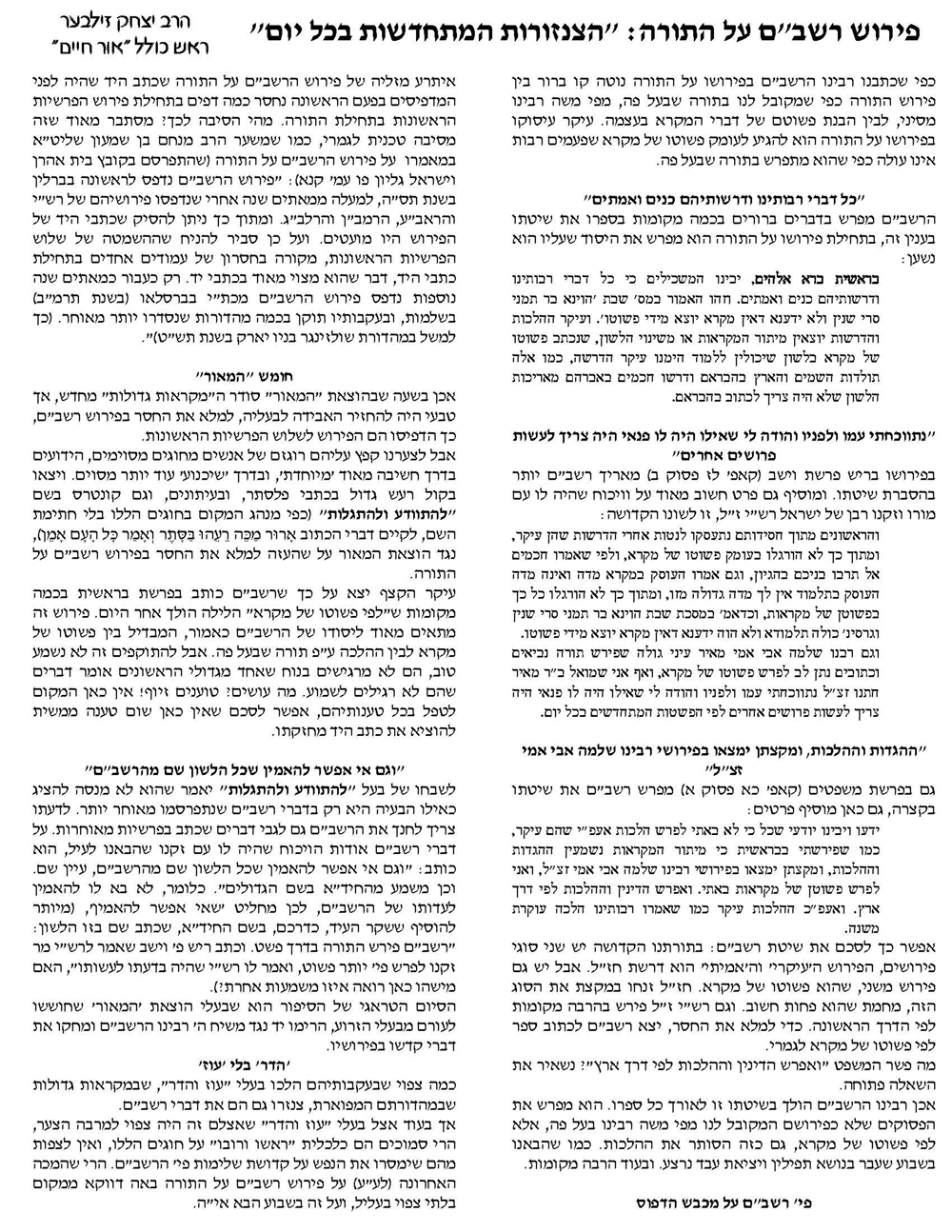


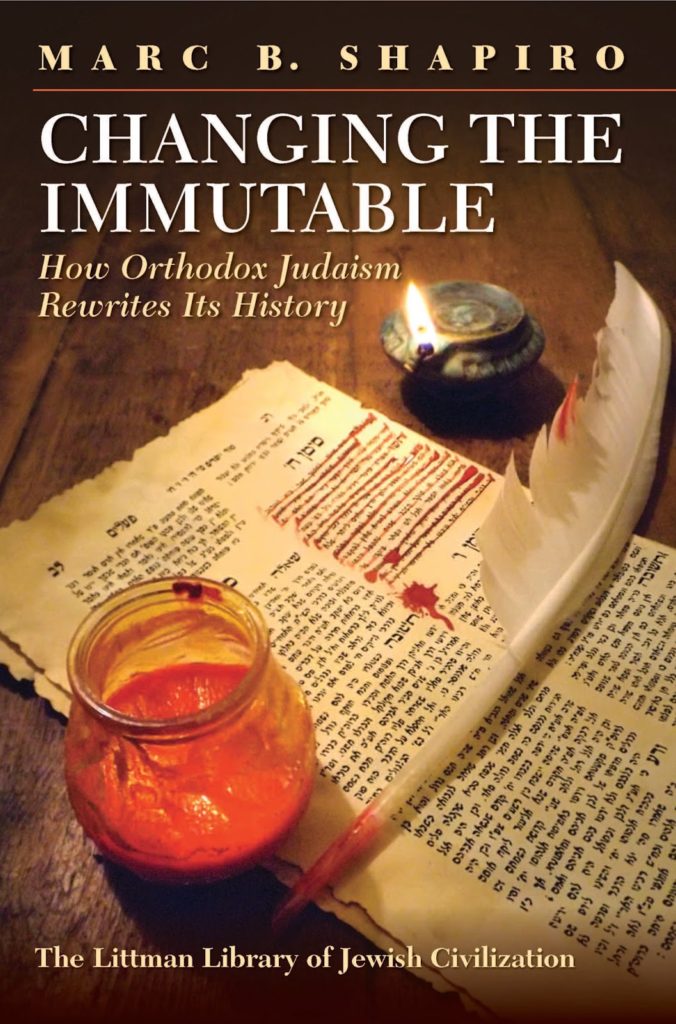
_Page_1.jpg)
_Page_2.jpg)