R. Hershel Schachter, Gedolim, Rachel Morpurgo, and More
R. Hershel Schachter, Gedolim, Rachel Morpurgo, and More
By Marc B. Shapiro
1. In listening to a recent shiur[1] on Daas Torah by R. Hershel Schachter, I found a number of noteworthy comments. In this shiur, which has been heard thousands of times, R. Schachter states, “If you have an outlook, if you have what I would consider a crooked, a krum outlook on Yom ha-Atzmaut, then your outlook on eruvin is also crooked. I can’t rely on anything that you say.” I find this difficult to accept, since can’t someone be regarded as a great posek, one that can be relied on, even if one disagrees with important ideological positions he holds? In Eastern Europe, the people all relied on their local rav to decide halakhic questions for them. It didn’t matter to them whether the rav supported Agudah or Mizrachi. He was the halakhic authority of the town.I agree, however, that there are limits. What sense does it make to rely on a Satmar posek for a ruling if one wouldn’t accept anything he said in non-halakhic matters? (It is known that when men want a ruling that they don’t have to give their wives a get, they go to a posek in Monsey whom they wouldn’t ask any other questions of.) I think it is important for R. Schachter to explain what his definition of a “crooked” outlook on Yom ha-Atzmaut is? Does he mean someone who says tahanun on that day, or only someone who thinks it is a day akin to avodah zarah?[2]
Among other interesting comments in R. Schachter’s shiur is that he states that a posek can give you a binding pesak concerning whom you must marry.[3] This too I find difficult, since where does a posek get the authority to tell someone whom he must marry? An individual can certainly consult with a posek for his advice in this matter, but since this consultation is done voluntarily by the potential groom, how do we go from there to a situation of pesak which binds the person asking the question?
[Subsequent to writing these words I saw R. Schachter and asked him about this matter. He reaffirmed his position, stating that whom one marries is a halakhic matter and therefore a posek can indeed tell you whom you must marry. He added that this is almost always theoretical since in order to make such a ruling the posek would need to know both the bride and groom for many years so as to be sure that what he is saying is correct. But he also insisted that if the posek does have the requisite knowledge he can indeed give a binding pesak about whom one must marry.]
In discussing the matter of Israel giving back land for peace, as far as I understand (and this is also the understanding of everyone I have seen who has written on the topic), R. Joseph B. Soloveitchik held that this is not a halakhic matter and therefore there is no place for rabbinic involvement. The political and military leaders should make a decision based on their knowledge of what is in the best interest of the country. However, R. Schachter has a different perspective. He states that according to R. Soloveitchik, first the politicians and military leaders should be consulted, and following this the rabbis need to make a halakhic judgment about what is permissible.[4] Yet the following are R. Soloveitchik’s words from 1967, as transcribed by Arnold Lustiger here:
I give praise and thanks to the RBSO for liberating the Kotel Hamaarovi and for liberating and for removing all Eretz Yisrael from the Arabs, so that it now belongs to us. But I don’t need to rule whether we should give the West Bank back to the Arabs or not to give the West Bank to the Arabs: we rabbis should not be involved in decisions regarding the safety and security of the population. . . . We have to negotiate with common sense as the security of the yishuv requires. What specifically these security requirements are, I don’t know, I don’t understand these things. These decisions require a military perspective which one must research assiduously. The borders that must be established should be based upon which will provide more security. It is not a topic appropriate for which rabbis should release statements or for rabbinical conferences.
Also of interest in this shiur is that R. Schachter rejects the legitimacy of Daas Torah proclamations by roshei yeshiva who do not deal with practical halakhic questions.[5] In his halakhic-centric approach, there is no room for such proclamations by figures who are talmudically learned but are not poskim. This means that R. Aharon Leib Steinman, for instance, who is not a posek, is not to be regarded as one who transmits Daas Torah. As R. Schachter says, one who does not decide practical halakhic questions dealing with Shabbat, kashrut, and taharat ha-mishpahah is not able to rule on matters that are not explicit in earlier texts, and are often categorized as being in the realm of Daas Torah. He specifically states that the Steipler and R. Shakh, who were not known as poskim, were not the ones people should have been turning to for Daas Torah.[6]
It is hard to imagine a stronger repudiation of the haredi notion of Daas Torah, for while R. Elyashiv was of course a great posek, there has never been an expectation among haredim that the transmitters of Daas Torah must be involved in pesak. Daas Torah depends on the Torah scholar being immersed in Torah and righteousness, but this does not mean that he has to be involved with halakhah le-ma’aseh questions. R. Schachter’s point is obviously in contradiction to the hasidic approach in which the rebbe is the leader, and the job qualifications of a rebbe have nothing to do with deciding halakhic questions.[7]
It is true, however, that R. Schachter’s description of who should be the religious leaders of the Torah community is what historically was the case before the rise of hasidut in the 18th century, the creation of the great yeshivot in the 19th century, and the rise of haredism in the 20th century. But even in previous centuries matters were not absolute. For example, what about R. Moses Hayyim Luzzatto? He was not a posek, yet would anyone today deny that he could speak with Torah authority on matters that fall into the category of Daas Torah? What about R. Nosson Zvi Finkel and many of the other mussar greats, or R. Zvi Yehudah Kook? Using R. Schachter’s halakhic-centric yardstick, they too would have to be excluded from what is today referred to as Daas Torah.
All this of course relates to the subject of gedolim, a topic that has recently seen a lot of discussion at the new website Lehrhaus. Professor Chaim Saiman’s essay, “The Market for Gedolim: A Tale of Supply and Demand,” was followed up by a number of insightful responses from people who represent the Centrist and Liberal Orthodox community, and by Rabbi Ethan Tucker who can be termed a leader of the halakhically committed egalitarian community.[8]
I have made the point a number of times that the twentieth century saw the creation of a new model in the haredi world. It is not just gedolim who are important, but the gadol ha-dor (technically: gedol ha-dor), that is, the gadol who stands above other gedolim. Although you had such figures in earlier times, such as the Hatam Sofer and R. Yitzhak Elhanan Spektor, in the twentieth century the notion of “the gadol ha-dor” has become institutionalized and is a basic feature of haredi society. Gedolim are not enough, but there also needs to be a supreme gadol. Thus, on the passing of the gadol ha-dor, the new gadol ha-dor emerges, (or he can actually be proclaimed, such as what happened when, after R. Elyashiv’s passing, R. Chaim Kanievsky declared that R. Steinman was the new leader). This is now an expectation of laypeople in the haredi world,[9] and obviously satisfies a psychological need, so inexorably one gadol ha-dor will be followed by another.[10]
This can lead to disputes as we see now in the haredi world between the majority who follow R. Steinman and the more extreme elements who have lined up behind R. Shmuel Auerbach. A noteworthy point, which is hardly mentioned in the “mainstream” haredi press, is that the opponents of R. Steinman have been very harsh in their evaluation of him, and a steady stream of publications has appeared designed to show that his views are not in line with the haredi Daas Torah going back to the Chazon Ish and continuing through R. Elyashiv’s leadership. These publications have also attempted to show that he does not have the level of Torah scholarship required to lead the haredi world. Yet R. Chaim Kanievsky, who throughout the controversy has been the most vocal in attacking R. Auerbach and his followers, has, as far as I know, never been subject to written criticism. All of the many attacks on R. Steinman simply omit mention of R. Kanievsky even though R. Kanievsky stands together with R. Steinman. One who claims that R. Steinman’s views are not in line with “correct” haredi thinking must assume that R. Kanievsky has also departed from the “proper” haredi path, which is a difficult position for most haredim to adopt. At the end of the day, R. Kanievsky is the most highly regarded Torah scholar in the haredi world, and if he has subordinated himself to R. Steinman, that will be enough for almost all haredim even if they do have questions about some of R. Steinman’s liberal positions.[11]
There is a lot more to say about this, but I would like to make just one more point about the term gadol ha-dor which is now so important and means the most prominent Torah leader of the generation. I think it is the equivalent of the term manhig ha-dor and is parallel to the other term that has popped up in recent decades, posek ha-dor. Regarding posek ha-dor, since the passing of R. Elyashiv, and then R. Wosner, I haven’t seen the term used for anyone in the Ashkenazic haredi world, and there is no one towering halakhic figure (although one is bound to emerge). In the Sephardic world, after the passing of R. Ovadiah Yosef, both R. Yitzhak Yosef and R. Meir Mazuz have emerged as posek ha-dor as well as gadol ha-dor. When it comes to gadol ha-dor in the Ashkenazic haredi world, both R. Steinman and R. Auerbach are regarded as such, and my sense is that many also regard R. Kanievsky as the gadol ha-dor even though he himself claims that R. Steinman holds this position.
Contrary to what some think, the term gadol ha-dor is not a recent term. Tosafot,[12] and many other rishonim, use it in the sense of a great Torah scholar, but as far as I know, there is no implication in the rishonim that the term means the preeminent Torah leader, as it is used today when people say that X is thegadol ha-dor. (I perhaps should write “scholar-leader”, since one cannot be the gadol ha-dor without being both a scholar and a leader.) When the rishonim use the term it means that X is a gadol ha-dor, i.e., a great sage. Even today, when “the gadol ha-dor” means the preeminent Torah leader, it need not mean that this individual is also the greatest Torah scholar, although sometimes times it does (e.g., when R. Elyashiv or R. Ovadiah Yosef were described as such, I think people assumed that they were the greatest Torah scholars.)
At another time I can discuss different uses of the term gadol ha-dor among rishonim. For now, I want to call attention to a passage in Pesahim 49b: “Let a man always sell all he has and marry the daughter of a scholar. If he does not find the daughter of a scholar, let him marry the daughter of [one of] the gedolei ha-dor.” It is obvious that in this passage the term gedolei ha-dor does not mean great Torah scholars. Rashi explains it to mean: אנשי מעשה וצדיקים. Even in the 16th century R. Moses Isserles uses the term gadol ha-dor to mean communal leader, and puts gadol ha-dor together with am ha’aretz.[13]
ואין איסור לקרות ע”ה נכבד עשיר וגדול הדור לפני ת”ח כי אין זה בזיון לת”ח רק כבוד לתורה שמתכבדת באנשים גדולים.
Yet elsewhere, Shulhan Arukh, Yoreh Deah 244:10 (based on Terumat ha-Deshen: Teshuvot, no. 138), R. Isserles does use gadol ha-dor to mean an outstanding Torah sage.Returning to the articles at Lehrhaus, I would like to call attention to a couple of passages that relate to gedolim in rabbinic literature (there are obviously many more). R. Hayyim Palache states that there is a tradition that every gadol be-Torah has opponents who persecute him.[14] Historically, I think this is the case, as I cannot recall a gadol who did not have enemies who tried to tear him down.
Most people assume that dayanim will know halakhah well, and that the elite and small group of dayanim on Israel’s Beit Din ha-Gadol will certainly be experts in all areas of halakhah. I recently picked up R. Yitzhak Yosef’s new volume of responsa, She’elot u-Teshuvot ha-Rishon le-Tziyon, and he wants to disabuse readers of the understandable notion that dayanim are experts in the breadth of halakhah.[15] He goes so far as to say that there are dayanim on the Beit Din ha-Gadol, men he knows personally, who while knowledgeable in Even ha-Ezer and Hoshen Mishpat, when it comes to Orah Hayyim and Yoreh Deah:
אינם בקיאים כלל וכלל, יודעים קצת מספרי קיצורים, כמו בן איש חי וכף החיים וכדומה. אך אינם בקיאים בב”י ומפרשי השלחן ערוך והשותי”ם.
Being that the Beit Din ha-Gadol is a very small group of dayanim, I am sure people have been trying to figure out who R. Yosef is including in this negative judgment.
Finally, in terms of a definition of a gadol, R. Hayyim Eleazar Shapira actually offers us one:[16]
מפורסם בהרבה מדינות ובחיבוריו יורו המורים ולקולו יחתו וכיוצא.
By saying that a gadol is known in many lands, and his works are widely used, it is clear that we are dealing with a definition for the modern era where there is easy international communication. In pre-modern times there was no expectation that a gadol in say Morocco would be known outside this land. But I think that for the modern era R. Shapira’s definition is an excellent one as it captures the fact that the term “gadol” represents a sociological category. I would also add that the status of “gadol” is significant in that it is a lifetime appointment, as it were. It is almost impossible for one to be removed from “gadol” status once he has been elevated to this level. I think we can be very proud that in the long history of gedolim there are no examples – at least I am not aware of any – where gedolim lost their status because of immoral behavior. (We can be less proud of the language some gedolim have used in denigrating their opponents.[17])
2. In recent posts I discussed the idea of love before marriage in traditional Jewish communities. It is worth noting in this regard Rachel Morpurgo’s book of poetry, Ugav Rahel (Cracow, 1890). Here is the title page.
Rachel Morpurgo was a cousin of Samuel David Luzzatto, and a fascinating and learned figure in her own right. In the introduction to the book, p. 6, R. Isaac Castiglione tells us that Rachel’s parents wanted her to marry a certain man, but she refused as she was in love with Jacob Morpurgo. If she could not marry him, she preferred to remain single. (In the end, they did marry.)
Her cousin Luzzatto sent her a poem, trying to change her mind, and she replied also in a poem, expertly using many of the same words that Luzzatto had used. In her poem she says that if she can’t marry the man she wants, she will never marry, not even if given the possibility to marry the Messiah. Here are both of their poems, from Ugav Rahel, pp. 50-51, and Rachel’s poem in honor of her marriage, p. 52.
Here is another interesting poem from p. 71. We see that Morpurgo wanted to join Moses Montefiore on his journey to the Land of Israel.
On p. 73 she has a poem of joy after an evil Catholic priest died and was buried on Purim.
She was also able to write riddle poems, which was a popular genre among the Hebraists. Here is one from pp. 76-77
3. In the archive of R. Isaac Herzog there are a number of letters from R. Herzog relevant to the issue of science and Torah.[18] He was writing to scientists and historians asking them how certain it is that the world is billions of years old and that humanity has been in existence for more than 6000 years. One of the people he wrote to was Professor George F. Carter. Carter was a believing Catholic, and in his letters to R. Herzog you see that he could not understand why there should be any conflict between Torah and science. It astounded him that R. Herzog seemed to feel that the scientific and historical information in the Torah must be accepted as factual, when from his Catholic perspective the point of the Bible is not to provide facts of this nature. In his letter of November 23, 1953, R. Herzog wrote to Carter.
[L]et me recapitulate my problem. Not that we have as a dogma a certain chronology but the chronology automatically results from the plain text of the Book of Genesis, as you undoubtedly know yourself, that troubled the minds of some great rabbis nearly a century ago with the rise of the science of Geology. Most ignore the data of science altogether. Some, however, replied that the world was created enormous [missing word] of time ago, but that at certain points mankind was recurrently blotted out and the present world is a certain phase in that recurrent process of creation and destruction. Hence they explained the fossils which bear evidence of such high antiquity etc. They based their explanation upon an old saying in a pre-mediaeval Rabbinic collection: “The Holy One Best be His Name kept on building up worlds and destroying them.” Note that the meaning of “destroying” in that connection is not total annihilation as you will easily understand. Now the problem as it presents itself to me is whether the short period of less than six thousand years or (counting from the deluge when according to Genesis only a few persons survived) some 5000 years is sufficient to account for the numbers of mankind, for its distribution all over the globe, for the advance and progress of mankind, which in the natural course require considerable time, say the art of recording or writing etc., etc. If you assume divine interposition, the progress could be achieved in much less time. Think of the time according to science it took wood to be turned into coal, and of the time it takes for that process at the kitchen fire-side! Yet the question remains: Is it possible to speak of such constant divine interposition within say the first 2000 years of the past 6 or 5 thousand years since the beginning of the Biblical chronology to promote civilisation, the distribution of mankind and to multiply mankind to such an extent? I may add that our great teacher Maimonides from whom your Catholic great thinker Thomas Aquinas drew so much, was in his time confronted with Aristotle’s eternity of the universe which contradicted Jewish belief. He started out with the premise that if Aristotle’s point was absolutely proved, he would explain bara in Genesis not in the sense of created but in another sense, and would thus reconcile the divine Towah [!] with scientific truth, but he found that Aristotle had not proved his point and he therefore left bara in its plain sense.[19] I say something similar. If men of science prompted by absolute truth definitely and unanimously decide that the above chronology is not only unlikely but is actually impossible and therefore absurd, I would reinterpret the Biblical text in a different sense, but before doing that, I must be perfectly certain. Remember that the divine truth of every word in the Pentateuch is a dogma of orthodox Judaism, is believed to be the word of G-d through Moses. Yet orthodox Judaism is not a slave to the literal sense. It teaches that G-d is beyond all human thought and imagination and therefore it regards the anthropomorphisms as mere figures of speech: it also lays down that the Torah speaks in the language of humans. But there is of course a difference between understanding the Eyes of G-d as meaning divine Providence and interpreting the chronology of six thousand years as standing for aeons!
In this letter, and in other letters in his archive, the issue R. Herzog is most troubled with is not the creation of the world and the evidence that this took place billions of years ago. Rather, his concern is with the length of time of humanity on earth, for if there is indisputable evidence of humanity for tens of thousands or hundreds of thousands of years, then what is one to do with the chronology that “results from the plain text of the book of Genesis,” by which he means the record of generations beginning with Adam? As far as R. Herzog is concerned, this matter is not so much a religious question but a historical question, and that explains why he inquired from experts in this matter.[20] For if we are dealing with a fact, undisputed and recognized by all experts, that humanity has existed for longer than the biblical account would have it, then following Maimonides R. Herzog believes that is no choice but to read the Torah’s account in a non-literal fashion.
Readers can correct me if I am wrong, but I think that in the Modern Orthodox world the matter that R. Herzog was so exercised about has been settled. In other words, I don’t see any evidence that people in these communities are concerned that in Modern Orthodox schools, in classes on ancient history, students are taught things such as that around 10,000 BCE farming communities existed in the Middle East and North Africa. I know from personal experience that textbooks used in Modern Orthodox schools offer precisely this sort of information that assumes that human civilization predates the traditional Jewish reckoning. From what I have seen, this is presented to the students without, however, taking the step that R. Herzog mentioned, namely, explaining what then becomes of the biblical chronology when it is no longer viewed as historical.[21]
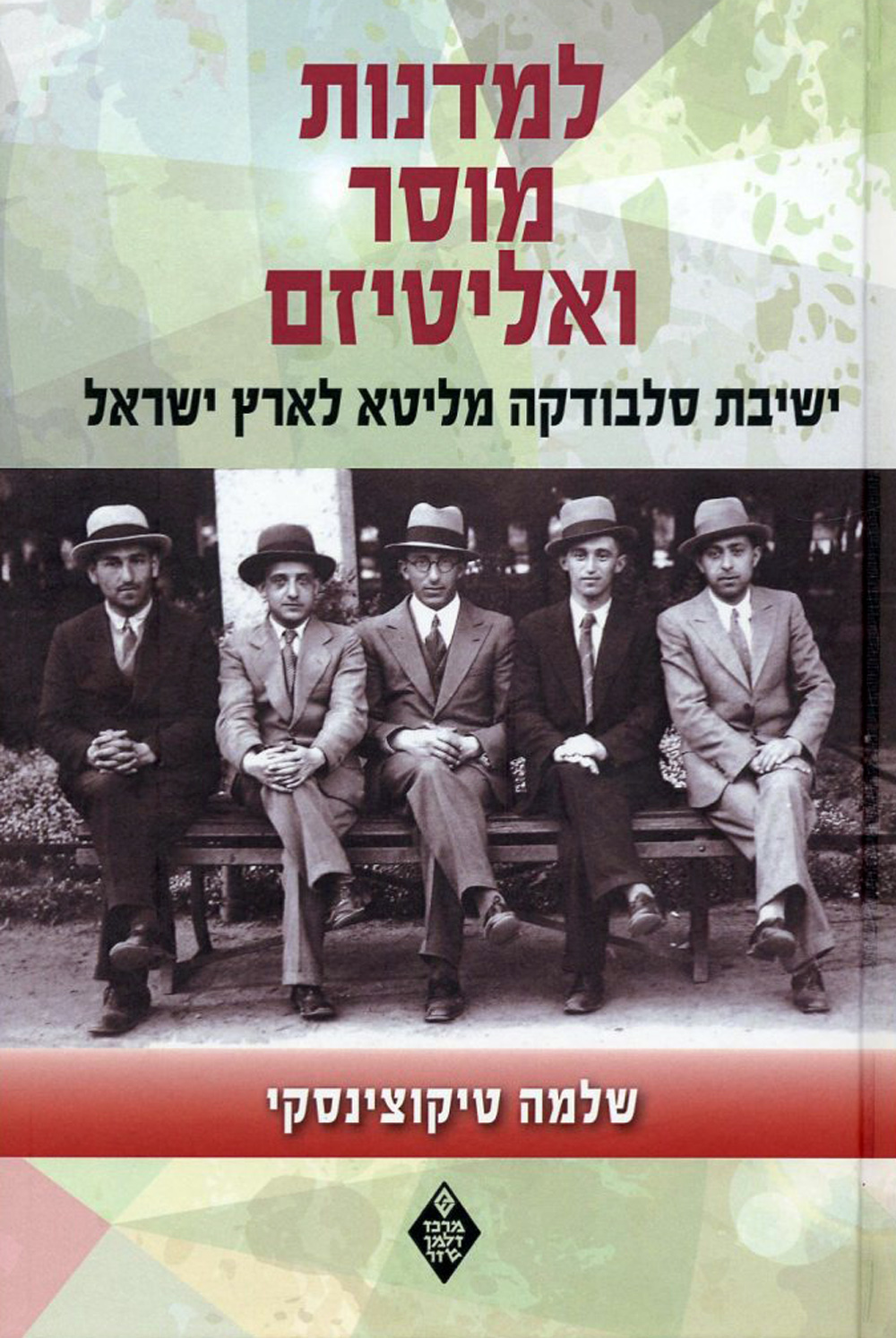
4. Following up on this post, here is a picture of a group of Slobodka students.[22]
R. Hutner is sitting in the middle.
Here is another picture of R. Hutner.
Standing next to him is R. Harold Leiman who was principal of general studies at Yeshivat Chaim Berlin’s high school from 1936-1948. Prof. Shnayer Leiman informs me that this picture of his father has to be from 1940 or earlier..
5. In my post here, in discussing the newly published Ha-Mashbir, volume 2, I wrote that one of the articles is by R. Pinhas Zebihi who discusses the practice in Gibraltar that men in mourning do not wear a tallit on Shabbat. I added that this is only the case for the first month of mourning. Mr. Mesod Belilo of Gibraltar has informed me to me that the Gibraltar minhag is that those in mourning do not wear a tallit at all during sheloshim, whether it be Shabbat or during the week. (They do put one on if given an aliyah.) It is Shabbat that makes this minhag halakhically problematic as not wearing a tallit would appear to be an example of “public mourning,” and that is what R. Zebihi deals with. In fact, his conclusion is that the practice should be abolished, but I can’t imagine that the Jews of Gibraltar, even if they knew of R. Zebihi’s position, would give up a minhag that is hundreds of years old and was not abolished by any of the community rabbis. (R. Zebihi’s article is actually a responsum addressed to the rabbi of the small Gibraltar minyan in London.)
One of the editors of Ha-Mashbir isR. Yissachar Dov Hoffman who recently published another book, Avodat Ovadiah, volume 1. It focuses on practices of R. Ovadiah Yosef and deals with the first part of Shulhan Arukh, Orah Hayyim (tzitzit, prayer, blessings, etc.). R. Hoffman’s learned notes include citations from a wide range of contemporary rabbinic works.
6. Here is a quote from the late Robert Liberles that I find quite interesting, and I think readers will as well.
Historians, imbued with curiosity and a fascination with the dark side, can easily be drawn toward the negative, the hostile, the antinomian side of human behavior. In addition, deviant behavior has much to teach about a society under study. There is also the endless fallacy of being drawn by sources deep into the abyss of misrepresentation. Records in the public archives relate strife and despair more often than happiness and love. Rabbinic responsa pertaining to family life also tend to deal with discord. Abuses in Jewish family life can be abundantly documented, and they should be. These sources have been ignored too often, partly because they were not known, partly because they were at times consciously overlooked. Research based on prescriptive sources has depicted a portrait that is quite distant from the harsher reality that emerges from primary descriptive sources.[23]
7. In my post here I mention that in medieval rabbinic literature the words צעירים and דורשים mean Franciscans and Dominicans. David S. Zinberg called my attention to R. Joseph Ibn Caspi, Mishneh Kesef, vol. 2, p. 257. In commenting on how Moses was not celibate and even took a second wife, he writes:
כי אינו צעיר ודורש, או אגוסטי וכרמלי
“For he was not a Franciscan or a Dominican or an Augustinian or a Carmelite.”
Zinberg also called my attention to Mishneh Kesef, vol. 1, p. 106, where he writes about כת הצעירים מארצנו זאת
I also found that R. Israel Moses Hazan, Nahalah le-Yisrael, p. 84, refers to the Dominicans as כת הדרשנים
8. I know readers will be happy to learn of a significant event in the world of Torah and academic Jewish scholarship: A previously unknown responsum by Maimonides has just been published in Divre Hefetz 7 (Tishrei 5777). You can see it here.
9. The newest book in my series, Studies in Orthodox Judaism, has appeared. It is Darren Kleinberg, Hybrid Judaism: Irving Greenberg, Encounter, and the Changing Nature of American Jewish Identity. Anyone interested in a discount copy of the book should be in touch with me.A few other books recently appeared that I would like to bring to readers’ attention. R. Moshe Zuriel published the following works by Naftali Hertz Wessely: Gan Naul, Sefer ha-Midot, Migdal ha-Levanon, and Hikur Din. The first two books have been published before, but Zuriel has included unpublished material. Migdal ha-Levanon appears in print for the first time. All scholars who deal with Wessely will have to examine these works.
Another recent publication is R. David ben Judah he-Hasid, Sefer ha-Gevul, edited by Bentsion Cohen. This is a kabbalistic work published from manuscript. The author, R. David, is none other than the grandson of Nahmanides. Here is how the book is described on the cover: “This book is one of the first attempts by a contemporary of the Zohar discovery to give a lucid and graphical interpretation to the mysterious complex issues of divinity as discussed in the Idra Rabbah of the Zohar. His approach is one of the earliest to present an interpretation of the Sephirot in the image of a person.” The book also includes the numerous illustrations that appear in the manuscript.
10. Readers sometimes ask me about upcoming lectures, so I would like to inform people that on the Shabbat of Dec. 16-17, 2016 (including Saturday night) I will be speaking at Ner Yisrael in London. On Sunday night, Dec. 18, I will be speaking at the Hampstead Synagogue at 8:15pm. The topic is “Some Strange Jewish Christmas Eve Practices.” On Wednesday, Dec. 21, I will be speaking at the London School of Jewish Studies at 8pm on the topic of “Touching God: What Are the Limits of Orthodox Theology?” On Thursday, Dec. 22, I will be speaking at Shomrei Hadath at 8pm on the topic of “Sense and Censorship: Is Historical Truth an Orthodox Value?” On the Shabbat of Dec. 24-25 (including Saturday night) I will be speaking at Kehillat Ohev Shalom.
On the Shabbat of Jan. 6-7, 2017, I will be in Flatbush. During services on Friday night at Bnei Yitzhak, I will give a short talk on R. Elijah Benamozegh. After an early tefillah at the Sephardic Institute, I will be speaking at 8:45am on “The Philosophy of Rav Kook: Is It Still Relevant?” On Shabbat afternoon at 3pm I will be speaking at Beth Torah on “Judaism and Islam: Some Historical and Halakhic Perspectives.” On Saturday night at 8pm I will be speaking at the Sephardic Institute on “Did the Sages Always Tell the Truth (and Should We)?”
[1] “Da’as Torah – What are Its Parameters in non-Halachic Issues”, available here at 26:40.
[2] Usually it is Hungarian extremist rabbis who use terms like avodah zarah with reference to Yom ha-Atzmaut, but I found that R. Yehezkel Levenstein also uses this language. See Or Yehezkel, vol. 3, p. 118:
וברצוני לעורר כי הנה היום היה [!] יום העצמאות, ומה הוא מהותו של יום העצמאות. יום של עבודה זרה, יום שבו מראים הכל כוחי עוצם ידי.
I agree with a friend who wrote to me regarding this passage:
יש הבדל בין השימוש בשם ‘עבודה זרה’ בהקשר של “כוחי ועוצם ידי”, זה שווה למי שאומר שהרדיפה אחר הכסף הוא עבודה זרה “אלהי כסף ואלהי זהב לא תעשה לכם”, ובין השימוש שסטמר משתמש בו שעובדים “העגל הציוני”.
[3] At 1:14:30. The Lubavitcher Rebbe had a different perspective. See Joseph Telushkin, Rebbe: The Life and Teachings of Menachem M. Schneerson, the Most Influential Rabbi in Modern History (New York, 2014), p. 189, who quotes what the Rebbe told R. Leibel Groner: “When it comes to a marriage, not I can help you, not your father can help you, not your mother can help you, not your seichel [your intellectual faculties] can help you. The only thing that can help you is your heart. If you feel for her, go ahead. If you don’t do not.”
[4] At 1:11:00. Because R. Schachter is citing from memory, his misremembered one point. At minute 59 he describes a case dealt with by R. Chaim Berlin that took place under communist rule. Yet R. Berlin died in 1912, before the Soviet Revolution. The responsum referred to by R. Schachter can be found in Nishmat Hayyim, Even ha-Ezer, no. 3, and is from 1911. As R. Schachter notes, it contains the following fascinating words, addressed to someone who was considering whether a certain woman was an appropriate marriage partner:
ויוכל לקיים בה מצות פו”ר להוליד לו בן ובת ויצא ידי חובתו. ובזה”ז דלא אכשור דרי אין להדר להיות לו בנים מרובים, שמי יודע אם ילכו בדרך התורה והמצוה, אך לקיים מצות פו”ר חובה עלינו למלאות חובתינו.
I don’t know of any other rabbinic figure who urged people not to have many children because of a fear that they would not remain religious. The standard rabbinic approach in such matters was to declare בהדי כבשי דרחמנא למה לך. This expression comes from Berakhot 10a where it deals with the exact matter discussed by R. Berlin.
In those days was Hezekiah sick unto death. And Isaiah the prophet, son of Amoz, came to him and said unto him, Thus saith the Lord, Set thy house in order, for thou shalt die and not live etc. (Is. 38:1) What is the meaning of ‘thou shalt die and not live’? Thou shalt die in this world and not live in the world to come. He said to him: Why so bad? He replied: Because you did not try to have children. He said: The reason was because I saw by the holy spirit that the children issuing from me would not be virtuous. He said to him: What have you to do with the secrets of the All-Merciful? You should have done what you were commanded, and let the Holy One, blessed be He, do that which pleases Him
According to R. Berlin, Hezekiah was mistaken in that he chose not have any children. R. Berlin states that one must indeed fulfill the minimal obligation of peru u-revu, but there is no need to have more children than this when there is a strong possibility that the children will not remain on the religious path.
[5] Ibid at 1:01:00.
[6] Hearing this reminded me of R. Avraham Shapiro’s point that certain “Daas Torah” personalities have published Torah works, and in these works they state that what they write is not halakhah le-ma’aseh. “It is as if they are saying that they don’t have the ‘Din Torah,” but they do have the Daas Torah.” See Aharon Eizental, “Ha-Kohen ha-Gadol me-Ehav,” Tzohar 32 (2008), p. 16. A number of times R. Shapiro commented that there is no precedent for the current phenomenon in which Torah scholars who won’t give halakhic rulings on commonplace Shabbat questions feel that they can issue rulings on life and death matters affecting the entire nation. As with R. Schachter, he saw this as a distortion of true Daas Torah.
[7] See R. Israel Berger, Eser Orot (Petrokov, 1907), pp. 13-14, who explains the hasidic perspective that one can be the gadol ha-dor without being an expert in Talmud and halakhah.
[8] None of the responses referred to the following important passage in Aviad Hakohen, “Zot Torat ha-Adam,” in Reuven Ziegler and Reuven Gafni, eds. Le-Ovdekha be-Emet (Jerusalem, 2011), p. 367. It shows that R. Yehuda Amital thought that there is a more important thing to hope for than that one’s sons or students become gedolim, namely, that they should be good Jews.
כמה פעמים סיפר לנו על בר המצווה של בנו היחיד, ר’ יואל, שאליה הגיעו הרבה אורחים שנמנו עם משפחת האצולה הלמדנית של הרבנית מרים, משפחתו של הסבא ר’ איסר זלמן מלצר. בזה אחר זה קמו האורחים, וכמנהג גוברין יהודאין בירכו את חתן בר המצווה שיהיה גדול בתורה, חריף ובקי, סיני ועוקר הרים, רב לאלפים, יודע ש”ס ופוסקים, עמוד החזק ופטיש הימיני. לאחר שסיימו, ניעור רבנו ממקומו ואמר בצורה אופיינית: “אני מודה לכם על דבריכם הטובים, אבל איני מסכים עמם. אבא שלי לא היה גדול בתורה. גם סבא שלי לא היה גדול בתורה. לא אכפת לי שבני יהיה חייט או סנדלר. העיקר שיהיה יהודי טוב.”
[9] Brisk is an exception. A friend writes:
בבית בריסק אומרים מפורש, מאן לימא שיש גדול הדור?
[10] I am referring to the non-hasidic segment of the haredi world. In the hasidic world the followers of a rebbe generally viewed him as the gadol ha-dor, and he was thought to be chosen for this role from Heaven. See Mendel Piekarz, Ha-Hanhagah ha-Hasidit (Jerusalem, 1999), pp. 22ff.; David Assaf, Ne’ehaz ba-Sevakh (Jerusalem, 2006), p. 240. The Steipler actually said that R. Shakh was chosen by Heaven to be the manhig ha-dor. See Avraham Yeshayahu Kanievsky, Toldot Yaakov (Bnei Brak, 1995), p. 263. The Hatam Sofer said that in every generation God establishes one person as the premier posek. Because of his central halakhic position, the Hatam Sofer understandably understood that he was this person. See Maoz Kahana, “Ha-Hatam Sofer: Ha-Posek be-Einei Atzmo,” Zion 76 (2007), pp. 545-546.
[11] In a future post I will discuss R. Steinman in more detail. After examining his writings and public statements, I have to say that I understand well why there is opposition to R. Steinman, and I think that without the support of R. Kanievsky he never would have been regarded as the gadol ha-dor. It appears to me that R. Steinman has indeed attempted to move haredi society in a different direction, and as such has diverged from some of the previous haredi Daas Torah. Furthermore, there is evidence of his “out of the box” thinking for many decades. As far as I know, there is not even one scholarly article about R. Steinman, which is surprising, to say the least, since he is the single most important haredi rabbinic leader.
[12] Berakhot 31b s.v. מורה. Cf. Rashbam, Pesahim 100a, s.v. ברבי which I also don’t think means the preeminent Torah leader or scholar. See also Or Zarua, Hilkhot Rosh ha-Shanah, no. 276, for the story of R. Amnon of Mainz who is referred to as gadol ha-dor. But again, I don’t think the meaning is that he was the greatest scholar of the generation. He certainly was not the greatest leader of his generation (and indeed, he was not even a real person).
[13] Shulhan Arukh, Orah Hayyim 282:3.
[14] Nefesh Kol Hai, ma’arekhet ת, no. 80. R. Palache also cites R. Nahman of Bratzlav, Sefer ha-Midot, s.v. צדיק no. 136:
אין לך צדיק שאין עליו מחלוקת ומחקרים.
[15] Vol. 2, p. 159. See also ibid., p. 249.
[16] Minhat Eleazar, vol. 3, no. 64 (p. 54a).
[17] There is a long list of negative things rabbis have said about their opponents, and I have cited some in prior posts. Perhaps the worst I have found was stated by R. Sason Elijah Halevi Samoha, the former hakham bashi of Baghdad. He accused R. Elisha Dangoor, his successor as hakham bashi, of murdering his own brother. See Yaron Harel, Intrigue and Revolution: Chief Rabbis in Aleppo, Baghdad, and Damascus 1744-1914, trans. Y. Chipman (Oxford, 2015), p. 98.
[18] The letters I refer to come from the Israel State Archives, R. Isaac Herzog file 4243/6-פ.
[19] For my understanding of Maimonides, which diverges from that of R. Herzog, see here.
[20] In the file that contains the letter to Carter is also found a November 2, 1954 letter to Arnold Toynbee in which R. Herzog writes:
I have been struck by the point that you narrate the history of 5000 years of civilisation. Does that mean that in your view recorded history is not older?
I have been trying recently to explain the Hebrew Bible chronology according to which the creation of man took place only about 5700 years ago. This of course is rejected by anthropologists but may it not mean that man, truly civilised man, man properly called, is only of that age? Or do you begin the history of civilisation with the rise of agriculture?
Another letter in the file is from R. Herzog to Abraham Cressy Morrison, author of the book Man Does Not Stand Alone. R. Herzog’s letter is from December 19, 1951, and here is the section relevant to our discussion:
While not necessarily subscribing to all of its statements, I wish to compliment you on your very interesting and inspiring little book, “Man Does Not Stand Alone.” It is calculated to help many spiritually.
However, permit me the following observations. Whilst you accept the belief in G-D and in providence in as far as the generalities of nature are concerned, you recognise the dates fixed by science as axiomatic. Let me call your attention to the consideration that the ages of the rocks and the like, are computed in the absence of the premise of the Rock of the Ages. Once you grant the agency of a super nature power and intelligence, it does not follow at all that because with the laws and forces working now in nature after the creational work has ended, this or that kind of operation must take so much time, it has been so during the creational process and hence it is not at all certain that G-D tool [!] milliards of years to perform his work as Creator.
The difficulty is great, I admit, when it comes to historic Biblical chronology. Literally taken, the Biblical chronology allows only 5712 years for the period since the creation of Man and the present day. Yet I have the impression that even Wells allotted only a space of about 12,000 years for civilisation. This of course is a different matter. If we take agriculture as marking the emergence from the savage state, some 6000 years would, I feel, be sufficient. We may have to reinterpret the narrative portions of the Pentateuch, but not necessarily to allegorise them.
The same file also contains most of the Herzog-Immanuel Velikovsky correspondence published and analyzed by Raphael Shuchat in The Torah u-Madda Journal 15 (2008-2009), pp. 143-171.
[21] In the Israel State Archives, R. Isaac Herzog file 4253/6-פ there are other letters from R. Herzog focusing on the matter we have been discussing, namely, the short time given to humanity on earth if one reads the Torah literally. On 10 Av 5712, he wrote as follows to Dr. Yitzhak Etzion:
אפשר לפרש את תוה”ק בצורה אליגורית ושהשמות שבפרשיות הראשונות שבספר בראשית, הן של גזעים ואומות רבים, לא של יחידים, ושהשנים הן לא שנים רגילות אלא תקופות, אבל זהו כבר ענין אחר, ודורש קביעת כללים עד היכן ומהיכן
On 22 Adar 5712 he wrote to Dr. Samuel Belkin.
זה מזמן שאני הוגה רעיון גדול בלבי והוא להוציא ספר גדול בכמות ובאיכות, מעין מורה נבוכים חדש שיכיל תשובותיה של היהדות הנאמנה לכל מתקיפיה, מצד המדע המודרני, האנטרופולוגיה, הגיאולוגיה, הזואולוגיה וכו’, הפילוסופיה, בקורת המקרא, והדתות האחרות, וכן מצד בעלי הכתות שבקרבנו של העבר ושל היום, הצדוקים הקראים והריפורמים
אני קבעתי לי ליסוד את דברי רבינו הגדול הרמב”ם ז”ל, שאם אריסטו היה מוכיח בהחלט את קדמות החומר היה הוא מפרש את פרשיות בראשית בהתאם לה, וד”ל, אך צריך שהחולקים על קבלתנו יוכיחו תחלה את השערותיהם, וכן צריך לקבוע כללים פרשנייים, עד היכן ואימתי מותר להוציא הדברים מפשוטם. זהו מקצוע בתורה שעובד אך מעט מאד
On 11 Shevat 5713, R. Herzog wrote to Professor Ben Zion Dinur, who was then serving as Minster of Education.
ימצא נא בזה סיכום של פעולות שבתכניתי לשם יצירת תנועה רוחנית להגנה על מורשת סיני
בדעתי להתחיל מיד בעריכת ספר גדול על יסוד היסודות של היהדות הנאמנה המאמינה, “תורה מן השמים”. בספר ההוא תופענה הגנות כתובות מאנשי מדע ואנשי אמונה כאחד, מיד כל אחד מנקודת השקפת מקצועו: אנתרופוליגיה, גיאולוגיה, תכונה, זואולוגיה וכו’ וכו’ . . . כללים הם בידינו מאז מעולם: “דברה תורה בלשון בני אדם”, “שבעים פנים לתורה”, “התורה נדרשת בפרדס” וכו’ וכו’, ומאידך גיסא יש לנו כלל גדול “אין מקרא יוצא מידי פשוטו”. הספר הזה יקבע גבולות על הפרשיות שבתורה שאינן ענין של הלכה למעשה, עד כמה ובאילו תנאים יש להוציא הדברים מפשטותם. לפנינו יהיו למורה דרך דברי המורה הידועים, שאם אריסטו היה מוכיח בהחלט את קדמות החומרeternity of matter היה הוא ז”ל מוצא דרך לפרש את פרשיות בראשית בהתאם לה.
בהכרח שהיהדות הנאמנה המאמינה תמצא לה פרקליט בתקופה המודרנית הזאת, אך מפני התקדמות המדע בצעדי ענק אי אפשר לעבודה כזאת להעשות באיש אחד. אפילו הרמב”ם, אילו היה חי בדורנו, לא היה יכול להאבק יחידי בכל הזרמים המרובים ההם
In his 29 Shevat 5714 letter to Dr. Aharon Barth, R. Herzog speculates about a possible solution to the problem we have been discussing, and also a solution for other matters in which the Torah’s description does not correspond to what is accepted by modern scientists and historians. He suggests that the Torah’s description need not be factually correct, as it was in line with the conceptions of the generation of the giving of the Torah.
תאמר, שהיא דברה לא רק בלשון בני אדם, כי גם בלשון המסורת של העברים שבאותו הדור שקיבל את התורה, אעפ”י שבעצם הדברים לא מדויקים. נוסיף ללכת ונאמר כדברי רבינו הקדוש הרמב”ן ז”ל שהתורה כולה שמותיו של הקדוש ברוך הוא, ויש בה בכל אות ובכל תג סודות וסודי סודות, למעלה למעלה מהשכל הרגיל, רזי רזין שרק יחידי סגולה זוכים בהם, ואין חיצוניותה בפנימיותה כלל, והצורה החיצונה נתחברה בהתאמה לדרגת המסורת העברית של הימים ההים – הרבה צריך עוד לדון עד שנקבל תיאוריה כזאת
As can be seen from the last sentence, he was not ready to adopt this approach.
See also the letter from R. Herzog that I published in my “Ha-Im Yesh Hiyuv le-Ha’amin she-ha-Zohar Nikhtav al Yedei Rabbi Shimon Ben Yohai,” Milin Havivin 5 (2010-2011), p. 19.
In his reply to R. Herzog, Dr. Etzion makes the following interesting point which stands in opposition to the approach of some in the Kiruv world (and, truth be told, it is also in opposition to Maimonides’ approach)..
כבודם של כל חכמי ישראל שהשתדלו להוכיח את האמונה ע”י השכל במקומם מונח, אבל האמונה בה’ ובתורה היא אחת ממצוות התורה ולו היה אפשרות להוכיח את האמונה הזאת, היינו לו אפשר היה להכריח את שכל האדם להאמין, הרי אין מקום למצוה, כמו שאין מקום למצוה ולשכר ועונש אם אין בחירה חפשית בחופש הרצון
[22] The picture can be found here where four of the five young men are identified. It was brought to my attention by Elchanan Burton.
[23] Robert Liberles, “On the Threshold of Modernity: 1618-1780,” in Marion Kaplan, ed., Jewish Daily Life in Germany, 1618-1945 (Oxford, 2005), p. 24.
Altering of Rabbinic Texts?, Shlomo Rechnitz and the Eighth Principle of Faith, R. Yair Hayyim Bacharach, the Ridbaz and “Chemistry,” and R. Yitzhak Barda
Altering of Rabbinic Texts?, Shlomo Rechnitz and the Eighth Principle of Faith, R. Yair Hayyim Bacharach, the Ridbaz and “Chemistry,” and R. Yitzhak Barda
Marc B. Shapiro
1. People continue to send me examples of censorship and altering of texts. If I would discuss all of them, I would have no time for other matters, but I do intend to get to some of these examples. Let me also share an “updating” of a classic rabbinic text that I discovered on my own in the old fashioned way. This is one of those examples that I wish I knew about when I wrote my book. It is not a case of someone in the Orthodox world altering a text, as this example goes back many centuries. Bereshit Rabbah 36:1 states:
ויהיו בני נח היוצאים וגו’: והוא ישקיט ומי ירשיע וגו’ (איוב לד, כט) דרש ר’ מאיר “והוא ישקיט” מעולמו “יסתר פנים” לעולמו כדיין שמותחין כילה על פניו ואין יודע מה נעשה מבחוץ ]כך אמרו דור המבול (שם כב) “עבים סתר לו ולא יראה [“.א”ל דייך מאיר. אמר להון ומה הוא דכתיב “והוא ישקיט ומי ירשיע” וגו’. אמרו נתן שלוה לדור המבול ומי בא וחייבן.
And the Sons of Noah, that went forth: It is written, When he giveth quietness, who then can condemn, etc. (Job 34:29)? R. Meir interpreted it: He quieteneth Himself from His world, And He hideth His face (ibid.) from His world, like a judge before whom a curtain is spread, so that he does not know what is happening without. [So said the generation of the flood, Thick clouds are a covering to Him, that he seeth not (Job 22:14)] Let that suffice thee, Meir, said they to him. [Soncino: You have said more than enough – heaven forfend that this teaching should be true!] Then what is meant by, When He giveth quietness, who can condemn? he demanded. They replied: Was not ease given to the generation of the flood; who then can condemn them?
The words that I have included in the first brackets are not found in most manuscripts of Bereshit Rabbah consulted by J. Theodor for his critical edition. However, they do appear in Va-Yikra Rabbah 5:1. The words “So said the generation of the flood” are problematic, since if they said the prior sentence, why is Rabbi Meir being rebuked? If you remove those words then the text makes perfect sense, as we see that R. Meir is saying (or is attributing to Job[1]) the notion that God chooses to remove himself from knowledge of and guidance of the world.[2] This is a very radical statement and it is understandable why a later copyist would prefer to attribute such a statement to the generation of the flood, rather than R. Meir. In other words, it appears that the original text of the midrash was altered for theological reasons.
In its note on the Bereshit Rabbah text, the Soncino translation explains:
He [God] is unconcerned by what is done in the world and is not incensed by the deeds of the wicked – a remarkable teaching of God’s trancendence. Cur. edd. alter the meaning by adding: so said that generation of the Flood (according to this R. Meir merely puts these words into the mouth of the wicked), Thick clouds are a covering to Him, that He seeth not (Job xxii, 14). But in that case it is difficult to see why his colleagues so sharply rejected this interpretation.
Louis Finkelstein takes note of this midrashic passage and writes:
Even in the school of R. Akiba, we find R. Meir, the sage who so frequently expresses patrician ideas, denying Providence in individual human life. “God,” he says, “is like a judge who spreads a curtain before him and knows not what proceeds without.” The earnest protest of R. Meir’s colleagues against this heresy shows that it was meant seriously, and that R. Meir, in the second century of the Common Era, actually held views akin to those defended by the patricians for six centuries before him.[3]
It is also worth noting that the medieval R. Asher ben Gershom, as part of his defense of the medieval followers of Maimonides, refers to the Bereshit Rabbah passage and his text did not have any reference to the Generation of the Flood. He therefore understands the passage to mean that R. Meir indeed denied God’s providence. He also adds that it appears that R. Meir later rejected this view, although he doesn’t provide any evidence for this assertion. R. Asher contrasts the vehemence of the attacks on the followers of Maimonides with the calmer way the talmudic sages reacted when their colleagues put forth radical views.[4]
ראו מה בין רבותינו וביניכם. הנה להלל באמרו אין משיח לישראל. לא אמרו עליו אלא מריה שרא ליה [!]. ולר’ מאיר בדרשו בבראשית רבה הוא ישקיט בעולמו ויסתר פנים מעולמו כדיין וכו’. והוא דבר גדול בענין השגחת הבורא ית’ עד שנראה שחזר בו. לא אמרו חבריו אלא דייך מאיר.
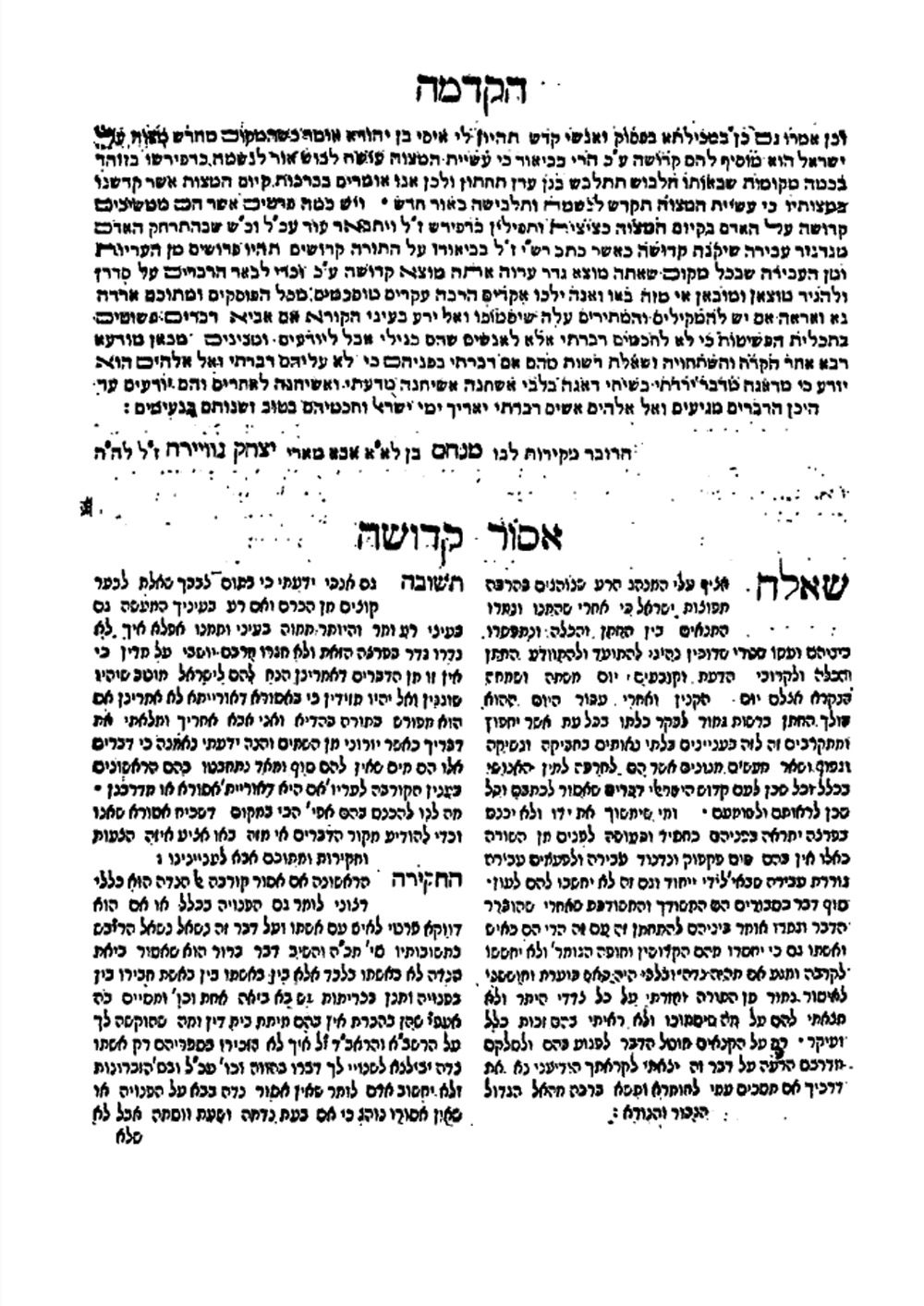
2. In a previous post I referred to R. Menahem Navarra’s book Issur Kedushah. This book was published together with another book by R. Navarra called Kero Mikra which deals with grammatical points in the liturgy. On pp. 24a-24b he quotes Maimonides’ Eighth Principle of Faith and a passage by Abarbanel in order to reject the notion that the text of the Torah was ever in a confused state and that Ezra corrected the Torah in any way. He understands Maimonides’ principle to be teaching that the Torah text we have today is the exact same that was given to Moses.
שיחוייב כל בעל דת להאמין והוא שהתורה שבידינו היום היא הנתונ’ למשה בהר סיני מבלי חלוף ושנוי כלל . . . ומלתא אגב אורחין קמ”לן כמה יש להחמיר בענין הספרי’ וקריאתם.
The assumption of R. Navarra is also found in, of all places, Shlomo Rechnitz’s famous (or infamous, depending your perspective) speech on the Lakewood school situation.
In this incredibly courageous speech, delivered, as it were, in the lion’s den itself, Rechnitz strongly attacked the phenomenon whereby, he claims, many children in Lakewood are not allowed into the schools that their parents would like them to attend, as their families are not of the right sort. Since he is a major philanthropist, in general Rechnitz is given some leeway in what he says, but in this speech he went over the line and the powers that be responded very strongly, forcing Rechnitz to issue an apology and declare that he will no longer speak about this matter. It was interesting to see all the comments on the different haredi news sites that reported on the Rechnitz speech. The people were overwhelmingly in favor of what Rechnitz said. However, this creates an enormous problem for haredi society, since laypeople, even important wealthy philanthropists, are not the ones to be making communal policy, and certainly not to be criticizing this policy in public. By the leadership’s strong response, and seeing how quickly Rechnitz folded, it sent a clear signal who the bosses really are.
The entire video is of great interest in terms of the sociology of the American haredi community, but I want to call attention to a tangential point made by Rechnitz. At minute 21 he says that he has a difficulty with a formulation of Maimonides in his eighth principle of faith. He also states that he never saw anyone who discusses this difficulty (which I assume means he never read The Limits of Orthodox Theology).
He begins by saying that Maimonides’ principles of faith are eternal, applying for all time. Thus, the principle that God created the world or that the Messiah will come are things that one must believe in all times. He then says that the eighth principle of faith is difficult since it requires belief that our Torah scrolls are the exact same as the one given to Moses. Rechnitz asks, how can this be a principle of faith? How can there be a guarantee that the text never changed? This is not a question of theology but of historical reality, and how could Maimonides know what would happen in the future? Maybe after recording his principle there would be confusion in the Jewish people, and it would lead to a mistake in the text. Rechnitz quotes the Ani Ma’amin version of the eighth principle and wonders, “How could Chazal [!] possibly make such a statement?” He then says that in the “last few thousand [!] years since that Ani Ma’amin was written” much has happened with the Jewish people, wars, pogroms, ghettoes, etc. So how can we know that there haven’t been any changes in the text? “How can we say with a straight face that the Torah we have in our hands today is letter by letter the exact Torah we received at Har Sinai. And more importantly, how did Chazal know that the Torah would never even slightly deviate ad sof kol ha-doros?” He then says that this is based on a promise from God that the Torah would never be forgotten.[5]
All this is of course incorrect, and I don’t mean to criticize Rechnitz on this account. He is not a scholar and isn’t expected to know these things. Yet what he says is illustrative of the common view of many who have no idea about masoretic matters, and it was precisely this sort of perception that Maimonides created with his formulation of the eighth principle. (In TheLimits of Orthodox Theology I offer a suggestion as to why Maimonides put forth a formulation that he knew was inaccurate.)
In response to Rechnitz, and I hope someone shows him this post, let me go over what I wrote here where I cited R. Yosef Reinman who has the same basic misconception as Rechnitz (although unlike Rechnitz, he knows that Yemenite Torah scrolls are not identical to Ashkenazic and Sephardic Torah scrolls).
Reinman writes as follows in One People, Two Worlds, p. 119:
[A]n examination of Torah scrolls from all over the world, from Ireland to Siberia to isolated Yemen, all handwritten by scribes, yielded just nine instances of one-letter spelling discrepancies. Nine! And none of them affect the meaning of the text. Why is this so? Because every week we take out the scrolls and read them in public. The people follow the reading closely and if something is wrong, they are quick to point it out.
Unfortunately, Reinman [and Rechnitz] doesn’t realize that it was the invention of printing that unified Torah texts by creating a standard version that soferim could have access to and be guided from (and those who review the parashah each week with Rashi will know that Rashi’s Torah text was not identical to the one we currently have[6]). Printed humashim also enabled people listening to the reading to point out errors. Yet let us not forget that most of the differences in Torah scrolls have concerned male and haser. Contrary to Reinman’s implication in his last sentence, there is no way for the people following the reading to catch such an error.
I must also point out that Reinman’s first sentence is an egregious error, and one doesn’t need to go to Ireland or Siberia to prove this (and contrary to what he states no one has ever performed such an examination). If one simply takes fifty Torah scrolls from Lakewood one will find all sorts of discrepancies. I know this because the people who check sifrei Torah by computer claim that the overwhelming majority of scrolls they check, including those that have been in use for decades, have contained at least one error.[7] In other words, contrary to what Reinman has stated, the truth of Torah does not rise or fall because of scribal errors. If it did, then we would be in big trouble because as I just mentioned, almost every Torah scroll in the world has discrepancies. What Reinman doesn’t seem to get is that while contemporary halakhic authorities are in dispute about only nine letters, this has nothing to do with the quality of actual Torah scrolls, which are obviously subject to human errors by scribes.
3. In my post here I discussed a possibly fictional responsum by the fascinating figure R. Yair Hayyim Bacharach.[8] There is so much of interest in his responsa, but I want to offer one further example. In Havot Yair, no. 136, he mentions that some wicked Jews have become accustomed to bribing non-Jewish judges when they have a case before them, and even brag about this. He also mentions that his brother-in-law, R. Isaac, the rav of Mannheim, had a discussion about this issue with Karl Ludwig I, the Elector Palatine. R. Bacharach actually puts ז”ל after Karl Ludwig’s name. ז”ל is almost never added to the name of a non-Jew and thus shows the positive feelings R. Bacharach had for Karl Ludwig.[9]
והיה הדוכס קאריל לודוויג ז”ל המופלג בחכמה משתעשע לפרקים בגיסי הנזכר בדברי שכליים.
R. Bacharach records that Karl Ludwig once told R. Isaac that has a complaint about the Jews whose cases often come to the government courts. He says that they bribe the judges, an action “which is against all religion, and certainly against what is written in your Torah.” He also told R. Isaac that it was his responsibility to fix this problem.
R. Isaac agreed with Karl Ludwig that bribery of judges is a terrible thing, and he doesn’t deny that Jews have been guilty of this. He adds that even if there is no Torah prohibition to bribe a (non-Jewish) judge, it still needs to be forbidden in order for there to be a properly functioning society.
דאפילו לא נאמר איסורו בתורה ראוי לאסרו מצד השכל וישוב העולם ותיקון המדינה כמו רציחה וגזילה וגניבה ואונאה וזנות ועול מידות, וכלם דברים שהשכל מחייב, ודין ודת חק ומשפט עולה על כלנה שאם יקולקל המשפט איש הישר בעיניו יעזה.
R. Bacharach was not in the room when R. Isaac spoke to Karl Ludwig. It is possible that he is recording the gist of what R. Isaac told him he said, but is it also possible that what are seeing is R. Bacharch’s invention of a conversation, and that R. Bacharach is using the opportunity to put forth his own ideas about the matter?
R. Bacharach then records that R. Isaac told Karl Ludwig that if a Jew is owed money by a non-Jew and the non-Jew denies this, while there can be no permission for the Jew to offer the judge a bribe, from God’s perspective if a bribe was given it is not wrong since the Jew is entitled to the money and the only way he can get it was by bribing the judge. He also said that perhaps the bribe can be seen as evening the scales, since the Jew is afraid that his adversary has also bribed the judge. This argument is intended to show that the Jews of R. Bacharach’s time who bribed non-Jewish judges were really not doing something so bad.
R. Bacharach then says the following (again, supposedly in the name of his brother-in-law), which is just as true today as when he said it: והנה ידוע שאין שנאה כשנאת הדת. He explains that when the Jew and non-Jew come before the judge, the judge naturally inclines to favor his co-religionist. The Jew therefore assumes that the only way he can get a fair trial is by bribing the judge. In other words, he is not bribing him to have the case thrown his way, but only to get a fair trial. R. Bacharach concludes that what he has said should not be seen as a justification of bribery, but as a limud zekhut which explains the circumstances that lead Torah observant people to behave this way.
R. Bacharach tells us that Karl Ludwig liked what R. Isaac said but asked him what about when two Jews are having a court case and they still bribe the judge. In that circumstance there is no reason to think that the judge will favor one side, as neither side shares his religion. R. Bacharach reports how R. Isaac was able to respond properly to this question, but again, is it possible that this is an invention of R. Bacharach in order to enable him to get his ideas across?
After recording the supposed conversation between R. Isaac and Karl Ludwig, R. Bacharach elaborates on the matter of bribery and why there is no explicit Torah prohibition on giving a bribe, only on taking a bribe (Deut. 16:19). In this discussion he notes that he does not think that there is a prohibition to bribe a non-Jewish judge if do not know that you are in the wrong, and thus you are not asking the judge to award you something that doesn’t belong to you by right. He also says that one who offers such a bribe does not make it a quid pro quo that he gives the money and the judge rules in his favor. All he intends by the money is that the judge look carefully at his case and listen to his claims, and then render a just decision. In his description of R. Isaac’s conversation with Karl Ludwig, Bacharach reports that R. Isaac said that he was only offering a limud zekhut for those who bribe judges, but “halilah” to say that this is proper behavior. Here, however, R. Bacharach is saying that there is no prohibition. In other words, in the very same responsum R. Bacharach is showing the difference between an answer motivated by apologetics and one that needn’t be concerned with this.
ולכן בשוחד לשופטיהם אין בו חשש דלפני עיור אם הוא מדיני ממונות, שלא נתברר לבעלי דבר עצמן שחבירו עושה עול רק כל אחד סובר שהדין עמו, וגם השופט דעתו לשפוט צדק, וגם נותן השוחד אינו מתנה שיזכהו רק שיחפש זכותו וישים דברי טענתו אל לבו.
Examining what halakhic authorities say about the matter of bribing non-Jewish judges shows very clearly how at least some Jews regarded themselves as living in a parallel universe from non-Jewish society, and did not feel bound by the rules of the latter society, only by internal Jewish rules. Even though most halakhic authorities assume that it is forbidden to bribe non-Jewish judges,[10] the fact that some think it is permitted is also of great significance in showing that this was not regarded as an obvious matter. Thus, R. Jonathan Eybeschuetz[11] raises the question if one can bribe a non-Jewish judge. He refers to R. Bacharach’s responsum and tells us that R. Bacharach did not come to a conclusion in this matter. He then adds that the “world” has long been accustomed to be lenient in this matter, and R. Eybeschuetz provides a halakhic justification for the bribery, which would only be in a case when the Jew was in the right.
והעולם נוהגין היתר משנים קדמוניות . . . וצ”ל דס”ל דכל הטעם של שוחד דהוא חד דמקרביה דעתיה גביה וזהו בישראל דקרובים אסורים לדון אבל בבן נח שכל הקרובים מותרים לדון אין לך קירוב יותר מזה והכל יודעין שדעת האב קרוב לבן יותר מאדם אחר שנותנים לו אלף דינרים ומכל מקום האב כשר לדון בנו הבן נח, אף ליתן שוחד להצדיק הצדיק וכו’ מותר דמ”ש מקרובים.
I think it is very likely that despite the halakhic justification provided, the real motivation for any Jewish bribery of non-Jewish judges was the assumption that the judge would not be fair when dealing with Jews as well as a fear that the non-Jewish litigant was also bribing the judge.
R. Abraham Zvi Eisenstadt, Pithei Teshuvah, Yoreh Deah 151:1, states that any bribery is only permissible באופן שאין בו חשש גזל, and even for this permissible bribery, it is only OK if the money is not given directly to the judge but to one of his assistants who will then give it to the judge. See also Pithei Teshuvah, Hoshen Mishpat 9:2, who after citing authorities who disagree with R. Eybeschuetz nevertheless justifies offering bribes when it is obvious that the non-Jewish judge is not going to render a just verdict.
R. Simeon Anolik, in a book published in 1907, states that there is no prohibition of lifnei iver if one bribes a non-Jewish judge, as the non-Jewish legal system is not in accord with Torah law. However, this is only permitted if the intent of the bribe is to arrive at the correct, Torah mandated result .[12]
לא שייך בזה לפני עור מה שנותן שוחד לזכות את הזכאי ולחייב את החייב אם דנו עפ”י חק שלהם. ומש”כ רמב”ן בפ’ וישלח בשם הירושלמי דב”נ מוזהר בלא תקח שוחד היינו בדין שהוא כדיננו. או דמרא דירושלמי הוא ר’ יוחנן ולדידיה מבואר ברמ”א שם [שו”ת הרמ”א סי’ י] דב”נ מחוייב בדינים שחקקו להם כרצונם. אבל לדידן דקי”ל דמצווים על הדינים היינו דינים שלנו שפיר פשט ההיתר מטעם זה.
The words that I have underlined would appear to show that Anolik’s position was widely accepted.
Regarding bribery, in Between the Yeshiva World and Modern Orthodoxy, p. 35 n. 93, I mention a forthcoming article which will deal with paying off community leaders in order for someone to be given a town rabbinate. After completing the just-mentioned book, my interests moved in different directions, but I do still hope to write that article which will have a lot of material that has never been discussed in scholarly literature. Here is one interesting source from R. Elhanan Wasserman that I only recently found. In Kovetz Shiurim: Bava Batra no. 71, R. Elhanan suggests that if you are the most qualified to serve as a dayan in the community, then there is no prohibition to pay the community leaders to appoint you to the position, and no prohibition for the community leaders to accept this money. I don’t know of anyone else who holds this position which, needless to say, would open up a can of worms, since lots of people think that they are the most qualified. We obviously can’t have a situation where all such people feel that they can pay off the community leaders in order to be appointed to a position. Furthermore, the Rambam makes no distinction of the sort R. Elhanan does, but states flatly that it forbidden for a dayan to give money in order to be appointed. See Mishneh Torah, Hilkhot Sanhedrin 3:9
כל דיין שנתן ממון כדי שיתמנה אסור לעמוד מפניו וציוו חכמים להקל אותו ולזלזל בו. ואמרו חכמים שהטלית שמתעטף בה תהי בעיניך כמרדעת של חמור.
The Ridbaz’s attack on the Brisker method is well known. In the introduction to his responsa, Beit Ridbaz (Jerusalem, 1908), Ridbaz writes as follows:
A certain rabbi invented the “chemical” method of study. Those in the know now refer to it as “chemistry,” but many speak of it as “logic.” This proved to be of great harm to us for it is a foreign spirit from without that they have brought in to the Oral Torah. This is not the Torah delivered to us by Moses from the mouth of the Omnipresent. This method of study has spread among the yeshivah students who still hold a gemara in their hands. In no way does this type of Torah study bring men to purity. From the day this method spread abroad this kind of Torah has had no power to protect its students. . . . It is better to have no rosh yeshivah than to have one who studies with the “chemical” method.
In his ethical will, printed at the end of his responsa, Ridbaz returns to this criticism and directs his sons: “Be careful, and keep far away from the new method of study that has in recent years spread through Lithuania and Zamut. Those knowledgeable in Torah refer to it as ‘chemistry.'” (Just before this post appeared, R. Eliezer Katzman sent word that in his opinion, Ridbaz is not referring to R. Hayyim and the Brisker approach, but rather to Telz and its method of talmudic analysis. I don’t believe this is correct, and hope to return to this subject in a future post.)
In the first edition of Shaul Stampfer’s Ha-Yeshivah ha-Lita’it be-Hithavutah, p. 113 n. 29, he quotes Saul Lieberman’s opinion that Ridbaz’ words were directed against R. Isaac Jacob Reines. This is clearly incorrect. Reines’ method had no influence whatsoever, and Ridbaz is speaking about a method of study that was widespread in the yeshivot. It is obvious that he can only be referring to the method of R. Hayyim. Lieberman’s incorrect speculation was removed in the second edition of Stampfer’s book. . . .[13]
Needless to say, because of his attacks on R. Hayyim, Ridbaz did not endear himself to the Soloveitchik family. Once when a student referred to Ridbaz, R. Joseph B. Soloveitchik became very angry and told the student never to mention his name again. He also said that some gedolim are always right, some are sometimes right, and some are never right, and the Ridbaz falls into the latter category![14]
Thus far what I wrote in my prior post. It is worth noting that Benjamin Brown defends Lieberman’s suggestion that the Ridbaz’s words were directed against Reines.[15] However, as I have written, I see no justification for this. Daniel Price called my attention to Shai Akiva Wosner’s recently published a book on R. Shimon Shkop, Hashivah Mishpatit bi-Yeshivot Lita: Iyunim be-Mishnato shel ha-Rav Shimon Shkop. On p. 32 he refers to my post and rejects my assumption that the Ridbaz was referring to R. Hayyim Soloveitchik. He claims that his negative comments were directed against Telz and its method, a view that as mentioned is also shared by Katzman.
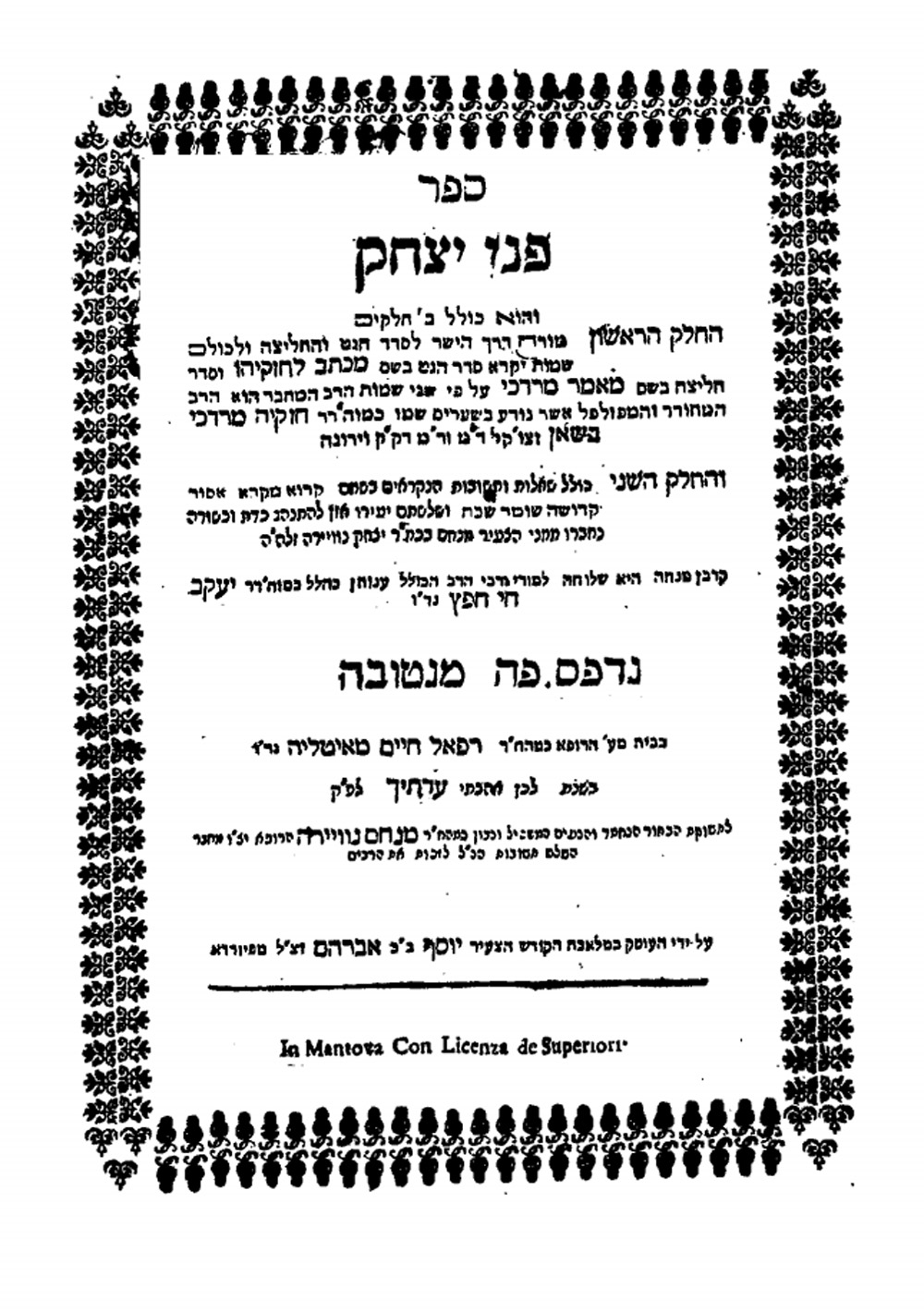
I don’t deny that the Ridbaz could also have had Telz in mind, but this doesn’t change my assumption that the main target of his words was R. Hayyim Soloveitchik. Is there a source that can settle this argument conclusively? I believe there is, but I was not aware of it when I wrote my previous post. In 1935 Moshe Aharon Perlman published his Mi-Pi Dodi. Here is the title page.
This volume records things he heard from his uncle, R. Moses Kliers, the rav of Tiberias. R. Kliers knew the Ridbaz personally, and the information that appears on p. 35 is obviously of great importance to what we have been discussing:
מסדר למוד הבריסקאי לא היתה דעתו נוחה וקרא לו חימיא
In other words, R. Kliers told Pearlman that the Ridbaz opposed the Brisker approach and referred to it as “chemistry”. This source is more significant than any speculation by contemporary scholars.
There is a good deal in Mi-Pi Dodi that I think readers will find of interest, but for now I will just mention one example.
P. 25. R. Kliers said that all manner of dress worn by the Slobodka students can be justified, but what can’t be justified is the forelock of hair that the students had.
(In Changing the Immutable, p. 268 n. 156, I cited a fascinating passage from Mi-Pi Dodi, pp. 9-10, showing that R. Kliers thought that it was better for people to carry on a particular Shabbat and violate a rabbinic commandment rather than learning that a rabbi had made a mistake in setting up the eruv, and thus come to lose respect for him which would violate a Torah commandment. The eruv could be fixed after Shabbat, but the negative effect on the rabbi’s reputation would remain.[16])
5. In my last post I referred to R. Yitzhak Barda and his book Kinyan Torah which argues that Maimonides’ view is binding, even if this means rejecting the Shulhan Arukh. Here is the title page of Kinyan Torah, vol. 3.
At least one reader was wondering if R. Barda is Yemenite. He is not, and his view granting final authority to the Mishneh Torah is unique among Sephardic authorities. R. Barda is in charge of a group of Torah institutions in Ashkelon called Yitzhak Yeranen. He is also the brother-in-law of R. Meir Mazuz and often appears together with him at events. Here is a picture of them during the last Israeli elections.
Halakhic authorities have had different perspectives on how to relate to newly discovered manuscripts that contain halakhic rulings. The Hazon Ish did not pay these texts much mind, not regarding them as having been part of the halakhic tradition. Most halakhic authorities, on the other hand, had a more positive opinion of such newly published texts. However, even those who welcomed the newly published texts and integrated them into the halakhic system generally agreed that halakhot that that were recorded in the Shulhan Arukh and were thus generally accepted could not be rejected based on a newly published text.[17] That is one reason why the 2014 appearance of R. Yitzhak Barda’s tenth volume of responsa Yitzhak Yeranen is of interest, as in this volume one finds that the author indeed rejects a universally accepted halakhah.[18]
The question R. Barda deals with is whether one can bake or cook on the first day of Yom Tov for the second day (and his conclusion would apply to other relevant matters, such as setting the table on one day for the next). This would appear to be an easy question to answer, as the Talmud, Betzah 17a, states: “Our Rabbis taught: One may not bake on the first day of a festival for the second.” This halakhah is recorded in Shulhan Arukh, Orah Hayyim 503:1. One might think that this would be the end of the matter, and for centuries it was. However, R. Barda has reopened the discussion. According to him, it is permitted to bake or cook on the first day of Yom Tov for the next day. How does he arrive at such a decision, one at odds with the Shulhan Arukh?
R. Barda begins by pointing out that R. Hananel records a different version of the talmudic text. In his version, the Talmud states that it is forbidden to bake on Yom Tov for Shabbat or for after the holiday, but it says nothing about baking from the first day of Yom Tov for the next next day. R. Isaac Alfasi, R. Asher ben Jehiel, and other geonic and medieval sources also have the version recorded by R. Hananel.[19] Not noted by R. Barda, but certainly a support for his position, is that the Tosefta and Jerusalem Talmud also have nothing about baking on the first day of Yom Tov for the next day.[20]
R. Barda further points out that Maimonides must also not have had our version of the talmudic text, since in the Mishneh Torah all he says is that on Yom Tov one may not bake or cook anything that will be eaten after the holiday.[21] He says nothing about not baking or cooking on the first day of Yom Tov for the next day. Also important for R. Barda’s case is that Maimonides, Mishneh Torah, Hilkhot Shevitat Yom Tov 6:14, states that the observance of the second day of Yom Tov is not on account of doubt, but is a minhag. What this means is that it is not a question of maybe the second day not really being a Yom Tov, in which case one could understand the prohibition of baking or cooking on the first day for the second. I would only add that R. Barda’s point also works if you adopt Maimonides’ other formulation that Yom Tov Sheni is an actual decree of the Sages.[22] In either case, the second day is treated like Yom Tov no different than the first day, and thus R. Barda states that there is no reason why one cannot bake or cook on the first day for the second. As for Rosh ha-Shanah, he tells us that the two days of this holiday are regarded by the Talmud as one long day,[23] and therefore there is even more reason for it to be permitted to bake on the first day for the second.
R. Joseph Karo, in the introduction to the Beit Yosef of which the Shulhan Arukh is an abridgment, tells us that he is going to decide the halakhah based on the three central authorities, R. Isaac Alfasi, Maimonides, and R. Asher ben Jehiel. As R. Barda points out, in the case we have been discussing, none of these three authorities state that it is forbidden to bake or cook from one day of Yom Tov to the next, and yet the Shulhan Arukhdoes forbid this.
R. Barda notes that there are medieval authorities who record the prohibition, most prominently R. Jacob ben Asher, Tur, Orah Hayyim 503. Prior to this, Halakhot Pesukot[24] and Halakhot Gedolot[25] also record this prohibition, even though according to R. Barda their version of the Talmud did not state that it is forbidden to bake on the first day of Yom Tov for the next day, only that it is forbidden to bake on Yom Tov for after the holiday. In other words, even though baking or cooking on the first day of Yom Tov for the next day is forbidden by Halakhot Pesukot and Halakhot Gedolot, this is an original deduction made by these authorities, not a recording of earlier talmudic halakhah. (Actually, it would have made more sense for R. Barda to say that the rulings in Halakhot Pesukot and Halakhot Gedolot originated in an earlier source.) Yet the stringent position codified by these two sources and later by R. Jacob ben Asher and other rishonim is not determinative for R. Barda, since as mentioned this halakhah does not appear in the more important sources, namely, R. Isaac Alfasi, Maimonides, and R. Asher ben Jehiel (R. Jacob ben Asher’s father).
Readers might be convinced by R. Barda’s argument that R. Isaac Alfasi, Maimonides, and R. Asher ben Jehiel did not view it as forbidden to bake or cook on the first day of Yom Tov for the next day. But this still does not mean that it should be permitted today, for as we have seen the Shulhan Arukh forbids this action. R. Barda’s assumption is that R. Joseph Karo’s text of the Talmud was not pristine, but as with our version had incorporated the addition of the Halakhot Pesukot and Halakhot Gedolot, forbidding baking on the first day of Yom Tov for the next day. Since the Shulhan Arukh’s ruling is based on an error, namely, R. Karo’s false assumption that the Talmud forbids baking or cooking on the first day of Tom Tov for the next day, R. Barda declares that one need not accept the Shulhan Arukh’s ruling. (This statement is directed towards the Sephardic community as a whole, which follows the Shulhan Arukh. R. Barda personally follows Rambam, and since the Rambam does not record the prohibition, that alone is enough for him to permit baking and cooking on the first day of Yom Tov for the second day.)
R. Barda further states that had R. Joseph Karo known what has been mentioned so far, he, too, would have decided differently. He adds that to refrain from baking or cooking on the first day of Yom Tov for the next day takes away from some of the joy of Yom Tov, as it makes it more difficult to prepare food for the second day of the holiday.[26] He also calls attention to a responsum of R. Isaac Bar Sheshet from which we see that there were people who indeed baked and cooked on the first day of Yom Tov for the second day. (R. Isaac Bar Sheshet himself states that this is forbidden.[27])
After many pages of justification of his ruling, R. Barda publishes two letters he received from R. Serayah Deblitzky in which the latter takes issue with what R. Barda wrote. R. Deblitzky begins by stating that it is an absolute principle that a halakhah that has been accepted among all of Jewry cannot be overturned due to the discovery of new manuscripts or based on the fact that important earlier authorities did not record this particular halakhah. He further notes that R. Jacob ben Asher did forbid baking and cooking on the first day of Yom Tov for the next day, even though his father, R. Asher ben Jehiel, did not mention this prohibition. R. Deblitzsky does not think it is reasonable that R. Judah would disagree with his father in this matter, and assumes that R. Asher ben Jehiel’s omission of the halakhah does not imply that he had a more liberal perspective.
[1] See Mordechai Margaliyot’s note in his edition of Va-Yikra Rabbah, ad loc.
[2] Malbim, Deut. 13:7 (p. 87a) cites the Midrash without the words כך אמרו דור המבול. Yet as far as I can determine, every printed edition of the Midrash has these words. Does this mean that the Malbim independently concluded that the words should be deleted?
[3] The Pharisees (Philadelphia, 1938), p. 260.
[4] The text is published in Joseph Shatzmiller, “Les tossafistes et la premiere controverse maïmonidienne: le témoignage du rabbin Asher ben Gershom,” in Gilbert Dahan, et al., eds., Rashi et la culture juive en France du Nord au moyen âge (Paris, 1997), p. 67.
[5] Rechnitz also says that the Torah cannot be changed, “no Reform, no Modern Orthodoxy.” Does Rechnitz really feel that Modern Orthodoxy is akin to Reform? Or was this comment strategic? In other words, since he is attacking a widespread practice in Lakewood, he has to show them that despite the attack he is still on the “right” side, and the way to do this is by slandering Modern Orthodoxy.
[6] See Rashi to Ex. 25:22. Even the ArtScroll-Sapirstein Rashi translation is forced to admit: “Rashi’s Sefer Torah evidently had a ו where ours does not.” Siftei Hakhamim writes:
אע”פ שאין כתיב ואת בוא”ו בס”ת של רש”י היה כתוב בוא”ו.
See also Rashi to Gen. 25:6. Artscroll writes: “Rashi’s text of the Torah had the spelling פילגשים, without the letter י of the ים suffix which indicates the plural.”
[7] For the information on errors in Torah scrolls, including eye-opening pictures, see Kolmos, Elul 5748. Here is part of R. Shmuel Wosner’s letter quoted on p. 7:
עכשיו שנכנס עבודת הקאמפיוטער בזה למסלולו, ונתברר על ידו לתמהון לבב כולנו, שמבערך ששים ספרים, ס”ת שהיו בחזקת בדוקים יצאו רק תשע ספרים נקיים מכל שגיאה וברובא דמינכר מאד נמצאו שגיאות פוסלות לרוב. וכן בדידן הוי עובדא בס”ת שנכתב ע”ש תלמידים גדולים וצדיקים שנספו בעו”ה, נמצאו ה’ טעיות ממש בחסר ויתר.
[8] I am inclined to see the responsum’s description of a storybook romance as fictional, and I think there might be other fictional responsa in Havot Yair. None of this can be proven, and it is just a sense I have that some of the questions were created by R. Bacharach in order to establish halakhic principles. I think this might be the case with no. 183 where he discusses a man confronted with a choice to drink non-kosher wine or have his ear cut off. See also no. 79 regarding a convert to Judaism, if he needs to return money he stole from Jews and non-Jews before he converted.
[9] In no. 139 R. Bacharach mentions the hillul ha-shem that results when a Jew is a thief, as the non-Jews blame the entire Jewish community for his actions. Yet R. Bacharach adds that it is only the masses who have this feeling, while the wise people and the government leaders don’t engage in such stereotyping.
ואף כי יש חילול השם באשר הגוים מרשיעים על כלל יהדות בשביל כך, אין אלו רק דברי המון עם ולא חכמים שבהם ושלטונים.
[10] See R. Asher Weiss, Minhat Asher, vol. 1, no. 92.
[11] Urim ve-Tumim, Hilkhot Dayanim 9:1.
[12] Orah Mishpat (Petrokov, 1907), p. 17a.
[13] [See p. 124, n. 30, where Stampfer quotes Prof. Chimen Abramsky, a descendant of the Ridbaz, that in the family it is accepted that the Ridbaz was referring to R. Hayyim.]
[14] I heard this from an eyewitness. The event took place in the 1950s.
[15] Ha-Hazon Ish (Jerusalem, 2011), p. 321 n. 44.
[16] See also Shabbetai Dov Rosenthal, Geon ha-Hora’ah (Jerusalem, 2011), vol. 2, pp. 186-187, for two similar cases with R. Samuel Salant and R. Zvi Pesah Frank.
[17] However, what should a posek do if it is clear that a halakhah in the Shulhan Arukh is based on a mistaken text? R. Jehiel Jacob Weinberg was unsure. See Kitvei ha-Gaon Rabbi Yehiel Yaakov Weinberg, vol. 2, p. 433:
הוכחתי שהב”י השתמש בכת”י מקולקלים וע”י נדחק לפרש ולהסיק הלכה מנוסחאות של ספרי ראשונים שהי’ בהם השמטות בשגיאת סופרים – השאלה היא אם להניח הכל כמו שהוא ורק להסביר ולנסח בלשון ובהגיון מתקבלים על הלב, או לשוב למקורות הראשונים ולחקור ולבדוק הכל מחדש.
[18] We will be focusing on nos. 20-24, where R. Barda explains his position and defends it against criticism. Here is the title page of Yitzhak Yeranen, vol. 11, R. Barda’s most recent volume of responsa.
[19] R. Barda mistakenly states that the Munich manuscript of the Talmud is also missing the words מיו”ט לחברו. This error does not affect his argument, as the Munich manuscript is from the 14th century and R. Barda acknowledges, p. 262, that there were medieval texts of the Talmud that had מיו”ט לחברו. Yet he believes that these words are not original but were inserted based on what appears in the Halakhot Gedolot (which I will soon discuss).
[20] See Saul Lieberman, Tosefta ki-Feshutah, Beitzah, p. 947.
[21] See Mishneh Torah, Hilkhot Shevitat Yom Tov, ch. 6.
[22] See my Studies in Maimonides and His Interpreters (Scranton, 2008), p. 59.
[23] See Beitzah 4b-5a.
[24] Halakhot Pesukot (Versailles, 1886), p. 8. Since I am sure some will be skeptical that a sefer was ever printed in Versailles, here is the title page.
[27] She’elot u-Teshuvot ha-Rivash, no. 254. See also ibid., no. 16.
Hitzei Giborim, Tzitzit, and R. Meir Mazuz
Hitzei Giborim, Tzitzit, and R. Meir Mazuz
Marc B. Shapiro
1. In 1969 the journal Moriah appeared, published by Makhon Yerushalayim. From its beginning, this journal published manuscript material from geonim, rishonim, and aharonim, together with Torah articles by contemporary scholars. This created a model that was later followed by a number of other journals. It also became a model for how to publish memorial volumes, as these generally also contain a section of material published from manuscript. Together with the interest in manuscripts, there has developed what can only be described as an Orthodox academic approach, and one can often find articles of this sort that meet a very high scholarly standard. A well-known representative of this genre is Yeshurun, a volume that appears twice a year and includes material from manuscript as well as halakhic and scholarly articles. What is most impressive about Yeshurun is not only its massive size, but the fact that the editors can fill it with so much quality material.
A competitor to Yeshurun has recently appeared on the scene and its title is Hitzei Giborim. Its model is exactly what I have described, with a section devoted to publishing material from manuscript, followed by Torah essays and Orthodox academic articles, many of which are really fantastic. The editor of Hitzei Giborim is R. Yaakov Yitzhak Miller, whose own articles show impressive erudition. Volume 9 recently appeared, but since I haven’t yet had a chance to examine it, let me speak about volume 8 which appeared last year. Volume 8 contains 1030 pages which I think makes it the largest volume of its kind. I wonder if the point of having so many pages was precisely in order to exceed even the largest Yeshurun.
Among the articles that I think will be of particular interest to Seforim Blog readers are R. Eliyahu Nahum Waldman’s ninety page study of Maimonides’ responsa to the sages of Lunel, designed to show that R. Kafih was mistaken in thinking that these are forgeries. I only wonder if such an effort was required on R. Waldman’s part, since it is hard to believe that anyone who examines the matter without preconceptions can agree with R. Kafih.[1]
R. Yehoshua Assaf deals with Rashbam’s commentary to the beginning of Genesis, the portion that ArtScroll censored and which I dealt with in prior posts here and here.[2] In this article Assaf cites R. Hillel Novetsky’s important comments here. Novetsky discovered another manuscript that not only contains the words of Rashbam in his commentary to Gen. 1:31, words that ArtScroll censored, but also the continuation of the passage that was missing until now. In fact, ArtScroll should be happy with this discovery as we now see that Rashbam affirmed that even if “day” started in the morning for the first six days of creation, the Shabbat of creation indeed began at sunset on Friday.[3] Unfortunately, I think that even if ten other Torah scholars would write articles along the lines of R. Novetsky’s and R. Assaf’s it won’t have any effect on ArtScroll.
R. Avraham Yissachar Konig’s article on the international dateline and the dispute between the Hazon Ish and other rabbis is full of interesting points and discoveries (including new material from manuscript) that significantly advances our understanding of this episode. Unfortunately, the language Konig uses about certain rabbis, in particular R. Yehiel Michel Tukatzinsky, is completely improper. Just because Konig’s point is to defend the Hazon Ish does not give him the right to belittle people who were greater than he. Interestingly, this article by Konig was removed from the volume when it was placed on Otzar ha-Hokhmah.Here is the table of contents that is also missing the article.
Here is the uncensored table of contents.
Otzar ha-Hokhmah has become the library for so many of us, and it is thus completely unacceptable for books to be altered no matter what the reason. The editor of Hitzei Giborim insisted that the book be shown in its entirety or taken down, and it no longer appears on Otzar ha-Hokhmah.
In Changing the Immutable, pp. 191 n. 16, 224 n. 46, I noted other examples of censorship on Otzar ha-Hokhmah. I found an additional instance in the Otzar ha-Hokhmah version of TheRabbi Leo Jung Jubilee Volume (New York, 1962). Two articles are deleted, and here is how the table of contents appears on Otzar ha-Hokhmah.
Here is the uncensored table of contents.
I understand why Otzar ha-Hokhmah would want to delete an article by Heschel, but what possible reason could there be to delete R. Isidore Epstein’s article? I can only assume that the person responsible for this mistakenly thought that Epstein was not Orthodox.
Here is a page from Otzar ha-Hokhmah’s version of Peninei Rabbenu ha-Avi Ezri, p. 266.
Here is how the uncensored page looks.
Returning to Konig’s article, on p. 770 he prints from manuscript a letter from a Sephardic rabbi to R. Ben Zion Uziel, but the name of the rabbi has been deleted. Konig tells us that he removed the rabbi’s name in order to protect his honor, because his letter shows that had no understanding of the dateline issue. It is indeed true that the rabbi did not understand the matter but that is no reason to delete his name. If we are going to start deleting names of rabbis every time we are convinced that they made a basic error, there would be no end to it. In this case the editor should have insisted that the letter appear in full. After all, everyone makes mistakes and there is no problem is seeing that even a learned rabbi did not understand this complicated issue.
Among the articles in Hitzei Giborim focusing on contemporary issues, R. Eliyahu Levine deals with dina de-malchuta dina.On p. 1012 he notes that the government requires homeowners to keep their property looking nice, and this includes cutting the lawn. R. Levine asks if this is also included in dina de-malchuta dina. He concludes that it is not, and writes the following.
וגם נראה שיסוד חוקים אלו הם מעוגנים בתרבות הגויים, שהעיקר אצלם הוא היופי החיצוני, וכל עמלם ויגיעם הוא ליפות את המראה החיצוני של רכושם, ולכן הם מעונינים שחצירו הפרטית של כל אחד מהם תשלים את מראה המקום כנאה ומטופח, וא”כ דבר זה כלול בדברי הרשב”א והש”ך שחוקים שביסודם הם כשל תוה”ק, אין נוהג בהם דדמ”ד, משום שבשעה שיגיעתו של הגוי היא לצחצח את רכושו, יגיעתו של הישראלי היא להקפיד על דברים אחרים, והמאמץ לעצמו את חוקי וגינוני המלכות, ודאי שמקפיד להיות מתאים להופעת הגוי, ממילא ההרגל בכך מזניח את ההקפדה והטיפוח של הישרליות שבישראל.
גם הרבה מחוקי הבניה והדיור כנראה מקורם בתרבות אמריקאית זו, ומשפחות יהודיות גדולות שעיקר תשוקתם אינה בדוקא בריבוי נכסים, החוקים הנ”ל אינם תואמים להשקפת עולמם, וזוהי עוד סיבה שבמסגרת חוקי הגויים לא נוהג דדמ”ד.
For those who don’t read Hebrew, he claims that zoning laws, and the whole idea of having a beautiful environment, originate in non-Jewish cultural norms, and therefore Jews are not obligated to follow these laws. I guess this means that in a “Jewish” environment, people won’t need to cut their lawns, their property can fall apart etc., since Jews look at what is on the inside and are not concerned with outer appearances. It is no secret that in some segments of the haredi world people assume that zoning laws (and sometimes even fire codes) are not Jewish concepts and thus don’t need to be followed, but to see this sort of approach in print will probably be a surprise for many.[4]
On p. 1121 we find something quite uncommon, an apology that in the previous volume an article appeared that is plagiarized from two other writers. I can’t think of another Torah publication that has ever had such a notice, and it shows both the honesty and the courage of the editor.
Beginning on p. 362, R. Yaakov Yitzhak Miller publishes from manuscript Torah letters concerning shaving one’s beard when the Czarist authority required this. The question that obviously needed to be considered was if this decree was to be regarded as a she’at ha-shemad in which case Jews would be required to martyr themselves rather than obey. Not surprisingly, the rabbis whose letters are published by R. Miller did not go this far. These rabbis are R. Judah Bacharach, R. Jacob Zvi Mecklenburg, and R. Hayyim Wassertzug (also known as R. Hayyim Filipover, from one of the Lithuanian towns he was rabbi in). These letters come from an unpublished volume by R. Wassertzug which hopefully will soon appear in print as it has the potential to be a very significant publication.
Although R. Wassertzug is today unknown, this was not the case in the 19th century, and R. Miller provides a nice introduction which shows some of R. Wassertzug’s originality. In addition to a reputation for being very pious as well as a great scholar, he was also known as a lenient posek who did not feel bound by certain practices which while generally accepted, did not, in his opinion, have a firm halakhic basis. Not surprisingly, this led to conflict with some other rabbis.
Here are two responsa from R. Wassertzug that appeared in Ha-Melitz, 14 Sivan 5629, pp. 225-226. The first permits one to drink non-Jewish milk (especially travelers), and the second permits a married woman to show some of her hair.
Not mentioned by R. Miller is that one of the opponents of R. Wassertzug was R. Isaac Haver. It is reported that he and some other rabbis went to R. Leibel Shapiro, the rav of Kovno, to complain about R. Wassertzug and to gain his support in order to have R. Wassertzug removed from his rabbinic position. Yet they were rebuffed as R. Leibel told them how great R. Wassertzug was and sent them away.[5]
In 2015 R. Mordechai Gifter’s Milei de-Iggerot appeared. This is quite a significant work and anyone interested in the history of American Orthodoxy will want to consult it. On p. 213 he deals with R. Eliezer Berkovits’ liberal halakhic approach. R. Gifter comments that unfortunately R. Berkovits did not follow the path of his teacher, R Jehiel Jacob Weinberg, who was much more conservative in how he approached halakhah.
The person R. Gifter was writing to had asked why R. Gifter was so critical of R. Berkovits’ approach when R. Wassertzug also had a liberal approach. In R. Gifter’s reply he reveals a hitherto unknown piece of information that he received from an elderly Lithuanian rabbi, namely, that one of the responsa of R. Akiva Eger in which there is no addressee given was actually sent to R. Wassertzug. R. Gifter also states that when R. Berkovits reaches R. Wassertzug’s level of piety, then he will be able to forgive him for much of what he has written.
ומה שיביא לי ראי’ מהגאון ר’ חיים פיליפובר זצ”ל, ידע נא ידידי שכשיגיע דר. ברקוביץ לדרגת חסידותו ופרישותו של אותו גאון וצדיק אוכל למחול לו על הרבה מדבריו, אבל באיש של דורנו לא אוכל לתלות דבריו בחסידותו של גאון מדור קדום.
והאמת שמיחס גאוני הדור להגר”ח פיליפובר ז”ל יש לנו ללמוד איך להתיחס לכל דרישה לחלוק על הלכות קבועות אפי’ כשיצאו מפי גאון וצדיק. ועיין תשובת מרן הגרעק”א ז”ל סי’ נ”ה – שקבלתי מפי רב גדול וישיש בליטא שהתשובה מכוונת להגר”ח פיליפובר ז”ל.
Here is the responsum of R. Akiva Eger, vol. 1, no. 55, referred to by R. Gifter.
As you can see, while the addressee is referred to as המופלא, his name and town are not given. R. Eger criticizes R. Wassertzug for his liberal approach in which he disagreed with rishonim and in the case discussed diverged from the Shulhan Arukh. In his conclusion, R. Eger refers to himself as one who is rebuking from hidden love.
While on the topic of criticism of R. Berkovits, here are some other relevant documents that I found in the archive of Chief Rabbi Isaac Nissim at Yad ha-Rav Nissim in Jerusalem. The first is a New York Times article from June 23, 1969. (I have no doubt that the second quote attributed to R. Berkovits in the article – where he mentions reconsidering the “traditional laws” – was taken out of context.)
In response to this story the following two documents were sent out to various Orthodox figures. Since the Hebrew document is not always easy to read, I have provided a transcript and also added paragraph breaks.
בהתרגשות ורגש חרפה קראנו בזמן האחרון בעתון “הניורק טיימס” על דר. אליעזר ברקוביץ, פרופסור בבית מדרש לתורה בשיקגו, שהוא השתתף עם איזה וועידת מתבוללים בקאנאדה: שמתיימרים הם להתחבר שלשת הזרמים של יהדות (אורטודוקס) (קונסורביטיב) (ריפורם). בנאום לפני העתונעיים [!] הגיבו המשתתפים שאין האיסור לאכול חזיר עוד מותאם לנסיבות הזמן: ובשלובי זרע עמהם הגיב דר. ברקוביץ שמצות שמיטה הנוהגת באה”ק היא שערוריה סקנדלית, ולא יתכן שמירת השביעית ב”דת מודרנית”: והיא בכלל יהדות מזוייפת: ולמותר הבהיר דר. ברקוביץ שהוא: “דובר של יהדות אורטודוקסית”, למרות שאין לו שום בסיס להיקרא אורטודוקסי, אחרי שהוא מפורסם כמלעיג עד”ת, שכל דעותיו הן שהאורטודוקסיה “משרשת ומפיגה את היהדות מן ההמונים לרגלי העצמת האיסורים.” והנה אין בעצתו מן החדוש וההפתעה, שכבר שמענוה אצל הקונסוב[ר]טיבים והריפורם כמותו – אמנם איך שהוא מצהיר ומצייר את עצמו בתור חובב ואדוק ביהדות האורטודוקסית הוא תמהון – מאין שאף דר. ברקוביץ שהרומס ברגל גאוה וגסה את עיקרי התורה והמתחבר עם הלצים והמתבוללים יכונה “דובר אורטודוקס”?
ומאידך – הרב אהרן סולביצ’יק, הראש ישיבה של ב”מ לתורה, המראה עצמו כצדיק וחסיד, המחמיר על פרטי התורה – איך הוא לא נרתע ונזדעזע מדברי הפרופסור, ולא שת לבו להסכנה החבויה בתוך הישיבה, דר. אליעזקר ברקוביץ? התירוץ: נחזה לר”א סולביצ’יק בעצמו, שלמשתה השנתי של היוניון אף אורטודוקס קאנג., שהמתחברים ברובם הם קונסורביטיב ומחללי שבת, וכל הגדולי תורה הצהירו בפומבי איסור מוחלט ללכת שמה – ראינו איך שר”א סולביצ’יק הואיל לנסוע להשתתף בועידתם, והם [ושם?] הוא נשא נאום להוכיח בעזרת “פסוקים” שאפשר להתחבר לצורך שעה עם הסטרא דשמאלא! – ומי זה שהיה יכול להעלות על הדעת שהר”מ ר”א סולביצ’יק יואיל להיות מהאורחים נואמים בארגון שכולו טריפה! אמנם היות וקראנו תגובותיו של דר. ברקוביץ הסכמות לנאומי ר”א סולביצ’יק, שמצוה גדולה להתחבר עם הרשעים, מוכרח שבאישורו הבהיר דר. בורקוביץ להעתונעיים, היות ואחרת לא היה מרשה הר”ם להפרופסור להישאר בישיבה, ובפרט בתפקיד מורה דרך על חניכיו בני הישיבה.
כעת לדאבוננו הוסרה [!] הצעיף החופף הדו-פרצוף שלר”א סולביצ’יק, מראה לזולת שהוא צדיק וחסיד, אך אינו מן הנמנע אישורו כ”דובר אורטודוקס” פרופסור המבהיר מינות וכפירה בתורה שבכתב, ובעצמו להתחבר עם המתבוללים, לעומת פסק איסור של כל גדולי התורה.
אדישות של הרמי”ם והרבנים בשיקגו להמצב קטסטרופילי הלזה היא כאובה, והחלה לשכנענו ששתיקתם כהודאתם, וכבר הגיע העת שתיפקחנה העינים והוקיע [!] בפרהסיא בעמוד הקלון את מפירי התורה בב”מ לתורה ולמחות בנזיפה לזבובי מות ושפעת דברים של הראש ישיבה המתבטא לתלמידיו דעות [כפרניות?] תחת החפשת צדקות: המחנף רשעים ומכבד פעלי עוול.
In addition to what it is said about R. Berkovits, R. Ahron Soloveichik is also attacked in these documents for not firing R. Berkovits (he actually didn’t have the authority to do so), and for attending an OU convention, an organization that in the 1960s had many mixed seating congregations which are referred to as “Conservative” synagogues. There is nothing about the latter episode in the book about R. Soloveichik, Ha-Rav Aharon Yeled Sha’ashuim (Jerusalem, 2011), published by his son, R. Yosef Soloveichik. In fact, R. Berkovits is only mentioned on two pages in the book. On p. 244, it is pointed out that R. Soloveichik opposed R. Berkovits’ approach, which is described as advocating “that halacha should be allowed to develop freely to accommodate people’s needs.” On p. 243 we see that R. Berkovits joined with other faculty members in opposition to R. Soloveichik being given any administrative power at Hebrew Theological College.[6]
Let me make one final point about all the journals and memorial volumes, Yeshurun, Hitzei Giborim, and the rest. Numerous selections from commentaries on talmudic tractates have appeared in these publications. The problem is that when it comes to talmudic commentaries, all these publications are basically useless. For example, let’s say Moriah published a portion of an anonymous medieval commentary on a few pages of Tractate Nedarim twenty years ago. Only someone who was “in the sugya” would have been able to appreciate what the commentary was saying when it first appeared. Therefore, 99 percent of the readers twenty years ago skipped over it, and they continue to skip over all of the continuously published selections of commentaries that scholars spend so long deciphering and adding learned notes to. Since almost no one reads these published commentaries, I sometimes wonder if it is a waste of the scholars’ time to work on them. If I finally decide to learn Nedarim this year, is there any chance that I will remember that a few pages of a medieval commentary appeared in Moriah over two decades ago.
Fortunately, there is a solution, and that is to follow the approach of Otzar ha-Geonim. The project I have in mind would take a good deal of effort, but it would be very valuable. What we need is for an individual, or group of people, to go through all the various journals, memorial volumes, etc., and pull out all of the commentaries on the different tractates in order create a compendium. It can be called Otzar Mefarshim or something like that, and it would be divided into tractates, just like Otzar ha-Geonim. With such a work, when someone, for example, is studying Nedarim, he will easily find the 3 page section of the anonymous medieval commentary published years ago in Moriah. This is the only way to rescue so many scattered texts from oblivion.
3. In Changing the Immutable and in earlier posts I have discussed how in previous years in some communities wearing a kippah was not standard as it is today. (I think the only exception is the Syrian community.) R. Ovadiah Yosef even says that unlike in previous years, wearing a kippah today is more than just “midat hasidut,” as it has become a sign of a religious Jew, while going bareheaded is a sign of an irreligious Jews.[7]
I was asked if the same point can be made about tzitzit and it indeed can. It is now pretty standard in the Orthodox world for men to wear tzitzit. We even start little boys wearing them in school at age 3. Yet the practice of wearing tzitzit, i.e., a tallit katan,[8] was unknown in talmudic days and is not mentioned by the geonim or Maimonides.[9] It appears to have begun with the Hasidei Ashkenaz,[10] and eventually became a regular practice in the Ashkenazic world.[11] Yet even in the twentieth century throughout the Sephardic world tzitzit were not generally worn. In these places they regarded tzitzit as a holy item, not something to be given to a child who can easily soil his garment. Even among adults, tzitzit were reserved for the especially pious. (I hope to expand on this in the future, where I will provide sources documenting what I have just mentioned.) In the past half century much has changed, and just as the kippah is now a sign of a religious Jew, so too is tzitzit. As R. Meir Mazuz puts it in a recent issue of Bayit Ne’eman, his new weekly “parashah sheet”[12]:
היום זה סימן היכר בין אדם שומר תורה ומצוות לבין מי שלא כזה, ואפילו שמן הדין אפשר להיפטר מטלית קטן . . . מ”מ מצוה מן המובחר שאדם ילבש טלית עם ארבע כנפות כדי לקיים את המצוה.
Interestingly, R. Joel Sirkes writes that while a father is obligated to provide his minor son with tefillin so that he can learn how to use them, he is not obligated to provide his son with tzitzit, “since even he [the father] is not obligated to buy a four cornered garment.”[13] This view is in opposition to the Tur who writes that a father does have to provide his minor son with tzitzit if the latter is of the age to wear it.[14]
Since I just mentioned R. Sirkes, let me share another interesting view of his. Avodah Zarah 70a quotes Rava as saying: רובא גנבי ישראל נינהו. In context, what this almost certainly means is that the majority of the thieves in Pumbeditha were Jewish.[15] Yet R. Sirkes shockingly understands it to mean that most Jews are thieves! It would be shocking enough if he understood it to mean that most thieves are Jewish (and not just most thieves in Pumbeditha), but explaining the passage to mean that most Jews are thieves sounds like something one would find in the writings of an anti-Semite, not in a work authored by one of the outstanding halakhists. It is true that one can find other negative judgments of the Jewish people in rabbinic literature. For example, the Maharal speaks of Israel’s inclination to sin as something unique to them and not found among non-Jews. He writes:[16]
כי ישראל מסוגלים היו לחטא מה שלא תמצא בכל האומות.
Yet this is part of a theoretical discussion, and although Israel has this negative characteristic, the flip side is that Israel is at a much higher spiritual level than the non-Jews. R. Sirkes’ opinion, on the other hand, is about the real world, here and now, and is said in a halakhic context. See Bayit Hadash, Yoreh Deah 2:6 (kuntres aharon):
ולפי עניות דעתי נראה דבכל שאר עבירות יש להחמיר . . . מה שאין כן בגונב דבר מאכל . . . דאפילו במוחזק בכך הרבה פעמים אין לו דין משומד ותדע שהרי אמרו רוב גנבים ישראל ואם כן לא יהיה סתם ישראל כשר לשחיטה אלא בידוע שאינו גנב וזה לא שמענו לעולם.
When we come across strange passages like this, it is often the case that someone will say that the author never wrote it. Rather, it was inserted by an erring student or someone seeking to undermine traditional Judaism. In this case, we get the next best thing, as R. Shabbetai Cohen, Shakh, Yoreh Deah 2:18, writes that R. Sirkes retracted what he wrote and asked for it to be deleted.
ומה שכתב הב”ח בזה בקונטרס אחרון [ד”ה מומר] כבר צוה הוא ז”ל בעצמו למחקו.
Nevertheless, I wonder if this is actually the case. Is it possible that R. Shabbetai wrote this not because R. Sirkes actually said what he attributes to him, but because R. Shabbetai wanted the embarrassing passage of R Sirkes removed from the public eye? The best way to do this would be to say that R. Sirkes regretted writing it, and this hopefully would lead to it being deleted by future printers.Those who have read Changing the Immutable, especially the last chapter, know that there is plenty of precedent for what I am suggesting. The reason that I think this might be the case is that nowhere else do we have evidence of R. Sirkes saying that what he wrote here should be deleted. Furthermore, in a later work, SeferHa-Arokh, Yoreh Deah 2, R. Shabbetai does not mention anything about R. Sirkes giving instructions to delete what he wrote. Rather, R. Shabbetai simply criticizes R. Sirkes for what he regards as his error. If R. Sirkes really said what R. Shabbetai attributes to him in his commentary to the Shulhan Arukh, why doesn’t he mention it in SeferHa-Arokh? What sense is there in criticizing R. Sirkes if R. Sirkes himself regretted what he wrote? In SeferHa-Arokh R. Shabbetai writes very sharply, accusing R. Sirkes of an error that even an amateur wouldn’t be caught making:
אבל בב”ח (סעיף ו בקונטרס אחרון) כתב דברים בלא טעם ומחלק בין עבירה לעבירה עיין שם ומה שכתב ותדע שאמרו רוב גנבים ישראל וכו’ כאן טעות נזדקר לפניו אפילו בר דבי רב לא יטעו בזה דמה שכתב רוב גנבים ישראל הוא דלא אמרינן דמותר אלא כשיש גנבים בעיר ורוב מהגנבים הם ישראל אבל שיהיה רוב ישראל גנבים חלילה לא תהא כזאת בישראל ועתה ישראל אשר בך אתפאר תקיצנה בבית זה שלא כדעת דברו.
R. Shneur Zalman Hirschowitz also calls attention to what he regards as R. Sirkes’ error. R. Hirschowitz is best known as a student of R. Israel Salanter, and it was he who published R. Salanter’s Even Yisrael, which became a basic text of the Mussar movement.[17] Here is the title page.
R. Hirschowitz’s talmudic notes were included in the Romm Talmud and are now included in the new Talmud editions. His comment about R. Sirkes is found in his note to Hullin 12a:
מצוה לפרסם להסיר חרפה מעל ישראל דהנה אויבי עמינו אומרים כי חז”ל בעצמם העידו עלינו כי רוב גנבי ישראל ומה לה לעיסה שהנחתום מעיד עליה, ובאמת העולם טעה כי חז”ל אמרו זה על כל ישראל אשר בכל כדור הארץ ובכל זמן כי רוב הגנבים ישראל הם, וחלילה לומר זאת וטעות גדולה היא. וכבר טעה בזה אדם גדול הוא ניהו אדונינו רוח אפינו בעל הב”ח זצוק”ל בקונטרס אחרון ליו”ד סי’ א. ולא עוד אלא שנתחלף להב”ח ז”ל במחכ”ת גאון קדשו ועצמותיו הקדושים בין רוב גנבי ישראל ורוב ישראל גנבי . . . וכל הרואה יחרד וישתומם על זה שמשים לכל ישראל בחזקת גנבים . . . אבל לא יאונה לצדיק כל און, כי הב”ח בעצמו צוה בחייו למוחקו כמ”ש הש”ך ביו”ד סי’ ב.
4. Earlier in this post I mentioned R. Meir Mazuz’s parashah sheet, Bayit Ne’eman. You can see recent issues here and you can sign up to receive it here. Each issue is a transcript of his Saturday night shiur, broadcast live all over Israel. Fortunately, the transcript is complete, by which I mean that the people putting it out have not censored it in any way, thus preserving R. Mazuz’s spoken style and his numerous off-hand comments. It is pretty unique which is why I recommend that readers check it out. The people who publish the shiur even claim that it is the most popular shiur in the world, a claim that is supported by a recent media report here that R. Mazuz’s Saturday night shiur has almost twice as many listeners (around 30,000) as R. Yitzhak Yosef’s competing Saturday night shiur.
Readers should be prepared for a good dose of what can only be termed “Sephardic supremacy.” It is with regard to this that I have to correct a point that R. Mazuz has often made, but which is really misleading. R. Mazuz has compared the kelal yisrael sense found in the Sephardic world with the extremism in the Ashkenazic haredi world, an extremism that leads to never-ending disputes and delegitimization of others. It is true that a basic feature of Ashkenazic haredi society is the tendency to delegitimize those who don’t carry the “party line.” This of course does not mean that all haredi individuals have this tendency; however, it is found in haredi society as a whole. In the last decade or so we have seen how, when there are not many opponents outside the haredi world to focus on, the society turns on itself and creates internal battles.
As mentioned, R. Mazuz has contrasted this with the Sephardic approach which has always welcomed people of different outlooks and levels of religiosity, always looking to bring close and not separate one Jew from the other. In contrast to the Ashkenazic world which has used the herem again and again, R. Mazuz states that other than the battle against Spinoza, the Sephardim have never gone for this approach. For R. Mazuz, the upshot of all this is that Sephardic society is a much better reflection of what Judaism and Jewish life are supposed to be.
Before the great split between R. Mazuz and the Shas party, R. Mazuz commented that ש”ס is supposed to stand for שחורה and סרוגה, meaning that the party should include both black kippot and knitted kippot, since the wearers of both were faithful Jews. As many readers know, the head of the Shas Council of Torah Sages, R. Shalom Cohen, instead saw fit to refer to the religious Zionists as Amalek (among other choice comments). This in turn led R. Mazuz to increase his attacks against the leadership of the Shas party which he saw as abandoning the Sephardic tradition and adopting the worst aspects of Ashkenazic haredi culture. Those who follow the Israeli religious scene know that at present there is a battle taking place for leadership of the Sephardic religious world between the two most important Sephardic rabbis. One is R. Yitzhak Yosef, who sees himself as the rightful inheritor of his father’s position and protector of his legacy.[18] The other is R. Mazuz. Among R. Mazuz’s supporters is former chief rabbi R. Shlomo Amar. R. Amar is himself quite popular, but since the passing of R. Ovadiah has subordinated himself to R. Mazuz. Seeing R. Mazuz’s great popularity today, I am proud to recall that the very first English article to deal with him appeared in 2007 on the Seforim Blog here. This post was the first introduction of most readers to R. Mazuz, and since that time I have quoted from his voluminous writings in almost every one of my subsequent posts.
There is a good deal more to discuss regarding the dispute over leadership of the Sephardic world, the strategy of the Yachad party and why it didn’t succeed, and the growing attacks on R. Mazuz from small-minded people who object to his independent mind. (He has even been attacked for quoting poems by Yehudah Alharizi and Hayyim Nachman Bialik in a shiur.) But for now, let me just make a couple of points:
A. Contrary to what R. Mazuz has said, it is not true that the only time Sephardic sages have used the herem is against Spinoza. The scholars of Aleppo, who could be quite extreme, banned the Torah commentary of R. Elijah Benamozegh, a figure whose works are quoted by R. Mazuz.
B. R. Mazuz’s description, while correct in its major points, is offered without any context and therefore leads to a distortion of the historical record. Nothing R. Mazuz describes makes sense without remembering that unlike in the Sephardic world, the Ashkenazic sages were confronted with the Reform movement and later with the East European Haskalah. It is in the context of these battles that the Ashkenazic rabbinic leadership felt forced to resort to bans and other types of exclusionary behavior and language, and this led to the creation of an extremism that is with us until today. Lacking Reform and Haskalah, the Sephardic world could develop in an entirely different fashion, but had the Sephardic world confronted such anti-traditional movements, it is likely that its rabbinic leadership would have reacted exactly as the Ashkenazic rabbis did. In other words, we are dealing with apples and oranges, and it doesn’t make sense to point to characteristics of the Ashkenazic world and contrast them negatively with the Sephardic world without explaining why it is that the Ashkenazic world developed its extremist tendencies.I must, however, point out that R. Mazuz assumes that there is something in the Sephardic spiritual makeup that itself prevents the development of anti-traditional forces. You see this from various comments that he throws out. For example, in a recent shiur, published in Bayit Ne’eman, no. 32 (6 Tishrei 5777), p. 1, in speaking about R. Abraham Ibn Ezra’s piyut Lekha Eli Teshukati, he states: “If only the Ashkenazim had this piyut; I would guarantee them that if they would have recited this piyut, they would not have had maskilim, Reformers, or assimilationists.”
This particular shiur has a number of other interesting points. For example, on p. 2 he discusses the verbal attacks upon haredi soldiers. (So far there have only been verbal attacks, but no one will be surprised when an actual physical attack occurs.) As far as I know, almost none of the Ashkenazic haredi leaders have spoken publicly about this unfortunate development (and if they have, it has not been covered in the Ashkenazic haredi press). The Ashkenazic haredi leadership in both Israel and America has a policy of not criticizing bad behavior on “its side” (unless they are dealing with really bad behavior such as allying with Iran). This is a pattern that has been going on for almost a hundred years. I say this since the leaders of Agudat Israel in Palestine never criticized or took any real action against the extremists who were defaming R. Kook. In fact, when the authentic history of Agudat Israel is written, the question of the culpability of the World Agudat Israel in this entire affair will have to be dealt with, for despite all of its private outrage with what was taking place under the auspices of its branch in Eretz Yisrael, the extremists and their enablers were never distanced from the organization. It seems that it is always much easier to criticize those to your left than to your right.
Thus, had a typical anti-Israel group staged an event in which kids were taught to throw eggs at a car said to be carrying the prime minister of Israel, you can be sure that Agudat Israel would have been at the forefront of attacking this event. So how come when this exact thing happens in the Satmar community there is only silence from the Agudah?
Agudat Israel readily attacks the BDS groups and others who try to delegitimize the State of Israel. Yet how come Satmar can have a rally attacking the State of Israel in a way that gives cover to BDS and all the rest who want to destroy Israel, and we don’t hear a word from the Agudah? If you listen to the propaganda of Satmar, it also gives cover to the anti-Semites, as it uses anti-Semitic imagery in speaking about the all-powerful Zionists who control the media and who through their devious means are able to pull the wool over the world’s eyes.[19] If such imagery is rightfully condemned as anti-Semitic when “outsiders” use it, how is it that Satmar gets a pass when it uses anti-Semitic imagery?
Returning to R. Mazuz’s comments about the haredi soldiers, he says simply: “These soldiers who come to pray are not sinners but are tzadikim! How can we call them sinners? They defend Israel with their bodies!”
3. I am happy to see that a number of new books and articles refer to posts that have appeared on the Seforim Blog. The most recent example of this is that I have know of is Chaim Dalfin’s just-published book, Rav and Rebbe, which deals with the relationship between R. Joseph B. Soloveitchik and the Lubavitcher Rebbe.4. God willing, I will once again be leading Torah in Motion trips to Europe in Summer 2017. You can see the details here.
[1] I say this even though R. Yitzhak Barda, Kinyan Torah (Ashkelon, 2014), vol. 3, p. 87, states that R. Kafih is correct. R. Barda’s volume is itself of interest, as he argues that when it comes to Jewish law, Maimonides’ opinion is absolutely binding, even if the Shulhan Arukh disagrees.
[2] Based on conversations and emails, I think that my posts on ArtScroll’s censorship of Rashbam have had a wider impact than any other posts. In fact, not long ago someone in my town who knew that I wrote a book on censorship shared with me that she had heard that ArtScroll censored Rashbam. This person does not read the Seforim Blog, and indeed had never heard of it. She thus had no idea that her knowledge of ArtScroll censoring Rashbam had its ultimate origin in my posts, which I think shows the great reach of this blog.
[3] This idea was earlier suggested by Aharon Marcus. See the note in his edition of She’elot u-Teshuvot min ha-Shamayim (Tel Aviv, 1979), p. 34. R. Yoel Bin Nun was unaware of R. Novetsky’s discovery and because of this offers a mistaken interpretation of Rashbam. See his recently published Zakhor ve-Shamor (Alon Shvut, 2015), pp. 229ff. (called to my attention by Zachary Grodzinski).
In my post here on Artscroll’s censorship of Rashbam, I cite a number of authorities who claim that before the giving of the Torah night came after day. Subsequently, I found that the Malbim says the same thing and cites an interesting proof for this position. See his commentary to Exodus, chapter 12 note 50:
גם הלילה שאחריו שייך ליום ארבעה עשר, כי קודם מ”ת היה הלילה הולך אחר היום, כמ”ש בארבעה עשר יום לחדש בערב תאכלו מצות.
See also R. Meir Mazuz, Bayit Ne’eman, no. 17 (19 Sivan 5776), p. 3 n. 17; R. Moshe Zuriel, Otzrot Rabbi Shmuel ben Meir (Bnei Brak, 2016), pp. 35ff.
[4] In Israel, the mainstream haredi rabbinic opinion is that one can build illegally and ignore the various zoning laws which are not thought to reflect haredi values. (The mainstream hardali rabbinic opinion is that one can build illegally in Judea and Samaria.) One exception to this generalization is R. Asher Weiss who insists that “the world is not lawless” and even haredim must follow zoning laws. See the discussion of his view, and the opposing views of R. Israel Grossman and R. Shmuel Wosner, in Ron S. Kleinman, “The Halakhic Validity of Israel’s Judicial System among Israeli Ultra-Orthodox Halakhic Decisors,” Review of Rabbinic Judaism 18 (2015), p. 227-259. On pp. 250-251, Kleinman reports on a meeting that R. Weiss had with a group of Israeli lawyers. R. Weiss’s important remarks were later published and Kleinman summarizes as follows:
Rabbi Weiss maintains in the meeting that “it is a great challenge, a great and holy undertaking” for Orthodox Jews to engage in all professions, including the practice of law, despite the fact that practicing as a lawyer raises halakhic questions. In his words, “we need lawyers who are punctilious in their observance of the commandments . . . [as well as] judges who are punctilious in their observance of the commandments and who attempt as far as possible to render judgments according to . . . Jewish law.” These judges are important for ensuring that Israel’s judicial system “is not totally alienated from the spirit of the Torah.” He states that “a[n] [Orthodox] judge [in a civil court of law] provides a vital service to the nation” because there are many matter in which the rabbinical courts are not equipped to rule. Furthermore in his opinion, the prohibition against resorting to Gentile courts applies only to litigants and not to judges or lawyers.
As Kleinman notes, one of the points R. Weiss relied on for this last statement (which I have underlined) is the fact that the Hazon Ish was friends with Yitzhak Kister who was a judge. (Kister would later be appointed to the Israeli Supreme Court, and is the only such justice who identified with the haredi community.) Yet as far as I know, the sentence that I have underlined is unprecedented among rabbinic decisors, even among the Religious Zionist poskim.
A Hebrew version of Kleinman’s article appears in Tehumin 36 (2016), pp. 346-358. The articles are not identical so anyone interested in the topic is advised to consult both the English and Hebrew versions.
[5] David Matityahu Lippmann, Le-Toledot ha-Yehudim be-Kovna u-Slobodka (Keidan, 1930), pp. 226-227. A different version of the story, with the same conclusion, is told by Hayyim Karlinsky, “Ha-Gaon Rabbi Aryeh Leib Shapiro,” Moriah 76 (Sivan 5744), pp. 95-96. The earliest version of the story, and perhaps the original source, is found in Asher Margulies, “Sheloshah Matmonot Hitmin Yosef,” Ha-Melitz, 25 Tevet 5687, col. 76 (called to my attention by R. Yaakov Yitzhak Miller).
[6] While it could not have been easy for R. Yosef Soloveichik to revisit the painful history he discusses, the documents he reproduces are important for the history of American Orthodoxy. The book I have referred to is not the same thing as the 2016 book on R. Ahron Soloveichk, Yeled Sha’ashuim
[7] Yehaveh Da’at, vol. 4, no. 1 (pp. 7-8). Regarding removing the kippah (but still leaving one’s head covered) before entering the bathroom, the following appears in R. Simhah Rabinowitz, Piskei Teshuvot, Orah Hayyim 21 n. 58.
וכן מובא בשם מוהר”א מבעלזא זי”ע שהיה פושט מעליו המלבוש עליון והכובע והגארטל לפני הכנסו לביהכ”ס, ואא”ז זצ”ל היה מקפיד גם על הכיפה והיה מניח במקומו איזה מטלית על ראשו.
Has anyone else heard of such a practice?
[8] Why isn’t this called טלית קטנה? R. Meir Mazuz explains that in the period of the rishonim, when the expression טלית קטן first began, they were not concerned with the grammatical point that a word ending with ת is feminine. See Bayit Ne’eman 29 (14 Elul 5776), p. 4.
[9] See R. Yitzhak Ratsaby, Olat Yitzhak, vol. 2, no. 11 (p. 28).
[10] See R. Yehiel Goldhaber, Minhagei ha-Kehilot, vol. 1, pp. 93ff.
[11] Here is one source that shows that in 12th century Ashkenaz tzitzit were not generally worn: R. Eliezer ben Nathan of Mainz, Sefer Ra’avan, ed. Deblitzky, vol. 1, no. 40:
שאלני חתני רבי אורי. מצוה חמורה כמו ציצית שהיא שקולה כנגד כל המצות, מאי שנא דמקילין בה רוב ישראל שאין מתעטפין בכל יום. והשבתי לו לפי שאין ציצית חובת גברא. מי כת’ לבוש ציצית, ציצית חובת טלית הוא דכת’ ועשו להם ציצית על כנפי בגדיהם, אם יש לך טלית של ד’ כנפים עשה לו ציצית ואם אין לך טלית אינו חייב בציצית. דומיא דמזוזה ומעקה דאם יש לו בית חייב במזוזה ומעקה ואם אין לו בית אינו חייב.
[12] Bayit Ne’eman 18 (26 Sivan 5776), p. 1.
[13] Bah, Orah Hayyim 17.
[14] Orah Hayyim 17: קטן היודע להתעטף אביו צריך ליקח לו ציצית לחנכו
[15] See Tosafot, Bava Batra 55b s.v. Rabbi Eliezer, and the discussion in R. Zev Wolf Zicherman, Otzar Pelaot ha-Torah, vol. 3, pp. 759ff. (R. Zicherman refers to the Shakh and R. Hirschowitz that I mention.) See also Beitzah 15a: רוב ליסטים ישראל נינהו. The note in the Soncino Talmud to this passage reads: “The Rabbis were broad-minded enough to realize that in a town containing an overwhelming Jewish population the majority of thieves would be Jewish.”
[16] Netzah Yisrael, ed. Hartman (Jerusalem, 1997), vol. 1, ch. 2, p. 20. For R. Jehiel Jacob Weinberg’s negative comments about the Jewish people, see my Between the Yeshiva World and Modern Orthodoxy, p. 183.
[18] In this video R. Yosef explains why he has spoken out against R. Mazuz and his followers. I have no doubt that there are also political factors involved. The various “religious” attacks on R. Mazuz, especially during the last Israeli election, remind me of the following memorable passage in Solomon Schechter, Studies in Judaism (Philadelphia, 1896), p. 3: “[U]nfortunately religious struggles are usually conducted on the most irreligious principles.”
[19] This anti-Semitic imagery is already present in R. Joel Teitelbaum, Al ha-Geulah ve-al ha-Temurah, chapters 46, 79.
1. Regarding engaged couples having physical contact, this is actually the subject of a section of the book Penei Yitzhak by R. Hezekiah Mordechai Bassan. Here is the title page.
This book was published in Mantua in 1744 by Menahem Navarra who was a descendant of R. Bassan. Navarra, who was at this time a doctor, not a rabbi, was nevertheless very learned in Torah matters. (He would later be appointed rabbi of Verona.[1]) Navarra included three essays of his own in the volume, the second of which is called Issur Kedushah. In this work he criticizes members of the Jewish community for allowing engaged couples to have physical contact before marriage. Here are the first two pages of the work.
Navarra and the others I have referred to are only dealing with an engaged couple touching before marriage, but not with actual sexual relations. Yet this too is mentioned many centuries before Navarra. Ezra 2:43 and Nehemiah 7:46 refer to בני טבעות. A commentary attributed to R. Saadiah Gaon[2] explains this as follows:
בני טבעות: שקלקלו אבותם גם [צ”ל עם] ארוסותיהם קודם שיכניסו אותם לחופה והיו סומכין על קדושי טבעות ומקלקלין עם ארוסותיהן.
What this means is that after kiddushin, which was effected by aטבעת (ring), but before actual marriage (the two used to be separated, sometimes for many months), the engaged couple would have sexual relations. The children who resulted from this were referred to negatively as בני טבעות. As S. H. Kook points out,[3] R. Saadiah’s explanation is also mentioned by R. Hai Gaon.[4]
R. Hayyim Benveniste, in seventeeth century Turkey, also speaks about how engaged couples would have physical contact. This shows again that there was a divergence between what the halakhah requires and what the people were actually doing (much like you find in a large section of Modern Orthodox society today). Here are R. Benveniste’s words:[5]
להתייחד שניהם כמו שנוהגים פה תירייא ואיזמיר, שאחר השדוכין אחר עבור קצת ימים מתייחדין החתן והכלה ומכניסים אותה לחדר וסוגרין אותן הסגר מוחלט כמו שמסגרין הנשואה אחר ז’ ברכות, מנהג כזה רע ומר הוא, ואיכא איסורא מכמה פנים . . . ועוד שנכשלים באיסור נדה, וברוב הפעמים תצא כלה לחופתה וכריסה בין שיניה, וכמה מהם הודו ולא בושו שבאים עליה שלא כדרכה. אלא א-להים הוא יודע שטרחתי הרבה לבטל מנהג זה פה תיריא ועלה בידי, ועשיתי הסכמה בחרמות ונדויים על זה, ולסבת בעלי זרוע בעלי אגרופין אשר אין פחד א-להים לנגד עיניהם חזר המנהג לסורו רע.
There are a few different points that are of interest in what R. Benveniste writes. The first is that he says that in the majority of cases the bride arrives at the huppah וכריסה בין שיניה. This means that she is pregnant. Even if there is some exaggeration here, R. Benveniste is telling us that many Jewish women were getting pregnant before marriage. Readers might recall my post here where I mentioned R. Ovadiah Bertinoro’s assertion that most Jewish brides in Palermo were pregnant at the time of their wedding.
R. Benveniste mentions how he was able to improve matters by using the power of the herem to keep people in line, but that his success was short-lived as powerful members of the community were able to undermine his authority. This shows us, just as we saw in the text I quoted from R. Eleazar Kalir, that parents were often happy when their children had physical contact before marriage, and they opposed what they regarded as the overly puritanical approach of the rabbis. When R. Benveniste refers to those who באים עליה שלא כדרכה, this means that some of the couples had a sexual relationship, but wanted the woman to be a virgin at the wedding.
R. Jonah Landsofer (Bohemia, died 1712) also testified to the problem we have been discussing:[6]
בבית ישראל ראיתי שערוריה איכה נהיית’ כזאת שאין איש שם לבו להוכיח בשער בת רבים על התקלה וקלקלת שוטי’ שקלקלו והרגלו הרגל דבר עד שנעשה טבע קיים לבלתי הרגיש ברעה אשר ימצאם באחרית הימים והוא אשר נעשה בכל יום ערוך השלחן וצפה הצפית מיום שגומרין שידוכין בין בחור ובתולה מושבים אותם יחד ומוסרי’ הבתולה לזנות בית אביה בחיבוקים ונשוקים ומעשה חידודי’ וכל הקרואים והמסובי’ מחזיקי’ בידו.
Because the masses had no interest in what the rabbis had to say about this matter, R. Landsofer concludes that one need not even rebuke them, as they won’t listen anyway. Not long ago I heard a rabbi going on about the holy communities of Europe of a few hundred years ago, about their support of Torah, the respect they gave to the rabbis, and their commitment to halakhah. All of this is true, but if you look a little closer you find that these communities were actually very much like contemporary Modern Orthodox communities, in that together with a commitment to halakhah, many people also felt that they could determine which halakhot could be ignored. Or perhaps they didn’t even think they were violating halakhah. Maybe they assumed that the rabbis were making their lives difficult with extreme humrot. Either way you look at it, it is very obvious that there were many in traditional Jewish societies who created their own standards of practice which did not always correspond to what the rabbis insisted on, and they had no interest in changing their ways because of what the rabbis were saying.[7]
While the standard rabbinic view has always been that bride and groom are not to have any physical contact until after the wedding ceremony, the rabbis in Germany were a little more lenient. Sefer Maharil records that the practice was for the bride and groom to touch before marriage, but only on the morning of the wedding, a time that also included celebration.[8]
בעלות השחר ביום הששי היה קורא השמש לבא לבה”כ . . . ומביאים הכלה וחברותיה. וכאשר תבא עד פתח חצר בה”כ הלך הרב והחשובים והיו מוליכין את החתן לקראת הכלה. והחתן תופש אותה בידו ובחיבורן יחד זורקין כל העם על גבי ראשן חטין ואומרים פרו ורבו ג”פ. והולכין יחד עד אצל פתח בה”כ ויושבין שם מעט ומוליכין הכלה לביתה.
This detail, that the groom held the bride’s hand prior to the wedding, is found in a number of other German sources.[9] I don’t know how this practice of holding the bride’s hand before the wedding ceremony can be reconciled with what appears in Tractate Kallah, ch. 1:
כלה בלא ברכה אסורה לבעלה כנדה.
The word כלה here means a woman who is betrothed but not yet married.
R. Hayyim Joseph David Azulai, Kisei Rahamim, Kallah, ch. 1, comments on this passage:
כלה בלא ברכה אסורה כלומר אפי’ לחבק או ליגע בה כנדה.
I also find it noteworthy, and strange from our perspective, that Sefer Maharil tells us that for the wedding ceremony the rabbi would bring the bride to the groom, holding her by her robe:[10]
והרב היה תופס אותה בבגדיה והוליכה והעמידה לימין החתן.
R. Israel David Margulies (19th century) cites this text from Sefer Maharil and correctly notes that in medieval times the brides were much younger than in his day. He assumes that the typical bride was under 12 and a half years old, and therefore there was no problem of impure thoughts with such brides.[11]
ואיזה הירהור יהי’ בכלה קטנה או נערה כזאת, ולכן לקח אותה הרב בעצמו אצל מפתן הבית מן יד הנשים, והביאה אל החתן ושארי הנשים נשארו ולא היה להם שום עסק בבהכ”נ ולא היה חשש הרהור במקום קדשו.
2. Recently I heard a shiur where the rabbi said that if there is a Torah or rabbinic commandment to do something, only the talmudic sages can, as an emergency measure, forbid the action. The classic example is the Sages telling us not to blow the shofar if Rosh ha-Shanah falls out on Shabbat. There is nothing controversial in what the rabbi said, and I think most would agree, even if there some exceptions to this general rule. The rabbi further noted that post-talmudic authorities cannot make gezerot as this power is also reserved for the talmudic sages. This viewpoint is shared by many, yet there are important authorities who disagree, and perhaps more significantly there is evidence of post-talmudic gezerot.
I mention this now, after Passover [this post was written a few weeks ago], since those who reviewed the laws of Pesach would have seen Shulhan Arukh 453:5 which states:
האידנא אסור ללתות בין חטים בין שעורים.
“Nowadays, it is forbidden to moisten either wheat or barley [for grinding].”
If you look at the Mishnah Berurah he explains that while the Sages forbid moistening barley because it will easily leaven, according to the Talmud it is permitted to moisten wheat. In fact, according to the Talmud, Pesahim 40a, Rava held that it is an obligation to wash the grains of wheat: מצוה ללתות.
The Mishnah Berurah explains that it is the geonim who forbid moistening wheat since we are not expert at doing it properly, and it might come to be leavened, or we might delay removing the wheat after the moistening (before grinding) and this might lead to leavening. If the geonim forbid something that the Talmud permitted (or even required), isn’t this to be regarded as a gezerah?
3. Let me now mention something relating to Sukkot, which I had hoped to post closer to the holiday, but as the rabbinic saying goes, מה שהלב חושק הזמן עושק.
Shulhan Arukh, Orah Hayyim 649:4 states:
גנות הצעירים של עובדי כוכבים וכיוצא בהם מבתי שמשיהם מותר ליטול משם לולב או שאר מינים למצוה.
[Regarding what has grown in] the gardens of the צעירים of idolators and similar [gardens] of the houses [or: buildings] of their attendants, one is permitted to take from there a lulav or the other minim for the mitzvah.
Who are the צעירים of the idolators? The Taz states that he does not know:
איני יודע פירושו, אבל הוא ענין ממשרתי עבודת אלילים.
It is not just the Taz who doesn’t know, as none of the traditional commentaries have a clue. The Feldheim English translation of the Shulhan Arukh with Mishnah Berurah (which I make use of when I provide translations) doesn’t translate the word הצעירים, and instead simply transliterates it.[12]
In fact, I am sure that R. Joseph Karo, living in the Muslim world, did not know what the צעירים are either. You might find this a strange assertion. After all, if R. Karo recorded the halakhah, how could he not know what he was writing? However, in this case R. Karo was just recording what appears in R. Aaron Hakohen of Lunel’s Orhot Hayyim (Florence, 1750), Hilkhot Lulav, no. 8, in the name of the Ritva:
כתב הר’ יום טוב אשבילי ז”ל בשם רבו ז”ל הוי יודע שגנות הצעירים והדורסים וכיוצא בהם מבתי הכומרים אינם משמשי ע”ז ולא נויי ע”ז ופירותיהם וכל אשר בהן מותרין בהנאה ומותר ליטול משם לולב או שאר מינין למצוה עכ”ל.
From a halakhic standpoint the importance of the halakhah is that it tells us that one can take a lulav and other other minim from the garden of an idolator, and it is not important exactly what type of idolator the צעירים are.
As mentioned, the halakhah in the Shulhan Arukh is taken from the Orhot Hayyim. It is first quoted in the Beit Yosef, Orah Hayyim 649, where it cited more exactly from the Orhot Hayyim than what appears in the Shulhan Arukh:
כתוב בארחות חיים ]הל’ לולב סי’ ח[ נגות הצעירים והדורסים וכיוצא בהם מבתי הכומרים מותר ליטול משם לולב או שאר מינים למצוה.
In the Beit Yosef (and also in Orhot Hayyim) it says הצעירים והדורסים. Furthermore, instead of מבתי שמשיהם that appears in the Shulhan Arukh, we have מבתי הכומרים, which means the houses (or buildings) of the priests. I have no doubt that the the word שמשיהם is a censor’s replacement of the original הכומרים. In the first printing of the Beit Yosef, Venice 1550, the sentence quoted above appears in its entirety. Yet when the Beit Yosef was next printed, Venice 1564, the entire sentence was deleted, obviously a requirement of the censor. The Shulhan Arukh was first printed in Venice, also in 1564. It thus makes sense that the deletion of the word הכומרים is due to censorship, and it could be that it was this alteration that prevented the entire halakhah from being deleted.
Before we get to הצעירים, what is the meaning of הדורסים that appears in Orhot Hayyim and is copied in the Beit Yosef? If you look at the Ritva that the Orhot Hayyim is citing, he states:[13]
והוי יודע שגנות השעירים והדוכסים וכיוצא בהם מבתי הכומרים, אינם משמשי ע”ז ולא נויי ע”ז, ופירותיהם וכל אשר בהם מותרים בהנאה, ומותר ליטול משם לולב או שאר מינין למצוה וכן קבלנו מרבותינו ז”ל הלכה למעשה.
The first thing to notice is that instead of הצעירים we have the word השעירים. This is a clear mistake, and the editor notes that the word הצעירים appears when the passage is cited in Orhot Hayyim. Unfortunately, the editor doesn’t note that are also least two other places where in speaking about benefit from avodah zarah the Ritva refers to גנת הצעירים.[14]The text from Ritva quoted above also has, instead of הדורסים which appears in Orhot Hayyim, another strange word, הדוכסים. This means “dukes” (or noblemen, princes, rulers, etc.) and makes no sense here since the context is avodah zarah which has nothing to do with a duke’s garden.
So we now have to explain not just what צעירים means but also דורסים or דוכסים. R. Hayyim Joseph David Azulai[15] suggests that צעירים is derived from Zechariah 13:7: והשבתי ידי על הצוערים, “And I will turn my hand upon the little ones.” It is hard to see how telling us that צוערים is related to צעירים helps us to understand the point of the Shulhan Arukh. R. Azulai also refers the reader to Rashi’s commentary on Zech. 13:7:
על הצוערים: על השלטונים הצעירים מן המלכים.
Perhaps I am missing something, but I don’t see what this passage adds other than showing us thatצוערים and צעירים mean the same thing. Why does R. Azulai have to tell us this? The wordצעיר is found elsewhere in the Bible, so we already know what it means.
R. Azulai’s short note also refers the reader to Abarbanel’s comment to Zech. 13:7. It is Abarbanel who will help us to understand what is going on with the word צעירים. (As R. Azulai was commenting on the Shulhan Arukh, he did not attempt to explain דורסים/דוכסים which is only found in the Beit Yosef. We shall return to this word soon.)
Abarbanel writes:
והשיבותי ידי על הצוערים שראוי שיפורש כפי זה הדרך על כומרי אדום הדורשים להם אמונתם וכזביהם והם עצמם נקראים אצלם צעירים להורות על ענוותנותם ושפלותם כי בעבור שאלה חטאו והחטיאו את אחרים בלמודם ודרושותיהם [!] אמר השם שישיב ידו ומכותם עליהם.
While this passage has nothing to do with the Shulhan Arukh, R. Azulai saw the relevance of it as Abarbanel makes the connection between צוערים and צעירים as we saw already with Rashi. Abarbanel also specifically connects this to Catholic priests, telling us that these priests would call themselves צעירים as a sign of modesty.
From this we can understand that when the Shulhan Arukh refers to gardens of the צעירים he means gardens belonging to Catholic priests. But who in particular are the צעירים? To answer this question let’s return to the Beit Yosef which referred to both צעירים and דורסים/דוכסים. As already noted, this entire passage is taken from the Orhot Hayyim.
In 1902 R. Moses Schlesinger published the second volume of the Orhot Hayyim. In the introduction he included a helpful list of all the times that the Beit Yosef cites the Orhot Hayyim. When he comes to our example, p. xv, he has a note in which he cites the great Abraham Berliner[16] that the proper reading is גנות הצעירים והדורשים. In other words, instead of דורסים/דוכסים, which appears in the Ritva and the Orhot Hayyim, it should say דורשים. When he wrote the Beit Yosef, R. Joseph Karo probably just copied the word דורסים that was in his copy of the Orhot Hayyim without knowing exactly what it meant (as its exact meaning, while of interest to historians and Seforim Blog readers, is not relevant to the underlying halakhah).[17]
So what does הצעירים והדורשים mean? Berliner explains this as well (and it was actually earlier explained by Leopold Zunz[18]). The two most important medieval Catholic orders were the Franciscans and the Dominicans. The actual name of the Franciscans is the “Order of Friars Minor.” They were often called “Little Brothers” or “Minorites.” Thus, when the Ritva and Orhot Hayyim refer to the צעירים this is just the Hebrew translation of “Minorites”, i.e., the Franciscans. As Abarbanel correctly pointed out, this term was adopted as a sign of humility.[19]As for the דורשים, the meaning of this is obvious (after Berliner and Zunz have enlightened us). The actual name of the Dominicans is the “Order of Preachers,” so דורשים (preachers)=Dominicans. What the Ritva and Orhot Hayyim are telling us is that when it comes to the mitzvah of lulav, one can use that which grows in the gardens of the Franciscans and the Dominicans (and the same halakhah would apply to other Catholic orders. The monasteries would often have gardens and Jews would be able to purchase things from there.)
In Nahmanides’ Disputation[20] he too refers to theצעירים and the דורשים.
והיו שם ההגמון וכל הגלחים וחכמי הצעירים והדורשים.
In his note, R. Hayyim Dov Chavel identifies the צעירים as the Franciscans. However, he doesn’t know that the דורשים are the Dominicans, and he therefore explains that the word means הנואמים. In his English translation, Chavel writes, “Among them were the bishop [of Barcelona] and all the priests, Franciscan scholars, and preachers.”[21]
It is noteworthy that the fifteenth-century R. Solomon ben Simeon Duran, who lived in North Africa, was apparently also unaware of the meaning of צעירים, and therefore applied it to all young Catholic religious figures, not merely Franciscans. )At least, that is what I think he means, as opposed to understanding his use ofצעיריהם to refer to young men as a whole.) After contrasting the sexual purity of the Jews with what occurs in surrounding society, he writes, in very strong words:[22]
וצעיריהם הם כולם מטונפים בעריות מנאפים עם נשי רעיהם ובאים על הזכור והטוב שבהם מוציא שכבת זרע לבטלה בידו וזה מפורסם אצלם.
4. Since in a prior post I discussed Jacob’s love of Rachel and Leah, let me share a strange interpretation I recently found, involving love and Jacob’s brother, Esau. The general understanding is that Esau loved Isaac. Indeed, it is very difficult to read the Torah and conclude differently. Therefore, I was quite surprised to find that the medieval R. Abraham Bedersi is of the opinion that, after Isaac gave Jacob the blessing intended for Esau, not only did Esau not love Isaac, but he was ready to cause his death! This would be accomplished by killing Jacob, since Isaac’s great sorrow would bring on his end. To arrive at this interpretation, Bedersi offers a novel understanding of Gen. 27:41: יקרבו ימי אבל אבי ואהרגה את יעקב אחי. The standard understanding of these words is that when the days of mourning for his father arrive, then Esau will kill Jacob. As he didn’t want to cause his father pain, he decided to wait until he was dead to kill Jacob. However, Bedersi understands ואהרגה to mean, “when I will kill Jacob” this will cause my father to die.
Here are his words from his Hotem Tokhnit:[23]
ועשו הרשע ידוע שלא היה אוהב יצחק אביו כמו שתראה שאמר יקרבו ימי אבל אבי ואהרגה את יעקב אחי וביאור נכון בו אהרגה את יעקב אחי ובאמת יקרבו ימי אבל אבי שהוא יצטער על בנו וימות.
As mentioned, this is a strange interpretation so I Iooked around to see if I could find a similar approach. I didn’t see anything in Torah Shelemah. I looked in the ArtScroll extended commentary to Genesis (not the Stone Chumash) and it does not bring any interpretations that suggest that Esau intended to cause Isaac’s death. However, the commentary states as follows:
Ralbag interprets similarly:[24] Even if it accelerates my father’s death [lit. brings near the days of mourning for my father] I nevertheless will kill my brother Jacob (cited by Tur).
I don’t know where they got this from, as Ralbag does not say what is attributed to him. All Ralbag says is that Esau wished to kill Jacob after Isaac’s death. The Tur, who was a contemporary of Ralbag, does not cite him.
R. Abraham Bedersi’s Hotem Tokhnit focuses on Hebrew synonyms and in an era before concordances and computers would have required an enormous amount of work. It found on hebrewbooks.org, but it is not on Otzar ha-Hokhmah.
Among the many interesting things you will find in Hotem Tokhnit is that he says that unlike the word יהודי, the word עברי is only used in the Bible in the context of slavery, and he provides examples of this (p. 152). With this in mind, I can see why some people would prefer the term Mishpat Yehudi instead of Mishpat Ivri.
On p. 202 he quotes an otherwise unknown comment of Ibn Ezra that the meaning of the word סלה is “truth”.
כי ענין סלה אמת ונכונה ועל זה אמר אשרי יושבי ביתך עוד יהללוך סלה (תהלים פ”ד ה’) באמת וביושר.
Beginning on p. 1 in the second section, there is a long letter from Samuel David Luzzatto. He refers to an unnamed scholar who could not accept that Rabad, in his comment to Hilkhot Teshuvah 3:7, would say that people greater than Maimonides thought that God had a physical form. He therefore suggested changing גדולים וטובים ממנו to גדולים וטובים מעמֵנו (tzeirei under the mem).
Luzzatto completely rejects this point, arguing that גדולים וטובים מעמנו means people greater than our nation, i.e., non-Jews. Furthermore, he adds, where do we find Rabad, Rashi, etc. using the word עמנו to refer to the Jewish people.
On p. 2 Luzzatto records the following lines from one of Bedersi’s poems, in which one word summarizes each of Maimonides’ Thirteen Principles:
נמצא כיִחודו והֶבדלו קדמות עבודתו נבואתו
משה ותורתו אֲנצחַ ידע גמול גואל בהחיותו
Luzzatto also publishes a long poem from Bedersi together with Luzzatto’s commentary, without which it would be very difficult to understand much of what Bedersi was saying. One of my favorite lines is found on p. 13:
ולא תבין שפת כל-עם בשירים לבד טרחם, כפז על גב בעירי
What this means is that poems are difficult for the masses, of every nation and language, to understand. They regard them as a burden, much like an animal, if you place gold on its back, won’t appreciate what it is carrying. It will only feel the burden of the weight.
5. Since I mentioned Mendelssohn in the last post, let me note the following. I recently saw that Eliezer Segal, in his wonderful book, Introducing Judaism (London and New York, 2009), p. 110, uses a picture of Mendelssohn. You can see it here. (Copyright prevents me from posting the picture.) We are told that the image is from the 18th century, yet there is no doubt that this is not a picture of Mendelssohn. You can look at authentic pictures of Mendelssohn here and they look nothing like this image. Incidentally, in a student’s description of Mendelssohn’s 1777 meeting with Kant, he is described as having a goatee.[25]
6. In a comment to my last post, Maimon wrote: “On the subject of R. Bachrach’s responsum – it bears noting that the pre-reform homogeneous [should be: heterogeneous] Jewish society (especially in Germany) contained people of varying levels of observance from across the spectrum and as such many behavioral patterns that would be unthinkable in contemporary Orthodox society are detailed in the Halakhic writings from that era.” Maimon is correct, and it is not only in recent centuries or in Germany that one finds communities with people of different levels of religious observance. This is how Jewish societies have always been, in every era and place, at least until the second half of the twentieth century and the creation of haredi societies. I have already cited numerous examples that justify this statement, but let offer one more that shows how even in medieval times young men and women would socialize in a way that Maimon might say “would be unthinkable in contemporary Orthodox society.” I would only add that instead of “contemporary Orthodox society,” I prefer to say “contemporary haredi society,” since as mentioned already, Modern Orthodox society still has significant variations in level of observance. (When I speak of variations in level of observance, I have in mind bein adam la-Makom halakhot. I am not referring to halakhot having to do with monetary issues and dina de-malchuta dina, regarding which I believe the Modern Orthodox community is superior to what we find in the haredi world.)
R. Meir of Rothenburg was asked about young Jewish men and women who were drinking together. As a joke, one of the young women asked one of the men if he would betroth her. He took a ring and threw it to her, and recited the text of kiddushin. (At a future time I can discuss the halakhic arguments that R. Meir used to free the woman from having to receive a get.) One cannot overlook the fact that the way the young men and women were socializing together, much like you would find among kids at Modern Orthodox high schools, shows that there was no strict separation between the sexes. Here is the question, as it appears in Irving Agus, ed., Teshuvot Ba’alei ha-Tosafot, no. 85.
R. Meir of Rothenburg’s answer is found in She’elot u-Teshuvot Maharam mi-Rothenburg, Prague ed., no. 993.7. Two people have asked me to comment on Rabbis Yitzchok Adlerstein’s and Michael Broyde’s article here arguing that hasidic schools shouldn’t be forced to offer secular education. While the Seforim Blog is not the place for commenting on these sorts of matters, after reading the article I felt I had to make one point. Adlerstein and Broyde cite the famous Supreme Court case which allowed the Amish to opt out of secular education and they apply this logic to the hasidic communities. While it is true that if it went to court the hasidic communities would probably prevail, there is a big difference between the Amish and the hasidic communities. The Amish do not take welfare, food stamps, and other forms of government assistance. Thus, they make choices and live with the consequences. However, the hasidic communities refuse to provide their children with the basic skills needed to function in the modern economy, and as a result rely heavily on the welfare state. No one who believes in limited government and is opposed to the welfare state can support a situation where kids are allowed to grow up almost guaranteed to be in need of public assistance.[26]
[1] Regarding Navarra, see Cecil Roth, “Rabbi Menahem Navarra: His Life and Times. 1717-1777,” Jewish Quarterly Review 15 (1925), pp. 427-466.
[2] Perush al Ezra ve-Nehemiah (Oxford, 1882), p. 30.
[3] Iyunim u-Mehkarim (Jerusalem, 1959), vol. 1, p. 259.
[4] Ginzei Kedem 4 (1930), p. 52. While there is no historical evidence for this explanation, it does show that the practice of using a ring for kiddushin existed already in the geonic period. For other sources from this era, see Mordechai Margaliot, ed., Ha-Hilukim bein Anshei Mizrah u-Venei Eretz Yisrael (Jerusalem, 1938), no. 25. For a very detailed discussion of use of a ring for kiddushin, see Pardes Eliezer: Erusin ve-Nisuin (Brooklyn, 2010), vol. 4, ch. 30.
Only in Yemen did the practice of using a ring not become widely accepted (though even there it was used in some places). See R. Yitzhak Ratsaby, Shulhan Arukh ha-Mekutzar, vol. 7, pp. 27-28. There is no mention of using a ring for kiddushin in the Talmud. It does, however, appear in Tikunei Zohar, nos. 5, 10 (as pointed out by R. Moses Isserles, Shulhan Arukh Even ha-Ezer 27:1), but Tikunei Zohar does not date from the tannaitic or amoraic period. The Sefer ha-Hinukh, no. 539, says that the reason we use a ring for kiddushin is so that every time the woman looks at her hand she remembers the following things (which apply to all means of kiddushin, but wearing a ring allows her to remember them).
שהיא קנויה לאותו האיש ולא תזנה תחתיו ולא תמרוד בו ותתן לו יקר והוד לעולם כעבד לאדוניו.
Regarding what I have underlined, even if today some men like being treated like that, going into a contemporary marriage expecting to get this sort of treatment is a recipe for marital disaster.
The ring for kiddushin has nothing to do with the engagement ring. I always wondered why the practice of giving a diamond engagement ring was not condemned as hukkot ha-goyim, especially by those who have an expansive understanding of this halakhah. Even if it is not halakhically forbidden, it is clearly a practice that came from non-Jewish society. How is it that people who refuse to have anything to do with things like Mother’s Day or Thanksgiving have no problem giving a diamond ring as an engagement present? R. Chaim Rapoport pointed out to me that R. Zvi Hersh Ferber of London (d. 1966) condemned the giving of engagement rings as hukkot ha-goyim. See Kerem Tzvi: Bereishit, vol. 1, p. 132.
As for wedding rings for men, R. Meir Mazuz states that there is absolutely no problem with a man wearing a ring. See Asaf ha-Mazkir, p. 194, Bayit Ne’eman, pp. 441ff. He calls attention to Shabbat 62a, וחילופיהן באיש, from which we see that this was not regarded as a problem. He also quotes Kaf ha-Hayyim 161:31 who writes (summarizing an earlier source):
דת”ח שתורתם אומנתם וכן בעלי בתים שעוסקים במו”מ ואין להם מלאכה גרועה א”צ להסיר הטבעות בשעת נט”י אע”ג דמהדקי טובא.
R. Mazuz states that on his wedding day his father, the great R. Matzliach Mazuz, gave him a ring to wear, and that in Tunisia this was the general practice, that a groom received a ring and wore it for the rest of his life. However, upon coming to Israel R. Mazuz saw that it is not accepted for talmidei hakhamim and “fearers of heaven” to wear a ring so he stopped wearing it. (This is his language in Asaf ha-Mazkir. In Bayit Ne’eman he writes that the haredim do not wear rings.) R. Mazuz adds that he does wear the ring on the night of Passover to commemorate the words of Genesis 15:14: “Afterward shall they come out with great substance.” (“Great substance” includes jewelry.)
R. Mazuz notes that in a picture of the Moroccan sage, R. Isaac Bengualid (1777-1870), author of the responsa work Va-Yomer Yitzhak, he is wearing a ring. Here is the picture.
He also mentions a picture of R. Elijah Hazan (1848-1908) of Alexandria, author of the responsa work Ta’alumot Lev, where he is wearing a ring. I have not been able to find this picture. See also here where S. has a picture of R. Bernard Illowy wearing a ring as well as a picture of R. Samson Wertheimer’s wedding ring.
R. Hayyim Amselem, here (from May 5, 2105), writes very strongly against those who oppose wedding rings on religious grounds, using the opportunity to once again blast the Ashkenazic haredim.
איפה ההגיון הבריא?
הבוקר בעתון ישראל היום ובערוץ 7 מפרסמים בהבלטה ובהתפעלות פסק הלכה “חדש” המתיר ואפילו ממליץ בעידן המודרני לגברים נשואין לענוד טבעת נישואין, בעולם הדתי והחרדי, שוללים זאת כי זה “מנהג גוים”, לדעתם וכו’ וכו’ .
מה שהם אינם יודעים שאין כאן כל חדש ובעדות הספרדים היה זה מנהג פשוט שרבים מאוד מהגברים ענדו על ידם טבעת נשואין, או טבעת בכלל ולא היה פוצה פה ומצפצף, ידועות כמה תמונות של גדולי תורה והלכה שבאצבעם טבעת כגון תמונתו של הגאון רבי יצחק בן וואליד רב ודיין בעיר תיטואן במרוקו, וכן עוד רבנים, שכך עשו מעשה, עיין בספר אסף המזכיר עמוד קצ”ד.
מה הבעיה? הבעיה היא שהרבנים האשכנזים ובעיקר החרדים, מה שהם חושבים בדעתם שזה אסור, ובמיוחד אם זה דומה להנהגה לא “חרדית” אז זה כבר אסור וחילול השם וכו’ והם לא מסוגלים להכיל בסובלנות דעה אחרת, מה גם שהם בטוחים לגמרי שהתורה היא רק שלהם ואין לאחרים זולתם כלום, וכמובן ההמון הפשוט שומע ונוהה אחריהם בעינים עוורות.
גם אם תוכיח להם שאפילו בתלמוד כך משמע [עיין מסכת שבת (דף ס”ב ע”א)] לא יעזור כלום, ואם תעיז גם להביע את דעתך, אוי ואבוי אתה חולק על גדולי ישראל? אתה נגד “ההשקופע” החרדית, דמך בראשך.
איי איי איי איפה היהדות השפויה והמתונה נעלמה?
[5] Keneset ha-Gedolah, Even ha-Ezer 66, Tur no. 1.
[6] Meil Tzedakah, no. 19.
[7] In the prior post I gave examples of takanot forbidding an engaged man to enter the house of his fiancée. For another example from 1594 in Italy, see R. Solomon ha-Levi, Divrei Shlomo (Venice, 1594), p. 299a. R. Hayyim Palache mentions that in nineteenth-century Izmir they also proclaimed such a takanah. See Hayyim ve-Shalom, vol. 2, no. 89, Masa Hayyim, ma’arekhet shin, no. 124 (p. 27a). R. Elijah ha-Levi (16th century) of Constantinople, Zekan Aharon, no. 117, discusses the matter as well. He states that in his community there is no “evil practice” of having the engaged couple spend time together at her home, which leads to all the problems that have been mentioned.However, he notes that this was an old practice in some places in the Ottoman Empire, and therefore in order to prevent serious sins the rabbis instituted that at the engagement the wedding blessings were recited and the woman would also go to the mikveh at this time.
Regarding the engaged couple before the wedding, it is also worth noting that among some hasidic groups from the Chernobyl line, there is a festive meal, called a חתן מאהל, the evening before the wedding. At this time, the future bride and groom dance together using a long handkerchief or gartel. At the wedding itself, the practice in a number of hasidic groups (and not only among the Hasidim) is that the bride and groom dance together actually holding hands. See Pardes Eliezer: Erusin ve-Nisuin, vol. 5, p. 538; Ohel Moshe 7 (Kislev 5750), p. 67. Here are two examples of this from Youtube.
Regarding dancing while holding hands, I found something quite interesting in R. Joseph Hahn (d. 1637), Yosif Ometz (Frankfurt, 1928), p. 344:
המספר מעות לאשה כדי להסתכל בה אף על פי שמלא תורה ומעשים לא ינקה מדינה של גיהנם וכל שכן הנוגע בידה ממש, ובמחול של מצוה המדקדקים כורכים סביבות ידיהם בגד שקורין וטשינלן, ואם יודע בעצמו בודאות שלא יבא לידי הרהור שרי.
R. Hahn tells us that during a Mitzvah dance, when there are men and women dancing together, those who are careful about halakhah would wear a type of glove. This means that even if they held hands with a woman they would not touch her skin. R. Hahn says that one who knows that he will not be driven to sexual thoughts is permitted to do this.
R. Ezekiel Feivel, Toldot Adam (Jerusalem, 1987), ch. 15 (p. 215), says that R. Shlomo Zalman of Vilna (the brother of R. Hayyim of Volozhin) used to dance with brides holding their hand. A handkerchief or something other covering ensured that he didn’t touch their skin::
אחז ביד החתן ודבר עמו דברי תורה אשר זורו במזור האמת והאמונה . . . אחר כן רקד עם הכלה אחוזי יד על ידי מטפחת בנועם לב ופנים מאירות ובסדר מתוקן ונעים מאד.
R. Abraham Hayyim Schorr, Torat Hayyim: Avodah Zarah 17a, was very opposed to this practice of holding the bride’s hand, even if separated by something like a handkerchief, which he says was done by some talmidei hakhamim. (He means actually holding hands with the handkerchief ensuring that skin does not touch. He is not referring to when the man and woman each hold a different end of the handkerchief. See R. Yosef Rapoport’s letter in Or Yisrael 24 [Tamuz 5761], p. 245.)
ונר’ דאסו’ ללכת במחול עם הכלה בשבעת ימי המשתה אפי’ אינו אוחז בידה ממש אלא בהפסק מטפחת כדרך שנוהגין מקצת ת”ח שבדור הזה אפ”ה לאו שפיר עבדי.
I will deal with the larger issue of mixed dancing, and the rabbinic responses, in a future post.Regarding R. Shlomo Zalman covering his hands, we are told that he never touched the pages of a sefer with his bare hands. He always turned the pages while wearing gloves or with a handkerchief. One time he didn’t have either with him, and he turned the pages with his lips. See Toldot Adam, p. 214.
We are also told that when he slept he wore gloves in order that his bare hands not touch his body. This way when he woke up he could start studying Torah immediately without washing his hands, so careful was he not to waste even a moment away from Torah study. See Toldot Adam, p. 218. This approach of R. Shlomo Zalman ignores the main reason offered for washing in the morning, namely, that it is to remove the ruah ra’ah. Therefore, R. Hayyim Eleazar Shapira could not believe that the story of R. Shlomo Zalman wearing gloves was true. See Nimukei Orah Hayyim, 4:1
על כן אין להאמין על אותו צדיק טעות ומעשה כזה
.
See also R. Ovadiah Yosef, Yabia Omer, vol. 4, Orah Hayyim no. 2:8-9; and R. Moshe Yehudah Leib Rabinovich’s letter at the beginning of R. Zev Zicherman, Otzar Pelaot ha-Torah, vol. 1 (Brooklyn, 2014)..
[8] Ed. Spitzer (Jerusalem, 1989), p. 464.
[9] See Yaakov Yisrael Stall’s note in R. Judah he-Hasid, Sefer ha-Gematriot (Jerusalem, 2005), p. 309 n. 71. (R. Judah he-Hasid states that the groom would lift up his future bride.)
[10] Sefer Maharil, p. 465.
[11] Har Tavor (Pressburg, 1861), p. 33b. Regarding the age of Jewish brides in medieval times, See Avraham Grossman, Hasidot u-Mordot (Jerusalem, 2001), ch. 2. He makes the following interesting point (Pious and Rebellious, trans. Jonathan Chipman [Waltham, 2004], pp. 47-48):
The phenomenon of beating wives may also have been exacerbated by marriage of girls at an early age. The fact that at times the wife was extremely young led the husband to relate to her as he would to his own daughter. This was particularly true in those places where young girls were married to husbands significantly older than themselves, which was, as we have seen, a common phenomenon in Jewish society, and particularly in Muslim countries. Moreover, it may well be that the beating of the wife, which was a part of the life of the young couple, also continued thereafter.
[12] R. Yihye Moses Abudi, Magen Ba’adi (Jerusalem, 1904), vol. 2, p. 30b, also doesn’t know what the word means. What he thinks is the obvious meaning is, as we will soon see, mistaken.
ול”נ פשוט כיון שהם קורין לה גנות הגדולים אנו מכנים להם שם לגנאי לקרות להם גנות הצעירים.
[15] Birkei Yosef, Orah Hayyim 649:3. R. Moses Sofer also refers to Zech. 13:7. See the Makhon Yerushalayim ed. of Shulhan Arukh, ad loc.
[16] Abraham Berliner was an outstanding representative of German Orthodoxy. He was a member of R. Azriel Hildesheimer’s separatist Orthodox community, and he taught for many years at the Rabbinical Seminary of Berlin. Nevertheless, the annual Yerushatenu, which is devoted to the study of all aspects of German rabbinic history, prayers, customs, etc., saw fit to publish a letter which attacks Berliner and places him in what the letter-writer regards as the “anti-Torah” camp. See Yerushatenu 3 (2009), p. 396. This was an unfortunate lapse in judgment by the editors of what is otherwise a fabulous publication. The editors intended to show their open-mindedness by publishing even the nonsense of an extremist, but the job of the editors is to ensure the high quality of their publication, and this means that they have to reject that which is unsuitable.
[17] Unfortunately, the Makhon Yerushalayim edition of the Beit Yosef simply points out that instead of דורסים the text should perhaps read דוכסים. In other words, the editors were unaware that דורשים is the correct reading. Hopefully, in the next printing they will correct this matter. If they do so, based on this post, it will be my second “contribution” to this magnificent edition. Here is the Makhon Yerushalayim Tur, Even ha-Ezer 173, p. 539.
In note 3 at the bottom of the page it refers to a קושיא גדולה printed in the journal Or Torah in 1992 (Heshvan 5753, no. 23). This was a question I asked R. Meir Mazuz and he replied that instead of ונשא בתו the text should apparently read ונשא בת אשתו .
[18] Zur Geschichte und Literatur (Berlin, 1845), p. 181.
[19] In his defense of R. Moses Hayyim Luzzatto and his circle, R. Jacob Hazak uses the phrase גנות הצעירים to make a nice melitzah. See Iggerot Ramhal u-Venei Doro, ed., Shriki (Jerusalem, 2008), p. 357:
ואל יחשבו אותנו כמורדים וכפושעים ח”ו, וכל מי שתורת אלקיו בקרבו, ואהבתו ית’ גברה בו, ילבש בגדי קנאה ולא ישמע גנ”ות הצעירים.
[20] Kitvei Rabbenu Moshe ben Nahman, ed. Chavel, vol. 1, p. 308.
[21] Ramban: Writings and Discourses (New York, 1978), vol. 2, p. 668.
[22] Milhemet Mitzvah (Leipzig, 1855), p. 14.
[23] (Amsterdam, 1865), p. 16.
[24] The word “similarly” makes no sense here, as the commentary does not previously cite an interpretation similar to the one given by “Ralbag.”
[25] See Paul Mendes-Flohr and Jehuda Reinharz, eds., The Jew in the Modern World (Oxford, 1995), p. 61.
[26] According to the last census, Kiryas Joel has a higher percentage of residents receiving food stamps than any other city or town in the entire country. See here. The taxpayer should never be required to subsidize communities when the poverty is self-imposed.
R. Yair Hayyim Bachrach as a Writer of Romance?, A Non-Jewish Song Made Holy, Love (and More) Before and After Marriage, and Memoirs that Maybe Tell Too Much
R. Yair Hayyim Bachrach as a Writer of Romance?, A Non-Jewish Song Made Holy, Love (and More) Before and After Marriage, and Memoirs that Maybe Tell Too Much
There is an interesting responsum of R Yair Hayyim Bacharach, Havot Yair, no. 60, that deals with a man and woman who were in love and get married despite the strong opposition of the woman’s father. The story is quite romantic. It describes how during an epidemic in Worms in 1636 the beautiful and intelligent only daughter of one of the rich leaders of the local Jewish community falls ill. There is a man who had fallen in love with her and wants to take care of her in her illness. We are told that this man is tall and handsome, yet he comes from “the other side of the tracks” (i.e., from the lower class). He is able to get the agreement of both the father and daughter that if he takes care of the woman, which would be at great personal risk to himself, and she recovers, that they will marry. The woman indeed recovers but the man himself becomes sick, and the roles are reversed. The woman now takes care of him, which is only fitting since he caught the illness taking care of her. She too has fallen in with him and fortunately he survives, meaning that they are now able to marry. However, the father wishes to go back on his side of the agreement, which obligated him to provide a dowry, and that is the halakhic matter that the responsum focuses on.
Elchanan Reiner has argued that the entire story is a fiction, and what R. Bacharach, one of the most important 17th century halakhic authorities, has done is create a love story in line with the romantic stories that were appearing at this time in general literature. The story can therefore be seen as similar to a parable that is created for use in a sermon.[1]
The story R. Bacharach records is about a woman, indeed an only daughter, from a rich and important family. On the other side you have a poor man with no financial future. These are two people who in traditional Jewish society (and general society as well) normally would never be allowed or even want to come together. Yet because of the unusual circumstances of the epidemic, the man who dreams of the woman he could normally never have, is able to arrange a way to spend time with her and cross the boundary that otherwise would have kept them apart.
In the end we are inspired to see how love conquers all. For the sake of love the woman defies her father and gives up all the wealth that would be hers if she would only listen to her father and reject what her heart is telling her. It is a case of love vs. money, position, and power, and love wins. R. Bacharach mentions that when the father refuses to allow the marriage, the daughter says to him שעל כל פנים תזדקק לו הן בהיתר הן באיסור. What this means is that she threatens her father that if he doesn’t allow her to marry the man she loves, that she will be with him, i.e., sleep with him, anyway. For his part, the father says that he will not give her a dowry, and in the end ולקחה המשרת חנם. In other words, they married, but without any money from her father. They did what virtually no one else in 17th century Jewish society did. They married for love, choosing their own partners, without concern for status or money. According to Reiner, what R. Bacharach has given us in abridged form is nothing less than a Jewish version of Romeo and Juliet or West Side Story.
The late R. Raphael Posen responded to Reiner’s article, rejecting completely the latter’s hypothesis.[2] He acknowledges that the case described in R. Bacharach’s responsum may be theoretical, and notes that there are many such theoretical cases in the responsa literature. As for the romantic elements in the responsum, he states that in responsa one can find much “juicier” stories than the one discussed by Reiner, and there are also cases of lovers’ entanglements from completely different eras. Posen refers in particular to two responsa that appear in the Tashbetz. These responsa predate R. Bacharach by a couple of centuries. They also were written in North Africa, a place that did not have the sort of romantic literature that according to Reiner was the model for R. Bacharach’s responsum.
Reiner has a short and somewhat biting response to Posen.[3] He states that Posen’s article shows the very mentality that created the need for R. Bacharach to “cover up”, as it were, the love story he inserted into his responsa.
לא ניתן היה להעלות על הדעת דוגמא טובה הימנו להציג לקורא את פניה התרבותיים של השכבה החברתית שמפניה היה על חיים יאיר [!] בכרך מוורמס להסתיר לכאורה את סיפורו: שכבה העשויה מתלמידי חכמים בינוניים ובעלי בתים למדנים למחצה, הקוראים את הטקסט באופן חד ממדי, מפרשים אותו פירוש אחד ויחיד, שאינו סוטה מערכי היסוד הבסיסיים ביותר של סביבתם.
Reiner also states that what upset Posen was that Reiner’s portrayal of R. Bacharach diverges from the standard portrayal of “gedolei Torah” in that Reiner assumes that R. Bacharach was aware of the world around him and responded with originality to its intellectual challenges. Reiner obviously did not know Posen, as he assumed that Posen was an unsophisticated haredi ideologue with no appreciation for complexity in great rabbinic figures. The truth is that Posen, who represented the best of the German Orthodox tradition, was the exact opposite of this, as anyone can see by examining his essays in Ha-Ma’yan and elsewhere. As for the substance of the dispute between Reiner and Posen, I would love to hear which side readers come down on.
Regarding love prior to marriage, which we also discussed in the last post, it is noteworthy that there is a non-Jewish song focused on this theme that was turned into a religious song. Here is a Yiddish version of the original song, recorded by R. Yekutiel Yehudah Greenwald. It would have originally been sung in German or Hungarian [4]
וואַלד, וואַלד, ווי גרויס ביסטו
ראָזא, ראָזא, ווי ווייט ביסטו
וואָלט דער וואַלד ניט גרויס געווען
וואָלט דאָך מיין ראָזא נענטער געווען
וואָלט מען מיך פון וואַלד אַרויסגענומען
וואָלטן מיר זיך ביידע צוזאַמענגעקומען
This translates as:
Forest, Forest, how large you are,
Rosa, Rosa, how distant you are,
If the forest was not so large,
My Rosa would be closer,
If I would be taken out of the forest,
We would both come together.
By changing only a few words, R. Isaac Taub, the Kaliver Rebbe (1744-1828) turned this love song into a religious song, the title of which is גלות, גלות.[5]
גלות, גלות, ווי גרויס ביסטו
שכינה, שכינה, ווי ווייט ביסטו
וואָלט דער גלות ניט גרויס געווען
וואָלט דאך די שכינה נענטער געווען
וואָלט מען מיך פון גלות ארויסגענומען
וואָלטן מיר זיך ביידע צוזאַמענגעקומען
All this is well known in the hasidic world. It is so well known that one can only wonder how R. Yaakov Moshe Hillel could attempt to deny what I have just mentioned. In his Va-Yashav ha-Yam,[6] R. Hillel states, “Heaven forbid” to believe that any love songs were ever turned into religious songs by great rabbis:
(וכן מה שמפיצים שמועות כאלו על גדולים אחרים שהיו שומעים מהגוים שירי עגבים ומעתיקים אותם אל הקדושה, להלחין עליהם גם שירות ותשבחות גם קדישים וקדושות) אנא דאמינא ולא מסתפינא דחלילה להאמין כזה על גדולי ישראל שכבר כתבנו לעיל דלדעת כל הפוסקים אסור לשמוע שירי עגבים, ובעצם השמיעה לבד יש איסור, ואיך יתכן שגדולי ישראל יתעסקו בדברים מכוערים כאלו, חלילה להעלות כן על הדעת.
I have often written about how people are sometimes so convinced of something that when they are confronted with an alternative perspective in the writings of authoritative sages or in a report by a trustworthy person, they argue that the text is a forgery or the report is fraudulent, because gadol X never could have said or done such a thing. The situation with R. Hillel is even beyond this. The fact that the Kaliver Rebbe took a love song and turned it into a religious song is something that is known by all pretty much all educated Hungarian Hasidim (and not only Hasidim). It is worth noting that he didn’t just take the tune and add religious words, which is the case with other songs taken from the non-Jews. He actually kept the words, just changing a few of them.[7] Yet R. Hillel refuses to believe any of this. R. Hillel is a Sephardic Jew from India who probably knows close to zero about the history of Hasidism. Yet somehow he feels that he can declare that all the people who know the truth about this matter are not only incorrect, but are also degrading the honor of the Kaliver Rebbe.
Regarding love between husband and wife, I found an interesting passage from R. Levi Yitzhak of Berditchev.[8] He asks, why does the Torah tell us that Isaac loved Rebekkah? He answers that there are two ways a man loves his wife. One is that he loves her because of his physical lusts, “and this means that she is not his wife at all, rather, he [really] loves himself.” The other way of loving ones wife is because she is the “vessel” by which he can fulfill God’s commandments,[9] just like a person loves other mitzvot. “This is what it means that Isaac loved her, because he didn’t think at all about his physical desires, but was only intent on fulfilling God’s commandments.”
ויש אדם שאוהב אשתו ואינו מחמת תאות גוף שימלא תאותו רק מחמת שהיא כלי לקיים על ידה מצות הבורא ית’ שמו כמו שאדם אוהב שאר מצות וזה נקרא אוהב את אשתו וזהו ויאהבה יצחק שלא חשב כלל מחמת תאות הגוף שלו רק כדי לקיים מצות הבורא ית’ שמו ויתעלה זכרו.
R. Daniel Eidensohn has called attention to a similar approach attributed to the Baal Shem Tov, that you should love your wife as you love your tefillin. That is because with each of them you have the opportunity to fulfill mitzvot. See here. I don’t think this sort of interpretation will find much appeal in modern times, as it completely ignores the most obvious, and most important, type of love from husband to wife, which one hopes is present in every marriage. In fact, it is not only in modern times that such an interpretation would not be appealing, as all of the pre-modern sources that speak about loving one’s wife are indeed referring to real love.
R. Levi Yitzhak’s stress on love of one’s wife since she gives one the ability to perform mitzvot (i.e., purely utilitarian) is also at odds with other hasidic sentiments. For example, there is a famous story about a hasidic rebbe who was ill. A Lithuanian rabbi came to visit him late one night. He knocked on the door and when the rebbe answered the door, the rabbi said, “I have come to fulfill the mitzvah of bikur cholim”. The rebbe replied, “It is very late now, and I am tired and not in the mood to be the cheftza for your mitzvah.” This story is told among hasidim as a way to knock the non-hasidim. The lesson is that the Lithuanian rabbi should have come to visit the rebbe because he had the basic human emotion of wanting to show empathy to another who was suffering. Instead, he showed that this was foreign to his way of thinking, and his primary goal was simply to fulfill the mitzvah. And for that, the rebbe was not interested in taking part.
Since we are talking about love, I can’t resist sharing the following story told about R. Jacob Lorberbaum of Lissa. Like all of these types of stories, we can’t say if it actually occurred, but the fact that it is told is itself significant even if in this case I find it hard to believe that the sentiments expressed would be widely shared by any group. The story is found in R. Israel Beckmeister’s Ahavat Yisrael (Tel Aviv, 1976), pp. 49-50.
According to the story, a student once came to R. Lorberbaum and told him that since his wife hadn’t given birth in ten years he wished to divorce her. R. Lorberbaum asked him what his wife says about this, and he replied that she doesn’t want to be divorced as she loves him greatly. He also added that he too loves his wife greatly. R. Lorberbaum told him that he shouldn’t love her so much, and he should return home and God would grant him a child.
The student could not understand what R. Lorberbaum was telling him, since how could he tell a husband not to love his wife so much. When he returned home his wife asked him what R. Lorberbaum said, and he replied sharply that it does not concern her. This led to an argument and he slapped his wife, causing her to faint and leading to a great rift between them. The wife’s parents intervened and they were able to make peace between the couple, and following this the wife became pregnant and had a son.
R. Lorberbaum, who served as sandak, asked his student if he followed what he told him, i.e., not to love his wife so much. The student replied that he did, and that he also slapped her. R. Lorberbaum told him that the slap was too much, but that he should know that the scientists have stated that if a husband and wife are very much alike they cannot have children. Thus, when he heard that his student and his wife loved each other greatly, he understood why they couldn’t have children, and that is why he told the student that he shouldn’t love her so much. In other words, only if there is some distance between them will they be able to have children. (The nonsense that earlier generations believed in never ceases to amaze me. I realize, of course, that future generations might think the same about us.)
Another relevant text is found in R. Hayyim ben Betzalel of Friedberg’s Sefer ha-Hayyim. As part of my Torah in Motion tour of Germany this summer, we are going to Friedberg. The most famous of the rabbis of Friedberg was R. Hayyim ben Betzalel, the brother of the Maharal and a great scholar in his own right. In preparation for the trip I am reading material by and about R. Hayyim, and the following is one of the fascinating things I found.
In his Sefer ha-Hayyim,[10] R. Hayyim notes that the demons want to connect themselves with scholars or even with any men. However, this is difficult since men are on the highest spiritual level, and thus distant from the demons. Therefore, the demons connect themselves to women who are on a lower spiritual level than men, and thus closer to the demons. In other words, at the bottom you have demons, women are above them, and men stand at the top. As R. Hayyim explains, both demons and women share an important characteristic, namely, that they are naturally defective: חסירי היצירה. As proof for this contention about women, he cites Sanhedrin 22b:
אשה גולם היא ואינה כורתת ברית אלא למי שעשאה כלי
“A woman [before marriage] is a shapeless lump, and concludes a covenant only with him who transforms her [into] a [useful] vessel.”
The fact that the Talmud refers to a woman as a “shapeless lump” is proof for R. Hayyim that she is on a lower level than a man, and this basic division is not altered after marriage.
This then leads R. Hayyim to call attention to Exodus 22:17 which states מכשפה לא תחיה, “Thou shalt not suffer a sorceress to live.” He asks, why is only a sorceress mentioned, and not a sorcerer מכשף? He also calls attention to Avot 2:8, מרבה נשים מרבה כשפים, “The more wives, the more witchcraft,” which also makes the connection of sorcery to women. R. Hayyim explains that because of the closeness of women and demons the Torah was concerned that women would seek to “go down” and achieve completeness by connecting themselves with the demonic forces below them. This wasn’t such a worry when it came to men since they were “two levels above” the domain of the demons.
All of this is quite interesting, and R. Hayyim ben Betzalel was very happy with this explanation (which must be causing some readers to pull their hair out.) After offering it he expressed pride in what he wrote:
והנה לא קדמני אדם בפירוש זה והוא ענין נכון אצלי.
So what does this have to do with what I have been discussing in the post? R. Hayyim warns men not to be too connected to women (which includes their wives) since this will mean that they are trying to complete themselves and find perfection by means of someone who is on a lower level than them. I believe this to be in complete opposition to the modern romantic notion that men and women can be soulmates, for one cannot be a soulmate with one whose soul is literally on a lower level.[11]
Since I mentioned love between future husbands and wives, I should also note that there was concern that because young men and women were engaged, that they might initiate a physical relationship before the marriage. This explains the takkanot in Candia (1238) and Corfu (1663) forbidding an engaged man to even enter the house of his future father-in-law (where his fiancée lived).[12] The Corfu takkanah also states that an engaged woman is not permitted to be in the house of her future husband. The Corfu takkanah does make an exception that a month before the wedding the man and woman can be in the homes of their future in-laws. This is because there are wedding plans that need to be taken care of. But the takkanah specifies that the engaged couple must not be left alone.
The Candia takkanah states that if for some reason the man has to enter his future father-in-law’s home, he has to bring two men with him to act as his “guards”. The only exception to this rule is if the young man is studying Torah with his future father-in-law. In that case he can be at the home, since “the study of Torah is such as to weaken the force of the tempter.”
Solomon Buber records a 1776 oath signed by a man in Lvov declaring that he will not enter the house of his future bride under any circumstanced.[13] This was no doubt required by the rabbi. According to the text of the oath, if the man violates his pledge
אהיה נדון כעובר על השבועה בכל מיני עונשין וקנסים עצומים וחרפות ובזיונות בלי שום המלטה בעולם
R. Jonathan Eybeschuetz, in a sermon delivered in Metz in 1744, declared that “from this point on” he would only write a betrothal contract if the man and woman give their solemn agreement not to touch one another until after the wedding.[14]
As is clear from the sermon of R. Eybeschuetz just referred to,[15] many engaged couples were ignoring the law of negiah. Even Mendelssohn did not follow it, as we see from a letter he wrote to his fiancée. “Even the kisses that I stole from your lips were mixed with some bitterness, for the approaching separation made me heavy of heart and incapable of enjoying a pure pleasure.”[16]
In his autobiography, R. Leon Modena records the following about his young fiancée who was on her deathbed. He was 19 years old at the time.
On the day she died, she summoned me and embraced and kissed me. She said, “I know that this is bold behavior, but God knows that during the one year of our engagement we did not touch each other even with our little fingers. Now, at the time of death, the rights of the dying are mine. I was not allowed to become your wife, but what can I do, for thus it is decreed in heaven. May God’s will be done.”[17]
This story reminded me of an incident R. Jacob Emden records in his autobiography, although the details are entirely different. The translation of this lengthy passage is by Jacob J. Schacter in his outstanding dissertation on R. Emden.[18]
A miracle also occurred to me, especially relevant to matters spiritual. (It was) a miracle similar to that of Joseph the righteous and (even) slightly more so. I was a young man, tender in years, in the full strength of my passion. I had been separated from my wife for a long time and greatly desired a woman. A very pretty unmarried young girl who was my cousin happened to meet me there and was alone with me. She brazenly demonstrated great love to me, came close to me and almost kissed me. Even when I was lying in my bed, she came to cover me well on the couch, in a close loving manner. Truthfully, had I hearkened to the advice of my instinct she would not have denied my desire at all. Several times it (indeed) almost happened, as a fire (consumes) the chaff. Frequently there was no one in the house with me but her. They (i.e. the members of her family) were also not accustomed to come for they stayed in the store on the marketplace, occupied with their livelihood all day. Had God not given me great strength, the excellency of dignity and the excellency of power (Gen. 49:3), to overcome my fiery instinct which once almost forced me to do its bidding, (and) were it not for the grace of God which was great upon me, (I would have been unable) to withstand this very powerful temptation, greater than all temptations. I was a man at the prime of my strength and passion. There was a very pleasant beautiful woman before me who demonstrated for me all manner of love and closeness many times. She was related to me, unmarried, a tender child and recently widowed. She may have been ritually pure or would have ritually purified herself had I requested it. If I had wanted to fulfill my passionate desire for her, I was absolutely certain that she would not reveal my secret. I controlled my instinct, conquered my passion and determined to kill it. My heart was hollow and I did not . . . Blessed be the Lord who gives strength to the weary for I was saved from this flaming fire.
Schacter does not translate the next sentence in the memoir in which R. Emden expresses the wish that as a reward for standing firm, he and his descendants until the end of time will be protected from sexual temptation.
Here are the pages from the Warsaw 1896 edition of Megilat Sefer, pp. 82-83.
In 2012 a new edition of Megilat Sefer appeared, edited by R. Avraham Yaakov Bombach. Here is page 106 from this edition.
As you can see, the Bombach edition has omitted the entire story R. Emden tells. While R. Emden thought it was important for people to know about how he overcame his evil inclination, and he therefore recorded it for posterity, Bombach obviously felt that this is “too much information.” Instead of discussing the significance (and strangeness) of R. Emden allowing us entry into his most personal memories, Bombach chooses the other path and censors that which he is uncomfortable with.
On the other hand, in the introduction to the recently published memoir of the Sephardic scholar, R. Joseph Hayyim Abuhbut,[19] the editor calls attention to the very passage I have quoted, and which was censored by Bombach. He notes how much value the reader can derive from this passage in seeing how R. Emden was able to overcome temptation.
מה מאוד מופלאים הם דברי הגאון יעב”ץ זצ”ל . . . כמה תועלת תצמח לקורא כאשר יווכח לראות באיזה נסיונות נתנסה זה האיש המרעיש ארץ, מי מילל ומי פילל.
R. Elijah Rabinowitz-Teomim mentions in his autobiography that he lived in the home of his future father-in-law together with the girl he was engaged to.[20] At that time he was around sixteen years old and she was under fifteen. He mentions that she was in love with him: והיא דבקה אחרי בלבה. As with R. Emden, he makes a point of telling us that although he engaged in much conversation with her, as they had become very close (“like brother and sister”), he never touched her in all the time he lived in her home. Unlike R. Emden who tells us how much he was tempted and that he “greatly desired a woman,” R. Rabinowitz-Teomim tells us that his relationship with the girl was purely platonic, and he never even thought about her in a sexual way.
בשלהי שנת תרי”ט העתיק אאמו”ר ז”ל משכנו לעיר ראגאלי ועמו יצאו כל ב”ב, ונשארתי לבדי בשילעל בבית המחותן . . . בכל משך היותי בבית המחותן לא הייתי רחוק מהמשודכת והיינו מדברים זע”ז, ובשגם אחרי נסע בית אאמו”ר ז”ל משם ונשארתי בבית אביה, כל היום, והיא דבקה אחרי בלבה, כאשר ראיתי וידעתי גם שמעתי כי יקרתי בעיני’. . . היינו קרובים זה לזה כאח לאחות, לשוחח כנהוג בבני הנעורים, אבל לא עלה לבי על דבר אחר, חלילה, ולא נגעתי בה אפילו באצבע קטנה כל משך שבתי עמהם, כדת שלת תורה.
So we have three memoirs by leading rabbis, all of which mention them with a girl. Both R. Emden and R. Rabinowitz-Teomim feel it is important to inform the reader that they never touched the girl. As we have seen, R. Emden was very proud of how he overcame his evil inclination and that is why he tells the story. I don’t know why R. Rabinowitz-Teomim thought it was important to mention the matter, especially as no one would have assumed that he had any physical contact before marriage.
I found another interesting source in R. Eleazar Kalir’s Havot Yair.[21] R. Kalir, who died in 1801, was the rabbi in Kolín, today in the Czech Republic. He discusses the common phenomenon of engaged couples having physical contact, and he tells us that no rebuke can stop the practice. He also says that the fault for this must be placed mostly upon the parents, since they are happy to see this behavior by the engaged couple and thus make no efforts to stop it.
בעו”ה רבו המספחת זו בישראל שתיכף אחר התקשורת התנאים, החתן הולך אל הכלה ואינו נזהר מח”ו [חיבוק ונישוק], והיא גם היא אסור לו משום נדה שהיא בכרת . . . ובעו”ה הדבר הזה הוא כמנהג הקבוע, ואולי הוא ממנהגות סדום ודור המבול שהשחיתו את דרכם, והיתר זה אינו בא רק כמאמרם, עבר ושנה נעשו לו כהיתר, ובעו”ה אין התוכחה מועלת בזה, שאמר יאמר מה בכך, שאני הולך אל הכלה שלי, שהיא המיועדת לי, על זה סיים הנביא וכלה מחופתה שאינה נקראת כלה אלא לאחר חופתה, ואז רשאי ליחד עמה, ואמרו כלה בלא ברכה אסורה לבעלה כנדה, וק”ו בעודה לא טהרה מטמאת נדתה.
ולא על החתן לבד יש להתלונן אלא ביותר על אבותיהם שרואים דבר זה, ולא די שהם שותקים אלא אף משמחים אלי גיל בראותן מעשים הללו בעיניהן ממש כצאן לטבח יובל . . . והוא מסייע ידי עוברי עבירה, בראותו תולדותיו כיוצא בזה ולא די דאינו מוחה אלא אף מסייע לדבר עבירה, ואדרבה מוטל על האבות להיות מוחים ובפרט מי שסיפק בידו לעשות.
Elsewhere in his book, we see that R. Kalir told his female congregants that on Shabbat morning they should leave the synagogue and go home before the end of services. This was to prevent men and women mixing which would happen if the women were still there when services ended.[22] It is hard to believe that he found much of a receptive audience for this request.
To Be Continued
1. In my last post I mentioned Maxine Jacobson’s new book on R. Leo Jung. Anyone who is interested in purchasing a soft-cover copy of the book for $25 can contact her directly at maxine.jacobson at sympatico.ca.
2. One of the most prolific authors of halakhic works in English is Rabbi Ari Enkin. His most recent book (which is his eighth such publication) is Halichot V’halachot. Anyone who is interested in modern issues and their halakhic ramifications will enjoy this book and his previous volumes. The topics he discusses run the gamut, from Shabbat and holidays, to kashrut, interpersonal issues, and civil and monetary law. As one can see from the numerous references in each essay, Rabbi Enkin has great erudition in the responsa literature, particularly the modern halakhic authorities. He cites these authorities no matter which ideological camp they are found in, and as such should be a model for all. Those who wish to order the book can contact the author at rabbiari at hotmail.com. His website is here.
3. On June 5, 2016, in honor of Yom Yerushalayim, I will be speaking at the Community Synagogue of Monsey, 89 West Maple Avenue. The title of my talk is “R. Shlomo Goren: The Revolutionary Chief Rabbi.” The talk will follow minhah which is at 8:15pm.
[1] See Reiner, מעשה שאירע בק”ק ווירמייש”א ברעש הגדול שנת שצ”ו, Ha-Aretz, Oct. 4, 2006, available here.
[2] See Posen, מגדלים פסיכולוגיסטיים, Ha’aretz, Oct. 17, 2006, available here.
[3] See Reiner, שערי פירושים לא ננעלו, Ha’aretz, Oct. 24, 2006, available here.
[4] Toyznt yor Idish lebn in Ungarn ([New York, 1945]), p. 173.
[5] See ibid.
[6] Vol. 2, no. 7 (p. 145).
[7] See R. Avraham Mordechai Katz, “Be-Inyan Shirat Nigunim ha-Musharim Etzel ha-Goyim,” Minhat ha-Kayitz 8-11 (2006), pp. 73-74, who makes this point and responds to R. Hillel. Regarding using non-Jewish music, Dov Weinstein called my attention to this shiur on the Yeshivat Kise Rahamim website which begins with music from Abba’s song “Dancing Queen.” I can’t imagine that the person who inserted the music has any clue where it comes from.
The Kise Rahamim website is where you can find R. Meir Mazuz’s shiurim, but a number of short videos are not included on the website. For example, this video appeared on Yom ha-Zikaron 2016:
R. Mazuz refers to the day as “kadosh ve-nora” and calls for synagogues to recite the prayer for Israeli soldiers every Shabbat. As he notes, if someone donates ten shekalim you make a blessing for him, so how could you not make a blessing for one who spills his blood for the Jewish people? I understand full well why haredim don’t say the prayer for the State of Israel. Yet I have never understood how haredi society could refuse to recite a mi-sheberakh prayer for the soldiers, the same soldiers who are the only reason why there can be a haredi society in Israel in the first place. Interestingly enough, in all the conversations over the years that I have had with haredim regarding this matter, to my recollection I have never met one who agreed with, or was willing to defend, his community’s avoidance of the prayer. (I am referring to mainstream haredim, not Satmar or other anti-Zionists.)
[8] Kedushat Levi (Warsaw, 1902), p. 15b, s.v. ויביאה יצחק
[9] The text has מצות which could be read as singular or plural.
[10] (Jerusalem, 1993), p. 153 (Sefer Selihah u-Mehilah, ch. 10). See Byron Sherwin, “In the Shadows of Greatness: Rabbi Hayyim Ben Betsalel of Friedberg,” Jewish Social Studies 37 (Winter 1975), pp. 49-50.
[11] Since this post has dealt a good deal with love, let me add one more point about a different sort of love. There is an old question, why when the kohanim bless the people do they say וצונו לברך את עמו ישראל באהבה? Where do we find that the kohanim were told to bless the people “with love”? A number of different answers have been given, and one famous answer, intended as a joke, is as follows.
Before giving us the text of the priestly blessing , the Torah, Numbers 6:23, states:
דבר אל אהרן ואל בניו לאמור, כה תברכו את בני ישראל אמור להם.
This word, אמור, sounds a lot like the French and Italian words for love, so we see that God is telling the kohanim to love the people.
As mentioned, this is a famous answer. Not so famous is that it was actually stated by R. Leon Modena with reference to Italian. He, of course, also intended it as a joke. See Ziknei Yehudah, no. 127:
ואמרתי על דרך צחות דכתיב כה תברכו אב”י אמו”ר להם אמור בלע”ז היינו באהבה.
[12] See Louis Finkelstein, Jewish Self Government in the Middle Ages (New York, 1964), pp. 271-272, 279, 320-321.
[13] Solomon Buber, Anshei Shem (Cracow, 1895), p. 132.
[14] See Ya’arot Devash (Jerusalem, 1988), vol. 1, p. 62, s.v. ואתם עם ה’. The last three sources I have cited are mentioned by Salo Wittmayer Baron, The Jewish Community (Philadelphia, 1942), vol. 3, p. 206. For other relevant sources, see David Biale, Eros and the Jews (Berkeley, 1997), pp. 70ff.
[15] See Ya’arot Devash, vol. 1, pp. 61, 62
[16] Alexander Altmann, Moses Mendelssohn (Portland, 1998), p. 93.
[17] The Autobiography of a Seventeeth-Century Venetian Rabbi, trans. Mark R. Cohen (Princeton, 1988), p. 91.
[18] “Rabbi Jacob Emden: His Life and Major Works” (unpublished doctoral dissertation, Harvard University, 1988), pp. 55-57.
[19] Meoraot Yosef (Elad, 2014), p. 14 (first pagination).
[20] Seder Eliyahu (Jerusalem, 1983), pp. 22-23.
[21] (Jerusalem, 2004). p. 76.
[22] Ibid., p. 75.
Some Recollections of R. Jehiel Jacob Weinberg, Love Before Marriage, and More
Some Recollections of R. Jehiel Jacob Weinberg, Love Before Marriage, and More
Marc B. Shapiro
1. In my last post I mentioned R. Nosson Zvi Finkel, the Alter of Slobodka, so let me add the following. There is a transcript of a 1965 taped conversation between R. Jehiel Jacob Weinberg and R. Yaakov Herzog.[1] Herzog had come to Montreux to speak to R. Weinberg, and here is a picture from that meeting which appears in Michael Bar-Zohar, Yaacov Herzog: A Biography.
R. Weinberg, who knew R. Finkel very well, stated as follows.
הרב ויינברג: און ער איז געווען א איידעלער מענטש זייער.
Some sections of this conversation appeared in the English Yated Ne’eman, Nov. 5, 1999. Yet as is to be expected, they appeared in a censored form as Yated Ne’eman would never record R. Weinberg’s statement that R. Nosson Zvi Finkel was not a great talmudic scholar. This judgment is not to be regarded as a put-down, as everyone in the Lithuanian yeshiva world knew that R. Nosson Zvi Finkel’s original insights were focused on Mussar, not analytical Talmud study.[2] Needless to say, the Alter always made sure that outstanding talmudic scholars were on the Slobodka faculty.
Speaking of censorship, here is another example. In the Yated Ne’eman article just mentioned, we find the following passage which is a quote from R. Weinberg.
I was intimately acquainted with R. Eizik Sher. . . . His son-in-law, R. Mordechai Shulman, visited me in Berlin and wanted to hear shiurim from me. I told him: This is not your place. Return to Slobodke.[!] Maybe you will some day become the son-in-law of R. Eizik.
This is what R. Weinberg actually said to Herzog:
ויינברג: ער איז ארויפגעקומען צו מיר אין סעמינאר. ער איז געווען אין בערלין, זיך ארומגעדרייט צוויי מאנאטן. געוואלט אריין אין סעמינאר. האב איך אים געזאגט: הערט זיך איין, ר’ מרדכי, ער איז א טיקטינר. דו וועסט נישט ווערן קיינמאל קיין דאקטאר. און אויב דו וועסט זיין א דאקטאר אפילו, וועסטו קיינמאל נישט קריגן קיין רבינער שטעלע אין דייטשלאנד. וואס טויג עס דיר? וועסט נישט מאכן קיין קאריערע. איז גיי אוועק צוריק אין סלאבאדקע. אמאל קען זיין, דו וועס זיך פארליבן אדער זי וועט זיך אין דיר פארליבן, די טאכטער פון ר’ אייזיק’ן, וועסטו ווערן ר’ אייזיק’ס א איידים.
.הרצוג: וכך הווה
.ויינברג: און איך האב אים דערמאנט דאס. אז איך האב עס אים אמאל פאראויס געזאגט
R. Weinberg tells us that R. Mordechai Shulman, who was from Tiktin and later became Rosh Yeshiva of Slobodka in Bnei Brak, wanted to enroll in the Rabbinical Seminary of Berlin. Yated doesn’t want its readers to know this, so it “translates” the passage as saying that R. Shulman “visited” R. Weinberg and “wanted to hear shiurim” from him. R. Weinberg told him that he would never get a doctorate, and even if he did he would not get a rabbinic position in Germany, so he should return to Slobodka. R. Weinberg adds that when he returns it could be that he “will fall in love” with the daughter of R. Isaac Sher, or she will fall in love with him, and he can then become the son-in-law of R. Sher, the rosh yeshiva of Slobodka. In fact, this is exactly what happened.[3]
The Yated “translation” omits anything about R. Shulman and R. Sher’s daughter “falling in love.” This is because there is no such concept in the haredi world (and in traditional Jewish societies, in both the Ashkenazic and Sephardic worlds, such a notion was hardly found at all). Any love between husband and wife is said to come after marriage, and the biblical support for this concept, repeated in numerous texts (both haredi and pre-haredi[4]), is found in Genesis 24:67: “Isaac brought her into the tent of his mother Sarah, and he married Rebekkah. So she became his wife, and he loved her.” This verse states that Isaac loved Rebekkah, but only after he married her.[5] R. Gamaliel Rabinowitz goes so far as to state that any love that is found before marriage arises from sin, as there is no room for “feelings” before marriage.[6]
האהבה באה רק לאחר הנישואין, כל אהבה שלפני הנישואין מקורה בחטא רח”ל, ענין ה”רגשות” בכלל אין לו מקום לפני הנישואין, וזה דבר פשוט וברור שאין צריך לבארו.
R. Reuven Margaliyot mentions an interesting interpretation in support of this perspective.[7] There are two contradictory biblical verses. Proverbs 18:22 states מצא אשה מצא טוב, while Ecclesiastes 7:26 states ומוצא אני את האשה מר ממות. The contradiction can be explained as follows.
In earlier years parents would arrange marriages for their sons, and the overwhelming majority of the marriages succeeded. This is alluded to by the verse in Proverbs: מצא אשה מצא טוב. Now, however, things are different, and young men find their own brides, “and most of the time there isn’t peace between them after the marriage.” This is alluded to by the verse ומוצא אני את האשה מר ממות . In other words, if I find a wife for myself, most of the time it will turn out to be “more bitter than death.”
I think there might be another text that speaks to this concept, though I have not seen anyone who has made this point. The sixth of the sheva berakhot recited at a wedding states שמח תשמח רעים האהובים. The words רעים האהובים mean “beloved friends” or “beloved companions.” I don’t think one would use the word רעים to describe a man and woman who are “in love.” I believe that the words of the blessing mean a love that is found between two friends, rather than romantic love.
R. Moses Gruenwald writes as follows:[8]
וענין חתונה א”א אלא בין רעים האהובים דמי שאינם אוהבים זה את זה א”א להם להתחתן.
What he says is that people who do not love each other cannot get married. I believe that he means the sort of “friendship love” I mentioned in the previous paragraph, rather than romantic love. I find his formulation particularly interesting, since R. Gruenwald was a Hungarian rav typically viewed as being on the extreme side of things. Yet here he is saying that there needs to be a sort of love between the bride and groom.
Could this really have been the norm in R. Gruenwald’s Hungarian (non-hasidic) community? Maybe some readers who come (or descend) from this type of community can offer some comments. I have also wondered what hasidim mean when they say רעים האהובים, since the people getting married hardly know each other. A friend from the hasidic world acknowledged that he doesn’t know if these words can be reconciled with the current reality. He also suggested that perhaps the words can be understood like יומת המת in Deuteronomy 17:6. In this verse the word המת does not mean one who is dead, but rather one who will soon be dead. So perhaps האהובים means “the ones who are in the process of becoming אהובים.”
I found another interesting passage that speaks about love of bride and groom. It is attributed to R. Isaac Luria by R. Hayyim Vital. As part of his explanation of a verse in Song of Songs, R. Luria writes:[9] מחמת רוב אהבת חתן לכלה. These words are explained allegorically, but their simple meaning also reflects a reality, one in which there is real love between bride and groom which could only have flowered prior to the wedding.
Returning to the traditionalist value that love only comes after marriage, this is all fine and good, but R. Weinberg specifically spoke of falling in love before marriage, and that this could lead R. Shulman to become R. Sher’s son-in-law. From the Yated “translation” the reader would assume that R. Weinberg was telling him to return to Slobodka and become a big learner, and that this might lead to him becoming R. Sher’s son-in-law.[10]
Regarding love letters, the following appears in R. Nathan Kamenetsky, Making of a Godol, p. 802, and was one of the passages that led to the book being banned:
A reliable source reported that R’ Aaron [Kotler] wrote a letter to his fiancée of which her father, R’ Isser-Zalman Meltzer, disapproved. When it was shown to the Alter, he rejoined, “I did not tell you he was a tzaddiq. I said he had other qualities, but he will yet become so frum that everyone will suffer from him.”
Many who read Making of a Godol assumed that the letter allegedly sent by R. Kotler was a love letter. In order to counter this understanding, in the second edition of Making of a Godol Kamenetsky added: “This author conjectures that the letter concerned an impressive hasbarah he had delivered.” This conjecture doesn’t seem to fit with the Alter’s reply about R. Kotler not being a “tzaddiq” and becoming “frum”. If R. Isser Zalman was upset because he thought that the young R. Kotler was a bit too impressed with himself, then the Alter would presumably have replied differently. The words that he allegedly used, “tzaddiq” and “frum”, have a certain meaning, and it thus is not surprising that the family of R. Kotler was so strongly opposed to the book and viewed this passage as insulting. (Another report has it that R. Kotler had suggested that his fiancée read a certain book and that was what upset R. Isser Zalman.)
In the second edition of Making of a Godol, the last sentence of the passage in question was altered to read, “But his frumkeit will yet become so great that everyone will suffer its brunt.”
In my review of Making of a Godol, I wrote as follows:
Another problematic element of the book, admittedly found only on occasion, is its use of unnamed sources. This is acceptable in journalism, but not in scholarship. For example, the evidence for one of the most controversial passages in the book, concerning R. Aaron Kotler, his future wife, and his future father-in-law, R. Isser Zalman Meltzer, is “a reliable source” (p. 802). I understand why the source would not want his or her name to be given, but when repeating such a loaded story, which one knows will be controversial and its veracity challenged, the author is obligated to name the source, thus allowing the reader to judge its reliability. After all, if the source is R. Kotler’s daughter, its authenticity is more apparent than if it is another example of what X heard from Y. If the source does not wish to go on the record, it is best for the story to be omitted. (In my own biography of R. Weinberg, I was forced to leave out a number of “juicy” details, precisely for this reason.)[11]
I have previously discussed R. Samuel Archivolti’s book of melitzah letters, Ma’yan Ganim, and how it was misused by R. Baruch Epstein. See here.[12] This book is described in the Encyclopaedia Judaica as follows: “Archivolti’s most important works are . . . Ma’yan Ganim (Venice, 1553), divided into ‘passages’ containing 25 letters in metrical form designed to serve as models for students of this classic literary genre.”[13] It is worth mentioning Ma’yan Ganim now because on pp. 39ff. Archivolti includes two love letters. It appears clear to me that the focus of these letters is an unmarried couple, and first letter begins with the following heading: אגרת חושק לחשוקתה.
Also of interest is this picture that appears at the beginning of each section of the book. As I learnt from Shimon Steinmetz, urinating putti were a common theme in the art of Archivolti’s day. You can read about it here.
While Ma’yan Ganim is a book of melitzah letters, not responsa, R. Archivolti (1515-1611) was indeed a halakhic authority who served as rabbi of Padua. His pesak in the famous Rovigo mikveh controversy appears in Palgei Mayim (Venice, 1608), p. 15a.
R. Archivolti is referred to as מ”ד which stands for מרא דאתרא. In Renaissance Italy this title was only used for very important rabbis,[14] unlike today when all communal rabbis are given the title.
Interestingly, I found that a Hebrew manuscript from R. Archivolti’s era includes a love charm. The woman is told to write יריש ליאוש פילוש on her left hand, and this will cause the man she desires to fall in love with her.[15]
R. David Cohen, the Nazir, is an example of one who fell in love before marriage. In fact, his relationship with his future wife, Sarah, is a great love story. They were separated from each other for twelve years. He was in Europe and Eretz Yisrael and she was in Russia and later trapped behind the Iron Curtain. Throughout these long years they remained committed to each other, and the Nazir kept her picture on his desk. As reported by R. Avraham Remer, R. Zvi Yehudah Kook saw fit to mention this last point at the Nazir’s funeral.[16]
אמר עליו: “אור מופלא”, וציין אז שתי נקודות בחייו של רבי דוד: האחת, תחילת הנזירות בעת היותו באוניברסיטה, כדי לשמור על הפיאות והזקן. והשניה, שעל שולחנו הציב תמונת ארוסתו, כדי שחס-ושלום לא יתן עיניו באחרת.
R. Shear Yashuv Cohen tells us that the Nazir and Sarah also exchanged wonderful love letters during this time, letters which have not been made public:[17]
שמורים בארכיון המשפחה מכתבי-האהבה הנפלאים, ואף קטעי-יומן מלא רגש רוטט שנכתבו על ידי אבא מארי זצ”ל בימי הפירוד שנתמשכו הרבה מעבר למתוכנן ולמצופה . . . הכלה הצעירה מונה ימים ושנים, ונשארת בנאמנותה לבחיר לבה. אף הוא שומר לה אמונים ומתנזר מכל אפשרות של ברית או קשר אחר, בקפידה ובנאמנות יסודית.
When Sarah finally made it to Jerusalem, the Nazir was in the midst of a ta’anit dibur. R. Kook summoned R. Zvi Pesah Frank and R. Yeruham Fishel Bernstein so that they could sit as a beit din and void the ta’anit dibur, thus allowing him to speak to his soon-to-be bride.[18]
Regarding falling in love before marriage, R. Jehiel Jacob Weinberg, in his Oct. 12, 1960, letter to Samuel Atlas, states that R. Soloveitchik came to Berlin intending to marry R. Hayyim Heller’s daughter:
השידוך בטל. ס’ התאהב בזו שהיא עתה אשתו.
According to members of the Soloveitchik family, there is no truth to this, and R. Weinberg was simply repeating a rumor. But it is true that the Rav fell in love with his future wife in Berlin. R. Ronnie Ziegler writes as follows here:
The Rav’s most important and fateful encounter in Berlin was that with his wife, Dr. Tonya (Lewit) Soloveitchik (1904-1967). A student at the University of Jena, where she obtained a Ph.D. in education, she was introduced to Rav Soloveitchik by her brother, a fellow student at University of Berlin. Although a scion of the illustrious Soloveitchik family was expected to conclude a match with the daughter of a prominent rabbi or at least a successful businessman, Rav Soloveitchik fell in love with Tonya Lewit and married her in 1931 despite her family’s undistinguished lineage and lack of means.
R. Ziegler continues by describing the deep connection between the Rav and Tonya.
As mentioned in the previous lecture, the Rav’s relationship with his wife was one of the two most significant relationships in his life. He had unlimited esteem for her – his dedication of “The Lonely Man of Faith” reads: “To Tonya: A woman of great courage, sublime dignity, total commitment, and uncompromising truthfulness.” He respected her opinion and heeded her advice, both in practical and in intellectual matters. It was on her advice that he changed the topics of his annual Yahrzeit (memorial) lectures for his father, which attracted thousands of listeners, to matters which non-scholars could relate to (such as prayer, Torah reading, and holidays). [The halakhic portions of some of these lectures are collected in the two volumes of Shiurim Le-zekher Abba Mari z”l.] In a poignant passage in a teshuva lecture delivered after his wife’s death, he recounted how he used to consult her before speaking:
The longing for one who has died and is gone forever is worse than death. The soul is overcome and shattered with fierce longing. . . . Several days ago, I once again sat down to prepare my annual discourse on the subject of repentance. I always used to discuss it with my wife and she would help me to define and crystallize my thoughts. This year, too, I prepared the discourse while consulting her: “Could you please advise me? Should I expand this idea or cut down on that idea? Should I emphasize this point or that one?” I asked, but heard no reply. Perhaps there was a whispered response to my question, but it was swallowed up by the wind whistling through the trees and did not reach me.” (On Repentance [Jerusalem, 1980], p. 280)
Rav Soloveitchik’s wife was his best and perhaps only real friend. His natural proclivity towards loneliness, which we will encounter repeatedly in his writings, was heightened in his philosophy to an ideal, which expresses itself in an invigorating sense of one’s own uniqueness. One can be lonely even, or perhaps especially, when surrounded by friends, colleagues, and family. This is a constructive force which propels a person toward his individual destiny, while also propelling him to seek a depth-connection with God and with his fellow man. Aloneness, as opposed to loneliness, is a disjunctive emotion – it is a sense of lacking companionship, of being abandoned and forlorn. The passage above highlights the Rav’s almost unbearable sense of aloneness following his wife’s death in 1967 after a long struggle with cancer. He is reported to have said, “After my father’s death, I felt like a wall of my house had fallen down. After my wife’s death, I felt like the entire house had collapsed.”
Concerning the matter of falling in love before marriage, it is noteworthy that the great R. Hayyim Joseph David Azulai (the Hida) was in love with the woman who would later be his wife, and whom he knew for a number of years before they were married. Here is what Meir Benayahu has to say about this.[19]
את אשתו השניה, רחל בת משה הלוי מפיסה, הכיר כחמש שנים לפני שנשא אותה ונקשר עמה בקשרי אהבה. החלומות שחלם עליה לפני הנישואין מעידים על יחסו הנכבד לאשה. הוא שאף ל”נשואים רעננים” ובהנשאו לה ראה שהוא מתעטר בכבוד והדר. בנסיעותיו רכש לה מתנות ומסר לה אותם לפני הנישואין. כסף הרבה הוציא עליה למלבושיה ולהנאותיה, ומותה בשנת תקס”ד הקדיר עליו את עולמו.
Benayahu mentions the Hida’s dreams. Here is a passage that the Hida recorded from one of his dreams.[20]
תשרי תקל”ו . . . וראיתי בחלומי שהייתי בא על אשתי [שהיתה כבר נשואה עמי ולא זכרתי מי] ומוציא בתוליה ורואה דם. [קמ]תי והלכתי אצל אמ”ן [אבי מורי נ”ע] ושאלני ברמז והשבתיו ברמז . . . ונתעוררתי. ותכף הבנתי שהוא תשו’ שאלה מיום [ראש השנה?] לטובה. וב”ה שלא אירע לי שום מקרה ח”ו. הוא ית’ ירחם וייטיב אחריתי מראשיתי לאי”ט וש”ח.
Most people will probably feel uncomfortable reading this sort of passage. Yet the performance of the mitzvah the Hida discusses appears very natural to him and nothing to be ashamed of. Perhaps it is only uncomfortable to read because we have become overly puritanical regarding these matters which are also part of Torah. Nevertheless, it does remind me of other “uncomfortable” passages found in R. Jacob Emden’s autobiography.
I found another interesting passage that deals with love between a bride and groom in R. Aaron Fried’s Zekan Aharon (Munkacz, 1904), p. 52a. Here is the passage.
I am quite surprised by the example the author uses. In commenting on the rabbinic derashah connecting the words מורשה and מאורסה,[21] he uses an example that portrays a romantic relationship. He tells of a rich man, apparently newly married, who loved his wife and tried to woo her by telling her how greatly he loved her. “His love for her increased in quantity and quality beyond how other grooms love their brides.”
This type of description would be unusual enough in a rabbinic work. Yet it gets even more unusual when R. Fried continues by telling us that the rich man showered her with hugs and kisses and placed an expensive necklace around her neck as a sign of his love. R. Fried also elaborates on why, despite all these signs of affection, the woman did not reciprocate with any feelings of love. Later he explains that since the Torah is to us like one bound with erusin, that is why we show it love, decorate it with silver and gold, and even kiss it, just like a groom does with his bride! It happens to be a clever derashah, and ends with how if you want the Torah (i.e., God) to love you back, it is not enough to only support the Torah. One must also support the poor Torah scholars, the “relatives” of the Torah.
Is it just me, or is anyone else surprised by this derashah? I can’t imagine using the imagery found here as part of a derashah before a haredi audience in order to inspire them to be generous with their support of Torah scholars. With the mention of hugging and kissing the bride, I don’t even think this would go over well in front of a Modern Orthodox audience. [22]
I am doubly astounded by the fact that the derashah we have just seen was written by an outstanding student of the Hatam Sofer, one who also showed his halakhic expertise by authoring a volume of responsa titled שו”ת מהרא”ף.
I found the derashah so unusual that I was curious to see if anyone cited it. Using Otzar ha-Hokhmah I found two citations. The first is by a Hungarian rabbi, R. Efraim Balati, who authored Hamudei Efrayim (Galanta, 1935). In vol. 1, p. 35, he cites R. Fried’s comment.
Once again, I am surprised that a Hungarian rabbi would include such information in a derashah, even if, in R. Balati’s retelling, he leaves out the words ומחבב אותה בחיבוק ונישוק. Even though he doesn’t mention how the rich man showed his affection with hugs and kisses, he does include the rest of R. Fried’s words, including how we kiss the Torah just like a groom kisses his bride.
The other source I found that cites R. Fried’s passage is R. Barukh Moskovits, Tenuvot Barukh (Jerusalem, 1969), vol. 2, pp. 326-327.
If you examine the passage, you will see that he is quoting from R. Fried’s text, not R. Balati’s version. Yet R. Moskovits also alters R. Fried’s words ומחבב אותה בחיבוק ונישוק. In R. Moskovits’ text this appears as ומחבב אותה מאד. Since R. Moskovits copied R. Fried’s text basically word for word, I don’t understand why at the end of the passage he writes שמעתי. Why doesn’t he tell the reader the source of the passage?
To be continued
2. The most recent book to appear in my series with Academic Studies Press is Maxine Jacobson, Modern Orthodoxy in American Judaism: The Era of Rabbi Leo Jung. Anyone with an interest in the history of Orthodoxy in America will want to read this book, and I am very happy that I was able to include it, together with other high quality works, in my series, “Studies in Orthodoxy.” Rather than offer my own description of the book, here is an “official” description, which appears on Amazon.
This work presents the issues of Modern Orthodox Judaism in America, from the decades of the twenties to the sixties, by looking at the activities of one of its leaders, Rabbi Dr. Leo Jung, pulpit rabbi, community leader and writer, whose career spanned over sixty years, beginning in the 1920s. Jung is a fulcrum around which many issues are explored. Rabbi Jung’s path crossed with some of the most interesting people of his time. He worked with Chaim Weizmann, the first president of Israel, with Albert Einstein to promote Yeshiva College, with Herman Wouk, American author and Pulitzer Prize winner, and with Pearl Buck, a Nobel Prize laureate and Pulitzer Prize winner.
Modern Orthodoxy went from being a threatened entity on the American scene to a well- recognized and respected force in Judaism. Orthodoxy, at first, was seen as alien to the American environment. Marshall Sklare, perhaps the most influential exponent of this notion, wrote in the 1950s that the history of Orthodoxy in America could be written in terms of a case study of institutional decay. He realized the errors of his ways in the 1970s. This is the story of the renaissance of American Modern Orthodoxy, from the disorganization of the older Orthodoxy to the new spirit of confidence that emerged after World War Two. The phenomenon of Modern Orthodoxy is examined in the context of Orthodox invigoration and change. This book has relevance for further studies in various areas. It is part of the study of religious acculturation, of the conflict between tradition and modernity and of religious reinvigoration in a secular society.
Another noteworthy recent book is Michael J. Harris, Faith Without Fear: Unresolved Issues in Modern Orthodoxy. In my blurb that appears on the back cover, I write: “A proud and sophisticated manifesto of Modern Orthodoxy, one which builds on past thinkers but does not hesitate to chart new ground as well.” Rabbi Harris deals with a number of issues such as the role and status of women, mysticism, academic biblical scholarship, and religious pluralism. He generally comes down on the more “liberal” side of what is known as Modern Orthodoxy. (An exception to this generalization is his chapter on academic biblical scholarship.) Anyone who is interested in the intellectual trends of Modern Orthodoxy will want to read Harris’s book, as it is engaged scholarship at its best.
I would also like to call attention to R. Shimon Szimonowitz’s just published Haggadah shel Pesah: Aleh Zayit.[23] I know that there are a lot of Haggadot out there, but for talmidei hakhamim this is one of the special ones. I say this because of the many learned comments, including full-length essays, that are found in the volume. Of particular interest to me is R. Szimonowitz’s lengthy article on le-shem yihud. It is crucial reading for anyone interested in the dispute over the le-shem yihud formulation, in particular the positions of R. Ezekiel Landau, R. Eleazar Fleckeles, and R. Moses Sofer. Among other noteworthy things found in this Haggadah are an article by R. Chaim Rapoport and the Yiddish version of a few beloved Passover songs.
3. On June 5, 2016, in honor of Yom Yerushalayim, I will be speaking at the Community Synagogue of Monsey, 89 West Maple Avenue. The title of my talk is “R. Shlomo Goren: The Revolutionary Chief Rabbi.” The talk will follow minhah which is at 8:15pm.
[1] Israel State Archives, Yaakov Herzog Collection, 2989-4/פ. R. Yaakov David Herzog was the son of R. Isaac Herzog. He was named after R. Yaakov David Wilovsky, the Ridbaz, from whom R. Isaac Herzog received semikhah. In addition to his public role in government and as a diplomat, Yaakov Herzog was also a rabbinic scholar. In 1945 he published a translation and commentary of Mishnah Berakhot, Peah, and Demai. This translation was actually ready for publication by the end of 1942, before Herzog was even 21 years old (he was born Dec. 11, 1921). See Michael Bar-Zohar, Yaacov Herzog: A Biography (London, 2005), p. 50.
In Iggerot Moshe, Hoshen Mishpat no. 1, R. Moshe Feinstein critiques an article of R. Isaac Herzog that appeared in Ha-Pardes. R. Moshe’s own article originally appeared in installments in Ha-Pardes, Tamuz and Av 5703. Yaakov Herzog defended what his father wrote in Ha-Pardes, Elul 5704, pp. 36-38, and Tishrei 5705, pp. 25-27. He was only 23 years old when he wrote these articles.
After the retirement of R. Israel Brodie, Herzog was offered, and accepted, the position of British Chief Rabbi. The common view is that Herzog’s health problems prevented him taking up the post, but the truth is more complicated. See Bar-Zohar, Yaacov Herzog, ch. 13.
Since I have spoken in prior posts about religious men not wearing kippot, Herzog should be added to the list. Not only did he go bareheaded when representing the State of Israel in the Diaspora (and also in his famous debate with Toynbee), but as you can see from pictures in Bar-Zohar’s book, he also did so in Israel, while at work in various important government positions. Bar Zohar writes, “Even as a very young man, when he was working at the Foreign Ministry and then in the Prime Minister’s office, Yaacov did not wear a skullcap, except when saying blessings or praying.” (Yaacov Herzog, p. 111) Because of the vast changes that have taken place in Israeli society, it is hard for us to appreciate why, in the early decades of the State of Israel, some religious men, even those who were not of German background, felt that government work required removing their kippah.
In a previous post here I referred to Yitzhak Nebenzahl as not wearing a kippah, and I mentioned that this German practice continued into his old age. In 1974 Nebenzahl was a member of the Agranat Commission which investigated the Yom Kippur War. In pictures of him from this time you can see that he was still without a kippah. A couple of people emailed me to say that by the 1980s he had abandoned the galut custom and indeed wore a big black kippah. One of them even sent a picture of him and Nebenzahl together.
In the post referred to in the previous paragraph, I also discussed Aharon Barth, who like Nebenzahl came from Germany and did not wear a kippah while at work. Subsequent to the post I found that Zorach Warhaftig mentions that after the death of Chaim Weizman, Ha-Poel ha-Mizrachi recommended to Ben Gurion that Barth be a candidate for president of the State of Israel. Warhaftig reports that Ben Gurion rejected this since Barth was too religious and thus not an appropriate representative for the average citizen. See Warhaftig, Hamishim Shanah ve-Shanah (Jerusalem, 1998), p. 116.
[2] Shlomo Tikochinski, Lamdanut, Musar ve-Elitizm (Jerusalem, 2016) p. 111 n. 131, cites Israel Zissel Dvortz and Dov Katz who claim that R. Finkel was indeed a “gadol” in talmudic learning, but he hid this knowledge even from those who were close to him. Some will no doubt regard this judgment as motivated by “religious correctness,” especially as R. Weinberg had a particularly close relationship with R. Finkel and was privy to all sorts of private information. See, however, Nathan Kamenetsky, Making of a Godol, pp. 777ff., who cites additional sources testifying to R. Finkel’s talmudic knowledge.
[3] R. Shulman’s early shiurim were not very successful in drawing a following. Ben-Tsiyon Klibansky writes (Ke-Tzur Halamish: Tor ha-Zahav shel ha-Yeshivot ha-Lita’iyot be-Mizrah Eiropah [Jerusalem, 2104], p. 342):
בסלבודקה הורגשה אי-נחת כשמינה בה הרב יצחק אייזיק שר את חתנו מרדכי “טיקטינר” שולמן לר”מ בשנת 1935. בישיבה הוא היה תלמיד ותיק נודע, ולאחר נישואיו ב-1929 הועיד את כל זמנו להתעלות בלימודיו. אולם משהחל להרצות את שיעוריו בישיבה לא מצאו בחוריה הדעתנים לנכון להשתתף בהם, ובשיעורים הראשונים נכחו חניכים יחידים בלבד.
Here is a picture of R. Weinberg and R. Shulman in Montreux. It appears in Joseph Friedenson, Heroine of Rescue (Brooklyn, 1984), p. 230.
[4] R. Samson Raphael Hirsch, in his commentary to Gen. 24:67, writes as follows:
Like the marriage of the first Jewish son [Jacob], Jewish marriages, most Jewish marriages, are contracted, not by passion but by reason and judgment. Parents, relations and friends consider which young people are really suited to each other, bring them together, and then love grows more and more, the more they get to know each other. But most non-Jewish marriages are made by what they call “love”, and one has only to glance at the novels depicting life to notice what a gulf there usually yawns between the “love” before marriage and after, how rapid and insipid everything then seems, how different from all the glamour one had imagined etc. etc. Such “love” is blind, every step into the future brings disappointment. But of Jewish marriage it says: ויקח את רבקה ותהי לו לאשה ויאהבה. There the wedding is not the culmination but the seed, the root of love!
The Malbim is another pre-haredi figure who speaks of love coming after marriage and cites Gen. 24:67. See his commentary to Deut. 24:1 (p. 169b). Yet he differs from others who make the same general point in that he acknowledges that at the beginning (which appears to mean even before marriage) there is indeed a “spark of love,” זיק אהבה. In context, these words might only mean a healthy attraction. The Malbim continues that the essence of love between a man and woman comes only after marriage:
ונמצא שעקר האהבה היתה נגלית רק אחר הנשואין.
R. Hayyim Hirschensohn, whose outlook was as far from a haredi perspective as can be imagined, also points to Gen. 24:67 as providing the proper approach to love and marriage. He even throws in a negative comment about American mores which is not what most would expect to come from him. See Apiryon 3 (1926), p. 29:
ותהי לו לאשה ויאהביה, לא כמנהג אמריקא שהאהבה בא קודם הנשואין ומתה עם הנשואין, אבל יצחק אהב את רבקה אחרי הנשואין.
Reading all of these passages shows us how much has changed both culturally and sociologically. I don’t think there is a parent in the Modern Orthodox world who would support a child’s marriage if the son or daughter was not convinced that he/she loved the future spouse.
I asked a friend if in the haredi world people would ever say that the bride and groom loved each other (i.e., before marriage). He replied:
לא היו אומרים, אבל אצל הישיבתיים זה בסדר גמור – ואולי גם יותר טוב – שיהיה אהבה ביניהם, אבל לא היו מביעים את זה, קוראים לזה chemistry, רוצים שיהיה chemistry ביניהם לפני שסוגרים את השידוך. אצל חסידים זה לא מקובל.
Radak, in his commentary to Gen. 24:67, is not concerned with using the verse to show that love should only come after marriage, and indeed, in his day this was generally not even an option. Yet in discussing the verse he makes a very telling comment, as true today as in his times:
רוב בני אדם אוהבים נשותיהם.
“Most men love their wives.” If you read Hirsch’s grand rhetoric you feel carried away with the purity and perfection of Jewish love after marriage. Radak, however, brings you down to the real world, where unfortunately the truth is that not all men really love their wives.
[5] See, however, Gen. 29:18, 20, where it says that Jacob loved Rachel, and this was before he married her. In Gen. 29:30 the verse states: ויאהב גם את רחל מלאה. Most understand this to mean that while Jacob loved Leah, he loved Rachel more. However, according to one interpretation of the Tosafists, Jacob did not love Leah at all. See Tosafot ha-Shalem al Torah, Nevi’im, u-Khetuvim, vol. 3, p. 145:
ויבא גם אל רחל ויאהב גם: ב’ פעמים גם, אין ריבוי אחר ריבוי אלא למעט, מיעט את לאה מן האהבה, שלא אהב אותה כלל, שנאמר “וירא ה’ כי שנואה לאה”.
See also Nahmanides, Commentary to Genesis 29:31: ולכן שנאה יעקב. He also offers an alternative explanation.
[6] Tiv ha-Emunah (5769 ed.), p. 142.
[7] Devarim be-Itam (Tel Aviv, 1959), p. 57.
[8] Arugat ha-Bosem (Huszt, 1913), parashat Emor, p. 52a.
[9] Humash in Perush ha-Arizal (Jerusalem, 1993), Song of Songs 6:5 (p. 295).
[10] There is a story in yeshiva circles that before R. Isaac Hutner went to Berlin, he was supposed to marry R. Sher’s daughter, whose name was Chava Miriam.
R. Weinberg mentions both R. Sher and R. Shulman in his letter to Samuel Atlas, dated Jan. 17, 1950. (The letter is found in the Jewish Theological Seminary Library, Samuel Atlas collection.) The young rosh yeshiva R. Weinberg refers to is R. Chaim Kreiswirth, who was the son-in-law of the martyred R. Abraham Grodzinski. In this letter R. Weinberg frankly explains why he could not accept a position at Hebrew Theological College in Chicago.
וכן הדבר בשיקאגו. הרב המנוח שאול זילבר כתב לי קודם פרוץ המלחמה ואח”כ כמה וכמה מכתבים ובקשני שאבוא אליהם. גם ידידי הרב רגנסבורג כתב לי. ויש לי שם ידיד אוהב ומעריץ גדול, הרב ר’ אפרים עפשטיין, אחד מחבשי הקוראטוריום של בית המדרש לתורה וגם הוא הפציר בי לבוא לאמיריקה. ובכ”ז לא זכרו אותי בשעה שנפנתה משרת “ראש הישיבה” ונתנוה לאחר. אפשר שרצו באדם צעיר ואפשר שיד סלאבודקי באמצע. הראש ישיבה החדש הוא חתנו של ר’ אברהם ווארשאווער הי”ד, מי שהי’ מנהל ישיבת סלאבודקי. שמעתי שהוא דרש שיתנו לו משרה בישיבת סלאבודקי אשר בבני ברק. טען טענת ירושה. אבל ר’ אייזיק שער נ”י וחתנו ר”מ שולמן שהם כוננו את ישיבת סלאבודקי בבני ברק דחוהו ולפיכך הצטרכו למצוא לו מקום חדש . . .
עכ”פ אי אפשר לי עכשיו לחשוב ע”ד קבלת מינוי בביהמ”ד אשר בשיקאגו. הנ”ל הוא ראש הישיבה ולי אי אפשר לעמוד תחת מרותו של אדם צעיר, ואפילו יהי’ גדול שבגדולים. וצריך אתה לדעת, כי לביהמ”ד זה יש אופי של ישיבה ונוהגים בה כל מנהגי ישיבה, בכבודים ובתוארים וכו’ וכו’ וא”כ איך אפשר לי לעמוד במחיצתם והם ינהגו בי מנהג זלזול כנהוג בישיבה למי שאינו “הראש”.
ב”ה יש לי תלמידים שתופסים משרות רבנות בערים גדולות וגם בבמשלה העברית שבא”י יש לי תלמידים. ומשום כבודם בלבד אסור לי להעשות אסקופה בשביל פרנסה.
Regarding broken engagements, here is the front page of Doar ha-Yom, April 28, 1926 (called to my attention by Moshe Dembitzer).
As you can see, there is an ad wishing R. Kook mazal tov on the engagement of his daughter, Basya, to R. Hayyim Walkin, the son of R. Aaron Walkin. R. Hayyim Walkin would later break this engagement and marry the daughter of R. Yaakov Shapiro, who was the Rosh Yeshiva of Volozhin. After R. Shapiro’s death R. Walkin became Rosh Yeshiva (and was later martyred in the Holocaust). See here.
[11] Edah Journal 3:2 (Elul 5763), p. 8, available here.
[12] Regarding R. Baruch Epstein’s supposed conversations with his aunt, Rayna Basya – conversations that I have argued here were invented by R. Epstein and thus cannot be regarded as having any historical value – see also Eliyana Adler’s fine article, “Reading Rayna Batya: The Rebellious Rebbetzin as Self Reflection,” Nashim 16 (Fall 2008), pp. 130-152. Another completely fictional account is provided by R. Hayyim Haikel Greenberg in Beit Yaakov 8 (Tevet 5720).
Greenberg has R. Hayyim Ozer Grodzinski pull out Ma’yan Ganim from his bookshelf and read from it during a discussion about the Beis Yaakov school system. Had R. Hayyim Ozer actually had this rare book in his library he would have known that it is a book of melitzah letters, not a book of responsa as stated by Greenberg. (R. Epstein was responsible for creating the false notion that Ma’yan Ganim is a book of responsa. As shown in my post referred to in the previous paragraph, R. Epstein never actually saw Ma’yan Ganim, and I can now add, neither did Greenberg.)
[13] Encyclopaedia Judaica, vol. 3, col. 397.
[14] See Robert Bonfil, Rabbis and Jewish Communities in Renaissance Italy, trans. Jonathan Chipman (London and Washington, 1993), p. 139.
[15] See Max Grunwald, “Kleine Beiträge zur jűdischen Kulturgeschichte,” Mitteilungen zur jűdischen Volkskunde 19 (1906), p. 112. We know of love charms from ancient times as well. Sefer ha-Razim, which was written in either the tannaitic or amoraic period, records a spell that will cause a woman to fall in love with you. See Michael Satlow, Jewish Marriage in Antiquity (Princeton, 2001), p. 130. Mif’alot Elokim is a book of segulot that has been printed many times since first appearing in 1710. Here is the title page of the Lemberg 1858 edition.
In ma’arekhetaleph, s.v. אהבה, it contains a number of segulot to help women get rid of their “love sickness.” Shimon Steinmetz pointed out to me that R. Jacob Zahalon (17th century), Otzar ha-Hayyim (Venice, 1683), p. 58b, also explains איך יתרפא חולי אהבה. Yet unlike the segulot that appear in Mif’alot Elokim, Zahalon actually has some real psychological insight. His advice is to think about the flaws of the person you are infatuated with, to occupy yourself with other things (that way you won’t be focused on the object of your infatuation), and to move to a different city.
The phrase חולי האהבה is used by Maimonides in Mishneh Torah, Hilkhot Teshuvah 10:3 (חולת אהבה appears in Song of Songs 2:5). He states:
What is the love of God that is befitting? It is to love the Eternal with a great and exceeding love so strong that one’s soul shall be knit up with the love of God, and one should be continually enraptured by it, like a love-sick individual, whose mind is at no time free from his passion for a particular woman, the thought of her filling his heart at all times, when sitting down or rising up, when he is eating or drinking.
Although some have described Maimonides as akin to Spock when it comes to emotions, anyone who reads the passage just quoted will see that Maimonides understood very well what being in love is all about.
[16] Gadol Shimushah (Jerusalem, 1994), p. 47.
[17] Mishnat ha-Nazir (Jerusalem, 2005), pp. 26-27.
[18] See Mishnat ha-Nazir, pp. 27-28.
[19] Rabbi Hayyim Yosef David Azulai (Jerusalem, 1959), vol. 1, p. 161.
[20] Ibid., p. 559. Benayahu informs us that the first passage in brackets is written above the text in the manuscript.
[21] Actually, מאורשה, see Berakhot 57a.
[22] A friend in the haredi world commented as follows: “Why is this different than the imagery used in שיר השירים? Or in the zemer written by the אריז”ל and sung at my Friday night seudah every week: יחבק לה בעלה?” To this I replied that if someone today would write an erotic poem and say that it really represented God’s love for Israel, it would nevertheless be put in herem.
[23] Regarding the words עלה זית (and עלה תאנה), Samuel David Luzzatto points out that in Biblical Hebrew the word עלה is used for singular and plural. This is similar to how the word פרי is singular and plural in biblical Hebrew. Later Hebrew created the words עלים and פירות. That is why people began to write עלי זית, something which upsets the purist Luzzatto. See his letter at the end of R. Abraham Bedersi, Hotem Tokhnit (Amsterdam, 1865).
Assorted Matters
Assorted Matters
Marc B. Shapiro
My next post will take some time to prepare, but there are some other matters that I want to bring to readers’ attention, in particular a few books that I recently received. Due to space considerations, I couldn’t include these in my last post.
1. For those interested in the history of Lithuanian yeshivot, the last few years have been very fruitful. In 2014 Ben-Tsiyon Klibansky’s Ke-Tzur Halamish appeared. This book is a study of the yeshivot from World War I until the destruction of European Jewry. 2015 saw the appearance of Geoffrey D. Claussen’s Sharing the Burden: Rabbi Simhah Zissel Ziv and the Path of Mussar.[1]In January 2016 Shlomo Tikoshinski’s long-awaited book appeared. Its title is Lamdanut, Musar ve-Elitizm: Yeshivat Slobodka me-Lita le-Eretz Yisrael. The book can be purchased here. Eliezer Brodt is also selling the book and a portion of each sale will go to support the efforts of the Seforim Blog, so I also encourage purchasing from him.
This outstanding book is full of new information, and Tikoshinski had access to a variety of private archives and letters that help bring to life a world now lost. Lamdanut, Musar ve-Elitizm is also a crucial source in understanding the development of religious life in Eretz Yisrael in the two decades before the creation of the State.
When you read about the Slobodka students, and later the students of Chevron, it is impossible not to see how very different the student culture was then from what is found today in haredi yeshivot, including the contemporary Yeshivat Chevron. Some of this differences can be explained by the subtitle of the book where the word “elitism” is mentioned. Unlike the situation today, Tikoshinski discusses an era when very few people studied in yeshivot. Those who chose to devote themselves to Torah study were regarded by the traditional community, and more importantly they regarded themselves, as the elite of Jewish society. One should not underestimate how such a self-image impacted the lives of the students.
R. Moshe Finkel was a part of the story Tikoshinski tells. He was the son of R. Nosson Zvi Finkel and son-in-law of R. Moshe Mordechai Epstein, and taught at the yeshiva both in Slobodka and in Chevron. Unfortunately, he unexpectedly died in 1925 at the young age of 43. Here is a photo of R. Moshe Finkel with his wife Sarah. (This picture does not appear in Tikoshinski’s book.)
Among the pictures included in Tikoshinksi’s book is the following. Can anyone guess who the one on the right is?
2. In the last post I included a picture of R. Moshe Feinstein and R. Soloveitchik. Here is another picture of R. Moshe, the Rav, and R. Shneur Kotler.
Here is a picture of R. Soloveitchik walking down the aisle at a wedding. Next to him is R. Samuel Walkin, and in front of R. Walkin is R. Moshe Feinstein.. I thank Dr. Dov Zakheim for sending me this picture.
In older pictures you find rabbis walking down the aisle at weddings. Has anyone been to a wedding where this is still done?
3. Yeshiva University recently acquired the archive of the late Rabbi Louis Bernstein (1928-1995), an important Modern Orthodox pulpit rabbi in the second half of the twentieth century. The collection contains an interesting letter from R. Jehiel Jacob Weinberg, in which R. Weinberg mentions that R. Soloveitchik used to sometimes come to his shiurim at the Berlin Rabbinical Seminary. R. Weinberg also speaks about how outstanding R. Soloveitchik was, and how even in his younger years his greatness was recognized by all the Torah sages of the generation.[2]
Also of interest in the collection is material relating to a controversial incident, or actually two incidents, that R. Bernstein was involved with. In 1985 R. Bernstein, who at the time was president of the Rabbinical Council of America, agreed to deliver a speech at the Conservative Rabbinical Assembly convention. That would have been controversial enough. However, things got even more heated when it was announced that the RCA would be reciprocating by having the head of the Rabbinical Assembly, Rabbi Alexander M. Shapiro, speak at the RCA convention.
This became a major dispute not just between the RCA and the more right wing elements in Orthodoxy, but within the RCA itself. The New York Times even covered the matter. See here. Unfortunately for R. Bernstein, the weight of all the opposition came down on him even though the decision for him to speak at the RA convention, and to have Rabbi Shapiro speak before the RCA, was not an individual decision but was voted on by members of the RCA’s Executive Committee.
In a future post I will discuss this matter in greater detail, and also deal with the role of R. Soloveitchik. For now, let me share this strong letter from R. Nissan Alpert to R. Bernstein, in which in addition to protesting Rabbi’s Shapiro upcoming speech, R. Alpert states that if the event goes forward he sees no way that he can remain a member of the RCA.[3]
4. Recently, Ha-Mashbir, vol. 2, appeared, edited by R. Yissachar Dov Hoffman and R. Ovadiah Hoffman. This volume, which can be purchased at Biegeleisen, is dedicated to R. Ovadiah Yosef and is full of worthwhile articles. Particularly noteworthy are the contributions by R. Meir Mazuz, R. Baruch Simon (focusing on R. Ovadiah’s shiurim at Yeshiva University), R. Pinhas Zebihi on the practice in Gibraltar that men in mourning do not wear a tallit on Shabbat (actually, this is only the case for the first month of mourning), and an important and lengthy article by R. Eliyahu Kohen on R. Ovadiah’s attitude towards Zionism, the State of Israel, and the army. The various articles in the book are supplemented by notes from the two editors, each of whom is a scholar in his own right.
I would also like to call attention to the wonderful introduction to the book by R. Ovadiah Hoffman. He speaks about the need to reject religious extremism that leads to the delegitimization of Torah scholars just because they belong to a different camp. As I mentioned in my last post, this is a great problem in Israeli haredi society, and R. Ovadiah Yosef in particular was subjected to all sorts of attacks from small-minded people who could not recognize the simple truth R. Ovadiah Hoffman speaks about.
דא עקא, קול חרדה שמענו, פחד ואין שלום. בפרי מעללינו הובלנו לעידן של מצוקת הדעת, בו דעות מיעוט ודוקטורינות דתיות של רב אחד ותלמידיו שאינן עולות בקנה אחד עם ההשקפה המסורתית המקובלת של רב אחר וקהלתו, מבוססות ככל שיהיו, לא די שאינן מופרכות לפי כללי התורה ובאופן רציונלי אלא נדחות בשאט נפש ומבוטלות כלאחר יד, ופעמים בדעת קדומה של ביטול הדברים למפרע. . . . כל יום שני שומעים על עוד אדם ש”נפסל” או “נמחק” ונרדף עד לחייו בנסיבות עלובות. מלבד שהיום אין דנין דיני נפשות, גם אין אחידות או סמכות מקובלת או מועצה מוכרת בין כל קהילות ישראל, אפילו את”ל הוא חטא בניו ובנתיו מה חטאו? כמה משפחות נהרסות על חשבון הרודנות הזאת. ברור כי עוד לא זכינו להמשך הנבואה: ושקט ושאנן ואין מחריד (ירמיה ל, י).
I thought of R. Hoffman’s point this week when I received a copy of a new book that needs to be seen to be believed. (Thanks to Meir Yosef Frankel for sending it.) The title that appears on the top of each page is שרידי-אש זרה, and the book is designed to show that R. Jehiel Jacob Weinberg was a complete heretic. Interestingly, the author doesn’t know how old I am as he refers to me as a student of R. Weinberg: פרופסור אחד מתלמידיו הותיקים. I will discuss this book in more detail in a future post.Returning to Ha-Mashbir, the second page, where it gives information on how to submit material, states as follows:
בעז”ה ית”ש בכרכים הבאים יודפסו גם מאמרים שאינם מרוכזים על משנת רבינו, הלכה מנהג ומחקר, ויפתח”ו שערי”ה תמיד לציבור הרחב. . . . גם לתגובות ולביקר”ת מבוא פתחים, כולם יתקבלו בברכה.
I have underlined certain words that have double apostrophes. This is a sign that there is a melitzah play on words, something that the editor R. Ovadiah Hoffman is quite good with. The first example, ויפתח”ו שערי”ה תמיד, is a play on Isaiah 60:11: ופתחו שעריך תמיד. The second example, ולביקור”ת מבוא פתחים, is quite clever. It is a play on Proverbs 8:3: .לפי-קרת מבוא פתחים
5. The ever-productive Menachem Kellner has just published a new book, Gam Hem Nikraim Adam: Ha-Nokhri be-Einei ha-Rambam, available here. This is not just a work of academic scholarship, but is what we can call “engaged scholarship,” in other words, scholarship that is also intent on making a difference in the real world. One of the things that troubles Kellner about contemporary Orthodox Judaism (and he specifically deals with such figures as R. Shlomo Aviner, R. Hershel Schachter, and the authors of Torat ha-Melekh) is the recent turn (or perhaps better, return) to negative portrayals of non-Jews and their spiritual worth. Kellner discusses this in the first section of the book which is titled גילוי דעת, and you can read it here. See also his interview with Alan Brill here.
In the book, Kellner argues that Maimonides sees no essential difference between Jews and non-Jews, and it is this view that Kellner wishes his readers to adopt. He refers to it as “Maimonides’ universalism.” Responses to Kellner’s book will be of two types: Those that deal with his interpretation of Maimonides and those that focus on what Kellner has to say about the contemporary scene and how Maimonides relates to it. This is a very exciting book which further establishes Kellner as an important public intellectual, and shows us once again why Kellner’s work has had a significant impact on the study of medieval Jewish philosophy. I hope to take up some of Kellner’s points in a future post.
7. R. Simcha Feuerman has recently published Et Lifrosh ve-Et le-Ehov. This small book, available at Biegeleisen, focuses on issues of shelom bayit. What makes this book significant is that R. Feuerman is also a licensed social worker with great experience in the field. This makes his book different than many previous books on the topic authored by well-intentioned people who never actually had any practical experience. As is fitting for a book like this, sexual matters are also discussed, and R. Feuerman mentions (p. 13) that the book was shown to rabbis and dayanim. Yet other than R. Gavriel Zinner, who penned a haskamah, none of the other rabbis chose to be public in their support because of their fear of being attacked by extremists who don’t think that these matters should be publicly discussed.
R. Feuerman also deals with the matter of psychological counseling and possible conflicts between the role of the psychologist, who is not supposed to be judgmental, and the traditional obligation to rebuke those who are sinning. As part of this essay (pp. 88ff.), R. Feuerman discusses the value of Freud’s insights (and notes the advances that have been made since his time). I find this significant since for many in the haredi world, and they are the ones who will be reading this book, Freud is almost up there with Darwin when it comes to objects of derision. It is also worth noting that the author uses “lomdus” to make psychological arguments.
8. For anyone who hasn’t yet picked up my new book, Changing the Immutable, the YU Seforim Sale is selling it at a great price. See here. Regarding Changing the Immutable, let me also add that because of the book’s last chapter, a number of people have been upset and have even characterized me as a haredi apologist. That is not the case at all, and Adam Ferziger, in his just-published review here, gets it right.
[1] Also worthy of note is Ernest Gugenheim, Letters from Mir: A Torah World in the Shadow of the Shoah (New York, 2014). One piece of interesting information appears on p. 106, where in a 1938 letter Gugenheim writes: “Tomorrow [the day before Purim] will be a day of fasting. Here, they are rather meikil with respect to this viewpoint, and many bachurim, too weak, do not fast completely. It is true that every day for them is a day of half-fasting, such that they are quite weakened.” Thanks to Jonathan Hirsch for calling this passage to my attention.
[2] R. Weinberg’s letter is found in the Rabbi Louis Bernstein archives, box 3. I thank the Yeshiva University Archives for granting me permission to publish it.
[3] R. Alpert’s letter is found in the Rabbi Louis Bernstein archives, box 6, Folder no.: RCA etc. 1985. I thank the Yeshiva University Archives for granting me permission to publish it.
An Unknown Picture
An Unknown Picture
Marc B. Shapiro
In the post that went up earlier today, I mention that in the future I plan to share an unknown picture of R. Moshe Feinstein and R. Joseph B. Soloveitchik. My intention was to include this picture in a future post, but that could be awhile, so here it is.
It was taken at the wedding of R. Moshe Dovid Tendler’s daughter, Rivka, to R. Shabtai Rappaport. The man on the left is R. Isaac Tendler, R. Moshe Dovid’s father. The wedding took place at the Pioneer Country Club, Greenfield Park, N.Y., on June 17, 1971. I thank Jack Prince who was at the wedding for allowing me to make a copy of the picture in his possession.
Some Unusually “Liberal” Statements by Mainstream Rabbinic Figures
Some Unusually “Liberal” Statements by Mainstream Rabbinic Figures
Marc B. Shapiro
I have found a number of statements by mainstream rabbinic figures that, if one didn’t know better, one would think that they were said by liberal Orthodox figures. For example:
ומה אעשה ולבי מרחם על אלמנה [ובפרט בימינו] רחמים גדולים, ואולי אפשר לערער אם אני כשר לדון דין אלמנה, אבל מצד הדין אינני רואה פסול לעצמי.
If a liberal Orthodox rabbi made this statement, I think many would say that he was not “objective” and thus not suitable to serve as a dayan. Yet the statement I just quoted was made by R. Isaac Herzog.[1]
I was surprised to see that R. Ovadiah Yosef stated that had the Hazon Ish been a dayan and seen the pain of agunot first-hand then he would have been more lenient.[2]
רבנו דיבר על החזון איש שהחמיר בענין תרי רובי בעגונות, והחמיר עוד בעניינים אחרים, ואמר רבנו אודות החזון איש, שאם החזון איש היה אב בית דין היה מוכרח להקל, כי כך אמרו הרבה שכאשר הרב מוכרח לומר דברים למעשה הוא מוכרח יותר להקל, ואמר רבנו חבל שלא עשו את החזון איש אב בית דין, כי אם היו ממנים אותו אב בית דין היה מוכרח להקל, כי הוא יושב בביתו וכותב, אם היה יושב בבית דין, והיה רואה את הנשים שבוכות כשבאות לבקש להתיר אותן וכו’ היה מוכרח למצוא צדדים להקל. ובספר אבי הישיבות אמרו על רבי חיים מוולוזין שהיה אומר בתחלה שכל עוד שלא נתמנה לאב”ד היה מחמיר בתרי רובי, ועכשיו שמינו אותו לדיין הוא מיקל בתרי רובי בעגונה.
Regarding R. Hayyim of Volozhin, who is mentioned by R. Ovadiah, see what he writes in Hut ha-Meshulash, no. 8.
שכת”ר נוטה אל החומרא מחמת שאין הדבר מוטל עליו ואף אני כמוהו לא פניתי אל צדדי היתרים העולים מתוך העיון טרם הוחלה עלי עול ההוראה והן עתה שבעוה”ר בסביבותינו נתייתם הדור מחכמים והעלו על צוארי עול הוראה מכל הסביבה שאינם מתירים בשום אופן בלתי הסכמת דעתי הקלה וחשבתי עם קוני וראיתי חובה לעצמי להתחזק בכל כחי לשקוד על תקנת עגונות.
Some people will think that the following statement, which appeals to a dayan’s emotion, is problematic:
והוא הדבר גם כאן על הדיין לראות מעצמו אם היה ענין כזה באחת מבנותיו ח”ו, ובא הבעל נגדה בטענה כזו, האם ירצה שביה”ד יפסקו עליה להוציאה בע”כ מבלי כתובה.
Yet this was said by R. Ovadiah Hadaya.[3]
In fact, words very similar to those of R. Hadaya were earlier stated by R. Hayyim Palache.[4] He explains that the Sages referred to Jewish women as בנות ישראל and not נשי ישראל in order to teach us that when a dayan and beit din deal with women in difficult halakhic circumstances, they should treat them just like their own daughters. Just like they would move heaven and earth to try to find a heter for their own daughters, so too they should do this with every woman who comes appears before them. Here are some of his words, and I wouldn’t be surprised if they are soon emblazoned on the website of ORA.
שירחם הדיין והב”ד וכל מי שהוא חכם בעל הוראה להשתדל על נשי ישראל כאלו הם בנותיו שיצאו מיריכו ובכן בבא עליהן צרה וצוקה שנעלמו בעליהן באיזה אופן שיהיה ותהיינה צרורות שישים כל מגמתו לחפש בספרי הפוסקים חיפוש מחיפוש עד מקום שידו מגעת וידיעתו מכרעת בינו לשמים אם המצא ימצא להפוך בזכותן כאלו היתה בתו ממש כדי שלא תשאר עגונא כמו שמשתדל האב על בתו?:
.The following sentence sounds very 20th century
כנראה שהר’ ז”ל [רש”י] כאב הבנות הפך בזכותן בכל ואולי מזה הצד הוסיף כפייה לחליצה שלא כדברי שאר הפוסקים.
It states that because Rashi had daughters he was led to decide the halakhah in a certain way. Although it sounds modern, it was actually stated by R. Levi Ibn Habib.[5]
Look at the following sentences that explain a dispute among rishonim about the messianic era based on the environments they were living in.
וכפי הנראה החלוקה באה מסיבת חלוקת הזמנים והמקומות שהיה לכל אחד ואחד, שהרמב”ן ז”ל היה בעת המצור והמצוק שהציקו את ישראל ואכלום בכל פה בימי הבינים בין הקתולים, לכן לא מצא מקום למלאות תקות הגאולה אם לא ביד חזקה וכפיות הרצון הנעשה ע”י נפלאות כבימי פרעה מלך מצרים. אבל הרד”ק ז”ל היה בשעתו ומקומו בין מלכי חסד ועמים רודפי צדק אשר לא שנאו את ישראל והיתה תקוה קרובה, כי ישוב לבם לטוב על ישראל.
This definitely sounds like a liberal Orthodox approach, since traditionalists do not usually say that rishonim are influenced by their environment when it comes to such an important thing as their vision of the End of Days. Yet the passage I quoted actually comes from R. Jonathan Eliasberg, Shevil ha-Zahav (Warsaw, 1897), pp. 64-65.
What about someone who writes words of praise for the woman who does not ask the rabbis if she can wear tallit and tefillin, but simply does it on her own? Believe it or not, such a sentiment is found in the writings of R. Yom Tov Algazi, who served as Rishon le-Tziyon in the 18th century.[6]
והנה בפ”ק דברכות אמרו אין עוז אלא תפילין שנא’ נשבע ה’ בימינו ובזרוע עוזו ועוד אמרי’ התם האי מאן דבעי למהוי חסידא לקיים מילי דברכות מפני שהברכות הן להמשכת החסדים כנודע והוא הנרצה באומרו עוז והדר לבושה שהית’ לובשת תפילין וטלית שנקרא עז והדר ומעיד עליה הכתוב לאמר ותשחק ליום אחרון דשכרה איתה ליום אחרון בעה”ב דאע”ג דאינה מצוו’ ועושה מ”מ יש לה שכר, דגדול המצווה אמרו מכלל דמי שאינו מצוו’ ועוש’ נמי נוטל שכר אבל אף חכמת’ עמדה לה שלא באת’ לשאול לחכמי’ אם תהי’ מנחת או”ל אלא היא מעצמה פיה פתחה בחכמ’ ותור’ חסד על לשונה שהית’ עוש’ מ”ע שה”ג שלא נצטו’ בהם מעצמ’.
If someone says that the Talmud was written by men for men and reflects a male approach in the way it is written, I would normally assume that this person is a feminist who sees patriarchy at every corner and interprets everything through the prism of gender. Yet in fact this was actually said by R. Avrohom Chaim Levin of Chicago.[7]
Even when it comes to women rabbis, I have been surprised by some of what I have found. Take a look at this rabbi’s response to a question:
אישה תוכל לכהן כרבנית קהילה?
אני לא יודע. ברור שיש ראשונים שחשבו שזה בסדר ויש כאלו שסלדו מהרעיון. רש”י על התורה מביא את דברי ‘הספרי’ על הציווי למנות שופטים: התורה אומרת ‘הבו לכם אנשים’, והספרי תמה ‘וכי יעלה על דעתך נשים?’. אנחנו אומרים: רש”י, מורנו ורבנו, על דעתך זה לא עולה? על דעתנו זה עולה. אחרי שזה עולה יכול להיות שאנחנו נוריד את זה, אבל אנחנו לא חושבים שמדובר בשיגעון או טירוף. הציווי לבנות עולם ניתן גם לנשים וגם לגברים, ‘לעבדה ולשמרה’.
This was not said by a liberal rabbi but by R. Aharon Lichtenstein.[8] R. Lichtenstein also deals with this matter in his conversations with R. Haim Sabato.[9] Here he tells us that he simply doesn’t know what will be in thirty years when it comes to women’s ordination.
איני יודע מה יפסקו פוסקי הדור בעוד שלושים שנה בשאלות סמכות נשים וכדומה. אין לי מושג . . . ידועים דברי הרמב”ם, על סמך הספרי, בעניין המינויים הפורמליים, אך יש פוסקים שלא נרתעו מכך. מה יהיה בעתיד איני יודע. אבל מה שאני יודע זה שהיום חשוב שבנות ישראל תדענה תורה, שתהיינה דבקות בתורה. לגבי כל השאר איני אומר בדיוק. בהדי כבשי דרחמנא למה לך
His position, which recognizes the possibility of change in this matter guided by Modern Orthodox/Religious Zionist halakhic authorities, is much more nuanced than what we have been hearing recently. R. Lichtenstein recognized that changes occur and he was honest enough to admit that he didn’t know what the future will bring.
R. Norman Lamm has also stated that he doesn’t know if women will be ordained, and that his opposition to women’s ordination is “social, not religious.”[10] In another interview he took the middle ground, saying that he doesn’t know if it is halakhically permissible for women to become rabbis, but he also doesn’t know if this is forbidden.[11]
Regarding the general matter of women’s ordination, I have already commented on it here.[12] Let me just add that I think I have read everything coming out of the RCA and its people in the last few months, and I confess that I still don’t see the objection to female clergy. I am not talking about women pulpit rabbis, but what is the problem with a woman chaplain at a hospital or a woman teacher of advanced Torah studies or even a woman posek (poseket)? I realize that there are objections to using the title of “rabbi” for women, and Saul Liebeman focused on this in his letter of opposition. So why not just come up with a different title?
The RCA is apparently opposed to giving learned women any title. However, titles are important, as they are community recognition that someone has reached a certain level. There are women who are learned and it is only fitting that they too have a title. In fact, some women who went into academic Jewish studies would have been just as happy to remain in traditional Jewish studies if there was some way of recognizing their achievements. And before you start putting down the importance of titles, I can tell you that there are learned (and not so learned) men who use the title “rabbi”, even though they have never received semikhah. They do so because they feel the title is important for their community work. By the same token, a title can also be important for women who are involved in teaching Torah and community leadership.
As for the title of “rebbetzin”, or “rabbanit” in modern Hebrew,[13] this has no appeal for many of the Modern Orthodox, as I have mentioned here. This point is also seen in a recent comment by Yakir Englander and Avi Sagi, that the title “rabbanit” is used to create a halo of authority where none exists.[14] Yet as I note in the just mentioned post, there is biblical precedent for calling women by their husband’s title. I subsequently saw that in Shabbat 95a, Rashi, s.v. אשה חכמה claims that אשה חכמה here does not mean a learned woman but the wife or daughter of a scholar who would have picked up some knowledge by virtue of her family situation.[15] Isn’t this the same thing with rebbetzins in the haredi world? Simply by being married to a rabbi they end up more Jewishly learned, especially in practical halakhah, than the typical haredi woman.
For a long time the ones pushing women’s ordination have pointed to a responsum by R. Eliyahu Bakshi-Doron, Binyan Av, vol. 1, no. 65, in which he affirmed that women could be poskot. Here is his conclusion.
I have already noted here that very few rabbis are poskim, but every posek is by definition a rabbi. And since R. Bakshi-Doron is telling us that a women can be a posek, it is easy to see why this responsum has been cited again and again in support of women rabbis. This led the RCA to turn to R. Bakshi-Doron for clarification as to whether he indeed supports women’s ordination. Here is the RCA letter[16] and R. Bakshi-Doron’s response
As you can see, he strongly rejects the notion of women rabbis, seeing this as a Reform innovation. He also says that while women can function as poskot, they cannot be appointed to any such position in an official way, and thus a rabbinic position is also out of the question. (So again I ask, what would be the problem with a woman being given a title if she served as a chaplain or teacher? This does not contradict what R. Bakshi-Doron says.[17]) R. Bakshi-Doron concludes his letter as follows:
ויש להבהיר להם שלא יהא יהירות לנשים כדברי הגמ’ במגילה, וחשך דרא דמברא איתתא. ויש בדבר חוסר צניעות בפרט בדורנו שפרוץ מרובה על העומד ותורה על מכתבכם שיש בו כדי להסיר מכשול.
Rabbi Gordimer did a post on R. Bakshi-Doron’s reply. In it, he translated the last sentence of the final paragraph of R. Bakshi-Doron’s letter.
There inheres in the matter (of women serving as rabbis and licensed halachic authorities) a lack of modesty, especially in our generation, in which immodesty is more prevalent than modesty. I thank you for your letter, which has enabled me to remove a source of misinformation.
Rabbi Gordimer did not translate the final paragraph in its entirety. The first part of it states: “It should be explained to them that haughtiness is not fitting for women, as stated by the Gemara in Megillah.” The exact reference is Megillah 14b.
If this wasn’t enough for the Orthodox feminists to stop citing R. Bakshi-Doron, then his next words will be. He wrote וחשך דרא דמברא איתתא. The first thing to note is that there is a typo here and דמברא should read דמדברא. The source of this passage is Midrash Tehillim 22:20 where it states: חשיך דרא דאתתא דברייתא. This means, “Woe unto the generation whose leader is a woman.” This is definitely not the sort of thing that a typical RCA rabbi would feel comfortable putting in print, or announcing from the pulpit. For those arguing against women rabbis this kind of sentiment would hurt, not help, the cause. I think this is the reason why the RCA has not released a translation of R. Bakshi-Doron’s letter, and as noted, Rabbi Gordimer didn’t provide a complete translation either.
To give an example of how this passage from Midrash Tehillin has been used in the past, R. Yisrael Zev Mintzberg published his Zot Hukat ha-Torah in Jerusalem in 1920. This work is devoted to showing that women are not permitted to vote. Look how he cites the passage in his conclusion on p. 33.
R. Hayyim Hirschensohn referred to this passage as well, in his strong attack on R. Mintzberg in which he goes so far as to say that the latter does not even permit women to be women.[18]
ואחד מרבני ירושלים הרה”ג מוהר”ר ישראל זאב מינצבערג נ”י יצא בקונטרס “זאת חוקת התורה” אשר חוקה הוא חוקק גזרה הוא גוזר בכח הפלפול ובכח הקבלה ובכח האגדה לשלול כל זכיה מנשים אפי’ מלהיות נשים, כל ההולך בעצת אשתו נופל בגהינם, אינון מסיטרא דדינא קשיא, חשיך דרא דאיתתא דבריתא, דא היא גזירת אורייתא, ואי אתה רשאי להרהר אחריה.
R. Shlomo Zalman Ehrenreich also cites the phrase חשיך דרא דאיתתא דברייתא in order to make the following point:[19] Women were not created to bring others to Torah. Rather, their role is to enable their husbands to reach perfection.
האשה לא נבראת לטהר אחרים לאביהם שבשמים כדאיתא במגילה י”ד לא יאי יוהרא לנשי ובמדרש שוח”ט חשיך דרא דאיתתא דברייתא הובא בילקוט שמעוני שופטים ב’ ע”ש. ולפמש”כ דכל עיקר האשה הוא רק לתכלית שהבעל יתקדש על ידה.
Finally, when it comes to the matter of women rabbis, I think people will find the following amusing, or disturbing. There are liberal Muslims in Israel, and these are the people that Israel should be supporting. Recently, a Muslim member of Kenesset, Issawi Frej, journeyed to Bnei Brak to try to convince some leading rabbis to support the appointment of women qadis. The problem is that Minister Yaakov Litzman of the Yahadut ha-Torah bloc is strongly opposed to appointing women as qadis, because he fears that this will then lead to pressure for recognition of women rabbis. Knowing that Litzman and the other haredi Kenesset members take their orders from the rabbis, Frej understood that he had to convince the rabbis of his position. Yet unfortunately for Frej and liberal Muslims as whole, and I think for the rest of us as well, the Bnei Brak rabbis he met with refused to budge. See the story here.
Regarding the issue of yoatzot, I don’t want to get into that in any detail, but I do want to call readers’ attention to the following which surprisingly has not been referred to by any of the supporters of yoatzot. In the Leket Yosher (pp. 35-37 in the Machon Yerushalayim edition) we can see a yoetzet in action. A woman wrote to the wife of R. Israel Isserlein with a halakhic question. The wife inquired from her husband, R. Isserlein, and then replied to the woman. Had she already known the answer she would not have had to ask her husband. This is exactly what yoatzot do in the 21st century. Here is the text.
There is also a text in Niddah 13b that refers to what we can term a yoetzet, yet I have also not seen it cited.
אמר רבי חרשת היתה בשכונתינו לא דיה שבודקת לעצמה אלא שחברותיה רואות ומראות לה.
Rashi explains:
ומראות לה: שהיתה בקיאה במראה דם טמא ודם טהור.
Let me now return to the matter of halakhic decisions and ideology. As mentioned, Rabbi Gordimer is mistaken in stating that Modern Orthodox poskim evaluate matters the same way as haredi poskim. They don’t, and this isn’t even something that they should aspire to. Does this mean that a posek’s general ideology should disqualify him in some people’s eyes? For example, if someone is a recognized posek, does the fact that his ideology on Zionism is diametrically opposed to yours (e.g., R. Moshe Sternbuch) mean that you shouldn’t ask him questions?
Historically, ideological matters were kept separate from halakhah. The various rabbinic organizations in Europe and the United States were comprised of rabbis who held different views about Zionism and other matters. If you were a Mizrachi supporter but the rav of your town was an Agudist, you still asked him all of your halakhic questions, because he was your rav. By the same token, if you were an Agudist and the rav of the town was Mizrachi, he was still the one to answer your halakhic questions. This is how matters worked in Lithuania and Poland and then in the United States. One of the unfortunate results of modern haredi Judaism (and it has precedents in Germany and Hungary) is that this model was destroyed.
A basic feature of “official” haredism, especially in Israel, is the attitude that even if someone is a great posek, he is still disqualified if he doesn’t follow the correct Da’as Torah. It is hard to imagine a greater degrading of respect for Torah scholars than this (which thankfully is not shared by all who identify as haredim, even though it is reflected in all the Israeli haredi newspapers and “official” publications). It is precisely this approach, that of degrading one’s ideological opponents despite their great Torah knowledge, that stands at the root of all the terrible disputes in the haredi world. It also explains why, in recent years, haredi figures and newspapers felt that it was OK to speak so inappropriately about outstanding sages such as R. Ovadiah Yosef, R. Meir Mazuz, R. Shlomo Amar, R. Aharon Leib Steinman, and R. Shmuel Auerbach.
Unfortunately, this approach has now entered the Sephardic world as well, where in the last Israeli elections we saw the worst aspects of Ashkenazic haredi society, i.e., personal denigration for ideological reasons, arise for the first time in the Sephardic world. I will discuss this in detail in a future post when I speak about R. Mazuz’s religious and political outlook, his role in the last Israeli elections, and the vicious things said about him and his yeshiva.
While it is true that it was Ashkenazim who began the personal denigrations, it is a Sephardi, R. Shalom Cohen, who brought it to a new low. I will discuss this in the upcoming post, but for now, suffice it to say that for all the Ashkenazic haredi disrespect for opponents, I don’t know of anyone who has referred to an opponent’s yeshiva in the way R. Cohen referred to R Mazuz’s Yeshivat Kise Rahamim, a yeshiva that has educated thousands of students and today is of much greater significance than R. Cohen’s Porat Yosef. For those who haven’t heard, and it is difficult for me to even repeat this, R. Cohen publicly referred to the great Kise Rahamim yeshiva as a בית הכסא. Can anyone imagine a more disgraceful statement about a place of Torah? This is what happens when people think that they can degrade those who don’t adopt a certain Da’as Torah perspective.
Here is a letter I recently received from R. Mazuz, which I publicize with his permission.
In it he states:
גדולה שנאה ששונאים חרדים את החרדים משנאה ששונאים חילונים את החרדים.
It is unfortunate that the disqualification of great Torah scholars due to ideological reasons has also been seen in the Religious Zionist world, though not to the extent that it is found in the haredi world. For some Religious Zionist figures, haredi poskim are disqualified in the exact same way that haredim disqualify Religious Zionist poskim. R. Dov Lior quotes R. Kook as stating that the rabbis we today refer to as haredim cannot arrive at the truth of Torah in any matter.[20]
שמי שחי בדור שלנו ואינו מביט אל האור הזרוע של תהליך גאולת עם ישראל, לא יוכל לכוון בשום דבר לאמתה של תורה. גם אם הם יכולים להתפלפל בעניייני שור שנגח את הפרה, בענייני ההנהגה של כלל ישראל הם לא מכוונים לאמיתתה של תורה.
R. Lior’s statement was made in response to haredi indifference to the Gush Katif expulsion, and he claims to be simply citing R. Kook. Yet if we look at R. Kook, Iggerot ha-Re’iyah, vol. 2, no. 378 (p. 37), we find that R. Kook’s statement is much narrower, and I have underlined the point that R. Kook focuses on.
ואם יבא אדם לחדש דברים עליונים בעסקי התשובה בזמן הזה, ואל דברת קץ המגולה ואור הישועה הזרוחה לא יביט, לא יוכל לכוין שום דבר לאמתתה של תורת אמת.
Even R. Lior’s statement is not entirely clear, since he begins by saying that the haredi rabbis can never arrive at Torah truth, but in the end he only seems to be referring to Torah truth when dealing with communal and national matters. R. Kook would agree with this latter point, but I know of no evidence that he would say that in general the haredi rabbis can never arrive at Torah truth.
R. Zvi Yehudah Kook, basing himself on the same letter of R. Kook cited by R. Lior, stated that one should not ask a haredi posek any halakhic questions.[21]
רבנו לימד את אגרת שע”ח: “ואשר יבוא לחדש דברים עליונים בעסקי התשובה ואל דברת הקץ המגולה ואור הישועה הזרוחה לא יביט, לא יוכל לכוון שום דבר לאמתתה של תורת אמת”. הוא הסביר: “עסקי תשובה – הכוונה לדברים כלליים”. תלמיד שאל: “האם בהלכות שאינן נוגעות לענייני תשובה ואמונה ושאר דברים כלליים – אפשר לשאול רב חרדי”? רבנו הגיב חדות: “הדברים ברורים! מה כוונתך?” התלמיד חזר ושאל: “למשל, האם אפשר לשאול רב חרדי בהלכות בשר וחלב”? רבנו דפק על השולחן והגיב בתקיפות: “חרדיות זה מיעוט אמונה, ומיעוט אמונה זה עקמומיות בשכל, ועקמומיות בשכל צריכה בדיקה.”
This is just the flip-side of the common haredi position that one should not ask a Religious Zionist posek any halakhic questions. As mentioned already, the haredim were the first to push this approach, and I find it unfortunate that some Religious Zionist leaders have responded in kind.
Coming soon: R. Hershel Schachter on poskim as communal leaders, a newly discovered letter from R. Jehiel Jacob Weinberg in which he praises R. Joseph B. Soloveitchik, and a previously unknown picture of R. Moshe Feinstein and R. Soloveitchik.
[1] Pesakim u-Khetavim, Even ha-Ezer, no. 229 (p. 1291).
[2] Rabbenu, p. 191.
[3] See R. Ovadiah Yosef, Yabia Omer, vol. 3, p. 300. R. Ovadiah Yosef does not agree with R. Hadaya’s sentiments.
[6] Kedushat Yom Tov (Jerusalem, 1843), p. 87b (emphasis added). This passage was noted by Zvi Zohar in Akdamot 17 (2006), pp. 81-82. He mistakenly identifies the author as R. Israel Jacob Algazi, the father of R. Yom Tov.
[7] This is recorded in R. Yona Reiss’s shiur, “Women’s Issues in Halacha: Female Rabbis, Torah for Women, Saying Kaddish & Bat Mitzvas,” available here, beginning at 18:30.
[8] See here (called to my attention by Marc Glickman).
[9] Mevakshei Panekha (Tel Aviv, 2011), p. 177. The passage below from R. Lichtenstein comes from this page.
[12] Regarding the matter of women dayanim that I discussed here, see also R. Jonathan Eliasberg, Darkhei Hora’ah (Vilna, 1884), part 2, ch. 8. R. Eliasberg thinks that a woman can be a dayan, but she cannot be a dayan together with men.
דלעולם אשה כשירה לדון אלא דכמו דאשה חייבת בזימון (להאי שיטה) ומ”מ אינה מצטרפת עם אנשים ועקרו חכמים בשוא”ת משום פריצותא מכש”כ דאשה אינה מצטרפת עם עוד שני דיינים משום פריצותא. אבל לעולם אשה שהיא מומחית כיחיד מומחה דנה וכן ג’ נשים דנות וא”כ א”ש הכל דדבורה ע”כ דדנה ביחידי.
[13] See my discussion of “rabbanit” here, where I note that R. Hayyim Joseph David Azulai uses the term “rabbanit” in his Shem ha-Gedolim, but for him it means a female rabbi. R. Hershel Schachter responded to my comment about the Hida and female rabbis. See here.
[14] Guf u-Miniyut be-Siah ha-Tziyoni-Dati he-Hadash (Jerusalem, 2013), p. 123.
[15] R. Meir Mazuz, Asaf ha-Mazkir, p. 115, calls attention to JShabbat 13:7:
דאמר ר”ש בי רבי ינאי אני לא שמעתי מאבא אחותי אמרה לי משמו ביצה שנולדה ביום טוב סומכין לה כלי בשביל שלא תתגלגל אבל אין כופין עליה כלי.
[16] It is strange that the RCA stationery used in June 2015 still listed Barry Freundel as a member of the Executive Committee, even though at that time he was in prison.
[17] R. Bakshi-Doron might see women rabbis as forbidden due to the prohibition of serarah for women. I haven’t seen this point mentioned by RCA figures, and it is difficult to see the modern position of rabbi as having anything to do with serarah. Regarding this matter, see R. Aryeh Frimer, “Nashim be-Tafkidim Tziburiyim bi-Tekufah ha-Modernit,” in Itamar Warfhaftig, ed., Afikei Yehudah (Jerusalem, 2005), pp. 330-354. On p. 345, R. Frimer cites R. Eliezer Silver’s hiddush that there is no issue of serarah in the Diaspora. On p. 346, he cites R. Isaac Herzog’s view that there might not even be an issue of serarah today in the Land of Israel. See also p. 353 where he prints a 1986 letter he received from R. Shaul Yisraeli that is almost prophetic, since in those days no one in Orthodoxy other than Blu Greenberg was even considering the matter of women rabbis. While R. Frimer had argued in favor of including women on religious councils in Israel, R. Yisraeli responded as follows:
כבודו מדבר על השאלה הספציפית של חברות במועצה הדתית. האם כבודו חושב, שבזה יגמר הדבר? הן כבר עיננו רואות את המפלגות החילוניות שעטו על המציאה, וכולם נעשו לפתע מעונינות למנות את נציגיהם, יותר נכון – נציגותיהן, לגוף הבוחר של רב הראשי לתל-אביב. הן לא נטעה, שמחר-מחרתיים, תופיע דרישה למנות “רבנית” במקום “רב”. והרי גם לזה לא קשה למצוא סימוכין – דבורה הנביאה וחולדה הנביאה.
[18] Malki ba-Kodesh, vol. 2, p. 172.
[19] R. Hayyim ben Betzalel, Iggeret ha-Tiyul, ed. Ehrenreich (Jerusalem, 1957), p. 90.
Please note: The conversation in the comments, while of importance, does not fit the focus of the Seforim Blog. Anyone who wishes to continue can email Dr. Shapiro or the conversation can be continued on a different website.
1. Those who follow Jewish debates on the internet have probably heard of Rabbi Avrohom Gordimer, who has assumed the mantle of defender of the faith. He sees his goal as exposing the non-Orthodox nature of Open Orthodoxy, and has spent many hundreds of hours reading everything written by Open Orthodox figures (and their spouses), looking for a problematic sentence in order to pounce on them. He not only attacks the Open Orthodox rabbis but also shows his contempt for them by generally refusing to even mention their names. Instead, he refers to an unnamed Open Orthodox rosh yeshiva or rabbi and you don’t know who he is speaking about until you click on the link. I realize he doesn’t respect these figures, but to even deny them the simple courtesy of mentioning their names, as if to do so is muktzeh mehamat mius, is in my opinion simply disgraceful (albeit a common writing style in the haredi world).
This obsession with the Open Orthodox reminds me of how in earlier centuries Christian zealots “could declare themselves ‘crusaders’, join a company of St. Peter Martyr, and assume a special responsibility for denouncing suspicious behaviour to the Holy Office.”[1] It also reminds me of how in previous years the right wing would constantly attack YU and Modern Orthodoxy. Now that the Open Orthodox are under attack, YU and Modern Orthodoxy re getting a pass. But make no mistake about it, if there wasn’t an Open Orthodoxy to kick around, YU and Modern Orthodoxy would once again be the focus. It appears to me, and many others, that all of Rabbi Gordimer’s attacks are pretty meaningless by now, as we get it, he doesn’t like Open Orthodoxy and he thinks that they are not “Orthodox” (a Christian term which perhaps it is time to jettison). Simply drumming this point continuously is not going to make it any clearer.[2]
R. Kook famously said that the righteous do not complain about heresy but add faith.[3] In other words, they always focus on the positive. Now the truth is that this quote, taken by itself, is problematic, as we have examples where R. Kook himself complained about heresy. I think that the passage therefore must be speaking in generalities. In other words, he doesn’t mean that the righteous never complain, but that their essential nature does not focus on the negative and finding the flaws in others. Rather, they are focused on adding faith in order to show the truth of their own position.
Rabbi Gordimer gives us a continuing list of controversial statements from people identified with Open Orthodoxy. As mentioned, he will spend hours and hours reading their material until he finally hits pay dirt. We are never told about any of the good things he sees in the writers he so often attacks, and how 99% of what he reads in their writings is not objectionable. I also find it most curious (but not unexpected) that it is only the left who are subjected to this type of detailed examination, all in order to find material with which to attack them. What about people on the right who also say objectionable things? Why are they not subjected to the same criticisms? How come he criticizes Open Orthodox figures for their liberal Zionism, but never says a word of criticism about the anti-Zionism found in Satmar and other haredi groups? The question is rhetorical.
Another problem is that while Rabbi Gordimer himself tries to stick to the issues, the comments to his posts, which have to be approved before being posted, sometimes do contain derogatory and insulting remarks about individuals. How can anyone view this as appropriate?
I have no difficulty if someone wants to criticize, even sharply, Open Orthodox writers, as long as there are no personal attacks. In fact, if the criticisms of Rabbi Gordimer and others were offered on a basis of friendship and common purpose, I can tell you without hesitation that the Open Orthodox writers would be grateful for the criticism and dialogue, as they want nothing more than to engage with all segments of the Jewish world, including the more right wing elements.
As mentioned above, I find it most objectionable that all of Rabbi Gordimer’s (and others’) criticism is of the left, never the right. I have made this point in a number of lectures. Occasionally, individuals have replied to me that it is unfair to compare Open Orthodox ideas with actions of people identified with the haredi world, as these actions are simply the result of people making mistakes and say nothing about haredi Judaism itself. Thus, they claim, if a criminal is haredi, this has nothing to do with the ideals or teachings of haredi society.
While there is some truth to this argument, it is not entirely true. For example, the widespread cover-ups of sexual abuse in haredi society, and the reluctance to go to the authorities, are directly related to haredi ideology. Yet Rabbi Gordimer has never commented on this. I also have no doubt that some financial crimes in the haredi world, including by institutions such as yeshivot, are often related to both the structure of haredi society, which leads many into poverty, and also haredi teachings that may downplay or even deny the halakhic prohibition of certain white collar criminal activity. And you don’t need me to say this. Haredim say the same thing all the time. I mention this only to stress that just as I would be the first to say that there is plenty to criticize in Open Orthodox thought, there is also plenty to criticize in haredi thought (and also in Centrist thought). In fact, as we shall soon see, one can find things written by those on the right that I think many readers, including haredim, would find even more objectionable than what Rabbi Gordimer has written about.
Before going further, let me note that there is much that Rabbi Gordimer criticizes that I don’t find at all objectionable, and I will give an example of this below. By the same token, there are aspects of the Open Orthodox critique of haredism and Centrism that I do not share, and I don’t expect either the haredim or the Open Orthodox to agree with everything I write either. But that is OK, as no one can expect everyone to agree on everything. Well-founded criticism is a vital part of any society and must be appreciated. Just as there is what to criticize in all camps, there is also a great deal to praise in all camps (and in some areas, in particular Torah study and respect for Torah scholarship, the haredi world is far superior to what is found among non-haredim in the United States).
As noted already, Rabbi Gordimer is an avid reader of Open Orthodox writings. In fact, I think he has read more such writings than anyone else (even more than the Open Orthodox!), and yet he is not able to come up with anything positive that they say or do. This shows me that he is not being fair, as I can give a long list of great things that Open Orthodox rabbis have done across the country, things that even the most right wing would applaud. I can do the same with haredi rabbis and I guarantee you that Open Orthodox rabbis would applaud. Contrary to the mean caricatures one finds online, the Open Orthodox are some of the most genuine and giving people I have ever met, and I say this as one who has never been an adherent of Open Orthodoxy. The Open Orthodox leadership and its rabbis show respect not only for those on their left (which leads Rabbi Gordimer and others to criticize them) but also for those on their right, as I can attest from many years of personal interaction. (When I speak of respect for those on their right, I am not referring to people like myself, but of Torah scholars firmly ensconced in the haredi world who do not reciprocate this respect.) In short, we must recognize there is a lot of good in all camps and we should support positive developments no matter where they originate.
Furthermore, it is important for the halakhic community to understand that there needs to be different paths for different people as not everyone has the same spiritual make-up. It is therefore important to have responsible halakhic authorities who can speak to the different communities. Rather than engaging in constant criticism, Rabbi Gordimer should be happy that the communities on the left are able to turn to an outstanding talmid chacham such as R. Dov Linzer, as he understands their situation and can provide proper guidance. I encourage people to examine some of R. Linzer’s recent halakhic writings here.
Returning to an earlier comment I made, if the point of all the criticism of Open Orthodoxy is the protection of authentic Judaism by countering the distortions on the left, then shouldn’t the distortions on the right also be countered? Aren’t these also dangerous, even more dangerous as they reach a wider range of people and are regarded as authentic Torah teachings by many? Since Rabbi Gordimer and others only look to criticize those to their left, never those to their right, they must ask themselves if the protection of Judaism is really their only goal, or if, unconsciously perhaps, their crusade against Open Orthodoxy also has other motivations.
When I have mentioned these points to various people, they always ask me to provide examples of what I am talking about, i.e., of writings from the haredi world that should be criticized by Rabbi Gordimer in the same way he criticizes what Open Orthodox writers are saying. There are lots of examples I could give (and readers can find some of them in previous posts), but let me choose a book that was actually removed from a synagogue library because of the views expressed in it.[4]
In 2007 Rabbi Dovid Kaplan published Major Impact.[5]
It has a chapter entitled “Jews and Goyim”. The chapter begins as follows:
Every Shabbos in Kiddush we declare that HaKadosh Baruch Hu chose us from all the nations. At every Havdalah we declare that we’re as different from them as day is from night. It’s always interesting to see examples of just how different we are. So read this chapter and then enjoy your next Kiddush and Havdalah.
Here are some examples from the chapter:
We once took our kids on a trip to the United States. A goy on the plane asked me how many children we have. I told him five. “How old are they,” he asked. “The oldest is eight, and the youngest is three months.” “Wow,” he said with a look of disbelief, “you have twins?”
COMMENT: The idea of bringing children into the world on a regular basis was utterly foreign to his way of thinking.
The Polish maid brought her fiancé to meet her employer, Rebbetzin Ruchama Shain. “You have to treat your wife with respect,” she said. “Oh, don’t worry. I’ll only beat her if she disobeys me,” responded the big shaigetz.
COMMENT: And he’ll only steal if he doesn’t have enough money. And he’ll only kill if he’s upset. And he’ll only . . .
Shechitah houses often employ goyim, big strong ones, to help with the animals. A friend related the following incident to me. A cow had just been shechted. One of the goyim walked over with an empty cup, filled it with blood that was oozing from the neck, and then drank it down.
COMMENT: For him there’s no issue. For us it’s unimaginable.
I once saw a young boy sitting on a fence at the zoo. A little old goyish lady wearing a zoo maintenance outfit approached him. “Come on down off that fence honey,” she said, “cuz I don’t want you to fall.” Wow, I thought to myself. It’s nice of her to be so concerned. I was really impressed, but only briefly. “cuz if you fall there’ll be brains all over the place, and I don’t wanna hafta clean up no brains.”
COMMENT: Can you imagine a Jewish bubby ever talking like that?
Dr. Jacobs was making his rounds through the ward accompanied by Dr. Obama [!], an African-American. “What’s happening with Mr. O’Neill?” he asked Dr. Obama.
“Her blood pressure is up and she has a little edema. Other than that she’s fairly stable.”
“I asked about Mr. O’Neill.”
“And I answered. ”
“But why did you refer to him as ‘she’?”
“Oh, I guess you wouldn’t know. Mr. O’Neill is eighty-eight years old. Back in Africa our native tribe has a custom. Once a man passes eighty-five and can’t do much, he’s referred to as ‘she.’”
COMMENT: We place older people on a pedestal and make every effort to make them feel important. Anything that may even remotely reduce their dignity is by definition pasul. And them? Yuch![6]
I realize that most of these stories are made up in order to make non-Jews look bad, but this last one is really stupid, even as a racist story, since when was the last time you heard an African-American referring to the customs of his native tribe? Also, in case anyone missed it, the name “Obama” is probably not an accident.
I don’t think there is any need for me to elaborate on how offensive this material is. Everyone understands how we would react if the focus was Jews and if one were to extrapolate from a (phony) story with one Jew to the entire Jewish people. The ideology expressed in this book (and others like it) is in direct opposition to everything I was taught about how Torah is supposed to make one a more refined individual. I also wonder, how many potential baalei teshuvah who picked up this book were turned off to Judaism after reading what I have quoted?[7]
I have no doubt that Rabbi Gordimer agrees with me that the views expressed in this book are not in line with what we should stand for as a people. So will we see a condemnation of this book and of ones that express similar views, or do they get a pass because they emanate from the haredi world?
Despite my great opposition to this book, I am willing to acknowledge that other things the author has written can be valuable. Why can’t Rabbi Gordimer, despite his criticism of Open Orthodox writers, admit that even if he disagrees with them about certain things, they can still make valuable contributions in areas where he would agree with them? In sum, when Rabbi Gordimer begins criticizing the problems in the haredi and centrist worlds with the same enthusiasm (or even half the enthusiasm) as he takes on writers in the Open Orthodox world, then I and many others might begin to take him seriously as someone who can offer a valuable perspective.
I should note that R. Yitzchok Adlerstein has made some comments relevant to the matter I have just discussed:
Mean-spirited and racist remarks made on comboxes on websites catering to the Chassidic community turn up quoted on anti-Semitic and anti-Israel websites. . . . Enough material exists to make it easy for intelligent outsiders to get beyond the posturing of spokespeople and learn about attitudes often expressed by the masses. For decades, observant Jews of all persuasions could go about their business flying under the radar of their neighbors. If they stayed out of trouble with the law (or did a good enough job at keeping malefactors out of the headlines), they were more than tolerated by other Americans. There are no longer any secrets. Every small group is the subject of inquiry, and the free sharing of information means that outside investigators quickly learn what people speak about behind closed doors.
Agudath Israel undertook an impressive program of community education to parts of its membership regarding dina demalchuta[8] and chillul Hashem[9] in the aftermath of too many high-profile scandals. It will not be enough. The next exposés (they have already begun) will not deal so much with criminal behavior as with rejection and contempt. Many Americans who are not anti-Semitic will still not take kindly to the thought that large numbers of people, albeit minorities even within their own communities, have little or no regard for them as human beings, and no concern for their welfare. Those who take the policy of hen am levadad yishkon to the limit will soon learn that there are minimum expectations placed upon citizens not by law but by popular sentiment. If they wish to live as equals in the United States, they will have to come to some sort of modus vivendi with other Jewish values like darkhei shalom and genuine regard for the tzelem Elokim in all people.[10]
Let me now turn to the reason I have been discussing Rabbi Gordimer in the first place, and that is his attack on R. Ysoscher Katz found here. Rabbi Gordimer claims that there is no such thing as Modern Orthodox pesak, and that decisions by Modern Orthodox poskim “should look no different than if [they] were adjudicated by a chareidi posek; process (research) and product (conclusion) should be indistinguishable.” This is simply false, as anyone who knows the writings of Modern Orthodox poskim can attest. A posek is not a computer. All sorts of meta-halakhic considerations go into his rulings and this explains why a Modern Orthodox posek will come to different conclusions than haredi poskim on many issues. I am not referring to whether a tea bag can be used on Shabbat, as in this sort of case there shouldn’t be any differences between haredi and Modern Orthodox poskim, but in matters concerning which the two camps differ (e.g., the role of women) there will obviously be differences among the poskim.
For Rabbi Gordimer, all poskim share the same “process”. Not only is this historically incorrect, it isn’t even “doctrine”. Does he really think that there are any haredim who believe that Modern Orthodox poskim operate the same way as haredi poskim? Of course they don’t, which is precisely the reason why they reject Modern Orthodox halakhists, because they know that their meta-halakhic values influence their halakhic decisions. The haredim don’t oppose meta-halakhic values per se. Meta-halakhah has a very prominent place in haredi halakhah. It is the particular Modern Orthodox meta-halakhic values that they see as problematic.
I realize that for people reading this post what I have just said is neither new or even controversial. Many of you are probably wondering why I am even wasting my time in making an obvious point. So let me mention some important sources that you might have been unaware of that illustrate what I have been saying.
In 1951 R. Joseph B. Soloveitchik was asked if it was permitted to volunteer to serve as a chaplain in the U.S. armed forces, as this might lead to various halakhic problems, in particular with regard to Shabbat. Before analyzing the halakhic sources, R. Soloveitchik gives us an insight into the meta-halakhic factors that are operating within him. He confesses his lack of objectivity in a way that directly contradicts his portrayal of how Halakhic Man operates. A haredi posek who did not see any value in participating in larger American society could never have penned the following words, which stand as a complete rejection of Rabbi Gordimer’s point:
I have undertaken the research into the halakhic phase of this problem, which is fraught with grave political and social implications on the highest level of public relations, with utmost care and seriousness. Yet, I cannot lay claim to objectivity if the latter should signify the absence of axiological premises and a completely emotionally detached attitude. The halakhic inquiry, like any other cognitive theoretical performance, does not start out from the point of absolute zero as to sentimental attitudes and value judgments. There always exists in the mind of the researcher an ethico-axiological background against which the contours of the subject matter in question stand out more clearly. In all fields of human intellectual endeavor there is always an intuitive approach which determines the course and method of the analysis. Not even in exact sciences (particularly in their interpretive phase) is it possible to divorce the human element from the formal aspect. Hence this investigation was also undertaken in a similar subjective mood. From the very outset I was prejudiced in favor of the project of the Rabbinical Council of America and I could not imagine any halakhic authority rendering a decision against it. My inquiry consisted only in translating a vague intuitive feeling into fixed terms of halakhic discursive thinking.[11]
R. Soloveitchik’s description does not only apply to himself, but is how all poskim operate, although, with the possible exception of R. Jehiel Jacob Weinberg, none of them have been as self-reflective as R. Soloveitchik. It would actually be a good project to interview different poskim and see how each of them formulate the role of intuition and their own “ethico-axiological background” in the formation of halakhic decisions. In R. Nachum Rabinovitch’s recently published Mesilot bi-Levavam,[12] he states that a posek who is not guided by broad ethical considerations, a pesak of his “is not worth the paper it is written on.” These ethical considerations will of course vary, depending on whether the posek is haredi or Modern Orthodox/Religious Zionist.
Here are two examples of what I am talking about from R. Jehiel Jacob Weinberg, and which shows how wrong Rabbi Gordimer is in his assumption that one’s ideology doesn’t affect one’s halakhic decisions. R. Weinberg was asked about the halakhic permissibility of autopsies in the State of Israel. He wrote as follows (Kitvei ha-Gaon Rabbi Jehiel Jacob Weinberg, vol. 1, p. 42):
והנה זה דבר ברור, שלעולם לא יגיעו בארץ ישראל לדעה אחת . . . ופתרון השאלה תלוי הרבה בהערכת המצב בעולם הרפואה, וביחס אל המדינה ומוסדותיה; וגם בהבנת המצב במחקר מדע הרפואי, וביחס אל החכמים העוסקים במדע זה, הן במחקר והן בשמוש למעשה.
R. Weinberg explicitly tells us that how one decides the halakhah depends on how one evaluates a series of non-halakhic matters. One of these is how one relates to the State of Israel. Obviously, a haredi posek who sees no real significance to the State of Israel will be inclined to rule one way, while a posek who regards Jewish self-rule as being of momentous significance will be inclined to rule differently. None of what I am saying is at all radical or controversial. It is simply obvious to anyone who studies halakhic literature.
Elsewhere, as we have seen in previous posts, R. Weinberg states that if there is a dispute among halakhic authorities we must reject the view that will bring the Torah into disrepute in people’s eyes (Kitvei ha-Gaon Rabbi Jehiel Jacob Weinberg, vol. 1, p. 60):
ואגלה להדר”ג [הגרא”י אונטרמן] מה שבלבי: שמקום שיש מחלוקת הראשונים צריכים הרבנים להכריע נגד אותה הדעה, שהיא רחוקה מדעת הבריות וגורמת לזלזול וללעג נגד תוה”ק.
Obviously, a posek from a closed haredi society is going to have a different view regarding whether a halakhic decision will bring the Torah into disrepute in people’s eyes. In fact, I would assume that such a posek would reject R. Weinberg’s statement completely, seeing it as giving in to modern values even when in opposition to Torah sources.
Although I can cite numerous other texts to support what I am saying, let me just add one more. The late R. Aharon Felder, She’elat Aharon, vol. 1, no. 12, responded to someone who claimed that R. Moshe Feinstein’s halakhic decisions were not at all influenced by his nature or surroundings. R. Felder completely rejects this claim and adds[13]:
לא נתנה תורה למלאכי השרת וזהו כלל גדול אף בקשר למנהיגי ופוסקי הדור.
I mention R. Felder since I have very fond memories of a Shabbat I spent as scholar-in-residence in his shul not long before his untimely passing. I was fortunate to be able to spend hours talking with him over that Shabbat, and by telephone afterwards. While people generally knew him as a posek, he was also full of information about great rabbis, many of whom he knew personally, and he was happy to share this information. Here is a picture of us together.
One of the interesting things I learnt from speaking to him was that he had semichah from R. Shlomo Yosef Zevin. I think this is very unusual as I have never met anyone else who received semichah from R. Zevin. This connection to R. Zevin probably explained something else that happened over the Shabbat which was also very unusual. On Shabbat morning R. Felder spoke. Usually, when there is a scholar-in-residence the rabbi does not speak, but R. Felder had something he wanted to say. He devoted most of the derashah, which dealt with the importance of truth, to my post here on ArtScroll’s censorship of R. Zevin’s Ha-Moadim ba-Halakhah. Having a derashah focus on a Seforim Blog post was certainly a new one for me. In the derashah, R. Felder mentioned that when he first learnt of the censorship years ago, he told Rabbi Meir Zlotowitz that what ArtScroll did was completely wrong, and that while they are entitled to disagree with what R. Zevin wrote, they had no right alter his words.
To Be Continued
2. This past year we were told that it was Agudath Israel of America’s 93rd convention. This convention was significant as the Agudah finally threw in the towel and accepted the internet, setting up a website for the convention and broadcasting live. See here. The Agudah now has its own website here.
This new policy came in through the back door, with no explanation as to why something that until now has been forbidden is now permitted. This was typical for the Agudah, and years from now we will probably be able to read in the official history of Agudath Israel of America how the Agudah was among the first to recognize the great value of the internet for spreading Torah, and how the Agudah immediately seized this opportunity. Also of interest is that although the website just mentioned is the official Agudah website, and reports on all that is going on with Agudath Israel of America, it is called the Lefkowitz Leadership Initiative. Yet as anyone who examines the website can see, the Lefkowitz Leadership Initiative is only a small part of the website. Apparently, there is still a problem with calling the Agudah website by its proper name so they had to use a bit of false advertising by referring to it as the Lefkowitz Leadership Initiative.
What about the “93rd convention”? This would mean that the first Agudath Israel of America convention was in 1923 (as we are speaking about annual conventions). How is this possible if Agudath Israel in America was not formed until 1939 and its first convention was held on July 9-11, 1939?[14] See here for a 1950 news report which speaks of the 28th annual convention. This would mean that the first convention was indeed in 1923. Yet see here for a 1947 news report that speaks of Agudah’s 9th annual convention. This would mean that the first convention was in 1939, which is indeed correct. In years prior to 1947 the reports of the Agudah conventions also give 1939 as the year of the first convention.
So what happened between 1947 and 1950 and how did the Agudah start portraying itself as having conventions before Agudath Israel of America even existed? Rabbi Moshe Kolodny, the Agudah archivist, informed me that the 93rd year is a commemoration of the founding of the American branch of the World Agudat Israel on July 20, 1921. (As already mentioned, Agudah Israel of America was itself not founded until 1939). The problem with this explanation is that the 2015 convention should then be the 95th convention, not the 93rd. This is quite apart from the fact that I don’t understand how the Agudah can speak of 93 conventions when until 1939 there weren’t any annual conventions for Agudath Israel of America.
1923 as a year is significant in Agudah history, as it is the year when the first World Agudath Israel convention took place in Vienna. This is the convention from which we have the recently discovered video of the Chafetz Chaim. What I think happened is that between 1947 and 1950 some Agudah functionary decided that the annual Agudath Israel of America convention should be tied to 1923, and that is why this year’s convention was called the 93rd convention. The problem with this is, as mentioned, not only that Agudah Israel of America has not had 93 conventions, but that even if you date the conventions to 1923, you still don’t get 93 conventions. I say this because while the first world Agudah convention was held in 1923, this was not a yearly event. The next world convention was not held until 1929.
I have told this to a number of people and they are all surprised. Yet I find it hard to believe that I am the first person to point out that there have not been 93 annual conventions. Maybe some of the readers who attended the convention can weigh in. Can it really be that no one in attendance realized the problem involved in advertising it as the 93rd convention?
I realize that next year when the Agudah announces its 94th convention, opponents of the Agudah will, based on this post, write about how 94 is an incorrect number. But the more important point is that the Agudah actually has an annual convention. Mizrachi used to have an annual convention, but it is no more. Isn’t it significant that the Modern Orthodox have nothing to equal the annual Agudah convention?
3. A couple of months ago I was speaking to two people and one of them asked me why, if the right wing is so opposed to Open Orthodoxy, that they don’t just put its leaders in herem. I replied that in today’s day and age we don’t find anyone being put in herem. They will put books in herem but not individuals, as we saw with R. Nathan Kamenetsky and R. Natan Slifkin. Why don’t they put people in herem anymore? The answer usually given is that no one will pay attention to the herem.[15] Yet people don’t pay attention to the herems on books either, and that hasn’t stopped them from banning books.
In the discussion one of the people said that if they would put a herem on the leaders of Open Orthodoxy, they would have to also to put a herem on some women, and this would never work. As he put it, the negative publicity would be too much, as the rabbis would be portrayed as big bullies coming after defenseless women. I have no idea if this is the reason why they haven’t put a herem on the Open Orthodox leadership, but I have to confess that I had never thought of the female angle. It probably is the case that putting women in herem would create a public relations nightmare that would equal what we have seen with the sexual abuse cover-ups and the declarations that basic historical and scientific knowledge is to be regarded as heresy. (In fact, I think that even putting men in herem in this day and age would lead to a big backlash.) That then got me thinking, how often in Jewish history have women been put in herem? I am only aware of the following cases: one in the Talmud,[16] two others discussed by R. David Ibn Zimra[17] and R. Meir Katzenellenbogen[18] respectively, and another two separate cases that involved many Italian rabbis.[19] Yet there must be others.
4. As I write this post, Yosef Mizrachi is in the news. It began with his unbelievably ignorant comments about the Holocaust and soon moved into other outrageous things he said, both about the Holocaust and in general.[20] Years ago I found another really offensive comment about the Holocaust, yet in this case the author was actually a well-known posek. In seeking to explain why the Holocaust occurred, R. Ovadiah Hadaya writes as follows, in words that sound like they could have been said by Mizrachi:[21]
לפעמים יש הרבה ממזרים בישראל שלא ידועים ואז הקב”ה מוכרח למחותם וכדי שלא יתביישו משפחתם אז הקב”ה נותן רשות למשחית להרוג גם טובים עמהם בכדי שלא יורגשו מי הם הממזרים.
Just think about the implications of this statement. 6 million pure Jewish souls, including 1 million children, are destroyed, and R. Hadaya suggests this was done to get rid of the mamzerim. Furthermore, in order not to embarrass the families of the mamzerim all the rest had to be killed as well, as if the omnipotent God couldn’t come up with some other way to take care of this. I don’t think that this passage can even be called “theodicy”, as theodicy is the defense of God’s goodness and omnipotence in the face of evil. The theology of this passage, if accepted as true, would actually lead people to doubt God’s goodness and omnipotence.
One day, not long after I found this passage, I was in the National Library of Israel reading room, and there, as usual, was Prof. David Weiss Halivni. I was very comfortable talking with him, but I wasn’t sure if I should tell him about what R. Hadaya said. I thought it might really unsettle him, seeing how a rabbi could give this explanation as to why all his loved ones were slaughtered in the most cruel way. In the end, I decided to share it with him. All Prof. Halivni said, and this is applicable to Mizrachi as well, is that when it comes to the Holocaust Sephardim simply don’t get it. What he meant was that not having the personal connection to the Holocaust, their discussions of it are without the emotional intensity one finds in the Ashkenazic world. In the Ashkenazic world, detached explanations of the sort offered by R. Hadaya and Mizrachi would be too offensive to even consider.
[1] Brian Pullan, The Jews of Europe and the Inquisition of Venice, 1550-1670 (London, 1997), p. 100.
[2] If one looks at the attacks that have been made on Open Orthodoxy by Rabbi Gordimer and others, you will find the Open Orthodox placed together with Early Christians, Sadducees, Reform, and Conservative Jews. A friend commented that it is a wonder that they aren’t also compared to Sabbateans. I replied that this is probably only because the attackers are unaware of the fact that Shabbetai Zvi gave women aliyot, a step that Gershom Scholem describes as the “substitution of a messianic Judaism for the traditional and imperfect one.” See Sabbatai Zvi, p. 403.
[3] Shemonah Kevatzim 2:99.
[4] It would be interesting to create a list of books removed from synagogue libraries for heresy or other reasons. When I was in yeshiva in Israel (and some of my classmates will probably remember this episode), Rabbi Alfred Kolatch’s Second Jewish Book of Why popped up in the beit midrash. This volume, and the others in Kolatch’s series, were extremely popular and sold more than 1.5 million copies. See here. Kolatch was a Yeshiva College graduate but he was ordained at the Jewish Theological Seminary. One of the teachers at the yeshiva insisted on having the book removed because the author was a Conservative rabbi. This teacher also wanted to show that Kolatch was an ignoramus. He pointed to a passage, p. 294, where Kolatch discusses why women are not obligated in tzitzit. Kolatch mentions that most assume that it is a mitzvat aseh she-ha-zeman gerama. He also offers another option, that in ancient times the four-cornered type of garment to which tzitzit were attached was a male garment, so women never adopted the practice of tzitzit. The teacher mocked the notion that tzitzit had anything to do with a male garment, and was adamant that the only reason women do not wear tzitzit is because it is a time-bound positive commandment. Unbeknownst to the teacher, and I didn’t feel comfortable mentioning it to him at the time as I thought he might not take it well after making such a public case against Kolatch, Targum Pseudo-Jonathan includes tzitzit (and tefillin) as male garments which women are forbidden to wear. See Targum Ps. Jonathan, Deut. 22:5.
[5] This book was called to my attention by Michael Steel.
[6] It is true that observant Jews place older people on a pedestal. Sometimes they may even go too far. R. Solomon Kluger, one of the most outstanding nineteenth-century poskim, has a passage that is very difficult to understand. It appears in his commentary on the Shulhan Arukh, Hokhmat Shlomo, Hoshen Mishpat 426.
According to R. Kluger, if one has to put oneself in a degrading situation or if it requires too much effort to save the life of another, then one doesn’t have to do it. In giving an example of טרחה יתרה he mentions an old person, who according to R. Kluger would not be obligated to trouble himself excessively to save the life of another. Many have discussed this strange passage (and surprisingly, a number of the discussions do not note that at the end R. Kluger appears to backtrack from his hiddush). R. Moshe Feinstein, Iggerot Moshe, Yoreh Deah 2, p. 290, uses the following very strong language regarding R. Kluger’s suggestion:
הוא טעות גמור ושרי להו מרייהו, דדברי חכמת שלמה הא ודאי ח”ו לאומרם.
As we have come to expect, at least one scholar questioned the authenticity of R. Kluger’s words, a phenomenon we find whenever a radical position is expressed. But in this case the scholar I am referring to is the great R. Reuven Margaliyot who should have known better. He writes (Nefesh Hayah, 13:3):
והנה על כגון דא בוודאי אמרו דחדש אסור מן התורה ותמה אני אם יצאו דברים הללו מפיו הקדוש.
When I first saw R. Kluger’s words, I thought of R. Moses Isserles, Shulhan Arukh Yoreh Deah 251:9:
ואפילו חכם לכסות ועם הארץ להחיות [החכם קודם] ואשת חבירו כחבר.
Many understand להחיות to mean literally to save from death. I think most will offer a sigh of relief that the Shakh writes:
בזמן הזה שאין תלמיד חכם . . . כל שכן דאין לדחות פקוח נפש מפניו.
[7] Contrast what appears in Kaplan’s book with what R. Ahron Soloveichik wrote:
Every human being, regardless of religion, race, origin, or creed, is endowed with divine dignity. Consequently all people are to be treated with equal respect and dignity.
Anyone who fails to apply a uniform standard of mishpat, justice, tzedek, righteousness, to all human beings regardless of origin, color or creed is deemed barbaric.
People who refuse to grant any human being the same respect that they offer to their own race or nationality are adopting a barbaric attitude.
The quotations all come from R. Soloveichik’s Logic of the Heart, Logic of the Mind (Jerusalem, 1991), and are discussed in Meir Soloveichik’s recent essay, “Founding Brothers”: The Rav, Rav Ahron, and the American Idea,” in Soloveichik, et al., eds., Torah and Western Thought: Intellectual Portraits of Orthodoxy and Modernity (New Milford, CT, 2015), pp. 96ff.
Torah and Western Thought is quite an interesting book and I highly recommend it. It also contains essays on R. Kook, R. Isaac Herzog, Nehama Leibowitz, R. Immanuel Jakobovits, R. Yehuda Amital, R. Aharon Lichtenstein, R. Norman Lamm, and Prof. Isadore Twersky. For obvious reasons the essay on Twersky, written by Carmi Horowitz, was of particular interest to me, and I was very happy to read, p. 258 n. 26, that Rabbi David Shapiro “is now editing and preparing for publication more than twenty years of Rabbi Twersky’s divrei Torah delivered at the Talner Beit Midrash.”
[8] As long ago as 1819, Leopold Zunz wrote about “the persistent delusion, contrary to law, that it is permissible to cheat non-Jews.” See Amos Elon, The Pity of It All: A Portrait of the Germany-Jewish Epoch, 1743-1933 (New York, 2002), p. 113. In an earlier post here I wrote:
Isn’t all the stress on following dina de-malchuta revealing? Why can’t people simply be told to do the right thing because it is the right thing? Why does it have to be anchored in halakhah, and especially in dina de-malchuta? Once this sort of thing becomes a requirement because of halakhah, instead of arising from basic ethics, then there are 101 loopholes that people can find, and all sorts of heterim.
After writing this I heard R. Jeremy Wieder’s shiur on the topic of dina de-malchuta dina (available here) and he makes some very similar points.
[9] This is a mistake. It is not Hashem (with a capital “H”, implying “God”) but hashem (or ha-shem). I.e., it is not a desecration of God but of His name. Thus, one should writeחילול השם not חילול ה’. See Lev. 22:32: ולא תחללו את שם קדשי. Nissim Dana titled his 1989 translation of one of R. Abraham Maimonides’ works ספר המספיק לעובדי השם. Yet the last two words should be ‘לעובדי ה.
Regarding the use the “Hashem”, I found something very confusing in the ArtScroll Stone Chumash. In place of the Tetragrammaton, ArtScroll does not use the word “Lord” but “HASHEM”, as this is how people pronounce the Tetragrammaton. While ArtScroll is the first translation to adopt this approach, it does have a certain logic. However, this logic breaks down a few times on p. 319 when the ArtScroll commentary attempts to explain what occurs at the beginning of parashat Va-Era. For example, “Or HaChaim comments that God’s essence is represented by the name HASHEM.” This makes no sense, as there is no name HASHEM. The commentary should have written that “God’s essence is represented by the four letter name of God.”
[10] “Digital Orthodoxy: The Making and Unmaking of a Lifestyle,” in Yehuda Sarna, ed., Developing a Jewish Perspective on Culture (New York, 2014), pp. 280-281.
[11] Community, Covenant and Commitment, ed. N. Helfgot (Jersey City, 2005), pp. 24-25. See also The Rav Speaks (Brooklyn, 2002), pp. 49-50: “I once said that there exists problems for which one cannot find a clear-cut decision in the Shulchan Aruch (code of Jewish law); one has to decide intuitively.” For another example where we see that R. Soloveitchik did not operate as Halakhic Man, see R. Menachem Genack, “My First Year in the Rav’s Shiur,” in Zev Eleff, ed., Mentor of Generations (Jersey City, 2008), p. 171:
I went to be menachem avel [console the mourner] at his home on Hancock Road in Brookline on Shushan Purim. His aveilus on Shushan Purim itself was something of a chiddush: although the Mechaber writes that one should sit shivah on Shushan Purim, the Remah rules that one should not. And Rav Soloveitchik said that, should he be asked to pasken the question, he would follow the opinion of the Remah. But he himself could not do otherwise than sit shivah on that day. Sitting shivah was the only way he could express himself that day – psychologically he could not do otherwise.
It is impossible to imagine that the Rav’s uncle, R. Isaac Zev Soloveitchik, would have ever consciously allowed his emotions to influence how he decided halakhah. See e.g., here where I write: “Another such example of this is the report that when one of R. Velvel’s sons died shortly after birth, and the family was crying, he was insistent that they stop their tears, since there is no avelut before thirty days.”
[12] (Ma’aleh Adumim, 2015), p. 512.
[13] R. Menahem Azariah of Fano even states that one can ignore a conclusion of R. Samuel Di Medina as he was angry when he wrote a particular responsum. See She’elot u-Teshuvot ha-Rama mi-Fano, no. 109.
ואין לחוש לדברי הר”ש די מדינה שכתב ההפך מזה, כי נראין הדברים מתוך התשובה שבא לכלל כעס עם אחד העם שהיה מנהיג כך והוא מוחזק בעיניו שהיה עושה כן להתיהר ושלא לש”ש.
On the other hand, see here for the following story told by R. Eliezer Melamed in which R. Zvi Yehudah Kook turns his father into a religious robot, completely lacking any natural emotion.
פעם ליווה אבי מורי את הרצי”ה בלכתו מהישיבה לביתו, ואז סיפר לו הרצי”ה שלאחר פטירת הרב חיים עוזר גרודז’ינסקי מוילנא, קיימו לזכרו אזכרה בירושלים. אחד הספדנים אמר בתוך דבריו, שאצל רבי חיים עוזר האהבה לישראל לא קלקלה את השורה, והוא אהב את מי שצריך לאהוב. ומתוך דבריו נרמזה ביקורת על מרן הרב קוק, שנפטר שנים ספורות לפני כן, שכביכול אצלו האהבה קלקלה את השורה. דברים אלו ציערו וקוממו את הרצי”ה. זמן לא רב אח”כ התקיימה האזכרה השנתית של מרן הרב קוק, ואז הזכיר הרצי”ה את המשנה בברכות (לג, ב): “האומר על קן ציפור יגיעו רחמיך . . . משתקין אותו”. וזאת משום שהוא תופס את מידותיו של הקב”ה כאילו יש בהן חולשה אנושית של רחמנות שחורגת ממידת הדין והצדק, ואילו האמת היא שגם רחמיו של הקב”ה הם גזרות מדויקות. וכך הוסיף הרצי”ה: הצדיקים הגדולים ההולכים בדרכי ה’, הרחמים שלהם ואהבת ישראל שלהם אינם רגש אנושי שסובל מחולשה וטעות, אלא הם גזרות הנובעות מעומקה של תורה. וכל מי שאומר על הצדיקים שמידותיהם רחמים – “משתקין אותו”! וכך חזר כמה פעמים ואמר כלפי אותו ספדן “משתקין אותו”!
[14] For the founding of Agudath Israel of America and its first convention, see Aharon Rakeffet-Rothkoff, The Silver Era in American Jewish Orthodoxy (Jerusalem/New York, 2000), pp. 162-163.
[15] If they started putting individuals in herem, one of the questions that would be raised is does the banned person’s spouse and children also have to abide by the herem. It is hard to see how a couple could remain married if that was the case. This matter is actually discussed by R. Solomon ben Adret, She’elot u-Teshuvot ha-Rashba ha-Meyuhasot le-Ramban, no. 266. He informs us that R. Abraham ben David (Rabad) did not think that a wife has to observe the herem (we don’t know what he thought about the children). However, the Rashba disagrees and states the wife is indeed obligated to observe the herem.
[16] Nedarim 50b.
[17] She’elot u-Teshuvot ha-Radbaz, vol. 7, no. 50.
[18] See She’elot u-Teshuvot Maharam mi-Padua, no. 73.
[19] See Yakob Boksenboim, ed., Parashiyot me-Havai Yehudei Italyah ba-Meah ha-16 (Tel Aviv, 1986), pp. 29ff.; Nahum Rakover, “Shikulim be-Anishah: Hatalat Ones ke-she-ha-Avaryan Alul la-Tzet le-Tarbut Ra’ah o le-Hishtamed,” in Yitzhak Alfasi, ed., Ha-Ma’a lot li-Shelomo (n.p., 1995), pp. 367ff.
[20] R. Amnon Yitzhak actually spoke about Mizrachi’s statement before anyone else (someone obviously fed it to him). This youtube video was put up on October 25, 2015, two months before Mizrachi’s statement became an international scandal.
After the controversy broke, I looked around a bit and found that from a religious standpoint, Mizrachi has said something regarding the Holocaust that is much worse than what he was called to task over, as his comment defames many great rabbis. In the video below he has the chutzpah to think that he knows why so many tzadikim were killed in the Holocaust. He explains – I hope you are sitting down – that they were not really complete tzadikim, and he identifies their supposed flaw. On the other hand, he states that the complete tzadikim were saved (and he makes the ridiculous statement that R. Aaron Kotler was a kiruv activist in Europe). Has anyone before Mizrachi ever made the appalling statement that survival of the Holocaust is proof that Rabbi X was more righteous than Rabbi Y who was murdered?
Contrast what Mizrachi said with what R. Jehiel Jacob Weinberg, a survivor of the Holocaust, said (Seridei Esh, vol. 1, p. 1):
רעדה תאחזני ובושה תכסה את פני לבוא ולספר על הנסים והנפלאות שנעשו עם אזוב קטן כמוני, אשר לא אדע במה לתלות נס-הצלתי, בוודאי לא מזכות יתירה, אלא ממיעוט זכות להמנות בין מקדשי השם הגדול והנורא
The only explanation R. Weinberg could give as to why he was miraculously saved was that he was not worthy enough to die al kiddush ha-shem.
In my Torah in Motion classes on R. Elchanan Wasserman I discuss the false claim that R. Elchanan returned to Europe “to die with his students.” I don’t know how this yeshiva myth arose. R. Elchanan left the United States in March 1939, more than five months before the German invasion of Poland. He didn’t know what was coming and would never have returned to Poland if he did. (R. Elchanan’s son, R. Simcha Wasserman, is reported to have made this exact point. See R. Ari Kahn’s post here.)
[21] Yaskil Avdi, vol. 8, p. 200. R. Hadaya was also a kabbalist but surprisingly he makes an obvious mistake, ibid., p. 97, as pointed out by R. Meir Mazuz in his just published Darkhei ha-Limud, p. 7. R. Chaim Vital, Sha’ar ha-Gilgulim, hakdamah 34, states:
והנה משה תחילה היה הבל בן אדם הראשון ואח”כ נתגלגל בשת ואח”כ בנח ואח”כ בשם בן נח
R. Hadaya writes:
הרי לך דעם שמשה היה אחרי כמה מאות שנים, מזמן הבל ושת ונח ובנו שם, עכ”ז נתגלגל בהם
According to R. Hadaya, what R. Vital is saying is that Moses was reincarnated into Abel, and then into Seth, Noah, and Shem, even though Moses lived many years after them. This would be a great mystery if R. Vital had said it, since how could a person be reincarnated into someone who lived before him? Yet this is not what R. Vital said. If you look at the quotation from Sha’ar ha-Gilgulim you can see that its point is that Abel was reincarnated as Seth, and then Noah, and then Shem, and in the end came Moses.
The Agunah Problem, part 2; Wearing a Kippah; More Censorship by ArtScroll
The Agunah Problem, part 2; Wearing a Kippah; More Censorship by ArtScroll
There is even an opinion, which as far as I know is accepted by many, that if a man apostatizes the beit din can still not force him to issue a divorce. This is first mentioned by R. Meir of Rothenburg and his reason is quite surprising. He says that a woman would rather be married to an apostate than not married at all.[1]
כתב מורי רבינו עובר על דת או אפילו משומד אין כופין אותו להוציא ותדע מדלא מנה רשע עם שכופין אותן להוציא וטעמא דטב למיתב טן דו מלמיתב ארמלו אם לא שעבר על דת שקיבל עליו חרם שהוא כלפי דידה כגון שלא להכותה או שלא להקניטה.
This position, and the opposing one that we do force a meshumad to give a get: משומד כופין אותו על ידי גוים, is mentioned by R. Moses Isserles, Even ha-Ezer 154:1.
Today, there is no way in the world that a religious woman would wish remain married to an apostate, so how could the hazakah טב למיתב טן דו מלמיתב ארמלו be applicable in such a case? I therefore don’t see how any beit din could tell a woman whose husband apostatized that they are not able to compel him to divorce her. Incidentally, R. Solomon Luria couldn’t believe that R. Meir of Rothenburg really meant what he said. According to R. Luria, the word משומד here does not mean “apostate” but a משומד לכל התורה, that is, a complete sinner who is still in the Jewish community and can be brought back to Torah observance, perhaps even by his wife.[2]
כל זמן שלא נטמע ביניהם אפי’ הוא משומד לכל התורה כולה אין כופין אותו מאחר שיכול לקיים שאירה כסותה ועונתה כראוי וגם אולי על ידה יתחרט ויחזור למוטב ובזה יתיישבו דברי מהר”ם שכתב שאין כופין כלל אפילו משומד.
This is not the standard position as pretty much everyone assumes that R. Meir of Rothenburg was talking about an actual meshumad. Yet it must be noted that as with R. Luria, R. Jehiel Jacob Weinberg also found R. Meir of Rothenburg’s language strange, since how can you say טב למיתב טן דו מלמיתב ארמלו about a woman living with an apostate? R. Weinberg therefore suggested that perhaps R. Meir just meant a sinner.[3] Elsewhere, R. Weinberg sees it as obvious that a Jewish woman would not want to marry an apostate, even one who has repented from his apostasy.[4]
והנה זה דבר ברור שהמומר מאוס בעיני כל אחד מישראל, ואפילו אם חזר בתשובה שלמה הוא מאוס כשזוכרים שהמיר את דתו, וק”ו ב”ב של ק”ו אם לא עשה תשובה שלמה אלא הרהר תשובה בלבו ואח”כ חזר לסורו שהוא מאוס ואין שום בת ישראל מתפייסת עם אדם כזה.
הכל יודעים ששום בת ישראל לא תנשא לאיש שהמיר דתו אפילו אם עשה אח”כ תשובה בלבו ואפילו אם ימיר את דתו החדשה בדת ישראל.
Just as with the case of a real meshumad, it is hard to imagine that today a woman who wants to divorce her husband because he has become completely non-observant, and the husband refuses to give the get, that this woman would not be regarded as an agunah. I am speaking about the more modern communities. What about in the haredi world? I was shocked to read the following in a recent work by R. Judah Itah explaining why it is that even today a woman would rather be married to an apostate than be alone, something that is obviously factually incorrect and is a terrible indictment of Jewish women.[5]
והנה בדין זה אם כופין המומר לכאורה איירי דבאה האשה ומבקשת מהבי”ד שיעזרו לה לצאת מרשות המומר כי לא טוב לה להיות בחברת המומר. א”כ היאך אתה דוחה את רצונה בנימוק דטוב לה כיון דטב למיתב תן [!] דו וכו’ הרי היא זועקת דאין זה טובה בשבילה. וצ”ל דקים לחז”ל דכל אשה רוצה להיות בחברת איש מלהיות בודדה, ומה שאומרת שרצונה לצאת מהמומר לא זה סיבה בגלל המומר אלא אפשר מפני שעיניה נתנה באחר ולכן אין כופין המומר, דלא מאמינים למה שאו’ שכל רצונה לא להיות בחברת המומר.
Can R. Itah really believe that a Bais Yaakov girl could live with an apostate and the only reason she would scream to get out of the marriage is because she has her eye on someone else? If there was a haredi woman who chose to remain with an apostate rather than demand a divorce, wouldn’t the haredi world regard her as a traitor?
In the previous post I discussed R. Weinberg’s responsum dealing with a man accused of sexual abuse. In that case, R. Weinberg refused to force him to give a get. This responsum is mentioned in a 2013 decision by the Jerusalem Beit Din available here. In a 2-1 decision the beit din refused to order a convicted sexual abuser to give his wife a get. The majority recommended that the husband give a get, but as far as compelling the husband, or even telling him that he was obligated to give a get, the beit din felt that its hands were tied.
We are taught that the ways of Torah are pleasant. Can it really be that a woman who wants to be divorced from a sexual abuser has no recourse? Must it be the case that the beit din’s hands are tied and the husband can keep his wife a prisoner?
This brings me to a suggestion which can perhaps solve some of the problems at least in the State of Israel. I am not naive enough to think that it will ever be implemented, but I do think that it is a good approach. As I just mentioned, the Jerusalem Beit Din case of the convicted sexual abuser was decided by a 2-1 majority. One of the dayanim thought that the husband could be compelled to give the divorce, but unfortunately for the wife he was in the minority. If you examine the decisions of the various batei din you find that some dayanim are more liberal than others when it comes to ordering the husband to issue a divorce. This doesn’t mean that the other dayanim are “bad guys”, as some feminists like to portray them. They just feel bound by certain halakhic restrictions. The more liberal dayanim, however, follow a halakhic tradition that assumes that if the husband and wife have been separated for a long time, or if there are good reasons for the woman to want a divorce, even if these reasons are not mentioned in the Talmud, then the husband can be forced to issue the get.
Since I think we all agree that freeing women from dead marriages is a positive goal, would it violate any halakhic procedure for certain communities to have batei din composed exclusively of those rabbis who accept the halakhic position that a husband can be obligated to divorce his wife even in cases not specified in the Talmud? This would not be an example of deciding the halakhah before the case was heard, but only of creating a beit din of dayanim who are at least open to a more liberal understanding of when divorce is to be required.
This would no different than the conversion courts set up in Israel recently under the direction of R. Nachum Rabinovitch. Only dayanim who have a liberal perspective on conversion are on this court. This doesn’t mean they will always agree on all points, but they will agree on certain baseline positions. This might be a solution to the sort of case that appeared before the Jerusalem Beit Din, discussed above. Had the make-up of the beit din been different, rather than a 2-1 decision leaving the wife in a miserable marriage perhaps for the rest of her life, the decision could have been 2-1 or 3-0 in her favor.
I don’t think anyone would object if a community said, for example, that they will only hire a rabbi who supports, or opposes, the heter mekhirah. That is the community’s prerogative. So why should it be problematic to say that for certain communities only dayanim who have a liberal perspective on when a husband is obligated to give a get should be seated on batei din dealing with these issues? I think that some dayanim will be fine with this. While their interpretation of halakhah does not generally permit them to obligate a husband to give a get, they recognize that others have a different perspective. It is not uncommon for a posek to tell a questioner that he should inquire of another posek who will probably give him a more lenient answer. For example, both R. Shlomo Zalman Auerbach and R. Ovadiah Yosef, when confronted with questions about abortion, rather then reply that it was forbidden they advised the questioners to ask R. Eliezer Waldenberg, as he had a more lenient opinion in this matter.[6] Many more such examples could be cited dealing with a whole host of issues.[7]
Here is what appears in R. Eliyahu Sheetrit’s Rabbenu, p. 137.
It describes how R. Ovadiah Yosef did exactly what I am suggesting. He purposely arranged to have a dayan join the beit din on a certain day, knowing how this dayan held in a halakhic matter. In other words, R. Ovadiah was “stacking the deck” to get a decision he believed to be correct. If R. Ovadiah felt comfortable in doing this, then I don’t think there is a problem with picking dayanim who are known to accept the view that men can be required to issue a get in a wide range of cases.
Another way to solve the problems I have written about in the last two posts would be if the batei din accepted the view of R. Moshe Feinstein that when the husband and wife are living separately, and there is no chance of reconciliation, then halakhah requires the husband to give a get. I realize that R. Moshe’s position is not in line with the sources I have previously referred to, but since so much is at stake, perhaps the dayanim could agree that R. Moshe’s position is sufficient to rely on. This is what he states in Iggerot Moshe, Yoreh Deah 4, no. 15:2 (emphasis added):
ובדבר איש ואשה שזה הרבה שנים שליכא שלום בית, וכבר שנה וחצי דרים במקומות מופרדים, וכבר ישבו ב”ד חשוב ולא עלה בידם לעשות שלום ביניהם. וראינו גילוי דעת חתום מהב”ד שלא הועיל כל השתדלותם לעשות שום. וכנראה מזה שהב”ד סובר שא”א לעשות שלום ביניהם. אז מדין התורה באופן כזה מוכרחין להתגרש ואין רשות לשום צד לעגן, לא הבעל את אשתו ולא האשה את הבעל, בשום עיכוב מצד תביעת ממון. אלא צריכים לילך לפני ב”ד לסדר התביעות בענייני ממון ולסדר נתינת וקבלת הגט.
R. Moshe’s approach was anticipated by R. Hayyim Palache in the 19th century. Therefore, if some poskim feel that R. Moshe’s authority isn’t enough to rely on, R. Palache words might be sufficient for them (and indeed, in recent years some dayanim have relied on R. Palache).[8] R. Palache actually sounds like he is describing the contemporary scene when he says that if either husband or wife refuses to allow the divorce to go through in order to take revenge on a spouse, that the heavenly punishment for such an action is very great. He then says that if it has been eighteen months and the couple still can’t get along, then the husband is forced to give a divorce.[9]
וידעו נאמנה כי כל הבא לעכב מלתת גט בענין זה כדי להנקם זה מזה מחמת קינאה ושינאה ותחרות כאשר יהיה האופן פעמים שהאיש רוצה לגרש והאשה אינה רוצה וכדי להנקם מהאיש מעכבים הדבר שלא לש”ש עתידין ליתן את הדין . . . וכמו כן להפך כשהאשה רוצה להתגרש והאיש איו רוצה וכדי להנקם מהאשה מעכבים מלתת גט שלא לש”ש כם בזה לא בחר ה’ ויש עונש מן השמים . . . והנני נותן קצבה וזמן לדבר הזה דאם יארע איזה מחלוקת בין איש לאשתו וכבר נלאו לתווך השלום ואין להם תקנה ימתינו עד זמן ח”י חדשים ואם בינם לשמים נראה לב”ד שלא יש תקנה לשום שלום ביניהם, יפרידו הזווג ולכופם לתת גט עד שיאמרו רוצה אני.
As I mentioned, some dayanim will be very content not to sit on cases where their stringent approach will lead to a situation where the husband is not obligated to give his wife a get. They will recognize the problems women are sometimes placed in because of their approach and be happy that other dayanim have a different perspective, even though they themselves cannot agree. What then to do about the dayanim with a stringent perspective who will not agree to recuse themselves? I don’t see any reason why communities cannot declare that they do not wish to accept a situation where women are locked in dead marriages if there are valid halakhic options. As such, they will only hire dayanim who adopt a liberal perspective as to when a husband can be obligated to issue a divorce. This does not mean that these communities would be deciding cases in place of the dayanim, and every case is obviously different. However, there is nothing wrong with inquiring of a dayan what his halakhic philosophy is before seating him on the bench. This has nothing to do with deciding specific cases, as anyone who has ever watched a Supreme Court nominee hearing understands.[10] You are permitted to ask a question of a posek whom you assume will offer a lenient decision, as long as you are prepared to follow the decision even if in the end it is not what you expected. By the same token, one can appoint as a rav or a dayan someone whose halakhic philosophy is in line with the values of the community he will serve. That is all that I am suggesting.
As mentioned in the last post, R. Jehiel Jacob Weinberg states that if there is a dispute among halakhic authorities, we must reject the view that will bring the Torah into disrepute in people’s eyes (Kitvei ha-Gaon Rabbi Jehiel Jacob Weinberg, vol. 1, p. 60):
ואגלה להדר”ג [הגרא”י אונטרמן] מה שבלבי: שמקום שיש מחלוקת הראשונים צריכים הרבנים להכריע נגד אותה הדעה, שהיא רחוקה מדעת הבריות וגורמת לזלזול וללעג נגד תוה”ק.
This formulation of R. Weinberg can provide justification for the approach I am suggesting. Interested readers should also examine R. Eliezer Waldenberg, Tzitz Eliezer, vol. 5, no. 26, where he writes to R. Elyashiv and justifies his liberal perspective. He sums up his position with these important words
ואחרי זאת בקחתנו גם בחשבון חומר השעה המיוחד שאנו חיים בה בתקופתנו אשר רבו שוטני התורה וכן בראותינו פירצת הדור הצעיר המנוער מתורה ויראת שמים וכשלא מוצא אוזן קשבת לדבריו עושה במחשך מעשיו, וכמה פעמים הרי אזנינו שומעות ולא זר מהמכשולים הגדולים שהנשים נכשלות ומכשילות את הרבים באיסור א”א ואנו עומדים רפה אונים באין בידינו להעמיד הדת על תלה, נדמה לי ששפיר ישנו במה שכתבתי בספרי שם כר נרחב לתת מקום לדון בכובד ראש בהערכת כל מקרה ומקרה שלטענת מאוס עלי ולהשתמש לפי הצורך בכפיה . . . ולכן לפענ”ד נאמנים המה דבריו של המהר”א טוואה בחוט המשולש שכותב שאפי’ לדעת הסוברים שלא לכוף אם יש צורך שעה בכפייה יכופו דאין לדיין אלא מה שעיניו רואות, ובלבד שתהא כוונת הדיין לש”ש ויחקור על הדבר כראוי.
I quoted R. Waldenberg at length as there are some people who thought that my previous post sounded “reformist”, because I argued that divorce halakhah should not be decided in a vacuum but should take into account the contemporary reality. As you can see, this is exactly what R. Waldenberg says.
R. Waldenberg concludes that the final decision on this matter should come from all the rabbinic courts in Israel. He does not want to have a situation like we have today, where different courts have entirely different approaches when it comes to how to deal with divorce law.
There is another point that is important to make. I have heard people say that the problem of the agunah that we have today, where a man refuses to give his wife a get, is a new phenomenon. This is completely incorrect, as this phenomenon is already seen in the medieval responsa. However, you won’t generally find it discussed among the responsa that deal with agunah. The matter is discussed when dealing with whether one can be forced to give a divorce. From medieval times until the present, women in unhappy marriages have demanded divorces. As we have seen, in situations that many people today would consider cases of agunah, in prior generations the rabbis ruled that the woman was not entitled to a get.
Even in earlier years, however, we do find examples of agunot where the husband refused to give a get, even after being told to so by a beit din, and the community tried to help. The 19th century Hebrew newspapers have a number of such cases. Here is one example that appeared in Ha-Magid, Feb. 13, 1861, pp. 27-28.
It is interesting that when they caught up with the man they imprisoned him in the rabbi’s house. They also took his money and used it as leverage.
Let me make one final point. In matters of divorce my feeling is that when either husband or wife wants a get, and it is obvious that there is no future in the marriage, then neither party should prevent the divorce from taking place. There shouldn’t be any reason to go to a beit din to force a divorce. Adults should be able to see that the marriage isn’t working out and come to a conclusion that it is time to end it. Any husband who chooses to withhold a get when he knows that the marriage is over is acting in a very cruel way, and the full weight of halakhically acceptable communal pressure should be brought on him. Nothing should scandalize us more than a so-called religious person keeping his wife captive as a means of revenge. I would even suggest reading the names of some agunot during the Shabbat prayers, in order to sensitize people to the issue.
I know that many people will regard what I have just written as obvious. What I will now say might anger some, but I think that it too should be obvious. I have often heard it said that a get should never be withheld, and that the get should be given immediately. For example, on ORA’s website it states: “[I]t is never acceptable to refuse to issue a get once the marriage is irreconcilable.” On JOFA’s website it states: “As soon as it becomes clear that there will be no reconciliation, the Get should be written and delivered to the woman so that it cannot be used as a bargaining tool in financial or custody negotiations.”
While in general both these statements are correct, it is not correct that this is always the case. For instance, let’s say the wife runs away to Europe with the kids. Does anyone seriously think that the husband is still obligated to give her a get? In such a circumstance it is entirely appropriate for the husband to insist that she come back to the United States and settle all custody issues before a get is issued. Or let’s say a husband and wife separated, and the wife refuses to let the husband see his children. It could be many months before the secular court rules on the matter of visitation. Why would anyone think that in the meantime the husband is obligated to give his wife a get if she refuses to allow him to see his children? I don’t think that there is any reputable beit din in the world that would side with the woman in these two cases. These are obviously extreme examples, and have nothing to do with the typical agunah case we hear about. Yet we should be aware that there are nuances that sometimes come into play, and every case must be investigated by a reputable beit din before judgments are made.
Finally, those who want to learn more about the matters we have been discussing should consult R. Shmuel Gartner’s detailed book, Kefiyah be-Get (Jerusalem, 1998). A 2000 page book with the title Mishpat ha-Get has just appeared. I have not yet seen it but it must have important material as well. There is also another book that is worth noting, R. Raphael Aaron Ben-Shimon’s Bat Na’avat ha-Mardut (Jerusalem, 1917). R. Ben-Shimon (died 1928) was a leading Egyptian rabbi and author of a number of significant works. What makes Bat Na’avat ha-Mardut of particular interest is that he has a number of formulations that if written today would lead certain people to claim that he was a feminist or an adherent of Open Orthodoxy. For example:
P. 4:
ואמנם בזמנינו זה הנה מתלאה, כי הוסב דין המורדת לאכזריות נוראה כי בתי דינין בזמנינו האחרונים, לסיבת כי לא מצאו כל הדין מפורש מה יעשה לה להמורדת בטענת מאיס עלי ואחרי אשר אין לנו עתה דין הכפיה לכוף את הבעל לגרש בשום אופן אחזו בשיטת החומרא עד דיוטא התחתונה, ושמו להם לקו כי המורדת היא כאשה מפרת באמונה וכל חמירא דאיכא ברשותייהו נתנו אותה על ראש המורדת האומללה, כאלו הוא דין דאיסור והיתר אשר המחמיר בה בטוח הוא ממכשול יותר מהמתיר, וע”כ העמידוה על גחליה ריקה. חופשה לא ניתן לה, הפסידה נדוניתה וכ”ש כתובתה, ואף אם חזרה בה לא יקבלו תשובתה
P. 8:
דהרמב”ם ז”ל נתמלא חמלה וחנינה על בנות ישראל
P. 154:
ואמינא ולא מסתפינא שאם היה הרמב”ם ז”ל חי אתנו היום, היה מרעיש העולם, על אחרוני זמננו אשר דנין את המורדת דמאיס עלי במשפט מר וקשה ואכזרי כנ”ל, ואומר בקול רם הלא תבושו הלא תכלמו לתלות בי קלון אכזריות כזאת אשר לא דמיתי, ולא עלתה על לבי, הן אנכי חסתי על נפשות בנות ישראל, שיחיו חיי צער ויהיו כשפחות וכשבויות חרב להבעל לאיש שנוי [שנאוי] נפשם
2. In the previous post I referred to a couple of Supreme Rabbinic Court decisions. In these cases R. Elyashiv was a member of the court and the decisions were published in the Piskei Din shel Batei Din ha-Rabaniyim be-Yisrael. In both of the cases I cited the decision was unanimous and no individual dayan is recorded as having authored the published decision. Nevertheless, the rulings are reprinted in R. Elyashiv’s Kovetz Teshuvot, vol. 1, as if they were written by him alone (and maybe they were, but no evidence for this is provided). This volume was not published by R. Elyashiv but by one of his followers, and is a collection of previously published court rulings and responsa. There are 253 sections and the table of contents at the beginning of the volume provides the original sources of all the material.
When you look at the list of sources you find something unusual. While the names of the various books and journals are given one also finds some abbreviations. This is strange since these abbreviations are nowhere explained, and abbreviations are only used for a very small number of the many different sources. I was unable to figure out what all of the abbreviations mean but I did figure out the following:
פ”ד = פסקי דין של בתי הדין הרבניים בישראל
י”א = יביע אומר
ד”י = דרך ישרה
מ”ש = משפטי שאול
When reprinting rulings from R. Elyashiv that appeared in the Israeli government Beit Din publication, rather than telling the reader where they are taken from, all we get is פ”ד. Similarly, the typical reader will have no way of knowing that material has been taken from R. Ovadiah Yosef’s Yabia Omer, R. Yitzhak Yedidyah Frankel’s Derekh Yesharah, and R. Shaul Yisraeli’s Mishpetei Shaul. Obviously, for the individual who published the Kovetz Teshuvot, there is something problematic with all of these individuals, and with the government beit din, and he therefore wouldn’t even mention the name of their publications.
If you look at Yabia Omer, vol. 3, Orah Hayyim no. 33, and Mishpetei Shaul, no. 34 you can see the original letters from R. Elyashiv. Needless to say, in these letters he relates to R. Ovadiah and R. Yisraeli as valued rabbinic colleagues. However, in Kovetz Teshuvot the beginning of the letters has been deleted, and the reader therefore has no idea who R. Elyashiv was corresponding with. Elsewhere in Kovetz Teshuvot, when the recipient of a letter is “kosher” in the eyes of the publisher, the beginning of the letter is indeed included.[11] For some reason, in the list of sources the publisher does not abbreviate the titles of R. Isaac Herzog’s Heikhal Yitzhak and R. Yitzhak Nissim’s Yein ha-Tov. Yet he still deletes the beginning of R. Elyashiv’s letters taken from these books, so the reader does not see the very respectful way he refers to R. Herzog and R. Nissim. Here, for example, is how R. Elyashiv’s letter appears in Heikhal Yitzhak, vol. 2, no. 24.
As you can see from the titles R. Elyashiv gives to R. Herzog, he has the utmost reverence for him.
Here is how the page appears in Kovetz Teshuvot, where all this is deleted.
Also, notice how at the beginning of the letter in the original it says אני מודה לכ”ג מרן, yet the wordמרן is deleted from Kovetz Teshuvot. In the second paragraph R. Elyashiv writes
ואנכי לא באתי בשורות אלה אלא להשיב על מה שהעיר מרן שליט”א
In Kovetz Teshuvot מרן has been removed, leaving us with להשיב על מה שהעיר שליט”א, which doesn’t make sense since שליט”א does not follow a verb.[12]
For those who have read my new book, this example will not be surprising and illustrates once again the lack of basic intellectual integrity that we find in some segments of the haredi world. From the response to my book, I can tell you that the ones most upset about this sort of thing are none other than haredim. They really believe in the haredi outlook and can’t understand why some members of their society, such as the publisher of Kovetz Teshuvot, feel that the haredi position is so weak that it can only survive by misleading people. How could a haredi not be upset when seeing how a publisher feels that he knows better than R. Elyashiv which rabbis are deserving of respect, and therefore takes upon himself to “correct” R. Elyashiv’s “mistakes”? If this is not a complete undermining of Daas Torah, then I don’t know what is.
3. In this post I referred to the German Orthodox practice of men not wearing a kippah. R. Yoel Catane informed me on the authority of his mother, a native of Frankfurt and a relative of the Breuer family, that even R. Joseph Breuer when he taught secular subjects at the Hirsch school in Frankfurt did so without a kippah. R. Catane also points out that many German Orthodox Jews continued the practice of going bareheaded even when they came to Israel. R. Catane gives as an example of this Yitzhak Ernst Nebenzahl, who served as State Comptroller in Israel and was punctilious in his Torah observance. His son is the famous Rabbi Avigdor Nebenzahl. Even in his old age in Jerusalem, the elder Nebenzahl continued his practice of going bareheaded, which when it came to the German Orthodox was not a reflection about their level of piety. Here is a picture of him without a kippah.
Dr. Aharon Barth, a grandson of R. Azriel Hildesheimer, was also a well-known German Orthodox Jew. He served as the director of Bank Leumi and was one of the two people whose signature was on the first currency of the State of Israel. He also wrote the Orthodox philosophical work Dorenu Mul She’elot Netzah, which has been reprinted a number of times and has also been translated into English, French, and German. You can read about Barth here. Here is his picture showing him bareheaded.
R. Catane mentioned the following anecdote. Once Barth was giving a lecture to bankers in Israel and he heard some thunder. He stopped the talk, took a kippah out of his pocket and put it on his head, made the blessing on the thunder, then put the kippah back into his pocket and continued with the lecture.
4. In Saul Lieberman and the Orthodox I wrote about how in its English translation of R. Zevin’s Ha-Moadim ba-Halakhah, ArtScroll censored references to Saul Lieberman, removing his rabbinic title. Leon Well pointed out to me that ArtScroll didn’t just remove the “R.”, but in one case removed Lieberman’s name entirely. In Ha-Moadim ba-Halakhah (Tel Aviv, 1955), p. 133, in the article on Shemini Atzeret, R. Zevin writes:
בנוגע לתוספתא משער ר”ש ליברמאן [!] ב”תוספת ראשונים” השערה חריפה
In the Festivals in Halachah, vol. 1, p. 346, the following “translation” appears: “As regards the passage from Tosefta on which Rashi’s interpretation is based, Tosefes Rishonim ventures a daring speculation.”
On the topic of Saul Lieberman’s name being censored, Professor Yaakov Spiegel called my attention to the following. Here is R. Dov Berish Zuckerman’s Beit Aharon: Beurei ha-Rambamal pi ha-Meiri (Jerusalem, 1984) p. 311.
This volume appeared posthumously, published by Machon Yerushalayim. If you look at the second column, 6 lines from the bottom, it says שוב הראני חכם אחד. Who is the anonymous scholar? What appears in this book had earlier been printed in Talpiot 4 (1949), p. 139. In the original we find הר”ש ליברמן שליט”א.[13]
David Farkas called my attention to another case of ArtScroll censorship, this time in its new Midrash Rabbah. Here is a page from Bereshit Rabbah, Miketz, Parashah 90.
In the Etz Yosef commentary there are three dots, showing that something is missing. This is the only time I am aware of that when ArtScroll engaged in censorship they let the reader know that something was removed, so I guess we have to be thankful for this.
What was so terrible in the Etz Yosef that ArtScroll had to delete it? Here is the uncensored version of the commentary, and as you can see, Etz Yosef cited Mendelssohn. That is why it had to be removed.
While on the topic of censorship, let me share another example of censorship of R. Kook. This time R. Kook’s name is removed from R. Meir Abovitz’s commentary on the Jerusalem Talmud.
5. I want to call readers’ attention to a new book recently sent to me by R. Yaakov Shapiro. Its title is Halachic Positions: What Judaism Really Says About Passion in the Marital Bed, available here. This is the most detailed book there is on halakhah and marital sexuality. In many ways it is designed to counter a lot of the stringencies that have arisen over time and which the author feels are non-halakhic and also psychologically unhealthy, thus making a happy, balanced marriage much more difficult. You can also watch the author here, here and here. I think readers will be surprised, and perhaps upset, when they learn that some of what they have been told is forbidden is actually permitted according to the standard halakhic authorities. See also what I wrote here in note 26.
I also should add that this book is not for the prudish, as it is very explicit in what it discusses. This in fact relates to one of the themes of the book, that halakhah itself is not prudish as sex is an important part of life and is discussed in halakhic works just like everything else. Having said that, I must note that there is a difference between being prudish and refraining from inappropriate slang when discussing halakhic matters. While the author is careful in this matter, he does refer to another recent book that makes this mistake. I am uncomfortable in even recording the title of this other new halakhic work by Rabbi S. Even-Shoshan, but readers can see it here.
I don’t think I am being overly fastidious if I say that in my opinion any halakhic work with a title like that should not be regarded as a legitimate text. My yardstick in this regard is if one would feel comfortable using a word when speaking with a great rabbi or when giving a lecture. Thus, while the term “oral sex” is fine (and I was even present when a well-known rav was asked a question using these words), for the life of me I can’t understand how a rabbi discussing a halakhic topic can use a slang word.[14] In fact, I don’t think that even an acceptable term like “oral sex” should be used in the title of a book, as it is needlessly provocative. This sort of provocative title is also found with another book published by Rabbi Even-Shoshan. One who wants to write about these matters should use a title like “Jewish Sexual Ethics” or “Marital Intimacy in Halakhah”, with all the details discussed in the book.[15]
6. In the last post I wrote about a dispute in understanding a text between Rabbis Israel Brodie and Shlomo Yosef Zevin on one side, and Profs. Shlomo Zalman Havlin and Israel Moshe Ta-Shma on the other. I was incorrect in this, as R. Zevin actually agrees with Havlin and Ta-Shma. Thanks to Rabbi Dovid Solomon for noting this.
[6] See R. Ovadiah Yosef, Ma’yan Omer, vol. 8, p. 173; R Nahum Stepansky, Ve-Alehu Lo Yibol, vol. 3, p. 296.
[7] Since I referred to Ve-Alehu Lo Yibol in the last note, see also in this book, vol. 3, p. 191, for another example, this time dealing with a kashrut issue. R. Auerbach thought that the matter was forbidden, but stated that if the questioner wished he could also ask R. Waldenberg for his opinion. See also ibid., p. 212, where the author asked a question of R. Waldenberg and he replied, “Do not ask me. I am stringent in this matter. Go to R. Ovadiah and ask him.”
[8] Hayyim ve-Shalom, vol. 2, no. 112. Another important source is R. Shlomo Moshe Amar, Shema Shelomo, vol. 3, Even ha-Ezer no. 19. In an email to me, Prof. Amichai Radzyner noted that in recent years many dayanim have been adopting a more liberal position regarding when a husband can be forced to give a get, and also when he is told that he is obligated to give a get even if the court cannot force him. Much important material in this regard is found in the many issues of the journal Ha-Din ve-ha-Dayan, found here.
[9] R. Palache’s responsum is cited by many and is an important source for those who have argued for a more liberal approach to Jewish divorce law. I don’t think anyone will be surprised that R. Abraham Samuel Judah Gestetner, who in his Megilat Plaster [Monsey, 2014] makes the ridiculous argument that R. Jacob Emden’s Megilat Sefer is a Haskalah forgery, also says that this responsum of R. Palache was inserted into the volume by an unknown heretic. See ibid., p. 85.
[10] My own opinion is that no one should be appointed a dayan in the State of Israel unless he has served in the army. After all, how can a dayan understand the people appearing before him without having had such an experience? Yet I realize that this is a pipe dream.
[11] Strangely enough, he includes the beginning of the letter to R. Yitzhak Yedidyah Frankel even though, as I have mentioned, he doesn’t tell us where the letter comes from.
[12] The censorship in Kovetz Teshuvot was also noted by Avraham (Rami) Reiner in his fine article, “Kavim Rishoni’im le-Darko ha-Hikhatit shel ha-Rav Yosef Shalom Elyashiv,” Netuim 17 (2011), p. 78 n. 12.
[13] R. Zuckerman also mentions Lieberman’s point, and refers to him by name, in Kol Torah 12 (Adar 5718), p. 22.
[14] It is worth noting that there are some passages in rabbinic literature that if said by anyone today would be regarded as nibul peh (this is the correct transliteration, not “nivul”). See Changing the Immutable, ch. 6, for some examples. See also Megillah 25b: “R. Huna b. Manoah said in the name of R. Aha the son of R. Ika: It is permitted to an Israelite to say to a Cuthean, Take your idol and put it in your שי”ן תי”ו (buttocks).” Tanna de-Vei Eliyahu: Eliyahu Zuta, ch. 22 (end), is very explicit: ‘בני אותו מקום שאתה אוהב וכו
[15] An example of what I am talking about is Jennie Rosenfeld and David Ribner, The Newlywed Guide to Physical Intimacy. This book is explicit in its discussion, but the title is an appropriate one.
The Agunah Problem, Part 1; Incarceration and Free Speech
The Agunah Problem, Part 1; Incarceration and Free Speech
Marc B. Shapiro
1. There has been a lot of discussion recently about the International Beit Din and its rulings allowing certain marriages to be voided, thus freeing women from being agunot. As is to be expected, this beit din has been subject to strong attacks, even of a personal nature, despite the fact that the members of the beit din are recognized talmidei hakhamim. These dayanim are intent on keeping everything above board and have published the reasoning behind their rulings, thus giving opponents the opportunity to engage in halakhic argumentation.
From what I have read, the International Beit Din has three approaches to freeing agunot. One is annul the marriage based on mekah taut, i.e., there was some problem with the husband that would have prevented the wife from marrying him had she known of it. This is a perfectly valid mechanism that has been used by many poskim, such as R. Zvi Pesah Frank, R. Moshe Feinstein, and R. Avraham Shapiro. Although one can, of course, criticize the application of mekah taut to a particular case, the mechanism itself is part of standard halakhic operating procedure and the International Beit Din is well within its rights to use mekah taut when possible.
The second approach is to find a problem in the marriage ceremony itself, meaning that the marriage never took place. For example, one can show that there were no proper witnesses to the marriage. Here again, one can disagree with particular rulings, but not with the basic approach.
The third approach is that of get zikui, which in the current context means that the beit din issues a divorce to the woman on behalf of the man, even if the man has not approved of this and even if is against his will.[1] While there has been a good deal of discussion of this approach, I can’t find on the International Beit Din’s website that any marriage has actually been dissolved by using this mechanism. Unlike the other two approaches, there is little precedent for use of a get zikui, which means that its chances of being generally accepted are nil.
The use of a get zikui is actually suggested by R. Jehiel Jacob Weinberg, Seridei Esh, vol. 3, no. 25. In fact, R. Weinberg’s responsum is the most detailed discussion of get zikui but surprisingly it is not included on the International Beit Din’s website. It must be noted, however, that R. Weinberg is only prepared to suggest a get zikui if the husband would want the get to be given. However, in the contemporary agunah situation the problem is that the husbands do not want to give the wives a get, and concerning these cases R. Weinberg writes: נפל היסוד של כתיבת גט מטעם זכי’
Is there another possible approach? How about a heter meah rabbanim for a married woman if she can’t get a get? I know you are thinking that this is crazy, but look at the following page, which comes from the medieval work Etz Hayyim by R. Jacob Hazan.[2]
As you can see from the very end of the page, it states that the rabbis required a man to give a get if he contracted a marriage באיסור, which in this case means he was already committed to marry someone else. Then it says that if this man disappeared the woman can be freed with a heter meah rabbanim (actually, it says ish, not rabbanim, but I don’t want to get into that now). This is a very radical position, that a woman can be freed by a heter meah rabbanim, and it is attested to nowhere else. Not surprisingly, R. Israel Brodie, the editor of Etz Hayyim,[3] calls attention to this unusual halakhic position. R. Shlomo Yosef Zevin also refers to this novel idea.[4]
But are Rabbis Brodie and Zevin correct? Israel Moshe Ta-Shma and Shlomo Zalman Havlin say no, and see this as a serious mistake. According to them, the last case discussed in Etz Hayyim has nothing to do with the man who married באיסור but refers back to a case mentioned earlier on the page of a man who was onlycommitted to marry a woman. If this man then disappears, מתירין הבחורה במאה איש. In other words, the woman is released from any obligation to marry the missing man, but this has nothing to do with a woman already married. I will let the readers decide for themselves who is correct.[5]
As for the problem of women not being able to get a divorce because the man refuses, there are some important points that must be made which I don’t think everyone is aware of. Today, many people assume that a woman who wants out of a marriage, for whatever reason, has that right. After all, a woman is not a prisoner and a husband should not force her to be married to him if she doesn’t want to. However, this viewpoint is very much a modern approach.[6] If you look at the standard halakhic sources you will find that there is no obligation for a man to give his wife a divorce just because she wants it. Ever since R. Gershom, the same situation is also found in reverse, namely, a husband is not allowed to divorce his wife against her will just because he no longer wishes to be married to her. This approach to ending marriage is very much in line with how secular society use to operate before the introduction of no fault divorce.
Significantly, Maimonides does require the husband to give his wife a divorce if she says she no longer wishes to live with him.[7] R. Kafih elaborates on the wisdom of Maimonides’ position, and here are some of his important words[8]:
ברוך ה’ א-להי ישראל אשר הזריח לנו את המאור הגדול הזה אשר במבטו החודר פלש למעמקי הדורות וצפה גם את דורנו הפרוץ לבשתינו ולמגנת לבבנו, אוי לעינים שכך רואות ואוי לאזנים שכך שומעות, ואלו ראו שאר חכמי הדורות את דורנו היו חותמים על פסקו של רבנו בשתי ידים. כי המציאות הוכיחה צדקת רבנו, שכל התובעת ג”פ בימינו וטוענת מאיס עלאי, לא רק עיניה נתנה באחר אלא היא כבר בחיק האחר או האחרים וחביטא קמייהו כמברכתא, ולפיכך מצוה לכוף את הבעל המתעקש בכל כפיה אפשרית כדי להפריד בין הדבקים ויפה שעה אחת קודם.
However, it is the view in opposition to Maimonides that became the standard position, and it is this view that is recorded in the Shulhan Arukh[9] and followed by batei din. According to this approach, even if a woman says she can no longer live with her husband, he is not obligated to give her a get. What this can lead to is most vividly illustrated by the movie Gett, available here to watch for free for Amazon Prime members.
I have been told that the Beth Din of America operates on the principle that if one of the parties wants a divorce, for whatever reason, and there is no chance for reconciliation, then the Beit Din will instruct the other spouse to comply. But this is not how many other batei din operate. We have to be honest and acknowledge that the problem many women face is not because the dayanim are cruel or anti-women, but that it is Jewish law itself, or rather an interpretation of Jewish law, that is preventing them from receiving their divorces.
I feel it is necessary to stress this since we can now better appreciate why certain rabbis have attempted to find solutions within Jewish law to the contemporary agunah problem. Many on the right don’t see why this is necessary and why batei din cannot just follow Jewish law as it has operated until now instead of looking for “solutions”. These people might not realize the difficult situation this puts women in, a situation that might have been tolerable years ago but for more and more Orthodox Jews that is no longer the case. On the other hand, many on the left think that it is a simple matter to solve the agunah problem, and that it is just cruel and insensitive rabbis preventing this. This too is a distortion as the rabbis’ hands are often tied by halakhah, and this remains the case no matter how much of a “rabbinic will” they have.
Let me illustrate what I am talking about. As an example of how sentiments have changed over the centuries, here is a passage from R. Hayyim Benveniste that I have cited in two previous posts. In Keneset ha-Gedolah, Even ha-Ezer 154, Hagahot Beit Yosef no. 59, in discussing when we can force a husband to give a divorce, R. Benveniste writes:
ובעל משפט צדק ח”א סי’ נ”ט כתב דאפי’ רודף אחריה בסכין להכותה אין כופין אותו לגרש ואפי’ לו’ לו שחייב להוציא
Can anyone imagine a posek, from even the most right-wing community, advocating such a viewpoint today? The logic behind this position, as can be seen by examining the original responsum in Mishpat Tzedek, is that even if the man is running after her with the knife, we don’t assume that he will actually kill her. He must be doing it just to scare her, and that is not enough of a reason to force him to divorce her, or even to tell him that he is obligated to do so. And if we are wrong, and he really does kill her? I guess the reply would be that this isn’t anything we could have anticipated even if we saw the knife in his hand. This example shows how some poskim from prior generations made it extremely difficult for women to receive a divorce.
Let me give a few examples from more recent years. In 1967 the Supreme Rabbinic Court, consisting of Rabbis Yitzhak Nissim, Betzalel Zolty, and Yosef Shalom Elyashiv, concluded as follows.[10]
כשם שאין כופין בעל לגרש את אשתו בגלל טענת מאיס עלי, כך אין מחייבין את הבעל לגרש עקב טענה זו
This approach, which repeats itself again and again, completely undermines the assumption so many have that a man is obligated to give his wife a get when she no longer wishes to be married to him.
Look again at the conclusion of Rabbis Nissim, Zolty and Elyashiv. It couldn’t be any clearer that this woman is not an agunah. Their conclusion also contradicts the definition of agunah provided by JOFA (see here p. 22).
AGUNAH (pl: AGUNOT) A married woman who may not remarry because the death of her husband has not been verified or because (for whatever reason) she is unable to obtain a get from her husband.
It is simply not true that a woman unable to obtain a get from her husband “for whatever reason” is an agunah. I wish it were different, and I wish Maimonides’ ruling carried the day. But that is not the case, which means that an agunah has to be defined as one whose husband refuses to issue a getafter ordered to do so by a beit din.
R. Zvi Hirsch Grodzinski, perhaps the leading talmudist and halakhist in the United States in the early years of the twentieth century, discusses a case where a woman committed adultery (or only claimed to have done so; the matter is not clear, but for this post I am assuming she actually did commit adultery). She then wished to get divorced from her husband.[11] She must have had some connection to Judaism as she requested that her husband give her a get. I think most people would assume that in such a case, where the woman will no longer be living with her husband, that it is essential that the husband give her a get so that she is no longer committing adultery. With the get she can repent and move on with her life. Hopefully, she will be able to find another husband and live as pious Jew.
Yet just because most of us might intuitively feel this way, this does not mean all halakhists have to agree. R. Grodzinski concludes that the husband cannot be forced to give the get. To use today’s popular language, this meant that he was allowed to keep her as an agunah for the rest of her life. Of course, R. Grodzinski would deny that the woman was an agunah. Despite the woman’s adultery, I think most people will still be troubled reading the following words from R. Grodzinski, from which we see that he saw no problem in condemning her to live the rest of her life without receiving a get.
כ”ש בנ”ד שנאסרה עליו ע”י זנות דאין כופין אותו לגרשה בגט, כיון שהיא נתנה אצבע בין שיניה, וגרמה לעצמה במעשיה הרעים והוא לא עשה און, ולמה נכוף אותו ליתן לה גט, לא תבעל לו ותוצרר אלמנות חיות כל ימיה, הלא אינה מצווה על פו”ר, וכי בשביל שהיא הולכת אחרי שרירות לבה וזנתה תחתיו נכוף אותו לגרשה
I don’t think you need to be a member of JOFA or Open Orthodox to be upset by what R. Grodzinski writes, as it probably closed off any chance of repentance on the part of the woman. He also views the withholding of the get as a suitable form of punishment for the woman. Not being obligated in the commandment to procreate, she can be kept a “living widow”.[12]
For another noteworthy example, here is the conclusion of a 1953 Jerusalem Beit Din decision, by the dayanim R. Jacob Ades, R. Bezalel Zolty, and R. Yosef Shalom Elyashiv:[13]
החשש כי האשה תצא לתרבות רעה אם הבעל לא יתן לה גט, אינו משמש יסוד לחייב את הבעל לתת לה גט
This decision from the Jerusalem Beit Din has another passage that is very troubling to me. I find it hard to believe that any Modern Orthodox beit din could conclude in this fashion, and it is precisely attitudes such as this that convinced women that the rabbinic courts in Israel were stacked against them.[14]
הא דברועה זונות יש לחייבו לתת לה גט, היינו היכא שהאשה היתה רוצה לחיות אתו, אלמלא שהבעל הוא רועה זונות, במקרה זה יש מקום לחייבו לגרשה כשהיא דורשת גט, משום שרועה זונות יאבד הון וסופו לא יהיה בידו לפרנסה, וגם משום שעצם היותו רועה זונות נוגע לה שהוא גורע מעונתה, וגם יש חשש של סכנה לחיות אתו, אבל במקרה שהאשה מורדת בבעלה ולא רוצה לחיות אתו בגלל איזו סבה שהיא, ואחרי זה נהיה הבעל רועה זונות אף שיש עבירה בידו, מכל מקום אין לחייבו משום זה לתת לה גט, כיון שהיא מורדת בו הרי הוא פטור ממזונותיה ושוב אין החשש שרועה זונות יאבד הון ולא יהיה בידו לפרנסה, וגם אין הטעם שברועה זונות הדבר נוגע לה שהוא גורע מעונתה וגם יש חשש סכנה לחיות אתו, דהלא היא מורדת בו ולא רוצה בכלל לחיות אתו.
What is a woman supposed to do in a case like this? After learning that her husband frequented prostitutes she had even more reason not to want to return to him, and yet the beit din held that in such a case the husband did not have to give her a get since her initial reason for wanting to be divorced was something else. Again we see that a man can, if he chooses, prevent his wife from being free.
Also of interest are the three reasons the court suggests why a woman would not be happy if her husband was going to prostitutes: 1. He will be spending their money, 2. He will be using them as his sexual outlet and will not want to sleep with his wife, 3. He could pass on a disease to her.
While it is true that a wife’s anger will include reasons 1 and 3, these are not the main reasons she will be upset. For example, the husband could be as rich as a former New York governor and have used protection, yet the wife will still be devastated for the simple reason that his actions were a terrible breach of trust. More than anything else, modern marriages are based on trust. As for reason 2, it is hard to imagine that there is any modern woman who, if she discovered that her husband was going to prostitutes, would want to be divorced because of this reason.
Where did the dayanim get these three reasons, as surprisingly, they don’t tell us? I found reason 1 cited in the Beit Yosef, Even ha-Ezer 154 (towards the end, s.v. מצאתי כתוב בשם ספר אגודה). It originates in R. Alexander Susslein Ha-Kohen’s Sefer Agudah: Yevamot, no. 77.[15] Reasons 2 and 3 are found in the Arukh ha-Shulhan, Even ha-Ezer 154:16.[16]
These reasons undoubtedly reflect a different understanding of marriage, one which does not see the modern romantic notion of trust as the centerpiece of a marriage. Since people’s psychology has changed over the centuries, I don’t think that the reasons offered by medieval authorities operating in a completely different environment can determine what modern women will regard as “deal-breakers” when it comes to marriage. If a modern woman has different expectations of what marriage is than what people had years ago, I would think that this must be taken into account by a beit din in determining what situations require ordering the husband to give a get.
In fact, Sefer Agudah cites another reason why the court compels a husband visiting prostitutes to divorce his wife.
פעם אחת בא מעשה לידי לאה טוענת על ראובן שהיה רועה זונות והוא כופר. ופסקתי שאם תביא עדים שהוא כן יוציא ויתן כתובה. איבעית אימא קרא, איבעית אימא גמרא, איבעית אימא סברא . . . ואיבעית אימא סברא דגרע מכל הנהו דפרק המדיר.
In the final words just quoted (and underlined), Sefer Agudah is referring to this Mishnah in Ketubot 77a:
ואלו שכופין אותו להוציא מוכה שחין ובעל פוליפוס והמקמץ והמצרף נחושת והבורסי בין שהיו עד שלא נישאו ובין משנישאו נולדו ועל כולן אמר רבי מאיר אע”פ שהתנה עמה יכולה היא שתאמר סבורה הייתי שאני יכולה לקבל ועכשיו איני יכולה לקבל.
The following are compelled to divorce [their wives]: A man who is afflicted with boils, or has a polypus, or gathers [objectionable matter] or is a coppersmith or a tanner, whether they were [in such conditions or positions] before they married or whether they arose after they had married and concerning all these R. Meir said: Although the man made a condition with her [that she acquiesces in his defects] she may nevertheless plead, “I thought I could endure him, but now I cannot endure him.”
This final reason given by Sefer Agudah is based on sevara and not on a rabbinic text.[17] I don’t know why it was not cited by the dayanim, but it supports the point I made that the beit din need not be bound by examples given in the Talmud or other rabbinic sources. Rather, it can evaluate the current psychology of women and how they regard marriage.
For another example of how different current understandings are from what they used to be, look at this responsum of R. Zvi Hirsch Ashkenazi, Hakham Zvi, no. 133.
It deals with a man who committed adultery with a married woman, and his wife therefore wishes to divorce him. In such a case, contemporary Orthodox Jews of all persuasions would agree with the general view in society, that if the wife can forgive her husband and remain married, then it is no one else’s business what goes on in their lives. However, contemporary Orthodox Jews would also agree that if the betrayal is so devastating that the wife will never be able to trust her husband again, and she wants a divorce, then the husband should be required to give the divorce. To paraphrase what the Sefer Agudah said, this is certainly on the level of the things for which the Mishnah in Ketubot requires a husband to grant his wife if she requests if.
Yet the Hakham Zvi refuses to require the man to issue the divorce. One of the things he says is that even the Sefer Agudah would agree that in order to force a divorce the husband has to have been given prior warning not to visit prostitutes. In the case the Hakham Zvi was asked about, he says that there is another reason not to require the get, and that is that the man claims that he wishes to repent. So here we have a case where a man commits adultery, his wife cannot accept this and requests a divorce, and the man refuses and says he will repent. Today people would say that this woman is an agunah, as she is trapped in a marriage she doesn’t want to be in with a husband who cheated on her. Yet the Hakham Zvi rules in favor of the man that no divorce is required.
One can find numerous examples where poskim rule similarly. Here, for instance, is a decision of the Tel Aviv Beit Din.[18]
I think people will be shocked to learn that a woman who wants to divorce her husband because he went to a prostitute is being told by the beit din that she must stay with him if he promises not to do it again. But this only illustrates that the so-called agunah problem is inherent to the halakhic system, which according to the dominant interpretation does not recognize that a woman should be able to exit a marriage if she feels she can no longer live with her husband. There are literally hundreds of examples in the responsa literature and beit din proceedings where a woman is told that even though she wants to be divorced, there is no obligation on her husband to give her a get. Isn’t this where poskim must put their efforts to see if changes can be made? What a woman will tolerate today is not necessarily the same thing as what the Sages and earlier poskim assumed, and this is a point that was already made by halakhic authorities in prior generations.[19]
To further illustrate my point, R. Joseph Karo states that even if a husband is beating his wife he can’t be forced to divorce her.[20] She will obviously live apart from him, but R. Karo does not accept the view of some earlier authorities that the husband can be forced to issue her a divorce. This means that the woman is what we would today call an agunah, but the problem we are facing is not just about an evil man but arises from the halakhah itself. As we have just seen, according to R. Karo it is the halakhah that prevents us from forcing a husband to divorce his wife, even if he beats her.
In this case, R. Moses Isserles strongly rejects R. Karo’s opinion and states that we can force a man beating his wife to divorce her.[21] The passage I have underlined is of particular significance regarding the point I made previously.[22]
ואיני רואה בזב דבריו כלל דכדאי הם הגאונים לסמוך עליהם כל שכן שהרמב”ן ומהר”מ הסכימו בתשובותיהן בענין הכאת אשתו והביאו ראיות ברורות לדבריהם גם הסברא מסכמת עמהן ומה שלא הוזכרו בדברי הפוסקים אפשר לומר שהיה פשוט בעיניהם וקל וחומר הוא מהאומר איני זן וכו’
In deciding which opinion to follow, that of R. Karo or R. Isserles, I think that a point made by R. Jehiel Jacob Weinberg is relevant. He states that if there is a dispute among earlier halakhic authorities, we should reject the view that will bring the Torah into disrepute in people’s eyes.[23]
ואגלה להדר”ג [הגרא”י אונטרמן] מה שבלבי: שמקום שיש מחלוקת הראשונים צריכים הרבנים להכריע נגד אותה הדעה, שהיא רחוקה מדעת הבריות וגורמת לזלזול וללעג נגד תוה”ק
Can anyone deny that in the dispute between R. Karo and R. Isserles, the sort of consideration R. Weinberg was referring to would force dayanim, even Sephardic dayanim, to decide in accord with R. Isserles? In today’s day and age, it would be simply incomprehensible to people that a man who regularly beats his wife cannot be forced to give her a get.
There is another noteworthy decision given by the Supreme Rabbinic Court, again consisting of Rabbis Yitzhak Nissim, Bezalel Zolty, and Yosef Shalom Elyashiv.[24] The case was that a married man left his first wife and married another wife. The problem was that he never divorced the first wife, making him a bigamist. Furthermore, he refused to give his first wife a get. The woman therefore turned to the Beit Din asking them to force him to do so. The conclusion of the Beit Din was that while in this case, as opposed to the ones we saw earlier, the man was indeed obligated to divorce his wife, nevertheless the Beit Din could not force him to do so. Since the Beit Din ruled that he was obligated to give the get, his not doing so would make the woman an agunah in the eyes of the court. But since the Beit Din felt that it was unable to force the man to issue the get, who knows how long (maybe her entire life) the woman was forced to remain an agunah. Unfortunately for the woman, R. Shaul Yisraeli, also a member of the Supreme Rabbinic Court, was not one of the dayanim in this case, since he wrote to R. Elyashiv arguing that the court should indeed force the husband to give the get.[25]
Since I mentioned R. Weinberg earlier in this post, take a look at this responsum from Seridei Esh, vol. 3, no. 29.
R. Weinberg was asked about a man who was sent to jail for sexual abuse of young girls. Understandably, his wife wanted a divorce. The rabbi didn’t know what to do and therefore wrote to R. Weinberg. He mentions that he never had to deal with a case of sexual abuse and doesn’t know how to relate to it from a Jewish law perspective. He also assumes that there was no actual sexual relations but only fondling.
R. Weinberg, relying on the Hakham Zvi, states that the husband cannot be forced to divorce his wife, since he was never warned and there was no testimony in a beit din. He also says that one cannot rely on testimony given in a secular court, and makes the valid point that during that time, the Nazi era, there was a great deal of anti-Semitism and pleasure in making the Jews look bad.
None of this could have been of much comfort to the woman. We have no idea about her relationship with her husband. She might have already suspected him of being a pervert, or when he was arrested it might have clarified certain things that she wondered about. She might have confronted him after the arrest and seeing his reaction to her questions she knew he was guilty. Whatever the case, she no longer wished to remain married to someone she believed to be a sexual abuser. R. Weinberg was as open-minded a posek as one could imagine, yet even he was of the opinion that the husband could not be compelled to divorce his wife.
Today, if someone accused of sexual abuse refused to issue his wife a get, rabbis in the United States would call for protests in front of his house. Yet R. Weinberg does not see this as warranted. I think one of the most difficult things for people to grasp in his responsum, and in that of the Hakham Zvi, is the need for the husband to be warned. We are not talking about sentencing him in a beit din, where warning is a technical requirement, but whether or not the woman wants to live with him any more. In the two cases we have just seen, the issues of concern to the wives are one man’s visits to a prostitute and the other’s sexual abuse of children. Neither wife cared if her husband was “warned” in beit din since the offense is the same to her either before or after the “warning”.
Nevertheless, the notion that the husband has to be warned is found elsewhere as well. For example, regarding a husband who beats his wife, R. Moses Isserles, Shulhan Arukh, Even ha-Ezer 154:3, states that according to some such a man can be forced to give his wife a get. The Vilna Gaon explains, in words that lead to a liberal understanding of when a man can be forced to divorce his wife:
יש אומרים שכופין כו’: שאפילו על שאר דברים שאין לה צער כל כך כגון המדיר שלא תלך לבית אביה או לבית האבל כו’ [כתובות עא ע”ב] או שלא תשאל נפה וכברה כו’ [שם, עב ע”א], כל שכן במצערה בגופה. תשובת הרמב”ן סימן ק”ב.
Yet after stating that some say that a man who beats his wife can be forced to divorce her (an opinion he himself held, as we saw earlier in the quotation from Darkhei Moshe [26]), R. Isserles adds that a prior warning is required: ובלבד שמתרין בו תחילה פעם אחת או שתים.
Now that we have seen some of the real halakhic difficulties that stand at the center of the so-called agunah problem, in the next post I will offer a simple suggestion that I think can solve at least some of the cases.
2. Someone who read my earlier posts that discussed various punishments ordered by Jewish courts asked me about a quotation from R. Shlomo Yaffe, dean of the Institute of American and Talmudic Law, which offers a different perspective. See here. Before even getting to the particular quotation, let me say that I have real problems with some of what was said (or at least reported to have been said) at the recent conference on Jewish law reported on the link just given. For example, Rabbi Yaffe was asked, “If there were no First Amendment would we still have the freedom of speech?” The only correct answer has to be that without the First Amendment our freedom of speech will be endangered, and it could even become illegal to speak publicly about certain laws in the Torah (e.g., homosexuality), as this could be categorized as “hate speech”. But instead, Rabbi Yaffe replied: “Absolutely . . . We know that God had freedom of speech. He spoke and the world came into being. . . . We have free will and the ability to express ourselves.” How does this bit of darshanut answer a serious question about the importance of the First Amendment?
Professor Jeremy Waldron stated at the conference, “People have a right to be protected from vicious defamations upon them on account of their religion. So if somebody says, ‘All Muslims are terrorists,’ we believe [Muslims] have a right to be protected against that defamation.”[27] This is exactly why we need a First Amendment and why free speech must be protected. If it became illegal for some idiot to say, “All Muslims are terrorists,” then the next thing would be punishing people for saying that “Muslims are more likely to support terrorism than adherents of other religions,” and bans on the drawing of Muhammad’s picture and insulting the Prophet would not be far behind because after all, these are viewed by Muslims as defamations of their religion. (Muslims in Europe have already demanded that those insulting Muhammad not be protected by free speech laws.)
In other words, giving an inch in this matter would open up the floodgates and would be the end of free speech in America. As I already mentioned, this would also be a big problem for the traditional Jewish community, since it is only the constitutional guarantee of free speech that prevents “progressive” groups from legislating against “hate speech” found in religious communities. Based on the quote from Waldron, I would assume that he is a supporter of the “speech codes” that at one time were so popular at universities, until people began to realize the stifling effect they actually had on free speech. For those who are having trouble remembering what they learnt so many years ago: The First Amendment was created precisely in order to protect unpopular speech.
The particular quote from Rabbi Yaffe that I was asked about is the following: “In general, Jewish law and tradition are extremely opposed to incarceration as fundamentally immoral unless it is to protect someone from inflicting real harm on another human being.” What this means is that incarceration is only designed to protect the innocent, but Jewish law and tradition does not recognize incarceration as a means of punishment. This statement is simply false. Let us remember that incarceration must be seen as an improvement over the physical punishments I have detailed in earlier posts. Given the choice between lashing people and mutilating them, certainly incarceration is preferable. (See also what I wrote here.) As for incarceration itself, the Rambam states as follows in Mishneh Torah, Hilkhot Sanhedrin 24:9:
יש לכפות ידיים ורגליים ולאסור בבית האסורין
What this means is that a judge may bind a prisoner’s hands and feet and may imprison him. Punishment is one of the reasons that this is done, as Maimonides explains ibid. 24:10. Although there is nothing in the Torah about imprisonment, it was used as a punishment throughout Jewish history.[28] Simhah Assaf, who writes a good deal about Jewish prisons in Ha-Onshin Aharei Hatimat ha-Talmud, pp. 25ff, informs us that such prisons were found in Babylonia, Spain, Italy, Moravia, Poland, and Lithuania. One can also add Hungary and Bohemia to this list. According to Assaf, it is only in France and Germany that we don’t find Jewish prisons.[29] In addition to actual prisons, we also find something else:
A symbolic imprisonment, which served as a means for expiation as well as one of humiliation and embarrassment, consisted of shackling a suspected murderer, for example, during a service. He was to have his hands as well as his body chained. This was apparently a tradition received from R. Judah the Pious.[30]
[1] See R. J. David Bleich’s discussion of get zikui in Tradition 35:4 (2001), available here. See also the responsum of R. Solomon David Kahane in Sefer ha-Yovel Karnot Tzaddik (Kefar Habad, 1992), pp. 253ff. For the Safed beit din’s decision to issue a get to a woman whose husband was in a vegetative state, see here, and see the beit din’s defense of its decision here. An entire book was published in opposition to this decision; see here.
[2] Vol. 2, p. 236.
[3] Vol. 3, p. xi.
[4] See Sinai 60 (1967), p. 319.
[5] See Havlin in Ha-Ma’yan (Tevet 5728), pp. 33-34 n. 14.
[6] In previous posts I have cited numerous examples that show that the notion that men and women are equal is also a modern idea. The standard traditional view was that a woman is secondary to her husband and under his authority. I mention this here only because I recently found a very interesting formulation that is relevant to what we will be discussing. In R. Hayyim Aryeh Leib ben Joseph Hayyim, Sha’ar Bat Rabim (Warsaw, 1900), parashat Tazria, p. 24a-b, he explains why a woman, who is “enslaved to her husband as a slave,” does not choose to run away like other slaves do.
והוא ימשול בך: לעבוד עבודתו. ואעפ”י שהיא משועבדת לבעל כעבד ודרך העבד לברוח מאדונו כדי שלא להשתעבד מ”מ גזר ה’ עלי’ שתחפוץ להשתעבד לבעלה כשפחה מדה כנגד מדה כי חוה נתנה גם לבעלה ויאכל במצותה לכן נענשה שלא תהיה היא עוד מצוה עליו אלא הוא יצוה עלי’ כל רצונו כן כתב רמב”ן.
[7] Mishneh Torah, Hilkhot Ishut 14:8.
[8] Sefer Nashim, vol. 1, pp. 306-307.
[9] See Shulhan Arukh, Even ha-Ezer 77:2.
[10] Piskei Din shel Batei Din ha-Rabaniyim be-Yisrael, vol. 7, p. 3 (emphasis in original).
[11] Ha-Measef 9 (5664), nos. 1, 24.
[12] Ha-Measef 9 (5664), p. 1b. Many of his words are taken from She’elot u-Teshuvot ha-Rosh 43:8.
[13] Piskei Din shel Batei Din ha-Rabaniyim be-Yisrael, vol. 1, p. 139. R. Eliezer Waldenberg had a different approach. See Tzitz Eliezer, vol. 4, p. 109:
מכל האמור יש כר נרחב לדון בדבר כפיה לגרש במקום שישנו בטענת המאיס עלי אמתלא מבוררת, ובית הדין רואה צורך השעה לכוף את הבעל לגרש כדי שלא תצא האשה לתרבות רעה.
[14] Piskei Din shel Batei Din ha-Rabaniyim be-Yisrael, vol. 1, p. 141. A decision directly opposed to this was given in 1979 by the Supreme Rabbinical Court. The dayanim were R. Mordechai Eliyahu, R. Joseph Kafih, and R. Shaul Yisraeli. See Piskei Din shel Batei Din ha-Rabaniyim be-Yisrael, vol. 12, p. 25:
אפילו אם נעשה “רועה זונות” לאחר שאשתו עזבה אותו אין לחייבה לחזור ולחיות אמו.
[15] The Sefer Agudah’s ruling is cited in R. Moses Isserles, Shulhan Arukh, Even ha-Ezer 154:1. However, R. Isserles does not provide the Sefer Agudah’s reason, only his conclusion that a man who visits prostitutes can be forced to divorce his wife.
[16] It appears that the Arukh ha-Shulhan derived reason 2 from a formulation in the Sefer Agudah. However, R. Yosef Goldberg argues that the Arukh ha-Shulhan is mistaken and that the Sefer Agudah cannot be seen as a source for this reason. See Goldberg, “Teviat Ishah le-Hayev et Ba’alah be-Get,” Zekhor le-Avraham (2000), vol. 2, pp. 669ff.
[17] See also R. Simeon ben Zemah Durah, She’elot u-Teshuvot Tashbetz, vol. 2, no. 8:
ואפילו לכוף אותו להוציא יש לדון מקל וחומר דבעל פוליפוס, דהשתא מפני ריח הפה כופין, מפני צער תדיר שהוא מר ממות לא כל שכן.
[18] Piskei Din shel Batei ha-Din ha-Rabaniyim be-Yisrael, vol. 8, p. 254.
[19] For a detailed discussion of the matter, see R. Avishai Teherani, Amudei Mishpat, vol. 1, Even ha-Ezer, no. 12. R. Teherani’s own conclusion is as follows:
המכה את אשתו, ואין סכנת נפשות לאשה, אין כופין אותו להוציא, שיש לחוש שלא נכשל בגט מעושה, אכן אם יש לאשה סכנת נפשות אמיתית, כופין אותו לגרשה בטרם יהרגנה, ויש לדיין ליתן עיניו בזה הרבה, כי כבר היו מעשים מעולם [!] ברצח האשה
(emphasis added). This is hardly a position that will find a sympathetic ear among most contemporary Orthodox Jews. R. Hanan Aflalo, Asher Hanan, vols. 3-4, no. 77, adopts an entirely different tone. With regard to the matter of a woman who wants a divorce because her husband visited prostitutes, unlike the decisions already mentioned, R Aflalo shows a real understanding of how a modern woman relates to this sort of thing. He writes as follows (p. 421):
מאסה בו על עצם המחשבה שגופו היה דבק בגופן של נשים אחרות במעשה הניאוף והטינוף שבו, ובכך נגעלת מעצם המחשבה לכך לחזור עמו לחיי אישות ולשלום בית. ובאמת שמילים וטענות אלו יש בהם ממש.
R. Uriel Lavi, av beit din of the Safed beit din that issued the controversial get to a woman whose husband was in a vegetative state (see note 1), and who has been villified in the haredi world and through their pressure kept off the Supreme Rabbinic Court (see here), has the same sympathetic approach as R. Aflalo. See his Ateret Devorah, vol. 2, p. 644:
חיוב הבעל בגט הוא מפני המאיסות שבמעשיו. אמנם בעלמא באומרת מאיס עלי אין כופין גירושין, אך כשמאיסות זו היא כה חמורה ונובעת ממעשיו הנלוזים של הבעל, ואין זו בעיה חריגה של האשה, אלא מאיסות המוכרת והמקובלת בנסיבות אלו אצל כל הנשים, יש לכפות את הבעל.
It is precisely rabbis with this type of modern understanding that can provide a solution to the problem we have been discussing, as we will see in the next post.
[21] Darkhei Moshe, Even ha-Ezer 154:21 (The text is from the Machon Yerushalayim edition which has added material from Darkhei Moshe ha-Arokh).
[22] R. Isserles also adds the following which is relevant to recent events in which a number of people were sentenced to prison for kidnapping and torturing men who refused to give a get.
נראה דטוב שלא לכופו ליתן גט אלא בדרך זה להחרימו או לתופסו בידי גוים או בשוטים שלא להכותה או שיוציא ויתן גט ובדרך זה לא מיקרי כפייה על הגט רק לקיים מה שמחוייב לעשות.
[23] Kitvei ha-Gaon Rabbi Jehiel Jacob Weinberg, vol. 1, p. 60.
[24] Piskei Din shel Batei ha-Din ha-Rabaniyim be-Yisrael, vol. 7, p. 65.
[25] Mishpetei Shaul, no. 34
[26] For a detailed discussion regarding whether the beit din can force a wife beater to divorce his wife, see R. Isaac ben Walid, Va-Yomer Yitzhak, vol. 1, no. 135.
[27] If someone said, “All NRA members are terrorists,” would Waldron think that NRA members also have a right to be protected against that defamation? And if not, why not? What possible legal distinction is there between belonging to a religion and belonging to an organization?
[28] See R. Yehoshua Inbal, Torah she-Ba’al Peh (Jerusalem, 2015), p. 215.
[29] Assaf, Ha-Onshin, p. 25.
[30] Eric Zimmer, Harmony and Discord (New York, 1970), p. 93.
Maimonides and Prophecy, R. Pinhas Lintop, R. José Faur, and More Examples of Censorship
Maimonides and Prophecy, R. Pinhas Lintop, R. José Faur, and More Examples of Censorship
byMarc B. Shapiro
1. In my last post here I discussed whether Maimonides believed that the entire people of Israel experienced prophecy at Mt. Sinai. I neglected to refer to Hilkhot Yesodei ha-Torah 8:3, which states:
לפי שנבואת משה רבנו אינה על פי האותות כדי שנערוך אותות זה לאותות זה, אלא בעינינו ראינוה ובאזנינו שמענוה כמו ששמע הוא
This is one of those passages that presents problems for the interpreter, since what Maimonides says in the Mishneh Torah, that all Israel experienced prophecy as Moses did, is contradicted by what he says in the Guide. As is to be expected, R. Kafih takes note of this problem in his commentary to Yesodei ha-Torah 8:3 (p. 165 n. 13), and what he says is fascinating. Commenting on the passage I quoted above, R. Kafih writes:
הדברים אמורים כאן על דרך ההטפה, אבל ברור בדעת רבנו שכל אחד שמע כפי רמתו, וכמשפט כל חזון, ועיין מו”נ ח”ב סוף פ’ לב, ופ’ לג, שם הביא לשון חז”ל במכילתא שמות יט כט משה מחיצה בפני עצמה ואהרן מחיצה בפני עצמה.
What R. Kafih is saying is that Maimonides’ words in the Mishneh Torah, that all Israel “saw and heard[1] with [its] own eyes and ears as he did,” should be understood as rhetoric, designed to have an effect on the reader, but they do not reflect Maimonides’ actual view which is that all of Israel did not see and hear as Moses did.
Regarding this issue, see also R. Kafih’s commentary to Guide 2:33, n. 5, where he writes:
לאו לדיוקא נקטה לא למין ההשראה באופן כללי, ולא לסוגיה
Further discussion of this matter, where R. Kafih elaborates on what he only hinted at elsewhere, can be found in his She’elot u-Teshuvot ha-Rivad (Jerusalem, 2009), nos. 24-26, where he explains to R. Mazuz what Maimonides had in mind.
In previous writings (books, articles, and posts), I have called attention to many examples where Maimonides writes things that he does not actually believe, so what we have just seen is nothing new. The significance of the example I have mentioned is that R. Kafih accepts this approach as a valid method of explaining a formulation of Maimonides in the Mishneh Torah. For another example from R. Kafih, see his note to Guide 2:45 (p. 268), where he writes:
וברור כי רבנו אמר את הדברים כאן על דרך הדרש וההטפה שדרך המטיף לגדיל ולהפריז בענין.
In Ketavim, vol. 2, p. 619, R. Kafih writes:
אמנם כתב הרמב”ם מה שכתב באיגרת תימן כדי להרתיע את מאמיני משיח השוא, וכדי להשקיט לבות החוככים אם להימין ואם להשמאיל. אבל באמת לא כן עמו.
2. R. Bezalel Naor’s translation of Orot is back in print. This time it is published with the Hebrew text as well. For those who don’t know this work, it is a masterpiece of translation. The introduction and notes are also fantastic. When people ask me what to read to get a sense of R. Kook’s thought and the conflicts it created, one of the things I always recommend is Naor’s introduction to Orot.
On the subject of Naor, I would like to call attention to another work of his which did not get the exposure it deserves. In 2013 he published Kana’uteh de-Pinhas, which focuses on the interesting figure R. Pinhas Lintop, rav of the hasidic (Habad) community of Birzh, Lithuania. R. Lintop was unusual among Lithuanian rabbis in that he intensively studied Kabbalah. He was also a supporter of the Mizrachi movement.[2]
Here is his picture.
Those who want to see a picture of his recently discovered tombstone can go here.
Anyone interested in Lithuanian rabbinic thought should examine Kana’uteh de-Pinhas. Among other things, it includes previously unknown letters from R. Lintop to the Chafetz Chaim and R. Kook. It also includes chapters by Naor on aspects of the philosophy of Habad, R. Tzadok, and R. Solomon Elyashiv.
Naor calls attention to R. Lintop’s view of Maimonides’ Thirteen Principles. Unfortunately, I did not know of this when I wrote my book on the subject. R. Lintop is no fan of Maimonides’ concept of dogma or of Maimonides’ intellectualism in general. He rejects the notion that otherwise pious Jews can be condemned as heretics merely because they don’t accept Maimonides’ principles. He even makes the incredible statement that of the great rabbis, virtually all of them have, at the very least, been in doubt about one fundamental principle.
הנה לא הניח בן לאברהם . . . כמעט אין אחד מראשי חכמינו, החכמים הצדיקים כו’ כו’, אשר לא יטעה או יסתפק באחד משרשי הדת
Are we to regard them all as heretics? Obviously not, which in R. Lintop’s mind shows the futility of Maimonides’ theological exercise, which not only turned Judaism into a religion of catechism, but also indoctrinated people to believe that one who does not affirm certain dogmas is to be persecuted. According to R. Lintop, this is a complete divergence from the talmudic perspective.[3]
R. Lintop further states that there is no point in dealing with supposed principles of faith that are not explicit in the Talmud.[4]
הגידה נא, אחי, בלא משוא פנים, היש לנו עוד פנים לדון על דבר עקרים ויסודות את אשר לא נזכרו לנו בהדיא במשנה וגמרא?
As for Maimonides’ view that one who is mistaken when it comes to principles of faith is worse than one who actually commits even the worst sins, R. Lintop declares that “this view is very foreign to the spirit of the sages of the Talmud, who did not know philosophy.” As is to be expected, he also cites Rabad’s comment that people greater than Maimonides were mistaken when it came to the matter of God’s incorporeality.[5]
As part of his criticism of Maimonides and the Jewish philosophers in general, R. Lintop writes, in words similar to those earlier used by Samuel David Luzzatto:[6]
קרבו לנו דעות רבות נכריות וגיירו אותם עד כי היו לאמהות בישראל וגרשו את אמנו האמיתית
In his Pithei Shearim[7] R. Lintop criticizes Maimonides’ view, Hilkhot Melakhim 8:10, that given the power Jews must force non-Jews to adopt the Noahide laws. According to R. Lintop, this command only applied to the seven nations that inhabited ancient Canaan, but does not apply to any other non-Jew, even those living in the Land of Israel. Throughout his discussion, R. Lintop shows a strong moral sense and it is this which leads him to disagree with Maimonides. As he states:
אין הקב”ה מקפח שכר כל בריה
As for those non-Jews who don’t observe the Noahide laws (referring in particular to the commandment against avodah zarah), R. Lintop sees them as blameless as they don’t know any better, having been born into their cultures.[8]
Among other things, I was surprised to see R. Lintop write:[9]
הגאון המשכיל הנפלא בספרו בשמים ראש רנ”ב בשם אחד מהראשונים
He assumes that Besamim Rosh preserves authentic medieval responsa and yet he also recognizes that the publisher Saul Berlin was a maskil. This is significant since as far as I know, everyone else who believes Besamim Rosh to be authentic has no idea who Saul Berlin was.
Many who have heard of R. Lintop know of his correspondence with R. Kook and assume that they shared the same outlook. This is actually not the case, and in a letter to R. Yaakov Moshe Harlap R. Lintop said as much himself.[10]
כבודו הולך בזה ממש בדרך התחי’ שהולך ידי”נ הגאון מוהרא”י קוק במאמריו וספריו, והנה אמנם יש לי הרבה לדבר בזה כי אינני מהמסכימים לדרכיו, ורבות פלפלתי עמו בזה. הוא חושב כי אהבתינו הגדולה היא מפני השתוות דעותינו, ואני השבתיו כי להיפך מפני אי השתוות דעותינו אנו שואפים אחד להתמלאות מחבירו.
In 2013 the fourth volume of Reuven Dessler’s Shenot Dor va-Dor appeared. This volume contains two lengthy letters from R. Lintop to R. Kook (pp. 414-437). R. Lintop does not hesitate to criticize R. Kook’s understanding of hasidut. One of his criticisms is particularly noteworthy (pp. 435-436). R. Kook had written about how Hasidism is based on the idea of ahavat Yisrael for both the collective and the individual. R. Lintop replies that this is incorrect, as hasidut is not based on ahavat Yisrael but on ahavat avodat Yisrael and ahavat avodat ha-hasidut.
Then comes the following incredible passage, incredible since R. Lintop was at the time serving as rav of a Habad community and was generally quite connected to Habad philosophy, although he himself was not a Habad hasid. Some readers might see this as a purely academic type of statement, but anyone who knows the thought of R. Lintop will realize that this is, if not actually criticism, certainly disappointment with some of R. Shneur Zalman of Lyady’s statements.
הכי נוכל לחשוב את חסידות מורנו ורבנו אדמו”ר הזקן לחסידות אהבת ישראל אחרי הניח ליסוד מוסד באגרת הקודש (בתניא ח”ב) וז”ל לא זו הדרך ישכן אור להיות חפץ בחיי בשרים ובני ומזוני כו’ וראשית הכל שישמח האדם ויגל בכל עת ובכל שעה ויחיה ממש באמונתו כו’ ומי שעצב ומתאונן מראה בעצמו שיש לו רע ויסורין וחסר לו איזה טובה והרי זה ככופר ח”ו כו’ ומי שאין שוין לו מראה בעצמו שהוא מערב רב דלגרמייהו עבדין כו’ וע”כ הוא חפץ בחיי בשרים ובני ומזוני . . . בפ’ כ”ד מספר התניא משריש כי האדם העובר על רצון ה’ אפי’ עבירה קלה מד”ס הוא בהתכלית הפירוד מיחודו ואחדותו ית’ יותר מס”א וקליפה הנקראה אלהים אחרים ויותר מבהמה טמאה שקצים ורמשים (ובאגרת הקודש מג פוסק שכל העובר על ד”ס אפי’ באיסור קל של דבריהם חייב מיתה כעובר על חמורות שבתורה והדברים נוראים. גם בא ופוסק להלכה בספרי [!] אורח חיים [צ”ל חושן משפט] חלק ו’ הלכות נזקי גוף ונפש ט’ ישראל שעומד ברשעו תמיד כגון רועה בהמה דקה כו’ וכן כל כיוצא בהם אין כישראל דתם הוציאם מכלל ישראל ורחוק הדבר מאהבת ישראל הכללי.
There are many Habad adherents who read this blog and maybe some of them will want to weigh in on this.
Since, in the passage just quoted, R. Lintop cites the Tanya, let me share something interesting that appears in R. Mazuz’s recently published Asaf ha-Mazkir, p. 558. He mentions having heard that mitnagdim made fun of the Tanya since it begins as follows:
תניא משביעים אותו תהי צדיק ואל תהי רשע ואפילו כל העולם כולו אומרים לך צדיק אתה היה בעיניך כרשע
This comes from Niddah 30b and is stated by R. Simlai. The reason for the mitnagdim’s mocking is that R. Simlai was an amora so therefore the term תניא, which begins R. Shneur Zalman’s work, is inappropriate, as this term is used to introduce a baraita. (R. Mazuz argues that contrary to popular belief R. Simlai was a tanna, yet this is impossible.)
Finally, R. Isaac Nissenbaum tells us that R. Lintop was not a fan of R. Samson Raphael Hirsch.[11] (I wish I knew of this source earlier so I could have included it in my forthcoming article – already with the publisher – on Orthodox responses to Hirsch):
[הוא] הניא אותי מלהמשך אחרי “החורב” של רבי שמשון רפאל הירש, באמרו: “היהדות האמתית היא יהדות התורה ולא יהדות הרגש. היהדות תתקיים בתלמידי חכמים ולא ברגשנים דתיים. . .”
Just as I was finishing this post, a new book by Naor appeared entitled Mahol la-Tzaddikim. It focuses on the controversy between R. Moses Hayyim Luzzatto and R. Eizik of Homel regarding the purpose of creation.
3. In my new book I give examples of passages that were not translated properly, or not translated at all. After reading the book, Joel Wolowelsky sent me an edition of Birkat ha-Mazon, first published in 1946 (i.e., right after the Holocaust). The translation is by Rabbi Chaim Brecher, who is mentioned in my book in another context. Brecher’s edition of Birkat ha-Mazon actually became quite popular and was reprinted many times. In fact, the bentchers handed out at my own bar mitzvah were reprints of this edition.
At the beginning of Birkat ha-Mazon for weekdays, Psalm 137 (Al Naharot Bavel) appears (although almost no one says this). The final verse of this psalm reads:
אשרי שיאחז ונפץ את עלליך אל הסלע
A proper translation of this verse is: “Happy shall he be, that taketh and dasheth thy [the Babylonians’] little ones against the rocks.”
I think it is fair to say that in modern times most people would be uncomfortable with the feeling expressed here. That explains the false translation of the verse provided by Brecher: “He will be as joyous as were you when you dashed our little ones against the stones.”
Was it a general humanistic feeling that impelled this false translation or was it the impact of the Holocaust that was responsible? In other words, with the then recent murder of so many Jewish children, perhaps it was not thought proper to give publicity to a verse that spoke of killing children of another people. Whatever the reason, it is obvious that this is an intentionally false rendering of the verse.
Regarding my book, let me also note the following:
Pp. 38-39. I wrote that there are no Ashkenazic siddurim, even those published in the State of Israel, that have an uncensored version of Birkat ha-Minim in the Amidah. As people know, I was working on this book for many years, and when I originally wrote this sentence it was correct (or so I believe). However, by the time the book appeared it was no longer correct. Rabbi Barry Gelman called my attention to the fact that in 2012 a nusach Ashkenaz siddur appeared without the censored text. Here it is.
Over the summer I was in Vienna and learnt that a couple of years ago Rabbi Schlomo Hofmeister, one of the community rabbis of Vienna, published Siddur Tefilat Yeshurun, and this siddur also includes an uncensored text of Birkat ha-Minim. I had never before seen this siddur, and what led me look at its version of Birkat ha-Minim were the following words that appear on the title page:
כמנהג בני אשכנז ללא שיבושי הצנזורה ושינויי המשכילים והמדקדקים המאוחרים
P. 55 n. 34: I somehow missed the fact that Esther Farbstein, Be-Seter Ra’am, pp. 614-616 n. 92, indeed discusses the story of the 93 Bais Yaakov girls committing suicide in Cracow. She also shows the fictional character of the story. (Thanks to R. Yaakov Taubes for calling this to my attention.)
P. 83: I refer to a responsum by R. Samuel Aboab who states that the words minhag shel shetut regarding kapparot were added by the printer. My language was not precise as this comment is not found in a responsum of Aboab but is quoted in Aboab’s name in a responsum of his student, R. Samson Morpurgo, referred to on p. 83 n. 11.
p. 131 n. 45: I report Derek Taylor’s claim that Chief Rabbi Joseph Hertz once attended a non-Jewish event without a head covering. I also note that Taylor does not provide documentation of this claim. Rabbi Dr. Benjamin Elton, who has recently been appointed rabbi of the prestigious Great Synagogue of Sydney, called my attention to this photograph in which Hertz is not wearing a kippah (source).
This was not even a non-Jewish event, but a lunch sponsored by the Polish-Jewish Refugee Fund. Hertz is also wearing a clerical collar.
Here is another picture of Hertz without a kippah (source).
The men sitting behind him with the clerical collars are not Anglican priests. As you can see they too are wearing kippot. This is how Jewish “men of the cloth” used to dress in England. In this picture Hertz also has a clerical collar.
On p. 138 n. 64 I write that this photo from the Lubavitcher Rebbe’s student file at the University of Berlin[12] recently had a kippah placed on it.
The picture I referred to is the following, from R. Abraham Weingort, ed., Haggadah Shel Pesah al Pi Ba’al ha-Seridei Esh (Jerusalem, 2014), p. 53.
Regarding my discussion of the German Orthodox practice of not wearing a kippah, only after my book was in press did I read the memoir of the rabbinic scholar R. Shmuel Weingarten.[13] Weingarten describes coming to the Berlin home of R. Meier Hildesheimer and finding him and two other men drinking coffee with uncovered heads. Only when the Hungarian Weingarten entered the room did they pull their kippot out of their pockets and place them on their heads.
There is one more interesting text I would like to call people’s attention to. In R. Judah ben R. Asher, Zikhron Yehudah, no. 20, we see that R. Judah was asked if it is permitted to learn Torah with an uncovered head. R. Judah replied that it is not proper to do so, but his language makes it clear that there is no prohibition in this. He also adds that sometimes the heat will be such that one may feel unable to keep his head covered.
וטוב הוא שלא לישב בגילוי הראש בשעת הלימוד למי שיוכל לסבול לפי שילמוד יותר באימה ולפעמים מפני כובד החום אינו יכול לסבול
In R. Judah’s day they did not have small kippot like we have. It is obvious that the head covering was a significant item and when removed the man would be bareheaded.
In R. Azriel Hildesheimer’s responsa[14] the publisher included a note from Hildesheimer that informs us that in a copy of R. Judah ben R. Asher’s responsa (from the edition published in Berlin, 1846), there is a handwritten comment to the responsum just discussed. The author of the comment is described as הגאב”ד but it is not known whom this refers to. Alongside the words quoted above, that one who can bear the heat should cover his head, the unknown גאב”ד wrote:
לשון זה הוסיפו המגלים ראש ובכ”י כתוב בזה”ל: וטוב שלא לישב בגלוי הראש בשעת הלימוד כדי שישב באימה יותר ולפעמים מפני כובד החום נראה להקל. כבר נהגתי בעצמי לישב בכובע של פשתן דק כקופוצא בעתות החום לצאת ידי כולם
The Hebrew passage just quoted begins by stating that the comment in Zikhron Yehudah that one can take off one’s head covering if it is hot was added by “those who are bareheaded”.[15] This is followed by a quotation from the manuscript in which R. Judah says that on hot days he would sit with a lighter head-covering than normal. However, even this version has the language וטוב שלא לישב בגלוי ראש which also implies that there is no prohibition to be bareheaded during Torah study. This manuscript also has ולפעמים מפני כובד החום נראה להקל, which implies that one can be completely bareheaded if it is hot, to which it then adds that R. Judah himself did not sit bareheaded but wore a lighter head-covering. I therefore don’t see any substantial difference between the two versions of the responsum, yet the unnamed גאב”ד did see a problem with the first version and assumed that the text had been tampered with by a heretic.
In many prior posts I have discussed the assumption that heretics altered manuscripts (most recently in my posts regarding ArtScroll’s censorship of Rashbam). The example I have just given is one of the first where a rabbinic figure makes this argument about a halakhic text.[16] I have to say that in all of the numerous cases where modern rabbis claim that medieval texts written by great rabbinic figures have been altered by heretics, there is not even one instance where they make a compelling argument. Their approach is always along the line of, “This position goes against what we know to be true, so Rabbi X couldn’t have said it.” In this case there are actually two manuscripts in existence, and the words of one are exactly what we find it in the printed version of Zikhron Yehudah, while the other has the text mentioned by the גאב”ד.[17]
P. 218: I wrote that even a circumcised non-Jew is referred to as an arel. I was asked what my source for this is. I did not need to provide a source for my statement in the book, as it is a basic fact, and can be confirmed by looking in dictionaries. However, for those who want a rabbinic source see Mishnah Nedarim 3:11:
קונם שאיני נהנה לערלים מותר בערלי ישראל ואסור במולי עובדי כוכבים. קונם שאיני נהנה למולים אסור בערלי ישראל ומותר במולי עובדי כוכבים שלא היתה הערלה קרויה אלא לשמם שנאמר כי כל הגוים ערלים וכל בית ישראל ערלי לב
This Mishnah is explicit that even circumcised non-Jews are referred to as arelim.[18]
I would like to thank all those who have sent comments about my book. Only a small amount can be posted but I do try respond to all emails. I believe that I have mentioned all of the corrections. I hope that R. Menahem Lonzano would regard me as one of the ישרים בלבותם, for he wrote:[19]
הישרים בלבותם יאהבו החולק עליהם בדעת וישנאו העוזרם בלי דעת
4. In Saul Lieberman and the Orthodox I discussed the dispute over R. José Faur. I also published a letter in support of Faur by R. Jacob Kassin (who would later retract this support). It is well known that R. Faur’s greatest backer was R. Matloub Abadi, an important figure in the Syrian community and author of the halakhic work Magen Ba’adi. R. Abadi is mentioned in this regard by R. Kassin, in the letter of R. Kassin that I published in Saul Lieberman and the Orthodox. Here are two additional documents relevant to this matter. The first one is a 1966 letter from R. Abadi in praise of R. Faur.[20] I transcribed the document but was unable to make out some of the words.
The second document is a 1969 letter from R. Abadi to Chief Rabbi Yitzhak Nissim defending R. Faur. I found this document in the R. Nissim archive at Yad ha-Rav Nissim in Jerusalem. Together with the letter is a note that provides the following identifications.
ר”פ נ”י = R. José Faur
אויבו ורודפו = Rabbi Abraham Hecht
יוסף בן א’ = R. Yosef Harari-Raful (יוסף בן אהרן)
One more point about R. Faur that is worth noting is that he was such a close student of R. Aaron Kotler that he was one of the people chosen to carry R. Kotler’s coffin at his funeral.[21]
I have many more interesting documents that have never before appeared in print. I hope to publish some of them in future posts.
5. Let me share another example of censorship. It comes from a recently published book (too recent to be included in Changing the Immutable).
R. Joseph Messas has a passage, now famous among the Orthodox feminists, in which he refers to an unnamed book that mentions that in Spain there were places with women’s prayer groups at which each woman wore a tallit and some wore tefillin. It appears in his Nahalat Avot (Haifa, 1980), vol. 5:2, p. 268.
In 2015 the multi-volume set of Nahalat Avot was reprinted in Jerusalem. Take a look at the following page and you will see that the passage dealing with the women’s prayer groups has been deleted in its entirety.
Unlike Ashkenazic internal censorship of this sort, Sephardic censorship is a relatively new phenomenon (only a few decades old). Here is another example. R. Isaac Abraham Solomon’s book Akim et Yitzhak was published in Baghdad in 1910. On pages 112b-113a he rejects a position of the recently deceased R. Joseph Hayyim, the Ben Ish Hai.
R. Solomon appears to even cast doubt on R. Joseph Hayyim’s integrity when he writes:
וקי”ל ת”ח שאמר מילתא לאחר מעשה אין שומעים לו להחזיק דבריו
This book was reprinted in 1971, and here is how the pages look.
R. Eliyahu Sheetrit reports that R. Ovadiah Yosef was upset with this censorship and annoyed that the publisher thought that he could do as he wished with someone else’s book.[22]
6. There has been a lot written about the murder of Eitam and Na’ama Henkin הי”ד. There has even been a song dedicated to them. See here. Quite apart from the incredible family and personal tragedy, the murder of Eitam is a tragedy for the world of Torah and scholarship. I was planning on writing about this, but people who knew Eitam much better than I have already spoken and I don’t have much I could add to their moving words. I would only note that the amount of significant material published by Eitam is astounding, and I learnt so much from him, both from his printed work and from the many emails we exchanged. It is hard to think of anyone who accomplished so much in so short a period of time. I encourage all who can read Hebrew to examine his website here where many of his writings are found.
In my post here I posted this picture of the grave of R. Joseph Elijah Henkin’s son, Hayyim Shimi, which Eitam kindly sent me.
Someone asked me about the name שימי. We all know this as a nickname for שמעון but this is not something that you would put on a tombstone. I inquired about this from Eitam and here is his reply
אכן השם שלו היה חיים שימי, ואין זה קיצור חיבה של ‘שמעון’ (כמובן לא היו עושים כן על מצבה). הוא נקרא כך, למיטב ידיעתי, על שם סבתו (אם-אמו, חותנתו של הרב הענקין) שימא קריינדל, שנפטרה כשנה וחצי לפני הולדתו.
פעם שאל אותי חסיד אחד, מילא לקרוא לבן ע”ש בת אינו חידוש ומצאנו כן במעלה הדורות, אבל להמציא בשביל זה שם חדש, היכן מצאנו דבר כזה אצל שלומי אמוני ישראל?! והשבתי לו, אולי הגמרא לא מלאה ברב שימי בר אבין [צ”ל אשי] וכיו”ב?
In the post I wrote: “It is noteworthy that R. Henkin saw fit to mention on the tombstone that Hayyim was a student at Yeshiva College (= Yeshivat R. Yitzhak Elhanan).” R. Elazar Meir Teitz correctly pointed out that when Hayyim Shimi (or did they pronounce it “Simi”?) died in 1927, there wasn’t yet a Yeshiva College. This was only established in 1928.[23] However, R. Henkin’s other two sons did attend Yeshiva College.
Eitam also called the following to my attention. In R. Yitzhak Dadon’s Athalta Hi, vol. 2 (Jerusalem, 2008), p. 339,[24] this picture appears.
The rabbi on the right is identified as R. Shlomo Goren and the one on the left as R. Dovid Lifshitz. While the one on the right does look like R. Goren, it is actually R. Lifshitz (a fact confirmed to me by Dr. Chaim Waxman, R. Lifshitz’s son-in-law). Eitam informed me that the one on the left is R. Moshe Margolin, the secretary of Ezras Torah. Why did Dadon assume that the rabbi on the left was R. Dovid Lifshitz? He must have seen this photo somewhere with R. Lifshitz identified as appearing in it, and since he assumed that the man on the right was R. Goren, he concluded that the one on the left must be R. Lifshitz.
7. In recent weeks there has been a good deal of outrage after the appearance of an article in Mishpachah that appealed to the Palestinians not to kill haredim since they don’t go on the Temple Mount.[25] There is also an effort underway, supposedly authorized by the Edah Haredit, to publicize the same message in Arabic newspapers. See here. With this in mind, readers should examine the following document, which is found in the Central Zionist Archives S25/4752.[26]
It is a copy of a letter sent to the Supreme Muslim Council in Jerusalem from Aryeh Leib Weissfish. Weissfish was later to become famous as one of the leaders of the Neturei Karta, and strangely enough he was also a great fan of Nietzsche. You can read about his colorful career here, where it mentions how he illegally entered Jordan in 1951 to bring a message from the Neturei Karta that Jordan should invade Jerusalem and the Neturei Karta would be its ally in this. When he was deported to Israel he was put on trial and sentenced to six months in prison.
In view of the fact that there was a fear that Germany would invade the Land of Israel and that this would also lead to the Arabs persecuting Jews, Weissfish wrote to let the Muslim leaders know that the Old Yishuv type of Jews that he is speaking about are not involved in politics and oppose the Zionists. They have always treated the Arabs with respect and he therefore requests that these Jews be protected. He also offers to provide the names of the families who should be given this special treatment. As you can see from Yitzhak Ben-Zvi’s handwritten note at the bottom of the letter, Ben-Zvi copied this from the original letter which he found in the Supreme Muslim Council’s archives.
8. Information about my summer 2016 tours to Central Europe, Italy, Spain, and Germany will soon be available on the Torah in Motion website here.
9. For those who do not own Between the Yeshiva World and Modern Orthodoxy, you might be interested in knowing that Amazon is now offering it at a 36% discount ($15.92). See here
[1] This refers to the revelation at Sinai. The Touger translation of the Mishneh Torah mistakenly explains that these words refer to Moses’ “appointment as a prophet.”
[2] See Y. L. Fishman, Sefer ha-Mizrachi (Jerusalem, 1946), p. 120.
[3] Kana’uteh de-Pinhas, p. 75. When an earlier work of Lintop is quoted in Naor, Kana’uteh de-Pinhas, I have referred to the latter.
[15] Eric Zimmer refers to this comment in his “Men’s Headcovering: The Metamorphosis of This Practice,” in J. J. Schacter, ed., Reverence, Righteousness, and Rahamanut (Northvale, N.J., 1992), p. 331 n. 28: “Hildesheimer claims that Reform Jews who advocated bareheadedness tampered with the original text in order to justify their own.” There are a couple of problems with Zimmer’s formulation. First, Hildesheimer does not make any claim. He simply reports what the גאב”ד wrote. Second, there is no mention of Reform Jews. The reference might be to them but it could also refer to maskilim. I assume that the quotation from Zimmer is missing a final word and what it means to say is that they “tampered with the original text in order to justify their own behavior”?
[16] Regarding aggadic texts, we find a number of earlier examples. One well-known instance is R. Samuel Jaffe’s comment about the “Midrash” that in the future pig will become permitted:
למה נקרא שמו חזיר מפני שעתיד להחזירו לישראל
R. Jaffe writes (Yefeh Toar: Va-Yikra Rabbah 13:3, p. 78b):
לפי דעתי לא היה ולא נברא . . . היה מי שהיה רוצה להתחכם ממציא איזה מאמ’ [מאמר] שיפור’ [שיפורש] בו פי’ הלציי והיה תולה אותו מאיזה מהמדרשי’ הרחוקים להמצא ביד כל אדם
[17] See R. Avraham Yosef Havatzelet, “Limud be-Rosh Meguleh – Ha-Omnam Ziyuf bi-Ketav Yad?” Yeshurun 7 (2000), pp. 735-738, and the note in the Makhon Yerushalayim edition of Zikhron Yehudah, no. 20.
[18] See also Da’at Mikra: Yirmiyahu, to Jeremiah 9:25, and R. Ratzon Arusi, Ha-Torah ve-Halikhot Ameinu (Kiryat Ono, 1998), vol. 1, p. 27 (second pagination).
[19] Shetei Yadot (Venice, 1618 ), p. 81.
[20] I thank R. Moshe Shamah for providing me with this document.
[21] After having heard this report, I confirmed its accuracy with R. Faur.
[22] Sheetrit, Rabbenu (Jerusalem, 2014), p. 203.
[23] See Jeffrey S. Gurock, The Men and Women of Yeshiva (New York, 1988), p. 94.
[24] In volume 1 there is a chapter on R. Jehiel Jacob Weinberg in which the author makes great use of Kitvei ha-Gaon Rabbi Yehiel Yaakob Weinberg. I jokingly tell people that I like Athalta Hi because the author refers to me as המו”ל שליט”א. See ibid., vol. 1, p. 259.
[25] See here for R. Eliyahu Zini’s statement that the editors of Mishpachah have lost their share in the World to Come. Regarding the Temple Mount, there is a shocking statement in the geonic era Pitron Torah, ed. Urbach (Jerusalem, 1978), p. 339.
שגם היום הזה אותם האנשים שהבית בידם עשו אותו בית עבודה ומובחר ומעולה ומכובד, ואותה העבודה כך אמר שנעבד לא-ל אחד, שברא שמים וארץ ולו בריות, לכך אמ’ כל היום, עד ביאת מורה צדק ויום העתיד ואותו היום תתחדש בו עבודת הצדקה ותהיה מקובלת לפני ש-די
Rather than being upset at seeing the Muslims in charge of the Temple Mount, Pitron Torah seems to see this as a good thing that will last until the messianic era..This passage was noted by Daniel J. Lasker, “Tradition and Innovation in Maimonides’ Attitude toward Other Religions,” in Jay Harris, ed., Maimonides After 800 Years (Cambridge, MA., 2007), p. 182. As I noted in Studies in Maimonides and His Interpreters, p. 151, Pitron Torah, p. 241, contains the earliest recorded Jewish use of the term משוגע with regard to Muhammad.
Ron C. Kiener claims that the following passage in Zohar Hadash 27d is referring to Muslim control of the Temple Mount. Its view is exactly the opposite of what we saw in Pitron Torah:
אבנא אבנא אבנא קדישא עילאה על כל עלמא בקדושתא דמארך זמיני בני עממיא לאתזלזלא בך ולאותבא גולמי מסאבין עלך לסאבא אתרך קדישא וכל מסאבין יקרבון בך ווי לעלמא בההוא זמנא
Oh stone, oh stone! Oh holy stone, greater in the world in the holiness of your Master. In future times the nations will humiliate you and place upon you defiled objects, defiling your holy place. And all the defiled ones will come unto you. Woe to the world at that time!
Translation by Kiener, “The Image of Islam in the Zohar,” Mehkerei Yerushalayim be-Mahashevet Yisrael 8 (1989), p. 51.
[26] Many years ago I saw a reference to this letter in a book, but I can no longer remember where.
Assorted Comments on R. Jacob Emden, Ashkenazic Views of Sephardic Gedolim, and More
Assorted Comments on R. Jacob Emden, Ashkenazic Views of Sephardic Gedolim, and More
by Marc B. Shapiro
1. Since I have discussed R. Jacob Emden in many posts, let me add the following. If you examine Emden’s Birat Migdal ha-Oz you find that he refers to himself as הסריס. Here is the Berditchev 1836 edition of the work, p. 135a.[1]
I think all would agree that this is a strange title to give oneself. In this work, p. 116a, he also calls himself שלו.
On p. 44a he refers to himself as שאול.
On pp. 101b and 102a he refers to himself as שכוי.
Here is Lehem Shamayim (Wandsbeck, 1728),vol. 1, p. 1a (see also 2a) where he also refers to himself as שכוי.
Returning to Birat Migdal Oz, on p. 108b he refers to himself as שלה.
What is this all about? The answer was revealed by R. Meir Segal in his 1881 commentary on Emden’s siddur (although I am sure many people had already figured it out).[2] The gematriyot of all these words are either 335 or 336. This corresponds to יעקב בן צבי, the gematria of which is also 336 (and we know that gematriyot are allowed to be off by one number).
In Amudei Shamayim, vol. 2, p. 154a, which you can see here
As R. Segal explains,[3] this is to be “translated” as:
סוד פורים בקיצור רומז ג’ א-להים ממותקים בג’ הויות ס”ה גימטריא של”ו הוא בעל הספר
ס”ה obviously stands for סך הכל and what it is saying – ignoring the kabbalistic allusion – is that the gematria of פורים equals 336 and this is also equaled by א-להים x 3 = 258 + הויה x 3 = 78 (258+78=336)..
As mentioned, Emden refers to himself as שלו. How is this supposed to be pronounced? Some people would assume shelo. I originally thought that a more likely meaning was shalev, which means “calm” or “tranquil”. R. Segal also understands it this way since he writes[4] כנה א”ע בשם שלו כי השלום יאות לבוטח
Shilo is also sometimes spelled as שלו so that is another possibility.
However, these suggestions are incorrect, and the proper way to pronounce it is selav, as in quail. We know this because of the verse in Psalms 105:40:
שאל ויבא שלו ולחם שמים ישביעם
The second half of the verse has the words לחם שמים. This is the name of Emden’s commentary on the Mishnah. I am certain that the connection of שלו and לחם שמים was regarded as significant by Emden, and this also reveals how שלו should be pronounced.[5]
2. In Changing the Immutable, p. 205, I cite a letter from R. Elhanan Wasserman to R. Eliezer Silver and note that the published version of the letter, in Kovetz Ma’amarim ve-Iggerot, vol. 2, p. 97, omits R. Wasserman telling R. Silver that before R. Hayyim Ozer Grodzinski’s death the latter reached for his wife’s hand. R. Moshe Maimon informed me that the letter with the deleted words restored was published in R. Pinchos Lipshutz, Peninei Hen (Monsey, 2000), pp. 76-77. Here it is.
From the original letter we can see that R. Hayyim Ozer’s comment that things are not good was made to his wife. However, one who reads the letter in Kovetz Ma’amarim ve-Iggerot would have to conclude that this statement was made to R. Elhanan, as the passage reads:
שעה קלה לפני הפטירה . . . אמר: “דוא וויסט עס איז ניט גוט” (אתה יודע שהמצב אינו טוב)
As I mentioned in the book, I think it is significant that the publisher inserted three dots showing that something was deleted, since this is very uncommon among haredi publishers. But the following is also important: In the original letter R. Elhanan writes אמר לה, meaning that R. Hayyim Ozer made this comment to his wife. Also (and this point was made to me by Maimon), in the Hebrew translation what appears is אתה יודע which is masculine and indicates that the comment was made to R. Elhanan. These changes had to be made since once the line about holding his wife’s hand is removed, it would not make sense for the reader to see a reference to a woman, as in אמר לה.
Maimon also called my attention to the following: Here is a famous painting portraying Napoleon granting freedom to the Jews. Notice how Napoleon appears like Moses, holding a Tablet of the Law.
Here incidentally is another image from a coin minted on the occasion of the meeting of the Sanhedrin summoned by Napoleon. Notice how Napoleon is handing the Two Tablets of the Law to Moses. In other words, Napoleon is portrayed as God.[6]
Returning to the painting of Napoleon, it is reproduced in R. Binyamin Shlomo Hamburger’s Meshihei ha-Sheker u-Mitnagdeihim (Jerusalem, 2009), p. 481, yet here sleeves have been added to the woman.
Since I have just mentioned R. Moshe Maimon, let me continue with a couple of his comments. In my book, p. 97 n. 67, I translate minhag vatikin[7] as a “long established practice”. I actually should have said “long established practice of the pious ones” (although some might see this as already implied). Maimon questions whether there is any relationship between vatikin and “long established”, or it if just means “the pious ones”. I always assumed that vatikin means the “pious ones of old”. Indeed, Jastrow translates the word as “the conscientiously pious men of former days”, and an online search reveals that others translate similarly.
Yet Rashi, Berakhot 9b, explains vatikin as אנשים ענוים ומחבבין מצוה, and in this explanation there is no assumption that the vatikin lived in former days. In other words, a practice developed by contemporary pious ones could also be regarded as a minhag vatikin, and there appears to be no reason for me to have thought that Rashi would assume that the vatikin he describes were also “men of old”.
While modern Hebrew uses the word vatik to mean old or one involved in something for a long time, e.g., מוותיקי הסופרים, I have to acknowledge that, with apparently one exception (see note 8), I have not found early uses of the term that have this connotation. One who paid attention during the High Holidays liturgy would have noticed the term and it has nothing to do with “old” here, e.g., הועד והותיקות, לותיק ועושה חסד, and others.[8] See also Arukh, ed., Kohut, s.v. ותק, which offers Arabic and Greek cognates that have no connection to age. For those really interested in the topic, you should consult David Golinkin’s learned and comprehensive article which also shows that the term vatikin has no connection to age.[9]
Maimon also made the following correction. On p. 229 n. 64, I refer to R. Hayyim Eleazar Shapira’s criticism of Slobodka students and his negative view of R. Moses Mordechai Epstein, and note that this was removed from some editions of R. Moses Goldstein’s Mas’ot Yerushalayim.[10] The censored material I refer to is from a conversation between R. Shapira, the Rebbe of Munkacz, and R. Solomon Eliezer Alfandari, and contrary to what I carelessly wrote, what was deleted was stated by R. Alfandari, not R. Shapira. This matter, and the censorship, is discussed by Maimon in a Seforim Blog contribution here.
Let me offer another example where Mas’ot Yerushalayim is censored (and this is not noted by Maimon in his post just mentioned). Here is Mas’ot Yerushalayim (Munkacz, 1931), pp. 91a-91b.
It mentions that after R. Alfandari’s death his writings were under the control of certain Sephardic rabbis who were associated with the Chief Rabbinate. These rabbis are referred to as .איזה רבני ומלקקי המשרד מהצפרדעי”ם The last word, צפרדעים (frogs) is a play on ספרדים.
Here is how the page looks in a later edition published in Israel (pp. 319-320). As you can see, the reference to the צפרדעים has been deleted.
The same deletion is found in the 2004 edition (p. 237)
Needless to say, Sephardic readers were not pleased to see this. But this wasn’t the only thing to upset them. Earlier in the book (pp. 26a-b in the first edition), we find that R. Shapira stated that he heard from R. Yehezkel Shraga Halberstam of Sieniawa that when the latter was in Jerusalem on the yahrzeit of R. Hayyim ben Attar, the Or ha-Hayyim, he observed that the Sephardim did not visit his grave. He inquired about this and was told that even though the Or ha-Hayyim was a Sephardi, he had disputes with the Sephardim and the latter did not recognize his greatness. Referring to the Sephardim, he quotes Psalms 82:5: “They know not, neither do they understand; they go about in darkness.” This is contrasted to the Ashkenazim who give the Or ha-Hayyim his proper respect.
Here is the passage.
The text was altered in the next edition.
In the Jerusalem 2004 edition it is back in its entirety.
When Mas’ot Yerushalayim appeared, R. Meir Vaknin, the rav of Tiberias, was quite angry upon seeing the two texts I have discussed and responded sharply.[11] He completely rejects the notion that the Sephardim do not properly respect the Or ha-Hayyim. He also denies that there was ever a dispute between the Sephardic community and the Or ha-Hayyim.
Why then do the Sephardim not go to the Or ha-Hayyim’s grave on his yahrzeit? R. Vaknin explains that the reason is simple, namely, that Sephardim don’t have this minhag and they were never taught to do so by R. Isaac Luria. Therefore, they don’t go to graves on any yahrzeit, “not to the ARI, not to Maran the Beit Yosef, and not to the Rambam. Even to Rabbi Shimon Ben Yohai only a very small number go to Meron.”
R. Vaknin is speaking about the Sephardic community in the Land of Israel before the massive aliyah of the North African Jews. Today, of course, Meron is full of Sephardim on Lag ba-Omer (which people mistakenly believe to be the yahrzeit of R. Shimon Ben Yohai[12]), but R. Vaknin provides testimony about how things were very different not too long ago.
As for Mas’ot Yerushalayim referring to Sephardim as צפרדעים, R. Vaknin is simply outraged by this insult:
והאם טוב וישר הדבר הזה בעיני א-להים ואדם לכתוב ולכנות שם רע על העם הקדוש הספרדי כולו בכללותו, מי יוכל להתאפק על בזיון ושם רע על כללות עם הקודש, ואיזה תקון יועיל לכלות העון הזה ולהתם הפשע החמור, אפילו המכנה שם רע לחברו עיין ברז”ל כמה חמור ענשו, וכל שכן על כללות העם כולו אשר כמה וכמה גדולי תורה נמצאים בתוכו, כמה צדיקים וחסידים וסובלי חולאים וסיגופים ותעניות לכבוד ה’ ותורתו נמצאים בתוכו
R. Vaknin also printed a letter by R. Jacob Zarihan of Tiberias. He too was very upset by what appears in Mas’ot Yerushalayim.
The 2004 edition of Mas’ot Yerushalayim has Goldstein’s reply to R. Vaknin in which he apologizes if he caused offense.[13] He stresses that his negative words about the צפרדעים were only made with reference to those Sephardic rabbis associated with theמשרד , i.e., the Chief Rabbinate.[14] This could hardly have been of any comfort to R. Vaknin since unlike the Ashkenazic world, the Sephardic world did not have an extremist Edah Haredit, and almost all of the Sephardic rabbis had great respect for the Rishon le-Tziyon, R. Jacob Meir, and the other outstanding Sephardic rabbis who worked with him.
It is noteworthy that Goldstein’s rebbe, R. Hayyim Eleazar Shapira, also had some negative things to say about Sephardim. In his discussion about the apparently Sabbatean work Hemdat Yamim, R. Shapira refers to R. Hayyim Palache who in his Kol ha-Hayyim[15] defends the Hemdat Yamim, even if the author was a Sabbatian. As R. Palache states, Rabbi Akiva made a mistake in thinking that Bar Kokhba was the Messiah, but this does not disqualify the Torah teachings of R. Akiva. Similarly, we should not disqualify the Hemdat Yamim no matter what the author believed about Shabbetai Zvi. R. Shapira thinks that this is nonsense, and it is obvious to him that if the author of Hemdat Yamim was a Sabbbatian then the work must be shunned.
What angers R. Shapira even more is that R. Palache later states (Kol ha-Hayyim, p. 18a) that there is a tradition not to speak at all about the Shabbetai Zvi episode, not even in a negative way[16]:
וכבר יש קבלה מרבותינו ואבותינו הקדושים שלא לדבר מטוב ועד רע על ענין ש”ץ כי גם קוב לא תקבנו גם ברך לא תברכנו
R. Shapira finds this outrageous, since how can one not speak negatively about such an evil person as Shabbetai Zvi. He writes:[17]
ורחמנא לישזבן מהאי דעתא הנפסדת המטלת ספיקות מעין היש ה’ בקרבנו וכו’ והיתכן כי על משיח השקר שהמיר דתו למחמדנות באונס או ברצון ועכ”פ שהסית והדיח אלפים מישראל עליו כתוב “גם קוב לא תקבנו” ובודאי בע”כ שהטיל ספיקות אולי הי’ אמת ע”כ קוב לא תקבנו לרעה. לא יאומן כי יסופר שיהי’ כזה נדפס מרב מגדולי הספרדים לולי ראיתי בעיני – אוי לנו שכך עלתה בימנו שהפרוץ מרובה. ואולי [צ”ל ואילו] הי’ כזה נדפס בדור הקדום היו גדולי הדור מרעישים עולם.
After these harsh words, R. Shapira offers his explanation of how R. Palache could have written what he did, and it is perhaps the all-time greatest put-down of Sephardim in rabbinic literature. While R. Shapira has great respect for the Sephardim of earlier generations, and also for special individuals such as R. Alfandari,[18] he thinks that most Sephardim of recent years are simply not that smart, and are thus able to believe all sorts of nonsense.
וחשבתי להצדיק קצת את הה”ג ז”ל בע”ס כל החיים להיות הספרדים בימינו בטבעם רובם נמוכי השכל נוחין להתפתות ולהאמין לכל דבר ע”כ השיאם עון אשמה גם לגדוליהם רבניהם בספיקות כאלה.
What R. Shapira did not know is that this strategy of not speaking bad about Shabbetai Zvi had nothing to do with being sympathetic to him, and was certainly not an example of Sephardic stupidity. Rather, as Gershom Scholem notes, it was a strategy chosen by the rabbis in order to allow the community to return to normal.
In choosing this course, the rabbis of Constantinople and Smyrna may have attempted the impossible; at any rate they acted in what seemed to them the most reasonable and responsible fashion. . . . The messianic propaganda, which had not been checked by either the rabbis or the lay leaders, had roused their emotions and faith to such a pitch that rational criticism and appeals to traditional standards would probably have availed little. It seemed safer and wiser to ignore the whole matter as far as possible, and to let time and oblivion heal the wound. Neither condemnation nor apologies, but silence alone would enable the disturbed community to find the way back to normal life.[19]
Scholem quotes the passage from R. Palache cited above, and he also summarizes another passage from the very same section in R. Palache’s Kol ha-Hayyim.
The earlier version of the story was that R. Sabbatai Ventura of Sofia had shown disrespect at Nathan’s tomb, whereupon his hand dried up and remained paralyzed until he returned again to the tomb and prayed for forgiveness. When his son Abraham Ventura passed through the city on his travels on behalf of the community of Safed, “a drop fell on him during his first night there and he died . . . and was buried next to the tomb of R. Nathan.” (The story is told by R. Hayyim Palache of Smyrna in Kol ha-Hayyim [Smyrna, 1874], pp. 17-18.)[20]
In the earlier Hebrew version of Scholem’s work, Shabbetai Tzvi (Jerusalem, 1957), vol. 2, p. 794 n. 2, the direct quotation of R. Palache is a little different:
“נפל עליו טיפה בלילה ראשונה שנכנס שם וימת שם אברהם וקברוהו סמוך ממש לקברו” של ר’ נתן, כפי שסופר בס’ כל החיים לר’ חיים פאלאג’י מאיזמיר, דפים יז, יח.
Notice how in the Hebrew quotation from R. Palache there is no mention of “R. Nathan” (of Gaza). In other words, the English version is mistaken in including the words “R. Nathan” as part of the direct quote.
Most people who examine the matter will probably also assume that Scholem’s Hebrew text is mistaken, since the story R. Palache tells (which appears on p. 18a, not pp. 17-18 as mentioned by Scholem), has nothing to do with Nathan of Gaza and thus the latter should not have been mentioned by Scholem. As you can see from the page following this paragraph (from Kol ha-Hayyim 18a), R. Palache’s story is about the grave of the anonymous author of Hemdat Yamim, not Nathan of Gaza. (Scholem himself did not regard Nathan of Gaza as the author of Hemdat Yamim.[21])
What is going on here? Can we assume that a careful scholar like Scholem made such a blunder and inserted Nathan of Gaza into a story that has nothing to do with him? The answer is no, and let me explain what is behind what Scholem writes since for some inexplicable reason he doesn’t do it himself. In Mekhkerei Shabtaut (Tel Aviv, 1991), p. 251, Scholem notes that once R. Jacob Emden (mistakenly) identified Nathan of Gaza as the author of Hemdat Yamim,[22] most Ashkenazic scholars kept away from the book. However, the Sephardic scholars had a different view, and they continued to treasure Hemdat Yamim despite the fact that they regarded Nathan of Gaza as its author. Furthermore, they began to refer to Nathan of Gaza as הרב חמדת ימים.
So let us now look again at the passage from R. Palache. It mentions that R. Shabbetai Ventura visited the city of איסקופייא where the grave of הרב חמדת ימים is found. איסקופייא is none other than Skoplje in Macedonia, and this is where Nathan of Gaza died and was buried. In other words, when the story speaks about visiting the grave of הרב חמדת ימים it is referring to visiting the grave of Nathan of Gaza. In Kol ha-Hayyim, p. 17b, R. Palache states that we don’t know who wrote Hemdat Yamim, so it seems that he was passing on a tradition the significance of which even he did not grasp. (If my assumption is correct that R. Palache did not realize that the story he told was referring to visiting the grave of Nathan of Gaza, then he must have assumed that while his generation did not know who the author of Hemdat Yamim was, earlier generations did know, and even knew where his grave was.) What Scholem writes in Sabbatai Sevi about the grave of Nathan of Gaza and Rabbi Shabbetai Ventura and his son Abraham is incomprehensible without the explanation just given, and I have no idea why Scholem did not feel it necessary to provide it himself.
Returning to the comments of R. Hayyim Eleazar Shapira, I wonder what he would have said about the Ashkenazi R. Joseph Seliger who commented that it really doesn’t matter whether R. Jonathan Eybeschuetz believed in Shabbetai Zvi, and our respect for him would not be lessened by such an error.[23]
בדבר המחלקת שבין הגאונים ר’ יונתן ור’ יעקב עמדן כבר עשה העם כלו פשרה בין שני החולקים ששניהם היו חכמי אמת וצדיקים גמורים, אלא שר’ יונתן ז”ל היה נוח ועלוב וענו תלמידו של הלל. ולכן עלה גם בחכמה וגם במעשה מאיש ריבו הקנא והקפדן של שמאי. נושא המחלקת היה נכבד רק בשעתו, בעת אשר פשתה האלילות של ש”ץ וכמעט גמרה לבלע את כל ישראל ותורתו בהבליה ובקסמיה. היום הנה שאלה קלת ערך אם האמין ר’ יונתן בש”ץ או לא . . . לו האמין ר’ יונתן באמת בש”ץ, אין הטעות החלקית הזאת גדולה מהטעות הכללית להאמין בקמעות. ואם בכל זה כבוד ר’ יונתן במקומו מונח לפי מצב הדעות בזמנו, כי לא כל חכמי ישראל זוכים לאמונה צרופה כבן מימון, לא היה ר’ יונתן נופל בעינינו אף לו האמין בנביא השקר כר”ח בנבנשתי ז”ל. אבל באמת לא היתה בר’ יונתן האמונה הזאת לא ממנה ולא מקצתה.
Due to what R. Shapira said about Sephardim, R. Ovadiah Yosef was very unhappy with him. The following passage, from 24 Sivan, 5767, appears in R. Eliyahu Sheetrit’s Rabbenu.[24] This book is quite fascinating as it is a diary that Sheetrit kept during the years he learnt with R. Ovadiah and assisted him in publishing his books. Most significantly, only a few of the published texts of the diary have been censored.
רבנו כתב על החמדת ימים, ואז ראה בספר חמשה מאמרות של אחד מגאוני הדור הקודם שכתב בצורה לא יפה על הרבנים הספרדים ועל הספרדים בכלל, וגם נזכר במה שבזמנו אמר הגאון הנ”ל על הספרדים “צפרדעים”, וביקש ממני לעבור בספר, ובכל מקום שכתוב שמו של הגאון הנ”ל למחוק את המלה “הגאון”. עוד אמר רבנו, שהגאון הנ”ל ביקר אצל הגאון מהרש”א אלפנדארי, ושלשה ימים לאחר מכן, נפטר מהרש”א אלפנדארי (ואמר רבנו, שכנראה הגאון הנ”ל עשה עליו עין הרע).
It would be interesting to check if indeed R. Ovadiah’s books published after 2007 are missing the title הגאון before R. Shapira’s name. In the introduction to Hazon Ovadiah: Arba Ta’aniyot, published in 2007, R. Ovadiah refers to R. Shapira’s comments and indeed in this source not only is there no הגאון before his name, but R. Shapira also doesn’t get the less exalted הרה”ג, and he is left with just a ר’. As for what R. Ovadiah said about R. Shapira apparently unintentionally causing the death of R. Alfandari, this will obviously be a great insult to all Munkatcher hasidim.
It must also be noted that R. Ovadiah did not remember correctly, as it was not R. Shapira who referred to the Sephardim as צפרדעים but his follower Moses Goldstein.
R. Chaim Amsalem took note of R. Shapira’s comments about Sephardim and he too was quite offended, and placed these comments in the context of continuing discrimination against Sephardim by the Ashkenazic haredim. He writes as follows (adding a heavy dose Sephardic pride at the end):[25]
מה אני יכול לומר על דברים מעליבים ופוגעים שכאלו “בטבעם רובם נמוכי שכל”, אני רק יכול להודות לו שגלה דעתו האמיתית מה הוא חושב הוא ואחרים שכמותו, וא”כ אין פלא על יחס השחצנות והגזענות שהם מגלים כלפי הספרדים, שרי ליה מאריה, וכמה ראוי לו לבקש מחילה קודם כל ממושא הערצתו הגאון מהרש”א אלפאנדרי זצ”ל, הדברים כ”כ נמוכי שכל שאינני רוצה להגרר להעלבות וכדומה, דבריו מדברים בעד עצמם, אבל עוד יבואו ימים שכולם יאכלו מכף ידינו . . .
I am aware of another place where R. Shapira speaks negatively about a great Sephardic sage, R. Hiyya Pontremoli, author of the halakhic work Tzapihit bi-Devash. In Minhat Eleazar, vol. 4, no. 45 (p. 37a), R. Shapira writes as follows:
הנה עשה א”ע כאלו לא ידע או העלים בכונה סוף דברי רש”י . . . וכבר תמהתי עליו איך שכח או במזיד הביא להיפך ממ”ש במאירי
Simply put, he is accusing R. Pontremoli of intellectual dishonesty. R. Ovadiah Yosef[26] calls attention to the second part of the quotation just given, and expresses his great distress that R. Shapira spoke this way about R. Pontremoli.
ואנכי איש צעיר נוראות נפלאתי עליו הפלא ופלא, מפני היד שנשתלחה, לחשוד רב גדול כהגאון בעל צפיחית בדבש, ששכח או הזיד ח”ו בדברי המאירי. הס כי לא להזכיר.
In Abir ha-Ro’im, the recent biography of R. Ovadiah by his grandson, R. Yaakov Sasson, the latter also gives examples of Ashkenazic scholars belittling Sephardic gedolim.[27] The instances Sasson cites should not be understood as conscious belittling. It is just that in these cases the Ashkenazic scholars, not knowing anything about the Sephardic Torah greats, did not take them very seriously. One of Sasson’s examples comes from Iggerot Moshe, Hoshen Mishpat, vol. 2, no. 69 (p. 298), which is R. Moshe Feinstein’s famous responsum on abortion. Here R. Moshe writes:
ופלא שראיתי בספר רב פעלים לחכם ספרדי
Sasson is correct that this is not the most respectful way to refer to R. Joseph Hayyim. R. Moshe continues by rejecting R. Joseph Hayyim’s view and does not pay him much regard. It is because of this that R. Eliezer Waldenberg, in his response to R. Moshe, says as follows after expressing his surprise with the way R. Moshe deals with R. Joseph Hayyim:[28]
ושרי ליה מריה בזה
I would like to know, did R. Moshe even have any idea who R. Joseph Hayyim was? Someone obviously showed R. Moshe the responsum in Rav Pealim, but was it explained to R. Moshe that the author of Rav Pealim is the Ben Ish Hai, and that for many Sephardim R. Joseph Hayyim’s significance is the equivalent of what the Hafetz Hayyim is for Ashkenazim, i.e., a towering figure, both spiritually and halakhically? Did R. Moshe even know the name of the man who wrote Rav Pealim, since if he only had a copy of the responsum he wouldn’t see the author’s name, as there is no name given at the end of the various teshuvot?
It is possible that the answer to one or more of these questions is “no”, and R. Moshe therefore related to R. Joseph Hayyim the same way he related to other scholars, Sephardic and Ashkenazic, whom he did not view as top-of-the-line poskim. In the last paragraph of his responsum, when dealing with R. Eliezer Waldenberg, here too R. Moshe does not show great respect but simply refers to R. Waldenberg as .חכם אחד. Contrast this with how in this responsum R. Moshe refers to R. Hayyim Ozer Grodzinksi, R. Jehiel Jacob Weinberg, and R. Isser Yehudah Unterman.
Leaving aside what I have just mentioned, R. Moshe’s responsum does have some problematic elements. R. David Feldman even claimed that it was not written by R. Moshe! Here is his letter that appears in Tzitz Eliezer, vol. 20, no. 56.
This is a very strange claim, as the responsum first appeared in 1978 in the Sefer ha-Zikaron for R. Yehezkel Abramsky. Are we supposed to believe that a responsum that appeared in R. Moshe’s lifetime was not written by him? This is clearly impossible. (When I made this point to R. Feldman he continued to insist that R. Moshe did not write the responsum.) Yet as I mentioned, there are indeed some problematic things in this responsum. For example, what is one to make of the following sentence in which R. Moshe attacks a point in R. Eliezer Waldenberg’s first responsum on abortion?[29]
וגם כתב שהשאילת יעב”ץ מתיר אף שאסר בפירוש, בשביל לשון וגם בעובר כשר יש צד להקל לצורך גדול, אף שברור ופשוט שלשון יש צד להקל הוא כאמר שיותר צדדים איכא לאסור.
R. Waldenberg states that it is “ridiculous” to claim that when R. Jacob Emden writes יש צד להקל that it really means that it is forbidden.[30] We, of course, would never use such language about something R. Moshe wrote, but the question remains, could R. Moshe really have believed that יש צד להקל means שיותר צדדים איכא לאסור?
R. Moshe Maimon wrote to me as follows:
As for the question of יש צד להקל – I think all R. Moshe meant is that when a posek says יש צד להקל he is conceding that the presumption is that it should really be אסור but nevertheless sees some ground for a קולא. To R. Moshe this indicates that this posek is more inclined to the צד איסור and can be counted on as a סניף supportive of a more stringent view.[31]
An alternative perspective is offered by a Lakewood scholar who wrote to me: “R. Moshe may have vehemently disagreed with the יעב”ץ but preferred to twist the meaning rather than say openly that the יעב”ץ was mistaken, a very typical thing for someone like R. Moshe to do.” I responded that I don’t find this compelling, since in the second to last paragraph of his responsum R. Moshe has no problem stating that Emden is mistaken, so why would he write differently in the last paragraph?
The Lakewood scholar replied as follows:
If it was a sensitive issue (I’m guessing) R. Moshe may have wanted to strip the opposing view of any legitimacy by insisting that the יעב״ץ didn’t mean it. It’s almost like saying he couldn’t have meant it. Regarding the general approach of twisting the words of achronim in order make it consistent with your own view: The Mekor Baruch describes a similar approach that he attributes to Rabbi Chaim Volozhin, that although one may rule against the Shulchan Aruch, one should nonetheless seek to find hairsplitting differences between your ruling and the Shulchan Aruch’s so not to appear as if you are going head on. The Chazon Ish would say that a טעות סופר נפלה rather than say a rishon made a mistake.
Similar to what the Lakewood scholar claimed, R. Chaim Rapoport, who has published a good deal on the Iggerot Moshe, wrote to me as follows:
מ”ש הגרמ”פ שם “שברור ופשוט שלשון יש צד להקל הוא כאמר שיותר צדדים איכא לאסור” [שיש שתמהו על זה], הנה לפענ”ד הדבר מתאים מאד לדרכו של הגרמ”פ כשהוא משוכנע לחלוטין בצדקת שיטתו ובשלילת השיטה החולקת, ובכה”ג הרגיש בעצמו שמוכרח הוא לקרב את הרחוקים בזרוע, כדי לקיים את מה שהי’ ברור בעיניו כשמש בצהריים.
ובאמת, בנידון תשובה זו אין דבריו תמוהים כ”כ, שהרי לפעמים מצינו בדברי הפוסקים שכתבו שיש צד להקל ומ”מ אין להקל למעשה [וע”כ צ”ל דהיינו] בגלל שישנם צדדים אחרים [ואפילו צדדים יותר גדולים] להחמיר. ואם כי בנדו”ד הרי מתוכן דברי היעב”ץ אין נראה כן, מ”מ העמיס הגרמ”פ כוונה זו בדברי היעב”ץ, כי ‘ההכרח לא יגונה’.
מה שזלזל הגרמ”פ בכבודו של הגרא”י ולדנברג בעל שו”ת ציץ אליעזר, הנה אם כנים הדברים, נראה שהי’ זה בגלל שהיטב חרה לו להגרמ”פ ע”ז שפרסם הגרא”י ולדנברג את היתרו להפיל עוברי ‘תיי-סקס’ – אשר לדעתו הר”ז בגדר שפיכת דמים ממש, ואורייתא הוא דמרתחא בי’.
ומ”ש הרב בעל ציץ אליעזר על הגרמ”פ “ושרי לי’ מרי’ בזה” [על מה שנראה מלשונו שמיעט בחשיבותו ומעמדו של הרב פעלים] נראה שכתב כן כלפי מה שכתב הגרמ”פ בתשובתו הנ”ל עליו [על הצי”א] “ושרי לי’ מרי’ בזה”, ועד”ז כתב הגרמ”פ בתשובתו (שם) על היעב”ץ, וע”ד מה שאחז”ל מדויל ידי’ משתלים.
Finally, returning to the matter of negative portrayals of Sephardim, take a look at this bizarre passage in Israel Abraham’s classic Jewish Life in the Middle Ages, p. 122.
There was less warmth in the Oriental Jewish home, less of that tenderness which was once a common characteristic of Jews all the world over, but came in process of time to distinguish Western Jews from their gayer but more shallow brethren of the East. One seems to detect a feebler sense of responsibility in the mental attitude of an Oriental father to his offspring, just as one detects more volubility but less intensity in the Oriental Jew’s prayers.
3. For those who are interested, on Saturday night November 7 at 8pm, I will be speaking at Congregation Ohr Torah, 48 Edgemount Road, Edison, N.J. The title of the talk is “Some Unusual Orthodox Responses to the Rise of Nazism.”
[1] He also refers to himself this way in Birat Migdal Oz two pages later, which is mistakenly numbered as 135a. See also Torat ha-Kenaot (Lvov, 1870), p. 54, where he writes: ונמסר לי הסריס.
[2] Va’ad le-Hakhamim (Lublin, 1881), p. 3a.
[3] Ibid., p. 3b.
[4] Ibid., p. 4a.
[5] See R. Meir Mazuz, Emet Keneh (Bnei Brak, 2000), p. 227. R. Mazuz knows that Emden referred to himself as השכוי, but I can’t tell if he is aware that Emden also referred to himself as .שלו I say this since R. Mazuz mentions the gematria of שלו without indicating that Emden ever used the word. He then makes the connection to ולחם שמים ישביעם.
In 1756 the book Shevirat Luhot ha-Aven appeared. The title page says Zolkiew but this is probably intended to cover up its real place of publication, Altona. According to the haskamah, written by R. Abraham of Zamocz, the author is דוד אוז, an otherwise unknown person. There is no doubt, however, that this book was written by Emden. R. Menahem Mendel Goldstein even found a gematria to tie this name to Emden. See Etz Hayyim 15 (Tamuz-Av, 5771), p. 235 n. 46:
דו”ד או”ז עם ב’ הכוללים בגי’ יעק”ב ב”ן צב”י במספר קטן
[6] The image is from here. This site mistakenly explains that “The kneeling figure represents the Sanhedrin.”
[7] Technically, the word should be pronounced vetikin, with a sheva under the vav, but no one does this.
[8] See Ovadiah Hen, Ha-Ketav ve-ha-Mikhtav (Bnei Brak, 2014), p. 89. See also Ben Yehudah’s dictionary which does not list any early sources in which vatik means old. However, Michael Sokoloff, A Dictionary of Jewish Babylonian Aramaic of the Talmudic and Geonic Periods (Ramat Gan, 2002), p. 396, gives “old” as a translation for ותיק, referring to its use in an incantation bowl.
[9] “Le-Ferush ha-Munahim ‘Vetikin’, ‘Vatik’, ve’Talmid Vatik’ be-Sefer Ben Sira u-va-Sifrut ha-Talmudit,” Sidra 13 (1997), pp. 47-60.
[10] Maimon and pretty much everyone else transliterate the title as Masaot Yerushalayim. I believe this to be mistaken. מסעות in the title is a construct, and is the same thing as מסעי. There should be a sheva under the samekh, not a kamatz. See here.
[11] See his Va-Yomer Meir, vol. 1, no. 10.
[12] For the origin of the notion that R. Shimon Ben Yohai died on Lag ba-Omer, see Eliezer Brodt’s post here.
[13] This letter originally appeared in Vaknin, Va-Yomer Meir,vol. 1, no. 10.
[14] Mas’ot Yerushalayim (2004), p. 258.
[15] Ma’arekhet he, no. 18 (pp. 17ff.).
[16] I am surprised that R. Shapira doesn’t also criticize R. Palache for mentioning the tradition that R. Hayyim Joseph David Azulai was a gilgul of the author of Hemdat Yamim. See Palache, Kol ha-Hayyim, p. 18a.
[18] Regarding R. Alfandari, see the first two stories here from Otzrot ha-Sofer 13 (Tishrei 5763), p. 89.
It boggles the mind to think that there are people who are so gullible that they can actually believe that R. Alfandari met the Hatam Sofer in Pressburg.
There are all sorts of legends about great rabbis visiting far-off places and meeting with other great rabbis. Sometimes the stories are chronologically impossible, e.g., the tale of Ibn Ezra visiting Rashi. See Naftali Ben-Menahem, Inyanei Ibn Ezra (Jerusalem, 1978), pp. 356ff. See my Limits of Orthodox Theology, p. 115, about the legend of Maimonides’ visit to France. See also Otzar ha-Geonim: Hagigah, p. 16, where we are told of the well known “fact” that R. Natronai Gaon magically came from Babylonia to Spain and then returned home.
ודבר ברור ומפורסם לאנשי ספרד ומסורת בידם מאבותיהם כי מר רב נטרונאי גאון זצ”ל בקפיצת הדרך בא אליהם מבבל וריבץ תורה וחזר, וכי לא הלך בשיירא ולא נראה בדרך
[19] Gershom Scholem, Sabbatai Sevi: The Mystical Messiah, trans. R. J. Zwi Werblowsky (Princeton, 1973), pp. 698-699.
[20] Scholem, Sabbatai Sevi, p. 926 n. 270.
[21] See Scholem, Mehkerei Shabtaut (Tel Aviv, 1991), p. 251.
[22] See Avraham Ya’ari, Ta’alumat Sefer (Jerusalem, 1954), p. 10.
[23] Kitvei ha-Rav Dr. Yosef ha-Levi Seliger (Jerusalem, 1930), p. 503. The last section of this book, where the quoted comment appears, has been deleted (censored?) on Otzar ha-Hokhmah. It can be found in full on hebrewbooks.org.
[24] (Jerusalem, 2014), p. 378.
[25] Gadol ha-Neheneh mi-Yegio (n.p., 2012), pp. 93-94. The three periods at the end of the quotation appear in the original.
[26] Yabia Omer, vol. 2, Orah Hayyim, no. 18.
[27] See Abir ha-Ro’im, vol. 2, p. 134.
[28] Tzitz Eliezer, vol. 14, p. 186.
[29] Iggerot Moshe, Hoshen Mishpat 2, p. 300.
[30] Tzitz Eliezer, vol. 14, p. 186.
ומגוחח {צ”ל ומגוחך] הוא לפרש כוונתו ולומר דלשון יש צד להקל הוא כאומר שיותר צדדים איכא לאיסור
[31] Somewhat parallel to this is R. Yair Hayyim Bacharach’s view that when R. Moses Isserles write ויש מחמירין it actually means that he doesn’t accept the stringency, since if he did he would have written .ויש אוסרין See Havot Yair, no. 185.
1. As mentioned, I believe that on occasion ArtScroll is unaware that the text it is explaining is a censored text. Sometimes it might even be an internally censored text (i.e., censored by Jews so as to avoid difficulties with the non-Jewish authorities). This same problem is often found with aharonim. How about with rishonim? For example, was Rashi ever misled by an internally censored text? I would hesitate to say so but this is exactly what is suggested by R. Elijah David Rabinowitz-Teomim (the Aderet), though he piously prefaces his remarks with the words לולי דברי רש”י.
Sanhedrin 58b states:
Resh Lakish said: A heathen who keeps a day of rest, deserves death, for it is written, “And a day and a night they shall not rest” (Gen. 8:22), and a master has said: Their prohibition is their death sentence. Ravina said: Even if he rested on a Monday.
The Aderet sees it as obvious (פשוט) that the original version of Ravina’s statement was “Even if he rested on Sunday,” and this was changed to “Monday” due to fear of the Christians.[1] Rashi, however, offers an explanation as to why “Monday” is mentioned, meaning that if the Aderet is correct then even Rashi was misled by the altered text.[2]
As part of his explanation on this passage, Rashi also writes: אחד בשבת ששובתין בו הנוצרים. This is the authentic version of Rashi which appears in the early Talmud printings. It is also found in Steinsaltz and Oz ve-Hadar. The censored Vilna Talmud, followed by ArtScroll, omit the word הנוצרים.
Even in the censored Vilna Talmud the word הנוצרים appears in Ta’anit 27b where we find the following:
Our Rabbis have taught: The men of the Mishmar prayed over the sacrifice of their brethren that it may be favorably accepted, whilst the men of the Ma’amad assembled in their synagogues and observed four fasts, on Monday, Tuesday, Wednesday and Thursday of that week. On Monday [they fasted] for those that go down to the sea; on Tuesday for those who travel in the deserts; on Wednesday that croup may not attack children; on Thursday for pregnant women and nursing mothers, that pregnant women should not suffer a miscarriage, and that nursing mothers may be able to nurse their infants; on Friday they did not fast out of respect for the Sabbath; and certainly not on the Sabbath. Why did they not fast on Sunday? — R. Johanan said: Because of the Christians (הנוצרים). R. Samuel b. Nahmani said: Because it is the third day after the creation of Man. Resh Lakish said: Because of the additional soul. For Resh Lakish said: Man is given an additional soul on Friday, but at the termination of the Sabbath it is taken away from him, as it is said, “He ceased from work and rested” [shavat va-yinafash], that is to say, once the rest had ceased, woe! that soul is gone.
There is something very strange about this passage, and yet it is not noted in Soncino, ArtScroll, Koren, or by R. Zvi Hirsch Chajes whom I could have expected to pick up on it. I assume that most people read this passage without even realizing the problem, which for the rishonim was not a problem as I will explain. The Sages, in describing what went on in Second Temple days, make clear that the men of the Ma’amad did not fast on Sunday. R. Johanan, who lived in third-century Eretz Yisrael, says that this was because of the Christians. Rashi explains that the Christians “make this day [Sunday] their holiday.”[3] R. Gershom, in his commentary on the passage, writes that the Christians’ “holiday is on Sunday and if the Jews would fast they [the Christians] would be angered.”[4]
The problem with all this is that in the days of the Second Temple there was no significant Christian community for Jews to be concerned with. Furthermore, these early followers of Jesus would not have observed the Sabbath on Sunday.[5] I think the answer to this problem is that the talmudic sages regarded Jesus as a student of R. Joshua ben Perahyah who flourished in the latter part of the second century BCE (i.e., ca. 130-100 BCE). In other words, in the talmudic conception Jesus lived at least a century earlier than the historical record tells us, and the amoraim assumed that the Christianity as they knew it was also practiced centuries before. Robert Travers Herford writes: “R. Johanan transferred to the time of the Temple a feature of the religious life of his own totally different time.”[6] The predating of Jesus’ life was also shared by the rishonim, which explains why the chronological problem did not trouble them.
Ketubot 102b states:
If a man died and left a young son with his mother, [and while] the father’s heirs demand, ‘Let him be brought up with us’, his mother claims, ‘My son should be brought up by me’, [the son] must be left with his mother and may not be left with anyone who is entitled to be his heir. Such a case once occurred and [the heirs] killed him ער”ה.
What does ער”ה mean? The first thing to note is that these letters are not part of the original talmudic text. In talmudic manuscripts, the writings of the rishonim, and also the early printed editions in Pesaro and Venice, the uncensored text reads “killed him on the eve of Passover.”[7] Because this is the authentic reading, this is how it appears in Steinsaltz, Koren, and Soncino. ArtScroll, however, translates the last words of the passage as “They butchered him on the first evening of his stay,” reading ער”ה as ערב הראשון.
ArtScroll’s action is quite strange, as there is absolutely no question what the authentic reading of the text is. Not only does ArtScroll translate the false acronym, but it even offers an explanation of it. “They were so eager for his blood that he did not even last a single night with him. They killed him on the evening of his arrival.” This is wildly incorrect as the acronym ער”ה is simply a printer’s invention.
ArtScroll continues its explanation as follows:
The words ערב הראשון, the first evening, are not actually found in the Baraisa. Rather, the Baraisa contains an acronym – ער”ה – which is read as ערב הראשון (see Rosh; Mesoras HaShas). Another interpretation of this acronym reads it as ערב הפסח, onPesach eve (Meiri; Hagahos Yavetz)
This note also needs to be corrected as there is no dispute among rishonim about how to how to read the acronym, as the acronym did not exist in the days of the rishonim. It is an invention of one of the printed editions. Thus, contrary to what the note states, Meiri never gave an interpretation of the acronym to mean ערב הפסח. Rather, these words were in his text of the Talmud, and they were also in the Rosh’s text of the Talmud and appear in the manuscripts of the Rosh. The printed version of the Rosh has been “corrected”, just like the text of the Talmud and Rif was “corrected”.[8]
Why did printed editions of the Talmud begin to use the acronym? This talmudic passage was cited by anti-Semites to support the blood libel, namely, that Jews would kill Christian children before Passover to use their blood.[9] Thus, this “correction”, like so many others, was designed to undermine anti-Semitic attacks against the Talmud.[10]
Seth Leibowitz called my attention to the Stone Chumash, p. 407, where in the introduction to the Ten Commandments it states:
Rambam (Moreh Nevuchim II:32) comments that they only heard the first two [commandments] from God, but they could hear only the sound of the Divine voice, as it were, and could not understand the words He was saying. . . . Thus, the people experienced prophecy, for they heard God’s voice, but their faith in Moses was reinforced, because only he understood what God was saying.
The first thing to note is that the reference should be II:33 not II:32. The passage just quoted states that the people experienced prophecy. Does Maimonides say this? Guide 2:33 is a very difficult chapter and any interpretation given can be challenged with alternative perspectives. (See Yaakov Levinger, Ha-Rambam ke-Filosof u-khe-Fosek, ch. 3.) Yet I think I am on safe ground in saying that Maimonides does not believe that what the people as a whole experienced is to be regarded as prophecy. While Guide 2:33 might be ambiguous in this matter, the previous chapter, 2:32, states explicitly: “As for the Gathering at Mount Sinai, though through a miracle all the people saw the great fire and heard the frightening and terrifying voices, only those who were fit for it achieved the rank of prophecy, and even those in various degrees.”
Shem Tov explains:
ואחר שסלק הרב אלו הטעיות אשר יראה מהם שהשם ינבא כל איש מבני אדם, סלק מעלינו ספק גדול והוא מעמד הר סיני אשר אנשים ונשים סכלים ובלתי ראויים כל היו נביאים וזה יביא לחשוב שהשם ית’ ינבא כל מי שירצה מבלתי שיהיה מוכן, ואמר שאף שכלם היו רואים האש הגדולה ושומעים הקולות הנוראות המפחידות וזה היה על צד הפלא, לא הגיע למדרגת הנבואה אלא הראוי לה והראויים יתחלפו מדרגותיהם ג”כ
Finally, so that all the attention is not on ArtScroll, the following point was called to my attention by Benjamin Apfel. Here is the first page of Jastrow’s introduction to his dictionary. Read the last paragraph.
Here is the first page of Philip Birnbaum’s introduction to his translation of sections of the Mishneh Torah.[11]
The first paragraph is lifted from Jastrow. Would it have been so difficult for Birnbaum to simply add a note indicating that he was adapting Jastrow’s words?
2. In my post here I referred to selections from Rashbam’s commentary on Psalms that were recently printed from manuscript. This should be distinguished from Rashbam’s commentary on Psalms published in Vienna in 1816 by Isaac Satanow. Here is the title page which tells us that the manuscript comes from the royal library in Berlin.
This commentary on Psalms is a forgery. While the volume is attributed to Rashbam it was actually written by Satanow. Regarding this forgery, David Rosin writes as follows:[12]
הכי קרא שמו יצחק ויהי כצחוק בעיניו להתחפש במעטה רבנו שמואל ולעשות מעשהו ולעבוד עבודתו. זר מעשהו ונכריה עבודתו, כל השומע יצחק לו
3. In my post here I quoted R. Moses Isaac Ashkenazi in his Ho’il Moshe that King David is not to be regarded as a prophet as he only had ruah ha-kodesh. One of the commenters wrote:
Rashi Megilla 14a quotes a Halachot Gedolot which names David as [a] prophet. Rashi speaks specifically about prophets as opposed to Ruach Hakodesh, and excludes Daniel based on Megilla 3a.
Another commenter was more strident:
Wonderful example how modern scholars have no place in the Torah world! As first commenter pointed out, Dovid Hamelech is prominent in the list of 48 neviim, and there are scores of sugyos based on the nevuah of DH. The makom mizbeach, etc. Pure AmHaaRatzus!
I am not sure if I am the am ha-aretz he is referring to, which in any case would be uncalled for since I never said that David only had ruah ha-kodesh and was therefore not a prophet. All I did was point out that R. Moses Isaac Ashkenazi said this. When I called the commenter’s attention to the fact that his strong words were directed against R. Ashkenazi, he wrote:
I wouldn’t start up with Hoil Moshe, but was pointing out the danger of someone reading this post, and then taking it at face value. For anyone fluent in Shas they will find numerous references to DH’s nevua. Ruach HaKodesh wouldn’t work for all the halachos we learn out from DH. . . . I do thoroughly enjoy your posts, but find them quite dangerous. I would prefer my children at least stick to Artscroll and have their basics –DH’s nevua – straight!
Now let me say something that I did not put in the comments because I want the entire audience to see it, not just the tiny group that reads the comments. The commenter just quoted is a perfect example of one who is certain of something, and certain that the opposing position is incorrect, and this leads to very harsh language. Let’s leave aside R. Moses Isaac Ashkenazi who is not an important scholar. All would agree that R. Moses Sofer, the Hatam Sofer, is important and certainly not an am ha’aretz (which is the term the commenter used). Yet the Hatam Sofer is explicit that David was not a prophet and only had ruah ha-kodesh, which is exactly what R. Ashkenazi states and what the commenter so harshly attacks. Here are the Hatam Sofer’s words in Torat Moshe ha-Shalem, Ba-Midbar, p. 74.
הנה לא מצינו לישראל מלך שיהי’ גם נביא משולח לעם כי אם משה רבינו ע”ה, דכתיב גבי’ (דברים ל”ג ה’) ויהי בישורון מלך, אבל שארי נביאים לא היו מלכים והמלכים לא התנבאו, ודוד המלך ע”ה רה”ק הו”ל ולא נבואה, ולכן אחז”ל (גיטין נ”ט ע”א) מימות משה עד רבי לא מצינו תורה וגדולה במקום אחד, דאלו כל הנביאים היו עליהם בגדולה השופט והמלך שבימיו, וכל המלכים אפי’ דוד ושלמה היו הנביאים שבדורם גדולים מהם בתורה . . . שהרי אין מלך נביא.
This notion, that the kings were not prophets (other than Moses), is also stated in Zohar, Terumah, p. 154a, and this is presumably the Hatam Sofer’s source. I don’t deny that there are other authoritative sources that contradict this, including passages in the Talmud. Some of them are cited by R. Reuven Margaliyot in his note to the Zohar, ad loc., and we can speculate as to why the Hatam Sofer preferred the Zohar over these other sources. I cite this only to show that commenters should be very careful before labeling something as am ha’aratzus, as you never know whom you might be insulting with this comment.
4. The latest book in my series with Academic Studies Press has recently appeared. It is Sara Reguer, My Father’s Journey: A Memoir of Lost Worlds of Jewish Lithuania. (Reguer is the granddaughter of R. Simcha Zelig Reguer, the dayan of Brisk.) Here is the book’s description.
Born into a leading Lithuanian-Jewish rabbinic family, Moshe Aron Reguer initially followed the path of traditional yeshiva education. His adolescence coincided with World War I and its upheavals, pandemics, and pogroms, as well as with new ideas of Haskalah, Zionism, and socialism. His memoir, recently discovered and here translated and published for the first time, discusses his internal struggles and describes the world around him and the people who influenced him. Moshe Aron Reguer wrote his memoir at the age of 23, on the eve of his departure for Eretz Israel in 1926. However, his story did not end there, but continued in British Mandated Palestine and the United States. He kept in touch with the family in Brest-Litovsk until the Nazis destroyed Jewish Lithuania, and some of their correspondence is included within this volume.
Anyone who is interested in Jewish Lithuania and the great yeshivot will find this book of value.
I also want to call attention to the recent publication of Menachem Kellner, Jewish Universalism, edited by Hava Tirosh-Samuelson and Aaron W. Hughes. Kellner’s work has made a great impact, not only in Jewish scholarship but among thinking Jews in general. This small volume is a wonderful read and contains an intellectual portrait of Kellner written by James A. Diamond as well as a lengthy interview with Kellner.
This book is number 12 in Brill’s Library of Contemporary Jewish Philosophers. Here is what has appeared so far and what if forthcoming (taken from the Brill website).
Published Volumes
Vol. 1: Eliezer Schweid: The Responsibility of Jewish Philosophy
Vol. 2: Jonathan Sacks: Universalizing Particularity
Vol. 3: David Novak: Natural Law and Revealed Torah
Vol. 4: Eugene B. Borowitz: Rethinking God and Ethics
Vol. 5: Elliot N. Dorff: In Search of the Good Life
Vol. 6: Judith Plaskow: Feminism, Theology, and Justice
Vol. 7: David R. Blumenthal: Living with God and Humanity
Vol. 8: Moshe Idel: Representing God
Vol. 9: Lenn E. Goodman: Judaism, Humanity, and Nature
Vol. 10: Avi Sagi: Existentialism, Pluralism, and Identity
Vol. 11: Elliot R. Wolfson: Poetic Thinking
Vol. 12: Menachem Kellner: Jewish Universalism
Forthcoming Volumes
Vol. 13: J. David Bleich: Where Halakhah and Philosophy Meet (est. October 2015)
Vol. 14: Michael Fishbane: Jewish Hermeneutical Theology (est. October 2015)
Vol. 15: Norbert M. Samuelson: Reasoned Faith (est. November 2015)
Vol. 16: Arthur Green: Hasidism for Tomorrow (est. January 2016)
5. The issue of truth-telling in halakhic matters, discussed in the last chapter of my new book, has been of interest to many people. I did not want to be too lengthy in my response to Aryeh Frimer here, because it was not my own independent post. So let me now add some more details. DG reminded me of the following source. According to R. Jacob Moellin, when the Talmud states that a law is rabbinic but a verse is brought as an asmachta, this was done so as to mislead the people into thinking that it is a Torah law so that they would observe it more carefully.[13] In other words, the Sages were engaging in falsehood for a higher purpose.
This is exactly the sort of thing that Frimer claimed is not part of mainstream halakhic thought, a point which I disputed. It also is very relevant to my discussion of the dispute between the Hatam Sofer and R. Zvi Hirsch Chajes regarding “raising the prohibition”. Here are the Maharil’s words, as quoted by his student.
כל היכא דאיתמר מדרבנן הוא וקרא אסמכתא בעלמא, הכי פירושו ודאי תקנתא דרבנן הוא והם יצאו ובדקו ומצאו להם סמך מקרא, וסמכו דבריהם עליו כדי להחזיקם שיהיו סבורים דהוא מדאורייתא ויחמירו בו, ולא אתו לזלזל ולהקל בדברי חכמים
In the notes to this text, the editor informs us that one of the manuscripts has a different version. Instead of כדי להחזיקם שיהיו סבורים it reads להטעות הבריות שהם סבורים. This text is even more explicit that the Sages were not being honest with the masses. This manuscript has a handwritten note explaining that instead of reading להטעות הבריות it should say להטעים לבריות because the word להטעות is a דבר מגונה . In other words, the person who made this “correction” was troubled by the explicit statement that the Sages would deceive people, even if it was for a higher cause.
If there is one thing people have learnt from my posts over the years, it is that whenever you find a passage that diverges radically from what others think is appropriate, you will find those who deny the passage’s authenticity. In this case, the most prominent of the deniers is R. Joseph Engel[14]:
לענ”ד לא מיסתברי כלל ולא אאמין כלל שיצאו מפה קדוש המהרי”ל ז”ל
R. Simhah Klein writes[15]:
וכי ישקרו חז”ל לחזק דבריהם שיהיו סבורין דהוא דאורייתא
However, R. Eliyahu Bohbut is not at all bothered by the claim of the Maharil that the Sages engaged in a form of deception vis-à-vis the masses. After quoting the passage he explains matter-of-factly[16]:
כלומר דאסמכתא באה כביכול “להטעות” את העם שיסברו דאיכא איסור דאורייתא “ויחמירו בו”
Regarding one of the other matters I discussed in the book, namely, so-called “Orthodox history”, the folllowing appears in Divrei David (p. 30a), a collection of teachings of R. David Moses Friedman, the first Chortkover Rebbe.
פ”א סיפרו לפניו על איזה מעשה שאדמ”ור מרוזין זי”ע סיפר אותו פעם בסינגון זה ופעם בסיגנון אחר אמר על זה מרן אדמ”ור זי”ע שהסיפורי מעשיות שמספרים הצדיקים הוא לפי מה שצריך באותו שעה
This is an acknowledgment that the stories told by the rebbes are not really history, as they are designed to serve the needs of the present. As I think most people today realize, haredi “historical” writing in general is as much about the present as the past, and it is precisely because of this that authors feel it is legitimate to cover up or even alter the historical record in order to best serve the religious needs of the present.
Finally, a few people have asked about what I wrote on p. 244, that the strand of Jewish tradition that countenances falsehood “deserves to be understood in a sympathetic manner as well”. This does not mean that people need to agree with those who countenance falsehood, and I certainly do not. However, in writing an academic study as opposed to a polemic, it is important to recognize that approaches that today we might regard as unacceptable, were viewed very differently in other times and cultures (and for some, these “other times and cultures” continue into our own day). I am interested in understanding what leads people to diverge so dramatically from a value that I regard as important. In my book I did not set out to judge them, but in a sympathetic manner, i.e, with a sensitivity to their worldview, attempt to understand them. (When I used the word “sympathetic”, I did not mean that I approved of what I was describing, only that I was sensitive to the motivations behind the approach.) By the same token, when I see that great figures from earlier years have written troubling things about non-Jews or women, I also approach this in a sympathetic manner, understanding that for these people, living in a vastly different time and often suffering under terrible anti-Semitism, it made sense that they would express certain thoughts that today pretty much everyone regards as unacceptable. One need not be a complete historicist to acknowledge that all people are influenced by their era, for good and for bad. This is what I mean by understanding in a sympathetic manner.
Coming Soon: R. Ysoscher Katz and Modern Orthodox Halakhah; The Nineteenth- and Early Twentieth-Century Dispute Regarding the Historicity of the Hanukkah Miracle; R. Steinman and the Messianic Belief; R. Mazuz’s Short-Lived Entry into Politics; and a response to R. Aharon Lopiansky’s article in Dialogue.
[1] See his note in Mekabtzi’el 36 (2009), p. 64.
[2] Was Maimonides ever misled by a censored text? According to R. Eliyahu Zini, Eretz Hemdatenu, p. 75, this was indeed the case. Mishneh Torah, Hilkhot Avodah Zarah 9:13 states:
המוכר ביתו לעבודה זרה דמיו אסורין בהנייה ויוליך אותם לים המלח
As Kesef Mishneh and others point out, the origin of this halakhah is Gittin 44a. Yet the authentic reading there is המוכר ביתו לגוי (the Vilna Talmud has לעובד כוכבים). As Dikdukei Soferim ha-Shalem (Jerusalem, 2001), ad loc., informs us, לגוי is the reading in all surviving manuscripts and early printings. Meiri, ad loc., explains the halakhah as follows:
שהמוכר בית לגוי בארץ ישראל ר”ל לאחד מעובדי האלילים דמיו אסורים מתורת קנס על שנתן לעובדי האלילים חנייה בקרקע
Since Maimonides had the reading לעבודה זרה, R. Zini concludes that the talmudic manuscript he used had been altered. This is much more compelling than the explanation offered by Kesef Mishneh and Lehem Mishneh that Maimonides interpreted לגוי to mean לעבודה זרה.
Yet there is no doubt that R. Zini is incorrect. As has been pointed out by many, one who examines Tosefta, Avodah Zarah 7:2, will see that this, and not Gittin 44a, is the source for Maimonides, and Kesef Mishneh and Lehem Mishneh were simply unaware of this source. It is significant that לעבודה זרה appears even in manuscripts of the Tosefta.
Regarding Tosefta, Avodah Zarah 7:2 and Gittin 44a, I assume that only one of the versions preserves the authentic text, but I don’t think we can determine which one it is. The only thing that remains to be explained is why Maimonides did not codify the halakhah in Gittin 44a. (It could be that his version of Gittin 44a was indeed the same as that which appears in the Tosefta, but this has nothing to do with censorship.)
[3] Kesef Mishneh, Hilkhot Melakhim 10:9, cites Rashi. You can see the uncensored text of Kesef Mishneh in the Frankel edition. The version of Kesef Mishneh that appears in older editions of the Mishneh Torah is a censored text, and instead of recording Rashi’s statement about Sunday, the following appears: או בע”ש ששובתים בו הישמעלים. For printers in the Christian world there was no problem speaking about Muslim beliefs and practices, so in this case the original statement, made with reference to Christians, was substituted with one referring to Muslims. The printers who made this “correction” had the same misconception as many today, namely, that Friday is a day of rest for Muslims. It is not. Friday is a day of gathering for prayer, but Muslims do not have a sabbath, i.e., a day of rest.
[4] Interestingly, I found an anonymous medieval Italian text that records a “minhag tov” not to eat meat on Sunday. One reason offered is kevod Shabbat, namely, by having meat so soon after Shabbat one lessens the special nature of this day in which meat is the main dish. (Obviously, meat was not regarded as an everyday meal in this author’s time and place.) The second reason is מפני קלון הנוצרים. What this means is that since Sunday is the Christians’ holy day, Jews should avoid eating a special food like meat on that day. See Minhag Tov, ed. Weiss (Budapest, 1929), p. 230, no. 47.
[5] See Reuven Kimelman, “Birkat ha-Minim and the Lack of Evidence for an Anti-Christian Jewish Prayer in Late Antiquity,” in E. P. Sanders, et al., eds., Jewish and Christian Self-Definition (Philadelphia, 1981), vol. 2, p. 242.
[6] Christianity in Talmud and Midrash (London, 1903), p. 172. His first name “Robert” never appears in his works, as he went by “R. Travers Herford”. I supplied the first name in full as I did not want people to assume that we are dealing with “Rabbi Travers Herford”. Herford wrote a number of works about the Pharisees. His positive portrayal of them was in opposition to the standard Christian view. This highly impressed R. Zvi Yehudah Kook, who suggested translating Herford’s works into Hebrew. See his letter here where he writes:
חשבתי אז להעירו ע”ד ספריו החשובים של החכם האנגלי הרפורד, – היודע ואוהב את היהדות באופן נפלא, – ע”ד תורת היהדות הפרושית וערכה העולמי, כהמשכה האמיתי של הנבואה בחיוניותה הנמשכת עד היום. כדאי וחשוב מאד היה לתרגמם לעברית, בשביל הנוער שלנו המתחשב מאד עם דבריו של גוי, וביחוד לעומת הרבוי של תרגומי דברי תפלות, שזכו ומזכים בהם את ספרותנו החדשה. אולי יואיל כ’ לזכות במצוה זו בהתמחות זריזותו ושקידתו
Herford’s commentary on Pirkei Avot is full of interesting points. To give one example, he argues that the proper vocalization of אמרו in Avot 1:5: באשתו אמרו קל וחומר באשת חבירו, is amaro, not amru. (R. Mazuz told me that this is definitely incorrect.)
[7] See Dikdukei Soferim ha-Shalem, ad loc., Saul Lieberman, Tosefta ki-Feshutah, Ketubot, p. 365.
[8] See R. Yonatan Binyamin Buchinger in Or Yisrael 46 (Tevet 5767), pp. 237ff., ibid. 48 (Tamuz 5767), pp. 240-241, ibid. 51 (Adar Sheni 5768), p. 246. The authentic text of the Rif, which reads ערב הפסח, is found in the Constantinople 1509 edition. See Hilkhot Rav Alfas, ed. Zaks (Jerusalem, 1969), vol. 2, p. 128.
[9] See Ariel Toaff, Blood Passover (available online) ch. 8 n. 8. (Unfortunately, this book continues to give ammunition to anti-Semites.)
[10] See F. H. Wettstein, Halifat Mikhtavim (Cracow, 1900), p. 97; R. Dovid Cohen, He-Akov le-Mishor (Brooklyn, 1993), to Ketubot 102b (p. 106); Soncino’s note, Ketubot 102b.
[11] Maimonides’ Mishneh Torah (New York, 1967).
[12] Introduction to his edition of Rashbam on the Pentateuch, p. xix. See also Reuven Elitzur, Degel Mahaneh Reuven (n.p., n.d.), pp. 365ff. Not knowing who Satanow was, R. Yisrael Yaakov Fisher of the Edah Haredit refers to him as ר’ יצחק מסטנוב ז”ל. See Even Yisrael, vol. 8, no. 9. I found the same lack of awareness in R. Aryeh Leib Neimark, Even Yaakov (Slutzk, 1910), p. 57b: יפה פירש החכם מהר”י סאטנאב


 Here is another interesting poem from p. 71. We see that Morpurgo wanted to join Moses Montefiore on his journey to the Land of Israel.