For the Sake of Radin! The Sugar Magnate’s Missing Yarmulke and a Zionist Revision

For the Sake of Radin!  The Sugar Magnate’s Missing Yarmulke and a Zionist Revision

Israel Brodsky (1823-1888), built an empire on the sugar trade. After inheriting a substantial fortune, in 1843, he became a partner in a sugar refinery.[1] Eventually, he vertically integrated his business, and he controlled sugar beet lands, processing plants, refineries, marketing agencies, and warehouses throughout the Russian Empire. At its height, Brodsky controlled a quarter of all sugar production in the Empire and employed 10,000 people.[2] Brodsky sugar “was a household name from Tiflis to Bukhara to Vladivostok.”[3] Brodsky was a significant philanthropist, donating to Jewish and non-Jewish causes. In Kyiv, he and his sons virtually single-handedly founded the Jewish hospital, Jewish trade school, a free Jewish school, mikveh, and communal kitchen besides substantial individual donations, amounting to 1,000 rubles monthly, and donated to St. Vladimir University. Many of these institutions would bear the Brodsky name. Leading Shalom Aleichem to remark that the “the bible starts with the letter beyes and [Kyiv], you should excuse the comparison, also starts with beyes – for the Brodskys.” [4]

In addition to supporting local causes, he also helped other institutions outside of Kyiv. One was providing an endowment for a kolel at the Volozhin Yeshiva. The institution of the kolel, a communally subsidized institution that supported men after marriage, was originated by R. Yitzhak Yaakov Reines (1839-1915). Reines was a student of the Volozhin Yeshiva and would go on to establish the Mizrachi movement and the Lida Yeshiva, both of which were attacked by some in the Orthodox establishment.[5] Invoking the Talmudic passage Rehaim al Tsaverum ve-Yasku be-Torah?!, in 1875, he proposed an institution where “men of intellect . . . will gather to engage in God’s Torah until they are worthy and trained to be adorned with the crown of the rabbinate, that will match the glory of their community, to guide the holy flock in the ways of Torah and the fear of Heaven.” Without the communal funds, these “men of intellect” would “be torn away from the breasts of Torah because of the poverty and lack that oppresses them and their families.”[6] Reines intended that the kolel be associated with Volozhin. And, in 1878, an attempt to create such an institution began taking shape, with the idea to approach the Brodskys for funding. For reasons unknown, this never happened. Instead, through the generosity of Ovadiah Lachman of Berlin, the first kolel was established in 1880. The kolel opened not in Volozhin but Kovno. It would be another six years before Volozhin established its kolel.[7]

In 1886, Brodsky donated a substantial sum to create a kolel in Volozhin. He created an endowment fund that yielded 2,000 rubles annually. But unlike the Kovno kolel that produced some of the greatest rabbis and leaders of the next generation, according to one assessment the Volozhin kolel “had little influence on the yeshiva’s history” nor the general public.[8]

Comparing Brodsky’s donation to the kolel to that of his other contributions demonstrates that this donation was similar to his most significant gifts. His donation was in the form of stock, and while we don’t have an exact estimate of the value of those shares, we can extrapolate the total amount of Brodsky’s donations. Brodsky donated 60 shares of the Kyiv Land Bank, which was intended to produce 2,000 rubles per annum.[9] But the amount of the principle, the 60 stocks, is not provided in the source materials. In 1890, a  similar endowment by the Brodskys produced 3,000 rubles annually from a principle of 50,000 rubles, a 6 percent rate of return. Assuming a similar rate of return, his initial donation to the Volozhin kolel nearly 35,000 rubles. That is the similar amount that he donated to the Kyiv free Jewish school, the St. Vladimir’s University, and Kyiv’s mikve and communal kitchen that all received 40,000-ruble bequests.[10] Consequently, Brodsky’s gift of 60 shares of stock to the Volozhin kolel is comparable to Brodsky’s other institutional donations.

The Brodskys aligned with the Russian Haskalah movement that today we would likely characterize as Modern Orthodox, although admittedly, the definitions of sects are amorphous. The Russian haskalah was notable for embracing modernity while maintaining punctilious observance of halakha. One example that involved both the intersection of society at large and religious practice was that when the Governor-General invited two of Israel’s sons to a prestigious gala at his home, the Governor-General also provided the sons with kosher food.[11] Another example of the Brodskys’ Jewish outlook was their involvement in Kyiv’s Choral Synagogue. Choral synagogues were already established in other cities throughout the Russian Empire, including Warsaw, Vilna, and St. Petersburg. The synagogue, known as the Brodsky Synagogue, was built in 1898 by Israel’s son, Lazer. Modern practices were introduced to the Kyiv Choral Synagogue, but even those are within the bounds of accepted Jewish law.[12] Indeed, those new practices are today unremarkable, hiring a hazan, incorporating a choir into the service, delivering the sermon in Russian, and enforcing decorum during the prayers.[13]

The Haredi histories of Volozhin discuss Brodsky’s contributions to the kolel. But one publication decided that his reputation needed some creative airbrushing to (presumably) make his involvement more palatable to the modern Haredi audience. Despite the fact that other Haredi publications provide an unvarnished version.

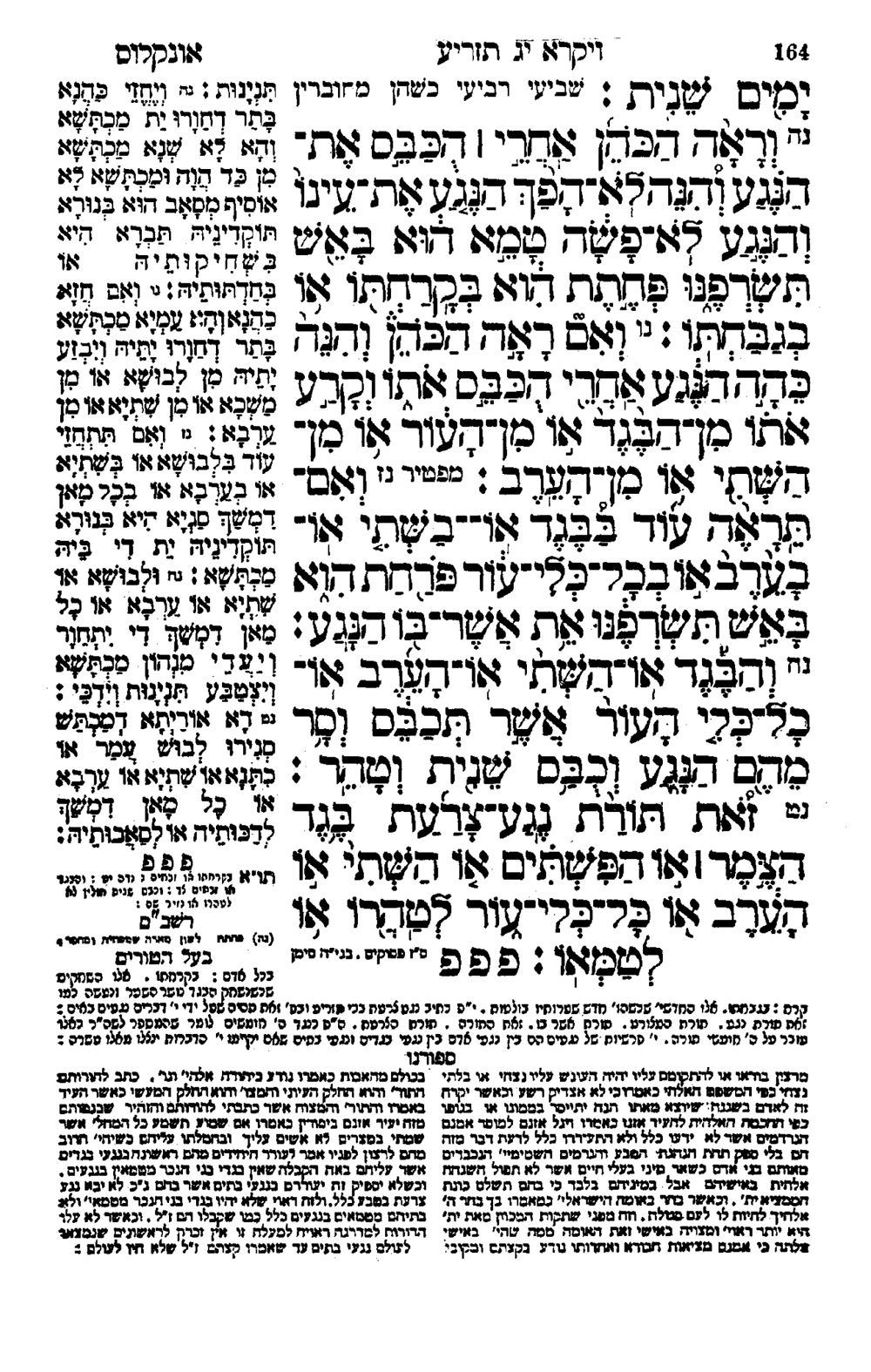
One person who met Brodsky described him as resembling that of a biblical patriarch in appearance, yet at the same time non-Jewish.[14] Indeed a photo from 1880, this biblical patriarch appears bareheaded. This lack of head-covering was not an issue for some Haredi authors. For example, Dov Eliach includes this photograph in his history of the Volozhin Yeshiva.[15] In 2001, not ten years after Eliach’s book another Haredi author decided that the photo required adjustment despite sharing the same publisher as Eliach.


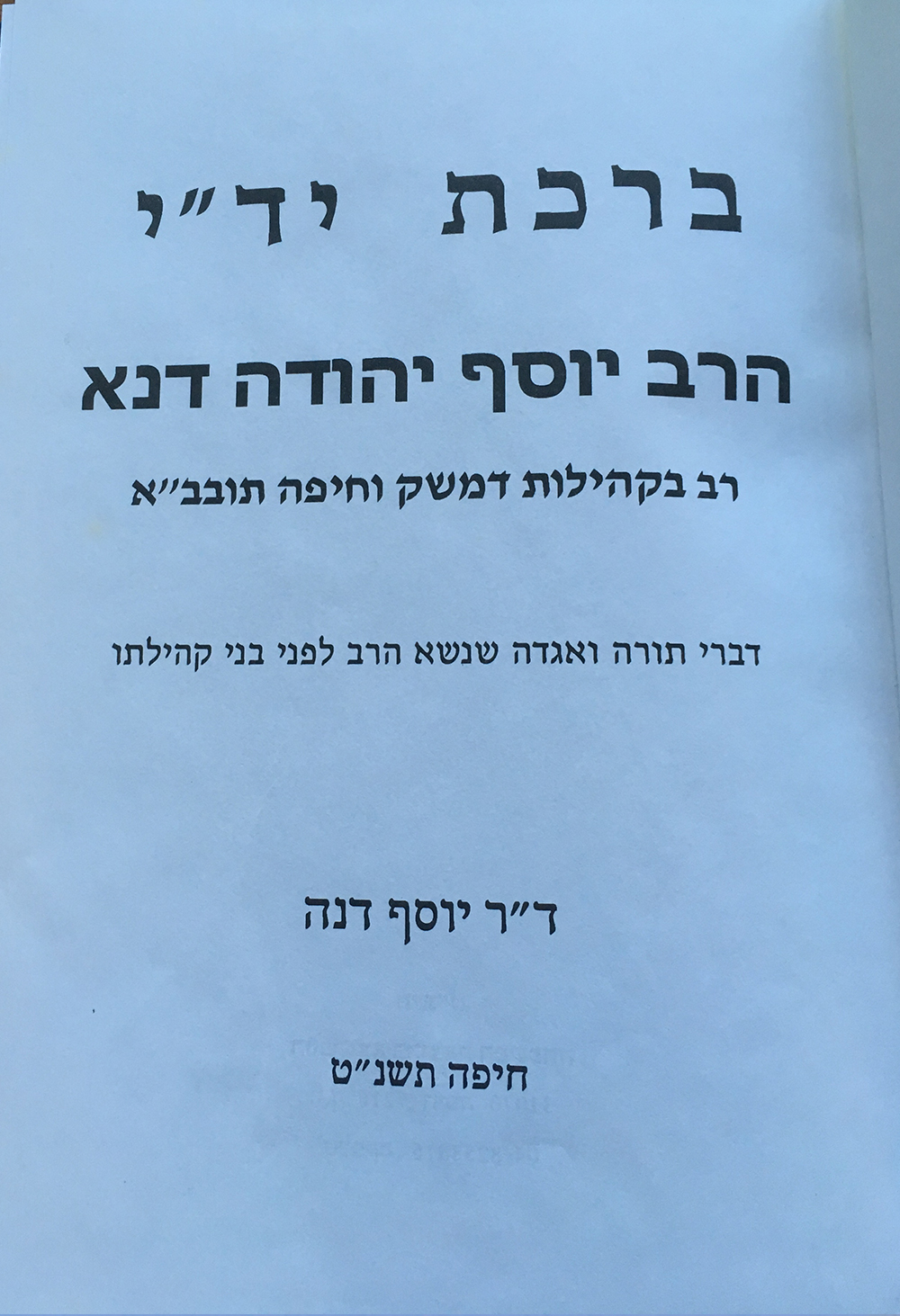
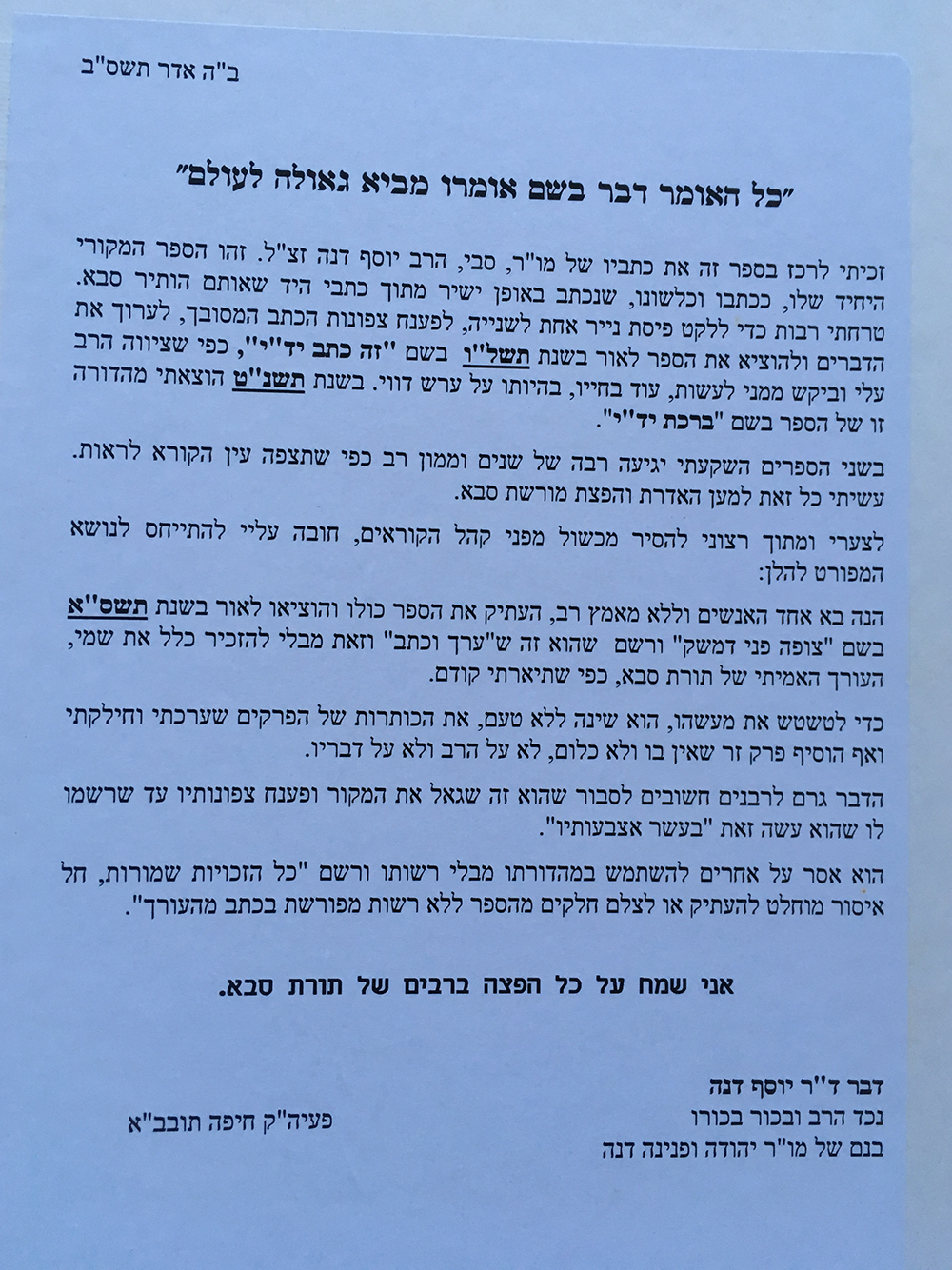
Menahem Mendel Flato’s book, Besheveli Radin (Radin’s Paths), devotes an entire chapter to Brodsky’s kolel, with his photograph accompanying the text. Yet, in this instance, rather than a bareheaded Brodsky, a crudely drawn yarmulke now appears on his head.[16] This is not the first time that images were doctored to depict a yarmulke where there is none.[17] Those types of alterations occur decades after the original, by different publishing houses, in different cities, and for a different audience.[18] Here, however, Avi ha-Yeshivot and Besheveli Radin share the same audience and are only separated by ten years. [19]


The alternation of Brodsky’s photo is not the only example of such censorship in Besheveli Radin. R. Moshe Mordechai Epstein studied in Volozhin and eventually went on to lead the Yeshivas Kenneset Yisrael in Slabodka. While he was in Volozhin, he was among those who established a proto-Zionist organization, Nes Tsiona. A photograph of the executive members appears in at least three places, yet only in Besheveli Radin is the connection to Nes Tsiona omitted.

In 1960 and 1970, two books published the photo from a copy in Russian Zionist Archives.[20] The 1960s’ version includes a legend that correctly identifies the photo as “the executive committee of the ‘Nes Tsiona’ in Volozhin in 1890.[21] The legend in the 1970 book contains the same language as before, indicating that it is a photograph of the Nes Tsiona executive committee and also identifies each of the men in the picture.[22] Yet, when the same photo appears in Beshvili Radin it is accompanied by an entirely different legend.[23] Instead, Beshvili Radin describes the photograph as depicting “a group of students from Volozhin from those days, R. Moshe Mordechai Epstein who eventually became the rosh yeshiva of Slaboka is sitting second from the right.” The purpose of the group photograph remains a mystery to Beshvili Radin‘s readers.


The history of Volozhin is complex and especially among Haredi writers raised issues that are uncomfortable truths.  Some of these authors responded by obscuring or entirely omitting these including the inclusion of secular studies in the curriculum, establishment and membership in non-traditional religious organizations, and the religiosity of some of its students.[24] Beshvilie Radin is but one example.  In his introduction, Flato discusses the purpose of Beshvilie Radin describing it as “providing the reader an entirely new perspective of that era.” We can now say that the “new perspective” is one that at times deviates from the historical record.

[1] Wikipedia, The Free Encyclopedia, s.v. “Israel Markovich Brodsky,” (accessed November 20, 2019), https://ru.wikipedia.org/wiki/Бродский,_Израиль_Маркович (Russian).

[2] Id.; Nathan M. Meyer, Kiev: Jewish Metropolis a History, 1859-1914 (Bloomington: University of Indiana Press, 2010), 39.

[3] Meyer, Kiev, 39.

[4] Meyer, Kiev, 39, 40, 71.

[5] For a biography of Reines see Geulah Bat Yehuda, Ish ha-Meorot: Rebi Yizhak Yaakov Reines (Jerusalem: Mossad HaRav Kook, 1985)

[6] Shaul Stampfer, Lithuanian Yeshivas of the Nineteenth Century: Creating a Tradition of Learning, trans. Lindsey Taylor-Guthartz (Oxford, 2015) (original work published 1995 (Hebrew)), 338 (quoting Yitzhak Yaakov Reines, Hotam Tokhnit, vol. 1 (1880), 17n4). For sources regarding the Lida Yeshiva see Eliezer Brodt, “Introduction,” in Mevhar Ketavim m’et R. Moshe Reines ben HaGoan Rebi Yitzhak Yaakov (2018), 12n42. See id. 354-61 for correspondence between the Netziv to R. Yitzhak Yaakov Reines regarding the establishment of a kolel.

[7] Stampfer, Lithuanian Yeshivas, 337-40. One possibility regarding the failure to start the kolel at that time in Volozhin might be attributable to Reines’ recognition that governmental approval was necessary to establish the kolel.  Volozhin had a difficult relationship with the Tsarist authorities.  See id. at 191-98. Adding a new institution might have been seen as a risk to the operation of the Volozhin yeshiva itself.

[8] Stampfer, Lithuanian Yeshivas, 358-59.  Among the conditions of the donation was that during the first year after his death ten men were selected and were required to visit the grave R. Hayim Volozhin’s and leading the prayers, and the recitation of the mourner’s kaddish, in addition to daily study of the mishnayot with the commentary of the Vilna Gaon, and leading the services.  The same was done on the yahrzeit of Brodsky’s wife, “ha-Tzkaniyot ha-Meforsemet, Haya.”  Dov Eliach, Avi ha-Yeshivot: MaRan Rabbenu Hayim Volozhin (Jerusalem, Machon Moreshet Ashkenaz, 2011) (second revised edition), 600-01.  (Thanks to Eliezer Brodt for calling this source to my attention).  The manuscript recording the conditions of Brodsky’s gift is currently in the possession of R. Meshulam Dovid Soloveitchik and portions are reproduced by Eliach.  See id. 601,634-35.

[9] The Land Bank was created in 1877. Michael H. Hamm, Kiev: A Portrait, 1800-1917 (Princeton: Princeton University Press, 1996), 10-11. The influence of the Brodskys was such that six members of the family were on the board of an earlier established bank, the Kiev Industrial Bank, (1871). This led some to remark that the bank should be referred to as the “Brodsky Family Bank.” Meyer, Kiev, 40. It is unclear if Israel also sat on the Land Bank board or was just an investor.

[10] Meyer, Kiev, 71.

[11] Meyer, Kiev, 40.

[12] Meyer, Kiev, 171-72. For a discussion of Vilna’s Choral Synagogue and its influence on Vilna’s maskilim see Mordechai Zalkin, “The Synagogue as Social Arena:  The Maskilic Synagogue Taharat ha-Kodesh in Vilna,” (Hebrew), in Yashan me-Peni Hadash: Shai le-Emmanuel Etkes, vol. 2, 385-403; see also D. Rabinowitz, “Kol Nidrei, Choirs, and Beethoven:  The Eternity of the Jewish Musical Tradition,” Seforimblog, Sept. 18, 2018.

[13] While today, these practices are unremarkable; at that time, there were some who opposed these changes. See generally Moshe Samet, Ha-Hadah Asur min ha-Torah: Perakim be-Toldot ha-Orthodoxiah (Jerusalem: Karmel, 2005). For an earlier discussion of the propriety of choirs and incorporating music in Jewish religious practices see R. Leon Modena, She’lot ve-Teshuvot Ziknei Yehuda, Shlomo Simonson ed. (Jerusalem: Mossad HaRav Kook, 1957, 15-20.

[14] Sergey Yulievich Vitte, Childhood During the Reigns of Alexander II and Alexander III (Russian) at 160.

[15] Dov Eliach, Avi ha-Yeshivot: MaRan Rabbenu Hayim mi-Volozhin (Jerusalem: Machon Moreshet HaYeshivot, 1991), 269. This photograph remains in Eliach’s second and updated version of Avi ha-Yeshivot printed in 2011.  See Eliach, Avi ha-Yeshivot: MaRan Rabbenu Hayim me-Volozhin (Jerusalem: Machon HaYeshivot, 2011), 292.  Although there are two changes in this version.  First, the “well-known philanthropist” becomes a “Rebi” and conveniently the top of the Rebi’s head is cut off so that one can’t tell if the Rebi is wearing a yarmulke.


[16] Menahem Mendel Flato, Besheveli Radin… ([Petach Tikvah]:  Machon beSheveli haYeshivos, 2001), 31; Marc Shapiro, Changing the Immutable: How Orthodox Judaism Rewrites Its History (Oxford: Littman Library, 2015), 136. Flato combines both of Eliach’s honorifics into “the philanthropist Rebi Yisrael Brodsky.”

[17] See Dan Rabinowitz, “Yarlmuke: A Historic Coverup?,” Hakirah vol. 4 (2007), 229-38.

[18] For examples see Shapiro, Changing the Immutable.

[19] Another Haredi history of Volozhin published the same year as Beshvili Radin also includes the unaltered photograph.  Tanhum Frank, Toledot Beit HaShem be-Volozhin (Jerusalem, 2001), 254.

[20] Yahadut Lita vol. 1 (Tel Aviv: 1960), 507; Eliezer Leone, Volozhin: Sefrah shel ha-Ir ve-shel Yeshivat Ets Hayim (Tel Aviv: Naot, 1970), 121. Despite the attribution to the Russian Jewish Archive there is no other information regarding this archive.

[21] Yahadut Lita, 507. Regarding Nes Tsiona see Stampfer, Lithuanian Yeshivas, 170-72

[22] Leone, Volozhin, 121.

[23] Another Haredi history of Volozhin also uses the same photograph but crops out all but just Epstein. See Frank, Toledot, 256. But in that instance the photo is used as part of a collage of rabbinic figures and explains why the other people are missing.

[24] Stampfer, Lithuanain Yeshivas, 43, 206-07, (secular studies), 167-178 (societies), Abba Bolsher, “Yeshivas Volozhin be-Tukufat Bialik,” in Yeshivas Lita: Perkei Zikronot, eds. Emmanuel Etkes and Shlomo Tikochinski (Jerusalem:  Zalman Shazer Center, 2004, Menahem Mendel Zlotkin, “Yeshivas Volozhin be-Tekufat Bialik,” in Etkes, Perkei, 182-92 (histories of Volozhin’s perhaps most well-known black sheep during his time there).


Apostates and More, Part 1

Apostates and More, Part 1

Marc B. Shapiro

Continued from here

  1. I am aware of two seforim found on both Otzar haHochma and Hebrewbooks.org which were written by men who later apostatized (there are probably more). There are also two seforim on Hebrewbooks.org which were written by someone afterhe apostatized. I realize that after this post appears it is possible that the books mentioned will be removed from Otzar haHochma and Hebrewbooks.org (as has happened in the past with problematic books that I called attention to). I am therefore providing links so that readers can access the books even if they are removed.

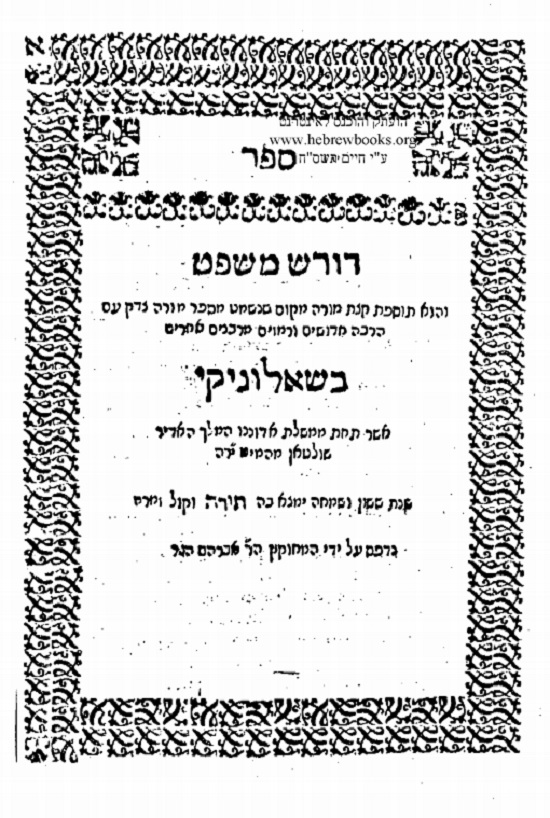
The first book by someone who later apostatized is Solomon Florentin’s Doresh Mishpat, published in Salonika in 1655. As mentioned, appears on both hebrewbooks.org and Otzar haHochma.

Here is the title page.


You can view the entire book here here.

Florentin was a follower of Shabbetai Zvi and was one of the group of Salonikan Jews who converted to Islam following Shabbetai Zvi’s own conversion.[1]

The second future apostate whose book appears on Hebrewbooks.org and Otzar haHochma is Aaron Israel Briman. He wrote Avnei Zikaron, which was published in Amsterdam around 1880.[2] Here is the title page.


You can view the entire book here here.

Briman, who appears to have been an ordained rabbi, was a real scoundrel. After his apostasy, which seems to have been done completely for monetary reasons, he wrote the infamous anti-Semitic work Der Judenspiegel and assisted the anti-Semite August Rohling in his attacks against the Talmud and Judaism in general.[3]  He also abandoned his wife and two small children, leaving his wife an agunah. After becoming a Christian, he engaged in various monetary frauds which landed him in prison. According to the article here in the Jewish Encyclopedia, he studied in the Rabbinical Seminary of Berlin, a point confirmed by Gotthard Deutsch.[4]

As for seforim written by someone after he converted, this brings us to Jehiel Zvi Lichtenstein (1827-1912; in his earlier years the last name he used was Hirschensohn, and I don’t know why he changed it). Detailed biographical information about Lichtenstein can be found in a good article by Samuel Leib Zitron included in volume 2 of his Me-Ahorei ha-Pargod: Mumarim, Bogdim, Mitkaḥashim that fortunately is also found online here. There is, however, no scholarly article on the writings of Lichtenstein, and although he was infamous in his day, today he is almost entirely forgotten.[5]

Lichtenstein was born in Bessarabia and was already an accomplished scholar as a young man. He was married at 18 to the daughter of a wealthy man, and he could have entered the rabbinate like so many others in his position. Yet as described by Zitron (and it appears that his description has been livened up, so it is not always clear if the facts are correct), various circumstances led him to divorce his wife, abandon his home, and convert to Christianity and become an enthusiastic missionary. Incredibly, even after converting to Christianity he continued to live as a Jew, moving to the town of Lubavitch where by all outward appearances he was a hasid of the Lubavitcher Rebbe.

Following this he went to Berlin where he was an open missionary. He then returned to Russia where he married the sister of the well-known Jewish-Christian missionary, Joseph Rabinowitz. In 1995 Kai Kjaer-Hansen published the English version of his book on Rabinowitz,[6] referring to him on the book’s cover and title page as the “Herzl of Jewish Christianity.”[7]

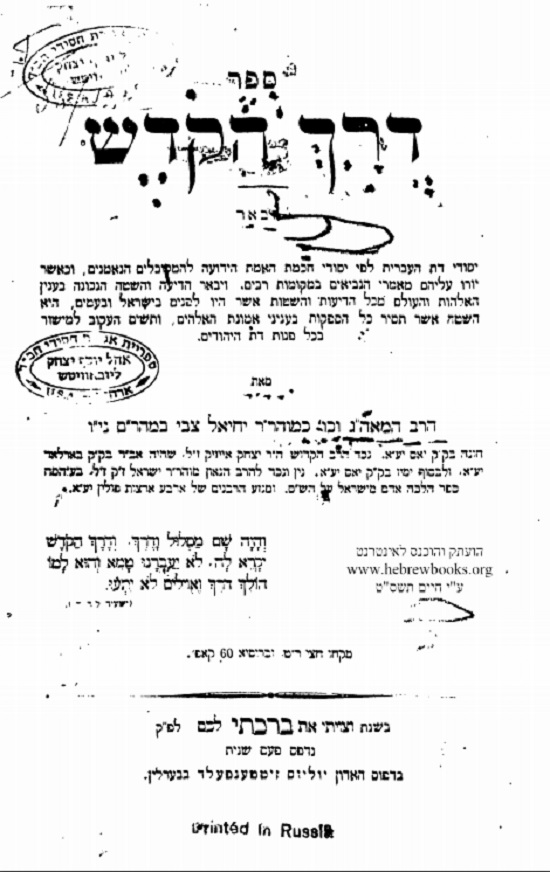
In 1872, after his apostasy, Lichtenstein published his book Derekh ha-Kodesh. The book was published in Berlin. I don’t know why the title page says it was printed in Russia, though this probably has something to do with taxes or customs for books sent to foreign countries.

As you can see, this is the second printing and Lichtenstein gave himself a fancy rabbinic title. I have never seen a copy of the first printing, but Ephraim Deinard states that Lichtenstein’s name did not appear on the title page of this edition.[8]

Zitron tells us that Lichtenstein returned to his hometown where he distributed Derekh ha-Kodesh among the local Hasidim. The book reads like a real rabbinic text, and on the very first page he cites both the Baal Shem Tov and R. Shneur Zalman of Liady, and he continues to cite R. Shneur Zalman constantly in the book. It is obvious from what he writes elsewhere that he pretended to be a Chabad hasid. Thus, in his self-defense published in Ha-Magid [9], when he was still pretending to be a faithful Jew, he mentions that he had lived in the town of Lubavitch. In seeking to defend Derekh ha-Kodesh from the accusation that it had Christian elements, he calls for it to be examined by leading Chabad rabbis to see if there is anything problematic in the book.

.ואקרא לשופטי צדק את רבני חב”ד הגדולים אשר ירדו לעמקי הלכה של הקבלה והחסידות הדבקים באלהים חיים המה יאמרו אם עולתה בו

His call was taken up by Jacob Solomon Alschwang who claimed to have a lot of knowledge in Kabbalah and hasidic thought, “like one of the great Chabad rabbis.”[10]  I am sure that this self-judgment contains a good deal of exaggeration, yet Alschwang did come from a Chabad background and received a traditional Chabad education before leaving that world for the world of Haskalah.[11]

Alschwang identifies a number of passages in the book which he thinks are evidence of the author’s Christian sentiments.[12] Experts in Kabbalah and Hasidism can weigh in on whether Alschwang is correct or if the passages he points to can also be supported by classic kabbalistic or hasidic texts.

One of the passages Alschwang points to is on p. 68, which according to Alschwang means that Lichtenstein is speaking of God taking physical form on earth.

וע”ז נא’ עיני ה’ המה משוטטים בכל הארץ (זכריה ד, י) שענין משוטטים היינו שמתפשטים ומתלבשים בכל הארץ, והש”י משגיח בארץ ע”י שמתלבש בהם כי המה הם כלים רוחניים שהאציל וברא להשתמש בהם, והם מתפשטים ומתלבשים בתחתונים, והמה כמו העינים אל [של] האדם שהאדם יביט בהם והשכל מתלבש בהם לראות, וכן הוא הענין באזני ה

So, what do readers think? Does this passage speak of God literally assuming some bodily form? Furthermore, can we find similar passages in standard kabbalistic texts?

Alschwang also calls attention to Derekh ha-Kodesh, p. 42, where Lichtenstein states that God will appear to prophets in a physical form. Although Lichtenstein adds that God does not really take physical form, but only appears this way, Alschwang sees this as an example of Lichtenstein is trying to push a Christian notion. I guess the idea would be to first get Jews used to the notion that God can be imagined looking like a human, and the next step is to identify a real flesh and blood human as God. Here are Lichtenstein’s words:

כי העולם הזה בכללו הוא אלהות גמור מצד שאינו נראה לנו, אך לעינינו עשה האלהים על עצמו גילוי וצורה ויתחפש בדמות גשמי (זיך זעלבסט ענטשטעלט) אשר הנבראים ישיגו בחושיהם הגשמיים (אשר גם הם רק לעיניהם) דמות וצורה גשמית ארבע יסודות ומורכביהם, דומם צומח חי מדבר וכו’, אולם לעומת הש”י הכל אלהות גמור ואין פה גילוי ודמות גשמי ומהות כלל

Alschwang also notes that on page 7 Lichtenstein makes use of the famous expression from Matthew 19:24, “It is easier for a camel to go through the eye of a needle,” which is not what one would expect to find in a rabbinic text.

At one time in his strange life, Lichtenstein actually began serving as a hasidic rebbe of sorts, praying for people and handing out amulets. Ephraim Deinard, who knew Lichtenstein from the latter’s missionary days in Berlin in the 1870s,[13] claims that it was he who exposed Lichtenstein as a fraud. He happened to be in Lichtenstein’s town on a business trip in 1879, and that is how the townspeople learned that the supposedly pious rebbe was actually a Christian missionary.[14] Even after being exposed Lichtenstein did not give up, and a few years later he was in Podolia serving as a rabbi![15]

Derekh ha-Kodesh is only found on hebrewbooks.org, not on Otzar haHochma. You can view it here. The copy on hebrewbooks.org is missing the second half of the book. It appears that not all printings of the book contained the second part which includes a commentary on various biblical passages. (Alschwang mentions that his copy only had 84 pages, which means that it also was missing the second half.). Here is the copy which is found at Harvard, which is almost twice as long as the copy on hebrewbooks.org.[16] Interestingly, in the copy found on hebrewbooks.org (and also in the complete Harvard copy), on the second page, there are corrections applicable to the missing second half of the book. Also of note is at the bottom of this page of corrections it states that the haskamot for the book were published in the first printing. As far as I can determine, no copies of this first printing have survived.

Zitron tells us that in 1882 Lichtenstein came to Odessa with the manuscript of his book, Sheva Hokhmot. He received haskamot for the book from rabbis and maskilim. Here is the title page of the London 1912 edition of Sheva Hokhmot and you can view the book here.[17]

This is a very helpful work which in alphabetical fashion discusses all the geographical sites mentioned in the Talmud and Midrash.[18] The book previously appeared in Lemberg in 1883 and can be viewed here. The title page of the Lemberg edition mentions that Lichtenstein wrote the responsa volume Keren ha-Tzvi and the book Megaleh Sod. While Keren ha-Tzvi never appeared, Megaleh Sod, which is a commentary on the Bible, was published in Budapest in 1906 and can be viewed here. It is incredible that an apostate would write such a commentary which on its face looks like any other traditional commentary. (I haven’t read it carefully to see if he also inserts Christian interpretations.)

The actual text of both editions of Sheva Hokhmot is the same, but there are some differences between the prefaces of the two volumes. In the first edition the preface is longer, contains some notes, and also includes a list of the rabbis and scholars who prepaid for the book. In the London edition, Lichtenstein included a passage from R. Aaron Hyman’s Toledot Tannaim ve-Amoraim (London, 1910), vol. 1, p. 15, which greatly praises the book and the author, with Hyman saying that Lichtenstein is “wise in the wisdom of the Torah.” Hyman obviously must have been unaware of who Lichtenstein was.

That people did not realize who Lichtenstein was explains how a copy of Derekh ha-Kodesh was bound with regular traditional seforim (including R. Moses Cordovero’s Tomer Devorah), as seen in a recent auction here.[19]

As you can see from the title pages of Derekh ha-Kodesh and Sheva Hokhmot, both of these books, now found on hebrewbooks.org, came from the Library of Agudas Chassidei Chabad.[20] You can also see from the title page of Sheva Hokhmot that, before it was acquired by the Library of Agudas Chassidei Chabad, it belonged to the great scholar Jacob Zallel Lauterbach.

With reference to Lichtenstein, Steven J. Zipperstein writes as follows:

His Sheva Hokhmot [The Seven Wisdoms] was introduced by letters of praise from important scholars such as Mattityahu Strashun, Samuel Joseph Fuenn, and others, though the book appeared three years after Lichtenstein was first denounced as a missionary (by the rather mercurial and widely disliked Ephraim Deinard) in the newspaper Ha-Maggid.[21]

Zipperstein’s information about the letters in Sheva Hokhmot comes from Zitron, who also claims that these haskamot were forged by Lichtenstein. Yet there are no such haskamot from these figures, forged or otherwise. In the 1883 edition of the book, p. 6, we are given a list of people who wrote haskamot and letters of praise (including R. Joseph Dov Soloveitchik, the Beit ha-Levi), but these were never published, not even in the 1912 edition. I have no reason to doubt that these haskamot and letters of praise were authentic, otherwise how could he have publicly announced in the various authors’ lifetimes that he received letters from them? However, these letters were also written before news of his apostasy was known.

What makes Derekh ha-Kodesh and Sheva Hokhmot so interesting is that they were both written after Lichtenstein had become a Christian, something you would never know from the title pages. I don’t know of any other such books, namely, seforim written in a rabbinic style by someone who had already converted to Christianity.

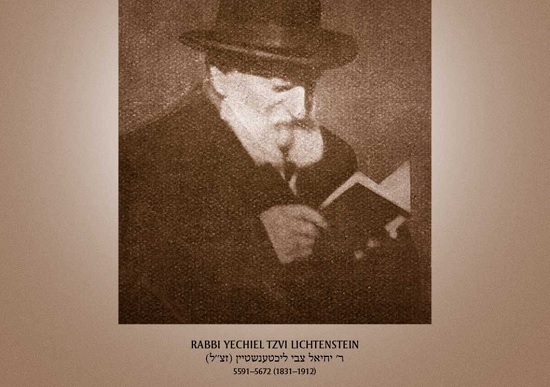
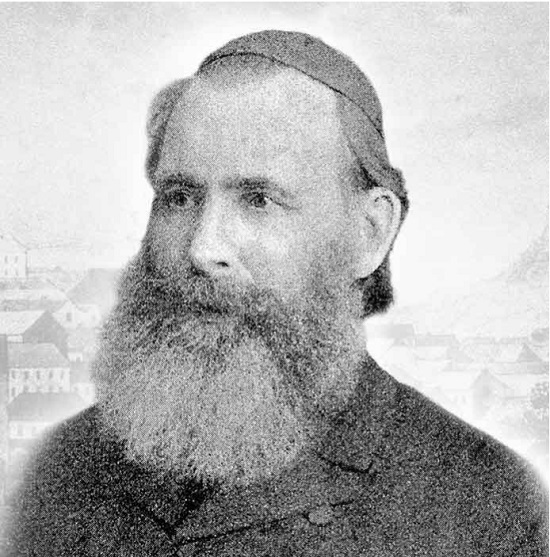
This is a picture of Lichtenstein that I found on a Messianic Jewish website here.


Here is the title page of Lichtenstein’s Hizuk Emunat Emet bi-Yeshua Mashiah ben ha-Elohim.[22]


You can find the entire book here. The author is listed as אבן צהר, which is simply the Hebrew translation of the name Lichtenstein. Also, צהר is the abbreviation of צבי הירשנזון, the birth name of the author.[23]

Lichtenstein also wrote a multi-volume Hebrew commentary on the New Testament, which you can see here. The commentary is preceded by a helpful article on Lichtenstein by Jorge Quiñónez. Lichtenstein’s revised commentary on Matthew can be seen here.[24]

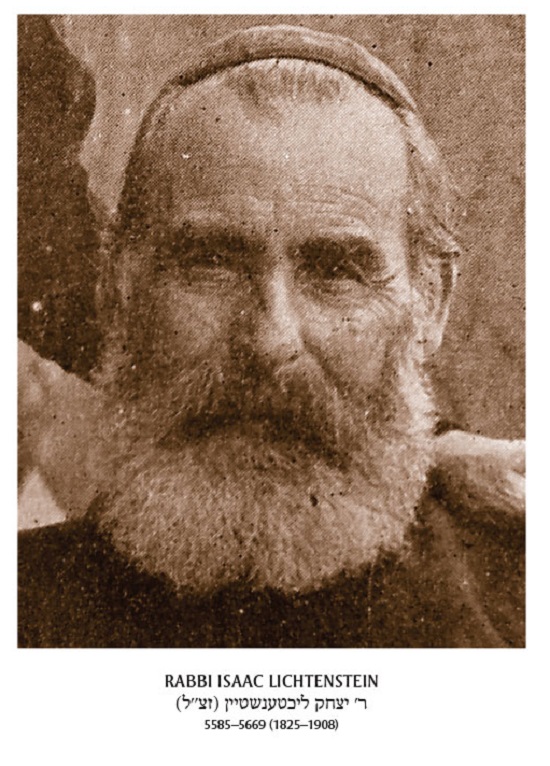
There is an entry on Lichtenstein in Zalmen Reyzen’s Yiddish Lexicon.[25] Yet one of the sources in the bibliography is about Isaac Lichtenstein. This Lichtenstein is often confused with Jehiel Zvi Lichtenstein whom we have been discussing. However, they were two separate people, and Isaac Lichtenstein (1824-1908), who was actually a rabbi, was also a believer in Jesus (although it is reported that he never actually converted to Christianity).

This is his picture taken from here.

The following picture comes from here

There was another Chabad hasid, Israel Landau, who converted to Christianity and became the chief Russian censor. In Ruth Bachi-Kolodny’s article about him, entitled “The Chabadnik Who Became Czarist Russia’s Chief Censor for Jewish Writings,” available here, he is even referred to as a rabbi, but this is certainly not correct, and the description of him as a rabbi does not appear in the original Hebrew version of the article here. The article states:

Although he became an apostate Jew, he remained, deep in his heart, a devoutly religious Hasid and continued to look the part with his short trimmed beard, earlocks, skullcap and long, broad kapota ‏(the long black jacket of members of Chabad‏); he would eat only in kosher restaurants. In fact, Landau sent his wife and only daughter, Menuha, to Switzerland so they could live as Jews without any external hindrances.[26]

Ben Zion Dinur, who was from a Chabad family, mentions that it was jokingly said about Landau that even after apostatizing he still kept the holiday of 19 Kislev.[27] As for Landau’s wife and daughter, Ephraim Deinard, who knew Landau, states that they left Russia because they did not want to convert, not because Landau sent them out.[28]

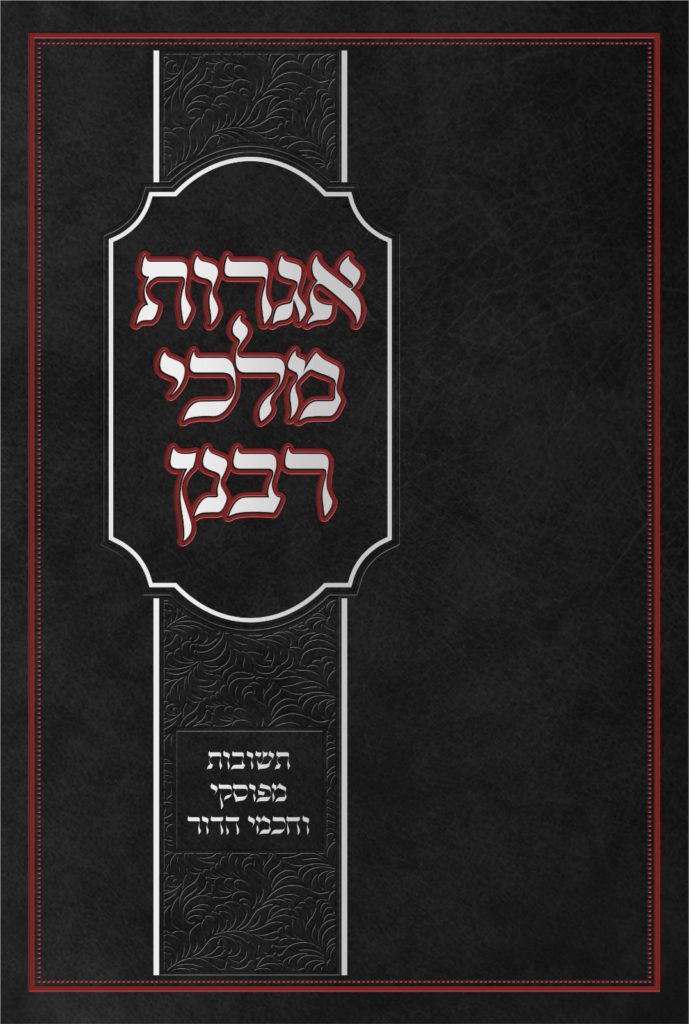
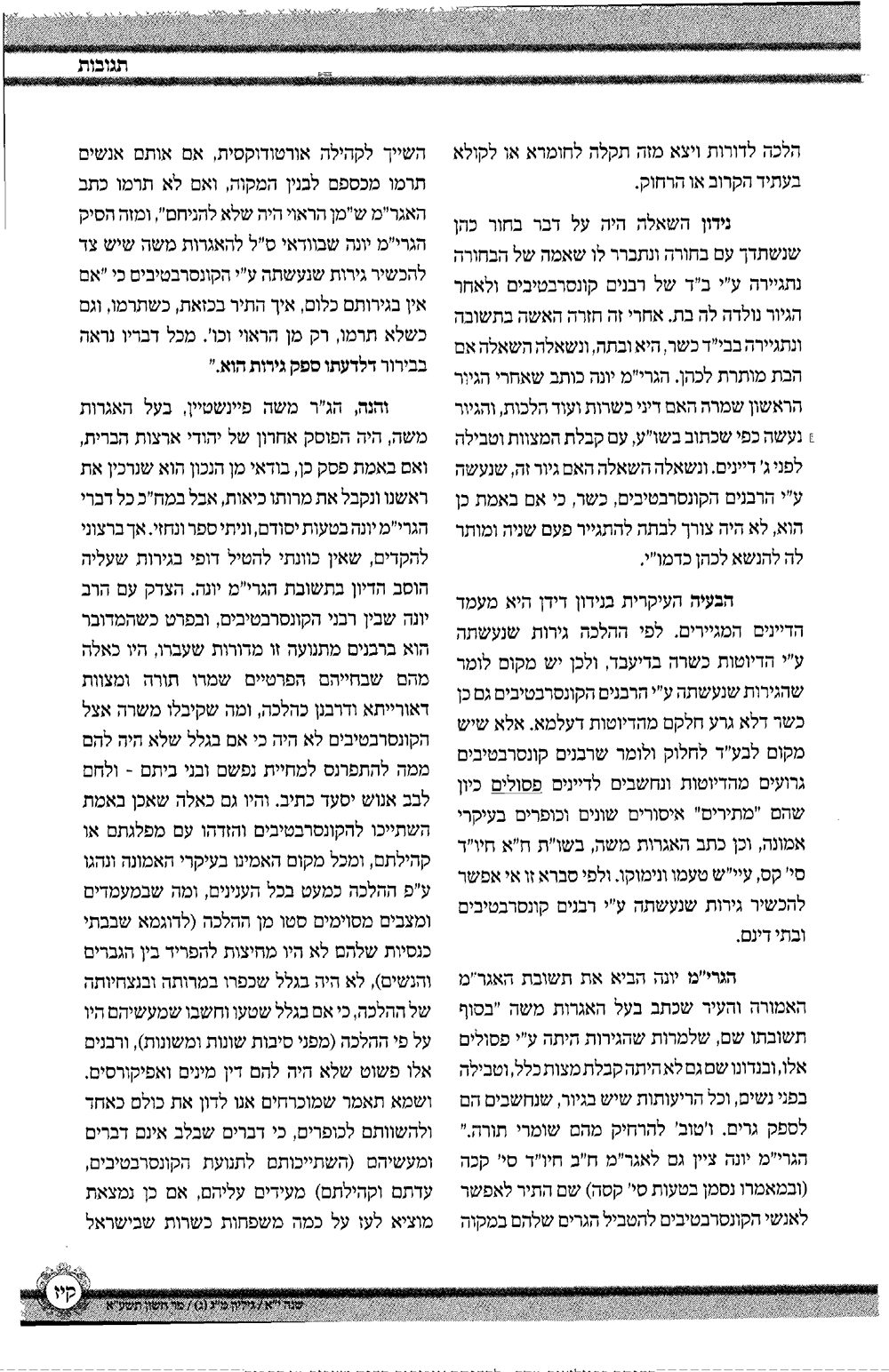
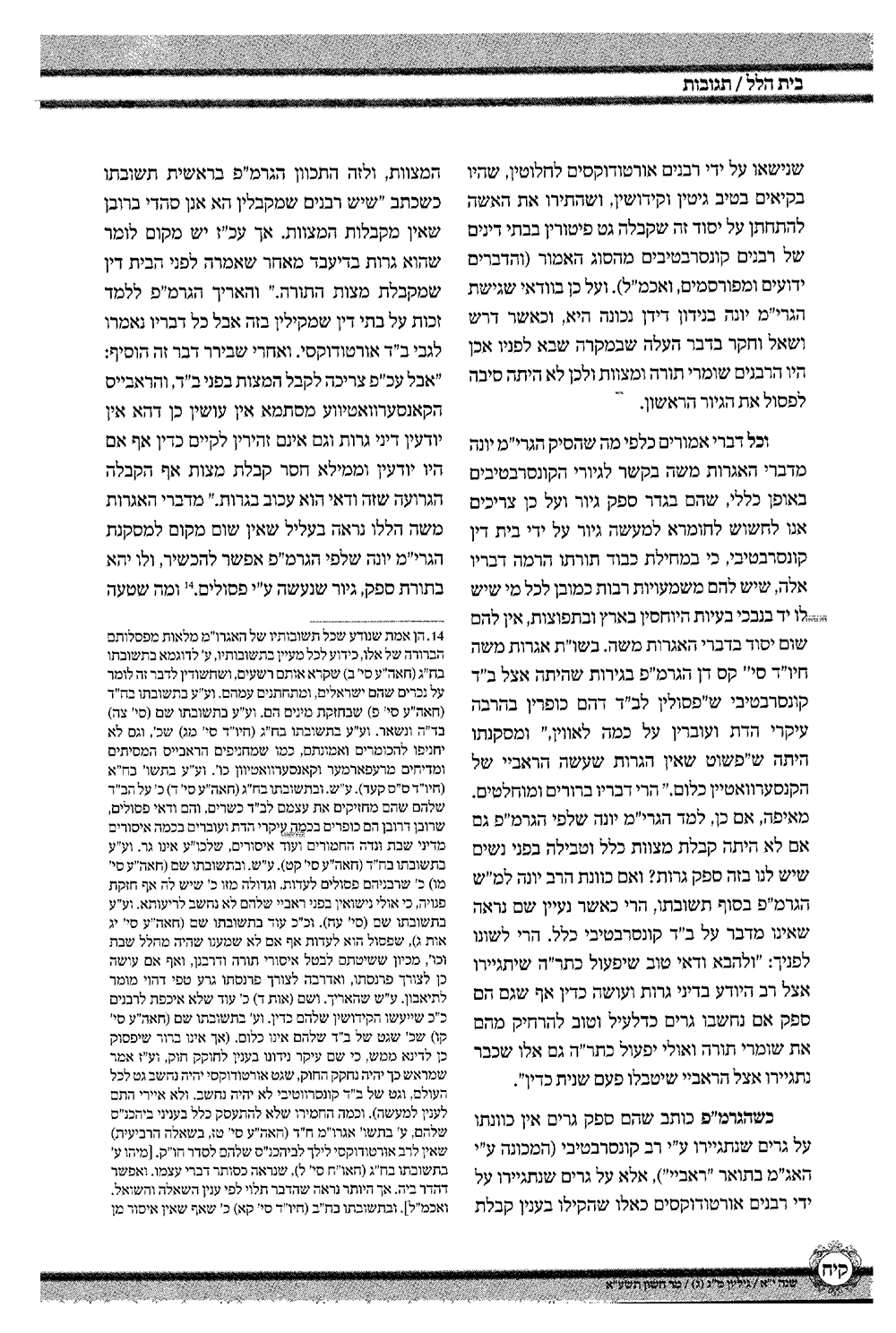
My experience has been that as soon as I publish something, I find more relevant material and wish I could go back in time to include it in the publication. Fortunately, with the Seforim Blog I am able to update my writings. Not long ago I published Iggerot Malkhei Rabbanan. On pp. 300-301, R. Meir Mazuz writes that he read in Yated Ne’eman that the apostate Russian censor removed two lines from Bialik’s poem about the Kishinev pogrom of 1903, “In the City of Slaughter,” because he found them heretical and did not want to lose his share in the World to Come! I was not aware of this story but I looked at the poem and immediately identified what these two lines must be. In fact, as I only learned after the book was published, it was actually the following four lines that were deleted, and the censor who was responsible for this was none other than Landau.[29]

,סִלְחוּ לִי, עֲלוּבֵי עוֹלָם, אֱלֹהֵיכֶם עָנִי כְמוֹתְכֶם
עָנִי הוּא בְחַיֵּיכֶם וְקַל וָחֹמֶר בְּמוֹתְכֶם
–כִּי תָבֹאוּ מָחָר עַל-שְׂכַרְכֶם וּדְפַקְתֶּם עַל-דְּלָתָי
!אֶפְתְּחָה לָכֶם, בֹּאוּ וּרְאוּ: יָרַדְתִּי מִנְּכָסָי

Forgive me, beggars of the world, your God is as poor as you,
Poor he is in your living and so much more so in your deaths.
And if you come tomorrow for your due and knock on my doors—
I’ll open for you, come and look: I’ve gone down in the world.[30]

The story of the censorship is told by Benzion Katz in his memoir, in a chapter that deserves to be translated into English.[31] Katz was the founder and editor of the newspaper Ha-Zeman, where Bialik’s poem appeared. If you look in Ha-Zeman you will find that the title of the poem was changed to “Masa Nemirov”, and a note informs the reader of the infamous 1648 massacre in Nemirov. As Katz explains, this new title was suggested by Landau, who was willing to look the other way if Bialik and Katz would pretend that the words were not about the 1903 Kishinev pogrom but about another event 250 years prior.

As for the censorship of the lines mentioned above, Katz writes as follows (p. 135):

כשהיה הכל מוכן נתתי לו לקרוא את השירה. הכל נראה לו כשר, חוץ מנקודות אחדות, שלדעתו התריס שם ביאליק נגד א-לוהים. אין הוא יכול להרשות זאת – אמר הצנזור המומר. – בשביל הממשלה ימצא תמיד תירוץ אבל לא בשביל רבונו של עולם. “אינני צעיר ואצטרך לתת דין וחשבון בעולם הבא. אינני רוצה להפסיד את חלקי בעולם הבא”

Landau would not permit some lines to appear in the poem as he did not want to lose his share in the World to Come. Bialik wrote to the censor to defend himself and the censor replied as follows (as summarized by Katz, p. 135), pointing out among other things that Bialik had misunderstood the Zohar :

הוא הצעיר, אף על פי שהוא משורר גדול, מביא לי ראיות מן הזוהר הקדוש, שבו יש ביטויים שהם כביכול גם כן עלבון לקדוש ברוך הוא, אבל אלה אינם עלבונות אלא ביטויי צער וזעם. אני בקי בזוהר. אני לומד אותו יותר ממנו. אני הרשיתי להדפיס את הזוהר מה שלא הרשו הצנזורים הקודמים. היו מביאים את הספר בגניבה מחוץ לארץ. נגד א-לוהים אי אפשר לעשות כלום

All this goes to show that while you can take the Jew out of the shtetl, often (even with apostates) you can’t take the shtetl out of the Jew.

To be continued

  1. I want to call attention to four recent valuable books. The first is Mitchell First, Roots and Rituals: Insights into Hebrew, Holidays, andHistory. This book is full of interesting chapters on liturgy, history, holidays, and the Hebrew language. If, like me, you have enjoyed First’s posts on the Seforim Blog, then his latest book will be a treat.

The second book is Bezalel Naor’s translation of R. Kook’s Commentary to the Legends of Rabbah bar Hannah. This book only further solidifies Naor’s standing as the leading interpreter of R. Kook in the English language. In addition to extensive notes, Naor also includes 11 appendices which include such topics such as R. Kook’s critique of the Mussar Movement and R. Kook and the Dybbuk in Jaffa.

The third book is a joint effort by the eminent scholars Menachem Kellner and James Diamond. Its title is Reinventing Maimonides in Contemporary Jewish Thought, published by my favorite press, Littman Library. This is a collection of articles by Kellner and Diamond which focus on various important Torah scholars and their understanding of Maimonides.

Here is the table of contents.

Anyone interested in nineteenth- and twentieth-century rabbinic thinkers will find this work of value.

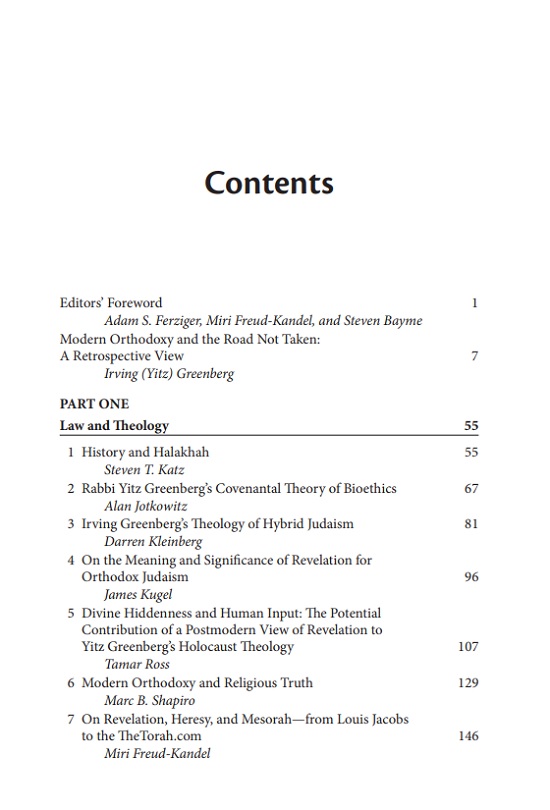
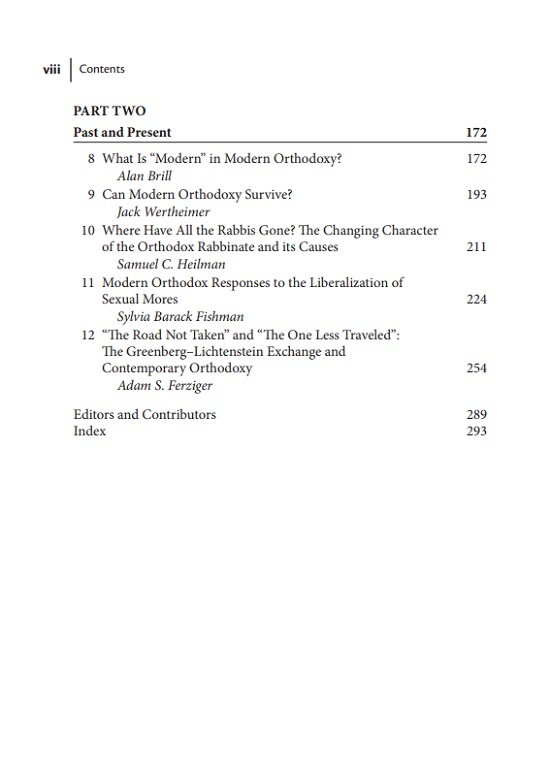
The fourth book is Yitz Greenberg and Modern Orthodoxy: The Road Not Taken, edited by Adam Ferziger, Miri Freud-Kandel, Steven Bayme. This book, which is full of great essays, is available in paperback here, and this is the table of contents.


  1. R. Yissachar Dov Hoffman was kind enough to send me this picture of R. Joseph B. Soloveitchik and R. Ovadiah Yosef from April 25, 1974.[32]

My question to readers is, can anyone identify the three young men standing behind the rabbis?

  1. Anyone interested in my summer 2020 trips with Torah in Motion can find details here.
  2. For those in the New York area, I will be speaking at Young Israel-Beth El of Boro Park (4802 15thAvenue, Brooklyn) on Saturday night, December 21 at 8pm. The title of my talk is “Judaism and Islam: Some Halakhic and Historical Perspectives”.

[1] See Meir Benayahu, Ha-Tenuah ha-Shabta’it be-Yavan (Jerusalem, 1971-1978), pp. 35-36.
[2] Regarding Briman and his book, which is actually a complete plagiarism – the entire book lifted word for word from R. Abraham Wallerstein, Mahazeh Avraham, found in Wallerstein’s Ma’amar Avraham (Fuerth, 1757) – see Shmuel Ashkenazi, Asufah (Jerusalem, 2014), pp 53-55.
[3] See Joseph Samuel Bloch, Zikhronot Mimei Hayai, trans. S. Shalom, (Tel Aviv, n. d), vol. 1, pp. 84ff.
[4] See his letter in the Jewish Chronicle, June 26, 1914, conveniently posted in On the Main Line here. See also On the Main Line here for a fascinating post dealing with another apostate who appears to have been a rabbi.

For detailed discussions of Briman, see Samuel Leib Zitron’s article from volume 2 of his Me-Ahorei ha-Pargod: Mumarim, Bogdim, Mitkaḥashim, available here; Joseph Samuel Bloch, Zikhronot mimei Hayai (Tel Aviv, n.d.), vol. 1, pp 81ff.; Ha-Melitz, April 24, 1885, cols. 440-441. For numerous contemporary references to Briman, see Jonatan Meir, Literary Hasidism: The Life and Works of Michael Levi Rodkinson, trans. Jeffrey G. Amshalem (Syracuse, 2016), p. 167 n. 201. Unfortunately, Meir, p. 169 n. 214, cites Chaim Bloch – about whom I have a written a good deal on this blog – without realizing that none of the unpublished material Bloch claimed to possess can be assumed to be authentic. Regarding Bloch, see also Tesla Lee’s 2016 honors thesis at the University of North Carolina at Chapel Hill, “Sigmund Freud and Chajim Bloch: Exploring the Role of the Jewish Joke in European Jewish Identity,” available here. On pp. 5-6, Lee mentions another fabrication by Bloch. Bloch describes how he offered Freud his criticisms of Moses and Monotheism, yet we know that Freud did not begin working on this book until years after Bloch’s supposed conversation with him. For a recent discussion of Bloch and his role in popularizing the Golem story, see Samuel Jacob Spinner, “Jews behind Glass: The Ethnographic Impulse in German-Jewish and Yiddish Literature, 1900-1948” (unpublished doctoral dissertation, Columbia University, 2012) pp. 89ff.
[5] The biographical information I provide about Lichtenstein comes from Zitron. Here is what the Encyclopaedia Judaica, s.v. Hirschensohn-Lichtenstein, Jehiel Zevi Hermann, writes:

Born in Russia, he converted to Christianity in 1855 in Jassy, Rumania, but keeping this secret he spent some time among the Hasidim of Lubavitch and worked on his Derekh ha-Kodesh (“The Way of Holiness,” 1872), which deals with the fundamentals of the Jewish faith, but betrays the authors Christianizing tendencies. From 1868-1878 he worked, under the name of Hermann Lichtenstein, for the Protestant mission in Berlin. He then returned to Russia where, disguised as a hasidic rabbi, he distributed his book. He married in Kishinev, Moldavia, a sister of Joseph Rabinovich, who later, probably under Hirschensohn’s influence, founded the sect called Community of Evangelian Jews. His true character discovered, he had to leave Russia and became lecturer at Franz Delitzsch’s Institutum Judaicaum at Leipzig.

[6] Joseph Rabinowitz and the Messianic Movement (Edinburgh, 1995).
[7] This title was earlier given to Rabinowitz by Hugh J. Schonfield, The History of Jewish Christianity p. 5, available here.
[8] Zikhronot Bat Ami (St. Louis, 1920), vol. 2, p. 134.
[9] Ha-Magid, May 7, 1885, p. 144.
[10] Ha-Magid, June 25, 1885, pp. 208-209.
[11] See his autobiography in Sefer Zikaron le-Sofrei Yisrael ha-Hayyim Itanu ka-Yom (Warsaw, 1889), pp. 203ff, available here. He wrote under the pseudonym ישביאל. See Saul Chajes, Otzar Beduyei ha-Shem (Vienna, 1933), p. 173. The title of the book mentioned at the beginning of this note is of interest, as it is a “memorial volume” for living writers. Today I think we would only use the words “Sefer Zikaron” for people who are deceased. It is also of interest that in the past there were writers who used ז”ל either as זכרונו לברכה or זכור לטוב for living people. See Tovia Preschel, Ma’amrei Tuvyah, vol. 1, pp. 35, 324-325, vol. 4, p. 418.

In 1878, R. Isaac Moses Abulafia published his Lev Nishbar. Here is the title page.

This book is a defense of his halakhic rulings in his responsa Penei Yitzhak against the blistering criticisms of R. Solomon Moses Gaguine in his Yismah Levav. Of interest at present is Lev Nishbar, no. 3 (p. 12b). R. Abulafia notes that R. Gaguine refers to him with ז”ל after his name, and he is certain that this was not done in accord with the view mentioned above that ז”ל can be used even with living people. Rather, he sees this as an intentional insult, and as he puts it, כונתו לרעה. This might mean that he believes that R. Gaguine, by using ז”ל after his name, is hoping for his death.

והן עתה הביאני חדריו וכתב עלי תיבת ז”ל כנז”ל וה’ יודע ועד עליו אם כונתו לרעה עלי והלב יודע אם לעקל וכו’ ועכ”פ מדקפיד בכל דוכתא ודוכתא אך בחלקות ישית להבדיל בין המתים ובין החיים בתיבת ז”ל ונר”ו כנז”ל ומדשינה עתה הפעם לכתוב עלי ז”ל במקום נר”ו הא ודאי דקפידה הוי וכונתו לרעה ב”מ

See also what R. Abulafia writes in his introduction and the first page of the opening responsum, where you can see that he is not inclined to be generous in his interpretation of R. Gaguine’s intent.

Regarding the dispute between Rabbis Abulafia and Gaguin, see Yaron Haarel, “Hashpa’atam shel ha-Sefarim Penei Yitzhak, Yismah Lev ve-Lev Nishbar al ha-Ma’avak Saviv ha-Rabanut be-Damesek,” Asuput 11 (1998), pp. 211-243.
[12] That the book contains hints to Lichtenstein’s belief in Jesus is also stated by Samuel Shraga Feigensohn, Elbonah Shel Torah (Berlin, 1929), p. 28b.
[13] Deinard, Zikhronot Bat Ami (New Orleans, 1920), vol. 2, p. 133.
[14] Ha-Magid, April 9, 1885, p. 112. See here that in his later years, Lichtenstein’s Christian missionary students would call him “Rebbe”. This source describes Lichtenstein as serving as a hasidic rebbe before adopting Christianity, but that is not correct.
[15] Deinard in Ha-Magid, April 9, 1885, p. 112. Deinard, Zikhronot Bat Ami, vol. 2, p. 137, reports that Lichtenstein served as a rabbi in Hungary. In Tzelem ba-Heikhal (New Orleans, n.d.), p. 143, Deinard writes that he was a rabbi for a short time in a town in the Austrian empire. Feigensohn, Elbonah Shel Torah, p. 28b, states that he served as the rabbi in a town in Volhynia for eight years, but there is no evidence to support this statement
[16] See Jacob Solomon Alschwang, Ha-Magid, June 25, 1885, p. 209, that David Kahana had additional pages from the book which are missing from the Harvard copy. These pages, from a section entitled Even Bohan, are explicitly Christian, as they cite Jesus and Paul, and this is no doubt why they were removed. In what looks like a defense of Even Bohan, Lichtenstein, Derekh ha-Kodesh, p. 83 in the note, states that this section was written for Christians and Muslims and deals with the Noahide laws. This is, of course, not believable, as Christians and Muslims would not be reading his Hebrew work.
[17] Deinard, Zikhronot Bat Ami, vol. 2, p. 137, claims that it was actually printed in Eastern Europe, but R. Mazin in London bought the entire printing and put a new title page on the book.
[18] The title “Seven Wisdoms” is strange as it is really not relevant to the subject of the book. Regarding the “Seven Wisdoms,” see Harry Austryn Wolfson, Studies in the History of Philosophy and Religion (Cambridge, MA, 1973), vol. 1, pp. 507ff. Abarbanel, Commentary to Exodus, ch. 25, p. 253, writes:

שבעת הנרות שבמנורה רומזים אל שבע החכמות שכלם ימצאו בתורת הא-להים

[19] In my post here, I briefly discussed the apostate Paul Levertoff. I neglected to mention that before he converted, Levertoff, whose Jewish first name was Feivel, was one of the future historian Ben Zion Dinur’s teachers in heder. See Dinur, Be-Olam she-Shaka (Jerusalem, 1958), p. 26.
[20] This library has a number of heretical books, and R. Joseph Isaac Schneersohn’s earlier collection also contained books of this sort. R. Menachem Mendel Schneerson stated:

When I came to Leningrad, I was surprised to find various [anti-religious] books in my father-in-law’s library. . . . The reason, obviously, was . . . the library attracted non-religious Jews, and even Gentiles. In the meantime, they saw what Lubavitch was and that it shares knowledge, and were drawn to it as a result. This created the opportunity to speak with non-Jews about justice, honesty, and humanity, the Seven Noahide Laws, etc. The benefit was quite evident.

On another occasion, the Rebbe explained that his father-in-law needed such books, for “such things are also necessary for good purposes, as the Mishnah [Avot 2:14] states, ‘Know what to answer a heretic.’” Both of these passages appear in R. Baruch Oberlander’s and R. Elchanan Shmotkin’s beautifully produced work on the Rebbe, Early Years (Brooklyn, 2016), pp. 167, 168.

Ephraim Deinard, Zikhronot Bat Ami, vol. 2, p. 7, reports, as an eye-witness, that R. Shmuel Schneersohn read Haskalah works before he became rebbe of Lubavitch. It is hard to know whether Deinard is to be regarded as reliable in this matter as his antipathy to Chabad is apparent throughout his writings. See especially ibid., p. 16, where among other things he states:

.החסידים היותר רעים ומסוכנים לתורת ישראל, המה חסידי חב”ד

Deinard even falsely claims, ibid., p. 8, that the responsa of R. Menahem Mendel Schneersohn, the Tzemah Tzedek, were really written by R. Hayyim Jacob Widerwitz. In Chabad texts, R. Widerwitz is referred to as the editor of the Tzemah Tzedek’s responsa. See R. Shalom Duber Levin, Toldot Habad be-Artzot ha-Berit (Brooklyn, 1988), p. 3.
[21] “Heresy, Apostasy, and the Transformation of Joseph Rabinovich,” in Todd M. Endelman, ed., Jewish Apostasy in the Modern World (New York, 1987), p. 213. Contrary to what Zipperstein states, Sheva Hokhmot was published in 1883, and only in 1885 did Deinard denounce Lichtenstein. This information appears correctly in Zitron.
[22] The book can be seen here, along with two other Christian works by Lichtenstein and an obituary of him.
[23] See Zitron here.
[24] For more on Lichtenstein, see Ephraim Deinard, Ha-Magid, April 9, 1885, p. 112; Isaac Jacob Weissberg, Ha-Melitz, May 11, 1885, pp. 515-516; Deinard, Ha-Melitz, May 29, 1885, cols. 580-581; S. Mandelkern, Ha-Magid, June 11, 1885, pp. 190-192. See also David Assaf, Hetzitz ve-Lo Nifga (Haifa, 2012), pp. 75-76.
[25] Leḳsiḳon fun der Yidisher liṭeraṭur, prese un filologye (Vilna, 1927), vol. 2, cols. 151-154, available here. An abridged entry is found in the later edition of Reyzen’s lexicon, and you can see an English translation here.
[26] I should note that not everything Bachi-Kolodny cites from Benzion Katz’s memoir, Zikhronot (Tel Aviv, 1963), actually appears there. She also writes: “Interior Minister Vyacheslav Konstantinovich von Plehve issued orders that a pogrom be carried out in Kishinev ‏(now Chisinau, Moldova‏) in April 1903, on Passover, to expedite the Jews’ exit.” This is incorrect, as no such orders were ever issued by the unquestionably anti-Semitic Plehve. See Steven J. Zipperstein, Pogrom: Kishinev and the Tilt of History (New York, 2018), 94ff.
[27] Be-Olam she-Shaka, p. 13. Incidentally, Dinur tells us, pp. 17-18, that in his Chabad home in Russia they drank milk that came from non-Jews, rather than halav yisrael. This is what he writes about his father, who was a real Torah scholar.

זכורני, פעם אחת בא הביתה ואמר לאמא: היתה לי היום עגמת נפש מזה שאת משתמשת בחלב של לא-יהודים. תמהה אמא ושאלה: מאין יודעים? אמר אבא: אני סיפרתי את הדבר. התפלאה אמא: מה ראית להודיע ברבים? אמר: פשוט, התקיפו בבית-המדרש את דוד המלמד, שהוא משתמש בחלב נכרים, והלבינו את פניו. קמתי ואמרתי: מה אתם רוצים ממנו, גם אצלי נוהגים כך! ך

This is significant testimony, as it is well known how seriously Chabad hasidim regard this matter. There is even a story about how a big scholar who came to R. Shneur Zalman of Lyady was suffering from religious doubts. R. Shneur Zalman recognized that these doubts came about because the man had inadvertently drunk non-halav Yisrael milk. See R. Joseph Isaac Schneersohn, Sefer ha-Ma’amarim 5701-5705 (Brooklyn, 2012), Hebrew version, pp. 76-77.
[28] Deinard, Tzelem ba-Heikhal, p. 169. See also Deinard, Shibolim Bodedot (Jerusalem, 1915), pp. 58ff, for Deinard’s letter to Landau which among other things urges him to return to Judaism. See ibid., pp. 176-177, for Landau’s revealing letter to Deinard. As far as I know, neither of these letters have been mentioned by scholars who have discussed Landau. They are, however, mentioned here.

Shimon Steinmetz called my attention to a memoir by another former Chabad hasid who became a missionary. See Elieser Bassin, The Modern Hebrew and the Hebrew Christian (London, 1882), available here.
[29] A reproduction of the original publication from Ha-Zeman (July-Sep. 1904), is found in Michael Gluzan, Hannan Hever, and Dan Miron, Be-Ir ha-Haregah – Bikur Meuhar (Tel Aviv, 2005), pp. 158-168.
[30] Songs from Bialik, translated by Atar Hadari (Syracuse, 2000), p. 5.
[31] Zikhronot, ch. 37.
[32] R. Aharon Rakeffet provides another picture from this particular visit of R. Ovadiah. See The Rav: The World of Rabbi Joseph B. Soloveitchik, vol. 2, in the pictures that begin after p. 135, available here. I thank R. Yissachar Dov Hoffman for providing this information as well. He also called my attention to the following additional picture of the Rav and R. Ovadiah from this visit, taken from here.


Antoninus, R. Moses Kunitz, and Iggerot Malkhei Rabbanan

Antoninus, R. Moses Kunitz, and Iggerot Malkhei Rabbanan [1]

Marc B. Shapiro

Continued from here

Returning to our discussion of Antoninus, we now come to a figure we have often dealt with in previous posts, R. Moses Kunitz, who for some reason has become much more controversial in recent years than he was during his lifetime.

In his biography of R. Judah ha-Nasi, found at the beginning of the Vilna Mishnayot, R. Kunitz writes as follows:

(ומערה היתה פתוחה לפני בית רבי בעיר טבריא שהיתה גדולה מאד והגיע עד בית מלך בעיר רומי כמאמרם (עבודת כוכבים י ב

Kunitz tells us that there was a cave near R. Judah’s house that led to a tunnel that was very long and connected Tiberas with the house of the king in Rome, as the Talmud states in Avodah Zarah10b.

Yet contrary to what R. Kunitz states, Avodah Zarah 10b does not say anything about a magic tunnel. It states as follows: “Antoninus had a cave which led from his house to the house of Rabbi.”  This must mean that Antoninus (who has not been identified with any certainty) had a house in the land of Israel in the vicinity of R. Judah’s house.[2]

Before looking at where R. Kunitz would have got his story about the magic tunnel, I must note that this very passage of R. Kunitz was the focus of an attack on him in Yated Ne’eman by Reuven Elitzur.[3] Elitzur’s article is titled צלם בהיכל, which gives you an idea of how strong his article is going to be.

Elitzur begins by mocking R. Kunitz’s statement that there was a tunnel going from Tiberias to Rome, which is much longer than even the longest tunnel in the world today. He adds that those who know the passage in Avodah Zarah referred to by R. Kunitz will be even more astounded. Not only does it not say anything about a tunnel to Rome, but it also speaks of Antoninus often visiting R. Judah, which according to R. Kunitz would mean that he went back and from Rome to Tiberias. Elitzur mocks R. Kunitz by adding: “this was, of course, through the miracle of ‘kefitzat ha-derekh’.”

Elitzur seems convinced that no one could be so stupid as to suggest that Antoninus had access to a magic tunnel. So where does that leave R. Kunitz who, it needs hardly be said, was not stupid at all? Elitzur explains that Kunitz’s entire point must have been to mock the Talmud. Whereas the Talmud does not say anything about Antoninus being in Rome, R. Kunitz adds this and then explains about the magic tunnel. Any normal reader seeing that the Sages believed that Antoninus had a magic tunnel will be led to mock them, which according to Elitzur was exactly R. Kunitz’s point, namely, to undermine the authoritativeness of the Talmud. As Elitzur puts it, readers of Kunitz’s essay, who do not know that the Talmud mentions nothing about a tunnel from Rome to Tiberias, will ask, “Is it possible to believe the words of those who are capable of writing such an absurd thing?”

Elitzur’s attack on R. Kunitz, which has a good deal more than this one point, paid off for him. Following the appearance of his essay in Yated Ne’eman, R. Nissim Karelitz ruled that R. Kunitz’s biography of R. Judah ha-Nasi should be removed from new printings of the Mishnayot, as he was not a faithful Jew.[4] Today, I do not think that any new printings include R. Kunitz’s essay.

Let me leave aside for now Elitzur’s general ignorance of the history of R. Kunitz and his relationship with the rabbinic world .[5] Instead, I wish to focus on the magic tunnel which Elitzur uses to defame R. Kunitz.

Moses Alshekh writes as follows in his commentary to Song of Songs 7:6:[6]

הנה זה יובן במאמר רבותינו ז”ל (עבודה זרה י ב) כי מערה אחת היתה בין צפורי שהיה בו רבי, לרומי שהיה דר בו אנטונינוס

Similar to R. Kunitz, R. Alshekh writes that Avodah Zarah 10b states that there was a tunnel between Sepphoris and Rome. As has already been mentioned, the Talmud says nothing of the sort. It does not mention Rome, or Sepphoris for that matter.

Following up on his mistaken statement that the Talmud in Avodah Zarah 10b refers to רומי, R. Alshekh notes the problem of the great distance between Rome and the Land of Israel and states that the Talmud is referring to the Galilean town Ruma, a place mentioned already by Josephus.[7] R. Alshekh also makes the interesting suggestion that when the Talmud[8] speaks of the Messiah sitting at the gate of רומי, it does not refer to Rome, as we are accumstomed to think, but to the Galilean town Ruma.

It seems that R. Kunitz made the unwarranted assumption that when the Talmud speaks of Antoninus’ house it had in mind his palace in Rome. R. Alshekh, however, mistakenly remembered the Talmud as actually using the word רומי, and this led to his suggestion that it must be referring to another place called רומי in the Land of Israel.

What about R. Kunitz’s suggestion of a magic tunnel? I have to say that Elitzur’s notion that R. Kunitz was trying to undermine respect for the Sages is ridiculous. It is obvious that by suggesting what he did, R. Kunitz showed a lack of sophistication, even for the nineteenth century. Indeed, anyone who examines R. Kunitz’s books will see a similar lack of sophistication throughout.

In describing R. Kunitz’s Ben Yohai, his most famous work, J. H. Chajes writes that it contains Kunitz’s “characteristic virtuosity, learned and dialectical, and an undeniable absurdity that did not escape the notice of scholars whose conservative inclinations should have made them natural allies.”[9] I would only add that people often forget that something that sounds crazy today could have sounded much more plausible in previous generations. While it is true that even in previous generations this particular suggestion of R. Kunitz was never taken seriously, it is a far distance from such rejection to conclude that he was trying to destroy the Sages’ reputation. Anyone who bothers to read his works will immediately see how wrong this conclusion is.

Information about R. Kunitz and his relationship to the rabbinic world, is found in the book I just published, Iggerot Malkhei Rabbanan.

This work contains more than thirty years of rabbinic correspondence sent to me by some of the most outstanding Torah scholars. It is currently for sale at both Biegeleisen and Mizrahi Books. The latter store is selling the book online here where you can also view the table of contents (or click here for a version which might be more clear). The book should also be available in Israel soon. Anyone in Israel who would like to acquire a copy should email me.

___________

[1] I had hoped that when Iggerot Malkhei Rabbanan appeared that I would have my regular size post ready. Unfortunately, this was not the case, but I did not wish to postpone the announcement of the new book so I figured that this “mini-post” would have to do.

[2] See Tosafot, Megillah 5b s.v. ve-ha:

נראה שהיה בטבריה בימי אנטונינוס כשהיו יחד

[3] Yated Neeman, parashat Shemot, 5757 (Musaf Shabbat Kodesh). The article is reprinted in Degel Mahaneh Reuven (Bnei Brak, 2011), pp. 350ff.

[4] R. Karelitz’s letter is printed in Degel Mahaneh Reuven, p. 356.

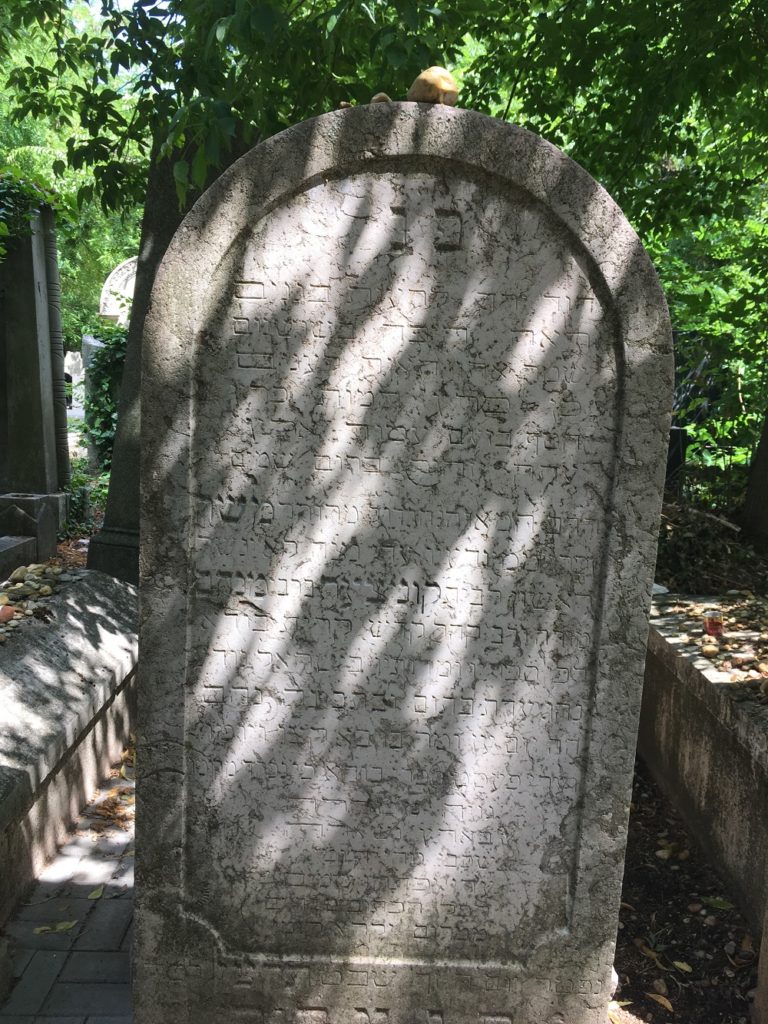
[5] I have been to R. Kunitz’s grave in Budapest many times. It is found together with the other communal rabbis, which is only natural as he served as a leading rabbi in both Buda and Pest. Here is a picture of the tombstone which I took a few years ago.


R. Leopold Greenwald, Mekorot le-Korot Yisrael(Humenne, 1934), p. 27, provided what he claimed is the text of R. Kunitz’s tombstone. But his version differs in a number of places from the original.

There are a few more points worth mentioning. R. Kunitz is the source that the Maharal (R. Kunitz’s forefather), recited the post-talmudic Birkat ha-Hamah without mentioning God’s name. See Kunitz, Ben Yohai, p. 141. Many halakhists know this report from R. Kunitz as it is mentioned by R. Akiva Eger in his note to Shulhan Arukh, Orah Hayyim 229.

R. Kunitz’s first volume of responsa, Ha-Metzaref, vol. 1, no. 20, contains a letter from R. Nathan Adler, which I believe is the only letter of his that ever appeared in print.

For previous discussions of R. Kunitz on the Seforim Blog, see Eliezer Brodt’s post here, and my posts here and here (in this post I include a previously unknown picture of R. Kunitz). See also Shimon Steinmetz’s post here that focuses on R. Kunitz’s responsa.

Those who are interested in R. Kunitz can also listen to my two classes on him here.

[6] (Jerusalem, 1990). This passage is also quoted by R. Jehiel Heilprin, Seder ha-Dorot (Bnei Brak, 2003), p. 412, Tannaim ve-Amoraim, s.v. יוסי בן קסמא

[7] Wars 3:7:21. This might be identical to the Rumah mentioned in II Kings 23:36. There is a tradition that none other than Reuben, the son of Jacob, was buried in Ruma, and other traditions include Gad and Benjamin as buried there. See Michael Ish-Shalom, Kivrei Avot (Jerusalem, 1948), pp. 104-105; Zvi Ilan, Kivrei Tzadikim be-Eretz Yisrael (Jerusalem, 1997), pp. 359-360; Avraham David, Al Bamatei Eretz ha-Tzvi (Jerusalem, 2013), p. 281.

[8] Sanhedrin 98a. This is the version in all manuscripts and older printings, before they were censored. See Dikdukei Soferim, ad loc.

[9] “Romanticising Rashbi: Moses Kunitz’s Ben Yohai,” Kabbalah 40 (2017), p. 75. My assumption was always that the main point of Ben Yohai was to defend the authenticity of the Zohar against R. Jacob Emden’s criticisms, and everything else in the book was secondary to this. However, Chajes shows that this is incorrect.


Rabbi Joseph Hertz, Women and Mitzvot, Antoninus, the New RCA Siddur, and Rabbis who Apostatized, Part 1

Rabbi Joseph Hertz, Women and Mitzvot, Antoninus, the New RCA Siddur, and Rabbis who Apostatized, Part 1

Marc B. Shapiro

1. In my last post here, in discussing R. Joseph Hertz’s suggested alternative text for Maoz Tzur, I wrote that this suggestion “was simply made up by Hertz or perhaps suggested by an unnamed collaborator on his siddur commentary.” At least one person wondered if I had anything in mind when I wrote about “an unnamed collaborator.” Indeed, these words were chosen deliberately. I do not know anything specifically about collaborators on the siddur commentary. However, we do know about the collaborators on his famous Torah commentary. This Chumash used to be found in every Modern Orthodox synagogue, and now, just like the Birnbaum siddur, it is missing from most of these synagogues.[1]

When it comes to what I will describe about the Hertz Chumash, it is possible that we are dealing with a great injustice. At the very least, it was a great misunderstanding between Hertz and his collaborators. Here are the Hebrew and English title pages of the Hertz Chumash.
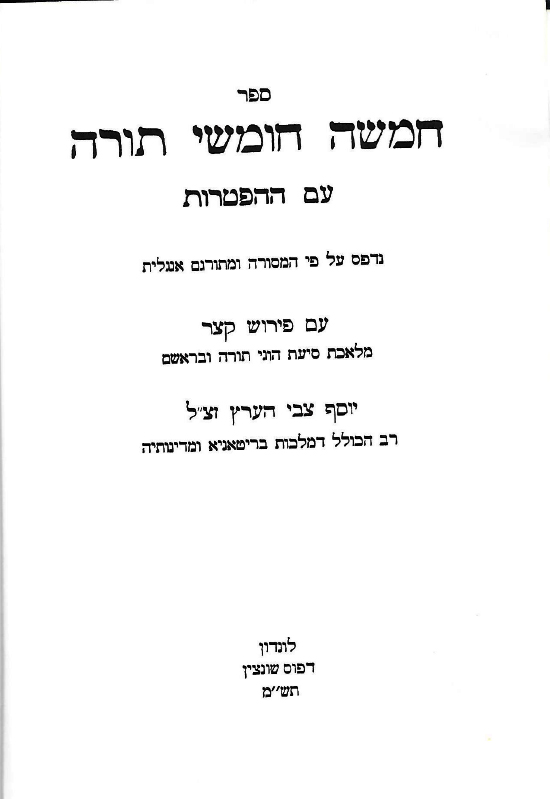
 

The English title page refers to the Chumash as edited by Hertz. The Hebrew title page, which most people don’t even bother looking at, even if they understand Hebrew, refers to a commentary that is the work of a group of Torah scholars headed by Hertz. These are quite different formulations.

Most people who have used the Hertz Chumash, even those who have used it for many years, will not know anything about this group of Torah scholars. Indeed, when people quote from this Chumash, Hertz is given exclusive credit for everything in it. Thus, when citing this Chumash’s commentary, people will say, “Hertz writes.” Yet is this correct?

If we turn to the Chumash’s preface, we learn that Hertz was assisted by J. Abelson, A. Cohen, G. Friedlander and S. Frampton. The first three individuals prepared the commentary to sections of the Torah (the exact sections are listed), and Frampton prepared the commentary to the Haftorahs. Hertz writes: “In placing their respective manuscripts at my disposal, they allowed me the widest editorial discretion. I have condensed or enlarged, re-cast or re-written at will, myself supplying the Additional Notes as well as nearly all the introductory and concluding comments to the various sections.” We see from this that Hertz had an important role, not just as editor, but in contributing content to the Chumash. Yet the commentary itself was not the product of Hertz. He was simply the editor of the material provided by the men mentioned above. In this role, he performed the regular task of an editor who takes texts and condenses and enlarges, re-casts or re-writes, but this editorial involvement does not make the editor the author.

We therefore have to wonder why it is that the men who labored so hard in creating the commentary are given no recognition, apart from the mention of their names in the preface which virtually no one bothers to read. As I already noted, the commentary to the Chumash is universally understood to have been written by Hertz when in fact most of it – other than the “introductory and concluding comments to the various sections” – is not his at all.

Now that the facts have been laid out, I don’t think anyone will be surprised to learn that Abelson, Cohen, and Frampton were not at all happy when the Chumash appeared and they were given no recognition for their labors on the title page. (Friedlander was no longer alive.) They thought that on the title page, following the mention of Hertz as the editor, it should have said something like, “With the collaboration of the Revs. Dr. A. Cohen, Dr. J. Abelson, the Rev. S. Frampton and the late Rev. G. Friedlander.” Hertz responded to their complaint that it had already been established at the initial stages of the planning of the Chumash that the contributors’ names would not appear on the title page.[2] In fact, this a major reason for R. Salis Daiches[3] withdrawing from collaboration on the project. (Obviously, Abelson, Cohen, and Frampton had a different understanding of how Hertz was supposed to acknowledge their work.) Daiches was also unhappy with Hertz’s “editorial policy of extensively rewriting and revising the installments submitted to him by the various annotators.”[4] Hertz later implausibly claimed that his revisions were “an incredible amount of labor, easily ten times the amount of my collaborators.”[5]

Another matter that must be noted is that in the preface found in the first volume of the first edition of the Chumash—it originally appeared in five volumes—Hertz writes that he supplied “nearly all the Additional Notes.” Yet in the one volume edition this sentence has been changed and the word “nearly” has been deleted, making Hertz the only author. Harvey Meirovich has called attention to this, and shows that the Notes dealing with evolution and sacrifices came from R. Isidore Epstein.[6]

I do not know why the following paragraph, which explains the method of the commentary and appeared in the preface to volume 1 of the first edition, was deleted from the preface of the one volume Chumash. This is exactly the sort of explanation of the commentary that the reader would find helpful.

Method of Interpretation: A word must be added as to the method chosen for leading the reader into what the Jewish Mystics called the Garden of Scriptural Truth. The exposition of the plain, natural sense of the Sacred Text must remain the first and foremost aim in a Jewish commentary. But this is not its only purpose and function. The greatest care must be taken not to lose sight of the allegorical teaching and larger meaning of the Scriptural narrative; of its application to the everyday problems of human existence; as well as of its eternal power in the life of Israel and Humanity. In this way alone can the commentator hope not merely to increase the knowledge of the reader, but to deepen his Faith in God, the Torah and Israel.

Also of interest is that the first edition of the Hertz Chumash includes maps which are not found in the one volume edition.

2. In my post here I mentioned that R. Shmuel Wosner defends the practice of women saying שלא עשני גוי and שלא עשני עבד instead of substituting the words גויה and שפחה. R. Yehudah Tesner agrees with R. Wosner and adds the following: If a woman would say שלא עשני גויה this would only mean that she does not want to be a non-Jewish woman. However, she might still prefer to be a non-Jewish man instead of a Jewish woman. Also, if she said שפחה it might only mean that she does not want to be a female maidservant, as this has two negative things, namely, that she is both a woman and enslaved.

שאין רצונה להיות שפחה, שיש בזה תרתי לריעותא, גם אשה וגם משעובדת

However, it might imply that if she could get rid of one of these negative things, i.e., the female, and be a male slave, that this might be acceptable to her. In order to prevent these misunderstandings, R. Tesner says that she must keep the standard text which includes women as part of גוי and עבד. This way she is thanking God that she is not a non-Jew, male or female, and that she is not a slave, male or female.[7]

There is no question in my mind that R. Tesner’s approach is somewhat convoluted and would never represent the thinking of any woman who recited the prayer. I only mention it because R. Tesner takes it for granted that it is better to be born as a Jewish man than a Jewish woman. Yet he also sees as obvious that it is still better to be a free Jewish woman than a male slave.

With regard to this latter point, it is of interest that R. Joseph Teomim states that there are a few things in which a male slave has an advantage over a woman:

עבד חשוב לענין קצת דברים . . . במקצת דברים עדיף מאשה

One of the things he mentions is that a male slave is circumcised, and circumcision is a great mitzvah given to men that women do not have the opportunity to fulfill.[8] This perspective is obviously very different than the outlook advocated by various kiruv speakers that while women are created perfect, men are created defective and thus need a berit milah to get them up to the level of women.[9] I have no doubt that if this argument was first made by someone who identified with Open Orthodoxy, that it would have been regarded as blasphemous for denigrating the commandment of circumcision.

Regarding women not having the opportunity to fulfill the great mitzvah of circumcision (and other mitzvot), I was surprised to find that R. Leon Modena, who was quite “modern” for his time, explains that this is because they do not rank very high in God’s eyes, which is another way of saying that women are simply unworthy of these mitzvot. Here are his misogynistic words:[10]

ומצינו שלא החשיב השי”ת בתורתו הנשים בשום אופן, ולא נתן להן אפי’ אות ברית במילה, ולא רוב מצוות עשה.

Apart from circumcision, it is a popular kiruv perspective that in general women are created with more spiritual perfection, and thus do not need all the mitzvot of men. R. Meir Mazuz attacks this position which he sees as absurd.[11]

דוגמא אחת  מהסילופים: המקשים מצביעים על ברכת “שלא עשני אשה”, והמתרצים מתפלפלים להוכיח שהאשה איננה צריכה כל כך סייגים וגדרים, כי מטבעה דיה במספר מועט של מצוות, ולכן היא מברכת בשמחה רבה “שעשני כרצונו” – שהקב”ה ברא אותה תמימה ושלימה שאיננה צריכה כל כך מצוות, והאיש מברך “שלא עשני אשה” – הוא על דרך שמברכין על הרעה כשם שמברכין על הטובה . . . [ellipses in original] ואילו היה כדבריהם, למה מברכין הנשים ברכת “שעשני כרצונו” בלי שם ומלכות . . . והאנשים מברכים “שלא עשני אשה” בשם ומלכות, ואדרבא איפכא מסתברא?! ובטור א”ח (סימן מ”ו) כתב שנהגו הנשים לברך שעשני כרצונו, ואפשר שנהגו כן כמי שמצדיק עליו את הדין על הרעה . . . ולדעת המתרצים הנ”ל אפשר לומר ג”כ שהגוים עדיפי מישראל, שאינם צריכים לתרי”ג מצוות רק לשבע דוקא, אתמהה.

To R. Mazuz’s words I would only add that if people find it problematic to say that men are created more perfect than women, why do they not find it also problematic to say that women are created more perfect than men? Should I have been offended when a woman once said to me that she is exempt from a number of mitzvot because women are on a higher spiritual level than men, as they are naturally more connected to God, while men can only achieve this connection through mitzvot? I am sure she would have been offended if someone said to her that women are on a lower spiritual level than men, as they are naturally less connected to God, and the evidence of this is that do not have as many mitzvot as men.[12] And what about Torah study? Can we say that men are only commanded to study Torah because they are not at the same spiritual level as women? This would be a complete inversion of the value traditionally assigned to Torah study.[13]

Yisrael Ben Reuven’s book, Male and Female He Created Them (Southfield, 1995), devotes a good deal of discussion to the kiruv perspective. On pp. 132, 133, he writes:

A number of recent books in English propose this idea of women’s spiritual superiority over men, and reportedly, the idea is taught as well in numerous schools for women. The reader should note that none of the books in question offer a classical source for the idea, and none of several teachers of the idea have been able to supply a source when interviewed by this author and numerous individuals known by the author. . . . [T]he teaching contradicts a principle from the Gemara that commandments are placed on a person as a result of his having spirituality (as opposed to his lacking it).

I believe that Ben Reuven is correct in noting that attributing this notion to the Maharal is a mistake. Yet I disagree with his discussion of the view of R. Samson Raphael Hirsch, as Hirsch indeed suggests that women are not commanded in the positive time-bound commandments because they do not need them, for they, by nature, have “greater fervour and more faithful enthusiasm for their God-serving calling.” Contrary to Ben Reuven, doesn’t this mean that they are created with a superior innate spirituality? Men, on the other hand, according to Hirsch, can only reach their spiritual potential through the mitzvot. Hirsch includes circumcision as one of the commandments that men need because they are by nature on a lower spiritual plane then women.[14]

R. Zvi Yehudah Kook also thinks that women are inherently spiritually superior to men. The problem is that men don’t realize this. However, R. Zvi Yehudah claims that in Messianic days when men will understand the truth, they will no longer be able to able to make the blessing שלא עשני אשה, as they will see that women are superior to them.[15]

במצב העכשווי האיש יותר חזק בגופו, ומתוך כך בפרקטיקה האנושית. הוא אקטיבי יותר בכל החיים המעשיים. יש הרגשה שהוא תופס יותר מקום. הרגשה זו היא לפי המדריגה האנושית, והברכות נקבעו על פי ההרגשה האנושית היחסית. זאת התפיסה האנושית הרגילה, והברכה מתייחסת למציאות זו. משום כך אומר האיש כהרגשתו “שלא עשני אשה”, שהרי זו האמת היחסית, והאשה מברכת “שעשני כרצונו”. אך, כאמור, זו תפיסה אנושית חלקית, וההרגשה היא רק עניין יחסי של מצב עכשווי נתון, אמת נוכחית.

לעומת זאת, ההשקפה האלהית, האמת המוחלטת, אינה ענין של הרגשה חולפת, אלא האמת הנצחית מראשיתה ועד סופה. לעתיד לבוא, כאשר גם האדם יכיר את האמת, ויהיה כולו מבחינת “הטוב והמטיב”, לא יוכל לברך “שלא עשני אשה”, שהרי אז יכיר שבניינה של האשה יותר רם, יותר אלהי ופחות אנושי, ממצבו הוא.

For virtually all, the approaches suggested by Hirsch and R. Zvi Yehudah Kook in which women are created more perfect than men would have been inconceivable in pre-modern times. One possible exception, and the only exception I know of, was the sixteenth-century R. Gedaliah Ibn Yahya, author of Shalshelet ha-Kabbalah. He actually enumerates numerous ways in which women are superior to men. He also claims that women are not intellectually inferior to men, and they can thus understand all the wisdoms of the world. In the sixteenth century, this was a very radical position.[16]

Regarding women, R. Yonason Rosman called my attention to the following. The ArtScroll Chumash, p. 1086 (beginning of parashat Nitzavim) states:

On the last day of his life, Moses gathered together every member of the Jewish people, from the most exalted to the lowliest, old and young, men and women, and initiated them for the last time into the covenant of God. What was new about this covenant was the concept of ערבות responsibility for one another, under which every Jew is obligated to help others observe the Torah and to restrain them from violating it. This is why Moses began by enumerating all the different strata of people who stood before him, and why he said (v. 28) that God would not hold them responsible for sins that had been done secretly, but that they would be liable for transgressions committed openly (Or HaChaim).

According to the ArtScroll summary, R. Hayyim Ben Attar, the author of Or ha-Hayyim, states that women are obligated in ערבות. But is this really what he says? Here is his commentary to Deuteronomy 29:9:

R. Hayyim ben Attar actually says the exact opposite of what appears in the ArtScroll summary, in that he states that women are not obligated in ערבות, and they are grouped together with children and proselytes. R. Ben Attar tells us that children are not obligated because they do not have the requisite understanding for such an obligation. Proselytes are not obligated because it is not their place to be rebuking, and thus exercising authority over, those who were born Jewish.[17] Why are women not obligated? R. Ben Attar writes:

ואין הם נתפסים על אחרים שהטף אינם בני דעה והנשים כמו כן הגרים גם כן אין להם להשתרר על ישראל

The sentence is ambiguous, and it all depends on where you put the comma. Here is one way to read the sentence:

ואין הם נתפסים על אחרים שהטף אינם בני דעה והנשים כמו כן, הגרים גם כן אין להם להשתרר על ישראל

If you place the comma after the words והנשים כמו כן, the sentence seemingly means that women are just like children in not having the requisite understanding of the various sins to be obligated in ערבות. R. Yaakov Hayyim Sofer finds it incomprehensible that R. Ben Attar would say that women’s level of understanding is comparable to that of children.[18] He therefore explains that when R. Ben Attar says והנשים כמו כן, he only means to say that the law for women is like the law for children, but not that the reason is the same.

You can also place the comma after the words אינם בני דעה so that one reads the sentence this way:

ואין הם נתפסים על אחרים שהטף אינם בני דעה, והנשים כמו כן הגרים גם כן אין להם להשתרר על ישראל

Now the sentence means that children do not have the requisite understanding to be obligated in ערבות, and women are like proselytes in that it is not their place to be rebuking, and thus exercising authority over, Jewish men. Although this is how R. Avraham Sorotzkin understands the Or ha-Hayyim,[19] I find it difficult as the second half of the sentence does not read well this way.

3. In my post here I referred to Nero and Antoninus and their supposed conversions to Judaism. The Talmud, Gittin 56a, indeed states that Nero converted, and it adds that R. Meir was descended from him. Soncino’s note to the passage reads: “This story may be an echo of the legend that Nero who had committed suicide was still alive and that he would return to reign (v. JE IX, 225).” The Koren Talmud’s note, which is a translation of what appears in Steinsaltz, states that the talmudic story cannot be referring to the famous Nero: “The Roman emperor Nero was killed under strange circumstances and after his death rumors circulated that he was not actually killed but had taken refuge elsewhere.” The note continues that even though Nero is referred to in the passage in Gittin 56a as ,נירון קיסר the story actually refers to another person who was an officer in the Roman army in the campaign against Judea. This person’s name was also Nero, and since he was from the larger Caesar family, he too was called Nero Caesar. This explanation apparently first appears in Seder ha-Dorot.[20]

Graetz thought that the story of Nero converting was part of a rabbinic polemic against Christianity, while Bacher “attributed the origin of the legend to the view which considers the power of Judaism to be so great, that even its greatest enemies become converts either themselves, or, at any rate, their descendants.”[21]

Let me offer another way of explaining the story of Nero’s conversion, which I have not seen anyone else suggest. Josephus tells us that the Jews put up a wall in the Temple to prevent King Agrippa from viewing the sacrificial service. This upset both Agrippa and the Procurator, Festus, and Festus ordered that the wall be torn down. The Jews decided to go over Festus’ head and turned to Nero. Nero’s wife, Poppaea Sabina, pleaded their case, and as a favor to his wife, Nero ordered that the wall should stay.

Why would Poppaea plead the case of the Jews? Josephus tells us that she was a “God-fearer.”[22] Whatever the exact connotations of this term, which has been greatly discussed, she was clearly a sympathizer of the Jews. Josephus tells us that on another occasion she helped secure the release of some Jews who had been placed in prison in Rome. He also tells us that that Poppaea gave him many presents.[23] Could it be that originally the story about the conversion of Nero was said about his wife, and that in the hundreds of years before it was recorded in the Talmud, it was transferred to Nero himself?

As for the Emperor Antoninus, who was friends with R. Judah ha-Nasi, we do not know who this refers to as the title Antoninus was used for various emperors.[24] However, I want to call attention to a different point. In Sefer Yuhasin ha-Shalem, ed. Filipowski, p. 115, in listing the talmudic sages, R. Abraham Zacut includes a “Rabbi Antoninus”. Where does he get such a name? As he indicates, it comes from Mekhilta de-Rabbi Yishmael, and there are actually two separate references there to R. Antoninus.[25] The first reads:[26]

[א”ר אנטונינוס למלך שהוא דן על הכימה [הבימה

The second reads:[27]

…ר’ אנטונינוס אומר ג’ היו והוסיף עליהם עוד אחד והיו ד’

R. Antoninus is being cited as the source for halakhic teachings. Yet the text is corrupt, as was already pointed out by the Vilna Gaon. He emended both passages so that while Antoninus is mentioned, he is not identified as a rabbi.[28]Thus, in the first passage the Vilna Gaon emended it to read:

 [אמר רבי אנטונינוס המלך שהוא דן על הכימה [הבימה

The second passage he emended to read:

רבי אומר ג’ היו הוסיף עליהם עוד אחד והיו ד’ הוסיף אנטונינוס עוד אחד והיו ה’

While the Vilna Gaon may have only sensed intuitively that the text was corrupt, manuscript evidence exists that offers versions similar to or identical with that suggested by the Vilna Gaon.[29]

As for the conversion of Antoninus, R. Solomon Judah Rapoport argues that this is a late, and non-historical, aggadah.[30] He points to a passage in the Jerusalem Talmud, Megillah 1:11, which shows that it was not clear whether Antoninus converted.

אית מילין דאמרין דאתגייר אנטונינוס ואית מילין אמרין דלא אתגייר אנטונינוס

Nevertheless, despite these words, the continuation of this talmudic passage records that he did in fact convert. This is also the conclusion in the Jerusalem Talmud, Sanhedrin 10:5. However, the matter is still not clear, since regarding the Megillah text the Leiden manuscript has a different version which leaves the matter of Antoninus’ conversion undecided.[31] Furthermore, as Shaye J. D. Cohen writes, “the Bavli clearly implies that Antoninus was not a convert, unlike the Roman dignitary Qetia who was.”[32] Cohen also calls attention to Yalkut Shimoni: Isaiah, no. 429, which states that Antoninus was one of the tzadikei umot ha-olam, that is, not a convert.

R. David Zvi Hoffmann examined the various aggadot regarding R. Judah ha-Nasi and Antoninus. With regard to most of them he concludes that they arose in Babylonia long after the events described, and that “it is difficult to find a historical core to them.”[33]He does not tell us whether he regards these stories as simply legends that arose from the people or if they should be seen as didactic tales no different than the numerous other aggadot that describe actions and dialogues of various biblical figures, matters that were also never intended to be taken as historical. R. Hoffmann also discusses how the notion of Antoninus actually converting to Judaism developed from earlier sources that only regard him as a “God fearer.”[34]

Regarding referring to people as rabbis when they do not deserve the title, such as Rabbi Antoninus, here is another interesting example that I believe was pointed out to me many years ago by Prof. Shnayer Leiman. When R. Jonathan Eybeschuetz’s Luhot Edut was reprinted in 1966, the publisher helpfully added an index of names at the back. What seems to have happened is that he went through the index putting “Ha-Rav” before all the names, and mistakenly added this title before Shabbetai Zvi’s name.

When the book was reprinted again by Copy Corner in the 1990s, they fixed this mistake and added שר”י.

It is interesting that in Solomon Zeitlin’s review of Gershom Scholem’s biography of Shabbetai Zvi, he criticizes Scholem for referring to Nathan of Gaza as “Rabbi Nathan.”[35] Had Scholem wished to defend himself from an Orthodox perspective, he could have pointed to the fact that decades after Nathan’s death (and also after Shabbetai Zvi’s death), one of the leading rabbis in Salonika, R. Solomon ben Joseph Amarillo (died 1722), refers to Nathan as הרב הקדוש מהר”ר נתן [36].אשכנזי ז”ל R. Joseph Molho (1692-1768), another leading rabbi in Salonika, refers to Nathan as הרב נתן ז”ל.[37] This positive reference to Nathan is found in R. Molho’s response to R. Solomon ben Isaac Amarillo, who also referred to Nathan this way.[38] In his famous work, Shulhan Gavoah, R. Molho refers to Nathan as follows: וכן קבלו מהרב נתן אשכנזי ז”ל המקובל האלהי.[39] I was surprised to see that in the new edition of Shulhan Gavoah (Jerusalem, 1993), this appears without any censorship, which presumably means that the editor did not know who R. Nathan Ashkenazi is. One final example: The famed R. Moses Zacuto (c. 1620-1697) refers to Nathan as הרב המופלא כמהר”ר נתן הידוע זלה”ה.[40]

Those who are interested in rabbinic history are familiar with R. Naphtali Yaakov Kohn’s nine volume Otzar ha-Gedolim. In vol. 4, p. 125, we find an entry for none other than the notorious Spanish apostate, Joshua Lorki, and his name is followed by שר”י ימ”ש.

Why is such a person included in a book of “gedolim”? The author explains that before he apostatized, he was a rabbi. (I do not believe this is correct. I have never before seen him described as a rabbi and know of no evidence to support such an assumption.) One can easily understand that even if someone was a rabbi, if he later converted, or became a Reform rabbi for that matter, including him in a book of “gedolim” is not going to sit well with many. This is so even though most of the rabbis included in the book are far from what one can consider “gedolim” in the way the term is used today.

Kohn did not print any letters or haskamot in the first four volumes of his work. These first appear in volume 5, and are from such varied figures as R. Joel Teitelbaum and the Chief Rabbis of Haifa. Kohn also includes a four-page letter from R. Yekutiel Yehudah Halberstam, the Klausenberger Rebbe. R. Halberstam saw the entry for Lorki and was very upset. He writes that just as no one would dream of including Dathan and Abiram among the great Jewish leaders, all the more so one should not include Lorki among the rabbis of Jewish history. He further asks, rhetorically, if אותו האיש ימ”ש שר”י   should also be included because he was a student of R. Joshua ben Perahiah?

R. Halberstam is even upset that the book includes an entry for Lorki’s father, and unfairly wonders what type of man he must have been if his son turned out this way. (I say “unfairly” since there are many examples of pious people whose children ended up very differently.) Finally, R. Halberstam makes the following strong point to Kohn: If you are going to sayyemah shemoafter someone’s name, then it has to actually mean something. By including an entry for Lorki in the book, not only are you not blotting out his name, but you are doing the exact opposite by preserving his name for all to see.

ובאמת שאצל המומר לורקי כתב כת”ה בתר שמו ימ”ש שר”י. אבל זה לא רק להלכה אלא גם למעשה ואם אומרים ימח שמו א”כ איך חוקקים שמו להזכירו בזכרון קדוש אחרי שבע מאות שנים?

Kohn thought that it was OK to include an entry for Lorki because he was a rabbi before he apostatized. With this logic it would be OK to also study the Torah works of rabbis who later apostatized, since these works were written before their apostasy. (In part 2 of this post I will deal with rabbis who published seforim and then apostatized.)

5. In my last post here, I wrote that the new RCA siddur will come to be the standard siddur at hundreds of synagogues for decades to come. This was a reasonable conclusion to reach, since ArtScroll is no longer allowed to sell the RCA ArtScroll siddur which has become the standard at Modern Orthodox synagogues. Thus, when these synagogues need to purchase new siddurim – and these siddurim must have the prayers for the State of Israel and the IDF – they would naturally buy the new RCA siddur. Yet it seems that I was mistaken, as I did not anticipate ArtScroll’s response to its anticipated enormous loss of revenue. Here is the ad that many of you have already seen.

ArtScroll is continuing to sell the RCA siddur, minus the name “RCA” on the cover and Rabbi Saul Berman’s introductory essay. Instead of being the RCA edition, this siddur is now called the “Synagogue Edition.” This is designed to ensure that Modern Orthodox synagogues, when they need to buy new siddurim, continue purchasing the ones congregants are used to.

This move by ArtScroll is obviously a serious threat to the success of the new RCA siddur, as the typical Modern Orthodox synagogue will probably find it easier just to buy the new “Synagogue Edition.” It is going to take a lot of effort from the RCA to ensure that the new siddur becomes accepted across America, and only time will tell who will win the battle for the loyalty of the Modern Orthodox synagogues. I don’t know the details of ArtScroll’s contract with the RCA, so I can’t say if what ArtScroll has done is illegal. It certainly appears unethical.

When the original ArtScroll siddur appeared some thirty-five years ago, it immediately caught on, so much so that today it is hard to find an English-speaking Orthodox home that does not have an ArtScroll siddur. This is an enormous historical achievement. However, there was an obvious lack in that the classic ArtScroll siddur did not include the prayers for the State of Israel and the IDF. This meant that it could never be adopted as the siddur for Modern Orthodox synagogues. There were many people who were upset with ArtScroll for not including these prayers. Would it have been so difficult for ArtScroll to have included them with the note that “Some congregations recite these prayers”? In a siddur that found room to include Gott fun Avrohom at Havdalah, for the tiny population of ArtScroll siddur-users that says it, why could it not include prayers recited by many thousands every Shabbat? They could also have put these prayers in the back of the siddur, with the Yotzerot that today hardly anyone says. These steps would have made for an inclusive siddur, and there never would have been a need for the RCA ArtScroll Siddur.

We were led to believe that as a matter of principle, as dictated by ArtScroll’s gedolim, the prayers for the State of Israel and the IDF could not be included. It was thus a surprise that ArtScroll agreed to include these prayers in the RCA edition of the ArtScroll Siddur. The RCA recognized that everyone was moving over from Birnbaum to ArtScroll, and therefore it made sense to produce a Religious Zionist version of ArtScroll. How was ArtScroll able to include the religiously objectionable prayers? Obviously, the reason was money, but there was also deniability, as people could say that it wasn’t actually an ArtScroll siddur. Rather, it was an RCA siddur using the text of ArtScroll, so in this way ArtScroll wasn’t implicated as a partner in religious Zionism and its objectionable prayers.

With the publication of the new “Synagogue Edition” siddur, we now have a situation where ArtScroll itself is publishing a siddur with the prayers for the State of Israel and the IDF. In other words, ArtScroll is publishing a Religious Zionist text. This is definitely news. You can be as cynical as you wish in explaining why when it comes to making lots of money from Modern Orthodox synagogues, Daas Torah can be pushed aside, but it is significant that a so-called haredi publishing house has broken with haredi standards in such a significant way. Nevertheless, I hope that Modern Orthodox synagogues will realize that there is a great difference between the old RCA ArtScroll siddur, which is just the standard ArtScroll siddur with a few extra pages, and the new RCA Siddur which, in its ideological outlook and historical sophistication, is a siddur perfectly suited for today’s Modern Orthodox community.

6. Rabbi Pini Dunner recently publishedMavericks, Mystics and False Messiahs, and I know readers of the Seforim Blog will find it a wonderful read. If you have ever watched any of Dunner’s videos, you know that no one can tell a story like him. The figures and events he discusses (Samuel Falk, Emden-Eybeschuetz dispute, ClevesGet, Lord George Gordon, R. Yudel Rosenberg, Ignatz Timothy Trebitsch-Lincoln) are ones that are perfectly suited for his skill in this area. Readers should not go to this book looking for new discoveries of the sort that he has spoken about in some of his online lectures. Some people will have even read the published works upon which the chapters are based (e.g., Scholem, Leiman, Wasserstein). These sources are discussed in the concluding chapter which is itself fascinating, especially for those who love books. I heartily recommend the book even for those who know the original sources, because no one can bring a story to life quite like Dunner.

There is one thing, however, that I wish had been explained by Dunner. In the longest chapter of the book, dealing with the Emden-Eybeschuetz dispute, there are lengthy dialogues recorded between different people. We also read about when individuals smiled, when they gasped, when they turned pale, when their voice was shaky, when tears flowed down their cheeks, when they sat upright in bed, etc. Occasionally, we find this also in other chapters. Since all this is made up by Dunner (and with regard to the Emden-Eybeschuetz dispute could even be the beginnings of a movie storyline), it would have been helpful for some discussion as to why he decided to spice up the book this way. The most we get is that in the concluding chapter (p. 172), Dunner tells us that portions of the book “have been written in a style that has much more in common with dramatic fiction than with non-fiction history, including details of private conversations, and descriptive elements that may cause readers to wonder about their accuracy.” Yet the reader is never told why Dunner sometimes adopts this approach and at other times he sticks to the facts.

The chapter on the Emden-Eybeschuetz dispute includes as part of the story the legendary account of how R. Emden, on his deathbead, said, “Barukh haba, my revered father, barukh haba, Rabbi Yonatan.”[41] This was understood to mean that he was finally reconciled with his longtime adversary, and explains why they were buried in the same row. Unless one reads the concluding chapter of the book, which deals with the sources, the reader will have no way of knowing that there is no historical basis for this tale. It is attributed in the original source to R. Abraham Shalom Halberstam of Stropkov (1857-1940), though he presumably was repeating a tradition he had heard. The story was obviously invented to create a posthumous peace between the two great rabbis.

I realize that what I have described is part of the liberties taken by any good storyteller. However, anyone who reads the book will wonder why the Emden-Eybeschuetz chapter in particular, which freely mixes fact with fiction, is written in such a different style than the other chapters, which stick much more closely to what the evidence tells us. Dunner has shown that he can be both expert storyteller and historian, but speaking as a fellow historian, my preference would have been not to mix these genres in one book.

[1] Regarding the Hertz Chumash, see the articles by Mitchell First here, and Yosef Lindell here.

[2] See Harvey Meirovich, A Vindication of Judaism: The Polemics of the Hertz Pentateuch (New York and Jerusalem, 1998), pp. 187-189.

[3] Unlike the other contributors, Daiches was actually a rabbi (something not so common in Britain at the time). He received semikhah from the Rabbinical Seminary of Berlin as well as from his father, the great R. Israel Hayyim Daiches, R.  Solomon Cohen of Vilna, and R. Ezekiel Lifshitz of Kalisz. See Hannah Holtschneider, “Salis Daiches –  Towards a Portrait of a Scottish Rabbi,” Jewish Culture and History 16 (2015), p. 4. Holtschneider’s biography of Daiches will be out later this year. See here. The famous author David Daiches was his son, and his book Two Worlds (Edinburgh, 1997) has a lot about Salis Daiches. Here are some passages that I think readers will find of interest, as it speaks to the differences between what it meant to be an Orthodox rabbi in Britain a century ago vs. today.

Pp. 29-30: The electric radiator – which did, I suppose, make some difference, though memory links it only with extreme cold – could be switched on and off on the sabbath, as the electric light also could, in accordance with a decision of my father’s which differentiated his position sharply from that of my grandfather, patriarchal rabbi of an orthodox Jewish congregation in Leeds, who would have been shocked if he had known how cavalierly we treated electricity. Gas light or heat, which required the striking of a match, was another matter that was clearly prohibited. But electricity was a phenomenon unrecognized by the Talmud, and my father felt free to make his own interpretation of the nature of the act of switching on the electric light or heat. He decided that it was not technically ‘kindling a fire’, which a biblical injunction prohibits in the home on the sabbath.”

Pp. 81-82: “For years we travelled with our own meat dishes (for we could not eat off the meat dishes of a non-Jewish house) and Mother had supplies of meat sent out by post from the Edinburgh Jewish butcher. Packing a trunk full of dishes was an arduous business, and eventually Mother gave it up and we went vegetarian throughout August – which was no hardship for Mother could do marvelous things with fish (the term vegetarian in our family meant simply eating no meat but did not exclude fish). Slowly and gradually, and I am sure never consciously on my parents’ part, we relaxed a bit in the matter of diet. When she was first married Mother baked all her own bread, but ceased to do this after her illness in 1919. And on holiday one found oneself going a little further than one would have done in the city. In Edinburgh, we usually ate bread from the Jewish bakery, but occasionally we would get a loaf from a non-Jewish shop. Cakes and biscuits we regularly got from non-Jewish sources. But though Mother would buy ordinary cakes from a non-Jewish baker, she would always make her own pastry, for pastry from a gentile shop was liable to have been made with lard. On holiday, however, pastries started to creep in among the cakes bought for tea, and nobody raised the question of what they were made with.”

I am certain that Daiches is mistaken in his last sentence, and that his father confirmed with the bakery that there were no non-kosher ingredients in these pastries.

Pp. 92: “At home we always covered our heads to pray, and to say grace before and after meals, but we were never expected to keep our heads covered continually. My father wore a black skull cap when receiving members of his congregation in his study, but as the years went by he developed the habit of keeping it in his pocket throughout much of the day and diving hastily for it when the bell rang. In his father’s presence he wore it continually.”

Pp. 174, 176: The rabbi did not believe in a literal personal Messiah; he believed in historical movements, in progress, in amelioration, and in the acceleration of movement in the right direction by the actions of individuals. . . . The Messiah was not a person, but a historical ideal. God, the rabbi was in the habit of telling his congregation, works in history.”

Pp. 175-176: “The priestly benediction recited on High Festivals, when all the Cohens assembled to bless the congregation in the old biblical words of benediction, had been abolished by the rabbi in his Sunderland synagogue and he would not allow it in Edinburgh either.”

[4] Meirovich, A Vindication of Judaism, p. 31.

[5] Meirovich, A Vindication of Judaism, p. 33.

[6] Meirovich, A Vindication of Judaism, pp. 41ff.

[7] Siah Tefilah (Ofakim, 2003), p. 361.

[8] Mishbetzot Zahav, Orah Hayyim 46:4.

[9] See Excursus which will be in part 2 of this post.

[10] Magen ve-Herev, ed Simonsohn (Jerusalem, 1960), p. 47.

[11] See his derashah in R. Rephael Kadir Tsaban, Nefesh Hayah (Bnei Brak, 2007), vol. 2, pp. 269-270.

[12] See e.g, Derashot Rabbi Yehoshua Ibn Shuaib (Cracow, 1573), p. 48a:

כי נשמתן של ישראל הן קדושות יותר מן האומות ומן העבדים הכנעניים הפחותים ואפילו מן הנשים ואם הם שייכי במצות והן מזרע ישראל אין נשמתן כנשמת הזכר השייך בתור’ ובכל המצות עשה ולא תעשה.

[13] R. Shlomo Aviner, in discussing this matter, does not go so far as to say that men are obligated in Torah study because they are not at the same spiritual level of women. However, he comes close, and he is led to this approach because of his understanding of Torah study as leading to devekut, a position which is at odds with the Lithuanian perspective on Torah study. See Aviner, Bat Melekh (Jerusalem, 2013), p. 104:

שאלה: מדוע האשה, שניחנה בבינה יתרה, אינה מחוייבת בלימוד תורה?

תשובה: האיש, שאין בו בינה יתרה, דווקא הוא צריך להרבות בלימוד, אך האשה, שיש לה בינה יתרה, מבינה גם ללא הלימוד הרצוף והממושך. המהר”ל מסביר, שמי שיש לו נטיה טבעית לדבר, הוא משיגו בנקל. ללא נטיב טבעית יש צורך בעמל רב. לאשה באופן טבעי יש נטיה, שהאיש צריך לעמול עליה קשה (מהר”ל, דרוש על התורה עמ’ כז-כח). אלא, עמל לימוד התורה אינו איסוף ידיעות, בעומק הנפש, ודבקות בתורה. האיש הוא קשה עורף, מתקשה לשמוע לכן יש להכותו בגידים (שמות רבה כח ב. רש”י, שמות יט ג), בשוט השכלי של הלימוד. מי שניחן בנטיה טבעית לתורה אינו זקוק ל”גידים” כדי שתחול בו אותה תמורה פנימית, והיא מגיע אליו ביתר קלות . . . זו נטיה עמוקה באישיות האשה, לכן היא מגיעה לדבקות וקישור והתמלאות בתורה בנתיבים שונים מן האיש. האיש מגיע לדבקות זו בנתיב הלימודי, והאשה בנתיב ספיגת הדברים מן החיים.

See here from a Chabad site where we are told that “the female child inherently carries a higher degree of holiness, due to her own biological, life creating capability.” Would anyone today write the same sort of comment, but instead state that the male child has a higher degree of holiness? Faced with a situation where many people believe that women are regarded as inferior in traditional Judaism, defenders of Judaism are often led to offer apologetic answers that argue the reverse, namely, that it is actually women who are more special, spiritual, holy, etc. than men.

In my experience, men never seem to be offended when they hear this. One haredi friend explained to me that this is because the men do not believe it to be true, and thus no reason to be offended if it makes the women feel better. This is a cynical answer, but can anyone come up with a better reason? Imagine the scenario: A Shabbat meal with many guests and the father offers a devar Torah whose upshot is that men are more holy and spiritual than women. This will not go over well and the women (and some men also) will be offended. Yet if the message of the devar Torah is that women are more holy and spiritual, no one will take offense. Why not? And my more basic question is, why we can’t just say that men and women are equally holy and spiritual (albeit with different roles)? Why do people feel a need to say that one is more special than the other?

All this is in the realm of Jewish thought. However, when it comes to explaining halakhic matters in which women might be portrayed in a way that they would take offense at, here too new approaches must be offered. For example, can anyone imagine explaining to modern women why they cannot perform shechitah by telling them what R. Joseph Messas quotes from manuscript from the nineteenth-century R. Jacob Almadyoni (spelling?) of Tlemcen, Mayim Hayyim, vol. 2, Yoreh Deah no. 1?

אין להניח הנשים לשחוט ואפי’ בדיעבד ראוי להחמיר שאף המכשירין יודו האידנא שאין דעת נשי דידן מכוונות כדעת נשי דידהו. ואם על נשיהם אמרו אין חכמה לאשה אלא בפלך [יומא דף ס”ו ע”ב], קו”ח לנשי דידן

[14] See Hirsch’s commentary to Lev. 23:43, and regarding women and circumcision, see also Hirsch to Gen. 17:15. The most comprehensive discussion of Hirsch’s view of women and Judaism is found in Ephraim Chamiel, The Middle Way (Brighton, MA, 2014), vol. 2, pp. 152ff. On p. 153 he titles the section of a chapter: “Revolution: Women are Superior to Men.” Hirsch obviously opposed the notion found in R. David Abudarham that the reason women are not obligated in positive time-bound commandments is because they are “enslaved” to their husband to do his will, and if they were busy performing these commandments they could not serve him properly and this would create marital discord. See Abudarham ha-Shalem (Jerusalem, 1963), p. 25:

והטעם שנפטרו הנשים מהמצות עשה שהזמן גרמא לפי שהאשה משועבדת לבעלה לעשות צרכיו. ואם היתה מחוייבת במצות עשה שהזמן גרמא אפשר שבשעת עשיית המצוה יצוה אותה הבעל לעשות מצותו ואם תעשה מצות הבורא ותניח מצותו אוי לה מבעלה ואם תעשה מצותו ותניח מצות הבורא אוי לה מיוצרה לפיכך פטרה הבורא ממצותיו כדי להיות לה שלום עם בעלה.

The same reason is offered by R. Jacob Anatoli, Malmad ha-Talmidim (Lyck, 1866), pp. 15b-16a:

לפי שהנקיבה היא לעזר הזכר ואל אישה תשוקתה והוא ימשל בה להנהיגה ולהדריכה בדרכיו ולעשות מעשה על פיו והיותה על הדרך הזה הוא גם כן סבה שהיא פטורה מכל מצות עשה שהזמן גרמא כי אלו היתה טרודה לעשות המצות בזמן היה הבעל בלא עזר בזמנים ההם והיתה קטטה נופלת ביניהם ותסור הממשלה המכוונת שהיא לתועלתו ולתועלתה.

R. Ahron Soloveichik adopted an approach similar to that of Hirsch. He claimed that Judaism “recognizes the feminine gender as possessing an innate, unique spiritual blessing as compared with the male gender. . .  [T]he woman has innate spiritual advantage as compared with men.”Logic of the Heart, Logic of the Mind(Jerusalem, 1991), p. 93.

[15] Itturei Kohanim, no. 167 (5759), 4-5; R. Aviner, Panim el Panim (Jerusalem, 2008), p. 194. Significantly, R. Zvi Yehudah’s explanation acknowledges that the blessing שלא עשני אשה implies male superiority. While this was a common understanding in pre-modern times, in recent generations this interpretation was usually rejected. Yet R. Zvi Yehudah claims that the blessing’s formulation was a concession to human feelings. Does this then mean that if a contemporary man recognizes the superiority of women, or even just that they are equal to men, that according to R. Zvi Yehudah he can stop saying this blessing?

[16] See Avraham Grossman “Ma’alot ha-Nashim ve-Adifutan be-Hibur shel R. Gedaliah Ibn Yahya,” Zion 72 (2007), pp. 37-61.

[17] R. Simhah Bunim Lieberman raises a strong objection to Or ha-Hayyim‘s position. See Bi-Shvilei Orayta al Kol Yisrael Arevim Zeh la-Zeh, p. 124:

אבל האמת דעצם דברי האור החיים צ”ע, דאטו מוכיח יש בו שררה, וכי מצאנו איסור לגר להוכיח ישראל שחטא

[18] Edut be-Yaakov, vol. 2, p. 164.

[19] See R. Avraham Sorotzkin, Rinat Yitzhak, Deut. 29:10.

[20] R. Yehiel Heilprin, Seder ha-Dorot (Bnei Brak, 2003), vol. 1, p. 251.

[21] Naomi G. Cohen, “Rabbi Meir, A Descendant of Anatolian Proselytes,” Journal of Jewish Studies 23 (1972), pp. 54-55. Cohen also provides the Graetz reference.

[22] Antiquities 20.8.11.

[23] Life of Flavius Josephus, ch. 3. See A. Andrew Das, Solving the Romans Debate (Minneapolis, 2007), pp. 77ff.; Louis H. Feldman, Jew and Gentile in the Ancient World (Princeton, 1993), p. 351.

[24] R. Maimon ben Joseph (the father of Maimonides), Iggeret ha-Nehamah, trans. Binyamin Klar (Jerusalem, 2007), p. 38, states:

וכבר אמר פעם אחת אחד ממלכי רומי – קללה תבוא על כולם, חוץ מאחד רם המעלה המובדל מהם, הוא אנטונינוס שהיה בדורו של רבנו הקדוש ע”ה.

[25] R. Yehiel Heilprin, Seder ha-Dorot, vol. 2, p. 138, has a version of the Mekhilta that reads Antigonos, and he therefore identifies a “Rabbi Antigonos”.

[26] Beshalah, hakdamah. In the edition with the Netziv’s commentary it is on p. 79.

[27] Beshalah, parashah 1. In the edition with the Netziv’s commentary it is on p. 111.

[28] Surprisingly, Abraham Joshua Heschel did not take note of the Vilna Gaon’s emendation, and cited one of the Mekhilta texts as is. See Torah min ha-Shamayim be-Aspaklaryah shel ha-Dorot (London and New York, 1962), p. 183 n. 3.

[29] See the Horovitz-Rabin edition of the Mekhilta, pp. 82, 89.

[30] See Rapoport, Erekh Milin (Prague, 1852), p. 270.

[31] See the comprehensive discussion in Shaye J. D. Cohen, “The Conversion of Antoninus,” in Peter Schäfer, ed., The Talmud Yerushalmi and Graeco-Roman Culture (Tübingen, 1978), pp. 141-171.

[32] “The Conversion of Antoninus,” pp. 164-165.

[33] “Die Aggadot von Antoninus in Midrash und Talmud,” Magazin für die Wissenschaft des Judenthums 19 (1892), p. 46.

[34] “Die Aggadot von Antoninus in Midrash und Talmud,” pp. 51-52.

[35] See Jewish Quarterly Review 49 (1958), p. 153.

[36] Penei Shlomo (Salonika, 1717), p. 43d.

[37] Ohel Yosef (Salonika, 1756), no. 14 (p. 13a).

[38] Devar Moshe (Salonika, 1750), vol. 3, no. 11 (p. 8a). The three sources just cited are mentioned by Meir Benayahu, Ha-Tenuah ha-Shabta’it be-Yavan (Jerusalem, 1978), pp. 191, 274-275.

[39] Shulhan Gavoah (Salonika, 1756), Orah Hayyim, vol. 2, Hilkhot Yom ha-Kippurim 620 (p. 68a). He also refers to Nathan this way ibid., Hilkhot Rosh ha-Shanah 584 (p. 35a).

[40] See Benayahu, Ha-Tenuah ha-Shabta’it be Yavan, p. 119. For sources regarding Zacuto, see Gershom Scholem, Mehkerei Shabtaut, ed. Yehuda Liebes (Tel Aviv, 1991), p. 528; Bezalel Naor, Post Sabbatian Sabbatianism (Spring Valley, 1999), p. 176 n. 8.

[41] The source of the story for Dunner is David Ginz, Gedulat Yehonatan, vol. 2, p. 286. Abraham Hayyim Simhah Bunim Michaelson, Ohel Avraham (Petrokov, 1911), p. 28b, also heard the story from R. Halberstam, but in his version R. Emden states simply, ברוך הבא אבא.
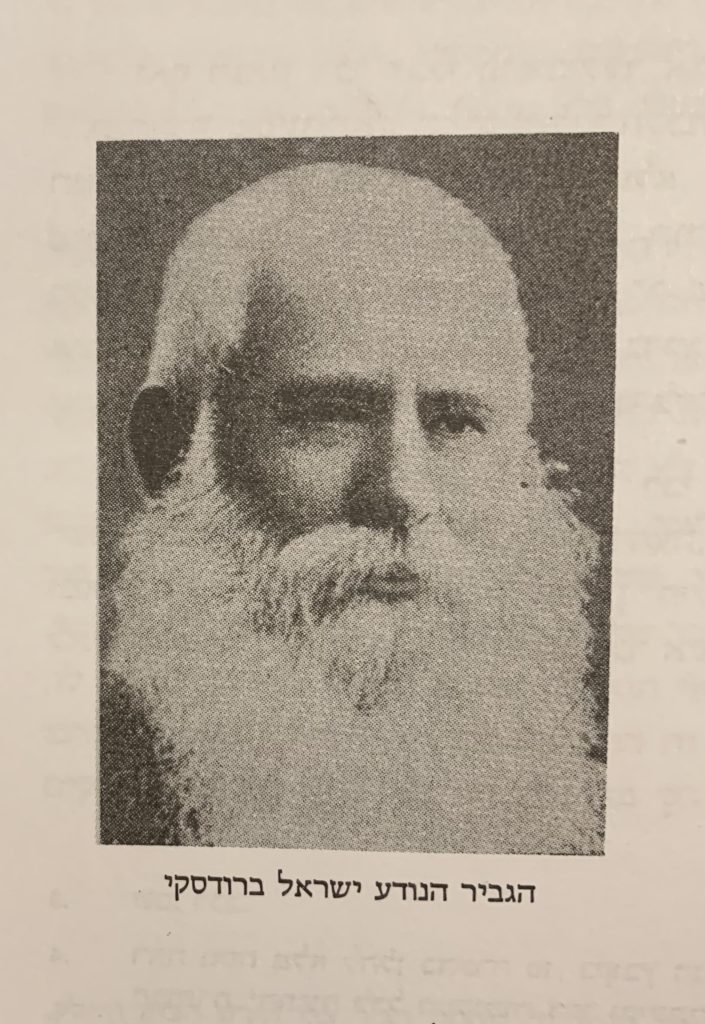
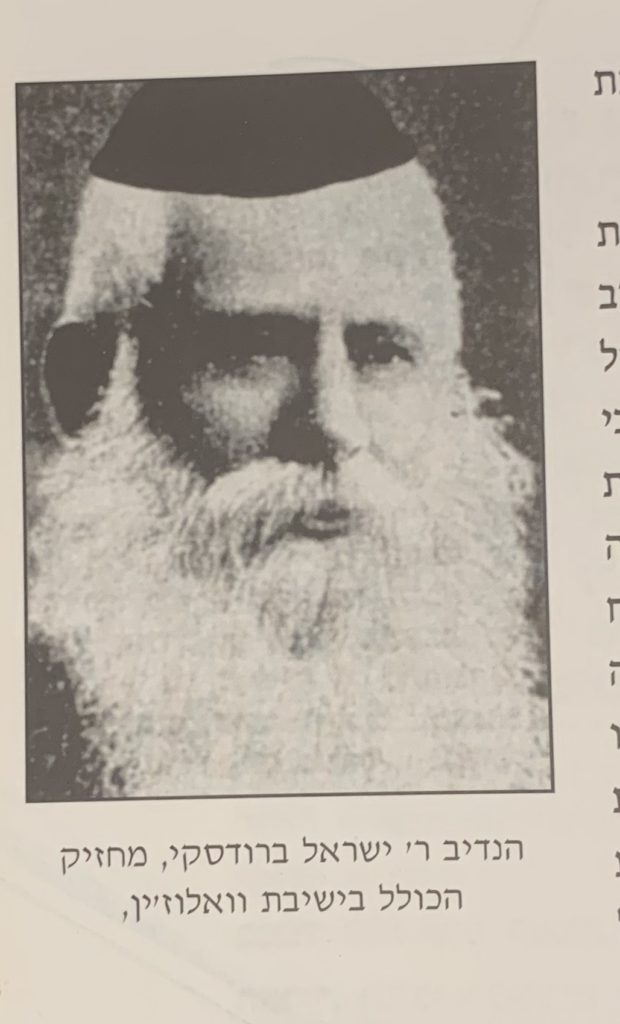
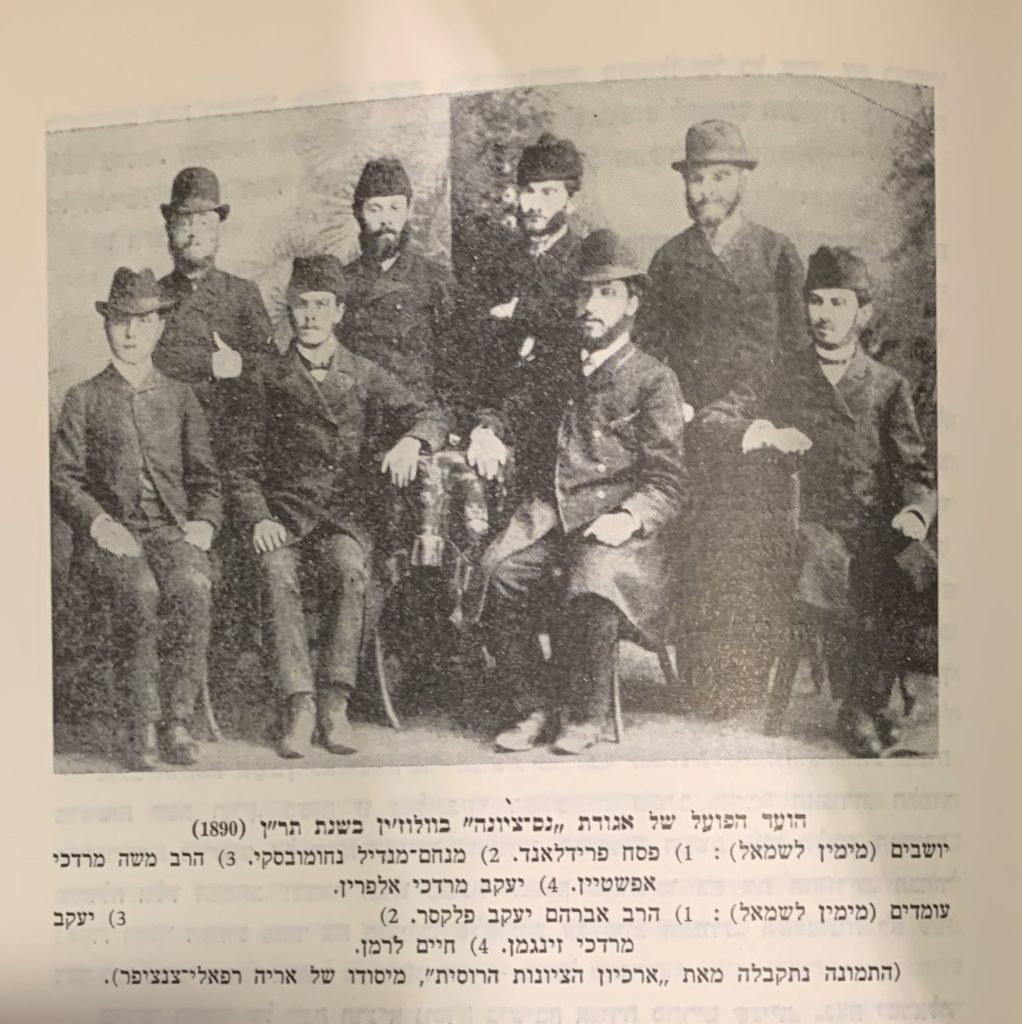
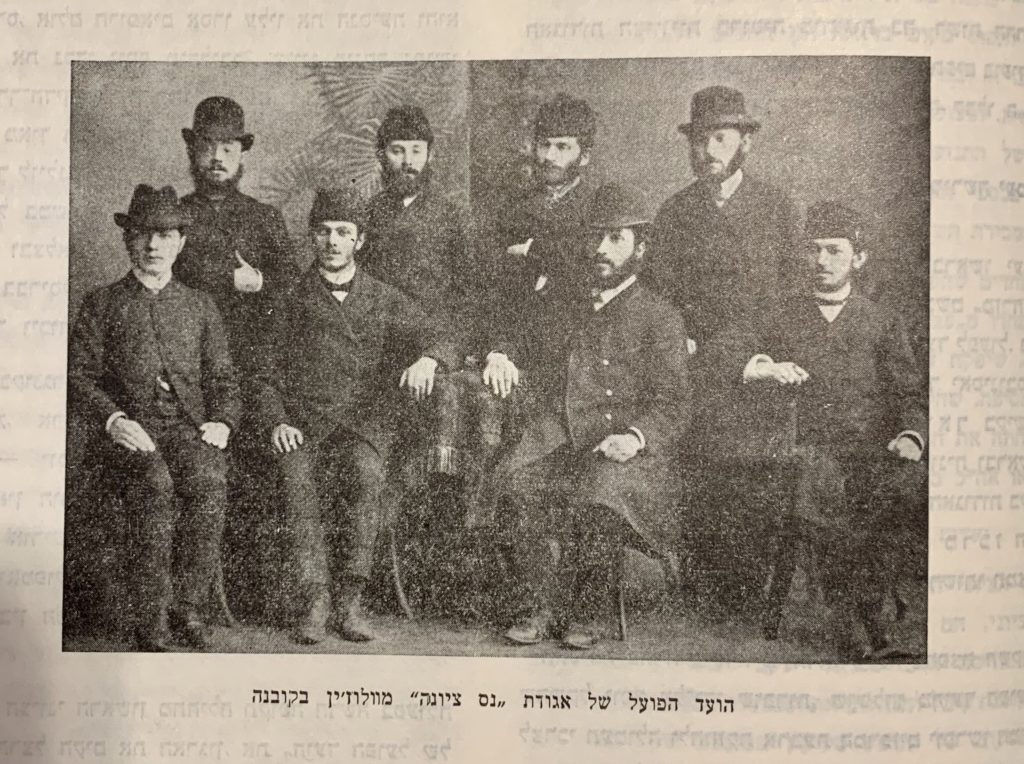
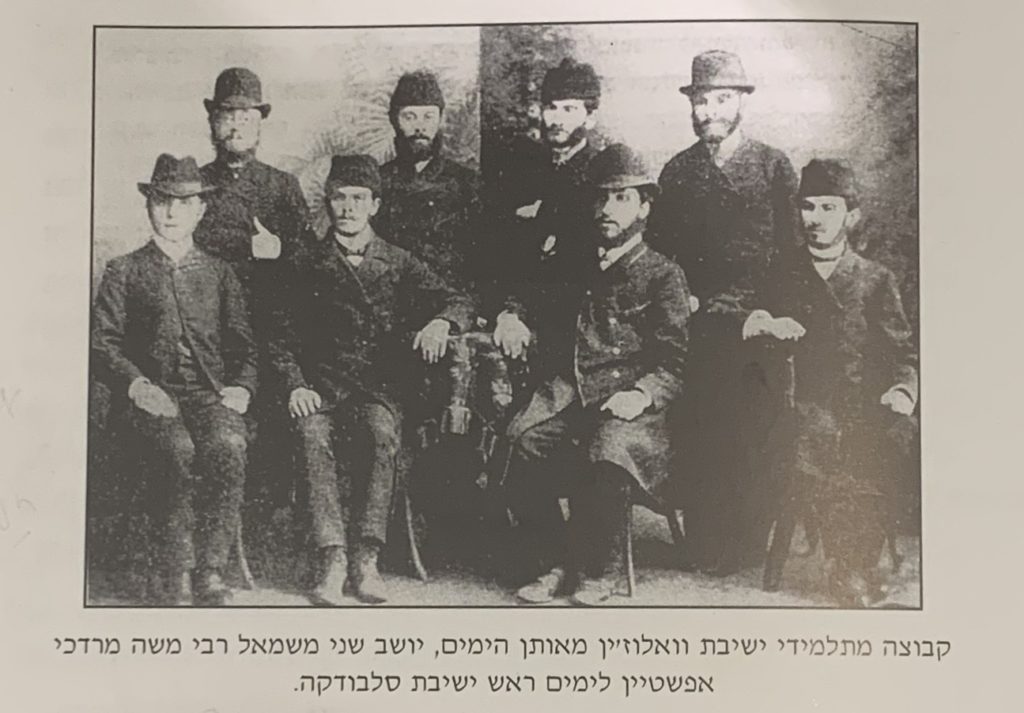
Another Obvious Mistake, More Grammatical Points, Bubbe Mayseh, Apostates and the Zohar

Another Obvious Mistake, More Grammatical Points, Bubbe Mayse, Apostates and the Zohar
 
Marc B. Shapiro
1. In my last post here I gave an example of an obvious error in a recent book focusing on the letters of R. Kook. I found another example of an obvious error in R. Dov Eliach’s new book, Be-Sod Siah.

This is quite an interesting volume as it contains interviews with a number of leading haredi rabbis. I could have an entire post on the material in this book, but let me just call attention to a couple of things related to R. Jehiel Jacob Weinberg before dealing with the error. One of the rabbis interviewed is the late R. Moshe Shapiro. In discussing R. Weinberg, he states (pp. 126-127):
דוגמא לתלמיד שהסבא הרבה להשקיע בו לפי טיבו וכישרונותיו – הגר יחיאל יעקב ויינברג בעל השרידי אש“. עלוי וכוח גדולשהיה מה שנקרא אאוטסיידר” – חריג ויוצא דופן באופיושבקלות היה יכול להחליק ולמצוא עצמו בין המשכילים“. ובזכות חכמתו ויגיעתו של הסבא הוא נשאר בבחינת שלומי אמוני ישראל“.
R. Shapiro tells us that R. Weinberg was an “outsider” and that he could have easily gone the way of Haskalah. It is fascinating that a haredi figure says this, because this is precisely the sort of comment that I think might have angered R. Weinberg’s now deceased right-wing students. Yet I have to say that R. Shapiro is exactly correct in his description. I don’t know if his knowledge of R. Weinberg’s life comes from my book or from R. Nathan Kamenetsky’s Making of a Godol – I only spoke to R. Shapiro once, and it was not about R. Weinberg – but he obviously knew something about the ups and downs of R. Weinberg’s life.
Here is p. 273 in the book, which includes a picture of R. Weinberg.
  
Not noted by Eliach is that this picture comes from my post herewhere I published it for the first time (and thanked the person who gave it to me). I realize that once the picture is on the internet it is there for anyone to use it, but it would still be nice if people would acknowledge where it came from.
Eliach also includes a lengthy interview with R. Bezalel Rakow of Gateshead which understandably has a good deal about R. Weinberg. (I have previously discussed R. Rakow here and here.) What I find fascinating is how people like Eliach simply can’t get a handle on R. Weinberg. On the one hand, they know that he was a great scholar and posek. On the other hand, they know that his views were not in line with the haredi world. Eliach asks R. Rakow the following (p. 274):
בשורה התחתונה – שאלתי את הרב ראקוב – האם הרב ויינברג מוגדר על ידכם כמנהיג תורני חרדי?
Eliach wants to know if R. Rakow regards R. Weinberg as a haredi Torah leader. R. Rakow responds very diplomatically:
בודאיהגאון הרב ויינברג היה ירא וחרד לדבר ה‘. איש ההלכה הצרופה שחרד על כל סעיף בשלחן ערוך!
R. Rakow knew perfectly well that he was dodging the question, and if the definition of haredi is one who is completely halakhically observant, then R. Soloveitchik and R. Lichtenstein (and endless others) should also be regarded as haredi leaders. Only in the continuation of the interview does R. Rakow acknowledge that R. Weinberg’s views were not all in line with the haredi approach (p. 276):
ועדיין ניתן לומרשאי אלה ממחשבותיו לא עלו בקנה אחד עם הדרך המקובלת לנו מרבותינו.
Now for the obvious mistake in Eliach’s book. Here is pp. 66-67.


He begins by mentioning that in his book on the Vilna Gaon he told a story that before World War II, R. Aaron Kotler was not sure where he should go, Eretz Yisrael or the United States. He therefore performed the goral ha-Gra and Exodus 4:27 came up: “And the Lord said to Aaron: ‘Go into the wilderness to meet Moses.’” He understood this to refer to R. Moses Feinstein, who at the time was living in the spiritual wilderness of New York.
Eliach states that it has been established that this story is not correct, and he cites the grandsons of R. Kotler who told him that their grandfather was never in doubt about where he was to go. They also pointed out that there is no way that the name “Moses” could have been seen as a reference to R. Moses Feinstein who was not well-known at that time.
So far so good (and these points are so obvious that one wonders how Eliach fell for a typical yeshiva bubbe mayse[1]). However, Eliach continues, and it must be that he is citing something that he was told by one of the current Kotlers, but he has completely mangled it. He writes:
אם היה מקום לסיפורהרי שהפוסק היותר ידוע בימים ההם באמריקההיה הגר יוסף רוזיןנשיא אגודת הרבנים דארצות הברית וקנדה“, ומחבר ספרי “נזר הקודש“.
Eliach tells us that if the story is true, it would have been with reference to R. Joseph Rosen, who was the most well-known posek in America at the time, the honorary president of Agudat ha-Rabbonim, and the author of the books entitled Nezer ha-Kodesh.
The first thing to ask is how could the goral ha-Gra performed by R. Kotler have anything to do with R. Joseph Rosen when the verse that came up mentioned “Moses”? How Eliach did not see this is beyond me. Furthermore, R. Joseph Rosen not only was not a well-known posek, he was not even a little-known posek. He was also not the president of Agudat ha-Rabbonim, and he never wrote a book called Nezer ha-Kodesh. The only thing of interest, and accurate, in Eliach’s discussion is that he somehow got a copy of the document appointing Rosen rabbi of Passaic, New Jersey, and he includes a picture of this in the book.
Here is what happened: Eliach was told that if the story of R. Aaron Kotler performing goral ha-Gra had any truth to it, the “Moses” referred to would have been R. Moses Rosen, who indeed was a great rav, author of Nezer ha-Kodesh, and served for a time as president of Agudat ha-Rabbonim.[2] R. Rosen is most famous for being the rabbi of Chweidan, Lithuania, where the Hazon Ish’s wife was from and where the Hazon Ish lived after getting married. R. Rosen and the Hazon Ish became close, and supposedly it was R. Rosen who first told R. Hayyim Ozer Grodzinski about the unknown genius, R. Abraham Isaiah Karelitz.[3] The Hazon Ish also proofread the volume of Nezer ha-Kodesh on Zevahim. This was published in Vilna in 1929 when R. Rosen was already living in the United States.[4] While R. Rosen is famous for his connection to the Hazon Ish, not so well known is that he was also a Zionist.[5]
3. My last post here gave examples of grammatical mistakes in the ArtScroll and Koren siddurim, which are the most popular in the English-speaking world. I received a lot of feedback about this, and I did not realize that so many people are interested in the often arcane points of grammar. (While I myself am quite interested in this, I am hardly an expert.) Here are a couple of more examples (and interested readers should consult the comments to the last post for additional instances).
In Ashrei we read עיני כל אליך, which comes from Psalms 145:15. The correct way to read עיני is with the accent on the ע, not on the נ. This word is commonly mispronounced, and neither ArtScroll nor Koren place the accent where it should be.[5a]
I found another mistake in the ArtScroll Machzor for Rosh ha-Shanah and Yom Kippur. In the prayer of the chazzan before Musaf, he says הפך [נאלנו ולכל ישראל. Some versions have the first word as הפוך. In both cases, since this is an imperative there needs to be a hataf patah under the ה. Yet in the ArtScroll Machzor there is a patah under the ה and the accent in הפך is mistakenly put on the first syllable, the ה. [After writing this I checked the second edition of the Machzor and was happy to see that it has been corrected. This shows that any errors we point out are valuable, as ArtScroll is prepared to correct them in future editions.]

Btzalel Shandelman wrote to me about ArtScroll’s comment on Genesis 39:8, which explains why there is a pesik following the word וימאן

The adverb adamantly is suggested by the staccato and emphatic Masoretic cantillation of this word: the shalsheles, followed by a psik [disjunction], both of which set off the word and enhance the absoluteness of its implication. It indicates that Joseph’s refusal was constant, categorical, and definite. He repulsed her with absolute firmness. Haamek Davar notes that the Torah gives no reason for his rejection; his sense of right and wrong was so clear that he did not even consider her pleadings. To her, however, he gave an explanation, trying to convince her to stop pestering him.

Shandelman correctly points out that this explanation is based on a mistake, as the vertical line found in the Torah after word וימאן is not a real pesik, as a pesik can never follow a shalshelet in the Torah (or the other sixteen biblical books that use the Torah’s system of cantillation). The reason for this is that a pesik is only found after conjunctive te’amim, and in the Torah shalshelet is always disjunctive. So why is there a vertical line after shalshelet if it is not a pesik? Joshua R. Jacobson explains:

In the te’amim of the three books (ספרי אמת), the shalshelet sign can serve as both a conjunctive and a disjunctive accent. To distinguish one from the other, a vertical line was added after the disjunctive shalshelet. Even though in the twenty-one books the shalshelet sign has only one use – as a disjunctive accent – nevertheless, the Masoretes retained the vertical line. . . . The vertical line after the shalshelet word is not a pasek: it does not indicate an extra pause.[6]

Another way to put this is that in the Torah the vertical line that always follows the shalshelet is not a separate symbol, but rather part of the shalshelet.
Nevertheless, pre-modern Hebrew texts that deal with masoretic matters seem to have no other way to refer to the vertical line, so it is called a pesik even by those who recognize that it does not function as a pesik. Thus, in the Masorah Gedolah to Lev. 8:23 it states:
ז‘ מלין בטעמא מרעימין ומפסיקין
מרעים is another word for shalshelet.
Returning to the example noted by Shandelman, I replied to him that the mistake is not that of ArtScroll. Although it is not clear in the excerpt printed above, the comment about a pesik following the shalshelet has its origin in R. Naphtali Zvi Judah Berlin’s Ha’amek Davar.[7] This is actually a common mistake, as the rules of trop are not well known. Unless someone has studied these rules, he will have no reason to assume that a vertical line is not a real pesik. The next step is to offer explanations of verses based on this assumption that the vertical line represents a real pesik after the shalshelet.
I don’t think that any of the following explanations are based on the mere appearance of the vertical line. Rather, the authors assume that it is a real pesik and one can therefore base interpretations on it.
R. Tuviah ben Eliezer (12th century) writes:[8]
וימאן מיאון אחר מיאון הרבה פעמים דכתיב בפסיק ובשלשלת
Solomon Buber, the editor of the text, explains R. Tuviah’s words:
דורש הטעמיםכי על וימאן הוא שלשלת ואחכ הוא בפסיק
R. Yeruham Levovitz stated as follows:[9]
ועל כן תיכף לוימאן” יש פסיקכי הופסק אצלו כל הענין אף טרם ניתח העולה על הרוחאף טרם נתן כל טעם וביאור על המיאוןכי טרם כל וכל הוא ממאן על הדבר וחסלוהטעמים והביאורים יתן אחרי כןוזהו אמרו אחרי הפסיקואומר אל אשת אדוניו וגו‘.
R. Samuel Borenstein writes:[10]
וימאן מוטעם בשלשלת ופסיקכדי להפרידו בפעוהיינו שהמיאון לא הי‘ מחמת הטעם אלא מצד עצם הנפש למעלה מהטעם.
R. Shlomo Zvi Schueck leaves no question that in his mind the vertical line is a real pesik.[11]
ואמרתי שחכזל דרשו זאת מן הטעם שלשלת העומדת על תיבת וימאן אם רצו להודיע בטעם שלשלת להפסיק שם בדיבור למה בחרו בניגון זה דוקאהא כמה טעמים מפסיקין הםועוד הא אחר תיבת וימאן הוא עומד הקו פסיקולמה לן תרי מפסיקין כאן?
R. Shlomo Amar writes:[12]
תיבת וימאן” הכתובה בפסוק מוטעמת בטעם שלשלתומיד לאחריה מופיע טעם פסקונראה דזה בא ללמדשיוסף הצדיק מיאן במיאון אדיר וחזקוגם מיאונו היה פסוק וחתוך.
I would only add that it is very difficult to say about so many great sages, ועפר אני תחת רגליהם, that they are wrong about the function of the pesik following a shalshelet. What I have written is based on the standard works on the topic. However, if anyone knows of an authentic tradition in which there is a pesik after shalshelet, please let me know. 

Finally, as I am writing this post not long after Hanukkah, here is an example of a translation where ArtScroll gets it right and pretty much everyone else I have checked gets it wrong (though we can understand why they intentionally get it wrong). In Maoz Tzur we read:
לעת תכין מטבח מצר המנבח
אז אגמור בשיר מזמור חנכת המזבח
ArtScroll translates:
When you will have prepared the slaughter for the blaspheming[13] foe,
Then I shall complete with a song of hymn the dedication of the Altar.[14]
Here is Koren’s translation of the first line:

When you silence the loud-mouthed foe.

This a much more comfortable rendering, and if you examine other siddurim you will find similar “softer” translations. Given the choice between “slaughter” and “silence,” most people will pick the latter. Yet unfortunately for them, the text does not say “silence.” It says “slaughter,” and the words תכין מטבח are based on Isaiah 14:21: הכינו לבניו מטבח, “Prepare ye slaughter for his children.” Koren’s translation is thus a politically correct distortion of the text’s meaning.
This is not a matter that started with Koren. For a long time now, translators have been afraid that if people knew what the text actually said that they would not want to sing the song. Yet how can you have Hanukkah without Maoz Tzur? It is even recited publicly at the White House Hanukkah party. (It is amazing to me that no one has yet made an issue of publicly singing these politically incorrect words.) So, a little bit of creative “translating” was thought necessary. Isn’t it interesting that ArtScroll – which has shown us many times that it has no difficulty censoring and distorting texts it finds problematic – has the courage to give us the correct, uncensored translation?
Interestingly, R. Joseph Hertz in his siddur, p. 950 in the note, tells us what the words mean. Yet was uncomfortable with this, and therefore instead of תכין מטבח he changed it to תשבית מטבח. This is not a version attested to in any old text. It was simply made up by Hertz or perhaps suggested by an unnamed collaborator on his siddur commentary. Hertz writes: “By a slight change, this is now ‘when Thou shalt cause all slaughter to cease, and the blaspheming foe, I will complete, etc.’”[15]
4. Since I have been discussing the ArtScroll and Koren siddurim, it is only right for me to mention that there is a new siddur on the market. The new RCA siddur, called Siddur Avodat Halev, has just appeared. For decades, Modern Orthodox synagogues had to make do with the RCA ArtScroll siddur. However, other than including the prayer for the State of Israel, there was nothing in that siddur that made it a good fit with Modern Orthodox synagogues.
The new RCA siddur, which will come to be the standard at hundreds of synagogues for decades to come (especially as the RCA ArtScroll siddur is no longer being sold), is a siddur that the Modern Orthodox community can embrace. The commentary and essays – including essays by R. Jehiel Jacob Weinberg, R. Joseph B. Soloveitchik, R. Aharon Lichtenstein, and R. Yehudah Amital – include both traditional learning and historical scholarship, something that is not found in any siddur on the market. There is also an attention to the role of women that is welcome.[16] Relevant to my last post, this siddur tells women to say מודה אני with a kamatz under the ד. The siddur also offers the option of women forming a mezuman and reciting חברותי נברך. Of particular importance is the inclusion of prayers for Yom Ha-Atzmaut and Yom Yerushalayim. In the instructions before Tahanun, we are informed that Tahanun is omitted on these two days. For Hallel, readers are given the option of reciting with a berakhah or without. I will return to discuss this siddur in a future post, as there is something in it that will be of particular interest to Seforim Blog readers.
Excursus
Earlier in this post I used the expression bubbe mayse. The origin of these words is not “grandmother’s tale,” although that is what is commonly thought. Bubbe mayse is a later corruption of what was originally Bove mayse. I can do no better than quote from the Wikepedia entry here.
The Bovo-Bukh (“Bovo book”; also known as Baba Buch, etc.; Yiddish: בָּבָאבּוּךבּוֹבוֹבּוּך ‬), written in 1507–1508 by Elia Levita, was the most popular chivalric romance in Yiddish. It was first printed in 1541, being the first non-religious book to be printed in Yiddish. For five centuries, it endured at least 40 editions. It is written in ottava rima and, according to Sol Liptzin, is “generally regarded as the most outstanding poetic work in Old Yiddish”. [Liptzin, 1972, 5, 7]
The theme derives from the Anglo-Norman romance of Bevis of Hampton, by way of an Italian poem that had modified the name Bevis of Hampton to Buovo d’Antona and had, itself, been through at least thirty editions at the time of translation and adaptation into Yiddish. The central theme is the love of Bovo and Druziane. [Liptzin, 1972, 6], [Gottheil] The story “had no basis in Jewish reality”, but compared to other chivalric romances it “tone[s] down the Christian symbols of his original” and “substitute[s] Jewish customs, Jewish values and Jewish traits of character here and there…” [Liptzin, 1972, 8]
The character was also popular in Russian folk culture as “Prince Bova”.
The Bovo-Bukh later became known in the late 18th century as Bove-mayse “Bove’s tale”. This name was corrupted into bube mayse “grandmother’s tale”, meaning “old wives’ tale”. [Liptzin, 1972, 7]
Here is the title page of the Bovo Bukh.

R. Elijah Levita (1469-1549), who thought it worth his time to produce Yiddish romances – in addition to the Bovo Bukh he published Paris and Vienna – is also the well-known author of, among other works, the Tishbi, the Hebrew dictionary that is still used today.[17] It was recently reprinted by Yeshivat Kise Rahamim together with comments by later authors including R. Meir Mazuz. Here is the title page.

At the end of the volume, there is a collection of critical comments on the Tishbi by R. Solomon Zvi Schueck, and responses to R. Schueck by R. Aryeh Mazuz. Interestingly, there were two printings of the Kise Rahamim edition of the Tishbi. The one intended for sale in certain haredi neighborhoods did not include the comments of R. Schueck, as he is persona non grata among extremist haredim. Regarding the two editions, see Dan Rabinowitz’s earlier Seforim Blog post here.
For more on Levita, who even has a street named after him in Tel Aviv, see the Seforim Blog post by Dan Yardeni here. It is also worth noting that former British Prime Minister David Cameron is descended from Levita. See here.
I would be remiss in not mentioning that two grandsons of Levita also played a role in Jewish history. One was named Vittorio Eliano (which means “from the house of Elijah”), and the other was his brother Giovanni Battista. They were both apostates. Eliano became a priest as did Battista, who was actually a Jesuit.[18] Battista testified before the Inquisition in Venice and stated that “the Talmud teaches them [Jews] that it is legitimate to orally swear false oaths, even if they do not come from the heart, along with hundreds of thousands of other things which are injurious to Christianity.”[19]
During the great sixteenth-century dispute in Venice between two Christian printers of Hebrew books – a dispute that also involved R. Meir Katzenellenbogen and R. Moses Isserles – both Christian sides denounced the other to Rome “for producing works which contained matter offensive to the Holy Catholic Faith.”[20] Eliano and Battista ended up giving testimony about supposedly blasphemous material in the Talmud, which in turn led to the Talmud being burned in Rome, in the Campo de Fiori, on September 9, 1553. Soon after that the Talmud was burned in Venice and in other places in Italy, and the work itself became an illegal text.[21]
In 2011 the following plaque was placed on the ground in the Campo de Fiori in commemoration of the burning of the Talmud.

Although the Talmud was illegal, the Zohar was not. It was none other than the apostate Eliano who had a central role in the second printing of the Zohar in Cremona in 1559-1560, as he was a proof reader.[22] (The first printing was in Mantua in 1558-1560.) This edition “was the preferred of the two editions by eastern European kabbalists.”[23] Contrary to what appears in many books, the Cremona Zohar was published by Jews (although the actual printing was done by a non-Jew, which was standard practice in Italy).[24]
Here is the title page of the Cremona Zohar. You can see at the bottom the statement that the publication was approved by the Inquisition.

Here is the last page of the Cremona Zohar. You can see that Eliano is mentioned as one of the two people who prepared the text for publication.


הבחור כמר ויטוריי אליאנו נכדו של ראש המדקדקים החר אליהו המדקדק סגל זצל
You can also see the actual Latin approval from the Inquisition.
Seeing how Eliano made sure that he was referred to as הבחור כמר, one who did not know better would assume that he was Jewish. Meir Benayahu chalks this up to one of the paradoxes of Jewish Italy:[25]
משומד שמשתבח במלאכת קודש זו ומזכיר שמו בנוסח רבני ועולה על כך שייקרא בתואר כמר” (בקולופון הזוהר), הוא מן הנפלאות שרק הפאראדוכסים המצויים אצל יהודי איטליה יכולים להסבירם.
Graetz,[26] followed by others, states that Eliano wrote the following Hebrew introduction to the Cremona Zohar.

Graetz does not tell us how he knows that Eliano wrote the introduction, and I find it difficult to believe that this is the case. As we can see from the last page of the Cremona edition (printed above), a Jew was also involved with preparing the text for publication. So why not assume, with Isaiah Tishby,[27] that the Jew wrote the introduction, which is a typical pious introduction that one would expect for the Zohar?
In fact, there is evidence that Eliano did not write it. Avraham Yaari called attention to the fact that in the introduction it subtly tells us that there are printing errors because the book was also prepared for publication on Shabbat, a time when Jewish proofreaders would not be able to examine it.[28]
וחסרון חלוף או השמטת אות יוכל להמנות על היות דבר הדפוס נחוץ לכל שומרי שבת כהלכתה ודל.
The word נחוץ here means something along the lines of “harried”. (See I. Sam. 21:9, for the use of the word in the Bible, which has a different meaning than in modern Hebrew.) He is saying that the reason there are mistakes in the text is due to the problems confronted by shomer Shabbat proofreaders (who do not work on Shabbat). In other words, the mistakes in the text are due to the one who did work on Shabbat. Such a line, criticizing the proofreader who worked on Shabbat, could not have been written by the apostate Eliano. On the contrary, it must be seen as directed against Eliano. This is an important point which I have not seen anyone make. There is another point which no one has made, and that is that on the second line of the introduction the author left an allusion to Eliano:
ואותיות ידועות לפי צורך המקום אלינו
Another book Eliano was involved with was Hizkuni,[29] printed in Cremona in 1559.[30] Here is the last page of the book which states:
הוגה ברוב העיון עי הבחור ויטוריו אליאנו נכד ראש המדקדקים החר אליהו בחור אשכנזי סגל זצל

While on the topic of apostates and the Zohar, here is another interesting point. The Soncino Press of London published a translation of the Zohar. For some of this translation they had the assistance of Paul Levertoff. Here is the title page of one of the volumes.

What makes this so significant is that Levertoff, who began life as a Habad Hasid and later studied in Volozhin, was an apostate.[31] If you search on the internet you will find that Levertoff continues to have a real influence among Messianic Jews.
I find it astounding that the Soncino Press, which was identified with British Orthodoxy, chose to collaborate on the Zohar translation with an apostate, especially an apostate who was a “true believer,” not simply an opportunist like Daniel Chwolson. Supposedly, late in life Chwolson was asked what he came to believe that led him to adopt Christianity. He replied: “I believed that it was better to be a professor in St. Petersburg than a melamed in Anatevka [insert whatever shtetl name you wish].” He also famously said about himself, punning on the words from the Yom Kippur liturgy,[32] “Ve-Akhshav she-Notzarti [= converted to Christianity] ke-Ilu lo Notzarti.”[33]

________________
[1] See Excursus.
[2] See Ha-Pardes (January 1953), p. 52.
[3] Shlomo Kohen, Pe’er ha-Dor, vol. 1, p. 191. As far I as I know, the report in Asher Rand, Toldot Anshei Shem (New York, 1950), p. 62, that R. Rosen and the Hazon Ish established a yeshiva together, is without foundation.
[4] Orhot Rabbenu (2014 edition), vol. 5, p. 138. This source does not mention which volume of Nezer ha-Kodesh it was, but the volume on Zevahim was the only one printed in Vilna. Since R. Rosen was living in the United States, this explains why it would have been much more convenient for for the Hazon Ish to do the proofreading. According to Cohen, Pe’er ha-Dor, vol. 1, p. 270, some of the material in the book in brackets is from the Hazon Ish. Cohen also states regarding these comments:

רובן פותחות במיהו” ולפעמים צויין בראשיתיבות שור (שוב ראיתי). כששאלו אותואיך זה תואם את האמתהשיב החזוןאיש באירוניהלא שוב ראיתי“, כי אם שוב וראה“.
For מיהו see pp. 69, 82, 88. For שו”ר see pp. 84, 86.
[5] See Entzyklopedia shel ha-Tziyonut ha-Datit, vol. 5, cols. 597-598.
[5a] It could be that עיני is not to be read with full stress on the ע, but only a partial stress, with the real accent on the connected word כל (in the Aleppo Codex עיני is joined to כל with a makef). Yet there certainly is no accent on the נ of עיני. See R. Yedidyah Solomon Norzi, Ma’amar ha-Ma’arikh in Norzi, Ha-Nosafot le-Minhat Shai, ed. Zvi Betser (Jerusalem, 1997), pp. 97ff.
[6] Chanting the Hebrew Bible: The Art of Cantillation (Philadelphia, 2002), p. 105 n. 14, 107. See also ibid., p. 233 n. 2, and Mordechai Breuer, Ṭaʻamei ha-Miḳra be-Khaf-Alef Sefarim u-ve-Sifrei Alef-Mem-Taṿ (Jerusalem, 1982), p. 19.
[7] See the Jerusalem, 2005 edition, p. 534. 

ומשום הכי איתא פסיקכדי שלא נפרש דמשום הכי מיאן בשביל ויאמר וגו‘”, אבל הפסיק מלמד שהמיאון היה בפני עצמו.

This comment was not part of the original commentary but was added later by the Netziv. In this edition, the editors have inserted the comment in the text of Ha’amek Davar, but inside brackets that look like this {} to show that it is a later addition.

[8] Lekah Tov, ed. Buber, p. 198.

[9] Da’at Torah: Bereshit (Jerusalem, n.d.), p. 230.
[10] Shem mi-Shemuel (Jerusalem, 1992), parashat Va-Yeshev, p. 69.
[11] Torah Shelemah (Satmar, 1909), vol. 1, p. 179a.
[12] Birkat Eliyahu (Jerusalem, 2007), vol. 1, p. 260.
[13] The word נבח, which literally means “bark” (see Isaiah 56:10, Eruvin 86a), had an anti-Christian connotation in medieval Hebrew. See Eli Yassif, ed. Sefer ha-Zikhronot (Tel Aviv, 2001), p. 404 n. 87; Daniel Goldschmidt and Avraham Frankel, eds., Leket Piyutei Selihot me-et Paytanei Ashkenaz ve-Tzarfat (Jerusalem, 1993), vol. 1, p. 398. Thus, in Maoz Tzur the “blaspheming foe” refers to the Christians.
R. Shlomo Fisher, Derashot Beit Yishai (Jerusalem, 2004), p. 234 writes:
ויבואר עפ כל זהדברי הפייטן בזמר לחנוכהתכון בית לתפלתי ושם תודה נזבחלעת תכין מטבח מצר המנבחדהיינו טביחת היצהר
This would make a very nice derashah on Hanukkah, and had Hertz known of it, he could have offered this perspective in his commentary and kept the original version of the song. Yet in its historical context, this is hardly what the author is referring to. Similarly, R. Raymond Apple is not correct when he writes that the words refer to “the defeat of Gog and Magog who will attempt to overcome Israel before the coming of the Messiah.” See here. When Maoz Tzur speaks of the destruction of the “barking [i.e., blaspheming] foe,” it is referring to a real flesh and blood enemy of the Jewish people, which in the medieval Ashkenazic context means the Christian world. The word “barking” is used in this song as throughout pre-modern Jewish literature dogs were portrayed in a negative way. See also here.
[14] I do not know why ArtScroll capitalizes “Altar”.
R. Meir Mazuz recently commented that while Maoz Tzur is a wonderful song, “it contains small [grammatical] errors, as is the practice with the Ashkenazim who do not know Hebrew well.” Bayit Ne’eman, no. 139 (30 Kislev 5779), p. 1 n. 1. One example he gives is לעת תכין מטבח מצר המנבח. It should say לצר המנבח. He adds:
מאיפה אני לומד את זהמפסוק בישעיה הכינו לבניו מטבח בעוון אבותם” (יד כא), לא מבניו אלא לבניו.
Regarding Hanukkah, I recently found that R. Naphtali Zvi Judah Berlin suggests the possibility that when the Maccabees entered the Temple they did not light the menorah, as we are accustomed to think, but rather only lit one candle. See Ha’amek She’alah, Va-Yishlah, no. 24, p. 173:
ולכאורה הי‘ אפשר לומר שלא היו מדליקים אז במנורה כלל . . . ואכ הי‘ מקום לומר שלא השתמשו באותם שמונה ימים במנורה כלל משום שלא הי‘ להםוהדליקו באותו פך הטהוראו בכלי גללים וכלי אבנים וכלי אדמהואכ לא הי‘ אלא נר א‘ כדי לקיים להעלות נר תמיד

Also of interest is R. Joseph Messas, Otzar ha-Mikhtavim, vol. 2, no. 1305, who cites midrashic sources that there will not be a menorah in the future Temple.

 
I have vocalized the title of the Netziv’s book as Ha’amek She’alah, which is how scholars have been accustomed to write it, based on Isaiah 7:11 where these words appear.
However, Gil S. Perl argues that the correct pronunciation is Ha’amek She’elah. As he puts it, if the pronunciation in Isaiah was intended, “the title would mean ‘sink to the depths,’ the ‘depths’ (from the word she’ol) being a reference to the netherworld or Hell—a rather strange title for a work of halakhic commentary.” Perl therefore suggest that the Netziv “intended his title as a play on those words from Isaiah pronounced Ha’amek She’alah, meaning ‘delve into the question’ or perhaps ‘delve into the She’ilta.’” See Perl, The Pillar of Volozhin (Boston, 2012), pp. 17-18, n. 37.
[15] Regarding how Maoz Tzur appears in British siddurim, see John D. Rayner, “Liturgical Emendation: The Case of the Ma’oz Tzur,” available here.
[16] For more on the new RCA siddur and women, see the anonymous post here.
[17] The Tishbi was first printed in Isny, Germany in 1541. It is one of the first Jewish books to cite biblical passages by chapter. As most people know, the chapters are a Christian innovation. According to Abraham Berliner, the first Jewish scholar to publish a book using the chapter divisions was R. Isaac Nathan, who published a biblical concordance between 1437 and 1448. See Berliner, Ketavim Nivharim (Jerusalem, 1969), vol. 2, p. 134. On this page Berliner also writes:

החלוקה לפרקים של כל ספרי המקרא נתקבלה ונתפשטה רק עם הדפסת המהדורה השניה של המקראות הגדולות (ויניציא רפד).
Yet the first edition of the Mikraot Gedolot, published in Venice, 1518, is on Otzar ha-Hokhmah, and you can see that it too has the chapter divisions.
[18] See Heinrich Graetz, Geschichte der Juden (Leipzig, 1907), vol. 9, p. 320; Encyclopaedia Judaica, vol. 6, col. 615; Meir Benayahu, Ha-Defus ha-Ivri bi-Kremona (Jerusalem, 1971), pp. 95ff.. For sections of an autobiography written by Battista, in which he describes his apostasy, see Isaiah Sonne, Mi-Paʾulo ha-Reviʻi ad Piyus ha-Hamishi (Jerusalem, 1954), pp. 150-155.
[19] See Amnon Roz-Krakotzkin, The Censor, the Editor, and the Text: The Catholic Church and the Shaping of the Jewish Canon in the Sixteenth Century, trans. Jackie Feldman (Philadelphia, 1007), pp. 42-43.
[20] Cecil Roth, The History of the Jews of Italy (Philadelphia, 1946), p. 291.
[21] See Roth, The History of the Jews of Italy, p. 292. For detailed discussion of this matter, which shows all the other factors that were present, see Kenneth Stow, “The Burning of the Talmud in 1553, in the Light of Sixteenth Century Catholic Attitudes Toward the Talmud,” Bibliothèque d’Humanisme et Renaissance 34 (1972), pp. 435-459.
[22] Regarding Allessandro Franceschi, another sixteenth-century Italian apostate who supported the printing of the Zohar, see Yaakob Dweck, The Scandal of Kabbalah (Princeton, 2011), pp. 166-167.
[23]  Marvin J. Heller, The Sixteenth Century Hebrew Book (Leiden and Boston, 2004), vol. 1, p. 503.
[24] See Yitzhak Yudelov, “Al Sefarim, Madpisim, u-Mo”lim,” in Yosef Eliyahu Movshovitz, ed., Ha-Sefer (Jerusalem, 2008), vol. 2, p. 557 n. 22.
[25] Ha-Defus bi-Kremona, p. 97.
[26] Geschichte, vol. 9, p. 345.
[27] “Ha-Pulmus al Sefer ha-Zohar,” Perakim 1 (1967-1968), p. 147 n. 54.
[28] Mehkerei Sefer (Jerusalem, 1958), pp. 170-171. Yaari also mentions other Hebrew books that were printed on Shabbat.
[29] Regarding how חזקוני is to be pronounced, see my post here.
[30] For other examples of Hebrew books whose printing Eliano was involved with, see the index of both Roz-Krakotzkin, The Censor, the Editor, and the Text and Benayahu, Ha-Defus ha-Ivri bi-Kremona.
[31] See Elliot R. Wolfson, “Paul Philip Levertoff and the Popularization of Kabbalah as a Missionizing Tactic,” Kabbalah 27 (2012), pp. 269-320. On p. 272, Wolfson states that Levertoff received semikhah from R. Naphtali Zvi Judah Berlin. He provides no evidence for this assertion so I cannot judge its accuracy. As far as I have been able to determine, Levertoff never received semikhah.
[32] The passage originates in the Talmud, Berakhot 17a, where it is attributed to Rava, and Yoma 87b, where it is attributed to R. Hamnuna.
[33] See Zvi Hirsch Masliansky, Memoirs, trans. Isaac Schwartz and Zviah Nardi (Jerusalem, 2009), p. 138.


Conservative Conversions, Some Grammatical Points, and a Newly Published Section of a Letter from R. Joseph B. Soloveitchik

Conservative Conversions, Some Grammatical Points, and a Newly Published Section of a Letter from R. Joseph B. Soloveitchik

Marc B. Shapiro

 
1. Since I mentioned R. Ovadiah Hoffman in the last post, I would be remiss in not noting that he and his brother, R. Yissachar Dov, recently published volume 4 of Ha-Mashbir, devoted to R. Ovadiah Yosef. It can be purchased here.
The volume contains a previously unpublished letter by R. Ovadiah Yosef that I provided, dealing with a rabbi who improperly converted people. It also contains a number of other noteworthy sections, such as R. Ovadiah’s notes to R. Ben Zion Uziel’s Mishpetei Uziel, talmudic notes from R. Uziel published from manuscript, R. Meir Mazuz’s notes to R. Ovadiah’s Yehaveh Da’at, and many valuable articles by contemporary Torah scholars, including the editors. Of particular interest to me was R. Yissachar Dov Hoffman’s article on the practice of a number of great Torah sages of prior generations not to kiss their children. Such a practice is so much against the contemporary mindset of what is regarded as healthy that, as R. Hoffman notes, even a Satmar rabbi, R. Israel David Harfenes, has stated that “in our time it is forbidden to follow this path” (p. 293).
Apropos of the above-mentioned responsum on conversion by R. Ovadiah Yosef, in Beit Hillel, Adar 5770, R. Yisrael Meir Yonah deals with a conversion done by a Conservative beit din. He rules that in this particular case the conversion is valid. This ruling was affirmed by R. Ovadiah.In his responsum, R. Yonah states that R. Moses Feinstein regarded Conservative conversions as doubtful conversions rather than completely invalid, and brought two supposed proofs for this. I responded to R. Yonah in Beit Hillel 43 (Heshvan 5770), and you can see my letter here.[1]

To his credit, R. Yonah acknowledged that he was mistaken in his reading of R. Feinstein’s responsum.[2] It is also the case, as I mention in my letter, that it is possible that a conversion done by a Conservative rabbi, especially from years ago, could be halakhically valid. R. Feinstein himself, who wrote very strongly against Conservative conversions, also writes about such a conversion: כמעט ברור שאין עושין הגרות כדין. The word כמעט shows us that even R. Moshe recognized that there are times when a Conservative conversion can be halakhically valid. In Mesorat Moshe, vol. 1, p. 327, we see as well that R. Moshe acknowledged the possibility that a Conservative conversion could be valid:
אולי יש להסתפק דאפשר לא היו ב”ד של פסולים, דיש אנשים, בעצם דתיים ומאמינים, שמחמת דוחק פרנסה מקבלים משרה כרבנים אצלם, ואפילו אם למדו בסמינר שלהם, אולי בעצמו כן מאמין. ולפיכך למעשה, אם זה אפשר לברר, תבררו. ואם קשה לברר, אז אולי שייך להגיד השערה, שאם זה בכפר או עיר רחוק מעיקר ישוב היהדות הדתי מסתמא אין להסתפק, בוודאי אינו כלום. ואם זה בעיר שיש בו ישוב דתי, נו, אזי כן יש ספק.
I also know someone who offers eyewitness testimony that R. Moshe did not think that every Conservative conversion could be voided without investigation, especially as this would mean that women married to these converts would then be able to remarry without a get. R. Moshe was not willing to go this far.
Similarly, R. Ovadiah Yosef, when asked about a Conservative conversion, replied that before giving a ruling it was necessary to find out which Conservative rabbi did the conversion, “since the Conservatives are not all alike.”[3]
R. Ovadiah was also asked about a woman who had become religious and was interested in going out with a kohen for the purpose of marriage. The problem was that she had slept with a man whose mother was converted by a Conservative rabbi. This man’s family was somewhat traditional as they kept kosher, made kiddush, and lit Shabbat candles. Could the woman in question marry a kohen, which is forbidden if she had slept with a non-Jew? The answer to this question depends on the status of the man whose mother was converted by a Conservative rabbi. If the conversion was invalid then the man was also to be regarded as a non-Jew, and the woman we are discussing, who slept with this man, would be forbidden to a kohen.
R. Ovadiah replied that the woman could marry a kohen, which means that be-diavad he accepted the Conservative conversion. He gave this ruling without even seeking further knowledge about the particular rabbi who did the conversion under question, which appears to me to be an incredible leniency. In seeking to explain this ruling, R. Yehudah Naki writes, “We see that they observed some mitzvot, so be-diavad there is more room to be lenient, at least not to forbid others” (that is, to forbid the woman from marrying the kohen).[4]
As mentioned, R. Ovadiah accepted R. Yonah’s pesak that a particular conversion carried out by a Conservative beit din was valid. In this case, the daughter of a woman who had been converted wished to marry a kohen. This would only be allowed if the daughter was born Jewish, meaning that everything depended on the status of her mother’s conversion. Here is how R. Yonah described this particular Conservative beit din.[5]
ובירורים שעשינו בנ”ד התברר לנו שב”ד הזה שגיירוה, הם אנשים שנקראים וידועים כשומרי תורה ומצוות, ובעצם הם אורטודוכסים, וגם הגיור שעשו, ע”פ כל החקירות ודרישות שעשיתי, הקפידו בכל הדברים כולם, הן בטבילה, חציצה וכו’ וכו’, הן בקבלת מצות, ולימודי יהדות קודם הגיור, לא פחות ואולי יותר, מהרבה בתי דינים אחרים שנחשבים לחרדיים. וא”כ אין כל סיבה לפע”ד לפסול גיור זה.
Here is R. Ovadiah’s affirmation of R. Yonah’s pesak, from Beit Hillel, Adar 5770, p. 60.

That a Conservative conversion might be valid also appears to be assumed by R. Mordechai Eliyahu. This is what he writes in his Ma’amar Mordechai, vol. 2, Even ha-Ezer, no. 16:
ובענין הגר שנתגייר אצל הקונסרבטיבים והוא אינו שומר תורה ומצוות, והיה לכם ספק אם אפשר לכתוב שם יהודי שניתן לו, שם שלא השתמש בו מעולם, או לכתוב בן אאע”ה. נראה לי, מאחר וכל עצם נתינת הגט של אדם זה הוא לחומרא ולא מדינא, כי מי אמר שגרותו – גרות, וגיוריהם של הרבנים הקונסרבטיבים – גיור . . .
R. Eliyahu does not say that there is absolutely no reason for a get when dealing with a Conservative conversion. Rather, he refers to it as a humra. Also, note how he states, “who says that his conversion was a [valid] conversion?” This is the language of safek. He does not say, “certainly his conversion was invalid.”[6]
2. In a previous post here I mentioned a few common pronunciation mistakes in Kiddush. There is one more that I would like to mention, but it is a little more complicated than the ones I previous noted. In the Friday night kiddush we say כי הוא יום תחלה למקראי קודש. Where is one supposed to put the accent in the word למקראי? If you look at ArtScroll you find that it puts the accent on the penultimate syllable, the ר. However, Koren and most of the other siddurim I checked put the accent on the final syllable, the א.
I don’t know why this should be a matter of dispute, because the Torah itself uses the expression מקראי קודש three times (Lev. 23:2, 4, 37), and in every case the accent in מקראי is on the final syllable.[7] The Yom Tov morning kiddush also begins: אלה מועדי ה’ מקראי קודש. For some reason ArtScroll is not consistent, and in this case it puts the accent in מקראי on the א.
After my last post someone emailed me pointing out that another “common mistake” is that in Birkat ha-Mazon, in the second paragraph, people say נודה לך putting the accent on the first syllable instead of the second. In fact, the tune for Birkat ha-Mazon that American children are taught at schools around the country has the word נודה recited with the accent on the first syllable. Should we now start teaching all the children differently, so that they pronounce נודה with the accent on the second syllable which is how ArtScroll, Koren, and almost all the other siddurim have it?
Actually, this matter is not clear at all. I say this because if you open up a Tanakh to Psalms 79:13 and look at the words נודה לך you will find different versions. Some have the word נודה with the accent on the final syllable and others have the accent on the first syllable. The Aleppo Codex has the accent on the first syllable and puts a dagesh in the ל of לך. Although the practice of American children (and adults) pronouncing the word נודה with the accent on the first syllable has nothing to do with the Aleppo Codex, the fact that this pronunciation appears in such an important source means that there is no reason to change how the children are taught. However, this creates a problem because in the Amidah, in Modim, we say נודה לך ונספר תהלתך. If we are going to recite נודה of Birkat ha-Mazon with the accent on the first syllable, then we should be consistent and do the same thing in the Amidah, in ברוך ה’ לעולם in ma’ariv: נודה לך לעולם, and also in the so-called “Three-Faceted Blessing” (ברכה מעין שלש – Al ha-Mihyah): ונודה לך על הארץ.
Speaking of consistency, in Birkat ha-Mazon, the Amidah, ברוך ה’ לעולם, and the Three-Faceted Blessing, both the regular ArtScroll siddur and Koren have the accent in נודה on the final syllable. However, in the Amidah, ברוך ה’ לעולם, and the Three-Faceted-Blessing they both place a dagesh in the ל of ונודה לך and נודה לך, but do not place a dagesh in the ל of נודה לך in Birkat ha-Mazon. This makes no sense. If there is a dagesh in one there must be a dagesh in all of them. (In the Hebrew-only ArtScroll siddur they also put a dagesh in the in the ל of נודה לך in Birkat ha-Mazon.)
I think it is a mistake for ArtScroll and Koren to place a dagesh in לך in any of these instances. Since no exception with נודה לך is found in Tanakh, the only reason there would be a dagesh in לך is if the word נודה has the accent on the first syllable, as in the Aleppo Codex (and unlike what appears in ArtScroll and Koren), or if there is a makef between the two words.[8]
Regarding the word נודה, it is worth noting that in Ein Ke-loheinu there is no question that נודה is to be read with the accent on the final syllable (as the matter of where to put the accent in נודה only concerns the phrase נודה לך). Here is an example where the common tune, which puts the accent on the first syllable, cannot be defended grammatically.
I noticed two mistakes in the regular ArtScroll siddur which appear correctly in Koren. In the morning blessings we say אשר נתן לשכוי בינה. Where is the accent in the word לשכוי? ArtScroll puts the accent on the final syllable, and Koren puts the accent on the penultimate syllable, on the ש. Koren is correct as there is an explicit verse in Job 38:36: מי נתן לשכוי בינה. If you look at the trop on this verse you will find that the accent in לשכוי is on the penultimate syllable. Interestingly, in the Hebrew-only ArtScroll siddur they get this right.
The other mistake is that in Birkat ha-Mazon on Sukkot we say:
הרחמן הוא יקים לנו את סכת דויד הנופלת
ArtScroll puts a kamatz under the פ in הנופלת. Koren puts a segol and that is correct. We see this from the appearance of the word in Amos 9:11, and there is no change of vowel even on the etnahta.[9]
I also found an example where ArtScroll gets it right and Koren is mistaken. In ma’ariv, in the paragraph ואמונה כל זאת, we say העושה לנו נסים. Koren has העושה with the accent on the final syllable and the ל of לנו with a dagesh. Yet this doesn’t work. For there to be a dagesh in the ל, the prior word, העושה, has to have the accent on the penultimate syllable, which is how it appears in ArtScroll.
Another example where ArtScroll gets it right and Koren gets it wrong is in the morning blessings where we say שעשה לי כל צרכי. Koren puts the accent in שעשה on the final syllable. Yet this is a mistake, and as is correctly found in ArtScroll the accent is on the penultimate syllable, the ע.
Since I have been speaking about the ArtScroll siddur, let me add a couple of comments about the Yom Kippur Machzor. Here is how Shema Kolenu appears in my copy of the Yom Kippur Machzor (p. 596).

The instructions tell us that “the first six verses of the following prayer are recited responsively, chazzan then congregation.” The problem is that I have never seen a synagogue that says the verses beginning אמרינו and אל תעזבנו responsively. What all these synagogues do is say the following four verses responsively:
שמע קולנו
השיבנו
אל תשליכנו מלפניך
אל תשליכנו לעת זקנה
In my experience, not only does no one say the verses beginning אמרינו and אל תעזבנו responsively, but they don’t say יהיו לרצון quietly either.
The text recorded by ArtScroll is the one found in many old Ashkenazic machzorim. So when and how were אמרינו and אל תעזבנו dropped from the responsive reading, or is it that from the beginning they were not included? As for יהיו לרצון, the old machzorim do not indicate that this is said quietly, so was there ever a tradition to recite it quietly or is ArtScroll simply trying to make sense of a verse that is found in the Machzor but no longer appears to be recited? If יהיו לרצון was originally part of the public reading, we again have to ask, why was it dropped?
Recognizing the problem, in the new edition of the ArtScroll machzor they made a change.
As you can see, אל תעזבנו has now been pushed to the next paragraph. We are also instructed that both אמרינו and יהיו לרצון are to be said quietly. Yet this doesn’t seem to make any sense, as those who are reciting Shema Kolenu responsively will not be saying these verses quietly. And again, I ask, is there any real tradition that these verses are to be said quietly, or is this something made up by people in an attempt to keep the traditional text of the Machzor while dealing with the fact that these verses are not part of the responsive reading? Unfortunately, when updating the Machzor, ArtScroll did not correct the instructions which still refer to the “first six verses” as being recited responsively, when instead it should say the “following four verses”.
Here is how Koren has the prayer.
This version, which puts אמרינו and יהיו לרצון before the final verse, is also attested to in prior machzorim, though the order found in ArtScroll appears to be the older version.To sum up, I am not sure what the best path for ArtScroll would have been. On the one hand, they could have adopted the version found in Koren, which solves all the problems. Keeping what appears to be the more authentic version, which they did, also makes sense, but then they were forced to add the instructions that certain verses are to be said silently. I have checked numerous old machzorim and there is no indication that these verses are to be said silently. Was there perhaps an oral tradition in this matter? Perhaps readers can comment on this. In any event, ArtScroll’s instructions are problematic, since, as mentioned, if people are reciting the prayer responsively, they are not going to be inserting two consecutive sentences quietly.

I noticed another interesting change in the ArtScroll Yom Kippur machzor between the old edition and the new one. Here is והכהנים והעם in the old edition.
It reads היו כורעים ומשתחוים ומודים ונופלים על פניהם.
Here is the new edition, where the word ומודים has been deleted. ArtScroll neglected to change the English translation, so it still appears, now incorrectly, as: “they would kneel and prostrate themselves, give thanks, fall upon their faces.”
Why was the word ומודים deleted? Based on what I have been able to determine, the version without the word ומודים is more common, so presumably that is the reason. Although most people might just chalk this up to a different girsa, R. Soloveitchik saw great significance in the alternative versions, and explained their different implications.[10]
Here are a couple of random mistakes I found in ArtScroll. (I use the ArtScroll siddur every day of the week, which is how I have come across these. I am sure that if I used Koren, I would find mistakes there too.) In the ArtScroll siddur, p. 86 it reads:
ואל מאורי אור שעשית, יפארוך, סלה
There is a dagesh in the ס of סלה. This means that the comma after יפארוך is a mistake, as you cannot place a dagesh in this ס if preceded by a comma.
Another mistake is found on p. 702, in the prayer for dew, which states בעם זו בזו. Its translation is correct: “Among this people, through this prayer.” However, I would have preferred if it appeared as follows: “Among this people, through this [prayer],” which would be a more accurate rendition of the few words. (This is indeed how it is translated in the ArtScroll Passover Machzor.)ArtScroll vocalizes these words be-am zu be-zu. Yet this is incorrect. בזו should be pronounced be-zo, referring to תפלה, the feminine Hebrew word for prayer. Koren gets this correct. This confusion of ArtScroll with zu and zo is also found on p. 202, where in the marriage service we find בטבעת זו and ArtScroll pronounces it zu, instead of zo. Again, Koren gets it right. (The word זו often appears in the Talmud, and the ArtScroll Talmud always pronounces it correctly.)

Let me close with one final mistake in ArtScroll, or perhaps it is not a mistake; readers can decide on their own. The ArtScroll Ohel Sarah Women’s Siddur is a special siddur designed for women. On the very first page of the prayers, this siddur has מודה אני with a segol under the ד. In a women’s siddur doesn’t there need to be a kamatz under the ד so that it reads modah?
This might reflect a broader issue. My experience is that in co-ed kindergartens the girls are also taught to say modeh. This might not be surprising, but I was also told by a number of people that even in girls-only kindergartens, both Ashkenazic and even some Sephardic ones, the girls are taught to say modeh. No doubt recognizing this problem, R. Yitzhak Yosef makes a point of placing a kamatz under the ד so that people will know how women are to pronounce the word.[11] R. Shlomo Zalman Auerbach likewise told the women in his family to say modah.[12]It is noteworthy that in one of the editions of Wolf Heidenheim’s Siddur Sefat Emet, found on Otzar ha-Hokhmah, girls are instructed to say modah.

However, this edition appeared after Heidenheim’s death, and unfortunately there is no way to determine exactly when. (The Basel 1956 date on the title page is just the date of the photo-offset edition, not the original.) As far as I can tell, none of the siddurim that appeared in Heidenheim’s lifetime distinguish between men and women with regard to modeh-modah.In response to questioners, R. Hayyim Kanievsky also stated that women are to pronounce the word as modah.[13] Despite this, when R. Meir Arbah asked Rebbetzin Batsheva Kanievsky, R. Hayyim’s wife, what she did, she replied that she pronounced it modeh![14]

The ArtScroll Women’s siddur also has שלא עשני גוי and not גויה and שלא עשני עבד instead of שפחה. This too would seem to be incorrect in a women’s siddur, but the standard version is defended by R. Shmuel Wosner, as he claims that the words גוי and עבד include both men and women.[15] More about this in the next post.
3. We all know that everything written by R. Joseph B. Soloveitchik is precious.[16] One area in which the Rav was very eloquent and forceful was with regard to the necessity of having a mehitzah in shul. In Baruch Litvin’s 1959 book, The Sanctity of the Synagogue, pp. 109-114, it prints a letter from the Rav to an RCA convention. 


This letter has been reprinted in Nathaniel Helfgot, Community, Covenant and Commitment, pp. 139-142.
Moshe Schwartz found a copy of the original letter in the papers of his grandfather, R. Gedaliah Dov Schwartz. I thank him for sending it to me.

One interesting point which is not found in the Litvin book is that the Rav’s letter, while intended for RCA members, was addressed to R. David Hollander, the president of the RCA at the time. This is important to note because in the second paragraph he is speaking personally to R. Hollander and praising him for his good works. However, the reader of the letter in Litvin’s book will mistakenly think that the Rav is speaking to the RCA as a whole.
Furthermore, some of what R. Soloveitchik included was deleted from the letter as it appeared in the Litvin book. This was apparently because his points were not specifically relevant to the mehitzah issue. I am happy to be able to present here the omitted words of the Rav which until now have never been published, and which present an important personal statement about the halakhic process. Readers should note the end of the second paragraph that is transcribed below, as it is criticism of certain members of the RCA. Similar sentiments are found earlier in the letter (Litvin, p. 110, first paragraph), where the Rav concludes his paragraph with the strong words: “However, many of our colleagues choose the derech ketzarah va’aruchah, the easy way which leads to doom and destruction.”
As chairman of the Vaad Halachah I intended to inform the conference about our activities during the past year. Since I am prevented from doing so I have asked my friend Rabbi Joseph Weiss to take my place.
Permit me to say the following. One of the fundamentals of my faith is that the Halachah is an all-inclusive discipline and system of thought capable of meeting any challenge of modern times and of confronting the most perplexing problems which a technically progressive and scientifically minded society may periodically pose. This optimistic formula, however, cannot always be successfully applied because of the limited knowledge and the imperfect intellectual capability of the human being. I for one, am not always able to behold the Halachic truth and to see the light under all circumstances. Many a time I grope in the dark, pondering, examining and re-examining an intricate Halachic problem – and find myself unable to arrive at a clear decision. Even the Talmud has not solved all problems and has not answered all questions. The Teiku is a very prominent and characteristic feature of Torah She-B’al Peh. We members of the Halachah Commission are not partners in a contracting firm whose task it is to provide every member of the Rabbinical Council of America with a clear-cut answer to his problems. Quite often the solution eludes us. We are beset by grave doubts. We face many alternatives not knowing which to choose since each is supported by sound logical reasoning. We cannot be guided in our decisions by emotional factors or pragmatic arbitrariness and hence we are impelled to employ in such situations the principle of “B’divrai Torah Haloch Achar Hamachmir” which seems to inconvenience some of our members.
Religious Jews have of late developed an intolerant attitude towards what they call the shyness and reluctance on the part of scholars to commit themselves on Halachic issues, not knowing that there is no omniscience in this world and that doubt is an integral part of the Halachic experience as it is of every scientific performance. A rabbi who thinks that he can solve all problems is implicitly admitting his own ignorance. I implore the convention to abstain from leveling charges of evasion at the Halachah Commission. Let us not repeat the complaints which are so common in religious circles in Israel about a lack of boldness on the part of the rabbinate. They come, for the most part, from people who are not conversant with Halachic scholarship. If there is in our ranks some one wise enough to undertake to answer all Halachic questions by return mail, I would not hesitate to relinquish my position as chairman to him.
In the last paragraph of the letter, as it appears in Litvin, p. 114, the following words that I have underlined are omitted (and this appears to be a simple mistake rather than an intentional deletion): “I realize your problems, I am cognizant of the temptations to which you are exposed and I also know the great work you have been doing in the remote parts of our country.”
In this case I think that the Rav is speaking to the RCA members as a whole, not to R. Hollander personally.
The P.S. found in the Rav’s letter is also of interest.
P.S., I would suggest that the convention adopt a resolution condemning the Humphrey Bill pertaining to humane method of slaughter. The convention should also send a letter of thanks to the State Department for the special attention of Assistant Secretary Herbert Hoover, Jr., for its stand against the proposed calendar reform.
4. In my previous post about young rabbis I neglected to mention another such rabbi. R. Yekutiel Yehudah Teitelbaum (born 1912) succeeded his father as rabbi of the town of Sighet, and also as leader of the local hasidic group, at the age of 14.[17]
5. In addition to being the posek of the OU, R. Hershel Schachter is also the one Kashrut Vaads all over America turn to for halakhic decisions. That being the case, now that R. Schachter has publicly declared that swordfish is kosher[18] (his private opinion has been known for a long time), how come no Vaads in the United States will certify it as kosher? (In the first half of the twentieth century Orthodox Jews in the U.S. ate swordfish. See my post here.) Does this mean that in the U.S. the practice of not eating swordfish is for all intents and purposes now regarded as binding, and cannot be overturned even by a great posek?

6. Last summer I spent time in Djerba, Tunisia. I hope to write up my impressions of this amazing community of over one thousand Jews, all of whom are shomer Shabbat. Djerba, and the nearby town of Zarzis which has around a hundred Jews, are the last Arabic speaking Jewish communities in the world. (In Tunis and Morocco the Jews speak French.) Here are some pictures from inside the R. Pinhas Yanah synagogue in Djerba, where you can see the signs in Arabic. 


Here is a small learning group in one of the synagogues after ma’ariv. They invited me to participate but not knowing Arabic I couldn’t follow.

When I came back one of my friends told me that I must share one particular story on the Seforim Blog, so here goes. There are fourteen different synagogues in Djerba. After visiting a number of them I noticed that they had no women’s sections. I asked one of the rabbis about the lack of ezrat nashim. He replied, in words that must sound blasphemous to Modern Orthodox ears, “What do women have to do with a synagogue?” While in the U.S. we build “women friendly” mehitzot, so that as much as possible the women can feel part of the synagogue service, in Djerba women’s spirituality has nothing to do with the synagogue. While I later learned that three of the synagogues do have an ezrat nashim, women never attend on Shabbat, only on Rosh ha-Shanah, Yom Kippur, and Purim. The popular Modern Orthodox notion that it is important for women, especially unmarried ones, to attend synagogue on Shabbat is something the women of Djerba know nothing about.
___________
[1] If I were writing the letter today, I would not refer to R. Ahron Soloveichik as rosh ha-rabanim and mara de-atra. I did so to give him respect, but it is not really accurate. While many people certainly did regard him as the leading rabbi of Chicago, and accepted his halakhic rulings as authoritative, this was by no means everyone’s opinion. Regarding R. Moshe Feinstein’s view permitting the non-Orthodox to use the community mikveh for their conversions, which is mentioned in my letter, it is important to note that this was only when the non-Orthodox institutions contributed to building the mikveh.
[2] The same mistake made by R. Yonah is also made by R. Yehudah Naki in his notes to R. Ovadiah Yosef, Ma’yan Omer, vol. 7, pp. 362-363, 390, 400-401.
[3] Ma’yan Omer, vol. 7, no. 38.
[4] Ma’yan Omer, vol. 7, no. 42.
[5] Beit Hillel, Adar 5770, p.
[6] R. Eliyahu’s responsum was sent to R. Gavriel Cohen, who has a beit din in Los Angeles. See here. This Beit Din also does conversions, and they have a very detailed curriculum for prospective converts. You can see a practice test of the 45 topics prospective converts are supposed to learn about here.
I have to say that until the last generation, converts were never required to have such detailed knowledge. Leaving aside all of the detailed issues of Jewish law the convert is instructed to learn about (including “Trumot and Maasarot, Challah, Bikurim, Maaser Ani and other types of charity”), does a convert really need to know about Elijah at Mt. Carmel or about “Tzedukim, Prushim, Charedim, Zealots (anti Romans and Greeks)”? Does a convert need to be able to “develop in detail” the following: Joshua, Judges (“mention at least 10 Judges and their stories”), Samuel, Saul, Jonathan, Isaiah, Jeremiah, the Twelve Prophets, Daniel, Ezra-Nehemiah, to list just some of the topics required? And  what about Rif, Rosh, Rashba, Tur, Zohar, Kabbalah, Shabbetai Zvi, Orhot TzadikimMesilat Yesharim, etc.? Since when do converts need to know about these things?
In the section dealing with the history of converts, R. Cohen’s website mentions Nero and Antoninus as things to know. Does this mean that if the future convert does not believe that these Roman emperors actually converted to Judaism, that he will not be accepted? (My next post will discuss Nero and Antoninus.) On the positive side, if even yeshiva educated people knew all the things the converts are being asked about, we would be in very good shape.
Contrast all this with how Maimonides says that we deal with future converts, in words that today would be regarded as “non-Orthodox,” or presenting a very low standard. Issurei Biah 14:2 states: “He [the prospective convert] should then be made acquainted with the principles of the faith, which are the oneness of God and the prohibition of idolatry. These matters should be discussed in great detail; he should then be told, though not at great length, about some of the less weighty and some of the more weighty commandments.”
[7] See also here.
[8] See Israel Yeivin, Introduction to the Tiberian Masorah, trans. E. J. Revell (n.p., 1980), no. 404. See also R. Adir Amrutzi, Dikdukei Aviah (Tel Aviv, 2010), p. 146. Regarding the Aleppo Codex and use of the dagesh, the following point is also of interest. Many people wonder why in Hallel the words הושיעה נא and הצליחה נא, taken from Ps. 118:25, only have a dagesh in the נ in הושיעה נא. In fact, in the Aleppo Codex both occurrences of the word נא have a dagesh. Also of interest, since it goes against what one would expect from the grammatical rules, the Aleppo Codex puts the accent on the final syllable of both הושיעה and הצליחה, and there is no makef after either of these words. See Yeivin, Introduction to the Tiberian Masorah, p. 291.
Regarding the makef, ArtScroll has omitted it from its siddur. Yet once they do so, it appears to me that there are a number of corrections that need to be made. For example, in shaharit of Shabbat we read
מי ידמה לך ומי ישוה לך
ArtScroll tells us that ידמה and ישוה have the accent on the final syllable and ArtScroll also puts a dagesh in the ל of לך. Yet the Masoretes who told us that in such a case you put a dagesh in the ל, also told us that you would only do so if there is a makef connecting the word לך and the prior word. Since ArtScroll has deleted the makef, why should the dagesh be included, as there is no reason for one without the other? (Koren also includes the dagesh without a makef.)
For those who want to be technical, once the makef is removed we even have a problem with the word כל. כל, meaning “all”, is only spelled with a kamatz (katan) when it is connected with a makef. However, when the makef is removed it is to be spelled with a holem. (The two exceptions are Ps. 35:10 and Prov. 19:7.) See Bayit Ne’eman 130 (15 Tishrei 5779), p. 5.
In biblical Hebrew there is even a word כל with a kamatz (gadol) and no makef. It is found in Isaiah 40:12:
וכל בשלש עפר הארץ
The passage means, “and comprehended the dust of the earth in a shalish-measure.” The word כל with a kamatz and no makef is from the root כול. The word כל with a kamatz and makef, which is the word we are all familiar with, is from the root כלל.
[9] This point was also noted by the Dikdukian here. For those who don’t know this website, it is a great resource for anyone interested in grammatical matters.
[10] Shiurei Ha-Grid: Kuntres Avodat Yom ha-Kippurim (Jerusalem, 2005), pp. 66-67.
[11] Otzar Dinim la-Ishah ve-la-Bat, ch. 1, no. 2 (p. 22), Yalkut YosefDinei Hashkamat ha-Boker, 1:9. It is noteworthy that R. Yom Tov Lippman Heller was also interested in ensuring proper pronunciation. Mishnah, Toharot 8:5 reads: שוטה אחת בעיר. Tosafot Yom Tov comments:
בקמץ הטי”ת כמו כי רועה היא (בראשית כט)
[12] Halikhot Shlomo, Tefilah, ch. 2 n. 17.
[13] Halikhot Hayyim, ch. 1 no. 1, Da’at Notah, vol. 1, p. 16. The very title of the last book mentioned is an example of what we are talking about, as it is more common for people to write “da’at noteh”, but this is not grammatical.
[14] Meir Oz, vol. 1, p. 27.
[15] Shevet ha-Levi, vol. 10, no. 8.

[16] I have been fortunate to discover a number of unknown letters by the Rav which I hope to publish.
[17] See Isaac Lewin, ed., Eleh Ezkerah (New York, 1961), vol. 4, p. 147. R. Jacob Elimelech Paneth was chosen to succeed his father as rabbi of Marosújvár at age fourteen, but he did not assume the office in practice until four or five years later. See Yosef Kohen, Hakhmei Transylvania (Jerusalem, 1989), p. 37. I thank R. Baruch Oberlander for informing me of the Hungarian name of the city R. Paneth served in.
[18] The interview with R. Schachter reprinted in this post is from the Jewish Press, April 20, 2018.


Young Rabbis and All About Olives

Young Rabbis and All About Olives

Marc B. Shapiro
I am currently working on a book focused on the thought of R. Kook, in particular his newly released publications. A book recently appeared titled Siah ha-Re’iyah, by R. David Gavrieli and R. Menahem Weitzman. It discusses a number of important letters of R. Kook. In addition to the analysis of the letters, each of the letters is printed with explanatory words that make them easier to understand. We are also given biographical details about the recipients of R. Kook’s letters. Here is the title page.
In reading the book, I once again found myself asking the question, how can intelligent people sometimes say nonsensical things? On p. 252 the book states that R. Menahem Mendel Cohen studied in yeshivot in Tiberias and Safed, and was appointed as chief rabbi of the Ashkenazic community of Cairo in 1896 when he was only ten years old!

How is it possible for anyone to write such a sentence, that a ten-year-old was appointed as a communal rabbi? Let me explain what happened here, but first, I must note that the name of the man we are referring to is not R. Menahem Mendel Cohen, but R. Aaron Mendel Cohen. Here is his picture, which comes from a very nice Hebrew Wikipedia article on him.

As for R. Cohen being appointed rabbi at age ten, whoever prepared the biographical introduction must have had a source which mistakenly stated that R. Cohen was born in 1886. Since this source also said that he became rabbi in Cairo in 1896, this means that he was ten years old was he was appointed rabbi. Yet we can only wonder how the authors did not see the obvious impossibility of a ten-year-old being appointed rabbi of Cairo, which should have led them to investigate a little further. Simply by googling R. Cohen’s name in Hebrew, the Wikipedia article will come up, and it tells us that R. Cohen was born not in 1886 but in 1866. Thus, instead of a ten-year-old rabbi he is now thirty years old.

With regard to young rabbis, let me repeat, with some slight edits, something I wrote in an earlier post here.

In terms of young achievers in the Lithuanian Torah world, I wonder how many have ever heard of R. Meir Shafit. He lived in the nineteenth century and wrote Sefer Nir, a commentary on the Jerusalem Talmud, when not many were studying it. Here is the title page of one of the volumes, where it tells us that he became rav of a community at the age of fifteen.

The Hazon Ish once remarked that the young Rabbi Shafit would mischievously throw pillows at his gabbaim![1]

Regarding R. Jacob Schorr [mentioned earlier in the original post] being a childhood genius, this letter from him to R. Shlomo Kluger appeared in Moriah, Av 5767.

As you can see, the letter was written in 1860 (although I can’t make out what the handwriting says after תר”ך). We are informed, correctly, that R. Schorr was born in 1853, which would mean that he was seven years old when he wrote the letter. This, I believe, would make him the greatest child genius in Jewish history, as I don’t think the Vilna Gaon could even write like this at age seven. Furthermore, if you read the letter you see that two years prior to this R. Schorr had also written to R. Kluger. Are there any other examples of a five-year-old writing Torah letters to one of the gedolei ha-dor? From the letter we also see that the seven-year-old Schorr was also the rav of the town of Mariampol! (The Mariampol in Galicia, not Lithuania.) I would have thought that this merited some mention by the person publishing this letter. After all, R. Schorr would be the only seven-year-old communal rav in history, and this letter would be the only evidence that he ever served as rav in this town. Unfortunately, the man who published this document and the editor of the journal are entirely oblivious to what, on the face of things, must be one of the most fascinating letters in all of Jewish history.

Yet all that I have written assumes that the letter was actually written by R. Schorr. Once again, we must thank R. Yaakov Hayyim Sofer for setting the record straight. In his recently published Shuvi ha-Shulamit (Jerusalem, 2009), vol. 7, p. 101, he calls attention to the error and points out, citing Wunder, Meorei Galicia, that the rav of Mariampol, Galicia was another man entirely, who was also named Jacob Schorr.

This is what I wrote in the prior post. Let me now add some additional information about R. Shafit, the fifteen-year-old communal rav. The first thing I want to point out relates to the city in which R. Shafit became rav at age fifteen. If you look at the title page you can see that its name is מיצד. This is actually an alternate way of spelling the city which is better known as מייצ’ט. Anyone who knows their Lithuanian rabbinic history will recognize this city as Meitchet (Molchad in English), made famous by the great R. Solomon Polachek, known as the Meitcheter Iluy. (R. Polachek was not actually born in Meitchet, but in a small town nearby.) There is so much to say about R. Polachek, but it will have to wait for a future post.

Returning to R. Shafit, although he is hardly a household name, in his day he was actually quite a well-known rabbi. He contributed to R. Israel Salanter’s journal Tevunah,[2] and those who study the Jerusalem Talmud know that his commentary is a very important work.[3] R. Adin Steinsaltz, who is from R. Shafit’s family, even took time away from his own work on the Talmud to publish from manuscript a commentary of R. Shafit on the Jerusalem Talmud. Here is the volume that appeared in 1979.


In the preface, R. Steinsaltz writes:

כל החכמים הלומדים בירושלמי בכל השיטות, למן חכמי בית המדרש נוסח ליטא העתיקה עד לאנשי המדע המובהקים, כולם כאחד הודו שפירוש “הניר” הוא מחשובי הפירושים שנכתבו אי פעם על התלמוד הירושלמי
I do not need go into more detail on R. Shafit since in 2014 Hillel Rotenberg published an entire book on him.[4] And while it is true that, as mentioned already, R. Shafit is not a household name, there are today people who celebrate his hillula. See here. In case you are wondering what a Lithuanian rabbi is doing with a hillula, R. Shafit was actually a Slonimer Hasid.

In response to my earlier comments about the young R. Shafit, Seforim Blog contributor R. Ovadiah Hoffman sent me another example of a young rabbi: Avigdor Aptowitzer. Aptowitzer, who was one of the twentieth-century’s leading academic scholars of rabbinic literature, is best known as the editor of R. Eliezer ben Joel Halevi’s halakhic work Ra’avyah, concerning which he published another important volume as an introduction to the Ra’avyah, and a book called Hosafot ve-Tikunim le-Sefer Ra’avyah (Jerusalem, 1936). 

According to Abraham Meir Habermann, when Aptowitzer was around seven years old his father, the rabbi of Tarnopol, became ill. Young Avigdor took the place of his father as rabbi. During the week he taught students and on Shabbat people carried him to the synagogue so that he could deliver the derashah.[5] As far as I know, this makes Aptowitzer the youngest person ever to serve as a communal rabbi, even though he was never officially appointed to the position.

It is also reported that R. Shimon Sofer, the son of R. Abraham Samuel Sofer (the Ketav Sofer), was so learned as a child that he received the title חבר from R. Judah Aszod when he was only nine years old.[6]

In speaking about young rabbis, it is also important to mention a passage in R. David Abudarham’s[7] commentary on the Haggadah, s.v. אמר רבי אלעזר הרי אני כבן שבעים שנה. Abudarham cites the Jerusalem Talmud, Berakhot 4:1, that R. Elazar ben Azariah was appointed nasi of the Sanhedrin at age 13. Our version of the Jerusalem Talmud has “age 16”, but the version cited by Abudarham appears in other early sources.[8]

Regarding age 16, R. Solomon Ibn Gabirol wrote his azharot for Shavuot when he was that old. At the beginning of the azharot he wrote (with great self-confidence, I might add):[9]

והנני בשש עשרה שנותי ובי שכל כמו בן השמונים
Avodah Zarah 56b tells about a child who learned Tractate Avodah Zarah when he was six years old. The Talmud describes how he was asked halakhic questions on the tractate, and his replies apparently signify that he was deciding halakhic matters at the age of six.

He was asked, ‘May [an Israelite] tread grapes together with a heathen in a press?’ He replied, ‘It is lawful to tread grapes together with a heathen in a press.’ [To the objection] ‘But he renders it yein nesekh [10] by [the touch of] his hands!’ [he answered], ‘We tie his hands up.’ [To the further objection] ‘But he renders it yein nesekh by [the touch of] his feet!’ [he answered], ‘Wine touched by the feet is not called nesekh.’  

Although not an example of a child rabbi, I think it is worthwhile to mention R. Jacob Berab’s statement that when he was only eighteen years old, and did not yet have a beard, he was the rabbi and halakhic authority for a community of 5000 families in Fez.[11]

Returning to Aptowitzer, R. Meir Mazuz directs a comment at him in a recent issue of his weekly Bayit Ne’eman.[12] In discussing the proper size of a kezayit, R. Mazuz notes that the Ashkenazic rishonim did not have any personal knowledge of olives, and thus did not know how big they were.[13] He cites R. Eliezer ben Joel Halevi, the Ra’avyah, who writes as follows:[14]

וכל היכא שצריך כזית צריך שיהיה מאכל בהרווחה, לפי שאין אנו בקיאין בשיעור זית כדי, שלא תהיה ברכה לבטלה
You cannot get any clearer than this that R. Eliezer, who lived throughout Germany, had no idea how big an olive was.[15] Yet in Aptowitzer’s note to the words לפי שאין אנו בקיאין בשיעור זית, he writes:

כלו’ אלא ע”י מדידה וחשבון, וכאן שבברכה אחרונה אנו עסוקין וכבר אכל ואי אפשר לחשוב ולמדוד, לכן יזהר שיאכל מתחילה שיעור גדול שאין להסתפק בו שהוא כזית
He explains the Ra’avyah to be saying that we do not know how large our portion of food is without measuring it. Since we are dealing with the final blessing and the food is already eaten and thus can no longer be measured, people should eat enough so that there is no doubt that they ate an olive’s worth and thus no problem with a berakhah le-vatalah.

It is hard to understand how Aptowitzer could have written something so obviously incorrect, as there is no doubt as to the passage’s meaning. R. Mazuz writes:

איזה “חכם”, שנכון שאחרי שכבר אכל את הזית לא יכול למדוד, אבל לפני שאכל הוא רואה את הגודל אז למה צריך לאכול בהרווחה?! אלא לא היו מכירים את הזיתים
Here is something else relevant to Aptowitzer. Nahmanides, Commentary to Genesis 31:35, writes (Chavel translation):

The correct interpretation appears to me to be that in ancient days menstruants kept very isolated for they were ever referred to as niddoth on account of their isolation since they did not approach people and did not speak to them. For the ancients in their wisdom knew that their breath is harmful, their gaze is detrimental and makes a bad impression, as the philosophers have explained. I will yet mention their experiences in this matter. And the menstruants dwelled isolated in tents where no one entered, just as our Rabbis have mentioned in the Beraitha of Tractate Niddah: “A learned man is forbidden to greet a menstruant. Rabbi Nechemyah says, ‘even the utterance of her mouth is unclean.’ Said Rabbi Yochanan: ‘One is forbidden to walk after a menstruant and tread upon her footsteps, which are as unclean as a corpse; so is the dust upon which the menstruant stepped unclean, and it is forbidden to derive any benefit from her work.’”

Baraita de-Masekhet Niddah is a strange work, with all sorts of extreme statements not found in mainstream rabbinic literature. This is not the place to review in any detail the various scholarly views about the text’s origin.[16] Suffice it to say that Saul Lieberman thought that the author was a sectarian, but not a Karaite.[17] Aptowitzer, however, took issue with Lieberman and argued that Baraita de-Masekhet Niddah is a Karaite forgery designed to insert Karaite views into the Rabbanite community, and also to make the Sages look like fools. As an example of the latter, Aptowitzer quoted the “halakhah” recorded in Baraita de-Masekhet Niddah that a kohen whose family member – by which it means one he lives with – is a niddah cannot offer a sacrifice or perform birkat kohanim.[18] Aptowitzer concluded that it is “very unfortunate” that some rishonim were misled by this forgery, thinking it an authentic work.[19]

Aptowitzer’s work, Mehkarim be-Sifrut ha-Geonim, in which he expressed this judgment, was published by Mossad ha-Rav Kook. R. Hayyim Dov Chavel also published his commentary on Nahmanides with Mossad ha-Rav Kook, and on the just-mentioned passage of Nahmanides to Genesis 31:35, R. Chavel quotes Aptowitzer’s view.

It is easy to see why, from a traditional perspective, what Aptowitzer said is problematic. After all, he posits that Nahmanides, one of the greatest of the medieval sages, was taken in by a heretic’s forgery. His apology, as it were, that Nahmanides and other medieval sages were not critical scholars, and thus it is not a cause for wonder that they were fooled in this matter, is not the sort of thing that will be seen as respectful in traditional circles. It is one thing to write about more recent sages being fooled by Besamim Rosh and the Yerushalmi on Kodashim, but when dealing with a figure like Nahmanides such a position is bound to be more controversial.

This is exactly what happened, and R. Chavel must have been subjected to criticism for citing Aptowitzer in this matter. In the second edition of his commentary, vol. 1, p. 554, R. Chavel backtracks from what he wrote. Had he been able to reset the type and delete the entire note from the text of the commentary I am sure he would have done so. However, he had to settle for a comment in the hashmatot u-miluim, which most people never bother to look at. He writes as follows:

על דעת בקורתית זו יש להוסיף: אף כי חכם גדול היה ר’ אביגדור אפטוביצר, ונאמן רוח לתורה ולחכמה, נתפס כאן לסברה בעלמא, שלא שזפה עינו החדה כי הברייתא הזאת (ברייתא דמסכת נידה) היא עדות מוכחת עד כמה גידרו קדמונינו עצמם להתרחק מטומאת הנדה. כטומאת הנדה היתה דרכם לפני (יחזקאל לו, יח). ואף שלא היו הדורות נוהגים למעשה בכל החומרות הנזכרות בברייתא זו, הלא כבר כתב ה”חתם סופר” [או”ח  סי’ כג] שאולי נשתנו הטבעים והמקומות, או כיון שדשו בה רבים שומר פתאים ה
As readers can see, R. Chavel’s point is completely dogmatic without any scholarly argument. 

Returning to Nahmanides’ comment to Genesis 31:35, he tells us that he will have more to say on this matter. This is found in his commentary to Leviticus 18:19, where he writes that the blood of menstruation “is deadly poisonous, capable of causing the death of any creature that drinks or eats it.” He further states:

If a menstruant woman at the beginning of her issue were to concentrate her gaze for some time upon a polished iron mirror, there would appear in the mirror red spots resembling drops of blood, for the bad part therein [i.e., in the issue] that is by its nature harmful, causes a certain odium, and the unhealthy condition of the air attaches to the mirror, just as a viper kills with its gaze.

I find it noteworthy that such a great figure as Nahmanides, who was also a doctor, was able to be taken in by these fairy tales. He certainly had never seen any red spots showing up on a mirror so why did he believe such a story without attempting to confirm its accuracy himself? I realize that in medieval times people were much more credulous, and repeated all sorts of far-fetched things that they heard.[20] Nahmanides himself repeats that people in Germany would make use of demons, and he had no reason to doubt this report.[21]

שמעתי בבירור שמנהג אלמניי”ו לעסוק בדברי השדים ומשביעים אותם, ומשלחים אותם ומשתמשים בהם בכמה ענינים
He also believed a report that travelers to the east had discovered the Garden of Eden, but were then killed by the flaming sword that guards the Garden.[22]

 ובספרי הרפואות היונים הקדמונים, וכן בספר אסף היהודי סיפרו כי אספלקינוס חכם מקדוני וארבעים איש מן החרטומים מלומדי הספרים הלכו הלוך בארץ ועברו מעבר להודו קדמת עדן למצוא קצת עלי הרפואות ועץ החיים למען תגדל תפארתם על כל חכמי הארץ, ובבואם אל המקום ההוא ויברק עליהם להט החרב המתהפכת, ויתלהטו כלם בשביבי הברק, ולא נמלט מהם איש
However, when dealing with red spots on a mirror this was something that Nahmanides could have easily confirmed, and yet instead he relied on what he heard, or perhaps read. In seeking to understand how Nahmanides could have been misled in this matter, it helps to be reminded of Bertrand Russell’s famous comment made with reference to Aristotle’s assertion that men have more teeth than women.

To modern educated people, it seems obvious that matters of fact are to be ascertained by observation, not by consulting ancient authorities. But this is an entirely modern conception, which hardly existed before the seventeenth century. Aristotle maintained that women have fewer teeth than men; although he was twice married, it never occurred to him to verify this statement by examining his wives’ mouths.[23]

Returning to the matter of olives, it is noteworthy that the halakhic authorities, including those in the twentieth and twenty-first centuries, who argued that olives have shrunk since the days of the Sages did not actually seek to prove this with historical evidence. Had they done so they would have found that the size of olives has not changed. However, concerning another measurement we find that the Steipler was indeed interested in what the historical record revealed. R. Avrohom Marmorstein and Jacob Djmal both called my attention to a letter of the Steipler that was recently up for auction. Here is the item from Kedem’s January 2018 auction catalog (catalog no. 59), pp. 269-270 (item no. 298).

This letter already appeared in Aleh Yonah (Jerusalem-Bnei Brak, 1989), p. 134.

We see that in trying to determine the size of a cubit, the Steipler actually wrote to the archaeology department at “the university” (i.e., Hebrew University). This sort of effort is exactly what is required when trying to investigate a matter such as this. Yet look what happened when this letter was published in the Steipler’s Karyana de-Igarta, vol. 2, no. 402. The section showing that the Steipler reached out to the academic world was simply deleted, with no indication given that anything has been removed from the letter.

Finally, it is worth mentioning the Hazon Ish’s position that although the various measurements go back to Sinai, the actual size of the measurements required in order to fulfill an obligation was established by the Sages. In other words, while the measurement of a kezayit is mi-deoraita, how big this olive is – as there are different size olives – was given to the Sages to be determined.[24]

וכשנאמרו שיעורין בסיני נאמרו על האומד ומה שנראה לו לאדם זהו שיעורו, ואמנם הדבר מסור לחכמים לקבוע גדרי השיעור לכל ישראל וכמו שאמרו חכמים כזית שנאמרו זה אגורי כשעורה זו מדברית כעדשה זו מצרית לא שנאמרה למשה כך אלא נאמרה סתם והיא הבינונית אלא חכמים עיינו בדבר וקבעו לכל ישראל שכזית אגורי ושעורה מדברית ועדשה מצרית הם הבינונים, וכשם שמסור לדעתו של רואה להכריע על הבינוני של הפרי בין חביריו הגדולים והקטנים כן מסור לחכמים לקבוע את המדידה שיש להגיד עליה שפירותיה הם הבינונים בהגלילים והארצות השונות
Regarding the kezayit measurement, there is one other point worth mentioning. Everyone knows that one is required to eat a kezayit of maror at the Seder. Nevertheless, the practice of the Ropshitz hasidim used to be precisely the opposite, as they were careful not to eat a kezayit of maror. This strange practice goes back to the founder of the Ropshitz dynasty, R. Naphtali Zvi Horowitz (1760-1827). (I don’t know if the practice continues today.) Not only is the lack of a kezayit problematic, but there is the other issue regarding whether one can even say a blessing on the maror with less than a kezayit

R. Aryeh Zvi Frommer deals with Ropshitz practice, and also mentions that he heard that R. Shalom of Belz and R. Ezekiel of Shinova also told people to eat less than a kezayit of maror and to make the blessing on it.[25] R. Frommer attempts to justify this practice halakhically, and he states explicitly that he is doing so in order that the actions of these hasidic masters not be in contradiction to the Mishnah, Pesahim 2:6, the meaning of which appears to be that a kezayit is the minimum amount required for maror.[26] He also notes that he wants to justify the practice of “most of Israel” who use horseradish for maror and also do not eat a kezayit. His justification is only of eating less than a kezayit of horseradish, so it does not seem that this will be of any help with regard to the view of the Ropshitzer, as his avoidance of a kezayit of maror apparently applied to all types of maror, even lettuce. 

Many people probably remember their grandparents telling them that in Europe they used horseradish for maror, but that unlike today there was no concept of being careful to eat a kezayit. If you had any doubts about what your grandparents reported, R. Frommer tells us the exact same thing. Are we to say that most Jews in Europe did not fulfill the mitzvah of maror? This is a conclusion that no rabbi wants to reach, and that is why R. Frommer is motivated to find some justification for the practice.

כנלע”ד ליישב דברי הצדיקים ז”ל שלא יסתרו למשנה מפורשת הנ”ל וליישב מנהג רוב ישראל שאוכלין למרור חריין פחות מכזית ומברכין עליו על אכילת מרור
R. Frommer was obviously concerned that what he wrote would be regarded as too radical. Thus, on the very last page of the book, where one finds the corrections, he stressed that his words were only a limud zekhut because most people do not eat a kezayit, but le-khathilah one cannot rule this way.

כ”ז כתבתי רק דרך למוד זכות מחמת שרוב ההמון ונשים נוהגין כן אבל לכתחלה אין להורות כן וכ”מ באבני נזר סי’ שפ”ג

R. Frommer has another relevant comment on this matter:[27]

ביום ג’ שמות חלם לי, שהגידו לי בשם הרה”צ ר’ פינשע ז”ל מפילץ דאף מי שמגיע לו יסורים ר”ל, סגי ביסורים כ”ש [כל שהוא], דלא עדיף ממרור דלא בעי כזית, ומה”ת סגי במשהו כמ”ש הרא”ש פ”י דפסחים סי’ כ”ה, כמו בזה סגי במשהו
There is no need for me to go into this matter in any detail, as it has been comprehensively analyzed in a wonderful article by Levi Cooper.[28] I would just like to call attention to some sources not mentioned by Cooper. 

1. R. Mordechai Shabetai Eisenberger, Berurei Halakhot (Netanya, 2006), no. 51, offers a halakhic justification for the Ropshitzer, and claims that it is only applicable to horseradish.

2. The following story, quoting R. Aaron Rokeach, the Belzer Rebbe, appears in Aharon Pollak, ed., Beito Na’avah Kodesh (2007), vol. 2, p. 482:

פ”א, בליל הסדר שנת תש”ט, נכח דודי הר”ר יוסף צבי וועבער ז”ל (לאחר שניצל מגיא ההריגה במלחמה  באירופה, וזכה לעלות ארצה אחר החורבן שם), והנה כ”ק מרן זי”ע נתן לו בידו מעט מאוד מה”מרור”. אחד מן הנוכחים שם, הרהיב עוז והעיר למרן זי”ע, ש”זה רק כל שהוא”. נענה מרן זי”ע והתבטא בלשונו “ער האט  שוין געהאט גענוג מרירות”! – (בשם בעל העובדא
3. The following story, that R. Joel Teitelbaum of Satmar refused to follow his father-in-law’s practice of eating less than a kezayit of maror, appears in Aharon Perlow, Otzroteihem shel Tzadikim al ha-Torah ve-ha-Moadim (2006 edition), p. 323, quoting Moshian shel Yisrael, vol. 4, p. 17:

בליל התקדש חג הפסח בעריכת הסדר היה המנהג בבית דזיקוב לברך על אכילת מרור בשיעור פחות מכזית, וכן נהגו גם בפלאנטש. אולם רבינו (כ”ק מרן אדמו”ר מסאטמאר) ז”ל נהג כפשטות לשון הפוסקים וכנהוג בבית אבותיו הק’ לאכול שיעור מרור כזית כדאיפסקא הילכתא. וכשהיה רבינו ז”ל סמוך על שולחן חותנו (מזיוו”ר – הרה”ק רבי אברהם חיים הורביץ מפלאנטש זצוק”ל) לא נתנו לו שיעור מרור כראוי. ורק פחות מכזית – כמנהגם – ולא רצו שרבינו ז”ל יתנהג אחרת ממנהגם. אבל רבינו ז”ל השכיל להכין ולהצניע מראש מקדם בכיס הגלימא שלו שיעור כזית לאכילת מרור, ובעת עריכת הסדר כשהגיע לקיים מצות אכילת מרור אכל רבינו כשיעור
  
4. Matityahu Gutman, Belz (Tel Aviv, 1912), p. 31, states:

רבי יהושע מבלז אמר: אבי היה פוסק, והוא אמר שאין צריך לאכול כזית מרור, ובתשובות הנדפסות בסו”ס אמרי נועם למועדים כותב שמקובל כך מזקנו הק’ מרופשיץ וכן היו נוהגין כל בני ביתו, מחמת אי בריאות

The words I have underlined are how later generations mistakenly attempted to reconcile the practice of the Ropshitzer and his descendants with the halakhah.

Excursus

Another proof that the medieval German sages never actually saw olives is provided by R. Hayyim Benish – the expert in all matters of halakhic measurements and times – in what is still probably the best discussion of the history and halakhah of the kezayit measurement (and he did not need an entire book to make his points). See Benish, “Shiur Kezayit: Berur Da’at ha-Rishonim ve-ha-Aharonim,” Beit Aharon ve-Yisrael 50 (Kislev-Tevet, 5754), pp. 107-116. 

R. Benish calls attention to a medieval Ashkenazic series of halakhic rulings published by Shlomo Spitzer in Moriah 8 (Sivan 5738). On p. 4, in discussing the size of an olive and the problem created by the medieval Ashkenazic assumption that two olives equal one egg, the unknown author writes:

ולי הכותב אינו קשה כי ראיתי זיתים בא”י ובירושלים אפילו ששה אינם גדולים כביצה
From this we see that the medieval Ashkenazic sages did not know what an olive looked like, and because of this they were mistaken in their assumption that two olives equal one egg. The author himself, who had journeyed to Eretz Yisrael and had seen actual olives, was able to correct his Ashkenazic contemporaries. Yet his statement that an olive is not even one sixth the size of an egg is not in line with the Rashba, Torat ha-BayitMishmeret ha-Bayit, Mossad ha-Rav Kook ed., vol. 2, col. 52 (bayit revi’i, sha’ar rishon), who had olives at his disposal and describes them as less than one fourth the size of an olive. (See R. Benish, p. 109, for the common view that according to Maimonides an olive is one third of an egg.) See also R. Jacob Moelin, Sefer Maharil, ed. Spitzer (Jerusalem, 1989), Likutim, no. 55, that whereas two olives equal one egg, three dried figs also equal an egg. In other words, he believed that a fig is smaller than an olive, which could only be said by someone who never saw an olive. Perhaps he never saw a fig either, but the measurement of three figs equaling one egg is held by the geonim and Maimonides. See R. Eliyahu Zini, Etz Erez, vol. 3, pp. 201-202.
There are, of course, different types of olives, and R. Benish, p. 114, has a chart with the different measurements. Regarding the anonymous medieval Ashkenazic author, who stated that an olive is not even a sixth the size of an egg, it is possible that when he returned to Germany he forgot the exact size, and recalled them as being smaller than they actually were.
The editor of Torat ha-Bayit, R. Moshe Brun, finds the Rashba’s statement that an olive is not even a quarter of an egg so significant that he remarks:

חדוש גדול חידש לנו רבינו בהלכות שיעורין, דיותר מד’ זיתים בכביצה
R. Benish concludes that the size of a kezayit is 7.5 square centimeters. Recognizing that this is a good deal smaller than what people are told today, he concludes with the following important words which explain why a kezayit by definition must be a really small size.[29] What he says would appear to be basic to all of the Sages’ measurements, but for some reason I was never taught this in yeshiva:

רבים יתמהו ודאי, האם בשיעור זעיר כל כך מקיימים מצוות אכילה הכתובה בתורה. תמיה זו יסודה בחוסר הבנה במושג שיעורי תורה בכלל, ובשיעור אכילה בפרט. בסיס השיעורים בכל מקום ומקום הוא השיעור המזערי ביותר שעליו ניתן לומר שיש לו מהות. וכמו שיעור רוחב אגודל במדות האורך – מדה מחייבת בענינים התלויים במדות אורך (כמו לאו דהשגת גבול. ראה רמב”ם הל’ גנבה פ”ז הי”א), ושיעור פרוטה, שיעור מתחייב בממון, למרות שהוא שיעור זעיר ביותר . . , ואם יקדש אשה בשיעורי ממון זה – מקודשת. וכן הוא ה”כזית” – שיעור אכילה: השיעור המיזערי ביותר שיצא מכלל פירור ויש בו חשיבות אוכל . . . ואין תנאי במצות אכילה שיהיה בו שיעור מיתבא דעתא או שביעה
See also Beit Aharon ve-Yisrael 53 (Sivan-Tamuz 5754), pp. 91ff., where R. Benish responds to criticisms of his article. On p. 96 he mentions that one person criticized him by saying that the information he wrote about should not be made public!

והנה אמר לי חכם אחד: לא חידשת במאמרך מאומה, הדברים הינם ידועים, אלא שנאמרו, אפילו ע”י גדולי הפוסקים, מפה לאוזן, ואתה הוצאת זאת שלא כדין ושלא לצורך לרשות הרבים
Finally, no mention of the size of an olive would be complete without referring to R. Natan Slifkin’s essay on the topic available here.
One complicating factor in any discussion of the kezayit is that R. Joseph Karo, Shulhan ArukhOrah Hayyim 586:1, writes:

שיעור כזית יש אומרים דהוי כחצי ביצה
R. Karo knew what an olive looked like, so why in his codification of the Passover laws would he record the view that it is the size of half an egg? Furthermore, why does he ignore the views of R. Isaac Alfasi, Maimonides, and R. Asher who held that a kezayit is less than this? And finally, how come in Orah Hayyim 210 when he discusses the kezayit he does not define it as half an egg? 

These points are all raised by R. Hadar Yehudah Margolin in support of R. Benish’s position that when, in the laws of Passover, R. Karo mentions the view that a kezayit is half an egg, this is only to be regarded as a humra. However, R. Karo himself holds that the basic law is that a kezayit is really the actual size of an olive (which is certainly smaller than half an egg). See Beit Aharon ve-Yisrael 51 (Shevat-Adar 5754), p. 119.

In the recently published De-Haziteih le-Rabbi Meir (Jerusalem, 2018), vol. 1, p. 399, we see that R. Meir Soloveitchik did not like the suggestion that medieval Ashkenazic sages did not know how big an olive was.

אמר על כך הגר”מ שהרי ההגהות מיימוניות (פרק א’ ממאכלות אסורות אות מ’) מביאים שרבינו תם נתקשה בסימני עוף טהור, ואז עף אל שולחנו עוף טהור, ועל ידי זה ידע את הסימנים. ומזה רואים כמה סייעתא דשמיא היה להם שלא יטעו לומר דבר שאינו נכון, וא”כ איך אפשר לומר שכיון שלא ראו זיתים לכן לא ידעו מה שיעור כזית
* * * *

My Torah in Motion 2019 summer trips will be to Morocco, Central Europe, and Greece. Information about them will soon be up on the Torah in Motion website.

Notes

[1] A. Horowitz, Orhot Rabbenu (Bnei Brak, 1991), vol. 1, p. 364. Horowitz adds that he asked the Steipler how they could appoint a fifteen-year-old rabbi when it says in Shulhan Arukh, Hoshen Mishpat that a dayan has to be eighteen-years-old. The Steipler replied that a rabbi is not a dayan, as he only decides halakhic questions and is not on a beit din. Horowitz also asked the Steipler about what appears in the Beit Yosef, that semikhah should not be given to anyone under eighteen. The Steipler replied that this is only a general rule, but there are exceptions.

Regarding eighteen as the minimum age of a dayan, contrary to what Horowitz states, this is actually not recorded as halakhah in the Shulhan Arukh. R. Karo writes as follows inHoshen Mishpat 7:3:

יש אומרים שאינו ראוי לדון אלא מבן י”ח ומעלה והביא שתי שערות. וי”א דמבן י”ג ומעלה כשר ואפילו לא הביא שתי שערות
This is actually a case of יש אומרים ויש אומרים, and according to R. Yitzhak Yosef the general rule in such a case is that the second opinion is the one we accept. See Ein Yitzhak, vol. 3, pp. 438ff. (Kelalim be-Da’at ha-Shulhan Arukh, no. 28).

Sefer Meirat Einayim explains the position that allows a thirteen-year-old dayan as due to the fact that being a dayan is only dependent on חריפותו ובקיאותו .
R. Kook refused to give semikhah to a young man as he believed that semikhah should only be given to one who was knowledgeable in the entire Torah (!). See his responsum published in Peri ha-Aretz 5 (1982), pp. 6-9.
[2] Tevunah (1861), nos. 39, 40.
[3] Sections of this commentary that have not yet appeared in print were recently offered for sale at an auction. See here.
[4] Ha-Gaon ha-Hasid Rabbi Meir Marim Shafit. See also the very nice story about R. Shafit recorded here.
[5] Habermann, Anshei Sefer ve-Anshei Ma’aseh (Jerusalem, 1974), p. 139.
[6] R. Asher Anshel Yehudah Miller, Olamo shel Abba (Jerusalem, 1984), p. 181.
[7] The common pronunciation of his name as “Abudraham” is a mistake. See here.
[8] See R. Menahem Kasher, Haggadah Shelemah, p. 17 n. 141.
[9] Israel Davidson, Otzar ha-Shirah ve-ha-Piyut (New York, 1924), vol. 1, p. 303. As Davidson notes, this is the correct version of the text.
[10] This is how the words are pronounced, not yayin nesekh.
[11] See R. Levi Ibn Habib, Teshuvot, no. 147 (Kuntres ha-Semikhah, no. 4), s.v. ומתחלה. R. Baruch Rabinovich, about whom I have written a good deal in recent posts (and more is to come) was appointed גאב”ד of Munkatch immediately upon his marriage, when he was only eighteen years old. See R. Nathan David Rabinowich, ed., Hashav Nevonim (N.Y.-Jerusalem, 2016), p. 9.

This post deals with young rabbis, not precocious children. However, regarding children wise beyond their years, I just came across the following from R. Hayyim ben Bezalel, Be’er Mayim Hayim (London, 1964), vol. 1, p. 165:

ואני בעודי נער כמו בן ז’ שנים פעם אחת בליל שבת של פרשה זו הסיבו יחד זקנים בעלי הוראה ונתנו ונשאו בזאת הקושיא והייתי מקשיב לקולם לאחר דבריהם אמרתי לחוות דעי גם אני ברשותם . . . והודי לי רבותיי והנהתי להם מאד

[11] No. 99 (18 Shevat 5778), p. 6 n. 35. Regarding R. Mazuz, I think readers will enjoy the song devoted to him that recently appeared.


Here are other songs devoted to him


Here is Lipa Schmeltzer on Sukkot 2018 singing before R. Mazuz and R. Shlomo Amar. The first song he sings is a poem that R. Mazuz wrote about Maimonides.

[13] R. Mazuz also shows that the medieval French sages never saw a date, and this explains why they describe it incorrectly. See Bayit Ne’eman, Orah Hayyim, no. 25 (pp. 135, 137-138).

[14] Berakhot no. 107.
[15] See Excursus.
[16] Interested readers can consult the numerous sources listed by R. Eliezer Brodt, Likutei Eliezer, pp. 38ff.
[17] Sheki’in (Jerusalem, 1939), p. 22.
[18] See R. Moses Sofer, She’elot u-Teshuvot Hatam Sofer, Orah Hayyim, no. 23, who discusses the matter of birkat kohanim, as it is also quoted by Rabad in his commentary to Tamid 33b from Sefer ha-Mikzto’ot. R. Efraim Zalman Margulies, Beit Efrayim, Orah Hayyim no. 6, explains the Ashkenazic practice of not reciting birkat kohanim every day as due to the concern that there might be a niddah in a kohen’s house. With reference to the notion that a kohen does not recite birkat kohanim if there is a niddah in his house, which as just noted is quoted by Rabad from Sefer ha-Miktzo’ot, R. Joseph Kafih writes (commentary to Moreh Nevukhim 3:47, n. 31):

והדעות הללו חדרו גם לשכבות מסוימות של היהדות והחלו להתנהג במנהגותיהם, ראה לדוגמא פירוש הראב”ד למסכת תמיד הפרק האחרון בשם ספר המקצעות
In other words, R. Kafih is in agreement with Aptowitzer that this is an example of sectarian ideas finding their way into the writings of rishonim

The late Yaakov Elman even saw Zoroastrian influence in a practice that would become part of the Niddah laws. He wrote the following here:

As to the non-elitist Babylonian Jews, we have a report regarding the ordinary Babylonian Jewish women. Rabbi Zera reports that the “daughters of Israel had undertaken to be so strict with themselves as to wait for seven [clean] days [after the appearance] of a drop of blood the size of a mustard seed [although biblically they are required only to separate for seven days from the onset of menstruation]” (Berakhot, fol. 31a; Megillah, fol. 28b; Niddah, fol. 66a). It is clear from Niddah (fol. 66a) that this stringency was a popular practice and not a rabbinic prohibition, probably in response to a “holier than thou” attitude perceived by the populace as emanating from their Persian neighbors. It seems that Babylonian Jewish women had internalized their Zoroastrian neighbors’ critique of Rabbinic Judaism’s relatively “easy-going” ways in this regard.
[19] Mehkarim be-Sifrut ha-Geonim (Jerusalem, 1941), pp. 166-168.
[20] Of course, in modern times people can also be quite credulous. Since we are discussing menstruation, here is another myth repeated by R. Hayyim David Halevi, Mekor Hayyim, vol. 5, p. 70:

וכבר הוכח שאחיזת יד האשה הנדה בפרחים ממהרת נבילתם
[21] Kitvei Ramban, ed. Chavel, vol. 1, p. 381. See also ibid., p. 149, that he believed it is possible for necromancers to raise the spirits of the dead.
[22] Kitvei Ramban, vol. 2, p. 296. Nahmanides wrote this in the thirteenth century when all sorts of tall tales were believed. Yet I still recall how surprised I was when told by a high school rebbe in the 1980s that he believed that the Ten Tribes were hidden somewhere on earth, waiting to be discovered. Perhaps relevant to this, R. Aharon Leib Steinman writes that the reason we cannot find the Sambatyon river is because of hester panim. See Ayelet ha-Shahar, Devarim, p. 190.
In general, it never ceases to amaze me how even very great figures have been taken in by phony stories. For one example (and I could provide a very long list of similar examples), here is a story about the power of the evil eye that R. Joseph Zechariah Stern records inZekher Yehosef, vol. 4, Tahalukhot ha-Agaddot, p. 13a. It actually upset me when I saw this, as I am a big admirer of R. Stern and was disappointed that he, too, readily accepted a phony story as fact.

ובענין עין הרע שנמצא באגדות הנה גם אנשים שאין להם חלק בתלמוד מחכמיהם ענו אמן על התאמתם וכנודע ע”פ מ”ע [מכתבי עת] כי הרופאים בע”מ פ”ב [בעיר מלוכה פטרבורג] עשו נסיון מבחינה שעשו שהניחו ככר לחם לפני אחד מחייבי מיתות ושהרעיבו אותו שלש ימים מקודם, ואותו חלק מהלחם שהניחו לפניו מבלי ליתן אותו לנגוע בו רק במבטי עיניו נהפך אח”כ לסם המות
This source, and the one from R. Steinman mentioned earlier in this note, are referred to in the recently published Otzar Hemdah (n.p., 2018), pp. 81, 150. See also ibid., p. 219, which cites R. Elijah David Rabinowitz-Teomim, Over Orah (Jerusalem, 2003), p. 237:

כבר נודע שבעת פריחת הגפנים אז גם היין שכבר הוא מכמה שנים במרתפים תוסס, (וכן אנו רואים בעת פריחת התבואות אז העיסה תוססת), ודבר זה נעלם מחכמי הטבע, אבל הכל רואים דבר זה בחוש, וא”כ ודאי שגם מה שכשאומרים דבר שמועה בשמו גורם ששפתותיו דובבות בקבר אין להתפלא כלל, אף שאין אנו מבינים דבר
How is it that R. Rabinowitz-Teomim can write that everyone sees the phenomenon with grapes and wheat he describes when the entire description is completely without basis? Otzar Hemdah, p. 219, cites a similar passage from R. Hayyim Joseph David Azulai,Homat Anakh (Jerusalem, 1986), parashat Matot (p. 67a):

הלא תראה היין שהוא במרתף ומונח בחבית סתומה בעת שדורכים הענבים אף שהוא רחוק מאד היין שבחבית מתנועע והוא פלא
Again, we have to ask, how is it that so many people believed that they saw something which never occurred?
[23] The Impact of Science on Society (London and New York, 2016), p. 6.
[24] Hazon Ish, Hilkhot Shabbat 39:1 (Kuntres ha-Shiurim).
[25] Eretz Tzvi, vol. 1, no. 85.
[26] I say the meaning “appears to be,” as there is a famous comment of R. Asher ben Jehiel, Pesahim, ch. 10, no. 25, which some understand to be suggesting a different approach to maror and the obligation of kezayit. See R. Aryeh Leib Gunzberg, Sha’agat Aryeh, no. 100; R. Mordechai Shabbetai Eisenberger, Berurei Halakhot (Netanya, 2006), no. 51; R. Samuel Pardes, Avnei Shmuel (Jerusalem, 1993), no. 13; R. Asher Weiss, Minhat Asher: Haggadah shel Pesah (Jerusalem, 2004), pp. 203ff.
[27]  Eretz Tzvi, vol. 2, p. 401.
[28] “Bitter Herbs in Hasidic Galicia,” Jewish Studies Internet Journal 12 (2013), pp. 1-40.
[29] See also R. Naphtali Zvi Judah Berlin, Meromei Sadeh, Pesahim 39a, who states that a kezayit is very small:
וזה ברור דשיעור כזית המבואר בשו”ע הוא שיעור קטן מאד


Another “Translation” by Artscroll, the Rogochover and the Radichkover

Another “Translation” by Artscroll, the Rogochover and the Radichkover
Marc B. Shapiro
1. As I discuss in Changing the Immutable, sometimes a choice of translation serves as a means of censorship. In other words, one does not need to delete a text. Simply mistranslating it will accomplish one’s goal. Jay Shapiro called my attention to an example of this in the recent ArtScroll translation of Sefer ha-Hinukh, no. 467.  
In discussing the prohibition to gash one’s body as idol-worshippers so, Sefer ha-Hinukh states:

אבל שנשחית גופנו ונקלקל עצמנו כשוטים, לא טוב לנו ולא דרך חכמים ואנשי בינה היא, רק מעשה המון הנשים הפחותות וחסרי הדעת שלא הבינו דבר במעשה הא-ל ונפלאותיו.

The Feldheim edition of Sefer ha-Hinnukh, with Charles Wengrov’s translation, reads as follows:

But that we should be be destructive to our body and injure ourselves like witless fools—this is not good for us, and is not the way of the wise and the people of understanding. It is solely the activity of the mass of low, inferior women lacking in sense, who have understood nothing of God’s handiwork and his wonders.

This is a correct translation. However, Artscroll “translates” the words המון הנשים הפחותות וחסרי הדעת as “masses of small-minded and unintelligent people.” This is clearly a politically correct translation designed to avoid dealing with Sefer ha-Hinukh’s negative comment about the female masses. I will only add that Sefer ha-Hinukh’s statement is indeed troubling. Why did he need to throw in “the women”? His point would have been the exact same leaving this out, as we can see from ArtScroll’s “translation.” Knowing what we know about the “small-minded unintelligent” men in medieval times, it is hard to see why he had to pick on women in this comment, as the masses of ignorant men would have also been a good target for his put-down.

2. In my post here I wrote:

One final point I would like to make about the Rogochover relates to his view of secular studies. . . . Among the significant points he makes is that, following Maimonides, a father must teach his son “wisdom.” He derives this from Maimonides’ ruling in Mishneh Torah, Hilkhot Rotzeah 5:5:

הבן שהרג את אביו בשגגה, גולה. וכן האב שהרג את בנו בשגגה, גולה על ידו, במה דברים אמורים. כשהרגו שלא בשעת לימוד, או שהיה מלמדו אומנות אחרת שאינו צריך לה. אבל אם ייסר את בנו כדי ללמדו תורה או חכמה או אומנות ומת פטור

He adds, however, that instruction in “secular” subjects is not something that the community should be involved in, with the exception of medicine, astronomy, and the skills which allow one to take proper measurements, since all these matters have halakhic relevance. In other words, according to the Rogochover, while Jewish schools should teach these subjects, no other secular subjects (“wisdom”) should be taught by the schools, but the father should arrange private instruction for his son.

 רואים דהרמב”ם ס”ל דגם חכמה מותר וצריך אב ללמוד [!] לבנו אבל ציבור ודאי אסורים בשאר חכמות חוץ מן רפואה ותקפות [!] דשיך [!] לעבובר [צ”ל לעבור] וגמטרא [!] השייך למדידה דזה ג”כ בגדר דין

He then refers to the Mekhilta, parashat Bo (ch. 18), which cites R. Judah ha-Nasi as saying that a father must teach his son ישוב המדינה. The Rogochover does not explain what yishuv ha-medinah means, just as he earlier does not explain what is meant by “wisdom,” but these terms obviously include the secular studies that are necessary to function properly in society.

Dr. Dianna Roberts-Zauderer takes issue with my assumption that “wisdom” (חכמה), the word used by Maimonides, includes what I have termed “secular studies”. (The Touger translation also has “secular knowledge”). She correctly points out that when the medievals used the word חכמה it means philosophy. She adds: “Does it not make sense that Maimonides would advocate the learning of philosophy? Or that the Rogochover would forbid the learning of philosophy in yeshivot, but only permit it at home with a teacher hired by the father?”
Although the term חכמה often means philosophy, I do not think we must assume that this is its meaning in Hilkhot Rotzeah 5:5. Based on parallel passages in Maimonides’ writings where the same halakhah is mentioned, R. Nachum Eliezer Rabinovitch claims that the word חכמה in this case actually means good character traits.[1] He sums up his discussion as follows:
כוונת רבינו אחת היא בכל המקומות, דהיינו לימוד מדות הנקרא חכמה
Quite apart from this, in my discussion I was dealing with how the Rogochover understood the passage in Maimonides. We have to remember the context of the Rogochover’s letter. He was asked about the study of secular subjects, as was the practice among the German Orthodox. He was not asked about the study of philosophy per se. Furthermore, in the passage cited from manuscript by R. Judah Aryeh Wohlgemuth,[2] which I referred to in the previous post, the Rogochover specifically understands Maimonides’ term חכמה in Hilkhot Rotzeah 5:5 as meaning שאר החכמות, which he identifies with what R. Judah ha-Nasi calls ישוב המדינה. 
Regarding the Rogochover, there are a few things people mentioned to me after seeing my post which I think are worthwhile to record. Dr. Rivka Blau, the daughter of R. Pinchas Teitz, told me that her uncle, R. Elchanan Teitz, would on occasion cut the Rogochover’s hair.
In the post I mentioned how the Rogochover acknowledged that his learning Torah while sitting shiva was a sin, but he did so anyway as the Torah was worth it. R. Yissachar Dov Hoffman called my attention to the following comment about this by R. Ovadiah Yosef, Meor Yisrael, Berakhot 24b:
לפע”ד לא יאומן כי יסופר שת”ח יעבור על הלכה פסוקה בטענה כזו. והעיקר דס”ל כמ”ש הירושלמי פ”ג דמ”ק שאם היה להוט אחר ד”ת מותר לעסוק בתורה בימי אבלו, דהו”ל כדין אסטניס שלא גזרו בו איסור רחיצה מפני צערו.
In the post I mentioned that the Shibolei ha-Leket appears to be the only rishon who adopts the position of the Yerushalmi referred to by R. Ovadiah. R. Yissachar Dov Hoffman called my attention to R. Yehudah Azulai, Simhat Yehudah, vol. 1, Yoreh Deah no. 40, which is a comprehensive responsum on the topic of a mourner studying Torah. R. Azulai notes that a few recently published texts of rishonim record the position of the Yerushalmi. He also mentions that according to some rishonim the prohibition is only to study on the first day of mourning. In studying R. Azulai’s responsum, I found another source that could be used to defend the Rogochover’s learning Torah during shiva. R. Meir ben Shimon ha-Meili writes:[3]
ונראה לומר דלדברי כל פוסקים העיון מבלי הקריאה מותר, שאינו אלא הרהור בעלמא, ולא חמיר אבלות משבת דאמרינן דבור אסור הרהור מותר, וכל שכן הרהור בדברי תורה לאבל שהוא מותר . . . והלכך מותר לו לאבל לעיין בספר, ובלבד שלא יקרא בו בפיו.
R. Meir ben Shimon adds that despite what he wrote, the common practice is for a mourner not to read any Torah books. Yet as we can see, he believes that this is halakhically permitted as long as one does not read out loud.
R. Chaim Rapoport called my attention to the following passage in a new book about the late rav of Kefar Habad, Ha-Rav Mordechai Shmuel Ashkenazi (Kefar Habad, 2017), p. 546:
יצוין בהקשר זה למעשה משעשע, ששח הרב אשכנזי בשם הרה”ח ר’ אליהו חיים אלטהויז הי”ד, אודות אסיפה שכינס הרבי הריי”ץ עם הגיעו לריגה שבלטביה. הרוגצ’ובר נכח באותה ישיבה, ומשנמשכו הנאומים, התקשה הגאון לשבת במנוחה, והוא הסיר את כובעו והשליכו על הבקבוקים שניצבו על השולחן, תוך שערם כוסות שורה על שורה בפירמידה, וכן שפך מים מכוס אחת לשנייה וכדומה.
הרב ד”ר מאיר הילדסיימר [!] ע”ה מברלין, שהיה יקה מובהק, תהה לפשר התופעה והתקשה להכילה. הרבי הריי”ץ חש בפליאתו וציין באוזניו, כי הרוגצ’ובר הינו “שר התורה, וכל רז לא אניס ליה”. השיב הרב הילדסהיימר: “הכול טוב ויפה, אולם נורמאלי זה לא”.
I am surprised that such a passage, using the words “not normal” about behavior of the Rogochover, was published, especially in a Habad work. As is well known, there is a special closeness in Habad to the Rogochover, as he himself was from a Habad family (although it was not Lubavitch but from the Kopust branch of Habad).[4]
Ha-Rav Mordechai Shmuel Ashkenazi also has a number of other stories about the Rogochover. The following appears on p. 211: Once R. Jacob David Wilovsky of Slutzk visited R. Meir Simhah of Dvinsk and told him that he wanted to also visit the Rogochover. R. Meir Simhah attempted to dissuade him, saying that the Rogochover would put him down like he puts everyone down. Yet R. Wilovsky visited him and the Rogochover did not put him down. He said to the Rogochover, “I heard that you put down everyone, but I see that you treat me with respect.” The Rogochover replied, “I put down gedolim, not ketanim.”
In my post on the Rogochover, I showed this page from R. Menahem Kasher’s Mefaneah Tzefunot (Jerusalem, 1976), p. 2.

I wrote:
Look at the end of the first paragraph of the note on p. 2. The “problematic” quotation of the Rogochover, saying that he will happily be punished for his sin in studying Torah, as the Torah is worth it, has been deleted. Instead, the Rogochover is portrayed as explaining his behavior as due to the passage in the Yerushalmi. While all the other authors who discuss this matter and want to “defend” the Rogochover claim that his real reason for studying Torah was based on the Yerushalmi, in R. Kasher’s work this defense is not needed as now we have the Rogochover himself giving this explanation!
Yet the Rogochover never said this. R. Zevin’s text has been altered and a spurious comment put in the mouth of the Rogochover. By looking carefully at the text you can see that originally R. Zevin was quoted correctly. Notice how there is a space between the first and second paragraphs and how the false addition is a different size than the rest of the words. What appears to have happened is that the original continuation of the paragraph was whited out and the fraudulent words were substituted in its place. Yet this was done after everything was typeset so the evidence of the altering remains.
I had forgotten that the 1976 edition of Mefaneah Tzefunot, which is the one found on Otzar ha-Hokhmah and hebrewbooks.org, was the second publication of the book. I thank David Scharf for reminding me of this and for sending me copies of the following pages. Here are the Hebrew and English title pages of the first edition.

Notice how the two title pages have different publication dates. At that time, Yeshiva University was helping to fund R. Kasher’s work on the Rogochover.[5]
Here is page 2 of the preface.

As you can see, in the original publication the text from R. Zevin appears in its entirety. It is only in the second edition that R. Kasher altered what R. Zevin wrote.
There is a good deal more to say about the Rogochover, so let me add another point. In 1892 R. Dov Baer Judah Leib Ginzberg published his Emunat Hakhamim. Included in it, on pages 23b-24b, is a report of how the Rogochover understood the time of death. I believe that what he states can be used to support the argument that brain death is equal to halakhic death. Here are the pages.

The matter of antinomianism, and in particular the Rogochover violating halakhah in the name of a higher purpose, is of interest to many people. In a future post I will cite an example concerning which I think everyone (or most everyone) will agree that even though the halakhah is clear, nevertheless, even the most pious will not hesitate to violate the halakhah in this particular case, again, because of a larger concern.
For now, I want to call attention to another who, like the Rogochover, was very unusual. R. Shlomo Aviner writes as follows:[6]

בישיבת “מרכז הרב” היה גאון אחד בשם הרדיצ’קובר, שהיה מתנהג בצורה משונה. הוא היה נכנס לשירותים עם ספר הרמב”ם. אמרו לו: אסור! ותשובותו: “הרי גם הרמב”ם עצמו היה נכנס לשרותים!”כשנפטר, היו האנשים נבוכים בהספד שלו, שהרי היה תלמיד חכם, אך התנהג בצורה מוזרה מאד. הרב נתן רענן, חתנו של מרן הרב, הספיד אותו ואמר, שגדולתו היתה אהבת התורה, ומרוב אהבת התורה עשה דברים שלא יעשו. הוא חטא חטאים שנבעו מאהבת התורה.

R. Aviner speaks about a gaon known as the Radichkover who was quite strange. He would go into the restroom holding a copy of the Mishneh Torah. When he was told that this is forbidden, he replied that Maimonides himself went to the restroom! In other words, if Maimonides could go into the restroom then certainly his book can be brought into it. The Radichkover actually tells this story himself about bringing R. Reuven Katz’s book, Degel Reuven, into the restroom.[7]
When he died, people did not know how to eulogize him, because on the one hand he was a great talmid hakham, but on the other hand he acted in a very strange manner. R. Aviner tells us that R. Natan Ra’anan, the son-in-law of R. Kook, delivered the eulogy and said that his greatness was his love of Torah, and due to this great love he did things that were improper. “He sinned yet these sins arose from his love of Torah.”
It is obviously not very common that a eulogy mentions improper things done by the deceased. It is also understandable why, due to his unconventionality, the Radichkover reminds people of the Rogochover. For those who have never heard of him, his name was R. Yaakov Robinson (1889-1966), and before coming to Eretz Yisrael he studied with R. Baruch Ber Leibowitz. You can read more about him here and here. Two responsa in R. Moshe Feinstein’s Iggerot Moshe were sent to the Radichkover. Both of these responsa are from 1933, when R. Moshe was still in Russia.[8]
If you look at the Wikishiva page on the Radichkover here, it says that he died in 1977. So how do I know that this is incorrect and that he died in 1966? Because he died at the same time as R. Jehiel Jacob Weinberg. Here is a page from Beit Yaakov, Shevat 5726, p. 31, and you can see the announcement of both of their funerals.

It is typical of an Agudah publication like Beit Yaakov that it would falsely state that R. Weinberg was connected for many years with Agudat Israel. This is as false as the newspaper’s statement that he served as rosh yeshiva in Montreux.
A number of sharp comments of the Radichkover became well known in the Jerusalem yeshiva world and are mentioned in the two sites I linked to above. See also here for more of his sayings. Here is one I liked, which was written by the Radichkover in one of his works (mentioned here).[9]
הבוקר אחרי התפילה ניגש אלי יהודי ושאל אותי למה אני יושב ב”ויברך דוד”. חשבתי לעצמי, זה שאני יושב בלי אשה, זה לא מפריע לו, זה שאני יושב בלי פרנסה, זה לא מפריע לו, מה כן מפריע לו, שאני יושב בויברך דוד . . .
Here is another great story dealing with the Hazon Ish (mentioned here)
ר’ יענקל היה נתון תדיר בתחושת רדיפה. מעולם לא אכל אוכל שלא הכין בעצמו ועוד שאר דברים ע”ז הדרך. פעם נזעק לביתו של החזון אי”ש בטענה כי אחדים מבני הישיבה ניסו להרעילו. מה עליו לעשות. שאלו החזון אי”ש: “מה שמו בכוס קודם – את התה או את הסם”. הרהר ר’ יענקל קלות וענה: “קודם את התה ואח”כ את הסם”. נענה החזו”א: “אנחנו הרי פוסקים שתתאה גבר”. ונח דעתיה.
In the recently published conversations of the late R. Meir Soloveitchik, Da-Haziteih le-Rabbi Meir, vol. 1, p. 159, the Hazon Ish’s wife is quoted as saying as follows about the Radichkover: 

מה”שברי לוחות”, אפשר לראות ולשער מה היו הלוחות השלמות, כאשר היה בריא

While the Radichkover never published any full-length books, he published a number of short pieces. Here is the first page of his Masa Dumah.

Here is the first page of his Olam Gadol Oleh ve-Olam Katan Shokea.

A short glance at either of these works should suffice to show that we are not dealing with a “normal” talmid hakham. In Olam Gadol, p. 10, he reports that the Rogochover said about him that he was the greatest Torah scholar alive! Here is page 15 of Olam Gadol. It hardly needs to be said that what he includes here about the locked rest rooms is not the typical material found in seforim.

In Masa Dumah, p. 8, he makes the following sharp comment about R. Joseph Kahaneman. “They asked me in the Ponovezh yeshiva, what I have to say about the Ponovezher Rav. I said to them that he is greater than the Maharal of Prague. The Maharal created one golem and he created three hundred golems. The Ponovezh Yeshiva is a factory for am ha’aratzut.”
Excursus
The people who saw the Radichkover sitting during Vayvarekh David were bothered since everyone knows that this is recited standing. The ArtScroll siddur states: “One must stand from ויברך דויד until after the phrase אתה הוא ה’ הא-להים, however there is a generally accepted custom to remain standing until after ברכו.” I don’t like this formulation. On what basis can ArtScroll state that “one must stand”? The word “must” means that we are dealing with a halakhah, i.e., an obligation. But that is not the case at all. Standing in Vayvarekh David is only a minhag, like much else we do in the prayers.[10] As such, I think it would have been proper for ArtScroll to write, “The generally accepted practice is to stand from ויברך דויד” etc.
R. Moses Isserles, Shulhan ArukhOrah Hayyim 51:7, refers to standing in Vayvarekh David, and his language is as follows:[11]
ונהגו לעמוד כשאומרים ברוך שאמר ויברך דוד וישתבח

On this passage, the Vilna Gaon writes: לחומרא בעלמא, “it is only a stringency”. R. Jehiel Michel Epstein, Arukh ha-Shulhan, Orah Hayyim 51:8, also writes that there is no halakhah to stand for Vayvarekh David.
ומצד הדין אין שום קפידא לבד בשמ”ע ומחויבים לעמוד וקדושה וקדיש וברכו.
R. Epstein returns to this matter in Arukh ha-Shulhan, Yoreh Deah 214:23. This passage is not well known as this volume of Arukh ha-Shulhan was only printed in 1991 and is not included in the standard sets of Arukh ha-Shulhan that people buy. R. Epstein writes:
מדינא דגמ’ מותר לישב בכל התפלה לבד שמונה עשרה דצריך בעמידה ושיש הרבה נוהגים ע”פ מה שנדפס בסידורים לעמוד כמו בויברך דוד וישתבח ושירת הים וכיוצא בהם גם זה אינו מנהג לקרא למי שאינו עושה כן משנה ממנהג וראיה שהרי יש מן הגדולים שחולקים בזה.
According to R. Epstein, one does not even violate a minhag by sitting for Vayvarekh David and the rest of the prayers through Yishtabah.
So we see that when it comes to standing, Vayvvarekh David has the same status as Yishtabah, i.e., standing for both is minhag. Yet ArtScroll mistakenly separates the two, regarding the standing for Vayvarekh David as halakhah and the standing for Yishtabah (and everything in between) as “a generally accepted custom.” It is worth noting that the Mishnah Berurah, Orah Hayyim 51:19, only mentions the custom of standing in Vayvarekh David, not the current practice of standing until after Yishtabah. I must note, however, that the Kaf ha-Hayyim, Orah Hayyim 51:43, quotes R. Isaac Luria that one has to stand, צריך לעמוד, during Vayevarekh David. This is similar to ArtScroll’s formulation, but I find it hard to believe that ArtScroll’s instructions are based on kabbalistic ideas.
R. Jacob Moelin (the Maharil) did not stand for Vayvarekh David. See Sefer Maharil, Makhon Yerushalayim ed., Hilkhot Tefilah, no. 1, p. 435, and R. Yair Hayyim Bacharach, Mekor Hayyim 51:7. See also R. Jacob Sasportas, Ohel Yaakov, no. 74, for a report that in Hamburg they did not stand for Vayvarekh David.
R. Samuel Garmizon (seventeenth century), Mishpetei Tzedek, no. 70, was asked about someone who was accustomed to stand in Vayvarekh David (and also in Barukh She-Amar) but now wishes to sit. Is he allowed to? R. Garmizon states that if he mistakenly thought that it was an obligation to stand and has now learned that it is only a pious practice (minhag hasidim), then he is permitted to sit and it is not regarded as if he took on a stringency as an obligation. The Yemenite practice is also not to stand for Vayvarekh David. See R. Yihye Salih, Piskei Maharitz, ed. Ratsaby, vol. 1, p. 118.
While readers might find this all interesting, they might also be wondering what it has to do with the Radichkover, since hasn’t Ashkenazic practice in the last few generations been universally to stand? Actually, this has not been the case. R. Israel Zev Gustman stated that in the Lithuanian yeshivot the practice was to sit for Vayvarekh David, and also for Yishtabah. They only stood for Barukh She-Amar and the kaddish after Yishtabah. See Halikhot Yisrael, ed. Taplin (Lakewood, 2004), p. 117.
R. Shlomo Zalman Auerbach said that the general practice is to sit for Vayvarekh David. See R. Nahum Stepansky, Ve-Alehu Lo Yibol, vol. 1, p. 61:
יש הרבה דברים שכתוב שנהגו לעמוד בהם, ואנחנו רואים שנוהגים שלא לעמוד בהם. ב”ויברך דוד” כותב הרמ”א שנהגו לעמוד – ולא עומדים.
I find this astounding. I have been to Ashkenazic synagogues all over the word and I have never seen people sit for Vayvarekh David. Yet R. Shlomo Zalman says that this is what people do. This passage comes from a discussion of how R. Shlomo Zalman dealt with a young yeshiva student who pressed him that people in the synagogue should stand when someone gets an aliyah and recites Barkhu. R. Shlomo Zalman replied that the minhag is to sit, adding, “You don’t see what people do?!” In other words, the fact that people sit when someone gets an aliyah shows us that this is the minhag and it should not be changed, despite what might appear in various halakhic texts.
Regarding standing during prayers, I have noticed something else. When I was young many of the old timers would sit for the various kaddishes. Today, in the Ashkenazic world, it seems that everyone stands for every kaddish, and this is in line with what R. Moses Isserles writes in Shulhan Arukh, Orah Hayyim 56:1. Also, it seems that for the communal mi-sheberakh for sick people everyone also stands, and in some shuls they announce that everyone should stand. Why is this done? I cannot think of any reason to stand for this mi-sheberakh unless it is a way to get people to stop talking. 

Michael Feldstein recently commented to me that in the last ten years or so he has seen something that did not exist in earlier years, namely, people standing for Parashat Zakhor. I, too, noticed this in my shul, but it has only been going on for a year or two. This year, no one announced that people should stand. Some just stood up on their own and pretty much the entire shul then joined in. Unless the rabbis start announcing that people can sit down, in a few years it will probably become obligatory to stand for Parashat Zakhor, much like it now seems to be obligatory to repeat the entire verse, whereas when I was young the only words to be repeated were תמחה את זכר עמלך. (I always paid attention to this as Ki Tetze is my bar mitzva parashah.) Today, if the Torah reader tries to repeat only these words, they will tell him to go back and repeat the entire verse. What we see from all of this is that customs are constantly being created, and they often arise from the “ritual instinct” of the people, without any rabbinic guidance.

Two final points: 1. In the word ויברך the yud is a sheva nah (silent shewa). 2. The accent is on the second to last (penultimate) syllable, the ב, not on the final syllable, the ר. This word also appears in Friday night kiddush, and it is very common to hear people, including rabbis, make the mistake of treating the yud as a sheva na (vocal shewa) and also putting the accent on the last syllable. Many people also make a mistake at the beginning of kiddush by pronouncing the word ויכלו with the accent on the second to last syllable, the כ, when it should be on the last syllable, the ל. Another common pronunciation mistake is found in the Shabbat morning kiddush. וינח has the accent on the second to last syllable, the י, not on the final syllable, the נ.

Regarding the instructions in the ArtScroll siddur, another example of confusion is found in the commentary on Av Ha-Rahamim, pp. 454-455. ArtScroll writes:
As a general rule, the memorial prayer [Av ha-Rahamim] is omitted on occasions when Tachanun would not be said on weekdays, but there are any numbers of varying customs in this matter and each congregation should follow its own practice. During Sefirah, however, all agree that אב הרחמים is recited even on Sabbaths when it would ordinarily be omitted, because many bloody massacres took place during that period at the time of the Crusades. Here, too, there are varying customs, and each congregation should follow its own.
In the second-to-last sentence, ArtScroll says that “all agree”, but in the very next sentence it states that “there are varying customs.” If there are varying customs, then obviously not “all agree”. Incidentally, R. Zvi Yehudah Kook said Av ha-Rahamim every Shabbat, i.e., even when the accepted minhag is to omit it, since he felt that after the Holocaust this was the appropriate thing to do. See Va-Ani be-Golat Sibir (Jerusalem, 1992), p. 298.
Finally, since I have been speaking about different customs in prayer, I should mention something that I forgot to include in my post here, dealing with China. I believe that, outside of Israel, there is only one Ashkenazic synagogue in the world that has birkat kohanim every day.[12] This is Ohel Leah in Hong Kong. (R. Mordechai Grunberg, who has traveled all over the world as an OU mashgiach and currently works in China, told me that as far as he knows this statement is correct. I had the pleasure to spend Shabbat with him and three mashgichim from the Star-K at the wonderful Chabad House in Shanghai in June 2018.)  
I have no doubt that the reason for the Ohel Leah minhag is because its nineteenth-century community was Sephardic. At some time in the twentieth century (no one was able to tell me when) the liturgy became Ashkenazic, but the daily birkat kohanim was kept. Interestingly, although the liturgy is Ashkenazic, it is nusah sefard. I assume the reason for this is that when they decided to adopt the Ashkenazic liturgy they wanted it to still have a Sephardic flavor, and that is why they chose nusah sefard.
* * * * * * *
2. Simcha Goldstein called my attention to how earlier this year the 5 Towns Jewish Times “touched up” a picture of Ivanka Trump.

3. Here is a painting of the Rav, R. Joseph B. Soloveitchik. It was commissioned by his wife when he was fifty years old. The Rav later gave this painting to Rabbi Julius Berman, and it is currently hanging in his home. I thank Rabbi Berman who graciously allowed me to publish a picture of the painting.

4. Tzvi H. Adams contributed three fascinating and thought-provoking posts to the Seforim Blog dealing with the impact of Karaism on rabbinic literature. He has now published a comprehensive article on this matter in Oqimta, available here. Its title is “The Development of a Waiting Period Between Meat and Dairy: 9th-14th Centuries.” There is a good deal to say about this article, but let me just make a couple of comments. On p. 4 he writes:

Even many minhagim extant today were arguably initiated as a response to the Karaite movement. For example, many historians agree that the recital of the 3rd chapter from Mishnat Shabbat, “Bamme Madlikin,” on Friday evenings following the prayer service was introduced during the time of the geonim with the intent of reinforcing the rabbinic stance on having fire prepared before Shabbat, in opposition to the Karaite view that no fire may be present in one’s home on Shabbat.[13] Similar arguments have been made for the origins of the custom of reading Pirkei Avot, the introduction of which traces rabbinic teachings to Sinai, on Shabbat afternoons. Recent scholarship has demonstrated that the creation of Ta’anit Esther in geonic times was likely a reaction to Karaite practices. 
Later in the article, p. 57 n. 141, Adams mentions what might be the most prominent example of a response to Karaite practices, namely, reciting a blessing on the Shabbat candle. This blessing does not appear in the Talmud.[14] It is a geonic innovation, and according to R. Kafih it was instituted in opposition to the Karaite view that no fire should be burning in one’s home on the Sabbath.[15] He argues that by adding a blessing to the candle lighting, the geonim created an anti-Karaite ritual. While the Karaites would sit in the dark every Friday night, not only would the Jews have light, but they would recite a blessing before lighting the candle,[16] thus showing their rejection of the Karaite position.[17] R. Meir Mazuz makes the exact same point,[18] as does R. Abraham Eliezer Hirschowitz,[19] Isaac Hirsch Weiss,[20] Jacob Z. Lauterbach,[21] and Naphtali Wieder.[22]
In fact, some have argued that not only the blessing but the candle lighting itself was instituted in response to heretics who did not use fire on the Sabbath. As Lauterbach states, “It was as a protest against the Samaritans and the Sadducees.”[23] R. Kafih sees R. Joseph Karo as sharing this opinion. He writes as follows, quoting Maggid Meisharim (and assuming that what the Maggid says represents R. Karo’s view).[24]
וכתב מרן בספרו מגיד מישרים ר”פ ויקהל ואמר ביום השבת, למימר דדוקא ביום השבת גופיה הוא דאסור לאדלקא, אבל מבעוד יום לאדלקה ליה ויהא מדליק ומבעיר ביומא דשבתא שרי. ולאפוקי מקראים דלית להו בוצינא דדליק ביומא דשבתא ע”ש. נראה שגם מרן ראה בחובת הדלקת נר בשבת גם פעולה נגד דעות הכופרים בתורה שבע”פ שעליהם נאמר ורשעים בחשך ידמו.
Regarding the Shabbat candle, it is also worth noting that R. Judah Leib Landsberg actually stated that the practice of candle lighting was adopted from the Persians. Since the Jews were so attached to what was a pagan practice, Ezra and Nehemiah directed this practice towards a holy purpose, much like the origin of sacrifices was explained by Maimonides.[25]
ואפילו היה דומה למנהגי הפרסיים, לא היה ביד עזרא ונחמיה הכח והרצון לעקור המנהג הנשתרש באומה משנים קדמוניות, ולכבה האש זר “החברים” מבית ישראל. ובכל זאת למען תת לו איזה חינוך קדושה קדשוהו ותקנוהו להדליק האש של חול לנר קודש לקדושת השבת, כסברת הרמב”ם ז”ל בענין קרבנות כנודע.
He later acknowledged that this was not a serious explanation and claimed that the practice of candle lighting went back to Moses.[26]
One final comment about Karaites: Rashi, Sukkah 35b, s.v. הרי יש, has a strange formulation. In discussing the prohibition to redeem terumah so that an Israelite could eat it, Rashi writes:

הרי יש בה היתר אכילה לכהן, וישראל נמי נפיק בה, או לקחה מכהן הואיל ויכול להאכילה לבן בתו כהן, אבל פדיון אין לה להיות ניתרת לאכילת ישראל, והאומר כן רשע הוא


How is it that Rashi refers to one who makes a mistake in this matter as a רשע? Many people have attempted to explain this passage. R. Isaac Zev Soloveitchik noted that there must have been a sect that believed that it was permitted to redeem terumah, and that is why Rashi responded so sharply.[27] Regarding this suggestion of R. Soloveitchik we can say, חכם עדיף מנביא.

R. Tuvya Preschel’s Ma’amrei Tuvyah, volume 3, recently appeared. On p. 67 it reprints an article that appeared in Sinai in 1966. Preschel points out that the notion that terumah can be redeemed is stated by none other than Anan ben David in his Sefer ha-Mitzvot. It appears that Rashi knew of this Karaite opinion and this explains his harsh reaction. This was a great insight by Preschel, Unfortunately, while this insight has been cited by many in the last fifty years, Preschel is almost never given credit.
5. Many countries in Europe have Stolpersteins. These are brass plates, created by the artist Gunter Demnig, commemorating martyrs of the Holocaust. They are put in the pavement in front of buildings where the martyrs lived. A few years ago Demnig also started doing this for survivors of the Holocaust. I arranged to have one made for R. Jehiel Jacob Weinberg.
After almost two years of waiting, I am happy to report that on June 18, 2018, a Stolperstein was placed at Wilmersdorfer Strasse 106, in Berlin. There was a little ceremony when the Stolperstein was inserted. Here is a picture of Demnig installing it as well as some other pictures that I think people will find moving.

[1] Yad Peshutah, Hilkhot Rotzeah 5:5.
[2] Yesodot Hinukh ha-Dat le-Dor (Riga, 1937), p. 250.
[3] Sefer ha-Meorot, Moed Katan, ed. Blau (New York, 1964), pp. 73-74 (to Moed Katan 20a).
[4] For a great story about the Rogochover told by R. Menahem Mendel Schneerson, see Likutei Sihot, vol. 16, pp.  374-375.
[5] Yeshiva University’s Gottesman Library also has a large archive of over 2500 letters and postcards sent to the Rogochover. This material was sent to the United States before World War II by the Rogochover’s daughter. I published a lengthy letter from this collection in my article on the dispute over the Frankfurt rabbinate. See Milin Havivin 3 (2007), pp 26-33.
The Zaphnath Paneah Institute at YU no longer exists. When I look at old material from YU, I often come across things that are now only a memory. Here is something I think people might find interesting.

(Unfortunately, the picture I took is not so clear.) The Beit Midrash li-Gedolei Torah was the name of a kollel at YU in the 1940s and 1950s headed by R. Avigdor Cyperstein. I thank his daughter, Mrs. Naomi Gordon, for allowing me to go through his papers where I found the stationery with the name of the kollel. R. Gedaliah Dov Schwartz was actually a member of this kollel. See Ha-Pardes, Tevet 5751, p. 58 and Kislev 5752, p. 1. Today YU has a number of kollels, see here, but none with this name. Does anyone know when this kollel stopped functioning?

[6] Mi-Shibud li-Geulah mi-Pesah ad Shavuot (n.p., 1996), p. 87.
[7] See his Masa Dumah, p. 4.
[8] Iggerot Moshe, Yoreh Deah, vol. 1, nos. 4, 74. The first responsum mistakenly has the place of authorship as London, when it should say Luban. The city name appears correctly in the second responsum, which was written on the same day as the first. See here.
[9] See the Excursus where I discuss standing for Vayvarekh David.
[10] Saying Vayvarekh David is itself only a minhag. See Tur, Orah Hayyim 51:7:
ובתקון הגאונים כתוב יש נוהגים לומר ויברך דוד את ה’

[11] In Darkhei Moshe, Orah Hayyim 51 he writes:

המנהג עכשיו לעמוד מויברך דוד עד תפראתך
From his words we see that people only stood for the first half of Vayvarekh David.
[12] There is a lot of confusion as to how to pronounce the word ברכה in both the singular and plural construct: ברכת and ברכות. The first is pronounced birkat, as there is a dagesh in the כ. The second is pronounced birkhot, as there is no dagesh in the כ, and is parallel to the word הלכות – hilkhot. Interestingly, ברכתי (“my blessing”) does not have a dagesh in the כ even though ברכת does. I don’t think that there is any grammatical rule that can adequately explain all this. We know how the words related to ברכה are pronounced because they are attested to numerous times in Tanakh.

The word הלכות does not appear in Tanakh, and the Yemenite tradition is actually to pronounce it as hilkot, with a dagesh in the כ. See here. When not quoting from Tanakh, the Yemenite tradition is also to pronounce ברכת as birkhat, as in birkhat ha-mazon. See here.
[13] It is not only historians who say this. See R. Yitzhak Yeshaya Weiss, Birkat Elisha (Bnei Brak, 2016), vol. 3, p. 37, and see also R. Shimon Szimonowitz, Meor Eifatekha, p. 4, who cites R. Jacob Schorr and R. Serayah Deblitsky.
[14] A number of Ashkenazic rishonim quote a passage from the Jerusalem Talmud that speaks of a blessing on the Sabbath light, yet this is not found in any extant text and scholars agree that it is not an authentic Yerushalmi text. See the comprehensive discussion in R. Ratzon Arusi, “Birkat Hadlakat Ner shel Yom Tov,” Sinai 85 (1979), pp. 63ff. See also Jacob Z. Lauterbach, Rabbinic Essays (Cincinatti, 1951), p. 459 n. 98 and Sefer Ra’avyah, ed. Aptowitzer, vol. 1, p. 263 n. 10.
[15] See Teshuvot ha-Rav Kafih le-Talmido Tamir Ratzon, ed. Itamar Cohen (Kiryat Ono, 2016), pp. 162-163, and R. Kafih’s commentary to Mishneh Torah, Hilkhot Shabbat 5:1, n. 1.
[16] I use the word “candle”, rather than the plural, “candles”, as the practice of lighting two candles only originated later, in medieval Ashkenaz. See R. Gedaliah Oberlander, Minhag Avoteinu Be-Yadenu: Shabbat Kodesh (Monsey, 2010), pp. 11ff. I was surprised to learn that R. Meir Soloveitchik’s daughters each lit a Shabbat candle and recited the blessing from the time they were three years old. See Da-Haziteih le-Rabbi Meir, vol. 1, p. 323.
[17] In later years we find that some Karaites adopted the practice of lighting candles on Friday night. Se Dov Lipetz, “Ha-Karaim be-Lita,” in Yahadut Lita (Tel Aviv, 1959), vol. 1, p. 142
[18] Bayit Ne’eman 38 (25 Heshvan 5777), p. 3, Bayit Ne’eman 118 (10 Tamuz 5778), p. 2 n. 9. In She’elot u-Teshuvot Bayit Ne’eman, p. 190, he does not present this approach as absolute fact, but states that it is “nearly certain”.

וקרוב לודאי שברכת נר שבת נתקנה בימי הגאונים להוציא מדעת הקראים

[19] Otzar Kol Minhagei Yeshurun (St. Louis, 1917), p. 232.
[20] Dor Dor ve-Doreshav (Vilna, 1904), vol. 4, p. 97. Weiss points to other examples of practices that he suggests were a response to Karaites, such as counting the omer at night, betrothing a woman with a ring, and reciting רבי ישמעאל אומר in the morning prayers. R. Judah Leib Maimon claims that the practice of a Saturday night melaveh malka was instituted by the geonim in opposition to the Karaites, who saw the Sabbath as a difficult and depressing day, in contrast to traditional Jews who find it difficult to part with the Sabbath. See Sefer ha-Gra, ed. Maimon (Jerusalem, 1954), vol. 1, p. 80.
[21] Rabbinic Essays, p. 460. He writes that the blessing was “probably intended as a more emphatic protest against the Karaites.”
[22] “Berakhah Bilti Yeduah al Keriat Perek ‘Bameh Madlikin,’” Sinai 82 (1978), p. 217.
[23] Rabbinic Essays, p. 459. See also Yehudah Muriel, Iyunim ba-Mikra (Tel Aviv, 1960), vol. 2, p. 131.
[24] Commentary to Mishneh Torah, Hilkhot Shabbat 5:1, n. 1.
[25] Hikrei Lev (Satmar, 1908), vol. 4, p. 84.
[26] Ibid, pp. 84, 86ff.
[27] Shimon Yosef Meler, Uvdot ve-Hanhagot mi-Beit Brisk (Jerusalem, 2000), vol. 4, p. 310.


The Satmar Rebbe and a Censored Mishnah Berurah, and R. Baruch Rabinovich of Munkács

The Satmar Rebbe and a Censored Mishnah Berurah, and R. Baruch Rabinovich of Munkács

Marc B. Shapiro

1. In my recent interview in Der Veker, available here, I said that I hope to discuss how the Satmar Rebbe was mistaken in identifying a Zionist censorship in the Mishnah Berurah.

In Ha-Maor, Elul 5716, p. 30, M. Abramson tells the following story that appears under the heading על זיוף המשנה ברורה. The Satmar Rebbe was away from home and asked his assistant, R. Joseph Ashkenazi (who is the source of the story), to bring him a book. Ashkenazi brought the first book that came to his hand. It was a Mishnah Berurah printed in Israel. After investigating the history of the printing of the Mishnah Berurah at the National Library of Israel, I concluded that the copy the Satmar Rebbe was given was published by Pardes in 1955 (one year before the event described). Here is the title page.

Later the Rebbe returned the book to Ashkenazi and said that as far as he remembers, the language in section 156 of this copy of the Mishnah Berurah differs from what appears in other editions. Ashkenazi checked an older edition of the Mishnah Berurah and discovered that the Israeli edition had altered the original text.

The original Mishnah Berurah 156:4 reads:

מצוה על כל אדם לאהוב את כ”א מישראל כגופו שנא’ ואהבת לרעך כמוך וכו’ ודוקא רעך בתורה ומצוות אבל אדם רשע שראה אותו שעבר עבירה המפורסמת בישראל ולא קיבל תוכחה מצוה לשנאתו.

I have underlined the words that Abramson calls attention to. While the original text reads: לאהוב את כ”א מישראל, the Pardes edition has לאהוב את עמיתו. Abramson notes, “In this they wanted to show their support for democracy, that one needs to love not just the Jews but also the Arabs.” The Pardes edition also omits the second series of words that I have underlined, which express sentiments that are not very tolerant of the irreligious,[1] as well as some other words.

Here is the uncensored page in the Mishnah Berurah.

Here is the censored page in the Pardes edition.

Upon looking again at the Abramson article, I see that I misremembered, as it does not actually say that the Satmar Rebbe attributed this censorship to the Zionist publisher. He simply noticed the problem in the Israeli edition and said that this Mishnah Berurah is not like the others he has seen. It is Abramson who explicitly blames the Zionists (although perhaps the Rebbe agreed with Abramson). Abramson sarcastically writes that apparently they also provide copies of the Mishnah Berurah “to the children of Mapai and Mapam,” and this explains why they altered and censored the text.

Yet the truth is that what we have just seen has nothing to do with the Israeli publisher, Pardes. I found the same censorship in a Mishnah Berurah that appeared in Warsaw in 1895, and interestingly, it is this very edition that is found on hebrewbooks.org here. In other words, the changes we have seen were inserted under Czarist rule, and the Israeli publisher simply reprinted a copy of the Mishnah Berurah without realizing that it was a censored version.[2]

I know of another example where the altering of a text was blamed on the Zionists, and this time the one doing the blaming was a Mizrachi rabbi, R. Avigdor Cyperstein. In the Mossad ha-Rav Kook Archive of Religious Zionism there is a letter from R. Cyperstein to Dr. Yitzhak Rafael dated May 14, 1967. The relevant section reads as follows:

ידידי היקר – אני רוצה לזכות אותך בזכות הרבים, ובטח לא תחמיץ את המצווה הזו: כעת בכל העולם נפוצים הסידורים תוצרת הארץ הוצאת “בית רפאל”, ת”א – “סדור התפלה השלם” – והנה מצאתי בסידור זה דבר נורא: במעמדות של יום הששי מובא הגמ’ מנחות מד. המעשה באדם אחד שהי’ זהיר במצוות ציצית וכו’ ושם כתוב “באה לבית מדרשו של ר’ חייא, אמרה לו רבי צוה עלי ויעשוני גיורת וכו’, – והמולי”ם הללו העיזו לשלוח יד בגירסת הגמ’, ובמקום ויעשוני גיורת – השליכו את הגיורת החוצה, והכניסו במקומה “עברית” . . . והמרחק-התהום בין גיורת לעברית – אין צורך לבאר, וגם כוונתם הטרופה, בוקעה מזה, ומעלה סרחון, בכי’ לדורות. דומני שאין מי שהוא שהעיז לכבוש את המלכה בבית וכל ישראל – מתפללים מסידור זה, וע”כ מצווה לפרסם זה ברבים, ולתקן בהוצאות החדשות.

It is hard to know whether what R. Cyperstein refers to was indeed a Zionist inspired alteration. I say this because the version ויעשוני עברית is also attested to in a few sources that pre-date Zionism. I think it is more likely that the publisher just assumed that this is a more authentic reading.

Since I have been discussing the Satmar Rebbe, here is as good a place as any to note that contrary to popular belief, the name Satmar does not come from St. Mary. The original meaning seems to be a personal name, and in popular etymology the word came to mean “great village.”[3] Yet even in the Satmar community some believe that the word comes from St. Mary, and because of this they pronounce it as “Sakmar”. In pre-war Hungary this pronunciation was common among many Orthodox Jews, not only Satmar hasidim.[4] For one example of this, here is Samuel Noah Gottlieb’s entry on Satmar in his rabbinic encyclopedia, Ohalei Shem (Pinsk, 1912), p. 425. As you can see, while “Szatmar” appears in the vernacular, in the Hebrew the city is spelled “Sakmar”. There are many more such examples.

This avoidance of saying the word “Satmar” is similar to the way Jews referred in Hebrew and Yiddish to the Austrian town Deutschkreutz. Unlike the case with Satmar, when it came to Deutschkreutz the universal Jewish name was Tzeilem (Kreutz=cross=tzelem). On the other hand, there was a significant Jewish community in the Lithuanian city of Mariampole, whose name comes from Mary. Yet I am not aware of anyone who avoided saying the name of this city. Shimon Steinmetz emailed me as follows:

We might also note other cities with Christian-y names, like Kristianpol. Kristianpoler was a name used even by rabbis, cf. Rabbi Yechiel Kristianpoler, and his son Rabbi Meir. In addition, the Lithuanian town Kalvarija, which has a very Christian association, Jews used it without any issue. On the other hand, the Jews called St Petersburg, “Petersburg,” without the “St.”

One other point about Satmar: In a lecture I mentioned that one of the old-time American rabbis met with the Satmar Rebbe and concluded that when it came to the State of Israel, you simply could not speak to him about it. He was like a shoteh le-davar ehad when it came to this in that no matter how much you tried to convince him otherwise, he refused to listen to reason. Someone asked me which rabbi said this. It was R. Ephraim Jolles of Philadelphia (as I heard from a family member). I don’t think his formulation is too harsh, as anyone who has read the Satmar Rebbe’s writings can attest. It does not bother me if he or anyone else wants to be an anti-Zionist. However, the anti-Zionist rhetoric found in the Satmar Rebbe’s writings, and those of his successors, is often more extreme than what we find among the pro-Palestinian groups. Take a look at this passage from Va-Yoel Moshe, p. 11.

אם נקח כל פירצות הדור והעבירות המרובות הנעשות בכל העולם וישימו אותם בכף מאזנים אחת, ומדינה הציונית בכף מאזנים השני’, [המדינה הציונית] תכריע את הכל, שהוא השורש פורה ראש ולענה של אבי אבות הטומאה שבכל אבות הנזיקין שבכל העולם כולו, והן המה המטמאים את כל העולם כולו.

By what logic can one claim that such an outrageous passage would be anti-Semitic if said by Mahmoud Abbas, Linda Sarsour, Tamika Mallory, or Max Blumenthal, but not so if the very same thing is said in Satmar?

If anyone wants to see the results of this rhetoric, here are two videos with kids from Satmar. In this one the children are being taught that the Zionists started World War II and to hope for the destruction of the State of Israel.


In this video children were told that Netanyahu was in the car and they were to throw eggs at it.

It is very painful to see how children are being indoctrinated with such hatred. Again I ask, if such a video surfaced from a leftist camp, there would be no hesitation in labeling it anti-Semitic. So why are people hesitant to conclude that Satmar is also involved in spreading anti-Semitism?

The general assumption is that the Satmar Rebbe hated Zionism and the State of Israel so much, that he was inclined to believe even the most far-out anti-Semitic canards against the State. I have always found this difficult to believe. Say what you will about the Rebbe, there is no denying that he was very intelligent. Thus, I have a hard time accepting that he could have really believed in Zionist control of the media and other anti-Semitic tropes found in his polemical writings. In other words, I think it is more likely that he did not believe in any of these things but said them anyway in order to convince his followers not to give up the fight against Zionism, a fight that had been abandoned by so many former anti-Zionists after the Holocaust and the creation of the State of Israel in 1948. In such a battle it was necessary to turn Israel not only into something bad, but actually the worst sin imaginable.

R. Nahum Abraham, a Satmar hasid and prolific author, has recently written that the Satmar Rebbe would deny things that he knew were true. He regarded his denials as “necessary lies,” in order to prevent people from being led in the wrong direction.[5] If the Rebbe thought that it was permissible to deny the truth of certain hasidic stories in order to prevent his followers from being influenced by them, isn’t it possible that he would exaggerate the evils of the State of Israel in order to best indoctrinate his followers with an anti-Zionist perspective?

This approach also would explain a big problem that no one has been able to adequately account for. How was the Satmar Rebbe able to have friendly and respectful relationships with people who, based on what he writes, he should have regarded as completely out of the fold due to their involvement with the State of Israel? This includes even men like R. Aharon Kotler who supported voting in the Israeli elections, which the Satmar Rebbe claimed is “the most severe prohibition in the entire Torah.”[6] Yet we know that the Satmar Rebbe respected R. Aharon and others who had a very different perspective.[7] Can’t this be seen as evidence that there is a good deal of ideologically-driven exaggeration in the Satmar Rebbe’s writings, and that not everything he says really reflects his actual views? After all, if he really thought that voting in the elections was the most severe prohibition in the Torah and the State of Israel was completely destroying Judaism, would he still be able to be on good terms with rabbis who instructed their followers to vote and be part of the State?

2. Since I mentioned Munkács in this post, let me return to another recent post here where I discussed R. Baruch Rabinovich, the son-in-law of R. Hayyim Eleazar Shapira and his successor as Munkácser Rebbe. When I wrote the post I was unaware of the fact that R. Baruch’s grandson, R. Yosef Rabinovich, recently published Ner Baruch, which is a collection of Torah writings and letters from R. Baruch. He includes in the volume the haskamot written by R. Baruch. I examined new printings of the volumes with haskamot that I was unaware of and found that R. Baruch’s haskamah to the first edition of R. Yitzhak Adler, Seder Shanah ha-Aharonah (Munkács, 1937) was deleted in subsequent printings. The same thing happened with R. Baruch’s haskamah to R. Judah Zvi Lustig’s Yedei Sofer (Debrecen, 1938). Here is how the page with the haskamot looks in the original printing.

Here is how the page with the haskamot looks in the reprint, where R. Baruch’s haskamah has been deleted.

Another point about R. Baruch: In 1946 he tried to become chief rabbi of Tel Aviv but lost out to R. Isser Yehudah Unterman. This is discussed in Samuel Heilman’s Who Will Lead Us? From a letter that appears in the archive of R. Isaac Herzog, and was sent to an unknown rabbi, we see that in 1950 R. Baruch was also interested in becoming av beit din in Tel Aviv.

This information is, to the best of my knowledge, not recorded anywhere else. In this letter, which I found here (a site that contains more interesting information and pictures about R. Baruch) we that R. Herzog, R. Unterman, and R. Yaakov Moshe Toledano were strongly opposed to R. Baruch receiving this appointment. Although the reason for this opposition is not mentioned, it is perhaps because they felt it was an abomination that someone from the anti-Zionist Munkács dynasty should have such a position in the State of Israel. However, as I have mentioned in my previous post, it is doubtful that R. Baruch ever really shared his father-in-law’s strong anti-Zionism. It is possible that the anti-Zionist statements he made in the pre-war years might not have reflected his actual beliefs but were due to his position as rebbe. That is, as the successor of R. Hayyim Eleazar Shapira he felt that he had to make such statements. It is also the case that had he not continued his father-in-law’s anti-Zionist stance he would not have retained much of a following in Munkács.

When R. Baruch wanted to become chief rabbi of Tel Aviv, a letter in opposition to this was published by Chaim Kugel, head of the Holon Municipal Council:

Is it conceivable that this man . . . who hounded Zionism and Zionists . . . who loyally continued the line of the Munkács court, which cursed and banned any Jew who pronounced the word Zion on his lips . . . is it conceivable that this man will appear as a representative and moral leader in the first Hebrew city, and be a guide to its residents and Zionists?[8]

In those days it was obvious that positions of chief rabbis of important cities would go to Zionist rabbis. Here, for example, is a letter to R. Unterman from David Zvi Pinkas, an important Mizrachi figure and signatory of Israel’s Declaration of Independence.[9] Note how Pinkas tells R. Unterman that the Mizrachi expects him to follow the Mizrachi approach in everything he does. If R. Unterman could not commit to this, then Pinkas would have found another rabbi who could.

In my earlier post I neglected to mention R. Baruch’s Hashav Nevonim that appeared in 2016. This book is full of interesting material, and the more I read from R. Baruch, the more impressed I am. He really was a fascinating figure in so many ways.

There is a good deal I can say about Hashav Nevonim, but let me just call attention to the first essay that appears in the book, focused on conversion. Conversion is a matter often in the news. I have said on numerous occasions that what currently passes as the standard approach to conversion was not the case at all in previous years. To begin with, among the rabbis there were different understandings of what kabbalat ha-mitzvot entailed, and the currently accepted view that a prospective convert must commit to become fully halakhically observant, as practiced today in Orthodox communities, was not the view of many, and perhaps not even the view of most. The notion that a conversion could be annulled after the fact was hardly ever put into practice, although even this is found on occasion and R. Baruch cites some authorities who speak about this very point. Thus, it is not, as has often been alleged, a modern haredi idea with no historical basis although, as mentioned, it was very rare.

After going through the various views on conversion, R. Baruch concludes as follows (p. 47).

מנהג העולם נראה כמקבל דיעה זו, וכל מי שנתגייר, בין ששומר מצוות, ובין שחוזר ועובר עבירות, דינו כישראל, כל שקיבל עצמו עול מצות עם גירותו.

I have underlined the words which are not currently accepted by many (most?) conversion courts and which are at the heart of the controversy regarding voiding conversions. Today, the assumption of many conversion courts is that if someone who converts is later seen violating halakhah in a serious way, we can assume that this person never really accepted the mitzvot at the conversion, and the conversion is therefore not valid. It is this argument which was hardly ever put into practice in previous years and now appears to be quite common, so much so that converts claim to feel that their conversions are always “on condition,” namely, that even many years after converting there is the possibility that the conversion will be declared invalid because of a lack of proper kabbalat ha-mitzvot.

On pp. 27-28, R. Baruch calls attention to the novel view of R. Isaac Benjamin Wolf, author of Nahalat Binyamin (Amsterdam, 1682), a book reprinted a number of times and which carries the haskamah by R. Jacob Sasportas. Here is the title page.

R. Isaac is described as rabbi of מדינת מרק. This refers to the German county of Mark, about which see here.

Here is page 89a in Nahalat Binyanim

According to R. Isaac, in places such as Spain and Portugal, where one could not practice Judaism openly, if a Jewish man marries a non-Jewish woman, and the woman chooses to practice Judaism, both she and her children are regarded as Jewish. How can she be Jewish when she never immersed in the mikveh and there was no beit din to preside over the conversion? R. Isaac says that there is no obligation to immerse in the mikveh when there is danger (as there would be in a place with the Inquisition looking to find Crypto-Jews). Although he does not elaborate, it is obvious that according to R. Isaac kabbalat ha-mitzvot in front of a beit din is not an absolute requirement. In other words, he holds that in a she’at ha-dehak one can convert on one’s own, without a beit din.

This is a fascinating position that is at odds with accepted halakhah, so much so that most people won’t even believe that such a position is possible. R. Baruch is not able to cite anyone who agrees with it. The position of Nahalat Binyamim is discussed by R. Eliezer Waldenberg, who not surprisingly completely rejects it.[10] However, he does cite a medieval view that has some similarity to Nahalat Binyamim:

היה מקום להביא סמוכין לזה משיטת האביאסף שהובא במרדכי ביבמות סו”פ החולץ שמפרש דברי הגמ’ שם שאומרת מי לא טבלה לנדותה שמשמע דבדיעבד הוי גר גמור גם בטבילה בלי ג’.

Unlike R. Waldenberg, R. Hayyim Amsalem, Zera Yisrael, p. 290, does not reject Nahalat Binyamin out of hand. Instead he writes:

חזו דברי גאון קדמון זה לאיצטרופי, ולדון להקל בבני האנוסים ובבני יהודים לענין גיורם וחזרתם לדת, שכל שימולו ויטבלו לשם יהדות בהודעת מקצת מצוות כהלכה, סגי להו אף לכתחילה, אע”פ שאנחנו לא יודעים מה שהיה אח”כ לענין קיום המצוות, וזה אתי אפי’ למ”ד קבלת מצוות מעכבת.

See also Jacob Sofer, Sipurei Yaakov (Lvov, 1913), vol. 2, pp. 7ff. (no. 42), for a lengthy story starring the Maharal. The tale is obviously fictional, but of importance for our purposes is that the story, reported in a hasidic text, tells of a woman who ran away from her non-Jewish husband and married a Jewish man, had children, and was a righteous woman. However, this woman never converted with a beit din, and yet on p. 8a it specifically states that she and her children are to be regarded as Jewish. R. Nahum Abraham points to this as an example of an anti-halakhic hasidic story that cannot be true.[11]

Finally, Nahmanides in his commentary to Yevamot 45b has an interesting view and I do not know if it is accepted.

ואיפשר לומר דגבי קבלת מצוות צריך שלשה אפילו בדיעבד דמשפט כתיב ביה מה התם שנים שדנו אין דיניהן דין אף כאן אינו גר אפילו בדיעבד, אבל מי שהודיעוהו מקצת ענשן של מצות ומתן שכרן של מצות וקיבל עליו בב”ד לטבול ולמול, אם הלך ומל וטבל שלא בפני ב”ד הרי זה כשר ולא פסלינן לזרעיה

3. There are many new books to speak about. One of them is Chaim I. Waxman, Social Change and Halakhic Evolution in American Orthodoxy. The content of the book can be seen from the title. I will be reviewing this book in an academic journal, so I do not need to speak about it here. I would, however, like to call attention to one point that will not be mentioned in my review. Chapter 5 is titled “Tensions Within Modern Orthodoxy.” Not surprisingly, it deals with women rabbis. On pp. 109-110, Waxman refers to R. Jeremy Wieder’s view on the matter (the name is misspelled “Weider”). He quotes from an article in the Yeshiva University Commentator, which summarizes R. Wieder’s position as follows: “[I]n light of the success of the yoetzet halacha program in increasing overall observance in the communities that he has observed, it may be very beneficial to have women rabbis.”

I was quite surprised to see such a liberal position expressed by a YU Rosh Yeshiva, and I checked the source which appears here. R. Wieder is indeed quoted saying, among other things, that there is no binding tradition on the matter of women rabbis since the issue of women in leadership positions is a new question, thus preventing the development of a “stream of Jewish tradition.” However, when I read the article I did not find anything about how it may be “beneficial to have women rabbis.” I then noticed the following at the beginning of the article. “Editor’s Note: This article has been edited to more precisely convey the opinions represented.” In this case, I think the meaning of “more precisely convey” is that what originally appeared was altered (presumably at R. Wieder’s request) in order to prevent controversy. Yet even with the removal of R. Wieder’s view that it may be “beneficial to have women rabbis,” the current text of the article does not alter the substance of R. Wieder’s opinion. Thus, we find the following:

Lastly, Rabbi Wieder talked about the issue from a philosophical standpoint. He argued that expanding the pool of rabbinic students could lead to an increase in qualified rabbinic candidates. Rabbi Wieder added that he has observed the yoetzet halacha program increase overall halachic observance in the communities it serves and he expressed his optimism that women rabbis could generate similar improvement.

These words are certainly in opposition to the OU’s recent statement on women and religious leadership which is available here.

The question I have been asked a few times is if in the current political climate it is possible for a rabbi at a mainstream Modern Orthodox synagogue, or a teacher at a mainstream Modern Orthodox school, to feel free to express support for the ordination of women. Would such a rabbi or teacher risk censure from his colleagues or even the possibility of losing his job? The answer to these questions will determine if we are dealing with a real wedge issue (as I think we are).

Another new book is R. Bezalel Naor’s Shod Melakhim. R. Naor is well known as an outstanding interpreter of R. Kook. His great knowledge of the entire scope of Jewish thought (not just R. Kook) is apparent to anyone who examines his writings. Yet I do not know how many are aware of R. Naor’s achievements when it comes to rabbinic literature. This latest book is a collection of R. Naor’s studies on various halakhot in the Mishneh Torah. As part of R. Naor’s explication of these halakhot, he offers the reader wide-ranging enlightening discussions using numerous sources, both traditional and academic. For those who can appreciate the synthesis of the traditional and the academic approaches to the study of Maimonides, R. Naor’s new book is a real treat.

In the past I have spoken about the late R. Mordechai Spielman’s great work on the Zohar, Tiferet Zvi. The seventh volume of Tiferet Zvi has recently appeared, and can even be purchased on Amazon. Anyone who is interested in how the Zohar has been interpreted, and the impact of the Zohar on later rabbinic literature, will benefit greatly from of R. Spielman’s writings.

A new book (over 600 pages) by Benjamin Brown has appeared. It focuses on the Karlin hasidic dynasty. When I received the book in the mail, the first thought that came to my head is that Brown is a phenomenon. There is no other way to put it. It is not just the quantity of his literary output that is astounding, but also the quality, as everything he writes is worth reading.

____________

[1] Regarding the Hafetz Hayyim’s view of the non-religious, which is very much at odds with current approaches in the Lithuanian yeshiva world (at least in America), see Benjamin Brown, “Ha-‘Ba’al Bayit’: R. Yisrael Meir ha-Kohen, he-‘Hafetz Hayyim,’” in Brown and Nissim Leon, eds., Ha-Gedolim (Jerusalem, 2017), pp. 127ff. Brown also shows that in a few letters the Hafetz Hayyim adopts a more moderate perspective.
[2] In future posts I hope to say a good deal more about the Satmar Rebbe’s writings. For now, let me just respond to someone who emailed me and compared R. Hayyim Eleazar Shapira, the Munkácser Rebbe, to the Satmar Rebbe. It is true that they are similar in terms of their strong opposition to Zionism, and the Satmar Rebbe can be seen as the Munkácser Rebbe’s successor in this matter. However, in terms of their scholarly approach, they are quite different, as the Satmar Rebbe did not have the Munkácser’s critical sense. In fact, I was quite surprised to learn that the Satmar Rebbe accepted as authentic the forged anti-Zionist letters published by Chaim Bloch in his three volume Dovev Siftei Yeshenim. See R. Dov Schwartz, Meshiv Devarim (New York, 2011), pp. 140-141.
[3] See here.
[4] Shimon Steinmetz called my attention to סאקמאר appearing as the name of the city as early as 1859 in R. Hayyim Meir Ze’ev ha-Kohen, Sha’arei Hayyim (Pressburg 1859), in the list of subscribers at the beginning of the book. (You can find this on Google books, but the version of the book on hebrewbooks.org is missing these pages, as well as other pages.) This shows that referring to the city as “Sakmar” was already common. Steinmetz also called my attention to the same thing in the list of subscribers found at the end of R. Hayyim Joseph David Azulai, Kise Rahamim (Ungvar, 1870). In this case, you can see the subscribers in the copy on hebrewbooks.org, but it has been removed from the copy on Otzar ha-Chochmah. If this was removed intentionally, on the assumption that it is not really part of the sefer, it is a big problem, as the subscriber information can be of great historical importance. It is vital that both hebrewbooks.org and Otzar ha-Chochmah scan books in their entirety, without making any changes whatsoever.

R. Yoel Teitelbaum used the term Satmar all the time, and it was on his stationery, but I did find a number of places where he wrote Sakmar, spelled סאקמער and סאקמיר. See e.g., his approbations to R. Abraham Hayyim Reinman, Va-Yetze Perah (Satmar, 1940), R. Asher Steinmetz, Mikveh Yisrael ha-Shem (Jerusalem, 1961), and his letter in Divrei Yoel: Mikhtavim (Brooklyn, 1981), vol. 2, p. 81. See also Esther Farbstein, Be-Seter ha-Madregah (Jerusalem, 2013), p. 862, for a 1949 letter from Budapest to R. Yoel in which the word Sakmar is used. Shimon Steinmetz wrote to me as follows:

I think you can see by his [R. Yoel’s] correct spelling in Latin letters that he didn’t take it seriously, and perhaps not too many Jews did. After all, R. Joel Teitelbaum himself, who I think most people would consider fairly zealous, did not insist or use it very much. . . . This tells me that when people did call it Sakmar, most of them were probably just calling it that because it was already what Jews called it. Perhaps it was even a sly joke to begin with.

[5] Peti Ya’amin le-Khol Davar (n.p., 2017), p. 31
[6] Divrei Yoel, Mikhtavim, no. 90.
[7] In a future post I will publish a letter I received from Moshe Beck dealing with this point. Beck is the chief rabbi of the U.S. Neturei Karta.
[8] Translation in Heilman, Who Will Lead Us?, p. 45.
[9] The letter is found in the Israel State Archives, David Zvi Pinkas collection, 3070/15-פ.
[10] Tzitz Eliezer, vol. 17, no. 42:11.
[11] Heikhal ha-Besht 18 (Nisan 5767), p. 18. For an Arabic version of this story, see Bayit Neeman 96 (26 Tevet 5776), pp. 4-5.


China and the Answer to the Last Quiz

China and the Answer to the Last Quiz
Marc B. Shapiro
I recently returned from China and one of my friends asked me if during my time there I found anything of relevance to the Seforim Blog. He did not mean the comment seriously, but in fact I did find something. Whenever I am in synagogues I make a point of examining their collection of books, as you never know what you might come across. In Beijing I was at the fabulous Chabad House and I found something that will be of interest to Seforim Blog readers. Before getting to that I need to mention that my time in Beijing was made doubly special as I was able to spend Shabbat with Rabbi Dr. Dror Fixler. In addition to being an outstanding award-winning scientist, he is also a fine Judaic scholar. Among his important publications are new translations from the Arabic of Maimonides’ commentary on the Mishnah to tractates Berakhot, Peah, and Avodah Zarah. Each volume is accompanied by Fixler’s learned notes. Fixler has also published numerous articles on various Torah themes, including on practical halakhic matters. See here.
Fixler is a student of R. Nachum Eliezer Rabinovitch, and I used some of the time we were together to clarify the details of R. Rabinovitch’s position that there is no halakhic prohibition in using an electronic key card on Shabbat,[1] or in walking through a door that opens electronically, or even using an electronic faucet where the water comes out when you put your hand under it. Without getting into the halakhic details, I think one thing is sure, namely, that the future will bring more such lenient decisions in this area. The changing circumstances of modern life will create enormous pressure for lenient decisions, as modern technology which helps us in so many ways also creates many problems regarding Shabbat. For example, how long until it will be impossible to access an apartment building in New York and other big cities without using a key card? The day is probably coming when private apartment doors will also use key cards, not to mention numerous other such Shabbat-problematic technological advances that will be unavoidable aspects of life in the future. Therefore, I believe that some future poskim will return to R. Shlomo Zalman Auerbach’s position that if there is no creation of heat or light, then technically there is no violation of Shabbat.
Getting back to the matter of seforim, while looking through the books at the Chabad House I saw Birkat Yadi by R. Joseph Judah Dana.
I had never before seen this book and it is not found on Otzar ha-Chochmah. Pasted on the inside cover is the following. (Unfortunately, the pictures I took came out blue on my phone.)
The book the editor, Prof. Joseph Dana, is referring to is Tzofeh Penei Damesek. Here is the title page.
Without getting into the accusation of plagiarism, there is something that is noteworthy about Tzofeh Penei Damesek, namely, that included among the approbations from great rabbis is a lengthy letter from Professor José Faur.
Let me share one other interesting thing about my recent trip to Beijing. It isn’t related to seforim but was of great interest to my colleagues at the University of Scranton, which is a Jesuit university.  The Friday night before arriving in Beijing I was in Hong Kong and learned that one of the people I was talking to at dinner shared my interest in Matteo Ricci (1552-1610), the famous Jesuit missionary to China. This man told me that years before he had visited Ricci’s grave and that it was worthwhile for me go see it. There is actually a Jewish connection here, for Ricci was asked if he would take over the position of rabbi of the Kaifeng Jewish community, but on the condition that he give up eating pork.[2] (Obviously the Jews of Kaifeng were not the most learned.)
I checked online and saw that Ricci’s grave, which is found in the first Christian cemetery in China, was indeed a site that some tourists had written about. However, in recent years it had become much harder to visit without being part of an organized group and arranging the visit ahead of time. The fact that the small cemetery is found on the grounds of a Communist party school is no doubt the reason for this. I was thus unsure whether they would allow me in, but my guide was able to convince them that I was harmless. If it were only so easy to get into some of the old Jewish cemeteries I have attempted to visit.
Here is the grave and the plaque put up nearby.
Concerning China there is a lot more I have to say, and I hope to publish a manuscript from a few hundred years ago regarding the Jews of China. For now, let me just note the following which will be of particular interest to Seforim Blog readers: There are two works of responsa that were published by rabbis who served in China. (I am not including Hong Kong which I will return to in a future post.) The first is R. Elijah Hazan’s Yedei Eliyahu. Here is the title page of volume 1.
R. Hazan published three volumes in total. What makes his responsa very unusual, if not unique, is that the text is published complete with vowels. I don’t think I have ever seen another responsa collection published with vowels. Here is a sample page.
As R. Hazan explains in the introduction, he was the hazan in the Ohel Leah Synagogue in Hong Kong for fourteen years. Following this, for ten years he served as hazan at the Ohel Rachel Synagogue in Shanghai. Both of these synagogues still exist, but Ohel Rachel is now part of the Shanghai Educational Ministry and tourists are not permitted entry.
The second work of responsa by a rabbi in China is R. Aaron Moses Kiseleff’s Mishberei Yam. Here is the title page.
This book is significant not only because the author lived in China, but also because the book itself was printed in China in 1926, in the city of Harbin. Because of its proximity to Russia, Harbin attracted many Russian Jews and they were the ones who brought R. Kiseleff there. In the 1920s the Jewish population of Harbin was over 20,000.[3] As late as the 1940s there still was a Jewish day school in Harbin.[4]
Not long ago I saw that R. Gedaliah Felder, Yesodei Yeshurun: Shabbat, vol. 2, p. 216, refers to R. Kiseleff’s Mishberei Yam, and in a footnote writes:[5]
הספר הזה חשוב מאד כי זה הספר היחידי של הלכה שנדפס ברוסיא אחרי המהפכה, נדפס בשנת תרפ”ו.
No doubt because he saw the Russian writing on the title page of Mishberei Yam, R. Felder mistakenly assumed that Harbin is in Russia. He thus concluded falsely that Mishberei Yam is the only book on halakhah published in the Soviet Union. While this is incorrect, had he known the truth he could have kept the footnote but changed it to say that Mishberei Yam is important since it is the only original book on halakhah published in China.
R. Kiseleff served as rabbi in Harbin from 1913 until his death in 1949. After his death, his widow moved to Israel and published R. Kiseleff’s derashot, Imrei Shefer. Here is the title page which refers to R. Kiseleff as the chief rabbi of the Far East.
As explained in the introduction, R. Kiseleff was actually given this title in 1937 at a gathering of Far East Jewish communities.[6]
Herman Dicker writes as follows:[7]
Rabbi Kiseleff was a great Talmudic scholar who first came to Harbin when he was in his forties. He was born in Sores, Russia, in 1866 and as a child excelled in Jewish studies. He soon became known as the Vietker Ilui (wonder child), taking his name from the Yeshiva he attended as a youth. At sixteen, he transferred to the Yeshiva of Minsk, and, two years later, moved over to the Talmudic Center of Volozhin, where he studied with the famed Rabbi Chaim Soloveitchik. . . . Rabbi Kiseleff was ordained by Rabbi Chaim Ozer Grodzenski and then served as the rabbi of Borisoff from 1900-1913. In his final year at Borisoff, in 1913, Rabbi Kiseleff was called to Harbin and he accepted the post as spiritual head there at the gentle urging of the Lubavitcher Rebbe.
Within a short period of time, Rabbi Kiseleff won the love and admiration of the entire community and achieved a great deal in raising the spiritual level of this remote Jewish congregation. It was, therefore, fitting that in 1937 he was elected, unanimously, as Chief Rabbi by the General Conference of the Far Eastern Jewish Communities. . . .
In 1931, he published Nationalism and Judaism, a Russian-language volume of sermons and lectures on the significance of Judaism. . . . Rabbi Kiseleff enjoyed the friendship of all the religious and intellectual leaders of Manchuria, without regard to their nationality or faith, for they all admired him as a person and respected his vast knowledge in various areas of academic learning. At one time, he debated the “Merchant of Venice” and the image of Shylock with three university professors and to this day scores of men and women remember his brilliance and eloquence on that occasion.
There is a good deal of interesting material in R. Kiseleff’s Mishberei Yam, and let me call attention to just a few things. In no. 15, R. Kiseleff rules that if there is a non-Jew who wants to convert but the doctors tell him that it is dangerous for him to be circumcised, he still cannot be converted without a circumcision. In this responsum, R. Kiseleff also writes about how rabbis should avoid converting people who are not serious about being good Jews (although he assumes, as most rabbis did until recent years, that a conversion with such people would still be valid ex post facto).
ובכלל עלינו להתרחק בכל האפשר לקבל גרים כאלו שידוע שרוב הגרים הבאים להתגייר בימינו לא משום אהבתם לדת ישראל באמת רק על הרוב סבות אחרות בדבר משום אשה או דומה לזה ואף שמלמדים אותם לומר בפני ב”ד שאוהבים את דת ישראל ומטעמים ידועים אין אנו דוחים אותם שהרי בדיעבד גם בכה”ג הוי גר, אבל גרים כאלו יותר נוח לנו שאם נמצא אמתלא שלא לקבלם מהראוי להתרחק מזה, דאם בגרים אמתים אמרו חז”ל שקשים לישראל כספחת מה נענה לגרים גרורים כאלו שאין לבם לשמים כלל.
In no. 19 he discusses if a married woman becomes insane and has a child with someone other than her husband, if the child is a mamzer.
In no. 28 he responds to a rabbi in a Far East Russian community in which there were no Sabbath observant people other than the rabbi’s family. This created problems when it came to writing a get as one needs kosher witnesses and also the sofer cannot be a Sabbath violator. R. Kiseleff argues that since everyone in the town violates Shabbat, these people are not included under the halakhic definition of a “public Sabbath violator,” which means that one violates Shabbat in front of ten observant Jews. Therefore, none of the many gittin arranged by the questioning rabbi’s predecessor are to be regarded as pasul. At the end of his responsum, R. Kiseleff notes that in Siberia there is a big problem when it comes to gittin, as many places have no rabbi and the local shochet arranges the get. Needless to say, these shochetim were often not learned at all in this matter, and this could create major halakhic complications. R. Kiseleff therefore suggested that no one should be authorized to slaughter in Siberia until he learns the laws of gittin and is given an authorization to arrange gittin.
In nos. 29-30 he deals with a case of a man who gave a get and afterwards claimed that he was forced to do so, as he was beaten and the people beating him said that if he doesn’t give the get they will kill him. R. Kiseleff writes that the get is valid as the man would not have taken the threat seriously. In support of his assumption, he cites R. Moses Isserles who states with reference to a different case that Jews who threaten to kill another Jew are only trying to scare him, “as Jews are not murderers.”[8] R. Kiseleff sent his responsum to R. Meir Simhah of Dvinsk, and the latter disagreed with R. Kiseleff. R. Meir Simhah argued that contemporary “wild” young Jews are indeed capable of killing someone, and thus when threatened by them the man being pressured to authorize the get certainly would have taken this seriously.
דבחורי ישראל הפרוצים בזמנינו חשידי גם אשפ”ד
Here is another story about Harbin told by R. David Abraham Mandelbaum. In 1943 his father and his friend, both yeshiva students in Shanghai, came to Harbin where they visited the university. While there, and presumably in the library, they found on one of the tables a Sefat Emet on Kodashim. The two students were very surprised, since how did this book end up in such a far-away place? They grabbed the book and quickly exited.[9]
פתאום צדו עינים ספר קודש, המונח על אחד השולחנות. הבחורים המופתעים ניגשו ופתחו וגילו להפתעתם, שזהו הספר הק’ “שפת אמת” על סדר קדשים. התדהמה היתה עצומה, איך הגיע ספר קדוש זה למקום נידח, בעיר חארבין שבסין הרחוקה?! אפס, הם לא חשבו הרבה, שמו את הספר באמתחתם, והסתלקו חיש מהר מן המקום כמוצאי שלל רב.
The story as told is quite shocking to me and I am surprised that it was reported, for how was this not thievery? Presumably, the university acquired the book from one of the local Jews who donated it. Or perhaps at the time the yeshiva students were visiting the man who was studying the book had gone out to the restroom or he had left the book there from a previous visit. If such was the case, when the man returned he would have been very upset to find that his book was taken. It appears that the two yeshiva students simply felt that they had a right to take the book, as it did not belong in a Chinese institution.
This reminds me of how many years ago I walked into the library of the Jewish Theological Seminary and saw that they had installed an anti-theft system to prevent anyone from removing a book without it being checked out. Upon inquiring I was told that this was necessary as some people thought it was OK to take books from the library, as they felt that they were “liberating” the books from the clutches of those who had no right to them, that is, the Conservatives. I never took that claim seriously and always assumed that a thief is a thief, and the people stealing the books – no matter how big their kippot or how long their beards – did not have any religious justification worked out. Subsequent experiences have shown me that these sorts of thieves will steal from anyone if given the chance, even if it means pretending to be kollel students. (I won’t elaborate further, but some European readers will know what I am referring to). But in the case from Harbin, it seems obvious that the reason for taking the book was precisely because the yeshiva students felt that there was no reason for the Sefat Emet to be in a Chinese institution. As mentioned already, I do not see how this can be justified halakhically, as we are not talking about a Jewish book that was, for example, confiscated by the government for anti-Semitic reasons.[10]
After the yeshiva students returned to Shanghai with the Sefat Emet, it was then reprinted there. Here is the title page.
They also sent a copy of the book to R. Kiseleff, and here is the letter that accompanied the book.[11]
Interestingly, the copy of Sefat Emet that they used to reprint the book was missing some words. They therefore added by hand what they thought were the missing words. The following appears in R. David Abraham Mandelbaum, Giborei ha-Hayil, vol. 2, p. 107.
As is well known, when the Mir yeshiva reached Japan there was a lot of confusion about when to observe Shabbat and especially the upcoming Yom Kippur. Although there was already a local community there that observed Shabbat on Saturday, the Hazon Ish had informed the yeshiva that they must observe Shabbat on Sunday. R. Yehezkel Levenstein, the mashgiach of the Mir yeshiva, wrote to R. Kiseleff asking him specifically what to do about Yom Kippur, and he included a copy of the Hazon Ish’s letter explaining his reasoning. It is interesting that even after receiving the Hazon Ish’s letter R. Levenstein felt the need to consult with R Kiseleff, who was, as we have seen, regarded as the mara de-atra of the Far East.[12]
R. Kiseleff did not accept the Hazon Ish’s position. He told R. Levenstein that the question of Yom Kippur is no different than Shabbat, and they should keep the day that is currently being kept. R. Kiseleff was particularly worried that moving the Shabbat to Sunday, when it had previously been observed on Saturday, could lead to a lessening of Shabbat observance among the general Jewish population:
ורע עלי המעשה ששמעתי שמקצת מן הפליטים בקאבע קראו בתורה ביום א’ והתפללו תפלת שבת, ביחוד היא דרושה זהירות מרובה בענין זה בתבל כו’. ועתה כאשר נמצאו חרדים לדבר ד’ דוחים את השבת ליום א’ חג הנוצרים, יקל ענין שבת בעיניהם לגמרי, ויאמרו התירו פרושים את הדבר, ויצא מזה מכשול גדול אשר קשה יהי’ לתקן. לכן נלך מדרך זה חדש כזה אסור מן התורה בכל מקום . . . וכל המשנה ידו על התחתונה.
R. Aryeh Leib Malin also wrote to R. Kiseleff, and R. Kiseleff replied to him saying the same thing and sharply rejecting the Hazon Ish’s opinion.
בערב ש”ק העבר הרציתי מכתב להרב ר’ יחזקאל לעווינשטיין שליט”א בתשובה על מכתב הרב חזון איש, בו הודעתי טעמי ונימוקי שלא אסכים לפסק דינו על דבר דחיית יום השבת ביאפאן ליום א’ . . . כי דבריו בנוים על יסוד רעוע ובלתי ברור ומוסכם . . . ובלי ספק יגרום חלול שבת ותשתכח תורת שבת לגמרי . . . והריני מורה שיהודי יאפאן ישמרו שבת ומועדים ככל היהודים [במזרח הרחוק].
One wonders how R. Kiseleff would have reacted had he known that according to R. Simhah Zelig Rieger even in Harbin Jews should avoid Torah prohibitions on Sunday.[13] 

והרי הישראלים בחארבין שהיא מארץ חינא אינם מתנהגים כבעל המאור, נראה שלענין התפילה שהוא ענין דרבנן לא נשנה ממנהג הישראלים היושבים שם. ולענין איסור דאורייתא יש לחוש לדעת בעל המאור שהשבת מאוחרה לשל ירושלים

I earlier mentioned R. Kiseleff’s book of derashotImrei Shefer. In addition to the typical derashot one would expect in such a volume, it also includes eulogies for the Hafetz Hayyim and R. Kook. Regarding R. Kook, R. Kiseleff tells us that they were at the Volozhin yeshiva together and R. Kook was regarded then as one of the yeshiva’s outstanding students. He also records a talmudic question that R. Kook asked that R. Kiseleff tells us became the talk of all the students. Also included in the book are speeches R. Kiseleff gave on the twentieth and twenty-fifth anniversaries of Herzl’s death. He describes how thanks to Herzl many Jews who were entirely removed from Jewish life and ready to assimilate began to feel pride in their heritage and reconnect to their people.

Also included in the book are speeches he gave in honor of the Balfour Declaration and in memory of Nahum Sokolow and the victims of the 1929 massacres in the Land of Israel. Especially noteworthy is the speech found on p. 97, which celebrates the opening of the Hebrew University.
Many readers know about R. Kook’s speech on this occasion, and how he was attacked for supposedly applying to the university the verse, “For Torah shall forth from Zion, and the word of the Lord from Jerusalem” (Isaiah 2:3, Micah 4:2).[14] While R. Kook never used this verse with reference to the Hebrew University, R. Kiseleff did, as you can see from the above text.
* * * * *
In my post here I wrote:
It has been a while since I had a quiz, so here goes. In the current post I mentioned the prohibition of Torah study on Tisha be-Av. This is an example where the halakhah of Tisha be-Av is stricter than that of Yom Kippur. Many authorities rule that there is also something else that is forbidden on Tisha be-Av but permitted on Yom Kippur. Answers should be sent to me.
Many wrote to me that it is forbidden to greet someone on Tisha be-Av but not on Yom Kippur. Greeting is forbidden on Tisha be-Av due to the halakhot of mourning. However, this is forbidden according to everyone, and in the question I asked for an example of something that according to “many authorities” is forbidden on Tisha be-Av but permitted on Yom Kippur. If you pointed to something that is forbidden by “all” authorities (i.e., standard undisputed halakhah), this is not the correct answer.
A number of people also wrote to me that on Tisha be-Av one does not sit in a regular chair, unlike on Yom Kippur. Yet contrary to popular belief – and based on the emails I have received, it is indeed a quite popular belief – there is no halakhah that one must sit on the ground on Tisha be-Av. Rather, this is a minhag, not a law, and because it is a minhag we do not sit on the ground the entire day.[15]
The correct answer, which was sent to me by Brian Schwartz and Abe Lederer, is that many authorities hold that it forbidden to smell spices on Tisha be-Av, but this is not the case on Yom Kippur. In fact, smelling spices is recommended on Yom Kippur as a way to increase the number of blessings recited on this day, so that one can reach one hundred.[16]
While this is the answer I had in mind, Peretz Mochkin sent me another answer. If one has a seminal discharge on Yom Kippur, most poskim, including the Shulhan Arukh, Orah Hayyim 613:11, hold that he cannot go to the mikveh on this day. However, there are a number of significant authorities who hold that he may do so. When it comes to Tisha be-Av, there is agreement among halakhic authorities that it is forbidden to go to the mikveh after a seminal discharge.[17] However, this does not really answer the quiz question, since the question spoke of something that is permitted on Yom Kippur but forbidden on Tisha be-Av, and as noted, most poskim, at least in recent generations, forbid going to the mikveh on Yom Kippur in the case of a seminal discharge.[18]
________________________________
[1] I am aware of another posek who permits using an electronic key card on Shabbat, but requires covering up the green LED light. He explained to me that people feel good when they see the green light go on, and thus it cannot be regarded as a פסיק רישא דלא ניחא ליה. I wonder though, would other poskim agree that the feeling of satisfaction that the key works really be regarded as the sort of benefit that is considered as ניחא ליה? I think we usually assume that ניחא ליה is some sort of tangible benefit, like a light that goes on and allows you to see. In any event, the LED light is not a concern for R. Rabinovitch, and he does not require covering it up. R. Yitzhak Abadi only permits using an electronic key card on Yom Tov, and he too does not require covering up the LED light.
[2] See Donald Daniel Leslie, The Survival of the Chinese Jews: The Jewish Community of Kaifeng (Leiden, 1972), pp. 33-34; Jonathan D. Spence, The Memory Palace of Matteo Ricci (New York, 1983), p. 121.
[3] See Patrick Fuliang Shan, “‘A Proud and Creative Jewish Community’: The Harbin Diaspora, Jewish Memory and Sino-Israel Relations,” American Review of China Studies 9 (Fall 2008), p. 7. See also Joshua Fogel, “The Japanese and the Jews: A Comparative Analysis of Their Communities in Harbin, 1898-1930,” in Robert Bickers and Christian Henriot, eds., New Frontiers: Imperialism’s New Communities in East Asia, 1842-1935(Manchester, 2000), pp. 88-109
[4] See Zorah Warhaftig, Refugee and Survivor (Jerusalem, 19880, p. 208.
[5] Yesodei Yeshurun: Shabbat, vol. 2, p. 216.
[6] For the political background of these gatherings, see Herman Dicker, Wanderers and Settlers in the Far East (New York, 1962), pp. 45ff.; David Kranzler, Japanese, Nazis and Jews: The Jewish Refugee Comunity of Shanghai, 1938-1945 (Hoboken, 1988), pp. 220ff.
[7] Ibid., pp. 25-26. Much of what Dicker writes is taken word for word from the introduction to Imrei Shefer.
[8] Shulhan Arukh, Hoshen Mishpat, 236:1.
[9] David Avraham Mandelbaum, Giborei ha-Hayil (Bnei Brak, 2010), vol. 2, p. 105.
[10] The Hebrew manuscripts in the Vatican was an issue in the late 1980s, when the late Manfred Lehmann led a group, the Committee for the Recovery of Jewish Manuscripts, which insisted that the manuscripts be returned to the Jewish people by being donated to the National Library of Israel. See Lehmann, “The Story of the Hebrew Manuscripts in the Vatican Library,” available here. Nothing came of this venture and it does not seem like anyone at present has any interest in making an issue of the matter.
[11] From Mandelbaum, Giborei ha-Hayil, vol. 2, p. 109.
[12] See R. Yohanan ha-Kohen Schwadron, “Be-Inyan Kav ha-Ta’arikh,” Beit Aharon ve-Yisrael, Shevat-Adar 5770, p. 118. The complete letters of R. Kiseleff to R. Levenstein and R. Aryeh Leib Malin (mentioned later in the post) are found in R. Menahem Kasher, Kav ha-Taarikh ha-Yisraeli (Jerusalem, 1977), pp. 241-242.
[13] See his letter published in Talpiot 2 (1945), pp. 177-178.
[14] See my Changing the Immutable, pp. 143, 151.
[15] See e.g., here.
[16] See R. Yitzhak Yosef, Yalkut Yosef, Orah Hayyim 612:3. R. Yosef does cite a few sources that forbid smelling spices on Yom Kippur, but this viewpoint has never been accepted. I don’t think readers will be surprised to learn that there is an entire sefer devoted to the laws of smelling. The anonymously published 224-page Birkat ha-Reiahappeared in 2004. Here is the title page.
On pp. 196ff. he discusses the case of someone who has no sense of smell. The question is, can he make the blessing on besamim? The Shulhan Arukh, Orah Hayyim 297:5, rules that such a person can make the blessing on behalf of one who does not know how to make the blessing himself. This ruling was disputed by others, yet R. Jacob Reischer, Shevut Ya’akov, vol. 3, no. 20, defends the Shulhan Arukh, but as he says, not for R. Joseph Karo’s reason. R. Reischer argues that even though one without the sense of smell does not get any physical benefit from smelling something, his soul benefits. R. Reischer mentions that although the doctors reject the notion that the soul gets any benefit from this, their viewpoint can be disregarded because their scientific knowledge comes from “Aristotle and his companions.” R. Reischer died in 1733 and it is amazing that this is how he regarded the state of the study of medicine. Even more amazing, however, is that as he continues to attack modern science, R. Reischer adds that the non-Jewish scientists’ knowledge is based on the assumption that the earth is round, which contradicts the talmudic understanding and is thus to be rejected. How is it possible that in the eighteenth century R. Reischer believed that the earth was flat? 

The Vilna Gaon is also recorded as having held this opinion. See R. Joshua Heschel Levin, Aliyot Eliyahu (Jerusalem, 1989), p. 98 n. 82. This also appears to be what the Vilna Gaon is saying in his commentary to Tikunei Zohar (Vilna, 1867), p. 158a:

והוא יסוד הארץ שהיא רבועא כמ”ש מארבע כנפות הארץ ואמר בספרי הכנף לאפוקי עגול’ [עגולה]
See also R. Reuven Margaliyot’s note to Zohar, Vayikra, p. 10a, n. 10 (he mistakenly cites the Vilna Gaon’s comment as appearing in his commentary to Tikunei Zohar, p. 5b).
Did R. Zvi Elimelekh of Dinov, the Bnei Yisaskhar, think the earth was flat? Here is what he writes in his Devarim Nehmadim to Avot 5:1:
אין לחקור על היוצר כל למה ברא את העולם [בי’ מאמרות וגם] אין לחקור למה ברא את השמי’ כדוריי והארץ שטחיית וכיוצ’.
See here for a contemporary rabbi and author of seforim who believes the earth is flat.
[17] The only exceptions to this I have found are two unknown sources mentioned by R. Simhah Rabinowitz, Piskei Teshuvot, Orah Hayyim 554 note 58. These two sources are (תורת חיים (פעסט and קונטרס קודש ישראל 
[18] R. Joseph Hayyim, Rav Pealim, vol. 2, Orah Hayyim no. 61, states that among the medieval authorities, most held that it is permissible to to go to the mikveh on Yom Kippur after a seminal discharge: 

דהמתירים לטבול הם רוב מנין ורוב בנין


The Rogochover and More: Excursus on Fasting

The Rogochover and More: Excursus on Fasting
Marc B. Shapiro
Relevant to what appeared in the last post (see note 13), I wish to mention some leniencies regarding fast days that contradict mainstream halakhah. I have also included other interesting material regarding the fast days.
1. R. Israel Jacob Fischer, dayan on the beit din of the Edah Haredit, stated that in our day all pregnant women up until the ninth month must eat on Yom Kippur פחות מכשיעור. See his haskamah to R. Baruch Pinchas Goldberg, Penei Barukh (Jerusalem, 1985), where he writes:
כיום הזה שנחלשו הדורות, ועשרות רבות של נשים מפילות ע”י התענית, צריכין כל הנשים המעוברות עד החודש התשיעי לאכול ביוהכ”פ פחות מכשיעור.
For a criticism of this great leniency, which contradicts Shulhan Arukh, Orah Hayyim 617:1, see R. Eliezer Waldenberg, Tzitz Eliezer, vol. 17, no. 20. Elsewhere, R. Fischer states that pregnant women are forbidden to fast on Tisha be-Av.
מעוברת אסורה להתענות בת”ב, ואין כאן דין שיעורים, כי במקום סכנה לא גזרו חז”ל
See Even Yisrael, vol. 9, no. 62. This too is at odds with Shulhan Arukh, Orah Hayyim 554:5, which rules that pregnant women are obligated to fast on Tisha be-Av.
In an article on the OU website[1] R. Y. Dov Krakowski writes:
There are those who are Noheg that pregnant women do not even begin to fast on Tisha B’Av (there is very little if any Halachik backing to this hanhaga, but many of the chosheve senior Poskim have such a Mesorah. I have personally heard this from many family members who heard this from my great uncle the Veiner [!] Rov Zetzal and from my wife’s grandfather Harav Lipa Rabinowitz who says it in the name of his grandfather the Sundlander Rov Zatzal).
R. Yosef David Weissberg also reports that many halakhic authorities rule that in contemporary times pregnant women are not obligated to fast on Tisha be-Av.[2]
2. R. Akiva Joseph Schlesinger writes that he has a tradition from the Hatam Sofer that pregnant and nursing women should only fast on Yom Kippur, and even women who are not pregnant should only fast on Tisha be-Av and the other fast days if they are very healthy.[3] He also quotes an oral tradition from the Hatam Sofer which seems to be saying that if he had the authority, he would have abolished the fast days other than Yom Kippur and Tisha be-Av. (See note 4 for another source where the Hatam Sofer says this explicitly.)
ובפרט אחרי כי בא חולשא לעולם, שמענו מהחת”ס זיע”א שאמר אי לאו דמיסתפינא כלפי ד’ תעניות חוץ מיוהכ”פ ות”ב מטעם חשש סכנה לכמה בני אדם, ובפרט לנשים ה’ ירחם, ולא להניח לבנותיו להתענות חוץ מהנ”ל.
His last words are not entirely clear. I think they mean that he would have preferred not to allow his daughters to fast except on Yom Kippur and Tisha be-Av, but not that he did so in practice. He does not say ולא הניח לבנותיו but ולא להניח לבנותיו.
The editor adds a note explaining the passage just quoted, but he misunderstands what R. Schlesinger means when he writes .מטעם חשש סכנה לכמה בני אדם He also mistakenly understands the passage to mean that the Hatam Sofer forbade all women to fast, other than on Yom Kippur and Tisha be-Av.
כאן כתב רבינו פסק החת”ס לענין שאר תעניות, דהיה אוסר להתענות לכל הנשים ואפילו למי שאינם מעוברות ומניקות, ולאנשים היה מתיר לכמה בני אדם אי לא דמסתפינא, אבל לנשים החליט להיתר.
R. Schlesinger also states that the rabbis did not allow women to fast except for Yom Kippur and Tisha be-Av.
בענין התעניות, בחולשתינו, רבותינו לא הניחו לנשים להתענות חוץ מט”ב ויוהכ”פ.
R. Schlesinger himself suggests that the women not fasting should give some money to charity and fast a few hours or even abstain from food the evening before the fast actually begins.
Returning to the Hatam Sofer’s comment that if he had the authority, he would abolish the fast days other than Yom Kippur and Tisha be-Av, the exact same thing was said by R. Abraham Joshua Heschel of Apta. He added that on Yom Kippur, who needs to eat (since we should be so involved in our prayers), and on Tisha be-Av, who is able to eat (as we should be so focused on mourning what we have lost)?[5]
אם הייתי בכוחי הייתי מבטל כל התעניתים חוץ מיום המר והמנהר (הוא ט’ באב), שאז מי יוכל לאכול. וחוץ מיום הקדוש והנורא (הוא יום כפור), דאז מי צריך לאכול.
R. Abraham also reported that he was told by his teacher, R. Elimelech of Lizhensk, that if he could find two others to join with him, he would abolish “the fasts” (presumably, everything except for Yom Kippur and Tisha be-Av).[6]
3. R. Ovadiah Yosef, Yabia Omer, vol. 10, Orah Hayyim no. 39, discusses the laws of a nursing woman and the various fasts. On p. 503, in the hosafot u-miluim, he adds:
מש”כ להקל במינקת שאפילו הפסיקה להניק אם היא בתוך כ”ד חודש ללידה פטורה מלהתענות ג’ צומות ותענית אסתר. יש להסתייע ממ”ש הגאון בעל דרכי תשובה בשו”ת צבי תפארת סוף סי’ מח: וז”ל: ודע כי שמעתי מפה קדוש של מורי הגאון הקדוש אדמו”ר רבי יחזקאל משינאווא זצללה”ה, שאמר, כי הוא מקובל מגאוני וצדיקי הדור הקודמים זצ”ל, שכל אשה שעומדת עדיין בימים שיכולה ללדת, ובימי הצומות היא חלושת המזג, אפילו היא בריאה ושלימה, נכון יותר שלא תתענה, ורק לאחר שיפסוק זמנה מללדת עוד, אם תהיה בבריאות תשלים אותם התעניות, לחיים ברכה ושלום. ע”כ
This is a fascinating passage as R. Ovadiah is quoting R. Zvi Hirsch Shapira in the name of R. Ezekiel Halberstam of Shinova, who himself is passing on a tradition from earlier geonim and tzadikim, that women of childbearing age, even if they are not pregnant, do not have to fast if they feel weak. This ruling is in contradiction to Shulhan Arukh, Orah Hayyim 550:1, which states that women are also obligated to fast on the 10th of Tevet, 17th of Tamuz and Tzom Gedaliah, and does not give any exemption if they feel weak (as pretty much everyone feels a little weak when fasting). As we have already seen, R. Akiva Joseph Schlesinger states that “our rabbis” did not allow any women, not just those of childbearing age, to fast on these days.
R. Meir Mazuz, Sansan le-Yair (2012 ed), p. 354, notes this passage of R. Zvi Hirsch Shapira and reacts very strongly:
והוא נגד חז”ל חכמי התלמוד וכל הפוסקים שלא התירו רק למעוברת ומניקה. ומזה למדו רוב המורות והתלמידות בבית יעקב בימינו שלא לצום כל ד’ תעניות, ואוכלות בריש גלי בשעת ההפסקה כאילו לא היו ד’ תעניות בעולם ולא תיקנו אותם הנביאים.
Is R. Mazuz correct that most teachers and students at Bais Yaakov schools do not fast on the 10th of Tevet, 17th of Tamuz, Tzom Gedaliah, and Ta’anit Esther? I know that in the yeshiva world many do not fast, but my question is, is this really the majority, and are there any differences between Bais Yaakov schools in the U.S. and Israel? (Even though R. Mazuz refers to ד’ תעניות established by the prophets, I am assuming he means the 10th of Tevet, 17th of Tamuz, Tzom Gedaliah, and Ta’anit Esther, as religious women of all stripes fast on Tisha be-Av.)
See also here where R. Yitzhak Yosef states that he heard that in some seminaries they tell the young women that they do not have to fast except for Yom Kippur and Tisha be-Av.
When I told a friend about what this post is focused on, he mentioned that he knows that many women do not fast other than on Yom Kippur and Tisha be-Av, but that he never heard of a “mainstream” posek who had this position. From R. Mazuz’s harsh comment it seems that he too assumes that there is no real halakhic basis for the practice of not fasting. My response to my friend, which I now share with readers, is that you can’t get any more mainstream than the great R. Shlomo Zalman Auerbach, and this was indeed his position. In Halikhot Shlomo: Moadei ha-Shanah, Nisan-Av, p. 401 n. 16, the following appears:
ולענין נשים הי’ דרכו של רבנו להשיב לשואלים שהמנהג במקומותינו היה שהנשים אינן מתענות כלל, ואף הנערות, מלבד תשעה באב ויוהכ”פ. אבל לאנשים אין להקל כלל בד’ תעניות ותענית אסתר יותר מהבמואר בפוסקים.
It is hard to criticize women for not fasting on the 10th of Tevet, 17th of Tamuz, Tzom Gedaliah, and Ta’anit Esther when R. Shlomo Zalman Auerbach saw no problem with this practice.
As with R. Mazuz, R. Eliezer Shlomo Schik, here, uses the expression “4 fast days” and it refers to the 10th of Tevet, 17th of Tamuz, Tzom Gedaliah and Ta’anit Esther. He notes that the practice in Breslov is that no women fast on these days. I have been told that among other hasidic groups there is variation. Some women fast on these days, others never fast, and some do not fast if they are married and of childbearing age. (In discussing unusual leniencies, there is no need to mention standard kulot that deal with pregnant and nursing women.)
R. Yohanan Wosner, a dayan in the Skverer community, writes that while some permit married women of childbearing age to forego the fasts (other than Tisha be-Av and Yom Kippur), there are those who permit even unmarried women to do so.[7]
In R. Simhah Rabinowitz’s Piskei Teshuvot, Orah Hayyim 550:1, he states that a few great figures (gedolei ha-dorot) were lenient and permitted all women of childbearing age to forego the fasts (other than Tisha be-Av and Yom Kippur). I must note, however, that none of the figures he refers to were halakhic authorities. The first source he cites was mentioned by me in the last post, note 13.[8] In it we see that the hasidic master R. Nathan David of Szydłowiec said that no women of childbearing age should fast, except for on Yom Kippur. The fact that he said that even on Tisha be-Av such women should not fast is, I think, quite radical. The passage also records a subversive comment from R. Ezekiel of Kozmir about how the Anshei Keneset ha-Gedolah, who instituted the fast days, are embarrassed now because they did not anticipate the much weaker recent generations. R. Ezekiel  The point of such a comment was presumably to “give cover” for those who find it difficult to fast and thus choose not to.
ושמעתי מחסיד ישיש א’ שנסע להרה”ק ר’ יחזקאל מקאזמיר ז”ל שהוא היה מקיל גדול בתעניות, ואמר שאנשי כנסה”ג שתקנו התעניות מתביישין על שלא הסתכלו בדורות אלו, וסיפר כמה ענינים מקולותיו שהיה קשה לי לכתוב, ובשם רבינו הקדוש ז”ל מפאריסאב שמעתי שאמר בזה”ל מוזהר ועומד אני מהה”ק ר’ נתן דוד ז”ל משידלאווצע לדרוש ברבים ששום אשה שראויה עדיין לילד לא תתענה כ”א ביום הקדוש, ולכן עכ”פ אדרוש זאת לידידיי.
The second source R. Rabinowitz cites is a report that R. Menahem Mendel of Kotzk said that with women one must be lenient when it comes to the fast days, as they need strength to give birth.[9]
שמעתי מהה”ג מהו”ר מאיר בארנשטיין ז”ל ששמע מפ”ק כ”ק מרן הקדוש זצוקלל”ה מקאצק דבאשה יש להקל בתעניות משום שצריכה כח להוליד בנים.
This is a very sensible statement which incidentally all poskim would agree with. But contrary to what R. Rabinowitz states, it says nothing about exempting women of childbearing age from any fast days. It only says that when dealing with such women the posek should be lenient.
The final source R. Rabinowitz quotes is from R. Ezekiel Halberstam of Shinova which was mentioned already.
4. R. Sadqa Hussein (1699-1772) was the leading rabbi in Baghdad in his day. He ruled that no pregnant women should fast on Tisha be-Av, as it was so hot in Baghdad that fasting created a situation of sakanat nefashot.[10]
5. Here is a fascinating section of a 1953 letter from Joseph Weiss to Gershom Scholem.[11] It provides evidence that there was a time that members of the Ruzhiner “royal family” did not complete the fast of Tisha be-Av.[12] Do any readers know anything about this?
 
It could be that this practice relates to the tradition that R. Israel of Ruzhin died at the premature age of 54 as a result of fasting on Yom Kippur. Ahron Marcus writes:[13]
הוא נפטר מצמאון הלב שנגרם לו, כעדות הרופא המפורסם מלבוב, ד”ר יעקב רפפורט, ביום הכפורים האחרון תרי”א, כאשר התגבר על הבולמוס של צמא והשלים את תעניתו, מבלי לגמוע טיפת מים במשך היממה. הרבנים הנוכחים, אשר מורי הרבי שלמה רבינוביץ זצ”ל גינה את מבוכתם, לא העיזו להתיר לו את השתיה, על אף הדין המפורש בשולחן ערוך במקרה כזה. הוא הסתפק בכך, שטבל את קצות אצבעותיו בקערת מים ונשם את ריח המים, ובזה הגביר את ענוייו. המסכנים לא הבינו, כי גופו של אותו צדיק, על אף כפיפותו המוחלטת לכוחות הנפש, היה נתון לחוקי טבע רגילים. הוא לא שב לאיתנו, ונסתלק בג’ מרחשון.
In discussing this story, R. Shlomo Yosef Zevin writes:[14]
ומכל הרבנים הגדולים שהיו שם לא עלתה אף על דעת אחד מהם, שאם הצדיק אמר כן, בודאי הוא מרגיש כי בנפשו הוא, ויש פקוח נפש בדבר. שתקו הרבנים ומכיון שלא התירו לו, סבל הצדיק, וקפצה עליו מחלת הלב, שקורין “הערץ-וועסער זוכט”, ומאנה להרפא. מחלתו נמשכה עד יום ג’ מרחשון, ונשמתו הטהורה עלתה אז לגנזי מרומים.
This is obviously an extreme example of being “frum” at someone else’s expense, in this case at the expense of literally his life.
Regarding R. Israel of Ruzhin, it is also recorded that he said that if someone feels a little bit weak he should not fast.[15]
וכשם שמצוה לשמור ישראל מעבירה כן מצוה ליזהר לכל איש אם יש לו מעט רפיון כח שלא יתענה.
It is not clear if this advice refers to all fasts, including Yom Kippur and Tisha be-Av.
Since the above-mentioned permission to eat on Tisha be-Av – and no doubt this also applied to the other fast days aside from Yom Kippur – was reserved for members of the Ruzhin “royal family,” it reminded me of a passage in R. Moses Sofer, Hatam Sofer al ha-Torah, vol. 2, p. 165a (haftarah for parashat Pekudei). The Hatam Sofer states that in theory, if one is able to focus all of his intentions on the glory of God, without getting any physical benefit, then it would permissible to eat on Yom Kippur. But he adds that this is something that only gedolei Yisrael can accomplish.
דודאי לאכול ביה”כ לשם מצוה אם אדם יכול לכוון כל מחשבתו לכבוד ה’ בלי שום כונה אחרת להנאת הגוף אזי היא צורך גבוה כמו קרבנות נשיאים ועוד טוב ממנו ויפה דנו ק”ו אך מי יכול לעמוד בזה כ”א גדולי ישראל שהרי משום כך ס”ל לאבא שאול [יבמות לט ע”ב] מצות חליצה קודם למצות יבום לרוב העולם שאינם יכולי’ לעמוד על מחשבתם שלא לכוון להנאת הגוף.
6. R. Joseph Mordechai Yedid Halevi, Yemei Yosef (Jerusalem, 1913), vol. 1, Orah Hayyim, no. 9, states that scholars and melamedim, if their fasting will affect their learning or teaching, are not obligated in any of the fasts other than Yom Kippur and Tisha be-Av. He says that his ruling is halakhah ve-lo le-ma’aseh.
7. The practice in Stockholm used to be that the community ended the fast of the 17th of Tamuz nine and a half hours after hatzot, which is before it is dark. This practice was defended by R. Benjamin Zvi Auerbach in his Nahal Eshkol, Hilkhot Tisha be-Av, p. 16 n. 1. I have heard from R. Chaim Greisman, the Chabad rabbi in Stockholm, that today they end the fast of 17th of Tamuz when it is dark. According to the times provided on www.chabad.org, in 2018 this will be at 11:38pm, with the fast beginning that morning at 12:51am (alot ha-shachar).[16] R. Michael Melchior, the chief rabbi of Norway, informs me that they also end the fast at darkness. This means that in 2018 in Oslo the fast of the 17th of Tamuz will end at 12:19am, with the fast beginning at 1:20am.[17]
R. Aaron Worms, Meorei Or, vol. 4 (Be’er Sheva), p. 14b, writes as follows about the northern European countries:
וכבר שמענו שהקילו רבנים קדמונים במדינו’ ההם לסיים תעניתם בצום הרביעי וצום החמישי בעוד היום גדול בשעת חשיכה לרוב גלות ישראל ואף שתענית שלא שקעה עליו חמה לאו תענית שאני התם שמעקרא לא קבלו יותר מרוב ישראל.
Notice how he also refers to ending Tisha be-Av (tzom ha-hamishi) when it is still daylight. The justification he offers is the same as was later given by R. Auerbach, but R. Auerbach’s justification was only stated with regard to the 17th of Tamuz, not Tisha be-Av.
8. R. Ernst Gugenheim, Letters from Mir (New York, 2014), p. 106, wrote as follows in 1938:
Tomorrow [the day before Purim] will be a day of fasting. Here [in the Mir Yeshiva], they are rather meikil with respect to this viewpoint, and many bachurim, too weak, do not fast completely. It is true that every day for them is a day of half-fasting, such that they are quite weakened.[18]
9. R. Mordechai Eliyahu ruled that a pregnant or nursing woman can break her fast on Tisha be-Av if she is having difficulty fasting, and she does not need to ask a halakhic question. Rather, she is to determine herself if it is too difficult for her.[19] In 2007, because it was very hot on Tisha be-Av, R. Eliyahu ruled that no pregnant women needed to fast.[20]
10. R. Shmuel Salant was very liberal when it came to the fasts other than Yom Kippur and Tisha be-Av. If someone merely said that he was thirsty and wished to drink, R. Salant would immediately tell him to do so. If someone told R. Salant that fasting was difficult for him, R. Salant would permit him not to fast, and he did not ask for any particulars from the questioner. This was based on a teaching he had from R. Isaac of Volozhin, “that one safek sefeka related to pikuah nefesh pushes aside many fasts.”[21] Once, on a fast day between minhah and maariv, he heard someone say that he was thirsty and was waiting for maariv so that he could drink. R. Salant immediately got the man a cup of water and told him to drink it.[22]
A similar approach is recorded with regard to R. Meir Shapiro[23].
והיה אומר כי בדורות החלשים כבימינו כל מה שאוכלים הוי ככדי חייו, וצום הוי כסכנה לאנשים רבים, ולכן התיר להרבה לאכול בימי צום.
11. R. Haim Ovadia, a contemporary liberal Orthodox rabbi, argues that the minor fasts (which include all fasts other than Yom Kippur and Tisha be-Av) are optional in today’s day and age. See his discussion here. He concludes his analysis as follows:
In the current state of the Jewish people in Israel and abroad, the Talmudic rule demands that fasting on the minor fast days should be optional, and according to Ha’Meiri, fasting would even be forbidden, maybe because it shows lack of gratitude to God. For that reason, one who chooses not to fast on these days cannot be considered one who breaches the law, and can definitely rely on the ruling of Rashba. Hopefully, in the coming years, more and more individuals will choose to acknowledge the fact that we leave [!] in better times and develop a more positive worldview, and as a result maybe persuade the rabbinic leadership to reassess the situation and leave us with only two fast days, Tisha Be’Av and Yom Kippur, thus making those two much more meaningful.
12. R. Herschel Schachter, Nefesh ha-Rav, pp. 261-262, writes:
כשהורי רבנו התחתנו, שלח הגר”ח להודיע להכלה מרת פעשא שא”צ להתענות ביום חתונתה, כי כך היה דן כל אדם בזה”ז כחולה שאב”ס, שא”צ להתענות בשאר תעניות [ואפי בט’ באב, כדעת המחבר (תקנ”ד ס”ו) והאבני נזר (חאו”ח סי’ תכ”ט), ודלא כדעת הט”ז (שמה סק”ד), (כן שמעתי)] חוץ מביוה”כ. . . . נהג רבנו להתענות בכל התעניות, ואפילו ביאה”צ.
R. Schachter cites R. Chaim Soloveitchik as saying that today everyone is regarded as suffering from a non-life-threatening illness and thus there is no obligation to fast other than on Yom Kippur. He adds that R. Joseph B. Soloveitchik did not follow this view but fasted on all the fast days, including when he had yahrzeit.
This is a radical view, as I do not know anyone else who stated that other than Yom Kippur, there is no longer an obligation to fast, even on Tisha be-Av. I must note, however, that there is no real source for this report in the name of R. Chaim. I spoke to R. Schachter about this and he told me that there is also a story that R. Chaim left a will stating that people should not fast on Tisha be-Av. Again, there is no source for this report, and like many such stories it is hard to know if there is any truth to it. Had R. Chaim felt strongly about this matter he could have announced his supposed view to his community, but he never did so.
There is something else that should be mentioned in this regard. The late Professor Aaron Schreiber told me that he heard from R. Simcha Sheps, who studied in Brisk, that one day on the 17th Tamuz he visited the Brisker Rav, R. Isaac Zev Soloveitchik, in Jerusalem. He entered the Brisker Rav’s home and found him at the table eating! It is hard to know how much faith we can put in such a report as with the passage of time people’s memories can change. Someone I know was told by R. Ahron Soloveichik that the Brisker Rav ate on Tishah be-Av, but this was for a medical reason, not because of any halakhic rationale regarding the current binding nature of the fasts.
13. The Ben Ish Hai, parashat Shoftim (first year), no. 17, rules that a groom – the same would apply to a bride – within the week of his wedding does not fast on Tzom Gedaliah, 10th of Tevet, Ta’anit Esther, and 17th of Tamuz. [24] He adds this was the practice in Baghdad.[25] (The exemption from fasting on Ta’anit Esther is mentioned by many others.[26])
R. Ovadiah Yosef is more stringent in this matter. He states that only if the 17th of Tamuz is pushed off to Sunday (and this would apply to the other fasts as well), then the bride and groom do not need to fast.[27]
R. Elijah Mani, another Baghdadi, records an additional liberal opinion (which he himself does not accept) in line with what the Ben Ish Hai wrote.[28]
נשאלתי אם החתן חייב להתענות [בעשרה בטבת]. ואני שמעתי ממורי הי”ו [הרב עבדאללה סומך] ששמע מהרב הגדול משה חיים זלה”ה, שאומר לחתן כרצונו אם תרצה להתענות ואם תרצה שלא להתענות.
14. R. Shmuel Wosner, Shevet ha-Levi, vol. 8, no. 261, states that someone who flies from Israel to the United States on a fast day such as the 17th of Tamuz does not need to wait until it is dark in the United States in order to break his fast. Rather, he can break the fast at the time that it is over in Israel. Since R. Wosner writes ביום תענית וכמו בי”ז בתמוז  I assume that he excludes Tisha be-Av from this lenient ruling.[29]
15. In my post here I discussed the original halakhic approach of R. Yitzhak Barda. When it comes to the fast days he also has an original perspective in that he holds that on Tzom Gedaliah, 10th of Tevet, Ta’anit Esther, and 17th of Tamuz, one can break the fast at sunset rather than waiting until darkness, which is the standard practice. See here. This is a more lenient position than his earlier approach found in his Yitzhak Yeranen, vol. 3, no. 20 and vol. 5, no. 41, where he only permits one to break the fast of the 10th of Tevet at sunset when the fast is on Friday.
16. In Teshuvot ha-Geonim: Shaarei Teshuvah, no. 325, the following appears:
זקן חלש שהיה מתענה ובתוך התענית שעבר עליו רובו של יום בתענית וכבר בא לידי חלישות בענין שחושש לסכנה מאכילין אותו אפילו ביום כיפור ולא שבקי ליה דימות וגמרינן מההיא עוברה דהריחה כו’ כ”ש אם הוא זה זקן נכבד שאם ימות ויסתכן על תענית זה יהיה הפסד לרבים.
This geonic responsum has been cited numerous times and no one saw anything problematic with it. However, in 1995 R. Yehiel Avraham Silber published his Birur Halakhah: Telita’ah, and he has a different perspective.[30] He states that “there is no doubt” that this responsum is a forgery. His reason is that nowhere in halakhic discussions of pikuah nefesh is consideration ever given to whether a person is “honorable”. Yet in the geonic responsum it speaks of a זקן נכבד as a factor to be considered in permitting someone to break his Yom Kippur fast, as his life is not just an individual matter but is of importance to the community as a whole.
R. Silber writes:
תשובות הגאונים שערי תשובה נדפס לראשונה בשאלוניקי בשנת תקס”ב – תקופת הנסיון של עקירת התורה על ידי זיופים; סמוך לזה בשנת תקנ”ג יצא לאור לראשונה הספר שכולו זיוף בשמים ראש.
I think all readers can see that his argument has no basis whatsoever. Furthermore, the appearance of Besamim Rosh, a rabbinic forgery published by a maskil in Berlin in 1793, has absolutely nothing to do with a volume of responsa published in 1802 Salonika, a place far removed from any Haskalah influence. R. Silber’s claim is so unreasonable that I would never even refer to it in an academic article, and only mention it here as another curiosity from the world of seforim.
17. Here is a fascinating text that was called to my attention by R. Chaim Rapoport. It appears in R. Samuel Elijah Taub’s Imrei Esh (Jerusalem, 1996), p. 186, and has been subsequently included in other works.
 
R. Taub, the Modzitzer Rebbe (1905-1984), states that his forefather, R. Ezekiel of Kozmir (1772-1856), was lenient with all the fast days other than Yom Kippur and Tisha be-Av.[31] He then says that R. Ezekiel was very opposed to Tzom Gedaliah, and used to say that in Heaven Gedaliah is embarrassed that they established a fast day in his memory. Earlier in this post I cited a passage from R. Abraham Yelin that mentions how R. Ezekiel said that Anshei Keneset ha-Gedolah are now embarrassed for having instituted the fast days (see the source in n. 8). R. Yelin also writes that “it is difficult for him to record” some of R. Ezekiel’s leniencies regarding the fast days.[32]
R. Ezekiel’s opposition to Tzom Gedaliah was such that in his beit midrash it was declared that whoever wishes to fast on this day should leave Kozmir. We can thus assume that none of R. Ezekiel’s followers fasted on Tzom Gedaliah. Does anyone know if this antinomian view about Tzom Gedaliah continued among his descendants, which include the rebbes of Modzitz?
18. There is a joke in the “frum” world which goes as follows: There are three reasons not to fast on Tzom Gedaliah.
            1. It is a nidcheh (as he was killed on Rosh ha-Shanah).[33]
            2. Even if he was not killed he would not have been alive today.
            3. He would not have fasted for me if I was killed.
While this is only a joke, R. Ephraim Bilitzer records that it was widely reported that certain hasidic rebbes said that Gedaliah was troubled in heaven by the fact that thousands of Jews fasted on his account.[34] Therefore, followers of these hasidic rebbes did not fast on Tzom Gedaliah. R. Bilitzer finds it hard to believe such stories, but after what we have seen with R. Ezekiel of Kozmir, it is obvious that, at least with regard to R. Ezekiel, this was indeed the case.
Would R. Ezekiel, or any other hasidic rebbe who told his followers not to fast on Tzom Gedaliah, be impressed by R. Bilitzer’s very non-hasidic objection?
הלא דין הוא בש”ע להתענות ומה זה שנהגו שלא להתענות נגד הש”ע
After all, the Shulhan Arukh also gives the times for prayer, and a number of hasidic rebbes ignored these as well.[35]
In general, it should not surprise us to find hasidic rebbes with lenient approaches to fast days. R. Bilitzer himself informs us that R. Yissachar Dov Rokeah, the Belzer Rebbe, told his followers who were with him for the High Holy Days that anyone who felt the least bit weak on Tzom Gedaliah should immediately eat. This is a very lenient approach, and if followed by the Jewish world at large it would mean, I think, that not many teenagers would fast on this day. While fasting gets easier as one gets older, my experience has been that most teenagers find it at least a little bit difficult to fast.
The following story, about R. Solomon of Radomsk, even shows great leniency with regard to Tisha be-Av. I am sure readers will wonder why R. Solomon thought it was necessary for people to drink when the fast was just about over. If he wanted people to break the fast, why not have them drink earlier in the day?[36]
היה נוהג להקל בתעניות. פעם אחת, בערב תשעה באב ארעה שרפה בבית בנו, והיו הכל טרודים בכבוי השרפה. לפני גמר התענית, בשעת בין השמשות, הלך אל הבאר, הסמוכה לבית המדרש, וצוה לכל אחד לשתות מים.

Here is another interesting passage, from R. Abraham Yelin, Derekh Tzadikim, p. 13b, no. 44:

It states that R. Mordechai of Nes’chiz used to pray minhah when it was already dark. However, on the 17th of Tamuz he finished maariv when it was still light. It is true that this text does not mention actually eating when it was still light, but isn’t that the implication of the passage? What else could it be coming to tell us, without having to be too explicit? I can’t imagine that it means that they finished maariv early so that people could go home and be ready to eat as soon as the fast was over.
It was not only hasidic rabbis who had such a liberal perspective (and I have already referred to R. Chaim Soloveitchik). Here is a story that was told by a hasidic rabbi to the grandson of R. Baruch Bendit Gliksman.[37] (R. Baruch Bendit was a misnaged.[38]):
פעם ישבתי ביום תענית בליטומירסק ולמדתי יחד עם בן גיסי, האדמו”ר רבי חנוך העניך מאלקסנדר וחתן גיסי, רבה של לודז הג”ר יחזקאל נומברג. נכנס אלינו זקנך הג”ר בנדיט מלאסק ומיני מזונות בידו, דורש מאתנו כי נטעום מעט ונפסיק את התענית, אמר: “מובטחני כי תהיו פעם מורי הלכה בישראל, לכן עז רצוני כי תלמדו להקל בתעניתים”.
Returning to Tzom Gedaliah, I found an interesting passage in R. Yitzhak Meir Morgenstern’s She’erit Yaakov on Tractate Megillah.[39] He writes:
וראיתי דיש אנשים שנהגו להקל בצום גדליה כשנוסעים בדרך, ותמהתי עליהם איה מקורם.
R. Morgenstern is not referring to Modern Orthodox people. He is referring to those in his own hasidic circle, and he tells us that among them there are some who do not fast on Tzom Gedaliah when they are traveling. He wonders what the source for this practice is and is not able to find a good justification. For the purposes of this post, however, the very fact that he acknowledges the existence of a laxity when it comes to Tzom Gedaliah is significant.
R. Raphael Aaron Ben Shimon (1848-1928), the chief rabbi of Cairo, also speak of laxity regarding the fast days other than Tisha be-Av and Yom Kippur.[40] However, unlike R. Morgenstern, he was referring to a traditional Sephardic community rather than a haredi population.
בעון פשתה המספחת להקל בתעניות הצבור חוץ מט’ באב ויוה”כ
I think R. Ben Shimon’s description is also applicable to many in the Modern Orthodox world, at least in the United States. That is, while they are careful to fast on Yom Kippur and Tisha be-Av, this is not the case regarding the other fast days. But unlike what we have seen with R. Morgenstern, no one would think to ask if there is any halakhic support for this. Even those who eat on the fast days know that their behavior is not in line with halakhah.[41]


[1] I mention the source since I was surprised that the OU would post an article written in “yeshivish” rather than converting it to standard English.
[2] Otzar ha-Berit (Jerusalem, 2002), vol. 1, 5:2.
[3] She’elot u-Teshuvot Rabbi Akiva Yosef, vol. 1, no. 174.
[4] See Minhagei Rabotenu ve-Halikhoteihem (Jerusalem, 2009), p. 317, citing the book Elef Ketav, no. 671:
החת”ס זלה”ה אמר, אם היה בכוחו היה מבטל כל התעניתים זולת ת”ב ויוה”כ.
Megillah 5b states that R. Judah ha-Nasi wished to abolish the fast of Tisha be-Av but the Sages disagreed. Another version recorded ibid., is that he only wanted to abolish Tisha be-Av if it was postponed to Sunday, but the Sages disagreed.
[5] Yalkut Ohev Yisrael (Jerusalem, 1998), p. 124.
[6] R. Israel of Ruzhin, Irin Kadishin, parashat Va-Yikra (p. 19a). When the text mentions abolishing “the fasts”, I don’t think it is merely referring to individual fasts that pious people undertake, as the term “abolish” would not seem to fit in that context.
[7] Hayyei ha-Levi, vol. 6, Orah Hayyim no. 95. It is interesting that some treat unmarried women with more leniency than men, because when it comes to the fast of the 20th of Sivan, commemorating the Chmielnicki massacres, Shaarei Teshuvah, Orah Hayyim 580:1, writes:
שמעתי בימי חרפי שנכתב בפנקס הארצות שהגזרה היא לבן י”ח בזכר ולבת ט”ו בנקבה.
For some reason, when it came to the fast of the 20th of Sivan the rabbis wanted 15-year-old girls to fast, but boys were only supposed to do so from the age of 18.
[8] R. Abraham Yelin, Derekh Tzadikim (Petrokov, 1912), pp. 13b-14b.
[9] R. Abraham Pitrokovski, Piskei Teshuvah (Jerusalem, 2001), no. 88 (Hilkhot Ta’aniyot, p. 88).
[10] See R. Hussein, Tzedakah u-Mishpat (Jerusalem, 1978), p. 10.
[11] Gershom Scholem ve-Yosef Weiss: Halifat Mikhtavim 1948-1964 (Jerusalem, 2012), p. 102.
[12] Rabbi and Mrs. Samuel Sperber, mentioned in the letter, are the parents of Professor Daniel Sperber.
[13] Ha-Hasidut, trans. M. Shenfeld (Tel Aviv, 1954), p. 223. See also R. Yissachar Tamar, Alei Tamar, Yoma, p. 396, who records in the name of the Rebbe of Husiatyn a different version of what R. Israel did with the water placed before him.
לרה”ק מריזין היתה לו דלקת גדולה בפיו וביחוד על השפתיים מתוך הצימאון הגדול, והעמידו לפניו קערה עם מים קרים כדי ששפתיו יתקררו מעט ע”י האדים היוצאים ממים קרים.
[14] Sipurei Hasidim (Tel Aviv, 1957), vol. 2, p. 85.
[15] Irin Kadishin, parashat Va-Yikra (pp. 19a-b).
[16] This time for alot ha-shahar is accompanied by the following note: “On this date at this location the sun does not set far enough below the horizon to use the standard calculation. The Chabad custom is to use Chatzot for this time.”
[17] These times were given to me by R. Melchior. Chabad’s site has the fast in Oslo ending at 12:18am (one minute earlier than R. Melchior) and beginning at 1:20am (the same time as R. Melchior). There are significant differences between these times and the times that appear on the popular myzmanim.com. On the latter site it says that this year in Oslo the fast begins at 2:48 am, which is significantly later than the official community practice and the Chabad practice. Myzmanim.com states that the fast ends according to R. Tukatzinsky at 12:34am, which, we are told, is the emergence of ג’ כוכבים בינונים. This is a later time than that of R. Melchior and Chabad. For Oslo, myzmanim.com does not give a time for the end of the fast according to R. Moshe Feinstein.
There are also divergences when it comes to Stockholm. As noted, the Chabad site has the fast of the 17th of Tamuz this year beginning at 12:51am and ending at 11:38pm. Myzmanim.com has the fast beginning at 2:25am and ending at 11:45pm according to R. Tukatzinsky and at 12:09am according to R. Moshe Feinstein.
Readers can correct me if I am wrong, but I do not think that people who will be in Oslo or Stockholm on the 17th of Tamuz (or any other day for that matter) are halakhically permitted to rely on what appears on myzmanim.com in opposition to the local community’s practice.
[18] Among other passages that readers will find interesting is p. 160:
I have already gedavent [prayed] and listened to the weekly Inyan of Reb Chatzkel – Yechezkel [Levenstein]. He has already spoken very often against the datsche = vacations, wanting only the weak or sick bachurim really to go rest, but I observe he has not had much success in this respect and that there will be exactly the same number leaving. On the other hand, the yeshiva had gotten into the habit of rowing on the lake – but a single Inyan sufficed to bring an end to this custom from one day to the next – which constituted in a way a chillul Hashem, because in doing it the bachurim put themselves in the same category as the town people. Yet, is it not correct that, since the Torah is different from everything that exists, a ben Torah is distinguished by his behavior from his entire entourage? In Yiddish, it’s much better. I am sure that on my arrival in Mir, I would not have been able to understand that it was base to ride a bicycle or to go rowing. It is obvious that these restrictions are only valid here in this place, but you can also see how much the städtische [city dwellers] feel respect or anger to the yeshiva-leit.
On p. 96 he writes: “Our milk is purely Jewish milk, but the butter comes from goyim and is subject to no shemira of any sort.”
[19] R. Moshe Harari, Mikraei Kodesh: Hilkhot Ta’aniyot, p. 220 n. 6.
[20] R. Harari, Mikraei Kodesh: Hilkhot Ta’aniyot, p. 221 n. 7.
[21] Aderet Shmuel (Jerusalem, 2014), p. 145.
[22] Ibid., p. 146.
[23] R. Natan Lubert, She’erit Natan (Ashdod, 2013), p. 147.
[24] R. Solomon Laniado of Baghdad found the Ben Ish Hai’s position so astounding that he claimed that there is a printing error, and the text should be corrected to say that the groom needs to fast on all days except for Ta’anit Esther. See his letter in R. Yitzhak Nissim, Yein ha-Tov, vol. 2, Even ha-Ezer no. 2. (The title of R. Nissim’s book is often pronounced Yayin ha-Tov, but that is incorrect. See Song of Songs 7:10.)
[25] The Ben Ish Hai’s testimony about the practice in Baghdad is problematic, as his contemporary, R. Elisha Dangor, writes that the practice in Baghdad is that the groom does fast in the week of his wedding, with the exception of Ta’anit Esther. See Gedulot Elisha (Jerusalem, 1976), Orah Hayyim 549:5. R. Ovadiah Yosef, Halikhot Olam, vol. 2, p. 211, cites the Ben Ish Hai’s student, R. Joshua Sharbani, who says that the because the Ben Ish Hai was so busy and involved in Torah study, he is not such a reliable source for the practices of Baghdad.
שהרב בן איש חי לא היה בקי כל כך במנהגי בגדאד לרוב טרדתו ושקידתו בתורה
This is quite a surprising this to say, as the Ben Ish Hai lived in Baghdad so how could he not be aware of things? Yet R. Ovadiah Yosef finds support for R. Sharbani’s comment in a responsum of R. Hayyim Joseph David Azulai, Hayim Sha’al, vol. 2, no. 35:2. R. Azulai cites a few examples where R. Joseph Karo testifies as to what the accepted practice was, and yet we have evidence that contradicts what R. Karo states. R. Azulai explains the reason for R. Karo’s mistake:
ויתכן שלרוב קדושתו וטרדת לימודו לא דקדק וסבר שהמנהג כך ואינו כן
[26] See R. Ovadiah Yosef, Yehaveh Da’at, vol.2, no. 78.
[27] Yehaveh Da’at, vol. 3, no. 37. In Yalkut Yosef: Kitzur Shulhan Arukh 265:13 (מילה במועדי השנה), it states that a groom can only eat on the pushed-off fast day after hatzot.
[28] Ma’aseh Eliyahu (Jerusalem, 2017), no. 119.
[29] In an earlier responsum, Shevet ha-Levi, vol. 7, no. 76, he does not say to break the fast when it is over in Israel. Rather, he says that one can break the fast when one feels weak.
[30] See Birur Halakhah: Telita’ahOrah Hayyim 618.
[31] It is interesting that he quotes R. Ezekiel as saying something very similar to what I cited earlier in this post from R. Abraham Joshua Heschel of Apta:
בשחור מי יכול לאכול – והכוונה היתה לתשעה באב שהוא יום חורבן ואבילות, ומי יכול אז לאכול. ובלבן מי צריך לאכול – היינו ביוהכ”פ ומי צריך לאכול, הרי בני אדם כמלאכים.
[32] Yelin, Derekh ha-Tzadikim, pp. 13b-14a.
[33] This is how the joke was told to me. While many indeed assume that Gedaliah was killed on Rosh ha-Shanah, Maimonides believes that he was killed on the third of Tishrei. See Mishneh Torah, Hilkhot Ta’aniyot 5:2.
On the assumption that he was killed on Rosh ha-Shanah (which is the dominant opinion), and the fast day was pushed off from its actual date, does this mean that every year Tzom Gedaliah has the status of a pushed-off fast day, with the various leniencies that go with it? Most say no, but there are some who say yes. R. Yair Rosenfeld has recently discussed the matter in Ha-Ma’yan 56 (Tishrei 5777), and he concludes (p. 18):
לאור זאת, יולדת במקום שמנהג הנשים לצום בד’ צומות יכולה להמנע מהצום, וכן אבי הבן, ובצורך גדול אף הסנדק והמוהל, מתענים ולא משלימים. כן יש להוסיף שאף חתתן בשבעת ימי המשתה יכול להקל בצום זה כדינו בצום נדחה.
[34] Yad Efraim (Tel Aviv, 1970), no. 29 (p. 206, third numbering). This book is found on Otzar ha-Hokhmah together with many other books from R. Bilitzer. It is worth noting that most of his books on Otzar ha-Hokhmah, including six volumes of responsa, are still in manuscript. It appears that there is no money to prepare these works for publication, and they were therefore put on Otzar ha-Hokhmah in manuscript form. Fortunately, his handwriting is easy to read.
[35] The other objection of R. Bilitzer is that Tzom Gedaliah is not on account of the death of Gedaliah per se, but due to what befell the Jewish people in the Land of Israel as a consequence of his death. Even if this is correct, R. Bilitzer’s anger with the reported hasidic flaunting of Tzom Gedaliah apparently caused him to exaggerate somewhat. In his defense of fasting on Tzom Gedaliah, R. Bilitzer states that what happened to the Jews after Gedaliah’s death “was like the destruction of the Temple.”
Furthermore, it seems that the fast has more to do with Gedaliah the individual than R. Bilitzer is willing to acknowledge. I say this because some authorities have pointed to leniencies with regard to Tzom Gedaliah precisely because it is a pushed-off fast (i.e., it does not take place on the day of the event it commemorates). This shows the centrality of Gedaliah the individual and the importance of the day of his assassination to the fast. If the entire focus was on what befell the Jewish people after his death, the actual date of his death, and the resulting issue of a pushed-off fast, would not have any real significance.
I cannot locate the source at present, but Gerson Cohen, chancellor of the Jewish Theological Seminary, had no liking for Tzom Gedaliah. He wondered why a fast was declared in memory of a man he called “a Quisling.” Yet if Gedaliah is to be regarded as a Quisling, does that make Jeremiah, who told the Jewish people to accept Babylonian rule, a “Tokyo Rose”?
[36] Moshe Tzvi, “Ha-Tiferet Shlomo” me-Radomsk (Bnei Brak, 1989), p. 182.
[37] Yehuda Leib Levin, Beit Kotzk (Jerusalem, 1959), vol. 2, p. 159.
[38] See Pinhas Gliksman, Ir Lask ve-Hakhameha (Lodz, 1926), p. 43.
[39] There are actually two such volumes. I am referring to the first one that appeared (it has no date), p. 32.
[40] Nehar Mitzrayim (Jerusalem, 2007), Hilkhot Tefillin, no. 4 (p. 14).
[41] The one exception to this generalization would be the congregants and followers of R. Haim Ovadia. As we have seen in this post, R. Ovadia claims that the fast days other than Yom Kippur and Tisha be-Av are not obligatory. Thus, his congregants and followers would not regard eating on these fast days as deviant. As far as I can tell, no other liberal Orthodox rabbis have adopted R. Ovadia’s position.


The Rogochover and More

The Rogochover and More

Marc B. Shapiro
In a recent Jewish Review of Books (Summer 2017), I published a translation of an interview R. Joseph Rozin, the Rogochover, gave to the New York Yiddish paper, Der morgen zhurnal. You can see the original interview here. The fact that the Rogochover agreed to the interview is itself significant. As is to be expected, the content of the interview is also of great interest.
In the preface to the interview, I mentioned that the Rogochover famously studied Torah on Tisha be-Av and when he was an avel, both of which are in violation of accepted halakhah. When he was once asked why, while sitting shiva, he learnt Torah, he is reported to have replied:[1]
ודאי, עבירה היא זו, וכשאקבל עונש על שאר עונותי יענישוני אף על עון זה, אבל אני אקבל באהבה וברצון את העונש על חטא זה, וכדאית היא התורה להלקות עליה
R. Yissachar Tamar cites an eye-witness who reported that the Rogochover said basically the same thing in explaining why he learnt on Tisha be-Av, and noted how wonderful it will be to be punished for studying Torah.[2]
ומה נעים לקבל צליפות על עסק התורה
The Hazon Ish was told that the Rogochover learnt Torah when he was in mourning and that he made another antinomian-like comment in justification of his behavior, namely, that he wants to be in the gehinom of those who learn Torah. The Hazon Ish replied that “this gehinom is the same gehinom for the other sins.”[3]
The various comments quoted in the name of the Rogochover show his great need for studying Torah, a need that simply did not allow him to put aside his Torah study, even when halakhah required it. Yet the antinomian implication of the Rogochover’s comments was too much to be ignored. R. Gavriel Zinner’s reaction after quoting the Rogochover is how many felt.[4]
ולא זכיתי להבין, הלא מי לנו גדול מחכמי הגמ’ שנפשם ג”כ חשקה בתורה ואפ”ה גזרו שבת”ב ובזמן אבל אסורים בלימוד התורה, ועוד שאחז”ל הלומד ע”מ שלא לעשות נוח לו שלא נברא.
It is thus to be expected that some authors deny that the Rogochover could have really said any of what I have quoted. And if he did say it, they feel that it must have been merely a joke or a comment not meant to be taken seriously, or that he did not want people to know the real reason he studied Torah while in avelut (namely, the Yerushalmi which will soon be mentioned).[5] R. Abraham Weinfeld goes so far as to say, with reference to one of the comments I have quoted that “It is forbidden to hear these words, and Heaven forbid to suspect that Rabban shel Yisrael [the Rogochover] would say this.”[6] 

Those who refuse to accept that the Rogochover meant what he said are forced to find a halakhic justification for his behavior, and indeed, when it comes to an avel studying Torah (and this would also apply to Tisha be-Av, the halakhot of which are not as stringent as those of personal mourning), there is a passage in the Yerushalmi, Moed Katan 3:5, that permits Torah study for one who has a great need.[7]  (This heter is not recorded in the Shulhan Arukh, but this would not have concerned the Rogochover.[8]) Yet it is important to remember that as far as we know the Rogochover never cited this passage in the Yerushalmi as justification for his studying Torah when he was sitting shiva.[9]

Now for something disappointing and even a bit shocking: Here are the two pages from R. Shlomo Yosef Zevin, Ishim ve-Shitot (Jerusalem, 2007), pp. 75-76, where you can see one of the“controversial” quotations (which as R. Zevin notes is taken from an article in Ha-Hed).

R. Menahem Kasher quoted the entire two pages from Ishim ve-Shitot in his Mefaneah Tzefunot (Jerusalem, 1976), pp. 1-2 in the note.
Look at the end of the first paragraph of the note on p. 2. The “problematic” quotation of the Rogochover, saying that he will happily be punished for his sin in studying Torah, as the Torah is worth it, has been deleted. Instead, the Rogochover is portrayed as explaining his behavior as due to the passage in the Yerushalmi. While all the other authors who discuss this matter and want to “defend” the Rogochover claim that his real reason for studying Torah was based on the Yerushalmi, in R. Kasher’s work this defense is not needed as now we have the Rogochover himself giving this explanation!

Yet the Rogochover never said this. R. Zevin’s text has been altered and a spurious comment put in the mouth of the Rogochover, By looking carefully at the text you can see that originally R. Zevin was quoted correctly. Notice how there is a space between the first and second paragraphs and how the false addition is a different size than the rest of the words. What appears to have happened is that the original continuation of the paragraph was whited out and the fraudulent words were substituted in its place. Yet this was done after everything was typeset so the evidence of the altering remains.
Look also at the third paragraph where it says
ההד, שם
However, this makes no sense as R. Zevin’s reference to Ha-Hed has been deleted. I do not see how anyone other than R. Kasher could have been responsible for this particular “editing.” 
As mentioned, many were troubled by the Rogochover’s antinomian-like comment.[10] Yet he is not the only one to speak like this. R. Joseph Hayyim (the Ben Ish Hai) in his Benayahu refers to an unnamed gaon who also learnt Torah when he was in avelut. When asked about this he did not refer to the Yerushalmi but answered in an antinomian fashion just like the Rogochover: “I know that I am violating the words of the Sages, and I know that on the day of judgment I will certainly be punished for this, but he [!] is prepared and willing to suffer and receive this punishment whatever it will be, because he is not able to withstand the pain of avoiding the study of Torah which is as difficult for him as death.”[11] Benayahu appeared in 1905. I do not think it is possible that at such an early date R. Joseph Hayyim could have heard a story about the Rogochover, so he must have had another great rabbi in mind.
The Lubavitcher Rebbe told a similar story.[12] When he was a youth, he had a teacher from Lithuania who lived in his home. He once found this teacher learning on Tisha be-Av. Young Menachem Mendel asked the teacher how is it that he was learning Torah on that day. The teacher replied: “When I come to the World to Come, I will be punished for one reason or another. I will be happy if I know that the reason I am being punished is because I learnt on Tisha be-Av.”[13]
The following subversive story with R. Israel of Ruzhin is also of interest, as it too shows a violation of accepted halakhah regarding Torah study on Tisha be-Av. It appears in R. Mordechai Hayyim of Slonim, Ma’amar Mordechai, vol. 2, p. 206.
הרה”ק מרוזין שהה פעם בימי בין המצרים במעינות המרפא, וביום צום תשעה באב אחר חצות היום, אמר לאחד מבני לוויתו שילמוד מסכתא משניות, ויעשה סיום בליל מוצאי התענית, ויסמכו על זה הקהל אשר שם ויאכלו בשר ואמר בלשו”ק: רבי שמואל קאמינקער אמר, שסיום מסכתא משניות חשוב כמו סיום מסכת גמרא, ועל רבי שמואל קאמינקער יכולין לסמוך כמו על אחד מגדולי הפוסקים. ועל האיסור ללמוד בתשעה באב אחר חצות, דאס נעם איך אויף מיר, און לאזן אידן עסן פלייש . . .

Returning to the interview with the Rogochover, he cites Maimonides who says that the word “Germany” is derived from the Hebrew word gerem, meaning “bone.”
Mishnah Negaim 2:1, in a passage that tells us how things used to be, says that Jews are neither black nor white, but in the middle (meaning, a Middle Eastern look). At the beginning of the Mishnah it speaks of a white spot that appears on a white man and on a black man. The word the Mishnah uses for “white man” is גרמני (German), and for “black man” it uses כושי. Germania was the Roman term for the area we call Germany, so it makes sense that the Mishnah, in describing a white man, would use that term.[14]
Apparently, Maimonides did not know the word גרמני. Thus, in his commentary to Negaim 2:1 he offers the explanation mentioned by the Rogochover, that גרמני is related to the word for bone. (In the interview, the Rogochover says that Maimonides refers to the Hebrew word גרם, but I wonder if this was a mistake on the interviewer’s part, as the word used by Maimonides is the Aramaic גרמא). Here is R. Kafih’s translation:
גרמני שם הלבן ביותר מיוחס אל העצם אשר שמו גרמא
Leaving aside the matter of the correct historical etymology, I wonder if Maimonides saw a problem with his explanation, namely, that for “black man” the Mishnah uses an ethnic identification, so one would expect it to also use such an identification in describing a white man. Furthermore, why would the Mishnah use an Aramaic word instead of the Hebrew עצם?
R. Elijah Benamozegh wonders how Maimonides did not realize what גרמני is referring to:[15]
והפלא על חכמת הרמב”ם שכתב כן ועשה עין של מעלה כאלו אינה רואה שדברי חז”ל מעידים ומגידים שגרמני שם אומה, לא זולת, ומה ענין לגרמא עצם בל’ ארמי?
R. Meir Mazuz asks, “How could Maimonides not have thought of this?” namely, that גרמני means German.[16] He explains that Maimonides was an Arabic speaker, and the way he knew Germany was by the term “Alemannia.” As such, when he saw the word גרמני in the Mishnah, since he did not know the term “Germany” he was forced to come up with a different explanation tying גרמני to “white.”[17]
What R. Mazuz did not know is that this explanation is not original to Maimonides and must reflect an earlier tradition.[18] I say this because R. Hillel ben Elyakim of Greece, who lived in the twelfth century (that is, contemporaneously with Maimonides) independently mentions this explanation. In his commentary to Torat Kohanim, ed. S. Kolodetzky, vol. 1, p. 190, he writes:
ומנלן גרמני הוי לבן כדגרסי’ בכל מקום גרמני מוכר כושי וכאן כושי מוכר גרמני דהיינו לבן דעצם מתרגמינן גרמא ועצם הוי לבן.
R. Hillel cites Bereshit Rabbah 86:3 which states: “Everywhere a white man (גרמני) sells a black man (כושי), while here a black man is selling a white man.” He also says דעצם מתרגמינן גרמא. If you look at Onkelos and Targum Ps. Jonathan to Genesis 2:23 this is exactly what you find.
When I found what R. Hillel wrote, I was quite excited, as I thought I had discovered something that no one else had taken notice of. Yet I later found that Jacob Nahum Epstein had already called attention to this in his notes to the commentary attributed to R. Hai Gaon to Seder Toharot (Berlin, 1921), p. 94 n. 32. He assumes that R. Hillel predates Maimonides:
ר”ה מארץ יון בפי’ ספרא דף קי”ג ב’ ור”מ אחריו הוציאוהו מן “גרמא”, עצם!
Returning to the Rogochover, everyone knows that the he put Maimonides above all other authorities. However, R. Zevin, Ishim ve-Shitot (Jerusalem, 2007), p. 125, calls attention to an example where in a practical halakhic matter the Rogochover rejected Maimonides’ view. See She’elot u-Teshuvot Tzafnat Paneah, vol. 1, no. 34:[19]
ואף דרבותינו הראשונים ז”ל וגם רבנו הגדול הרמב”ם לא ס”ל כן עפר אני תחת רגליו אך העיקר כמ”ש לדינא
The Rogochover’s sharp tongue is well known. For an example of how the Rogochover could even speak disrespectfully about the Tosafists, see Rav Tzair, Pirkei Hayyim (New York, 1954), p. 163.[20] Rav Tzair recalls how as a yeshiva student he went to meet the Rogochover where, we can only say, he was “blown away.” He writes:
אחר כך פנה אלי ואמר לי: ואתה בחור למה באת? יש לך קושיא, אמור! מלמלתי בבהלה את הקושיא שהיתה, כפי שאני זוכר, בתוספות של מסכת בבא מציעא, בדיני הפקר ומציאה. על זה השיב לי בבהלה כדרכו. הא, בתוספות? התוספות לא ידעו מה הם סחים; (“תוספות האט געפלוידערט”). נבהלתי, כמובן, לשמוע את הדיבורים הללו, ומלים נעתקו מפי. אמר לי, מה אתה נבהל? אני אראה לך כמה וכמה תוספות שלא הבינו את הגמרא, והתחיל להביא תלי תלים של דברי תוספות מכל הש”ס, והכל בעל פה, על פי הדף ודיבור המתחיל, ועירבב דבר אחד בשני ובבלי בירושלמי, עד שראה שראשי היה עלי כגלגל וחדלתי להבין את המשך הענינים.
Rav Tzair, ibid., p. 164, also mentions the Rogochover’s negative comment about R. Isaac Elhanan Spektor:
הנה הזקן יושב לו בקובנה וכותב ומדפיס וכותב ומדפיס עד אין סוף! מי מבקש זאת ממנו? כלום ספרים חסרים בעולם? הנה זקנך, ששמעתי עליו שהוא בעל-הוראה, יושב ופוסק שאלות. זה הכל מה שצריך. כל הרבנים הכותבים ספרים אינם יודעים בין ימינם לשמאלם.
Zvi Hirsch Masliansky, Maslianky’s Zikhroynes (New York, 1924), p. 107, who has a very negative view of the Rogochover, also records how he denigrated R. Isaac Elhanan as well as R. Samuel Mohilever and the Hibbat Zion movement. He further mentions that the Rogochover disparaged his own rebbe, R. Joseph Baer Soloveitchik:
צוזאמען מיט זיין גוואלדיגען זכרון, האט זיך ענטוויקעלט אין איהם זיין ווילדער עזות און חוצפה צו מבטל זיין אלע גאונים צוזאמען מיט זיין גרויסען רבי’ רבי יוסף בער.
See also R. Nathan Kamenetsky, Making of a Godol, pp. 743, 747, for other times that the Rogochover insulted R. Joseph Baer Soloveitchik. (On p. 744 Kamenetsky writes that the Rogochover received semikhah from R. Soloveitchik.)

Masliansky’s Hebrew autobiography is not an exact translation of the original Yiddish. (The English version is a translation from the Hebrew.) The Hebrew edition does not contain the passage just quoted. It also does not contain Masliansky’s concluding negative comment, p. 108:

ער האָט זיך צושריען און צוהיצט, און האָט צומישט און צופלאָנטערט פערשיעדענע ענינים, און ער האָט מיר אויסגעוויזען ווי א פאציענט פון א משוגעים הויז. איך האב אים נאָר ניט גענעטפערט; איך בין ארויס א פערטרויערטער און געדעקט: “אָט דאָס זיינען דיינע גאונים, מיין פאָלק ישראל!”
Kamenetsky, Making of a Godol, p. 747 n. b, mentions the Hebrew edition’s deletion of these “revolting lines of the original text.” We have a number of descriptions of the Rogochover from people who met him, and while all portray him as unusual, none have the negative spin of Masliansky. Perhaps it was the Rogochover’s anti-Zionism that turned Masliansky against him.  
R. Moshe Maimon called my attention to She’elot u-Teshuvot Tzafnat Paneah ha-Hadashot (Modi’in Ilit, 2012), vol. 2, p. 391 (unpaginated), where we see that in newly published material the Rogochover referred to the Vilna Gaon as “Rabbenu ha-Gra.” This is significant because in the interview I published the Rogochover was hardly complimentary to the Vilna Gaon.[21]
She’elot u-Teshuvot Tzafnat Paneah ha-Hadashot is quite an interesting publication and includes the Rogochover’s notes to some poems of R. Judah Halevi. It is not that the Rogochover had any great interest in Halevi’s poetry. However, the Rogochover was one of those people whose mind was such that he had something to say about everything he read.
I encourage anyone interested in the Rogochover to watch this wonderful video by Louis Jacobs. The Rogochover was one of Jacobs’ heroes, and somewhere he mentions that the Rogochover was one of the people he would have loved to have met.
Regarding Bialik’s visit with the Rogochover that I mentioned in the Jewish Review of Books article, Maimon called my attention to this article by Noah Zevuluni [22]. For more on the meeting of Bialik and the Rogochover, see Doar ha-Yom, Jan. 10, 1932, p. 2, and Davar, April 17, 1935, p. 16 (where it mistakenly states that Bialik said that you could make ten Einsteins out of one Rogochover. He actually said that you could make two Einsteins out of one Rogochover.). The last two sources were brought to my attention by R. Shimon Szimonowitz.
Yossi Newfeld called my attention to the following two works focused on the Rogochover: Regarding the Rogochover and the Lubavitcher Rebbe, there is an MA dissertation by Yisrael Ori Meitlis, “‘Ha-Lamdanut ha-Filosofit’ shel Rabbi Yosef Rozin bi-Derashotav shel Rabbi Menahem Mendel Schneersohn (ha-Rebbe mi-Lubavitch),” (Bar-Ilan University, 2013). There is also the volume Ha-Tzafnat Paneah be-Mishnat ha-Rebbe (Brooklyn, 2003). In a previous post I called attention to R. Dovber Schwartz’s wonderful book The Rogatchover Gaon.
It is often said that the Rebbe received semichah from the Rogochover, yet there is no documentary evidence of this. The origin of this notion might be the Rebbe’s mother, who stated as such. See the comprehensive and beautifully produced new book on the Rebbe by R. Boruch Oberlander and R. Elkanah Shmotkin, Early Years.
In my article I mentioned the Rogochover’s unique perspective on the halakhic status of civil marriage. Those interested in this topic should consult R. Menahem Mendel Tenenbaum, Nisuim Ezrahiyim be-Mishnato shel Ha-Rogochovi z”l (n.p., 1988). This book contains an analysis of six responsa of the Rogochover on the topic.
One final point I would like to make about the Rogochover relates to his view of secular studies. He was one of those who responded to R. Shimon Schwab’s query about the halakhic validity of the German Torah im Derekh Eretz approach.[23] You can find his letter in Ha-Ma’yan[24] 16 (Nisan 5736), pp. 1ff. Among the significant points he makes is that, following Maimonides, a father must teach his son “wisdom.” He derives this from Maimonides’ ruling in Mishneh Torah, Hilkhot Rotzeah 5:5:
הבן שהרג את אביו בשגגה גולה וכן האב שהרג את בנו בשגגה גולה על ידו. במה דברים אמורים בשהרגו שלא בשעת לימוד או שהיה מלמדו אומנות אחרת שאינו צריך לה. אבל אם ייסר את בנו כדי ללמדו תורה או חכמה או אומנות ומת פטור.
He adds, however, that instruction in “secular” subjects is not something that the community should be involved in, with the exception of medicine, astronomy, and the skills which allow one to take proper measurements, since all these matters have halakhic relevance. In other words, according to the Rogochover, while Jewish schools should teach these subjects, no other secular subjects (“wisdom”) should be taught by the schools, but the father should arrange private instruction for his son.
רואים דהרמב”ם ס”ל דגם חכמה מותר וצריך אב ללמוד לבנו אבל ציבור ודאי אסורים בשאר חכמות חוץ מן רפואה ותקפות [!] דשיך [!] לעבובר [צ”ל לעבור] וגמטרא [!] השייך למדידה דזה ג”כ בגדר דין.
He then refers to the Mekhilta, parashat Bo (ch. 18), which cites R. Judah ha-Nasi as saying that a father must teach his son ישוב המדינה. The Rogochover does not explain what yishuv ha-medinah means, just as he earlier does not explain what is meant by “wisdom,” but these terms obviously include the secular studies that are necessary to function properly in society.
The publication of this letter of the Rogochover was regarded as quite significant. Yet as far as I know, no one has pointed out that the main point of the letter had already appeared in print. In 1937 R. Judah Ari Wohlgemuth published Yesodot Hinukh ha-Dat le-Dor. On p. 250 he included the following comment of the Rogochover, found in the margin of Rogochover’s copy of the Mishneh Torah, Hilkhot Rotzeah 5:5.
נראה לי דר”ל שאר חכמות גם כן חייב האב ללמדו
Excursus 1
For another example of Maimonides offering a speculative etymology for a word he did not know, see his commentary to Yadayim 4:6 regarding the word המירם. In his commentary to Sanhedrin 10:1, Maimonides explains the term אפיקורוס as coming from an Aramaic word. This is surprising as Maimonides knew of the Greek philosopher Epicurus and refers to him in Guide I:73, II:13, 32, III:17. (Even if Maimonides had not heard of Epicurus when he wrote his commentary on the Mishnah, we know that he revised this work throughout his life and yet he never altered his explanation of אפיקורוס.) See Arukh Shalem, ed. Kohut (Vienna, 1878), s. v. אפיקורוס. See also R. Yitzhak Sheilat, Hakdamot ha-Rambam (Jerusalem, 1992) p. 185, who believes that Maimonides knew the real origin of the word but was only following the Talmud’s “midrashic” derivation of the term from the Aramaic word אפקירותא  (see Sanhedrin 100a). See also R. Hayyim Yehoshua Kasowski, Otzar Leshon ha-Mishnah, s.v. אפיקורוס:
וע”פ דמיון השם הזה אל הפעל פקר בארמית השתמשו בו לכנוי נרדף למין וצדוקי ובייתוסי
R. Simeon ben Zemah Duran, Magen Avot (Livorno, 1785), 1:2 (p. 4b), and the section of this work on Avot 2:14also called Magen Avot (Leipzig, 1855), and R. Joseph Albo, Sefer ha-Ikarim I:10, point to Epicurus as the origin of the term אפיקורוס.
In his commentary to Kelim 30:2 and Parah 1:3, Maimonides explains two Greek words with Hebrew etymologies. I see no reason to accept R. Kafih’s opinion, expressed in his notes ad loc., that in these cases Maimonides knew that the words were Greek and was simply offering a “remez.” In fact, in his commentary to Kelim 30:2 he writes explicitly:


והוא לדעתי מלה מורכבת  

If he was simply offering a “remez” he would not have written, “In my opinion,” followed by the etymology. At other times, however, it is possible that Maimonides knew that the words were Greek and he did not intend to offer a scientific etymology. This is the approach of Dror Fixler, who applies it even to the case from Kelim 30:2 just mentioned.[25]

R. Kafih is, of course, correct that the talmudic sages would at times offer a Hebrew etymology for a word that they knew was not Hebrew. The example he offers is Megillah 6a: “Why is it called Tiberias? Because it is situated in the very center of the land of Israel.” The Sages obviously knew that the city was named after a Roman emperor, and the Hebrew etymology can only be regarded as a form of midrash. Apart from modern scholarly sources that discuss the phenomenon of “judaizing” non-Hebrew words, see R. Jacob Emden, Lehem Nikudim, Avot 2:14:
וכן הוא מנהג החכמים ז”ל לגזור ממלות יוניות שמות ופעלים עברייים וארמיים.
R. Emden’s comment was precipitated by the word אפיקורוס which appears in Avot 2:14. R. Emden also mentions the word סנהדרין. See also R. Samuel Moses Rubenstein, Torat ha-Kabbalah (Warsaw, 1912), pp. 29ff. Some of R. Rubenstein’s examples are themselves speculative. For instance, he claims that the words בן דינאי in Kelim 5:10 are a “judaization” of the word “Bedouin.” 

R. Rubenstein notes a number of examples of post-talmudic authorities not realizing the real origin of a word and offering a Hebrew etymology. One of these appears in R. Ovadiah Bertinoro’s commentary to Sotah 9:11, where R. Bertinoro writes as follows regarding the Greek word “Sanhedrin.”

ונקראים סנהדרין ששונאים הדרת פנים בדין
(ש and ס are interchangeable.) Yet I wonder, is R. Rubenstein correct that R. Bertinoro is offering an actual Hebrew etymology for the word “Sanhedrin”? The passage just quoted might be no more than a “midrashic” etymology, which R. Bertinoro would acknowledge is not the real origin of the word. Jacob Reifman refers to R. Bertinoro’s etymology as a דרש רחוק מאד. See Reifman, Sanhedrin (Berditchev, 1888), p. 3. He then adds:
ולא אדע עתה מאין לקח, ואולי הוא אך יליד הר”ע עצמו
Reifman was unaware that this etymology is also recorded by R. Jacob Moelin, so it could not have been original to R. Bertinoro. See Sefer Maharil, ed. Spitzer (Jerusalem, 1989), p. 611.
Even if we conclude that the etymology mentioned by R. Moelin and R. Bertinoro was simply “midrashic,” there is no reason to assume that they knew that the word סנהדרין was Greek, knowledge of which was not common among Jews of their time and place. See R. Avigdor Tzarfati, Perushim u-Fesakim le-Rabbenu Avigdor ha-Tzarfati (Jerusalem, 1996), p. 233, who does not know the word’s Greek origin and writes:
ואני שמעתי סנהדרין לשון סני דרין פי’ שהיו שונאין דורונות
In this case, it does seem that R. Avigdor is offering what he thinks is the actual etymology of the word. R. Yom Tov Lippman Heller, Tosafot Yom Tov, beginning of Sanhedrin, writes that סנהדרין is an Aramaic word, so he too did not know its Greek origin.
Returning to R. Bertinoro, in his commentary to Avot 2:14 he offers an unscientific etymology of the word אפיקורוס, but he must have known who Epicurus was, so I assume that this is a “midrashic” etymology. 
לאפיקורוס: לשון הפקר שמבזה את התורה ומחשיבה כאילו היא הפקר. אי נמי משים עצמו כהפקר ואינו חס על נפשו לחוש שמא תבוא עליו רעה על שמבזה את התורה או לומדיה.
To turn to a different question, are there any examples in the Talmud where an etymology is not simply “midrashic” but intended to be taken seriously, and yet we know that it is mistaken? The Mishnah in Ketubot 15b mentions a “hinuma.” On 17b the Talmud asks what a hinuma is, and quotes R. Johanan who says: “A veil under which the bride [sometimes] slumbers (דמנמנה).” As Rashi explains, R. Johanan is making a connection between the word הינומא and מנמנה which itself is related to the word תנומה (slumber).[26]
ופעמים שמנמנמת בתוכו מתוך שאין עיניה מגולין ולכך נקרא הינומא על שם תנומה
The Arukh, s.v. הנמא, cites R. Hananel who states that hinuma is a Greek word. It is possible to understand R. Hananel as meaning that R. Johanan’s explanation was no more than a “midrashic” etymology. (This is on the assumption that he understood the passage as Rashi did.) However, this passage in R. Hananel also assumed a life of its own, as some saw it as providing support for the assumption that the Sages were not always correct in their etymologies. This matter has recently been discussed by Hanan Gafni in his fine book, “Peshutah shel Mishnah,” pp. 184ff., so there is no need for me to repeat what he has written.
Excursus 2
R. Raphael Mordechai Barishansky was shocked to read what the Rogochover said about the Vilna Gaon, as I think we all are. He responded strongly in an article in Der morgen zhurnal which was later reprinted in his Osef Mikhtavim Mehutavim (New York, 1952), pp. 167-169. Even though his words are strong, R. Barishansky shows great respect for the Rogochover. 

This is not the case with R. Abraham Aaron Yudelevitz whose attack on the Rogochover is quite sharp. It needs to be said, however, that this came after the Rogochover referred to R. Yudelevitz – who was himself an outstanding scholar – in a very negative way. In printing the Rogochover’s letter, R. Yudelevitz tells us that he cut out some of Rogochover’s harshest words, but we still get the picture. The Rogochover was responding to R. Yudelevitz’s novel view that halitzah can be done with an agent, and the Rogochover referred to R. Yudelevitz as a בן סורר ומורה. See R. Yudelevitz, Av be-Hokhmah (New York, 1927), p. 82. [27]

Here is some of what R. Yudelevitz said in response, ibid., pp. 83,85-86. The language is very sharp (and also refers to how the Rogochover rejected something the Vilna Gaon wrote):
פער פיו בזלזולים כהאשה בת בוזי היושבת בשוק ומוכרת עיגולים בשער האשפתות ואולתו כפרתו כי אין קץ לשטותו ולגאותו.
אבל הוא אינו חושש לזה, לא להרמב”ם ולא להשו”ע, כי הוא חושב כי עד שבא הוא לעולם לא היתה לישראל תורה כלל כי לא הבינו תורה מאומה וממנו התחילה התורה ובו תסיים וראוי היה לו לומר דכל מי שאינו אומר כמותו יתכן כי הוא עוד גאון אבל אינו עוד גאון עצום ויחיד בדור כמוהו, אבל גאות אדם תשפילנו כתיב לכן הוא בגאותו שחקים משפיל את עצמו כי אמר רק דברים פשוטים הגונים לבור ולא גאונות והאיש שאינו אומר כמוהו הוא פחות מתלמיד בור ולא שייך בו גדר זקן ממרא ורק הוא שאומר דברי בורות יכול להיות זקן ממרא ח”ו ובאמת כי כל התורה שלנו מונחת במוחו בכח זכרונו הנפלא אבל כח הבנתו קטנה מהכיל זה (כי כח הזכרון וכח הבנה באדם הם שני כחות נגדיים זה לזה כידוע), ולכן הוא מבולבל ומשוגע ומקיים מ”ע והיית משוגע בכל פרטיה ודקדוקיה כראוי לצדיק ובגודל חסידותיה הוא מבטל גם דברי הגר”א מווילנא זצ”ל והוא יושב בעינים על הדרך כי תורתו מלאה עינים, עיין עיין, אבל אינה ברה מאירת עינים רק סמיות עינים.
Regarding the Vilna Gaon, I know of only one other figure in the twentieth century who expressed a somewhat critical view of him and that is R. Nahum Ben-Horim. Here is his picture.
  
I found the picture on this website, which is an ongoing translation of the important eight volume Leksikon fun der nayer yidisher literatur, which contains over 7000 names. The translator is Professor Joshua Fogel who, you might be surprised to learn, is not a Yiddishist. He is a professor of Chinese and Japanese history at York University in Toronto. In addition to his numerous publications in Chinese and Japanese Studies (almost fifty books written, translated, or edited), he has also published four volumes on the Talmud. See here. I think readers will find the introduction to his book on Tractate Avodah Zarah particularly interesting. See here. Fogel is just one of the many people whose lives have been enriched by the ArtScroll translation of the Talmud.
Ben-Horim, the author of Hakhmei ha-Talmud (Jerusalem, 1922) on R. Yohanan ben Zakai (among other books), was a very minor figure, but it is interesting nonetheless to see what he had to say. The following is a letter that I found here in the Chaim Bloch papers at the Leo Baeck Institute, AR7155-7156, p. 950.
 

As you can see, he writes as follows about the Vilna Gaon.

והוא בעצמו היה רחוק מאורחא דמהימנותא והראיה כי רדף צדיקים תמימים באף והחרים אותם. הגר”א היה בעל שכל חריף וגאון בידיעות אולם הוא לא היה מעיילי בלא בר לפני ולפנים וטעה והטעה רבים.
When he writes that the Gaon was not מעיילי בלא בר לפני ולפנים, this is a disparaging remark which comes from Sanhedrin 97b and means that the Gaon was not among those “who enter [the heavenly court] without restriction.”
It is also shocking to see Ben-Horim write:
מי שיודע ללמוד מעט או הרבה אסור לו להיות טפש ובעל גאוה וכאלה היו רבים בין הראשונים.
Returning to R. Yudelevitz, here is a picture of him that I previously posted.
He is on the right and R. Gavriel Zev Margulies is on the left. The picture is from 1925 and was taken outside the White House. R. Yudelevitz and R. Margulies were part of a delegation that met with President Calvin Coolidge. For a detailed discussion of R. Yudelevitz and the halitzah controversy, see R. Yoel Hirsch’s Yiddish article here. For another informative article by Hirsch on R. Yudelevitz, see here.
Everyone assumes that the idea of halitzah with an agent originated with R. Yudelevitz. However, R. Isaac Raphael Ashkenazi, the rav of Ancona, refers to this notion in a responsum from 1884.[28] He mentions that the rabbi of Modena (whose name is not mentioned) suggested doing halitzah with an agent. R. Ashkenazi strongly rejects this suggestion:
כי דבר זה מתנגד לפשט הכתובים ולשורש המצוה כאשר יבין בנקל כל מבין
Regarding halitzah, you can see an actual ceremony here and here, with R. Aryeh Ralbag presiding.
* * * * * *
1. It has been a while since I had a quiz, so here goes. In the current post I mentioned the prohibition of Torah study on Tisha be-Av. This is an example where the halakhah of Tisha be-Av is stricter than that of Yom Kippur. Many authorities rule that there is also something else that is forbidden on Tisha be-Av but permitted on Yom Kippur. Answers should be sent to me.
2. In my last post I raised the question as to why Middot and Kinnim are the only Mishnaic tractates included in Daf Yomi. Menachem Kagan, himself a Daf Yomi magid shiur, wrote to me that only these tractates of the Mishnah are included in the Vilna Shas as if they are talmudic tractates, by which I mean that they continue the page numbers of other talmudic tractates. We do not know why these mishnaic tractates were included in the Vilna Shas in this fashion, but this is certainly the reason why they were included in Daf Yomi. As to why only Shekalim from the Jerusalem Talmud is included in Daf Yomi, Kagan correctly notes that by including Shekalim the entire order of Moed is complete.
3. Betzalel Shandelman sent me the title page of a vocalized edition of the Mishnah Berurah. As you can see, R. Moses Rivkes’ name is vocalized as Ravkash. Shandelman also sent me the title page of the Oz ve-Hadar edition of the Mishnah Berurah and it does the same thing. I have never seen this vocalization before and it is incorrect. His name was Rivkes, which is from the word Rivkah, supposedly the name of his mother. Similarly, R. Joel Sirkes was called this, as his mother’s name was Sarah. R. Moses Isserles was called this as his father’s name was Israel. The pattern is clear: Rivkes, Sirkes, Isserles.[29] In each case the final letter is a sin, not a shin.

4. Readers have sometimes asked for a list of places where I will be speaking. It happens that there are a number of places in the next couple of months.
December 1-2, 2017, Shaarey Zedek, Valley Village, CA.
December 15-16, 2017, Ohel Leah, Hong Kong

December 29-30, 2017, Shaare Shalom and Kingsway Jewish Center, Brooklyn. On Saturday night, Dec. 30, 7:30pm at Kingsway Jewish Center I will be speaking on “Are We Really One? Orthodox Separatism from Germany until Today.”

January 5-6, 2018, Young Israel of Holliswood, Queens
January 19-20, 2018, Skylake Synagogue, North Miami Beach.
I will also be at Majestic Retreats’ wonderful Passover program in Fort Lauderdale.

[1] R. Shlomo Yosef Zevin, Ishim ve-Shitot (Jerusalem, 2007), pp. 75-76. R. Zevin, p. 75, also mentions that the Rogochover learnt Torah on Tisha be-Av.
[2] Alei Tamar, Berakhot, vol. 1, p. 96b.
[3] Orhot Rabbenu: Ba’al ha-“Kehilot Ya’akov” (Bnei Brak, 2001), vol. 4, p. 184.
[4] Nit’ei Gavriel, Avelut, p. 551 (ch. 106). In his discussion, R. Zinner calls attention to the fascinating information in R. Hayyim Karlinsky, Ha-Rishon le-Shoshelet Brisk (Jerusalem, 1984), p. 321, that when R. Joseph Baer Soloveitchik (the Beit ha-Levi) was sitting shiva for his father, he wanted people to tell him Torah insights from his father. When asked if this is not forbidden as Torah study during avelut, R. Soloveitchik replied:
חידושי תורה של הנפטר לא זו בלבד שמותר לבנו האבל לשמוע, אלא אדרבה! מצוה לו לשמעו. שכן מלבד שיש בהם משום זכות לנשמתו של הנפטר . . . הרי הם מגדילים ומרבים את צערו ויגונו של האבל בהעריכו יותר את אבידתו הגדולה בפטירת אביו.
[5] See e.g., R. Avraham Yekutiel Ohev Tziyon, Ya’alat Hen, vol. 1, p. 290; R. Hayyim Kanievsky. Derekh Sihah (Bnei Brak, 2004), 487.
[6] R. Abraham Weinfeld, Lev Avraham, no. 98.
[7] See R. Chaim Rapoport, “Sipurim Temuhim . . .,” Hearot u-Veurim 33:2 (2013), pp. 55-67, for an excellent discussion of the matter.
[8] R. Joseph Karo cites the passage from the Yerushalmi in Beit YosefYoreh Deah 384, but adds that this view was not accepted. Shibolei ha-Leket, ed. Buber (Vilna, 1887), Hilkhot Semahot no. 26 (p. 177), appears to be the only rishon to accept the Yerushalmi’s position. See R. Ovadiah Yosef, Yabia Omer, vol. 2, Yoreh Deah no. 26:3.
[9] R. Hayyim Kanievsky. Derekh Sihah, p. 487, thinks that the Yerushalmi’s position is why the Rogochover studied Torah while sitting shiva, but he did not want to tell people that this was his reason, presumably, because this would seem haughty. There are examples of other great scholars who studied Torah while sitting shiva, and they indeed explained their behavior by citing the Yerushalmi. See e.g., R. David Falk, Be-Torato Yehegeh (Jerusalem, 2012), p. 76. Yet this still remains problematic for some. See e.g., R. Moshe Shulzinger, Peninei Rabenu Yehezkel (Zikhron Meir, 1992), vol. 1, p. 48, who cites an unnamed “gaon” who did not approve of using the heter of the Yerushalmi and commented:
איך אפשר שהדין הנפסק שאבל אסור בת”ת נאמר רק ליושבי קרנות, ולא לת”ח המבינים ומרגישים בתורה כי היא חייהם ולהוטים אחרי’, אתמהה.
It is reported that while sitting shiva, R. Hayyim Soloveitchik studied in depth those Torah subjects that are only permitted to be studied in a perfunctory way. See Kamenetsky, Making of a Godol, p. 932. Kamenetsky also quotes R. Joseph B. Soloveitchik that according to R. Hayyim study that is not in depth is not even regarded as Torah study
[10] Speaking of antinomianism, see Yehudah le-Kodsho (Tel Aviv, 2001), vol. 3, pp. 117-118, where the hasidic rebbe R. Shlomo Eger of Lublin writes to the Rogochover arguing that as long as some prayer is said in the morning in the זמן תפילה, one can recite the morning Amidah after this time: יכולין להתפלל אימת שירצה. Unfortunately, we do not have the Rogochover’s response to R. Eger, in which he certainly would have blasted this unprecedented suggestion.
[11] BenayahuBerakhot 24b (p. 8a(.
[12] See Rapoport, “Sipurim Temuhim,” (above, n. 16), pp. 63-64. See ibid., note 50, for the numerous places in the Rebbe’s works where the story is found.
[13] For an interesting hasidic passage that includes Tisha be-Av but focuses on fasting rather than learning Torah, and includes a shocking comment about the Anshei Keneset ha-Gedolah, see R. Abraham Yelin, Derekh Tzadikim (Petrokov, 1912), pp. 13b-14b (emphasis added):
ושמעתי מחסיד ישיש א’ שנסע להרה”ק ר’ יחזקאל מקאזמיר ז”ל שהוא היה מקיל גדול בתעניות, ואמר שאנשי כנסה”ג שתקנו התעניות מתביישין על שלא הסתכלו בדורות אלו, וסיפר כמה ענינים מקולותיו שהיה קשה לי לכתוב, ובשם רבינו הקדוש ז”ל מפאריסאב שמעתי שאמר בזה”ל מוזהר ועומד אני מהה”ק ר’ נתן דוד ז”ל משידלאווצע לדרוש ברבים ששום אשה שראויה עדיין לילד לא תתענה כ”א ביום הקדוש, ולכן עכ”פ אדרוש זאת לידידיי.
I will deal with fasting in my next post.
[14] See the Vilna Gaon’s commentary and Tiferet Yisrael, ad loc. See also the Vilna Gaon’s commentary to I Chron. 1:4.
[15] Em la-Mikra, Gen. 10:2.
[16] Bayit Ne’eman 41 (17 Kislev 5777), p. 2. R. Mazuz cites R. Benamozegh. See also R. Mazuz, Mi-Gedolei Yisrael, vol. 3, p. 55.
[17] See Excursus 1.
[18] Kohut, Arukh ha-Shalem, s.v. גרמן, also did not know this, as he writes:
הרמב”ם גוזרו מלשון גרם עצם, וקשה להלמו!
[19] There are two “volume 1” of the Tzafnat Paneah. The one I refer to is the volume published by Mrs. Rachel Citron, the Rogochover’s daughter.
[20] See Yair Borochov, Ha-Rogochovi (n.p., n.d.), p. 179, for a report that the Rogochover suggested that the head pains he suffered from were punishment for perhaps having treated rishonim and aharonim without the proper respect. There is something very strange in this book on p. 176, which is cited מפי השמועה (see sources on p. 419). Borochov states that the Rogochover’s opinion was that Muslims are worshipers of avodah zarah, as they worship the moon! This is so absurd that it is difficult to believe that the Rogochover could have said it. Borochov then states:
והגאון המשיך: הרמב”ם לא פסק שהם עובדי עבודה זרה, כיוון שהוא התגורר בארצות האיסלם ופסק כזה היה בגדר סכנה ופיקוח נפש.
It is simply impossible to believe that the Rogochover could have said something so outlandish.
[21] See Excursus 2.
[22] Regarding the Rogochover’s harsh comments about other great Torah scholars, and how he referred to these scholars,  Zevuluni writes:

  התבטאויותיו החריפות כלפי רבים מגדולי התורה בדורו ואף בדורות הקודמים, לא גרמו בדרך כלל למרירות ולנטירת  איבה . . . הוא היה נוהג לקרוא לגדולי הדור ואף בדורות הקודמים בשמותיהם הפרטיים

Zevuluni records the following story that he heard from the Rogochover. The Rogochover was once a dayan in a large monetary dispute. After a compromise was reached, the litigants put a significant amount of money on the table as payment to the dayanim. The other two dayanim refused to take the money and the Rogochover therefore took it all. He explained that the Talmud, Hagigah 4a, states: “Who is [deemed] an imbecile (shoteh)? One that destroys all that is given to him.” The Rogochover said that one would have expected the Talmud to say, “One that destroys all that he has” rather than “all that is given to him.” From here, the Rogochover stated, there is a proof that if someone gives you something and you refuse to accept it, that you are an imbecile. The Rogochover added, “I do not want to to included in this category.”

Kamenetsky, Making of a Godol, also records comments of the Rogochover about other Torah scholars. See e.g., p. 743 n. i, that in 1934 the Rogochover said that there is no one in Eretz Yisrael who knows how to learn.

Interestingly, on p. 739, Kamenetsky quotes his father that R. Hayyim Soloveitchik and R. David Friedman of Karlin were greater scholars than the Rogochover.

[23] I discuss this matter in Between the Yeshiva World and Modern Orthodoxy, pp. 152-153, and in “Torah im Derekh Eretz in the Shadow of Hitler,” Torah u-Madda Journal 14 (2006-2007), pp. 85-86.
[24] In Modern Hebrew the word מעין is pronounced ma’ayan, as if there is a patah under the ayin. In reality, there is a sheva under the ayin. See Yehoshua Blau, “Al ha-Mivneh ha-Murkav shel ha-Ivrit ha-Hadashah le-Umat ha-Ivrit she-ba-Mikra,”Leshonenu 54 (2000), pp. 105-106.
[25] See Fixler, “Perush ha-Rambam le-Milim ha-Yevaniyot she-ba-Mishnah,” Asif 2: Tanakh u-Mahashavah (2015), pp. 384-393.
[26] Rashi’s explanation is not without problems. See R. Weinberg, Seridei Esh, vol. 3, p. 87.
[27] R. Elijah David Rabinowitz-Teomim also was very critical of the Rogochover, yet any such comments have been censored in his published writings. However, one passage was published from manuscript in Shmuel Koll, Ehad be-Doro (Tel Aviv, 1970), vol. 1, p. 202:

 והרב ר’ יוסף ראזין נ”י הנקרא הראגאצובער מדינאבורג, אמר שדברי הח”ס הם דברי שטות – ונבהלתי לשמוע קלות הדעת ממי שהוא רב יושב כסאות למשפט הוראה לדבר דברים כאלה על אור עולם הח”ס ז”ל, אשר בצדקתו ורוחב לבבו כפתחו של אולם הוא כאחד הראשונים ומי כמוהו מורה בכל חדרי תורה, ובעוה”ר רבו הקופצים בראש שלא למדו כל צרכן, ולא שימשו כל עיקר שמוש ת”ח, אשר לחד מ”ד עדיין הוא ע”ה כבברכות מ”ז ב’, חבל על דאית לי’ דרתא ותרעה לדרתי’ ל”ע, ואף למאן דל”ל גם דרתא
[28] VaYa’an Yitzhak, Even ha-Ezer, no. 15.
[29] When I say “the pattern” I mean the pronunciation of the first syllable, as Isserles was actually probably pronounced “Israls.” The final “s” is a possessive so Moses Israls (Isserles) = “Moses of Israel”, Joel Sirkes = “Joel of Sirka (Sarah), and Moses Rivkes = “Moses of Rivkah.” See R. Hayyim Yitzhak Cohen’s letter in Or Yisrael 45 (Tishrei 5767), p. 252. Other surnames that come from a female progenitor are, as Shimon Steinmetz reminded me, Chajes, Edels, and Pesseles. I assume that Perles is also to be included in this list. I do not know about the name Fleckeles, but there is a place in Germany called Fleckl, so that might be the origin.


Hasidism in America

Hasidism in America

Marc B. Shapiro
There is a tape of R. Joseph B. Soloveitchik in the 1950s saying that there is no real Hasidism in the United States. He says that he saw real Hasidism in Warsaw, and America does not have it. When the Rav made this statement, I think most non-hasidim would have agreed that Hasidism did not have any real future in the United States. The 1950s was a time when the focus was on the melting pot. In such an era, Hasidism would have been as out of place in wider American society as Muslim women walking down the streets of New York City or Los Angeles wearing hijabs. How things have changed!
There are many reasons for the great success of Hasidism in the United States, among them the turn to multiculturalism which has made the public square more welcoming of a variety of lifestyles. The coarsening of the wider culture has also pushed religious people to a more inward direction, and those looking to escape from this culture can easily be drawn towards Hasidism. Also important is that for many young hasidim the wider culture does not have the same draw it once did. And for those who do want to be part of the wider culture, in today’s day and age one can be a hasid and live a much more open life, even if only virtually, then people did a generation or two ago. The rise of the welfare state has also been crucial to hasidic growth, as without the welfare state hasidic communities as we know them would be unsustainable.[1] Finally, there is one other element that has been important to hasidic growth, and also to its fracturing, and that is the leadership that has been able to provide guidance in post-war America.

Samuel Heilman’s engrossing new book discusses this very point, that of leadership. Its title is Who Will Lead Us? The Story of Five Hasidic Dynasties in America, and it is required reading for anyone interested in the contemporary hasidic world.

The dynasties Heilman focuses on are Munkács, Boyan, Bobov, Satmar, and Lubavitch. There is also an introductory chapter on succession in Hasidism which itself is an important issue. I do not know if people in the hasidic world give it much thought, but for non-hasidim the whole matter of succession is somewhat strange, since by what right should a son (sometimes even a very young son) or son-in-law be able to take over religious leadership? Very few outsiders will be impressed with the hasidic concept of “holy seed,” as in the non-hasidic world, at least until recent years, it was understood that one rises to greatness based on one’s own achievements, not based on who one’s father was (though that always helps). It is thus interesting to learn that in the early years of Hasidism the concept of family succession did not exist.[2] Yet as we all know, for many years now succession has been based on lineage and in that way the hasidic court is just like the royal court.[3] (I was struck by Heilman’s use of the term “dowager” to describe the widow of the rebbe. I have never seen the term used in this way but is a good usage.) Of course, there have been times when there were disputes as to who should be the rightful successor, and this always had the potential to lead to a split in a hasidic group, a point we will return to.
Heilman was fortunate that he “was helped immensely by several rebbes who graciously consented to be interviewed and who for long hours and over many months and years opened their lives to me” (p. xv). Some readers might find it strange for a rebbe to be so open with an academic researcher, but it shows that at least some rebbes are interested that academic discussions about them be accurate, and that their perspectives be taken into account.[4]
Heilman’s chapter dealing with Munkács is riveting, and never before has the story been told in print. By “story,” I have in mind the life of R. Baruch (Boruchel) Rabinowitz, the rebbe of Munkács, who did what is almost unheard of, namely, giving up his “rebbeship.” Freed from this role, he was able to become more “modern” and publicly abandon the anti-Zionism so much associated with his father-in-law, R. Hayyim Eleazar Shapira, his predecessor as rebbe of Munkács. While living as a rabbi in Brazil (the “chief rabbi” of São Paulo), he even acceded to his new wife’s wishes to get a dog (which he himself walked). He read widely in secular literature, earned a university degree in philosophy and psychology, and taught philosophy at the University of São Paulo. (p. 51).
While some have seen the Holocaust as changing R. Baruch’s outlook, it appears that this is not entirely the case. As Heilman informs us (p. 44), during the Munkácser Rebbe’s famous 1930 trip to the Land of Israel, in which R. Baruch the future son-in-law accompanied him, R. Baruch snuck out at night to meet secretly with R. Yaakov Moshe Charlop, the leading follower of R. Kook. (Heilman refers to R. Charlop as head of Yeshivat Merkaz ha-Rav, but that would only happen after R. Kook’s death.) This shows that already in his youth he had a much broader perspective than his future father-in-law.
By the time his metamorphosis is complete, it appears that R. Baruch should be categorized as a Religious Zionist – or perhaps even a Modern Orthodox – rabbi. There is a picture in the book of him with Ben Gurion. Unfortunately, Heilman does not identify the other rabbi in the picture – R. Shlomo Goren. Here is another picture of R. Baruch in the Sinai desert after the 1967 war.[5]

Because R. Baruch had given up the role of rebbe, this meant that it was to pass to his son. Yet R. Baruch did not seem too happy about this and appears to have never regarded it as a real option, as he did not raise any of his sons to become a rebbe. Heilman does a wonderful job describing how it came to pass that the young Moshe Leib became the rebbe. The story he tells is also one of great sadness, of a deep human tragedy, as in the end there was a complete break between R. Baruch and three of his children from his first marriage (which includes the current Munkácser Rebbe), even to the extent of R. Baruch forbidding them to attend his funeral or to say Kaddish for him. (You can see R. Baruch’s letter here.)  Is there anything more tragic for a family than this?
While it is often stated that the hasidim rejected R. Baruch because he became a Zionist, the truth is that he rejected them, in that he chose not to continue as the rebbe. The bitter and public break with his children was a real family tragedy, but it is difficult to read the book and not conclude that the fault for this lay in R. Baruch’s unresolved issues – Heilman speaks of “Oedipal overtones” (p. 63) – seen most vividly in R. Baruch’s shocking behavior at R. Moshe Leib’s wedding. The result of all this is that R. Baruch has been completely erased from Munkács history and has no significance to the movement. When a book with his approbation is reprinted, such as R. Joseph Lustig’s Amudei Esh le-Veit Yosef, it is not surprising that the approbation is removed. Here is the title page of the edition with the approbation removed.

Despite the family tragedy, it must be said that R. Baruch’s son and successor, R. Moshe Leib, has been remarkably successful in leading a revival of the dynasty. He has also played a role in wider Jewish affairs, both publicly and behind the scenes, and is a fine example of what a successful rebbe can be.
Let me add a few more points about R. Baruch that are not mentioned in Heilman’s book. One might have assumed that as R. Baruch became more modern he would distance himself from his father-in-law, a man very much identified with extremism. But that did not happen. Until the end of his life he continued to display awe for R. Hayyim Eleazar Shapira. In Binat Nevonim (2012 ed.) pp. 153-154, he defends R. Shapira against the accusation that he was a “ba’al machloket.” What about his well-known attacks against the Religious Zionists and those non-Zionist Orthodox who wished to go on aliyah intending to work the land?[6] R. Baruch explains, very unconvincingly, that R. Shapira reacted the way he did because he hoped that the Messiah would soon arrive and people would then be able to immigrate to the Land of Israel without confronting any irreligiosity. R. Baruch’s own opinion comes a few pages later, p. 157, where he writes that the ingathering of Jews, including non-religious, to the Land of Israel is a fulfillment of biblical prophecy. Only later will God send His Holy Spirit to purify the people from all of its sins, and then He will send the Messiah. Such a perspective is very much at odds with what R. Shapira advocated.
Interestingly, in dealing with the accusation that his father-in-law was a “ba’al machloket,” R. Baruch says nothing about R. Shapira’s battles against the Agudah and its rabbis,[7] or his battles against non-Agudah rabbis and rebbes, in particular the Spinka Rebbe, R. Isaac Eizik Weiss, and the Belzer Rebbe, R. Yissachar Dov Rokeah. In the latter case, R. Shapira’s actions were very extreme, and it was alleged that he even attempted to get the government to expel the Belzer Rebbe from the city.[8] He attacked the Belzer Rebbe personally and referred to his hasidim as חזירי בעלז.[9] His attacks on Belz did not stop even after the Belzer Rebbe’s death, and the Belzer community of Munkács decided to separate from the wider Orthodox community of the city which was controlled by R. Shapira.[10] Since they were not legally allowed to create another Orthodox community, they officially became the Neolog community of Munkács. Although they were as distant from the Neologs as their persecutor, R. Shapira, declaring themselves as Neolog was the only way for them to create their own community which would be recognized by the government.[11]
In Binat Nevonim, pp 173-174, we see very clearly R. Baruch’s Religious Zionist feelings. He reviews the modern growth of the Land of Israel beginning with the early immigrations, and mentions how Jews hoped that this growth was the beginning of the redemption. He even states that the British did not live up to their expected role when they removed a large part of biblical Israel from the Jewish homeland. Could anything be further from the old Munkács approach than the following words from R. Baruch, after summarizing the various nineteenth-century attempts to build up the Land of Israel (p. 174)?
הארץ השוממה מתחילה לנשום ולהחיות מחדש. היא מתחילה להעלות תקווה בלב יושבי הארץ ובלב העם היהודי כולו, שהנה הגיע הזמן של שיבת ציון של חזון הגאולה לעם ישראל ולחזון הגאולה לכל העמים שעם יהודי נשא בקרבו מאז אברהם אבינו דרך הנביאים עד היום הזה.
He recognizes that we have not yet reached the end of the road, but like any Religious Zionist he is confident that the time is coming when the State of Israel will live up to its promise (p. 176):
עם ישראל, זה הנולד לגדולות ולנצורות, לא בדור הזה שהוא כדורו של דוד המלך ייהפך לאור לגויים, לא בדור הזה יהפוך את מדינתו למדינה לדוגמא. אבל יבוא הדור, דור שיהיה דומה לדורו של שלמה, דור שידע מנוחה, דור שלא יצטרך לנהל מלחמות, דור שידע להעמיד את כח החכמה לפני כח הגבורה – והדור הזה יקים את המדינה לדוגמא, מדינה שבה מדע התורה, המוסר, והצדק, והשוויון ישמשו תשתית לחיי האנושות, ואז יבוא משיח צדקנו, נצר דוד מלכנו ומציון תצא תורה ודבר ה’ מירושלים.
In discussing the Holocaust, R. Baruch states that we cannot ask why God was silent and did not hear the cries of the millions of victims (p. 158). He strongly rejects the notion that the Holocaust, which was an unparalleled national suffering, can be explained as due to any particular sins (p. 198). Regarding the Holocaust, it is also important to mention that R. Baruch was very involved in the efforts to save Hungarian Jewry.[12]
Returning to Heilman, the story of Boyan, which he tells with great skill, did not have the conflict and tragic aspects that were described in the chapter on Munkács. Yet here too we find the same theme, namely, a dynasty without an obvious successor. And again, we see that with the right man, and with proper guidance from the hasidic elders, he can grow into the role. As with Munkács, the Boyaner Rebbe has blossomed into a respected rebbe, either overcoming his more modern background (as some would say), or using this background to allow him to better understand the Jewish people as a whole.
For those interested in conflict in religious life, the chapters on Bobov and Satmar, focusing on the split in these movements, provide plenty of that. In fact, even before the dispute over who would be the current Satmar rebbe, conflict was a basic feature of Satmar life already in Europe. Heilman writes, “For Satmar hasidim conflicts served as a form of socialization and identity formation. . . . [T]his relish for conflict, framed as a steadfast ideological purity, would become the essential identity of Satmar Hasidism.” (pp. 163, 164)
In addition to discussing the conflicts over succession, Heilman also provides the necessary background to understand matters. Thus, in the chapter on Bobov, long before we get to the conflict that led to the split in the movement, Heilman reviews the history of Bobov, its fate during the Holocaust, and its rebirth after the war. Heilman does the same in all of the chapters, allowing readers to appreciate the unique aspects of each of the different Hasidic groups. In his chapter on Satmar, here is how Heilman summarizes what defined this group for its rebbe, R. Joel Teitelbaum.
The struggle to remain apart as well as distinctive and to argue that these positions were the only and authentic way of being Jewish not only made Yoelish’s followers feel that they were part of a great cause and the true defenders of Jewry and Judaism but made Satmarism and its inventor a kind of model for what steadfast Orthodox Judaism was meant to be, a vanguard of contra-acculturation and authenticity. Second, he had to make sure that his educational system did not provide his hasidim with the skills that would make leaving the enclave easy. Third, he had to demonize the world outside so that his followers would either be afraid of entering it or be confident that their own ways were infinitely superior. (p. 173)
I would like to add a few final comments and corrections.
I am not sure why Heilman includes a chapter on Chabad. While obviously the story here is not the fight over succession but the fact that there has not been a succession, for those who read Heilman’s and Menachem Friedman’s biography of the Lubavitcher Rebbe, the material in Who Will Lead Us? focusing on R. Menachem Mendel is not new. The first half of the chapter deals with prior Lubavitcher rebbes, not really the focus of the book which deals with the American scene, but helpful to understanding later events.[13]
It seems that spending so much time among the hasidim has led some of their hagiography to rub off on Heilman. How else to explain his statements that R. Baruch knew Maimonides’ Guide of the Perplexed by heart (p. 42) and R. Joel Teitelbaum “was able to review a folio of Talmud at age five” (p. 156)? Both of these men were scholars, and thus the hagiography focuses on their scholarship. I would be interested to know if in the hagiography about current rebbes, and in particular the ones discussed by Heilman, is scholarship even mentioned. Do current hasidim even assume that their rebbes are great Torah scholars?
In the preface, p. xiv, Heilman tells us that he will look at five different successions. In Munkács and Boyan a successor was lacking. In Bobov and Satmar two individuals claimed the throne. In Habad, the “hasidim denied a need for a successor at all, claiming that their rebbe had never really died.” While it is true that the Habad hasidim have no interest in a successor, there is only a very small number who claim that the Rebbe did not die (and thus they do not go to his grave). The mainstream messianist view is that the Rebbe indeed died and will be resurrected as the Messiah.[14] Even those who do not write זצ”ל or זי”ע do not deny that the Rebbe died and was buried. Yet they assume that his soul is still involved in this world and as such they do not want to treat him as someone who has passed from the scene.
P. 58. Heilman writes that the Lubavitcher Rebbe “claimed to have attended the Sorbonne and other European universities.” (p. 58) I do not understand the use of the word “claimed,” as it appears to cast doubt on what the Rebbe said. Yet in Heilman’s book, The Rebbe, he himself mentions that the Rebbe was a registered student at both the University of Berlin and the Sorbonne.
Pp. 85-86. Heilman states that R. Yerucham Gorelick “came from Slutzk, Belarus, and had studied in the famous non-Hasidic yeshiva there.” This is incorrect as R. Gorelick studied in Lomza, Radin, and also in Brisk, but not in Slutzk. In fact, in 1923 (when R. Gorelick was twelve years old) the Slutzk yeshiva moved to Kletzk.
P. 169. In discussing the Kasztner train and the inclusion in it of the Satmar Rebbe, Heilman writes: “Kasztner was persuaded, after someone paid a ‘huge sum,’ to include Yoelish and some of those connected to him among the 1670 in the train.” Why the leading anti-Zionist, R. Joel Teitelbaum, was included on the Kasztner train is a question that has never been convincingly answered. A popular legend is that Kasztner’s mother appeared to him in a dream and requested that he include the Rebbe. Yet even if this explains why the Rebbe was included, there were also other anti-Zionist rabbis who were on the train, which was a microcosm of larger Hungarian Jewish society.[15]
Before reading Heilman’s book, I had never heard that it was only money that enabled the Rebbe to be rescued. The source Heilman provides for this is a Satmar biography of the Rebbe that relied on an item that appeared in the Satmar paper Der Yid. These are precisely the sorts of sources that have to be used very carefully, and in many cases are simply useless if one is trying to find out the truth. At the very least, Heilman should have written that it is “alleged” that someone paid a huge sum, rather than state it as fact. One of the “problems” of the Satmar Rebbe’s biography is that despite being saved by the Zionist Kasztner, there is no evidence of the Rebbe ever having expressed any gratitude towards Kasztner or the Zionists as a whole for saving his life, something that has often troubled people. However, if the only reason the Rebbe was on the train was because of a simple monetary transaction, then he would have no reason to feel grateful to Kasztner or the Zionists. To put it another way, there is good reason for Satmar writers to portray the event this way in order to burnish the reputation of the Rebbe. As such, the unsubstantiated report Heilman relies on here must be treated with a great deal of suspicion.
The hasidic world is obviously of great significance in Orthodoxy. There are so many different hasidic groups that just when I think I know them all, I see an article about another rebbe whom I have never heard of. In fact, some years ago someone produced a “yellow pages” of all the hasidic rebbes. There are 554 listed, and by now no doubt a few more need to be added. Here is the first page.
There are significantly more rebbes now than a hundred years ago. Marcin Wodzinski has written that “there were approximately three hundred tsaddikim active in 1900.”[16]
What I know from friends in the hasidic world is that there are also people who should be regarded as “independent hasidim.” I first heard this expression a few years ago in Budapest where I became friendly with a visiting American hasid. When I asked him which group he was part of, he replied, “independent.”
Here was a man who looked like a hasid, who considered himself a hasid, who valued the hasidic way of life, and yet he did not have a rebbe. Since then I have met other “independent hasidim,” and their story is pretty much the same. They grew up as hasidim and love Hasidut, but they do not find any of the rebbes appealing. Some of them have also seen things that caused them to be disillusioned with the contemporary rebbes. They do not deny the value of a rebbe, and believe that great rebbes existed in the past. It is just that today they do not see such figures.
I would love to see an article dealing with the phenomenon of the independent hasidim. Is this something that can continue in a family over generations, or is it a one generation event, with the children brought up in such a family generally joining a hasidic group or linking up with the yeshiva world? Interestingly, Wodzinski notes the existence of independent hasidim around the time of World War I, and I wonder when they first appeared. In Wodzinski’s words: “During the war and after it, shtiblekh sprang up, gathering the half-rejects and half-deserts from the Hasidic world, shtiblekh unaffiliated with any court.”[17]
The independent hasidim should be distinguished from what Wodzinski has termed “à la carte Hasidism.” This is a phenomenon that also existed in the early twentieth century, and consisted of “young Hasidim who sampled different courts, picking various festivals with different tsaddikim depending on individual taste or indeed on the way different tsaddikim enacted different elements of Hasidic ritual.”[18]
Another point of interest which has not yet been analyzed is the position of the rebbe when he was still a child and teenager. Heilman’s book discusses this with regard to the current Munkácser Rebbe, but when he was young there was not yet an expectation that he would become the rebbe. What about those who knew that they would become rebbe. What type of childhood did they have? Did they have friends like other children, or were they regarded as too special to mix with the masses? And how about when they were teenagers and realized the significance of their fathers, who served as rebbes? It would be fascinating to hear from current rebbes about how they experienced childhood and young adulthood. People often forget that even the most important figures were once young and enjoyed the same sort of fun that all young people do. I actually have a photo of a young Shlomo Halberstam (1907-2000) in his bathing suit having fun in a lake. Heilman discusses in detail his experiences during the war and how after the war he rebuilt the Bobov dynasty, a task that fell to him as his father, R. Ben Zion, was murdered by the Nazis.[19] Yet the photo I just mentioned reminds us that even future rebbes were able to enjoy themselves like everyone else.
* * * * * *
Since this post deals with Hasidism, it is a good place to call attention to an unfortunate example of censorship in the writings of the Hatam Sofer. Here is the title page of volume 2 of the Derashot of the Hatam Sofer, first published by R. Joseph Naphtali Stern in 1929. R. Stern’s edition is based on the Hatam Sofer’s own manuscripts.

Beginning on p. 371a one can find the eulogy for the Hatam Sofer’s teacher, R. Nathan Adler. On p. 373a, in speaking of the great piety of R. Adler, the Hatam Sofer writes: ולא כחסידי הזמן ח”ו.


Now take a look at the Pressburg 1881 edition of Torat Moshe, Va-Yikra, p. 41b. You can see that the words ולא כחסידי הזמן ח”ו do not appear. It is not known if the publisher was responsible for this censorship, as he informs us in the introduction to volume 1 that some of what appears in the book was copied from the Hatam Sofer’s manuscripts and sent to him.

And while on the topic of censorship, here is another example dealing with a leading student of the Hatam Sofer, R. Moses Schick. Here is Derashot Maharam Schick, p. 30b, published in Cluj around 1936.[20]

You can see that he mentions Wessely’s Yein Levanon. Now take a look at the Derashot Maharam Schick published in Jerusalem, 2003.

As you can see, the reference to Yein Levanon has been removed. R. Moses Schick believed that Yein Levanon was a fine book, worthy of being quoted. However, the publisher thought differently. Ironically, the new edition was published by Makhon Maharam Schick. Here is the title page

So we have a publishing institute named after R. Moses Schick, and the people who run it would no doubt insist that they have the greatest respect for R. Schick. Yet this respect does not include respecting the sanctity of what he actually wrote.

R. Moses Schick refers to Wessely’s comment to Avot 1:1. In the new edition of Yein Levanon (Rishon le-Tzion, 2003), p. 44, the editor points out that R. Samson Raphael Hirsch, in his commentary to Avot 1:1, also cites Wessely by name. While this comment appears uncensored in the English translation of Hirsch’s commentary, in the Hebrew translation Wessely’s name has been replaced by “one of the commentators.” The editor adds: “The translators think that they are wiser  and more understanding than R. Samson Raphael Hirsch.”

* * * * * *
In Changing the Immutable, p. 211, I write that R. Hayyim Vital “records” and “mentions” certain negative information about Israel Najara. Yitzy Weinberg commented to me that I neglected to state a very important point, namely, the source of R Vital’s information. Weinberg feels, and others probably do as well, that knowing the source is important, since if R. Vital recorded information that he had personal knowledge of it would have more significance than if it came from another source.

Before coming to this point, I must note from a modern perspective, it is hard not to conclude that R. Vital was overly credulous. He was ready to believe the most far-fetched tales of angels, demons, magic, spirit possession, and exorcisms, and has no reticence in describing personal experiences with some of these things. He himself was even possessed by a powerful evil spirit. Morris M. Faierstein has recently discussed this episode and reaches the following striking conclusion: “Within the universe of Lurianic Kabbalah and the stories found in Vital’s mystical diary, the Book of Visions [Sefer Hezyonot], it can only be Jesus of Nazareth who was the evil spirit that possessed Hayyim Vital.”[21] 

Knowing all this, I do not believe that the information about Najara quoted by R. Vital should be accepted at face value,[22] especially when the charges made (homosexual behavior and sexual relations with a non-Jewish woman) are so serious. I would say this even if the ultimate source of this information was R. Vital himself.[23] 
Nevertheless, I agree that I should have mentioned that the information recorded by R. Vital came from a spirit that had entered a woman (a phenomenon that only after R. Vital’s time came to be known as a dybbuk[24]). Furthermore, in the book I noted: “Because of this, Vital wrote that ‘the hymns that he has composed are themselves good, but whoever speaks to him and whatever leaves his mouth is forbidden, because he always used foul languages and was a drunkard his whole life.’” This too is a statement from the spirit.
Among the information revealed by the spirit was that “between the fast days,” Najara “prepared a meal at that hour at the house of Jacob Monides, put his hat on the ground, sang songs in a loud voice, ate meat, drank wine, and even became drunk.”[25] R. Vital writes that Najara admitted that this incident occurred, meaning that in this case R. Vital wants us to know that the spirit spoke the truth. R. Vital does not record asking Najara about the spirit’s more serious accusations, and he would have told us if he had.[26]
Despite what I have just written, some seem to assume that everything that appears in R. Vital’s Sefer ha-Hezyonot must be attributed to himself, even if he attributes it to a spirit. Thus, Lawrence Fine writes: “In his dream diary, Vital alleges that Israel Najara engaged in homosexual behavior in his drunkenness, and contends, in connection with Damascus, that ‘there is much homosexuality . . . in this land.’”[27] As you can see, Fine does not mention the spirit but states that “Vital alleges.”
Another example is that Israel Zinberg writes that “Vital declares,” and then cites the passage I quoted in my book, which first appeared in Shivhei R. Hayyim Vital.[28] “The hymns that he has composed are themselves good, but whoever speaks to him and whatever leaves his mouth is forbidden, because he always used foul language and was a drunkard his whole life.” Zinberg does not mention the spirit.
Avraham Amazleg writes as follows (emphasis added)[29]:
שם רח”ו גם בפי הרוח דברי גנאי וביקורת על נג’ארה. רח”ו או הרוח אמנם מודים שהפזמונים שהוא חיבר הם טובים, אבל אסור לאומרם או לדבר עם המחבר, כי פיו דובר נבלה, וממילא הוא שיכור כל ימיו.
Almog Behar writes[30]:
המקובל רבי חיים ויטאל, תלמיד האר”י, בן תקופתו, כתב עליו ב”ספר החזיונות” שלו.
I could bring a number of additional examples where the words of the spirit are attributed to R. Vital, but I think readers get the point.
Although in all texts of Shivhei R. Hayyim Vital Najara’s name was deleted – it first appeared in the 1954 edition of R. Vital’s Sefer ha-Hezyonot – it was not too difficult for Zinberg and others to figure out who was being referred to. R. Moses Sofer appears to have also been aware of the passage in Shivhei R. Hayyim Vital, or perhaps there even was an oral tradition about the more serious charges against Najara that only appeared in print in 1954. I say this because when asked by his son why he did not sing Najara’s spiritually moving Y-ah Ribon, the Hatam Sofer replied: “Rather than telling you why I do not sing it, it is better to sing it.” From that point on he sang Y-ah Ribon.[31]
* * * * * *
R. Yechiel Goldhaber is well known as an outstanding scholar, whose many publications are always enlightening.[32] Not many know that he also offers tours of the Old City of Jerusalem. Having had the pleasure of participating in one of his tours, I highly recommend it to all who are interested in the history of Jerusalem (which I believe includes all Seforim Blog readers).
My own Torah in Motion tours to Europe in summer 2018 have also been announced. You can read about them here.

The young scholars R. Yisachar Dov Hoffman and R. Ovadiah Hoffman are known to many Seforim Blog readers. R. Yisachar has authored Avodat Ovadiah which focuses on practices of R. Ovadiah Yosef. R. Ovadiah Hoffman is a Seforim Blog contributor, and both of them have published three volumes of Ha-Mashbir, dedicated to studies on R. Ovadiah Yosef. I think readers will be interested to know about an event they are organizing to commemorate the yahrzeit of R. Ovadiah Yosef. It is to take place on Sunday, October 22, 2017, from 6:25pm-9pm (refreshments available), followed by maariv. It will be an evening of shiurim dealing with contemporary halakhic issues and reflections on the legacy of R. Ovadiah Yosef. It will be held at Beis Midrash Kerem Shlomo, 1880 East 27th Street (between Ave. R and S), in Brooklyn. The scheduled speakers are R. Herschel Schachter, R. Aryeh Ralbag, R. Yitzchok Yisraeli, and R. Betzalel Rudinsky. It promises to be a fascinating evening.

[1] See Heilman, Who Will Lead Us, p. 193, where he mentions that in 1984, under the leadership of R. Moshe Teitelbaum, the Satmar were officially designated by the government as a “disadvantaged minority, which allowed them access to various government benefits.”
[2] R. Hayyim Halberstam, Divrei Hayyim,vol. 2,  Hoshen Mishpat. no. 32, writes against the practice of family succession when it comes to the Rebbe, and contrasts this with the position of town rav where there is such a concept:
ועל דבר ירושת הכבוד הנה במח”ת כ”ת הבוררים הרבנים וכי רבני החסידים שליטתם בתורת משרה כמו רב שבנו קודם הלא ידוע שהקדוש ר”א ואביו הק’ זלה”ה לא היו רבנים ורק מחמת גודל קדושתם ויראתם נשמעו דבריהם לכל הגליל וינהו אחריהם ללמוד תורה ויראה מהם גם נתנו להם נדבות לכבד יראי השם כמותם ירבו בישראל ושאלו עצות כאשר ישאל איש בדבר אלקים כי היו בעלי רוח הקודש ותפלתם ודיבורם בקדושה עשו פרי ומה נעשה אם הבאים אחריהם אין בהם קדושה זו. מה ירשו לשאול עצה דעת אין בהם. אם להתפלל מי יודע העולה למעלה לא ידעתי שום צד ירושה בזה. והנה מצינו למופת כגון הרב הקדוש איש אלקים רשכבה”ג מו”ה דוב בער זלה”ה ממעזריטש השאיר הגדולה לתלמידיו הרב הק’ מברדישטוב ומאור עינים ואור המאיר זלה”ה, וכן רבו הבעש”ט הניח המשרה זו לתלמידיו לא לבנו שהי’ קדוש ה’ וכן רבינו הקדוש בעהמ”ח נועם אלימלך הניח המשרה לתלמידיו לא לבנו הגם שהיו קדושים למאד כידוע לכן אין בזה שום ירושה ורק מעשיו יקרבוהו ומעשיו ירחקוהו.
[3] In R. Zvi Yehudah Kook’s recently published Sihot R. Zvi Yehudah: Emunah, ed. S. Aviner (Jerusalem, 2017), p. 200, Berdyczewski is quoted explaining what led him to abandon traditional Judaism. In short, it was seeing how his learned grandfather had to humble himself before a young rebbe. While Hasidism and attachment to a (worthy) rebbe are wonderful things, one should always remember what R. Kook states in Orot, p. 146, about the possible dangers:

הדבקות בצדיקים, כדי שיתערב כח המציאות שבנשמתם עם הנשמה הבלתי-נשלמת, היא דבר נכבד מאד במהלך התפתחות הנפשות, אבל צריך שמירה גדולה, שאם יטעה בצדיק אחד, וידבק בו דבקות פנימים הויתית, וידבק ג”כ בחסרונותיו, הם יפעלו לפעמים על הדבק במדה גרועה הרבה ממה שהם פועלים על האיש המקורי. אשריהם ישראל שהם דבקים בנשמת האומה, שהיא טוב מוחלט, לשאוב על ידה אור ד’ הטוב

[4] Heilman never mentions a rebbe by name as his source, but on p. 53, in quoting the recollections of an unnamed family member, it is the Munkácser Rebbe who is being quoted. There were only two family members who were present at the event discussed, the Rebbe (R. Moshe Leib) and his brother, Chaim Elazar. Since Chaim Elazar spoke on the record and on numerous occasions is mentioned by name as the source for information, the “unnamed family member” must be the Rebbe himself. The Rebbe must also be the source for the information on pp. 57-58, where Heilman records what R. Baruch told the young Moshe Leib, including his recommendation that Moshe Leib attend university. Heilman also mentions what Moshe Leib told his father: “Today, if someone puts a college diploma on his wall, his rebistve is finished.”
[5] The picture comes from this article. For a bar mitzvah video made by one of R. Baruch’s grandsons, see here.
[6] See Yitzhak Alfasi, Ha-Hasidut ve-Eretz Yisrael (Jerusalem, 2010), pp. 175-176; Menachem Keren-Kratz, “The Politics of Jewish Orthodoxy: The Case of Hungary 1868-1918,” Modern Judaism 36 (October 2016), 8pp. 232-233.
[7] As part of his battle against the Agudah, he also took on Daf Yomi which in his mind was simply ridiculous:

טפשות וצחוק מכאיב
“For how can one learn a page every day when the pages almost always end in the middle of a subject.” Divrei Torah (Brooklyn, 1998), vol. 6, no. 82. Elsewhere he explained that the great danger in joining a Daf Yomi group is that one might be led to adopt the Agudat Israel ideology, “and Heaven forbid to join with them.” Iggerot Shapirin (Brooklyn, 1983), p. 319. He also accused the Agudah of initiating the Daf Yomi in order to have at its disposal ready-made groups that could be used to colonize the Land of Israel. See Sha’ar Yisaschar (Brooklyn, 1992), p. 382.
For other examples of rabbinic opposition to Daf Yomi, due to its association with Agudat Israel, see Tikun Olam (Munkács, 1936), p. 106; Aharon Rosenberg, ed., Mishkenot ha-Ro’im (New York, 1987), vol. 3, pp. 901-902; Nitzotzei Or 3 (Elul, 5758), pp. 33-41. While I do not think that R. Joseph B. Soloveitchik can be called an opponent of Daf Yomi, I was present at a shiur in the summer of 1985 where he expressed his dismay that due to the growing popularity of Daf Yomi, people were no longer studying all six orders of the Mishnah, much of which has no Talmud and is thus not included in the Daf Yomi cycle. (For reasons that are unclear, Middot and Kinnim are the only tractates of Mishnah included in Daf Yomi.)
[8] See Yeshayahu A. Jelinek, The Carpathian Diaspora: The Jews of Subcarpathian Rus’ and Mukavchevo, 1848-1948 (New York, 2007), p. 172; Shmuel ha-Kohen Weingarten, “Pulmus Munkács-Belz,” in Yehudah Erez, ed., Entziklopedyah shel Galuyot: Karpatoros (Jerusalem-Tel Aviv, 1959), p. 230; and my Changing the Immutable (Oxford, 2015), p. 229.
[9] See Weingarten, “Pulmus Munkács-Belz,” p. 230.
[10] Not surprisingly, this dispute led to violence. The topic of violence, which has been a part of certain hasidic courts, is worthy of a study. Let me offer a few relevant sources. There is a report of hasidim murdering a mitnaged. See Mordechai Wilensky, Hasidim u-Mitnagdim (Jerusalem, 1970), vol. 2, p. 178. This report, contained in the early anti-hasidic text Shever Posh’im, includes names and places and was written not long after the event described. Nevertheless, I would not accept the story as historically accurate without confirmation from other sources, which as far as I know has not been found. See also S.’s post here which discusses another alleged murder by hasidim. (I do not believe there is any truth to this story.)
There are, unfortunately, hasidic stories that present violence as an acceptable option to settle disputes. It is safe to assume that such teachings have an impact on some impressionable minds (think New Square). For example, in Sippurei Niflaot mi-Gedolei Yisrael (Tel Aviv, 1969), p. 279, it reports that R. Menahem Mendel of Kotzk thought that R. Shmelke of Nikolsburg made a mistake when he forced his “enlightened” opponents to leave the city. What he should have done, according to the Kotzker, is have them killed.
Some relevant material is found in the book Zikhron Asher (1980) by R. Asher Edelstein. This book is not found on Otzar ha-Chochmah or hebrewbooks.org. I learnt about it from R. Nahum Abraham, Darkhei ha-Ma’amarim (n.p., 2017), section Peti Ya’amin le-Khol Davar, pp. 113-114 (who cites the stories I mention). Here is the title page.
Here is pp. 14-15 where we are told that the Kosover Rebbe tried to drown the follower of another rebbe. Following this it mentions how each of the rebbes discussed would bring punishments upon the followers of the other rebbe.
Here is pp. 31-32 where it records that the Kosover Rebbe was angry that one of his hasidim went to the Belzer Rebbe, and this anger caused the man’s factory to burn down. It also tells a story of violence that took place at the wedding of one of the Ruzhiner Rebbe’s sons. This story ends with the death of the man who during the wedding had stabbed the Kosover Rebbe with a needle. 
Here is pp. 63-64 where it describes how the rebbe R. Yissoschar Berish Eichenstein once removed a fly from his plate on Shabbat, in violation of the halakhah. When this was mentioned to him by R. Menahem Mendel Stern, the rav of Sighet, R. Eichenstein replied that a man had been reincarnated in this fly, and he had to be metaken it. R. Stern replied that he does not seen any tikunim but only regular Shabbat violation. The story ends that R. Eichenstein’s brother cursed R. Stern and R. Stern returned the curse, leading to the brother’s early death and R. Stern not having any “nachas” from his descendants. 
None of the pages I have reproduced are found in the 2004 edition of Zikhron Asher. Here is the title page.
Yitzhak Even, Mahloket Sanz ve-Sadegura (New York, 1916), has a lot to see about violence between the Sanzer and Sadegura hasidim. On p. 68, he tells how some Sanzer hasidim murdered a Sadegura hasid. On pp. 79-80, he discusses the stabbing of a Sanzer hasid and further violence against Sanzer hasidim. He also mentions a report that in response to being attacked, the Sanzers murdered an elderly Sadegura hasid. See also pp. 83, 86-87. I do not know how reliable Even’s information is.
[11] See here. This action led to R. Shapira issuing the following statement in 1929, declaring that the Belz community is to be regarded as no different than the Reform community:
הן כבר הודענו כי אותן שמחזיקים בבית התפלה של הנעאלאגים דפה – דינם כמו שאר הנעאלאגים האוכלים נבילות וטריפות – ופשוט שאין להם נאמנות וחזקת כשרות כלל.
See Weingarten, “Pulmus Munkács-Belz,” col. 230 n. 2. See also ibid., col. 232, that originally the Belzers wished to be recognized as a Status Quo community. Only when the government did not agree to this, did they then request, and receive, government recognition as a Neolog community. Weingarten’s father was the secretary of the Munkács community. See Weingarten, “Ha-Admor Mi- Munkács, Rabbi Hayyim Eleazar Shapira,” Shanah be-Shanah (1980), p. 447. Even though Weingarten was a Zionist, he still had a very good relationship with R. Shapira. See Weingarten, Perurim mi-Shulhanam shel Gedolei Yisrael (Jerusalem, 2004), pp. 17-37.
[12] Regarding this, see Binat Nevonim.
[13] On p. 216, Heilman mentions that already the Tzemach Tzedek sent out shluchim to the wider Jewish world. Apropos of this, I know that some have wondered why Chabad calls its emissaries שלוחים and not  ,שליחי which any Hebrew dictionary will tell you is the plural of שליח. Yet as R. Meir Mazuz points out, in rabbinic Hebrew the plural is indeed שלוחים. Thus, we find in Rosh ha-Shanah 18a: על ששה חדשים השלוחין יוצאים. Also, Maimonides has a section in the Mishneh Torah that is called הלכות שלוחין ושותפין. See R. Mazuz’s note to Hannah Peretz, Patish he-Hazak (Bnei Brak, 2013), vol. 2, p. 384 n. 26, and his recently published Mi-Gedolei ha-Dor, vol. 3, p. 129 n. 2. R. Mazuz thinks that the term שליחים originates in Christian circles, and that it was perhaps because of this that Jews used the term שלוחים. Yet as far as I know there is no evidence that Christians used the term שליחים in the days of the Mishnah. 

I do not believe that the term  שלוחappears in classic rabbinic literature, but we do have it with a suffix. E.g., Mishnah Berakhot 5:5: ששלוחו של אדם כמותו. See Ben Yehudah’s dictionary, s.v. שלוח, שליח. Ben Yehudah, s.v. שלוח, explains the difference between שלוח and שליח as follows:

[שלוח] זה שנשלח, בהבדל מה מן שליח, שתפקידו הקבוע הוא לשמש כנשלח בשליחות.
In s.v. שליח he writes:
ואפשר שבא שליח בעקר כצורה ארמית שליח, שליחא במק’ שלוח בעבר.
[14] The only time I have ever had contact with a Chabad group that apparently denies the Rebbe’s death was in New Delhi. Here is a picture of the sign in front of the Chabad House and the stamp that is found in its siddurim and seforim.


ללא שינוי דגניזה means that the Rebbe’s soul continues to function in his body as there was no death.
[15] R. Jacob Elimelech Panet, the rav of Dej, Hungary, was on Kasztner’s list as one of the rabbis to be saved. However, R. Panet refused to leave the Dej ghetto and was later murdered in Auschwitz. See Shlomo Spitzer, Kehilot Hungaryah (Jerusalem, 2009), p. 111.
[16] “War and Religion; or, How the First World War Changed Hasidism,” Jewish Quarterly Review 106 (Summer 2016), p. 289 n. 20.
[17] Wodzinski, “War and Religion,” p. 305.
[18] Wodzinski, “War and Religion,” p. 299.
[19] In the recently published English translation of R. Pinchas Hirschprung’s Holocaust memoir, The Vale of Tears, trans. Vivian Felsen (Toronto, 2016), pp. 152-153, he discusses the Shabbat he spent with R. Ben Zion in Lemberg shortly after the start of the war. This memoir originally appeared in Yiddish in 1944. Fortunately, it was not translated by ArtScroll or one of the other haredi publishing houses as I am certain they would have deleted some of R. Hirschprung’s wonderfully honest comments. See e.g., p. 222, where he confesses that he thought of suicide. On p. 156, he writes, “I slept well, woke up past noon and recited the morning prayers far too late.” P. 160: “I was envious of this woman’s profound belief in divine providence.” P. 166: “I stealthily took some water from the town ritual bath.” On p. 221, he writes that R. Chaim Ozer Grodzinski told him that he was not worried about Lithuania losing its independence, a view that was soon shown to be incorrect. On pp. 246-247, he writes about how R. Chaim Ozer told him that he and his yeshiva should not take the visas for Curacao that were available, but should remain in Vilna. Had R. Hirschprung and his colleagues listened to R. Chaim Ozer it would have meant their deaths. I do not think that a haredi publication would ever record such an error in Daas Torah. R. Hirschprung also mentions how a hasid who was with him argued that precisely because R. Chaim Ozer, the misnaged, said not to get the visas, that this was a sign from heaven to do the exact opposite.
Regarding R. Hirschprung, in 1985 I was present at a siyum ha-shas where R. Shlomo Goren said that R. Hirschprung was the only person alive who knew the entire Talmud by heart. I found two talmudic notes published by R. Hirschprung when he was only fourteen years old. See Or Torah )Lvov) 1 (1926), p. 18, Beit Va’ad le-Hakhamim )Satmar), Adar 5686 (1926), p. 67. See also ibid., Kislev 5687 (1927), pp. 37-38. When he was sixteen he began to edit the Cracow Torah journal Ohel Torah. Regarding R. Hirschprung’s book Peri Menahem, which was written when he was apparently only thirteen years old, see Gedulat Pinhas (Brooklyn, 1999), p. 14; Yaakov Shmuel Spiegel, Amudim be-Toldot ha-Sefer ha-Ivri: Be-Sha’arei ha-Defus (Jerusalem, 2014), p. 65.
At a future time I can discuss the rabbis who told people to remain in Europe even after World War II had begun. Since in this post I have discussed the Satmar Rebbe, I will only mention that R. Asher Anshil Yehudah Miller reports that during the Holocaust the Rebbe told his followers to remain in Hungary, which in hindsight was clearly a wrong decision. See Miller, Olamo shel Abba (Jerusalem, 1984), p. 309. R. Miller writes:
בשעה שהיהודים עמדו במבוכה ולא ידעו להחליט האם כדאי לברוח, מכיון שלא הכירו את מזימתם ואכזריותם של הגרמנים, עשו הוראותיו של האדמ”ר מסאטמער רושם עצום על כל יהודי חרדי “לא להבהל ולא להמלט, כי קרובה הישועה לבוא”. לדאבונינו לא כך היו פני הדברים – אלפי נפשות של יהודים טובים עם בני משפחותיהם הגיעו למחנות השמדה, למרות שהתגוררו בקרבות הגבול.
[20] There is no publication date on the title page, but the introduction is dated 1936.
[21] See Faierstein, “The Possession of Rabbi Hayyim Vital by Jesus of Nazareth,” Kabbalah 37 (2017), p. 36.
[22] In his introduction to Jewish Mystical Autobiographies (New York, 1999), p. 12, Morris M. Faierstein writes:
A related question is how are we to deal with Vital’s assertions when he cites the dreams and visions of others that were supposedly told to him, or when he recounts various “omens” that foretold his greatness in his childhood or youth. Similarly, when he ascribes certain thoughts or actions to others, should we assume that he is a reliable reporter or that these are his own invention? Data that cannot be verified from external sources, and this includes most of the contents of the Book of Visions, must be treated as Vital’s perception or belief. It would not be helpful to use judgmental terms like fantasy or invention or say that Vital “alleges” this or that. It is obvious that we are dealing with a “visionary” document and it should be approached from that perspective.

Regarding the larger question of how seriously we should take accusations found in written works, especially when we know that the author had negative feelings about the person he was writing about, I saw something relevant in Pawel Maciejko’s new book, Sabbatian Heresy. This is a very helpful book, which includes translations of a number of important texts. In the introduction, p. xxiv, Maciejko writes as follows:

While Sabbatians did not always display a positive or even tolerant attitude toward non-Jews, they never ignored other religions and traditions. They studied them with an intensity that sometimes bordered on obsession (according to contemporary testimony, Rabbi Jonathan Eibeschuetz developed an “uncontrolled urge to read books of the priests”). 

What is the source for the information about R. Eibeschuetz? None other than R. Jacob Emden, who said all sorts of negative things about R. Eibeschuetz. Thus, I do not feel it is appropriate to refer to such a source as “contemporary testimony.” 
[23] Israel Zinberg, who died before the most serious accusations against Najara were published, wrote as follows:

To be sure, Hayyim Vital is not a completely reliable witness. Apparently, he had some personal scores to settle with the poet. Furthermore, the vain and arrogant Vital envied Najara, because Isaac Luria was so enchanted by his verses. Luria used to say that even among the “family on high” Najara’s hymns are received with great enthusiasm, and that his soul is a “spark” of no less a soul than that of King David, the godly poet of the Psalms. (A History of Jewish Literature, trans. B. Martin [Cincinnati and New York, 1975], vol. 5, p. 95)
It is one thing to say that R. Vital believed in all sorts of superstitions, but Zinberg crosses the scholarly line by casting aspersions on R. Vital’s character. See also Meir Benayahu, “Rabbi Yisrael Najara,” Asupot 4 (1990), pp. 234-235, who defends Najara against the attacks on him, in particular by R. Menahem Lonzano. He writes:
ואולי דווקא משום הדרשות לתשובה שהיה ר’ ישראל נאגארה דורש ורבים חסידים וישרים נלקטו אליו בג’ובאר, שכל מעיינם היה בתיקון עצמם וקירוב זמן הגאולה, קינאו בו וטפלו עליו דברים שלא כן?
In his criticism of Najara, R. Lonzano pointed to what he regarded as the totally inappropriate erotic language used by Najara in describing the loving relationship between man and God. See Benayahu, “Rabbi Yisrael Najara,”, pp. 223ff. One example of such erotic language is found in Najara’s poem ידד שנת עיני  (Shirim, ed. Tova Beeri [Tel Aviv, 2015], pp. 126-127):
לו אהיה יונק ואתה אומני
אינק שדי יופיך צמאי אשברה
דוד נעלה חמדת מהללי . . .
לו אהיה אהל ואתה שוכני
נתעלסה אהב בגיל נתאזרה
דוד נעלה חמדת מהללי
לו אהיה לשון ואתה מעני
אשקיט יקוד חשקך בשיר ואזמרה
דוד נעלה חמדת מהללי
Here is my attempt at a translation:
If I were a suckling infant and You my wet nurse
I would suckle at Your beautiful breasts, quenching my thirst
My beloved, exalted and praiseworthy . . .
If I were a tent and You dwelled within
We would revel in love, gird ourselves in joy
My beloved, exalted and praiseworthy
If I were a tongue and You my response
I would calm my flaming desire for You with song
My beloved, exalted and praiseworthy
The first line of the last stanza is difficult. I have followed Prof. Joseph Yahalom’s suggestion. Prof. Tova Beeri in her note to the passage believes that the translation should be, “If I were a tongue and You the enabler of my speech,” based on Prov. 16:1. See also here s.v. פירוש. At this time, let me thank the incomparable Peter Cole for his e-mails to me discussing some of the problems of translations of poetry.
Najara would no doubt defend himself against R. Lonzano’s criticism by stating that he was following in the path of Song of Songs. Cf. Andreas Tietze and Joseph Yahalom, Ottoman Melodies Hebrew Hymns (Budapest, 1995), p. 19.
[24] See Encyclopaedia Judaica, s.v. Dibbuk.
[25] Faierstein, Jewish Mystical Autobiographies, p. 71.
[26] Sefer ha-Hezyonot, p. 34. Benayahu, “Rabbi Yisrael Najara,” p. 231, quotes all the bad things the spirit said about Najara and writes (emphasis added):
הרח”ו ראה בכך אשמה כבדה ולכן סיפר לנאג’ארה על כל אשר נאמר עליו, והוא כותב: “והודה לי שכן היה”.
Yet this is incorrect. As I indicated in the text, R. Vital did not speak with Najara about the more serious accusations.
[27] Physician of the Soul, Healer of the Cosmos: Isaac Luria and His Kabbalistic Fellowship (Stanford, 2003), p. 176.
[28] A History of Jewish Literature, vol. 5, p. 95.
[29] Ha-Moreshet ha-Musikalit shel Kehilot Yisrael, vols. 7-8 (Tel Aviv, 1986), p. 76.
[30] See here.
[31] Minhagei Ba’al Hatam Sofer, ch. 5:14 n. 1; Zemirot le-Shabbat Beit Soferim (London, 2015), p. 57. See also here.
[32] A recent video of a lecture of his on “Mesoros of Esrogim” can be seen here.


The Hanukkah Miracle

The Hanukkah Miracle

Marc B. Shapiro
In an earlier post I mentioned that I hoped to write about the nineteenth-century dispute about the historicity of the Hanukkah miracle of the oil. This dispute broke out after the publication of Hayyim Zelig Slonimski’s article claiming that Maimonides did not believe in the miracle. Fuel was added to the fire when R. Samuel Alexandrov publicly supported Slonimski and argued that the miracle of the oil was intended to be understood in a non-literal fashion, with the oil representing Torah. (He later retracted this view, presumably due to public pressure.) There is no longer a need for me to write in any detail about this matter after Zerachyah Licht’s recent comprehensive Seforim Blog post here, which also includes Slonimski’s original article.[1]
However, there are a few points I would like to add.
In my post here I wrote:
To give an example . . . of how [R. Samuel Moses] Rubenstein’s later thought broke with tradition, see his Ha-Rambam ve-ha-Aggadah (Kovno, 1937), p. 103, where he claims that the story of the miracle of Hanukkah is almost certainly a late aggadic creation, and like many other miracle stories in aggadic literature was not originally intended to be understood as historical reality:[2]
ספק הוא אם הנס של “פך השמן” הוא אפילו הגדה עממית קדומה, קרוב שהוא יצירה אגדית חדשה מבעל הברייתא עצמו או מאחד מבעלי האגדה, ונסים אגדיים כאלו רבים הם בברייתות וגמרא ומדרשים ע”ד ההפלגה כדרכה של האגדה. ולבסוף הובן נס זה למעשה שהיה. עיין שבת כ”ג א’. [טעם ברייתא זו הובא גם במגילת תענית (פ”ט) אבל כמו שנראה היא הוספה מאוחרת, ועיין (שם) ובפסיקתא רבתי (פיסקא דחנוכה) עוד טעם להדלקת נרות חנוכה[.
During the most recent Hanukkah I was using R. Joseph Hertz’s siddur, the Authorized Daily Prayer Book. Based upon how he describes the holiday and the lighting of the menorah, omitting any mention of the miracle of the lights (pp. 946-947), I assume that he also didn’t accept it literally. Note how he states that the lights were kindled during the eight-day Dedication festival, and this is the reason for the eight days of Hanukkah, rather than offering the traditional reason that the eight days of Hanukkah commemorate the eight days that the menorah miraculously burnt.
Three years to the day on which the Temple was profaned by the blaspheming foe, Kislev the 25th 165, Judah Maccabeus and his brethren triumphantly entered the Holy City. They purified the Temple, and their kindling of the lights during the eight-day festival of Dedication—Chanukah—is a telling reminder, year by year, of the rekindling of the Lamp of True Religion in their time.
Ad kan my words in the prior post. Some time ago I was asked if I know of any other traditional authors who deny the literalness of the Hanukkah miracle. It could be that R. Isidore Epstein should be added to the list, as in his classic work Judaism he describes Hanukkah and the kindling of lights, but mentions nothing about the miracle. However, unlike Hertz whose comments were in a siddur and directed to Jews, Epstein’s book is directed towards a general reader, and can still be used as a college text. Understandably, one would hesitate to include in such a book anything about a miracle. Yet I think it is telling that he does not even say something like, “according to tradition a cruse of oil with enough for one day burnt for eight.”
Another traditional author who must be mentioned in this regard is R. Zev Yavetz. Here is his picture.
And to remind people of what Slonimski looked like, here is his picture.[3]

And here is a picture of R. Alexandrov.
Yavetz was one of the leaders (and founders) of the Mizrachi movement, and Kfar Yavets, a religious moshav, is named after him. After his death, R. Kook wrote about how Yavetz was able to combine Torah and secular wisdom without being negatively affected and distorting religious values.[4] Yavetz is best known for his writings on Jewish history. His magnum opus is his 14 volume Toldot Yisrael. In volume 4, pp. 89-91, he discusses the Hanukkah story.

As you can see, there is no mention of the miracle of the oil. The eight day holiday is portrayed as a commemoration of the original eight day celebration that took place when the Temple was rededicated. I don’t think there is any other conclusion that can be drawn other than that Yavetz did not regard the miracle of the oil as an actual historical event.

In 1900 R. Aryeh Leib Feinstein published his Elef ha-Magen. On p. 35b he writes that whereas R. Judah (bar Ilai) believed in the Hanukkah miracle, R. Yose and R. Judah ha-Nasi did not, and that is the reason why R. Judah ha-Nasi did not include the laws of the Hanukkah lights in the Mishnah.
חיוב נר חנוכה עתה אינו בשביל המלוכה רק מפני הנס שנעשה בפך השמן שהדליקו בו שמונה ימים, ואף שגם טעם זה תלוי במחלוקת שבין ר’ יודא ור’ יוסי בהוריות [יא ע”ב] שלדעת ר’ יודא נסים רבים אירעו בשמן המשחה, ור’ יוסי חולק עליו שלא היה בו שום נס, ומטעם זה ג”כ השמיט רבי דיני נר חנוכה, ולא הזכירו בשום משנה, רק מזכירו לענין ניזקין בשם ר’ יודא שפוטר החנוני, לפי שר’ יודא לשיטתו סובר שנר חנוכה הוא מצוה לזכר הנס שאירע בפך שמן המשחה. אבל רבי פוסק כר’ יוסי לפי שנימוקו עמו. אך התלמוד אוחז בזה כר’ יודא לפי שהנס מהשמן כבר נתפרסם בהאומה.
On p. 36a Feinstein refers to the dispute between Slonimski and the rabbis, and says that many good Jews adopted Slonimski’s position. He tells us that he informed Slonimski that the dispute between him and the rabbis was actually an old dispute.
ואחריו נמשכו עוד רבים וכן שלמים שמהרו ויחליטו כדבריו . . . והראיתיו לדעת שבאמת ענין זה כבר דשו בו רבים, ונחלקו עליו משפחות משפחות, וביחוד ר’ יודא ור’ יוסי בהוריות. אך בכ”ז רבינו הקדוש אף שנטה למלכות בית דוד ולדעת ר’ יוסי, לא ערב לבו לנגוע במנהג ישן שקימו וקבלו עליהם הדורות שלפניו.
Not long ago I was listening to some recordings from R. David Bar-Hayim of Machon Shilo. One of them is entitled “The Story of the Macabees, part 2.” You can find it here. In this lecture, beginning at minute 27, R. Bar-Hayim explains that in his opinion there was no miracle of the oil, and it is simply a legend that developed in Babylonia, “because without that Hanukkah makes no sense for a Jew in galut.” Rather than attempt to summarize his perspective, it is preferable for readers to listen to his entire shiur.
Because of his originality, I would not have been surprised had R. Chaim Hirschensohn adopted the same sort of approach. Yet this is not the case, and R. Hirschensohn writes that the Hanukkah miracle was the final open miracle in Jewish history, by which he means that after this Jewish history is to be explained in a more naturalistic way, just like the history of other peoples. However, he adds that it must also be recognized that the very existence of the Jewish people over so many years in exile is itself a miracle.[5]
נר חנוכה הוא חותם הניסים בדברי ימי עמנו, כמלאכי חותם הנביאים.
אחרי נצחון החשמונאים החלו אצלנו דברי הימים כאשר לכל העמים, אם שאין ספק שגם מקודם היה לנו דברי הימים אבל המסופר לנו המה רק מעשה ניסים ובתוכם עלינו לבקש גרעיני דברי הימים, אבל המסופר לנו אחרי מלחמת החשמונאים כלו דברי הימים אבל הדברי הימים בעצמו הוא כלו מעשה נסים כי בארצות הגולה בנס אנו עומדים.
Since Slonimski claimed that Maimonides did not believe in the Hanukkah miracle, I think it is worth noting that although Maimonides could have stated that Hanukkah commemorates the military victory or the rededication of the Temple, he actually appears to say that the entire holiday is in commemoration of the lighting of the Menorah.[6] There are many sources[7] that state that the real miracle commemorated by Hanukkah is not the oil but the military victory, but this does not seem to be Maimonides’ perspective. Here is what he writes in Mishneh Torah, Hilkhot Hanukkah 3:2-3[8]:
ב. וכשגברו ישראל על אויביהם ואיבדום בחמישה ועשרים בחודש כסלו היה ונכנסו להיכל ולא מצאו שמן טהור אלא פך אחד ולא היה בו להדליק אלא יום אחד בלבד והדליקו ממנו נרות המערכה שמונה ימים עד שכתשו זיתים והוציאו שמן טהור.
ג.  ומפני זה התקינו חכמים שבאותו הדור שיהיו שמונת הימים האלו שתחילתן מלילי חמישה ועשרים בכסלו ימי שמחה והלל ומדליקין בהן הנרות בערב על פתחי הבתים בכל לילה ולילה משמונת הלילות להראות ולגלות הנס וימים אלו הןן הנקראין חנוכה.
In fact, this is the talmudic perspective as well. Shabbat 21b asks what is the reason for the holiday of Hanukkah (מאי חנוכה), and rather than speak about the military victory or rededication of the Temple all it mentions is the miracle of the oil. Many will find this strange, since can this really be the reason for the holiday? It is one thing to say that this is the reason for the eight days of celebration, but can this be the reason for the holiday itself? The Sheiltot of R. Ahai Gaon[9] preserves another version of the talmudic text. Instead of מאי חנוכה it reads מאי נר חנוכה. With this as the question, the answer which explains about the miracle of the oil makes much more sense.[10]
Slonimski did not argue that Maimonides’ philosophy does not leave room for the Hanukkah miracle. He simply pointed out that when Maimonides records the talmudic story of the miracle he leaves out three words: נעשה בו נס. Here is the relevant section of the talmudic text in Shabbat 21b. I have underlined the crucial words:
וכשגברה מלכות בית חשמונאי ונצחום בדקו ולא מצאו אלא פך אחד של שמן שהיה מונח בחותמו של כהן גדול ולא היה בו אלא להדליק יום אחד נעשה בו נס והדליקו ממנו שמונה ימים לשנה אחרת קבעום ועשאום ימים טובים בהלל והודאה.
Here is what Maimonides writes in Hilkhot Hanukkah 3:2, and as you can see the underlined words do not appear.
וכשגברו ישראל על אויביהם ואיבדום בחמישה ועשרים בחודש כסלו היה ונכנסו להיכל ולא מצאו שמן טהור אלא פך אחד ולא היה בו להדליק אלא יום אחד בלבד והדליקו ממנו נרות המערכה שמונה ימים עד שכתשו זיתים והוציאו שמן טהור.
According to Slonimski, the omission of the words נעשה בו נס indicates that Maimonides does not believe that there was any miracle. Rather, Maimonides is telling us that since there was not enough oil to last for more than one day, they used a little of the oil on each of the eight days, until they were able to get more oil.
A weakness in Slonimski’s argument, which of course was pointed out, is that in the very next halakhah, 3:3, Maimonides appears to explicitly mention the miracle.
ומדליקין בהן הנרות בערב על פתחי הבתים בכל לילה ולילה משמונת הלילות להראות ולגלות הנס
 
It is hard to see the underlined words as referring to anything other than the miracle of the oil.
Needless to say, Slonimski would have been very happy to learn that these underlined words, although they appear in the standard printed editions of the Mishneh Torah going back to early printings, do not appear in manuscripts and are not authentic (and have thus been removed from the Frankel edition). Presumably, these words were added by someone to “correct” Maimonides’ omission of the miracle of the oil.[11] (Slonimski, who did not know that להראות ולגלות הנס was a later addition, was forced to claim that these words referred to the military victory.[12])
If this was all we had to go by, I might agree that Maimonides is hinting to us that he did not accept the historicity of the miracle of the oil. However, if we examine Mishneh Torah, Hilkhot Hanukkah, chapter 4, we find that Maimonides mentions “the miracle,” and again, the miracle he refers to appears to be that of the oil.[13]
In 4:12 he writes:
מצות נר חנוכה מצוה חביבה היא עד מאוד וצריך אדם להיזהר בה כדי להודיע הנס ולהוסיף בשבח הא-ל והודיה לו על הנסים שעשה.
In 4:13 he writes
הרי שאין לו אלא פרוטה אחת ולפניו קידוש היום והדלקת נר חנוכה מקדים שמן להדליק נר חנוכה על היין לקידוש היום הואיל ושניהם מדברי סופרים מוטב להקדים נר חנוכה שיש בו זכרון הנס.
 
Isn’t the most likely understanding that these two halakhot refer to the miracle of the oil? In 4:12 he first mentions “the miracle,” which I believe refers to the miracle of the oil, and then mentions “the miracles” in plural, which would also include the military victory. I don’t believe that Maimonides generally leaves esoteric hints in the Mishneh Torah, so I don’t think leaving out the words נעשה בו נס are intended to hint to us that he rejects the historicity of the miracle. In fact, since Maimonides denies the historicity of some events recorded in the Bible, regarding them as dreams or visions, it would not have been a theological problem for him to do so with the miracle of the oil, the source of which is a talmudic aggadah. However, as we have seen, he seems to explicitly affirm this miracle in the Mishneh Torah. Therefore, one who wants to claim that Maimonides did not believe in the miracle (despite what he says in the Mishneh Torah), will have to base this claim on an interpretation of Maimonides’ approach to miracles as set out in the Guide.
As mentioned, Slonimski’s rejection of the miracle of the oil created a great controversy, but what appears to be unknown is that he was not the first of the Hebrew writers to bring this matter to the fore. The newspaper Ha-Magid published articles by both maskilim and traditional Torah scholars. On December 9, 1868[14] Nahum Bruell[15] published an article which states: “In truth, the story of this miracle is not accepted by all sages of the Talmud and Midrash.” He then cites Pesikta Rabbati, ch. 2, which asks why we light נרות on Hanukkah. Its answer is not the story of the miracle but that after the Jews entered the Temple they took eight spears and put נרות on them.
נכנסו לבית המקדש מצאו שם שמונה שפודין של ברזל וקבעו אותם והדליקו בתוכם נרות.
Bruell also cites the medieval tosafist R. Isaac ben Judah ha-Levi who in his Pa’neah Raza,[16] in explaining why the Hasmoneans decreed lighting of the נרות, mentions nothing about the miracle:
נסמכה פרשת נרות לחנוכת המזבח וע”ז סמכו בית חשמונאי לתקן נרות בחנוכה
Although Bruell cited this text to show that not everyone accepted the Hanukkah miracle, I find it impossible to believe that R. Isaac (or any other medieval Ashkenazic sage) did not accept the traditional story of the miraculous burning of the oil. If I am correct that R. Isaac’s explanation is not in place of the Hanukkah miracle but only to offer an additional explanation, then perhaps even a text like Pesikta Rabbati cites the explanation it does, not because it did not know or accept the story of the miraculous oil, but because it wanted to offer another explanation, perhaps one not as well known.
Bruell further suggests that the talmudic aggadah about the Hanukkah miracle was never meant to be taken literally:
ואפשר גם בתשובתם על השאלה מאי חנוכה רמזו לנו כעיון גדול ועמוק כי אין מעצר לד’ להושיע ברב או במעט ואם גם נמשכו כל כוכבי התקוה ורבים חללו את ברית קדש מ”מ מפך שמן טהור המונח בחותמו של כה”ג דהיינו משארית הצדיקים אשר יחזיקו במעזם ויבטחו בד’ נעשה נס, יבא עזרם מעם ד’ עשה שמים וארץ ועוד יזרח להם אור התשועה.
One more point worth noting is about the number 8. According to the traditional story of the miracle of the oil, what is special about the number 8? Most people have probably heard the reason, also accepted by Maimonides, Hilkhot Hanukkah 3:2, that in the days of the Hasmoneans this is how long it would take for those in Jerusalem to get new olive oil.[17] I never understood this explanation as why should getting new oil be a problem. It is not like olive trees are a rare thing in the Land of Israel. In any event, this explanation does not appear in the Talmud but is first found in a geonic responsum.[18]
למה אנו עושין שמונה ימי חנוכה מפני הנס שאירע שטמאו יונים וכו’. ומה טעם יש לשמנה לילות ולא הספיקו ממנו פחות או יותר.
מפני שהשמנים באים מחלקו של אשר כדכתיב (דברים לג, כד) וטובל בשמן רגלו ומקום היה לו שנקרא תקוע כדאמרינן תקוע אלפא לשמן שממנו השמנים יוצאים ומשם עד ירושלים היה מהלך שמנה ימים בין הליכה וחזרה והכי אמרינן במנחות ולפיכך המתין להם עד שיביאו משם שמן טהור וזה שנעשה להם נס לשמנת ימים.
There are a number of difficulties with this responsum. To begin with, we are told that olive oil came from the area of the tribe of Asher which is in the extreme north of the Land of Israel. This information is based on the fact that in Moses’ blessing for the tribe of Asher in Deuteronomy 33:24, he states, “let him dip his foot in oil.” This means that there would be lots of olive trees in Asher’s territory, but since there were plenty of olive trees closer to the Temple, why did they have to travel all the way to the land of Asher which, we are told, would require an eight day round trip. Even if one supposes (without any evidence) that normally they would go there since that was where the best olive oil was to be found, if they only had enough to light the menorah for one day, it is hard to imagine that they would not set out to find olive oil closer to the Temple.
The next point in the responsum is that there was a specific place in Asher’s territory called Tekoa, and that was where the oil came from. It cites Menahot 85b where the Mishnah states that “Tekoa ranks first for the quality of its oil.” Yet as I’m sure most people reading this know, Tekoa is near Jerusalem in the territory of Judah, not in the land of Asher. II Chronicles 11:5-6 states: “And Rehoboam dwelt in Jerusalem, and built cities for defense in Judah. He built even Bethlehem, and Etam, and Tekoa.”
As proof for the statement that it would take eight days to travel to the north and back in order to get the olive oil, we are told והכי אמרינן במנחות. Yet nowhere in Menahot is this information found. In Sefer Abudarham, Seder Hadlakat Ner Hanukkah, this geonic passage is quoted, but instead of referring to Menahot, we are told that the information is found in the Jerusalem Talmud. The same reference to the Jerusalem Talmud also appears in Hiddushei R. Yehonatan mi-LunelShabbat 21b, and Sefer ha-Eshkol, ed. Auerbach, vol. 2, p. 20. For those who assume that Auerbach’s edition of Sefer ha-Eshkol is a forgery, this reference is just another example of the work incorporating passages from other writings.
I don’t have an answer as to why anyone assumed that the oil had to come from the land of Asher, but as for the city of Tekoa, it could be that there was another city also named Tekoa, in addition to the one we know about in the territory of Judah. The Soncino Talmud, Menahot 85b, informs us that both Graetz and Bacher think that the Tekoa mentioned there is in the Galilee, which could be said to include part of the territory of Asher.[19] Furthermore, Samuel Klein, the leading geographer of the Land of Israel, also argues that there was a city named Tekoa in the Galilee.[20]
What about the Tekoa that Amos came from? If you look at R. David Kimhi’s commentary to Amos 1:1, he tells us that Tekoa was a large city in the land of Asher (see also his commentary to Amos 7:10). In his commentary to II Samuel 14:2, he writes, quoting the Talmud in Menahot 85b (except for the first four words):
העיר בחלקו של אשר דכתיב ביה וטוב בשמן רגלי שמושך שמן כמעין
The biblical story Radak is commenting on is when Joab fetched a wise woman from Tekoa and told her to go to King David and pretend to be a mourner. I am surprised that Radak would assume that Joab was summoning a woman from all the way in the territory of Asher. In his response to Radak, R. Profiat Duran (Efodi[21]) states that it is obvious that the story is dealing with a city near Jerusalem.[22]
והשכל הישר ישפוט כי תקוע היה קרוב לירושלם כי איך ישלח לקרות אשה מארץ אשר היה רחוק מירושלם.
Again we have to ask, just because a city named Tekoa happened to be known for its olive oil, why should anyone assume that it is in the territory of Asher? The fact that the tribe of Asher was blessed with having a lot of olive trees in its territory does not mean that the other tribes did not also have a good supply. In fact, it appears to me that the peshat of Menahot 85b, where the Mishnah speaks of Tekoa as having good olive oil, is that it is speaking about the Tekoa near Jerusalem.[23] It is true that in the talmudic discussion Tekoa and the land of Asher are mentioned regarding olive oil, but their only connection would seem to be this, not that Tekoa has anything to do with Asher’s territory.[24]
Jeremiah 6:1 states: “Gather the sons of Benjamin from the midst of Jerusalem, and blow the horn in Tekoa.” Here Jeremiah is telling the tribe of Benjamin, who lived near Jerusalem, to blow the horn in Tekoa in order to warn the people about the danger from the approaching enemy. Malbim on this verse comments that Tekoa is part of Asher. I don’t understand how Malbim could view this as peshat. Why would the people of Benjamin travel to the territory of Asher to blow the shofar? This territory was occupied by foreign troops, the local inhabitants having been deported a long time before. Here are Malbim’s words:
העיזו אתה בני בנימין התאספו מקרב ירושלים, כי בני בנימין לא היו מבני העיר ורצו לחסות שם בירושלים, אומר כי יתרחקו משם, וגם בתקוע שהוא בחלק אשר, תקעו שופר.
Based on Jeremiah 6:1, Efodi states that Tekoa is actually in the territory of Benjamin and not, as I mentioned before, in Judah’s territory.[25]
Returning to our discussion of the Hanukkah miracle, R. Sharon Shalom recently published a very interesting book entitled Mi-Sinai le-Ethiopia (Tel Aviv, 2012). This book, which is a code of halakhah for Ethiopian Jews, has haskamot from R. Nachum Rabinovitch and R. Shabtai Rappaport. It is significant in that it takes into account that it is not so easy for the older generation of Ethiopian Jews to entirely reject their traditions in order to become modern rabbinic Jews. As such, R. Shalom permits certain things that would not make sense in the larger Jewish world but are part of what he terms “Ethiopian halakhah.” For example, R. Shalom permits Ethiopian Jews, especially of the older generation, to carry items regarded as muktzeh when this is related to holy matters, for example, bringing money to synagogue on the Sabbath for charity. This was not regarded as prohibited in Ethiopia and R. Shalom allows the practice to continue today (pp. 170-171).
This is a fascinating book as it attempts to slowly ease the Ethiopian community into the wider halakhic community rather than requiring an immediate abandonment of long-standing practices, something that would certainly be demanded by haredi poskim. You can see R. Shalom discuss his book here, and he is introduced by R. Rappaport.
While the book deserves detailed analysis, I only want to call attention to one additional point that is relevant to this post. Here is R. Shalom’s discussion of Hanukkah, from pp. 214-215 in the book. There is no mention of the Hanukkah miracle in explaining why we celebrate an eight day holiday.


I would like to call readers’ attention to a short essay by R. Nosson Fried on Megilat Antiochus.[26] Here is the title page.
R. Fried points out that in the version of Megilat Antiochus that he published in Kovetz Beit Aharon ve-Yisrael[27] there is no mention of the miracle of the oil. He is quite surprised by this for as he says, “this is the central miracle in commemoration of which they established the lighting on Hanukkah.” He adds that this miracle is not mentioned in Al ha-Nisim or in Pesikta Rabbati which has a good deal to say about Hanukkah. He then notes that all of the Eretz Yisrael paytanim, which includes Yanai and R. Eleazar ha-Kalir, and some of the European paytanim also do not mention the miracle. (Other European paytanim, such as R. Menahem ben Machir, do mention the miracle.) How can this be explained?
R. Fried’s answer is quite unexpected (p. 8): “The sages of the Land of Israel in the time of the Talmudim and Midrashim knew nothing about the miracle of the cruse of oil.” He explains that the story of the miracle is a Babylonian tradition and thus was not known in the Land of Israel, or even by some of the early European paytanim. He writes (p. 9):
שכל אותן המקורות הקודמים, החל מספרי החשמונאים וכלה בפייטני א”י ומקצת מפייטני אירופה הקדמונים, לא ידעו כלל שאמנם היה נס בשמן . . . [הנקודות במקור] לשיטתם נקבע חג החנוכה לזכר הנצחונות והנסים שאירעו לבני חשמונאי במלחמותיהם נגד היונים.
Coming from a haredi writer this is quite surprising, and let me explain why. All of the scholars who have argued against the historicity of the miracle of the oil have pointed out that none of the oldest texts dealing with Hanukkah mention this miracle. This includes 1 and 2 Maccabees, the earliest version of Megilat Ta’anit, tannaitic texts, and Josephus. Josephus even suggests a different explanation for why the holiday is called “Lights.” Those who defend the historicity of the miracle have to explain why these sources chose not to mention it.Before Fried, no traditional author had ever suggested that the miracle story was unknown to the tannaim and later rabbinic authors, and that is for an obvious reason. If you say that the tannaim did not know the miracle, to say nothing of the authors of the Book of Maccabees 1 and 2, the earliest version of Megilat Ta’anit, and Josephus, how is it possible that someone who lived a few hundred years later in Babylonia would know about the miracle? By saying that the people who lived in the Land of Israel close to the time of the events did not know the miracle, Fried is providing an argument that the miracle never happened and that the much later story recorded in the Babylonian Talmud is an aggadah which is not to be regarded as historical but rather teaches a lesson as many aggadot do. In other words, Fried’s argument leads to the same conclusion as Slonimski and R. Alexandrov, and for some reason he doesn’t see it.

R. Tuvyah Tavyomi has another approach to the matter.[28] He claims that since the miracle of the oil was only seen by a small group, the leaders of the generation were afraid that the masses, many of whom were hellenized, would not believe the story and thus not adopt the holiday. Therefore, they ordained the lighting of נרות without giving a reason, hiding the real reason from the people. The masses would believe that it was because of the military victory, while those who knew that holidays are only proclaimed for “out of the ordinary” miracles, they would find out about the story of the oil and would certainly believe it. According to R. Tavyomi, this explains why in the Al ha-Nissim prayer which is to be said by all people there is no mention of the miracle of the oil.
Finally, I was surprised that an article by Avraham Ohayon could be published in Shenaton Shaanan, the annual of Shaanan, a religious teachers college.[29] Ohayon’s article not only critically examines the story of the Hanukkah miracle, which he calls מיתוס נפ”ה (נס פך השמן)  (p. 59), but concludes that that it is most likely that the miracle never happened and was invented by the Sages for religious reasons. On pp. 58-59 he writes:
שתיקתם של המקורות ההיסטוריים, ובמידה מסוימת גם של חז”ל ומקורות הלכתיים בעניין נפ”ה – מעוררת שאלות בקשר למשמעות העובדתית של נס זה: האם הנס התרחש, וכתוצאה ממנו קבעו חז”ל את סממניו ההלכתיים, או שכדי לקבוע הלכות לדורות היה צריך קודם לסמוך להם נס?
חלק הארי של המקורות דלעיל – מחזק יותר את קיומה של האפשרות השנייה. . . .
חז”ל החילו שני שינויים במהותו של החג, ושניהם קשורים זה בזה:
האחד – שינוי עיקרו של הנס, מסגידה לניצחון הצבאי – לנס על-טבעי שהוא נפ”ה.
השני – הענקת צביון דתי לחג על-ידי קביעת איסורים שונים, תפילות מיוחדות ומצוות הדלקת הנרות שמונה ימים – כזכר לנפ”ה.
In a note on this passage, Ohayon cites Gedaliah Alon who explains what would have led the Sages to invent the Hanukkah miracle:
[אלון] תומך בדעה השנייה מן הטעם, שחז”ל רצו להשכיח את שם החשמונאים וגבורתם מזיכרון האומה, ואולם לא יכלו לעקור את חג החנוכה גופו. לכן קבעו טעם אגדי ובדרך זו “קיפלו” בו את תקופת החשמונאים, שהרי סיפור נפ”ה התחיל ממקורות חז”ל בלבד. הוא מביא גם נימוקים ליחס זה של חז”ל לחשמונאים.
Nothing Ohayon writes would be surprising if it appeared in a general academic journal, but as mentioned, his article appeared in a religious journal and that is what I find significant.
Returning to R. Samuel Alexandrov, who as mentioned at first supported Slonimski, Geulah bat Yehudah has a nice article on him[30] as does Ehud Luz,[31] and there is a master’s dissertation on him by Tsachi Slater.[32] Yet I would like to call attention to a few things that these authors have not mentioned. To begin with, R. Alexandrov reports that after the death of R. Shemariah Noah Schneersohn he was asked to take the latter’s place as rav of Bobruisk (R. Alexandrov’s place of residence), yet he refused this offer.[33]
In Mikhtevei Mehkar u-Vikoret (1932), pp. 86-87, R. Alexandrov offers a provocative suggestion in explaining why Maimonides was so opposed to rabbis taking money from the community. He calls attention to Hullin 132b which states: “R. Simeon says. A priest who does not believe in the [Temple] service has no portion in the priesthood.” Rashi explains this to mean a priest who thinks the Temple service is nonsense and rather than having been commanded by God was invented by Moses. As for having no portion in the priesthood, Rashi explains that he does not receive a portion of the sacrificial meat.
Maimonides, Hilkhot Bikurim 1:1, codifies the law as follows:
וכל כהן שאינו מודה בהן אין לו חלק בכהנים ואין נותנין לו מתנה מהן.
According to R. Alexandrov, this is the key to understanding why Maimonides opposes rabbis taking money from the community. R. Alexandrov assumes based on what Maimonides writes in the Guide of the Perplexed that he did not really believe in the value of sacrifices. )R. Alexandrov himself did not believe that there would ever be a return to the sacrificial system.[34]) He further states that Maimonides realized that if he were a kohen he would have no portion in the priestly dues. Since the rabbinate, as the religious leadership of the community, replaces the old system of the kehunah, Maimonides reasoned that just as if he were a kohen he could not receive any priestly dues, so too as a rabbi he could take nothing from the community.
בספרו המורה הלא איננו מודה בקרבנות לפי המובן המורגל, ולכן חש בנפשו הנפש היפה שאין לו חלק במתנות כהונה . . . [הנקודות במקור] ובכן על פי טבעו ורוחו אוסר לקבל שכר רבנות, כי אמנם הרבנות הוא דמות זעיר אנפין של הכהונה בימים הקדמונים, כנודע.
R. Alexandrov also says a few things that some haredi readers will appreciate. For example, he explains Avot 2:2:  וכל תורה שאין עמה מלאכה סופה בטלה וגוררת עון in a very original fashion. He understands מלאכה to mean the work of creating Torah novellae! This passage in the Mishnah is always used against the Israeli haredi approach of shunning work in favor of study, and I have never seen a good justification offered as to why the Mishnah’s words can be so easily set aside. Yet with R. Alexandrov’s explanation, this is no longer a problem.[35]
ומה שאמר “כל תורה שאין עמה מלאכה סופה בטלה וגוררת עון”, יש לכוין על מלאכת החדוש והפלפול וההגיון בתורתנו, ואומר כי תורה שאין עמה מלאכה ר”ל מלאכת החדוש סופה בטלה כי באמת רק כח החדוש הנותן פנים להתורה הקדושה בכל דור ודור לפי הרוח השורר אז, הוא הוא המקיים את התורה הישנה בעם ישראל.
* * * * *
1. Dov Weinstein called my attention to the following very significant responsum by R. Ovadiah Yosef that appeared in the journal Beit Yosef, Iyar 5776, no. 169. Over a century ago, R. Shalom Mordechai Schwadron suggested a way of “cleansing” a mamzer by having the husband send his wife a get and then void it before it is delivered. According to the Talmud, in such a case the marriage is to be regarded as annulled despite the fact that the husband voided the get. The problem the Sages had to deal with was if the husband was allowed to void a get after having sent it, the woman who received it would not know that it was invalid and would remarry. Although it would not be her fault, such a situation would result in her future children being mamzerim. The way around this was to decree that in such a case her original marriage was to be regarded as never having been actualized, something which the rabbis have authority to do. R. Schwadron’s originality comes in suggesting that this mechanism could also be used to solve the problem of mamzerut even after the fact, since if the original marriage is annulled in this fashion, by sending a get and then cancelling it before delivery, there is no subsequent adultery. This proposal, which was never put into practice by R. Schwadron, is discussed by R. J. David Bleich in Contemporary Halakhic Problems, vol. 1, pp. 162ff.
R. Ovadiah’s responsum is of great importance since his approach would solve the problem of mamzerut in many case. In earlier years, R. Isser Yehudah Unterman suggested that R. Schwadron’s approach be followed in a particular case,[36] and R. Zvi Pesach Frank actually did so in another case.[37]

2. Is it significant that a haredi website recently published an article from a woman in which she argues that women should be able to become halakhic authorities? Was the website just looking to stir up trouble or is this a sign of something afoot even in the haredi world?
3. There has recently been a problem with the commenting whereby many comments that have Hebrew in them are rejected as spam. One of the rejected comments was by R. Moshe Maimon and is very insightful. Responding to R. Hershel Schachter’s point, discussed here, that Daas Torah authorities must be poskim, R. Maimon wrote:
Here is the Rambam’s formulation of the ‘Daas Torah’ concept:

כן ראוי להמון שימסרו הנהגתם לנביאים בעלי העינים באמת, ויסמכו על מה שיודיעום שהדעת הפלונית אמתית והדעת הפלונית שקר. ואחר הנביאים – החכמים הדורשים יומם ולילה הדעות והאמונות, עד שידעו ויכירו האמת מן השקר.

I don’t recall seeing this passage from אגרת תימן (Sheilat ed. p. 149) quoted in the various articles on the subject, but at any rate it seems to serve as a clear repudiation of Rav Schachter’s view that only poskim can issue Daas Torah directives.
Regarding Daas Torah, someone challenged my statement in my post here that R. Kanievsky actually declared in a formal way that R. Steinman is to be regarded as the new leader. Readers can look at the actual words where R. Kanievsky indeed declares that everyone is “obligated” to follow what R. Steinman says. (An English translation is found here.) I don’t know of any other such declaration in Jewish history. The gedolim have always been “created” by the religious community at large, and the gadol ha-dor (when there has been such a figure) emerged from this group of gedolim based on public acknowledgment. Yet here we have a declaration from one gadol establishing who the gadol ha-dor is and obligating everyone to follow his guidance. Will this be the new model in the haredi world for how to determine who the gadol ha-dor is?

Thanks to the person who doubted what I wrote, I was motivated to find R. Kanievsky’s statement and I see that I did say something incorrect. I wrote that R. Kanievsky’s statement was made after R. Elyashiv’s death, but in fact it was made shortly before R. Elyashiv’s passing, when he was no longer in the position to serve as leader of the generation.


[1] One source not cited by Licht is a recent article by Yisrael Rozenson that focuses on R. Alexandrov and the miracle of the oil. “‘Asukh shel Shemen Ehad,’ Al Nes ve-Hukiyut be-Mishnato shel Shmuel Alexandrov,” Badad 30 (Elul 5775), pp. 103-116.
[2] There is a good deal of interesting material in R. Rubenstein’s Ha-Rambam ve-ha-Aggadah. Relevant to what I mentioned in the text is that R. Rubenstein claims that many aggadot are not intended to be viewed as historical, and he refers to a number of such examples. See e.g., p. 101, that when the Talmud states that Solomon came up with the idea of an eruv, this is not to be taken literally but only means that it is an old idea which was later attributed to Solomon.
והמצאת היתר זה נעשה בזמן מן הזמנים שלא נדעהו, ומפני שתקנה זו היא המצאה מחוכמת מאד מאנשים חכמים נתנו למיסדי התקנה שם שלמה ואמרו שבשעה שתקן שלמה ערובין וכו’ והוא מאמר אגדי.
He also mentions that some aggadot about biblical figures were created for their dramatic effect and that those who take them literally are missing the point. See p. 94:
אבל באמת ספורים כאלו אינם מעשיות שהיו לא בהקיץ ולא בחלום אלא הן יצירות דרמטיות במעלי האגדה כיד השירה הטובה עליהם. ויצירות כאלו הרבה הן בש”ס ובמדרשים וביחוד מהאנשים הקדמונים שנזכרו בתנ”ך. עיין לדוגמא האגדה ע”ד האבן שבקש עוג מלך הבשן לזרוק על ישראל (ברכות נ”ד א’ [צ”ל ב’]) [מחזה התולי משונאי ישראל המבקשים להמיט רעה על ראשי ישראל וחוזר על ראשיהם עצמם בעטים של ישראל]. והאגדה ע”ד מיתתו של דוד שבת ל’ א’ [צ”ל ב’]) [מחזה על יקרת ערך החיים]. והאגדה ע”ד מפלתו של המן (מגילה ט”ז א’) [מחזה נקמי]. והאגדה ע”ד דוד וישבי בנוב (סנהדרין צ”ה א’) [מחזה מרחמי האב על זרעיו . . .] כל אגדות כאלו אינן מעשיות שהיו אלא יצירות דרמטיות.
I know there are some people who treat aggadot as if they are historical, but when it comes to the sort of aggadot mentioned by R. Rubenstein, do any really disagree with his understanding?
[3] It is perhaps noteworthy that Slonimski’s two sons apostatized and it appears that Slonimski himself, despite being an observant Jew, deserves some blame for this. See Eliyanah Tzalah, “Tenuat ha-Hitbolelut be-Polin,” in Yisrael Bartal and Yisrael Guttman, eds., Kiyum ve-Shever: Yehudei Polin le-Doroteihem (Jerusalem, 1997), pp. 344-345. See also Avraham Aryeh Akaviah, “HaZaS, Hayyim Yehiel Bornstein, Pesah Shapira,” Areshet 5 (1972), p. 387.
[4] S. Arnst, Sefer Yavetz (Tel Aviv, 1934), pp. 34-35.
[5] Apiryon 2 (1925), pp. 99-100.
[6] He also leaves no doubt that the obligation to light the menorah dates from the Hasmonean period. I say this even though R. Moshe Sternbuch argues that Maimonides agrees with R. Sternbuch’s own view that the obligation for individuals to light the Menorah only dates from after the destruction of the Temple. See Moadim u-Zemanim, Hanukah, vol. 6, no. 89. For a rejection of R. Sternbuch’s position, see R. Simhah Lieberman, Bi-Shevilei ha-Nisim, p. 11. R. Lieberman’s many volumes encompass vast areas of Torah scholarship and show incredible erudition. Yet for some reason, I hardly ever see his works quoted, while other books which don’t approach his level of scholarship are quoted very often.
[7] See R. Simhah Lieberman, Bi-Shevilei ha-Nisim, pp. 52ff.; R. Menahem Kasher, Divrei Menahem, vol. 4, pp. 134ff.
[8] This point is made by R. Yaakov Koppel Schwartz, Likutei Diburim (Brooklyn, 2015), p. 159.
[9] Parashat Va-Yishlah, section 26 (p. 177 in the Mossad ha-Rav Kook edition with the commentary of R. Naphtali Zvi Judah Berlin). This source was noted by Nahum Bruell, “Mai Hanukkah,” Ha-Magid, Dec. 2, 1868, p. 373, and Jacob Reifman. See Reifman’s letter in Or ha-Mizrah 18 (Tishrei 5729), p. 95. Regarding this matter, R. Naphtali Zvi Judah Berlin mentions Bruell by name in Ha-Amek She’alah, vol. 1, p. 178. For some reason, the Netziv refers to Bruell as בעל המגי’ which is strange, as Bruell only contributed articles to Ha-Magid but was not the editor.
[10] The Sheiltot, vol. 1, p. 178, preserves another important alternate text of the Talmud. Our version of Shabbat 21b reads: ולא היה בו להלדיק אלא יום אחד
The Sheiltot reads:  ולא היה בו להדליק אפילו יום אחד
The word I have underlined means that the oil they found was not even enough for one day. This means that the burning of the oil for the complete first day was also a miracle, and thus provides an answer to the famous question why there is an eighth day of Hanukkah if there was enough oil for one day, meaning that the miracle was only for seven days.
Of all the answers to this question, the strangest one has to be that of R. Yerahme’el Yisrael Yitzhak Danziger (1853-1910), the Rebbe of Alexander. He claims that the cruse of oil they found was completely empty, and this empty cruse produced enough oil for eight days. He says this even though the Talmud, Shabbat 21b, states explicitly that they found .פך אחד של שמן See R. Danziger, Yismah Yisrael (Bnei Brak, 2007), vol. 1, p. 98a  (Hanukkah, no. 58).
[11] Another addition that is not found in manuscripts is in 3:2 where Maimonides writes:
ונכנסו להיכל ולא מצאו שמן טהור אלא פך אחד
The standard printed versions read:  .ולא מצאו שמן טהור במקדש Even though the word במקדש is not found in manuscripts in this case for some unknown reason Frankel includes this mistaken word in his text and only in the textual note on the page informs the reader that it is not found in the manuscripts.
[12] Ha-Tzefirah, Nov. 28, 1892, p. 1069.
[13] R. Abraham Joel Abelson, the editor of the Torah journal Keneset Hakhmei Yisrael, which appeared from 1893-1900, polemicizes against those who deny the miracle of the oil. Yet interestingly enough, he accepts Slonimski’s point that Maimonides does not mention the miracle, and even explains why Maimonides omits it. Contrary to what I have written, he assumes that the miracle Maimonides refers to in Hilkhot Hanukah, ch. 4, is the military victory, as the lighting of the candles is a commemoration of this (Keneset Hakhmei Yisrael 6 [1896], p. 131.).
אין מקום כלל להקשות על הרמב”ם מה שלא הביא ביד החזקה מהנס של פך השמן, כי אין מדרכו לכתוב בכל הלכותיו טעמים עליהן כידוע, וגם נס פך השמן הלא רק כעין טעם על מה שקבעו הזקנים ימי החנכה לדורות . . . ועיקר הנס הלא הי’ במלחמות החשמונאים שע”ז קבעו להדליק נרות חנכה גם לדורות ולהודות ולהלל לשמו הגדול.
[14] “Mai Hanukkah,” p. 382.
[15] Bruell was the grandson of R. Nahum Trebitch, chief rabbi of Moravia and predecessor to R. Samson Raphael Hirsch in this position. Bruell himself became rabbi of the Reform community of Frankfurt in 1870, succeeding Abraham Geiger.
[16] Beginning of parashat Be-Ha’alotkha.
[17] As we know, the oil in the Temple was made impure by the Greeks, as the Talmud, Shabbat 21b, states: טמאו כל .השמנים שבהיכל
What does this mean? How could the oil have been made impure and what about the halakhic principle of טומאה הותרה בציבור which would have allowed them to light the menorah even with impure oil? Daniel Sperber argues that when the word “impure” is used it does not mean טמא in a technical ritual sense. Rather, it means that the oil was uses for idolatrous purposes and in a colloquial sense it was regarded as טמא. See Sperber, “Al ha-Mesorot be-Hanukat ha-Bayit,” Sinai 54 (1964), pp. 218-225.
[18] Otzar Geonim, ShabbatTeshuvot, p. 23. See also Meiri, Beit ha-Behirah, Shabbat 21b; R. Nissim, Shabbat, p. 9b in the pages of the Rif, s.v. תנו רבנן.
[19] I haven’t found the reference in Bacher. For Graetz, see Geschichte der Juden (Leipzig, 1893), vol. 4, p. 183.
[20] Eretz ha-Galil (Jerusalem, 1967), pp. 20-21. R. Israel Horowitz also believes that there were two cities named Tekoa. See his Eretz Yisrael u-Shkenoteha (Vienna, 1923), index, s.v. Tekoa.
[21] Duran is known as Efodi because this is how his commentary on Maimonides’ Guide of the Perplexed was named by the first printer. Yet he actually referred to himself as Efod אפד, not Efodi. This is usually understood to be an acronym of אני פרופיאט דוראן. Yet Norman Roth sees this as unlikely. He assumes that the name Efod alludes to Arakhin 16a which states that the efod atones for idolatry, “i.e., he sought atonement for his own conversion and for others in his generation.” See Roth, Conversos, Inquisition, and the Expulsion of the Jews from Spain (Madison, 2002), p. 192. See also Maud Kozodoy, The Secret Faith of Maestre Honoratus: Profayt Duran and Jewish Identity in Late Medieval Iberia (Philadelphia, 2015), pp. 4-5, 20, 25-26.
[22] Ma’aseh Efod (Vienna, 1865), p. 199. See also Abarbanel, II Sam. 14:2, who cites Efodi.
[23] See R. Yehosef Schwartz, Divrei Yosef, vol. 3, pp. 14a-b.
[24] Regarding oil and the tribe of Asher, there is a theory that the Bene Israel of India, who for centuries were engaged in oil pressing, originated from the upper Galilee which was famous for its oil. See Shirley Berry Isenberg, India’s Bene Israel (Berkeley, 1988), p. 8.
[25] See Ma’aseh Efod, p. 199.
[26] Megilat Antiochus Murhevet (n.p., 1992).
[27] No. 38 (Kislev-Tevet 5752), pp. 111-121.
[28] Tal Orot  vol. 1, pp. 91ff. This source is cited by Yaakov Rosenblum in Datche 17 (27 Kislev 5768), p. 11.
[29]  “Nes Pakh ha-Shemen ve-Derekh Hatma’ato be-Halakhah,”Shenaton Shaanan 19 (2014), pp. 47-60.
[30] “Rabbi Shmuel Alexandrov,” Sinai 100 (1987), pp. 195-221.
[31] “Spiritualism ve-Anarchism Dati be-Mishnato shel Shmuel Alexandrov,” Da’at 7 (1981), pp. 121-138.
[32] “Leumiut Universalit: Dat u-Leumiut be-Haguto shel Shmuel Alexandrov” (unpublished master’s dissertation, Ben Gurion University, 2014). See also Slater’s recent article, “Tziyonut Ruhanit Datit – Dat u-Leumiut be-Haguto shel Shmuel Alexandrov,” Daat 82 (2016), pp. 285-319.
[33] Mikhtevei Mehkar u-Vikoret (Jerusalem, 1932), p. 56.
[34] See Mikhtevei Mehkar u-Vikoret (Vilna, 1907), p. 12, where R. Alexandrov writes as follows to R. Kook:
ואמנם כן היא שהמוסריות המתפתחת מעצמה באה להחליט כדעת האומר שכל הקרבנות בטלים . . . גם אנכי הנני מסכים כי כל הקרבנות בטלים מפני שלא היו קדושים רק לשעתן.
In Mikhtevei Mehkar u-Vikoret (1932), p. 24, he speaks of the abolishment of sacrifices as a natural result of humanity’s developing sense of morality:
הנה נודעה היא למדי השקפת הרמב”ם ע”ד עבודת הקרבנות איך היתה מוכרחת בזמן הקדום ואיך היא נבטלת לאט לאט מעצמה ע”י התפתחות הרוח של האדם, ובאופן שמין האדם מבטל מעצמו את מצות הקרבנות וכל אבזרייהו מבלי הופעה דתיית  משמי מרומים, והנה תקון דתיי כזה הוא תקון שהזמן עושה, כלומה זה נעשה על פי התפתחות המוסריית האנושיית התלויה בזמן, ובאופן שהכל נעשה יפה בעתו ובזמנו, ולו עמדו כעת מתקנים במין האדם הנאור שהיו חפצים להנהיג את עבודת הקרבנות מחדש אז היה החפץ הזה נדחה מפני המוסריות האנושיות המנגדת לעבודה דתיית כזאת בכל כחה, ואין כל ספק כי יד המוסרית תהיה על העליונה כי לכל זמן ועת לכל חפץ תחת השמים.
In another letter to R. Kook, Mikhtevei Mehkar u-Vikoret (1907), p. 15. Alexandrov explains that the reason why in their day so many of the Orthodox youth, including sons of rabbis, were “going of the derech,” is because they saw their fathers up close and this turned them off religion.
רואה אנכי כי הנסבה הראשית להרחקת בני הרבנים והחרדים מדרכי אבותיהם ואשר עפ”י הרוב הלכו למקום שלא ישובו עוד לנו הוא מפני שנסתכלו במעשי אבותיהם לפני ולפנים . . . כמובן מעצמו שישנם אבות ובנים יוצאים מן הכלל אבל הרוב הניכר הנראה לעינים ילמדנו דעת כי שחת ישראל דרכו מחטאת כהניו ונביאיו ודור לפי פרנסו.
[35] Tal Tehiyah (Vilna, 1897), p. 8a.
[36] Shevet mi-Yehudah, vol. 2, no. 12.
[37] Details of this will be provided in a future post.


Churches, Ronald McDonald, and More

Churches, Ronald McDonald, and More

Marc B. Shapiro
1. In a recent post I mentioned R. Leon Modena, so let me note the following. In my article on entering churches,[1] available here, I mention that R. Modena entered churches to hear the sermons. I also quote R. Eliezer Waldenberg’s description of R. Modena as an איש הפכפך. Only after my article appeared did I find that R. Solomon Scheinfeld uses similar language in describing R. Modena[2]:

הוא היה גדול בתורה וחכמת העולם, היה גאון בטבעו, אבל כדרך הרבה גאונים שהם קרובים לפעמים אל השגעון, היה הפכפך, איש זר בכל דרכי חייו, איש שאין בו נכונה, אמונה וכפירה התרוצצו בו.

R. Scheinfeld’s point about some great Torah scholars (he actually says “many geonim”), that often they have, let’s call it “unusual” characteristics (R. Scheinfeld actually uses a different term), is certainly worthy of note. I first heard this almost thirty years ago from the late R. Herschel Cohen of West Orange, N.J., who in his youth had studied under R. Judah Leib Chasman. As a young man I used to visit him, and one day he showed me a certain sefer. He very much enjoyed the book, but also commented that the author was a “meshugena.” I replied: “But he is a gaon,” and R. Cohen shot back: “There is often a very fine line between a gaon and a meshugena.”[3] In this regard, I would add that R. Moshe Feinstein was wary of geniuses, commenting that אין לנו הרבה נחת מהעילוים.[4]
Regarding R. Modena, it is also worth noting that R. Mordechai Spielman, who knew exactly who R. Modena was, refers to him as הגאון ר’ יהודה ארי’ ממודינא ז”ל. This reference comes from R. Spielman’s Tiferet Tzvi, vol. 6, p. 99. I don’t know how many readers are aware of this significant work on the Zohar, and it is unfortunate that it is not found on either hebrewbooks.org or Otzar ha-Hokhmah. In fact, Tiferet Tzvi is one of the most important works of Torah scholarship not to be found on either of these two sites.
Regarding going into churches to hear sermons, it appears that this is mentioned by R. Isaac Arama. At the beginning of his introduction to Akedat Yitzhak, in speaking of Christian preachers speaking to the population, he writes:

ובני ישראל באו בתוך הבאים ושמעו אמריהם כי נעמו נתאוו להם להרים דגל כמותם. אומרים אמור היו יהיה חכמיהם ומביניהם שואלים ודורשים במדרשיהם ובבתי תפלתם ונתנם טעם לשבח על התורה ועל הנביאיםם  ככל חכמי הגוים לאומותם. 

In Hazut Kashah, beginning of sha’ar 4, he writes:

חכם אחד מחכמי הגוים בתוך דבריו אשר דבר במקהלות עם רב ובאזני קצת גוברין יהודאין אשר קרא לנו לשמוע מפיו דבר כמנהגם.

In the introduction to his edition of Akedat Yitzhak, note 6, R. Hayyim Joseph Pollak, suggests that R. Arama is referring to sermons that Jews were forced to attend, but in the first source this doesn’t seem to be what he is referring to.
Returning to my article on entering churches, I am honored that Rabbi J. David Bleich used some of the sources I collected and mentioned a couple of my comments in his own article on the topic that appeared in Tradition 44:2 (2011), pp. 73-101 (available here, and it has also just appeared in Contemporary Halakhic Problems, vol. 7).[5] I now have some additional sources to add. With regard to R. Modena, in my article I neglected to refer to his autobiography where he also describes being present for a sermon in the San Geremia church in Venice, which is very close to the Jewish ghetto.[6]
In my listing of those rabbis known to have entered churches,[7] I referred to R. Jacob Meir, who served as Rishon le-Tziyon. Unfortunately, one word (בכנסיה) was mistakenly omitted from the quotation, and readers might therefore have wondered why I assumed that R. Meir entered the church. Here is the full quotation, with the crucial word underlined. It comes from Gad Frumkin, Derekh Shofet bi-Yerushalayim (Tel Aviv, 1954), p. 294:

באותו זמן, נתתי דעתי בתחום אחר לגמרי, והוא למצוא ביטוי חגיגי ברוח לאומית לרגש אשר עטף אותנו לרגל שחרור ירושלים מעול העותומני, כצעד ראשון לגאולה השלימה. סיר רונלד סטורס, כמושל ירושלים, הנהיג לחוג ברוב פאר שנה שנה את יום כניסת צבאות אלנבי לירושלים, בתשיעי לדצמבר. בבוקר היו מתפללים לכבוד היום הזה בכנסית סט. ג’ורג’, ולאחר הצהריים היה מקבל אורחים בביתו. גם היהודים השתתפו בטכס בכנסיה ובין הבאים היה הרב יעקב מאיר בתלבושתו הרשמית ענוד אותות הכבוד שנתכבדד בהם על ידי  השולטן ומלכי יוון ואנגליה.

In fact, the mistaken omission of the word בכנסיה created another problem. When I read over the article just before publication, I didn’t realize that the word בכנסיה had been mistakenly deleted. I therefore added a note that maybe the meaning of the passage is that R. Meir only went to the home of Ronald Storrs, who was the Jerusalem Military Governor. (R. Bleich quotes my mistaken assumption.[8]) I also changed my formulation prior to the quotation to say that R. Meir “appears” to have entered a church. However, as we can see from the passage, Frumkin is clear that R. Meir indeed entered the church for the event.
R. Immanuel Jakobovits was asked if he would go into a church. He replied: “Perhaps for a visit, but not during prayers or a religious ceremony.” He also recounted a time when while visiting Russia it seems that he got stuck in a church during a prayer service:

On Sunday I visited Zagorsk, the repository of the treasures of the Russian Orthodox Church, where there are wonderful cathedrals in which many choirs chant. They seated me at a pulpit, where it was difficult to leave in the middle of the service, apparently so I would cancel my visits to the refuseniks in Moscow later that afternoon.[9]

As mentioned in note 7, the British chief rabbis will enter churches for various official events. As R. Jakobovits wrote on another occasion, this policy has the approval of the London Beth Din.

Another relevant text is from R. Shlomo Riskin who wrote as follows[10]:

Question:
Am I allowed to attend my friend’s wedding in a church? Are Jews allowed to enter churches at all?

Answer:
Evangelical churches do not have icons or statues and it is certainly permissible to enter Evangelical churches.[11] Catholic and most Protestant churches do have icons as well as paintings and sculptures. If you enter the church in order to appreciate the art with an eye towards understanding Christianity and the differences between Judaism and Christianity so that you can hold your own in discussions with Christians, then it is permissible.[12] Participating[13] in a church religious service is forbidden unless it is for learning purposes or unless it would be a desecration of God’s name if you don’t attend, as in the case of Chief Rabbi Sacks’ attendance at Prince William’s wedding.

R. Asher Weiss here provides support, bediavad, for R. Haskel Lookstein’s attendance at a prayer service in a church which was part of the celebrations following President Obama’s inauguration.
In my article on entering churches I refer to R. Joseph Messas’ responsum in which he mentions going into a church. I subsequently found that in his Otzar ha-Mikhtavim, vol. 1, no. 280 (p. 133), he tells of a visit to Malaga, Spain, where he also entered a church. Earlier, while still in Spanish Morocco, he explained to some non-Jews that Jews do not hold a grudge against Spain and do not hate contemporary Spaniards because of what their forefathers did. He then said something very strange (p. 131), namely, that contemporary Jews have to be thankful to the earlier Spaniards for how they persecuted the Jews of their time, since this enables everyone to see how connected Jews are to God, that despite the persecution they did not give up their faith! Is there any other rabbinic text that lets murderers “off the hook” so easily?

לדעתי, ראוי להחזיק טובה לאבותיכם על כל הרדיפות וכו’, כי על ידם נודע, שאנחנו עבדים נאמנים לא-להינו, ואף כל מיני ענויים ומיתות משונות לא הפרידו בינינו ובין א-להינו.

R. Messas finds other ways to be “melamed zekhut” on those who persecuted and even killed Jews in Spain, and if I didn’t know that he was a truly great rabbinic authority,[14] I might think that what he writes comes from the pen of a Catholic apologist for the Spanish Inquisition.[15]

שכל הרדיפות היו מפני שנאת הדת, שהנוצרים היו אוהבים מאד את דתם, ולכן היו שונאים כל בעל דת אחרת, והיהודים מאהבתם ג”כ לדתם, לא ידעו [ל]כלכל את מעשיהם, והיו ההדיוטים שבהם אומרים בפה מלא, שדת יהודית היא האמת, וזולתה שוא ודבר כזב, וזה הוסיף אש ועצם על המדורה, ובפרט המומרים מאהבת הכבוד, או מאהבת נשים, אשר אחיהם היהודים הקילו בכבודם על תמורתם, הלשינו אותם ואת דתם בדברים שלא היו ולא נבראו, כדי לנקום מהם חלול כבודם, וא”כ הא למה זה דומה, למי שיש לו בן, הוא חביב עליו מאד, ודאי ישנא כל אשר ישנאהו וכל המדבר עליו תועה, ואם תמצא לאל ידו, יהרגהו, והנוצרים היתה לאל ידם, והרגו כל השונא את דתם שהיא חביבה עליהם כבן יחיד, ואף שאין זה שכל ישר, מ”מ דעת אנשי אותו הזמן היתה כך, ואין להאשימם.

Regarding entering churches, also of interest is the report of the sixteenth-century painter and writer, Giorgio Vasari, that Roman Jews would come on the Sabbath to the Church of San Pietro in Rome to stand before Michelangelo’s statue of Moses.[16]
A number of years ago, R. Dov Linzer gave a shiur on this very topic of entering churches. At the time, I called his attention to some responsa that do not deal with this matter, but which permitted Jews to donate money to assist in building a church. These responsa are R. Mordechai Horowitz, Mateh Levi, vol. 2, Yoreh Deah, no. 28, R. Isaac Unna, Shoalin ve-Dorshin, no. 35, R. Shalom Messas, Shemesh u-Magen, vol. 3, Orah Hayyim, nos. 30-31. When there is fear of enmity (and only in this circumstance), R. Yehudah Herzl Henkin, Benei Vanim, vol. 3, no. 36, also permits donating money for the building of a church, as long as the building can be built without the Jew’s donation or his donation is merely symbolic. R. Henkin also suggests that the person donating the money make it a condition that the money go to building the parking lot or something not connected to worship. (He concludes that these suggestions will also allow one to donate to a Reform or Conservative synagogue if not doing so could arouse enmity.) In the interest of full disclosure I should mention that the first responsum of R. Messas as well as R. Henkin’s responsum were sent to me.
Some time after I showed R. Linzer these responsa, there was an attack on a church in Charleston where nine people were killed. The very next day there was an arson attack by a radical Jew (or perhaps more than one individual) against a church in the Galilee. This followed other acts of vandalism directed against churches in Israel in recent years. R. Linzer sent out the following email.
Rabbosai,
Given the recent horrific attack in Charleston and the terrible burnings of churches that has occurred in the last few days, I encourage all of you to show your support for those who have been attacked, and to act in a way of kiddush shem Shamayim to counteract these terrible hate crimes.
One way you can do this is by donating money to help in the rebuilding of these churches. While there are poskim who rule otherwise (see Melamed li’hoyil 188:2), a number of recent poskim have dealt with this issue on a halakhic basis and ruled that it is totally permissible and at times even obligatory.[17] This is based on the widely accepted ruling that Christianity is not avoda zara for non-Jews. Thus, helping non-Jews in their permissible worship of God can in no way be considered מסייע לדבר עבירה, a form of aiding transgressive behavior. Some of these teshuvot have pointed out that church buildings are often repurposed as synagogues, and this again points to the non-halakhically problematic status of these buildings. Relatedly, Rav Moshe (YD 1:68) ruled that an architect can draw up the plans for the construction of a church, and that mi’ikar ha’din it is permitted to actually participate in the building of a church (and this is even without the argument that it is not avoda zara for them!).
There are some halakhic issues when giving to avoda zara directly implicates the giver in the avoda itself (see YD 149:4 and 143), but that is not relevant to this case.
I am attaching 3 contemporary teshuvot, all thanks to Marc Shapiro, who is the shoel of the teshuva of Rav Meshash [!], and who make the argument as outlined above.
I would like to quote in particular from the teshuva of the Mateh Levi, both the question and a section from the beginning and end of the answer:

ביום א’ של שבוע זה נאספו פה אנשים אשר לא בני בריתנו המה (קאטהאליקים) ובאסיפה זאת נגמר בדעתם לבנות להם בית תפילה בעירנו. ובאשר הם מתי מספר מעט מזעיר זאת העצה היעוצה להם לשאול מאת היהודים אשר פה נדבות אחדות לבנינם ובטח גם אלי יפנו בימים הבאים. לכן הנני בבקשתי שייטיב ידידי להודיעני אם מותר לתת נדבה לדבר זה כי קדוש ה’ הוא אחרי אשר הכהן הקאטהאלי מלא פיו שבח והודיה לנדבת לב בני ישראל לסמוך ידי אחיהם בדברים של קדושה. אמנם ללמוד אני צריך וכדבריו כן אעשה… דן בנרש 

תשובה: ידעת גם ידעת ידידי נ”י כי רבים וכן שלמים מגדולי הקדמונים התירו והקילו בענינים האלה משום דרכי שלום ומשום איבה וע”י כך נעשו בין האחרונים שתי דרכים נפרדות שאף אותם הגדולים שכתבו להחמיר לא כתבו רק להלכה ולא למעשה… ואני כל ימי ראיתי שאין אמת אלא אחת ומה שאינו עולה יפה למעשה גם להלכה אינו. על כן אני אומר אין אני זז מן האמת לא משום דרכי שלום ולא משום איבה. אבל לאחר העיון נראה שהדין דין אמת וכל דרכי התורה לאמתה דרכי נועם וכל נתיבות הדין שלום… 

ועל כל הדרכים האלה נגיע לתכלית הדבר ופשוט אצלנו שאין כאן שום איסור כלל וכיון שאיסורא ליכא ממילא הדין עם ידידי נ”י שמצוה נמי איכא היינו מצות קדוש שמו הגדול [וידוע כי שר הגדול בישראל אשר לא ישכח שמו במחנה העברים כש”ת מוה’ משה מנטפיורע ז”ל קדש ש”ש ע”י זה שבנה להם בית תפלה ברמסגט] על ידי עמו ישראל ויראו כל עמי הארץ שאנחנו יהודים נאמנים עתידים בכל שעה למסור את נפשנו באהבה בעד קידוש השם שהוא ד’ אחד ושמו אחד ולהשליך את כל יהבנו ואת כל כבודנו בעולם הזה בעבור אמונתנו הקדושה…וכלנו מודים שכל מי שאינו ישראל יכול להיות אחד מחסידי וגדולי עולם ובני עולם הבא…

R. Linzer was attacked after this email was sent out, and some people made it seem as if he had come up with a crazy idea. Yet the truth is that what he suggested – donating to a church – had already been approved by a couple of recognized gedolei Yisrael. Even his point about making a kiddush ha-shem has a precedent in R. Mordechai Horowitz, the Matteh Levi, who said exactly this in discussing Moses Montefiore’s donation to a church, and this is quoted in R. Linzer’s email.
Regarding kiddush ha-shem, even if we don’t go as far as R. Linzer, I think that one can make a good case that donating to a church can be a sanctification of God’s name if, as happened in Israel, the church was set on fire by a radical Jew (or Jews). We cannot have the spectacle of Jews burning down churches in Israel, and the damage this can do to Jews worldwide is immense. Would it be out of line to argue that if Jews burn down a church, that at least to prevent enmity Jews should also help rebuild it? It is easy to see how such an action can be regarded as a kiddush ha-shem, even if most poskim would see it as technically forbidden. (I wonder, can something be both a kiddush ha-shem and a violation of halakhah?) In fact, after the church was burnt in Israel, a number of rabbis, including the great R. Nachum Rabinovitch, helped raise money to repair it.[18] What this shows is that the matter is not as clear-cut as might appear at first glance.
Speaking of Jewish donations to churches, it is of interest that Mordechai Maisel (1528-1601), the leader of the Prague Jewish community, donated to the St. Salvator Church, which is very close to the Jewish Quarter. Rachel L. Greenblatt writes that this was “an alliance-seeking neighborly act not as unusual as it might sound.”[19] Yet I do not know of any other case like this in the sixteenth century or prior, so it certainly sounds unusual to me. Unfortunately, it is not known if any of the Prague rabbis approved of Maisel’s donation, which Maisel must have assumed would create a lot of good will with the non-Jewish population, good will that might later save the community from an expulsion or even a pogrom. Two hundred years later, Meyer Amschel Rothschild (1744-1812) donated money to build a church in Kassel. The local ruler required this in order for Rothschild to be regarded as a “protected Jew” in Kassel, where he often stayed while conducting business.[20]
I have a lot I would like to say about Christianity and its impact on Judaism, in particular when it comes to seforim. For  now, here is something that I very recently found and I am not sure if it is a conscious distortion. In R. Moses Hayyim Luzzatto’s Tikunim Hadashim (Jerusalem, 1958), p. 10, as part of his messianic vision he states as follows:

כלא יתקשר ברישא דברך יחידאה מלכא משיחא לשלטאה ביה על כל עלמא ולאתגלאה נהורך עד סופא  דכלא. וכל רע יתעבר מעלמא ויתהדר כלא לאשתעבדא קמך.

R. Mordechai Chriqui has edited numerous works of Ramhal. In 1986 he published Yesod Olam, which a short book on Ramhal’s life and thought. On p. 43 he provides the following Hebrew translation of part of the Aramaic text just cited:

והכל יתקשר בראש דבריך. המיוחד מלך המשיח שלוט על כל העולם.

Yet this translation is completely mistaken. I wonder if this is an innocent mistake or was intentional so that the reader not see a text that sounds Christian (although Ramhal was not referring to Jesus). What the Aramaic text really means, and I have underlined the crucial part, is that all will align themselves with your only son, the Messiah. I am curious to hear what readers think about this (and maybe someone will even want to defend Chriqui’s rendering).[21]
Further on the subject of Christianity, R. Chaim Rapoport published an interesting responsum by R. Hayyim Galipapa (fourteenth century) of Spain.[22] In this responsum, R. Galipapa states that the Trinity is not to be regarded as avodah zarah. (R. Rapoport claims that he only means that it is not avodah zarah for non-Jews, who are not obligated to have an absolutely pure conception of God, but is indeed to be regarded as avodah zarah as far as Jews are concerned.) Here are R. Galipapa’s words:

וענין השלוש לאו ע”ז היא, אלא שהא-להות אינו מקובל עליהם כראוי, ולדעת חז”ל נקראים הם וכיוצא בהם “קוצצים בנטיעות”, וזה ברור. וכן פי’ קצת המפרשים ע”ז [= על זה], ר”ל על השלוש, הכתוב בדניאל (י”א ל”ו): “ועל א-ל אלים ידבר נפלאות”, כלו'[מר] שמדברים ומאמינים הם בא-ל אלים, רק שמדברים בו נפלאות ונמנעות והוא השלוש.

Finally, in my article on entering churches I noted that R. Jacob Meir, the Rishon le-Tziyon, wore a ceremonial medallion in the shape of a cross (I am not sure which government awarded this to him). 
You can see it here.
Here is an Israeli stamp with R. Meir on it, and you can see the medallion.
Yehudah Mirsky called my attention to this picture of R. Kook that is found in Mar’eh Kohen (Jerusalem, 2002), p. 52. The British medallion, awarded by King George V, is not completely showing.[23] I would assume, and Mirsky agrees,[24] that this was intentional.

2. In his post here, Eliezer Brodt mentioned the new book Ha-Gedolim (available here). My article in the volume is on the Steipler. As you can see from the table of contents posted by Brodt, they wanted to give each article a catchy title. One of the editors suggested Ha-Tamim for the title of my article, and I thought that this was a good suggestion. In traditional rabbinic literature תמים has the connotation of pure and unblemished, and this is how one can describe someone who has a simple, unquestioning faith. This, I thought, was a great description of the Steipler who was opposed to philosophical investigation of Judaism and even opposed polemicizing with the non-Orthodox for fear that this might expose readers to non-Orthodox ideas. (Chabad yeshiva students are also referred to as tamim.)
However, the word tamim can also have the connotation of “unsophisticated”. Even though this is clearly not what I had in mind, since at least a few people wondered about the word, I clarified it in a comment to Brodt’s post. I also asked if anywhere in rabbinic literature does the word tamim mean anything other than what I have written. From the responses I received, I have to say that the answer is no. While the word tam is used to mean “unsophisticated,” the word tamim only has a positive connotation. At least that is the opinion of everyone I have discussed the matter with. I also searched Otzar ha-Hokhmah where I found references to rabbis referred to as הגאון התמים. Otzar ha-Hokhmah also reminded me of how R. Jehiel Jacob Weinberg described his deceased student, R. Saul Weingort[25]:

בהנהגתו, באופני מחשבתו ובהילוכו עם הבריות הי’ טיפוס נעלה של יהודי תמים ונאמן לאלוקיו ולתורתו.

The Maharal writes[26]:

והתמים הוא שהולך בדרך הישר מעצמו בלי שום התבוננות, רק הולך בדרכו בתמימות.

One of the Seforim Blog readers was helpful in sending a number of relevant texts, illustrating the original meaning of tamim. Among these texts is one from the 1980s by R. Shlomo Tzadok who actually laments how the word tamim, which is supposed to have a positive connotation, has been turned into a negative term.[27]

ומדהים לראות שאף המלה תמים שנקטה תורה כאן סולפה משמעותה האמיתית בפי ההמון, וכשרוצים לקרוא למי שהוא לאיזה אמונה בלי דעת וחכמה ובלי הבנה, אומרים לו תמים תהיה! (אולי בעקבות השמוש השלילי בלשון חז”ל באגדה, תם, היפך חכם).

2. Seth Rogovoy published an article in the Forward titled “The Secret Jewish History of McDonald’s.” What precipitated the article was the recent appearance of the movie “The Founder” about Ray Croc of McDonald’s fame. Rogovoy focuses on Harry Sonneborn, the first President of McDonald’s, who came up with the idea of turning McDonald’s into a real estate empire, by owning the land under the restaurants and leasing it to the franchisees.
There is another “secret” Jewish history of McDonald’s, one which I think is of much greater interest. Ronald McDonald is the world’s most widely recognized commercial mascot, and he has “a recognition factor among children equaled only by Santa Claus.”[28] How many people know that it was a Jewish man, Oscar Goldstein, who was responsible for Ronald McDonald? The story is told in a number of places, most comprehensively in John F. Love’s McDonald’s: Behind the Arches from which I am taking the following description.
The most successful McDonald’s operation in the company’s history is that of Goldstein and his partner John Gibson. In 1956 they made a deal with Kroc for an exclusive franchise for the Washington, D.C. area. Gibson was behind the scenes focusing on financial and real estate matters, while Goldstein was running the actual restaurants which eventually reached 53. (Love says that there were 43 restaurants, but I was given other information.) As part of Goldstein’s advertising campaign, he sponsored a television show in the Washington market called Bozo’s Circus. The person who played Bozo was none other than Willard Scott, who would later find fame on the Today show.
When Bozo’s Circus went off the air, Goldstein decided that he needed another clown to appeal to the children. His ad agency came up with a clown which it proposed to call Archie McDonald. Willard Scott suggested the name Ronald McDonald, which was chosen, and Scott played the first Ronald McDonald. (Scott has often claimed that he invented Ronald McDonald, while in truth all he did – significant in and of itself – is to come up with the name.)
By the mid-1960s, the McDonald’s franchise in Washington was spending $500,000 a year on advertising – most of it on Ronald McDonald. It was more than any other local or national fast-food chain was spending on advertising, more than even McDonald’s Corporation itself. Goldstein also used Ronald McDonald to open each new store it built, and his personal appearances never failed to create traffic jams.

By 1965, Goldstein was convinced that he had discovered in Ronald McDonald the perfect national spokesman for the chain, and he offered the clown free of charge to Max Cooper, the publicist who by then had been hired as McDonald’s first director of marketing. Surprisingly, Cooper turned him down. “I told him the outfit was too corny and not up to our standards,” Cooper recalls. “Goldstein reminded me that his was the most successful market in the system.” After reflecting on that, Cooper decided not to argue, and he proposed a national Ronald McDonald to Harry Sonneborn.[29]

Here is a picture from Love’s book. Goldstein is second from the right. Harry Sonneborn is on the far right. Ray Kroc is standing in the middle.

I am certain that other than members of my family and old friends, all other readers are wondering why I have such an interest in McDonald’s. The answer is that Oscar Goldstein was my grandfather, my mother’s father. Jews are well known for being responsible for so much in American culture, but for some reason, Ronald McDonald as a Jewish creation has slipped through the cracks. Hopefully that will now change.
One final point: Why do I say that my grandfather owned 53 stores when Love puts the number at 43? Because that is what I heard from my grandmother, Gwendolyn Goldstein Freishtat, who passed away in January 2015 at the age of 99. When I questioned if she was sure it was 53, she insisted that there was no doubt. “I knew every one of those stores,” she said.
3. In my recent interview in the fascinating Der Veker, available here, I mention that I have a forthcoming article dealing with Modern Orthodoxy and modern biblical scholarship. Once the article appears I will have more to say about it on the blog. For now, let me just note that in the article I try to show how in some segments of liberal Modern Orthodoxy there has been a reinterpretation of the core theological principle of Torah mi-Sinai so as to align it with modern scholarship. I see this as a major theological development. There is no need to speak more about this now, as once the article appears readers can evaluate the evidence and see whether they think I am on to something.
One significant publication that appeared too late to be mentioned in the article is a new book by Jerome Yehuda Gellman, This Was From God: A Contemporary Theology of Torah and History. This book is precisely the sort of evidence I cite in the article to illustrate the changes that have taken place in recent years. Rather than summarize the book, let me just quote the first two paragraphs.
Increasingly, well-informed traditional Jews may find themselves distrustful of the reliability of Torah as history because of the conclusions of scholarly research from natural science, history, linguistics, Bible criticism and archaeology. And, they may not be swayed by attempts to restore their trust. If they do not have a fitting theology for their new predicament, they may well give up on Judaism altogether or else give up on their traditional Judaism. Or, they may simply repress their difficulty because they see no way of dealing with it that will allow them to retain their traditional religious loyalty. They will carry on as if they believed in the historical veracity of the Torah, when in fact they do not.
As one who has lived with this problem, I want to now propose that a person with prior emunah, belief and faith/loyalty in God and in the holiness of the Torah remain faithful to keeping God and the holiness of the Torah at the center of his or her life. What is needed is a theology that appreciates the force of the challenge to Torah as history and preserves one’s traditional religious loyalty. That is the task of the present book.
Gellman’s arguments are original and he even makes use of hasidic texts. Particularly interesting is his critique of the so-called Kuzari Argument that is sometimes used in support of the revelation at Sinai.
I mentioned Gellman’s book to someone and expressed the opinion that even if another ten theologians were to write similar books, I don’t see this as having any real impact on the ground – although it will be appealing for certain intellectuals – because at the end of the day traditional Judaism is a religion of halakhah and its leaders are talmudists and halakhic authorities. If a new theological approach does not have the imprimatur of even one outstanding religious authority – gadol for lack of a better term – I don’t see how it can gain traction in the community at large. In previous years I have made the same point about changes in women’s roles and so-called partnership minyanim. These phenomena are also having trouble making headway because they too are lacking the necessary imprimatur. Interestingly, years ago someone responded to me that my point was not valid because I was operating under an outdated “paradigm” in assuming that changes in religious life, and now we can say in theology as well, needed the imprimatur of a gadol. Yet I would like to see one example of a significant change in theology or religious life that reached wide acceptance without such an imprimatur.
4. Among other new books worth mentioning is R. Yonason Rosman’s Petihat ha-Iggerot available here. This book goes through R. Moshe Feinstein’s Iggerot Moshe and records discussions and criticisms of R. Feinstein’s points. It is like the Likutei Hearot on the Hatam Sofer’s responsa with one crucial difference: R. Rosman does not limit himself to citing traditional rabbinic works, but he also refers to English language halakhic writings and even academic works. The Seforim Blog is also mentioned a number of times.

[1] Milin Havivin 4 (2008-2011), pp. 43-50.
[2] Olam ha-Sheker (Milwaukee, 1936), p. 44. R. Solomon Judah Rapoport thought very highly of R. Modena. See Iggerot Shir (Przemysl, 1885), p. 71. As a result of this, he was worried that if R. Modena’s autobiography was published, which showed that he was addicted to gambling, it would destroy his reputation. See ibid., p. 120, where he writes to Samuel David Luzzatto:
עוד הכני לבי פן תגלה ח”ו חרפת הבונה בקהל רב, על דבר תאותו אל השחוק, ותתן מקום לשחוק וללעוג באדם יקר אחד מאלף, ולבזות את הנכבד כפי נטות לבך. ואולי תשלחהו ח”ו לבעלי ציון לבנות ציון תמרור על חרבות גבר מצויין, ותתן קברו את רשעים השמחים אלי גיל ישישו כי ימצאו קבר לגבר אשר דרכו נסתרה עד כה בענין אחד, ויסך אלוקי בעדו, ותשפוך דם נקי בקרב ישראל.
Every summer for the last five years I have led groups to Venice where I tell the story of R. Modena. I tell part of the story when standing in front of his tombstone (his actual burial place is unknown). Rather than losing respect for R. Modena because of his gambling addiction, I think people learn to appreciate that even very learned rabbis can have weaknesses.
[3] When he used the term “meshugena,” he did not mean “insane” in a clinical sense. I mention this because there is some recent research supporting the notion that there is indeed a thin line between genius and mental illness. See here.
[4] R. Michel Shurkin, Meged Giv’ot Olam ( Jerusalem, 2005), vol. 2, p. 23. R. Shurkin also quotes R. Leib Malin as saying that it is not good to be an illui. See Mesorat Moshe, vol. 2, p. 404, where R. Moshe notes another problem with iluyim.
[5] In his article, p. 74, in speaking of shituf and the famous Tosafot concerning it, R. Bleich states that “in historical context, it is obvious that the doctrine which the Tosafot seek to legitimize for non-Jews is Trinitarianism.” I don’t know how R. Bleich can say “it is obvious” when not only do many halakhic authorities not interpret Tosafot in this fashion, but great scholars such as Jacob Katz, Louis Jacobs, and David Berger have also stated that they do not think that Tosafot is in any way legitimizing Trinitarianism for non-Jews, but only permitting a non-Jew to take an oath in which he associates another being, such as Jesus, with God. On p. 74 R. Bleich himself notes that R. Ezekiel Landau, Noda bi-Yehudah, Mahadurah Tinyana, Yoreh Deah, no. 148, has the same view as Katz, Jacobs, and Berger. I would only add that the responsum in Noda bi-Yehudah that R. Bleich refers to was not written by R. Ezekiel Landau but by his son, R. Samuel Landau. For Katz, see his Exclusiveness and Tolerance (Oxford, 1961), p. 163. For Jacobs, see his A Tree of Life (London, 2000), p. 82 n. 12. Berger has expressed his opinion orally on a number of occasions, and see also his “How, When, and To What Degree was the Jewish-Christian Debate Transformed in the Twelfth and Thirteenth Centuries?” in Elisheva Baumgarten and Judah D. Galinsky, eds., Jews and Christians in Thirteenth-Century France (New York, 2015), p. 135 n. 31.
On pp. 80-81, R. Bleich states that R. Isaac Herzog’s acceptance of the Meiri’s view of the halakhic status of non-Jews was only a “hypothetical acceptance,” and he criticizes Itamar Warhaftig for assuming otherwise. In this matter, I see no way to read R. Herzog as R. Bleich has interpreted him, and thus agree with the understanding of Warhaftig that R. Herzog indeed accepted the Meiri’s view. On p. 81, R. Bleich interprets the words of R. Eliezer Waldenberg so that he also is not really accepting the Meiri. Here too, I see no way of reading R. Waldenberg as R. Bleich advocates, and I agree with David Berger’s understanding (Berger is mentioned by R. Bleich.) See Berger, “Jews, Gentiles, and the Modern Egalitarian Ethos: Some Tentative Thoughts,” in Marc D. Stern, ed., Formulating Responses in an Egalitarian Age (Lanham, MD, 2005), p. 100.
[6] Hayyei Yehudah, ed. Carpi (Tel Aviv, 1985), p. 63.
[7] R. Bleich, p. 98, writes: “Omitted from Shapiro’s list of rabbinic figures who have entered Christian houses of worship are the British Chief Rabbis who have done so on state occasions.” I did not mention the British Chief Rabbis as this is well known, and as I wrote I wanted to call attention to lesser known examples.
[8] Bleich mistakenly refers to Storrs as the High Commissioner of Palestine.
[9] Michael Shashar, Lord Jakobovits in Conversation (London, 2000) pp. 83, 103.
[11] If we assume that an Evangelical church is a place of avodah zarah, I do not see why the absence of icons or statues has any significance.
[12] Lots of people want to enter churches in order to appreciate the art or to understand Christianity. I have never heard of anyone doing so in order to be able to “hold his own” in discussions with Christians. If R. Riskin’s heter depends on this element being present, then according to him pretty much no one would be permitted to enter a church with icons or statues.
[13] I have no doubt that what R. Riskin meant to say is “Attendance at a church religious service,” since there is no possible way that a Jew is ever permitted to “participate” in a church religious service.
[14] R. Hayyim Amsalem’s just published book is titled Tokpo shel Yosef Messas. R. Amsalem sees R. Messas’ importance as providing a stellar example of the old Sephardic tradition, one that stands in opposition to the haredi ethos which has recently also taken root in some parts of the Sephardic world. For an example of what R. Amsalem is fighting against, here is a proclamation that appeared before Purim, signed by a number of Sephardic rabbis including a member of the Shas Council of Torah Sages. In addition to declaring that children cannot dress up as soldiers or policemen, it also states that “all the gedolei Yisrael” have forbid yeshiva students from enlisting in the army or in any program of national service.

This prohibition is not directed towards women but men. Can anyone imagine a Sephardic sage from earlier years declaring that it is forbidden for yeshiva students to enlist in the army or to do national service? It is this type of extremism, so far from the traditional Sephardic mentality, that has enabled R. Meir Mazuz to develop the largest following among the Sephardic masses. When R. Mazuz explains how important it is to bless the soldiers, as he did again the same week that the anti-army declaration came out, it is this sort of attitude that resonates with Israel’s Sephardic community, all of whom have family members who have served in the army. For the video of R. Mazuz’s most recent statement, see here.
[15] When reading what R. Messas wrote, I was reminded of R. Abraham Reggio’s strange claim that Christians should love Jews because according to them, the Jews’ killing of Jesus is what allowed Original Sin to be forgiven. See his letter to R. Mordechai Samuel Ghirondi published in Asupot 14 (2002), p. 306:
שיחוייבו לאהוב אותנו, יען כי בגללינו, לפי דעתם, נסלח עון אדה”ר [אדם הראשון] אחר פטרת משיחם, שאם לא היה נמצא אז בעולם מי שימיתהו, עדיין עונם על ראשם.
Just as strange are the reasons he gives why Jews must love non-Jews:
וגם אנחנו צריכים לאהוב אותם, שאילולי הם היינו חולים ומתים בשבתות ימי הקור, וגם ע”י שאוכלים כמה בעלי חיים האסורים ואילולי הם לא היתה הארץ יכולה להכיל כמה בהמות טמאות שרבו מארבה.
[16] Hermann Vogelstein, Rome, trans. Moses Hadas (Philadelphia, 1940), p. 263; Cecil Roth, The History of the Jews of Italy (Philadelphia, 1946), p. 195. R. Shlomo Goren recalled that on Tisha be-Av he used to pray on the roof of a church on Mt. Zion so that he could see the Temple Mount. He then began to have doubts about the appropriateness of using a church in this fashion so he moved to another place. See his autobiography, Be-Oz u-ve-Ta’atzumot, ed. Avi Rath (Tel Aviv, 2013), p. 217. (This book has recently appeared in English.) Regarding whether a synagogue can share the same building with a church, see R. Abraham Moses Fingerhut, She’elot u-Teshuvot (Jerusalem, 1964), no. 2.
[17] I don’t see where any of the teshuvot that permit donating to churches regard this as obligatory at times, unless we assume that when R. Horovitz writes that it is a mitzvah because of kiddush ha-shem that he means that it is obligatory. The only circumstance I can imagine where such a donation could be obligatory  would be if Jews themselves had damaged a church and posekim thought that to prevent enmity it was vital that Jews therefore help repair it.
[18] See here
[19] To Tell Their Children: Jewish Communal Memory in Early Modern Prague (Stanford, 2014), p.  25.
[20] See Amos Elon, Founder: A Portrait of the First Rothschild and His Time (New York, 1996), pp. 119-120.
[21] While on the topic of R. Moses Hayyim Luzzatto, R. Jeremy Rosten recently showed me page 14 n. 14 from the 1992 Bnei Brak edition of Kalah Pithei Hokhmah.

As you can see, material has been removed from the work on the advice of certain unnamed gedolim.
R. Rosten also showed me that a famous comment of Sforno to Lev. 13:47 has been censored.

In this passage Sforno states that most Jews, and all (!) non-Jews, are not subject to individual divine providence, but are only under general providence, just like the animal kingdom. These words were removed from the older Mikraot Gedolot.

At first glance, I thought that this censorship was because of the description of non-Jews. Rosten, however, believes that this is a theologically based censorship. In other words, Sforno’s view that most people are not subject to individual providence was viewed as religious objectionable and was thus deleted. My only problem with this suggestion is that even the censored version refers to the נרדמים, i.e., people who are not subject to individual providence, so the theological problem is not “solved” by what was removed.
[22] Se Or Yisrael 56 (Tamuz 5769), pp. 6ff.
[23] For details on R. Kook being awarded the medallion, see Natan Ophir’s note here (called to my attention by Mirsky).
[24] Rav Kook (New Haven, 2014), p. 172.
[25] Yad Shaul (Tel Aviv, 1953), p. 18.
[26] Netivot Olam, ed. Pardes (Jerusalem, 1988), p. 508.
[27] Shulhan Shlomo (Jerusalem, n.d.), p. 249.
[28] John F. Love, McDonald’s: Behind the Arches (Toronto, 1986),  p. 224.
[29] Love, McDonald’s, p. 223.