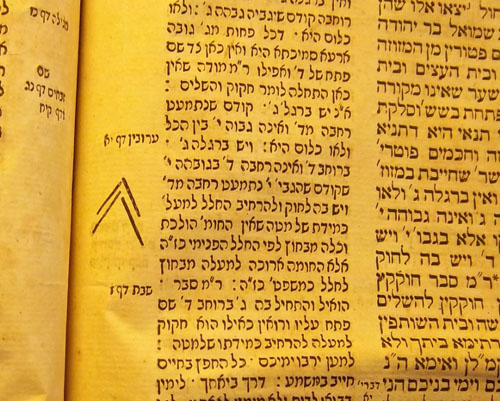
An “Artscroll”™ Illustration in the Vilna Shas-Masechet Shabbat 98b

An “Artscroll” ™ Illustration in the Vilna ShasMasechet Shabbat 98b

By Eli Genauer

לזכר נשמת אבי מורי ר׳ יעקב קאפל בר׳ משה יהודה הלוי גענויער ז״ל. היארצייט שלו י״ד סיון.

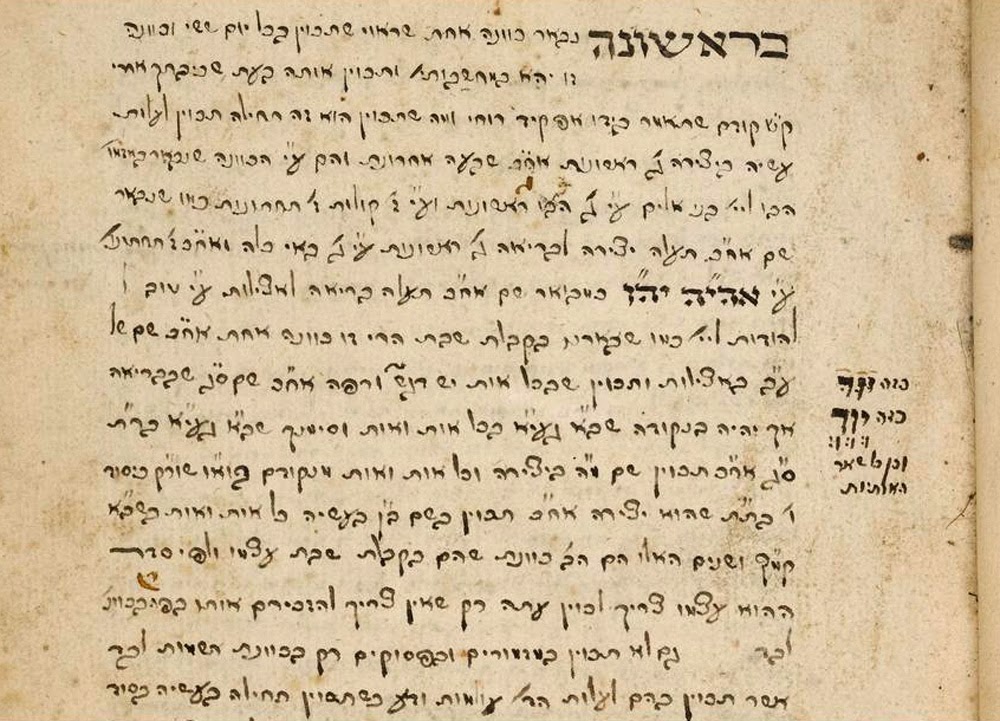
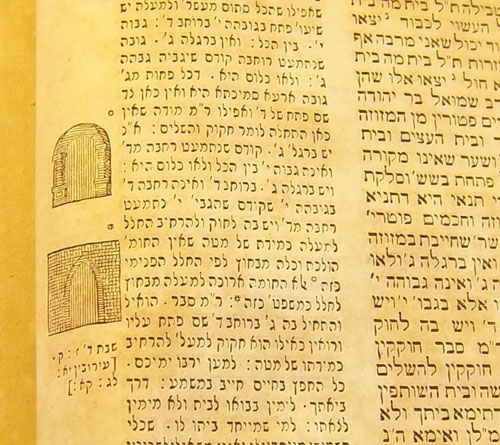
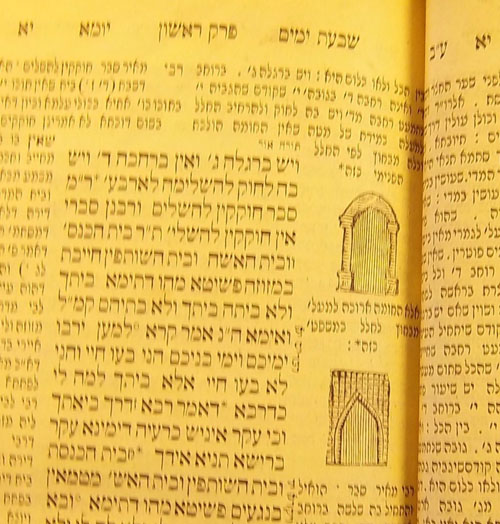
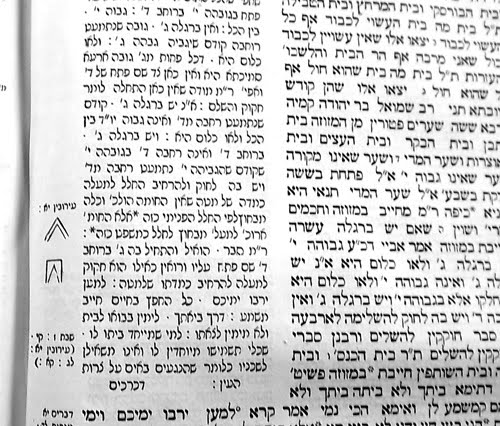
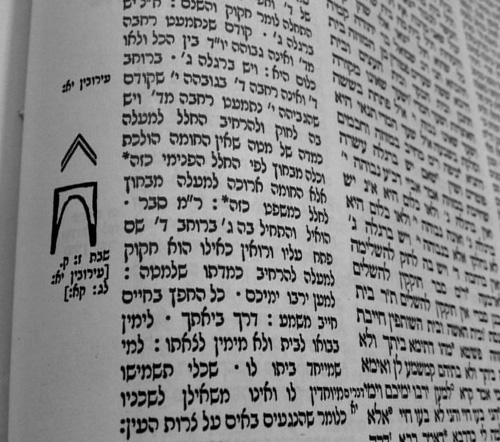
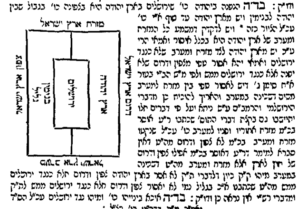
For those studying Daf Yomi this week, there is a unique diagram that appears on Shabbat 98b. In the Vilna Shas one can see a closeup “picture” of one of the boards of the Mishkan (“קרש“) which would make Artscroll proud.[1] While one might be familiar with diagrams that appear in the Talmud, those diagrams illustrate comments in the rishonim, mainly Rashi. Most of these are called out specifically by Rashi: “kazeh” “like this.” Artscroll, however, includes their own illustrations beyond those from any of the rishonim. Yet, they were not the first publishers of the Talmud to do so. Indeed, this diagram on page 98b is a much earlier example of a publisher electing to incorporate their own diagrams into the text.

Diagrams in Printed Editions of the Talmud

The use of diagrams is attested to in numerous manuscripts. These diagrams appear in Rashi, Tosefot and even were used by the Geonim.

When manuscripts gave way to printing in the late 1400’s and early 1500’s, those diagrams were excluded in the early printed editions of the Shas. When Daniel Bomberg published the first complete edition of the Shas in the early 1500s, he did not include the actual diagrams, but instead left a space for the book’s owner to pencil in the relevant diagrams (how they would know what the diagram looked like is left unanswered).

Finally starting with 1697, (the Berman Shas of Frankfurt on der Oder) did diagrams start to reappear in the empty spaces (mostly in Eruvin and Sukkah).

What was the source of those diagrams in the Berman Shas and in ones that were printed soon after in the early 1700’s? There were three sources, the Maharshal, Maharsha, and Mahram of Lublin.

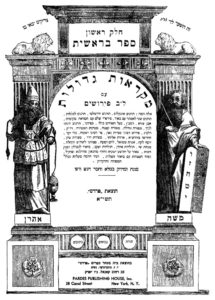
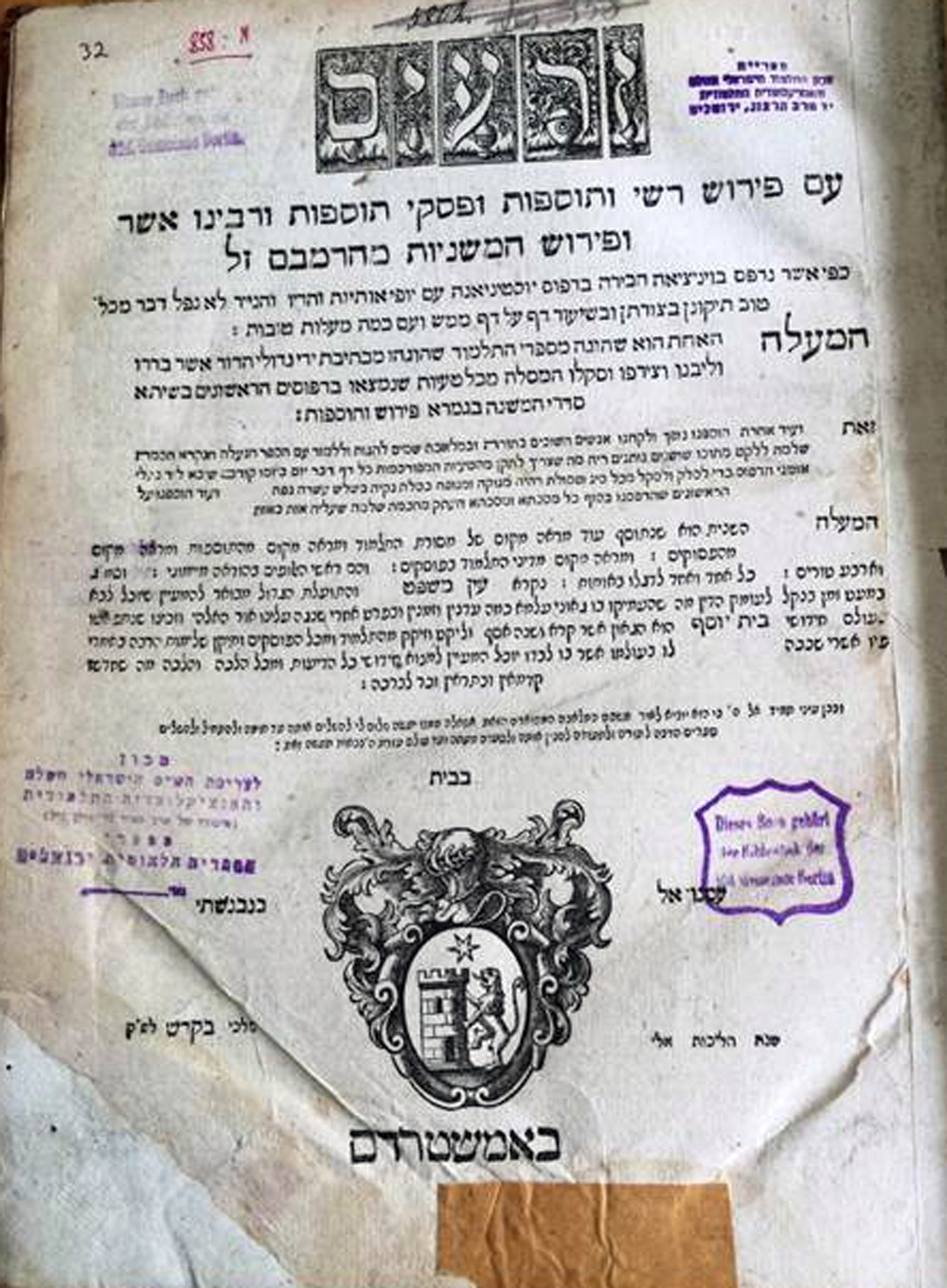
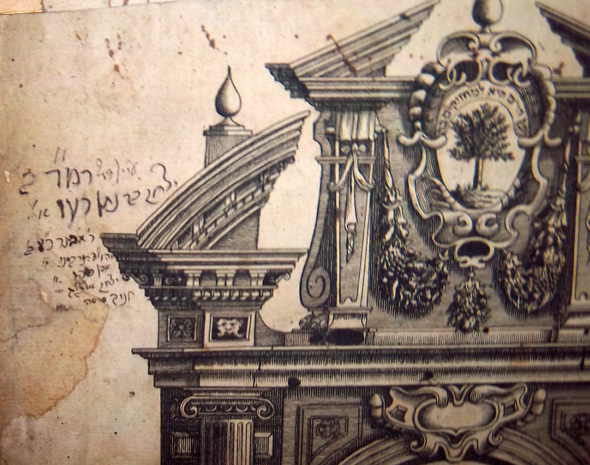
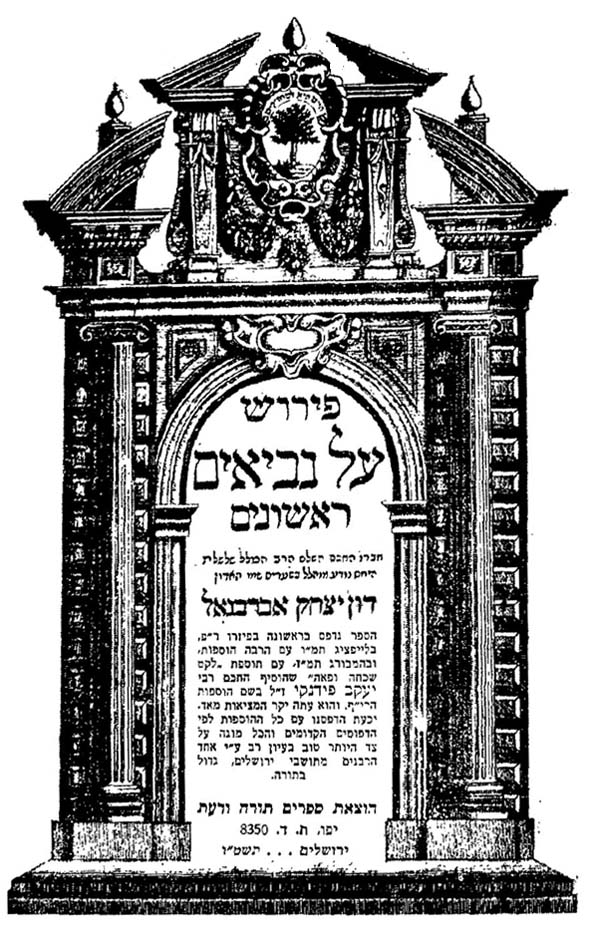
This is the Shaar Blatt from the Frankfurt on der Oder 1697 edition:

The Maharshal is the key point person when it comes to diagrams. He had the 2nd edition of the Bomberg Shas (printed circa 1528) and made his notations there. He recognized the importance of the Shas being printed but also the dangers that lay in the fact that if there was a mistake, it would find its way into thousands of hands. He lived at a time when there were still manuscripts around, and he made his corrections based on those manuscripts and also his own logic. Since he had the status of an Adam Gadol, his own logic carried much weight. Originally, he did not set out to write a book with his corrections. Like the Ba’ch, he just made the corrections in his own Gemara. After he died though, his sons printed Sefarim which reflected his notes.[2] Therefore, if in the late 1600’s or early 1700’s you were printing a Shas, and you looked at a previous edition and in Rashi it said “Kazeh” and there was a space, you would look at the Chochmas Shlomo. If he had added a diagram, you would place that diagram in the empty space and feel comfortable that it had good Yichus. There were times that there wasn’t an empty space that the Chochmas Shlomo shows a diagram, and in that case, the printers usually added it.

The 1715 Amsterdam Edition of the Talmud

A complete edition of the Talmud was first published in Amsterdam in the 1640s by Immanuel Benveniste. In the 17th and 18th centuries Amsterdam was counted among the most important cities for the printing of Hebrew books and there were many well-known publishers that followed Benveniste and they printed many important works yet none of them attempted to reprinting the Talmud. Only some sixty years later did Amsterdam see a Talmud come off its presses. This one, that began in 1714, was never completed.

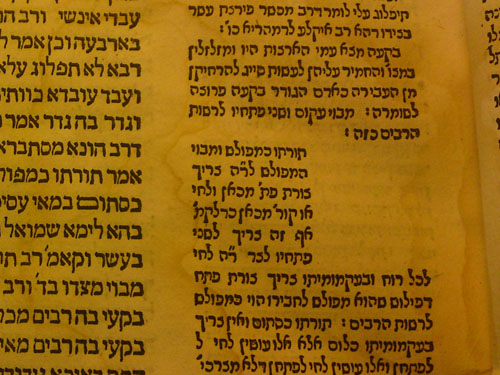
R. Judah Aryeh Loeb ben Joseph Samuel of Cracow appealed to Samuel ben Solomon Marsheses and Raphael ben Joshua de Palasios prominent members of the Amsterdam Sephardic community and asked them to print a new edition of the Talmud. Neither had ever published a book. In 1710, Loeb unsuccessfully sought to publish an edition of the Talmud in Frankurt. Now, in Amsterdam he sought to try again. Marcheses and Palasios formed a printing house specifically to print a “fine and accurate edition,” in an environment that “the workers would not be hurried so that they could work with care, reducing errors, and under the supervision of … the dayyan of the Ashkenaz Rabbinic Court of Amsterdam who would help establish the correct text.”[3] An emissary was sent to visit various Jewish communities to collect subscribers and reduce the burden of the significant printing costs. Relevant to diagrams, the emissary came bearing a gift, the Amsterdam 1710 edition of R. Jacob ben Samuel Bunim Koppelman of Brisk’s (1555-94) Omek Halakahah (first printed in 1510), a book that includes many diagrams to explain difficult passages of the Talmud.[4]

The first volume, Berakhot, was published in 1714[5] and the editors note the sources for their text and likely for the diagrams as well.

  1. Chochmas Shlomo

  2. Chochmas Manoach

  3. Chidushei Halachos of the Maharsha

  4. Maharam Lublin

  5. Sifrei Hashas of Yosef Shmuel ben Zvi – seemingly these were concentrated on Zeraim, Kodshim and Taharos

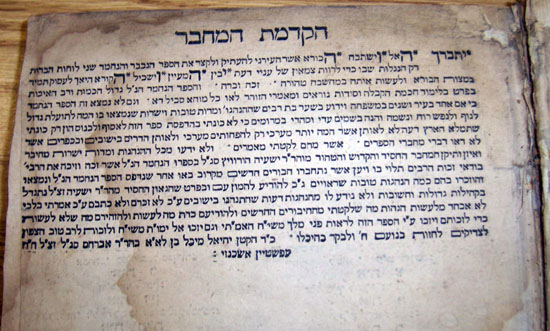
The volume on Meseches Shabbos was published in 1715 and the top 4 appear in the Hakdamah:

The Source and Purpose of the Diagram in Shabbos 98b

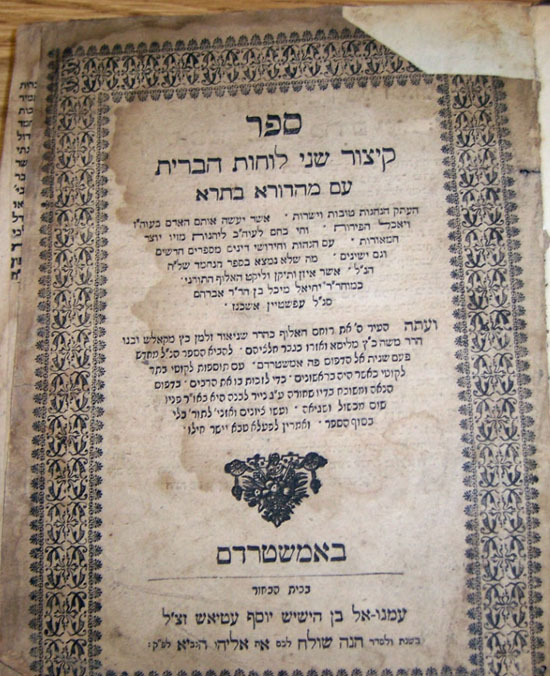
The Gemara in Masechet Shabbat on Daf 98a and b deals with the laws of carrying and discussing some of the details of the boards (“קרשים“) which made up the walls of the Mishkan.[6] These board were comprised of a complex system designed to keep each board straight and provide sufficient support for the entire structure of the Mishkan. Indeed, if one examines modern editions of the Talmud, there is an illustration that appears on the page. But where did it come from and more importantly what is its purpose? As we will show, the first edition to incorporate this diagram was the 1715 Amsterdam edition of the Talmud.

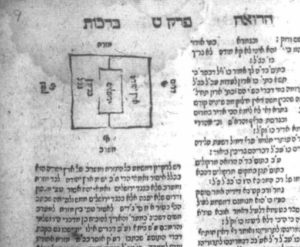
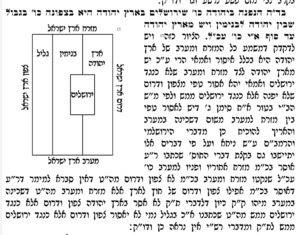
This is how it appears in the 1715 edition.

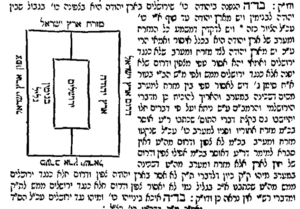
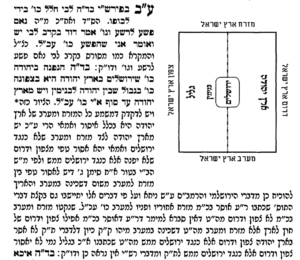
This image was reprinted in the Vilna Shas in a slightly clearer format although with the same detail and is a bit easier to analyze.


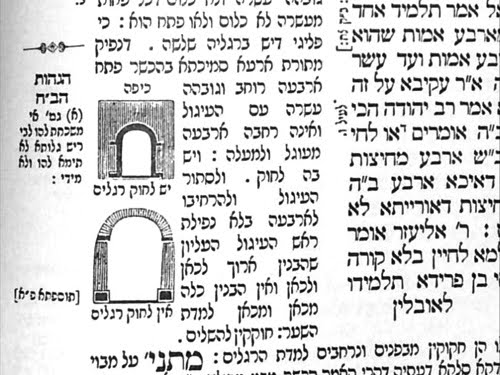
The picture primarily shows that there were three rods (“בריחים”) that connected one board to the next. The rods on the top and bottom went through outer rings, but the rod in the middle went through the width of the board.( “עובי הקרש“) It also shows the sockets on the bottom (“אדנים“) and the grooves (“ידות“) inserted in them which provided stability to the boards as they stood.

As discussed above, manuscripts of Gemarot though generally do not contain pictures, and a check on the invaluable website “Hachi Garsinan” shows that no manuscript of these pages has a picture to illustrate what a board looked like.[7] One might expect Rashi in his description of some of the statements of the Gemara to state his opinion and then write “כזה” (“ like this” ) Then we could expect to find an illustration in any of the number of Rashi manuscripts we have, and we could expect that this illustration (or an empty space for it) would appear in subsequent printed editions. Here we have none.[8]

The most relevant Rashi appears to his comments regarding how the boards stood miraculously.[9] But It does not discuss the fact that the middle rod went through the thickness of the board, but rather the miraculous nature of how the rod bent as it turned the corner. Another potential relevant Rashi explains the statement “the Sages taught, the bottoms of the beams (kerashim) were grooved and the sockets were hollow.” This deals with a completely different aspect of the beams which is how they were shaped on the bottom (and only according to Rabbi Nechemya). Thus, it is unsurprising that the manuscripts of Rashi do not include this diagram.

It was only in the 1715 edition does this illustration first appear. Yet, in the case of the picture of the keresh on Shabbos 98b, we do not find this picture in any of the sources identified by the Amsterdam publishers, not the Maharshal, Chochmas Manoach, Chidushei Halachos of Maharsha, or in Maharam Lublin.

First, we must identify what the diagram is attempting to illustrate. Rather than the more common form of diagrams, this one is not an illustration tied to one of the rishonim, rather it is illustrating two statements of the Gemara, one in the middle of the Daf and one at the very bottom. This, despite the fact that the diagram appears close to Rashi’s commentary on the page, seemingly tying it to his commentary.

Instead, the illustration is the independent product of the Amsterdam publishers and intended to elucidate the text of the Gemara, what did the board system look like. The Mesivta edition of Oz Vehadar also understands that this picture illustrates the words והבריח התיכון בתוך הקרשים. They indicate that Tziyur 6 which except for the detail on the bottom looks very similar to the one in the Vilna Shas, illustrates that statement.

In truth, the main part of the picture showing the middle rod going through the width of the board is not at all aligned with a comment of Rashi. Understanding that it just tries to give a picture of the “קרש” will make it easier to understand for people who study this page. This illustration is designed to explicate the text of the Talmud itself and was the entirely the idea of the publishers of the Amsterdam Talmud.

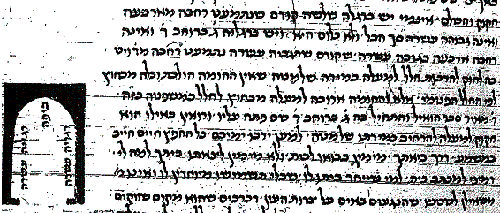
Why did the editors of the Amsterdam 1715 Shas insert a picture like this? Perhaps they were inspired by diagrams that appeared in a book called Omek Halacha by Jacob ben Simcha Bunim Koppelman which had just been reprinted in Amsterdam in 1710 and was even used in the fundraising campaign for this edition of the Talmud.[10] It has a picture of the grooves that fit into the sockets that is associated with the second aspect of this picture.

Yet, the Amsterdam publishers did not reprint the Omek Halakha’s crude diagram. Like the text and the other aspects of this edition, they included a much clearer and more detailed diagram that is infinitely more helpful in understanding the complicated text. Adding such a picture to a Daf of Gemara was a revolutionary act at that time and once added, it became part of Tzurat HaDaf that we have until today.

[1] As a matter of fact, there is a picture of the “קרש” in the Artscroll Stone Chumash, page 457, similar to the picture of the “קרש” in the Vilna Shas
[2] See Yaakov Spiegel, Amudim be-Toldot ha-Sefer ha-Ivri: Hagahot u-Magihim (Ramat Gan: Bar Ilan Univeristy Press, 2005), 312-17.
[3] Marvin J. Heller, Printing the Talmud: Complete Editions, Tractates, and Other Works and the Associated Presses from the Mid-17th Century through the 18th Century (Leiden: Brill, 2019), 75.
[4] Koppelman published another illustrated book, Ohel Yaakov. See Marvin Heller, The Sixteenth Century Hebrew Book: An Abridged Thesaurus, Volume 2, (Leiden: Brill, 2004), 724-25.
[5] For additional information on this edition see Heller, Printing the Talmud, 74-89.
[6] The categories of work employed to build the Mishkan formed the basis for the Melachot of Shabbat. In this case, the boards of the Mishkan were transported from one location to another giving rise to issues relating to the domains created thereby.
[7]
https://fjms.genizah.org/
[8] The manuscripts I checked on the KTIV website of the National Library of Israel were ones known as Parma 2097, Vatican 138, and Paris 324. All have no diagram in this entire Perek despite containing other diagrams of Rashi in other Perakim. (The two other manuscripts I checked of the total five that were available did not have diagrams in other Perakim either). The general website address for KTIV is https://web.nli.org.il/sites/nlis/en/manuscript
[9] In the book רש״י ,חייו ופירושיו“,כרך ב׳, הוצאת הקדש רוח יעקב, תשנ״ז” page 497, the author Rav Rephael Halpren states that there are 101 diagrams in Rashi included in the Vilna Shas, 51 of them in Masechet Eruvin. He then proceeds to enumerate all of them, including this one on Shabbat 98b. From the positioning of it on the page it certainly does look that way.
[10] Jacob ben Simcha Bunim Koppelman (1555–1594) was a talmudic scholar distinguished for his broad erudition and interest in secular sciences. Early in his life he embarked upon mathematical and astronomical studies, in addition to intensive occupation with traditional Jewish learning. He is the author of Omek Halakhah (Cracow, 1593). In it he elucidates the laws appertaining to Kilayim, Eruvin, etc., with the aid of diagrams and models. See here on Jacob ben Simcha Bunim Koppelman. 

This is it as it appears in the first edition (Cracow 1593):

https://hebrewbooks.org/pdfpager.aspx?req=45068&st=&pgnum=39


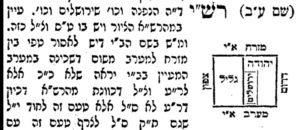
The Maharsha’s Map of Yerushalayim – A Taus Sofer? Berakhot 61b

The Maharsha’s Map of Yerushalayim – A Taus Sofer?

“ברכות סא: “הנפנה ביהודה

רש”י – ירושלים בארץ יהודה היא בצפונה של ארץ יהודה בגבול שבין יהודה לבנימין

By Eli Genauer

תנו רבנן, הנפנה ביהודה לא יפנה מזרח ומערב אלא צפון ודרום, ובגליל לא יפנה אלא מזרח ומערב. ורבי יוסי מתיר, שהיה רבי יוסי אומר לא אסרו אלא ברואה ובמקום שאין שם גדר ובזמן שהשכינה שורה. וחכמים אוסרים

Explanation of Rabbi Steinsaltz per Sefaria, the William Davidson edition of the Talmud

In this context, the Sages taught: One who defecates in Judea should not defecate when facing east and west, for then he is facing Jerusalem; rather he should do so facing north and south. But in the Galilee which is north of Jerusalem, one should only defecate facing east and west. Rabbi Yossi permits doing so, as Rabbi Yossi was wont to say: They only prohibited doing so when one can see the Temple, where there is no fence, and when the Divine Presence is resting there. And the Rabbis prohibit doing so.

רש״י-“הנפנה ביהודה

הנפנה ביהודה לא יפנה מזרח ומערב אחוריו למזרח ופניו למערב ולא אחוריו למערב ופניו למזרח מפני שירושלים בארץ יהודה היא בצפונה של ארץ יהודה בגבול שבין יהודה לבנימין ויש מארץ יהודה הימנה [למזרח] עד סוף ארץ ישראל והימנה למערב עד סוף ארץ ישראל שארץ יהודה על פני כל אורך ארץ ישראל היא מן המזרח למערב כרצועה ארוכה וקצרה ואם יפנה מזרח ומערב יהיה פרועו לצד ירושלים או פרועו שלפניו או פרועו שלאחריו אבל צפון ודרום יפנה ובלבד שלא יפנה כנגד ירושלים ממש בדרומה של ארץ יהודה

Focusing in on the description of where Yerushalayim is located, it says “Because Yerushalayim is in Eretz Yehuda in the north of Eretz Yehuda, on the border between Yehuda and Binyamin, and there is a part of Yehudah which extends to the east until the edge of Eretz Yisroel, and extends westward until the edge of Eretz Yisroel, because Eretz Yehuda extends the entire length of Eretz Yisroel from east to west as a long and short strap.”

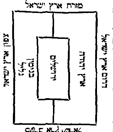
Maharsha – “הציור כזה” – Maharsha draws a map to illustrate the words of Rashi

Vilna Shas – courtesy of hebrewbooks.org

The first thing to consider is does the Maharsha mean that there was a ציור in Rashi?

It does not say “כזה” in Rashi

There was no space left open for a picture in the Bomberg edition of 1520 or the Soncino edition of 1484. This indicates there was no picture on the manuscript that served as the basis for the printed edition. Often חכמת שלמה (Prague 1582) will add a picture or diagram if it was missing from the Bomberg Shas. Here there is no indication of a missing picture in חכמת שלמה.

This manuscript of Rashi on Berachos also does not contain a diagram

The British Library, London, England Or. 5975

Conclusion: Maharsha is drawing a diagram of what he understands Rashi to be saying

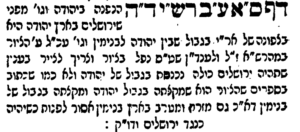
We do not have the Ksav Yad of the Maharsha on Berachot so our best knowledge of what he actually drew comes from the Defus Rishon. How was the map represented in that edition?

There were multiple first editions of Chidushei Halachot of Maharsha. The first few Masechtos were printed anonymously. The main one was printed in 1612. Berachos was printed in Lublin in 1621

First edition of Berachos 1621- The picture is the same as the Vilna Shas

courtesy of hebrewbooks.org

Is the map correct? Does it represent the words of Rashi?

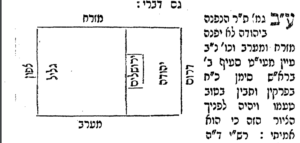
Yerushalayim is represented as being half in Yehuda and half in an area described as Binyamin and Galil. One may argue that the map was not drawn to an exact scale but it seems clear that part of Yerushalayim extends into Binyamin:

The words of Rashi say “Yerushalyim is in Eretz Yehuda in the north of Eretz Yehuda, on the border between Yehuda and Binyamin”. (שירושלים בארץ יהודה היא בצפונה של ארץ יהודה בגבול שבין יהודה לבנימין ) This seems to mean that Yerushalyim is contained within Yehuda and does not extend into Binyamin/Galil.

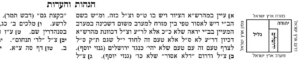
Ginzei Yosef (Bilgoraj 1932 by יוסף אלטר בן מרדכי אפשטיין) calls the map in the Vilna Shas a Taus Sofer and corrects the map to show Yerushalayim completely contained in Yehuda.

courtesy of hebrewbooks.org

There is some space on the east and west sides of Yerushalayim, meaning that Yerushalayim is between the eastern and western borders but does not extend to either border. (see the extra line drawn in on the west side of Yerushalayim). This is in line with the words of Rashi ויש מארץ יהודה הימנה [למזרח] עד סוף ארץ ישראל והימנה למערב עד סוף ארץ ישראל

This is also the opinion of Rav Tziyon Kohen Yehonatan (Djerba 1872-1931) in his Sefer Sha’arei Tziyon ( Dejerba 1932) courtesy of hebrewbooks.org

ולענד״ן שטאות סופר נפל בציור וצריך לצייר בענין שתהיה ירושלים כולה נכנסת בגבול של יהודה ולא כמו שכתוב בספרים שהציור הוא שמקצתה בגבול יהודה ומקצתה בגבול של בנימין דאם כן גם מזרח ומערב בארץ בנימין אסור לפנות כשיהיה כנגד ירושלים ודו״ק

He adds that if Yerushalayim in fact extended any distance into Binyamin, it would require those in Binyamin to also be aware of whether they were facing Yerushalyim or not.

The Sefer D”vash Tamar (Warsaw 1897) by Rabbi Dovid Teitelbaum of Mezeritch draws the map in a similar manner. In this map you can clearly see space between Yerushalayim and the western and eastern borders of Yehuda:

How is the map represented in the newer editions of the Talmud?

Oz Vehadar (Mahaduras Friedman, 2006, Page 42 Maharsha section, Hagahaos V’He’aros) copies the map of Ginzei Yosef but does not have a line on the western side of Yerushalayim. It seems to indicate that Yerushalayim extends to the western border of Yehuda which is incorrect.

Vilna HaChadash (2006 page 36 in the Maharsha section) redraws the map of the Vilna Shas but still has Yerushalayim extending into Binyamin:

Vagshal (Mahaduras Neherdea, 2008 page 27, Maharsha section) is similar to Vilna HaChadash:

Conclusion: Once something is “uploaded” into the print medium, it has a tendency to remain as it was first printed. In this case, the effects of what many have termed a Taus Sofer have remained for 400 years.


A Newly Discovered Work of the Rambam?

A Newly Discovered Work of the Rambam?

By Eli Genauer

I recently purchased a Chumash which was printed in Sulzbach in 1741 by Meshulam Zalman ben Aharon Fraenkel

Marvin Heller succinctly sums up the history of Hebrew printing in Sulzbach as follows:

“This small Bavarian community was for over two centuries the site of Hebrew presses that printed many important titles. Duke Christain-Augustus due to his interest in Kabbalah, permitted the opening of Hebrew print shops in the 1660’s. Sulzbach was subsequently home to Hebrew presses belonging to Isaac Kohen Gersonides, Isaac ben Judah Loeb of Prague, Moses Bloch, and afterwards the Frankel-Arnstein family which printed books there from 1699-1851.”[1]

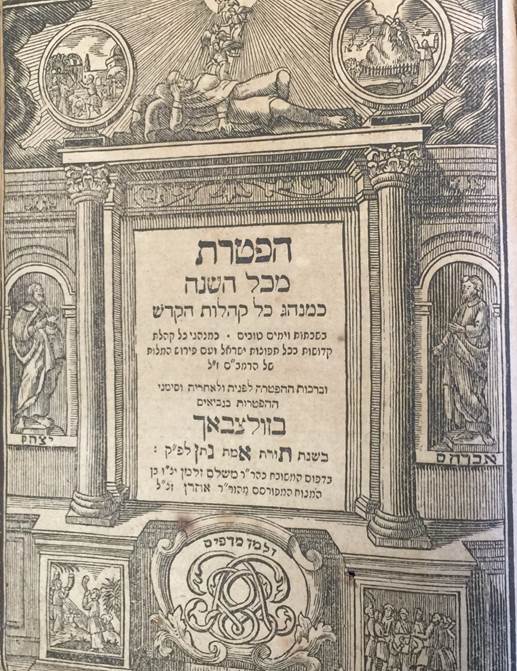
The bibliographic record at the NLI, most likely copied from the cover page of the book, notes nothing very unusual about it.

http://aleph.nli.org.il:80/F/?func=direct&doc_number=000333882&local_base=MBI01

עם שלשה [פירושים]… רש”י ז”ל, עם רש”י ישן, גם הפירוש רבינו יחזק’ בעל חזקוני, ובעל הטורים [לר’ יעקב ב”ר אשר] וכל הספר תולדת אהרן [מאת ר’ אהרן מפיסארו], וחסירות ויתירות וקרי כתיב… גם הפטורת [!] ופירוש המילות. והוגה בעיון רב…

One line that stands out a bit though, is one which indicates that there is a Peirush Hamilot for the Haftorot

                                                                                     … גם הפטורת [!] ופירוש המילות.

It also notes that there are separate title pages for the Chamaish Megillot and Haftorot

 סד דף, עם שער חלקי: “חמש מגילות… עם פירש רש”י”, וכן ההפטרות לכל השנה.

This bibliographic record comes from The Bibliography of the Hebrew Book (מפעל הביבליוגרפיה העברית)

We are informed on the NLI website that “The recording of the books is done in a scientific manner according to rules set by an editorial staff led by Prof. Gershom Scholem and Prof. Ben – Zion Dinur, and was based on examination of the books themselves. It includes a full description of the contents of the book and accompanying material, as well as all participants in its composition: editors, translators, authors of forewords and introductions, interpreters and illustrators and more.”

https://web.nli.org.il/sites/NLI/English/infochannels/Catalogs/bibliographic-databases/Pages/the-hebrew-book.aspx

It seems though that the bibliographers missed a very unusual and important feature of this Chumash.

Here is the separate cover page for the section on Haftorot:

This title page contains the following information

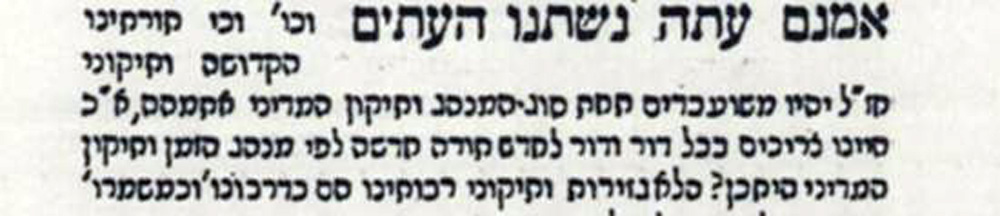
”  כמנהגי כל קהלת קדושות…..ועם פירוש המלות של הרמב״ם ז״ל

“According to the customs of all the holy communities…with a “Peirush Ha’Milot” of the Rambam.”

This information is also included in the preface portion of the Chumash section under the title of אמר בעל המדפיס:

“גם ההפטרות ופסקי טעמים מדוקדק…עם פירוש המלות של תורת משה הרמב״ם..”

There seems little doubt that this Peirush Hamilot is being attributed to the Rambam.

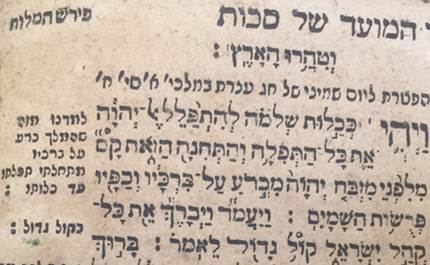
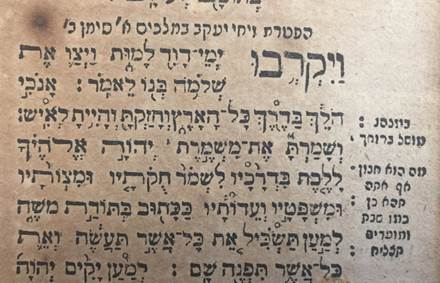
Here is what one page looks like.

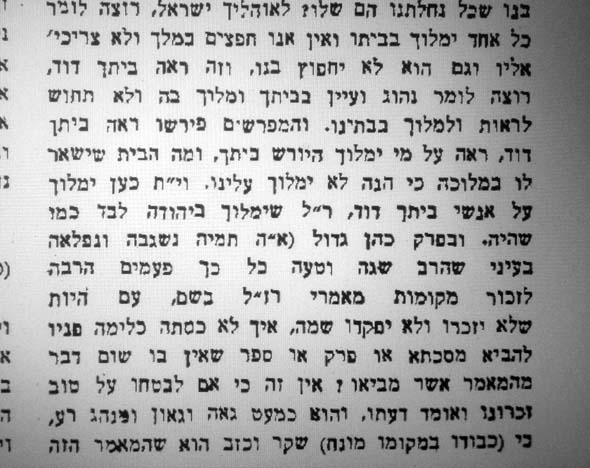
An example of a “Peirush Hamilot” would be the words “קול גדול” being interpreted as “בקול גדול”

However, this other page evidences differences in methodology in the “Peirush Hamilot”.

“בדרך” is just translated as “במנהג.”

But “והיית לאיש” is expanded upon and explained as “מושל ברוחך”

“בדרכיו” is also very much expanded upon by saying exactly which paths should be followed:  “מה הוא חנון אף אתה תהא כן”.

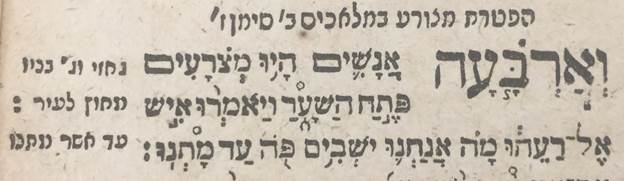
In this section below, we are told that the four Metzoraim are Gechazi and his three sons, a comment mirroring Rashi and Radak:

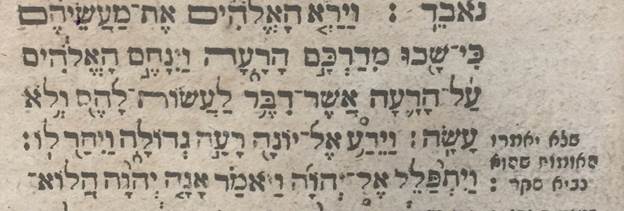
In the story of Yonah, we are told that he was troubled that Hashem had forgiven the people of Ninveh.

The Peirush HaMilot explains that it was because he did not want to be thought of as a false prophet. This is similar to Rashi’s approach:

I had never heard of such a commentary on Navi by the Rambam and was not able to find any reference to it anywhere. I checked with numerous experts in the field and no one else had heard of it either.

Imagine that! A work ascribed to the Rambam showing up in Sulzbach in 1741 and seemingly never to be heard from again. The printer gives us no hint of its origin and treats it as if it were a known work.

There is more, though. There is a fascinating reference to the Sulzbach Chumash of 1741 by none other than Rabbi Reuven Margoliot.[2] In a lengthy discussion of names that are missing from the Rambam’s Hakdamah to Peirush HaMishnayot, Rabbi Margoliot posits there is a portion of this Hakdamah missing from our printed editions and expresses the hope that

                           ״ואולי תוחזר לנו האבדה הגדולה שני פרקים מהקדמת רבינו זו שהושמטו בהעתקות ולא נדפסו״

As a proof that there are missing chapters, he quotes from the Chida who writes:[3]

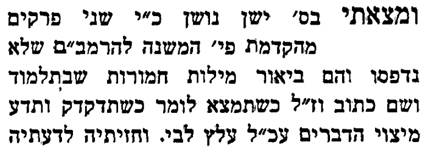
   ״מצאתי בספר ישן נושן כת״י שני פרקים מהקדמת פירוש המשנה להרמב״ם שלא נדפסו, והם ביאור מלות חמורות שבתלמוד״

In a footnote Rabbi Margoliot then makes a connection between the “lost” “ביאור מלות חמורות שבתלמוד” and the פירוש המלות של הרמב״ם ז״ל״” which appears in the Sulzbach Chumash of 1741.

״בחומש דפוס זולצבך תק״א בחלק ההפטרות מכל השנה הנלוה לתורה עם פרש״י וחזקוני הוא רושם שכולל פירוש המלות של הרמב״ם ז״ל״

Finally, by only citing this Chumash as containing the Peirush HaMilot, Rabbi Margoliot seems to be indicating it was the only time it was published. It certainly is a rare find for a Chumash printed in 1741.

*Seforim Blog editor’s note: The Warsaw 1860 Mikraot Gedolot included this perush hamilot (calling it haftarot im biur hamilot on the title page) but does not give the attribution to the Rambam, or to anyone.  Some of the content are word for word quotations of Rashi in the print editions. Here is the title page (from a 1951 photo offset reprint):


[1] Studies in the Making of the Early Hebrew Book by Marvin J. Heller- Leiden ; Boston : Brill, 2008.- p.40.
[2] Nitsotse or : heʼarot be-Talmud Bavli ṿe-heʻarot be-divre gedole ha-rishonim ṿeha-aḥaronim. Reuven Margoliot. Yerushalyim, Mosad Ha-Rav Kuk, 2002, p.34. The discussion of the missing names starts on page 30. The footnote cited is footnote 29 on page 34. My appreciation goes to a fine young scholar named Yosef, who brought this source to my attention.
[3] Sefer ʻEn zokher, Chaim Joseph David Azulay, Yerushalayim, 1962. p.185 #29


A Compromise in Halacha – On Menachot 33a

A Compromise in Halacha – On Menachot 33a
By Eli Genauer
A common D’var Torah delivered at a wedding goes something like this: “Dear Chatan and Kallah. You are standing beneath a Chupah which is representative of the home you will build within the Jewish people. When you walk into your home, you will notice that that Mezuzah is placed in a diagonal position on the doorpost. There is a disagreement between Rashi and his grandson Rabbeinu Tam as to whether the Mezuzah should be affixed in a vertical or horizontal position. Later decisors ruled that a compromise between those two opinions was in order and therefore prescribed that the Mezuzah be affixed diagonally. This lesson of compromise is an important one as you embark upon you marriage and the Mezuzah on your door is an important reminder of this principle. Mazal Tov!”
This wedding Dvar Torah is based on a Gemara in Menachot 33a
אמר רב יהודה אמר רב, עשאה כמין נגר פסולה.
איני? והא כי אתא רב יצחק בר יוסף אמר כולהו מזוזתא דבי רבי כמין נגר הוו עביד……. ?
לא קשיא, הא דעבידא כסיכתא, הא דעבידא כאיסתוירא. 
Rav Yehuda says that Rav says: If one affixes a Mezuzah like a bolt, it is invalid. Is this so? But when Rav Yitzchak bar Yosef came ( from Eretz Yisroel ) he said that all Mezuzot in the house of Rebbe ( Yehuda HaNasi) were affixed like a bolt……? This is not difficult. This ruling (where it is ruled as being unfit) is where it was prepared like a peg; that ruling (in the house of Rebbe where it is ruled as being fit) is where it is prepared like an ankle. [1] 
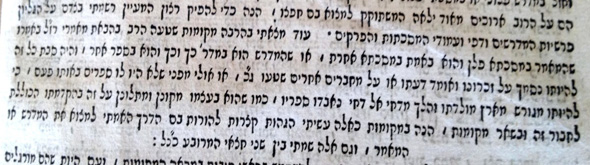
Rashi explains that a “נגר” is something that is embedded in a wall “שתוחבין הנגרין בכותל”[2] 2. He then writes the word “כזה” and illustrates this with a drawing showing a horizontally placed Mezuzah. This is one of many times here that Rashi tells us something and then uses the word “כזה” which is then followed by a diagram. In this case, the illustration shows a horizontally affixed Mezuzah and it is a mezuzah affixed in this direction that is improper.
Rabbeinu Tam (תוס’ ד״ה “הא דעבידא כסיכתא) is bothered by the explanation of Rashi because he feels that it is more honorable to have the Mezuzah affixed in a horizontal position just as it is more honorable to have a Sefer Torah lying horizontally than standing vertically. He therefore translates the word “נגר” as a “peg” and says that the disqualification of a Mezuzah affixed כמין נגר is that it is affixed vertically, like a peg. He also translates the word כסיכתא as a peg and therefore disqualified because it is vertical, and the word איסתוירא, which is considered to be proper, as the part of the foot below the ankle which is horizontal.
The idea that affixing the Mezuzah diagonally is a compromise between the positions of Rashi and Rabbeinu Tam is based on the Shulchan Aruch, Yoreh Deah 289:6

צְרִיכָה לִהְיוֹת זְקוּפָה, אָרְכָּהּ לְאֹרֶךְ מְזוּזַת הַפֶּתַח….. הַגָּה: וְכֵן נָהֲגוּ. (בֵּית יוֹסֵף) אֲבָל יֵשׁ אוֹמְרִים שֶׁפְּסוּלָה בִּזְקוּפָה, אֶלָּא צְרִיכָה לִהְיוֹת שְׁכוּבָה, אָרְכָּהּ לְרֹחַב מְזוּזַת הַפֶּתַח (טוּר וְהַפּוֹסְקִים בְּשֵׁם רַבֵּנוּ תָּם). וְהַמְּדַקְדְּקִין, יוֹצְאִין יְדֵי שְׁנֵיהֶם, וּמַנִּיחִים אוֹתָהּ בְּשִׁפּוּעַ וּבַאֲלַכְסוֹן (טוּר וְהַגָּהוֹת מַיְמוֹנִי ומהרי”ל ות”ה סי’ נ”ב), וְכֵן רָאוּי לִנְהֹג, וְכֵן נוֹהֲגִין בִּמְדִינוֹת אֵלּוּ.

In truth, it is not really a compromise but rather an effort to affix the Mezuzah in a way in which both Rashi and Rabbeinu Tam would approve. Rashi says that vertical is the proper way, horizontal is Pasul, but bent ( or diagonal) is also Kosher. Rabbeinu Tam says that horizontal is the proper way, vertical is Pasul, but bent is also Kosher. Some Meforshim take this idea even further by saying that since in the house of Rebbe the Mezuzot were affixed כאיסתוירא, this was some sort of Hidur and therefore something to be emulated.
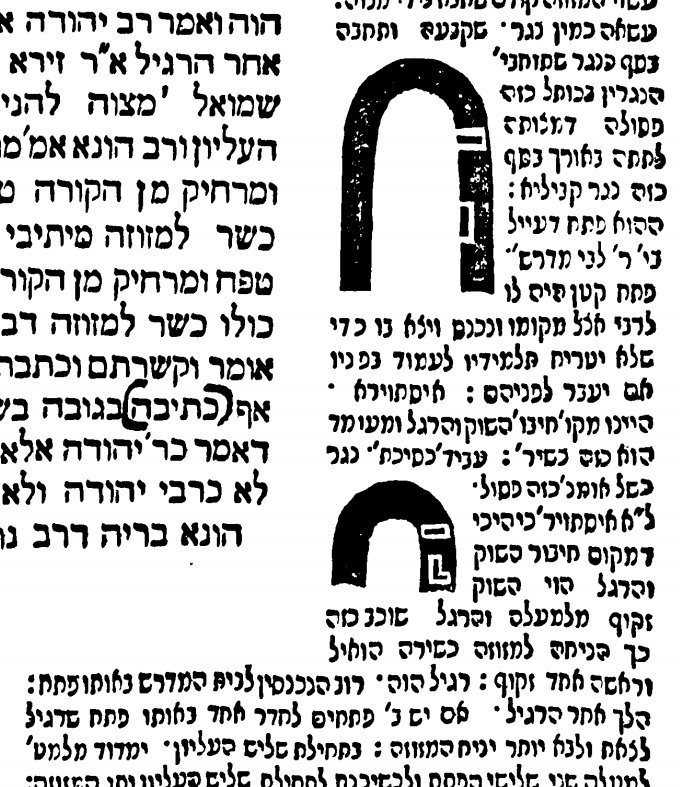
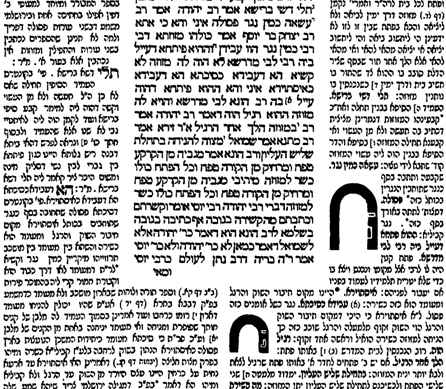
The classic edition of the Vilna Shas (Vilna 1885) renders this Sugya and the accompanying diagrams as such
Here are the words of Rashi which correspond to these two diagrams which show the positioning of four Mezuzot
  1. עשאה כמין נגר – שקבעה ותחבה בסף כנגר, שתוחבין הנגרין בכותל כזה.
  2. פסולה – דמצותה לתתה באורך בסף כזה …. נגר, קביליא
  3. עבידא כסיכתא – נגר כשל אומנים כזה פסולה
  4. איסתוירא – היינו מקום חיבור השוק והרגל ומעומד הוא כזה, כשירה:
  5. ל”א איסתוירא, כי היכי דמקום חיבור השוק והרגל הוי השוק זקוף מלמעלה והרגל שוכב כזה כך הניחה למזוזה כשירה הואיל וראשה אחד זקוף:
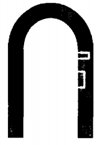
The doorframe in the top illustration shows the position of two Mezuzot.
The one on top is horizontal which is improper, and the one on the bottom is vertical which is Kosher.
  1. עשאה כמין נגר – שקבעה ותחבה בסף כנגר, שתוחבין הנגרין בכותל כזה.
He affixed and inserted it in the doorpost like a bolt, for workmen who work with bolts insert it in the walls like this[3] 
  1. פסולה – דמצותה לתתה באורך בסף כזה ….
It is improper- Because the Mitzvah is to affix it vertically in the doorpost like this….
The doorframe in the lower illustration also shows two Mezuzot.
The one on top is horizontal and therefore improper and the one on the bottom is bent (it looks like the Hebrew letter Nun), and therefore Kosher. Here are the words of Rashi which correspond to these two Mezuzot.
עבידא כסיכתא – נגר כשל אומנים כזה פסולה
A bolt as fashioned by workmen like this is disqualified
ל”א איסתוירא. כי היכי דמקום חיבור השוק והרגל הוי השוק זקוף מלמעלה והרגל שוכב כזה כך הניחה למזוזה כשירה הואיל וראשה אחד זקוף
Another explanation of איסתוירא – like the point at which the “Shok” joins the ”Regel”, where the “Shok” is upright and the “Regel” rests, like this, so too if he affixes the Mezuzah like this it is Kosher because the top part is upright.
There is no diagram associated directly with this comment of Rashi
איסתוירא – היינו מקום חיבור השוק והרגל ומעומד הוא כזה, כשירה:
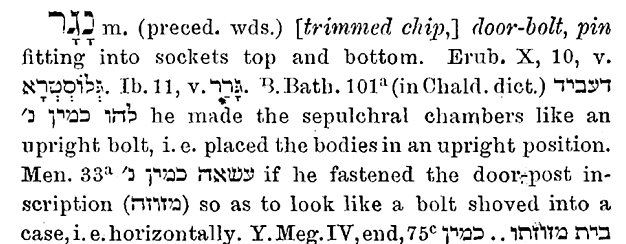
Whether a נגר is normally inserted horizontally or vertically is also “illustrated” in Jastrow’s explanation of the word
In Bava Batra 101a he describes it “like an upright bolt” and in our Gemara he describes it as “like a bolt shoved into a case, i.e. horizontally
There are two issues with the standard depiction of the two diagrams in the Vilna Shas. Rashi uses the word כזה five times and there are only four “illustrations” (2 in each diagram) Also, we would expect that there would be a diagram after each time it says כזה.
This problem is solved when we look at the only handwritten manuscript we have of Rashi on this part of Menachot.
The National Library of Russia, St. Petersburg, Russia Ms. EVR IV 25:

http://aleph.nli.org.il:80/F/?func=direct&doc_number=000159163&local_base=NNLMSS
It contains five depictions of the placement of the Mezuzot and each כזה is followed by a depiction.
The problem is also solved when we look at the first printed edition of Menachot ( Bomberg 1522) whose source had to be a manuscript. [4] 
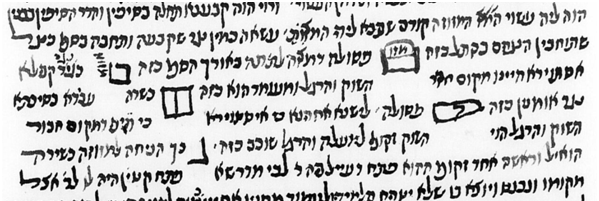
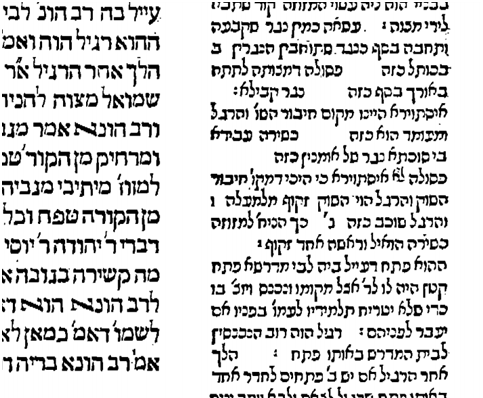
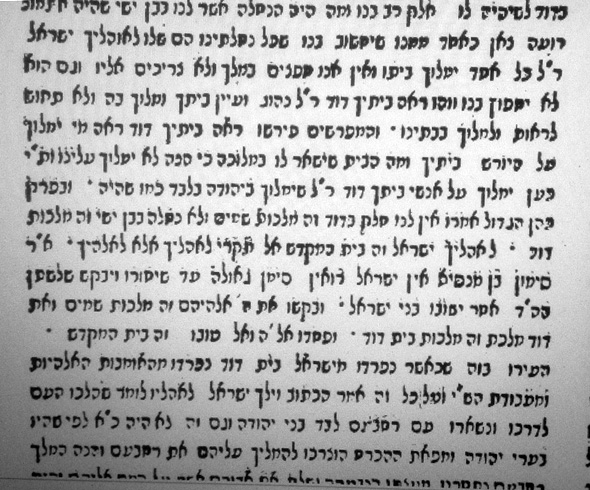
This printed edition leaves space after every כזה. It even includes a rudimentary depiction of the last כזה looking like a “Nun” which is supposed to depict where the ankle meets the leg.
It looks very much like the Nun in the National Library of Russia manuscript and may have emanated from the same source.
It was very exciting for me personally to discover this “diagram” which clearly was added to illustrate the כזה. In his Maamar ‘al hadpasat ha-Talmud with Additions, (ed. A.M. Habermann, Mossad ha-Rav Kook, Jerusalem: 2006, p.41)  Rav Natan Nata Rabbinowicz, writing about the first Bomberg edition, states as follows:

״ובכל התלמוד (וכן בכל הדפוסים הישנים עד דפוס בערמן) נשמטו הציורים בגמרא, רש״י ותוספות,ונשאר מקומם חלקמלבד בסוטה מגשישנו הציור ברש״י
“In all of the Talmud (and in all other older printed editions of the Talmud until the Berman edition ( Frankfurt an Der Oder 1697-99) the diagrams were not included in the Talmud, Rashi and Tosfot, and their space remained empty, except for Sotah 43A, where we find a diagram in Rashi.”

It turns out there was a diagram included in the second Bomberg edition of Zevachim( 1528) on 53b, which Rabbinowicz probably never saw. See my article here.
He may have also missed this one because it does not look much like a diagram, but just a letter, or perhaps he felt it was of no significance.
This depiction of the last כזה looking like a “Nun” was maintained by subsequent editions of the Talmud printed in Basel 1580, Cracow 1605, Amsterdam 1644, and Frankfurt an der Oder in 1699.
It was only dropped and replaced with the two larger diagrams we have today in the Frankfurt am Main edition of 1720.
Since many people follow the advice of the Rema and affix the Mezuzah diagonally, it is important to understand the source. This is the word in the Gemara which state that in the house of Rebbe, the Mezuzot were affixed כאיסתוירא. This word is etymologically related to the Latin word astragalus which is described as “the bone in the ankle that articulates with the leg bones to form the ankle joint”. It is more commonly known today as the Talus and looks like this:[5] 
As used in the Gemara, it probably meant the entire area where the bottom of the foot ( which is horizontal) met the bottom of the leg ( which is vertical) at the ankle, thereby looking like something that was bent.
Finally, there is a fascinating story about the Talus bone related by Rav Yisroel Shachor in the Sefer “Dovair Yesharim”.[6] In discussing the איסתוירא, he writes that he was in a terrible automobile accident and בחסדי ה׳ escaped death by climbing out of the rear of the car only seconds before it burst into flames. The only injury he sustained was a broken bone in his foot, which he identified as the Talus. He had many opportunities to view x-rays of his broken foot and concludes “I see this as a source of amazement that the only bone of all 248 bones in my body which was broken, allowed me to understand the words of Torah, and to understand that this was the איסתוירא which is mentioned in Gemarot.”[7]

[1] Translation courtesy of Sefaria.org and follows the interpretation of Rashi.
[2] There is discussion on whether what is shown as Rashi in our editions of Menachot was actually written by Rashi. Rav Natan Nata Rabbinowicz ( author of Dikdukei Sofrim) writes that our “Rashi” was written by a student of Rabbeinu Gershom. ( Dikdukei Sofrim on Menachot 86a note 6 where he writes …מפני שהפרוש הזה המיוחס לרש״י הוא כנראה מתלמיד הרבינו גרשום מאור הגולה והעתיק ברובו לשון הרבינו גרשום מאור הגולה) Rav Betzalel Ashkenazi (the author of the Shita Mekubetzet) writes that for chapters 7-10, the “Rashi” in the standard editions was not written by Rashi and he substitutes his own version which is indicated by the words “Rashi Ktiv Yad” in the Vilna Shas. The editors of the Vilna Shas record this opinion at the beginning of the 7th chapter ( Menachot 72a) as follows: וזה לשונו “זה הפּרוש אשר הוא בדפוס מפרק אלו המנחות עד שתי הלחם אינו מפי׳ רש״י ז״ל והוא של פרשן אחר, וזה לשון רש״י כּ״י”.But Rav Ashkenazi seems to indicate that the Rashi of other chapters was in fact written by Rashi. ( see his note to the beginning of Menachot chapter 11 where he writes מכאן ואליך הוא פירוש רש״י ז״ל).
[3] We only know that it is affixed in a horizontal direction from the picture, not from Rashi’s words.
[4] The Soncino family printed many tractates of the Talmud from 1483-1519 before Bomberg printed the complete Talmud in 1520-1522, and those Soncino editions often formed the basis for the text of the Bomberg edition. But the Soncino family did not print tractate Menachot meaning the Bomberg edition was based solely on manuscripts.
[5] My source for this information is Dr. Carol Teitz who is a member of my Shul. Dr. Teitz is an orthopedic surgeon and most recently, the dean of admissions at the University of Washington Medical School
[6] Doveir Yesharim, Sefer Shemot, Jerusalem. 2014, page 128

[7] This source was brought to my attention by a Torah scholar named Aharon who has helped me immensely in my research on diagrams.


The Strange Shape of the Marcheshet Pan

                             The Strange Shape
of the Marcheshet Pan
                                                            
By Eli Genauer
“The underlying basis of our work is that
pictures are an organic part of the commentary, and it possible that Rashi even
allowed himself to limit his explanatory words when a picture was available to
the reader. This is in the sense of “a picture is worth a thousand
words”. The picture is an integral part of the written book, no less
important than the words.” 
                                                              
Dr Ezra Chwat
                                                    
Department of Manuscripts, National Library of Israel
                                                     
Giluy Milta B’Almah Blog
                                                          
January 15, 2017
There were many vessels
used in the Beit HaMikdash. Nevertheless, without pictures or diagrams drawn
contemporaneous to their existence, there remains some doubt as to exactly what
they looked like. I would like to discuss one vessel used quite often in the
Temple and see what the diagrams of the Rishonim can tell us about its makeup.
I would also like to analyze a diagram in Rashi’s commentary to Talmud Bavli
and see how it fits into our discussion.

Massechet Menachot 63a
האומר הרי עלי במחבת, לא יביא במרחשת; במרחשת, לא יביא במחבת.  מה בין מחבת למרחשת–אלא שהמרחשת יש לה כסוי, ולמחבת אין לה כסוי, דברי רבי יוסי הגלילי; רבי חנניה בן גמליאל אומר, מרחשת עמוקה ומעשיה רוחשין, ומחבת צפה ומעשיה קשין
One who says, “I take upon myself [to offer a grain offering prepared]
on a griddle, he must not bring [one baked] in a pan. If [he says “I take upon
myself to offer a grain offering prepared] in a pan,” he must not bring [one
prepared] on a griddle. What is the difference between a griddle and a pan? The
pan has a lid to it, but the griddle has no lid – [these are ] the words of
Rabbi Yose Hagili; Rabbi Hanina ben Gamliel says : a pan is deep and what is
prepared is spongy, a griddle is flat and what is prepared is hard.[1]

Leaving  aside the opinion of Rabbi Yossi Haglili, let us concentrate on the statement of Rabi Chanina ben Gamliel
We would imagine that the Marcheshet is a deep vessel, and the Machvat
is flat, as it is described as a griddle. 
Perhaps like this:
                                   
The Gemara then cites a Braita which deals with the following
situation.  If a person takes a vow
saying “I take upon myself a Marcheshet”, it remains unclear whether he meant
he will bring the vessel called a Marcheshet, or the normal Korban Mincha that
is brought in a Marcheshet. Beit Hillel is of the opinion that since there was
a specific vessel in the Beit Hamikdash called a Marcheshet, we understand that
he is talking about that vessel and we require him to donate it to the Beit
HaMikdash.[2] Here are the words of the Braita which describe in some detail
the appearance of this Marcheshet pan:
כלי היה במקדש ומרחשת שמה ודומה כמין כלבוס עמוק וכשבצק מונח
בתוכם דומה כמין תפוחי הברתים וכמין בלוטי היוונים

There was a vessel in
the Temple called Marhesheth, resembling a deep mould, which gave the dough
that was put into it the shape of Cretan apples and Grecian nuts. (The Soncino
Hebrew/English Babylonian Talmud)

Rashi goes to great
lengths to explain this uncertain statement and includes a diagram in his commentary.
This diagram first appeared in printed form in the early 18th
century but unfortunately, it does not align with the words Rashi uses to
describe the overall shape of the pan. 
Additionally, It does not match the diagram we have in a manuscript of
Rashi nor diagrams in manuscripts of other Rishonim.
But first some
background
The diagrams we have
today in the Vilna Shas in Rashi and other Rishonim come from earlier printed
editions. The first printed edition of the entire Talmud to contain diagrams
was the Behrmann Shas printed in Frankfurt on Oder, 1696-98.[3] Raphael Natan
Nata Rabinowitz posits that by the time diagrams were included in the printed
text, there were very few manuscripts around because most had been placed in
Genizah.[4]  He therefore concludes that manuscripts were not used in the early
18th century as a source for diagrams. What was the source of those
diagrams for the Behrmann Shas ? According to the editors of the Behrmann Shas,
they mostly came from the Chochmat Shlomo of 1582.[5] It’s an extremely
reliable source because it was written by Rav Shlomo Luria who specifically
wrote it to correct the text of the Bomberg Shas and to insert the relevant
diagrams. Rav Shlomo Luria lived at a time when there were still many
manuscripts around, so either he used those manuscripts for his textual
emendations and as a source for his diagrams, or he used his own capabilities
to come up with his changes and additions. Since most of our present day
diagrams follow from the Behrmann edition, they have an aura of authenticity
attached to them.[6]
The problem arises when
we discover that Chochmat Shlomo does not include all the diagrams we have
today. For example, in our case, there is no Chochmat Shlomo on Menachot.
Let us now take a look
at the diagram in Rashi on Menachot 63a.
The first time it
appeared in print was in the Frankfurt am Main edition of 1722, exactly 200
years after the diagramless Bomberg edition. We know its source was not a
manuscript of Rashi nor was it the product of the Maharshal.
Putting aside the
diagram for a moment, let us concentrate on the words of Rashi as he tries to
describe the Marcheshet:
כלבוס
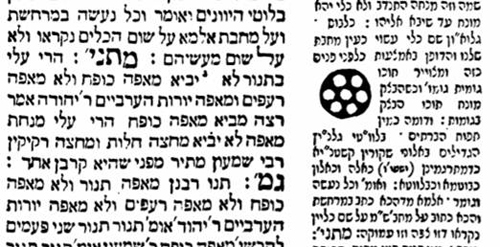
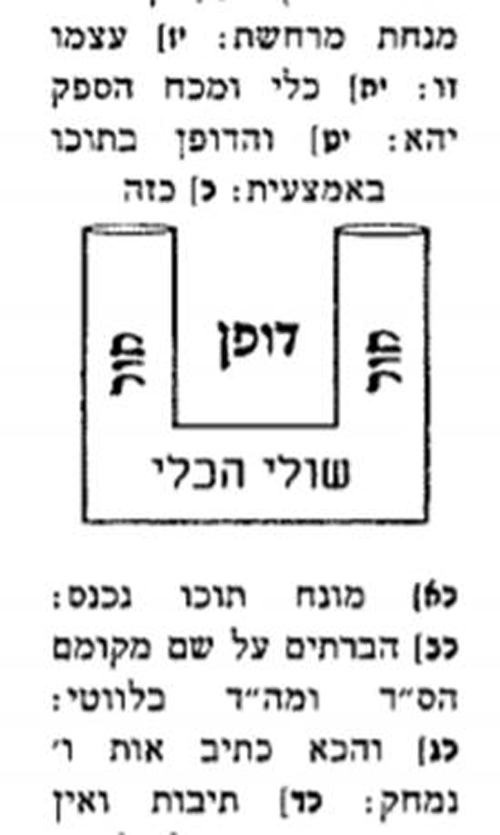
– גלואו”ן שם כלי עשוי כעין מחבת שלנו והדופן באמצעות כלפי פנים
כזה  ומצוייר תוכו גומות גומות וכשהבצק מונח בתוכו [נכנס] הבצק
בגומות:
Rashi concentrates on
the word כלבוס as the Gemara itself says that a Marcheshet is shaped like a
deep כלבוס. Rashi first gives us an old French word
which is normally translated as “tongs”.[7] He says that the Marcheshet is like
his present day Machvat pan and that the “wall in the middle faces the inside,
like this”. The problem is that the diagram does not seem to show a wall in the
middle facing the inside. Additionally, if a כלבוס is a pair of tongs, and the shape of the
vessel looked somewhat like a pair of tongs, how does that align with the
diagram which is circular?
The Shita Mekubetzet
which is included on the standard page of the Vilna Shas has a completely
different diagram.
Notice that the word
Dofen is in the middle of the diagram just as Rashi says והדופן באמצעות כלפי פנים
The
volume of the Bomberg edition that belonged to Rav Betzalel Ashkenazi the
author of the Shita Mekubetzet contains the exact same diagram inserted in the
blank space of the Rashi.
Jerusalem – The National Library of Israel Ms. Heb. 4°79 (link).
In his book Dikdukei
Sofrim on Menachot (Munich, 1886) R.N.N. Rabinowitz writes about the
importance of the comments of the Shita Mekubetzet as they were addressed to
the Bomberg edition of 1522 and relied heavily on manuscripts which included a Rashi
manuscript.[8] The Acharit Davar printed at the end of the Vilna Shas also
extols the importance of the Shita Mekubetzet on Kodshim as it came from a
manuscript and was based in part on a manuscript misidentified but actually of
Peirush Rashi.[9]
Going back in history,
we can get an idea if a diagram did in fact exist in Rashi manuscripts by
looking at the first printed edition of Menachot which was Bomberg 1522. Its
source had to be from manuscripts because no printed edition preceded it.
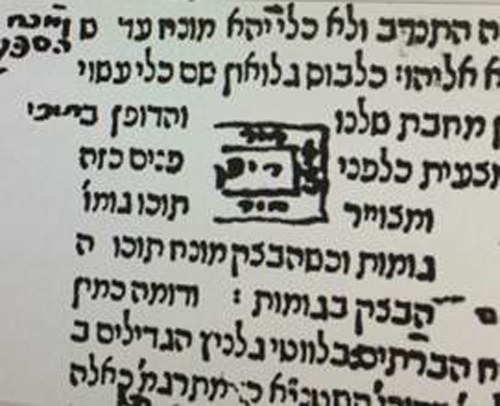
You can see that the
Bomberg editors included the word “כזה” in the text of the Rashi and left 2
spaces indicating that their manuscript included 2 diagrams. This may explain
why our present diagram does not reflect the shape of the overall pan as there
may have been one diagram depicting its shape and a second one depicting the
apple like insets. In fact, a notation in the Oz Vehadar edition states quite
clearly that our diagram just illustrates the words “גומות
גומות”.
As mentioned before,
the words of Rashi seem to support the idea that the Marcheshet pan was
semicircular in nature. In addition, the shape of the vessel is likened to a כלבוס which is an
item dealt with a number of times by Rashi
For example this Rashi
on Shabbat 59b:
Rashi states that an
item worn by women called a “מנקתא פארי” ( starting with the letters “וי״מ” for ויש מפרשים) is “כּמין חצי עגול עשוי כמין כלבוס” and then draws your attention to a
diagram of a semi circle.
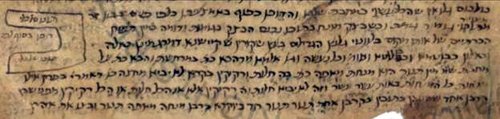
Fortunately I was able
to find a manuscript of Rashi on Menachot which is identified as Vatican
487  and is from the 13th
century. (Made available by the Polonsky Digitization Project) It pictures the
Marchseshet pan in a semicircular shape and thus fits in more with the words of
Rashi.
It’s clear that the
diagram included only deals with the semicircular nature of the vessel and not
the little depressions inside the “Tocho Shel Kli”. This diagram is very
similar to the one in the Shita Mekubetzet and it is possible it served as a source
for the Shita Mekubetzet.[10]
We are confronted with
another diagram of the Marcheshet pan in what is known as the Peirush Rabbeinu
Gershom first printed in the Vilna Shas. This Peirush describes the vessel
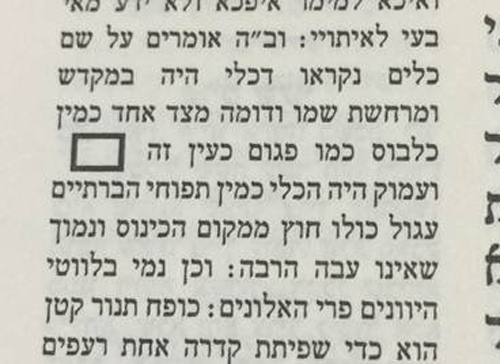
being shaped like a כלבוס and then says it is “כמו פגום”, which means incomplete. One would expect
to see a vessel like in the Shita Mekubetzet and in the Rashi manuscript which
is not either completely circular or square in nature. Nevertheless, the diagram
in the Vilna Shas depicts this vessel as being square like this
In the Achrit Davar the
editors of the Vilna Shas state that they had a manuscript of this Peirush
Rabbeinu Gershom however the following manuscript shows the pan as having an
indentation and not being square.
Roma – Biblioteca Angelica Or. 1 (link):
It could be they that
had a manuscript depicting a square pan, or it is possible that their
manuscript had a pan with an indentation and this was not transferred
successfully to the printed page. Certainly the words of the Rabbeinu Gershom
indicate the latter.
Conclusion:
Nowadays it is easy for us to transfer an image from a
manuscript to a printed or electronic page. All we have to do is point, shoot,
copy and paste. The result is an exact duplicate of what is on the manuscript,
and it is even easier to work with than the original. But hundreds of years ago
it was not so simple. A woodcut or an engraving of the image could be made and
then transferred to the printed page, but that was time consuming and
expensive. Because of this, images such as diagrams were just left out, and
when they were added, they were often misleading and sometimes even incorrect.
The printing revolution was a giant step forward for the dissemination of
Jewish knowledge, but, at least at its beginning, played havoc with many important
diagrams.
[1] English translation
from Sefaria.org.
[2] The Rambam Paskens
according to Beit Hillel. Since Beit Hillel speaks about the Marcheshet being
different than a Machvat,  and not just having a cover) it is clear that the
Rambam holds like Rav Chananya ben Gamliel
[3] Maamar ‘al hadpasat ha-Talmud with Additions, ed. A.M. Habermann, Mossad ha-Rav Kook, Jerusalem: 2006, p.41. The Soncino family printed individual editions of the Talmud between 1483- 1518, but not an entire set. Some of those editions such as Eiruvin did contain diagrams and some did not. The first complete set of the Talmud was the Bomberg edition 1519-1522. That edition did not contain diagrams, only empty spaces which were to indicate where diagrams were to go (the only exception was Sotah 43a). There were numerous full editions of the Talmud printed between 1522-1697, but these also did not contain diagrams. 
[4] Printing
the Talmud: A History of the Earliest Printed Editions of the Talmud
, Marvin J. Heller, Im Hasefer 1993 p.6 states as follows: “Rabbinovicz attributes the dearth of Talmud codices to
the manner in which they, and many other manuscripts, had been written; without
any commentaries, with errors and erasures, and lacking even lines. Rashi and
Tosafot (additions by Ashkenazic luminaries after Rashi) were separate
manuscripts, suffering from the same conditions. As a result, learning must
have been difficult, with the reader having to continuously peruse three different
works, assuming that he owned them. Therefore, when the Talmud was printed with
Rashi and Tosafot, “men no longer learned from their manuscripts, but
considered them as utensils without further value, placing them in genizahs, so
that they no longer exist.”
[5] Other sources mentioned by the editors of the Behrmann Shas are Maharsha and Maharam Lublin. Neither of those sources contain diagram for our Rashi.
[6] A good summary of
the subject of where our present day diagrams came from can be found in the
introduction to the Shas Nehardea, under the heading of “המקור לציורי הש”ס”. (Vagshal Publishing Ltd,
Jerusalem, 2008, p.5 of the introduction. The overall section on diagrams
starts on page 4 of the introduction under the heading “מבוא לציורי הש״ס”.)There are a few diagrams that are
not in the Berman Shas but first appear in the Frankfurt am Main edition of
1720-1722. Here too, the editors of that edition say that the source of their
diagrams was the Chochmat Shlomo.
[7] All the Meforshim
understand that Beit Hillel is saying that the Marcheshet pan is shaped like
a כלבוס,
meaning the pan is shaped like a pair of tongs. 
I would imagine tongs to look like this, with the top part being
semicircular especially in the open position
Jastrow renders our
Braita saying that a Marcheshet is “a baking form in the shape of forceps with
cavities”
[8] Rabbinowitz writes
on page 1 of his introduction that when he wrote his emendations on Menachot
that “I had in my hand a handwritten manuscript of the Shita Mekubetzet by Rav
Betzalel Ashkenazi…..And he wrote his comments on the 1522 Venetian edition
including Gemara, Rashi and Tosafot with the help of handwritten manuscripts he
( Betzalel Ashekenazi) had in his hands”
[9] Achrit Davar at the
end of Masechet Nidah, p.6
[10] The Oz VeHadar edition of the Talmud
actually changes the diagram inside the Rashi to the diagram of the Shita
Mekubetzet


The 1908 Student Strike at Rabbi Isaac Elchanan Theological Seminary: A Newly Discovered Document

The 1908 Student Strike at Rabbi Isaac Elchanan Theological
Seminary: A Newly Discovered Document
By Eli Genauer

I would like to thank Dr Zev Eleff for his invaluable assistance in helping me frame this article. I would also like to thank Sharon Horowitz of the Library of Congress for providing research assistance.

The Rabbi Isaac Elchanan Theological Seminary (RIETS), present day Yeshiva University, was officially founded on March 20, 1897. RIETS was the first unequivocally Orthodox Jewish seminary on American soil.  Initially, its mission was entirely religious, limited “to promote the study of the Talmud and to assist in educating and preparing students of the Hebrew faith for the Hebrew Orthodox Ministry.”[1] RIETS’ first years were difficult ones.  It did not move into a building of its own until 1904.[2] Additionally, RIETS faced difficulty meeting its financial obligations.  including a student stipend. As a result, in 1906, RIET’s was beset by a major student strike. Among the student’s demands was that RIETS expand its mission beyond religious education and they demanded that they be instructed in secular subjects, including learning English.[3] While that strike was settled, another student strike and a lockout occurred over similar issues in May 1908. The strike was ended when changes were promised by the board of directors.  Yet, that settlement proved fleeting.
By August 1908, the students were striking again. The students’ strike received notice from the national press, when on August 19th,
the New York Times reported:[4]
the Talmuds are lying idle on the shelves of the Rabbi Isaac
Elchanan Theological Seminary at 156 Henry Street, and the drone of the voices
of the students as they walked back and forth reading aloud from the Hebrew
text is heard no more. For the last few weeks the students have not received
the $3.50 a week which they are paid while they are learning to become Rabbis.
Consequently, they have gone out on strike. Boruch Shapiro, Louis Mahler and
Samuel Broida, the leaders of the demonstration, stationed themselves at the
door of the school yesterday and effectively blockaded the entrance of all the
smaller boys. Nathan Lamport of the Lamport Manufacturing Supply Company, at
278 Canal Street, president of the school, and David Abramowitz of 47 Forsyth
Street, the Secretary, do not know what to do.[5]
On August 20th, citing financial reasons, the board locked out the students and
closed the school.[6] As a result of the closure of the school by the board of directors, some of the students and some Rabbinic leaders tried to form a new school called Yeshiva le-’Rabbanim which was designed to address some of the deficiencies of RIETS.[7]
Although the closure of the RIETS has been documented, the August 1908 student strike that led to the closure is not reflected in any published histories discussing the unilateral closing of the school and lockout of the students by the board ofdirectors on August 20th.[8]
One of the difficulties in piecing together exactly what happened during that August 1908 strike, lockout and its immediate aftermath is the dearth of contemporary records. This lacuna is in part attributable to a general lack of documntation of REITS’ early years.  And, “there are no records extant of the Seminary from its inception in 1897 to its merger with Yeshivat Etz Chaim in 1915. Only the Certificate of Incorporation, scattered newspaper accounts, one or two contemporary citations, and passing references in the memoir literature of the time remain as silent witnesses to the great vision and determination of a few men who…created the first Orthodox rabbinical seminary in America.”[9] As an example, in reporting on the August 1908 closure of the school by the board of directors and its aftermath, one scholar quotes mainly from newspaper accounts of the day.[10] There was an important memoir of that period written by Hayim Reuben Rabinowitz, who was an 18 year old student at the time, but Rabinowitz published his account 60 years later.[11]
Recently, however, a contemporaneous account of the events of 1908 has come to light.  This account was discovered as a result of construction at Congregation Bikur Cholim Machzikay Hadath in Seattle, Washington, when workers came upon a box of papers labeled, “Rabbi B. Shapiro Papers, 1920s-1960’s.” Rabbi Boruch Shapiro (1883-1970) was born in Szmorgon, Lithuania and was recognized as a Talmudic genius (Iluy) at an early age.[12] He was a student of, and received ordination from, Rabbi Meir Simcha of Dvinsk, (Or Sameakh), one of the outstanding rabbinic leaders of his time.[13] While in Dvinsk, R. Shapiro also received ordination from Rabbi Joseph Rozin, known as the “Rogatchover Gaon”.[14]  R. Shapiro immigrated to America in the early 1900’s and visited Seattle in 1913 on a fundraising trip. His visit became permanent when he ended up marrying a local woman, Hinda Gershonowitz and remained in Seattle until his passing in 1970. Rabbi Shapiro is perhaps best remembered as the Rav of Congregation Machzikay Hadath in Seattle, a position he held for forty years.
Before arriving in Seattle and shortly after arriving in America, Rabbi Shapiro studied at RIETS. Because he already possessed rabbinic ordination, he was considered in a special class of students, receiving a higher weekly stipend than most others who studied there. [15] He was sent by the school to give lectures at a synagogue in Brooklyn during the Sukkot holiday of 1905 as an example of the quality of students that were studying in the yeshiva.[16]
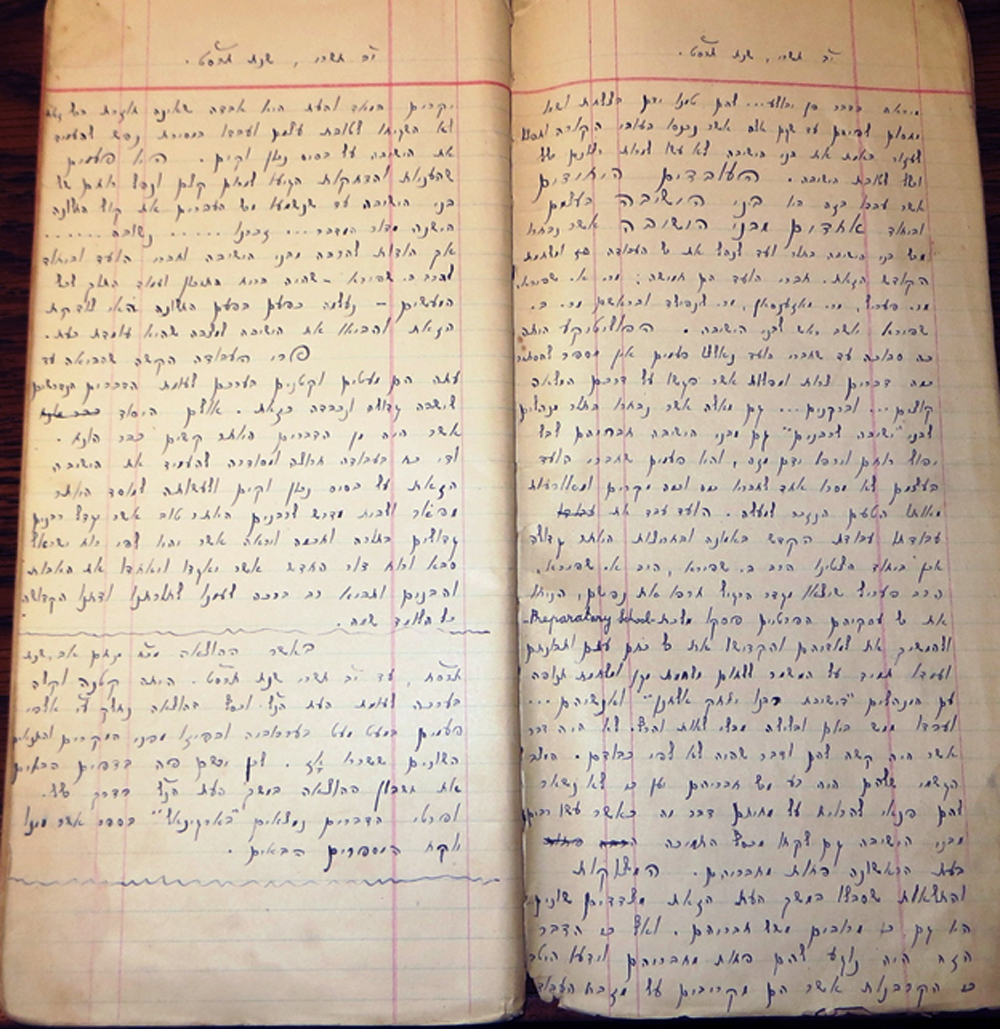
The box of papers discovered contains Rabbi Shapiro’s account of the events surrounding the student strike in August 1908, and the subsequent founding of the Yeshiva Le’Rabbanim. The account was written on October 7th, 1908 and covers the period from August 20 until that time. Because Rabbi Shapiro was one of the three student leaders of the strike, his account is particularly relevant to filling in the picture of the details of the August 1908 RIETS student strike.[17] Rabbi Shapiro’s writings, it should be noted, reflect that he and his fellow students had been involved in a struggle with, in his view, a dysfunctional and stubborn board of directors for over two years.[18]
Rabbi Shapiro records that:
On Thursday night, 24 Av 5668(20 August 1908), the Rabbi Isaac
Elchanan Yeshiva was closed in a very unseemly fashion. Mr. [Jonathan] Shepp,
the treasurer of the Yeshiva called the police several times to evict the
yeshiva students from the building in which they learned.[19]
But despite all his efforts, the police declined to do harm to the students.
They remained there despite his displeasure until midnight and at that time
they left for their residences.”[20]
After the students of the Yeshiva had concluded that there was no
hope to improve both the physical and spiritual conditions of the Yeshiva due
to the obduracy of the leaders whose concern was only for themselves, the
students decided to separate from the above named Yeshiva and move to “Adas Bnei
Yisroel” at 213 East Broadway, which welcomed them with open arms.[21] On
28Av (25 August-1908), the students of the Yeshiva moved their place of Torah
study to the above mentioned address in the company of well-known rabbis, such
as Rabbi [Shalom Elchanan] Jaffee[22],
Rabbi [Chaim Sholom] Shoher[23],Rabbi
[Aaron] Gordon [24],
and others, who had gathered there to guide them. After much discussion, it was
decided that the yeshiva students would study temporarily in Adas Bnei Yisroel,
and that they would acquire a charter. So that the leaders of Yeshiva Rabbeinu
Yitzchak Elchanan would not collect money in their name, they decided that this
yeshiva would be called “Yeshiva L’Rabanim”. Similarly, they decided to send
out boxes to collect members and to try to establish this yeshiva on a proper
foundation.
From 28 Av 5668 until 12 Tishrei 5669, three meetings of well-known
rabbis and prominent lay leaders were held. At the second meeting, an interim
leadership team for Yeshiva L’Rabanim was chosen: Rabbi Jaffe, chairman; Rabbi
Shoher vice chairman and treasurer; Rabbi [Joseph Judah Leib] Sossnitz,
administrator;[25]
Rabbi Dr. Rabinowitz from Brooklyn, administrator; Rabbi [Judah Leib] Lazeroff,
administrator,[26]
and others. The job of developing a “program” both in religious and secular
studies for this yeshiva was also assigned to the above leaders.
Even before the closure of the Yeshiva Rabbi Isaac Elchanan, the
physical situation of the students was very bad because for seven weeks prior
to the closure, all they received was a half a kilogram of bread per week.
However, the situation since they left the Yeshiva until now was much worse,
and the poverty and embarrassment they suffered is difficult to describe. Many
of them could have found other means of support, but because of their love of
Torah, they accepted their lot and did not abandon Torah study with which they
had been engaged their entire lives.
Many Rabbis, in writing, speech and action, promised to help. From
all the promises very little materialized, aside from Rabbi Lazaroff, who had
spoken up a few times in his synagogue on behalf of the Yeshiva. He assembled a
worthy number of members from whom he collected funds. The prominent Mr.
[Abraham J.] Goldstein and his brother-in-law, Mr. [P.] Feinberg from Jersey
City came to the assistance of the Yeshiva in the beginning. [27]With
the help of other prominent members of their congregation who worked alongside
their honored Rabbi [Shlomo David] Posner, that synagogue supported the yeshiva
a bit.[28]
To describe in detail all the problems faced by this new endeavor
and the stumbling blocks that were placed in front of this new Yeshiva from the
beginning until now would amount to an entire book. The task was difficult and
the conflict with the administration of the Yeshiva Rabbi Isaac Elchanan
weighed heavily on us. Many did not want to support the students of the Yeshiva
since they saw that the “Morgen Journal” had “sold out” to those above
mentioned administrators to do their bidding. They also felt that the “Tageblatt”
was leaning in the direction of those administrators, and not on the side of
the Yeshiva L’Rabanim. Many rabbis knew and admitted that the yeshiva students
were right, but kept silent due to fear. So much so, even those who had joined
the new Yeshiva were not really able to help it.
The primary laborers on behalf of the new Yeshiva were the students
themselves and especially a student council that was chosen from among them to
lead the struggle. The five members of this council were Mr. A.[vraham]
Shapira, Mr.[Ben Zion] Perl, Mr. [Chaim Yechezkel] Mosesohn, Mr. [H.S.] Linfeld
and Mr. B.[aruch] Shapira who was the leader.[29]
The politics were so intense that oftentimes those in the Yeshiva did not
confide in their fellow students for fear that they were supporting the other
side. The council worked diligently with the three main activists, Rabbi B.
Shapira, Rabbi A. Shapira, and Rabbi Perl who were most instrumental.  They abandoned all their other pursuits such
as attending “Preparatory School,” working day and night to battle with the
administration of Yeshiva Rabbeinu Isaac Elchanan.  Nothing was too difficult for them or beneath
their dignity. Their physical situation was worse than the conditions of other
students, as they had no other means of sustenance and they also received a
more meager stipend compared to what they had been entitled to. They suffered
immensely during this time. They knew that they were making great sacrifices
and losing precious time. Nevertheless, they did not consider their own
personal situations so that they could help establish this new Yeshiva on a
proper foundation. There were times that matters grew so bad that many of the
yeshiva students echoed the complaints of the Jews in the desert: they wanted
to return to their previous Yeshiva, but thanks to many of the yeshiva students
and the student council, especially Rabbi B. Shapira, these complaints were set
aside and it allowed the Yeshiva to attain the status it claims today. The
result of what has been done so far is small compared to what needs to be
completed. Nevertheless, laying the foundation, which was the most difficult to
accomplish, has been done. More effort is required to establish this Yeshiva on
a firm foundation and to transform it into an excellent school that will train
great rabbis in Torah, wisdom, fear of Heaven; who will work within the spirit
of ancient Israel and the spirit of this new generation; and who will unite
both old and young, thereby bring blessing to our people, our Torah and our
holy faith.”
In the end, Yeshiva Le-Rabbanim did not exist for very long because it never had substantial financial backing and support from the general community.[30] The attempt to form an alternative yeshiva apparently did not deter some of the student dissidents to return to RIETS. In 1917, in a RIETS publication, Rabbi Baruch Shapiro and his brother Rabbi Abraham Shapiro along with Rabbi Ben Zion Perl are listed among those ordained by RIETS now serving as rabbis in America.[31] Even more curious, the strike leader Rabbi Baruch Shapiro went on a fundraising tour in 1917 to raise money for the Rabbinical College of America, one of whose components was RIETS.[32]
The strike’s impact, however, on one of the most important future leaders of RIETS and Yeshiva University was profound.  Chaim Rabinowitz wrote “The strikes stimulated the mind of a young Rabbi who had recently arrived in America. This young Rav was Rabbi Dov Revel.” Rabinowitz cites a letter that Dr. Revel wrote to Rabbi Zvi Masliansky in the spring of 1908, where he grieves about the turmoil in RIETS that Rabbi Masliansky had told him about and hopes for better days for the Yeshiva. Rabinowitz concludes “the dream of Rabbi Revel came to fruition in 1915 when he became the Rosh Hayeshiva…and instituted great changes in the order of studies.”[33]
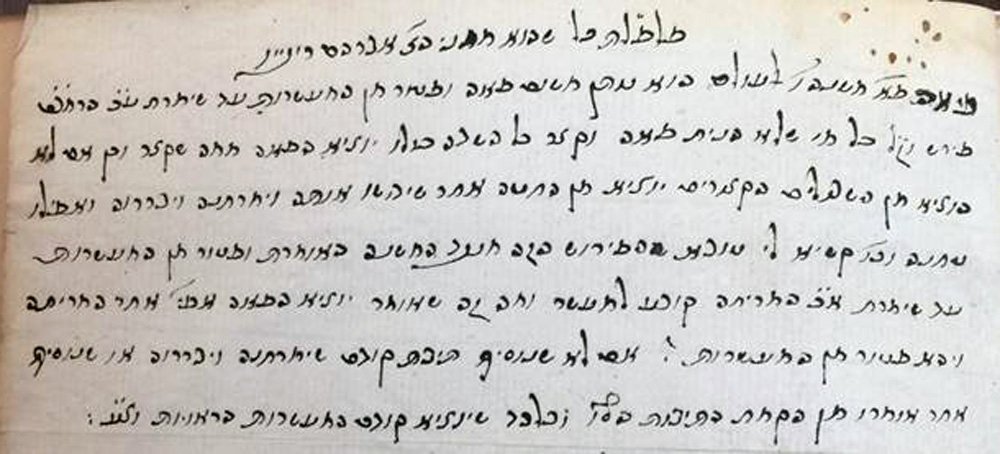
Here is a sample page of the document:


[1]
“Rabbi Isaac Elchanan Theological Seminary Association Certificate of
Incorporation,” March 20, 1897, (quoted in Gilbert Klaperman, “Yeshiva
University:  Seventy-Five Years in
Retrospect,” American Jewish Historical Quarterly 54,1 (September,
1964), 6). William Helmreich, however, states that teaching “the language of
the land” and Talmud was articulated in the RIETS charter, and, as such, “the
first such mention of combining secular and religious studies in one
institution.”  William B. Helmreich, “Old
Wine in New Bottles:  Advanced Yeshivot
in the United States,” American Jewish History, 69, 2 (December 1979),
235.  But, the 1897 certificate does not
mention “language of the land,” and Helmreich’s assertion is without
citation.
[2]
Gilbert Klaperman, The Story of Yeshiva University: The First Jewish
University in America
(New York: Macmillan, 1969) 71-72.
[3]Alexander
Dushkin, Jewish Education in New York City (New York: Bureau of Jewish
Education, 1918), 77-78.
[4]
“Boys Go On Strike,” New York Times, August 19, 1908.
[5] The Times
report may have been the result of the RIETS’ students, who, to gain
sympathy to their cause alerted it to the unrest. See Klaperman, Story,
95
[6] The
most complete report on the student unrest from 1906-1908 can be found in Klaperman,
Story, 94-112.
According
to Rabbi Klaperman, the closure and lockout on August 20th was
reported by the Jewish Morning Journal on Friday August 21st,
1908 and the Judisches Tageblatt on Sunday August 23, 1908. Idem.
217n8.
[7] Gurock,
Men and Women, 40; Rabinowitz, “60 Shana,” 553; and Klaperman, Story,
118.
[8] There
are three discussions regarding the closure of RIETS on Thursday, August 20th,
1908
See Klaperman, Story, 111-12. There is no mention of a
strike immediately preceding the board’s action. Rabbi Klaperman does not cite
the Times article in any of his footnotes. Additionally, in footnote 21,
p.218, he writes that there was no clear picture of presidential succession of
RIETS between February 1906 and fall of 1908, despite an indication in the NY
Times article that Nathan Lamport was the president of the school in August of
1908.
The
second is Hayim R Rabinowitz’s recollections that appeared in Hadoar in
1968. Hayim R. Rabinowitz, “60 Shana le-Shvitot be-Yeshivat Rabbeinu Yitzchok Elchanan,”
Hadoar, June 14, 1968, 552-554. In 1908, Rabinowitz was an
eighteen-year-old student at RIETS, and writes at length regarding the
situation leading up to the closing of the school on August 20th,
with the resultant lockout of the students from the building at 156 Henry
Street, but does not mention that the students had been on strike immediately
preceding this event. Although Rabinowitz was a contemporaneous observer, his
reminiscences were only published sixty years after the events in question.
The third discussion is by Jeffrey Gurock.  Jeffrey Gurock, The Men and Women of
Yeshiva: Higher Education, Orthodoxy, and America Judaism
(New York:  Columbia University Press, 1988) 39-40. Citing
Rabinowitz, p.553, he writes “Frustrated, feeling that a double cross was in
the making, RIETS students were once again talking strike in the late spring
and early summer of 1908.” Gurock, however, does not mention that a strike and
blockade of the building took place in August as indicated by the headline of
the New York Times and in the subsequent article.
[9] Klaperman,
Story, 48.
[10] Idem, 217-19.
[11]
Rabinowitz, “60 Shana,” 552-554, quoted extensively in Gurock, Men and Women,39-41.
[12] The
Jewish American Family Magazine and Gazette (Amerikaner Familian Magazin un
Gazetten)
, vol. XXXIX, no. 47, September 19, 1941, 2.
[13]
Rabbi Meir Simcha was the author of “Ohr Sameach”, an important commentary on
Maimonides’ “Mishna Torah”, and of “Meshech Chochmah”, a commentary on the
Torah. Rabbi Meier Simcha wrote of Rabbi Boruch Shapiro “he has the ability to
formulate outstanding novella acceptable to all”. The Jewish American Family,
2.
[14]
Prior to coming to America, Rabbi Shapiro obtained letters of support from two
other leading rabbinic figures in eastern Europe, Rabbi David Hirsch Eisenstein
and Rabbi Shlomo Vilner. The Jewish American,2. Rabbi Vilner wrote that
he never gives ordination to one so young, but in the case of Rabbi Shapiro, he
was willing to make an exception.
[15]
Rabinowitz, “60 Shana,” 553.  Rabinowitz
also refers to Rabbi Shapiro as a “Gadol B’Torah”
[16] Klaperman,
Story, 62.
[17] The
New York Times article identifies him as one of the three student strike
leaders. See also, Rabinowitz, p.553 As early as 1906, R. Shapiro held a
leadership role.   He was among the four
students chosen to represent the students’ views before RIETS’ board of directors.  Rabinowitz, “60 Shana,” 553; The Jewish American,
2, which states that Rabbi Shapiro was chosen as a representative by the
students in dealing with the board.
[18] Regarding
the student’s relationship with the board of directors, Klaperman describes an interaction
between the students and the directors as follows: “The student’s
dissatisfaction and the obduracy of the directors brought about continuous
agitation in the school and highlighted the confusion of aims in the
curriculum” Klaperman, Story, 86.
[19] Klaperman,
Story,99 writes that in 1906, Jonathan Shepp was elected as the new
treasurer, and that Jonathan Shepp was part of the finance committee appointed
on August 31, 1908 to assist in reopening the school after it was closed on
August 20. Klaperman, Story, 99, 113.
[20] Gurock
indicates that the treasurer threatened to call the police, but that in fact
the police were never called.  Gurock, Men
and Women
, 40 (citing Rabinowitz, “60 Shana,” 553).
[21]
Regarding the address of the building to which the students moved, Rabbi
Shapiro was physically at this new address so it is reasonable to assume that
he recorded it correctly. Additionally, on June 3, 2015, there was an auction
of documents associated with the newly founded Yeshiva La-Rabbanim (Kedem
Auction No.8, Lot 301). One of the documents evidences a stamp which says 213
East Broadway. Rabbi Klaperman lists the address
as 123 East Broadway.  Klaperman, Story,
116, 219n38.
[22] Rabbi
Shalom Elchanan Jaffe (1858-1923) was an important early American Orthodox
Rabbi. He received Semicha from both Rabbi Naftali Zvi Yehuda Berlin and Rabbi
Yitzchak Elchanan Spektor. He arrived in America in 1890 and served as a Rav in
St Louis and in Brooklyn before becoming the Rabbi in 1901 of the prestigious
Beth Midrash Hagadol synagogue on the Lower East Side of New York. He was one
of the most influential of Rabbis at the time, especially when it came to the
supervision of kosher meat. Jaffe’s motivations for his involvement with this breakaway
school, may have less to do with issues than his personality.  According to Klaperman, Jaffe was not one
wedded to the idea of secular education, one of the central demands of the
students. “On the other hand, Rabbi Jaffe was the stormy petrel on the rabbinic
scene, known as an impetuous non conformist who rushed in without fear when his
mind was made up.” Klaperman, Story, 117.
[23] Rabbi
Chaim Sholom Shochar (Rabbi H.S. Shoher) came to Boston in 1882 to be the Rabbi
of Bais Avraham synagogue and subsequently served as the Rabbi of Hadrath
Israel and Mishkan Tefillah among other synagogues in Boston. In 1905, he moved
to New York City to become the Rabbi of the prestigious Shaare Zedek synagogue
located at 38-40 Henry Street. In 1910, he is listed as living at 215 East
Broadway, next door to the location of Yeshiva Le-Rabbanim. He authored a
pro-Zionist book Shalom Yerushalyim in 1909 and passed away in 1918.
[24] Rabbi
Aaron Gordon (1845- 1922) known as the Miadziol (Myadel) Iluy, emigrated to
America in 1890 and was the chief Rabbi of Rochester, New York until 1900 when
he moved to New York City. He was one of the founders of the Agudath Harabanim
and served as head of a Bet Din on the lower east side. He served as the Rabbi
of Congregation Talmud Torah Tiphereth Jerusalem at 147 East Broadway. He was a
prolific writer, authoring many books on Halacha, among them Even Meir
(Pietrokov 1909), Teshuvat Meleat Even (Pietrokov 1912), Minchat Aharon
(Jerusalem, 1920) and Sha’arei Da’at (Jerusalem, 1921).
[25]
Rabbi Joseph Judah Leib Sossnitz (1837-1910) was born in Birzhi, district of
Kovno. He has been described as a Talmudic scholar, mathematician and
scientific author. He settled in New York in 1891 and in 1893, founded a Talmud
Torah on 104th street in Manhattan. In 1899, he was appointed a
lecturer in Jewish ethics at the Educational Alliance at 197 East Broadway.
[26]
Rabbi Judah Leib Lazarov (1875-1939), studied inTelz, Mir, Volozhin and Radin
before immigrating to America in 1898.He was hired as a preacher at Beth
Midrash Hayei Adam at 89 Henry Street in 1903 and succeeded Rabbi S.E. Jaffee
as Rabbi of Beth Midrash Hagadol in 1910. He authored a multi volume work Divrei
Yehudah
(New York, 1906-1910).
Except for Rabbi Dr Rabinowitz who was from Brooklyn, all the above
named rabbinic leaders were from the Lower East Side near both Rabbi Isaac
Elchanan Yeshiva on Henry Street and Yeshiva La’Rabanim on east Broadway. They
most likely would have been aware of the struggles of the students with the
board of the Yeshiva and had possibly allowed them to speak in their synagogues
during the May strike. See Klaperman, Story, 104. It is also possible
they were consulted by the students on an ongoing basis even before they tried
to start a new school.
[27] Abraham
J. Goldstein emigrated to America in 1884 and immediately settled in Jersey
City. One book, Distinguished Jews of America, (New York, 1917), describes
him as “a strict Orthodox Jew in every sense”, “one of the richest and most
prominent citizens of Jersey City”, and “a member of almost every Jewish
organization in Jersey City”. He owned a grocery wholesale business, was
president of the Erie Building and Loan Association, and was one of the largest
real estate owners in Jersey City.
[28] Rabbi
Shlomo David Posner (Rabbi S.D Posner) was a Rabbi in Jersey City, New Jersey,
for many decades. He signed his letters “Rav V’Av Beit Din” of Jersey
City.  He authored a book of homilies Eshed
Hanahar
(New York, 1932). In the introduction, he writes candidly about
being a Rabbi in America over many years. He was involved on a national level
in many Rabbinic organizations and he helped raise money for the Jewish
community in Palestine
[29] It
is interesting to note that Rabbi Shapiro refers to this group as Mr. but later,
refers to three of the group as Rabbi. The two Shapiro brothers and Ben Zion
Perl are referred to by Rabinowitz as having Rabbinic ordination already at
that time. Rabinowitz, “60 Shana,” 553.
The four referred to by Rabbi Shapiro aside from himself are:
(1) Rabbi Abraham Shapiro was the brother of Rabbi Boruch Shapiro.
Like his brother, Abraham already possessed Semicha from Eastern Europe at this
time. He later served as a Rabbi in Canton, Ohio and in Utica, New York. He was
considered to be a prominent Musmach of RIETS in later years.
(2) Rabbi Ben Zion Pearl served as a Rabbi in Harlem. He was the
director of the Uptown Talmud Torah Association which had 2,400 students in
1919. In 1925, he was involved in raising money for the building fund of Rabbi
Isaac Elchanan Yeshiva. He passed away in 1929.
(3) Rabbi Chaim Yechezkel Moseson came
from Lodz Poland, learned in the Yeshiva in Lomza Poland and received Smicha
from Rabbi Yechial Michal Epstein, author of the Oruch Hashulchon. He was the
principal of Yeshiva Torah Vadath, Mesivta Tiferes Yerushlayim, and other
Yeshivot. He wrote many articles for Dos Yiddishe Licht, a newspaper
financed by Cantor Yossele Rosenblatt.
(4) Harry Sebee Linfield
(1889-1978), was a rabbi and statistician. His Jewish Statistical Bureau
conducted research on Jews in America and published numerous reports and other
publications on their findings, specifically the Statistics of Jews. He was born in
Lithuania and came to the United States in 1905. He was awarded a PhD by the
University of Chicago in Semitic language in 1916, and the following year was
ordained a rabbi by the Hebrew Union College in Cincinnati
[30] Klaperman,
Story, 118.
[31] Idem.
262
[32] The
Reform Advocate
, December 29, 1917, p.501
[33]
Rabinowitz, “60 Shana,” 553-554.


Rav Avraham Chai Reggio Brings A Sefer To Life

Rav Avraham Chai Reggio Brings A Sefer To Life
By Eli Genauer
Note: I would like to thank Rabbi Gad
Bouskila of Congregation Netivot Israel in Brooklyn for helping me decipher
Rav Avraham Reggio’s handwriting
Rav Avraham Chai (Vita) ben Azriel Reggio  (1755-1842) was the Rav of Gorizia, in
northern Italy for over forty years. During that time period, he answered
Sha’aylot both locally and from abroad, wrote a Sefer Torah, performed 300 circumcisions,
and gave many Drashot that changed people’s lives.[1] We are told that the
Derashot he gave before Neilah were so inspiring that
  ! החוטאים נתעוררו לשוב לה׳ בתשובה שלימה, והשונאים חבקו זה לזה ונשארו באהבה ואחוה ושלום
We are also informed that the
townspeople ascribed their being saved from a Cholera epidemic by Rav Avraham’s
righteousness.

Rav Avraham wrote a Sefer on the prohibition of
shaving on Chol Hamoed called “Tiglachat Hama’amar” printed anonymously in Livorno
(either 1839 or 1844) which was a refutation of his son Isaac Samuel Reggio’s  book “Ma’amar HaTiglachat” (Vienna 1835 ) which
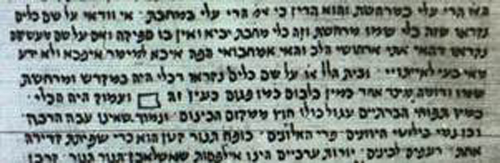
argued for permitting it.[2]

One of the arguments put forward in his son’s book
was that “times have changed”, therefore the Halacha could be different.  Rav Avraham responds to this argument and
writes as follows about changing the Halacha:

I have a Mishnayot Zeraim which was printed in Amsterdam
in 1646 as part of the printing of the entire Babylonian Talmud by Immanuel
Beneveniste.
As you can see, there are numerous stamps on the
title page, but aside from those marks of ownership, we know that the book at
one time belonged to Avraham Reggio by this handwriting on the back page.
פלפולה כל שהוא
ממני הז׳ אברהם ריגייו
פיאהפרק א׳ משנה ו׳
לעולם הוא נותן
משום פיאה ופטור מן המעשרות עד שימרח ע״כ
הרמ׳ב׳ם פירש
ז׳ק׳ל שכל מי שלא הניח פיאה
 וקצר כל השדה
כלו יוציא הפיאה ממה שקצר וכן אם לא הוציא מן השבלים הקצורים יוציא מן החטה אחר
שידושו אותה וימרחוה ויבררוה ואפילו טחנה וכו׳
 
קשיא לי טובא
שהפירוש הזה מנגד המשנה האומרת   ופטור מן המעשרות עד שימרח
. א״כ המריחה קובע למעשר. ומה זה שאומר יוציא הפיאה אפי׳ אחר המריחה ויהא
פטור מן המעשרות
! 
אם
לא שנוסיף תיבת
 קודם שימרחנה ויבררוה או שנוסיף אחר
אומרו מן הקמח

התיבות כלו׳ ובלבד שיוציא  קודם המעשרות
הראויות וצ״ע
 
The matter under discussion is Mishnayot Peah 1:6
and deals with whether Maaser has to be taken from that which is designated as
Peah. Rav Avraham understands from his reading of the Peirush Hamishnayos on
this Mishneh, that the position of  the
Rambam is that Maaser does not have to be separated from that which is
designated as Peah even after Merichah has been done.[3]
The Rambam writes as follows:

 In asking his
question, it is clear That Rav Avraham understands the Rambam to be saying that
you are obligated to separate a portion for Peah even after the flour made from
harvested wheat is ground and that you are never obligated at any stage to
separate Ma’asrot. This is not clear to me from the Lashon of the Rambam who might
be saying normally one does not have to separate Maaser from Peah and adding
that Peah always has to be separated even at the latest stage of crop
production. The Rambam actually makes his comment דע שהפאה לא תחחייב להוציא ממנה מעשרות
on our Mishneh which says לעולם הוא נותן משום פיאה ופטור מן המעשרות
עד שימרח
.
One would have to agree though, that
the Lashon of the Rambam is confusing.
There are
many diagrams that are drawn by hand in the book which fill in the blank spaces
left by the printer. Here is an example of a fairly complex one which I believe
was drawn by Rav Avraham Reggio.[4]


This
particular volume of Mishnayot needed some special Siyata D’Shemaya to survive
the Nazi annihilation of both Jews and their property. After being owned by Rav
Avraham Reggio, the book was the property of the library of the Jewish
community of Berlin.

We are
informed by the present day website of the Berlin Jewish Library that most of
the holdings belonging to this library did not survive the war. This makes this
book akin to an ״אוד מוצל מאש״ (זכריה ג:ב).

“The library of the Jewish Community of Berlin was founded in 1898. It opened its doors in 1902 in the community’s administration building on Oranienburger Strasse and quickly became a highly popular scientific resource, open to Jewish community members and the general public. By the time the National Socialist regime dissolved the Jewish community and forced its library to close, the institution had nine branches with more than 100,000 volumes, nearly all of which were lost in the war.” 

The book became part of the restitution efforts of the Jewish Cultural Reconstruction after the war and was eventually sent to Israel to be part of the library of the “Encyclopedia Hatalmudit”

Is it
possible that just as Rav Avraham Reggio saved his town from a cholera
epidemic, that his writings saved this book from being destroyed in the war?

[1] The
main source for his biography is from a series of two articles written in the
journal “Yerushalayim HaBenuyah” printed in 1844( Choveret Rishon, Zolkiew) and
1845 ( Choveret Sheniyah, Lemberg) The articles appeared under the title of
“Toldot Avraham” whose author was Mordechai Shmuel Ghirondi (1800-1852) Ghirondi
laments at length the loss of his teacher and goes into great detail of his
life. The two specific example cited above are on page 80 of the “Choveret
Rishon”
[2]  
For a discussion on shaving on Chol
HaMoed including quotations from both Avraham and Isaac Reggio’s books see
here

Bibliographic Information on
Tiglachat Hama’Amar comes from the Israel National Library website.

Note the date of death of 1846
which is incorrect as the eulogies on him by Mordechai Shmuel Ghirondi appeared
starting in 1844. Ghirondi gives the date of death as Asarah b’Tevet in 5602 (
1841). I am confused as to the date of publication of Tiglachat Maamar as the
NLI site gives it as תקצט  but פ’ק’ד’ת’ך’ would indicate (5)604 or 1844. This date
is what is listed in Beit Eiked Sefarim.

The forward of the “Motzei L’Or”
indicates that it was written in 1836.

[3]    Tosfot Yom Tov gives us a summary of how Merichah
is understood by the various Meforshim. (From Mishnayot Zecher Chanoch) As you
can see, Rambam’s definition differs from other Meforshim.

[4]   We
know he was a Sofer and the ink looks very similar to writing in the back of
the book. (Additionally, his son Isaac Samuel was a skilled artist, and perhaps his artistic talent ran in the family. – Ed.)


An Obscure Diagram in the Bomberg Shas

 An Obscure Diagram in
the Bomberg Shas
By Eli Genauer
A recent book auction
by Kestenbaum featured the following listing:

AUCTION 65: JUNE 25TH, 2015
LOT:
111 (TALMUD, BABYLONIAN). Masechta Sotah. With commentaries by Rashi, Tosaphoth,
Maimonides and Rabbeinu Asher. FIRST BOMBERG EDITION .. ……Vinograd, Venice 27;
Habermann, Bomberg 22.

Daniel Bomberg, Venice: 1520.
                   This
Tractate contains the only appearance of a printed text illustration throughout
the entire Talmud issued by Bomberg (see f. 43r).

The reference to ( see f.43r ) indicates that this singular
printed diagram in the Bomberg Shas appears on Daf 43A in Sotah.
It is a diagram of the configuration of trees in a particular
orchard and it looks like this

We find other instances of a Bomberg edition of tractate Sotah
being offered for sale, and they contain the same basic information.

Kedem Auctions Auction no. 40 – Books, Manuscripts, Rabbinical LettersWednesday, September 3, 2014 – 17:00Books & ManuscriptsTractate Sotah –
Venice, 1520 – Bomberg Printing, First Edition
Babylonian Talmud, Tractate Sotah – with Rashi commentary and
Tosfot, Piskei Tosfot and Rambam’s commentary on the Mishna. Venice, 1520.
Printed by Daniel Bomberg, first edition.
On Leaf 43, 1 is an illustrative sketch on Rashi commentary. This is the
only printed sketch found in the Bomberg edition of the Talmud. Bomberg left
the rest of the places which were designated for sketches and illustrations
empty to complete with drawings after printing.

Sotheby’s
Babylonian Talmud, Tractate Sotah, Venice: Daniel Bomberg, 1520
17 DECEMBER 2008 | 10:00
AM ESTNEW YORKBabylonian Talmud,
Tractate Sotah, Venice: Daniel Bomberg, 1520Folio (13¾ x 9½ in.; 350 x 242 mm.Folio 43r. provides the
only example of the inclusion of a printed diagram in the Bomberg Talmud.
In all other tractates, Bomberg simply left a blank space in which an
individual could insert a diagrammatic drawing.

The source for
this information most likely came from “Maamar al Hadfasat HaTalmud” by Raphael
Nathan Nata Rabbinovicz. It was first printed in 1868 as a hakdamah to
his book Dikdukei Sofrim on Masechet Brachot and later
added on to by Rabbinovicz and printed as a separate book.
I refer to this edition: Maamar ‘al
hadpasat ha-Talmud with Additions,
ed. A.M. Habermann, Mossad ha-Rav Kook,
Jerusalem: 2006

On page 41,
Rabbinowicz, writing about the first Bomberg edition, states as follows

״ובכל
התלמוד (וכן בכל הדפוסים הישנים עד דפוס בערמן) נשמטו הציורים בגמרא, רש״י
ותוספות,ונשאר מקומם חלק, מלבד בסוטה מג. שישנו הציור ברש״י

In all of the
Talmud ( and in all other older printed editions of the Talmud until the Berman
edition ( Frankfurt An Der Oder 1697-99) )the diagrams were not included in the
Talmud, Rashi and Tosfot, and their space remained empty, except for Sotah
43A, where we find a diagram in Rashi.


He seems to be
saying that not only in the Bomberg first edition was this the only diagram
included, but also in subsequent Bomberg editions this remained the only
diagram included. He even casts a wider net and says that this was the only
diagram included in any set of the Talmud until the Berman edition of Frankfurt
an Der Oder printed from 1697-1699.

Is this correct?
I would have to say it is mostly correct but not completely.

The Israel
National Library website contains the following page:

It is a
wonderful source for early printed books and it contains every tractate of the
first edition of the Bomberg  Shas. What
may a bit less known is that it also contains one tractate of the third edition
of the Bomberg  Shas, Masechet Zevachim,
printed in 1548. (1)

If we look at
Daf 53B, we are confronted with the following

A close up of
the bottom of the page looks like this

At first I
thought that this diagram of the Yesod of the Mizbeach had been drawn in by
hand, but an analysis of the difference in the way this page was set up versus
the same page in the first two editions lead me to conclude that this diagram
was added by the Bomberg editors intentionally and was included as part of the
printed page. Aside from that, I had the privilege of looking at this same page
in a different copy held by the JTS Library with Sharon Lieberman Mintz, ( JTS
Curator of Jewish Art) and she confirmed that this mechanical drawing and the
one available online at the NLI website were exactly the same.
If we look at
the 1520 edition, we can see the problem that the editors faced

Here is both 53A
and 54A

Let’s take a
closer look at the bottom of 53B, where the diagram appears in the third
edition
After a lengthy
explanation by Rashi on the makeup of the Yesod, he adds the word “Kazeh”. It
is right at the bottom. Usually, we would find an empty space there, but alas,
there is no room.

The empty space
where the diagram should go is not on the bottom of 53B, but rather on the top
of 54A. It has nothing to do with the Rashi that begins with the word
“Retzuah”.

So it is
possible that by the third edition of Zevachim, the Bomberg editors decided to
fix that. They set the type for 53B in a different manner, allowing them the
space for a diagram, and they even included the diagram.
I thought I
might find other diagrams in this third Bomberg edition and spent an afternoon
at the JTS Library looking through various Masechtot of that edition, but did
not find another diagram. As far as I know, this was the only diagram added to
the third edition. There is no way to know for sure why the Bomberg editors
added this one, just as there is no way to know why the diagram on Sotah 43A
was included in the first edition. But at least one can see what might have
bothered them here.
[1] I refer to this as the third edition although there is much discussion as to
whether this might actually be a fourth edition. For more background on this,
please see Marvin J.  Heller, Printing the Talmud (A History of
the Early Printed Editions of the Talmud )
Im Hasefer, Brooklyn, NY 1992,
pages 167-180


The Gematriya Haggadah

The Gematriya Haggadah
By Eli Genauer
I try to buy a new Haggadah every year to make sure I have something new to say. It is especially important at my stage in life when grandchildren will remind you if you use last year’s Dvar Torah.
This year’s Haggadah was definitely in the category of “מה נשתנה ההגדה הזאת מכל ההגדות”. It’s name is ״כוס ישועות״  and it was printed on the Isle of Djerba, Tunisia in 1947. It’s author was Rabbi David Cohen (also known as רבי דוד כהן אלמג׳רבי) who served as the Rav in the southern Tunisian city of Tataouine (תיטאוין). The text of the Haggadah is translated into Judeo-Arabic and the Halachos and instructions are in that language. Thankfully, the Peirush of Rav Cohen is in Hebrew which allowed me access to his approach to the Haggadah.
We find out a bit about Rav Cohen from the Haskamah given at the beginning of the book by six prominent Rabbis of Djerba. It states as follows:
הרב זצ״ל היה כמעט הראשון בהתישבות אחינו בית ישראל שם מראשיתו בתור שוחט ובודק ומרביץ תורה ושליח צבור,ואחר כך נתמנה לרב ומורה צדק שם.
We learn that he was a pioneer in establishing the Jewish community in Tataouine and served in many capacities there before become the Rav of the town. He authored numerous books, some printed while he was alive, and some, like this Hagaddah, printed after his Petirah in 1934.
The Haggadah was printed by a committee (המשתדלים) in Tataouine who raised money for this purpose. There are over 800 names of families or individuals who contributed to its publication. Included in this are over 100 contributors from Tataouine which gives one some idea of the size of the community.
Most of the contributors included with their names the memory of a deceased relative or a blessing for a hoped for milestone for their children. Some of the blessings were familiar to me and others were a bit different.

For a married child: ויפקדהו בבנים זכרים של קיימא אמן abbreviated as ויפקדהו בבזשק״א

This seemed to reflect a cultural preference for boys and perhaps a high rate of infant mortality.

There were no blessings for someone just to have children.

For boys there were two blessings depending on age:

ויזכה לתורה ולתפילין ולחופה and ויזכה לתפילין ולחופה

For unmarried men the hope was ויזכה לחופה 

For those a bit older (?), it was ויזכה לחופה בקרוב
In his Hakdamah, the author explains why he chose to name his Peirush כוס ישועות. He writes that the Gematriya of כוס ישועות is the same as אני הקטן דוד בן המנוח אבאתו כהן. Sort of.  The total of the latter is nine short but if you add to it the nine words כוס ישועות andאני הקטן דוד בן המנוח אבאתו כהן it comes out the same ( 878 ). One senses that the author is very attuned to Gematriyos and his commentary proves this to be true.
A good example of Rav Cohen’s use of Gematriyos is how he plays with the phrase הא לחמא עניא
He first notes that הא לחמא  has the same numerical value as the word מילה (85) indicating that בזכות המילה יצאו ממצרים.

He then writes that the word עניא has the numerical value of ענוה indicating that דבזכות הענוה יצאו
Getting back to הא לחמא which equals 85, he relates it to the word פה which has the same numerical value. Matzah is לחם עוני which requires us to do the following: שׁצריך פה האדם לענות בליל פסח בהלל והודאה לשמו יתברך שעשׂה עמנו ניסים ונפלאו

Finally, if you take the total of the first letters of הא לחמא עניא די אכלו you get 110 which is the number of years that Yosef lived. This hints at the fact that it was because of the sale of Yosef, the Jews suffered in Egypt.
The city of Tataouine is famous in popular culture because it served as the inspiration for the name of the fictional planet of Tatooine in the Star Wars movie series. Many of the scenes of Luke Skywalker’s home planet in the original movie were shot near Tataouine. I was very glad to meet a real inhabitant of Tataouine, one who has enhanced my Seder experience.


An Incident of “Pilegesh B’Givah” in 19th Century Germany

AN INCIDENT OF “PILEGESH B’GIVAH” IN 19TH CENTURY GERMANY
by Eli Genauer
I recently purchased an antique Hebrew book for less than the price of a dinner at a moderately priced restaurant. This particular edition is what some would call a “common” — meaning it is the 36th edition (the fourth edition of a revised version) of this book and it was printed in the mid-19th century. Generally, the market does not assign a high price for books like these, but they can be a treasure trove of knowledge and information.
The work is Tikkun Shlomo and is primarily focused on the Shabbos liturgy.  I reproduced the title page:
Many will no doubt recognize the name of the compiler, Shlomo Zalman London (1661-1748) who wrote the book “קהלת שלמה”and that it was reprinted thirty times in the next 200 years.  
Tikkun Shlomo was first published in Amsterdam by Dr. Naftali Hertz HaLevi in 1733.  Dr. Levi published many a storied book, including the first edition of Mesilat Yesharim and the edition of the Shu”t HaTashbetz that is alleged (erroneously) to have been cosigned to flames.  According to Friedberg, when Dr. Levi published the Tikun Shlomo, not much else was being published in Amsterdam due to the effect of the Thirty-Year War.[1]  The Tikkun Shlomo was very popular, going through almost 40 editions by the late 19th century. Heidenheim expanded this work in 1835, and the edition I purchased was the fourth Heidenheim edition (two of the three were published in Roedelheim and the other in Lemberg).  
Things get off to a wonderful start in this book with the Hakdamah which is indicated to come from the third edition. In it, the unnamed editor pays tribute to his mentor Wolf Heidenheim Z”L and maintains that he has followed in his footsteps in all matters because “anyone who follows him will not err”. The editor only refers to himself at the end of the Hakdamah as “HaTzair”, but he leaves us an unmistakable hint as to his identity. Before we get to that, let us see what else he includes in this “Hakdamah”
ויהי מימים,ויקם עוד בּישׂראל פּורץ גדר,וישׁחת דברים נעימים, ויוסף עוד להרוס חומת שׂפת עבר ולדבּר תועה אשר לא כּדת. כּי פּרץ מצפון בא בא, ותפתח הרעה, וידפיס אישׁ אחד את המחזורים ב׳האננאפער׳, ויעבור חק, ויהפוך וישׁנה מדעתו את דברי התפילות ופיוטים, ויעקש ויעקל מאוד כמעט בכל דף ודף, ותהי זמירת ישׂראל בידו מעין משחת ומקור נרפשׁ, אשה יפה וסרת טעם, כּי שנה את טעמה ויתעמר בה וימכרה בּכּסף, וכן לא יעשׂה.
He takes great offense to a certain Machzor printed by “one man”. The Machzor to which he referring to is known as “Ordnung der Oeffentlichen Andacht für die Sabbath und Festtage des Ganzen Jahres, nach dem Gebrauche des Neuen Tempel-Vereins”, otherwise known as “Seder ha-‘Abodah, Minhag Ḳehal Bayit Ḥadash” printed in Hamburg (not Hanover) in 1819. Two editors are listed:  Seckel Isaac Fraenkel and Meyer Israel Bresslau. It was the new prayer book of the Hamburg Reform Temple dedicated in 1818.  To paraphrase what he writes about this effort: “ a great evil has descended from the north, one that has been perpetrated by a man who published Machzorim in the city of Hanover ( Hamburg ). In his hands, the prayers, which are like a beautiful  woman , are now left with no personality. His purpose was to destroy the Hebrew language, the prayers as we know them, and Judaism itself.”


He continues by writing that he has authored a work Zichron Livnei Yisroel ( Altona 1819) in which he lays out his war against these Machzorim.[2] The title incorporates this explanation:
זה ימים יצא בדפוס קונטרס מיוחד לתפילת ערבית ושחרית לשבת, ומעתיקי תפלה הזאת עברו גבול אשר גבלו הראשונים, גרעו והוסיפו כחפץ לבבם … חלילה … לשנות מסדר תפלתינו / … דברי … עקיבא בר”א ברעסלויא, ראב”ד פה ק”ק אלטונא
This was Rabbi Akiva Wertheimer (1778-1835), the Rav of Altona, Germany, today part of the city of Hamburg. He wrote “Zichron Livnei Yisroel” and was the editor of our edition of “Tikun Shlomo”. His opposition to the new Reform prayer service is noted in a book called “Shnos Dor V’Dor” printed in Jerusalem by Artscroll/Mesorah in 2004. It records the following that occurred in 1819 which coincides with the printing of his book “Zichron Livnei Yisroel”:
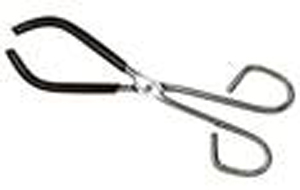
בשנת תקע״ט, עוד קודם להתמנורנו, בקום המחדשים ״אנשי ההיכל״
הרפורמי דהמבורג לשנות את סדרי התפילה היה הוא הראשון אשר יצא כנגדם והזהיר את כל הקהילות סביבות אלטונא מפניהם.
Continuing in the Hakdamah to Tikun Shlomo, we find that Rav Wertheimer has launched a campaign against the reformers by adding that he has sent this out broadside everywhere to warn others of this assault on tradition. He does this brilliantly by paraphrasing a Pasuk in Tanach ( Shoftim 20:6) which deals with the tragic story of “Pilegesh B’Givah” an incident which almost tore the Jewish people apart.
The Pasuk reads:  וָאֹחֵז בְּפִילַגְשִׁי, וָאֲנַתְּחֶהָ, וָאֲשַׁלְּחֶהָ, בְּכָל-שְׂדֵה נַחֲלַת יִשְׂרָאֵל:  כִּי עָשׂוּ זִמָּה וּנְבָלָה, בְּיִשְׂרָאֵל.
His paraphrase reads:
ואוחז בפּילגשׁו ואנתחה ואשׁלחה בכל גבול ישׂראל, למען יראו זקני עם וקציניו, והסירו גם את המכשלה הזאת מקרבּם
The full text of the broadside was published in Dukes, AW”H leMoshav, Cracow: 1903, 104-05.  Additionally, the National Library of Israel has a copy (perhaps that of Israel Mehlman, see his catalog Ginzei Yisrael, no. 1743).  The broadside is signed, Akiva br”a Bresslau without additional identifiers, i.e. the son of Avigdor Wertheimer.  As Dukes notes, Graetz mistakenly attributed this work to a different Akiva, Akiva Eiger.  But he was not the only one to publish against the Hamburg Temple and its prayer book in Altona that year.  The work, Eleh Divrei ha-Brit, was also published in Altona in 1819 and it contains, among others, the position of the Hatam Sofer.  
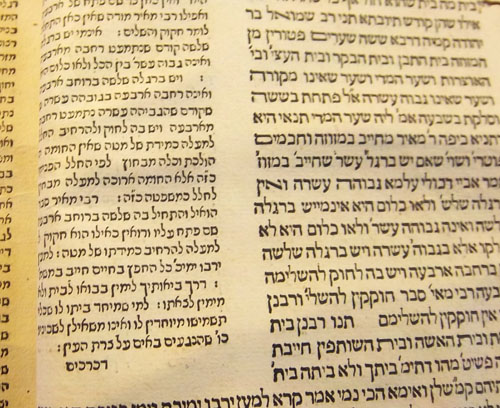
The battle was waged by both sides, and Meyer Israel Bresslau, one of the editors of the Hamburg prayer book, that same year responded with Herev Nokmat (available online here).  The other editor, Fraenkel, in the prayerbook includes a defense of the changes[3].  
As with many editors of Siddurim, Rav Wertheimer extols the exactness of his edition, claiming that he has fixed many of the errors that have crept into previous Siddurim. Specifically, he addresses the text of Mishnayos Shabbos which appeared in many Siddurim and which he has carefully edited especially when it comes to the “Nekudos”.
He continues and states that when it comes to words of foreign origin, such as in Greek, Latin or Arabic, he has also made sure that the “Nekudos” are correct reflecting the proper pronunciation in those languages.
Unfortunately this is not a simple task and this example will illustrate the difficulty in doing so.
The laws of what a woman may or may not carry outside on Shabbos are discussed in Shabbos 6:3. Among the items prohibited is something called a “Tzlochis Shel Palyiton”, a flask of “Palyiton.” Jastrow defines this word as “an ointment or oil prepared from the leaves of spikenard”. He adds that its origin is the Latin word “foliatum”. The Latin Lexicon website spells this word foliātum and gives the exact same definition. So how should this Latin word be spelled in Hebrew?
Rav Wertheimer indicates that it should be pronounced something like “Folia’tone”which is pretty close to the Latin word except for there being an “n” sound at the end of the word instead of the “m” sound.
I have a Mishnayos printed in Pisa during the same time period (1797) which makes it look more like “Pal’yi’tone”:
Two very old manuscripts of the Mishneh shed some light on how the word was originally spelled. One of the most famous is known as Codex Kaufmann ( MS Kaufmann A 50) which was written in 10th or 11th century Palestine. There we find the word looking more like “Pil’Ya’Tome”, with an “m” sound at the end:
The Parma manuscript referred to as MS Parma, De Rossi 138 written in 1073 has it the same as Kaufmann.
In recently printed Mishnayos such as from Feldheim, Artscroll, Steinsaltz, and Blackman, the word is spelled “פלייטון” with either a Patach ,Chirik, or “Shva”  under the “Peh”, or “פולייטון”, which looks more like Rav Wertheiner’s rendering.
One thing is clear- it is sometimes very difficult to write a foreign word with Hebrew letters and vowels, and it is also difficult to ascertain which version is “correct”.
Another wonderful aspect to the book that I bought was learning about the man whose name is embossed on the front cover. He is listed as יוסף אשר בן כ״ה (כבוד הרב) משה פאלאק   
We know a bit about Yosef Asher Pollock from some of the other books and manuscripts he owned. The following two citations are from the online catalogue of the Israel National Library:
1. A manuscript written in the 19th century by Chaim ben Yaakov Abolofia.
תקנות קהלת איזמיר. ‬
Los Angeles – University of California 960 bx. 1.9
ותו הספר: “מספרי יוסף אשר פאלאק ז”ל” משנת תרפ”ה. ‬
From this record we know that he had passed away before 1925 and that the manuscript is now in Los Angeles.


2. A manuscript written in the 18th century
(ספר הכונות (חלק שבת ומועדים. 
Amsterdam – Universiteitsbibliotheek MS Rosenthal 567
בראשו תו ספר של הבעלים “יוסף אשר פאלאק
This rare manuscript has been scanned and is available online. The first page looks like this:
From this one we also learn quite a bit more about Yosef Asher Pollock because it contains this bookplate on the inside front cover

We surmise from here that this was not the only book he had that was donated, as someone went to a lot of trouble composing and printing such a heartfelt donation plate. (“ Yosef is not here, nor is Shimon”) The year the bookplate was printed was 5693(1933). There is also a stern warning that since this is a gift, it may never be sold by the recipient.   

The history of the Bibliotheca Rosenthaliana in Amsterdam is also interesting, especially how the collection of Judaica survived the Nazi occupation. The library’s website notes the following:
“The Germans closed the Bibliotheca Rosenthaliana in the summer of 1941 and transported part of the collection to Germany, where it was earmarked for Rosenberg’s ‘Institut zur Erforschung der Judenfrage’.
Happily, these plans were thwarted with the German capitulation. Most of the boxes of books were in storage in Hungen, near Frankfurt am Main, where they were found and shipped back to Amsterdam. But the curator and his assistant together with their families had also been deported-for them there was no return”
Finally, it seems clear to me that my book was also a gift never to be sold. I surmise this from the fact that the name of Yosef Asher Pollack is beautifully embossed on the front cover of the Siddur, making it unnecessary to have an ownership bookplate inside the Siddur.
Nevertheless, on the inside front cover there is a rectangular remnant of a bookplate which has been torn off.  
Coincidentally, its size exactly matches the bookplate of the manuscript donated to the Bibliotheca Rosenthaliana, which contained the admonition of not selling the book. Tearing off this “warning label” enabled the book to be sold, something that most likely happened over time to many books that were donated to libraries.
___________________________________________________
[1] Friedberg, History of Hebrew Typography, Antwerp: 1937, 49.  Although Dr. Levi’s production may have slowed, the bases for Freidberg’s assertion that Amsterdam publishing was affected by the Thrity-Year War is uncertain.  During the 18th century, production of Hebrew books in Amsterdam ranges from 82 to a high of 246 per decade.  The 1730s, the period that Tikkun Shlomo was published, is in the mid-range of those two extremes, with 145 books published between  1730-39.
[2] This work is a single sheet broadside and begins with Moda’ah raba . . . Zikhron Le-veni Yisrael.  
[3] For a summary of his arguments, see Petuchowski, Prayerbook Reform in Europe, New York, NY: 1968, 53-54.


What’s Wrong With Wealth and Honor?

What’s Wrong With Wealth and Honor? 
by Eli Genauer
                                                                    
Below, we will present some timely notes regarding an English/Hebrew Machzor for Rosh Hashana which was printed in England in 1807.  We will touch upon a variety of issues, and thus first present general backgrounds regarding Hebrew printing in London, the prayer for the state, and Kol Nidrei.  
Hebrew Typography in London  
The earliest use of Hebrew typography in England is sometime in the middle to the late 1520s.  Of course, at that time, Jews were banned from England and the earliest works containing Hebrew type in England were produced for non-Jews.  
The prize of first was thought to go to Thomas Wakefield’s publication of his address regarding “Three Languages” – Hebrew, Arabic and Chaldean (Oratio de laudibus et utilitate trium linguarum [link]). The type, as you can see, was quite primitive.
This lecture was given in 1524, and as the book itself is undated, it was assumed that the lecture was published soon after it was given.  Thus, many dated it to 1524/25.  Wakefield, a noted Hebraist, actually spends the majority of the book discussing Hebrew and the other two languages get short shrift.[1]   
Recently, however, the dating of this work has been challenged and been shown to likely incorrect.  The author, in the self-described “Holmesian manner,”[2]   highlights the various persons Wakefield claims to have tutored in Hebrew and the honorifics used to describe those persons.[3] Based upon some of the descriptions, it seems likely that Wakefield’s work was not published prior to 1527 and most likely in 1528.   [4] This conclusion, coupled with the dating of another work by a different author, unseats Wakefield’s book claim to first.  Instead, Richard Pace’s Praefatio in Ecclesisten, printed in August 1527, is the most likely candidate for the first use of Hebrew typography in England.[5] Here is a sample:
It took nearly two hundred years after the appearance of Hebrew typography for the first Hebrew book published for a Jewish audience in England.  The controversy surrounding R. David Nieto’s remarks and their affinity or lack thereof to Spinoza would produce the first printed Jewish Hebrew book in England.  The first was a very small one, only a few pages, of a responsum written by R. Tzvi Ashkenzi, in R. Nieto’s defense, and published in 1705. It included both Spanish as well as Hebrew (available here).[6]   For more on R. Nieto and this controversy, see the Seforim Blog’s earlier post here
The Prayer for the Welfare of the State
The prayer for the welfare of the king or ruler is ancient.  Many point to the statements of Ezra as well as the passage in Avot as early sources for the prayer.  A variety of rationales are offered for this obligation.  For example, Rabbenu Yonah interprets the need for these prayers as indicative of a Universalist worldview, which requires all humans to display empathy for one another.  In order to effectuate that goal, Jews therefore pray for not only the Jewish leaders but also the secular one.  R. Azariah di Rossi, claims that the prayer carries a pacifist message as he emphasizes the lack of allegiance to a specific ruler or country and thereby transforms the prayer into one arguing for peace among all nations. 
The earliest extant prayers are from the Geniza, and can be dated to between 1127 and 1131.  The prayer is for the “Fatimid caliph al-Amir bi-ahkam Allah who ruled Egypt and its regions during the years 1101-1131.” See S.D. Goitein, “Prayers from the Geniza for Fatimid Caliphs, the Head of the Jerusalem Yeshiva, the Jewish Community and the Local Congregation,” in Sheldon R. Brunswick, ed., Studies in Judaica, Karaitica and Islamica: Presented to Leon Nemoy on His Eightieth Birthday (Ramat-Gan: Bar-Ilan University Press, 1982), 47-57.[7]   In this instance, the prayer includes not only a prayer for the secular ruler, but also a prayer for the local Rosh HaYeshiva.  Additionally, it blesses all of the Rosh HaYeshiva’s deceased predecessors, providing a nice genealogy. Goiten posits that these prayers may have been written in response to specific historical events and may not be indicative of the general practice in 12th century Egypt.  See id. at ___. 
The earliest sources, however, do not include the modern formulation of HaNoten Teshua.  Instead, early on there was a lack of conformity regarding this prayer.  Kol Bo records the custom but indicates that each community had its own practices.  But, none used the HaNoten Teshua formulation.  The first extant example of HaNoten Teshua is found in a Spanish manuscript dated between 1479-92.[8]   Ironically, this example was prepared for King Ferdiand V, who, in 1492, issued the expulsion order.  
It appears that with the expulsion and dispersion of the Spainish Jews, the HaNoten Teshua was disseminated throughout the Jewish world.  Indeed, the inclusion of this prayer in Yemenite rites, appears to undermine a major thesis of the noted Yemenite scholar, R. Yosef Kapach.  He asserts that the rite presents a pristine rite, unchanged over hundreds of years.  But, as the Yememite rite includes HaNoten Teshua, which is from the 15th century, indicates that the Yemenite rite is less pristine than Kapach would have it. [9]  
The prayer is also linked to the readmission of Jews into England.  Menasseh ben Israel in his plea  for readmission of the Jews to England (link) provides the full text – in English – of the HaNoten to demonstrate the Jews’ loyalty to their rulers.[10]
A English Hebrew Machzor Printed in London
The Jewish Encyclopedia notes “In 1794 David Levi published an English version of the services for New-Year, the Day of Atonement, and the feasts of Tabernacles and Pentecost, and thirteen years later gave a new version of the whole Mahzor. This second edition was “revised and corrected” by Isaac Levi, described as a “teacher of the Hebrew Language.”
The Machzor features a frontispiece with various engravings of the Jewish holidays. The engraving for Shavuos features Moshe Rabbeinu dressed in a manner probably unknown 3,000 years ago, and holding the Aseres HaDibros with the numerical sequence from left to right. Yom Kippur correctly shows two identically sized “Se’irim” as per our tradition.
If you look closely at the name of the engraver, you will see that it was done by an R. Gavey.
I tried to find out more about R. Gavey and finally came upon a website which dealt with his family. I sent an email to the address listed and waited and waited. Two years later, I received the following response from a fellow in Australia:

“Robert Gavey b.1775 London was my 4xGreat Grandfather. He is listed as an engraver. Both his father and grandfather were watch makers.  Robert Gavey’s daughter Harriot Angelina Gavey  married my 3x Great Grandfather whose son James Fletcher  emigrated to Australia 1852. The Fletchers were originally Huguenot silkweavers with the surname Fruchard and I believe the Gavey’s would have been Huguenots also.” 

It turns out that Robert Gavey’s Australian descendent had a copy of his certificate of indenture as an engraver to a goldsmith named William Norris. Robert was 15 years old at the time (1790) and his period of indenture lasted for seven years. He promised not get married during that time period or play cards or dice. He also was forbidden to frequent taverns or playhouses or engage in any act which would cause his master a loss of money. (Click to see a large, high-resolution image.)


The certificate of indenture was signed in May of 1790 which was noted as the thirtieth year of the reign of George III who is described as the king of Great Britain, France, and Ireland.
Speaking of George III, he received much better treatment in this Machzor than in our American Declaration of Independence. On our side of the pond, we know George III as a man who “ has plundered our seas, ravaged our Coasts, burnt our towns, and destroyed the lives of our people.” As part of the agreement by Cromwell to allow Jews back into England, the Jews promised to always pray for the welfare of the ruler. Accordingly, this Machzor blesses King George in this manner:

This is not the only edition that continued to praise the monarch.  Isaac Lesser, published the first complete machzor in the United States in 1837-38, for the Spanish and Portuguese rites with an English translation.  Lesser’s translation relies heavily upon that of David Levi’s translation.[11]   In an attempt to sell his machzor in both the United States as well in other English-speaking locals, he includes two version of the prayer, one asked that God “bless, preserve, guard, assist, exalt, and raise unto a high eminence, our lord the king.”  The other, replaced this phrase with the request that God “bless, preserve, guard, and assist the constituted officers of the government.”[12]  

The person who finally brought the prayer for the government more in keeping with American democratic values was Max Lilienthal (1814-1882).[13]   While some had been willing to change the prayer, they did so only in the vernacular but retained the Hebrew HaNoten Teshua.  Lilienthal, however, totally reworked the prayer, altering its tone and focus.  Lilienthal removes all mention of kings, focuses on the country more than its rulers, and seeks to bestow God’s blessing, not on the ruler but on all the inhabitants of the land.  This version was included in Henry Franks’s Teffilot Yisrael, a siddur containing the Orthodox liturgy. This siddur was first published in 1848, and reissued in more than 30 editions.  As Sarna notes, the acceptance of the prayer is somewhat ironic in that Lilienthal, later became part of the American Reform movement, was the author of a prayer that became the standard even in Orthodox siddurim.[14]  Id. at 436.

Aside from changing the text of the prayer to fit American sensibilities, how the prayer was recited was also changed.   Congregation Shearith Israel, in New York, after the revolutionary war, “ceased to rise for Hanoten Teshu’ah. According to an oral tradition preserved by H.P. Solomon, ‘the custom of sitting during this prayer was introduced to symbolize the American Revolution’s abolition of subservience.’”[15]

The United States was not the only country to undergo significant changes to its governmental structure.  France, in 1787, abolished (temporarily) the monarchy.   After which the prayer for the welfare of the government was radically changed.  Instead of praying for the benefit of kings and rulers, the French prayer focuses upon the Republic and its people.  All the biblical verses included bless the people and not the king.   [16] The prayer begins “Look down from your holy place on our land, the French Republic, and bless our nation, the French people, Amen.”

Other changes to the prayer, due to time and place, were common. For example, during the height of the Sabbati Zevi messianic frenzy, two versions of the prayer were produced, not asking to bless the secular ruler, but, instead, blessed Shabbati Zevi.

Today, the most significant change to this prayer has been the new prayer on behalf of the State of Israel.  The authorship of the prayer as well as its use is subject to controversy.[17]

In the most recent “Prayer For the State” news, French President François Hollande, specifically invoked this prayer when discussing French Jews’ relationship to the state.  He included in his remarks, translated in NYRB, commemorating the round-up of Jews at the Vélodrome d’Hiver: “Every Saturday morning, in every French synagogue, at the end of the service, the prayer of France’s Jews rings out, the prayer they utter for the homeland they love and want to serve. ‘May France live in happiness and prosperity. May unity and harmony make her strong and great. May she enjoy lasting peace and preserve her spirit of nobility among the nations.'” 

Kol Nidrei 
The Yom Kippur volume of this set contains a detailed “apology”for the Kol Nidre prayer. The Jews endeavored to incorporate themselves into general society and felt the need to emphasize that their word was binding on them. Kol Nidre was seen as indicating otherwise, so an explanation of the prayer was seen as necessary, both for Jew and Gentile. (See Y. Goldhaver, Minhagei Kehilot, Jerusalem: 2005, pp. 209-19 on the history of Kol Nidre and the controversy.) It concludes as follows.

Finally, I would like to focus on the special prayer said during the Yamim Noraim when the Torah is taken from the Aron Kodesh. It first appeared in the Siddur Shaarey Tzion of Rabbi Nathan Hanover and begins with the words “Ribbono Shel Olam”.

In it we ask Hashem to remember us for a long and good life, with everything that comes along with that. We include in our request that Hashem should provide us with “Lechem Le’echol, Beged Lil’Bosh, V’Osher V’Chavod”.  Let us see how David Levy translates these words.

As you can see, the request for “wealth and honor” is nowhere to be found in the English translation. I was curious about this and asked Dan Rabinowitz for his opinion. He offered that it is possible that this Machzor was printed at a time when the English community was quite interested in the Hebrew language. Non-Jewish scholars eagerly bought any books printed in Hebrew. As such, it could be that Levy decided to leave out the reference for our desire for wealth and honor because, well, maybe it was a bit too pushy on our part.

I hope all of you are blessed with a Shana Tova, even one that includes within it the promise of wealth and honor.

[1]  See Marvin J. Heller, The Sixteenth Century Hebrew Book, Brill, Leiden:2004, entry for Oratio and pp. 959-60 and the sources cited therein. But see Brad Sabin Hill, Incunabula, Hebraica & Judaica . . .” Ottawa:1981, #52 asserting that 1561 is the earliest introduction of Hebrew typography to England. It is unclear what the basis of that assertion is.

[2] Richard Rex, “Review: Robert Wakefield On Three Languages 1524,” The Journal of Ecclesiastical History 42:1 (Jan. 1991) 159.
[3] Richard Rex, “The Earliest Use of Hebrew in Books Printed in England: Dating Some Works of Richard Pace & Robert Wakefield,” Transactions of the Cambridge Bibliographical Society, Vol. 9, No. 5 (1990), 517-25.
[4] Id. at 517-18.
[5] Id. at
[6] See B. Roth, The Hebrew Printing Press in London, Kiryat Sefer 14 (1937), pp. 97-99.
[7] See also, Fenton,
[8] See Aaron Ahrend, “Prayers for the Welfare of the Monarchy and State,” in Aaron Ahrend, ed., Israel’s Independence Day: Research Studies (Ramat-Gan: Bar-Ilan University Press, 1998), 176-200 (Hebrew). This date is contrary to Schwartz who incorrectly posits that there is no evidence of HaNoten Teshua prior to the 16th century, and none in pre-expulsion Spain. See Barry Schwartz, “Hanoten Teshua: The Origin of the Traditional Jewish Prayer for the Government,” in HUCA, 57, (1986) 113-20. Sarna appears unaware of Ahrend’s article as he continues to assert that HaNoten Teshua was not composed prior to the 16th century. See Jonathan Sarna, “Jewish Prayers for the United States Government: A Study in the Liturgy of Politics and the Politics of Liturgy,” in Ruth Langer & Steven Fine, eds., Liturgy in the Life of the Synagogue: Studies in the History of Jewish Prayer (Winona Lake, Indiana: Eisenbrauns, 2005), 207 & n.9 (link).
[9] See Ahrend, “Prayers for the Welfare,” at 183.
[10] See Menasseh ben Israel, The Humble Address to his Highness the Lord Protector, 1655.
[11] Leeser was not the first American to utilize Levi’s translation. The first Hebrew prayer book published in the United States, The Form of Daily Prayers (Seder Tefilot), New York, 1826, also includes an English translation by Solomon Henry Jackson. Jackson, who emigrated to the United States from London, also relied heavily upon Levi’s translation. Jackson, in the introduction, indicates that HaNoten Teshua was adapted for U.S. audience, in fact, the Hebrew remained the same, only the “translation” was altered. See Sarna, Jewish Prayers, 213.

Additionally, some time in the 1820s, there was an attempt to reprint Levi’s machzor in the United States. A prospectus was issued, but Levi’s machzor was never reprinted in the United States. See Yosef Goldman, Hebrew Printing in America 1735-1926, Brooklyn, NY, 2006, no. 33.
The first appearance of HaNoten Teshua in the United States is found in the first prayer book published in the United States. Isaac Pinto’s holds that honor. In his English only edition whose first volume was published in 1761 with the second volume published in 1766, he includes HaNoten Teshu’ah.
[12] Jonathan Sarna, “Jewish Prayers for the United States Government,” at 215.

[13] See Jonathan Sarna, “A Forgotten 19th-Century Prayer for the United States Government ,” in Hesed ve-Emet, Studies in Honor of Ernest S. Frerichs, ed. Magness & Gitin, Atlanta, Georgia, 1998, 431-40.

[14] Today, however, the most widely used Orthodox siddur in the United States, Artscroll, does not include the prayer in any form in its standard editions. It is unclear why Artscroll omitted this very old prayer.

[15] Sarna, Jewish Prayers, at 210.

[16] Moshe Katon, “An Example of the Revolution in the Hebrew Songs of the French Jews,” Mahut 19 (1997) 37-44, esp. 37-8.

[17] See Aharon Arend, “The Prayer for the Welfare of the Monarchy and Country, in Arend ed., Pirkei Mehkar le-Yom ha-Atzmot, Ramat Gan: 1998, 192-200.


The Proselyte Doth Protest Too Much

THE PROSELYTE DOTH PROTEST TOO MUCH
By Eli Genauer
I recently acquired an early edition of Abarvanel’s Peirush Al Neviim Rishonim. It was printed in Leipzig in 1686. It was only the second edition of this commentary, following the first edition printed in Pesaro in 1511 by Gershom Soncino.
The publisher of this edition was Mauritium Georgium Weidmannum. The editors were Friedrich Albrecht Christiani, an apostate, and August Pfeiffer, a German Lutheran theologian. It was printed primarily for a Christian reading audience for reasons we shall discuss.
F. A. Christiani, who was the main editor, is described in a publication called “World – Today’s News Christian Views” (March 2, 2002):

“Friedrich Albrecht Christiani is stunned to find himself believing in Christ. The Hamburg resident, educated in the Talmud, says, ‘I was so zealous for my Jewishness that had someone told me then of my prospective conversion, it would have appeared as strange to me as it seems incredible to others.’ But finding himself unable to refute Esdras Edzard’s arguments, he decides to go with what his mind, rather than tradition, tells him, and takes the last name “Christiani.””

It seems that later on he returned to Judaism as noted by this entry in the Encyclopedia Judaica:

“He was baptized in 1674 at Strasburg, having formerly borne the name of Baruch as Hazzan at Bruchsal. After having occupied for twenty years the chair of Semitic studies at the University of Leipsic, he retired to Prossnitz, where he returned to Judaism.”

For the purpose of this study, we will assume that he was a practicing Christian when he edited this book by the Abarvanel, as this was before he had returned to Prossnitz. 
In studying the cover page of my Leipzig edition, I noticed the following handwritten notation:
The top notation reads עיין דף רמ”ד 2 (“see page 244b”). I do not know who made this notation in the last 300+ years, but I was curious to see what it was all about.
Shlomo Hamelech had died and his son Rechavam took over as king. The people had asked him to relieve some of the burdens placed on them by Shlomo, but instead he told the people that he would deal much more harshly with them than had his father. The people replied that they wanted nothing to do with him as king.
Their reply is reflected in the following pasuk in Melachim Alef 12:16.

טז וַיַּרְא כָּל-יִשְׂרָאֵל, כִּי לֹא-שָׁמַע הַמֶּלֶךְ אֲלֵהֶם, וַיָּשִׁבוּ הָעָם אֶת-הַמֶּלֶךְ דָּבָר לֵאמֹר מַה-לָּנוּ חֵלֶק בְּדָוִד וְלֹא-נַחֲלָה בְּבֶן-יִשַׁי לְאֹהָלֶיךָ יִשְׂרָאֵל, עַתָּה רְאֵה בֵיתְךָ דָּוִד; וַיֵּלֶךְ יִשְׂרָאֵל, לְאֹהָלָיו 

16 And when all of Israel saw that the king had not listened to them, the people answered the king, saying: ‘What portion have we in David? Neither have we inheritance in the son of Yishai; to your tents, O Israel; now see to your own house, David.’ So Israel departed unto their tents.

Abarvanel cites a Maamar Chazal which explains that the Jews meant as follows:
אין לנו חלק בדוד, זו מלכות שמים. ולא נחלה בבן ישי זו מלכות דוד.לאוהליך ישראל זה בית המקדש אל תקרי לאהליך אלא לאלוקיך
The people stated that they had no portion in the Kingship of Heaven, the Kingship of the House of David, nor of the Beis HaMikdash, which is interpreted to mean that they wanted no part of Hashem.
First let us look at how this section looks in the first edition printed in Pesaro in 1511. Starting on the 3rd line it reads ….. ובפרק כהן גדול אמרו אין לנו חלק בדוד . Clearly there is no editorial note in this edition after the words ובפרק כהן גדול אמרו אין..


Now let us see how this is recorded in our Leipzig edition, whose editor was F.A. Christiani.

It turns out that the quotation is actually from Yalkut Shimoni, Shmuel Aleph 8:26 (and quite similarly in the Midrash Shmuel Chapter 13) but the Abarvanel mistakenly cites “Perek Kohen Gadol” in Maseches Sanhedrin as the source.
This error precipitated Christiani to launch into what can only be termed a “rant”.
You can follow his harangue starting on the first line, inside the parentheses, starting with the abbreviation א”ה

Let me paraphrase what Christiani writes: “So says the editor…It is truly unbelievable what he (Abarvanel) says…..the Rav has made so many mistakes in citing specific sources from the Rabbis….he should be totally embarrassed to cite a source that is not found anywhere close to where he said it was…It is only because he relied on his memory and his mind, which is a conceited and harmful trait….because, setting his honor aside, it is a bold and shamefaced lie to say that this saying is contained in this Perek or in any Perek in Sanhedrin…I have looked high and low for this Maamar Chazal and have found it nowhere …if anyone can find it and bring to a close this terrible error, he will truly be blessed.”
Christiani opens himself up for some criticism by stating that he has searched, “Chipus achar chipus be-gemaros u-midrashim” and was not able to find this Maamar Chazal. And yet we know that it is found both in the Yalkut Shimoni and the Midrash Shmuel, both of which pre-dated Christiani by many centuries. The Jewish Encyclopedia lists Abravanel as the first to quote from Yalkut Shimoni saying, “after the beginning of the 15th century, on the other hand, the work must have been disseminated in foreign countries, for it was used by Spanish scholars of the latter half of that century, Isaac Abravanel being the first to mention it.”
One might imagine that launching a diatribe against a respected Jewish scholar was to be expected of a Meshumad. However, Christiani’s hakdamah to this edition shows a complete other side of him. He writes as follows (starting from the second line with the word od):
Again, let me paraphrase: 

“I found in many places where the Rav erred in citing sayings of Chazal by saying that it was in this Masechta and it turned out to be in another one…..The reason for this might be that he relied on his memory or relied on other authors who misquoted the source. It is also possible that he did not have with him his books, as he was exiled from the land of his birth and wandered from place to place with his books being lost…as he himself laments in the foreward to this and in other works.”

Christiani is referring to Don Isaac’s life on the run. He lived in Portugal until 1483 and was forced to flee to Spain at that time leaving behind his books and his wealth. He fled Spain in 1492, again leaving everything behind. He settled in Naples and was forced to flee from there in 1495. He wrote his commentary on Yehoshua, Shoftim and Shmuel in 1483 after he had fled to Spain. He wrote his commentary on Melachim in 1493 after he had fled to Naples. Most ordinary humans would have been satisfied to just survive, but the Abarvanel did much more than that. He continued to write with or without a library, relying on an almost superhuman memory, and was truly one of the creative geniuses of commentary in Jewish history. Christiani seems to acknowledge that in his foreward, but he cannot contain himself later on from lashing out at the Abaravanel. What gives?
I mentioned before that this Leipzig edition was produced by Christians for a Christian audience. It would be helpful to find out what attracted them to Abarvanel. B.Z Netanyahu in his book “Abaravanel, Statesman and Philosopher” (fifth edition, Cornell 1998, pp.252-253) gives several reasons on what made Abarvanel popular with Christian audiences. Among them are:
1. “His lucid and colorful style was preferred to the schematic, sometime illusive language which characterized the works of other Jewish commentators.”
2. “His manysided method of discussion….was preferred….to the terseness of his predecessors..”
3. The audacity he displayed in refuting certain Jewish authorities and the objecitivity with which he treated certain Christian biblical interpretations. ( my paraphrase)
However he concludes with the following statement:

“These, however, were merely contributory causes to Abarvanel’s influence in the Christian world. The main cause from a Christian standpoint, lay not in the positive aspects of Abarvanel’s writings, but rather in their negative ones. More plainly, his influence in Christendom was due to his attack upon Christianity as a whole and its messianic doctrine in particular, and that is why it was in the religious world, even more than in the world of learning, that Abarvanel’s figure loomed large.”

It seems that what Netanyahu is describing is that the Christians had somewhat of a love/hate relationship with Abarvanel. The love portion is displayed in Christiani’s hakdamah where he makes excuses for the Abarvanel, but the hate portion comes to the fore when he digs into the Abarvanel for misquoting a source. It is almost as if he tried to control himself, but in the end, was not able to.
There was another edition of the Abarvanel printed in Hamburg in 1687. It was meant for a Jewish audience and quite clearly did not contain Christiani’s editorial note.
At the end of the seventh line starting with “u-be-pherek”, you can see that the diatribe by the Lepizig editor is missing because the Hamburg edition was copied from the first edition printed in Pesaro in 1511.
The next printed edition of the Abarvanel did not appear until 1956. The title page looks like this:
It states quite empahitically that this edition was researched and edited very carefully according to all the previous editions “by the hands of one of the resident Rabbis of Jerusalem who is great in Torah,” והכל מוגה על צד היותר טוב בעיון רב על ידי אחד הרבנים מתושבי ירושלים גדול בתורה.
This great Torah scholar was not aware that Christiani’s diatribe was written by a Meshumad, or I doubt whether he would have included it in the edition he so carefully researched!
You can see it above starting from the 8th line from the bottom.
The next edition of the Abarvanel was printed between 1989 and 1999 as one of the commnetaries in a Mikraot Gedolot. The title page looks like this:
Here too we find the offensive hagaha ( starting on the 4th line):
We finally find it missing from the latest edition which was printed in 2011. The editor of this latest edition notes that he based his edition “Al pi defus rishon, u-defusim yeshanim”, but not on any kisvei yad of the Abarvanel. Here, the editor cites Midrash Shmuel as the source. While most editions of the Midrash Shmuel do not read exactly the way it is quoted in the Abarvanel, Shlomo Buber in his Cracow 1893 edition notes that in a manuscript of the Medrash Shmuel, the last portion is found אל תקרי לאהליך אלא לאלוקיך.
Finally, I want to mention that Christiani’s edition did receive praise from a noted scholar of the 19th century. This scholar composed an entry on Abarvanel in A Cyclopedia of Biblical Literature, John Kitto ed., 3rd ed., J. B. Lippincott and Co, Philadelphia, 1866.
The end of the entry speaks about which editions of Abarvanel’s various works are recommended by this scholar.
This scholar writes clearly that the best edition of the commentary on the earlier Prophets is the one printed in Leipzig in 1686 and edited by Professor Pfeiffer and F. A. Christiani. This scholar bypasses the first edition printed in Pesaro in 1511, and the Hamburg edition printed in 1687 which included the important commentary of Rabbi Yaakov Fidanque. He signed his name to this entry as C.D.G. He is better known by his full name Christian David Ginsburg, the noted 19th century scholar of the Masoretic corpus of the Tanach. He is described in the Jewish Encyclopedia in part as: “English Masoretic scholar and Christian missionary; born at Warsaw Dec. 25, 1831. He was converted in 1846, and was for a time connected with the Liverpool branch of the London Society’s Mission to the Jews, but retired in 1863, devoting himself entirely to literary work.” It seems that in many ways, he followed in the footsteps of F. A. Christiani and perhaps that is why he favored Christiani’s edition of the Abarvanel.


A Picture is Worth a Thousand Questions – Part II

A PICTURE IS WORTH A THOUSAND QUESTIONS – PART II (Part I)
by Eli Genauer

The classic Vilna Shas, published by the firm of the Widow and Brothers Romm, was completed during the years 1880-86. It was the most complete and accurate edition of the Talmud printed until that time, containing many new Peirushim and using new sources to ensure the accuracy of text. This fact was not lost on the chief editor Shmuel Shraga Feiginsohn as he states in the famous Achris Davar at the end of Maseches Nidah.

“We did not print a Shas like every other Shas,… by copying what came before us like a monkey. We wanted to create something entirely new and to illuminate it with an entirely new light”

My purpose here is to concentrate on one small Sugya in Shas , the commentary of Rashi on it, with the accompanying diagrams in the Vilna edition. I will then show diagrams from some previous editions of the Talmud that are more illustrative and more accurate. Perhaps the reader will then conclude that there were some portions of previous editions that the Vilna Shas should have copied rather than the one that it did.

The Gemara on Yoma 11b discusses doorways that are or not required to have a Mezuzah. It then discusses one type of doorway for which there is a Machlokes between Rav Meier and the Rabbanan and that is the so called Shaar Madai. As Rashi there explains it, a Shaar Madai is a gate in the wall of a city which has within it an arched doorway (Kipah) and was used commonly in Madai. For our own purposes, think of the Shaar Yafo which is substantive structure in itself and within it is the actual doorway into the old city.

As a bit of background, for a doorway to require a Mezuza it needs to have three elements. It has to be at least four Tefachim wide on the bottom and the top, it’s side posts ( Raglayim) have to be ten tefachim high, and it has to have a lintel on top. The Gemara states that the only case of Shaar HaMadia where there is disagreement in Halacha between Rav Meier and the Rabbanan is this: The doorway starts with a width of 4 Tefachim on the bottom, each side of the doorway ( Regel) rises up straight at least 3 Tefachim so that at that point there are still 4 Tefachim between them, but then the doorway starts curving inwards, rising on each side to a height of 10 Tefachim. However, at that point, there is no longer 4 Tefachim in width between the two sides. Rav Meier says that if the gate structure( the Chomah) itself is at least 4 Tefachim wide at a height of at least 10 Tefachim, we apply the concept of “Chokekin L’Hashlim” to this case. Chokekin L’Hashlim is a Halachic concept which literally means that we “excavate to complete ( the required measurement)”.Rav Meier says that if the walls surrounding the archway are thick enough that had they been excavated, the doorway could be made 4 Tefachim wide for a height of ten Tefachim, then the doorway requires a Mezuzah. The Rabbanan disagree and say that even this type of Shaar Madai does not require a Mezuzah.

Let’s go through the Rashi: “V’Yaish B’Ragleha Shlosha” “The sides of the doorway rise up ( at least) three (Tefachim)”….still maintaining a width between them of four Tefachim….but the width between them is not four Tefachim at the height of ten Tefachim…because before the sides rise to the height of ten Tefachim, they narrow to a width of less than four Tefachim…but you can expand the emptied out space contained in the encompassing structure ( The Chomah) to the width on the bottom ( 4 Tefachim)… for the gate structure does not parallel the inner doorway like this (“Kazeh”)…rather the wall ( meaning the gate structure)is longer on top than the doorway opening like this (“Kazeh”)

There are very nice diagrams of the two possibilities mentioned by Rashi in the 1829-1831 edition of the Shas printed in Prague by Moshe Yisrael Landau, grandson of the Nodah B’Yehudah.

It is very clear from the diagrams that the first possibility mentioned by Rashi ( the one that is not referred to in the Gemara) is where both the doorway and gate structure curve inwards so that neither of them has a width of 4 Tefachim on top. The actual case discussed by the Gemara ( the second possibility of Rashi) is where the doorway curves in to be less than four Tefachim on top, but the gate structure itself retains at least the width of four Tefachim on top and is also straight on top.

Similar diagrams appear in the Lemberg small and large folio editions of 1862, and the Vienna edition of 1841. Here is what the small folio version of the Lemberg edition looks like.

Before we take a look at the diagrams presented in the Vilna Shas, let us look at these diagrams in much earlier editions so we can trace their development. The only manuscript copy of Rashi that I was able to obtain (courtesy of Dr. Ezra Chwat at Hebrew University) looks like this.

The first thing you notice is that this manuscript does not have the word “Kazeh” after the first case, rather just referring to the second case. The illustration for the second case shows a curved doorway within a rectangular structure, exactly the way we have seen it in the Prague, Vienna and Lemberg editions. This illustration also seems to indicate that the sides of the inner doorway must be at least 10 Tefachim high before curving inwards. The words “Ragleha Asarah” are inside the doorway structure making it appear that they apply to the sides of the doorway being ten Tefachim before they curve inwards. This seems to be the case where even the Rabbanan agree that a Mezuzuah is needed. The diagram goes against Rashi’s Lashon here which is “She”kodem She’Higbiah Asarah,Nisma’et Rechava Mi’Daled”.

Advancing to the printed edition, we first look at Bomberg 1521.

The Bomberg scholars must have had a Rashi manuscript which had the word “Kazeh” after both the first and second case in Rashi. However, they did not leave any room for it to be filled in by hand as in other Masechtos which have missing drawings. Here is an example of such a situation in the Bomberg Eiruvin.

Moving forward I did not find these diagrams from Yoma 11b in the Constantinople 1585 edition, the Frankfurt on Oder 1698 edition ( even though it has the diagrams from Eiruvin ), or the Amsterdam 1740 edition. I did find fairly accurate diagrams in an Amsterdam 1714 edition but I believe they were drawn in.

The first edition I found these printed diagrams in was Amsterdam 1743 from the Proops printers. Here is what it looks like.

I did not find this diagram ( maybe it is two diagrams?) very helpful in understanding what Rashi meant when he said “Kazeh”. The diagram seems almost humorous to us, but imagine how many eyes studied this diagram and tried to make sense of it.

As mentioned before, by 1831, there were very helpful diagrams in editions printed in Prague, Vienna and Lemberg. The same cannot be said of the Zhitomir edition of 1864 which looks like this.

The first diagram is not nearly as accurate as the one in the previously mentioned editions. It mainly tries to show that the structure of the gate parallels the doorway by “curving” inwards. The second diagram which resembles a tooth, shows the doorway narrowing as it extends upwards with the gate structure maintaining its rectangular shape. My opinion is if a Rashi says Kazeh, the diagram should be as helpful as possible. No one expects a sophisticated illustration but it should be something that clearly shows what Rashi meant. In this case, I think the diagram should look like a doorway within a gate or walled structure.

We finally get to the Vilna Shas. The editors of this Shas clearly had the Vienna, Prague and Lemberg editions at their disposal. They knew what these diagrams could look like. Yet their diagrams look very much like the Zhitomir edition, with a little improvement on the second diagram.

It is possible they did not have the technology to replicate the Prague 1831 edition but that seems unlikely, because in a parallel Sugya in Eiruvin 11b they have diagrams that look like this.

Maybe they had a Rashi manuscript that made the first diagram look like this ^. But even so, I think they should have tried to make things as clear as possible and the two diagrams they chose just do not do that.

Perhaps the ultimate irony in this whole Sugya is that not only may the diagrams be incorrect, but even the term “Shaar Madai” may be incorrect. The Rashash notes that in K’sav Ashuris, a Mem and a Tes look similar, and because of a Ta’us Soferim, the term Madai was used instead of the correct “Shaar Taddi”, which was a gate on the Har Habayis.


Change Has Come To Modena

Change Has Come To Modena

By Eli Genauer

I would like to thank S. of “On The Main Line” for his assistance and insightful comments.

The Kitzur Shelah by Rav Yechiel Michel Epstein, was first published in Fürth in 1683.[1] It was not truly an abridgement of the Shnai Luchos HaBris, but rather a Sefer which stood on its own. It was used for many years by people in smaller communities as a guide for what to do at different times of the year.[2] As many know, it is reputedly the source of the actual Pesukim recommended for the custom of saying Pesukim Lishemot Anashim. [3]

I have an old copy of this Sefer (Amsterdam 1707) whose title page looks like this:

In fact, this custom of reciting a Pasuk associated with one’s name is recorded there at the very end.

Chapter 5 of Post Sabbatean Sabbatianism by Rabbi Dr. Bezalel Naor goes into the reasons why Rav Yakov Emden blacklisted this book. It is based on the Hakdamah which uses the expressions Mashiach Ha’Amiti and Y’Mot HaMashiach, which equal 814 and is also the Gematria for Shabbetai Zvi.[4] The copy I have from 1707 comes with the original quotation marks, functioning like italics, on both Mashiach Ha’Amiti and Y’mot Hamashiach. (Starting from the third line from the bottom with the word V’Yizku.)

Detail:

I was looking through the book to find the part that speaks about the Pesukim L’Shemot Anashim and found it at the very end. I was fascinated to see that immediately before the final section, Rabbi Epstein concludes his Sefer with a hope for the coming of Moshiach, and he refers to Moshiach as Nezer Rosheinu ( bottom line below).

I was curious about the words Nezer Rosheinu to describe Moshiach, and suspecting foul play, I did two things. Firstly, I wrote to Dr. Shnayer Leiman and asked him about the Kitzur Shelah and its use of the word Nezer Rosheinu. This is what Dr. Leiman answered (posted with permission).

“Briefly, Kitzur Shelah is a Sabbatian work. It is suffused with Sabbatian material, so one needn’t look for evidence just at the beginning and end. It was already identified as Sabbatian by R. Yehezkel Katznellenbogen in the first quarter of the 18th century. See also Krengil’s שם הגדולים השלם, vol. 2, p. 148, in הגהות עין חנוך, where the work is identified as Sabbatian.

נזר ראשינו (if that is the correct נוסח — one always need to check the first 3 editions; Amsterdam, 1707 is the 4th edition) is surely a reference to Sabbetai Zevi. The latter name in gematria totals 814, a sacred number for Sabbatians. נזר ראשינו adds up to 824. Either the author wrote נזר ראשנו which totals 814, and the printer misspelled it ראשינו; or, the total 824 stands for ה”ה שבתי צבי. Sabbatians regularly wrote ה”ה before his name. It is an abbreviation for המלך המשיח.

What really needs to be noted is that in a recent edition of קיצור של”ה (Ashdod, 1998), the offensive phrase has been censored and replaced.”

It appears then that Kitzur Shelah has Sabbatean allusions right from the Hakdamah ( which anyone can see for themselves by the use of Mashiach Ha’amiti, etc.) to the last lines which use the words Nezer Rosheinu. It is almost as if it is Koheles in reverse where “its beginning is words of Torah and its end is words of Torah” (Shabbat 30b).

I also did a search online putting in the words “Shabbetai Zvi” and “Nezer Rosheinu”. I got one pertinent hit and it brought up an entirely new issue. I found referenced an article from the Israeli publication HaMaayan published by Mossad Yitzchak Breuer in Tammuz of 5743 (1983).

There we find an article by Rav Yosef Yehoshua Apfel (a Dayan in Leeds, and a noted Talmid of the Seridei Eish) on Yom Kippur Kattan, where he writes about the connection between Nezer Rosheinu and Shabbetai Tzvi. Rav Apfel references the famed Siddur Avodas Yisroel printed in 1868 by Dr. Yitzchak (Seligmann) Baer:

and specifically the Piyyut Yom Zeh Yehi Mishkal Kol Chatasai, included in the Yom Kippur Kattan service which appears there.

He writes as follows

Rav Apfel is at first puzzled a bit as to why Modena would write a Piyyut for a Kabbalistic service (“Ha’Inyan Hu K’tzas Muzar”). He then tells us that Dr. Baer changed the last line of the Piyyut by exchanging the phrase “נא א-ל שלח נושא נזר ראשנו” for “נא א-ל שלח נושא הוד ראשנו”. Dr. Baer explains his reasoning for this change: because he wanted to restore the proper meter, and because he wanted to save the Piyyut from having a “Remez Passul.” Rav Apfel understands this to mean a hint of Shabbetai Zvi. Dr. Baer did this even though, as Rav Apfel writes, Rabbi Yehuda Aryeh MiModena could not have been referring to Shabbetai Zvi, because the Piyyut was written around 1614, and Shabbtai Zvi was only born in 1626. Rav Apfel writes that the Nussach of “נא א-ל שלח נושא נזר ראשנו” appears in many Siddurim (בהרבה סדורים). I recently looked at many Siddurim at the Library of Congress and found this to be true, especially in ones published pre-1868.

Rav Yakov Emden, who needed little prompting to find Sabbatean allusions, did not understand this phrase as referring to Moshiach, but rather to the Kohen Gadol. This booklet contains the Yom Kippur Katan service with the commentary of Rav Yakov Emden:

The Peirush of Rav Yaakov Emden on the words “נא א-ל שלח נושא נזר ראשנו” indicates as such. “שלח לנו כהן גדול הנושא הציץ כמו נזר”.

The phrase “נא א-ל שלח נושא נזר ראשנו” is also used in the following book which is generally based on Kisvei Yad of Modena found in the Bodleian Library, although this particular Piyut is not from a Ksav Yad. [5]

(דיואן – יהודה אריה ב”ר יצחק ממודינא, courtesy of Hebrewbooks.org)

In this book, Professor Simon Bernstein takes on the change in phrase matter and writes[6]:

Probably the best proof as to what the original Nusach really was comes from a book named Seder Shomrim LaBoker printed in Cracow in 1626, only 12 years after the Piyyut was probably written.

As you can see, not only is the phrase Nosei Nezer Rosheinu used, the commentary actually explains that it refers to Moshiach and not to the Kohen Gadol (נושא נזר ראשינו הוא משיח שלו נאה נזר עטרה)!

All the many Siddurim that I looked at in the post-1868 period also have the phrase which includes the words Nezer Rosheinu. The new ArtScroll Siddur printed in August of 2010 which includes for the first time the Yom Kippur Kattan service, has the Nussach of Nezer Rosheinu. It seems that in the end, that Nussach won out. The only one I could find who used Hod Rosheinu, following Dr. Baer, was T. Carmi in the Penguin Book of Hebrew Verse (1981):

I am not sure what Dr. Baer’s main reason for changing the Nussach from what seems was the normative one. Could it have mainly been the fixing of the meter and the Shabettai Zvi issue was brought along Agav Urchay?[7] He introduces his comment on his version of the text with the abbreviation כצ”ל . Does this mean that he had a written source for his version? In the introduction to his Siddur, Dr. Baer lists more than 25 post-1650 Siddurim that he consulted in the process of putting together his work. I am curious as to why he did not cite a source for this textual variation. As stated by Rav Apfel and Dr. Bernstein, it is clear that this phrase when written in 1614, did not originally refer to Shabbetai Zvi who didn’t “appear” until a few decades later. Was Dr. Baer reacting to a later development in history and changing the past to reflect the present? We have seen that quite often lately, and example of which was pointed out by Dr Shnayer Leiman above: “What really needs to be noted is that in a recent edition of קיצור של”ה (Ashdod, 1998), the offensive phrase has been censored and replaced”

[1] Encyclopedia Judaica, Keter Publishing House, Jerusalem, 1972. Article entitled “Epstein, Jehiel Michal Ben Abraham Ha-Levi” attributed to Dr. Yehoshua Horowitz
[2] Ibid.
[3] This matter is in contention and is based on the question of when the book was first printed. S. wrote me “When was the Kitzur first published? Like the Encylopedia Judaica, many sources state that the book was first published in 1683, Steinschneider contends that it was published in 1693. He claims that this is what the chronogram on the title page adds up to. Since this is a dispute about a yud, my guess is that he is correct. The first significant bibliographer before him, Julius Fuerst (Bibliotheca Judaica v. 1 pg. 246 under Eppstein) listed the year 1683. However, shortly afterward Steinschneider cataloged the Hebrew books in the Bodleian Library and there he writes that it’s 1693. He not only bases this on the chronogram, but also on the content of the haskamos. Following him is the next significant Jewish bibliographer, Isaac Benjacob, who in his Otzar Ha-seforim (pg. 535) agrees with Steinschneider. Whether or not Benjacob saw the book, I cannot say, but Steinschneider obviously did.

“What makes this interesting is that if this is true, then the Kizur Ha-shelah was actually published three years *after* the Sefer Ben Zion, (which lists actual Pesukim Lishmot Anashim) not seven years before. This would make the Ben Zion the first to list names and pesukim [that we know of so far].”

Be that as it may, here is an excerpt from the page on Names in my Kitzur Shelah (Amsterdam 1707):

[4] What I find fascinating is that the author of the Encyclopedia Judaica article cited above, completely ignores this point. He writes “It is very doubtful that he (Rav Epstein) had any associations with the Sabbatean movement, although he was suspected of it because of the wording of a certain passage in his Siddur”.
[5] Yom Zeh Yehi Mishkal, which is printed on page 199, is not from Modena’s Divan, which evidently didn’t include this pizmon. Rather, the poem was so famous that the editor evidently thought he simply had to include it. He copied it from a Siddur, the 1845 Prague edition of Seder Tefilat Yisrael edited by Wolfgang Wessely.
[6] In the Introduction to the Divan, Bernstein also writes:

[7] S.’s conclusion was that Dr. Baer’s primary concern was grammatical. There were at least two sources prior to him which alluded to a Sabbatean suspicion about Nezer Rosheinu in Yom Zeh Yehi Mishkal (and both of them reject it as absurd). If the concern was primarily about Sabbatianism, why then didn’t he change Nezer to Keter? The answer must be that this change would not fix the problematic meter, but Hod does. Thus under the cover of removing even a “Shemetz” of a doubt, despite it not even being a real issue, he makes the change which soothes his grammarian’s soul.


Using a Colophon to Find a Shidduch: on Ella the Zetser.

Using a Colophon to Find a Shidduch

by Eli Genauer

There has been much talk lately about the so called Shidduch crisis. Various initiatives have been proposed to address this problem, all of which are well meaning and well thought out. Many might be surprised to learn that an interesting approach was suggested by a 12 year old girl in the town of Frankfurt on Oder way back in 1699. This approach was based on a Pasuk in Yirmiyahu which deals with Messianic times.

We are all familiar with the 31st chapter of Yirmayahu. The first 19 pesukim of this Perek comprise the Haftorah of the second day of Rosh Hashana. The Navi begins, “Koh Amar Hashem, Matzah Chain BaMidbar”. The Haftorah proceeds to lay out a vision of Hashem’s love for the Jewish people and its eventual return to Tziyon, a fitting theme for a day in which we ask Hashem to grant us a good year. The stirring Pasuk of “HaVain Yakir Li Ephraim” concludes the Haftorah, but the Perek continues with Yirmiyahu’s vision of Yemos HaMoshiach.Yirmiyahu speaks of the Jewish people in Galus and after having been there for so long, they return to Hashem. Pasuk 21 states the following:

כא עַד-מָתַי תִּתְחַמָּקִין, הַבַּת הַשּׁוֹבֵבָה: כִּי-בָרָא יְהוָה חֲדָשָׁה בָּאָרֶץ, נְקֵבָה תְּסוֹבֵב גָּבֶר

How long will you hide, O backsliding daughter? For the Lord has created something new on the earth, a woman shall go after a man.

According to the Radak, the Navi is imploring the people to travel on a straight path and to return to Hashem. This will be a time when, as it were, the Bas HaShoveiva, the backsliding daughter, will be the one who seeks out a husband, in this case Hashem. The Navi says that this is something that is radical, but certainly required at that time.

We fast forward a bit to 1696 and we meet an amazing nine year old girl, born in Amsterdam, but now living in Dessau, Germany. Her name is Elle and she is the daughter of a man named Moshe ben Avraham Avinu. Moshe worked for years setting type and printing important Jewish books in various places in northern Europe, the last of which he did under very trying circumstances in Halle.(1) Moshe employed his children to help him in the arduous task of typesetting. We know a bit about his daughter Elle from some crumbs that she left us as she signed her name to the books she helped bring to print. She and her brother worked on setting type of the Siddur Drash Moshe printed in Dessau in 1696. After recording that the book was set to type by Yisroel ben Moshe, someone wrote a poem which tells us that a nine year old girl named Elle (עלה) helped Yisroel in this project:(This scan and those following are all courtesy of the JTS Library)
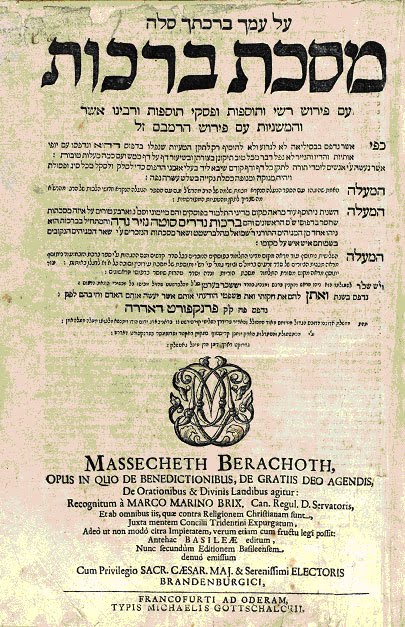
The Yiddish letters I set with my own hand
I am Elle, the daughter of Moses from Holland
a mere nine years old
the sole girl among six children
So when an error you should find
Remember, this was set by one who is but a child (2)

Did she compose the poem herself, or was it composed by her father or brother? Remarkably, we find another case not soon thereafter, of a nine year old setting type, and there we do know whether he could read or not. Nicholas Basbanes, in his book “A Gentle Madness”, records the following:

“Born in poverty, Isaiah Thomas came to know the touch and smell of ink on paper when he was only a child. Only nine years old in 1758….young Thomas was already completing his apprenticeship in the dingy Boston shop of Zechariah Fowle…When he later became the most successful printer and publisher in the United States-Benjamin Franklin dubbed him the Baskerville of America- Isaiah Thomas enjoyed telling friends that he knew how to set type before he was able to read.”(3)

Whether or not she could read at age nine, we do know that this little girl was able to recognize the Judeo Yiddish letters of a manuscript and set to type similar letters from which to print a book. Perhaps she had the potential to become as successful as Isaiah Thomas but for her gender and religion.

We meet Elle again in 1699, this time as a typesetter working on the famous Berman Shas of Frankfurt on Oder. This printed edition of the Talmud ( 1697-1699) was financed by the wealthy court Jew, Yissachar Berman Segal of Halberstadt who gave away half the 5,000 copies printed to needy scholars throughout Europe.(4)The Berman Shas is one of the most respected early printed editions of the Talmud because it contained many additional commentaries which became standard in following editions. It was the first edition since that of Gershom Soncino in the early 16th century to contain most of the diagrams we are familiar in Seder Zeraim, and Masechtos Eiruvin and Sukah. (5) It was also the first to contain Charamos from various Rabbanim prohibiting others in that general area from printing the Talmud for an extended period of time.(6) The following Cherem, recorded in Maseches Brachos, was written by Rav Dovid Oppenheim who lived at that time in Nikolsburg and later became chief Rabbi of Prague:At the end of Maseches Nidah printed in 1699, Elle signs her work a bit more boldly, and leaves us wondering what was going through her mind when she set the letters for the colophon.
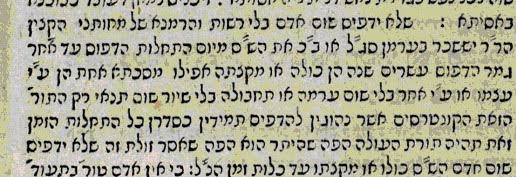

“ By the hand of the faithful typesetter in this holy work, Yisroel the son of Reb Moshe. And by the hand of his maiden sister Elle, daughter of Rav Moshe, in the year “N’Kaivah T’Soivev Gaver” ( “a woman shall go after a man”.)

When you add up the letters which are set in large type, you come up with the year 459 according to the Peret Koton ( the abbreviated era ). This is the year 5459 (1699). What intrigues even the casual observer is why she, or her older brother Yisroel chose to record the year 5459 using that unusual Pasuk? One could argue that the Pasuk is tangentially related to some of the topics covered in Maseches Niddah, but there are many other Pesukim which deal more directly with the subject matter that could have been formatted to equal 459.(7) I think it is more logical to relate the Pasuk to the girl typesetter, who we are informed, is still unmarried. In Messianic times, it will be the Kallah, Am Yisroel, who seeks out its Chasan, Hashem. Perhaps Elle thought her circumstances and position necessitated a similar approach to finding a suitable Chasan. We hear the last from her in the next year having worked on a Machzor with her brother Yisroel.(8) We hope that after that, this extraordinary girl found an appropriate Shidduch. We wish the same for all those seeking the wonderful rewards that marriage has to offer.

(1) Marvin J Heller, “Studies in the Making of the Early Hebrew Book”, Boston 2008 pps. 218-228. The entire chapter on Moses ben Avraham Avinu makes for some fascinating reading. I am indebted, as are we all, to Marvin Heller for his research into this field of study.
(2) Ibid: p.222
(3) Nicholas Basbanes, ‘A Gentle Madness” New York, 1995 pps144-145
(4) R.N.N. Rabinowitz “Ma’amar Al Hadfasas HaTalmud”, A.M. Haberman edition, Mosad HaRav Kook 2006, page 96 footnote 1.
(5) Ibid. p. 98
(6) Ibid p.100
(7) Two examples of a more fitting Pasuk to denote the year of publication for Tractate Niddah are:

“B’Mai Nidah Yischatah” which was used in Frankfurt A/M edition of 1720, and

“V’Safrah Lah Shiva Yomim, V’Achar Ti’Taher” which was used in the Dyhernfurth edition of 1816-21 ( although the highlighted letters actually add up to (5)773)

(8) Heller, page 223