Pandemic Bibliopenia: A Preliminary Report of Disease Eradication

אין חכמת אדם מגעת אלא עד מקום שספריו מגיעין[1]1

ריצחק קנפנטון

(ואין ספריו מגיעין בשעת המגיפה[2])

Pandemic Bibliopenia:[3] A Preliminary Report of Disease Eradication

Rabbi Edward Reichman, MD

The number of seforim written during, about or related to the Covid 19 pandemic continues to grow at breakneck speed.[4] What has largely gone unnoticed among the other unprecedented aspects of this pandemic, is that since the development of the printing press, we have not seen so much quality rabbinic literature produced in the midst of a pandemic.[5] In fact, if anything, a diminution in the quantity and quality of literature was more the norm during previous pandemics. This literature proliferation during Covid 19 heralds in a new age and reflects the eradication of a common condition prevalent in the premodern era- Pandemic Bibliopenia (heretofore, PB).

Few alive today have previously experienced a pandemic of the magnitude of Covid 19. While those Torah scholars and bibliophiles who weathered pandemics of the past would surely have been familiar with PB, possibly even from personal experience, the scholars of today are simply unfamiliar with this condition and have likely never seen a case. Furthermore, we are unlikely to see many cases of PB in the future as well (see “treatment” section below).

Since cases of PB in the present and future are likely to be exceedingly rare, the possibility of misdiagnosis or missed diagnosis is therefore a significant concern. We therefore review this condition and some illustrative cases to record its history for posterity, lest we completely forget this previously incurable disease that afflicted the Jewish community for centuries.

Definition/ Diagnosis

Pandemic

adjective

Associated with a widespread outbreak of a contagious disease.

Bibliopenia

noun

Biblio- relating to a book or books

Penia (suffix)- lack or deficiency

A lack or deficiency of books

Pandemic Bibliopenia (PB) is defined as the lack or deficiency of books available to scholars during times of widespread disease.[6] This often leads to quantitative or qualitative decline in literature produced during times of plague or pandemic.[7]

Etiology

While the Talmud explicitly recommends one to shelter in place during times of plague,[8] the practice evolved from at least the late Middle Ages and onwards to flee the urban areas for more rural, less densely populated locations.[9] Access to rabbinic works was often severely limited, if existent at all, in these remote areas. Production of literature was thus severely hindered or curtailed in areas of disease. Plagues often lasted for many months or longer.

Literary Manifestations

PB appears to be more explicitly manifest in halakhic, specifically responsa, literature, with less impact on other genres, such as poetry,[10] or other forms that do not require or rely heavily on texts. Halakhic writing often requires referencing a wide spectrum of legal writings. Furthermore, due to the often-urgent nature of halakhic queries, the response cannot await the passing of the pandemic. Elective works, however, can simply be delayed until calmer times, when access to libraries, be they private or public, can be restored.

Epidemiology

The impact and prevalence of PB throughout history is difficult to assess,[11] though it has likely been significantly underreported. Cases can only be definitively identified from manuscripts and printed works where PB is explicitly mentioned. One of the primary manifestations of Pandemic Bibliopenia is the unwritten book. How many works were conceived, and perhaps even gestated, though not birthed as a result of PB? As this is manifestly impossible to quantify, as no evidence of such remains, we will thus never know the extent of the bibliographic mortality of PB throughout history.

PB shows no innate predilection for age, gender or geographic location and is associated solely with the presence of pandemics.

Case Studies

There are a number of possible presentations of PB.

Severe Cases of Pandemic Bibliopenia

Below are two clear cases of severe PB.

  1. Rabbi Yom Tov Tzahalon (c. 1559-1638)[12]

Rabbi Yom Tov Tzahalon (known as Maharitz) authored a number of halakhic works in the late sixteenth-early seventeenth centuries and lived in Tzfat for part of that time. There were a number of plagues in Tzfat during this period. In Tzahalon’s responsa we see clear evidence in a number of places of his affliction with Pandemic Bibliopenia.[13]

Siman 8

Due to plague in Tzfat, Tzahalon was forced to flee from mountain to mountain, village to village, and states explicitly that he lacks sufficient access to works of poskim to answer the question properly. He nonetheless offers a limited response to appease the questioner.

Siman 19

Tzahalon again notes his lack of access to rabbinic literature in the midst of plague, including the tractates of the Talmud, with the exception of tractates Bava Kama and Bava Metzia, and a portion of Rambam.

During the writing of the above responsum Tzahalon resided, albeit temporarily, in Kfar Par’am, located to the Northeast of the city. People generally fled to villages on the outskirts of their city of residence.

(the pin represents Par’am)

Siman 44

During the writing of this responsum Tzahalon appears to have returned to wandering between villages and once again laments his inability to provide an in depth and expansive response.

Siman 81

In our final, albeit less explicit, example of PB in Tzahalon’s responsa, written in 1589, Tzahalon bemoans his prolonged exile and the toll it has taken, though does not allow this to prevent him from offering a halakhic analysis of the issue.

We not only have mention of Pandemic Bibliopenia in Tzahalon’s responsa, it also surfaces in his Talmudic commentary.[14] Tzahalon wrote his commentary on the fifth chapter of Bava Metzia, at least partially, while in exile. Parenthetically, this may explain why the only volumes of Talmud he possessed in exile were Bava Kama and Bava Metzia, as he likely packed these specific tractates for his travels anticipating work on his commentary. In the midst of his Talmudic commentary[15] we are introduced to Tzahalon’s personal tragedy while in exile in Kfar Par’am with the following line:

Tzahalon digresses from his commentary to share the details of the tragic death of his infant son.[16] The timing of the death, associated with a delayed burial, precipitated a halakhic question for the author:[17] Here again he reiterates his lack of access to required Talmudic tractates and poskim. He writes of his intent to review and expand his analysis upon his return to the city and to his library after the cessation of the plague.

Of note, while this passage is physically situated in the midst of this Talmudic commentary, it is in essence a halakhic responsum.

  1. Rabbi Hayyim Palachi (1788-1868)[18]

Rabbi Palachi was the Chief Rabbi of Izmir in Turkey. During his lifetime a cholera pandemic affected Turkey. In a number of his works he acknowledges suffering from Pandemic Bibliopenia. An explicit reference is below:

Hikikei Lev, vol 2, H. M., n. 51, p. 164a

Palachi was exiled to the village of Boron on the outskirts of Izmir. While lamenting that there is “no wise man without seforim,” he endeavors to respond to a halakhic question with the resources he has available him in addition to relying on his memory. Below we see the repeated mention of PB throughout multiple works reflecting a most serious case of the condition.[19]

Hikikei Lev, vol 1, E. H., n. 57, p. 114b

Hayyim Biyad n. 79, p. 98a

In a letter to Rabbi Hayyim Yehudah Avraham, published in the latter’s Ahi vaRosh[20] Palachi writes while still in exile in the village of Boron:

Varied Prevalence of PB

In the following case, we see the clear impact of PB on one Torah scholar, while another scholar during the very same pandemic appears to enjoy immunity from the condition.

In perhaps our most poetic example, Rabbi Yehudah Ibn Verga[21] corresponds with Rabbi Yosef Karo, author of the Shulhan Arukh, about a financial matter.[22] After lengthy praise for Rabbi Karo, he launches into a lament about the current state of plague in Tzfat.

Ibn Verga’s invokes the same phrase from Tehillim[23] (nikhsifah vigam kaltah nafshi) as does Tzahalon (Siman 81 above) to express the emotions evoked by the plague. His comment at the end of this passage about his elation upon meeting another person in the midst of the plague will sound familiar to those of us who have weathered complete lockdown during the current pandemic.

The next passage reflects the duration of Ibn Verga’s exile. Ibn Verga remarks that his exile had passed the entire summer, now into the winter, and the plague still lingered. “We have said, it is long due to the sins of the generation.” Ibn Verga and Karo both lived in Tzfat. Ibn Verga had hoped to speak to him directly about this case, face to face, but as the plague dragged on, he had no recourse but to commit his comments to paper.

Ibn Verga concludes that he had wanted to cite a responsum of Rosh in support of his position but was unable to include it due to his affliction with PB.[24] 

In his response, Rav Yosef Karo likewise longs to speak face to face with Ibn Verga:

He concurs that sin has caused them to be in a state of “mistar panim” until the plague passes. Rabbi Karo then proceeds to discuss the halakhic issue and makes no mention of lack of access to literature. He also lived in Tzfat and endured the same plague. In fact, we know Rabbi Karo fled Tzfat during the plague to live in the village of Birya.[25] It is in Birya in 1555 that he completed the first volume of his Shulhan Arukh. While the Shulhan Arukh was only first printed in 1565 in Venice, the colophon of each volume reflects the date and place of its completion.

Colophon at end of the 1565 edition of the first volume of Shulhan Arukh:

By the time he had completed the second volume, Yoreh De’ah, less than one year later, he had already returned to Tzfat, presumably after the cessation of the plague.

Colophon at end of the 1565 edition of the second volume of Shulhan Arukh:

While Rabbi Ibn Verga was clearly a victim of PB, Rabbi Yosef Karo does not appear to have been affected whatsoever. We thus have evidence of the variable prevalence of the condition during the same pandemic.

Mild or Implicit PB

Some cases of Pandemic Bibliopenia are not as explicit or easily diagnosed as those of Rabbis Tzahalon and Ibn Verga. At the same time as the aforementioned were experiencing plague in Northern Israel, Rabbi Moshe Isserles faced advancing disease in Cracow. Rabbi Isserles describes his dire situation in the introduction to his Mehir Yayin, a commentary on Megilat Esther that he wrote for his father-in-law, in lieu of mishloah manot, while in exile in the city of Shidlov.

While Rabbi Isserles does not explicitly refer to Pandemic Bibliopenia, he makes passing references possibly alluding to the condition. For example, he writes:

which means that his intellect still remained, despite his lack of access to an extensive library.

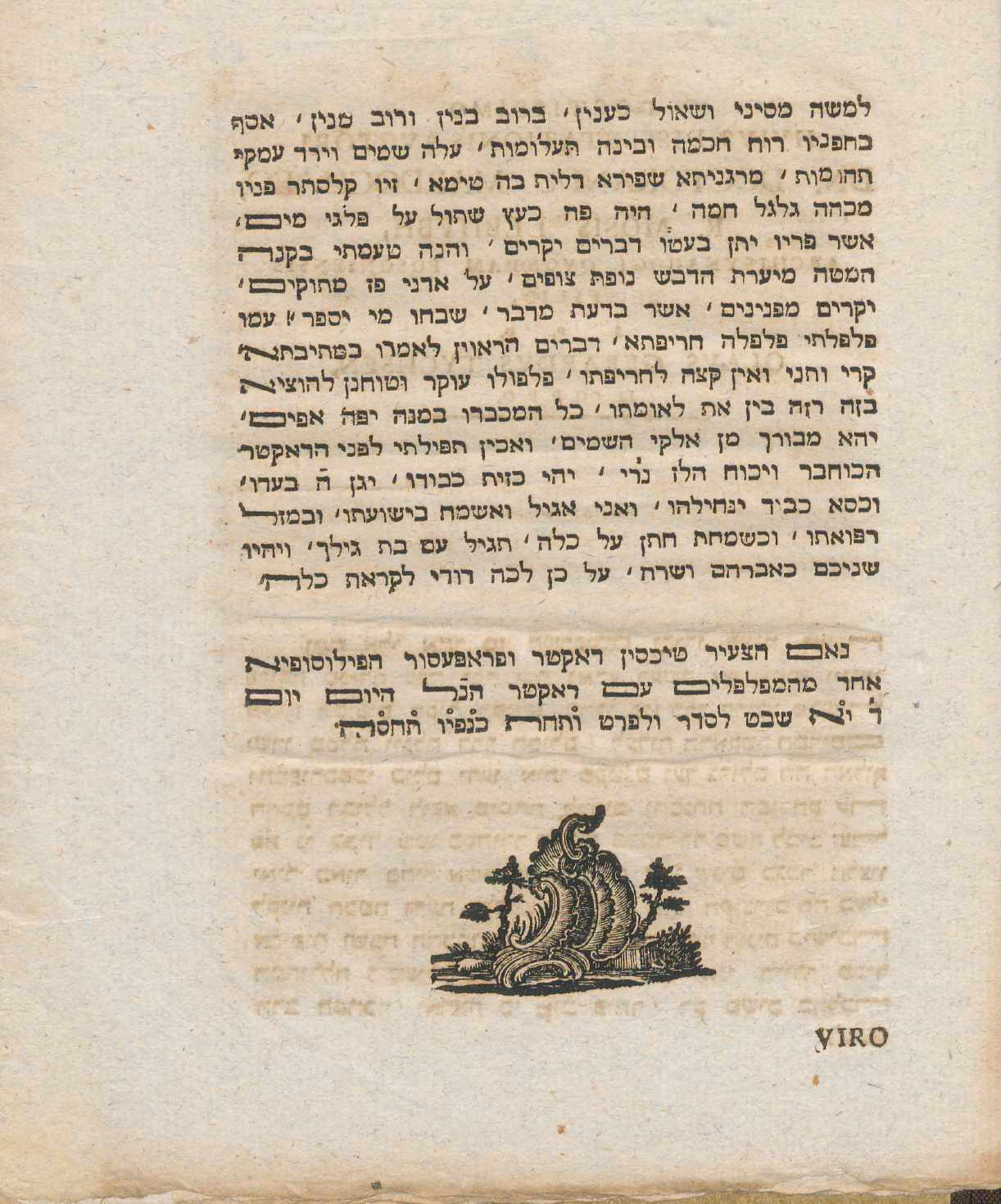
In describing the work, he writes:

Perhaps PB is reflected in his choice of composition, a work relying heavily on his textual analytic skills, and less so on obscure or hard to obtain texts, likely unavailable to him in Shidlov.[26]

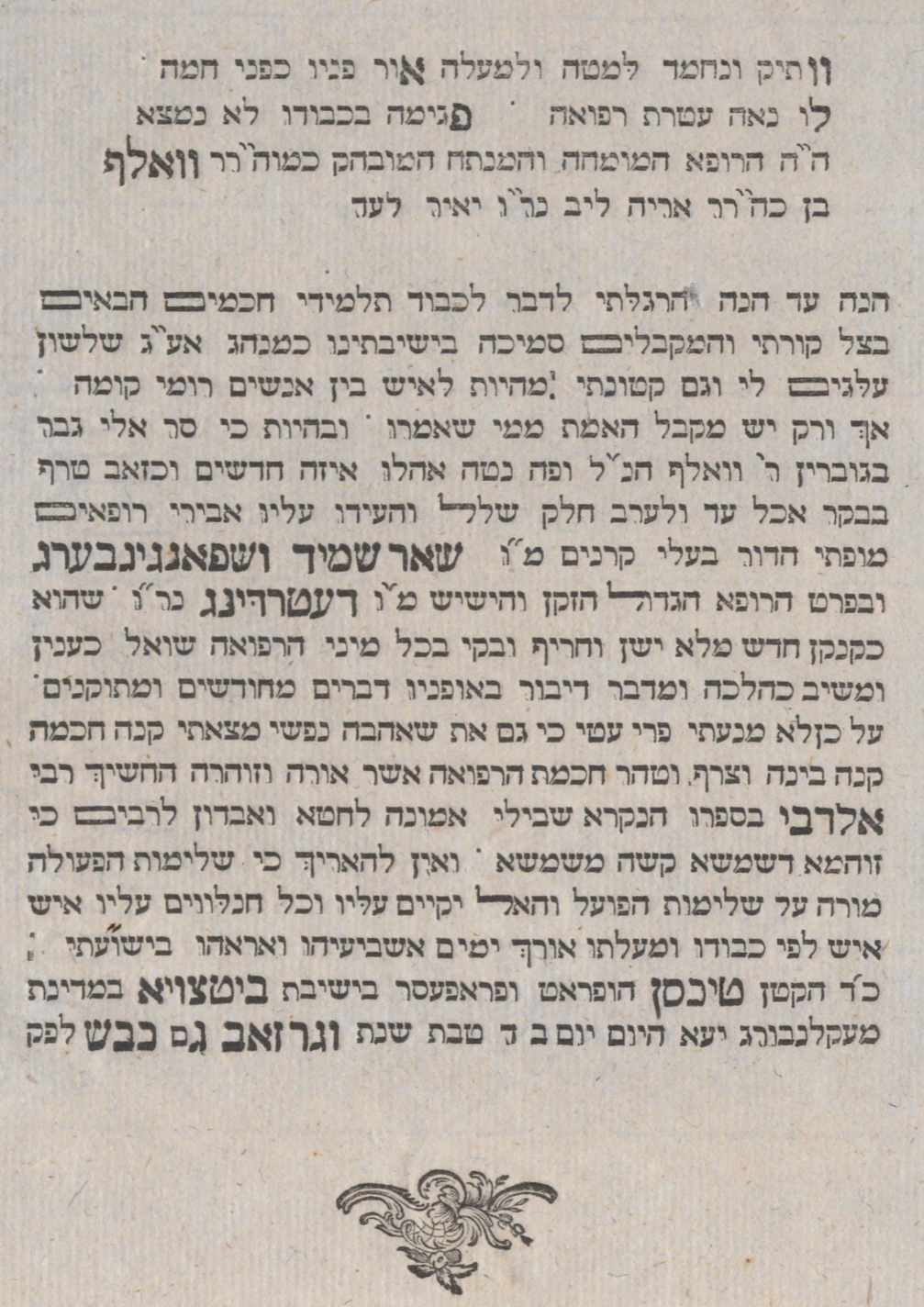
Furthermore, his qualifying statement,

might reflect a lack of bibliographical resources. Whether this case meets the diagnostic criteria for PB remains a question.

Differential Diagnosis

Pandemic Bibliopenia may possibly be confused with other forms of Bibliopenia. To be sure, many individuals have lost access to their libraries due to personal tragedies,[27] but here I refer specifically to systemic forms of Bibliopenia that impacted entire communities. In these cases authors were similarly deprived access to rabbinic literature, though for entirely different reasons. One such example will suffice.

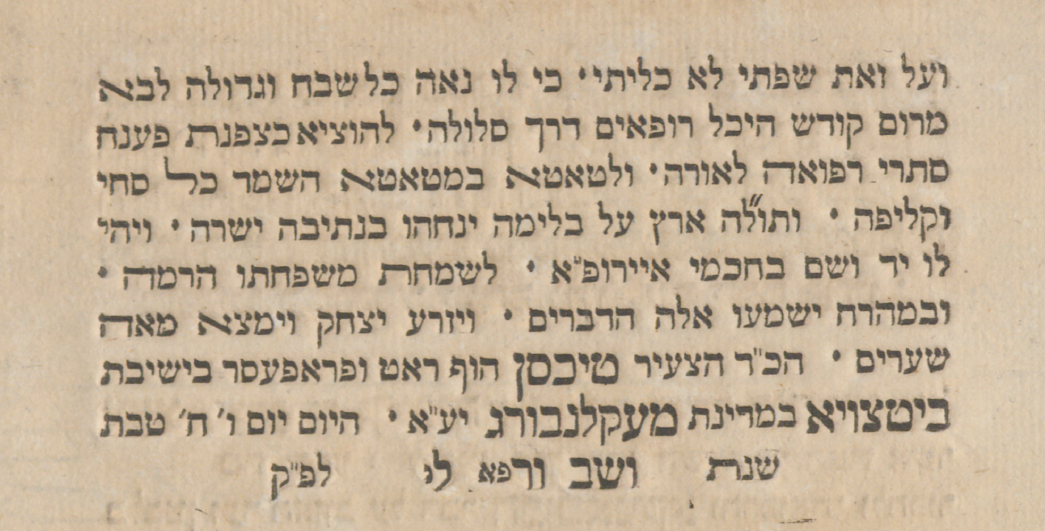
The Physician Abraham Portaleone was a prominent figure in Renaissance Italy, treating royalty, authoring several medical works.[28] At the age of 62 he suffered a stroke which prompted a reevaluation of his life. He concluded that his affliction befell him as he had not devoted enough of his life to Torah learning. He undertook to write a work on prayer and the Beit HaMikdash which he dedicated to his children. At the end of chapter thirty-two, which discusses the shulhan in the Temple, we find the following comment.

Portaleone notes that, “Perhaps some place in the Talmud Hazal spoke of this, and I am not aware. As a result of the known deficiency [my emphasis] I have not been able to properly ascertain this.”[29] One might erroneously assume that he is referring to Pandemic Bibliopenia as the etiology for his lack of access to the Talmud. In fact, Portaleone is referring to a variant form of the condition, called Censorship Bibliopenia. A review of the entire work of Portaleone, including his introduction, will clarify any confusion.

In his introduction, Portaleone details the nature of his early education, and recalls how while a student studying Talmud with R’ Yaakov MiPano, the infamous decree led to the Talmud “being consumed by fire before our eyes.” This refers to the burning of the Talmud in Rome in 1553.[30] After the initial burning of the Talmud in Rome, other Italian cities followed suit with their own citywide burnings. Portaleone was witness to one such event. Decades later, as he penned his classic work, Shiltei haGibborim, the Talmud still remained largely unavailable in Italy. Portaleone was forced to use substitute works that alluded to or quoted the Talmud, if available, but sometimes the information was simply not accessible. One such example is his discussion of the Shulhan above.

In one remarkable instance Portaleone reveals his elation at being able to acquire a bona fide Talmudic reference. He writes that after he completed the chapter on the Lishkat haGazit (Chamber of Hewn Stone), God ordained (hikra) that he happen upon a wise man from the city of Tzfat (where the Talmud was available) who had come to Italy to seek financial support for his family. “From his mouth I heard the sugya in the second chapter of Yoma on the laws of the Lishkat haGazit, and I write them here for you (my children) from his mouth…”[31]

In yet another place he excitedly relates of his accessing a small passage from Tractate

Chagigah from a tattered manuscript remnant in the library of a great Torah scholar (Gaon) of Verona.[32] All of these instances are examples of Censorship Bibliopenia.

Treatment

During previous pandemics, in the pre-modern era, PB was considered untreatable. Fortunately, however, it was temporary and ultimately resolved with the cessation of the pandemic. Today, however, the treatment for PB is readily available and inexpensive, though its safety has been called into question. Despite the fact that the understanding of disease transmission has evolved, people still, if feasible, flee their homes in urban areas for less populated locations. As such, they could still be susceptible to PB. However, PB is now completely remediable through internet access to Rabbinic literature.[33] Not only is virtually the totality or rabbinic literature widely and freely available for scholars (rabbis, poskim and laymen) via the internet, facilitating the production of quality work; the publication and dissemination of these works can be accomplished with ease on the internet as well. It is only today, in the midst of the current Covid 19 pandemic, that we are witnessing the eradication of PB. As a result, there have likely been more pages written of rabbinic discourse (both halakhic and aggadic, related to the pandemic or not) during the present pandemic than during all previous pandemics combined.[34]

Conclusion

Pandemic Bibliopenia is an underrecognized phenomenon in Jewish history. In addition to the medical impact of pandemics in the past, our ancestors experienced spiritual and intellectual suffering by being deprived access to the Torah library, our life blood. Today, however, even in the midst of a worldwide pandemic, while libraries have shuttered, and some have fled their homes, there has been little diminution in the access to rabbinic literature. As the world may never again experience Pandemic Bibliopenia and the unique literary impact of plagues and pandemics, it behooves us to recall it in appreciation that despite the many adversities associated with this pandemic, loss of access to our beloved Torah literature is not counted among them. Not only have we eradicated Pandemic Bibliopenia, it appears to have been replaced with a new diagnostic category, Pandemic Polybiblia,[35] though in this case, fortunately, a healthy and desired condition. May we be zokheh to the continuation of Polybiblia without any associated pandemics in the future.

[1] Isaac Canpanton (15th century), Darkei HaGemara. This oft quoted phrase refers specifically to the purchase of one’s own seforim. I take literary license with its use here.
[2] My addendum.
[3] This condition has been variously called epidemic or plague bibliopenia. We use the term pandemic in light of the present Covid 19 pandemic.
[4] See Eliezer Brodt, “Towards a Bibliography of Coronavirus-related Articles and Seforim written in the past month (updated), Black Weddings and others Segulot,” Seforimblog.com (May 4, 2020).
[5] The proliferation of literature specifically related to the pandemic is also noteworthy and unprecedented but is not the focus of this article. On the history of literature written during times of plague, see Abraham Yaari, biOhalei Sefer (Reuven Mass, 5699), 82-90. The other essays in this volume chronicle the impact of various natural occurrences, such as fires, and personal experiences, such as imprisonment, miraculous salvation, or infertility, on the writing of Hebrew books.
[6] The etiology may be related to either closure of public libraries, which is a more widespread form PB, or due to required or elective relocation away from one’s personal library to remote areas devoid or deficient of seforim.
[7] Plague and the migration to the rural areas affected not just the writing, but the printing of Hebrew books as well. See Yaari, op. cit.; Avraham Haberman, Perakim biToldot haMadpisim haIvrim (Reuven Mass: Jerusalem, 5738), 314.
[8] Mishnah Ta’anit 3:4.
[9] See Yaari, Moshe Dovid Chechik and Tamara Morsel Eisenberg, “Plague, Practice and Prescriptive Text: Jewish Traditions on Fleeing Afflicted Cities in Early Modern Ashkenaz,” Journal of Law, Religion and State (2017), 1-27. I thank professor Susan Einbinder for bringing this article to my attention.
[10] For poetry in times of plague, see Susan Einbinder, After the Black Death: Plague and Commemoration Among Iberian Jews (University of Pennsylvania Press: Philadelphia, 2018). idem, “Poetry, Prose and Pestilence: Joseph Concio and Jewish Responses to the 1630 Italian Plague,” in Haviva Yishai, ed., Shirat Dvora: Essays in Honor of Professor Dvora Bregman (Ben-Gurion University: Beer Sheva, 2019), 73-101; idem, “Prayer and Plague: Jewish Plague Liturgy from Medieval and Early Modern Italy,” in Lori Jones and Nükhet Varlik, eds., Death and Disease in the Medieval and Early Modern World: Perspectives from Across the Mediterranean and Beyond (York Medieval Press, 2021), forthcoming.
[11] We do not address here the impact of disease and illness on literary output.
 [12] On Tzahalon, see, Shimon Vanunu, Arzei Halevanon (Jerusalem, 5766), 862-865; Shalom Hillel “Sefer Magen AvotRabbeinu Yom Tov TzahalonMekabtziel 33 (Kislev, 5768), 10. Vanunu lists all the references discussed below.
[13] Here we do not address the substance of the responsa, rather focus on the impact of PB on the author. I mention the responsa in number order, assuming this is chronological.
[14] Tzahalon’s Talmudic commentary was first published by his grandson in Venice, 1693, where it appears after the former’s responsa. A corrected and annotated version of the Talmudic commentary was published by S. Mertzbach in Benei Brak in 5752.
[15] This was written in the manuscript in the middle of his commentary on the fifth chapter of Bava Metzia, but is printed separately as n. 14 as part of his responsa.
[16] His son’s death does not appear to have been plague related, as he recounts that his son was perfectly healthy just prior to his death.
[17] The delayed burial generated a question for Rabbi Tzahalon as to which day was considered his first day of mourning and thus whether he should put on tefillin.
[18] On Palachi, see Shimon Aryeh Leib Eckstein, Toldot haHabif (Halevi’im Press: Jerusalem, 5759). All of the citations mentioned he are referenced on p. 183, n. 17.
[19] See also his Nishmat Kol Hay, vol 2, E. H., siman 3, page 6.
[20] (Izmir, 1840), H. M., n. 14, p. 88b.
[21] This Yehuda Ibn Verga is not to be confused with the Spanish historian and kabbalist of the fifteenth century.
[22] Rabbi Yosef Karo, Avkat Rokhel, 99 and 100.
[23] 84:3.
[24] If I am reading this correctly, it seems that Ibn Verga was still in Tzfat when he wrote this but had sent his library ahead to his location of exile.
[25] See R. Ephraim Greenblatt, “B’Inyan Kiddush Levanah,” Noam 12 (5729), 113. Birya can be seen on the map above, between Tzfat and Par’am.
[26] This work does reference texts from the Talmud and Tanakh as well as the Rambam’s Moreh Nevukhim. These may have been his available texts.
[27] See, for example, Yehuda Rosenthal, “ The History of the Jews in Poland in Light of the Responsa of the Maharam of Lublin,” (Hebrew) Sinai 31:7-12 (NisanElul, 5712), 320 regarding Maharam miLublin and his limited access to his library due to a fire in Cracow.
[28] On Portaleone, see H.A. Savitz, “Abraham Portaleone: Italian Physician, Erudite Scholar and Author, 1542-1612,” Panminerva Medica 8:12 (December, 1966), 493-5; S. Kottek, “Abraham Portaleone: Italian Jewish Physician of the Renaissance Period- His Life and His Will, Reflections on Early Burial,” Koroth 8:7-8 (August 1983), 269-77; idem, “Jews Between Profane and Sacred Science: The Case of Abraham Portaleone,” in J. Helm and A. Winkelmann (eds.), Religious Confessions and the Sciences in the Sixteenth Century (Brill, 2001); A. Berns, The Bible and Natural Philosophy in Renaissance Italy (Cambridge University Press, 2014).
[29] End of Chapter 32.
[30] See Menachem Butler, The Burning of the Talmud in Rome on Rosh Hashanah, 1553 theTalmud.blog (September 28, 2011).
[31] Chapter 23, p. 109.
[32] For discussion of these cases, see Y. Katan and D. Gerber, eds., Shiltei haGibborim (Machon Yerushalayim, 5770), 28-29.
[33] See Jacob J. Schacter, “The Challenges and Blessings of the Internet: Technology from An Historical Perspective,” Jewish Law Association Studies, vol. 29 [The Impact of Technology, Science, and Knowledge] (2020), 5-20. Rabbi Dr. Schacter highlights some striking parallels regarding challenges created by the development of printing and the development of the internet.
[34] I admit being guilty of contributing to this phenomenon.
[35] The diagnostic criteria for this new entity have not yet been adequately formulated and will require a fuller evaluation with the passage of time. A preliminary definition has been proposed: The proliferation of rabbinic works relating to pandemics written in the midst of the pandemic itself.


What Became of Tychsen?: The Non-Jewish ‘Rabbi’ and his “Congregation” of Jewish Medical Students

What Became of Tychsen?: The Non-Jewish ‘Rabbi’ and his “Congregation” of Jewish Medical Students

By Dr. Edward Reichman, MD

This essay was inspired by two recent Seforim blog posts, one on Professor Shnayer Leiman’s contributions,[1] and the other on a topic related to R’ Yonasan Eybeshutz.[2]


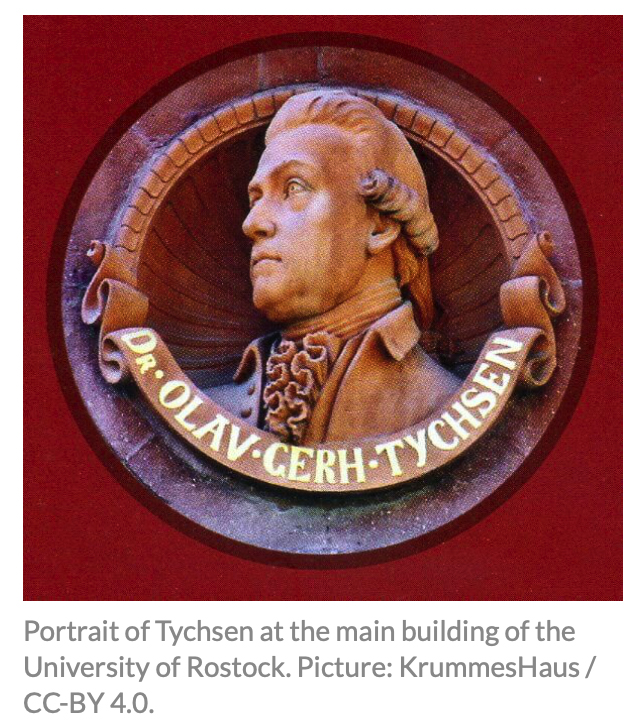
In November 16, 2006 an article by Dr. Shnayer Leiman appeared in the newly formed Seforim Blog entitled, “Two Cases of Non-Jews with Rabbinic Ordination: One Real and One Imaginary.” The “real” ordination was bestowed upon Olaf Gerhard Tychsen (1734-1815). In 1759, Tychsen received the title of Haver, a lower form of rabbinic ordination, by Moses the son of Rabbi Zvi Hirsch Lifshuetz. Tychsen is perhaps the only known case in Jewish history of a non-Jew receiving such an honor or degree.[3]

Leiman provides a biography of Tychsen. He pursued studies in Hindustani, Ethiopic and Arabic, as well as Hebrew and Yiddish and became an Orientalist of international renown making significant contributions to cuneiform studies and numismatics as well.[4] During his early years he also pursued various missionary activities in the Jewish community, largely unsuccessful by his own account. 

As Leiman notes, in 1752, while a student at the Christian Academy in Altona, Tychsen attended the lectures of R. Yonasan Eybeschutz. Leiman essentially leaves us at the point of Tychsen’s ordination, with brief mention of his subsequent academic career. What became of Tychsen’s “rabbinic” career after he received this singular distinction? Did he apply for a rabbinic position? Did he maintain any connection with the Jewish community? 

In fact, Tychsen did continue to maintain a strong connection to both rabbinic literature and the Jewish community in varying degrees throughout his life. He is perhaps best known for his involvement in the premature burial controversy, which would earn him a place of infamy in Jewish history. Tychsen taught at the university in Butzow, the residence of the Duke of Mecklenberg. During this period there was concern that physicians were misdiagnosing death, and as a result, people were being buried prematurely.[5] On February 19, 1772 Tychsen sent a letter to the Duke of Mecklenberg regarding the Jews’ burial practice, interring after waiting only three hours, where it is known that there can sometimes be misdiagnosis of death. Tychsen detailed the Jewish origins of hastening burial in general, reflecting familiarity with rabbinic literature. He claimed that the need to bury quickly was established in countries with hot climates, where the body would decompose quickly, not applicable to a country like Germany. He also reported cases of people who were supposedly buried alive.[6] On April 30, 1772, Duke Friedrich of Mecklenburg-Schwerin, in response to Tychsen’s letter, issued an order prohibiting the Jews in his realm from immediately burying their dead and requiring that they rather wait for three days after death before interment. This began what would become a worldwide halakhic debate about the halakhic definition of death and the time of burial.[7]

Tychsen was also peripherally involved with one of Jewish history’s greatest seforim collections. Rabbi David Oppenheim amassed an extraordinary collection of books and manuscripts which languished in storage for years after his death.[8] Tychsen visited the collection for three weeks, reporting on its manuscripts to the Italian Christian Hebraist Giovanni Bernardo De Rossi. He attempted to arouse the interest of potential buyers, including Catherine the Great, Empress of Russia, Duke Karl Eugen of Wurtemberg, and Archduke Frederick Francis I of Mecklenberg. His efforts were to no avail and the collection ultimately found its home in Oxford, where it remains to this day.[9]

Here we highlight a little-known, though more substantive, connection of Tychsen with the Jewish community. One year after his ordination, toward the end of 1760, Tychsen was appointed Professor of Oriental Languages at the newly established University of Bützow in Mecklenburg. It is in this capacity that Tychsen exercised a rabbinic role, becoming a university campus rabbi of sorts for a select group of Jews at the university. Though he may not actually have had a “minyan” of students, nonetheless, his impact on this select group was profound and long lasting, akin to that of a rebbe.[10]

The interactions of Tychsen with the Jewish community must be viewed through a particular lens. Tychsen was a devout Lutheran Protestant and trained and engaged in proselytizing activities in his early life. This fact remains at least in the background of all his interactions with the Jewish students at Butzow and has been evaluated elsewhere. Whether his relationships with the Jewish medical students were primarily or partially motivated by his proselytizing tendencies, or whether his proselytizing endeavors had ceased by then, is a matter of historical speculation.[11] This is not the focus of the present essay.[12]

In his capacity as a faculty member of the University of Butzow Tychsen encountered a number of Jewish students attending the university’s medical school. Though an Orientalist and not a physician or scientist, he nonetheless served as a mentor for these students to whom he was drawn by shared interests and possibly proselytizing intentions. Tychen served this role for all the Jewish medical students who attended the University of Butzow during its twenty-nine years of existence. 

The first Jewish student of the Butzow Medical School, and the first with whom Tychsen developed a relationship was Markus Moses. This relationship has been the subject of a number of dedicated essays.[13] Markus Moses was the son of Moshe ben Meir Harif Lemberger (Lvov), Chief Rabbi of Pressburg and head of its yeshiva. Lemberger, as well as his son Markus, were apparently involved in the Emden- Eybeshutz controversy.[14] Markus (Mordechai) was born in Pressburg in 1729, received a traditional Jewish education, and married. Shortly thereafter, his wife and two young children died. In 1758, after the death of his father, Markus began the study of secular subjects. Over the next few years he traveled to Germany and continued study in various cities, including the field of medicine, ultimately ending up in Butzow in 1763. Aron Isak, the leader of the Jewish community, took him under his wing and orchestrated his admission to the recently founded Butzow Medical School,[15] thus waiving the high taxes imposed upon the Jewish community for new town visitors. The faculty were impressed with Moses’ great intelligence and facility with multiple languages and accepted him, with the approval of the Duke and Professor George Detharding, the head of the faculty, with free tuition. Below is a letter in Hebrew from Paul Theodore Carpov, an Orientalist and Christian Hebraist at Butzow, supporting Moses’ acceptance to the medical school at Butzow and advocating for his financial support as well.[16]

As per the letter, Moses brought with him impressive letters of recommendation not only from the great scholars of “his nation,” but also from those of “our nation.” Carpov also notes the Duke’s approval, as well as the financial issues relating to his application. Carpov was clearly taken by the young Jewish student. 

Below is the record of matriculation of Markus Moses in 1764.

Moses clearly had a predisposition for the field of medicine and was soon relied upon by Detharding to see the latter’s private patients.[17]

Tychsen had a working academic relationship with Moses as evidenced by the multiple research papers Moses wrote under his mentorship. It is remarkable that all of the papers were on Jewish topics. I have found a number of cases, though relatively few in number, of Jewish medical students throughout the centuries who wrote their medical school dissertations on a Jewish related topic,[18] but I have never encountered any student who authored so many Jewish related papers as part of their medical training. The topics included the Samaritan Bible, a discussion of the kosher and non-kosher animals based on the work of Rambam, and an essay on the diseases of the old as reflected in Kohelet (chapter 12).[19] Moses’ graduation dissertation, discussed below, was also on a Jewish topic and was supervised by Tychsen.

Disputatio de Pentateucho Ebraeo-Samaritano, 1765[20]

Essay on kosher and non-kosher animals based on Rambam.[21]

The nature of the relationship Tychsen had with Moses, as well as with other Jewish medical students in Butzow, went far beyond the usual Professor-student model. There wrote each other dozens of letters and continued correspondence for years after graduation.[22] In one letter dated March 16, 1765[23] Moses apologizes for not responding promptly to Tychsen’s previous letter. Moses continues that soon he will either write again, or will see Tychsen in person. Moses signs the letter, hamitavek biafar raglekha.

גבר(א) דכולי() בי החכ(ם) הכולל המפורס(ם) שמו נודע בכל השערי(ם) הפרעפעסאר טיקסן

מרוב טרדות היום אין אוכל לתואר בתואר כראוי לגבר(א) כמותו ובאתי בלישנא קלילא אל תשים עלי חטאת שעדיין לא השיבני על כתב ידו הטהור מה שקבלתי ע”י ערל הבוח(ן) לבות יודע שהזמן גרמ(ה) לי רק זאת יהי(ה) לבו בטוח שהשבוע הבע” (?הא עלינו לטובה) או אכתוב לו או בנשיקת פא”פ (פה אל פה) אדבר בו[24] גם יקבל במתנה צורה של ר’ יהונת(ן) זצ”ל יותר אין לחדש כה המתאבק בעפר רגליו מרדכי מפב (?מפרשברג)ג


In the last line, Moses writes that Tychsen will also receive from him a gift of a portrait of Rav Yehonatan zt”l. Moses was obviously aware of the connection between Tychsen and Eybeshutz and believed this would be a meaningful gift. Eybeshutz died in 1764,[25] and his portrait was disseminated shortly thereafter. This is likely the portrait Moses purchased for Tychsen.[26]

As part of the requirements for the completion of a doctorate in medicine at most German universities, the student was required to engage in a public disputation on the topic of their dissertation. [27] The topic of Markus’ disputation was the analysis of a verse in Yehezkel which, according to Moses, reflects an ancient Jewish practice of placing salt of the skin of an infant as a prophylactic against disease. 

Moses engages in an expansive philological and grammatical analysis of the verse then posits that the Jews practiced this procedure and that it protected them from diseases like smallpox. The reason smallpox was prevalent during his time, Moses argues, is because people no longer routinely applied salt to the skin of infants. Moses is the only one of the Jewish medical students at Butzow who wrote his dissertation on a Jewish topic. 

Moses’ disputation was held on January 22, 1766 (11 Shevat, 5526). The event was held in a church, though Tychsen apparently noted that it was primarily a venue for non-ecclesiastic events. This may have been in deference to the halakhic concern about entering a church.[28] A number of Jewish families attended the event. Copies of the dissertation were sent to those invited to the public discourse, and additional copies were provided for the audience on the day of the event. The ceremony began with a Latin oration by the presiding professor, in Moses’ case, Professor Detharding, and was followed by the student’s reading of his dissertation. Upon completion of the reading, designated opponents presented their arguments and criticisms against the substance of the dissertation, with audience members occasionally allowed to participate. This was then followed by the candidate’s rebuttal. Tychsen served as one of the designated opponents for Moses’ disputation. 

On oath was also part of the graduation ceremony, and it typically involved avowing one’s belief in Christianity. Tychsen intervened with the Duke of Mecklenberg on Moses’ behalf to allow him to take his graduation oath invoking the name of the God of Israel as opposed to the Christian deity. He even publicly conversed with Moses in Yiddish at the graduation.[29] 

Below is the approbation of Tychsen appended to the published dissertation of Moses.

Tychsen’s freely inserts throughout allusions to rabbinic literature. He also uses a chronogram for the Hebrew year, typically done in Hebrew publications, and something Tychsen used frequently, as seen in his letters below. 

At the end of the approbation, Tychsen mentions the upcoming (second) wedding of Moses. Below is the handwritten wedding invitation of Moses to Tychsen.[30]

Both the title and signature of the invitation reflect the type of relationship they had. Moses also adds the clever pun of “hazmanah lav milsa,” assuming that Tychsen will appreciate it. 

The other letters appended to Moses’ published dissertation are also of great interest. In addition to Tychsen, another opponent at the disputation contributed a letter. Karl Leopold Carpov,[31] son of the Orientalist and professor at Butzow, Paul Theodore Carpov, who had written Moses’ letter of recommendation for admission (above). The older Carpov had died the previous year. The younger Carpov describes how beloved Markus was to his father, who considered him as another son, and, impressed by his brilliance, spent days and nights studying with him. Karl himself calls Markus his brother. While many focus on Markus’s close relationship with Tychsen, no mention has been made of his relationship with the other Orientalist, Carpov. 

The remaining letters were written by Judah Levi Strelitz,[32] the brother in law of Moses, and Meier (no other name is written), a fellow medical student. 

Moses was not the only Jewish student Tychsen took under his wings. Over the span of decades, throughout the short existence of the Butzow medical school, he endeared himself to a number of Jewish medical students.[33] He taught them, mentored them, and even financially supported them. They in turn sought his personal advice and recommendations, aided him in his intellectual quests, and invited him to their weddings.

Two Jewish medical students who matriculated in 1783 were also close with Tychsen, Isaac Salomonsen and Wulf Levinson. 

Matriculation record from University of Butzow November 24, 1783
Wulf Levinson and Isaacus Salomonsen[34]

Below is Tychsen’s letter to Levinsohn upon his graduation.[35]

Tychsen includes that the Butzow anatomist August Schaarschmidt and Professor Detharding, who had accepted Markus Moses some twenty years earlier, attest to the student’s qualifications.[36]

Below is the letter of Isaac Salomonsen presenting his dissertation to Tychsen.[37]

Below is Tychsen’s letter of approbation for Salomonsen’s dissertation in 1784. He mentions Isaac’s work in botany, which is in some form a continuation of the work of another Butzow medical student Tzadik de Meza, who died at the age of twenty-three.[38]

In another letter,[39] Salomonsen complained bitterly to Tychsen about his classmate Levinson, who had apparently been slandering him. He adds that the great personalities in the history of medicine, Aesculapius, Hygea and Hippocrates would be mourning and turning over in their graves if they knew how Levinson was misrepresenting and dishonoring them and the University of Butzow.

In the letter below dated 1784 from Salomonsen to Tychsen[40] we find a number of the elements common in Tychsen’s relationship with all the Jewish medical students. 

Salomonsen mentions the money he owes Tychsen and explains and apologizes for the delay in repayment. Tychsen routinely loaned money to the Jewish students. Salomonsen then reports that he was unable to obtain the sefer (shu”t Rabbi Moshe Alshikh) and Arabic coins Tychsen had requested. Tychsen was an avid bibliophile and his magnificent and important library was ultimately bequeathed to the University of Rostock, which absorbed the University of Butzow after its demise. It remains there to this day. Tychsen also collected Arabic coins and is considered the founding father of Islamic numismatics.[41] Salomonsen also mentions his acquaintance with a man named Mussafia[42] and his children, and how he enjoys spending time with them. Mussafia praised Tychsen and recalled something he had written on Tychsen’s behalf. He also possessed a work of Tychsen. Tychsen delighted in his name and reputation being spread throughout the Jewish community.

In sum, “Rabbi” Tychsen appears to have put his rabbinic degree to good use, at least from his perspective, cultivating an extremely devoted, loyal, and admiring, not to mention highly educated congregation. On the surface, he would be the envy of any modern rabbi, though much complexity lies beneath. While we did not focus on his proselytizing endeavors in this essay, perhaps this is one reason why Tychsen still remains to this day the only non-Jew to have received a form of rabbinic ordination. While Tychsen’s contributions to academia are vast, his tenure at the University of Butzow and his relationship with the Jewish students there represents one of the most unique, if lesser known, chapters in Jewish medical history. With the opening of the Rostock digital archives treasure trove we will certainly see further exploration of this topic. 

Edward Reichman

שנת וַתֵּעָצַ֖ר הַמַּגֵּפָֽה לפ”ק  

[1] Yitzhak Berger and Chaim Milikowsky, “Shnayer Leiman: In Appreciation,” (September 11, 2020).

[2] Moshe Haberman, “The Twice-Told Tale of R. Yonasan Eybeshutz and the Porger,” (September 15, 2020).

[3] For additional information on the semicha of Tychsen, see On the Main Line Blog, “On Non-Jews with Rabbinic Ordination, Real and Imagined: Some Notes on Dr. Leiman’s Post on Tychsen,” (September 20, 2011), http://onthemainline.blogspot.com/2011/09/on-non-jews-with-rabbinic-ordination.html.

[4] David Wilk, “Markus Moses’ Doctoral Dissertation or Who Remembers Butzow,” Koroth 9:3-4 (1986), 408-426, esp. 413.

[5] For an overview of this chapter in medical history, see Jan Bondeson, Buried Alive (Norton Publishers, 2001).

[6] For the text of the letter, see Siegfried Silberstein, “Mendelssohn und Mecklenburg,” Zeitschrift fur die geschichte der Juden Heft 4 (1930), 275-290, esp. 278-279. For reference to Tychsen as a key player in the issue of delayed burial, see for example, Rabbi Dr. Jacob J. Schacter’s doctoral dissertation, Rabbi Jacob Emden: Life and Major Works (Harvard University, 1988), 669, 723-724.

[7] For a comprehensive review of this historical chapter, see Moshe Samet, “Delaying Burial: The History of the Polemic on the Determination of the Time of Death,” (Hebrew) Asufot 3 (1989/1990), 613-665.

[8] For what follows see the comprehensive review of Oppenheim and his library by Joshua Teplitsky, Prince of the Press (Yale University Press: New Haven, 2019), 198.

[9] See Rebecca Abrams and Cesar Merchan-Hamann, eds., Jewish Treasures from Oxford Libraries (Bodleian Library, University of Oxford, 2020), and review of Paul Shaviv, Seforim Blog (July 14, 2020).

[10] The University of Butzow was an offshoot of the University of Rostock and later recombined with Rostock upon its demise. In addition, in 1817, Rostock University acquired the private library, including the manuscript legacy, of Tychsen, which included his significant Judaica and Hebraica collection. Over the last few years, the University of Rostock has devoted research efforts to explore the history of the Jewish students at the university with particular focus on their relationship with Tychsen. See Gisela Boeck und Hans-Uwe Lammel, eds., Jüdische kulturelle und religiöse Einflüsse auf die Stadt Rostock und ihre Universität (Jewish cultural and religious influences on the city of Rostock and its university) (Rostocker Studien zur Universitätsgeschichte, Band 28: Rostock 2014); Rafael Arnold, et. al., eds., Der Rostocker Gelehrte Oluf Gerhard Tychsen (1734-1815) und seine Internationalen Netzwerke (Wehrhahn Verlag, 2019). In the latter volume, see especially, Malgorzata Anna Maksymiak and Hans-Uwe Lammel, “Die Bützower Jüdischen Doctores Medicinae und der Orientalist O. G. Tychsen,” 115-133. I thank Malgorzata Maksymiak for her assistance and for providing me access to the Tychsen archives.

[11] See Wilk, op. cit. and Maksymiak, op. cit.

[12] Nimrod Zinger notes that the universities under Protestant auspices, in particular those affiliated with the Pietistic Movement, were more inclined to admit Jews, as they were interested in the possibility of converting them. He mentions as examples Yitzhak Isaac Wallich and his close relationship with Professor Hoffman at Halle, and that the student Avraham Hyman was admitted to Geissen with the intervention of the head of faculty, who was a Pietist. See his Ba’al Shem vihaRofeh (Haifa University, 2017), 263. Tychsen would certainly align with this theory.

[13] Bernhard Mandl, “Egy Magyar Zsido Orvos Nemet- Orszagban (1763-1782): Dr. Markus Moses, a Pozsonyi forabbi fia,” Evkőnyv Kiadja Az Izr. Magyar Irodalmi Tarsulat (1913), 145-165; Idem, Med. Dr. Markus Moses, Sohn der Pressburger Oberrabbiners R. Mosche Charif, praktischer Arzt in Deutschland von 1776 bis 1786: eine Lebensskizze (J. Pollak: Vienna, 1928); Wilk, op. cit.

[14] Die Juden und Judengemeinde Bratislava in Vergangen heit und Gegenwart (Brunn, 1932), 17-18, 85, cited in N. M. Gelber, “History of Jewish Physicians in Poland in the Eighteenth Century,” (Hebrew) in Y. Tirosh, ed., Shai LeYeshayahu: Sefer Yovel LeRav Yehoshua Wolfsberg (HaMercaz LeTarbut shel HaPoel HaMizrachi; Tel Aviv, 5716), 347-371, esp. 360.

[15] By this time, Jews were able to attend medical schools in Germany. Other German universities with Jewish graduates included Frankfurt on Oder, Duisberg, Halle, Geisen and Heidelberg. On the Jews in German medical schools, see Louis Lewin, “Die Judischen Studenten an der Universitat Frankfurt an der Oder,” Jahrbuch der Judisch Literarischen Gesellschaft 14 (1921), 217-238; Idem, “Die Judischen Studenten an der Universitat Frankfurt an der Oder,” Jahrbuch der Judisch Literarischen Gesellschaft 15 (1923), 59-96; Idem, “Die Judischen Studenten an der Universitat Frankfurt an der Oder,” Jahrbuch der Judisch Literarischen Gesellschaft 16 (1924), 43-87; Adolf Kober, “Rheinische Judendoktoren, Vornehmlich des 17 und 18 Jahrhunderts,” Festschrift zum 75 Jährigen Bestehen des Jüdisch-Theologischen Seminars Fraenckelscher Stiftung, Volume II, (Breslau: Verlag M. & H. Marcus, 1929), 173-236; Idem, “Judische Studenten und Doktoranden der Universitat Duisberg im 18 Jahrhundert,” Monatsschrift für Geschichte und Wissenschaft des Judentums Jahrg. 75 (N. F. 39), H. 3/4 (March/April 1931), 118-127; Monika Richarz, Der Eintritt der Juden in die akademischen Berufe: Judische Studenten Und Akademiker in Deutschland 1678-1848 (Schriftenreihe Wissenschaftlicher Abhandlungen Des Leo Baeck: Tubingen, 1974); Wolfram Kaiser and Arina Volker, Judaica Medica des 18 und des Fruhen 19 Jahrhunderts in den Bestanden des Halleschen Universitatsarchivs (Wissenschaftliche Beitrage der Martin Luther Universitat Halle-Wittenberg: Halle, 1979); M. Komorowski, Bio-bibliographisches Verzeichnis jüdischer Doktoren im 17. und 18. Jahrhundert (K. G. Saur Verlag: Munchen, 1991); Eberhard Wolff, “Between Jewish and Professional identity: Jewish Physicians in Early 19th Century Germany- The Case of Phoebus Philippson,” Jewish Studies 39 (5759), 23-34. John Efron, Medicine and the German Jews (Yale University Press: New Haven, 2001); Wolfram Kaiser, “L’Enseignement Medical et les Juifs a L’Universite de Halle au XVIII Siecle” in Gad Freudenthal and Samuel Kottek, Melanges d’Histoire de la Medicine Hebraique (Brill: Leiden, 2003), 347-370; ) Petra Schaffrodt, Heidelberg- Juden an der Universitat Heidelberg: Dokumente aus Sieben Jahrhunderten (Ruprecht Karls Universitat Heidelberg Universitatsbibliothek, August, 2012).

Below is a chart from Richarz of Jewish medical students in Germany at this time. The University of Butzow is not on this list.

[16] http://rosdok.uni-rostock.de/mcrviewer/recordIdentifier/rosdok_ppn859752100/iview2/phys_0007.iview2.

[17] For the history of Moses prior to attending Butzow, see Mandl, op. cit., and Wilk, op. cit.

[18] E. Reichman, “The History of the Jewish Medical Student Dissertation: An Evolving Jewish Tradition,” in J. Karp and M. Schaikewitz, eds., Sacred Training: A Halakhic Guidebook for Medical Students and Residents (Ammud Press: New York, 2018), xvii- xxxvii.

[19] While the first two essays are housed in the Rostock Library, I have not found a copy of this essay.

[20] http://opac.lbs-rostock.gbv.de/DB=1/XMLPRS=N/PPN?PPN=720262623.

[21] http://opac.lbs-rostock.gbv.de/DB=1/XMLPRS=N/PPN?PPN=304865346.

[22] For the letters in the archive just between Markus Moses and Tychsen, see here.

[23] http://purl.uni-rostock.de/rosdok/ppn860182010/phys_0027.

[24] This is an expression of endearment. See another example of a letter to Tychsen, from a Yehoshua Lifshutz of Apta, where the same expressions, peh el peh acronym and nishikat pihu, are used. http://rosdok.uni-rostock.de/mcrviewer/recordIdentifier/rosdok_ppn859752100/iview2/phys_0019.iview2.

[25] While we have no record of R. Eybeshutz himself communicating with Tychsen at the University of Butzow Medical School, he did send a letter to the faculty of medicine at another German medical school, the University of Halle. This letter related to the famous “heartless” chicken question initially posed to Hakham Tzvi. For more on this letter, its record in the Halle University archives, and its impact on the Emden Eybeschutz controversy, see E. Reichman, “A Letter from a Torah Sage of the 18th Century to the Medical Faculty of the University of Halle (January, 1763): The Selective Deference of Rabbi Yonatan Eybeschutz to Medical Expertise,”Verapo Yerapei: Journal of Torah and Medicine of the Albert Einstein College of Medicine Synagogue 6 (2015), 89-112.

[26] National Library of Israel, NLI 997003186660405171. See also Richard I. Cohen, “’And Your Eyes Shall See Your Teachers’: The Rabbi as Icon,” (Hebrew) Zion (1993), 407-452, esp. 418. The artist is Elimelech Polta ben Shimshon. I have as yet been unable to identify this physician. His name is not found among the Jewish medical students in German universities mentioned above.

[27] T. Broman, The Transformation of German Academic Medicine 1750-1820 (Cambridge University Press, 1996), 32ff.

[28] See Maksymiak, op. cit.

[29] See Wilk, op.cit., 417.

[30] http://purl.uni-rostock.de/rosdok/ppn859752100/phys_0081.

[31] Carpov trained at the University of Rostock before the formation of the University of Butzow. See his matriculation record, here.

[32] Strelitz, also known as Levin Hirsch Levi, lived in Altstrelitz and authored a treatise on resurrection (http://rosdok.uni-rostock.de/resolve/id/rosdok_document_0000014475) which was translated into German by Tychsen under the title,”Die Auferstehung der Todten aus dem Gesetze Mosis Bewiesen,” (1766) (http://rosdok.uni-rostock.de/resolve/id/rosdok_document_0000014215). Strelitz later became rabbi of Birnbaum, and then the first rabbi of Stockholm and Chief Rabbi of Sweden. The Jewish community of Stockholm had been founded only a few years before his arrival by Aron Isak, the sponsor of Markus Moses, Levi’s brother-in-law, and the shadchan for Moses and Levi’s sister. See Wilk, 419-420.

[33] Markus Moses (1764), Israel Joseph Meyer (1765), Justus Zadig de Meza, Isaac Heinrich Salomonsen (1783),Wolff Levinsohn (1783), Abraham Levin Spira (? Benjamin Levin, 1773), Simon Marcus (1771) and Moses Marcus(1785, son of Markus Moses). All of them-with one exception-received their doctorate in medicine in the twenty-nine years of existence of the University of Bützow.See Maksymiak,op.cit., which also addresses the emotional aspect of the ties of Tychsen with his students.

[34] http://dfg-viewer.de/show?set%5bmets%5d=http%3A%2F%2Frosdok.uni-rostock.de%2Ffile%2Frosdok_document_0000000177%2Frosdok_derivate_0000004407%2Fmatrikel1760ws-1788ws-Buetzow.mets.xml&set%5bimage%5d=54. Note that word “Judeus” appears after both of their names. It was common to identify students as Jews in university archives. For example, starting in the 1500s, Jewish students at the University of Padua were identified as“Hebrei.” There does not appear to have been any anti-Semitic associations with this identifier.

[35] http://rosdok.uni-rostock.de/mcrviewer/recordIdentifier/rosdok_ppn835297578/iview2/phys_0168.iview2. For Levinsohn’s dissertation, see http://rosdok.uni-rostock.de/resolve/id/rosdok_document_0000016729?_search=23e52c72-2882-421d-bfd5-16b218d11ae3&_hit=0. The letter was not published with the dissertation.

[36] Tychsen appears to make disparaging remarks against the work Shevilei Emunah, by Meir Aldabi. This work,written in the fourteenth century, was a primary reference on medicine in rabbinic literature for many centuries.

[37] http://rosdok.uni-rostock.de/mcrviewer/recordIdentifier/rosdok_ppn835297578/iview2/phys_0166.iview2.

[38] The Rostock archives contains a number of letters between Tychsen and de Meza.

[39] http://rosdok.uni-rostock.de/mcrviewer/recordIdentifier/rosdok_ppn835297578/iview2/phys_0176.iview2.

[40] http://rosdok.uni-rostock.de/mcrviewer/recordIdentifier/rosdok_ppn835297578/iview2/phys_0180.iview2.

[41] Rafael Arnold, et. al., eds., Der Rostocker Gelehrte  Oluf Gerhard Tychsen (1734-1815) und seine Internationalen Netzwerke (Wehrhahn Verlag, 2019); Ursula Kampmann, Maike Mebmann, trans., “Oluf Gerhard Tychsen (1734-1815), https://coinsweekly.com/oluf-gerhard-tychsen-1734-1815/(July 18, 2019).

[42] This was perhaps a relative of Binyamin Mussafia, a famous graduate of the University of Padua in 1625, and author of Musaf HaArukh, a commentary of the Sefer HaArukh.


The Lost Library by Dan Rabinowitz and the “Burial of Souls” by Yehuda Leib Katznelson: Different Expressions of the Same Sentiment

The Lost Library by Dan Rabinowitz and the “Burial of Souls” by Yehuda Leib Katznelson: Different Expressions of the Same Sentiment

By Rabbi Edward Reichman, MD

Having just completed Dan Rabinowitz’s superb book, The Lost Library, about the Strashun Library in Vilna, I am reminded of a remarkable, little-known short story written by a man who lived during the creation of the famous Strashun Library. He, like Rabinowitz, laments the loss of a famous Jewish library, though the literary nature of the lament differs. Rabinowitz has written a magnificent, captivating, thoroughly researched, historical lament. Our author has chosen the short story to metaphorically express his grief over the “loss” of one of world’s greatest Jewish libraries.

Yehuda Leib Katznelson (1846-1917),[1] a physician, poet, writer, and publicist of Hebrew Literature penned a short story in Hebrew entitled “The Burial of Souls.”[2] A summary of the story follows:

Stylistically based on Megillat Esther,[3] it tells the story of a man, Abul Said Ibn Alsalami, who possessed immense material wealth, and had everything one could wish for, save for one exception. As a child he neglected to study or read and his knowledge was sorely lacking. He realized that nothing could compensate for the lost opportunity and that he would never attain intellectual heights. His response to this fact comprises the substance of the story.

Essential to what follows is the notion that that every person is endowed with a soul while on this earth, a soul that departs and ascends to the heavens after death. However, those who amass much knowledge, and with the intent to share their knowledge and benefit others, commit their learning to paper in the form of a book, are granted an additional soul. This soul remains on earth even after the death of the author, and is embedded in the book he has written. This soul remains dormant until someone learns from this book. At that time the soul is reanimated and elevates the heavenly soul as well. In addition a new soul is replicated to dwell within the body of the book’s reader. While those with only a heavenly soul cannot advance their status after death, those with the additional soul can continue to accrue good deeds in perpetuity. For those who cannot author books, another option is available to obtain an additional soul. They can support houses of learning for those who cannot afford to study or hospitals for the poor and needy. The institutions can be called by the donor’s name and an additional soul will inhabit the walls of the building, surfacing when the children are learning or when the sick are being treated. Regretfully, Abul Said was either unaware or dismissive of the alternate track to obtaining a second soul, and had another more sinister plan.

Abul Said summoned his servant, Abdul Safran,[4] who served as his literary advisor and mouthpiece, and inquired if there was a list of all Hebrew books that have ever been written. The servant responded that indeed a man by the name of Azulai had compiled just such a list. The man instructed his servant to obtain a copy of every book on the list and to spare no expense. The servant scrupulously followed Said’s command sending messengers far and wide in search of every book on the list. The inhabitants of the land were all abuzz. What could Abul Said possibly want with all these books? He is no man of letters. Surely he desires to add a soul and build a massive public library for all to learn and study freely. Alas, Abul Said had other plans.

Meanwhile books arrived at the palace from all over the world. As there was insufficient place for the treasures, all the furniture of the palace was removed, and special shelves were built from floor to ceiling to line all the available walls. Each book was bound in special hand-crafted leather and labeled with gold leaf. Upon completion of the library, it was opened to the public for three days. The totality of the literature of the nation of Israel since its inception, all under one roof.

Abu Safran had succeeded in his mission and presented this remarkable library to Abul Said, though the former could not have been prepared for his master’s next request. “If we burn the entire library will this not curtail all Jewish knowledge?” Aghast at such a suggestion, Safran quickly thought to divert his master from such a plan. He succeeded in dissuading Said from his initial request and suggested the burial of the books instead. Abul Said was amenable to the suggestion, but stipulated that the burial should not be in a Jewish cemetery, but rather in cemetery far from the Jewish community where no one would have access. The servant reluctantly carried out the wishes of his master and the site was marked with a sign that read, “Here lies buried the spirit of Israel.”

And so it was, the entire library was unceremoniously buried in a non-Jewish cemetery. On the night after the books were interred, Abul Said was unable to sleep. He was ultimately drawn into the vast hall which just the day before had housed the library. Suddenly an apparition appeared before him. Where the books had once stood were now full size paintings of their authors, cloaked in shrouds. One painting slowly began to approach Abul Said, getting larger and larger as it drew nearer and nearer. “Do you recognize me!?” shouted the man in the painting. Abul Said was silent. “I am Chaim Yosef David Azulai! It is my book that you used as a guide to gather the books that you ultimately buried.” Azulai proceeded to vilify Abul Said for burying all the additional souls of the authors, thus depriving them all of the benefits when their books are learned on earth. The story concludes with Azulai relating Abul Said’s punishment and the latter’s entreaty to repent. While Azulai considered Said’s actions irrevocable, he nonetheless offered him the opportunity to make partial amends by supporting all future publications and restoring the library to its former glory for all to use.

I read this short story some years ago and found it compelling, though only recently did I come to the realization that Katznelson[5] had not conceived of this fictional tale de novo, but rather was likely expressing his lament about a factual historical event through the vehicle of this story.

Rabbi Chaim Yosef David Azulai (1724-1806) had indeed composed a monumental bibliographical work entitled Shem HaGedolim, which listed all extant Hebrew books until his time. In the course of his research for this project, he amassed one the world’s rarest and most comprehensive collections of Hebrew books and manuscripts up to his time. This is doubtless the work to which the servant Abu Safran refers in our story. When Azulai died, the collection was sold in its entirety by Azulai’s son to the Italian businessman Baruch Almanzi.[6] Almanzi’s son Joseph was a passionate bibliophile and poet and meticulously maintained and enhanced the collection, adding much valuable material. The great Judaica scholars of that time, including Zunz, Steinschneider and Luzzato, were welcomed into the Almanzi’s home to avail themselves of the treasures of this collection in pursuit of their research. In fact, Luzzato compiled a catalogue of the collection. When Joseph Almanzi died, however, there were apparently no heirs interested in maintaining the collection, and it was put up for auction. The name of the protagonist in our story, Alsalami, is perhaps derivative or reminiscent of Almanzi. The British Library purchased the manuscripts of the collection,[7] while the books were sold to an Amsterdam bookseller, ultimately finding their way to Temple Emmanuel in New York City, which subsequently donated the collection to Columbia University in 1893. Katznelson laments the “burial” of these precious books in a “non-Jewish cemetery,”[8] essentially precluding access to this library for the Jewish population who could benefit most from its use.[9]

I exhume this essay to both supplement and complement Rabinowitz’s lament of the loss of a great Jewish library. A number of elements of Katznelson’s story are reminiscent of the Strashun Library story – bookshelves from floor to ceiling covering every wall; open to the public with visitors from across the land; representative of the totality of rabbinic literature. Both the Azulia and Strashun collections began as the library of one scholar/bibliophile and were subsequently expanded and opened for broader access. Fortunately, however, the Strashun library books themselves remain accessible at a Jewish institution, though as Rabinowitz emphasizes, they are bereft of their unity as a distinct library and reflection of a remarkable period of intellectual Jewish history.

Perhaps the fate of the Hebrew book parallels the fate of the Jewish people, condemned to wander with only temporary respite. While the digitizing of large swaths of rabbinic literature, both print and manuscript, including parts of the Strashun Library, might partially mitigate our pain, there is no gainsaying the loss of the unity of the historically priceless Strashun collection. Let us hope that we will one day merit a permanent physical residence for the totality of Jewish/rabbinic literature,[10] but meanwhile, let us follow the instruction of Rabbi Azulai in our story and continue publishing books and supporting institutions for public access of Jewish knowledge. Rabinowitz’s remarkable contribution represents a historical continuation and expression of our longing to preserve the heritage of the books of our people, the people of the book.

[1] For a brief biography, see H. A. Savitz, “Judah Loeb Katznelson (1847-1916): Physician to the Soul of His People,” in his Profiles of Erudite Jewish Physicians and Scholars (Spertus College Press: Chicago, 1973), 56-61; On the literary contribution of Katznelson, see M. Waxman, A History of Jewish Literature 4 (Bloch Publishing: New York, 1947), 154-156. For his contribution, as well the contribution of others, to Biblical and Talmudic Medicine, see ibid., 702ff.

[2] For the full text of the story, see https://benyehuda.org/yogli/008.html. Katznelson introduces the story as a tale told to him as a child by his grandfather about events that transpired eighty years earlier. It is unclear to me whether this is factual or simply a literary device.

[3] The story is littered with literary and content allusions to the Megillah, which are literally lost in translation. My objective here is not to provide a full translation, nor to highlight these allusions, but rather to provide a summary of the story as it relates to our essay.

[4] Safran means librarian in Hebrew.

[5] Or perhaps his grandfather.

[6] The date of Rabbi Azulai’s death, and subsequent sale of his library, coincides with the time of the event mentioned in the story’s introduction, eighty years previous.

[7] See W. Wright, “The Almanzi Collection of Hebrew Manuscripts in the British Library,” The Journal of Sacred Literature and Biblical Record 9(1866), 354-365.

[8] The “burial” analogy was invoked regarding the loss of another important Hebraica collection in an article in Der Orient in 1846 cited by Ismar Schorsch, “Catalogues and Critical Scholarship: The Fate of Jewish Collections in 19th-Century Germany,” Tablet (December 28, 2015): “It is now nearly 20 years that a similar treasure, assembled for the same purpose, was shipped out of Germany to a remote corner of the scholarly world, where buried and inaccessible it is of no value to scholarship. … Let us not commit such a travesty a second time. May the new interest in Jewish scholarship that since then has been aroused contribute to fostering an appreciation for this vital task. It is a matter of honor for Germany, and especially for its Jews, that this collection remain here.”

[9] Katznelson’s story could have equally been written about other Jewish libraries, including the exceptional library of Moses Friedland, which Rabinowitz writes was sold in 1892 to the Imperial Library of St. Petersburg, where it lay “buried” and inaccessible to the Jewish readers. See D. Rabinowitz, The Lost Library (Brandeis University Press: 2019), 52-53. The library of Rabbi David Oppenheim was likewise “buried” in 1829 when purchased by the Bodleian Library of the University of Oxford.

[10] The National Jewish Library in Israel is continually bringing this dream closer to fruition. Another great Jewish library, the Valmadonna Trust Library of the late Jack Lunzer a”h, has been integrated into its collection, though a small portion of the collection was sold at auction.