Finders Keepers? The Itinerant History of Strashun Library of Vilna, Pt I
History of Strashun Library of Vilna
by Dan Rabinowitz
Allies’ post-war efforts that led to the locating some of these looted treasures. While some of the best-known examples of these recovered treasures are related to art, gold, or Swiss bank accounts, Hebrew books were also part of the Nazi’s appropriation scheme and were included in the items recovered after World War II. Some of the books recovered belonged to a unique institution, the first Jewish public library, and tracing the journey of these books, up to present day, parallels that of its patrons, tortured, uncertain, and yet despite all odds, surviving.
impressive, as his notes cover nearly every single page[3] of the Talmud Bavli.[4]
New York) among them, eulogized Strashun.[11] Posthumously, a street in Vilna was named after him.[12]
lasting legacy beyond that of any actual blood descendants.”[23]
lock and key” and were available only to those with special access.[24] It remained in this state even though there were trustees and enough money to cover its operations.[25] Although the
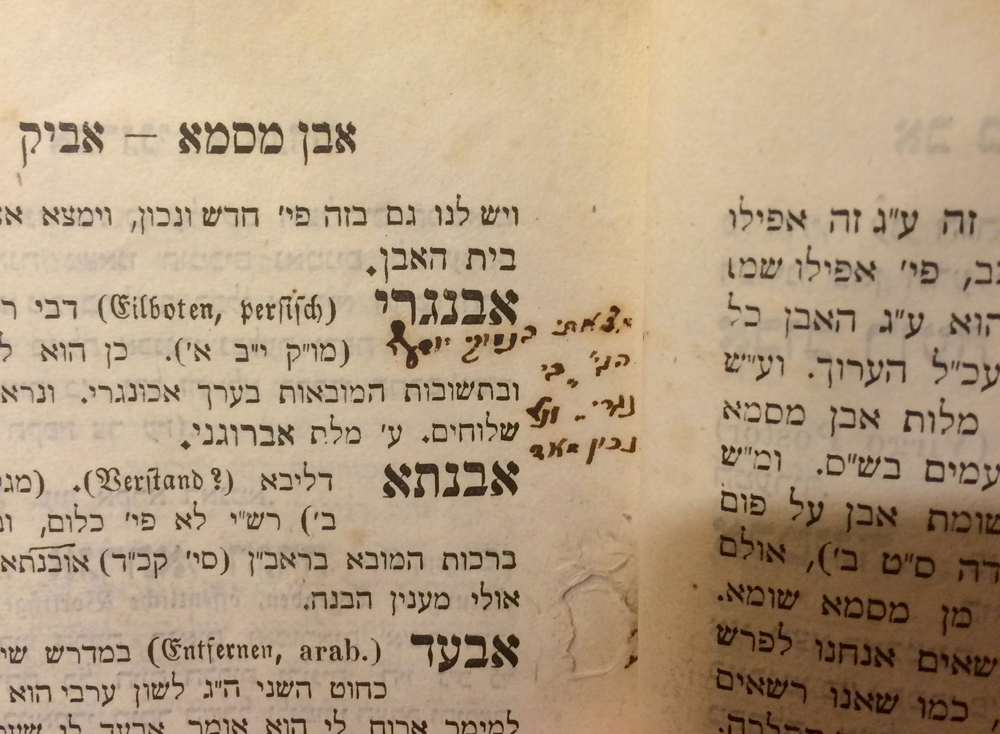
library did not open to the public, the trustees were not idle during this time; and in 1889, published a complete catalog of Strashun’s collection. His collection was comprised of 5,753 items, 63 of which contained marginalia in his hand.[26]
after the library was opened to the public, in legal documents, the listed owner was not the Vilna community but one of the Library’s trustees. Although Strashun’s intent was clear – that the Library belonged to the community and not a trustee or any other individual – the Library’s legal status clouded that directive. In the late 1890s, there was a successful campaign to correct that issue, and the community becomes the sole owner of the Library, fulfilling Strashun’s wishes regarding ownership.[28]
point forward, the Strashun Library would be one of Vilna’s most important institutions.
infrastructure and clarifying ownership.
Specifically, although Strashun’s collection was substantial both in
terms of size and breadth, it was still the product of one man’s idea of a library. For this reason, Hillel Noach Steinschneider, one of Vilna’s leading scholars and historians, pleaded with the public to donate books and ensure the completeness of the library and fulfill its mission of serving the entire community. He acknowledged that Strashun amassed a very impressive private collection, but that for a public library his collection alone was insufficient because “it is lacking in books for people” whose interests did not align with Strashun’s.
That is, a public library is not only a place open for all but also one that provides value for all. Consequently, the library’s composition must reflect the entirety of its audience and not a single collector. Apparently, this plea was successful,[30] many Vilna scholars donated their collections to the Library in addition to the general public, and, by the 1930s, the Library had grown to over 35,000 volumes.[31] Additionally, Vilna’s Tzedakah Gedolah organization also provided funds for acquisitions. Books acquired through those funds contain a special stamp or receipt.
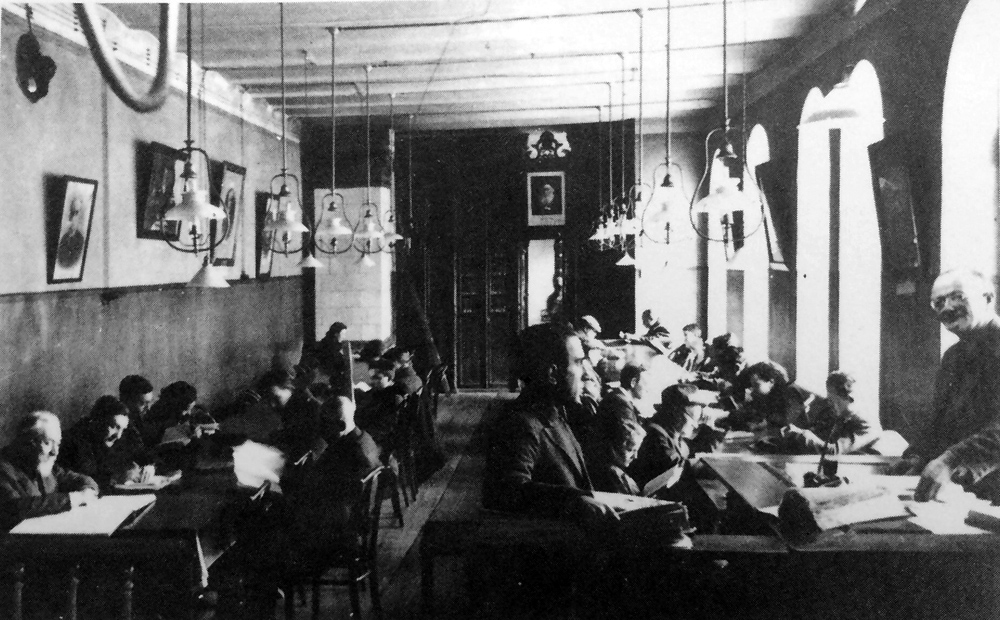
works” and who sat side-by-side with the “younger generation who were reading haskalah works.”[33] When dignitaries came to Vilna, the Strashun library
was a waypoint.[34]
Jewish celebrities, but also for its well-regarded holdings. According to A.J. Heschel, it was the largest public Hebraic library in Eastern Europe reported holding over 40,000 volumes.[37] On the one hand, the Strashun library was recognized as one of the greatest cultural institutions in Eastern Europe, on the other, like so many public institutions, the Library struggled to raise sufficient funds throughout the early part of the 20th century, consistently hampering its ability to maintain and build its
collections in addition to limiting its public access.[38] But, it would not be funding that led to its demise but the Nazis and their campaign to appropriate Jewish cultural treasures.
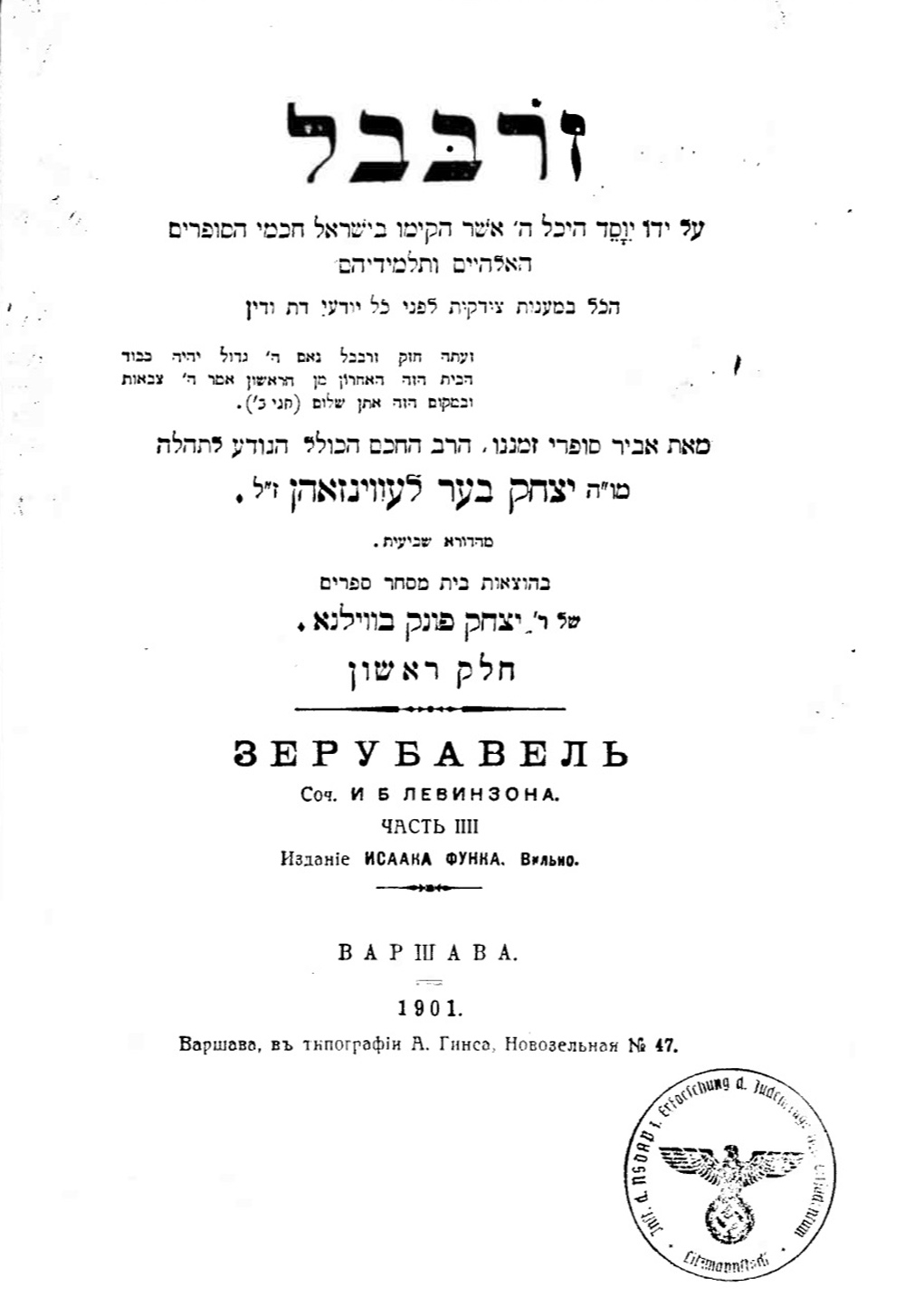
of those compared to the Nazi’s systematic campaign to identify, collect, and appropriate important Jewish treasures –specifically books – and, consequently, important libraries. The intent was that these pillaged libraries would supplement the already substantial Judaic holdings of Frankfort City Library.[40] Immediately after the Nazis occupied Vilna, the Strashun Library as Vilna’s “oldest and perhaps most distinguished” library was identified as a target for this campaign.[41]
libraries, both public and private that ended up at Offenbach, without any clear method of repatriation. This lack of clarity leads to inconsistent results at best. Indeed, first-hand accounts of post-war Germany confirm the ad-hoc, doubtful legal grounds and sometimes completely lawless reparation regime in the post-war chaos. In many instances, individuals made many of the decisions regarding disposition with little information and virtually to no oversight.
half of the heirless Jewish books recovered by the Allies went to the Jewish National and University Library (“JNUL”) at the Hebrew University (now the National Library of Israel),[50] which was “quite right” because some unnamed person or entity had determined “that clearly the [JNUL] should take the place of the vanished Jewish communities of Europe.”[51]
and did everything in his power, including employing very underhanded means, to repatriate items to Hebrew University.[52]
could not remove any items. But, for Scholem, some items proved too enticing. Scholem identified a number of rare and important books and manuscripts. He was concerned that if the disposition of these items were left to the Allied authorities the items would not end up in Jerusalem, but, instead, at the Jewish Theological Seminary, or some other institution, in the United States. This was unacceptable to Scholem. To facilitate the transfer of these items to the JNUL, Scholem colluded with a Jewish American serviceman to smuggle the works out of Offenbach. Scholem placed the collection into five boxes but did not label
their contents and provided a fake name on the invoice. The American serviceman personally ensured that the boxes were shipped to Paris, after which they were sent to the JNUL. Eventually, the Allies found out about the theft, and demanded the return of the five boxes, even lodging a formal diplomatic complaint. In the end, after much back and forth, the boxes remained at the JNUL.[54]
After WWII, on behalf of the Jewish Distribution Committee after World War II, she went to the Offenbach Depot to assist with identification of heirless books. Prior to coming to Offenbach, she had “promised [herself] that [she] would do [her] best to
safeguard the rights of possible owners and heirs.”[57] And, when she came upon some of the remains of the YIVO collection,[58] she “was in a state of exaltation” and in a letter home wrote that she “had ‘a feeling akin to holiness, that [she] was touching something sacred.’”[59]
strange story” that the head of YIVO, Max Weinreich,[60] had told her “back in 1940.” Weinreich told her that during the brief period of time when the Soviets had returned Vilna to Lithuanian control, YIVO attempted to move its library out of Vilna.[61] And, that “the trustees of the Strashun Library, also fearing for the sake of their library, asked the Vilna YIVO to ship [the Strashun Library] too.” Unfortunately, the shipment never occurred and both libraries remained in Vilna and ultimately plundered by the Nazis.
rescued from the ruins of Europe and brought back to YIVO in New York in 1947.”[64] YIVO’s library catalog again implies that all the recovered books went to YIVO and links the disposition of the Strashun Library with that of YIVO’s, the provenance note explains that “[t]he Strashun Collection, along with the YIVO Vilna collections, were liberated by the American Army, and
re-repatriated to YIVO in New York in April 1947.”[65]
Mekorei Rambam, first published in 1870 in Vilna, and while not a true stand-alone work, Rashash’s comments appear
alone, without the Rambam’s text. See Mekorei ha-Rambam, Harkavy ed., (Jerusalem, Hatsa’at ha-Sefarim ha-Erets-Yisre’elit, 1957, Im ha-Madurah, and p. 59.
n.10. First, Zalkin, cites Strashun’s comment in Gitten 6b, that “we find many amora’im who did not know how to read scripture” as proof of his “unorthodox” views. But we find a similar statement from the medieval period. See Tosefot, Bava Batra, 113a. Zalkin’s second citation is to Rashas’s comments, Rosh ha-Shana 26a, “certain things that were uttered in a particular time and particular place are inserted by editors of the Talmud in their appropriate location in the text.” This misrepresents the Rashash. Rashash is attempting to answer how the Talmudic sage, Levi, was unaware of an explicit verse as the TB in RH 26a implies. Rashash explains that although there is no explicit mention of the time or place that this story occurred, Rashash posits that the story in Rosh Hashana occurred at the same time as another story with Levi, Yevamot 105a, where he had a moment of senility.
Rashash is not offering his opinion regarding the redaction of the Talmud, instead he is merely dating the story in Rosh ha-Shana. Finally, it is unclear the relevance of Zalkin’s third example, “you will find many contradictions between different locations is (sic) Rashi’s text.” Locating and alleging contradictions in Rashi is hardly remarkable.
Strashun Z’L, in Mattiyahu Strashun, Matat-Ya, Haghot, Hidushim ve-He’arot Me’irot ‘al Midrash Raba Pri Eito Shel Matityahu Strahsun, (Vilna: The Widow and Brothers Romm, 1893), 15.
(Jerusalem: The Hebrew University Magnes Press, 2006), 48-52.
See Likutei Shoshaim, nos. 386,1024,1178, 2522, 3352, 3650, 3781, 4377, 5399, 5592. Regarding other well-known Hebrew book collectors and their collections, see Alexander Marx, “Some Jewish Book Collectors,” in his Studies in Jewish History & Booklore, (New York, 1941), 198-237; Cecil Roth, “Famous Jewish Book Collections & Collectors,” in Essays in Jewish Booklore, (New York: Ktav Publishing House, 1971)330-35.
Alexander Marx, “Some Notes on the History of David Oppenheimer’s Library,” Revue des Études Juives 82 [=Israel Lévi
Festschrift] (1926): 451-460; Charles Duschinsky, “Rabbi David Oppenheimer: Glimpses of His Life and Activity, Derived from His Manuscripts in the Bodleian Library,” Jewish Quarterly Review 20:3 (January 1930): 217-247; Alexander Marx, “The History of David Oppenheimer’s Library,” in Studies in Jewish History and Booklore (New York: Jewish Theological Seminary of America, 1944), 238-255; and more recently in Joshua Teplitsky, “Between Court Jew and Jewish Court: David Oppenheim, The Prague Rabbinate, and Eighteenth-Century Jewish Political Culture (PhD dissertation, New York University, 2012); and Abraham Schischa, “Rabbinic Writings from the Collection of Rabbi David Oppenheim,” Yeshurun 31 (2014): 781-794 (Hebrew).
Treasured Legacy (Clevland/Jerusalem: Ofeq Institute, 1990) 66-67.
appearing in Yoreh De’ah. Because Wallensky’s materials were even more obscure and rare, the only place he could access these was the Strashun Library. Ya’akov Wallensky, Daltei Teshuva, (Vilna, 1890), Introduction, 5-6, (link).
comprised of 5,739 items.
346.
venerable long-bearded men, wearing hats, studying Talmudic texts, elbow to elbow with bareheaded young men and even young women, bare-armed sometimes on warm days, studying their texts. The old men would sometimes mutter and grumble about what the world had come to. The young people would titter.”).
Lithuania,” in Yahdut Lita (Tel Aviv: Am Hasefer Publishers, 1950), 522 (Hebrew). For a photo of one such visit, see Layzer Ran, Jerusalem of Lithuania, vol. 2 (New York: Laureate Press, 1974), 416.
(New York, 1935 – in Yiddish), p. 286-7
States: Oxford University Press, 2015), 121.
Dicker, Of Learning and Libraries, The Seminary Library at One Hundred, (New York: The Jewish Theological Seminary, 1988), Appendix B. See also F.J. Hoogewoud, The Nazi Looting of Books and its American ‘Antithesis’. Selected Pictures
from the Offenbach Archival Depot’s Photographic History and Its Supplement,” Studia Rosenthaliana 26:1-2 (1992): 158-192; and F.J. Hoogewoud, “Dutch Jewish Ex Libris found among looted books in the Offenbach Archival Depot (1946),” in Chaya Brasz and Yosef Kaplan, eds., Dutch Jews as Perceived by Themselves and by Others (Leiden: Brill, 2001), 247-261.
Id. 248; 351.
no real harm.” One wonders if any surviving heirs who had legal claims to the Manheim collection would reach the same conclusion.
library and not the property of one institution or another. See Shor, From “Likutei Shoshanim”, at 44.
Similarly, Berger, “The Strashun Library in Vilna,” p. 517 claims that part of the Strashun Library went to YIVO and the other part to Hebrew University.
Similarly, the JNUL catalog does not list any items whose provenance extends to the Strashun Library. It is possible that YIVO and Berger confused the JNUL with the Jerusalem Central Library discussed below. Or simply conflated the Strashun Library with the numerous other European libraries that the JNUL successfully rescued.
Please note
Reminder: Book Sale #2
On the Maxwell House Haggadah
New Book Announcement: Esther Unmasked: Solving Eleven Mysteries of the Jewish Holidays and Liturgy by Mitchell First
(http://www.amazon.com/Esther-Unmasked-Solving-Mysteries-Holidays/dp/0692375422).
Sotheby’s upcoming Important Judaica auction
E-cat: http://www.sothebys.com/en/auctions/2014/important-judaica-n09239.html
PDF: http://www.sothebys.com/pdf/2014/N09239/index.html
Upcoming lecture: Shai Secunda at the Library of Congress, Tues., July 22
“Torah Study on Christmas Eve” — free Torah in Motion lecture by Dr. Marc B. Shapiro
Rabbi Yechiel Goldhaber shiur in Flatbush, November 23
Special Lecture by Dr. Marc Shapiro
For those who are interested, Dr. Shapiro will also be speaking at the Kingsway Jewish Center in Brooklyn on Shabbat, Nov. 8-9, and at Bnai Israel-Ohev Zedek in Philadelphia, on Shabbat Nov. 15-16.
Rav Ovadia Yosef, ZT”L
Publication of New Book, Kana’uteh de-Pinhas, by Seforim Blog Contributor, R. Bezalel Naor
Contributor, R. Bezalel Naor
ve-Ahlamah.
Announcement: Special shiur by Rabbi Yechiel Goldhaber
A Few Comments Regarding The First Woodcut Border Accompanying The Prague 1526 Haggadah
The Prague 1526 edition of the Haggadah is one of the most important illustrated haggadot ever published. It is perhaps the earliest printed illustrated haggadah for a Jewish audience and served as a model for many subsequent illustrated haggadot.[1] The earliest printed haggadah with illustration was published in 1512 in Latin and for a non-Jewish audience. That haggadah contains six woodcuts, and was intended as a response to the infamous anti-Semite Pfefferkorn’s screeds against Judaism.[2]The woodcut accompanying the first page shows three Jews around the seder who have four cups in front of them. Although the Talmud explicitly states that one is not required to have four distinct cups of wine, presumably the image is a crude method of indicating the four-fold nature of the wine during the seder rather than prescribing custom.
The Prague 1526 edition was published by Gershom and his brother Gronom Katz on Sunday, 26th of Tevet 5287 or December 30, 1526.[3] This detailed publication information does not appear on the title page, rather it appears at the end of the book and is referred to as a colophon. The colophon is a manuscript convention that was incorporated into earlier printed books. The Prague 1526 edition does not have a title page at all. At that time, the usage of the title page was only in its early stages.[4]
- The Earliest Hebrew Title Pages
As with non-Hebrew titles, the title page developed over time, both in terms of content as well as usage.[5] The first Hebrew title page is that of the Sefer Rokeah published in Fano in 1505.[6] But that title page is really one of the more basic forms of the title page, known as a “label title page” providing only the title and author and no other ornamentation or information.[7] In that same year, an edition of Abarbanel’s Zevah Pesach was published in Constantinople. This edition was the first to contain a border with the title and author, but no place or date of publication.[8] The first Hebrew book containing all the elements of a traditional title page, border, title, author, place and date is likely the 1511 Pesaro edition of the Talmud published by Soncino.[9]
Traditionally, the Hebrew title page is referred to as a “sha’ar” or gate. The theory behind this description is that many title page borders are comprised of “gates,” the most common are the pillars that adorn many Hebrew books and are assumed to be those at Saint Peter’s Basillica in Rome. Their inclusion in Hebrew books is perhaps linked to the (discredited) notion that the Catholic Church maintains certain portions of the Jewish Temple, and these pillars were actually in the Temple. The first Hebrew book to use an architectural border is Daniel Bomberg’s edition of the Jerusalem Talmud published in 1522.[10]
- Illustrations in Hebrew Books
Returning to the Prague 1526 haggadah, as mentioned previously, this edition was copiously illustrated, including the first page of the book. This is not the first example of Hebrew printed illustrations. The earliest illustration to appear in a Hebrew book is that of a lulav and a handful of other explanatory images accompanying the Rome edition of the Sefer Mitzvot Gedolot dated to before 1480.[11]
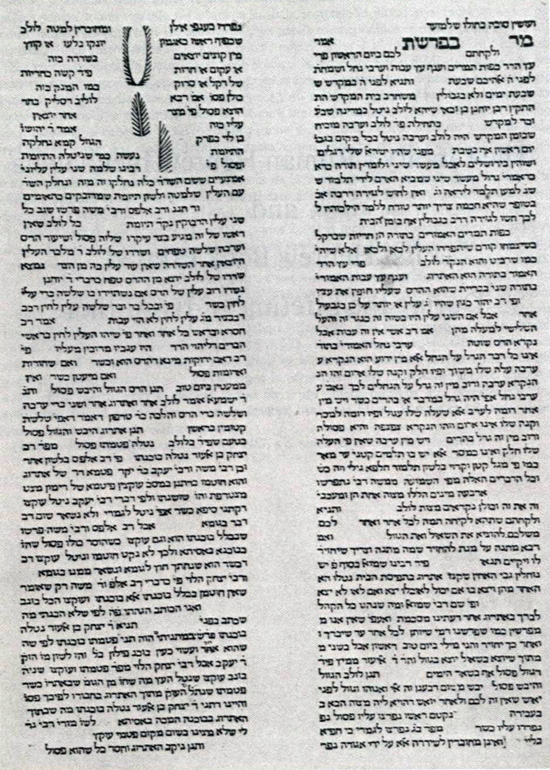
The first fully illustrated Hebrew book was published in the incunabula period as well, it is Isaac ben Solomon Ibn Sahula’s Meshal ha-Qadmoni, printed in Italy, circa 1491, by Gershom Soncino.[12]
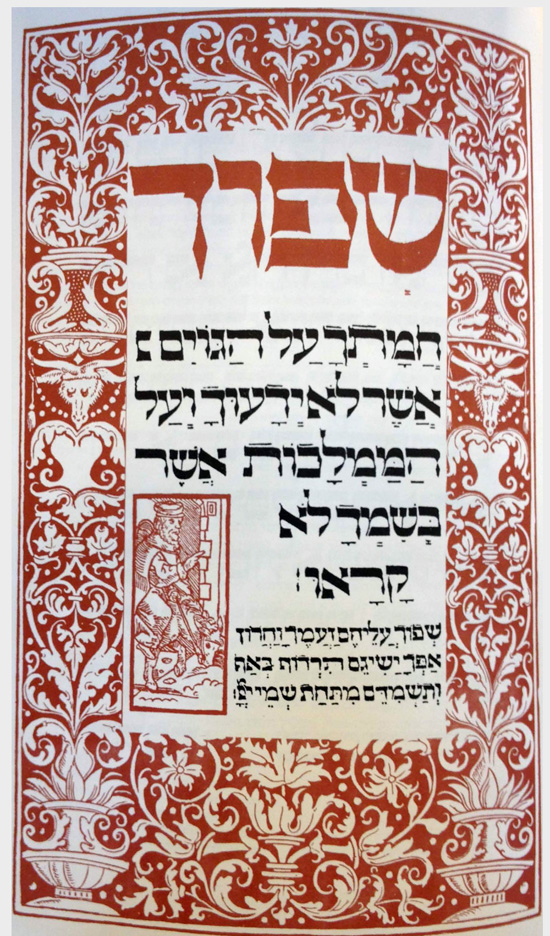
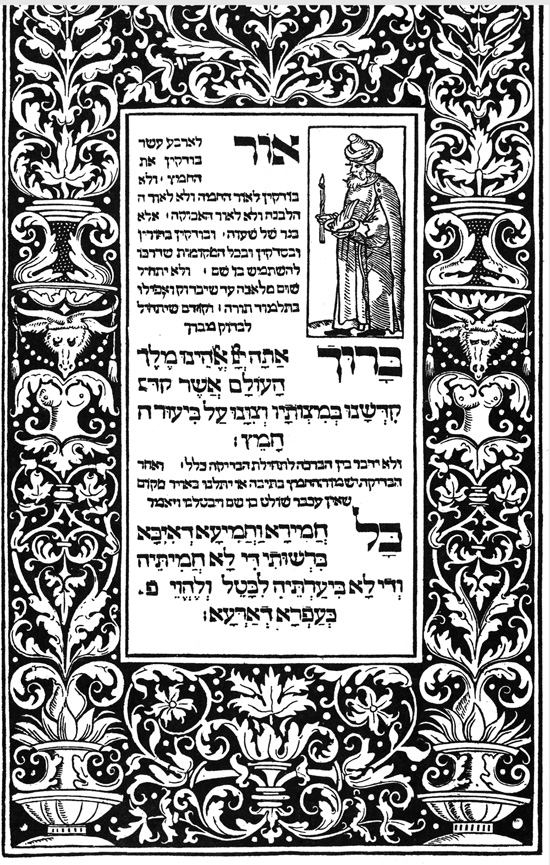
The border surrounding the first page of the Prague 1526 incorporates both Jewish as well as non-Jewish elements. First, it is obvious that a Jew had a hand in the border as, in the inset, it displays someone performing bedikat hametz (searching for the bread) where he is using the traditional implements of a candle and chicken feather. The outside border is less Jewish, and as many have noted, appears to be a copy of Italian/German renaissance borders. The two most likely candidates for models for Prague are the border first used in the 1518 edition of Sacri Doctoris by Raymond Lulli (available here) or a border first used in 1519 for Paolo Ricci’s, Lepida et litere in Augsburg and reused in an Augsburg 1522 edition of Erasmus, Ad reverendum (available here). Although we cannot pinpoint exactly which of these, if any, served as a model, what is clear is that among the images included in this border are bare-breasted women.
The use of bare breasted women to illustrate the haggadah is not limited to Prague. Both Charles Wengrov and Elliot Horowitz have pointed to earlier manuscript antecedents for Prague’s usage of such illustrations.[13] Aside from the printed example of the Prague 1526 Haggadah, this convention continued in manuscripts as well illuminated after 1526. There are at least four such 16th century examples.[14] Additionally, and contrary to Horwitz’s contention that Spanish Jews were less accepting of such displays,[15] the Sarajevo Haggadah, which originated in Spain around 1350, includes two panels of Adam and Eve both depicting a bare-breasted Eve.
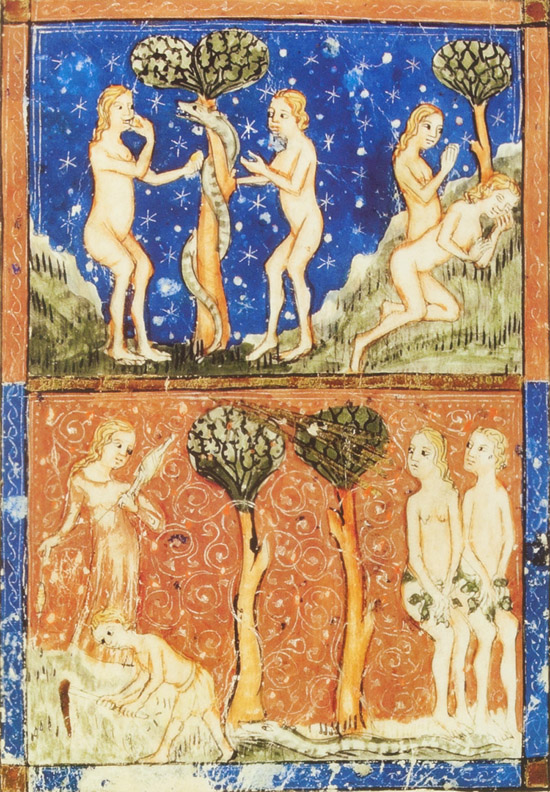
Likewise, the Golden Haggadah, 1320 Spanish manuscript includes the same form of illustration of the Adam and Eve scene. Additionally, the Golden Haggadah includes images of nude bathers when it depicts Miriam standing from afar to see what will become of baby Moses.[16]
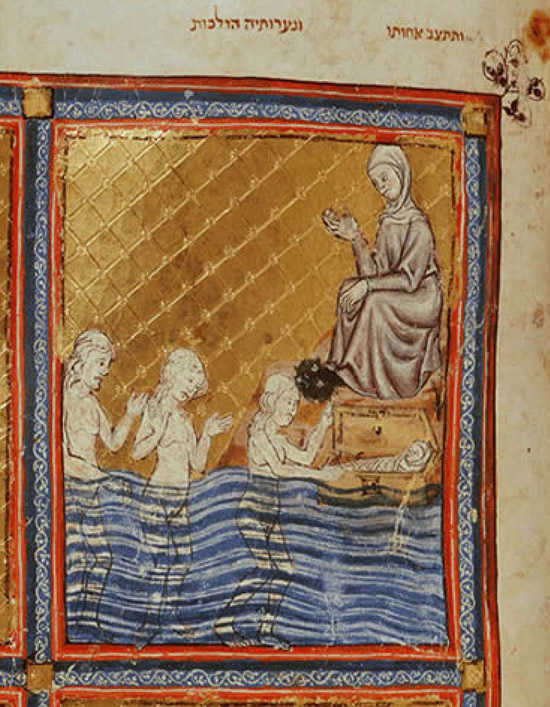
III. Censorship in Modern Reprints of Prague 1526
These historical antecedents notwithstanding, recent reprints of Prague 1526 have not been as accepting. This initial border has been altered to airbrush and removes the bare breasts. In 1989, a facsimile edition of Prague 1526 was published with the commentary of the Prague rabbi, Rabbi Yehuda Loew (Maharal). This border has been “touched up.”
Similarly, in 1998, a colorized facsimile edition of Prague 1526 was published. Although the publishers took great pains to provide color where before there was black and white, they also altered this border.
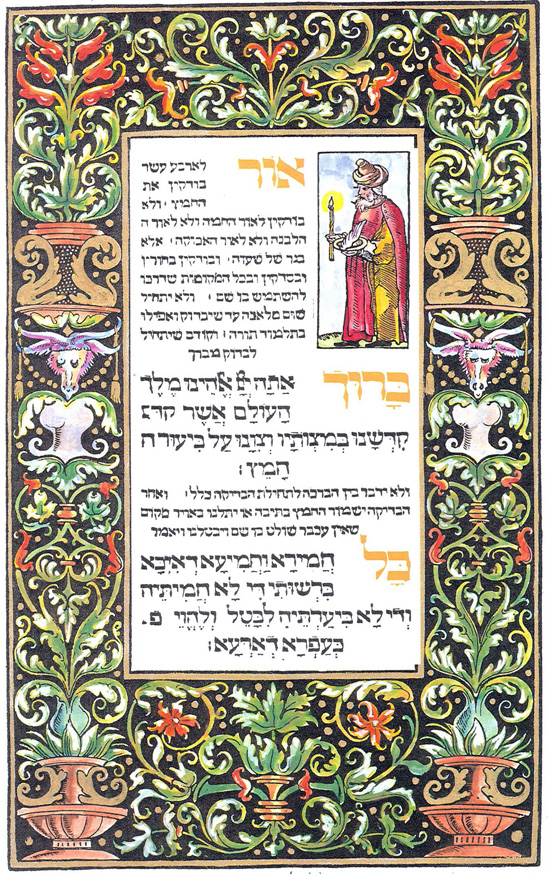
Oddly enough, although they found this image offensive, they decided to reproduce it in two other places in this reprint even though this image only appears once in the original. Here is the original:
Not only is the first border altered, but other instances of bare breasts have been removed; most notably the image accompanying the verse from Ezekiel 16:7 “I made you grow like a plant of the field. You grew up and developed and became the most beautiful of jewels. Your breasts were formed and your hair grew, you who were naked and bare.”
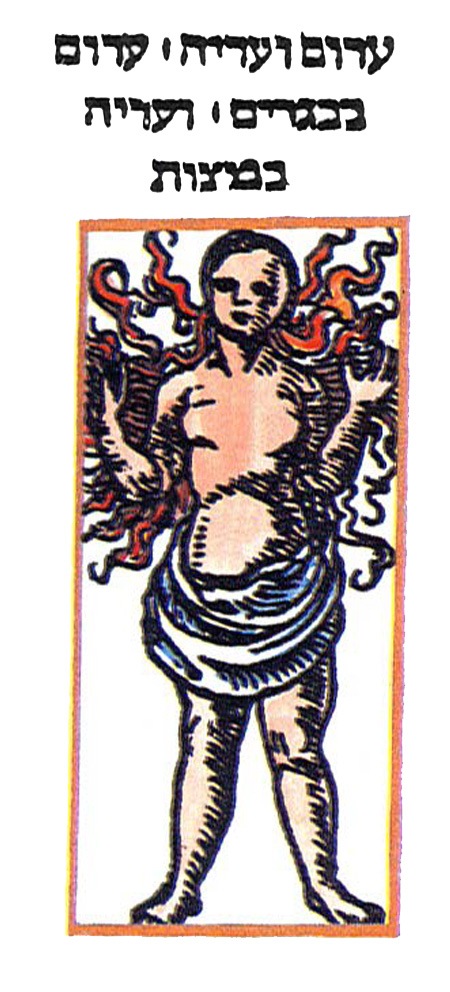
(As discussed previously here a later, Venice 1609, edition also altered this page.) Again in 2001, a facsimile of Prague 1526 “published by the Religious Council of Efrat in honor of the settlement’s twentieth anniversary . . . . two illustrations are surreptitiously deleted: the bare breasted woman” accompanying the verse from Ezekiel.[17] Most recently, in 2009, the airbrushed image of this woman was reproduced in The Schechter Haggadah: art, history; commentary.[18]
[1] There may be an earlier illustrated print haggadah, however, only 12 leaves of this haggadah are extant making it difficult to date (or identify the country of origin). For a bibliography regarding this fragment haggadah see Y. Yudlov, Otzar haHaggadot, Magnes Press, Jerusalem:1997, entry 9; and most recently, Eva Frojmovic, “From Naples to Constantinople: The Aesop Workshop’s Woodcuts in the Oldest Illustration Printed Haggadah,” in The Library, Sixth Series, Vol. XVIII, No. 2, June:1996, pp. 87-109.
[2] See R. Cohen, Jewish Icons: Art & Society in Modern Europe, University of California Press, CA:1998, pp. 21-22; see also Y.H. Yerushalmi, Haggadah; History: A Panorama in Facsimile, Philidelphia:1978, plates 6-8.
[3] Aside from the edition discussed herein, there is at least one copy of another haggadah that is also published by Cohen in Prague that same year. While both versions are substantially similar, some of the images and borders have been changed. Relevant for our purposes, is that the image accompanying “Sefokh” which is a full
page border with images of bare breasted women, has been replaced with a more innocuous border found elsewhere in the haggadah. See Yudlov, Otzar, entry 8; A. Ya’ari, Bibliography of the Passover Haggadah,
Bamberg & Wahrman, Jerusalem:1960, entry 7; Rabbi Charles Wengrov, Haggadah & Woodcut: an Introduction to the Passover Haggadah Completed by Gershom Cohen in Prague, Shulsinger Bros., New York:1967, pp. 78-9.
[4] The first Prague imprint to include a separate title page is in a 1526 edition of Yotzrot published by Cohen. See Wengrov, Haggadah & Woodcut, p. 82 n.238.
[5] Although, with regard to the adoption of the title page, Jews appear to adopt this convention at or near the time as society at large, that was not the case with other literary advances. While the majority of the western world adopted the codex and discarded the scroll some time in the third century, the first recorded Jewish reference to the codex does not occur until the late
eighth or the early ninth centuries. See Anthony Grafton, “From Roll to Codex: A Christian Initiative,” in Crossing Borders, Hebrew Manuscripts as a Meeting-place of Cultures, ed. Piet van Boxel & Sabine Arndt, Bodleian Library:2012, pp. 15-20.
[6] A.M. Habermann, Title Pages of Hebrew Books, Museum of Printing Art, Safed:1969, pp. 8-9.
[7] For a discussion of the development of the title page as well as the different types, i.e., label, border, end-title, see M.M. Smith, The Title-Page its early development 1460-1510, The British Library & Oak Knoll Press, London & Deleware:2000.
[8] See M.J. Heller, The Sixteenth Century Hebrew Book: An Abridged Thesaurus, Brill, Leiden & Boston:2004, vol. I, pp. 6-7.
[9] The border used for the Pesaro Talmuds first appeared in Decachordum Christianum (The Christian Ten String Harpsichord) published in Fano, 1507 by Gershom Soncino. See M.J. Heller, Printing the Talmud, pp. 104-117 Additionally, see Heller’s discussion, id. p. 113, regarding Soncino’s reuse of the Dechachaordum‘s frames. In reality, although the frames were originally cut for Decachordum, they were first used on Gershom’s edition of Bahya ibn Pakua’s commentary on the Torah, published four months prior to Decachordum. See M.J. Heller, The Sixteenth Century Hebrew Book: An Abridged Thesaurus, Brill, Leiden & Boston:2004, vol. I, p. 41; Smith, The Title-Page, supra, pp. 47-59 (discussing the use of the blank title page).
[10] See A.M. Habermann, “The Jewish Art of the Printed Book,” in Jewish Art, An Illustrated History, ed. Cecil Roth [revised ed. by B. Narkiss], New York Graphic Society Ltd., Connecticut:1971, pp. 167-68. In Habermann’s earlier work, Title Pages of Hebrew Books, p. 9, he erroneously asserts that the earliest works to include architectural title pages were Soncino’s Melitza le-Maskil and Bomberg’s Tanach, both published in 1524/25.
[11] See Joshua Bloch, “The Library’s Roman Hebrew Incunabula,” in Hebrew Printing & Bibliography, ed. Charles Berlin, New York:1976, p. 140. For a description of this work see S. Iakerson, Catalogue of Hebrew Incunabula from the Collection of the Library of the Jewish Theological Seminary of America, JTS, New York & Jerusalem:2005, entry 7.
[12] See A.M. Habermann, “The Jewish Art of the Printed Book,” supra, at 169. Habermann appears to argue that this is first printed Hebrew book containing illustrations, is incorrect. As discussed above, the first was the Rome edition of Sefer Mitzvot Gedolot. He is not alone in this error. Ursula Schubert makes the same error. See Ursula Schubert, Jewish Book Art, From the Renaissance until Emancipation, [Hebrew], Kibbutz hami-Uchad, Tel Aviv:1994, p. 27. Habermann, id., notes that the great Hebrew bibliographer, Mortiz Steinschneider, was tricked with regard to one of the illustrations contained in Meshal
ha-Qadmoni. Steinschneider, in a discussion about the alleged Christian origins of these illustrations, called attention to the fact that in one of them contains a monk wearing a crucifix. But, in the interim we have learned “that this last embellishment was a
practical joke played by a Christian scholar. . . [the crucifix] having been added by [a later] hand!” Regarding the history and origins of the images included in Meshal ha-Qadmoni, see César Merchán-Hamann, “Fables from East to West,” in Crossing Borders, pp. 35-44; Ursula Schubert, Jewish Book Art, pp. 27-8.
[13] Rabbi Charles Wengrov, Haggadah & Woodcut, p. 47 nn.112-13;Elliot Horowitz, “Between Cleanliness and Godliness,” in Tov Elem: Memory, Community & Gender in Medieval & Early Modern Jewish Societies, ed. E. Baumgarten, et al., Bialik Institute, Jerusalem:2011, *38-*39.
[14] Mendel Metzger, La Haggada Enluminée, E.J. Brill:1973, plate LIV, nos. 303-305; Chantily Haggadah, Musée Condé, Ms.
732, fol. 13, reproduced in Index of Jewish Art, eds. B. Narkiss & G. Sed-Rajna, Jerusalem-Paris:1976, vol. I, card no. 36.
[15] Horowitz, “Between Cleanliness,” at *38, (“One suspects that a Spanish Jew coming to Germany in the early 15th century would have been equally surprised to see an image of a naked woman” in a Hebrew manuscript.).
[16] The Golden Haggadah, ed. Bezalel Narkiss, Pomegranate Artbooks, California:1997, figs. 17 & 24.
[17] Id. n.37. Horowitz only notes the 2001 example of censorship of Prague 1526, and apparently is unaware of the earlier
examples. Additionally, he chastises the Efrat reproduction for erroneously indicating a 1527 publication date. Efrat is not only in erring regarding the secular date. The first facsimile edition (Berlin:1925), which includes a scholarly introduction, full title
is: “Die Pessach Haggadah Des Gerschom Kohen Gedruckt Zu Prag 5287/1527.” Perhaps one can excuse the error as, in reality, it was completed on the eve of 1527, December 30, 1526.
[18] The Schechter Haggadah: Art, History & Commentary, [illustrations selected and annotated by David Golinkin], Schechter Institute of Jewish Studies, Jerusalem:2009, p. 36, fig. 16.1.