Book Launch of the Koren Rav Kook Siddur

Book Launch of the Koren Rav Kook Siddur
Seforim Blog contributor Rabbi Bezalel Naor has just published a major work, the Koren Rav Kook Siddur.
Culled from Rav Kook’s own commentary to the Siddur, Olat Re’iyah, and other writings of Rav Kook, as well as rich anecdotes transmitted by Rav Kook’s son and major disciples, The Koren Rav Kook Siddur speaks to the soul, while it connects us all to the sacred soil of the Holy Land.
There will be a book launch on Sunday, January 7, 10:00 AM, at Lincoln Square Synagogue in New York. Rabbi Naor will discuss the new siddur and dialogue with Professor Marc B. Shapiro regarding Rav Kook’s legacy. The event will be moderated by Rabbi Shaul Robinson. All are invited to attend.
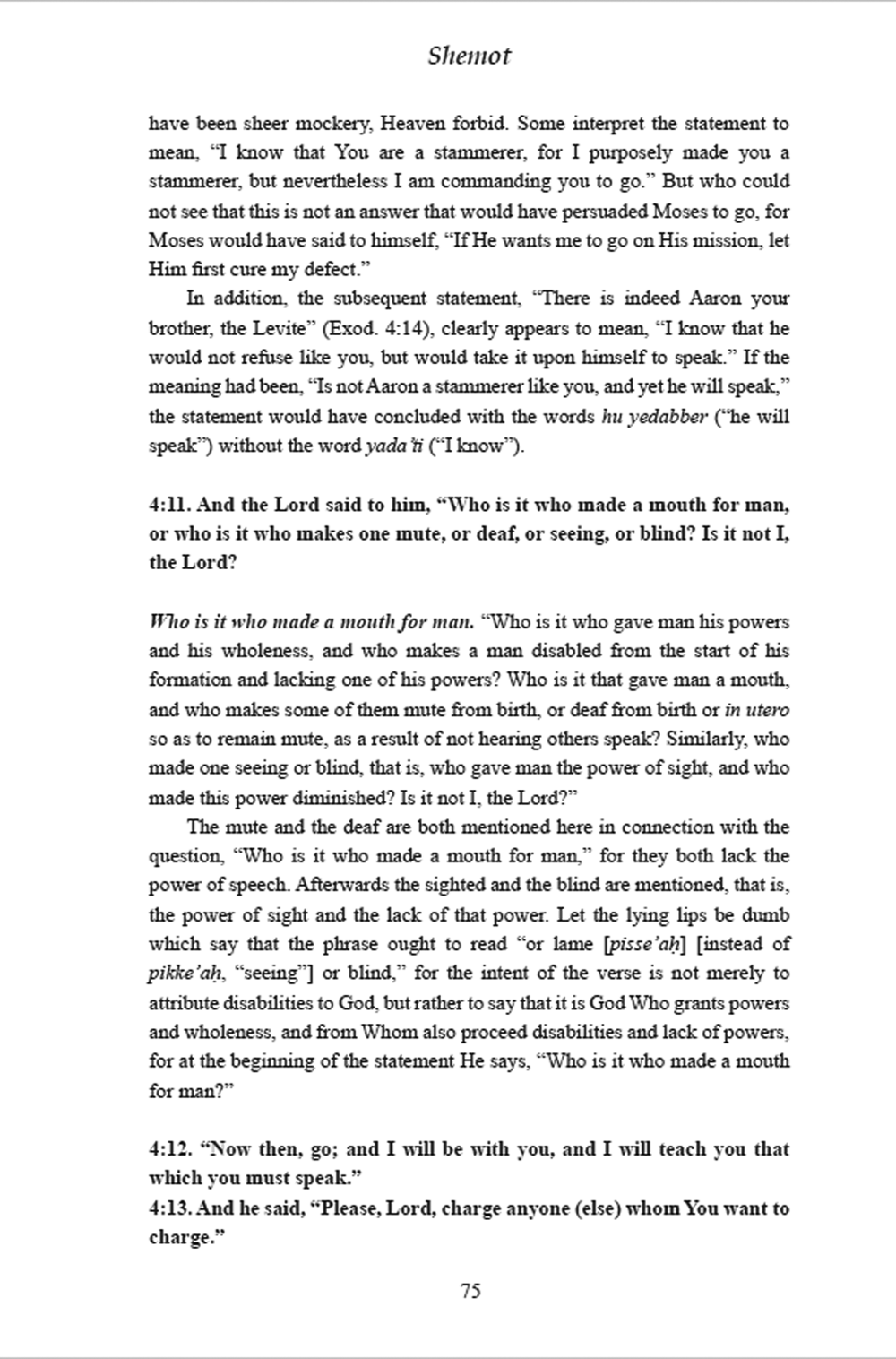
Here are some sample pages:


New Auction House – Genazym

New Auction House – Genazym
by  Dan Rabinowitz, Eliezer Brodt


There is a new auction house, Genazym, that is holding
its inaugural auction next week Monday, December 25th.  The
catalog is available here.  The majority of the material are letters
and other ephemera with a few dozen books. The books include a number with
vellum bindings (71-75).  Appreciation of bindings has been brought to
fore with the recent wider availability of books from the Valmadonna collection
after it was broken up; a collection that was known for its exquisite bindings.[1] 

Books with illustrations form another group, including heretical
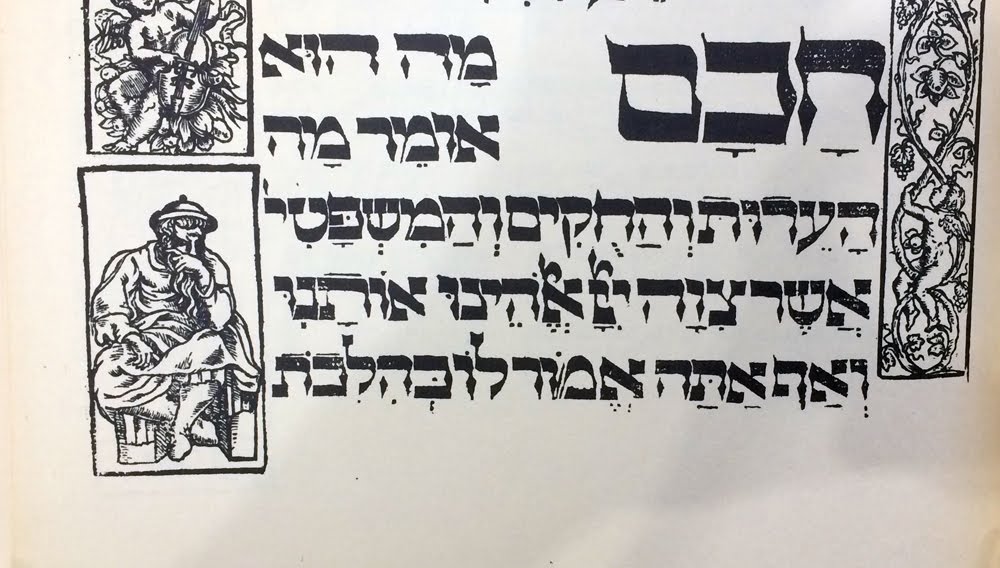
images.  The title-page of the first edition of R. Yedidia Shlomo of
Norzi’s commentary on the biblical mesorah, Minhat Shai, Mantua,
1742-44 (76), includes Moses with horns, but more offensive is the depiction
of God with a human face.   The images on the title page are various
biblical vignettes and in the one for the resurrection of the “dry
bones” that appears in Yehkezkel, God is shown as an old man with a white
beard. [2] Another title-page containing non-Jewish imagery is the Smikhat
Hakhamim
, Frankfurt, 1704-06 (87).  Its title page is replete with
mythological (?) or Christian (?) imagery. [3] 

The illustration on the Minchat Shai title page. Note that this is from another copy, not the one on auction.

The kabbalistic work, Raziel haMalach, (77) contains
illustrations of various amulets with various mythical
creatures. [4] Another book with mystical images is the Emek Halakha,
Cracow 1598, (80). Less sensational images, of ships and fauna,
appear in the first Hebrew book to describe America, Iggeret Orkhot
Olam
, Prague 1793, (83). [5] R. Tovia ha-Rofeh’s Ma’ase Tovia,
Venice, 1707, (95) contains an elaborate illustration that compares the human
organs with various parts of a house or building. [6]

Of note for its rarity is (88), a first printing of R’ Moshe Chaim Luzzatto’s Derech Tevunot, Amsterdam 1742. The copy is a miniature, and was owned by the great collector Elkan Nathan Adler.

Among the
most controversial books in the history of Jewish literatures the forged Yerushalmi on Kodshim, (likely) written by
Shlomo Yehudah Friedlander (98).  There are two versions of the book, one
printed on thick paper and, on a second title page, Friedlander is referred to as
a doctor.  The other version is printed on poor paper and lacks the
(presumably bogus) academic credential.  The theory behind
the variants is that one was targeted at academic institutions
and the other at traditional Jews. [7]  Here is what it looked like:

Here are highlights from some of the letters for sale:

– There are some very interesting manuscript letters from the Chasam Sofer (46), R’ Chaim Sanzer (28) and R’ Meir Premishlan (37) .
– Letters from some of previous generations Litvish gedolim, like R’ Meir Simcha of Dvinsk (Meshech Chocham) (4), R’ Chaim Soloveitchik (2), R’ Raphael Shapiro (6), Chafetz Chaim (10), R’ Shimon Shkop (8), R’ Elchanan Wasserman (1), and the Brisker Rav (3). Many of these letters contain important historical information not found in other sources.
– Also of note are important, extremely rare and lengthy documents from the Rogatchover Gaon (5) and R’ Mordechai Gimpel Yaffe (9) related to the shemita and heter mechira controversies. Another letter of note is from the Minchas Elazar (29) in regard to the inheritance of R’ Alfandri.
[1] Portions of the Valmadonna Trust Collection were auctioned at Kestenbaum
& Co. and Sotheby’s. hereherehere. Regarding the source of those books see here.
[2] The title, Minhat Shai, was imposed by the
printer.  Norzi referred to the work as Goder Peretz.  See
Jordan Penkower, “The First Printed Edition of Nozri’s Introduction to Minhat
Shai, Pisa 1819,” Quntres 1:1 (Winter 2009), 9
n2.  The introduction to Minhat Shai was printed
long after the work itself.  See Penkower, idem.  Moses crowned with horns appears in the earliest
depiction of him to adorn a Hebrew book’s title page.  See “Aaron the
Jewish Bishop,” here.
[3] A very similar title-page appears in two other books,
the first edition of the Teshuvot ha-Bah and Beit
Ahron
.  Regarding the usage of these title-pages, see Dan
Rabinowitz, “The Two Versions of the Bach’s Responsa, Frankfurt Edition of
1697,” Alei Sefer 21 (2010) 99-111.
[4] David Hanegbi, “The Printed Hebrew Book as a Talisman
and Ritual Object: A Historical and Bibliographical Study in Sefer Razi’el
ha-Malakh and its Editions,” (Ramat Gan:  MA Thesis, Bar-Ilan
University, 2014).  Regarding the prevalence of mythical creatures in
human society see Kathryn Schulz, “Fantastic Beasts and How to Rank
Them,” New Yorker, Nov. 6, 2017 (here).  
[5] David Ruderman, The World of a
Renaissance Jew:  The Life and Thought of Abraham ben Mordecai
Farissol
 (Cincinati:  Hebrew Union College, 1981). 
[6] The book and specifically the image under discussion
was recently analyzed by Etienne Lepicard, “An Alternative to the Cosmic and
Mechanic Metaphors for the Human Body? The House Illustration in Ma’ashe
Tuviyah 
(1708),” Medical History 52 (2008), 93-105.
[7] For an extensive bibliography of the literature discussing
Friedlander’s edition, see Eliezer Brodt, “Tziyunim u-Meluim le’Mador ‘Netiah
Soferim’
Yeshurun 24 (2011) 454-455.


New Book Announcement – נשמת הבית

New Book Announcement
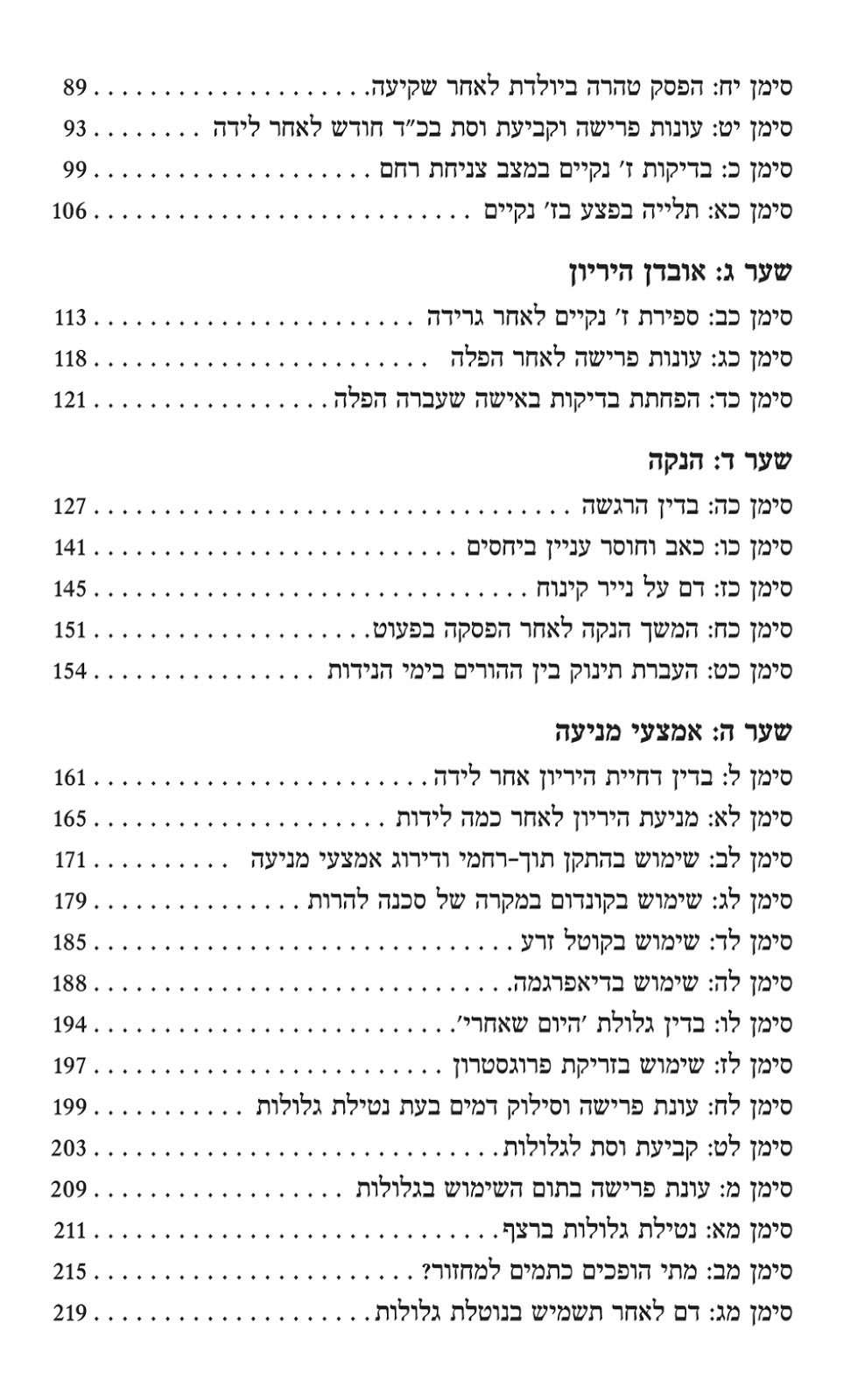
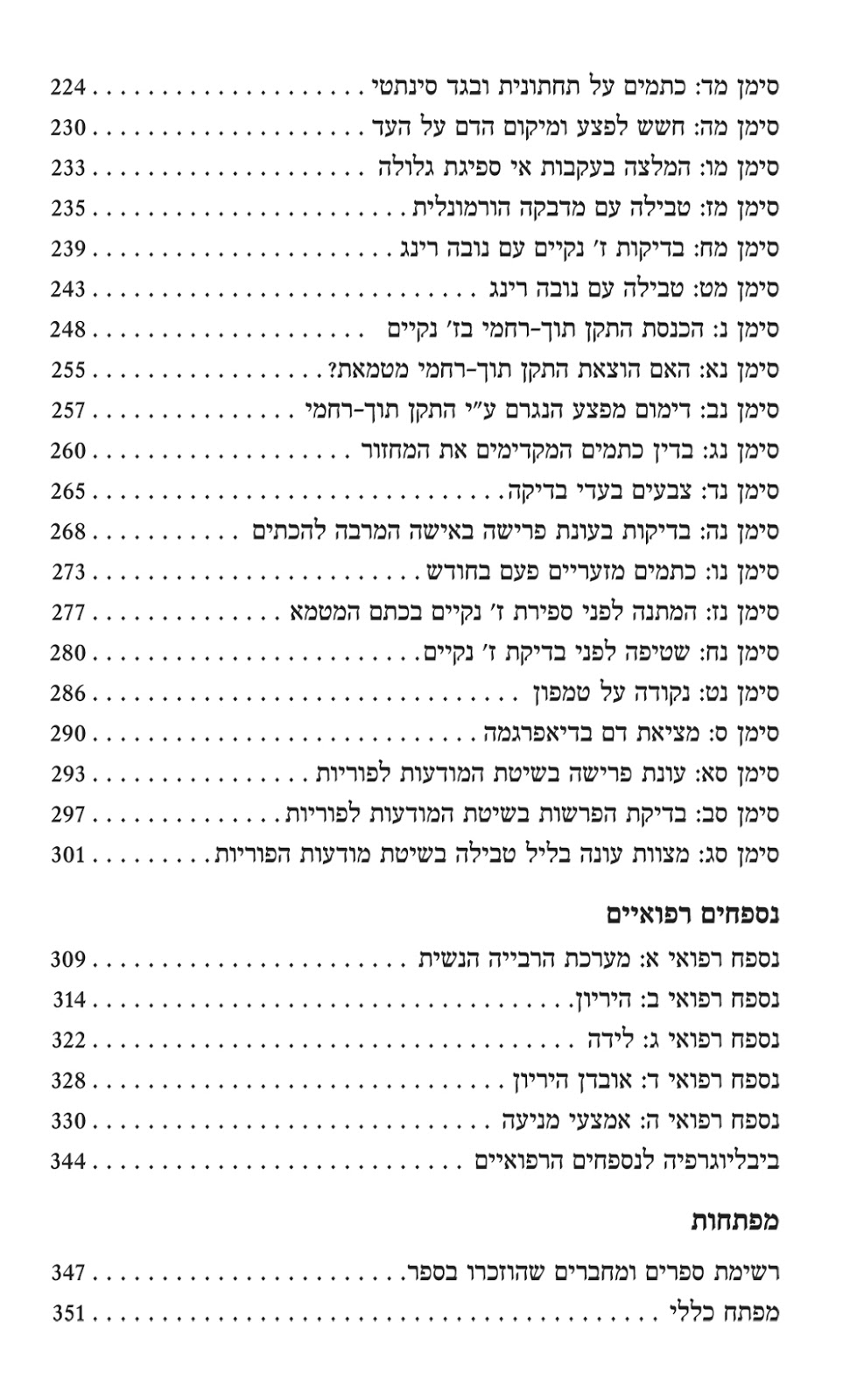
נשמת הבית, שאלות שנשאלו ליועצות ההלכה של מדרשת נשמת בנושאי היריון, לידה, הנקה ואמצעי מניעה בליווי הדרכה מעשית והסברים ונספחים רפואיים, 367 עמודים
Nishmat Habayit is a collection of 63 she’elot uteshuvot on Pregnancy, Birth, Nursing, and Contraceptives. Each question has a short answer, as a yoetzet halacha would addresses the woman with the question, followed by a more extensive halachic discussion. The questions were selected from among tens of thousands in Nishmat’s Taharat Hamishpacha database. The responses were authored by a team of yoatzot halacha, under the supervision of Rabbi Yehuda Henkin and Rabbi Yaakov Varhaftig; and edited by Rabbi Yehuda and Chana Henkin. The book includes medical appendices, helpful even to poskim. The responses display sensitivity to women, coupled with complete faithfulness to halacha. The book carries haskamot of recognized poskim in Israel. The book was published by Maggid Press and is available here. Sample chapters are available upon request [Eliezerbrodt@gmail.com ]
Here is the title page, table of contents, and haskamot.


Lecture Announcement: Rabbi Yechiel Goldhaber

The readership of the Seforim Blog are invited to two lectures by the noted author, Rav Yechiel Goldhaber (link), whose respected research and scholarship is well-known to Seforim Blog readers. 
1) The first shiur that will be taking place is this Thursday, November 2, 7:30 PM at 1454 54th Street, Brooklyn, NY. Rabbi Goldhaber’s speech will be delivered in Yiddish. The subject of this shiur is “Orthodox and Rabbinic Responses to the Balfour Declaration.”
This lecture is dedicated לזכר נשמת the late Dr. Shlomo Sprecher ז״ל who coordinated and hosted many of Rabbi Goldhaber’s shiurim.
2) The readership of the Seforim Blog is also invited to a shiur that will be taking place this Sunday November 5, at 8PM. The subject is likewise “Orthodox and Rabbinic Responses to the Balfour Declaration. It will take place in Monsey at Ohr Chaim Learning Center, 20 Forshay Road, (head upstairs). This lecture is in English.
Rabbi Goldhaber has authored many wonderful articles, published important documents and written works on a wide range of topics, among them Minhagei Kehilos about customs, Kunditon (link) about the Titanic and the so-called Cherem on Spain, and two volumes of Ginzei Yehuda, a collection of assorted letters from various rabbis of note. 
It should be noted that Rabbi Goldhaber’s visit to the United States is connected with raising funds for an upcoming wedding for his son, therefore donations are encouraged (albeit not required to attend). 

EDIT 11.6.17: Here is a link to the Yiddish lecture: link. 

The English will be posted if we receive it.


Interesting Legacy Judaica Auction lots

Legacy Judaica
is holding an auction on June 13, 2017, and we wanted to highlight a few items
of interest (for our previous post regarding the auction house and previous
auctions see here.  There are, of course, some old and rare books
from the 16th and early 17th centuries (lots 1-7), and over
forty manuscripts and a number of letters from rabbinical luminaries, R. Yosef
Dov Solovetchik (Beis ha’Levi) (lot 198), R. Yitzhak Ze’ev Solovetchik (Brisker
Rav) (lot 199), R. Hayim Ozer (lot 172), R. Kook (lot 183), R. Henkin, R.
Yechiel Michel Epstein (Arukh ha-Shulkhan) (lot 168), and the Netziv (lots
161-62), (there is also an amulet (lot 163) from his son, R. Chaim Berlin, that
apparently was written at the Netziv’s direction).
Two
particularly important manuscripts relate to the late 18th century
controversy regarding the nascent Chassidic movement.  One, lot 84, is a copy of the 1796 letter
condemning Chassidim that is signed by the Gaon, among others (this is a transcript
of the letter and does not contain the Gaon’s actual signature).  The second, lot 85, is contains two virulent
letters against Chassidim, both of which have been shown to be forgeries.  The first is written in the name of R. Akiva
Eiger, and the second is attributed to R. Yoel of Amtzislav.  Wilensky analyzed both and concluded that
they are forged.  The document also
includes the (real) transcript of the proclamations of the Bet Din of Shklov
against the Chassidim. Unrelated to the forgery, the various condemnations against
the early Chassidim were the subject of a recent controversy when many of them were
reprinted in a three volume history of the Vilna Gaon, Ha’Gaon.  The book was burnt (with hametz) and subject
to bans, one by the Bedatz Bet Din (see our earlier posts herehere, and  here).
Other items
include, R. Aaron Shmuel Koidonover, Birkat ha’Zev’ah, Amsterdam, 1669
(lot 12).  That book contains a number of
bibliographical items of note. The title page indicates that the book was
printed by two different publishers, the first abandoned because of poor
workmanship. But the identity of the sloppy printer is not provided.  This led to complaints by one of the (then) two
Amsterdam publishers, Uri Phoebus.  He
alleged that many were wrongly assuming him to be the offending publisher.  To address Phoebus, in some number of copies
a page was added that identified the culprit as Joseph Athias, the other
Amsterdam publisher.  There was little
love lost between Athias and Phoebus, and ten years later they famously clashed
over competing luxury editions of Yiddish translations of the Bible.
The title page
of the book itself is elaborately illustrated, and depicts at the top, King
David surrounded by two cherubs, and on the sides of the page, four biblical
scenes with corresponding verses relating to various events in David’s
life.  A similar title page, although
significantly more controversial appears in the Amsterdam 1706, book, Hemdat
Tzvi
.  In that instance, however, the
illustrations were used to broadcast the author, Tzvi Hirsch Chotsh’s affinity
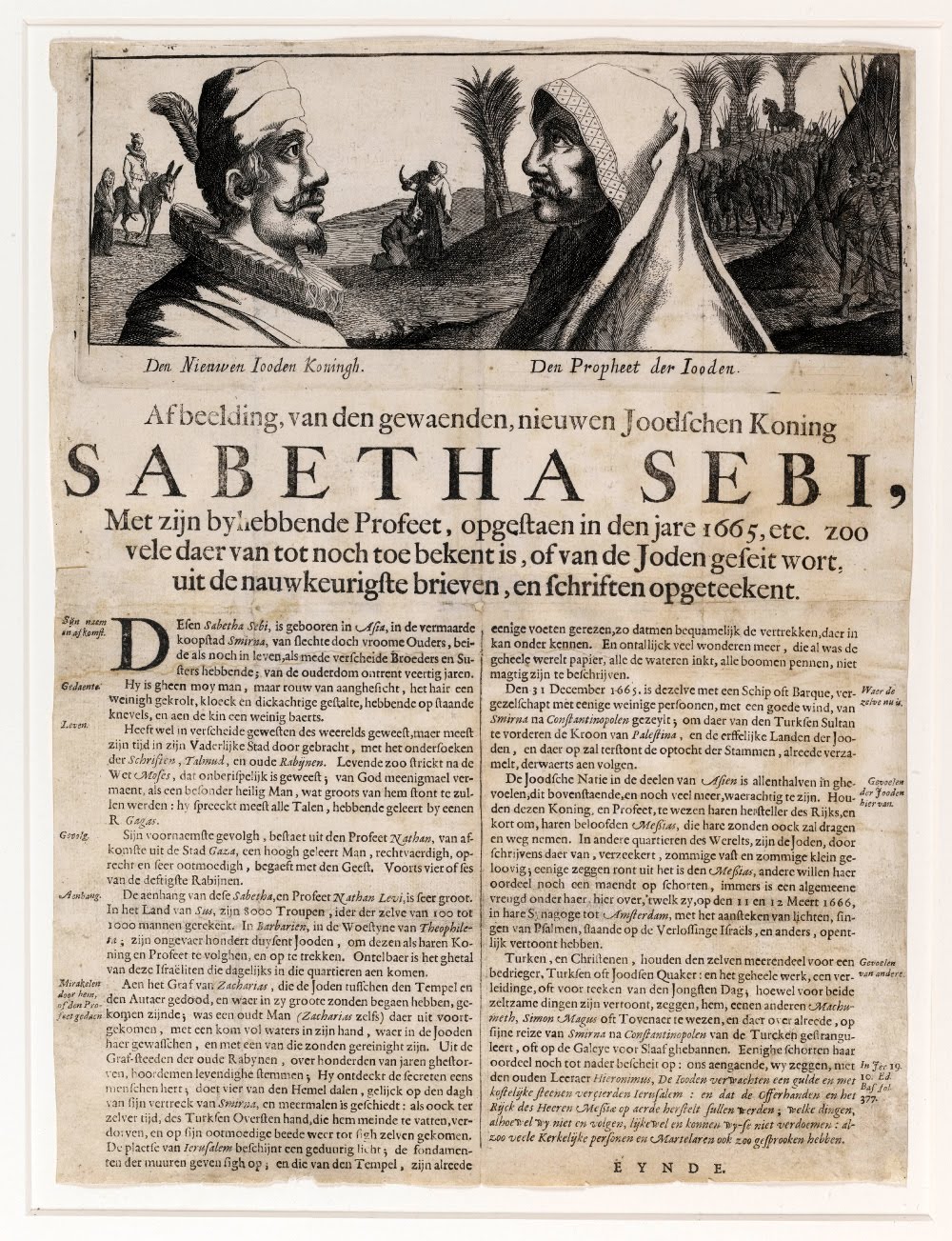
for Shabbatai Tzvi (see Bezalel Naor, Post-Sabbatian Sabbatianism,
80-82).
A book related
to Shabbatai Tzvi appears in lot 16, R. Shmuel Aboab’s D’var Sh’mu’el,
Venice 1702.  This copy contains the
section, Zikharon L’veni Yisra’el, that provides two documents regarding
the Shabbatai Tzvi episode.  Many copies
of this edition lack this section. 
The book, Zeh
Sefer Shevach v’Zimra
, (lot 124) relates to the Napoleonic wars. This book,
printed in 1796, relates that when Fasano, Italy (it is located in the heel of
the boot), was under siege by Napoleon, the Jews were charged as spies on his
behalf.  The Jews holed up in the
synagogue and a mob formed outside.  When
all seemed lost, a French cannon went off and the mob was scared off, saving the
Jews.  This book contains the story and a
poem written in commemoration of the event that was to be said yearly.  Napoleon was a mixed bag for the Jews.  Many welcomed him and saw him as an opportunity
to improve the lives of the Jews (some even considered him a messianic
figure).  R. Shneur-Zalmen of Lyadi, the
founder of the Habad movement, was famously against Napoleon, and explained
that “if Bonaparte wins, the wealth of the Jews will be increased and their
status raised, but they will be distanced in their hearts from their father in
heaven.”  On the other hand – and R.
Shneur-Zalman was writing in the Russian Empire – “if Tsar Alexander wins,
poverty will increase among the Jews, their status will be lower, but they will
be bound and tied in their hearts to their father in heaven.”  
For further
information and for online bidding see http://legacyjudaica.bidspirit.com


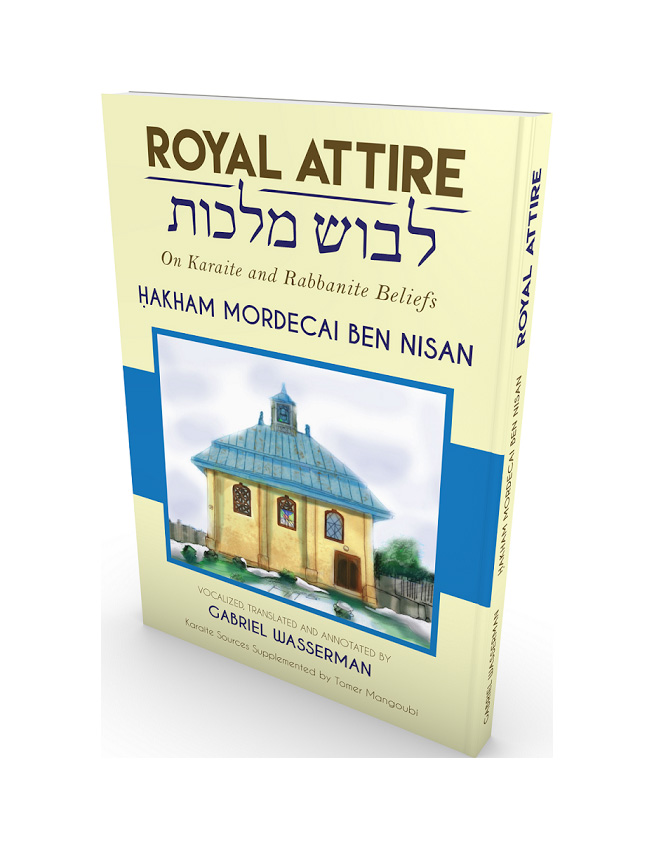
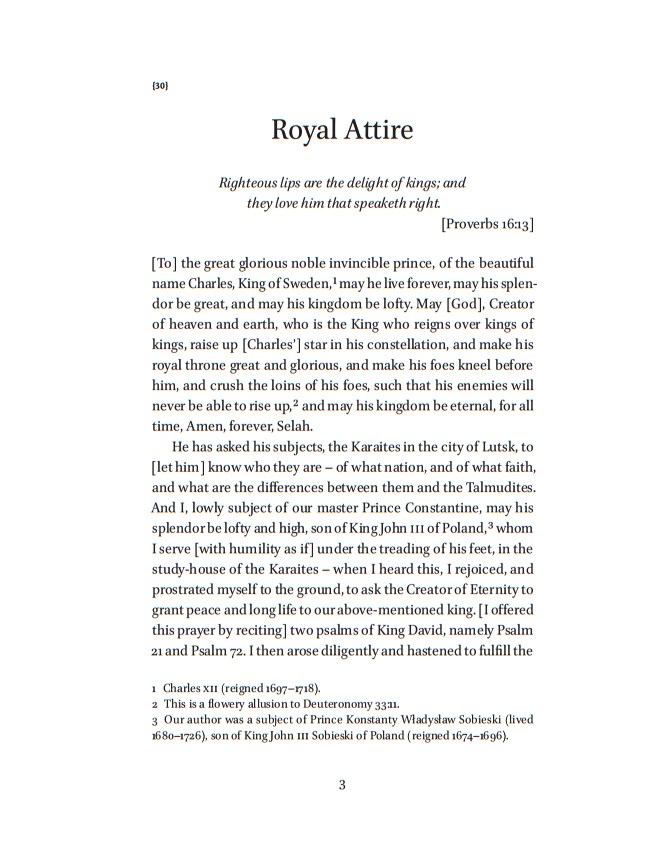
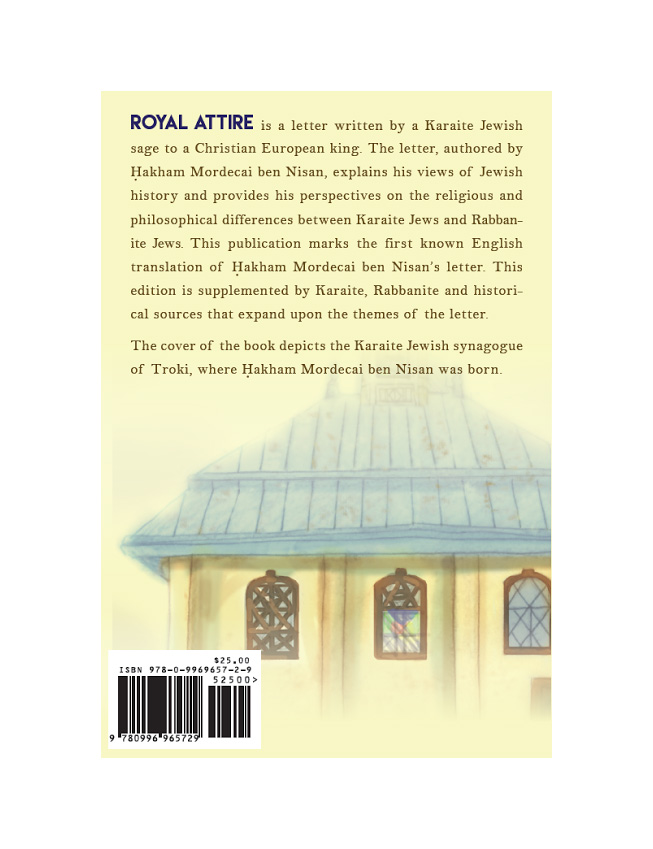
New book by Gabriel Wasserman on Karaite Judaism

Royal Attire: On Karaite and Rabbanite Beliefs by Hakham Mordecai ben Nisan

The Karaites are a Jewish group who have been important for centuries of Jewish history, wrote many writings, and are a still extant minority today. Yet most people never get to hear much about them, especially not in their own words. When people in a typical rabbinic beth midrash encounter them, it is often in statements such as that of the Mishna Berura (27:33), that wearing tefillin down on the forehead, rather than further up on the head, is a Karaite practice. In fact, this statement is completely untrue, for Karaites do not wear tefillin at all, but rather understand Deuteronomy 6:8 and the other tefillin verses metaphorically, as meaning to constantly remember the Torah. 
This book offers a rare opportunity for English-language readers to hear a Karaite sage’s own explanation of the differences between Karaite and Rabbanite (Talmudic) Judaism. (For example, see pp. 96 ff. for a discussion of the metaphorical understanding of the tefillin verse.) 
The Hebrew text is of a letter by the Karaite sage R’ Mordecai ben Nisan of 18th-century Troki, Lithuania, to King Charles of Sweden, explaining differences between Karaite and Rabbanite Judaism: a narrative of how the two groups came to be, a selection of over forty specific commandments about which the groups disagree, and theological/philosophical differences. 
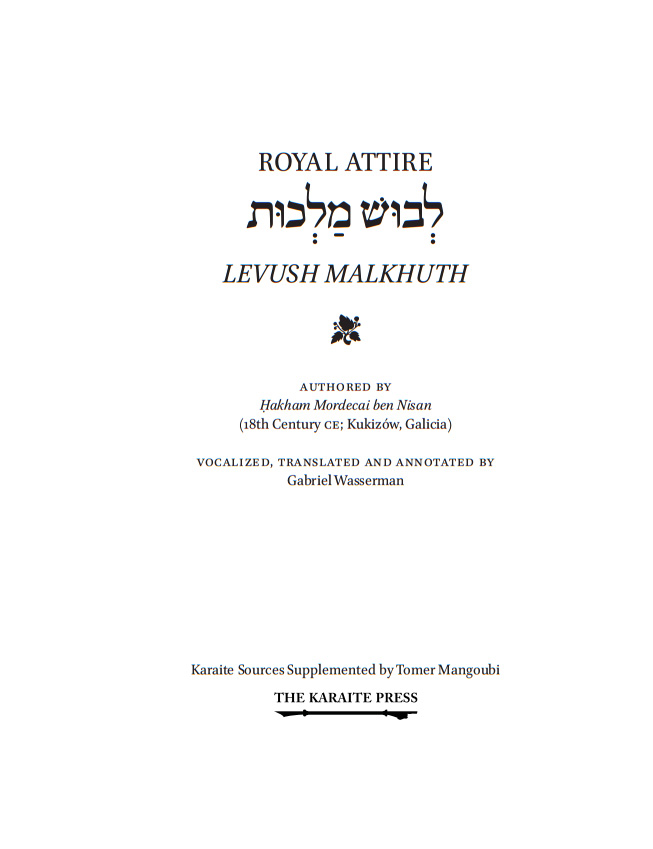
Dr. Gabriel Wasserman, a contributor to the Seforim Blog, did a lovely job of adding nikkud, translating, and annotating. His notes unpack the text for modern readers, and provide quotations of earlier texts, both Karaite and Rabbanite, to show a broader picture. This book will be excellent reading for anyone who wants to learn, or teach a class, about varieties of Judaism and “Judaisms”. 
This book is the first work of this size to be published by the recently-started Karaite Press. They have done a beautiful job of lining up the Hebrew and English, and adding an introduction at the beginning and several indices at the end of the volume. Tomer Mangoubi has helped the author supplement the notes with additional material from other Karaite sources. In all, it is a fine and interesting volume, and we look forward to the future success of the Karaite Press in putting out further Karaite texts, to make them accessible to a broader public. 
This book may be ordered here:
https://www.amazon.com/dp/0996965726/
Here are several sample pages:


Everything is Illuminated: Mining the Art of Illustrated Haggadah Manuscripts for Meaning

Everything is Illuminated: Mining the Art of Illustrated Haggadah Manuscripts for Meaning
            We have discussed haggadah illustrations in the past (see the links at the end of this post) and we wanted to expand and update upon that discussion for this year. In this post we focus on Hebrew illuminated haggadah manuscripts, and in the follow-up post will turn our attention to printed illustrated haggadot.
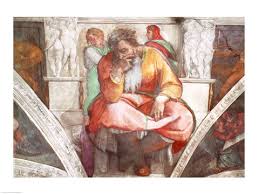
            While there is not as large of a body of Jewish art as that of art in general, historically Jews have appreciated the visual arts early in their evolution into a nation.  Aside from the biblical forms, we have evidence of art dating to the second century of the common era in the well-known frescos at the Dura-Europos synagogue.[1] But, such appreciation was not limited to second century Palestinian Jews, as evidenced from the discussion below, this appreciation continued, almost unabated, until the modern period.  It was not just the artist class or wealthy acculturated Jews that were exposed to and admired this medium.  For example, in the 1560 Mantua haggadah, one of the more important printed illustrated haggadot, the wise son appears to be modeled after Michelangelo’s Jeremiah in the Sistine Chapel (view it here: link). 
            

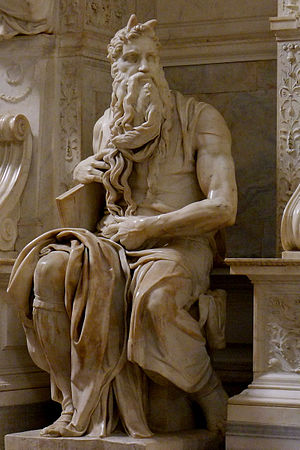
Lest one think that it is highly unlikely that a 16th century Italian Jew would have even entered the chapel, let alone been familiar with this painting, a contemporaneous account of Jewish art appreciation disabuses those assumptions.  Specifically, Giorgi Vasari, the 16th century artist and art historian, in his Lives of Excellent Painters (first published in 1560), records regarding Michelangelo’s statute of Moses – that is a full statute depicting the human form and was placed in the church of San Pietro in Rome – that “the Jews [go] in crowds, both men and women, every Saturday, like flocks of starlings, to visit and adore the statue.” That is, the Sabbath afternoon activity was to go to church to admire the statute of Moses, that is more famous for having horns than its Jewish visitors.[2]

Hebrew Manuscripts Background  
A brief background regarding Hebrew manuscripts before delving into the illuminated haggadah manuscripts. Details regarding manuscripts, the name of the copyist, the date, and the place where the manuscript was written, were supplied not at the beginning of the book – as is the convention with printed books and title pages –  instead in manuscripts this information is provided at the end. For this reason, the scribe’s note containing the information was called a colophon – from the Greek word kolofon, meaning “summit” or “final point.”[3]
Number of Hebrew mss.

A cautious guess of the number of extant Hebrew manuscripts in existence is between 60,000 -70,000 “but no more than 30-40 thousand of them predate the middle of the sixteenth century.”[4] Of the 2-3 hundred thousand Hebrew manuscripts presumed in existence in Europe at the beginning of the fourteenth century, probably no more than four to five thousand are extant today, possibly even less. “From the tenth century (before which information is very scarce) to 1490 (when the influence of printing books began to be felt)” there are an estimated one million manuscripts, meaning, “that 95 per cent of manuscripts have disappeared.”[5]  In addition, the early printed books – incunabula – had similar survival rates.

            The dearth of manuscripts has left a significant hole in our knowledge of major Jewish texts.  For example, there is only one complete manuscript of the Palestinian Talmud (1289) and two partial manuscripts. The Babylonian Talmud fared slightly better, with one complete manuscript (1342) and 63 partial manuscripts in libraries, with only 14 dating from the 12th & 13th centuries.[6] 
One of the partial TPs is known as the Vatican Codex 133 – and worth mentioning is the Vatican and its role regarding Hebrew manuscripts.  While there is no doubt that the Church had a significant hand in reducing the number of manuscripts – in reality the destruction of Hebrew manuscripts was the work of the Jesuits and not the Roman Catholic Church. Indeed, the Church confiscated and, thus in some instances preserved Hebrew manuscripts.  Consequently, we have a number of important Jewish texts that survive in the Vatican library.  Today, many of these manuscripts have been published.  The incomplete manuscript of the TP is but one example.  Additionally, regarding the use of (rather than just reprinting) the Vatican library, for at least late 19th century, Jews had access to the library.  For example, R. Raphael Nathan Rabinowitz, who authored a monumental work on Talmudic variants provides that “I prayed to God to permit me entrance to the Vatican library to record variant readings” his prayer was answered, and he received permission not only to use it during regular hours but “even on days that it was closed due to Christian holidays, when the library was closed to all, and even more so Jews.”[7] In total he spent close to 9 months in the library. In addition, Rabbi Rabinowitz’s presence and special status at the Vatican library was instrumental for the editing of the Vilna Talmud, where he secured permission for the Romm-employed copyists to work with manuscripts of the commentary of Rabbenu Hananel, even though they arrived in Rome during the summer season when the library was closed.
            Of the estimated one million Hebrew manuscripts from the 10th century until 1490, approximately 5% have survived.  As mentioned, religious persecution was one reason, but the main reasons are (1) deterioration from use, (2) accidents, and (3) reuse.  The first two are self-explanatory, the third requires a bit of explanation.  From the times that manuscripts were written on papyrus, unwanted manuscripts were scraped or washed and then reused.  (This papyrus recycling was not confined to reusing for books, papyrus was used from wrapping mummies, burned for its aroma, and used, according to Apices, to wrap meat for cooking). Similarly, leather and parchment were recycled, in the more egregious examples for shoe leather but in many cases for book bindings.  The latter reuse would be critical to the survival of numerous Hebrew manuscripts which have now been reclaimed from bindings.  It is estimated that there are 85,000 such binding fragments.  “The commonest use of written folios, however, was in bindings, whether for binding strips, end papers, or covers.”[8]   
Illuminated Hebrew Manuscripts

            The “earliest examples of Jewish book illumination are tenth-and eleventh-century Bible codices written in the Orient or Near East.  The illuminations are not figurative but consist of a number of decorative carpet pages adorned with abstract geometric or micrographic designs preceding or following the Biblical text.”[9] While these early illuminated manuscripts did not contain human figures, they did contain the first iterations of something unique to Jewish manuscripts, “one form of manuscript depiction unique to Jewish manuscripts is micrography with the earliest examples of this art may be found in the tenth-century Bibles written in the Orient.”[10]  A beautiful example of this art can be seen in the carpet pages for the Leningrad Codex. 


Similar non-representational geometric art was incorporated into Islamic art to avoid graphic representation.  Consequently, symmetrical forms were created which required advances in math theory to accommodate the ever more complex art.
Hebrew manuscripts did not adopt the Islamic convention – for the most part – and the earliest illustrations of human figures appear in Franco-Ashkenazic manuscripts – bibles – of the thirteenth century.
The earliest extant illustrated haggadah[11] is what is known as the Birds’ Head Haggadah dated to the early 1300s. The moniker “Birds’ Head” comes from the fact that the illustrator used birds heads/griffins in place of human heads. This manuscript is not the only Jewish manuscript to use zoophilic (the combination of man and beast) images. Zoophilic images can be found in a variety of contexts in Jewish manuscripts. For example, in the manuscript known as Tripartite Machzor, men are drawn normally while the women are drawn with animal heads.[12]  The name of this Machzor comes from the random fact that the manuscript was split up into three.  At times manuscripts are titled by location (Leipzig Mahzor), history (tripartite) or owner.  In one example, the “Murphy Haggadah” “ suffered a fate all too common to many Hebrew texts.  Before the Second World War the manuscript belonged to Baron Edmond de Rothschild.  During the war it was stolen and sold to an American, F.T. Murphy, who bequeathed it to Yale University, his alma matter.  For years it was known as the “Murphy Haggadah” until, in 1980, a Yale scholar, Prof. J. Marrow, identified as belonging to the Rothschilds.  The manuscript was returned to the Rothschild family and presented by the Baroness Dorothy to the Jewish National Library.[13]
            When it comes to the Birds’ Head manuscript, a variety of reasons have been offered for its imagery, running the gamut from halachik concerns to the rather incredible notion that the images are actually anti-Semitic with a bird’s beak standing in for the Jewish nose trope and the claim that the ears on the “birds” are reminiscent of pigs’ ears. Generally, those claiming halackhic, or more particular pietistic reasons, do so because they are unable “to conceive of such a bizarre and fanciful treatment of the human image as emerging from anywhere other than the twisted and febrile imagination of religious fanatics.”[14] But, in reality the use of bird’s head in lieu of human “reflects a liberal halakhic position rather than an extreme one.”[15]  The camp of Yehuda ha–Hassid would ban all human, animal and celestial depictions, a more liberal position from this perspective permits animal images.  And, while that position doesn’t explicitly permit a depiction half-animal half-human, the zoophilic images appear to show they were allowed, as the illuminator and owner of the Birds Head Haggadah agreed with that position.
            Aside from halakha, and the meaning or lack thereof behind “birds”, a close examination how the illuminator used this convention yields surprising nuance and commentary.      
While most of the images carry a bird’s head, there are a few exceptions. Most notably, non-Jews, both corporeal and spiritual do not. Instead, non-Jewish humans as well as angels have blank circles instead of faces. But, there is one scene that poses a problem. One illustration shows the Jews fleeing Egypt (all with birds’ heads), being pursued by Pharaoh and his army. Pharaoh and his army are depicted faceless.

  But, unlike the rest of the figures in Pharaoh’s army, two figures appear with birds’ heads. Some write this off to carelessness on the illustrator’s part. Epstein, who credits his (then) ten-year old son for a novel explanation, offers that these two figures are Datan and Aviram, two prominent members of the erev rav, those Jews who elected to remain behind. Indeed, they are brandishing whips indicative of their role as nogsim (Jewish taskmasters, or the precursor to Jewish Sonderkommando). While the illustrator included them with the Egyptians, he still allowed them to remain with their “Jewish” bird’s head.  This is a powerful idea regarding the idea of sin, and specifically, the Jewish view that even when a Jew sins, they still retain their Jewish identity – their “birds head.”   Sin, and including sinners as Jews, are motifs that are highlighted on Pesach with the mention of the wicked son and perhaps is also indicated with this illustration. The illustrator could have left Datan and Aviram out entirely or decided to mark them some other way rather than the Birds’ head. Thus, utilizing this explanation allows for the illustrator to enable a broader discussion about not only the exodus and the Egyptian army’s chase, but expands the discussion to sin, repentance, Jewish identity, inclusiveness and exclusiveness and other related themes.[16]

            Once we have identified the Jews within the haggadah, we need to discuss another nuance in their depiction.  The full dress of the adult male bird is one with a beard and a “Jewish hat,” pieus conutus – a peaked hat, or the Judenhut.  Children and young servants are bareheaded.  But, there are three other instances of bareheadness that are worthy of discussion.  (1) Joseph in Egypt, (2) the Jews in Egypt and (3) Datan and Aviram.  The similarity between all three is that each depicts a distance from god or Jewish identity.  Joseph, unrecognizable to his brothers, a stranger in a strange land, and while inwardly a Jew, externally that was not the case.

            The Jews in Egypt had sunk to the deepest depths on impurity, far from God. Finally, as we discussed previously, Datan and Aviram are also removed from god and the Jewish people.  Again, the illustrator is depicting Jews – they all have the griffin heads – but they are distinct in their interaction with god and the Jewish people.[17]  

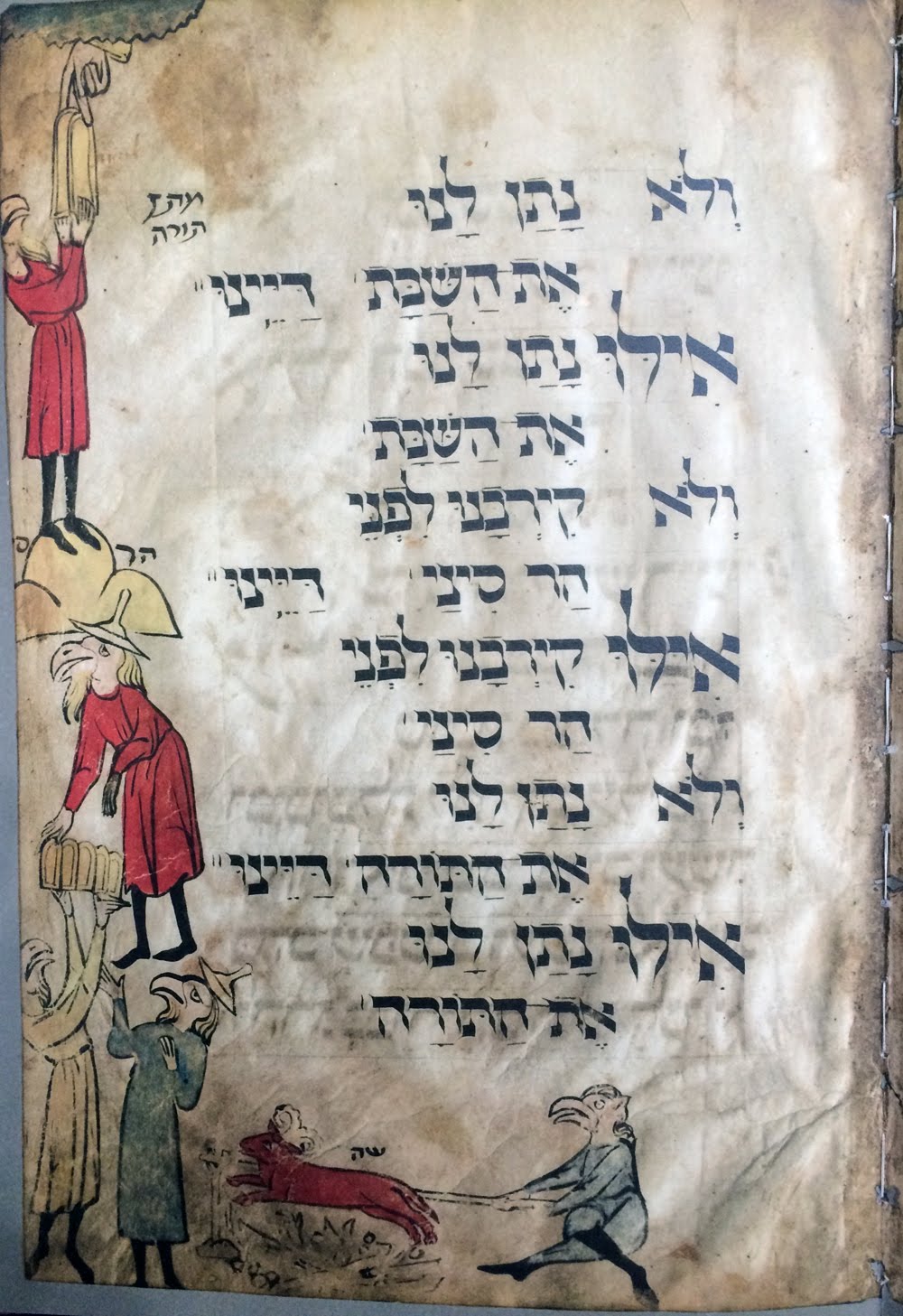
Using this interpretation of the griffin images, yields yet another subtle point regarding inclusion, and also injects some humor into the haggadah.  The dayenu panel has splitting of the sea, the manna and the giving of the Torah.  The middle panel is less clear. Some posit that it is the Jews celebrating at the sea, but there is no indication of that because in most manuscripts, that includes Miriam, and the Egyptians drowning, not just five random images.

   
Instead, it appears that the person to the left is speaking (his hand is over his heart a medieval convention to indicate speech), and they are approaching the older figure on the left.  All are griffin headed and Judenhut attired – so Jews and regular ones. Between the splitting of the sea and the manna and quails the Jews complained to Moses.  Its possible that this is what is being depicted here, the complaining Jews, and the illustration serves as a testament to God’s patience and divine plan, the theme of dayenu, that even though we complained and did X, God still brought the manna, quail and Torah.[18] 

            If these are in fact the complainers, we can theorize about another detail of the image.  Above the figure at the left and the right, is faint cursive (enhanced here for visibility as much as possible) that reads: “Dass ist der Meirer (this is Meir) Dass ist der Eisik (this is Issac).”[19]  Thus Meir and Issac are being chided – but not kicked out – for complaining too much (rather than representing an unclear image of the Jews celebrating at the sea or just evidencing poor dancing). 


            Continuing through the dayenu we get to the giving of the Torah, and again, the nuance of the illustrator is apparent

.

            Two tablets were given at Sinai, but the actual Pentateuch is comprised of 5 books.  Thus, to capture that the 5 are a continuity of the two, as they are transmitted down, they transform into five tablets.  What about the ram/lamb at the bottom?  Some have suggested that it is the Golden Calf. But it is unlikely that such a negative incident would be included.  Instead, assuming that continuity or tradition is the theme, this lamb is representative of pesah dorot that is an unbroken tradition back to Sinai and unconnected with the Christian idea of Jesus as a stand in for the lamb.  Immediately prior to dayenu we have the Pesach mitzrayim with the figure’s cloak blowing back due to the haste.

       Thus, the dayenu is bracketed by the historic Pesach and the modern one – all part of the same tradition. [20]  

            It is worth mentioning that the Birds’ Head Haggadah is currently in the news. An item recently appeared about how the heirs of Ludwig Marum and his wife Johanna Benedikt, the owners of the haggadah prior to the Nazi era, are pressing the Israel Museum to recognize their family’s title, and pay them a large sum of money (but only a fraction of its estimated value). The Israel Museum acquired the haggadah for $600 from a German Jewish refugee in 1946.  (link).

            Turning to Spain, one of the most beautiful illuminated haggadot is the “Golden Haggadah.”  Just as the Ashkenazi Bird’s Head has depth to the illustrations, the Golden Haggadah can be mined for similar purpose.  Each folio is comprised of four panels.  And while they appear to simply depict the biblical narrative, they are so much more. 

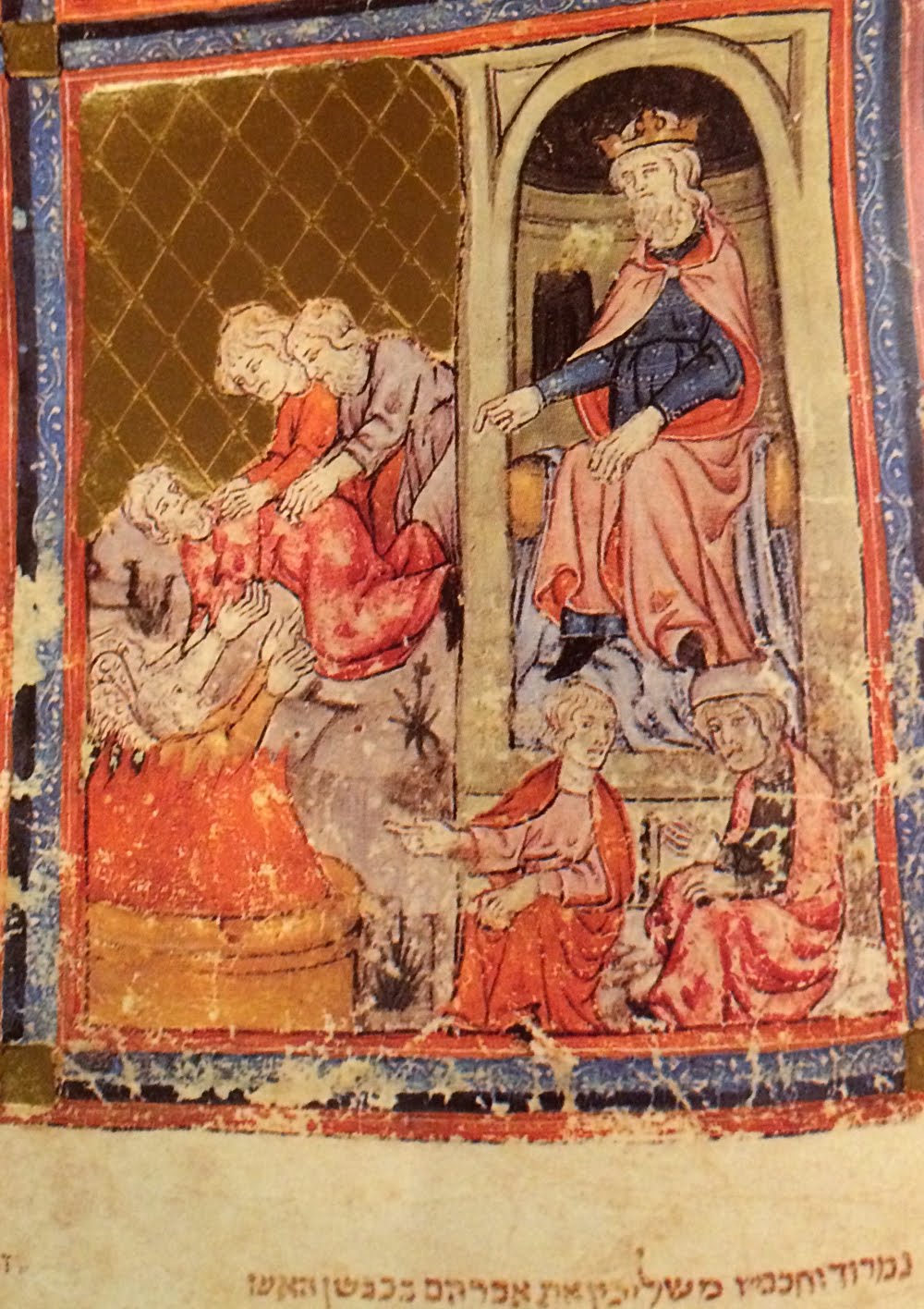
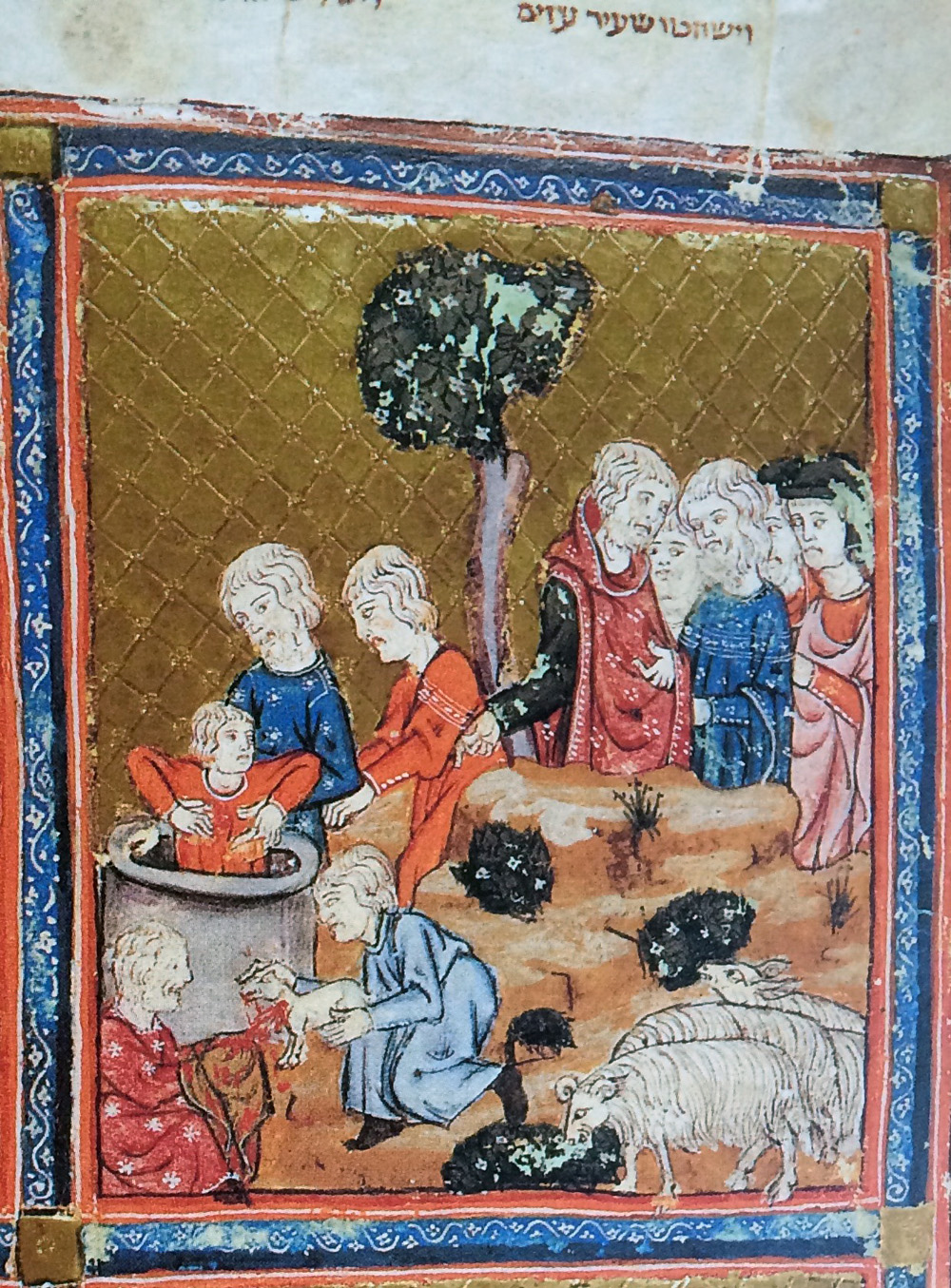
            In an early panel we have Nimrod throwing Abraham into the fire and later Pharaoh throwing the males in the Nile, both Nimrod and Pharaoh are similarly depicted, on the throne, with a pointed finger indicating their equivalence in denying god. 

            The folio showing the Joseph story has the brothers pointing in the same manner as Pharaoh and Nimrod – the illustrator showing his disdain for the mistreatment and betrayal and equating it with the others.

            But, that is not all.  Counting the panels there are 9 between Nimrod and Joseph and 9 between Joseph and Pharaoh.  Taken together, these illustrations “renders an implicit critique of the attitude of that Jewish history is nothing but an endless stream of persecution of innocent Israel by the bloodthirsty gentiles.  Yes, it is acknowledged, these gentile kinds might behave villainously in their persecution of Jews.  But groundless hatred between brother and brother is on par with such terrible deeds, and sometimes sinat hinam can precipitated treachery as destructive as persecution by inveterate enemies.”[21]

            One other striking feature of the Golden Haggadah is the inclusion of women. There are no fewer than 46 prominent depictions of women in the haggadah.  Indeed, one reading of the exodus scene has a woman with a baby at the forefront leading the Jews out of Egypt behind Moses.

            This may be a reference to the midrash that “in the merit of the righteous women the Jews were redeemed.”[22]  The difference in the exodus scene is particularly striking if one compares it to the Ashkenaz Haggadah – Moses clearly at the front, and the most prominent woman in the back.


Of course, it is completely appropriate for the inclusion of women in the haggadah as women and men are equally obligated to participate in the seder. Another example of the prominence that woman play in the Golden Haggadah iconography is the scene of Miriam singing includes the largest images in the haggadah, the women occupying the full panel.  We don’t know why the illustrator chose to highlight women – was it for a patron or at a specific request.[23] 
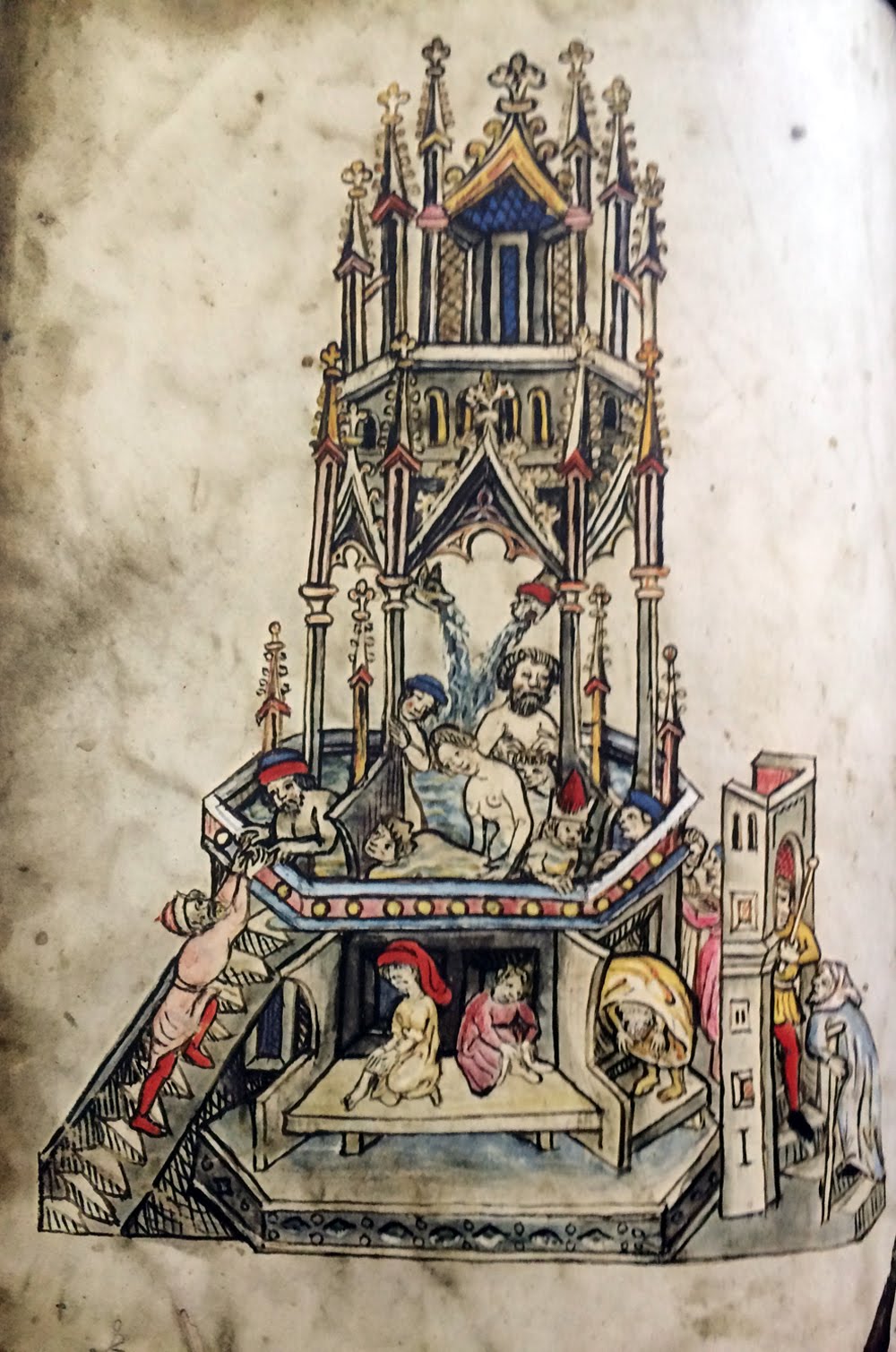
The Golden Haggadah is not the only manuscript that includes women in a prominent role in the illustrations.  The Darmstadt Haggadah includes two well-known illuminations that place woman at the center.  The illuminations adoring other Darmstadt serve a different purpose than the Golden or Birds’ Head, they are purely aesthetic.[24]  Thus, the inclusion of women may not be linked to anything in particular.  At the same time, it is important to note that in terms of reception, that is, how the reader viewed it, the focus on women was not cause for consternation. One other note regarding the haggadah, the last panel is a depiction fountain of youth.  Note that men and woman are bathing – nude – together, which seems odd to a modern viewer (and, again, apparently did not to the then contemporary reader).  And, while admittedly not exactly the same, the 14th century R. Samuel ben Baruch of Bamberg (a teacher of R. Meir of Rothenberg) permitted a non-Jewish woman to bath a man so long as it was in public to reduce the likelihood of anything untoward occurring.[25] 

Before we leave the Darmstadt Haggadah, we need to examine the panel facing the Fountain of Youth. This panel depicts a deer hunt.

 As mentioned above, this image is not connected to the text and instead is solely for aesthetic purposes.  The hunting motif is common in many medieval manuscripts, and in some a unicorn is substituted for a deer.  While the unicorn has Christological meaning, on some occasions it also appears in Hebrew manuscripts.[26]

While the use of the hunting scene in the Darmstadt Haggadah was unconnected to the haggadah, in others it was deployed for substantive purpose.[27] [As an aside, it is possible that Jews participated, possibly Rabbenu Tam, in hunting, or at least its falconry form.[28]] As is well-known, the inclusion of the hare hunt is to conjure the Talmudic mnemonic regarding the appropriate sequence over the wine, candle, and the other required blessings, or YaKeNHaZ.  “To Ashkenazic Jews, YaKeNHaZ sounded like the German Jagen-has, ‘hare hunt,’ which thereby came to be illustrated as such in the Haggadah.”[29]

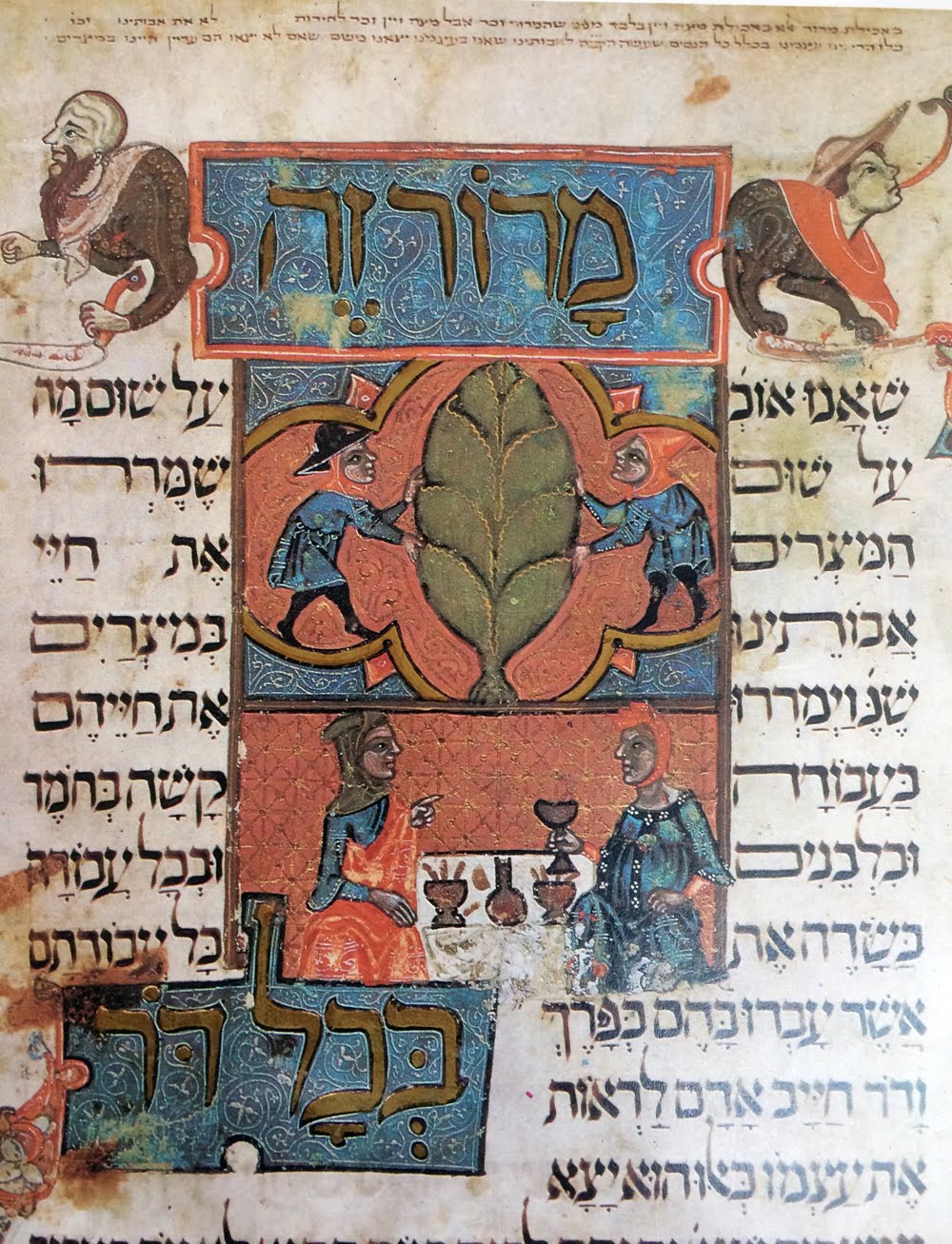
 Generally, Jews seem to have issues with botany.  We struggle to identify which of the handful of fruits and vegetables mention in the Bible and Talmud. But on Passover, the marror an undefined term, proves particularly illusory. Today, there is no consistency regarding what is used for marror with it running the gamut from iceberg lettuce to horseradish root. While we may not be able to identify it with specificity, we know what its supposed to taste like – bitter.  Manuscripts may provide some direction here.  There are two depictions in illuminated haggadot.  One of a leafy green, found in numerous examples, from a fragment from the Cairo Geniza to the Birds’ Head, and that of an artichoke.[30]  If it is a leafy green, it must be a bitter one – and that changes based upon time, place and palate.  For example, 30 years ago romaine lettuce was only the bitter lettuce widely available. But, among lettuces, it is far from bitter, and today, there are a variety of truly bitter lettuces available, arugula, mustard greens, dandelion, mesclun, etc.  Another leafy and very bitter option that is found in illuminated haggadot is the artichoke.  The artichoke is extremely bitter without proper preparation.  Indeed, from just touching the leaves and putting them in your mouth you can taste the bitterness.  The Sarajevo Haggadah and brother to the Rylands both have artichokes.

            The association of the artichoke with Passover is more obvious when one accounts for Italian culinary history.  Specifically, artichokes are associated with Jews and Passover. Carcoifi alla giudia – literally Jewish style artichokes “is among the best known dishes of Roman Jewish cuisine.” Artichokes are a spring thistle and traditionally served at Passover in Italy.  Whether or not from a culinary history this dish sprung from the use of raw artichoke for marror is not known, but we can say with certainty that artichokes have a considerable history when it comes to Passover. 

Horseradish only became popular, in all likelihood, because an early Pesach, would be too soon for any greens and thus they were left with horseradish – which is not bitter at all, instead it is spicy or more particularly hot.  In Galicia in the 19th century the use of horseradish was so ingrained that  permission was even granted and affirmed for people to use less than a kezayit  and still recite the blessing. In light of this, the custom yields the possibility that all sort of other spicy items be used for marror including very hot jalapeño peppers, for example.[31] Since we are discussing herbs, it is also worth noting that recently rulings regarding the use of marijuana and Pesach have been issued both in Israel and the United States (here), for our discussion on marijuana and Pesach please see here.

            One manuscript captures the uncertain identification of marror.  In the Tubingen Haggadah, the place where the illustration for marror is left blank, presumably to permit the owner to fill in what they are accustomed to use.

            Marror is not the only vegetable that is eaten during the seder, another difficult to identify is the karpas.  Today there are a variety of items used, and in reality, any dip-able vegetable will suffice, historically, it seems that lettuce or celery was used. The Birds Head provides that “lattich (lettuce) and eppich (celery) should be used. These are traditional salad foods, which, in the normal course of things, would be dipped or tossed with a dressing.  A dressing can be a simple as vinegar, and indeed, in many medieval haggadot, hometz or vinegar is used to dip.  We can trace the change from the more obviously salad oriented vinegar to saltwater where in the Darmstadt Haggadah, a later hand wrote on top of hometz – mei melekh.  While it appears nearly universal that hometz was used, its disfavor may be connected to a rule unrelated to Passover.  Since the Middle Ages, there is a dispute whether or not vinegar falls under the ambit of stam yenam.  Thus, the change to saltwater may be more of a reflection about views on what constitutes stam yenam and less to do with tears.

            One final food item is the haroset preparation.  Apples are familiar and linked to the midrash regarding birthing under an apple tree, in the Rothschild Machzor and the 2nd Nuremburg haggadah, cinnamon is called for because “it resembles straw.”  It also concludes that “some incorporate clay into the haroset to remind them of the mortar. For those wanting to replicate this addition, edible clay, kaolin, is now easily procured, and there is even a preparation that creates stone-like potatoes, perfect for the seder.
            To be continued… but until then see these posts Halakha & Haggadah, and regarding some illustrations in the iconic Prague 1526 Haggadah, here and also Elliot Horowitz’s discussion.

[1] E.L. Sukenik, The Dura-Europa Synagogue and its Art, Bialik Press, Jerusalem:1947. See also, Gabrielle Sed-Rajna, Jewish Art, transl. Sara Friedman & Mira Reich, Harry N. Abrams, Inc., New York: 1997, 9-13; 20-29;114-39.
[2] Two Prague Haggadahs, Valmadonna Trust Library, Italy:1978, 16 n.16 (the citation should read p. 435, not p. 345)
[3] Binyamin Richler, Hebrew Manuscripts: A Treasured Legacy, Cleveland/Jerusalem: Ofeq Institute, 1990, 20.
[4] Id. at 58.
[5] Colette Sirat, Hebrew Manuscripts of the Middle Ages, ed. & transl. Nicholas de Lange, New York: Cambridge University Press, 2002, 234.
[6] Id. 242-43.
[7] R. N. Rabinowitz, Dikdukei Soferim, Munich: E. Hovner, 1881, vol. 11, Tractate Baba Bathera, 7. 
[8] Sirat, Hebrew Manuscripts, 235-38.
[9] Richler, Hebrew Manuscripts, 45.
[10] Id. 48.
[11] Interestingly, illuminated haggadot did not end with the introduction of printing, there are a number from the 18th century and beyond.
[12] See B. Narkiss, Hebrew Illuminated Manuscripts, Jerusalem: Keter Publishing House, 1969, 106.
[13] Richler, Hebrew Manuscripts, 47.
[14] Marc Michael Epstein, The Medieval Haggadah: Art, Narrative, and Religious Imagination, New Haven & London: Yale University Press, 2011, 50-51. See the other discussions of this book, here.
[15] Id. 51.
[16] Id. 51-53, 71-72.  Much of the discussion regarding this haggadah and the Golden Haggadah is reliant upon Epstein’s thorough analysis of these manuscripts.
[17] Id. 65-68, 71-72.
[18] Id. 87-90.
[19] M. Spitzer & B. Narkiss, “General Description of the Manuscript,” in The Bird’s Head Haggada of the Bezalel National Art Museum in Jerusalem, ed. by M. Spitzer, Tarshish Books: Jerusalem, 1967, 23.
[20] Epstein, The Medieval Haggadah, 90-91.
[21] Id. 162.
[22] Id. 178.
[23] Id. 185-86.
[24] Narkiss, Hebrew Illuminated Manuscripts, 126.
[25] Elliot Horowitz, “Between Cleanliness and Godliness,” in Tov Elem: Memory, Community & Gender in Medieval & Early Modern Jewish Societies, ed. E. Baumgarten, et al., Bialik Institute, Jerusalem:2011, *38-*39.
[26] Piet van Boxel, “The Virgin & the Unicorn: A Christian Symbol in a Hebrew Prayer Manuscript,” in Crossing Borders, Hebrew Manuscripts as a Meeting-place of Cultures, ed. Piet van Boxel & Sabine Arndt, Bodleian Library, University of Oxford:2009, 57-68.
[27] The hare hunt image appears in Seder Zimerot u-Birkat ha-Mazon, Prague 1514, in the Shevuot portion.  Of course, the mnemonic applies to any holiday that potentially falls on a Saturday night.  See B. Roth, “Printed Illustrated Hebrew Haggadot,” Areshet, vol. 3 (1961), 8.  
[28] See Leor Jacobi, “Jewish Hawking in Medieval France: Falconry, Rabbenu Tam, and the Tosefists,” in Oqimta 1 (2013) 421-504, available here.
[29] Y. Yerushalmi, Haggadah & History, The Jewish Publication Society, United States:1997, plate 15.
[30] The various manuscript depictions of marror are collected in Mendel Metzger, La Haggada Enluminee, Brill, Leiden:1973, figs. 242-65.
[31]  Levi Cooper, “Bitter Herb in Hasidic Galicia,” Jewish Studies, an Internet Journal, vol. 12, 2013 (available here). 


Aaron the Jewish Bishop

Aaron the Jewish Bishop

The exodus from Egypt was led by Moses and Aaron. Moses, however, does not appear in the Passover haggadah (with one exception that is likely a later interpolation).[1] Aaron does make two appearances in the hallel section.  That said, in numerous illuminated haggadahs, from the medieval period to present, both appear in illustrated form. Additionally, in printed haggadot, most notably the 1609 Venice haggadah, one of the seminal illustrated haggadot, Moses and Aaron appear on the decorative border.

Generally, conclusively determining Jewish material culture, especially from the biblical period, is nearly impossible.  Regarding Moses, other than his staff, the bible provides no additional information.[2]  Aaron is a different story.

The Torah expends a significant amount of verses discussing the details of the Kohen Gadol’s (the high priest) garments but while the descriptions are detailed, we still struggle to determine what these special clothes looked like.  Rashi, for example, has to resort to anachronistic parallels for the “me’il” comparing it to a medieval French equestrian pant.  Similarly, by the Talmudic time, the details of the headband were subject to dispute. We should briefly pause here to correct a common misconception – that the Vatican or the Catholic Church still retains items related to the Jewish temple.  Unfortunately, this misconception is so prevalent, that a number of Israeli officials have requested that the Vatican repatriate the temple vessels.  Briefly, while the Talmud mentions that sometime between the 2nd and 5th centuries, temple vessels may have resided in Rome, there is no indication whatsoever of them since the 5th century. In addition, due to the numerous sackings that Rome underwent, or the reality that the Catholic Church is an entirely different sovereign than the Roman ruler Vespasian who sacked Jerusalem, it must be regarded as highly unlikely at best that any former temple vessels remain (assuming they were ever there) within the Vatican. For additional discussion regarding this issue, see here.
The ambiguity about the clothing has not stopped many from attempting to depict what they believe is the correct version.  Thus, depictions of Aaron the High Priest appear in Hebrew books. Hebrew manuscripts did not shy away from including illuminations and illustrations to create a more aesthetically pleasing product.  All sorts of shapes and images are employed to this end, on page borders, end pages, or just sprinkled throughout a manuscripts and – geometric patterns (Hebrew manuscripts are the first to use micrography), animals, people or combinations thereof of half-human-half-beast.  Noticeably, however, biblical figures are not included in this category. While biblical scenes appear in Hebrew manuscripts it is only to actually illustrate the content, and not independently for aesthetic purposes.
With printing, however, this slowly changed. Printing began in 1455 with Gutenberg and Hebrew books followed soon after.  These early books, however, did not follow all the conventions that we associate with books today.  Title pages did not begin until the 16th century and it wasn’t until the early 17th century that title pages were de rigueur.  Apart from information relevant to the books contents, title pages also began to included aesthetic details.  Sometimes these are architectural, pillars etc. other times flowers or some other flower or fauna.
Generally, printers did not explain why certain images were included on title pages, the assumption is that it was simply for aesthetic purposes.  At least in one case, this was made explicit.  The Shu’’t Ma-harit”z, Venice, 1684, by Yom Tov Tzalahon, includes an illustration of the temple on the title page.  The publisher, Tzalahon’s grandson, provides that this was included as “it makes it more beautiful” and he was so enamored with the illustration – even though it is very rudimentary he included it three times in the book (this likely speaks more about the publisher’s exposure – or lack thereof – to art in general).[3]
There are, however, at least a few examples of a title page illustration serving a purpose beyond the aesthetic. Some illustrations are including because of allusions to the author’s name, but at least in one instance a Hebrew title page illustration was used to illustrate the title.
The most common form appearing “on the frontispiece of countless printed books,” were biblical figures Moses, Aaron, David, Solomon, nearly always coupled, and “became the accepted heraldic figures.”[4]  The first biblical figures to appear in Hebrew books were was a woodcut by Hans Holbein of David and Solomon, flanking one, among other biblical scenes, in the Augsburg 1540 Arba’ah Turim. This illustration, however, did not appear on the title page, which is plain, instead it appears on folio 7.[5]  See Heller, 242-43.
The first frontispiece to include a biblical figure is the Tur Orach Hayyim, Prague, 1540, that includes, at the top of the page, a depiction of Moses holding the tablets.[6] The first frontispiece to include the coupling of biblical figures – the most ubiquitous form of biblical figures – is Jacob Moelin’s She’elot u-Teshuvot Mahril printed in Hanau in 1610. That frontispiece depicts Moses on the left in one hand the tablets and the other hand he grasps his staff.  Aaron is wearing the garments of the high priest:  the tunic, bells, breastplate and and is carrying the incense.
 
The usage of Moses and Aaron on Hebrew frontispieces thus began with Hanau, 1610.  By way of comparison, the first appearance of Moses and Aaron on the frontispiece of a book in English was the King James Bible, published a year after Hanau in 1611. The Hanau printer reused the Moses/Aaron frontispiece on two more books:  Nishmat Adam by Aaron Samuel ben Moshe Shalom of Kremenets, 1611 and Joseph ben Abraham Gikatilla’s, Ginat Egoz, Hanau 1615.[7]  The illustration best fits the Nishmat Adam, and may have originally been the book for which this illustration was intended and not Molin’s.  Unlike Jacob Molin’s work that has no direct connection with Aaron or Moses, the author of Ginat Egoz’s name includes both Moses and Aaron, and while Samuel is not captured in the illustration, the year of publication is derived from “Samuel.”
Moses and Aaron became the most common biblical figures on frontispieces, but not the exclusive ones.  In some instance, a mélange of biblical figures is presented.  The Amsterdam printer, Solomon Proops, included the image of Moses, Aaron, David, and Solomon, each wearing a crown, and a Moses carrying not the tablets but instead the Torah scroll.

A deviation from the coupling of Moses and Aaron appears in Beit Aharon, Frankfurt am Oder, 1690, which displays Aaron and Samuel.  In that instance, however, the deviation is explained because the figures are allusions to the author’s name, Aaron ben Samuel.  The use of coupled figures was not exclusive to Biblical figures; in many Hebrew books a variety of mythical and pagan figures and scenes are commonplace on title pages.  A partial list of pagan deities include:  Venus, Hercules, Mars and Minerva that appear on ennobled works such as Rambam’s Mishne Torah, Venice 1574, and Abarabenel’s commentary on Devarim, Sabbioneta 1551, and were reused many times.[8]  The use of pagan figures in Jewish items is not limited to Hebrew books and these images appear on the Second Temple menorah, and the Dionysus, Poseidon are inscribed on Palestinian mezuzotSefer Raziel mentions Zeus and Aphrodite, Dionysus and Poseidon reappears in a common prayer said during the priestly blessings, and Dionysus appears individually in the additionally yehi ratzon that some recite during Aveinu Malkanu (helpfully Artscroll and other siddurim direct that for the prayers that include these names, they should “only be scanned with the eyes and concentrated upon, but should not be spoken,” as they are “divine names”).[9]
Returning to the use of Moses and Aaron on frontispieces of Hebrew books, as mentioned above, the basic form of the illustrations remained fairly static with Moses appearing with his staff and/or the tablets or the Torah and Aaron in his priestly clothing.  And, these are prevalent throughout the 17th century, across the Europe and the Middle East.  In Europe the coupling appears in Altona, Amsterdam, Venice, Furth and Izmir, on diverse works – Talmudic commentaries, Mendelssohn’s commentary to the bible, and a commentary on the zemirot (which includes a heliocentric depiction of the constellations).  

A slightly different version appears in the Ma’ashe Rokeakh that has Aaron holding a slaughter knife.

There is, however, one notable exception to this depiction both in terms of the items displayed in addition to the “coupling.”  Aaron ben Hayyim Perachia’s Perekh Matteh Aaron, published in Amsterdam, 1703, includes a coupling but rather than Moses and Aaron, in this instance both images are that of Aaron.  Additionally, the Aaron on the left is the standard depiction of items, but the one on right is distinct in that it has Aaron holding a budding almond branch – perach mateh Aaron.  Of course, these deviations are understandable as the “second” Aaron and his unique “staff” is not merely aesthetic but is illustrative of the title of the book, the first time an title page illustration illustrates the title.[10]

 
A final note regarding the frontispiece depictions of two items Aaron’s clothing.  First, in many instances, including the Hanau prints, Aaron’s hat is not the traditional wrapping or turban associated with the mitznefet, but a bishop’s mitre.  At times, the mitre is horned, for example, Zohar, Amsterdam, 1706.  The horned mitre, however, is based upon “the mistaken belief that the horned mitre descended from the Jewish high priest” when in reality the bishop’s mitre is related to “Moses’ horns and their symbolic meaning within the context of the medieval Church.”[11]
The frontispiece is not the only time that the kohen’s headgear is interpreted contrary to Jewish tradition.  In a recent illustrated edition of Mishna Tamid, the editors depict the Kohen not only wearing the turban but also a yarmulke.  The Torah enumerates the priestly garments and any addition to those items is subject to the death penalty.  Thus, a Kohen wearing a yarmulke – as illustrated and that is not included in the Torah’s description of the Kohen’s outfit – commits a capital crime.[12] Here is another example of Aaron, looking very much like a bishop. This illustration is from a 15th century manuscript called המשכן וכליו by Simon ben Joel.

Unlike Aaron’s head-covering that appears from time to time as a bishop’s mitre, the second odd item that Aaron carries appears almost universally. Specifically, Aaron holds the incense in his hand, but unlike the Rabbinic interpretation that the incense was delivered in a shovel, Aaron is always depicted with the incense in a ball or  censer.  There is no Jewish source that records that form of the incense ritual and is an exclusive non-Jewish understanding of the Torah.
Ironically, the only person to take issue with the depiction of Moses and Aaron (and other biblical figures) argues against their use does not raise these issues nevertheless counsels against these biblical depictions.  His rationale, however, is counter-factual.  Specifically, Samuel Aboab, decries the depiction of biblical figures because the depictions are anachronistic and but for non-Jewish influences would never have been included in Jewish items.
While there is no doubt that some elements of the depictions are non-traditional, since at least the second century, biblical figures are found in a variety of Jewish contexts.  For example, the second century synagogue of Dura Europos and a few years later at the Bet Alpha synagogue contain biblical images. Dura Europos contains numerous illustrations of biblical figures and scenes, including Moses and Aaron.  And, while Abaob is correct that both Moses and Aaron are depicted anachronistically – in typical clothing of that time period, a toga-like garment – this is simply explained by the fact the purpose of the illustrations was to remind the viewers of the people and stories.  Therefore, had Aaron “been depicted with the biblical clothing that were no longer in use, the viewer might not know what they are looking at.”[13]  Thus, the anachronisms are not to make these seminal biblical figures in our image, but to simply ensure that the art clearly transmit its message.

[1] David Henshke, “The Lord Brought Us Forth from Egypt: On the Absence of Moses in the Passover Haggadah,” AJS Review, Vol. 31, No. 1 (Apr., 2007), pp. 61-73.
[2] The lack of information has not stopped the theorizing as to Moses’ visage.  The most notable example is R. Yisrael Lipschutz’s comments at the end of Kiddushin.  See Shnayer Z. Leiman, “R. Israel Lipschutz and the Portrait of Moses Controversy,” in Isadore Twersky, ed., Danzig, Between East and West: Aspects of Modern Jewish History (Cambridge, Mass., 1985), pp. 51-63, and for a different version, “R. Israel Lipschutz: The Portrait of Moses,” Tradition 24:4 (Summer 1989): pp. 91-98 (available here). See also the important chapter on this subject in R’ Shmuel Ashkenazi, Alpha Beita Kadmeysuh, Jerusalem:2000, pp. 337-371. For additional sources on this story see R’ Dov Turish in his various works; Maznei Tzedek, p.149, 310; Ginzei Ha-Melech, p. 38, 40, 43,48, 56; MiArat haMchpeilah, p. 101 and onwards.
[3] Shmuel Glick, Kuntress ha-Teshuvot he-Hadash, Schechter Institute of Jewish Studies, Jerusalem & Ramat Gan, 2007, n. 2120.  For more on Glick’s work see here and  here.
[4] Richard I. Cohen, Jewish Icons, Art & Society in Modern Europe, University of California Press, Berkley & Los Angles, 1998, 127.
[5] Marvin J. Heller, The Sixteenth Century Hebrew Book, An Abridged Thesaurus, Vol. I, Brill Leiden & Boston, 2004, 242-43.
[6] That is not to say the first to contain, rather than appear on the title page illustration, figures of living persons.  The Prague 1526 haggadah depicts, Adam, Eve, David, Goliath, Judith, and Samson in the woodcuts accompanying internal pages.  For a list of Hebrew books containing Moses with horns and without see Two Prague Haggadahs, Valmadonna Trust Library, 1978, 16-18 n.16
[7] An examination of the haskamot (approbations) accompanying the early Hanau prints also provides evidence of “the breakdown of central rabbinical authority in Germany during this period.”  Stephan G. Burnett, “Hebrew Censorship in Hanau: A mirror of Jewish-Christian coexistence in Seventeenth-century Germany,” in Raymond B. Waddington and Arthur H. Williamson, eds., The Expulsion of the Jews: 1492 and After, Garland Studies in the Renaissance, Vol. 2. New York & London: Garland Publishing Inc., 1994, pp. 202-03 (available here).
[8] Marvin J. Heller, Studies in the Making of the Early Hebrew Book, Brill NV, Leiden, 2008, 1-17.
[9] See Daniel Sperber, Magic & Jewish Folklore in Rabbinic Literature, Bar Ilan University Press, Ramat-Gan, 1994, 97-98 and n. 29; Yosef Shaposhnik, Siddur im Revid ha-Zahav, Chief Rabbi of the Rabbinical Association, London, 1929, 63.
[10] By way of comparison, a few years after the Perach Matteh Aaron, the frontispiece of the haggadah with the commentary Mateh Aaron, Frankfort A.M., 1710 does not include any depiction of Aaron or his staff. Instead it reuses a non-Jewish woodcut that depicts the Eye of Providence – an allusion to the all seeing eye of “god” –  the trinity as it is depicted within a triangle or three sided object, as it does on the back of the US dollar bill.  But, notably, the eye appearing on the Mateh Aaron is not within a triangle.  Perhaps this was deliberately changed or the original woodcut for some other reason elected not to use the triangle, but to arrive at any definitive conclusion requires additional research into the history of the particular woodcut which is outside the scope of this article.

[11] Ruth Mellinkoff, The Horned Moses in Medieval Art & Thought, University of California Press, Berkley, 1970, 105,94-96.
[12] Dan Rabinowitz, “Yarmulke: A Historic Cover-up?,” akirah: The Flatbush Journal of Jewish Law and Thought, 4 (2007): 231-32.
[13] E.L Sukenik, The Synagogue of Dura-Europos and its Frescoes, Bialik Foundation, (Jerusalem, Palestine):1947, 97.


Upcoming Auction Review

Upcoming Auction Review:
By Dan Rabinowitz and Eliezer
Brodt
In
recent years a number of auction houses specializing in Hebrew books,
manuscripts and ephemera have opened.  In
some instances, these have displaced and surpassed more well-established houses
and certainly provide more opportunities for the collector. A new house, Legacy Auctions, is holding its first
auction on April 13. One can view their complete catalog here
[There is also a link to a PDF if one scrolls down here.] As we have done in the past, we
wanted to highlight some of the available items.
Lot
23 is R. Samuel David Luzzato’s, (Shadal), the Italian biblical scholar and
relative of R Moses Hayyim Luzzato (Ramchal), translation and commentary to
the Torah, published in 1871-76 (lot 23). While Shadal modeled his edition
based upon Mendelshon’s Pentateuch, unlike Mendelsshon’s version that translates the
Torah in German using Hebrew characters, Shadal’s contains an Italian
translation, in Latin characters.  In
both Mendelsshon and Shadal’s works the accompanying commentary is in
Hebrew.  Ironically, Shadal, in the
introduction takes a much more aggressive stance regarding the ability to
reinterpret biblical texts contrary to established conventions while
Mendelsshon’s introduction defends traditional positions, most notably the
positon that the Zohar dates to the 2nd century and was authored by
R. Shimon bar Yochai.  Mendelsshon’s
version was banned which never occurred with Shadal’s version. Worth mentioning
is that Shadal’s work was just reprinted with much new material from
manuscripts [for a sample email Eliezerbrodt@gmail.com]
Ha-Torah ve-Hochmah
by R. Zechariah Isaiah Jolles
(lot 28) [See here]
is interesting for a number of reasons – it includes a portrait of the author –
and some are discussed in the lot’s descriptions, but others include his work Megilah Nikrat. In an attempt to answer
the “question” why the generic word “megilah” refers to Esther even though there
are other megilot, he posits that the entire story of Esther can be told
using the acrostic of Mem, gimil, lamed,
heh
, and then proceeds to do so. Especially noteworthy is his mentioning of
a custom he attributes to the Gra, a repetition of a “suspect” word in Tanach, le-hasmeid (vev) le-harog in Megilat
Esther.  There are numerous words that we
are unsure of their pronunciation yet, we never repeat them.  Indeed, the custom he records, and its
expanded form of repeating zekher/zekher, is a very late custom
as this book wasn’t published in 1913, and thus evidences the modernish basis of the custom.  
Lot
43-44 are two books regarding the Cleves Get controversy, both of which
belonged to R. Ruderman the late Rosh Yeshiva of Ner Israel. A number of
books in this auction come from his collection, which evidence a very eclectic
scope.  This is somewhat ironic in
light of the alleged tale that at Ner Israel, even the Abrarbanel’s commentary was kept under
lock and key. (Many also bear the stamp of R. Ruderman’s son-in-law, R. Yaakov
Weinberg.)
Returning
to the Get of Cleves controversy.  The
bet din of Cleves accepted a get from
a husband whose sanity was questioned.  A
get requires awareness and insanity
void the get. Another bet din,
Frankfort, however, questioned the validity of that annulment. Because
questioning the ruling of another bet din runs afoul of the accepted ruling of
Rabbenu Tam, this immediately escalated into a major battle with each side
publishing books justifying their respective positions.  The Cleves’ Rabbi, Israel Lipchitz, published
Or Yisrael, defending his position
and his work was subject to censorship – mainly to excise the rulings of others
who agreed with him.  In this particular
copy other passages critical of some rabbis have been crossed out.   And, while the Cleves controversy occurred
in the late 18th century, this issue is far from settled.  Regularly, (indeed, as recently as the past
six months) courts, and sometimes just individuals, attack the divorce ruling
of their sister courts.  Although,
depending upon the circumstances, the original courts, rather than defending
themselves as the Frankfort court did, do not defend or even recant their
original rulings.
Another
work that touches on censorship, although there is nothing controversial in the
book, is R. Hutner’s Torat Ha-Nazir
(lot 49).  This is first edition of the
book, Kovno, 1932, in paperback, and includes the approbation of R. Kook, among
others.  And, like other books containing
his approbation, in reprints of Torat
ha-Nazir
the approbation does not appear. 
Unlike other examples, however, in this instance it was not only R.
Kook’s approbation depending upon which reprint of Torat ha-Nazir, either all the approbations are missing or all the
ones on the page that R. Kook’s appears. For other examples of censorship of R.
Kook, see here.
The
first edition of the Vilna Goan’s commentary on Shulchan Orach Yoreh De’ah (lot 92) is among the many sifrei ha-Gra offered.  The first edition of the Shulchan Orach is
unique not only being the first time his commentary was published but also because
of the format.  Unlike, the Ba’al
haTanya, who successfully began the  publishing of his commentary during his lifetime, the
Gra’s commentary was left to his sons to publish.  By this time, however, the format of the Shulchan Orach had been standardized
with the main body in the middle of the page and, depending upon the volume,
two commentaries on surrounding it with a handful of others filling the
page.  Adding the Gra’s commentary posed
a problem, where on the page should it be? If the regular layout was retained,
the Gra’s commentary would be relegated to the bottom of the page, something
that was unconscionable to some.  Thus,
in this volume, Yoreh Deah, (the
Gra’s commentary to Shulchan Orach
wasn’t published at once, the final volumes on Hoshen Mishpat were not published until 1866), removes the standard
commentaries of the Shach and Taz, and only the Gra’s comments and
that of his ancestor, the Be’ar ha-Goleh
appear.  Apparently the removal of the
standard commentaries led to a minor insurrection and in the middle of the
volume on Even ha-Ezer they were
restored. Consequently, up to siman
25, the format of just the Gra appears and beyond that the regular commentaries
were restored.  Apparently R. Hayim
Volhzhin had to approve of moving the Gra’s comments to “below the fold,” for
this to occur. 
In
the history of the Hebrew book, one of the greatest authors (in terms of his
literary output alone) and bibliographers is R. Hayim Yosef David Azulai,
Hida.  Lot 136, is his commentary on Horayos and some responsum, Sha’ar Yosef.  But this copy was a presentation copy and
contains a dedication from Hida, in his hand, to “the great scholar and friend
R. Shmayah Seryannu.”
One
of the unique representations of Aaron the High Priest appears on the
frontispiece of Ma’aseh Rokeach,
Venice, 1742 (lot 147).  Aaron is
carrying a slaughter knife.  Beyond the
frontispiece, the work itself is important as it contains Rambam’s comments
from manuscript that were recorded by his son, Abraham.
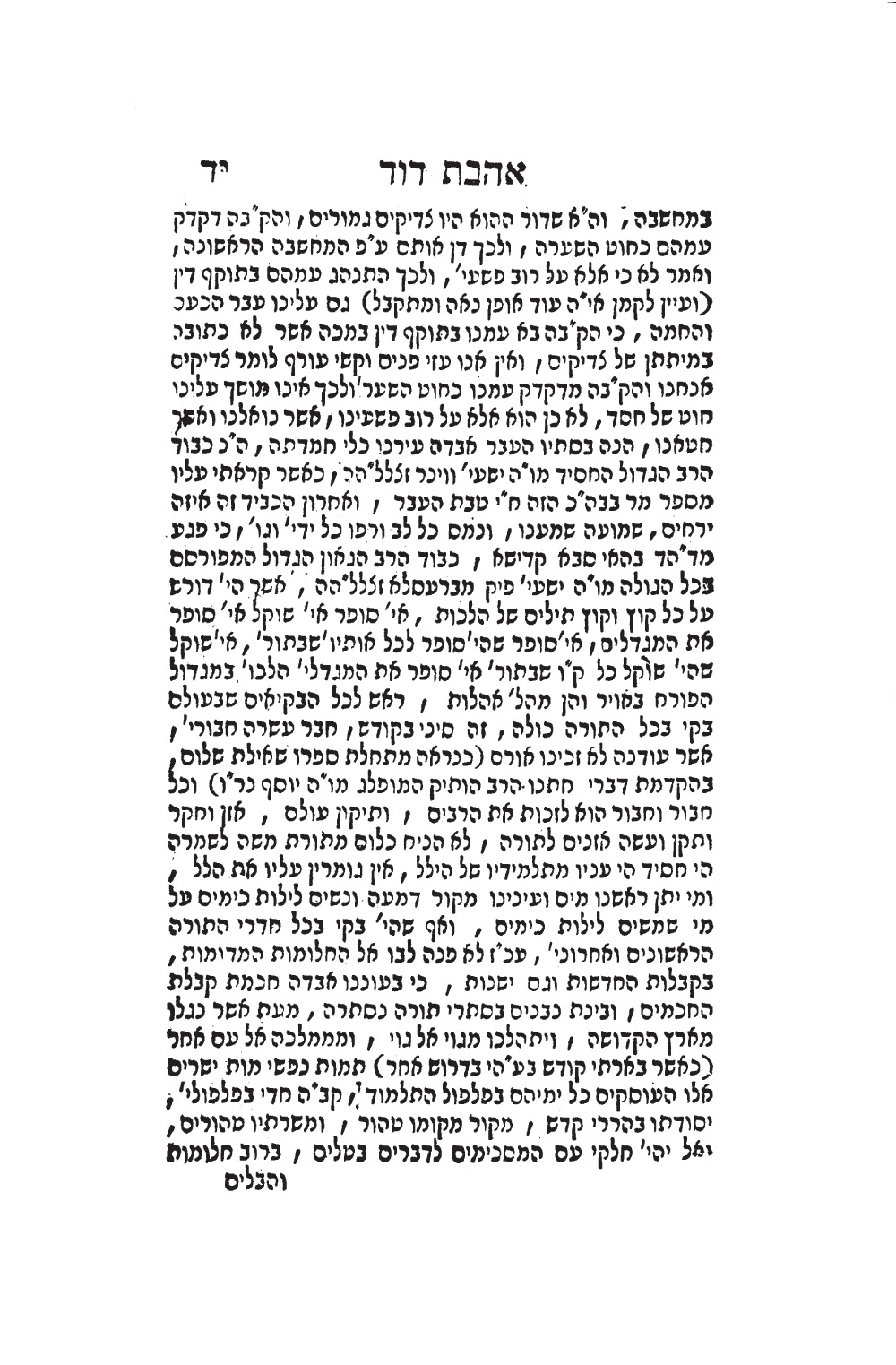
Another unique item
is Ahavat Dovid (lot
18) from R. Eleazar Fleckeles (see here)
which is series of derashot he gave against Shabbatai Tzvi and Jacob
Frank. In general, throughout R. Fleckeles
writings, there are interesting statements about Kabbalah and the Zohar
especially, in this work he prints a letter from R. Naftali Hertz Wessley which
says: 

כי שמעתי מפי הגאון המקובל הגדול שהי’ ידוע הזוהר וכל ספרי
האר”י ז”ל בעל פה הוא הרב ר’ יהונתן אייבשיטץ זצ”ל שהיה
אומר לשומעי דבריו בעיני הקבלה כשראה שהם מפקפקים בהם ואמר אם לא תאמינו אין בכך
כלום כי אין אלו מעיקרי אמונתנו, וכן היה אומר לאלו המביאים הקדמות מדברי קבלה
לישב איזה גמרא או מדרש לא חפצתי בזאת ומה חדוש על פי קבלה תוכל ליישב מה שתרצה
אמור לי הפשט הברור על ידי נגלה ואז אודך וכל זה אמת… 

This letter is
censored out of some of the editions of this work See Marc Shapiro, Changing
the Immutable
, p. 220.
Also worth
mentioning is his description of R. Yeshaya Pick in this work:
 
Some other first editions worth
mentioning are, Minchas Chinuch published anonymously in 1869 (lot 35), and
Nefesh HaChaim, Vilna 1824 (lot 86).
There
are many other noteworthy lots, including one incunabula (lot 17), and many
letters and other ephemera related to important pre-Holocaust Yeshivot,
including the Mir and Telshe and letters from R. Hayyim Heller, R. Kook,
Seridei Eish, R. Mordechai Banet. 
Hopefully this is just the first of many auctions for Legacy.


Book Announcement: Gabriel Wasserman’s Haggadah

Book Announcement:
הגדה של פסח “אשירה ואשננה בחשיקות”
מאת גבריאל וסרמן

You may purchase a copy here.

Every year, many haggadot are published, with various features, but almost all of them have the nearly identical Hebrew text. Yes, Ashkenazic haggadot have a few songs at the end that are not in most Sephardic haggadot, and some Sephardic haggadot may have a few kabbalistic passages that are not in Ashkenazic haggadot, but by and large the texts are well-nigh identical.
In the past, various communities had unique passages that they would include at various points in the seder, but hardly any books today include these passages.
Enter Haggada shel PesaḥAshira Va’ashannena Baḥashiqot”. The author of this haggada, Gabriel Wasserman, has been working on this book for years, assembling texts from various periods and places; first for use at his own seders, and then, due to popular request, also for sale. The haggada includes the text of the haggada as is customary today, but also three types of supplementary additions, at various points in the text: (a) Passages that were once common in the seder rituals of certain communities, and may still be recited in some communities today; (b) passages from rabbinic or piyyuṭic literature, which were never part of the haggada, but are appropriate for innclusion, in the spirit that “all that expand the story are praiseworthy”; and (c) passages that the author has composed himself, mostly piyyuṭim.
But this is not all. The author has included a commentary on the haggada, focusing mostly on the history of the halakhot and rituals of the seder, and on some literary issues of the texts. More detailed discussions are left for essays in back of the volume. Everything – the standard haggada text, the supplemental passages, the commentary, and the essays – is presented in two facing columns, in Hebrew and English; all translations are by the author.
A sample of the English translation is given here, from the Nishmat prayer:
The soul of every living thing renders blessing unto Thee, O Lord our God, and the spirit of all flesh praises and glorifies the mention of Thee, O our King, forever. For all eternity Thou art God, and besides Thee we have no king, redeemer or rescuer, ransomer or releaser, who sustains and has compassion in every time of distress and trouble – we have no king but Thee!
Besides the essays in the back of the volume, there are also sections including recipes (in facing Hebrew and English), and musical notation of some tunes, with discussions of the history of these tunes (again, in Hebrew and English).
One unusual feature of this haggada is that it includes not only texts for seder night, but also for lunchtime on the first two days of Pesaḥ, havdala, and, for the first time, for the night of the seventh and last nights of the holiday, called Yom Vayyosha‘ after the opening word in Exodus 14:30. (The Yom Vayyosha‘ texts, unfortunately, are not translated, but hopefully will be in a future edition.)
Available for purchase here.


Lecture Announcement: Rabbi Yechiel Goldhaber

The readership of the Seforim Blog is invited to a shiur that will be taking place this Sunday April 3, at 7 PM. The shiur will be given by the noted scholar and author Rav Yechiel Goldhaber of Eretz Yisroel (link). He has authored many wonderful articles and works on a wide range of topics, notably Minhagei Kehilos about customs, Kunditon (link) about the Titanic, and the Cherem on Spain, and two volumes of Ginzei Yehuda, a collection of assorted letters from various rabbis. (The lecture will be in English.)
The subject of the Shiur is חיפושו של ר’ ישראל משקלוב אחרי עשרת השבטים, and it will take place in Brooklyn at 3114 Quentin Rd, Brooklyn, NY 11234. 
Thank you to Dr. Shlomo Sprecher for his help in coordinating this Shiur.


שמועות נדירות בעניני ספרים וסופרים

שמועות נדירות בעניני ספרים וסופרים

מפי מור הגר שמרישולמאן שליטא

מחס באר שרים, אור לישרים, מריש בבירה, שומר הפתח, שומר מצוה ועוד

זה לי עשר שנים שזכיתי ליצוק מים על ידי אחד המיוחד מזקני הגאונים בדורינו משיירי כנה”ג דור אחרון של גאוני רבני ליטא הגאון מוהר”ר שמריהו שולמאן שליט”א. מלבד גדלותו בתורה המשתקפת מכל דף ודף מעשרות ספריו, ונוסף על זה שכבר מנעוריו נודע הגאון כבעל זכרון מופלא שאינו מאבד טיפה, עוד הוא ממלא תפקיד חשוב כממשיך שרשרת לגדולי הדורות מדורות עברו, שהוא עצמו זכה להתקרב אתם ולשמש לפניהם. הגאון המיוחד הזה זכה ללמוד וללמד תורה ברבים יותר מששים שנה באיזור קווינס, ובמיוחד בקיו גארדענס היללס, ובכל בתי המדרש ובתי הכנסת בקווינס מתבדרין שמעתיה. וכמו שזכה ללמוד וללמד בצעירותו, כן יזכה ללמוד וללמד בזקנותו, לקיים מה שנאמר בבקר זרע את זרעך ולערב אל תנח ידך.

ראיתי לנכון לרשום מקצת שמועות נדירות ששמעתי ממנו משך השנים, ולתת ברכה לפניכם היום, ומובטחני שיהיו לתועלת לשוחרי והוגי תושיה. יצויין שהדברים הבאים היו למראה עיני מו”ר הגאון, והוא אף אישר את תוכנם. התודה והברכה לידידי ר’ משה מיימון על סיועו בהכנת המאמר.

אברהם י’ וילנר

א] בתחילה אציין כמה דברים ששמעתי ממו”ר בשם רבו הגדול רבי יעקב יצחק רודערמאן זצ”ל ר”י נר ישראל בנוגע לספרים שונים.

  • הרוצה לחלק על המחנה אפרים צריך להביא ראיה לדבריו, וא”א לחלק עליו רק מסברא שסברתו היה כ”כ חזקה.
  • הראש ישיבה (=הרב רודערמאן) היה רגיל לומר שיש להסתכל בכל ספרי האחרונים, אבל בספר אור שמח צריכים ללמוד. (ר”ל שכדי להבין דבריו של האור שמח לעומקם א”א בריאה בלבד אלא שצריך לעמל וללמוד אותם כראוי, ושמעתי כמה וכמה פעמים ממו”ר עד כמה העריץ הראש ישיבה את האור שמח ועד כמה היה מפליג בשבחו).
  • אמר שכל קושיות הטובות של האחרונים אפשר למצוא אותם בשער המלך.
  • כשאמרתי למו”ר שראיתי הרבה חולקים על פסקו של רבי חיים עוזר בענין הג’אלאטין, וגם אלו שבדרך כלל לא היו פוסקים נגדו כמו, הרב אליעזר סילבר, בזה פסקו אחרת ממנו. אמר לי שהראש ישיבה הרב רודערמאן זצ”ל אמר לו, שהחזון איש אמר שעל כל פסקי רבי חיים עוזר אפשר לסמוך בלי שום פקפוק, חוץ ממה שהתיר לשמש במוך היכא שהסיבה לשימוש במוך הוא מצד האיש, שבזה א”א לסמוך1.

ב] אמר לי מו”ר שהגאון הרב חיים העליר זצ”ל אמר לו שעל שני אחרונים יש חזקה עליהם שראו כל הספרים שהיו מצוים בזמנם, הש”ך ורבי עקיבא איגר, ולכן אי אפשר לומר עליהם “אילו היה רואה דברי פלוני היה חוזר”, דליתא דכל מה שיש לראות ראו.

ג]ומו”ר כה התפעל מבקיאותו של רעק”א עד שמפאת זה החליט שכפי הנראה רעק”א כתב גליונתיו במשניות ובש”ס רק לעצמו דרך לימודו, ולא ע”מ להדפיסם. שהרי יש קושיות וחידושים בגליון הש”ס שנמצאים בספרים שקדמו, ובע”כ שלא נתכוון רעק”א בגליונותיו אלא לרשום לעצמו הערות בין משלו בין משל אחרים. לדוגמא: בגליון הש”ס ב”ק דף נ”ו העושה מלאכה במי חטאת ובפרת חטאת (כגון ששקל כנגדן משקלות) פטור מדיני אדם וחייב בדיני שמים, ופרש”י ד”ה פטור דהיזק שאינו ניכר לא שמיה היזק, והקשה ברעק”א בגליון הש”ס שם שבמקרה זה ששקל כנגדן פטור מדיני אדם אף אם היזק שאינו ניכר שמו היזק, שמכיון שלא נעשתה מלאכה בגופם לא נפסלו בכך ע”ש בגיטין דף נ”ג. וכבר הקשה כן השער המלך בפ”ז חובל ומזיק ה”ד וכן הקשה הפרי חדש בספרו מים חיים בחידושיו לגיטין דף נ”ב ע”ב (דף ט ע”ב מדפי הספר).

ובמגילה פרק א משנה ה, אין בין יום טוב לשבת אלא אכל נפש בלבד. והקשה שם בתוס’ רעק”א קשה לי למ”ש הב”י סימן רמ”ו ובהגהת שו”ע שם ס”ג בשם שבולי הלקט דאין אדם מצוה על שביתת בהמתו ביו”ט. וכן הרמב”ן בספר תולדות אדם כתב די”ל דליכא ביו”ט איסור שביתת עבדו הובא בב”י ס’ תקכ”ו א”כ אמאי לא חשיב במתני’ דבין יו”ט לשבת שביתת בהמתו ועבדו עכ”ל. והעיר מו”ר בספרו אור לישרים עמ”ס ראש השנה עמוד רו בהערות קצרות אות א’ וז”ל: “אמנם נפלא הדבר שכל הנ”ל מפורש בבית יוסף סימן תצה ד”ה כתב הכל הבו שכתב וז”ל ‘ואיני יודע טעמו של המתיר (שביתת בהמתו ביו”ט) דהא כיון דמקשינן יו”ט לשבת חוץ ממקצת דברים שנתפרשו בתלמוד ושביתת בהמה אינה מכללם האיך אפשר לומר שהיא מותרת ביו”ט’ ע”ש כל דבריו”. (א”ה ואף שיש לדחוק ולומר שיש מקום לקושיות רעק”א שהרי הוא שואל אליבא דהסוברים דאכן שביתת בהמתו מותרת ביו”ט וא”כ קשה למה לא מוזכר במתני’, והב”י סבר שא”א להתיר מכח קושיא הנ”ל אבל לאלו שסוברים תקשה כהנ”ל ומ”מ גם זה מן התימה שלא העיר רעק”א כלל שעצם הנידון כבר דנו הבית יוסף, וכן הב”ח שמלא אחרי דברי הב”י ע”ש).

ד] מלבד בקיאותו הנוראה של רעק”א, עמקותו היה להפליא, ואמר לי מו”ר שהגר”ח צימערמאן2 אמר לו שדברי רבי עקיבא איגר עמוקים מאוד מאוד, וקשה לרדת לסוף דעתו. ואמר הנ”ל שהיחיד שבאמת הבין דברי רבי עקיבא איגר עד תומם היה העילוי ממיטצי’ט, רבי שלמה פולאציק זצ”ל.

ה] ואמר לי מו”ר שאפשר להוסיף אחרון שלישי להרשימה שידעו כל ספר שהיו בנמצא בזמנם, והוא הרב חיים העליר עצמו. ומו”ר הפליג מאד את בקיאותו של הרב העליר, ואמר לי שפעם היה דין תורה קשה שהביאו לפני הרב העליר, ועקב חולשתו הפנה הד”ת לתלמידו הרב מתתיהו קאגאן זצ”ל אב”ד דקאראנא נ”י בעמ”ס מתת ידי3, ואחר שמיעת כל צדדי הד”ת כתב ר’ מתתיהו תשובה ארוכה בנידון והראה אותו לרבו, הרב העליר. אחר שעיין הרב העליר בתשובתו, שאל אותו אם הוא בעצמו חידש הדברים כאן או שהם לקוחים מאיזה ספר, וענה לו תלמידו שאלו הם דברי עצמו. אז הראה לו הרב העליר איזה ספר ישן נושן נדיר שבו היה כתוב בדיוק אותו חידוש.

ו] קצת ממה שמעתי ממו”ר אודות רבי אליעזר סילבר זצ”ל.

  • מרגליה במופיה דרבי אליעזר סילבר שאצלינו אין שום “פאריטץ’עם”4, ואפילו על רבי מאיר שמחה אפשר לחלוק.
  • סיפר לי מו”ר שכשלמד בבלטימור בימי המלחמה, הגיע לישיבה הרב אליעזר סילבר זצ”ל ושאל את הבחורים מה הם לומדים, וענו בבא בתרא והרב הנ”ל הגיב בהתפעלות “מה? רק מסכת אחת? צריכים ללמוד ש”ס!”5, ואמר כשהוא היה צעיר למד סדר א נשים, וסדר ב נזיקין.
  • כשהגיע הגרי”ד הלוי סולובייצ’יק לארצה”ב כיבדו אותו האגודת הרבנים למסור שיעור, והיה אז בעשרת ימי תשובה, ומסר שיעור על עניני עבודת יום הכיפורים בפני כל הרבנים. לפני השיעור לחש לו אביו, הרב משה, שאין עליו לדאוג ולפחד מאף אחד, חוץ מהרב אליעזר סילבר זצ”ל, שהרי כל תוספות ישנים שביומא ידועים לו.

ז] סיפר לי שאחד ממקורבי החפץ חיים, הרב פופקא, אמר לו שאחר שיצא לאור ספר משנה ברורה קיבל החפץ חיים מכתב מהרב יצחק שוסטער שהיה רב באיזהו עייריה בליטא ונודע כבקי גדול בירושלמי, ובו הרבה הערות על המשנה ברורה מהירושלמי. הח”ח קרא לבנו רב לייב6 להביא לו הכת”י מהספר, ואמר לו “תראה שכל ההערות של הרב הנ”ל כבר כתבתי אודותיהם, ויישבתי הקושיות, אלא שלא רציתי להכניס את כל הפילפול והלומדות לתוך הספר”. הרי שמטרת ספרו לא היה להראות גדלותו בתורה רק שיהיה משנה ברורה – כשמו כך הוא.

וכן אמר לי מו”ר כמה פעמים לעיין היטב בדברי המשנה ברורה וביאור הלכה שהספר באמת מלא לומדות, רק שאינו ניכר כל כך משום שקיצר החפץ חיים בלשונו, והרבה מהלמדות שלו “מובלעים הם” תוך דבריו במילים ספורות. וחזר על הנ”ל שלא היה ברצונו להראות גדלותו בתורה וכו’.

ח]סיפר לי שהוא שמע זה מאיש שהיה נוכח אז, לפני למעלה משמונים שנה כשהמקרר היה דבר חדש בעולם, התקיים אסיפת רבנים בבית רבי משה סולובייצ’יק לדון אי מותר לפתוח דלת המקרר בשבת. וכידוע ששלחו שאלה זו להרב שמחה זעליג ריגר הדיין מבריסק, והלה העלה להתיר (ותשובתו נדפסה ב’הפרדס’). בשעת האסיפה אמר הגר”מ שרב שמחה זעליג התיר, ורב אחר שהיה נוכח שם אמר “נו, ומה אומרים הפוסקים האחרים?”. מיד התחילו הנוכחים לצטט פוסקים אחרים בנושא, ואמנם הרבנית, אשת הגר”מ, שהיתה בחדר הסמוך שמעה כל המו”מ וקראה בקול “אני לא מבינה, אם רב שמחה זעליג התיר האם צריכים עוד לדון מה סברו אחרים?” והגר”מ אמר שהיא צודקת ואין על מה לדון עוד, ובכך נסתיים הדיון.

ט] הנה מפורסם מה שאומרים (יש מייחסים השמוע להרב ברוך בער, ובספר תולדות חייו של רבי ברוך בער מובא שרב ברוך בער אמר זה בשם רבו הגר”ח) שמה שהספר שאגת אריה הוא מקובל בעולם יותר משאר ספריו הטורי אבן והגבורת ארי, הוא משום שספרו הראשון שאגת אריה נכתב בימי עניותו ואילו שאר ספריו נכתבו שכבר היה לו במה לפרנס את עצמו. ואמר לי מו”ר שהגר”ח צימערמאן זצ”ל אמר שהשמועה אינה נכונה וא”א לומר דבר כזה, והשאגת אריה היה אותו שאגת אריה בכל המצבים – עם כסף ובלא כסף.

י] אמר לי פעם שהעיקר בפסק הוא הסייעתא דשמיא שיש לרבנים. וסיפר לי ששמע מהרב אנשיל וויינהיוז (אחד מלומדי ישיבת מיר בפולין) שהיה פעם שאלה קשה על איזה ריאה של בהמה בבית המטבחיים בבריסק, וירד הגאון רבי חיים זצ”ל, רבה של בריסק, ביחד עם הדיין, רבי שמחה זעליג זצ”ל, לבדוק אותה, ופסק הגר”ח להקל והכשיר הבהמה. ואז שאל רש”ז את הגר”ח “תינח בבריסק שיש לנו רבי חיים שיכול לפסוק שאלה קשה כזאת, אבל מה יהיה אם שאלה כזאת תהיה בעיירה אחרת שאין לה את הגר”ח?”, ענה לו הגר”ח שאין למה לדאוג שיש סייעתא דשמיא מיוחדת לרב לפסוק ההלכה הנכונה. הנה באותו עת הגיע איזה רב מעיר אחרת שבא לבקר אצל הגר”ח, ושאל אותו מה הוא סובר על אותה שאלה שהם דנו, וענה אותו רב שמותר כמו שכתוב בספר פלוני בדף פלוני, והלכו אח”כ הגר”ח ורש”ז לראות הספר בפנים וראו שבאותו ספר שהרב ציטט, פוסק לאיסור בנד”ד – בדיוק ההיפך ממה שסבר הרב. אז אמר הגר”ח להרש”ז אתה רואה איזה סייעתא דשמיא יש לרבנים, שהוא כיון להפסק הנכון (לדעתו של הגר”ח) תוך טעות בזכרון.

יא] מו”ר שמע מישיש אחד יליד לבוב, כשנפטר בעל הישועות יעקב הציעו לנכדו שהיה בעל מסחר, שימלא את מקומו של זקנו כרבה של לבוב אבל הלה סירב. ואח”כ כשהתחיל עסקו לרדת והפסיד הרבה כסף עד שכמעט פשט רגל, אשתו הציעה לו שילך להתפלל על קבר של זקנו בעל הישועות יעקב להתפלל להטבת מצבם , ענה לה בתמיה “לזקנו? הלא הוא זה שגרם לי כל הירידה הזאת, שרצונו הוא שאני יקבל עול הרבנות במקומו ולא לעסוק בעסוקים”.

עוד אמר מו”ר שהסיבה שהשני גיסים הגדולים בעלי המגן גיבורים הפסיקו ללמוד אחד עם השני (ולכן הספר שלהם הולך רק עד סוף הלכות ערבית) היה עקב המחלוקת הגדולה ביניהם בענין מצת מכונה. ואמר מו”ר שרואים גדלותו של הספר ממה שהמשנה ברורה בשני חלקים הראשונים אינו זז מדבריהם.

יב] מו”ר שמע מישיש אחד מתושבי סלוצק, שבימי הגאון מוה”ר יוסף ז”ל אבד”ק סלוצק ביום ב’ או ה’ בתפלת הבקר היה שם בעל ברית וגם יארצייט, ושניהם בקשו להכבד בעלייה לתורה, והורה שיקראו לבעל הברית לעלות לתורה. וכששאלוהו ע”ז הרי במג”א (סימן רפ”ב) מפורש דמי שיש לו יארצייט קודם לבע”ב, ענה דה”מ כשיש רק מנין א’ בעיר, אבל בק”ק סלוצק יש תה”ל הרבה בימ”ד והרבה מנינים, ורק הברית מיוחדת בביהכ”נ זו מפני שהיה שם כסא של אליהו מיוחד, ומשו”ה כל הבר”מ היו שם בבית הכנסת, ובעל היארצייט יוכל למצוא הרבה מנינים ובתי כנסיות אחרים7.

יג] פעם הזכרתי למו”ר חקירה מחודשת מספר יד שאול לבעל השאול ומשיב שחקר אם חייבים לעמוד בפני גר שנתגייר כשהיה מעל גיל שבעים מאחר שגר שנתגייר כקטן שנולד דמי, ומו”ר מאוד התפעל שאפשר לחקור חקירה כזאת שנשמע מאוד מוזר, ואמר שזה מזכירו האיך הגר”ח ציממרמן היה תמיד מתלוצץ על החקירה אם ב’ אחים שנתגיירו ומתו מחמת מילה אם יבוא אח שלישי שרוצה להתגייר אי אמרינן עליו שאין יכול למולו משום מתו אחיו או לא, משום גר שנתגייר כקטן שנולד דמי ואינם נקראים אחיו, והגר”ח ציממרמן היה מתלוצץ על זה שבדברים שתלוים במציאות א”א לחקור חקירות עליהם.

1 הנה ממש לאחרונה יצא לאור ספר מסורת משה חלק ב’ (ירושלים תשע”ו) ושם בעמ’ שיג-ד נמסר מפי הגר”מ פיינשטיין כדברים האלה: “אבל כדי להתיר מוך, שהוא באמת אסור, שלא נראה שהוצדק הרב חיים עוזר במה שמחשיבו כדרך תשמיש, צריך מצב של סכנה”.

2הגר”ח צימערמאן ויבל”ח מו”ר שליט”א היו ידידים טובים ונאמנים במשך שנים רבות, ומו”ר מרבה בשבחו ומצטט תמיד דבריו חידושיו ומאמריו, ואמר מלבד גדלותו בתורה היה הגר”ח סמל של “ערליכער איד” שפירושו של ערליכער איד אמיתי אינו כשאחד מתנהג ע”פ רוח התורה כשנוח לו, רק המתנהג כן בשעת נסיון, ולהגר”ח הוצע לו כמה פעמים מטעם בית מדרש לרבנים ע”ש שכטר לבוא וללמוד אצליהם בלי שום משרה רשמית ולקבל תקציב הגון רק עבור לימוד בבית מדרשם (והסמינר אז לא היה כזה גרוע כמו היום) והגר”ח היה דוחה אותם כל פעם בלי לחשוב לרגע קט, למרות כמה היה זקוק לכסף אז. ואמר אף שהגר”ח לא פחד לדבר ולהתווכח בלימוד ולכנס לריתחא דאורייתא עם אף אחד עכ”ז עם שנים היה הגר”ח מכניע כתלמיד לפני רבו ודיבר איתם בסיגנון אחר לגמרי דודו רבי ברוך בער ורבי משה סולובייציק. ומו”ר אמר לי שהגר”ח העריץ רבי יעקב ספסל העילוי מווישקי כרבו.

3 מו”ר היה מאריך בשבחיו כמה פעמים, ומאחר שהוא אינו ידוע כ”כ היום, אגיד קצת שבחיו ממה שמעתי ממו”ר במשך השנים. הרב קאגאן למד אצל רבי חיים העליר בברלין ואמר לי פעם שהוא היה לא פחות מהמפורסמים שלמדו אצל הגר”ח בברלין, ובהזדמנות אחרת אמר לי שיש בספרו כמה מו”מ בינו ובין מרן הגר”מ פיינשטיין זצ”ל שהיה מקשה על דברי הגר”מ וכו’ ואמר “שהיה ראוי לכך לשאת וליתן עם הגר”מ”. ואגב אציין שאלה הלכתית מעניינת שהיתה בין מו”ר והרב קאגאן, שלתקופה מסויימת היה מו”ר הבעל קורא בבית כנסת של רב קאגאן, ובשבת אחד באמצע החורף כשירד שלג גדול לא הגיע מנין אנשים באותו שבת להתפלל, לשבוע הבא הורה הרב קאגאן לקרוא שני פרשיות, פרשת השבוע ולהשלים משבוע שלעבר שלא קרינו בתורה, ומו”ר התווכח איתו ואמר שאין דין תשלומין אלא בכגון שהיה מנין ולאיזה שום סיבה לא קראו בתורה אבל אם בכלל לא היה מנין אז לא חל עליהם חיוב קריאות התורה שבעי להשלים, ולכן אם יהיו עשרה אנשים שלא הגיעו לבית הכנסת אם הם כולם יגיעו השבוע הבא אין שום חיוב עליהם להשלים, רק על מנין שלא קראו, והרב קאגאן לא הסכים איתו. וע’ בספרו מתת ידי סימן י”ד מש”כ בזה.

4 ברוסיא פעם היו האיכרים משועבדים לשר בעל הקרקע כאילו נמכרו לו ממכרת עבד. ושר זה נקרא בלשונם פאריטץ, וכמובן היו מפחדים ממנו.

5 ואמר את זה בהברה הליטאית המובהקת שלו שנשמע כאילו אמר ‘ס”ש’.

6 באחד הפעמים שסיפר לי הנ”ל אמר שאגב שמעניין שהחפץ חיים היה קורא לבנו בתואר רב, רב ליב.

7 מו”ר משתמש בסיפור זה בספרו שומר הפתח על יו”ד בראשית דבר עמוד ג’ כדוגמא שאפילו הלכות פסוקות ומפורשות צריכות גם כן רבא. ע”ש שמביא דוגמאות נוספות להנ”ל.


The Valmadonna Broadside Collection: a Review Essay

The Valmadonna Broadside Collection: Review essay
By Eliezer Brodt and Dan Rabinowitz

The Writing on the Wall: A catalogue of Judaica Broadsides from the Valmadonna Trust Library, edited by Sharon Liberman Mintz, Shaul Seidler-Feller and David Wachtel, London-New York: 2015, 320 pp.

Jews have been collecting books or manuscripts for centuries. A related category that is collected by fewer is ephemera, including broadsides, documents and letters of historical significance. Of late, a few annual auctions have included some of these documents among the other objects to be auctioned. Sadly, after their appearance in the auctions’ catalogs, most of the rare items disappear in to private collections and are invariably almost impossible to track down post-auction. The result is that a valuable amount of historical information is lost to the public. Moreover, to date, there is no database that tracks or records these items.[1]
First, a definition of the type of material – broadsides; they “are all around us whether we recognize them as such or not. Walking down the street… entering the lobby of a public building… we daily even hourly see flyers for event, advertising posters, public announcements and more.” Using “the most expansive conception we can say that the broadside has been with us since antiquity… The public display of information… has been ubiquitous for a very long time.” (p. 6).
In an important and excellent essay on Jewish bibliography written in 1976,[2] Professor Israel Ta-Shema remarks that because broadsides were intended and read by “thousands and potentially hundreds of thousands” they are among the “important sources for both Jewish history and the history of Hebrew printing.”

ענין לעצמו שלא זכה למיטב ידיעתי לשום טיפול עד עצם היום הזה, הוא רישומם הביבליוגרפי של ‘הדפים הבודדים’. לפי הערכות שקולות מגיע מספרם של אלה לאלפים רבים, ואולי עד כדי רבבה, וחשיבותן הן לידיעת תולדות ישראל והן לידיעת קורות הדפוס העברי גדולה ביותר. בדרך כלל קשורים דפים אלה במריבות בין חשובי הקהל ורבניהם, סכסוכי משפחות, בנים נודדים, פולמסים דתיים וכו’. דפים אלה שנתלו או הודבקו על קירות בתי הגיטו או בבתי הכנסת וכד’ אבדו ברובם המכריע, וכל מה שנשתמר מהם הוא בגדר יוצא מן הכלל. ערך ביוחד יש לסוג ספרותי זה ביחס לפולמוסים הפנים-חסידיים והמתגנגדיים. לסוג זה יש לצרף את המודעות והכרזות עד לתקופתנו אנו, כולל כרוזי המחתרות האנטי היטלריסיות בחו”ל והאנטי מנדטריות בארץ ישראל, כרוזי נטורי קרתא וכד’, שהם רבים מאוד. מלבדם נדפסו על דפים בודדים, קמיעות וסגולות, לוחות קיר, דברי פרסומת, הסכמות נפרדות ועוד, ויש ביניהם גם מעשיות עממיות קצרות על דף אחד. [מצוי ורצוי בביבליוגרפיה העברית, יד לקורא טו (תשל”ו), עמ’ 79-7 ].        

History is not the only subject to benefit from broadsides.  The prolific author, R. Eliyahu David Teomim (Aderet), published and annotated a broadside recording the customs of the Great Synagogue of the Austria, whose Rabbis had included R. Shmuel Edels (Maharsha).[3]  
Recently some of collectors of broadsides have begun printing and reproducing these priceless treasures.[4] The Valmadonna Trust Library (see here), still one of the most significant private Hebraica libraries (for an appreciation of the Valmadonna Library, penned by its librarian and published at the Seforim blog in 2009, see here), published a catalog of the broadsides in its collection, The Writing on the Wall: A catalogue of Judaica Broadsides from the Valmadonna Trust Library, edited by Sharon Liberman Mintz, Shaul Seidler-Feller and David Wachtel (see here). In conjunction with the publication of the catalog, the Trust also made available online (here) all of the documents in its collection for further study. The collection is comprised of broadsides from the sixteenth to twentieth centuries and incorporates items from Italy (the library generally focused on Italy and Italian items and broadsides are no exception, with Italian broadsides being the largest of the collection), and elsewhere in Europe, Israel, Yemen, Iraq, Constantinople, India, and even one from America.
The book consists of a few parts. It begins with five scholarly essays on specific subjects by various experts. Following are excellent full-page reproductions of thirty-six highlights from the collection, including a description explaining the significance of the specific document. A full catalog of the collection is included and is divided into six main categories; each category is chronologically ordered. The six categories are: Poems, Prayers, Documents from Within the Jewish Community, Documents from Outside the Jewish Community, Calendars and Education. Each entry includes a description of the item, the title, author place and date of printing, printer, size and language. Some entries include additional bibliographical sources; others provide a small image of the item. Additionally, the non-English broadsides included in the highlight section are translated. The volume concludes with various other useful indexes.
The first introductory essay is an excellent overview of Jewish broadsides by Adam Shear. Shear asks and answers the basic questions that come to mind, such as: “What was the purpose?”, “Who was the audience?”, “Where were they displayed?” and the like, none of which can be answered singularly.  
The second essay is by Elisheva Carlebach and focuses on the Jewish wall calendars in the collection.[5] She explores what can be learned from tracing the cultural history of one of the printers of these calendars through various calendars he printed. Some of these calendars were very sophisticated and it’s unclear who the targeted audience was. Emphasizing calendar broadsides’ unique value, she concludes that “the most ephemeral of forms, broadside calendars preserve a glimpse of the printshop as workspace, the spirit of entrepreneurship and the enduring values of the creators of these humble yet precious objects” (p. 30).
The third essay is written by Ruth Langer and focuses on the Liturgical Broadsides of the collection.  Some are prayers for current events, one of interest (printed on p.33) is for a memorial service for a building that collapsed in Mantua in 1776 where three weddings were taking place simultaneously.[6] Also discussed are the prayers for various civic events (p. 35) and for the various governing powers, a subject which still needs to be explored in depth. Some of these broadsides were clearly displayed in shuls; one includes the language of the prayers, defusing the power of bad dreams and request for substance, that are recited along with Birchat Cohanim (p.15), others include prayer that are recited during Selichot (p.14). One broadside, printed in Izmir in 1890, contains the Vidduy of Yom Kippur, printed with each entry of the Aleph Beis featuring other sins under that letter, very similar to the sheets given out in various shuls today (p.44). Not all were intended for the public display, the following broadside from Venice 1607 (Item # 153) appears to have been hanging in the house, for the owners’ personal use.
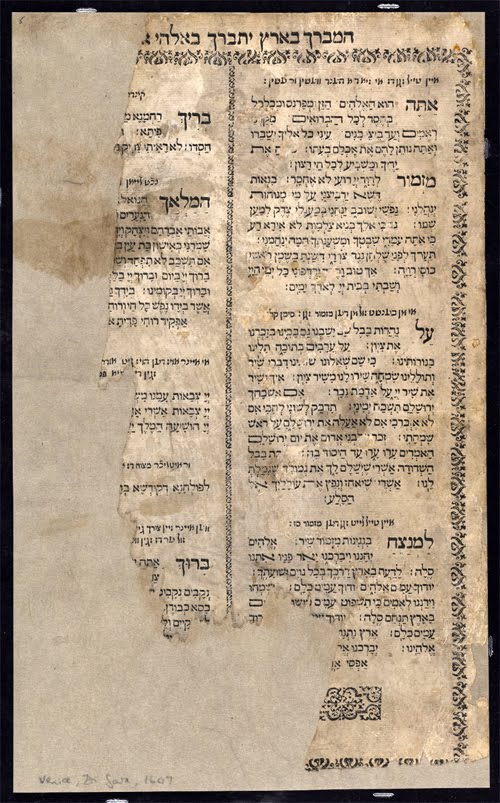
The next essay, by Dvora Bregman, focuses on the Hebrew poems in the collection (mostly from Italy). This section also highlights various pieces of historical interest. Reading through it, one is amazed how poems were written for literally every occasion – completion of Mishna, Venice, 1630 (p.55), receiving a medical degree (p.51, there are sixteen examples in the collection), in honor of R. Israel Chazan’s[7] visit to the old Greek synagogue in Corfu in 1853 (item # 134) (see below). Some of the poems were written after the deaths of prominent people such as an Italian elegy for R’ Moshe Zacuto which is reproduced in full and translated from Italian to English. Other elegies include one for R’ Yehudah Aryeh Modena (see below) and for R’ Mordechai Gerondi, the latter written by his friend Shadal (see below). There are also many “wedding riddles” in the collection – providing evidence of another rich and diverse aspect of Jewish life in Italy. 

The next section, originally written in Hebrew by Nachum Rakover and translated into English for this volume by Shaul Seidler-Feller, focuses on the Takanot broadsides found in this collection. Sumptuary edicts, limiting the size of a celebratory affair and the amount of people invited, the amount of food to be served, or the amount of money to be spent on various sorts of occasions were commonplace from the medieval until the modern period.  For example, we note that the Nodeh Beyhehudah and his beis din in Prague issued a list of such Takonot.[8] Rakover is in middle of preparing for publication a thorough study on the subject. In the volume under review, his article deals with the seventeen Italian broadsides related to sumptuary laws in the Valmadonna Collection from 1598-1794. The article is impressive in its sweeping review of the topic and the placement of these items within the larger narrative. What is apparent from the examples in the collection is that sumptuary laws have been persistent. Indeed, recently the cudgel has been taken up anew and a new round of such edicts by numerous rabbis and Hasidic leaders to limit spending has been promulgated. 
                                                  
Exploring the Collection
The introductory essays are only the beginning in what can be uncovered in a collection as rich as this one.  By providing online access, the Trust has insured that can occur.  To begin that exploration, we discuss a few choice examples.
As was recently the case with American Pharaoh, Jewish have been involved in sport, and specifically horse racing.  The collection includes two Italian broadsides discussing the horses and the Jewish sponsorship of a horse race. (Nos. 311 & 328).
One surprising and lengthy – some ninety lines – ode was composed in Hebrew (ca. 1740) and is a “poem of praise and supplication addressed to Angelo Maria Quirini (1680-1755), an Italian Cardinal.”  This item is “a single bi[-]folio excised from a larger work, most likely a pamphlet,” and is “not a true broadside.” (No. 130). No additional information is provided on this intriguing item.[9]
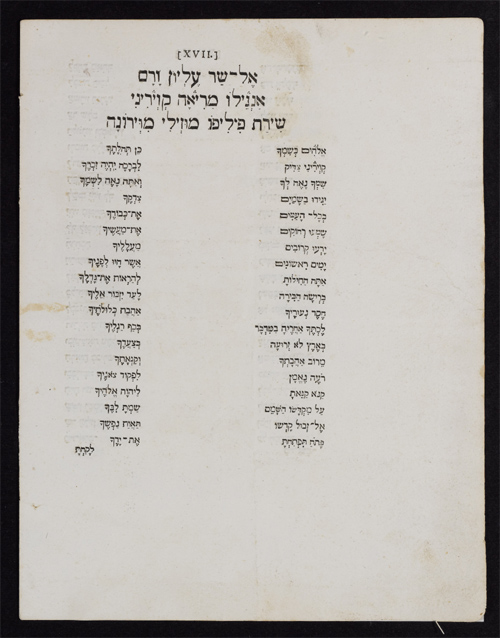
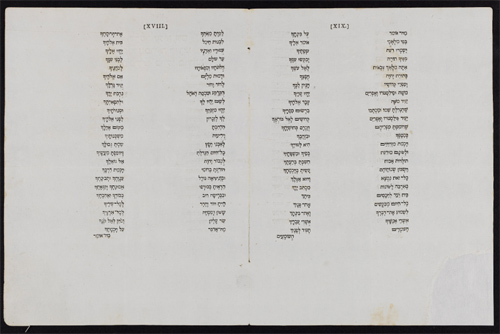
Friday Night Candle Lighting Prayers

The following broadside from Venice 1835, (reproduced on p. 17), contains the text of the prayers that were customarily recited by women on Friday evening during the candle lighting ceremony.
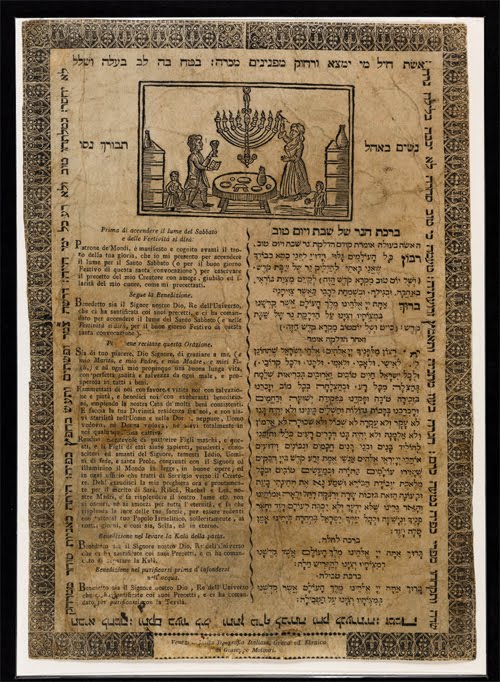
The illustration depicts a woman lighting eight candles. The Rishonim, including Italian sources, Shibolei Haleket (Siman 59) and Sefer Hatadir (p.196), only require and discuss two candles for Shabbos.[10] The question is when exactly did people start lighting more? The exact time when this began is unknown. However, in the “Shulchan Aruch” from R’ Yehudah Aryeh Modenah (1571-1648) he describes the Italian custom of lighting multiple candles:
והנשים חייבות להדליק בבית נר של שמן ובתוכו לכל הפחות ארבע או שש פתילית להאיר בערב עד עבור חלק גדול מהלילה [עמ’ 54].
Some continued to advance the numbers and in the 19th century, one author records the custom of lighting 31, 45, and 52 candles weekly.
מה מאוד היה מכבד שבת ויום טוב והיה מנהגו להדליק בכל שבת ל”א נרות כמנין אל כי בו שבת אל מכל מלאכתו, ובסוף ימיו מ”ה נרות, ולפני מותו היה מצווה להדליק בשנה ראשונה בחדר שהיה לומד בו נ”ב נרות כל שבת [מה שהעידו על ר’ הירץ אברהם נפתלי שייאר בהקדמת נכד המחבר לפירושו תורי זהב, (על שיר השירים), ירושלים תשס”ג, עמ’ טז].
Corporal Punishment
The following broadside poster for the instruction of children is from Italy 1846 (125):[11]
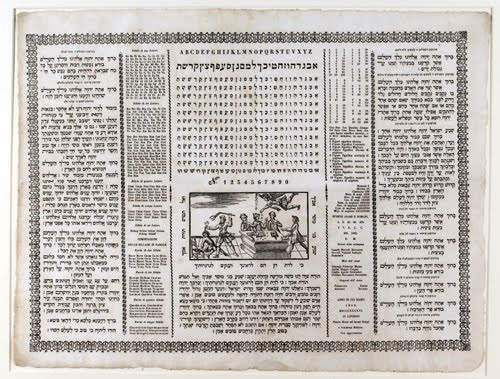

One striking part of the image is of the teacher hitting children in school. This sort of practice is recorded in a number of Jewish texts.[12]  For example:

A 17th century autobiography recounts that “the new teacher was of an irritable temper… he hit me and put me to shame…”. [Alexander Marx, Studies in Jewish History and Booklore, New York 1944, p. 193].

R’ Yaakov Emden writes in his autobiography:
בשנות הילדות… אזכיר איזה גרגרים, שלשה דברים נוראים שקרו לי בימי ילדותי הרכות. … ומלבד המכות אשר הוכיתי בית מאהבי המלמדים אשר נמסרתי בידיהם ללימוד, היו על פי רוב אכזרים, היכוני בלי חמלה… [מגלת ספר, עמ’ 84].
Saul Berlin writes in his satirical work:
ומתועלת ההכאה עוד, כי הוא צד היתר למלמדים לקבל שכר, כי על הלמוד לבד אסור לקבל שכר, משום קרדום לחתו בו, ואם כן כל מלמד המרבה להכות הרי זה משובח… ועוד רבה התועלת ע”י ההכאה אשר הילדים מכים ולוקים בבית הספר, כי ליראתם את המכות קרבת מוריהם יחפצו וירבו עליהם מוהר ומתן למען חנות אותם, ובהגיע חודש ומועד יפצירו הילדים באבותם לתת להם משאת רב, להביא אל רבם לתתם לו כופר נפשם…”. [כתב יושר, [בתוך: יהודה פרידלנדר, פרקים בסאטירה העברית בשלהי מאה הי”ח בגרמניה, תל אביב תש”ם], עמ’  98].
R’ Yosef Kara writes:
שבהיותי בצוותא חדא אם כבוד ידידי הגאון הצדיק מו”ה שמעון סופר אב”ד דק”ק קראקא… והוא אמר ז”ל כי זה רע חולי שאין חפץ לגדולי לומדי תורה להיות מקרי דרדקי, כי הוא חרפה להם ע”כ מוכרחים אבות הבנים ליתן בניהם הקטנים אל איש אשר לא ידע ספר קרוא מקרא ודקדוק אך ידע להכות הבנים ולזעוק בקול גדול… [קול אמר קרא, פ’ פנחס, עמ’ 20].
This broadside from Amsterdam 1666 is a little more famous, as it’s a supposed depiction of Shabbetai Tzvi. A complete translation for the Dutch is provided in at the appendix (pp.264-65).
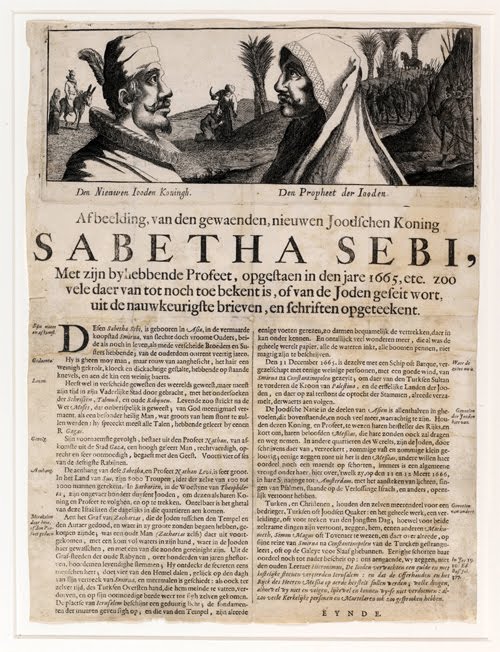
Gershom Scholem writes that this portrait of Tzvi is fictitious – one of a number of imaginary portraits. (Sabbatai Sevi, pp. 190-191, 158). The only picture of Shabbetai Tzvi believed to be authentic (that is, drawn by a witness) is the one found in the beginning of Thomas Coenen’s book Ydele Verwachtinge der Joden, Amsterdam 1669.[13] There might be others as well, but King Jan Casimir ordered all pictures of him to be destroyed (id., p. 597). This one, fortunately, was published.
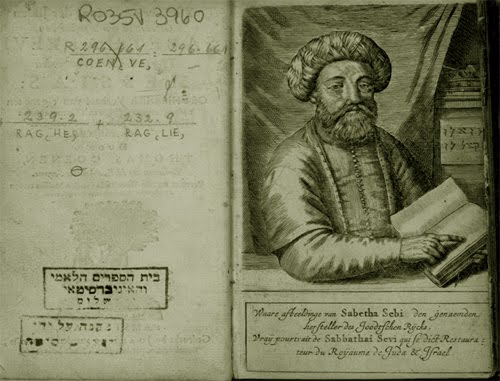
(This is from Scholem’s personal copy.)

Kabbalistic Tefilos for Rosh Hashanah
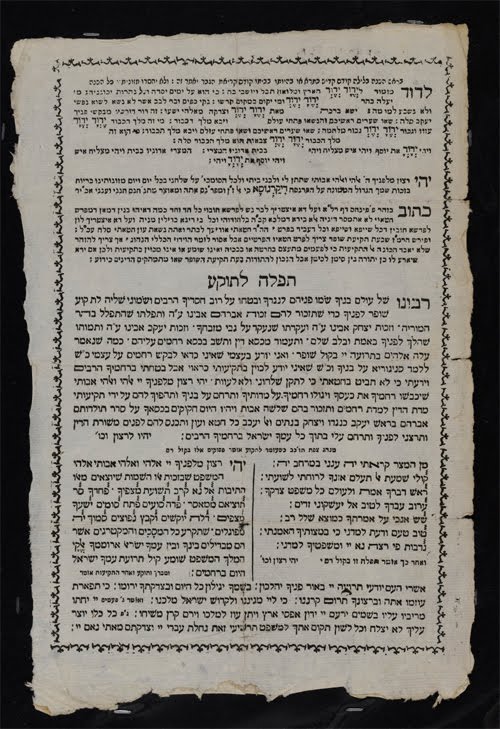

This broadside from Mantua 1790, reproduced in the book (p.43), is of interest for several reasons. First, the top part of the broadside has the twenty fourth chapter of Tehilim, said by many Kehilot on Rosh Hashanah as a segulah for Parnasa.[14] In a work written around 1700, recently printed from manuscript, we find the author writes:

אחר ערבית, יש לי תוכחת מגולה ומסותרת אם קצת משכילים, שהנהיגו לקרות בבית הכנסת בציבור אחר עלינו לשבח בלילי ר”ה, מזמור לה’ הארץ ומלואה, ולכוין הנקוד של השם, ככתוב בספר שערי ציון, שהוא מסוגל לפרנסה, שלא יפה הם עושים, כי לא כן צוה הרב המגיד לנו סוד זה, והצנועים נהגו לאמרו בשני הלילות שתי פעמים בכל לילה תכופים זה לזה… והקריאה על שולחנו קודם ברכת מזון… דבר הלמד מענינו, בהצנע לכת עם אלקיך. על כן אמרתי ימים ידברו, להויע ידידי הקורא שדבר בדוק ומנוסה שכל סגולה הנעשית על ידי תפלה בשום כוונה או שם, שאין לך לפרסמו ברבים. ולא לגלותו כי אם לתלמיד הגון ירא חטא ובלחישה, לבל היה מוליך רכיל מגלה סוד, שאז תהיה הפעולה חלושה… [ר’ כליפא בן מלכה, כף נקי, [לוד תשע”ד] עמ’ 167].

The second part of this broadside is also of interest, as it has the tefilos said before, during and after the shofar blowing, including some of the Kabblastic tefilos with names of angels. Of note is what is omitted here, those parts said between the various sets of Shofar blowing, which has been the subject of lots of literature[15], as it includes a very strange phrase, that seemingly evokes Jesus: ישוע שר הפנים””.
Here is an article written on this topic by R’ Shmuel Ashkenazi written in 1944 (!) under one of his pen names:
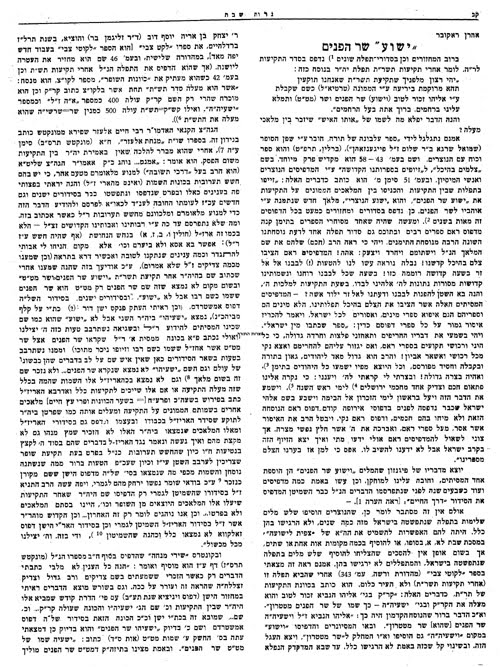
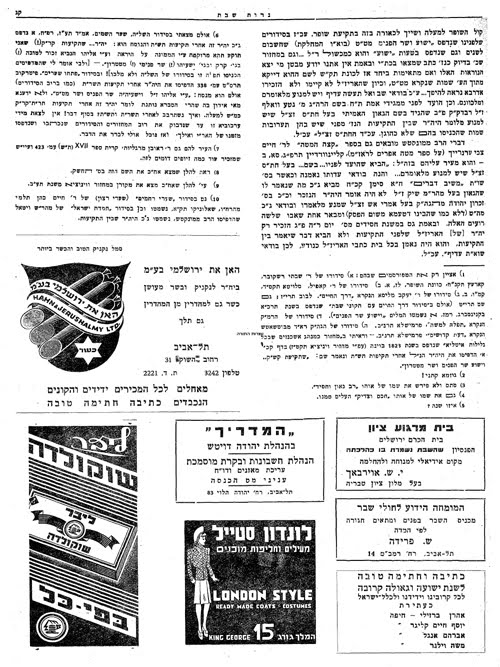
One more point related to this topic is a case of censorship. R’ Chaim Kraus writes:
 הנה בזכר יהוסף… מתיחס לזה שבדפוסים האחרונים בשו”ת תשובה מאהבה הושמט הענין הנ”ל שכתב בחריפות נגד אמירת היהי רצון שמות המלאכים… [מכלכל חיים בחסד, עמ’ סד].
However, upon checking the sources to see when in the printing of the sefer Teshuvah M’Ahavah this censorship took place, one is hard pressed to find it, as it’s simply not there. The actual issue is a bit different; Kraus misunderstood R’ Yosef Zechariah Stern’s teshuvah.
In an extraordinary teshuvah dealing with these prayers (Zecher Yehosef, Siman 210), R’ Yosef Zechariah Stern mentions a certain case of censorship:
ובתשובה מאהבה ח”א סי’ א שהועתקה תשובתו בדבר הפיוטים ברוב המחזורים.. והמדפיסים להפיס דעת ההמון שהורגלו באמירת היהי רצון שבתקיעות השמיטו מה שהזכיר בסוף התשובה אות ס’ שמרעם בהזכרת שמות המלאכים… וכן השמיטו המדפיסים בהעתקתם מהתשובה מאהבה מה שהעיד מהנודע ביהודה שאחד היה רוצה לברך על אתרוג המהודר שלו וכשראה שאומר היהיה רצון… אמר איני מניחו לברך על אתרוג שלי…
This Teshuvah was printed in various Machzorim at the time and that is where these parts of the teshuva were indeed bowdlerized. See the following images for the pages as they appear in the Korbon Aharon Machazor printed in Vilna in 1839 and compare with the first print of the teshuvah (Prague, 1809).
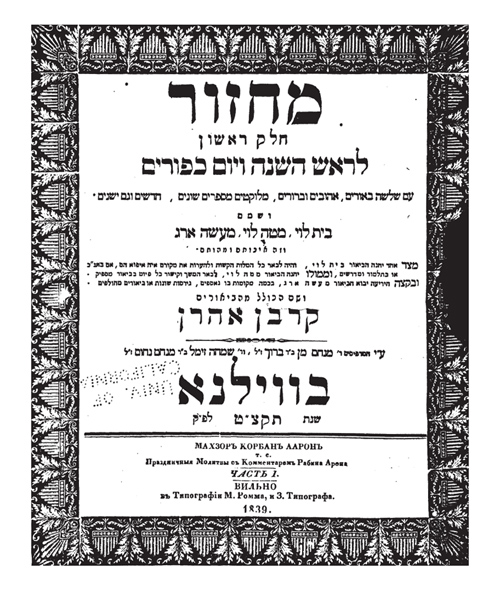
Amulet Broadsides
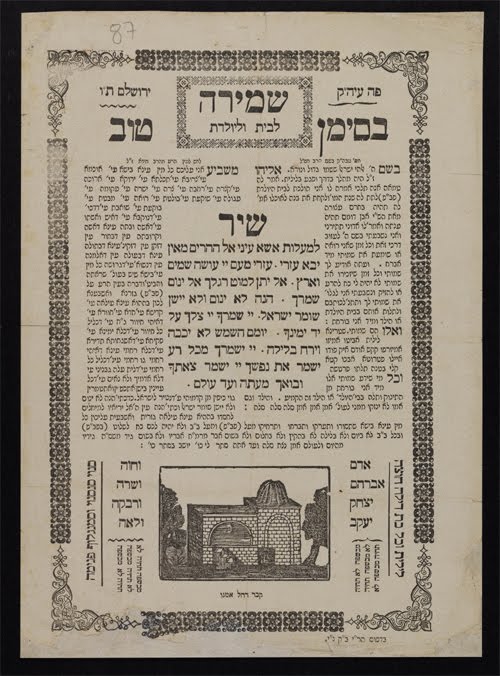

This image from Jerusalem 1870 (pp. 130-131) highlights another notable part of this collection – the Amulet section. It contains numerous broadsides against the “evil eye”, aimed at protecting the newborn mother from Lilith and the like (pp. 132-135, 141-143, 194-197). This is yet an additional set of documents which demonstrate how widespread it was for people to use amulets and the fear of the “evil eye” and the like.
There are numerous sources on regarding amulets, some mentioned here.[16] One source, that was only recently published in English, is from a fascinating memoir by Pauline Wengeroff, who writes: “for the same purpose of protecting the newborn, Jews used to affix kabbalistic prayers called shemaus over the head of the new mother, a second page on the door and a third between the cushion of the child.”[17]
Controversy against R’ Shlomo Ganzfried – Author of Kitzur Shulhan Aruch

This document relates to a controversy between R’ Shlomo Ganzfried and the R’ Chaim Halberstamm, the Divrei Chaim. In his work Ohali Shem on Gittin, R’ Ganzfried took issue with some legal rulings of the Divrei Chaim. This erupted into a series of small works from R’ Weber, starting in 1882, defending the honor of the Divrei Chaim. R’ Ganzfried responded to one of them in the back of the 1884 edition of his Kitzur Shulchan Aruch.
This broadside (above) from R’ Weber against R’ Ganzfried, found in the Valmadonna Collection, is very rare (p. 217 #360).[18] 
The Valmadonna Collection has another rare broadside from R’ Weber (below), related to the famous controversy of the Corfu Esrogim (p. 219 # 369).[19] This is not included in Naftali Ben Menachem’s otherwise comprehensive article regarding R’ Weber.

Regarding this broadside, it’s worth quoting the great historian[20] and native of the Old Yishuv, Eliezer Malachi:
ור’ מרדכי אליעזר וובר, הרב דאדא, זה האחרון היה אש לוהטת, ובקנאותו לא ידע גבול, עד שבשנת תרנ”א אסרו את אתרוגי קורפו לטובת אתרוגי ארץ ישראל, נלחם הוא להתיר אתרוגי קורפו ולאסור את אתרוגי ארץ ישראל שגדלים בפרדסי המושבות של חובבי ציון [מנגד תראה, עמ’ 225].
The volume is beautifully produced, the reproductions are excellent, and is available in a larger format “coffee table” size. This is a great volume, for collectors of books and history. It is available for purchase here and at the YU Seforim sale here.

[1] The Otzar Ha-Hochma database should be commended for including some auction catalogs in its archive, and even some broadsides, which will provide at least fragmentary information regarding the existence of these invaluable documents.
[2] This essay does not appear in Ta-Shema’s four volume collected writing, it is unclear why it was excluded. 
[3]  For more on this see: Eliezer Brodt, Likutei Eliezer, pp. 11-12.
[4] We discuss two broadsides related to the election of the Vilna chief rabbi between R. Hayyim Ozer and R. Y. Rubenstein (here).The Israel Musuem mounted an exhibit of broadside regarding Haredim.  See Pashkevilim, Wall Announcements and Polemic Posters in the Ultra-Orthodox Street, Israel Museum-Yad Ben Tzvi, Jerusalem: 2005 (Hebrew). This volume contains a number of introductory essays, and germane here, Menachem Friedman’s essay “The Pashqevil (Pasquinade) and Public Wall Poster/Bulletin Board Announcements in  Haredi (Ultra-Orthodox) Society” is especially important, although it is not cited in the Valmadonna volume.
[5] See the lengthier treatment of the topic in her book, Elisheva Carlebach, Jewish Calendar and Culture in Early Modern Europe (Cambridge, Mass.: Belknap Press of Harvard University Press, 2011.
[6]  See also p. 210 # 332.
[7]  On this great person, it is well worth quoting Professor Yaakov Sussman’s assessment in a footnote, in a book-length (175 pp) essay – one of the most important ones written in the past decade on the writing of Torah She-Bal Peh – where writes:

מסה מרשימה ביותר בבקיאותו, בחריפותו, בפלפולו בתקיפותו של המחבר לאורך כמאה עמודים גדושים, שבה סיכם כמעט כל מה שנאמר לפניו בנושא… בתשובה זו מתגלה המחבר כחכם בקי, תמים ובעל חושב ביקורתי כאחת, שכל רז לא אניס ליה, לא בספרות הרבני ולא במחקרי זמנו, והוא מצליח לגייס את ידיעתיו להגצת עמדתו… ואין פלא כלל שתשובה מרשימה זו כבשה במהרה את הלבבות והייתה למילה אחרונה בנושא ודעתו נתקבלה כמעט על כל החוקרים [מחקרי תלמוד, ג, עמ’ 235].
[8]  See Mofas Hador, pp. 37-40. See also Yerushaseinu 5 (2011), pp. 265-299; R’ Betzael Landau (here).
[9] We doubt that the composer was Jewish or the text was intended for a Jewish audience. Instead, similar odes – in Hebrew and the subject is Christian – appear in a number of Latin translations of Hebrew texts. See, for example, Coccejus’ Latin translation and abridgement of tractates Sanhedrin and Makkot, includes Hebrew poems in his own honor and that of his teacher. Duo Tituli Thalmudici Sanhedrin et Maccoth, ed. Joanne [Coccejus], Amsterdam, 1629, unpaginated introduction.
Another notable example of clerical citation is Cardinal Egidius de Viterbo who appears in Elijah Levita’s works.  See Solomon Buber, Tolodot Eliyahu ha-Tishby, Leipzig, 1856, nn. 15-18.
[10]  For more sources on this, see: Rabbi Oberlander, Minhag Avosenu Beyadneu, (Shonot), pp. 11-19; R’ Yechiel Goldhaber, Minhaghei Hakehilot, 1, pp. 174-175; Eliezer Brodt, Yerushaseinu 2 (2008), pp. 203-204; Rabbi Y.M. Dubovick, Minucha Sheleimah (2014), pp.26-27.
[11] The full document is translated in the appendix of the book (pp. 288-290).
[12] For additional sources on this subject, see S. Assaf, Mekorot le-Tolodot ha-Chinuch be-Yisrael, s.v. makot.
[13] Coenen’s book is a very important contemporaneous account of the messianic fervor surrounding Tzvi.  The book was translated from Dutch into Hebrew, Tzepiot Shav shel ha-Yehudim Kefi she-Hetgalu be-Demuto shel Shabbati Tzvi, Merkaz Dinur, Jerusalem, 1998. 
[14]  On this see: R’ Yechiel Goldhaber, Minhaghei Hakehilot, 2, pp. 31-33; Eliezer Brodt, Yerushaseinu 2 (2008), p. 211.
[15]  See R’ Yechiel Goldhaber, Minhaghei Hakehilot, 2, pp.61-65, where he traces how far back the custom of saying these Tefilos can be dated. See also Eliezer Brodt, Yerushaseinu 2 (2008), p. 214. The main work on this subject, collecting vast material, is R’ Chaim Kraus, MiChalkel Chaim Bechesed 2, (1982). See also R’ Zev Rabinowitz, Sharei Toras Bavel, p.12; R’ Chaim Lieberman, Ohel Rochel, 1, pp. 511-515; Y. Leibes, Mechkari Yerushalayim Bimachshevet Yisrael 6 (1986), pp. 171-195.
[16]  See also Eliezer Brodt, Likutei Eliezer, pp. 13-22, 69-72; Jewish Magic through the ages: Angels and Demons, edited by Filip Vukosvoviv, Bible land Museum, Jerusalem 2010.
[17]  Pauline Wengeroff, Memoirs of a Grandmother, 2, 2014, p. 89.
[18] On R’ Ganzfried, see R’ Y. Rubinstein, HaMayan 11:3 (1971), pp. 1-13; ibid. 11:4. pp. 61-78. See also Naftoli Ben Menachem, HaMayan 12 :1 (1972) pp. 39-42.  On this controversy, see R’ Rubenstein, ibid. pp. 10-11. On R’ Weber, see Naftoli Ben Menachem, in: Studies in Jewish bibliography, history, and literature in honor of I. Edward Kiev, Charles Berlin (editor), New York 1971, pp. 13-20. On this broadside, see Shoshanna Halevy, Sifrei Yerushlayim Ha-Rishonim, p. 188. On the other works by R’ Weber related to this issue, see ibid, pp. 156-157, 186-187, 219-220. See also Moshe Carmilly, Sefer VeSayif, pp. 264-265.
For an additional controversy between the Divrei Chaim and R’ Ganzfried see David Assaf, HeTzitz Unifgah, (2012) pp. 362-367.
About R’ Ganzfried and Chasidim, see Heichal HaBesht 3 (2003), pp. 105-117. For more on the Divrei Chaim’s methods of Pesak, see Iris Brown, Rabbi Hayyim Halberstam of Sanz: His Halakhic Ruling in view of his Intellectual world and the challenges of his time, (PHD Bar Ilan University) 2004 (heb.).
[19]  This is the subject of a future article. For now, see R’ Yosef Zechariah Stern, Zecher Yehosef, siman 232.
[20]  About Malachi, see Jacob Kabakoff, “Some Notable Bibliographers I have Known”, Judaica Librarianship, Vol.11 :1-2, (2003), p. 67-75.


Shadal on Exodus by Daniel A. Klein (Kodesh Press) – New Book Announcement

Order on Amazon or on the Kodesh Press website.
Very rarely in the history of parshanut has one author written both a translation of the entire Torah text and a complete Torah commentary in Hebrew.  Most likely, no one has accomplished this feat since Shadal (Samuel David Luzzatto, 1800-1865).  Now, the second volume of his Pentateuco is available in a new, all-English version—Shadal on Exodus:  Samuel David Luzzatto’s Interpretation of the Book of Shemot, translated and edited by Daniel A. Klein (New York: Kodesh Press, 2015).  This edition is a double translation, rendering into clear and modern English both Shadal’s Italian version of the text and his Hebrew perush.  This marks the first appearance of Shadal’s complete work on Shemot in 143 years, since its original publication in Padua, 1872. 
A great-grandnephew of Moshe Hayyim
Luzzatto (author of Mesillat Yesharim), Shadal served for more than 35
years as a professor of Bible, Hebrew, and Jewish history and religion at the
Collegio Rabbinico of Padua, where he mentored many of the future leaders of
Italian Jewry.  Shadal was a superb
linguist, writer, and religious thinker, devoting his talents above all to parshanut.  Although he was a devout believer in the
divinity, unity, and antiquity of the Torah, Shadal approached the text in a
remarkably open spirit of inquiry, drawing upon a wide variety of sources,
ancient and contemporary, Jewish and non-Jewish, and focusing on the “plain”
meaning (peshat) as he saw it.  A
passionate scholar with a torrid “Italian” temperament, Shadal laced his
commentary with occasional touches of wit and sarcasm, and many of his
interpretations may strike even the modern reader as fresh and novel.
Among his most interesting comments on the Book of Exodus are the
following:
  •     Even when performing miracles, God prefers to adhere to the ways of nature in part.  Thus, the plagues of Egypt resembled in some respect phenomena that were natural in Egypt, some occurring in one year and some occurring in another, except that in the year in question, all of them came clustered together, and each one contained a novel aspect that was not found in nature (see at Ex. 7:20).  Similarly, the splitting of the Red Sea was a miraculous event mixed with natural elements, not entirely unlike a phenomenon that saved the Dutch fleet during a seventeenth-century war with England (see at Ex. 14:21).  In so holding, Shadal rejected on the one hand the extreme attempts by some moderns to naturalize the Exodus miracles, and on the other hand any fanciful embellishments by more traditional scholars that “unnecessarily overloaded the Torah’s account with signs and wonders.”
  • In the phrase tehomot yekhasyumu (“the depths covered them”) in the Song of the Sea, the grammatically strange and unique word yekhasyumu is best explained as a use of onomatopoeia—that is, the employment of an imitative and naturally suggestive word for rhetorical effect—because the double “u” sound arouses an impression of darkness and depth and thus portrays to the listener’s ear the enemy’s sinking into the deep waters (see at Ex. 15:5).  In fact, Shadal’s treatment of the entire Song is the pearl of his Exodus perush.  In the course of his commentary on chapter 15, he includes, among other things, (1) a discussion of why ancient Hebrew poetry contains traces of Aramaic, (2) a thorough explanation of the poetic device of parallelism, (3) an essay on the derivation and semantics of the word kodesh (“holiness”), and for good measure, (4) a stinging diatribe against the philosophy of Spinoza.
  •  One of the
    purposes behind the collection of the silver half-shekel for the Tabernacle was
    to diminish the people’s fear of the “evil eye” (see at Ex. 30:12).  They were being counted, and the people
    believed that a census might arouse the evil eye unless they paid a “ransom” to
    help build the sanctuary.  God did not
    wish to abolish the folk belief in the evil eye altogether, since it had the
    beneficial effect of keeping the people from putting too much trust in their
    own might or wealth.  In fact, said
    Shadal, what the common people attributed to the evil eye—and modern scholars
    just as misguidedly dismissed as coincidence—was a Divinely decreed phenomenon
    of nature, that “pride goeth before the fall.”
Shadal on
Exodus
is equipped with explanatory notes, a source index, a
subject and author index, and a list identifying the many and varied
authorities that Shadal cited. 

EDITED 12.17.2015 here are a few sample pages:

The book may be ordered now on Amazon or on the Kodesh Press website.


Lunch and Learn with Rav Yechiel Goldhaber on Thursday 12/3/15 at 1:00 PM

The readership of the Seforim Blog is invited to a “Lunch and Learn” that will be taking place Thursday, December 3 from 1:00 – 2:00 PM. The shiur will be given by the noted scholar and author Rav Yechiel Goldhaber of Eretz Yisrael (link). He has written many wonderful articles and works on a wide range of topics most notably Minhagei Kehilos about customs, and Kunditon (link) about the Titanic, and the Cherem on Spain. 
The Shiur will take place at 919 Third Avenue New York, NY
Because of the security policies of the building, if you are interested in attending you must RSVP to yhalpert@debevoise.com by Thursday morning (tomorrow) so that you can be registered at the front desk. Picture ID will also necessary to enter the building.