This essay first appeared in the Jewish Review of Books (Spring 2026) and is republished here. Its postscript appeared in the magazine’s Substack newsletter, which you can subscribe to here.
Last December, on the eighth day of Hanukkah, the American haredi newspaper of record Yated Ne’eman published a long, impassioned article titled “Ufortzu Chomos Migdolai Vetimu Kol Hashmanim,” by Rabbi Michoel Sorotzkin. The Hebrew title is from the fifth stanza of the famous Hanukkah standard Maoz tzur, which many of us never get to: “They breached the walls of my towers and defiled all the oils.” That is to say, the Greeks (and their Hellenized Jewish allies) broke through the defenses of the holy Temple in Jerusalem, leaving, seemingly, all its oils polluted and unusable. One might have expected that such a headline would announce a discussion of, say, the closure of haredi yeshiva day schools in New York City, or the Israeli government’s attempts to draft haredim into the military, or, perhaps, the rampant antisemitism threatening European Jewry.
But Sorotzkin’s article addressed none of these very real challenges to haredi life. The breach he identified, the defilement requiring an elaborate polemic couched in apocalyptic language, was a brief mention I had made of the Brisker Rov’s visit to a library in Vilna, in an article I published in these pages last summer (“Golden Ledgers,” Summer 2025, and republished on the Seforim blog).
The Strashun Library of Vilna was the first Jewish public library; it admitted both male and female patrons and included secular as well as religious books (sifrei kodesh). The historical question at issue itself is trivial—in fact it isn’t really a question. Rabbi Yitzhak Ze’ev Soloveitchik, who was commonly known as Reb Velvel or the Brisker Rov, visited the Strashun Library with at least one, but almost certainly two, of his sons on October 1, 1940, and they checked out the books to read in its famous reading room that the library ledger lists them as checking out.
This is demonstrable beyond any remotely reasonable historical doubt. The interesting question is: Why was it so important to Sorotzkin, a prominent member of the haredi world, to tie himself up in speculative knots denying it not once but twice in one of that world’s leading newspapers? Before answering that question, I should explain how I came to write an article that breached the walls and defiled the oils, when what I was trying to do (if you’ll allow me to mix biblical metaphors) was pluck a brand from the fire.
I go to Vilna at least three times a year. Sometimes I stay at a hotel at the epicenter of the three main streets that formed the Jewish district; other times I stay near German Street where Mattityahu Strashun once lived. My mornings begin with a thirty-minute walk to Lithuania’s National Library. The route passes through streets that once hummed with Yiddish, past buildings that housed yeshivas and Jewish publishers, through spaces that sustained centuries of Jewish intellectual life before the Nazis destroyed it. My afternoons are spent walking those streets comparing what I’ve found in the archives against what I expected to find, evenings reviewing notes and planning the next day’s research. What I’m trying to do is reconstruct the ordinary moments that illuminate the extraordinary history of Jewish Vilna.
“In the Strashun Library”: a postcard from the “Vilner yidishe geto” (Vilnius Jewish Ghetto) series with illustrations by Ber Zalkind. (Ber Zalkind, Khaykl Lunski/Wikimedia Commons.)
During these walks, I often run into tour groups gathered at one of the few plaques marking the place of Jews in the city’s history. Usually, it’s the plaque noting the line of demarcation where the Nazis established the Vilna Ghetto. This is the tours’ inevitable focus: the annihilation of the Jews. What preceded the destruction—the institutions of learning and publishing, the literary circles and research institutes, the daily life that made Vilna the “Jerusalem of Lithuania”—receives far less attention. There used to be a sign marking where the Great Synagogue complex, the architectural and spiritual center of Jewish Vilna for centuries, stood. That sign is gone now. What remains are markers of death and destruction; all the complexity of Jewish intellectual life before World War II gets compressed into a prelude to catastrophe.
Those of us who study prewar Jewish culture are trying, each in our own way, to reconstruct and understand the life that preceded the catastrophe. That’s how I came to write a book on the Strashun Library several years ago. It’s why I continue to research its workings and the vibrant world of which it and its patrons, including great rabbinic leaders like Yitzhak Ze’ev Soloveitchik and ordinary Jewish readers, were a part.
The Strashun Library opened in 1902 as the first Jewish public library, built from Mattityahu Strashun’s private collection of rare books and manuscripts. From its opening, it became central to Vilna’s intellectual ecosystem. Its reading rooms welcomed everyone: rabbis and historians, secular scholars and traditional students, men and women, those seeking Yiddish literature and those researching Jewish law. By the time it was shuttered in 1940, it held roughly fifty thousand volumes and served a public that spanned the full spectrum of Jewish life.
Khaykl Lunski, Librarian of the Strashun Library in the book stacks. Postcard (undated), Private Collection.
When I discovered the library’s checkout ledgers in the National Library of Lithuania archives in 2024, I realized that their spare entries allowed us to reconstruct the day-to-day life of the library: who used it, which books they read, and how it served different strata of Jewish society.
As the first step in a project to digitize and make the ledgers publicly available to other researchers, I spent four very full days scanning thousands of pages, each holding about fifty handwritten entries. As I worked, I browsed the names and tried to quickly register patterns in the data. One of the names that jumped out at me was “Yitzchok Soloveitchik,” who requested a collection of I. L. Peretz’s Hasidic stories, Khasidish. Could this be Rabbi Yitzhak Ze’ev Soloveitchik, the son of Rabbi Chaim Soloveitchik, who founded the famous Brisker approach to talmudic study?
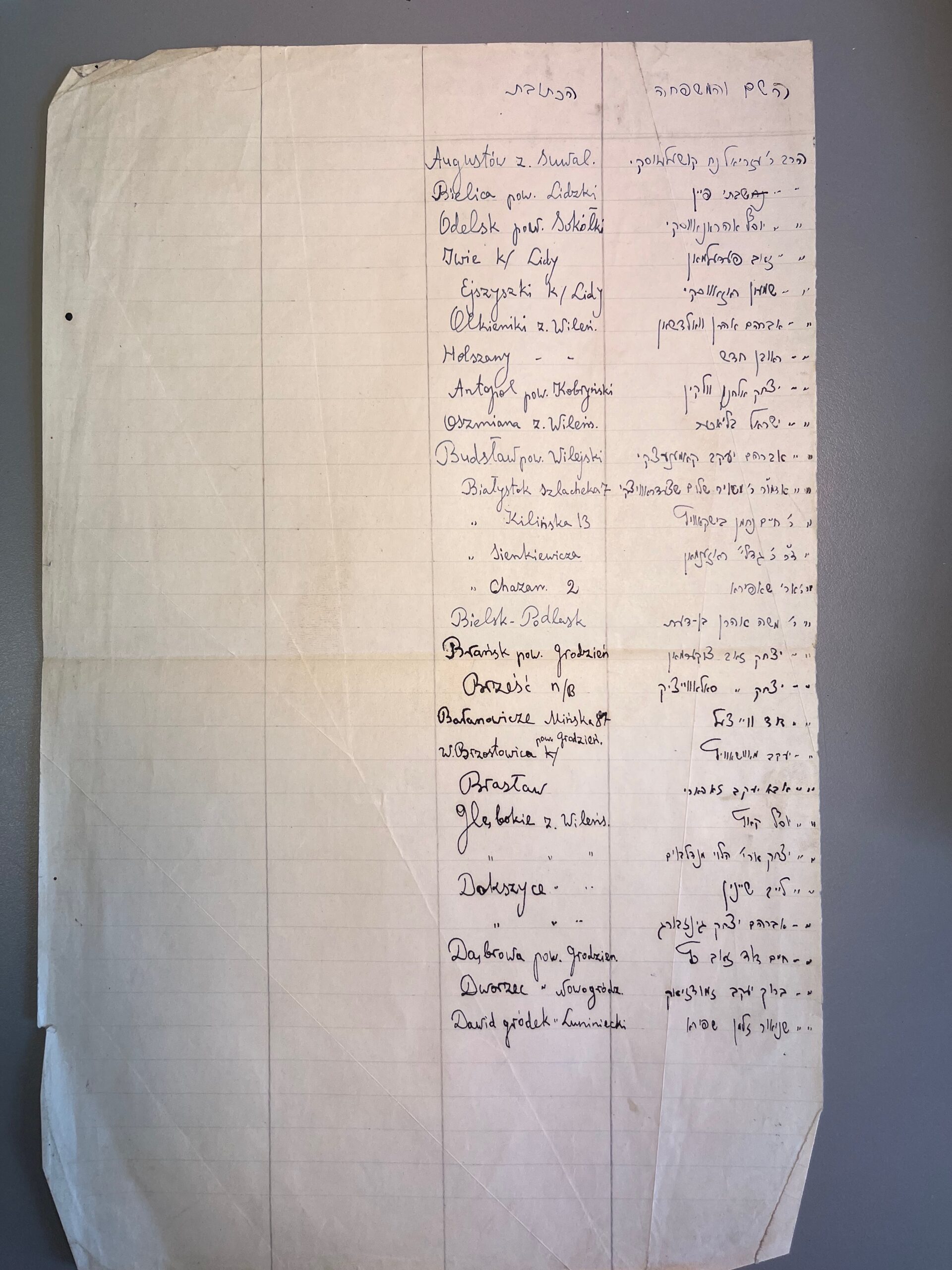
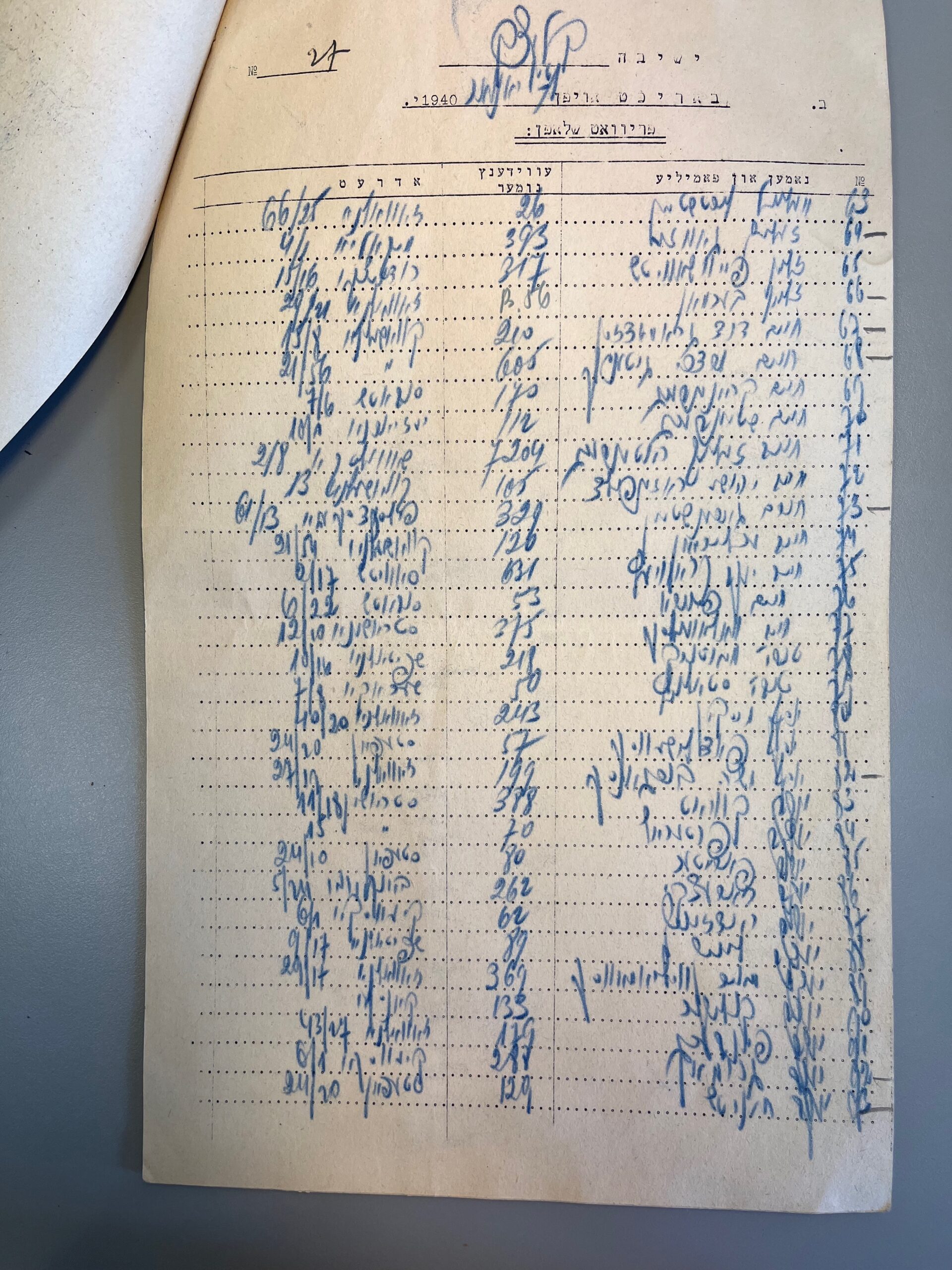
Yitzhak Ze’ev inherited and extended his father’s analytic method and later became one of the most uncompromising voices in Israeli haredi leadership, where he was known as the Brisker Rov. I knew that he and his family had been in Vilna at the time, because I’d found him listed among prominent rabbis in Vaad ha-yeshivos refugee housing records that show, yeshiva by yeshiva, where students, teachers, and refugees were staying. Nonetheless, it could have been another Yitzchok Soloveitchik. Then I looked more carefully at the same ledger page and saw another entry: a Raphael Soloveitchik had requested Maimonides’s Iggeret ha-shemad just a few lines above Yitzchok’s request for Peretz. Now it was clear. The Brisker Rov had a son named Raphael, and although Peretz’s short stories was a surprising choice for his father, the choice of Maimonides’s famous letter on persecution by the scion of a family fleeing persecution and famously devoted to Maimonides made perfect sense.
In short, the ledger documented that the Soloveitchiks had used the library just weeks before the Soviets would permanently close it, which is what I wrote, in passing, in my article. All that I thought I had documented in doing so was that the library served the rabbinic elite alongside ordinary Jews of all kinds, who were reading everything from talmudic commentaries to Yiddish translations of Tolstoy. But merely documenting a prewar Jewish world that was different than is generally imagined in haredi publications like Yated turned out to be an act of desecration.
Rabbi Sorotzkin’s first attack began by quoting the offending lines—or part of them at any rate—from my article: “On the afternoon of October 1, 1940, Reb Velvel came to the Strashun Library with his teenage son . . . His father’s reading for the day was more surprising: I. L. Peretz’s short stories about Hasidim.” (Sorotzkin’s ellipses will turn out to be doing a lot of work here.)
“With this passage,” Sorotzkin wrote, “Mr. Dan Rabinowitz does more than recount an archival curiosity. He stages a tableau.” He went on:
The Brisker Rov, Rav Yitzchok Zev Soloveitchik, appears before us not as generations of talmidim knew him, but as a character in a modern morality play: seated calmly in the Strashun Library of Vilna, immersed in the ironic fiction of I. L. Peretz, surrounded by secular readers, students, men and women alike.
The effect is unmistakable. The reader is invited to marvel at the distance between the “real” man and the image preserved by Torah memory. Hagiography, we are told implicitly, has concealed a richer, more complex inner life—one now revealed by the cold honesty of a library ledger.
It is an elegant narrative. It is also an edifice built on sand. What we encounter here is not historical reconstruction, but a breach—peritzas geder—in the most basic disciplines of historical inference. And once the wall is breached, all the oil may be rendered impure.
Beyond the rhetoric of righteous indignation, Sorotzkin’s argument was simple: The Brisker Rov would never have entered a “mixed, open, modern” library because his “entire being recoiled from even the faintest rei’ach [whiff] of ideological modernity.” Therefore, someone else named Yitzchok Soloveitchik must have. And here Sorotzkin had a candidate:
The Vilna region was saturated with Soloveitchiks. . . . Among them appears a Yitzchok Soloveitchik, a timber merchant, a vald-socher [from Švenčionys]—precisely the kind of educated townsman who would frequent the Strashun Library and read Peretz.
There are just three problems with this line of argument—actually there are more than that, but let’s restrict ourselves to three for the moment:
a. The same ledgers that documented the visit of a “Yitzchok Soloveitchik” also recorded several visits by Rav Pinchas Hirschprung, who would later serve as chief rabbi of Montreal. Rav Chaim Ozer Grodzinski, the preeminent Torah authority in Vilna, held special borrowing privileges at the library, and Rabbi Yisrael Meir Kagan, the renowned Chafetz Chaim, visited and signed the library’s VIP “Golden Book.” If such colleagues could visit the library, can Sorotzkin really be so certain that the Brisker Rov’s “entire being” would have prevented him from doing so?
b. Švenčionys is over eighty kilometers from Vilna, and we have no evidence this timber merchant traveled to Vilna in October 1940. Not to speak of the fact that neither Rabbi Sorotzkin nor I know anything about the reading habits of Jewish timber merchants in the area.
c. The ledger records two Soloveitchiks visiting the library on October 1, 1940. Are we to suppose that this other Yitzchok Soloveitchik also had a son named Raphael, who was also a deep Maimonidean?
This last problem—call it the “Zvei Soloveitchiks problem”—returns us to Rabbi Sorotzkin’s creative use of ellipses. When he quoted my offending lines about Reb Velvel, he elided Raphael—whom I mentioned in those sentences—right out of the picture and never acknowledged that he appeared in the ledger a few lines above his father.
Actually, unlike Sorotzkin’s conjectural Peretz-reading ironist timber merchant, the Brisker Rov had good reason to visit the Strashun Library. He was in the midst of a life-and-death halakhic controversy with his colleague Rav Aharon Kotler about whether refugees should try to flee to Eretz Yisrael or America. To support his position that they should not go to America because of the spiritual danger, the Brisker Rov turned to a passage he remembered from Maimonides’s Iggeret ha-shemad, which he wanted to quote verbatim.
Soloveitchik family memory confirms this. In a footnote to Shiurei Rabbeinu Meir ha-Levi, a collection of the Brisker Rov’s son, he is quoted as saying:
I recall that during the war years, Maran [the Brisker Rov] sought a copy of the letters from the Rambam, because he wanted to study Iggeret he-shemad, in which the Rambam has a lengthy discussion to explain the fundamental idea that a person acclimates to his surroundings and it is prohibited to live in a place which doesn’t allow one to fulfill the mitzvot properly. . . . Initially, however, he was unable to find a copy, and, in the end, he located one in the Strashun Library in Vilna. According to the library’s rules, one was not permitted to remove books from the building. And therefore his son R. Chaim copied it word for word for him.
The library ledger records Raphael as the borrower of Iggeret ha-shemad while the family testimony remembers Chaim as the copyist. Perhaps both brothers participated, or Raphael handled the checkout while Chaim copied the passage. Or perhaps the family misremembered which brother accompanied his father to the library. At any rate, there were at least two, and quite possibly three, Soloveitchiks at the Strashun Library on that day. And they were there precisely because the Brisker Rov took his obligations as a halakhic scholar and leader of Torah Jewry so seriously.
When I wrote to Yated Ne’eman to explain all this, the editors—to their credit—published my letter, but they did so alongside a reply from the unflappable Rabbi Sorotzkin. Sorotzkin not only blithely failed to acknowledge his errors of omission and commission but went on to a new and truly gobsmacking theory, titling his response “Veha’emes Vehashalom Ehavu” (Love truth and peace).
The entry for a “Yitzchok Soloveitchik” must, he now admits, refer to one of the famous Soloveitchiks rather than a random timber merchant from Švenčionys. Still, it couldn’t possibly be the Brisker Rov. So, who was it? Here I must quote Rabbi Sorotzkin at length to convey just how far he is willing to go to save Reb Velvel from having gone to a public library:
The presence of a ledger entry bearing the name “Yitzchok Soloveitchik” is taken to indicate the Brisker Rov himself, seated in the reading hall and borrowing secular literature. Yet there exists a far more coherent and internally consistent explanation, one that aligns with the testimony, the ledger itself, the halachic framework governing names and conduct, and the lived reality of the Brisker household.
According to this reading, it was the Brisker Rov’s son, Rav Chaim who entered the Strashun Library as the responsible emissary. Anyone familiar with the family dynamic knows that his keen intelligence, composure, and practical capability marked him as the natural choice for such a mission. His younger brother, Rav Rafael, accompanied him and formally requested the Iggeres HaShemad, which then had to be copied in full—a task of approximately 3,500 words, requiring a prolonged stay. Such an extended presence in a public institution would naturally invite scrutiny. To avoid unnecessary attention, it would have been prudent, even expected, to request an additional book, a routine borrowing that raised no eyebrows and normalized the time spent at the table.
Here the ledger entries themselves become illuminating rather than sensational. Immediately preceding the Soloveitchik entry, two patrons are recorded borrowing works by I. L. Peretz. . . . When Rav Chaim was offered titles by the same author, the specific work recorded — Chassidish — was accepted not as an ideological choice but as a convenient placeholder, a book taken to cover the duration required for copying the Iggeres. . . .
The use of the name “Yitzchok” in the ledger is likewise neither mysterious nor incriminating. Rav Chaim could not identify himself by his own well-known name without drawing attention, particularly given that the sefer of his grandfather, Rabbeinu Chaim Halevi, was already catalogued in that very library. Nor could he identify himself by his father’s full name. Halacha is explicit that one may not refer to one’s father by name, even after death, without alteration. . . . The use of the shortened form “Yitzchok” . . . would have satisfied both the halachic requirement and the practical need for discretion, without uttering an outright falsehood.
It is difficult to imagine anyone believing that a scholarly household in the midst of the “lived reality” of a desperate flight to safety from both the Soviets and the Nazis would strategize over the impossible “mission” of going to a library frequented by other pious Jews to copy a passage from Maimonides. And further, to think that they needed an elaborate cover story involving false names and phony book checkouts so that the Jewish librarians did not penetrate their cover (and what?—inform Rav Kotler about the killer prooftext from Maimonides?). The tradition has a term for such groundless theorizing, pilpul shel hevel, and it is a hallmark of the Brisker tradition to oppose it.
Sorotzkin closes his response on an extraordinary—and, one presumes, unconscious—note of chutzpah. “When suggestive narratives arise from thin evidentiary reeds,” he writes, “methodological restraint becomes not a courtesy but an obligation.” But perhaps I am being unfair, as George Orwell once remarked, “We are all capable of believing things which we know to be untrue, and then, when we are finally proved wrong, impudently twisting the facts so as to show that we were right.”
Sorotzkin’s initial response characterized my work as “peritzas geder,” a breach of protective walls. But what did he think needed to be protected? Not the Brisker Rov’s actual stature or commitment. That he wanted to verify the exact wording of Maimonides’s Iggeret ha-shemad from the richest collection of sifrei kodesh in Eastern Europe to guide his thinking on the refugee crisis illuminates the rigor of his approach to unprecedented questions. What Sorotzkin needed to protect was rather a nostalgic fantasy: one in which the great sages (gedolim) of that generation never entered mixed public spaces, relied on secular institutions, or read fiction. But the infrastructure of Jewish life in places like Vilna was not neatly divided into “Torah” and “secular” categories, and gedolim and their students checked out books from the Strashun Library alongside maskilim, socialists, and ordinary Jews looking for something to read.
I go back to Vilna regularly to identify, amid the destruction and absence, what can be found to resurrect, contextualize, and enrich our understanding of the astounding Jewish culture of prewar Vilna. The Jews of this city—rabbis and students, traditionalists and modernists, Hebraists and Yiddishists—created institutions, filled libraries, published journals, founded schools and research institutes, and argued about everything.
The Brisker Rov spent an afternoon in the Strashun Library in October 1940 with his sons to obtain a text he desperately needed. While his sons diligently copied Maimonides’s text, he requested Peretz’s collection of Hasidic stories. I don’t know why and, of course, it doesn’t matter—only Sorotzkin and his more credulous readers would think that it does. But there is a plausible answer. It turns out that among Peretz’s Hasidic tales is the story “Between Two Mountains,” in which a fiercely strict and intellectual rosh yeshiva called “the Brisker Rov” is taught a lesson in humanism by a former student who has become a Hasidic rebbe. Might not the Brisker Rov have been simply curious to read about his fictional counterpart?
The Holocaust destroyed the Strashun Library and most of the Jewish world of which it was a part. The Soviets shuttered its reading room; the Nazis looted its collections; after the war, the building was destroyed. Yet, the few surviving Strashun Library ledgers reveal precious little moments in the lost history of Jewish intellectual life in Vilna. The final volume documents the last gasp of Eastern European Jewry, not only the local Jewish inhabitants but also the thousands of refugees like the Soloveitchiks who, fleeing Hitler and Stalin, briefly sought safety in Vilna.
Strashun Library Building in 1945. Vilna Gaon Museum of Jewish History Archive, 1829-1
It seems to me that what we, their descendants, owe them is to see their lives, at least in glimpses, as they were, even if it is through the entries of a humble library ledger. That is a history worth recovering, even when—especially when—it complicates what we thought we knew. Such complication is not desecration; on the contrary, it honors their memories.
Postscript
After writing this response to Rabbi Sorotzkin’s pilpul shel hagiografia, I continued to return to the 1940 ledger, which hasn’t been digitized yet. As I described above, Sorotzkin’s new, and equally implausible, claim was that Chaim Soloveitchik used his father’s name rather than his own, to avoid the commotion of being recognized as the grandson and namesake of the author of one of the library’s own seforim, and to escape the notice of the authorities. In fact, it turns out Chaim checked out books under his own name at least five times in September 1940.
The first entry was on September 6, 1940, weeks before his father and Rafael appear in the ledger together. He checked out the Iggeret ha-shemad twice, on September 12 and September 14. These are, undoubtedly, the visits to transcribe Maimonides’s text, as described in the family testimony recorded in Shiurei Rabbenu Meir HaLevi. Rafael’s borrowing of the same text on October 1, when he visited the library with his father, was probably to check his brother’s transcription against the source.
That September, Chaim also read the tenth-century grammarian Dunash ben Labrat, the letters of Sa’adia Gaon and Ramban, the Abudraham’s commentary on the siddur, Samuel David Luzzatto’s essays collected in Bet ha-otzar, and a run of midrashic works, several in modern critical editions such as those of Solomon Buber. This is not the reading of a man sent on an undercover mission to copy one text. It is, rather, the reading of a wide, curious, and learned mind, and the ledger records it without comment or apology.
Of course, this isn’t surprising. As I wrote above, many well-known rabbinic figures used the library without incident. What is surprising is the pseudo-pious lengths to which Sorotzkin went to deny that the Brisker Rov and his sons simply used the Strashun Library, a fact that the family itself had no qualms about memorializing. What the ledgers allow us to do is to see, in a reader’s own name and hand, what he read in one of the great libraries of his world.
The Strashun Library Ledger Project, which is digitizing and making the ledgers publicly available, is a collaboration between the Martynas Mažvydas National Library of Lithuania, the e-Lijah Lab at the University of Haifa, Yale University’s Jewish Studies Department and Library, the Fortunoff Video Archive, and Litvak SIG.
Birds’ Heads, Romaine Lettuce, and the Art of Reading a Haggadah
Birds’ Heads, Romaine Lettuce, and the Art of Reading a Haggadah
A persistent question arises with every illustrated Haggadah, whether a fourteenth-century Sephardic manuscript or a mid-twentieth-century Maxwell House edition: what function do these images serve? Are they merely decorative, do they provide commentary, or do they serve as documentary evidence of ritual practice? Furthermore, when these images draw from the visual culture of the surrounding non-Jewish world, as is often the case, does such borrowing diminish their Jewish character, or does it indicate a more complex dynamic?
These questions are more thorny than they initially appear, and scholarly responses have evolved significantly in recent decades. This post synthesizes several strands: our previous discussions of specific manuscripts, insights from Marc Michael Epstein’s influential scholarship on medieval Haggadah manuscripts, and a notable controversy documented by Leor Jacobi. Our aim is to provide a more nuanced and comprehensive guide to interpreting these images.
The Two Mistakes
Anyone who works closely with illuminated Haggadot will recognize two recurring interpretive errors, both of which diminish rather than illuminate.
The first is the “derivative” thesis: the assumption that when an image in a Jewish manuscript resembles one in a Christian context, it is merely borrowed and thus lacks distinctive Jewish meaning. This perspective has informed much scholarship. Medieval Jewish and Christian artists often employed similar pictorial conventions; when similarities are observed, scholars have typically identified the Christian source, labeled the Jewish version as dependent, and concluded their analysis. This approach, however, overlooks the transformation that occurs when such imagery is adapted within a Jewish context and the specific messages it conveys to a Jewish audience.
The second error is more nuanced and may be termed the Wissenschaft snapshot: interpreting manuscript images as direct documentary evidence of ritual practice. For example, treating a depiction of marror as a definitive record of the vegetable used at the Seder, or viewing an illustration of bedikat chametz as a literal representation of the search process. This approach originates in nineteenth-century Jewish scholarship, which sought to extract concrete evidence about historical Jewish life from all available sources.
In 2012, in the comments section of this very blog, Marc Michael Epstein intervened in just such a discussion with a statement worth quoting in full:
Rabbosai (and Marasai): A manuscript is NOT a mirror. Jews depict themselves in their art (or commission art that depicts them) not as they were, but as they desired to be seen. Please please please do not engage in the typical Wissenschaft strategy of looking at illuminated manuscripts for “clues to Jewish life in the Middle Ages” or even to Jewish history. What we can learn from them is histoire des Mentalites, but even that takes a lot of work to get to.
This intervention arose from a debate about whether Sephardic medieval Haggadot depict marror as an artichoke, a topic addressed further below. The methodological insight, however, is broadly applicable: these images provide access to the histoire des mentalités—the internal landscape of aspiration, theological imagination, and communal self-representation. This perspective offers a richer understanding than the Wissenschaft snapshot, though it requires careful interpretation. Importantly, analyzing how a community chose to represent itself constitutes significant historical evidence, even if it does not directly reveal specific ritual practices.
The Birds’ Head Haggadah
The oldest extant illustrated Haggadah text, dated to the early 1300s (and now in the Israel (now in the Israel Museum, although the exact provenance remains murky like so many Jewish items), takes its name from its most immediately striking feature: nearly all the human figures bear birds’ heads rather than human faces. Non-Jewish figures — Egyptians, angels — are instead shown with blank circular discs where faces should be. The zoophilic imagery has attracted a remarkable range of explanations: halakhic anxiety about depicting human faces too completely; a visual encoding of relative spiritual status; and, at the least plausible extreme, the claim that the birds’ beaks are an anti-Semitic caricature of the Jewish nose inserted by a hostile illustrator.
Birds Head Haggadah, Exodus Scene
Epstein critically examines these theories, ultimately adopting a more nuanced position that acknowledges the halakhic dimension without attributing the imagery to a single cause. As discussed in our earlier review, the most illuminating aspect of his analysis is his attention to an anomaly previously dismissed as carelessness. In the Exodus scene depicting the Israelites fleeing and Pharaoh’s army in pursuit, most figures conform to expectations: Israelites with birds’ heads and Egyptians with blank discs. However, two figures in the pursuing army also have birds’ heads. Epstein, prompted by his ten-year-old son’s observation, suggests these figures represent Datan and Aviram, members of the erev rav who chose to remain with the Egyptians. The presence of birds’ heads is intentional, signifying that even the sin of siding with oppressors does not erase Jewish identity. This artistic choice introduces themes of the wicked son, belonging, apostasy, and the potential for return, all of which are particularly resonant in the context of the Seder.
This approach exemplifies Epstein’s methodology: treating anomalies not as errors to be dismissed, but as interpretive keys to deeper meaning.
The Golden Haggadah
The Golden Haggadah, a Sephardic manuscript from around 1320 distinguished by its extensive use of gold borders and embellishments, illustrates a key structural distinction within the manuscript Haggadah tradition. In Ashkenazic manuscripts, illustrations are integrated throughout the text, appearing in margins and between passages, and typically serve to comment on or extend the Haggadah narrative, such as scenes of Pesach preparations, the search for chametz, or the baking of matzah. In contrast, Sephardic manuscripts concentrate pictorial content before the text in a visual preamble: a series of full-page panels, arranged two or four per page, that trace Jewish history from the patriarchal era or creation through the Exodus, preceding the Haggadah text itself. These images function as a visual overture rather than direct illustrations of the liturgy.
While the Golden Haggadah adheres to Sephardic conventions, Epstein demonstrates that its imagery is more sophisticated than a straightforward chronological sequence. The illustrator establishes a network of visual connections across panels separated by generations, particularly through the motif of water. Water is depicted in scenes such as Jacob before Pharaoh, the drowning of Israelite boys in the Nile, the rescue of infant Moses, and Moses drawing water for Jethro’s daughters. In each instance, the depiction of water, its color, movement, and spatial relationship to the figures, is distinctive and cross-referential, encouraging viewers to interpret these scenes collectively rather than in isolation. The resulting theological argument centers on themes of divine providence, measure-for-measure justice, gratitude, and salvation as continuous threads throughout history. This constitutes visual midrash: interpretive commentary conveyed through imagery, fulfilling the Seder’s purpose of provoking reflection.
The Rylands Haggadah, Its Brother, and the Marror That Wasn’t an Artichoke
The third and fourth manuscripts analyzed by Epstein—the Rylands Haggadah (currently housed at the John Rylands Library in Manchester) and the manuscript referred to as the Brother to the Rylands—are Sephardic codices discussed together in his work. The term “Brother” was introduced by Bezalel Narkiss due to the notable visual similarities between the two manuscripts; Katrin Kogman-Appel has since argued that the so-called Brother likely predates the Rylands and served as its model. For the purposes of this discussion, both manuscripts represent a shared visual tradition, and the direction of influence is less significant than the insights they collectively provide.
Rylands Brother Haggadah
These manuscripts prompted a particularly instructive methodological episode in recent Haggadah scholarship, which unfolded in real time in the comments section of this blog in 2012 and was subsequently documented by Leor Jacobi. The central question was whether depictions of marror in the Rylands, the Brother, and the Sarajevo Haggadah represent an artichoke. David Golinkin had cited these illustrations as evidence that artichokes were used as marror in medieval Catalonia. Upon encountering this question on Erev Pesach 5772, wrote immediately to Epstein, who replied within the hour:
I don’t believe the Sephardic mss show an artichoke, rather they depict an entire head of romaine lettuce. The way to prove or disprove this would be to compare contemporary or roughly contemporary botanical mss.
When the same identification appeared in a post on this blog, Epstein returned with the fuller statement quoted above — “a manuscript is NOT a mirror” — and added the crucial clarification about representational logic:
Also, because a head of Romaine is SHOWN in the haggadah it doesn’t mean that there was a head of (possible unchecked-for-bugs) Romaine on the table. Every image is not a snapshot, but a representation — a combination of the real, the general, the ideal and the symbolic. Showing the head is a way of REPRESENTING Romaine — it says, “We use a type of lettuce that grows with leaves together in a head like this.” It does NOT necessarily mean “We use complete heads of Romaine at the Seder, like this.”
This logic warrants careful consideration. A manuscript illuminator aiming to depict marror must clearly indicate the species. Depicting the entire head of romaine lettuce—leaves clustered in a recognizable form—serves as an effective visual shorthand for this type of lettuce. Illustrating individual romaine leaves would make them nearly indistinguishable from other leafy vegetables. Thus, the whole head functions as the visual vocabulary for the species, rather than as a literal representation of the serving. The same reasoning applies to artichoke identification: if an artist intended to depict an artichoke, the distinctive globed, thistle-shaped head would be unmistakable. The Sarajevo Haggadah’s depiction of veined leaves bound at the base with a cord, as Epstein observes, aligns with characteristics of lettuce rather than artichoke.
Jacobi’s account adds another layer of insight: Epstein posits that artists of later manuscripts (the Rylands and Brother, likely produced after the Golden Haggadah) may have copied a lettuce image from an earlier model and, interpreting the veined and slightly “spiky” leaves, mistakenly identified it as an artichoke. Patrons did not correct this, as they recognized that artichokes were not used as marror and thus interpreted the image as romaine, regardless of the artist’s intent. These images illustrate the challenges of visual transmission when botanical knowledge is limited, but they do not provide evidence of actual Seder practice beyond confirming that romaine was regarded as the standard marror species in Sephardic communities, a fact already established by textual sources.
Rylands Haggadah
The Barcelona Haggadah introduces additional complexity: its marror illustration appears to have been added by a post-medieval artist who, relying on earlier Haggadah images as models, no longer understood the original intent, resulting in a stylized hybrid that is neither distinctly artichoke nor lettuce. As Evelyn Cohen observes, some manuscripts left the marror space blank, indicating that the image was occasionally tailored to the patron’s local practice. This underscores the non-monolithic nature of the visual tradition and the influence of artist-patron relationships on the final product.
In summary, there is no textual or visual evidence that artichokes were ever used as marror. Romaine lettuce, which becomes increasingly bitter as it is chewed—beginning with a mild taste and culminating in pronounced bitterness at the spine, thus symbolizing the intensification of Egyptian servitude—is far better supported as the intended species and is almost certainly what these images depict.
The Printed Haggadah: The Same Logic
The interpretive methodology applied to medieval manuscripts is equally relevant to the printed tradition.The four foundational printed Haggadot—Prague 1526, Mantua 1560, Venice 1609, and Amsterdam 1695—established a visual vocabulary that influenced nearly every subsequent illustrated Haggadah for centuries thereafter. As we have discussed at length in earlier posts (see here, here, and here), these Haggadot draw from both manuscript precedents and the broader visual culture of their respective eras, exhibiting the same patterns of intentional borrowing and creative transformation observed in medieval manuscripts.
The Mantua 1560 Haggadah, the first illustrated Italian Haggadah, exemplifies this dynamic. Its depiction of the Wise Son is modeled unmistakably on Michelangelo’s prophet Jeremiah from the Sistine Chapel ceiling. However, while Michelangelo’s Jeremiah is bareheaded, the Haggadah’s Wise Son wears the Pileus Cornutus, the conical hat mandated for Jews by Christian law (and likely the beginning of the custom of universal Jewish headcovering). Thus, a figure from the Vatican’s most prominent sacred space is appropriated, marked with a symbol of Jewish social subordination, and reimagined as an embodiment of Jewish wisdom at the Seder table. This reflects both dependence and subversion.
Mantua, 1526, The Wise Son
A similar complexity is evident in the title page’s distinctive helical “barley-sugar” pillars. While these are sometimes attributed to their prominent use at St. Peter’s Basilica, suggesting Christian architectural borrowing, the more probable source is local: the Cortile della Cavallerizza at the Palazzo Ducale in Mantua, designed by Giulio Romano and completed around 1540. The printer Ruffinelli appears to have incorporated these pillars throughout his Mantuan publications as a regional identifier, functioning not as a Christian symbol but as a marker of local identity, akin to a colophon. What may appear as Christian iconography is, in fact, civic geography repurposed as a printer’s device.
Prague Haggadah, Kiddush
The warning against treating images as direct records of practice is relevant here as well. R. Shlomo Hakohen Kook criticized the Prague 1526 Haggadah for depicting the wine cup held in the left hand and grasped by the stem rather than cupped at the base, but both critiques conflate artistic representation with ritual documentation. The left-handed depiction results from the woodcut printing process, which produces a mirror image of the original block; copyists working from printed exemplars, rather than the original block, further reversed the image, consistently yielding left-handed figures. This reflects printing history, not halakhic instruction. The issue of cupping the cup is another anachronism: this practice became widespread only after the publication of the Shelah, which appeared more than a century after the Prague Haggadah. Thus, the woodcut cannot be faulted for omitting a custom that did not yet exist.
What We Can and Cannot Learn
The illuminated Haggadah is a remarkable historical source, but its value depends on the questions posed to it. These manuscripts and early printed books are not objective records of ritual practice; rather, they reflect the choices of communities, shaped by artistic conventions, available models, patron preferences, and the expressive possibilities of the visual vocabulary of their era. When interpreted thoughtfully, they reveal the inner imaginative life of the communities that produced them: their understanding of the Exodus, their self-conception, the theological claims embedded in their liturgical texts, and their engagement with and adaptation of surrounding visual cultures.
This constitutes an exceptionally rich body of evidence, surpassing any attempt to treat the images as mere snapshots of Seder table contents. However, extracting meaningful insights requires art-historical expertise, contextual historical knowledge, and a readiness to embrace interpretive ambiguity—qualities that distinguish the approach exemplified by Epstein from earlier traditions.
Readers who have not yet encountered The Medieval Haggadah: Art, Narrative & Religious Imagination (Yale University Press, 2011) — reviewed here when it appeared here — would do well to remedy that before this Pesach. And to spend a few more minutes at the Seder with the pictures. Additionally, Epstein’s recently released book, People of the Image: Jews and Art, similarly tackles these topics, including discussions of Haggadah illustrations and, like his The Medieval Haggadah, is among the best in the genre. A review of the book is forthcoming.
—
Related posts: our 2012 review of Marc Michael Epstein’s The Medieval Haggadah: Art, Narrative & Religious Imagination (here); Leor Jacobi on the artichoke controversy and how to read manuscript marror illustrations (here) and earlier discussions about the vegetable here and here; halakhic implications of Haggadah illustrations (here); and our discussions of the Prague 1526 Haggadah (herehere, and here), and for our examination of printed illustrations see “The Mother Haggados: Models for Modern Analysis of Printed Jewish Illustrations.”
Beyond the Masthead of the Beys Yaakov Journal, 1923-1980 – Part 2: ‘Abomination’ or Scandal? Mistranslation, Journalism, and the Halivni Controversy
Beyond the Masthead of the Beys Yaakov Journal, 1923-1980 – Part 2:
‘Abomination’ or Scandal? Mistranslation, Journalism, and the Halivni Controversy
By Dan Rabinowitz and Menachem Butler
In Part 1 of this study, it was argued[1] that the Beys Yaakov Journal cannot be understood simply as an ideological mouthpiece of Agudath Israel, nor as an instrument of Orthodox withdrawal. Across decades, its editors repeatedly confronted intellectual challenges in public, publishing voices and materials that lay beyond the formal boundaries of Agudah authority and resisting the impulse toward protective silence. That does not mean it adopted liberal positions; rather, its conclusions fit squarely within the traditions of Ultra-Orthodox theology. The journal’s Orthodox commitments were genuine, but they were not understood to require insulation from controversy or the suppression of methodological dispute. In this second installment of “Beyond the Masthead of the Beys Yaakov Journal, 1923-1980,” the controversy surrounding Rabbi Professor David Weiss Halivni serves as an especially revealing test case for these dynamics.
Rabbi Professor David Weiss Halivni passed away on June 28, 2022. On July 17, the New York Times published a lengthy obituary under the headline and subheadline:
“David Weiss Halivni, Controversial Talmudic Scholar, Dies at 94. He was considered too radical by many Orthodox rabbis and too regressive by many Conservative Jewish leaders. But his work was widely praised.”[2]
NY Times July 17, 2022 Obituary
The framing is revealing. Halivni is positioned between two opposing camps, too radical for one and too regressive for the other. This symmetrical construction reduces a complex methodological dispute to a narrative of ideological extremity and obscures the substantive nature of Orthodox objections. The obituary further characterized Halivni’s scholarship as grounded in the “controversial idea” that the Talmud is “riddled with inconsistencies and incongruities” resulting from the vulnerabilities of largely oral transmission, “subject to the flaws resulting from fallible memories.” It reproduced Agudath Israel’s denunciation of his work as an “abomination,” accusing him of daring “to enter the domain of the holy” and to suggest that the transmitters of the Talmud altered the text unknowingly. At the same time, Halivni was quoted defending his position: “divine origin does not preclude critical study, since critical study seeks to purge the text of human error.”
Beyond this polemical exchange, the obituary devoted substantial attention to Halivni’s innovative approach to Talmudic study, illustrating it through an extended discussion of a sugya in Mo’ed Katan. What was “pioneering” about Halivni’s work, the obituary explained, was his effort to “burrow[…] deeply into the history of how the Talmud … came to be compiled,” and to argue that its transmission, “for generations, largely oral,” was inevitably “subject to the flaws resulting from fallible memories.” Halivni therefore sought to “restore the pristine state of the Talmud,” in one student’s formulation, by identifying “incorrect editorial surmises” and exposing moments in which later transmitters resorted to “forced readings” in order to reconcile contradictions. As the obituary emphasized, Halivni’s method aimed to “iron out the inconsistencies and gaps and restore logical coherence” by tracing a concept’s provenance and, where necessary, reconstructing earlier textual strata. This methodological claim entailed a far-reaching reassessment of traditional assumptions about the formation and internal coherence of the Talmud.[3]
David Weiss Halivni (1927-2022) was born in Poljana Kobilecka in interwar Czechoslovakia and received rabbinic ordination in Sighet at the age of fifteen. Deported to Auschwitz in 1944, he survived the camps as the sole remaining member of his family.[4] After immigrating to the United States in 1947, he combined advanced yeshiva learning with formal academic study, ultimately joining the faculty of the Jewish Theological Seminary and later Columbia University.[5] In his later years he made aliyah and taught at Bar-Ilan University. Beginning in 1969, he published the first volume of his monumental Mekorot u-Mesorot,[6] which developed a sustained program of source-critical Talmudic interpretation,[7] aimed at distinguishing between tannaitic dicta and later amoraic and editorial strata.[8] It was this methodological ambition, more than questions of biography or institutional affiliation, that made Halivni a focal point of Orthodox critique.
Such sustained engagement with technical Talmudic scholarship is unusual for The New York Times. Yet this was not the paper’s first encounter with Halivni’s work. On the eve of Rosh Hashanah in 1977, The New York Times Magazine published a lengthy profile of Halivni by Israel Shenker under the title “A Life in the Talmud.”[9] There, Shenker described Halivni as “a respected public enemy at the pinnacle of modern scholarship” and reported that “The ultra-Orthodox Israeli political party Agudath Israel called it an ‘abomination,’” citing an editorial in Beys Yaakov Journal. The juxtaposition of scholarly daring and religious denunciation supplied the dramatic architecture that the 2022 obituary would later reprise.
The New York Times narrative, however, is fundamentally flawed. It misidentifies the institutional character and editorial posture of the Beys Yaakov Journal, misconstrues the nature of its engagement with contested scholarship, and rests on a tendentious, if not deliberate, mistranslation of a pivotal passage. More importantly, it mislocates the center of Orthodox resistance to Halivni’s work. The critique in that article in Beys Yaakov Journal, and the journalistic distortions surrounding it, should not be mistaken for the principal arena of Orthodox opposition. The more consequential controversy unfolded within the American Modern Orthodox world, particularly at Yeshiva University and among its associated intellectual networks, circles far more familiar to the Times readership and far more central to the internal struggles of American Judaism during the period under review. As we will demonstrate in a subsequent installment of this series, it was there, rather than in Israeli party politics, that the most sustained and institutionally significant resistance to Halivni took shape.
Israel Shenker: A Scholar “Trapped in a Newsman’s Body”
To grasp the significance of Israel Shenker’s mischaracterization of the Beys Yaakov Journal, one must first understand Shenker himself. He was no ignorant sensationalist, no journalist stumbling blindly into a world he did not understand. On the contrary, he was widely (and aptly) described as “a scholar trapped in a newsman’s body.”[10] Fluent in Hebrew and Yiddish and possessed of formidable erudition, Shenker moved comfortably among texts, languages, and learned worlds that lay beyond the reach of most reporters.
That independence was visible early. While enrolled at the University of Pennsylvania, Shenker reportedly completed his degree without attending classes, preferring to work alone in the library and appearing only for examinations. As his niece later recalled, he “did not attend classes because he did not need to,” a habit that remained a defining feature of his intellectual life: self-directed, book-centered, and impatient with institutional mediation.[11]
Across several decades at The New York Times, Shenker profiled an extraordinary range of cultural and intellectual figures. Yet the range was not random. He gravitated toward individuals who combined mastery with eccentricity, authority with paradox: Groucho Marx,[12] whose comic persona masked a sharp literary intelligence; Jorge Luis Borges,[13] blind yet hyper-lucid; Noam Chomsky,[14] the dissident linguist who destabilized both politics and grammar; Vladimir Nabokov,[15] the aristocratic stylist and relentless classifier; Pablo Picasso,[16] whose genius lay in permanent disruption. Alongside them appeared scientists and system-builders such as Isaac Asimov, polymaths of prodigious output and explanatory ambition.[17]
Shenker brought the same sensibility to Jewish intellectual life. He wrote about scholars such as Uriel Simon,[18] Salo Wittmayer Baron,[19] and Solomon Zeitlin,[20] figures whose authority derived not from popular appeal but from textual mastery and historical depth. He became one of the Times’ principal correspondents on Jewish culture, though with telling selectivity: the Jewish Theological Seminary consistently dominated his institutional coverage,[21] while nearly every other yeshiva or rabbinical seminary in New York went largely unremarked[22]; the Second Avenue Deli became his emblem of Jewish urban life,[23] while nearly every other Jewish restaurant remained invisible.[24] Shenker’s choices reveal a consistent pattern: he favored sites and figures that condensed Jewish meaning into legible symbols.[25]
Much of his Jewish writing was light in tone but not trivial. He reported on a snobbish kosher hotel in England[26]; obscure and declining Jewish communities[27]; the phenomenon of “miraculous” pareve cheesecake[28]; the Twerski rabbinic dynasty[29] and other Hasidic groups[30]; itinerant soferim repairing pesul Torah scrolls[31]; Hebrew book publishing[32]; dreydl manufacturers[33]; the economics of yarmulkes and skullcaps[34]; the professional culture of kosher certification and supervision[35]; and prayer groups on El Al flights so numerous they gathered at the rear of the plane and disrupted its altitude.[36] These were not throwaway curiosities. They were chosen because they dramatized ingenuity, adaptation, and excess.
Other pieces were more substantial. Shenker produced one of the most comprehensive journalistic profiles of Isaac Bashevis Singer,[37] wrote with open admiration about Harry Austryn Wolfson, the legendary Harvard scholar of Jewish philosophy,[38] and reported sympathetically on the Lubavitcher Rebbe’s public call for kindness on the occasion of his seventieth birthday.[39] He covered Holocaust conferences, theological debates, Jewish cultural institutions, and scholarly gatherings with genuine seriousness.[40] Many of these essays were later revised and collected in his 1985 volume Coat of Many Colors, a book that stands as the fullest expression of his intellectual commitments.[41]
Shenker’s first sustained engagement with talmudic scholarship came in 1971, with a profile of Rabbi Adin Steinsaltz,[42] then deeply immersed in producing a new edition of the Talmud.[43] The article was largely respectful, yet it included a pointed dismissal attributed to Rabbi Louis Finkelstein, chancellor of the Jewish Theological Seminary, belittling Steinsaltz’s achievement.[44] The move is revealing. Even where admiration was warranted, Shenker could not resist inserting institutional tension, foregrounding controversy where extended methodological explanation might have sufficed.
That instinct became even more pronounced in Shenker’s 1975 feature, “Responsa: The Law as Seen by Rabbis for 1,000 Years,” based on interviews with Rabbi Moshe and Rabbi Solomon B. Freehof.[45] The pairing itself was astute, recognizing responsa as a transdenominational genre spanning Orthodox and Reform authority. Yet the article in The New York Times was framed by a prominent callout box – “A Responsum Sampler” – that juxtaposed grave contemporary questions, such as homosexuality and women wearing pants, with deliberately quirky cases,[46] including ritual slaughter under hypnosis[47] and a woman who swallowed a fly.[48] Responsa appeared less as a discipline of burdened responsibility than as a theater of ingenuity and oddity. The irony is that Rabbi Feinstein explicitly rejected such a portrayal. “You can’t wake up in the morning and decide you’re an expert on answers,” he insisted, stressing that authority emerges only through long recognition of sound judgment. More pointedly, he framed pesak as religious accountability: “A rabbi who replies to people’s questions works harder than a doctor dealing with a case of life and death. The doctor is responsible only to his patient, but the rabbi is responsible to God.” This ethic of burdened responsibility, articulated in the interview itself, stands in tension with the broader journalistic framing. Rabbi Feinstein articulated the same conception programmatically in the introduction to the first volume of Iggerot Moshe,[49] where he repeatedly describes his rulings not as demonstrations of mastery but as obligations imposed by circumstance. His responsa, he writes, emerge from “darkness,” composed only because he felt compelled to give instruction; the decisor must rule according to “what his eyes see and what appears true to him,” even amid doubt and fear of error. Authority, in this account, lies not in brilliance or certainty but in the willingness to assume responsibility for guidance. This was an ethic that closely parallels his insistence in the Times interview that “the rabbi is responsible to God,” not to ingenuity or acclaim. [50]
Shenker was plainly fascinated by the genre; he devoted nearly thirty pages to responsa literature in Coat of Many Colors. Whether the emphasis on eccentricity reflected his own priorities or editorial intervention is difficult to determine. Shenker’s own reflections offer some guidance. In a 1986 profile, he described himself as writing “as a reporter more than anything else,” insisting that he was “not interested in arguing any ideas of [his] own.”[51] Baruch Halpern’s account is especially suggestive. A leading scholar of the Hebrew Bible and ancient Israel, he explains that when Shenker worked for Time in postwar Europe, managing its Paris bureau, Shenker deliberately forwent by-lines out of a “corporatist sense of mission,” valuing collective authorship over individual credit.[52] Only later, at The New York Times, did Shenker embrace what Halpern memorably termed “that sacred by-line,” situating his career within a broader shift toward intellectual individuation.[53]
Shenker openly admired religious intellect even while identifying as a nonbeliever. He spoke candidly of his fascination with rabbinic literature – not for its piety, but for what he called “the determination to find excuses for impossible things.” Talmud and responsa were, in his words, “endlessly fascinating.” This posture, respectful yet detached, drawn to paradox rather than normativity, helps explain both his genuine engagement with Jewish learning and his recurrent tendency to foreground eccentricity or scandal at the expense of internal meaning.[54]
That stance was reflected not only in Shenker’s writing but also in the manner in which he chose to live. In his later years he withdrew from institutional journalism altogether and settled in rural Scotland, where his wife Mary, born into the Sagman family of Glasgow, had familial roots. There he described himself as a solitary reader moving from library to library, drawn to places that functioned as what he called “intellectual hospices.”[55] Writing in 1985 about a residential library in Wales founded by William Gladstone, Shenker offered an implicit self-portrait: a scholar without a pulpit, a journalist without a platform, committed less to intervention than to observation, and to books rather than communities. From that deliberately marginal and proudly nonconfessional vantage point, Judaism appeared not as a living system governed by internal norms, but as a repository of endlessly fascinating textual ingenuity. This orientation is also visible in Shenker’s books. Beyond Coat of Many Colors, Shenker published a series of substantial monographs that further attest to the breadth and seriousness of his intellectual interests, including studies of lexicography and the history of language,[56] literary travel[57] and eighteenth-century intellectual culture,[58] and contemporary Jewish and Israeli public life.[59]
Seen against this background, Shenker’s treatment of David Weiss Halivni cannot plausibly be dismissed as a product of ignorance or linguistic incapacity. He possessed the philological competence to read the Hebrew of the Beys Yaakov Journal accurately and the cultural literacy to recognize the specifically Orthodox stakes of Halivni’s project. The resulting mischaracterization was therefore interpretive rather than inadvertent: a reframing of a bounded intramural methodological dispute in the idiom of public scandal. In this instance, Shenker’s erudition did not guard against distortion but conferred authority upon it.
To see why this reframing proved so consequential requires closer attention to the article itself and to the broader Orthodox debate over the academic study of the Talmud in which it intervened. Only within that broader context does the inadequacy of the binary framework later imposed upon Halivni come into focus. In a subsequent installment of this series, we will examine specific episodes in his life, consider his distinctive approach to Talmudic study, and then turn to the controversy it provoked. His trajectory across worlds often presumed to be mutually exclusive, including the traditional yeshiva culture of Eastern Europe, the postwar Orthodox institutions of America, and the emerging academic study of rabbinic literature, forms an essential backdrop to that debate.
The 1969 Beys Yaakov Journal Article: Engaging the Challenge
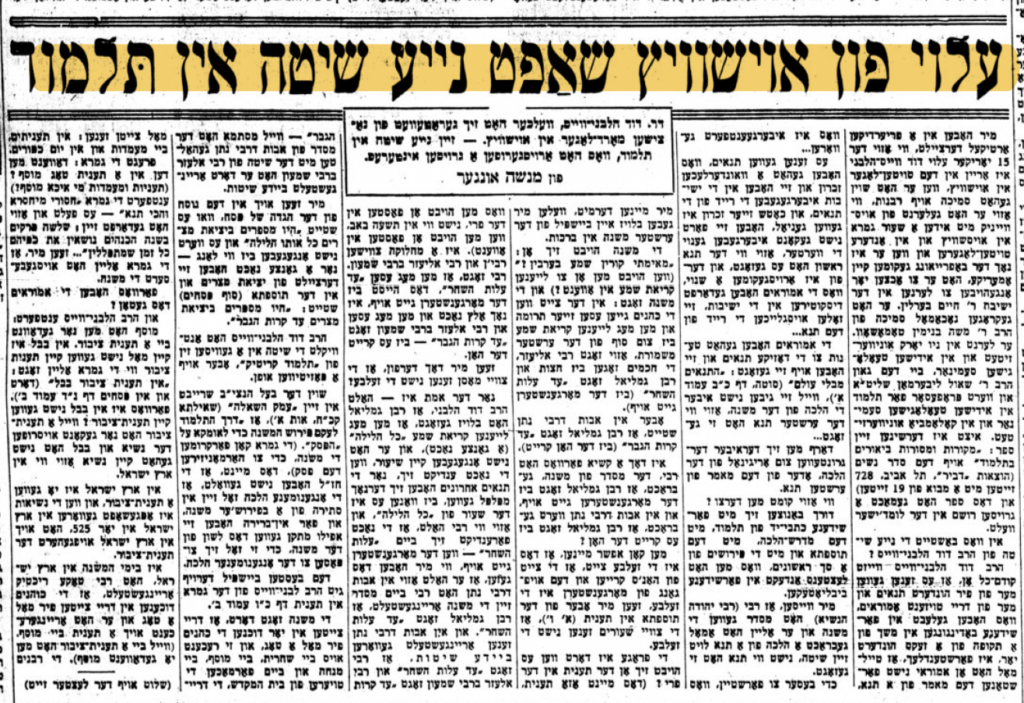
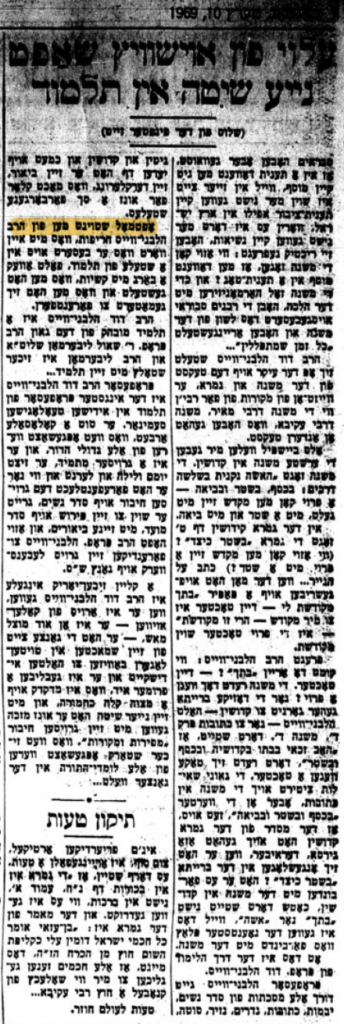
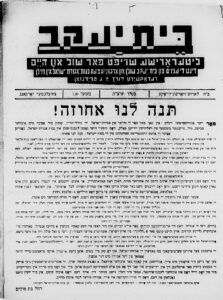
In early 1969, the Beys Yaakov Journal published “A Cry of Alarm Concerning the New School of ‘Talmud Critics’!”[60] by “Harav Yitzhak M. Shmueli” (almost certainly a pseudonym).[61] The article appeared in issue no. 116, shortly after the publication of the first volume of Halivni’s Mekorot u-Mesorot (1969).[62] It was not a reflexive polemic or an immediate rebuttal, but a considered response to a scholarly methodology that had already begun to exert influence within academic and semi-academic Jewish discourse.[63] Shmueli’s article reflects the Journal’s longstanding editorial posture: the intellectual challenges of modernity, particularly those circulating in print and academic venues, cannot be met with silence or denial. Rather than ignoring them, the Beys Yaakov Journal insisted on direct and public engagement.[64]
The article offers a sweeping critique of the Jewish Theological Seminary (JTS) and its Talmudic scholarship, with Halivni serving as the central exemplar. After briefly dismissing academic biblical criticism as a spent and methodologically compromised enterprise, Shmueli turns to what he presents as a more urgent danger: the emergence of academic Talmudic criticism within the Jewish Theological Seminary. He notes that Mekorot u-Mesorot bears the subtitle Biʾurim Talmudiyim and explicitly links this nomenclature to the Biʾur associated with Moses Mendelssohn, whom he identifies, in conventional Orthodox polemic, as a progenitor of German Reform Judaism.[65] The terminological parallel is presented as symptomatic rather than incidental.
Shmueli’s extended polemic against biblical criticism should be read less as his operative argument than as a genealogical warning. By tracing “Ḥokhmat Yisrael” back to German biblical criticism and Wissenschaft des Judentums, he establishes a historical cautionary tale rather than mounting a detailed refutation.[66] Once the discussion turns to Talmud, however, the tone shifts markedly: denunciatory generalizations give way to named books, cited introductions, concrete methodological claims, and extended quotation of traditional authorities. The rhetorical genealogy sets the stage; the argument itself unfolds as a focused dispute over the limits of legitimate Talmudic method.
Beyond an Internal Scholarly Debate
Shmueli’s concern, however, was not confined to an intramural scholarly dispute that might otherwise have remained limited to a narrow academic readership. The urgency, he argued, arose from Halivni’s entry into the broader intellectual public. In 1963, Halivni authored the Encyclopaedia Britannica entry “Source Criticism,” appended to the encyclopedia’s discussion of the “Talmud.” There he did not merely note philological problems in passing, but presented “source criticism” as a discrete scholarly method whose central task was to distinguish between the original statements of rabbinic authorities and the forms those statements assumed through oral transmission. A paragraph from that Britannica entry was later reprinted on the inside cover of Mekorot u-Mesorot: Seder Nashim (1969) under the heading, “From the author’s statement in the Encyclopaedia Britannica.” It reads:
“Source criticism seeks to differentiate between the original statements as they were enunciated by their authors and the forms they took as a consequence of being orally transmitted; that is, between the sources and their later traditions. It is not to be confused with the kind of analysis – frequently carried out by the rabbis or the Talmud – which merely traces the historical sources of a given passage without judging whether or not the passage faithfully reflects these sources. Source criticism claims that the transmission of the Talmud was not, and perhaps could not have been, verbatim, and that the text became altered in transmission, with the result that many statements in the Talmud have not come down in their original form. Instead, what survives is the form assumed in the last phase of transmissional development. While such a study is pertinent to most ancient texts, it is particularly relevant to the Talmud, which primarily consists of quotations and their interpretations.”[67]
On Halivni’s account, talmudic transmission “was not, and perhaps could not have been, verbatim,” with the result that many passages survive only in the form assumed in the final phase of transmissional development. The Talmud, he argued in that encyclopedia entry, is therefore particularly susceptible to such analysis, since it largely consists of quotations and interpretive strata. By articulating this claim in the idiom of general textual criticism and situating it within a major English-language reference work addressed to a broad, non-confessional readership, Halivni effectively relocated questions of talmudic authority from the internal norms of the beit midrash to the evaluative jurisdiction of modern academic scholarship. What might otherwise have remained an internal scholarly controversy was thus recast as a public representation of the Talmud within a wider intellectual culture.
It is precisely this public and methodological self-positioning that made the volume contentious. By placing the critical premise at the threshold of the book, Halivni indicated that the issue at stake was not merely philological refinement but the conceptual framework within which the Talmud itself would be understood. The decision to reproduce this paragraph prominently on the inside cover of Mekorot u-Mesorot was therefore more than bibliographic notice. It framed the book from the outset as an intervention in the academic discourse of textual criticism and positioned its central thesis as a methodological claim rather than an incidental observation. Before encountering Halivni’s detailed readings, the reader is confronted with a declaration about the nature of talmudic transmission and the legitimacy of critical reconstruction. In this sense, the reprinted Britannica passage functions as a programmatic preface, signaling that the project’s claims about the Talmud’s layered development are not ancillary but foundational.
This concern about public legitimation was not new. Long before the appearance of Halivni’s Mekorot u-Mesorot, Orthodox critics had already accused JTS, particularly under Finkelstein, of attempting to translate rabbinic tradition into a civic idiom aimed at American elites, a trajectory that would later culminate in highly visible episodes such as the Seminary’s 1957 convocation attended by Chief Justice Earl Warren.[68] This dynamic can already be seen by the early 1930s, such critiques had evolved from responses to discrete initiatives into a sustained indictment of Finkelstein’s leadership. In a widely circulated Yiddish pamphlet responding to the accumulated controversy surrounding the Seminary,[69] Dr. Aaron Rosmarin retrospectively gathered earlier charges, first voiced in The Jewish Forum,[70] Der Tog,[71] and The Jewish Spectator ,[72] into a comprehensive critique of what he presented as a coherent institutional strategy: the deliberate public repositioning of JTS through interfaith initiatives and universalist ethical rhetoric, designed to render Judaism intelligible and respectable to Christian and civic authorities while eroding the internal boundaries of rabbinic tradition.[73] Read in this longer perspective, the anxieties later articulated by Shmueli in the late 1960s appear not as episodic reactions to a single event, but as the continuation of an established polemical grammar through which the Seminary had long been contested within Haredi and Orthodox circles.
Yet the controversy did not unfold solely in the register of political denunciation or institutional suspicion. It also took the form of an internal methodological dispute over the norms of Talmudic scholarship.
Substantive Scholarship, Not Political Condemnation
Shmueli did not confine his critique to rhetorical denunciation. The article prominently featured, in a separate callout box at the top center of the page, the complete four-paragraph letter of the Ḥazon Ish addressing the use of manuscripts and textual emendation in Talmudic interpretation.[74] Given the Ḥazon Ish’s stature as one of the most authoritative scholars of his generation, his methodological positions were widely regarded as normative and were adopted, explicitly or implicitly, by many traditional Orthodox rabbis and scholars. Crucially, the Ḥazon Ish does not reject manuscript evidence as such; rather, he rejects its elevation into a corrective authority over the received text as transmitted and interpreted through the classical rabbinic canon. By foregrounding the Ḥazon Ish’s objections instead of invoking partisan rhetoric or institutional polemic, Shmueli cast the controversy as a serious methodological dispute internal to the discipline of Talmud study.
The letter reads in full:
“To interpret a sugya and to emend the Gemara on the basis of the ‘Munich’ manuscript – does this mean that all the sages of the generation, from the time of the Rishonim until now, all failed to apprehend the truth, because a single scribe erred and added material to the Gemara of his own accord, thereby causing all the sages to stumble?
I am not of them nor of their multitude. The manuscripts that were in the hands of the early authorities of blessed memory – they gave their lives for them, and the providence of the Blessed One, that the Torah not be forgotten from Israel, hovered over them. And when they began to print the Gemara, the sages of the generation gave their lives for its refinement and correction. And even if, at times, one may benefit from manuscripts to cleanse corruptions that arise over the course of time, with regard to a matter that issued from the hands of all our masters without any hesitation – Heaven forbid to disturb it.
Consider this yourself. When there are three manuscripts before us and two agree, we follow the two and set aside the one. And who can say to us that the ‘Munich’ manuscript is not from that one that was nullified by the majority in its own time? And who can say that it was not known to those lacking precision? In any case, it is null and void, like a broken potsherd, in the face of the received version.
And because a scribe erred and omitted a few words, as scribes are wont to err – shall we build towers? Perhaps indeed it is so, that the scribe omitted them and it is not from the sages, but when we rely on the tradition, the Torah of Rashi and Tosafot and all the sages – certainly this is the Torah. And I have almost never seen any benefit in arriving at the truth through variant readings uncovered from the genizot. Rather, they are all a benefit for distorting judgment and perverting the truth. It would have been fitting to consign them to burial, for the loss outweighs the gain.”
By reproducing this letter in full, Shmueli makes clear that his opposition to Halivni’s methodology rests on principled epistemological and methodological grounds rather than on ideological reflex. The Ḥazon Ish’s critique does not deny the existence of manuscript variation or the occasional value of textual witnesses; rather, it rejects the privileging of isolated manuscripts over the cumulative authority of the received tradition as transmitted and interpreted through generations of rabbinic scholarship.[75]
Crucially, Shmueli explicitly acknowledges that multiplicity, difficulty, and textual variation are intrinsic features of Torah she-baʿal peʿh. He concedes that variant readings and unresolved tensions have always belonged to the tradition, and he invokes major figures such as the Ḥatam Sofer and R. Israel Salanter to underscore that truth in Torah does not reside in surface simplicity. This concession sharply distinguishes his position from any naïve textual absolutism. What he rejects is not complexity itself, but the elevation of conjectural reconstruction into a corrective authority over the received text and its interpretive canon. In this way, Shmueli situates his argument squarely within a substantive Talmudic debate. He contends that even academically rigorous methods, supported by extensive philological evidence, remain subject to serious internal critique from within the Orthodox scholarly tradition itself. The article therefore represents intellectual engagement rather than political denunciation or fundamentalist rejection.
A full reading of Shmueli’s article makes clear that his deepest concern is not the existence of critical hypotheses as such, but their translation into public authority. Again and again, the danger he identifies lies in institutional legitimation: a book published by a major Israeli press, authored by a faculty member of the Jewish Theological Seminary, and disseminated to a broad readership through venues such as the Encyclopaedia Britannica. For Shmueli, the methodological question becomes urgent precisely at the point where speculative reconstruction threatens to become normative representation. The issue, in other words, is not academic experimentation behind closed doors, but the public pedagogy of Judaism to Jews and non-Jews alike.
Acknowledging Lieberman’s Authenticity
One of the most revealing features of Shmueli’s polemic is his careful distinction between Halivni and Saul Lieberman. Despite the breadth and intensity of his critique of the JTS approach, he is markedly restrained in his treatment of Lieberman. This restraint is deliberate. Lieberman’s Orthodox credentials were exceptionally strong and widely recognized across multiple sectors of the Orthodox world.[76] Upon his arrival in Palestine in 1928, he was appointed director of Machon Harry Fischel, a flagship Orthodox research institute devoted to advanced talmudic and halakhic scholarship, an appointment facilitated by leading rabbinic figures, including R. Isser Zalman Meltzer and R. Avraham Yitzhak Hacohen Kook.[77] At the same time, Lieberman pursued rigorous academic training at the Hebrew University under Prof. Jacob Nahum Epstein, the foremost architect of modern academic Talmud. Far from disqualifying him, this dual formation reflects the still-open willingness of segments of the Orthodox rabbinic elite in the interwar period to recognize exceptional Torah mastery even when pursued through unconventional scholarly frameworks.[78]
This standing remained intact even as Lieberman later contemplated accepting a position at the Jewish Theological Seminary. Before doing so, he consulted major Orthodox authorities, among them R. Isser Zalman Meltzer and R. Yaakov Moshe Charlap. Their responses ranged from principled refusal to issue a ruling to cautious, conditional acquiescence, but none denied Lieberman’s stature as a preeminent talmid ḥakham.[79] As Marc B. Shapiro has shown, Lieberman’s move to JTS did not erase his reputation within elite Orthodox circles; rather, it exposed unresolved tensions within Orthodoxy itself concerning the boundaries between institutional affiliation, scholarly method, and personal halakhic authority.[80] Lieberman thus occupied a liminal position: fully embedded in the Lithuanian rabbinic elite, deeply shaped by its intellectual ethos, yet operating at the outer limits of what Orthodoxy could comfortably accommodate.
It is precisely this status that explains Shmueli’s careful tone. To indict Lieberman directly would have required confronting not a marginal figure but a scholar whose legitimacy had been affirmed – explicitly or tacitly – by many of Orthodoxy’s leading authorities. Shmueli’s restraint therefore reflects less an endorsement of Lieberman’s methodology than an acknowledgment of the exceptional difficulty of dislodging a figure whose authority derived not from institutional politics alone, but from recognized and formidable Torah greatness. Shmueli’s own rhetoric reflects this distinction with care. He refers to Lieberman explicitly as a “renowned scholar, erudite in Torah she-baʿal peh,” even as he directs his most sustained and forceful criticism toward Halivni and the methodological program embodied in Mekorot u-Mesorot. This differentiation is significant. It underscores the Beys Yaakov Journal’s capacity for discriminating judgment rather than indiscriminate rejection of academic scholarship.
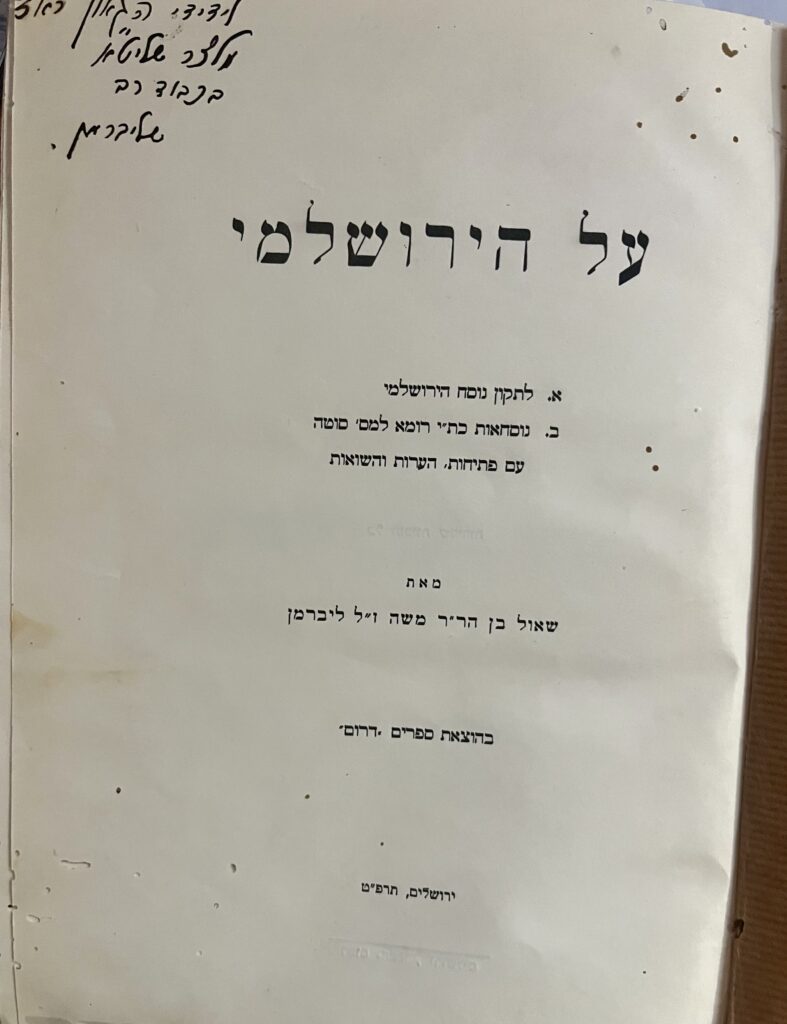
This, despite the fact that Lieberman’s earliest major work, Al ha-Yerushalmi, had already exemplified a disciplined form of textual criticism, drawing on manuscripts, parallel traditions, and internal philological analysis to clarify and correct the text of the Jerusalem Talmud. This could easily have provided fodder for Shmueli, yet he remained silent regarding Lieberman’s method. Recently published letters show that even the Ḥazon Ish engaged Lieberman seriously on these questions. Their correspondence reveals a principled disagreement over method, particularly regarding emendations grounded in manuscript evidence, while also demonstrating that such philological argumentation could be treated as a legitimate subject of rabbinic dispute rather than dismissed outright as heresy. Of course, since this correspondence had not yet been published, it cannot explain Shmueli’s silence on Lieberman’s approach.[81]
Copy of Al ha-Yerushalmi Gifted to R. I.Z. Meltzer from Lieberman
This nuance is essential for understanding the Beys Yaakov article’s invocation of the Ḥazon Ish. Lieberman is not cast as a theological threat or ideological provocateur, but as a formidable talmid ḥakham whose methods, though troubling to some, remained bounded within an elite scholarly discourse. Halivni, by contrast, is portrayed as extending those methods in a more expansive and publicly consequential direction, one that, in Shmueli’s view, exceeded the implicit safeguards that had contained earlier forms of academic intervention. The result is a portrait of Orthodox engagement with academic Talmud that is internally differentiated, historically self-aware, and intellectually serious, far removed from caricatures of reflexive or indiscriminate rejection.
That differentiation, however, depended upon the boundaries of scholarly containment. It held only so long as the debate remained internal to a learned community. Nowhere does Shmueli’s anxiety emerge more sharply than in his discussion of Halivni’s contribution to the Encyclopaedia Britannica.[82] Written in English for a general readership unfamiliar with the internal conventions of Talmudic study, Halivni’s article marks, in Shmueli’s view, the point at which an intramural scholarly debate enters the public register. At that point, silence becomes irresponsible. What is at stake is no longer a disputed method within a learned guild, but the public representation of the Talmud itself: its authority, coherence, and standing before a wider audience.
Yet the subsequent reception of the controversy would hinge less on Shmueli’s carefully drawn distinctions than on the interpretation of a single line in the Beys Yaakov article itself.
The Mistranslation That Changed Everything
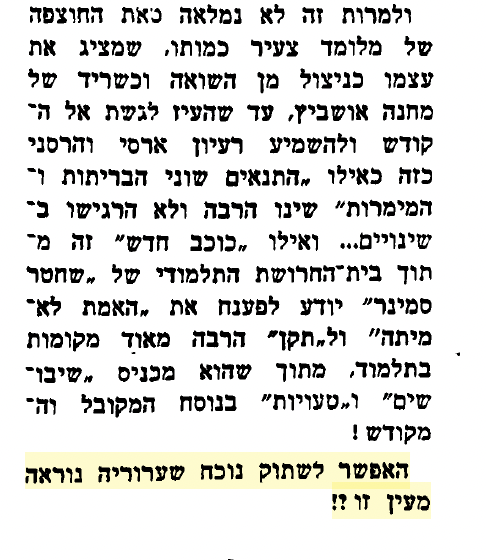
After developing its substantive critique, the Beys Yaakov article closes with a pointed rhetorical question:
!?האפשר לשתוק נוכח שערוריה נוראה מעין זו
The phrase is best rendered: “Is it possible to remain silent in the face of such a terrible scandal?”
Here we arrive at Shenker’s most consequential error. Shenker isolated the noun שערוריה (sha’aruriyah) and translated it as “abomination.” This was not a neutral lexical choice, but a serious mistranslation with far-reaching interpretive consequences.
In classical and rabbinic Hebrew, as well as in modern Hebrew, שערוריה denotes a scandal or public outrage, an event or claim that provokes alarm, indignation, and moral disquiet. Rooted in the semantic field of סער and סערה, it evokes turbulence and upheaval, suggesting commotion and protest rather than ritual pollution or theological deviance.[83] The term therefore belongs to the register of public scandal and polemical critique, not to the technical vocabulary of halakhic or theological condemnation. It conveys gravity, even urgency, but it does not imply that the object in question lies beyond the bounds of religious legitimacy. By contrast, Biblical and rabbinic Hebrew possess precise and well-established terms for “abomination,” most prominently תועבה (toʿevah) and the ש־ק־ץ family (שקץ, sheqets; שיקץ, shiqets). These terms function as technical markers of religious repugnance and exclusion.[84] תועבה denotes what is abhorrent before God, a term reserved for practices that are religiously intolerable, most prominently idolatry and acts explicitly proscribed as violations of the divine order. שקץ, by contrast, marks what is ritually defiling and categorically repugnant, designating objects or acts that are not merely objectionable but intrinsically contaminating within the cultic and halakhic system. In such usage, these terms do not merely register protest or indignation. They function as categorical markers of religious illegitimacy, designating acts or objects as intrinsically defiling and wholly intolerable within the normative order of divine law.
An Orthodox polemicist seeking to convey that level of categorical condemnation would almost certainly have employed one of these terms. Shmueli does not. His diction is emphatic but restrained, signaling moral alarm and scholarly urgency rather than theological excommunication. Translating שערוריה as “abomination” imputes to the article a category of judgment absent from the Hebrew. The difference is not rhetorical but semantic: the mistranslation shifts the text from protest to proscription, from scandal to heresy. One is reminded of the rabbinic topos of qotzo shel yod, the barely perceptible stroke of the yod (understood by Rashi as its right leg and by Rabbeinu Tam as its curved crown) whose alteration can overturn an entire halakhic construction.[85] Shenker’s substitution performed precisely such a transformation. There is no plausible pathway by which the language of “abomination” could have entered the public narrative surrounding Halivni other than through this mistranslation. In doing so, it recast an argument urging engagement with a grave scholarly challenge as a declaration of religious intolerance and obscured the article’s actual posture, which was not to brand Halivni’s work as heretical but to insist that a development of profound intellectual and communal consequence cannot responsibly be met with silence.
The consequences of this lexical substitution extended far beyond Shenker’s 1977 profile. Once “abomination” entered the New York Times archive as the purported Orthodox verdict on Halivni, it became available for repetition as journalistic fact. Thus, when the Times published its 2022 obituary of Halivni, it reproduced Shenker’s framing and relied on the same source. The obituary’s headline, casting Halivni as a “controversial” scholar rejected by “many Orthodox rabbis,” thus rested in part on a mistranslation that had already transformed a bounded Hebrew critique of scholarly method into a sweeping theological denunciation. In this way, a single erroneous word became the pivot of a durable public narrative.
The Effect of Sensationalism
Israel Shenker’s mistranslation did not merely distort a phrase; it altered the character of the intellectual activity in which the Beys Yaakov Journal was engaged. The original article undertook a demanding and careful task: it presented a sophisticated academic methodology to an Orthodox readership, explained why that methodology posed serious difficulties within the traditional epistemology of Talmudic study, marshaled substantive scholarly objections, above all the position of the Ḥazon Ish, acknowledged internal differentiation within Orthodoxy, and articulated strong disagreement grounded in textual and methodological analysis. By rendering the article’s culminating language as invoking an “abomination,” Shenker recast sustained scholarly critique as fundamentalist denunciation, collapsing methodological dispute into theological outrage and substituting caricature for argument.
This inversion is especially consequential in light of the documented record of the Beys Yaakov Journal of reflective engagement with modernity, both in its prewar Polish incarnation[86] and in its postwar Israeli continuation.[87] Beys Yaakov was not a polemical broadsheet but an educational and intellectual forum that repeatedly confronted modern scholarship rather than retreating from it. Shenker’s portrayal effaced that history and compounded the distortion by mischaracterizing the journal as “an official publication” of Agudath Israel. It was not. Published by the “Central Beys Yaakov of Israel” and later by the “Bais Yaakov Women’s College,” the journal functioned as an educational organ aligned with Agudah but not as a party instrument. The distinction is substantive. Educational journals cultivate explanation and debate; party organs enforce discipline.
The encounter with Rabbi Professor David Weiss Halivni was therefore neither a reflexive ban nor an eruption of obscurantism, but a serious internal reckoning with a scholarly development understood to carry public and pedagogical consequences. The episode demonstrates how readily Orthodox intellectual life in the mid-twentieth century has been recast through external narratives that confuse methodological dispute with theological denunciation. To understand the controversy properly requires moving beyond journalistic distortion to the jurisprudential problem Halivni’s scholarship forced into view. The debate was not about temperament or piety, but about first principles: whether historical reconstruction can be insulated from normativity; whether halakhic authority rests on procedural continuity or on claims of historical transparency; and whether Orthodox institutions possess mechanisms capable of absorbing critical candor without destabilizing the structures of authority they seek to preserve. It is to that institutional and conceptual terrain that we now turn.
[to be continued…]
Appendix 1: Yitzhak M. Shmueli, “A Cry of Alarm Concerning the New School of ‘Talmud Critics’!” Beys Yaakov, vol. 10, no. 4 [#116] (1969): 4-5 (Hebrew), available here:
Yitzhak M. Shmueli,
“A Cry of Alarm Concerning the New School of “Talmud Critics”!
“Ḥokhmat Yisrael” – that enterprise which was founded and ardently desired at the initiative of the various exponents of “Reform,” in all its forms – there is no falsehood and distortion more dreadful than it. This “root that bears gall and wormwood” – its earliest growth began in Germany, and there it affixed to itself the flattering yet deceptive name: “Wissenschaft des Judentums” (“the Science of Judaism,” in a literal translation from German). Within the bosom of this poisoned “science” arose all the movements of assimilation and derision away from Judaism. Generations of upright Jews fell into this trap. Many – far, far too many – this very “Ḥokhmat Yisrael” led all the way to the gates of apostasy, Heaven forfend.
All the venomous “wisdom” of the founders and disseminators of this “science” concerning “Judaism” in fact drew its sustenance from the sources of malice inherent in German, gentile “Biblical Criticism.” There were German scholars who regarded themselves as immense experts in the knowledge of the “East” (“Orientalistics,” in the foreign tongue), and, being afflicted with hatred of Israel, jealousy and the impulse of enmity toward the Book of Books burned within them. From this was born their aspiration “to criticize the Bible” in the most bizarre forms. And the matter is well known to the discerning. Several of the Christian researchers in Germany, foremost among them the orientalist Wellhausen – notorious for his attacks and his arrogant “discoveries” against the integrity and originality of the Bible – in fact founded the modern school of “Biblical Criticism.” And to our shame, even a few scholars from among our brethren, the Children of Israel, adhered to this path, taking hold of the seeds of self-directed malice, and lent their hand and their strength to the expansion and dissemination of this poisonous “science,” whose very point of departure was permeated with hatred of Israel.
This is neither the place nor the proper hour to display publicly all the falsehoods and malicious distortions that have accumulated around this discipline of “Biblical Criticism,” which, from the moment Jews too began to engage in it, cloaked itself in the new guise of “Ḥokhmat Yisrael.”
The historical truth is that this entire “science” known as “Biblical Criticism” has long since been exposed as false – and of all the mountains of nonsense and all the towers of lies that were heaped up and constructed by the celebrated “Biblical critics,” there remains no longer one stone upon another, one brick upon another, most evidently so. Indeed, it is precisely the scientific discoveries of the most recent period – and first and foremost the discovery of the “hidden scrolls” – that have decisively demolished the foundations of this deceptive “science.”
From time to time, modern Israeli archaeologists burst forth in cries of astonishment: Behold and see, to what degree everything found in the Holy Scriptures is precise!
And the historical truth is being clarified from every perspective. For these “Biblical critics,” not a few of whom are in fact complete ignoramuses regarding the Torah of Israel as a Torah of life and as the Torah of eternity, are accustomed to “correcting” the books of the Bible in accordance with whatever arises from their most confused and wildly unrestrained imagination. And suddenly, from ancient caves, hidden scrolls are found dating from nearly two thousand years ago, and everything written within those original and authentic scrolls – which renowned scholars examine and scrutinize – contradicts and refutes those sophistic vapidities and heaps of nonsense that were crowned with the title “Biblical science.”
And beyond this, the archaeologists engaged in excavations at historical sites in the Land also have something to say. And they demonstrate – as, for example, the Israeli archaeologist Dr. Moshe Kochavi recently demonstrated, who organized and directed the excavations in the Negev and in the Judean Mountains:
“The geographical record in Scripture has been proven by the discoveries in our excavations to be an exceptionally precise and reliable measure! In the Book of Joshua, chapter 15, there is found a detailed delineation of the boundaries of the tribe of the sons of Judah, their cities and their settlements, and all the discoveries made by our archaeological unit, which encompassed approximately twenty-five sites from the period of the kings of Judah, definitively confirmed that the entire division into districts – in the wilderness, in the hill-country, in the lowland, and in the Negev – is completely accurate; it accords with the standards demanded by every rigorous modern geographer!”
Ḥazal already said: “Yehudah ve-‘od la-qera” – that is, is there any further need whatsoever to confirm what is written in the Torah? In this generation, therefore, the whole-hearted faithful of Israel – loyal to the Torah and continuers of the heritage of Judaism – can, for their part, dispense with all those “authoritative confirmations” as well as the “scientific corroborations” of those “rigorous modern geographers.” But those great “sages” of Biblical Criticism – what answer can they possibly offer in the face of all the archaeological discoveries?
II.
And behold, there has emerged the newest fashion of “Talmud Criticism,” as a link integrated into the chain of distortions of “Ḥokhmat Yisrael” – which contains no “wisdom,” and whose association with “Israel” is exceedingly dubious.
It is a sacred obligation to raise a mighty voice of protest against the new “school” of the pretentious “Talmud critics,” who are liable to mislead pure souls among the Children of Israel. It is a double obligation to sound the alarm and to warn, since the dangerous initiative to harm – Heaven forbid – the foundational sources of the Oral Torah has now issued forth from a group of scholars concentrated around the “Schechter Seminary” in New York, whose official name is the “Jewish Theological Seminary,” and which is known as the “spiritual center” of the Conservative (“traditionalist”) movement in America.
As the first swallow heralding the emergence of the new method, there has now appeared, published by “Dvir” in Tel Aviv, a book entitled Sources and Traditions – Explanations in the Talmud. Its author, David Halivni, presents himself as an “expert in Talmudic research” who grew up within the walls of the “Schechter Seminary” in New York, in the company of Professor Louis Finkelstein, head of the Seminary, and Professor Saul Lieberman, the Seminary’s chief scholarly authority.
A public alarm must be sounded regarding the dangerous and destructive tendency of these “Talmudic explanations,” for of itself there surfaces the characteristic comparison with that famous “commentary” on the Torah by Moses Mendelssohn, the founding father of Reform in Germany! And if one extends this historical comparison further, the author of this “Talmudic research” likewise employs an innocent formulation and continually lifts his eyes heavenward…
“‘Blessed is the Omnipresent’ – thus opens the book’s ‘Preface’ – ‘who has merited me to see in print my explanations… May it be His will that just as He has merited me to see in print my explanations on the Order of Nashim, so may He merit me to see in print my explanations on the other orders and other books.’”
As it appears, the destructive hand is raised openly, and the plan is rather broad: to attack all the orders of the Shas and the other sources of Ḥazal, by means of that rusted and poison-saturated weapon called “Sources and Traditions”…
In the author’s scientific idiom this is called “textual truth,” since he strives to demonstrate that the Talmud is supposedly filled and replete with “inaccuracies,” “changes in sources,” “deviations from the simple interpretation,” and the like – claims and arguments that were habitual upon the tongues of all the “Biblical critics.”
From the words of the “Introduction” it is plainly evident that the author knows the truth, and merely intends to rebel against it! He himself writes that variations in textual versions, together with the difficulties bound up with them, have long since become part of the traditions… and indeed, one who has grown accustomed to this – precisely in this he perceives the distinctiveness of the Torah, and that its very diversity is its superior virtue…
The author even knows how to cite the words and opinions of the great Torah authorities, the giants of spirit of the later generations, such as the Ḥatam Sofer or Rabbi Israel Salanter, who explained that the essence of the distinctiveness of the Oral Torah lies precisely in this: that not everything appears revealed and simple at first glance…
This was the considered view of the author of the Ḥatam Sofer (in his novellae to tractate Ketubbot):
“The forced explanations (the resolutions offered to account for the difficulties arising in the comparison of the words of Ḥazal) – most of them are true… however, the rationalizations and inventions – most of them are false, and they are what cover over the face of truth.”
And Rabbi Israel Salanter, founder of the Mussar movement, stated this explicitly (in the introduction to his work Tevunah):
“What is truth? Truth does not live by simplicity alone, for simplicity is but one branch among the ways of proof; and for the most part the cherished difficulties stand ready to wage war against simplicity and to dislodge it…”
And despite all this, the arrogant audacity of a young scholar such as he has not been satisfied – a man who presents himself as a survivor of the Holocaust and as a remnant of the Auschwitz camp – to the point that he dared to approach the holy and to voice such a venomous and destructive notion, as though “the tannaim who transmitted the baraitot and dicta” altered much and did not even sense the alterations… whereas this “new star” from the Talmudic factory of the “Schechter Seminary” knows how to decipher “the truth in its truest sense” and to “correct” very many passages in the Talmud, by inserting “corruptions” and “errors” into the accepted and sanctified text!
Is it possible to remain silent in the face of such a terrible scandal?
III.
The source of a great danger has been exposed – one that is public-spiritual in character, and not merely literary-scholarly. We have no dispute with the author of this “collection of explanations,” who, notwithstanding everything, is himself compelled to concede that this is in essence not a new invention of his own, and that there have already been such researchers within the domain of “Ḥokhmat Yisrael” who attempted to “explicate” the sugyot of the Shas by a textual “critical method”…
The gravity of the danger is inherent in this fact: that it is an “official product” of the “Schechter Seminary,” and consequently it will be recognized and accepted as a “scientific discovery,” and perhaps even as a “scientific challenge” on the part of the Conservative movement in America.
Several years ago, the heads of the “Schechter Seminary” in America made numerous efforts to confer upon themselves a name and standing as a “Talmudic” research institution. Above all, they relied upon the personality of Professor Saul Lieberman, a renowned scholar and master of knowledge in the disciplines of the Oral Torah. It was not difficult to grasp that the spiritual leadership of the Conservative movement could not remain indifferent to the mighty historical phenomenon that became apparent in America with the establishment and flourishing of several advanced yeshivot for Torah study and rabbinic instruction. The “rabbis” of the Conservatives were truly alarmed by the rise of the power and influence of Haredi Judaism (Orthodox Judaism) in America, and they sought to demonstrate that among them too a “spiritual revival” was taking place, and that they too intended to return and to revivify the connection with the heritage of Judaism.
In accordance with the manner of the Conservatives and of all varieties of Reform, who are oriented primarily outward and whose chief concern is to find favor in the eyes of the gentiles, so they then arranged (some years ago) a grand celebration “in honor of the Talmud,” to which the Chief Justice of the Supreme Federal Court in Washington, Earl Warren, was invited. And the great surprise of the celebration was that the Chief Justice of the highest judges in America delivered an enthusiastic address concerning “the ethics of the Talmud,” and set forth several of the principles of Talmudic ethics as a model and exemplar of justice and uprightness!
The speech of the Chief Justice was not an isolated occurrence in America, where in recent times interest in the sources of Judaism has grown. Thanks to authoritative English translations, Christian scholars obtained some access to the treasures of the Talmud. One scholar, an expert in international law, a gentile from birth, published in the pages of an important scholarly journal a special study on the “spirit of true democracy” which he discovered in the Talmud.
And it is an interesting matter that the scholar paid attention there to that foundational principle in halakhic clarification in the Talmud: that “these and those are the words of the Living God.” The expert in international law translated this into his own terms, as an expression of democracy and freedom of expression – that one does not silence the “minority opinion” and does not disregard the rational arguments of the “opposing side,” but rather grants (as is done in the Talmud!) full right even to the minority opinion to explain its outlook. Even after the ruling has been decided on the basis of the majority view – which precisely accords with formal democracy – the “Talmudic sage” continues to voice and present his opinion upon the pages of the Talmud!
In various forms and through various channels, some of the perspectives of the Talmud began to penetrate American society. The growth in the number of yeshiva students in America – many of whom are regarded as authoritative experts in the domains of modern science – transmitted many of the moral principles of the Oral Torah into the broader world.
Until there arose a young “Talmudic researcher,” among the trainees of the “Schechter Seminary,” and proclaimed from every possible platform that fidelity to the text of the Talmud is doubtful, and that one must begin “Talmudic criticism”…
This matter did not suffice with the preparation of the anthology of “Sources and Traditions,” whose entire purpose is to obscure the sources and to undermine the traditions, but he even offered his “merchandise” (apparently upon the recommendation of the heads of the “Schechter Seminary”) to the editorial board of the world-renowned Encyclopaedia Britannica.
From his pen emerged the article “Source Criticism,” appended to the entry “Talmud” in volume 21 of the Encyclopaedia Britannica. What is the entire tendency of this article – particularly when it appears in English and is directed to the general public and to scholars for whom both the sources of the Talmud and the spirit of the Talmud are foreign – what can it lead to? Destructive views such as these: “that one should not lose one’s reason because of the analyses of the sages of the Talmud, who were not precise in the historical sources.” Both absolute ignorance is embedded in them, and an evil spirit of slander and self-degradation drips from them!
IV.
This figure did not emerge merely to testify concerning himself; rather, he also serves to testify concerning the entire “Schechter Seminary.” And the matter exceeds the limited framework of “literary activity” in the domain of “Talmud Criticism.” The “Schechter Seminary” embodies the “fortress of spirit” of the Conservative movement in America – and not only in America.
In recent years, the “Conservative” leaders have revealed an aspiration for “conquest,” and they seek precisely to transform themselves into a “global spiritual movement.” Concurrently, part of their leadership issues “public declarations,” as though their entire purpose is “to preserve and to draw from the sources of Judaism.”
It is indeed true that the great Torah authorities in America, foremost among them the Gaon Rabbi Aharon Kotler, of blessed memory, related from the outset with great suspicion to all “signs of rapprochement” on the part of the Conservatives, since, according to da‘at Torah, even their “tendencies” bear a pronounced character of Reform. The great Torah authorities in America therefore warned that rabbinic organizations in the United States should not blur the “dividing line” between the Jewish communities and the Conservative associations. A fierce spiritual campaign was waged on this matter in the public consciousness of American Jewry. And now one sees plainly what may be expected even from the learned “masters of sources” within the Schechter Seminary.
Appendix 2: Menashe Unger, “A Survivor of Auschwitz Creates a New Method in Talmudic Interpretation,” Der Tog (10 March 1969): 5-8 (Yiddish)
Menashe Unger,
“A Survivor of Auschwitz Creates a New Method in Talmudic Interpretation”
Der Tog (10 March 1969): 5-8 (Yiddish)
Dr. David Halivni Weiss, a survivor of the Nazi extermination camp at Auschwitz, has developed a new method in the study of the Talmud, a method that has aroused wide and serious interest.
In an earlier article we described how the fifteen-year-old Eliyahu David Weiss Halivni was sent to the death camp at Auschwitz already possessing rabbinic ordination; how, under conditions of mortal danger, he studied Gemara together with fellow Jews in Auschwitz and in other death camps; and how, after liberation, he arrived in America. At the age of eighteen he began studying at the Rabbi Chaim Berlin Yeshiva, where he again received rabbinic ordination, this time from Rabbi Moshe Binyamin Tomashov. He later pursued studies at New York University and at the Jewish Theological Seminary, under the guidance of the eminent scholar Rabbi Professor Saul Lieberman. He ultimately became professor of Talmud at the Jewish Theological Seminary and at Columbia University.
His book has now appeared: Mekorot u-Mesorot: Biʾurim ba-Talmud (Sources and Traditions: Explanations in the Talmud), on the Order Nashim, published by Dvir in Tel Aviv. The volume comprises 728 pages, with an introduction of nineteen pages. The book has made a powerful impression in the world of Talmudic scholarship.
What constitutes the new method of Rabbi David Halivni Weiss?
Rabbi Halivni Weiss first emphasizes that more than four hundred Tannaim and more than three thousand Amoraim lived under widely differing historical and social conditions over a period of approximately six hundred years. It is therefore understandable that at times an Amora did not fully comprehend a teaching of a Tanna transmitted to him. There were Tannaim who possessed extraordinary memories and transmitted the teachings of earlier authorities in the academies. Yet even when their memory was exceptional, they were not always able to convey the precise wording exactly as the original Tanna had formulated it. As a result, discrepancies arose, and the Amoraim were compelled to discuss these matters in the academies in order to reconcile the transmitted teachings.
The Amoraim even leveled accusations against such Tannaim, declaring: “The Tannaim are destroyers of the world” (Sotah 22a), because they failed to transmit the halakhah of the Mishnah exactly as the earliest Tanna had stated it. Accordingly, one must strive to return to the original formulation of the halakhah, or to the original statement of the earliest Tanna.
How is this accomplished? By making systematic use of variant manuscripts of the Talmud, Midrash Halakhah, the Tosefta, and the interpretations of many early authorities that have been discovered in recent times in various libraries. We know that Rabbi Judah the Prince, the redactor of the Mishnah, himself sometimes transmitted a halakhah according to his own conceptual framework, and not exactly as the Tanna had originally stated it, in order to render it more intelligible.
To clarify this approach, we will offer one example, drawn from the first Mishnah in Tractate Berakhot. The Mishnah opens: “From when does one recite the Shema in the evening?” It states that from the time the priests enter to eat their terumah one may recite the Shema until the end of the first watch, according to Rabbi Eliezer. The Sages say until midnight, and Rabban Gamliel says “until the rise of dawn.” However, in Avot de-Rabbi Natan it is stated that Rabban Gamliel says “until the rooster crows.”
This raises a difficulty: why did Rabbi, the redactor of the Mishnah, transmit Rabban Gamliel’s opinion as “until the rise of dawn,” whereas Avot de-Rabbi Natan reports it as “until the rooster crows”? One might assume that these refer to the same point in time, that the crowing of the rooster coincides with the appearance of the morning star. Yet from the Tosefta in Tractate Taʿanit (1:6) we see that these two temporal markers are not identical.
The discussion there concerns a fast that begins in the morning, as distinct from fasts such as the Ninth of Av, which begin in the evening. A dispute is recorded between Rabbi and Rabbi Eliezer ben Rabbi Shimon. Rabbi maintains that one may eat “until the rise of dawn,” meaning until the appearance of the morning star, which is still considered night, whereas Rabbi Eliezer ben Rabbi Shimon rules “until the rooster crows.” From this it is evident that the two times are not the same.
Rabbi Halivni Weiss therefore concludes that Rabban Gamliel originally stated only that one may recite the Shema “throughout the entire night,” without specifying any precise endpoint. The later Tannaim then debated how long the measure of “the entire night” extended. Since Rabbi held that night ends with the rise of dawn, and since Avot de-Rabbi Natan indicates that he indeed held this position, Rabbi incorporated into the Mishnah the formulation that Rabban Gamliel says “until the rise of dawn.” In Avot de-Rabbi Natan, however, both views were preserved: Rabbi’s position, “until the rise of dawn,” and that of Rabbi Eliezer ben Rabbi Shimon, “until the rooster crows,” because the redactor of Avot de-Rabbi Natan apparently accepted the latter view and therefore recorded both.
A similar phenomenon appears in the text of the Passover Haggadah, where it states: “They would recount the exodus from Egypt all that night,” without specifying an endpoint. By contrast, the Tosefta at the end of Tractate Pesahim states: “They recount the exodus from Egypt until the rooster crows.”
Rabbi David Halivni Weiss has thus developed a method that may be described, in a certain sense, as Talmudic textual criticism, but in a positive and constructive manner. Already the Netziv writes in his Haʿamek Sheʾelah (Sheʾiltah 136, section 1) that “it is the way of the Talmud to reinterpret the Mishnah so as not to uproot the halakhic ruling.” That is, the Sages did not wish the accepted halakhah to stand in contradiction to an explicit Mishnah, and where necessary they even corrected the wording of the Mishnah so that it would conform to the accepted halakhah.
Rabbi Halivni Weiss presents a striking illustration from Tractate Taʿanit (26b). The Mishnah there states that on three occasions during the year the priests raise their hands in blessing four times a day, and it enumerates Shaharit, Musaf, Minhah, and the closing of the Temple gates. These occasions are fast days, Maʿamadot, and Yom Kippur. The Gemara asks: is there a Musaf prayer on a fast day? It answers: “Something is missing, and this is how it should read: On three occasions during the year the priests raise their hands whenever they pray.” We thus see that the Gemara itself emended the Mishnah.
Why did the Amoraim do this? Rabbi Halivni Weiss explains that Musaf was recited only on a communal fast. In Babylonia there was never a communal fast, as the Gemara itself notes, because only the Nasi could proclaim such a fast, and Babylonia lacked a Nasi, unlike the Land of Israel. In the Land of Israel, communal fasts did exist, but after the abolition of the Nasiate in the year 425 they ceased there as well. In the Mishnaic period, however, Rabbi correctly included Musaf among the prayers recited on such days.
Later Amoraim, who lived in Babylonia and knew no communal fasts even in the Land of Israel, were perplexed by the Mishnah’s implication that Musaf was recited on a fast day. In order to harmonize the Mishnah with the accepted halakhah, they therefore emended its wording and inserted the phrase “whenever they pray.”
Rabbi David Halivni Weiss places primary emphasis on the textual foundations of the Mishnah and the Gemara. He demonstrates, on the basis of early sources, that there existed variant versions of the Mishnah, such as the Mishnah of Rabbi Meir and the Mishnah of Rabbi Akiva, which differed in wording.
As an example, he points to the opening Mishnah in Tractate Kiddushin: “A woman is acquired in three ways: by money, by document, and by intercourse.” The Gemara in Kiddushin (9a) asks: “By document, how?” and answers that if a man writes, “You are betrothed to me,” the woman is betrothed. Rabbi Halivni Weiss asks how the formulation “your daughter” enters the discussion, when the Mishnah speaks of a woman. He explains that this baraita originally referred not to Kiddushin but to Ketubbot, chapter four, where the Mishnah states that a father has rights over his daughter’s betrothal by money or by document. The redactor of the Gemara in Kiddushin apparently possessed such a version and connected the baraita to the Mishnah in Kiddushin because it was the closest relevant context.
This, then, is the path of study of Professor David Halivni Weiss. He proceeds through all the tractates of the Order Nashim, Yevamot, Ketubbot, Nedarim, Nazir, Sotah, Gittin, and Kiddushin, offering on every folio his elucidations and explanations, thereby clarifying many passages that have long remained obscure. At times a single incisive observation resolves a complex Talmudic difficulty and causes an entire accumulation of questions, which scholars had struggled to answer, to fall away.
Rabbi David Halivni Weiss is an outstanding disciple of the eminent Rabbi Professor Saul Lieberman, who takes great pride in his student. Professor Rabbi David Halivni Weiss is the youngest professor of Talmud at the Jewish Theological Seminary. He is engaged in a monumental scholarly undertaking that will be appreciated by all the leading Torah scholars of the generation. Having published his major work on the Order Nashim, he is already preparing a commentary on the Order Moʿed, with the aim of completing a comprehensive work on the entire Talmud.
Rabbi David Halivni Weiss emerged from the valley of death as a fragile child, a living remnant who endured the years of torment in the death camps while preserving his Jewish identity. He has remained a deeply observant Jew, meticulous in every detail of halakhic observance. Through his new method he has conferred a great benefit upon the world of Torah scholarship with his work Mekorot u-Mesorot, which will surely be highly esteemed by all students of Torah throughout the world.
Appendix 3: The 1957 Warren Convocation and the Circulation of Talmudic Self-Incrimination Discourse
Shmueli notes in his article in the Beys Yaakov Journal the wider efforts of JTS to translate talmudic discourse into a public idiom of modern legal and ethical relevance, and specifically a visit by Chief Justice Earl Warren.[88] During the 1950s, under the leadership of JTS Chancellor Louis Finkelstein, the Seminary promoted what it termed an “ethics of the Talmud,” presented as a normative program rather than antiquarian scholarship. Finkelstein described this enterprise as a kind of “fifth Shulḥan Arukh,” positioning the Talmud as a source of authoritative guidance for contemporary life.
The scope and aims of this project are documented in a substantial exchange between Finkelstein and Saul Lieberman in the mid-1950s.[89] In a detailed letter dated July 22, 1955, Finkelstein outlined his ambition to develop what he explicitly termed a “fifth Shulḥan Arukh,” by which he meant a systematic exposition of rabbinic ethics derived from the talmudic corpus. The letter makes clear that the two had discussed the matter repeatedly and that Finkelstein regarded Lieberman as indispensable to its realization. He credited Lieberman not only for scholarly guidance but for shaping his understanding of the ethical dimensions of rabbinic literature, remarking that he sought to render “Professor Lieberman as an institution” into a durable intellectual framework. Lieberman’s reply articulates a distinctive conception of legal-ethical obligation. Jewish law, he argued, establishes only the minimal standards necessary for social existence; genuine ethical responsibility begins beyond that threshold. Ethical expectations vary according to intellectual and moral stature. Conduct that might be considered blameless in an ordinary individual could be ethically culpable in a scholar. Rabbinic literature, he maintained, preserves numerous episodes illustrating such graduated responsibility, and only a sustained analytical study of the entire corpus could yield a systematic code of rabbinic ethics. He wrote:
“I might have stated to you my position on Jewish law and legal ethics. I believe that they are only the minimum without which no society can exist. The real legal ethics begin beyond this minimum. Each individual is legally bound by an ethical system conditioned to his individual character, temperament and general stature. A certain behavior on the part of an ordinary man may rightly be considered blameless under the circumstances, but the same behavior on the part of a learned man should be considered ethically criminal. In between the ignorant small man and the learned great man there are numerous gradations of ethical principles which correspondingly should guide the individual according to his status. Rabbinic literature abounds in episodes which highly illuminate the particular ethical principles with which we are concerned. The general idea is that none is exempt from the moral duty to aspire for perfection, thus raising the standards of the ethical principles required by the law for the particular individual.”[90]
This initiative took institutional form in September 1957 with the inauguration of the Lehman Institute of Ethics,[91] marked by a scholarly convocation on “Law as a Moral Force,”[92] attended by Chief Justice Earl Warren and described by one speaker as graced by the presence of “the most beloved citizen of our land.”[93]
Contemporary coverage makes clear that the convocation was designed not only as an internal scholarly gathering but as a publicized civic event. Reporting on the occasion, The New York Times noted that Warren had “enrolled” at the Seminary for a three-day convocation held over the weekend of September 13-14, 1957, devoted to Jewish law and its relevance to contemporary legal problems, and described both his participation in scholarly discussions and his attendance at Sabbath eve services. Finkelstein was quoted as framing the event as a gesture of civic-cultural deference: the Seminary, he declared, sought to honor Warren by sharing with him “our most treasured possession – the Talmud and its teaching.”[94] The report further translated rabbinic jurisprudence into American legal idiom, describing the Mishnah’s interpretive authority as “analogous to a Supreme Court decision,” and noting that Saul Lieberman’s Friday night lecture addressed procedural doctrines, especially self-incrimination and double jeopardy, that resonated directly with American constitutional discourse.[95] A contemporaneous Jewish Telegraphic Agency report similarly quoted Warren as remarking that several American constitutional safeguards, including those against self-incrimination and double jeopardy, appeared to derive from talmudic law. While noting that protection against self-incrimination was “perhaps not as sacred now as in ancient times,” Warren nonetheless affirmed its continuing place within American jurisprudence.[96] The episode illustrates the dynamic that Shmueli sought to resist: talmudic law presented as a moral-jurisprudential resource whose public legitimacy is ratified through elite American recognition.
According to Louis Finkelstein’s later recollection, Warren was so struck by Lieberman’s lecture that, despite an understanding that he would not speak publicly, he insisted on addressing the assembled audience. Warren reportedly expressed astonishment that such teachings were “almost a secret,” asking how it was that “nobody knows about it.” Public attention followed quickly. Finkelstein recalled that former President Harry S. Truman, then visiting New York, read the New York Times account of the event and declared, “If it is good enough for him, it is good enough for me,” before arriving at the Seminary together with Judge Samuel Rosenman, himself not merely a jurist but a leading Democratic insider and former presidential adviser closely associated with Roosevelt and Truman. Shmueli’s polemic thus draws upon a real and widely publicized episode in which the Talmud was presented to prominent representatives of the American political and legal establishment as a jurisprudential and ethical resource.[97]
Although the text of Lieberman’s lecture, “Law as a Moral Force in Rabbinic Literature,”[98] has not been preserved (and no recording was made, as it was delivered on the Sabbath eve), the intellectual aims of the convocation inaugurating the Herbert H. Lehman Institute of Ethics are articulated with unusual clarity in the published preface to Professor Shalom Spiegel’s address, Amos versus Amaziah.[99]
The conclave was explicitly convened to explore the moral dimensions of law as articulated in ancient Hebrew sources and to assess their relevance to contemporary legal and civic problems. Chief Justice Earl Warren and former President Harry S. Truman were among the featured participants, and Warren was quoted as remarking on the “sense of humility” that follows from recognizing that “most of the good things that we find in our law and in our own institutions come from the wisdom of men of other ages.” Spiegel’s address, identified in the prefatory material as one of the principal lectures of the weekend, framed prophetic confrontation and biblical justice through the idiom of constitutional adjudication and judicial review; Truman reportedly described it as “one of the best [lectures] I have ever heard in my life.”[100] In this respect, Spiegel’s published address offers a reliable index of the conceptual register within which Lieberman’s now-lost lecture was heard.
The episode circulated widely beyond the English-language press. Coverage in the Yiddish press highlighted the unusual image of the Chief Justice of the United States Supreme Court sitting in the Seminary, wearing a yarmulke and studying Talmud together with Finkelstein and Lieberman.[101] It was largely through this reportage that the episode entered the retrospective memory of circles associated with Yeshiva University. Decades later, Rabbi Hershel Schachter recalled in writing that R. Joseph B. Soloveitchik reacted sharply to Yiddish newspaper accounts of Lieberman’s talmudic exposition, particularly the suggestion that repentance could nullify liability to punishment in an earthly court, a claim difficult to reconcile with Makkot 13b. He reportedly dismissed such reports as devarim betelim (‘idle talk’) and invoked the Ra’avad’s critique of Maimonides.[102]
Samuel J. Levine has recently suggested that Chief Justice Warren’s later invocation of Jewish law in Miranda v. Arizona (1966) may be traced to his widely reported 1957 visit to the Jewish Theological Seminary. According to Levine, the JTS encounter helped prepare the conceptual ground for Miranda, as contemporary accounts of the visit already portrayed Jewish law as an antecedent to Anglo-American constitutional protections, particularly in the area of self-incrimination.[103] That framework, however, was already in circulation at least a year earlier and cannot be attributed solely to the 1957 Seminary visit.
Newly available correspondence complicates any linear account of influence running from Warren’s 1957 visit to the Seminary to Miranda (1966). In early 1956, Rabbi Norman Lamm, then a pulpit rabbi in Springfield, Massachusetts, published in Judaism a substantial essay written at the height of public controversy over the Fifth Amendment, explicitly framing ein adam mesim atzmo rasha (“no man can render himself legally wicked”) as the halakhic analogue of the constitutional privilege against self-incrimination.[104] Far from offering a casual comparison, Lamm argued that halakhah went beyond the Fifth Amendment by rendering all criminal confessions inadmissible, even if voluntarily offered.[105] This was the argument Warren would later cite in his majority opinion.
On March 19, 1956, more than a year before Warren’s appearance at the Seminary, Justice William O. Douglas wrote to Lamm that he had read the essay and found it “uncommonly suggestive,” praising its “penetrating analysis.”[106] The letter demonstrates that Lamm’s comparative formulation had already circulated within the Court at the moment of its publication, independently of the later public staging of the JTS symposium. Although the precise circumstances under which Warren first encountered the essay remain unknown, Douglas’s correspondence establishes that the argument had entered the Court’s intellectual orbit well before the 1957 visit.[107]
Contemporary Jewish press coverage of Miranda indicates that Warren’s footnote was promptly read in genealogical terms. An editorial in the Wisconsin Jewish Chronicle, titled “Grandpappy of the Fifth Amendment,” presented the decision as evidence that “the ancient Talmudic law” lay at the root of modern constitutional protections. Citing Lamm’s formulation of ein adam mesim atzmo rasha, it described the Talmud as the “great, great, great grandpappy” of the Fifth Amendment and treated the Court’s ruling as a contemporary reaffirmation of an ancient legal principle.[108] Similarly, the St. Louis Jewish Light interpreted Warren’s reference to “ancient times” as an acknowledgment of Lamm’s 1956 formulation, stressing that halakhah not only anticipated but surpassed the Fifth Amendment in stringency.[109] In both instances, a comparative footnote was taken as evidence of a historical lineage linking Jewish jurisprudence to American constitutional doctrine.
The JTS episode should therefore be understood not as the origin of Warren’s engagement with Jewish law, but as a conspicuous public moment that consolidated and legitimated a line of juridical reflection already underway.
This pattern of influence and circulation is also visible, albeit indirectly, in the later secondary literature produced within the Seminary’s own intellectual milieu. Aaron Kirschenbaum, whose Self-Incrimination in Jewish Law emerged from the JTS faculty orbit,[110] neither mentions Warren’s widely publicized 1957 visit to the Seminary nor notes Warren’s later reliance on Norman Lamm’s 1956 essay in his majority opinion in Miranda v. Arizona. He does, however, call attention to Warren’s use of other secondary legal scholarship.[111] The omission is striking, since Enker and Elsen themselves cite Lamm’s essay on the halakhic analogue to the Fifth Amendment,[112] thereby situating Lamm’s argument squarely within the very body of legal literature on which Warren drew.
Indeed, Kirschenbaum explicitly situates his own engagement with self-incrimination in the political and legal climate of the early 1950s. Reflecting on his years at JTS, he recalls how he and his fellow students felt an almost compulsive need to render Moses, Hazal, and Maimonides “relevant,” reading classical sources through the selective lens of modern rights discourse. Under the pressures of the McCarthy era, he writes, congressional investigations and compelled testimony rendered the constitutional privilege of silence a matter of urgent moral significance. The formula “I refuse to answer… because my response would constitute self-incrimination” became, for him, not merely a legalism but a moral idiom. It was precisely this Fifth Amendment protection, he explains, that “captivated” him and first drew him into the surrounding legal literature.[113]
Whatever the precise channels through which Jewish legal analogies entered American constitutional discourse, the Lehman Institute convocation represented a highly visible attempt to stage talmudic law as a public moral resource within elite American civic culture, and it was precisely this institutional posture that drew Orthodox critique. Yet the controversy surrounding the Lehman Institute and the 1957 Warren convocation was not without precedent. From the mid-1930s onward, Louis Finkelstein’s efforts to reposition the Jewish Theological Seminary as a locus of public moral and cultural authority had already provoked sustained criticism from Orthodox and right-wing observers, who viewed such initiatives as compromising rabbinic integrity in pursuit of external validation. Programs aimed at engaging Christian intellectuals or framing Judaism in universal ethical terms were repeatedly denounced in the Orthodox and Yiddish press as apologetic accommodation, and at times as missionary entanglement. Figures such as Aaron Rosmarin cast these projects as oriented less toward the cultivation of internal rabbinic tradition than toward securing legitimacy before non-Jewish audiences and American cultural elites.
Notes
Throughout this article, individuals are occasionally referred to by surname alone, in keeping with established scholarly convention. This practice is adopted solely for stylistic consistency and carries no implication of disrespect. ↑
Joseph Berger, “Rabbi David Weiss Halivni, Scholar Devoted to the Talmud, Dies at 94,” The New York Times (18 July 2022): A17. ↑
See David Weiss Halivni, The Book and The Sword: A Life of Learning In The Shadow of Destruction (New York: Farrar Straus and Giroux, 1996); and Netiʻot Ledavid: Jubilee Volume for David Weiss Halivni, eds. Yaakov Elman, Ephraim Bezalel Halivni, and Zvi Arie Steinfeld (Jerusalem: Orhot Press, 2004). ↑
For the fullest methodological exposition of his theory of Talmudic redaction, see David Weiss Halivni, The Formation of the Babylonian Talmud, trans. Jeffrey L. Rubenstein (Oxford: Oxford University Press, 2013). See also H.A. Alexander, “David Halivni and Shamma Friedman: Conflicting Trends in Talmud Criticism,” Conservative Judaism, vol. 39, no. 3 (Spring 1987): 45-57; Ari Bergmann, Halevy, Halivni and the Oral Formation of the Babylonian Talmud (PhD diss., Columbia University, 2014) and Ari Bergmann, The Formation of the Talmud: Scholarship and Politics in Yitzhak Isaac Halevy’s Dorot Harishonim (Berlin: de Gruyter, 2021); and earlier in Irwin H. Haut, The Talmud as Law or Literature: An Analysis of David W. Halivni’s ‘Mekorot Umasorot’ (New York, Bet Sha’ar Press, 1982). A fuller treatment of Halivni’s method and its reception will be presented in subsequent essays in this series. ↑
For the subsequent editions in this series, see David Weiss Halivni, Mekorot u-Masorot: Seder Nashim (Tel-Aviv: Devir, 1969; Hebrew); David Weiss Halivni, Mekorot u-Masorot: Seder Moed, from Yoma to Hagiga (Jerusalem: Jewish Theological Seminary, 1975; Hebrew); David Weiss Halivni, Mekorot u-Masorot: Shabbat (Jerusalem: Jewish Theological Seminary, 1982; Hebrew); David Weiss Halivni, Mekorot u-Masorot: Eruvin-Pesahim (Jerusalem: Jewish Theological Seminary, 1982; Hebrew); David Weiss Halivni, Mekorot u-Masorot: Seder Nashim, second edition (Toronto: Otsereinu, 1992; Hebrew); David Weiss Halivni, Mekorot u-Masorot: Bava Kamma (Toronto: Otsereinu, 1993; Hebrew); David Weiss Halivni, Mekorot u-Masorot: Bava Metzia (Jerusalem: Magnes, 2002; Hebrew); David Weiss Halivni, Introduction to ‘Mekorot u-Masorot’, first edition (Jerusalem: Magnes Press, 2009; Hebrew); David Weiss Halivni, Introduction to ‘Mekorot u-Masorot’, second edition (Jerusalem: Magnes Press, 2012; Hebrew); David Weiss Halivni, Mekorot u-Masorot: Sanhedrin, Shavu’ot, Makot, Avodah Zarah, Horayot (Jerusalem: Magnes, 2012; Hebrew); David Weiss Halivni, Mekorot u-Masorot: Zevahim-Menahot (Jerusalem: Magnes Press, 2023; Hebrew); and see David Weiss Halivni, The Formation of the Babylonian Talmud, ed. and trans. Jeffrey L. Rubenstein (Oxford: Oxford University Press, 2013). ↑
A comprehensive bibliographical listing of Halivni’s writings, including digitized scans, is available on the Academia.edu page (here) curated by Menachem Butler in collaboration with Professor Halivni’s family. ↑
Israel Shenker, “A Life in the Talmud,” The New York Times Magazine (11 September 1977): 44-45, 74-82, available here. ↑
Margalit Fox, “Israel Shenker, 82, a Reporter With the Instincts of a Scholar,” The New York Times (17 June 2007): 23. ↑
Israel Shenker, “Groucho, at 81, Discusses Favorite Topic- Women,” The New York Times (4 May 1972): 50; Israel Shenker, “Groucho Marx Uses Room Service to Press Suit,” The New York Times (5 June 1975): 40. ↑
Israel Shenker, “Borges, a Blind Writer With Insight,” The New York Times (6 April 1971): 48. ↑
Israel Shenker, “Former Chomsky Disciples Hurl Harsh Words at the Master,” The New York Times (10 September 1972): 70. ↑
Israel Shenker, “The Old Magician at Home,” The New York Times Book Review (9 January 1972): 2. ↑
Israel Shenker, “Picasso, 90 Today, Assayed By Critic, Curator, 3 Artists,” The New York Times (25 October 1971): 42. ↑
Israel Shenker, “Asimov, ‘on Fire to Explain,’ Writes 100th Book – About Himself,” The New York Times (18 October 1969): 35; Israel Shenker, “I.B. Singer As Traveler,” The New York Times (13 March 1983): 66-70. ↑
Israel Shenker, “A Religious Zionist Urges Compromise on Occupied Lands,” The New York Times (15 June 1978): 12. For contemporaneous coverage of the Oz V’Shalom movement – founded in response to Gush Emunim – see “Orthodox Group in Israel Forming Peace Movement to Oppose Gush Emunim,” The Jewish Week (11 June 1978): 24. ↑
Israel Shenker, “Professor, 80, Looks to Volume 18 of Jewish History,” The New York Times (26 May 1975): 31. ↑
Israel Shenker, “Solomon Zeitlin, Long a Professor of History and Rabbinics, Dies,” The New York Times (30 December 1976): 26. ↑
Israel Shenker, “Shabuoth Group Sifts Gossamer Threads of Torah, Particularly the Ten Commandments,” The New York Times (24 May 1969): 25; Israel Shenker, “Rabbi Gives Views on Birth Control: Cites Jewish Law and Bible on Marital Ethics,” The New York Times (30 November 1969): 50; Israel Shenker, “Rabbi Finkelstein to Retire; Joy of Study Undiminished,” The New York Times (28 September 1971): 41; Israel Shenker, “Two Are Named as Heads of the Jewish Theological Seminary,” The New York Times (28 October 1971): 43; Israel Shenker, “Rabbi to Give Nixon a Kingly Blessing,” The New York Times (19 January 1973): 16; Israel Shenker, “Adele Ginzberg, at 90, Says, ‘So What?’,” The New York Times (16 May 1976): 50; Israel Shenker, “Japanese Christian Is Awarded A Doctorate by Jewish Seminary,” The New York Times (31 May 1977): 33. ↑
See also Shenker’s profile of Rabbi Benjamin Kamenetzky, son of the renowned Torah scholar Rabbi Yaakov Kamenetsky, who fielded religious inquiries through a public telephone ‘Hot Line to the Rabbi’, in Israel Shenker, “On Wednesday, the Rabbis Answered the Phones,” The New York Times (19 May 1978): B1. ↑
See also Israel Shenker, “Deli Waiters Turn Polite for the 4th,” The New York Times (5 July 1969): 38; Israel Shenker, “Delicatessen Puts Clock Back 20 Years,” The New York Times (12 March 1974): 41; Israel Shenker, “For Customers Over 65, The Food Is Half-Price,” The New York Times (25 September 1974): 46; and Israel Shenker, “In Delis, 2d Ave. Is a Palace,” The New York Times (22 April 1977): C19. ↑
There were, of course, rare exceptions. See, for example, Israel Shenker, “Knishes and Latkes, Yes! But Chicken Wellington?” The New York Times (10 March 1971): 45; Israel Shenker, “Taste for Business Builds Brooklyn Knish Empire,” The New York Times (9 May 1971): 80; and Israel Shenker, “They Sing in Praise of Matzoh Brei,” The New York Times (19 November 1973): 44. ↑
Including, for example, Israel Shenker, “Ideological Labels Changing Along With the Label-Makers,” The New York Times (12 November 1970): 45,48; Israel Shenker, “Man and Machine Match Minds at M.I.T.: 5th Conference on Artificial Intelligence Seeks Ways to Smarter Computers,” The New York Times (27 August 1977): 8; Israel Shenker, “Lowell’s Sacco-Vanzetti Papers Are Opened After 50 Years,” The New York Times (10 December 1977): 12; Israel Shenker, “Freiheit Editor’s 75th Birthday Party Is in a Class by Itself: ‘Preserving the Language’,” The New York Times (12 February 1978), 48; Israel Shenker, “Webster, Noah (1758-1843): A Clearly Defined Reputation,” The New York Times (14 April 1978): B1, B5. ↑
Israel Shenker, “Behind the Scenes at the Savoy,” The New York Times (23 June 1985): 19, 36. ↑
Israel Shenker, “Lonely Sea Gate’s Streets Still Belong to Its People,” The New York Times (2 January 1972): A6; Israel Shenker, “Despair Fills Lower East Side Synagogues,” The New York Times (19 March 1974): 4; Israel Shenker, “What’s Nu? Bagel-and-Bus Tours of Jewish New York,” The New York Times (5 May 1976): 89. ↑
Israel Shenker, “The Miraculous Cheeseless Cheesecake: The Cheesecake Without Cheese,” The New York Times (5 July 1978): C1, C7. ↑
Israel Shenker, “The Twerski Tradition: 10 Generations of Rabbis in the Family,” The New York Times (23 July 1978): 38. See also Edward Reichman and Menachem Butler, “The Medical Training and Yet Another (Previously Unknown) Legacy of Rabbi Dr. Abraham J. Twerski, zt”l,” The Seforim Blog (2 February 2021), available here. ↑
Israel Shenker, “Hasidic Group Marks Its 100th Year,” The New York Times (2 June 1971): 46; Israel Shenker, “Hasidic Feat: Simple as Aleph, Beth, Gimel,” The New York Times (3 November 1977): A18. ↑
Israel Shenker, “Brooklyn Brothers Use Scribes’ Ancient Art in Torah Repairs,” The New York Times (27 July 1977): B1. ↑
Israel Shenker, “It’s Onward and Uptown For Hebrew Publishing,” The New York Times (1 August 1976): 40. ↑
Israel Shenker, “Dreydl Makers in City Preparing for What’s a Dreydl? You Shouldn’t Ask,” The New York Times (28 September 1970): 45; and Israel Shenker, “C.C.N.Y’s President Loses Dreydl Crown in Spin-Off,” The New York Times (7 December 1972): 106. ↑
Israel Shenker, “Brides and Bar Mitzvahs Bring a Rush on Yarmulkes,” The New York Times (20 June 1977): 31 ↑
Israel Shenker, “The Day the Waldorf Went Kosher,” The New York Times (23 Dec 1977); 20; and Israel Shenker, “With Them, It’s Always Strictly Kosher,” The New York Times (15 April 1979): 32-33, 36-38, 40, 42. ↑
Israel Shenker, “On El Al, They’d Rather Walk: It’s Up and Down the Aisles, Even at Meal Times,” The New York Times (15 November 1968): 93. ↑
Israel Shenker, “Isaac Singer’s Perspective on God and Man,” The New York Times (23 October 1968): 49, 94; Israel Shenker, “A Bit of Reality by I.B. Singer and Son,” The New York Times (17 April 1970): 44; and Israel Shenker, “The Man Who Talked Back to God: Isaac Bashevis Singer, 1904-91,” The New York Times Book Review (11 August 1991): 11. ↑
Israel Shenker, “Harvard’s Resident Sage Marks 85th Birthday Today,” The New York Times (2 November 1972): 45, 86, available here. He later wrote Wolfson’s obituary in Israel Shenker, “Harry Wolfson, 86, Philosopher of Religion at Harvard, is Dead,” TheNew York Times (21 September 1974): 32, available here. For another contemporaneous tribute, see Mark Jay Mirsky, “Our Greatest Sage: Elegy for Harry Wolfson,” The Village Voice (13 January 1975): 39-41, available here. ↑
Israel Shenker, “Lubavitch Rabbi Marks His 70th Year With Call for ‘Kindness’,” The New York Times (27 March 1972): 39. ↑
Israel Shenker, “Israeli Historian Denies Jews Yielded to the Nazis ‘Like Sheep’,” The New York Times (6 May 1970): 2; Israel Shenker, “How Yiddish Survives At 2 New York Schools,” The New York Times (16 January 1974): 68; Israel Shenker, “An Awesome Reliving of Auschwitz Unfolds at St. John’s,” The New York Times (4 June 1974): 39; Israel Shenker, “The Holocaust: Did God Want It?” The New York Times (6 June 1974): 38; Israel Shenker, “The Holocaust Was ‘Radical Counter-Testimony’ to Religion,” The New York Times (9 June 1974): E5; Israel Shenker, “Scholars at Holocaust Conference Here Seek Answers to the Unanswerable,” The New York Times (4 March 1975): 13; Israel Shenker, “Jewish Cultural Arts: The Big Debate,” The New York Times (13 January 1976): 42; Israel Shenker, “Diverse Views Given on U.S. Jewish Experience,” The New York Times (22 March 1976): 55; and Israel Shenker, “Conference Ponders Who’s a Jew and Why,” The New York Times (26 May 1976): 18; ↑
Israel Shenker, Coat of Many Colors: Pages from Jewish Life (Garden City, NY: Doubleday, 1985). ↑
Israel Shenker, “Israeli Scholar Preparing New Edition of Talmud,” The New York Times (19 September 1971): 78. ↑
And on the controversy two decades later on Rabbi Adin Steinsaltz’ edition of the Talmud, see Haim Shapiro, “Talmudist Continues Down Path of Peace,” The Jewish Week (25 August 1989): 2, 31; Leon Wieseltier, “Unlocking the Rabbis’ Secrets: Review of ‘The Talmud’, by Adin Steinsaltz,” The New York Times Book Review (17 December 1989): 3, 31; Haim Shapiro, “Moving Up The Charts: Rabbi Adin Steinsaltz’s English Translation of the Talmud is Becoming A Surprisingly Hot Seller Abroad,” The Jerusalem Post Magazine (9 March 1990): 7-8; Jonathan Sacks, “Steinsaltz the Polymath,” The London Jewish Chronicle (2 March 1990): 27; Jacob Neusner, “Letter – Steinsaltz’s Say-So,” The Forward (7 December 1990): 6; Jacob Neusner, “Along with the Sizzle, Plenty of Beef: Review of ‘The Talmud: The Steinsaltz Edition, vol. 1: Tractate Bava Metzia. Part 1’, by Adin Steinsaltz,” in Jacob Neusner, ed., Approaches to Ancient Judaism: New Series, vol. 2 (Atlanta: Scholars Press, 1990), 57-65; Emanuel Rackman, “Carved in Stone: Some Powerful Rabbis Won’t Accept New Talmud Interpretations,” The Jewish Week (22 February 1991): 31; and Chaim Rapoport, “On Publishing the Talmud in Translation and With New Commentaries,” Ohr Yisroel, vol. 13, no. 2 (December 2007): 53-88 (Hebrew). ↑
Israel Shenker, “Israeli Scholar Preparing New Edition of Talmud,” TheNew York Times (19 September 1971): 78. Professor Louis Finkelstein held a very different view on another aid to Talmudic study, a concordance of the Talmud. In that instance, he praised the work describing it as “important as the Dead Sea Scrolls,” because “except for the rare scholar” it was nearly impossible to identify parallel, and potentially related, Talmudic terms. Perhaps JTS sponsorship of the concordance may account for the different treatments of the two works. See Harry Gilroy, “Index to Talmud is Reported Half Finished,” TheNew York Times (1 April 1968): 42. As well, JTS was involved in the publication of the El Am Talmud. See Moses Eskolosky, “New Key to Talmud’s Treasure Trove,” The United Synagogue Review, vol. 18, no. 1 (July 1965): 14-17; and Elie Wiesel, “A Proposal on How to Learn Talmud with Children,” Forverts (22 September 1967): 2, 5 (Yiddish). ↑
Israel Shenker, “Responsa: The Law as Seen by Rabbis for 1,000 Years,” The New York Times (5 May 1975): 33, 61. ↑
Israel Shenker, “Hats Are Off to Kremlinologists, an Endangered Species in Era of Détente,” The New York Times (20 September 1974): 41, 77. ↑
Israel Shenker, “When a Patient’s Dreams Put Him to Sleep, He May Defy Analysis,” The New York Times (17 December 1976): 29. ↑
Israel Shenker, Coat of Many Colors: Pages from Jewish Life (Garden City, NY: Doubleday, 1985), 74. ↑
Moshe Feinstein, “Introduction,” in Iggerot Moshe, vol. 1 (New York: New York: Noble Book Press Corp., 1959), 3-4 (Hebrew).↑
See also Tovia Preschel, “Profile of Rav Moshe Feinstein,” The Jewish Press (27 July 1962): 3; Emanuel Rackman, “Halachic Progress: Rabbi Moshe Feinstein’s Igrot Moshe on Even ha-Ezer,” Judaism: A Quarterly Journal, vol. 13, no. 3 (Summer 1964): 365-373; Aaron Kirschenbaum, “Rabbi Moshe Feinstein’s Responsa: A Major Halachic Event,” Judaism: A Quarterly Journal, vol. 15, no. 3 (Summer 1966): 364-373, available here; “Orthodox Jewish Leader Points To A Remedy For Today’s Many Problems,” The American Examiner (16 April 1970): 1-2; Marvin Schick, “Rabbi Moshe Feinstein: A Genius in Learning, Service and Loving Kindness,” The Long Island Jewish World (17 April 1986): 6-7; Harel Gordin, “Torah Sage of America: Rabbi Moses Feinstein,” in Benjamin Brown and Nissim Leon, eds., The Gedolim: Leaders Who Shaped the Israeli Haredi Jewry (Jerusalem: Magnes Press, 2017), 430-455 (Hebrew); and Aviad Hacohen, “Everything Is according to the American Custom: A New Custom for a New Country,” in Joseph Isaac Lifshitz, Naomi Feuchtwanger-Sarig, Simha Goldin, Jean Baumgarten, and Hasia Diner, eds., Minhagim: Custom and Practice in Jewish Life (Berlin: de Gruyter, 2019), 235-324, available here. ↑
Ira Wolfman, “Israel Shenker, A Jewish Writer, Sweet and Sour,” The Long Island Jewish World (24 July 1986): 16. ↑
Baruch Halpern, From Gods to God: The Dynamics of Iron Age Cosmologies (Tübingen: Mohr Siebeck, 2009), 7. ↑
Margalit Fox, “Israel Shenker, 82, a Reporter With the Instincts of a Scholar,” The New York Times (17 June 2007): 23. ↑
Ira Wolfman, “Israel Shenker, A Jewish Writer, Sweet and Sour,” The Long Island Jewish World (24 July 1986): 16. ↑
Israel Shenker, “In Wales, A Bookworm’s Holiday,” The New York Times (2 June 1985): 32. ↑
Israel Shenker, Words and Their Masters (Garden City, NY: Doubleday, 1974); Israel Shenker, Harmless Drudges: Wizards of Language: Ancient, Medieval, and Modern (Bronxville: Barnhardt, 1979). ↑
Israel Shenker, Following Tocqueville through Joyce’s Dublin (New York: Random House, 1972). ↑
Israel Shenker, In the Footsteps of Johnson and Boswell (Boston: Houghton Mifflin, 1984). ↑
Israel Shenker and Mary Shenker, As Good as Golda: The Warmth and Wisdom of Israel’s Prime Minister (New York: Random House, 1970). ↑
Yitzhak M. Shmueli, “A Cry of Alarm Concerning the New School of ‘Talmud Critics’!” Beys Yaakov, vol. 10, no. 4 [#116] (1969): 4-5 (Hebrew), available here, with translation in Appendix 1 below. ↑
See Shmuel Ashkenazi, Iggeret Shmuel, vol. 1 (Jerusalem, 2021), 404 (Hebrew), who subjects another article by “Rabbi Yitzhak M. Shmueli” to sustained critique, describing it as a conspiratorial construction lacking evidentiary support. Through close examination of manuscripts, historical context, and philological detail, Ashkenazi argues that Shmueli’s claim of deliberate textual manipulation for anti-Hasidic purposes is unsupported and rests on conjecture rather than demonstrable proof; see ibid., 401–404. The episode is instructive insofar as it illustrates a broader feature of Shmueli’s polemical style. Apart from this case, Shmueli published only a small number of additional essays on the same figure, most of which are similarly rhetorical and accusatory in tone rather than analytically substantiated; see Beys Yaakov, nos. 113–114 (September 1968): 28-30, 36 (Hebrew); and Beys Yaakov, nos. 160–161 (May 1973): 4-6 (Hebrew). ↑
Yitzhak M. Shmueli’s article against Halivni in Beys Yaakov constitutes an explicit counter-intervention to the laudatory presentation of David Weiss Halivni’s work published days earlier in Menashe Unger, “A Survivor of Auschwitz Creates a New Method in Talmudic Interpretation,” Der Tog (10 March 1969): 5-8 (Yiddish), translated below in Appendix 2. Unger’s review introduced Mekorot u-Mesorot to a broad Yiddish-reading public, highlighting Halivni’s Holocaust biography, his punctilious Orthodox observance, and, above all, his standing as a distinguished disciple of Professor Saul Lieberman. Framed in these terms, the article suggested that Halivni’s method warranted acceptance within Orthodox circles, treating Lieberman’s imprimatur and Halivni’s personal piety as sufficient markers of legitimacy. It is precisely this public strategy of legitimation, rather than the mere circulation of a scholarly monograph, that the Beys Yaakov article appears designed to contest. ↑
See, for example, the Dan Rabinowitz, “Between Authority and Inquiry: Beyond the Masthead of the Beys Yaakov Journal, 1923-1980 – Part 1,” The Seforim Blog (22 December 2025), available here. ↑
On this motif, see Zev Eleff and Menachem Butler, “Moses Mendelssohn and the Orthodox Mind,” The Lehrhaus (9 January 2017), available here; see, now, Yoav Schaefer, “Haskalah in Berlin: Moses Mendelssohn, Immanuel Kant, and the Foundations of Reform Judaism,” in Stanley M. Davids and Leah Hochman, eds., Re-forming Judaism: Moments of Disruption in Jewish Thought (New York: CCAR Press, 2023), 147-164. ↑
For a more differentiated historical account of Wissenschaft des Judentums and its complex relationship to modern biblical criticism, see Edward Breuer and Hanan Gafni, “Jewish Biblical Scholarship between Tradition and Innovation,” in Magne Sæbø, ed., Hebrew Bible-Old Testament, The History of Its Interpretation, vol. 3: From Modernism to Post-Modernism (The Nineteenth and Twentieth Centuries) (Göttingen: Vandenhoeck & Ruprecht, 2013), 262-303.These studies present a more differentiated genealogy than the schematic lineage invoked by Shmueli. ↑
David Weiss Halivni, “Talmud: Source Criticism,” Encyclopedia Britannica, vol. 21 (1963): 645, available here. ↑
For documentation of the 1957 Lehman Institute convocation inaugurating the Lehman Institute of Ethics, including Chief Justice Warren’s participation, contemporaneous press coverage, later recollections, and the subsequent circulation of talmudic self-incrimination discourse within Supreme Court circles, see Appendix 3 (“The 1957 Warren Convocation and the Circulation of Talmudic Self-Incrimination Discourse”). ↑
Aaron Rosmarin, An Answer (To the Polemic surrounding the Jewish Theological Seminary) (New York: 1943; Yiddish). ↑
Aaron Rosmarin, “Whither the Jewish Theological Seminary?” The Jewish Forum, vol. 17, no. 8 (September 1934): 239-246; Aaron Rosmarin, “Whither the Jewish Theological Seminary?” The Jewish Forum, vol. 17, no. 10 (November 1934): 315-319; Aaron Rosmarin, “Whither the Jewish Theological Seminary?” The Jewish Forum, vol. 18, no. 1 (January 1935): 6-8. ↑
Aaron Rosmarin, “‘Hold-up’ on Sukkot,” Der Tog (28 September 1934): 9 (Yiddish). ↑
Aaron Rosmarin, “American Jewry Awake,” The Jewish Spectator, vol. 4, no. 1 (November 1938): 18-21; Aaron Rosmarin, “Editorial: Missionaries in a Rabbinical Seminary,” The Jewish Spectator, vol. 7, no. 2 (December 1941): 4-5; Aaron Rosmarin, “Is The Jewish Theological Seminary of America Becoming A Den of Missionaries?” The Jewish Spectator, vol. 7, no. 3 (January 1942): 13-16; Aaron Rosmarin, “Editorial: ‘Honors’ for Dr. Finkelstein,” The Jewish Spectator, vol. 13, no. 2 (December 1947): 5; Louis Feinberg and Aaron Rosmarin, “Post-Scripts to the Finkelstein Controversy,” The Jewish Spectator, vol. 13, no. 4 (February 1948): 29-30. ↑
Dr. Aaron Rosmarin’s polemical posture is further complicated by the later fact that he refused to grant his wife a gett, a biographical episode that bears directly on the themes of halakhic coercion and moral accountability that animate his broader critique of rabbinic authority. See Marc B. Shapiro, “Saul Lieberman and his Ketubah, Driving on Shabbat, an Unusual Marriage Practice, Girls born on Friday, and More,” The Seforim Blog (28 January 2026), available here, and the forthcoming essay by Aviad Hacohen and Menachem Butler, “Trude Weiss-Rosmarin as a Philosopher of Halakhic Accountability: The Agunah Crisis and the Lieberman Clause in Postwar America,” which situates Weiss-Rosmarin’s polemic against rabbinic institutional impotence within the longer history of Orthodox–Conservative conflict over authority, jurisdiction, and moral responsibility in Jewish divorce law. Although Rosmarin’s anti-JTS campaign spanned more than a decade and generated a substantial polemical corpus across Yiddish and English venues, it has not yet been reconstructed systematically as an object of intellectual or institutional history; a full study of his sustained polemic against the Seminary remains a scholarly desideratum. ↑
For extended discussion of the Ḥazon Ish’s approach to manuscripts and textual emendation, see Moshe Bleich, “The Role of Manuscripts in Halakhic Decision-Making: Hazon Ish, His Precursors and Contemporaries,” Tradition: A Journal of Orthodox Jewish Thought, vol. 27, no. 2 (Winter 1993): 22-55; Benjamin Brown, “The Method of Study of the Ḥazon Ish in Contrast to the Approach of Critical Scholarship,” in The Ḥazon Ish: Halakhist, Believer and Leader of the Haredi Revolution (Jerusalem: Magnes Press, 2011), 384-397 (Hebrew); and Hannah Kehat, “Fortifying the Status of Torah in the Thought of the Ḥazon Ish,” in Aviad Hacohen, Yitzchak Avi Roness, and Menachem Butler, eds., Milḥemet Mitzvah, vol. 2: Religious Leadership and Halakhic Responsibility in the Military Service Debate (Cambridge, MA: The Institute for Jewish Research and Publications, 2025), 157-241. ↑
The Ḥazon Ish’s position will be analyzed in greater detail in our forthcoming article at The Seforim Blog. ↑
See David Golinkin, “Was Professor Saul Lieberman ‘Orthodox’ or ‘Conservative’?” The Seforim Blog (2 December 2014), available here; and Tuvia Preschel, “R. Saul Lieberman and His Scholarly Work,” in Ma’amarei Tuvia: Reshimot u-Ma’amarim, vol. 2 (Jerusalem: Mossad HaRav Kook, 2017), 155-56. Preschel’s study remains, to date, the most reliable biographical treatment of Lieberman, albeit partial. By contrast, Elijah J. Schochet and Solomon J. Spiro, Saul Lieberman: The Man and His Work (New York: Jewish Theological Seminary of America, 2005), authored by two of Lieberman’s students, fails to do justice to either the man or his scholarship. Despite its publication by an academic press, the volume is largely hagiographic in character, relying heavily on unverified anecdotes and making little effort to reconcile these with the historical record. The authors’ uncritical devotion to Lieberman results in significant apologetic distortion, aimed at rehabilitating his standing among his students and within segments of the Orthodox world. For a more balanced and methodologically rigorous analysis of Lieberman’s complex relationship with Orthodox Judaism, see Marc B. Shapiro, Saul Lieberman and the Orthodox (Scranton: University of Scranton Press, 2007).A comprehensive critical biography of Lieberman and a full assessment of his scholarly legacy remain a desideratum. For now, see the Festschriften for Saul Lieberman in ha-Doar, vol. 43, no. 23 (5 April 1963; Hebrew); Researches in Talmudic Literature in Honor of the Eightieth Birthday of Saul Lieberman (Jerusalem: Israel Academy of Sciences and Humanities, 1983), (Hebrew); Saul Lieberman Memorial Volume (Jerusalem: Israel Academy of Sciences, 1983; Hebrew); Saul Lieberman Memorial Volume, ed. Shamma Friedman (New York and Jerusalem: The Jewish Theological Seminary of America, 2005; Hebrew); Saul Lieberman (1898-1983): Talmudic Scholar, ed. Meir Lubetski (Lewiston: The Edwin Mellen Press, 2002), and see also Elijah J. Schochet and Solomon Spiro, Saul Lieberman: The Man and His Work (New York: The Jewish Theological Seminary of America, 2005), and Marc B. Shapiro, Saul Lieberman and the Orthodox (Scranton: University of Scranton Press, 2007).Professor Aviad Hacohen is at work on a biography of Professor Saul Lieberman; for now, see Aviad Hacohen, “Two Scholars Who Were in Our City: Correspondence between Saul Lieberman and Jacob David Abramsky,” ha-Tsofeh Literary Supplement (21 April 1984): 5 (Hebrew), available here; Aviad Hacohen, “Schlemiel, Schlimazel, and Nebbich: Letters from Saul Lieberman to Gershom and Fania Scholem,” Haaretz Literary Supplement (25 April 2000): H1 (Hebrew) , available here; Aviad Hacohen, “The Tannah from New York: A Selection of Professor Saul Lieberman’s Letters,” Jewish Studies, no. 42 (2003): 289-301 (Hebrew), available here; Aviad Hacohen, “Six Days and Seven Gates: Between Israeli President Izhak Navon and Professor Rabbi Saul Lieberman,” Oneg Shabbat (9 June 2023), available here; Aviad Hacohen, “Lieberman Kifshuto: Personal Letters Revealing the Sensitive and Playful Side of a Talmudic Genius, On the 40th Yahrzeit of Professor Saul Lieberman,” Makor Rishon, Sabbath Supplement, no. 1338: Parashat Tzav (31 March 2023): 8-11 (Hebrew), available here; Aviad Hacohen, “The Generation Did Not Appropriately and Duly Appreciate Mr. Schocken [Eulogy by Rabbi Prof. Saul Lieberman for Shlomo Zalman Schocken, March 1960],” Haaretz Literary Supplement (28 April 2024): 1 (Hebrew), available here; Aviad Hacohen, “The Story of the Rabbi Who Rejected the Maxim: ‘Torah Scholars Increase Peace in the World’,” Haaretz Literary Supplement (25 May 2023): 8 (Hebrew), available here; and Aviad Hacohen, “‘A Lithuanian Mind in Its Lithuanian Essence, From Volozhin to Jerusalem’: R. Shaul Lieberman’s Intellectual Kinship with the Legacy of Lithuanian Torah & Its Bearers,” in Martin S. Cohen, ed., Essays in Jewish Studies in Honor of Rabbi Prof. David Golinkin (Jerusalem: Schechter, 2025), 101-139 (Hebrew), available here. ↑
See Ari (Yitzchak) Chwat, “‘Hokhmat Yisrael in Its Holiness’: Rav Kook’s Vision for True Critical-Scientific Study,” Talelei Orot, vol. 13 (2007): 943-976 (Hebrew); and Ari (Yitzchak) Chwat, “Rabbi Kook’s Connections with Prof. Rabbi Saul Lieberman as a Model for His Attitude Towards Critical Torah Research,” Tzohar, vol. 35 (2009): 59-66 (Hebrew), among other sources. ↑
Aviad Hacohen, “‘A Lithuanian Mind in Its Lithuanian Essence, From Volozhin to Jerusalem’: Rabbi Shaul Lieberman’s Intellectual Kinship with the Legacy of Lithuanian Torah and Its Bearers,” in Martin S. Cohen, ed., Shir Ha-Ma’alot L’David: Essays in Jewish Studies in Honor of Rabbi Prof. David Golinkin (Jerusalem: Machon Schechter, 2025), 101-139, available here. ↑
Saul Lieberman, “Letter to S.A. HaLevi and the editors of ha-Pardes,” in Jehiel Jacob Weinberg, Kitvei ha-Gaon Rabbi Yehiel Ya’akov Weinberg, vol. 2, ed. Marc B. Shapiro (Scranton: University of Scranton Press, 2003), 449-450 (Hebrew). ↑
Marc B. Shapiro, Saul Lieberman and the Orthodox (Scranton: University of Scranton Press, 2006), esp. chs. 2-4. ↑
See Shmuel Glick and Menachem Katz, “‘A Threefold Cord’: On Saul Lieberman and His Relationship with the Hazon Ish and Jacob Nahum Epstein,” in Shmuel Glick, Evelyn M. Cohen, Angelo M. Piattelli, et al., eds., Meḥevah le-Menaḥem: Studies in Honor of Menahem Hayyim Schmelzer (Jerusalem: Schocken, 2019), 269-289 (Hebrew). ↑
David Weiss Halivni, “Talmud: Source Criticism,” Encyclopedia Britannica, vol. 21 (1963): 645, available here. ↑
See Ludwig Koehler and Walter Baumgartner, The Hebrew and Aramaic Lexicon of the Old Testament (Leiden: Brill, 1994), s.v. סער, סערה; cf. modern Hebrew dictionaries, s.v. שערוריה, which define the term as scandal, public outrage, or moral tumult. ↑
Koehler and Baumgartner, Hebrew and Aramaic Lexicon, s.v. תועבה (denoting what is religiously abhorrent, especially in contexts of idolatry or forbidden practice); s.v. שקץ (a detestable or ritually impure object, frequently in cultic contexts). ↑
See b. Menahot 29a, Rashi and Tosafot ad loc., s.v. Qotzo shel yod. For the modern afterlife of this rabbinic proverb, see Ben-Ami Feingold, “Kotzo Shel Yod: The Anatomy of a Satire,” Jerusalem Studies in Hebrew Literature, vol. 2 (1983): 73-103 (Hebrew); and Michael Stanislawski, For Whom Do I Toil? Judah Leib Gordon and the Crisis of Russian Jewry (New York: Oxford University Press, 1988), 125-128. ↑
See Yossef Fund, A Banner for Youngsters: The Agudat Israel Children’s Press (Jerusalem: Carmel, 2021), 67-71 (Hebrew). ↑
See Yossef Fund, Separation or Participation? Agudat Israel Confronting Zionism and the State of Israel (Jerusalem: Magnes, 2009; Hebrew); and Yossef Fund, Assemble Youngsters of Yehuda!: The Youth Movements of Agudat Israel (Jerusalem: Carmel, 2023; Hebrew). ↑
For a foundational analysis of the internal intellectual dialectic at JTS, between an elite philological-textual tradition and a more publicly engaged mode of scholarship oriented toward translating rabbinic learning into contemporary civic and ethical discourse, and for an account that explicitly situates Finkelstein’s mid-century initiatives within that institutional tension, see Jonathan D. Sarna, “Two Traditions of Seminary Scholarship,” in Jack Wertheimer, ed., Tradition Renewed: A History of the Jewish Theological Seminary, vol. 2: Beyond the Academy (New York: Jewish Theological Seminary of America, 1997), 54-80. ↑
See Elijah J. Schochet and Solomon Spiro, Saul Lieberman: The Man and His Work (New York: The Jewish Theological Seminary of America, 2005), 197-199. ↑
Harvey E. Goldberg, “Becoming History: Perspectives on the Seminary Faculty at Mid‑Century,” in Jack Wertheimer, ed., Tradition Renewed: A History of the Jewish Theological Seminary, vol. 1: The Making of an Institution of Jewish Higher Learning (New York: The Jewish Theological Seminary of America, 1997), 355-437, esp. 371. ↑
Louis Finkelstein, “Earl Warren’s Inquiry into Talmudic Law,” in Earl Warren: The Chief Justiceship (Berkeley: The Regents of the University of California, 1977), 1-24, esp. 4-5, recalling Warren’s weekend at JTS and describing Saul Lieberman’s lecture on the talmudic prohibition of self-incrimination and its relevance to Anglo-American constitutional protections. ↑
For the address delivered by the event’s principal patron, emphasizing the civic and moral framing of the convocation, see Simon H. Rifkind, “The Law as a Moral Force,” The Reconstructionist, vol. 23, no. 13 (1 November 1957): 8-12; reprinted in full, including the complete opening remarks, in Simon H. Rifkind, One Man’s Word: Selected Works of Simon H. Rifkind, vol. 1, eds. Adam Bellow and William Keens (New York: Keens Co., 1986), 367-374. Rifkind opened: “The annual convocations of this institution of higher learning are always grand occasions. To this convocation, however, I should like to attribute special virtues. First, because it is graced by the presence of the Chief Justice of the United States, who is also the most beloved citizen of our land. Second, because of its theme, since it is dedicated to the concept of the ‘law as a moral force.’ I feel obliged to recite the traditional prayer of gratitude. She-heḥeyanu ve-kiyyemanu ve-higgiʿanu la-zeman ha-zeh.” ↑
Richard Amper, “Warren Studies Talmudic Law Here,” The New York Times (14 September 1957): 1, 10, reporting that Chief Justice Earl Warren “enrolled” at the Jewish Theological Seminary for a three-day program on Jewish law and its contemporary relevance, including lectures by Louis Finkelstein and Saul Lieberman and Warren’s attendance at Sabbath services. ↑
Ibid.; and see Harvey E. Goldberg, “Becoming History: Perspectives on the Seminary Faculty at Mid‑Century,” in Jack Wertheimer, ed., Tradition Renewed: A History of the Jewish Theological Seminary, vol. 1: The Making of an Institution of Jewish Higher Learning (New York: The Jewish Theological Seminary of America, 1997), 355-437, esp. 371-372. ↑
For contextual discussion of the Warren-JTS episode as part of a broader mid-century encounter between American legal culture and Jewish studies, see Shira Billet, “Harry S. Truman’s Bible and Earl Warren’s Talmud: A Forgotten Story in the Encounter between American Law and Jewish Studies,” Dine Israel, vol. 38 (2024): 11*-36*, available here. ↑
The title of this lecture was noted in “To Discuss Moral Force,” New Jersey Jewish News (13 September 1957): 2, available here. ↑
Shalom Spiegel, Amos versus Amaziah: Address Delivered at the Jewish Theological Seminary of America Weekend Convocation on “Law as a Moral Force,” September 14, 1957 (New York: Jewish Theological Seminary of America, 1957). ↑
See also Harry S. Truman’s letter to Louis Finkelstein, Sept. 17, 1957, as found in the Library of the Jewish Theological Seminary of America, in which Truman wrote that he had long known Amos 7 “word for word” and added: “I wish you would tell that able and distinguished rabbi [Shalom Spiegel] that I have never had a more pleasant experience than listening to his lecture.” This letter is quoted in Shira Billet, “Harry S. Truman’s Bible and Earl Warren’s Talmud: A Forgotten Story in the Encounter between American Law and Jewish Studies,” Dine Israel, vol. 38 (2024): 11*-36*, esp. 12*n9, available here. ↑
“Earl Warren, Chief Justice of the Supreme Court, Studies Gemara at the Jewish Theological Seminary,” Der Tog (15 September 1957): 1-2 (Yiddish). ↑
See Hershel Schachter, MiPninei HaRav (Jerusalem: Flatbush Beth Hamedrosh, 2001), 223 (Hebrew), and then further in Hershel Schachter, “In a Court of Law, a Person Cannot Render Himself an Evildoer,” in Eretz ha-Tzvi (New York: The Michael Scharf Publication Trust of Yeshiva University Press, 1992), 237-240 (Hebrew). In an essay at The Seforim Blog, Yaacov Sasson notes that Lieberman’s reported explanation is difficult to square with Makkot 13b, which states explicitly that repentance does not absolve one from liability to capital punishment administered by an earthly court. He suggests a possible distinction between repentance prior to gmar din and repentance after sentencing, but stresses that such a harmonization is strained, departs from the plain sense of the sugya, and sits uneasily with the dominant trajectory of later halakhic interpretation. See Yaacov Sasson, “Gems from Rav Herzog’s Archive (Part 1 of 2): Giyus, Professor Lieberman and More,” The Seforim Blog (23 May 2018), available here. ↑
Newton M. Roemer, “Chief Justice Warren Studies Talmud,” New Jersey State Bar Journal, vol. 1, no. 1 (Fall 1957): 15. ↑
Norman Lamm, “The Fifth Amendment and Its Equivalent in the Halakha,” Judaism: A Quarterly Journal, vol. 5, no. 1 (Winter 1956): 53-59. ↑
Rabbi Norman Lamm’s engagement with Fifth Amendment discourse predates his 1956 essay and can already be traced in his public sermonic rhetoric during the height of McCarthy-era investigations. In 1954, the Springfield Union reported on a Sabbath sermon delivered by Lamm on the occasion of Albert Einstein’s seventy-fifth birthday, in which he praised Einstein’s resistance to Senator Joseph McCarthy and explicitly invoked the Fifth Amendment as a constitutional idiom of principled restraint under political pressure. The report describes Lamm’s interpretation of Einstein’s guarded response to congressional inquiry (“probably he was wrong”) as a lesson in the moral and civic meaning of the privilege against self-incrimination. See “Einstein’s Courage in Challenge to ‘Demagogue’ McCarthy Hailed,” Springfield Union (13 March 1954): 23. ↑
William O. Douglas to Norman Lamm, “Letter from Justice Douglas about Article on the Fifth Amendment and Halacha,” (19 March 1956), The Lamm Legacy, available here. ↑
Alan M. Dershowitz, Chutzpah (Boston: Little, Brown, 1991), 365 n.4, points that both Miranda v. Arizona, 86 S. Ct. 1602, 1619 n.27 (1966), and Garrity v. New Jersey, 87 S. Ct. 616, 627 n.5 (1967), cited Rabbi Norman Lamm’s article. In each instance the reference appears in a comparative-law footnote and serves an illustrative rather than doctrinal function. The citations demonstrate that Lamm’s argument was known to members of the Court and regarded as jurisprudentially suggestive, but they do not, standing alone, establish that halakhic doctrine exerted a determinative influence on the Court’s constitutional analysis. ↑
“Editorial: Grandpappy of the Fifth Amendment,” Wisconsin Jewish Chronicle (5 August 1966): 6. ↑
“Editorial: Jewish Law Revisited,” St. Louis Jewish Light (3 August 1966): 4. ↑
Aaron Kirschenbaum, Self-Incrimination in Jewish Law (New York: The Burning Bush Press, 1970). ↑
Specifically, to Arnold N. Enker and Sheldon H. Elsen, “Counsel for the Suspect: Massiah v. United States and Escobedo v. Illinois,” Minnesota Law Review, vol. 49, no. 1 (November 1964): 47-91. ↑
Ibid., 67n66, they cite Norman Lamm, “The Fifth Amendment and Its Equivalent in the Halakha,” Judaism: A Quarterly Journal, vol. 5, no. 1 (Winter 1956): 53-59. See the retrospective in Samuel J. Levine, “Rabbi Lamm, the Fifth Amendment, and Comparative Jewish Law,” Tradition: A Journal of Orthodox Jewish Thought, vol. 53, no. 3 (Summer 2021): 146-154. ↑
Yet his autobiographical account of those same years, when he was at JTS, makes no reference to Earl Warren’s 1957 visit, an omission that bears directly on the interpretive frame through which his work might otherwise plausibly be read. Aaron Kirschenbaum, Self-Incrimination in Jewish Law (New York: The Burning Bush Press, 1970), which emerged from the Seminary’s intellectual orbit, could easily be situated within the narrative of Warren’s celebrated encounter with rabbinic jurisprudence. Kirschenbaum himself, however, locates the origins of his interest elsewhere: in the political and legal pressures of the McCarthy era and in the contemporaneous moral salience of the Fifth Amendment privilege against self-incrimination. See Aaron Kirschenbaum, Autobiography (Tel Aviv: Olam Hadash, 2014), esp. 92 (Hebrew). ↑
Lecture at Young Israel Beth El of Borough Park featuring Rabbi Dr. Eliezer Brodt
Lecture at Young Israel Beth El of Borough Park featuring Rabbi Dr. Eliezer Brodt
The event details are:
Topic: “The Vilna Gaon in Fact and Fiction: Kol HaTor and Beyond.”
Date: Wednesday, February 4.
Time: 8:00 PM (doors open at 7:30 PM).
Location: Downstairs in the social hall, 4802 15th Avenue, Brooklyn, NY 11219.
Entry: Men use the front door; women use the rear door.
Program: Lecture followed by Maariv.
Contact: 718-435-9020 | yibethel.org. (sign up for future events)
Between Authority and Inquiry: Beyond the Masthead of the Beys Yaakov Journal, 1923-1980 – Part 1
Between Authority and Inquiry:
Beyond the Masthead of the Beys Yaakov Journal, 1923-1980 – Part 1
by Dan Rabinowitz
In December 1961, the Israeli edition of Beys Yaakov, the educational journal of the Agudath Israel–affiliated school system, published an article that sits uneasily with standard accounts of Agudath Israel’s twentieth-century intellectual posture.[1] Issue 6 of its second year reprinted in full a study on the archaeological and halakhic problems surrounding the base of the Temple menorah.[2] The identity of the author is therefore institutionally consequential. Rabbi Dr. Yitzhak Isaac Halevi Herzog served as the Ashkenazi Chief Rabbi of Israel at the head of a state-established rabbinate whose claim to centralized religious authority Agudath Israel did not recognize, locating binding rabbinic authority instead in its own Moetset Gedolei HaTorah.[3] The unabridged publication of his work in an Agudah-affiliated journal thus draws attention to the editorial criteria and intellectual assumptions operative within Beys Yaakov. This decision was not anomalous. From its founding in interwar Poland through its postwar continuation in Israel, Beys Yaakov repeatedly engaged materials, methods, and voices that lay beyond the formal boundaries of Agudath Israel’s institutional authority.[4] The journal maintained clear Orthodox commitments, but it did not construe those commitments as requiring insulation from external scholarship or the suppression of internal disagreement.
Examining Beys Yaakov between 1923 and 1980 permits a reconstruction of an Orthodox public discourse that does not conform to models centered on withdrawal or uniform ideological consolidation.[5] Across decades and editorial regimes, the journal published women’s reflective writing, printed criticism of decisions taken by Agudath Israel’s own rabbinic leadership, and, in later years, employed scholarly analysis to interrogate elements of the modern State of Israel’s symbolic repertoire.[6] These practices were not episodic but structural, pointing to a sustained editorial orientation in which intellectual engagement operated as a constitutive element of Orthodox self-definition rather than as a deviation from it. While recent scholarship has rightly emphasized Agudath Israel’s institutional boundary maintenance and political separatism, as well as the culturally mediating role of the Beys Yaakov movement, attention to the Beys Yaakov Journal redirects analysis from ideology and leadership to editorial practice as a central site of Orthodox intellectual life.[7]
Polish Origins: Sara Schenirer and the Educational Crisis
Before World War I, Orthodox Jewish girls in much of Eastern Europe received little formal Jewish schooling.[8] Although rabbinic attitudes toward women’s Torah study had varied across periods and locales, prevailing practice in Polish Orthodox communities restricted instruction largely to domestic settings and to the transmission of basic laws, customs, and religious dispositions.[9]At the same time, access to secular schooling expanded steadily and was widely taken up. Girls often acquired fluency in Polish language and culture while lacking the textual and conceptual resources necessary to interpret or articulate their own religious tradition. By the interwar period, this asymmetry contributed to significant patterns of religious disengagement among Orthodox young women. Sara Schenirer understood this constellation of pressures from personal experience.
Born in 1883 into a Hasidic family in Kraków, Schenirer was exposed to modern culture while remaining committed to religious life. She concluded that Orthodox women required systematic Jewish education not as enrichment but as a condition of religious continuity. In her view, inherited modes of informal instruction no longer sufficed in a social environment shaped by compulsory schooling, expanding public culture, and women’s economic participation. Early efforts to address the problem through youth circles and informal study groups proved inadequate. In 1917, Schenirer therefore turned to formal education, beginning with a small class for girls in her apartment. The initiative expanded rapidly. By 1923, the Agudath Israel movement formally adopted the schools, recognizing both the scale of the educational crisis and the effectiveness of Schenirer’s response. What began as a local experiment thus became an institutional project with transnational reach.[10]
Orthodox anxieties surrounding girls’ education crystallized around the erosion of communal control over women’s intellectual trajectories, particularly with respect to access to higher education. The emergence of Beys Yaakov must therefore be understood not only as an educational response to religious disengagement, but also as part of a broader effort to redirect female intellectual aspiration into institutionally supervised and religiously authorized forms.[11]
From the outset, the Beys Yaakov system was conceived not merely as a network of schools but as a cultural intervention. It aimed to reshape how Orthodox girls understood their position within Jewish life, public society, and the transmission of religious knowledge. This ambition required not only curricula and classrooms but also a medium capable of addressing students beyond the school setting and articulating a shared intellectual and moral framework. That medium soon took the form of a journal.
Friedenson and the Power of Print
Eliezer Gershon Friedenson understood that the success of the Beys Yaakov project depended not only on the establishment of schools but on the creation of a discursive environment capable of sustaining religious commitment amid rapid social change. From his first encounter with Sara Schenirer in 1923, Friedenson recognized that girls’ education required a medium that could operate beyond the classroom, address readers as reflective subjects, and articulate a shared intellectual vocabulary for Orthodox womanhood. The Beys Yaakov Journal, first published in June 1923, was conceived to meet precisely this need.[12] Recent scholarship has emphasized that the institutionalization of Beys Yaakov under Agudath Israel after 1923 marked a decisive transformation of the movement.[13] This period coincided with the professionalization and rapid expansion of the school network under the direction of Dr. Leo (Samuel) Deutschländer, whose training and pedagogical outlook drew on German Neo-Orthodox models that emphasized professional instruction, curricular coherence, and engagement with general culture. It also marked the movement’s absorption into Agudath Israel’s organizational framework, without full capitulation to its separatist educational norms.[14] Friedenson’s journal should be understood as part of this same process. It functioned as a centralizing instrument that helped standardize pedagogical assumptions, circulate ideological norms, and integrate disparate local initiatives into a coherent movement culture.[15]
Beys Yaakov, Issue 1, 1923
The Beys Yaakov journal’s masthead articulated its mission succinctly: an Orthodox periodical devoted to religious thought among Jewish women and girls and to the question of girls’ education in the spirit of Torah and tradition. Its choice of Yiddish situated the journal within established Orthodox linguistic practice while also enabling broad accessibility across regional and social boundaries.[16] At the same time, its format, regular publication schedule, and thematic range reflected contemporary print culture rather than traditional rabbinic genres. Schenirer herself repeatedly underscored the journal’s importance, urging that it circulate “in every corner in which a heart beats,” a formulation that framed readership not as passive consumption but as emotional and moral participation in a shared undertaking. Naomi Seidman has characterized Beys Yaakov as a “revolution in the name of tradition,” in which innovation was articulated as preservation rather than rupture.[17] The journal exemplified this logic. While anchored in Orthodox commitments, it systematically adopted literary and discursive forms – essays, poetry, autobiographical reflection, and historical narrative – that had little precedent in traditional frameworks of women’s religious instruction. These genres did not function merely as stylistic embellishments or pedagogical supplements; they reconfigured the educational encounter itself. By foregrounding narrative voice, affective experience, and historical self-placement, the journal addressed its readers as reflective subjects whose relationship to Jewish tradition was neither automatic nor self-evident, but required deliberate cultivation. In this way, Beys Yaakov treated Orthodox girls not simply as future wives and mothers charged with transmission, but as moral and intellectual agents whose commitment depended on sustained engagement, interpretation, and identification with the tradition they were being asked to inhabit.
From its earliest issues, the journal’s contents extended well beyond internal school news or institutional announcements, indicating that it was not conceived merely as an administrative organ of the school system. It published essays on Jewish women in history, profiles of literary and cultural figures, poetry, and original creative writing, genres that invited readers to situate themselves within broader historical and cultural narratives. Sara Schenirer’s own Torah commentaries appeared regularly and were incorporated into classroom instruction, further collapsing the distinction between pedagogical text and public religious discourse. In this way, the journal functioned simultaneously as a curricular supplement and an autonomous intellectual forum, shaping religious sensibility less through formal instruction or prescriptive norms than through sustained exposure, interpretive engagement, and processes of identification.
The journal’s use of literary, historical, and reflective genres was not an idiosyncratic editorial choice but emerged from the ideological landscape in which Beys Yaakov took shape. Interwar Orthodoxy in Poland was marked by unresolved tensions between Neo-Orthodox educational models, particularly Torah im derekh erets, and increasingly separatist ultra-Orthodox positions that emphasized cultural insulation. The Beys Yaakov movement developed at the intersection of these currents, selectively appropriating Neo-Orthodox pedagogical forms while operating under the institutional aegis of Agudath Israel.[18] Although the school system ultimately aligned with Agudath Israel’s organizational framework, the journal retained elements of this hybrid inheritance. Its openness to cultural reference, historical inquiry, and literary expression parallels developments in other Orthodox women’s initiatives, most notably the Lithuanian Bet Jakob, which likewise employed periodicals to cultivate modern Orthodox female subjectivity within a religious framework rather than to enforce ideological retrenchment.
Friedenson’s achievement lay not simply in founding a journal, but in identifying print culture as a form of religious infrastructure capable of sustaining Orthodox life under modern conditions. The Beys Yaakov Journal did not merely disseminate information about the movement; it produced a shared intellectual space in which Orthodox women encountered tradition as an object of study, interpretation, and appropriation rather than as an unexamined inheritance. By habituating readers to engagement through narrative, reflection, and cultural reference, the journal established patterns of reading and response that later enabled it, under different editors and in changing historical contexts, to address contested questions, incorporate external scholarship, and even publish internal critique without relinquishing institutional loyalty or doctrinal commitment.
Surveying the Inner Lives of Orthodox Girls
One of the most consequential features of the Beys Yaakov journal was its adoption of empirical and introspective methods to inform educational practice. In 1926, for example, the editors published an “urgent appeal” arguing that effective religious education required systematic knowledge of students’ personalities, aspirations, and emotional lives.[19] Rather than relying on teacher reports or ideological presuppositions, the journal solicited responses directly from its readership and published them verbatim, deferring editorial interpretation to subsequent issues.
First Survey, Beys Yaakov, 1926
The 1926 survey posed five questions:
What does the child want to be when they grow up?
Whom does the child love more, their father or their mother?
Which subjects does the child most enjoy studying (for example, languages or history)?
What does the child most enjoy reading?
In which language does the child prefer to read?
These questions reflect a distinct set of pedagogical assumptions. They treated future orientation, emotional preference, and cultural consumption as legitimate objects of educational inquiry rather than as private or extraneous matters. The first question acknowledged that girls might imagine futures extending beyond domestic roles. The second redirected attention from normative family hierarchy to affective relationships. The remaining questions presupposed familiarity with secular subjects, varied reading practices, and multilingual environments, thereby situating Orthodox girls within the broader cultural landscape of interwar Poland rather than insulating them from it.
A second survey, published in 1931, expanded both the scope and the stakes of this inquiry.[20] It asked whether girls were satisfied with their education; what professions they hoped to pursue; whether they anticipated wage labor or exclusive domestic responsibility; how they related to nonreligious Jews, including within ideologically divided families; and whom they regarded as confidants, parents or peers. Additional questions addressed leisure practices and aesthetic interests, including music, art, and dance. Taken together, these questions treated social integration, emotional authority, and cultural participation as variables relevant to religious education.
Second Survey, Beys Yaakov, 1932
Respondents were permitted to answer under their own names or under pseudonyms. The journal printed their responses in full,[21] without prior selection or accompanying commentary. The range of answers was wide. Some affirmed conventional expectations, while others articulated positions that departed from them. One respondent endorsed women’s economic independence, arguing that “a woman must be concerned with her own destiny exactly as a man is.”[22] Others reported greater trust in peers than in parents, explaining that “parents today don’t understand their children.”[23] Several described attending concerts or cultivating artistic interests. The editor praised the responses as evidence of the respondents’ intelligence and noted that some articulated “brilliant ideas.” The editor explicitly rejected claims made in “a long letter” asserting that polls were meaningless and that social questions should not be discussed publicly. By contrast, the editor’s only regret was the limited number of responses received.[24]
First Responses, Beys Yaakov, Issue 81
Second Responses & Editor’s Note, Beys Yaakov, Issue 83
This procedure marked a significant departure from prevailing Orthodox educational discourse. Female students were addressed not as objects of instruction but as sources of knowledge about their own religious and social experience. Their voices were presented without mediation by teachers, administrators, or male authorities. The journal thus treated subjective experience as data relevant to institutional decision-making. Even in secular Yiddish educational and research circles, which acknowledged the importance of understanding Jewish youth, gender was rarely treated as an analytic category, and women’s experiences were largely subsumed under male norms.[25] While comparable survey-based approaches to women’s lives would later become common in mid-twentieth-century social research, Beys Yaakov employed them within an Orthodox framework decades earlier, integrating empirical attention to women’s inner lives into a religious educational project rather than positioning such inquiry in opposition to it.
Challenging Authority: The Palestine Certificate Controversy
The journal’s willingness to engage contested questions extended beyond pedagogy to matters of institutional authority. This is evident in its response to the distribution of immigration certificates to Palestine in 1934. When Agudath Israel secured a limited allotment of certificates and allocated them exclusively to men, the Beys Yaakov journal devoted its front page to a critical response under the headline drawn from the biblical verse “Tenu La’anu Achuzah!” (“Grant Us Our Rightful Portion!”; Num. 27:4).[26]
“Give Us our Portion,” Beys Yaakov, 1934
The significance of this intervention lies not only in its substance but in its institutional setting. The Beys Yaakov schools operated under Agudath Israel’s auspices, and the movement’s leadership exercised formal control over the journal’s publisher. Publishing a front-page critique of a policy associated with the Gerrer Rebbe, one of the central rabbinic authorities within Agudath Israel, placed the journal in direct tension with the leadership structures on which it depended. This episode contrasts sharply with the centralized and crisis-driven leadership culture described by Yossef Fund in his study of Agudath Israel during the Holocaust years.[27]
The article, signed by Rochel Bas Tovim, likely a pseudonym,[28] did not frame its claims in the language of contemporary feminist movements, which it explicitly rejected as incompatible with Judaism. Instead, it grounded its argument in canonical sources, invoking the biblical daughters of Tzelofchad, who appealed for inheritance rights within the framework of Torah law. The author contended that women’s exclusion from the allocation of certificates represented not a preservation of tradition but a departure from it, insofar as it denied women claims recognized within the scriptural tradition itself. The critique thus operated on two levels. Substantively, it challenged a concrete policy decision with immediate consequences for women’s lives. Formally, it modeled a mode of argument in which institutional authority could be questioned through textual reasoning rather than ideological opposition. The article neither denied rabbinic authority nor asserted autonomous rights external to halakhic discourse. Its challenge was internal, drawing on shared sources and categories to dispute the manner in which authority had been exercised.
This episode illustrates the journal’s broader editorial posture. It did not treat institutional loyalty as incompatible with critique, nor did it equate obedience with silence. By providing space for a reasoned challenge to Agudath Israel’s own leadership, framed entirely within traditional discourse, the Beys Yaakov Journal demonstrated that boundary crossing could occur not only in relation to secular culture or academic knowledge but also within Orthodoxy’s own structures of authority.
Israeli Resurrection: Moshe Prager and Postwar Transformation
The destruction of the Polish Beys Yaakov system during the Holocaust brought the journal’s original trajectory to an end. Eliezer Gershon Friedenson was murdered, and the institutional network that had sustained the movement in Eastern Europe ceased to exist. When the Beys Yaakov journal reappeared in Israel after the war, it did so under markedly different conditions and new editorial leadership. The journal was revived by Moshe Prager, a journalist and historian whose work focused on Orthodox life during the Shoah and its aftermath.[29] Under Prager’s editorship, Beys Yaakov retained its formal affiliation with the movement while undergoing a redefinition of scope and audience. It no longer addressed girls and women exclusively. Men increasingly appeared among both contributors and intended readers, and the range of subjects expanded to include Holocaust memory, Orthodox historiography, and contemporary Israeli society. These shifts reflected both the altered demographic realities of postwar Orthodoxy and Prager’s own intellectual preoccupations.
At the same time, the journal’s engagement with sources and methods beyond Agudath Israel’s institutional boundaries became more explicit and systematic. Issues from this period regularly included discussions of secular scholarship, historical research, archaeology, and European culture. Such materials were not presented as authoritative in themselves but were framed through editorial commentary that situated them in relation to Orthodox commitments. The result was neither rejection nor uncritical adoption, but sustained engagement shaped by religious criteria. A review of surviving issues from Prager’s tenure indicates that this orientation was not confined to isolated contributions; rather, it structured the journal’s content across genres, including essays, book reviews, historical reflections, and responses to contemporary events. The editorial stance was consistent: readers were introduced to ideas and figures beyond the Agudah orbit, while the journal retained control over framing and evaluation.
Under Prager’s leadership, Beys Yaakov was thus transformed from a movement-centered educational periodical into a broader Orthodox intellectual forum, without severing its institutional ties or abandoning its religious orientation. Although the postwar journal differed markedly from its Polish predecessor in subject matter and audience, it continued to operate according to an editorial logic already present in the interwar period: engagement with the surrounding intellectual world as a component of Orthodox self-understanding rather than as a concession to external authority.
Art, Archaeology, and Cultural Engagement
The journal’s engagement with material beyond conventional religious genres extended to the domain of visual art, where aesthetic production was treated as a legitimate object of religious interpretation rather than as a neutral cultural sphere. In 1969, Beys Yaakov devoted an entire issue to Rembrandt on the three-hundredth anniversary of his death, placing one of his paintings on the cover and asserting the Jewish identity of the figure depicted.[30] The editor described Rembrandt as among the hasidei ummot ha-olam and argued that his work captured the tzurah ha-Yehudit (Jewish character).[31] This framing did not present Rembrandt as a canonical figure of European high culture to be admired at a distance, nor as an external influence to be resisted. Rather, the journal appropriated his work into a Jewish interpretive framework, reading it as part of a historical and religious conversation to which Orthodox readers could lay claim. In doing so, Beys Yaakov treated visual art not as a threat to religious integrity but as a site in which meaning could be evaluated, contested, and re-situated within Jewish historical consciousness.
Rembrandt Issue, Beys Yaakov, 117
Archaeology received similar treatment. In a public exchange with Yigael Yadin, Prager engaged archaeological scholarship directly, acknowledging findings that reinforced halakhic continuity while contesting Yadin’s symbolic and practical interpretation of Masada, particularly where it entailed the desacralization of the site and the normalization of Sabbath violation.[32] These responses neither rejected archaeological inquiry nor deferred to it as an independent authority. Instead, archaeological evidence was incorporated selectively and evaluated in relation to textual tradition and halakhic categories.
Such treatments assumed an audience capable of engaging visual and historical material critically rather than passively. Cultural artifacts and scholarly claims were presented as objects of analysis and judgment, not as threats requiring avoidance. In this respect, the journal extended to art and archaeology the same editorial logic evident elsewhere: engagement framed by religious criteria, with interpretive authority retained by the journal rather than ceded to external disciplines.
The Herzog Article in Context
Read against the journal’s established editorial practice, the 1961 publication of Chief Rabbi Dr. Yitzhak Isaac Halevi Herzog’s article on the Temple menorah appears not as an exception but as a coherent extension of its editorial logic.[33] Herzog’s training combined advanced rabbinic learning with formal academic methods, a mode of scholarship that Beys Yaakov had repeatedly presented to its readership as an object of analysis rather than emulation. The article was neither commissioned for the journal nor modified to conform to its institutional priorities. It was reproduced in full from an academic festschrift honoring Sally Mayer, an Italian Jewish communal leader, philanthropist, and Zionist activist rather than a rabbinic authority. The volume focused on Italian Jewish history and culture and brought together contributors from across denominational lines in recognition of civic and intellectual contribution rather than religious office.
R. Herzog, Menorah, Beys Yaakov, 19, 1960
The subject of Herzog’s study further clarifies its original placement. The menorah depicted on the Arch of Titus in Rome occupies a central position in the historical memory of Roman and Italian Jewry, standing at the intersection of archaeological evidence, rabbinic tradition, and the symbolic legacy of exile. Herzog addressed this object through close comparison of textual and material sources, treating their divergence as a problem for interpretation rather than as grounds for dismissal. Such an approach aligns with the commemorative orientation of the Mayer volume, which foregrounded Jewish cultural and historical life beyond rabbinic authority structures. By reprinting the article without alteration and preserving its original scholarly context, the Beys Yaakov Journal framed academic Jewish scholarship as a legitimate object of Orthodox engagement while retaining control over its evaluation.
R. Herzog Original Article
Title Page, Scritti in Memoria Di Sally Mayer
Prager’s editorial handling of the article maintained its scholarly form without incorporating it into the journal’s institutional voice. The text was reproduced in full, without excerpting or interpretive gloss, and its original scholarly setting was left intact rather than explicitly affirmed or disavowed. In this way, academic Jewish scholarship was presented as material available for Orthodox consideration, while the institutional and ideological frameworks in which it had been produced were neither adopted nor contested.
Herzog’s study addressed a problem long recognized in both rabbinic and scholarly literature: the divergence between classical rabbinic descriptions of the Temple menorah and its representation on the Arch of Titus. The Roman relief depicts the menorah resting on a solid, multi-sided base adorned with ornamental motifs, whereas rabbinic sources describe a three-legged stand and explicitly exclude foreign imagery. Herzog did not resolve this discrepancy by dismissing the archaeological evidence as polemical, nor by subordinating it automatically to textual tradition. Instead, he treated the divergence itself as the object of analysis, placing halakhic sources and material evidence into direct comparison in order to account for their coexistence while preserving the distinct authority of each. This approach neither insulated tradition from external evidence nor deferred to archaeological reconstruction as determinative.
The article’s presentation was shaped as much by editorial framing as by its scholarly argument. The cover reproduced the menorah from the Arch of Titus beneath the caption “The Menorah, a Symbol of Jewish Eternity,” and the editors appended a subtitle that posed a pointed question: “Is the menorah, the symbol of the state, sacred?” These visual and textual elements placed Herzog’s study within a contemporary Israeli symbolic register, directing readers to consider its implications for modern political and religious meaning rather than treating it solely as a technical or antiquarian inquiry.
Cover, Beys Yaakov, 19, 1960
By 1961, the State of Israel had adopted the Arch of Titus menorah as its official emblem, reappropriating a Roman triumphal image associated with destruction and exile as a marker of national sovereignty. As Steven Fine has shown, this choice reflected a form of civic symbolism that drew on ancient material culture to construct a shared national iconography while bracketing explicit theological commitments.[34] By foregrounding Herzog’s study under the subtitle “Is the menorah, the symbol of the state, sacred?”, the Beys Yaakov Journal explicitly juxtaposed this civic appropriation with rabbinic conceptions of the Temple menorah. What might otherwise have remained a discussion of archaeological form and halakhic sources was thereby reframed as an inquiry into the religious status of a state symbol. In doing so, the journal subjected Israel’s central emblem to halakhic and historical evaluation, engaging civil iconography as an object of scrutiny rather than affirmation and declining to concede interpretive authority over Jewish symbols to the secular state.[35]
The journal further marked institutional boundaries through its use of honorifics. Chief Rabbi Herzog, who died in 1959, was designated ז״ל (zikhrono livrakha), the conventional formula for the deceased, rather than זצ״ל (zekher tzaddik livrakha), which in Orthodox usage signals recognized rabbinic authority. This choice acknowledged Herzog’s scholarly standing while withholding the modes of recognition through which the journal conferred religious authority, thereby separating the act of reprinting his article from any affirmation of the Chief Rabbinate he represented.[36]
Considered together, the visual reproduction of the Arch of Titus menorah, the explicit questioning of state symbolism, and the calibrated use of honorific language make visible the journal’s editorial procedure. Beys Yaakov crossed cultural and institutional boundaries while retaining control over framing and evaluation. Attention to such devices is therefore necessary for understanding how the journal accommodated intellectual engagement without erasing its own institutional distinctions.
Conclusion
The history of the Beys Yaakov journal complicates historiographical models that describe twentieth-century Orthodoxy primarily in terms of withdrawal, boundary consolidation, or epistemic closure. Without minimizing Orthodox resistance to secularization or the expansion of separatist institutions, this study has identified a parallel mode of Orthodox self-articulation in which engagement with external knowledge, cultural forms, and even rival institutions functioned as a means of maintaining religious authority rather than undermining it. The journal did not treat engagement as a value in itself or as a concession to modernity, but as a regulated practice embedded within Orthodox commitments. Attention to editorial procedure, rather than ideological declaration alone, makes visible how Orthodoxy could preserve institutional coherence while remaining responsive to changing social and cultural conditions.
Across its Polish and Israeli phases, Beys Yaakov operated according to a consistent editorial logic that cut across differences of context, audience, and leadership. In interwar Poland, the journal treated the subjective experiences of Orthodox girls as legitimate sources of knowledge, employing surveys and verbatim publication to inform educational practice and to recalibrate assumptions about women’s religious lives. It provided space for critique of Agudath Israel’s own leadership while grounding dissent in canonical texts and shared interpretive categories. In postwar Israel, the journal incorporated academic scholarship, archaeology, European art, and historiography into its pages, neither excluding these domains nor conceding interpretive authority to them. The unabridged publication of Herzog’s study of the Temple menorah – framed through visual cues, honorific distinctions, and explicit questioning of state symbolism – represents the most explicit articulation of this approach: engagement that expanded the scope of inquiry while retaining Orthodox criteria of judgment.
These practices do not support an interpretation of Beys Yaakov as a covertly liberal or proto-modernizing institution. The journal consistently reaffirmed halakhic authority, institutional loyalty, and skepticism toward secular ideologies and state claims to religious legitimacy. Its significance lies instead in the forms of engagement it authorized: empirical attention to women’s lives, critique conducted within Orthodox institutional structures, and sustained interaction with scholarly and cultural materials under religious supervision. In this respect, the journal’s trajectory parallels patterns identified by Ada Gebel in her study of Agudath-affiliated workers’ institutions, even as it complicates the political narrative of Orthodox separatism emphasized by Daniel Mahla. More broadly, the case of Beys Yaakov underscores the importance of women’s education as a site of Orthodox intellectual experimentation. Positioned outside the structures of male rabbinic authority yet committed to religious continuity, the movement developed pedagogical and editorial practices unavailable within yeshiva contexts. Taken together, these findings call for a more differentiated account of Orthodox intellectual history – one attentive to genre, audience, and institutional location, and resistant to reducing diverse Orthodox responses to modernity to a single trajectory. Rather than asking whether Orthodoxy engaged modernity, the evidence points to a more precise question: under what institutional conditions, and through which mediating forms, was engagement understood as a means of sustaining tradition?
* I would like to thank Menachem Butler for his editorial assistance and plethora of sources.
See, inter alia, Daniel Mahla, Orthodox Judaism and the Politics of Religion: From Prewar Europe to the State of Israel (Cambridge: Cambridge University Press, 2020), esp. chapters 1-3; and Yossef Fund, A Movement in Ruins: Agudat Israel’s Leadership Confronting the Holocaust (Jerusalem: Magnes Press, 2008; Hebrew). For a contrasting emphasis on cultural mediation within the Beys Yaakov movement, see Naomi Seidman, Sarah Schenirer and the Bais Yaakov Movement: A Revolution in the Name of Tradition (London: Littman Library, 2019).
For prior analyses of the Journal, see Joanna Lisek, “Orthodox Yiddishism in Beys Yakov Magazine in the Context of Religious Jewish Feminism in Poland,” in Andrzej Katny, Izabela Olszewska, Aleksandra Twardowska, eds., Ashkenazim and Sephardim: A European Perspective (Frankfurt am Main: Peter Lang, 2013), 127-154; Abraham Atkin, “The Beth Jacob Movement in Poland (1917-1939),” (PhD Dissertation, Yeshiva University, 1959), esp. 99-111; Seidman, Sarah Schenirer, passim.
Nearly all extant issues of the Beys Yaakov Journal are accessible in digital reproduction. Issues published in interwar Poland are available through The Beys Yaakov Project at the University of Toronto, while postwar Israeli issues are available via Hebrewbooks.org. The availability of these materials in searchable digital format has enabled systematic analysis across decades of publication, including comparison of editorial practices, thematic emphases, and modes of engagement under differing institutional and historical conditions. On behalf of the readers of the Seforim blog, the author gratefully acknowledges the individuals and institutions whose efforts made these digital resources possible. ↑
Yitzhak Isaac Halevi Herzog, “On the Form of the Menorah on the Arch of Titus: Is the Menorah, the Symbol of the State, Sacred?” Beys Yaakov, vol. 2, no. 6 (December 1961): 3 (Hebrew), reprinted from Yitzhak Isaac Halevi Herzog, “The Menorah of the Arch of Titus,” in Umberto Nahon, ed., Scritti in memoria di Sally Mayer (Jerusalem: Sally Mayer Foundation, 1956), 95-98 (Hebrew). ↑
On Herzog’s conception of the Chief Rabbinate as a centralized locus of religious and legal authority, and on the principled rejection of this claim by non-Zionist Orthodoxy, see Alexander Kaye, “Modernizing the Chief Rabbinate,” in The Invention of Jewish Theocracy: The Struggle for Legal Authority in Modern Israel (Oxford: Oxford University Press, 2020), 99-121, 205-211, who shows that Agudath Israel consistently refused to recognize the Chief Rabbinate – both in Mandatory Palestine and after 1948 – as a legitimate arbiter of binding rabbinic authority, maintaining instead that such authority resided in independent rabbinic councils, above all its own Moetset Gedolei HaTorah. For the broader political and institutional consequences of this stance within early Israeli Orthodoxy, see also Daniel Mahla, “Emerging Israeli Milieus,” in Orthodox Judaism and the Politics of Religion: From Prewar Europe to the State of Israel (Cambridge: Cambridge University Press, 2020), 159-185, 252-259. ↑
For the interwar journal’s scope and editorial practices, see Seidman, Sarah Schenirer, esp. chap. 5. ↑
For historiographical models emphasizing Orthodox withdrawal, ideological consolidation, and boundary hardening in the modern period, see Jacob Katz, Tradition and Crisis: Jewish Society at the End of the Middle Ages, trans. Bernard Dov Cooperman (New York: NYU Press, 1993); Aviezer Ravitzky, Messianism, Zionism, and Jewish Religious Radicalism, trans. Michael Swirsky and Jonathan Chipman (Chicago: University of Chicago Press, 1996), esp. chaps. 1-2; and Daniel Mahla, Orthodox Judaism and the Politics of Religion: From Prewar Europe to the State of Israel (Cambridge: Cambridge University Press, 2020). ↑
On women’s reflective writing and surveys, see below, “Surveying the Inner Lives of Orthodox Girls”; on critique of Agudath Israel’s leadership, see below, “Challenging Authority: The Palestine Certificate Controversy”; on engagement with state symbolism and scholarship, see below, “The Herzog Article in Context.” ↑
On Agudath Israel’s political separatism and institutional boundary maintenance, see Mahla, Orthodox Judaism and the Politics of Religion. On the Beys Yaakov movement as a site of cultural mediation within Orthodoxy, see Seidman, Sarah Schenirer. For contrasting evidence of flexibility within Agudath-affiliated institutions, see Ada Gebel, The Agudat Yisrael Workers Movement in Eretz Israel, 1933-1939 (Jerusalem: Yad Izhak Ben-Zvi, 2017; Hebrew). ↑
Shaul Stampfer emphasizes the distinction between formal schooling and overall levels of education, cautioning against equating the relative absence of institutional frameworks for girls with intellectual illiteracy or lack of religious knowledge. See Shaul Stampfer, “Gender Differentiation and the Education of Jewish Women,” in Families, Rabbis and Education: Traditional Jewish Society in Nineteenth-Century Eastern Europe (Oxford: Littman Library, 2014), 167-190. On the persistence of the stereotype of female educational deprivation and its historiographical consequences, see also Iris Parush, Reading Jewish Women: Marginality and Modernization in Nineteenth-Century Eastern European Jewish Society (Waltham, MA: Brandeis University Press, 2004). ↑
On the history of the controversy over girls’ education, see Rachel Manekin, “Something Totally New: The Development of the Idea of Religious Education for Girls in the Modern Period,” Massekhet, vol. 2 (2004): 63-85 (Hebrew), available here; Rachel Manekin, “Torah Education for Girls in the Interwar Bais Yaakov School System: A Re-Examination,” Zion, vol. 88, no. 2 (2023): 219-262 (Hebrew), available here; and see also Rachel Manekin and Charles (Bezalel) Manekin, “The Hafetz Hayyim’s Statement on Teaching Torah to Girls in Likutei Halakhot: Literary and Historical Context,” The Seforim Blog (27 May 2020), available here. ↑
For a recent biography, see Naomi Seidman, Sarah Schenirer and the Bais Yaakov Movement: A Revolution in the Name of Tradition (London: Littman Library, 2019). ↑
Rachel Manekin, “From Anna Kluger to Sarah Schenirer: Women’s Education in Kraków and Its Discontents,” Jewish History, vol. 33, no. 1-2 (March 2020): 29-59, available here; and see also Rachel Manekin, “The Cracow Bais Yaakov Teachers’ Seminary and Sarah Schenirer: A View from a Seminarian’s Diary,” Jewish Quarterly Review, vol. 112, no. 3 (Summer 2022): 546-588, available here. ↑
Friedenson self-published a single preliminary issue in June 1923, which included contributions by Sara Schenirer and Yehudah Leib Orlean; see Abraham Atkin, “The Beth Jacob Movement in Poland (1917-1939),” (PhD Dissertation, Yeshiva University, 1959), 100; Joanna Lisek, “Orthodox Yiddishism in Beys Yakov Magazine in the Context of Religious Jewish Feminism in Poland,” 133. The journal’s official publication, however, began with the issue of Tishrei 5684 (September 1923); see Seidman, Sarah Schenirer, 111. ↑
See Seidman, Sarah Schenirer, 111-112; Mahla, Orthodox Judaism and the Politics of Religion. ↑
On the post-1923 institutional consolidation of Beys Yaakov under Agudath Israel, the central role of professional educators such as Leo (Samuel) Deutschländer, and the movement’s mediation between German Neo-Orthodox pedagogical models and the separatist educational norms of East European ultra-Orthodoxy, see Iris Brown (Hoizman), “At the Centre of Two Revolutions: Beit Ya’akov in Poland between Neo-Orthodoxy and Ultra-Orthodoxy,” in François Guesnet, et al., eds., Jewish Religious Life in Poland since 1750 [=Polin, vol. 33] (London: Littman Library, 2021), 339-369, available here. ↑
See Joanna Lisek, “Orthodox Yiddishism in Beys Yakov Magazine in the Context of Religious Jewish Feminism in Poland,” 147-152; and Naomi Seidman, Sarah Schenirer, 181-185. From issue 3 through 1929, the journal included a Polish-language supplement titled Wschód, which was later discontinued. On the factors contributing to the supplement’s demise, see Lisek, “Orthodox Yiddishism,” 133-134. A single additional Polish-language supplement appeared in 1936, devoted to combating rising antisemitism and addressing prevailing anti-Jewish stereotypes; see ibid., 134. ↑
For an extended analysis of the use of modern print culture, literary genres, and affective address in the formation of Orthodox female subjectivity within the Beys Yaakov movement, see Naomi Seidman, Sarah Schenirer and the Bais Yaakov Movement: A Revolution in the Name of Tradition (London: Littman Library, 2019). Seidman analyzes journals, letters, autobiographical writing, and didactic essays as media that positioned girls and women as interpretive and ethical agents, capable of reflection, identification, and disciplined self-understanding. A central element of her argument is that Beys Yaakov articulated pedagogical and institutional change through idioms of continuity, presenting new educational forms and media practices as legitimate extensions of inherited religious norms rather than as departures from them. This analytic framework is essential for understanding how the movement integrated print, emotional discourse, and modes of self-articulation into an Orthodox educational setting. ↑
On the educational and ideological legacies of Torah im derekh erets within Polish Orthodox women’s education, and the selective adaptation of Neo-Orthodox pedagogical forms within Agudath Israel-affiliated institutions, see Iris Brown (Hoizman), “At the Centre of Two Revolutions: Beit Ya’akov in Poland between Neo-Orthodoxy and Ultra-Orthodoxy,” in François Guesnet, et al., eds., Jewish Religious Life in Poland since 1750 [=Polin, vol. 33] (London: Littman Library, 2021), 339-369, available here. On the role of journals and print culture in shaping Orthodox female identity, aspirations, and religious agency within Lithuanian Bet Jakob, see Tzipora Weinberg, “Toward a Modern Conception of Orthodox Womanhood: The Case of Lithuanian Bet Jakob,” in Marcin Wodziński, Shaul Stampfer, and Lara Lempertienė, eds., Jewish Religious Life in Lithuania in the 18th-20th Centuries (Leiden: Brill, 2025), 146-174. ↑
Beys Yaakov, no. 3 (June 1926): 84-85 (Yiddish), available here. Seideman incorrectly references this issue as appearing in 1924. Seidman, Sarah Schenirer, 122 and “Bibliography,” 409. ↑
Beys Yaakov, no. 77 (October 1931): 1 (Yiddish), available here. Despite the 1926 survey, Journal refers to the 1931 as the first. Seidman, Sarah Schenirer, 122. ↑
Beys Yaakov, no. 81 (January 1932): 16-17 (Yiddish), available here; and Beys Yaakov, no. 83 (March 1932): 13 (Yiddish), available here. ↑
See Gershon Bacon, “Woman? Youth? Jew? – The Search for Identity of Jewish Young Women in Interwar Poland,” in Judith Tydor Baumel and Tova Cohen, eds., Gender, Place and Memory in the Modern Jewish Experience (London: Vallentine Mitchell, 2003), 3-28, esp. 4, available here; Gershon Bacon, “The Missing 52 Percent: Research on Jewish Women in Interwar Poland and Its Implications for Holocaust Studies,” in Dalia Ofer and Lenore J. Weitzman, eds., Women in the Holocaust (New Haven: Yale University Press, 1999), 55-67, available here. As Bacon demonstrates, even pioneering secular Yiddish research initiatives, including the YIVO youth autobiography collections and Max Weinreich’s sociological studies, recognized the importance of understanding Jewish youth while largely treating male experience as normative and leaving women’s voices analytically unthematized. Women appear in these corpora primarily as raw material rather than as a category of inquiry in their own right. Against this backdrop, the Beys Yaakov journal’s solicitation and verbatim publication of girls’ self-reports represents an unusual case in which women’s subjective experience was not merely documented but operationalized within an institutional educational framework. ↑
Beys Yaakov, no. 120 (November 1934): 1 (Yiddish), available here. See Seidman, Sarah Schenirer, 177-179. ↑
Yossef Fund, A Movement in Ruins: Agudat Israel’s Leadership Confronting the Holocaust (Jerusalem: Magnes Press, 2008; Hebrew). ↑
Moshe Prager was a leading Orthodox journalist and historian whose work focused on the destruction of European Orthodoxy during the Shoah and the religious meaning of catastrophe in its aftermath. His writing combined documentary impulse with commemorative and theological reflection. For a collection of essays and memorial writings on the destruction of Polish Jewry and the spiritual legacy of Hasidic and yeshiva worlds, see Moshe Prager, Min ha-Meitzar Karati (Jerusalem: Mosad ha-Rav Kook, 1959; Hebrew), especially the introductory essays on Orthodox Holocaust memory; and for a selection in English translation in Moshe Prager, Sparks of Glory (Jerusalem, 1974), 210-213; and for his role on the Orthodox press in interwar Poland, see Moshe Prager, “When Hasidism of Ger Became Newsmen,” in Lucy S. Dawidowicz, ed., The Golden Tradition: Jewish Life and Thought in Eastern Europe (New York: Holt, Rinehart and Winston, 1967), 210-213, and for an account of Prager’s journalistic career and editorial leadership, see Tovia Preschel, “Profile of Moshe Prager,” The Jewish Press (21 April 1972): 41, translated and reprinted in Tovia Preschel, Ma’amarei Tovia, vol. 8 (Jerusalem: Mosad ha-Rav Kook, 2025), 528-530. ↑
Beys Yaakov, no. 117 (January 1969; Hebrew), available here. ↑
“Editor’s Note,” Beys Yaakov, no. 117 (January 1969): 2 (Hebrew). One article in the same issue concludes with a poem explicitly praising Rembrandt for capturing the depth and inwardness of the Jewish gaze (ibid., 17). This mode of Jewish cultural appropriation of Rembrandt belongs to a longer interpretive genealogy, ranging from nineteenth-century apologetic readings to late-twentieth- and twenty-first-century art-historical and museological reassessments. For recent synthetic treatments, see Mirjam Knotter and Gary Schwartz, eds., Rembrandt Seen Through Jewish Eyes: The Artist’s Meaning to Jews from His Time to Ours (Amsterdam: Amsterdam University Press, 2024); and the earlier demythologizing intervention in Mirjam Alexander-Knotter, Jasper Hillegers, and Edward van Voolen, The Jewish Rembrandt: The Myth Unravelled (Amsterdam: Jewish Historical Museum, 2006).An illuminating intermediate case appears in the work of the sculptor and novelist Avram Melnikoff (1892-1960), a former Jewish Legion officer and later a London-based portrait sculptor, whose writings offer a rare glimpse into an early Zionist-spiritual reception of Rembrandt. In a 1935 essay published in The London Jewish Chronicle following the death of Rabbi Abraham Isaac Kook, Melnikoff recounts a conversation that took place during Rav Kook’s wartime exile in London during World War I. The exchange was prompted by Melnikoff’s professional unease with the biblical prohibition against “graven images,” which he understood as having profoundly shaped the historical limits and possibilities of Jewish art. Melnikoff thus approached Rav Kook with a halakhic query as to whether rabbinic tradition permitted, under any conditions, the practice of sculpture by Jews. Rav Kook replied by citing a rabbinic principle according to which image-making is permitted when the work is deliberately imperfect or maimed. Melnikoff responded with irony, remarking that his own sculpture must therefore be kosher precisely because it fell so far short of perfection, a comment that, he recalls, elicited Rav Kook’s warm laughter. It is at this point that Melnikoff introduces Rembrandt. Rav Kook told him:
“When I lived in London I used to visit the National Gallery, and my favourite pictures were those of Rembrandt. I really think that Rembrandt was a tzaddik. Do you know that when I first saw Rembrandt’s works, they reminded me of the legend about the creation of light? We are told that when God created light, it was so strong and pellucid that one could see from one end of the world to the other, but God was afraid that the wicked might abuse it. What did He do? He reserved that light for the righteous when the Messiah should come. But now and then there are great men who are blessed and privileged to see it. I think that Rembrandt was one of them, and the light in his pictures is the very light that was originally created by God Almighty.”
This intuitive and homiletic reading of Rav Kook’s attitude toward art was subsequently taken up and given systematic halakhic and philosophical form by Rabbi David Avraham Spektor (1955-2013), a Dutch-born rabbi educated at Yeshivat Merkaz Harav and among the first religious-Zionist thinkers to treat art as a sustained field of halakhic inquiry. In Art in the Teachings of Rav Kook (Jerusalem: Ministry of Education, Culture and Sport, Religious Education Administration, 2001; Hebrew), Spektor reconstructs Rav Kook’s scattered remarks on art, aesthetics, creativity, and imagination across responsa, letters, notebooks, and published essays, arguing that Rav Kook understood artistic creation as a legitimate and even necessary expression of the divine image in humanity, so long as it remained oriented toward spiritual elevation rather than aesthetic autonomy for its own sake. He further shows that Rav Kook did not regard art merely as a tolerated concession to modernity, but as a domain through which latent spiritual forces within the nation could be revealed and disciplined. This interpretive framework was later translated into practical halakhic categories in Rabbi David Avraham Spektor, Shuʾt Omanut: Responsa and Abridged Halakhic Rulings in the Fields of Art, Graphic Design, and Computers (Jerusalem: Erez, 2003; Hebrew), which addresses concrete questions concerning sculpture, figurative representation, theater, visual media, and digital technologies. Taken together, Rabbi Spektor’s works mark a decisive shift from Rav Kook’s lyrical and metaphysical idiom to a jurisprudential effort to normalize artistic production within halakhic discourse. For further discussion, see Dan Rabinowitz and Menachem Butler, “The Halakhic Status of Illustrated Sifrei Kodesh: History, Practice, and Methodology,” forthcoming at The Seforim Blog. ↑
See Moshe Prager, “What Is Masada: An Archaeological Site or a Symbol for the Jewish Tradition?” Beys Yaakov, no. 135-136 (February 1971): 7-10 (Hebrew), available here, a published open letter addressed to Prof. Yigael Yadin responding to his archaeological and public policies regarding Masada, including the operation of the cable car on Shabbat. Prager accepts the evidentiary value of Yadin’s archaeological discoveries – especially where they corroborate halakhic continuity – while rejecting the transformation of Masada into a desacralized national monument detached from religious norms. See also Haim Zalman Dimitrovsky, “Masada,” Conservative Judaism, vol. 22, no. 2 (Winter 1968): 36-47, available here; and Nachman Ben Yehuda, The Masada Myth: Collective Memory and Mythmaking in Israel (Madison: University of Wisconsin Press, 1995). ↑
Yitzhak Isaac Halevi Herzog, “On the Form of the Menorah on the Arch of Titus: Is the Menorah, the Symbol of the State, Sacred?” Beys Yaakov, vol. 2, no. 6 (December 1961): 3 (Hebrew), reprinted from Yitzhak Isaac Halevi Herzog, “The Menorah of the Arch of Titus,” in Umberto Nahon, ed., Scritti in memoria di Sally Mayer (Jerusalem: Sally Mayer Foundation, 1956), 95-98 (Hebrew). ↑
On the emergence of the menorah as a central Zionist visual symbol, see Alec Mishory, Lo and Behold: Zionist Icons and Visual Symbols in Israeli Culture (Tel Aviv: Am Oved, 2000), 138-164 (Hebrew); and on the deliberations surrounding the adoption of the Arch of Titus menorah for the state emblem, see Alec Mishory, “The Menorah and the Olive Branches: The Design Process of the National Emblem of the State of Israel,” in Yael Israeli, ed., In the Light of the Menorah: Story of a Symbol (Jerusalem: The Israel Museum, 1999), 16-23; and, more recently, for a longue-durée analysis of the menorah’s transformation from Temple object to Roman trophy to modern Israeli national symbol, see Steven Fine, The Menorah: From the Bible to Modern Israel (Cambridge, MA: Harvard University Press, 2016). ↑
On the adoption of the Arch of Titus menorah as the emblem of the State of Israel and its role in the construction of Israeli civil iconography, see Steven Fine, “Creating a National Symbol,” in The Menorah: From the Bible to Modern Israel (Cambridge, MA: Harvard University Press, 2016), 134-162, 242, who situates the choice of the Arch menorah within a broader process of state formation, in which ancient material culture was redeployed to produce a shared civic symbol that could command wide consensus while bracketing explicit theological claims. He also documents contemporary aesthetic, cultural, and rabbinic objections to the emblem, including Herzog’s sustained critique of the menorah’s base and iconography, and analyzes the menorah’s function as a state symbol that invokes Jewish tradition while re-signifying it in secular-national terms. ↑
On the Chief Rabbinate as a contested locus of religious authority, and on Agudath Israel’s principled refusal to recognize its claims to centralized rabbinic legitimacy, see Alexander Kaye, “Modernizing the Chief Rabbinate,” in The Invention of Jewish Theocracy: The Struggle for Legal Authority in Modern Israel (Oxford: Oxford University Press, 2020), 99-121, 205-211. As Kaye shows, Agudath Israel consistently treated the Chief Rabbinate not merely as a rival institution but as an illegitimate reconfiguration of rabbinic authority grounded in state power rather than communal consent or halakhic hierarchy. The journal’s calibrated use of honorifics should be read against this background, as a micro-level editorial practice that registers non-recognition of the Rabbinate’s authority without polemical confrontation ↑
Chanukah Controversies, Customs and Scholarship: A Roundup & Update
Chanukah Controversies, Customs and Scholarship: A Roundup & Update
We are working on creating a better system to navigate past posts [please contact us at Seforimblog-at-gmail if you are interested in volunteering]. In the interim, here is a collection of Chanukah-related posts along with some new material:
(As an aside, the Seforimblog’s internal style guide uses the Ashkenazic transliteration of the holiday name. Nonetheless, each author has the freedom to use whichever they prefer.)
Controversies and Contested History
Nearly every aspect of Chanukah has sparked debate. The holiday’s most famous miracle, the oil burning for eight days, became the center of a 19th-century controversy involving the polyglot Chaim Zelig Slonimsky. Both Zerachya Licht (“חז״ל ופולמס חנוכה“) and Marc Shapiro (“The Hanukkah Miracle“) examine this dispute and whether the eight-day miracle was authentic or constructed. Licht explores Slonimsky’s fascinating life in greater detail in his two-part series on “Chaim Zelig Slonimsky and the Diskin Family” (part 1 and part 2). Slonimsky’s other Chanukah legacy, coining the Hebrew term sivivovon for dreidel, is discussed in this post (it pre-dated Ben Yehuda). Other linguistic terms are discussed with characteristic thoroughness by Mitchell First, tracing both “The Identity and Meaning of the Chashmonai” and “The Meaning of the Name Maccabee.” For an earlier treatment of the latter term, see Dan Rabinowitz’s post here. Meanwhile, the divergence between Ashkenazic and Sephardic practices extends even to the menorah lighting ritual itself. Zachary Rothblatt traces “The History behind the Askenazi/Sephardi Divide Concerning Lighting Chanukah Candles.” Reuven Kimmelman’s “The Books of Maccabees and the Al HaNissim Prayer for Hanukah” reveals how the liturgy itself represents a melding of different historical traditions. While Marc covers another liturgical item, a potential Maccabean Psalm (here), which opens another window into the holiday’s ancient textual layers.
Games, Mathematics, and Mythmaking
The dreidel’s supposedly ancient Jewish pedigree is thoroughly debunked in “April Fools! Tracing the History of Dreidel Among Neo-Traditionalists and Neo-Hebraists.” Despite persistent legends that brave Jews used dreidels to disguise Torah study during Greek persecution, the game has no such heroic origins. That hasn’t stopped it from generating interesting mathematical questions: which player has the best advantage? How long does a typical game last? Thomas Robinson and Sujith Vijay tackle the latter in “Dreidel Lasts O(n²) Spins.”
Many Chanukah customs center on food and celebration. Eliezer Brodt surveys these in “The Customs Associated with Joy and their More Obscure Sources,” and discusses the distribution of real and chocolate coins at the end of this post. But not all customs have survived or been remembered. Eliezer’s very first post for Seforimblog back in 2006, “A Forgotten Work on Chanukah, חנוכת הבית,” examined an obscure Chanukah text, Chanukas ha-Bayis, cited by Magen Avraham. (That initial post launched a prolific collaboration—Eliezer has since contributed dozens of articles, completed his Ph.D. dissertation on the Magen Avraham, and published many books.) His “The Chanukah Omission” identifies a missing tractate, with an update available in his recent talk here, along with a discussion of another lesser-known tractate that touches on Chanukah and involves censorship.
The Menorah in Text and Image
The menorah has been reproduced in countless forms, from the famous depiction on the Arch of Titus to manuscripts, printed books, and ephemera. Steven Fine’s The Menorah: From the Bible to Modern Israel (Harvard, 2016) offers the most comprehensive treatment of how this symbol shaped Jewish identity, and Fine continues to publish on the topic, recent articles are available on his Academia page. The exhibition catalog In the Light of the Menorah: Story of a Symbol (Israel Museum, 1998) contains excellent essays in both Hebrew and English, though oddly, the English version omits nearly all the notes. Another strange omission mars L. Yardeni’s earlier The Tree of Light: A Study of the Menorah (1971): Daniel Sperber notes in his Minhagei Yisrael (vol. 5, 171*) that Yardeni drew extensively on his Journal of Jewish Studies article but credited him only sporadically.
None of these works, however, addresses the menorah in early Hebrew printed books. For that, see our article “The Image of the Menorah in the Early Printed Hebrew,” along with the comments adding further examples.
New and Notable
Daniel Sperber has just published Mei Chanukah, a new work on the berita associated with Chanukah. Due to timing, it will likely only be available in Israel this year. If anyone knows of US distributors, please note them in the comments.
Not all recent scholarship meets the same standard. Akiva Shamesh’s review highlights serious deficiencies in Mitzva Ner Ish u-Beyoto. In another review, “Yemi Shemonah,” Shamesh addresses the “famous” Bet Yosef question: why eight nights of Chanukah rather than seven?
Sefer Minhagim, 1724, Gross Family Collection
Chanukah Samach!
Upcoming Rav Kook conversation with Marc B. Shapiro and Erica Brown
Reading Over the Brisker Rav’s Shoulder
The Jewish Review of Books recently published its Fall issue, which features several excellent articles, including a discussion of the recently published Chaim Grade novel. Below is a reprint of an article from their Summer issue, “Golden Ledgers” by Dan Rabinowitz, with a short postscript.
Seforim Blog readers can get a 50% discount on a subscription to the Jewish Review of Books by using this link.
Golden Ledgers by: Dan Rabinowitz
To get to the Judaica Research Centre archives in the Martynas Mažvydas National Library of Lithuania, you have to navigate through a series of passageways, across dark, empty rooms, and step over high thresholds. As your eyes adjust to the light, you are welcomed by rows of metal shelves filled with stacks of thousands of documents and dozens of bankers boxes overflowing with papers.
I was there again last summer looking for new material about Vilna’s Strashun Bibliotek, the first Jewish public library. I wrote a book about the Strashun Library a few years ago, but I was sure that there was more to learn. Lara Lempertiene, the director of Judaica, had set aside some correspondence related to the library for me, along with four large volumes. There didn’t seem to be much in the letters, so I turned to the books. They were ledgers, really, two of which bore some kind of Russian governmental red wax seal on the title page. The other two were water stained, and the cover of one was severely warped. My hands quickly blackened with dust and dirt accumulated over decades as I turned the books’ pages. They appeared to record a partial listing of the Strashun Library’s holdings, which had begun with a bequest from an erudite, idiosyncratic Torah scholar named Mattityahu Strashun. At first glance, these lists were interesting in the variety of books listed but didn’t seem to yield anything new.
By then, it was almost time for my lunch date with Andrius Romanovskis at the Neringa Hotel, a recently restored midcentury modern building from the Soviet era (and a one-time favorite of the KGB). Andrius runs a lobbying firm, and his glamorous wife, Irina Rybakova, works in the fashion industry. Between the two of them, they seem to know everyone who is anyone in the city. Whenever we sit down for coffee, the acquaintances stop by our table—Lithuania’s former interim president; a TV broadcaster; a hipster couple; a photographer; the curator of MO, Vilnius’s museum of modern art; a government studies student; and a leading professor of modern propaganda. But Andrius, who comes from a Turkish Karaite family (the community has been in Lithuania since the fourteenth century), is deeply interested in Lithuania’s Jews, and after lunch we decided to walk back to the center.
Above: The St. George book chamber that housed Jewish books and materials during the Soviet era. (Courtesy of Raimondas Paknys.) Right: Four ledger volumes originally from the Strashun Library. (Photo by Dan Rabinowitz.)
I introduced Andrius to Lara, but, of course, they were already acquainted. We opened one of the large black books with the dramatic wax seals. On the title page was a handwritten Cyrillic inscription, which Andrius quickly translated as “A Ledger to Record All Printed Works, Without Exception, Issued for Reading from the Library of the Reading Room Located in the Building of the Vilna Main Synagogue.” When he did so, we suddenly realized what we actually had before us. These ledgers did not record the books on the shelves. Their thousands of pages were a daily record of every patron at the Strashun Library and the books they had requested for the day. What we had discovered was not a catalog of books; it was a lost catalog of Jewish intellectual culture in action.
In 1895, Russian government censors began monitoring library reading rooms throughout the empire for subversive literature. When the Strashun Library opened to the public in 1902, it was no exception. The wax seals I had seen on the title page of the volumes were from the censor’s office. Librarians were required to maintain a ledger documenting every patron and the books they read in the library’s reading room; it wasn’t a lending library—all books had to be read at one of two long tables, with chairs available on a democratic first-come-first-served basis. Even after the fall of the Russian Empire, the librarians maintained the ledger system.
The Reading Room at the Strashun Library.
(From the Archives and Library of the YIVO Institute for Jewish Research, New York.)
The library opened its doors on November 14, 1902. According to the ledger, the first book requested was Otzar Lashon Hakodesh by Julius Fürst, a German Jewish Hebraist who had studied with Hegel and Gesenius. A patron named Aaron Spiro requested the book, which was from Strashun’s original collection and probably could not have been found anywhere else in the city, certainly not in any Vilna yeshiva or beit midrash. The fifty-six other books requested that day included kabbalistic works by Chaim Vital, Heinrich Graetz’s History of the Jews, and the Hebrew writer Abraham Mapu’s second novel.
Ledger page highlighting entries from the Soloveitchik family. (Photo by Dan Rabinowitz.)
In 1902, only a few women came to the library, but their numbers steadily grew. By January 17, 1934, the third ledger records forty-five women among the 150 patrons. A woman named Shayna checked out Jabotinsky’s historical novel Samson, Zipporah studied Dubnow’s History of the Jews in Yiddish, and Shoshana read Max Nordau’s play about intermarriage. Two women, Gita and Rivkah, took out Yiddish translations of novels by the Norwegian Nobel Prize winner Knut Hamsun.
In September 1939, following the Nazis’ invasion of Poland from the west and the Soviet Union’s invasion from the east, the Soviets briefly occupied Vilna. However, a few months later, they withdrew, and Vilna became the capital of an independent Lithuania. Tens of thousands of Jews from Poland, Lithuania, and Russia fled there, hoping to eventually escape the continent entirely. Briefly, improbably, Jewish life flourished.
Yitzhak Ze’ev Soloveitchik, known as Reb Velvel or the Brisker Rov, was one of those refugees and one of many new scholars in the library. His father, Chaim, had revolutionized Talmud study with his method of conceptual analysis, brilliantly exemplified in his commentary on Maimonides’s Mishneh Torah, and Reb Velvel had followed in his analytical path. On the afternoon of October 1, 1940, Reb Velvel came to the Strashun Library with his teenage son Raphael. Raphael checked out Iggeret Ha-Shemad, Maimonides’s impassioned defense of his fellow Spanish Jews who had been forced to convert to Islam. This is the kind of book one might expect Reb Chaim Brisker’s grandson to borrow at that particularly fraught time—a deeply relevant Maimonidean work that one couldn’t find on the shelves of a beit midrash. His father’s reading for the day was more surprising: I. L. Peretz’s short stories about Hasidim, perhaps the most famous of which was Oyb nisht nokh hekher (If Not Higher), which depicts a skeptical Litvak who comes to appreciate a Hasidic rebbe but also mocks Hasidic miracles. From the yeshivish hagiographies that were later written about Reb Velvel, one would never guess that the Litvak rosh yeshiva would read fiction by a radical secularist about the virtues of Hasidim. But the history of actual human lives is always more interesting than hagiography.
The Brisker Rov sat at the reading room table with his Peretz stories alongside the mixed multitude of Jewish readers that day. Two of them were a couple, Hayim and Hanna, who were reading Tolstoy’s Anna Karenina in Yiddish. Another was Dovid, who was studying the Minhat Hinukh, a commentary on a classic exposition of the commandments. A fourth reader had Graetz’s History. A few months later, Reb Velvel and his son succeeded in escaping Europe for Palestine. He founded the Brisk Yeshivah in Jerusalem and was never seen again in the company of such a diverse group.
The final book ledger concludes on October 31, 1940, with 128 books requested, including Shakespeare’s Complete Dramatic Works in English, several dozen rabbinic books—among them Chaim Soloveitchik’s Chidushei Rav Chaim ha-Levi, a Yiddish translation of Tolstoy’s Resurrection, Yosef Klausner’s Hebrew biography of Jesus, and a handful of Hebrew newspapers.
Mattityahu Strashun. (From the Archives and Library of the YIVO Institute for Jewish Research, New York.)
The last book—the 35,844th, borrowed in 1940—was a Yiddish biography of Joseph Stalin. It was borrowed by Zalman Raynus (Reinus). All of Raynus’s numerous previous requests were for traditional rabbinic works. Did he choose to read about Stalin to understand what was coming? Whatever the reason behind Raynus’s reading of Stalin’s biography, the dictator’s policies led to the shuttering of the Strashun Library. I know of no other historical trace of Zalman Raynus. He does not appear in any state archival or genealogical records, nor is he listed among the murdered Jews.
When the Nazis entered Vilna the following summer of 1941, they murdered most of Vilna’s Jews in the Ponary massacre and pillaged the library. But even as Nazis tore through the library and the community, courageous Jews hid thousands of books in secret spots, basements, and makeshift bunkers throughout the Vilna Ghetto. Among these were the ledgers that, improbably, now sat before us.
Cover and title page of first ledger with Russian description. (Photo by Dan Rabinowitz.)
A ledger that did not survive the Gestapo’s brutal purge of the library was a VIP guest log called the Golden Book (Sefer ha-zahav). Among those who had signed it over the years were the writers Chaim Nachman Bialik, Chaim Grade, and Abraham Sutzkever (who was among the heroes who saved and recovered some of the Strashun’s holdings); artist Marc Chagall; the “Chofetz Chaim” Rabbi Israel Meir Kagan; Berl Katznelson, the founder of the Labor movement; and many, many others. But these ledgers, records of the reading habits of ordinary Jews across a broad cross section of Ashkenazi society, are even more valuable. They preserve actual data from an otherwise lost history of Jewish culture and raise a host of fascinating questions, which are now being investigated by a working group, the Strashun Library Ledger Project, which includes scholars and librarians from the National Library of Lithuania, Yale University, Haifa University’s e-Lijah Lab for Digital Humanities, and elsewhere. Most of the ledgers are still missing, although a small ledger from 1920 was recently found. It seems unlikely that we’ll discover the rest, but who knows what treasures may be hidden in bankers boxes and yellowing stacks of paper.
In her memoir of her visit to Vilna in 1938, the historian Lucy Dawidowicz described the Strashun Library:
On any day you could see, seated at the two long tables in the reading room, venerable long-bearded men, wearing hats, studying Talmudic texts, elbow to elbow with bareheaded young men and even young women, bare-armed sometimes on warm days, studying their texts.
Each of the thousands of pages of the library’s ledgers is a data-rich snapshot of such a scene—and one in which the actual reading choices of those venerable rabbis, bareheaded young men, and bare-armed young women may well surprise us.
Postscript:
One account of the Brisker Rav’s time in Vilna alludes to his time at the Strashun Library. As yeshiva leaders debated whether to flee to the United States or to Palestine, supporters of the former emphasized how far removed they were from the Hitlerian threat, compared to Palestine, where Rommel was rapidly approaching. The Brisker Rav, however, argued in favor of Palestine as a place better suited for the full practice of Judaism. He based his view on Maimonides’ Ma’amar Kiddush Hashem (included with Iggeret ha-SheMad), the same work Raphael had requested from the library. The report notes that he “relied upon the Rambam that he held in his hands (she’amad ne’ged eynav).” See R Shimon Yosef Miller, Uvdot ve-Hanhagot le-Bet Brisk (Jerusalem, 1999), vol. 1, 27. Although the ledgers only record that he read Peretz, it is reasonable to assume he also consulted Raphael’s selection. (For additional information regarding the exodus to Vilna and the debate about a final destination, see Ben-Tsiyon Klibansky, The Golden Age of the Lithuanian Yeshivas (Bloomington, 2022), 265-289.)
When refugees from Yeshivas arrived in Vilna in late 1939 and 1940, they were cared for by the Va’ad HaYeshivos. Many of the lists of those students and families are preserved in the same archive as the Strashun Ledgers at the Lithuanian National Library. Below are two documents from that archive. The first is a document that lists some of the most important rabbis, including the Brisker Rav, and their addresses in Vilna. The second document is a page from the list of students from Keltsk.
Depicting Difference: The Tower of Babel and the Language of Sacred Art
Depicting Difference: The Tower of Babel and the Language of Sacred Art
“For form is only the manifestation, the shape of content.” Ben Shahn, The Shape of Content, p. 72
Genesis chapter 11 presents the narrative of the Tower of Babel, detailing how, contrary to the divine directive to disperse and populate the earth, the descendants of the flood’s survivors congregated in a single city and commenced construction of a substantial tower. God intervened to prevent further cooperation among them by disrupting their shared language, thereby introducing linguistic diversity, which ultimately ceased the building process and resulted in the broad dispersal of the population.
The account of the Tower of Babel offers a unique context for exploring what characterizes an image—and, by extension, a work of art—as Jewish. In Christian artistic traditions, from medieval illuminations to Renaissance paintings, the tower is often portrayed as a symbol of pride and serves as a cautionary emblem against human ambition. In contrast, Jewish philosophy and visual culture do not treat the tower as an important iconographic motif or as a warning against aspiration. Where the story does appear in Jewish art, it offers an alternative interpretation, and in certain instances, it recasts the tower motif in a more positive light.
The Architecture of Arrogance: Bruegel’s Tower and the Christian Moral Imagination
Figure 1: Pieter Bruegel, The Tower of Babel, Kunsthistorisches Museum, Vienna
Among the most celebrated representations of the Tower of Babel is Pieter Bruegel the Elder’s painting housed in Vienna’s Kunsthistorisches Museum (we previously discussed another painting from the museum, Samuel van Hoogstraten’s Old Man at a Window, and whether it is a Jewish painting, its subject a famous Rabbi). Measuring over three feet wide and five feet high, this work features a monumental spiral structure composed of arches and tiers that ascend unevenly into the clouds. The immense scale of the tower stands in stark contrast to the small human figures depicted throughout—hundreds of workers engaged in various tasks. Bruegel’s paintings are notable for their comprehensive and detailed portrayal of subjects. (This site allows you to zoom in on all the details.) In this scene, each trade and stage of construction is rendered with meticulous attention; some laborers transport massive stone blocks along ramps, while oxen-pulled carts bear heavy loads of building materials. Human-powered treadwheel cranes lift supplies upward, and scaffolding constructed from poles, planks, and ropes clings to the sides of the tower. Masons apply mortar and lay bricks, carpenters reinforce beams, and overseers direct operations, attempting to manage the complexity and activity inherent in such an undertaking.
In the foreground, King Nimrod, adorned in elaborate robes and a crown, oversees the construction as the principal architect of the tower. He reviews architectural plans with his attendants while laborers kneel. Surrounding him, foremen gesture towards the ascending walls, effectively conveying his directives to the assembled workforce. Beyond the imposing structure of the tower, ships are visible entering the harbor, their masts prominent on the horizon.
Bruegel often used allegory in his work. By integrating contemporary construction methods and maritime elements into the depiction of the ancient story, he placed Babel in the context of his own time. The painting presents examples of human innovation alongside the risks associated with ambitious endeavors, making its observations applicable from the 16th century to the present day.[1]
Figure 2: 13th Century Manuscript of Rudolf von Ems Poetry
Figure 3: 14th Century York Manuscript
Earlier artistic portrayals commonly focused on Babel’s height and grandeur. Medieval manuscripts and Church paintings often depicted it as upright, rectilinear, and monumental, resembling a fortress or cathedral spire. In contrast, Bruegel presents the tower as unstable, leaning, and showing deterioration at its foundation, while construction continues at the upper levels. The structure appears to challenge natural order by being built atop a mountain and using brick, which leads to rock formations that affect its stability. Bruegel incorporates Roman arches reminiscent of the Colosseum, suggesting parallels to historical architecture that had fallen into decline by the time of his visit in 1560. Some areas are already inhabited; for example, a woman is seen hanging laundry. The residents appear unaware of the structural issues beneath them, blinded by their hubris. Nimrod’s prominence in the foreground, with the workers genuflecting to him and his plans that he holds in his hands, further emphasizes the fetishization of human ambition.
At the time, Bruegel’s audience didn’t have to look far to see a potential Babel in the making: Antwerp was booming, expanding, and building like never before, and its populace risked falling into the sin of pride. In 1563, when Bruegel painted the Tower of Babel, the city was Europe’s busiest port and a magnet for wealth, with goods and materials streaming in daily through the Scheldt River. Massive new fortifications were under construction to secure the city’s growth, while the Cathedral of Our Lady still stood unfinished, its single soaring spire a symbol of grandeur halted midstream. Cranes, treadwheels, scaffolding, and teams of laborers were familiar sights on Antwerp’s skyline, all details Bruegel carefully folded into his painting. Even the ships visible in the harbor of his Babel recall Antwerp’s bustling docks, tying the biblical story directly to his contemporaries’ lived experience. For Bruegel’s viewers, the tower was not just a monument to ancient pride but a mirror of their own city’s dazzling ambition and its underlying fragility.
Bruegel does not show the dramatic aftermath, the confusion of tongues, and the scattering of peoples across the earth. Instead, he arrests the narrative at the moment of construction, filling the canvas with the feverish activity of workers and the looming mass of the tower itself. In doing so, he lets the architecture bear the weight of the story: the leaning walls, the buckling arches, and the crumbling base foreshadow the enterprise’s futility. The punishment is absent because the tower already embodies it, an image of human ambition that carries within itself the seeds of its own destruction.
Bruegel’s legacy is twofold. On the one hand, he fixed Babel’s appearance for centuries: spiraling, leaning, and crumbling, the visual template repeated in paintings, engravings, church murals, and biblical illustrations well into the modern era. From 16th-century Flemish workshops to 18th-century Bibles, from church frescoes to Romantic illustrations, and even into 20th-century literature and contemporary art, Bruegel’s leaning Tower of Babel has been endlessly reimagined as the enduring image of human ambition and collapse.[2] On the other hand, he reshaped its meaning. Earlier images celebrated human pride by showing the tower upright and impregnable. Bruegel’s version, and the generations of artists and authors who followed, transformed it into a parable of fragility, a monument doomed to collapse even as it rose.
Buildings Fall Books Endure: The Jewish Reading of Babel
Within the Jewish exegetical tradition, the story of Babel carries a different emphasis than in Bruegel’s Christian retelling. The tower itself is a bit player in a larger story, a catalyst and not the focus, less important than the human decision it symbolizes. In Genesis 9:1, God commands Noah’s descendants to “be fruitful, multiply, and fill the earth.” Yet instead of dispersing across the world, humanity chooses to settle in one place and build a city and tower “lest we be scattered abroad upon the face of the whole earth” (Gen. 11:4). In this reading, the sin is not arrogance against heaven but resistance to God’s plan of dispersal. The tower becomes a narrative device, a means of dramatizing humankind’s determination to remain unified, sedentary, and secure.[3]
Seen from this perspective, the confusion of languages and scattering of peoples is not so much a punishment as a necessary correction. The multiplicity of tongues is God’s way of ensuring that His will for humanity, for it to spread, diversify, and populate the earth, is carried out. The Jewish interpretation, therefore, reads the story as a lesson about human attempts to thwart divine design, not Bruegel’s Christian vision, which centers on pride and monumental ambition. What matters is not the tower’s collapse but humanity’s refusal to scatter, and the way God ultimately enforces the order of creation.
This contrast is confirmed by the way Jewish tradition titles the episode “Dor Haflagah,” meaning “the Generation of Division,” rather than “Migdal Bavel,” the Tower of Babel. (Sanhedrin 10:3; Baba Metziah 4:2). The Hebrew name shifts attention away from architecture altogether and toward the human drama: the refusal to scatter, the divine act of dividing languages, and the dispersal across the earth. In other words, where Christianity made the tower a visual icon, Judaism made the generation itself the lesson.[4]
This approach was not only in Jewish exegesis but also in Jewish art. There are only five identified examples of the tower in Jewish art, but in all of them, it is illustrated in a uniquely Jewish manner.
Figure 4: Tower of Babel, Khirbet Wadi Hamam Mosaic, c. 3rd century, source.
Figure 5: Tower of Babel, Huqoq Synagogue, c. 5th Century
The earliest two examples are synagogue mosaics, a third-century synagogue in Wadi Hamam, and a recently discovered fifth-century mosaic on the floor of the Huqoq Synagogue in northeastern Israel. Only a part of the Wadi Hamam scene has survived, though it is the largest intact biblical scene found. It shows workers and a tower on the left. In the center, two workers are hitting each other. The Huqoq mosaic is larger and illustrates all stages of construction, including detailed depictions of hoists, levers, and various chiseling and cutting tools. At the center of the scene, two workers are engaged in conflict—one wielding a hammer and the other a saw.[5] Similarly, three medieval manuscripts feature this theme; in two, the depiction of violence is the central focus, while in the third, it forms part of a broader image, akin to the mosaic. [6]
Figure 6 Golden Haggadah, fol. 3r
Although these examples feature the tower, they can be distinguished from the Christian perspective. Firstly, the labeling of the images aligns with Jewish tradition, specifically referencing Dor Haflagah. Secondly, Bruegel’s comprehensive visual representation notably omits any mention of violence. The interpretation that linguistic confusion led to violence is exclusive to Jewish sources, appearing in Genesis Rabba and various other texts, but not in Christian writings.[7] Given that the mosaic dates to the third century, this seems to potentially point to an earlier codification of Genesis Rabba than is currently assumed or that this approach was already was an oral legend.[8] The only known medieval Christian manuscript featuring a descent into violence, The Bedford Book of Hours, has prompted one scholar to assert that it “is undoubtedly based on a Jewish legend.”[9]
While Jewish manuscript culture preserves the uniquely Jewish interpretation of the iconography of the Tower of Babel, Jewish print culture would transform Bruegel’s symbol of pride and sin into a fortress of divine protection.
The Soncino family was the first great dynasty of Hebrew printers, active in northern Italy from the late 15th to the early 16th century.[10] Originating from the town of Soncino in Lombardy and operating intermittently between roughly 1483 and 1527, they established presses in a succession of Italian cities, including Soncino, Brescia, Fano, Pesaro, and Rimini, as well as in Turkey. The founder, Joshua Solomon Soncino, and his nephew, Gershom ben Moses Soncino, expanded the enterprise into one of the most respected printing houses of Renaissance Italy. Gershom issued one of the earliest dated Hebrew books, a Talmudic tractate printed at Soncino in 1484. This work, with its unique layout, is the first of its kind to become canonized, combining the source text with two surrounding commentaries, and is itself a work of art. Their editions combined typographic precision with decorative sophistication equal to the best contemporary Latin and vernacular presses, and their name became synonymous with the art of Hebrew printing itself. They did not just print for a Jewish audience, but also printed over 100 non-Jewish titles, outdoing their Jewish output of 64 titles.
Figure 7: Joseph Albo, SeferIkkarim, Rimini, 1522
The Soncino family was active from 1483, but in books printed from 1522, first in Rimini and subsequently in Salonika and Constantinople, Gershom incorporated a new printer’s mark – essentially a printer’s coat of arms.[11] This first appeared in R. Joseph Albo’s Sefer Ikkarim and depicts a traditional Renaissance-style solid stone tower rising above a crenellated wall, accompanied by the verse ‘מִגְדַּל עֹז שֵׁם יְהוָה, בּוֹ יָרוּץ צַדִּיק וְנִשְׂגָּב” “the name of the Lord is a mighty tower; the righteous runneth into it, and is set up on high,’ (Proverbs 18:10) on the left and right sides of the image. Gershom chooses to highlight the tower, unlike other possible symbols such as the rainbow, clouds of glory, or King David, which could have served a similar purpose.
Figure 8: Kol Bo, Rimini, 1525, Gross Family Collection
In the Sefer Kol Bo, published in Rimini circa 1525 and considered Gershom’s most distinguished work from that period, a prominent introductory statement appears above the tower: “In You I place my heart and you will help me, and I will raise my heart and with song I will praise you: ‘the name of the Lord is a strong tower; the righteous runs into it, and is safe.’” This clearly presents the tower as an icon of divine protection and intervention. Notably, Gershom’s tower does not correspond with any physical structure in Soncino or Rimini; instead, the tower symbolizes a spiritual rather than an earthly construct.[12] There is one small, but somewhat strange, detail about Gershom’s tower: the doors are latched on the outside, making the locks useless. This oddity reinforces that the tower is divine, as it does not need a locked door. We reenact this belief annually during the Pesach seder. Gershom’s tower, rooted in Mishlei rather than Bereishit, represents divine protection in contrast to retribution. For a Jewish printer deeply engaged with Renaissance book art, this choice offered a thoughtful reinterpretation, reclaiming the tower as a symbol of resilience and trust in God’s safeguarding of the Jewish community people.[13]
The story of the “tower,” whether Bruegel’s collapsing monument or Soncino’s enduring emblem, reminds us how difficult it is to define what makes art “Jewish.” The same image can signify pride or faith, sin or sanctity, depending on the hands and the heart that shape it. Jewish art, then, is not confined to subject or style, but often lives in subtler places — in the design of a page, the mark of a printer, or the choice of a verse. Ultimately, even art speaks in different languages.
Notes:
For background on the creation of the painting see Margaret A. Sullivan, Bruegel and the Creative Process, 1559-1563 (Ashgate: England, 2010), 191-204. For a direct comparison of the painting with the biblical narrative see Ruth Dorot and Edna Langenthal, “Pieter Bruegel the Elder’s The Tower of Babel (1563). From Art to Architecture,” Journal Education Culture and Society, 2, (2023), 380-400. ↑
See Umberto Cassuto, A Commentary on the Book of Genesis, Part II, trans. Israel Abrams, (Jerusalem: Magnes Press, 1974), 225-226. Abarbenal, however, interprets the section much more in line with Bruegel’s themes. See Nehama Leibowitz, Studies in Bereshit, trans. Aryeh Newman, (Jerusalem: World Zionist Organization), 95-97. ↑
The Golden Haggadah, Bezalel Narkiss ed. (England, 1996) 24-25; Marc Michael Epstein, The Medieval Haggadah: Art, Narrative & Religious Imagination (New Haven: Yale University Press, 2011), 157-158. ↑
For a collection of the various sources see M.M. Kasher, Torah Shelemah, vol. 1, 515, no. 60 and 517 no. 73. ↑
See Anat Reizel, Introduction to Midrashic Literature, (Tevunot: Alon Shevut, 2011), pp. 105–106. ↑
See Mira Friedman, “The Tower of Babel in the Bedford Book of Hours,” in The Old Testament as Inspiration in Culture, Jan Heller, ed. (Trebenice: 2001), 113-114. ↑
See generally, A.M. Haberman, Perakim be-Toldoth Hamdpissim ha-Ivrim (Jerusalem: Rubin Mass, 1978),15-101; Moses Marx, “Gershom Soncino’s Wander Years in Italy, 1498-1527” in HUCA XI (1936), reprinted as a stand alone work with many examples of Soncino illustrations, in 1969, by the Society of Jewish Bibliophiles. ↑
Gershom’s prayer may have been tied to a conflict with a Jew who had converted to Christianity. In the end, perhaps because of this conflict, although it remains unclear, Gershom was forced to flee Italy soon after. See Marx, “Wandering Years,” 55-59. ↑
Ten Commandment Representations in Hebrew Manuscripts & Books: Artistic Approaches to Theological Issues in Judaism
Ten Commandment Representations in Hebrew Manuscripts & Books: Artistic Approaches to Theological Issues in Judaism
Dan Rabinowitz
Today, the Ten Commandments or Decalogue[1] are among the most prominently featured symbols associated with Judaism. The Decalogue is represented by two tablets, generally connected and rounded at the top. This representation occupies a central place within synagogue architecture, often displayed on the exterior or interior of the edifices and frequently above the ark itself, which is regarded as the most sacred element within the building. However, it is noteworthy that these practices only began to emerge in the 16th century. The exact origins of this practice remain unclear, but it is likely that they were influenced by the Christian adoption of the Ten Commandment tablets in art as representative of Judaism. Some scholars suggest that this may not be an instance of benign cultural exchange but might have its roots in anti-semitic legislation, which mandated that Jews wear badges shaped like the Ten Commandments with rounded tops. This imposition may have influenced Jewish consciousness, potentially resulting in eventual self-association with this symbol.[2]
Historical evidence indicates that the ancient Jewish community used of other symbols such as the lulav, shofar, menorah, ark, scroll, and etrog, but not the luchos. The absence of the luchos is unsurprising when one considers the inherent difficulties of accurately replicating them. There is substantial ambiguity surrounding the exact proportions and shape of the tablets. Consequently, accurate reproductions were improbable, preventing their adoption as a common, recognizable symbol. Apart from the Israelites in the desert who witnessed the Sinai revelation, the tablets were not publicly displayed but remained housed within the ark. The fact that the luchos were kept in the ark and never removed suggests that they were intentionally not intended for public display.
In contrast to other Temple implements that are meticulously described, the details of the luchos are only generally mentioned as being made of stone and numbering two. This lack of elaboration has resulted in uncertainty even regarding the inscriptions on the stones and their shape. Today, it is widely accepted that each tablet contained five commandments and can be sourced to the Mekhilta DeRebi Yishmael, Yisro (Horovitz-Rabin, 233-234); however, according to the prevailing opinion in the Talmud Yerushalmi (Shekalim 6:1; Sotah 8:3), each tablet contained the entire Decalogue. Additionally, Rav Saadia Gaon asserted that one tablet recorded the version given in Exodus, while the other contained the version from Devarim.
It was not until the early rabbinic period that there was an explicit discussion regarding the shape of the luchos. The two Talmuds are inconsistent as to the exact dimensions and shape of the tablets (and both versions appear in midrashic literature). According to the TY, the tablets were rectangular, six tefachim in length and three in width. The TB describes them as square, six by six. Some attempt to reconcile the two Talmudic versions, there is clearly no consensus are single traditional regarding the shape.[3]
Beyond the challenges in determining and reproducing accurate divisions and shapes, there is a theological concern with their display. The Mishna records that the recitation of the Decalogue was part of the daily service in the Beis haMikdash. Evidence of this practice is found in the Nash Papyrus, dating between the second and first centuries BCE. In that document, the Ten Commandments appear before the Shema. Although the Nash Papyrus is likely either tefillin or a mezuzah, it seemingly confirms inclusion in the liturgy even outside of the Temple.[4] Nonetheless, the liturgical practice was abolished by Rabban Gamaliel II of Yavne. The rationale for the abolition was that some sect, the Minim, had elevated the Decalogue above the rest of the Torah, and the continued public recitation might imply acceptance of that position.[5] It is worth noting that even when the Decalogue was incorporated into the liturgy, there is no mention of it being displayed.
None of these sources mention the most common shape, tablets with rounded tops. According to one theory, this shape was borrowed from the Roman writing tablet, the diptych, which consisted of two tablets hinged together. Regardless of the original source, the rounded-topped tablets became the standard in Christian art from at least the 12th century. Since Jews adopted the luchos as a symbol much later, roughly in the fifteenth to sixteenth centuries, they chose the most commonly recognized version, which features rounded tops.[6]
The earliest extant depiction of the luchos appears in the Dura Europos Synagogue fresco, where Moshe is holding a scroll. While Dura Europos does not settle the issue of the shape of the tablets, it does begin to reveal some details about how the luchos iconography has evolved over time to address what can be referred to as the “minim conundrum.” The conflict between the Torah recording God delivering just the Decalogue at Sinai, whereas Jews believe that the entire Torah was given at Sinai.
Illuminated Manuscripts and the Ten Commandments: Resolving the Issue of the Minim
Many manuscripts, including Haggadahs, prayer books, and Bibles, feature imagery related to the Decalogue episode. Beyond merely illustrating the text these illustrators intentionally depicted the scene to address and resolve the minim issue and link the delivery and reception of the Decalogue with the entirety of the Torah. For example, many Ashkenazic Haggadahs include the Decalogue scene, typically accompanying the Dayenu, although two include it later in the liturgy. [7] The earliest, known as the Birds Head (dating to the beginning of the 14th century), depicts two fingers emerging from the cloud, presenting two rounded-topped tablets to Moshe. Immediately below, Moshe appears again transferring the tablets, now five, to two figures, presumably Aaron and/or Yehoshua. The dual tablets have been converted into five, referencing the Five Books of the Torah.[8] The Birds Head Haggadah’s metamorphosis during the transmission process of the two tablets into five is the only example of this solution in any Jewish (or non-Jewish) manuscripts.[9]
Figure 1: Birds Head Haggadah, fol. 23r, Israel Museum
A similar rereading of the Giving of the Law occurs in the thirteenth-century Parma Machzor. Unlike the Birds Head, which transforms the two tablets into five in their delivery, the Parma Machzor, however, depicts God giving Moshe three tablets, presumably alluding to the three books of Tanakh, the entire corpus of the Torah.[10]
Figure 2: Parma Machzor (Biblioteca Palatina, MS Parm. 2887)
Beyond transforming the tablets into more than the two mentioned in the Torah, other forms of iconographical methods were used to address the minim issue. Writing material underwent significant changes throughout the centuries. It was initially etched onto stones, like the luchos, then papyrus (like the Nash), and eventually, using animal skins that are much more resilient than papyrus, it was transformed into scrolls. Finally, “the most revolutionary invention in the history of the book” – the codex – was created at the beginning of the Common Era and became commonplace by the third century CE.[11] The codex, which we recognize as a book today, consists of individual pages written on both sides and addresses the major limitations of the scroll: the difficulty of quickly moving from one section to another and the fact that only one side could be used. Christians were the first to adopt this form sometime in the third century CE. Jews, however, adopted the book or codex much later than most other cultures, likely only in the ninth century.[12] This is unsurprising, as the scroll was not merely a device for Jews, but was imbued with special holiness.
These two forms, the scroll and codex, were used to address the minim issue. In these instances, they assumed the role of the entire torah as contrasted with the tablets, recording just the Decalogue. Scrolls are substituted for the tablets in at least two Haggadahs from the late fifteenth century (c. 1470-1480): the Nuremberg II and the Yahuda.
Figure 3: Second Nuremberg Haggadah (Center for Jewish Art)
Figure 4: Yahuda Haggadah (Center for Jewish Art)
In both, Moshe holds up an open scroll with wooden poles in a manner familiar from the hagbah ceremony. Likewise, in the well-known illuminator Joel ben Simon’s c. 1470 Machzor, now referred to as the Rothschild Weill Machzor, Moshe lifts the scroll. In a later Haggadah, known as MS 1388 Paris (1583), Moshe is holding a partially open scroll, though it is not raised like the other examples.[13]
Figure 5: Rothschild Weill Machzor (Center for Jewish Art)
A similar image appears in the Ulm Machzor, c. 1430; however, Moshe is receiving it directly from God, echoing the approach of the Parma Machzor that there was no transformation, rather the delivery itself was the entire Torah.
Figure 6: Second Darmstadt Haggadah 9v (Center for Jewish Art)
The codex is similarly employed to address the minim issue. In the Second Darmstadt Haggadah (here), Moshe appears at the top right, beneath the shofar. He is holding two connected rectilinear tablets, hinged at the bottom. A man, dressed differently than Moshe and likely Aaron or Yehoshua, appears at the bottom right holding two separate rectilinear tablets, which are clearly sourced from Moshe. Finally, a group of Israelites appears in the bottom center of the page. The leader is now holding a book. This transforms the tablets into a book or Torah. The connection between the tablets becomes clearer as the person holding the book points to Aaron/Yehoshua and the tablets, indicating that the book’s source is the tablets and ultimately what Moshe received directly from God. Therefore, collectively, the page illustrates the transmission and transformation of the Luchos, from the ten into the Torah – received from God by Moshe, which was then handed off to Aaron and finally to the Jewish people.
Figure 7: Detail Second Nuremberg Haggadah (Center for Jewish Art)
There is perhaps another example of the codex that addresses the minim issue. In the Laud Machzor, c. 1290, the illustration for the piyyut recited on Shavous, Adon Ammani, the upper register has an angel delivering two separate rectilinear tablet while on the right side the Israelites receive a single item with a loop at the bottom. Unlike the Birds Head or other manuscripts that has the transformation into the Torah during the transmission stage; here, the only item the Israelites received was this single item with the loop. What is this unusual single panel with a loop? It may be a a codex. Manuscripts and codices were originally kept in cabinets, armaria, but in the late 13th and early 14th centuries they were more commonly placed on desks, and the practice of chaining books to prevent theft began (see here). Perhaps the loop in the Laud Machzor is a ring of a chained codex and another provides another example of using the codex to address the minim issue.
Hebrew Book Illustrations & Anti-Jewish Representations
Illustrations in printed books, however, do not appear to be concerned with solving the minim issue. To the contrary, some iconography in printed books can be read to diminish or even undermine not only the torah’s transmission but even the continued applicability and viability of the Decalogue. Printed illustrated Hebrew books depict either Moshe receiving or transmitting the tablets or simply Moshe and the tablets without context. Of the four printed mother Haggadahs that served as models for nearly all subsequent printed illustrated Haggadahs, only one, Amsterdam 1695, depicts ma’mad har sinai. Unlike the other illustrations in that edition, which are modeled after Mathis Merian’s Bible, this illustration was borrowed from other Amsterdam Hebrew prints. As we have previously discussed, while the engraver clearly used Merian as a model he deliberately altered the images to suit the Jewish text rather than their original Christian source. Merian’s imagery for ma’amad har Sinai was entirely at odds with the Jewish view, and therefore, the illustrator sought an alternative source. Merian only depicts the sin of the Golden Calf and not the delivery or transmission of the Decalogue/Torah. That aligns with Christian theology that focuses on the sins of the Jews, rather than the monumental and exceptional example of God speaking directly to the Jews and imparting his Torah.
Figure 9: Amsterdam Haggadah, 1695 (Center for Jewish Art)
The Amsterdam Haggadah used the imagery that first appears on the titlepage of the 1679 Amsterdam Humash and reused on many subsequent editions of the Humashim from Amsterdam and other cities. Here, the mountain is in the middle and Moshe is still on top, receiving the tablets. They are square, and one is held in each of his hands. The illustration does not depict Moshe delivering the Torah or tablets; therefore, it does not address the tension between the Decalogue and the torah. Nonetheless, arguably implicitly, the inclusion of the image on a title page of a Humash, obviates the need to include additional imagery for the minim issue – Moshe receiving the tablets is literally attached and is the precursor to the entire Torah.
Figure 10: Humash, Amsterdam, 1679 (Gross Family Collection)
While the Decalogue scene does not appear in the other mother Haggadahs, Moshe with the luchos is used as one of the border figures in the Venice 1609 Haggadah. Moshe is carrying two connected round-topped tablets and has a light emanating from his forehead. This illustration of Moshe and the luchos is among the most common title page illustrations in Hebrew books.
Figure 11: Title Page Shu”t Rashba, Hanau, 1610 (Gross Family Collecdtion)
It first appears adorning the titlepage of Shu”T Maharil,Hanau, 1610. However, that image was clearly borrowed from a non-Jewish source. Moshe has horns, with rounded topped tablets, and is flanked by Aaron wearing a bishop’s mitre and holding a censer.[14] There is another nuance to the image that may also specifically Chrisitan, and more important theologically than whether Moshe had horns or light emanating from his head. Unlike the Jewish sources discussed above, Moshe does not hold the tablets aloft. Rather, they are standing on the ground, his hand on top. This aligns with the Christian view of the Decalogue; after Jesus, it was relegated to a secondary role or was even superseded by the New Testament. The depiction in Shu”T Hashiv R’ Eliezer, published in 1749 in Neuwied, Germany, presents a particularly striking variation. In this volume, Moshe’s hand is shown flat, seemingly serving to drive down the tablets into the ground rather than grasping them, as seen in the Hanua prints. Additionally, unlike other works that either show some of the text on the tablets or leave them blank, Hashiv depicts the tablets filled with lines, effectively obscuring or erasing any text.
The unique nature of Hashiv’s title page is amplified when compared with to similar title pages, one may have even served as the a model for Hashiv. Critically, that title page includes subtle yet significant modifications. For example, David Gans, a disciple of Maharal, in his work Sefer Nitzahon, published in Altdorf in 1644, created one of the most exquisite Hebrew title pages. It features a similar depiction of Moshe as seen in Hashiv, with his hand resting atop the tablets that include some lines, resembling Hashiv. However, these tablets prominently display the Hebrew “Aseres ha-Dibros,” clearly underscoring their importance.
Figure 13: Sefer Nitzhon, Altdorf, 1644
Another contrary example is Yefeh Anaf, by R. Shmuel Jaffe, Frankfurt a.d. Order, 1696, which depicts a Jewish Moshe with rays emanating from his head, holding round-topped tablets with the beginning of each directive in Hebrew.
Like the three manuscripts discussed above, there is another title page that features Moshe with a scroll instead of tablets. This title page, which appears in a number of different Amsterdam books, for example, Sefer Shenei Luchos ha-Bris, Amsterdam, 1698, Yad Yosef, Amsterdam, 1700, and Eshlei Ravrevei, Amsterdam, 1711, is an amalgamation of four biblical figures, each symbolizing one of the four crowns: Torah (Moshe), priesthood (Aaron), kingship (Dovid), and a good name (Shlomo).
Figure 14: Shnei Luchos ha-Bris, Amsterdam, 1698
A later Amsterdam edition of the Humash combines all three Amsterdam illustrations on the title page. The 1827 Amsterdam Humash features Carl Christian Fuchs’s engraved title page. At the top is the image of Moshe accepting the two square tablets. Moshe appears below on the left, holding round-topped tablets with lines representing the text, and in the center is a crown of Torah. Fuchs includes another Amsterdam illustration at the bottom of the page, this one from the 1695 Haggadah, which depicts the temple.
Figure 15: Humash, Amsterdam, 1827
There is another unique depiction of the tablets on an early 19th-century title page. In the third edition of Mendelsohn’s Humash, Fürth, 1801-1803, Moshe and Aaron flank the title page. However, Moshe, with rays, holds only his staff. In the central image, the ark of the covenant is present, and the two tablets, with rounded tops, are superimposed in the foreground.
Figure 16: Derech Selulah, Fürth, 1802 (Gross Family Collection)
One printed book, however, R. Yosef Ergas’ Shomer Emunim (Amsterdam, 1736), may be a unique example that specifically addresses the minim issue. This work, which discusses the legitimacy of Rabbinic Judaism, includes a representation within a circular design surrounded by laurel leaves at the center of the upper register. Initially, the figure appears to be Moshe holding the luchos. However, the accompanying legend identifies the figure as “Rabbenu ha-Kodesh,” Rabbi Yehudah ha-Nasi, the compiler of the Mishna and a key figure in rabbinic Judaism. This suggests that the Mishna – Rebi Yehuda’s text – is synonymous with the luchos.
This interpretation is further supported when compared to the title page model for Shomer Emunim, David Nieto’s Matteh Dan, Kuzari ha-Sheni, (London, 1724). This work also defends rabbinic Judaism and depicts the figure labeled “Rabbenu ha-Kodesh” encircled in the upper register, but he is holding a book with the inscription “Mishna.” The printers of Shomer Emunim modeled the title page on Matteh Dan, yet went further in visually equating the Mishna with the Decalogue.
Figure 18: Matte Dan, London, 1714 (Moreshet Auctions)
Except for the Amsterdam prints, title page illustrations consistently show round-topped tablets, unlike Hebrew manuscripts where tablet shapes vary. This likely stems from printing developing after Christian art standardized the round-topped representation. Table 1 summarizes twenty-two manuscripts depicting the tablets, with no consistent shape linked to a specific era or region. In one instance both rounded and rectilinear shapes in the same manuscript.[15] In the Sarajevo Haggadah, the tablets appear on two separate panels (panels 30 and 32): once when Moshe receives and conveys the Decalogue, and a second time in the scene depicting what may be the Tabernacle, Solomon’s Temple, or the Messianic Temple.[16] In the first instance, the tablets are rounded, while in the second, they are rectilinear. It is conceivable, though admittedly improbable, that the original designs were rounded and depicted in the first panel. However, in the second panel depicting the temple, when the decision was made to construct the ark with a square shape, the tops may have been removed to ensure a better fit.
The Ultimate Message of Har Sinai
One final manuscript illustration is notable not only for the shape or material of the tablets, but for the broader message it conveys. The entire nation was present at ma’amad Har Sinai, including men, women, and children. The Dresden Machzor, circa 1290, depicts Moshe receiving the tablets on the upper right of the panel. On the left side of the top register, Moshe delivers them to a kneeling woman, with no men depicted. This representation indicates that the Torah was given to and applies to everyone equally. The shape itself conveys a universal message. The luchos feature rounded tablets within a rectangular frame, symbolizing that everyone fits within Judaism’s broad parameters.
Figure 19: Dresden Machzor, c. 1290 (MS Dresd. A.46A, 202)
First Leningrad Bible Egypt, (?) 929, fragment (Leningrad Public Library, MS II 17)
8.
Parma Bible (Parma, Biblioteca Palatina, MS Parm. 2710, fol. 3r)
9.
King’s Bible (Catalonia, Spain, 1384, MS King’s 1, f. 3v)
10.
Catalan Bible (Catalonia, Spain, third quarter of 14th century, MS Add. 15250, f. 3v)
11.
Harley Catalan Bible (Catalonia, Spain, c. 1350, MS Harley 1528, f. 8r)
12.
Darmstadt Haggadah II (Universitäts-und Landesbibliothek, Darmstadt, Cod. Or 28, fol. 9v)
[1] Although these terms are inaccurate because the Torah does not refer to them as commandments, huqqim, mitzvos, or mishpatim, rather aseres hadivarim or aseres hadibros, nonetheless, as that is the most widespread description we use that term.
[2] See generally, Gad Ben-Ami Sarfatti, “The Tablets of the Covenant as a Symbol of Judaism,” in The Ten Commandments, As Reflected in Tradition and Literature Throughout the Ages, ed. Ben-Zion Segal (Jerusalem: Magnes Press, 1985)(Hebrew), 353-388; Ruth Mellinkoff “Round-topped Tablets of the Law,” Journal of Jewish Art I (1974): 28–43.
Almost immediately after the luchos were displayed in synagogues, some argued that their display contravened the injunction against elevating the Decalogue above the rest of the Torah. The first to raise this issue was Rabbi Yom Tov Lipmann Heller. He describes how one synagogue in Prague displayed them and equates the display with the public reading, subsequently banning the practice. Rabbi Heller, who served as the rabbi of the Altneu Synagogue (Old-New Synagogue), incorporated other symbols within the building. The walls bear various abbreviations corresponding to verses that describe the decorum and purpose of prayer. The ark is flanked by two lions at the top, and the luchos do not appear anywhere within the synagogue. Rabbi Heller was most likely referring to the Maisel’s Synagogue which, today, displays the luchos above the ark. This synagogue was originally built in the 1590s. However, since it burnt down in 1689 we cannot be certain that the design of the ark was the same during Rabbi Heller’s lifetime. Whether or not this was the synagogue Rabbi Heller referenced, it serves as an example of how his opinion never gained traction even in Prague. Indeed, the Maisel’s Synagogue also displays the Decalogue on the exterior of the building, as does the Baroque Synagogue (originally built in 1622/23, also destroyed in the 1689 fire). The Klausen Synagogue’s building was completed in 1694, and its ark is topped by the luchos. For more information, see Prague Synagogues (Jewish Museum in Prague: 2011), which includes photographs of the synagogues and descriptions of their respective histories.
For a discussion of the issue of Decalogue displays in synagogues see Yechiel Goldhaver, Minhagei ha-Kehilos, vol. 1 (Jerusalem: 2005), 45-48n1, who collects examples throughout Europe of synagogues with the luchos displays as well as sources discussing the propriety of the practice.
Regading contemporary sources that discuss what shape to use for the luchos, rounded, square or rectangular, see Reuven Chaim Klein, “Square versus Rounded,” available here. Of note is the opinion of R. Yisroel Yaakov Fisher, Chief Rabbi of Badatz Eidah Chareidis, who argues, the contra-historical position, that the original tablets were rounded. Indeed, according to Fisher, there were rounded at the top and bottom. [3] See Chaim Kenefsky, Baraysa d’Melehes ha–Mishkan, Da’as (Beni Brak, 1996), 38, and Meir Ish Shalom, Beritah, 43; see also Menahem Silber, “Aron ha-Edus ve-Luchot ha-Bris: Tzurotom u-Tavnesam,” in Sefer ha-Zikhron le-Rebi Moshe Lifschitz, ed. Rafael Rosenbaum (New York: 1996), 236-42; see also, Midrash Devarim Rabba, ed. Saul Liebermann (Jerusalem: Shalem, 1992)122n2. [4] See Ephraim Urbach, “The Place of the Ten Commandments in Ritual and Prayer,” (Hebrew), in Ten Commandments, ed. Segal, 128. [5] See Urbach, “Place,” 132-136, 138-142; Von V. Aptowitzer, “Bemerkungen zur Liturgie und Geschichte der Liturgie,” MGWJ 74 (1930), 104-115. Both also attempt to identity of the sect of the minim. [6] See Mellinkoff, “Round-Top.” [7] See generally, Sarit Shalev-Eyni, “Receiving the Law: Visual Language and Communal Identity in Medieval Ashkenaz,” Gesta 55(2), (Fall 2016), 239-255. Shalev-Eyni discusses many of the examples below. [8] See Marc Michael Epstein, The Medieval Haggadah: Art, Narrative, and Religious Imagination (Yale Univ. Press, New Haven, 2011), 90; Metzger, Haggadah,303. Metzger demonstrates that the second figure is also Moshe. Id. [9] Metzger, Haggadah, 303. [10] Shalev-Eyni, “Receiving of the Law,” 246-249. [11] Anthony Grafton, “From Roll to Codex: A Christian Initiative,” in Crossing Borders, Hebrew Manuscripts as a Meeting-place of Cultures, ed. Piet van Boxel and Sabine Arndt (Bodleian Library, Oxford, 2012), 15. [12] Grafton, “Roll,” 20. [13] Metzger, Haggadah, 305. [14] Regarding the image of the horned Moshe see Ruth Mellinkoff, The Horned Moses in Medieval Art and Thought (University of California Press: Berkeley, 1970. For a collection of articles discussing the depiction of Moshe throughout history and reproductions of many examples, see Moïse Figures d’un Prophète, ed. Juliette Braillon, (Musée d’Art et d’Histoire du Judaïsme: Paris, 2015). [15] The Sarajevo Haggadah is the only Haggadah manuscript from the Sefard tradition that depicts the Giving of the Torah. While the Sephardic manuscripts precede the Haggadah text with the Biblical Cycle from Genisis to Exodus, the remaining Haggadahs end before the episode at Mount Sinai. See Metzger, Haggadah, 302. [16] See Shalom Sabar, The Sarajevo Haggadah History & Art (Sarajevo: 2018), 233-235; 239-241. Sabar only offers Solomon’s Temple or the Messianic Temple. Nonetheless, it is equally possible that this panel simply depicts what follows the Giving of the Law, the construction of the Tabernacle.
The Mother Haggados: Models for Modern Analysis of Printed Jewish Illustrations
The Mother Haggados: Models for Modern Analysis of Printed Jewish Illustrations
There is a long tradition of illustrating Haggados, dating back to at least the early Middle Ages. Likely only a small portion of those manuscripts has survived. However, most have been reprinted, and their imagery has been meticulously analyzed and cataloged. These manuscripts can broadly be divided into two categories based on their places of origin: Sephardic or Ashkenazic countries. The former includes the creation cycle and the Exodus story prior to the Haggadah text, while the latter incorporates the imagery into the text. Within these categories, and with the exception of “brother” or “sister” manuscripts, no single manuscript necessarily influenced subsequent ones. Of course, common manuscript imagery appears in many of these manuscripts, with the hunting scene being the most ubiquitous.
Illustrations in printed Haggados, however, are different. They can be traced back to four “mother” Haggados, each the first in its respective region, representing the three main geographical areas of Jewish settlement and centers for printing Hebrew books: Prague, 1526 (Eastern Europe); Mantua, 1560 (Italy); Venice, 1609; and Amsterdam, 1695 (Western Europe). These specific Haggados were reprinted many times, with the illustrations, motifs, and themes appearing in them—sometimes collectively and at other times singularly—finding their way into nearly all subsequent illustrated Haggados. Some of these illustrations reflect influences from manuscripts, and all three were impacted by the broader non-Jewish culture and geographical iconography (though not directly related to the text itself). For example, an Italian Haggadah shows Avraham crossing a river in a gondola, while Prague incorporates Gothic architecture for the Egyptian cities. Additionally, we can sometimes identify specifically Christian iconography or direct borrowing from Christian sources in these and later Haggados. Occasionally, this involves using an image that carries no specific Christian connotations, while in other instances, the usage is clearly identifiable as specifically and uniquely Christian.
While these Haggados are discussed by many scholars, at best they analyze a few images, and even in many instances, they fail to fully account for the nuance of the images. Instead, they focus on external influences or some exotic element of the images. This form of analysis is no longer in vogue, and as it relates to Hebrew manuscripts, it has seen a substantial correction, most notably in the recent works of Marc Michael Epstein and Katrin Kogman-Appel on Hebrew manuscripts.[1] We hope to make a small contribution to redirecting the narrative regarding the imagery of printed Hebrew Haggados. What follows is not intended to be a comprehensive analysis of all printed illustrated Haggados. Indeed, we do not discuss Prague 1526, as we have dealt with that edition on a few previous occasions (here, here, here, here, here, here, and here). Rather, we hope it serves as a minor contribution in applying the current methodology used for Hebrew manuscripts to the Hebrew book.
Mantua 1560: Many Cooks in the Kitchen
The Mantua 1560 Haggadah is the first Italian-illustrated Haggadah, published by Giacomo Rufinelli and it is available here from a copy in the Braginsky Collection (the NLI recently exhibited the manuscripts from Collection, with a companion book, Encounters with Beauty). The woodblock images were overseen and possibly even executed by Yitzhak ben Shmuel Bassan. However, since they are unsigned, the artist is uncertain. Yet, however, as we will see, there may have been multiple artisans involved in creating the woodblocks. Bassan served as the shamash in the first synagogue established in Mantua by Yitzhak Porto.
Mantua 1560 is the first illustrated Haggadah to include a title page. The convention of title pages became standard in Hebrew books only in the early middle period of the 16th century; see our discussion here. Like many Jewish and non-Jewish title pages, it frames the page with architectural elements, such as arches and pillars. These pillars are unique. They are not traditional columns but helical (twisted) pillars, referred to as barley-sugar pillars.
While at first blush, Rufinelli’s incorporation might seem associated with a distinctly Christian structure, closer examination reveals that the printer’s usage served a different purpose, one explicitly aligned with his publishing house. This style is most well-known for its use in St. Peter’s Basilica in Rome, which was constructed in the 4th century by Constantine the Great and this style is claimed to be derived from the famed pillars of the Solomonic temple, the yachin and boaz pillars (although no Jewish sources describe these as helical). These pillars supported the dome above the main altar. The original Basilica was demolished in the early 16th century and rebuilt at the end of that century. It was most famously reproduced by the school of Raphael in “The Donation of Constantine,” completed around 1524, and adorns the ceiling of Sala di Costantino, one of the four Raphael rooms within the Vatican Palace. Nonetheless, Rufinelli most likely used these pillars not to evoke St. Peter’s but for a more local reason, specifically to identify his books as Mantuan in provenance. The local Cortile della Cavallerizza in the Palazzo Ducale in Mantua, designed by Giulio Romano and completed around 1540, predates Rufinelli’s incorporation of these pillars in his books (they appear in the Haggadah and others). The second elevation is notable for its barley-sugar pillars, an early example of the Mannerist school of architecture and among the Palazzo’s most unique and recognizable features.
Cortile della Cavallerizza
Perhaps, in Rufinelli’s mind, these pillars symbolized Mantua, and he treated them as akin to a printer’s device expressing familial or other aspects of the printer. Indeed, while Italianate books in the 16th century regularly incorporated architectural elements into title page designs, we have not located any books that utilize the Solomonic pillars, despite their history and symbolism in Italy, other than Ruffinelli’s Mantuan prints.[2]
Another image from this Haggadah originates from the Vatican Palace: the depiction of the prophet Jeremiah that Michelangelo painted on the ceiling of the Sistine Chapel. Jeremiah, seated in a contemplative pose with his hand on his beard and legs crossed, is used to illustrate the wise son in the Haggadah. Nevertheless, the image takes on a unique Jewish twist in the Haggadah version. Jeremiah is no longer bareheaded; instead, he wears a Pileus Cornutus, or Jewish hat, the cone-shaped headgear commonly mandated by Christian law.
Mantua, 1560
The first edition of the Maxwell House Haggadah (we discussed the history of the first edition here) also reproduces a well-known Renaissance image of Rembrandt. It includes Rembrandt’s Sacrifice of Isaac, now in the St. Petersburg Museum.
Maxwell House Haggadah, New York, 1932
The illustration of the final son, the one who cannot ask, is also of non-Jewish origin. In this instance, it comes from a biblical illustration by the noted illustrator, Hans Holbein the Younger, and appears in Icones Historiarum Veteris Testamenti, first published in 1538 (page 88). The image is used in a different context, Psalms 53:2, for a fool, but in the Haggadah, it illustrates the son who does not even know how to ask.
Mantua, 1560
Holbein, Icones Historiarum Veteris Testamenti
Determining the source of the remaining images, as well as the number and identity of the artists involved in the production of this Haggadah, is challenging. A close examination of the style and quality of the images suggests that at least three artists contributed. Artist A’s work features detailed, technically accurate German-style drawings, while Artist B’s illustrations resemble almost childlike line drawings that lack perspective and depth. The third artist, Artist C, produces illustrations that are not as crude as those of Artist B, as they possess a sense of perspective. Yet, they are also not executed as well as those of Artist A.
Artists A and B appear on the first page of the Haggadah. In the upper right-hand corner, there is a detailed and precise depiction of a man searching for hametz, dressed in a Germanic style, belted and wearing a beret, with the ceiling and fence rendered with perspective. At the bottom center left is a simple line drawing of the matzah baking scene. The men and women wear Italianate clothing, with the men in unbelted tunics and cloth caps covering their ears or in flat hats, and the women in low-cut dresses with exaggerated shoulders. There is no depth, as the men on the far left overlap on the same plane as the women kneading the dough. Similarly, the two people at the table in the right-center, using the “redler” (dough docker) to mark the matzah, also lack perspective.
Artists A and B are again juxtaposed on facing pages, featuring two images depicting the killing of Jewish babies. On the right page, we see the midrashic image of Pharaoh bathing in the babies’ blood, while the left page shows the act of casting the babies into the water. Here, as well, the illustration on the right side portrays the participants with realism, whereas the left displays simple line drawings. The woman on the far right of the left page, with her hands raised, contrasts sharply with the despondent woman at the far right of the right page, where the anguish of having her child torn from her arms is powerfully conveyed.
Artist C demonstrates intermediate technical skills between those of Artists A and B. Two similar images of the family at the seder demonstrate the distinction between Artists B and C. Artist B’s work consists of line drawings, offering little to no shading or depth on a single plane, whereas Artist C’s piece presents a crowded scene where each figure wears a unique dress, showcasing multiple perspectives and well-rendered depth of perception.
A comparison between two figures, both seated in similar chairs and holding comparable objects, effectively represents the distinct styles of Artists A and C. Rabbi Eliezer, characterized by a disproportionate head and a simpler chair. The king image, however, holds a topped goblet with filigree on the bottom and is seated beneath an elaborate copula. All of the features are well-proportioned and executed within a smaller and more challenging format. These distinctions suggest that the two seated men cannot be the work of the same artist.
Artist C is evident in Moshe leading the Israelites out of Egypt. The large group of Israelites is well drawn (no Artist B line drawings), but Moshe, particularly his head, is not rendered as well as the figures in Artist A’s works.
Similarly, the most recognizable image from this Haggadah, which shows the Messiah on a donkey with Elijah following, displays the hybrid style of Artist C. The Messiah, donkey, Elijah, and especially the figure with the bow and arrow are clearly less refined than those of Artist A, but not as simplistic as Artist B.
None of the Haggadah’s images are signed. One clue to the influence of Artist C is seen in his illustration of Avraham crossing the river. His boat of choice is a gondola, suggesting that Artist C may have Venetian origins.
The gondola also makes a brief appearance in another of Artist C’s images, titled “Building Pitom and Ramses.” There is a small gondolier crossing the river visible at the top center of the image.
Artist A’s city of origin, or where he may have spent time, cannot be determined from his drawings. The wise son, Jeremiah, is depicted by Artist A, but, despite the origins of this illustration in the Sistine Chapel, we cannot identify Artist A as Roman, nor confirm that he viewed the image firsthand in Rome. It is more plausible that he encountered the images only through drawings, whether printed or otherwise. A comparison of the beard in the Haggadah, with its long, wavy hairs, aligns much more closely with this drawing, now in the Metropolitan Museum of Art, printed in Mantua (although its dating is disputed), rather than with Michelangelo’s bushy, untamed beard in the Sestina.[3]
If, indeed, there are three artists, we can tentatively associate the images with their artists as follows:
Artist A: King on chair (p. 2, 3,36, 37, 42, 70), Jeremiah (p. 9), praying man (p. 9, 14), four sons (p. 10-11), Rosh Hodesh (p. 11), Pharoh bathing in blood (p. 20), Aaron with staff (p. 24), angel with sword (p. 24), R. Yosi (p. 26), King pointing finger (p. 27), Israelites escaping Egypt with Egyptian pursuing (p. 28-29), Paschal lamb (p. 32), matzah (p. 33, 40), maror (p. 34, 38, 40),.
Artist B: matza baking (p. 1), family seder (p. 4, 42), children thrown into the river (p. 21).
Artist C: hare hunt (p. 3), enslaved Israelites building (p. 6, 35), Avraham on gondola (p. 13), young woman (p. 18), Pitom and Ramses (p. 19), R. Eliezer (p. 28), Egyptians drowning (p. 31), Moshe leading the Israelites (p. 38), family seder (p. 41), Elijah entering Jerusalem (p. 45).
Venice, 1609 An Egalitarian Haggadah?
The third “mother” Haggadah was conceived by Israel Zifroni, a printer, editor, and typesetter, and published by Giovanni di Gara in Venice in 1609 (briefly discussed here and here).[4] The images are unsigned and it is unclear if they were executed by Zifroni or he just oversaw their production. There were three editions: in Judeo-Italian, Judeo-German, and Ladino.5 On the title page, Zifroni invokes the verse from Psalms 148:12: “‘Youths and maidens, elders and boys, will praise the name of the Lord,’ who inspired me, Zifroni, to bring this crown of beauty to light, so that no eye will be satiated by its forms. Here, one can always find novelties; these were not done in vain, but with intention and purpose. These will prolong the story, for your eyes withhold my glory and my deeds related to it.” In this epigraph, Zifroni alludes to two unique aspects of the illustrations in his edition: its egalitarianism, as it is for everyone, and the deliberate nature of the illustrations, meant to provide additional commentary to the text and fulfill the obligation that “whoever adds in the retelling is praiseworthy.”
While Zifroni surely intended that the Haggadah be used for all age groups, one of the “novelties” in the illustrations is a focus on a female audience. This inclusivity, emphasizing images depicting women, repeatedly appears throughout the Haggadah. Additionally, there are scenes that do not include women, in previous Haggadahs, and it is unclear from the text if women participated. Nevertheless, Zifroni incorporates them into the narrative.[6]
Zifroni’s intentional and distinct approach is already evident from the title page imagery, which contains six images divided between the processes of searching and burning hametz and matzah baking. The people depicted conducting these processes are exclusively women, with no men present. This gendered approach sharply contrasts with the Prague 1526 and the Mantua 1560, which depict a man searching for Hametz.
Mantua, 1560
Prague, 1526
Similarly, while the baking scene at the bottom of the page is very similar to that of Mantua 1560, nearly all the men depicted are now women. Aspects of the process in Mantua were entirely male, whereas in Zifroni’s they are now exclusively female.
Venice, 1609
Mantua, 1560
In Mantua, the kneading depicts three men, while in Zifroni’s there are three participants as well, but one is a woman. Mantua shows two men mixing the dough, whereas Zifroni’s features two women. Mantua has two men shaping and puncturing the dough, while in Zifroni’s there are two women. Even in the scene at the top of the page depicting the harvesting and checking of wheat, where the heavy labor involved could easily be portrayed as exclusively male, Zifroni still includes one woman at the table checking the wheat.
Zifroni’s biblical scenes, when possible, include women. For example, in the scene above depicting Avraham crossing the river in the Prague and Mantua Haggadahs Avraham is shown alone, accompanied only by the rower in Prague (second image below) and the gondolier in Mantua (third image below).
This aligns with the verse in the Haggadah, “that I took Avraham your forefather over the river,” which does not mention anyone else. By contrast, in this seminal scene in the formation of the Jewish people, Zifroni did not limit himself to the literal text. His illustration references the biblical story that includes Sarah. Thus, she is portrayed in the gondola, along with two other women at the dock about to board, while no other men, aside from Avraham, are present, not even Lot. This multitude of women sharply contrasts with the scene on the right, depicting idol worship, where the genders are reversed; here, there is just one woman, and the rest are men.
Another “novel” illustration related to the Israelites time in Egypt. The Talmud offers two reasons why women are obligated to the same degree as men in reciting the Haggadah: they too were included in the Exodus miracle, and, according to Rabbi Avira, they were not just participants, they were the catalyst for the Exodus (Sotah 11b). There are at least three episodes that demonstrate the integral part women played: Shifrah and Pu’ah, women’s roles in the exponential reproduction of the Israelites, and Pharaoh’s daughter saving Moshe. All three feature prominently in Zifroni’s images. While infanticide is illustrated in Prague and Mantua in two panels, one showing the gruesome murder to drain their blood for Pharaoh’s bath and the other showing them being cast in the river, neither Haggadah shows the multiplication of the Israelites. Yet, in Zifroni’s work, in addition to one panel of the babies being cast in the river, he includes two that illustrate the population explosion, specifically highlighting the unique and nearly exclusive role of women.
The first shows four women nursing and raising the children, both alluding to the midrash teaching that Jewish woman in Egypt birthed sextuplets. On the right, one woman is nursing two children while another four are clamoring for sustenance. In the middle, the three other women tend to six children. Two men appear far to the left, only partially depicted with most of their bodies cut from the scene (perhaps alluding to their male parts, their only relevant part in the story). Additionally, as we previously discussed in the article, “Separate Beds,” this printed Haggadah is unique in representing Jewish abstinence. Like the other images, it displays an awareness with rabbinic literature.
Indeed, this scene is repeated and expanded upon on the next page. Again, a woman nursing six children, this panel now incorporates the earlier part of the story, which emphasizes that the women encouraged their husbands, even after a brutal day of enslavement, to spend time together. This alludes to the Talmudic passage that uses the verse in Shir HaShirim (8: 5), stating that they procreated under the apple tree. The Nile River is included in this scene, not to illustrate infanticide, but to show the women bathing in preparation for their meeting with their husbands.
Even the panel that depicts infanticide is unique in that the largest and most prominent portion of the scene shows Pharaoh’s daughter saving Moshe. Additionally, Shifrah and Pu’ah appear before Pharaoh on the left, unlike any earlier illustrations that omit them entirely.
Contrasting the earlier Haggadahs illustration of the scene with the Israelites safely on the side of the sea and the Egyptians drowning highlights the central role that women play in Zifroni’s version.
In his depiction, the center of the frame shows Miriam playing instruments and singing with the women, while Moshe and the rest of the men are relegated to the right of the panel. In Mantua, (the two images below) Miriam is merely part of the larger group, identifiable only upon close examination.
In Prague, the scene is exclusively male. Likewise, in the scene of the Israelite encampment in the wilderness, Zifroni was careful to include Miriam and her well.
Another scene where there was no need to include women is Avraham meeting Malki Tzedek, where a woman appears at the far right of the panel.
There are other scenes where women take center stage. When eating the matzah, the women at the center distribute it to the men, seemingly indicating that the women are leading the seder. Both Prague and Mantua, show only a lone man.
Mantua, 1560
Women are central in the scene of the Four Questions. Their prominence is particularly noticeable as the image on the following page depicts Rabbi Eliezer and other sages, with him in taking center stage.
Similarly, when Avraham greets the three angels, both he and the angels are shifted to the left of the frame, while Sarah, in the tent, occupies the center.
Finally, most radically, although it is not entirely clear as the top of the head is obscured behind the letter, the wise “son,” upon close examination, it is perhaps a woman. Unlike the other “sons” this child is wearing a skirt whereas the men and boys are in pants!
In conclusion, one prominent and exceptional thematic element in Zifroni’s illustrations is the significant role of women. This leaves little doubt that he intended to portray and elucidate the Haggadah through deliberate images that appeal to and highlight both the feminine and the traditional masculine role in the Exodus.
Amsterdam 1695, A Judeo-Chrisitan Haggadah or an Exemplar for Haggadah Illustrations?
One of the most striking examples of Christian iconography in the Hebrew book is the 1695 Haggadah printed in Amsterdam and illustrated with copperplates by the convert Jacob Bar Abraham. This marks the first use of that technique in a Hebrew book, which allows for a much more refined and precise presentation of images. The Haggadah also includes a fold-out map, though it may not be the first example in a Haggadah.[7] Bar Jacob was originally from the Rhineland and may have even been a Christian preacher.[8] He was not the only convert involved in Amsterdam Jewish printing. According to Yaari, there were at least six others.
These images were used as a template for at least four 18th and 19th-century Haggados in Amsterdam, as well as hundreds of editions printed in Germany and Eastern Europe, and even as far afield as Iran, India, and North Africa.[9] There are at least five 18th-century manuscripts that also utilize Bar Jacob’s images.[10] Despite their popularity throughout the European Jewish world, the source of his images is non-Jewish. Thirteen of the fourteen illustrations in this edition, and six of those on the title page, do not come from any of the three other “mother” Haggados. Instead, these illustrations are sourced from the biblical images created by the Christian artist Matthaeus (Mathis) Merian the Elder.[11] They first appeared in his Icones Biblicae, published in Basel in 1625, and were subsequently incorporated into the most popular Bibles in the Rhineland
Bar Jacob’s source was first identified in 1931, a fact acknowledged by subsequent analyses of this edition. Some critiques are highly critical of Bar Jacob’s model, with one scholar going so far as to assert, without any corroborating evidence, that “there was fierce opposition” to Bar Jacob’s edition.[12] These scholarly critiques generally question the appropriateness of using Christian biblical imagery, the lack of direct relevance of this imagery because it was not designed for the Haggadah, and the failure to follow the “traditional” imagery found in other “mother” haggados. Despite the great scrutiny to which this edition was subjected, the most obvious Christian element that appears in just one of the fourteen images went unnoticed scholars.[13] And in fact, upon close examination, these scholars’ complaints are easily refuted. While Bar Jacob’s source was Merian, he transformed those images to fit the Haggadah, and with one exception, they fall well within the bounds of accepted Jewish imagery and further enhance and clarify the text of the Haggadah.
The six biblical images at the top of the title page predate the Exodus story, which triggered some complaints of them being non-conformist and irrelevant.[14] Yet, this criticism fails to acknowledge the widespread Sefardic manuscript convention, dating back at least to the 14th century, of prefacing the Haggadah with biblical imagery that documents the precursor events to the Exodus. The Sarajevo Haggadah but one of many examples. Indeed, most Jews in Amsterdam in 1695, particularly the wealthier individuals who were likely the target audience for what was presumably an expensive Haggadah, were of Sefardic origin. Some scholars identified examples of borrowing images and motifs from Medieval manuscripts in other “mother” haggados, but they overlook this when it comes to Bar Jacob.
Perhaps the most consistent criticism relates to the disconnect between biblical images and the Haggadah liturgy. Since Merian’s images were designed for the Bible, they do not necessarily correspond directly to the words of the Haggadah. While some parts of the Haggadah reference the biblical story, Merian did not illustrate those specific narratives. To address this limitation, Bar Jacob discovered alternative images and adapted them for the Haggadah. Importantly, Bar Jacob did not merely “cut and paste.” He modified Merian’s images as needed to align with and, crucially, to clarify through illustration the Haggadah and its themes. Since these subtle modifications do not align with traditional scholarly criticism, most remain unmentioned. Although we lack the space to cover all of Bar Jacob’s images and his distinct approach, we will revisit this later. One scholar points out that “the most egregious” example is Bar Jacob’s illustration of the rabbis in Benei Brak. Being that this story post-dated the Bible by many centuries, none of Merian’s images were intended for this scene. Instead, Bar Jacob used Merian’s image of Joseph and his brothers, provoking this scholar’s ire.
From the Gross Family Collection
This is another example of a surface-level examination of printed illustrated Haggadah images. A close look at the image demonstrates that, rather than being an egregious usage of Merian, it perfectly illustrates Bar Jacob’s approach to transforming the image to suit the Haggadah and express the nuance of the text. In adapting Merian’s image, Bar Jacob modified it in three significant ways, all of which render it especially suitable to clarify the text of the Haggadah.
The purpose of the story of the rabbis in Benei Brak is to provide a historical example of people meaningfully discussing the Exodus story all night. The rabbis were so engrossed in conversation that they were unaware that the time for this obligation had ended, and that they were now required to express the Exodus in a different and common format, reciting the Shema. The nocturnal nature of the story is a central element. Thus, in Bar Jacob’s version, the chandelier, which in Merian’s version is unlit, is lit. To further emphasize the fact that this took place at night, Bar Jacob includes two lit candles in the foreground.
Second, the Benei Brak story is predicated on the fact that the rabbis were unaware that the sun had risen. Thus, as opposed to Merian’s version, where Joseph and his brothers are dining in a room with large open windows, Bar Jacob’s version has opaque windows, indicating that the rabbis became aware that the sun had risen only when their students interrupted the discussion. The windows also allow Bar Jacob to avoid the visible church with a cross atop the steeple that is seen through the large opening in Merian’s version.
Third, Bar Jacob has removed the two dogs, a common Christian artistic motif, from the foreground. The Talmud is anti-canine. Indeed, Rabbi Eliezer, one of the sages listed in the Haggadah, stated that “one who breeds dogs is like one who breeds pigs!” Needless to say, it would be highly inconsistent with the text of the Haggadah to retain dogs in the illustration.
The final modification is in the participants’ headgear. In Merian’s version, only Yosef’s head is covered, with a royal turban. Bar Jacob’s version has all the rabbis wearing head coverings. Beyond a possible Jewish halachic requirement to cover one’s head while engaged in Torah study, a close examination of the headgear fundamentally changes the scene’s dynamic. In Merian, the brothers genuflect to who appears to be an Egyptian royal figure. In the Haggadah, all the rabbis are equal in their obligation. This is made clear in the previous statement of the Haggadah, which states that all, whether wise, knowledgeable, and even those proficient in the entire Torah, are equally obligated to discuss the Exodus story all night. Bar Jacob retained a figure at the head of the table, yet his importance is deemphasized because he wears the same hat as the rabbi on his left.
Bar Jacob’s awareness of the limitations of Merian’s illustrations is evident in the one illustration in the text that is not from Merian. Merian’s illustration of Moshe receiving the Torah depicts Aaron meeting Moshe and the Israelites worshipping the Golden Calf. Thus, Merian’s focus is on sin rather than the spiritual importance of receiving the Torah. Therefore, Bar Jacob chose a different image, one that appears in many Amsterdam Bibles (see here, here and here), showing the Israelites celebrating the event.
Yet, there is, one image that seemingly includes an obvious Christian element: a cross. While somewhat unclear due to its minuscule size, Bar Jacob’s depiction of the Temple appears to have a cross on the front of the building’s roof. Bar Jacob did, however, modify the image in another way to clarify the text. Marien’s version features many people outside and inside the Temple. But the text of the Haggadah discussing the Temple is a prayer for the future, and Bar Jacob presented the Temple as empty, symbolic of the fact that Jews today do not have a Temple to visit. We pray that in the future, we will all be among those in its courtyards.
From the Gross Family Collection
Surprisingly, this is not the only instance of a cross in a Hebrew book. For example, in the 1747 Hamburg edition of Mahram Schiff, the bottom image includes two prominent crosses. Likewise, the bottom left image of the 1668 Amsterdam edition of Nahlas Shivah, which uses “Moshiach Bar David Ba” to denote the year, shows a cross in the background.
Finally, we must discuss two additional Haggados, both of which have been repeatedly praised as beautiful examples of illustrated printed Haggados. Unfortunately, upon close examination, they clearly display Christian iconography in an entirely unnecessary and highly problematic manner. The first, Basel 1816, praised by Steinschneider and described as containing “pleasing” woodcuts is the most troubling. In 1997, this edition was even reprinted and colorized to mark the centennial of the first Zionist Congress held in Basel. For centuries, some have claimed a connection between Jesus’ Last Supper and the Pesach seder. Yet, Jews today would reject the notion that they are reenacting the Last Supper. But in the Basel Haggadah the text regarding the three items that one must eat on Pesach is illustrated with the image of Jesus at the Last Supper, surrounded by the Apostles!
The final “Christian Haggadah” is described by Yerushalmi as “undoubtedly the most distinguished illustrated edition produced in Europe during the 19th century,” and the images “welcome a freshness of design.” Alexander Marx praised its “refined artistic taste,” and that the illustrations are “dignified and pleasing and make this edition outstanding among its contemporaries.”[15] Despite these compliments, in truth, most of the images are not fresh but are copies of previous images from the “mother” Haggados, specifically the 1609 Venice Haggadah. In many instances, this “distinguished” edition eliminates the nuance and meaning of those earlier images. In some cases, the images are nonsensical. Finally, many of the designs suffer from blatant non-Jewish imagery.
From the Gross Family Collection
For example, the Venice Haggadah uniquely enhances the image of the Israelites’ encampment with Miriam and her well as part of the theme of emphasizing women’s role in the Exodus. In the Trieste Haggadah, Miriam and a group of women appear in the bottom far right. However, the women seem to be worshipping her as some sort of deity, with one woman bowing to her. The Venice Haggadah includes the scene of Yaakov meeting Lavan after fleeing Lavan’s home. It features four tents in the background, each with one of Yaakov’s wives, as they play a critical role in that story – Lavan’s complaint is that he did not have the opportunity to say goodbye to them, and then Rachel has a calamitous interaction with Lavan. Yet, in the Trieste Haggadah, there are five (!) empty tents.
Finally, in the most egregious image that is not modeled after any of the prior Haggados, Moshe appears before the burning bush, with God depicted as a man with a beard. Of course, direct depictions of God are prohibited. Unfortunately, this is not the only example in Hebrew books depicting God’s face. The title page of the first edition of Minhas Shai, 1742-1744, also includes such an image. However, it appears that, unlike the illustrator of the Trieste Haggadah, the illustrator of that title page was a non-Jew. This is evident from the fact that the artist was unfamiliar with Hebrew, as the letters are crude and obviously copied. Likewise, since the illustrator of the Kaufmann Haggadah was a non-Jew, in the scene with the burning bush God is depicted as a man.[16]
From the Gross Family Collection
The Moss YaKNeHZ: History and Historic Imagery
The four “mother” haggados are not the only examples of thoughtful illustrations in printed haggados. A contemporary work by David Moss, who remains active with his studio in the Artist Colony in Jerusalem, is an exceptional piece that creatively combines the history of illustrated Haggados in both manuscript and print. The original manuscript has been recently acquired (at Sotheby’s auction) and donated to the National Library of Israel, where it is now on display (see here). If one cannot visit, they can still enjoy it in the comfort of their home. Originally, a small number of exact reproductions were produced; however, those are long out of print. Still, copies of a beautiful two-volume reproduction remain available—one volume contains the manuscript, while the other offers explanatory notes. This edition is admittedly missing a few original elements, but it retains many of the most critical aspects, including the papercuts and fold-out pages, leaving most of Moss’s genius still apparent. One version merely reproduces the Haggadah in a flat format, and we recommend splurging for the two-volume version.
As this year’s Pesach begins on Saturday night, we will use Moss’s accompanying illustration of the procedure unique to that evening as an exemplar of his approach. This procedure, referred to by the Talmud by the acronym YaKNHaZ, translates to the order of operations for the blessings: Yayin (wine), Kiddush, Havdalah, and Zeman (the Shehechiyanu blessing). Moss depicts this section with 12 boxes, 11 containing coins adorned with eagles, and the final one showing a hare jumping out of the frame. This illustration references manuscripts, one of the “mother” haggadot, and its subsequent expression, Jewish history more broadly.
Upon closer inspection, the hare makes an appearance not only in the final box but also is present in each of the boxes with eagles, where it is grasped in their talons. The scene of a hare hunt is common in both non-Jewish and Jewish manuscripts, yet in many instances, it is simply aesthetic and disconnected from the text. However, in the Prague 1526 Haggadah, it becomes directly associated with the text. YaKNHaZ sounds similar to the German phrase “Jagen Has,” which means chasing or hunting hares. The Prague illustrator includes an image of hares fleeing from the hunter and seemingly running headlong into a net. In the next illustrated Haggadah, printed in Augsburg in 1534, which mainly uses the Prague illustration, the hare hunt appears on two panels, transforming the narrative from merely evocative of the procedure to becoming symbolic of the Exodus story. The first panel is a copy of the Prague illustration; yet, rather than the hares succumbing to their pursuer, the second panel shows them jumping over the net to safety. The hunter is no longer just a hunter, and the hares are not mere animals of prey. Instead, the hunter symbolizes those who seek to persecute the Jews, while the hares represent God’s promise that the Jews will ultimately prevail against their adversaries.
Moss’s research uncovered that many historically anti-Semitic governments employ the eagle as their symbol. The eleven panels reproduce these symbols. To illustrate those governments’ animosity toward the Jews, the hares are clutched in the birds’ talons. Yet, akin to the optimism of the Augsburg illustrator, the final frame depicts the hare escaping.
In the accompanying commentary, Moss explains that this image proved to be the most controversial in his Haggadah because eagle imagery is not limited to the past. Instead, it is now most associated with the United States. Until recently, one could comfortably distinguish the United States from its eagle predecessor, as it uniquely granted Jews equal rights from its inception. However, during these unprecedented times, one hopes that Moss’s imagery does not turn out to be prescient.
[1] Marc Michael Epstein, The Medieval Haggadah: Art, Narrative & Religious Imagination (New Haven: Yale University Press, 2011); Katrin Kogman-Appel, Illuminated Haggadot from Medieval Spain (Penn State University Press, 2006). [2] No examples appear in the various collections of Italian books from that period. See, e.g., Harvard College Library Department of Printing and Graphic Arts Catalogue of Books and Manuscripts, Part II: Italian 16th Century Books, Vols. I-II. [3] See Boorsch and Lewis, The Engravings of Giorgio Ghisi (Metropolitan Museum of Art, 1985), 164-165 (available here). [4] Regarding Zifroni see Marvin Heller, “Ambrosius Froben, Israel Zifroni and Hebrew Printing in Freiburg im Breisgau,” in Studies in the Making of the Early Hebrew Book (Brill, Leiden, 2008), 131-150. [5] This edition was analyzed by Bezalel Narkiss in a 1974 reproduction, Tovia Preschel, in the 1973 Diskin Orphan House reproduction, and Ursula Schubert, Jewish Book Arts, 1994, and discussed by Yerushalmi in his Haggadah and History. None mention the uniquely feminine nature of this edition. Instead, they mainly locate it within the Prague and Mantuan traditions, or identify manuscript precursors, or highlight a few additions. [6] This discussion is largely informed by and indebted to Epstein’s close analysis of the Golden Haggadah. See Epstein, Medieval, 129-200. [7] See Isaac Yudlov ed., The Haggadah Thesaurus: Bibliography of Passover Haggados (Jerusalem: Magnes Press, 1997) n20; Rehav (Buni) Rubin, Portraying the Land: Hebrew Maps of the Land of Israel from Rashi to the Early 20th Century (Jerusalem: Yad Izhak Bar-Zvi, 2014) (Hebrew), 83-99. For a detailed discussion of the map, see Rubin, id. and David Stern, “Mapping the Redemption,” Studia Rosenthaliana 42-43 (2010-2011), 43-63. [8] See Abraham Yaari, Studies in Hebrew Booklore (Mossad Harav Kook, Jerusalem, 1958)(Hebrew), 250-251. Habermann asserts without any evidence that while still in the Rhineland Bar Jacob was convinced by Jewish friends, possibly those involved in printing, to convert to Judaism. See A.M. Habermann, The Illustrated Haggada (Safed: Museum of Printing Arts, 1963), 22. Unfortunately, we have very few details regarding his time in the Rhineland, and no information regarding his decision to convert. [9] See Shalom Sabar, “From Amsterdam to Bombay, Baghdad, and Casablanca: The Influence of the Amsterdam Haggadah on Haggadah Illustration among the Jews in India and the Lands of Islam,” in, The Dutch Intersection. The Jews and the Netherlands in Modern History (Leiden: Brill, 2008) ed. Yosef Kaplan, pp. 279-300 and illustrations pp. 498-517. [10] See, e.g., Oppenheim Haggadah (1719), Cecil Roth Oxford Haggadah (1753), Babad Haggadah (1769), Tel Aviv Haggadah (1771), and Pressburg Haggadah (1777). [11] Rahel Wischnitzer-Bernstein, “Von der Holbein Bibel zur Amsterdam Haggadah,” MGWJ 75, (1931), 269-286. The Haggadah’s two other images, Moshe and Aaron, flanking the title page, are sourced from the Yiddish translation of Tanakh by Yekuseil Blitz, published in Amsterdam in 1676-78. The Haggadah is not the only Jewish text that was influenced by and adopted Christian illustrations. See Heyd, Milly, “Illustrations in Early Editions of the Tsene-U’rene — Jewish Adaptations of Christian Sources,” Journal of Jewish Art 10 (1984) 64-86. [12] Ursula Schubert, Umanut ha-Sefer ha-Yehudit (Tel Aviv, Kibbutz Hameuhad, 1994), 50. [13] This was finally noticed in 2002. See by F. Wiesemann in ‘Kommt heraus und schaut’– Jüdische und christliche Illustrationen zur Bibel in alter Zeit [Katalog zur Ausstellung, Universitäts und Landsbibliothek Düsseldorf) (Essen 2002), p. 30 (cited by Stern, “Mapping the Redemption,” 53n12. [14] Schubert, Umanut, 48. [15] Alexander Marx, “Illustrated Haggadahs,” in Jewish History and Booklore (New York: Jewish Theological Seminary, 1944), 275. [16] Gabrielle Sed-Rajna, ed., Kaufmann Haggáda (Budapest, 1990), 19; Kogman-Appel, Illuminated Manuscripts, 235 n9.
Join us for a Book Launch and Discussion Event at Mizrahi Bookstore
On March 2, 2025, at Mizrahi Bookstore, 3108 Quentin Road, Brooklyn, N. Y., at 12 pm, Dr. Marc Shapiro will be discussing his new book on Rav Kook, Renewing the Old, Sanctifying the New.
All are welcome.
The Illusory Portrait of R. Yom Tov Lipmann Heller: Deceptive Art and Jewish Images in Vienna
The Illusory Portrait of R. Yom Tov Lipmann Heller: Deceptive Art and Jewish Images in Vienna
By: Dan Rabinowitz
For if I am deceived, I am. for he who is not, cannot be deceived; and if I am deceived, by this same token I am.
Wolfgang Kemp after St Augustine of Hippo (Epigraph to Rembrandt Hoogstraten: Colour and Illusion)
On October 8, 2024, Vienna’s Museum of Fine Arts, the Kunsthistorisches Museum, opened the exhibit “Rembrandt – Hoogstraten Colour and Illusion.” The museum’s permanent collection features remarkable works by Rembrandt, including a self-portrait and a now-confirmed portrait of his son, Titus van Rijn. This exhibit showcased many more items from its collection and loans from other museums. The term “illusion” in the exhibition’s title primarily refers to Samuel van Hoogstraten, a student of Rembrandt, and his exceptional use of the trompe-l’oeil technique. Trompe-l’oeil, from French, “fools the eye,” is an art that typically uses architectural elements, light, and perspective to trick the viewer into seeing a three-dimensional image, even when rendered on a single plane. Hoogstraten was one of the most skilled practitioners of this technique. It remains among the canonical approaches to art. Most recently, the Metropolitan Museum of Art recently held an exhibition, “Cubism and the Trompe-l’oeil Tradition,” featuring works by Picasso and his contemporaries.
In the lead-up to the Vienna museum’s exhibit, the city’s Morris columns were adorned with posters, and large billboards were scattered throughout the city announcing the exhibit. There were three variations of these advertisements: one featuring a Rembrandt self-portrait and two “illusory” portraits, Rembrandt’s “Girl in the Window” and Hoogstraten’s “Old Man at a Window.” In Rembrandt’s painting, the girl gazes directly at the viewer, gripping the exterior window frame, with her fingers extending beyond it. Combined with Rembrandt’s unparalleled usage of light and color, the image is unsettlingly realistic, even when reproduced in books.
Hoogstraten’s painting, “Old Man at a Window,” depicts an old, wizened, bearded man, crowned with a round fur hat, seemingly poking his head out of the window like a gargoyle protruding from the building. While the exhibit’s advertisements are silent about the man’s identity, many Orthodox Jews might recognize him as R. Yom Tov Lipman Heller, the author of, among other works, the Tosefos Yom Tov commentary on the Mishna. Heller is associated with Vienna, having served as its Chief Rabbi in the early 17th century; however, art historians and Jewish scholars have conclusively shown the impossibility of this being an authentic representation of Heller. Nonetheless, much like the trompe l’oeil technique, the Old Man at a Window continues to deceive, and many still believe it is Heller.
Figure 1 Samuel Von Hoogstraten, Old Man at a Window, Kunsthistorisches Museum, Vienna
Rabbi Heller’s Chronicle of Imprisonment & Redemption
Rabbi Yom Tov Lipman Heller was born in 1578 in Wallerstein, a small village in Southern Germany, home to around twenty Jewish families (Davis 21). As a teenager, he married into a prominent family in Prague. His perspicacity and deep knowledge were quickly recognized, and at 19, he was appointed to serve on the Prague Beis Din, overseeing the largest Jewish community in Christian Europe (Davis 25-33). A year later, he published his first book, a somewhat unusual choice for a traditional rabbinic scholar, a commentary on the philosophical work Behinas Olam. He subsequently authored dozens of books across varied genres, completing his magnum opus, Tosefos Yom Tov in Heshvan 1616 (Davis 225-231). His identity quickly became bound up with this work, and even on the epitaph of his daughters’ headstone from 1639, he is referred to by the book and not his given name (Muneles 321). (The book’s original title is Tosefes Yom Tov, and later Tosefos Yom Tov. While some posit that this change was first documented in 1653, it already appears on the epitaph. (cf. Haberman 125n1)). He also “left ample records of himself… books, letters, archival documents, responsa, poems, prayers, sermons, commentaries, and even a memoir” (Davis 1). Nevertheless, there are no surviving portraits or other images.
Rabbi Heller spent time in Vienna on two occasions. The first, in 1625, he was induced to leave Prague for Vienna’s chief rabbi position. Despite his short tenure of only two years, he scored a significant victory for the Viennese Jewish community. Until then, it was dispersed throughout the city, and Heller secured the right for the community to reside in a single area and strengthen its ties. That cohesion was shattered in 1670 when Emperor Leopold I expelled them (one of the many expulsions Viennese Jews suffered), and the area was renamed after its extirpator, Leopoldstadt. Prague, however, drew him back, and in 1627, he took on the role of chief rabbi there.
Just two years later, some of the city’s Jewish community bristled at his involvement in tax collection, accusing him of determining tax rates unfairly. In June 1629, they denounced him to the government, which resulted in his arrest and summons to Vienna. He recounts the events in his autobiographical work, Megilas Eivah—an allusion to the first letters of the first four words of Megilas Eicha, written between 1644 and 1648. Initially placed under house arrest, he was imprisoned on the 17th of Tammuz and confined in a common jail with prisoners awaiting execution. He was denied visitors and remained isolated, “no one could speak with him, even via the window.” Two days later, following appeals from the Jewish community, he was transferred to a special prison and granted visitation rights. After forty days, the community agreed to pay a substantial fine, and he was released, almost immediately departing for Prague, never to return to Vienna. By 1643, he arrived in Krakow, where he served as chief Rabbi until his death in 1654.
Megilas Eivah circulated in various manuscripts but was published only in 1836 (Davis 228 n31). While its authenticity is beyond doubt, the additional section that first appeared in the Hebrew 1880 edition is considered a forgery. Allegedly written by Heller’s son Samuel, it “has a quality reminiscent of Dumas and The Three Musketeers: [Heller] saves a young woman from a bull, and her husband, the French ambassador, intercedes on behalf of Rabbi Yom-Tov.” In 1905, “Moritz Steinschneider identified the source as based on a short story written by Ludwig Philippson (1811‒89), a rabbi and journalist, and the author of a series of Jewish historical novelettes and stories for young readers” (Davis 146 n36).
Samuel van Hoogstraten, Master of Illusion
Samuel van Hoogstraten was born in Dordrecht, one of the oldest cities in the Netherlands, on August 2, 1627. He was the eldest child of the artist Dirk van Hoogstraten and Maeiken de Coninck. Samuel started his art studies with his father, continuing until his father passed away in 1640. Around 1642, Samuel moved to Amsterdam and began studying under Rembrandt. He rapidly proved himself to be a standout student, leading classes, reviewing his classmates’ work, and so effectively absorbing his teachers’ lessons, that some of his works were mistakenly attributed to Rembrandt (Brusati 16-31). As part of the preparation for the current exhibit, “Young Woman at an Open Half-Door” (1645) has been reassigned to Hoogstraten (Illes; Van Sloten 125).
In 1651, Samuel traveled to Vienna, the epicenter of power and prestige within the Hapsburg Empire, seeking to enhance his reputation and standing among elite society. He succeeded almost immediately. Samuel’s student, Arnold Houbraken, recounted how, on August 6, 1651, Samuel presented three of his paintings to the emperor. The first two were well received, but “the third piece,” in the trompe l’oeil style, was a still life that captivated the Emperor, who appeared to be completely taken by it. He looked at it for a long time and, finding himself still deceived, said, ‘This is the first painter who has deceived me.’ And he went on to say that he would not get the picture back as a punishment for that deception, for the Emperor wished to keep it forever.” (Houbraken 2:157-58). However, Samuel did not leave empty-handed. The Emperor awarded him an imperial medallion and a gold chain, which he took immense pride in; this would become a standard element in his subsequent self-portraits and among the items he viewed as symbolic of successful artists (Hoogstraten 371-72; Brusati 54).
Hoogstraten broadly characterized art as a form of deception. In his magnum opus on the theory of painting and color, Inleyding tot de hooge schoole der schilderkonst: anders de zichtbaere werelt (Introduction to the Academy of Painting; or, The Visible World), he describes what he considers the “perfect painting.” It “is like a mirror of nature; it makes things that are not there appear to exist and deceives in a permissible, pleasurable, and praiseworthy way” (Hoogstraten 79). One way to achieve this effect is by combining architectural elements such as open doors or windows and adding “some figures” to the composition, “by which many have been artfully deceived” (Hoogstraten 304). He takes pride in having accomplished this with his paintings completed in Vienna. One is “Old Man at a Window,” painted in 1653. (Brusati 65).
The Religious Conversion and Reversion of the Old Man at a Window
The earliest catalogs describing the painting Old Man at a Window do not mention the man’s religious affiliation. It was not until the 19th century that two scholars suggested a Jewish connection, and even then, there was no mention of Heller. Nonetheless, this association never gained traction, and the painting continued to be described without any reference to Jews. We must wait until the 1950s for Heller’s connection to emerge. However, that link lacked any supporting evidence, leaving us in the dark about what prompted the change from an Old Man to Heller. Even that association was quickly dismissed due to the significant gap between when Heller was imprisoned and when Hoogstraten painted Old Man at a Window.
The 1653 painting is one of the first works by Hoogstraten that Emperor Charles II acquired for his castle in Prague, possibly commissioned specifically for him. The painting is described in detail in an early catalog:
No. 4. By Samuel van Hoogstraten. A lifelike, grey-bearded old man looks out of a window. His fur hat, the furrows on his face from his age, and his grey beard are so well painted that one believes one can see nature itself in each one. Hoogstraten, who did not only paint as a mere colorist, showed his deep insight into the subject and reflected light in the chiaroscuro and the deep and penetrating shadows. Just look at the head . . ., and you will find that in it, the master’s hand, which . . . expresses itself quite magnificently. The lead on the round window pane, the wooden frame, that is the glass frame, is also very well painted, but the window’s stone frame makes you believe entirely that it is the work of a mason, almost as if you can see the mason’s hand on it. The straw stalk lying on the window stone, the feather, and the bottle standing there are no less well-painted and serve to prove the excellence of the whole. This picture is painted on canvas, 3 feet 6 inches high, 2 feet and 9 inches wide. The head is life-size. The artist has engraved his monogram and the year 1653 on the window stone of this painting” (Rigler 163-164).
During the 17th century, two inventories were created for the collection. In both, the painting is described as “a man sticking his head out of the window through the shutter,” without any reference to the man’s religious affiliation or any connection to Rabbi Heller (Köpl clvnn330; Brusati 361n76). Hoogstraten’s Old Man at a Window was relocated to Vienna after the Habsburgs acquired the Belvedere Palace in the 1730s. The Palace is perhaps best known today for Gustav Klimt’s “The Kiss” and other notable Viennese Expressionists. In one of the earliest catalogs of the Belvedere by Christian van Mechel from 1783, the subject is referred to simply as a “grey-bearded man with a round fur hat on his head, looking out curiously from a window” (Mechel 84n4). That is how the description remained, unadorned with any religious identity until the 19th century.
In the 19th century, two descriptions of the Old Man at a Window added his religion: he was a Jew. In 1839, German art historian Georg Rathgeber, in his study of Netherlandish art, asserts that “this picture’s title is “Böhmischen Juden,” “Bohemian Jew.’” Rathgeber disputes the identification not for its lack of historicity but because “the character of the facial features does not seem to correspond very well to” his antisemitic views on Jewish physiognomy (Rathgeber 147). Similarly, in 1861, French art critic Charles Blanc, in his encyclopedic work Histoire des Peintres de Toutes les Écoles, asserts that the Belvedere catalog now refers to the painting as “Un vieux juif (dit le Catalogue)” or “an old Jew (as it appears in the Catalog)” (Blanc 4). This portrait impressed Blanc and is among the few he reproduced in his discussion of Hoogstraten (Blanc 1). However, Blanc is notorious for identifying Jews in Rembrandt’s and his school’s works without any supporting evidence (Knotter and Schwartz 7-9). Contrary to the “catalog’s identification,” Blanc, like Rathgeber, asserts that the face “is not Israelite” (Blanc 2). Neither Blanc nor Rathgeber mentions Rabbi Heller.
Figure 2 Charles Blanc, Histoire des Peintres de Toutes les Écoles
Blanc’s and Rathgeber’s Jewish association did not take hold. For example, G.H. Veth, in his 1889 article discussing artists from Dordrecht, including Hoogstraten, cites Blanc and notes his reproduction of Old Man. However, Veth describes it without mentioning any Jewish connections (Veth 145). Similarly, a 1903 tour guidebook of Vienna confirms that at the Belvedere, the painting’s title remains unchanged as “Old Man at a Window” (Baedeker 73; cf. Gerson, 282).
Despite the absence of objective evidence and the dismissal of Blanc’s and Rathgeber’s 19th-century Semitic connection, one scholar in the 1950s cryptically associated Rabbi Heller with Hoogstraten’s painting. Margarethe Poch-Kalous, the head of the Academy of Fine Arts in Vienna (Akademie der bildenden Künste in Wien), in her 1959 survey of Dutch art in Vienna, refers to the figure as “ein bärtiger alter Mann (Rabbi Heller),” “a bearded old man (Rabbi Heller)” (Poch-Kalous 198). The basis for her identification is opaque. Poch-Kalous’ two citations offer no support; neither mentions Heller nor suggests that the figure is even Jewish, nor does she reference Blanc or Rathgeber (Poch-Kalous 198 citing Engerth 207n928 and Köpl clvnn330).
Oddly, unlike other personalities, artists, and subjects discussed in her article, which consistently include personal names and birth and death dates, Poch-Kalous provides nothing beyond “Rabbi Heller.” This is especially puzzling for an article in the Jahrbuch der Kunsthistorische Sammlungen, whose readership is unlikely to be sufficiently familiar with the history of 17th-century Bohemian rabbis to provide the missing details.
Whatever the basis for Poch-Kalous’s connection between Hoogstraten’s painting and Heller, it was swiftly dismissed. In 1972, Klaus Demus, the art historian and curator at the Kunsthistorisches Museum, demonstrated that it was impossible for Heller to be the model. He explains that Heller was imprisoned in 1629, and by 1644, he was serving as a rabbi in Krakow, where he remained until his death in 1654. Hoogstraten, who was only two years old when Heller was imprisoned in Vienna, painted Old Man at a Window in 1653, long after Heller had left Vienna (Demus 47-48). Today, the Kunsthistorisches Museum’s website alludes to Poch-Kalous’ attribution and rejection: “According to a tradition that is now presumed to be mistaken, the man is Rabbi Yom Tov Lipmann Heller.” Hoogstraten’s “deception” and “illusion” did not extend to rendering persons he never saw.
Illustrious Jews and Illusionary Jewish Sources
Jewish sources similarly are not more persuasive in linking Heller to Hoogstraten’s painting. Generally, rabbinic portraits prior to the 19th century lack authenticity (Cohen), and Heller is no exception. Most of the few early verifiable images exist as frontispieces in books rather than as paintings, and none depict Eastern European rabbis. Heller’s image first appears in Jewish sources in the early twentieth century. It depicts an old man, yet he is completely different from Hoogstraten’s version. The first instance of Heller masquerading as the Old Man at a Window is over a decade after Demus debunks that theory!
Figure 3 Bader, Drasig Doyres, 175
The first Jewish source of an alleged portrait of Rabbi Heller appears in a Yiddish collection of stories and hagiographies of rabbis in Gerson Bader’s Drasig Doyres Yiden in Poylen, published in 1927 (Bader 175). Bader’s depiction of Rabbi Heller does not resemble the individual shown in Hoogstraten. Bader claims that his source is an “old drawing,” yet he does not provide any further details, such as where or when it was published.
Bader’s book features other alleged rabbinic images from “old drawings” that are demonstratably false. For example, Bader’s portrait of R. Aaron Shmuel Kaidanover, author of the Birkas ha-Zevach on Kodshim, is of the Karaite and forger Avraham Firkovich (1787-1875) (Bader 185). It is undoubtedly Firkovich, as it appears in his Avnei Zikaron, published in 1872, during his lifetime. Similarly, Bader misattributes Joseph Delmedigo’s (1591-1655) portrait from the frontispiece of his Sefer Elim (Amsterdam, 1629), and the photo of R. Shmuel Salant by Zadok Bassan, assigning them to alternative rabbinic figures (Bader 204, 321). Nonetheless, Bader’s depiction of Heller was often reproduced, to the extent that in a 2000 biography of Heller, it is referred to as “iyur amimi nafuts shel ha-Tosefos Yom Tov,” “the widespread folk image of the Tosefos Yom Tov” (Herskovics 32).
Figure 4 Bader, Drasig Doyres Yiden in Poylen, 175.
Figure 5 Firkovich, Avnei Zikhron, From the Gross Family Collection, The Center for Jewish Art
It was only in 1984 that a Jewish source connected the Hoogstraten painting to Rabbi Heller. The cover of the book The Feast and the Fast: The Dramatic Personal Story of Yom Tov Lipman Heller, a translation of Megilas Eivah, depicts Rabbi Heller in prison and is modeled on the figure in the Hoogstraten painting. To eliminate any doubt about the source of the cover art, the back of the book features reproductions of title pages from Heller’s works and his gravestone, along with a photo “of the drawing in the Kunsthistorisches Museum in Vienna, Austria, entitled ‘Man at the Window’ (1653) by Samuel Van Hoogstraten (1627-1678)” (Lipschitz and Rosenstein). A similar image was used for the cover illustration of another translation of Megilas Eivah published in 1991 (Heller). The English section of the 2000 biography of Heller reproduces the cover of The Feast and the Fast, describing it as “featuring a picture of the Tosefot Yom Tov” (Herskovics 101). However, it does not attempt to reconcile this image with the clearly different “widespread folk image” presented in the Hebrew section of the biography. Although not mentioned in any of these sources, they were presumably misled by the bars on the window. However, those are not prison bars; rather, as was common in that era, the windows were supported by these architectural elements (Hermans 249).
Figure 6 Cover, Feast and the Fast, 1984
By 1999, however, Jewish sources also recognized the impossibility of associating Heller with the painting. R Ya’akov Yeruchum Wreschner republished Megilas Eivah based on four editions and two manuscripts and includes a comprehensive introduction regarding Heller. In two footnotes within the introduction, Wreschner briefly addresses Heller’s connection, or lack thereof, to Old Man at a Window. Like Demas, Wreschner contends that the nearly twenty-five-year gap between Heller’s departure from Vienna and Hoogstraten’s painting of Old Man renders it impossible for Heller to have been the model. Wreschner asks rhetorically, how could Hoogstraten “paint Rabbenu [Heller] when he never set eyes on him?” (Wreschner Megilas 48n3). Wreschner also contacted the Kunsthistorisches Museum and received a response confirming that “not only is it not the Rabbi, but it is not even a Jew” (Wreschner Megilas 17n4). As a result, Wreschner refused to reproduce that portrait in his book. Similarly, despite being titled Portrait of a Seventeenth-Century Rabbi, the most recent academic biography of Heller by Joseph Davis includes neither the Hoogstraten portrait nor any other image of Heller (Davis).
In 2024, Wreschner published a significantly revised and retitled edition of his book. Despite discrediting Heller’s connection to the painting over twenty years ago, various Jewish books, newspapers, and other ephemera continue to publish Old Man at a Window and link it to Heller (e.g., Alfasi 137; Stern 184-86; Berman). Wreschner was, therefore, compelled to revisit the painting, presenting additional arguments and greater detail regarding his discussions with the Kunsthistorisches Museum.
Wreschner, in 1999, first spoke telephonically with the Director of the Kunsthistorisches Museum, Dr. Karl Schütz, who confirmed that the painting was not connected to Heller. Schütz followed up with a letter detailing the sources for his rejection. Schütz stated that, with one exception, from the earliest catalogs to contemporary analyses of the painting, it was never associated with any specific individual, Jewish or otherwise. This is consistent with Hoogstraten’s intent, showcasing the trompe l’oeil technique rather than portraiture. The only time it appears – in Demus’s “detailed catalog of Dutch painters from 1972”—is solely to repudiate Poch-Kalous’s chronologically impossible and otherwise undocumented connection to Heller. Schütz also discredited the claim that following the Anschluss, the painting was categorized as Jewish art and consigned to the museum’s basement. On the contrary, a coterminous catalog lists the painting among those on display.
Despite Wreschner’s certitude about Schütz’s rejection, for unclear reasons, Wreschner attributes an otherwise unrecorded episode to Schütz. This alleged event appears to offer some support for linking Heller to the painting, but it is completely absent from the letter. According to Wreschner, the letter references an event in 1972 when an unidentified Jew approached the museum and claimed there was “a tradition that it was Tosefos Yom Tov” (Wreschner 2024, 24-26). The museum expressed skepticism about that tradition but did not completely dismiss it. In Wreschner’s retelling, it suggested the possibility that “a Jew conjured up Heller’s image and Hoogstraten copied it.” The actual text of the letter directly contradicts Wreschner’s account. Schütz references 1972 not as the date of an important meeting that supports the “legend” but as the first substantial discussion – by Demus – and his definitive rebuttal without mentioning a meeting with the Jew.
Beyond Schütz’s letter, Wreschner adds internal reasons why the painting cannot depict Heller in jail. The window is large enough for the man to stick his head out and features high-quality glass, an uncommon design for a prison. Furthermore, the expensive fur hat worn by the Man at a Window is an unlikely accessory in a prison housing hardened criminals sentenced to death and an incongruous headpiece for the July heat when Heller was imprisoned. Wreschner could have included another element in the painting that contrasts with a prison – the wall behind the Old Man has patterned wallpaper.
Following his earlier edition, Wreschner learned of an earlier source linking Heller to the painting, which is summarily dismissed. R. Shimon Fuerst, who lived in Vienna before 1940, in his book, Shem mi-Shimon, published in 1967, recalls visiting the museum where he saw firsthand “the painting made during the imprisonment” (Fuerst 426). Wreschner is unmoved by Fuerst’s identification. First, Fuerst was not an expert on Heller. Fuerst writes that Heller left Vienna to assume the Chief Rabbi position in Krakow, which is false. After his release, Heller returned to Prague, only leaving for Krakow fifteen years later. Aside from this obvious mistake, Fuerst’s opinion is irrelevant. Wreschner does not dispute Fuerst’s rabbinic bona fides, yet he is not an art historian. When faced with questions of rabbinic law, we defer to rabbis, but, according to Wreschner, “when it comes to questions of attribution of art, we look to experts in that field” (Wreschner 2024, 26). Regardless of the reliability of Fuerst’s claim, the mystery of Poche-Kalous’ source remains unsolved as her work predates Fuerst’s by four years.
Going Once, Twice, Three Times – Sold!
The identification of Heller with the Old Man at a Window is not the first, nor likely the last portrait erroneously attributed to a well-known Jew. One such example is the “traditional” portrait of the founder of the Hassidic movement, R Yisrael Ba’al Shem Tov. This portrait depicts a Ba’al Shem, a Wonderworker, but not Yisrael; rather, it is of Ya’akov Falk of London (Oron). He was an alchemist and an eccentric, and according to R Ya’akov Emden, a crypto-Sabbatian. However, evidence does not always prevail. Books and numerous sukkah decorations continue to utilize this portrait.
There is even another Hoogstraten portrait that falls into this category. A 1670 Hoogstraten portrait now in the Jewish Museum in New York was previously associated with Baruch (Bento, Benedictus) Spinoza. This is just one of many alleged portraits of Spinoza. Yet, most, if not all, lack independent verification or directly contradict the existing evidence (Ekkart). Indeed, “It is the same with the portraits as with so many other aspects of Spinoza’s life: little can be said with any certainty” (qtd. in Ekkart 25). This portrait was first linked to Spinoza in 1929, partly based on “a slip of paper on the back bearing the scholar’s name” (Ekkart 5). It is unclear who made that determination or even when the paper was inserted into the back of the painting. Consequently, the Jewish Museum now describes the painting as “Portrait of a Man (previously thought to be Baruch Spinoza).”
Similarly, despite art historians and Jewish sources resoundingly rejecting Heller’s connection to the Old Man at a Window, it seems unlikely that the idea of Hoogstraten depicting Heller will be dislodged in the collective Jewish consciousness. The attribution is so deeply ingrained that someone spent a staggering $120,000 before fees on a late 19th-century reproduction of Hoogstraten’s painting.
Figure 7 Lot 318, Kestenbaum Auctions, March 12, 2014
In 2014, the American Judaica auction house Kestenbaum & Company listed an 1887 painting described as “Yom Tov Lipman Heller, Portrait: Imprisoned in Vienna,” with a $12,000-$18,000 estimate. The portrait also served as the front cover image of the catalog. It is described as “the celebrated portrait of the Tosefos Yom Tov” and claims that Hoogstraten “painted Rabbi Heller in 1653 and entitled it ‘Old Man in the Window.’” The catalog warns that “it is not known if van Hoogstraten ever met or saw [Heller]; however, it is likely that he was aware of the Rembrandt (School) painting of 1643 entitled ‘Portrait of an Old Jew’ (today in the National Gallery of Denmark) – where a similar, bearded Jewish man, with head cocked, looks emotively at the viewer.” Scholars acknowledge that elements of Man at a Window and other Hoogstraten paintings evoke “the face studies of costumed figures routinely produced in Rembrandt’s studio,” but this does not transform the man into a Jew, let alone Rabbi Heller. The Jewish identification of the painting in the National Gallery of Denmark is also of questionable relevance. Some aspects of that painting, most notably the chain around the man’s neck, make it highly unlikely that it depicts a Jew (Alexander-Knotter 80-81). The catalog’s only citation for attributing the subject to Heller is the 1984 book, The Fast and the Feast, mentioned earlier. It does not reference Demus’ or Wreschner’s discussions that challenge that attribution.
The significance assigned to the artistic rendition of the original is also debatable. The 1887 reproduction bears the signature of the artist “Paul Krüger.” However, Krüger was not a recognized artist; instead, it was a commercial reproduction company in Vienna that commonly attached its labels to the works. Its full name is “Paul Krüger Atelier für Porträtmalerei in Wien” (Paul Krüger Studio for Portrait Painting in Vienna). The studio functioned in the late 19th century and reproduced numerous paintings from the Kunsthistorisches Museum. Today, for those wanting to display a similar commercial reproduction of the painting on their wall, it is available through many websites that specialize in creating highly accurate copies of famous artworks. One such site offers a hand-painted version, almost the exact size of the original, with a similar frame, for about $1,400.
If the buyer had waited a year, they could have acquired an earlier reproduction by a recognized and significant artist. On May 18, 2015, Ferdinand Waldmüller’s (1793-1865) painting “Old Man at the Window,” modeled after Hoogstraten and executed in 1819, was auctioned with an estimate of €22,400 to €28,000. Unlike Krüger’s shop, which served as a commercial entity, Waldmüller is regarded as one of “the most important Austrian painters of the Biedermeier period.” Nevertheless, the lot remained unsold.
The Krüger copy may not be the best reproduction, but the auction catalog description proved worthwhile for reproduction. Rabbi Moshe Bamberger is the author of a series of books on “Great Jewish” items published by Artscroll. One book focuses on letters, another on important Jewish books, and another titled Great Jewish Treasures, is “A Collection of Precious Judaica, Associated with Torah Leaders.” This work contains a chapter dedicated to “Artwork” that discusses some well-known examples of rabbinic images. He ably covers several of these topics and discusses the traditional portrayal of Yisrael Ba’al Shem Tov, accurately aligning it with London’s Ba’al Shem, Jacob Falk.
Bamberger also includes a section focused on the “famous depiction of Rabbi Yom Tov Lipmann Heller (1579-1654) peering through the window of his prison cell” and reproduces a version of the Hoogstraten painting. Bamberger tries to reconcile the inconsistency between the dates of imprisonment and the time when Hoogstraten painted Old Man. Bamberger’s source is the auction catalog, yet he seems to disagree with one item: which of Rembrandt’s “Jews” Hoogstraten supposedly used as a model for Heller. Rather than the 1643 “Portrait of an Old Jew” attributed to Rembrandt’s school and currently housed in the National Gallery of Denmark; according to Bamberger, the model was the subject of a painting by Rembrandt, also titled “Portrait of an Old Jew,” now held in the Hermitage Museum in Leningrad. Bamberger does not provide a rationale for selecting the Hermitage painting over the one in the National Gallery. Nevertheless, the Hermitage painting is equally unlikely to depict a Jew and is now referred to generically as “Man in an Armchair.” (Schwartz 371-373). Ironically, Bamberger’s use of the Hermitage painting only reinforces the unlikelihood that Heller served as a model for Hoogstraten. The Hermitage Rembrandt originates from 1654, one year after “Old Man in a Window.” Hoogstraten certainly did not use a nonexistent painting to model his artistic expression.
Whether we will ever fully explicate to our satisfaction the enigmatic history of Hoogstraten’s 1653 painting Old Man at a Window, Hoogstraten’s masterful execution of the Trompe l’oeil technique makes the painting worth seeking out on its own. The exhibition closed in Vienna on January 12, 2025, but relocated to Rembrandt House in Amsterdam, “The Illusionist. Samuel van Hoogstraten,” from February 1 to May 4, 2025. The Amsterdam exhibition is entirely dedicated to Hoogstraten. To accompany the Vienna exhibit, the Kunsthistorisches Museum published a collection of articles titled Rembrandt Hoogstraten: Colour and Illusion, edited by Dr. Sabine Pénot, the Curator of Netherlandish and Dutch Paintings at the museum. This book is of excellent quality, beautifully reproducing many of the exhibit’s paintings and etchings. One article is a detailed study of Hoogstraten’s process and technique in Old Man at a Window (Hermens). While it employs various infrared and other technologies to uncover what lies beneath the surface, no rabbi is lurking behind the layers of paint.
* I want to thank Dr. Shnayer Leiman for bringing to my attention Gershom Bader as the earliest source of Heller’s representation within Jewish sources. I also wish to thank Professor Marc Michael Epstein, Professor Marc Shapiro, Dr. Lara Lempertienė, and Menachem Butler for their thorough review of the draft and invaluable feedback, Dr. Sabine Pénot for scouring the Kunsthistorisches Museum’s collection for information regarding Heller’s link to the painting, and Shaul Seidler-Feller for his expertise in translating Yiddish. Additionally, I am grateful to Rabbi Yaakov Yeruchum Wreschner for sharing his correspondence with the Kunsthistorisches Museum, and, as always, Eliezer Brodt, whose enviable encyclopedic knowledge, which he freely shares, ensured I did not overlook crucial materials.
Sources:
Alexander-Knotter, Mirjam, et al. The ‘Jewish’ Rembrandt, The Myth Unraveled. Waanders Publishers/Jewish Historical Museum, [2006].
Bader, Gershom. Drasyig Doyres Yiden in Poylen. Oriom Press, 1927.
Bamberger, Moshe. Great Jewish Treasures. Artscroll, 2015.
Blanc, Charles. Histoire des Peintres de Toutes les Écoles, vol. 2, “Samuel van Hoogstraten”. Paris, 1861.
Brusati, Celeste. Artifice and Illusion: The Art and Writing of Samuel Van Hoogstraten. University of Chicago Press, 1995.
Cohen, Richard I. Jewish Icons: Art and Society in Modern Europe. California UP, 1998.
Davis, Joseph M. Yom-Tov Lipmann Heller: Portrait of a Seventeenth-Century Rabbi. Littman Library of Civilization, 2004.
Demus, Klaus. Friderike. Katalog der Gemäldegalerie: Holländische Meister des 15., 16., und 17. Jahrhunderts. Kunsthistorisches Museum, 1972.
Ekkart, Rudi. Spinoza in Beeld: Het onbekende gezicht/Spinoza in Portrait: The Unknown Face. Amsterdam Vereniging het Spinozahuis, 1999.
Engerth, Eduard van. Gemälde Beschreibendes Verzeirchness, vol. 2. 1884.
Gerson, Horst. Ausbreitung und Nachwirkung der holländischen Malerei des 17. Jahrhunderts. De erven F. Bohn n. v, 1942.
Haberman, A.M. “Piyutav ve-shirav shel R. Yom Tov Lipman Heller.” Le-Kovod Yom Tov, edited by Judah Leib Maimon. Mosad HaRav Kook, 1956, pp. 125-145.
Heller, Yom Tov Lipmann. A Chronicle of Hardship and Hope. Translated by Avraham Yaakov Finkel, C.I.S. Publishers, 1991.
Hermens, Erma, et al. “Samuel van Hoogstraten’s Illusionistic Paintings for Emperor Ferdinand III – Two Case Studies.” Rembrandt Hoogstraten: Colour and Illusion, edited by Sabine Pénot. Hannibal, 2025, pp. 232-51.
Herskovics, Mayer. Two Guardians of the Faith: The History and Distinguished Lineage of Rabbi Yom Tov Lipman Heller and Rabbi Areyeh Leib Heller. Graphit Press, 2000.
Hoogstraten, Samuel Van. Introduction to the Academy of Painting; or, The Visible World. Edited by Celeste Brusati and Translation by Jaap Jacobs. Getty Research Institute, 2021.
Illes, Angelina. “List of Works.” Rembrandt Hoogstraten: Colour and Illusion, edited by Sabine Pénot. Hannibal, 2025, 258.
Knotter, Mirjam, and Gary Schwartz, editors. Rembrandt Seen Through Jewish Eyes: The Artist’s Meaning to Jews from His Time to Ours. Amsterdam UP, 2024.
Lipschitz Chaim Uri, and Neil Rosenstein, The Feast and the Fast: The Dramatic Personal Story of Yom Tov Lipman Heller. Moriah, 1984.
Mechel, Christian van. Verzeichniß der Gemälde der Kaiserlich Königlichen Bilder-Gallerie in Wien, Vienna, 1783.
Oron, Michal. Rabbi, Mystic, or Imposter. Translated by Edward Levin. Littman Library of Jewish Civilization, 2020.
Poch-Kalous, Margarethe. “Das Legat Wolfgang van Wurzbach-Tannenberg an die Gemäldegalerie der Akademie der bildenden Künste in Wien,” in Jahrbuch der kunsthistorischen Sammlungen in Wien vol. 55, 1959.
Rathgerber, Georg. Annalen der Niederländischen Malerei und Kupferstecherkunst: Van Rubens Abreise nach Italien bis auf Rembrandt’s Tod. Gotha, 1839.
Rigler, Hieronumus. “Beschreibung und Beurtheilung verschiedener Gemälde der S.S. Bildergalerie in Belvedere van Hieronymus Rigler aus dessen 1783 herausgegebenen, ausser Wien wenig bekannten und bereits geendigten mächentlichen Anzeigen van Künstlern und Kunstsachen,”in Miscellaneen artistischen Innhalts, 21, 1784, pp. 158-177.
Van Sloten, Leonore and David de Witt. “Challenged by Rembrandt,” in Samuel van Hoogstraten, The Illusionist. Edited by Nathalie Maciesza and Epco Runia. WBOOKS, 2025.
Wreschner, J. Megilat Eivah le-Ba’al Ha-TY”T. [], Jerusalem, 1999.
Wreschner, J. Ha-Tosefos Yom Tov u-Megilaso. [], Beni Brak, 2024.
Appendix:
Hoogstraten’s painting was copied and reinterpreted multiple times, with variations in style and even gender. (See Brusati 361, which discusses two copies in royal collections.)
A few more examples:
A more compact version with a whiter and shaped bear is attributed to a Dutch painter of Hoogstraten’s school and possibly one of the versions mentioned by Brusati.
Described as 18th Century Flemish School, without identification of a specific artist, sold for CHF 800.
Two versions: a man that is a crude likeness of Old Man in a Window and a woman wearing a linen cap sold for $2,000.
An alternative version of a woman was painted by Josef Hauzinger, (1726-1787), currently at the Pushkin Museum in Moscow. A later version of this rendering appeared at auction in 2022.
April Fools! Tracing the History of Dreidel Among Neo-Traditionalists and Neo-Hebraists
April Fools! Tracing the History of Dreidel Among Neo-Traditionalists and Neo-Hebraists
These explanations [for playing with the sevivon] are far from reality. Why do no sources dating from the Maccabean period, and only in the last few hundred years, mention playing sevivon? If “Hakhamim” decreed it, or it was the custom in ancient times, of if “Beis Din shel Hashmonaim” established it, why is it not mentioned for all these generations?
I have seen a toy in London called a Teetotum. It is exactly like a Hanucah Trendel with English letters instead of Hebrew on it. But why it is called by its peculiar name, no one can tell me. Of course, the name comes from the letter T, which is inscribed on one of the four sides of the toy; thus T Totum or T takes all. This reminds me of the noted Latin epigram addressed by the boy to the twirling Teetotum Te, totum, amo, amo, te, Teetotum.
Leopold Dukes to Leopold Löw, September 1864.
Only two mitzvot of Chanukah are mentioned in Rabbinic sources: lighting candles and reciting the full Hallel. Over the centuries, many other practices came to be associated with Chanukah. Some are unique to specific geographic regions, while others saw universal adoption. One that is lesser-known today is the custom of Venetian Jews to travel on gondolas, rowing through the city, and greeting each house with a blessing and “a merry Hebrew” carol. Or the custom in Avignon, France, recorded in 1779, that women were permitted in the men’s section of the synagogue during the eight days of Chanukah.[1] Many Jews accept these as the evolution of Jewish practice without requiring any sacred reasons; others are unwilling to do so. These neo-traditionalists locate the practices within the rubric of Jewish ritual and even claim historical legitimacy when there is none. The dreidel is an example of this phenomenon.
The dreidel toy is not Jewish in origin. Instead, dreidel is the ancient game of teetotum that remained popular until at least the twentieth century. Teetotum, at its most basic, is a four-sided dice with a stick in the middle. While some versions use dots or numbers to denote players’ actions, letters are the most commonplace. The letters vary based upon the vernacular, with the name teetotum from the Latin version of T (totum-all), and the remaining letter instructions, A (aufer-take), N (nihil-nothing), D (depone-put down). Even the Hebrew letters are merely a transliteration of the German version: G (ganz-all), H (halb-half), N (nischt-nothing), and S (schict-put).
Teetotum is documented in Vienna’s Kunsthistorisches Museum displays Pieter Bruegel the Elder’s (1525/30-1569) masterpiece, “Children’s Games” (1560). Another of his works in the museum is the “Tower of Babel,” which is the subject of a forthcoming post. Children’s Games depicts over two hundred children playing eighty different games. Bruegel’s encyclopedic pictorial catalog of games is unique in the annals of art. A small child is at the bottom left corner, her arms raised, holding a teetotum. (See here for a detailed view and here for Amy Orrock’s excellent article, “Homo ludens: Pieter Bruegel’s Children’s Games and the Humanist Educators,” discussing the purpose and interpretation of the painting within Erasmus’s views on the benefits of play.) Teetotum also appears in the list of games of Bruegel’s near contemporary French author François Rabelais’s (d. 1553) satirical work, Gargantua. The Oxford English Dictionary identifies it as “a favorite Victorian toy.” It appears in well-known English literature such as Lewis Carol’s Through the Looking Glass, where the White Queen (then a white sheep) asks Alice, “Are you a child, or a teetotum.” Other examples are Charles Dickens’ Our Mutual Friend, Edgar Allen Poe’s The System of Doctor Tarr and Professor Fether, and James Joyce’s Finnegans Wake as “finfoefom” (based on Joyce’s unique lettering system).[2]
Despite the widespread awareness of teetotum in Europe from at least the 1500s, the earliest Jewish sources connecting it with Chanukah date to the nineteenth century. Other Chanukah games boast much earlier recognition. For example, R Yosef Yuspa Nördlinger Hahn (1570-1637) mentions chess, tic-tac-toe, cards, and possibly backgammon.[3] Likewise, a 1638 herem banned cards and dice on Chanukah, although chess was excepted.[4] In subsequent Jewish literature, card playing has the most mentions, but that is due to their moral and ethical concerns rather than approval. None of these mention dreidel or any similar game.
The lack of historicity and mesorah was no barrier for 19th-century rabbis, nearly all Hassdic, from asserting Jewish relevance and stating that it is among the customs that qualify as minhag Yisrael Torah. R. Tzvi Elimelech Spira of Dinov is perhaps the most well-known example. In his Bnei Yissaschar, he contrasts the operation of the dreidel with the other Jewish play toy, the Purim gragger. The dreidel is activated from the top, symbolic of the heavenly source of the Chanukah miracle. The gragger is turned from the bottom because the catalysts of the miracle were Mordechai and Ester.
Others explain the symbolism of the dreidel’s letters, נ, ג, ה, ש. According to one explanation, these allude to the two rabbinically sanctioned mitzvot that we have on Chanukah, נרות שמונה (candles all eight nights) and הלל גמר (the complete Hallel). Others note the gematria (numerical value) of the letters, which correspond to the same gematria as משיח (the Messiah). Others still link the letters with גשנה the city Yosef secured for his family in Egypt that appears in the weekly Torah reading that coincides with Chanukah.[5]
None of these, however, locate the dreidel within the Chanukah story, and for that, we need to wait until the early twentieth century. According to this modern origin story, after the Greeks prohibited Torah study, Jewish teachers and students continued to do so surreptitiously in caves. When the authorities discovered these groups, they quickly switched from studying to playing dreidel.
The first appearance of this account appears in a collection of customs published in 1917 in Saint Louis. R. Avraham Eliezer Hirshovitz (1859-1924), originally from Kovno (today Kaunas), Lithuania, and in 1908 emigrated to the United States and was the preacher of Shaary Torah and taught children in Pittsburg, PA.[6] In 1892, he published the first edition of his book on Jewish customs, Minhagei Yeshurun, in Vilna. It includes three haskamos (approbations). The only discussion regarding Chanukah is the source of the name. Seven years later, he published an expanded second edition in Vilna, with 280 customs and now eight additional approbations (he omitted one from the first edition), most notably one from R Yitzchak Elchanan Spektor. R Spektor caveats that he only had time to read a few lines but that “it is a nice work.” Another approbation is from the maskil, Kalman Schulman.[7] We are unaware of any other religious book that bears his approbation. Hirshovitz provides that he obtained “many other approbations and letters of support” that he did not include. Neither of these editions discusses dreidel.
In 1899, Hirshovitz published a further expanded version in Yiddish in Vilna. By then, he had emigrated to the United States. He discusses game playing on Chanukah for the first time, although only cards. He explains that some play cards as it is like war, evoking the military victory over the Greeks. Nonetheless, he disapproves of playing cards, noting that cards are non-Jewish (he does not mention any halakhic reasons or the numerous Jewish sources that explicitly prohibit cards and other forms of gambling on Chanukah).
Finally, in the first American edition, published in Saint Louis in 1918, now with approximately 500 customs, Hirshovitz addresses the custom of playing dreidel. He does not mention any of the Hassidic explanations. Instead, he tells the story of the dreidel and how it was used to hoodwink the Greeks.[8] Despite the complete lack of evidence and the absurdity of the Greeks falling for such a simplistic and completely unrealistic ruse, Hirshovitz’s narrative quickly entered the Jewish collective consciousness. For example, in the collection of customs, Pardes Eliezer devotes an entire chapter to dreidel and explains “that despite the fact dreidel doesn’t appear in the sifrei ha-achronim it does not prove it is a recent custom.” Rather, “kama hokerim” (many scholars) describe it as “an ancient custom, dating to the Hasmonic period,” and then uses Hirshovitz’s story. Or, in the book Minhag Yisrael Torah, Hirshovitz’s narrative is “the simple” explanation.[9] Today, if one does a cursory search on the internet, there are articles from the Aish.com website regarding dreidel entitled “A Serious Game,” or on Chabad.org that describes Hirshovitz’s rationale as “the Classic” and “common” reason, and many others.
Not all were so taken with Hirshovitz’s work. R Shmuel Kraus published a highly critical article in Kiryat Sefer in 1933 that highlights numerous methodological issues with Hirshovitz’s work.[10] While Kraus notes the book was sloppily published with omissions and other defects, he reserves the bulk of his article is devoted to Hirshovitz’s hallucinatory customs and corresponding sources. While the article does not discuss the dreidel, it criticizes Hirshovitz for identifying sources for the “custom” to trick people on April 1, the word “daven” that is identified as either Aramaic or from the English word Dawn and provides a reason why in Europe a Bar Mitzvah boys give a “derasha,” but in the United States a “speech.” Hirshovitz sometimes tries to adopt a more substantive and historically defensible explanation, even citing an article from JQR regarding the Magen David.[11]
While Hirshovitz’s explanation is unsupportable, one hypothesis is worth mentioning. Israel Abrams, in an article that initially appeared in The American Hebrew and republished in his collection Festival Studies, posits that Teetotum:
It is a very ancient game, known to the Greeks and Romans. But why was it specially favoured on Hanucah? No answer has ever been given to this natural question. It may be that the Teetotum was regarded as a very innocent form of gambling, if that be not altogether too harsh a word to use. Many pious people never played cards or any other game of chance, but they may have felt that so simple a game as this was lawful enough. But I can now supplement this with a new suggestion. Teetotum is still in parts of Ireland the indoor recreation of the peasantry at Christmas tide. Now it is well known that such games seldom change their seasons. I should wonder if the Teetotum was a favourite toy elsewhere at Christmas. If so, the Jews may have transferred it to Hanucah. For they never invented their own games, except those of intellectual species such as Hanucah Ketowes [riddles]. The Ketowes even gave rise to a folk proverb: “Zechus Owes, Kein Ketowes,” i.e., I suppose merit of the fathers is not the solution of life’s riddle. Indeed, the moral of Hanucah, is after all, that Judaism must rely on present effort of the children as well as on the past merits of their sires, if it is to remain in any true sense a “Feast of Light.”[12]
The Case of the Origin Story of the Creation of the Word Sevivon
Another mythical story associated with dreidel occurs with the origin of the modern Hebrew word for the toy, sevivon. The most well-known history is found in the autobiography of Eliezer Ben Yehuda’s son, Itamar ben Avi (1882-1943), Im Shahar Atzmotenu, published in 1961. Rochel Berlov, in her article “Me Hidush ha-milah ‘Sevivon’?”, however, demonstrated that the term long predated Itamar. (See also Ester Goldenberg’s article). David Yeshayahu Silberbusch coined it and first appeared in Hayyim Zelig Slonimski’s journal Ha-Tzefirah on December 24, 1897 (See Zerachyah Lict’s comprehensive article regarding Slonimski’s challenge to the miracle of the oil and Marc Shapiro’s subsequent discussion). A week and a half later, Silberbusch used the word as the title of a satirical article, and it subsequently regularly appeared in the newspaper. In 1923, Levin Kipnis published his now famous song, sevivon, sov, sov, sov. Itamar wrote his autobiography when he was fifty, and it was published posthumously. He tells the story of how
one day, when he and his family were preparing to go on a trip outside the city, outside the wall, I suddenly jumped towards my parents: Mother! Mother! I found a sevivon for Chanukah. My mother hugged and kissed me with admiration. “How beautiful is the word you created, my son!” This is how the word sevivon was created and became standard for decades among all Jewish children. I, the writer of these memories and the one who created it when I was a child, among countless other words that are now incorporated into our language, but [not everyone] recognizes who created them.
Despite this story, the word does not appear in any newspapers his father, Eliezer Ben Yehudah, edited. Moreover, Ben Yehudah did not include it in his monumental dictionary of modern Hebrew. Nonetheless, Itamar’s story was retold countless times in children’s books and treatments of Itamar (and some still think the issue remains unsettled). Zohar Shavit’s assessment of Itamar’s book, which can be equally applied to Hirshovitz’s dreidel origin story, aptly sums up the willingness to accept such tall tales:
Above all, he understood the importance of creating an interesting and fascinating story, apparently even at the expense of historical credibility… It is quite clear that in some of his personal stories, Ben-Avi prefers the interesting story over fidelity to the facts.
Notes:
[1] Recorded in Israel Abrahams, “Hanucah in Olden Times,” in Festival Studies Being Thoughts on the Jewish Year (Philadelphia, 1906), 146, 152.
[2] Joseph Shipley, The Origins of English Words: A Discursive Dictionary of Indo-European Roots (Johns Hopkins University Press, 2001), 411; John P. Anderson, Joyce’s Finnegans Wake: The Curse of Kabbalah (Universal Publishers, 2008), 211-12.
[3] Yosef Kosman, Noheg ka-Tzon Yosef, (Tel Aviv, 1979), 188 n.12; Herman Pollack, Jewish Folkways in Germanic Lands (1648-1806): Studies in Aspects of Daily Life (MIT Press, 1971) 181, 330n184.
[5] See R. Yitzhak Tesler, “Ha-Dreidel (Sevivon) be-Chanukah: Mekoroseha, Ta’amyah, u-Minhagyah,” Or Yisrael, 14 (1999), 50-60 (collecting these and other sources).
[6] For biographical and complete bibliographical information, including a discussion of variant versions, see Yosef Goldman, Hebrew Printing in America 1735-1926: A History and Annotated Bibliography (Brooklyn, 2006) n583&622 (see here and here for our review of this work).
[7] For biographical information, see Hillel Noah Steinschneider, Ir Vilna, vol. 2, Mordechai Zalkin, ed. (Hebrew University Magnes Press, Jerusalem, 2002), 182-83.
[8] Avraham Hirshovitz, Otzar Kol Minhagei Yeshurun (St. Louis, 1918), 57. Hirshovitz cites “HaRav Ziv” as his source. But otherwise, it provides no information regarding this person. Two authors from that period use “Ziv,” Yehoshua ben Aba Ziv, who wrote a book of songs and a fictional work in Yiddish on the life of a Yeshiva student. The book of songs, Asifas Shirim: Al Mo’adei ha-Shana (Vilna, 1875), 13-15, includes a song for Chanukah but does not mention dreidel. The other possibility is Nehemiah Shmuel Libowitz, who used the pseudonym “Ziv.” Libowitz was a contemporary of Hirshovitz in America, and although we have not discovered any evidence, it’s possible they met in the United States. That may account for Hirshovitz’s inclusion of the dreidel story in his U.S. edition. Nonetheless, none of Libovitz’s published works include Hirshovitz’s Dreidel story, which includes the book Herod and Agrippa, which touches upon the Hashmonim.
[9] Kollel Damesek Eliezer, Pardes Eliezer, Hanukah, vol. 2 (Machon Damesek Eliezer, Brooklyn, 2004), 650-51; Yosef Lewy, Minhag Yisrael Torah, vol. 3 (Brooklyn, 1997), 216. Gavriel Zinner however, in his extensive discussion of Chanukah customs and dreidel in his Neta Gavriel, does not mention Hirshovitz’s reason.
Yaakov Mark and Two Episodes from Vilna’s Great Synagogue Related to Yom Kippur
Yaakov Mark and Two Episodes from Vilna’s Great Synagogue Related to Yom Kippur
David Livni was born in Vilna in 1870. He was educated in traditional Orthodox schools and joined the proto-Zionist Hovevi Tzion movement. In 1906, he and his wife and five children moved to Israel. The children were among the first students of Herzliya Gymnasium, and David was one of the founders of Tel Aviv and its Great Synagogue. He served on its board until he fell out with its leadership regarding financial matters. Construction of the synagogue began in 1920. Delays, design challenges, and a lack of funding caused the construction to proceed at a snail’s pace, well behind schedule. According to Livni, a significant issue was the board’s leadership. In a pamphlet he self-published in early 1927, Binyan bet-ha-keneset ha-gadol be-Tel-Aviv: ṿe-taʻalule ha-gabaʼim, he accused the chairman and his son-in-law (who was also on the board), of gross mismanagement and even misappropriation of construction funds. Additionally, Livni alleges that the chairman filled the board with “yes men” and could rule unchecked. Construction was finally completed in 1930, although with all the changes, the resulting building is a hodgepodge of architectural styles.
Courtesy of the Hebraica Section of the Library of Congress’ African and Middle Eastern Division
In 1928, he began publishing a series in Ha’aretz newspaper describing the Vilna that he remembered. These were eventually collected and published in book format, Yerushalayim de-Lita, in 1930, in two volumes (available here and here). On September 23, 1928, the day before Yom Kippur, his article, “Yom ha-Kippur in Vilna Over Forty Years Ago,” appeared in Ha’aretz. He describes a unique custom of the Great Synagogue of Vilna. The Magid Mesharim would give a sermon the night before Erev Yom Kippur. Livni relates one of those occasions when “R. Yankel Charif (the Gaon R. Yaakov Yosef),” delivered the sermon. R. Yaakov Yosef is best known for his later sojourn to the United States to take up the position of the “Chief Rabbi of New York,” he initially served as rabbi in three Lithuanian towns and, in 1883, was selected as Vilna’s official Maggid, preacher. The moniker “charif” referred to his quick mind and was bestowed upon him during his time in Volozhin Yeshiva.
Title Page of Yerushalim de-Lita from the copy Livni gifted to Dr. Moshe Glickson, the founder and editor of Haaretz, where the articles originally appeared.
Jacob Mark, in his collection of biographies from 1927, originally in Yiddish,Gedoylim fun unzer tsayt: monografyes, karakter-shtrikhen un zikhroynes,and partially translated into Hebrew in 1957, Bi-meḥitsatam shel gedole ha-dor : biografiyot, sipurim, imrot ve-sihot holin shel gedole Yisraʼel ba-dor ha-kodem, devotes a chapter to R. Yosef. According to Mark, by the time R. Yosef arrived in the United States, he was well into his decline, and when he arrived, he had “lost his harifus, the power of his sermons, and his power of Torah.” Mark, therefore, limits his discussion to R. Yosef’s European years.
Mark knew R. Yosef personally. They met when R. Yosef moved to Zhagory and assumed the position of the town’s rabbi where Mark lived. R. Yosef was a student of R. Yisrael Salanter and “among the first young rabbis to spread R. Yisrael’s approach – that a rabbi’s purpose is not to decided legal issues and engage in intellectual debates with scholars – rather to relate to the people and improve their character and bring them closer to Judaism; in fact, this might be [the rabbi’s] fundamental purpose.” Consequently, R. Yosef devoted considerable time honing his sermonic skills and deliberately sought out the commoner. Mark suggests that R. Yosef was particularly suited for this role because he did not come from a rabbinic lineage. Instead, his family was poor and seeing his father struggle to make a living and yet spend freely on R. Yosef’s education impressed upon him that simple Jews have a special love of the Torah and sacrifice even more than middle-class Jews. R. Yosef incorporated these themes in his sermons.
R. Yosef published some of his sermons in 1888 in Vilna. But they are of the more traditional rabbinic type and do not necessarily display the unique nature of his speaking style. However, the Erev Yom Kippur sermon Livni recounts preserves an example of R. Yosef’s oratory emphasis on the people and expresses his love and appreciation of them.
Rabbi Yaakov Yosef’s Sermon on the Eve of Yom Kippur
Livni begins by describing R. Yosef’s humility and that he conveys that despite his lofty position, he is uncertain of his worth,
and is not sure of his life, like our brothers. The Israelites in Romania and Morocco (he means Russia) are not sure of their lives; they make a living like a dog picking up bones under the table of strangers, rolling in the garbage, being deported, and being beaten like dogs.
At that moment, it was as if the spirit of God was hovering in the space above the synagogue, over the crowd of three thousand heads, all turned and lifted their eyes toward the speaker. They were crowded and glued side by side, standing on their feet and swallowing every word from Rabbi Yankili’s mouth. And Rabbi Yankili is standing next to the Aron Ha-Kodesh, his palms outstretched towards the people, his eyes closed, his mouth producing pearls, … his sharpness dripping from his mouth like pure gold, worshiping the heart, going down the stomach chambers, coming out of the heart and entering the heart sometimes like hot coals, sometimes like life-giving dew. At that time, he appears like Ish Elokhim – his face is holy. Rabbi Yankili does not provoke the people to revenge, and he does not sow hatred toward the nations of the world, who shed the blood of Israel like water. He neither absolves them from sin for money nor pecuniary reward….
Yom Kippur itself is the most reliable bill of forgiveness and atonement for transgressions between a person and a guarantor – Erev Yom Kippur is the surest deed for transgressions between a person and his friend. All the fasts, ha-chagim, ha-mo’adim, whether of Shabbat or Shabbat Shabbaton – Yom Ha-Kippurim – [pale in comparison to Erev Yom Kippur]. No nation or language can imitate one day a year – the eve of Yom Kippur.
Morai ve-Rabbosai!The world’s nations reconcile with each other and ask for forgiveness through fire and blood, through the war between themselves. And us? – Through asking for forgiveness between a man and his friend on the eve of Yom Kippur. The world’s nations accepted the statement: “By your sword, you will live!” And we: “ve-chai bahem,” “and live by them,” and you shall not die by them. Morai ve-Rabbosai!It is written: ‘ve-amcha kulum tzadikim‘‘and among you all are righteous,’ and who is called righteous? The one who annuls the decrees of the Almighty! The Almighty decrees on the human beings: that they will starve for bread, that they will get sick, that they will die of hunger [], that their children will roll in the streets without the Torah, that their babies and their sucklings will wallow in the open air, that their sons and daughters will be subject to another people, to an immoral culture. The Almighty decrees, and the righteous person comes and cancels: he distributes his bread for hunger, builds a hospital, a nursing home, Talmud Torah, yeshivot, children’s homes, and evening classes for craftsmen. The man who sits within the four cubits of the Halacha, wrapped in a Talis crowned with tefillin, is not called a righteous person but a hasid. Tzadki HaShem be-kol derakhav ve-hasid. He starts as a tzaddik and eventually a Hasid. Every Jew is considered a Tzadik. Who is the Jew who has not given and will not give charity to people experiencing poverty tomorrow? Who is the nation, and what is it, that distributes charity in one day, in a quarter of a day, like the Jewish nation on Erev Yom Kippur, with a generous hand and pure heart?
Rabbi Yankili stands and pleads and calls the people to repent of regret for the past and to accept the future; he does not demand asceticism, does not impose fines, does not decree haramos, does not step on the head of the people with arrogance or ego. He stands and beseeches for the good of the people of Israel before our Father in Heaven, like the Kohen Gadol in his time, in the holiest of holies. He asks for mercy on behalf of the people of Israel – a life in which there is no shame and a dignified livelihood, neither by smuggling the border customs nor by despicable and dangerous businesses, which blacken the face of the Israeli nation like the rim of a cauldron, a year of salvation and comfort without the pain of raising children.
Morai ve-Rabbosai! Hear our voice, God and God… the voice of the drowning son in a sea of troubles, troubles from the outside: persecutions, evil decrees, riots in Romania and Morocco (that is, Russia), and internal troubles: the pains of raising children, hatred for nothing, seeking honor, whistleblowers.”
Morai ve-Rabbosai! Rather than asking our holy Torah to advocate on our behalf, we will ask for forgiveness from her for hurting her honor. Morai ve-Rabbosai! We will bow our heads before our Torah, our Mother, the Mother of all religions and teachings. We will appease our Mother with our Torah, have mercy on the only son, on the people of Israel, and grant that we may fulfill all the Torah’s commandments, including those that depend on the land. And we will be able to return to our country and renew our days as before, as before, as before”!!!
Lately, I must ask for forgiveness from you, teachers, and gentlemen: I woke up and woke you up from your deep slumber like the sun with its hammer that makes the summer sleepy and awakens the sleepers. How bitter, how many vain words I poured over your heads, like vomit. As Kohelet repeats: “This too is vanity, and this too is striving after nothing,” saying and repeating and saying: “vanity vanity vanity vanity.” Why does he have to repeat several times vanity, vanity, all vanity? Wasn’t it enough for him at the end of the book: “Vanity, vanity said Ecclesiastes everything is vain!” Because the sum of zeros, whether one or many, is still zero. But there is a big difference between one zero and many if you add one number before them – all of the meaningless things, the zero, can be elevated and become significant when you add “the One” before them. Ultimately, everything is heard (all of the zeros) – fear God!
Livni finishes by saying, “When Rabbi Yankili Harif opened the Ark of the Covenant, a loud howl erupted in the audience, and the entire building was filled with courage and trembling.”
Cholera and Yom Kippur: 1848
Some forty years earlier, another dramatic event occurred in Vilna’s Great Synagogue, this one on Yom Kippur itself. Like the one above, we are indebted to Yaakov Mark and his book. In this instance, it provides the only eyewitness account of an episode that, in its various retellings, underwent unverifiable and imprecise metamorphoses.
There were at least four major cholera outbreaks during the nineteenth century in the Russian Empire. One of the most severe began in 1847, and by the time it subsided in 1851, it killed over one million in the Empire. By 1848, it had reached Vilna, and the question arose of whether one should fast on Yom Kippur. The structure of the first two major surveys of Vilna Jewish history are biographies of significant personalities interlaced with historical research and expositions. The first, Shmuel Yosef Fuenn’s Kiryat Ne’amanah, published in 1860, with an introduction and extensive endnotes by R. Mattityahu Strashun, and the second, Hillel Noach Steinschneider’s Ir Vilna, published in 1900. Steinschneider’s begins where Fuenn’s ends. Fuenn’s second wife was among those who perished of cholera in 1848.
Imaging of the podium at the Great Synagogue of Vilnius, İmage: UAB Inlusion Netforms.
An archeological team recently uncovered the floor of the Bimah. See here for a description of their find as well as earlier findings. Loïc Salfati produced a full-length documentary on the history of the Great Synagogue and the excavations.
The 1848 episode first appears in Steinschneider, and he provides that before Yom Kippur, broadsides were posted throughout Vilna proclaiming that one can eat on Yom Kippur, the piyyutim should be shortened and that people should spend time outdoors to get fresh air. According to Steinschneider, on Yom Kippur, after Shachris, in the Great Synagogue, where there were some three thousand congregants, R. Yisrael Salanter ascended the Bimah with a piece of cake and made the boreh mineh mezonos blessing and ate it. In a footnote, he records that one of the congregation’s leaders objected to R. Yisrael’s unilateral decision to publicly violate Yom Kippur without the consent of the leading Rabbis. Despite Steinschneider’s general reliability, this is one instance where the details are apparently incorrect. Steinschneider does not cite anyone or any source for his retelling of this episode. Indeed, the description is internally inconsistent. If the widely distributed broadsides before the holiday explicitly declared that “one should not fast on Yom Kippur,” what was the objection to R. Yisrael’s behavior and the rationale that the Rabbis did not otherwise agree? Moreover, even one permitted to eat on Yom Kippur generally can only less than a shiur, pachos pachos, and Reb Yisrael allegedly ate “a cake” without regard to size.
Mark, unlike Steinschneider, presents the episode differently, which is more consistent with the legal details and, most critically, from an eyewitness. Mark acknowledges other versions — including Steinschneider’s — and argues that these “are not factually accurate,.” They are only “legends.” Mark’s source was R. Shimon Strashun, a prominent member of Vilna’s Jewish community (and a distant relative of R. Shmuel Strashun), “who was an eyewitness in the shul.” Strashun told Mark that “prior to Yom Kippur, Reb Yisrael, with the agreement of the Moreh Tzedek, placed broadsides in all the shuls, that because of the cholera epidemic, they would not say the additional piyutim and, instead sit outside in the fresh air. In the foyers of the shuls, they should put out small amounts of cake, less than a shiur, to use when necessary. On Yom Kippur, after Shachris, R. Yisrael ascended the Bimah of the Great Synagogue and announced to the congregation that anyone who feels weak does not need to ask a doctor and may go to the foyers to eat, but to only eat with breaks [i.e. pachos pachos] and avoid violating the Biblical prohibition. Immediately after R. Yisrael descended from the Bimah, the chief Moreh Horaah, Reb Betzalel, went up to the Bimah and protested, in the name of the Moreh Horaah, [Reb Yisrael’s position] that one is not required to first consult a Rabbi before eating. But the truth is that Reb Yisrael never ate anything.”
Mark’s retelling is consistent with the general legal principles governing a person who is ill, albeit with a controversy regarding consulting a rabbi before breaking someone’s fast during a communal plague. There is no explicit contradiction between the broadsides and Reb Yisrael’s or Reb Betzalel HaKohen’s positions. Instead, it appears that the broadsides, whether due to oversight or that it was unnecessary, did not specifically address whether one must consult a rabbi.
Notes: I am grateful for Sharon Horowitz of the Hebraica section at the Library of Congress for providing the scans of Livni’s pamphlet.
The Hebrew translation of Mark’s work is a substantially abridged version that omits the second portion devoted to “masklim,” with the exception of R. Mattityahu Strashun. Additionally, even the translated portion is shortened, and, in some instances sections and words are omitted that censor potentially controversial materials. But there are no significant changes in the Hebrew version for both episodes discussed here.
The various versions of the Reb Yisrael Salanter episode are collected by Nathan Kamenetsky, in Making of a Godol, vol. I, (2002), 1104-1121. Nonetheless, his attempts to reconcile the discrepancies and harmonize the various versions is unconvincing. Dr. Leiman discusses this at length in his speech that is available here.
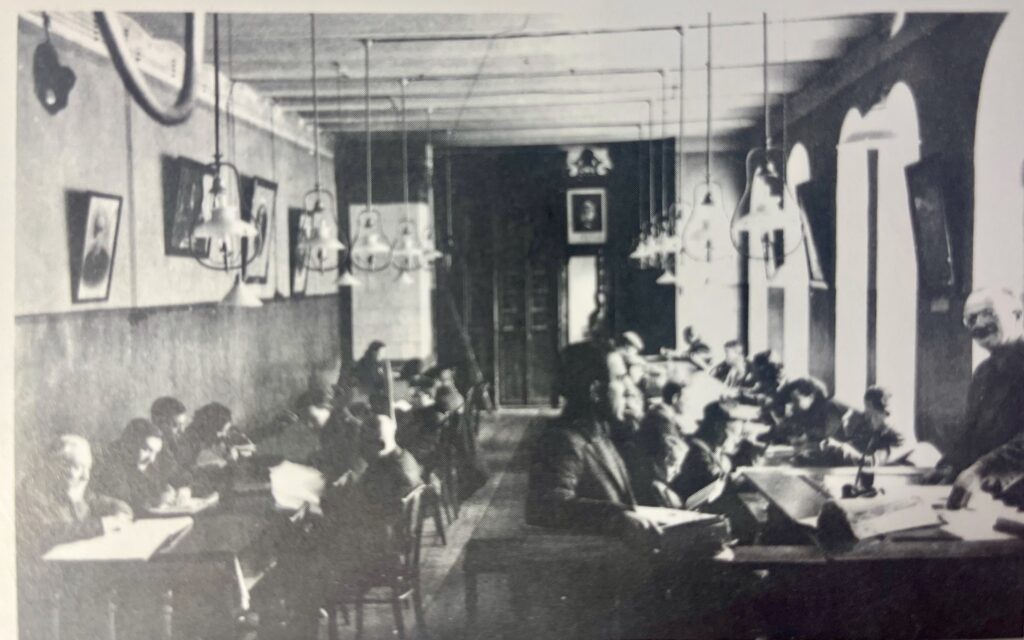
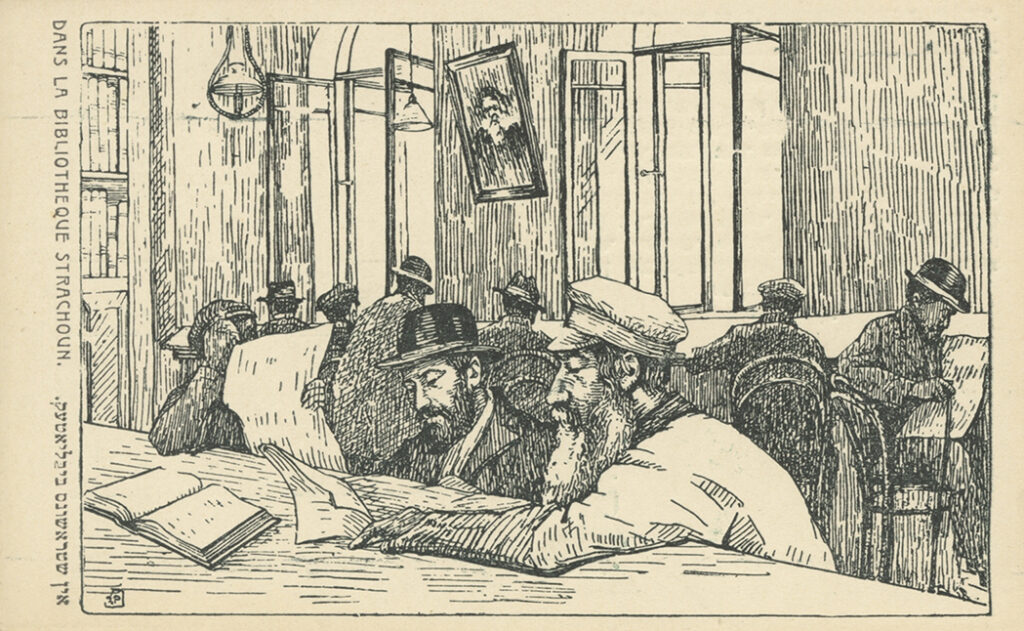
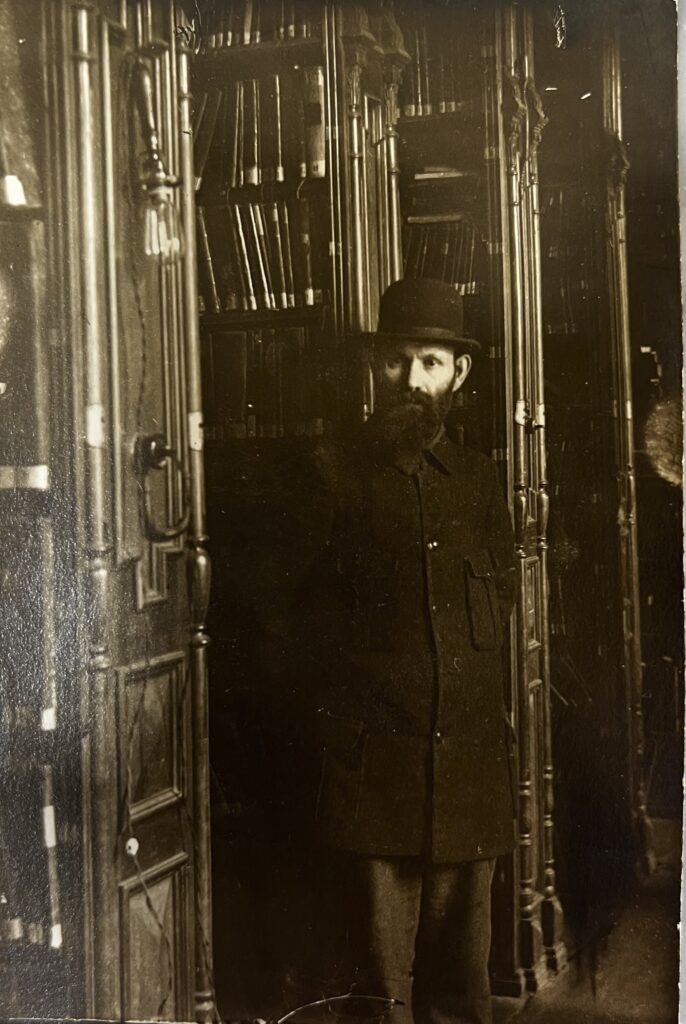
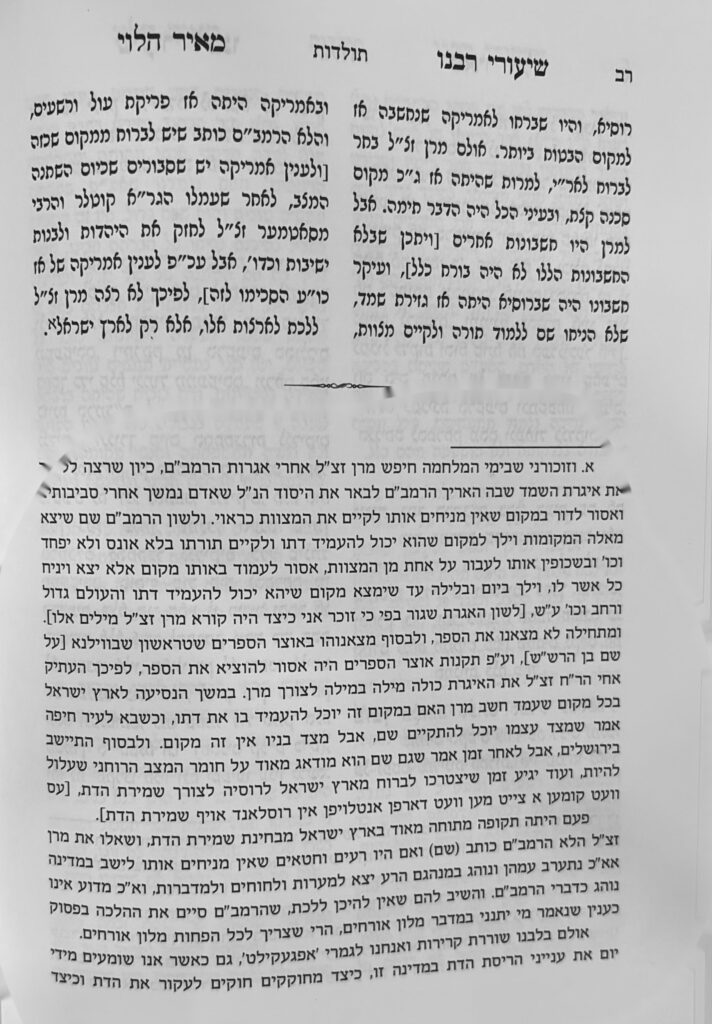
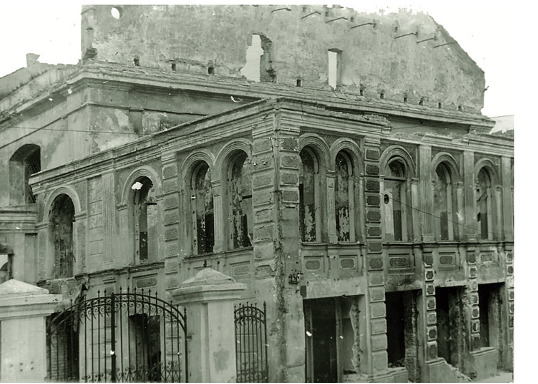
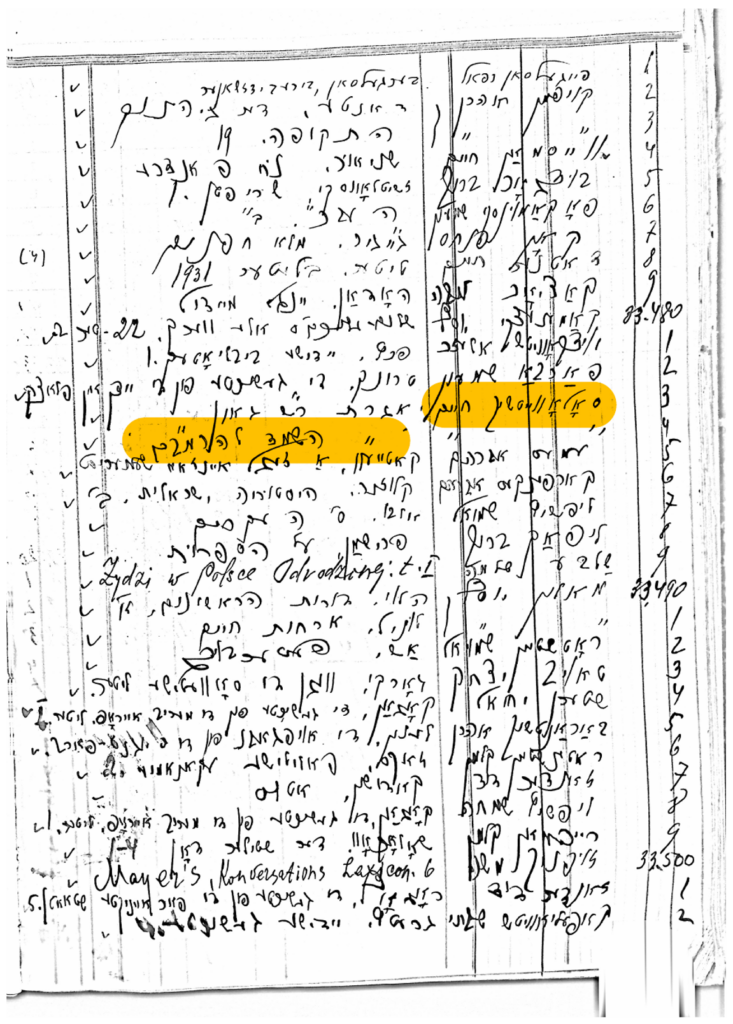
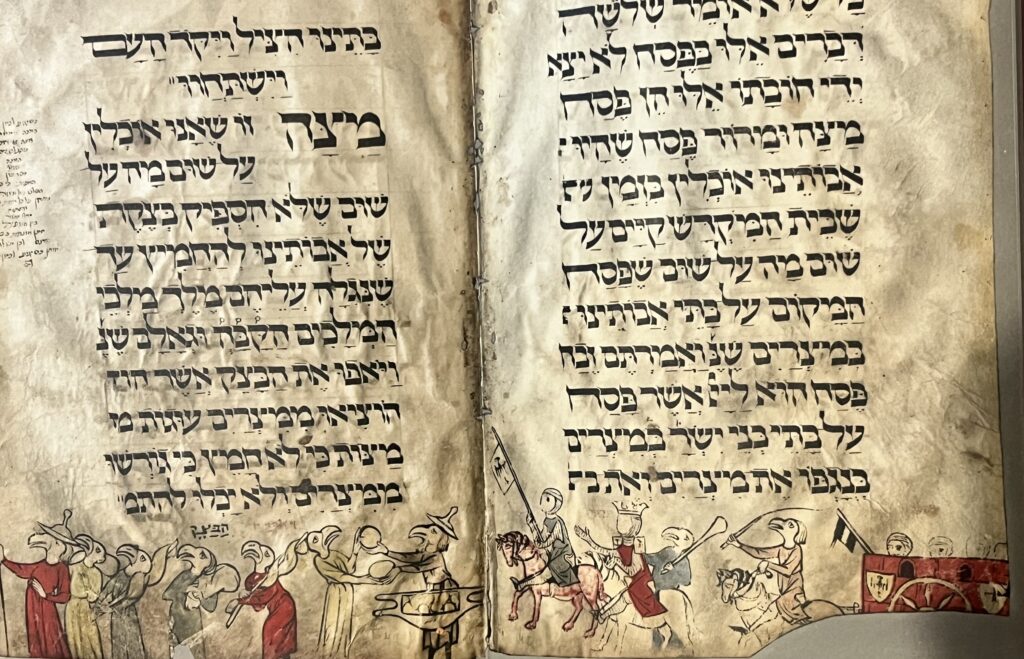
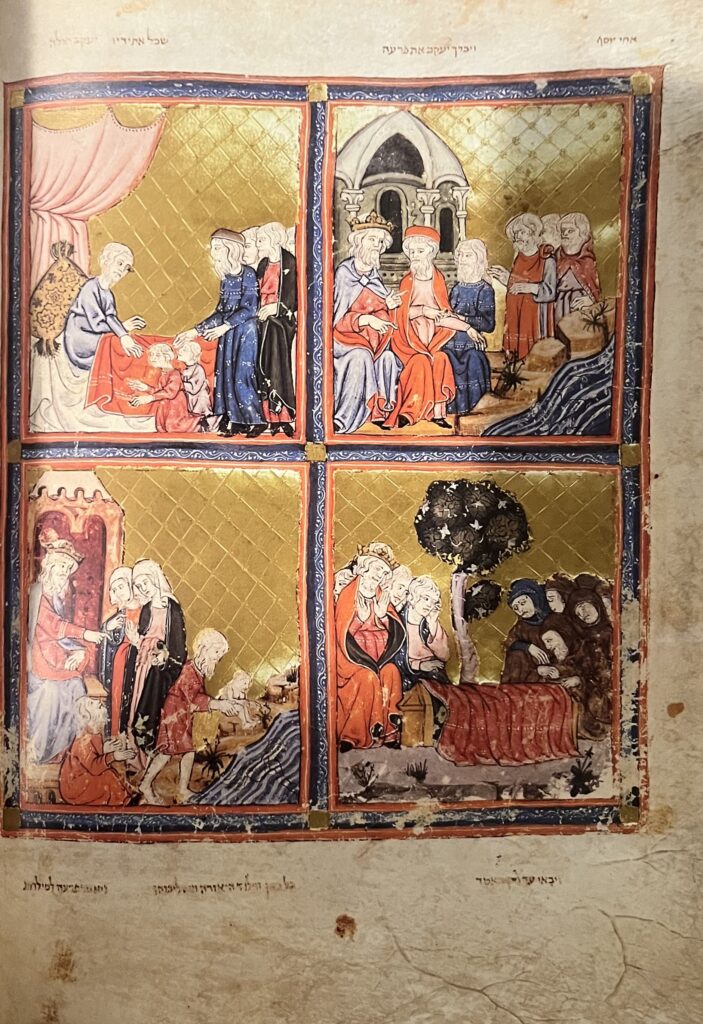
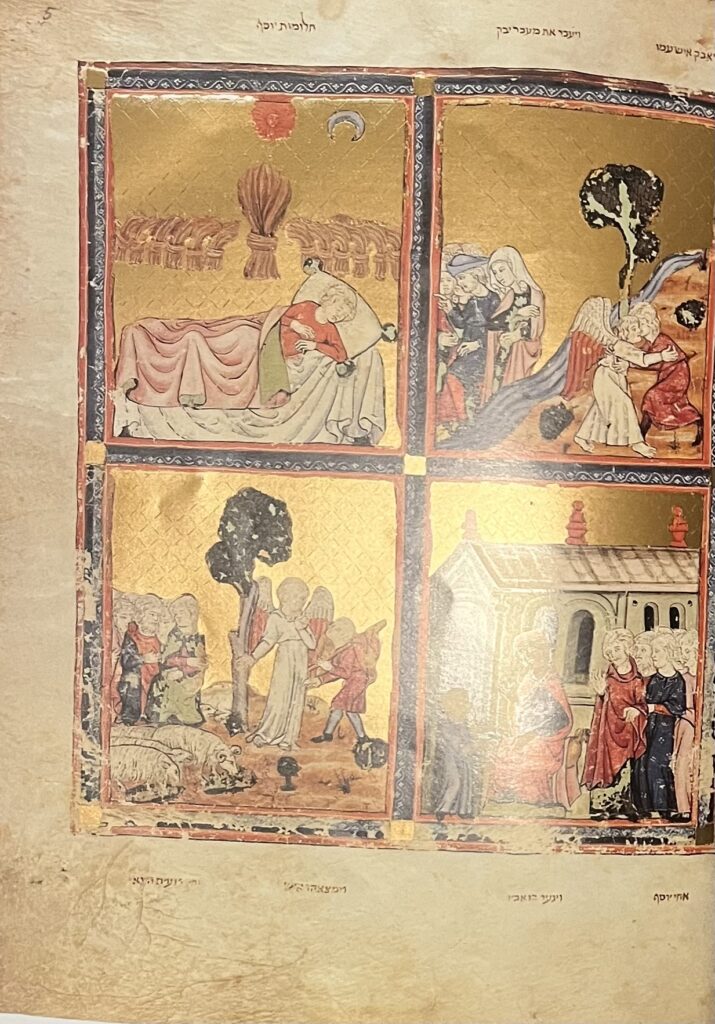

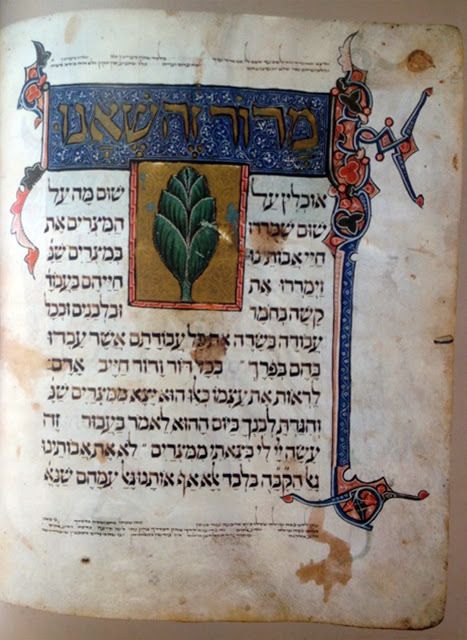
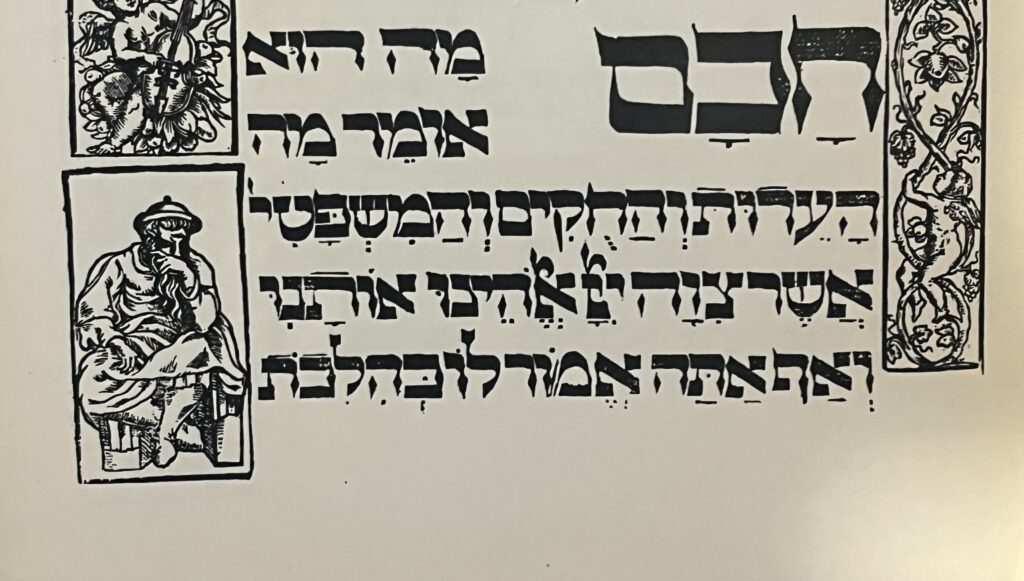

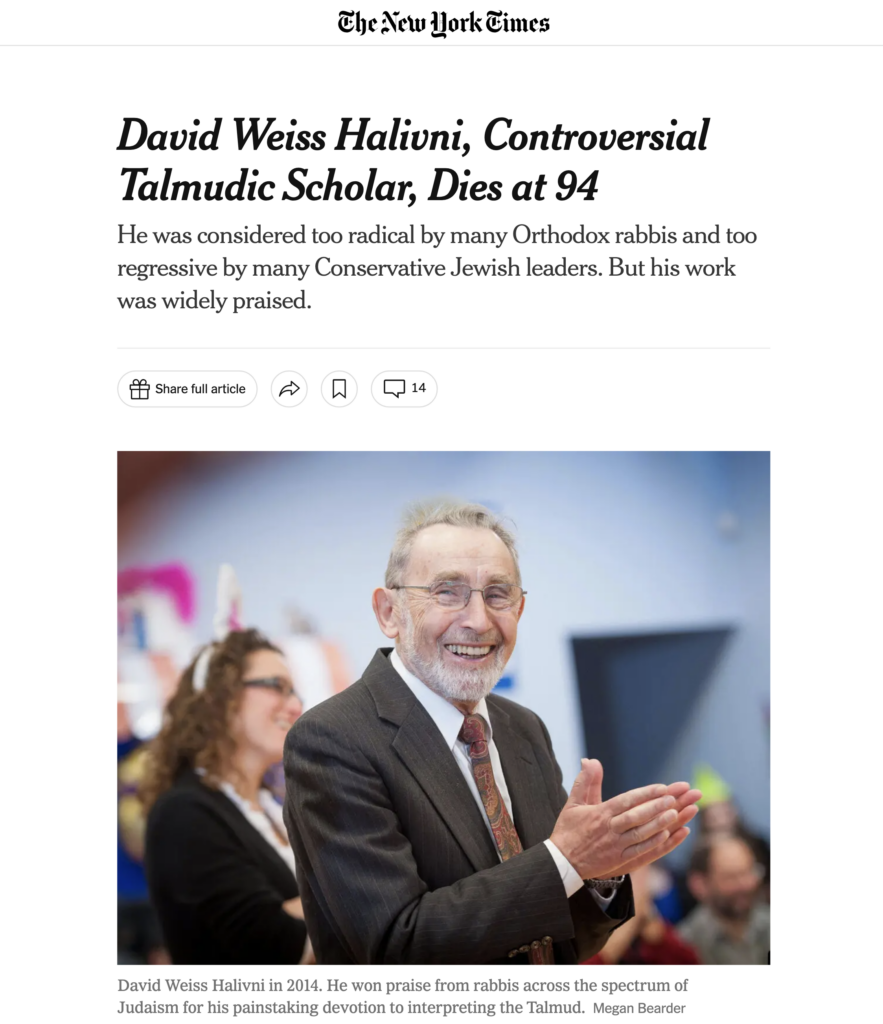
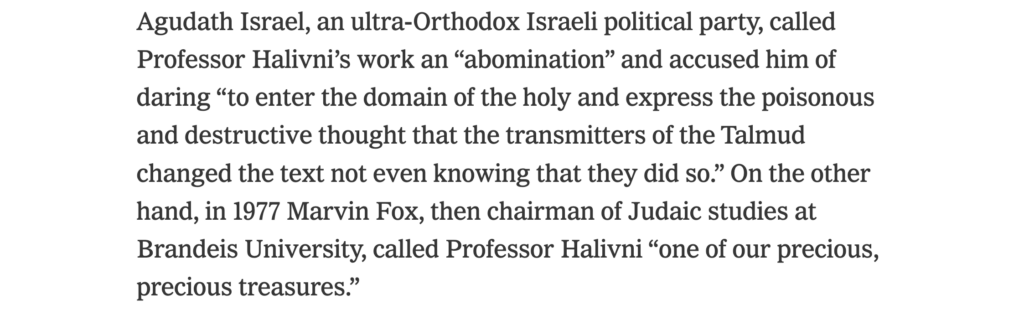
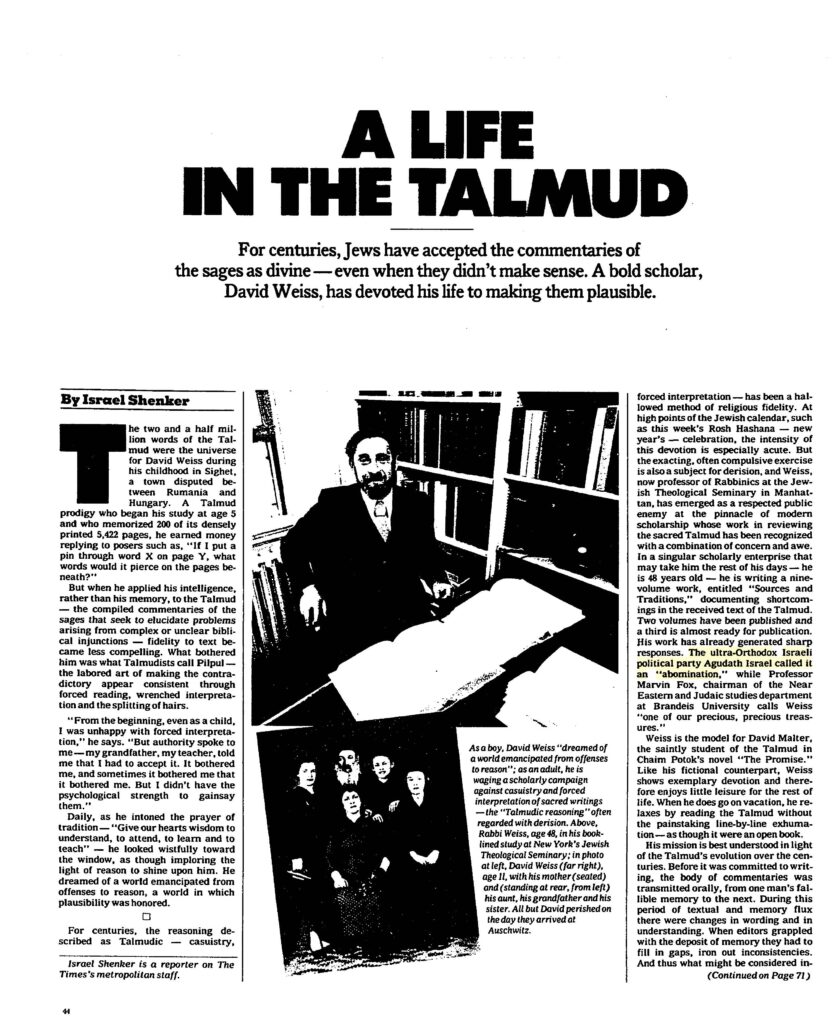
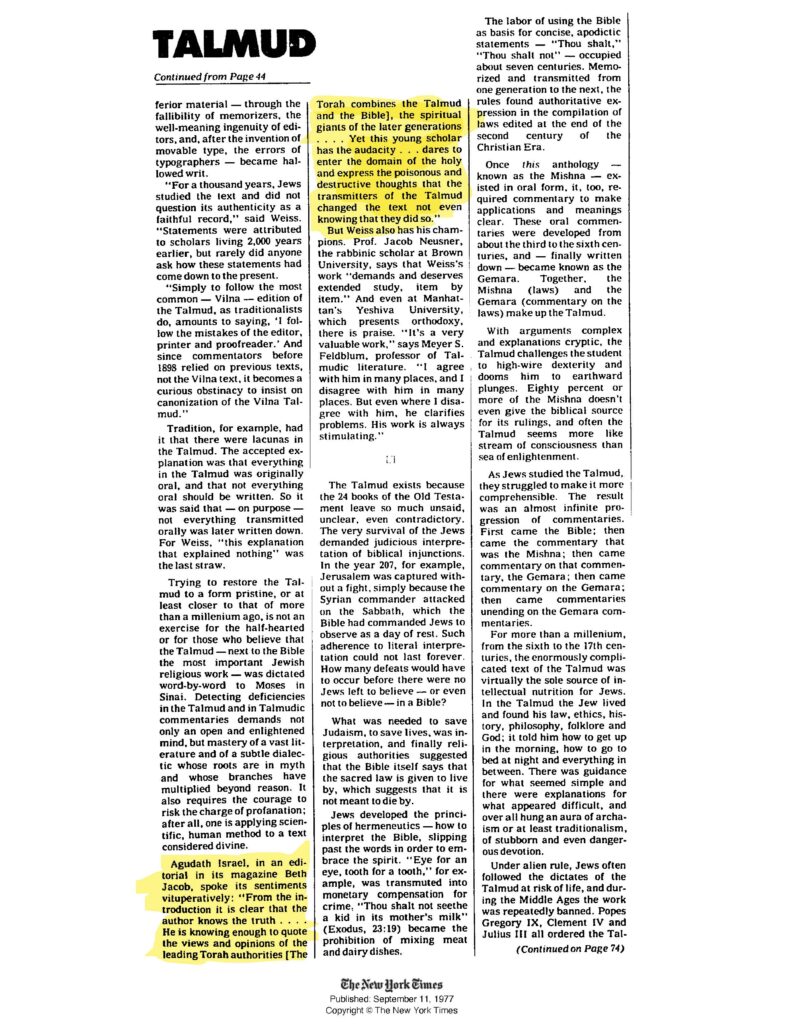
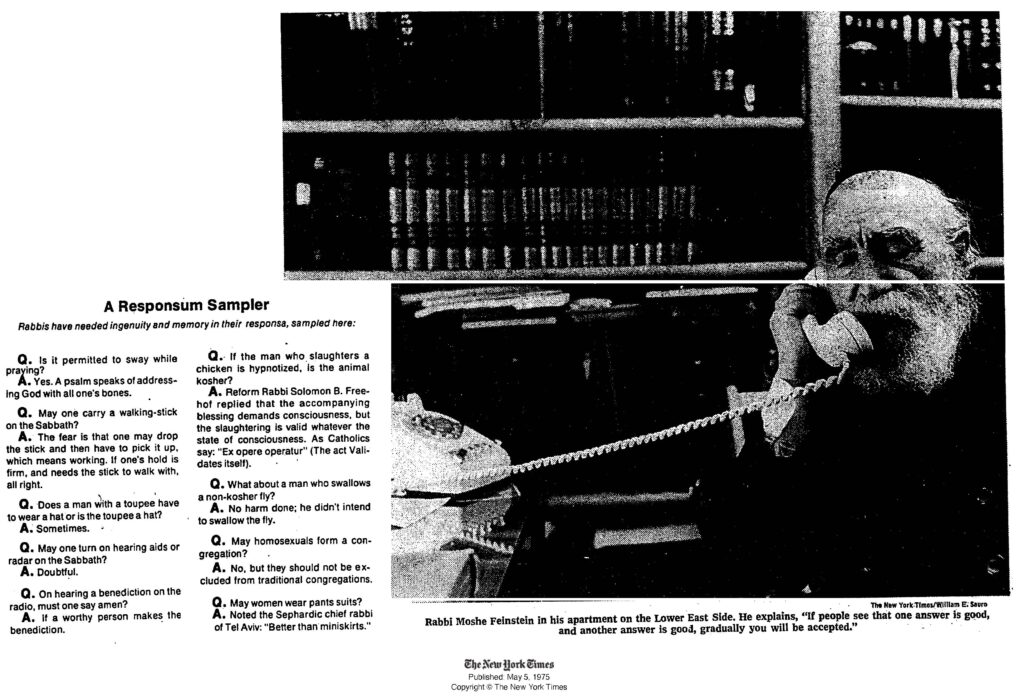
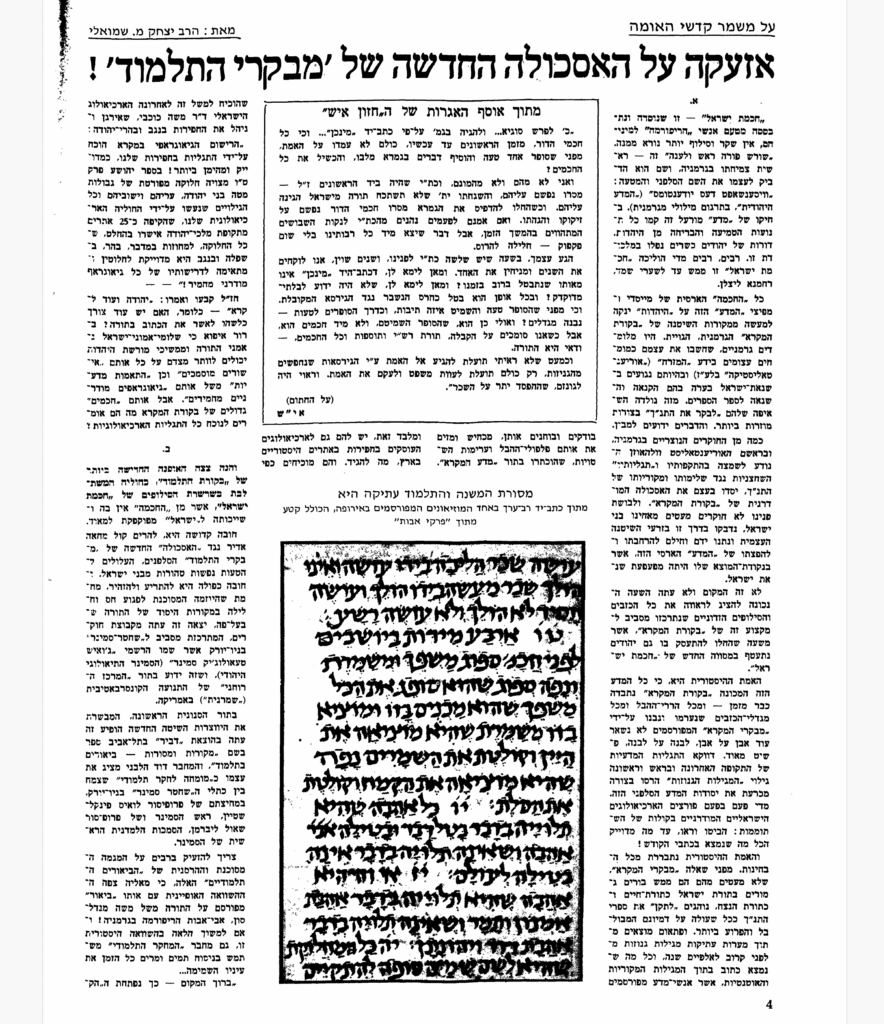
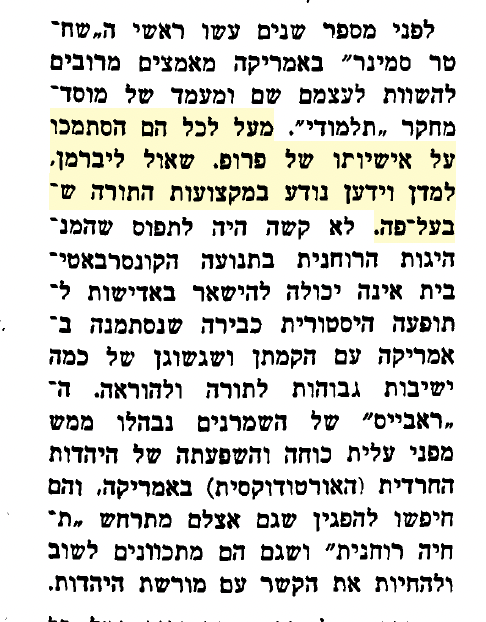 This, despite the fact that Lieberman’s earliest major work, Al ha-Yerushalmi, had already exemplified a disciplined form of textual criticism, drawing on manuscripts, parallel traditions, and internal philological analysis to clarify and correct the text of the Jerusalem Talmud. This could easily have provided fodder for Shmueli, yet he remained silent regarding Lieberman’s method. Recently published letters show that even the Ḥazon Ish engaged Lieberman seriously on these questions. Their correspondence reveals a principled disagreement over method, particularly regarding emendations grounded in manuscript evidence, while also demonstrating that such philological argumentation could be treated as a legitimate subject of rabbinic dispute rather than dismissed outright as heresy. Of course, since this correspondence had not yet been published, it cannot explain Shmueli’s silence on Lieberman’s approach.