Jews, Baseball, and The Yiddish Press

Jews, Baseball, and The Yiddish Press
By Eddy Portnoy
Dr. Eddy Portnoy is Senior Researcher and Director of Exhibitions at the YIVO Institute for Jewish Research. He is the author of the recently-published (and much acclaimed, and fun) book, Bad Rabbi: And Other Strange but True Stories from the Yiddish Press (Stanford, 2017), available here.
This is his second contribution to the Seforim Blog. His previous essay, “The Yiddish Press as a Historical Source for the Overlooked and Forgotten in the Jewish Community,” was published here.
Jews love baseball! Well, maybe not all Jews. On the one hand, the editors of the Forverts, the largest and most successful Yiddish newspaper in history, enthusiastically commissioned an article at the end of August, 1909 explaining the fundamentals of the game to their audience of Yiddish-speaking immigrants. While they may not have expected their readers to run out and play ball, they did understand that it was of value culturally to understand how the game was played. In short, it was seen as part and parcel of the Americanization process.
And yet, on the other hand, a cartoon that appeared a few years later reveals somewhat of an antipathy to baseball from a different Yiddish precinct. Baseball appears to have been one of those rare matters upon which both Orthodox rabbis and secular Yiddish cartoonists could agree. It is thus with great sympathy that one of the cartoonists working for Der groyser kundes views the difficulty Orthodox rabbis in America had in trying to convince American Jewish boys to attend heder. Der kundes, a very popular and very secular satire publication oriented to Left Labor Zionism, lamented the disinterest the lunkheaded, foul-mouthed, baseball-obsessed Jewish youth. Not that they necessarily supported the acquisition of a traditional Jewish education (even though all their writers had one), but they didn’t like baseball either.
Not unlike Nusakh sfard, baseball won the battle and is now a pastime enjoyed by large numbers of American Jews. Many of them even went back to heder. Left Labor Zionists satire magazines, however, aren’t doing so well anymore.


Der groyser kundes, New York, May 29, 1914
The Forverts, New York, August 27, 1909

“The
Fundamentals of the Base-Ball ‘Game’ Described for Non-Sports
Fans,” The Forverts (27 August 1909): 4, 5, translated by Eddy
Portnoy.

  
Uptown, on 9th Avenue and 155th Street is the famous field known as the “Polo Grounds.” Every afternoon, 20 to 35 thousand people get together there. Entrance costs from 50 cents to a dollar and a half. Thousands of poor boys and older people go without some of their usual needs in order to pay for tickets. Professional teams play baseball there and the tens of thousands of fans who sit in row after row of seats all around the stadium, go nuts with enthusiasm. They jump, they scream, they simply go wild with enthusiasm when one of “their” players does well, or, they are pained or upset when they don’t succeed.
A similar scene takes place every day in another place – in the Washington Heights. And the exact same thing goes on in Brooklyn, in Philadelphia, in Pittsburgh, in Boston, in Baltimore, in St. Louis, in Chicago – in every city in the United States. And the newspapers print the results of these games and describe what happened and tens of millions of people run to read it with gusto. They talk about it and they debate the issues.
And here we’re only talking about the “professional games:” practically every boy, nearly every youth, and not a few middle-aged men play baseball themselves, belong to baseball clubs, and are huge fans. Every college, every school, every town, nearly every “society” and every factory has it’s own baseball “team.”
Millions are made from the professional games. Related to this, there is a special kind of “political” battle between different cities. A good professional player gets eight to ten thousand dollars for one season. Some of them are educated, college-educated people.
To us immigrants, this all seems crazy, however, it’s worthwhile to understand what kind of craziness it is. If an entire people is crazy over something, it’s not too much to ask to try and understand what it means.
We will therefore explain here what baseball is. But, we won’t do it using the professional terminology used by American newspapers use to talk about the sport; we must apologize, because we’re not even able to use this kind of language. We will explain it in plain, “unprofessional” and “unscientific” Yiddish.
So what are the fundamentals of the game?
Two parties participate in the game. Each party is comprised of nine people (such a party is called a “team”). One party takes the field, and the other plays the role of an enemy; the enemy tries to block the first one and the first one tries to defend itself against them; from now on we will call them, “the defense party” and the “enemy party.”
The “defense party” also takes the field and plays. Two of the team players play constantly while the other seven stand on guard at seven different spots. What this guarding entails will be described later. Let us first consider the two active players.
One of them throws the ball to the other, who has to grab it. The first one is called the “pitcher” (thrower) and the second is called the “catcher” (grabber).
Each time, the “catcher” throws the ball back to the “pitcher.” The reader may therefore ask, if so, doesn’t it happen backwards each time – the catcher becomes a pitcher and the pitcher becomes a catcher? Why should each one be called with a specific name – one pitcher and one catcher?
We will soon see that the way in which the catcher throws the ball back is of no import. The main thing during a game is how the pitcher tries to throw the ball to the catcher.
The enemy party, however, seeks to thwart the pitcher.
This occurs in the following way:
One of the team’s nine members stands between the pitcher and the catcher (quite close to the catcher) with a thick stick (“bat”) and, as the ball flies from the pitcher’s hand, tries to hit it back with the stick before the catcher catches it.
This enemy player is called “batter.” The place where he stands is designated by a number of little stars (****).
(The other eight players on the enemy team, in the meantime, do not participate. They each wait to be “next.”)
Imagine now, that the “batter,” meaning the enemy player, finds the flying ball with his stick and flings it. If certain rules, which we will discuss later, aren’t broken, this is what can happen with the ball: if one of the “guards” catches the hit ball while it is still in the air, then the opposition  of the “batter” is completely destroyed and the batter must leave his place; he is excluded (he is “out”). He puts down the “bat” and another member of his party takes his place.
The roles of the seven guards of the defense party are also specific: they must try and catch the hit ball in order to destroy the enemy’s attempt to hinder them and to get rid of the player doing the obstructing. They stand at various positions because one can never know in which direction the ball will fly. They watch the different trajectories in which the ball might fly, so a guard can be there, ready to catch it.
The readers can see the way the seven guards are distributed in our picture.
The entire official field on which the game is played is a four-sided, four-cornered one. This is in the center of our picture (The two round lines which go around it represent the tens of thousands of seats for the audience. That is how it usually is for the big professional games. It actually looks like a giant circus with a roof only for the audience. The field, with all the players, is under the open sky.).
As the readers see in the image, one corner is taken by the “catcher.” The other three corners of the four-cornered figure are stations. Each one is called a “base.” With the catcher facing the pitcher, the first “base” is outward from the direction of his right hand, just opposite him is the second base; and from his left hand is the third base.
A little bag of sand lay on every base. The guards, however, must not stand on the base, but next to it.
We previously mentioned three guards. They are called the first baseman, the second baseman and third baseman. A third guard stands between second and third base. He is called the “short stop;” when a ball is hit, it often goes in that direction and the “short stop” gets a chance to catch it in the air.
But if the ball flies way over the heads of these four “guards,” there are three other guards who stand on the outside field, or the “out field.” One of these is called the “right fielder,” the second, the “center fielder,” and the third, the “left fielder.”
Two of the four sides of the four-sided figure in our picture are marked with dots. When a hit ball flies over one of these two lines, it is called a false ball (foul ball). For it to be a proper ball (a fare ball), it must fly forward, or over the other two lines of the four-cornered figure.
When the batter doesn’t manage to hit the ball with his stick, it is called a “strike.” If he gets three “strikes,” he is “out,” or eliminated. Certain kinds of “foul balls” are considered “strikes,” however, we will not go into these details.
When the batter hits the ball and it is “proper,” and the guard doesn’t catch it, this means that the opposition, in this case, is successful. However, this success can either be greater or smaller. Depending on the level of this success, the following is done: as soon as the batter hits the ball, he throws his “bat” away and starts running; if nothing disturbs him, he runs to first base, from first to second, from second to third, and from third to the place where the catcher stands. This place is called “the home.” If he gets to the “home” spot, it means that the success of the opposition is complete.
This means that he made a whole “run:” and, based on these “runs,” the results of the game are figured out. The party which makes more runs is the winner.
But to make a full run at one time doesn’t happen all the time. In order to do so, the zetz that the batter gives the ball must be especially successful. It happens more often that he makes a quarter run, or a two quarter, or three quarter.
The rule is this: the running batter has no right to go to first base if the guard (the first baseman) holds, at that very moment, the ball in his hand. If the hit ball falls on the ground and one of the guards picks it up, the running batter is not yet eliminated.  He runs. But imagine that some guard throws the ball to the first baseman and that this first baseman catches the ball before the running batter physically arrives at first base: then this runner is eliminated. But if he catches the ball when the runner is already on the base, the runner is “saved” (safe).
If the runner keeps running to second base, the rule is a bit different: the second baseman can eliminate him only if he touches him with the ball; and the same rule works for the third baseman, he has to touch him with the ball in order to get him out. The catcher or pitcher can also get a runner out with a “touch” if he finds himself near the base or the “home” to which he ran.
Each player is the embodiment of agility, with strong, swift muscles and sharp, fast eyes. And the whole game is full of “excitement” for those who are interested in it.


The Yiddish Press as a Historical Source for the Overlooked and Forgotten in the Jewish Community

The Yiddish Press as a Historical Source for the Overlooked and Forgotten in the Jewish Community
by Eddy Portnoy
Eddy Portnoy is Senior Researcher and Director of Exhibitions at the YIVO Institute for Jewish Research. He is the author of the recently-published (and much acclaimed, and fun) book, Bad Rabbi: And Other Strange but True Stories from the Yiddish Press (Stanford, 2017), available here (https://www.amazon.com/Bad-Rabbi-Strange-Stories-Stanford/dp/150360411X).
This is his first contribution to the Seforim Blog.
Sanhedrin 25 has this pretty well-known, somewhat rambling bit about what sorts of people are trustworthy enough to serve as witnesses in court. It’s pretty standard stuff. However, as part of this discussion, we get to learn about some early gambling practices among the Jews. While this topic is invoked mainly to denote the fact that gamblers may not be the most trustworthy folk, some of the details include a bit of haggling over whether people who who send their trained pigeons to steal other people’s pigeons can be considered as shysty as those who simply race pigeons for cash rewards. After a bit of back and forth, it is concluded that everyone involved in pigeon shenanigans are just as sleazy as dice players, who are banned by halakhah from serving as witnesses. The long and the short of it is that the Rabonim simply do not like the gambling.
When I first read Sanhedrin 25, I thought it was terrifically interesting, not because I had some investment in knowing whose testimony is considered worthy, nor because I’d just renovated the pigeon coop on top of my tenement. I was fascinated because it was an instance of the amoraim interfacing with the amkho. I have an abiding interest in the the amkho, those average, everyday Jews that make up the bulk of this freaky nation. These are the people you find on the margins of rabbinic discourse, those upon whom the rabbis meted out their rulings and punishments. Truth be told, I find these people much more interesting than either the rabbis or their fiddling with halakhah. Amazingly, in this discussion, the rabbis throw out some neat details about how pigeon racers would hit trees to make their pigeons go faster and how some people played a dice-like game with something called pispasin, a hardcore Jewish gambling habit that seems to gone the way of the dodo.
Unfortunately, Jewish traditional texts aren’t very amkho-friendly. The average Yosls and Yentas who smuggle their way into works produced by rabbinic elites generally appear because they somehow screwed up, did something the rabbis didn’t approve of and thus wound up being officially approbated, a fact they also often ignored. That fact notwithstanding, the amkho still appears to have retained a high regard for their rabbinic elites, in spite of the fact that they frequently disregarded rulings that interfered with anything they considered even remotely fun.
Take, for example, the body of rabbinic admonitions that trip their way from the gemara through 19th century responsa insisting that Jews refrain from attending theater and circus performances. Did any self-respecting Jew with tickets to whatever the 6th century version of Hamilton was ever say, “um, this isn’t permitted…we’d better not go.” This type of thing goes on for centuries. Sure, there’s a broad core of laws that most Jews stuck to, but, when it comes to matters of amusement or desire, the edges can get pretty fuzzy.
If you jump from the Talmudic period to the early 20th century (yes, I know this is ridiculous), one finds that the dynamic doesn’t change very much. The only real difference is that the rabbinic elite has lost much of its power and influence. Amkho still respects them, but they also still do what they want. One interesting factor is that there is now a forum where news of both the rabbis and the amkho begins to appear on a regular basis. This would be the Yiddish press, the first form of mass media in a Jewish language, a place where international and national news collided with Yiddish literature and criticism, where great essayists railed both in favor and against tradition, where pulp fiction sits alongside great literature, and where, among myriad other things, you can find a near endless supply of data on millions of tog-teglekhe yidn, everyday Jews who populated the urban ghettos of cities like New York and Warsaw. In a nutshell, the Yiddish press is a roiling and angry sea of words filled with astounding stories of all kinds of Jews, religious, secular and many who vacillate perilously between the two, aloft somewhere between modernity and tradition, taking bits of both, throwing it all in a pot and cooking it until it’s well done.
It is not at all uninteresting.
As a kind of wildly disjointed chronicle of Jewish life, Yiddish newspapers are an unparalleled resource on the pitshevkes, the tiny, yet fascinating details of Jewish urban immigrant life. Where else could one find out that Hasidim were a significant component of the Jewish audience at professional wrestling matches in Poland during the 1920s? Or that 50,000 Jewish mothers rioted against the public schools on the Lower East Side in 1906? Where could one discover that petty theft in Warsaw spiked annually just before Passover, when Jews were known to buy new clothes and linens? Is there a place you know of where one could find out that Jewish atheists antagonized religious Jews on Yom Kippur by walking around eating and smoking? Or that gangs of ultra-Orthodox Jews stalked the streets on Shabbos demanding people shut down their businesses? If you want to experience the knot of fury into which Jewish life was bound up, look no further than the Yiddish press.
Yiddish newspaper editors always knew where to find the juiciest stories and, for example, frequently sent journalists to cover goings-on in the Warsaw beyz-din. And it wasn’t because there were important cases being seen there, but because there was always some wild scandal blowing up in front of the rabbis that often ended up with litigants heaving chairs at one another. Whether it was some guy who thought it would be okay to marry two women and shuttle between them, or a woman who knocked out her fiancée’s front teeth after he refused to acknowledge that he had knocked her up. Like a Yiddish language Jerry Springer Show, brawls broke out in the rabbinate on a near daily basis during the 1920s and 1930s. The rabbis, of course, were mortified. But they kept at it. And the journalists of the Yiddish press were there to record.
Captions (top, middle, bottom):
“Gas masks as a security measure in the Rabbinate.”
“A woman poured vitriol on her husband in a divorce case” (from the Rabbinate Chronicle)
“Thus can we now begin the case. Call in the two sides.”
It may be that you don’t want to know that there were Jewish criminals, drunks, prostitutes, imbeciles, and myriad other types that comprise the lowest echelons of society. But these small, often inconsequential matters that litter the pre-WWII Yiddish press comprise the details of a culture that has largely disappeared. Moreover, one can find a wealth of information on the amkho, who they were, how they lived, how they thought and spoke. This of course, begs the question: what do we want out of history? Do we only want to know about the rabonim, the manhigim, the writers, the artists, and the businesspeople? Or do we also want to peek into the lives of the average, the boring, the unsuccessful, the dumb, and the mean? Do we want a full picture of the Jewish world that was, or do we only want the success stories?


For my money, I want to know as much as I can about how Jews lived before World War II. Not everyone’s great grandfathers were kley-koydesh. In fact, most weren’t and it’s sheer fantasy to think that most Jews had extensive yeshiva educations. Most Yiddish-speaking Jews were poor, uneducated, and sometimes illiterate. Many of them did dumb things, made bad decisions, and wound up in big trouble. Clearly a shonde, they may not have the yikhes we want, but, also, we don’t get to choose. They may not be the best role models, but they are nonetheless integral to the Jewish story.


New book announcement: Yeshurun volume 36

New book announcement: Yeshurun volume 36
By Eliezer Brodt
This past Wednesday the thirty sixth volume of the Torah journal Yeshurun was released. As I am on the editorial board of this journal, I normally do not write a review of new volumes for fear of being biased, or the appearance thereof. In keeping with my stance, I will not write a review below, but rather just highlight some of the topics in the volume. Normally, Yeshurun is a bi-annual, with a new volume published before Rosh Hashanah and Pesach. This issue is an additional volume to the two regular ones. In general, each volume has a few sections: a section devoted to manuscripts which usually features material from geonim, rishonim or achronim. Then it follows that with a sort of sefer sikaron of a gadol or two that (usually) recently died, featuring an essay about him and a sampling of his Torah and machshavah from the particular gadol. The next section that usually follows are pieces of Torah from different people, some related to halacha. Following this is a section devoted to machshavah and last is Kulmos which generally features pieces related to history or minhag.
The main focus of this issue was to print a volume almost completely devoted to various modern halachic issues (as a result, shrinking the manuscript and Kulmos sections).  A few issues back there was a volume devoted almost entirely to halacha (vol. 31).  In my opinion and from what I heard from others that volume was not considered as interesting as other volumes.  This is the second attempt to issue such a volume and I think this time it is a success. It’s a nice combination of material.
Our volume has a few sections: The first section deals with bein hamitzarim: the Three Weeks, Nine Nine, etc. and begins with the publication of a nice manuscript by an anonymous author from the generation of the Rambam’s father edited by Professor Tzvi Langermann (this is the third chapter he has issued from this work, see here). It also features a collection of material on this time period culled from the various members of the Brisker Dynasty.
The next section, which in my opinion is fascinating and excellent, relates to the Mishna Berurah. The first part of the section contains an essay from Rabbi Trevitz (this is the third installment in the series) related to the numerous contradictions in the Mishnah Berurah and the role of his son R’ Aryeh Leib in writing the MB. There is also an interesting back and forth between Rabbi Trevitz and Rabbi Bergman (another young expert on the MB who has authored four works on the MB) about issues related to this subject. This section also contains some manuscripts of the MB and some new letters by the Chafetz Chaim.
The next section is devoted to R’ Refael Shmulevitz ztz”l. Having seen and heard him up close many times while learning in the Mir, I was always very impressed by this special gaon. The section is a nice tribute to him. It also features some letters related to his role as chief editor of the Encyclopedia Talmudit.  In one of them he writes:

 ואמרתי בפגישה עם ת”ח בעלי יכולת, שההא”ת מיועדת לכל, הן לבעלי בתים הרוצים לדעת את הענינים מ’למעלה’ והן לת”ח, טעין לי אחד מהם, שהוא אישית אינו מוצא תועלת בא”ת, שכן לפני שהוא לומד את הסוגיא אינו רוצה לעיין בה, ולאחר שהוא גמר את לימודו אינו מוצא בה תועלת. ענינתי לו שאף בענין שהוא לומד אותו בעיון, כדאי מאוד שלאחר שגמר ומיצה אותו ככל יכולתו, שישלים את עיונו בערך המתאים, שכן הא”ת היא עבודת צוות חשוב, וקשה מאוד לאדם יחיד להגיע למה שהצוות מגיע, ואז יתגלו לו עולמות חדשים בסוגיא שהוא למדה כבר… [עמ’ תקח].

The next section is devoted to modern halachic issues featuring pieces from various prominent rabbonim. See below for the Table of Contents.
The last section is dedicated to one of the editors and founders of Yeshurun, my dear friend Dr. Shlomo Sprecher, who was niftar a few months ago. This section includes a hesped for him and a reissued version of his excellent piece written together with his special friend Rabbi Menachem Silber on the topic of הפולמוס על אמרית מכניסי רחמים ותשובות רבי שמשון ב”ר רפאל הירש זצ”ל. This piece contains over twice the volume of footnotes.


Zvi Hirsch Masliansky: Memoirs from the Hebrew Periodical Ha-Doar

Zvi Hirsch Masliansky: 
Memoirs from the 
Hebrew Periodical Ha-Doar 
By Zviah Nardi
Introduction.

Zvi
Hirsch Masliansky, known as “The National Preacher” (1856-l943), was a member of
the Hibbat Zion movement in Russia from the time of its inception in l882, and served
as its itinerant preacher in the early 1890s. After his expulsion from Russia
in 1895, he went to the United States, where he became a leading figure in the
integration of the mass immigration of Eastern European Jews to American life.
 He wrote memoirs of those two
periods of his life in the l920s. Published in Yiddish in 1924, they were followed
by a Hebrew version, for which the author was also responsible, in l929. The
family has recently published an English translation: Memoirs; an account of
my life and travels,
Jerusalem, Ariel, 2009, which has been distributed to
family and friends, as well as to leading libraries.
 In the l930s Masliansky wrote
another memoir, which was published in installments in the Hebrew periodical
Ha-Doar, mostly in vols. 13-14, 1933-5; four segments in vol. 15 and one, which
has been translated into English and incorporated into the English 2009 book,
in vol. 16 (1937).
 The focus of these memoirs is far
more personal then that of the book. Here Masliansky describes his childhood,
his education, the early stages of his career and his marriage. Other segments
focus on various people he knew and loved back in Russia, including some great
Rabbis and important public figures.
 Despite their literary quality
and importance to social history, these memoirs, hidden in the large bound
volumes of Ha-Doar, are even less known to the public than those published in
the book. A number of excerpts from the Ha-Doar memoirs have been translated by
Zviah Nardi (co-translator of the 2009 English book) for the benefit of family
members. To the best of our knowledge, this is their first English version. The
unpublished continuation of these memoirs in Masliansky’s handwriting is in
possession of the family.
 We are most thankful to Eliezer
Brodt of the Seforim blog for putting this partial translation on the web, and
thus making it accessible to all interested in Zvi Hirsch Masliansky and in the
life of the Jews in the Pale of Settlement in the late 19th century.
We are also thankful to Moshe Maimon for bringing us together, and reviewing
the excerpts. We hope to continue the translation of both the published and the
hand written material in the future, and propagate them in the same fashion as
the work continues.
 Finally, I would like to conclude
with a personal note: In 2006, four of our progeintor’s descendants made the
decision to publish his memoirs in an English version:  his grandsons James and Marshall Weinberg of
New York and his great- granddaughters Zviah Nardi and Meira Nardi Bossem of
Jerusalem. As these excerpts of his second memoir from Ha-Doar appear on the
web, only two of us remain. My dear cousin-once-removed James Weinberg, a
businessman and prominent Jewish leader, passed away in October 2013; my dear
sister, Meira, just a year ago (on kaf-gimmel Tamuz). Meira was the first
reader of both memoirs as the work progressed — a wonderful first reader and
advisor.  We would appreciate the
willingness of our readers to join us for a moment of thought about our dear
departed.
 Zviah Nardi, Marshall Weinberg.
 
For further details contact znardi@bezeqint.net.

Excerpts from Masliansky‘s
Second Set of Memoirs,
Ha-Doar, 1933-1935.
Ha-Doar vol. 13, 1933-4,
no. 38, p. 724
Tachlith” – In search for
a purpose in life.
(A Chapter from my Memoirs)
My days as a “Yeshivah Bochur  [student at a religious academy], those
“days” devoid of goal and practical purpose, have come to an end.  I felt a growing aspiration to study at the
modern, government-authorized Teachers’ Seminary in Zhitomir. I walked from
Novogrudok to Pinsk, where I planned to board a ship headed for Kiev on the
river Dnieper, and then walk from Kiev to Zhitomir.
Tachlith, Tachlith
[purpose, purpose] – this word sounded in my ears day and night, as I walked
and as I sat, as I ‘lay down and as I got up’. What will be my purpose in life,
what will become of me? I do not want Rabbi Yosel the Dayan [judge
according to religious law] as a role model, nor do I want Rabbi Eliezer the
preacher or the fanatical ascetic who tore the [modern Hebrew] novel “Ashmat
Shomron
” [by Avraham Mapu] to shreds. This problem gave me no rest and kept
buzzing in my mind like the proverbial mosquito in the head of Titus. I had
dwelled long enough among fanatic savages. I am a grown boy, fifteen years old,
and back in my native town of Slutsk my mother, the elderly widow, is suffering
hunger, and she and my orphaned brother of eleven years, are expecting my help.
And what is my purpose in life? Tachlith! Tahclith!  –  the
cry was echoing inside me at that time as I walked along the road.
I became weaker by the hour, and
when I reached Mir, I felt that I should give my weak body and my swollen feet
a rest; I shall rest and then continue my quest for a purpose.
I was drawn to visit the Yesivah,
I so loved and adored, once more. I found this “molder of the nation’s spirit”
in fine order. Hundreds of students were chanting their gemorrah lessons
in loud voices. I found my cousin Avraham Yitzhak Masliansky[1] son of my
uncle Arieh Leib there (I used to call him ABIM in my letters). Our meeting was
one of loving excitement, as we had not seen each other since I had left
Slutsk. He told me that my younger brother Avraham was in Mir as well, studying
at the Talmud Torah [elementary school.] I was excited and moved to hear
this, and soon hugged and kissed my brother, and yet I said to myself with a
broken heart: “my miserable mother, you have lacked twice – a widow who is now
also bereaved of her children; left behind by both your sons.”
My cousin ABIM and I went to
visit our teacher Rabbi Chaim Leib[2]. He received
me cordially and discussed various issues with me. I did not tell him my
destination, as I did not wish to aggravate him. He suggested I return to the Yeshivah
and promised to provide for all my needs. My heart was indeed inclined to
accept his offer, but my mind reminded me “Tachlith!” I thanked him, he
blessed me, and I left the Yeshivah, with a heart full of longing.
After two days of rest I took my
wandering staff in my hand and put my sack on my back; my relatives escorted me
to the main road where we kissed each other and parted in tears.
– – – – – – – – – – – – – – – –
Ha-Doar, vol. 14, 1934-5,
no.1, pp. 8 – 9.
Pinsk
(a Chapter from “My Life.”)
Two Yeshivah students
seeking a purpose in life are walking along the main road leading from Kapulya
to Pinsk. They walked for six days and ‘in the seventh day’ they arrived in
Pinsk; they came to this foreign city, where they had neither a relative nor ‘a
redeeming kinsman,’ with sore feet but with courageous spirits and high hopes.  The city of Pinsk at the time excelled in its
commerce more than any other city in Lithuania. Along the river Pina, a
tributary of the Dnieper, its ships sailed to Kiev, Kremenchuk, Yekaterinoslav
and Odessa. We immediately noticed the difference between Pinsk and the surrounding
cities. The city was full of life and tumult, being the center of commerce for
grain and lumber shipped to the south of Russia by boats and rafts.  Thousands of peasants bringing their
commodities filled its streets causing this turmoil.
At that time there were a number
of rich families living in Pinsk that were renowned throughout Russia. I am
referring to the Luria, Zeitlin, Eisenberg and Greenberg families, all had
among them learned men skilled in Torah and wisdom [secular studies]. The most
illustrious family were the Lurias, descendants of Rabbi Shlomo Luria (the
MaHaRSHaL) or of the Holy Ari [the mystic Rabbi Yitzhak Luria Ashkenazi.] They
excelled in both looks and character, in their skills and in their communal
work for charitable institutions, hospitals, Talmud Torah schools,
orphanages and homes for the elderly. The head of the family at that time was
the generous lady Haya’le Luria with her sons Moshe and David, and their sons
Aharon and Isar and sons-in- law Moshe Haim Eliasberg and Jonah Simchovitch of
Slutsk, all of them renowned Talmidei Chachamim [famous for their Jewish
knowledge.]
Pinsk is divided into two cities
– Pinsk and Karlin… 
– – – – – – – – – – – – – – – –
Suddenly I received a letter from
Slutsk, informing me that my abandoned, widowed mother and my orphaned brother
are suffering cold and hunger. And so, what was I to do?!
This was an awful quandary and I
was totally hopeless. There were no Yeshivoth in Pinsk, and its
residents were unfamiliar with the practice of “eating by days” [having Yesivah
students eat in a different resident’s home each day], a practice I myself was
sick and tired of. Traveling any longer without documents had become impossible
[as the authorities were kidnapping men and boys for prolonged military service
in the area.] My friend Benyamin bid me goodbye and returned to his native town
of Poltava. Our parting was a heart wrenching sight. Little Jews, almost
children, deserted and alone, hugging and kissing each other, weeping and
sobbing on each other’s necks, separating from one another, devoid of hope to
find their purpose in life…
Absentmindedly I entered a Jewish
inn on the bank of the Pina River. The innkeeper, a man by the name of
Katchinovsky, was educated and respected students of the Torah. He took one
look at me and instantly liked what he saw. The inn served the rural Jews, the
tavern leasers and operators, living in the countryside around Pinsk. One of
the guests, a man of stature, had asked the inn keeper whether he knew of a
young man, a Torah student, who would agree to travel to the village with him
to be a melamed [teacher] for his children. It was summer, the first day
of the month of Tamuz, with three months left for the school year; He
was ready to pay thirty rubles for this period and to raise the salary for the
next year, provided he was satisfied with the man’s performance as instructor
and teacher for his children. The innkeeper turned to me and asked me if I
would agree to go with the man? I agreed.
Two days later the villager Eliezer
Rubinstein took me to his village of Harinich. He was a kind and honest man by
nature, and regarded me as a son from the very first day, treating me in a
loving and friendly manner: it was as though his heart foretold that in two
years time I would be his son-in-law.
The trip from Pinsk to Harinich
lasted for about four hours. On the way he started couching me in his own
manner. He clarified that country life was simpler and healthier than life in
the city. He proved ‘with signs and marvels’ that country people are healthier
physically and of a more honest spirit than city folk. He advised me to get
slightly more accustomed to physical work, to take long walks, gain strength
and ride a horse. ‘He said and acted’[3].
A horse he had bought in Pinsk was running behind the carriage; he put me on
the horse and I rode behind the wagon.
My heart was pounding rapidly for
the first ten minutes – the heart of a Yeshivah student who had never
touched a horse, and was suddenly studying the theoretical Talmudic issue of
‘the rider and leader’[4] in practice.
But I made the effort, straightened my neck, raised my head and rode like a
cossack in the regiment. He was surprised that I sat on the horse and rode
securely, as though accustomed to doing so, and expressed his feeling with the
Jewish proverb: “wer Torah, dort ist chochmeh!” [“Where there is Torah there is
wisdom!”]
As we were traveling I started to
understand what the world famous “Marshes of Pinsk” were. I had searched for
them in Pinsk without success, for Pinsk itself is a fine and dry city – no
swamps to be found in its streets, which stone-pavements are superior to those
of the neighboring towns.  En route,
however, I learnt the nature of the terrifying swamps of Pinsk.
These swamps have gained their
widespread reputation for a good reason. They were large broad and deep,
extending for hundreds of miles… The roads, covered with branches of Birch and
Oak trees, were called “grebliyes’, and woe to the man or horse who took
one slanted step and got their leg into the ‘grebilyeh’ branches.
I rode my horse with the utmost
care and after a number of hours we reached a wonderful and beautiful place in
the wilderness of the swamp – thick forests, green fields, planted gardens,
pastures with sheep and cows grazing. Suddenly I saw a windmill far away, its
large, broad wings spinning fast.
Reb Eliezer Rubinstein turned to
me most happily and said: “Do you see, Hirsch’le, the mill, the house next to
it and all these fields till the distant mountain? – All this is mine. We are
now in our home in the village of Harinich.”
Ha-Doar, vol. l4, 1934-5,
no. 4, pp. 61-62
In the Country
(A Chapter from “my Life”.)
It was evening. The sun was
setting in the west, earth and sky kissed each other in a sea of molted gold;
the mill and the small hills around it were glowing in red. The air was full of
the delicate sounds of bells, the bells of herds returning from pasture. The
farmers’ wives were waiting for the herds, pails in hand, while the dogs, who
had spent the entire day with the flocks, were running and jumping towards
them, barking happily as their work day had ended and the time for rest had
come. Farmers, large and small, men and woman, all dressed in thick cotton
shirts, barefoot and tired, were returning, group by group, from their labor in
the fields to their small low houses covered with straw, there they were met by
their virtually naked toddlers and children, who rushed into the arms of their
mothers they had missed so.
“Good Evening!” called the head
of the family, as he opened the door of his dwelling wide.
The mistress of the house with
her children, who were waiting for their father and for the new teacher,
surrounded me. Six pairs of lovely eyes measured me with their glances from
head to toe.
Mrs. Devorah Rubinstein, a pretty
and graceful woman of about thirty, stood by her husband and looked at me with
a mother’s eye…
“Children!” – the head of the
household turned to his sons and daughters, two boys and three girls, the
oldest among them twelve years old, “say hello to your new teacher, he will
instruct you and you are obliged to obey him and follow his orders.”
The children approached me
respectfully and handed me their little hands, Yetta, the oldest, lowered her
glance as she came to me, as though her heart told her that it would not be
long  – in three years time[5] – before
relationship would far exceed that of teacher and pupil…
I enjoyed my first meal and ate
it with zest. For the first time in my life I felt that I was eating my own
food. I then slept peacefully through the night. The next morning I examined my
pupils and saw that the two boys had studied a bit, but the girls did not even
know the [Hebrew] A-B-C. I started to work and within a number of weeks my
pupils were doing well in their studies.
The rural Jews living near
Harinich heard my praise from Reb Eliezer and came to see me. Some of them
brought their small children who joined my pupils, so that my salary doubled. I
was ever so happy when, for the first time, I sent my poor mother ten rubles.
That was a holy and festive day for me and I shall never forget it.
And yet the question of “tachlith
remained unsolved – what will my life purpose be, what will my future hold? I
am living here, in a remote and deserted village, far from the rapid pace of
life, surrounded by peasants with whom I have no spiritual bond. They regard me
as worthless, an idle person who does not really work for a living, and I –
living here I shall forget everything I have learnt. I am but fifteen years
old, what will my purpose in life be? I will grow and develop in body but when
will I see to my soul and spirit…?
A Jewish tavern leaser in one of
the villages not far from Harinich had a small library. His name was Reb
Yitzhak Rutzky. He was a Torah scholar and knew Hebrew. After we got to know
each other he was pleased with me and opened up his library so I could take
whatever I needed. This encouraged me to continue my studies of the Talmud with
great desire. But a complete Jew does not live by Talmud alone. I felt, that
with all my proficiency in the Holy Writings my knowledge of Hebrew grammar and
medieval literature, which I knew only by name, was lacking. I searched through
the small library and found “The Guide to the Perplexed” and “The Principles”
[by Maimonides], “The Kuzari” [by Yehudah ha-Levi] and “Chovot Ha-Levavot
[ by Behya ibn Pequda]. I fell upon these profound books overzealously and
enjoyed their study. I asked Mr. Rubinstein to bring me three books I wanted
from Pinsk: “Talmud Leshon Ivri” [a grammar of the Hebrew language by Judah Leib Ben Zeev], the
Biblical book of Isaiah, translated into Russian by Yehoshua Steinberg, and “Sefer
Ha-Brith.”
[6] These books
occupied much of my time and I did not go idle.[7]
I studied the “Talmud Leshon
Ivri
” most diligently from beginning to end, including the appendix by the
poet Adam HaCohen Lebensohn, and became quite a grammarian writing notes on the
margins of the book. The book of Isaiah in its Russian translation was
extremely useful: I imitated the first generation of Maskilim [adherents
of modern Jewish learning, Haskalah or Enlightenment] who learnt the
German language from Mendelsohn’s translation and commentary of the Bible [Bi-ur],
till I was able to read Russian with the help of a dictionary and thus read the
great works of Russian literature in the original.
Sefer Ha-Brith“ (“The
Book of the Covenant” which includes tenuous information in all the branches of
science known at its time, carried me off to another world. Later on, however,
I learnt that the author of the book was a Yeshivah student like me, who
had never studied the natural sciences he was interested in, and yet wrote
modestly: “And I shall now confront Master Copernicus.”
And yet, I am grateful to the
author of this book. He was extremely important to me, a rural melamed,
with no school, no guidance. He opened my eyes to see that there are sciences
and important topics in this world that are worth learning.
My employer’s affection towards
me grew daily. He would sit at the table while I taught my students and audit
the lessons most eagerly; he secretly repeated the verses till he knew them by
heart. He especially liked the sayings from the Book of Proverbs about
“jealousy”, “hatred”, “lust”, and “honor”, but his favorite theme was
“idleness”, for he detested the lazy with all his heart, and so he always liked
to recited the 24th chapter of Proverbs out loud: ‘I passed by the
field of a lazy man, by the vineyard of a man lacking sense. It was all
overgrown with thorns; Its surface was covered with chickweed. And its stone
fence in ruins. I observed and took it to heart; I saw it and learned a lesson.
A bit more sleep, a bit more slumber, a bit more hugging yourself in bed, and
poverty will come calling upon you, and want, like a man with a shield.’
When he finished reciting the
original Hebrew he started translating it to Yiddish with the same chant and
intonation I used with the students. He continued to “recite” these verses till
we arrived at his mill, where he took me nearly every day after the lessons. He
taught me how to adjust the wings towards the wind and how to help him
inside.  I especially liked sitting in
the mill during the evening hours, a highly suitable time and place to engage
in thought and to recite the declinations of Hebrew verbs to the rhythm of the
large grinding stones. And so I worked as a teacher by day and as assistant
miller by evening.
Some evenings I would stay long
hours at the mill, keeping the miller company till midnight. He was an elderly
Catholic peasant, very loyal to his faith. He loved me and felt sorry for me,
not being member to his religion. He told me as a fact that the Pope is
immortal and that old age has no power over him. He is like the moon, born
again every single month, and will never die.
The hours I spent with this innocent
old man were amazing and mysterious. The silvery moon, the rustle of the wings
of the mill, the noise of the large grinding stones as the aged man related his
stories, his nonsensical, imaginative stories enveloped in secrets and
mysteries. We pitied one another – he pitied me for my heresy and I him for the
figments of his hallucinating spirit, which he believed in with all his heart.
Ha-Doar, vol. 14,
1934-1935, no. 5, p. 79
A groom living in his
father-in-law’s home
(A chapter from “My Life”)
It was a bright pure spring day –
the third day of the third month of the year 5734 (1874), my birthday – I am
seventeen years old!  I finished teaching
my pupils at noon. The sun stood high in the sky blessing the entire universe
with majestic splendor.  My employer, Reb
Eliezer Rubinstein, stretched out his strong warm hand, kissed me and
congratulated me in honor of my birthday. He then took me by the arm and walked
with me down the narrow path leading to the hay fields he had been leasing from
the Pravoslave priests for more than twenty years. We reached a small lovely
hill; the grown hay gave a pleasant scent; the grass was sparkled with blue and
yellow flowers that seemed like little stars in the green sky beneath us.
We were walking very slowly when suddenly
Mr. Rubinstein halted and started to recite his favorite verses from the Book
of Proverbs: ‘I passed by the field of a lazy man, by the vineyard of a man
lacking sense’ etc.  When he completed
reciting the verses he held me by my right arm and looked at me lovingly for
several minutes, then spoke as a man restraining his emotions.
“You know, Hirsch’le, that I love
you very much, and so my words will come from a pure and loyal heart. You are
seventeen years old today, may you live to a hundred and twenty, it is time for
you to find “tachlith”, to seek a purpose in life. You, with all your
talents, have not been destined from birth to be a melamed. And so I
have a wonderful proposition for you, if God helps me to accomplish it: You
should get engaged to be married to a kind hearted and pretty girl, daughter of
honest and wealthy parents and become betrothed this very day. And next year,
when you will be eighteen years old, you will marry at the very age established
by our sages of blessed memory. If you take my advice I shall congratulate you
on this very day and say ‘Mazal tov’ upon your engagement.”
He then was silent, looked me in
the eye and awaited my answer. His innocent and kindhearted monologue made a
great impression on me. Some minutes later I said: “Reb Eliezer, two sides are
needed for a shiduch [match] and I’m but one. Where is the other side?”
“Quite so, my son!” he answered,
“The other side is standing before you, and I am ready, and my eldest daughter,
Yetta, agrees full heartedly, because she loves you. I shall not sing her
praises in your ears, for I am her father, but I believe that you have eyes to
see and a mind and brain to understand. You can see her beauty and understand
that she shall be a ‘woman of valor’ and a ‘splendid crown’ on her husband’s
head. She is fourteen years old, as lovely as an eighteen year old and as wise
as a twenty year old. What then have you to say as it is the shadchen
[match maker] who is speaking to you.”
“Yes, Reb Eliezer, you mentioned
the word ‘tachlith’. Do you know that it was ‘tachlith’ that
uprooted me, that tore me away from my studies and from city life and brought
here to seek my livelihood?  The question
of ‘tachlith’ is to become even more difficult now: what ‘tachlith’
will we have now if I marry and have a family?”
“Yes, my son,” he answered, “you
are right, but with God’s help I will find a solution to the problem. Open your
eyes and see this entire plain that brings me a yearly profit that could easily
support two families. I have leased all these fields for many years,we will
both live and work together. You will no longer be a ‘melamed’, and I
will build you a little house near mine and you will lack for nothing.”
Absentmindedly I put my small
hand into his large one, and our eyes filled with tears of joy.
Overjoyed, my schadchan
[match maker] and father-in-law returned home with me and with a cry of “Mazal
Tov
” that echoed through the entire house approached his wife, my
mother-in-law, and said: “I congratulate you, Devorah’le.  Mazal Tov, our eldest daughter Yetta’le,
has become a bride today and Hirsch’le is her betrothed for years to come.”
The sound of greeting and kisses
filled the house. Tears of joy streamed from everyone’s eyes, for the entire
family loved me and they all fell on my neck, kissed me and hugged me. The
young couple, the seventeen year old youth and the fourteen year old girl,
hugged each other[8] and cried,
but they did not kiss, ‘for they were ashamed…’[9]
My days as a melamed came
to an end, and the family members treated me as a master of the house from that
day on. One day the door opened suddenly and my little brother appeared. He had
walked from Slutsk to Pinsk to see his older brother who had almost reached his
tachlith.” He brought with him the kisses of my widowed mother and
described her miserable situation. My brother and I were different – he was of
a courageous spirit, hated to complain and was always satisfied, contented with
his lot. He stayed with me for about ten days and then I sent him to our mother
in Slutsk with considerable help, according to what my situation at the time
enabled me.
*
The Days of Awe had come – the
most exciting days of the year for the Jews of the villages. The leaseholders
and innkeepers started the preparations for the journey in the month of Elul.
This journey was to take them to the cities and towns [stetalach] to
pray on Rosh Ha-Shana [the New Year] and Yom Kippur [the Day of
Atonement], that is to say, to hold proper services in a synagogue with a legal
quorum [a minimum of ten adult men]. 
They would take their gentile maids, who were acquainted with all the
Jewish customs, with them.  They were
also equipped with a sufficient number of chicks and white chickens enabling
them to perform the custom of “Kapparot” for the entire family[10]. Traditional
pastries for these days were also prepared…. Indeed, it was a time when even
the fish in the rivers were terrified. In addition the country people would
take small sacks of ‘the choice products of the land’, the crops of the earth and
of the fruit of the trees, various types of beans and grits, oats and spelt, as
gifts for the home owners in the towns, who were to be their hosts for the
holidays.[11]
The town closest to our village
was Navliyah, which numbered about forty Jewish families. There were a few
affluent families, but most were impoverished and beggars; they waited all year
for the gifts their rural brethren would bring them for the Days of Awe. All
the rural Jews, the leaseholders and innkeepers, from the neighboring villages…with
their children and maids, their chicken and roosters, their sacks and
belongings would gather in the village of Womit on the shore of the pond, where
small boats awaited to lead them to the river that flowed to a spot near our
destination – the town of Navliyah.
The boats rowed on the lake, full
to capacity with young and old, men and woman, happy healthy youngsters, pretty
and shy maidens in full bloom. Christian maids, watching over the children,
were seated on sacks full of grain, foodstuffs and chicken coops carrying
roosters and chickens, future victims of “Kapparot” to atone for the
passengers’ sins. The boats sailed heavily on the pond towards the town to
celebrate the Days of Awe there.
Ha-Doar, 1934-5, no. 7, p
123
My First Sermon
As in the gathering of the exiles
the convoy of pilgrims descended from their boats to Navliyah, and the small
town was suddenly filled with a multitude of people. All the leaseholders and
innkeepers also brought their children’s teachers. Most of them were old and
feeble, men who had spent themselves as teachers [melamdim] in the
cities; their strength gone, they resorted to teaching in the villages where
they hoped to find a remedy for their ailments, sickness of the heart or
weakness of sight. Most of them were ignoramuses, all they knew was to read the
prayer book and hold the whip in hand to flog the “naughty” children, who
indulged in pure childhood mischief, refusing to listen to the teachers whom
they did not understand.
I went to see the local Rabbi, a young
man recently arrived from the Volozhin Yeshivah [religious academy]
equipped with an authorization. He understood Hebrew. When I came to the
synagogue he honored me, seated me at his side and introduced me to the leader
of the community who gave me the honor of delivering the sermon before the
prayer of “Kol Nidrei” [at the outset of the Yom Kippur Eve
prayers.]
For the first time in my life I
was to stand by the Holy Ark, wrapped in a Talith [prayer shawl] and
preach to an audience.  True, I had already
tried to conduct a study of the Pentateuch with Abarbanel’s commentary in
public, and to explain a chapter of the prophets to my friends at the Mir Yeshivah,
but I never dreamt of preaching in a synagogue before Kol Nidrei. How
could anyone imagine that this sermon would be the first of thousands I would
deliver in my lifetime? While at the time my mind was occupied with the issues
concerning the mill and the harvesting of my father-in-law’s hay in the heart
of the famous marshes of Pinsk…
I gathered my courage and
ascended towards the Holy Ark. I felt my blood burning like a divine flame in
the heat of the large wax candles that lit the small synagogue. I remember that
a few minutes into the sermon the entire crowd was sobbing with me and terrible
shrieks were heard from the women’s gallery. I spoke for close to an hour about
the situation of our brethren in dark Russia, about our murky sources of
livelihood – the war between Turkey and Russia broke out that year [sic],[12] and I quoted
the verse: ‘The snorting of their horses was heard from Dan’ [Jeremiah 8,16),
and interpreted it in homiletically: the war had started from the river
“Donau”, Esau [Christendom] is fighting with his father-in-law Ishmael
[Islam].  I concluded with a prayer:
“Lord of the Universe, remove the goat [=Se’ir = the land of Esau, Edom] and
his father-in-law, ’for liberators shall march up to Zion!’”[13]
There was a drunken and evil man
in the audience, known as “Benjamin the Factor”. His livelihood was to supply
“Pan Lapitzki”, who was single all his life, with girls, farmers’ daughters,
and he served as the Pan’s [Polish landlord] matchmaker every single day. My
sermon about our “murky sources of livelihood” must have insulted him, and
immediately after the prayer of “Kol Nidrei”, he went to the Christian
priest and informed on me, reporting that I had cursed the government, the
Christian faith and first and foremost the Russian Czar…
Imagine the fear that seized the
Rabbi and the leader of the community when, on the next day, the town policeman
burst into the synagogue during the prayers and led the three of us to the
government official. He brought us into the official’s bureau, where we found
the priest and the informer, waiting for the three of us.
“Tell me, young Jew, what did you
speak about in the synagogue yesterday? For if what I was told is true, I shall
arrest you and send you to the district capital in chains.”
   
I answered him calmly: “Yes, Sir,
I spoke yesterday to a large audience, and they can all testify that what I
shall tell you is true. I talked about interest, saying it is a great sin, and
that my Jewish brethren should stop taking interest. They should work and
engage in various sustaining livelihoods. I spoke about the ‘factors’ that
disgrace their people. I hope that this sermon brings me the thanks and praise
of the government, rather than arrest and being led off in chains.”
The official looked at the
priest, gave me his hand and asked the three of us to forgive him for
interrupting our prayers on this holy day. The snitch left the bureau ‘his head
covered in mourning.’[14]
This event, that took place
during my first sermon, was ominous of my future fate – to be ready always to
confront the government officials, high and low, from without and our informers
and enemies from within, until I was exiled from the country, much to my
happiness and to the happiness of my family.
The last winter before my wedding
was also the last of my days as a melamed. I thought I had reached my
goal and found my tachlith (my purpose in life). From time to time I
sent money to support my widowed mother and orphaned brother. My brother was
happy for me. But deep down in my subconscious I felt I was not meant to be a
country man; that the meaning of my life was not to be found in the mill and
the fields, that my rightful place was in the city, and that my work should be
of a spiritual nature. I continued my study of the Talmud, persevered in
learning Hebrew grammar, and in reading our modern literature, and Russian
literature as well. 
On the third day of the month of
Adar 5635 [March 10th, l875], I celebrated my wedding with the child bride,
Yetta Rubinstein, who was fifteen years old, while I was eighteen. The reader
nowadays may regard this marriage of young children, who know nothing of life,
appalling, a legacy of the middle ages. Yet he who reacts so knows nothing and
understands nothing of the pleasure of fathers as they look at forty- two
beautiful and fresh images of boys and girls, their descendants, grandchildren
and great grandchildren of the third and forth generations. He will not feel
what our predecessors felt, namely, that timely marriage leads to a beautiful
life, a life of morality and health, that leaves an eternal legacy for many
generations to come.
*
I am no longer a single man. God
has entrusted me with the responsibility for my family’s livelihood. I girded
my loins in leather and rose early in the morning to assist my father-in-law
with his work. I tried to engage in commerce as well, and was full of hope to soon
become my father-in-law’s partner in his fields and in the rest of his
endeavors as he had promised me.
One morning, as we were all
sitting at the table for breakfast, joyous, happy and eating heartily, the door
opened suddenly and the district policeman appeared bearing a government
document for Eliezer Rubinstein. It proclaimed that all his rights in the
fields and gardens belonging to Christian churches were ‘annulled and made
void’ from that day on, since the government had issued a new law prohibiting
Jews from buying or leasing landed property from Christians. The policeman
handed him the document and ordered him to sign it. My father-in-law was
terribly upset, his face became pale and he signed the order with a trembling
hand.
The policeman left and all of us
remained mute and dumbfound – staring at each other with horrific astonishment…
Tachlith” – practical
purpose and livelihood – had evaporated in thin air. The oil had spilled from
the pitcher, and what was to be done with an empty pitcher now?
My kind and generous
father-in-law made the utmost effort to gather his courage so as to console and
encourage us.  He said that this evil
decree affected the public at large, it was directed against all the Jewish leasers
and tavern operators, and a general disaster is, as the proverb says, half a
consolation. But what is there to be done with the other half, for which there
is no consolation at all?
For a year I tried my best to
become a “wheeler dealer”, but I was not destined for commerce. I could not
adjust myself to petty trade and to the deceitful cheating talk it always
involved.
At that time my child-wife gave
birth to our eldest son – Chaim who was named for my father. The question of
our “tachlith” – our practical purpose in life – became even more acute.
Ha-Doar, vol. 14, 1934-5,
no. 9, p.158
Thanks to a Poem.
(A chapter from “My Life.”)
In time of trouble one never
knows ‘from where will… help come.’ In the midst of despair help suddenly comes
and restores you.
In my pitiful state I was saved
by one of the poems I had written while teaching in the country, though I had
never been a poet.  My library consisted
of three books at the time: [the Hebrew grammar book] “Talmud Leshon
Ha-Ivri”, “Sefer Ha-Brith”
[on basic sciences] and the Russian translation
of the Book of Isaiah. These three books supplied my spiritual nourishment.
Thank to the first I became a grammarian, the second introduced me to “The
Seven Wisdoms,” and the through the third I came to understand Russian, as did
the Maskilim in the early days of the Haskalah [the early
adherents of modern Jewish learning, Haskalah or Enlightenment] who
studied German with the aid of Mendelssohn’s[15]
translation of the Bible.
The poem mentioned was one of six
stanzas, which I wrote on the title page of Steinberg’s Russian translation [of
Isaiah]. In the first three stanzas I praised and lauded Steinberg for his
translation, and in the last three I cautioned him, saying he was not of the
same stature as Ben Menachem [Mendelssohn]. I had no idea whether there was any
poetry in that poem, but it did have some sensible ideas. I wrote it, left it
in the book, and forgot about it.
One day, one of my rural pupils
wished to enroll in the Hebrew School in town to complete his education. He
traveled to Pinsk, where the government-appointed Rabbi, Avraham Chaim
Rosenberg, had established a Hebrew School. The boy and his father reported to
the principal of the school; the youngster happened to be holding Steinberg’s
translation in his hand, for I had given it to him as a gift for his Bar
Mitzvah
. Rabbi Rosenberg took the book in his hand and when he opened it
saw the poem on the title page. He immediately asked the boy’s father:
“Could you tell me who wrote this
poem?”
“ Yes, Rabbi, the poet was my
son’s teacher for three years.”
“Could I perhaps see him today?”
“He is in Pinsk now, at the
Katchinovsky Inn. He came to sell his merchandise, for he left teaching and is
trading in fish and hides, though with little success. If you wish to see him,
send for him and he shall come here,” answered the boy’s father.
That day as I was eating my lunch
at the inn, a man came forth and asked: “Is the son-in-law of Eliezer
Rubinstein from the village of Harinich here?” The innkeeper pointed to me, and
the man turned to me and said: “I have been sent by the Rabbi of the
congregation; he wishes you come with me to see him.”
All the people present were very
surprised: “What does the government-appointed Rabbi have to do with this young
villager?” for I was dressed in rural clothes.
I followed the man to the Rabbi
and found him in his school. For the first time in my life I saw a modern
school – a hall, large and broad, rows of benches with their desks. In the
center of the hall was a wooden black board. The teacher stood next to it,
chalk in hand, writing Hebrew words. He would call one of the pupils by name
and instruct him to read the words, add the proper vowels and explain them to
him. When the pupil erred he ordered him to return to his place and called upon
another pupil. The order and regime pleased me.
Rabbi Rosenberg handed his work
to another teacher and took me to his office. He was a tall man with a large
and handsome head, big black eyes and a round black beard. He looked at me,
observing my rural attire, the leather loincloth on my waist, and a slight
smile crossed his lips. He gave me his hand and asked that I sit next to him.
On the desk I saw Yehoshua
Steinberg’s translation. The book was open with my poem on the title page. I
was surprised – how did this book get here? The entire scene seemed like a
dream to me. He understood my confusion and did not keep me waiting. He then
asked me smilingly: “Is your name Zvi Hirsch Masliansky?”
“It is, Sir.”
“Did you write this poem?” he
asked again pointing at the title page.
“Obviously, my signature is on
it.”
“Kindly read it to me, young
man.”
I read the poem out loud,
emphasizing a certain place in a way that clarified my intention he had not
formerly understood.
He looked at my strange clothes
again, and addressed me affectionately: “And what are you doing? Where do you
live? What are your plans for the future?” I answered all his questions, from
the first to the last.
He got up, held me by the lapel,
and said: “Listen to me, young man, and take my advice. You are not destined
for country life, wheeling and dealing among the peasants. You should settle in
the city among your fellow Jews who will understand and cherish your talents,
and with time you will develop and become one of the great men of your nation.  I advise you to become a Hebrew teacher.
Divide the day into hours, and spend each hour teaching in a different home.
But be aware of the melamdim and their Hadarim [traditional
teachers and schools] for they are in a very bad state. Teaching by the hours
will give you a status and provide you with a livelihood.”
He continued talking as he walked
me to the hall of the school, and said to me: “I shall be the first and give
you an hour or two of teaching in my school for the same salary I pay all the
other teachers.”
I looked at him with both
gratitude and amazement. “I do thank you, Sir, for your generous spirit, taking
interest in the fate of a desperate and lonely person like me. I am ready to do
anything you instruct me, but I don’t know if I can fulfill your wish as far as
teaching goes. This is the first time I have had the merit of seeing a modern
school. Till now all I saw were the old fashioned Hadarim devoid of any
order and regime.”
“This ‘lack’ can ‘be made good.’
I will spend a few days with you and instruct you in the modern methods of
teaching,” was his relaxed answer.
That very moment he brought me to
the best class in the school. The room was full of pupils and the great teacher
Feitelsohn stood next to the black board explaining the difference between the
definite particle and the interrogative particle in both meaning and vowels.
The teacher too looked at my clothes with surprise. The principal introduced me
to the teacher and asked him to allow me to take over for half an hour.
The teacher handed me the chalk;
On the black board I wrote several sentences that included the two articles
without vowels. The pupils added the vowels and seemed satisfied with my work.
The Rabbi then told me to ask the
pupils a grammatical question about verbs. I did as he wished, asked them about
the passive tense, and explained the answer to them. Rosenberg and Feigelsohn[16] approved of
my answer.
“And now, young man, return to
your home,” the Rabbi said as he bid me goodbye, “Cast off ‘the filthy
clothes…and… be clothed in [priestly] robes… and I will permit you to move
about among these attendants.’” [Zachariah 3; 4,7]
Ha-Doar, vol. 14, 1934-5,
no. 11, p. 194
Teacher and Preacher
(A Chapter from “My Life.”)
I succeeded in my first trial,
and immediately after the test was appointed as teacher in the school run by
the government-appointed Rabbi, Rabbi A. Rosenberg, in Pinsk.
With little delay I took my small
family, my sixteen-year-old wife and my half-year-old eldest child Chaim, and
brought them with me to Pinsk. I shouldered my burden – the burden of a Hebrew
teacher. I divided the day to twelve periods and spent each hour in a different
house with a different pupil.
I became known in the town thanks
to my teaching and when I would teach a chapter of the prophets [in the school]
with the windows open, men and woman, young and old, would gather in the yard
to listen. A few weeks later the wealthy families of Pinsk and Karlin, the
families of Luria, Zeitlin, Greenberg and Eisenberg invited me to teach their
children.[17]
And so I was burdened with work
every day from eight o’clock in the morning till eleven o’clock at night. I got
to see my only son only on Saturdays and Holidays. My kind father-in-law was
very disappointed that I could not spend any time talking to him when he came
to visit, for I was terribly busy.
With all that I devoted a few
hours a week to study science with Rabbi Rosenberg, the principal of the
school. Later in his life he wrote the ten-volume book “Otzar Ha-Shemot.”
I was not satisfied with teaching
the young. I felt I had sufficient talent to propagate my teaching and views
among adults as well. Much to my joy I became acquainted with the Rabbi of
Pinsk, the great and renowned Rabbi Elazer Moshe Ish Horovitz, one of the
greatest luminaries of his generation, a man of clear and broadminded ideas
about life in general and Jewish life in particular. The fanatic ultra-Orthodox
and the pious Hasidim were displeased with him and regarded him with suspicion.
But his vast knowledge of the Talmud and his righteous deeds protected him, and
they could do him no harm. At that time he came out publicly against various
customs [preceding the Day of Atonement] like “Kaparoth” and “Tashlich.”
He was especially irritated with a prayer [recited prior to blowing the Shofar
– ram’s horn – on the Days of Awe], which was full of weird named angels, and
ordered it to be eliminated from the prayer service in all the synagogues…
I became acquainted with this
wonderful Rabbi, and was considered as a member of his household and family. He
was a wonderful mathematician and excellent grammarian[18].
He spent many hours with me discussing Hebrew grammar and clarifying difficult
passages in the Bible using the methods of the modern commentators.
It was to him that I divulged my
desire to speak to [adult] audiences and he fulfilled it instantly. He sent for
the Gabai [synagogue director] of the Heckelman Schul and ordered
the synagogue to be opened every Friday night. I started delivering lectures on
the Psalms that very week for a large audience that filled the house
completely.
I recall these sacred evenings
with joy and glee, for they laid the foundation for my sixty-year-long carrier
as a preacher, addressing the people of Israel from the pulpit. I gave these
lectures for three years, performing this sacred duty for a hundred and fifty
evenings and reached chapter 50 of the Psalms. The audience was so enthusiastic
that a new institution was formed: “Masliansky’s Tehilim Sagen” [The
Masliansky Reciting of Psalms].
But there were some benighted
fanatics who started to persecute me, seeking evidence to support various
religious suspicions and allegations. Tudros the enthusiastic Hasid swore
solemnly that he had seen me carrying a handkerchief in my pocket on the
Sabbath and Moshe Itzel the bum watched me as I prayed and swore that I did not
rise for the prayer “Va-Yevarech David” [and David Blessed] and did not
spit during the prayer of Aleinu… But all this was to no avail – they
could not disgrace my name or humiliate me in the eyes of the people, who were
always ready to protect me in the face of any trouble, may it not befall us.
Once in my speech I reached the
verse in Psalm 31 [verse 7]: ‘I detest those who rely on empty folly, but I
trust in the Lord.’ I then poured my wrath on the superstitions, amulets,
incantations, demons and notes placed in graves addressed to the living and the
dead.
This speech affected all the
Hasidim, especially the “confedrazim”, those who have no Rabbi and
belong to all the courts. Their fanaticism is ‘unfathomable’ and their wrath is
as a ‘spider’s venom.’ They incited groups of little Hasidim, naughty and
mischievous, who ran after me in the streets ‘crying after me as a mob’ in
strange voices: “wil Gut ist einer, und weiterer keiner” [God is one and
there is none beside Him] – the words [of the famous Passover song] with which
I ended my speech. My adult persecutors sent a committee to the rich Hasidim
whose children I taught, telling them to banish me from their homes, but they
were unable to accomplish that, because the great Rabbi Ish Horowitz, learning
of their escapades, summoned the chief persecutor, Rabbi “Tudros the Hasid” and
reprimanded him and his friends. He ordered them to stop persecuting me, for he
knew me well and found no fault in me. The persecutors were frightened and left
me alone.
*****
[1] Grandfather of Joseph Masliansky.
[2] R. Chaim Leib Tikitinsky (1823-1899), Rabbi of Mir and head of its legendary yeshiva. (M.M.)
[3] Reference to the daily prayer service: ברוך אומר ועושה .(M.M.)
[4] Reference to T.B. Bava Metzia 8b. (M.M.)
[5] Earlier he was referring to his engagement when he said “it was as though his heart foretold that in two years time I would be his son-in-law”; the current statement factors in a year-long engagement after which he married his wife. (M.M.)
[6] “The Book of the Covenant“, an early 19th century attempt to harmonize natural sciences with Jewish religion and especially mysticism by Rabbi Pinchas Eliahu of Vilna, popular in ultra-Orthodox circles till this day.
[7] These three books indicate three ways contemporary Jews would follow in the quest for Haskalah, for broader horizons, beyond the confines of Yeshivah: Systematic study of Hebrew (especially Biblical Hebrew) and grammatically correct usage, leading to proper understanding of the Bible (as against the disorderly treatment of the language in the Rabbinical Responsa of the time); the study of a foreign language to gain access to European Culture (German in early Haskalah, and later, in Russia, Russian as well); the study of natural sciences.
[8] This behavior is quite liberal, as the prohibition against touching still applies even to engaged couples in ultra-Orthodox circles till this day.
[9] Reference to Gen. 2:25. (M.M.)
[10] According to this custom a person’s sins are supposedly transferred to a chicken, which is circled around his or her head. The chicken is later ritually slaughtered and the meat donated to charity.  Nowadays this controversial ceremony is often substituted by a monetary donation, yet it is still performed in (mostly Ashkenazi) ultra-Orthodox circles
[11] The roots of the sociological structure described here are to be found in the Polish rule over these areas that lasted till the end of the 18th century. The Polish nobility owned vast tracts of land, comprised of rural areas and towns. To manage their rural estates they would hire managers (mostly Jews) who would pay a yearly advance for the operation of the estate or parts of it (such as a mill, an inn with a tavern). The leasers would charge the peasants for the services of the estate and keep the profit at the end of the year. The leaser (called ‘Yeshuvnik’ in Yiddish) and his family were often the only Jews for miles around. Hence the need to hire teachers for their children (as Masliansky was hired by the Rubinstein family) and to gather together for the High Holidays (The Days of Awe). The Russian authorities disapproved of this structure and during the 19th century tried, time and again, to have the Jews expelled from the villages. This effort culminated in the notorious “May Laws” of 1882; This expulsion and resulting lose of livelihood was one of main causes for the emigration to the United States and other countries, as were the actual pogroms that took place sporadically, mostly in southern Ukraine, following the murder of Czar Alexander II by revolutionaries in March 1881.
[12] The unrest in the Balkans started in the mid 1870s, but massive Russian intervention on behalf of the Slavic nations and a full scale war between Russia and Turkey did not occur till 1877. The events described here, on the other hand, relate to autumn l874, when Masliansky, born in l856, was eighteen years old. His wedding with Yetta Rubinstein took place in spring l875. When he wrote the memoirs he must have remembered quoting this biblical phrase and explaining it as referring to the tension between Russia and Turkey in the Balkans. This probably led him to assume that the war had already broken out at the time.
[13] The complete verse in Obadiah verse 21 reads: “For liberators shall march up on Mount Zion to wreak judgment on Mount Esau; and dominion shall be the Lord’s.”  (JPS translation, l978) Masliansky was confident that his audience knew the end of the verse well and could understand his intention.
[14] A description of Haman in the book of Esther, 6,12.
[15] Moses Mendelssohn (1729-1789), German Jewish philosopher, considered as founder of the movement of Jewish Enlightenment (Haskalah.)
[16]Unclear if it is Feigelsohn or Feitelsohn. (M.M.)
[17] The Hebrew writer, Yehuda Karni, then a child in Pinsk, gives a vivid description of the excitement   and admiration the new teacher arose in the city, see (in Hebrew):  N. Tamir-Mirsky, ed., Pinsk, a book of witness and memory of the Pinsk-Karlin community, vol. 2, Tel Aviv, Pinsk Organization in Israel, l966. We thank Prof. Zvi Gitelman of The University of Michigan for this information.
[18] Cf. the biographical elegy on him penned by his son in law, R. Boruch Halevi Epstein, נחל דמעה. (M.M.)


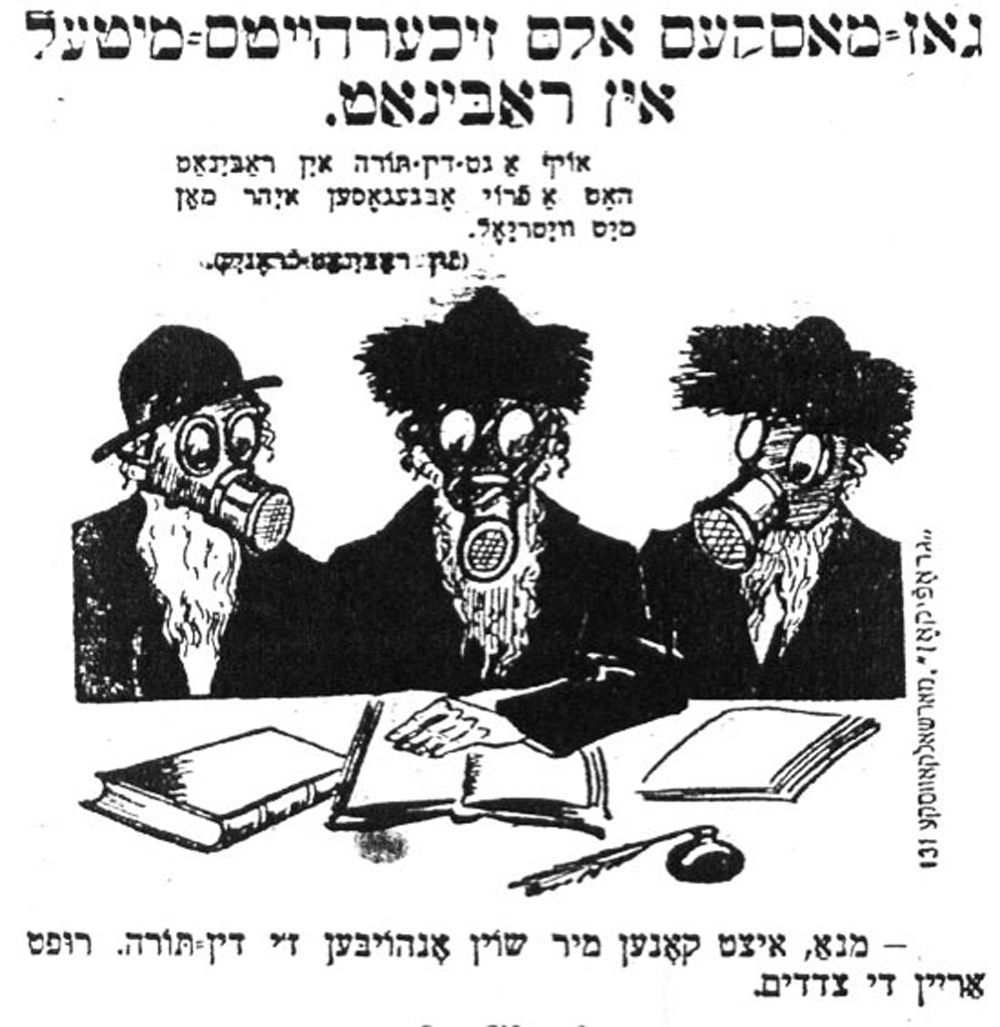
חז”ס ופולמוס חנוכה

חז”ס ופולמוס חנוכה
‘מאי חנוכה’
מאת זרחיה ליכט
תמונה מהחכם חיים זליג סלונימסקי
חיים זליג סלונימסקי (1810-1904), המכונה חז”ס, היה אחד מגדולי המשכילים במאה ה-19. חכם גדול בתורה ובמדע שפעל הרבה להפיץ השכלה עולמית בקרב עמו. כמעט עד סוף ימיו נשאר חז”ס נכבד בין בעיני הרבנים מצד חכמתו בתורה ונאמנותו לשמירת המצוות, ובין בעיני המשכילים מצד חכמתו במדע. אך בעת זקנותו אבד עמדתו החיובי בקרב הרבנים ע”י כתבה אחת שפרסם בעיתונו ‘הצפירה'[1] (דצמבר 1891). בחנוכה של שנת 1891 פרסם חז”ס מאמר בדפי העיתון, בו הוא פקפק בעובדת הנס של הפך שמן. לא זו בלבד שהכניס ספק בלב המאמינים שהחשמונאים מצאו רק פך אחד של שמן שהיה מונח בחותמו של כהן גדול, ולא היה בו אלא להדליק יום אחד, ונעשה בו נס והדליקו ממנו שמונה ימים, אלא טען שגם הרמב”ם לא הבין הדברים כפשוטם:

לא נכנס כאן בפרטי הוויכוח אודות אמיתת הסיפור שסיפרו לנו חכמנו ז”ל באופן כללי, ואודות דעת הרמב”ם בפרט, שכן כבר דשו בו רבים, מכל מקום לתועלת הקוראים אציג כאן תיאור הפולמוס בלשונו של ר’ יעקב ליפשיץ, מזכירו הנאמן של הגאון רבי יצחק אלחנן זצ”ל:
בשנת תרנ”א[2] (1890) יצא עורך מכ”ע [מכתב עת] “הצפירה” הרה”ח [הרב החשוב?] מר חז”ס, לפי דרכו הישרה בעיניו, במאמר ארוך (!) להוכיח אשר רבן של ישראל הרמב”ם ז”ל לא האמין כלל בהנס של נר חנוכה, שבגלל זה השמיט הרמב”ם את הנס של הנרות כל עיקר [למרות המפורש בהרמב”ם הלכות חנוכה הלכה ג’: “ומדליקין הנרות על פתחי הבתים בכל לילה ולילה שמונה הלילות להראות ולגלות הנס” – המחבר[3]], ומתוך הכחשתו בהנס של נר חנוכה נמשך אח”כ במאמרו להכחשת עוד נסים המפורשים בכתבי הק’.[4]
כנזכר, עוררה כתבה זו של חז”ס סערת רוח גדולה בקרב העולם היהודי, וסופרים רבים המשיכו להתפלמס בענין זה במכ”ע שונים של אותה תקופה. הרעש התגבר כל כך אשר גם במכ”ע של הגויים דיברו על זה. הרב שמואל אלכסנדרוב העיד ש”כמעט בכל מכ”ע הפולנים והרוסים ובחו”ל במכה”ע האשכנזים בוויען, ברלין, פעסט, בכולם נתפשטה השמועה כי ‘הצפירה’ נאסרה לבוא בקהל היהודים בשביל מאמר אחד הכופר באמונה מפורשת בתלמוד! ושונאינו עשו מזה מטעמים לקוראיהם… ואוי לאותה כלימה”[5].
ובעיתון המליץ תחת הכותרת ‘חכמים הזהרו בדבריכם’ התלוננו עד היכן הדברים הגיעו שבמה”ע “Slowo” הפולני פרסמו ש”בעולם היהודים נעשתה נבלה. העורך מכתב עת שבועי “הצפירה” ה’ סלאנימסקי היה לקללה נמרצה לעברים התלמודיים בגלל מאמרים אשר בהם הוכיח כי בהתלמוד יש ויש כמה וכמה סעיפים… ובעבור זה ירדפוהו עד חרמה. במקומות רבים הנושבים מיהודים נדבקו אזהרות בשפת עבר אשר בהן יכונה ה’ סלאנימסקי בוגד באמונה, המדיח את צעירי העברים מנתיב התלמוד. וע”כ נגזרה עליו מארה ויוצא לפני היהודים שומרי מצוה לבלי הביא את מ”ע שלו לביתם. ה’ סלאנימסקי מסר לדין איזה מרודפיו[6] היותר נלהבים[7]:

גם נכתבו כמה ספרים שלמים מצד הרבנים, אשר מטרתם הובהרה מראש, להפריך ולהכחיש את דברי חז”ס שאיימו על המסורה. הספר הכי נכבד בתחום זה, נכתב ע”י אחיו של ר’ יעקב ליפשיץ הנ”ל, הגאון רבי יהודה הלוי ליפשיץ אב”ד מערטש. בשנת תרנ”ה[8] הוציא ספרו ‘דרך אמונה’ לאור, ומאה עמודים הראשונים שלו מוקדשים לנושא של נס חנוכה. הספר מתחיל עם תיאור מאד דומה לזה של אחיו ר’ יעקב הנ”ל:
החכם החז”ס, לפי דרכו הישרה בעיניו[9], להעמיד כל הנסים הכתובים המקובלים בתנ”ך ובדברי חז”ל על הטבע, יצא בהצפירה שנת הי”ח נומר 278 להכחיש הנסים שנעשו לאבותינו במקדש, ותלה את עצמו באילן גדול מאורנו ומורנו הרמב”ם ז”ל, ויצא להוכיח כי גם רבינו הגדול מאור עינינו הרמב”ם ז”ל, בטל כלאחר יד את הנס הנעשה לאבותינו בפך השמן כפי המסופר במגילת תענית ובגמרא (שבת כ”א), וכפי המקובל באומה זה יותר מאלפים שנה, ואשר לזכר לנס הנפלא הזה תקנו מצות הדלקת נר חנוכה.

בנוסף לספר הנ”ל, חוברו עוד הרבה ספרים ומאמרים להצדיק את הצדיק הרמב”ם מאשמת חז”ס, ולהוכיח אמיתת דברי חז”ל בנוגע לנס של הפך שמן.
‘אגדת פך שמן’
למרות שרוב הרבנים התנגדו לדברי חז”ס, היה אברך מופלג גדול בתורה ומשכיל הרב שמואל אלכסנדראוו[10] (1865-1941), חתן לאחד מנכבדי עירו באברויסק, והיה מכובד על הבריות וגם הגיד שיעור גמרא לפני בחורים, שיצא במאמר ב”הצפירה” לחזק את דעת והכחשת חז”ס. נוסף על מאמריו הדפיס גם כן מחברת קטנה בענין פך השמן.[11] הקונטרס שחיבר הרב שמואל אלכסנדראוו נקרא ‘אגדת פך השמן’ (וורשה תרנ”ב – 1892) ועל השער כתב שהוא “מוקטר ומוגש לכבוד הרב החכם הכולל והחוקר הנפלא פאר ישראל כש”ת מהור”ר חיים זעליג סלאנימסקי הי”ו, ביום מלאת לו שתים ושמונים שנה, ביום כ”ד אדר הבא”. והוא חותם ההקדשה “מאת אחד היודע להוקירו ולכבדו כרום ערכו”. בקונטרס זה מנסה אלכסנדרוב לבאר שמעולם לא כיוונו חז”ל לדברים כפשוטם, שאכן דלק פך אחד במשך שמונה ימים, רק פירש הכול בדרך אלגורי, שהשמן רומז לחכמת התורה וכו’ וכו’. הוא סמך את רעיונותיו על דברי בעלי הדרוש לדורותיהם[12].
הרבנים שכתבו נגד דעת חז”ס שהזהירו לייחס אליו קצת בדרך כבוד, הרבו לעג וקלס בכיוונו של אלכסנדרוב שהודות לצעירותו לא זכה למידת הכבוד שאליה זכה חז”ס. אולי הסיבה לכך היא גם מפני שדברי אלכסנדרוב, שטען שהרבה מגדולי הדורות ובתוכם אדמור”י חסידות הסכימו בדרושיהם לדברי חז”ס, הביאו לידי גיחוך והיה קל ביותר לבטל כלאחר יד, מדיוקו של חז”ס בדברי הרמב”ם שהיה מבוסס הרבה יותר.

הרב שמואל אלכסנדרוב

חרטות והכחשות
מעניין מאד שגם אלו מחוג הרבנים שהסכימו עם דעת חז”ס, לא ארכו ימים עד שהתחרטו על מעמדם הבלתי שמרני. קשה לדעת אם הייתה חרטה אמתית או שרבו עליהם חבריהם וכפו אותם עד שאמרו ‘רוצה אני’ להכחיש ולהתחרט. ונביא כאן שלש דוגמאות לתופעה זו.
1. הרב שמואל אלכסנדרוב
הרב שמואל אלכסנדרוב שתמך בכל עוז בעמדת חז”ס, לא ארכו לו ימים ושנים, והלחץ שהפעילו עליו פעל את שלו, עד שבשנת תרנ”ה (1894) פרסם רש”א חרטה למחצה שליש ורבעי. בקובץ תלפיות ערך הרב שמואל מכתב למו”ל ובו כתב:
והנני אומר גם מפורש כי כל מה שכתבתי בקונטרסי “אגדת פך השמן”… הוא רק בתור בירור וביאור האגדות האלה ע”ד הביקורת, אולם בנוגע לגוף הקבלות והמסורות העתיקות המסתעפות מהאגדות האלו, הנני אומר מפורש אם (!) קבלה היא נקבל, ואם אולי (!) נמצאו ביטויים בספרי אפ”ה [=אגדת פך השמן] שפלטה קולמוסי, הנוגעים בגוף הקבלה, הנני מתחרט ע”ז חרטה גמורה; מטרתו בכל מאמרינו השונים היא רק לבנות ולנטוע ולא לסתור ולעקור חלילה.[13]
למרות שב-1894 הודה רש”א רק במקצת הטענה, ונהג עם דבריו הראשונים במידת ‘פלגינן נאמנות’, רצה לומר, שהם צודקים ע”ד הביקורת אבל לא ע”ד הקבלה, מכל מקום בשנת תרנ”ז (1896), בספרו ‘טל תחיה’ על פרקי אבות, על המשנה “עשרה נסים נעשו לאבותינו בבית המקדש” (אבות ה, ה), הודה רש”א בכול, וכך כותב שם:
אם כי יש לי להאריך הרבה ע”ד העשרה נסים, וכבר נגעתי בקצה עטי בזה במחברותיי השונות [ספר ‘אגדת פך השמן’, ‘דברי שמואל’, ‘אגדת אש מן השמים’] אולם ירא אנכי להאריך בזה, פן ואולי אכשל בלשוני כאשר נלכדתי בספרי אפ”ה [=אגדת פך השמן], ות”ל [=תודה לא-ל] אשר שקלתי למטרפסי[14] בהאי עלמא, וכבר הודיתי בפומבי [בספרי אאמ”ה (=אגדת אש מן השמים) בסופו במכתבי שם[15]] על עווני זה, והנני אומר עוד הפעם כי הנני מתחרט חרטה גמורה על הביטויים הקשים הנוגעים בגוף קבלת פך השמן הנמצאים בספרי אפ”ה [=אגדת פך השמן], ודעתי ככל שלומי אמוני ישראל בזה…[16]
כאן כבר התחרט בחרטה גמורה על הביטויים הקשים – למרות שלפני כמה שנים היה מסופק אם היו שם מאלה ביטויים הקשים, וכתב רק ‘אולי נמצאו ביטויים’ כאלה – אבל סביר להניח שעשה כן רק מחמת הלחץ שלחצו עליו, ולא שהתחרט באמת.
2. הרב יהודא מעשיל הכהן צירקעל
בצעירותו למד אלכסנדרוב בחברותא עם הגאון הגדול ר’ יהודא מעשיל הכהן צירקעל (1838-1899). כפי הנראה, כתב רב זה הסכמה לקונטרס ‘אגדת פך שמן’ של אלכסנדרוב, אבל גם לו לא ארכו הימים עד שהוכרח מחמת כן לפרסם הודעה בעיתון המליץ בו הוא מכחיש ההסכמה:
באריסאוו (פ. מינסק). – הנני לפרסם ברבים בדבר מכתבי הקצר שנדפס בקונטרס “דברי-שמואל” [מהרב שמואל אלכסנדרוב הנ”ל], אשר המחבר תולה עלי בשביל זה כי הנני מסכים עמו. חס וחלילה לדעותיו, אשר לפי דברי רבים שראו ספרו, מכחיש הוא בנס פך השמן, ואשר לא עלה על לבי ולא יעלה על לב איש יהודי הנאמן עם תורת חז”ל, ובאמת אני לא ראיתי בעתו את מאמר חז”ס בענין נס חנוכה, והמחבר קונטרס “פך השמן” שהוא בן עירי בשלחו לי קונטרסו היה בעיני כפתרון בלא חלום, ורק בדרך העברה עברתי עליו, ומאשר כי ראיתי בו בקיאות בספרים מבלי דעת תכן ענינו, ובין כה נדרשתי לאחר לפנות עבורו למחבר הקונטרס הנ”ל, שישתדל לטובתו, כתבתי למחבר מכתב בקשה. ומפני הכבוד כתבתי אליו טורים אחדים שאין בהם שום שייכות “לנס חנוכה”, כי אם כעין שבח על בקיאותו, ואז ציינתי לפניו התוספתא, יען שמצאתי בה נוסחאות שונות בענין שמן; וכדי בזיון להמכחישים התולים את עצמם בתוכחות צנומות כאלה לתמוך בהם את הכחשותיהם בהדפיסם מכתבים כאלה לעוור עיני רבים, ובלי שאלת פי כותבי המכתבים, ואין ראיה גדולה לביטול דברי הכחשתם מזה, כי כל דבריהם מהבל יחד. הכותב למען כבוד חז”ל וקבלת אבות.
                                   יהודא מעשיל הכהן החופ”ק[17]
הצהרה הנ”ל מופיע בחלק ה’מודעות’ שבעיתון המליץ ולא בחלק המאמרים של העיתון. הסיבה למיקומו המוזר לפרסום כזה, מובאת בספר זכרון יעקב הנ”ל. לפי ר’ יעקב ליפשיץ נלכד ר’ יהודה מעשיל הכהן בפח ע”י הסופר בן-ציון אייזענשטאדט ור’ יעקב ליפשיץ הוא זה שהציל את הצדיק ממוקשו ויעצו לפרסם מודעה הנ”ל ולהשים אותה דווקא בחלק המודעות. וכך כותב ר’ יעקב ליפשיץ:
אחד מסוכנים שלו [= של אלכסנדרוב] היה הסופר הידוע בשמו מר בנציון א…[18] הוא לכד בערמה את כבוד רב גאון אחד צדיק תמים הרחוק מכל תחבולות הספרות, ומכיון שהשיג מענה ממנו, השתמש במכתבו כחפצו בחסר ויתר, ויעש ממנו מטעמים כאשר אהב החז”ס ועוזרו אלכסנדראוו, והדפיס את מכתב הרה”ג התמים הזה ז”ל [מפני כבודו של תלמיד חכם לא איבה לפרש את שמו[19]] בהצפירה לאות כי גם גאון וצדיק מסכים עמהם.
ר’ יעקב ליפשיץ ממשיך לספר שהרב הנ”ל פנה אליו במכתב שיעזור לו ממצוקתו. ואז יעצו ר’ יעקב שישלח הכחשה, אבל שלא ישלחנו בתור ‘מאמר’ אלא בתור מודעה. וכך כותב:
הרה”ג הזה שהיה גם ממכירי וממכבדי, פנה אז אלי במכתב בקשה והפצרה, ויספר לי סיבת המשגה שנלכד בערמת הספור ב. א.[20] ויפצר בי שאסדר אני מאמר ולפרסמו באחד ממכ”ע… הסכמתי אמנם לערוך מאמר כחפצו ולברר הטעות והערמה של חז”ס שהוסיף וגרע בהתשובה, אבל לחתום על מאמר הלא מוכרח בעל המאמר בעצמו כמובן. ויעצתי לו שישלח ההכחשה בתור “מודעה” כי ברעדאקציעס ישנם ממונים שונים על כל מחלקה ומחלקה. יש מחלקה לקרוספדנציוס ולמאמרים וכהנה, ועל מחלקות כאלו עין העורך צופיה, ומדפיס רק אלה מאמרים שהם לפי רוחו; אבל יש מחלקה מיוחדת ל”מודעות”, ששם אין יד העורך שולטת, רק מי שמשלם בעד כל שורה ושורה מדפיסים המודעה כמו שהיא מבלי לבקר את תוכנה, ע”כ יאבה כת”ר לשלוח מאמרו בתור “מודעה” ולשלם בעד כל שורה ובעין יפה, ואז ידפיסו דבריו. וכעצתי עשה הרב הנכבד הזה ונדפס הכחשתו ב”המליץ” וצדיק מצרה נחלץ…
לא נסתיים פרשה זו בכך, אלא בא אחריו ר’ בן-ציון אייזענשטאדט בעיתון הצפירה והכחיש את הכחשתו של הרב יהודה מעשיל הנ”ל. הוא כותב שכבודו של ידידו “רב וגאון מפורסם ואב”ד בעיר ואם בישראל” גדול מאד בעיניו, אבל מזכיר את ‘מאמר החכם’ “אהוב אריסטו ואהוב אפלטון, והאמת יותר משניהם”. ומספר איך שביקר אצל ידידו האחר “והוא גם כן רב וחכם מצוין הרה”ג החכם הנודע מוהר”ש אלכסנדראוו” והלה הראה לו כתב ידו של “הגאון הגדול מוהר”י מעשיל הכהן הי”ו צירקעל הגאב”ד דבאריסאוו” והכיר שבאמת הסכים הרב יהודה מעשיל לדברי אלכסנדרוב. אולם מסיים אייזנשטט במילים הללו:
וכאשר נוראות נפלאתי על הגאון הזה הנודע לי ולכל מכיריו לאיש אמונים אשר כל עולה לא נמצא בשפתיו איך שנה את דבריו ויתן לחרפה את אחד החכמים המצוינים בישראל אשר כל שמץ עולה לא עשה, ומה גם כי ידעתי זה מכבר כי הוא ממכבדיו וממעריציו שמו?! ויוסף הר”ר אלכסנדראוו ויושט לי את המכתב השני אשר כתב אליו הגאב”ד דבאריסאוו ובו הודיעהו הסיבה אשר תמריצהו לבוא במחאה במכ”ע ע”ד מכתבו, אז נחה שקטה דעתי כי מצאתי פתרון לחלום אשר חלמתי, ומנהמת לבי קראתי: עד מתי בינת נבונים תסתתר!
יקר בעיני כבוד הגאון דבאריסאוו, אך עוד יקרה בעיני האמת אשר היא נר לרגלי תמיד וגם הפעם, ואשר למענה אך למענה כתבתי דברי אלה ואפרסמם.
א”ד המכתב את התורה וחכמיה הדורש אמת וצדק
בן-ציון אייזענשטאטד מקעלץ
באברויסק י”א שבט, התרנ”ג[21]
נראים הדברים שהשמרנים הפעילו לחץ גדול על הרב יהודה מעשיל “אשר המריצוהו” לבוא בכתב מחאה הנ”ל. מאידך גיסא מספר ר’ יעקב ליפשיץ שהסופר בנציון א… כתב מכתב בקשת סליחה ומחילה להרב יהודה מעשיל, “ויאמר אנוס הייתי לעשות כדבר הזה, כי נקראתי לענין פקו”נ בב… ולמר אלכסנדר’… שמה היה לו מכירים רבים ובא לעזרתי לחלצני מן המיצר בתנאי שאדפיס מאמרו ומשום שהיה בזה חשש של פקוח נפש, אנוס הייתי למלא חפצו נגד רצוני, ומבקש סליחה ממורו ורבו”.
קשה לדעת האמת ‘האהוב יותר משניהם’…
3. הרב אייזיק ליב ספיר
הרב יהודה מעשיל הכהן לא היה הרב היחיד שהוצרך להבהיר עמדתו בנידון. בעיתון הצפירה מופיע הבהרה כעין זו גם מאת הרה”ג ר’ אייזיק ליב ספיר אב”ד קוזניצא ובעמח”ס שרגי טובא. סביר להניח שמחמת שיצא עליו שם רע כאילו תמך בעמדת חז”ס, מצא הרב אייזיק ליב חובה לנפשו לפרסם קונטרס בו הוכיח שנס פך שמן אירע כפשוטו ממש.

ביבליוגרפי
לתועלת קורא הבלוג, אציג כאן שמות הספרים והקונטרסים, וגם הרבה מאמרים שמצאתי מדברים אודות הפולמוס הנ”ל. אינני מתיימר לתת לקורא ביבליוגרפי מושלם, אבל אפרט כאן ממה שמצאתי שמדברים ישיר לנושא של מאמרו של חז”ס:
ספרים וקונטרסים מאת הרבנים
1.     אמונת חכמים: נדפס ב-1892 – הרב דובער יהודה ליב גינזבורג[22]
הספר כולל ג’ מאמרים. מאמר הראשון נקרא ‘נס חנוכה’ ומטרתו “לבטל דברי מערכת הצפירה במאמר ‘מאי חנוכה’ [הוא מאמרו של חז”ס] דלא היה נס בפך דחנוכה” (נוסח השער). מאמר השני מוקדש להפריך דברי הרב אלכסדראוו שיצא להגן בעד חז”ס. ספר זה הוא כפי הנראה הראשון שנכתב מצד עמדת החרדים, ונעשה ביוזמתו של האדמו”ר מקאפוסט. המחבר חותם שמו בראש ספרו “המקנא קנאת חז”ל דובער יהודה ליב”.
2.     דרך אמונה: נדפס ב-1895 – הרב יהודה הלוי ליפשיץ
בשער הספר כתוב “להוכיח צדקת חז”ל בענין נס חנוכה וכל הנסים בכלל, ולהוכיח צדקת הרמב”ם ז”ל ודעותיו בענין כל הנסים וקדה”ח ותשובות נגד יתר המבקרים נגד חז”ל. 100 עמודים הראשונים של הספר מוקדשים לפולמוס חז”ל ומשם ממשיך הספר לדבר בשאר הענינים המפורטים בנוסח זה.
3.     נס פך שמן או אגדת פך השמן: נדפס ב-1895 – הרב ברוך ברייזמאן
יש בו 31 עמודים מוקדשים לנושא הזה ומתפלמס עם דברי חז”ס (עמוד 7).
4.     נס פך השמן: נדפס ב-1895 – הרב אייזיק ליב [יצחק יהודה] ספיר
הספר כולל י”ב פרקים ותעודתו “לבאר בראיות ברורות ונאמנות ש”נס פך השמן” שמצאו החשמונאים במקדש ה’ היה כפשוטו, ושכל הנסים והנפלאות שנעשו לאבותינו היו מחודשים כל אחד בשעתו מעילת כל העילות וסיבת כל הסיבות מבלי שום סיבה טבעית מראשית הבריאה” (נוסח השער).
מכתבים ומאמרים מאת רבנים
5.     ‘נס להתנוסס’: תורת הגאון רבי אלכסנדר משה; סימן כד, עמוד 465 – הרב אלכסנדר משה לפידות (1819-1906)
בראש המאמר כתוב שהוא בדבר הרעש הגדול המתחולל במחנה העברים שהחכם חז”ס בא לפקפק בנס פך השמן דחנוכה ותלה את עצמו בהרמב”ם שלא נזכר תיבות “ונעשה בו נס”.
6.     מכתב מאת האדר”ת: קובץ ‘מקבציאל’ שע”י מוסדות ‘אהבת שלום’ גליון ל”ז כסלו תשע”א עמ’ פא – הרב אליהו דוד רבינוביץ תאומים
בשולי המכתב לר’ יעקב רייפמן[23] מתייחס האדרת לפולמוס הנ”ל ומצדיק עמדת רייפמן נגד חז”ס.
7.     ‘מערכת חנוכה’: שדי חמד אסיפת דינים מערכת חנוכה אות ב ד”ה ודע – הרב חיים חזקיהו בן רפאל אשר אליהו (1833-1905)
בעל ‘שדי חמד’ מדגיש ש”עיקר הנס הנעשה בפך שמן, כאשר מקובל אצל כל ישראל, הוא אמת ויציב בלתי שום ספק” ומציין לדברי המחברים שערכו מאמרים נגד המתחדשים שרצו לעקור אמונה זו מהעם.
8.     ‘דרוש לחנוכה’ [נגד המשכילים]: ספר עץ חיים מרבני משפחת אבלסון; כנסת אברהם יואל סימן ב, עמוד שכה – הרב אברהם יואל אבעלסאן[24] (1841-1903).
הרב אבלסון מזכיר לשבח ספרו של הרב יהודה ליפשיץ ומגנה דברי המפקפקים.
9.     ‘ערוך לנר’: קובץ תורני ‘הפסגה’ קובץ ראשון  עמ’ 18 (נדפס ב-1895) – הרב משה ראזין[25] (1871-1957)
תוכן המאמר הוא יותר פלפולי בנושא למדני מאשר פולמוסי בנושא משכילי, אבל גם הוא נכתב בעקבות מאמרו של חז”ס. עורך ה’פסגה’ מקדיש שני עמודים (18-19) להציע לפני הקורא הרקע לנושא המאמר, ובו הוא מזכיר את חז”ס. גם בקובץ השני ‘הפסגה’ (עמ’ 16 ועמ’ 52) יש המשך מו”מ בענין הנ”ל.
מכתבים ומאמרים מאת סופרים
10. ‘מאי חנוכה’ – מכתב מאת ר’ יעקב רייפמאן: קובץ אור המזרח כרך י”ח, חוברת ב’ (ס”ג) שנת תשכ”ט (1969) – הרב דר. מאיר הרשקוביץ
המאמר מוקדש לעמדתו של ר’ יעקב רייפמן בפולמוס הנ”ל. הרשקוביץ מתאר קצת הפולמוס ומעתיק מכתבו של ר’ יעקב רייפמאן שמבאר בו “השגותיו הקטלניות על מאמרו של הח’ חיים זעליג סלונימסקי”.
11. ‘נס חנוכה’: זכרון יעקב חלק ג פרק מו, מעמ’ 204 – ר’ יעקב ליפשיץ (1838-1921)
במאמר זה מאריך ר’ יעקב ליפשיץ בתיאור פרטי המעשה של פולמוס זה בפרט, וכמה ענינים אודות חז”ס בכלל, וכפי הנדרש הוא מזכיר לתהילה פעולתו של אחיו הגדול הרב יהודה בתחום הזה.
12. שערי צדק: ספר מאזני צדק מעמ’ 94 (נדפס ב-1895) – הרב דובערוש טורש.
המחבר מאריך לפרט כל ה’עבירות’ של חז”ס ובתוך הדברים מדבר אודות הפולמוס הנ”ל. הוא מוכיח מסיפור שהוזכר בספר ‘זרובבל'[26] (ח”ב צד קכ”ח) ש”המחוקק הנוצרי האמין כי מי שאמר לשמן ידלוק יאמר לפעמים לחומץ ידלוק, ונס חנוכה היה אהוב וחביב נחמד ונעים בעיניו עד שהלך בדחילא ורחימא לירושלים לחוג בחרדת קודש חג החנוכה”.
13. יומן של חיים מיכל מיכלין: ספר ‘ראי הדורות’ אות מח עמ’ 81 – חיים מיכל מיכלין (1867-1937)
ביום ח’ סיון תרנ”ב (1892) כתב מיכלין ביומנו ש”מכתבים רבים באו ממקומות שונים להגאון הג’ ר’ שמואל סלאנט הדורשים לדעת פרטי הדברים אשר הודיע החכם הישיש חז”ס, כי ראש הרבנים בירושלים נתן צדק לכל פרטי דבריו בדבר נס חנוכה….”.
14. ‘שמאול אלכסנדרוב’: ספר זכרון לקהילת בוברויסק ובנותיה כרך ראשון עמ’ 319 – בעריכת יהודה סלוצקי (1967)
מאמר אודות הרב שמואל אלכסנדרוב ובאות ב’ מתואר איך ש”בשנת תרנ”ב (1891) הסתבך אלכסנדרוב במחלוקת קשה ועקרונית עם החוגים השמרנים ביהדות החרדית ברויסה. הוא פירסם אז קונטרס “אגדת פך השמן”, שבו יצא להגנתו של ח. ז. סלונימסקי, שעורר רוגזם של הרבנים במאמרו “מאי חנוכה” (הצפירה 1891, גל’ 278).
15. ‘רבי שמואל אלכסנדרוב’: קובץ ‘סיני’ כרך ק’ סיון תשמ”ז (1987) עמ’ רב אות ד – גאולה בת יהודה
נושא המאמר הוא רבי שמואל אלכסנדרוב. באות ג’ יש אריכות הדברים אודות פולמוס חנוכה הנ”ל שרש”א היה מעורב בו הרבה ע”י שכתב מאמר הגנה לכבוד חז”ס ורבים מהסופרים הנ”ל יצאו גם נגדו.
16. הכפירה ו”הצפירה”: מוסף שבת קודש יתד נאמן פרשת מקץ תשע”ב – ד’ צפתמן
הכותרת של המאמר הוא “בחנוכה תרמ”ח (!) סער העולם היהודי בעיקר באירופה בשל מאמר שפרסם עורך “הצפירה” ובו ניסה כביכול להטיל ערעור במסורת נס פך השמן שארע בימי החנוכה. עפ”ל [עפרא לפומיה]”.

[1] ‘הצפירה’ החל לצאת לאור בשנת 1862 ע”י חז”ס שהיה העורך שלו במשך שנים רבות.] ב’הפלס’ (ד עמ’ 574) מודיעים על מיתת “החכם הנודע למשגב מר חיים זעליג סלאנימסקי” וכותבים: “שנות מספר הוציא לאור את העיתון ‘הצפירה’ וכל הימים אשר ערך הוא את ‘הצפירה’ היה עיתונו זה באמת אורגן נכבד בערכו. לעת זקנתו אמנם נכשל החכם חז”ס בנס חנוכה ותלה בוקי סריקי בהרמב”ם. אך מבלי השגיח על המקרה לא טהור הזה שמו ישאר לתהילה בקורות הימים כאחד החכמים הגדולים אשר מבית המדרש הישן יצאו למלוך ולא הקדיחו תבשילם ברבים כעורכינו החדשים”..
[2] זו טעות שכן נכתבה בחנוכה תרנ”ב – 1891.
[3] מהמקור.
[4] זכרון יעקב ג פרק מו, עמ’ 204.
[5] אגדת פך השמן, ווארשא 1892, הערה 1.
[6] ראוי לציין שחז”ס נפגע קשות מהעומדים נגדו. בספרו “מאסליאנסקי’ס זכרונות” (עמודים 76-77) מספר המחבר צבי הירש מאסליאנסקי איך שפגש חז”ס בוורשה בתקופת הפולמוס אודות נס חנוכה, ומיד התחיל חז”ס לספר לו אודות הפולמוס, והתמרמר אודות מתנגדיו. הוא מצטט שם דבריו של חז”ס באידיש “מיין גאנץ לעבען האב איך זיך בעשעפטיגט מיט תורה און חכמה; איך האב זיך בעטיהט צו לערנען מיין פאלק וויסענשאפט און יעצט, אוף מיינע אלטע יאהרען, – האט ער זיך בעקלאגט פאר מיר – זיינען זיי אנגעפאלען אויף מיר מיט חירופים וגידופים” [תרגום: “כל החיים שלי עסקתי בתורה וחכמה; טרחתי ללמד את עמי מדע ועכשיו, לעת זקנותי – התמרמר לפני חז”ס – נפלו אלי בחירופים וגידופים”.
[7] המליץ 1892 גיליון 18.
[8] ר’ יעקב ליפשיץ (שם עמ’ 209) מסביר שהספר יצא במהירות כדי שיראה אור לפני מות חז”ס. וכך הוא כותב: המחבר [הרב יהודה ליפשיץ] זצ”ל רצה עוד להעיר הרבה דברים ולהגיה, לשפר ולשכלל את ספרו “דרך אמונה” טרם שהוציאו לאור הדפוס, אבל החרדים האיצו בו להוציאו בהקדם האפשרי, כי חז”ס ורבו מר [אייזיק] ווייס [ב”דרך אמונה” ישנם גם הערות רבות המכחישות דעותיו של ווייס] שניהם היו זקנים לימים, ויראו החרדים שמא יאמרו החפשים “אין משיבים לאחר מיתה”, לכן הקדים המחבר להוציא ספרו זה מבלי להוסיף בו עוד הערות.
[9] הדגשנו מילים אלו כדי להשוות אותן לדברי אחיו שנעתיק להלן.
[10] ראה אודותיו בספר ‘דור רבניו וסופריו’ מאת בן-ציון אייזנשטט, חלק א ערך ‘ר’ שמואל אלכסנדרוב’. מעניין ששם הוא מזכיר “כי בהיותו כבן חמש עשרה שנה למד מפי הגאון האמתי הבקי הנפלא ר’ יהודא מעשיל הכהן האב”ד בעירו [באברויסק], וירבה לשקוד בתרוה ויצא שמו לתהלה ויקרא בשם “עילוי”. וראה להלן עוד בענין היחסים שבין הרב יהודא מעשיל הנ”ל, אלכסנדרוב, ובן-ציון אייזנשטט.
[11] מ’היה אברך’ עד כאן לקוחים מדברי ר’ יעקב ליפשיץ בזכרון יעקב שם עמ’ 206.
[12] בין היתר הוא מסתמך על דברי הש”ך (אדדת פך השמן פרק א), העוללות אפרים (שם פרק ב), ספר ‘בת עין’ (שם), מהר”ץ חיות (שם פרק ה), חמדת הימים (שם פרק ז, וראה הערה 6 שם אודות מעמדו של ‘חמדת הימים), ומציין לדברי ר’ יעקב יוסף מפולנאה, בעל ‘תולדות יעקב יוסף’ בספרו ‘בן פורת יוסף’, ולספר ‘מאור עינים’ להאדמו”ר מטשערנאביל, ולספר ‘תורה אור’ לבעל התניא, ובספר ‘קדושת לו’ “ועוד כמה ספרים קדושים שכולם הלכו בזה בדרך בעל ‘חמדת הימים”.
[13] מכתב מיום ח’ ט’ מרחשון, תרנ”ה, טימקאוויטש. נדפס בקובץ תלפיות במדור “פליטת סופרים’ עמ’ 1.
[14] קיבלתי גמולי. ע”פ יבמות קה, ב.
[15] הוא המכתב הנ”ל.
[16] טל תחיה על מסכת אבות, ווילנא 1896.
[17] המליץ שנה ז גליון 9.
[18] הכוונה לבן-ציון אייזנשטט.
[19] אין ספק שהכוונה להרב יהודה מעשיל.
[20] בן-ציון אייזנשטט.
[21] הצפירה, פברואר 3, 1893 עמ’ 3. וליתר פרטים אודות הרב יהודא מעשיל, ראה ‘דור רבניו וסופריו’ מהרב בן-ציון אייזנשטט הנ”ל, ערך ‘הרב יהודא מעשיל הכהן צירקעל’.
[22] אביו הגאון ר’ נחמיה מדוברובנא היה בעל מחבר ספר שו”ת ‘דברי נחמיה’ והיה מגדולי תלמידיו של האדמו”ר “בעל התניא”, וחתן בנו. לבד מספרו ‘אמונת חכמים’ הכין גם קונטרס ‘מטה לוי’ לנגד  ספר המכחיש מצות תפילין שנדפס בימיו. קנאותו לשמירת חומת הדת וכבוד הרבנות, היתה לשם דבר. נפטר בי”ט אדר א’ תרנ”ד והוא בן שבעים שנה. עליו ועל אביו, בס’ “בית רבי” (דף סט, א-ב). על הבאתו לקבורה בי”ט אד”ר, ב”הצפירה”, כ”ד אד”ר תרנ”ד. (מדברי יהושע מונדשיין כאן)
[23]ר’ יעקב רייפמן נולד א’ ניסן תקע”ח (7 באפריל 1818) ונפטר בי”ד חשוון תרנ”ה (13 בנובמבר 1894). היה חוקר אוטודידקט ומחבר פורה, היסטוריון של היהדות ומלומד עברי. דמות אניגמטית שנעה על קו התפר שבין חדש לישן, חבר החברה הגבוהה של תנועת ההשכלה היהודית ושומר תורה ומצוות. (ויקיפידיה ערך יעקב רייפמן)
[24] רבי אברהם יואל אבלסון היה רב ליטאי, מחובבי ציון.
[25] הרב משה רוזין היה רב ליטאי שהיגר לארצות הברית ושימש כנשיא של ‘אגודת הרבנים’. חיבר סדרת ‘נזר הקודש’ על הרבה מסכתות הש”ס.
[26] ספר שחיבר יצחק בר לווינזון (1788-1860) להגן על היהדות מן הנצרות ובפרט מן המיסיון.


Hitzei Giborim, Tzitzit, and R. Meir Mazuz

Hitzei Giborim, Tzitzit, and R. Meir Mazuz
Marc B. Shapiro
1. In 1969 the journal Moriah appeared, published by Makhon Yerushalayim. From its beginning, this journal published manuscript material from geonim, rishonim, and aharonim, together with Torah articles by contemporary scholars. This created a model that was later followed by a number of other journals. It also became a model for how to publish memorial volumes, as these generally also contain a section of material published from manuscript. Together with the interest in manuscripts, there has developed what can only be described as an Orthodox academic approach, and one can often find articles of this sort that meet a very high scholarly standard. A well-known representative of this genre is Yeshurun, a volume that appears twice a year and includes material from manuscript as well as halakhic and scholarly articles. What is most impressive about Yeshurun is not only its massive size, but the fact that the editors can fill it with so much quality material.
A competitor to Yeshurun has recently appeared on the scene and its title is Hitzei Giborim. Its model is exactly what I have described, with a section devoted to publishing material from manuscript, followed by Torah essays and Orthodox academic articles, many of which are really fantastic. The editor of Hitzei Giborim is R. Yaakov Yitzhak Miller, whose own articles show impressive erudition. Volume 9 recently appeared, but since I haven’t yet had a chance to examine it, let me speak about volume 8 which appeared last year. Volume 8 contains 1030 pages which I think makes it the largest volume of its kind. I wonder if the point of having so many pages was precisely in order to exceed even the largest Yeshurun.
Among the articles that I think will be of particular interest to Seforim Blog readers are R. Eliyahu Nahum Waldman’s ninety page study of Maimonides’ responsa to the sages of Lunel, designed to show that R. Kafih was mistaken in thinking that these are forgeries. I only wonder if such an effort was required on R. Waldman’s part, since it is hard to believe that anyone who examines the matter without preconceptions can agree with R. Kafih.[1]
R. Yehoshua Assaf deals with Rashbam’s commentary to the beginning of Genesis, the portion that ArtScroll censored and which I dealt with in prior posts here and here.[2] In this article Assaf cites R. Hillel Novetsky’s important comments here. Novetsky discovered another manuscript that not only contains the words of Rashbam in his commentary to Gen. 1:31, words that ArtScroll censored, but also the continuation of the passage that was missing until now. In fact, ArtScroll should be happy with this discovery as we now see that Rashbam affirmed that even if “day” started in the morning for the first six days of creation, the Shabbat of creation indeed began at sunset on Friday.[3] Unfortunately, I think that even if ten other Torah scholars would write articles along the lines of R. Novetsky’s and R. Assaf’s it won’t have any effect on ArtScroll.
R. Avraham Yissachar Konig’s article on the international dateline and the dispute between the Hazon Ish and other rabbis is full of interesting points and discoveries (including new material from manuscript) that significantly advances our understanding of this episode. Unfortunately, the language Konig uses about certain rabbis, in particular R. Yehiel Michel Tukatzinsky, is completely improper. Just because Konig’s point is to defend the Hazon Ish does not give him the right to belittle people who were greater than he. Interestingly, this article by Konig was removed from the volume when it was placed on Otzar ha-Hokhmah.Here is the table of contents that is also missing the article.

Here is the uncensored table of contents.
Otzar ha-Hokhmah has become the library for so many of us, and it is thus completely unacceptable for books to be altered no matter what the reason. The editor of Hitzei Giborim insisted that the book be shown in its entirety or taken down, and it no longer appears on Otzar ha-Hokhmah.
In Changing the Immutable, pp. 191 n. 16, 224 n. 46, I noted other examples of censorship on Otzar ha-Hokhmah. I found an additional instance in the Otzar ha-Hokhmah version of The Rabbi Leo Jung Jubilee Volume (New York, 1962). Two articles are deleted, and here is how the table of contents appears on Otzar ha-Hokhmah.

Here is the uncensored table of contents.

I understand why Otzar ha-Hokhmah would want to delete an article by Heschel, but what possible reason could there be to delete R. Isidore Epstein’s article? I can only assume that the person responsible for this mistakenly thought that Epstein was not Orthodox.
Here is a page from Otzar ha-Hokhmah’s version of Peninei Rabbenu ha-Avi Ezri, p. 266.

Here is how the uncensored page looks.


Returning to Konig’s article, on p. 770 he prints from manuscript a letter from a Sephardic rabbi to R. Ben Zion Uziel, but the name of the rabbi has been deleted. Konig tells us that he removed the rabbi’s name in order to protect his honor, because his letter shows that had no understanding of the dateline issue. It is indeed true that the rabbi did not understand the matter but that is no reason to delete his name. If we are going to start deleting names of rabbis every time we are convinced that they made a basic error, there would be no end to it. In this case the editor should have insisted that the letter appear in full. After all, everyone makes mistakes and there is no problem is seeing that even a learned rabbi did not understand this complicated issue.
Among the articles in Hitzei Giborim focusing on contemporary issues, R. Eliyahu Levine deals with dina de-malchuta dina. On p. 1012 he notes that the government requires homeowners to keep their property looking nice, and this includes cutting the lawn. R. Levine asks if this is also included in dina de-malchuta dina. He concludes that it is not, and writes the following.
וגם נראה שיסוד חוקים אלו הם מעוגנים בתרבות הגויים, שהעיקר אצלם הוא היופי החיצוני, וכל עמלם ויגיעם הוא ליפות את המראה החיצוני של רכושם, ולכן הם מעונינים שחצירו הפרטית של כל אחד מהם תשלים את מראה המקום כנאה ומטופח, וא”כ דבר זה כלול בדברי הרשב”א והש”ך שחוקים שביסודם הם כשל תוה”ק, אין נוהג בהם דדמ”ד, משום שבשעה שיגיעתו של הגוי היא לצחצח את רכושו, יגיעתו של הישראלי היא להקפיד על דברים אחרים, והמאמץ לעצמו את חוקי וגינוני המלכות, ודאי שמקפיד להיות מתאים להופעת הגוי, ממילא ההרגל בכך מזניח את ההקפדה והטיפוח של הישרליות שבישראל.
גם הרבה מחוקי הבניה והדיור כנראה מקורם בתרבות אמריקאית זו, ומשפחות יהודיות גדולות שעיקר תשוקתם אינה בדוקא בריבוי נכסים, החוקים הנ”ל אינם תואמים להשקפת עולמם, וזוהי עוד סיבה שבמסגרת חוקי הגויים לא נוהג דדמ”ד.
For those who don’t read Hebrew, he claims that zoning laws, and the whole idea of having a beautiful environment, originate in non-Jewish cultural norms, and therefore Jews are not obligated to follow these laws. I guess this means that in a “Jewish” environment, people won’t need to cut their lawns, their property can fall apart etc., since Jews look at what is on the inside and are not concerned with outer appearances. It is no secret that in some segments of the haredi world people assume that zoning laws (and sometimes even fire codes) are not Jewish concepts and thus don’t need to be followed, but to see this sort of approach in print will probably be a surprise for many.[4]
On p. 1121 we find something quite uncommon, an apology that in the previous volume an article appeared that is plagiarized from two other writers. I can’t think of another Torah publication that has ever had such a notice, and it shows both the honesty and the courage of the editor.
Beginning on p. 362, R. Yaakov Yitzhak Miller publishes from manuscript Torah letters concerning shaving one’s beard when the Czarist authority required this. The question that obviously needed to be considered was if this decree was to be regarded as a she’at ha-shemad in which case Jews would be required to martyr themselves rather than obey. Not surprisingly, the rabbis whose letters are published by R. Miller did not go this far. These rabbis are R. Judah Bacharach, R. Jacob Zvi Mecklenburg, and R. Hayyim Wassertzug (also known as R. Hayyim Filipover, from one of the Lithuanian towns he was rabbi in). These letters come from an unpublished volume by R. Wassertzug which hopefully will soon appear in print as it has the potential to be a very significant publication.
Although R. Wassertzug is today unknown, this was not the case in the 19th century, and R. Miller provides a nice introduction which shows some of R. Wassertzug’s originality. In addition to a reputation for being very pious as well as a great scholar, he was also known as a lenient posek who did not feel bound by certain practices which while generally accepted, did not, in his opinion, have a firm halakhic basis. Not surprisingly, this led to conflict with some other rabbis.
Here are two responsa from R. Wassertzug that appeared in Ha-Melitz, 14 Sivan 5629, pp. 225-226. The first permits one to drink non-Jewish milk (especially travelers), and the second permits a married woman to show some of her hair.

Not mentioned by R. Miller is that one of the opponents of R. Wassertzug was R. Isaac Haver. It is reported that he and some other rabbis went to R. Leibel Shapiro, the rav of Kovno, to complain about R. Wassertzug and to gain his support in order to have R. Wassertzug removed from his rabbinic position. Yet they were rebuffed as R. Leibel told them how great R. Wassertzug was and sent them away.[5]
In 2015 R. Mordechai Gifter’s Milei de-Iggerot appeared. This is quite a significant work and anyone interested in the history of American Orthodoxy will want to consult it. On p. 213 he deals with R. Eliezer Berkovits’ liberal halakhic approach. R. Gifter comments that unfortunately R. Berkovits did not follow the path of his teacher, R Jehiel Jacob Weinberg, who was much more conservative in how he approached halakhah.

The person R. Gifter was writing to had asked why R. Gifter was so critical of R. Berkovits’ approach when R. Wassertzug also had a liberal approach. In R. Gifter’s reply he reveals a hitherto unknown piece of information that he received from an elderly Lithuanian rabbi, namely, that one of the responsa of R. Akiva Eger in which there is no addressee given was actually sent to R. Wassertzug. R. Gifter also states that when R. Berkovits reaches R. Wassertzug’s level of piety, then he will be able to forgive him for much of what he has written.
ומה שיביא לי ראי’ מהגאון ר’ חיים פיליפובר זצ”ל, ידע נא ידידי שכשיגיע דר. ברקוביץ לדרגת חסידותו ופרישותו של אותו גאון וצדיק אוכל למחול לו על הרבה מדבריו, אבל באיש של דורנו לא אוכל לתלות דבריו בחסידותו של גאון מדור קדום.
והאמת שמיחס גאוני הדור להגר”ח פיליפובר ז”ל יש לנו ללמוד איך להתיחס לכל דרישה לחלוק על הלכות קבועות אפי’ כשיצאו מפי גאון וצדיק. ועיין תשובת מרן הגרעק”א ז”ל סי’ נ”ה – שקבלתי מפי רב גדול וישיש בליטא שהתשובה מכוונת להגר”ח פיליפובר ז”ל.
Here is the responsum of R. Akiva Eger, vol. 1, no. 55, referred to by R. Gifter.
As you can see, while the addressee is referred to as המופלא, his name and town are not given. R. Eger criticizes R. Wassertzug for his liberal approach in which he disagreed with rishonim and in the case discussed diverged from the Shulhan Arukh. In his conclusion, R. Eger refers to himself as one who is rebuking from hidden love.
While on the topic of criticism of R. Berkovits, here are some other relevant documents that I found in the archive of Chief Rabbi Isaac Nissim at Yad ha-Rav Nissim in Jerusalem. The first is a New York Times article from June 23, 1969. (I have no doubt that the second quote attributed to R. Berkovits in the article – where he mentions reconsidering the “traditional laws” – was taken out of context.)

In response to this story the following two documents were sent out to various Orthodox figures. Since the Hebrew document is not always easy to read, I have provided a transcript and also added paragraph breaks.

בהתרגשות ורגש חרפה קראנו בזמן האחרון בעתון “הניורק טיימס” על דר. אליעזר ברקוביץ, פרופסור בבית מדרש לתורה בשיקגו, שהוא השתתף עם איזה וועידת מתבוללים בקאנאדה: שמתיימרים הם להתחבר שלשת הזרמים של יהדות (אורטודוקס) (קונסורביטיב) (ריפורם). בנאום לפני העתונעיים [!] הגיבו המשתתפים שאין האיסור לאכול חזיר עוד מותאם לנסיבות הזמן: ובשלובי זרע עמהם הגיב דר. ברקוביץ שמצות שמיטה הנוהגת באה”ק היא שערוריה סקנדלית, ולא יתכן שמירת השביעית ב”דת מודרנית”: והיא בכלל יהדות מזוייפת: ולמותר הבהיר דר. ברקוביץ שהוא: “דובר של יהדות אורטודוקסית”, למרות שאין לו שום בסיס להיקרא אורטודוקסי, אחרי שהוא מפורסם כמלעיג עד”ת, שכל דעותיו הן שהאורטודוקסיה “משרשת ומפיגה את היהדות מן ההמונים לרגלי העצמת האיסורים.” והנה אין בעצתו מן החדוש וההפתעה, שכבר שמענוה אצל הקונסוב[ר]טיבים והריפורם כמותו – אמנם איך שהוא מצהיר ומצייר את עצמו בתור חובב ואדוק ביהדות האורטודוקסית הוא תמהון – מאין שאף דר. ברקוביץ שהרומס ברגל גאוה וגסה את עיקרי התורה והמתחבר עם הלצים והמתבוללים יכונה “דובר אורטודוקס”?
ומאידך – הרב אהרן סולביצ’יק, הראש ישיבה של ב”מ לתורה, המראה עצמו כצדיק וחסיד, המחמיר על פרטי התורה – איך הוא לא נרתע ונזדעזע מדברי הפרופסור, ולא שת לבו להסכנה החבויה בתוך הישיבה, דר. אליעזקר ברקוביץ? התירוץ: נחזה לר”א סולביצ’יק בעצמו, שלמשתה השנתי של היוניון אף אורטודוקס קאנג., שהמתחברים ברובם הם קונסורביטיב ומחללי שבת, וכל הגדולי תורה הצהירו בפומבי איסור מוחלט ללכת שמה – ראינו איך שר”א סולביצ’יק הואיל לנסוע להשתתף בועידתם, והם [ושם?] הוא נשא נאום להוכיח בעזרת “פסוקים” שאפשר להתחבר לצורך שעה עם הסטרא דשמאלא! – ומי זה שהיה יכול להעלות על הדעת שהר”מ ר”א סולביצ’יק יואיל להיות מהאורחים נואמים בארגון שכולו טריפה! אמנם היות וקראנו תגובותיו של דר. ברקוביץ הסכמות לנאומי ר”א סולביצ’יק, שמצוה גדולה להתחבר עם הרשעים, מוכרח שבאישורו הבהיר דר. בורקוביץ להעתונעיים, היות ואחרת לא היה מרשה הר”ם להפרופסור להישאר בישיבה, ובפרט בתפקיד מורה דרך על חניכיו בני הישיבה.
כעת לדאבוננו הוסרה [!] הצעיף החופף הדו-פרצוף שלר”א סולביצ’יק, מראה לזולת שהוא צדיק וחסיד, אך אינו מן הנמנע אישורו כ”דובר אורטודוקס” פרופסור המבהיר מינות וכפירה בתורה שבכתב, ובעצמו להתחבר עם המתבוללים, לעומת פסק איסור של כל גדולי התורה.
אדישות של הרמי”ם והרבנים בשיקגו להמצב קטסטרופילי הלזה היא כאובה, והחלה לשכנענו ששתיקתם כהודאתם, וכבר הגיע העת שתיפקחנה העינים והוקיע [!] בפרהסיא בעמוד הקלון את מפירי התורה בב”מ לתורה ולמחות בנזיפה לזבובי מות ושפעת דברים של הראש ישיבה המתבטא לתלמידיו דעות [כפרניות?] תחת החפשת צדקות: המחנף רשעים ומכבד פעלי עוול.
In addition to what it is said about R. Berkovits, R. Ahron Soloveichik is also attacked in these documents for not firing R. Berkovits (he actually didn’t have the authority to do so), and for attending an OU convention, an organization that in the 1960s had many mixed seating congregations which are referred to as “Conservative” synagogues. There is nothing about the latter episode in the book about R. Soloveichik, Ha-Rav Aharon Yeled Sha’ashuim (Jerusalem, 2011), published by his son, R. Yosef Soloveichik. In fact, R. Berkovits is only mentioned on two pages in the book. On p. 244, it is pointed out that R. Soloveichik opposed R. Berkovits’ approach, which is described as advocating “that halacha should be allowed to develop freely to accommodate people’s needs.” On p. 243 we see that R. Berkovits joined with other faculty members in opposition to R. Soloveichik being given any administrative power at Hebrew Theological College.[6]
Let me make one final point about all the journals and memorial volumes, Yeshurun, Hitzei Giborim, and the rest. Numerous selections from commentaries on talmudic tractates have appeared in these publications. The problem is that when it comes to talmudic commentaries, all these publications are basically useless. For example, let’s say Moriah published a portion of an anonymous medieval commentary on a few pages of Tractate Nedarim twenty years ago. Only someone who was “in the sugya” would have been able to appreciate what the commentary was saying when it first appeared. Therefore, 99 percent of the readers twenty years ago skipped over it, and they continue to skip over all of the continuously published selections of commentaries that scholars spend so long deciphering and adding learned notes to. Since almost no one reads these published commentaries, I sometimes wonder if it is a waste of the scholars’ time to work on them. If I finally decide to learn Nedarim this year, is there any chance that I will remember that a few pages of a medieval commentary appeared in Moriah over two decades ago.
Fortunately, there is a solution, and that is to follow the approach of Otzar ha-Geonim. The project I have in mind would take a good deal of effort, but it would be very valuable. What we need is for an individual, or group of people, to go through all the various journals, memorial volumes, etc., and pull out all of the commentaries on the different tractates in order create a compendium. It can be called Otzar Mefarshim or something like that, and it would be divided into tractates, just like Otzar ha-Geonim. With such a work, when someone, for example, is studying Nedarim, he will easily find the 3 page section of the anonymous medieval commentary published years ago in Moriah. This is the only way to rescue so many scattered texts from oblivion.
3. In Changing the Immutable and in earlier posts I have discussed how in previous years in some communities wearing a kippah was not standard as it is today. (I think the only exception is the Syrian community.) R. Ovadiah Yosef even says that unlike in previous years, wearing a kippah today is more than just “midat hasidut,” as it has become a sign of a religious Jew, while going bareheaded is a sign of an irreligious Jews.[7]
I was asked if the same point can be made about tzitzit and it indeed can. It is now pretty standard in the Orthodox world for men to wear tzitzit. We even start little boys wearing them in school at age 3. Yet the practice of wearing tzitzit, i.e., a tallit katan,[8] was unknown in talmudic days and is not mentioned by the geonim or Maimonides.[9] It appears to have begun with the Hasidei Ashkenaz,[10] and eventually became a regular practice in the Ashkenazic world.[11] Yet even in the twentieth century throughout the Sephardic world tzitzit were not generally worn. In these places they regarded tzitzit as a holy item, not something to be given to a child who can easily soil his garment. Even among adults, tzitzit were reserved for the especially pious. (I hope to expand on this in the future, where I will provide sources documenting what I have just mentioned.) In the past half century much has changed, and just as the kippah is now a sign of a religious Jew, so too is tzitzit. As R. Meir Mazuz puts it in a recent issue of Bayit Ne’eman, his new weekly “parashah sheet”[12]:
היום זה סימן היכר בין אדם שומר תורה ומצוות לבין מי שלא כזה, ואפילו שמן הדין אפשר להיפטר מטלית קטן . . . מ”מ מצוה מן המובחר שאדם ילבש טלית עם ארבע כנפות כדי לקיים את המצוה.
Interestingly, R. Joel Sirkes writes that while a father is obligated to provide his minor son with tefillin so that he can learn how to use them, he is not obligated to provide his son with tzitzit, “since even he [the father] is not obligated to buy a four cornered garment.”[13] This view is in opposition to the Tur who writes that a father does have to provide his minor son with tzitzit if the latter is of the age to wear it.[14]
Since I just mentioned R. Sirkes, let me share another interesting view of his. Avodah Zarah 70a quotes Rava as saying: רובא גנבי ישראל נינהו. In context, what this almost certainly means is that the majority of the thieves in Pumbeditha were Jewish.[15] Yet R. Sirkes shockingly understands it to mean that most Jews are thieves! It would be shocking enough if he understood it to mean that most thieves are Jewish (and not just most thieves in Pumbeditha), but explaining the passage to mean that most Jews are thieves sounds like something one would find in the writings of an anti-Semite, not in a work authored by one of the outstanding halakhists. It is true that one can find other negative judgments of the Jewish people in rabbinic literature. For example, the Maharal speaks of Israel’s inclination to sin as something unique to them and not found among non-Jews. He writes:[16]
כי ישראל מסוגלים היו לחטא מה שלא תמצא בכל האומות.
Yet this is part of a theoretical discussion, and although Israel has this negative characteristic, the flip side is that Israel is at a much higher spiritual level than the non-Jews. R. Sirkes’ opinion, on the other hand, is about the real world, here and now, and is said in a halakhic context. See Bayit Hadash, Yoreh Deah 2:6 (kuntres aharon):
ולפי עניות דעתי נראה דבכל שאר עבירות יש להחמיר . . . מה שאין כן בגונב דבר מאכל . . . דאפילו במוחזק בכך הרבה פעמים אין לו דין משומד ותדע שהרי אמרו רוב גנבים ישראל ואם כן לא יהיה סתם ישראל כשר לשחיטה אלא בידוע שאינו גנב וזה לא שמענו לעולם.
When we come across strange passages like this, it is often the case that someone will say that the author never wrote it. Rather, it was inserted by an erring student or someone seeking to undermine traditional Judaism. In this case, we get the next best thing, as R. Shabbetai Cohen, ShakhYoreh Deah 2:18, writes that R. Sirkes retracted what he wrote and asked for it to be deleted.
ומה שכתב הב”ח בזה בקונטרס אחרון [ד”ה מומר] כבר צוה הוא ז”ל בעצמו למחקו.
Nevertheless, I wonder if this is actually the case. Is it possible that R. Shabbetai wrote this not because R. Sirkes actually said what he attributes to him, but because R. Shabbetai wanted the embarrassing passage of R Sirkes removed from the public eye? The best way to do this would be to say that R. Sirkes regretted writing it, and this hopefully would lead to it being deleted by future printers.Those who have read Changing the Immutable, especially the last chapter, know that there is plenty of precedent for what I am suggesting. The reason that I think this might be the case is that nowhere else do we have evidence of R. Sirkes saying that what he wrote here should be deleted. Furthermore, in a later work, Sefer Ha-Arokh, Yoreh Deah 2, R. Shabbetai does not mention anything about R. Sirkes giving instructions to delete what he wrote. Rather, R. Shabbetai simply criticizes R. Sirkes for what he regards as his error. If R. Sirkes really said what R. Shabbetai attributes to him in his commentary to the Shulhan Arukh, why doesn’t he mention it in Sefer Ha-Arokh? What sense is there in criticizing R. Sirkes if R. Sirkes himself regretted what he wrote? In Sefer Ha-Arokh R. Shabbetai writes very sharply, accusing R. Sirkes of an error that even an amateur wouldn’t be caught making:

אבל בב”ח (סעיף ו בקונטרס אחרון) כתב דברים בלא טעם ומחלק בין עבירה לעבירה עיין שם ומה שכתב ותדע שאמרו רוב גנבים ישראל וכו’ כאן טעות נזדקר לפניו אפילו בר דבי רב לא יטעו בזה דמה שכתב רוב גנבים ישראל הוא דלא אמרינן דמותר אלא כשיש גנבים בעיר ורוב מהגנבים הם ישראל אבל שיהיה רוב ישראל גנבים חלילה לא תהא כזאת בישראל ועתה ישראל אשר בך אתפאר תקיצנה בבית זה שלא כדעת דברו.
R. Shneur Zalman Hirschowitz also calls attention to what he regards as R. Sirkes’ error. R. Hirschowitz is best known as a student of R. Israel Salanter, and it was he who published R. Salanter’s Even Yisrael, which became a basic text of the Mussar movement.[17] Here is the title page.

R. Hirschowitz’s talmudic notes were included in the Romm Talmud and are now included in the new Talmud editions. His comment about R. Sirkes is found in his note to Hullin 12a:
מצוה לפרסם להסיר חרפה מעל ישראל דהנה אויבי עמינו אומרים כי חז”ל בעצמם העידו עלינו כי רוב גנבי ישראל ומה לה לעיסה שהנחתום מעיד עליה, ובאמת העולם טעה כי חז”ל אמרו זה על כל ישראל אשר בכל כדור הארץ ובכל זמן כי רוב הגנבים ישראל הם, וחלילה לומר זאת וטעות גדולה היא. וכבר טעה בזה אדם גדול הוא ניהו אדונינו רוח אפינו בעל הב”ח זצוק”ל בקונטרס אחרון ליו”ד סי’ א. ולא עוד אלא שנתחלף להב”ח ז”ל במחכ”ת גאון קדשו ועצמותיו הקדושים בין רוב גנבי ישראל ורוב ישראל גנבי . . . וכל הרואה יחרד וישתומם על זה שמשים לכל ישראל בחזקת גנבים . . . אבל לא יאונה לצדיק כל און, כי הב”ח בעצמו צוה בחייו למוחקו כמ”ש הש”ך ביו”ד סי’ ב.
4. Earlier in this post I mentioned R. Meir Mazuz’s parashah sheet, Bayit Ne’eman. You can see recent issues here and you can sign up to receive it here. Each issue is a transcript of his Saturday night shiur, broadcast live all over Israel. Fortunately, the transcript is complete, by which I mean that the people putting it out have not censored it in any way, thus preserving R. Mazuz’s spoken style and his numerous off-hand comments. It is pretty unique which is why I recommend that readers check it out. The people who publish the shiur even claim that it is the most popular shiur in the world, a claim that is supported by a recent media report here that R. Mazuz’s Saturday night shiur has almost twice as many listeners (around 30,000) as R. Yitzhak Yosef’s competing Saturday night shiur.
Readers should be prepared for a good dose of what can only be termed “Sephardic supremacy.” It is with regard to this that I have to correct a point that R. Mazuz has often made, but which is really misleading. R. Mazuz has compared the kelal yisrael sense found in the Sephardic world with the extremism in the Ashkenazic haredi world, an extremism that leads to never-ending disputes and delegitimization of others. It is true that a basic feature of Ashkenazic haredi society is the tendency to delegitimize those who don’t carry the “party line.” This of course does not mean that all haredi individuals have this tendency; however, it is found in haredi society as a whole. In the last decade or so we have seen how, when there are not many opponents outside the haredi world to focus on, the society turns on itself and creates internal battles.
As mentioned, R. Mazuz has contrasted this with the Sephardic approach which has always welcomed people of different outlooks and levels of religiosity, always looking to bring close and not separate one Jew from the other. In contrast to the Ashkenazic world which has used the herem again and again, R. Mazuz states that other than the battle against Spinoza, the Sephardim have never gone for this approach. For R. Mazuz, the upshot of all this is that Sephardic society is a much better reflection of what Judaism and Jewish life are supposed to be.
Before the great split between R. Mazuz and the Shas party, R. Mazuz commented that ש”ס is supposed to stand for שחורה and סרוגה, meaning that the party should include both black kippot and knitted kippot, since the wearers of both were faithful Jews. As many readers know, the head of the Shas Council of Torah Sages, R. Shalom Cohen, instead saw fit to refer to the religious Zionists as Amalek (among other choice comments). This in turn led R. Mazuz to increase his attacks against the leadership of the Shas party which he saw as abandoning the Sephardic tradition and adopting the worst aspects of Ashkenazic haredi culture. Those who follow the Israeli religious scene know that at present there is a battle taking place for leadership of the Sephardic religious world between the two most important Sephardic rabbis. One is R. Yitzhak Yosef, who sees himself as the rightful inheritor of his father’s position and protector of his legacy.[18] The other is R. Mazuz. Among R. Mazuz’s supporters is former chief rabbi R. Shlomo Amar. R. Amar is himself quite popular, but since the passing of R. Ovadiah has subordinated himself to R. Mazuz. Seeing R. Mazuz’s great popularity today, I am proud to recall that the very first English article to deal with him appeared in 2007 on the Seforim Blog here. This post was the first introduction of most readers to R. Mazuz, and since that time I have quoted from his voluminous writings in almost every one of my subsequent posts.
There is a good deal more to discuss regarding the dispute over leadership of the Sephardic world, the strategy of the Yachad party and why it didn’t succeed, and the growing attacks on R. Mazuz from small-minded people who object to his independent mind. (He has even been attacked for quoting poems by Yehudah Alharizi and Hayyim Nachman Bialik in a shiur.) But for now, let me just make a couple of points:
A. Contrary to what R. Mazuz has said, it is not true that the only time Sephardic sages have used the herem is against Spinoza. The scholars of Aleppo, who could be quite extreme, banned the Torah commentary of R. Elijah Benamozegh, a figure whose works are quoted by R. Mazuz.
B. R. Mazuz’s description, while correct in its major points, is offered without any context and therefore leads to a distortion of the historical record. Nothing R. Mazuz describes makes sense without remembering that unlike in the Sephardic world, the Ashkenazic sages were confronted with the Reform movement and later with the East European Haskalah. It is in the context of these battles that the Ashkenazic rabbinic leadership felt forced to resort to bans and other types of exclusionary behavior and language, and this led to the creation of an extremism that is with us until today. Lacking Reform and Haskalah, the Sephardic world could develop in an entirely different fashion, but had the Sephardic world confronted such anti-traditional movements, it is likely that its rabbinic leadership would have reacted exactly as the Ashkenazic rabbis did. In other words, we are dealing with apples and oranges, and it doesn’t make sense to point to characteristics of the Ashkenazic world and contrast them negatively with the Sephardic world without explaining why it is that the Ashkenazic world developed its extremist tendencies.I must, however, point out that R. Mazuz assumes that there is something in the Sephardic spiritual makeup that itself prevents the development of anti-traditional forces. You see this from various comments that he throws out. For example, in a recent shiur, published in Bayit Ne’eman, no. 32 (6 Tishrei 5777), p. 1, in speaking about R. Abraham Ibn Ezra’s piyut Lekha Eli Teshukati, he states: “If only the Ashkenazim had this piyut; I would guarantee them that if they would have recited this piyut, they would not have had maskilim, Reformers, or assimilationists.”

This particular shiur has a number of other interesting points. For example, on p. 2 he discusses the verbal attacks upon haredi soldiers. (So far there have only been verbal attacks, but no one will be surprised when an actual physical attack occurs.) As far as I know, almost none of the Ashkenazic haredi leaders have spoken publicly about this unfortunate development (and if they have, it has not been covered in the Ashkenazic haredi press). The Ashkenazic haredi leadership in both Israel and America has a policy of not criticizing bad behavior on “its side” (unless they are dealing with really bad behavior such as allying with Iran). This is a pattern that has been going on for almost a hundred years. I say this since the leaders of Agudat Israel in Palestine never criticized or took any real action against the extremists who were defaming R. Kook. In fact, when the authentic history of Agudat Israel is written, the question of the culpability of the World Agudat Israel in this entire affair will have to be dealt with, for despite all of its private outrage with what was taking place under the auspices of its branch in Eretz Yisrael, the extremists and their enablers were never distanced from the organization. It seems that it is always much easier to criticize those to your left than to your right.

Thus, had a typical anti-Israel group staged an event in which kids were taught to throw eggs at a car said to be carrying the prime minister of Israel, you can be sure that Agudat Israel would have been at the forefront of attacking this event. So how come when this exact thing happens in the Satmar community there is only silence from the Agudah?

Agudat Israel readily attacks the BDS groups and others who try to delegitimize the State of Israel. Yet how come Satmar can have a rally attacking the State of Israel in a way that gives cover to BDS and all the rest who want to destroy Israel, and we don’t hear a word from the Agudah? If you listen to the propaganda of Satmar, it also gives cover to the anti-Semites, as it uses anti-Semitic imagery in speaking about the all-powerful Zionists who control the media and who through their devious means are able to pull the wool over the world’s eyes.[19] If such imagery is rightfully condemned as anti-Semitic when “outsiders” use it, how is it that Satmar gets a pass when it uses anti-Semitic imagery?

Returning to R. Mazuz’s comments about the haredi soldiers, he says simply: “These soldiers who come to pray are not sinners but are tzadikim! How can we call them sinners? They defend Israel with their bodies!”

3. I am happy to see that a number of new books and articles refer to posts that have appeared on the Seforim Blog. The most recent example of this is that I have know of is Chaim Dalfin’s just-published book, Rav and Rebbe, which deals with the relationship between R. Joseph B. Soloveitchik and the Lubavitcher Rebbe.4. God willing, I will once again be leading Torah in Motion trips to Europe in Summer 2017. You can see the details here.


[1] I say this even though R. Yitzhak Barda, Kinyan Torah (Ashkelon, 2014), vol. 3, p. 87, states that R. Kafih is correct. R. Barda’s volume is itself of interest, as he argues that when it comes to Jewish law, Maimonides’ opinion is absolutely binding, even if the Shulhan Arukh disagrees.
[2] Based on conversations and emails, I think that my posts on ArtScroll’s censorship of Rashbam have had a wider impact than any other posts. In fact, not long ago someone in my town who knew that I wrote a book on censorship shared with me that she had heard that ArtScroll censored Rashbam. This person does not read the Seforim Blog, and indeed had never heard of it. She thus had no idea that her knowledge of ArtScroll censoring Rashbam had its ultimate origin in my posts, which I think shows the great reach of this blog.
[3] This idea was earlier suggested by Aharon Marcus. See the note in his edition of She’elot u-Teshuvot min ha-Shamayim (Tel Aviv, 1979), p. 34. R. Yoel Bin Nun was unaware of R. Novetsky’s discovery and because of this offers a mistaken interpretation of Rashbam. See his recently published Zakhor ve-Shamor (Alon Shvut, 2015), pp. 229ff. (called to my attention by Zachary Grodzinski).
In my post here on Artscroll’s censorship of Rashbam, I cite a number of authorities who claim that before the giving of the Torah night came after day. Subsequently, I found that the Malbim says the same thing and cites an interesting proof for this position. See his commentary to Exodus, chapter 12 note 50:
גם הלילה שאחריו שייך ליום ארבעה עשר, כי קודם מ”ת היה הלילה הולך אחר היום, כמ”ש בארבעה עשר יום לחדש בערב תאכלו מצות.
See also R. Meir Mazuz, Bayit Ne’eman, no. 17 (19 Sivan 5776), p. 3 n. 17; R. Moshe Zuriel, Otzrot Rabbi Shmuel ben Meir (Bnei Brak, 2016), pp. 35ff.
[4] In Israel, the mainstream haredi rabbinic opinion is that one can build illegally and ignore the various zoning laws which are not thought to reflect haredi values. (The mainstream hardali rabbinic opinion is that one can build illegally in Judea and Samaria.) One exception to this generalization is R. Asher Weiss who insists that “the world is not lawless” and even haredim must follow zoning laws. See the discussion of his view, and the opposing views of R. Israel Grossman and R. Shmuel Wosner, in Ron S. Kleinman, “The Halakhic Validity of Israel’s Judicial System among Israeli Ultra-Orthodox Halakhic Decisors,” Review of Rabbinic Judaism 18 (2015), p. 227-259. On pp. 250-251, Kleinman reports on a meeting that R. Weiss had with a group of Israeli lawyers. R. Weiss’s important remarks were later published and Kleinman summarizes as follows:
Rabbi Weiss maintains in the meeting that “it is a great challenge, a great and holy undertaking” for Orthodox Jews to engage in all professions, including the practice of law, despite the fact that practicing as a lawyer raises halakhic questions. In his words, “we need lawyers who are punctilious in their observance of the commandments . . . [as well as] judges who are punctilious in their observance of the commandments and who attempt as far as possible to render judgments according to . . . Jewish law.” These judges are important for ensuring that Israel’s judicial system “is not totally alienated from the spirit of the Torah.” He states that “a[n] [Orthodox] judge [in a civil court of law] provides a vital service to the nation” because there are many matter in which the rabbinical courts are not equipped to rule. Furthermore in his opinion, the prohibition against resorting to Gentile courts applies only to litigants and not to judges or lawyers.
As Kleinman notes, one of the points R. Weiss relied on for this last statement (which I have underlined) is  the fact that the Hazon Ish was friends with Yitzhak Kister who was a judge. (Kister would later be appointed to the Israeli Supreme Court, and is the only such justice who identified with the haredi community.) Yet as far as I know, the sentence that I have underlined is unprecedented among rabbinic decisors, even among the Religious Zionist poskim.
A Hebrew version of Kleinman’s article appears in Tehumin 36 (2016), pp. 346-358. The articles are not identical so anyone interested in the topic is advised to consult both the English and Hebrew versions.
[5] David Matityahu Lippmann, Le-Toledot ha-Yehudim be-Kovna u-Slobodka (Keidan, 1930), pp. 226-227. A different version of the story, with the same conclusion, is told by Hayyim Karlinsky, “Ha-Gaon Rabbi Aryeh Leib Shapiro,” Moriah 76 (Sivan 5744), pp. 95-96. The earliest version of the story, and perhaps the original source, is found in Asher Margulies, “Sheloshah Matmonot Hitmin Yosef,” Ha-Melitz, 25 Tevet 5687, col. 76 (called to my attention by R. Yaakov Yitzhak Miller).
[6] While it could not have been easy for R. Yosef Soloveichik to revisit the painful history he discusses, the documents he reproduces are important for the history of American Orthodoxy. The book I have referred to is not the same thing as the 2016 book on R. Ahron Soloveichk, Yeled Sha’ashuim
[7] Yehaveh Da’at, vol. 4, no. 1 (pp. 7-8). Regarding removing the kippah (but still leaving one’s head covered) before entering the bathroom, the following appears in R. Simhah Rabinowitz, Piskei Teshuvot, Orah Hayyim 21 n. 58.
וכן מובא בשם מוהר”א מבעלזא זי”ע שהיה פושט מעליו המלבוש עליון והכובע והגארטל לפני הכנסו לביהכ”ס, ואא”ז זצ”ל היה מקפיד גם על הכיפה והיה מניח במקומו איזה מטלית על ראשו.
Has anyone else heard of such a practice?
[8] Why isn’t this called טלית קטנה? R. Meir Mazuz explains that in the period of the rishonim, when the expression טלית קטן first began, they were not concerned with the grammatical point that a word ending with ת is feminine. See Bayit Ne’eman 29 (14 Elul 5776), p. 4.
[9] See R. Yitzhak Ratsaby, Olat Yitzhak, vol. 2, no. 11 (p. 28).
[10] See R. Yehiel Goldhaber, Minhagei ha-Kehilot, vol. 1, pp. 93ff.
[11] Here is one source that shows that in 12th century Ashkenaz tzitzit were not generally worn: R. Eliezer ben Nathan of Mainz, Sefer Ra’avan, ed. Deblitzky, vol. 1, no. 40:
שאלני חתני רבי אורי. מצוה חמורה כמו ציצית שהיא שקולה כנגד כל המצות, מאי שנא דמקילין בה רוב ישראל שאין מתעטפין בכל יום. והשבתי לו לפי שאין ציצית חובת גברא. מי כת’ לבוש ציצית, ציצית חובת טלית הוא דכת’ ועשו להם ציצית על כנפי בגדיהם, אם יש לך טלית של ד’ כנפים עשה לו ציצית ואם אין לך טלית אינו חייב בציצית. דומיא דמזוזה ומעקה דאם יש לו בית חייב במזוזה ומעקה ואם אין לו בית אינו חייב.
[12] Bayit Ne’eman 18 (26 Sivan 5776), p. 1.
[13] Bah, Orah Hayyim 17.
[14] Orah Hayyim 17:    קטן היודע להתעטף אביו צריך ליקח לו ציצית לחנכו
[15] See Tosafot, Bava Batra 55b s.v. Rabbi Eliezer, and the discussion in R. Zev Wolf Zicherman, Otzar Pelaot ha-Torah, vol. 3, pp. 759ff. (R. Zicherman refers to the Shakh and R. Hirschowitz that I mention.) See also Beitzah 15a: רוב ליסטים ישראל נינהו. The note in the Soncino Talmud to this passage reads: “The Rabbis were broad-minded enough to realize that in a town containing an overwhelming Jewish population the majority of thieves would be Jewish.”
[16] Netzah Yisrael, ed. Hartman (Jerusalem, 1997), vol. 1, ch. 2, p. 20. For R. Jehiel Jacob Weinberg’s negative comments about the Jewish people, see my Between the Yeshiva World and Modern Orthodoxy, p. 183.
[17] Regarding Hirschowitz, see Hayyim Dov Genachovski, Shneur Zalman Hirschowitz (Jerusalem, 1951).
[18] In this video R. Yosef explains why he has spoken out against R. Mazuz and his followers. I have no doubt that there are also political factors involved. The various “religious” attacks on R. Mazuz, especially during the last Israeli election, remind me of the following memorable passage in Solomon Schechter, Studies in Judaism (Philadelphia, 1896), p. 3: “[U]nfortunately religious struggles are usually conducted on the most irreligious principles.”

[19] This anti-Semitic imagery is already present in R. Joel Teitelbaum, Al ha-Geulah ve-al ha-Temurah, chapters 46, 79.