Publish and Perish or Digital death

Publish and Perish or Digital death

By: Yaakov Rosenes
About the author: Yaakov Rosenes made Aliya from Canada after graduating from Trent Univ. and U of I Chicago Circle. In the 70’s he held various research and administrative positions at Yad HaRav Herzog, Feldheim publishers, and Machon Yerushalayim. In the 1980’s he founded the Judaica Archival Project, a Preservation and Access program for Rabbinics at JNUL. Since the 1990’s the Project has offered bibliographic and book-finding services at www.virtualgeula.com.
Introduction:
Since the advent of the Internet, the nature of reading and publishing has changed radically in the secular world. Also today Jewish publishing is something entirely new. Now that it is acceptable to bring a lap-top computer into Kollelim we find literally thousands of Avrechim working on original (and frequently worthwhile) Seforim. Today over 75% of the 4000 new Torani titles appearing annually are privately printed by the author. At least half of these books are sold from homes. Many authors are experimenting with print-on-demand technologies and printing smaller editions to lower their costs. Other authors are posting their Seforim online as PDF files or as e-books. In short Jewish publishing which used to be dominated by 10 major publishers and distributors has become a market with thousands of players. Store owners have no shelf-space for new titles. Readers are jaded from too much material. Authors are frustrated because they can’t sell or even give-away their Sefer. Fortunately and unfortunately every Rabbi, Scholar, Admor, Mashpia, Maran and Baba has created his own literature and is trying to attract own readership. In short today’s Torani publishing has become a free-for-all.
How many Sifrei Kodesh are printed every year?
In Israel alone 50 every week are recorded by the book depository department at JNUL. I terms of cost at an average of $2000 per book means that Klal Yisrael invests over $5,000,000 per year in printing new Seforim! This number has doubled every 5 years for the last 30 years but the readership is growing at a much slower rate than the “printer ship”.
How much does it cost to print a Sefer today?
From 1K to 10K. It depends on the size of the book, the size of the edition and how it is bound. A Soft cover edition of 500 copies can cost as little as $1000. A hardcover edition of 500 pages of 1000 copies can cost over $10,000 to print in Israel.
What do you mean by Publish and Perish?
Self-explanatory, when your brother-in-law gets a copy of your new Sefer and puts it straight on the top back shelf of his bookcase it means even your closest audience has no time for your creation. The point of printing a Sefer is to open up a dialogue with a readership. Unfortunately today most new Seforim are what is called “vanity publishing” which sadly turns into a monologue between the author and himself.
Who is printing Seforim today and who should not print a Sefer?
Everybody who is sitting in a Bet Midrash with a lap-top or tablet computer is probably working on a Sefer. On any typical morning in my Kolel there are at least 10 Avrechim with computers on the desk. Some of them even wear their Tefillen while they edit their Sefer. Any first time author should think many times before he starts to work on a Sefer. Is it original? Who will read it? Don’t I need an editor? Why is my Rav encouraging me ?  Maybe he thinks it will be therapeutic? What does my wife or my father-in-law or my brother-in-law really think? If the answer is not clear to any of the above questions please do not print more than 50 copies, soft cover.
How did you print Seforim 40 years ago and how is it done today?
When I came to Israel in the 1970’s we still used a monotype press attached to a mechanical keyboard which set letters in molten lead. Today offset printing presses are prevalent where pages are prepared in a phototypesetting machine copied by a huge negative camera and then taped into paper frames to expose on to printing plates. This method works for a press-run of thousands. Since the invention of the laser printer in the 1980’s virtually anyone can print his own primitive book. So today when a new author can expect to sell or give away only 200
copies at the most it pays to skip the typesetting and the plates and to print the pages via a quality commercial digital printer or online printing service.
What is happening in the secular world and how is the Torani world different?
At least one major chain of brick and mortar bookstores has gone bankrupt and several others are faltering. Amazon.com is selling more e-books than printed books ! Many magazine, newspaper and paperback publishers are putting their major resources into digital editions. However only a few have actually shut down their print editions. In the Torani world we have Shabbos and we have to concentrate more to understand what we read. Therefore the market for the new editions of: Humashim, Mishnayot, Shasim, Turim and Shulkan Aruch etc. is healthy and growing. However the self publishing authors (many of whom are not only very sincere but also very talented) is the where the market is crashing. One bookstore owner told me when he sees an author coming in his front door with a pile of Seforim he runs out the backdoor in order not to embarrass him since he doesn’t have any shelf space for yet another Avrech with yet another new Sefer.
How has the Web changed people’s reading habits?
The web is not a place to read anything serious. Most people read the opening line of the opening page and then surf ahead. The media is simply too full of distractions to make a pleasant reading experience. Most people if they want to concentrate on a text will print it and take it with them to really absorb what it says. Only a small percentage of today’s readers really read books – most of us skim the first few pages and head for the newspaper.
Would you recommend putting your book on the Web?
Light reading perhaps. Giving away a chapter is a good way to promote a Sefer. For serious reading or learning – It’s suicide. Many people will download the file but very few will print it and even fewer will actually read it. As Yannai HaMelech noted after he wiped out Hachmei Yisrael.”The Sefer Torah is there in the corner – If anybody wants to learn it he can come and use it. RH”L
Is the Feldheim bankruptcy a sign of the future?
Yes and No, if the publishers will make some adjustments they have a good chance to survive. First of all the role of the publishers is to select the best talents and to prints the best Seforim. Most of our Jewish publishers became vanity publishers in the 70’s and 80’s. A particular publisher I once worked for used to dig up unpublished manuscripts of questionable value and then look for rich and naive descendants who would pay a pretty penny to see their grandfather’s Sefer in print and then try to convince the Velt that this was a major work from a Gadol
of the last generation. Other publishers specialized in finding new and wealthy authors who would subvent (plus some healthy profit) an entire edition of their new work and then market it as a major masterpiece and 2 years later quietly dump the entire stock for a song on a naive distributor. The publishers who we see today are still in business and going strong are the ones who didn’t use these tricks but simply read carefully what they publish.
The Future – Is it entirely gloomy?
In my opinion the future of Jewish publishing eerily echoes the past. Before the printing press every reader hired a Sofer to copy his Rav’s Sefer, specifically for his own personal study. Copying books wasn’t a business, only the Sofer was paid for his time. Recently I have met several Talmidei Hachamim who are making use of scanned books to print out exactly what they want to learn and then they bind their print-outs into folders. Others bring them to a professional book-binder.
Are we returning to the époque where books are copied one at a time for personal study only? I believe so. Maybe this is a good thing? Shouldn’t Jewish study be freed from the false paradigm of “the best seller” which is a very non-Jewish commercial concept? Shouldn’t we free ourselves from our own enslavement of having to see every book on the market and consciously tune ourselves into what we really can focus on. Living in an age of so much noise shouldn’t one train himself to concentrate on the music?


Additional related links about this topic: See here, here, here & here.


The censorship of Rav Kook and other Hebrew books on Hebrew book databases

Today, censorship of Hebrew books takes place on many levels. Although previously the censorship of Hebrew books was driven in large part due to external concerns, today, most of the censorship takes place internally, by Jews for Jews. This censorship is generally driven by the false notion that Orthodox Judaism is and was monolithic. Of course, students of history know that this is entirely false; within the confines of Orthodoxy, there was diversity of opinion and practice (perhaps due to modern day censorship, this diversity has been slowly eroding within the Orthodox community).
It’s worth noting that one of the more insidious examples of censorship is that of the modern Hebrew book databases. Today, there are three distinct databases, although they each borrow from one another.[1] The three are Otzar HaHochma, Otzrot ha-Torah and Hebrewbooks.org. The first two are more explicit about their censorship of some texts. They provide options when purchasing their databases, a scrubbed version and a more complete version. Some refer to the scrubbed version as the “Benei Yeshiva” version. It is unclear why those in Yeshiva, presumably dedicating their time to the study of Jewish literature, became short hand for a database that refuses to allow large portions of Jewish literature to be seen. In all events, these at least clue the buyer or user in on the fact that the databases may be incomplete.

Hebrewbooks, however, is in a different category. Hebrewbooks, which is funded by donations, states that its “goal is to bring to life the many Seforim that were written and unfortunately forgotten, and to make all Torah Publications free and ubiquitous.” (Emphasis added). In truth, not all Torah publications are included in the Hebrewbooks database. This is not a product of happenstance that these authors are left out. To the contrary, in many instances, these works were scanned, uploaded and included in the Hebrewbooks database, only to have them disappear when presumably someone decided that these books should be removed. To be clear – Hebrewbooks will take the time, money and effort to make a Torah publication available online, only to remove it – without ever offering a reason or noting that it has been removed.[2] While Hebrewbooks is a modern day example using modern technology to advance a particular ideology, such ideological censorship, especially regarding R. Kook, has and still takes place.[3]

Regarding censorship, one person who has suffered terribly is R. Kook.[4] And, while one can debate the legacy of his philosophy,[5] it is hard to do so when all vestiges of him are removed. Ironically, some of the censorship of R. Kook is partially cured by Hebrewbooks’ inclusion of many of the originals that include comments or portions from R. Kook that no longer appear in the current editions. [Of course, one hopes that the censor at Hebrewbooks doesn’t read this and “remedy” this.] While R. Kook has been censored in various ways, from not mentioning his name, even when it’s merely a reference to a publishing house bearing his name and is not actually a reference to R. Kook (see here), the most common form of censoring R. Kook is to remove his approbation from works, and there are many, for he was a renowned ga’on in his time. One such work is the excellent and erudite commentary on Torah, Pardes Yosef by R. Yosef Pazanavski. Although Pardes Yosef is described as a Torah commentary, in reality is a veritable encyclopedia of highly interesting Rabbinic miscellany. For comparison, Pardes Yosef is what a Torah commentary would look like if R. Ovadiah Yosef wrote one. It is full of interesting tangents that are treated in an incredibly comprehensive manner. Indeed, many speakers and modern day commentaries appear to be heavily based upon Pardes Yosef even if it’s not always cited.
The first volume, on Bereshit, was first published in Lodz in 1930.[6] This work contains the approbations of many well-known Rabbis, including R. Menachem Mendal of Gur (Gur [Gerrer] Rebbi – Penei Menachem), R. Yosef Hayyim Sonnenfeld, R. Meir Shapira, R. Yisrael Meir ha-Kohen (Hafetz Hayyim). In this instance, unlike the case for many approbations, many of those praising the work actually read it, indeed many include glosses and notes on the text. R. Pazanavski was especially proud of the Gur Rebbi’s approbation as R. Pazanavski was a Gur hassid.[7] Now, not everyone seems to have gotten their approbation back to R. Pazanavski in time to include it at the beginning of volume, instead, R. Pazanavski includes some late-received approbations at the end of the book, one of which is R. Kook’s. R. Pazanavski prefaces R. Kook’s approbation with the following:
From the true Gaon, who is known throughout the world for his wisdom and Torah in both the revealed and hidden Torah, and his many precious works, the glory of our generation, the polymath our leader and Rabbi Avraham Yitzhak ha-Kohen Kook shlit”a. The head of the Rabbanut in Israel and the head of the Bet Din of Jerusalem.
As mentioned above, many of the approbations contain comments on Pardes Yosef, and R. Kook’s is one of these. R. Kook, in attempting to answer a question raised in the work, records an interesting story regarding R. Yehoshua Leib Diskin. R. Kook explains that R. Diskin remained lucid, with all his mental faculties, right up until his death. As proof, R. Kook tells the story of a woman who brought a cloth which had a stain to determine a niddah issue. R. Diskin ruled strictly. The woman was unhappy with the ruling and assumed R. Diskin only ruled that way because he couldn’t really see or understand the issue. So, without telling R. Diskin brought it back to him, but didn’t tell him it was the same as before. R. Diskin looked at it and immediately identified it as the very same cloth and issue as before. Those around him were astounded, how could he possibly know that this nondescript cloth was the same? To which R. Diskin responded that it has such-and-such number of threads. The students then took the cloth apart and sure enough it had exactly the thread-count R. Diskin said.[8]
The Pardes Yosef was and is a fairly popular work and as such has been reprinted multiple times. Indeed, since its publication in 1931, it was published an additional three times in photo-mechanical reproductions. In some of these reproductions, however, R. Kook’s approbation is missing. Instead, there is a blank page where his approbation previously appeared.
Uncensored:
Censored:
The Pardes Yosef while popular was a difficult work. In part this is due to the overuse of obscure abbreviations.[9] In 1995, a new edition of Pardes Yosef was published, and this edition attempted to make the book more user-friendly by removing the abbreviations, resetting the type and other improvements. This edition was published in Benei Berak, and notably includes R. Kook’s approbation in reset type. But, for this edition, only part of the first volume was published and then no more.
In 1998, a new edition, boasting many of the improvements contained in the 1995 edition began being published again in Benei Berak. Although titled Pardes Yosef ha-Shalem (emphasis added), this edition is incomplete at least regarding R. Kook’s approbation. That approbation is again missing.
Today, Hebrewbooks includes the first edition – the edition that includes R. Kook’s approbation (link). While presumably unintended, Hebrewbooks has followed R. Pazanavski’s wish that his work bear the approbation of R. Kook.
[1] In reality there are many more databases which either include Hebrew books or are devoted to Hebrew books. Generally, these are found on various library’s websites and are limited to the works that the particular library owns and are not intended to be comprehensive. The three databases discussed above intend to include all Hebrew books.
[2] A partial list of Hebrew books which appeared, but were removed from Hebrewbooks.org is:
  • Arnold Ehrlich – Mikra Kifshuta (Berlin 1899)
  • R. Gedaliah Nadel – Betorato shel R. Gedaliah (see Rabbi Natan Slifkin on that here)
  • Moses Mendelssohn – Phaedon (Hebrew)
  • Moses Mendelssohn – Netivot ShalomBamidbar (Vienna 1846) (40004)
  • Moses Mendelssohn – Netivot Shalom Devarim (Vienna 1846) (40005)
  • R. Yom Tov Schwartz – Maaneh Leigrot (which is available elsewhere online here)
  • Joseph Perl – Megaleh Temirin 1819 (43110)
  • A Karaite siddur from 1737 (43124)
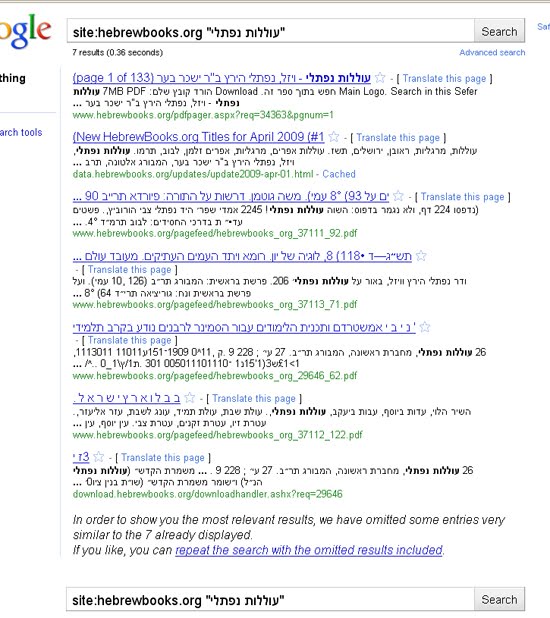
  • Naftali Herz Wessely – Olelot Naftali Bereshit 1842 (34363)
  • Naftali Herz Wessely Wessely – Shirei Tiferet 1809 (43205)

The numbers are provided in some cases, where available, showing where they used to be on Hebrewbooks.org. Needless to say, many books remain which would be removed, if the criteria applied to these were able to apply to the many needles in a nearly 50,000 piece-strong haystack.

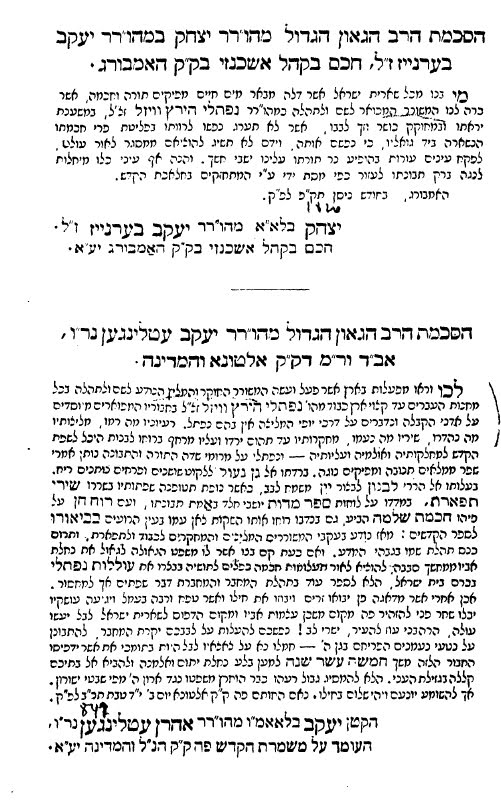
Here is a graphic depicting how one of these books was on Hebrewbooks.org. It is no longer.
Note that this very book bears approbations from Chacham Isaac Bernays and R. Jacob Ettlinger. For more on Wessely in seforim, see Eliezer Brodt’s post here.

The Otzar Ha-hochma removes books as well, even from it’s standard “non-Benei Torah” version. For example, the periodical Yerushalayim (Zolkiew 1844) was there. Now it is gone.
[3]For other examples of using modern technology and modern methods to promote a traditional (albeit anachronistic) point-of-view, see Yoel Finkelman, Strictly Kosher Reading: Popular Literature and the Condition of Contemporary Orthodoxy, Academic Studies Press: 2011.
[4] For examples of censorship regarding R. Kook see Dr. Meir Raflad “’al Peletat Soforim” Sinai 122 (1998) 229–232; Dr. Meir Raflad “Oy l’Tzadik v’Oy l’Shcheno” Hatzofeh, Sept. 2, 2005.
[5] See, e.g., Gershom Gorenberg, The Unmaking of Israel, HarperCollins Pub., 2011, arguing that the modern-day Israeli settlements and their attendant issues springs from R. Kook’s philosophy.
[6] The title page records the date of publication as the Hebrew year of 5690, (printed in the year “Kechu Sefer Pardes Yosef ha-Zeh”) in reality it wasn’t completed until 5691, as R. Pazanavski signs the final page 13 Tishrei 5691. Ultimately, only three volumes would be published, Berashit, Shemot and Va’yikrah. While R. Pazanavski wrote on all five volumes of the Torah, the remaining manuscript was lost during the Holocaust. The Mandelbaum edition, discussed below, “completes” the remaining volumes in the same style as the first three. Thus, today, Pardes Yosef is available on the entire Torah.
[7] In light of R. Pazanavski’s affilation with Gur and specifically, the then current rebbi, Penei Menachem, it’s unsurprising that R. Pazanavski viewed R. Kook positively. It is well-known that the Penei Menachem had a favorable view of R. Kook. See R. Eliezer Sirkes, Ish ha-Emunah, Yitzhak Alfasi ed., Tel Aviv: 1979, pp. 111, 124, 128, 131. One of the putative goals of the Penei Menachem when he went to Israel was to attempt to reconcile R. Kook and R. Sonnenfeld. Thus, it is especially ironic that, as discussed below, the Mandelbaum edition removes R. Kook’s approbation as Mandelbaum is a Gur hassid.
[8] This story appears to have been related at one of the eulogies after R. Diskin’s death. See Yeshah Orenstein, Ma’amar Shelamut ha-Mitzeyot, in Hiddushei R. Yeshayah Orenstein, Jerusalem: 1972, p. 185. A similar story is told about R. Eliyahu Mizrachi (1450-1526). See R. Abraham Kalphon, Ma’aseh Tzaddim, Assaf Revivi ed., Ashkelon: 2009, p. 160. According to this story the king (presumably it would be the Sultan and not a king as after 1453, Constantinople was ruled by the Ottomans and its leader was a sultan) wanted to show the greatness of R. Mizrachi. To do so, he took a special chair and placed R. Mizrachi upon it and asked him to calculate the distance between him and the sky. R. Mizrachi asked for a pen and paper and, after some calculations, wrote down a number which the king took as proof. Of course, this wasn’t convincing to those around. But what the king then did was some time later the king took out the chair again but this time he ordered a small coin be placed under the chair’s legs, unbeknownst to anyone else. He then had R. Mizrachi come back and the king feigned that he couldn’t recall R. Mizrachi’s prior calculation and asked him to repeat it. This time R. Mizrachi wrote down the same number but said that is now seems that it needs to be reduced by the width of a coin. Like the story with R. Diskin, this demonstrated R. Mizrachi’s amazing estimation ability. Unfortunately, to our knowledge, there are no recorded stories of any famous rabbi winning guess the number of jelly beans in a jar contest.
[9] On the use of obscure abbreviations see Ya’akov Shmuel Speigel, “Ha-Shimush be-Kitzurim ve-Roshei Tevot Shanom Shichim,” Yeshurun 10: 2002, pp. 814-30.


Computer Confirmation of “P” – A Biblicist’s Perspective

Computer Confirmation of “P” – A Biblicist’s Perspective By Joshua Berman

Joshua Berman is a lecturer in Tanach at Bar-Ilan University and an associate fellow at the Shalem Center. His most recent book, Created Equal: How the Bible Broke with Ancient Political Thought (Oxford, 2008) was a National Jewish Book Award Finalist in Scholarship in 2008.

Prof. Moshe Koppel—a revered friend and senior colleague—has produced what is for me as a biblicist is a fascinating and exciting study.[1] His demonstrated capacity to tease apart books like Jeremiah and Ezekiel when their verses are randomly shuffled will find good application, I am sure, within the field of biblical studies. At the conclusion of that study, Koppel and his team report that they applied their methodology to the Torah, and that their split of its verses “corresponds to the expert consensus regarding P and non-P for over 90% of the verses in the Pentateuch for which such consensus exists.” The claim has generated much theological debate. In this post, however, I wish to respond to these findings solely within the terms and assumptions found within the discipline of biblical studies itself. The findings produced by Prof. Koppel’s team constitute an academic, scientific claim and deserve to be addressed in kind. I wish to extend my heartfelt appreciation to Prof. Koppel for sharing his data with me, and for elucidating many points for me in subsequent exchanges between us. For two primary reasons, I conclude that the findings are of little consequence for Pentateuch studies, and to the extent that they are of consequence they suggest a different significance than that reported in his initial article. The Koppel team’s compelling work, teasing apart books such as Jeremiah and Ezekiel, does not, in its present form, provide sufficient basis for an analysis of the Torah. Here’s why: Jeremiah and Ezekiel are two whole, integral works. Buoyed by the success of separating two books Koppel’s team split the verses of the Torah into two “authorial categories,” one of which seems to have affinity with the set of verses source-critical scholars refer to as the priestly source of the Pentateuch. The other authorial category, however, “Non-P” is not a single, integral, distinct book. Source critics (again, I am constructing an argument here that would be valid within the field of biblical studies) are unanimous that the non-priestly material in the Pentateuch is an amalgam of many other sources. It is more difficult to separate a single integral book from an amalgam of many different works than it is to separate one integral work from another. Put differently, an alternative experiment needs to be carried out utilizing other biblical books, before these data about the Torah can be statistically validated. Prof. Koppel and team would need to take, say, all of Jeremiah, and shuffle it with smatterings of verses from several other books, and successfully retrieve the verses from Jeremiah. I am clueless about computational linguistics, and so I shared this intuition with Prof. Koppel. He confirmed for me that the experiments carried out separating whole integral books can only offer a “weak-indicator” for the case of the texts of the Torah. But let’s give that weak-indicator the benefit of the doubt, or let’s assume that those experiments have been successfully executed, extracting Jeremiah, say, from an amalgam of other texts. What do the data in hand about the Torah suggest? I would propose that the significance is rather different than that which has been reported. To appreciate the data, however, requires a brief whirlwind tour of the history of source criticism of the Pentateuch, particularly of developments of the last twenty years. Classical source-criticism does not merely claim that the first four books of the Torah may be divided into three sources, J, E and P. It claims that each of these three sources were originally complete histories of Israel, from Creation until the time of Moses. There was a time—in the early twentieth century—that the comprehensive theories of the great minds were considered to be the final word on the subject. Einstein, it was believed, had given us the final word on physics, Freud on psychology. In the world of biblical studies, it was Wellhausen who was believed to have given us the final word on the origins of the Pentateuch with his source-critical account. But in the last generation many scholars have walked away from the table of source-criticism. For some, source-criticism proved too unruly; scholars seemed never to agree on the criteria necessary to split the putative sources. Others found source-criticism disappointing on the level of content: the sources did not seem to produce clear, consistent and differentiated theological agendas. Others found that many of the so-called indicators of multiple authorship could better be explained by recognizing the literary techniques at work in these texts as coherent wholes. For others—and this is significant—the inconsistencies in the text are best understood as individuated issues. There were indeed two flood stories in ancient Israel, they would say, but why assign these to larger strands or sources?[2] Koppel and his team use the work of Richard Elliot Friedman, Who Wrote the Bible? as a baseline to identify the Priestly source. They chose that work because Friedman—like Driver before him—schematically assigns each and every verse of the Torah to one of the four classical sources. Friedman’s work—written in 1987—is still quoted in some circles. But it cannot be said to be the universally accepted gospel on the Torah within the field of biblical studies. It is telling that since Friedman no scholar of any note has deigned to offer (let alone defend) a schematic accounting of all the verses of P, much less the whole Pentateuch. This speaks volumes to the methodological malaise currently afflicting Pentateuch studies in the academy. Unable to find a common methodological language, biblicists themselves now inhabit a post-Babel world. Does this mean that there are no source-scholars left in the 21st Century? Does it mean that there is no consensus about anything pertaining to source-criticism within the academy? Hardly. Concerning biblical law, such consensus exists. Nearly all biblicists, for example, will happily identify legal sections pertaining to the cult as deriving from a source called P. Where there is far less consensus is in the area of narrative. It is true that those that engage in source-criticism of Pentateuchal narrative find a common language and accord on many passages in identifying them as P narratives. But they are a dwindling breed. For the vast majority of scholars working today, the determination that the laws of Leviticus should be ascribed to a source called P is an infinitely easier call than is the ascription to P of the account of Shimon and Levi in Shechem. It’s not that they’re convinced that the story should be ascribed to another source. Nor would they rule out the possibility that perhaps that account was penned by the author of a P source. The hesitation comes from misgivings about the entire enterprise of viewing Torah narratives as derived from distinct, continuous sources that each detailed the history of Israel. Now let’s go to the data. In many instances, verses that source-critics assign to a source other than P, the Koppel team’s program, likewise, assigns to the category “Non-P. ” At the same time, it is important to note that the program also fails to positively confirm what source critics see as priestly material. Here we come to the main point: in the genre of law, the program does a very good job of correlating with the sections that critics see as priestly law. These, not surprisingly, tend to be cultic law. In the genre of narrative, however, a very different story emerges. Of 253 verses in Genesis that source-critics identify as “priestly”, the program could only confirm 38 of them (15%). In Exodus the discrepancy is even greater, and the program confirms 5 out of 80 (6%) priestly narrative verses. In Numbers, the correlation is much higher, but overall, the program’s results correlate with the so-called priestly narrative less than half the time. Does this suggest a “flaw” in the Koppel team’s program? Not at all. Rather, it confirms the suspicions of a very large number of biblicists: the notion of priestly narrative in the Pentateuch is on much shakier ground than is the notion of priestly law. Finally, moving away from the Koppel team’s stimulating findings, I’d like to address an issue that hovers over the entire discussion and that is the definition of an “author” and the highly anachronistic use we make of that term, especially when analyzing ancient sources. It’s a good thing that Rashi wrote in the eleventh century, because had he come out with his commentary to the Torah today, he would likely be assailed in some quarters as a plagiarizer. In many instances, Rashi attributes the midrashim he cites. But in many other instances he simply borrows entire sentences from chaza”l and presents them in his own voice. Only the discerning disciple will note that Rashi, has, in fact, lifted entire sentences from an earlier source, without attribution. Of course, Rabban Shel Yisrael was no plagiarizer. Rather, Rashi, like many medieval and ancient writers before was writing in a world where old was good. The mark of a good writer was someone who appropriately saw himself as a member of a long and venerated tradition. Good writing was precisely writing that imitated earlier style—nay, sometimes a variety of styles–and in many cases, directly lifted and borrowed whole passages.[3] The same was true in ancient contexts as well. You’d think that to ask, “Who wrote the Code of Hammurabi?” is akin to asking, “Who’s buried in Grant’s Tomb?” But it isn’t. The issue is not simply that it was Hammurabi’s scribes who actually penned that classic, and not the Babylonian king himself. It’s that we now know that those scribes invoked a number of sanctioned styles in their composition, and lifted phrases from prior works.[4] The composition is unitary because a single agent—Hammurabi and his scribes—published this composition as something to be read as such. Ancient readers may, no doubt, have noticed the unevenness of its style. But they would have seen that as the mark of a great work, produced within a venerable tradition, in which writing routinely draws from a variety of canonical and classical works. Its status derived not from the fact that it was the original composition of a single author, but that it was produced by a single authority. Readers of the Code would never have even thought to ask whether every sentence originated with Hammurabi himself. But the fact that it was under his authority that multiple styles were brought together is what made it a great work. Many other classics of the ancient world, such as the Epic of Gilgamesh likewise exhibit a plurality of styles. This is how many of the great works of the ancient world looked.[5] In defense against the claims of higher biblical criticism, the faithful often counter that divine writing is different than human writing, for the Almighty speaks in several styles and voices. This dichotomy, whereby God alone can speak in many styles, but humans must exhibit consistency, is a false one. It is human writing, too, in the premodern, and especially ancient world, that expresses itself in a variety of styles. In his commentary to the beginning of parashat Pekudei, the Ralbag questions why the Torah repeats the parshiyot of the Mishkan, in a manner that seems overly repetitious. He concludes that what appears to us as repetitious and hence, unseemly, may not have been the case in an earlier age: ואפשר שנאמר שכבר היה מנהג האנשים ההם בזמן מתן תורה שיהיו סיפוריהם בזה האופן. והנביא אמנם ידבר לפי מנהג. We may say that it was the norm at the time of Matan Torah that compositions were crafted in this fashion, and that the prophet speaks in the style of the times. It may well be that divine writing expresses itself in multiple styles. But if the Almighty has indeed done so in the Torah, then He has done so, לפי המנהג – according to literary tastes that may seem grating to modern notions of authorship, but were entirely keeping with ancient sensitivities.

[1] See Moshe Koppel, Navot Akiva, Idan Dershowitz and Nachum Dershowitz, “Unsupervised Decomposition of a Document into Authorial Components” (link).
[2] On the waning interest in Pentateuchal source criticism within biblical studies, see Rolf Rendtorff, “What Happened to the “Yahwist”?: Reflections after Thirty Years” (http://www.sbl-site.org/publications/article.aspx?articleId=553) and David Clines, “Response to Rolf Rendtorff’s “What Happened to the Yahwist? Reflections after Thirty Years” (link).
[3] See A. J. Minnis. Medieval Theory of Authorship; Scholastic Literary Attitudes in the Later Middle Ages (London: Scholar Press, 1984).
[4] Victor Avigdor Hurowitz, Inu Anum sirum : Literary Structures in the Non-juridical Sections of Codex Hammurabi (Philadelphia: University Museum, 1994).
[5] See David M. Carr, Writing on the Tablet of the Heart. Origins of Scripture and Literature (New York: Oxford University Press, 2005); Karel Van Der Toorn, Scribal Culture and the Making of the Hebrew Bible (Cambridge: Harvard University Press, 2007).


Attribution and Misattribution: On Computational Linguistics, Heresy and Journalism

Attribution and Misattribution: On Computational Linguistics, Heresy and Journalism
by Moshe Koppel

Prof. Moshe Koppel is on the faculty of the Computer Science Department at Bar-Ilan University. He has published extensively on authorship attribution, as well as on a diverse array of topics of Jewish and scientific interest.

A few days ago, newspaper readers from New Jersey to New Zealand read about new computer software that “sheds light on the authorship of the Bible”[1]. By the time the news circled back to Israel, farteitcht and farbessert, readers of Haaretz were (rather gleefully) informed that the head of the project had announced that it had been proved that the Torah was written by multiple human authors[2], just as the Bible critics had been saying all along.
I’m always skeptical about that kind of grandiose claim and this is no exception, even though the person who allegedly made the claim in this particular case happens to be me. The news reports in question refer to a recently published paper[3] in computational linguistics involving decomposition of a document into authorial components. A brief reference to application of the method to the Torah (Pentateuch) is responsible for most of the noise.
In what follows, I’ll briefly provide some background about authorship attribution research, sketch the method used in the paper, outline the main results and say a few words about what they mean. My main purpose is to explain what has actually been proved and, more crucially in this case, what has not been proved.
Authorship Attribution
One of my areas of research for over a decade has been authorship attribution, the use of automated statistical methods to identify or profile the author of a given text. For example, we can determine, with varying degrees of accuracy, the age, gender and native language of the author of a text[4]. Under certain conditions, we can determine, with varying degrees of certainty, if two texts were written by the same person[5]. Some of this work has been applied to topics of particular interest to students of Jewish texts, such as strong evidence that the collection of responsa Torah Lishmah was written by Ben Ish Chai[6] (although he often quoted the work as if it were written by someone else) and that all of the letters in Genizat Harson are forgeries[7].
Whenever I have lectured on this topic, the first question has been: have you ever analyzed the Bible? The honest truth is that I never really understood the question and I suspect that in most cases the questioner didn’t have any very well-formed question in mind, beyond the vague thought that the Bible is of mysterious provenance and ought to be amenable to some sort of statistical analysis. I would always mumble something about the question being poorly defined, Bible books being too short to permit reliable statistical analysis, etc. But, while all those excuses were quite true, I also had a vague thought of my own, which was that whatever well-formed research question I could come up with regarding Tanach, it would probably land me in hot water.
One research question that I have been working on with my graduate student, Navot Akiva, involves decomposition of a document into distinct stylistic components. For example, if a document was written by multiple authors, each of whom presumably writes in some distinct style, we’d like to be able to identify the parts written by each author. (Bear in mind this is what is known in the jargon as an unsupervised problem: we don’t get known examples of each author’s writing to analyze. All we have is the composite text itself, from which we need to tease apart distinctive looking chunks of text.) The object is straightforward: given a text, split it up into families of chunks in the best possible way, where by “best” we mean that the chunks that are assigned to the same family are as similar to each other as possible.
Even I could see that this could have some bearing on Tanach. So when Prof. Nachum Dershowitz, a colleague with whom I share a number of research interests, introduced me to his son, Idan, a graduate student in the Tanach program at Hebrew University, we agreed to consider how to apply this work to Tanach (sort of fudging the question of whether this meant Torah or Nach). It happens that, apart from being the most studied and revered set of books ever written, Tanach offers another advantage as an object of linguistic analysis: precisely because it has been the subject of so much study, there are many available automated tools that we could exploit in our research.

The Method
Here’s how our computerized method works. Divide a text into chunks in some reasonable way. These chunks might be chapters or some fixed number of sentences or whatever; the details aren’t critical and need not concern us at this stage. I’m going to call these chunks “chapters” (only because it is a less technical sounding word), but bear in mind that we are not assuming that a chapter is stylistically homogeneous; that is, the split between authors might take place in the middle of a chapter.
Our object is to split our collection of chapters into families of stylistically similar chapters. (The chapters in a family need not be contiguous.) All the chapters that look a certain way, please step to the left; all others, please step to the right.
As a first step, for any pair of chapters, we’re going to have to measure the similarity between them. The trick is to measure this similarity in a way that captures style rather than content.
The way we do it is as follows: we begin by generating a list of synonym sets. For example, for the case of Tanach, we would consider synonym sets such as betoch, bekerev; begged, simla; sar, nasi; makel, mateh, shevet; and so on. There are about 200 such sets of Biblical synonyms. We generate this list automatically by identifying Hebrew roots that are translated by the same English root in the KJV. Note that not every occurrence of, for example, shevet (which can mean either “staff” or “tribe”) is a synonym for makel (which is always “staff”). We use online concordances to disambiguate, that is, to determine the intended sense of a word in a particular context. (In this respect, Tanach is especially convenient to work with.)
For every chapter and every such set of synonyms, we record which synonym (if any) that chapter uses. The similarity of a pair of chapters reflects the extent to which they make similar choices from among synonym sets. The idea is that if one chapter uses – for example – betoch, sar and mateh and the other uses bekerev, nasi and makel, the two chapters have low similarity. If a chapter doesn’t use any of the synonyms in a particular synonym set, that set plays no role in measuring the similarity between that chapter and any other chapter.
Once we know the similarity between every pair of chapters, we use formal methods to create optimal families. Ideally, we want all the chapters in the same family to be very similar to each other and to be very different from the chapters in other families. In fact, such clean divisions are unusual, but the formal methods will generally find a near-optimal clustering into families. (What we call families are called “clusters” in the jargon, and the process of finding them is called “clustering”. The particular clustering method we used is a spectral approximation method called n-cut.)
A key question you should ask at this point is: how many families will we get? You might imagine that the clustering method will somehow figure out the right number of families. Indeed, there are clustering methods that can do that. But – note this carefully – the number of families we obtain is not determined by the clustering method we use. Rather it is given by us as an input. That is, we decide in advance how many families we want to get and the method is forced to give us exactly what we asked for. This is a crucial point and we’ll come back to it when we get to the meaning of all these results below.
In any case, at this stage, we have a tentative division of chapters into however many families we asked for. (For simplicity, let’s assume that we have split the chapters into exactly two families.) This is not the final result, for the simple reason that we have no guarantee that the chapters themselves are homogeneous. The next step is to identify those chapters that are at the core of each family; these are the chapters we are most confident we have assigned correctly and are consequently the ones most likely to be homogeneous. (Note that when I say “we are confident” I don’t mean anything subjective and wishy-washy; all this is done automatically according to formal criteria a bit too technical to get into here.)
Now that we have a selection of chapters that are assigned to respective families with high confidence, we use them as seeds for building a “model” that distinguishes between the two families. Very roughly speaking, we look for common words (ones not tied to any specific topic) that appear more in one family than in the other and we use formal methods (for those interested, we use SVM) to find just the right weight to give to each such word as an indicator of one family or the other. We now use this model to classify individual sentences as being in one family or the other.

Results
Wonderful, so we did all sorts of geeky hocus-pocus. Why should you believe that this works? Maybe the whole synonym idea is wrong because we ignore subtle differences in meaning between “synonyms”. Maybe the same author deliberately switches from one synonym to the other for literary reasons. Maybe we are biased because we believe something wicked and we subtly manipulated the method to obtain particular results.
These are legitimate concerns. That’s why we test the method on data for which we know the right answer to see if the method gives that right answer. In this case, our test works as follows. We take two books, each of which we can assume is written by a single distinct author, mix them up in some random fashion, and check if our method correctly unmixes them. In particular, we took as our main test set random mishmashes of Yirmiyahu and Yechezkel.
We found that the method works extremely well. About 17% of the psukim could not be classified (no differentiating words appeared in these psukim or their near neighbors). Of the approximately 2200 psukim that were classified into two families, all the Yirmiyahu psukim went into one family and all the Yechezkel psukim went into the other, with a total of 26 (1.2%) exceptions. We obtained similar results on a variety of other book pairs.
So maybe we should have left well enough alone. But with a power tool like this in hand, how could you not want to see how it would split the chumash? Shoot me, but for me, like Rav Kahana hiding under his rebbe’s bed, Torah hee velilmod any tzarich. We did the experiment. I should hasten to mention, though, that the chumash experiment is only briefly mentioned in the published paper, which focuses on proving the efficacy of the method (it’s a computational linguistics paper, not a Bible paper).
Now, I should point out that until I got involved in this, I was a complete am haaretz in Bible Criticism, a perfectly agreeable state of affairs, as far as I was concerned. However, Idan Dershowitz immediately observed that our split was very similar to the split between what critics refer to as the Priestly (P) and non-Priestly portions of the Torah. Bear in mind that there are ongoing disagreements among the critics about precisely which psukim should be regarded as P and which not. We took two standard such splits, that of Driver and that of Friedman, and refer to the set of psukim for which they agree as “consensus” psukim. (They agree just over 90% of the time.)
Here’s the result. Our split of the Torah into two families corresponds with their split for about 90% of all consensus psukim.
Let me say a few words about the main areas of disagreement. To a significant extent, our split runs along lines of genre. One family is mostly – not completely – legal material and the other is mostly narrative. Since what the critics call the Priestly sections include pretty much all of Vayikra (which is mostly laws), as well as selected portions of Bereishis, Shemos and Bemidbar, their split also corresponds somewhat to the legal/narrative split. Most of the cases where our split is different than theirs involve narrative sections that they assign to P and our method assigns to the family that corresponds to non-P, for example, the first chapter of Bereishis. (The rest of the disagreements involve P sections that scholars now refer to as H and consider some sort of quasi-P, but I don’t want to get into all that, mostly because I’m still pretty clueless about it.)
Before you dismiss all this by saying that all we did was discover that stories don’t look like laws, let me point out there are plenty of narrative sections that the computerized analysis assigned to the P family (or, more precisely, to the nameless family that turns out to be very similar to what the critics call the P family). Two prominent examples are the story of Shimon and Levi in Shechem and the story of Pinchas and Zimri.
One more point: when we split the Torah into three or more families, our results do not coincide with those of the critics. In the case of three families, Devarim does seem to split off as its own family, as the critics claim, but there are a fair number of exceptions. And even with four or more families, no hint of the critics’ E/J split shows up at all.

Interpreting the Results
So does all this mean that we have proved that the Torah was written by at least two human authors, as the breathless reports claim? No.
First of all, as I noted above, our method does not determine the optimal number of families. That is, it does not make a claim regarding the number of authors. Rather, you decide in advance how many families you want and the method finds the optimal (or a near-optimal) split of the text into that number. If you ask it to split Moby Dick into two (or four or thirteen) parts, it will do so. Thus the fact that we split the Torah into two tells us exactly nothing about the actual number of authors.
Having said that, I want to temper any religious enthusiasm such a disclaimer might engender. First of all, with a few improvements to the method we could probably identify some optimal number of families for a given text. We simply haven’t done so. Second, the fact that – for the case of two families – the results of our method coincide (to some extent) with those of the critics would seem to suggest that the split the method suggests is not merely coincidental.
But, the deeper reason that our work is irrelevant to the question of divine authorship is simply that it does not – indeed, it could not – have a thing to say on that question. If you were to have some theory about what properties divine writing ought to have and close analysis revealed that a certain text probably did not have those properties, then you might have to change your prior belief about the divine provenance of that text. But does anyone really have some theory about what divine texts are supposed to look like? Several press reports about this work referenced the idea that “God could write in multiple voices”. I find that formulation a bit simplistic, but it captures the fact that any attempt to map from multiple writing styles to multiple authorship must be rooted in assumptions about human cognition and human performance that are simply not relevant to the question of divine action[8].
In short, our results seem to support some findings of higher Bible criticism regarding possible boundaries between distinct stylistic threads in the Torah. These results might have some relevance regarding literary analysis of the Torah. Taken on their own, however, they are not proof of multiple authorship. Furthermore, there is nothing in these results that should cause those of us committed to the traditional belief in divine authorship of the Torah to doubt that belief.
[3] M. Koppel, N. Akiva, I. Dershowitz and N. Dershowitz, (2011). Unsupervised Decomposition of a Document Into Authorial Components, Proceedings of ACL, pp. 1356-1364.
[4] S. Argamon, M. Koppel, J. Pennebaker and J. Schler (2009), Automatically Profiling the Author of an Anonymous Text, Communications of the ACM, 52 (2): pp. 119-123 (virtual extension).
[5] M. Koppel, J. Schler and E. Bonchek-Dokow (2007), Measuring Differentiability: Unmasking Pseudonymous Authors, JMLR 8, July 2007, pp. 1261-1276.
[6] M. Koppel, D. Mughaz and N. Akiva (2006), New Methods for Attribution of Rabbinic Literature , Hebrew Linguistics: A Journal for Hebrew Descriptive, Computational and Applied Linguistics, 57, pp. 5-18.
[7] מ. קופל, זיהוי מחברים בשיטות ממוחשבות: “גניזת חרסון”, ישורון כג (אלול ה’תש”ע), תקנט-תקסו.
[8] I realize that this argument comes close to asserting that the claim of divine authorship is unfalsifiable, which for some might cast doubt on the meaningfulness of that claim. A proper response to that concern would involve a discussion of the nature and content of religious belief, a discussion that is well beyond the scope of this brief peroration.


Sale: Databases of Hebrew Books

As in past years, in honor of Shavua ha-Sefer, there is a 30% sale on electronic databases of Hebrew books, including Otzar ha-Chochmah ver. 8, Otzrot ha-Torah ver. 6, Bar Ilan Responsa Project ver. 18 and DBS ver. 15.  All of which have been upgraded this year, some siginficantly.  30% Sale will be ending on June 13. Purchases can be made in installments. For more information please contact Moshie Flohr at (732) 363-4941 or (917) 456-7855.  Shipping, via USPS, is free for Seforim Blog readers.


Benefits of the Internet: Besamim Rosh and its History

Benefits of the Internet: Besamim Rosh and its History
By: Dan Rabinowitz & Eliezer Brodt
    In a new series we wanted to highlight how much important material is now available online.  This, first post, illustrates the proliferation of online materials with regard to the controversy surrounding the work Besamim Rosh (“BR”). 

[We must note at the outset that recently a program has been designed by Moshe Koppel which enables one, via various mathematical algorithims, to identify documents authored by the same author. We hope, using this program, to provide a future update that will show what this program can demonstrate regarding the authorship of the BR and if indeed the Rosh authored these responsa.]

Background

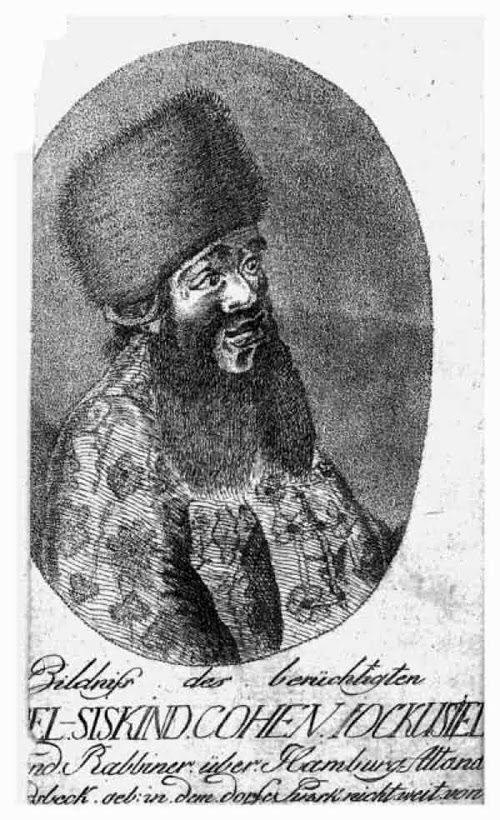
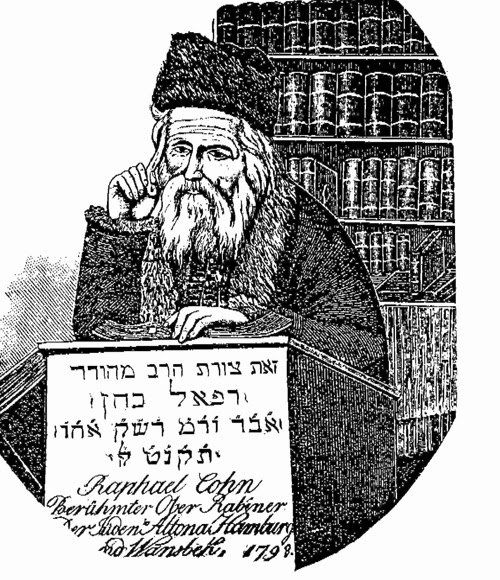
    Before turning to the BR and discussing its history we need to first discuss another work.  R. Raphael Cohen the chief rabbi of triple community, Altona-Hamburg-Wansbeck (“AH”W”), [1] published a book, Torat Yekuseil, Amsterdam, 1772 regarding the laws of Yoreh DeahTorat Yekuseil is a standard commentary and is unremarkable when compared to other works of this genre.  While the book is unremarkable in and of itself, what followed is rather remarkable. 

    Some years later, in 1789, a work with the putative author listed listed as Ovadiah bar Barukh and titled Mitzpeh Yokteil [2] was published to counter R. Raphael Cohen’s Torat Yekuseil (“TY”)Mitzpeh Yokteil (“MY”), was a vicious attack both against the work TY as well as its author, R. Raphael Cohen.  R. Raphael Cohen was a well-known and well-respected Rabbi. In fact, he was the Chief Rabbi of the triple community of AH”W.  The attack against him and his work did not go unanswered.  Indeed, the beit din of Altona-Wansbeck placed the putative author, Ovadiah, and his work, under a ban.

    The Altona-Wansbeck beit din could not limit the ban to just Altona-Wansbeck as the attack in the MY was intended to embarrass R. Raphael Cohen across Europe.  Indeed, the end of the introduction to MY indicates that copies were sent to a list of thirteen prominent rabbis across Europe.  Specifically, copies were sent to the Chief Rabbis of Prague, Amsterdam, Frankfort A.M., Hanover, Bresslau, Gloga, Lissa, etc., “as well as The Universally Know Goan haHassid  R. Eliyahu from Vilna.”  Thus, the intent of the book was to diminish R. Raphael Cohen’s standing amongst his peers. 

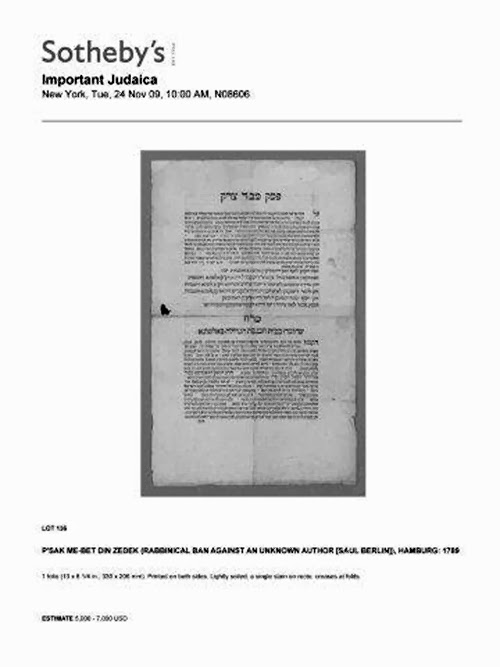
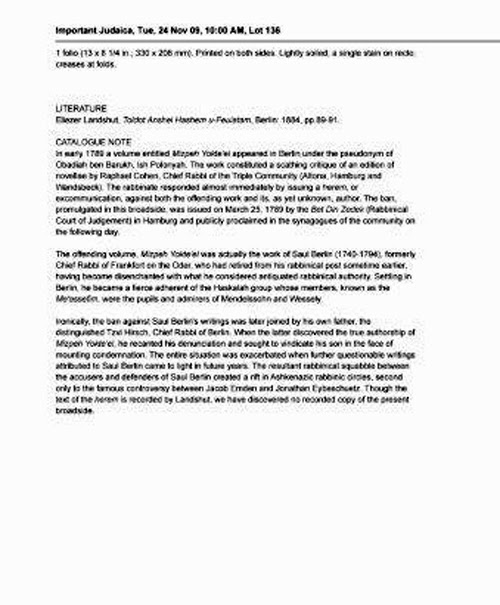
    The Altona-Wansbeck beit din, recognizing the intent of the book, appealed to other cities courts to similarly ban the author and book MY – the ban, entitled, Pesak mi-Beit Din Tzedek, the only known extant copy was recently sold at Sotheby’s (Important Judaica, Nov. 24, 2009, lot 136).[3]


These concerns lead the ban’s proponents to the Chief Rabbi of Berlin, R. Tzvi Hirsch Berlin, and to solicit him to join the ban. Initially, it appeared that R. Tzvi Hirsch would go along with the ban.  But, as he was nearing deciding in favor of signing the ban, someone whispered in his ear the verse in Kings 2, 6:5, אהה אדני והוא שאול – which R. Tzvi Hirsch understood to be a play on the word “שאול” in the context of the verse meaning borrow, but, in this case, to be a reference to his son, Saul. That is, the real author of MY was Saul Berlin, Tzvi Hirsch’s son.  Needless to say, R. Tzvi Hirsch did not sign the ban. [4]

    Not only did he not sign the ban, he also came to his son’s defense.  Aside from the various bans that were issued, a small pamphlet of ten pages, lacking a title page, was printed against MY and Saul. [5]  Saul decided that he must respond to these attacks.  He published Teshuvot ha-Rav. . . Saul le-haRav [] Moshe  Yetz,[6] which also includes a responsum from R. Tzvi Hirsch, Saul’s father.  Saul defends himself arguing that rabbinic disagreement, in very strong terms, has a long history.  Thus, a ban is wholly inappropriate in the present case. 

    R. Tzvi Hirsch explained that while MY disagreed with R. Cohen, there is nothing wrong with doing so.  The author of MY, as a rabbi – Saul was, at the time, Chief Rabbi of Frankfort – Saul is entitled to disagree with other rabbis.  Of course, Saul’s name is never explicitly mentioned. Moreover, in the course of R. Tzvi Hirsch’s defense he solicits the opinions of other rabbis, including R. Ezekiel Landau.  R. Landau, as well as others, noted that aside from the propriety of disagreement within Judaism, the power of any one particular beit din is limited by geography.  Thus, the Altona-Wansbeck’s beit din‘s power is limited to placing residents of Hamburg under a ban but not residents of Berlin, including R. Saul Berlin, the author of MY.[7]

    The controversy surrounding the MY was not limited to Jewish audiences. The theater critic, H.W. Seyfried, published in his German newspaper, Chronik von Berlin, translations of the relevant documents and provided updates on the controversy.  Seyfried agitated on behalf of the maskilim and editorlized that the Danish government should take actions against R. Cohen. It appears, however, that Seyfried’s pleas were not acted upon.[8] 

The Publication of Besamim Rosh


    With this background in mind, we can now turn to the Besamim Rosh.  Prior to publishing the full BR, in 1792, Saul Berlin published examples of the responsa and commentary found in the BR – a prospectus, Arugat ha-Bosem.  This small work whose purpose was to solicit subscribers for the ultimate publication of BR. It appears that while Saul may have been trying for significant rabbinic support, the majority of his sponsors were householders. 

    In 1793, the BR was published.  The BR contains 392 responsa (besamim equals 392) from either R. Asher b. Yeheil (Rosh) (1259-1327) or his contemporaries.  This manuscript belonged to R. Yitzhak di Molina who lived during the same time period as R. Yosef Karo, the author of Shulchan Orakh.  Additionally, Saul appended a commentary of his own to these responsa, Kasa de-Harshana

    The BR contains two approbations, one from R. Tzvi Hirsch Berlin and the other from R. Yehezkel Landau.  R. Landau’s approbation first explains that Rosh’s responsa need no approbation.  With regard to R. Saul Berlin’s commentary, he too doesn’t need an approbation according to R. Landau.  This is so because R. Saul’s reputation is well-known.  R. Landau’s rationale, R. Saul’s fame, appears a bit odd in light of the fact that among some (many?) R. Saul’s reputation was very poor due to the MY. 

    R. Tzvi Hirsch’s approbation also contains an interesting assertion. Saul’s father explains that this book should put to rest any lingering question regarding his son.    

    In addition to the approbations there are two introductions, one from di Molina and the other from Saul. Di Molina explained the tortured journey of the manuscript. He explains that, while in Alexandria, he saw a pile of manuscripts that contained many responsa from Rosh that had never before been published. He culled the unpublished ones and copied and collected them in this collection.  What is worthy of noting is that throughout the introduction di Molina repeatedly asks “how does the reader know these responsa are genuinely from Rosh.” 

    R. Saul, in his introduction, first notes that the concept of including introductions is an invention long after Rosh, and is not found amongst any of the Rishonim. 

    As mentioned previously, the BR is a collection of 392 responsa mostly from Rosh or his contemporaries.  Additionally, R. Saul wrote his own commentary on these responsa, Kasa diHarshena. [9]  This commentary would contain the first problem for Saul and the BR.  In responsum 40, Rosh discusses the position of Rabbenu Tam with regard to shaving during the intermediate days (ho ha-moad).  While Rosh ultimately concludes that one is prohibited from shaving on hol ha-moad, R. Saul, in his commentary, however, concludes that shaving on hol ha-moad is permissible.  In so holding, R. Saul recognized that this position disagreed with that of his father.  Almost immediately after publication, R. Saul printed a retraction regarding this position allowing for shaving on hol ha-mo’ad.  This retraction, Mo’dah Rabba, explains that Saul failed to apprise his father of this position and, as Saul’s father still stands behind his negative position, Saul therefore retracts his lenient position. [Historically, this is not the only time a father and son disagreed about shaving on hol ha-moad.  R. Yitzhak Shmuel Reggio (YaSHaR)and his father, Abraham, disagreed on the topic as well.  As was the case with Saul and his father, the son, YaSHaR took the lenient position and his father the stringent.  Not only did they disagree, after YaSHaR published his book explaining his theory, his father attacked him in an anonymous response.  For more on this controversy see Meir Benayahu, Shaving on the Intermediary Days of the Festival, Jerusalem, 1995.] 

    This retraction, while may be interperated as evidence of Saul humbleness in his willingness to admit error and not stand on ceremony, others used this retraction against him.  The first work published that questioned the legitimacy of BR is Ze’ev Yetrof, Frankfort d’Oder, 1793, by R. Ze’ev Wolf son of Shlomo Zalman.  (This book is very rare and, to my knowledge, is not online.  Although not online, a copy is available in microfiche as part of the collection of books from the JTS Library, and on Otzar Hachomah see below)  The author explains that eight responsa in BR are problematic because they reach conclusion that appear to run counter to accepted halahik norms. In addition, the author states in his introduction, “that already we see that there is something fishy as it is known that the author [Saul Berlin] has retracted his position regarding shaving.” It should be noted that no where does R. Ze’ev Wolf challenge the authenticity of the manuscript for internal reasons – it is incorrectly dated, incorrectly attributed etc.  Apparently, Ze’ev Yetrof, was not well-known as it is not cited by other contemporaries who too doubted the authenticity of BR.  Samat theorizes that either wasn’t printed until later or, was destroyed.[10]  

    The second person to question the legitimacy of BR was R. Rafael Hamburg’s mechutan, R. Ya’akov Katzenellenbogen.  In particular, he wrote to R. Cohen’s student, R. Mordechai Benat. As was the case with Wolf, R. Katzenellenbogen located 13 responsa where he disagreed with the conclusions.  R. Katzenellenbogen indicated that R. Benet shold review the BR himself and apprise R. Katzenellenbogen regarding R. Benet’s conclusions. 

    R. Katzenellenbogen also wrote to Saul’s father, Tzvi Hirsch, and Tzvi Hirsch eventually responded in a small pamphlet.  R. Tzvi Hirsch first deals with the predicate question, is the manuscript legitimate. That is, prior to discussing the conclusions of particular responsum, regarding the manuscript, R. Tzvi Hirsch testifies that he is intimately familiar with this manuscript. He explains that for 11 years, the manuscript was in his house.  In fact, R. Tzvi Hirsch created the index that appears in BR from this manuscript.  Additionally, he had his other son Hirschel (eventual Chief Rabbi of London) copy the manuscript for publication.  Thus, R. Tzvi Hirsch argues that should put to rest any doubt regarding the authenticity of the manuscript.

    R. Tzvi Hirsch then turns to the issue regarding conclusions of some of the responsa. He first notes, that at most, there are a but a small number of questionable responsa.  Indeed, it is at most approximately 5% of the total responsa in BR.  That is, no one questions 95% of the responsa (at least not then).  Second, with regard to the conclusions themselves, that some conclusions are different than the halahik norms, that can be found in numerous books, none of which anyone questions their authenticity.  Thus, conclusions prove nothing.

Leaving the history and turning to the content of BR.  One of the more controversial responsa is the one discussing suicide.  In particular, according to the responsum attributed to Rosh, the historic practices that were applied to a suicide – lack of Jewish burial, no mourning customs – are not applicable any longer.  This is so, because suicides can be attributed to the poor conditions of the Jews and not philosophical reasons.  Thus, we can attribute the motivations of a suicide to depression and remove the restrictions that applied to suicides. 

    This responsum was what lead some, including R. Moshe Sofer (Hatam Sofer), to conclude that the entire BR was a forgery.  Indeed, this responsum was one of the two that were removed in the second edition.  Others, however, point out this responsum and its conclusions are not in any conflict with any accepted halakhic norms.  And, instead, while providing new insight into the current motivations of a suicide, the ultimate conclusion can be reconciled with all relevant laws.  [11]  

This particular example illustrates the problematic nature of merely relying upon a particular conclusion to demonstrate the authenticity or lack thereof of a work. Although R. Sofer was certain this responsum ran counter to a statement of the Talmud, others were easily able to reconcile the Talmudic statement with the conclusion of the responsum.

    Another controversial responsa deals with someone who is stuck on the highway as the Shabbat is fast approaching.  The traveler is thus faced with the following dilemma, stop in a city where he will require the charity of strangers or continue on and get home.  The BR rules that the traveller can continue and is not required to resort to charity.  This, like the responum above, was similarly removed from the second edition. These are the only two responsa removed from the second edition.  Of course, this removal isn’t noted anywhere except that the numbers skip over those two.  In fact, the index retains the listing for the two responsa. 

    Other controversial responsa include one dealing with belief in the afterlife and messianic era, kitnoyot – BR would abolish the custom, and issues relating to mikvah. 

Today, common practice regarding suicide appears, for the most part, to conform with the position of BR.

Status Today

    After its publication in 1793, it would be almost one hundred years before the BR would be reprinted.  In 1881, the BR was reprinted in Cracow.  This edition was published by “the well-known Rabbi Yosef Lazer from Tarnow'” R. Lazer’s was part of a well-known Hassidic family.  His grandfather, R. Menachem Mendel Lazer was the author of Sova Semochot, Zolkiov, 1845.[12] It appears that the BR was the only controversial book that R. Yosef Lazer published.  Although he published approximately 30 books, the are mainly run-of-the mill works, Machzorim, haggadot, as well as some standard rabbinic works. It is unclear what prompted R. Lazer to republish the BR.  Lazer provides no explanation.  Although Lazer’s publishing activities are difficult to reconcile with his publication of the BR, the printers, Yosef Fischer and Saul Deutscher, other publications indicate that they were more open to printing all types of books. For example, the same year they published BR, they published a translation of Kant, Me-Ko’ach ha-Nefesh, Cracow, 1881.  In all events, it appears that Lazer (or perhaps the printers) was aware of the controversy surrounding the BR as he removed Saul Berlin’s introduction as well as two of the more controversial responsa, one discussing suicide and the other allowing one to continue to travel home after sunset on Friday to avoid having to rely upon the charity of strangers.  In addition, one responsa was accidentally placed at the end of the volume, not in its proper order.[13]  Although the two responsa were removed in the text, they still appear in the index. A photo-mechanical reproduction of this edition was published in New York in 1970, and a copy is available on Hebrewbooks. 

    In 1984, the BR was reprinted for only the third time.  This edition, edited by R. Reuven Amar and includes an extensive introduction, Kuntres Yafe le-Besamim, about BR.  Additionally, commentary on the BR by various rabbis is included.  The text of this edition is a photo-mechanical reproduction of the first edition.  This edition contains two approbations, one from R. Ovadiah Yosef, who in his responsa accepts that BR is a product of R. Saul Berlin, but R. Yosef holds that doesn’t diminish the BR’s value.  The second approbation is from R. Benyamin Silber.  But, R. Silber provides notes in the back of this edition and explains that he holds the BR is a forgery and that he remains unconvinced of Amar’s arguments to the contrary.

    In his introduction, Amar attempts to rehabilitate the BR.  Initially, it should be noted that Amar relies heavily upon Samet’s articles on BR, but never once cites him.  Samet had complied a bibliography of works about BR as well as where the BR is cited, Amar also provides the latter in a sixty four page Kuntres, ריח בשבמים, in the back of his edition. In his introduction Amar relates the history of the BR and attempts to demonstrate that many accepted the BR and those that did not, Amar argues that many really did accept BR.  This introduction contains some very basic errors, many of which have been pointed out by Shmuel Ashkenazi in his notes that appear after the introduction.  

Difficulties in Authentication   

    Today, various theories have been put forth to demonstrate that the BR is a forgery.  Specifically, some have pointed to “hints” or “clues” that R. Saul left for the careful reader which would indicate that BR is a carefully created forgery.  For example, some note that the number of responsa, 392, the Hebrew representation of that number is שצ”ב which can be read to be an abbreviation of Saul’s name – Saul ben Tzvi.  Others take this one step further and point to the was R. Asher (Rosh) is referenced – רא”ש – which again can be read R. Saul.  Obviously, these clues are by no means conclusive.  In the academic world, the BR is written off as a “trojan horse” intended to surreptitiously get R. Saul’s masklik positions out in the masses or something similar.  All of these positions, however, rely upon a handful of responsa at best and no one has been able to conclusively demonstrate that the entirety of BR is a forgery. At best, we are still left with the original criticisms – that a few of the responsa’s conclusions espouse positions that appear to be more 18th century in nature than 13th century. [14]   

 R. Yeruchum Fischel Perlow aptly sums up much of what has been written regarding the question of authenticity of BR:

Just about all who have examined [the question of the authenticity of BR] walk around like the blind in the dark, and even after all their long-winded essays, they are left with only their personal feelings about the BR without ever adducing any substantive proofs in support of their position. And, on the rare occasions that they actual do provide proofs for their positions, it only takes a cursory examination to determine that their is nothing behind those proofs. [R. Yeruchum Fischel Perlow, “Regarding the book ‘Besamim Rosh,'” Noam 2 (1959), p. 317. For some reason this article is lacking in some editions of Noam]

    Assuming that one discounts the testimony of Saul and his father regarding the manuscript, it is not easy to determine if the BR is authentic or not.  For example, responsum 192, according to R. Moshe Hazan, one of the defenders of BR, this responsum “is clear to anyone who is familiar with the language and style of the Rishonim, from the Rishonim.” Responsum 192, is attributed to R. Shlomo ben Aderet (Rashba), and discusses the opinion of Rosh that allowed for capital punishment for pregnancy out of wedlock.  Thus, according to R. Hazan, 192 is conclusive proof that BR is authentic. 

    Simcha Assaf, however, has shown that responsum 192 is a forgery – or there is a misattribution.  Assaf explains that if one looks at the date of this incident, responsum 192 could not have been written by Rashba.  Rashba died 10 years prior to this event.  Simcha Assaf, Ha-Onshim Ahrei Hatemat ha-Talmud, Jerusalem, 1928, pp. 69-70.  Thus, the very same responsum whose “language and style” demonstrated that it was from the times of the rishonim has attribution problems.  To be sure, Assaf isn’t saying this responsum isn’t necessarily from the rishonim period, however, it surely isn’t from Rashba.[15]

    Or, to take another example. Talya Fishman argues that “[halakhic literature of the seventeenth and eighteenth centuries . . . climbed to new (and fantastic) heights of theoretical speculation, creating, in effect, a body of non applied law.”  Talya Fishman, “Forging Jewish Memory: BR and the Invention of Pre-emancipation Jewish Culture,” in Jewish History and Jewish Memory, ed. Carlbach et al., Hanover and London: 1998, pp. 70-88.  Based on this understanding of seventeenth and eighteenth century literature, as contrasted with literature from the period of Rosh, she turns to the BR and finds such speculative responsa.  This, according to Fishman, implicitly demonstrates that BR is a product of the seventeenth or eighteenth century. Indeed, Fishman concludes “[i]n short, [BR], has an unusually high concentration of eyebrow-raising cases.”  Id. at 76. 

    But, if one subjects Fishman’s argument to even a minimal amount of scrutiny, her argument, as presented, is unconvincing.  First, in support of Fishman’s “high concentration” of odd responsa, Fishman provides three examples.  That is, Fishman points to three out of 392 responsa that contain “eyebrow-raising cases” and concludes this represents “an unusually high concentration.”  I think that most would agree that less than 1% does not represents an unusually high concentration.  Second, of the three examples Fishman does provide, one is from Kasa deHarshena, which everyone agrees is a product of the eighteenth century.  Third, one of the examples, no. 100, it appears that Fishman misread the responsa.  Fishman provides that responsa 100 is a “bizarre question about whether a one-armed man should don tefilin shel yad on his forehead alongside tefilin shel rosh.”  Id. at 76.  Indeed,  responsa 100 is about a one-armed man and whether because he cannot fulfill the arm portion of tefilin if that absolves him of the head portion.  Nowhere, however, not in BR or Kasa de-harshena, does it mention the possibility of putting the tefilin shel yad on one’s forehead.  Thus, if we discount these two responsa, Fishman is left with a single responsum to prove her generalization about BR.[16]   

    Regarding the manuscript, that too is an unsolved mystery.  We know that a manuscript that may have been the copy which R. Hirschel made is extant but the manuscript from di Molena is unknown.  Additionally, although we know that the Leningrad/St. Petersberg library had Tzvi Hirsch’s copy with his annotations, the current location of that book is unknown. See Benjamin Richler’s post regarding the manuscript here.

    The BR’s most lasting effect may be in that this was to be the first of many newly discovered manuscripts to be accused of forgery because of the conclusions reached.  Subsequent to the BR, responsa or works in other areas of Jewish literature were tarred with cry of forgery because of their conclusions. [See Yaakov Shmuel Spiegel, Chapters in the History of the Jewish Book, Writing and Transmission, Ramat-Gan, 2005, 244-75, (“until the publication of BR, there were no questions raised regarding the authenticity of a book”) Spiegel also demonstrates that we now know that in many instances that the charge of forgery was wholly without basis and today there is no question that some of the books that are alleged forgeries are legitimate.]

Other Works by Saul Berlin

    One final point.  While we discussed Saul’s work prior to BR, there was another book that he wrote, that was published posthumously.  This work, Ketav Yosher, defended Naftail Wessley and his changes to the Jewish educational system.  Indeed, Ketav Yosher, is a scathing attack on many traditional sacred cows. [17]  Ketav Yosher, like MY, was published without Saul’s name, but again, we have testimony that Saul was in fact the author.  In light of the position Ketav Yosher takes, it is no surprise that this book doesn’t help Saul’s standing among traditionalists.  

    Saul may have written additional works as well, however, like the BR itself, there is some controversy surrounding those additional works.  R. Saul’s son, R. Areyeh Leib records an additional 11 works that Saul left behind after he died.  The problem is these very same works – although all remaining in manuscript – have been attributed to someone else.  But, before one jumps to conclusions, it should be pointed out that this story gets even more complicated.  The book which attributes these works to another is itself problematic.  Indeed, whether this list attributing the books to another even exists is a matter debate.  And, while that sounds implausible, that, indeed is the case.  Ben Yaakov, Otzar ha-Seforim (p. 599 entry 994) says there is a 1779 Frankfort Order edition of Sha’ar ha-Yihud/Hovot ha-Levovot that includes an introduction (and other material) that lists various manuscripts which the editor, according to Ben Ya’akov, was a grandson of Yitzhak Yosef Toemim, ascribes to his grandfather – and not Saul. Weiner, in his bibliography, Kohelet Moshe, (p. 478, no. 3922) says that Ben Ya’akov is wrong – not about the edition, Weiner agrees there was a 1779 Frankfort Oder edition, just Weiner says there is no introduction and Toemim wasn’t the editor (and other material is missing). Vinograd, Otzar Sefer ha-Ivri lists such a book – 1779 Frankfort Oder, Hovot ha-Levovot/Sha’ar ha-Yichud, but there is no such edition listed in any catalog that we have seen including JNUL, JTS, Harvard, British Library etc. It appears that Samat couldn’t locate a copy either as although he records the dispute between Weiner and Ben Yaakov, he doesn’t offer anything more.  Thus, Saul’s other writings, for now, remains an enigma.

    It is worthwhile to conclude with the words of R. Matisyahu Strashun regarding Saul and the BR:

“After all these analyses, even if we were able to prove that the entire BR from the begininning to end is the product of R. Saul, one cannot brush the work aside . . . as the work is full of Torah like a pomegranate, and the smell of besamim is apparent, it is a work full of insight and displays great breadth, the author delves into the intricacies of the Talmud and the Rishonim, the author is one of the greats of his generation.”  Shmuel Yosef Finn, Kiryah Ne’amanah, notes of R. Strashun, p. 93.

The Internet


    As hopefully should be apparent, most of the books discussed above or referenced below are available online.  These include the rare retraction that R. Saul published regarding his position on shaving on hol ha-ma’od, Ketav Yosher, the prospectus for BR, as well as the BR itself.  Indeed, not only is the BR online but both editions are online. And, the BR exemplifies why one should be aware of multiple internet sources.  Hebrewbooks has a copy of BR which they indicate is the first edition “Berlin, 1793,” however, in reality it is the later, 1881 Warsaw edition of the BR.  As noted above, that edition, however, is lacking two responsa.  This highlights an issue with Hebrewbooks, the bibliographical data is not necessarily correct.  The JNUL, has the first edition. Indeed, in the case of the JNUL, the bibliographical information is much more reliable than Hebrewbooks. Thus, one needs to use both the JNUL as well as Hebrewbooks if one wants to get a full picture of the BR. Or, another example.  Both the JNUL site as well as Hebrewbooks has MY online; but, the JNUL version was bound with two rare letters at the end and those appear online as well.  Additionally, when it comes to Hebrewbooks, one must be aware that they have removed books that someone presumably finds objectionable so although MY and KY are there now, there is no guarantee it will be in the future.  Similarly, although not online, and unlike the MY the JNUL has, Otzar haChomah has the Ze’ev Yitrof with additional material bound in the back. Besides for all these rare seforim mentioned, many of the other seforim quoted in this post, as is apparent from the links, can now be found on the web in a matter of seconds instead of what just a few short years ago would have taken a nice long trip to an excellent library.
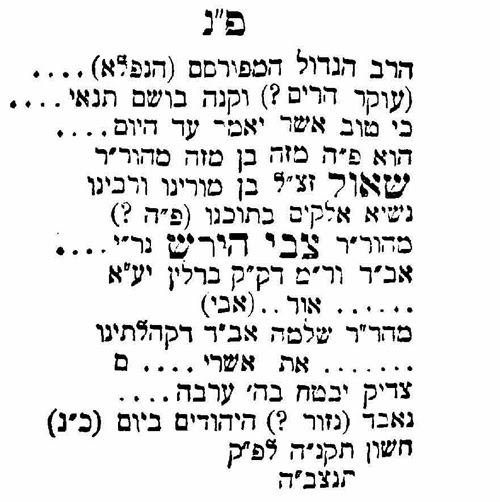
Saul’s Epithet, he was buried in the Alderney Road Cemetery in London, next to his brother, Hirschel, Chief Rabbi 
Notes

[1] For more on R. Raphael Cohen see the amazingly comprehensive and insightful bibliography by the bibliophile R. Eliezer Katzman, “A Book’s Luck,” Yeshurun 1 (1996), p. 469-471 n.2. See also R. Moshe Shaprio, R Moshe Shmuel ve-Doro pp.103-110 especially on the BR see 108-09. C. Dembinzer, Klielas Yoffee, 1:134b, 2:78b writes that the work on TY caused R. Saul to lose his position as Chief-Rabbi of Frankfort and his wife divorced him because of it. See also, S. Agnon, Sefer Sofer Vesipur, p.337. On R. Raphael Cohen and his connection with the Gra and Chasidus see D. Kamenetsky, Yeshurun, 21, p. 840-56. As an aside this article generated much controversy for example see the recent issue of Heichal Habesht, 29, p.202-216 and here.
[2] Regarding the correct pronunciation of this title see Moshe Pelli, “The Religious Reforms of ‘Traditionalist’ Rabbi Saul Berlin,” HUCA (1971) p. 11.  See also R. Shmuel Ashkenzi’s notes in the BR, Jerusalem, 1983 ed., introduction, n.p., “Notes of R. Shmuel Ashkenzi on Kuntres Yefe le-Besamim, note 6.  
Additionally, MY was not Saul’s first literary production, nor was it his first that was critical of another’s book.  Instead, while he was in Italy in 1784, he authored a kunteres of criticisms of R. Hayyim Yosef David Azulai’s Birkei Yosef.  See R. R. Margolis, Arshet pp. 411-417; Moshe Samat, “Saul Berlin and his Works,” Kiryat Sefer 43 (1968) 429-441, esp. pp. 429-30, 438 n.62.  On Chida’s opinion of the BR see for example Shem Hagedolim:

עתה מקרוב נדפס ספר זה בברלין… ועוד יש הגהות כסא דהרסנא. ואשמע אחרי קול רעש כי יש בספר זה קצת דברים זרים ואמרו שהמעתיק הראשון בארץ תורגמה מכ”י הרב יצחק די מולינא ז”ל יש לחוש שהוסיף וגרע. ולכן הקורא בסי’ זה לא יסמוך עליו דאפשר דתלי בוקי סריקי בגדולים עד אשר יחקור ויברר הדברים ודברי אמת ניכירים ודי בזה… (שם הגדולים, ערך בשמים ראש, וראה שם, ערך מר רב אברהם גאון)

See also the important comments of R.Yakov Chaim Sofer, Menuchas Sholom, 8, pp. 227-230 about the Chida.
[3]  Eliezer Landshut, Toldot Anshei Shem u-Puolotum be-Adat Berlin, Berlin: 1884, 89-90 for the text of the ban as well as its history.  Additionally, for the proclamation read in the main synagogue of Altona see id. at 90-1. This proclomation has been described as “one of the harshest condemnations” of the time.  See Shmuel Feiner, The Jewish Enlightenment in the Eighteenth-Century, Jerusalem: 2002, p. 310. 
[4]  Id. at 91. Samat, however, notes that neither Saul nor his father ever admitted Saul’s authorship of MY.  Samat, “Saul Berlin and his Works,” p. 432, 4.  
[5] According to A. Berliner, the author of this pamphlet is R. Eliezer Heilbot. See Samat, id. Saul and MY were not the only ones attacked. The publisher of MY, Hinukh Ne’arim, was also attacked and, not only MY but all the books they published were prohibited by some. The publishers, however, defended their decision to publish MY.  They argued that the whole point of MY was to ascertain if R. Raphael Cohen’s book was riddled with errors or, the author of MY was mistaken.  The publishers pointed to the above mentioned introduction to MY wherein the MY’s author explains that he has sent copies of the book to leading rabbis to determine the question regarding R. Cohen’s book. Thus, MY is either right or wrong, but there can be nothing wrong with merely publishing it.  See id. at 92-3.
Additionally, it should be noted that according to some, Saul authored a second attack on R. Raphael.  R. Raphael published Marpeh Lashon, Altona, 1790, and was soon after attacked in the journal Ha-Meassef by someone writing under the pen-name EM”T.  Many posit that this is none other than Saul.  Katzman, Yeshurun 1, 471 n.3, disagrees and points to internal evidence that it is unlikly that Saul is the author of this critique. 
According to Feiner, these attacks were not one-sided.  Feiner argues that R. Cohen criticizes Saul, albeit in a veiled manner, in Marpeh Lashon.  See Feiner, Jewish Enlightenment, op. cit., 314-15.  
[6] Landshuth, id., suggests that Moshe is a non-existent figure like MY’s putative author Ovadiah. See also, Samet, “Saul Berlin and his Works,” 432 n.4 who similarly questions the existence of Moshe.  Carmilly-Weinberg makes the incredible statement that his Moshe is none other than Moses Mendelssohn.  Carmilly-Weinberg, Sefer ve-Seiyif,  New York, 1967, p. 215, (Carmilly-Weinberg’s discussion about both MY and BR are riddled with errors).  As Pelli notes this is impossible as the letter is signed 1789, the same year MY was printed, and Mendelssohn died three years prior. Pelli resurrects Moshe and links him with a known person from Amsterdam, Saul brother-in-law. See Pelli, HUCA (1971) p. 13 n.75.  Ultimately, however, Pelli rejects this and demonstrates that Moshe is indeed a pseudonym but a well-selected one.  See id.  
[7]  See Landshuth, 93-9; Pelli, 13-15.  See also R. Alexander Sender Margolioth, Shu”t ha-RA”M, Lemberg, 1897, no. 9.    
[8] See Feiner, The Jewish Enlightenment, op. cit., 312-13.  This newspaper is online here, and Feiner provides the relevant issues which are 1789 pp. 484-88, 520-24, 574-81, 680-82, 768-74, 791-802, 867-92, 932-72.   
One of which includes this portrait of R. Cohen.
Which is a very different portrait, both in time and look, to the one appearing in E. Duckesz, Ivoh le-Moshav, Cracow, 1903.

[9] For the deeper meaning of the title Kasa de-Harshena, see Moshe Pelli, The Age of Haskalah, University Press of America, 2006, 183 n.51.
[10] See Samat, who discusses the exact progression of the ban.

[11] See Yechezkel Shrage Lichtenstein, Suicide: Halakhic, Historical, and Theological Aspects, Tel-Aviv, 2008, pp. 438-44. See also,Yeshurun 13:570-587 especially pp.578-581; Marc B. Shapiro, “Suicide and the World-To-Come,” AJS Review, 18/2 (1993), 245-63. 
On the issue of suicide there are others who similarly reach the same holding as the BR see Strashun in his מתת-יה pp. 72a-72b (this source is not quoted by Samet or Amar).
[12] Biographical information on R. Yosef Lazer is scant.  For information on his father and grandfather, see Meir Wunder, Me’orei Galicia, Israel, 1986, vol. III, pp. 456, 462-3. See also T.I. Abramsky, “‘Besamim Rosh’ in the Hassidic Milieu,” Taggim, (3-4), 56-58.   
[13] Samat only notes the removal of one responsum, he fails to note that exclusion of the second.  He does, however, note the misplaced responsum.  Additionally, Kuntres ha-Teshuvot ha-Hadash, fails to record that any are missing or that one responsum was moved to the end. 
[14] See Pelli, Age of Haskalah, pp. 185-89, comparing a few responsa with 18th century haskalah literature.
[15] Assaf was not the first to use this responsa and note its historical anacronisms.  Leopold Zunz, also highlights the issues with this responsum (as well as others).  Leopold Zunz, Die Ritus des Synagogalen Gottesdienstes, Geschichtlich Entwickelt, Berlin: 1859, 226-28.  Zunz’s critique is quoted, almost in its entirety by Schrijver, but Schrijver appears to be unaware of Assaf’s additional criticisms of the responsum (and others).
Assaf provides one other example where he shows through internal data that there is a misattribution.  Assaf concludes that he has other examples of historical anacronisms in BR but doesn’t provide them here or, to our knowledge, anywhere else.
[16] For another critique of Fishman’s position see Emile G.L. Schrijver, “Saul Berlin’s Besamim Rosh: The Maskilic Appreciation of Medieval Knowledge,” in Sepharad in Ashkenaz, Netherlands: 2007, pp. 249-259, esp. pp. 253-54. 
[17] Regarding Ketav Yoshor see Pelli, Age, 176-79. See also here and here.

Additional Bibliography:
M. Samet has two articles on the topic, R. Saul Berlin and his Writings, Kiryat Sefer, 43 (1969) 429-41; “Besamim Rosh” of Saul Berlin, Kiryat Sefer 48 (1973) 509-23, neither of which are included in the recent book of Samet’s articles.

To add to Samet’s and Amar’s very comprehensive lists of Achronim who quote BR: (I am sure searches on the various search engines will show even more): Malbim in Artzos Hachaim, 9:41 (in Hameir Learetz); Shut Zecher Yosef,1:32b; Keter Kehunah p. 30; Matzav Hayashar 1:2a; Pischei Olam 2:218,228; Birchat Yitchcak (Eiskson), pp. 6,14,24; Maznei Tzedek, p.26,45,254; R.Yakov Shor, Birchat Yakov, pp.212  Sefer Segulos Yisroel pp.116b; R. Rabinowitz, Afekei Yam 2:14; R. Leiter, Zion Lenefesh Chayah# 43; Shut Sefas Hayam, OC siman 14; R Meir Soleiveitck, Hameir Laretz 45a, 45b, 54b, 55a; Emrei Chaim p.26; R. Sholom Zalman Auerbach, Meorei Eish p. 108 b

In general on BR see: R.Yakov Shor,Eytaim Lebinah (on Sefer Haeytim) p. 256; Pardes Yosef, Vayikrah 220b Pardes Yosef, Shelach p. 517; R.Yakov Chaim Sofer, Menuchas Sholom, 8, pp. 222- 230; Shar Reven p. 54; A. Freimann, HaRosh ; Y. Rafel, Rishonim Veachronim, pp. 123-130; B. Lau, MeMaran Ad Maran, pp.133; S. Agnon, Sefer Sofer Vesipur, pp.337-339.

R. Pinhas Eliyahu Horowitz writes:

ולפעמים תולים דבריהם באילן גדול וכותבים מה שרוצים בשם איזה קדמון אשר לא עלה על לבו… כספר בשמים ראש שחיבר בעל כסא דהרנסא לא הרא”ש וזקני ישראל תופסי התורה יעלו על ראשם… (ספר הברית, עמ’ 232).

The Steipler was of the opinion in regard to the BR that:
שבאמת ניכר מהרבה תשובות שהם מהרא”ש ז”ל רק כנראה שיש שם הרבה תשובות מזויפות שהמעתיק הכניס מעצמו כי ישנם שם דברים מאד מזורים ואיומים  (ארחות רבנו, א, עמ’ רפה)

R Zevin writes in Sofrim Veseforim (Chabad) p.354 :
אלא שבתשובות בשמים ראש המיחוס להרא”ש ושכידוע נמנו וגמרו שמזוייף הוא

R. Yakov Kamenetsky said: “Do you think Just we (he meant people of his own caliber) were fooled? Even R. Akiva Eiger was fooled.” (Making of a Godol, pp.183-184)

About Rav Kook and the BR see: http://www.biu.ac.il/JS/JSIJ/5-2006/Gutel.pdf

R. Avigdor Nebensal writes:

כשמביאם את הבשמים ראש ראוי להזכיר שיש מסתייגים חריפות מהספר הזה (השתנות הטבעים, עמ’ 16).
R Zalman Nechemiah Goldberg writes:
אכן בעיקר הענין אם להביא דברי בשמים ראש בודאי צדק הג”א נבנצל שליט”א שיש להביאו בהסתייגות, ובפרט בענינים אלו שהוחזק למזייף ולמביא עקומות וכוזבות (השתנות הטבעים, עמ’ רסד).